Welcome to FMEP’s Weekly Settlement & Annexation Report. To subscribe to this report, please click here.
February 27, 2026
- ANNEXATION: U.S. Offers Consular Services in Settlement, More
- WEST BANK SETTLEMENTS & OUTPOSTS: Smotrich to “Relocate” Seam Zone Village, New Bypass Road, Outpost Rebuilt Near Mukhmas, Eliyahu Raises Israeli Flag on Jordan Valley Peak, New Outpost Phenomenon Near Barrier, More
- SETTLER & STATE TERRORISM: Firey Attack on Masafer Yatta, More
ANNEXATION
In First – US To Offer Consular Services in Settlement
The United States Embassy in Jerusalem announced that it will be hosting one-day consular services inside of the Efrat settlement – marking the first time the U.S. will conduct official consular services in a settlement. The announcement further promised to schedule consular services in the Beitar Illit settlement in the coming months.The move is a significant show of support for Israel’s sovereignty over the settlements which under international law are illegal civilian settlements inside of an occupied territory. The move is tantamount to recognizing Israel’s annexation of West Bank land. A U.S. Embassy spokesperson told the New York Times that the policy of the government vis a vis settlements has not changed.
Israeli annexationists praised the announcement. MK Yuli Edelstein, former Speaker of the Knesset, called it ““a blessed step of tremendous importance” and said the move:
“adds to the international legitimacy of our right to the regions of our homeland in Judea and Samaria.”
Israeli human rights lawyer Michael Sfard said:
“This cannot be construed in any way other than as a political statement of legitimization of Israeli settlements in the West Bank.”
News & Analysis on Annexation
- “Smotrich: Jerusalem will ‘never’ cede control of Judea and Samaria” (JNS, 2/24/2026)
- “4 Questions for an Expert: Israel’s De Facto Annexation of the West Bank” (IMEU, 2/25/2026)
- “Israel’s Perfect Storm: The West Bank Has Been Sacrificed for Trump’s Gaza Plan” (Haaretz, 2/23/2026) Hagar Shezaf writes: “Anyone with eyes knows it’s foolish to think that the annexation of the West Bank will happen through a declaration. The government’s actions are making annexation a reality, and it’s happening now, out in the open.”
WEST BANK
Smotrich, Katz Advancing Plan to Relocate – AKA Ethnically Cleanse – Palestinian Village in Seam Zone
The Israeli government informed the High Court that it is advancing a long-stalled plan to “relocate” 430 residents of the Palestinian village of Arab al-Ramadin al-Junabi, a village which has lived on its land since the 1950s. The government argues the relocation plan is in the best interest of the community, which due to its location in the so-called “Seam Zone” (in the West Bank but on the Israeli side of the Separation Barrier which was built by Israel in 2002), is cut off from receiving infrastructure services from the PA and remains unserviced by Israel. Now, the village is trapped in poverty and lacking approved planning guides, though the village has worked with planning professionals at Bimkom to advance a Master Plan which Israel has rejected. Israel – which has created this situation to coerce its residents to leave – is now using it as a weapon against Arab al-Ramadin al-Junabi to carry out a court-approved ethnic cleansing.
New Settler Bypass Road Expands Apartheid Road Matrix
Peace Now reports that Israel has kicked off construction on a new settler-only bypass road – known as the Road 45 of the “Quarries Road” – that will connect settlements east and north of Ramallah more seamlessly to the Qalandiya Underpass and on to East Jerusalem, avoiding Palestinians, security checks at the Qalandiya checkpoint, and the constant traffic near the Hizma checkpoint. Beyond providing settlers a Palestinian-free path to Jerusalem, the road also creates more capacity for settlement growth in these areas.
Peace Now said in a statement:
“Peace Now: While roads inside Israel are collapsing and unable to cope with the traffic load, the government is pouring enormous budgets into a small minority of settlers in grandiose projects that Israel will ultimately be forced to evacuate. The belief that bypass roads around Palestinian villages will erase the political, diplomatic, and security problem known as the settlement enterprise is a dangerous, costly, and violent illusion. The theft of hundreds of dunams for expensive roads that serve so few, only highlights the injustice and absurdity of government policy. Israel does not need more roads that bypass Palestinians, but rather ways to reach a political solution with them.”
Settlers Rebuild Outpost Near Mukhmas
The Times of Israel reports settlers rebuilt an illegal outpost near the village of Mukhmas, which has been violently and repeatedly terrorized by settlers (under IDF supervision) recently resulting in the murder of a 19-year old Palestinian American just last week. The outpost, called “Kol Mevaser,” is located in Area B of the West Bank, underscoring the total erosion of the Oslo framework. Though the IDF has repeatedly dismantled the outpost, settlers still manage to bring in heavy construction equipment to rebuild.
Prominent Israeli activist and settlement watchdog Rabbi Arik Ascheman notes that, in the area near to Kol Mevaser outpost, the “mother outpost” Nakhalat Tzvi continues to expand illegally.
Heritage Minister Raises Israeli Flag on Mount Sartaba
Israeli Heritage Minister Eliyahu raised an Israeli flag on the peak of Mount Sartaba, located in the Jordan Valley, saying it is “a symbolic step showing Israel “reoccupying” the West Bank and vowing to use it for religious observance.” Eliyahu said the act was part of a series of similar symbolic acts planned for across the West Bank.
Mount Sartaba is also known as Alexandrium – the site of the ancient Hasmonean fortress.
New Outpost Strategy Takes Advantage of Israeli Military Zones Near Barrier
 Kerem Navot reports the emerging phenomenon of new outposts built along the Israeli security road that trods along the path of the West Bank separation barrier. There are currently 11 such outposts, accessible only via the Israeli security road not meant for civilian use.
Kerem Navot founder Dror Etkes told Haaretz,
“The establishment of a chain of illegal outposts along the barrier fence route, and the fact that large segments of the barrier route have become access roads to these outposts, indicate that since Avi Bluth became commander of the Central Command, the outposts project has transformed from one that takes place under the protection and with the cooperation of the military into an illegal project in which the military is directly involved, even financing part of it.”
Israel Systematically Denying Building Permits to Palestinians Living in Area C
Amira Haas reports for Haaretz ton the multifold mechanisms by which Israel has advanced its total control over the West Bank, expanded settlements, and displaced Palestinians. One such mechanism is systematic denial of building permits and subsequent demolitions of Palestinian homes. Haas reports that between 2009 and 2020 Israel:
- Issued building permits for 66 Palestinian buildings in Area C
- Issued building permits for 22,000 settlement units.
Haas continues:
“With construction permits effectively barred, thousands of Palestinian structures have been demolished—including 2,461 over the past two years alone—displacing about 2,500 people, data from the United Nations Office for the Coordination of Humanitarian Affairs show. Israel’s security cabinet recently approved wide-ranging steps aimed at deepening Israeli control in the occupied West Bank and enabling further growth of settlements.”
More News & Analysis from the West Bank
- “In Area C, Faster Demolitions Clear the Way for Jewish Expansion” (Haaretz, 2/23/2026)
- “2025 was record year for settlement expansion, construction and planning, NGO finds” (The Times of Israel, 2/25/2026)
- [Reported on last week] “’We Won’t Wait for Approval’ Israeli Settlers Declare New West Bank Settlement Deep Inside Palestinian Hebron” (Haaretz, 12/22/2026)
SETTLER TERRORISM
Pogrom in Masafer Yatta, South Hebron Hills
In a nighttime attack on February 24th, a group of at least 20 settlers were caught on film setting fire to several homes and vehicles in the village of Susya, located in the Masafer Yatta region of the South Hebron Hills. There were reportedly children inside one of the homes set on fire. The settlers also wielded sticks and damaged property and spray painted hateful graffiti. Four people were treated for smoke inhalation by the Palestinian Red Crescent.
On the same night, Palestinian residents of villages close to Susya reported settlers had also carried out smaller scale violent attacks and let out heads of livestock.
More Reports of Settler Attacks
In addition to the attack on Masafer Yatta, settler attacks over the past week include:
- Tell: On Feb 23rd, settlers set a mosque on fire and spray painted “Revenge” and “Price Tag.”. Tell is located near Nablus in an area surrounded by violent settlements including Itamar and the Gideon’s Farm outpost, which was recently shortlisted for legalization by the Israeli government.
- al-Mughayyir: On Feb 21st, settlers descended on a home in the village of al-Mughayyir, and proceeded to beat the Palestinian family living there. When two men came to the aid of the family, settlers and IDF soldiers in the area opened fire, wounding two. The family, the Abu Naim family, has decided to abandon their home out of fear.
- Qusra: On February 27th, settlers attacked a group of Israeli activists in near the village of Qusra, located in the area of Nablus. Two were hospitalized with head injuries.
News & Analysis of State-Backed Settler Terrorism
- “State indicts 19-year-old for alleged revenge rampage in West Bank village after outpost evacuation” (Jerusalem Post, 2/25/2026)
- “US avoids condemning settler killing of Palestinian-American in armed West Bank attack” (The Times of Israel, 2/22/2026)
- “Settlers Drive a Palestinian Family Off Its Land” (New York Times, 2/24/2026)
Welcome to FMEP’s Weekly Settlement & Annexation Report. To subscribe to this report, please click here.
January 30, 2026
- West Bank Settlements & Outposts: More Funding for Settler-Only Roads; Expanded Settler Access to Joseph’s Tomb, Soil Smuggling, and More
- Settler Terrorism: Pogrom in Masafer Yatta, Displacement in Sinjil, and More
- Bonus Reads
West Bank Settlements & Outposts
Israel Allocated More Funds for New Roads & More for Settlers
Peace Now reports that the Israeli government approved some 550 million shekels ($177.97 million) for the “reinforcement of security components,” most of which will be directed to the West Bank. The funds will be used for paving new settler security roads, upgrades to bus stations and armored buses, and new security features for settlements like fences, lighting, gates, cameras, and sensors.
The Palestine Chronicle further reports that part of the budget will be used for the construction of Route 45 (aka the “Quarry Road”), a settler-only bypass road that would connect settlements south of Ramallah to Jerusalem. Israel expropriated Palestinian land in January 2025 to allow for the construction of this road.
Peace Now said in a statement:
“Under the pretext of “security components,” the government has already invested hundreds of millions of shekels in illegal outposts and violent settler farms in the occupied territories. It is now seeking to further expand this budget, deepening Israel’s security and economic entanglement in the occupied territories. It is now clear to all — especially after Oct. 7 — that the settlements constitute a security and economic burden on Israel, yet the government continues to serve only its settler base.”
For the First Time in 25 Years, Settlers Allowed Morning Prayers Joseph’s Tomb
Israeli Defense Minister Katz agreed to allow settlers to perform morning prayers at Joseph’s Tomb in Nablus for the first time in 25 years. Joseph’s Tomb is a holy site for Jews and cultural site for Palestinians, located in the heart of Nablus. The site has long been a flashpoint for violence because the Tomb (and entrance to it) requires settlers to pass through very densely populated Palestinian neighborhoods.
On January 29th, Israeli ministers and settler leaders led a group of 1,500 people under a heavy security escort to Joseph’s Tomb. In 2000 during the Second Intifada, Israeli officials restricted Israeli access to the site to nighttime hours in hopes of minimizing conflict.
Israel is Trucking Soil from Tel Aviv to West Bank to Build New Outposts & Settlements
Kerem Navot told Haaretz that Israeli trucks are smuggling a large amount of soil from Tel Aviv construction sites to the West Bank in order to prepare the land for the expansion of at least two outposts. The soil has been transferred reportedly without the permission of the Israeli Civil Administration, and is apparently a widespread phenomenon in part because environmental regulations in the West Bank and relaxed (and bent to favor Israeli interests) and because Israel lacks regulated sites where excess construction debris can be deposited.
There has been increased construction at the two outposts, Havat Tzurim and Shacharit, preparing for what Haaretz calls “the outposts’ emerging farm operations.” Schacharit was granted retroactive legalization by the Israeli government in 2023 along with 9 others outposts, but Havat Tzurim remains illegal under Israeli law. None of the current construction is legal.
Haaretz reports:
“Settlers often frame the establishment of outposts and farms as a means of protecting nature and preserving landscapes from damage allegedly caused by the activity of Palestinians, such as overgrazing and illegal hunting. However, the dumping of excess soil increases the risk of waste contaminants seeping into groundwater reservoirs, which communities rely on for drinking and irrigation, while road construction and other land preparation activities increase the risk of erosion, flooding and other runoff issues.”
More from the West Bank
- IDF seizes thousands of dunams from a village near Hebron.
- VIDEO: “How Israel is planning to build an ‘apartheid road’” (Guardian News, 1/27/2026)
- “Israeli forces raid Hebron city and surrounding towns, turn building into military outpost” (Wafa News, 1/29/2026)
SETTLER TERRORISM
Settler & IDF Pogrom in South Hebron Hills
On January 27th a large group of settlers under IDF escort carried out a large-scale, coordinated pogrom on three villages in the Masafer Yatta region of the South Hebron Hills. The settlers moved from one village to another, setting fire to Palestinians property, stealing livestock, spraying teargas inside of homes, and horrifically terrorizing residents. Two Palestinians were severely assaulted by settlers, one severely beaten with clubs and an elderly woman had her arm broken. After the attack, two Palestinian and zero Israelis were arrested by the IDF.
In a separate incident on January 26th, settlers destroyed 500 trees in the nearby village of Susiya.
Sinjil Residents Threat of Forced Displacement, Marking New Heights of Settler Terror
Haaretz reports that 15 families have recently been forced to leave their homes located on the periphery of the town of Sinjil under settler terror. Sinjil, unlike the many bedouin and pastoral communities that have been forcibly displaced under settler terror over the past two years, is a large town with 8,000 people. Residents tell Haaretz settlers from surrounding outposts first began to trespass on their land in 2022, and it has only escalated since – causing many families to leave.
In Area B, Outpost Settlers Attack Qusra, Atara, Bir Zeit
Settlers from a newly established outpost near Nablus carried out several attacks on Palestinians in the surrounding area. The outpost is located deep in Area B (the vast majority of settlements and outposts are in Area C), and Haaretz reports that this new outpost is “the deepest so far within territories under Palestinian jurisdiction.” Settlers are expanding the outpost, and have brought in a large herd of sheep to take over grazing land. The IDF claims to have evacuated the outpost previously, but local residents report the outpost was quickly reestablished by settlers.
On January 23rd a group of at least 10 masked settlers from the new outpost attacked the village of Qusra, firing live rounds towards Palestinians and carrying clubs.
On January 25th settlers set fire to vehicles in nearby Atara village, and spray painted hateful messages.
Earlier on the same day, settlers were filmed in an olive grove in the nearby village of Beir Zeit, and settlers reportedly attacked a 60-year old woman and her son who tried to assist her.
More on settler terrorism
- Settler attacks reported in Ein Samiya and Taybeh, effecting water supply.
- “The calculated erasure of Ras Ein Al-Auja” (+972 Magazine, 1/16/26)
- Haaretz Editorial Board: “The Israeli Ethnic Cleansing Militias in the West Bank Have Succeeded Once Again” (1/27/2026)
- “A bloody season: the olive harvest in the West Bank” (Mondoweiss, 1/29/2026)
BONUS READS
- “’People will live in the streets’: Israel steps up evictions of Palestinians from east Jerusalem” (Reuters, 1/282026)
- “A Palestinian neighborhood’s last stand against Israeli settler takeover in Jerusalem” (Mondoweiss, 1/26/2026)
- “Paving military roads, Israel prepares permanent control of West Bank camps” (+972 Magazine, 1/19/26)
- “UNRWA Heads Tell Haaretz: ‘We Don’t Radicalize Palestinians – Their Lived Existence Does‘” (Haaretz, 1/20/26)
- “Israel Will Not Allow Gaza Residents to Receive Medical Treatment in West Bank, East Jerusalem Due to ‘Security Risks’” (Haaretz, 1/26/26)
- “‘I cannot help my clients’: The impossible task of representing Palestinian detainees” (+972 Magazine, 1/27/2026)
Welcome to FMEP’s Weekly Settlement Report, covering everything you need to know about Israeli settlement activity this week.
To subscribe to this report, please click here.
March 29, 2024
- Israel to Legalize Ahiya Outpost, Framing it as a Neighborhood of the Shilo Settlement
- Israel Expedites New West Bank Road for Settlers, Foreshadowing Mass Expansion of Settlement Growth West of Ramallah
- U.S. Undercuts Its Own Sanctions on Settlers, Says Israel Banks Can Continue Hosting Accounts
- Haaretz Reveals Mortgage Fraud Behind Some Outposts Construction
- Palestinian NGOs Issue Alert on Israeli Crimes in the West Bank, East Jerusalem
- The Health & Psychological Impacts of Settler Terrorism
- Settlement Wastewater is Damaging Palestinian Land, Livelihood & Contributing to Forcible Displacement
- Bonus Reads
Israel to Legalize Ahiya Outpost, Framing it as a Neighborhood of the Shilo Settlement
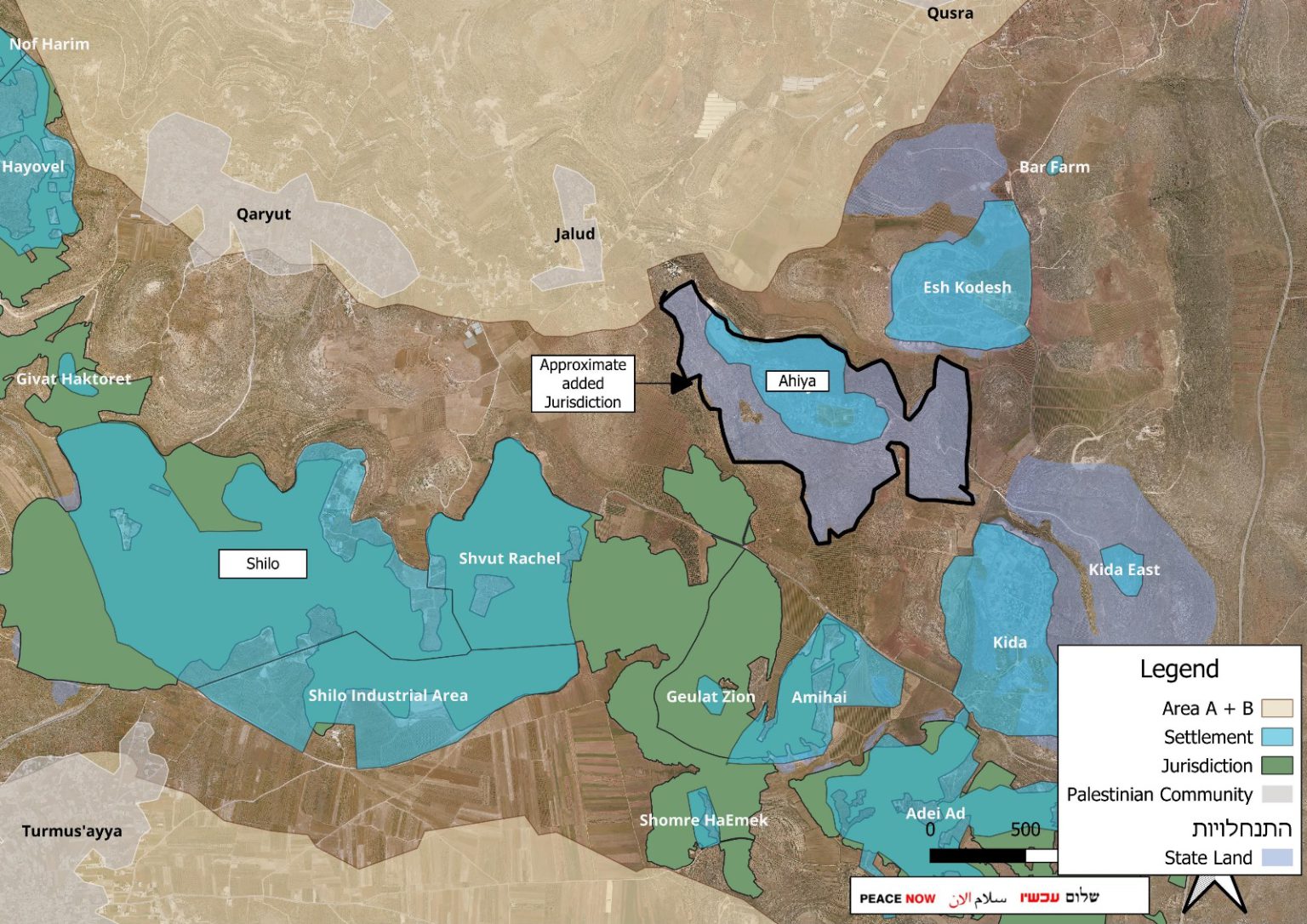 Peace Now reports that the Israeli Civil Administration announced that it will grant retroactive authorization to the Ahiya outpost by massively expanding the jurisdiction of the Shilo settlement to include the land on which the outpost was illegally constructed. The outpost is not contiguous with the built up area of the Shile outpost, and is more properly understood to be a new outpost, not simply an expansion of an existing one.
Peace Now explains:
“According to Peace Now’s estimation, the decision to approve the outpost of Ahiya as a neighborhood of Shilo rather than a new settlement is intended to prevent international criticism and the need to pass the decision in the security cabinet. On the other hand, the decision serves Minister Smotrich, who in the past month has exerted increased authority over settlements and declared a record number of dunams as state lands, promoted thousands of housing units, and more. In 2023, Israel approved five outposts as new settlement neighborhoods, reaching a record number of 15 outposts approved as settlements in 2023. In 2018, Minister Smotrich proposed legislation to regulate approximately 70 outposts as settlements. Since assuming office, he has announced several initiatives to achieve this objective.”
The Shilo settlement is located in the heart of the northern West Bank, in the Shiloh Valley, in an area of settlements that are designed to form an uninterrupted corridor of Israeli control connecting sovereign Israel to the Ariel settlement, through the isolated Shiloh Valley settlements, all the way to the Jordan Valley. In so doing, It will completely bisect the northern part of the West Bank.
The Shiloh settlement has spun off several illegal outposts (Amichai, Adei Ad, Shvut Rachel) which have systematically been added to the Shilo settlement by expanding the settlements borders, a move which rewards illegal construction and land theft and further encourages it. This pattern is exemplified by the Amihai outpost.
The Amichai settlement was approved for construction in 2017, making it (at that time) the first new settlement formally approved by the Israeli government in 25 years. Aerial imagery from 2021 show the massive growth Amichai has enjoyed in the years that followed its establishment, a previously empty hilltop with cultivated fields nearby have been transformed into a sizable suburban neighborhood. In addition to new construction, Amichai was also massively expanded, subsequent to its initial construction, when the Israeli Civil Administration announced that its plan to retroactively legalize the Adei Ad outpost by significantly expanding the borders of the Amichai settlement to turn Adei Ad into a (non-contiguous) neighborhood. In effect, this was a slight-of-hand by Israel to turn the Adei Ad outpost into an entirely new official, legal settlement. In 2013, Israel allocated additional land near the Amichai settlement to the World Zionist Organization, in order to expand the settlement. This has all come at the continued cost to Palestinians from the nearby village of Turmus Ayya on whose land Amichai was established and whom settlers from the Amichai outpost and others nearby routinely harass and terrorize.
In a statement, Peace Now says:
“Establishing another settlement is the last thing Israel needs. Deepening Israeli presence in the West Bank serves only a small and extremist group in Israel and harms the entire Israeli public. The Israeli government, under Minister Smotrich’s leadership, continues to evade a political solution and imposes facts on the ground that will escalate violence and deepen the dispossession and oppression of Palestinians in the West Bank.”
Israel Expedites New West Bank Road for Settlers, Foreshadowing Mass Expansion of Settlement Growth West of Ramallah
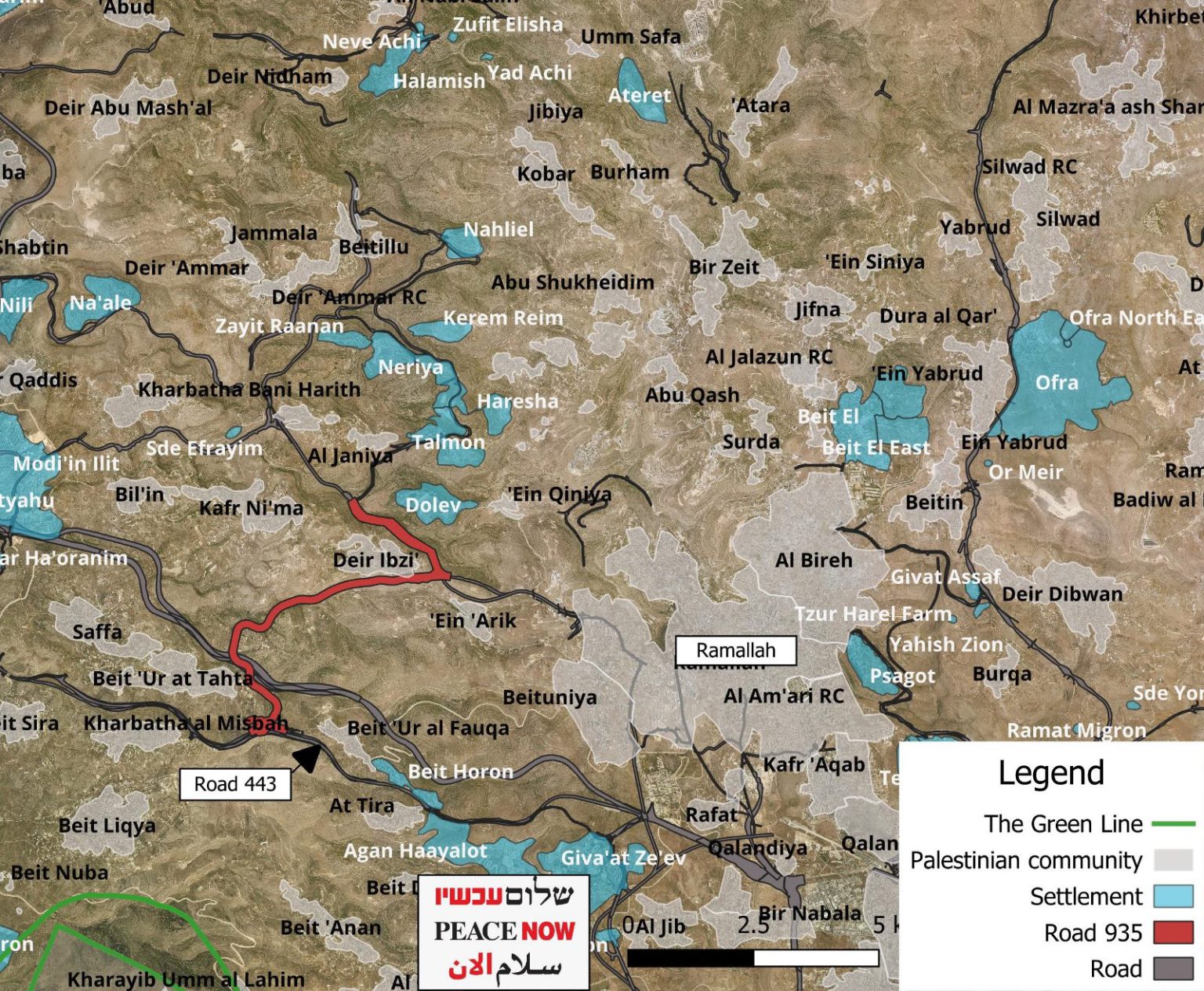 Peace Now reports that Israeli Finance Minister Bezalel Smotrich and Transportation Minister Miri Regev announced plan to fast-track the planning and construction of a new road for settlers in the West Bank, designed to connect the Gush Talmonim settlement area west of Ramallah to Route 443. This road will give the settlements in this area (including Dolev, Almon, Haresha, and others) a more direct route to Jerusalem through Palestinian land, which Israel will expropriate. – and, according to Peace Now, will facilitate the massive expansion of the Gush Talmonim settlement by the tens of thousands.
Peace Now writes:
“The Gush Talmonim Road – Route 443 is an extremely dangerous project for the area west to Ramallah. Its construction will create a wide and densely populated settlement bloc, exacerbating friction between settlers and Palestinians and further complicating a political solution. The road will not reduce violence in the area but rather escalate it to new heights. The political solution lies not in such illogical roads but in a political horizon and hope for both peoples.”
U.S. Undercuts Its Own Sanctions on Settlers, Says Israel Banks Can Continue Hosting Accounts
According to reporting by the Times of Israel, this week the U.S. government sent a letter to the Israeli Finance Ministry saying that, in effect, Israeli banks can maintain accounts for the seven individuals sanctioned by the U.S. government without facing repercussions. The letter is reported to have stated that the sanctions were not intended to cut off sanctioned individuals from all of their assets, only from international/foreign transactions, and that the individuals should be permitted access to their bank accounts for basic purchases.
The letter was prompted by a series of events stemming from recently announced sanctions on Israeli settlers who have participated in violence against Palestinians. Following the U.S.’s announcement, several European countries (and possibly the EU) followed suit, and Israeli banks moved to close accounts for those individuals in fear of being locked out of international banking systems for violating sanctions. Israeli Finance Minister Bezalel Smotrich, seeking retaliation against the banks for the decision to close the accounts, threatened to take steps to cut Palestinian banking off from Israeli banks (the Palestinian economy operates in shekels and is largely dependent on the Israeli banking sector).
Muhammad Shehada, Chief of Communications at the Euro-Med Human Rights Monitor, posted on X:
“Biden quietly reverses the (feckless) sanctions he put on 7 individual settlers, removing the freeze on their accounts & effectively emptying the sanctions of any practical content according to Israel Hayom! It was purely a PR stunt all along to whitewash his complicity in Gaza.”
Tariq Habash, a former political apointee in the U.S. Department of Education who recently resigned in protest of the Biden Administration’s Israel policy, posted:
“The Biden Admin has now eroded the primary policy to deter illegal settlement expansions in the West Bank, undermining the entire purpose of issuing sanctions and compromising U.S. policy yet again.”
Hugh Lovatt, Senior Policy Fellow at the European Council on Foreign Relations, posted on X:
“Once again, the U.S. is scared of its own bark and inherently unable to put any meaningful pressure on Israel. It has promised to undermine the potency of its (secondary) sanctions regime. What could potentially have turned into a game changer is now barely an inconvenience.”
Former J Street lobbyist Dylan Williams posted:
“Between this bizarre move to ease the impact of sanctions on violent settlers and accepting Israel’s patently false assurance that it’s following US and international law per NSM-20, the Biden administration is regressing when it comes to standing up for US interests with Israel.”
Haaretz Reveals Mortgage Fraud Behind Some Outposts Construction
Haaretz and Kerem Navot recently revealed a pattern or mortgage fraud behind the construction of some outposts. The investigation shows that Israeli banks issue mortgages to settlers for the construction of homes in a settlement (with specific land parcel numbers recorded), but the actual construction happens elsewhere – thereby enabling the costly construction of outposts. The complicity/knowledge of the banks in issuing these mortgages is unclear and different for each case – but it is clear that the World Zionist Organization is deeply involved in these dealings.
Most flagrantly, Israeli Finance Minister Bezalel Smotrich – who is also a minister in the Defense Ministry overseeing settlement affairs – himself engaged in this fraud. He took a mortgage for a lot in the Kedumim settlement, but built the house on totally unrelated land located outside the settlement’s zoning plan.
In addition, Yehuda Eliyahu – who Smotrich appointed as head of the Settlement Administration that Smotrich created – also participated in this scheme. He received a 2004 mortgage on a land parcel in the Neria settlement, but built in what is now called the Haresha outpost.
Dror Etkes, founder of the Kerem Navot settlement watchdog group, told Haaretz:
“The two main protagonists of this story, Finance Minister Smotrich and his longtime friend-partner Yehuda Eliyahu, together with their friends in the settlement department, were part of a group of settlers who obtained mortgages while misleading the banks. This may be the reason why 11 years later, as an MK, it was so important for Smotrich to exempt the activity of the settlement department from the Freedom of Information Act.“
Palestinian NGOs Issue Alert on Israeli Crimes in the West Bank, East Jerusalem
Amidst ongoing genocide in Gaza, the three preeminent Palestinian human rights groups – Al-Haq, Al-Mezan, and the Palsetinian Center for Human Rights, have issued a new report on spike in Israeli violations and crimes in the West Bank in the first months of 2024. These crimes include extrajudicial killings, attacks on medical personnel, raids and arrests, demolitions and land razings, land confiscation, settlement expansion, settler violence, and more.
In conclusion, the groups write:
“Our organizations believe that the main target of the Israeli crimes and violations in the West Bank is the existence of the Palestinian people in Mandatory Palestine, for the purpose of entrenching the Zionist settler-colonial project. This is particularily evident in Gaza as well, where the Israeli military aggression has led to the forced displacement of approximately 1.9 million Palestinians within the Gaza Strip amid systematic targeting and destruction, rendering the Strip unlivable and thereby forcing its people to flee. The absence of accountability and concrete enforcement of international law, the international community’s inaction and third states’ complicity are fueling the continuation of Israel’s settler-colonial project and ongoing genocide in Gaza.
Our organizations emphasize that these crimes and violations would not have continued without Israel’s long-enjoyed impunity and third states failure to hold perpetrators accountable and put an end to these crimes, according to Common Article 1 of the Four Geneva Conventions and Articles 146 and 147 of the Fourth Geneva Convention.
Our organizations also call upon the Prosecutor of the International Criminal Court to expedite the investigation into the situation in Palestine initiated more than two years ago and issue arrest warrants to hold the perpetrators accountable for these crimes, particularly the ongoing genocide in the Gaza Strip.
As Israel attempts to eliminate the Palestinian people and their right to self-determination, our organizations reiterate that addressing the situation in Palestine requires tackling the root causes of the Palestinian struggle, emphasizing that the international community and the United Nations member states hold the primary responsibility for the violence in Palestine through their inaction and complicity in Israel’s systematic and widespread violations. We urge the international community to assume its responsibilities to stop the ongoing genocide against the Palestinian people.”
The Health & Psychological Impacts of Settler Terrorism
Physicians for Human Rights has released a new report detailing the multifaceted trauma inflicted on Palestinians in the West Bank by settler terrorism. PHRI writes in the intro:
“For over five years, we’ve been flooded with reports chronicling settler violence. However, this worn-out term obscures a grim reality: life beside settler outposts and farms entail daily exposure to oppressive and coercive mechanisms, systemic discrimination, and a continuous sense of insecurity and fear. Our latest position paper explores how constant exposure to such routine violence is detrimental to the health of Palestinians, highlighting the social and psychological repercussions.”
The paper can be downloaded here.
Settlement Wastewater is Damaging Palestinian Land, Livelihood & Contributing to Forcible Displacement
The Norwegian Refugee Committee has issued a new report on the damage that settlement wastewater is inflicting on Palestinian land and livelihoods. The organization investigated two sites in the West Bank and found human sewage and animal waste flowing from settlements into Palestinian land, destroying crops and land. This, in turn, severely impacts the productivity of Palestinian agriculture, and contributes to the many pressures from Israeli settlers and the government which force Palestinians off their land. The Israeli Water Authority is responsible for water and sewage management for settlements in the West Bank.
One Palestinian farmer who has land close to Immanuel settlement industrial zone, told NRC:
“Wastewater has extensively flooded my land. A salt layer now covers the soil, significantly impacting the quality of the produced oil from my olive groves. Olive trees each used to yield no less than 25 kilograms of olives, but today production has dropped by half.”
Samah Hadid, NRC’s Middle East and North Africa Head of Advocacy said:
“Israel’s settlements routinely contaminate critical water systems and agricultural lands with wastewater, exacerbating environmental risks, further destabilising the already fragile Palestinian economy, and heightening the likelihood of various diseases like diarrhoea and kidney failure.”
In 2017, B’Tselem published a comprehensive report criticizing the illegal Israeli practice of exporting its waste to the occupied territories. The report provides more context for the extent to which hazardous wastewater poses significant damage to Palestinian land and futures. The report says:
“Israel regards the facilities built in the West Bank as part of its local waste management system, yet it applies less rigorous regulatory standards there than it does inside its own territory. Whereas polluting plants located within Israel are subject to progressive air pollution control legislation, polluting plants in the industrial zones of settlements are subject to virtually no restrictions. Moreover, the facilities in settlements are not required to report on the amount of waste they process, the hazards their operation pose, or the measures they adopt to prevent – or at least reduce – these risks. B’Tselem sent requests for information on these matters to the Ministry of Environmental Protection and the Civil Administration. The requests have gone unanswered.
…For many years, Israel has been taking advantage of its power as occupier to transfer the treatment of waste (including hazardous waste) and sewage from its sovereign territory to the West Bank. To that end, it has created a situation in which environmental legislation in the West Bank is much laxer than inside Israel, conveniently overlooking the long-term impact of environmental hazards on the Palestinian population and on natural resources, and neglecting to prepare future rehabilitation plans. This has created a financial incentive to transfer the treatment of environmental hazards from Israel to the West Bank. The Palestinians who live in the occupied territory are the ones to pay the price for this environmental damage, even though they were never asked their opinion on the matter and although, as a population under occupation, they have no political power and no real ability to resist.”
Bonus Reads
- “Israeli settlers step up attacks on Palestinian farms, expanding West Bank outposts” (NPR)
- “In a West Bank settlement, Israelis tend red cows and plan the Third Temple” (Middle East Eye)
Welcome to FMEP’s Weekly Settlement Report, covering everything you need to know about Israeli settlement activity this week.
To subscribe to this report, please click here.
October 6, 2023
- Smotrich Sidelines Military Legal Advisor In Order to Pursue Agenda
- Smotrich & Settlers Demand Bypass Road Near Huwara Following Latest Violence
- Israel Tightens Grip on Sebastia Site
- Settlers, Knesset Continue Push for IDF to Seize “Archaeological Site” at Mt. Ebal/El-Burnat
- The Acceleration of “Herding Outposts”, And Their Impact
- OCHA Reports on Ongoing Ethnic Cleansing of Masafer Yatta
- The JNF Is Funding Hilltop Youth
- Bonus Reads
Smotrich Sidelines Military Legal Advisor In Order to Pursue Agenda
Haaretz reports that Bezalel Smotrich has taken further steps to consolidate his governance over settlements and outposts in the West Bank by sidelining the Defense Ministry’s top military legal advisor in favor of his own hand-picked deputy legal advisor, Moshe Frucht. Prior to joining Smotrich, Frucht was a researcher at the far-right Kohelet Policy Forum, an organization that is widely understood to be the architect behind the anti-democratic judicial revolution and author of many legal opinions arguing for the legality of Israeli settlements under international law.
In recent meetings on the topic of settlements, Smotrich has gone from overruling the objections of the military advisor to excluding them from meetings altogether. One Israeli MK, Gilad Kariv (Labor), also accuses Smotrich of hiding the army’s official legal position from the Knesset in committee hearings and when discussing government decisions.
As a reminder, in February 2023 Smotrich was effectively made the ruling sovereign of Area C of the West Bank via his role as a minister in the Defense Ministry and as the head of the newly created Settlements Administration, which was given power over civilian affairs in Area C.
Smotrich & Settlers Demand Bypass Road Near Huwara Following Latest Violence
The Palestinian village of Huwara has been a focal point of violence over the past few days after a Palestinian gunman opened fire on a settler vehicle on October 5th, following repeated incidents of rock-throwing at Israeli vehicles near Huwara this week. Over the night of October 5th, hundreds of settlers – including MK Zvi Sukkot – descended upon Huwara in what they claim was an attempt to set up a Sukkah in celebration of the Sukkot holiday and in response to the attack. Settlers attacked Palestinian homes and businesses resulting in clashes with Palestinians. A 19-year old Palestinian boy, Labeeb Mohammed Dmaidi, was shot and killed while standing on the roof of his family home and allegedly throwing rocks towards the settlers and IDF soldiers. Palestinians believe a settler was the shooter.
The violence has resulted in the settlers demanding that the government complete the Huwara Bypass road, which has dragged on since construction began in 2021. Bezalel Smotrich publicly stated his support for the demand while in Huwara the day after the attacks, where he further called on Netanyahu to force Palestinian shops on Huwara’s main road to remain closed until the road is complete. Smotrich later criticized Netanyahu and Defense Minister Gallant for closing down Route 60 during the funeral procession for Dmaidi. Recall that earlier this year Smotrich said that Israel should “wipe out” Huwara.
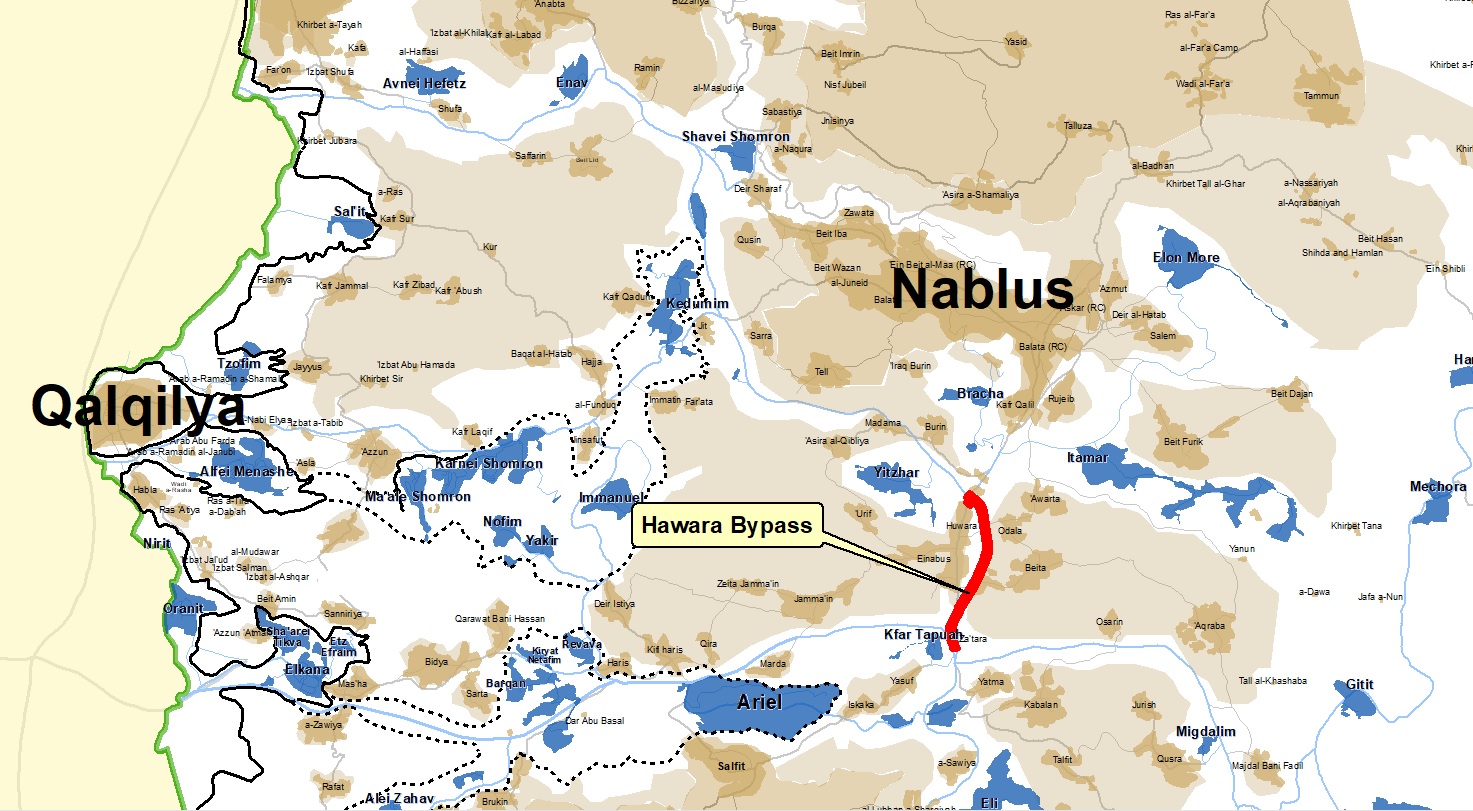 The initial shooting attack occurred on Route 60, which is used by both settlers and Palestinians as the main thoroughfare connecting central and northern West Bank. Route 60 passes through Huwwara. The bypass road is designed so that residents of Nablus-area settlements can more easily/directly access Jerusalem without driving through Huwara. Israel unilaterally expropriated private Palestinian land along the route of the road in preparation for construction.
Beyond the new demand and the possible implications it will have on the freedom of movement for Palestinians to and from Huwara, National Security Minister Ben Gvir posted on X during the settlers October 5th attack on Huwara that “”Our [Jewish Israeli] lives take priority to the Palestinians’ freedom of movement (and commerce). We’ll continue to say this truth and actively work to implement [this truth].” This is the second time that Ben Gvir has said that the rights and freedoms of Jews are more important than Palestinians.
Israel Tightens Grip on Sebastia Site
Emek Shaveh reports that on October 1st Israeli Minister for Environmental Protection, Idit Sliman, toured the archaeological site of Sebastia alongside settler leader Yossi Dagan, declaring that the land belongs to Israel. The Sebastia site is located near the Palestinian village of Sebastia, north of Nablus in the heart of the West Bank, and straddles the line designating Areas B and C, with most of the site is in Area C. The Palestinian village of Sebastia – which settlers travel through to reach the site – is in Area B entirely. During Sliman’s tour of the site the IDF sealed off all entry points to the village.
On May 7, 2023, the Israeli government approved nearly $9 million (NIS 32 million) for a project to develop and “renovate” the archaeological site of Sebastia. The project includes plans to pave a new access road for Israelis to reach the site, which they currently have to access by traveling through the Palestinian village of Sebastia.
Settlers have been openly agitating for Israel to assert control over the archaeological site in Sebastia for years, and the settler Samaria Regional Council organizes regular tours to the site. To secure the settlers’ visits, the IDF shuts down the town of Sebastia, closing Palestinian streets and businesses. As in other cases across the West Bank, settlers allege that Palestinians are damaging the Sebastia site and that the Israeli government needs to intervene. In 2021 amidst intensifying settler efforts related to the site, the Palestinian Foreign Ministry called on UNESCO to “protect all Palestinian archaeological and religious sites from Israeli violations, attacks and falsifications.” The archaeological site of Sebastia is on the tentative list of World Heritage sites in Palestine.
Emek Shaveh further explains the history and politicization of this archaeological site
“The battle over Sebastia is also played out in the narratives each side presents to the public. The informational material distributed by the PA does not include an explicit reference to the Kingdom of Israel or to the Hasmonean connection. On the other hand, in recent years the settlers have been rehabilitating the figure of Omri, a King of the Kingdom of Israel, in an effort to imbue Sebastia with greater nationalist significance. Sebastia also holds a special place in recent history for the settlers because it is the place where the leaders of Gush Emunim, the group that first fought for the establishment of settlements in the West Bank in the 1970s, celebrated the government’s agreement to establish the first settlement in the area in 1975.
In tandem with the growing campaign of recent years to apply full Israeli control over Sebastia, larger numbers of Israelis visit the site every week in buses organized by the Samaria Regional Council and accompanied by soldiers.
Sebastia, is a declared national park. National parks and nature reserves in Area C of the West Bank are managed by the Civil Administration and are referred to as “parks”. Their total area spans approximately 500,000 dunams and constitutes roughly 14.5% of Area C. Palestinians’ rights are violated in these territories through various means. In the Ein Prat Nature Reserve, for example, landowners cannot cultivate their land as their access is restricted. In Herodion National Park and Nabi Samuel, residents can neither construct nor renovate their homes.”
Settlers, Knesset Continue Push for IDF to Seize “Archaeological Site” at Mt. Ebal/El-Burnat
This week settlers have carried out daily trips to the archaeological site at Mt. Ebal, known as el-Burnat to Palestinians, located in Area B of the West Bank. On Monday, the Israeli army coordinated a trip for hundreds of Israelis to the site, but has not coordinated with settlers on their trip to the site in the subsequent days. Over the past two years, settlers have been clamoring for the army to take unilateral control over the site after the Palestinian Authority began to develop land nearby.
On October 6th, MK Son-Harmelech participated in a trip to the site and subsequently called on the government of Israel to establish a new settlement at the site (which, again, is located in Area B).
In a further show of the settlers influence and the government’s intentions with the site, Emek Shaveh reports that on September 25th a subcommittee of the Knesset’s Foreign Affairs and Defense met to discuss accusations (which have proven to be false yet are weaponized by settlers) that the Palestinian Authority has recklessly damaged and is attempting to destroy the site. Emek Shaveh explains: “The reports and the special subcommittee session are part of an orchestrated attempt by the settlers and their representatives in the Israeli parliament to use antiquity sites as a ruse for advancing annexation.”
At the hearing, the Civil Administration’s Head of Infrastructure, Lieutenant Colonel Adam Avidan, acknowledged that the site is in Area B where the IDF has limited authority. He also said the IDF constructed an observation tower to monitor Palestinian activity at the site. Avidan also explained that the IDF had summoned the Palestinian village leader to warn him not to conduct any construction work at the site, showing a map that marked the borders (reminder that the IDF does not have any authority over antiquity sites in Areas A or B).
Mt.Ebal/el-Burnat is purported to be an antiquity site where the biblical prophet Joshua built an altar, originally identified as such in the 1980s by an Israeli archaeologist though the majority of professional archaeologists do not support that conclusion. Emek Shaveh, an Israeli NGO with expertise in archaeology, called the settler campaign to seize Mt. Ebal as a “watershed in Israeli archaeology.” In July 2023, Emek Shaveh reported that a triad composed of settlers, an American Christian evangelical organization, and the Israeli army collaborated on a recent unlicensed excavation on Mount Ebal, which Emek Shaveh called antiquity theft. Further, the groups transferred some 80 cubic meters of soil from Mount Ebal to the Shavei Shomron settlement, where settlers then promoted an opportunity for members of the public to join the archaeologists in sifting through the materials (thereby promoting tourism to the settlements). Haaretz called the excavation “is mainly used as a tourist attraction to the West Bank and is of little scientific significance.”
Emek Shaveh’s explained the significance of what is happening on Mount Ebal:
“The archaeological site at Mount Ebal is becoming a watershed in Israeli archaeology. The activity on the site has turned from a pirate operation led by a group of Messianic Jews and Christians into a state sponsored operation under the auspices of the Civil Administration led by Minister Bezalel Smotrich.This is yet another violation of the Oslo Accords and suspected violation of domestic and international law that is whitewashed by Israeli authorities and intended to serve as a method for advancing the annexation of the West Bank to Israel.In addition to the alleged violation of the law, the excavation constitutes an ethical failure by the entire archaeological community in Israel whose silence continues to grant legitimacy to such projects. A comprehensive and immediate investigation is required by all the relevant parties as well as independently by the Israeli Archaeological Association.”
The Acceleration of “Herding Outposts”, And Their Impact
On October 3rd The New York Times published an article describing the impact of so-called herding outposts on the battle for control over land in the West Bank, highlighting reporting from Kerem Navot that shows how settlers have been establishing herding and farming outposts as a way to coerce the displacement of Palestinians and assert control a maximal amount of land with a minimal number of Israeli settlers.
That 20 new herding outposts have been established so far this year, showing how this tactic has accelerated since 2018 when settlers began to strategically focus on herding outposts as an effective mechanism. Three Palestinian herding communities have been displaced from their lands this year, largely in fear of nearby settlers.
The Times reports:
“The Israeli settlers’ stated intention is to chip away at wide expanses of land that the Palestinian leadership, at the advent of the Oslo peace process 30 years ago, hoped would form the territorial spine of a future Palestinian state. ‘It’s not the nicest thing to evacuate a population,’ said Ariel Danino, 26, an Israeli settler who lives on an outpost and helps lead efforts to build new ones. ‘But we’re talking about a war over the land, and this is what is done during times of war’.”
In a 2022 report on this herding phenomenon, Kerem Navot explains:
“…the development of Israeli sheep and cattle grazing in the West Bank, […] has gradually become Israel’s most significant mechanism for dispossessing Palestinian communities. At issue are tens of thousands of acres of open areas expropriated by the Israeli authorities and settlers through dozens of shepherd outposts and farms, the great majority of which have been established over the past decade. The use of grazing to seize land began in the early 1970s and continued intermittently in the 1980s and 90s. In recent years, however, the phenomenon mushroomed in terms of area size, investments, and the destructive repercussions for Palestinian communities.
The declared objective of the farm outposts is to “protect state lands”. In practice, however, they are designed to uproot Palestinian grazing and farming communities from public or private lands, and turn them into lands that only settlers can use. To promote this objective, one instrument must be used above all others: violence. Indeed, the farm outposts have recently seen some of the most violent incidents in the West Bank. It is no wonder that the uprooting of people from their lands, often also their ancestral lands, requires severe and ongoing violence. Accordingly, countless incidents involving threats, harassments, and assaults on Palestinian farmers and shepherds have occurred around these outposts in recent years, often in the presence and full support of military or police forces.
These outposts are the spearhead of a violent land-grabbing system, well planned and generously funded by various state and quasi-state bodies. These include the military, the Israeli Civil Administration (of the West Bank), regional and local councils, the World Zionist Organization’s Settlement Division, the Ministries of Agriculture and Education, and the new Ministries of Settlement and Intelligence. All are preoccupied with what has recently been referred to as the “Battle for Area C”, meaning the coercive transfer of Palestinians from the area, which represents 61% of the total area of the West Bank, and their enclosure in isolated enclaves.”
OCHA Reports on Ongoing Ethnic Cleansing of Masafer Yatta
 In a new report, OCHA OpT reports that over the past three months, 13 Palestinian families (84 individuals, 44 of which are children) have been forcibly displaced from the homes and grazing lands in the Masafer Yatta region in the South Hebron Hills.
OCHA reports:
“Over the years, and increasingly since May 2022, the Israeli authorities have imposed movement restrictions, confiscated property, demolished homes, and carried out military trainings in Masafer Yatta. Jointly, these practices have contributed to a coercive environment that has pressured residents to move out. In the past three months, movement restrictions have further intensified. Operating from a newly established military base, Israeli forces now patrol the area more frequently, further restricting people’s movement and access to markets and basic services, as well as the shipment of fodder and other inputs for livestock, on which most families rely. They have additionally confiscated vehicles used by residents. Two schools in the area report that 24 students have dropped out this year, including pupils whose families have left amid this coercive environment, and others who fear the unsafe journey to school. In one incident, in September, Israeli forces stopped teachers who were travelling to work and threatened to seize their vehicle if they used it again.”
The JNF Is Funding Hilltop Youth
Haaretz reports that the Jewish National Fund has givn $1million over the past two years to organizations which are involved in the construction of illegal outposts, specifically to support a project aimed at the “Hilltop Youth.” The funding is meant to offer professional training for young high school drop outs living in illegal WEst Bank outposts.
In response the this revelation, the Haaretz Editorial Board writes:
“The Jewish National Fund is continuing to bolster its role as a key player in the settlement enterprise and its accompanying looting and dispossession of the Palestinians in the West Bank, in preparation for a future annexation. Like all other settlement players, JNF too seems to view all means as kosher. And if they aren’t kosher, then they’ll be koshered retroactively in the future, after the settlers finish their takeover of Israel. Over the last two years, the Jewish National Fund has invested 4 million shekels in a project to rehabilitate teen dropouts living on farms and herding outposts in the West Bank. The money, which was meant to fund professional training for teens, is passed on to organizations that encourage the establishment of illegal settlement outposts….. the occupied territories aren’t the periphery, and “agricultural farms” in the West Bank lie outside Israel’s borders. And judging by its response, JNF is indifferent to their illegality. “The JNF is active in educational programs and does not deal with the legal status of these farms,” it said. In practice, it is directing at-risk youth to join the settlers’ extremist “hilltop youth.” Like all of Israel’s other national institutions, JNF completed its national mission once the state was established and should have been closed at that time. This is doubly true now that it has become the Settlement and Annexation National Fund.”
Bonus Reads
- “How to establish a new settlement without the world noticing” (+972 Magazine)
- “Settler violence is fueling the effects of climate breakdown on Palestinians” (+972 Magazine)
- “West Bank Dispatch: Settlers escalate harassment campaign, while army targets more resistance groups” (Mondoweiss)
- “Biden and Europe Beware: Your Silence on Israel’s Annexation Strengthens Putin” (Haaretz)
- “PA police extract 5 tourists mobbed after illegally entering Joseph’s Tomb in Nablus” (The Times of Israel)
- “How Israel uses settler violence to displace Palestinians” (The New Arab)
- “Why I spent Yom Kippur protecting Palestinian villagers from settler violence” (JTA News)
- ”Analysis | Israeli Far Right’s Ambitious West Bank Plan Could Be Saudi Deal’s Achilles’ Heel” (Amos Harel in Haaretz)
Welcome to FMEP’s Weekly Settlement Report, covering everything you need to know about Israeli settlement activity this week.
To subscribe to this report, please click here.
May 26, 2023
- IDF & Settlers Move Ahead with Re-Establishment of Homesh Settlement
- Israeli Authorities Approve New East Jerusalem Settlement of “Kidmat Zion”
- State & Settler Violence Coerce the Forcible Transfer of Ein Samia Bedouin Community
- Israel Attempts to Assuage U.S. Concern Over Smotrich’s “Double the Settlers” Planning
- Israeli State Budget Awards “Several Billion” Shekels to Settlements & Outposts
- Government Gives Settler Group $41 Million for East Jerusalem Archaeological Projects
- Annexation, End of Civil Society on the Government’s Agenda This Weekend
- Bonus Reads
IDF & Settlers Move Ahead with Re-Establishment of Homesh Settlement
On May 18th the IDF Commander signed a military order that finalizes the Knesset’s recent repeal of key sections of the 2005 Disengagement Law, allowing Israelis to enter the area in the northern West Bank where the Homesh settlement stood before it was dismantled by the Israeli government in 2005 as part of Disengagement. In parallel, the Israeli Defense Minister announced that the government plans to relocate the Homesh outpost – a yeshiva (that is, a Jewish religious school) established illegally by settlers as part of their drive to re-establish the Homesh settlement – from its current location, which is on land that Israeli courts have recognized as private Palestinian property, to a small plot of nearby “state land.” The Times of Israel further reports that the IDF Commander signed additional orders on May 15th that temporarily bar Israelis from entering the existing Homesh outpost until the outpost’s yeshiva is relocated to the “state land” plot, and that add the Homesh outpost as an official community under the umbrella of the Shomron Regional Council (a settlement municipal body).
Following the IDF Commander’s order, Yesh Din said in a statement:
“The Homesh outpost is on private land belonging to residents of the Palestinian village of Burqa. The entry of Israelis into the area is an additional tool in the expulsion of residents from their lands. The process of authorizing the outpost is a prize and an incentive for criminals and a violation of international law.”
On May 25th, Haaretz published photos of settlers using tractors to clear the plot of “state land” for construction, ostensibly in preparation for the relocation of the existing Homesh outpost/yeshiva. Israel’s plan to relocate the outpost is an attempt to sidestep a pending petition filed in 2009 by the Palestinian landowners and Yesh Din seeking removal of the Homesh outpost/yeshiva from the Palestinians’ land and providing for the landowners to access the area (discussed in greater detail below). To state the obvious, moving the Homesh settlement to the tiny plot of “state land” in the area will not cure any of the underlying infringements on Palestinian rights. Yesh Din explains “Israel is well aware that as long as there is an Israeli presence in the area, the Palestinian landowners will not be able to access their lands safely and the violation of their rights will continue.”
This land clearing by settlers is taking place despite the fact that, according to Haaretz, the settlers do not have the permits legally required by Israel to carry out work at the site, resulting in the IDF attempting to stop the illegal work. Reportedly Defense Minister Gallant and Minister Smotrich ordered the IDF to back off and allow the settlers land-clearing to continue, lack of permits notwithstanding. On May 24th Yesh Din submitted an urgent appeal with the Israeli Central Command to stop the settlers’ work at the site; the appeal is still pending, even as the settlers’ work continues because the Israeli government has instructed the IDF to allow it.
Israeli actions on the ground send strong signals that Israel will soon act to transform the Homesh outpost, relocated to its new site, into an official new (or in this case, resuscitated) settlement. Yet, following U.S. criticism of its policies and actions vis à vis Homesh, the Israeli government reportedly sought to assuage U.S. concerns by drawing a (manufactured, meaningless) distinction between establishing a settlement and relocating an existing outpost. Axios reports that “the Israeli side made it clear to the Biden administration that it has no intention of rebuilding the Homesh settlement and stressed the new order was signed only to allow the moving of the Homesh outpost from private land to state land.”
As a reminder – the legalization of Homesh was explicitly agreed to in the coalition deals which formed the current Israeli government. And despite the message to the U.S. behind closed doors, Israeli lawmakers and settler leaders hailed the Israeli government’s moves on Homesh as concrete steps toward the realization of this commitment. Otzma Yehudit MK and settlement activist Limor Son Har Melech hailed the news and said that the real goal is to reestablish all four settlements located near the Homesh outpost which were dismantled by the Israeli government in 2005 (the order issued by the IDF Commander on May 18th that allows Israelis to enter to the Homesh area did not extend to the areas of the other three settlements – Sa-Nur, Ganim, and Kadim).
Kerem Navot adds more detail to the settlers’ grand ambition in this area of the West Bank – between the major cities of Nablus and Jenin where there is currently no official Israeli settlement or control. Kerem Navot writes:
“the settlers have already made it clear that from their perspective, returning to Homesh is only the beginning. And that it is their intention to also re-establish the settlement of Sa-Nur, which was located on a hill a few kilometers to the north, next to the Nablus-Jenin road. At the same time as the takeovers of these sites, the settlers have also been pursuing a plan to take over the Al-Mas’udiyya train station, which is located north of the violent and isolated settlement of Shavei Shomron. As we reported here last September, they intend to establish the “Settlement Museum” there…the racist and violent settler right that, in practice, controls the Israeli government, plans on taking over an area where there haven’t been settlements since 2005. At this stage, the intention is to 1. Re-establish two settlements (Homesh and Sa-Nur) that were evacuated in 2005. 2. Take over two new spots (the archeological site in Sebastiya and the Al-Mas’udiyya train station), by turning them into tourist sites. The wider Israeli public will provide the money and the soldiers required to realize this plan. And the land, and most of the blood that will be spilled in order to realise this plan, will, as always, be supplied by the Palestinians.”
And a further reminder: The Israeli government has for nearly three years delayed its response to a 2019 petition filed by Yesh Din seeking both the removal of the illegal outpost and yeshiva at the site of the dismantled Homesh settlement, as well as the site’s return to its Palestinian landowners. Despite Homesh being dismantled in 2005, Israel never permitted Palestinians to regain access to or control of the land, declaring it a closed military zone. That status has prevented Palestinians from entering the area, even as the IDF permitted settlers to routinely enter the area, to live (illegally, under Israeli law) at the site, and to illegally establish a yeshiva there. That yeshiva, according to Kerem Navot, has become one of the West Bank’s “hardcore centers of settler terror”. Settlers have also wreaked terror on nearby Palestinian villages, most notably Burqa and Sebastia. One Israeli politician even went so far as to say that settlers are “carrying out a pogrom” in Burqa.
Proving Kerem Navot’s point, on May 24th, on the heels of a visit to the area by foreign diplomats, a group of settlers attacked Burqa, near the Homesh site, throwing stones and setting homes on fire.
Israeli Authorities Approve New East Jerusalem Settlement of “Kidmat Zion”
The Jerusalem District Planning Authority gave initial approval to a plan to build a new settlement enclave, “Kidmat Zion,” to be located between the Ras al-Amud neighborhood and the Israeli separation barrier, with the Abu Dis neighborhood on the other side of the wall. The settlement enclave will be accessible only by driving through densely populated areas of Ras Al-Amud.
The plan – which calls for 400 settlement units [translating, conservatively, to at least 2,000 settlers] – is being promoted by the Ateret Cohanim settler organization. Speaking publicly about the plan, Ateret Cohanim said it will:
“change the map of the eastern part of the city. The neighborhood sits in a strategic location, and can gradually change its image to Jewish and prevent the Arab takeover of the city’s eastern neighborhoods.”
Construction of this settlement could well achieve the considerable geopolitical consequences the settlers hope for — most notably by complicating if not outright blocking any future division of Jerusalem (or sharing agreement) under any possible Israeli-Palestinian peace agreement. It is worth recalling that Abu Dis has been repeatedly suggested by Israel and its allies (including in the Trump Plan) as the capital of a future Palestinian state (as a substitute for Jerusalem), and an unfinished building in Abu Dis was designed to be the future home of a Palestinian parliament. This settlement plan would scuttle all such ideas. Indeed, in the planning documents Ateret Cohanim explained:
“Palestinian institutions in Abu Dis were built with the vision of turning the town into the capital city of Palestine and building a corridor and passage to the center of Jerusalem, and thus promoting the takeover of the entire city…The significance of establishing and developing the neighborhood is to create a shield for Jerusalem against Palestinian ambitions. The neighborhood will disturb the contiguity [of the area] and protect us from dividing the city.”
The new settlement enclave will also further solidify the infrastructure connecting settlements south of Jerusalem to the city. Kidmat Zion will be located adjacent to the so-called “American Road,” which will tunnel underneath parts of Abu Dis. The “American Road” is a section of north-south highway that is meant to seamlessly connect settlements located in the north and south of Jerusalem to one another, and to serve as a bypass for settler traffic to cut through East Jerusalem’s Palestinian neighborhoods. While the road will be accessible to Palestinians (a fact touted by Israel as proof of Israeli good intentions), the obvious primary purpose is to entrench Israel settlements, expand Israeli control over all of East Jerusalem, and close off Palestinian East Jerusalem neighborhoods from the rest of the West Bank, thereby (further) torpedoing Palestinian hopes of one day establishing a capital in East Jerusalem.
State & Settler Violence Coerce the Forcible Transfer of Ein Samia Bedouin Community
On May 22nd, the approximately 200 residents (27 families, including 80 children) of the Ein Samia bedouin community were forcibly coerced to leave their homes and abandon their land. The community faced nearly constant and often violent harassment by settlers from a nearby settlement, Kochav HaShachar and its shepherding outpost, as well as state-backed violence, including the looming demolition of the community’s only school.
The Ein Samia community lived on the land for 40 years, and its residents have endured violence and oppression for decades. However, as +972 journalist Basel Adra reports, the community has been living through a true nightmare over the past week. Adra writes:
“Residents say they were compelled to leave after a fierce spate of violence over the previous five days, during which settlers attacked them at night, blocked the roads to the village, and threw stones at the old homes. The mental toll of the attacks, especially on the children, was the decisive factor in the residents’ choice to destroy the village and move away…‘Ein Samia is located next to the Kochav HaShachar settlement and is east of Tzir Alon, an area settlers have been attempting to take over in recent years. It is one of 180 Palestinian villages in Area C of the West Bank that are “unrecognized” by the Israeli authorities and whose residents are denied permits for any construction or connection to basic utilities, like water and electricity.”
Yesh Din said in a statement:
“Yesterday, a Bedouin Palestinian family was forced to leave their home in Ein Samia due to escalating settler violence. This heartbreaking incident is not an isolated case. Rather, it has become a distressing phenomenon in the West Bank, growing worse with each passing day. In Ein Samia – like other areas in the west bank – the plight of Bedouin communities has been unfolding for decades. For approximately 60 years, Bedouin communities have resided and worked on the agricultural lands surrounding Kafr Malik – an area called Ein Samia. These families were first displaced in the 1960s and have since relied on these lands for their livelihoods. They have endured hardships and harassment, but recent events have taken a sinister turn. The establishment of ‘Micha Farm,’ a settler shepherding outpost, marked a turning point. (5/10) It not only disrupted the lives of the Bedouin communities but sparked a surge in violence. With increasing frequency, settlers armed with guns and attack dogs invade their lands, stealing livestock, damaging crops, and subjecting Palestinian residents to physical assaultsThe situation has become unbearable. The attached photo captures the heartbreaking moment when a family had no choice but to pack their belongings, forced out of their home by the constant terror they could no longer endure.”
B’Tselem said in a statement:
“Israel’s policy, whose goal is to allow the state to take over more and more Palestinian land to be used by Jews, is applied across the West Bank against dozens of Palestinian communities. This policy is illegal. Forcible transfer is a war crime.”
Israel Attempts to Assuage U.S. Concern Over Smotrich’s “Double the Settlers” Planning
Last week it was reported that Bezalel Smotrich, who has been granted vast authority over civil affairs in the West Bank, has set out to initiate wide-scale planning with the goal of adding 500,000 new settlers within the next two years. This week, Haaretz reports that Israeli government officials told the Biden Administration that, notwithstanding Smotrich’s intentions and plans, the government does not have an official policy seeking to add 500,000 new settlers in the next two years.
Israeli State Budget Awards “Several Billion” Shekels to Settlements & Outposts
On May 24th, the Knesset approved a state budget which, among other things, provides (at least) several billion (yes, with a “b”) shekels for settlements and outposts.
In particular, the State budget invests massively in West Bank infrastructure projects. Fully one-fourth of the total Transportation Ministry’s budget is for projects in the West Bank, even though settlers are just X% of the total Israeli population. Specifically, the budget provides the Transportation Ministry with NIS 3.5 billion ($941 million) to invest in upgrading and paving new roads in the West Bank over the next two years. The Times of Israel details the settlement-related budgets and projects that this funding includes:
- NIS 2 billion ($538 million) will go to upgrading Highway 60, the main north-south highway which runs from Jerusalem to Hebron;
- NIS 500 million ($134 million) will go toward expanding a road between the Ariel settlement and Tapuach Junction in the northern West Bank;
- NIS 366 million ($98 million) will go to upgrading the access road to the Beit El Regional Council area;
- NIS 300 million ($81 million) will pay for a new road between the Migron settlement and Qalandia north of Jerusalem;
- NIS 200 million ($54 million) for a road circumventing the Palestinian village of Al-Funduq in the northern West Bank west of Nablus; and,
- NIS 150 million ($40 million) for a road in the Alfei Menashe settlement.
- Hundreds of millions more were allocated for roads in and around East Jerusalem.
The newly created Settlements and National Missions Ministry, headed by Religious Zionism MK Orit Strock (a longtime settler activist from the Hebron settlements) received NIS 268 million ($72 million) in funding, including NIS 399 million ($107 million) that will be funneled to the World Zionist Organization’s Settlement Division and NIS 74 million ($20 million) to support settlement municipal authorities in their efforts to monitor “illegal” Palestinian construction in Area C.
Yoni Mizrachi, a researcher with Peace Now told The Times of Israel:
“All Israeli governments prioritize the West Bank settlements in the budget, but this government has gone even further and has taken money from core funds and given it to a small group living in the West Bank which in a political agreement with the Palestinians Israel will leave. We are seeing an effort here to deepen Israel’s presence in the West Bank.”
Government Gives Settler Group $41 Million for East Jerusalem Archaeological Projects
On May 21st, at a ceremonial cabinet meeting held in the Western Wall tunnels of the Old City of Jerusalem (timed to coincide with Jerusalem Day celebrations), the Israeli government approved 41 million shekels ($11 million) for archaeological sites in East Jerusalem, almost all of which are managed by the Elad settler organization. Another 6 million shekels ($1.6 million) were budgeted for programs which bring Israeli soldiers and students to Jerusalem’s archaeological sites. The Chairman of Elad, David Be’eri, attended the meeting.
Emek Shaveh, an association of left-wing archaeologists, said in a statement:
“The government will invest millions of shekels in developing tourism and promoting an ideology dictated by the radical settler organization Elad. This year, large swaths of the funding were also earmarked for bringing students and soldiers to participate in archeological and tourist settler activities. Consequently, not only will our taxes go toward Judaizing East Jerusalem, but so will our children.”
Peace Now said in a statement:
“Like in every year, the Israeli government celebrates Jerusalem Day by transferring funds to settlers in East Jerusalem. The cabinet meeting in the Western Wall tunnels is a direct continuation of the hate march we witnessed last week on Jerusalem Day. Both of these actions are intended to increase hostility, tension, and hatred between Israelis and Palestinians in the city, rather than finding a peaceful solution between the peoples.”
Annexation, End of Civil Society on the Government’s Agenda This Weekend
The Israeli Ministerial Committee on Legislative Affairs (a body of ministers who decide whether or not the government will back legislative proposals in the Knesset) is set to meet on Sunday, May 28th to vote on multiple bills that are particularly concerning for settlement watchers.
The committee may (rumor has it the government is reconsidering) vote on a resolution, authored by Galilee and National Resilience Minister Yitzhak Wasserlauf (Otzma Yehudit), that seeks to make the commit the whole of the Israeli government to advancing “Zionist values” as described in the Nation-State law. The Times of Israel reports the resolution is specifically aimed at promoting settlement growth across the West Bank, and the resolution’s language uses “The Land of Israel” to refer to the entirety of the land between the Jordan River and the Mediterranean Sea. The Times of Israel further details:
“Wasserlauf’s proposed resolution appears to be expressly focused on the issue of advancing the Jewish presence in the West Bank and throughout Israel, with the text of the resolution stating that it is applicable to government agencies involved in land allocation and construction planning, such as the Israel Land Authority and the National Council for Planning and Construction…It appears likely that a central objective of Wasserlauf’s resolution will be to further expand the West Bank settlements.”
The committee is also expected to vote on a bill to de facto annex national parks and nature reserves in the West Bank. The bill, proposed by Likud MK Danny Danon, seeks to transfer the power to declare “national sites” in the West Bank from the Defense Ministry (which is hte occupation government) to the Interior Ministry (an entirely domestic body), which is currently headed by acting Minister is Michael Malchieli (Shas). Revealing the bill’s true goal – to bring every archaeological and heritage site in the West Bank under Israeli control – the explanatory note filed with the bill reads:
“The lands of Judea and Samaria [the West Bank] are full of heritage sites of great national and historical importance to the development of settlement in the Land of Israel. In these lands, our forefathers walked, established their homes, and were exiled from these places twice in history. After nearly 2,000 years of exile, the people of Israel have returned to their land, and during the Six Day War, the lands of Judea and Samaria were liberated as well. We must recognize the history of the Jewish people that can be found in every clod of earth in Judea and Samaria.”
Amid international outcry, the committee is also expected to vote on an extremely dangerous bill targeting civil society organizations and, in particular, the human rights sector. The legislation would in effect remove the tax-exempt status of these groups and replace it with an onerous, and quite openly punitive, vindictive tax rate of 65% applied to the groups’ income and/or endowments. Please listen to a new FMEP podcast with Lara Friedman, Jessica Montell (HaMoked) and Francesca Albanese (UN Rapporteur), entitled “Israel’s new anti-NGO legislation: An Effort to Eradicate Opponents of Illiberalism”
Another bill seeks to penalize students flying the Palestinian flag on Israeli school campuses, making it a punishable offense with suspension and/or expulsion.
Bonus Reads
- “The Palestinian Village in Smotrich’s Sights” (Jewish Currents)
- “Opinion | Israel’s Absent Finance Minister Serves the Settlements” (Nehemiah Shtrasler, Haaretz)
Welcome to FMEP’s Weekly Settlement Report, covering everything you need to know about Israeli settlement activity this week.
To subscribe to this report, please click here.
May 5, 2023
-
- Planning Initiated for New East Jerusalem Settlement Enclave, Kidmat Zion
- May 8 Hearing Set to Advance Plan Massively Expanding Nof Zion Settlement Enclave
- Israel Announces Start of Construction of the “Sovereignty Road,” Which Enables E-1 Construction & Annexation of Area C
- IDF Created Unit Specifically for Radical, Violent “Hilltop Youth” Settlers to Terrorize
- Two Major New Reports: Amnesty on Surveillance and B’Tselem on Water
- Bonus Reads
Planning Initiated for New East Jerusalem Settlement Enclave, Kidmat Zion
Ir Amim reports that on April 27th a new plan was submitted to the Jerusalem District Planning Committee outlining the construction of a new settlement in East Jerusalem, between the Ras al-Amud neighborhood and the Israeli separation barrier, with the Abu Dis neighborhood on the other side of the wall. This new enclave – dubbed Kidmat Zion – is slated to have 384 settlement units built on a strip of land surrounded by Palestinian neighborhoods and only accessible by driving through the densely populated areas of Ras Al-Amud.
 The plan is being promoted by an affiliate of the Ateret Cohanim settler group – Bahorim Company – which filed documents with the planning committee that show it (Bahorim) only owns 10% of the land the new plan seeks to build on. The land is unregistered, but Bahorim submitted a table of ownership purporting to show that dozens of plots were owned by Jews prior to 1948, still other plots are owned by settler affiliated groups including one run by U.S. millionaire and settlement financier Irving Moskowitz, and 1 or 2 plots are owned by Palestinians. Part of the land is owned by the Israeli Custodian General, and though it is unknown whether or not the Israeli government is involved in the promotion of this plan Ir Amim speculates:
“Although this does not appear in the documents published thus far, it is possible that the General Custodian is involved in the plan’s preparation, which could explain how Bahorim Ltd. has submitted a plan while only allegedly owning 10% of the area. Last year, the General Custodian covertly transferred into its management 12 dunams of land near the area designated for the new settlement and subsequently completed land registration of the property. The assumption is that the General Custodian likely intends to advance another settlement plan on these respective dunams of land. It should be noted that the General Custodian has become one of the leading state institutions who works in close cooperation with settler groups to expand Jewish settlement in East Jerusalem.”
May 8 Hearing Set to Advance Plan Massively Expanding Nof Zion Settlement Enclave
Ir Amim reports that on May 8th the Jerusalem District Planning Committee is scheduled to take up a plan to massively expand the Nof Zion settlement enclave located in the middle of the Palestinian East Jerusalem neighborhood of Jabal Mukaber. The Committee is set to hold its second discussion to decide whether to submit the plan for public objection; it’s first discussion in March 2023 resulted in the committee sending the plan back to its initiators for a few minor revisions.
The plan – called “Nof Zahav” – would allow for 100 new residential units and 550 hotel rooms in the settlement enclave, which currently consists of 95 units, plus another 200 under construction. In order to provide sufficient land for this expansion, the Jerusalem Planning Committee is simultaneously advancing another plan to relocate an Israeli police station [the Oz station], currently located on the border of Jabal Mukaber, to a new site across the street. This will leave its original location free for the planned expansion of Nof Zion, while the new site will become a massive new Israeli security headquarters. Ir Amim filed a petition against the police station plan, arguing that it is an affront to the planning needs of the local community and that it represents a continuation of Israel’s systematic, city-wide discrimination against the housing, educational, and service-based needs of Palestinian neighborhoods.
Israel Announces Start of Construction of the “Sovereignty Road,” Which Enables E-1 Construction & Annexation of Area C
 Peace Now reports that the Israeli Civil Administration has announced that it will begin preparatory work for the so-called “Sovereignty Road” in early May. Terrestrial Jerusalem further reports that In recent days, Israeli authorities have: issued notices to Palestinian landowners whose land will be seized for construction of the road, began testing borings where the road will be paved, and allocated millions of shekels to fund components of the road. If built, the “Sovereignty Road” will seal and divert Palestinian traffic around the area where Israel intends to build the E-1 settlement just east of Jerusalem. [map]
The road was dubbed as the “sovereignty road” by Naftali Bennett, in light of Bennett’s argument that the Palestinian-only, Israeli-controlled road answers key international criticism over the ramifications of the construction of the E-1 settlement. For decades, construction of the E-1 settlement – which is scheduled for its final discussion on June 12th – has been adamantly opposed by the international community because, in part, it would effectively cut the West Bank in half – preventing any two-state solution. The new road has long been Israel’s answer to that criticism, with Israel arguing that it will replace territorial contiguity with limited “transportational continuity” – via a sealed road that is under Israel’s total control.
However, in order to plan for the road, Israel has had to make more than a few exceptions to its own planning laws (suggesting again that for Israel, “rule by law” rather than “rule of law” is the prevailing paradigm). Peace Now explains:
“Officially, the planned road is defined as a ‘security road’. The excuse for its construction is the intention to build the separation barrier around the Ma’ale Adumim settlement bloc, which is defined as a security need. As a derivative of this, there is a need to build a road that will allow the continuation of the ‘abric of life’ of the Palestinians travelling from north to south of the West Bank. Furthermore, by being defined as a security road, it is not brought for planning approval in the Higher Planning Council of the Civil Administration. Subsequently, the public is not given the opportunity to object to it, as in a formal planning process. Seemingly, this is because the State of Israel has no official authority to plan this road as significant parts of it pass through Area B (see map). According to the 1995 Interim Agreement with the Palestinians, planning authority in it is given only to the Palestinian Authority. To bypass this, the Ministry of Defense chose to define the road as a security road. The lands taken for its construction do not go through a process of seizure for public purposes, but rather a process of military seizure, and therefore the planning process is done behind closed doors.”
Terrestrial Jerusalem explains the significance of this road:
“this [road] is the last link in the creation of an ‘Israel-only’ national road grid in Area C, located to the East of East Jerusalem. The completion of this road will be a quantum leap towards de facto annexation of a large portion of Area C. Dovetailed with E-1, and the demolition of Khan al Ahmar, which are intimately-linked to the road project, would further solidify the irrefutable reality of de facto annexation.”
IDF Created Unit Specifically for Radical, Violent “Hilltop Youth” Settlers to Terrorize
An investigation by +972 Magazine and Local Call has revealed that two years ago the IDF created a special unit – “Desert Frontier” – composed mostly of settlers from the Hilltop Youth movement who are known to the army to be violent. The unit is based in the West Bank, operating now almost entirely in the Jordan Valley, and its soldiers police the area to assert Israeli control and presence, protecting settlers and outposts while harassing Palestinians and clearing them out of Israeli declared firing zones. +972 obtained testimony of at least 12 incidents in which the “Desert Frontier” perpetrated terrible interrogations and beatings of Palestinians – often driving their victims to remote areas in the desert and leaving them there without a phone or keys, sometimes blindfolded and handcuffed.
According to a security official who spoke to +972 on the basis of anonymity said that the idea behind the unit was/is to rehabilitate hilltop youth members, who are not only notoriously and violently anti-Palestinian, but who also regularly challenge the Israeli government’s authority. The source said the unit “consists mainly of hilltop youth … the extreme of the extreme, who otherwise would not have enlisted.”
Two Major New Reports: Amnesty on Surveillance and B’Tselem on Water
In case you missed it, two new reports have been released this week that are worth reading for those tracking settlements and annexation.
Amnesty International released “Automated Apartheid: How facial recognition fragments, segregates and controls Palestinians in the OPT”, revealing new information about Israel’s use of technology to enforce apartheid rule in the OPT. The publication of the report was covered by The New York Times.
B’Tselem released “Parched: Israel’s Policy of Water Deprivation in the West Bank.” The report details how Israel uses water rights and planning to strengthen its control over the West Bank and advance the apartheid regime’s principles: reinforcing and entrenching Jewish supremacy in the entire area between the Jordan River and the Mediterranean Sea.
Bonus Reads
- “Recent Developments in the Situation of Palestinian and Israeli Human Rights Defenders – April 2023” (Human Rights Defenders Fund)
- “Israelis Settlers Suspected of Assaulting Two Palestinian Men in West Bank” (Haaretz)
- “Legalizing the Younger Settlement Enterprise (Hanan Greenwood / Israel Hayom)
- “Israel Razed the Last Orchard in Silwan in Search of Siloam Pool. It Still Can’t Be Found”
- “Netanyahu Meets with Settler Leaders” (Arutz Sheva)
Welcome to FMEP’s Weekly Settlement Report, covering everything you need to know about Israeli settlement activity this week.
To subscribe to this report, please click here.
March 11, 2022
- Settler Population Continues to Surge
- Bennet Government Delays Khan al-Ahmar Decision
- Major Ma’ale Adumim Settlement Expansion Advanced
- Palestinians Continue Weekly Protests Against Expansion of “American Road” in Jerusalem
- High Court to Rule on Expulsion of Palestinians in South Hebron Hills “Firing Zone”
- Former U.S. VP Mike Pence Hangs out with Kahanists in Hebron
- Further Reading
Settler Population Continues to Surge
The Israeli Ministry of Interior released new figures on the growth of the West Bank settler population over the past 13 months (January 1, 2021 through Jan 31, 2022). The data shows that growth in the Israeli settler population, which surged during President Trump’s overtly pro-settlement term in office, has continued to accelerate. This population growth follows the surge in settlement construction that took place during the Trump presidency.
The data was compiled by Yaakov Katz, who is the former Chair of the Board of Directors of the settler-run Arutz Sheva media outlet. Katz currently publishes West Bank Jewish Population Stats (a project of “Bet El Institutions”, associated with the settlement of Beit El – a settlement closely associated with Trump’s ambassador to Israel, David Friedman). The data reveals that over the reporting period:
- The number of West Bank settlers grew to a total of 490,493 (not including the ~330,000 East Jerusalem settlers), representing a nearly 3.2% rise over 13 months.
- The following settlements increased their population size by over 10% over the reporting period:
- Rechan, located in the northern West Bank;
- Alei Zahav, located in a string of settlements stretching across the northern West Bank. Alei Zahav and its settlement neighbors create a contiguous Israeli populated areas linking Israel proper (west of the Green Line) all the way to the Ariel settlement, located in the heart of the West Bank (the eastern end of Ariel is closer to the Jordan border than to the Green Line). Notably, Alei Zahav is one of the settlements in which the “market principle” has been applied to legalize settlers theft of land recognized by Israel as belonging to Palestinians (see our July 2019 report).
- Amichai, a brand new settlement established by the Israeli government in 2017 and continuously expanded, located in the central West Bank;
- Naaleh, in the central West Bank;
- Bruchin, in the central West Bank;
- Yitzhar, the radical and violent settlement located near Nablus in the central West Bank. The Yitzhar settlement serves as the home base of the “Hilltop Youth” settler movement;
- Nokdim, located south east of Bethlehem;
- Metzad-Asfar, located south east of Bethlehem;
- Kfar Etzion, located south of Bethlehem;
- Beit HaArava, located in the Jordan Valley;
- Maskiot, located in the Jordan Valley;
- Negohot, located in the South Hebron Hills;
- Susya, located in the South Hebron Hills;
- Pnes Hever, located in the South Hebron Hills;
- Sansena, located in the South Hebron Hills.
The report goes on to predict that the settler population will cross the 1 million threshold in 2046.
Bennet Government Delays Khan al-Ahmar Decision
This week the Bennett-led government asked the High Court of Justice to extend the deadline for submitting its position on the forcible relocation of the Khan al-Ahmar bedouin community (a war crime). The State was facing a March 6th court deadline (which has already been delayed once at the request of the State), and initially requested a two-day extension – which the Court granted. On March 8th, the State requested a 30-day extension, citing the Russian invasion of Ukraine as a time consuming matter for senior officials whose input is needed on the Khan al-Ahmar plan.
Regavim – the settler group behind the Court case seeking to force the government to demolish Khan al-Ahmar – slammed Bennett for the repeated delays and also stated that they might challenge the latest delay, saying:
“As far as we know, Prime Minister Bennett has already returned from his trip to Europe, and the additional rejection request smells like smearing. We will consider appealing to the Supreme Court for a ruling.”
Prior to this most recent delay, reports suggested that the government was preparing a plan that would see the demolition of the Khan Al-Ahmar only to (bizarrely) rebuild the community some 300 meters from where it currently stands. As a reminder, the High Court has ordered the demolition of Khan al-Ahmar, which it declared to be illegally built (i.e., lacking Israeli building permits that are virtually impossible for Palestinians to obtain).
It’s also worth recalling that the Supreme Court, in its September 2020 decision to grant the government a six-month delay, explicitly expressed its impatience to bring this matter to a close. It called the government’s request “embarrassing” and said:
“the expectation is that at the end of [the six-month] period a clear decision will be presented to this Court, after all options have been explored and exhausted. The period of mapping out alternatives and exploring courses of action is about to run its course, and what follows is the decision stage. Our aim is to conclude the hearing of this petition immediately after the [government’s updated statement] is submitted, and the plaintiff’s response is received, one way or another.”
Major Ma’ale Adumim Settlement Expansion Advanced
On March 3rd the local building committee of the Ma’aleh Adumim settlement, located just east of Jerusalem, approved what is reportedly the largest settlement expansion plan in over a decade. The plan would allow for 3,300 new settlement units as well as areas for public buildings. Assuming (conservatively) an average family size of 5, this means construction for at least 16,500 new settlers. The plan will now be sent to the Israel High Planning Council for its consideration and approval.
Ma’ale Adumim is the largest settlement by size and population. In past negotiations, Israel has always included Ma’ale Adumim and the surrounding area as one of the “settlement blocs” that would be annexed to Israel under a final agreement. The Israeli political consensus around the annexation of Ma’aleh Adumim (which has not been meaningfully challenged in past negotiations) has, by and large, resulted in the implied acceptance that expansion of Ma’ale Adumim is treated as non-controversial or not as geopolitically consequential as new units built in settlements and outposts in other locations. However, it should be emphasized that the term “settlement bloc” has no legal definition or standing — not under Israeli law, or under international law, or in the context of the Oslo agreement — and the fate of Ma’ale Adumim, like all settlements, is a matter for future negotiations. Nonetheless, the Israeli government has for years deployed the “settlement blocs” terminology in an effort to legitimize settlement expansion in areas it wants, in effect, to unilaterally take off the table for any future negotiations. For more context, see resources from Americans for Peace Now here and here.
Palestinians Continue Weekly Protests Against Expansion of “American Road” in Jerusalem
For the past month, Paelstinians have gathered in front of Jerusalem’s City Hall to protest a plan to expand the so-called “American Road” — expansion that will come at the expense of 62 residential structures that are home to 750 Palestinians in the Jabal al-Mukaber neighborhood of East Jerusalem.
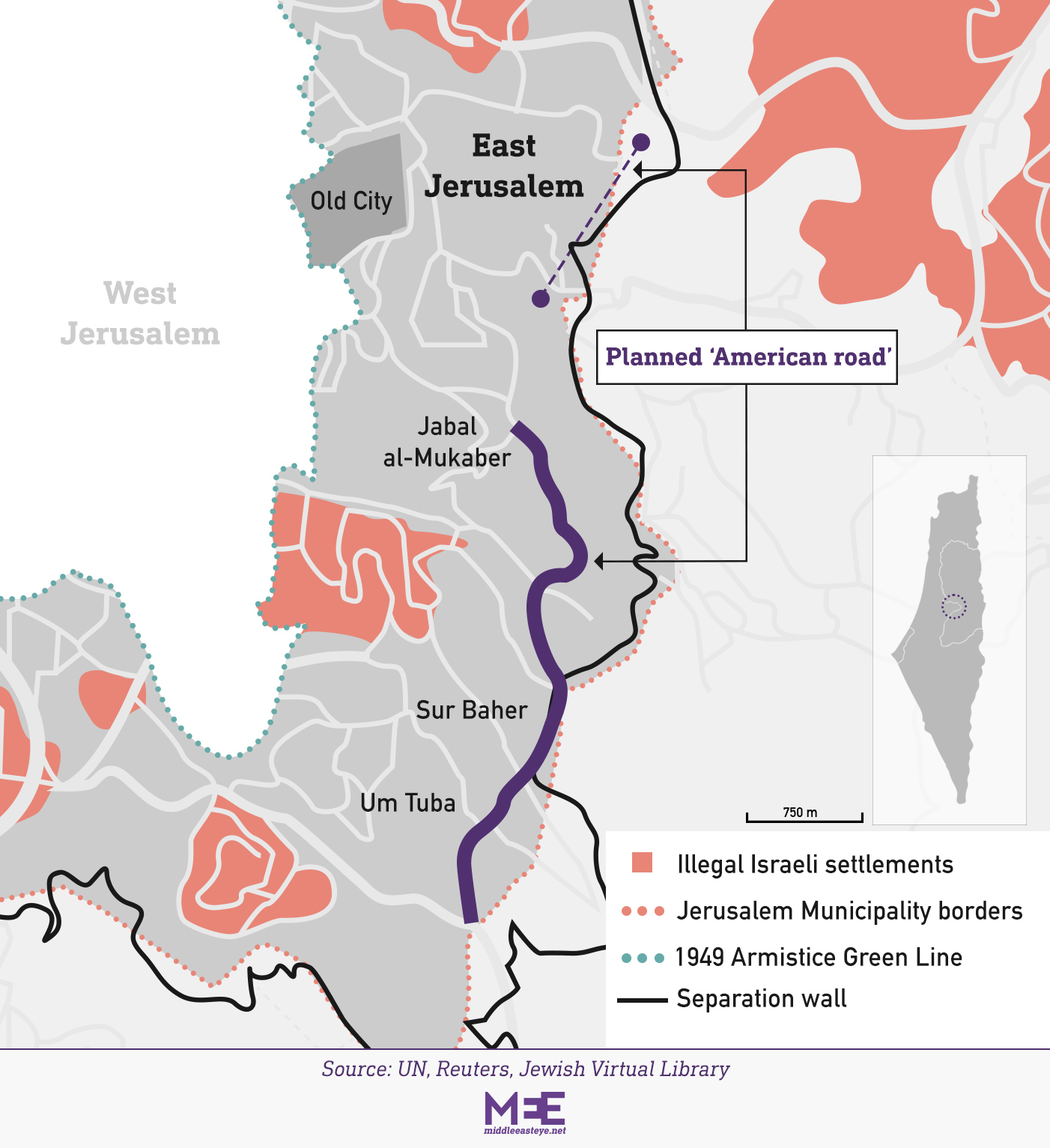 As a reminder, the so-called “American Road” is a section of north-south highway that is meant to more seamlessly connect settlements located in the north and south of Jerusalem to one another, and to serve as a bypass for settler traffic to cut through East Jerusalem’s Palestinian neighborhoods. While the road will be accessible to Palestinians (a fact touted by Israel as proof of Israeli good intentions), its clear primary purpose is to entrench Israel settlements, expand Israeli control over all of East Jerusalem, and close off Palestinian East Jerusalem neighborhoods from the rest of the West Bank, thereby (further) torpedoing Palestinian hopes of one day establishing a capital in East Jerusalem.
Israel began work on this road in June 2020, and recently completed the first phase of construction.
The second phase of construction directly threatens Palestinians, involving the demolition of 62 buildings in Jabal al-Mukhaber. According to Middle East Eye, the Jerusalem Municipality has come up with a proposal, as reported by one of the threatened homeowners:
“The municipality suggested alternatives for residents with demolition orders, but they are neither realistic nor fair, Muhammad says. The proposal stipulates erecting buildings upwards on each side of the road. In them, four stories must be exclusively allocated for parking, another four for commercial use, and only two stories for residential use, each containing four apartments. The estimated cost for each of those buildings is between 20 and 25 million shekels ($6m to $7.7m), which many Palestinians in the area can’t afford without loans. The options left for residents are either expulsion or indebtedness. One strategy the municipality is taking is to empty the area completely of its inhabitants and replace them with commercial centres, Muhammad says. ‘They want to force the residents to resort to local or external investors, or to resort to banks to take out loans, which would mean that the landowners would only receive a single residential apartment, while the investors or banks would retain the lion’s share,’ Muhammad told MEE. ‘The Jabal al-Mukaber residents refuse this unequivocally, considering vertical building to be incompatible with the rural context to which they have grown accustomed to’.”
See Orly Noy’s reporting for a detailed history of this plan’s evolution as well as a moving portrait of some of the Palestinians who are affected by this plan.
In a deeply researched report on how infrastructure like roads is a means for settlement expansion and annexation, Breaking the Silence explains:
“While Israeli authorities justify many of the projects described in this document by claiming that they serve both the settler and the Palestinian populations in the West Bank, it is important to note that these roads are designed with Israeli, not Palestinian, interests in mind. Many of the roads that are technically open to Palestinian traffic are not intended to lead to locations that are useful to Palestinians.16 Instead, these roads are primarily designed to connect settlements to Israel proper (and thus employment and other services) via lateral roads, rather than to connect Palestinian communities to one another. Further, roads intended to connect Israeli settlements to Jerusalem (many of which are currently under construction) do not serve West Bank Palestinians outside of Jerusalem, as they are not allowed to enter Jerusalem without a permit. In addition, an extensive system of checkpoints and roadblocks allows Israel to control access to bypass roads and the main West Bank highways, and it can restrict Palestinian access when it so chooses.
This prejudice against Palestinian development is even starker when one considers that, according to an official Israeli projection, the expected Palestinian population in the West Bank (excluding East Jerusalem) in 2040 is 4,600,000 individuals. Even if the vision of settler leaders to arrive at 1,000,000 settlers is realized by 2040, the Palestinian population would still be four times the size of the settler one. Despite this discrepancy, priority is still given to settler infrastructure development.
West Bank road and transportation development creates facts on the ground that constitute a significant entrenchment of the de facto annexation already taking place in the West Bank and will enable massive settlement growth in the years to come. By strengthening Israel’s hold on West Bank territory, aiding settlement growth, and fragmenting Palestinian land, this infrastructure growth poses a significant barrier to ending the occupation and achieving an equitable and peaceful solution to the Israeli-Palestinian conflict.”
High Court to Rule on Expulsion of Palestinians in South Hebron Hills “Firing Zone”
On March 15th, the Israeli High Court is expected to issue a ruling on the mass expulsion of 12 Palestinian communities in the Massafer Yatta region of the South Hebron Hills. These 12 villages are located on land that Israel declared a “firing zone” – Firing Zone 918 – in the early 1980s. Palestinian and Israeli activists have launched an international campaign to bring attention to the matter in the hopes of stopping the mass expulsion of Palestinians from their land.
In a recent article for +972 Magazine, Ali Awad – a journalist and activist from Massafer Yatta – contrasted the plight of his community to the success of chicken farms established by settlers on nearby land, writing:
“In Umm al-Khair, we find it especially absurd that the chicken farms have better infrastructure than our residents. We suffer from a constant lack of water and are prevented from connecting to the electricity grid; the farms, meanwhile, have constant access to water, and are not only permanently connected to electricity but also have backup generators in case of an emergency. Seeing the electricity lines pass directly over our village is a constant reminder that the animals get rights that we as Palestinians are deliberately denied. More importantly, we know that building these farms in Masafer Yatta is yet another strategy of the occupation to displace us Palestinians from our homes, and is no less dangerous than its policy of declaring 12 of our villages as falling under Firing Zone 918 — thereby sanctioning our displacement. Israel is even still using the outdated Ottoman Land Code in the occupied territories to transfer Palestinian pasture into “state land,” which it then leases to settlers in order to establish other kinds of farms. They are multiple laws and policies, but they all serve one goal: to take over Palestinian land.”
Over the past months, FMEP has hosted a series of webinars and podcasts highlighting Israel’s treatment of Palestinians in Massafer Yatta, including:
-
Israeli Apartheid, the Supreme Court, and Land Confiscation: The Case of Masafer Yatta (March 9, 2022) featuring Ali Awad (journalist and activist), Maya Rosen (activist) in conversation with FMEP’s Sarah Anne Minkin
-
“We don’t have another place to go:” Dispossession, Settler Violence, & Resistance in Masafer Yatta (January 2022) featuring journalist and activist Ali Awad in conversation with FMEP’s Sarah Anne Minkin
- Israeli Government Escalates Pressure on Israelis Who Stand in Solidarity with Palestinians (December 2021) featuring activists Oriel Eisner and Maya Eshel in conversation with FMEP’s Lara Friedman.
Former U.S. VP Mike Pence Hangs out with Kahanists in Hebron
During his visit to Israel this week, former U.S. Vice President Mike Pence found time to meet with far-right settler leaders including Kahanist lawmaker Itamar Ben-Gvir while visiting the Tomb of the Patriarchs/al-Ibrahimi Mosque in Hebron, a city that is perhaps the clearest example of Israeli apartheid policies.
According to the Hebron Fund (the U.S. 501c3 charity that raises funds for the Hebron settlers), Pence was accompanied by Simon Falic (Duty-Free America), who is a major supporter of the Hebron settlers. Photos showed Pence also accompanied by Baruch Marzel, the former right-hand man of the Kach party’s Rabbi Meir Kahane. For extra fun, here’s video of Marzel introducing Pence to Ben-Gvir, who Marzel says “represents us in the Knesset.” Pence shakes Ben-Gvir’s hand and says: “stay strong – we’ll stand with you… It’s my great honor.” Falic is also visible in the video.
During his time in Israel, Pence also received an honorary degree (alongside former U.S. Ambassador David Friedman) from Ariel University, at a ceremony held at the settlement. During the ceremony, Pence made his thoughts on settlements clear, saying:
“It’s great to be here in Ariel. I’m told that some people say that you shouldn’t go to Jewish communities in Judea and Samaria. I obviously have a different opinion.”
Pence also received an award from a group of Evangelical supporters in recognition of his support for Israel. That ceremony was held in Jerusalem. Many speculate that Pence is prepping for a run for the 2024 Republican nomination for the presidency, and making stops in Israel to court the Evangelical vote.
As a reminder, the parties associated with the now deceased Rabbi Meir Kahane – Kach and Kahane Chai – are U.S.-designated foreign terrorist organizations. Ben Gvir’s political party, Otzma Yehudit, is a clear present-day incarnation of those parties and is devoted to Meir Kahane’s teachings. For more on Kahanism in Israel, please see “Mainstreaming the Extreme: How Meir Kahane’s Vision of Jewish Supremacy Conquered Israeli Politics” and FMEP webinar hosted in March 2021 featuring Amjad Iraqi (+972 Magazine), Shaul Magid (author & Dartmouth College professor), Natasha Roth-Rowland (University of Virginia) in conversation with Lara Friedman (FMEP).
Bonus Reads
- “Editorial | Jewish Settlers in La La Land” (Haaretz)
- “ Israeli Human Rights Violations in the Occupied Palestinian Territory (Weekly Update, March 3 – 9, 2022)” (PCHR)
Welcome to FMEP’s Weekly Settlement & Annexation Report. To subscribe to this report, please click here.
March 25, 2021
- Construction on Extension of “Apartheid Road” Slated to Begin Next Month as Israel Barrels Towards E-1 Settlement Construction
- Israel Opens National Park on Land Belonging to Al-Walaja
- Palestinians File Appeal Against “King’s Garden” Settlement Plan for Al-Bustan, Silwan
- Bonus Reads
Comments/Questions? Contact Kristin McCarthy (kmccarthy@fmep.org)
Construction on Extension of “Apartheid Road” Slated to Begin Next Month as Israel Barrels Towards E-1 Settlement Construction
The Israeli Civil Administration announced that construction will begin next week on a new section of Route 4370, aka, the Apartheid Road (having earned the nickname for the high cement wall running down the middle of the road, separating Israeli and Palestinian traffic). The work will expand the road to the south in order to connect to East Jerusalem. The new road, which Israel touts as a benefit for Palestinians, is designed to route Palestinian traffic around the E-1 settlement area – in preparation for that settlement’s eventual construction. According to Ir Amim, the construction of this new road segment “constitutes a major step in laying the groundwork for settlement building in the E1 area.”
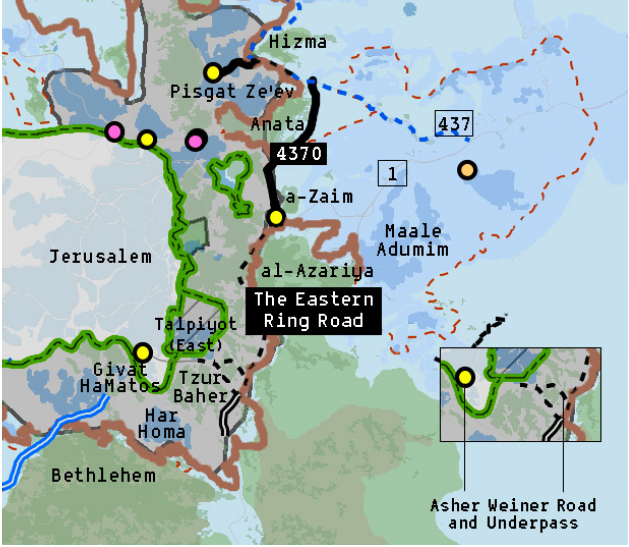
Map by Breaking the Silence
Ir Amim further explains:
“While portrayed as a road project to benefit Palestinians by expediting traffic and significantly reducing travel time between Ramallah and Bethlehem, it will in fact serve to completely reroute Palestinian traffic out of E1. Currently, the only road which facilitates Palestinian travel between the two West Bank centers runs through the E1 area. This limits Israel’s ability to carry out its massive settlement plans in the vicinity, which would require blocking Palestinian access to the area. This new road along with Route 4370 will create an alternative corridor between Ramallah and Bethlehem, which would eliminate the need for Palestinians to drive through E1 altogether. Diverting Palestinian traffic thus removes one of the obstacles to settlement construction in E1 and should signal cause for heightened vigilance.”
In a 2008 objection against the construction of the Apartheid Road, Adalah explained:
“The road further aims to consolidate and develop the Jewish settlements in East Jerusalem and the West Bank, and link them directly and conveniently to each other and to West Jerusalem. The road is simultaneously intended to isolate the Arab neighborhoods in East Jerusalem from the main route of the Eastern Ring Road, from each other and from the West Bank. It would thereby turn these neighborhoods into islands that are isolated – geographically, economically and in terms of transportation – from their immediate surroundings and would end Palestinian geographical contiguity within and around East Jerusalem, thereby precluding any future economic and social development or expansion of these neighborhoods. The plan stands to cut the owners of agricultural land off from their lands, to dramatically reduce the accessibility of schools, health services and workplaces for residents of these neighborhoods, and severely disrupt their family and social lives.”
Israeli officials have argued that the now-open road should resolve international objections to Israel building the E-1 settlement (a plan long criticized for effectively cutting the West Bank in half, rendering any future Palestinian state discontiguous and non-viable). In Israel’s view, the road replaces territorial contiguity for Palestinians in the West Bank with “transportational continuity,” i.e., the West Bank would still be cut in half, but the two halves are now inked by a road (albeit it a road that cuts Palestinians off from Jerusalem and that leaves travel between the northern and southern West Bank subject to Israeli control).
Israel Opens National Park on Land Belonging to Al-Walaja
Ir Amim reports that on March 23, the Israeli Nature & Parks Authority would be opening an Israeli national park in the area around the Ein Haniya spring. The spring is a historical part of the al-Walaja village, a Palestinian village located on the southern flank of Jerusalem, and long served as a main sources of water for households, farms, and recreational purposes for the village’s residents. Al-Walaja has long suffered due to its location and its complicated status (much of the village’s lands, including areas with homes, were annexed by Israel in 1967, but Israel never gave the villagers Jerusalem legal residency by Israel – meaning that under Israeli law, their mere presence in their homes is illegal). Today it is acutely suffering from a multi-prong effort by the Israeli government and settlers to grab more land for settlement expansion in pursuit of the “Greater Jerusalem” agenda. This land grab campaign includes past and pending home demolitions, the construction of the separation barrier and bypass roads in a way that seals off the village on three sides, and the denial of planning permits.
The history of this spring is just one example of how the Israeli government pursues land grabs with the facade of legality. As explained by Ir Amim:
“In 2013, in tandem with the construction of the barrier on al Walajeh lands, the Jerusalem District Committee approved an outline plan which designated the 1200 dunams of land as the Nahal Refaim national park in complete disregard of private Palestinian land ownership and traditional Palestinian agriculture in the area.
As a means of completely sealing off these lands from Palestinian access, including from village residents, the Jerusalem municipality began relocating the checkpoint between Jerusalem and al-Walajeh to a location closer to the village in February 2018. Construction on its relocation was suspended in March of the same year due to budgetary reasons and as a result, the Israeli authorities decided to keep the Ein Haniya site closed until the relocation is complete. Upon inquiry, however, Ir Amim was informed today that the plans for the checkpoint’s relocation have been terminated, and that Palestinian access to the area will remain unobstructed “unless security forces decide otherwise.”
Keeping the area open to Palestinian access is a significant achievement, which in no small part is due to al-Walajeh farmers’ perseverance despite the many obstacles and threats they continually face. In spite of this, the INPA’s plans include a variety of projects aimed at transforming al Walajeh’s agricultural terraces into an Israeli touristic and recreational destination, replete with hiking trails and outdoor activities, which creates the illusion of an entirely Israeli space.
The national park extends to the Jerusalem municipal border in close proximity to the area where Israel intends to establish a new settlement on al Walajeh’s lands (Har Gilo West) in the West Bank. In addition to creating contiguity between Jerusalem and the Gush Etzion settlement bloc around Bethlehem, the national park further isolates al Walajeh, turning it into an enclave detached from its Palestinian surroundings. In doing so, Israel advances its entrenchment of control along the southern perimeter, while undermining any prospect of a negotiated agreement in Jerusalem.”
Palestinians File Appeal Against “King’s Garden” Settlement Plan for Al-Bustan, Silwan
Ir Amim reports that Palestinians have filed an appeal to stop the demolition of 70 homes in the Al-Bustan section of the Silwan neighborhood in East Jerusalem. The Palestinians’ appeal responds to a surprising move by the Jerusalem Municipality, made in late February, to request permission from the Court to demolish the homes – demolition which had been frozen by the Courts since 2010 to allow for a negotiated resolution to the situation. For more on the history of this situation, see FMEP’s report from last week.
Additionally, Ir Amim has published a new, and more detailed, explainer on this case – highlighting the political context in which the Jerusalem Municipality made this decision. Ir Amim writes:
“The municipality’s plan called for the establishment of a touristic and archeological park (Plan 18000: “the King’s Garden”) replete with residential and commercial areas, including hotel space. This planned park would extend the existing national park in the City of David (the hub of Elad’s settler operations) southwards spanning the entire neighborhood of Al Bustan and towards the settler enclave in central Silwan (Batan al-Hawa) where the Ateret Cohanim settler organization is active. Since 2010, the plan has not advanced likely due to local and international opposition. However, the municipality’s objection to extension of the freeze signifies its intent to reactivate the plan, consistent with the acceleration of similar Israeli measures over the past year after being emboldened by the Trump Administration…
Beyond the severe humanitarian toll lie the acute demographic and political implications. The “King’s Garden” plan is yet another measure to transform the area into a sprawling Israeli tourist site, while further erasing its Palestinian presence. Silwan is one of the focal points of state-backed ideological settler activity. Settler groups threaten to displace over 800 Palestinians with the goal of establishing settler strongholds in the heart of Palestinian neighborhoods as a means to dismantle the viability of a political resolution on the city. Touristic settlement initiatives serve to reinforce residential settlement by connecting otherwise isolated settler compounds to create a contiguous ring of Israeli control (see map below for illustration), while artificially increasing the Israeli Jewish presence in the area via Israeli tourists visiting the sites. If advanced, the “King’s Garden” would essentially constitute a seamless extension of the City of David’s touristic attractions, further eroding the character of the neighborhood and its fabric of life, while leading to the forcible transfer of nearly an entire community.”
Bonus Reads
- “Samantha Power questioned over U.N. 2334 resolution at confirmation hearing” (Jewish Insider)
- “Save Sheikh Jarrah: Palestinians have a right to remain on their land” (Middle East Eye)
- “Palestinians in Hebron’s Old City build fence to prevent settlers’ attacks” (Al-Monitor)
Welcome to FMEP’s Weekly Settlement & Annexation Report. To subscribe to this report, please click here.
February 25, 2021
- Jerusalem Cable Car Project Dealt Blow by Court
- Israel Breaks Ground on New Settler Bypass Road Near Nablus
- Israeli Army Chief Meets with Violent Settlers (Instead of Arresting them)
- Archaeological Accident Gives Pretext For Settler Takeover in Area B
- Bonus Material
Comments, questions? Email kmccarthy@fmep.org
Jerusalem Cable Car Project Dealt Blow by Court
On February 23rd, the Israeli High Court of Justice issued an order against the construction of the Jeruslame cable car, a project advanced by – and closely connected to – the Elad settler organization. The project is opposed by a broad coalition of city planners, archaeologists, and academics, who oppose it not only because it was advanced in a highly suspicious manner, but also because building a cable car over historic sites in Jerusalem would do irreparable damage to the integrity of the city’s history.

In its order, the High Court asked the State of Israel to answer five questions, the substance of which suggest that the Court is concerned about both the irregular planning process and the archeological heresies construction of the cable car would inflict.
The NGO Emek Shaveh, which opposes the plan, commented:
“The questions raised by the judges bring to light once again the many flaws of the project, particularly the irregular approval process through the National Infrastructure Committee, a fast-track body usually used to advance national transportation projects, rather than through the usual planning committees as well as its destructive ramifications for minority groups such as the Karaite community. The Cable Car project should never have seen the light of day. Jerusalemites and a long list of civil society organizations have for the past three years been asking the same questions put forward yesterday by the High Court but have been ignored. The flaws outlined by the High Court prove that Jerusalem must be protected from those who wish to destroy the city and harm its residents. We hope the developers of the project will demonstrate responsibility, internalize the criticism against the project and stop wasting valuable public resources on such a destructive vision for Jerusalem.”
As a reminder, the Jerusalem cable car project is an initiative backed by the powerful, state-backed Elad settler group and advanced by the Israeli Tourism Ministry. The State of Israel – which has pushed the project forward in the midst of the COVID-19 pandemic and despite commitments by the government to focus on public health matters only – was forced to publicly admit that the implementation of the cable car project will require the confiscation of privately owned Palestinian land in the Silwan neighborhood of East Jerusalem.
While public efforts to “sell” the cable car plan have focused on its purported role in helping to grow Jerusalem’s tourism industry or in serving supposedly vital transportation needs, in reality the purpose of the project is to further entrench settler control in Silwan, via archeology and tourism sites, while simultaneously delegitimizing, dispossessing, and erasing the Palestinian presence there. Notably, the cable car line is slated to terminate at the settler-run Kedem Center compound (Elad’s large tourism center, currently under construction at the entrance of the Silwan neighborhood, in the shadows of the Old City’s walls and Al-Aqsa Mosque).
Emek Shaveh and other non-governmental organizations, including Who Profits and Terrestrial Jerusalem, have repeatedly challenged (and provided evidence discrediting) the government’s contention that the cable car will serve a legitimate transportation need in Jerusalem, and have clearly enumerated the obvious political drivers behind the plan, the archeological heresies it validates, and the severe negative impacts the cable car project will have on Palestinian residents of Silwan.
Israel Breaks Ground on New Settler Bypass Road Near Nablus
The settlers’ news outlet Arutz Sheva reports that the State has begun construction on the Huwwara Bypass Road, a new route long pined for by settlers.
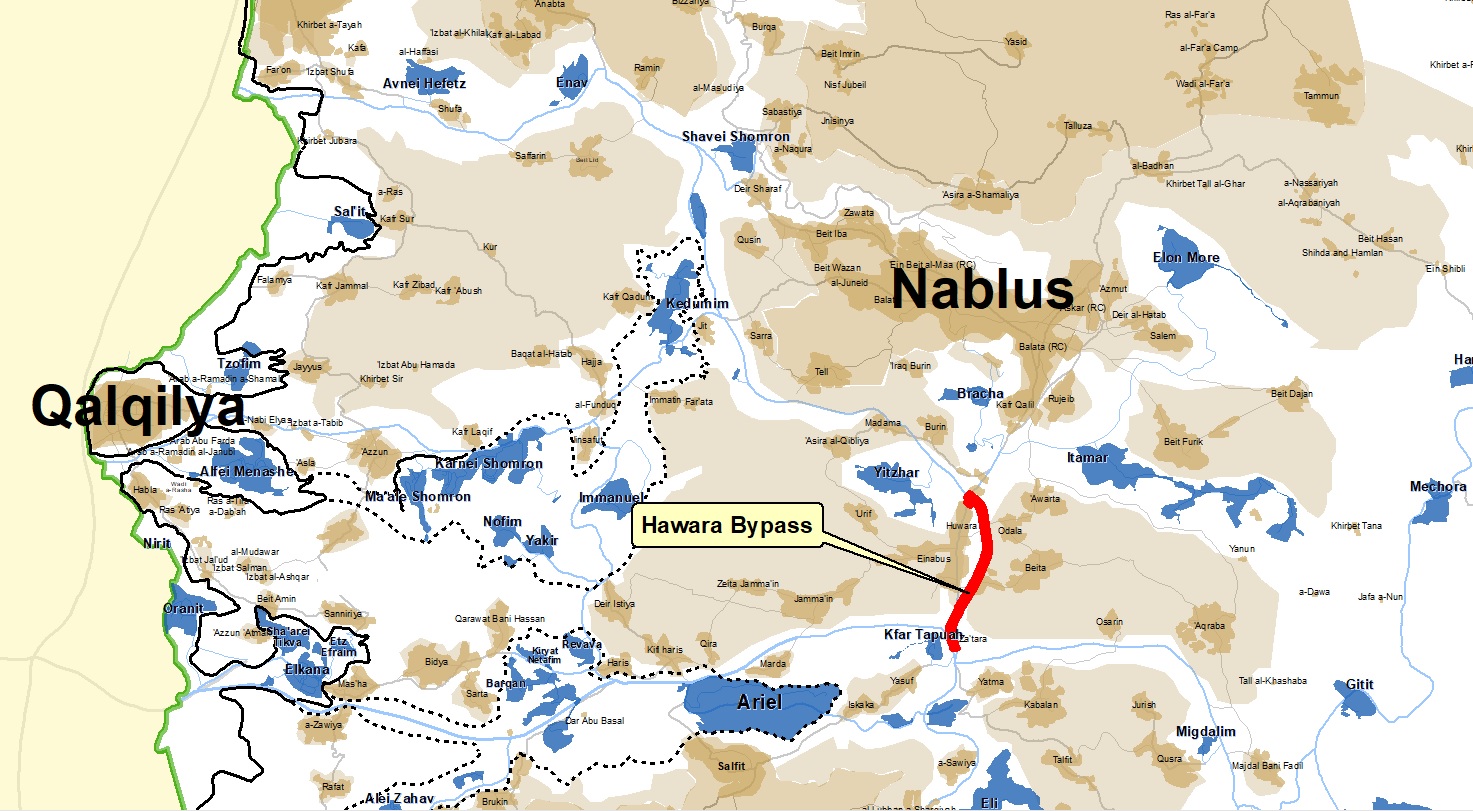 As reported last week, the Huwwara Bypass Road is designed to residents of Nablus-area settlements to bypass the Palestinian village of Huwwara (which is an area with heavy traffic congestion from daily commuters), in order to more easily/directly access Jerusalem. This bypass road has long been a top priority for the settlers, who have complained about the long commute to Jerusalem and the limits this puts on the potential for growth of Nablus-area settlements. Building the road also gained urgency for the settlers after the release of the Trump Plan’s conceptual map, which left the area where the road is slated to be built within the borders a future Palestinian “state.”
Arutz Sheva did not mince words about the importance of this road, writing this week:
“This is one of the most expensive and strategic projects in Judea and Samaria and its cost is estimated at ILS 260 million. The road is intended to connect the center of the country to the localities of Gav HaHar, Yitzhar, Itamar, Elon Moreh and Har Bracha, and will provide a safe trip for residents and passengers to these areas.”
Speaking at the ground breaking ceremony, settler leader Yossi Dagan also stressed the significance of this road to the settlers’ fight for sovereignty over the West Bank. Dagan said:
“This is a groundbreaking, historic moment for Samaria and the entire settlement effort. In about two years, the mountain settlements will become accessible to the center of the country. The road is expected to make traveling in the area safer for both Arabs and Jews, it is hoped that paving the road will lead to prosperity in the area.”
Dagan’s assertion that the road will benefit Palestinians in the area glosses over the fact that Palestinians were stripped of their property rights when Israel unilaterally expropriated private Palestinian land along the route of the road in preparation for construction. On this issue, Peace Now writes:
“A bypass road requires extensive expropriation of Palestinian land. All roads are planned from the Israeli interest toward the settlements and their development. Even if in some cases the Palestinians can benefit from these roads, they are not paved according to a planning conception of the Palestinian needs. This raises the question of Israel’s legal excuse to confiscate land in order to build roads in occupied territory by claiming that the roads will also serve the protected Palestinian population.”
Israeli Army Chief Meets with Violent Settlers (Instead of Arresting them)
Amidst a sharp spike in settler violence directed primarily at Palestinians and their property, but also at Israeli forces, two very senior Israeli security officials held a meeting with leaders in the violent “Hilltop Youth” settler movement, which has carried out a weeks-long crime spree following the death of one of its members. That member, Ahuvia Sandak, died as a result of a car crash while fleeing Israeli police who gave chase to a group of settlers who had been throwing rocks at Palestinian cars.
Haaretz reports that the two Israeli security officials – Central Command chief Maj. Gen. Tamir Yadai and Civil Administration head Brig. Gen. Fares Atila – wanted to “create rapprochement and calm things down.” An army source told Haaretz that “The general explained that the army is an agency that carries out the law of the State of Israel, and we’re trying to find common ground.”
Haaretz columnist Zvi Ba’arel writes of this meeting, and others that preceded it:
“When the head of Israel Defense Forces Central Command, Maj. Gen. Tamir Yadai, meets with “hilltop youth,” residents of the Maoz Esther outpost, in order to “create rapprochement and calm things down” in the words of a military representative, he is conducting negotiations with terrorists…For the “representatives of the outposts” – a new geopolitical term – who met with Yadai on Monday and last month, these meetings are a demonstration of power, not that of the IDF, but theirs…It’s the “representatives” who conduct the negotiations, who determine the rules, who decide if and when they will embark on the next terror activity, and who demand that the IDF understand and accept their motives and see them as a body no less legitimate than the IDF itself. If the army wants a tahadiya (cessation of hostilities) with the “outposts,” if it is begging that the thugs stop throwing stones at soldiers or setting police vans on fire, it must pay a political price. Or, as Prime Minister Benjamin Netanyahu often promises Hamas, “quiet will be answered with quiet.” The IDF, according to the “representatives of the outposts,” must stop chasing the gangs, refrain from demolishing outposts and primarily, preserve the status quo that has been rooted for decades and that maintains that attacks against Palestinians are an internal matter that concerns the relations between the gangs and the Palestinians. Those are the conditions for quiet. The IDF does not really control them.”
Archaeological Accident Gives Pretext For Settler Takeover in Area B
Following the accidental damage to an outer stone wall at the Mount Ebal archaeological site near Nablus, settlers are moving to assert control over the site, which is located in Area B of the West Bank — i.e., the 21% of the occupied territories which assigned to Palestinian civilian control (Israel maintains security control over that area). The incident furthers a settler strategy to use concern (real or feigned) for archeology as an impetus and justification for Israel to take control over more Palestinian land and even seize archeological relics in Palestinian possession.
The story of the recent drama over Mount Ebal – an historic site with stone features that date back to the 11th century BCE – started earlier this month, when a Palestinian construction crew building a new road (plans for which were approved by Israel) demolished a part of the archeological site without realizing the structure was significant. When the damage was detected, settlers and their allies went to the media to decry the incident and make larger claims about the Palestinian Authority’s allegedly malicious disregard for preserving archeological sites and relics under its control. Naftali Bennet went so far as to accuse the PA of an “Islamic State-like act” (suggesting, in effect, that the damage was intentional). Settlers and their allies openly suggested that lack of Israeli control over archeological sites in Area B is the problem, and ought to be changed – with Israeli Reuvin Rivlin calling for the IDF to take control of the Mount Ebal site outright.
Making further headlines, Samaria Regional Council Chairman Yossi Dagan staged a covert operation to “remedy” the damage at the Mount Ebal site, but the work Dagan facilitated was not overseen by a trained archaeologist, and the “restoration” was so problematic that even one of the archaeologists working for the settlers, Dr. Assaf Avraham, said:
“I don’t know what is more of a tragedy…the original destruction or the attempt at reconstruction.”
The Israeli NGO Emek Shaveh, which is composed of archaeologists and experts in West Bank heritage sites, said in response to the Mount Ebal drama:
“Contrary to how the destruction was presented by the settlers, the wall that was destroyed last week was an outer wall and not a part of the main structure. The contractor who paved the road thought it was a terrace and the mayor of town of Asira ash-Shamaliya’s said they were unaware that the wall was part of the site. However the settlers, right wing politicians and the Hebrew media used a clip from a video posted on the Asira ash-Shamaliya’s facebook page to claim that destruction was nationalistically motivated even though in the video, the contractor is merely describing his work practices and sharing with the residents the progress in paving the road. Some have gone as far as to claim that the destruction is akin to ISIS’ practices. Claiming the video is proof of a nationalistic motive behind the destruction of the wall serves the ongoing campaign to place antiquity sites in Area B under Israeli control. “
This incident comes one month after the state of Israel committed funding to a new settler initiative to surveil archeological sites under Palestinian control. While the objective of protecting antiquities might appear uncontroversial and apolitical, the true objective behind this effort is to support yet another pretext to surveil and police Palestinians, and yet another means to dispossess them of their properties. It is the result of a campaign that has taken place over the past year in which settlers have been escalating their calls for the Israeli government to seize antiquities located in Palestinian communities across the West Bank, especially in Area C, which Israel today treats as virtually (and legally) indistinguishable from sovereign Israeli territory.
The funding for the settlers to police Palestinians in the name of protecting antiquities is just the latest victory in the settlers’ campaign to use the issue of antiquities protection as a pretext to further squeeze Palestinians, especially in Area C. Previous victories include the Israeli Civil Administration’s recent issuance of expropriation orders for two archaeological sites located on privately owned Palestinian property northwest of Ramallah. The expropriations – the first of their kind in 35 years – come amidst a new campaign by settlers lobbying the government to take control of such sites, based on the settlers’ claims that antiquities are being stolen and the sites are being mismanaged by Palestinians. The settlers’ pressure is also credited as the impetus behind the government’s clandestine raid of a Palestinian village in July 2020 to seize an ancient font. The Palestinian envoy to UNESCO, Mounir Anastas, recently called on the United Nations to pressure Israel into returning the font to the Palestinian authorities.
A new settler group calling itself “Shomrim Al Hanetzach” (“Guardians of Eternity”) recently began surveying areas in the West Bank that Israel has designated as archeaological sites in order to call in Israeli authorities to demolish Palestinian construction in these areas. The group communicates its findings to the Archaeology Unit of the Israeli Civil Administration (reminder: the Civil Administration is the arm of the Israeli Defense Ministry which since 1967 has functioned as the de facto sovereign over the West Bank). The Archaeology Unit, playing its part, then delivers eviction and demolition orders against Palestinians, claiming that the structures damage antiquities in the area. As a reminder, in 2017, Israel designated 1,000 new archaeological sites in Area C of the West Bank.
This new group, not coincidentally, is an offshoot of the radical Regavim organization, which among other things works to push Israeli authorities to demolish Palestinian construction (on Palestinians’ own land) that lacks Israeli permits (permits that Israel virtually never grants). The group’s leaders accuse the Palestinian Authority of mismanaging the archeological sites, they accuse Palestinians of looting them, and they demand that Israel annex all the sites. The new group has also raised public alarm about the Trump Plan, alleging that hundreds of biblical sites in the West Bank are slated to become Palestinian territory.
Bonus Material
- “Selective Conservation Policy and Funding for Minority Heritage Sites in Israel” (Emek Shaveh)
- “The Europeans Don’t Really Care About the Palestinians Either” (Haaretz // Amira Hass)
- “Netanyahu’s battle for settler votes in Ma’aleh Adumim” (Jerusalem Post)
- “Settler movement takes over Jewish National Fund” (Al-Monitor)
- “Jews split over storied charity’s support for settlements” (AP)
Welcome to FMEP’s Weekly Settlement & Annexation Report. To subscribe to this report, please click here.
February 19, 2021
- Mass Dispossession in East Jerusalem: Israeli Courts Rule to Evict 11 Palestinian Families from Homes in Sheikh Jarrah & Batan al-Hawa
- Israel Close to Construction on Three Key Settler Bypass Roads
- JNF Leadership Approves Policy to Expand Settlements, But Defers Final Approval to Board
- Israeli Plan to Build West Bank Sewage/Power Plant Delayed Over Settlers’ Environmental Concerns
- Al Haq Requests “Immediate Intervention” by UN to Stop Settler Violence
- Bonus Reads
Comments, questions? Email kmccarthy@fmep.org
Mass Dispossession in East Jerusalem: Israeli Courts Rule to Evict 11 Palestinian Families from Homes in Sheikh Jarrah & Batan al-Hawa
In two separate decisions, Israeli courts have continued to rule in favor of settlers in cases that threaten the mass dispossession and displacement of Palestinians from some of the most sensitive areas of East Jerusalem. The decisions this week – one dispossessing six families in Sheikh Jarrah and the second dispossessing five families in Silwan (details below) – extend the guise of legality to the ongoing campaign by Israeli settlers to evict Palestinians in favor of Jewish Israelis.
These evictions are based on an Israeli law (the Administrative and Legal Matters Law) designed to enable Israeli Jews, but not Palestinians, to “recover” properties abandoned during the 1948 war. From the beginning of 2020 until now, based on this law, Israeli courts have ruled in favor of the settlers in a total of 14 cases – seven cases in Batan al-Hawa (Silwan) and seven cases in Sheikh Jarrah. The rulings (so far) affect – in a devastating manner – 36 Palestinian families with 165 individuals – 107 people in Silwan and 58 individuals in Sheikh Jarrah; as a legal precedent, these rulings open the door for dispossession on a massive scale, threatening the homes of approximately 700 people in Silwan alone.
Painting the larger picture of what is happening in these neighborhoods, Ir Amim says:
“Since the beginning of 2020 until now, there has been a record number of court decisions upholding eviction claims against Palestinian families filed by settler organizations. Over the past year, the Israeli courts authorized the evictions of over 30 Palestinian families, totaling more than 100 individuals, from their homes in Sheikh Jarrah and Batan al-Hawa. While the families are in various stages of appeal proceedings, many have exhausted the relevant legal remedies, which could lead to a devastating wave of evictions in the coming months. If the evictions are not halted, a total of over 1000 Palestinians from Sheikh Jarrah and Batan al-Hawa could ultimately be uprooted from their homes and communities and supplanted by settlers, potentially amounting to a form of forcible transfer. These measures not only constitute a flagrant violation of human rights, but also erode conditions necessary for any future political resolution on the city.”
Peace Now said in a statement:
“The story here is not legal but political. The court is only the tool by which settlers use with the close assistance of state authorities to commit the crime of displacing an entire community and replacing it with settlement. The Israeli government and settlers have no problem to displace thousands of Palestinians in the name of ‘the Right of Return’ to properties before 1948, while they strongly claim that the millions of Israelis living in Palestinian properties before 1948 cannot be evicted. Since the evacuation of the Mughrabi neighborhood for the purpose of expanding the Western Wall plaza in 1967, there has been no such deportation in Jerusalem. On the table of the prosecution in the International Court of Justice in The Hague is a complaint about the displacement process led by the government in Sheikh Jarrah and in Batan Al-Hawa. The government can still stop this injustice”.
In Sheikh Jarrah
On February 15th, the Jerusalem District Court upheld the eviction of six Palestinian families (27 individuals) from their homes of 70+ years in the Sheikh Jarrah nieghborhood of East Jerusalem in favor of the Nahalat Shimon settler group. The Court gave the families until May 2nd to vacate their homes, or file an appeal to the Supreme Court of Israel. 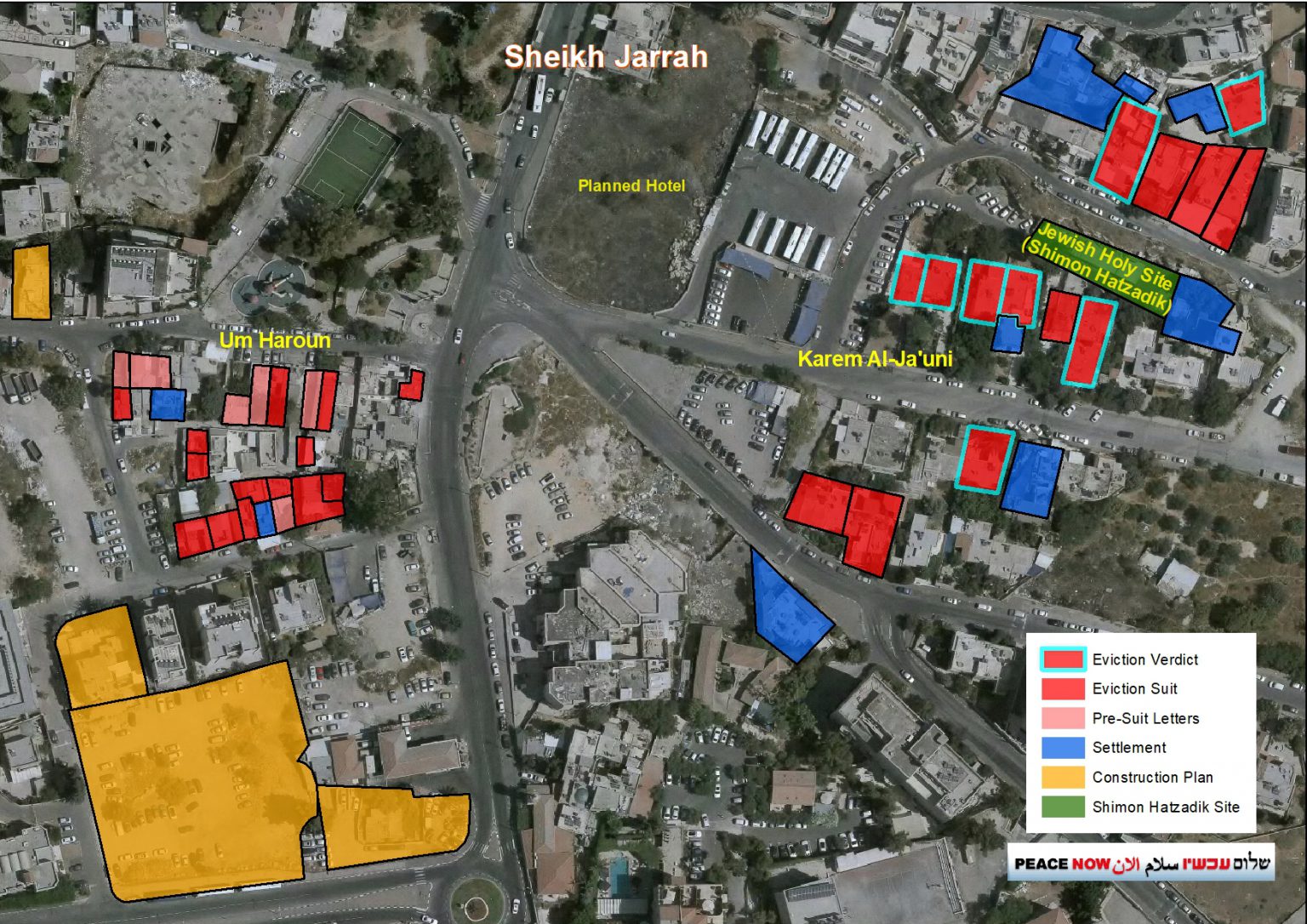
Nahalat Shimon is a U.S.-registered company which takes advantage of the “Legal and Administration Matters Law,” to reclaim property lost/abandoned during the 1948 war. Nahalat Shimon sought out the Jewish Israeli families that owned homes in Sheikh Jarrah prior to the 1948 War, and then “purchased” the properties from those families. Since then, Nahalat Shimon has been undertaking legal action to evict Palestinians. In 2009 the first eviction took place – sparking a sustained protest in the Sheikh Jarrah neighborhood which has garnered international attention.
Commenting on the case, Peace Now said:
“The lawsuit is part of an organized move designed to dispossess a Palestinian community of its home and establish a settlement in Sheikh Jarrah in its place. Hundreds of Palestinians in Sheikh Jarrah are in a similar situation in court proceedings, and hundreds more in Batan Al-Hawa in Silwan.”
In December 2020, FMEP hosted a webinar specifically looking at these eviction cases in Sheikh Jarrah, featuring Mohammed El-Kurd whose family was a party to the rejected appeal this week. The El-Kurd family has struggled to remain in their home in the face of settler campaigns to evict them for over a decade, part of which was captured in the Just Vision documentary “My Neighborhood.”
In Silwan
Following a hearing on February 9th, the Jerusalem Magistrate Court ruled in favor of the Ateret Cohanim settler organization and ordered the eviction of five families from their homes in the Batan al-Hawa section of the Silwan neighborhood in East Jerusalem. The Court ordered the families to vacate their homes — where they have resided for 50+ years — by August 2021. Ir Amim reports that the families are expected to appeal the case to the Jerusalem District Court.
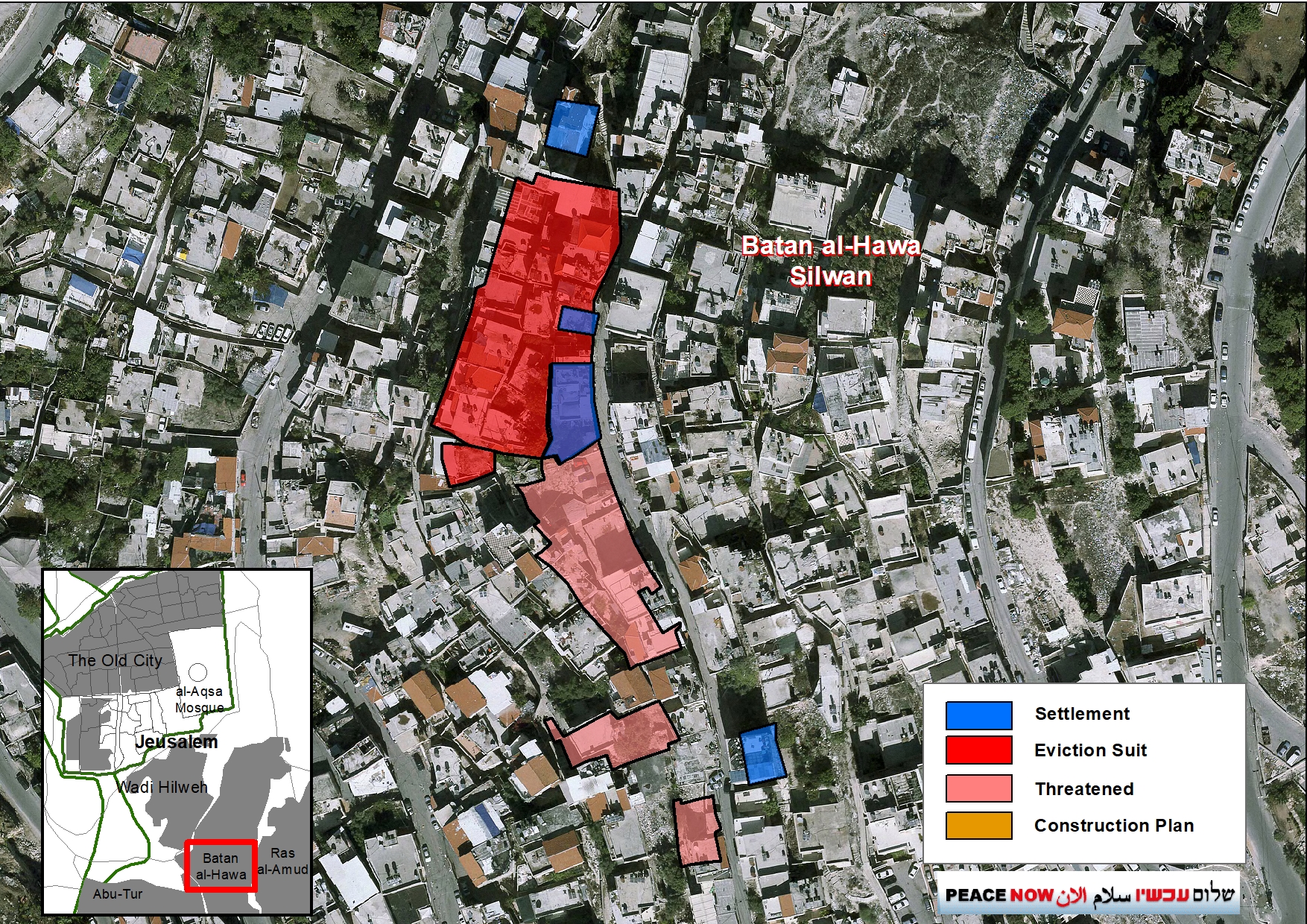 The ruling also upheld and advanced the use of the Legal and Administrative Matters Law which, as is the case in Sheikh Jarrah, is being used by Ateret Cohanim in a house-by-house manner in Silwan. To date, Israeli courts have repeatedly upheld Ateret Cohanim’s claim to own a large swath of land in the tiny Batan al-Hawa neighborhood, most recently ruling to evict Palestinians in January 2021, as well as in November 2020. In total, Ateret Cohanim’s campaign stands to ultimately dispossess 700 Palestinians in Silwan.
The group’s claim is based on having gained control of the historic Benvenisti Trust, which oversaw the assets of Yemenite Jews who lived in Silwan in the 19th century. In 2001 the Israeli Charitable Trust Registrar granted Ateret Cohanim permission to revive the trust and become its trustees, (following 63 years of dormancy). In 2002, the Israeli Custodian General transferred ownership of the land in Batan al-Hawa to the Trust (i.e., to Ateret Cohanim). Since then, Ateret Cohanim has accelerated its multifaceted campaign to remove Palestinians from their homes, claiming that the Palestinians are illegally squatting on land owned by the trust.
Palestinians have challenged the legitimacy of the Benvenisti Trust’s claims to the currently existing buildings, saying that the trust only covered the old buildings (none of which remain standing) and not the land, but the courts have so far rejected their argument.
Israel Close to Construction on Three Key Settler Bypass Roads
Peace Now reports that Israel is nearing the start of construction on several roads designed to serve settlers across the West Bank and in East Jerusalem, including: the so-called “Sovereignty Road” (which will allow Israel to build the E-1 settlement); and the Qalandiya bypass tunnel road; and, the Huwarra Bypass Road. Israel’s investment in these roads is explicitly about increasing the settler population and finally building the E-1 settlement.
Peace Now said in response to the totality of these advancements.
“The Israeli government is de facto annexing the West Bank by investing billions of shekels into roads designed to double the number of settlers to a million and even more.”
In a recent report examining several of these road projects in East Jerusalem, Who Profits writes:
“In the oPt infrastructure is primarily about control. In the words of Brigadier Ofer Hindi, head of the Rainbow of Colors15 administrative division of the Israeli Ministry of Defense (hereafter: IMOD): “priorities are not only the result of traffic and congestion, but of security needs, and the perspective must be integrative.” … the Israeli roads system functions as an instrument of exclusion, land grabs and economic de-development vis-à-vis the occupied population. At the same time, transport projects are also instruments of (segregated) integration, normalization and pacification. Projects such as the bus-only lanes and bus terminal currently under construction at the Qalandia checkpoint operate in tandem with recent technological and infrastructural investments in the checkpoints, described as an “upgrade” by the Israeli Civil Administration (hereafter: ICA), the administrative arm of the Israeli military in the oPt. The so-called upgrade includes features such as: moveable connectors at pedestrian checkpoints, expanded use of facial recognition and other biometric identification technologies and significantly, terminals, bus lanes and parking areas with the objective of “maximizing utility […] and enabling the passage of goods with greater throughput and efficiency.” Transport planning is thus incorporated into Israel’s strategic move to recast Palestinians as clients and users of the occupation. In this way short-term quality-of-life improvements work to consolidate, normalize and sustain Israel’s highly restrictive mobility regime.”
In another recent report – “Highway to Annexation” – Breaking the Silence speaks to the role of roads and infrastructure in Israel’s de facto annexation of the West Bank:
“The ultimate vision of the road and transportation projects currently planned and underway in the West Bank involve entrenching the segregation between Israeli settlers and Palestinians. These infrastructure projects, of course, do not provide for “separate but equal” development but are rather guided primarily by the interests of the settler population and come at the expense of Palestinian development… West Bank road and transportation development creates facts on the ground that constitute a significant entrenchment of the de facto annexation already taking place in the West Bank and will enable massive settlement growth in the years to come. By strengthening Israel’s hold on West Bank territory, aiding settlement growth, and fragmenting Palestinian land, this infrastructure growth poses a significant barrier to ending the occupation and achieving an equitable and peaceful solution to the Israeli-Palestinian conflict.“
The Sovereignty Road
According to Transportation Minister Miri Regev, Israel signed a contract with a company owned by the Jerusalem Municipality for the construction of the “Sovereignty Road” in the Maale Adumim/E-1 area in the West Bank, just east of Jerusalem (called the “a-Zaim road to Al-Azariya” by Peace Now). In Regev’s press release announcing this development, her office makes it perfectly clear what this road is intended to do:
“This will be a separate road for Palestinians in the E1 area, the purpose of which is to separate the transportation connection between the Palestinian and Israeli populations in the area so that Palestinian vehicles will be allowed to pass without entering the Ma’ale Adumim bloc, near Jewish communities…At the political level, the road will connect Jerusalem and Ma’ale Adumim and enable construction in the Jewish settlements in the E1 area.”
 For decades, construction of the E-1 settlement – which is now actively advancing through the planning process – has been adamantly opposed by the international community. A key criticism of the plan is that it would effectively cut the West Bank in half — thereby preventing any two-state solution. The “Sovereignty Road” has long been Israel’s answer to that criticism, with Israel arguing that it will replace territorial contiguity with limited “transportational continuity” – via a sealed road that is under Israel’s total control (meaning they can cut off passage through it at any time).
If built, a section of the Palestinian-only road is projected to run under the separation barrier (which is not currently built in this area). The rest of the road will run relatively adjacent to the route of the planned separation barrier, in order – in the words of former Defense Minister Bennet – to prevent Palestinian traffic from coming “near Jewish communities.” This new section of road connects to the infamous “apartheid road” (aka, the Eastern Ring Road) which has a high wall down the middle dividing Israeli and Palestinian traffic, and which was opened for Palestinian traffic in January 2019
The Qalandiya Bypass Tunnel Road
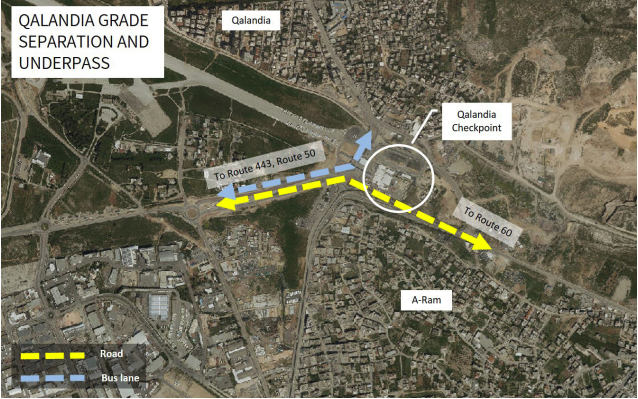 Following the recent closing of the tender period, the Israeli government is expected to soon select a contractor to build a new tunnel road that will go underneath the Qalandia checkpoint between Jerusalem and Ramallah, which is perhaps the busiest access point for Palestinians entering Israel. Peace Now writes that construction of the tunnel road is expected to begin approximately in April 2021. This plan is designed to serve a cluster of settlements that Netanyahu has recently dubbed a “fourth settlement bloc.” This group of settlements is located deep inside the West Bank — including the settlements of Adam, Kochav Yaakov, Ofra, and Beit El — in an area that under any reasonable sense of a two-state solution cannot become part of Israel. By defining these settlements as part of a “bloc” Netanyahu is in effect asserting that Israel will never relinquish control over the area.
Who Profits recently detailed this road project and the larger context of the Qalandiya checkpoint, writing:
“The Qalandia Grade Separation and Underpass Project is part of Israel’s concerted effort to reconfigure the space of the checkpoint. The Qalandia military checkpoint, located 10 kilometers north of Jerusalem and staffed by the Israeli military and private security companies, is one of the main checkpoints for Palestinians seeking to cross into East Jerusalem or the Green Line for work, health or any other purpose. Long infamous for its inhuman and crowded conditions and human rights violations, Qalandia has recently undergone major infrastructural and technological changes, to the tune of tens of millions of dollars. Under the guise of reducing wait times and improving conditions, the renovated checkpoints introduce heightened forms of surveillance, including facial recognition technology. The checkpoint upgrade plan also includes investment in transport infrastructure, such as pedestrian bridges and bus services….Part of the project involved the creation of a planning corridor for a future underpass and grade separation, connecting Route 60 to Route 45 to form an uninterrupted east-west axis between the Binyamin settlement bloc northeast of Jerusalem and Route 443 and Route 50 (Begin Highway), integrating them into Jerusalem and the Green Line…land for the project has been expropriated using military seizure orders rather than civil procedures, a move designed to accelerate the process and limit the ability of Palestinians to object.”
Peace Now adds more context around how the tunnel is a key part of Israel’s grander vision for settler-serving infrastructure criss-crossing the West Bank:
“It should be noted that in recent months, the planning process for a new road, known as Road 45 or the “Quarries Road”, is underway to connect the Ramallah bypass road near the Kochav Ya’akov settlement, and the Qalandiya checkpoint has been progressing. In June 2020, the road plan (Plan No. 926/1), was approved for deposit in the Higher Planning Council of the Civil Administration, and was published for objections in October 2020. The road is intended to bypass the Palestinian settlements of Jaba’ and A-Ram, and allow settlers to travel quickly and safely without passing Palestinian homes.”
The two roads together will make all the settlements east of Jerusalem and Ramallah, as well as the settlements in the Jordan Valley and along Road 60 towards Nablus much more attractive for Israelis.
The Huwarra Bypass Road
Map by Peace Now
Peace Now also reports that, according to Transportation Minister Regev, the tender for the Huwwara Bypass Road has closed, meaning construction might begin imminently. The Huwwara Bypass Road is designed to enable settler traffic from the Nablus area to bypass the the Palestinian village of Huwwara (which is an area with heavy traffic congestion from daily commuters) in order to more easily/directly access Jerusalem. This bypass road has long been a top priority for the settlers, who have complained about the long commute to Jerusalem and the limit this puts on the potential for growth of Nablus-area settlements. The radical/violent Yitzhar settlement will benefit from the bypass road, along with the settlements of Har Bracha, Itamar, and Elon Moreh. Building the road also gained urgency for the settlers after the release of the Trump Plan’s conceptual map, which left the area where the road is slated to be built within the borders a future Palestinian “state.”
JNF Leadership Approves Policy to Expand Settlements, But Defers Final Approval to Board
The Jewish National Fund’s executive leadership voted this week to approve the adoption of a new policy making the expansion of settlements in the West Bank part of the group’s core mission and function, and allocated nearly $12 million (8 million NIS) towards the purchase of land in the West Bank. However, in a concession to JNF members and donors threatening to leave over the new policy, the organization’s leadership has decided to defer a final decision on to its Board of Directors, which is expected to hold a vote on the matter only after the March 23rd elections in Israel.
Notwithstanding the significant controversy this “new” policy has provoked, the reality is that the JNF has long worked in support of settlements. What is different now is that, where in the past the JNF preferred to leave its settlement-related activities deliberately obscured, under the new policy the JNF would openly claim and promote its support for settlements. As such, the shift under consideration is not so much in policy as in public relations (a public relations approach that does not shy away from blatant racism, evidenced by the JNF Chairman’s recent TV appearance in which he said that the JNF’s goal is to stop land from ending up in Arab hands).
There has been significant opposition to the adoption of the new policy, on both administrative and moral grounds. Israeli Defense Minister Benny Gantz wrote to the JNF shortly before it met to approve the plan, asking for the matter to be delayed in order to allow Israeli security officials and the Civil Administration (which oversees civilian affairs including land regulation in the West Bank) to examine the matter. Gantz reportedly said that the JNF’s decision is “extremely sensitive,” potentially having national security consequences.
Diaspora Jewish groups have voiced strong opposition to the JNF moving to openly support settlements, with many focusing on why the new policy is bad for Israel. This includes Rabbi Rick Jacobs, president of the Union for Reform Judaism, who said that he “intends to mobilize the Jewish community to fight JNF’s plan through political and legal channels.”
J Street called on the U.S. branch of the JNF to work to oppose the policy, saying:
“For Jews around the world who contributed through the JNF to the creation and building of the state of Israel, it is beyond upsetting that the organization is being turned into an arm of the West Bank settlement movement, acting in a way that violates international law, shows total disregard for the rights of Palestinians and dangerously undermines Israel’s future as a secure, democratic homeland for the Jewish people along with the prospects for Israeli-Palestinian peace. While JNF-KKL funds have a complex history of being used at times to help fund and facilitate land purchases and settlement growth beyond the Green Line in the West Bank and East Jerusalem, they have not previously officially committed to this harmful project in such a brazen and explicit fashion.”
Haaretz columnist Gideon Levy wrote in an op-ed this week:
“The rot in the JNF can be smelled from far away. The fact that the Labor Party and Meretz are partners in this stinking nationalist enterprise testifies as much as 1,000 witnesses about the Zionist left. A “public benefit corporation,” most of whose land is land that was stolen from its owners in the Nakba and was never returned to them; which covered over the ruins of hundreds of villages in forests, just to erase their memory from the face of the earth and block the possibility of their owners returning. A body which, throughout all the years, in practice sold lands only to Jews, and since 2009 even legalized this practice in an official decision; a body for which there is no occupation and no Green Line – just one state between the Jordan River and Mediterranean Sea, in which you buy land only for members of one people; and which has now officially declared its partnership in the war crime called settlement too, after years of doing so via a front company…Anyone who still has their doubts, yes apartheid or no apartheid, needs to get to know the JNF. With members of the right and left in its top posts and positions for Meretz too – here you have the Jewish national fund for apartheid, the Israeli consensus.”
Israeli Plan to Build West Bank Sewage/Power Plant Delayed Over Settlers’ Environmental Concerns
Prime Minister Netanyahu has agreed to delay the construction of a new waste-to-energy plant near the Ma’ale Adumim settlement in the West Bank until an environmental impact study can be done, a study which was requested by the leadership of the settlement of Ma’ale Adumim.
The plant is planned to be built on land that is within the jurisdiction of the Ma’ale Adumim settlement, where several Palestinian Bedouin communities currently live. As noted in this Peace Now report, the land under the jurisdiction of this settlement “is the largest of all of the Israeli settlements on the West Bank” spreading “over a very large region which begins west of the settlement and extends into the Jericho valley. If compared with the size of the jurisdiction of cities within Israel, Ma’ale Adumim’s area is similar in size to that of the largest (most populated) cities within Israel.”.
The plant – which is expected to cost USD $284 million (1 billion NIS) – will treat waste generated inside Israel and exported to the West Bank. B’Tselem published a comprehensive report criticizing the illegal Israeli practice of exporting its waste to the occupied territories – writing:
“For many years, Israel has been taking advantage of its power as occupier to transfer the treatment of waste (including hazardous waste) and sewage from its sovereign territory to the West Bank. To that end, it has created a situation in which environmental legislation in the West Bank is much laxer than inside Israel, conveniently overlooking the long-term impact of environmental hazards on the Palestinian population and on natural resources, and neglecting to prepare future rehabilitation plans. This has created a financial incentive to transfer the treatment of environmental hazards from Israel to the West Bank. The Palestinians who live in the occupied territory are the ones to pay the price for this environmental damage, even though they were never asked their opinion on the matter and although, as a population under occupation, they have no political power and no real ability to resist.”
Al Haq Requests “Immediate Intervention” by UN to Stop Settler Violence
In an urgent appeal to several key figures in the United Nations, the Palestinian human rights group Al-Haq requests the UN’s “immediate intervention to protect the Palestinian protected population from systematic and ongoing settler attacks, which are conducted with institutionalised impunity.”
The appeal goes on to illustrate six recent cases of settler terrorism stemming from the Yitzhar settlement, which is the home base of the “Hilltop Youth” settler movement – which is notoriously violent, inlcuding towards Israeli security forces in addition to violence directed at Palestinians and their property.
Al Haq writes:
“The incidents above exemplify the widespread, long-term, and worsening phenomenon of settler attacks against the Palestinian population and their property. Such attacks are a direct result of the transfer of Israeli civilians into occupied territory perpetrated by Israel, the Occupying Power. Israel, as Occupying Power, is obliged to “ensure, as far as possible, public order and safety” in the occupied Palestinian territory…Settler violence is a direct result of Israel’s failure to take the necessary measures to prevent settler violence. The systematic lack of any law enforcement by the Israeli police forces on criminal acts perpetrated by settlers against Palestinians reveals an institutional unwillingness to hold settlers to account. This constitutes a further violation of international law by the Israeli occupying authorities in so far as they deny to Palestinians an effective legal remedy for such attacks.57 This systematic lack of law enforcement against settlers, coupled with institutional unwillingness to investigate and prosecute settlers, encourage settlers to repeat their violence knowing that they enjoy impunity for crimes against Palestinians and benefit from the protection of Israeli domestic laws, in violation of international law.”