Welcome to FMEP’s Weekly Settlement & Annexation Report. To subscribe to this report, please click here.
February 5, 2021
- Pending Eviction of Palestinian Family in Silwan Delayed (at least briefly) by Israeli Court
- E-1 Settlement Remains on the Agenda
- The Numbers Prove It: Israel Systematically Denies Palestinians the Right to Build (on their own private land) in Area C
- Israel Hopes to Continue Procedure for Settlement Advancements Established Under Trump
- Bonus Material
Comments, questions? Email kmccarthy@fmep.org
Pending Eviction of Palestinian Family in Silwan Delayed (at least briefly) by Israeli Court
On January 31st, the Israeli Supreme Court issued an injunction delaying the eviction of the Palestinian Shweiki family from their longtime home in the Batan al-Hawa section of the Silwan neighborhood of East Jerusalem. The injunction is set to expire on February 8th, the day after the deadline set by the Court for the Shweiki family to respond to the latest filing by Ateret Cohanim, the settler organization that is seeking the family’s eviction. Ateret Cohanim is also seeking the eviction of some 84 additional Palestinian families (a total of 700 people) in Batan al-Hawa.
Israeli courts have repeatedly upheld Ateret Cohanim’s claim to own a large swath of land in the tiny Batan al-Hawa neighborhood – which now being litigated on a house-by-house manner with Palestinians attempting to remain in their homes. The most recent court ruling in favor of Ateret Cohanim was in November 2020. The group’s claim is based on having gained control of the historic Benvenisti Trust, which oversaw the assets of Yemenite Jews who lived in Silwan in the 19th century. In 2001 the Israeli Charitable Trust Registrar granted Ateret Cohanim permission to revive the trust and become its trustees, (following 63 years of dormancy). In 2002, the Israeli Custodian General transferred ownership of the land in Batan al-Hawa to the Trust (i.e., to Ateret Cohanim). Since then, Ateret Cohanim has accelerated its multifaceted campaign to remove Palestinians from their homes, claiming that the Palestinians are illegally squatting on land owned by the trust.
Palestinians have challenged the legitimacy of the Benvenisti Trust’s claims to the currently existing buildings, saying that the trust only covered the old buildings (none of which remain standing) and not the land, but the courts have so far rejected their argument.
Peace Now, the settlement watchdog group, said in a statement this week:
“We will not remain silent as the government helps settler groups, under the auspices of a discriminatory law, wage a racist struggle to evict Palestinian families from their homes, with the aim of “Judaizing” East Jerusalem. This will be a protest for justice, equality and morality. A direct line connects the corruption threatening Silwan and the corruption in Balfour. When our neighbors are in danger of displacement, it is our duty to stand up and prevent it.”
E-1 Settlement Remains on the Agenda
The Local Planning Committee of the Maaleh Adumim settlement has scheduled a meeting to discuss the E-1 settlement plan on February 14th, and has summoned the anti-settlement watchdog Peace Now to attend that meeting. Peace Now, along with Ir Amim and the Association of Environmental Justice in Israel submitted a formal objection with the Civil Administration against the E-1 plan in August 2020. While the Maale Adumim Local Committee does not have authority to approve the E-1 plan, the February 14th meeting is yet another step towards approval, which must be granted by the Israeli Civil Administration. The Civil Administration has yet to schedule its own discussion of the E-1 plan, but may do so at anytime.
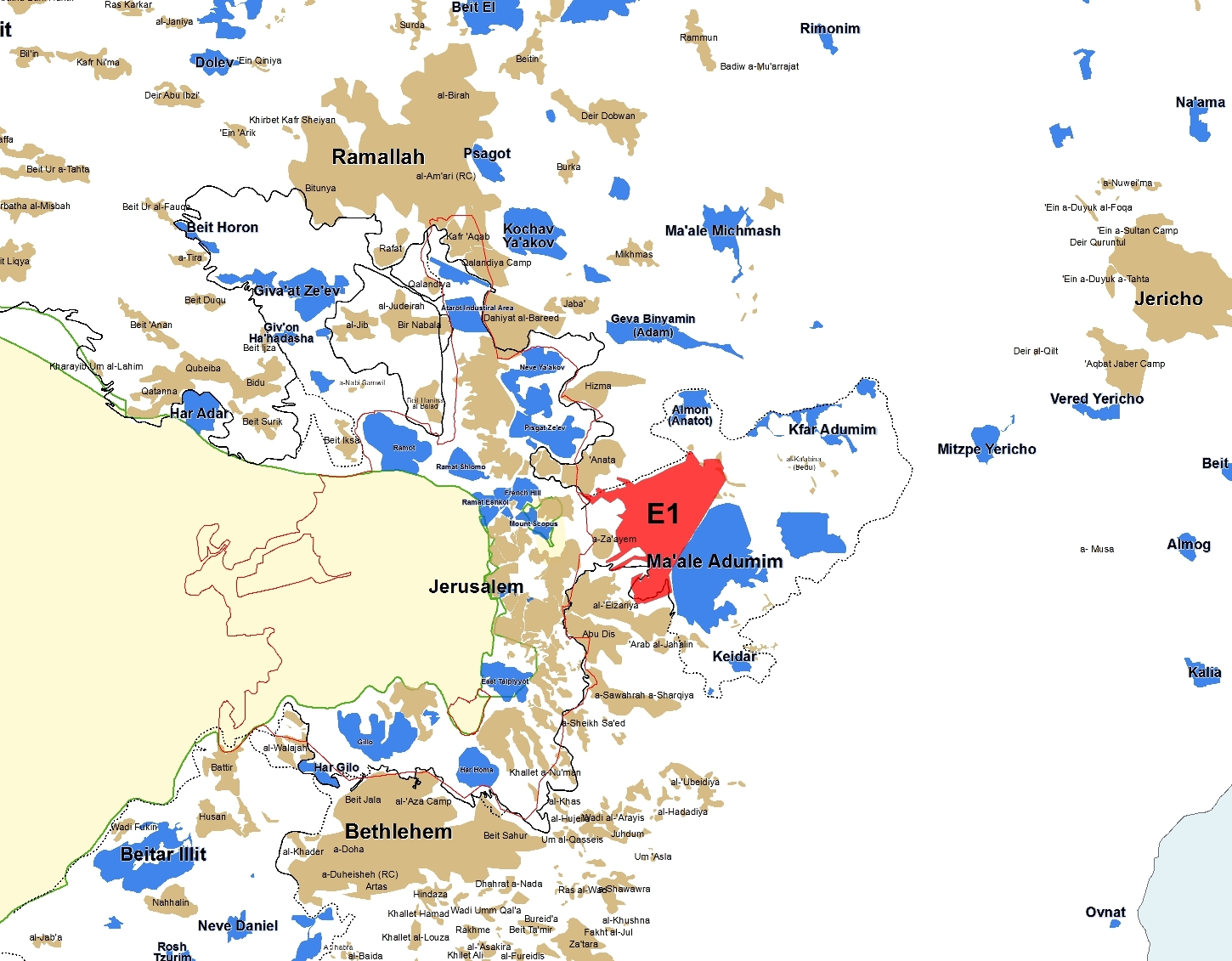 Long called a “doomsday” settlement by supporters of a two-state solution, construction of the E-1 settlement would sever the West Bank effectively in half, foreclosing the possibility of drawing a border between Israel and Palestine in a manner which preserves territorial contiguity between the northern and southern parts of the West Bank. The “Sovereignty Road” has long been Israel’s answer to that criticism, with Israel arguing that it will replace territorial contiguity with limited “transportational continuity” – via a sealed road that is under Israel’s total control (meaning they can cut off passage through it at any time). Just last month (January 2021), Netanyahu promised to increase funding for the Sovereignty Road as part of the drive to get E-1 constructed.
Ir Amim writes:
“Construction in E1 not only deals a death blow to the prospects of a sustainable Palestinian state with a capital in East Jerusalem, but will likewise lead to the displacement and dispossession of some 3,000 Palestinians living in Bedouin communities in the area, including Khan al-Ahmar.”
Regarding the petition, Peace Now said:
“Construction in E1 is considered essentially fatal to the prospect of a two-state solution because it divides the West Bank into two – a northern and a southern region – and prevents the development of the central Ramallah-East Jerusalem-Bethlehem metropolis in the West Bank. Even from an Israeli development and planning perspective, a settlement in E1 will do more harm than good and it may lead to the weakening of Jerusalem economically and socially.”
The Numbers Prove It: Israel Systematically Denies Palestinians the Right to Build (on their own private land) in Area C
In a new report based on data provided by the Israeli government, Peace Now documents how from 2019-2020, the Israeli Civil Administration approved plans for 16,098 new units for Israeli settlers in Area C, in addition to issuing construction permits for at least an additional 2,233 settler units. During this same period, Israel approved plans for only 265 units for Palestinian communities in Area C. The disparity in planning approvals and permits is not new, tracking with trends over the past decade. Peace Now data shows that from 2009-2018 just 98 construction permits for Palestinians were issued.
Israel’s refusal to allow for Palestinian construction in Area C is accompanied by Israel’s concerted effort to police and demolish “illegal” Palestinian construction there (reminder: when Israel refuses to issue construction permits, Palestinians are put in the position of having to build illegally to meet the population’s basic need for shelter). Peace Now data shows that from 2019-2020 Palestinians filed 313 petitions to stop demolition of structures in Area C. Israel only accepted ONE of those petitions.
These shocking (but not surprising) figures must be understood as part of the ongoing campaign — by settlers and the Israeli government — to entrench and expand Israel’s control over (and de facto annexation of) the entirety of Area C – some 60% of the West Bank. To that end, in September 2020 the Israeli government allocated 20 million NIS ($6 million USD) for the newly created Settlement Affairs Ministry to survey and map unauthorized (by Israel) Palestinian construction in Area C (which, as just noted, Israel has been aggressively demolishing). This funding further empowers a domestic Israeli body to exert extraterritorial sovereignty over Area C – in effect, treating the area as land already annexed by Israel.
The Knesset has also repeatedly hosted forums to discuss the alleged (by Greater Israel advocates) “Palestinian takeover of Area C.” Consistent with this framing (which is predicated on the idea that Area C belongs to Israel and must be defended against Palestinian efforts to steal it), and pushed by outside groups, many members of the Knesset have criticized the Israeli government’s alleged failure to robustly “defend” Israel’s rights/ interests in Area C (e.g., preventing “illegal” Palestinian construction, preventing foreign projects that support Palestinians’ presence in the area, clearing out Palestinians, expanding settlements, consolidating state-built settlement infrastructure).
Israel Hopes to Continue Procedure for Settlement Advancements Established Under Trump
As the Biden Administration continues to take shape, Israel Hayom reports that Israeli officials intend to propose maintaining the arrangement it had in place with the Trump Administration with regards to settlement planning and construction. Under that arrangement, Israel agreed to condense its settlement announcements into four tranches each year, and allowed the Trump Administration to review the plans Israel would be advancing ahead of time, with the understanding that the U.S. would tolerate some settlement activity. Although press reports regarding the Trump arrangement suggest that the U.S. also limited Israel’s ability to build freely in the West Bank by requiring new settlement construction to be adjacent to existing settlement construction (i.e. Israel cannot build anywhere), it in fact did no such thing.
As things stand today, it is not clear where the Biden Administration will end up on the issue of settlements. A report issued last week by the Washington Institute for Near East Affairs’ David Makovsky made the case for the Biden Administration to adopt a policy closely resembling the one Israel Hayom says Israel officials are asking for. Another report, issued a few weeks ago by the Center for New American Security (CNAS) articulates a similar policy as an “option” that the Biden Administration might consider.
FMEP’s Lara Friedman analyzed these recommendations and what they would mean, if adopted by the Biden Administration, in a detailed Twitter thread (part 1 here, Part 2 here), closing with the observation:
“…What’s being recommended is US shift from principled opposition to settlements (consistent with intl law, intl consensus, the principles on which the entire peace process is based, etc) to …[the] US giving a green light for unlimited settlement of parts of the West Bank, alongside continued *impotent* opposition to settlements everywhere else. History has demonstrated where such a policy leads, & it’s not to increased viability/credibility of the two-state solution. Or peace.”
Bonus Material
- “Webinar: Shrinking Space in Area C” (ELSC)
- “How Do You Say Ku Klux Klan in Hebrew?” (Haaretz // Michael Sfard)
- “The State Fills Israel’s High Court With Lies About Palestinians in the West Bank” (Haaretz // Amira Hass)
Welcome to FMEP’s Weekly Settlement & Annexation Report. To subscribe to this report, please click here.
January 15, 2021
- Tender for Givat Hamatos Settlement Construction Delayed
- Israel Expected to Advance Plans for (At Least) 684 Settlement Units, Grant Retroactive Approval to Outposts
- Netanyahu Promises to Boost Funds for “Sovereignty Road”
- Settlers Escalate Campaign for Outposts Legalization
- Israel Sets Up New Hotline to Assist Settler Surveillance of Palestinian Construction in Area C
- Key Quotes from U.S. Amb. Friedman on His Way Out the Door
- Bonus Reads
by Kristin McCarthy (kmccarthy@fmep.org)
Tender for Givat Hamatos Settlement Construction Delayed
On January 15th, the Jerusalem District Court issued a temporary injunction against the issuance of the tender for construction of 1,257 units in the Givat Hamatos settlement, slated to be built in East Jerusalem. Givat Hamatos has long been regarded as a doomsday settlement by parties interested in preserving the possibility of a two-state solution, assuming that Jerusalem will need to be divided and shared. If the Givat Hamatos settlement is built, the Palestinian neighborhood of Beit Safafa in East Jerusalem will be completely surrounded by Israeli construction, severing its connection to the West Bank.
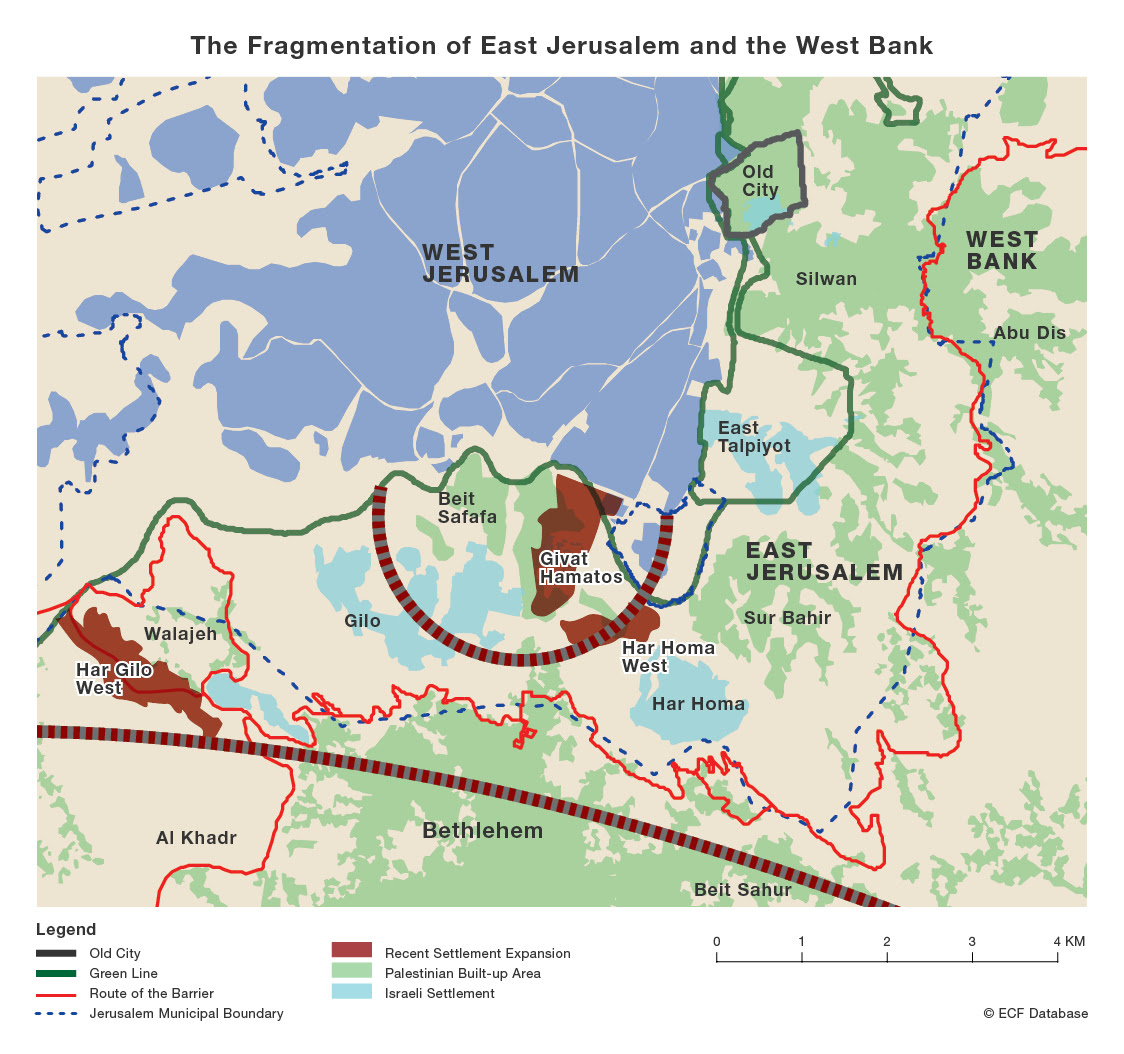
Map by Terrestrial Jerusalem
The injunction comes in response to an emergency petition submitted on January 14th by 25 Palestinian residents of East Jerusalem with the assistance of the Israeli NGO Ir Amim. The petition argues that the conditions of the tender represent “severe housing discrimination” in that non-Isareli citizens are ineligible for the government subsidized housing planned for Givat Hamatos. Rather than seeking to stop the construction of Givat Hamatos, the petition asks the government to correct these discriminatory conditions so that Palestinian residents are also welcome to purchase homes in Givat Hamatos.
The tender was scheduled to be published on January 18th (2 days before the inauguration of Joe Biden as the new U.S. president). The injunction delays that publication and orders the government to respond to Ir Amim’s petition by January 21st.
Ir Amim explains the petition’s claims in detail:
“40% of the homes [planned for Givat Hamatos] will be allocated to individuals who are eligible for a government subsidized housing scheme. To qualify, individuals must be a non- homeowner and an Israeli citizen, which entirely precludes EJ Palestinians, as the vast majority do not hold citizenship but rather permanent residency. Not only are they excluded from an affordable subsidized housing option, but only 60% of the apartment supply offered to an Israeli citizen is available to a Palestinian resident, which discriminates on two planes. The petition therefore calls for the following remedies:
1 – to grant Palestinian residents eligibility to qualify for the subsidized apartments on Givat Hamatos,
2 – Instruct the state to consider equitably allocating a significant number of affordable apartments to Palestinian residents of Jerusalem,
3 – Postpone the apartment marketing process for a period of no less than six months to allow for interested Palestinian Jerusalem residents to apply for eligibility for the subsidized housing scheme, or
4 – To cancel the subsidized housing scheme and rather sell all apartments on the free market, making them accessible to all…
East Jerusalem Palestinians already suffer from acute housing shortages and suppression of residential development stemming from long-standing discriminatory planning and building policies. Since East Jerusalem’s annexation in 1967, not one neighborhood has been built for Palestinians, while only 8.5 % of Jerusalem is zoned for their residential use despite them constituting nearly 40% of the city’s population. 1/3 of the land in East Jerusalem was confiscated to build Israeli neighborhoods/settlements. If and when residential outline plans are approved for existing Palestinian neighborhoods, they only allow for a few hundred housing units versus thousands of housing units in Israeli neighborhoods across the city.”
Terrestrial Jerusalem’s Daniel Seidemann comments:
“This is far from over, and one can never estimate the life expectancy of an injunction like this, but this is very good news. As matters stand the tender process regarding Givart Hamatos will NOT end on January 18, and the bids will not open.”
Israel Expected to Advance Plans for (At Least) 684 Settlement Units, Grant Retroactive Approval to Outposts
The Israeli Defense Ministry’s Higher Planning Council (which oversees all construction in the occupied West Bank) is expected to meet on January 17th to advance plans for at least 684 – but potentially 850 or more – settlement units across the West Bank, while also advancing the retroactive legalization of two outposts. These approvals will come only days before the inauguration of Joe Biden as the new President of the United States, a changing of the guards expected to temper U.S. support and approval for settlement construction.
An additional report by Middle East Eye reports that on January 13th the Israeli planning authorities in Jerusalem advanced plans for 400 units in the Gilo settlement and 130 units in the Ramat Shlomo settlement, both located in East Jerusalem. FMEP will provide more details when those reports are confirmed.
FMEP will confirm the details of the Civil Administration’s High Planning Council meeting in next week’s Settlement Report. Based on what is known today, the settlement units expected to receive final approval include:
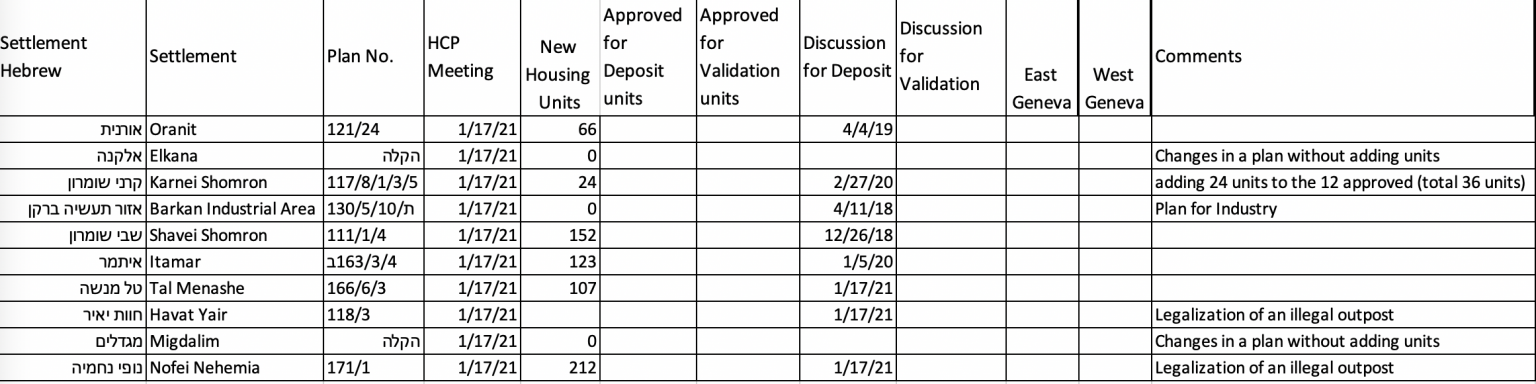
- 152 new units in the Shavei Shomron settlement, located in the northern West Bank – northwest of Nablus;
- 123 new units in the Itamar settlement, located southeast of Nablus in a cluster of notoriously violent settlements and outposts;
- 66 new settlements units in the Oranit settlement, located in the northern West Bank, in the “seam zone” between the 1967 Green Line and the Israel separation barrier (constructed along a route designed to keep as many settlements as possible on the Israeli side of the wall/fence);
- 24 new units in the Karnei Shomron settlement, located in the northern West Bank east of the Palestinian village of Qalqilya. Israel is planning to continue expanding Karnei Shomron with the stated goal of bringing 1 million settlers to live in the area surrounding the settlement;
- Expansion of the Barkan Settlement Industrial Zone, located in the northern West Bank and a part of a strand of settlements leading from Israel proper all the way to the Ariel settlement in the very heart of the northern West Bank, reaching literally to the midpoint between the Green Line and the Jordan border. The future of Ariel and the settlements between Ariel and Israel proper have long been one of the greatest challenges to any possible peace agreement, since any plan to connect Ariel to Israel will cut the northern West Bank into pieces. For background on this industrial zone and others, see here.
The settlement units slated to be advanced to the planning stage of depositing for public review include:
- The retroactive legalization of 212 existing units in the Nofei Nehemia outpost, which if implemented would have the effect of retroactively legalizing the outpost as a neighborhood of the Rehelim settlement. The Nofei Nehemia outpost is a fair distance from the Rehelim settlement and is not contiguous with the built up area of Rehelim, making Nofei Nehemia – if authorized – more properly understood as a brand new settlement rather than an expansion of an existing settlement (as the Israeli government would want one to believe). The Nofei Nehemia outpost is located east of the Ariel settlement in the very heart of the northern West Bank.
- 107 new units in the Tal Menashe settlement, located on the tip of the northern West Bank. Tal Menashe is technically a neighborhood of the Hinanit settlement, though the built up areas do not connect. Notably, the plans for 107 units would, if implemented, “dramatically increase” the size of the Tal Menashe settlement, which is the settlement where Esther Horgan – who was murdered by a Palestinian in late December 2020 – lived. Israeli government officials have made it a clear policy to advance settlement construction in response to deadly attacks on settlers by Palestinians, an approach publicly endorsed by current U.S. Ambassador David Friedmam. Tal Menashe is situated in the “seam zone” between the 1967 Green Line and the Israel separation barrier, which was constructed along a route designed to keep as many settlements as possible on the Israeli side of the wall/fence.
- An unknown number of units in the Havot Yair outpost with the intention of granting retroactive legalization (under Israeli law) to the entire outpost. The Havat Yair outpost is located near the Karnei Shomron settlement in the northern West Bank, east of the Palestinian village of Qalqilya.
Wasel Abu Youssef, a member of the Executive Committee of the Palestine Liberation Organization told Reuters:
“[Israel’s advancement of settlement construction] is an attempt to race against time and benefit from the last days of the current U.S. administration.”
Peace Now said in a statement:
“By promoting hundreds of settlement units, Prime Minister Netanyahu is once again putting his personal political interests over those of the country. Not only will this settlement activity erode the possibility for a conflict-ending resolution with the Palestinians in the long-term, but in the short-term it needlessly sets Israel on a collision course with the incoming Biden administration. For eight years as vice president, Biden and the rest of the Obama administration gradually became more irritated and willing to spar with Israel over settlements, and for the past four years Biden has watched Netanyahu stroke Trump’s ego to promote policies meant to undermine the very foundations for a two-state solution. Although supporting more settlement activity may be a shrewd way to attract votes over the increasing number of rivals to his right, Netanyahu is gambling with Israel’s all-important relationship with its US ally.”
It’s worth noting that current Israeli Defense Minister (and increasingly disgraced Blue & White party leader) Benny Gantz, following the publication of the High Planning Council’ agenda for settlement construction, announced that his office had taken “preliminary steps” towards the approval of Palestinian construction plans in communities located in Area C of the West Bank (some 60% of the West Bank which Israel exercises unilateral civil and security control over, and which is the focus of the most intense settler campaigns for de jure annexation). The Times of Israel reports that those plans include: the expansion of the Palestinian village of Al-Walaja (located south of Jerusalem and surrounded on three sides by the Israeli separation barrier), the expansion of Hizma (located on the northern border of the Jerusalem municipal boundary), approval of a new hotel in the Bethlehem area (note: Bethlehem itself is not in Area C), a hearing on plans for a hotel in Beit Jala (located on the eastern border of Bethlehem, 75% of land belonging to Beit Jala was designated as Area C under the Oslo Accords), and a hearing on the retroactive legalization of farming buildings in al-Fara (located in the northern West Bank). Commenting on Gantz’s announcement of these Palestinian plans, Bimkom researcher Alon Cohen-Lifshitz told told The Times of Israel:
“This is like mocking the poor. Most of the plans are from 2012. They’re all very small in terms of their land use and do not allow for [further] development.”
Predictably, settlers responded with vitriol to the rumor of plans to regulate (i.e., post-facto legalize) Palestinian construction in Area C. A spokesman for the Young Settlements Forum (“young settlements” is a new euphemism for illegal outposts that has been catching on in Israeli politics) said:
“There is no limit to this cynicism. The defense minister and the prime minister want to legitimize the illegal Palestinian takeover of Area C in violation of political agreements, and remove from the agenda the regulation of Israeli settlements that have been built on state land.”
Netanyahu Promises to Boost Funds for “Sovereignty Road”
According to the Jerusalem Post, Prime Minister Netanyahu has promised to allocate an additional $4 million USD (NIS 14 million) or more to the construction of the so-called “Sovereignty Road.” The road is a key element in Israel’s plan to build the E-1 settlement east of Jerusalem and its larger ambition to annex (de facto or de jure) a huge area of West Bank territory located between Jerusalem and Jericho.
According to the Jerusalem Post, Netanyahu met with Benny Kashriel, mayor of the Ma’ale Adumim settlement (located adjacent to the E-1 site), along with Transportation Minister Miri Regev and Finance Minister Israel Katz to discuss the matter this week. During the meeting, Bibi made the verbal commitment to allocating additional funds to see that the road is built.
Peace Now responded to the news:
“Netanyahu’s election campaign is costing Israel a very heavy price. Once again, he is using the election period to try to impress key Likud supporters by promoting a plan that could eliminate the possibility of a two-state solution. The planned road will allow Israel to cut the West Bank in two, build E1 and the separation barrier, and close the door on the possibility of developing a sustainable Palestinian state.”
For decades, construction of the E-1 settlement – which is now actively advancing through the planning process – has been adamantly opposed by the international community. A key criticism of the plan is that it would effectively cut the West Bank in half — thereby preventing any two-state solution. The “Sovereignty Road” has long been Israel’s answer to that criticism, with Israel arguing that it will replace territorial contiguity with limited “transportational continuity” – via a sealed road that is under Israel’s total control (meaning they can cut off passage through it at any time).
If built, a section of the Palestinian-only road is projected to run under the separation barrier (which is not currently built in this area). The rest of the road will run relatively adjacent to the route of the planned separation barrier, in order – in the words of former Defense Minister Bennet – to prevent Palestinian traffic from coming “near Jewish communities.” This new section of road connects to the infamous “apartheid road” (aka, the Eastern Ring Road) which has a high wall down the middle dividing Israeli and Palestinian traffic, and which was opened for Palestinian traffic in January 2019.
In March 2020, then Defense Minister Naftali Bennet gave final approval for the “Sovereignty Road” plan, at the time giving lip service to the idea that the plan will benefit Palestinians (even as it further cuts them off from Jerusalem, takes more land, and cuts the West Bank in half). At the same time, he made clear his real objective. stating:
“[the road] will improve the quality of life for residents in the area, avoid unnecessary friction [for Israelis] with the Palestinian population and most importantly — allow for continued [settlement] construction. We’re applying sovereignty [to the West Bank] in deeds, not in words.”
Peace Now has previously explained the issue with Israel’s design:
“The new road is intended to allow Palestinians to pass under the route of the separation barrier, and to travel ‘inside’ the Adumim Bloc along a wall without entering the ‘Israeli’ side, as in a kind of tunnel. Once the road is paved, Israel can then claim that construction in E1, and the construction of the barrier around the Adumim bloc does not sever the West Bank because the Palestinians have an alternative transport route. This argument is preposterous. A thin line of road connecting separate territorial sections–transportational contiguity–does not meet the needs for territorial viability for the development and livelihoods of Palestinians in the critical Ramallah-Jerusalem-Bethlehem metropolitan area. Without actual territorial contiguity, an independent Palestinian state cannot be established and prosper, and therefore a two-state solution cannot be reached.”
Settlers Escalate Campaign for Outposts Legalization
Kan radio reported that Defense Minister Benny Gantz told settlers that he remains opposed to issuing retroactive authorization to dozens of outposts in one fell swoop, but will instead prefers that each outpost go through a legal process individually in order to gain legalization.
Settlers have been encamped in front of the Prime Minister’s office for nearly two weeks demanding for the passage of a government decision for large scale retroactive legalization of as many as 70 outposts. That decision has been drafted but has been held up by Defense Minister Gantz; In December 2020, Knesset introduced a bill to circumvent Gantz’s opposition and grant authorization to 65 outposts.
Some of the protesting settlers began a hunger strike in hopes of escalating their demands for outpost authorization. Numerous politicians and officials have visited the encamped settlers to show solidarity, including aspiring Prime Minister Naftali Bennett visited the encamped hunger strikers, saying:
“Netanyahu, authorize the young settlements [outposts] now in these coming 10 days. If you don’t do it, when I am the prime minister, I will do it.”
Israel Sets Up New Hotline to Assist Settler Surveillance of Palestinian Construction in Area C
Haaretz reports that in November 2020 the Israeli Civil Administration (the body within the Israeli Defense Ministry tasked with coordinating all civilian affairs in the occupied West Bank) created a new hotline for settlers wishing to report their suspicions of “illegal” Palestinian construction in the West Bank (on the Kochav Ya’akov settlement website, the new phone service is called a “snitch line”).
Amira Hass reports in Haaretz that the Civil Administration’s announcement of the “snitch line” said:
“Have you seen Palestinian construction work that looks to you to be suspicious and unauthorized? Have you encountered a sanitation hazard created by Palestinians who disdain the law? From now on you have a ‘snitch-line’ of your own. Call at any hour of the day and submit a complaint about it. Every day there will be a summary of the complaints and a display of what was examined and what was confiscated in the event that there was improper conduct. Good luck.”
Testing whether the new hotline was exclusively for Israeli settlers reporting on Palestinians, the Palestinian-led NGO Haqel tried reporting illegal construction by the settlers. In response, the Civil Administration said that the “coordination office representatives sent someone to check what’s going on.”
The new hotline is yet another victory in the campaign by settlers to stop Palestinian construction in Area C, and push Palestinians out altogether. In November 2020, in addition to razing an entire Palestinian community, Khirbet Humsa, and tightening the noose on Khan Al-Ahmar – the Israeli government advanced plans to begin a land registration process in Area C as a means by which the state can declare more West Bank land to be “state land,” a way to retroactively legalize unauthorized settlement construction there (as well as put more land off limits to Palestinain construction and even render some existing Palestinian construction illegal).
Additionally, on September 10th the Israeli government allocated $6 million USD (20 million NIS) for the newly created Settlement Affairs Ministry to survey and map unauthorized (by Israel) Palestinian construction in Area C of the West Bank, which Israel – egged on by settlers – has been aggressively demolishing in an effort to rid the area of Palestinians. Haaretz reports that this is the first time that the state budget has included funds specifically for a land survey in the West Bank. The state also allocated an additional $2.8 million (9.5 million NIS) to an existing grant program specifically for settlement municipalities to cash in on. As a reminder, virtually all Palestinian construction in Area C of the West Bank is “unauthorized,” because Israel almost universally refuses to give Palestinians permission to build in Area C even on land that Israel recognizes as owned by Palestinians.
The Settlement Affairs Ministry is a new creation of the current coalition government, and is headed by Tzachi Hanegbi (Likud). The funding for the Settlement Affairs Ministry to conduct a survey of unauthorized Palestinian construction in Area C further empowers a domestic Israeli body to exert extraterritorial sovereignty over Area C – in effect, treating the area as land already de facto annexed by Israel. While technically the occupied territories are administered by the Israeli Civil Administration (a body within the Defense Ministry), Israel has spent decades bringing the administration of the territories (specifically the settlements and Area C) ever more directly under direct Israeli law (de facto annexation).
The Knesset has also repeatedly hosted forums to discuss “the Palestinian takeover of Area C.” Consistent with this framing (which is predicated on the idea that Area C belongs to Israel), and pushed by outside groups, many members of the Knesset have criticized the Israeli government’s allegedly lackadaisical approach to defending Israel’s rights/ interests in Area C (i.e., preventing “illegal” Palestinian construction, preventing foreign projects that support Palestinians’ presence in the area, clearing out Palestinians, expanding settlements, consolidating state infrastructure). Reportedly, Foreign Affairs Minister Gabi Ashkenazi (Blue & White) sent a letter to the committee in October 2020 specifically addressing the Knesset’s outrage over European humanitarian assistance projects for Palestinians in Area C. In the letter, Ashkenazi not only celebrated the reduction of European projects over the past year, but validated settlers’ insinuations regarding the nefarious nature of European assistance for Palestinians, saying that any European activity in the West Bank lacking Israeli permission is “an attempt to define a border.”
At one Knesset hearing, MK Bezalel Smotrich (Yamina) suggested that a solution could be to empower the settlements with the ability to demolish Palestinian construction they believe to be unauthorized. Smotrich’s partymate Ayelet Shaked (former Justice Minister) suggested that the government should appoint a project manager tasked with preventing a “Palestinian takeover” of Area C.
As noted above, Israel has long denied Palestinians the ability to build in Area C, resulting in many Palestinian structures (including homes, schools, farms, etc) being built without the required Israeli-issued permits. To fully understand what is happening, see B’Tselem’s excellent explainer.
Key Quotes from U.S. Amb. Friedman on His Way Out the Door
Please read the New York Times feature on David Friedman in its entirety, and the two separate threads (one and two) journalist David Halbfinger tweeted with supplemental material from the interview. A few key quotes regarding U.S. settlement and annexation policy over the past four years are copied below.
On internal Israeli annexation negotiations between Netanyahu and his government coalition partners:
“I was invited.”
On the future of Israel’s de jure annexation of West Bank land:
“They [Israel] can act unilaterally. It’s suboptimal, but at some point, it’s just sort of necessary just to move on.”
On how the U.S. settlement policy over the past four years:
“he agreed with the Israelis that they should build ‘from the inside out’ — to expand settlements ‘with the least amount of damage to the overall footprint. And that’s how they’ve been operating over the last four years’.”
On the opposition to settlement construction by previous U.S. administrations:
“just to kind of virtue-signal that we think the Palestinians should have something more, made no sense to me…[What Israel does inside or outside the settlements is] an internal decision.” And also on the idea of asking for a settlement freeze: “for them [Israel], I think a freeze of construction is the acknowledgment that the land doesn’t belong to them.”
On criticisms of the Trump Plan map:
“We spent months working on ways to achieve contiguity. You can drive from Hebron to Nablus and never see an Israeli. “I used to take the Midtown Tunnel to work every day. If you tell me that there’s a river, that I go under a river, I don’t know that. I never saw the river once. I drove under that thing for 30 years, never saw a river. So I take it on faith that there’s an East River. I’m just saying that we created enough contiguity so that Palestinians could go throughout the West Bank without ever coming face-to-face with the Israelis.”
On the role Israelis played in creating the Trump Plan and map:
“The editorial control was always ours. This was entirely authored by us and almost entirely conceptualized by us.”
On how to get Israelis to buy into future peace talks:
“Peace talks would only gain traction with the Israeli right, he ‘without the accusation that somehow it’s a thief and being asked to return things that it stole. Israel will not and should not come to the table on the basis of being an illegal occupier of stolen land’”
On the current status quo (in which Israel occupies the West Bank and blocakes the Gaza Strip):
“the status quo is not unsustainable, but I think the status quo is suboptimal and should be.”
On the dangers posed to Israeli democracy by permanent occupation:
“I don’t think it has anything to do with Israel’s democracy because Israel’s democracy is the function of the citizens, and these are not citizens of Israel.”
Friedman confirmed that the Trump Plan and normalization deals between Israel and the UAE and Bahrain held out the “aspiration” of a massive change to the status quo on the Temple Mount in which non-Muslim prayer would be allowed at all areas except Al Aqsa Mosque.
Dismissing any remaining doubt that normalization deals between Israel and Arab countries were contingent on Israel’s permanent suspension of annexation:
“I don’t think it would’ve been appropriate for Israel to, especially without the consensus of the Israeli population, to just give up territory permanently for any agreement with another country,”
He blamed the Israeli left for a tense moment in 2010 between then Vice President Biden and the Israeli government, when Biden arrived in Israel on the same day Isreal announced settlement construction plans:
“The reality here is whenever under the last administration somebody of significance came to visit, the Israeli left would immediately publicize whatever they could find in terms of settlement expansion, to create that friction,”
On his future plans:
“I’m going to stay American-only for at least four years. I want to give myself every opportunity to return to government.” And later, “Finally, there’s talk of his forming an Israel-based pro-settlement group. He hinted: ‘I will stay in the space somehow, but I just don’t know how,’ he said. ‘I’ll try to maintain a voice. I mean, it’s a huge drop-off when you no longer have access to the president’.”
Bonus Reads
- “[Webinar] ‘Raided and Razed’: West Bank Education under Attack” (FMEP & NRC)
- “‘Does someone have to die for West Bank outposts to be legalized?’” (Jerusalem Post)
- “Land of wine and honey? Israeli settlers export to UAE, to Palestinian chagrin” (Reuters)
Welcome to FMEP’s Weekly Settlement Report, covering everything you need to know about Israeli settlement activity this week.
To subscribe to this report, please click here.
March 20, 2020
- Israel Government Advances E-1 Plan to Next Stage
- Israel Starts Building on Private Palestinian Land in Silwan
- Likud MK Re-Introduces Jordan Valley Annexation Bill
- Peace Now: Israeli Settlement Planning & Construction Surged in 2019
- New Report Examines Impact of Settlers Digging on Palestinian Homes in Silwan
Comments or questions – email Kristin McCarthy (kmccarthy@fmep.org).
Israel Government Advances E-1 Plan to Next Stage
Despite the COVID-19 virtual shutdown of all normal activity in Israel, Ir Amim reports that on March 18th, the Israeli government officially advanced plans for construction of the E-1 settlement to the next step in the approval process, depositing them for public review. Under normal circumstances, after plans are deposited the public has a 60-day period to submit objections/affirmations of the plans. However, Ir Amim states that it is unclear if government closures due to the COVID-19 outbreak will impact the planning process, including the public review period. Assuming the E-1 plan is subject to the normal planning process, at the close of the 60-day public review period (which would be 60 days after March 18th), the planning committee will convene to discuss objections and then decide whether to give final approval to the plan or to require more information or changes to it.
Israel Starts Building on Private Palestinian Land in Silwan
 Despite the COVID-19 virtual shutdown of all normal activity in Israel, Emek Shaveh reports that on March 12th workers for Israel’s Nature and Parks Authority began development work on several plots of privately owned Palestinian land in the Ben Himmon Valley area, located just south of the Old City of Jerusalem between the Abu Tor and Silwan neighborhoods. These plots of land surround a cultural center and cafe run by the radical Elad settler group. They are part of an area over which Elad seeks to expand its control through elaborate plans involving touristic developments.
The legal status of the land in question has been the subject of an ongoing legal dispute for nearly a year — a dispute which has seen an Israeli judge revoke several of the “gardening orders” which the Jerusalem Municipality issued in order to seize the land.
Commenting on the action by the Municipality, Emek Shaveh said in a statement:
“Erasing the boundary between East and West Jerusalem is apparently vital and urgent for the economy. Otherwise it is unclear why when the entire country is in a state of emergency, thousands are quarantined and many have been instructed not to go to their work places, the Nature and Parks Authority has decided that this was the best time to carry out development work, the legality of which is being contested in court.”
In June 2019, the Jerusalem Municipality issued “gardening orders” to take control of 12 plots of privately owned Palestinian land near the Elad development, ostensibly to add new landscaping, new terraces and a new walking path. “Gardening orders” allow Israel to “temporarily” take over privately owned land for what are public purposes (like establishing a parking lot or public garden), based on the argument that the owners are not presently using the land. Importantly, as Emek Shaveh notes, the 12 plots in question are located in an area declared by Israel to be a national park, meaning that private landowners are legally barred from using their own land. Under these orders, this control would be for a period lasting 5 years, with the likelihood of extensions after that — tantamount to expropriation.
In short, this is an Orwellian situation wherein Israel has actively blocked Palestinains from using their own land, and is now using the fact that the Palestinians aren’t using their land as a pretext for seizing it. Adding insult to injury, the land is being taken ostensibly for public purposes – but the public the seizures are designed is Elad and its supporters, not the Palestinian residents of the area.
Likud MK Re-Introduces Jordan Valley Annexation Bill
Likud MK Miki Zohar submitted two bills to the Knesset on March 18th, one of which provides for the annexation of the Jordan Valley by applying Israeli sovereignty over the area (the other proposes the death penalty for Palestinian political prisoners). Commenting on the bills, Zohar said that he hopes the legislation will “embarrass” Likud rivals Benny Gantz and Avigdor Liberman, saying:
“Let’s see this wonderful cooperation between the Joint List, Yisrael Beiteinu and Blue and White. We will see how they will work together [with] those who work against the state. Shall we see [Gantz and Lieberman] oppose these legislations in order to please their new friends from the Joint List?”
Numerous bills to annex the Jordan Valley have been introduced in all of the recent Knesset sessions, but have not yet been procedurally advanced by the Netanyahu government. In September 2019 Netanyahu announced his own plan for annexing the Jordan Valley, but his plan was not submitted to the Knesset as a bill nor considered by the Israeli security cabinet.
FMEP tracks all annexation-related policies in its regularly updated Annexation Policy Tables.
Peace Now: Israeli Settlement Planning & Construction Surged in 2019
In a review of final 2019 settlement figures, Peace Now reports that Israeli settlement planning surged in 2019, growing from 2,100 units advanced in 2018 to 8,457 units advanced in 2019 (a 75% increase). Likewise, during the Trump-Netanyahu era (thus far), the average annual pace of settlement construction has been 25% higher than during the Obama era. Further, Peace Now notes that 2019 settlement planning and construction was “largely focused in isolated settlements and in areas that are highly problematic in terms of a two-state solution.” Peace Now’s Hagit Ofran notes:
“[the Israeli government is] trying to take advantage of the window of opportunity that they have under the Trump administration, knowing that it might change in a few months. There was no such supportive administration for the settlements previously, ever.”
Peace Now reports the following settlement-related developments that took place over the course of 2019:
New Outposts: 11 new outposts were established in contravention to stated Israeli law. Those outposts are:
- Tekoa E, located in the Bethlehem area
- Nofei Prat South (Hill 324), located east of Jerusalem
- Susiya East, located in the South Hebron Hills
- Mitzpe HaTorah, located east of Jerusalem
- Rimonim North, located east of Ramallah
- Maskiot South, in the northern Jordan Valley
- Nili West, located west of Ramallah
- Makhrour, located in the Bethlehem area
- Halamish East, located north of Ramallah
- Mitzpe Kramim East, located east of Ramallah
- Kedar East, located east of Jerusalem
New Residential Units in Settlements/Outposts: 1,917 new settlement units were constructed.
- 10% of the new units (195 housing units) were built illegally – i.e., in unauthorized outposts, without permits.
- 110 of these new settlement units were in the Jordan Valley.
New Non-Residential Construction in Settlements/Outposts: In addition to housing units, 2019 saw significant non-residential construction in settlements/outposts.
- Construction was started on 61 new public buildings (such as schools, synagogues etc.) in settlements;
- Construction was started on 87 new structures for industry or agriculture
- 53% of these new structures for industry or agriculture are located in illegal outposts.
Advancement of Plans for New Construction: Settlement planning surged in 2019, including:
- Plans for 8,457 settlement units — to be built across 58 settlements — were advanced through various stages of the planning process.
- Construction tenders were published for 1,761 settlement units
- 805 of the units under tenders are located in East Jerusalem settlements.
New Report Examines Impact of Settlers Digging on Palestinian Homes in Silwan
In a new report entitled, “Fissures and Cracks,” Emek Shaveh surveys the damage to Palestinian homes above the so-called “Pilgrims Road” in the Wadi Hilweh section of Silwan. Palestinians believe the damage is the result of the extensive archaeological digs led by the radical settler group Elad, in cooperation with the Israeli Antiquities Authority. The report shares the stories of Palestinian families who have suffered because of structural damage to their homes.
Emek Shaveh writes:
“For over a decade, Palestinian residents of the neighborhood of Wadi Hilweh in Silwan have reported damage to their homes. Almost all the complaints come from families living along Wadi Hilweh’s main street which is situated above the archaeological excavation of a central tunnel in an underground network of tunnels, named the ‘Pilgrims’ Road’ by the Elad Foundation. Over time, damage to homes in the neighborhood has amassed and increased. In 2019, Emek Shaveh attempted to map the homes which have shown cracks in the walls or where walls have collapsed, to gauge the scope of the phenomenon, learn of the nature of the damage, and the degree of. proximity between the excavations and the damaged homes…the documentation…does not purport to substitute a comprehensive engineering investigation. However, it raises questions regarding the responsibilities of the authorities working in the neighborhood. The Jerusalem Municipality, the Nature and Parks Authority, the Israel Antiquities Authority, and the Elad Foundation all boast of exciting archaeological discoveries, praising the stepped street excavations as one of the most important discoveries in recent times. In light of the touristic development and archaeological research, these bodies must recognize the collapses and detrimental effect to homes located at the heart of the antiquities site and examine how they were caused and whether they are linked to the excavations. The authorities must find a suitable solution for the dozens of families whose homes were damaged, whether inadvertently or not.”
Welcome to FMEP’s Weekly Settlement Report, covering everything you need to know about Israeli settlement activity this week.
To subscribe to this report, please click here.
March 13, 2020
- Bennet Approves Plans for “Sovereignty Road” In Move Toward Construction of E-1, Annexation of Ma’aleh Adumim Settlement Bloc
- Israeli Planning Committee Asks for Changes, More Info on Har Homa & Givat Hamatos Plans
- Palestinian Minor Killed by IDF During Clash Over Settlers Entering Palestinian Land Near Nablus
- 2019 U.S. State Department Human Rights Report Further Erases Occupation, Denies Palestinian Identity, Affirms Golan Annexation
- Reports: U.S. Will OK Annexation “Within Months” Unless Palestinians Negotiate on Basis of Trump Plan (i.e., Palestinians Either Agree to Annexation, or They Get Annexation Anyway)
- Bonus Reads
Comments or questions – email Kristin McCarthy (kmccarthy@fmep.org).
Bennet Approves Plans for “Sovereignty Road” In Move Toward Construction of E-1, Annexation of Ma’aleh Adumim Settlement Bloc
On March 9th, Israeli Defense Minister Naftali Bennet approved a plan for the construction of a controversial road designed to facilitate Israeli annexation of a huge area of West Bank territory located between Jerusalem and Jericho. The purpose of the road is to enable Palestinians to travel between the northern and southern West Bank through what would be the new massive Israel settlement bloc just east of Jerusalem, while preventing them from entering Israel’s (expanded) territory. The road represents a key element in Israel’s broader plan to annex the settlement of Ma’aleh Adumim, the planned settlement of E-1 settlement, and surrounding territory.
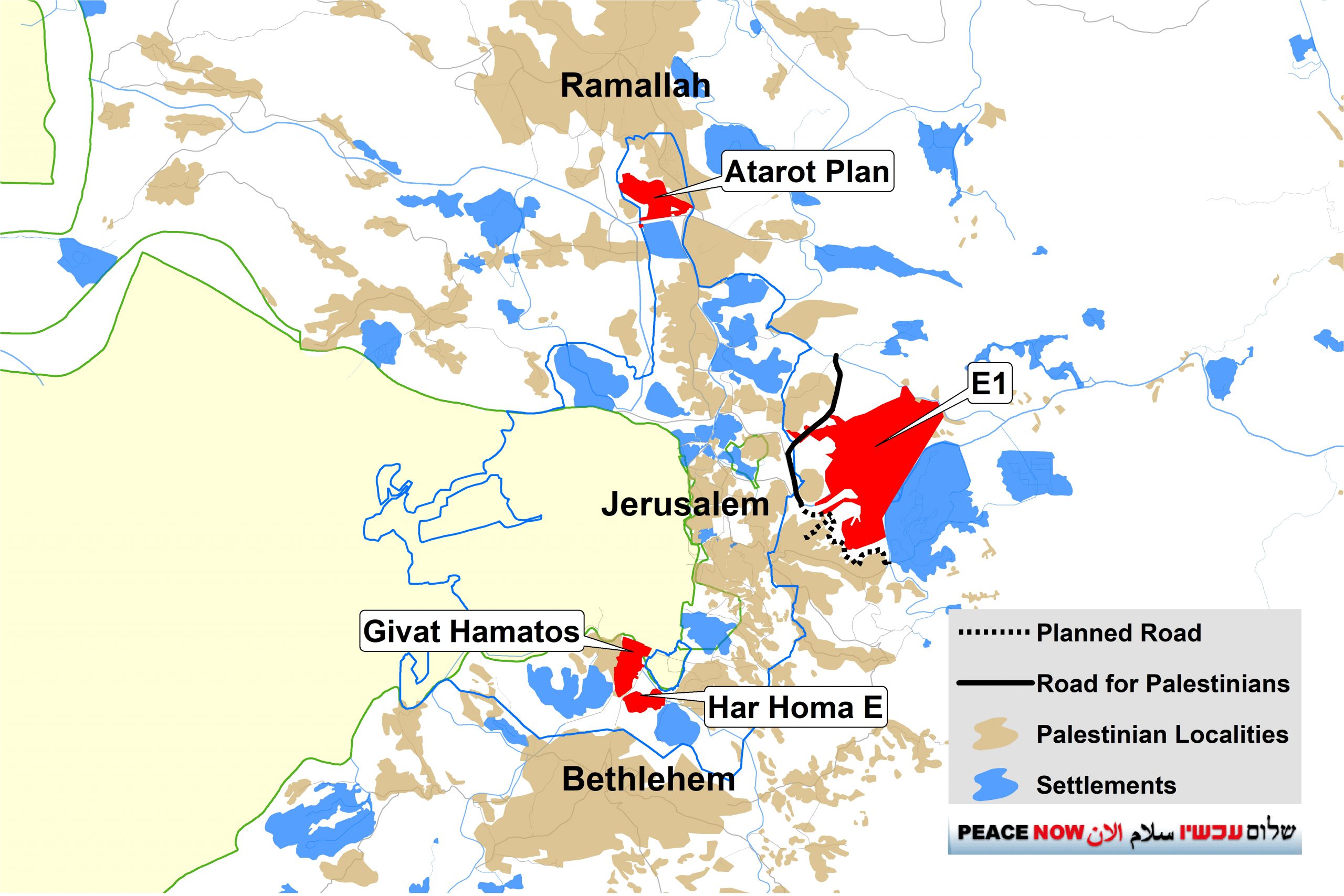
Map by Peace Now
For decades, construction of the E-1 settlement – which is now actively advancing through the planning process – has been adamantly opposed by the international community. A key criticism of that plan is that it would effectively cut the West Bank in half – preventing any two-state solution. The new road has long been Israel’s answer to that criticism, with Israel arguing that it will replace territorial contiguity with limited “transportational continuity” – via a sealed road that is under Israel’s total control. With Minister Bennett’s support and green light, the plan for that road can now be submitted to the Israel Defense Ministry’s High Planning Council for consideration.
If built, a section of the Palestinian-only road is projected to run under the separation barrier (which is not currently built in this area). The rest of the road will run relatively adjacent to the route of the future seperation barrier, in order to prevent Palestinian traffic from coming “near Jewish communities,” in the words of Defense Minister Bennet. This new section of road connects to the infamous “apartheid road” (aka, the Eastern Ring Road) which was opened for Paelstinian traffic in January 2019, and has a high wall dividing Israeli and Palestinian traffic.
In a statement announcing his plan, Bennet gave lip service to the idea that the plan will benefit Palestinians (even as it further cuts them off from Jerusalem, takes more land, and cuts the West Bank in half) while also making clear his real objective:
“[the road] will improve the quality of life for residents in the area, avoid unnecessary friction [for Israelis] with the Palestinian population and most importantly — allow for continued [settlement] construction. We’re applying sovereignty [to the West Bank] in deeds, not in words.”
Peace Now explains the issue with Israel’s design:
“The new road is intended to allow Palestinians to pass under the route of the separation barrier, and to travel ‘inside’ the Adumim Bloc along a wall without entering the ‘Israeli’ side, as in a kind of tunnel. Once the road is paved, Israel can then claim that construction in E1, and the construction of the barrier around the Adumim bloc does not sever the West Bank because the Palestinians have an alternative transport route. This argument is preposterous. A thin line of road connecting separate territorial sections–transportational contiguity–does not meet the needs for territorial viability for the development and livelihoods of Palestinians in the critical Ramallah-Jerusalem-Bethlehem metropolitan area. Without actual territorial contiguity, an independent Palestinian state cannot be established and prosper, and therefore a two-state solution cannot be reached.”
Further, Peace Now said in a statement:
“This is bad news for Israel as it enables annexation toward rendering a two-state solution insoluble. The planned road would allow Israel to cut the West Bank in half, build up E1 and the West Bank barrier, and shut down the possibility of developing a viable Palestinian state.The only roads Israel paved for Palestinians in its 52 years of control over the Territories were designed to allow Israel to build settlements or barriers that block existing Palestinian routes. There is no desire here to improve Palestinian transport, only to expand the settlements.”
Israeli Planning Committee Asks for Changes, More Info on Har Homa & Givat Hamatos Plans
Ir Amim reports that at a March 8th meeting, the Jerusalem Planning and Building Committee asked for several modifications and required that additional surveys be completed before they approve plans for the construction of the Har Homa and Givat Hamatos settlement plans.
Ir Amim explains:
“There is a big gap between Netanyahu’s far reaching declarations regarding ‘the advancement of thousands of housing units in Har Homa and Givat Hamatos’ and the actual result of the discussions at the committee. It is unclear whether this gap is a result of real planning considerations that have to be resolved or is it a sign that despite Netanyahu’s dramatic announcements the Israeli government nevertheless needs to restrain itself. Ir Amim will try to inquire into the issue.
In any case the advancement of the three plans [2 relating to Har Homa, 1 relating to Givat Hamatos] in one of the most sensitive areas of East Jerusalem after years during which the Israeli government refrained from advancing them is a cause for great concern. If constructed, these new settlements will essentially connect the existing Gilo and Har Homa neighborhoods/settlements and create a contiguous Israeli built-up area along the southern perimeter of East Jerusalem. This will serve to detach Bethlehem and the south of the West Bank from East Jerusalem while isolating the Palestinian neighborhood of Beit Safafa. Constituting a long term strategy of Israeli governments, construction of large settlements is employed as a means to fracture the Palestinian space and unilaterally determine the boundaries of Jerusalem to prevent the future establishment of a Palestinian capital in the city.
The fact that the discussion of all three plans ended without a decision to advance any of them is not the norm. But in a few months, the surveys and modifications requested by the committee may be completed and the plans will be discussed again and this time be advanced.
It is important to remember that the Israel Land Authority has also published (on February 24th) a tender for 1,077 housing units in Givat Hamatos A (on the area of TPS 14295). The tender has not yet opened for bidding and this is currently scheduled to happen on May 3rd. This tender is not contingent upon developments of the Givat Hamatos masterplan described above and can open for bids regardless of whether or not the plan is approved. If the tender does open for bids in May leading to future construction this will be a most negative development with a new settlement in one of the most sensitive places in East Jerusalem.”
Palestinian Minor Killed by IDF During Clash Over Settlers Entering Palestinian Land Near Nablus
A 15-year old Palestinian boy was shot and killed by Israeli military forces on March 11th. The forces were deployed to protect a group of Israeli settlers from the nearby Itamar settlement who had entered Palestinian land to “tour” an area which is believed to be the site of an ancient fortress. The site – “Jabal al-Orma” in Arabic and “Tel Aroma” in Hebrew – is located in Area B of the West Bank, which under the Oslo Accords is under Palestinian civil control and Israeli security control.
Two months ago, the Palestinian Municipality responsible for the area designated the site as a tourist destination and began building infrastructure to enhance it. Settler groups accused Palestinians of “taking over” the fortress (reminder: it is located in Area B) and destroying it. The settler “tour group” that instigated the clash had, in fact, established a temporary encampment at the site a day earlier. The next day, 300 Palestinians arrived at the site to protest. The IDF arrived and reportedly began firing tear gas at the protestors. The ensuing clash resulted in the death of the one Palestinian minor, injuries to 16 other Palestinians (2 serious), and a head injury to one of the settlers.
In a joint report on Israel’s use of archeology as a means for dispossession and pretext for annexation, the NGO’s Emek Shaveh and Yesh Din write:
“In addition to the takeover of archaeological sites by official entities via ostensibly legal means, there is also a phenomenon of invasion and illegal takeover of historic sites by settlers. As part of the overall negligence on the part of the Israeli enforcement authorities with regards to the dispossession of Palestinians of their land by Israeli civilians, there is also a clear failure on the part of the authorities to remove invaders, enforce the law and protect Palestinian rights in cases where historic sites have been invaded or taken over. The enforcement failures in these cases endanger the antiquities, because unqualified persons perform work on these sites without plans and building permits and without supervision.”
2019 U.S. State Department Human Rights Report Further Erases Occupation, Denies Palestinian Identity, Affirms Golan Annexation
The U.S. State Department recently published its “2019 Country Reports on Human Rights Practices: Israel, West Bank, and Gaza.”
Building on the significant changes to the structure, tone, and coverage of the 2018 report (text) — which removed the word “occupation” entirely from the report — the 2019 report also:
- Normalizes Israeli control over the Area C of the West Bank, adding new language which reads:
“The government of Israel maintained a West Bank security presence through the Israeli Defense Force (IDF), the Israeli Security Agency, the Israeli National Police, and the Border Guard. Israel maintained effective civilian control of its security forces throughout the West Bank and Gaza. West Bank Palestinian population centers mostly fall into Area A, as defined by the Oslo-era agreements. The PA has formal responsibility for security in Area A, but Israeli security forces (ISF) regularly conducted security operations there, at times without coordinating with the PASF. The PA and Israel maintain joint security control of Area B in the West Bank. Israel retains full security control of Area C and has designated the majority of Area C land as either closed military zones or settlement zoning areas.”
- Ceases to refer to Jerusalem’s Palestinian population as “Palestinians” – instead referring to them as “Arab residents.” This change is consistent with the Trump Administration’s ongoing efforts to de-nationalize the Palestinians people and its attempts to undermine their national claim to Jerusalem.
- Re-affirms the legitimacy of Israel’s annexation of the Golan Heights (which the U.S. officially recognized in March 2019). Whereas the 2018 report included a section entitled, “Israel and the Golan Heights” (alongside a separate section entitled, “West Bank and Gaza”), the 2019 report no longer differentiates between Israel and the Golan Heights at all (as in, the two sections are now entitled, “Israel” and “West Bank and Gaza”).
Reports: U.S. Will OK Annexation “Within Months” Unless Palestinians Negotiate on Basis of Trump Plan (i.e., Palestinians Either Agree to Annexation, or They Get Annexation Anyway)
On March 5th, an Israeli news program quoted a senior White House official suggesting that the United States is prepared to approve Israel’s unilateral annexation of 30% of the West Bank “within months” if the Palestinians do not agree to participate in U.S.-led negotiations over the details of the Trump Plan.
The day before, Senior White House Advisor and Trump Plan architect Jared Kushner reportedly told U.S. Senators during a closed-door briefing that the work of the joint Israeli-American committee mapping will take “several more months,” which would appear to align with the comments and timeline laid out by the anonymous White House source. The source further said:
“Nobody can say we didn’t give the Palestinians an opportunity to return to the negotiating table. If they want to come back and talk we are ready for that and we believe we could improve the plan for them. But if they don’t, we will continue moving ahead without them.”
Kushner’s closed-door briefing members for Congress included a powerpoint presentation, slides of which were subsequently leaked. Notably, Kushner’s presentation appeared to argue that the continual expansion of Israeli settlements is one of two factors that has made peace impossible to obtain to this point (the other being the increasing amount international aid to the Palestinian people).
FMEP President Lara Friedman has a fun Twitter thread commenting on the double-speak in the slides.
Bonus Reads
- “Israeli AG’s objection to ICC jurisdiction in Palestine divorced from reality” (B’Tselem)
- “Another push to make Qalandia Airport a Jewish settlement” (Al-Monitor)
- “‘You Want to Kill Me?’ Totally, He Said. ‘Leftists Are Worse Than the Arabs’: Election Day at a Settlement” (Haaretz)
- “Palestinian villagers ask why company exploiting West Bank quarry isn’t it on UN list” (Middle East Eye)
- “Hebron settlers hold Purim parade while Palestinians locked down for coronavirus” (+972 Magazine)
Welcome to FMEP’s Weekly Settlement Report, covering everything you need to know about Israeli settlement activity this week.
To subscribe to this report, please click here.
February 28, 2020
- Fuel on the Fire: Netanyahu Advances E-1 Settlement Plans
- Making Good On Bibi’s Promise, Israel Issues Tenders for Givat Hamatos Settlement – And Plans for More
- High Planning Council Advances Plans for 1,739 Settlement Units, Including a New Industrial Zone
- Netanyahu Orders 12 Outposts Hooked Up to Israeli Infrastructure, with More to Follow
- Israel is Planning New West Bank Electricity Grid to Serve the Settlements
- Deputy Israeli AG Bemoans “Alarming Accumulation” Of Cases in Which Political Echelon Stops Outpost Evacuations
- Joint U.S.-Israeli Annexation Mapping Team Begin Work in Ariel
- Bonus Reads
Comments or questions – email Kristin McCarthy (kmccarthy@fmep.org).
Fuel on the Fire: Netanyahu Advances E-1 Settlement Plans
On February 26th, the High Planning Council of the Israeli Civil Administration deposited for public review two separate plans (for a combined total of 3,401 units) for the construction of the infamous E-1 settlement. This move sets in motion a 60-day public commenting period, after which the committee can grant final approval for construction. Long called a “doomsday” settlement by supporters of a two-state solution, construction of the E-1 settlement would sever the West Bank effectively in half, foreclosing the possibility of drawing a border between Israel and Palestine in a manner which preserves territorial contiguity between the northern and southern parts of the West Bank. It would likewise consolidate the isolation of Palestinian neighborhoods in East Jerusalem from the West Bank. In combination with the recent advancements on Givat Hamatos and new tenders for Har Homa, Prime Minister Netanyahu’s Greater Jerusalem settlement construction announcements – leading up to the third round of Israeli elections – have crossed red lines (in the eyes of the international community) that Netanyahu didn’t dare cross in the past.
Map by Peace Now
The day before the High Planning Committee’s decision to deposit the plans, Netanyahu announced that he had lifted the freeze on E-1 that his government has imposed since 2012. Though the plans were approved for deposit in 2012, the administrative act of actually depositing the plans (which requires the plans to be published in at least three newspapers to inform the public) never occurred, largely as a result of intense international opposition to E-1. Under the recently released Trump Plan, the area where E-1 is located is slated to become part of Israel, meaning the long-held U.S. opposition to E-1 has transformed into apparent support.
Peace Now explains important context to Netanyahu’s flood of East Jerusalem settlement approvals:
“This move to promote settlement units in E1 should be understood in the context of government actions to promote settlement construction in Givat Hamatos and Har Homa to sever the Bethlehem-Jerusalem continuum, and the early promotion of a plan to turn the decommissioned Atarot Airport into a new Jerusalem settlement that would work toward severing the Ramallah-Jerusalem continuum. With E1 added to the mix, the pattern of severing the East Jerusalem and the West Bank is a clear policy direction of this government. While this announcement may be connected to the upcoming election, Netanyahu should be taken at his word and his comments should not be written off as campaign bluster. Indeed just this week he fulfilled a promise he made the week prior to publish tenders in Givat HaMatos, another area that was seen as a red line by the international community. It is likely that if moving on E1 is not met with deterring action domestically or abroad then it will further encourage settlement activity, seeing as E1 is the most recognized red line on settlement construction. The US, which has traditionally played a large role in deterring activity in E1, will likely not do so now with its current administration. Indeed, the Trump Plan envisions E1 as part of Israel, and allows for Israeli annexation pending coordination with the US and not negotiations with the Palestinians.”
Ir Amim adds:
“Although these advancements have taken place against the backdrop of the upcoming Israeli elections, they should also be seen as an alarm bell in the context of a new reality which has been created with the publication of the US Peace Plan. Carte blanche has essentially been given to Netanyahu and the Israeli government to further carry out unilateral measures in the Jerusalem area with little to no resistance. An acute exemplification of this major shift is the spate of new settlement plans (Atarot, Har Homa E, Givat Hamatos) being advanced over the Green Line in East Jerusalem, and now within the E1 area. After years of restraint due to international opposition, Israel is now set to advance construction in some of the most controversial areas in Jerusalem and along its perimeter. The realization of these plans will serve as an immense obstacle towards the future establishment of a Palestinian capital in the city and the prospect of a negotiated agreement based on a viable two-state framework.”
PLO Executive Committeewoman Hanan Ashrawi said in a statement:
“With the active participation and support of the current US administration, Israel is unilaterally and illegally annexing Palestinian territory and trampling on the Palestinian people’s most basic rights. These announcements are the practical translation of an extremist, ideologically-driven, and dangerous right-wing agenda that trounces Palestinian human rights and threatens to unravel the international order in favor of unilateralism, exceptionalism and political bullying.”
UN Special Coordinator for the Middle East Peace Process, Nikolay Mladenov, said:
“I am very concerned about Israel’s recent announcements regarding the advancement of settlement construction in Giv’at Hamatos and Har Homa, as well as the worrying plans for 3,500 units in the controversial E1 area of the occupied West Bank. All settlements are illegal under international law and remain a substantial obstacle to peace. If the E1 plan were to be implemented, it would sever the connection between northern and southern West Bank, significantly undermining the chances for establishing a viable and contiguous Palestinian state as part of a negotiated two-state solution. I urge the Israeli authorities to refrain from such unilateral actions that fuel instability and further erode the prospects for resuming Palestinian-Israeli negotiations on the basis of relevant UN resolutions, international law and bilateral agreements.”
Making Good On Bibi’s Promise, Israel Issues Tenders for Givat Hamatos Settlement – And Plans for More
As expected, on February 24th the Israeli Lands Authority published a tender for the construction of 1,077 housing units in the Givat Hamatos settlement. Haaretz reports that the tender relates to plans for “state land” and are intended to be sold as part of the the Treasury Ministry’s subsidized housing plan for young Jewish couples. Private companies will invited to bid on the project starting March 5th, with bidding set to close on June 22nd.
In addition to issuing tenders, the Jerusalem District Planning Committee met on February 27th to discuss the possibility of creating a new master plan for Givat Hamatos, in order to allow for more construction in the area. Ir Amim reports that the committee is considering a plan allowing for 6,500 residential units – which nearly doubles the total outlined in the current plan.
Ir Amim writes:
“This is the first time since the late 1990’s that Israel is constructing a new neighborhood/settlement in East Jerusalem. Furthermore, the location of Givat Hamatos means that its consturction will have dire consequences: It will serve to detach Bethlehem and the south of the West Bank from East Jerusalem while isolating the Palestinian neighborhood of Beit Safafa. For several years Netanyahu has abstained from publishing the Givat Hamatos tenders, serving as a source of frustration among rightwing parties. Netanyahu’s announcement therefore constitutes a break in the longstanding restraint. This dramatic change of policy should be seen in the context of his re-election campaign and against the backdrop of the formal release of the US Peace Plan.”
In announcing his support for the construction of the Givat Hamatos settlement last week, Netanyahu also mentioned plans to build 1,000 new homes for Palestinian residents of Beit Safafa – an East Jerusalem neighborhood which will be completely encircled by Israeli construction if/when the Givat Hamatos and Har Homa West settlement plans are implemented. According to Haaretz, the plan was/is to build 1,000 units on “Arab-owned” land — and that plan, in fact, is frozen.
In reaction to the tender for construction of the Givat Hamatos settlement, European Union High Representative Josep Borrell said in a statement:
“The Israeli authorities have announced an imminent decision regarding settlement construction in the Givat Hamatos and Har Homa neighbourhoods in East Jerusalem. Such steps would be deeply detrimental to a two-state-solution. As set out clearly on numerous occasions by the European Union, including in Council conclusions, such steps would cut the geographic and territorial contiguity between Jerusalem and Bethlehem, isolate Palestinian communities living in these areas, and threaten the viability of a two-state solution, with Jerusalem as capital of both states. Settlements are illegal under international law. The EU will not recognise any changes to the pre-1967 borders, including with regard to Jerusalem, other than those agreed by the parties. We call on Israel to reconsider these plans.”
High Planning Council Advances Plans for 1,739 Settlement Units, Including a New Industrial Zone
On February 27th, the High Planning Council – a body within the Israeli Civil Administration responsible for regulating all construction in the West Bank – approved the advancement of plans for 1,739 settlement units in the West Bank. These advancements come on the heels of the publication of tenders to build the E-1 settlement , the initiation of plans to massively expand the Har Homa settlement, and the recommitment of Israel to build a new massive new settlement in East Jerusalem, at the site of the disused Atarot airport. All of these plans deal with construction on the edges of Jerusalem and serve collectively to sever the connection between Palestinian neighborhoods of East Jerusalem and the West Bank (consolidating Israel’s uncontested sovereignty over “Greater Jerusalem”).
Of the total, 703 units received final approval, including:
- Plans to grant retroactive legalization to 620 units in the Eli settlement, a move which had been frozen by the High Court of Justice for the past 5 years while the Court considered a petition filed by Palestinians (with the assistance of Yesh Din and Bimkom) claiming to own the land. Last week, the High Court ruled against the Pallestinian petition and removed the injunction against the plans. The Eli settlement is located south of Nablus and southeast of the Ariel settlement in the central West Bank
- 48 units in the Har Bracha settlement, located just south of Nablus
- 35 units in the Givat Ze’ev settlement, located south west of Ramallah (north of Jerusalem).
Of the total, 1,036 units were approved for deposit for public review, including:
- A new industrial zone – called “Shaar Hashomron” – to be located south of the Palestinian village of Qalqilya (a town which is literally surrounded on three sides by the Israeli separation barrier – which in this area is, indeed, a massive wall). Peace Now reports: “[the new industrial zone is] close to Green Line, east of Salfit and South of Qalqilya, near the planned Nahal Rabah cemetery. In the area of Nahal Rabah, there existed a firing zone for years that prevented the use of the land. The land’s designation as a firing zone was lifted a few years ago, and the government’s Blue Line team set new boundaries for the state lands that comprised this area, all in preparation for a plan to build a new industrial zone. Industrial zones are a type of settlement in of themselves, and the planned cemetery is likely to be the first component toward establishing the new industrial zone. The plan for this new industrial park is separate from the 1,739 housing units advanced in the HPC announcement.”
- A winery in the Kiryat Arba settlement, located on the border of Hebron.
- 534 units in the Shvut Rachel settlement, located near the Shilo settlement in the central West Bank. Shvut Rachel only recently became an authorized settlement area when Israel extended the jurisdiction of the Shiloh settlement to include it as a “neighborhood” (along with three other outposts).
- Two plans for a total of 156 units in the Tzofim settlement, located just north of the Palestinian village of Qalqilya, a town completely encircled by Israel’s seperation barrier (except for a single road connecting it to the rest of the West Bank) – in the northern West Bank.
- 110 units in the Alon Shvut settlement, located south west of Bethlehem.
- 106 units in the Ma’aleh Shomron settlement, located east of the Palestinian village of Qalqilya.
- 105 units in Kfar Eldad (formally a part of the Nokdim settlement), located south of Bethlehem.
- 24 units in the Karnei Shomron settlement, located in the northern West Bank east of the Palestinian village of Qalqilya. Israel is planning to continue expanding Karnei Shomron with the stated goal of bringing 1 million settlers to live in the area surrounding the settlement.
The Times of Israel notes that this is the second time the High Planning Council has convened in as many months, marking an uptick in the frequency of such meetings, which until now have taken place quarterly (4x/year) since the Trump Administration came into power.
Peace Now said in a statement:
“The caretaker government, without a public and moral mandate, sets facts on the ground for a small and extreme minority, against the will of the majority. In the battle over the settler right-wing vote, Bennett and Netanyahu are dragging Israel to invest in thousands of harmful and unnecessary settlement units. This is how a cynical and irresponsible leadership that is willing to abandon the Israeli interest for its political survival behaves.”
Netanyahu Orders 12 Outposts Hooked Up to Israeli Infrastructure, with More to Follow
On February 23rd, Prime Minister Netanyahu announced that he had ordered 12 unauthorized outposts to be connected to Israeli infrastructure, and that his government was working to formally legalize over 100 outposts. Connecting outposts to Israeli water, sewer, power, garbage collection, and other municipal services entrenches the permanence of these outposts and furthers the de facto annexation of Palestinian land. It also copiously rewarding settlers for breaking Israeli law (by illegally building outposts), incentivizing further lawbreaking by Israel’s most radical and ideological settlers. 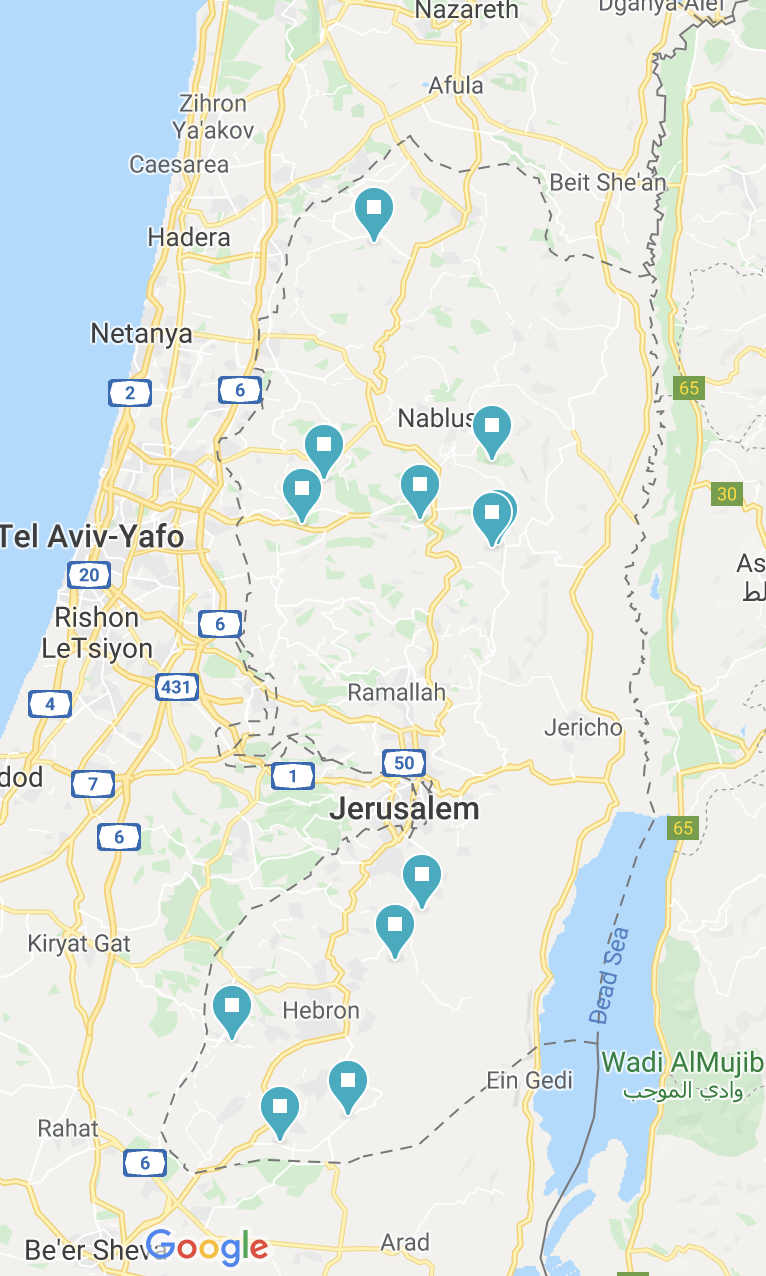
According to a letter from Netanyahu’s office, the 12 unauthorized outposts that will be connected to Israeli infrastructure were all built with “government encouragement” (though not formal approval or permits). In a perversion of the very notion of the “rule of law,” this unofficial encouragement for illegal actions is now treated by Israel as a valid legal basis for granting those outposts authorization.
The outposts slated for connection to Israeli municipal services are:
- The Nofei Nehemia outpost, located east of the Ariel settlement in the heart of the West Bank.
- The Havot Yair (Yair Farm) outpost, located west of Nablus.
- An outpost called “Hill 851”, located south east of Nablus in the central West Bank.
- The Maoz Zvi outpost, located in the northern West Bank.
- The Shaharit outpost, located in a string of settlements stretching from Israel proper to the Ariel settlement in the central West Bank, and going on to the Jordan Valley.
- The Pnei Kedem Farm outpost, located halfway between Bethlehem and Hebron in the southern West Bank.
- The Tekoa D outpost, located southeast of Bethlehem.
- The Negohot Farm outpost, located west of Hebron.
- The Avigayil outpost, located in the South Hebron Hills near the village of Susya.
- The Asa’el outpost, located east of the Palestinian village of Susiya in the southern tip of the West Bank.
- The Esh Kodesh outpost, located east of the Ariel and Shilo settlements, in a string of settlements stretching to the Jordan Valley.
- Ahiya, located in the Shilo Valley in the central West Bank.
David Elhayani, head of the umbrella settlement body called the Yesha Council, cheered Netanyahu’s announcement, saying:
“This is an important step for the benefit of young communities that have been suffering from electricity problems for years, and will now be able to receive electricity, just like any other citizen in the country.”
Since the passage of the Regulation Law in February 2017 and the invention of the “market regulation” principle by the Israeli Attorney General, the Netanyahu government has undertaken an energetic effort to grant retroactive legalization to outposts for which the Israeli government has not yet found a means to grant retroactive approval (though it has tried). The obstacle in all of these cases has been the fact that the outposts were built on privately owned Palestinian land. Following passage of the Regulation Law, Netanyahu immediately formed a committee tasked with finding a way to suspend the property rights of Palestinians; that committee produced the Zandberg Report in May 2018 — a report that, indeed, offers several justifications for the government to expropriate privately owned Palestinian land (one of the Report’s recommendations is to connect the outposts to Israeli municipal services). Following the publication of the Zandberg report, Netanyahu formed another committee tasked with implementing the report’s recommendations, by preparing individualized plans for each outpost to gain retroactive legalization. That taskforce, headed by notorious settler Pinchas Wallerstein. helped secure Cabinet approval for another bill to grant authorization to 66 outposts. All but two of the outposts named by Netanyahu this week (Hill 851 & Negohot) were part of a December 2018 bill to regulate 66 outposts – a fact that has drawn the wrath of settler leaders who bemoan Netanyahu’s delayed implementation.
FMEP tracks all events related to Israeli annexation and the drive to authorize outposts in its regularly updated Annexation Policy Tables.
Israel is Planning New West Bank Electricity Grid to Serve the Settlements
Haaretz reports that the Israeli government is close to approving a Master Plan for a new electricity grid in the West Bank, which will service Israel’s settlements. It may also serve Palestinian villages but only if — and it is a big if — the Palestinian Authority agrees to jointly implement the project. The plan is in the hands of Israel’s National Infrastructure, Energy and Water Ministry, which seeks to “provide a blueprint for the electricity market in the West Bank through 2040 and to develop infrastructure for Israeli settlements as well as for the Palestinians residing there.” However, the Israel-conceived plan calls upon the the Palestinian Authority to take responsibility over the Palestinian side of the equation, and the PA has refused to play that role and has condemned the plan.
In a statement, the Palestinian Authority’s Energy Authority said that the plan is designed:
“to establish Israeli sovereignty in the West Bank and to support the brutal presence of the settlements on our land.”
Settler leaders concurred with the PA’s assessment. Gush Etzion Regional Council chairman Shlomo Ne’eman told Haaretz:
“All moves point to sovereignty, and when we build infrastructure, there is also a basic understanding that the State of Israel is the sovereign. We are pleased that more and more government ministries have realized that this sovereignty is the reality.”
The plan, as reported by Haaretz, would see the Israeli Electric Company build a vast network of power lines across the West Bank. Israel will build six substations in Area C of the West Bank to distribute the high voltage power to settlements. Palestinians, if they are willing, are called upone to build eight substations in order to distribute power to Palestinian homes. The project is expected to cost between $870 million to $1.2 billion. The integration of settlements into Israel’s domestic planning schemes and the construction of massive infrastructure in the West Bank to service the settlements are significant advancements in Israel’s ongoing, de facto annexation of land in the West Bank.
Deputy Israeli AG Bemoans “Alarming Accumulation” Of Cases in Which Political Echelon Stops Outpost Evacuations
Haaretz reports that the Israeli Civil Administration planned to evacuate the unauthorized Mitzpe Yehuda outpost, located east of Jerusalem, in September 2019, but was directed to cancel the evacuation by one of Netanyahu’s personal aids in the Defense Ministry – Avi Roeh. The political interference was revealed in a High Court case filed by Palestinians claiming to own the land upon which the outpost was illegally constructed. The Palestinians are seeking to have the outpost immediately evacuated. Settlers claim to have purchased the land, and even submitted an application to have the outpost retroactively legalized by the government.
At the time of the scandal, Deputy Attorney General Erez Kaminitz wrote to Ronen Peretz, acting director of the Prime Minister’s Office, criticizing Roeh’s role in the Mitzpe Yehuda case, as well as the recurrence of political interference on behalf of the outposts. Citing several cases in which such interference occurred (Sde Ephraim, Givat Assaf, and Havat Negohot), Kaminitz wrote:
“This is a very alarming accumulation of cases that raises the specter of the emergence of a highly problematic trend that undermines the rule of law. It’s important to make clear that, as a rule, the political echelon is not authorized to intervene in decisions related to law enforcement.
Joint U.S.-Israeli Annexation Mapping Team Begin Work in Ariel
On February 24th, members of the U.S.-Israeli team tasked with mapping Israel’s annexation of West Bank land under the Trump Plan met for the first time to “explore the terrain.” At a vista near the Ariel settlement, Netanyahu underscored the significance of the project:
“The joint mapping process of the Israeli team and the American team is underway here in Ariel. This is a major mission. The area has an 800-km. perimeter. There is serious work, but we will work as quickly as possible to get it done…[the mapping process will] allow for the application of Israeli law [sovereignty] on these areas and later American recognition as well…[once complete] sovereignty can happen immediately.”
U.S. Ambassador David Friedman said:
“In Israel rain is a blessing, and I hope that our efforts should be blessed as much as the rain is coming down right now,” Friedman declared before the meeting started, the US Embassy in Jerusalem said in a statement. “We have our team here, and we’re going to get to work right away. We hope to complete it as soon as possible, and complete it the right way for the State of Israel.”
Ariel Mayor Eli Shaviro – one of the few settler leaders who publicly supports the Trump Plan – praised the mapping team, saying:
“The sovereignty ship is under way. As I have said in the past, I believe that the prime minister will advance the ‘Deal of the Century’ with President Trump and US officials. believe that the application of Israeli law in the Jordan Valley and in the communities of Judea and Samaria is closer than ever.”
Shaviro recently resigned from the settler Yesha Council over the group’s disavowal of the Trump Plan.
Bonus Reads + Resources
- “An Alternative Guide to City of David Archeological Park” (Emek Shaveh)
- “The Trump plan threatens the status quo at al-Haram al-Sharif” (Al Jazeera)
- “50 ex-European leaders and FMs condemn Trump plan, cite apartheid similarities” (The Times of Israel)
- “Planned Western Wall Train Will Threaten Historic Jerusalem Spring, Report Says” (Haaretz)
- “The Israelis fighting to keep the Jordan Valley Palestinian” (Al-Monitor)
Welcome to FMEP’s Weekly Settlement Report, covering everything you need to know about Israeli settlement activity this week.
To subscribe to this report, please click here.
December 20, 2019
- Israeli Court Rules Sumreen Family Can Temporarily Temporarily Stay in East Jerusalem Home
- Judge Reopens Case Over Sale of Church Properties in Jerusalem’s Old City of to Settler Organizations
- Vying for Likud Leadership, Gideon Sa’ar Pressures Netanyahu on E-1 Settlement, Area C Annexation, and Evacuation of Khan al-Ahmar
- Visiting Harvard, Former Jerusalem Mayor Promotes Settler-Palestinian Business Projects
- UN: Since passage of UNSCR 2334 Three Years Ago, Israel Has Continuously Expanded Settlements
- In First, Delegation of UN Ambassadors Tour Israeli Settlements, Praise Settlement Industrial Zones
- Pompeo Slaps Back After Members of Congress Send Letter Objecting to Shift in U.S. Settlements Policy
- Bonus Reads
Questions/comments? Contact Kristin at kmccarthy@fmep.org
Israeli Court Rules Sumreen Family Can Temporarily Temporarily Stay in East Jerusalem Home
The Jerusalem District Court has ruled that the Sumreen family is permitted to remain in their East Jerusalem home as the court considers the family’s appeal against a lower court ruling that granted ownership of their home to the Jewish National Fund, which has worked in concert with the radical settler group Elad to gain control of the property.
The Sumreen family has been forced into the battle over its legal ownership of the home after the state of Israel, prompted repeatedly by the JNF, declared the Sumreen’s home to be “absentee” property. After that designation – which was not communicated to the Sumreen family – Israeli law permitted the state to take over the rights to the building. The state then sold the rights to the home – located in the Silwan neighborhood of East Jerusalem – to the JNF in 1991. The Jewish National Fund has pursued the eviction of the 18-member Sumreen family since then. Israeli courts ruled in favor of the Sumreen family’s ownership claims to the home for years, until a September 2019 ruling by the Jerusalem Magistrate’s Court granted ownership of the family’s home to the JNF, a decision the family immediately appealed to the Jerusalem District Court.
A full history of the saga involving the Sumreen family – which is similar to dozens of other Paelstinian homes in Silwan that were declared Absentee Property in the 1990s – can be found on the Peace Now website here.
Judge Reopens Case Over Sale of Church Properties in Jerusalem’s Old City of to Settler Organizations
On November 28th, the Jerusalem District Court ruled to reopen a high profile case which previously awarded the radical settler group Ateret Cohanim ownership rights to three historic church properties in the Old City of Jerusalem. The court made the decision because shell companies involved in the real estate transaction failed to respond to a court requests. Jerusalem District Judge Tamar Bar-Asher also ordered Ateret Cohanim to pay the church $14,400 (NIS 50,000) to cover legal expenses.
In June 2019, the High Court ruled in favor of Ateret Cohanim’s ownership claims to the three buildings. That ruling was promptly challenged by the Greek Patriarchate, which claimed to have new evidence showing Ateret Cohanim’s forgery of key documents and its payment of bribes to obtain the property. The original Jerusalem District Court ruling acknowledged that there were problems in the transaction, but found that the church failed to prove its allegations of bribery and corruption.
The legal battle over the properties dates back to 2004, when the Greek Orthodox Patriarchate agreed to sell the three properties to a foreign real estate company under three separate contracts. It did so not knowing that the radical settler group Ateret Cohanim was behind the transaction. News of the sales made headlines in early 2005.
Upon the revelation that Ateret Cohanim was the real buyer, the Greek Orthodox Patriarchate was deeply embarrassed and immediately sought to retain control of the properties. The Patriarchate alleged that the transactions involved corruption and bribery, arguing that the legal documents had been signed without permission by a finance employee. Dismissing the church’s arguments, this week the Supreme Court upheld prior rulings that the signatures on the lease documents were valid, with the finance employee acting as a legal proxy of the Patriarchate.
The Greek Orthodox Church has received significant blowback from the sale of these properties. In January 2018, Palestinians protested in Bethlehem in an attempt to block the arrival of Patriarch Theophilos III for Christmas celebrations.
Vying for Likud Leadership, Gideon Sa’ar Pressures Netanyahu on E-1 Settlement, Area C Annexation, and Evacuation of Khan al-Ahmar
On December 10th, Gideon Sa’ar launched his campaign to challenge Netanyahu as the head of the Likud party by touring the E-1 settlement site on the outskirts of Jerusalem. With press following his every move, Sa’ar promised to build E-1, implement Israeli sovereignty over Area C, and evict the bedouin residents of the village of Khan al-Ahmar, located in the shadow of the E-1 site. All three of his promises are key longrunning asks of the powerful settler movement, which has been a pillar of support for Netanyahu despite its displeasure with Netanyahu’s delay in delivering on those specific promises.
In a swipe at Netanyahu, Sa’ar said:
“The struggle for E-1 is a struggle for the heart of Israel,” Sa’ar said. “Netanyahu out of all people, who built the Har Homa neighborhood [in Jerusalem] despite international pressure, should be building here. The rule for Har Homa should be the rule for E-1 and Givat Hamatos [in Jerusalem].” And, “In Khan al-Ahmar, as in the rest of Area C, the question is simple. Who is in control – Israel, or the Palestinian Authority, which is using aide from the European Union to create facts on the ground? The Supreme Court has rejected appeals against [Khan al-Akhmar’s] demolition four times.The future of Judea and Samaria will be determined by actions, not words. Evacuate Khan al-Akhmar immediately. A solution needs to be found for the residents, but you have to understand that the issue here is not just about the residents, the question is who is the sovereign here and what will be the future of Area C as a whole, and here we need to take clear, continuous action.”
The E-1 settlement plan still needs to receive final approval from the Israeli High Planning Committee, the body of the Civil Administration which regulates all construction in the West Bank. The plan has been approved for public deposit, but until this juncture Netanyahu has kept his finger off the trigger – keeping the plan from being deposited.
A week after his E-1/Khan al-Ahmar tour, Sa’ar launched a second attack on Netanyahu’s failure to deliver on major Jerusalem-area settler demands. Touring the Givat Hamatos settlement site in East Jerusalem, Sa’ar said:
“The future of Jerusalem will be decided through actions, not words…this location has strategic significance…Construction here will damage the territorial contiguity that the Palestinians are striving for and will be a barrier to the establishment of a Palestinian state. That is why there is also diplomatic pressure, European mainly, to prevent construction for Jews here….The demographic balance between the Jewish majority and Arab minority over the last decade has changed for the worse.”
The Givat Hamatos settlement has been approved but not constructed. Sa’ar’s assertion of the strategic significance of Givat Hamatos is correct; located in the southern part of East Jerusalem, Givat Hamatos has long been called a doomsday settlement by parties interested in preserving the possibility of a two-state solution. If Givat Hamatos is built, the Palestinian neighborhood of Beit Safafa in East Jerusalem will be completely surrounded by Israeli construction, severing its connection to the West Bank.
if built the settlement will severe any territorial connection between the Palestinian East Jerusalem neighborhood and the West Bank – leaving the neighborhood completely encircled by Israeli construction. Terrestrial Jerusalem’s Danny Seidemann writes:
“In short, Givat Hamatos is not just another detrimental settlement; it is a game-changer. While it is a smaller project, its implications are no less problematic than those of E-1 – something very much recognized by the Palestinians. The key difference is this: while global opposition has been rallied against E-1, far less attention and opposition has been devoted to Givat Hamatos. Most importantly, with E-1 there is a tripwire. Should Netanyahu decide to proceed on E-1, there will be up to a year to stop him. With Givat Hamatos there will be no warning, and the damage will be mostly immediate.”
Seidemann speculates that Netanyahu, under an ever-increasing amount of pressure both politically and personally, specifically increasingly likely to move forward with settlement plans for the E-1 settlement and forcibly evacuating the Khan al-Ahmar bedouin village.
Seidemann writes:
“Netanyahu is fighting for his political life and is determined to avoid criminal prosecution and prison time. There is very little he will not do in order to remain Prime Minister under indictment. His failure to approve E-1 and to evacuate Khan al Ahmar has become a rallying point for the settler right, with periodic advertisements appearing in the right wing press calling on him to implement both. The fact that he has refrained thus far from carrying out both these schemes is testimony to the impact that EU engagement on these issues. Sensing Netanyahu’s vulnerability, Sa’ar is attempting to use E-1 and Khan al Ahmar to embarrass and pressure the Prime Minister, and to shift votes to himself. Under circumstances like these, Netanyahu may find the price of ignoring Sa’ar’s pressure to be greater than the anticipated harsh EU response.”
Visiting Harvard, Former Jerusalem Mayor Promotes Settler-Palestinian Business Projects
Likud MK and former Jerusalem mayor Nir Barkat recently lectured at Harvard Business School, a platform he used to promote “economic peace” schemes that normalize settlements in the name of boosting the West Bank economy. Arutz Sheva, the settler-run media outlet, reports that Barkat’s speech included a push for joint economic projects between Israelis living in the West Bank (settlers) and Palestinians. Arutz Sheva writes:
“He [Barkat] further advanced his vision for increased economic cooperation with the Palestinian workforce via a plan to develop increased ‘industrial clusters’ throughout Judea and Samaria along the lines of those which already exist in places like Barkan and Mishor Adumim.”
Barkat’s language aligns with the work of the Judea and Samaria Chamber of Commerce – an Orwellian-named business scheme FMEP has tracked from its emergence – and the growing attention to and support for its work in U.S. Congress.
Barkat has enjoyed a close relationship with Harvard Business School professor Michael Porter for years, and has spoken at Harvard at Porter’s invitation at least once before.
UN: Since passage of UNSCR 2334 Three Years Ago, Israel Has Continuously Expanded Settlements
Nearing the three-year anniversary of the passage of UNSCR 2334 condemning Israel’s settlement activities, U.N. Secretary-General Antonio Guterres and U.N. Mideast envoy Nickolay Mladenov told the Security Council that Israel has not ceased the expansion of settlements. They reported that since passage of UNSCR 2334, Israel has approved plans for 22,000 new settlement units and have issued 8,000 tenders for settlement construction.
U.N. Secretary-General Antonio Guterres said:
“The existence and expansion of settlements fuel resentment and hopelessness among the Palestinian population and significantly heighten Israeli-Palestinian tensions. In addition, they continue to undermine the prospects for ending the (Israeli) occupation and achieving the two-state solution by systematically eroding the possibility of establishing a contiguous and viable Palestinian state.”
In First, Delegation of UN Ambassadors Tour Israeli Settlements, Praise Settlement Industrial Zones
At the invitation of Israeli Ambassador to the UN Danny Danon, twenty-three ambassadors to the UN participated in a delegation to Israeli settlements in the northern West Bank, marking the first time a UN delegation has taken an official delegation to the settlements. Participants included UN ambassadors from Poland, Romania, the Czech Republic, Ukraine, Guatemala, and Haiti.
The tour included a stop at Barkan settlement industrial zone, which appears to have won support from at least one UN Ambassador for economic peace schemes that, in the name of coexistence and prosperity, entrench the occupation and exploitation of Palestinian workers and their economy.
The Ambassador from Bosnia, Sven Alkala, said:
“We have seen Arab and Israeli coexistence in factories and we think this is a very important project. By buying these products, we can give peace a real chance.”
As FMEP has previously explained, for decades Israel has used industrial zones as another tool to expand and deepen control over West Bank land and natural resources. Industrial zones perpetuate Israel’s economic exploitation of occupied territory (including the local workforce, land, and other natural resources), and that it is Orwellian to label such initiatives as “coexistence” programs, or to suggest that they offer the Palestinians benefits they should welcome. Importantly, jobs in industrial zones – often the only jobs available for Palestinians living under an Israeli occupation that prevents the development of any normal Palestinian economy – are widely viewed by Palestinians as a double-edged sword. The Israeli group Who Profits recently explained:
“Israeli Industrial Zones constitute a foundational pillar of the economy of the occupation. They contribute to the economic development of the settlements, which are in violation of international law and the Fourth Geneva Convention, while relying on the de-development of the Palestinian economy and the exploitation of Palestinian land and labor…The Industrial Zones in the oPt form part of a practice of ‘financial annexation’ which is an essential component of the broader policy of annexation taking place.”
Pompeo Slaps Back After Members of Congress Send Letter Objecting to Shift in U.S. Settlements Policy
U.S. Secretary of State Mike Pompeo responded to criticisms against the Trump Administration’s settlement policy announcement launched by a group of 106 Congressional Democrats, calling the positions they were defending “foolish.” The Democratic letter to Secretary Pompeo, rather than making the case for a principled stance against Israeli settlement activity, focused on the suggestion that the Trump administration is out of step with bipartisan U.S. policy on settlements, as well as the fact that settlements run afoul of international law.
Responding to the signers of the letter, Pompeo (unsurprisingly) disagreed with both assertions. He went on to use the Democrats’ arguments as a springboard for writing his own largely ahistorical version of the history of U.S. settlements policy, and for re-hashing a number of highly creative arguments challenging the view that settlements are illegal — arguments formulated and promulgated by a handful of ideological legal experts who have for decades defended all Israeli activities related to the occupation.
Praising Sec. Pompeo’s letter, U.S. Ambassador to Israel David Friedman succinctly summarized Pompeo’s letter, saying:
“In his response to the 106 congressmen, Secretary Pompeo lays to rest the criticism that the Administration’s determination with regard to Israeli settlements was contrary to law or inconsistent with bipartisan policy. Indeed, the administration’s decision, in reversing secretary Kerry’s unfortunate statement in support of UNSCR 2334, restores the United States to its historic and appropriate role in mediating the conflict between Israelis and Palestinians.”
Bonus Reads
- “Expansion of Nof Zion in the heart of Jabal Mukkaber” (Terrestrial Jerusalem)
- “Renewed effort to advance Atarot settlement” (Terrestrial Jerusalem)
- “Palestinians plan legal steps to stop new Hebron settlement” (Al Monitor)
- “Despite Court Order, Israeli Army Denies Palestinian Landowners Access to Evacuated Settlement Site” (Haaretz)
- “Fearing Investigation, Israel Says Hague Has No Jurisdiction in West Bank or Gaza” (Haaretz)
- “High Court: Israel Police Handling of Palestinian Complaint ‘Troubling, to Say the Least’” (Haaretz)
- “France to support Palestinian agriculture in West Bank areas under Israeli control” (Al-Monitor)
- “UN: Israel has advanced 22,000 housing units in West Bank” (AP)
- “Bennett, the Battle for Judea Has Been Decided” (Haaretz)
- “Local settlers despair as Hilltop Youth moves in” (Ynet)
Welcome to FMEP’s Weekly Settlement Report, covering everything you need to know about Israeli settlement activity this week.
To subscribe to this report, please click here.
March 1, 2019
- As Elections Approach, Here’s Two Settlement Plans Bibi Might Advance to Win Votes/Deflect Pressure
- Palestinians March in Hebron on Anniversary of Goldstein Massacre
- U.S. Charities Are Financing Radical, Violent Hilltop Youth Settler Movement
- Bonus Reads
Questions/comments? Email kmccarthy@fmep.org
As Elections Approach, Here’s Two Settlement Plans Bibi Might Advance to Win Votes/Deflect Pressure
Terrestrial Jerusalem published a comprehensive analysis of how Jerusalem-related issues, including settlement plans, could become a factor in the current Israeli elections campaign. Danny Seidemann writes:
“On the eve of Israel’s national elections and the possible launching of Trump’s so-called ‘peace plan,’ concerns raised in January 2017 regarding the most sensitive and ambitious settlement and settlement-related projects are more relevant than ever…the common denominator to the issues on which we [Terrestrial Jerusalem] are focusing below is this: each is something of a banner under which the ideological right has decided to march. As a result, there is no doubt that these issues will figure prominently in election rhetoric, towards the goal of forcing an already susceptible Netanyahu’s hand.”
Seidemann goes on to lay out likely actions Netanyahu might take, including action on two specific settlement plans:
-
“E-1: E-1 is a settlement planned for an area on East Jerusalem’s northeastern flank (beyond the city’s municipal borders), designed to cement a contiguous block of settlements stretching from Maale Adumim to the city’s east, through Neve Yaacov and Pisgat Zeev to the north, and extending to Givat Zeev, to the northwest (download map here).We have described in several reports the dire threat the implementation of E-1 would cause to the two-state solution, primarily by dismembering a potential future Palestinian state into two non-contiguous cantons and sealing off East Jerusalem from its environs in the West Bank…implementation of E-1 today still depends solely on Netanyahu giving the green light for the publication of the plans. Once he does, the clock will start ticking toward construction; assuming Netanyahu and his government obey normal planning rules, this clock will run for up to a year — between the resumption of planning and the publication of tenders for construction. Once the green light is given, it will be very difficult (but not impossible) to prevent the publication of tenders.”
-
“Givat Hamatos: As we explained in our January 2017 analysis, plans for construction in Givat Hamatos have been fully approved, but tenders have not yet been published: tenders for the construction of up to 1500 of the 4500 units could be published literally at any time, based on the whim of Netanyahu. As elections approach, the chances that Netanyahu will give the order to publish these tenders rises exponentially — and the significance of him doing so cannot be overstated. In planning terms, the publication of tenders is a Rubicon that, once crossed, is a point of no return, since at that point, third-party rights (purchasers) become involved. In short, the publication of tenders, effectively, would make the construction of Givat Hamatos a virtual certainty. While E-1 is larger in scope and has greater notoriety than Givat Hamatos, the danger posed by the latter is in some respects greater. Assuming Netanyahu and his government follow normal planning rules on E-1, any decision he takes on E-1 will in effect by a trip-wire that will give the world as long as a year in which to engage to try to prevent actual construction. With respect to Givat Hamatos, a move by Netanyahu won’t be a trip-wire, but rather the beginning of a series of detonations that cannot be stopped.”
Palestinians March in Hebron on Anniversary of Goldstein Massacre
On February 22nd, hundreds of Palestinians and international activists led a march towards Shuhada Street in downtown Hebron to commemorate the 29 victims of Israeli-American settler Baruch Goldstein, who opened fire on worshippers in the Ibrahimi Mosque/Tomb of the Patriarch 25 years ago. The march was also a protest against Israel’s policy of segregation (a word that fails to capture the damage done to the fabric of Palestinian life in the heart of Hebron) that was implemented following the massacre. +972 Mag reports:
“…protestors marched toward Checkpoint 56, which separates the part of the city governed by the Palestinian Authority from the Israeli-controlled area. They carried signs calling for the return of the Temporary International Presence in Hebron (TIPH) – the only observer group in the city with an official international mandate. In late January, Israeli Prime Minister Benjamin Netanyahu decided not to renew the group’s mandate, effectively expelling the observers from the city after 22 years of monitoring the human rights situation there…Israeli soldiers were stationed along the route of the protest, on the side of the city allegedly controlled by the PA, already before the protest began. When the crowd of demonstrators approached Checkpoint 56, soldiers pushed them back. At another checkpoint, close to the Tel Rumeida area, soldiers fired tear gas, stun grenades and rubber bullets at a group of protestors who were hurling stones – against the organizers’ request to keep the protest peaceful. Soldiers also fired stun grenades at a group of journalists.”
U.S. Charities Are Financing Radical, Violent Hilltop Youth Settler Movement
An investigation has revealed that a U.S. charity, The Charity of Light Fund, is the U.S. arm of an Israeli organization called Chasdei Meir that funds the radical and violent Hilltop Youth settler movement. Journalist Mairav Zonszein explains that Chasdei Meir, which is not registered as a tax exempt organization in Israel, recently issued a donation receipt thanking the donor (who made the donation in order to glean more information about the group’s operations) for “helping keep the residents of the outposts in Judea and Samaria warm.” Zonszein goes on to report:
“According to the Israeli outlet Ynet, Chasdei Meir has been linked to the coordination in 2011 of settler violence against Palestinians known as ‘price tag’ attacks, as well as financing settler youth who inhabit illegal settlement outposts and plant trees there as a way of claiming ownership over the land.”
Zonszein’s report lays out how Chasdei Meir and the Charity of Light Fund are part of a larger network of shadowy groups and figures that have found ways to direct U.S. tax-deductible donations to the settlement enterprise as well as groups that ascribe to the racist, nationalist ideology of Meir Kahane and the political party he founded, Kach. The Kach party, which is on the U.S. list of terrorist organizations, recently joined forces with Prime Minister Netanyahu, who brokered a political marriage between the Otzma Yehudit (“Jewish Power”) party, which is the current incarnation of the Kach party, and the Jewish Home party, in the hopes of winning sufficient votes to form a coalition that will keep him in power.
Bonus Reads
-
“A Violent Gang of Young Settlers Haunts Palestinians” (Haaretz)
-
“Under Occupation, Water is a Luxury” (Haaretz)
-
“Israel’s Termination of the Temporary International Presence in Hebron” (Al-Shabaka)
Welcome to FMEP’s Weekly Settlement Report, covering everything you need to know about Israeli settlement activity this week.
To subscribe to this report, please click here.
January 11, 2019
- Israel Opens “Apartheid Road” – Divided Road Eases Settlers’ Access to Jerusalem, Routes Palestinians Around the City, Significant Step Towards Advancing E-1 Settlement Construction
- Israeli Businessman Opens Huge Mall in East Jerusalem Settlement Industrial Zone
- In Parting Gift to Settlers, Housing Minister Greenlights Construction of New Settlement Units for Outpost Evacuees
- Settlers Blame Obama for Slowed Israeli Population Growth in the West Bank
- Israeli Justice Minister Stands with Families of Suspects in Deadly Jewish Terror Attack
- Breaking the Silence Launches New Tour of Central West Bank Settlements
- Bonus Reads
Questions/comments? Email kmccarthy@fmep.org
Israel Opens “Apartheid Road” – Divided Road Eases Settlers’ Access to Jerusalem, Routes Palestinians Around the City, Significant Step Towards Advancing E-1 Settlement Construction
A key section of the “Eastern Ring Road” (Route 4370), located in the West Bank on the eastern flank of Jerusalem in the area of the planned E-1 settlement, officially opened to traffic on January 10th. Dubbed the “Apartheid Road” because a concrete wall runs literally down the middle of the highway, separating Palestinian and Israeli traffic, the road allows Israeli-approved traffic from the West Bank (i.e., settlers and the small number of Palestinians who have Israeli-issued permits) to more easily access Jerusalem than ever before — advancing the seamless integration of settlements into Israel proper and the erasure of the Green Line; the other side of the road is sealed, shunting traffic between the northern and southern parts of the West Bank while preventing any access to Jerusalem (East or West).

Map by Haaretz
Ir Amim warns that the opening of this section of the road may signals that Israel is on the verge of issuing building permits for the E-1 settlement plan, which received final approval but has been held up by the political echelon for years due to international pressure. The international community has long opposed E-1, in part based on the argument that territorially, it cuts the West Bank in half, preventing the possibility of a viable, contiguous Palestinian state.
Israeli officials have argued that the now-open road should resolve international objections to building the E-1 settlement, since it preserves “transportational continuity” by providing a route for Palestinians to travel between between the northern and southern parts of the West Bank, as a substitute for territorial contiguity of a future Palestinian state).
When construction on the road resumed in 2017 after being stalled for a long period, Peace Now explained:
“If the road will be completed…Israel will be able to argue that Israeli construction in the area does not separate the West Bank because there is a transportation route for Palestinians. This argument, of course, is baseless because a thin line of road that connects separated territorial sections (creating ‘transportational continuity’) does not meet the need for the territorial contiguity essential for the development of East Jerusalem and the Palestinian metropolis. Without these territories, a viable independent Palestinian state cannot be built and prosper, and this could mean the death of the two-state solution.”
In a 2008 objection against the road that was rejected by the Israeli High Court of Justice, Adalah explained:
“The road further aims to consolidate and develop the Jewish settlements in East Jerusalem and the West Bank, and link them directly and conveniently to each other and to West Jerusalem. The road is simultaneously intended to isolate the Arab neighborhoods in East Jerusalem from the main route of the Eastern Ring Road, from each other and from the West Bank. It would thereby turn these neighborhoods into islands that are isolated – geographically, economically and in terms of transportation – from their immediate surroundings and would end Palestinian geographical contiguity within and around East Jerusalem, thereby precluding any future economic and social development or expansion of these neighborhoods. The plan stands to cut the owners of agricultural land off from their lands, to dramatically reduce the accessibility of schools, health services and workplaces for residents of these neighborhoods, and severely disrupt their family and social lives.”
Ir Amim researcher Aviv Tartarsky said:
“Anyone with eyes in his head understands that it is impossible for years to maintain such a separation regime — it is immoral and impractical.”
At the ceremony marking the opening of the road this week, several senior Israeli government official boasted about the importance of the road. The newly inaugurated Mayor of Jerusalem, Moshe Leon, said:
“the road is a true blessing for residents of Pisgat Ze’ev and French Hill [Israel settlements in East Jerusalem]. Opening this road during high congestion periods will distribute more evenly some of the pressure on existing highways, leading to significant easing…in addition to solving traffic congestion problems, we are strengthening the Binyamin Regional Council [the settlement council in the area north of Jerusalem] and inaugurating the natural link between this area and Jerusalem.”
Israeli Transportation Minister Yisrael Katz said the road is:
“an important step in linking Binyamin Council residents [settlers living north of Jerusalem] to Jerusalem and in strengthening metropolitan Jerusalem.”
The Jerusalem Municipality – whose public infrastructure company recently renovated the road, despite the fact that the road is located outside Jerusalem’s Municipal borders (not to mention outside of Israel’s sovereign territory) – issued a statement saying:
“this was a transportation project that came about as a result of cooperation between itself, the Binyamin Regional Council and the Transportation Ministry. The road was rehabilitated by Moriah, with funding from the ministry. It will serve Arab residents, especially those living in the Shoafat refugee camp. It will ease congestion in the Pisgat Ze’ev and French Hill neighborhoods, distributing traffic more evenly.”
Israeli Businessman Opens Huge Mall in East Jerusalem Settlement Industrial Zone
A new Israeli-owned shopping mall opened in the Atarot settlement industrial zone in East Jerusalem, located in sight of Ramallah but inside the security barrier and within Israel’s municipal border, as expanded by Israel after the 1967 war.
The massive new mall is the crown jewel of the shopping empire built by Israeli businessman Rami Levy, who already operates a network of supermarkets in settlements. Like all of Levy’s projects (and settlement industrial zones in general), the new mall is branded as a socially-conscience, “coexistence”-building business initiative, with Levy and government officials praising the fact that the new mall will attract both Israeli and Palestinian shoppers and be home not only to Israeli businesses, but to to a few Palestinian-owned/operated businesses as well.
Levy recently told The Times of Israel:
“I see things from a social angle. What I have built, I built with the social aspect in mind. My instincts and my gut tell me this will be the most prosperous place in the country. There is very high demand for the project due to the size of the surrounding population. I’m not afraid of the security situation… When we started marketing there was a reluctance on the part of the (Israeli) chains because of the location of the project, but at the end of the day they understood the great commercial potential.”
Back when the project was first unveiled, the Israeli watchdog group Who Profits explained the falseness of this “coexistence” branding:
“The Jerusalem mall would mark a new stage in Levy’s involvement in the occupation economy…[which] began with providing services to Israeli settlers and continued with the exploitation of Palestinians as a cheap labor force in his supermarkets. He now appears to be turning his attention to massive construction projects on occupied Palestinian land and the exploitation of a Palestinian captive market in the East Jerusalem…Rami Levy is in a position that would allow him establish a large mall on “virgin land” because the Israeli authorities have prevented Palestinian businesses from competing with Israelis. Levy’s plan would take advantage of the fact that Palestinians do not have other large-scale retail facilities. A flourishing market in Bir Nabala was destroyed by Israel’s wall in the West Bank. And venturing into West Jerusalem is not an option for Palestinians, most of whom live below the poverty line. Although there is every likelihood that the Israeli authorities will portray Levy’s mall as beneficial to Palestinians, there are important facts to be remembered. Palestinians entering his mall will not be exercising the right of a consumer to informed choice. Rather, they will be captive clients — belonging to an occupied people.”
The Palestinian human rights group Al-Haq also wrote in advance of the project’s completion:
“Al-Haq further calls attention to the severe impact that the ‘Rami Levy’ project will have on local residents… and the economy as a whole. Because Israeli authorities rarely issue building permits for Palestinians, individuals living in East Jerusalem neighborhoods near Atarot, like Beit Hanina and Shu’fat, do not and will not have comparable large retail facilities. Smaller businesses will likely be unable to compete with the settlement mall. Al-Haq reminds business owners that businesses benefiting from Israel’s illegal settlement enterprise, and the violations of international humanitarian and human rights law that it propagates, may be found complicit in aiding and abetting these violations even where they do not positively assist in orchestrating the abuse.”
All of Levy’s stores are a target of Palestinian-led boycott campaign against Israeli goods in the occupied territories. Palestinian businessman Munib al-Masri has recently come under fire for a July 2018 meeting with Levy at one of his settlement supermarkets to discuss the Arab Peace Initiative. Masri defended the meeting, saying that he has undertaken an effort to revive the API to Israelis outside of the traditional peace camp. The Palestinian Boycott National Committee released a statement saying:
“The warm relationship revealed recently between a segment of Palestinian capital and Israeli capital is among the worst kinds of normalization. It gives the occupation-state a fig leaf with which to cover its continued occupation, ethnic cleansing, and racism.”
In Parting Gift to Settlers, Housing Minister Greenlights Construction of New Settlement Units for Outpost Evacuees
In June 2018, despite high profile political opposition and violent resistance by settlers and their allies, the Israeli IDF implemented a High Court order to demolish 17 structures (15 residential units) in the Netiv Ha’avot outpost, which were built without Israeli authorization on land that the High Court ruled is privately owned by Palestinians (leaving most of the illegal outpost still standing).
This week, with Israeli elections in sight, Israeli Housing Minister Yoav Gallant resigned from the Kulanu Party and joined Prime Minister Netanyahu’s Likud party (and in doing so, forfeited his position as Housing Minister). Before resigning, Gallant delivered a parting gift to Netiv Ha’avot settlers: a last minute decision to fast-track the construction of new settlement units for them in the Elazar settlement.
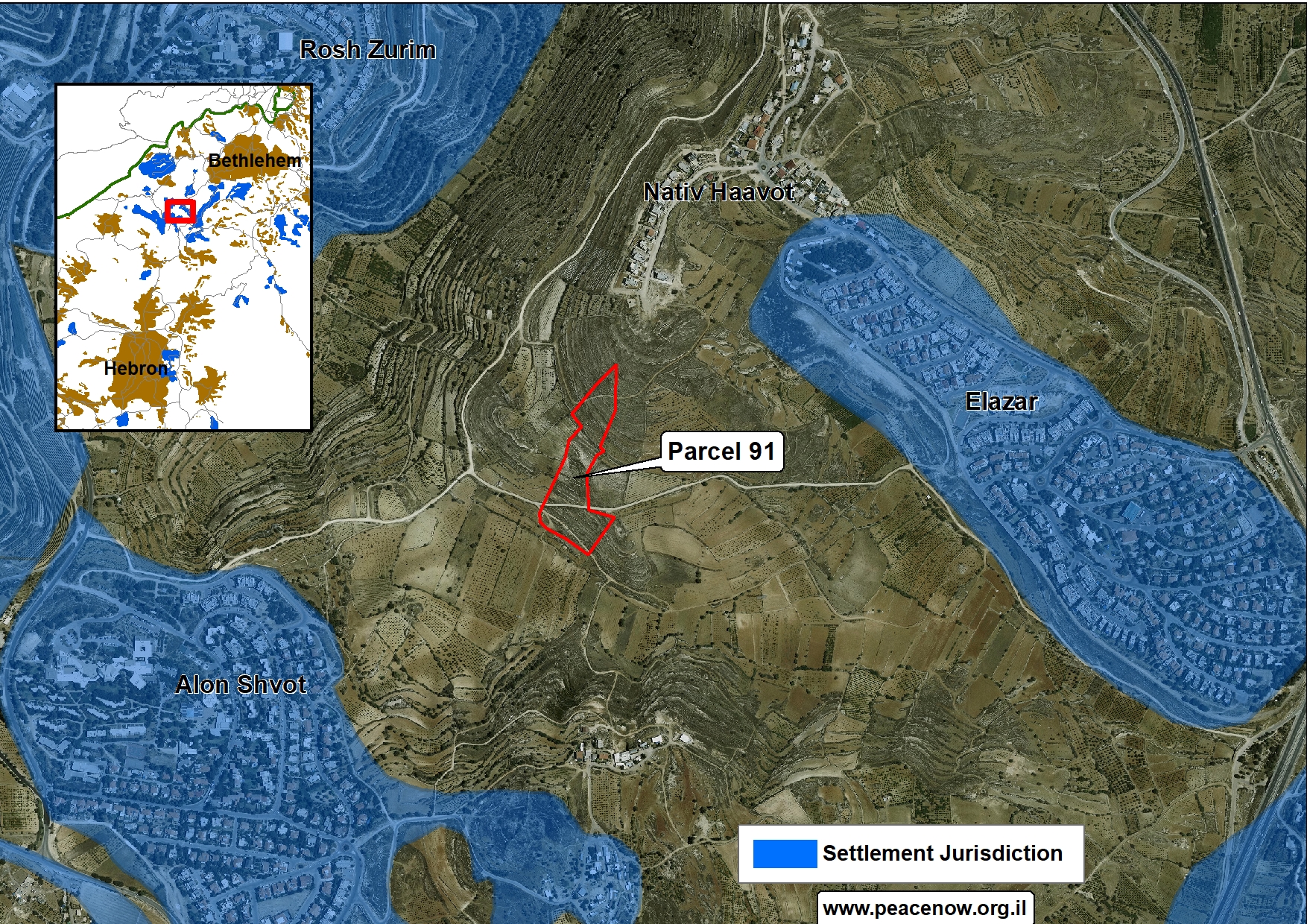
Map by Peace Now
In addition to Peace Now’s comprehensive recap of the Netiv Ha’avot saga, FMEP has covered the efforts of the Israeli government to exploit the evacuation of settlers from 15 homes in the Netiv Ha’avot outpost as an opportunity not only to advance construction in the Elazar settlement, but also to build an entirely new outpost as “temporary” housing for the settlers. The “temporary” outpost – where 15 mobile homes are parked – and connected to Israeli water, power, sewage, roads, and other infrastructure – is located outside of the borders of the Alon Shvut settlement. That fact did not stop the High Planning Council (a body within the Israeli Civil Administration which regulates planning and building in the West Bank) from approving the plan, noting that “the plan is improper, but we will have to approve it as a temporary solution.” As part of its approval of the plan, the Council ordered the government to take steps towards expanding the borders of the Alon Shvut settlement to include the area on which the outpost has been established, underscoring the meaninglessness of the word “temporary” in this context.
In addition to the new outpost/expansion of the Alon Shvut settlement, the State is also planning to retroactively legalize and expand the Netiv Ha’avot outpost – proving once again that Israel does not punish settler law-breaking, but instead handsomely rewards it.
Settlers Blame Obama for Slowed Israeli Population Growth in the West Bank
According to new data published by the Council of Jewish Communities in Judea and Samaria, the 2018 settler growth rate came in at 3%, compared to 3.4% in 2017. This is the tenth consecutive year that the settler growth rate has declined. In explaining the numbers, settlers are pointing fingers at former U.S. President Barack Obama, citing his policies opposing settlement construction (which was in line with the policies of every previous U.S. president since 1967) as the reason for the decline in the settler population growth rate. The head of the Council, Hananel Dorani, said:
“We’re happy to see that the number of residents in the area is growing, but in recent years there hasn’t been enough construction in the settlements…the relatively slow rate of construction is the result of, among other things, an eight-year construction freeze [there was no such freeze], and today only small-scale plans are being approved [demonstrably incorrect]. These figures are a shout out to the next government: We will be demanding more of an effort to clear obstacles to construction in Judea and Samaria and the Jordan Valley. This is the way to continue promoting the settlements and even increase the housing available in Israel, and as a result lowering [housing] prices.”
Israeli Justice Minister Stands with Families of Suspects in Deadly Jewish Terror Attack
Five Israeli settlers from the Rehelim settlement were arrested in connection with the murder of a Palestinian woman in October 2018. The suspects – who are minors and therefore unidentified in the press – are alleged to be responsible for throwing stones at a Palestinian vehicle, resulting in the death of Aisha Rabi, a mother of nine. The Israeli Shin Bet has since come under fire from Israeli politicians for the way it has handled the case, and settler leaders have offered blanket public support for the suspects and their families while leveling harsh criticism at the Shin Bet for its work to close the case. Israeli Justice Minister Ayelet Shaked went as far as to meet with the suspects’ parents in a display of solidarity with the families’ in their accusations against the Shin Bet’s work on the case.
Meretz chairwoman and Member of Knesset Tamar Zandberg sharply criticized Minister Shaked for the meeting, saying that Shaked has:
“different standards for Jews and Arabs…Instead of doing soul searching, (Shaked) is making an electoral calculation and running into the arms of families accused of terror.”
Breaking the Silence Launches New Tour of Central West Bank Settlements
The Israeli organization Breaking the Silence has launched a new political tour of the West Bank, focusing on settlements, Israeli government policy, and the goal of the occupation. After previewing the new tour, Haaretz columnists Gideon Levy and Alex Lavec write:
“during this seven-hour journey, an unvarnished picture emerges: The goals of the occupation were determined immediately after the 1967 war. Every Israeli government since, without exception, has worked to realize them. The aim: to prevent the establishment of any Palestinian entity between the Jordan River and the Mediterranean Sea, by carving up the West Bank and shattering it into shards of territory. The methods have varied, but the goal remains unwavering: eternal Israeli rule. That goal hasn’t been implemented only by right-wing zealots, but by the very establishment of Israel, its governmental agencies, with the backing of the judiciary and the media. On the road to a million settlers, the first million – all means were justified. Now, as that target draws closer, the central goal is the development of infrastructures. The separate roads, deceptive with their bypass routes, the tunnels and the interchanges, all of these are more fateful than another flood of settlers. They allow every settler to live in relative security, not to see Palestinians and not to hear about their existence, to live cheaply and to get to work in Israel fast. That’s the secret that’s made it possible for 650,000 Israelis to violate international law and norms of justice, to live in occupied areas and feel good about themselves. The occasional few bones that the occupier throws the occupied allows life under the boot to continue without excessive resistance.”
Breaking the Silence continues to run its flagship tours of Hebron and the south Hebron Hills, which attract approximately 5,000 participants each year to see the impact of Israeli occupation policies and radical settlers living in Hebron. Breaking the Silence staff are veteran combatants who speak out about the reality of what it means to serve as an occupying power over the Palestinians. Breaking the Silence has been a central target of the Israeli government in attempts to silence groups critical of Israeli policies by cutting their funding, criminalizing and restricting their operations, and waging smear campaigns against staff members.
Bonus Reads
- “Expanding the Limits of Jewish Sovereignty: A Brief History of Israeli Settlements” (Haaretz)
- “Israeli Housing Project in West Bank Would Surround Bethlehem with Settlements” (Haaretz)
- “Palestinians Are Right to Outlaw Selling Land to Settlers” (The Forward)
- “How Israel Usurps Palestinian Land In Calculated Stages” (Haaretz)
- “Peace Cast: West Bank Settlements” (Americans for Peace Now)
- “Minister Shaked says she changed the judicial system’s mindset” (World Israel News)
Welcome to FMEP’s Weekly Settlement Report, covering everything you need to know about Israeli settlement activity this week.
To receive this report via email, please click here.
June 15, 2018
- “Greater Jerusalem” Annexation Bill Back on the Agenda
- Expanding a Settlement, Suffocating a Village – Har Gilo West vs. al-Walajah
- Full Steam Ahead on 325 New Settlement Units Near the E-1 Settlement Area
- Plans for Largest-Ever Settlement Industrial Zone, as Part of “Super Settlement” Area
- Israel Admits: We Gave Settlers Part of Silwan Without Checking Who Owned It
- Despite Pay-Offs and Promises, Settlers Violently Resist Netiv Ha’avot Demolitions
- New Bill Would Hand Over Area C to the World Zionist Organization
- Settler Whistleblower: Not Concerned With Law, Only Concerned with Dispossessing Palestinians
- MK Introduces Bill to Dismantle the Civil Administration, Annex the Settlements
- Settlers Kill Knesset Plan to Complete the West Bank Barrier
- While No One Was Watching, Jerusalem Suburb Has Been Annexing “No Man’s Land”
- Bonus Reads
Comments, questions, or suggestions? Email Kristin McCarthy at kmccarthy@fmep.org.
“Greater Jerusalem” Annexation Bill Back on the Agenda
Jerusalem Settlement watchdog Ir Amim reports this week that, the Ministerial Committee for Legislation (the body of Israeli Cabinet members which decides whether or not the government will endorse legislation) is once again scheduled to discuss the “Greater Jerusalem” annexation bill. Members of the Ministerial Committee have long pushed for the Committee to consider the bill – with Ministers Ayelet Shaked (Jewish Home) and Naftali Bennett (Jewish Home) eager to secure government support for it – but Prime Minister Netanyahu intervened at the last minute to take the bill off of the committee’s October 2017 agenda, relegating the bill to political uncertainty. At the time, reports insinuated that Netanyahu blocked consideration of the bill due to international pressure. At the time the Trump Administration publicly stated it would not oppose the bill, but reportedly it discouraged movement on the bill at that time, apparently over concerns that it would undermine ongoing US efforts to engage other regional parties.
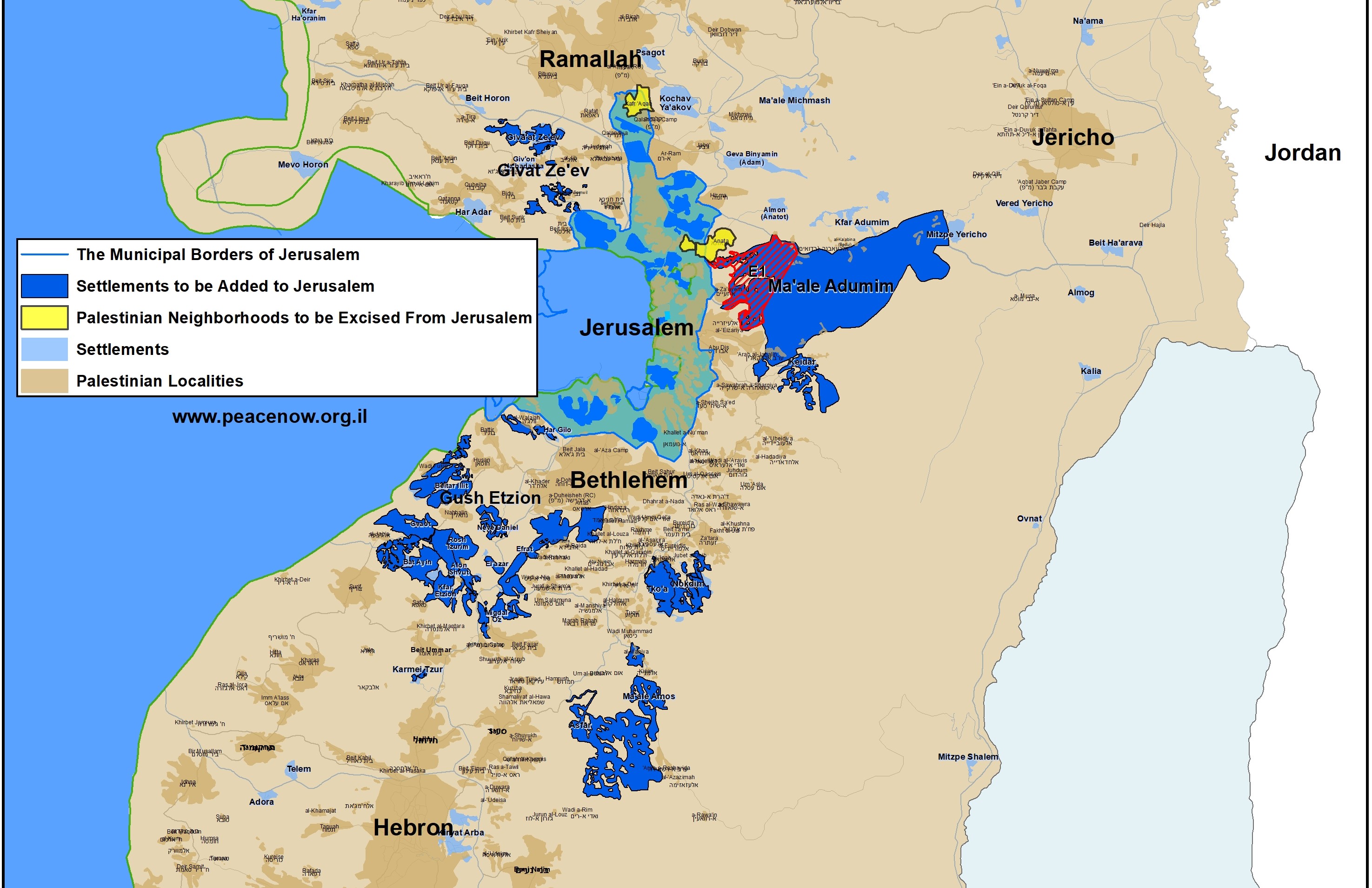
Map by Peace Now
FMEP has regularly reported on the “Greater Jerusalem” bill, which was introduced in July 2017 by two members of Prime Minister Netanyahu’s own Likud Party, Yoav Kisch and Yisrael Katz. The bill proposes absorbing 19 settlements into the Jerusalem municipality (an act of incremental de facto annexation), allowing the settlements to participate in Jerusalem elections and be counted in the Jerusalem census. Earlier versions of the bill also included a clause that would have applied Israeli domestic law to these same settlements – another means of de facto annexation – but the clause was stripped from the (ostensibly) final version that the Committee is now set to consider.
FMEP continues to track the Greater Jerusalem bill in its weekly settlement reports and in its tables tracking annexation policies.
Expanding a Settlement, Suffocating a Village – Har Gilo West vs. al-Walajah
.jpg) The Planning and Building Committee of the Gush Etzion Regional Council met on March 25th to discuss a 330-unit plan to expand the Har Gilo settlement onto a non-contiguous plot of land that would effectively seal shut the Palestinian village of al-Walajah. The Council’s discussion of the plan kicks off the official planning process; the next step will be a discussion by the High Planning Council and then deposit of the plan for public review.
The Planning and Building Committee of the Gush Etzion Regional Council met on March 25th to discuss a 330-unit plan to expand the Har Gilo settlement onto a non-contiguous plot of land that would effectively seal shut the Palestinian village of al-Walajah. The Council’s discussion of the plan kicks off the official planning process; the next step will be a discussion by the High Planning Council and then deposit of the plan for public review.
The plan – called “Har Gilo West” – will nearly double the population of Har Gilo by building what is by all measures a new settlement on the far side of the Palestinian village of al-Walajah. Ir Amim explains:
“Though publicized as an expansion of the Har Gilo settlement, the area demarcated for the plan is clearly distinct from Har Gilo, with the Palestinian village of Walaja and the Separation Barrier positioned in between the two… In effect, along with Har Gilo, the new development would create a wall of settlement around the West Bank portion of Walaja, completing a series of steps to entirely seal the village off from its surroundings.
…In the last decade, Israeli authorities have established several dramatic facts on the ground – including completion of the Separation Barrier around Walaja and a national park built on its land – to strategically address Walaja’s obstruction of Israel’s plan to absorb the Gush Etzion bloc into Greater Jerusalem. Har Gilo West should be seen in the context of this overarching geo-political goal. It is one more measure in a series of steps to disconnect the built-up area of Walaja from its surroundings, create an isolated enclave out of the village, and enable a contiguous Israeli controlled territory from Jerusalem to the Gush Etzion Regional Council.”
FMEP has repeatedly documented various Israeli efforts to seal off al-Walajah from Jerusalem. Residents of al-Walajah have fought the growing encroachment by the nearby Etzion settlement bloc and the Israeli government’s attempt to de facto annex the bloc as part of “Greater Jerusalem.” Ir Amim explains several prongs of this effort, including a particularly unbelievable section of Israel’s separation barrier planned to almost completely encircle the village, to turn its valuable agricultural land into an urban park for Jerusalem, and construction of a highway that will connect the Etzion settlement bloc to Jerusalem with Israeli-only bypass roads.
Full Steam Ahead on 325 New Settlement Units Near the E-1 Settlement Area
On June 14th, the Israeli Defense Ministry deposited for public review a plan, previously approved by Israeli High Planning Council, to build 325 settlement units in the Alon settlement, situated on the northern edge of the area slated for the E-1 settlement, east of Jerusalem. The plan includes a residential zone, a commercial area, a park, roads and public buildings.

Map by Ir Amim
As FMEP has reported on repeatedly, the E-1 area has long been slated for Israeli settlement construction, but plans have been continuously delayed by the Israeli political echelon – due in large part to pressure from past U.S. administrations and others in the international community. E-1 is often called a “doomsday settlement” because it will seal Palestinian East Jerusalem off from the West Bank to its east, and creating a land bridge from Jerusalem to the Maale Adumim settlement that bisects the West Bank. The settlement will render the two-state solution impossible because it would preclude the ability to draw contiguous borders for a future Palestinian state with a capital in East Jerusalem.
East Jerusalem expert Danny Seidemann issued numerous warnings in 2017 that E-1 might be slated for advancement under the current settlement policy of the Netanyahu government and with no discernable counter-pressure from the Trump Administration. Seidemann warned in January 2017, “The main obstacle preventing a green light for E-1 has, until now, been wall-to-wall opposition from the international community, led by the United States (dating back to the era of President Clinton).”
Plans for Largest-Ever Settlement Industrial Zone, as part of “Super Settlement” Area
According to the settler-aligned Arutz Sheva media outlet, a number of settlement municipalities have agreed to a plan to build the largest-ever settlement industrial zone — in the area where Israel is planning to unite multiple settlements into one “super settlement area.”

Map by WINEP
FMEP reported on the future “super settlement” in February 2018, when rumors first broke about the government’s plan to unite several settlements (Elkana, Sha’arei Tikva, Etz Efraim, and Oranit). FMEP covered the story again in March 2018, when Palestinians began to protest the plan. By uniting the settlements, Israel will significantly increase the footprint of developed land, allowing for massive projects like the industrial zone. The four settlements and the land between them are located in the “seam-line” zone, the area created by the weaving route of the Israeli separation barrier that was built to keep many settlements on the Israeli side of the barrier despite being east of the 1967 Green Line.
The planning of the new mega industrial zone – which will cover 2 million square meters (nearly 500 acres) near the Shaarei Tikva, Elkana, and Etz Efraim settlements – has been delayed for nearly 10 years amidst disputes between competing settlement municipalities. Now, with the consensus amongst the planners, the proposal will be submitted for approval.
The head of the Samaria Regional Council, Yossi Dagan, said:
“this is a historic move that is expected to change the face of settlement in Samaria in general and the settlements of Samaria Gate in particular. The new industrial zone is planned on an area of 3,000 dunams (340 acres) north and south of Highway 5, and it will include areas for commerce and high-tech offices, areas for regional public buildings, and industrial areas.”
With a consensus around the location and details of the planned industrial zone, Arutz Sheva speculates that construction will begin by the end of 2018. The plan includes a major upgrade to a settler transportation hub, known as the Sha’ar Shomron interchange, which is expected to be a stop on the future settler-only light rail line slated to cut across the West Bank.
Arutz Sheva also reports that settlers are ready to submit another plan for a new cemetery to be located east of the area where the industrial zone will be built, to “provide a regional response to the needs of the towns in western Samaria.”
Israel Admits: We Gave Settlers Part of Silwan Without Checking Who Owned It
Palestinian residents of the Batan al-Hawa section of the Silwan neighborhood in East Jerusalem have petitioned the High Court to stop the government facilitated settler takeover of a large area of their neighborhood and the eviction of 700 Palestinian residents.
In a hearing on the petition held on June 10th, the Israel government’s lawyer admitted that the State gave the land to the settler organization Ateret Cohanim without a proper investigation into the underlying legal status of the land and the buildings on it, but argued that the Palestinians’ petition should be dismissed because the land was granted to Ateret Cohanim in 2002 (intimating that Palestinians should have petitioned against the move earlier). Ateret Cohanim facilitates and encourages Jewish Israelis to settle in Palestinian neighborhoods of East Jerusalem. Ir Amim reports that Ateret Cohanim’s takeover of land in Batan al-Hawa is, “the single largest takeover campaign in a Palestinian neighborhood of Jerusalem since 1967.”
According to Ir Amim, 17 Palestinian families have been evicted from the homes on the land since the deed was transferred in 2002. 83 Palestinian families, approximately 700 people, remain the target of eviction. Ir Amim writes:
“This well organized Ateret Cohanim campaign represents not only the displacement of an entire community but also the direct involvement of the Israeli government in facilitating private settlement in the Old City and surrounding band of Palestinian neighborhoods. The government has acted through the General Custodian and the Registrar of Trusts (both under the Ministry of Justice) to facilitate settlers’ seizure of Batan al-Hawa, as well as increasing its security budget by 119% from 2009 – 2016 to ensure the protection of radical Jews settling in the hearts of Palestinian neighborhoods in East Jerusalem.”
The Haaretz Editorial Board also weighed in vehemently criticizing the Israeli government’s handling of the case. The Board wrote:
“The settlement in Batan al-Hawa is the most problematic of all the settlements in Palestinian neighborhoods in Jerusalem. It is located in the heart of a crowded inner city, weighs heavily on the residents’ daily lives and is intended to prevent any diplomatic solution with the Palestinians. Every Jewish family there needs security that costs around 1 million shekels ($280,000) a year. But the damage doesn’t seem confined to Silwan. This settlement has also corrupted Israel’s bureaucracy.
When the administrator general and state prosecutors found that the 2002 decision had been mistaken, the only decent thing to do would have been to cancel it and freeze the eviction proceedings against the Palestinian families. Instead, government clerks and lawyers are fighting for eviction along with Ateret Cohanim. This is further proof of the extent to which the settlements have corrupted public administration in Israel. Now the issue rests with the High Court. Hopefully, despite the pressure being put on the justices, they will halt the oppression and corruption.”
On June 6, Peace Now published a backgrounder, “The Systematic dispossession of Palestinian neighborhoods in Sheikh Jarrah and Silwan.” Back in 2016, the Israeli human rights organization B’Tselem produced a comprehensive multi-media backgrounder on the threat to Batan al Hawa. Jerusalem expert Danny Seidemann has also published extensive background and analysis on the assault on Batan al Hawa (here and here).
Despite Pay-Offs and Promises, Settlers Violently Resist Netiv Ha’avot Demolitions
Approximately 1,000 Israeli settlers and their sympathizers gathered to protest the long-planned, court-ordered demolition of 15 structures built on privately owned Palestinian land in the unauthorized Netiv Ha’avot outpost. The demolitions were completed on June 14th. Dozens of settlers barricaded themselves inside the last two structures to be demolished, some of whom hurled stones and other objects at Israeli policeman who were forced to drag them out of the buildings, resulting in thirteen injuries to police officers. Three suspects were arrested, but released a day later.
Touting the growing governmental effort to compensate the settlers of Netiv Ha’avot for paying a price for their illegal activity, several prominent leaders from the Jewish Home party joined protesters at the outpost during the demolitions, including Justice Minister Ayelet Shaked, who said:
“The evacuation is the result of a serious mistake. It began with an erroneous response from the state several years ago, but that was fixed from the root, and ended with an erroneous High Court decision. The news is that it ends here. In the past three years, we have changed the discourse. Instead of asking, ‘When are we evacuating?’ we’re asking, ‘How do we regulate?’”
Education Minister Naftali Bennett also attended and said:
“Whoever wishes to raze 15 homes will receive 350 on this hill. This is a difficult evening. It is incomprehensible to the residents of the Netiv Ha’avot neighborhood and to anyone who has settled the precious Land of Israel. It’s absurd. I cannot recall a legal action as irrational as this. The campaign will not be won until the prime minister abides in full and builds a huge neighborhood here on this hill.”
Agriculture and Rural Development Minister Uri Ariel (Jewish Home) was also on hand and said:
“There’s no benefit in demolishing homes and driving people from their homes. The High Court hearing was conducted as if it was in Sodom and Gomorrah, but we won’t give in. We won’t let this keep us from settling throughout the Land of Israel.”
In contrast, Peace Now declared a partial victory against illegal settlement growth, saying:
“After 17 years of theft, evasions, delays, and manipulation, justice is being served as the private land on which the Nativ Ha’Avot outpost was built is being vacated, in line with the High Court of Justice’s ruling. We hope these evictions will send a clear message that crime does not pay, and that anyone who builds on land without authorization or even purchasing it first will ultimately be compelled to leave. Peace Now will continue to monitor all settlement construction in the West Bank, and will fight against any land theft or attempt to destroy the viability of a two-state solution.”
However – as the Jewish Home party leaders made clear – the victory is not complete, as the Netiv Ha’avot settlers have successfully waged a public shaming campaign against the government for failing to prevent the enforcement of its laws against the settlers. As reported succinctly by The Times of Israel, various arms of the Israeli government are currently working in concert to retroactively legalize the remaining structures in the Netiv Ha’avot outpost and to prepare plans for 350 new units there. In addition, the government has already rewarded Netiv Ha’avot with what is effectively a new outpost built for the settlers affected by the demolitions – settlers who will additionally receive a monetary compensation package paid for by Israeli taxpayers for their misfortune of having built illegally on land that is owned by Palestinians. For more background, see Peace Now’s comprehensive recap of the Netiv Ha’avot saga.
New Bill Would Hand Over Area C to the World Zionist Organization
Peace Now reports that the Knesset is moving a bill that would transfer the responsibility of “managing” rural land in Area C of the occupied West Bank to the Settlement Division of the World Zionist Organization (WZO), a body dedicated to the establishment and development of settlements, whose activities have been dogged by fraud and illegalities for decades.
The bill was introduced by MKs Bezalel Smotrich (Jewish Home), Yoav Kisch (Likud), and David Bitan (Likud), and it passed through the first of three Knesset readings on June 13th. Reportedly, the bill will be put on hold for two weeks so the government has time to examine the possibility of achieving the same result through a Cabinet decision, avoiding the politics and pushback that might come in Knesset debate.
As Peace Now notes, under international law Israel, as an occupying power, cannot grant non-governmental organizations the authority to manage lands outside of its borders.
Peace Now said:
“The Knesset today approved a bill allowing five decades of land theft, delinquency and corruption under the guise of ‘unique characteristics and development of settlement.’ Despite stacks of State Comptroller reports, complaints from legal advisers and evidence of criminal offenses, the government is scandalously planning to give the biggest land thieves responsibility for managing the land distribution, which will continue to be done under the cover of darkness if the bill passes into law.”
Peace Now also provides an excellent overview of the activities the WZO has engaged in since 1968, when the Israeli government gave the organization’s Settlement Division the authority and the funding to build settlements in the occupied territory. The arrangement worked for the Israeli government, by contracting out settlement building the government found a way to escape the rules, restrictions, and transparency norms that inhibit government bodies from operating freely. Peace Now reports:
“The Settlement Division manages the land without any transparency, contrary to the rules of proper administration, without supervision, and sometimes with corruption and fraud. Thus, for example, the Settlement Division gave settlers in Amona, Giv’at Haulpana, Mitzpeh Kramim and others the rights to build on what was private land belonging to Palestinians.”
For more information on the WZO, and for background on a High Court case seeking to make the WZO’s land holdings public, see the Peace Now report. The legal issues with the WZO’s operations were highlighted in the official report by Talia Sasson, commissioned by Ariel Sharon. Also see media reports: here, here, here, and here, for example.
Settler Whistleblower: Not Concerned With Law, Only Concerned with Dispossessing Palestinians
The Israeli daily newspaper Yedioth Ahronoth published a comprehensive investigation into the leaders of the publicly-funded Regavim settler group. The group’s stated mission is “to ensure responsible, legal, accountable & environmentally friendly use of Israel’s national lands and the return of the rule of law to all areas and aspects of the land and its preservation.” The investigation reveals, however, that the organization’s efforts to identify and stop illegal construction are merely a tool to dispossess Palestinians of their land.
The Investigation found, in fact, that Regavim and its leader have a demonstrable disregard for the Israeli planning and building laws that they purport to be dedicated to enforcing, evidenced most plainly by the fact that 15 Regavim officers are living in structures built on privately owned Palestinian land, some with demolition orders issued against them. These include the building where Yehuda Eliyahu, the current executive director of Regavim, lives.
The outlaw behavior of Regavim leaders is more consequential than just 15 units. The investigation also details how leaders of the group have helped to illegally establish settlements at the cost of Palestinians. Yediot Ahronot reports:
“Somehow, all this doesn’t prevent the movement and its representatives from appealing to the High Court of Justice in dozens of petitions, and to successfully act as the guarantors of law and order to eliminate construction violations. Among other things, Regavim operates in sensitive areas of international interest, such as a legal proceeding following which 76 members of [U.S.] Congress recently demanded that the government not demolish Palestinian homes.” [referring to Khan al-Ahmar]
Dror Etkes, founder of the anti-settlement watchdog Kerem Navot, commented:
“Regavim’s lie holds no water: they preach action against illegal construction, but live in illegally built homes. They talk about the ‘rule of law’ as they violently transgress it. The findings exposed today indicate that Regavim is in fact an enemy of the principle of ‘rule of law,’ which its members use manipulatively to strip it of its meaning.”
J Street weighed in on the investigation, urging:
“Yedioth Ahronoth’s report underscores the long-term impact and agenda of the settlement movement. For decades, they have moved aggressively to build housing in — and push Palestinians out — of key parts of the occupied territory, with varyingly strong degrees of support from successive Israeli governments…The fanatical ideology of Regavim and the broader settler movement — along with their allies in the Netanyahu government and the Trump administration — must be confronted.”
The report and investigation was published two weeks after the Israeli High Court of Justice upheld demolition orders against the Khan al-Ahmar Bedouin community, a case that Regavim and its supporters in the government (including Jewish Home MK Bezalel Smotrich, who founded Regavim in 2006) have been pushing for years. MK Smotrich and Regavim are simultaneously pushing legislation like the settlement “Regulation Law,” which seeks to retroactively legalize Israeli settlement activity that does not comply with Israeli planning and building law. The Regulation Law, which FMEP has reported on extensively, will resolve the conundrum of demolishing unauthorized Palestinian building while legalizing unauthorize Israeli building by gutting the rule of law entirely.
MK Introduces Bill to Dismantle the Civil Administration, Annex the Settlements
Punctuating a busy week, MK Bezalel Smotrich (Jewish Home) announced that he has submitted a new bill to dismantle the Israeli Civil Administration, the governing body of the West Bank (operating under the Israeli Defense Ministry). Smotrich also featured prominently in the investigative report into Regavim (covered above), participated in the protests at the Netiv Ha’avot outpost (covered above), and saw his bill to empower the World Zionist Organization to manage Area C pass through its first reading (covered above).
According to a report by the settler-aligned Arutz Sheva media outlet, Smotrich alleged that the Civil Administration’s “lack of modern computing and mapping tools” is the real culprit behind the accidental, illegal settlement construction that necessitate legislation like the settlement “Regulation Law.”
Speaking at a conference organized by Regavim, Smotrich said:
“The Civil Administration has no normal website, no access to the public. A lot of the mistakes that led to the enactment of the [settlement] regulation law were caused by a lack of modern computing and mapping tools. There is very little organizational memory in the Civil Administration system because many of them are military personnel who change positions every two years. If I want to buy an apartment in Tel Aviv, within three minutes a document will arrive in my email. In order to sell or buy a house in Judea and Samaria, I have to enter a military base and go through an archaic system with a clerk who still works with binders and then wait for weeks to receive any documents. The bill sets a target date for the dismantling of the Civil Administration, and the Administration’s responsibilities will be distributed to the various government ministries, as already happens today, for example, in the Education Ministry. This is the right thing in terms of democracy, it is the right thing in terms of values, [and it puts us] on the path to normalization in Judea and Samaria. Also on the practical level it improves services to the citizens.”
The report on Smotrich’s new bill does not mention anything regarding the future of the Palestinians, who lives are governed, in virtually every aspect, by the Civil Administration.
Settlers Kill Knesset Plan to Complete the West Bank Barrier
Israeli settlers have successfully lobbied the Knesset to kill, for a third time, a bill to compel the Israeli government to finish building the West Bank the separation barrier. The Knesset voted to reject the bill 42-23. The government has failed to complete the construction, which began in 2002 amidst international outrage and allegations of war crimes, despite the adamant arguments of the Israeli government that the wall is a security necessity. According to B’Tselem, only 65% of the barrier has actually been erected – leaving significant gaps that seem to undermine the security logic of the barrier. Adding to that, 85% of the barrier is located inside West Bank territory, creating one form of de facto annexation of the areas on the Israeli side of the barrier, which include a long list of Israeli settlements and surrounding lands for their expansion.
In Al-Monitor, Mazal Mualem explains:
“…the right is concerned that an Israeli initiative of putting up a fence that separates West Bank settlements from Palestinian villages around them would constitute an official endorsement of a future border between Israel and a Palestinian state.”
The bill was pushed by members of the Zionist Union coalition on the left – without the support of the Joint List MKs (representing Palestinian citizens of Israel) – who stress the security imperative of closes the existing gaps. Avi Gabbay, head of the Labor Party, slammed the government’s foot-dragging, saying that delaying the completion of the barrier risks allowing the next terrorist attack Israel. Gabbay said the Netanyahu government is:
“simply afraid of settlers who don’t want to close the gaps for political considerations. These so-called political considerations damage the security of the State of Israel.”
Gabbay’s coalition partner, Tzipi Livni who heads the Zionist Union, explained the left-wing coalition’s rationale for supporting the barrier. Livni said:
“If you support the idea of two states for two people, you need to support this fence. At the beginning, we need a border between us and the Palestinians and then maybe in 50 years, when we live happily ever after, we can dismantle it. For now, this is the concept: security for Israelis but also dividing the land into two states for two peoples.”
The annexation of the West Bank land on the Israeli side of the barrier is an implicit assumption of Gabbay and Livni’s statements.
While No One Was Watching, Jerusalem Suburb Has Been Annexing “No Man’s Land”
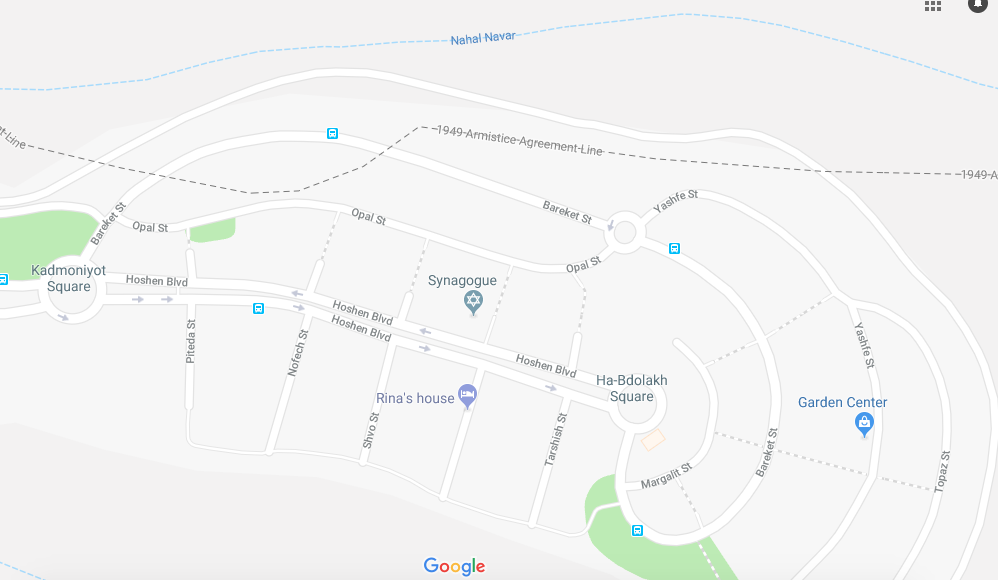 For decades, the Israeli government has expanded the Jerusalem neighborhood of Mevasseret Zion into the no-man’s land between the internationally recognized 1967 Green Line and the Israeli separation barrier. Kerem Navot, an anti-settlement watchdog, recently discovered the cross-border expansion – which is plain to see on Google maps – of the neighborhood, along with a slew of other buildings, including a water facility and a synagogue. Additionally, the Israel Land Authority is advancing plans to build 300 new homes in the northern part of Mevasseret Zion, where it crosses over the Green Line.
Dror Etkes, the founder of Kerem Navot, told Haaretz:
“It’s obvious that the planners of this neighborhood knew very well where the Green Line runs. But they chose to ‘straighten’ the line there in order to make room for a few dozen more homes. It’s only natural that the state, which for decades has been investing massive resources in seizing control of the space of a neighboring people, should also expand communities situated within the Green Line into the West Bank. The amazing thing is that any sort of effort is being made still to maintain the distinction between communities within the Green Line and the settlements, since the declared policy of most of Israel’s governments in the past five decades was and remains the very opposite.”
A spokesman for the Mevasseret Zion neighborhood – whose residents almost certainly did not know they were living in a settlement – issued a disgruntled statement regarding the discovery and the Israel Land Authority’s plan to expand the encroachment:
“The plan currently being promoted [by the Israel Land Authority] is vigorously opposed by the council and the local residents, and they are working together to block the project. The council and residents object to the plan going ahead with regard to both the areas across the Green Line and those in the permitted areas.”
Bonus Reads
- “Ex-Jewish Agency Chief Slams Fellow Settlers Over Eviction of Neighboring Bedouin” (Haaretz)
- “Israel’s New Tool for Disposessing Palestinians” (Haaretz)
- “The Silent Transfer of Palestinians from Area C” (Ynet)
Welcome to FMEP’s Weekly Settlement Report, covering everything you need to know about Israeli settlement activity this week.
To receive this report via email, please click here.
May 25, 2018
- Israeli Government to Advance 3,900 Settlement Units Next Week
- Finance Ministry Announces Bargain Construction in Beit El & Ma’ale Adumim Settlements
- Defense Ministry Supports Expropriation of Private Palestinian Land for Settlements
- High Court Supports Destruction of Khan al-Ahmar [A War Crime], Clearing the Way for E-1 Settlement
- Palestinians Ask the ICC to Open Investigation into the Israeli Settlement Regime
- Bonus Reads
Comments, questions, or suggestions? Email Kristin McCarthy at kmccarthy@fmep.org.
Israeli Government to Advance 3,900 Settlement Units Next Week
Israeli Defense Minister Avigdor Lieberman (Yisrael Beiteinu) announced that the High Planning Council (the body in the Defense Ministry’s which oversees all construction in the occupied West Bank) is expected to advance plans for 3,900 settlement units next week. Of that total, 2,500 units will reportedly receive final approval for construction and 1,400 will be advanced through the planning process. Peace Now estimates that 52% of the units will be located in isolated settlements.
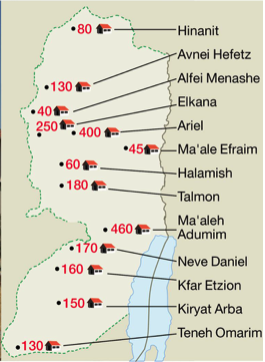
Map by Haaretz
Lieberman – whom The Times of Israel and Haaretz note has repeatedly inflated settlement approval numbers in the past – said the specific plans set to advance will include:
- 400 units in the Ariel settlement (where a medical school financed by Sheldon Adelson was recently brought under Israeli domestic jurisdiction, in a case of de facto annexation. And where a future stop on the recently approved settler-only light rail is slated to be built.);
- 460 units in the Ma’aleh Adumim settlement;
- 250 units for an assisted living center in the Elkana settlement (where the settler-only light rail will also have a stop);
- 180 units in the the Talmon settlement;
- 170 units in the Neve Daniel settlement;
- 160 units in the Kfar Etzion settlement;
- 150 units in the Kiryat Arba settlement (where construction preparations for a new industrial zone – which in reality is a new settlement in Hebron – recently began);
- 130 units in the Avnei Hefetz settlement;
- 130 units in the Tene Omarim settlement;
- 80 units in the Hinanit settlement;
- 60 units in the Halamish settlement (where settlers have built a strategic outpost, with the protection of the IDF, in order to further restrict Palestinian access to the area);
- 45 units in the Ma’ale Efraim settlement;
- 40 units in the Avnei Hafetz settlement;
- 45 units in unspecified settlements.
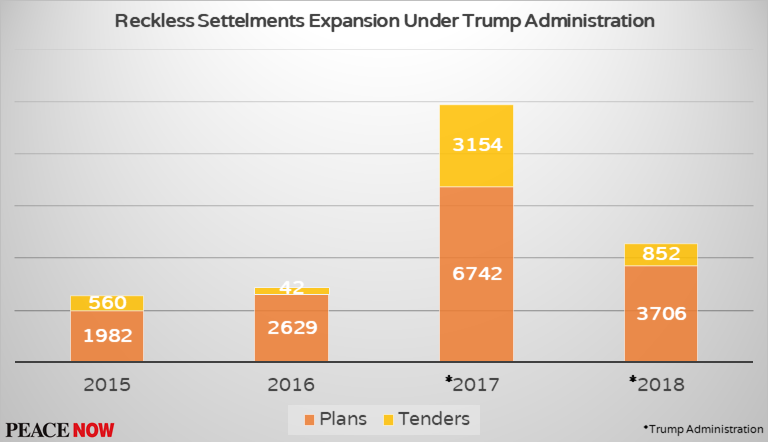
This will be the third meeting of the High Planning Council in 2018, in accordance with a reported agreement between Israel and the United States to consolidate and coordinate the number of times settlement plans are announced. The first regularly scheduled meeting of the year was in January, when 1,122 new settlement units were advanced, of which 352 received final approval for construction. The Council met again, unexpectedly in February, which Lieberman tried to minimize by calling it “less significant” because the majority of the projects approved were non-residential. In fact, the projects were extremely significant. All of the plans expanded the footprint of settlements located deep inside the West Bank – including plans for a race track and hotel in the Jordan Valley. One “unusual” plan even created a new outpost to house settlers evacuated from a different outpost (the Netiv Ha’avot outpost case that FMEP has covered in exhaustive detail).
The anti-settlement watchdog group Peace Now writes:
“In the year and a half since President Trump took office some 14,454 units in the West Bank has been approved (in plans and tenders, including today’s announcement not including East Jerusalem), which is more than three times the amount that was approved in the year and half before his inauguration (4,476 units)…The Netanyahu government is clearly continuing to take advantage of the carte blanche the Trump Administration has given it in order to destroy the chances for peace. It is well-known that for a two-state solution to be feasible Israel will have to withdraw from most of the West Bank, yet the government keeps raising the political cost of this redeployment and the evictions it will entail. By adding housing to settlements, the government shows total disregard for the two-state solution.”
In reaction to Lieberman’s announcement, PLO Executive Committee member Hanan Ahrawi said:
“Such egregious policies affirm the imperative need for the International Criminal Court to open an immediate criminal investigation into Israel’s flagrant violations of international law and conventions,” she said in a statement….Israel’s declared intention to build thousands of illegal settler units in the occupied West Bank discloses the real nature of Israeli colonialism, expansionism and lawlessness…Undoubtedly, Israel is deliberately working to enhance its extremist Jewish settler population and to superimpose ‘Greater Israel’ on all of historic Palestine…It is evident that the recent provocative and unlawful moves adopted by the United States, Guatemala and Paraguay have emboldened Israel to move forward with enhancing its illegal settlement enterprise, thereby finalizing the total annexation of the occupied West Bank.”
Saeb Erekat, a top diplomat for the Palestinian Authority released a video response, in which he highlighted the PA’s recent referral to the International Criminal Court (ICC) to investigate Israeli settlement crimes (see FMEP’s coverage on the ICC referral, below). Erekat said in part:
“This is a flagrant violation and an eye opener to the judicial council of the ICC that an official judicial investigation must be opened immediately. This cannot go on. Israel cannot continue business as usual with this impunity and immunity that they think they have.”
Nadil Abu Rudeina, a spokesman for PA President Mahmoud Abbas, said:
“The continuation of the settlement policy, statements by American officials supporting settlements and incitement by Israeli ministers have ended the two-state solution and ended the American role in the region.”
Finance Ministry Announces Bargain Construction in Beit El & Ma’ale Adumim Settlements
In addition to the approvals expected from the High Planning Council this week, the Israeli Finance Ministry has announced that a 300-unit project in the Beit El settlement and 44-unit project in the Ma’ale Adumim settlement have been marketed as part of the “Buyer’s Price” program. Under this program, the government sells land to construction companies at low prices, and those companies commit to offering future settlement units at below market prices. With the plan being marketed in Beit El, the government is accepting bids on the project from construction companies which commit to pricing the apartments 20% below market value – in effect creating a powerful financial subsidy that incentivizes Israelis to move into settlements.
The Beit El project involves 5 buildings with a total of 296 units. According to Ynet:
“the program’s goal is to transform Beit El’s southeast agricultural area into a residential neighborhood as well as unification and re-division of the lands, which will be allocated to building houses, public offices, commercial areas, routes, and a public open space.”
FMEP has covered the progress of this Beit El project repeatedly over the past year, particularly because the push around Beit El projects typifies the Netanyahu-Trump era of settlement growth. Beit El settlers have lobbied for the project for over 5 years, ever since the settlers were evacuated from an outpost of Beit El (called “Ulpana”) in 2012. When the outpost was evacuated, Prime Minister Netanyahu promised to build replacement settlement units in Beit El. Buoyed by the apparent green-light from the Trump administration, over the summer of 2017 settler leaders repeatedly and publicly shamed Netanyahu for failing to fulfill that promise, and in response Netanyahu very publicly and repeatedly promised that the settlement units will be built expeditiously. After being ignored by the High Council during its September meeting, the plan for 296 units was then approved for marketing in October 2017. Now, this week, the government has acted on that approval to market the plan, moving ever closer to the start of construction. As the Ynet report notes, if/when the 300 units are built, this will be the first new, government-sanctioned construction in the Beit El settlement in 10 years.
Also in Beit El, the settler-aligned media outlet Arutz Sheva reports that the IDF plans to build a new “razor wire” fence to separate the settlement from the Palestinian Jalazone refugee camp, located across the street (where it has been since before Beit El’s establishment). At the time of this writing, there has been no additional reporting on where the fence will be placed, and if it relates to plans to build a wall between Beit El and the Jalazone refugee camp. To better understand the severe implications of the Beit El settlement on the lives of Palestinian in Jalazone, see B’Tselem’s updated, expanded, and now pictorial project: “Life under the shadow of the Beit El Settlement.”
As a reminder, U.S. Ambassador to Israel David Friedman is closely associated with the Beit El settlement, having donated to and fundraised for it prior to his appointment as ambassador (including in his capacity as the President of the American Friends of Beit El, reportedly from 2011 until he became ambassador).
The Beit El settlement was established in 1977, on land previously seized by Israel for military purposes. A second military seizure in 1979 enabled Beit El to expand. This method of establishing and expanding settlements has been repeatedly challenged in Israeli courts. The Israeli group Yesh Din led one such petition against Beit El, seeking to have the second seizure annulled; that petition was dismissed earlier this year. Yesh Din writes:
“The State understood that it was impossible to legally defend the land theft that has been ongoing in Beit El for 40 years on land that was seized for arbitrary reasons, but it refrained, once again, from defending the rights of the weakest population, simply because they are Palestinians. Despite this, we at Yesh Din will continue to fight against the dispossession of Palestinians and the infringement of their rights.”
Defense Ministry Supports Expropriation of Private Palestinian Land for Settlements
On May 24th, the Israeli Defense Ministry released a legal opinion endorsing the government’s plan to expropriate privately owned Palestinian land in the Ofra settlement in order to retroactively legalize illegal settlement structures built there. The opinion adopts the “market regulation” principle as a legal basis for Israel to expropriate privately owned Palestinian land in cases of settlements in which decades-old structures were built and/or purchased by Israelis “in good faith” (believing the Israeli government to be the rightful owner of the land). The legal opinion also calls for the Palestinian owners to be “fully compensated, if not more than that,” and recommends that the principle should not apply to cases of unauthorized outposts. The Ofra situation is a test case for the “market regulation” principle, which has not yet been used (or tested in court) to justify expropriating Palestinian land for Israeli settlements.
Defense Ministry legal advisor Itai Ofir called on Attorney General Avichai Mandleblit to adopt the legal opinion as a government policy, which stands a good chance of happening (Mandleblit already endorsed the Ofra expropriation on that basis). In fact, the Attorney General invented the “market regulation” principle in the first place, as an alternative to the legal argument made in the Regulation Law (which he opposed). The “market regulation” principle was also recommended in the recently released “Zandberg Report,” as one of the tools that the Israeli government should use to carry out massive land expropriations, retroactive legalizations, and continued and intensified settlement growth.
FMEP has chronologically documented the development and adoption of the “market regulation” principle in the Annexation Policies tables.
High Court Supports Destruction of Khan al-Ahmar [A War Crime], Clearing the Way for E-1 Settlement
On May 24th, the High Court of Justice upheld a government plan to destroy the Palestinian Bedouin community of Khan al-Ahmar and forcibly relocate its residents out of the Ma’ale Adumim/E-1 settlement area east of Jerusalem – which Israel is expected to carry out soon. The Court reasoned that the community’s structures were built on State Land without the proper permits, even though Israel deliberately makes such permits nearly impossible to obtain. Clearing Khan al-Ahmar from the its current site (where it has been for 60+ years) is widely interpreted to be a step towards building the “doomsday” E-1 settlement which, if built, will complete a ring of Israeli settlements around East Jerusalem, destroying the territorial contiguity between Palestinians living there and the West Bank, and preventing any possibility of a viable, contiguous Palestinian state with its capital in East Jerusalem.

Map by Ir Amim
Israel has faced intense criticism for its plan to forcibly relocate Khan al-Ahmar, a plan many, including B’Tselem, call a war crime. A group of 76 U.S. Members of Congress recently sent a letter to Netanyahu beseeching him to abandon the plan, as well as the plan to demolish the Palestinian community of Susya, in the South Hebron Hills.
Peace Now says:
“The State of Israel must implement a policy of moral values, justice, equality and human rights for the Jahalin people. It is not in the Israeli interest to forcibly move them from their homes. We must stop the abuse that has been going on for decades, and allow them to live according to their way of life, to make a living and to educate their children in a way that is no different from that of the Jews living in their neighborhoods.”
The Jahalin Bedouin built the Khan al-Ahmar community in the area east of Jerusalem in the 1950s, after they were expelled from their lands in the Negev by the Israeli military. A total of 18 Bedouin tribes live in the vicinity of Ma’ale Adumim/E-1, totaling approximately 3,000 people, who have already endured numerous demolitions this year alone. The Ma’ale Adumim settlement was built in 1975 on land near where the Khan al-Ahmar community already existed; the plan for the E-1 settlement was approved in 1999.
Palestinians Ask the ICC to Open Investigation into the Israeli Settlement Regime
The Palestinian Authority has officially asked the International Criminal Court (ICC) to open an investigation into the Israeli government’s illegal settlement activity. The text of the referral can be found here. Citing “sufficient compelling evidence” and an “alarming intensification of Israeli crimes,” Palestinian Minister of Foreign Affairs Riad Malki asked the ICC to immediately open an investigation into war crimes and crimes against humanity that have been committed against Palestinians in the West Bank, East Jerusalem, and Gaza. The referral requests that the investigation include:
“those who plan, prepare and implement policies linked to the settlements regime as well as those who enable it, whether through financial, military, or logistical support or otherwise aid and abet or encourage the commission of crimes connected to that regime.”
The referral lists specific, ongoing crimes that are “among the most widely documented in contemporary history,” for the ICC to investigate. The PA’s allegations mainly relate to settlement activity (much of which is documented on a weekly basis in FMEP’s Settlement Reports) including: the unlawful appropriation and destruction of private and public properties, including land, houses and buildings, as well as natural resources; the forcible transfer of Palestinians; the unlawful transfer of the Israeli Occupying Power’s population into Occupied Palestinian Territory; the “persecution, including the grave, widespread and systematic denial or violation of basic human rights on discriminatory grounds against Palestinians, including those resulting in or intended to achieve the deportation of forcible transfer, directly or indirectly, of the Palestinian population, the re-population of ‘cleansed’ territories with Israeli settlers and the unlawful appropriation of Palestinian land and properties”; and “the establishment of a system of apartheid based in particular on the adoption of discriminatory laws, policies and practices as well as the commission of inhumane acts intended to establish an institutionalized regime of separation and advancement of Israeli settlements accompanied by the systematic oppression and domination by Israeli settlers over Palestinians.”
After the PA submitted its referral, Israeli Foreign Minister Avigdor Lieberman argued that the “ICC lacks jurisdiction over the Israeli-Palestinian issue, since Israel is not a member of the Court and because the Palestinian Authority is not a state.” While Israel is not a member of the ICC, the State of Palestine acceded to the ICC in December 2014, and its membership took force in April 2015. In January 2015, the ICC’s Office of the Prosecutor opened a preliminary inquiry to “ascertain whether the criteria for opening an investigation are met.” The preliminary inquiry is listed as “ongoing” on the ICC website. Following by the referral for an investigation submitted this week, ICC Chief Prosecutor Mrs. Fatou Bensouda released a statement saying:
“Since 16 January 2015, the situation in Palestine has been subject to a preliminary examination in order to ascertain whether the criteria for opening an investigation are met. This preliminary examination has seen important progress and will continue to follow its normal course, strictly guided by the requirements of the Rome Statute.”
The press release also notes that this is the eighth referral on the matter to date (previously, the situation in Palestine was referred to the ICC for investigation by Uganda, the Democratic Republic of the Congo, the Central African Republic, Mali, the Comoros Islands, and the Gabonese Republic).
Bonus Reads
- “Minister Ariel initiates museum of settlement” (Arutz Sheva)
- “Cherry Plantation Burned in Settlement a Hay Torched in Southern West Bank” (Haaretz)
- “Sheikh Jarrah: A Tale of Eviction and Resettlement” (Al Jazeera)
“In new film, Tel Aviv leftist picks up and moves to a West Bank settlement” (Times of Israel)