Welcome to FMEP’s Weekly Settlement Report, covering everything you need to know about Israeli settlement activity this week.
To subscribe to this report, please click here.
October 22, 2021
- Israel to Advance Plans for Nearly 3,000 Settlement Units & 1,300 Palestinian Homes in Area C
- Israeli Supreme Court to Hold Hearing on Batan al-Hawa, Silwan Dispossession Cases Next Week; AG Declines Intervention
- Israel Begins Construction on New Settlement in Downtown Hebron
- Israel Advances “Silicon Wadi” Project in East Jerusalem
- Recap: Israel Advances Settlement Plans Across Greater Jerusalem Area
- Recap: Court Pushes for Palestinians to “Compromise” with Settlers in Sheikh Jarrah
- New Report: State-Backed Settler “Tourism” Projects in East Jerusalem
- Bonus Reads
Israel to Advance Plans for Nearly 3,000 Settlement Units & 1,300 Palestinian Homes in Area C
The Israeli Civil Administration’s High Planning Council will convene next week — for the first time since Bennett and Biden took over leadership in Israel and the U.S., respectively — to advance the construction of 2,862 new settlement units (of which 1,231 will be eligible to receive final approval). These plans include the retroactive legalization of two unauthorized outposts (Mitzpe Danny and Haroeh Haivri), which should be properly understood as the creation of two new settlements.
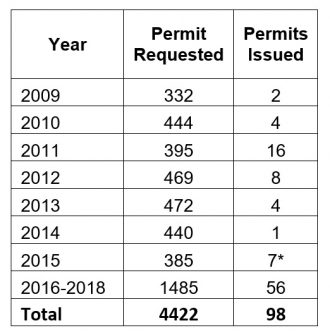
Peace Now data
In addition, reports suggest that Israel will also advance plans for 1,303 Palestinian homes in Area C – about half of which, importantly, are already built. A majority of these units have been awaiting Israeli approval for many, many years. If approved, the permits under consideration next week for Palestinians will be the first of any significant quantity issued by Israel since, at least, 2009 (data from before this period has not been released by the Israeli government). Between 2009 and 2018, Israel issued a total of 98 building permits to Palestinians according to data released by the Israeli government in response to a freedom of information request submitted by Bimkom.
As a reminder, Area C is the 60% of the West Bank over which Israel enjoys absolute authority. For years Israel has systematically denied Palestinians the right to build on land in Area C that even Israel recognizes is privately owned by them, At the same time, it has continuously promoted the expansion of settlements and unauthorized outposts, while systematically demolishing Palestinian private construction. In terms of numbers: between 2016 to 2018, Israel issued only 21 building permits to Palestinians in Area C, while issuing 2,147 demolition orders against Palestinians during.
Commenting on the Planning Council agenda’s Peace Now observed:
“The approval of a handful of plans for the Palestinians is only a fig leaf intended to try to reduce criticism of the government. For years, Israel has pursued a policy of blatant discrimination that does not allow almost any construction for Palestinians in Area C, while in the settlements it encourages and promotes the construction of thousands of housing units each year for Israelis. The approval of a few hundred housing units for Palestinians can not cover up discrimination and does not change the fact that Israel maintains an illegal regime of occupation and discrimination in the territories.”
It is worth noting that many of the settlement units and Palestinian permits on next week’s agenda were expected to have been advanced earlier this year, in August 2021, but the High Planning Council never convened to do so.
Below are lists of settlement plans expected to be given final approval and plans expected to be advanced next week (italicized plans represent those which appear to have been added to the slate of plans that were expected to be advanced in August 2021).
Settlement plans expected to be granted final approval include:
- 629 units, including the retroactive legalization of 61 units, in the Eli settlement – located south of Nablus and southeast of the Ariel settlement in the central West Bank. Though the Eli settlement previously received Israeli government approval, a “Master Plan” – which officially zones land for distinct purposes (residential, commercial, public) – has never been issued for Eli, meaning all construction there is illegal under Israeli law;
- 286 units in the Har Bracha settlement, located south of Nablus. If implemented, these new units will double the size of Har Bracha;
- 224 units in the Talmon settlement, located west of Ramallah;
- 146 units in the Kfar Etzion settlement, located between Bethlehem and Hebron and on the Israeli side of the planned route of the barrier (which is not yet built in this area);
- 110 units in the Alon Shvut settlement, located just north of the Kfar Etzion settlement and between Bethlehem and Hebron;
- 82 units in the Karnei Shomron settlement, located in the northern West Bank, east of the Palestinian village of Qalqilya. Israel has openly declared its intention to continue expanding settlements in this area with the stated goal of bringing 1 million settlers to live in the area.;
- 52 units in the Beit El settlement, located in the heart of the northern West Bank [as a reminder, former US Ambassador to Israel David Friedman has deep ties to the Beit El settlement]; Construction on 350 new units in Beit El began earlier this year;
- 42 units in the Givat Zeev settlement, located south of Ramallah in an area that is on the Israeli side of the barrier;
- 24 units in the Haroeh Haivri outpost, a plan that will effectively grant retroactive legalization to this outpost. The Haroeh Haivri outpost is located just east of Jerusalem, within eyesight of the Khan al-Ahmar community, which Israel is threatening to demolish (forcibly relocating the Palestinian bedouin community that has lived there since the 1950s) — ostensibly because the structures in Khan al Ahmar were built without necessary Israeli approvals. The Haroah Haivri outpost was also built without the necessary Israeli approvals, but instead of demolishing the construction, Israel is moving to retroactively legalize it — demonstrating once again that, when it comes to administering the occupation, Israel prefers “rule by law” – where law is turned into a tool to elevate the rights/interests of one party over another, over the democratic rule of law.;
- 14 units in the Ma’aleh Mikhmash settlement, a plan that will effectively grant retroactive legalization to one of Ma’aleh Mikhmash’s outposts – – Mitzpe Danny;
- 10 units in the Barkan settlement, located about half way between the Ariel settlement and the cluster of settlements slated to be united into a “super settlement” area (Oranit, Elkana, Shiva Tikva, and others);
- 5 units in the Shima’a settlement, located in the southern tip of the West Bank;
- 7 units in the Peduel settlement, located in the northern West Bank and part of a string of settlements and unauthorized outposts – most notably Ariel – extending from the Green Line into the very heart of the West Bank and on towards the Jordan Valley.
Settlement plans expected to be approved for deposit (an earlier stage in the planning process) include:
- 399 units in the Revava settlement, located just east of the Barkan settlement and west of the Ariel settlement, in a string of settlements and unauthorized outposts – most notably Ariel – extending from the Green Line into the very heart of the West Bank and on towards the Jordan Valley.
- 380 units in the Kedumim settlement, located just east of Nablus. Israeli MK Bezalel Smotrich lives in the Kedumim settlement on a section of land in the settlement that has been found to be privately owned by Palestinians.;
- 100 units in the Elon Moreh settlement, located east of Nablus (for background on the significance of the Elon Moreh settlement, please see here);
- 100 units in the Sansana settlement, located on the southern tip of the West Bank on the Israeli side of the separation barrier;
- 73 units in the Givat Zeev settlement, which is also expected to receive final approval for 42 units. Givat Zeev is located south of Ramallah in an area that is on the Israeli side of the barrier;
- 68 units in the Tene settlement, located on the southern tip of the West Bank;
- 45 units in the Vered Yericho settlement, located just west of the Palestinian city of Jericho in the Jordan Valley;
- 27 units in the Karnei Shomron settlement, which is also expected to receive final approval for 82 units. Karnei Shomron is located in the northern West Bank, east of the Palestinian village of Qalqilya. Israel has openly declared its intention to continue expanding settlements in this area with the stated goal of bringing 1 million settlers to live in the area.;
- 18 units in the Alon Shvut settlement, which is also expected to receive final approval for 110 units. Alon Shvut is located just north of the Kfar Etzion settlement and between Bethlehem and Hebron;
- 10 units in the Tal Menashe settlement, located located on the tip of the northern West Bank, inside the “seam zone” between the 1967 Green Line and the Israel separation barrier, which was constructed along a route designed to keep as many settlements and as much adjacent land as possible on the Israeli side of the wall/fence.
- 7 units in the Hermesh settlement, located in the northern West Bank;
- 4 units in the Efrat settlement, located south of Bethlehem, inside a settlement block that cuts deep into the West Bank. Efrat’s location and the route of the barrier wall around it, have literally severed the route of Highway 60 south of Bethlehem, cutting off Bethlehem and Jerusalem from the southern West Bank. The economic, political, and social impacts of the closure of Highway 60 at the Efrat settlement (there is literally a wall built across the highway) have been severe for the Palestinian population.
Peace Now reports that the Planning Council will also consider advancing the following plans for Palestinian homes:
- 270 houses in the Bir al-Bash village, located south of Jenin in the northern West Bank;
- 270 houses in the Al-Ma’asara village, located south of Bethlehem;
- 233 houses in the the Almasqufa village, located near Tulkarem in the northern West Bank;
- 200 houses in the Dkeika village in the South Hebron Hills;
- 170 houses in the Khirbet Abdallah Younas village, located in the Jenin area;
- 160 houses in the Abba a-Sharqiya village, also located south of Jenin in the northern West Bank;
Israeli Supreme Court to Hold Hearing on Batan al-Hawa, Silwan Dispossession Cases Next Week; AG Declines Intervention
On October 25th, the Israeli Supreme Court is scheduled to hold an important hearing on the case of the Palestinian Duweik family which is under threat of being dispossessed of their longtime home in the Batan al-Hawa section of the Silwan neighborhood in East Jerusalem by the Ateret Cohanim settler organization.
In advance of that hearing – and after repeated extensions on a Court-ordered deadline – the Israeli Attorney General finally submitted his position on the case to the Court. The document submitted by the Attorney General was only 1 page, and simply stated that the case does not merit intervention either on the specific case of the Duweik family or regarding the wider legal principle at stake, which threatens an additional 85 families living under threat of eviction in Batan al-Hawa.
Ir Amim writes:
“Among the 85 families facing eviction, the Duweik family case is the first to reach the Supreme Court level, and its outcome will inevitably set a precedent, significantly impacting the rest of the cases in the neighborhood…As in the eviction cases in Sheikh Jarrah, the Attorney General and by extension, the government, was given a rare opportunity to take a moral stand by providing a legal opinion and policy position to help prevent the mass displacement of these families. Yet, at this point, the Attorney General’s response appears to imply that he has declined to intervene. Now, the decision concerning the fate of these families seems to lie solely in the hands of the Supreme Court. The rights of Palestinians to housing and shelter and the right to family and community life are fundamental and must be upheld. The same discriminatory legal system, which led to the confiscation of these families’ original homes in 1948, is now being exploited 73 years later to displace them for a second time from their current homes in which they have lived for decades. The Supreme Court has the power to make a principled and just decision to uphold the rights of these families to remain safely in their homes, free from the constant threat of being forcibly uprooted and driven from their homes and communities.”
Peace Now said in response to the AG’s decision to not intervene:
“The Attorney General’s response actually says that for the Israeli government, there is no problem to kick hundreds of residents out from their homes, on the basis of a discriminatory law, in favor of a settlement. The government was given an opportunity here to try to prevent moral injustice and political folly, but instead of taking a stand, it chose to remain on the sidelines, as if Silwan’s story, like that of Sheikh Jarrah, was a legal matter and not a political one.”
In July 2021, Peace Now assembled a coalition of Israeli lawyers to submit an amicus brief to the Court regarding the Duweik case. Peace Now summarizes:
“The brief addresses an approach that has emerged in international jurisprudence on human rights law which puts an emphasis on group vulnerability of occupants facing eviction and institutional, systemic discrimination against them. Where these are present, in certain circumstances, the occupants’ rights, stemming from the human right to housing and specifically, to live in their home and their family’s home – trump the right of the original owner or their substitute to regain possession of the property.
The brief reaches the conclusion that in the Duweik case, the occupants’ property rights and their right to housing supersede the right of the settlers acting on behalf of the pre-1948 original owners to receive possession of the property, based on the following:
1 – The fact that Palestinian residents of East Jerusalem are underprivileged, vulnerable and subjected to discrimination in every aspect of life, and particularly the fact that Israeli law on the restitution of property that changed hands due to wars, openly and deliberately discriminates against them;
2 – The fact that the family entered the property in good faith and/or in accordance with the law applicable at the time, and has developed a legitimate expectation to continue residing in it permanently and without interruption;
3 – The imbalance between the devastating harm the family would suffer and the minor damage the Benvenisti charitable endowment (represented by the settlers), which claims ownership of the property, would sustain, which clearly tips the scales in favor of the family.
In other words, according to the brief, even if the court finds the settlers do, in fact, have ownership, they are not necessarily entitled to remedy in the form of the families’ eviction from their homes, but rather to compensation from the state.”
Israel Begins Construction on New Settlement in Downtown Hebron
Peace Now reports that construction has begun on 31 new settlement units at the site of an old bus station previously repurposed as an IDF base, located in the heart of the Old City of Hebron on the infamous Shuhada street. This is a new settler enclave in the city and is, in effect, a new urban settlement, disconnected from already existing settlements in the city. It will be the first new settlement construction approved in downtown Hebron – where Palestinians already live under apartheid conditions – since 2002.
Peace Now said in a statement:
“The government is acting like an annexation government, not as a change government. Since the 1980s, no government has dared to build a new settlement in the heart of the largest Palestinian city in the West Bank, with the exception of one building built under the auspices of the second intifada in 2001. The Defense Minister has to stop construction, even if the plan was approved by the previous government. The settlement in Hebron is the ugly face of Israeli control of the territories. The moral and political price of having a settlement in Hebron is unbearable.”
As a reminder: in October 2017, the Israeli Civil Administration approved a building permit for the 31 units, on the condition that the Palestinian municipality of Hebron and others would have the opportunity to file objections to the plan. Soon after, two appeals were filed with the Defense Ministry: one by the Palestinian municipality of Hebron and one by the Israeli settlement watchdog Peace Now. The legal objections were based on the legally questionable process by which Israel made land in downtown Hebron available for settlement construction. Located in the Israeli-controlled H-2 area of Hebron (where 500 Israeli settlers live amongst 40,000 Palestinians), Israel seized the land in the 1980s from the Hebron Municipality, for military purposes. In 2007, the Civil Administration’s Legal Advisor issued an opinion stating that once Israel is done using the land for military purposes, it must be returned to the Hebron Municipality, which has protected tenancy rights to the land. Nonetheless, in 2015, the Israeli Civil Administration, with the consent of the Minister of Defense, quietly authorized the Housing Ministry to plan the area for Israeli settlement use, paving the way for that same ministry to subsequently present the plan for the 31 units.
In October 2018, with the legal challenges still pending, the Israeli Cabinet voted to expedite the planning of the new settlement and allocated approximately $6.1 million (NIS 22 million) for the project, which will require Israel to significantly renovate the bus station/military base in order to build the 31 new settlement housing units, as well as a kindergarten, and “public areas” for the new settler residents. Peace Now explains:
“The approval of the building permit in the heart of Hebron is an extraordinary move not only because it is a new settlement in Hebron for the first time since 2001, but because it indicates a significant change in Israeli legal interpretation of what is allowed and forbidden in occupied territory. The area in question was owned by Jews before 1948, and it was leased by the Jordanian government in protected tenancy to the Hebron municipality for the purpose of establishing the central bus station. Since 1967, the Israeli authorities managed the land and continued the lease to the Hebron municipality, until in the 1980s when the area was seized for military purposes, the bus station was closed and a military base was established there. A legal opinion of the Judea and Samaria Attorney General on the issue in 2007 emphatically stated that by law the municipality’s protected lease must not be revoked.”
Israel Advances “Silicon Wadi” Project in East Jerusalem
On October 13th, the Jerusalem Local Planning Committee met to initiate the planning process for the “Silicon Wadi” project, which was initiated by the Jerusalem Municipality and outlines plans to build a large industrial zone for hi-tech, commercial, and hospitality businesses in the heart of East Jerusalem’s Wadi Joz neighborhood. The project requires the demolition of some 200 Palestinian-owned businesses that currently operate in the area; dozens of demolition notices for which were issued in November 2020.
Ir Amim writes:
“Beyond the devastating impact of widespread demolitions of existing businesses and structures, the plan also raises concerns that the Israeli authorities will exploit the planning procedures to locate alleged Palestinian absentee properties and transfer lands into the hands of the State. It should also be noted that while Israel focuses on bolstering employment and economic activity in East Jerusalem, it simultaneously continues to suppress residential development in Palestinian neighborhoods. As with nearly all outline plans advanced in East Jerusalem in recent years, the Wadi Joz business park plan only allocates a marginal amount for residential use, which hardly meets the acute housing needs of the Palestinian population. Rather than undertaking measures to rectify the housing crisis, these plans only exacerbate the current situation and perpetuate the residential planning stranglehold, which ultimately serves to push Palestinians out of the city.”
Recap: Israel Advances Settlement Plans Across Greater Jerusalem Area
Over the past two weeks, the government of Israel has advanced four highly controversial and politically consequential settlement plans in the Greater Jerusalem area:
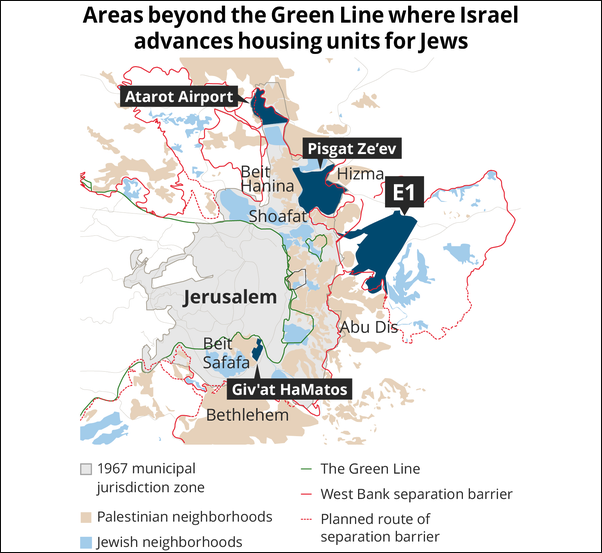
- The Givat Hamatos Settlement: On October 13th, the Jerusalem Local Planning Committee approved the expropriation of lands designated for public use in the Givat Hamatos area for the construction of roads, public buildings and the development of open space for the planned new settlement/neighborhood. For more on the Givat Hamatos settlement plan, please see here.
Map by Haaretz
- The E-1 Settlement: The Israel Civil Administration moved forward with advancing plans for the construction of the E-1 settlement, setting a date for a third hearing to discuss public objections to the plan (now set for November 8th). The first hearing was held on October 4th, but Palestinians were denied the ability to participate in that hearing (which was held virtually, making it inaccessible to the many Palestinians affected by the plan who do not have internet access). As a result, the Court scheduled this 3rd hearing (to allow the participation of Palestinians). The second hearing was held on October 18th; at that hearing three objections were presented (one by the Palestinian village of Anata, a second by the Palestinian village of Al-Azariya, and a third joint submission filed by Ir Amim and Peace Now). Ir Amim reports that there was no substantive discussion of these objections, with the Civil Administration panel offering no questions or comments on them. For more on the E-1 settlement plan, please see Terrestrial Jeruaslem’s excellent and thorough reporting.
- The Atarot Settlement: The Jerusalem District Planning Committee formally signaled that it will proceed with a hearing on the Atarot settlement plan – scheduled for December 6th – to build a huge new settlement on the site of the former Qalandiya airport (located at the northern tip of East Jerusalem). In its current form, the plan provides for up to 9,000 residential units for ultra-Orthodox Jews (assuming, conservatively, an average family size of 6, this means housing for 54,000 people), as well as synagogues, ritual baths (mikvehs), commercial properties, offices and work spaces, a hotel, and a water reservoir. If built, the Atarot settlement will effectively be a small Israeli city surrounded by Palestinian East Jerusalem neighborhoods on three sides and Ramallah to its north. Geopolitically, it will have a similar impact to E-1 in terms of dismembering the West Bank and cutting it off from Jerusalem. For more on the Atarot settlement plan, please see here.
- The Pisgat Ze’ev Settlement: The Israeli government advanced plans for 470 new settlement units in Pisgat Ze’ev, the largest settlement located in East Jerusalem.

Recap: Court Pushes for Palestinians to “Compromise” with Settlers in Sheikh Jarrah
The Israeli Supreme Court has set November 2nd as the deadline for Palestinian families living at risk of forced displacement in Shiekh Jarrah to decide wether or not to accept a Court-authored deal which would help them – at least temporarily – avoid eviction from their homes, in part by requiring them to recognize settler ownership over the properties.
Under the terms of the Court’s deal, which it is pressuring both parties to accept, the following would take place:
- The settler group Nahalat Shimon will be recognized as the owners of the site.
- The Palestinians will be recognized as protected tenants and be required to pay an nominal annual rental fee to the attorney of the settlers (in effect recognizing the settlers as the owners) but
- The Palestinians will be able to continue pursuing legal challenges to the underlying ownership of the land
- The Palestinians are permitted to renovate the properties without interference
- Settlers will be able to instigate eviction proceedings against Palestinians if they are in violation of the Court’s compromise agreement or in violation of Israel’s tenancy laws.
Terrestrial Jerusalem writes:
“The most problematic element of the settlement relates to the settlers’ ability to institute evictions even if the residents are not in violation of the agreement or of the tenancy laws. The settlers will be entitled to institute such proceedings in the event that the ownership rights are conclusively awarded to them, or after 15 years, the earlier of the two. This can be done if the settlers either wish to personally use the property or to demolish and rebuild. Under these circumstances, the settlers will need to offer the residents alternative equivalent quarters. Palestinian residents might hope settlers reject the deal to avoid having to make an ‘excruciatingly painful decision.’”
According to Terrestrial Jerusalem, the Court has signaled that further negotiations are acceptable, but that if either party rejects the agreement a decision on the eviction cases will be handed down swiftly.
New Report: State-Backed Settler “Tourism” Projects in East Jerusalem
In a new report entitled, “The Valley of Hinnom: Trees and Flowerbeds in the Political Struggle over East Jerusalem,” the Israeli NGO Emek Shaveh surveys the multitude of recent “tourism” projects jointly undertaken by the Elad settler organization and the Israeli government in the Ben Hinnom Valley — a strategic area between East and West Jerusalem (stretching past the 1967 Green Line), and located within the area designated by Israel as the Jerusalem “Walls National Park”.
Emek Shaveh writes:
“The nature of the tourism-settlement activity in the Valley of Hinnom conducted jointly by Elad and government authorities is familiar to us from the City of David/Silwan. The series of joint ventures such as the café, the Center for Ancient Agriculture and the cable car in effect hand over large expanses of land to the settlers of the Elad Foundation under the guise of tourism. Although unlike Silwan, the valley is sparsely populated, the activity there must be viewed as an integral part of the struggle for the Old City Basin of Jerusalem and as a means to clear this highly strategic area from the presence of Palestinians.”
In conclusion, we wish to emphasize the following points:
1 – Development in East Jerusalem is almost always driven by political objectives. Recent developments in the Valley of Hinnom are part of the grand plan to change the character and the landscape of the Old City Basin and ought to be considered an integral component of the settlement enterprise in the Palestinian neighborhoods surrounding the Old City.
2 – Halting the destructive development schemes in the areas surrounding the Old City is vital in order to preserve Jerusalem as a multicultural historic city and is indirectly essential for safeguarding the status quo at the holy places.
3 – The Palestinian protests against the expansion of the settlers’ grip over the open spaces such as the Hinnom Valley is part of the struggle by the residents of Silwan and the surrounding neighborhoods to preserve the character of their neighborhoods. In our view, one ought to view the various activities by the settlers and the authorities in the Historic Basin such as the expulsion of residents from their homes, taking over land and the shaping of a historic narrative as part of the same general bid to cement their control over the Historic Basin.”
Bonus Reads
- “[PODCAST] The Occupation & the Biden Administration” (FMEP ft. Danny Seidemann and Yehuda Shaul with Lara Friedman and Khaled Elgindy)
- “How offshore accounts turned the British Virgin Islands into an east Jerusalem landlord” (JTA)
- “Beita residents reach lands for first time since settler takeover” (Al Jazeera)
- “After Years of Neighborly Relations, Settlers Try to Foil Recognition of Palestinian Hamlet” (Haaretz)
- “Palestinian protests turn deadly as Israel considers the future of a new settlement” (NPR)
- “These Palestinian Families Face Eviction From Their East Jerusalem Homes” (Haaretz)
- “When Settler Becomes Native” (Jewish Currents)
Welcome to FMEP’s Weekly Settlement Report, covering everything you need to know about Israeli settlement activity this week.
To subscribe to this report, please click here.
August 13, 2021
- The First Bennett/Biden Settlement Wave, Part 1: Israel Set to Advance 2,259 Settlement Units
- The First Bennett/Biden Settlement Wave, Part 2: Israel Announces Intention to Issue 863 Building Permits for Palestinians in Area C
- The First Bennett/Biden Settlement Wave, Part 3: Observations on Settlement Policy Coordination Between Governments
- Jerusalem District Court Orders 16 Homes to Be Demolished While Delaying – for 6 months – Demolition of Others in Silwan
- Israel Begins Work on Settler-Back Project at the Ibrahimi Mosque/Tomb of the Patriarchs
- Atarot Settlement Plan to Be Discussed on December 6th
- Bonus Reads
Questions/comments? Email kmccarthy@fmep.org
The First Bennett/Biden Settlement Wave, Part 1: Israel Set to Advance 2,259 Settlement Units
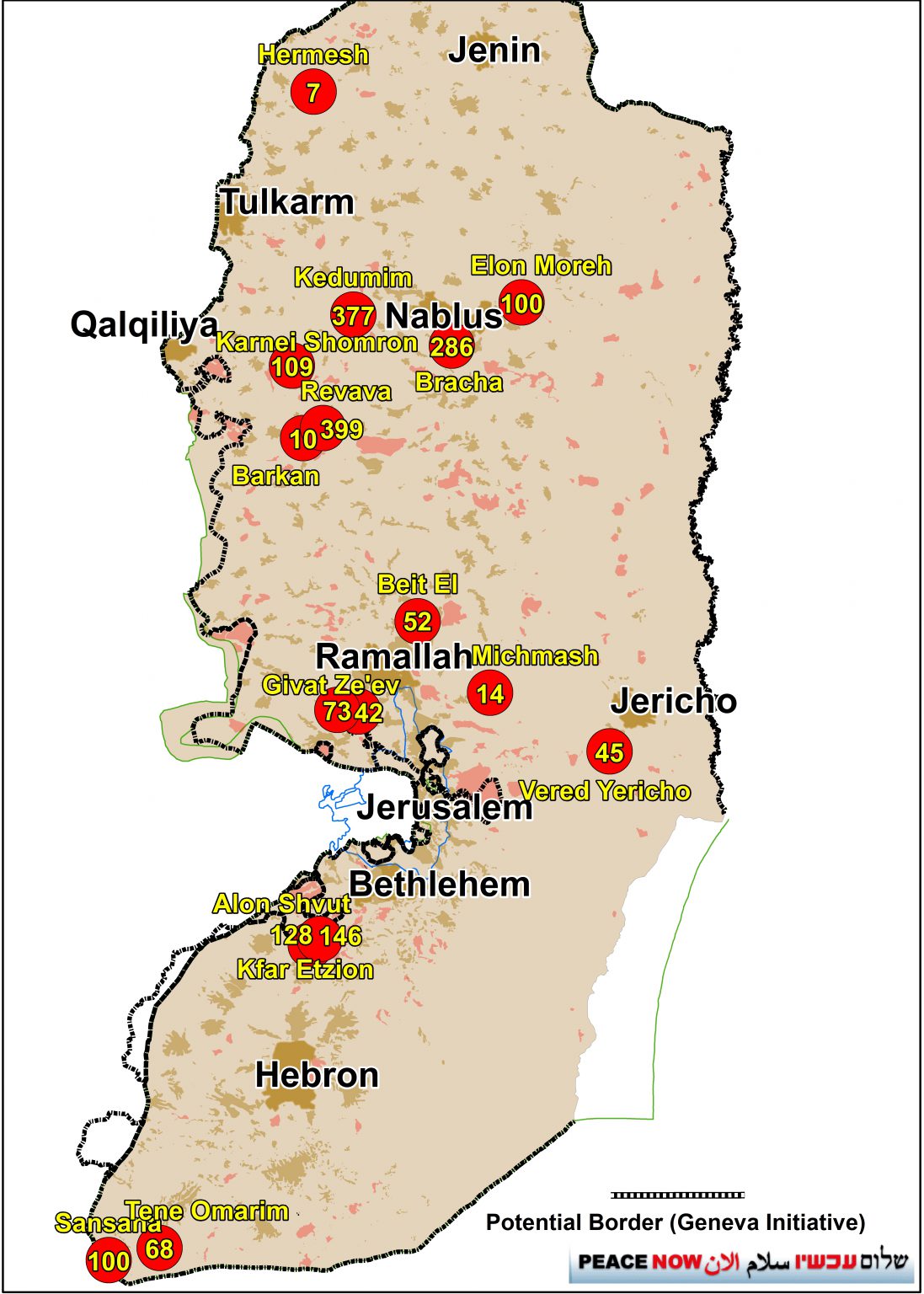 On August 12th, Israeli Defense Minister Benny Gantz announced that the High Planning Council will convene on August 18th to advance 2,259 new settlement units, as part of projects across the West Bank. Of these, 908 units are slated to receive final approval, including many units in areas beyond Israel’s security barrier. This will be the first time that the High Planning Council (HPC) has convened in 10 months, and it will be the first time a large number of settlement units has been advanced since Biden entered the White House. As a reminder, the HPC is a body within the Israeli Civil Administration (which is a part of the Israeli Ministry of Defense) that has authority over construction planning and approvals for both settlers and Palestinians in the West Bank (the HPC does not have authority with respect to settlement construction in East Jerusalem; since Israel annexed the area in 1967, Israeli domestic Israeli planning authorities are in charge there).
The plans expected to receive final approval include:
- 286 units in the Har Bracha settlement, located south of Nablus. If implemented, these new units will double the size of Har Bracha;
- 146 units in the Kfar Etzion settlement, located between Bethlehem and Hebron and on the Israeli side of the planned route of the barrier (which is not yet built in this area);
- 110 units in the Alon Shvut settlement, located just north of the Kfar Etzion settlement and between Bethlehem and Hebron;
- 82 units in the Karnei Shomron settlement, located in the northern West Bank, east of the Palestinian village of Qalqilya. Israel has openly declared its intention to continue expanding settlements in this area with the stated goal of bringing 1 million settlers to live in the area.;
- 52 units in the Beit El settlement, located in the heart of the northern West Bank [as a reminder, former US Ambassador to Israel David Friedman has deep ties to the Beit El settlement]; Construction on 350 new units in Beit El began earlier this year;
- 42 units in the Givat Zeev settlement, located south of Ramallah in an area that. is on the Israeli side of the barrier;
- 14 units in the Ma’aleh Mikhmash settlement, located east of Ramallah;
- 10 units in the Barkan settlement, located about half way between the Ariel settlement and the cluster of settlements slated to be united into a “super settlement” area (Oranit, Elkana, Shiva Tikva, and others).;
Peace Now said:
“The approval of thousands of housing units in the settlements harms the Israeli interest and the chances of reaching peace. It seems that the approval of a handful of plans for the Palestinians is only intended to try to reduce criticism of the government and to please the US administration ahead of Prime Minister Bennett’s expected visit to Washington in the coming weeks. For years, Israel has pursued a policy of blatant discrimination that does not allow almost any construction for Palestinians in Area C, while in the settlements it encourages and promotes the construction of thousands of housing units each year for Israelis. The approval of a few hundred housing units for Palestinians can not cover up discrimination and does not change the fact that Israel maintains an illegal regime of occupation and discrimination in the territories.”
The First Bennett/Biden Settlement Wave, Part 2: Israel Announces Intention to Issue 863 Building Permits for Palestinians in Area C
In announcing plans to advance over 2,000 new settlement units, Defense Minister Gantz also announced his intention to issue permits for 863 houses – some of which will be issued for existing structures – for Palestinians living in Area C. Haaretz reports that the permits are being advanced in order to buy the consent of the few members of the Israeli governing coalition that oppose settlement construction, and as “calculated risk” with respect to the Biden administration.
As a reminder, Area C is the 60% of the West Bank where Israel enjoys absolute authority and has systematically denied Palestinian building rights, while promoting the expansion of settlements and unauthorized outposts. If issued, these permits for Palestinians will be the first issued by Israel in years, and the first of any significant size. Only 21 building permits were issued to Palestinians between 2016 to 2018, while 2,147 demolition orders were issued in the same period.
Commenting on the announcement of the planned permits (which, given past experience, there is no reason to assume will ever be issued) Peace Now said:
“It is a very small expansion of the Palestinian villages and a drop in the ocean in terms of real Palestinian development needs.”
Peace Now reports that these permits, if they are ever issued, might be for:
- 270 houses in the Bir al-Bash village, located south of Jenin in the northern West Bank;
- 233 houses in the the Almasqufa village, located near Tulkarem in the norhtern West Bank;
- 160 houses in the Abba a-Sharqiya village, also located south of Jenin in the northern West Bank;
- 150 houses in the Al-Ma’asara village, located south of Bethlehem; and,
- 50 houses in the Khirbet Zakariya, also located south of Bethlehem.
The First Bennett/Biden Settlement Wave, Part 3: Observations on Settlement Policy Coordination Between Governments
In reporting over the past week, Axios journalist Barak Ravid has documented the efforts by the Israeli and U.S. governments to square conflicting positions with regards to settlement growth.
On the U.S. side, the Biden Administration has appeared to take pains to make room in its official discourse to begrudgingly tolerate settlement construction. While the U.S. has criticized the new batch of settlement advancements, until this week the U.S. had reportedly identified three actions it has asked Israel to refrain from, notably not including settlement expansion. Those three actions are: the demolition of Palestinian homes, the eviction of Palestinians from their homes, and the establishment of new outposts in the West Bank. The U.S. is also reportedly asking Israel to take positive steps to stabilize the Palestinian Authority, which is suffering from economic shortfalls and crashing levels of popular support.
For it’s part, Israeli press suggests that the Bennett government reduced the number of upcoming settlement advancements in order to appease the Biden Administration. The Israelis wanted to advance 3,623 plans, but announced a total of 2,259 (a 39% cut according to Jerusalem Post). Axios also reports that the Israeli government is assertively framing its settlement policy as one of restraint, prioritizing settlement projects that address the supposed “natural growth” needs of existing settlements.
“Natural growth” has been used many times in the past by the Israeli government as an argument for why settlements must be allowed to expand. FMEP’s Lara Friedman has debunked this argument many times in the past, explaining:
“While ‘natural growth’ has no formal definition, it has generally been used in the settler context to mean population growth due to births, as contrasted to growth due to immigration from Israel or other places. But in numerical terms (according to Israeli official statistics), taking into account deaths and people migrating out of settlements, births inside the settlements account for approximately 60% of the annual population growth in settlements, while around 40% is immigration from inside Israel or abroad. So clearly population growth in settlements is not simply a matter of births. Perhaps this is why some excuse-makers have expanded ‘natural growth’ to include other ways that families can grow, from non-settler spouses to aged non-settler relatives moving in.
“Regardless of what definition people want to use, the fact is that ‘natural growth’ is not a legitimate argument against a complete freeze in settlement construction. Yes, settlers, like people everywhere, indeed have the right to have babies, and yes, their children indeed have the right to grow up and have families and homes of their own. But nowhere in the world – not in New York, or Paris, or Tel Aviv – do people have an inalienable right to live exactly where they want – in the size home they want, in the neighborhood they want – irrespective of real estate market factors, or any political, economic, zoning, or other considerations that may come into play (including in this case, considerations about actual land ownership). Inside Israel, just like in other countries, people regularly face difficult decisions about where to live, given that major cities like Tel Aviv and Jerusalem are crowded and little affordable housing is available.
“Settlers have the right to have babies and to take in their parents or grandparents. When settler children grow up they have the right to start families and have homes of their own. But the settlers must do what people everywhere must do: reconcile their needs as best as possible to the housing market, which is affected not only by demand but by a myriad of other variables – including, in this case, the fact that settlers have knowingly and voluntarily chosen to make their lives on land that is the subject of a political dispute of global proportions.”
Axios quotes an Israeli government official saying:
“The Biden administration knows we are going to build. We know they don’t like it, and both sides don’t want to reach a confrontation around this issue.”
An Israeli government source summarized the dance going on between the respective governments by saying:
“[The U.S.] will express opposition to this move, but everyone wants this impossible coalition in Israel to hold out… It was clear for Bennett he would not have been able to advance this move after his meeting with [U.S. President Joe] Biden at the end of the month, so as not to damage their relations, and that’s why he had to announce it as early as he did.
Jerusalem District Court Orders 16 Homes to Be Demolished While Delaying – for 6 months – Demolition of Others in Silwan
On August 12th, a Jerusalem Court granted a six-month freeze on demolition orders affecting dozens of Palestinian homes in the al-Bustan section in the Silwan neighborhood of East Jerusalem. At the same time, the Court cleared the way for the immediate demolition of 16 Palestinian homes in the same area.
A lawyer representing the Palestinians involved in these demolition cases said his clients intend to file for permits for the structures, which were built on land that Palestinians assert they own. Israel argues that the land is public land.
Israel Begins Work on Settler-Back Project at the Ibrahimi Mosque/Tomb of the Patriarchs
This week, an Israeli crew began construction on a new elevator leading to the Ibrahimi Mosque/Tomb of the Patriarchs in Hebron, arguably one of the most sensitive religious sites outside of Jerusalem. The project to install accessible infrastructure at the site has been backed and pushed by settlers for over two decades and provides a means by which the State of Israel has increased its control over the site. The project is roundly opposed by Palestinians along with archaeologists and other experts. The Israeli archeology group Emek Shaveh explains its opposition:
“We claim that while the plan is couched in terms of concern for the disabled and elderly worshippers, in actual fact it is unilaterally advancing changes to a site mired in deep political controversy…The size and characteristics of the structure demonstrate that at issue is not simply a lift for persons with disabilities, but a significant change to the compound. The lift will constitute a change in the status quo and a strengthening of the settlers’ control of the holy site. Ignoring the fact that the site falls under the auspices of the Hebron Municipality is evidence that Israel is further reneging on its commitments to agreements signed in the past with Palestinians.”
Atarot Settlement Plan to Be Discussed on December 6th
As expected, the Jerusalem District Planning and Building Committee has set a date – December 6th – for the advancement of the Atarot settlement plan. This plan would allow for the construction of 9,000 settlement units, to be built on the site of the former Qalandiya airport (located at the northern tip of East Jerusalem).
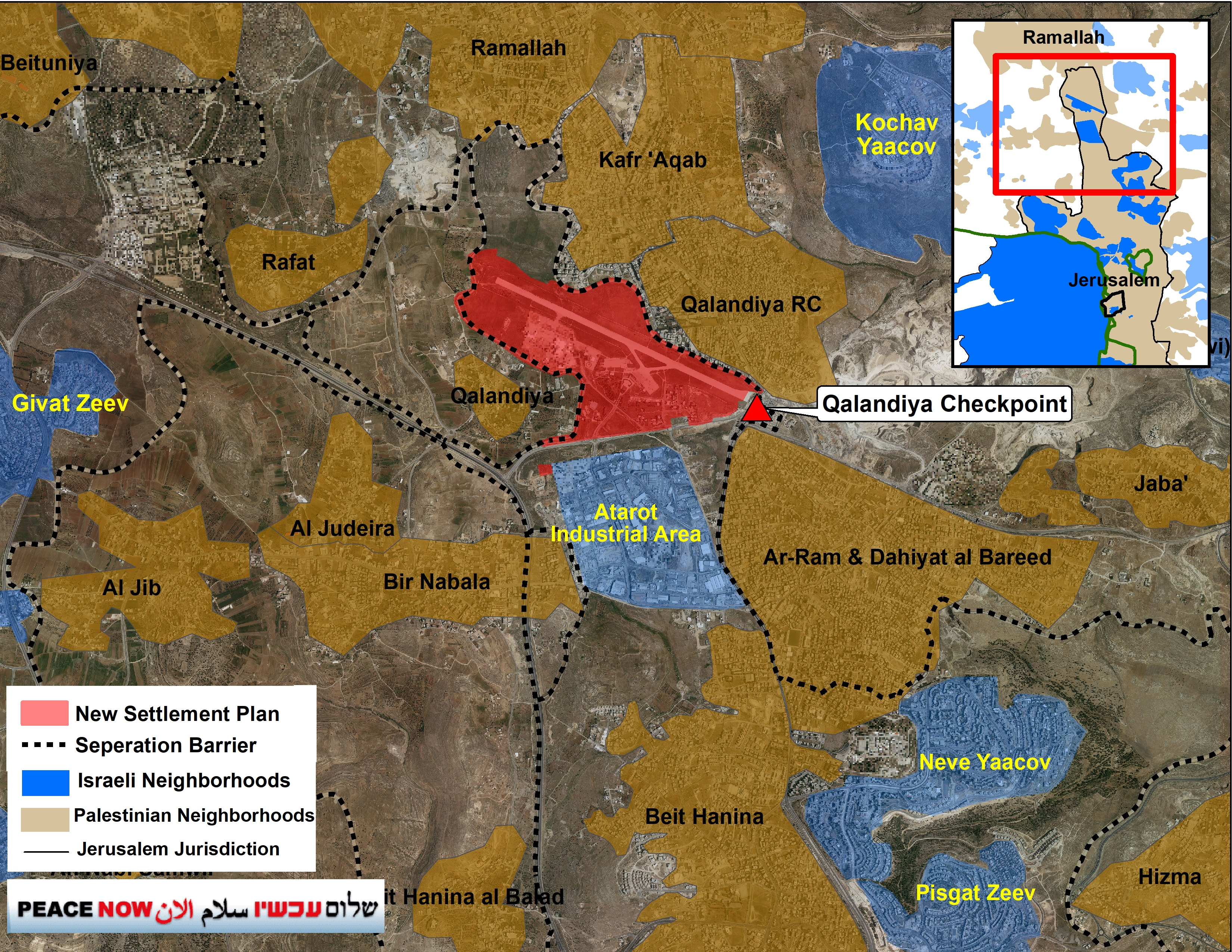 The Atarot settlement plan dates back to 2007. It was pursued by the Israeli government in 2012 but shelved under pressure from the Obama administration. The plan came back into consideration in April 2017 (a few months following the inauguration of President Trump) when it was rumored to be included on Netanyahu’s master blueprint of settlements for which he was seeking U.S. approval. In February 2020, following the publication of the Trump Plan – which designated the area that would be used for the settlement as a “special tourist zone” for Palestinians – the Atarot settlement plan was formally introduced. In January 2021 then-Prime Minister Netanyahu dangled the advancement of the plan as an incentive for parties to join his flagging coalition in order to remain in power.
In its current form, the plan provides for up to 9,000 residential units for ultra-Orthodox Jews (assuming, conservatively, an average family size of 6, this means housing for 54,000 people), as well as synagogues, ritual baths (mikvehs), commercial properties, offices and work spaces, a hotel, and a water reservoir. If built, the Atarot settlement will effectively be a small Israeli city surrounded by Palestinian East Jerusalem neighborhoods on three sides and Ramallah to its north.
There are currently 15 Palestinian families living in buildings on the land slated for the settlement, part of which is privately owned by Palestinians. Other land in the area has been declared “state land” by Israel or belongs to the Jewish National Fund. To solve the problem of Palestinian land owners, the Israeli government will need to evict the Palestinians living there and demolish their homes — a step that will be facilitated by the fact that all of the homes lack Israeli-issued building permits (which are essentially impossible for Palestinians to receive). The private Palestinian landowners will then be subjected to a non-consensual process of “reparcelization,” in which Israel will unilaterally reparcel and then redistribute the land amongst its owners on the basis of the value of the land (as determined by Israel) and the percentage of their ownership claim.
The Atarot airport site is an important commodity and, during past negotiations, it was promised to the Palestinians for their state’s future international gateway. Israeli development of the site as a settlement would — by design — not only deprive a future Palestinian state of the only airport in a Palestinian area, but also dismember Palestinian neighborhoods in the northern part of the Jerusalem, and sever East Jerusalem from a Palestinian state on this northern flank of the city (acting like E-1 on Jerusalem’s northeast flank, and like Givat Hamatos on Jerusalem’s southern flank).
Bonus Reads
- “Case Study: How a Settler Law-Breaker Became the #2 Official in Israel’s Ministry of the Interior” (FMEP // Lara Friedman w/ Dror Etkes)
- “Senior Israeli Official’s Appointment Approved Despite Demolition Order for His Settlement Home” (Haaretz)
- “In Sheikh Jarrah, anonymous actors and an absent state have created a powder keg” (The Times of Israel)
- “The Fight for Palestine’s Sheikh Jarrah Isn’t Over” (Jacobin)
- “ICC Mulls Probing Israel Over Razing Palestinian Homes in Jordan Valley” (Haaretz)
- “81 Palestinian homes demolished by Israel in East Jerusalem in 2021” (Middle East Monitor)
- “Jewish claim of land ownership in occupied East Jerusalem neighborhood displaces five Palestinian families” (WAFA)
Welcome to FMEP’s Weekly Settlement & Annexation Report. To subscribe to this report, please click here.
June 25, 2021
- Defense Ministry Approves 31 New Projects in Settlements
- Settlers Pressure Bennet Over Fate of (Illegal, even under Israeli law) Evyatar Outpost, Plan to Appeal to the High Court for Protection
- Demolish “Oz Zion” Outpost
- Gantz Orders Construction of Settler-Backed “Accessibility” Project at Tomb of the Patriarchs/al-Ibrahimi Mosque in Hebron
- Settlers Raid Homes of Prominent Activists in Sheikh Jarrah
- Bonus Reads
Comments or questions? Email Kristin McCarthy – kmccarthy@fmep.org.
Defense Ministry Approves 31 New Projects in Settlements
On Wednesday, June 24th – just two weeks after Naftali Bennett became Prime Minister – the Israeli Defense Ministry advanced the construction of 31 settlement zoning plans (with 18 receiving final approval), in settlements across the West Bank. This is the first time this particular subcommittee inside the Defense Ministry – which handles smaller settlement plans, while the Defense Ministry’s High Planning Council considers larger plans – has met since January 2021.
The plans which were advanced provide for the construction of public buildings, including a special needs school in the Elkana settlement, a new shopping mall in the Mishor Adumim settlement, and the Kfar Adumim and Karnei Shomron settlements both received approval for new synagogues and seminaries. As of the time of publication, final details of each plan are not publicly available.
The settler Yesha Council, led by David Elhayani (who had been publicly hopeful about the Bennett-led government), released a statement deriding the government for its failure to advance not just public buildings but also settlement housing units. The statement demands that Bennet convene the High Planning Council in order to issue more approvals.
The Joint List’s Ayman Odeh denounced the new government, including its left-wing members, over the settlement advancements:
“The government has existed for less than two weeks, and already, 31 construction plans have been approved in the settlements…the left is surrendering to the right and setting the diplomatic issue aside, but the right continues to sabotage the chances of peace and to deepen the occupation, repression, and dispossession of millions of Palestinians. Only the end of the occupation and a just peace will bring equality, democracy, and social justice to both peoples.”
Settlers Pressure Bennet Over Fate of (Illegal, even under Israeli law) Evyatar Outpost, Plan to Appeal to the High Court for Protection
New Israeli Foreign Minister (and Prime Minister in waiting) Yair Lapid has told press that the unauthorized outpost of Evyatar, located Palestinian land south of Nablus, will be razed as ordered by the Civil Administration. Yet, the dozens of settler families who are illegally squatting in approximately 50 buildings at the site are hoping to avoid that fate, and have until Monday June 28th to file an appeal with the Israeli Supreme Court or else face removal from the outpost barring political interference from PM Bennett (who is facing pressure from within his own party to save the outpost). The outpost continues to be a central flashpoint of violence in the West Bank over the past month, so far five Palestinians have been killed by IDF fire while protesting the land takeover.
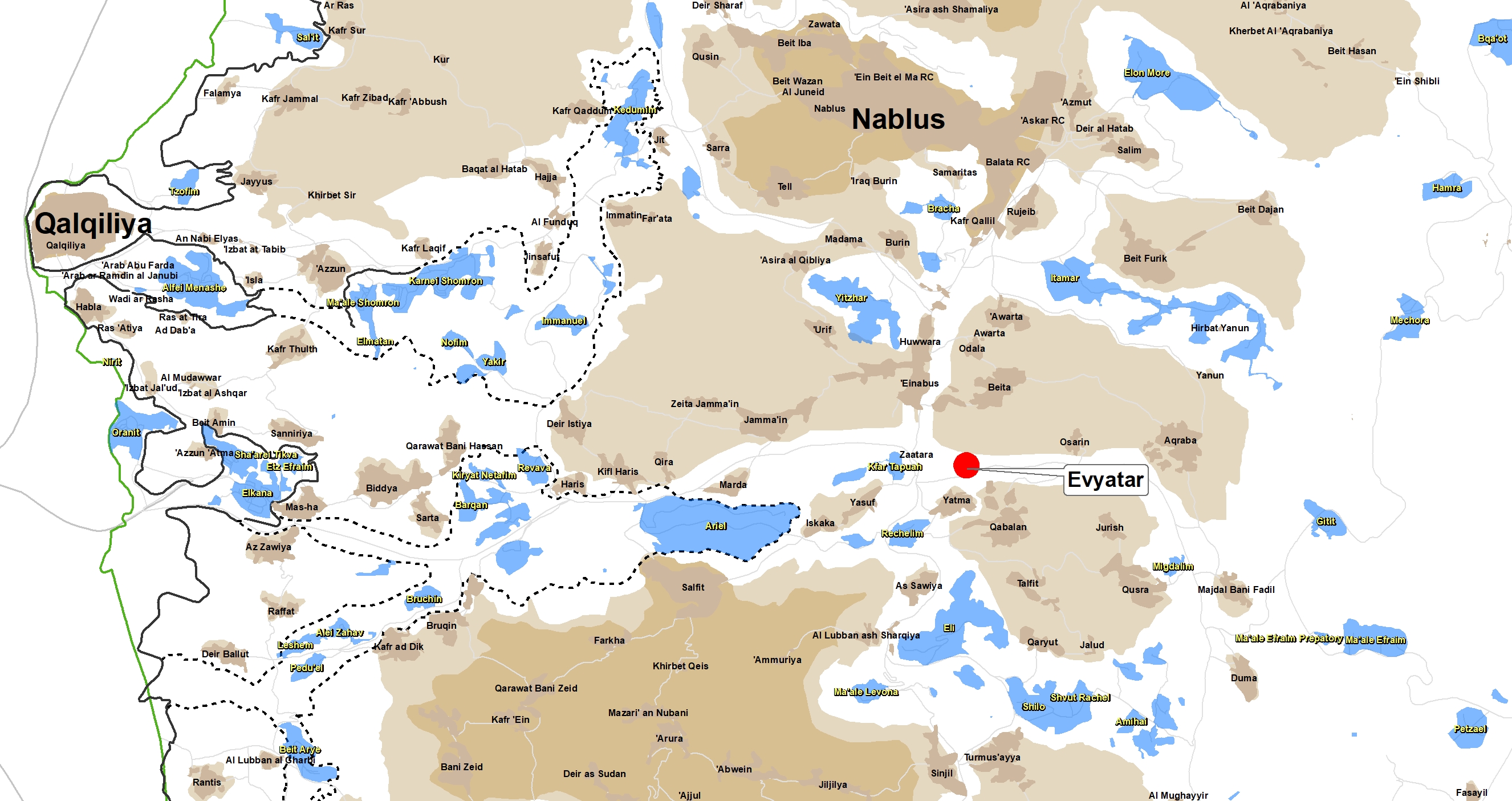
Map by Peace Now
Late last week, the settlers submitted plans – which outlined 100 housing units in addition to land for parks, a synagogue, a daycare center, and a school – to the IDF’s Civil Administration, in hopes of gaining retroactive legalization for the structures they already illegally built on the land. The plan framed the outpost as an extension of the nearby (but not contiguous) Kfar Tapuah settlement. This tactic – issuing retroactive approval to outposts under the premise that they are new neighborhoods of existing settlements – has in the past proven effective, and is a tactic promulgated by the Israeli government. For a few examples, see the following cases: the Adei Ad outpost, the Har Homa E settlement, Shvut Rachel East, and New Migron.
Speaking about the settlers’ hopes of gaining retroactive legalization of Evyatar, prominent settler leader and head of the Samaria settler municipal council, Yossi Dagan, said:
“The Council only submitted a request to authorize construction for the town of Evyatar after establishing beyond doubt that it is not situated on privately held land. Rather, it is situated on state-held land, and only the lack of a clear decision on the part of politicians is preventing its authorization. After going through such a difficult period, the State of Israel should be mobilizing all its forces to take this step, which would be both moral and ethical – it should be strengthening the 50 families who live here and giving Evyatar equal legal status to any other town in the country.”
Nonetheless, the Civil Administration (the arm of the Israeli Defense Ministry responsible for running the West Bank) rejected the settlers’ plans, based on the fact that the outpost was built illegally in blatant violation of Israeli planning laws. The military has also said the outpost undermines “security [and] stability” in the area. Further, the authorities said that the plan was not “properly developed” and that settlers do not have rights to the land. Following the Civil Administration’s rejection of their plans, Evyatar settlers plan to appeal to the Israeli High Court of Justice to stop the demolition, which is set for June 27th.
Notably, the Civil Administration’s rejection of the settlers’ plans for Evyatar does not mean that the IDF recognizes Palestinian ownership of the land, even though aerial photos obtained by the NGO Kerem Navot show that Palestinians cultivated the land at least until 1980. Rather, the IDF is now investigating the status of the land, leaving open the possibility that the land may be declared “state land” – at which point (based on past practice) it is a near certainty it would be allocated for Israeli settlement.
Peace Now also provides a key insight on the settler group which is behind the creation of this new outpost, and why it matters, writing:
“The body behind the establishment of the outpost is the settler organization of Nahala, with the close assistance of the Shomron municipality and its mayor, Yossi Dagan (a central member of the Likud party). The Nahala organization and the main activists of the new outposts are not the mainstream old-guard settlers (like the Amanah organization who is behind many other settlements and outposts and gets much more support from the authorities), however they are not a small fringe. This outpost is an example of a rift that is being created within the Israeli right wing. The more extreme right, which is willing to challenge the system more strongly, and the old-guard settlers who continue the mentality of working ‘with’ the government as much as possible. On the partisan level we see this rift in the creation of two different parties: Yamina, headed by Naftali Bennet, and the Jewish Zionism, headed by Betzalel Smotrich and Itamar Ben Gvir. The challenge of the new outpost puts the new shaky government, which is a coalition of parties which don’t agree about many things, to face its first big political test. The extreme right is signaling that it is planning to continue to challenge the new government, like it had done in the flags march in East Jerusalem, and in yesterday’s settlers’ marches throughout the West Bank.”
Peace Now called for the outpost to be expeditiously demolished, saying:
“A small group of people is creating facts on the ground that effect dramatically Israel’s security and its foreign policy without any authority. The new government must not accept that. This outpost must be evicted not only because it is deepening the occupation of the Palestinians in the West Bank but because it is bad for the security of Israel and bad for the possibility of future peace for Israel”.
IDF Demolish “Oz Zion” Outpost
On June 23rd, the Israel IDF dismantled an illegal outpost – called “Oz Zion” by the settlers – located between Ramallah and Jerusalem. The Times of Israel reports that the IDF removed more than 20 settlers and demolished several structures. Seven settlers were arrested for throwing objects at Israeli soldiers. This particular outpost has been built by settlers, and then demolished by the IDF, several times previously.
Opposition MK Bezalel Smotrich railed against the new government for its demolition of the outpost, saying:
“As we feared, within days of the formation of the government the destruction of communities has begun… Arab construction is out of control in the Negev, Galilee and Judea and Samaria and Bennett and [Justice Minister Ayelet] Shaked are choosing to demolish for Jews.”
As a reminder, Naftali Bennet once served as the head of the settler Yesha Council – which is effectively the main body lobbying the Israeli government on behalf of the settlement movement. That fact does not sit well with Kahanist MK Itamar Ben-Gvir, who said in a statement:
“The person who was once the director of the Yesha Council is now leading the demolition and destruction of the settlements. It is amazing that without blinking, Bennett approved the demolition of a settlement, at a time when he and his friends are making sure that there won’t be demolitions in the Bedouin sector. There is one law for the Bedouin, and a different law for the Jews. What an embarrassment.”
Gantz Orders Construction of Settler-Backed “Accessibility” Project at Tomb of the Patriarchs/al-Ibrahimi Mosque in Hebron
On June 10th, Israeli Defense Minister Benny Gantz gave instructions to COGAT – the body within the Defense Ministry which coordinates civilian affairs in the occupied territories – to issue a building permit and sign a contract for the construction of accessible infrastructure, including an elevator and wheel chair ramp, at the Tomb of the Patriarchs/al-Ibrahimi Mosque in Hebron. The project, which required Israel to seize land that is owned by the Islamic Waqf, strengthens Israeli control over the site and its immediate surrounding area.
The orders from Gantz follow a decision by the Israeli High Court of Justice to dismiss a petition against the plan filed by the Palestinian-run Hebron Municipality. The petition argued that the plan violates agreements, including the Hebron Protocols, signed by Israel specifying that the Palestinian-led municipality has planning authority over the site.
Emek Shaveh – an Israeli NGO with expertise in archaeology and settlement planning – also filed a petition against the plan, describing the plan as “unprofessional” and “a farce.” Emek Shaveh said previously:
“One need not be an archaeologist or architect to review the council’s plan and understand that it is destructive in a manner which is unprecedented. We are convinced that the plan, as approved, would never have been promoted had it not been driven by political motives.”
Emek Shaveh has previously provided critical context as to why this plan is not really, or not fully, being advanced out of humanitarian concerns, explaining:
“Israel’s decision to seize responsibility for the site from the Hebron municipality and the Palestinians sends a clear political message that Israel is reneging on agreements that were signed with the Palestinians in Hebron. Beyond the precedent that will enable the settlers in the future to demand additional changes at the Tomb of the Patriarchs/Ibrahimi Mosque, this is also a precedent that could play out at other sites under the responsibility of the Islamic Waqf. Experience has shown us that what begins in Hebron percolates into other places including Jerusalem. It begins with a seemingly rational demand to benefit the disabled or the general public and evolves into a new status quo. The expected change in Hebron has not escaped the attention of members of the Temple movement and they will know how to present their demands to the government. If Israel can repudiate agreements with the Palestinians in Hebron and expropriate land from the Waqf, it would seem that accepting what appears to be the far more modest demands by the Temple movement to pray or to walk about the Temple Mount complex freely is not so far-fetched. In the reality of Hebron and East Jerusalem, a change involving only several meters at a historic or holy place is not free of political considerations and often it is part of long-term strategy. While it is necessary to tend to the needs and interests of persons with disabilities, the extremists who presume to speak on their behalf must be prevented from forging Israeli policy, even if it is only a matter of a lift and an access path.”
Read Emek Shaveh’s full analysis here: “Humanitarianism Hebron Style.”
Settlers Ramp Up Battle for Area C with Provocative West Bank Marches
In recent years, Israel has increasingly treated Area C as indistinguishable from sovereign Israeli territory. In parallel, settler groups – most notably Regavim – have lobbied Israeli authorities to crack down on “illegal” Palestinian construction, claiming that Palestinians are trying to use “illegal” construction to “take over” Israeli land.
In line with this effort, on June 21st, hundreds of settlers participated in marches throughout friction zones in the West Bank, in an effort to push the newly sworn-in Israeli government to increase their persecution of Palestinian construction in Area C of the West Bank. In advance of the march, settler leaders (excluding Yesha Council head David Elhayani) released a joint statement saying:
“It is our duty to do everything legally passive to stop the savage Arab invasion of Area C to stifle Jewish settlement and establish facts on the ground. Together we will head out to explore the area, to occupy the space with our feet and demand that the authorities enforce the law in the area out of a deep belief that this land is ours.”
Making clear that the settlers have no sense of irony, one of the settler marches was held near the unauthorized Evyatar outpost – which the settlers built illegally and over which they are now engaged in a struggle with the government to prevent Israeli law from being applied to their (Jewish Israeli) illegal construction.
As a reminder, Area C accounts for around 60% of the West Bank. The Oslo Accords gave Israel complete control over Area C, and Israel for years has systematically denied Palestinians in Area C permits that would enable them to “legally” build on their own land. As a result, members of these communities have been forced to build without Israeli permits, and then face Israeli demolition orders, and demolitions, for having done so.
Settlers Raid Homes of Prominent Activists in Sheikh Jarrah
On Tuesday, June 22nd, a group of settlers attempted to force their way into three homes belonging to the El Kurd, Diab, and Qasem families – all of which are living under imminent threat of forced displacement – in the Sheikh Jarrah neighborhood of East Jerusalem. The families were able to prevent their entry.
Israeli MK Bezalel Smotrich and the head of Nahalat Shimon (the settler organization behind the campaign to displace Palestinians from their homes in Shiekh Jarrah) were among the group of settlers who tried illegally invade the homes and threatened the Palestinian occupants. Eventually, Israeli police calmly escorted the settlers away from the homes.
These home invasions followed one of the most violent days Sheikh Jarrah has seen in recent months. During protests against settler takeovers in the neighborhood on June 21st, 21 Palestinians were wounded including three who were hit with live bullets fired by the IDF and three Palestinians who were beaten. As a reminder – a recent investigative report revealed that a New York-based lawyer, Seymour Braun, is financially connected to settler efforts to displace Palestinians in Sheikh Jarrah.
Bonus Reads
- “’Silent intifada’: West Bank is at boiling point” (Ynet)
- “Israeli forces launch violent crackdown on protesters in Beita” (Middle East Eye)
- “Reality of a West Bank Outpost: Four Dead Palestinians and a Drone Spraying Tear Gas” (Haaretz)
- “Ariel University opens medical school in honor of Sheldon Adelson” (Arutz Sheva)
- “ Israel Stops Its Nighttime ‘Mapping’ Raids, but Constant Surveillance of Palestinians Continues” (Haaretz)
- “Amazon’s Investments in Israel Reveal Complicity in Settlements and Military Operations” (The Nation)
- “The Photos Exposing What Israel Is Trying to Hide” (Haaretz)
- “Israel’s Demographic Warfare Rages on Both Sides of Green Line. With One Difference” (Haaretz)
- “The Trilemma of Power, Aid, and Peacebuilding in the Israeli-Palestinian Context” (Middle East Institute/Dr. Carol Kasbari)
Welcome to FMEP’s Weekly Settlement & Annexation Report. To subscribe to this report, please click here.
April 29, 2021
- Sheikh Jarrah Evictions Set for May 2nd; Protests & Diplomacy Ratchet Up
- Resources for Understanding Recent Protests and Violence in Jerusalem
- WZO Admits It Gave Palestinian Land to Settlers Without Written Agreements
- Jewish National Fund Delays Decision on Formalizing Policy on West Bank Land Purchases
- Ariel University Giving Academic Credit for Outpost Volunteers
- IDF Stops Settler Attempt to Establish Yeshiva on Site of Dismantled Homesh Settlement
- Settlers Celebrate Israeli Independence Day
- Settler-Run Chamber of Commerce Planning a Hotel in Hebron in Partnership with Palestinian Businessman Ahsraf Jabari
- Smotrich’s Party Files Bill for Outpost Legalization
- Roundup of Settler Violence This Week
- Human Rights Watch: Israel is Guilty of the Crime of Apartheid
- Bonus Reads
Comments or questions? Email Kristin McCarthy – kmccarthy@fmep.org.
Sheikh Jarrah Evictions Set for May 2nd; Protests & Diplomacy Ratchet Up
Over the past two weeks, activist groups have stepped up advocacy efforts to stop the impending dispossession of 8 Palestinian families (87 individuals) from their longtime homes in the Sheikh Jarrah neighborhood of East Jerusalem in favor of settlers. The eviction of four families has been set by Israeli courts for May 2nd, and three more families face eviction in August.
The Times of Israel reports that Jordan – which was the governing authority in East Jerusalem from 1948 until 1967 – has also gotten involved, and is said to have found “documents proving that the [Jordanian] ministry of development that built these houses had in 1956 finalized lease agreements for homes in Sheikh Jarrah.” Jordanian Foreign Minister Ayman Safadi said that the documents are contracts between Jordan and the Palestinian tenants, and were certified at the time by UNRWA. Such documents might help Palestinians disprove the settlers’ contention that the homes were originally owned by Jews who fled during the 1948 war. Israeli law allows such Jews – and their descendants – to reclaim their lost properties in East Jerusalem and the West Bank, while denying Palestinians any such right to reclaim properties they were forced to abandon in 1967 or 1948 inside what is today Israel.
On April 22, 2021 a group of 500 Palestinian residents of Sheikh Jarrah and 191 organizational signers sent a letter to the International Criminal Court. The letter calls on the ICC’s Chief Prosecutor to publicly condemn the evictions and investigate what is happening in Sheikh Jarrah as part of the ICC’s larger investigation into the situation in Palestine. The families write:
“If the forced evictions move forward, we will be subjected to other Israeli policies that together make-up Israeli practices that result in the widespread and systematic transfer of the Palestinian Jerusalemite population. If we set up a tent outside our houses, the Israeli occupying forces will demolish it, as part of its widespread and systematic policy of demolition of Palestinian property. If we rent a home outside Jerusalem because we cannot afford to rent in Jerusalem, we will be at risk of having our residency status revoked and not be allowed to enter Jerusalem, pursuant to Israel’s residency revocation policy, which requires Palestinian Jerusalemites to constantly prove their “center of life” is in the city”
On April 16th, hundreds of protestors rallied in Sheikh Jarrah to bring attention to the pending mass displacement. At the protest, former Palestinian Authority Minister for Jerusalem Affairs Hatem Abd al-Qadir told the Times of Israel:
“These protests are an expression of our rejection of the decisions of Israeli courts in expelling the residents of Sheikh Jarrah. This is ethnic cleansing and expulsion at the barrel of a gun.”
Resources for Understanding Recent Protests and Violence in Jerusalem
Since the beginning of Ramadan, Israel’s decision to close the plaza in front of the Damascus Gate – the main gate used by Palestinians to access Jerusalem’s Old City – sparked an outbreak of violence in Jerusalem (Israel subsequently reopened the plaza, but the situation on the ground is still volatile). Several FMEP grantees, partners, and other notable sources have published resources that help contextualize and assess exactly what is happening. Below are resources and excerpts most relevant to settlement observers seeking understanding of how current events fit into the larger picture of Israeli intentions and actions in Jerusalem, including the aforementioned impending dispossessions in Sheikh Jarrah.
Ir Amim published an update under the subject, “Closure of Damascus Gate Plaza & Aggressive Police Measures.” In the brief Ir Amim summarizes exactly what is happening:
“Many of the incidents of friction and confrontation in the area stem from the closure of the Damascus Gate steps and unprovoked police aggression and use of excessive force towards Palestinians, which disrupt the peace and lead to escalation. Over the past week, Palestinian youth have protested the plaza’s closure. The Israel police dispersed them with disproportionate use of force. The police claim that there have been incidents of Palestinians throwing stones at police, and indeed Israeli vehicles were damaged amid the confrontations. However, during the last few nights, police forces have assaulted Palestinians in the Damascus Gate area with no prior provocation on their part, including the use of stun grenades and the deployment of mounted police charging into hundreds of Palestinians who were solely visiting the Old City for Ramadan…
In tandem, right-wing Jewish extremists and nationalist organizations have been exploiting the friction to further incite and call for retaliation (both on social media and mainstream media) against the Palestinian protests and isolated incidents of Palestinian harassment of Haredi Jews. On Monday, Knesset Members from the extremist rightwing Religious Zionism party went to Damascus Gate in a hostile and provocative call to “show Palestinians who’s boss.”
In recent days, large groups of nationalistic Israeli youth have rallied in West Jerusalem’s city center shouting “death to Arabs,” while hunting down and attacking Palestinian pedestrians, which has led to clashes between Jews and Palestinians. In contrast to the police’s aggressive operations at the Damascus Gate, serious measures by the police to disperse these groups or protect attacked Palestinians have not been observed. These groups have called to gather tonight in Jerusalem, marching from the City Hall Square to Damascus Gate and the Old City with the intent of clashing with Palestinians “to teach them a lesson.”
Emek Shaveh published a brief entitled “The Last Gate,” exploring how the state of Israel has spent the past several years asserting more and more control over key archeological sites in and around the Old City, and why the Damascus Gate is a hugely important part of that still unfolding story. Emek Shaveh writes:
“Over the past two decades, the Old City’s Historic Basin has undergone unprecedented development. The State of Israel has invested billions of shekels in tourism projects and archaeological excavations alone, whether in the neighborhood of Silwan, excavations of the Western Wall tunnels, or on the Mount of Olives, among other initiatives. As noted, Damascus Gate is just the latest in this chain of investments. Damascus Gate is the most convenient gate from which to enter the Old City. It has a broad entrance and does not require walking uphill, as with Jaffa Gate or Zion Gate. Moreover, it is close to the center of Jerusalem. While Israel claims that it aims to develop the area around the gate, it is effectively redefining its character, promoting tourism, and increasing Israeli presence so as to diminish or conceal the Palestinian character of the area. The recent clashes along the stone steps of Damascus Gate plaza should be considered in the context of this development boom. Perhaps the authorities’ concern with young Palestinians sitting on the steps was just another chapter in the struggle over identity, belonging, and sovereignty, as with many in the Old City’s Historic Basin. After so many changes to the gates of the Old City, Damascus Gate is one of the last bastions of this ongoing struggle.”
The PLO Negotiation Affairs Unit issued a policy brief entitled “Occupied Jerusalem Protests Apartheid,” in it, writing:
“Since the first day of the holy month of Ramadan, the Israeli occupying authorities have been intensifying their restrictive and oppressive policies against the Palestinians in occupied Jerusalem as part of their continuous attempts to ultimately alter the Arab and Palestinian character of the city in defiance of international legitimacy. Such cruel acts are part and parcel of Israel’s illegal policies and practices, mainly its colonial- settlement expansion, home demolitions, and forced evictions of Palestinian families, including in Sheikh Jarrah and Silwan, in addition to its current denial for Palestinians in Jerusalem from running as candidates or participating in the upcoming Palestinian elections. In this context, it’s imperative to point out that seven Palestinian families currently face the risk of imminent forcible eviction from their homes in the Sheikh Jarrah neighborhood by 2 May 2021. Seventy Palestinian families live in this part of Sheikh Jarrah, 34 of which are undergoing a battle in the occupying power’s legal system to confront the threat of forcible transfer, a war crime under the Rome Statute of the International Criminal Court, which allows Israeli settlers to replace Palestinians and take over their homes. Israel’s illegal policies throughout occupied Palestine, particularly in Jerusalem, are rooted in an extremist ideology that enforces Jewish supremacy over the indigenous Palestinian population as articulated in the “Jewish Nation-State Law” of 2018 that legitimizes Israel’s institutionalized discrimination against the Palestinian citizens of Israel and turns a de facto reality on the ground to a de jure apartheid regime for all Palestinians in historic Palestine.“
WZO Admits It Gave Palestinian Land to Settlers Without Written Agreements
On April 26th, the Israeli High Court of Justice held a hearing on a petition filed by Palestinian landowners seeking the cancellation of a 1969 military seizure order which included a parcel of their land, and seeking the removal of settlers who have since been allowed by the State of Israel to live there and build a successful company growing date palms. The Palestinian landowners had previously filed a petition solely seeking the removal of the settlers, but the petition was denied by the High Court. The new petition seeks to cancel the underlying seizure of the land by the State.
To date, the Israeli government – along with the World Zionist Organization, to whom the State transferred the land in question – have not provided the Court with any documentation regarding the assignment of the land to the Israel settlers. Though the land was part of the military seizure order, a lawyer representing the WZO actually conceded that the land was given to the settlers without a written agreement, but suggested that it was approved by the Israeli Cabinet. Leading up to this admission, High Court President Esther Hayut rebuked Roi Shweika, the lawyer for the state, asking:
“How can it be that the state gives land to a person and there are no agreements and they don’t know for how long, especially when it’s not state land? Whoever heard of such a thing?…What efforts have you made to ask the people to produce the agreements that they have? If they don’t have agreements to produce, that raises a suspicion that there are no agreements.”
Haaretz also reported out a truly unbelievable intervention by the settler-owner of the date farm company, Ayala Smith:
Smith “To the best of my knowledge, the land has been worked since 1982, and more than 30 years went by before [the Palestinian owner] opened his mouth for the first time. I’m there every day, raising the best dates in the world, not him.”
Chief Justice Esther Hayut replied: “They weren’t given access to the land. They told him he couldn’t enter. Instead, they let you come in and you raised the best dates in the world. It borders on provocation to argue that.”
Jewish National Fund Delays Decision on Formalizing Policy on West Bank Land Purchases
The Chairman of the Jewish National Fund in Israel (JNF-KKL), Avraham Duvdevani, postponed a final vote by the Board of Directors – originally scheduled for April 22nd – on whether to formally adopt a policy of purchasing land in the West Bank for settlement construction. In anticipation of the policy’s adoption, the JNF-KKL Board voted in February 2021 to allocate nearly $12 million towards the purchase of land in the West Bank.
The decision to postpone the vote follows weeks of outcry from a Jewish organizations who donate to and promote the work of the JNF around the world. A new date for the vote has not yet been announced. As a reminder, the proposed policy is little more than a shift in public relations strategies. The JNF has long worked in support of settlements, but until this point has preferred to leave its settlement-related activities deliberately obscured.
Ariel University Giving Academic Credit for Outpost Volunteers
Haaretz reports that Ariel University, located in the Ariel settlement in the heart of the northern West Bank, is offering academic credit to students who volunteer as farmhands and security guards at unauthorized/illegal settlement outposts across the West Bank. The volunteer program is run through an organization called Hashomer Yosh (“Guardians of Judea and Samaria”), a group touted by the Chairman of Ariel University for its work against “those who want to disturb the right of the people of Israel to settle in the land and to develop agriculture.” The program was described on the Ariel University website as “linking the students with the national Zionist task of contemporary agriculture.””
Haaretz reports that the academic program placed five students at three outposts, including the Bar Yosef outpost which was founded by an individual who has been repeatedly filmed harassing Palestinians. Ariel University staff defended the program by arguing that the outposts in question are known to be built on “state land” (suggesting that their unauthorized status is a mere technicality). Of course, as is the case with all unauthorized outposts, these proto-settlements were built without formal permission or building permits in contravention of Israeli military law which governs the occupied West Bank, and are therefore illegal even under Israeli law.
Israeli attorney Eitay Mack has filed a complaint against the program, asking the Israeli Attorney General and the Israeli Council on Higher Education (which admitted Ariel University as a member in April 2019) to examine the legality of the program. The complaint has been assigned to Deputy Attorney General Raz Nizri.
Commenting on the program, Ariel University told Haaretz:
“In the framework of the law encouraging significant volunteering in the community, like other institutions, the university works with many and varied entities with expertise in placing volunteers in the community. In that framework, Hashomer Yosh received approval as an entity using volunteers for the current academic year.”
IDF Stops Settler Attempt to Establish Yeshiva on Site of Dismantled Homesh Settlement
On April 26th, the Israeli army removed settlers who had built a makeshift religious school (a yeshiva) and housing for students at the site of the dismantled settlement of Homesh in the northern West Bank. Undeterred, the settlers returned to the site the next day to hold classes.
According to the Jerusalem Post, the settlers brought in modular structures and plywood to build the housing, and used a large tent for the yeshiva itself. It is unclear how long the settlers had been allowed to remain at the site prior to their removal this week.
As a reminder: Homesh is one of four settlements in the northern West Bank that Israel dismantled in 2005 under the Disengagement Law, which primarily removed all Israeli settlers from the Gaza Strip. After Israel removed settlers from these four sites, the IDF issued military orders barring Palestinians from entering the areas, let alone building in them. At the same time, settlers have regularly entered the areas and even repeatedly built a yeshiva at the Homesh site. Settlers have been openly obsessed with the desire to re-establish Homesh, hosting religious events and protests at the site of Homesh, some of which have been attended by Israeli MKs and politicians.
Settlers Celebrate Israeli Independence Day
Settlers celebrated Israeli Independence Day with continued efforts to advance the Greater Israel cause – and to remind the Palestinians who is in charge – across the West Bank, including:
Northern West Bank: Settlers continue to agitate for the reconstruction of the Sa-Nur settlement in the northern West Bank, which Israel removed settlers from and dismantled as part of the 2005 Gaza withdrawal along with three other nearby settlements (Homesh, Ganim, and Kadim). On Israeli Independence Day, April 15th, thousands of Israeli settlers visited the site of the evacuated Sa-Nur settlement, an area which – despite removing the settlers from – has not been returned by Israel to Palestinian control, but instead maintains a military closure of the area. The festive event, which included performances and crafts, was organized by the Samaria Regional Council, in violation of the military closure. Instead of enforcing the order, the IDF allowed settlers to freely come and go via pre-arranged shuttles. Arutz Sheva reports that the event was the largest gathering of Israelis at the event since 2005.
Jordan Valley: In the Jordan Valley, settlers held a parade of cars and armed guards near the Palestinian village of Tubas – an event which caused panic amongst school children. I
Southern West Bank: Settlers living in tiny enclaves in the center of Hebron held celebrations that included a huge fireworks show (something Palestinians would likely never be allowed to do).
Settler-Run Chamber of Commerce Planning a Hotel in Hebron in Partnership with Palestinian Businessman Ahsraf Jabari
A settler leader in the city center of Hebron, Hillel Horowitz, is hatching a plan to build a hotel near the Tomb of the Patriarchs/Al-Ibrahimi Mosque, and he is seeking financial investment from Palestinian businessman Ashraf Jabari. Jabari is known for co-founding the Judea and Samaria Chamber of Commerce (JSCC) alongside settlers, and for his tight embrace of the Trump “Peace to Prosperity” plan. Jabari has been widely criticized by his peers and family.
Hillel pitched the idea while attending an iftar dinner at Jabari’s home in Hebron, an event organized by the JSCC. The Jerusalem Post reports that the pitch was greeted with applause from all in attendance.
Smotrich’s Party Files Bill for Outpost Legalization
Though participating in a mandate-less government, a member of MK Bezalal Smotrich’s Religious Zionist party filed a bill in the Knesset to grant unilateral authorization about 70 outposts in the West Bank that were built without the necessary permissions from the state of Israel. The Jerusalem Posts reports that there are enough votes to pass the bill, but given the state of continuous elections and coalition talks in Israel it is unclear if the Knesset will remain in session long enough to bring the bill to a vote.
The Jerusalem Post reports that an explanatory text of the bill claims that the proposed law is in line with a decision the Security Cabinet took in 2017, when it tasked a new committee – headed by notorious settler leader Pinchas Wallerstein – to prepare individualized plans for each outpost to gain retroactive legalization based on the passage of the Regulation Law and the recommendations in the Zandberg Report.
Bills similar to this have been filed several times in the past, and the Israeli government has debated granting retroactive authorization to the outposts via a government decision – and came close to doing so in the waning days of the Trump Administration.
Settler leaders offered their support for the bill. Gush Etzion Regional Council Head Shlomo Ne’eman said:
“We trust that all the right-wing factions and the government will support this law, and will authorize these communities quickly.”
Mateh Binyamin Regional Council head Israel Ganz said:
“The time has come to complete the work and give the tens of thousands of residents sent by the Israeli governments basic rights.There is no need to wait for the formation of a new government. The Knesset can and must do so now.”
Round-up of Settler Violence this Week
Violence is a key tool settlers use to take over and control more land across the West Bank. Many instances of settler violence towards Palestinians made headlines this week, including:
- “Soldier shoots and kills Palestinian protestor during dispersal of weekly protest against illegal outpost” (B’Tselem)
- “Israel settlers set fire to cars in Jerusalem chanting ‘May your village burn’” (MEMO)
- “Palestinian cars set on fire in Beit Iksa in apparent Jewish attack” (i24 News)
- “Israeli settler attacks on Palestinians spike to 210 so far this year, says UN” (The Nation)
Human Rights Watch: Israel is Guilty of the Crime of Apartheid
In a new report, entitled “A Threshold Crossed: Israeli Authorities and the Crimes of Apartheid and Persecution,” Human Rights Watch declared that Israel’s policy towards Palestinians – defined in the report as “to maintain the domination of Jewish Israelis over Palestinians and to discriminate against them” – amounts to crimes against humanity, specifically the crimes of apartheid and persecution. Settlements, settlers, and annexation figure heavily into the facts and analysis that lead to the report’s conclusion.
You can read the full report here.
You can read a helpful Q&A about the report here.
For reaction to and analysis of the report, see coverage in FMEP’s daily news roundup from April 27th (date of the report’s publication), 28th, and 29th. You can subscribe to FMEP’s daily news round up here. Highlights include:
- “One system, one policy’: Why Human Rights Watch is charging Israel with apartheid” (+972 Magazine // Amjad Iraqi interviews Omar Shakir)
- “Say Israel is committing apartheid? It’s not a decision we reached lightly.” (The Forward // Eric Goldstein)
- “Israel Has No Place Left to Hide” (Medium // Sam Bahour)
- “B’Tselem on Human Rights Watch report: an urgent wake-up call” (B’Tselem press release)
- “US dismisses apartheid accusations against Israel” (Al Anadolu)
- “Even ‘apartheid’ doesn’t capture fullness of our Palestinian suffering. But it helps.” (The Forward // Mohammed Shehade)
- “We Can Keep Lying to Ourselves on ‘Apartheid,’ but Israel Has Crossed the Line” (Haaretz // Gideon Levy)
- “US Disagrees that Israel Carrying out ‘Apartheid’” (Ashraq Al-Awsat)
Bonus Reads
- “The Master Plan for Building in Jerusalem? Preserve a Jewish Majority” (Haaretz)
- “Foreign Ministry: Palestine waiting for a strong US position against settlements” (Jerusalem Post)
- “’Death to Arabs’: Palestinians Need International Protection From Israel’s Racist Jewish Thugs” (Haaretz)
- “Israeli Settlements Could Be Headed for Self-destruction, and It Has Nothing to With the Occupation” (Haaretz)
- “Israeli Settler Slapped a Palestinian Activist. A Jerusalem Court Slapped Her Back” (Haaretz)
- “’Like Spy Agencies’: Inside East Jerusalem’s Jewish Settlement” (Haaretz)
- “What Is Israel Planning, Expulsion by Bus or by Truck?” (Haaretz)
- “To Jaffa Arabs, Sales of ‘Absentee Ownership’ Properties Aim to Expel Them From the City” (Haaretz)
- “Israel Using Drones to Tear Gas Palestinian Demonstrators in West Bank” (Haaretz)
Welcome to FMEP’s Weekly Settlement & Annexation Report. To subscribe to this report, please click here.
March 4, 2021
- ICC Opens Investigation Into Palestine
- JNF Board Approves $11.5 Million for Settlement Expansion
- Report: Netanyahu Offered Construction of Atarot Settlement in Return for Votes
- In Hebron, Economic “Coexistence” Group Reportedly Working on Plan for New Hospital
- Bonus Reads
Comments or questions? Contact Kristin McCarthy (kmccarthy@fmep.org)
ICC Opens Investigation Into Palestine
On March 3, 2021, International Criminal Court (ICC) Chief Prosecutor Fatou Bensouda formally opened an investigation into the “Situation in Palestine,” an investigation which is expected to look at war crimes committed by Israelis involved in the settlement enterprise (as well as other alleged war crimes committed by both Israelis and Palestinians). Notably, Bensouda is leaving her post in June 2021; her replacement, U.K. prosecutor Karim Khan, will have the ability to end the investigation if he so chooses (which Israel hopes is a real possibility).
Bensouda’s move to open an investigation comes after almost five years of considering doing so. Over that time, Bensouda oversaw a lengthy pre-investigation inquiry (Bensouda announced in December 2019 that this inquiry had found grounds to open an investigation), and a special pre-trial chamber ruling, issued on February 5, 2021, that affirmed the ICC’s jurisdiction over crimes committed in Palestine.
According to Haaretz, the ICC is expected to send formal notification of its decision to open an investigation to the leaders of Israel and the Palestinian Authority. Israel and the PA then have a 30-day window within which to tell the Court if they intend to investigate the alleged criminal activities within their own judicial systems. If they inform the Court that they will do so, Bensouda will need approval from the Court to proceed with the ICC’s investigation. It’s unclear how much of this can be expected to happen prior to Bensouda’s departure from the Court in June.
Assuming the investigation does go forward, it is expected to take years to complete, and will reportedly look at bringing charges against both Israeli and Palestinian individuals involved in the commission of crimes — including the crime of genocide, crimes against humanity, war crimes and the crime of aggression — in the West Bank, East Jerusalem, and the Gaza Strip, going back to 2014 up to the present day. This could include the prosecution of Israeli officials involved in establishing settlements in the occupied territory – which is illegal under international law.
For a rich discussion of this case and the complexities involved in it, watch this recent FMEP webinar, ”Israel-Palestine at the International Criminal Court: What Next?”
In response to the ICC’s announcement, the U.S. Department of State issued a statement saying the Biden Administration “firmly opposes and is deeply disappointed by this decision.”
Reiterating his prior assertion that the ICC investigation is antisemitic, Prime Minister Netanyahu said in a video message: “The decision of the International Court to open an investigation against Israel today for war crimes is absurd. It’s undiluted antisemitism and the height of hypocrisy.”
Palestinian Prime Minister Shtayyeh called the ICC’s decision a “victory for justice and humanity, for the values of truth, fairness and freedom, and for the blood of the victims and their families.”
A coalition of Palestinian civil society groups – Al-Haq, Al Mezan Center for Human Rights, the Palestinian Centre for Human Right and Al Dameer – said in a statement:
“This investigation represents a critically important step towards ending impunity and upholding the international rule of law, while ensuring the dignity of the Palestinian people who continue to be denied their right to self-determination and who are subjected to a criminal regime of apartheid, forced displacement, population transfer, extensive destruction and appropriation of property, pillage, wilful killings, and persecution, amongst other crimes within the jurisdiction of the Court. Investigating war crimes related to the settlement enterprise in the West Bank, including East Jerusalem, as well as Israel’s subjection of Palestinian civilians in Gaza to the inhumane closure and brutal military offensives, and apartheid as a crime against humanity, will require the Court to engage both with the conduct of individual soldiers and military commanders, and the entire military and civilian hierarchies embedded in and advancing the Israeli occupation.”
JNF Board Approves $11.5 Million for Settlement Expansion
Immediately following the March 23rd elections in Israel, the Jewish National Fund will hold a vote on whether to adopt a new policy explicitly supporting the purchase of West Bank land for the purpose of settlement expansion. Despite that vote not yet having been taken, on February 25th, the Israeli Board of the Jewish National Fund (JNF-KKL) voted to allocate $11.5 million (38 million shekels) towards the purchase of land in the West Bank in order to expand settlements. The Jerusalem Post reports that proponents of the new policy might have used the funding vote to “strong arm” the organization into moving forward with the policy prior to a final vote.
A group of JNF Board members who oppose the new policy has filed a petition demanding that the February 25th funding allocation vote be annulled, citing alleged malpractice by the Board Chairman. The petition says that the Chair, Avi Duvdevani, “muted certain members on the Zoom meeting and prevented others from answering questions before rushing the vote” and deliberately withheld legal opinions critical of the new policy.
The day prior to the vote on funding allocation, Israeli attorney Shachar Ben-Meir sent a legal analysis of the proposed policy to the JNF Board. In it, Ben-Meir argued that the JNF would need approval from the Israeli Justice Minister (currently Benny Gantz) in order to make a necessary amendment to the organization’s founding agreements to allow for activity in the West Bank.
Pushing in the other direction, Israeli MK Bezalel Smotrich wrote to the JNF Board Chairman to demand that the new policy avoid limiting the JNF’s settlement dealings to Area C, arguing that the JNF ought to be buying land throughout the West Bank, especially in Hebron.
Notwithstanding the significant controversy the JNF’s potential explicit embrace of settlements has provoked, the reality is that the JNF has long worked in support of settlements. What is different now is that, where in the past the JNF preferred to leave its settlement-related activities deliberately obscured, under the new policy the JNF would openly claim and promote its support for settlements. As such, the shift under consideration is not so much in policy as in public relations (a public relations approach that does not shy away from blatant racism, evidenced by the JNF Chairman’s recent TV appearance in which he said that the JNF’s goal is to stop land from ending up in Arab hands).
Report: Netanyahu Offered Construction of Atarot Settlement in Return for Votes
In early January 2021, Netanyahu allegedly attempted to secure a merger of parties to his right by offering to advance the construction of the Atarot settlement – a planned settlement to be located just north of Jerusalem on the site of the former Qalandiya airport – which has been designated for ultra-Orthodox housing. According to reporting, the deal was not agreed to, though that does not mean Netanyahu will not advance the plan (in December 2020 the plan for the Atarot settlement was reportedly ready to be scheduled for discussion, an early phase in the planning process).
According to Jerusalem expert Daniel Seidemann of Terrestrial Jerusalem, the plan faces significant legal obstacles and he predicts that the plan will not come to fruition “anytime soon.” It’s worth noting, Israel is well underway with other settlement projects in the area, most notably construction of a new bypass tunnel road that will go underneath the Qalandiya checkpoint which is immediately adjacent to the area where the Atarot settlement is planned for.
The Atarot settlement plan dates back to 2007; it was pursued by the Israeli government in 2012 but shelved under pressure from the Obama administration. The plan came back into consideration in April 2017 (a few months following the inauguration of President Trump) when it was rumored to be included on Netanyahu’s master blueprint of settlements for which he was seeking U.S. approval. In February 2020, following the publication of the Trump Plan – which designated the area that would be used for the settlement as a “special tourist zone” for Palestinians – the Atarot settlement plan was formally introduced.
In its current form, the plan provides for up to 9,000 residential units for ultra-Orthodox Jews (assuming, conservatively, an average family size of 6, this means housing for 54,000 people), as well as synagogues, ritual baths (mikvehs), commercial properties, offices and work spaces, a hotel, and a water reservoir. If built, the Atarot settlement will effectively be an Israeli enclave surrounded by Palestinian East Jerusalem neighborhoods on three sides and Ramallah to its north.
There are currently 15 Palestinian families living in buildings on the land slated for the settlement, part of which is privately owned by Palestinians. Other land in the area has been declared “state land” by Israel or belongs to the Jewish National Fund. To solve the problem of Palestinian land owners, the Israeli government will need to evict the Palestinians living there and demolish their homes — a step that will be facilitated by the fact that all of the homes lack Israeli-issued building permits (which are essentially impossible for Palestinians to receive). The private Palestinian landowners will then be subjected to a non-consensual process of reparcelization, in which Israel will unilaterally reparcel and then redistribute the land amongst its owners on the basis of the value of the land (as determined by Israel) and the percentage of their ownership claim.
The Atarot airport site is an important commodity and, during past negotiations, it was previously promised to the Palestinians for their state’s future international gateway. Israeli development of the site as a settlement would — by design — not only deprive a future Palestinian state of the only airport in the West Bank, but also dismember Palestinian neighborhoods in the northern part of the city, and sever East Jerusalem from a Palestinian state on this northern flank of the city (acting like E-1 on Jerusalem’s northeast flank, and like Givat Hamatos on Jerusalem’s southern flank).
In Hebron, Economic “Coexistence” Group Reportedly Working on Plan for New Hospital
According to a glowing profile and interview in the Jewish News Syndicate, a right-wing media outlet, Palestinian businessman Ashraf Jabari is in talks with the settler leaders in Hebron to open a new hospital as a joint project. The new JNS interview provides fascinating insights into Jabari’s acceptance of Israeli settlements and settlers as a permanent feature in the West Bank, and into his dismissal of the prevailing formulation of a two-state solution. Jabari even suggests that Palestinians would prefer to live under full Israeli control, for economic reasons.
As a reminder, Jabari has long been the darling of settlers and Greater Israel advocates. He publicly welcomed and participated in Trump’s “Deal of the Century” (he was the only Palestinian on-stage at the “Peace to Prosperity’ summit convened by the Trump Administration in June 2019) and has been actively working with settlers to establish “joint” economic initiatives in the West Bank through a group called the Judea and Samaria Chamber of Commerce (JSCC). For his role in the JSCC and his close ties to the Trump Administration, Jabari has been slammed as a traitor by the Palestinian Authority, shunned as a pariah by his fellow Palestinian business people, and disowned by his family.
As FMEP has repeatedly explained, economic “coexistence” initiatives like the Judea and Samaria Chamber of Commerce (JSCC) seek to normalize, entrench, and reward Israeli settlements while perpetuating Israel’s economic exploitation of occupied territory (including the local workforce, land, and other natural resources). Congressional support for such initiatives could mean U.S. taxpayer dollars going directly (and publicly) to the settlements.
Bonus Material
- “Can Silwan’s rekindled protests beat back Israel’s eviction threats?” (+972 Magazine)
- “The road to nowhere: Israel tarmacs over peace with the Palestinians” (The Prospect // Donald Macintyre)
- “Not Just a Few Bad Apples, Violent Settlement Outposts Pose a Danger to Israel” (Haaretz)
- “Jewish Groups Call to Reverse Trump Policy of Labeling Settlement Products ‘Made in Israel’” (J Street)
- “Israel Is Recreating the Nakba, Without Putting Palestinians on Trucks” (Haaretz)
- “Trump’s $3 billion Abraham Fund may be tapped out before staking a dime” (The Times of Israel
- “Al-Haq Field Report on Human Rights Violations in 2020” (Al-Haq)
- “Judge, Jury, & Occupier” (War on Want)
Welcome to FMEP’s Weekly Settlement & Annexation Report. To subscribe to this report, please click here.
October 23, 2020
- Trump Admin Recognizes Israel’s De Facto Annexation of the Settlements
- U.S. Takes Another Step to Recognize Israeli Sovereignty Over All of Jerusalem
- Israel to Issue Tenders for 31 Settlement Units in the Heart of Hebron — Despite Pending Court Case
- Israel Advances Planning for Settler-Backed Cable Car Project in Jerusalem — Despite Ongoing Legal Case
- Settlers Push Bibi to Authorize All Outposts As Compensation for Delay in De Jure Annexation
- Bonus Reads
Comments/questions? Contact Kristin McCarthy (kmccarthy@fmep.org)
Trump Admin Recognizes Israel’s De Facto Annexation of the Settlements
On October 28th, U.S. Ambassador to Israel David Friedman signed an amendment to several scientific agreements, removing geographical restrictions limiting the application of the agreements to inside the Green Line. In practice, those restrictions barred Israeli educational institutions located in West Bank settlements and in the Golan Heights (outside of Israel’s recognized borders) from participating in the U.S. taxpayer-funded science programs. This amendment, in effect, confers U.S. recognition of Israeli sovereignty over settlements, defining settlements as a part of the sovereign state of Israel.
Regarding the behind the scenes moves leading up to this change, Axios reporter Barak Ravid says:
“This is a substantial shift in U.S. policy. Until today the U.S. government was not allowed to spend tax payers money in the Israeli settlements in the West Bank and East Jerusalem. The new agreements will allow it…Israeli official told me this U.S. policy shift was led by U.S. ambassador to Israel David Friedman. The official said Friedman wanted to make this move as a gesture for Netanyahu & the settlers after [West Bank] annexation was halted as part of the normalization deal with the UAE.”
FMEP’s Lara Friedman commented in a tweet, cited by the Jerusalem Post:
“To be clear: this is, in effect, the Trump admin[istration’s] official recognition of Israeli sovereignty over [the] West Bank.”
Hanan Ashrawi declared the move:
“a clear recognition of Israel’s annexation of Palestinian territory.”
Putting it rather succinctly, Kohelet Forum scholar Euguene Kontorovich – who has been arguing for the legality of Israel’s settlements for years – told the Washington Post:
“This historic international agreement cements U.S. policy that Israeli settlements are not illegal, and puts money behind it.”
The agreements were signed by Amb. Friedman and PM Netanyahu at a ceremony held in the Ariel settlement – the location of a new medical school funded largely by U.S. casino magnate and Trump mega-supporter Sheldon Adelson, (who was reportedly also behind the push to amend the agreements). Israel has already de facto annexed the university, as a matter of Israeli law, through a drawn out process over the past three years which culminated in Ariel’s university being treated, under Israeli law, as exactly the same as a university located inside the Green Line. The signing of the amendments this week means that the medical school will be able to receive U.S. funding to participate in U.S.-Israeli cooperative projects. It is also worth recalling that the Ariel settlement is located in the heart of the northern West Bank, reaching literally to the midpoint between the Green Line and the Jordan border. The future of Ariel has long been one of the greatest challenges to any possible peace agreement, since any plan to connect Ariel to Israel will cut the northern West Bank into pieces.
In a statement, the U.S. Embassy gloated over the significance of removing geographical restrictions, saying explicitly:
“These geographic restrictions are no longer consistent with U.S. policy following (i) the Administration’s opposition to the provisions of United Nations Security Council Resolution 2334, (ii) the Administration’s recognition of Jerusalem as Israel’s capital and moving the U.S. Embassy from Tel Aviv to Jerusalem, (iii) the Administration’s recognition of Israel’s sovereignty over the Golan Heights, and (iv) the Administration’s announcement that the U.S. will no longer consider that the establishment of civilian settlements in the West Bank is per se inconsistent with international law.”
At the signing ceremony – which many settler leaders who have been critical of the Trump Plan were not invited to – Amb. Friedman added yet another rationale for expanding the agreements to include the settlements, saying that the Trump Administration places:
“great value on academic, cultural, commercial and diplomatic engagement as the best path to peace, whether between Israel and its neighboring states, or between Israel and the Palestinians.”
This “economic peace” rationale was lauded by U.S. Senator James Lankford, who has been pushing U.S. legislation that will fund joint Israeli-Palestinian business projects in the West Bank. See FMEP’s Lara Friedman response to Lankford’s reasoning here. As FMEP has explained many times, economic “coexistence” initiatives are in fact efforts to normalize, entrench, and reward Israeli settlements while perpetuating Israel’s economic exploitation of occupied territory (including the local workforce, land, and other natural resources). Congressional support for such initiatives could mean U.S. taxpayer dollars going directly (and publicly) to the settlements.
Though U.S. recognition of de fact Israeli annexation of its settlements is hugely significant, a key member of the Trump team, Avi Berkowitz, reminded Army Radio that the Trump Administration also supports de jure annexation – at a later time. Berkowitz said:
“annexation is not off the table, just pushed off for now.”
U.S. Takes Another Step to Recognize Israeli Sovereignty Over All of Jerusalem
On October 29th, the U.S. State Department announced that the Embassy will begin allowing U.S. citizens born in Jerusalem to list Israel as their country of birth on their passports, in effect recognizing Israeli sovereignty over all Jerusalem (even settlements in East Jerusalem). The U.S. will now allow individuals to choose whether to have “Jerusalem” or “Jerusalem, Israel” – but not “Jerusalem, Palestine” – listed on their U.S. passports. This is no small matter, evidenced by the decades of lobbying in the U.S. in support of exactly this policy change.
This change builds upon the Trump Administration’s December 2017 recognition of Jerusalem as the capital of Israel.
Jerusalem Deputy Mayor Fleur Hassan-Nahoum told the Jerusalem Post:
“We are happy that today the US has kept its promise to Israel and completed the process of recognizing Jerusalem as Israel’s capital. American citizens born in our capital city will finally be able to have Israel written as their country of birth. It is long overdue, and we are grateful to President Trump and Ambassador Friedman for their leadership on this.”
Israel to Issue Tenders for 31 Settlement Units in the Heart of Hebron — Despite Pending Court Case
Israeli authorities have informed the Jerusalem District Court that they intend to issue tenders in the coming days for the construction of 31 new settlement units on Shuhada Street in downtown Hebron, despite the fact that the Court ordered a stop on the settlement project until a pending egal challenge is resolved. The Court’s next hearing regarding the petition is scheduled for January 31, 2021.
If built, the units would create a new settler enclave in the city (in effect, a new urban settlement, disconnected from already existing settlements in the city). It will be the first new settlement construction approved in downtown Hebron – where Palestinians already live under apartheid conditions – since 2002.
Defending the move, Israeli authorities claim that they are able to issue the tenders without violating the Court order because the order only bars actual construction (not preparations for it). It should be noted that award of tenders is considered a point of not return in the pre-construction process, since tenders involve third-party financial interests (meaning that canceling them can mean lawsuits from developers and individuals).
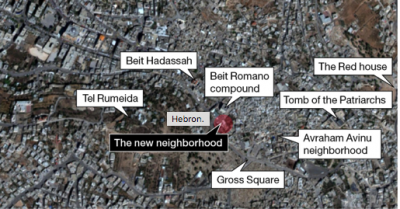
Map by Haaretz
As a reminder: in October 2017, the Israeli Civil Administration approved a building permit for the 31 units, on the condition that the Palestinian municipality of Hebron and others would have the opportunity to file objections to the plan. Soon after, two appeals were filed with the Defense Ministry: one by the Palestinian municipality of Hebron and one by the Israeli settlement watchdog Peace Now. The legal objections to the plan stem from the problematic process by which Israel made land in downtown Hebron available for settlement construction. Located in the Israeli-controlled H-2 area of Hebron (where 500 Israeli settlers live amongst 40,000 Palestinians), Israel seized the land in the 1980s from the Hebron Municipality, for military purposes. In 2007, the Civil Administration’s Legal Advisor issued an opinion stating that once Israel is done using the land for military purposes, it must be returned to the Hebron Municipality, which has protected tenancy rights to the land. Nonetheless, in 2015, the Israeli Civil Administration, with the consent of the Minister of Defense, quietly authorized the Housing Ministry to plan the area for Israeli settlement use, paving the way for that same ministry to subsequently present the plan for 31 units.
In October 2018, with the legal challenges still pending, the Israeli Cabinet voted to expedite the planning of the new settlement and allocated approximately $6.1 million (NIS 22million) for the project, which will require Israel to significantly renovate a military base in order to build the 31 new settlement units, a kindergarten, and “public areas.”
Peace Now said in a statement:
“The state was quick to issue the building permit even though the court has explicitly ruled that work should not start until the… hearing takes place….The attempt to squeeze in this construction of 31 settlement units before the U.S. election is an unscrupulous act that threatens Israel’s national interest and relations on the world stage.”
Israel Advances Planning for Settler-Backed Cable Car Project in Jerusalem — Despite Ongoing Legal Case
On October 25th, the Israeli-run Jerusalem Development Authority — a joint agency of the government and the Jerusalem Municipality — held the first of two meetings for developers interested in bidding on a settler-backed project to build a cable car in East Jerusalem, despite the fact that the Israeli Supreme Court has not yet issued a final ruling on whether or not the state is permitted to expropriate the privately owned Palestinian land that is needed to carry out its construction (for background, see recent reporting in the Settlement Report). A second meeting for prospective developers is reportedly scheduled for next week.
The High Court is actively considering the cable car case, having ordered the state to offer a factual explanation for how the cable car line will boost tourism in the city – an explanation that the state has struggled to articulate convincingly. In response, the State recently submitted an 81-page explanation of the project regurgitating the same arguments it has previously made. The Court is now awaiting response from the petitioners to the State’s latest filings.
Settlers Push Bibi to Authorize All Outposts As Compensation for Delay in De Jure Annexation
The Jerusalem Post reports that settler leadership is pressuring Prime Minister Netanyahu to immediately grant retroactive approval to the hundreds of Israeli outposts in the West Bank that are illegal under Israeli law (and for which Israel has been unable, despite an all-out effort, to find a way to legalize, short of simply declaring that rule of law is irrelevant). The Knesset Land of Israel Caucus is also preparing legislation to achieve this end.
The Post reports that settlers, having impatiently waited as the government has delayed action on many outpost authorizations — as successive elections and then the U.S. promise of annexation have come and gone (for now) — are upping the pressure on Netanyahu to act in a decisive manner on the outposts. Peace Now notes that, despite the settlers’ allegations of foot-dragging, over the past two years the Israeli government has managed to grant retroactive legalization to 21 outposts. with 9 more in process. Instead of considering each outposts’ legal status in a piecemeal manner, the settlers want Netanyahu to grant authorizations in one swift and blanked act – regardless of the facts of each outpost (like private Palestinian ownership of the land on which some outposts have been constructed).
Settlers apparently view this as urgent, given the fact that the Trump Plan leaves around 15 outposts as enclaves within the borders of what is envisioned as a future Palestinian non-state entity. Settlers also view this as just, asserting that Netanyahu owes the settler movement this as “compensation for his failure to to fulfill his annexation pledge.”
The Jerusalem Post article also does a surprisingly great job of explaining Israeli efforts over the past two decades to approve these outposts, which entered a new phase in 2017 with the passage of the Settlement Regulation Law – passed by the Knesset to allow provide a new legal basis by which the government can grant outpost approvals. FMEP has also comprehensively tracked [Table #3] Israel’s efforts over the past two years to retroactively legalize the outposts.
Bonus Reads
- “US amb. to Israel: Change of administration can damage Abraham Accords” (Jerusalem Post)
- “The Annexation That Was and Still Is” (B’Tselem)
- “Muslim Pilgrimage to Haram al Sharif/the Temple Mount: Tinkering with Explosives” (Terrestrial Jerusalem)
- [Thread] “The issue of the ultra-Orthodox sector, which recently caught the public’s attention again in light of the corona crisis, demands discussion about what is happening with the ultra-Orthodox community in the context of the settlements, for two reasons” (@nabothVin)
- “In East Jerusalem, the settler project is expanding underground“ (+972 Magazine)
- “Israelis Who Pillage Palestinian Olive Harvesters Are Not My Brothers” (Haaretz)
Welcome to FMEP’s Weekly Settlement & Annexation Report. To subscribe to this report, please click here.
October 16, 2020
- No Annexation, No Problem – Israel Advances Nearly 5,000 New Settlement Plans, Including New Settlement South of Jerusalem
- Plan for 570 Units in East Jerusalem Settlement Approved for Deposit
- Israel Approves Construction of Elevator at Tomb of the Patriarchs
- Israel Delivers Confiscation Notices to Palestinians Living in the Heart of Hebron
- Palestinians Report Newly Established Outposts & Land Confiscations
- Targeting Palestinians Construction in Area C: State Devotes $6 million to Mapping Program
- In First, Palestinian Authority Courts to Hear Lawsuits Against Settlers
- NF, Elad Face International Heat Over Sumarin Family Eviction Case – Will it Matter?
- Report: U.S. Will Not Back De Jure Annexation Until 2024 [Friedman Says 2021 in Play]
- Bonus Reads
Comments/questions? Contact Kristin McCarthy (kmccarthy@fmep.org)
No Annexation, No Problem – Israel Advances Nearly 5,000 New Settlement Plans, Including New Settlement South of Jerusalem
During meetings held October 14th and 15th, the Israeli High Planning Council advanced plans for a total of 4,948 new settlement units. Of that total, plans for 2,688 units were granted final approval and plans for 2,260 units were approved to be deposited for public review (a late stage in the planning process). The latter approvals include a plan to build a new settlement, “Har Gilo West,” just beyond Jerusalem’s southern border. In addition, the Council granted retroactive approval to 340 existing illegally-built settlement units in the unauthorized outposts of Peni Kedem and Tapuach West, paving the establishment of two new official West Bank settlements (through post-facto legalization of the illegal outposts).
These were the first meetings of the High Planning Council since February 2020, at which time settlement planning was put on pause in favor of attempting to implement annexation plans as designed by Trump’s “Deal of the Century.” Under annexation, authority over the settlement planning/approval process could have been shifted from the Israeli Civil Administration (the branch of the Israeli Defense Ministry, in charge of the administration of affairs in the West Bank, – i.e., Israel’s occupation) into Israel domestic planning mechanism. Such a shift has long been a goal of settlers and their political allies.
In addition to advancing construction of new residential settlement units, the High Planning Council also advanced plans for the construction of new settlement projects that support tourism, further entrench the permanency of settlements, and that continue the exploitation of West Bank land and resources.
Record-Setting Settlement Activity in 2020
With the huge advancement of settlement plans this week, the Israeli government has advanced plans for 12,159 settlement units so far in 2020. With over two months to go, the settlement watchdog group Peace Now reports that this is already the highest total number settlement advancements in any year since Peace Now began tracking totals in 2012. Peace Now also reports that it is possible that the High Planning Council will convene one more time before the year ends.
Har Gilo West Approved for Deposit w/ Plan to Seal Off Al-Walajah
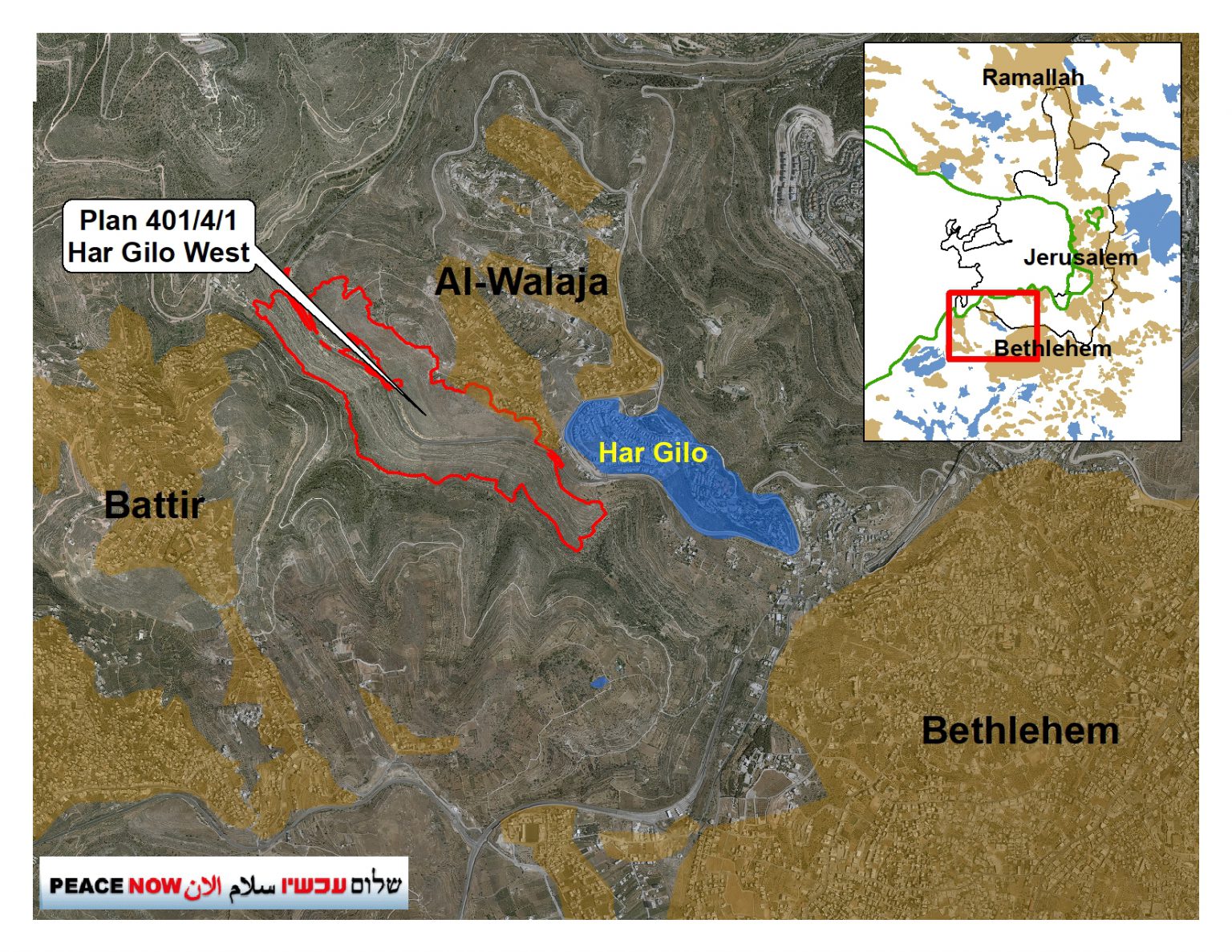 The High Planning Council approved for public deposit a plan to build 560 units at the Har Gilo West settlement site, located just south of Jerusalem. The Council is treating this plan as merely an expansion of the existing Har Gilo settlement, but in actuality it represents the construction of a new settlement on Jerusalem’s southern border, as the two areas of construction (Har Gilo and Har Gilo West) would not be contiguous. The plan for 560 units in Har Gilo West is part of a larger plan to construct around 952 units in the new settlement, extending the its borders right up to the Jerusalem municipal boundary, with dire consequences for the long-beleaguered Palestinian village of Al-Walajah.
The discussion on October 14th further revealed that, in order to build Har Gilo West, Israel plans to extend the separation barrier in that area to completely encircle al-Walajah, which is surrounded on three sides by the separation wall already. The new section of the barrier would be a 7-meters high concrete slab along the western edge of the built-up area of Al-Walajah. That would leave Al-Walajah completely encircled by the separation barrier and Israeli construction beyond it.
Ir Amim explains:
“In the past decade a series of Israeli moves have taken over more and more of Al-Walaja land and gradually isolating it. These are now culminating with the intention to construct the new settlement on the land reserves on the western side of Al-Walaja and to extend the separation barrier so as to complete the encircling of the village. As Al-Walaja will turn into an isolated enclave which lacks an outline plan its residents will be especially vulnerable to increasing home demolitions and other Israeli sanctions. Since the village will separate the new settlement from the existing Har Gilo we are likely to see increasing Israeli actions against Al-Walaja and its residents which will put their future existence at risk.”
Peace Now writes:
“The current plan of 952 housing units to be advanced will create a brand new neighborhood that will be larger than the existing settlement, and will exploit the land cut off by the West Bank barrier to further break up the western Bethlehem metropolitan area, including the land connecting al-Walaja and the town of Battir, as well as Battir and Bethlehem. This land also constitutes some of the only uninhabited fertile land reserves for Bethlehem, which currently is cut off by the West Bank barrier to its immediate north and west.“
FMEP has repeatedly documented various Israeli efforts to seal off al-Walajah from Jerusalem. Residents of al-Walajah have fought the growing encroachment by the nearby Etzion settlement bloc and the Israeli government’s attempt to de facto annex the bloc as part of “Greater Jerusalem.” Ir Amim explains several prongs of this effort, including a particularly unbelievable section of Israel’s separation barrier planned to almost completely encircle the village, to turn its valuable agricultural land into an urban park for Jerusalem, and construction of a highway that will connect the Etzion settlement bloc to Jerusalem with Israeli-only bypass roads.
Two Outposts Advance Towards Retroactive Legalization
The High Planning Council approved for deposit two plans that would, if implemented, have the effect of retroactively legalizing two outposts – bestowing upon those outposts legitimacy in the eyes of Israeli law and, in effect, establishing two new, official settlements. Those plans are:
- Pnei Kedem: A plan to grant retroactive legalization to 120 units in the Pnei Kedem farm outpost by recognizing the outpost as a “neighborhood” of the Metzad/Asfar settlement. This is despite the fact that the two areas of construction are non-contiguous. Pnei Kedem is located halfway between Bethlehem and Hebron in the southern West Bank. Settlers were particularly gleeful about this plan being advanced
- Tapuach West: A plan to grant retroactive legalization to 133 units in the Tapuach West outpost, located south of Bethlehem.
Not Just Residential Units – Council Advances Settler Tourism & Infrastructure Projects
The High Planning Council also advanced plans for the construction of new settlement projects that support tourism, further entrench the permanency of settlements, and that continue the exploitation of West Bank land and resources.
The Council granted final approval to:
- A plan for new shops and an educational site (to include an agricultural farm) in the Kochav Yaakov settlement – located between Jerusalem and Ramallah; and,
- A plan to grant retroactive authorization to a motor park and 120 hotel rooms in the Petza’el settlement, located in the Jordan Valley. As FMEP has covered in the past, this state-of-the-at racetrack and hotel complex is being built partially on land that the Israeli army previously declared a closed firing zone, a designation which resulted in the forcible displacement of Palestinians who lived there. The land remains under this designation today. Rather than halting the construction of this complex, the Israeli authorities instead created a Master Plan for the area in order to enable even more construction in the area.
Plans the Council granted final approval for public deposit include:
- A plan for an industrial zone near the Mishor Adumim settlement; and,
- A plan to build a new commercial area and 50 hotel rooms in the Maale Adumim settlement;
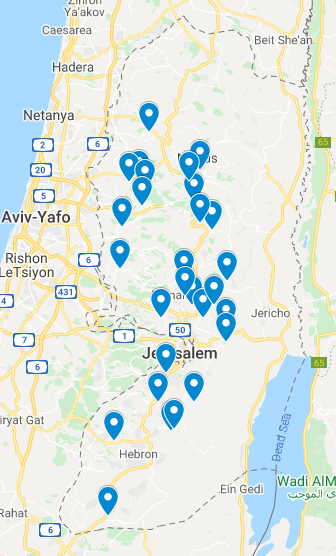
Map by Ben White (@benabyad)
Included in the total number of units receiving final approval and/or retroactive legalization (3,028 units) are (in descending order of number of units): [map]
- 382 units in the Beit El settlement, located in the heart of the northern West Bank. This includes retroactive legalization for 36 units which had been previously built without authorization and the construction of 346 units in highrise buildings with 9 or 10 floors (building up, not out in Beit El) [as a reminder, US Ambassador to Israel David Friedman has deep ties to the Beit El settlement];
- 357 units in the Geva Benyamin (Adam) settlement, located just north east of Jerusalem, just beyond the separation barrier. Israel has been steadily building the Adam settlement in a manner meant to unite the settlement more seamlessly with East Jerusalem settlements and infrastructure, erasing the Green Line;
- 354 units in the Nili settlement, located in the northern West Bank;
- 213 units in the Shiloh settlement, including the retroactive legalization of 21 units built without required approvals. The Shiloh settlement is located in the central West Bank;
- 211 units in the radical and violent Yitzhar settlement, including some retroactive authorizations (exact number not specified) as well as approval for public buildings. Yitzhar, located just south of Nablus, is associated with the Hilltop Youth movement – and a string of illegal outposts in the area associated with repeated attacks on Palestinians and their property;
- 205 units in the Nokdim settlement (actually approved for the Kfar Eldad settlement, which is officially within the jurisdiction of Nokdim), located south of Bethlehem;
- 200 units in the Metzad settlement (also known as Asfar), including the retroactive legalization of an unspecified number of existing units built without necessary approvals;
- 160 units in the Kochav Yaacov settlement, located east of Ramallah;
- 140 units in Kerem Reim settlement – located north west of Ramallah. Peace Now has repeatedly challenged the illegal construction of the Kerem Reim outpost, which the Israeli government retroactively legalized by declaring it a neighborhood of the Talmon settlement even though the areas are non-contiguous. Though a court rejected one Peace Now petition, there is an ongoing case against the Amana settler organization which Peace Now alleges engaged in illegal activities to build the outpost;
- 132 units in Kfar Adumim settlement – located east of Jerusalem and less than one mile from the Khan al-Ahmar bedouin community which the state of Israel is seeking to demolish;
- 106 units in the Ma’ale Shomron settlement, located east of the Palestinian village of Qalqilya;
- 84 new units in the Shima settlement, including retroactive legalization of 14 existing units;
- 74 units in the Yakir settlement – located in the northern West Bank and part of a string of settlements and unauthorized outposts – most notably Ariel – extending from the Green Line deep into the West Bank;
- 64 units in the Telem settlement – located west of Hebron;
- Retroactive legalization of 18 units in the Psagot settlement – located east of Ramallah, and home to the Psagot Winery;
- Retroactive legalization of 2 units in the “Givon Hadasha” settlement;
Plans which were approved for deposit for public review include (in descending order of number of units):
- 629 units in the Eli settlement, including the retroactive legalization of 61 units – located south of Nablus and southeast of the Ariel settlement in the central West Bank. Though the Eli settlement previously received Israeli government approval, a “Master Plan” – which officially zones land for distinct purposes (residential, commercial, public) – has never been issued for Eli, meaning all construction there is illegal under Israeli law;
- 560 units in the Har Gilo settlement located just south of Jerusalem (covered in detail above);
- 286 units in the Har Bracha settlement – located just south of Nablus. If implemented, these new units will double the size of Har Bracha;
- 179 units in the Einav settlement – located northwest of Nablus;
- 148 units in the Rimonim settlement – located between Ramallah and Jericho in the Jordan Valley;
- A plan to grant retroactive legalization to 133 units in the Tapuach West outpost, thereby granting approval to the outpost itself (discussed above);
- A plan to grant retroactive legalization to 120 units in the Pnei Kedem outpost by recognizing the outpost as a “neighborhood” of the Metzad/Asfar settlement although the two areas of construction are non-contiguous. Pnei Kedem is located between Bethlehem and Hebron in the southern West Bank;
- 82 units in the Karnei Shomron settlement – located in the northern West Bank east of the Palestinian village of Qalqilya. Israel is planning to continue expanding Karnei Shomron with the stated goal of bringing 1 million settlers to live in the area surrounding the settlement.;
- 75 units in the Shimaa settlement, including the legalization of 14 units previously built without authorization;
- 52 units received retroactive legalization in the Kfar Adumim settlement;
- 35 units in the Efrat settlement – located south of Bethlehem. As a reminder, Efrat is located inside a settlement block that cuts deep into the West Bank. Efrat’s location and the route of the barrier wall around it, have literally severed the route of Highway 60 south of Bethlehem, cutting off Bethlehem and Jerusalem from the southern West Bank. The economic, political, and social impacts of the closure of Highway 60 at the Efrat settlement (there is literally a wall built across the highway) have been severe for the Palestinian population;
- 14 units (in one building) in the Maale Mikmash settlement – located east of Ramallah;
- 10 units in the Barkan settlement – located about half way between the Ariel settlement and the cluster of settlements slated to be united into a “super settlement” area (Oranit, Elkana, Shiva Tikva, and others).
- 7 units in the Peduel settlement – located in the northern West Bank and part of a string of settlements and unauthorized outposts – most notably Ariel – extending from the Green Line into the very heart of the West Bank and on towards the Jordan Valley; and,
The High Planning Council met only after settlers, who represent a key ally of the embattled Prime Minister, pressured Netanyahu to allow it. Settlers have spent months decrying what they understood to be a freeze on settlement constructed inflicted upon them by Netanyahu. Gush Etzion Regional Council Head Shlomo Ne’eman said:
“Sometimes we take our prime minister to task, which we feel is justified as a result of our disappointment in postponing the application of sovereignty over our country. But now something tangible is happening – we are building and developing our communities, and of course, the highlight of today is the full registration in the Land Authority of the young community of Pnei Kedem, 20 years since it was established.”
Samaria Regional Council head Yossi Dagan said:
“This is a happy day for Samaria. [New construction] in Har Bracha, Yitzhar, Einav and Tapuach is another step on the way to a million residents in this beautiful region of the country…While we’re very content with today’s developments, I call on the Prime Minister not to stop here. We’re overfilled with joy, but it is a drop in the ocean with sovereignty falling off the agenda. The expectation now is that construction and strengthening of the settlement movement will increase tenfold.”
Peace Now responded to the approvals in a statement saying:
“While Israel reels from its second lockdown and economic distress, Netanyahu is promoting construction in isolated settlements that Israel will have to evacuate. Instead of taking advantage of the agreements with the Gulf states and promoting peace with the Palestinians, he is distorting Israel’s priorities and catering to a fringe minority for these settlement unit approvals that will continue to harm future prospects for peace. We call on the Defense Minister and the Alternative Prime Minister Benny Gantz to veto these plans. Far from a ‘settlement freeze,’ the right has been complaining about, the expected settlement approvals announcement next week prove that the settlement enterprise under Netanyahu is moving ahead at full steam toward solidifying the de facto annexation of the West Bank. The move also will be the first major demonstration of Defense Minister Benny Gantz’s bowing to the ‘Greater Israel’ settlement agenda that would in reality bring about a permanent undemocratic one-state reality. By doing so, Israel will be signaling to the world its bi-partisan support for the end to the concept of a two-state solution and a Palestinian state – the paradigm that until now has largely shielded Israel from formal pressure over its 53-year occupation. The settlement enterprise is not in Israel’s national or security interest, and is a strategic mistake at the international level.”
Palestinian Prime Minister Mohammed Shtayyeh denounced the approvals, saying:
“Every settler unit constitutes a plan to annex our land.”
Palestinian Authority spokesman Nabil Abu Rudeineh said in a statement:
“We warn against this Israeli policy that will lead the region to the brink of the abyss, and we call on the international community to intervene immediately and urgently to pressure the Netanyahu government to stop this settlement madness that totally eliminates any real opportunity to achieve a just and comprehensive peace to end the occupation and establish the independent Palestinian state with East Jerusalem as its capital on the 1967 borders.”
UN High Representative Josep Borrell said in a statement:
“In recent days, Israel has announced a significant expansion of settlements in the occupied West Bank, in areas in and around Jerusalem. These plans, which foresee the construction of close to 5.000 housing units, jeopardise the viability and territorial contiguity of a future Palestinian State as the outcome of a negotiated two-state solution, in line with the internationally agreed parameters. Settlements are illegal under international law. As stated consistently, the EU will not recognise any changes to the pre-1967 borders, including with regard to Jerusalem, other than those agreed by the parties. Settlement activity threatens current efforts to rebuild trust, to resume civil and security cooperation between Palestinians and Israelis and to prepare the ground for an eventual resumption of meaningful and direct negotiations. The Government of Israel should reverse these decisions and halt all continued settlement expansion, including in East Jerusalem and sensitive areas such as Har Homa, Givat Hamatos and E1. The period from March to August 2020 also saw a spike in demolitions or confiscations of Palestinian-owned structures in the West Bank in spite of the COVID-19 pandemic. The EU reiterates its call on Israel to halt all such demolitions, including of EU-funded structures, in particular in light of the humanitarian impact of the current pandemic. Against the background of normalization of relations between Israel, UAE and Bahrain, Israelis and Palestinians should seize this opportunity and take urgent steps to build confidence and restore cooperation along the line of previous agreements and in full respect of international law.”
A spokesperson for UN Secretary-General Antonio Guterres issued a statement flagging concern over the advancements, saying:
“We are concerned about the reports of Israel’s settlement advancements in the occupied West Bank and will continue to follow developments closely, as the Israeli High Planning Committee finalizes its meetings tomorrow. The Secretary-General has consistently reiterated that all settlements are illegal under international law and remain a substantial obstacle to peace. We urge the Israeli authorities to refrain from such unilateral actions that fuel instability and further erode the prospects for resuming Palestinian-Israeli negotiations on the basis of relevant UN resolutions, international law and bilateral agreements.”
Plan for 570 Units in East Jerusalem Settlement Approved for Deposit
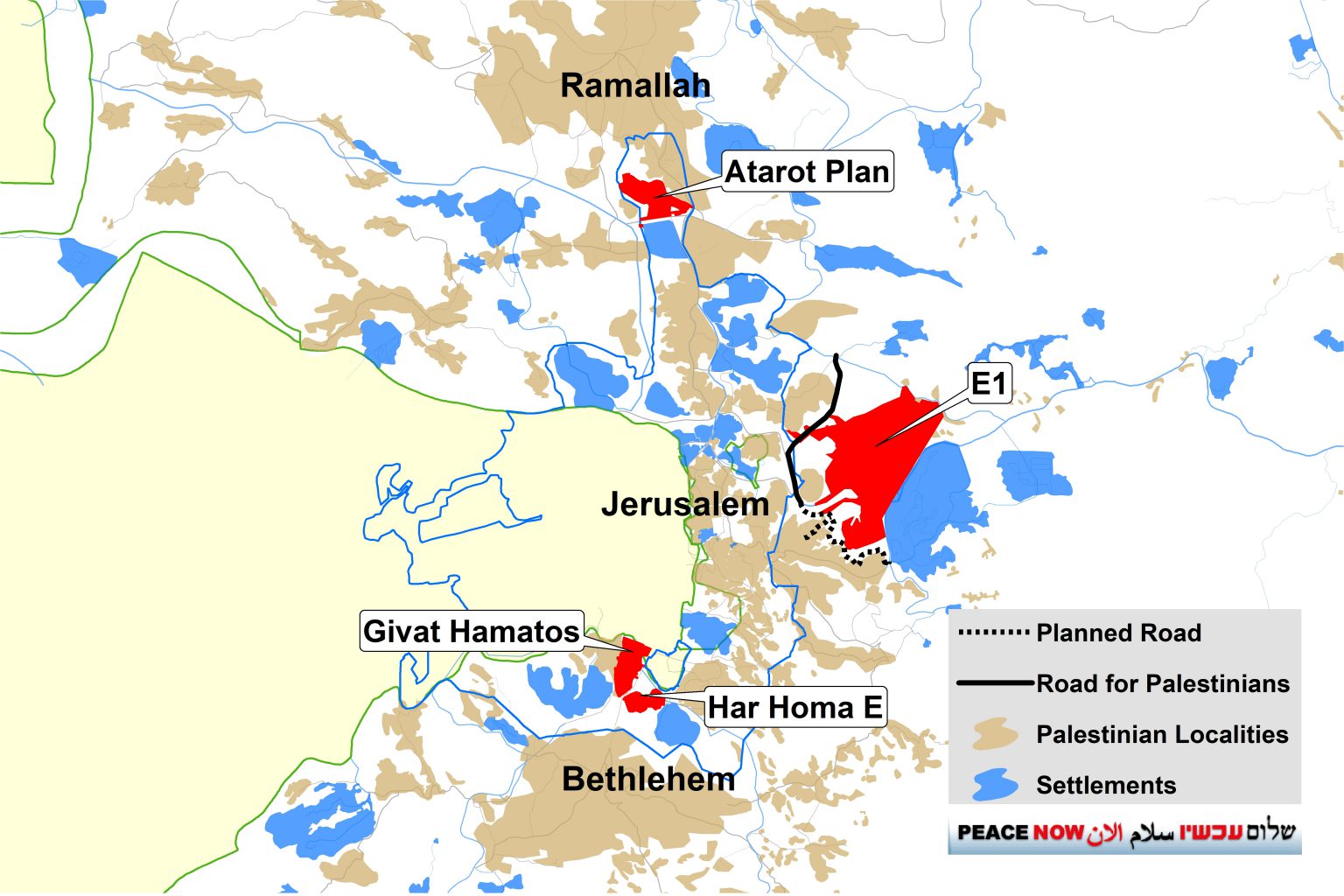 Ir Amim reports that on September 22nd, the Jerusalem District Committee approved for deposit for public review a detailed plan providing for the construction of 570 units in the Har Homa E settlement, located in East Jerusalem. Taken together with the pending construction of the nearby Har Gilo West settlement (discussed in the section above), the Palestinian village of al-Walajah stands to be completely encircled by Israeli settlements.
If implemented, this plan will extend the Har Homa settlement westward, in the direction of the site of the as-of-yet-unbuilt Givat Hamatos settlement. Ir Amim explains:
“If realized, Har Homa E together with construction in Givat Hamatos will connect Har Homa to Gilo creating a contiguous Israeli settlement area that will disconnect East Jerusalem from Bethlehem and the south of the West Bank.”
Ir Amim also reminds us that the Jerusalem District Committee previously approved a Master Plan for a total of 2,200 units in Har Homa E. The plan for 570 units approved for deposit in late September represents the first detailed plan under this Master Plan allows for. Plans to build the remaining units permitted under the Master Plan are not yet being advanced.
Israel Approves Construction of Elevator at Tomb of the Patriarchs
Emek Shaveh reports that on September 29th the Civil Administration granted final approval to a plan to build accessible infrastructure, including an elevator, at the Ibrahimi Mosque/Tomb of the Patriarch in Hebron — a plan which requires Israel to seize land from the Islamic Waqf. As of this writing, Emek Shaveh is considering whether to challenge that approval.
Regarding the significance of the plan, Emek Shaveh said:
“One need not be an archaeologist or architect to review the council’s plan and understand that it is destructive in a manner which is unprecedented. We are convinced that the plan, as approved, would never have been promoted had it not been driven by political motives.”
Emek Shaveh has previously provided critical context as to why this plan is not really, or not fully, being advanced out of humanitarian concerns, explaining:
“Israel’s decision to seize responsibility for the site from the Hebron municipality and the Palestinians sends a clear political message that Israel is reneging on agreements that were signed with the Palestinians in Hebron. Beyond the precedent that will enable the settlers in the future to demand additional changes at the Tomb of the Patriarchs/Ibrahimi Mosque, this is also a precedent that could play out at other sites under the responsibility of the Islamic Waqf. Experience has shown us that what begins in Hebron percolates into other places including Jerusalem. It begins with a seemingly rational demand to benefit the disabled or the general public and evolves into a new status quo. The expected change in Hebron has not escaped the attention of members of the Temple movement and they will know how to present their demands to the government. If Israel can repudiate agreements with the Palestinians in Hebron and expropriate land from the Waqf, it would seem that accepting what appears to be the far more modest demands by the Temple movement to pray or to walk about the Temple Mount complex freely is not so far-fetched. In the reality of Hebron and East Jerusalem, a change involving only several meters at a historic or holy place is not free of political considerations and often it is part of long-term strategy. While it is necessary to tend to the needs and interests of persons with disabilities, the extremists who presume to speak on their behalf must be prevented from forging Israeli policy, even if it is only a matter of a lift and an access path.”
Read Emek Shaveh’s full analysis here: “Humanitarianism Hebron Style.”
Israel Delivers Confiscation Notices to Palestinians Living in the Heart of Hebron
The Palestinian media outlet WAFA news reports that several Palestinians living in the Tel Rumeida section of downtown Hebron were handed confiscation notices from the Israeli authorities, informing them that the State of Israel had confiscated 17 plots of land, including land privately owned by Palestinians.
Tel Rumeida is a part of Hebron located directly in the city center, considered H2 by the Hebron Accords giving Israel full control of security in that area. B’Tselem estimates that there are around 700 settlers living in enclaves amongst approximately 34,000 Palestinians in H2. The Israeli army heavily protects those settlers, and has implemented an apartheid system of segregated movement and checkpoints, most notably in the area of Shuhada Street.
Palestinians Report Newly Established Outposts & Land Confiscations
The Palestinian news outlet WAFA reports that settlers have installed three new outposts over the past month – one near Nablus and a second near Hebron, and a third in the Jordan Valley.
Near Nablus, Palestinians report that the settlers installed mobile homes and a small farm in an attempt to establish a permanent presence on a new plot of land. The settlers are reportedly in the process of connecting the new outpost to the Elon Moreh settlement via roads and water supply. Ghassan Daghlas, who monitors Israeli settlements on behalf of the PLO, told WAFA that the specific area has seen even wider road construction recently, which he sees as an effort to create more seamless contiguity between settlements in the Nablus area and the Jordan Valley. The construction comes at the direct expense of the Palestinian village of Beit Dajani, which has historically owned the land where the outpost and roads are being built.
Near Hebron, WAFA reports that an Israeli settler erected a tent with and Israeli flag on privately owned Palestinian land near the Birin village.
In the Jordan Valley, WAFA reports that settlers set up a caravan on land on which they began planting trees about three months ago. The settlers also reportedly dug a well at the site.
On October 15th, Israel reportedly announced its intention to confiscate large tracts of land (11,000 dunums) adjacent to the Jordan Valley settlements of Rotem, Maskiyot, and Mesovah. This confiscation, according to Palestinian settlement watcher Qasem Awwad, was presented by the Israeli authorities as a move to add land to natural reserve areas, but seems clearly to be linked to efforts to expand settlements and their control over land in the area.
Targeting Palestinians Construction in Area C: State Devotes $6 million to Mapping Program
Despite COVID and the suspension of Israeli’s unilateral annexation of vast tracts of land in the West Bank, the Israeli government — at the urging of settlers and their allies — is continuing its push to consolidate its control over all aspects of life in Area C (the over 60% of the West Bank that is under full Israeli control).
OCHA has documented an acceleration in the Civil Administration’s demolition of Palestinian structures in the West Bank over the summer, documenting the demolition of 389 Palestinian-owned structures in Area C of the West Bank. As a result of those demolitions, 442 Palestinians were made homeless. OCHA further reported that In just the month of August, 205 Palestinians lost their homes, the highest single month total since January 2017. In addition, Israel continues to issue more demolition notices, including against Palestinians living in a cave near Jenin, and against a newly constructed school for bedouin children located east of Ramallah.
To further this effort, on September 10th the Israeli government allocated $6 million USD (20 million NIS) for the newly created Settlement Affairs Ministry to survey and map unauthorized Palestinian construction in Area C of the West Bank, which Israel and its settlers have been aggressively demolishing in an effort to rid the area of Palestinians. Haaretz reports that this is the first time that the state budget has included funds specifically for a land survey in the West Bank. The state also allocated an additional $2.8 million (9.5 million NIS) to an existing grant program specifically for settlement municipalities to cash in on. As a reminder, virtually all Palestinian construction in Area C of the West Bank is unauthorized, because Israel almost universally refuses to give Palestinians permission to build in Area C even on land that Israel recognizes as owned by Palestinians.
The Settlement Affairs Ministry is a new creation of the current coalition government, and is headed by Tzachi Hanegbi (Likud). The funding for the Settlement Affairs Ministry to conduct a survey of unauthorized Palestinian construction in Area C further empowers a domestic Israeli body to exert extraterritorial sovereignty over Area C – in effect, treating the area as land already de facto annexed by Israel. While technically the occupied territories are administered by the Israeli Civil Administration (a body within the Defense Ministry), Israel has spent decades bringing the administration of the territories (specifically the settlements and Area C) ever more directly under direct Israeli sovereignty (de facto annexation).
In the lead up to the allocation of funds for this new survey of Palestinians life in Area C, the Knesset hosted two committee discussions the political outlook of which was clearly indicated in the stated subject of the meetings: “the Palestinian takeover of Area C.” Consistent with this framing (which is predicated on the idea that Area C belongs to Israel), and pushed by outside groups, many members of the Knesset have criticized the Israeli government’s allegedly lackadaisical approach to preserving State interests in Area C (i.e., clearing out Palestinians, expanding settlements, consolidating state infrastructure). Reportedly, Foreign Affairs Minister Gabi Ashkenazi (Blue & White) sent a letter to the committee specifically addressing the Knesset’s outrage over European humanitarian assistance projects for Palestinians in Area C. In the letter, Ashkenazi not only celebrated the reduction of European projects over the past year, but validated settlers’ insinuations regarding the nefarious nature of European assistance for Palestinians, saying that any European activity in the West Bank lacking Israeli permission is “an attempt to define a border.” Ashkenazi also said that Israel will not compensate European donors for confiscated equipment or the demolition of European-funded projects that lack Israeli permission (like in the case of schools built with European funding, and solar panels donated to bedouin communities lacking power).
At one Knesset hearing, MK Bezalel Smotrich (Yamina) suggested that a solution could be to empower the settlements with the ability to demolish Palestinian construction they believe to be unauthorized. Smotrich’s partymate Ayelet Shaked (former Justice Minister) suggested that the government should appoint a project manager tasked with preventing a Palestinian takeover of Area C.
As noted above, Israel has long denied Palestinians the ability to build in Area C. To fully understand what is happening, it is worth reviewing B’Tselem’s excellent explainer:
“Israel’s planning and building policy in the West Bank is aimed at preventing Palestinian development and dispossessing Palestinians of their land. This is masked by use of the same professional and legal terms applied to development in settlements and in Israel proper, such as “planning and building laws”, “urban building plans (UBPs)”, “planning proceedings” and “illegal construction”. However, while the planning and building laws benefit Jewish communities by regulating development and balancing different needs, they serve the exact opposite purpose when applied to Palestinian communities in the West Bank. There, Israel exploits the law to prevent development, thwart planning and carry out demolitions. This is part of a broader political agenda to maximize the use of West Bank resources for Israeli needs, while minimizing the land reserves available to Palestinians….
In the West Bank, the potential for urban, agricultural and economic development remains in Area C. Israel uses its control over the area to quash Palestinian planning and building. In about 60% of Area C – 36% of the West Bank – Israel has blocked Palestinian development by designating large swathes of land as state land, survey land, firing zones, nature reserves and national parks; by allocating land to settlements and their regional councils; or by introducing prohibitions to the area now trapped between the Separation Barrier and the Green Line (the boundary between Israel’s sovereign territory and the West Bank).
Even in the remaining 40% of Area C, Israel restricts Palestinian construction by seldom approving requests for building permits, whether for housing, for agricultural or public uses, or for laying infrastructure. The Civil Administration (CA) – the branch of the Israeli military designated to handle civil matters in Area C – refuses to prepare outline plans for the vast majority of Palestinian communities there. As of November 2017, the Civil Administration had drafted and approved plans for only 16 of the 180 communities which lie in their entirety in Area C. The plans cover a total of 17,673 dunams (1 dunam = 1,000 square meters), less than 1% of Area C, most of which are already built-up. The plans were drawn up without consulting the communities and do not meet international planning standards. Their boundaries run close to the built-up areas of the villages, leaving out land for farming, grazing flocks and future development. Since 2011, seeing that the Civil Administration did not draft plans as it is obliged to do, dozens of Palestinian communities – with the help of Palestinian and international organizations and in coordination with the PA – drafted their own plans. Some of the plans covered communities or villages located in full in Area C and others covered places only partly in Area C. As of September 2018, 102 plans had been submitted to the Civil Administration’s planning bodies, but by the end of 2018, a mere five plans – covering an area of about 1,00 dunams (or about 0.03% of Area C) – had received approval.
The odds of a Palestinian receiving a building permit in Area C – even on privately owned land – are slim to none. Given the futility of the effort, many Palestinians forgo requesting a permit altogether. Without any possibility of receiving a permit and building legally, the needs of a growing population leave Palestinians no choice but to develop their communities and build homes without permits. This, in turn, forces them to live under the constant threat of seeing their homes and businesses demolished.
The impact of this Israeli policy extends beyond Area C, to the hundreds of Palestinians communities located entirely or partially in Areas A and B, as the land reserves for many of these communities lie in Area C and are subject to Israeli restrictions there.
The demand for land for development has grown considerably since the 1995 division of the West Bank: The Palestinian population has nearly doubled, and the land reserves in Areas A and B have been nearly exhausted. Due to the housing shortage, much land still available in these areas is used for residential construction, even if it is more suited for other uses, such as agriculture.
Without land for construction, local Palestinian authorities cannot supply public services that require new structures, such as medical clinics and schools, nor can they plan open spaces for recreation within communities. Realizing the economic potential of Area C – in branches such as agriculture, quarrying for minerals and stone for construction, industry, tourism and community development – is essential to the development of the entire West Bank, including creating jobs and reducing poverty. Area C is also vital for regional planning, including laying infrastructure and connecting Palestinian communities throughout the West Bank.
In contrast to the restrictive planning for Palestinian communities, Israeli settlements – all of which are located in Area C – are allocated vast tracts of land, drawn up detailed plans, connected to advanced infrastructure, and the authorities turn a blind eye to illegal construction in them. Detailed, modern plans have been drawn up for the settlements, including public areas, green zones and, often, spacious residential areas. They enjoy a massive amount of land, including farmland that can serve for future development.
Israel’s policy in Area C is based on the assumption that the area is primarily meant to serve Israeli needs, and on the ambition to annex large parts of it to the sovereign territory of Israel. To that end, Israel works to strengthen its hold on Area C, to further exploit the area’s resources and achieve a permanent situation in which Israeli settlements thrive and Palestinian presence is negligible. In doing so, Israel has de facto annexed Area C and created circumstances that will leverage its influence over the final status of the area.”
In First, Palestinian Authority Courts to Hear Lawsuits Against Settlers
For the first time since the Palestinian Authority was established in 1994, it will allow Palestinians to bring lawsuits against Isareli settlers in Palestinian courts. The Palestinian Authority’s Justice Minister Mohammed al-Shalaldeh announced that the PA had formed a national team to handle these cases, and the team was already working to collect evidence and file suits against settlers who have committed crimes against Palestinians in Hebron and in the village of Burin, located just south of Nablus.
Until this point, no Israeli citizen has been tried in a Palestinian court. Under the Oslo Accords (which established the Palestinian Authority), the Palestinian Authority holds no jurisdication over Israeli citizens – including Israeli citizens living in the West Bank. In May 2020, PA President Mahmoud Abbas announced that the PA considers all accords and agreements with Israel to be void following Israel’s announcement that it intends to annex large parts of the West Bank in accordance with the Trump Plan. Shalaldeh said that the announcement this week flows directly from Abbas’s decision to free the PA from the Oslo Accords’ provisions.
Explaining how these cases might work, Shalaldeh said:
“The Israeli side will be notified as an occupying power to appear before the Palestinian court…If the [Israeli] side refuses the jurisdiction of the Palestinian courts, formal procedures will be followed and in absentia rulings will be issued, in accordance with Palestinian laws.”
JNF, Elad Face International Heat Over Sumreen Family Eviction Case – Will it Matter?
Over the past month, international audiences have directed heightened scrutiny towards the radical settler group Elad and the Jewish National Fund (JNF) for the role both organizations have played in spearheading the effort to evict the Palestinian Sumreen family from their home in the Silwan neighborhood of East Jerusalem. Due to the new attention, the JNF is reportedly reconsidering whether or not to carry out the eviction of the Sumreens – an eviction which the organization has pursued since 1991.

Map by Haaretz
JNF donors – along with activists, religious leaders, members of Congress, and Israel prize winners – reportedly began to express concern and outrage over the JNF’s role in the Sumreen case following the September 2020 ruling by Jerusalem Magistrate’s Court against the Sumreen’s claim to the home. In response to the criticism, the JNF (via actions by the Board of its subsidiary organization, Himnuta, which was created to take the lead for JNF in litigating aggressive settlement takeover cases like this) has acted to freeze the eviction process internally, and was scheduled to consider a proposal for freezing the formal legal proceedings against the Sumreens this past week. Himnuta’s decision and deliberations caused conflict with Elad, which had the Jerusalem Magistrate’s Court intervene to postpone Himnuta’s Board meeting to discuss the proposal. Elad argues that Himnuta transferred all legal authority over the Sumreen case to their organization, and cannot now interfere in the proceedings. The meeting was subsequently postponed at the request of the Court.
Elad is also coming under new international scrutiny following the revelation that Roman Abramovitch – a Russian oligarch and naturalized Israeli citizen who also is one of the owners of the renowned Chelsea football club – is Elad’s single largest donor, having anonymously donated over $100 million to the settler group over the past 13 years. The BBC produced an investigative feature report on Abramovitch’s connection to Elad, pointing out that over the past 15 years more than half of Elad’s funding has come from offshore companies in the Caribbean, which are now known to be owned or controlled by Abramovitch. The BBC feature connects Elad to the settlers’ struggle to evict the Sumreen family, and the larger effort to replace Palestinians in Silwan with Jewish Israelis.
Peace Now writes:
“The news about Abramovich’s involvement highlights the injustice Palestinians face at the hands of these settlement groups. Impoverished families are up against the financial weight of a Russian oligarch. NGOs trying to protect these families are delegitimized and their work dismissed for receiving funding from democratic European aid agencies while settler groups rake in vast sums of non-transparent money from offshore Caribbean shell companies. And the JNF is profiting off of all of this. We can’t force Abramovich to stop his funding or the JNF to stop abetting Elad in its settling campaign, but we can make them worry about their reputation. Peace Now has been conducting a campaign inside Israel to call Abramovich out for his devious funding.”
Regarding the revelations of Elad’s funding source, Emek Shaveh writes:
“…the Elad Foundation, through a combined strategy of sponsoring excavations, developing tourism and settling in Palestinian homes, succeeded in recreating Silwan as the Jewish neighbourhood of Ir David (City of David) and one of the most popular tourist destinations in the country. The exploitation of archaeological tourism by the Elad Foundation has become a number one strategy for entrenching Israeli sovereignty over historic Jerusalem. “
The Sumreen family home is located in the middle of what today has been designed by Israel “the City of David National Park.” The area is managed by the radical Elad settler organization, which for years has also been pursuing the eviction of Palestinians from the homes in Silwan. For nearly three decades, the Sumreen family has been forced to battle for legal ownership of their home, after the state of Israel, prompted repeatedly by the JNF, declared the Sumreen’s home to be “absentee” property. After that designation – which was not communicated to the Sumreen family – Israeli law permitted the state to take over the rights to the building. The state then sold the rights to the home to the JNF in 1991. The JNF has pursued the eviction of the Sumreen family ever since. Israeli courts ruled in favor of the Sumreen family’s ownership claims to the home for years, until a September 2019 ruling by the Jerusalem Magistrate’s Court granted ownership of the family’s home to the JNF, a decision the family immediately appealed to the Jerusalem District Court.
A full history of the saga involving the Sumreen family – which is similar to dozens of other Palestinian homes in Silwan that were declared Absentee Property in the 1990s – can be found on the Peace Now website here.
Report: U.S. Will Not Back De Jure Annexation Until 2024 [But Friedman Says 2021 Is in Play]
A series of reports in mid-September suggested that, as part of its commitment to the U.A.E. in exchange for normalization with Israel, the U.S. promised to withhold its recognition of Israeli annexation until January 2024, at the earliest.
The 2024 timeline harkens back to a concept in Trump’s “Deal of the Century” which gave (oh so generously) the Palestinians a four year window to enter into negotiations with Israel on the basis of the Trump Plan’s conceptual map.
Following these reports regarding a 2024 timeline for the U.S. greenlighting Israeli annexation, U.S. Ambassador David Friedman (who has been a champion of annexation) told Israel’s Army Radio that annexation can happen next year. Friedman, pushing back on U.A.E. press leaks seeking to promote the notion that the Abraham Accords stopped annexation, said:
“We said in our statement that sovereignty will be postponed, and this does not mean that it has been abolished, but rather that it has stopped. It has been suspended for a year, maybe more, but it has not been cancelled.”
Bonus
- “Tourism in the Service of Occupation” (Al-Shabaka)
- “The Status Quo on the Temple Mount/Haram Al Sharif: Dodging a Bullet (For Now)” (Terrestrial Jerusalem)
- “How Evangelicals Working in Settlements Bypassed Israel’s COVID-19 Entry Ban” (Haaretz)
- “ The March of Folly in the Settlements Continues” (Haaretz)
- “Israeli Students in State-funded Scholarship Program Guard Illegal West Bank Outposts” (Haaretz)
Welcome to FMEP’s Weekly Settlement & Annexation Report. To subscribe to this report, please click here.
August 7, 2020
- U.S. “Source”: Annexation is Still on the Table
- Givat Hamatos Settlement Tender Delayed (Again)
- Emek Shaveh: Civil Administration Hearing on Hebron Settlement Project is a “Farce”
- Minister Presides Over Celebration of Completion of New Migron settlement
- On 15-Year Anniversary of Disengagement, Israeli MKs Vow No More Settlement Evacuations
- Settlers Say Israel’s Mismanagement of West Bank Land Registry Has Enabled Palestinian Theft of Land in Area C
- State Comptroller Report Re-Centers Long Standing Settler Safety Complaints As Grounds for More De Facto Annexation
- Near Nablus, Palestinians Take on IDF & Settlers to Stop Land Theft
- Israel’s Short-Lived Settlement Affairs Ministry Shipped to London
- West Bank Realities No Longer Hidden by U.S. Satellite Imagery Prohibition
- Bonus Reads
Comments/questions? Contact Kristin McCarthy (kmccarthy@fmep.org)
U.S. “Source”: Annexation is Still on the Table
Annexation rumors were kept alive this week with an August 3rd report that a “well placed source” told The Times of Israel that Avi Berkowitz (an assistant to President Trump and Special Representative for International Negotiations) continues his work to get Trump’s sign-off on Israel’s plan to annex of a massive portion of the West Bank. The source said that more negotiations between the U.S. and Israel are needed, and that the U.S. is demanding that Israel make some kind of gesture to the Palestinians. In weeks past, it has been suggested that this “gesture” could be Israel giving Palestinians some degree of control over a small part of Area C.
Also on August 3rd, Prime Minister Netanyahu commented to his fellow Likud Party members that the Trump Plan was not off the table, but that the decision and movement around the plan was in the U.S. arena.
Speaking on August 5th, Foreign Minister Gabi Ashkenazi (a key leader of the Blue & White Party) appeared to contradict Netanyahu, saying:
“Right now [annexation is] not on the agenda, because everyone is busy” [but also making clear his support for the Trump Plan and annexation, noting “as we stated, it’s a framework to solve the conflict. We prefer to do to in dialogue with our neighbors, we prefer to do to it without interfering with the existing past peace agreements [with Egypt and Jordan], and future ones. We are fully aware of the consequences of this vision and we would like to do it in a responsible way.”
Givat Hamatos Settlement Tender Delayed (Again)
Scheduled to be open for bidding on August 2nd, Ir Amim reported on August 3rd that (as of that date) the tender for the construction of the Givat HaMatos settlement in East Jerusalem (1,077 units) had not yet been opened online. The Israeli government has not offered an explanation for the delay (the second delay in this opening for bids) or timetable for when the bidding will be opened.
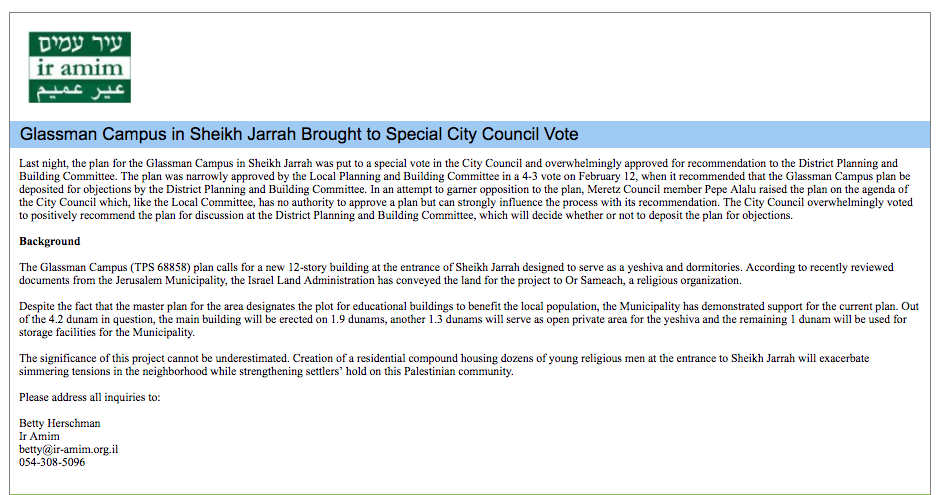
Though the plan for Givat Hamatos has been fully approved, construction of the settlement has yet to start. Givat Hamatos has long been regarded as a doomsday settlement by parties interested in preserving the possibility of a two-state solution. If the Givat Hamatos settlement is built, the Palestinian neighborhood of Beit Safafa in East Jerusalem will be completely surrounded by Israeli construction, severing its connection to the West Bank.
In anticipation of the bidding window opening, 15 European Union members issued a rebuke of the plan during a video conference, with the French Embassy in Israel later tweeting its disapproval of Israel’s advancement of both the E1 and Givat Hamatos settlements. Peace Now also delivered a letter to Benny Gantz and Gabi Ashkenazi beseeching them to stop those two settlement plans from moving forward.
Hanan Ashraw sharply responded to the outcry against E-1 and Givat Hamatos from the EU countries, saying:
“Rhetorical opposition has not deterred Israel. In fact, Israel is emboldened to escalate its criminal actions precisely because it is confident that opposition will not move from the verbal to the practical. If implemented, these Israeli plans would completely sever occupied Jerusalem from its natural Palestinian surrounding and cut the occupied West Bank in half. While the international community is concerned with the “possibility” of annexation, Israel is implementing its annexation scheme on the ground without any deterrence.”
Emek Shaveh: Civil Administration Hearing on Hebron Settlement Project is a “Farce”
On August 4th, the Israeli Civil Administration’s High Planning Committee held a public hearing to discuss objections submitted against its plan to build accessible infrastructure, including an elevator, at the al-Ibrahimi Mosque/Tomb of the Patriarch in Hebron — a plan which requires Israel to seize from the Islamic Waqf.
Described as “unprofessional” and “a farce” by Emek Shaveh (an Israeli NGO with deep expertise in archaeology and the preservation of historic sites), the hearing began with the Council chairman stating that the government had already determined that it will build the elevator regardless of any objections to the plan. The Chairperson said:
′′We [the members of the planning committee] all decided, it is an important program that must be promoted…What is this attitude, you came to resist. Why resist?””
Emek Shaveh raised several objections to the plan’s archeological and planning deficits, and the Palestinian Municipality of Hebron submitted objections to Israel’s violation of agreements, signed by Israel, relating to governance and planning in Hebron.
Emek Shaveh said in its statement:
“The most important historical, archaeological and holy site in the West Bank has been subject to reckless and amatuer planning and is the victim of politically motivated, unprofessional decision making.”
Minister Presides Over Celebration of Completion of New Migron settlement
On July 27th, Health Minister Yuli Edelstein spoke at an event to celebrate the end of construction on the new Migron settlement, which will house 50 settler families.
The new Migron site is located a little over one mile away from the original site of the outpost bearing the same name – which settlers were forced by Israel to evacuate. The new site is on a hilltop that is technically within the jurisdiction of the Kochav Ya’acov settlement, but is not contiguous with its built up area. As such, it is properly understood as a new settlement. The fact that the site is within the territory allocated to Kochav Ya’acov allowed Israel to approval of New Migron as if it were merely a neighborhood of an existing settlement rather than a new settlement.
In 2011, the Israeli High Court ruled that (old) Migron – an illegal outpost – must be evacuated because it was built on privately owned Palestinian land. Most of the illegal outpost’s residents were evacuated and most of the outpost’s buildings were demolished in 2012. Determined to demonstrate its support for settlers in the face of this court-compelled evacuation, the government promised to establish two new settlements: “New Migron” (the settlement officially inaugurated this week), as well as 184 housing units to be built east of the settlement of Adam (aka, Geva Binyamin). All said, the two new settlements and temporary housing for the evicted settlers cost Israeli taxpayers millions of dollars – sending a clear message that settler law-breaking pays off.
At last week’s ceremony, which was also attended by Ronen Peretz, a senior aid to Netanyahu, Minister Edelstein said:
“This is an important national moment…this is the response [to Disengagement]. This is what provides hope…With God’s help, the application of sovereignty over Judea and Samaria will give an even more determinative response.”
Edelstein’s reference to the “Disengagement” refers to Israel’s unilateral move in 2005 to evacuate its settlements in the Gaza strip and a small number of settlements in the northern West Bank (which took place almost 15 years ago to the date the celebration of New Migron).
On 15-Year Anniversary of Disengagement, Israeli MKs Vow No More Settlement Evacuations
On August 4th, a coalition of Knesset Members led by Bezalel Smotrich (Yamina) and Miki Zohar (Likud) introduced a bill meant to prevent the government from evacuating settlements under any circumstances. The bill was introduced on the anniversary of Israel’s 2005 unilateral move to evacuate 21 settlements in the Gaza Strip and four settlements in the northern West Bank.
Minister of Diaspora Affairs Omer Yankelevich (Blue & White) also took the opportunity to state her opposition to settlement evacuation, making the following remark during a tour of settlements in the northern West Bank:
“Settlement evacuation brings terror, not peace…Judea and Samaria are an inheritance from our forefathers. There are those who speak of these areas in terms of cost versus benefit but we need to remind them that we are talking about our land and not to be ashamed of this fact. Extension of sovereignty over these areas is our desire at the end of the day, under the right conditions,”
In addition, Gilad Sharon (son of former Prime Minister Ariel Sharon who devised and implemented the 2005 disengagement) added his voice to the anti-evacuation chorus. While defending his father’s actions and bashing the Palestinians, Sharon said:
“What we could afford in the Gaza Strip, in an isolated area squeezed between the desert and the sea, we cannot do in Judea and Samaria. This is the heart of the land, Judea and Samaria. When the world sees what happened in Gaza, because they got billions of dollars. What did they do with the money? [Did they build] any housing, factories, something? Only rockets and terror tunnels. That’s what they did, so everyone understands that that’s how they behave when they are left alone. What you can afford for yourself in an isolated corner, you cannot do in the heart of Tel Aviv, in the suburbs of Tel Aviv, in the heart of the country. I don’t think we should evacuate anything. Gaza was a very unique case, nothing to do with Judea and Samaria, which we have to hold forever.”
Settlers Say Israel’s Mismanagement of West Bank Land Registry Has Enabled Palestinian Theft of Land in Area C
A new report published by the Israeli State Comptroller chided the Israeli Defense Ministry for its incomplete land registry documenting land ownership (Palestinian and Israeli) in Area C of the West Bank. The radical settler group Regavim used the report as yet another opportunity to perpetuate the myth that the Palestinian Authority is orchestrating a campaign to steal Area C land from Israel. As a reminder, Area C land is not Israeli land; it is land occupied by Israel that, under the Oslo Accords, came under temporary Israel civilian and security control under arrangements that were supposed to last only a short period of time before a permanent status agreement was reached between the parties – an agreement that was supposed to be reached within 5 years.
Regavim Director-General Meir Deutsch said:
“The painstaking, glacial pace of handwritten record keeping is fertile ground for forgery, and leads to further violation of property rights, making it nearly impossible to conduct property transactions in a normal fashion. The failure to carry out the necessary registration and regulation of land in these areas has enabled the Palestinian Authority to carry out a well-planned, carefully-timed and well-funded land-seizure program.”
State Comptroller Report Re-Centers Long Standing Settler Safety Complaints As Grounds for More De Facto Annexation
A new report published by the Israeli State Comptroller blamed the Israeli Defense Forces for putting settlers in danger by failing to secure roads in Area C for the settlers. The report explained that part of the IDF’s failure was due to bad communication and conflict over which Israeli ministry – Defense or Transportation – was actually in charge. This framing is significant given that the Israeli Civil Administration – the body which effectively is the occupying government of the West Bank – is part of the Defense Ministry, while the Transportation Ministry does not have legal planning authority in the West Bank (it is a part of Israel’s own government, meaning that giving it authority in the West Bank amounts to de facto annexation). The report also called out the Defense Ministry for the poor quality and incompleteness of the West Bank land registry (as discussed above).
Efrat Council Chairman Oded Revivi said that the report demonstrates why Israel needs to annex the settlements.
As a reminder: settlers are Israeli civilians who have chosen, for a variety of reasons, to live in an area under military occupation where their “safety” must be actively attended to by the Israeli army. The issue of security for settlers and settlement infrastructure has in the past translated to massive investments of government resources into projects that entrench and expand Israel’s de facto annexation of the West Bank. For example, following months of intense pressure from settlers, in October 2017, then-Defense Minister Avigdor Liberman promised to allocate $939 million for projects for settlers and settlements across the West Bank. According to the Times of Israel, the $939 million package was dedicated to funding:
“the installation of security cameras along roads throughout the West Bank; the installation of cell phone towers to improve reception for settlers who may need to call for help; the paving of bypass roads around Palestinian towns and settlements to allow the populations to avoid each other; the bolstering of armored buses that travel through the West Bank; and broad security improvements for each settlement that will include security cameras, “smart fences” and sensors to warn of attempts to sneak into settlements.”
The following year (2018), Israel inaugurated several new bypass roads In partial fulfillment of the 2017 funding commitment to a settler security package. In 2019, Israel issued permits for the construction of an additional two bypass roads.
Near Nablus, Palestinians Take on IDF & Settlers to Stop Land Theft
On August 6th, Wafa reports that Palestinians clashed with IDF just west of Nablus, at the site of a new outpost that settlers were attempting to establish near a well on privately-owned Palestinian land. The report says Palestinians were attacked by the IDF when they attempted to reach the area where settlers had set up a tent and a caravan.
Palestinians reportedly planned to continue their struggle to challenge the settlers’ effort to take over the site by staging Friday prayers there.
Israel’s Short-Lived Settlement Affairs Ministry Shipped to London
After serving for around four months as Israel’s first Settlement Affairs Minister, Tzipi Hotovely (Likud) has now moved on to be Israel’s Ambassador to the United Kingdom. There is no word on her replacement.
Hotovely is regarded as a rising star in the Likud Party (which some suggest is why she is being sent abroad, noting that Netayahu has a pattern of using ambassadorship to put some distance between himself and those he sees as posing the greatest challenge to him politically). Hotovely is well known for her radical views — racist, homophobic, and pro-annexation — as well as her denial of the existence of the Palestinian people.
West Bank Realities No Longer Hidden by U.S. Satellite Imagery Prohibition
Al-Shabaka policy fellow Zena Agha writes in Foreign Policy about the repercussions and importance of a recent change in U.S. policy regarding satellite imagery. This change eliminates the longstanding prohibition on American satellite imagery companies producing high-resolution photos of the West Bank. Agha writes:
“Significantly, the reversal empowers humanitarian groups working to hold Israel accountable for its violations of international law, including unlawful killings and settlement construction (which, under the fourth Geneva Convention, constitutes a war crime). It is perhaps for this reason that the KBA’s reversal has already caused some disquiet in Israeli military quarters. The reversal also has geopolitical implications. Satellite images of the border areas of Jordan, Syria, Lebanon, and Egypt have thus far been both downsampled and poorly covered (with many operators wary of capturing any Israeli territory). The change in legislation will provide uncensored images of these areas and allow for their monitoring and investigation, particularly around environmental issues such as water extraction. Finally, from the perspective of historical justice and accountability, uncensored, high-resolution images enable Palestinians to accurately catalog the remnants of villages and towns destroyed during the events of 1948 and beyond. The democratizing power of the reform will allow Palestinians to use technology to rediscover an erased past and to imagine an alternative future.”
Bonus Reads
- “Court override bill dead in the water as Haredim, Liberman rule out support
- “ (The Times of Israel)
- “Peace Now asks Gantz, Ashkenazi to halt east Jerusalem Givat Hamatos homes” (Jerusalem Post)
- “What Comes First, an Israeli Army Firing Zone or Palestinian Villages?” (Haaretz)
- “Netanyahu’s decline benefits pro-settler Bennett” (Al-Monitor)
- “Israel Offers Money to Palestinian family for Killing by Settler” (Ynet)
Welcome to FMEP’s Weekly Settlement & Annexation Report. To subscribe to this report, please click here.
July 17, 2020
- Smotrich & Israel Land Caucus Introduce Annexation Bill
- After Settlers Protest, Netanyahu Delays Vote on Government Bylaws
- More Rumors on Annexation, But No Announcement
- Gantz to Issue Tender for Settler Project at Hebron Holy Site
- IDF Helps Fortify New Outpost on West Bank’s Highest Hilltop
- Bonus Reads
Comments/questions? Contact Kristin McCarthy (kmccarthy@fmep.org)
Smotrich & Israel Land Caucus Introduce Annexation Bill
On July 13th, MKs Bezalel Smotrich (Yamina) and Haim Katz (Likud), co-chairs of the Israel Land Caucus — a pro-Greater Israel body within the Knesset — filed a bill in the Knesset to have Israel both annex all of its settlements in the West Bank and preserve its control over Area C (in anticipation of future annexation). The bill is modeled after a January 2018 resolution passed unanimously by the Likud Party (with Prime Minister Netanyahu’s consent), a fact used by the authors of the new bill as incontrovertible proof that the bill should easily receive backing from the government and be quickly passed by the Knesset. The Israel Land Caucus is calling on Netanyahu to bring the bill up for a vote in the Security Cabinet this Sunday (July 19th), and its co-authors have requested that the legislation be fast-tracked in the Knesset.
A spokesman for the Israel Land Caucus told The Jerusalem Post that the bill calls for Israel to unilaterally annex all settlements, outposts, and roads. Though the bill’s authors do not have a map to show the exact areas the bill will annex, they say their plan does not leave any settlements or outposts as isolated enclaves. Additionally, the bill would bring the entirety of Area C more directly under Israel’s control by requiring Palestinians to gain the approval of the Israeli security cabinet (as opposed to the Israeli Civil Administration) for any construction there. It would also ban international organizations and governments from conducting activities and projects in Area C. Taken together, these changes in the status of Area C, with Israel’s civilian government in effect asserting its direct authority over the area, would functionally amount to a form of formal annexation of the area. [It’s worth noting here that the European Union, Denmark, and the Palestinian Authority just announced $6.63 million in funding for 16 projects for Palestinians in Area C, including new schools, electricity networks, and water reservoirs.
Speaking about the bill, MK Smotrich said:
“A few years ago, our caucus placed sovereignty laws in front of the Knesset and made the issue one of the central issues on the agenda of the Israeli government. Unfortunately, the government’s promises of sovereignty so far have not been fulfilled and the proposal in Netanyahu’s plan creates a de facto Arab state in the heart of the country. This is not what we had in mind. The bill we have presented today is the long-awaited sovereignty and it will remove the folly of two-states from the agenda. We must have cooperation between all right-wing elements in the coalition and opposition to advance this bill and we act together to advance it for the continuation of the Zionist vision.”
After Settlers Protest, Netanyahu Delays Vote on Government Bylaws
Following public protest by Yossi Dagan, head of the Samaria Regional Council (a settlement municipal body), Netanyahu canceled plans for the Security Cabinet to vote on procedural bylaws which theoretically might have empowered Benny Gantz to block Likud’s annexation plans (bearing in mind that it is by no means certain he would choose to do so). As a reminder, under the existing coalition agreement, Gantz does not have the power to block a vote on annexation; the proposed bylaws would have clarified that consensus between Netanyahu and Gantz is required to advance items on the government’s agenda.
After Dagan raised the alarm about the issue with Israeli media, the bylaws were quietly removed from the Cabinet’s July 12th agenda.
Dagan argued that the proposed bylaws would have torpedoed:
“the possibility of applying sovereignty in the coming months as promised by the prime minister, because Alternate Prime Minister Benny Gantz has already stated he would not agree to apply sovereignty without negotiations with the Arab world, and that is not possible at this time.”
Netanyahu is reportedly facing pressure from the Trump Administration to get Gantz on board with annexation, even as settlers demand that Netanyahu moves forward on annexation without Gantz, per the coalition agreement.
More Rumors on Annexation, But No Announcement
Starting before July 1st, Israeli officials have been saying privately that the U.S. is pumping the brakes on Israel’s annexation plans. This week, Yariv Levin – a Likud party leader, Speaker of the Knesset and a member of the Israeli mapping and negotiation team working with the U.S. – reportedly said in private conversations that, at the moment, the Americans are “not listening” when it comes to Israel’s annexation plans. At the same time, reports continue to suggest that the U.S. is pushing Netanyahu to hold off on annexation until Benny Gantz agrees to the plan and its timing.
The American side has been notably silent this week, neither rebutting Israeli suggestions that annexation has been delayed nor fulfilling promises of an anonymous U.S. official that Trump would make a decision on the matter this week. David Schenker – the State Department’s Assistant Secretary for the Bureau of Near Eastern Affairs (formerly at the Washington Institute for Near East Policy, one of the Trump Admin’s favorite think-tanks) – told the German Marshall Fund that Netanyahu is facing pressure from his supporters who support annexation but are opposed to the Trump Plan’s vision for a Palestinian non-state entity. Schenker said:”We’re [the U.S] calling on the Israelis not to do anything that would preclude the implementation of the vision.” And further cast doubt on whether annexation will happen on Trump’s watch, saying, “It wouldn’t surprise me if we didn’t see anything, but I think that the prime minister would like to do something.”
Gantz to Issue Tender for Settler Project at Hebron Holy Site
On July 13th, Defense Minister and Alternate Prime Minister Benny Gantz announced that he will expedite the planning process for a settler-backed project to install accessible infrastructure (including an elevator) at the Tomb of the Patriarchs/Ibrahimi Mosque in Hebron. Gantz will reportedly issue a construction tender for the project soon. Emek Shaveh reports that Gantz’s announcement was pressured by settlers, who claimed the Civil Administration was dragging its heels on advancing the project.
The period during which the public can file objections to the plan closed on July 13th (the same day as Gantz’s announcement). Two objections were filed: One by Emek Shaveh (read more here) and a second by the Palestinian-run Hebron Municipality. Gantz’s objection suggests that neither is being taken seriously.
IDF Helps Fortify New Outpost on West Bank’s Highest Hilltop
+972 Magazine reports that on June 26th settlers established a new outpost on privately owned Palestinian land just north of Nablus. Since then, they have been assisted by the Israeli army in securing the outpost. On July 7th, the IDF brought in bulldozers to construct a dirt barrier in order to prevent Palestinians from accessing the area, which includes terraced agricultural land that Palestinians have cultivated for decades. Palestinians have also reported seeing IDF soldiers escort settlers to and from the outpost. The outpost consists currently of two mobile homes and an animal shed.
The outpost is built on the top of the highest hilltop in the West Bank, Mount Ebal, on land owned by Palestinians from the nearby town of Asira al-Shamaliya. Since the outpost was established, Palestinians have gathered every Friday to protest against the settlers living there – protests which have been met by the IDF with tear gas and stun grenades. The mayor of Asira al-Shamaliya was injured by a tear gas canister but vowed to continue demonstrating against the outpost every Friday until it is dismantled.
Dror Etkes, founder of the settlement watchdog group Kerem Navot, told +972 Magazine:
“This cannot happen without some kind of coordination with the army, when the outpost is near one of the most central army bases in the West Bank. There is no chance the army is not involved in one way or another.”
Bonus Reads
- “Jerusalem highway construction aims to modernize traffic flow around historic city” (JNS)
- “Palestinian Workers Forced to Sleep in Trash-sorting Plant Because Employers Feared Coronavirus Lockdown”(Haaretz)
- “How I Ended Up Staying at an Isolation Hotel in a ‘Jerusalem Settlement’” (Haaretz)
- “United Israel Appeal says won’t invest in projects beyond Green Line” (Israel Hayom)
- “Tech leaders say West Bank annexation would be catastrophic for Israel” (CTech)
- “Dutch threaten fine for stores selling Hebron wine with ‘made in Israel’ tag” (The Times of Israel)
- “EU, Denmark, PA will build 16 projects including schools in Area C” (MEMO)
Welcome to FMEP’s Weekly Settlement Report, covering everything you need to know about Israeli settlement activity this week.
To subscribe to this report, please click here.
July 3, 2020
- The [Purported] Israeli Counter-Proposal to the Trump Annexation Map
- De Jure Annexation Remains Imminent: Reports Say Trump to Make Final Decision Next Week
- U.S. Said to Ask for Israeli “Gesture” to Palestinians in Order to Approve Annexation Plan
- Settlers Continue Opposition to Trump Plan, While Pushing Bibi to Stop Delaying
- Settler Group Announces New Outpost Near Hebron
- Israeli Court Issues Ruling to Throw Sumreen Family Out of Their House
- Settlers Claim to Have Purchased an Illegally Built Palestinian Home in Wadi Hilweh, Silwan
- Israel Orders Demolition of Illegal Settler Structures Following Reversal of Regulation Law
- State Admits to High Court that Jerusalem Cable Car Project Will Require Confiscating Private Palestinian Land
- New Ir Amim Paper Looks at Jerusalem to Underscore the “Truth About Annexation”
- Bonus Reads
Comments/questions? Contact Kristin McCarthy (kmccarthy@fmep.org)
The [Purported] Israeli Counter-Proposal to the Trump Annexation Map
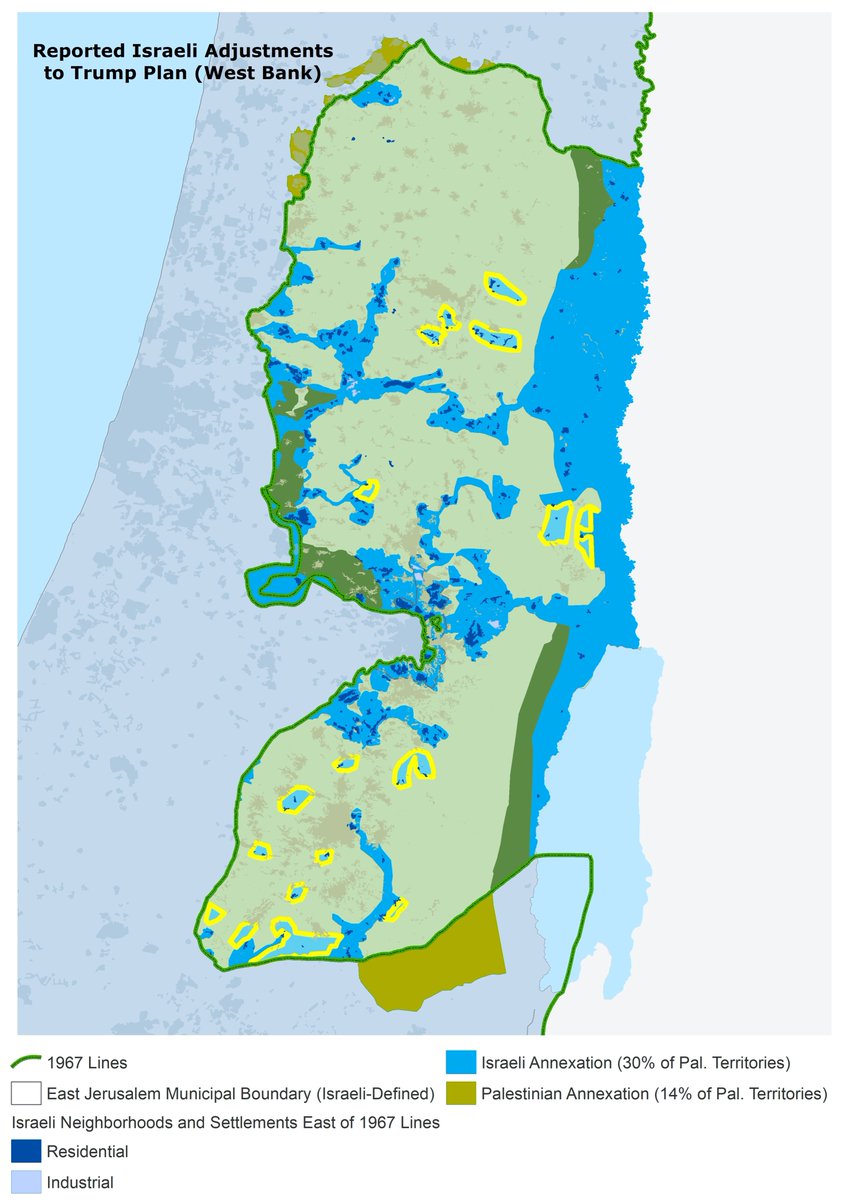 Israel’s Kan News published what it claims to be the Israeli government’s counter-proposal to the Trump annexation map. The reported counter-proposal adds a significant amount of West Bank land to the area Israel will annex, rendering even more severe the fragmentation of any future Palestinian state the plan is supposedly interested in seeing established. Specifically, the counter-proposal (which is exceptionally well explained by Israeli analyst and mapping expert Dan Rothem) achieves four main goals:
- It expands the channels of land which connect 15 far-flung outposts and settlements to what is today sovereign Israel. The Trump map connects these “enclaves” via narrow land corridors and roads (referred to by settlers as “balloons on a string”). The alleged counter-proposal annexes 2.7% more of the West Bank to enlarge those corridors.
- It provides for Israel’s annexation of about 20 additional settlements/outposts left out of the (initial) annexation provided for under the Trump Plan. These include the radical and violent settlement of Yitzhar and its outposts) located near Nablus, as well as the (relatively) nearby settlements Elon Moreh (and its outposts), Har Bracha (and its outposts), and Itamar (and its outposts). All of these settlements/outposts are, notably, located deep in the West Bank heartland.
- It proposes “compensating” Palestinians by designating an additional 4.6% of the West Bank — areas designated under the Trump Plan for Israeli annexation, comprised of West Bank territory where there are no settlers and some empty areas in the Jordan Valley/Judean desert — to (possibly) be under some degree of Palestinian control (without providing details on what would be the status of the land). (Reminder: Netanyahu said he will not annex a single Palestinian).
- The map also appears to propose population transfer, putting parts of the so-called Triangle Area — an area of densely populated towns located within Israel’s sovereign borders, inhabited by Palestinian citizens of Israel — into the area that could theoretically become a Palestinian state (assuming the Palestinians accepted the Trump Plan and satisfied a laundry list of conditions that no Palestinian leadership would ever accept — all to end up with an archipelago of territory that they might be allowed to call a “state” but that would have few if any actual attributes of sovereignty). Reminder: Forcible population transfer is a flagrant violation of international law (as is annexation of any scope); a government re-drawing its borders to deprive its own citizens of their rights, based on their ethnicity, is antithetical to democracy.
Additionally, while Israeli officials originally indicated that annexation would begin with the Jordan Valley, rampant reports indicate that the focus has now shifted to annexing elsewhere (settlement blocs) as the first stage of annexation. Perhaps responding to criticism over delaying the annexation of the Jordan Valley, Israeli Regional Cooperation Minister Ofir Akunis (Likud) told The Jerusalem Post that “of course” the Jordan Valley is included in Israel’s annexation plans [which should surprise nobody, given that politicians across most of the political spectrum in Israel came out in support of annexation of the Jordan Valley (including Benny Gantz), even before the Trump Plan].
So what is Netanyahu really thinking? According to Haaretz, he has not held discussions with his own Security Cabinet on the annexation plan, and the key Israeli bodies which will be involved in implementing annexation – the Justice Ministry, the Attorney General (whom Bibi is in open war with), the IDF chiefs, and Foreign Ministry – have not begun preparing for implementation.
De Jure Annexation Remains Imminent: Reports Say Trump to Make Final Decision Next Week
July 1st – the first day Netanyahu was permitted to bring annexation up for a vote in the Cabinet or in the Knesset, but by no means a deadline for such an action – came and went without an announcement. Reports almost immediately suggested that the annexation decision – reportedly delayed by U.S. demands and Israeli disunity.
After a week of meetings with Israeli leaders, National Security Council advisor Scott Leith and Middle East envoy Avi Berkowitz (who in the meetings were of course joined by US ambassador to Israel David Friedman) headed back to Washington. On Thursday, Berkowitz met with Jared Kushner in preparation for presenting their plan to the President. Despite the palace intrigue surrounding Kushner this week, Kushner plays a critical role in leading Trump a final decision on annexation, expected to come next week..
Though Trump has not been involved in any details of the annexation deliberations, Israeli Regional Cooperation Minister Ofer Akunis asserted that Israel will not act without a statement from Trump himself, telling the Jerusalem Post:
“[annexation] will only happen after a declaration by Trump.”
Following the departure of Leith and Berkowitz (Friedman remained in Israel), an anonymous U.S. official told the Jerusalem Post that the fact that July 1st came and went without an announcement does not mean that annexation is any less likely to happen. That official said:
“The administration is appreciative of the ongoing conversations and serious considerations that have gone into our recent discussions with the Israeli government.July 1 is not and has never been a US deadline, nor do we believe it is an Israeli deadline. We look forward to continuing the dialogue with our Israeli partners and working productively and in earnest towards implementing the president’s Vision for Peace in the Middle East.”
U.S. Said to Ask for Israeli “Gesture” to Palestinians in Order to Approve Annexation Plan
U.S. Amb. David Friedman, National Security Council advisor Scott Leith, and Middle East envoy Avi Berkowitz spent the past week in Israel, negotiating with Israeli Prime Minister Netanyahu and Alternate Prime Minister Gantz over the extent and timing of Israeli annexation of West Bank territory. Israeli press – particularly right-wing outlets – asserted that the Americans were pushing Israel to make a more significant “gesture” to the Palestinians in order to win American support (reminder: the Palestinian leadership has not been involved in negotiations at all).
Reportedly, the US suggested that such a gesture could consist of granting the Palestinian Authority greater control over the remnants of Area C left to the Palestinians after Israeli annexation — with Israel retaining the ability to “secure” those areas as-needed (essentially transforming a small part of Area C land into Area B).
The Jerusalem Post goes so far as to suggest that “many” of the conversations this past week focused on what the Palestinians will be given/offered/forced to accept, rather than the details of what/how/when Israel will annex. More than anything else, this suggests that the U.S. is not imposing limits on what Israel can annex.
Settlers Continue Opposition to Trump Plan, While Pushing Bibi to Stop Delaying
Worried both about the details of the Trump Plan and that Bibi will not pull the trigger on annexation at all, settler leaders and their allies continue their criticism of Netanyahu for every move (and non-move) he makes.
Two prominent settler leaders who oppose the Trump Plan – Yesha Council chairman David Elhayani and Samaria Regional Council chairman Yossi Dagan – continued lashing out at Netanyahu for his posture on issues of key concern to settlers (the creation of settlement enclaves, a settlement construction freeze, and the possibility of future Palestinian statehood) and for failing to act on July 1st. Dagan called the July 1st date “one big farce.”
Elhayani – who estimated that there is an 80% chance that there will be no annexation – told Walla News:
“Tying the lack of sovereignty [announcement] to Benny Gantz is a pathetic excuse..In reality, it is in the hands of the prime minister, who must accept responsibility for the decision, demonstrate leadership and say: ‘I have made this commitment to the electorate in two election campaigns, and I will stand by it’.”
Another group of settlers who are adamantly against the Trump Plan launched a new campaign targeting Netanyahu. The campaign, which was covered in the front page of the Israel Hayom paper, features photos of PA President Mahmoud Abbas, Joint List Parliamentary head MK Ahmed Tibi, and Netanyahu, and alongside the photos uses the slogan:
“They [Abbas and Tibi] will not decide. You’ve [Netanayhu] decided – Keep your promise.”
Another settler group – the Sovereignty Movement – put up billboards all over the country calling on Netanyahu to annex and to say “no” to a Palestinian state.
Former Defense Minister Avigdor Liberman (Yisrael Beytenu) put on a public display of his pointed displeasure with Netanyahu’s failure to advance annexation on July 1st. Visiting a vista overlooking the Palestinian Bedouin village of Khan al-Ahmar in the West Bank – which Netanyahu has long promised to demolish – Lieberman told the press:
“We’re meeting here at Khan al-Akhmar because this is part of the same pattern of behavior. For fourteen months, Netanyahu has been yelling about ‘sovereignty’, and the whole time he’s cheated his voters…Netanyahu has tricked everyone. He has no intention of applying sovereignty: not over Maale Adumim and not even in the Jordan Valley. He always manages to trick everyone, but it was clear to me that he is lying, just as he lied about Khan al-Akhmar.”
Former Justice Minister and Yamina party leader MK Ayelet Shaked told the Jerusalem Post that she believes Bibi has “given up on the Jordan Valley.”
Haaretz reports that settlers – both those who support the Trump Plan and those who want more than what the plan is offering – have been successfully working with U.S. evangelicals to pressure Trump to OK annexation. Netanyahu himself spoke at a high profile online event for Christians United for Israel, and Yossi Dagan was interviewed by the Christian Broadcasting Network. Efrat settlement Mayor Oded Revivi has been in private conversation with U.S. evangelical leaders.
A recent poll by the radical settler group Regavim found that only 30% of settlers supported the Trump Plan after they were told that it will require Israel to agree to the establishment of a Palestinian state. Additionally, 53% of settlers said they believe that Netanyahu will give in to pressure from Trump rather than stand his ground on issues under negotiation.
Settler Group Announces New Outpost Near Hebron
On July 1st, a group of about 500 settlers held a protest against the Trump Plan and announced their plans to establish a new outpost. The protest was held on a hilltop belonging to the Palestinian village of Halhul, near Hebron in the southern West Bank. One of the protests leaders, veteran settler activist Daniella Weiss, told Ynet:
“The Trump plan needs to be thrown in the trash. We came here to establish a settlement. Today everyone understands that the purpose of the plan is to establish a Palestinian state in the heart of Israel.”
Israeli Court Issues Ruling to Throw Sumreen Family Out of Their House
On June 30th, the Jerusalem District Court rejected an appeal by the Palestinian Sumreen family to stop the Jewish National Fund (JNF) from evicting them from the home of 60 years in the Silwan neighborhood of East Jerusalem. The Court gave the 18-member family until August 16th to vacate the property and ordered them to pay 20,000 shekels (about $5,800) to the JNF for legal costs. The Sumreen family is considering taking their case to the Israeli Supreme Court.
The Coalition for the Sumarin Family said in a statement:
“In the ruling, the court did not address the most important, fundamental point, which is that the house was taken in plunder. The JNF’s legal woes did not change the fundamental fact that the use of the Absentees’ Property Law to take over the house was done without good faith, as two government legal advisers and a government inquiry commission, determined”.
The Sumreen family home is located in the middle of what today has been designed by Israel “the City of David National Park.” The area is managed by the radical Elad settler organization, which for years has also been pursuing the eviction of Palestinians from the homes in Silwan. For nearly three decades, the Sumreen family has been forced to battle for legal ownership of their home, after the state of Israel, prompted repeatedly by the JNF, declared the Sumreen’s home to be “absentee” property. After that designation – which was not communicated to the Sumreen family – Israeli law permitted the state to take over the rights to the building. The state then sold the rights to the home to the JNF in 1991. The JNF has pursued the eviction of the Sumreen family ever since. Israeli courts ruled in favor of the Sumreen family’s ownership claims to the home for years, until a September 2019 ruling by the Jerusalem Magistrate’s Court granted ownership of the family’s home to the JNF, a decision the family immediately appealed to the Jerusalem District Court.
A full history of the saga involving the Sumreen family – which is similar to dozens of other Palestinian homes in Silwan that were declared Absentee Property in the 1990s – can be found on the Peace Now website here.
In a recent letter organized by Israeli academics, thirty-four Israel Prize laureates pleaded to the head of the JNF to stop eviction proceedings against the Sumreen family. The letter reads:
“The expulsion of the family, as part of a campaign to Judaize Silwan which has been going on for many years, will stain the reputation of the KKL … we beg of you to desist from taking actions that would be clearly immoral.”
This week, +972 Magazine published an illuminating article by a former staff member of the JNF, looking at the role the organization has played in advancing annexation policies on the ground for decades with evictions like the Sumreen case. IMEU also just published an excellent fact sheet about the Jewish National Fund.
Settlers Claim to Have Purchased an Illegally Built Palestinian Home in Wadi Hilweh, Silwan
On June 30th, a group of settlers invaded a vacant building in the Wadi Hilweh section of the Silwan neighborhood in East Jerusalem, saying that they had purchased the house from its Palestinian owners. Peace Now reports that the home was built by Palestinians years ago without an Israeli-issued permit (Palestinians in East Jerusalem are systematically denied permits to build on their own land). The family that had been living in the house left about four months ago after a demolition order was issued by the Jerusalem Municipality. 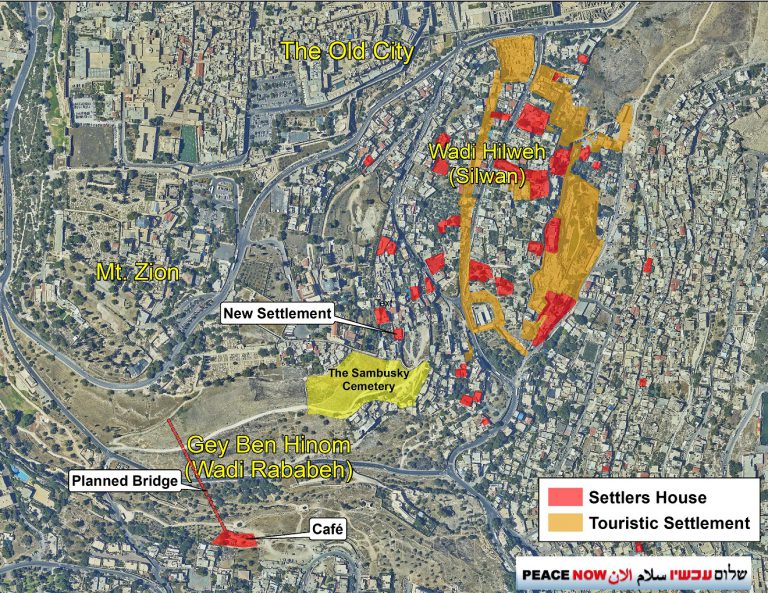
The house is located in the Ben Himmon Valley and very close to a Jewish cemetery that is currently being rehabilitated by the radical Elad settler organization. Elad has been involved in the systematic displacement of Palestinians from the Silwan neighborhood and has been weaponizing tourism and archaeology as a means by which to do so.
Peace Now explains:
“In recent years, the Elad Association, together with the Jerusalem Development Authority and the Nature and Parks Authority, has been intensively developing the Ben Hinnom Valley area leading to the Sambusky Cemetery in an attempt to produce Israeli territorial contiguity from the Sultan’s Pool area and Ben Hinnom Valley area through the cemetery toward Wadi Hilweh and the ‘City of David’ visitors’ center…The takeover of this house extends the settlers’ control in the southwest corner of Wadi Hilweh: In September 2014, the settlers entered a nearby house, and in January 2016 another house adjacent to it…All of these projects, along with the settlers entering the house yesterday, are intended to strengthen Israeli presence in this contested and occupied area, and thus make it more difficult for the territorial compromise in Jerusalem needed for a Palestinian capital in East Jerusalem and therefore the two-state solution itself. Tourism development projects in Jerusalem are one of the most significant ways of settlement, leading to both a change on the ground and in the public domain, as well as a change in Israeli attitudes by hardening them to the idea of this necessary territorial compromise.”
Israel Orders Demolition of Illegal Settler Structures Following Reversal of Regulation Law
In response to a petition filed by Yesh Din and Emek Shaveh, Israel has said it will demolish illegally built settlement structures on privately owned Palestinian land belonging to the villages of Dir Amar and Ras Karakar. Years ago settlers illegally installed tourist accommodations – benches, terraces, paths, picnic benches and a pergola – at the site of an ancient spring in this area, in an attempt to take control of the site known as Nabi Aner. Nabi Aner is part of an historic Muslim pilgrimage route between Hebron and Bethlehem. The entire area is located in Area C of the West Bank.
Israel’s announcement that it will demolish the structures (and, ostensibly, agree to return the site to Palestinian control), comes two weeks after the Israeli High Court of Justice overturned the Regulation Law, which sought to provide a basis for legalizing settlement structures built on land that even Israeli acknowledges is owned by Palestinians (as is the case with the site in question). The petition to demolish the settlers’ construction was filed in 2017, but was not considered by the Court until now, based on the argument that the Regulation Law – if it withstood Court scrutiny — might have provided the State a basis for retroactively legalizing the structures.
Emek Shaveh said in a statement:
“Over the years, the authorities in the area have refrained from enforcing the law with respect to illegal construction that was carried out on private land and around the archaeological site. In recent years, the State used the pretext of the Regularization Law as an excuse for continuing the policy of non-enforcement. This is an example of the importance of the nullification of the Regularization Law, which enabled settlers to take over private lands. But regardless of the Regularization Law and its nullification, we find it regrettable that we were forced to petition the court to instruct the State’s enforcement authorities to simply carry out their duties and prevent the settlers from illegally building on private Palestinian land. We regret that the State does not of its own accord enforce the law and stop the damage to archaeological sites and the process of severing Palestinians from access to their cultural and religious roots.”
State Admits to High Court that Jerusalem Cable Car Project Will Require Confiscating Private Palestinian Land
On June 29th, the Israeli High Court of Justice heard arguments concerning the Jerusalem cable car project, an initiative backed by the Elad settler group and advanced by the Israeli Tourism Ministry. During the hearing, the State admitted the implementation of the cable car project will require the confiscation of privately owned Palestinian land in the Silwan neighborhood of East Jerusalem. The cable car line is slated to terminate at the settler-run Kedem Center compound (Elad’s large tourism center currently under construction at the entrance of the Silwan neighborhood, in the shadows of the Old City’s walls and Al-Aqsa Mosque).
The cable car plan, touted by Elad and other supporters as a vital transportation project, is in reality intended to further entrench settler control in Silwan, via archeology and tourism sites, while simultaneously delegitimizing, dispossessing, and erasing the Palestinian presence there. Emek Shaveh and other non-governmental organizations, including Who Profits and Terrestrial Jerusalem, have repeatedly challenged (and provided evidence to discredit) the government’s contention that the cable car will serve a legitimate transportation need in Jerusalem, and have clearly enumerated the obvious political drivers behind the plan, the archeological heresies it validates, and the severe negative impacts the cable car project will have on Palestinian residents of Silwan.
New Ir Amim Paper Looks at Jerusalem to Underscore the “Truth About Annexation”
In a new policy paper, Ir Amim looks at how Israel’s annexation of East Jerusalem has played out since 1967. Ir Amim’s main points – and warnings regarding Israel’s imminent annexation of more West Bank land – are:
- Israel annexing Palestinian land, but not Palestinian people, who since 1967 have been classified as “permanent residents,” rather than being made citizens, like the Palestinians who remained inside the Green Line after 1948.;
- Since the moment of annexation of East Jerusalem, Israel has pursued policies meant limit the number of Palestinains in the area, including by driving Palestinians from East Jerusalem;
- Since the moment of annexation, Israel has attempted to take control of more and more land in East Jerusalem;
- The Absentees’ Property Law (1950) and The Law and Administration Ordinance (1970) have been Israel’s tools of choice to evict Palestinians from their homes and take their property in East Jerusalem, under the guise of legality;
- Israel has repeatedly attempted to expand the borders of the area it annexed to include nearby settlements.
Ir Amim writes:
“In order to understand the consequences of annexation it is pertinent to learn from the case of East Jerusalem which Israel unilaterally – and in contravention of international law – annexed. Since 1967 East Jerusalem has been subject to the Jerusalem municipality and to Israeli law. In the decades since 1967, Israeli policy in the city has been driven by massive settlement construction and consistent steps to reduce the city’s Palestinian population. The combination of these two methods is considered by Israel the key to solidifying its control over the annexed territory and to asserting its sovereignty. Examining Israeli policies in East Jerusalem can therefore teach us the dangers of what can take place if the current annexation plan of the Israeli government actually takes place.”
Bonus Reads
- “Annexation is Already Here” (Jessica Montell // The Times of Israel)
- “Fight Annexation on Moral Grounds” (Yehuda Shaul // Haaretz)
- “Quick Facts: Israel’s West Bank Settlement Enterprise” (IMEU)
- “Despite Talk of Annexation, Fewer Immigrants to Israel Moving to West Bank Settlements” (Haaretz)
- “Quick Facts: What is the Jewish National Fund” (IMEU)