Welcome to FMEP’s Weekly Settlement Report, covering everything you need to know about Israeli settlement activity this week.
To subscribe to this report, please click here.
March 18, 2022
- Court Delays Decision on Mass Expulsion in Massafer Yatta
- Settlers Construct New Outpost on World Heritage Site in Battir
- Ma’aleh Adumim to Challenge Government of Delay of E-1 Settlement Construction
- This Week in Settler Terrorism
- U.S. Ambassador Has Harsh Words for Settlements, But Admits Some Construction Will Proceed
- Further Reading
Court Delays Decision on Mass Expulsion in Massafer Yatta
On March 15th, the Israeli High Court held what was expected to be a decisive hearing regarding the fate of eight Palestinian communities facing expulsion — at the hands of the Israeli State — from a large area in the South Hebron Hills known as Massafer Yatta. This is an area that Israel declared to be a closed “firing zone” in the 1980s (known as Firing Zone 918).
At the conclusion of this week’s hearing the Court did not issue its final ruling, but indicated it will convene another hearing in the coming months at which time it will issue its ruling. If given the green light, the forced expulsion in Massafer Yatta would constitute the largest displacement of Palestinians by Israel in decades — displacement that would be entirely illegal under international law.
This week’s court proceedings were live tweeted by the Israeli human rights group Breaking the Silence, and also covered by Palestinian journalist and activist Basel al-Adraa, who lives in Massafer Yatta. Adraa noted that it is “extremely likely” that the Israeli High Court will rule in favor of the State, and in so doing provide a green light (and legal cover, as far as the Israeli legal system is concerned) to the State’s plans to forcibly relocate some 1,300 people from the their homes and destroy their villages and their unique way of life. The State has maintained its argument that the firing zone is essential to state security, specifically for military training exercises because the terrain resembles Lebanon.
+972 Magazine, in a helpful explainer on this topic, explained why this effort to establish a pretense of legality for Israel’s actions against Palestinians in the South Hebron Hills flies in the face of international law and Israel’s obligations under treaties it has signed, writing:
“According to international law, and as detailed in treaties to which Israel is party, it is illegal to use occupied territory for a purpose that serves only the occupier and not the occupied population. In addition, international law prohibits the forcible transfer of the occupied population. The state has further claimed that one reason it needs the land in Masafer Yatta is to train soldiers for a possible war in Lebanon. But here, international law stipulates that such military use of occupied land can only be for the direct management or security needs of the occupied territory itself, making Israel’s declared purpose regarding Lebanon also illegal.”
A lawyer representing the eight communities under threat, Shlomo Lecker of the Association for Civil Rights in Israel, told Reuters:
“This case is not about a firing zone, it is about taking control of land because unlike other areas, most of this land is privately owned,” said Shlomo Lecker who, along with the Association for Civil Rights in Israel, is representing 200 of the Palestinian families under threat of displacement. In effect this is land expropriation without compensation.”
Basel al-Adraa wrote for +972 Magazine:
“Our expulsion from Masafer Yatta has never ceased over the last two decades. Lacking the ability to expel everyone at once, like in 1999, the army has tried to slowly dispossess us. To immiserate us until we leave. Every year, I have watched as Israeli soldiers seal our wells, cut water lines, and destroy the roads that connect our villages. The dangerous road conditions here are a constant reminder of a racist reality governed by an army that denies us our ability to live on our land legally. Even our vehicles are confiscated by soldiers when they feel like it. Our lives have become nearly impossible. We want to build families and homes, but know the army will destroy those as well.”
Settlers Construct New Outpost on World Heritage Site in Battir
In the early morning hours of March 14th, a group of settlers accompanied by Israeli soldiers set up a new outpost on a piece of land in the Palestinian village of Battir, located near Bethlehem, on land that is registered UNESCO world heritage site. Settlers reportedly moved in two caravans, a large tent, and sheep – suggesting an intent to establish a so-called agricultural outpost. The sheep pen was reportedly removed from the area on the same day it was brought in.
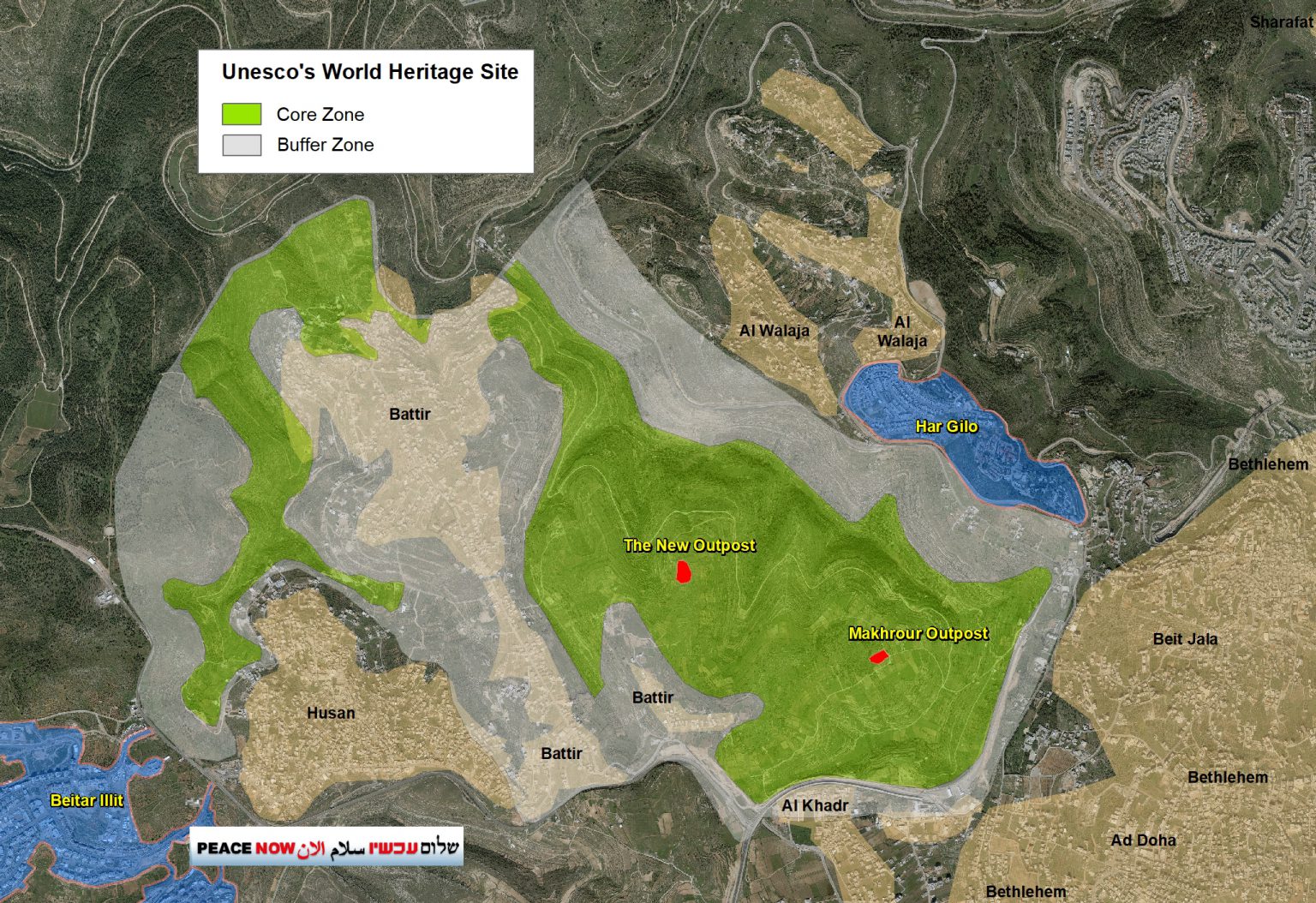 Since the outpost was set up, Middle East Eye reports that Israeli soldiers have been continuously patrolling the area to prevent any Palestinians from approaching the site – and attacking those who attempt to protest the new outpost. This is the fourth time settlers have attempted to establish an outpost in the area of Battir.
An local activist from Battir, Hassan Muamer, explained the settlers strategy:
“The settlers want to connect these two outposts [the new outpost and an outpost established in 2019 in the nearby Al-Makhrour Valley] together, and confiscate hundreds of acres of land in the process..This is all part of their plan, to shorten the distance between the two outposts, confiscate more land, and eventually connect these outposts to the settlements of Har Gilo, Gilo, and Gush Etzion, creating a massive settlement bloc that extends from Jerusalem, through Bethlehem, all the way to Hebron.”
Peace Now said in a statement:
“It is no coincidence that this illegal outpost is established while most of the public’s attention is drawn towards the war in Ukraine. The current government has already failed several times in stopping a handful of settlers in Eviatar, Homesh, and other places and has refrained from evicting illegal outposts immediately upon their establishment. The government must not fail this time, so the outpost will not be established.”
Ma’aleh Adumim to Challenge Government of Delay of E-1 Settlement Construction
The Jerusalem Post reports that the settlement council of Ma’aleh Adumim is preparing to submit an appeal against the State of Israel for delaying construction of the E-1 settlement, contending that Prime Minister Bennett and Defense Minister Gantz lack the authority to freeze the plans at this stage. The petition will be submitted to the Jerusalem Local Court, according to the report.
As a reminder, the E-1 settlement plan remains on the precipice of construction. In January 2022, the Bennett government intervened to stop a key hearing on the project. At the time, reports suggested that the political echelon had put on “indefinite hold” on the plan, largely due to U.S. pressure. U.S. Ambassador to Israel Thomas Nides seemed to confirm that U.S. pressure was exerted at that time to stop E-1 from moving forward, telling Peace Now recently:
“I went full board [sic] on E1… It is a very important area which if [built] could cut off any possibility of a capital for the Palestinians.”
Also as a reminder: in its current form, the E-1 plan provides for the construction of 3,412 new settlement units on a site located northeast of Jerusalem. The site is home to several Palestinian bedouin communities, including Khan al-Ahmar, which Israel has already undertaken to forcibly displace (many attempts). Long called a “doomsday” settlement by supporters of a two-state solution, construction of the E-1 settlement would sever East Jerusalem from its West Bank hinterland, preventing East Jerusalem from ever functioning as a viable Palestinian capital. It would also cut the West Bank effectively in half, isolating the northern West Bank from the southern West Bank and foreclosing the possibility of the establishment of a Palestinian state with territorial contiguity.
Israel’s “answer” to the latter criticism has long been to argue that Palestinians don’t need territorial contiguity, and that new roads can instead provide “transportational continuity.” To this end, Israel has already built the so-called “Sovereignty Road” – a sealed road that enables Palestinians to pass through, but not to enter, the E-1 area. That road is wholly under Israel’s control (meaning Israel can cut off Palestinian passage through it at any time). In January 2021, then-Prime Minister Netanyahu promised to increase funding for the “Sovereignty Road” as part of the drive to get E-1 built.
And another reminder: there have been attempts to promote the E-1 plan since the early 1990s, but due to wall-to-wall international opposition, the plan was not advanced until 2012, when Netaynuahu ordered it to be approved for deposit for public review (a key step in the approval process), ostensibly as payback for the Palestinians seeking recognition at the United Nations. Following an outcry from the international community, the plan again went into a sort of dormancy, only to be put back on the agenda by Netanyahu in February 2020, when he was facing his third round of elections in the two years.
Also, as a reminder: under the Trump Plan (which the Biden Administration has yet to comment on), the area where E-1 is located is slated to become part of Israel.
This Week in Settler Terrorism
On March 14th, an Israeli-licensed car drove into an IDF checkpoint, in an apparent attack, near the illegal Homesh outpost, lightly injuring two Israeli soldiers. It’s unclear what happened next, as the IDF has not said if the perpetrator – who is thought to be an Israeli settler, given the license plate on the car – was arrested. What is clear is that the IDF did not respond with lethal force, as is almost always the case when Israeli soldiers perceive themselves to be under attack by a car driven by a Palestinians.
This week’s apparent car ramming attack transpired two days after settlers from the site of the former settlement of Homesh (which is supposed to be a closed military zone) arrived at the checkpoint to stage a stone-throwing attack on Palestinian cars. The settlers ended up battling IDF soldiers who attempted to stop their terrorism. An IDF soldier subsequently filed a complaint with the Israeli police about the incident.
Elsewhere, Israel arrested two settlers on suspicion of involvement in vandalism and destruction of Palestinian property in the village of Fara’ata on March 15th. One of the detained settlers serves as the security coordinator for the Gilad outpost, and the second arrestee is a bodyguard. Following the arrest and remand of the settlers, security coordinators for various other Israeli settlements and outposts announced they will be going on strike.
It’s also worth noting that Defense Minister Benny Gantz signed an order this week to place an unnamed 21-year old settler under administration detention on suspicion of involvement with terrorism against Palestinians and Israelis. Though administrative detention is a familiar military tool used to keep Palestinians incarcerated without charge, Haaretz reports this will be the first such order signed against an Israeli since February 2020. There are currently 490 Palestinians being held as administrative detainees according to Addameer.
The detained settler is believed to be from the Givat Ronen outpost, an outpost from which settlers attacked Palestinians and Israeli activists who were planting trees on privately owned Palestinian land near the village of Burin in the northern West Bank in January 2022. Footage of the attack shows settlers wielding clubs, throwing stones, and burning a car — in the process injuring six people. Following the attack, the Israeli authorities delivered demolition notices to five structures at the Givat Ronen outpost (also known as Sneh Ya’akov), where the attackers are believed to be illegally living. The notices were posted on January 23rd.
Subsequently, the apparently undaunted settlers attacked an IDF soldier during riots near the Givat Ronen outpost. Haaretz reports that dozens of settlers participated in the attack, which included stone throwing and tear gassing Israeli troops.
Kerem Navot – an anti-settlement watchdog – provides critical history on the Givat Ronen outpost and how violence is at the center of settlers’ drive to takeover Palestinian land, tweeting:
“The outpost of ‘Givat Ronen,’ known also as ‘Sneh Yaakov,’ is named after the man who founded it in 1998–Ronen Arusi…Givat Ronen is one of two outposts located around the isolated, violent, and extremist settlement of Har Bracha, which was established overlooking the city of Nablus in 1983. Givat Ronen is located about a kilometer south of the settlement…The two outposts surrounding this settlement (like all outposts in the West Bank) are used for the same function: to take over land surrounding the settlement. In this case, the lands of the village of Burin. The approach is simple: you build an outpost on land that was looted by the state by declaring it to be “state land”; from there you continue to take over cultivated agricultural land surrounding the outpost by way of violence most of which were previously cultivated by Palestinians. In practice, as a result of the settler violence that is backed by the army, Palestinians are not able to access any of this land, or any of the land within the much larger area around the settlement covering about 5,400 dunams that this land is located in, unless they work in construction in the settlement of Har Bracha. The scumbags who carried out this pogrom below the outpost have learned this tactic well: employing murderous violence in order to increase the size of the territory that Palestinians cannot enter. They have every reason in the world to assume that in this case, as in every case, no one will bother to leverage the law against them.”
U.S. Ambassador Has Harsh Words for Settlements, But Admits Some Construction Will Proceed
Speaking to a virtual event organized by Americans Peace Now, U.S. Ambassador Thomas Nides called Israeli settlement construction “infuriating” and “stupid.” Nides, while deriding the settlement growth, conceded that the U.S cannot (or will not?) stop Israel from all settlement construction, saying:
“We can’t do stupid things that impede us for a two-state solution…We can’t have the Israelis doing settlement growth in east Jerusalem or the West Bank. I’m a bit of a nag on this, including the idea of settlement growth – which infuriates me, when they do things – just infuriates the situation, both in east Jerusalem and the West Bank… [I] would be lying [if he said that it was possible to avert] every single house that is built. I can’t stop everything, just so we are clear.”
Bonus Reads
- “Major New Developments: Plans being advanced around the Old City and the Court verdict regarding Sheikh Jarrah evictions” (Terrestrial Jerusalem)
- “Instead of Army Service, Israel Allows People to Volunteer at Illegal West Bank Outposts” (Haaretz)
- “US envoy looks to bolster West Bank economy with 4G service, tech offerings” (The Times of Israel)
- “PA complains to US over ‘settler terrorism’” (Arutz Sheva)
Welcome to an abbreviated version of FMEP’s Weekly Settlement Report, this week providing you a list of resources that cover everything you need to know about Israeli settlement activity this week. The Settlement Report will return to its normal format next week. To subscribe to this report, please click here.
Jerusalem
Reports this week suggest that the Bennett government has (for now) tabled the E-1 settlement plan, due largely to U.S. pressure. At the same time, the Israeli government continued to advance other major new settlement projects across East Jerusalem (most notably Givat HaShaked, and “Silicon Wadi”). And all of this comes, of course, in addition to the looming mass displacement of Palestinians from their homes in Sheikh Jarrah and Silwan, as the result of the joint efforts of Israeli settlers, Israeli courts, and the Israeli government.
- E-1 tabled (?): “Israel freezes plans to connect Jerusalem to Maale Adumim due to US, Meretz pressure” (Israel Hayom)
- Advancing new settlement of “Givat HaShaked”: “District Planning Committee to Discuss Settlement Plans for ‘Givat HaShaked’ and Pisgat Ze’ev” (Ir Amim)
- Demolition Orders in Wadi Joz to pave way for Silcon Wadi: “Dozens of Palestinian commercial facilities in Jerusalem receive demolition orders from the Israeli municipality” (WAFA). For Background on the “Silicon Wadi” project, see here.
- Looming mass displacement in Sheik Jarrah/Silwan: PODCAST: “Sheikh Jarrah Showdown” (Terrestrial Jerusalem)
The Evyatar Outpost
With the legal backing of the Israeli Attorney General’s office and the reported support of Defense Minister Gantz, the drive to retroactively legalize the Evyatar outpost continues to advance, despite opposition from leaders of the Yesh Atid and Meretz parties. For detailed background on the Evyatar outpost, see here. For further info on recent developments, see:
- “Bennett’s gov’t bent on legalizing Evyatar outpost, Minister says” (Jerusalem Post)
- “Top Israeli Official Explains Why Evyatar Won’t Be Legalized” (Haaretz)
- “Settlers Score Decisive Win Against Israeli Government” (Haaretz)
- “Israeli Attorney General’s ‘Parting Gift’ to Government: A Land Mine” (Haaretz)
- “Opinion | Legalizing the Illegal Pretense of Evyatar” (Zvi Bar’el in Haaretz).
The Homesh Outpost & Yeshiva
Facing a court-mandated deadline to state its position on the unauthorized Homesh outpost and yeshiva, the Israeli government told the Court last week that it is “working hard to enforce the law” but that Defense Minister Gantz is ultimately responsible for what happens. A few days later, the IDF removed *some* of the illegally built structures that settlers have been using for many years as a yeshiva at the site of the former Homesh settlement (which was dismantled by the Israeli government in 2005, but the land was never returned to its Palestinian owners). However, the main yeshiva building was left intact (the buildings that were removed had been used as dormitories). For background on the Homesh outpost and yeshiva, see here. For further info on recent developments, see:
- “Israeli Government Says Fate of Illegal Outpost of Homesh in Gantz’s Hands” (Haaretz)
- “IDF razes settler buildings at West Bank’s Homesh, yeshiva remains” (Jerusalem Post)
- “Security forces demolish structures at Jewish outposts in West Bank, Negev” (The Times of Israel)
- “Yamina MK Nir Orbach supports repeal of Disengagement Law” (Arutz Sheva)
More on Outposts
Significantly, the Knesset this week rejected a bill that would have connected some 70 West Bank settlement outposts (illegal even under Israeli law) to the Israeli power grid. Naftali Bennett’s Yamina party (which had previously backed the bill when it was in the opposition, back when Netanyahu was still Prime Minister) voted against the bill. For more details, see:
- “Opposition bill on connecting illegal West Bank outposts to power grid shot down” (The Times of Israel)
- “Security forces demolish illegal outpost named for teen killed in police chase” (The Times of Israel)
- “Vehicles Vandalized in Palestinian Village Hours After Israel Evacuates Outpost” (Haaretz)
More Developments – Quick Hits
Khan Al-Ahmar
- “Binyamin Council rejects establishment of Khan al-Amar on its territory” (Arutz Sheva)
Settler Violence
- “Illegal Outpost Resident Arrested After Attack on Left-wing Activists” (Haaretz)
- “Charges Are Pressed Only in 4% of Settler Violence Cases” (Haaretz)
- “Israeli minister keeps up campaign against growing settler violence” (Al-Monitor)
Radar-Worthy
- “Approved Monday, relatively unknown AG will take office amid falling trust” (The Times of Israel)
Welcome to FMEP’s Weekly Settlement Report, covering everything you need to know about Israeli settlement activity this week.
To subscribe to this report, please click here.
January 28, 2022
- Israel Destroyed The Salihiya’s Home in Sheikh Jarrah. Now The Salihiyas Are Appealing to the ICC
- Knesset Committee Chair Vows to Protect Homesh Outpost & Yeshiva
- A War Crime in the Making: Israel Finalizes Plan for Forcible Relocation of Khan Al-Ahmar
- Settlers Attack Palestinians & Israel Human Rights Activists
- Settlers Violently “Parade” Through West Bank Town
- Israeli Government Increases Funding for Annexation/Dispossession via Archaeology Effort
- Israel FM Denounces Effort to Connect Outposts to Israeli Services — While Israeli Communications Goes Ahead and Does Just That (for one outpost)
- Further Reading
Israel Destroyed The Salihiya’s Home in Sheikh Jarrah. Now The Salihiyas Are Appealing to the ICC
The International Centre of Justice for Palestinians (ICJP) has announced it will file an appeal with the International Criminal Court on behalf of the Salihiya family, whose members was forcibly displaced by Israeli forces from their home in Sheikh Jarrah last week. The Salihiya family home(s) and business were demolished by Israel, on the basis of Israel’s 2017 unilateral expropriation of their land ostensibly for “public use.” The ICC appeal accompanies ongoing efforts by the Salihiya family and its lawyer in Israeli courts, where the family’s lawyer recently announced they intend to file an appeal with the High Court of Justice to compel the State to rebuild the family home.
According to the ICJP press release, the Salihiya family has been a client of the London-based law firm Bindmans Solicitors since October 2021, and will be finalizing its appeal this week.
ICJP Director Crispin Blunt (a member of the British parliament) said:
“The Sheikh Jarrah case is already notorious. ICJP is proud and privileged to stand alongside this family as they represent not just their own interests, but the century of historic injustice meted out to the Palestinian people individually and collectively. For Israel’s sake, for all Palestinians, and for humanity’s sake, the Sheikh Jarrah case needs to be a turning point where justice and our common humanity starts to count for more than people’s insecurities driven by fear. Given that what has happened is wrong on any moral basis let us find the route to justice for all our sakes. ICJP stands with the victims against violence and fear. Stand with us for justice and the best of our shared interest in a just peace and the rule of a just law.”
As a reminder, on March 3, 2021, the International Criminal Court (ICC) formally opened an investigation into the “Situation in Palestine.” The investigation is expected to look at, among other things, potential war crimes committed by Israelis involved in the settlement enterprise. This could include the prosecution of Israeli officials involved in establishing settlements in the occupied territory – which are illegal under international law. For a rich discussion of the ICC case and the complexities involved in it, watch this recent FMEP webinar, ”Israel-Palestine at the International Criminal Court: What Next?”
Knesset Committee Chair Vows to Protect Homesh Outpost & Yeshiva
On January 27th, Knesset House Committee Chairman Nir Orbach, from the Yamina party (the party of Prime Minister Naftali Bennett) vowed that the government “do[es] not intend to evacuate Homesh.” The government is expected to issue a position on the illegal Homesh outpost and yeshiva (Jewish religious school) on February 6th. In the meantime, settlers who continue to visit the illegal (even under Israeli law) Homesh yeshiva also continue to regularly terrorize surrounding Palestinian villages and drivers.
The government is facing a court-mandated deadline to file its response to a 2019 case that is still pending before the Israeli High Court. That case – initiated by residents of the Palestinian village of Burqa, with the legal assistance of Yesh Din – calls for the removal of the Homesh outpost and demands that the land be returned to its Palestinian owners (and that the IDF ensures that Palestinians are indeed able to access their land). Since the Israeli government dismantled the Homesh settlement in 2005 (as part of Ariel Sharon’s “disengagement”), Palestinian have been denied access to the land, even as settlers have been permitted regular access and have been granted de facto (but not formal) permission to establish and maintain a yeshiva and outpost there.
While the government formulates its response to the case, settlers and their allies continue to raise the political stakes for the Bennett government, with the settler-run Arutz Sheva outlet even running a piece that equates the Homesh situation the Alamo (a piece which also launches a defense of the notoriously violent and frequently anarchist Hilltop Youth settler movement).
In a particularly incisive report by the Associated Press on the Homesh outpost — focusing on the settlers who illegally established and now attend yeshiva there, and the IDF’s role in enabling their continued presence — a Homesh devotee makes clear how the settlers view Palestinians:
“Ben Shachar, the teacher at the yeshiva, said farmers [referring to Palestinian landowners currently unable to access the area] should coordinate their entry with the Israeli military. He said he’s open to dialogue with ‘any Arab who accepts that the Land of Israel [which he makes clear includes all of the West Bank] belongs to the Jewish people,’ but that terrorism is ‘part of the DNA of Arab society’.”
A War Crime in the Making: Israel Finalizes Plan for Forcible Relocation of Khan Al-Ahmar
The Times of Israel reports that the Israeli Security Cabinet will soon vote on a plan to demolish the Khan Al-Ahmar bedouin community and (bizarrely) rebuild it some 300 meters from where it currently stands. The State is under the pressure of a March 6th court deadline (which has already been delayed once at the request of the State) to implement the Court-ordered demolition of Khan al-Ahmar, which the Court declared to be illegally built (i.e. lacking Israeli building permits that are virtually impossible for Palestinians to obtain).
Residents of Khan al-Ahmar – who have been living for years under a sustained threat of forcible displacement (a war crime) and are routinely harassed by Israeli forces – reportedly oppose this plan to forcibly displace them, and are planning a protest for January 30th.
At the same time, many Israeli lawmakers and right-wing groups also reject this plan – not out of concern for displacing the Bedouin, but out of concern that it doesn’t achieve the desired effect of removing them from this part of the West Bank — a strategic area in the eyes of Israeli settlers and their allies who want to build settlements encircling Jerusalem and cleanse Area C of its Palestinian residents.
Yoav Kisch of the Likud party and Religious Zionism MK Orit Strock issued a joint statement saying:
“This is a fake evacuation with highly dangerous repercussions. The damage in legalizing Khan al-Ahmar is immense. The de facto meaning is that the State of Israel approves the Palestinian plan to take over this strategic area.”
Regavim CEO Meir Deutsch said:
“The area in question, the Mishor Adumim area, is the most strategic, lying between Jerusalem and the Jordan Valley Jericho and Ramallah. That’s why the place gets so much attention from the PA and the EU…This is a small collection of huts, one of dozens in the same area, one of hundreds established in Area C. The strategic location is what draws this attention. The defense minister’s desire to whitewash the place is the realization of the Palestinian strategy to take over the area. It establishes land grabs in the heart of this strategic area…The idea the Defense Ministry came up with is about moving three hundred meters and fixing them in the heart of this strategic area, and this is not an agreed plan. The villagers have already announced that they oppose any movement, even one meter. So it makes no sense to move them. The State of Israel must do what is good for it….The state is trying, but through the displacement of 300 meters it is not avoiding confrontation, because the residents have announced that they will not move and so this solution also does not prevent conflict. It is the worst of all worlds, because it establishes a Palestinian outpost in the heart of the territory without preventing a confrontation.”
Settlers Attack Palestinians & Israel Human Rights Activists
On January 21st in broad daylight, settlers from the illegal (even under Israeli law) Givat Ronen outpost violently attacked Palestinians and Israeli activists who were planting trees on privately owned Palestinian land near the village of Burin in the northern West Bank.
Footage of the attack shows settlers wielding clubs, throwing stones, and burning a car — in the process injuring six people. Despite video footage of the incident, Israel has made no arrests (so far), though reports suggest the Israeli Shin Bet and Israeli police have opened an investigation.
The presence of, and injuries to, Israeli citizens attracted media attention and rare condemnations from the Israeli political class (and even some typically mum Jewish American organizations). Public Security Minister Bar Lev (Labor) said:
“It appears, the way I see it, that we are talking about an organized activity by a terror group that acted together to come and harm primarily Israeli citizens who had come to protest at the site. They harmed them and torched their car.”
Following the attack, the Israeli authorities delivered demolition notices to five structures at the Givat Ronen outpost (also known as Sneh Ya’akov), where the attackers are believed to be illegally living. The notices were posted on January 23rd.
Apparently undaunted, video taken on January 26th shows settlers attacking an IDF soldier during riots near the Givat Ronen outpost. Haaretz reports that dozens of settlers participated in the attack, which included stone throwing and tear gassing Israeli troops.
Kerem Navot – an anti-settlement watchdog – provides critical history on the Givat Ronen outpost and how violence is at the center of settlers’ drive to takeover Palestinian land, tweeting:
“The outpost of ‘Givat Ronen,’ known also as ‘Sneh Yaakov,’ is named after the man who founded it in 1998–Ronen Arusi…Givat Ronen is one of two outposts located around the isolated, violent, and extremist settlement of Har Bracha, which was established overlooking the city of Nablus in 1983. Givat Ronen is located about a kilometer south of the settlement…The two outposts surrounding this settlement (like all outposts in the West Bank) are used for the same function: to take over land surrounding the settlement. In this case, the lands of the village of Burin. The approach is simple: you build an outpost on land that was looted by the state by declaring it to be “state land”; from there you continue to take over cultivated agricultural land surrounding the outpost by way of violence most of which were previously cultivated by Palestinians. In practice, as a result of the settler violence that is backed by the army, Palestinians are not able to access any of this land, or any of the land within the much larger area around the settlement covering about 5,400 dunams that this land is located in, unless they work in construction in the settlement of Har Bracha. The scumbags who carried out this pogrom below the outpost have learned this tactic well: employing murderous violence in order to increase the size of the territory that Palestinians cannot enter. They have every reason in the world to assume that in this case, as in every case, no one will bother to leverage the law against them.”
Settlers Violently “Parade” Through West Bank Town
On January 24th settlers believed to be from the Yitzhar settlement staged a violent parade of cars through the West Bank village of Huwwara in celebration of a settler from the Yitzhar settlement being released from Israeli prison. The “celebration” terrorized Huwwara — with settler stone-throwing resulting in injuries to at least three people (including one child), and significant damage to at least 25 Palestinian vehicles and several businesses. Video of the attack shows Israeli forces in plain view during the rampage, but doing nothing to stop it. Israeli police have said that an investigation has been opened, but no arrests have been made.
Haaretz reports:
“Kaid Amar, the owner of a plumbing fixture store that was the target of stone-throwing, alleged in comments to Haaretz that the settlers had the protection of the soldiers at the scene. ‘They broke up my store and caused me 40,000 shekels [$12,600] in damage. My car was also wrecked. The soldiers were there around [the settlers’] cars and didn’t do anything,’ he said. Hawara Mayor Mueen Damidi said, ‘Israel says it’s a democracy, but if Palestinians were to have thrown stones, what would they have done? Shoot them. We are suffering greatly from the situation’.”
Israeli Government Increases Funding for Annexation/Dispossession via Archaeology Effort
On January 25th, the Jerusalem Affairs and Heritage Ministry announced that it will allocate $1.57 million (5 million NIS) towards “reconstruction” of the Sebastia archaeological site (located in the northern West Bank, near Nablus), pending approval from the Israeli Civil Administration. The Ministry further said that an additional $787,000 will be allocated towards the “rehabilitation” of other archaeological sites in the West Bank, as well as about $470,000 towards the Civil Administration’s ramped up efforts to “protect” West Bank archaeological sites.
Announcing the funding, Jerusalem Affairs and Heritage Minister Ze’ev Elkin said:
“The destruction of the sites, which is being carried out under the auspices of the P.A., is destroying the history of the entire region, and I will make every effort to fight it. The conservation of heritage sites in Judea and Samaria is a national mission.”
Settlers have been openly agitating – with some success – for Israel to assert control over the archaeological site in Sebastia for years. In January 2021, Emek Shaveh (an Israeli NGO expert in – and focused on – archaeology) wrote about what is happening in Sebastia, saying:
“The archaeological site of Sebastia is identified with Samaria, the capital of the Kingdom of ancient Israel in 9-8 BCE. The site also features ruins from the Hellenistic, Roman and later periods. The village of Sebastia is situated within Area B while the site itself is located mainly in area C. Over the past few years, the Samaria Regional Council has been organizing tours to the site, particularly during the school holidays. Several times this year, the Civil Administration has removed a Palestinian flag from the village and the site. In the most recent incident, a flag was raised following renovation works funded by the Belgian government. In their response the regional council blamed the Palestinians for destroying a site central to Jewish history and UNESCO for supporting the Palestinians. Sebastia is on the tentative list of World Heritage sites in Palestine….the integration of ancient sites into an organized strategy designed to weaken Palestinian hold on Area C is worrying. The formalization of this approach is likely to result in a steep rise in actions over ancient sites and structures, from water cisterns found in many villages, to major sites such as Sebastia. The justification for preserving and developing ancient sites familiar to us from East Jerusalem is now being applied wholesale to hundreds of places in the West Bank to the detriment of the Palestinians living near the sites and to the multilayered heritage inherent in the ruins which will be distorted for political ends.”
As FMEP has chronicled, settlers and their allies are intent upon using claims of Palestinian damage/neglect as a pretext for Israel taking control of archaeological sites and artifacts across the West Bank. For example, in February 2021 settlers used a construction mishap to raise claims to the Mt. Ebal site.
In January 2021, the state of Israel committed funding to a new settler initiative to surveil archeological sites under Palestinian control. While the objective of protecting antiquities might appear uncontroversial and apolitical, the true (and transparently self-evident) objective behind this effort are: to support yet another pretext to surveil and police Palestinians; to establish and exploit yet another means to dispossess Palestinians of their properties; to expand/deepen Israeli control across the West Bank; and to further entrench Israeli technical, bureaucratic and legal paradigms that treat the West Bank as sovereign Israeli territory. It is the result of a campaign that has taken place over the past year in which settlers have escalated their calls for the Israeli government to seize antiquities and “heritage sites” located in Palestinian communities across the West Bank, especially in Area C, which Israel today treats as functionally (and legally) indistinguishable from sovereign Israeli territory. The new funding committed by Israel for West Bank “heritage sites” should be understood in this context.
Previous victories for the settlers include the Israeli Civil Administration’s issuance in 2020 of expropriation orders – the first of their kind in 35 years – for two archaeological sites located on privately owned Palestinian property northwest of Ramallah. The settlers’ pressure is also credited as the impetus behind the government’s clandestine raid of a Palestinian village in July 2020 to seize an ancient font.
In June 2020, a settler group calling itself “Shomrim Al Hanetzach” (“Guardians of Eternity”) began surveying areas in the West Bank that Israel has designated as archeaological sites, looking for Palestinian construction (barred by Israel in such areas) that they could then call in Israeli authorities to demolish. The group communicates its findings to the Archaeology Unit of the Israeli Civil Administration (reminder: the Civil Administration is the arm of the Israeli Defense Ministry which since 1967 has functioned as the de facto sovereign over the West Bank). The Archaeology Unit, playing its part, then delivers eviction and demolition orders against Palestinians, claiming that the structures damage antiquities in the area.
As a reminder, in 2017, Israel designated 1,000 new archaeological sites in Area C of the West Bank. The “Guardians of Eternity” group, not coincidentally, is an offshoot of the radical Regavim organization, which among other things works to push Israeli authorities to demolish Palestinian construction (on Palestinians’ own land) that lacks Israeli permits (permits that Israel virtually never grants).
Israel FM Denounces Effort to Connect Outposts to Israeli Services — While Israeli Communications Goes Ahead and Does Just That (for one outpost)
Foreign Minister Yair Lapid made a statement to the press opposing efforts by the Knesset (including members in his own governing coalition) to connect illegal (even under Israeli law) outposts to Israeli municipal services. This is a key, longtime demand of the settlement movement and was the subject of a recent meeting between Minister Ayelet Shaked (a proponent of the outposts) and Benny Gantz (who, as Defense Minister, is ultimately responsible for implementing any such decision).
Meanwhile, Communications Minister Yoaz Hendel attended a ceremony inaugurating the installation of fiber-optic cables in the unauthorized Magen Dan outpost, located in the northern West Bank settlement of Elkana. This is the first unauthorized outpost to be connected to the Israeli fiber optic grid.
Bonus Reads
- “‘We’re here to pressure the village’: Israeli troops admit collective punishment policy” (+972 Magazine)
- “Israel Closes Case Against Police Involved in Deadly West Bank Car Chase” (Haaretz)
- “Palestinian farmers caught between Israeli rock and PA hard place” (Middle East Eye)
- “Explained: How Israel’s Absentees’ Property Law keeps Palestinians from their homes” (Middle East Eye)
- “Opinion | The Israeli Occupation’s Problem Isn’t Just a Few Violent Settlers” (Avshalom Zohar Sal / for Haaretz)
- “Palestinians call for probe into Israeli massacres in Tantura” (Al Jazeera)
- “A Progressive Jewish Response to the Discriminatory Policies of the KKL-JNF” (Breaking the Silence). From the author:
“The report begins with an executive summary, which is followed by three main sections. The first section provides an overview of the parts of KKL-JNF’s work that has displaced Palestinians and further entrenched the occupation. The second section offers a detailed explanation of the often opaque structures of the organization, including its relationship to the World Zionist Organization and the Israeli government, as well as its internal structure and budget. The final section of the report provides initial suggestions on how progressive Jews can begin to counter the work of KKL-JNF.”
Welcome to FMEP’s Weekly Settlement Report, covering everything you need to know about Israeli settlement activity this week.
To subscribe to this report, please click here.
January 21, 2022
- Under Cover of Darkness & Cold, Israel Evicts Palestinian Family & Demolishes Their Homes in Sheikh Jarrah
- Israel Advances Plan for New Settlement in East Jerusalem
- Settlers Continue To Press For “Legalization” of Homesh Outpost & Yeshiva
- New U.S. Ambassador Will “Absolutely Not” Visit Settlements
- Further Reading
Under Cover of Darkness & Cold, Israel Dispossessed Palestinian Family & Demolished Their Homes in Sheikh Jarrah
At approximately 3:00am on Wednesday, January 19th Israeli forces undertook a major operation in order to forcibly remove the Salhiya family from their longtime home in Sheikh Jarrah — rendering 7 adults and 5 children homeless in the middle of the night in the freezing rain. Israeli forced then moved to promptly demolish the home. The action followed Israel’s aborted two days earlier, on January 17th, to remove the family, during which it razed part of the Salhiya family plot, including a plant nursery.
As a reminder, Israel pursued this dispossession after unilaterally expropriating the plot of land owned by the Salhiya family in 2017 for “public use.” Israeli authorities say that they intend to use the land to build schools to serve Palestinians, who have long suffered from a shortage of school facilities. As has been noted, this argument is hard to take seriously, given that land exists elsewhere in Sheikh Jarrah on which schools could be built without evicting and rendering an entire Palestinian family. Ir Amim explains:
“Although Israeli law allows for the expropriation of private property for public purposes, it is typically only carried out in the absence of alternative options. The authorities have had various options at their disposal, including use of other plots of open land in the neighborhood, which would not have necessitated the Salahiya family’s eviction. Rather than using such plots, the municipality saw it reasonable to dispossess a Palestinian family to meet such needs.”
In order to carry out this forcible dispossession, Israel forces first cut power to the entire (Palestinian) area in which the Salhiya house and businesses were located. Accounts from those present at the eviction/demolition reported that Israeli forces violently assaulted several members of the Salhiya family including children. Israeli forces also arrested eighteen human rights defenders – including members of the Salhiya family — for resisting the eviction (for a detailed update on these cases, please see this report by Human Rights Defenders Fund). An additional six human rights defenders were arrested later on January 19th during a protest against the demolition, held in front of the Jerusalem Mayor’s home. Human Rights Defenders Fund, which is funding the legal representation of those arrested, said:
“HRDF opposes the unjust evictions of family homes in Sheikh Jarrah and will continue to stand with Palestinian HRDs defending their basic human rights for property and shelter. We will continue to closely monitor Sheikh Jarrah neighborhood and oppose any illegitimate attempt to change its demographics.”
The overnight evictions have been roundly criticized by human rights groups and several international governments. The European Union slammed the eviction/demolition, along with separate statements issued by individual European nations. The United States Ambassador to the United Nations, Linda Thomas-Greenfield also spoke out (weakly, in a statement framed in classic bothsides-isms).
Israel Advances Plan for New Settlement in East Jerusalem
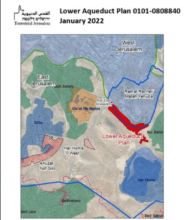 On January 17th, the Jerusalem District Planning Committee approved for deposit for public review a new settlement plan in East Jerusalem – called the “Lower Aqueduct” plan. The new settlement is intended to connect the controversial settlements of Givat Hamatos and Har Homa, establishing an uninterrupted continuum of Israeli settlements on the southern rim of Jerusalem, and destroying the contiguity of Palestinian land in the West Bank and East Jerusalem.
As laid out in new reporting from Terrestrial Jerusalem, the plan is being promoted by the Jerusalem Municipality together with the Israel Lands Authority, but – as the reporting predicts –
“when the smoke clears, it will become evident that the same protagonists that are facilitating settlements in Sheikh Jarrah, Silwan, Givat Shaked, Musrara – i.e. the Custodian General and the Absentee Property Custodian – are deeply implicated in the Plan.”
Terrestrial Jerusalem further notes that the plan is being advanced at an expedited pace, giving the appearance that “someone senior and in a position of authority is expediting the Plan at [a] highly irregular pace.”
In total, the plan provides for the construction of 1,465 new units – around half of which will be constructed over the 1967 Green Line the demarcates (in the eyes of the international community) the line between Israeli-annexed West Jerusalem and Israeli-occupied East Jerusalem. The plan also provides for open public spaces and buildings including schools and a gymnasium.
Importantly, the new settlement will impinge on the two neighboring East Jerusalem Palestinian villages of Sur Baher and Umm Tuba, and will involve the expropriation by Israel of privately owned Palestinian land. Most notably, in order to pave a new access road for the new settlement, the State will likely expropriate land privately owned by Palestinian residents of Umm Tuba.
Ir Amim’s Aviv Tartarsky told The Times of Israel:
“This is another way in which Israel is erasing the Green Line in Jerusalem, ending Palestinian contiguity, and expropriating the lands of Palestinians. When Palestinians tried to plan construction there, it was rejected — and now the territory will be confiscated.”
Following the committee’s decision to this week to advance the plan, the European Union, France, Germany, Spain and Italy all issued statements calling for Israel to reverse the move. France also published a joint statement with Ireland and Estonia.
Settlers Continue To Press For “Legalization” of Homesh Outpost & Yeshiva
In a display of brazen lawlessness, more than 1,200 Israeli Jews managed to enter the closed military zone that is the site of the former Homesh settlement – where settlers have illegally established and operated a yeshiva for years – in order to celebrate the Jewish holiday of Tu B’Shvat, as part of their ongoing campaign to pressure the government to reestablish the settlement.
To reach the site, settlers (identified as yeshiva students by The Jewish Press) marched en masse for two hours with armed guards through the outskirts of the Palestinian village of Sebastia. On their way, settlers passed easily through at least two IDF checkpoints — meant to stop traffic towards the Homesh area, though Israeli soldiers in practice prevented only the freedom of Palestinian traffic in that direction. Sebastia is a routinely besieged city, suffering closures in the wake of the murder of settler Yehuda Dimentan and as a consequence of Israeli settler’s focus on archaeological sites in the city [as has been covered in the Settlement Report regularly: settlers, in collaboration with Israeli authorities, are openly seeking to exploit archeology as a tool to dispossess Palestinians in the West Bank].
In Jerusalem, settler leaders and their allies continued their mass protest in front of the Prime Minister’s residence in a bid to pressure Bennett to authorize Homesh, amongst other demands.
New U.S. Ambassador Will “Absolutely Not” Visit Settlements
In an interview with the Yedioth Ahronoth news outlet, U.S. Ambassador Thomas Nides said that he will not visit Israeli settlements in the West Bank, unlike his immediate predecessor David Friedman.
When questioned about his travel policy as compared to Friedman’s, Nides said:
“Because just like I ask both the Palestinians and Israelis not to take steps that inflame the situation, I don’t want to do things intentionally that would create disrespect or anger among people. Now, listen, I’ll make mistakes. I’ll say things that will aggravate people. I’m sure that in this interview, I’ll say something that will aggravate someone. But I don’t want to intentionally anger people.”
It’s worth recalling that the Biden Administration has not reversed or publicly rejected the Trump Administration’s “Pompeo Doctrine,” which made it U.S. policy to view Israeli settlements as not “per se inconsistent with international law.” The overwhelming majority of the international community holds that all Israeli settlements and outposts in the West Bank are illegal pursuant to Article 49 of the Fourth Geneva Convention, which states:
“The Occupying Power shall not deport or transfer parts of its own civilian population into the territory it occupies.” It also prohibits the “individual or mass forcible transfers, as well as deportations of protected persons from occupied territory”.
Bonus Reads
- “PODCAST: Excavating Israel’s underground settlements” (+972 Magazine)
- “Palestinian Activist Dies Two Weeks After Being Run Over by Israeli Police Truck” (Haaretz)
- “There’s a Mass Palestinian Grave at a Popular Israeli Beach, Veterans Confess” (Haaretz)
- “JNF Board Members Demand End to Controversial Tree-planting in Negev Until Questions Answered” (Haaretz)
Welcome to FMEP’s Weekly Settlement Report, covering everything you need to know about Israeli settlement activity this week.
To subscribe to this report, please click here.
January 14, 2022
- Israeli Attorney General Supports Settler-Led Dispossession of the Sumreen Family in Silwan
- Tender Published for 300 New Units in East Jerusalem Settlement of East Talpiyot
- Israel to Advance Expansion of East Jerusalem settlement of Gilo
- Israel Advances Plan that Will Pave Way for Expansion of East Jerusalem Settlement Enclave of Nof Zion
- IDF Evacuates Oz Zion Outpost (Again)
- Fight Over Homesh Outpost & Yeshiva Continues (Both Physically and Politically)
- Settlers Seek Outpost Gains from Divided & Fragile Government (With Some Success)
- Construction Begins on Key Stretch of the “Tunnels Road” for Settlements South of Jerusalem
- Israel Gives U.S. Army Officers Tour of Hebron Led by Settlement Spokesman
- Further Reading
Israeli Attorney General Supports Settler-Led Dispossession of the Sumreen Family in Silwan
On January 9th, Israeli Attorney General Avichai Mandelblit submitted a legal opinion to the Supreme Court arguing in support of the immediate eviction of the Sumreen family from their home of 60+ years in the Silwan neighborhood of East Jerusalem. The Supreme Court is expected to announce its next steps on the case in the coming days, which might include setting a new hearing date to again consider legal arguments from both sides (now that the Attorney General has weighed in).
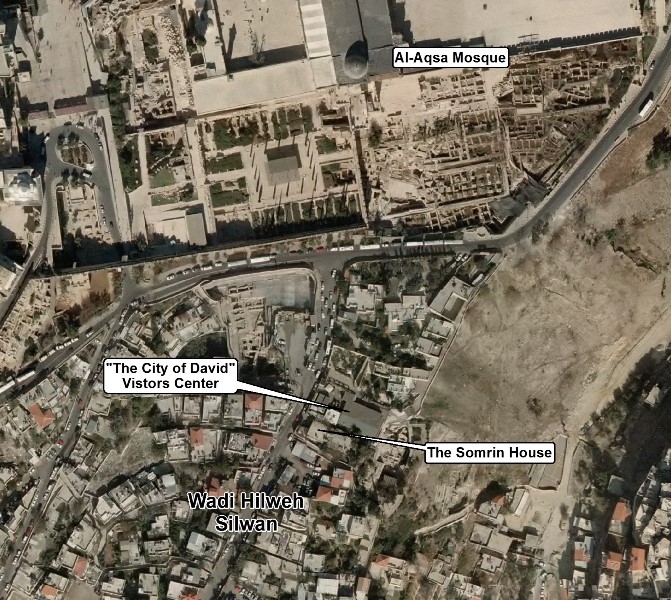
Map by Peace Now (click to expand)
The case to evict the Sumreen family, spearheaded by the JNF, with the secret funding/backing of the Elad settler group, is a key test of the State’s use of the Absentee Property Law to seize Palestinian homes in East Jerusalem. If dispossessed of their home, the Sumreen family case sets a broader precedent for many other ongoing eviction cases in Silwan that could result in the mass displacement of Palestinians in favor of settlers.
In his opinion, the Attorney General did not address the broader political context of widespread dispossession of Palestinians in Silwan, or legally dubious actions on the part of the Elad settler group and the Jewish National Fund in having the property declared to be absentee (see a detailed history of that scandal here) in order to take control over it. Instead, the Attorney General decided simply that there is no new basis on which to overturn the 1999 ruling that legitimized the JNF’s ownership of the home, and that the Sumreen family does not have a legal right to reside there.
Peace Now said in a statement:
“Instead of intervening and doing justice, the Israeli government, through the Attorney General, becomes a direct partner in crime and unforgivable injustice. The Attorney General chooses to ignore the context and the injustice behind the eviction suit and dives into quasi-legal questions to help settlers take over another property in Silwan. The Government’s fingerprints are smeared all over the Sumerin case. This is a political move in which government mechanisms such as the Custodian of Absentee Property and the Israel Land Administration and the JNF have been utilized in order to dispossess Palestinians of their property in East Jerusalem and replace them with settlers.”
It’s worth noting that the Sumreen house is located only a very short distance from the Al-Aqsa Mosque (approximately 10 meters) at the entrance to the Silwan neighborhood, and is adjacent to the “City of David” visitors center built and operated by the Elad settlers. The home is also located in the middle of what today has been designed by Israel as “the City of David National Park.” The entire area is managed by the radical Elad settler organization, which for years has also been pursuing the eviction of Palestinians from the homes in Silwan. For nearly three decades, the Sumreen family has been forced to battle for legal ownership of their home, after the state of Israel, prompted repeatedly by the JNF, declared the Sumreen’s home to be “absentee” property, despite the fact that this was manifestly not the case. Under that designation – which was not communicated to the Sumreen family – Israeli law permitted the State to take over the rights to the building. The State then sold the rights to the home to the JNF in 1991. The JNF has pursued the eviction of the Sumreen family ever since. Israeli courts ruled in favor of the Sumreen family’s ownership claims to the home for years, until a September 2019 ruling by the Jerusalem Magistrate’s Court granted ownership of the family’s home to the JNF, a decision the family immediately appealed to the Jerusalem District Court.
A full history of the saga involving the Sumreen family – which is similar to dozens of other Palestinian homes in Silwan that were declared Absentee Property in the 1990s – can be found on the Peace Now website here.
Tender Published for 300 New Units in East Jerusalem Settlement of East Talpiyot
On January 5th the Israel Lands Authority published a tender for the construction of 300 settlement units in the East Talpiyot settlement, located in East Jerusalem. Ir Amim reports the tender is scheduled to be opened for bids on February 14th.
The new units will expand the built-up footprint of East Talpiyot in the direction of the Palestinian neighborhood of Sur Baher, a neighborhood that is facing multiple new settlement plans that encroach on its historic land (including the Givat HaMatos, Har Homa, and Lower Aqueduct plans). Sur Baher has also been targeted by the Israeli Custodian General in its efforts to gain control over more land that was owned by Jews previous to 1948.
Israel to Advance Expansion of East Jerusalem settlement of Gilo
On January 10th the Jerusalem District Planning Committee convened to discuss two plans that would add 1,538 settlement units to the Gilo settlement in East Jerusalem. The plans are being advanced under the banner of “urban renewal” and will involve demolishing existing settlement units and replacing 470 existing settlement units with 2,008 new units (representing a net expansion of the settlement by 1,538 units). Ir Amim notes that, “while the plans will not necessarily enlarge Gilo territorially, it will increase the Israeli population in the settlement and hence the number of Israelis living in East Jerusalem.”
Israel Advances Plan that Will Pave Way for Expansion of East Jerusalem Settlement Enclave of Nof Zion

Map by Ir Amim (click to expand)
On January 11th, the Jerusalem District Planning Committee held a meeting to discuss public objections to a plan connected to the expansion of Nof Zion, a settlement enclave located inside the Palestinian East Jerualem neighborhood of Jabal Mukaber. One such objection was filed by Palestinian residents of Jabal Mukaber with assistance from Ir Amim. That objection argues that the plan is an affront to the planning needs of the local community and continues Israel’s systematic, city-wide discrimination against the housing, educational, and service-based needs of Palestinian neighborhoods. The Committee closed the meeting without reaching a decision, and has scheduled further private (closed to the public) continuation of its discussion of the plan.
The plan under consideration provides for the construction of a large, new Israeli police station on the border of Jabal Mukhaber neighborhood, on a plot of land that is across the street from the existing police station. The new station, according to Ir Amim, will “constitute a massive security headquarters and border police base, replete with detention facilities and laboratories.” Under the plan, after the new station is built the site of the current station will be designated for public buildings; however, Ir Amim warns that the land is currently allocated for the construction of hotels directly connected to plans to expand the Nof Zion settlement enclave. The relocation of the police station is a step towards the construction of those two hotels, which is part of the larger plan to expand Nof Zion to include the construction of commercial centers, educational institutions, and a sports field.
Ir Amim comments:
“In light of the dearth of public buildings and/or public spaces in the neighborhood, the objection [to the police facility plan] underscores the complete planning error and misuse of the respective plot of land. Rather than allocating the space to meet the dire public needs of the community, the authorities see it fit to utilize the land for a massive security base on the edge of the neighborhood. According to the objection [filed by Ir Amim and Palestinian residents], a plan of such magnitude implies that members of the community are seen as constituting a ‘threat’ rather than actual residents of Jerusalem entitled to equal socioeconomic rights and equitable access to municipal services. The depletion and appropriation of public spaces in East Jerusalem to serve Israeli interests and the expansion of setter enclaves in Palestinian neighborhoods not only erode the fabric of these communities, but severely impinge on Palestinian individual and collective rights and further entrench Israeli control of East Jerusalem.”
Israel has been working consistently to expand and entrench Nof Zion — which it should be underscored is an enclave located wholly inside a Palestinian neighborhood. On July 8, 2021 settlers and their allies held a cornerstone-laying ceremony to mark the beginning of construction on hundreds of new units in Nof Zion. The new construction is just preliminary work on a project that will triple the settlement in size and make it the largest settlement enclave in East Jerusalem.
As a reminder: In 2017, the Israeli government approved a plan to build a new synagogue and mikveh in Nof Zion on private Palestinian land that was expropriated from the Jabel Mukaber neighborhood in 2016. Then, in September 2017, rumors emerged that the government was set to issue 176 building permits for the already-approved project. According to Ir Amim, those permits were ultimately issued in April 2019.
IDF Evacuates Oz Zion Outpost (Again)
On January 10th, settlers sought to obstruct Israeli forces that were dismantling structures at the unauthorized outpost site called Oz Zion, located between Jerusalem and Ramallah. Settlers reportedly chained themselves to structures at the scene, and clashed with Israeli forces when they arrived to remove them.
Oz Zion has been dismantled by the IDF several times in the past (most recently in June 2021). Yet, the settlers – who have violently resisted Israeli forces carrying out the demolition – have repeatedly been allowed to reestablish it. It is one of the outposts for which a standing demolition order was recently re-issued by the IDF.
Fight Over Homesh Outpost & Yeshiva Continues (Both Physically and Politically)
On January 10th, settlers clashed with Israeli forces attempting to confiscate property from the illegal yeshiva settlers have established at the site of the evacuated settlement of Homesh — a yeshiva that the IDF continues to permit settlers to visit and operate. It’s worth recalling the great lengths to which the IDF has gone to offer protection for the settlers to access the yeshiva, at the cost of the freedom of movement and obstruction of normal life to entire nearby Palestinian villages.
In the wake of the killing last month of a settler connected to the illegal yeshiva, national furor – spearheaded by settlers protesting in front of the Prime Minister’s residence – has kept the heat on the government over the fate of the Homesh outpost and yeshiva. Key settler leaders are threatening to bring down the current coalition if the yeshiva is dismantled. While the government has not clearly signaled what it intends to do with the yeshiva, settlers and their political allies outside of the governing coalition are now aggressively pushing the government to undertake hugely consequential efforts on behalf of the settlements — including but not limited to re-establishing the settlement of Homesh and normalizing the status of the illegal yeshiva at the site — in order to prove it allegiance. See below for more details.
Settlers Seek Outpost Gains from Divided & Fragile Government (With Some Success)
As part of their campaign to push the government to authorize the Homesh yeshiva and reestablish the Homesh settlement, key settler leaders are raising at least two additional major initiatives in their aggressive push on the government to compensate the settlers in response to the recent death of settler Yehuda Dimentan.
Those two additional demands by the settlers – a contingent of whom are encamped in front of Prime Minister Bennett’s residence – are:
- To pass a bill – or act unilaterally – to connect unauthorized outposts to the Israeli electric and water grids. To that end, Defense Minister Benny Gantz and Interior Minister Ayelet Shaked reportedly held a meeting on this topic on January 9th. The settler-run news outlet Artuz Sheva optimistically reports that dozens of outposts might meet Israeli criteria for being connected to Israeli infrastructure, and that Gantz would support the move if the Defense Ministry Legal Advisor gives it an OK. This has been a longtime demand of settlers, and has typically included the demand to connect outposts to Israeli water, sewer, power, garbage collection, and other municipal services. Doing so would further entrench the permanence of these outposts and furthers the de facto annexation of Palestinian land. It would also continue and expand on Israel’s long practice of copiously rewarding settlers for breaking Israeli law (by illegally building outposts), and directly incentivizing further settler lawbreaking.
- To more aggressively police Palestinian construction in Area C of the West Bank (some 60% of the land). This demand is grounded in an Orwellian twisting of reality to treat Palestinian construction on Palestinian private land in Area C without permits required by Israel (permits Israel consistently refuses to issue) as theft of Israeli land. For more on this long running, and particularly pernicious, tactic of the settlement movement, see FMEP’s previous reporting.
Construction Begins on Key Stretch of the “Tunnels Road” for Settlements South of Jerusalem
Arutz Sheva reports (gleefully) that ground has been broken on a final stretch of the new tunnel road that will connect settlements to the south of Jerusalem (the Etzion settlement bloc) more seamlessly to the heart of the city. The tunnel is part of Highway 60, which Israel has already begun work to widen, which runs from Jerusalem all the way to the Kiryat Arba in Hebron.
In a deeply researched report on how infrastructure like roads is a means for settlement expansion and annexation, Breaking the Silence explains:
“While Israeli authorities justify many of the projects described in this document by claiming that they serve both the settler and the Palestinian populations in the West Bank, it is important to note that these roads are designed with Israeli, not Palestinian, interests in mind. Many of the roads that are technically open to Palestinian traffic are not intended to lead to locations that are useful to Palestinians.16 Instead, these roads are primarily designed to connect settlements to Israel proper (and thus employment and other services) via lateral roads, rather than to connect Palestinian communities to one another. Further, roads intended to connect Israeli settlements to Jerusalem (many of which are currently under construction) do not serve West Bank Palestinians outside of Jerusalem, as they are not allowed to enter Jerusalem without a permit. In addition, an extensive system of checkpoints and roadblocks allows Israel to control access to bypass roads and the main West Bank highways, and it can restrict Palestinian access when it so chooses.
This prejudice against Palestinian development is even starker when one considers that, according to an official Israeli projection, the expected Palestinian population in the West Bank (excluding East Jerusalem) in 2040 is 4,600,000 individuals. Even if the vision of settler leaders to arrive at 1,000,000 settlers is realized by 2040, the Palestinian population would still be four times the size of the settler one. Despite this discrepancy, priority is still given to settler infrastructure development.
West Bank road and transportation development creates facts on the ground that constitute a significant entrenchment of the de facto annexation already taking place in the West Bank and will enable massive settlement growth in the years to come. By strengthening Israel’s hold on West Bank territory, aiding settlement growth, and fragmenting Palestinian land, this infrastructure growth poses a significant barrier to ending the occupation and achieving an equitable and peaceful solution to the Israeli-Palestinian conflict.”
Israel Gives U.S. Army Officers Tour of Hebron Led by Settlement Spokesman
Raising many eyebrows, the secretariat of the Israeli Central Command reportedly arranged a settler-led tour of Hebron for a delegation of U.S. army officers. The full-day tour designed by the settlers included a visit to the Tomb of the Patriarchs/al-Ibrahimi Mosque and a visit to the settler-run museum (in the Beit Hadassah enclave). The visit empowered settlers to present their version of the religious, historic, geo-political, and security significance of Hebron (including with respect both to settlers/settlements, and presenting Palestinians through the settler lens). The U.S. delegation did not engage any Palestinians while in Hebron, creating an obvious and problematic imbalance in perspective on all matters.
Haaretz reports that the Israeli army has refrained from engaging the settlers for diplomatic tours of Hebron in recent years. In a statement to Haaretz about the tour, the IDF issued a bland statement saying:
“Last week, a few U.S. army officers came for a tour of the Tomb of the Patriarchs and Beit Hadassah led by the commander of the Central Command, for the purpose of learning about the history of the site. As part of the ongoing tours that are held regularly, the American delegation meets with various people in the State of Israel as well as in the Palestinian Authority. This is in order to learn about the area in the best way possible. Dr. Noam Arnon [a far-right-wing settler activist and spokesman for the Hebron settlements] was chosen to guide this tour. The tour was held according to the established regulations in the IDF.”
Further Reading
- “Who Do Israeli Settlement ‘Sheriffs’ Report To? Even They’re Not Sure” (Haaretz)
- “West Bank settlements are annexing land in Israel, too” (+972 Magazine)
- “Fresh Sheikh Jarrah eviction threatens to roil capital anew” (The Times of Israel)
- “From Iron Dome to supply chains, US Christian group quietly shaping US-Israel ties” (The Times of Israel)
- “Editorial | As Israel Bends Over Backwards for Homesh, Palestinians Pay the Price” (Haaretz)
- “The International Community and Israel: Giving Permission to a Permanent Occupation” (Michael Lynk in Just Security)
- “Congress launches bipartisan Abraham Accords Caucus” (Jewish Insider)
Welcome to FMEP’s Weekly Settlement Report, covering everything you need to know about Israeli settlement activity this week.
To subscribe to this report, please click here.
January 7, 2022
- E-1 Settlement Reportedly Delayed
- E-1 Settlement Reportedly Delayed, BUT (Part 1): Israel Advances New Settlement Plan in East Jerusalem
- E-1 Settlement Reportedly Delayed, BUT (Part 2): Israel Approves Expansion of French Hill Settlement in East Jerusalem
- E-1 Settlement Reportedly Delayed, BUT (Part 3): An Update on Two Families Facing Displacement in Sheikh Jarrah
- Al-Walajah Hearing Postponed but Remains Likely
- Report: Gantz Intends to Turn Evyatar Outpost Into New “Legal” Settlement
- Settlers Still Pressing Govt to Authorize Homesh Outpost, & Terrorizing Nearby Palestinians
- IDF Evacuates Kumi Ori Outpost, Yitzhar Start Clashes
- IDF Renews Standing Demolitions Orders Against Six Unauthorized Outposts
- Israel Earmarks Millions for Seven New Synagogues in Settlements & Outposts
- Bonus Reads
E-1 Settlement Reportedly Delayed
The Israeli Civil Administration’s High Planning Council has removed consideration of the E-1 settlement plan from the agenda of its scheduled January 10th meeting. Haaretz reports that the plan has been indefinitely postponed due to “the expert opinions of certain officials in the Civil Administration.” No further information regarding the identity of the officials nor their opinions has been made public, and neither Israeli Minister of Defense Benny Gantz (who oversees the Civil Administration and all planning in the West Bank) nor Prime Minister Bennett have made any public comments. Haaretz further notes that the decision to add and remove items – particularly contentious items such as the E-1 plan – requires the approval of political leadership.
The High Planning Council – which is the body within the Israeli Defense Ministry which oversees all construction in the occupied West Bank – was expected to convene on January 10th to hold a third hearing to consider public objections to the E-1 plan. The Council’s previous hearings on public objections to the plan have been riddled with drama. The first was held on October 4th, but Palestinians were effectively denied the ability to participate, as it was held online and was thus inaccessible to the many Palestinians affected by the plan who do not have internet access. The second was held on October 18th; at that hearing three objections were presented (one by the Palestinian village of Anata, a second by the Palestinian village of Al-Azariya, and a third joint submission filed by Ir Amim and Peace Now). Ir Amim reports that there was no substantive discussion of these objections, with the Civil Administration panel offering no questions or comments on them. This third hearing – which was scheduled for January 10th – was set by the Court (originally for November 2021, but delayed) to compensate for the exclusion of Palestinians from the first hearing.
E-1 Settlement Reportedly Delayed, BUT (Part 1): Israel Advances New Settlement Plan in East Jerusalem
 On January 5th, the Jerusalem Municipal Planning Committee advanced a plan – referred to as the “Lower Aqueduct Plan” – to build a new settlement with 1,457 units in East Jerusalemn land located between two already controversial settlements on the southern flank of East Jerusalem: Givat Hamatos and Har Homa. The new settlement is intended to connect the Givat Hamatos and Har Homa, establishing an uninterrupted continuum of Israeli settlements on the southern rim of Jerusalem, and destroying the contiguity of Palestinian land in the West Bank and East Jerusalem. With approval from the municipal planning authority, the plan now goes to the Jerusalem District Planning Committee which will convene on January 17th to consider depositing the plan for public review.
In addition to severing East Jerusalem from the West Bank in the south, the new settlement will impinge on two neighboring East Jerusalem Palestinian villages of Sur Baher and Umm Tuba, and will involve the expropriation by Israel of privately owned Palestinian land. Most notably, in order to pave a new access road for the new settlement, the State will likely expropriate land privately owned by Palestinian residents of Umm Tuba. Ir Amim explains:
“According to the plan, an access road to the new neighborhood will be built over the Green Line on private Palestinian land belonging to residents of Umm Tuba. These lands will likely be expropriated. Despite the probable expropriation, the plan does not offer any development for the remaining privately-owned Palestinian land and will likewise not grant building rights to Palestinian landowners for areas alongside the road not intended for expropriation.”
Adding insult to injury, two years ago the Jerusalem Municipality and the Ministry of Jerusalem Affairs initiated a plan to build a new Palestinian business center in the precise area targeted by the “lower aqueduct” plan, as part of an Israeli government initiative to reduce poverty in East Jerusalem. The Jerusalem Municipality subsequently abandoned the plan for the Palestinian business center under pressure from settlers, specifically from the Har Homa settlement which borders the area. Ir Amim comments:
“Not only is this yet another example of severe planning discrimination, but construction of this new neighborhood will serve to further create Israeli territorial contiguity along East Jerusalem’s southern perimeter while depleting more land reserves for Palestinian development.”
Peace Now notes that the majority of the land on which the new settlement will be built (half of which is in East Jerusalem and half in West Jerusalem) is privately owned, or managed by the Israeli Custodian General. Although recent reporting suggests the Custodian General is moving to advance settlement construction on lands it manages across East Jerusalem, its legal ability to do so is questionable (and doing so has historically not been its practice).
It’s worth recalling that in December 2021, reports surfaced that the Israeli Custodian General is planning to establish a new settler enclave in Sur Baher, and is hoping to add more land in the village to its existing portfolio of 3.3 dunams.
Terrestrial Jerusalem writes:
“This Plan is not promoted in a vacuum, and constitutes yet another significant link the chain of new settlement schemes currently being expedited by Israeli authorities on the southern flank of East Jerusalem. Connecting Har Homa to Givat Hamatos, the Lower Aqueduct Plan joins these other schemes: Givat Hamatos, Har Homa West, Ahuzat Nof Gilo and Har Gilo West. The cumulative impact of these plans is to create a continuous built-up buffer, sealing East Jerusalem off from its sister city, Bethlehem. Viewed in context, the Lower Aqueduct Plan is a significant component in a strategic thrust with the objective of consolidating sole Israeli rule over East Jerusalem, and cutting it off from its environs in the West Bank. The physical detachment of East Jerusalem from Bethlehem will be viewed as unilateral act that causes concern not only among Palestinians and the international community, among the major Christian denominations around the world.”
Peace Now said in a statement:
“As in the case of the Atarot plan, right-wing elements in the government are taking advantage of the lack of coalition agreement on the issue of settlements to advance far-reaching plans that post facts on the ground that undermine the possibility of peace. The plans add to the tension on the ground and highlight the blatant discrimination that the government is building in East Jerusalem for Israelis only, while the hundreds of thousands of Palestinians in the city can build almost nothing. The coalition parties that support the possibility of two states for two peoples must do everything so that these plans are not promoted and do not reach a discussion in the District Committee.”
E-1 Settlement Reportedly Delayed, BUT (Part 2): Israel Approves Expansion of French Hill Settlement in East Jerusalem

Map by Peace Now
On January 5th, the Jerusalem District Planning Committee gave its final approval to several plans that will add a total of 2,092 new units to the French Hill settlement in East Jerusalem, on the edge of Mount Scopus.
Several plans relate to the Hebrew University campus on Mt. Scopus. Notably, while Mt. Scopus is in East Jerusalem, it is not considered by the international community to be occupied territory (reflecting the fact that in 1948 the area was designated as a demilitarized zone). These new plans, which expand the footprint of the Hebrew University campus but on land that is in the French Hill area (i.e. occupied territory), are:
- The “Bronfman Dormitory” plan to build 672 settlement units on land located in the French Hill settlement area (beyond the borders of the Mt. Scopus campus). Ir Amim raises alarm that this plan will completely encircle a Palestinian neighborhood (leaving it as an enclave surrounded by Israeli development), which “will greatly increase the construction in areas marked as Israeli, while blocking any further development of the Palestinian neighborhood.”
- The “Lerner Complex & Lower Resnick Dormitory” plan calls for the construction of 1027 units , the majority of which are designated for land east of the Green Line where there are currently student dormitories for the Hebrew University.
- The construction of 528 settlement units on land just north of the Jerusalem British War Cemetery, on land that is cut in half by the Green Line.
Ir Amim said in a statement:
“Beyond the geopolitical implications of constructing more housing units over the Green Line in Jerusalem, these plans are yet another example of the acute housing discrimination facing East Jerusalem Palestinians. These four plans follow close on the heels of other major housing projects advanced for Israelis in East Jerusalem over the course of 2021. The Israeli authorities continue to promote plans at full force for thousands of housing units for Israelis, while systemically refraining from advancing plans for Palestinians to meet their severe housing needs.”
Peace Now writes:
“it should be noted that some of the plans are adjacent to Palestinian land and houses (a neighborhood considered to be the fringe of Sheikh Jarrah), but all the huge building rights planned in these plans are not given to Palestinian homeowners living adjacent to the planned area. The Israel Land Authority has chosen to plan only the complexes under its control and not to allow the private construction of Palestinians next door. Since 1967, the government initiated and planned approx. 56,000 units for Israelis in East Jerusalem, while for Palestinians the government supported only 600 units, in the 1970’s. The planning of so many units in East Jerusalem for Israelis alongside with the increase in house demolition for Palestinians, raises the frustration and anger in East Jerusalem.”
E-1 Settlement Reportedly Delayed, BUT (Part 3): An Update on Two Families Facing Displacement in Sheikh Jarrah
New details have emerged regarding the delayed forcible displacement of the Salem family from their longtime home in Sheikh Jarrah in favor of settlers. Though the eviction notice stated that the family would be evicted from their home on December 29th, a last minute delay was granted based on a request submitted to the Court by the setters. The settlers requested that the court postpone the evacuation and instead require that it be carried out between January 20 and February 8th.
The settlers’ lawyers’ request was in line with concerns raised by the Jerusalem police, which also submitted a letter to the Court that warned a set date for the eviction, known in advance by the family and the public, “could endanger the forces and foil the evacuation’s success.”
Also in Sheikh Jarrah and in keeping with the police’s warning, the Saliha family received another eviction notice from Israeli authorities warning them that an eviction order against their home can be carried out anytime between January 10 and January 25. There are two households in the Saliha family living on a plot of land that Israel expropriated (in 2017) for “public use”, and on which it now intends to build a school (it is as yet unclear what population the school will serve).
Ir Amim provides essential and comprehensive information on what is going on with regards to the Salhia family case:
“The Jerusalem Municipality is demanding the eviction of the entire Salhia family, comprised of two households and totaling 12 individuals, under the pretext that expropriation of the property is necessary for the construction of a school. Following the court’s dismissal of one petition, one of the households received the aforementioned eviction order. The second household’s petition will be heard tomorrow (January 6) at the Jerusalem District Court.
While the municipality is evicting the family to build an educational institution, in recent years it relinquished a plot of land in Sheikh Jarrah originally designated for a school and transferred it into the hands of an ultra-Orthodox association for the construction of a massive yeshiva. The municipality appears to perceive it as reasonable to dispossess a Palestinian family for the sake of a school rather than utilizing open land initially allocated for such purposes.
When the District Planning Committee discussed the objections to the Ohr Somayach yeshiva plan (TPS 68858) at the end of 2020, the representative of the Jerusalem Municipality’s planning department claimed that there was no shortage of educational institutions nor a lack of space for such buildings in Sheikh Jarrah.
Today, Ir Amim sent an urgent letter to the Director of the Municipality’s Education Administration (MEA) in which it detailed the contradiction in the municipality’s actions and demanded MEA act to retrieve the parcel of land it transferred to the ultra-Orthodox association. Such a measure could in fact obviate the “need” to seize the Salhia family’s land and prevent the violation of their property rights and forced eviction.
Members of the Salhia family are Palestinian refugees who were uprooted from their homes in Ein Kerem in 1948 and now stand to be displaced for a second time. According to the family, their parents purchased the plot of land and have lived in homes they built since before 1967. The property also houses a well-known and thriving garden center called Peace Nursery.
Situated directly across from the British Consulate, the homes are strategically located between Kerem Al’ajoni and the Shepherd Hotel complex where settler groups are acting to establish major settler enclaves (see map below). In Kerem Al’ajoni, Nahalat Shimon is working at the behest of settlers to evict some 30 Palestinian families, while the Ateret Cohanim settler organization has constructed 22 housing units in the Shepherd Hotel complex to house a new settlement. The organization received the compound from the state decades ago after it was declared “absentee property.” There are reports that Ateret Cohanim intends to build additional floors, and therefore the units are not yet occupied.
It should be underscored that this development is taking place in parallel to the impending eviction of the 11-member Salem family from Um Haroun, Sheikh Jarrah (western section) for the benefit of settlers. As reported previously, the family was handed an eviction notice in early December citing that they would be subject to forcible removal as of December 29. That eviction order was cancelled, and an administrative hearing was held on December 30 at the Enforcement and Collection Agency concerning a request for a new eviction order with a flexible implementation date. Although the hearing concluded without a decision nor the issuance of a new eviction order, the family’s legal representation has made it clear that all potential legal channels have been exhausted. Therefore save for government intervention, there appears to be no other means to prevent the family’s displacement. Continued public pressure and concerted engagement with the Israeli government on this matter is hence vital.
A total of some 70 families, numbering over 300 Palestinians, are under threat of eviction from Sheikh Jarrah due to lawsuits filed by settler groups working in close collaboration with state bodies, including the General Custodian. Driven by political and ideological motives, these efforts aim to establish settler enclaves by forcibly uprooting Palestinians and supplanting them with Jewish settlers as a means to Israelize the area and further entrench Israeli control. Such measures carry severe humanitarian and geopolitical ramifications.”
Al-Walajah Hearing Postponed but Remains Likely
The Israeli Supreme Court hearing on the demolition of 38 homes in the beleaguered Palestinian village of al-Walajah, scheduled for December 26th, was ultimately postponed by the Court. The delay followed a new request submitted to the Court by the lawyer representing the Palestinian families facing imminent homelessness, though it’s not clear what the request was exactly. Ir Amim makes it clear that the delay is not cause for celebration, and stems from a technical matter.
The Court has not set a new date for the hearing.
As a reminder, the State of Israel has longstanding demolition orders against 38 Palestinian homes – in which around 300 people live – in the village of Al-Walajah, though the orders have been contested by Palestinians and, until this point, frozen by the Court as the matter is litigated. In December 2021, the State asked the Court to lift a freeze on the demolition orders, arguing (as it had in the past) that the houses – built by Palestinian residents of al-Walajah s on their own land – were illegal, because the were built without the required Israeli permits. This argument points to the Kafkaesque nightmare in which al-Walajah’s residents are trapped.
In point of fact: It is all but impossible for Palestinians to obtain building permits from Israel to build “legally” on their own land in East Jerusalem and in Area C of the West Bank. In the case of al-Walajah, such permits are, literally, impossible to obtain. This is because Israel has actively chosen not to approve an “outline plan” for the area, without which permits are an impossibility. Al-Walajah residents, with the help of planning experts, prepared and proposed an outline plan for the area, and for more than 15 years have worked to get Israel to approve it — to no avail. Israeli authorities have repeatedly (in January 2021 and again in March 2021) refused to approve the resident-backed plan, and have also refrained from initiating their own planning process. Indeed, the Jerusalem District Committee, as part of a January 25, 2021 ruling against the outline plan proposed by residents, deemed the area in question — where Palestinians have lived for decades — an “agricultural area” where no building would ever be permitted. The result: Al-Walajah’s residents have been left with zero hope of obtaining the permits required to build on their own land – or keep their current homes located there.
Report: Gantz Intends to Turn Evyatar Outpost Into New “Legal” Settlement
Over the past few weeks, reports have surfaced indicating the Israeli Defense Minister Benny Gantz is planning to approve the retroactive authorization of the Evyatar outpost, located on a strategic hilltop named Mount Sabih just south of Nablus on land historically belonging to nearby the Palestinian villages Beita, Yatma, and Qablan. This follows Prime Minister Bennett’s November 2021 promise to legalize the outpost.
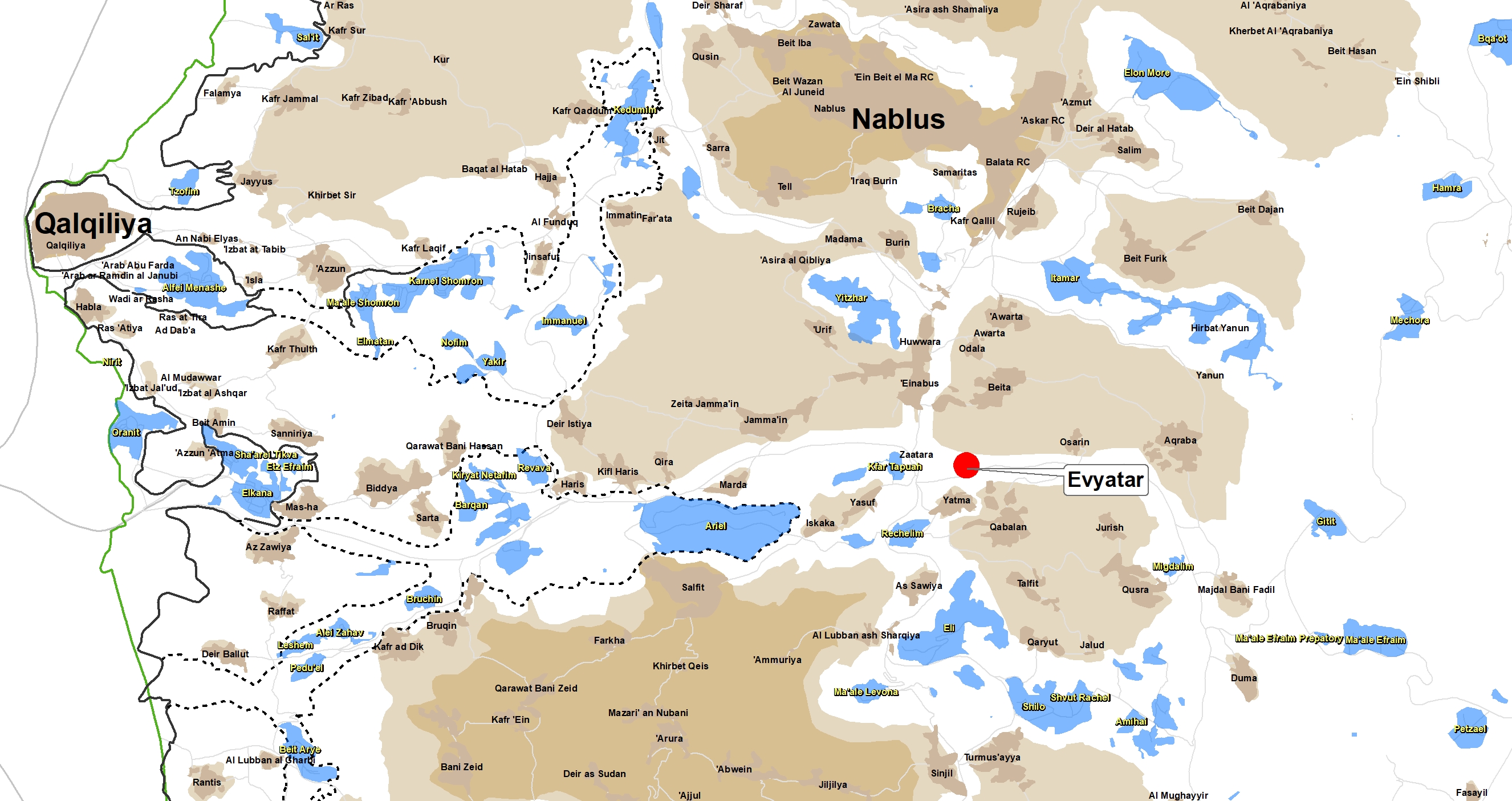
Map by Peace Now
The decision to authorize Evyatar as a full-fledged, new, and “legal” settlement is supposedly dependent on the outcome of an Israeli-led investigation into the status of the land. If the land is “discovered” to be “state land,” the government will authorize EVyatar. The results of the “investigation” are not public at this time. [map]
The Evyatar outpost has been at the core of sustained settler violence and Palestinian protest over the course of 2021, ever since the government agreed to a deal with settlers to evacuate the outpost temporarily (leaving its structures intact) until the government determines whether it can find a pretext upon which to declare the land to be state land.
Peace Now said in a statement:
“There is no justification in the world for establishing a new settlement in the West Bank, which will be a security burden, a political blow and a reward for outlaws. The small settler group who established the outpost in Evyatar did so illegally, with the aim of dragging Israel to deepen the occupation and prevent its end, and they led to daily risk of IDF soldiers and severe escalation of violence in the area. The government must come to its senses and stop this madness and not be dragged after a small minority.”
In addition to reportedly preparing to grant approval to formally establish the Evyatar settlement, the settler news outlet Arutz Sheva reports that Gantz has suggested making the new settlement the new home for the illegal yeshiva settlers have established as the site of the former Homesh settlement – a yeshiva that has likewise been at the center of ongoing violence (including settler violence targeting Israeli forces). Settlers have come out in opposition to this suggestion – unsurprisingly, given that the explicit objective of the settlers targeting the Homesh site is the re-settlement of that specific area (more below).
As a reminder, the fate of the Evyatar outpost was the first controversy that threatened to divide the fragile Bennett-led government when it was sworn in. Bennet’s partners were bitterly divided on whether to evacuate the outpost or let it be, while the government sought to grant it retroactive legalization. In the end, the government reached a “deal” which saw the settlers (temporarily) vacate the outpost on Friday, July 2nd. In return, the government left the settlers’ illegal construction at the site in place (i.e., did not demolish it) — including buildings and roads — while it “examines” the status of the land to see if it can be declared “state land” and therefore “legally” turned into a settlement (opening the door for the settlers to return). Under the agreement, the outpost is being used as a military base in the interim.
The fact that the “compromise” left in place the settlers’ structures and allowed Israel to maintain complete control over the site during the “survey” process signalled from the start that the government is not concerned with enforcing Israeli law, but rather is focused on finding a political solution that works for the settlers. It was further clear from the terms of the “compromise” that the Bennet government believed it will be succeed in finding a pretext to assert that the land on which the outpost stands is “state land” which can be used by the state as it sees fit (i.e., give it to the settlers). If the state decides, pursuant to the investigation, that it has a basis on which to declare the site to be “state land,” the settlers will be allowed to return and resume the establishment of what would from that point no longer be an illegal outpost, but a new “legal” settlement.
Settlers Still Pressing Govt to Authorize Homesh Outpost, & Terrorizing Nearby Palestinians
There has been continuing fallout and violence surrounding the Homesh oupost and yeshiva following the murder of settler Yehuda Dimentan by a Palestinian in December 2021. Settlers have used Dimentan’s death to press the government to formally reestablish the Homesh settlement (evacuated in 2005 as part of the Gaza disengagement plan, at which time it was declared by Israel to be a closed military zone – but settlers have been allowed to frequent the site and even operate a yeshiva there. That yeshiva, according to Kerem Navot, became one of the West Bank’s “hardcore centers of settler terror”). Settlers have also wreaked terror on nearby Palestinian villages, most notably Burqa. One Israeli politicians even said that settlers are carrying out a pogrom in Burqa.
Most prominently to date, Israeli Justice Minister Gidon Sa’ar (Likud) offered his support for reestablishing the Homesh settlement – directly tying his support to the death of Yehuda Dimentan. On January 1st, Yesha Council leader Yossi Dagan and MK Yuli Edelstein inaugurated a new caucus in the Knesset specifically dedicated to the cause of reestablishing the Homesh settlement along with the other two settlements that were dismantled by the Israeli government in 2005 as part of the Gaza Disengagement Plan.
Since the murder, the IDF has imposed severe movement restrictions on Palestinians living near the Homesh site and the Shavei Shomron settlement (where Dimentan lived). This includes road closures, and IDF-imposed closures of the Palestinian towns of Burqa and Sebastia. In addition, two new Israeli-controlled checkpoints positioned near Shavei Shomron and Homesh in practice now prevent Palestinians from using the roads, while allowing settlers to reach the Homesh site (which, again, is supposedly a closed military zone). The closures have not prevented settlers from regularly attacking Burqa, including “three large scale attacks”. According to the PA’s settlement monitor, Palestinians in Burqa fear a massacre.
In addition to the now-routine closures and movement restrictions on Palestinians, the IDF chose to completely shut down the highway connecting Shavei Shomron and Homesh on December 23rd to allow a massive march led by Dimentan’s widow – estimated to have included 15,000 Israelis (including several elected officials) – following Dimentan’s funeral. The march and the closures resulted in clashes, particularly in Burqa, between Palestinians and IDF forces. The night of the march, settlers raided Burqa where they attacked Palestinian homes and desecrated the village’s cemetary.
The marchers told Ynet that they intend to maintain a presence at the yeshiva to prevent the government from dismantling it. The Dimentan family has personally asked government officials to authorize the Homesh yeshiva in Dimentan’s honor.
Amidst the ongoing violence and political agitation, on January 2, 2022 a delegation of Israeli lawmakers, including several senior members of the Likud party, paid a visit to the illegal yeshiva at the dismantled Homesh settlement site. Their tour of the yeshiva was used to offer support to the settlers’ effort to push for retroactive authorization.
IDF Evacuates Kumi Ori Outpost, Yitzhar Start Clashes
On December 31st, Israeli forces once again removed caravans from the unauthorized “Kumi Ori” settler outpost, which serves as the home of 20 extremist “Hilltop Youth” settlers and is a satellite outpost of the notoriously violent and radical Yitzhar settlement. Dozens of settlers from Yitzhar attacked Israeli forces, resulting in injuries to three soldiers and one settler.
Haaretz reports that despite an order issued two years ago declaring the land to be a “closed military zone,” Israeli border police – who maintain a checkpoint at the entrance of the outpost – have continued to allow settlers to live and visit the area if they had lived there (illegally) prior to the eviction order being issued. The caravan that was removed on December 31st was new, and therefore subject to the eviction order.
Kumi Ori was previously evacuated by the IDF in April 2020 and in January 2020, and also in August 2017 – each time resulting in violence. The battle between the outpost settlers and the Israeli army has played out for many years, and the IDF has demolished the outpost at least 10 times. In one extraordinary attempt by the settlers to preserve the outpost, settlers attempted to convince the court that Israel did not have authority to demolish the structures, because the outpost is not located in Area C (where Israel has complete control), but rather in a Palestinian-administered area (Area A or B) [raising the question, would the settlers recognize/respect the Palestinian Authority’s authority to evict them?]. The Court rejected that argument.
IDF Renews Standing Demolitions Orders Against Six Unauthorized Outposts
The Israeli military recently re-issued standing demarcation orders that allow (should Israeli authorities so choose) for the demolition of the outposts without any legal hoops or holdups. Of course, the orders have been in place for years, and while the IDF has occasionally dismantled the outposts, settlers have been able (or allowed) to reestablish the illegal encampments.
The orders were renewed for the following outposts:
- Ramat Migron outpost, located in the Shiloh Valley in the northern West Bank. The IDF recently dismantled the Ramat Migron settlement in November 2021.
- Oz Zion outpost, located between Jerusalem and Ramallah. The Oz Zion outpost has been demolished by the IDF several times but the settlers have been allowed to reestablish it. The outpost was most recently dismantled by the IDF in June 2021.
- Guelat Zion outpost, located in the Shiloh Valley in the northern West Bank. Guelat Zion was most recently demolished in November 2021. Established in 2011, the outpost is adjacent to the new “Amichai” settlement, which Israel built as a pay-off to settlers it was forced by the courts to remove from the illegal Amona outpost.
- Givat Assaf outpost, located east of Ramallah. The Givat Assaf outpost was rumored to be included in a list of 66 outposts the Knesset sought to retroactively legalize via legislation.
- Givat Tekuma (“Hill 725”) outpost, located near the Yitzhar settlement in the Nablus area of the northern West Bank.
- Shaked farm outpost, located near the Yitzhar settlement in the Nablus area of the northern West Bank
Israel Earmarks Millions for Seven New Synagogues in Settlements & Outposts
Israeli Minister of Religious Services Matan Kahana approved the allocation of millions of shekels (exact figure unknown) for the construction of 30 new synagogues – seven of which will be located in settlements or unauthorized outposts. In addition, Kahana earmarked 25% of his ministry’s aid budget for the construction of mikveh’s (Jewish ritual baths) in the West Bank.
Meretz MK Mossi Raz said in response:
“Kahana has decided to discriminate against residents within the green line, and to build a quarter of the synagogues in his ministry’s budget over the green line. This does not only strengthen the settlement enterprise, which is harmful for Israel’s future, it acts inequitably in allocating resources to every worshiper within Israel’s borders.”
Bonus Reads
- “First Settlers Beat Them Up, Then Ismail and His Family Were Jailed” (Haaretz)
- “Why Palestinian Kids’ Playgrounds Are Such Prime Targets for Israeli Settlers” (Haaretz // Ali Awad)
- “Power struggle: Bill to hook up illegal Arab homes to grid passes in stormy session” (The Times of Israel)
Welcome to FMEP’s Weekly Settlement Report, covering everything you need to know about Israeli settlement activity this week.
To subscribe to this report, please click here.
December 23, 2021
- Homesh Settlement Violence Continues As Knesset Rejects Plan to Authorize Outpost
- Settler/State Displacement of Palestinians in Sheikh Jarrah, Part 1: Salem Family Gets Brief Reprieve of Expulsion from Home in Sheikh Jarrah
- Settler/State Displacement of Palestinians in Sheikh Jarrah, Part 2: Salhia Family Receives Eviction Order
- Settler/State Displacement of Palestinians in Sheikh Jarrah, Part 3: Skafi Family Turns Down $5 million Offer from Settlers for Home
- Israeli Supreme Court to Decide on (Likely Swift) Mass Demolitions in al-Walajah
- Church Leaders Launch Campaign Against “Systematic Attempt” to Rid Jerusalem of Christians
- Bonus Reads
Homesh Settlement Violence Continues As Knesset Rejects Plan to Authorize Outpost
In the days following a deadly attack by Palestinians on Israeli settlers near the site of the former Homesh settlement in the northern West Bank, Israeli settlers and their allies, predictably, have exacted revenge on Palestinian communities, with violent attacks that Israel has done little or nothing to prevent. Also predictably, they have demanded that, in response to the attack, the government authorize the illegal outposts/yeshiva at the site of Homesh, as well as additional new settlements.
Despite an emotional plea by the family of the murdered settler – Yehuda Dimentman – and accompanying pressure from the settler constituency, the Knesset voted 59-50 against a declaration that would have urged Prime Minister Bennett to grant authorization to the Homesh outpost along with 70 other outposts in the West Bank. In addition, the text of the declaration urged Bennett “decisively prevent the evacuation of the Homesh Yeshiva, authorize it and to allow its students to study and live there.”
As a reminder, the Homesh settlement was dismantled by the Israeli government in 2005 as part of its “disengagement” from the Gaza Strip. Homesh was ruled to have been built on land privately owned by the Palestinian village of Burqa, ownership which was legally recognized by the Israeli High Court of Justice. Nonetheless, since 2005 Israeli authorities have permitted settlers to retain effective control over the area, including via establishing and operating an [illegal] religious school (aka, yeshiva) at the site for the past 15 years. The yeshiva lacks any permits/planning authorization — authorization that is impossible given that in 2005 the IDF declared the Homesh site to be a closed military zone. As such, both Palestinians and settlers are prohibited from entering the area (let alone building on it). That restriction, however, in practice has been applied to only one population (the one that has been recognized by Israel as the legal owners of the land), and for years, the IDF has turned a blind eye to the yeshiva, despite warnings about the outpost’s violence and repeated confrontations. The recent attack targeted settlers departing from that [illegal] yeshiva.
Within days of last week’s attack, settlers moved to expand the outpost/yeshiva at the Homesh site. On December 18th, settlers managed to erect new, prefabricated buildings at the site, adjacent to the existing (illegal) yeshiva. In the process, settlers reportedly clashed with the IDF, which tried (and failed) to prevent them accessing the site.
On December 19th, the IDF moved in to dismantle the new (illegal) buildings, but did not dismantle the (equally illegal) yeshiva. At the same time, a group of 200 settlers attempted to reach the yeshiva and protest the removal of the outpost buildings, resulting in violent clashes with the IDF. Later, on December 22nd, Israeli authorities arrested the head of the illegal Homesh yeshiva – Rabbi Elishama Cohen – on “suspicion of violating the 2005 Disengagement Law” (the law that provided for the evacuation of the Homesh settlement). Cohen was soon released following intervention by top settler leader Yossi Dagan, but told to return to the police station for further questioning. The arrest infuriated MK Bezalel Smotrich, from the far-right Religious Zionism party, who slammed the Bennett government, saying:
“As part of the government’s decision to eliminate the Homesh yeshivai in response to the terrorist attack in which Yehuda Dimentman was killed and to reward terrorism, the police were sent today to persecute, arrest and deter him. They will not scare us. We call on the masses of the house of Israel to arrive tomorrow and march with Yehuda’s family, demanding an arrangement be made with the Homesh yeshiva.”
The Jerusalem Post reports that the IDF has plans to dismantle the yeshiva following a seven day mourning period for Dimentman.
Settler/State Displacement of Palestinians in Sheikh Jarrah, Part 1: Salem Family Gets Brief Reprieve of Expulsion from Home in Sheikh Jarrah
The expulsion of the Palestinian Salem family from their home of 70 years in Sheikh Jarrah has been delayed on a technicality. +972 Magazine reports that the eviction order was paused because the settler (Aryeh King) who pompously hand-delivered the order to the Salem family was not legally empowered to do so, forcing the Jerusalem court to annul that order (which had set the expulsion for December 29th) and issue a new order, which will reportedly be delivered to the family in the coming weeks.
The delay follows notable attention on the case from international actors, including a visit by diplomats from the European Union. +972 Magazine further reports:
“A source in the Israeli government told +972 that various ministries have been turning their attention to the expulsion of the Salem family due to concern over the political ramifications (developments in the neighborhood remain closely watched by Palestinians and by foreign governments). Some Israeli officials have even looked into legal possibilities for the family to further appeal the ruling, in an attempt to stall its implementation. Israel’s Foreign Ministry provided +972 with the following response, which it said had been coordinated among all relevant government bodies: ‘The State of Israel is a state governed by rule of law, and the ruling of the court — which are known for their independence and the balance they provide on sensitive issues — is binding. The implementation of the ruling will be carried out by the authorities that take into account all the relevant factors, including the appropriate preparations before every move. Any attempt by extremists, and particularly the Hamas terrorist group, to exploit the situation to increase incitement, violence, and terrorism should be rejected.’”
Settler/State Displacement of Palestinians in Sheikh Jarrah, Part 2: Salhia Family Receives Eviction Order
On December 20th, Israeli authorities reportedly delivered an eviction notice to the Palestinian Salhia family in Sheikh Jarrah, in the area near the British Consulate, with the eviction date set for January 25th. The order pertains to a plot of privately owned land – purchased by a Salhia elder in 1967 – on which the Salhia family has built two homes. Israeli authorities had previously delivered an eviction order to the Salhia family in October 2021, that order has since expired – prompting this new order to be issued.
Mohammad Salhia told Middle East Monitor that the Jerusalem Municipality offered to delay the eviction by 8 months if he signed a legal agreement giving up claim to ownership of the land and turning his family into merely tenants of the buildings (he refused).
According to the WAFA report, in 2019 Israel issued an order to unilaterally seize the plot for the “public interest” in order to establish a school there. This school was originally planned to be built on a different parcel of land, however, the Israeli government gave this land to an Ultra-Orthodox organization in order to build the Glassman yeshiva (a settlement project). In the absurdity of land use in East Jerusalem, now, in order to build the school, the government has opted to confiscate the Salhia family’s land.
Settler/State Displacement of Palestinians in Sheikh Jarrah, Part 3: Skafi Family Turns Down $5 million Offer from Settlers for Home
Al-Monitor reports that the Palestinian Skafi family has turned down an offer by settlers to purchase their home in Sheikh Jarrah for an astounding $5 million. Abdel Fattah Skafi told Al-Monitor:
“The family, similar to others in the neighborhood, will not accept any tempting offers by the Israeli authorities, whether financial or an offer to grant them another piece of land as an alternative. We inherited the house from our ancestors and we will pass it on to our children and grandchildren, no matter how long the conflict with the settlers.”
The Skafi family (14 individuals) live in a large house surrounded by homes that have already been taken over by Israeli settlers. In order to access the house, the Skafis must pass through a narrow alley in front of the settler-inhabited homes. The family has been subjected to daily harassment and violence as a result of this reality.
Israeli Supreme Court to Decide on (Likely Swift) Mass Demolitions in al-Walajah
On December 26th, the Israeli Supreme Court is set to hold a final hearing on demolition orders against 38 Palestinian homes – in which around 300 people live – in the village of Al-Walajah, a small part of which is located within the municipal borders of Jerusalem (illegally annexed by Israel following the 1967 war). The State has asked the Court to lift a freeze on the demolition orders, arguing (as usual) that the houses – built by Palestinians on their own land – were built without the required Israeli permits. Ir Amim cautions that if the Court decides to greenlight the demolition orders, it is likely that the mass demolitions will be carried out very quickly. Ir Amim explains:
“The demolitions would likely be carried out very swiftly because the National Enforcement Unit under the Ministry of Finance has assumed responsibility for building and planning enforcement in this area since 2016. This unit is considered the most aggressive Israeli enforcement body. Indeed in the past five years, this unit has executed demolition orders in al-Walajeh immediately after the conclusion of court proceedings. Some 12 additional homes not protected by the appeal likewise face impending demolitions, four of which were carried out over the past few months, including one at the beginning of December. Roughly half of the homes in the annexed part of al-Walajeh have received demolition orders, and approximately 30 have already been executed since 2016 (including those mentioned above). These mass demolition orders, together with the absence of urban planning, threaten to uproot hundreds of al-Walajeh residents for a second time.”
As a reminder, it is all but impossible for Palestinians to obtain building permits from Israel to build “legally” on their own land in East Jerusalem and in Area C of the West Bank. In the case of al-Walajah, the situation is even worse: such permits are, literally, impossible to obtain, since the area lacks a required Israeli-approved “outline plan,” without which permits are an impossibility. In an effort to overcome this obstacle, Al-Walajah residents, with the help of planning experts, prepared and proposed an outline plan for the area, and for more than 15 years have worked to get Israel to approve it — to no avail. Israeli authorities have repeatedly (in January 2021 and again in March 2021) refused to approve the resident-backed plan, and have also refrained from initiating their own planning process. Indeed, the Jerusalem District Committee, as part of a January 25, 2021 ruling against the outline plan proposed by residents, deemed the area in question — where Palestinians have lived for decades — an “agricultural area” where no building would ever be permitted. The result: Al-Walajah’s residents have been left with zero hope of obtaining the permits required to build on their own land – or keep their current homes located there.
Ir Amim writes:
“Demolitions in Al-Walaja are due to two combined Israeli policy decisions: On the one hand, Israeli authorities have never made an outline plan for the annexed part of Al-Walaja and residents therefore have no possibility of obtaining a building permit. All construction that has taken place in Al-Walaja since 1967 is thereby considered illegal under Israeli law. On the other hand, in 2016 the government decided to increase home demolitions – specifically targeting Palestinian communities. Since that year, the National Enforcement Unit (under the authority of the Ministry of Finance) began issuing and carrying out demolition orders in Al-Walaja. This unit is the most aggressive of the Israeli enforcement units. The combined effect of no outline plan and aggressive enforcement has led to half of the homes of the Jerusalem section of Al-Walaja currently being under threat of demolition. In January of this year (2021), the al-Walaja’s community most recent attempt to advance the outline plan they prepared for their village was rejected by the Jerusalem District Committee. Meanwhile, Israeli construction plans of thousands of housing units around Al-Walaja are advancing – including a new settlement on the Western side of the village. Indeed, demolitions in Al-Walaja are part of the creeping annexation Israel is advancing within the Greater Jerusalem area, specifically with the aim of connecting settlements near Bethlehem to Jerusalem, which would effectively fragment the Palestinian space of the southern West Bank.”
Church Leaders Launch Campaign Against “Systematic Attempt” to Rid Jerusalem of Christians
A group of high ranking Christian church leaders have launched a campaign protesting the treatment of churches and Christian residents in Jerusalem. They specifically cite settler violence and attempts to take over church-owned properties in the Old City as key parts of an effort to rid Jerusalem, and other parts of the Holy Land, of Christians.
A statement issued by the campaign reads:
“The principle that the spiritual and cultural character of Jerusalem’s distinct and historic quarters should be protected is already recognised in Isarlei law with respect to the Jewish Quarter. Yet radical groups continue to acquire strategic property in the Christian Quarter, with aim of diminishing the Christian presence, often using underhanded dealings and intimidation tactics to evict residents from their homes, dramatically decreasing the Christian presence, and further disrupting the historic pilgrim routes between Bethlehem and Jerusalem.”
The campaign asks the Israeli government to:
“Deal with the challenges presented by radical groups in Jerusalem to both heChristian community and the rule of law, so as to ensure that no citizen or institution has to live under threat of violence or intimidation.”
The leader behind the new campaign is the Greek Orthodox Patriarch of Jerusalem, Theophilos III, whose Patriarchate has been in a particularly nasty (and muddled) battle with settlers over the fate of three prized Old City properties which have been long-owned by the church, but which settlers claim to have purchased (via a sale to a foreign real estate company acting secretly on behalf of the radical settler group Ateret Cohanim). Once Ateret Cohanim’s role became known, the Patriarchate sought to retain control of the properties, but over the course of a long legal battle, multiple Israeli courts, including the Supreme Court, validated the sale. The Greek Orthodox Church has received significant blowback from the sale of these properties to the settlers, including in January 2018, when Palestinians protested in Bethlehem in an attempt to block the arrival of Patriarch Theophilos III for Christmas celebrations.
In addition to the coalition of Church leaders based in Jerusalem, the campaign was boosted by the Archbishop of Canterbury, who joined the archbishop of the Episcopal Church of Jerusalem and the Middle East (the Anglican Church) to issue a statement that was also published as an article in the London-based The Sunday Times, entitled “Let us pray for the Christians being driven from the Holy Land.”
In response to the campaign, the Israeli Foreign Ministry dismissed the concerns raised by Christian leaders as “baseless,” and claimed that the campaign “distort[s] the reality of the Christian community in Israel.” The Foreign Ministry went on to criticize the Church leaders for their alleged silence regarding the plight of Christians elsewhere in the Middle East, implying that the leaders are unfairly singling out Israel. This line of argument is tantamount to the Israeli government calling these church leaders antisemitic — tying in closely with the Israeli government-backed definition of antisemitism, according to which “applying double standards” in critizing Israel is a form of “contemporary” antisemitism.
Bonus Reads
- “De-emphasized under Trump, report shows Biden taking settler violence more seriously” (The Times of Israel)
- “Israeli Troops and Settlers Zero in on a New Target for Attacks: Palestinian Schools” (Haaretz)
- “Opinion | The U.S. Funding Challenges Facing the Israel-Palestine ‘Peace Industry’” (Haaretz)
- “Opinion: Mr. Blinken, you can pick up the phone and save a Palestinian village from destruction” (Washington Post)
- “Why Jerusalem Cannot be ‘Taken Off the Table’” (Crisis Group)
Welcome to FMEP’s Weekly Settlement Report, covering everything you need to know about Israeli settlement activity this week.
To subscribe to this report, please click here.
December 17, 2021
- In Sheikh Jarrah, Palestinian Family Faces Immediate Displacement, While Israel Begins Work on New Settler Garden at Entrance to the Neighborhood
- Israeli Custodian General is Behind Six New Settlement Plans Across East Jerusalem
- Israel Custodian General Reveals New Details on Regulations Governing its Management of East Jerusalem Properties, Leaving More Questions
- Israel Forges Ahead with New Settlements on the Golan Heights
- Following Murder of Israeli Settler, Settlers Launch Attacks of their Own & Attempt to Establish New Outpost
- Gantz Moves to Send More Police to West Bank to Monitor Settler Violence
- Meanwhile in Israel…Political Storm Ensues Over Whether Settler Terrorism Is a Problem or Not
- Bonus Reads
In Sheikh Jarrah, Palestinian Family Faces Immediate Displacement, While Israel Begins Work on New Settler Garden at Entrance to the Neighborhood
Courtesy of an eviction order hand-delivered by settler impresario and Jerusalem city councilman Aryeh King, and his colleague Jonathan Yosef, the Palestinian Salaam family has been ordered to vacate their Sheikh Jarrah home of 70 years by December 29, 2021. King and Yosef assert they are the legal owners of the home, which is located in the Umm Haroun section of Sheikh Jarrah, having bought it from the heirs of the Jewish family that owned the property prior to 1948. Peace Now has produced a helpful timeline of the full history of the Salaam’s home.
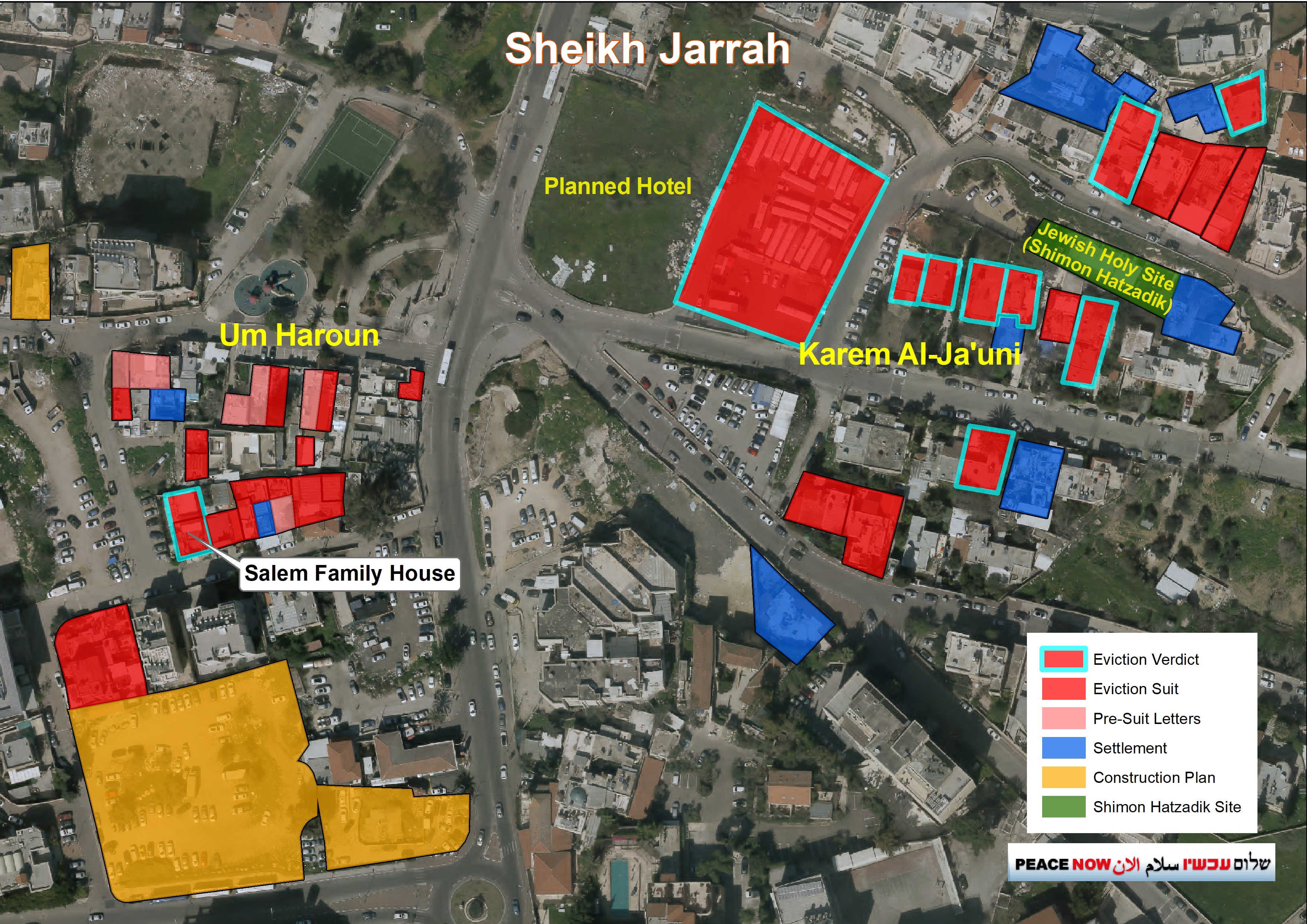 This purchase took place, without a doubt, thanks to the help of the Israeli Custodian General – the body that manages property abandoned by Jews in 1948 when their heirs are unknown – which almost certainly helped King and Yosef in identifying the property, locating the heirs and securing its sale (see Peace Now’s excellent report on the Absentee Property Law for more legal background on how this happens).
On December 15th, Ir Amim documented the scene as settlers, under the protection of Israeli police, fenced off the Salaam family’s land (where they are supposedly permitted to live until the 29th) in an attempt to prevent Palestinians, including the Salaam family, from accessing the area.
Peace Now said in response:
“This is a terrible injustice based on the cynical exploitation of a discriminatory law that allows Jews to exercise the ‘right of return; to property lost to them in 1948, at the expense of Palestinian families legally living in the property, while another Israeli law denies the same right to Palestinians. This is exactly what the Mishnah says: ‘He who says: mine is mine and yours is mine, is called evil’. The State of Israel, which took the Palestinian refugees’ properties lost to them in 1948, cannot today allow settlers to take from Palestinians Jewish properties lost in 1948 and on which they are have already received compensation. The government can stop this evacuation, and it must do so.”
The eviction of the Salaam family comes as the government of Israel is pursuing the displacement of as many as 70 Palestinian families in Sheikh Jarrah.
In parallel, the Israeli government has begun construction on a settlement installation (including a “public garden” as well as a driveway that will service an as-of-yet-unbuilt Israeli hotel in the neighborhood) at the entrance to Sheikh Jarrah, including the demolition of several Palestinian businesses. Notably, the site of this project is very close to the tomb of Shimon the Righteous, which is a religious site closely associated with the settler enclave in Sheikh Jarrah. The Jerusalem Municipality previously expropriated the land, which was privately owned by Palestinians, “for public use” — an Israeli legal tactic that permits the State to confiscate even privately owned land ostensibly to benefit the “public” (a “public” that it seems never includes Palestinians in East Jerusalem).
In October 2021, the Israeli Supreme Court rejected the appeals by the business owners to stop the demolition. This week, bulldozers leveled a plot of land owned by four Palestinian families and that was the location of two Palestinian businesses, a car wash and a parking lot. The business owners were handed an immediate eviction notice on December 14th, just one day before the bulldozers began work.
Israeli Custodian General is Behind Six New Settlement Plans Across East Jerusalem

Map by Haaretz
Haaretz reports that the Israeli Custodian General is planning six new settlement enclaves, to be located in some of the most sensitive areas of East Jerusalem. The news comes one week after the public learned of one of these plans, Givat HaShaked (see FMEP’s reporting last week), which is now understood to be part of a larger Israeli government plan to advance a slate of new settlement enclaves across East Jerusalem. As a reminder, the Israeli Custodian General is empowered by the State to act as caretaker of land that has unknown ownership.
While details on the plans are scant for the time being, Haaretz reports that the Israeli Custodian General is planning new settlements buildings that include:
1 – A new settler enclave in Sheikh Jarrah, in an area known as Um Haroun. As has been well documented, Palestinians are in a battle to stay in their longtime homes in Sheikh Jarrah while the Israeli Custodian General and Israeli settlers work hand-in-hand to displace them. Thirteen Palestinian families in Sheikh Jarrah (whose legal battle will impact dozens more) are still awaiting a Court ruling on their displacement at the hands of settlers. Haaretz reports:
“According to a custodian document, it administers 33 plots out of a total of 58 in the neighborhood. Five more plots have been expropriated by the Israel Land Authority. The city zoning plan allows for the demolition of the old structures and construction of buildings up to four-stories in their stead, or expanding them to that height. This could mean the construction of a neighborhood containing hundreds of housing units in the heart of Sheikh Jarrah. The Justice Ministry’s Land Registrar recently completed the registration of the neighborhood to its Jewish owners, so it is likely that any neighborhood built there will be for the Jewish population.”
2 – A new settler enclave near the Damascus Gate, near the Old City of Jerusalem, where approximately 10 Jewish Israeli families have already established a settlement enclave.
3 – Two new settler enclaves near Beit Safafa, one being the Givat HaShaked settlement plan which FMEP covered in greater detail last week. The second plan is not far from where the Givat HaShaked settlement would be built, and reportedly would involve a large settler compound with dozens more settlement units to be built in the sliver of land between Beit Safafa and the Talpiot Industrial Zone.
4 – A new settler enclave in Sur Baher. Reportedly, the Custodian is hoping to add more land to its holdings in Sur Baher (it currently holds 3.3 dunams and is attempting to gain 2 more dunams), meaning this plan could expand.
5 – A large new settler enclave in Beit Hanina. The Custodian is reportedly looking to build dozens of new settler units on six dunams of land (1.5 acres), to be located on a plot adjacent to the IDF Central Command base. The Custodian has also sought the cooperation of the Defense Ministry in promoting this plan.
The Justice Ministry, which houses the Custodian General, attempted to dodge these reports, telling Haaretz that it is not “advancing” any of these plans other than the one in Sheikh Jarrah, where it says it is “examining a construction project.”
Israel Custodian General Reveals New Details on Regulations Governing its Management of East Jerusalem Properties, Leaving More Questions
Under pressure from an impending court hearing, on December 11th the Israeli Custodian General submitted a document to the Court purporting to enumerate the regulations governing its management of properties in East Jerusalem. The Custodian General was facing a December 14th Court hearing on a petition filed by the Israeli NGO Ir Amim along with Palestinian residents of Sheikh Jarrah, that asserted no such regulations existed, enabling “severe misconduct and collaboration with settler groups to initiate evictions of Palestinian families in East Jerusalem, which severely infringes on the rights of Palestinians in the city.” Some 70 families in the Sheikh Jarrah neighborhood are facing homelessness because of the Custodian General’s collusion with settlers seeking their displacement from properties in which they have lived, legally, for decades.
In light of the Custodian General’s new publication (which the court viewed as resolving the complaint against the State), the Court dismissed the petition without prejudice, meaning the petitioners are permitted to file a new case on the same matter in the future.
Ir Amim filed the petition following news that the Custodian General has advanced a plan to build a new settlement – Givat HaShaked – on property it manages. As reported last week, this is an unprecedented move by the Custodian General, raising questions about whether the Custodian General is permitted to allow properties under its management to be developed. The document submitted to the Court this week by the Custodian General only raises more unanswered questions about the parameters governing the Custodian General’s ability to act as a property developer for properties that it does not own (only manages while awaiting the locating of the legal owners/heirs). Ir Amim further explains:
“The procedure includes dozens of clauses, none of which reference the possibility that the custodian may itself file plans and build residential complexes on a lot it owns. One clause refers to this indirectly, stating, ‘When initiated, or if contacted regarding urban renewal or planned improvements, the Custodian General shall examine the essence of the request and its impact on the administered property.’ Indeed, planning sources are unfamiliar with any case in which the custodian acted as a realty entrepreneur by improving the properties it holds. The subject raises another issue: the custodian is technically forbidden to sell property. Therefore, it remains unclear whether the apartments built in these various compounds will be sold on the open market, or whether they will remain the property of the custodian, who will rent them out. The Justice Ministry has not responded to clarify the matter.”
Israel Forges Ahead with New Settlements on the Golan Heights
At the recommendation and with the approval of Prime Minister Bennett, on October 14th Interior Minister Ayelet Shaked signed off on two orders establishing a settlement municipal authority in the occupied Golan Heights, a move that opens the door for an expedited planning process for existing and new settlements in the area. This includes the construction of the infamous “Trump Heights” settlement in addition to planned settlements called Givot Eden, Asif, and Matar. Last week, Prime Minister Naftali Bennett said that Israel’s plan is to double the settler population in the Golan Heights by 2030.
The special committee, which will act as a zoning board with broad planning authority, will have the combined powers of local and district planning and building committees, but will not include members who represent the public – an anomaly in the Israeli planning system.
The committee has already completed initial work by laying out the territorial borders of the “Trump Heights” settlement, which will cover 276 dunamns (about 70 acres). With its borders decided, the committee will move to expedite construction plans for residential housing, public buildings, industrial areas, roads and more.
On this massive settlement effort, the Haaretz Editorial Board writes:
“Occupied territories are occupied territories and annexation is annexation, even when it’s the Golan Heights and even when the annexation plan is called “a plan for encouraging sustainable demographic growth.”…We must tell it like it is. This is an artificial population expansion project, meant to strengthen Israel’s grip on the Golan Heights and create facts on the ground that will make it difficult for future leaders who might consider holding negotiations on the territory. To expedite matters, the Prime Minister’s Office seeks to create a “special committee” with the powers of the local and regional planning and building committees, but without the customary inclusion of public representatives. This is a national project. Like the so-called Judaization of the Galilee. Like the settlement enterprise.”
Al-Monitor provides a helpful background on the occupied Golan Heights and the creation of “Trump Heights”:
“Israel seized the Golan Heights from Syria in the 1967 Six-Day War. In 1981, Menachem Begin’s government formally annexed the territory. This unilateral move was not recognized by any country until Trump came along. In March 2019, his administration changed long-standing American policy by recognizing Israeli sovereignty over the region. A proclamation signed by Trump declared, ‘The State of Israel took control of the Golan Heights in 1967 to safeguard its security from external threats. Today, aggressive acts by Iran and terrorist groups, including Hezbollah, in southern Syria, continue to make the Golan Heights a potential launching ground for attacks on Israel. Any possible future peace agreement in the region must account for Israel’s need to protect itself from Syria and other regional threats. Based on these unique circumstances, it is therefore appropriate to recognize Israeli sovereignty over the Golan Heights.’ Three months later, the [Israeli] Cabinet convened for a special session in the Golan Heights and approved the establishment of a new settlement named for the US president. At that meeting, a huge sign decorated with Israeli and American flags was unveiled at the entrance to the new settlement. Written on it in gold letters was the name Ramat Trump.”
Following Murder of Israeli Settler,Settler Launch Attacks of their Own & Attempt to Establish New Outpost
On December 17th, a Palestinian gunmen opened fire on a settler vehicle near the dismantled settlement of Homesh, in the northern West Bank, killing one man – Yehuda Dimentman – and injuring two others. The IDF has apprehended several suspects already.
Though the Homesh settlement was evacuated by the Israeli government in 2005 – and military orders have barred Palestinians from entering the area – settlers have been allowed to establish an unauthorized outpost at the site, where the settlers also operate a yeshiva. Settlers have been openly obsessed with the desire to re-establish Homesh, hosting religious events and protests at the site, some of which have been attended by Israeli MKs and politicians. At the funeral for Dimentman, which several Israeli politicians attended, already begun calling for the government to formally reestablish the Homesh settlement.
In the hours following news of Dimentan’s death, settlers have already begun exacting revenge – with little to no interference from the IDF, though the outpouring of violence is an entirely predictable established pattern in the wake of Palestinians attacks. In the Palestinian village of Qayrut, a group of at least 15 settlers launched and especially violent attack on a Palestinian home, knocking on the door pretending to be Israeli soldiers at 4am, then proceeding to ransack the house and severely beat Mohammed Makbal – sending him to the hospital. No suspects have been apprehended, though several were caught on camera.
Within 24 hours of the attack, settlers from the Kiryat Arba settlement in Hebron moved to establish a new outpost in honor of Dimentan, called Nofei Yehuda. In this case, the IDF moved in swiftly to remove the settlers from the area. The outpost was established by members of the Nahala settler movement, of which Dimentan was a part. Nahala is behind a lot of unauthorized construction in the West Bank, and is a leading force in the battle over the Evyatar outpost.
Peace Now has written about the Nahala Movement, saying:
“The Nahala organization and the main activists of the new outposts are not the mainstream old-guard settlers (like the Amanah organization who is behind many other settlements and outposts and gets much more support from the authorities), however they are not a small fringe. This outpost is an example of a rift that is being created within the Israeli right wing. The more extreme right, which is willing to challenge the system more strongly, and the old-guard settlers who continue the mentality of working ‘with’ the government as much as possible. On the partisan level we see this rift in the creation of two different parties: Yamina, headed by Naftali Bennet, and the Jewish Zionism, headed by Betzalel Smotrich and Itamar Ben Gvir. The challenge of the new outpost puts the new shaky government, which is a coalition of parties which don’t agree about many things, to face its first big political test. The extreme right is signaling that it is planning to continue to challenge the new government, like it had done in the flags march in East Jerusalem, and in yesterday’s settlers’ marches throughout the West Bank.”
Gantz Moves to Send More Police to West Bank to Monitor Settler Violence
Defense Minister Benny Gantz and Israeli Public Security Minister Omer Bar-Leg have agreed to draft hundreds of Israeli soldiers into the (domestic) police force, so that Israeli police can then be reassigned to the West Bank partly to fill posts dedicated to policing settler violence.
Settlers, of course, are not thrilled about the new attention being paid to settler terrorism experienced by Palestinian communities across the West Bank, and which has increased over the past year. According to Israeli government data (which does not systematically track settler violence against Palestinians) the Shin Bet logged 272 “violent incidents” in the West Bank in 2020; so far in 2021, there have been 397 “violent incidents” recorded by the Shin Bet. The UN recorded even more attacks this year – 450 as of December 6 – compared to 358 in all of 2020 and 335 in 2019.B’Tselem, which recently released an excellent report on settler terrorism, documents a 28.6% increase in settler violence in 2021 over 2020. Yesh Din, which also documents settler violence while seeking justice and accountability, notes that only 5% of cases it filed from 2018-2021 (238 total cases filed, while it documented 540 total cases) have resulted in indictments. Palestinians have increasingly declined to file police reports regarding settler crimes, with so few cases actually resulting in any tangible good for the victim.
For a SMALL sample of the terrorism inflicted by settlers on Palestinians in the West Bank on a daily basis, see the following reports from the past week by WAFA news:
- “Settlers, backed by Israeli army, intensify attacks against Palestinians in Nablus area”
- “Israeli forces attack Palestinian farmers, seize tractor in Masafer Yatta area”
- “Israeli settlers leave several villagers wounded, fractured south of Nablus”
- “Settlers attack Palestinian vehicles south of Jenin”
- “Israeli settlers attack Palestinian vehicles, bloc traffic artery east of Hebron”
- “Israeli settlers rampage through Nablus-district town”
- “Israeli settlers take over water spring in northern Jordan Valley”
Meanwhile in Israel…Political Storm Ensues Over Whether Settler Terrorism Is a Problem or Not
Following months (which followed years, which followed decades) of settler terrorism against Palestinians, this week Israeli Public Security Minister Omer Bar-Lev (Labor) set off a political clash within Israel over the issue. In comments made alongside U.S. Deputy Secretary of State Victoria Nuland — and after Israeli diplomats have allegedly come to believe that the Biden Administration is “obsessed” with “settler violence” (though other reporting contradicts that claim) – Bar-Lev called settler terrorism “severe” and said that Israel is taking steps to address it.
Those comments were seen as a betrayal by many of Bar-Lev’s pro-settler coalition partners, and elicited some strong condemnations. Interior Minister Ayelet Shaked (Yamina) said Bar-Lev is “confused.” MK Bezalel Smotrich (Religious Zionism) called Bar-Lev a “bastard” and tweeted “shame on you, little man.”
The drama also drew comment from Israeli Prime Minister Naftali Bennet who, it should be recalled, relies heavily on the settler constituency and is also ideologically closely aligned with the settlers, having once served as the head of the top settler body called the Yesha Council. Bennett appeared to dismiss Bar-Lev’s comments, in effect giving official cover for an a green-light to continued and unaccountable settler terrorism, tweeting:
“The settlers in Judea and Samaria have been suffering from violence and terrorism, every day, for decades. They are the defensive wall of us all and we must strengthen them and support them, in words and deeds…There are marginal phenomena in every public, they should be dealt with by all means, but we must not generalize an entire public.”
B’Tselem’s Executive Director, Hagai El-Ad, responded to Bennett’s claim, telling Haaretz:
“There’s a propagandistic façade here that’s convenient for Israel…There’s a few bad settlers, or more, on one side, and on the other is the good state of Israel, which seeks to enforce the law. But that isn’t the truth. Both the state and the settlers want the same thing – to dispossess Palestinians of their land.”
This relationship – between the settlers and the State when it comes to dispossessing Palestinians – was spelled out in a recent B’Tselem report, “State Business: Israel’s misappropriation of land in the West Bank through settler violence.”
Bonus Reads
- “Mining Gold From East Jerusalem’s Streets” (Amira Hass for Haaretz)
- “This was the deadliest year for Palestinian children since 2014” (Khaled Quzmar for +972 Magazine)
- “Unearthing the Palestinian Neighborhood Buried Beneath a Tel Aviv Park” (Haaretz)
- “Fact Sheet: Israel’s E1 Settlement” (IMEU)
- “Opinion: Israel just showed its strategy on settlement boycotts: Gaslighting” (Gershom Gorenberg in the Washington Post)
Welcome to FMEP’s Weekly Settlement & Annexation Report. To subscribe to this report, please click here.
April 29, 2021
- Sheikh Jarrah Evictions Set for May 2nd; Protests & Diplomacy Ratchet Up
- Resources for Understanding Recent Protests and Violence in Jerusalem
- WZO Admits It Gave Palestinian Land to Settlers Without Written Agreements
- Jewish National Fund Delays Decision on Formalizing Policy on West Bank Land Purchases
- Ariel University Giving Academic Credit for Outpost Volunteers
- IDF Stops Settler Attempt to Establish Yeshiva on Site of Dismantled Homesh Settlement
- Settlers Celebrate Israeli Independence Day
- Settler-Run Chamber of Commerce Planning a Hotel in Hebron in Partnership with Palestinian Businessman Ahsraf Jabari
- Smotrich’s Party Files Bill for Outpost Legalization
- Roundup of Settler Violence This Week
- Human Rights Watch: Israel is Guilty of the Crime of Apartheid
- Bonus Reads
Comments or questions? Email Kristin McCarthy – kmccarthy@fmep.org.
Sheikh Jarrah Evictions Set for May 2nd; Protests & Diplomacy Ratchet Up
Over the past two weeks, activist groups have stepped up advocacy efforts to stop the impending dispossession of 8 Palestinian families (87 individuals) from their longtime homes in the Sheikh Jarrah neighborhood of East Jerusalem in favor of settlers. The eviction of four families has been set by Israeli courts for May 2nd, and three more families face eviction in August.
The Times of Israel reports that Jordan – which was the governing authority in East Jerusalem from 1948 until 1967 – has also gotten involved, and is said to have found “documents proving that the [Jordanian] ministry of development that built these houses had in 1956 finalized lease agreements for homes in Sheikh Jarrah.” Jordanian Foreign Minister Ayman Safadi said that the documents are contracts between Jordan and the Palestinian tenants, and were certified at the time by UNRWA. Such documents might help Palestinians disprove the settlers’ contention that the homes were originally owned by Jews who fled during the 1948 war. Israeli law allows such Jews – and their descendants – to reclaim their lost properties in East Jerusalem and the West Bank, while denying Palestinians any such right to reclaim properties they were forced to abandon in 1967 or 1948 inside what is today Israel.
On April 22, 2021 a group of 500 Palestinian residents of Sheikh Jarrah and 191 organizational signers sent a letter to the International Criminal Court. The letter calls on the ICC’s Chief Prosecutor to publicly condemn the evictions and investigate what is happening in Sheikh Jarrah as part of the ICC’s larger investigation into the situation in Palestine. The families write:
“If the forced evictions move forward, we will be subjected to other Israeli policies that together make-up Israeli practices that result in the widespread and systematic transfer of the Palestinian Jerusalemite population. If we set up a tent outside our houses, the Israeli occupying forces will demolish it, as part of its widespread and systematic policy of demolition of Palestinian property. If we rent a home outside Jerusalem because we cannot afford to rent in Jerusalem, we will be at risk of having our residency status revoked and not be allowed to enter Jerusalem, pursuant to Israel’s residency revocation policy, which requires Palestinian Jerusalemites to constantly prove their “center of life” is in the city”
On April 16th, hundreds of protestors rallied in Sheikh Jarrah to bring attention to the pending mass displacement. At the protest, former Palestinian Authority Minister for Jerusalem Affairs Hatem Abd al-Qadir told the Times of Israel:
“These protests are an expression of our rejection of the decisions of Israeli courts in expelling the residents of Sheikh Jarrah. This is ethnic cleansing and expulsion at the barrel of a gun.”
Resources for Understanding Recent Protests and Violence in Jerusalem
Since the beginning of Ramadan, Israel’s decision to close the plaza in front of the Damascus Gate – the main gate used by Palestinians to access Jerusalem’s Old City – sparked an outbreak of violence in Jerusalem (Israel subsequently reopened the plaza, but the situation on the ground is still volatile). Several FMEP grantees, partners, and other notable sources have published resources that help contextualize and assess exactly what is happening. Below are resources and excerpts most relevant to settlement observers seeking understanding of how current events fit into the larger picture of Israeli intentions and actions in Jerusalem, including the aforementioned impending dispossessions in Sheikh Jarrah.
Ir Amim published an update under the subject, “Closure of Damascus Gate Plaza & Aggressive Police Measures.” In the brief Ir Amim summarizes exactly what is happening:
“Many of the incidents of friction and confrontation in the area stem from the closure of the Damascus Gate steps and unprovoked police aggression and use of excessive force towards Palestinians, which disrupt the peace and lead to escalation. Over the past week, Palestinian youth have protested the plaza’s closure. The Israel police dispersed them with disproportionate use of force. The police claim that there have been incidents of Palestinians throwing stones at police, and indeed Israeli vehicles were damaged amid the confrontations. However, during the last few nights, police forces have assaulted Palestinians in the Damascus Gate area with no prior provocation on their part, including the use of stun grenades and the deployment of mounted police charging into hundreds of Palestinians who were solely visiting the Old City for Ramadan…
In tandem, right-wing Jewish extremists and nationalist organizations have been exploiting the friction to further incite and call for retaliation (both on social media and mainstream media) against the Palestinian protests and isolated incidents of Palestinian harassment of Haredi Jews. On Monday, Knesset Members from the extremist rightwing Religious Zionism party went to Damascus Gate in a hostile and provocative call to “show Palestinians who’s boss.”
In recent days, large groups of nationalistic Israeli youth have rallied in West Jerusalem’s city center shouting “death to Arabs,” while hunting down and attacking Palestinian pedestrians, which has led to clashes between Jews and Palestinians. In contrast to the police’s aggressive operations at the Damascus Gate, serious measures by the police to disperse these groups or protect attacked Palestinians have not been observed. These groups have called to gather tonight in Jerusalem, marching from the City Hall Square to Damascus Gate and the Old City with the intent of clashing with Palestinians “to teach them a lesson.”
Emek Shaveh published a brief entitled “The Last Gate,” exploring how the state of Israel has spent the past several years asserting more and more control over key archeological sites in and around the Old City, and why the Damascus Gate is a hugely important part of that still unfolding story. Emek Shaveh writes:
“Over the past two decades, the Old City’s Historic Basin has undergone unprecedented development. The State of Israel has invested billions of shekels in tourism projects and archaeological excavations alone, whether in the neighborhood of Silwan, excavations of the Western Wall tunnels, or on the Mount of Olives, among other initiatives. As noted, Damascus Gate is just the latest in this chain of investments. Damascus Gate is the most convenient gate from which to enter the Old City. It has a broad entrance and does not require walking uphill, as with Jaffa Gate or Zion Gate. Moreover, it is close to the center of Jerusalem. While Israel claims that it aims to develop the area around the gate, it is effectively redefining its character, promoting tourism, and increasing Israeli presence so as to diminish or conceal the Palestinian character of the area. The recent clashes along the stone steps of Damascus Gate plaza should be considered in the context of this development boom. Perhaps the authorities’ concern with young Palestinians sitting on the steps was just another chapter in the struggle over identity, belonging, and sovereignty, as with many in the Old City’s Historic Basin. After so many changes to the gates of the Old City, Damascus Gate is one of the last bastions of this ongoing struggle.”
The PLO Negotiation Affairs Unit issued a policy brief entitled “Occupied Jerusalem Protests Apartheid,” in it, writing:
“Since the first day of the holy month of Ramadan, the Israeli occupying authorities have been intensifying their restrictive and oppressive policies against the Palestinians in occupied Jerusalem as part of their continuous attempts to ultimately alter the Arab and Palestinian character of the city in defiance of international legitimacy. Such cruel acts are part and parcel of Israel’s illegal policies and practices, mainly its colonial- settlement expansion, home demolitions, and forced evictions of Palestinian families, including in Sheikh Jarrah and Silwan, in addition to its current denial for Palestinians in Jerusalem from running as candidates or participating in the upcoming Palestinian elections. In this context, it’s imperative to point out that seven Palestinian families currently face the risk of imminent forcible eviction from their homes in the Sheikh Jarrah neighborhood by 2 May 2021. Seventy Palestinian families live in this part of Sheikh Jarrah, 34 of which are undergoing a battle in the occupying power’s legal system to confront the threat of forcible transfer, a war crime under the Rome Statute of the International Criminal Court, which allows Israeli settlers to replace Palestinians and take over their homes. Israel’s illegal policies throughout occupied Palestine, particularly in Jerusalem, are rooted in an extremist ideology that enforces Jewish supremacy over the indigenous Palestinian population as articulated in the “Jewish Nation-State Law” of 2018 that legitimizes Israel’s institutionalized discrimination against the Palestinian citizens of Israel and turns a de facto reality on the ground to a de jure apartheid regime for all Palestinians in historic Palestine.“
WZO Admits It Gave Palestinian Land to Settlers Without Written Agreements
On April 26th, the Israeli High Court of Justice held a hearing on a petition filed by Palestinian landowners seeking the cancellation of a 1969 military seizure order which included a parcel of their land, and seeking the removal of settlers who have since been allowed by the State of Israel to live there and build a successful company growing date palms. The Palestinian landowners had previously filed a petition solely seeking the removal of the settlers, but the petition was denied by the High Court. The new petition seeks to cancel the underlying seizure of the land by the State.
To date, the Israeli government – along with the World Zionist Organization, to whom the State transferred the land in question – have not provided the Court with any documentation regarding the assignment of the land to the Israel settlers. Though the land was part of the military seizure order, a lawyer representing the WZO actually conceded that the land was given to the settlers without a written agreement, but suggested that it was approved by the Israeli Cabinet. Leading up to this admission, High Court President Esther Hayut rebuked Roi Shweika, the lawyer for the state, asking:
“How can it be that the state gives land to a person and there are no agreements and they don’t know for how long, especially when it’s not state land? Whoever heard of such a thing?…What efforts have you made to ask the people to produce the agreements that they have? If they don’t have agreements to produce, that raises a suspicion that there are no agreements.”
Haaretz also reported out a truly unbelievable intervention by the settler-owner of the date farm company, Ayala Smith:
Smith “To the best of my knowledge, the land has been worked since 1982, and more than 30 years went by before [the Palestinian owner] opened his mouth for the first time. I’m there every day, raising the best dates in the world, not him.”
Chief Justice Esther Hayut replied: “They weren’t given access to the land. They told him he couldn’t enter. Instead, they let you come in and you raised the best dates in the world. It borders on provocation to argue that.”
Jewish National Fund Delays Decision on Formalizing Policy on West Bank Land Purchases
The Chairman of the Jewish National Fund in Israel (JNF-KKL), Avraham Duvdevani, postponed a final vote by the Board of Directors – originally scheduled for April 22nd – on whether to formally adopt a policy of purchasing land in the West Bank for settlement construction. In anticipation of the policy’s adoption, the JNF-KKL Board voted in February 2021 to allocate nearly $12 million towards the purchase of land in the West Bank.
The decision to postpone the vote follows weeks of outcry from a Jewish organizations who donate to and promote the work of the JNF around the world. A new date for the vote has not yet been announced. As a reminder, the proposed policy is little more than a shift in public relations strategies. The JNF has long worked in support of settlements, but until this point has preferred to leave its settlement-related activities deliberately obscured.
Ariel University Giving Academic Credit for Outpost Volunteers
Haaretz reports that Ariel University, located in the Ariel settlement in the heart of the northern West Bank, is offering academic credit to students who volunteer as farmhands and security guards at unauthorized/illegal settlement outposts across the West Bank. The volunteer program is run through an organization called Hashomer Yosh (“Guardians of Judea and Samaria”), a group touted by the Chairman of Ariel University for its work against “those who want to disturb the right of the people of Israel to settle in the land and to develop agriculture.” The program was described on the Ariel University website as “linking the students with the national Zionist task of contemporary agriculture.””
Haaretz reports that the academic program placed five students at three outposts, including the Bar Yosef outpost which was founded by an individual who has been repeatedly filmed harassing Palestinians. Ariel University staff defended the program by arguing that the outposts in question are known to be built on “state land” (suggesting that their unauthorized status is a mere technicality). Of course, as is the case with all unauthorized outposts, these proto-settlements were built without formal permission or building permits in contravention of Israeli military law which governs the occupied West Bank, and are therefore illegal even under Israeli law.
Israeli attorney Eitay Mack has filed a complaint against the program, asking the Israeli Attorney General and the Israeli Council on Higher Education (which admitted Ariel University as a member in April 2019) to examine the legality of the program. The complaint has been assigned to Deputy Attorney General Raz Nizri.
Commenting on the program, Ariel University told Haaretz:
“In the framework of the law encouraging significant volunteering in the community, like other institutions, the university works with many and varied entities with expertise in placing volunteers in the community. In that framework, Hashomer Yosh received approval as an entity using volunteers for the current academic year.”
IDF Stops Settler Attempt to Establish Yeshiva on Site of Dismantled Homesh Settlement
On April 26th, the Israeli army removed settlers who had built a makeshift religious school (a yeshiva) and housing for students at the site of the dismantled settlement of Homesh in the northern West Bank. Undeterred, the settlers returned to the site the next day to hold classes.
According to the Jerusalem Post, the settlers brought in modular structures and plywood to build the housing, and used a large tent for the yeshiva itself. It is unclear how long the settlers had been allowed to remain at the site prior to their removal this week.
As a reminder: Homesh is one of four settlements in the northern West Bank that Israel dismantled in 2005 under the Disengagement Law, which primarily removed all Israeli settlers from the Gaza Strip. After Israel removed settlers from these four sites, the IDF issued military orders barring Palestinians from entering the areas, let alone building in them. At the same time, settlers have regularly entered the areas and even repeatedly built a yeshiva at the Homesh site. Settlers have been openly obsessed with the desire to re-establish Homesh, hosting religious events and protests at the site of Homesh, some of which have been attended by Israeli MKs and politicians.
Settlers Celebrate Israeli Independence Day
Settlers celebrated Israeli Independence Day with continued efforts to advance the Greater Israel cause – and to remind the Palestinians who is in charge – across the West Bank, including:
Northern West Bank: Settlers continue to agitate for the reconstruction of the Sa-Nur settlement in the northern West Bank, which Israel removed settlers from and dismantled as part of the 2005 Gaza withdrawal along with three other nearby settlements (Homesh, Ganim, and Kadim). On Israeli Independence Day, April 15th, thousands of Israeli settlers visited the site of the evacuated Sa-Nur settlement, an area which – despite removing the settlers from – has not been returned by Israel to Palestinian control, but instead maintains a military closure of the area. The festive event, which included performances and crafts, was organized by the Samaria Regional Council, in violation of the military closure. Instead of enforcing the order, the IDF allowed settlers to freely come and go via pre-arranged shuttles. Arutz Sheva reports that the event was the largest gathering of Israelis at the event since 2005.
Jordan Valley: In the Jordan Valley, settlers held a parade of cars and armed guards near the Palestinian village of Tubas – an event which caused panic amongst school children. I
Southern West Bank: Settlers living in tiny enclaves in the center of Hebron held celebrations that included a huge fireworks show (something Palestinians would likely never be allowed to do).
Settler-Run Chamber of Commerce Planning a Hotel in Hebron in Partnership with Palestinian Businessman Ahsraf Jabari
A settler leader in the city center of Hebron, Hillel Horowitz, is hatching a plan to build a hotel near the Tomb of the Patriarchs/Al-Ibrahimi Mosque, and he is seeking financial investment from Palestinian businessman Ashraf Jabari. Jabari is known for co-founding the Judea and Samaria Chamber of Commerce (JSCC) alongside settlers, and for his tight embrace of the Trump “Peace to Prosperity” plan. Jabari has been widely criticized by his peers and family.
Hillel pitched the idea while attending an iftar dinner at Jabari’s home in Hebron, an event organized by the JSCC. The Jerusalem Post reports that the pitch was greeted with applause from all in attendance.
Smotrich’s Party Files Bill for Outpost Legalization
Though participating in a mandate-less government, a member of MK Bezalal Smotrich’s Religious Zionist party filed a bill in the Knesset to grant unilateral authorization about 70 outposts in the West Bank that were built without the necessary permissions from the state of Israel. The Jerusalem Posts reports that there are enough votes to pass the bill, but given the state of continuous elections and coalition talks in Israel it is unclear if the Knesset will remain in session long enough to bring the bill to a vote.
The Jerusalem Post reports that an explanatory text of the bill claims that the proposed law is in line with a decision the Security Cabinet took in 2017, when it tasked a new committee – headed by notorious settler leader Pinchas Wallerstein – to prepare individualized plans for each outpost to gain retroactive legalization based on the passage of the Regulation Law and the recommendations in the Zandberg Report.
Bills similar to this have been filed several times in the past, and the Israeli government has debated granting retroactive authorization to the outposts via a government decision – and came close to doing so in the waning days of the Trump Administration.
Settler leaders offered their support for the bill. Gush Etzion Regional Council Head Shlomo Ne’eman said:
“We trust that all the right-wing factions and the government will support this law, and will authorize these communities quickly.”
Mateh Binyamin Regional Council head Israel Ganz said:
“The time has come to complete the work and give the tens of thousands of residents sent by the Israeli governments basic rights.There is no need to wait for the formation of a new government. The Knesset can and must do so now.”
Round-up of Settler Violence this Week
Violence is a key tool settlers use to take over and control more land across the West Bank. Many instances of settler violence towards Palestinians made headlines this week, including:
- “Soldier shoots and kills Palestinian protestor during dispersal of weekly protest against illegal outpost” (B’Tselem)
- “Israel settlers set fire to cars in Jerusalem chanting ‘May your village burn’” (MEMO)
- “Palestinian cars set on fire in Beit Iksa in apparent Jewish attack” (i24 News)
- “Israeli settler attacks on Palestinians spike to 210 so far this year, says UN” (The Nation)
Human Rights Watch: Israel is Guilty of the Crime of Apartheid
In a new report, entitled “A Threshold Crossed: Israeli Authorities and the Crimes of Apartheid and Persecution,” Human Rights Watch declared that Israel’s policy towards Palestinians – defined in the report as “to maintain the domination of Jewish Israelis over Palestinians and to discriminate against them” – amounts to crimes against humanity, specifically the crimes of apartheid and persecution. Settlements, settlers, and annexation figure heavily into the facts and analysis that lead to the report’s conclusion.
You can read the full report here.
You can read a helpful Q&A about the report here.
For reaction to and analysis of the report, see coverage in FMEP’s daily news roundup from April 27th (date of the report’s publication), 28th, and 29th. You can subscribe to FMEP’s daily news round up here. Highlights include:
- “One system, one policy’: Why Human Rights Watch is charging Israel with apartheid” (+972 Magazine // Amjad Iraqi interviews Omar Shakir)
- “Say Israel is committing apartheid? It’s not a decision we reached lightly.” (The Forward // Eric Goldstein)
- “Israel Has No Place Left to Hide” (Medium // Sam Bahour)
- “B’Tselem on Human Rights Watch report: an urgent wake-up call” (B’Tselem press release)
- “US dismisses apartheid accusations against Israel” (Al Anadolu)
- “Even ‘apartheid’ doesn’t capture fullness of our Palestinian suffering. But it helps.” (The Forward // Mohammed Shehade)
- “We Can Keep Lying to Ourselves on ‘Apartheid,’ but Israel Has Crossed the Line” (Haaretz // Gideon Levy)
- “US Disagrees that Israel Carrying out ‘Apartheid’” (Ashraq Al-Awsat)
Bonus Reads
- “The Master Plan for Building in Jerusalem? Preserve a Jewish Majority” (Haaretz)
- “Foreign Ministry: Palestine waiting for a strong US position against settlements” (Jerusalem Post)
- “’Death to Arabs’: Palestinians Need International Protection From Israel’s Racist Jewish Thugs” (Haaretz)
- “Israeli Settlements Could Be Headed for Self-destruction, and It Has Nothing to With the Occupation” (Haaretz)
- “Israeli Settler Slapped a Palestinian Activist. A Jerusalem Court Slapped Her Back” (Haaretz)
- “’Like Spy Agencies’: Inside East Jerusalem’s Jewish Settlement” (Haaretz)
- “What Is Israel Planning, Expulsion by Bus or by Truck?” (Haaretz)
- “To Jaffa Arabs, Sales of ‘Absentee Ownership’ Properties Aim to Expel Them From the City” (Haaretz)
- “Israel Using Drones to Tear Gas Palestinian Demonstrators in West Bank” (Haaretz)
Welcome to FMEP’s Weekly Settlement Report, covering everything you need to know about Israeli settlement activity this week.
To subscribe to this report, please click here.
April 3, 2020
- Debate about Annexation at Center of Negotiations for the Next Israeli Government
- Israel’s Response to Coronavirus Looks A Lot like the Implementation of the Trump Plan, Especially in East Jerusalem
- Settlers Advance Annexation Agenda of Their Own, Including Through Violence
- Bonus Reads
Comments or questions – email Kristin McCarthy (kmccarthy@fmep.org).
Debate about Annexation at Center of Negotiations for the Next Israeli Government
In a wild week in Israeli politics, the Blue & White party splintered as Benny Gantz entered into negotiations with Likud party to form an emergency power-sharing government. As negotiations made significant headway, the issue of Israel’s annexation of West Bank land nearly derailed the deal. At the time of publication, Israeli press is reporting that the parties have come to some kind of an agreement and expect negotiations to be completed soon that finalize a coalition agreement; it remains unclear what if anything has been agreed with respect to annexation..
To recap how we got here, the Likud party – led by the quarantined Netanyahu – demanded that under a coalition agreement the unity government would move to quickly annex at least part of the West Bank. Likud has reportedly made this point non-negotiable. The Times of Israel reports that Netanyahu is pushing the point by arguing that annexation must be done before U.S. elections in November 2020, at which time the window of opportunity might close if Trump loses. Netanyahu is facing pressure to be absolutist on this point from his “frenemies” in the Yamina party – Naftali Bennett and Ayelet Shaked – who have threatened to advance legislation against Netanyahu for corruption if he reneges on his annexation campaign promise. Yamina leader Shaked further threatened Netanyahu over rumors (which are looking to be accurate) that the Justice Ministry will go to a Blue & White MK, which Shaked warns “will end chances of expressing sovereignty over Judea and Samaria.”
The remnant of the Blue & White party led by Benny Gantz has not agreed to the Likud push for annexation, instead insisting that the first six months of a unity government focus solely on weathering the COVID-19 crisis. Gantz has also reportedly insisted that annexation should then only happen in coordination with the international community, and not unilaterally with solely U.S. backing, as Likud prefers. This Gantz position has been met with confusion, given that the international community has not been supportive of the Trump plan, and by-and-large opposes Israeli annexation of West Bank land. To make matters even more confusing, Gantz has previously and very publicly welcomed the Trump Plan with open arms.
Reportedly, one possible Gantz-Netayahu “compromise” would be to go ahead with annexation only “if the Trump administration gave its full-throated backing to the move.” Likud sources have leaked a different version of the deal, suggesting that the parties have agreed to delay annexation, but have agreed the delay will be for less than six months, permitting Gantz to claim victory in keeping the government focused in the immediate term on COVID-19, while enabling annexation to be carried out before U.S. elections. In addition, sources suggest that an agreement along these lines would include a Likud “concession” that will allow Blue & White party members to “vote their conscience” on an annexation proposal in the Knesset (i.e., allowing them an empty gesture of opposition against an initiative that, by joining the coalition, they are responsible for allowing to come to a vote).
In response to the negotiations, Peace Now called on Gantz to oppose annexation and released a statement saying:
“When the settler right talks about applying sovereignty to the territories or swaths of them, they mean a unilateral and dangerous annexation. The role of the government is to maintain Israel’s ability to flourish as a Jewish and democratic state. This can best be done by keeping an open hand for peace, promoting negotiations with the Palestinians, and taking care to keep its relations with its partners in the region and beyond from deteriorating. The so-called “unity government” to be formed soon must commit not to carry out any unilateral annexation measures in the West Bank. Below is a breakdown of reasons why annexation is not in Israel’s national interest.”
Israel’s Response to Coronavirus Looks A Lot like the Implementation of the Trump Plan, Especially in East Jerusalem
Adding to the topics covered in last week’s Settlement Report (cutting off Shufat Refugee Camp, over-policing Issawiya, and settler violence), the Israeli government continues to roll out policies in the name of fighting the spread of COVID-19 that, in actuality, advance Israel’s annexation plans.
Illustrative of the Israel’s overall policies towards East Jerusalem in the time of Coronavirus, Israel allowed the Palestinian Authority (PA) police force to enter the East Jerusalem neighborhood of Kafr Aqab in order to disperse a riot between groups clashing over the installation of a roadblock leading into the neighborhood. The PA is expressly prohibited by Israel from operating in East Jerusalem neighborhoods. This prohibition that has left neighborhoods like Kafr Aqab, which is located within the Israeli-drawn municipal borders of Jerusalem but on the West Bank side of the separation barrier, in a no-man’s land limbo, with Israel shirking its responsibility for the welfare of legal residents of Jerusalem while simultaneously prohibiting the PA from accessing the areas. One Kafr Aqab resident put it succinctly:
“We [Palestinians living in Kafr Aqab] are paying taxes like anyone else in Israel, but in the first real test, the state is disassociating itself from us. From their standpoint, we may as well die.”
Consistent with this long standing policy of neglect, Ir Amim reports that the Israeli government is failing to provide adequate services to Kafr Aqab at this time of extraordinary urgency and need. In a letter to Jerusalem Mayor Moshe Leon, Ir Amim noted that there is a shortage of medical supplies and disinfectant, that the water supply is insufficient, and that the city provided food baskets for only 300 families, while there are 800 families in need. Ir Amim also reports that there is a growing sanitation crisis as services have been impacted by employee furloughs at a time when trash production has increased due to families being quarantined at home.
Various Israeli plans and proposals for “Greater Jerusalem,” designated areas like Kafr Aqab, the Shufat Refugee Camp, and other neighborhoods beyond the barrier to be excised from the city, with the intent of engineering a stronger Jewish majority in Jerusalem. The Trump Plan adopts Israel’s position on the matter, and assigns the future (conditional) Palestinian state-in-name-only control/responsibility over Kafr Aqab neighborhood. By all appearances, the COVID-19 crisis has provided Israel a pretext to start implementing this reality by permitting the PA to operate openly in Kafr Aqab.
Similarly, Palestinian police have also been openly operating in the Shufat refugee camp – where rumors swirled last week that Israel intends to close the only checkpoint leading into other areas of Jerusalem. Likewise, in the village of al-Walaja, located partially within the Israeli-drawn borders of Jerusalem and partially in the West Bank, residents are reportedly following orders from the PA offices based in Bethlehem. In both cases, Haaretz reports that the PA is acting in these areas to enforce quarantine/lockdown orders to slow the spread of the Coronavirus.
In East Jerusalem neighborhoods that Israel intends to formally annex, with the approval of the Trump Plan, Israeli actions are decidedly the opposite. Rather than allowing the PA to in any way play a role in helping Palestinian residents cope with the COVID-19 threat, Israel continues clamp down on any hint of PA presence of activity — even arresting a prominent Palestinian Authority figure, Fadi al-Hidmi (the PA Minister for Jerusalem Affairs), at his home on the Mount of Olives on April 3rd, based on allegations that he was conducting activities on behalf of the PA. In addition, on March 31st, Isareli authorities stopped a Palestinian food supply truck in East Jerusalem on the suspicion that the effort was organized by the Palestinian Authority. In fact, the supplies had been donated by Palestinians citizens of Israel for needy families in the East Jerusalem neighborhood of Sur Baher.
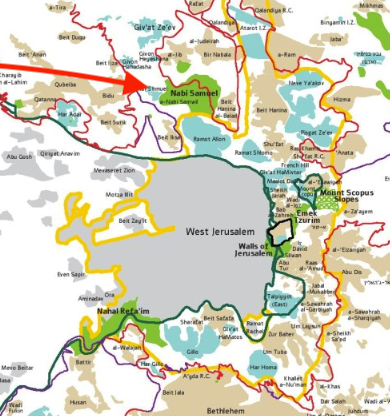
Map by Emek Shaveh (click to enlarge)
Finally, in what is perhaps the most egregious and inhumane face of Israel’s COVID-19 pro-annexation policies, on March 22nd the Israeli military closed the only entry/exit checkpoint for the Palestinian village of Nabi Samwil. This small village is located on a strategic and highly prized hilltop (inside of a national park) just outside of the municipal borders of Jerusalem but on the Israeli side of the separation barrier — placing residents (who have West Bank ID cards) in a Kafka-esque situation wherein they are cut off from both Jerusalem and the West Bank (legally they are forbidden from taking the one road out of the village into Jerusalem, since they are West Bankers, and the West Bank is accessible only via a circuitous route that passes through an Israeli checkpoint – for background see: The Palestinian village where Israel forbids everything). The military enforced the closure with only 14 hours’ notice for residents. On March 25th, HaMoked submitted an urgent pre-petition to the State Attorney’s Office to re-open the checkpoint, arguing that the village does not have a permanent doctor and only one tiny store for supplies. HaMoked intends to submit another urgent petition to the High Court of Justice. HaMoked stressed that closing the checkpoint denies the village’s residents access to medical care and essential groceries.
The suffocation of Nabi Samwil is in line with Israel’s long-time ambitions to completely de-populate the village and take control of the land.
Settlers Advance Annexation Agenda of Their Own, Including Through Violence
In addition to Israel government actions which advance an annexationist agenda (described above), settler efforts to take over more land have continued during the Coronavirus-based West Bank lockdown. Indeed, the lockdown may be aiding and even fueling these efforts.
In the northern West Bank, for example, settlers are once again terrorizing Palestinians who come anywhere near the site of the former Homesh settlement, which was dismantled by Israel in 2005 as part of the Gaza disengagement. Since then, settlers have been obsessed with the desire to re-establish Homesh, hosting religious events and protests at the site of Homesh, some of which have been attended by Israeli MKs and politicians. Because of the settlers’ actions and the lack of enforcement by Israeli military/police, Palestinians were unable to access the area until as recently as February 2020. Now, while Palestinians’ movement is restricted due to PA-imposed efforts to stop COVID-19, settlers (who, as Israelis, are under far less strict COVID-19 related rules, which in any case the IDF doesn’t appear to be enforcing rigorously on settlers), have re-established a violent presence at the site intended to keep Palestinians away. Over the past month, Palestinians report at least five violent incidents. On March 26, Yesh Din sent an urgent letter to Israeli authorities documenting the violent incidents and demanding that authorities immediately evacuate the settlers and investigate their crimes.
A key tool settles use to takeover Palestinian land is violence (as documented in great detail in this excellent report by Yesh Din). As the West Bank lockdown continues, settler violence towards Palestinians and their property has predictably continued and even increased, and fear is growing that it will get worse. According to the Israeli Defense Ministry, in data it provided to Haaretz, there were (at least) 16 physical confrontations between settlers and Palestinians in March, compared to only nine in February and five in January. B’Tselem recorded 21 cases of settler violence, including destruction of property, in March alone.
The Executive Director of Yesh Din, which closely monitors settler violence in the West Bank, told Haaretz:
“The quantity and severity of the violent cases we’ve handled in recent weeks is mind boggling. As long as authorities continue to disregard Palestinians’ lives instead of protecting them and arresting the hooligans, the settlers’ violence will only increase and spread.”
Bonus Reads
- “‘This Isn’t the West Bank’: Soldiers Deployed in South Tel Aviv to Enforce Coronavirus Lockdown” (Haaretz)
- “COVID-19 and the Healthcare Systems in Israel/Palestine: Part 2 – West Bank & East Jerusalem” (Webinar ft. Jessica Montell/HaMoked and Tareq Baconi/ICG)