Welcome to FMEP’s Weekly Settlement Report, covering everything you need to know about Israeli settlement activity this week.
To subscribe to this report, please click here.
June 23, 2023
- Smotrich Receives Near Unilateral Power Over Shortened Settlement Planning Process
- Israel To Advance Plans for 4,799 New Settlement Units, Including Retroactive Authorization of an Outpost
- Netanyahu Announces 1,000 New Units for the Eli Settlement in “Response” Palestinian Attack
- Settlers Reoccupy Evyatar Outpost As Netanyahu Reportedly Decides to “Legalize” It & Ben Gvir Encourages More Illegal Settlement Activity
- With Assistance from IDF, Settlers Establish a New Outpost Near Eli
- Settler Violently Rampage Across West Bank with Little to No Repercussion
- Eviction of Palestinian Ghaith-Sub Laban Family Scheduled
- Bonus Reads
Smotrich Receives Near Unilateral Power Over Shortened Settlement Planning Process
On Sunday, June 18th the Israeli Cabinet approved a measure that immediately expands Bezalel Smotrich’s authority over construction in existing settlements by significantly shortening the planning process and removing almost any role for Israeli politicians in that process, a lever which – for decades – has been utilized by successive Israeli governments to intervene in settlement planning usually in consideration of pressure from the international diplomatic community. Under the new procedures, political approval is only needed once at the very beginning stage of the planning process, whereas for the past three decades political approval was needed at each and every phase.
In Haaretz, Israel lawyers Ronit Levine-Schnur and Michael Saliternik explain:
“The requirement of the defense minister’s approval at each stage reflected the understanding that settlement construction, which is illegal under international law, has major legal, diplomatic and security implications. This requirement enabled government officials to halt or postpone construction in the settlements based on the changing political and security situation, and sharpened the distinction between construction within the state’s sovereign borders and construction on occupied land under Israel’s temporary military control….This week’s decision…is designed to prevent or significantly reduce not only the government’s but also the public’s and international community’s oversight of settlement construction.”
Removing the role of political figures surrenders the power of settlement planning and construction to an avowed annexationist whose agenda, at least in part, is to double the number of settlers while further entrenching Israeli domestic rule over settlers and leaving Palestinians under Israeli military rule. The Israeli Cabinet decision advances both of these goals: it differentiates settlement planning from planning for Palestinians (which remains a more complicated political-bureaucratic process in which Smotrich and Defense Minister Gallant both have power); and, as Smotrich and his allies are framing it, this procedural change “normalizes” the laws governing settlers by aligning them with Israeli domestic rule. In the words of Peace Now, “From a planning perspective, there is no difference between the Tel Aviv district and the ‘Judea and Samaria’ district, except for the initial decision by Minister Smotrich.”
The change is celebrated by settler leadership. Yisrael Gantz, head of the Benjamin Regional Council, said:
“This government resolution brings the residents of Judea and Samaria to the regular situation of the entire State of Israel,” said Gantz, using the biblical name for the West Bank region. “This step will turn construction in the settlements into something that is not newsworthy but rather, routine.”
Yossi Dagan, head Head of the Samaria Regional Council, said:
“We must stop treating residents of Judea and Samaria as second-class citizens. It’s unthinkable that only residents of Judea and Samaria need approval from the political echelon in order to build a home or a kindergarten.”
It’s worth re-sharing the latest legal analysis and commentary arguing that Israel has, even without a formal declaration, annexed the West Bank via bureaucratic transformations such as this: “A Theory of Annexation” (Berda, Meggido, & Levin-Schner, January 2023 – SSSN); “Israel is Officially Annexing the West Bank” (Sfard, June 2023 – Foreign Policy); and, “Israel’s Annexation of the West Bank Has Already Begun” (Scheindlin & Berda, June 2023 – Foreign Affairs); “This Decision by Israel Is as Dramatic as Attempts at Constitutional Change” (Levine-Schnur & Saliternik, June 2023 – Haaretz)
Peace Now further comments:
“The implication of this decision is that once Minister Smotrich decides and approves the advancement of construction plans in West Bank settlements, the plans will go directly to the planning committees in the West Bank (the Higher Planning Council), and the political and military echelon will have no authority to delay or influence the planning stages or the submitted plans. This process will allow unrestricted construction in the West Bank, disregarding security and diplomatic considerations, and perpetuating de facto annexation in the West Bank.”
The Haaretz Editorial Board writes:
“The settlers’ patience has paid off. After 27 years, they have managed to bring about a change in the way the system operates. The government decided to give a messianic settler, one who favors Israeli sovereignty over the entire Land of Israel and supports Jewish supremacy, the power to speed up construction in the settlements…Smotrich and the settlers understood very well that Netanyahu’s utter dependence on the extreme right opened a historic window of opportunity for them, and they are exploiting every moment of it to take over more and more Palestinian land to build, alter the area irreversibly and entrench one large apartheid state between the Jordan River and the Mediterranean Sea. The crisis that Israel is mired in is a golden opportunity for the settlers and their destructive project.”
Israel To Advance Plans for 4,799 New Settlement Units, Including Retroactive Authorization of an Outpost
On the same day Smotrich was awarded new power to oversee settlement construction, the Israeli High Planning Council published an agenda for its June 26th meeting outlining plans for 4,799 settlement units which will be advanced, to include plans which would have the effect of retroactively legalizing the Palgei Maim outpost as a neighborhood of the Eli settlement. The June 26th meeting will be the second time the High Planning Council convenes this year, and could bring the total number of settlement units advanced in 2023 to 12,149 – – nearly three times more than in the entire 2022 year (4,427 units). Smotrich – who now has near unilateral authority over construction planning for settlements – gloated in a statement saying that 2023 has set “a record for the rate of settlement construction [planning] in the last decade” and:
“The construction boom in Judea and Samaria and in all parts of our country continues. As we promised, today we are advancing the construction of thousands more new units in Judea and Samaria… We will continue to develop the settlements and strengthen Israel’s hold on the territory.”
Peace Now said in a statement:
“The Israeli government is advancing us at an unprecedented pace towards the annexation of the West Bank. The promotion of nearly 5,000 housing units, including the authorization of a settlement in the heart of the West Bank, joins a series of destructive decisions that the government has advanced, including yesterday’s decision granting exclusive power to Minister Smotrich for promoting settlements in the occupied territories. As the world remains silent and public attention is focused on preventing the judicial coup, the government is rushing towards an annexation coup turning Israel into an apartheid state.”
Of the total number of units on the agenda, 1,434 units are set for final approval, including:
- Carmel – 42 units, expanding construction in the settlement towards the southeast. This settlement is located in the South Hebron Hills, where Palestinians are facing ongoing displacement and forcible relocation.
- Elkana – 351 housing units. Elkana is located in the northern West Bank in an area where the Israeli separation barrier cuts deeply into the land in order to keep settlements on the Israeli side of the barrier.
- Givat Ze’ev – three plans totalling 642 units. Givat Ze’ev is located north of Jerusalem.
- Revava – 399 housing units. Revava is located west of the Ariel settlement in the heart of the northern West Bank.
Of the total, 3,306 units will be approved for deposit (an earlier stages of the planning process):
- Adora – 310 housing units. If approved, this will triple the size of the Adora settlement. Adora is located west of Hebron.
- Beitar Illit – a total of 312 units in three plans. Beitar Illit is located west of Bethlehem.
- Eli – 142 units.
- Etz Efraim – 264 units in two plans. Etz Efraim is located near the Elkana settlement in the northern West Bank in an area where the Israeli separation barrier cuts deeply into the land in order to keep settlements on the Israeli side of the barrier.
- Givat Ze’ev – 228 units. Givat Ze’ev is located north of Jerusalem.
- Halamish (also called Neve Tzuf) – 330 units, which will significantly expand the Elisha “neighborhood” of the settlement, which began as an outpost that was retroactively legalized in 2015 as a neighborhood of Halamish. If approved, this will more than double the size of the Halamish settlement. Located between Ramallah and the Ariel settlement in the northern West Bank.
- Hashmonaim – 150 units. Hashmonaim is located just over the 1967 Green Line, west of the Modin Illit settlement in the northern West Bank.
- Karnei Shomron – 104 units in two plans. Karnei Shomron is located in the northern West Bank, east of the Palestinian village of Qalqilya. Israel has openly declared its intention to continue expanding settlements in this area with the stated goal of bringing 1 million settlers to live in the area.
- Ma’ale Adumim – 340 units. Located east of Jerusalem.
- Ma’ale Amos – 152 units. If approved, this will more than double the size of the Ma’ale Amos settlement, which is located between Bethlehem and Hebron.
- Metzad (Asfar) – 78 units.
- Kiryat Arba – 120 units. Located just outside of Hebron.
- Migdalim – 184 units. Located in the extreme south of the West Bank.
- Palgei Maim outpost – 347 units located within the Palgei Maim outpost. This plan will have the effect of retroactively legalizing the outpost as a neighborhood of the Eli settlement
Netanyahu Announces 1,000 New Units for the Eli Settlement in “Response” Palestinian Attack, Bringing Outpost Legalization Total to 3 This Week
In response to the murder of four Israelis by Palestinian gunmen near the settlement of Eli on June 21st, the Israeli government announced that it is advancing plans for 1,000 new settlement units in Eli, which come in addition to the 499 units expected to be advanced by the High Planning Council at its meeting next week (see the above section). The decision was made by Prime Minister Netanyahu, Defense Minister Gallant, and Finance Minister Smotrich. The trio said in a statement:
“Our response to terror is to hit it hard and build in our land.”
According to Peace Now, the plans for 1,000 units announced by Netanyahu include three discrete schemes, inlcuding two plans to grant retroactive legalization and add hundreds of units in two outposts associated with Eli – HaYovel and Nof Harim. The third plan is for a new neighborhood in the Eli settlement consisting of 650 units. Recall that that part of what the High Planning Council is expected to advance next week is a plan to retroactively legalize and expand yet another outpost of the Eli settlement, called Palgei Maim outpost, meaning that the Eli settlement could see three of its outposts legalized soon. Peace Now comments on the totality of plans to expand the Eli settlement:
“The implication of the government’s decisions in the past week is the doubling of the number of settlers residing at Eli while legalizing and expanding three outposts located at the edge of the settlement, in close proximity to the Palestinian villages of As-Sawiya (Palegi Mayim) and Karyut (Jubal).”
National Missions Orit Strock (Religious Zionism party) celebrated the announcement, saying:
“1,000 more Jewish families in the place where Jewish lives were cut short. Every terrorist must know that this was the Zionist price tag for murdering Jews. In the place from where they try to uproot us – there we will deepen our roots. Not instead of eliminating the terrorists, not instead of the checkpoints, and not instead of drying up the terror swamp. But absolutely, as a necessary and clear Zionist step.’’
Settlers Reoccupy Evyatar Outpost As Netanyahu Reportedly Decides to “Legalize” It & Ben Gvir Encourages More Illegal Settlement Activity
Hundreds of settlers moved into the illegal Evyatar outpost on June 21st in an effort to permanently reoccupy the outpost. The massive action only escalates the demand that the government expedite the implementation of its decision (as agreed to in its coalition deals) to grant retroactive authorization to the outpost, and is now framing that demand as part of the government’s response to the murder of four Israelis by Palestinian gunmen near the Eli settlement. According to Peace Now, Israeli press reports suggest that on June 21st Prime Minister Netanyahu made a final decision to grant retroactive authorization to the outpost.
The area of the Evyatar outpost – located east of the Ariel settlement, closer to the Jordan Valley than to sovereign Israeli territory – remains a closed military zone, where Israelis and Palestinians are barred from entering. Nonetheless, the IDF appears to have deliberately decided to allow the settlers to enter the outpost area, and are now providing security for the settlers entering and leaving the area. All of this suggests that the settlers will not be removed from the site.
National Security Minister Itamar Ben Gvir traveled to the Evyatar outpost on June 23rd, congratulating the settlers and encouraging them to continue to establish new outposts and urging more violent action against Palestinians. Ben Gvir said:
“Run to the hilltops. Here, there should be a full settlement, not only here, but in all the hills around us. We should settle the Land of Israel, and at the same time, launch a military operation, take down buildings and eliminate terrorists. Not just one or two, but dozens and hundreds and if needed, thousands.”
MK Zvi Sukkot participated in the demonstration on June 21st, saying:
“We’ve returned home to Evyatar…Terrorists should know that any attack will only deepen the Jewish hold on the territory. Two years after being evacuated, the time has come for us to return forever.”
As a reminder, Evyatar is an illegal outpost (established by settlers in violation of Israeli law, in addition to international law) built on a hilltop that Palestinians have long known as Mt. Sabih, land which has historically belonged to the nearby Palestinian villages of Beita, Yatma, and Qablan. The outpost was evacuated by the Israeli government in 2021 in the context of an agreement with settlers that left all construction at the site in place, maintained an IDF presence at the site, and made clear the government’s intent to legalize settlement at the site in the future. Since then, re-establishment/legalization of Evyatar has been a regular demand of settlers and their political backers, and was agreed to in writing as part of the coalition agreements that formed the current Israeli government.
In April 2023, settlers staged another march to demand Evyatar be reestablished, with march organizers hosting a carnival-like rally at the Evyatar site. Importantly and perhaps tellingly, Haaretz reports that the April march was the first time settlers have received approval to enter the Evyatar outpost since the aforementioned 2021 agreement.
For full background on the Evyatar outpost saga, see previous FMEP reporting here.
With Assistance from IDF, Settlers Establish a New Outpost Near Eli
On evening of June 21st, a group of settlers moved five mobile homes to land near the Eli settlement but belonging to the Palestinian villages of Sinjil and Lubban ash-Sharqiya (a village settlers violently attacked the night before) in order to establish a new outpost, which they are calling “HaMor”. The Wafa news outlet reports that the IDF assisted the settlers efforts by leveling the ground with a tractor prior to their arrival with the mobile homes.
Peace Now has published pictures of this new outpost and reported:
“It appears that the outpost was established deliberately in a predetermined location, receiving support and funding from institutional sources, enabling the transportation of relatively spacious caravans, heavy equipment, and the commencement of infrastructure work.”
Peace Now further comments:
“Netanyahu’s government’s complicity in allowing and supporting settler outposts fuels an already volatile situation in the occupied Palestinian territories, intensifying violence against innocent Palestinians by extremist settlers. This flagrant disregard for justice and human rights undermines the prospects for a political resolution. The international community must vehemently condemn these actions and hold Israel accountable for its role. Moreover, the alarming rise in settler violence further exacerbates the situation. Urgent measures are imperative to prevent and punish such acts, fostering a culture of accountability and ensuring the safety and well-being of Palestinians. While the world remains silent and Israeli public attention is focused on preventing a judicial coup, the government is hastily moving towards an annexation coup, which will ultimately transform Israel into an apartheid state.”
Settler Violently Rampage Across West Bank with Little to No Repercussion
On June 20th hundreds of settlers descended on the Palestinian village of Turmus Ayya in the northern West Bank where they attacked Palestinians and their property – injuring 11 and setting fires across the town that damaged 30 houses and 60 vehicles. When the IDF came to help the settlers leave the village after residents confronted them, IDF soldiers shot indiscriminately at Palestinians resulting in one death and several serious injuries.
Another group of settlers attacked Huwara, the village where settlers committed a pogrom earlier this year. Still another group of settlers attacked the village of Al Luban Al Sharqiya located near the Eli settlement. There, settlers attacked a 12-year old boy riding his bike, leaving him seriously injured.
The Times of Israel reports that four Israelis have been arrested in connection to these attacks. B’Tselem spokesperson Roy Yellin commented that, “We didn’t expect much…The rule is impunity from justice.” Yesh Din Executive Director Ziv Stahl called the arrests a “drop in the bucket” and told AP:
“(The army) had four months after (the attack in) Hawara to study how to deal with this and stop it,” she said. “But everything happened in broad daylight. They didn’t detain anyone on the scene. They allowed the settlers to do whatever they felt like doing.”
B’Tselem said in a statement:
“Responsibility for deadly West Bank pogrom wave lies with Israel, which arms settler gangs and encourages them to attack Palestinians. Right after the deadly shooting near the settlement of Eli yesterday afternoon, settlers backed by the state began rioting across the West Bank, attacking Palestinians and their property.The rioting continues today, with one Palestinian reported killed and three others wounded by live fire in the village of Turmusaya. These events are not a single, isolated failure of the military or state, but a clear expression of Israel’s policy in the OpT. As part of this policy, Israel arms gangs of settlers and allows and even encourages them to attack Palestinians.”
Eviction of Palestinian Ghaith-Sub Laban Family Scheduled
Living under imminent risk of dispossession since June 11th, this week the Ghaith-Sub Laban family received an order from the Israeli Enforcement and Collection Authority stating that the couple will be evicted anytime between June 28th and July 13th. Ir Amim reports that Israeli authorities oftentimes state a window for carrying out forced evictions in order to “maintain an element of surprise to reduce anticipated resistance and ensure the eviction is carried out without disruption.” Ir Amim reports that the family – consisting of an elderly couple, Nora Ghaith and Mustafa Sub Laban – are presently living under extreme conditions, writing:
“Over the course of the past few weeks, the Ghaith-Sub Laban family has been subject to ongoing harassment by the police, private security guards, and settlers in the area. On numerous occasions, Israeli security forces arrived to their home demanding information and IDs of those present in the apartment, including activists, journalists, and diplomats. Beyond the looming threat of displacement, the continued uncertainty has added to their severe psychological distress.”
The Ghaith-Sub Laban family has spent more than 45 years in a legal battle against settlers (and the State) over their home in the Muslim Quarter of the Old City of Jerusalem. Nora recently told Haaretz columnist Gideon Levy when asked if she has ever considered giving up her struggle:
“I will answer with a question. If you had been born in this house, and all your brothers and sisters had been born here, grown up in it, married in it, if your mother and father had died in it, your brother had been exiled from it – would you surrender and forsake it? I want an answer. Every minute that I remain in this house is another minute of protecting my childhood memories. Every minute is to feel embraced by family members who are no longer with us. I am never alone in this house, even when I am by myself – all my family and all my memories are always with me in this house. If they come to evict us, I will not open the door. But if I feel danger to myself and to my husband, I will surrender and forsake it in order to safeguard my family. If I am evicted, I will give the house to God. This house will remain a prison until it is liberated. I will return. And if not me, then my children. One day the occupation will end, and we will return.”
This family’s story is not unique, and the broader, systemic processes behind the forcible dispossession of Palestinians in Jerusalem is also discussed. In March 2023, FMEP hosted Rafat Sub Laban and Ir Amim’s Amy Cohen on a podcast – “‘We Are Determined to Stay”: One Palestinian Family’s Story of Dispossession in Jerusalem” – to discuss the Sub Laban case and how it relates to broader State-back settler efforts to dispossess Palestinians across Jerusalem.
A large consortium of Palestinian civil society groups released a joint statement on the Sub Laban family dispossession, which reads:
“Alarmed by the imminent forcible transfer of the Ghaith-Sub Laban family from their house in the Old City of Jerusalem, which is slated to occur sometime between 28 June and 13 July 2023, the Palestinian NGOs Network (PNGO) and the Palestinian Human Rights Organisations Council (PHROC) vociferously assert that such manifestation of the ongoing Palestinian Nakba is a result of the international community’s deliberate failure and unwillingness to take effective and meaningful measures to end Israel’s illegal occupation, and settler-colonial apartheid regime…….For over 45 years, the Ghaith-Sub Laban family has endured a lengthy, exhausting, and unaffordable legal struggle, actively resisting recurring lawsuits, harassment, and efforts by Israel and settler organisations to forcibly displace them and seize their home for the purpose of expanding settlements in the eastern part of occupied Jerusalem…Indeed, the Ghaith-Sub Laban’s case is not an isolated incident but rather emblematic of a larger widespread and systematic attack against the Palestinian civilian population. The Israeli occupying authorities – mobilising its discriminatory judicial system – have consistently employed similar methods and policies to forcibly transfer dozens of Palestinian families from the Old City, Silwan, Sheikh Jarrah and other neighbourhoods of the eastern part of occupied Jerusalem.”
Bonus Reads
- “As Israel seeks West Bank expansion, a controversial outpost is revived” (Washington Post)
- “In the West Bank, UNESCO site Battir could face a water shortage from a planned Israeli settlement” (AP)
- “We’ve Found Something Settlers and Palestinians Agree On: How Ugly This Construction Is” (Haaretz)
- “Israel’s annexation drive is behind escalations in the West Bank” (The New Arab)
- “Jerusalem Permits Building U.S. Embassy on Disputed Site as Washington Mulls Location” (Haaretz)
Welcome to FMEP’s Weekly Settlement Report, covering everything you need to know about Israeli settlement activity this week.
To subscribe to this report, please click here.
February 24, 2023
- With New Powers Given to Smotrich, Israel Annexes the West Bank (Even Without a Formal Declaration)
- Final Hearing on E-1 Settlement Set for March 27th
- Israel Advances More than 7k Settlement Units & Establishes 4 More New Settlements
- U.S.-Brokered Compromise at the UN: Bibi Makes – and then breaks – Promises to Biden Admin on Settlements, Outposts, Raids, and Demolitions
- Multiple East Jerusalem Evictions Expected in March
- New Report: Displacement via Bureaucracy in East Jerusalem
- Bonus Reads
With New Powers Given to Smotrich, Israel Annexes the West Bank (Even Without a Formal Declaration)
On February 23rd, Netanyahu reached a deal to change the way Israel exercises authority over the West Bank. This new arrangement represents the extension of Israeli civilian/domestic authority over the entire West Bank. As such, it represents Israeli annexation of the West Bank, even without formal declaration of annexation.
Specifically: from 1967 until this week, the Minister of Defense was the de facto sovereign in the West Bank, with total authority over matters related to both Palestinians and settlers. With the deal reached this week, authority in the West Bank will now be split between Defense Minister Yoav Gallant and Finance Minister Bezalel Smotrich (acting in his capacity as a “Minister in the Defense Ministry”).
While the agreement takes pains to leave a tiny amount of power over West Bank civilian affairs with the Defense Minister in order to maintain a thin veneer of compliance with international law (the only authority left to Gallant with respect to “civilian” affairs will be to demolish illegal settler activity “in case of security and irregular events,” and even then, Smotrich must be given advance notice of any such demolition), in effect Smotrich will become the new reigning sovereign over the West Bank. According to the deal, he will exercise his authority via the establishment of a new “Settlement Administration” within the Defense Ministry, that he will lead (and appoint his own deputy to assist in leading). This “Settlements Administration” will enjoy virtually total autonomy and unchecked power, with almost no accountability to anyone in the Israeli Ministry of Defense (Gallant in principle can overrule Smotrich’s decisions but must put his reasoning in writing after first meeting with Smotrich to hear his case, and even then, Gallant cannot issue any order to overrule Smotrich). Importantly, the agreement allows Smotrich to systematically apply Israeli law over the settlements.
Itay Epstein, a lawyer of humanitarian law and senior advisor to the Norwegian Refugee Council, explains the totality and impact of Smotich’s powers:
“Spatial planning in the West Bank will come under the authority of the Minister [Smotrich], including authority over the High Planning Council, responsible for establishing and expanding settlements as well as considering Palestinian spatial plans and permit applications in Area C…All matters related to the regularization of “informal” settlement outposts and satellite neighborhoods will come under the sole authority of the Minister, who can endorse 147 such outposts most disruptive to a contiguous future Palestinian State…The [Civil Administration] Enforcement Unit, responsible for the destruction of Palestinian-owned structures built in Area C, as well as the seizure and destruction of donor-funded humanitarian relief, will come under the sole authority of the Minister…The Minister will have the authority to declare new ‘natural reserves’, a primary tool in the appropriation of Palestinian land (in areas A through C) and exclusion of Palestinians from land use across the entire West Bank…All matters related to housing, land, and property rights, including land ownership settlement, surveying, and registration, will come under the sole authority of the Minister. This is the primary tool for expropriating land, and abrogating Palestinian ownership claims…The planning and implementation of infrastructure across the West Bank (areas A through C) will come under the exclusive authority of the Minster, including surface roads, water and sanitation, energy and renewable energy, telecommunications, and waste management.”
Renowned Israeli lawyer Michael Sfard tweets:
“this is a dramatic change in the structure of governance over the occupied territory. Very broad administrative authorities pertaining to the majority of the governing powers in the West Bank are being transferred into hands that are not of the military commander of the occupied territory. From now on, those powers will be held by the minister in the Ministry of Defense, who will de facto serve as the governor of the West Bank…
International laws of belligerent occupation state that an occupied territory will be temporarily administered by the occupying force (that is, the army) which, along with security considerations, will be obligated to promote the interests of the occupied people. Transferring powers to Israeli civilian hands is an act of de jure annexation because it entails removing power from the occupying military and placing it directly in the hands of the government – this is an expression of sovereignty. The bottom line is that the agreement signed today is simultaneously a giant leap of legal annexation of the West Bank and an act of perpetuating the regime’s apartheid nature.”
Further, the agreement attempts to clarify and carefully craft the new, divided chain of command, which – in the end – creates incredible confusion. This confusion is a feature, not a bug, enabling Gallant and Smotrich to publicly, and disingenuously, to claim that the West Bank remains under the administration of the Israeli army as a separate regime from that of the Israeli state, and to assert that “nothing in this document changes the legal status of the West Bank, the laws applied within, or the government’s authority over it.”
On this argument, Sfard comments:
“The agreement includes two clauses aimed at obfuscating the transfer of powers by presenting the governor’s alleged subordination to the Minister of Defense, but according to the document, the cases in which the Minister of Defense can override the governor are extreme cases and even when this is done, the military commander of the West Bank will be bypassed, as he no longer holds authority.
The agreement also states that the governor will work to deepen the powers of the Israeli governmental authorities in the areas of Israeli settlements a process which will promote the unification of government powers and geographically expand their direct legal authority in the West Bank. Or, in other words: stretching Israeli sovereignty beyond the Green Line. The agreement also states that the governor will lead a process of expanding the dual legal system so that Israeli legislation by the Knesset will be applied more fully than it is today to the Israelis in the West Bank.”
In addition, in trying to manage the egos of Smotrich and Gallant – and prepare for inevitable disagreements – the agreement makes Prime Minister Netanyahu the ultimate arbiter of disputes between the two, in effect doubling down on the de facto annexation by giving the Prime Minister authority over decisions military decisions related to West Bank civilian governance.
Final Hearing on E-1 Settlement Set for March 27th
On March 27th, a subcommittee of the Higher Planning Council will convene to discuss objections to the E-1 settlement plan — a final step in the approval of the plan. Final consideration of the E-1 plan has been delayed several times, most recently in September 2022, due to international opposition to the plan. The E-1 settlement is slated to be built in the West Bank on land abutting the border of Jerusalem to the northeast, and is considered by the international community to be a “doomsday” settlement, in what its construction would mean for the two-state solution.
This upcoming meeting promises to be a decisive one for the long-pending E-1 plan, and could very well result in the Committee – which is now under the authority of longtime settler advocate Bezalel Smotrich – granting final approval to the highly contentious plan. Barring intensive outside pressure, additional postponement of the hearing seems highly improbable, given the Israeli domestic politics and the upcoming national election.
As a reminder: in its current form, the E-1 plan provides for the construction of 3,412 new settlement units on a site located northeast of Jerusalem. The site is home to several Palestinian bedouin communities, comprising 3,000 people, including Khan al-Ahmar, which Israel has already undertaken to forcibly displace (many attempts). Long called a “doomsday” settlement by supporters of a two-state solution, construction of the E-1 settlement would sever East Jerusalem from its West Bank hinterland, preventing East Jerusalem from ever functioning as a viable Palestinian capital.
E-1 would also cut the West Bank effectively in half, isolating the northern West Bank from the southern West Bank and foreclosing the possibility of the establishment of a Palestinian state with territorial contiguity. Israel’s “answer” to this concern has long been to argue that Palestinians don’t need territorial contiguity, and that new roads can instead provide “transportational continuity.” To this end, Israel has already built the so-called “Sovereignty Road” – a sealed road that enables Palestinians to pass through, but not to enter, the E-1 area. That road is wholly under Israel’s control (meaning Israel can cut off Palestinian passage through it at any time). In January 2021, then-Prime Minister Netanyahu promised to increase funding for the “Sovereignty Road” as part of the drive to get E-1 built. Further, Netanayhu also recently pitched a room of French investors on a vision to build high speed tunnels throughout the West Bank to accomplish this task.
And another reminder: there have been attempts to promote the E-1 plan since the early 1990s, but due to wall-to-wall international opposition, the plan was not advanced until 2012, when Netaynuahu ordered it to be approved for deposit for public review (a key step in the approval process), ostensibly as payback for the Palestinians seeking recognition at the United Nations. Following an outcry from the international community, the plan again went into a sort of dormancy, only to be put back on the agenda by Netanyahu in February 2020, when he was facing his third round of elections in the two years. Also, as a reminder: under the Trump Plan (which the Biden Administration has yet to comment on), the area where E-1 is located is slated to become part of Israel.
Israel Advances More than 7k Settlement Units & Establishes 4 More New Settlements
Over the course of two days (Feb 22-23, 2023), the Israeli High Planning Council advanced plans for 7,287 new settlement units. With these approvals, Israel has advanced more plans in 2023 (7,287 units) than in 2022 (4,427 units) or 2021 (3,645 units).
In addition, during this same period the Council granted retroactive legalization to three outposts while advancing plans for the retroactive legalization of a fourth outpost. The Council’s decision to legalize (under Israeli law) these outposts comes in addition to the ten outposts “legalized” by the Israeli Security Cabinet last week — meaning that in less than 2 weeks the new Israeli government has (so far) approved the establishment of 14 new settlements.
Three of the four outposts legalized by the High Planning Council this week were authorized as “new neighborhoods” of existing settlements, but in reality these outposts – which are not contiguous with the built-up area of existing settlements – are new settlements. The outposts granted authorization by the Higher Planning Council are:
- Mevo’ot Yericho (181 units granted final approval) – which was authorized by the Security Cabinet over a year ago, but is only now receiving final approval for its master plan from the Higher Planning Council. This outpost is located near Jericho in the Jordan Valley. Peace Now reports that the outpost currently has 60 units built, so the approval of this plan triples the size of the settlement.
- Pnei Kedem (120 units granted final approval), authorized as a new neighborhood of Metzad settlement, located northeast of Hebron. This plan will triple the size of the existing outpost.
- Nofei Nehemia (212 units granted final approval, most of which were already built illegally), authorized as a neighborhood of the Rehelim settlement (which itself was once an outpost granted retroactive legalization), located south of Nablus. Importantly, the Nofei Nehemia outpost is separated from the Rehelim settlement by Route 60 – the major north-south highway in the West Bank.
- Netiv Ha’avot (433 units, approved for public deposit), authorized as a neighborhood of the Elazar settlement. Should this plan receive final approval, the government will have handed settlers not one but two new settlements as compensation for the demolition of 14 units in the Netiv Ha’avot outpost that were built partially on privately owned Palestinian land..
At the last minute, the committee decided to delay its consideration of a plan that would have “legalized” the Zayit Ra’anan outpost. That plan outlines 189 units to be authorized as a “neighborhood” of the Talmon settlement, located north of Ramallah. Peace Now reports this plan was put on the agenda “almost out of nowhere” and that there are only a few caravans at this outpost currently.
In addition to authorizing four new settlements, the Higher Planning Council also:
- Granted final approval for the construction of 1,900 units
- Approved plans for 5,257 units for public deposit.
Peace Now notes that these plans include the retroactive authorization of approximately 1,000 units which settlers have illegally built in settlements. For Peace Now’s data table tracking these approvals, please see here.
As a reminder, the High Planning Council is a body with the Defense Ministry’s Civil Administration, which is now under the control of Finance Minister Bezalel Smotrich, in his capacity “Minister in the Defense Ministry” who in that role now enjoys virtually total control over civilian/settlement matters in the West Bank (see the first section of this report for details).
Peace Now said in a statement:
“The Israeli government is carrying out in full swing an act of annexation of the occupied territories. Just as the judicial coup that the government is advancing is an existential threat to Israeli democracy, so too is this annexation. Advancing the construction of thousands of housing units in the settlements and authorizing 15 outposts within a week are acts of de facto annexation. Building settlements in the occupied territories is a war crime, and annexation without granting citizenship to Palestinians is considered a crime of apartheid. These actions are directed first and foremost against the Palestinians and are with the intention to prevent the establishment of a future Palestinian state by means of taking control of Area C.”
U.S.-Brokered Compromise at the UN: Bibi Makes – and then breaks – Promises to Biden Admin on Settlements, Outposts, Raids, and Demolitions
This week, the United States succeeded in convincing the Palestinian leadership to forgo its push for a Security Council vote on a resolution condemning Israel’s settlement activity, and instead settle for an exceedingly weak statement on the matter signed by the UN Security Council, including the United States.
In exchange for this significant downgrade of international action, Israel reportedly promised that it would not authorize any additional settlement plans or outpost legalizations for some time, with some outlets suggesting Israel committed to a six-month reprieve. This pause, of course, did not stop Israel from advancing 7,000+ plans this week, including the creation of 15 new settlements.
Israel further agreed to pause its concerted efforts to demolish and evict Palestinians from their homes in East Jerusalem and Area C of the West Bank, and to reduce military incursions into Palestinian cities. This of course did not stop Israel from conducted a massive mid-day raid into the old city of Nablus this week – killing 11 Palestinians, included a teenager and three elderly. Over one hundred Palesitians were hospitalized, including an 11-year old who was shot in the leg and got shrapnel wounds to his liver, all while going to the market to get a sandwich. Lastly, press reports that Israel committed to several economic measures to help the Palestinian Authority, including increasing tax revenues.
The U.S. also promised to invite Palestinian Authority President Mahmoud Abbas to the White House, and committed to submitting a request to Israel to reopen the U.S. Consulate in Jerusalem.
On February 20th, the UN Security Council released its statement, which did not strongly condemn Israeli settlement activity – only expressed “deep concern and dismay” at Israel’s recent settlement approvals. Instead, the statement called on all sides to deescalate and condemned acts of violence by all parties.
Notably, this is the first time in eight years the Security Council has produced a formal product related to Palestine, wit the last action being the 2016 resolution on settlements (which the U.S. abstained from). Palestinian diplomat Riyad Mansour told the Washington Post that 14 out of 15 members of the Security Council supported the draft resolution, clearly intimating the United States is the sole reason the resolution was dropped in favor of a statement.
Multiple East Jerusalem Evictions Expected in March
Ir Amim reports that there are four pending eviction cases threatening to displace 150 Palestinians in early March, coinciding with the holy month of Ramadan. Those cases, summarized by Ir Amim, are:
- Gaith-Sub Laban Family, Muslim Quarter, Old City – the family of veteran Ir Amim staff member, Ahmad Sub Laban, faces eviction…on March 15 following the Supreme Court’s decision to deny their request to appeal. All legal remedies have been exhausted, and hence the family is at risk of immediate eviction. Save for state intervention, there is no further recourse to prevent their displacement.
- Shehadeh Family, Batan al-Hawa, Silwan – The District Court ruled to evict the family by March 1. A request to appeal to the Supreme Court is currently pending.
- Salem Family, Um Haroun, Sheikh Jarrah – A decisive administrative hearing on their pending eviction is scheduled for March 9 at the Enforcement and Collections Authority. If authorized, the eviction could potentially be carried out by the end of March.
- Dajani, Daoud, Hammad Families, Kerem al Jaouni, Sheikh Jarrah – a Supreme Court hearing on their appeal is scheduled for March 29. While a similar ruling is expected to that of the one handed down last year in the cases of four other families from the neighborhood, the outcome is still not definitive.
For a deep dive into the legal cases of each family, please see Ir Amim’s comprehensive reporting.
As a reminder, Netanyahu has reportedly promised the United States that it will suspend evictions for a few months. However, Israel made several other promises the United States that it has already violated – including the legalization of more outposts and provocative, violent military actions in the West Bank.
Ir Amim writes:
“Evictions of Palestinian families and settler takeovers of their homes have increasingly been used as a strategy to cement Israeli hegemony of the Old City Basin, the most religiously and politically sensitive part of Jerusalem and a core issue of the conflict. These measures are reinforced by a constellation of settler-operated tourist sites, which together serve to alter the character of the space and forge a ring of Israeli control around the area. This creates an irreversible reality on the ground that deliberately subverts efforts towards an agreed political resolution on Jerusalem. Moreover, such actions severely violate the individual and collective rights of Palestinians in the city and contravenes International Law, while carrying an acute humanitarian impact on the affected families. Since the eviction claims are based on inherently discriminatory laws, the legal recourse is limited. The political nature of these measures hence requires state intervention as a result of concerted engagement.”

New Report: Displacement via Bureaucracy in East Jerusalem
In a new report, Who Profits explains how Israel – following its illegal annexation of East Jerusalem in 1967 – has weaponized government bureaucracy in order to expand settlement and displace Palestinians. Who Profits zooms in on two key levers of power that Israel wields to achieve these goals: land registration and residency permits.
On land registration, Who Profits provides an explanation of the history, the mechanisms, and the consequences of land registration on Palestinian. The entire report, but especially this section, is worth reading closely because it unpacks how the land registration process works. Who Profits explains the scale of potential harm involved:
“Around 90% of land in East Jerusalem (30% of all land in the city),31 was never registered, as Israel froze all land registration proceedings until the launch of this formal land drive in 2018. Although framed as part of a larger package to uplift East Jerusalem and its Palestinian inhabitants’ socio-economic conditions and development, land registration is a key part of Israel’s larger geopolitical agenda of Judaizing and strengthening Israeli governance on the ground, through which it can entrench “sovereignty over East Jerusalem,” as succinctly articulated by the then Minister of Justice, Ayelet Shaked. According to the Civic Coalition to Defend Palestinian Rights in Jerusalem, the land registration process may lead to the confiscation of around 60% of Palestinian land and mass Palestinian dispossession, in violation of international law.”
On residency rights, Who Profits digs into Israel’s “center of life” policy, under which Palestinians may lose their Jerusalem residency if the State believes that an individuals “center of life” is outside of the city. Who Profits writes: “The process imposed by the Israeli Ministry of Interior on Palestinians in Jerusalem to prove that Jerusalem is their “center of life” is deliberately convoluted, draconian, and time-consuming, functioning as an additional means to surveil Palestinian Jerusalemites’ everyday lives and ultimately push them out of their city.” Who Profits profiles three private companies which Israel has contracted with to conduct investigations in Palestinians lives, to support the revocation of residency rights.
This new Who Profits reports dovetails perfectly with the recent legal analysis “A Theory of Annexation” which examines how the Israeli state is similarly using bureaucracy to annex the West Bank. So, whether the goal be displacement or annexation, bureaucratic enforcement is clearly a major tool and tactic to achieve it.
Bonus Reads
- “Police arrest 5 settlers over clash with IDF soldiers, torching of Palestinian car” (The Times of Israel)
- “The White House Is Still Whitewashing Israel’s West Bank Settlement Project” (Haaretz)
- “Why Israel’s goal of pacifying the Palestinians is failing” (+972 Magazine)
Welcome to FMEP’s Weekly Settlement Report, covering everything you need to know about Israeli settlement activity this week.
To subscribe to this report, please click here.
August 19, 2022
- Ir Amim on East Jerusalem Land Registration & State Land Seizures
- Israel Advances Plan to Build New Settlement “Ariel West”
- IDF Razes “Ramat Migron” Outpost for Second Time in a Week
- Ultra-Orthodox Settlers Establish Their First-Ever Outpost
- Israel Pauses to “Rethink” Plan to Build on Historic Site of Lifta
- Bonus Reads
Ir Amim on East Jerusalem Land Registration & State Land Seizures
In an alert issued August 11th, Ir Amim adds important information and analysis of Israel’s seizure of a plot of land in East Jerusalem last week. Importantly, Ir Amim explains how Israel is using the process of land registration to (sometimes covertly) take control over more and more land in the most sensitive areas in East Jerusalem.
Ir Amim writes:
“The area between Jabal Mukkaber and Abu Dis has long been targeted by the state and settlers due to its strategic location…Upon investigation, Ir Amim discovered that 12 dunams of land (bloc 31735) situated in the same location referred to in the article were recently registered under the management of the General Custodian in the Land Registration Office…Rights, bloc 31735 recently underwent settlement of land title procedures (formal land registration). Initiated on May 31, 2021, the settlement of land title process was swiftly completed in just over a year with little to no transparency and formally registered in the Tabu (land record) on July 14, 2022. The official order transferring the respective plot of land into the management of the General Custodian was issued on June 8, 2021—a mere days after the announcement of the settlement of title process on the same bloc of land. It should be underscored that the General Custodian is one of the state institutions formally and integrally involved in the settlement of title process. The timing is certainly not coincidental, and it was clearly carried out as a means to assert Jewish ownership claims of the land. In contrast, the process has yet to be initiated on the adjacent thousands of dunams of land owned by Palestinians in the same area.
Such a move constitutes yet another cynical exploitation of the settlement of land title procedures which are being conducted in the framework of Government Decision 3790—a decision aimed at ostensibly improving the well-being of Palestinians in East Jerusalem. As reported previously, an examination of the locations where the procedures have been completed or currently underway reveals the driving rationale: settlement of land title is largely being promoted in areas where the state and/or settlers have a particular interest and have some capacity to lay claim to the land in the framework of the proceedings. As such, these procedures are being used as yet another mechanism to seize more territory in East Jerusalem under the guise of a decision and budgets earmarked for Palestinians.”
Israel Advances Plan to Build New Settlement “Ariel West”
On August 18th, the Israeli Civil Administration discussed an amended plan to build an access road leading to an area of land where Israel is intending to build a new settlement, dubbed “Ariel West.” At the time of publication, it is unclear the outcome of the discussion is not yet known. We do know that Israel was forced to amend its original plan to build the access road to the new settlement site when it was proven that the route went through privately owned Palestinian land belonging to the village of Salfit.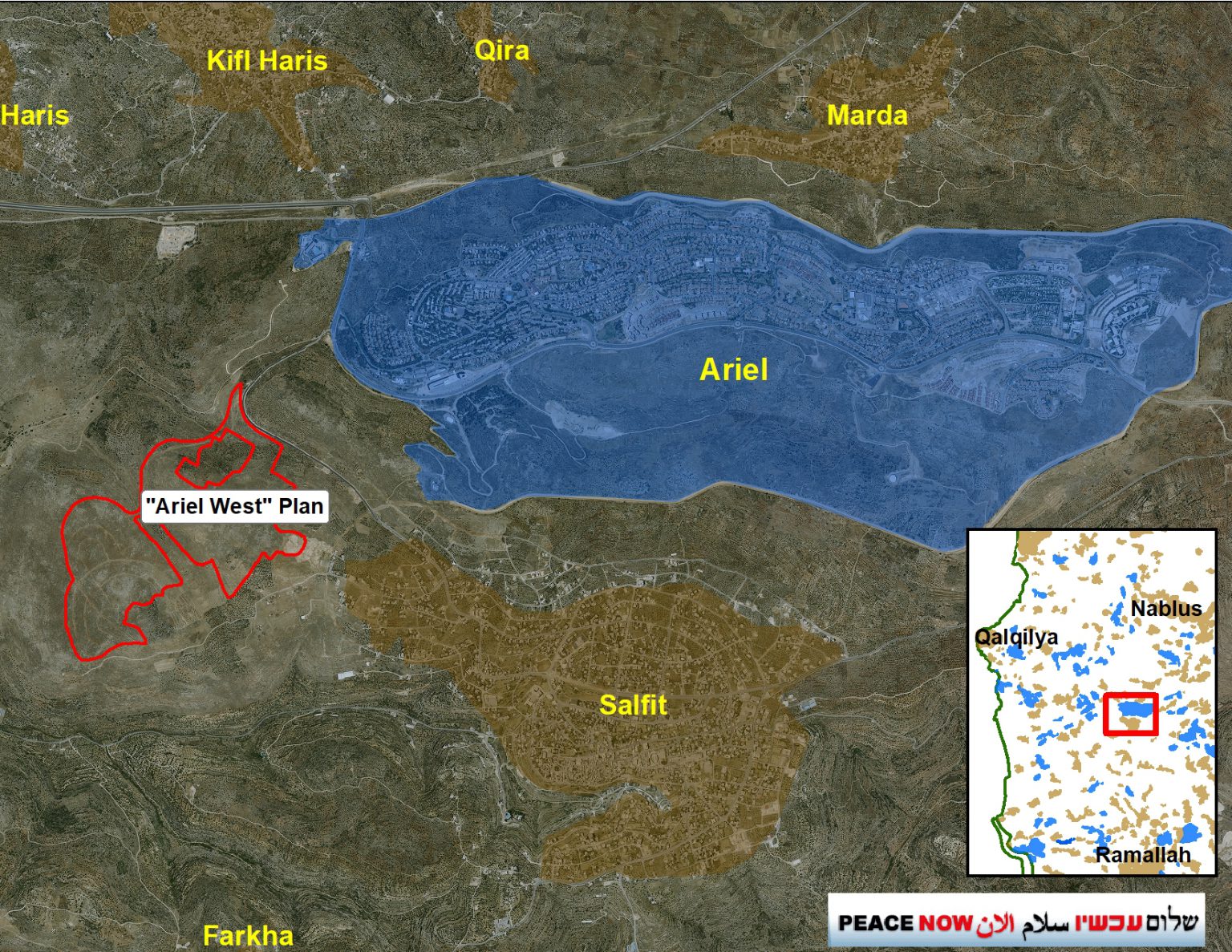
The plan for “Ariel West” was first discovered in November 2021, after the Israeli Ministry of Construction issued tenders (on October 24, 2021) for the new settlement, under the guise of a plan to “expand” the Ariel settlement, located south of Bethlehem. Under the plan, 731 new settlement units will be built on a hilltop located 1.2 miles away from Ariel, in an area that is non-contiguous with the built-up area of the current Ariel settlement.
Peace Now said in a statement:
“The government has been given another opportunity here to stop the establishment of the new settlement. After the Ministry of Housing rushed to issue tenders for the sale of the building rights, construction can still be halted if the defense minister stops the planning process. The “Ariel West” plan is not just a plan for thousands of housing units, but it is a new settlement designed to block the town of Salfit and prevent the development of Palestinian space in the area. Road comprise the infrastructure of the occupation, and the undercurrents of apartheid in the occupied West Bank. This dangerous plan must be stopped.”
“Ariel West” is one of many clear illustrations of how Israel systematically rewards unauthorized/illegal construction undertaken by settlers. In this case, settlers established an unauthorized outpost (i.e., illegal even under Israeli law) called “Nof Avi”on the hilltop where the new settlement is slated for construction. The Israeli government has allowed that outpost to remain in place for the past year, and thereby restrict Palestinians’ access to agricultural lands they rightfully own.
The hilltop and the Nof Avi outpost is located on land declared by Israel to be “state land” inside of the jurisdictional boundaries of the Ariel settlement, as authorized by the Israeli government. The jurisdictional boundaries of Ariel include several non-contiguous land areas — due to the fact that the area is dotted with land that even Israel recognizes to be legally owned by Palestinians (de facto annexing private Palestinian land to the settlement by leaving it in some places nearly completely surrounded by land controlled by the settlement).
The new settlement will further exacerbate the limitations that the settlements inflict on Palestinian agricultural workers, in addition to the future development of the nearby Palestinian town of Salfit, as illustrated in this video by Peace Now. Even before the “expansion” plan, Ariel’s jurisdictional area was identified as a direct hindrance on the future development of Salfit.
With news of the new settlement in October 2021, the Mayor of Salfit – Abdullah Kamil – explained to Haaretz:
“Salfit is slated for expansion. It has a university and there are plans to add 10,000 students over the next few years. The city’s master plan will have to be enlarged, and the site where the new settlement is planned is exactly the direction toward which we wanted to expand. This situation will explode. We also told the Israelis this; it will open a new front and it will harm Israeli security. It’s clear that part of the plan’s purpose is to eliminate any chance of a political solution.”
IDF Razes “Ramat Migron” Outpost for Second Time in a Week
On August 14th Israeli forces once again cleared settlers and their property off of a hilltop where the settlers are attempting to establish a permanent outpost, which the settlers call Ramat Migron. Israeli forces cleared the site just four days prior, but settlers quickly re-occupied the area.
As a reminder, in 2012 an illegal outpost known as Migron was dismantled by the Israeli government when the Israeli High Court ruled the land is privately owned by Palestinians. Since then settlers have continually sought to reestablish a settlement there. Israeli forces have razed outposts at the site at least 10 times in the past 10 years — all the while denying Palestinians the ability to reclaim control over land that an Israeli court affirmed they own.
In addition to the IDF retaining control over the Migron outpost site, Israel rewarded the settlers it forcibly removed from the Migron outpost by promising to establish two new official settlements: “New Migron” as well as 184 housing units to be built east of the settlement of Adam (aka, Geva Binyamin). Construction of the “New Migron” settlement was completed in July 2020. All said, the two new settlements and temporary housing for the evicted settlers cost Israeli taxpayers millions of dollars – sending a clear message that settler law-breaking pays.
Ultra-Orthodox Settlers Establish Their First-Ever Outpost
On August 16th, a group of 15 settler families announced the establishment of a new outpost near the settlement of Metzad, located in the southern West Bank. The settlers, notably, are ultra-orthodox Jews – making this the first outpost established by ultra-orthodox settlers. The settlers, who are calling the outpost “Derech Emunah,” have built 15 makeshift structures already at the site, which they are using as a yeshiva, synagogue, and homes.
A leader of the group, Moshe Rotman, said:
“The establishment of Derech Emunah is designed to increase awareness within the ultra-Orthodox community of the religious commandment of settling the land, as well as showing that the housing crisis in the community can be resolved through settlement construction in Judea and Samaria.”
The Ultra-Orthdox have long been viewed as distinct from religious-nationalistic settlers. Most ultra-Orthodox settlers moved to homes in the settlements for cheap housing (and their desire to live in homogenous communities) rather than out of a religious or nationalistic belief that Israel has a right and/or obligation to reclaim all of the land between the river and the sea. The establishment of this outpost challenges that understanding. Rotman called the Ultra-Orthodox a “dormant volcano,” insisting that the new outpost was established not merely by members from the fringe of the ultra-Orthodox community, and suggesting that many more ultra-Orthodox settlers will follow suit.
Peace Now said in response:
“Security forces must demonstrate zero tolerance to the outpost criminals, whether they are ultra-Orthodox, Zionist ultra-Orthodox or just criminals. Defense Minister Benny Gantz is avoiding evacuating the Homesh outpost. We call on him to instruct today, to demolish the new outpost. Any minute that the outpost is still standing shows that all he (Gantz) cares about is pleasing [right-wing Justice Minister Gideon] Saar and [right-wing Knesset member] Matan Kahana. It shows that he tries pleasing the ultra-Orthodox parties at the expense of the State of Israel.”
It’s also worth noting that Rotman said that the outpost was established in response to what his group perceives as the Israeli government’s selective enforcement against illegal construction by Israelis and the Palestinians in Area C of the West Bank. As FMEP has routinely covered, settlers and their allies in the Israeli government have perpetuated a false narrative – which at this point is deeply held by settler leadership – that the Israeli government is failing to thwart an alleged campaign by the Palestinian Authority to take over land in Area C via “illegal” construction – referring to construction by Palestinians on their own land, but without Israeli-required permits that Israel systematically refuses to issue. Settlers are using this story to push the government to more swiftly and systematically demolish any/all Palestinian construction in Area C.
Playing on this narrative, settler leader Tzvi Succot, who plans to run for the pro-settler Religious-Zionist (Orthodox) party Knesset list primaries, said:
“It is very exciting to see how members of the ultra-Orthodox community join with dedication to the holy mission of settling the land of Israel, breaking through the choking ring placed on the settlement enterprise in the West Bank. I hope the state of Israel won’t play a discrimination game and won’t demolish the new community, while all around it are hundreds of Arab-constructed illegal buildings that are not subjected to the law.”
Israel Pauses to “Rethink” Plan to Build on Historic Site of Lifta
The Times of Israel reports that the Jerusalem Municipality and the Israel Lands Authority have agreed to “rethink” their plans to build a luxury housing development on the ruins of the historic Palestinian village of Lifta, located in West Jerusalem. Lifta is the last Palestinian village in West Jerusalem to remain partially intact. Israel has prevented Palestinian refugees and landowners from returning to it, but has not yet demolished all the original structures (55 out of the original 400 structures still remain). In 2017 the ruins of Lifta were named by the World Monuments Fund as one of 25 at-risk sites around the world, and Lifta on the list of UNESCO’s tentative World Heritage Sites for bearing “unique testimony of the traditional village life.”
The Times of Israel further reports that after visiting the site, Israel’s Mayor of Jerusalem Moshe Leon is considering a plan to “preserve the village and turn it into a World Heritage Site.” However, in commenting on the Mayor’s new directive, the Israeli Municipality erased Palestinians, their history and their culture, from the story of Lifta. In a statement, the Jerusalem Municipality said:
“[Lifta] serves as an important heritage symbol for Jerusalemites, Israelis and all those who come to Jerusalem. In the past, a plan to build housing units on the site was approved. The mayor discovered that this plan does not consider the preservation needs to the proper degree and in his opinion, is not appropriate at all. Therefore, in coordination with the ILA, it was decided not to market [the project] and to have a rethink. At the heart of the new thinking is the preservation of Lifta and its transformation into a world heritage site.”
Israel’s plans to build on top of Lifta’s ruins surfaced In May 2021, when Israel announced it planned to open bidding on a tender for the construction of 259 luxury housing units, commercial buildings, and a hotel. The announcement spurred a strong reaction, including daily protests on the land and several legal petitions. A lawyer representing a group of Palestinians refugees from Lifta submitted a petition against the plan in August 2021. In addition, the Israeli NGO Emek Shaveh submitted a petition against the plan, including three expert opinions with its submission, one from a civil engineer, a second from an ecologist, and a third written by a team of five architects and conservation planners.
While FMEP’s settlement and annexation report focuses on settlement building in areas located over the 1967 Green Line, the story of Lifta – and of other Palestinian villages forcibly depopulated by Israeli forces in the 1948 – is another facet of the Israeli government’s policy of erasure of Palestinians via the establishment of Jewish Israeli communities. You can read one Palestinian’s account of forced her forced displacement from Lifta, here.
Bonus Reads
- “Jerusalem girls school repaints iconic Homesh water tower” (Arutz Sheva)
- “Israel recovers rare findings from alleged antiquities traffickers in West Bank” (The Times of Israel)
- “Peace Now is taking direct action against settler outposts. Can it succeed?” (+972 Magazine)
- “Why did the army shut down a Palestinian village? So settlers could pray in it” (+972 Magazine)
- “Extreme left opposes Mosh Ben Ari’s performance in the Hinnom Valley in Jerusalem“ (Arutz Sheva)
Welcome to FMEP’s Weekly Settlement & Annexation Report. To subscribe to this report, please click here.
October 16, 2020
- No Annexation, No Problem – Israel Advances Nearly 5,000 New Settlement Plans, Including New Settlement South of Jerusalem
- Plan for 570 Units in East Jerusalem Settlement Approved for Deposit
- Israel Approves Construction of Elevator at Tomb of the Patriarchs
- Israel Delivers Confiscation Notices to Palestinians Living in the Heart of Hebron
- Palestinians Report Newly Established Outposts & Land Confiscations
- Targeting Palestinians Construction in Area C: State Devotes $6 million to Mapping Program
- In First, Palestinian Authority Courts to Hear Lawsuits Against Settlers
- NF, Elad Face International Heat Over Sumarin Family Eviction Case – Will it Matter?
- Report: U.S. Will Not Back De Jure Annexation Until 2024 [Friedman Says 2021 in Play]
- Bonus Reads
Comments/questions? Contact Kristin McCarthy (kmccarthy@fmep.org)
No Annexation, No Problem – Israel Advances Nearly 5,000 New Settlement Plans, Including New Settlement South of Jerusalem
During meetings held October 14th and 15th, the Israeli High Planning Council advanced plans for a total of 4,948 new settlement units. Of that total, plans for 2,688 units were granted final approval and plans for 2,260 units were approved to be deposited for public review (a late stage in the planning process). The latter approvals include a plan to build a new settlement, “Har Gilo West,” just beyond Jerusalem’s southern border. In addition, the Council granted retroactive approval to 340 existing illegally-built settlement units in the unauthorized outposts of Peni Kedem and Tapuach West, paving the establishment of two new official West Bank settlements (through post-facto legalization of the illegal outposts).
These were the first meetings of the High Planning Council since February 2020, at which time settlement planning was put on pause in favor of attempting to implement annexation plans as designed by Trump’s “Deal of the Century.” Under annexation, authority over the settlement planning/approval process could have been shifted from the Israeli Civil Administration (the branch of the Israeli Defense Ministry, in charge of the administration of affairs in the West Bank, – i.e., Israel’s occupation) into Israel domestic planning mechanism. Such a shift has long been a goal of settlers and their political allies.
In addition to advancing construction of new residential settlement units, the High Planning Council also advanced plans for the construction of new settlement projects that support tourism, further entrench the permanency of settlements, and that continue the exploitation of West Bank land and resources.
Record-Setting Settlement Activity in 2020
With the huge advancement of settlement plans this week, the Israeli government has advanced plans for 12,159 settlement units so far in 2020. With over two months to go, the settlement watchdog group Peace Now reports that this is already the highest total number settlement advancements in any year since Peace Now began tracking totals in 2012. Peace Now also reports that it is possible that the High Planning Council will convene one more time before the year ends.
Har Gilo West Approved for Deposit w/ Plan to Seal Off Al-Walajah
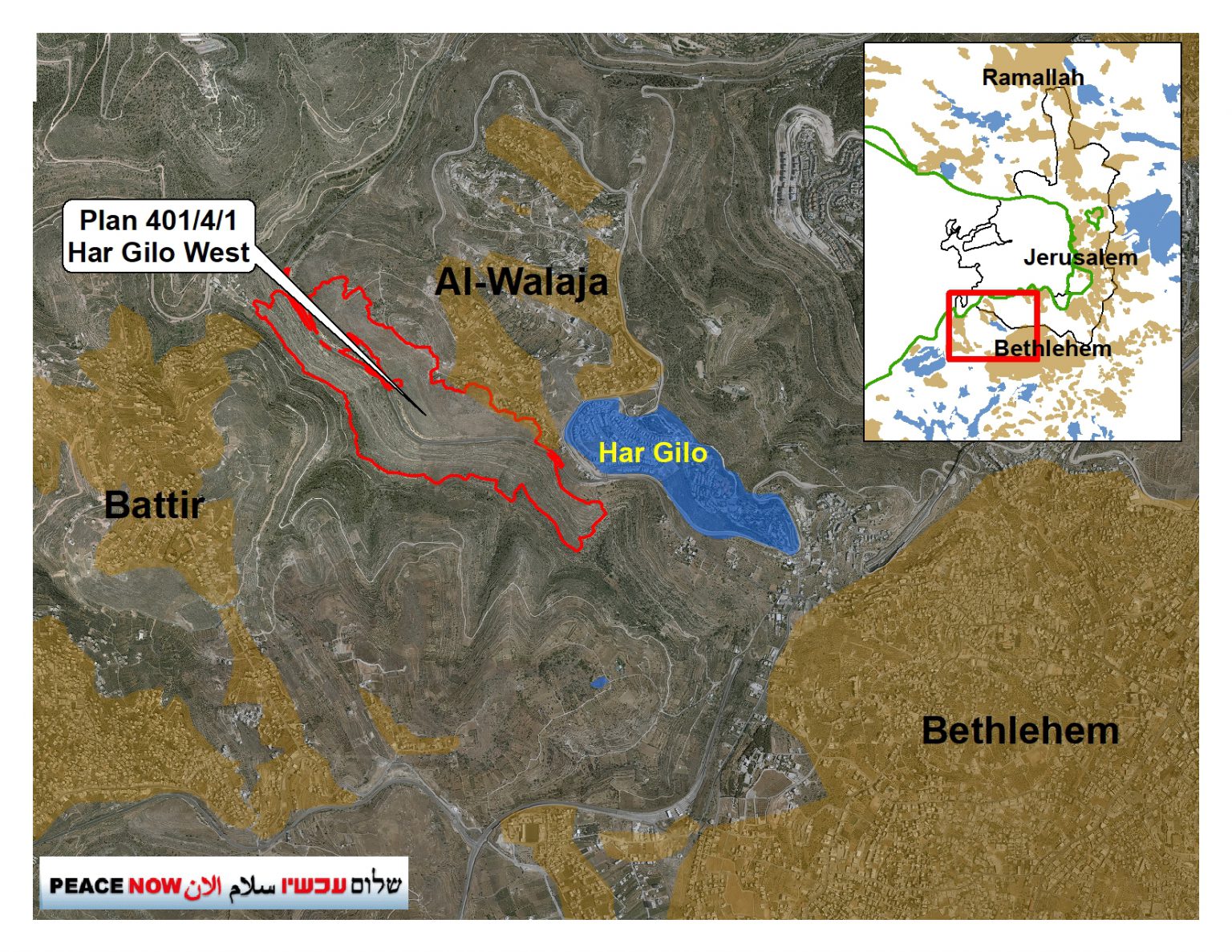 The High Planning Council approved for public deposit a plan to build 560 units at the Har Gilo West settlement site, located just south of Jerusalem. The Council is treating this plan as merely an expansion of the existing Har Gilo settlement, but in actuality it represents the construction of a new settlement on Jerusalem’s southern border, as the two areas of construction (Har Gilo and Har Gilo West) would not be contiguous. The plan for 560 units in Har Gilo West is part of a larger plan to construct around 952 units in the new settlement, extending the its borders right up to the Jerusalem municipal boundary, with dire consequences for the long-beleaguered Palestinian village of Al-Walajah.
The discussion on October 14th further revealed that, in order to build Har Gilo West, Israel plans to extend the separation barrier in that area to completely encircle al-Walajah, which is surrounded on three sides by the separation wall already. The new section of the barrier would be a 7-meters high concrete slab along the western edge of the built-up area of Al-Walajah. That would leave Al-Walajah completely encircled by the separation barrier and Israeli construction beyond it.
Ir Amim explains:
“In the past decade a series of Israeli moves have taken over more and more of Al-Walaja land and gradually isolating it. These are now culminating with the intention to construct the new settlement on the land reserves on the western side of Al-Walaja and to extend the separation barrier so as to complete the encircling of the village. As Al-Walaja will turn into an isolated enclave which lacks an outline plan its residents will be especially vulnerable to increasing home demolitions and other Israeli sanctions. Since the village will separate the new settlement from the existing Har Gilo we are likely to see increasing Israeli actions against Al-Walaja and its residents which will put their future existence at risk.”
Peace Now writes:
“The current plan of 952 housing units to be advanced will create a brand new neighborhood that will be larger than the existing settlement, and will exploit the land cut off by the West Bank barrier to further break up the western Bethlehem metropolitan area, including the land connecting al-Walaja and the town of Battir, as well as Battir and Bethlehem. This land also constitutes some of the only uninhabited fertile land reserves for Bethlehem, which currently is cut off by the West Bank barrier to its immediate north and west.“
FMEP has repeatedly documented various Israeli efforts to seal off al-Walajah from Jerusalem. Residents of al-Walajah have fought the growing encroachment by the nearby Etzion settlement bloc and the Israeli government’s attempt to de facto annex the bloc as part of “Greater Jerusalem.” Ir Amim explains several prongs of this effort, including a particularly unbelievable section of Israel’s separation barrier planned to almost completely encircle the village, to turn its valuable agricultural land into an urban park for Jerusalem, and construction of a highway that will connect the Etzion settlement bloc to Jerusalem with Israeli-only bypass roads.
Two Outposts Advance Towards Retroactive Legalization
The High Planning Council approved for deposit two plans that would, if implemented, have the effect of retroactively legalizing two outposts – bestowing upon those outposts legitimacy in the eyes of Israeli law and, in effect, establishing two new, official settlements. Those plans are:
- Pnei Kedem: A plan to grant retroactive legalization to 120 units in the Pnei Kedem farm outpost by recognizing the outpost as a “neighborhood” of the Metzad/Asfar settlement. This is despite the fact that the two areas of construction are non-contiguous. Pnei Kedem is located halfway between Bethlehem and Hebron in the southern West Bank. Settlers were particularly gleeful about this plan being advanced
- Tapuach West: A plan to grant retroactive legalization to 133 units in the Tapuach West outpost, located south of Bethlehem.
Not Just Residential Units – Council Advances Settler Tourism & Infrastructure Projects
The High Planning Council also advanced plans for the construction of new settlement projects that support tourism, further entrench the permanency of settlements, and that continue the exploitation of West Bank land and resources.
The Council granted final approval to:
- A plan for new shops and an educational site (to include an agricultural farm) in the Kochav Yaakov settlement – located between Jerusalem and Ramallah; and,
- A plan to grant retroactive authorization to a motor park and 120 hotel rooms in the Petza’el settlement, located in the Jordan Valley. As FMEP has covered in the past, this state-of-the-at racetrack and hotel complex is being built partially on land that the Israeli army previously declared a closed firing zone, a designation which resulted in the forcible displacement of Palestinians who lived there. The land remains under this designation today. Rather than halting the construction of this complex, the Israeli authorities instead created a Master Plan for the area in order to enable even more construction in the area.
Plans the Council granted final approval for public deposit include:
- A plan for an industrial zone near the Mishor Adumim settlement; and,
- A plan to build a new commercial area and 50 hotel rooms in the Maale Adumim settlement;
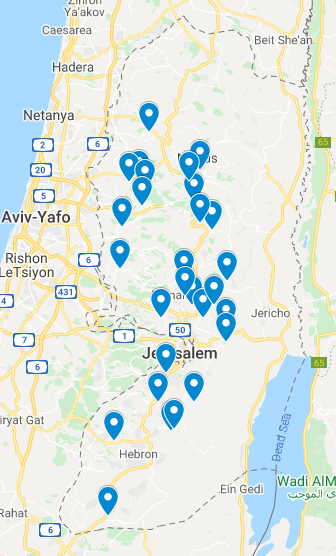
Map by Ben White (@benabyad)
Included in the total number of units receiving final approval and/or retroactive legalization (3,028 units) are (in descending order of number of units): [map]
- 382 units in the Beit El settlement, located in the heart of the northern West Bank. This includes retroactive legalization for 36 units which had been previously built without authorization and the construction of 346 units in highrise buildings with 9 or 10 floors (building up, not out in Beit El) [as a reminder, US Ambassador to Israel David Friedman has deep ties to the Beit El settlement];
- 357 units in the Geva Benyamin (Adam) settlement, located just north east of Jerusalem, just beyond the separation barrier. Israel has been steadily building the Adam settlement in a manner meant to unite the settlement more seamlessly with East Jerusalem settlements and infrastructure, erasing the Green Line;
- 354 units in the Nili settlement, located in the northern West Bank;
- 213 units in the Shiloh settlement, including the retroactive legalization of 21 units built without required approvals. The Shiloh settlement is located in the central West Bank;
- 211 units in the radical and violent Yitzhar settlement, including some retroactive authorizations (exact number not specified) as well as approval for public buildings. Yitzhar, located just south of Nablus, is associated with the Hilltop Youth movement – and a string of illegal outposts in the area associated with repeated attacks on Palestinians and their property;
- 205 units in the Nokdim settlement (actually approved for the Kfar Eldad settlement, which is officially within the jurisdiction of Nokdim), located south of Bethlehem;
- 200 units in the Metzad settlement (also known as Asfar), including the retroactive legalization of an unspecified number of existing units built without necessary approvals;
- 160 units in the Kochav Yaacov settlement, located east of Ramallah;
- 140 units in Kerem Reim settlement – located north west of Ramallah. Peace Now has repeatedly challenged the illegal construction of the Kerem Reim outpost, which the Israeli government retroactively legalized by declaring it a neighborhood of the Talmon settlement even though the areas are non-contiguous. Though a court rejected one Peace Now petition, there is an ongoing case against the Amana settler organization which Peace Now alleges engaged in illegal activities to build the outpost;
- 132 units in Kfar Adumim settlement – located east of Jerusalem and less than one mile from the Khan al-Ahmar bedouin community which the state of Israel is seeking to demolish;
- 106 units in the Ma’ale Shomron settlement, located east of the Palestinian village of Qalqilya;
- 84 new units in the Shima settlement, including retroactive legalization of 14 existing units;
- 74 units in the Yakir settlement – located in the northern West Bank and part of a string of settlements and unauthorized outposts – most notably Ariel – extending from the Green Line deep into the West Bank;
- 64 units in the Telem settlement – located west of Hebron;
- Retroactive legalization of 18 units in the Psagot settlement – located east of Ramallah, and home to the Psagot Winery;
- Retroactive legalization of 2 units in the “Givon Hadasha” settlement;
Plans which were approved for deposit for public review include (in descending order of number of units):
- 629 units in the Eli settlement, including the retroactive legalization of 61 units – located south of Nablus and southeast of the Ariel settlement in the central West Bank. Though the Eli settlement previously received Israeli government approval, a “Master Plan” – which officially zones land for distinct purposes (residential, commercial, public) – has never been issued for Eli, meaning all construction there is illegal under Israeli law;
- 560 units in the Har Gilo settlement located just south of Jerusalem (covered in detail above);
- 286 units in the Har Bracha settlement – located just south of Nablus. If implemented, these new units will double the size of Har Bracha;
- 179 units in the Einav settlement – located northwest of Nablus;
- 148 units in the Rimonim settlement – located between Ramallah and Jericho in the Jordan Valley;
- A plan to grant retroactive legalization to 133 units in the Tapuach West outpost, thereby granting approval to the outpost itself (discussed above);
- A plan to grant retroactive legalization to 120 units in the Pnei Kedem outpost by recognizing the outpost as a “neighborhood” of the Metzad/Asfar settlement although the two areas of construction are non-contiguous. Pnei Kedem is located between Bethlehem and Hebron in the southern West Bank;
- 82 units in the Karnei Shomron settlement – located in the northern West Bank east of the Palestinian village of Qalqilya. Israel is planning to continue expanding Karnei Shomron with the stated goal of bringing 1 million settlers to live in the area surrounding the settlement.;
- 75 units in the Shimaa settlement, including the legalization of 14 units previously built without authorization;
- 52 units received retroactive legalization in the Kfar Adumim settlement;
- 35 units in the Efrat settlement – located south of Bethlehem. As a reminder, Efrat is located inside a settlement block that cuts deep into the West Bank. Efrat’s location and the route of the barrier wall around it, have literally severed the route of Highway 60 south of Bethlehem, cutting off Bethlehem and Jerusalem from the southern West Bank. The economic, political, and social impacts of the closure of Highway 60 at the Efrat settlement (there is literally a wall built across the highway) have been severe for the Palestinian population;
- 14 units (in one building) in the Maale Mikmash settlement – located east of Ramallah;
- 10 units in the Barkan settlement – located about half way between the Ariel settlement and the cluster of settlements slated to be united into a “super settlement” area (Oranit, Elkana, Shiva Tikva, and others).
- 7 units in the Peduel settlement – located in the northern West Bank and part of a string of settlements and unauthorized outposts – most notably Ariel – extending from the Green Line into the very heart of the West Bank and on towards the Jordan Valley; and,
The High Planning Council met only after settlers, who represent a key ally of the embattled Prime Minister, pressured Netanyahu to allow it. Settlers have spent months decrying what they understood to be a freeze on settlement constructed inflicted upon them by Netanyahu. Gush Etzion Regional Council Head Shlomo Ne’eman said:
“Sometimes we take our prime minister to task, which we feel is justified as a result of our disappointment in postponing the application of sovereignty over our country. But now something tangible is happening – we are building and developing our communities, and of course, the highlight of today is the full registration in the Land Authority of the young community of Pnei Kedem, 20 years since it was established.”
Samaria Regional Council head Yossi Dagan said:
“This is a happy day for Samaria. [New construction] in Har Bracha, Yitzhar, Einav and Tapuach is another step on the way to a million residents in this beautiful region of the country…While we’re very content with today’s developments, I call on the Prime Minister not to stop here. We’re overfilled with joy, but it is a drop in the ocean with sovereignty falling off the agenda. The expectation now is that construction and strengthening of the settlement movement will increase tenfold.”
Peace Now responded to the approvals in a statement saying:
“While Israel reels from its second lockdown and economic distress, Netanyahu is promoting construction in isolated settlements that Israel will have to evacuate. Instead of taking advantage of the agreements with the Gulf states and promoting peace with the Palestinians, he is distorting Israel’s priorities and catering to a fringe minority for these settlement unit approvals that will continue to harm future prospects for peace. We call on the Defense Minister and the Alternative Prime Minister Benny Gantz to veto these plans. Far from a ‘settlement freeze,’ the right has been complaining about, the expected settlement approvals announcement next week prove that the settlement enterprise under Netanyahu is moving ahead at full steam toward solidifying the de facto annexation of the West Bank. The move also will be the first major demonstration of Defense Minister Benny Gantz’s bowing to the ‘Greater Israel’ settlement agenda that would in reality bring about a permanent undemocratic one-state reality. By doing so, Israel will be signaling to the world its bi-partisan support for the end to the concept of a two-state solution and a Palestinian state – the paradigm that until now has largely shielded Israel from formal pressure over its 53-year occupation. The settlement enterprise is not in Israel’s national or security interest, and is a strategic mistake at the international level.”
Palestinian Prime Minister Mohammed Shtayyeh denounced the approvals, saying:
“Every settler unit constitutes a plan to annex our land.”
Palestinian Authority spokesman Nabil Abu Rudeineh said in a statement:
“We warn against this Israeli policy that will lead the region to the brink of the abyss, and we call on the international community to intervene immediately and urgently to pressure the Netanyahu government to stop this settlement madness that totally eliminates any real opportunity to achieve a just and comprehensive peace to end the occupation and establish the independent Palestinian state with East Jerusalem as its capital on the 1967 borders.”
UN High Representative Josep Borrell said in a statement:
“In recent days, Israel has announced a significant expansion of settlements in the occupied West Bank, in areas in and around Jerusalem. These plans, which foresee the construction of close to 5.000 housing units, jeopardise the viability and territorial contiguity of a future Palestinian State as the outcome of a negotiated two-state solution, in line with the internationally agreed parameters. Settlements are illegal under international law. As stated consistently, the EU will not recognise any changes to the pre-1967 borders, including with regard to Jerusalem, other than those agreed by the parties. Settlement activity threatens current efforts to rebuild trust, to resume civil and security cooperation between Palestinians and Israelis and to prepare the ground for an eventual resumption of meaningful and direct negotiations. The Government of Israel should reverse these decisions and halt all continued settlement expansion, including in East Jerusalem and sensitive areas such as Har Homa, Givat Hamatos and E1. The period from March to August 2020 also saw a spike in demolitions or confiscations of Palestinian-owned structures in the West Bank in spite of the COVID-19 pandemic. The EU reiterates its call on Israel to halt all such demolitions, including of EU-funded structures, in particular in light of the humanitarian impact of the current pandemic. Against the background of normalization of relations between Israel, UAE and Bahrain, Israelis and Palestinians should seize this opportunity and take urgent steps to build confidence and restore cooperation along the line of previous agreements and in full respect of international law.”
A spokesperson for UN Secretary-General Antonio Guterres issued a statement flagging concern over the advancements, saying:
“We are concerned about the reports of Israel’s settlement advancements in the occupied West Bank and will continue to follow developments closely, as the Israeli High Planning Committee finalizes its meetings tomorrow. The Secretary-General has consistently reiterated that all settlements are illegal under international law and remain a substantial obstacle to peace. We urge the Israeli authorities to refrain from such unilateral actions that fuel instability and further erode the prospects for resuming Palestinian-Israeli negotiations on the basis of relevant UN resolutions, international law and bilateral agreements.”
Plan for 570 Units in East Jerusalem Settlement Approved for Deposit
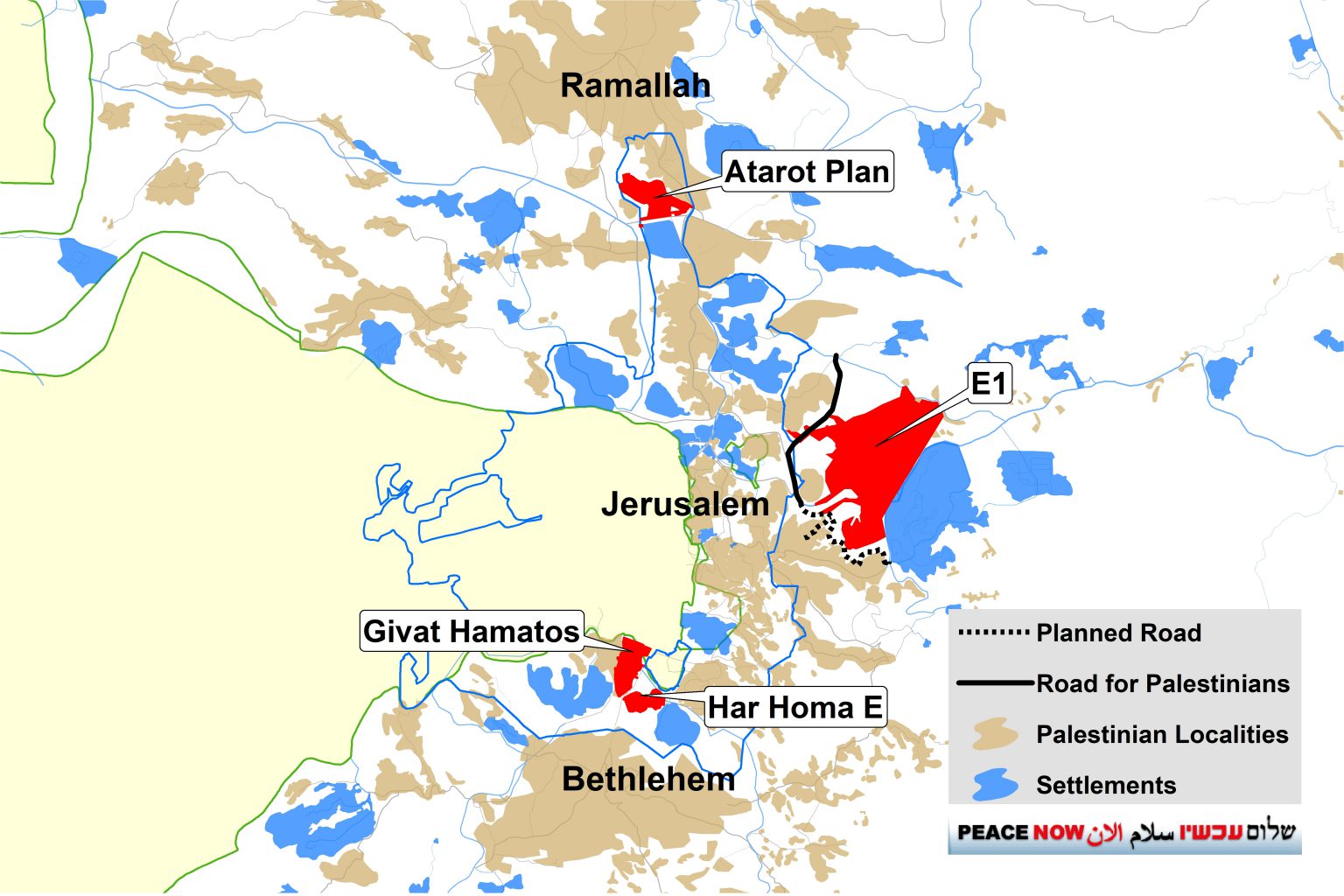 Ir Amim reports that on September 22nd, the Jerusalem District Committee approved for deposit for public review a detailed plan providing for the construction of 570 units in the Har Homa E settlement, located in East Jerusalem. Taken together with the pending construction of the nearby Har Gilo West settlement (discussed in the section above), the Palestinian village of al-Walajah stands to be completely encircled by Israeli settlements.
If implemented, this plan will extend the Har Homa settlement westward, in the direction of the site of the as-of-yet-unbuilt Givat Hamatos settlement. Ir Amim explains:
“If realized, Har Homa E together with construction in Givat Hamatos will connect Har Homa to Gilo creating a contiguous Israeli settlement area that will disconnect East Jerusalem from Bethlehem and the south of the West Bank.”
Ir Amim also reminds us that the Jerusalem District Committee previously approved a Master Plan for a total of 2,200 units in Har Homa E. The plan for 570 units approved for deposit in late September represents the first detailed plan under this Master Plan allows for. Plans to build the remaining units permitted under the Master Plan are not yet being advanced.
Israel Approves Construction of Elevator at Tomb of the Patriarchs
Emek Shaveh reports that on September 29th the Civil Administration granted final approval to a plan to build accessible infrastructure, including an elevator, at the Ibrahimi Mosque/Tomb of the Patriarch in Hebron — a plan which requires Israel to seize land from the Islamic Waqf. As of this writing, Emek Shaveh is considering whether to challenge that approval.
Regarding the significance of the plan, Emek Shaveh said:
“One need not be an archaeologist or architect to review the council’s plan and understand that it is destructive in a manner which is unprecedented. We are convinced that the plan, as approved, would never have been promoted had it not been driven by political motives.”
Emek Shaveh has previously provided critical context as to why this plan is not really, or not fully, being advanced out of humanitarian concerns, explaining:
“Israel’s decision to seize responsibility for the site from the Hebron municipality and the Palestinians sends a clear political message that Israel is reneging on agreements that were signed with the Palestinians in Hebron. Beyond the precedent that will enable the settlers in the future to demand additional changes at the Tomb of the Patriarchs/Ibrahimi Mosque, this is also a precedent that could play out at other sites under the responsibility of the Islamic Waqf. Experience has shown us that what begins in Hebron percolates into other places including Jerusalem. It begins with a seemingly rational demand to benefit the disabled or the general public and evolves into a new status quo. The expected change in Hebron has not escaped the attention of members of the Temple movement and they will know how to present their demands to the government. If Israel can repudiate agreements with the Palestinians in Hebron and expropriate land from the Waqf, it would seem that accepting what appears to be the far more modest demands by the Temple movement to pray or to walk about the Temple Mount complex freely is not so far-fetched. In the reality of Hebron and East Jerusalem, a change involving only several meters at a historic or holy place is not free of political considerations and often it is part of long-term strategy. While it is necessary to tend to the needs and interests of persons with disabilities, the extremists who presume to speak on their behalf must be prevented from forging Israeli policy, even if it is only a matter of a lift and an access path.”
Read Emek Shaveh’s full analysis here: “Humanitarianism Hebron Style.”
Israel Delivers Confiscation Notices to Palestinians Living in the Heart of Hebron
The Palestinian media outlet WAFA news reports that several Palestinians living in the Tel Rumeida section of downtown Hebron were handed confiscation notices from the Israeli authorities, informing them that the State of Israel had confiscated 17 plots of land, including land privately owned by Palestinians.
Tel Rumeida is a part of Hebron located directly in the city center, considered H2 by the Hebron Accords giving Israel full control of security in that area. B’Tselem estimates that there are around 700 settlers living in enclaves amongst approximately 34,000 Palestinians in H2. The Israeli army heavily protects those settlers, and has implemented an apartheid system of segregated movement and checkpoints, most notably in the area of Shuhada Street.
Palestinians Report Newly Established Outposts & Land Confiscations
The Palestinian news outlet WAFA reports that settlers have installed three new outposts over the past month – one near Nablus and a second near Hebron, and a third in the Jordan Valley.
Near Nablus, Palestinians report that the settlers installed mobile homes and a small farm in an attempt to establish a permanent presence on a new plot of land. The settlers are reportedly in the process of connecting the new outpost to the Elon Moreh settlement via roads and water supply. Ghassan Daghlas, who monitors Israeli settlements on behalf of the PLO, told WAFA that the specific area has seen even wider road construction recently, which he sees as an effort to create more seamless contiguity between settlements in the Nablus area and the Jordan Valley. The construction comes at the direct expense of the Palestinian village of Beit Dajani, which has historically owned the land where the outpost and roads are being built.
Near Hebron, WAFA reports that an Israeli settler erected a tent with and Israeli flag on privately owned Palestinian land near the Birin village.
In the Jordan Valley, WAFA reports that settlers set up a caravan on land on which they began planting trees about three months ago. The settlers also reportedly dug a well at the site.
On October 15th, Israel reportedly announced its intention to confiscate large tracts of land (11,000 dunums) adjacent to the Jordan Valley settlements of Rotem, Maskiyot, and Mesovah. This confiscation, according to Palestinian settlement watcher Qasem Awwad, was presented by the Israeli authorities as a move to add land to natural reserve areas, but seems clearly to be linked to efforts to expand settlements and their control over land in the area.
Targeting Palestinians Construction in Area C: State Devotes $6 million to Mapping Program
Despite COVID and the suspension of Israeli’s unilateral annexation of vast tracts of land in the West Bank, the Israeli government — at the urging of settlers and their allies — is continuing its push to consolidate its control over all aspects of life in Area C (the over 60% of the West Bank that is under full Israeli control).
OCHA has documented an acceleration in the Civil Administration’s demolition of Palestinian structures in the West Bank over the summer, documenting the demolition of 389 Palestinian-owned structures in Area C of the West Bank. As a result of those demolitions, 442 Palestinians were made homeless. OCHA further reported that In just the month of August, 205 Palestinians lost their homes, the highest single month total since January 2017. In addition, Israel continues to issue more demolition notices, including against Palestinians living in a cave near Jenin, and against a newly constructed school for bedouin children located east of Ramallah.
To further this effort, on September 10th the Israeli government allocated $6 million USD (20 million NIS) for the newly created Settlement Affairs Ministry to survey and map unauthorized Palestinian construction in Area C of the West Bank, which Israel and its settlers have been aggressively demolishing in an effort to rid the area of Palestinians. Haaretz reports that this is the first time that the state budget has included funds specifically for a land survey in the West Bank. The state also allocated an additional $2.8 million (9.5 million NIS) to an existing grant program specifically for settlement municipalities to cash in on. As a reminder, virtually all Palestinian construction in Area C of the West Bank is unauthorized, because Israel almost universally refuses to give Palestinians permission to build in Area C even on land that Israel recognizes as owned by Palestinians.
The Settlement Affairs Ministry is a new creation of the current coalition government, and is headed by Tzachi Hanegbi (Likud). The funding for the Settlement Affairs Ministry to conduct a survey of unauthorized Palestinian construction in Area C further empowers a domestic Israeli body to exert extraterritorial sovereignty over Area C – in effect, treating the area as land already de facto annexed by Israel. While technically the occupied territories are administered by the Israeli Civil Administration (a body within the Defense Ministry), Israel has spent decades bringing the administration of the territories (specifically the settlements and Area C) ever more directly under direct Israeli sovereignty (de facto annexation).
In the lead up to the allocation of funds for this new survey of Palestinians life in Area C, the Knesset hosted two committee discussions the political outlook of which was clearly indicated in the stated subject of the meetings: “the Palestinian takeover of Area C.” Consistent with this framing (which is predicated on the idea that Area C belongs to Israel), and pushed by outside groups, many members of the Knesset have criticized the Israeli government’s allegedly lackadaisical approach to preserving State interests in Area C (i.e., clearing out Palestinians, expanding settlements, consolidating state infrastructure). Reportedly, Foreign Affairs Minister Gabi Ashkenazi (Blue & White) sent a letter to the committee specifically addressing the Knesset’s outrage over European humanitarian assistance projects for Palestinians in Area C. In the letter, Ashkenazi not only celebrated the reduction of European projects over the past year, but validated settlers’ insinuations regarding the nefarious nature of European assistance for Palestinians, saying that any European activity in the West Bank lacking Israeli permission is “an attempt to define a border.” Ashkenazi also said that Israel will not compensate European donors for confiscated equipment or the demolition of European-funded projects that lack Israeli permission (like in the case of schools built with European funding, and solar panels donated to bedouin communities lacking power).
At one Knesset hearing, MK Bezalel Smotrich (Yamina) suggested that a solution could be to empower the settlements with the ability to demolish Palestinian construction they believe to be unauthorized. Smotrich’s partymate Ayelet Shaked (former Justice Minister) suggested that the government should appoint a project manager tasked with preventing a Palestinian takeover of Area C.
As noted above, Israel has long denied Palestinians the ability to build in Area C. To fully understand what is happening, it is worth reviewing B’Tselem’s excellent explainer:
“Israel’s planning and building policy in the West Bank is aimed at preventing Palestinian development and dispossessing Palestinians of their land. This is masked by use of the same professional and legal terms applied to development in settlements and in Israel proper, such as “planning and building laws”, “urban building plans (UBPs)”, “planning proceedings” and “illegal construction”. However, while the planning and building laws benefit Jewish communities by regulating development and balancing different needs, they serve the exact opposite purpose when applied to Palestinian communities in the West Bank. There, Israel exploits the law to prevent development, thwart planning and carry out demolitions. This is part of a broader political agenda to maximize the use of West Bank resources for Israeli needs, while minimizing the land reserves available to Palestinians….
In the West Bank, the potential for urban, agricultural and economic development remains in Area C. Israel uses its control over the area to quash Palestinian planning and building. In about 60% of Area C – 36% of the West Bank – Israel has blocked Palestinian development by designating large swathes of land as state land, survey land, firing zones, nature reserves and national parks; by allocating land to settlements and their regional councils; or by introducing prohibitions to the area now trapped between the Separation Barrier and the Green Line (the boundary between Israel’s sovereign territory and the West Bank).
Even in the remaining 40% of Area C, Israel restricts Palestinian construction by seldom approving requests for building permits, whether for housing, for agricultural or public uses, or for laying infrastructure. The Civil Administration (CA) – the branch of the Israeli military designated to handle civil matters in Area C – refuses to prepare outline plans for the vast majority of Palestinian communities there. As of November 2017, the Civil Administration had drafted and approved plans for only 16 of the 180 communities which lie in their entirety in Area C. The plans cover a total of 17,673 dunams (1 dunam = 1,000 square meters), less than 1% of Area C, most of which are already built-up. The plans were drawn up without consulting the communities and do not meet international planning standards. Their boundaries run close to the built-up areas of the villages, leaving out land for farming, grazing flocks and future development. Since 2011, seeing that the Civil Administration did not draft plans as it is obliged to do, dozens of Palestinian communities – with the help of Palestinian and international organizations and in coordination with the PA – drafted their own plans. Some of the plans covered communities or villages located in full in Area C and others covered places only partly in Area C. As of September 2018, 102 plans had been submitted to the Civil Administration’s planning bodies, but by the end of 2018, a mere five plans – covering an area of about 1,00 dunams (or about 0.03% of Area C) – had received approval.
The odds of a Palestinian receiving a building permit in Area C – even on privately owned land – are slim to none. Given the futility of the effort, many Palestinians forgo requesting a permit altogether. Without any possibility of receiving a permit and building legally, the needs of a growing population leave Palestinians no choice but to develop their communities and build homes without permits. This, in turn, forces them to live under the constant threat of seeing their homes and businesses demolished.
The impact of this Israeli policy extends beyond Area C, to the hundreds of Palestinians communities located entirely or partially in Areas A and B, as the land reserves for many of these communities lie in Area C and are subject to Israeli restrictions there.
The demand for land for development has grown considerably since the 1995 division of the West Bank: The Palestinian population has nearly doubled, and the land reserves in Areas A and B have been nearly exhausted. Due to the housing shortage, much land still available in these areas is used for residential construction, even if it is more suited for other uses, such as agriculture.
Without land for construction, local Palestinian authorities cannot supply public services that require new structures, such as medical clinics and schools, nor can they plan open spaces for recreation within communities. Realizing the economic potential of Area C – in branches such as agriculture, quarrying for minerals and stone for construction, industry, tourism and community development – is essential to the development of the entire West Bank, including creating jobs and reducing poverty. Area C is also vital for regional planning, including laying infrastructure and connecting Palestinian communities throughout the West Bank.
In contrast to the restrictive planning for Palestinian communities, Israeli settlements – all of which are located in Area C – are allocated vast tracts of land, drawn up detailed plans, connected to advanced infrastructure, and the authorities turn a blind eye to illegal construction in them. Detailed, modern plans have been drawn up for the settlements, including public areas, green zones and, often, spacious residential areas. They enjoy a massive amount of land, including farmland that can serve for future development.
Israel’s policy in Area C is based on the assumption that the area is primarily meant to serve Israeli needs, and on the ambition to annex large parts of it to the sovereign territory of Israel. To that end, Israel works to strengthen its hold on Area C, to further exploit the area’s resources and achieve a permanent situation in which Israeli settlements thrive and Palestinian presence is negligible. In doing so, Israel has de facto annexed Area C and created circumstances that will leverage its influence over the final status of the area.”
In First, Palestinian Authority Courts to Hear Lawsuits Against Settlers
For the first time since the Palestinian Authority was established in 1994, it will allow Palestinians to bring lawsuits against Isareli settlers in Palestinian courts. The Palestinian Authority’s Justice Minister Mohammed al-Shalaldeh announced that the PA had formed a national team to handle these cases, and the team was already working to collect evidence and file suits against settlers who have committed crimes against Palestinians in Hebron and in the village of Burin, located just south of Nablus.
Until this point, no Israeli citizen has been tried in a Palestinian court. Under the Oslo Accords (which established the Palestinian Authority), the Palestinian Authority holds no jurisdication over Israeli citizens – including Israeli citizens living in the West Bank. In May 2020, PA President Mahmoud Abbas announced that the PA considers all accords and agreements with Israel to be void following Israel’s announcement that it intends to annex large parts of the West Bank in accordance with the Trump Plan. Shalaldeh said that the announcement this week flows directly from Abbas’s decision to free the PA from the Oslo Accords’ provisions.
Explaining how these cases might work, Shalaldeh said:
“The Israeli side will be notified as an occupying power to appear before the Palestinian court…If the [Israeli] side refuses the jurisdiction of the Palestinian courts, formal procedures will be followed and in absentia rulings will be issued, in accordance with Palestinian laws.”
JNF, Elad Face International Heat Over Sumreen Family Eviction Case – Will it Matter?
Over the past month, international audiences have directed heightened scrutiny towards the radical settler group Elad and the Jewish National Fund (JNF) for the role both organizations have played in spearheading the effort to evict the Palestinian Sumreen family from their home in the Silwan neighborhood of East Jerusalem. Due to the new attention, the JNF is reportedly reconsidering whether or not to carry out the eviction of the Sumreens – an eviction which the organization has pursued since 1991.

Map by Haaretz
JNF donors – along with activists, religious leaders, members of Congress, and Israel prize winners – reportedly began to express concern and outrage over the JNF’s role in the Sumreen case following the September 2020 ruling by Jerusalem Magistrate’s Court against the Sumreen’s claim to the home. In response to the criticism, the JNF (via actions by the Board of its subsidiary organization, Himnuta, which was created to take the lead for JNF in litigating aggressive settlement takeover cases like this) has acted to freeze the eviction process internally, and was scheduled to consider a proposal for freezing the formal legal proceedings against the Sumreens this past week. Himnuta’s decision and deliberations caused conflict with Elad, which had the Jerusalem Magistrate’s Court intervene to postpone Himnuta’s Board meeting to discuss the proposal. Elad argues that Himnuta transferred all legal authority over the Sumreen case to their organization, and cannot now interfere in the proceedings. The meeting was subsequently postponed at the request of the Court.
Elad is also coming under new international scrutiny following the revelation that Roman Abramovitch – a Russian oligarch and naturalized Israeli citizen who also is one of the owners of the renowned Chelsea football club – is Elad’s single largest donor, having anonymously donated over $100 million to the settler group over the past 13 years. The BBC produced an investigative feature report on Abramovitch’s connection to Elad, pointing out that over the past 15 years more than half of Elad’s funding has come from offshore companies in the Caribbean, which are now known to be owned or controlled by Abramovitch. The BBC feature connects Elad to the settlers’ struggle to evict the Sumreen family, and the larger effort to replace Palestinians in Silwan with Jewish Israelis.
Peace Now writes:
“The news about Abramovich’s involvement highlights the injustice Palestinians face at the hands of these settlement groups. Impoverished families are up against the financial weight of a Russian oligarch. NGOs trying to protect these families are delegitimized and their work dismissed for receiving funding from democratic European aid agencies while settler groups rake in vast sums of non-transparent money from offshore Caribbean shell companies. And the JNF is profiting off of all of this. We can’t force Abramovich to stop his funding or the JNF to stop abetting Elad in its settling campaign, but we can make them worry about their reputation. Peace Now has been conducting a campaign inside Israel to call Abramovich out for his devious funding.”
Regarding the revelations of Elad’s funding source, Emek Shaveh writes:
“…the Elad Foundation, through a combined strategy of sponsoring excavations, developing tourism and settling in Palestinian homes, succeeded in recreating Silwan as the Jewish neighbourhood of Ir David (City of David) and one of the most popular tourist destinations in the country. The exploitation of archaeological tourism by the Elad Foundation has become a number one strategy for entrenching Israeli sovereignty over historic Jerusalem. “
The Sumreen family home is located in the middle of what today has been designed by Israel “the City of David National Park.” The area is managed by the radical Elad settler organization, which for years has also been pursuing the eviction of Palestinians from the homes in Silwan. For nearly three decades, the Sumreen family has been forced to battle for legal ownership of their home, after the state of Israel, prompted repeatedly by the JNF, declared the Sumreen’s home to be “absentee” property. After that designation – which was not communicated to the Sumreen family – Israeli law permitted the state to take over the rights to the building. The state then sold the rights to the home to the JNF in 1991. The JNF has pursued the eviction of the Sumreen family ever since. Israeli courts ruled in favor of the Sumreen family’s ownership claims to the home for years, until a September 2019 ruling by the Jerusalem Magistrate’s Court granted ownership of the family’s home to the JNF, a decision the family immediately appealed to the Jerusalem District Court.
A full history of the saga involving the Sumreen family – which is similar to dozens of other Palestinian homes in Silwan that were declared Absentee Property in the 1990s – can be found on the Peace Now website here.
Report: U.S. Will Not Back De Jure Annexation Until 2024 [But Friedman Says 2021 Is in Play]
A series of reports in mid-September suggested that, as part of its commitment to the U.A.E. in exchange for normalization with Israel, the U.S. promised to withhold its recognition of Israeli annexation until January 2024, at the earliest.
The 2024 timeline harkens back to a concept in Trump’s “Deal of the Century” which gave (oh so generously) the Palestinians a four year window to enter into negotiations with Israel on the basis of the Trump Plan’s conceptual map.
Following these reports regarding a 2024 timeline for the U.S. greenlighting Israeli annexation, U.S. Ambassador David Friedman (who has been a champion of annexation) told Israel’s Army Radio that annexation can happen next year. Friedman, pushing back on U.A.E. press leaks seeking to promote the notion that the Abraham Accords stopped annexation, said:
“We said in our statement that sovereignty will be postponed, and this does not mean that it has been abolished, but rather that it has stopped. It has been suspended for a year, maybe more, but it has not been cancelled.”
Bonus
- “Tourism in the Service of Occupation” (Al-Shabaka)
- “The Status Quo on the Temple Mount/Haram Al Sharif: Dodging a Bullet (For Now)” (Terrestrial Jerusalem)
- “How Evangelicals Working in Settlements Bypassed Israel’s COVID-19 Entry Ban” (Haaretz)
- “ The March of Folly in the Settlements Continues” (Haaretz)
- “Israeli Students in State-funded Scholarship Program Guard Illegal West Bank Outposts” (Haaretz)
Welcome to FMEP’s Weekly Settlement Report, covering everything you need to know about Israeli settlement activity this week.
To subscribe to this report, please click here.
January 4, 2019
- Israel Advances Plans for 2,191 New Settlement Units – Including Establishing 2 New Settlements & Laying Groundwork for 2 New Settlement Industrial Zones
- Based on New Legal Tools to Take Palestinian Land, Israel Announces Intention to Build A New Settlement (“Givat Eitam/E-2”) Near Bethlehem
- Following High Profile Political Support, Settlers Violently Resist Evacuation from Amona Outpost Site
- Knesset Speaker & Leaders Call for Annexation of Hebron
- Regavim Petitions Jerusalem District Court to Stop the EU-Backed “Arab Takeover” of Area C
- Knesset Lawyer Criticizes Bill to Give Palestinian Land to the World Zionist Organization
- Sheldon Adelson’s Medical School in Ariel Settlement May Not Open
- Bonus Reads
Questions/comments? Email kmccarthy@fmep.org
Israel Advances Plans for 2,191 New Settlement Units – Including Establishing 2 New Settlements & Laying Groundwork for 2 New Settlement Industrial Zones

Map on Twitter by @JacobMagid
During its final meetings of 2018 (held on December 26th and 27th), the Israeli Civil Administration High Planning Council advanced plans for a total of 2,191 new settlement units. Peace Now reports that 87% of the settlement plans advanced are located deep inside of the West Bank, far beyond any of the negotiated parameters for a border between Israel and a future Palestinian state.
The flood of settlement approvals includes plans that will effectively create two new settlements (by legalizing the unauthorized outposts of Ibei Hanachal and Gva’ot, detailed below) and establish two new settlement industrial zones (one near the Beitar Illit settlement and one near the Avnei Hefetz settlement). Another plan, for an educational campus and a gas station, will serve to connect the unauthorized outpost of Mitzpeh Danny to a nearby settlement (Ma’aleh Mikhmash) – paving the way towards the eventual legalization of that outpost, creating yet another new settlement.
Of that total, plans for 1,159 units were given final approval for construction – meaning building permits can be issued immediately. These include
- 220 new units in the Givat Ze’ev settlement;
- 180 new units in the Neveh Daniel settlement;
- 135 new units in the Tene settlement;
- 120 new units in the Karmei Tzur settlement;
- 129 new units in the Avnei Hefetz settlement (where plans to build a new, noncontiguous industrial zone nearby were also advanced – see below);
- 61 new units in the Tzofim settlement;
- 42 new units in the Alfei Menashe settlement;
- 55 new units in the Tomer settlement;
- 18 new units in the Adora settlement;
- 16 new units in the Metzad settlement;
- 1 new units in the Shilo settlement; and,
- 62 new units in the Ma’aleh Mikhmash settlement;
-

Map by Peace Now
A plan to build an educational campus and a gas station between the Malakeh Mikhmash settlement and the unauthorized outpost of Mitzpeh Danny. Peace Now writes, “Although this is not a residential program, these buildings also qualify as the establishment of a new settlement complex in the West Bank. The plan covers 140 dunams and will create a permanent presence of hundreds of Israeli students and teachers…During the discussion it was noted that the Mateh Binyamin Regional Council is preparing a plan to regulate the outpost.”
- A plan to build a cemetary on an area of “state land” south of the Palestinian city of Qalqilya. The area used to be a closed firing zone, but that military designation was rescinded years back, and the site has since been the subject of settlement planning. Peace Now writes, “The planned cemetery is likely to be the first component on the road to the establishment of an industrial zone, which is also a type of settlement.”
Settlement plans that were advanced through earlier stages of the planning process include:
-
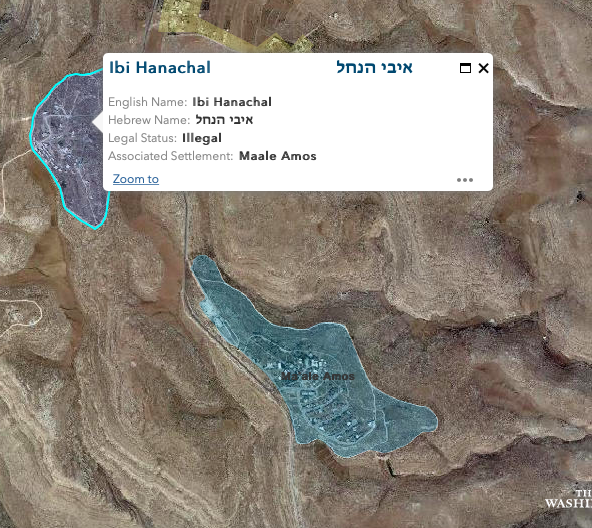
Map by WINEP
A plan for 98 units in the unauthorized Ibei Hanachal outpost, which will turn the outpost as a “neighborhood” of the Maale Amos settlement. In reality, the outpost is not contiguous with the built-up area of the Maale Amos settlement, meaning that the implementation of this plan will, in effect, create a distinct new settlement.
- A plan for 61 new units in the unauthorized Gva’ot outpost, an outpost originally built in 1999 by the settlers as a “neighborhood” of the Alon Shvut settlement. The settlers built a yeshiva there, but abandoned it not long after. The new settlement plan is for a public building, likely an educational institute with housing.
- 82 new units in th Ofra settlement. FMEP reported on this plan in the Dec 14th edition of the Settlement Report, in conjunction with the litany of punitive settlement plans advanced by Israel in response to terror attacks. The area where the new units are slated to be built is land that was allegedly purchased by the settlers from its original Palestinian owners.
- Plans for two new settlement industrial zones, one near the Beitar Illit settlement and one near the Avnei Hefetz settlement. The latter industrial zone, called Bustani Hefetz, will cover a large area of land (some 730 dunams) and will not be not contiguous with any other settlement. Peace Now writes, “an industrial zone of this scope, which is cut off from any other settlement, in all actuality constitutes a new settlement.”
- 121 new units in the Yitzhar settlement, where the IDF has been trying to rein in the violence perpetrated by the “Hilltop Youth” settlers, who are based in Yitzhar.
- 152 new units in the Shavei Shomron settlement.
- 212 new units in the Har Bracha settlement.
- 94 new units in the Beit Haggai settlement.
- A plan to legalize 75 existing settlement units in the Shvut Rachel settlement, which Israel considers a “neighborhood” of the Shiloh settlement.
- 100 new units in the Halamish settlement.
Peace Now released a statement saying:
“In 2018, the government advanced thousands of housing units, including most which can be found in isolated settlements deep inside the West Bank that Israel will eventually have to evacuate. Those who build these places have no intention of achieving peace and a two-state solution. The latest announcement, which as an aside was cynically passed on Christmas while most Western governments are on holiday, shows that Netanyahu is willing to sacrifice Israeli interests in favor of an election gift to the settlers in an attempt to attract a few more votes from his right-wing flank.”
Top Palestinian negotiator, Saeb Erekat, released a statement saying:
“While the world is celebrating Christmas with its spirit of peace and joy, the Grinch ‘occupation’ decided to steal the Christmas spirit from the people of Palestine. As part of his early election campaign, the Israeli Prime Minister Benjamin Netanyahu has as well stolen more Palestinian land and resources for the benefit of Israel’s illegal colonial settlement expansion. Such illegal actions are a deliberate campaign to destroy the two-state solution and to prevent the establishment of an independent and sovereign State of Palestine with East Jerusalem as its capital.”
Tamar Zandberg, head of the Meretz Party, slammed the new announcements, and previous decisions taken by the government to retroactively legalize 60 outposts. Zandberg said:
“The Israeli government has become a settlement government. (MKs Bezalel) Smotrich, Moti Yogev, (Justice Minister) Shaked and (Education Minister) Bennett are its landlords. They exploit the (Palestinian) attacks to build more settlements. But the truth needs to be said. To achieve security we need to evacuate settlements, not build more and more…”The 60 new settlements are the real threat to Israel’s security and to IDF soldiers. The pogroms they are waging in Palestinian villages. The stone-throwing, the shooting and the uprooting of the trees. This is the danger to our moral image and our security! They eight seats of Habayit Hayehudi party dictate eight million lives.”
Based on New Legal Tools to Take Palestinian Land, Israel Announces Intention to Build A New Settlement (“Givat Eitam/E-2”) Near Bethlehem
On December 26th, the Israeli Civil Administration announced that it will draft plans to build as many as 2,500 new settlement units at the Givat Eitam outpost site, creating a new settlement on a strategic hilltop that will cut off Bethlehem from the southern West Bank, completing the near encirclement of Bethlehem by Israeli settlements.
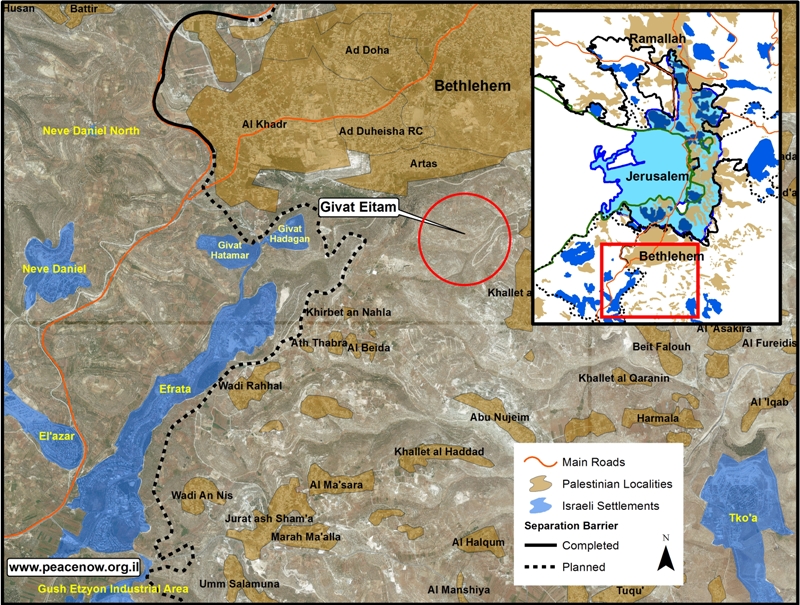
Map by Peace Now
For years, settlers have lobbied for construction at the site, but those efforts have been stymied by the lack of a legal access road to the outpost, which is surrounded by land that even Israel recognizes is privately owned by Palestinians. Until recently, Israel has balked at seizing private land from Palestinians for the exclusive benefit of the settlements. But now, several new legal opinions have allowed Israel to violate the private property rights of Palestinians for the sole purpose of legalizing settlements and settlement infrastructure. Those legal opinions include the “market regulation” principle, the opinion(s) regarding the Haresha outpost case, and the Regulation Law. It is unclear which legal argument will be applied to the Givat Eitam/E-2 case.
The Givat Eitam outpost has been nicknamed “E-2” by settlement watchers for for its resemblance, in terms of dire geopolitical implications, to the infamous E-1 settlement plan. Located east of the separation barrier on a strategic hilltop overlooking the Palestinian city of Bethlehem to its north, Givat Eitam/E-2 is located within the municipal borders of the Efrat settlement but is not contiguous with Efrat’s built-up area, making Givat Eitam/E-2 effectively a new settlement that, according to Peace Now, will:
“block Bethlehem from the south, and prevent any development in the only direction that has not yet been blocked by settlements (the city is already blocked from the North by the East Jerusalem settlements of Gilo and Har Homa, and from the West by the Gush Etzion Settlements) or bypass roads (that were paved principally for Israeli settlers). The planned building in area E2 would likely finalize the cutting off of Bethlehem city from the southern West Bank, delivering a crushing blow to the Two States solution.”
In September 2018 FMEP reported that the local council of the Efrat settlement encouraged the start of (unauthorized) construction of an outpost at the Givat Eitam/E-2 site (presuming that any such illegal construction would be retroactively legalized by the government) in response to a Palestinian terror attack in the Efrat settlement. Since then, the Civil Administration has allowed the settlers to build and maintain an agricultural farm there.
FMEP tracks all developments related to Israeli legislative, cabinet, and judicial action that promotes the retroactive legalization of outposts built on privately owned Palestinian land as part of its documentation of creeping annexation – available here.
Following High Profile Political Support, Settlers Violently Resist Evacuation from Amona Outpost Site
On January 3rd, 23 Israeli police officers were injured by Israeli settlers and their supporters who violently resisted the court-ordered evacuation from illegal encampments erected on privately owned Palestinian land as part of an effort to re-establish the Amona outpost. Approximately 300 settlers showed up at the Amona site (which is currently a closed military zone) overnight to resist the removal of settlers and two caravans from the hilltop, which was ordered by the Jerusalem District Court. The settlers and their supporters burned approximately 300 tires at the entrance to the outpost, poured oil on the access roads, and threw rocks and boulders at the Israeli police. Seven suspects were arrested and quickly released.
The evacuation of the outpost was reportedly carried out in defiance of a direct order from Prime Minister Netanyahu. According to the Haaretz report, Netanyahu gave orders to the Israeli military secretary, Col. Avi Bluth, to stop the evacuation. Col. Bluth did not relay the message in time, and the evacuation was carried out. Now, Netanyahu has ordered a disciplinary hearing to investigate the actions of Col. Bluth, which is scheduled for January 4th.
The violent evacuation of settlers from the Amona hilltop follows a week of high profile support for their efforts. Israeli Cultural Minister Miri Regev attended a ceremony near the recently re-established (yet unauthorized) Amona outpost to express her support for authorizing construction on the hilltop – which, according to the Israeli High Court of Justice, is privately owned Palestinian land. Regev could not go to the actual Amona site, because the area is a closed military zone where no one (settlers, politicians, and even the Palestinians who own the land) is permitted to enter. Regev and the settlers claim that the hilltop land has been legally purchased by the settlers, but that claim has not been investigated, much less verified. Casting doubt on the settlers’ claims, Haaretz notes:
“The lot in question is jointly owned by several different Palestinians, which means every single one of them would have to consent to the purchase for it to be legal. It’s not clear which, if any, of these Palestinians signed the sale document. In the end, the land was designated military land, is zoned for agriculture and has no building permits.The Binyamin Regional Council didn’t await the administration’s decision before moving two prefab homes into Amona and providing basic infrastructure such as water tankers.”
Israeli Attorney General Avichai Mandleblit slammed the settlers for trespassing and illegally moving caravans onto the site. Mandelblit criticized MK Bezalel Smotrich and the heads of regional settlement councils who went to the site to express support, saying:
“Breaking the law with the support of public figures, like placing caravans on privately-owned lands, can’t be a source of pride.”
A Haaretz report recently revealed Bezalel Smotrich was a founding member of a non-governmental group called Ofek Lehityashvut, which directly financed the illegal reestablishment of the Amona outpost last month by purchasing the two caravans that settlers moved onto the hilltop. The Haaretz report goes on to reveal that the Benyamin Regional Council has purposefully tailored various calls for proposals so that Ofek Kehityashvut would be the only group qualified to receive financing for that project. As a result of that manipulation, Ofek Kehityashvut has received substantial amounts of funding from the Benyamin REgional Council, which is an Israeli-taxpayer funded entity.
Knesset Speaker & Leaders Call for Annexation of Hebron
The speaker of the Israeli Knesset, Yuli Edelstein (Likud), called for Israel to apply its sovereignty over the city of Hebron – which would constitute an act of de facto annexation. Edelstein released a statement announcing his intention to go on a tour of Hebron – where some 500-800 settlers live under Israeli military protection amongst 200,000+ Palestinians – with the far-right, pro-annexationist group Im Tirzu. In the statement he wrote:
“In my view, it’s delusional that some Knesset members dare to undermine the Jewish people’s right to dwell in the city of our forefathers,” Edelstein said in a press statement issued prior to the conference. “We’re developing Hebron, investing in it and inculcating its importance in future generations. We are saying clearly – sovereignty in Hebron first.”
Speaker Edelstein also participated in a conference highlighting Israel’s historic connection to the city of Hebron. Organized by the Knesset Land of Israel Lobby, the event culminated in the signing of a document that reads:
“We, the undersigned, hereby express deep solidarity with the roots of the Jewish people in Hebron and the support of the Jewish community in Hebron that has clung to the city despite all the difficulties. We declare an unambiguous commitment to the continued existence, security and prosperity of Hebron as the city of both our forefathers and children.”
The event was co-organized by MK Bezalel Smotrich (Jewish Home) who said:
“Hebron is a litmus test. What is happening in Hebron shows our Jewish pulse….[those who call for settlers to leave Hebron] understand very well that if Hebron grows and develops, the entire settlement enterprise will grow and develop, so they invest in harming Hebron. But they will continue to shout and complain while we will continue to build, reach the people and connect with our roots.”
Regavim Petitions Jerusalem District Court to Stop the EU-Backed “Arab Takeover” of Area C
Following the Knesset’s passage of a bill in July 2018 that brought many West Bank legal matters under Israel’s domestic jurisdiction (an act of de facto annexation), the Jerusalem District Court is set to hear its first case concerning land disputes in the occupied territory. The bill was sponsored by Israeli Justice Minister Ayelet Shaked, whose three-fold rationale for the bill explicitly states that its purpose is to help settlers take more Palestinian land and shut-down Palestinian challenges to such thefts — by bringing matters to the Jerusalem Court instead of the High Court of Justice, which Shaked believes is too concerned with Palestinian rights and international law. The bill is part of the legislative body’s broader effort to erase all remaining distinctions (legal, judicial, economic, and otherwise) between sovereign Israel and the occupied territories, distinctions which allowed Israel to preserve the guise of respect for rule of law, and good intentions, for the last 50 years.
Looking to cash in the bill’s explicit purpose, the radical settler group Regavim initiated the petition asking the court to intervene to stop the “illegal Arab takeover” of land in the West Bank. Regavim’s petition claims that Palestinians are cultivating “state land” near the Mezad settlement. The petition also blames the European Union for its financial backing for the agricultural projects on the land. (Note: Regavim, like most settler media outlets, uses the word “Arab” to describe Palestinians, a vocabulary choice meant to erase any recognition of Palestinian identity).
A coordinator for Regavim told the Arutz Sheva outlet:
“The intervention of the European Union in what is happening in Area C is a brazen and aggressive intervention. We see extensive involvement on their part in lawbreaking and invading state land throughout Judea and Samaria. Their symbols are everywhere, and the State of Israel must respond to this blatant intervention on the diplomatic level as well.”
Shlomo Ne’eman, head of the Gush Etzion Regional Council said:
“The direct involvement of the European Union in financing Arab squatters in the territories and state lands has already become a plague on the state. We congratulate Justice Minister Ayelet Shaked on the obvious step that has led to great logic and justice in reducing the burden on the Supreme Court and in uniform enforcement against the land grabs by hostile elements…the Arabs understand that the real battle is on the ground. Foreign countries with their money are trying to shape a false consciousness and finally change the map of the state, but nothing can change history and our natural belonging on our national land.”
FMEP tracks the application of domestic Israeli law over the occupied West Bank (the de facto annexation of the West Bank) on its Annexation Policy Tables, which are regularly updated.
Knesset Lawyer Criticizes Bill to Give Palestinian Land to the World Zionist Organization
The legal advisors to the Knesset Constitution, Law and Justice Committee criticized a bill that would transfer vast tracts of land in Area C of the West Bank to the Settlement Division of the World Zionist Organization (WZO), a quasi-private state-funded entity that works to establish and expand settlements in the West Bank. Despite pressure to pass the bill, the legal advisors called on the committee to reexamine the text over concerns that it would also give the WZO authority over Palestinian communities in Area C. The experts wrote in a legal opinion for the committee:
“The proposed definitions of ‘rural settlement’ and ‘land’ do not include references to the character and nature of the settlement, and it seems that land that is government or abandoned property intended for Palestinian rural settlement will also be included in the boundaries of the proposed arrangement, and will be transferred to the management of the Settlement Division. Is the intention of the bill that the Settlement Division will also manage the Palestinian rural settlement in the area?”
As FMEP has previously reported, the bill was proposed by MK Bezalel Smotrich (Habayit Hayehudi) to accelerate the transfer of almost all of the land in Area C to the control of the World Zionist Organization. The land transfer is, in fact, taking place at the bureaucratic level, but Smotrich and the Israeli Cabinet (which endorsed the bill) are increasingly frustrated by the slow pace of the transfer (and perhaps also the limited scope of land slated to be handed over). Israeli Attorney General Avichai Mandelblit expressed his opposition to the bill, saying it is unnecessary given that ministry staffs are already working to transfer more land to the WZO through an administrative process.
In June 2018, when the Knesset gave preliminary approval to the bill, Peace Now responded:
“the government is scandalously planning to give the biggest land thieves responsibility for managing the land distribution, which will continue to be done under the cover of darkness if the bill passes into law.”
For more information on this bill, read a comprehensive background briefing by Peace Now.
Sheldon Adelson’s Medical School in Ariel Settlement May Not Open
The state-of-the-art medical school planned to be built in the Ariel settlement is now in danger of not opening, after a letter from the Israeli Justice Ministry warned that the school’s approval is in jeopardy. The Justice Ministry discovered an undisclosed conflict of interest that voids an important vote in favor of approving the school by the planning and budgeting subcommittee of the Higher Education Council. A member of the subcommittee, Dr. Rivka Wadmany-Shauman, allegedly met with the heads of Ariel University ahead of the vote, and made her approval of the new medical school conditional on being promoted to the rank of professor. Israel Hayom reports the Ariel University has already shelved plans to inaugurate the new school for its first semester in the Fall of 2019.
As FMEP has previously reported, Ariel University became an accredited Israeli university in 2012, following significant controversy and opposition, including from Israeli academics. It has since been the focus of additional controversy, linked to what is a clear Israeli government-backed agenda of exploiting academia to normalize and annex settlements. In 2018, the settlement broke ground on the new medical school, with significant financial backing from U.S. casino magnate and settlement financier, Sheldon Adelson. In February 2018, in an act of deliberate de facto annexation, the Israeli Knesset passed a law that extends the jurisdiction of the Israeli Council on Higher Education over universities in the settlements (beyond Israel’s self-declared borders), ensuring that the Ariel settlement medical school (and its graduates) are entitled to all the same rights, privileges, and certifications as schools and students in sovereign Israel.
As a reminder, Ariel is located in the heart of the northern West Bank, reaching literally to the midpoint between the Green Line and the Jordan border. The future of Ariel has long been one of the greatest challenges to any possible peace agreement, since any plan to attach Ariel to Israel will cut the northern West Bank into pieces.
Bonus Reads
- “Israeli settlements threaten to engulf West Bank communities” (Al-Monitor)
- “Israeli settlement activity appears to surge in Trump era” (AP)
- “It Pays Off to be an Israel Settler, Whether Trespasser or Landowner” (Haaretz+)
- “In the West Bank, the Israeli army works for the settlers” (Haaretz)
- “Netanyahu’s pro-settler allies force annexation into campaign agenda” (Al-Monitor)