Welcome to FMEP’s Weekly Settlement Report, covering everything you need to know about Israeli settlement activity this week.
To receive this report via email, please click here.
March 9, 2018
- New Settlement in Hebron
- Palestinians Protest Rumored Plan to Unite & Expand Settlements Near Qalqilya
- High Court Reviewing Government Practice of Paying Off Settler Law-breakers
- Israel’s New West Bank Commander Promises to Defend the Settlements
- Documents Reveal: Government Funds Are Going to Unauthorized Outposts
- Israel Admits Theft of Spring was Carried out Illegally, Promises Court to Steal it Properly
- EU Report Shows Major Acceleration in Settlement Planning
- Settlement-Related AIPAC Conference Happenings
- Bonus Reads
Comments, questions, or suggestions? Email Kristin McCarthy at kmccarthy@fmep.org.
New Settlement in Hebron
Signaling the start of construction on what is effectively a new settlement in Hebron, settlers have moved four caravans onto a site located around a kilometer from the border fence of the radical Kiryat Arba settlement, on a site designated to become a new industrial zone for the settlement. The Civil Administration (a branch of the Israeli Army which is the sovereign ruling power in the occupied West Bank), told the press that the new industrial zone is being built on land seized decades ago by Israel as “state land,” according to a plan approved in “accordance with procedures.”
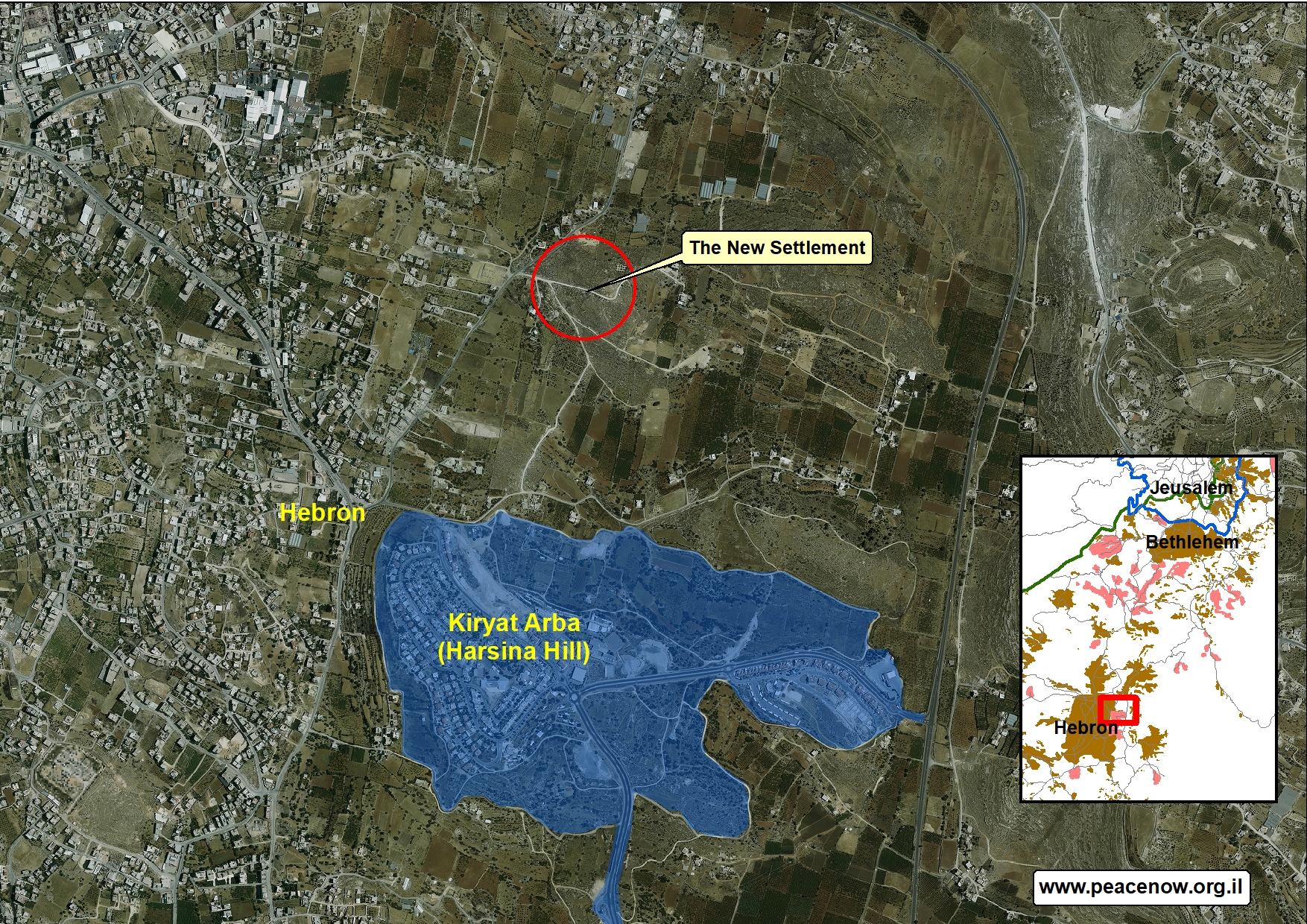
Map by Peace Now
The anti-settlement watchdog organization Peace Now disputes the Civil Administration assessment of the project. Peace Now notes that the project takes advantage of a plan for the Kiryat Arba settlement that was approved 30 years ago (in 1988), but never executed — and that present day realities are much different than they were 30 years ago. Peace Now notes, too, that the project is located well outside of the developed lines of the settlement and beyond the fence that surrounds it – making it, in effect, a new Israeli settlement in Hebron.
Peace Now said:
“This is Prime Minister Netanyahu’s gift to U.S. President Trump on the day of their meeting. For years, Israeli governments have refrained from establishing new settlements, especially in as sensitive a place as Hebron, but in recent months the Netanyahu government has permitted settlement activity without restraint and has taken steps that undermine the chances of a two-state solution. The new settlement near Hebron is liable to cause significant harm to the lives of dozens of Palestinian families who live nearby who are expected to suffer new security arrangements that will restrict their freedom of movement and harm the daily fabric of their lives.”
OCHA recently published a timely new report titled, “The Humanitarian Impact of Israeli Settlements in Hebron City.” The Kiryat Arba settlers and their security arrangements in the city are important contributing factors to the combined humanitarian toll settlements take on Palestinian residents of Hebron, whose entire lives – including freedom of movement, ability to engage in commerce, and access to education – are acutely strangled by the presence of Israeli settlers.
Palestinians Protest Rumored Plan to Unite & Expand Settlements Near Qalqilya
Since FMEP’s initial report on February 2018, scant further details have emerged regarding Israel’s rumored plan to unite four settlements near Qalqilya into a super settlement, thereby significantly expanding the collective footprint and population of those settlements. Nonetheless, Palestinian fears are growing about the plan’s implementation, which the governor of Qalqilya Rafi Rawajba recently called “state terror.”

Map by WINEP
Qalqilya residents have long held weekly protests against Israeli settlement expansion and the separation wall (while in some areas the separation barrier is composed of fencing, the city of Qalqilya is surrounded on all sides by a high cement wall, with only a narrow opening left for access into the rest of the West Bank). This past week, the Israeli army violently dispersed the protests, reportedly using rubber coated bullets, tear gas, and stun grenades.
The plan to unite and expand Qalqilya-area settlements should be understood alongside the July 2017 political battle that ultimately killed the implementation of a plan to build new homes and infrastructure for Palestinians in Qalqilya, which in addition to being surrounded by the Israeli separation wall is also the West Bank’s most densely populated city. The plan – which was formulated and defended by Israeli Defense Minister Avigdor Liberman, would have granted Israeli permission to the Palestinian Authority to double the size of Qalqilya by building on land in Area C (the 60% of the West Bank where the Palestinian Authority is not allowed to operate).
High Court Reviewing Government Practice of Paying Off Settler Law-breakers
The High Court of Justice temporarily blocked the Israeli government from offering monetary compensation to residents of illegal settlement outposts whose homes are demolished by the government of Israel. Such homes were built illegally according to Israeli law, and oftentimes on privately owned Palestinian land. The ruling ordered the government to submit a defense of the practice by March 12th.
The High Court’s ruling is in response to a petition filed by Israeli lawyer Shachar Ben Meir that specifically challenges the legality of Israel’s decisions to pay-off settlers evicted from the outposts of Amona and Ofra, as well as a recently approved pay-off for Netiv Ha’avot outpost settlers. None of those pay-offs have actually been transferred to date, and the ruling this week freezes the government’s ability to do so.
Ben Meir told the Times of Israel:
“The state cannot compensate building offenders for their homes being demolished when they built without a permit on land that wasn’t theirs. And if it decides to do so, it must be according to rules that are equal to everyone.”
It is worth noting that when it comes to “illegal” Palestinian construction in East Jerusalem – that is, construction on land owned by Palestinians but for which Israel has not (and generally will not) approve plans for building — Israel not only doesn’t compensate them financially for their loss, but it charges them for the cost of the demolition unless they demolish their own home first (called a self-demolition).
Israel’s New West Bank Commander Promises to Defend the Settlements
In a transfer of power ceremony this week, Major General Nadav Padan was sworn in as the new head of the Israeli Defense Force Central Command, becoming the highest ranking Israeli official in charge of all Israeli affairs in the West Bank. In his speech, Padan committed to “enabling a [high] quality of life for both Israelis and Palestinians while maintaining the rule of law and the spirit of the IDF.”
The outgoing commander also gave a speech at the ceremony, in which he embraced and praised the the settler population as a whole, while admonishing settlers leaders, saying:
“Regrettably, there is still a small handful of settlers challenging authorities as well as law and order. I urge you to continue to act and denounce this group”
Maj. Gen. Padan takes over the West Bank after serving previously as, among other things, the top general leading Israel’s incursion into Gaza during the summer of 2014, known in Israel as “Operation Protective Edge.” That assault lasted 50 days, during which Israel lost 66 soldiers and four civilians, while according to the United Nations, 2,131 Palestinians were killed, of which 1,473 were civilians, 501 were children, and 257 were women.
Documents Reveal: Government Funds Are Going to Unauthorized Outposts
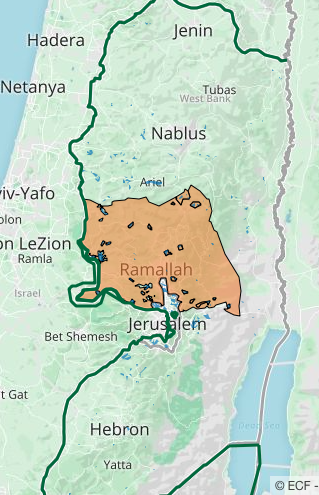
Map by the Economic Cooperation Foundation (ECF)
In response to a freedom of information request filed by Peace Now, the Israeli government released a trove of documents revealing that the Binyamin Regional Council – which receives government funding – has been funding infrastructure in far-flung outposts built without authorization and therefore considered illegal according to Israeli law (all settlement activity – whether or not it is permissible under Israeli law – is illegal under international law). The Binyamin Regional Council is the largest settler regional council and acts as a governing body officially representing 42 settlements (and unofficially many illegal outposts), covering a large area starting just north of Jerusalem and reaching almost to Nablus.
The government data shows that the Council spent $1.9 million over a three-year period to finance 24 projects in illegal outposts, including access roads, youth clubs, temporary homes, and two preschools. All of the projects lack permits (issuance of permits would be impossible, since the outposts themselves are unauthorized).
Avi Roeh, the elected head Binyamin Regional Council, defended the projects – telling Haaretz:
“every community located on state land, and this is true for these places such as Kida, Adi Ad, Esh Kodesh, etc., we intend on legalizing them. It is taking its time and in the meantime there are children and families there”
Peace Now Settlement Watch Director Shabtay Bendet responded:
“The Mateh Binyamin Regional Council is supposed to be the one to enforce the law and act according to it. Not only does it not enforce [the law], it funds and promotes illegal projects with our public funds. No police investigation has been opened on the matter. We call on the legal authorities to open an investigation.”
Israel Admits Theft of Spring was Carried out Illegally, Promises Court to Steal it Properly
This week Israeli government admitted to the Jerusalem District Court that permits were issued illegally to relocate a military checkpoint near the city of al-Walajah in order to prevent Palestinians from accessing a historic natural spring (See FMEP’s Feb. 22nd Settlement Report for more details on the scandal surrounding construction of the new checkpoint). Though admitting that the permits were granted illegally, the government suggested it was merely a bureaucratic glitch that would be fixed in short order, and asked the High Court to allow construction of the checkpoint to continue while it corrects the problem (that is, gets the permits to steal the spring issued properly). The Court ordered the State to explain the steps it will take to rectify the matter (that is, to get the proper permits in order) and will rule on the petition against the spring at some date in the future.
Ghaith Nasser, the lawyer representing al-Walajah residents in the case, told Haaretz:
“I think that what happened in this case is a scandal. They want the court to give legal validity to an outrage whose entire management from beginning to end is stained by blatant illegality…When the court is asked to approve such a thing despite all the faults, the role of the court is to champion the principle of the rule of law and explain that this isn’t how it’s done.”
Notably, FMEP reported last week that Justice Minister Ayelet Shaked has recently installed a settler-aligned judge to the Jerusalem District Court, which is hearing this case. The judge, Haya Zandberg, previously headed a government committee tasked with retroactively legalizing outposts and in two cases “adopted a creative pro-settler legal position that contradicted the views of both the Justice Ministry and the Israel Defense Forces’ legal adviser in the West Bank” according to Haaretz.
EU Report Shows Major Acceleration in Settlement Planning
The European Union recently published its regular report on Israeli settlement activity in the second half of 2017. That report documents a “three- to four-fold increase in advancement of housing units through plans and the issuance of tenders compared to 2016.”

Graph by the EU
All told, if the plans advanced during the latter half of 2017 materialize on the ground, housing will be created for potentially 23,000 additional settlers in the West Bank and East Jerusalem.
The report specifically highlights the creation of a new settlement in Hebron, the first since 2002, and the construction of large-scale road projects that are proposed to connect Israeli settlements more seamless to Israel.
The report is part of the European Union’s efforts to monitor and inform its member states about Israeli settlement growth, and to assist its member states in differentiating between economic dealings with Israel and Israeli settlements, consistent with international law and EU policy.
Settlement-Related AIPAC Conference Happenings
For the blissfully unaware, the annual AIPAC conference was held this week in Washington, D.C. It drew big-name U.S. administration officials, members of Congress, and Israeli lawmakers and leaders including Prime Minister Netanyahu. And those big names made some big headlines.
A few events/happenings pertinent to settlement observers include:
- Prominent settler leader Yossi Dagan (head of the Yesha Council, a settler umbrella group) wrote a letter to AIPAC decrying AIPAC’s assertion that Israel supports a two-state solution. Dagan asserts that Israel does not support such a solution. Dagan’s anger was quickly echoed by scads of Israeli lawmakers, including Likud MKs and members of the right-wing Israel Land Caucus. The Times of Israel has a great summary of the event and the new dynamics, titled “As AIPAC is out-hawked by Trump, settlers reevaluate ties to the pro-Israel lobby.”
- On the sidelines of AIPAC, the Israeli Ministry of Strategic Affairs joined with the Yesha Council to host an event to “combat the delegitimization of Israel through the embrace of Judea & Samaria.” The event was attended by Education Minister Naftali Bennett, Justice Minister Ayelet Shaked, Israeli Consul General in New York Dani Dayon, and Energy Minister Yuval Steinitz who said: “Israel cannot survive without its settlements.” J Street had a sharp response to the event, saying “This Israeli government thinks the way to combat delegitimization is to embrace settlements. Embrace. Settlements. This is patently absurd.”
- U.S. Ambassador and settlement financer David Friedman took to the stage on the last day of the conference to attack J Street and its motto, “pro-Israel, pro-peace.” He argued that such a motto suggests that some people are both pro-Israel and anti-peace, and that “It is no less than blasphemous to suggest that any Jew or any Christian is against peace and that’s just not a matter of religious belief.” Implied in his remark, it seems, is that only Muslims are capable of being anti-peace. His full remarks are available here.
- Senate Minority Leader Chuck Schumer told the AIPAC crowd that “it’s sure not the settlements that are the blockage to peace,” after blasting Hamas for what happened after Israel pulled out from Gaza settlements. He went on to say, among many things, that there is no peace because Palestinians do not believe in the Torah.
Bonus Reads
- “What would the [“SOFTENED”] Israel Anti-Boycott Act Actually Do?” (FMEP) **U.S. settlement policy is impacted by this bill. Analysis written by FMEP’s Lara Friedman
- “In West Bank reality, annexation is a pipedream” (Times of Israel)
- “East Jerusalem Palestinians confront Israeli diggers over damaged to homes” (Middle East Eye)
Welcome to FMEP’s Weekly Settlement Report, covering everything you need to know about Israeli settlement activity this week.
To receive this report via email, please click here.
January 25, 2018
- Israeli Attorney General Supports Legalization of Radical Havat Gilad Outpost
- Settler Population Growth Rate Continues to Shrink, But Still Outpaces Growth Rate Inside the Green Line
- In a First, U.S. Embassy Invites Settlers to VP Pence’s Knesset Speech
- Bonus Reads
Comments, questions, or suggestions? Email Kristin McCarthy at kmccarthy@fmep.org.
Israeli Attorney General Supports Legalization of Radical Havat Gilad Outpost
Over the weekend, Israeli cabinet ministers declined to debate Defense Minister Avigdor Liberman’s proposed resolution to advance the retroactive legalization of the Havat Gilad outpost at the weekly cabinet meeting. The settler-run Arutz Sheva media outlet is reporting that even though the resolution was not debated, Ministers did discuss Havat Gilad and pressured Netanyahu to “regulate” it (i.e., make it legal) as part of the government’s response to a terror attack earlier this month which killed a resident of the outpost.
After the meeting, Justice Minister Ayelet Shaked announced via a tweet that Israeli Attorney General Avichai Mandelblit has given his support for a second resolution to retroactively legalize the Havat Gilad outpost, signaling that there is no legal impediment to moving forward with the plan. If true, this means the Attorney General has found a way to get around a growing body of historical documentation that should – under current Israeli law and precedent as it is understood – preclude the outpost from being retroactively legalized.
The history of the outpost, as documented and adjudicated by the Israeli government, should disqualify it from meeting the standards for retroactive legalization set out in the Regulation Law, a law passed in early 2017 that gives the Israeli government leeway to regulate settlement units and outposts that were built in good faith or with the consent of the state, and if Palestinian landowners are compensated. These condition do not appear to apply with respect to Havat Gilad, which was first established in early 2002, evacuated by the government of Israel (for being illegal) in October of that same year, only to be re-established nearby less than a year later. As detailed in a post by Dror Etkes, founder of the Israeli NGO Kerem Naboth, aerial photographs from 2001-2002 show that “the area over which the outpost currently spans was divided into dozens of plots that were well-cultivated,” clearly indicated privately-owned land.
Hence, the Regulation Law cannot be the legal underpinning on which Attorney General Mandelblit is relying on to support the retroactive legalization of the Havat Gilad outpost.. However, it is worth recalling that Mandelblit argued against the Regulation Law (which is expected to be struck down by the High Court of Justice) – not because he in principle opposed legalizing outposts, but because he believed there was a better, alternative legal mechanism to achieve the same goal that would pass High Court scrutiny. It is also worth recalling that shortly after submitting his argument against the Regulation Law, Mandleblit issued two key legal opinions: one in favor of the retroactive legalization of an access road to the Haresha outpost; and the second to support the retroactive legalization of the Ofra settlement sewage plant (which was “mistakenly” built on Palestinian land).
Though Mandelblit’s legal logic for supporting any of the cases remains unclear (and what that logic portends for the 70 other outposts that the government is seeking to legalize), it is clear that there are new avenues opening up to convert even the most far-flung, radical, and brazenly illegal outposts into permanent West Bank settlement facts-on-the-ground, at the expense of Palestinian landowners and the contiguity of a future Palestinian state.
Settler Population Growth Rate Continues to Shrink, But Still Outpaces Growth Rate Inside the Green Line
According to the Times of Israel, new Israeli government data (covering 150 West Bank settlements and outposts, but not East Jerusalem) shows that the settler growth rate has decreased for the sixth consecutive year, from 3.9% in 2016 to 3.4% in 2017 (the growth rate hit a high in 2008, at 5.8%). Even with this decline, the 3.4% settler population growth rate still outpaces Israel’s national average, which comes in at 2%. Moreover, the data show that settler population is far younger than the population inside the Green Line, with 47% of settlers being below the age of 18, compared to 27% of Israelis inside the Green Line.
A statement from the Yesha Council (the umbrella organization of municipal councils of Jewish settlements) blamed for the declining growth rate on what it called a “quiet freeze” on settlement construction in 2017, despite the fact that Peace Now chronicled an alarming acceleration of settlement activity in 2017.
In a First, U.S. Embassy Invites Settlers to VP Pence’s Knesset Speech
The U.S. Embassy sent out personal invitations to several prominent settler leaders to attend Vice President Mike Pence’s speech in the Israeli Knesset. Invitees included senior officers of the Yesha Council (he umbrella organization of municipal councils of Jewish settlements, which acts as the de facto lobby for the settlers). The Speaker of the Knesset, Yuli Edelstein, invited additional settlers to attend the speech as well.
In his speech, VP Pence did not mention the occupation or settlements, but only called on Palestinian leaders to return to the negotiating table.
Bonus Reads
- “How David Friedman is Putting His Right Wing Stamp of U.S. Foreign Policy Towards Israel” ( The Forward)
FMEP has long been a trusted resource on settlement-related issues, reflecting both the excellent work of our grantees on the ground and our own in-house expertise. FMEP’s focus on settlements derives from our commitment to achieving lasting Israeli-Palestinian peace, and our recognition of the fact that Israeli settlements – established for the explicit purpose of dispossessing Palestinians in the West Bank and East Jerusalem of land and resources, and depriving them of the very possibility of self-determination in their own state with borders based on the 1967 lines – are antithetical to that goal.
Welcome to FMEP’s Weekly Settlement Report, covering everything you need to know about Israeli settlement activity this week.
To receive this report via email, please click here.
January 19, 2018
- The Havat Gilad Outpost Saga Continues
- Defense Ministry Working to Retroactively Legalize 70 Outposts
- Bill to Annex Settlements into the Jerusalem Municipality Regains Steam
- First New Israeli Bypass Road in 11 Years Set to Open Near Qalqilya
- Dispossession in the Northern Jordan Valley: Settlements and outposts as part of the land grab process
- Human Rights Watch Report Slams Israeli Settlements
- Bonus Reads
Comments, questions, or suggestions? Email Kristin McCarthy at kmccarthy@fmep.org.
The Havat Gilad Outpost Saga Continues

Map by Haaretz
The bid to retroactively legalize the Havat Gilad outpost – home to the Israeli settler who was murdered January 9, 2018 – took several turns over the past week. Two days after the murder, Prime Minister Netanyahu ordered the Defense Ministry to connect the illegal outpost to the Israeli national power grid, a move that would require the kind of major infrastructure work that would entrench the outpost’s presence. On January 15th, Israeli Defense Minister Avigdor Liberman (who is himself a settler) presented a symbolic resolution to the Israeli cabinet that calls for the retroactive legalization for the Havat Gilad. The settler-run news outlet Arutz reported on January 18th that Netanyahu has decided the Israeli cabinet will not consider the resolution on Havat Gilad during its weekly meeting scheduled for this Sunday.
All of this comes amidst widespread and growing calls for the outpost to be legalized. Efforts to turn Havat Gilad into a legal settlement appear, however, to have hit a major snag. On January 15th, Israeli security sources reportedly told the government that the outpost is not eligible for legalization under Israel’s regulation law (specifically passed last year to give Israel a way to suspend the rule of law in order to legalize illegal outposts that could not be legalized any other way). The security sources explained that Havat Gilad was built almost entirely on land that the Israeli land registrar for the West Bank has documented as privately owned by Palestinians. Israeli recognition of Palestinian ownership of the land ostensibly makes Israel’s retroactive legalization of the outpost impossible; the constant evolution of Israeli laws and legal precedents that are crafted to pave the way for regulating all unauthorized Israeli settlement activity in the West Bank, however, suggest that where there is sufficient political will, rule of law (or even the semblance thereof) will not be allowed to stand in the way. In the waning weeks of 2017, the Israeli Attorney General submitted two highly consequential legal opinions (1 & 2) that validate Israeli expropriation of privately owned land for the exclusive benefit of settlers and the regulation of unauthorized outposts. So while regulating Havat Gilad might be impossible under current Israeli law and precedent, there is every reason to expect that this obstacle will be challenged and overcome.
Defense Ministry Working to Retroactively Legalize 70 Outposts
While the fate of the Havat Gilad outpost is occupying headlines, a leaked recording shed light on the Israeli Defense Ministry’s ongoing efforts to advance the retroactive legalization of 70 settlement outposts built illegally (according event to Israeli law) across the West Bank.
Israeli Deputy Defense Minister Ben Dahan was recorded bragging that the Defense Ministry has begun charting out a process to legalize the 70 illegal outposts, with a 4-5 person team working for the past six months to catalogue every outpost’s unique situation and to prescribe a course of action for each.
Around the same time this outpost team reportedly started its work, Israeli Attorney General Avichai Mandleblit forced Defense Minister Liberman to create a division in the Defense Ministry responsible for enforcing Israeli planning laws in settlements and outposts. It was also around this same time that the Israeli government offered its first defense of the Regulation Law to the High Court of Justice, which Liberman criticized vehemently, arguing that the law could legalize Palestinian construction as well as Israeli.
After the recording made headlines this week, Deputy Defense Minister Dahan was reprimanded and banned from participating in future government efforts to legalize outposts. Notably, the reprimand/ban appears to have little to nothing to do with the activities Dahan was engaged in (Israel’s Regulation Law was passed in order to legalize outposts, the Defense Ministry has a leading role in making that happen, and everyone knew the Ministry was forging ahead with that goal), and more to do with the fact that Dahan was caught bragging about the details of a process that Liberman apparently preferred to keep secret.
Bill to Annex Settlements into the Jerusalem Municipality Regains Steam
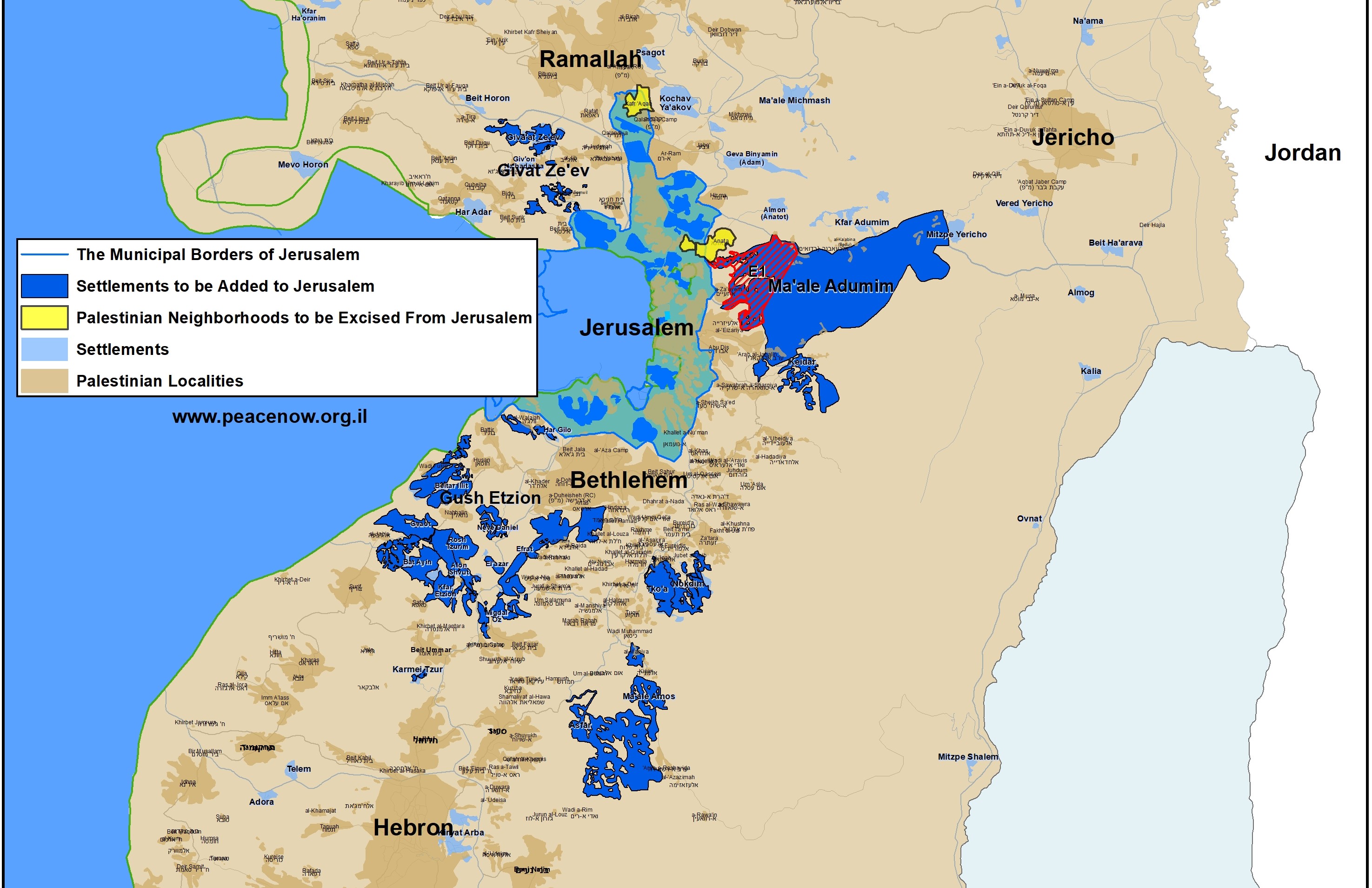
Map by Peace Now
Jerusalem expert Danny Seidemann’s NGO, Terrestrial Jerusalem, reports that the Greater Jerusalem bill – which seeks to annex far-flung settlements into the Jerusalem municipality, thereby de facto annexing a large part of the West Bank and gerrymandering a Jewish majority in the city – has renewed momentum.
In October 2017, Netanyahu backed down from advancing the controversial bill, reportedly under pressure from the Trump administration. Now, Netanyahu is once again coming under significant pressure from his own party (recall that on January 1, 2018 the Likud central committee voted in favor of a resolution calling on Netanyahu to annex the settlements) to allow the legislation to move in the Knesset.
First New Israeli Bypass Road in 11 Years Set to Open Near Qalqilya
The Israeli NGO Kerem Navot reports and documents the first new Israeli bypass road in the West Bank in more than a decade is set to open near Qalailya. Kerem Navot writes:
Most of the bypass roads in the West Bank were built during the 1990s, in parallel to the signing of the Oslo Accords. The last completed bypass road was the Liberman Road built in 2007, connecting Jerusalem with the settlements of Tekoa and Nokdim, southeast of Bethlehem.
This is the Nabi Ilyas bypass road, which is 3.3 kilometers long. The road will enable settlers of Ma’ale Shomron, Karnei Shomron and Kedumim to build settlements along the Qalqiliya Nablus road (Road 55), bypassing the village of Nabi Ilyas and expediting travel time from the settlements into and out of Israel. The road was built following massive pressure from the settler lobby, demanding that Netanyahu approve and fund the construction of two additional bypass roads. And indeed, Channel 7 recently reported that Netanyahu approved and allocated 800 million shekels for the paving of bypass roads in the West Bank.
This is first and foremost for two additional bypass roads that settlers have been trying to promote for years: the bypass road to Al Arroub and the Huwwara bypass road. These roads, too, are planned to be paved on cultivated agricultural land and their paving will cause enormous fiscal damage to residents whose lands will be lost. A third road that settlers are now trying to advance is the Shilo bypass road, which is meant to connect Route 60 with the Alon Road, part of which was already breached in the 1990s. This road is also intended to serve as the access road to the new settlement of Amichai, which Israel is currently building for Amona evacuees.
In November 2014 we exposed Israel’s full-fledged road plan throughout the West Bank. This is a “contingency plan” that was formulated over two decades after Oslo and is comprised of 44 plans for roads proposed by Israel in the territories. The plans have not yet been implemented, though 24 of them have already been approved. The total length of the roads already approved is approximately 157 kilometers.
Upon assessing the mass and sprawl of the roads approved over the years following Oslo, as with the planned roads yet to be approved, it is clear that, contrary to all official declarations, Israeli governments have not internalized the idea that an independent Palestinian state will be established in the West Bank. Israel continues to invest in planning expensive infrastructure deep in the West Bank, intended to entrench settlements and perforate Palestinian contiguity.
Dispossession in the Northern Jordan Valley: Settlements and outposts as part of the land grab process
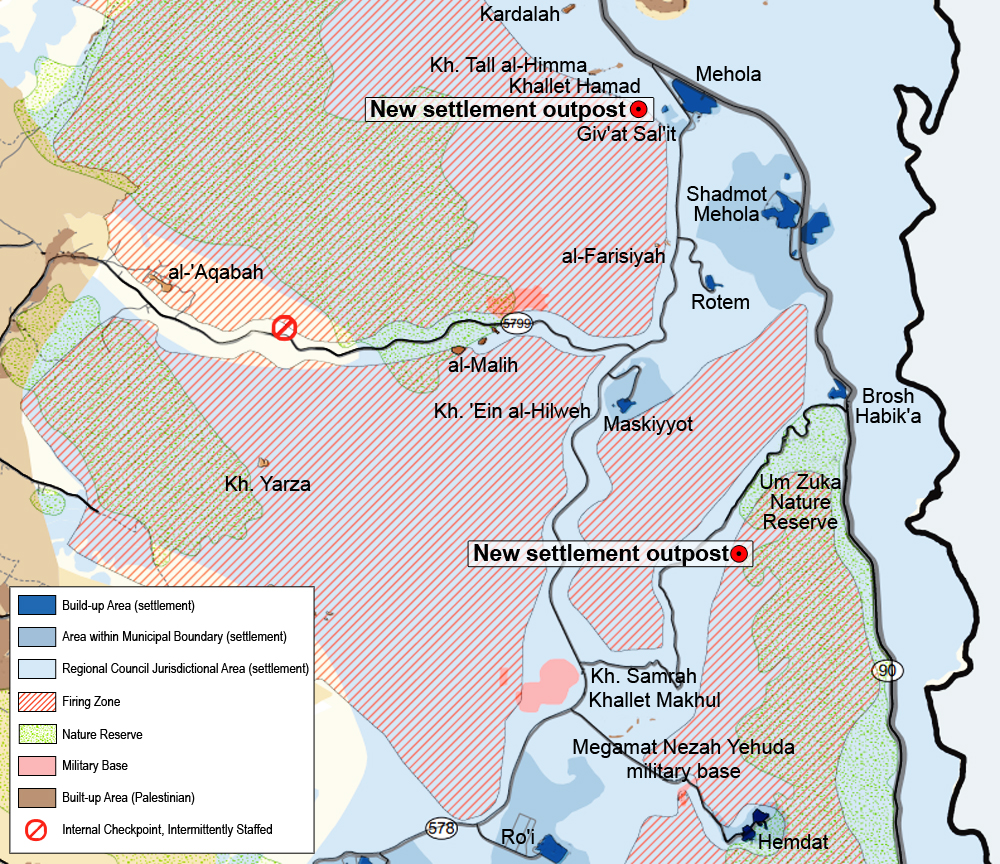
Map by B’Tselem
In a new report, B’Tselem documents how two new outposts that were established in the northern Jordan Valley in 2017 have contributed to the escalating dispossession of Palestinian communities in the Jordan Valley, where Israel retains exclusive control over and access to 85% of the land.
At the same time the outposts were allowed to grow, Israel also engaged in policies that amount to the forcible displacement of Palestinian communities around them: Since the outposts were established, the Israeli military has demolished 205 Palestinian structures in nearby communities, rendering 391 people homeless, including 157 children. The Israeli military has also refused to intervene or arrest settlers who engage use violence tactics in order to prevent Palestinians from accessing their lands.
The report concludes:
The establishment of the two new settlement outposts helps Israel realize its main goal for the West Bank: dispossessing Palestinian residents of their homes and land, and taking over their property. Each of the restrictions the state imposes on the Palestinian residents has enabled settlers to encroach on their land, build settlements and settlement outposts and take over vast areas around them. The state may say that the settlement outposts are “illegal” and are a “private initiative” by the settlers, but these claims ring hollow given Israel’s complete inaction to change this reality. The state’s refusal to remove the settlement outposts, prevent the routine attacks and prosecute those responsible for them speaks volumes as to Israel’s reliance on the settlers’ criminal behavior to entrench its control of the area while paying lip service to the law by formally disavowing any ties to them. These actions complement the official measures Israel takes in its pursuit of Palestinian dispossession in the area (and in other parts of the West Bank) and play a key role in the implementation of its policy.
Human Rights Watch Report Slams Israeli Settlements
In its “World Report 2018,” Human Rights Watch provides updated information on how Israeli settlement activity in 2017 ran afoul of international law and significantly contributed to the ongoing violation of Palestinian human rights.
Human Rights Watch reports:
Israel continued to provide security, administrative services, housing, education, and medical care for about 607,000 settlers residing in unlawful settlements in the West Bank, including East Jerusalem. Israel’s building of 2,000 new settlement housing units in the period between July 2016 and June 2017 marked an 18 percent decrease over the same period in 2015-2016, but Israeli authorities approved plans for 85 percent more housing units in the first half of 2017 than all of 2016, according to the Israeli group Peace Now. International humanitarian law bars an occupying power’s transfer of its civilians to occupied territory.
Building permits are difficult, if not impossible, for Palestinians to obtain in East Jerusalem or in the 60 percent of the West Bank under exclusive Israeli control (Area C). This has driven Palestinians to construct housing and business structures that are at constant risk of demolition or confiscation by Israel on the grounds of being unauthorized. Palestinians in these areas have access to water, electricity, schools, and other state services that are either far more limited or costlier than the same services that the state makes available to Jewish settlers there.
Of the 381 Palestinian homes and other property demolished in the West Bank (including East Jerusalem) in 2017 as of November 6, displacing 588 people, Israeli authorities sought to justify most for failure to have a building permit. Israel also destroyed the homes of families in retaliation for attacks on Israelis allegedly carried out by a family member, a violation of the international humanitarian law prohibition on collective punishment.
Bonus Reads
- “With Trump in power, emboldened Israelis try redrawing Jerusalem’s borders” (Washington Post)
- “Israeli Army Considering Taking Control of Palestinian Areas in East Jerusalem” (Haaretz)
- “Prominent Right-wing NGO Receives Millions of Shekels in Public Funds” (Haaretz)
FMEP has long been a trusted resource on settlement-related issues, reflecting both the excellent work of our grantees on the ground and our own in-house expertise. FMEP’s focus on settlements derives from our commitment to achieving lasting Israeli-Palestinian peace, and our recognition of the fact that Israeli settlements – established for the explicit purpose of dispossessing Palestinians in the West Bank and East Jerusalem of land and resources, and depriving them of the very possibility of self-determination in their own state with borders based on the 1967 lines – are antithetical to that goal.
Welcome to FMEP’s Weekly Settlement Report, covering everything you need to know about Israeli settlement activity this week.
To subscribe to this report, please click here.
November 17, 2017
- Building Permits Issued for 240 More Settlement Units in East Jerusalem
- Israel to Displace Palestinians in the Jordan Valley & the Northern West Bank for Settlement Expansion
- Supreme Court & Attorney General Permit State to Seize Private Palestinian Land for Settlers
- New Ir Amim Policy Paper: “Bills and Government Plans for Destructive Unilateral Measures to Redraw the Borders of Jerusalem”
- New Peace Now Report: “Escalation in Israel’s Settlement Policy: The Creation of De-Facto Annexation”
- Bonus Reads
Comments, questions, or suggestions? Email Kristin McCarthy at kmccarthy@fmep.org.
Building Permits Issued for 240 More Settlement Units in East Jerusalem
On November 8th, the Jerusalem Planning and Building Committee issued building permits for 240 new settlement units in East Jerusalem – 90 units in Gilo and 150 units in Ramat Shlomo. The new building permits add to an ever-growing tidal wave of settlement activity in East Jerusalem affecting the viability of the two-state solution, while tightening the screws on the local Palestinian population.
In addition, the committee also approved permits for 44 new units for Palestinians in the East Jerusalem neighborhood of Beit Hanina. These permits are an anomaly: for the past 50 years Israel has systematically discriminated against Palestinian building rights, with only about 7% of building permits issued in Jerusalem going to Palestinians (who represent 37% of the population). Bimkom, an Israeli organization that monitors planning and building in Jerusalem, estimates that 20,000 units in East Jerusalem lack permits while an additional 10,000 more units are needed by Palestinians.
Jerusalem expert Danny Seidemann recently explained
Since 1967, the Government of Israel has directly engaged in the construction of 55,000 units for Israelis in East Jerusalem; in contrast, fewer than 600 units have been built for Palestinians in East Jerusalem, the last of which were built 40 years ago. So much for (Jerusalem Mayor Nir) Barkat’s claim ‘we build for everyone.’
In Beit Hanina, as in Palestinian neighborhoods across East Jerusalem, Israeli demolitions of buildings – based on the argument that they lack permits – only add to the misery. The most recent demolition in Beit Hanina happened last month.
Israel to Displace Palestinians in the Jordan Valley & the Northern West Bank for Settlement Expansion
For the first time, the Israeli army appears to be preparing to evict Palestinians from their land through the use of a 2003 military order meant to handle the evacuation of unauthorized Israeli outposts. Palestinians living in the northern Jordan Valley discovered the eviction order affecting around 136 acres of their land – which sits near several Israeli settlements.
A lawyer representing the Palestinians in this case submitted a petition to the Israeli Coordinator of Government Activities in the Territories (COGAT) to stop the implementation of the order. The lawyer, Tawfiq Jabareen, argues, “This is a mass expulsion order against the Palestinian population that violates international law.”
The Haaretz Editorial Board powerfully rebutted the Israeli army’s argument that the order does not, in fact, actually call for the evacuation of the Palestinians, but will only demolish structures built without Israeli permission. The Editorial Board writes,
Whatever legal proceeding ensues, the fact is that this declaration is an escalation of the pressure on the local Palestinians and part of the declared Israeli intent to evict as many Palestinians as possible from Area C, which is under total Israeli control, including from the Jordan Valley.
It’s no coincidence that near Ein al-Hilweh [one of the targeted areas] are two expanding unauthorized Jewish settlement outposts whose residents periodically threaten the shepherds and try to scare them away from grazing lands in the area. This trend can and must be stopped, because it’s illegal, unjustified and dangerous.
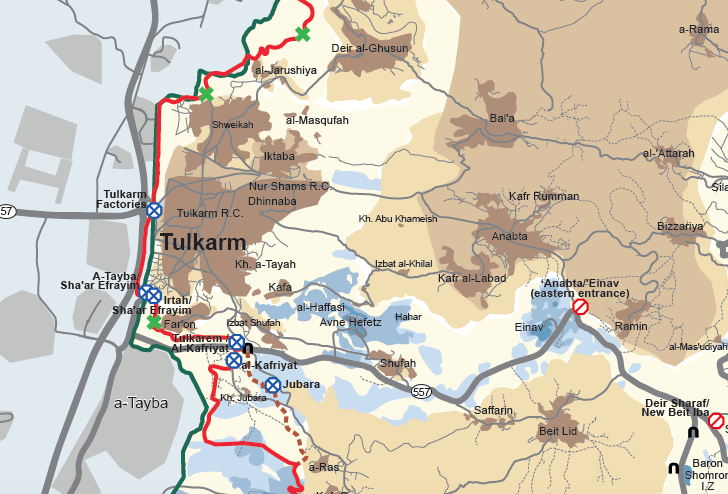
Map by B’Tselem
Israel is also moving to seize land near the city of Shufah in the West Bank, southeast of the Palestinian city of Tulkarem. Palestinian news sources report that the IDF notified residents that Israeli intends to take the land in order to build roads and recreational facilities for a nearby settlement, Avnei Hefetz. Earlier this year, Israel seized land from the Shufah village in order to build a power plant and industrial area for the settlement. In October 2017, the Israeli government advanced plans for 135 new units in the Avnei Hefetz settlement.
Supreme Court & Attorney General Permit State to Seize Private Palestinian Land for Settlers
Israeli Attorney General Avichai Mandleblit released a legal opinion this week asserting Israel’s right to confiscate privately owned Palestinian land for the exclusive benefit of Israeli settlers in the West Bank.
This new opinion concurs with a Supreme Court ruling issued last month that held Israeli settlers are a part of the “local population” of the West Bank, and can be the beneficiaries of state land seizures for “public use.” It also builds on a precedent set earlier this year in the case of the Amona outpost, when the Court ruled that Israel has a duty to care for Israeli settlers forced out of their homes (because those homes were built illegally on privately-owned Palestinian land). The Court ruled that the state has the authority confiscate “abandoned” Palestinian land to do so (Palestinians are systematically denied the right to access lands that are near settlements, Israeli roads, military bases, firing zones, etc., rendering them “abandoned”).
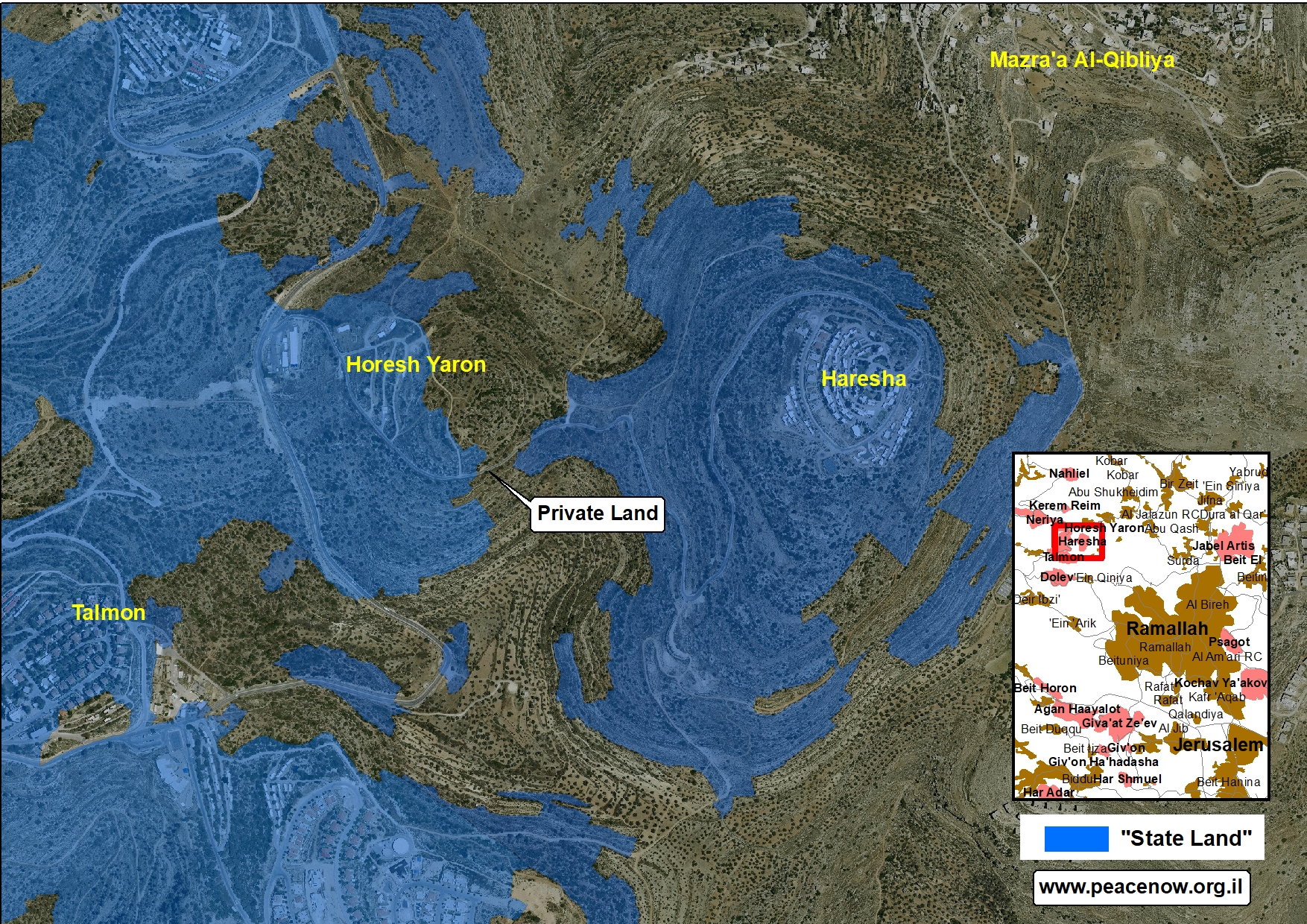
Map by Peace Now
According to the original Amona ruling, the state’s obligation was to provide temporary housing for the affected settlers; according to the subsequent ruling, the state is obligated to care for the settlers by paving roads, without regard to privately owned Palestinian land that would need to be taken. That ruling upheld the state’s confiscation of privately owned Palestinian land in order to legalize an access road to the illegal outpost of Haresha.
Located near Ramallah, the Haresha outpost was established in 1995 without government approval. In January 2010, the State responded to a petition filed by Peace Now and Yesh Din by announcing its intention to retroactively legalize Haresha; less than a year later, in August 2011, Israel seized the land the outpost was built on by declaring it as “state land.” Haresha was approved to become an official settlement in 2015 (Netanyahu legalized 24 other outposts at the same time), but the outpost still needed to submit plans in order to legalize the individual structures. That a planning process has not yet happened – in part because, as Haaretz notes, there is no legal road leading to the outpost. With the access road moving towards legalization, the outpost is set to follow suit.
Speaking to the significance of the decision on the Haresha outpost access road, Israel Justice Minister Shaked said “The attorney general has issued a legal opinion permitting the expropriation of privately owned Palestinian land to permit an access road to [Haresha] that permits the regulation [legalization] of the entire [settlement].” The anti-settlement watchdog Peace Now is expected to appeal the decision upholding the theft of privately owned land for the legalization of the access road. Peace Now issued a statement saying,
Confiscating the land would constitute a severe violation of international humanitarian law and of the Palestinians’ right to own property. The Attorney General’s legal opinion regarding the access road might lead to additional confiscations of private Palestinian lands, strengthening Israel’s stronghold over Palestinian territory. The Attorney General seeks to allow the confiscation of lands owned by Palestinians, who have no voting rights in Israel for the benefit of Israeli settlers with full rights. If the Netanyahu government will continue down this path it will lead us towards a one state reality, based on discrimination and theft.
New Ir Amim Policy Paper: “Bills and Government Plans for Destructive Unilateral Measures to Redraw the Borders of Jerusalem”
The Israeli NGO Ir Amim this week released a new policy paper analyzing the devastating ramifications of Israeli efforts to gerrymander a Jewish-majority in Jerusalem. In addition to essential background on Jerusalem’s environs and analysis of the two pieces of pending Jerusalem-related legislation, Ir Amim provides new analysis of the humanitarian, political, and urban consequences that will follow if these measures are implemented.
Looking at the impacts of the Knesset bill intended to excise two Palestinian East Jerusalem neighborhoods from the Jerusalem municipality, creating new Israeli municipalities to govern them, Ir Amim writes:
The bills and plans currently in circulation seek to displace Palestinian residents living in Jerusalem from the city, and to artificially add to Jerusalem Israeli residents from outside of it. Beyond obvious political implications, these moves can be expected to have serious humanitarian ramifications….
Should practical steps be taken to cut off the neighborhoods beyond the Barrier or a sweeping revocation of their residents’ permanent residency status implemented, we can expect another wave of migration to the East Jerusalem neighborhoods within the Barrier, already strained by a serious lack of infrastructure, services, educational institutions and affordable housing. Living conditions and infrastructure in the East Jerusalem neighborhoods inside the Barrier will decline even further. In this scenario of increasing housing shortages and infrastructure collapse, an upsurge in the number of Palestinian residents who rent or buy apartments in Israeli neighborhoods/ settlements such as Pisgat Ze’ev, Armon Hanatziv and French Hill can be expected. These phenomena, which will occur under conditions of acute uncertainty and anxiety, can be expected to significantly elevate friction and the potential for eruptions of violence in the city. Many other thousands of Palestinians – currently residents of Jerusalem – will remain beyond the Separation Barrier, now administratively displaced from their city and transferred to contrived regional authorities, only exacerbating their distress. Even should they be completely separated from Jerusalem, Israel will not be able to escape accountability for the dire political, urban and humanitarian crisis – and the fertile ground for escalating hostility – it has created.
New Peace Now Report: “Escalation in Israel’s Settlement Policy: The Creation of De-Facto Annexation”
In a new report, Peace Now details the dangerous flood of settlement activity and the de-facto annexation of Area C in the West Bank that the Netanyahu government has pursued without restraint in 2017. The report covers:
- A significant increase in the promotion of plans (6,742 units advanced) and issuance of tenders (3,154 tenders issued) for settlements across the West Bank. This includes the approval of the first new government-backed settlement in 25 years – Amichai.
- The increase in road construction in the West Bank aiming to integrate the settlements into Israel proper, attract more construction and residents in the settlements, and create settler-only highways across the West Bank – all done by expropriating more Palestinian land.
- A dangerous escalation of anti-Palestinian, pro-settlement activities in East Jerusalem including: the simultaneous settlement approvals and eviction of Palestinians from the Sheikh Jarrah neighborhood, the imminent approval of tenders for the Atarot and Givat Hamatos settlements, the expansion of settlement enclaves inside of Palestinian East Jerusalem neighborhood of Jabal al-Mukaber, and the several legislative efforts to gerrymander the borders of the Jerusalem municipality to secure a Jewish majority in the city.
In conclusion, Peace Now writes
All of the abovementioned developments attest to a quantum leap in the promotion of annexation and the blocking of the possibility of a two-state solution. With the speed of developments all across the West Bank and East Jerusalem—and as red lines are being crossed—we are approaching the final stretch before a two-state solution will be almost impossible, and the anticipated situation will be the long years of bloody conflict of Israeli rule over the Palestinians without hope for change. Thus even with the lack of a final status agreement in sight, it is our duty today to prevent silent annexation efforts and to assure the possibility of a two state solution on the ground.
Bonus Reads
- “World Zionist Organization Gave Private Palestinian Land to West Bank Settlers” (Haaretz+)
- “In first, Israel Prize to be Given for Promoting Settlements” (Times of Israel)
- “Palestinian Lawyer Attempted to Report Being Attacked by Settlers. Then He Was Detained Over Back Taxes” (Haaretz)
- “Settler leader revels in Left’s embrace as proof of movement’s power” (Times of Israel)
___
FMEP has long been a trusted resource on settlement-related issues, reflecting both the excellent work of our grantees on the ground and our own in-house expertise. FMEP’s focus on settlements derives from our commitment to achieving lasting Israeli-Palestinian peace, and our recognition of the fact that Israeli settlements – established for the explicit purpose of dispossessing Palestinians in the West Bank and East Jerusalem of land and resources, and depriving them of the very possibility of self-determination in their own state with borders based on the 1967 lines – are antithetical to that goal.
Welcome to FMEP’s Weekly Settlement Report, covering everything you need to know about Israeli settlement activity this week.
To receive this report via email, please click here.
October 12, 2017
- Bibi Approves Major Expansion of Settlements
- DETAILS: Thousands of Settlement Units to Advance Next Week with Netanyahu’s Permission
- U.S.: No Comment, No Change in Talking Points
- Bonus Reads
Comments, questions, or suggestions? Email Kristin McCarthy at kmccarthy@fmep.org.
Bibi Approves Major Expansion of Settlements
This week, the Israeli Prime Minister Netanyahu announced imminent approval of major new settlement construction across the West Bank, including in some especially sensitive/controversial areas.
How major? There has been debate and disagreement in the Israeli press about the number and what they exactly mean. Haaretz reports that, while Netanyahu listed plans totalling 3,736 settlement units, only 600 of those units will actually be approved for immediate construction (the rest are part of plans that are in earlier stages of the approval process). However, the Times of Israel counts 1,941 units being advanced, of which 1,197 units will receive final approval. The Peace Now Settlement Watch Project counts 3,400 units up for advancement, and tenders (the final step before construction) expected for 296 units.
This debate over the numbers should not obfuscate the fact that Netanyahu is orchestrating an acceleration of settlement growth, the totality of which we will have definitive knowledge of only after the High Planning Council meets next week.
Please note, there is no benign stage in the settlement planning process. No matter the stages of the planning process involved, Netanyahu’s announcement this week represents a huge wave of forthcoming settlement construction.
As Terrestrial Jerusalem’s founder Daniel Seidemann wrote in 2015,
There is no such thing as a “window of opportunity” in stopping settlement planning/approvals. When the world objects to settlement approvals, the answer from Israeli officials, invariably, is either, “It’s too early, it’s just a plan – what are you objecting to?” or “It’s too late, this was approved long ago – why are you bothering us now?” In truth, settlement plans can be stopped at almost any point on the road to implementation, and the earlier a plan is stopped, the lower the political costs.
With that in mind, we cover the plans expected to be advanced in detail below.
DETAILS: Thousands of Settlement Units to Advance Next Week with Netanyahu’s Permission
Prime Minister Netanyahu has publicly announced his permission for the High Planning Council to advance 3,736 of settlement units during the Council’s meeting next week (Oct. 17-18). If all of the reported plans are approved, the total number of settlement units promoted so far in 2017 will reach 6,500 by the end of the month, a significant increase compared to 2,629 for all of 2016, and 1,982 for all of 2015, according to Peace Now data. One Israeli official has promised the settlement numbers will reach 12,000 by the year’s end, bragging that the amount is four times the total promoted in 2016.

Graphic by Haaretz
Of the thousands of units slated for advancement, several plans are at the final stage of planning and will likely receive the green light to start construction. These plans fulfill specific promises to settlers Netanyahu has made over the years (and address some of his most acute domestic political pressure points). The following plans – all of which are in settlements located deep inside the West Bank and beyond the separation barrier – are expected to receive building permits, as reported by Haaretz:
- 31 units for the settlement enclave on Shuhada Street, in the heart of downtown Hebron. This is the first plan for new settlement units in downtown Hebron in the last 12 years; the Hebron Municipality is expected to mount a legal challenge against the plan’s implementation. Peace Now explains, “alongside additional developments in Hebron, including the creation of an independent administration and the entry to the Abu Rajab House, this can be seen as another effort by the government to strengthen the radical settlement in the heart of Hebron.”
- 296 units in the Beit El settlement, which are part of Netanyahu’s promise to compensate for the settlers evacuated from the Ulpana outpost in 2012.
- 86 units in the Kochav Yaakov settlement which are part of Netanyahu’s promise to compensate for the settlers evacuated from the Migron outpost also in 2012. The evacuation of the Migron outpost has lead to the construction of not one but two new settlements as compensation.
- 146 units in the Nokdim settlement, where Israeli Defense Minister Avigdor Liberman lives.
- 9 units in the Psagot settlement.
The Times of Israel reports additional units expected receive final approval:
- 459 units in Ma’ale Adumim.
- 102 units in the new settlement of Amichai, which was approved earlier this year as payoff for settlers evacuated from the unauthorized outpost of Amona. Haaretz suggests that construction of these units will remain stalled as the State responds to a petition filed against the Amichai settlement by the Israeli NGO Yesh Din, arguing that the settlement’s borders annex land that is privately owned by Palestinians. As reported in detail in past editions of the FMEP Settlement Report, Amichai is the first new settlement to receive government authorization in the past 25 years. It is to be located deep inside the Shilo Valley in an area that cannot, under any conceivable two state arrangement, be included inside the borders of an Israeli state in a way that preserves the territorial contiguity of a Palestinian state.
The High Planning Council will also consider depositing for public review (a last step before final approval) plans for 30 units in the Elon Shvut settlement that will expand the settlement borders to build the homes in order to compensate residents in the unauthorized outpost of Netiv Ha’avot, an outpost where the government is appealing to the High Court to save settlement homes that were partially constructed on land that is proven to be privately owned by Palestinians. The Court has ordered that the outpost be razed by March 2018.
To see all of the plans expected to be addressed next week, see Peace Now’s data table (link near the middle of this page). Peace Now issued an accompanying statement saying,
The government has gone wild with settlement plans deep in the West Bank for thousands of new settlers, whom Israel will have to evacuate in a two state solution agreement. Faced with the growing pressures and investigations, Netanyahu goes out of his way to prove how radical he is, without considering the consequences of massive settlement expansion on the future of the two state solution. The plans for Hebron and Nativ Ha’avot are particularly enraging, as they indicate to settlers that the rule of law does not apply to them and illustrate the government’s deteriorating legal standards when it comes to settlement expansion.
U.S.: No Comment, No Change in Talking Points
The Trump Administration has issued no statement regarding Netanyahu’s brazen settlement advancements. Instead, unnamed White House officials repeated the same talking points that have defined the Trump Administration’s settlement stance, saying,
President Trump has publicly and privately expressed his concerns regarding settlements, and the administration has made clear that unrestrained settlement activity does not advance the prospect for peace. At the same time, the administration recognizes that past demands for a settlement freeze have not helped advance peace talks.
Hagit Ofran, Director of Peace Now’s Settlement Watch Program, told the Washington Post, “This year is looking to maybe even be a record year… It’s without a doubt due to the fact that there have been changes in the White House.”
Bonus Reads
- “By Backing ‘Greater Jerusalem’ Bill, is PM leaning towards annexing settlements?” (Times of Israel)
- “The Transformation of Jerusalem” (Arab American Institute)
- “The Bedouin village where compassion ends” (+972 Magazine)
FMEP has long been a trusted resource on settlement-related issues, reflecting both the excellent work of our grantees on the ground and our own in-house expertise. FMEP’s focus on settlements derives from our commitment to achieving lasting Israeli-Palestinian peace, and our recognition of the fact that Israeli settlements – established for the explicit purpose of dispossessing Palestinians in the West Bank and East Jerusalem of land and resources, and depriving them of the very possibility of self-determination in their own state with borders based on the 1967 lines – are antithetical to that goal.
Welcome to FMEP’s Weekly Settlement Report, covering everything you need to know about Israeli settlement activity this week.
To receive this report via email, please click here.
September 20, 2017
- Israel Moves to Forcibly Transfer West Bank Community [A War Crime]
- Normalizing Settlements in the Name of Peace – The WINEP Approach
- NEW REPORT: Yesh Din on Systematic Land Theft by Israeli Quarries in the West Bank
- NEW REPORT: Human Rights Watch on Israeli Banks’ Financing of Settlement Expansion
- Updates: Al-Walajah, Ras al-Amud, Halamish, Hebron
- Bonus Reads
Comments, questions, or suggestions? Email Kristin McCarthy at kmccarthy@fmep.org.
Israel Moves to Forcibly Transfer West Bank Community [A War Crime]
B’Tselem reports that the Civil Administration is set to soon forcibly relocate the Palestinian Bedouin community of Khan al-Ahmar in the West Bank, a war crime under international law. Haaretz confirmed the Israeli government’s intention to carry out the plan. Khan al Ahmar is located in an area that is considered key for Israel’s desired expansion of the Maale Adumim settlement and construction of the new “E-1” settlement.

Map by B’Tselem
Last week Israeli officials went to Khan al-Ahmar to tell the residents that their only option was to relocate to a site in the nearby Palestinian city of Abu Dis, next to the Abu Dis garbage dump. The village’s lawyer was not present at the time of the officials’ visit, despite Israeli authorities previously committing to not meet with the residents without their lawyer present.
Khan al-Ahmar’s residents settled in their current West Bank location in the 1950s, by Israel – after having been forced off their lands in the Negev (i.e., inside Israel proper). Israel subsequently declared the land of Khan al-Ahmar to be “state land” and over the years have repeatedly threatened the total demolition of the community. For years, international pressure – which importantly included a strong stance by the Obama Administration specifically regarding the E-1 area – has prevented Israel from going ahead with the demolitions and relocation. The Trump Administration has not commented on this specific matter to date.
Btselem Executive Director Hagai El-Ad has penned an urgent letter to Prime Minister Benjamin Netanyahu articulating why the forcible transfer of Khan al-Ahmar would constitute a war crime under international law. The accompanying press release notes:
Demolition of an entire community in the Occupied Territories is virtually unprecedented since 1967. Under the Fourth Geneva Convention, which Israel is obliged to respect in all its actions in the West Bank, this amounts to forcible transfer of protected persons, which constitutes a war crime.
B’Tselem has long documented Israel’s routine harassment of the Khan al-Ahmar community. The harassment has included: In 2015, the Israeli Civil Administration confiscated 12 solar panels donated by an international humanitarian group and that served as the sole power source for the community. In 2016, Israel demolished 12 homes, leaving 60 people homeless. In February 2017, Israel issued demolition orders for every structure in the village and that same month, Israel demolished a mobile home, leaving an elderly woman homeless. Settlers from the Maale Adumim settlement have filed petitions (starting in 2011) demanding that the Khan al-Ahmar school – a school that serves not just the Khan al-Ahmar community but others nearby – demolished.
The Israeli High Court of Justice (the equivalent of the Supreme Court) is set to hear petitions and decide on the community’s future on September 25th. Settlers have petitioned to expedite the demolitions, and Khan al-Ahmar community members have petitioned against the demolition orders.
Normalizing Settlements in the Name of Peace – The WINEP Approach
The Washington Institute for Near East Policy (WINEP) is set to launch a new portal with “up-to-date, granular information” about settlements in the West Bank. [Editor’s note: If you are looking for up-to-date, granular information about Israeli settlements, Peace Now, Terrestrial Jerusalem, Ir Amim, Yesh Din, and many other Israeli and Palestinian civil society organizations host it their websites currently. Contact FMEP for additional resources.]
The yet-to-be-revealed portal and its architect, David Makovsky, were given an early endorsement by the Washington Post’s Jackson Diehl, in a piece this week entitled “How Trump could save Palestinian statehood.” The article, quoting Makovsky extensively, promotes the notion that Trump can save the hope for peace by adopting a policy according to which, “Netanyahu stops building in areas beyond the West Bank fence, and Abbas stops paying off militants and their families.”
For people who follow the work of Makovsky and his WINEP colleague Dennis Ross, this logic should sound familiar; it is nearly identical to what Ross has been proposing, over and over, since 2013 (see also, for example: March 2015, Feb 2016, Nov 2016, Jan 2017). At the core of this logic is the notion that Israel getting U.S. backing to, in effect, unilaterally annex around 10% of the West Bank – including areas that obstruct the contiguity of a future Palestinian state and that will prevent the possibility of any viable Palestinian capital in East Jerusalem – should be seen as a generous Israeli concession to the Palestinians and a down-payment on a peace agreement.
FMEP’s Lara Friedman deconstructed these arguments back in 2013 – that analysis has not changed. As she noted back in 2013, this approach:
“…is a recipe not for strengthening the two-state solution, but for imposing a unilateral Israeli vision of a Greater Israel extending beyond the Green Line, adjacent to a balkanized Palestinian entity. Such an outcome may be appealing to Benjamin Netanyahu and his U.S. apologists. It will never be acceptable to the Palestinians and the international community, and it certainly shouldn’t be mistaken for a “solution” to the Israeli-Palestinian conflict.”
NEW REPORT: Yesh Din on Systematic Land Theft by Israeli Quarries in the West Bank
In its new report, “The Great Drain: Israeli quarries in the West Bank: High Court Sanctioned Institutionalized Theft,” the Israeli non-governmental organization Yesh Din documents how Israel’s mining and quarry activities in the West Bank constitute economic exploitation of the occupied West Bank for Israel’s exclusive profit, in violation of international law. In 2008, Yesh Din petitioned the High Court to stop all such activities; that petition was rejected.
Key findings in the new report include:
- Since the High Court of Justice ruled against Yesh Din’s 2008 petition, Israel has dramatically expanded its mining and quarrying activities in the West Bank.
- Over 20% of the State of Israel’s general consumption of gravel now comes from the quarries in the Occupied Territories.
- Official documents indicate that the Israeli authorities have a long-term plan to rely on the mining potential in the West Bank for at least the next 30 years.
Yesh Din concludes: “Decades of Israeli looting of natural resources in the West Bank are the embodiment of colonialism. In practice, the High Court ruling has rendered meaningless the acceptable interpretation of international humanitarian law, leaving in place the continued, irreversible exploitation of the occupied territory for the Israel’s economic purposes.”
NEW REPORT: Human Rights Watch on Israeli Banks’ Financing of Settlement Expansion
In its new report, “Israeli Law and Banking in the West Bank,” Human Rights Watch document how Israeli banks are failing to respect international humanitarian law by providing services to and in settlements. In doing so, the banks contribute to the expansion and entrenchment of settlements, at the expense of Palestinians.
Key findings of the report include:
- All five of Israel’s largest banks, as well as the Bank of Israel (Israel’s central bank) are operating in settlements. These five largest banks are: Bank Leumi, Hapoalim, Bank Discount, Mizrahi Tfahot, and First International Bank of Israel.
- The Israeli Association of Banks claimed to be legally obliged to offer financial services in and to settlements under Israel’s Anti-Discrimination Law (5761-2000), but the Association did not explain how refusing to provide services to settlements would constitute discrimination on the basis of nationality, race, religion, or political views. (Israel’s Anti-Discrimination Act was recently amended to require businesses, including banks, to notify customers if they decline to provide services to settlements. However, the amended version of the law does not require businesses to provide services to settlements.)
- Israel’s domestic “Banking Law” is applied to settlements via military order, which violates international humanitarian law.
- The Banking Law only prohibits banks for unreasonably refusing to provide three services: receiving deposits, opening and managing a checking account, and issuing bankers’ checks. No other services are required/obligated under the Banking Law.
The report concludes, “Human Rights Watch does not believe it is possible for businesses to operate in the settlements in compliance with their international responsibilities, due to the inherent international humanitarian law and human rights violations that characterize settlements. Human Rights Watch is calling for banks, like other businesses, to comply with their own human rights responsibilities by ceasing settlement-related activities.”
Updates: Al-Walajah, Ras al-Amud, Halamish, Hebron
- In Al-Walajah, Israelis and Palestinians marched together in protest of a wave of pending home demolitions and the imminent completion of the separation barrier which will completely encircle the village. Israel resumed construction of the wall in April and has issued dozens of demolition notices to the residents since then. In early August, al-Walaja residents formed a human barrier to prevent Israeli bulldozers from demolishing one of the threatened homes. Since then, Israel has not attempted to execute another demolition.
- Israel demolished a two-story apartment building in the Ras al-Amud, a Palestinian neighborhood of East Jerusalem. B’Tselem reports that Israel has demolished 45 Palestinian homes in East Jerusalem in 2017.
- In the area near the settlement of Halamish (where several members of an Israeli family were brutally murdered earlier this year), Kerem Navot has updated reporting on how road closures and plans for a new bypass road are leading to the settlement’s expansion and takeover of the Umm Saffa forest, a nature reserve.
- In Hebron, the Israeli settlers who broke into and illegally set up residence in the disputed “Machpela House” continue to remain in the house, under the protection of the Israeli army. They even received a visit from the Israeli Interior Minister, Aryeh Deri (Shas), this week. The High Court of Justice has not made a decision on the ownership of the house, and has granted the settlers’ wish to delay their evacuation from the house, going against an order from the Israeli Attorney General.
Bonus Reads
- “Law But Not Justice in Sheikh Jarrah” (Times of Israel)
- “WATCH: Settler attacks left-wing activist” (+972 Magazine)
- “Have Amona ‘refugees’ found recipe for post-evacuation success?” (Times of Israel)
- “Drowning in the Waste of Israeli Settlers” (Al Jazeera)
FMEP has long been a trusted resource on settlement-related issues, reflecting both the excellent work of our grantees on the ground and our own in-house expertise. FMEP’s focus on settlements derives from our commitment to achieving lasting Israeli-Palestinian peace, and our recognition of the fact that Israeli settlements – established for the explicit purpose of dispossessing Palestinians in the West Bank and East Jerusalem of land and resources, and depriving them of the very possibility of self-determination in their own state with borders based on the 1967 lines – are antithetical to that goal.
Welcome to FMEP’s Weekly Settlement Report, covering everything you need to know about Israeli settlement activity this week.
To receive this report via email, please click here.
September 13, 2017
- Don’t be Hoodwinked by Misleading Settlement Numbers
- Israel Government Sides with Illegal Outpost in Fight Against Demolition
- Netanyahu’s Promise to Build 300 New Units in Beit El Moves Forward (With Trickery)
- Updates: Clashes Ensue in Sheikh Jarrah Following Eviction; Amona Site is Now a “Closed Military Zone”; More Demolitions in Silwan
- Bonus Reads
Comments, questions, or suggestions? Email Kristin McCarthy at kmccarthy@fmep.org.
Don’t be Hoodwinked by Misleading Settlement Numbers
Israel’s Central Bureau of Statistics published data this week on new settlement starts in the second quarter of 2017 (April-June). The data, purportedly showing a dramatic decline (75%) in construction, compared to the same period in 2016.
Hagit Ofran, the Director of Peace Now’s Settlement Watch, set the record straight – noting that starts in any given period reflect planning that took place months and years before. Construction happening today, for example, reflects approvals and tenders from two to three years ago. In light of this reality, the relatively low number of starts in the second quarter of 2017 has nothing to do with overall settlement trends, or with current settlement policies. These current settlement policies, reflected in a huge massive wave of settlement approvals seen (so far) in 2017 – a wave the indicates the settlement floodgates have opened – will result in a corresponding spike in settlement starts down the line (at which point the Israeli government will claim “it’s not our fault, this was all approved long ago!”).
Israel Government Sides with Illegal Outpost in Fight Against Demolition
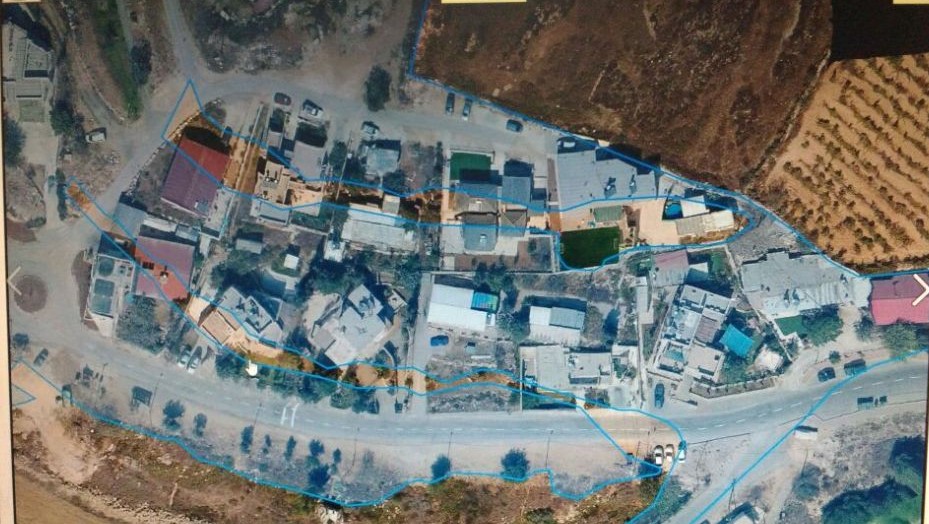
Map by Kerem Navot
The High Court of Justice has ordered the demolition of 15 structures located in the Netiv Ha’avot outpost, built on land recognized by Israel as privately owned by Palestinians. In response to a last minute petition the outpost’s leaders filed with the High Court of Justice, the Israeli government expressed its support for their proposal to save 6 of the buildings from complete demolition; instead, the proposal offers to demolish only the “problematic parts” of the structures – i.e., where they cross into the pockets of privately-owned Palestinian land that run through the middle of the outpost. The High Court is set to make a final ruling on the petition on September 13th.
It is worth pointing out that every structure in the Netiv Ha’avot outpost was built in violation of Israeli planning laws. The outpost is an unauthorized expansion of the Elazar settlement, located southwest of Bethlehem. Only the 15 buildings that were built on private Palestinian land face demolition; if Israel enforced its own planning laws, the entire outpost would be razed. Last month, the Attorney General ordered the Defense Ministry to create a special unit to enforce Israeli planning laws specifically in settlements and outposts (in conjunction with the passage of the Regulation law permitting legalization of most illegal settlement construction and land seizures).
Netanyahu’s Promise to Build 300 New Units in Beit El Moves Forward (With Trickery)

Map by Kerem Navot
Kerem Navot (aka, Naboth’s Vineyard – the organization founded by anti-settlement legend Dror Etkes) has a cheeky look at how Netanyahu’s promise to build new homes in the Beit El settlement by the end of this month is coming to fruition. According to the report, the settlement has conspired with the government to build a new Border Police base south of the settlement 0- based on alleged security needs of the settlers. And what about the existing Border Police station for the settlement? That’s where the new units will be built. Two birds with one stone: more settlement units for Beit El, plus more land taken for settlements, to accommodate the entirely unnecessary new police station.
The Beit El settlement was established in 1977, on land previously seized by Israel for military purposes. A second military seizure in 1979 enabled Beit El to expand. This method of establishing and expanding settlements has been repeatedly challenged in Israeli courts. The Israeli group Yesh Din led one such petition against Beit El, seeking to have the second seizure annulled; that petition was dismissed earlier this year. Yesh Din writes,
The State understood that it was impossible to legally defend the land theft that has been ongoing in Beit El for 40 years on land that was seized for arbitrary reasons, but it refrained, once again, from defending the rights of the weakest population, simply because they are Palestinians. Despite this, we at Yesh Din will continue to fight against the dispossession of Palestinians and the infringement of their rights.

Map by Haaretz
As a reminder, Beit El is the settlement that current U.S. Ambassador to Israel David Friedman personally donated to and fundraised for in his capacity as President of the American Friends of Beit El charity from 2011 until his appointment (he dedicated at least one building in the settlement which bears his name).
Beit El is also slated to have a security wall built between one side of the settlement and the al-Jalazoun Palestinian refugee camp.
Updates: Clashes Ensue in Sheikh Jarrah Following Eviction; Amona Site is Now a “Closed Military Zone”; More Demolitions in Silwan
- Last week, in the East Jerusalem neighborhood of Sheikh Jarrah, Palestinians participated in Friday prayers in front of the former home of the Shamasneh family, which was evicted last week by settlers. On the same day, 200 Israelis – including MK Ayman Odeh (Joint List) – marched from central Jerusalem to join the demonstration. Clashes broke out between settlers and the demonstrators, resulting in injury to 14 protestors.
- The illegal outpost of Amona was dismantled earlier this year, but the Kerem Navot organization has revealed that instead of being returned to the Palestinians who the court ruled were the rightful owners, the Israeli army has declared the area a “closed military zone” — keeping Palestinians off the land but permitting residents of the neighboring Ofra settlement to enter the area at will.
- Ma’an News has video of a home demolition in the Ras al-Amud, a Palestinian neighborhood just south of the Old City in Jerusalem. Ma’an also reports that Israel delivered several demolition orders to Palestinians in the Issawiya neighborhood of East Jerusalem earlier this week.
Bonus Reads
- “Red Cross Chief Blasts Settlements as ‘Key Humanitarian Challenge’” (Times of Israel)
- “We witness it daily in the West Bank and in East Jerusalem: [Israeli settlement] has enormous impact on people, on their freedom of movement, the social and economic fabric in the territories. It offers limited access to agricultural and other productive lands, has curtailed educational and employment opportunity; it makes water resource and water supply systems difficult for Palestinian communities. And the list could go on and on,” he [Red Cross Chief Peter Maurer] said.
- “Shin Bet Bypasses Court Again and Stiffens Release Terms of Teen Settler Activist” (Haaretz+)
- “Jerusalem Magistrate’s Court initially ordered him [a teen who is part of the extremist West Bank movement known as Hilltop Youth, had been detained without trial after violating a administrative order] released on the condition that he remain at home at night. But the Israel Defense Forces order requires him to be under house arrest 24 hours a day.”
- “In a First, Israel Will Penalize Amnesty International for Anti-Settlements Campaign.” (Haartez+)
- “Israel plans to punish Amnesty International for its recent campaign, which encourages people to lobby companies and governments to boycott settlement products, by denying tax benefits to Israelis who donate to the human rights organization. It is the first time the government will apply the so-called anti-boycott law, which penalizes organizations and individuals calling for a boycott of Israel or the settlements. The controversial law was passed in 2011.”
- “Reports Israeli government plans to retaliate against Amnesty International over settlements campaign” (Amnesty International)
- “Amnesty International has repeatedly emphasized that the very existence of Israeli settlements in the Occupied Palestinian Territories violates international law, a matter on which there is international consensus and is reflected in UN Security Council resolutions. Settlements have contributed to decades of mass suffering and violations in the Occupied Palestinian Territories.”
Welcome to FMEP’s Weekly Settlement Report, covering everything you need to know about Israeli settlement activity this week.
To receive this report via email, please click here.
August 24, 2017
- Israel Mounts Legal Defense After High Court Puts 2-Month Hold on Regulation Law
- Government Data Shows Regulation Law Could Legalize 3,455 Settlement Structures
- Israeli AG Demands Better Enforcement of Settlement Construction Laws
- Yitzhar Settlers Attack IDF During Outpost Demolition
- Settler-Led Petition Seeks to “Test”High Court’s Consistency on Palestinian Land Ownership Rights
- Updates: Amichai Funds, Sheikh Jarrah Eviction, Jordan Valley Race Track, E-1 Demolitions
- Bonus Reads
For comments and questions, please email Kristin McCarthy (kmccarthy@fmep.org).
Israel Mounts Legal Defense After High Court Puts 2-Month Hold on Regulation Law
On August 17th, the Israeli High Court of Justice ordered a two month hold on the use of the controversial Regulation Law, which was set to take effect this week. The Regulation Law (also called the “Expropriation Law,” the “Regularization Law,” the “Legalization Law,” or the “Settlements Law”) was passed earlier this year by the Israeli Knesset to pave the way for the government to retroactively legalize outposts and other construction of Israeli settler homes on privately owned Palestinian land, among other things. The High Court ordered the two-month freeze following a direct request from Israeli Attorney General Avichai Mandleblit, who has called the law unconstitutional.
The court is currently weighing two petitions challenging the legality of the law filed this past March; one petition by the Israeli civil society organizations Yesh Din, Peace Now, and the Association for Civil Rights in Israel (ACRI); the second petition was filed by Palestinian civil society groups Adalah, Al-Mezan, and the Jerusalem Legal Aid Center.

Map by Peace Now
In response to the petitions, the Israeli government’s private attorney Harel Arnon provided the court with a 156-page defense arguing that, “the Regulation Law balances the obligation of the government towards thousands of citizens who have relied in good faith on government action and a minor infringement of property rights, with increased compensation to the [Palestinian] landowners.” Prominent Israeli lawyer Michael Sfard explained why this is “legal fantasy.” Israel was forced to hire a private lawyer to represent them before the High Court after Attorney General Avichai Mandleblit announced his refusal to defend the measure as soon as it was passed into law.
The trio of Israeli petitioners released a blistering statement following the government’s response. Peace Now, Yesh Din, and ACRI wrote,
“The State of Israel, in its response today, is trying to present the land expropriation law as addressing a national problem, when in practice it involves continued government support for a criminal enterprise that has continued for decades. The government is minimizing the continuing harm to the rights of the Palestinian landowners, and at the same time is trying to present the Israeli citizens who are taking part in the looting of West Bank Palestinians as people who have been harmed and who require ‘compensation’ for their part in the looting,” they added. “We hope the court rejects the state’s arguments out of hand, strikes down this unconstitutional and immoral law, and sends a loud and clear message: No more.”
Peace Now goes further to say, “In its response the government attempts to present Israeli citizens, who are directly involved in land theft of Palestinians, as deserving a reward for their participation in the thievery.”
Adalah also issued a sharp response, saying “The state’s position amounts to a de facto annexation of the West Bank.”
Haaretz put out a searing editorial demolishing the government’s claim that settlers are owed a solution to the “distress” they live in as a result of their land theft. Haaretz editors wrote in “The ‘distress” of the Israeli settlers,”
The government broke a record for cynicism when it made its arguments against the petitions. In a perfect reversal of occupier and occupied, it explained that the expropriation law constitutes “a humane, proportionate and reasonable response to the real distress” of all those “Israeli residents” who live under “a cloud of uncertainty” that is “disrupting their lives.” It’s hard to believe, but this is not a description of the situation of millions of Palestinians living under occupation whose lands are being seized, but of the distress of the settlers, who chose to live outside the state’s official borders and whose very presence there is illegitimate.
The High Court of Justice is months away from issuing its ruling on the Regulation Law’s constitutionality. The Knesset’s legal experts are expected to present their case in support of the law in September, and Attorney General Mandleblit is expected to argue against his own government’s law in October.
Government Data Shows Regulation Law Could Legalize 3,455 Settlement Structures
According to the Israeli government’s own data, there are 3,455 illegally built Israeli structures in the West Bank that can be legalized if the Regulation Law (see above) goes into effect. Haaretz has an explanation of the three categories of land where these structures were illegally built and how the Regulation Law seeks to absolve the government and its settlers of their illegality.
The Haaretz reporting confirms and compounds documentation published by Peace Now earlier this year which estimated that the Regulation Law could legalize 3,850 structures and 53 outposts, adding up to a total land grab of 8,000 dunams of privately owned Palestinian land (1 sq. km = 1,000 dunams | 1 acre = 4 dunams).
Israeli AG Demands Better Enforcement of Settlement Construction Laws
Israeli Attorney General Avichai Mandleblit held a series of meetings over the past month in an attempt to force the government to rein in illegal construction happening inside of settlements. Haaretz reports that Mandleblit met with Prime Minister Benjamin Netanyahu, Defense Minister Avigdor Liberman, and Finance Minister Moshe Kahlon several times to demand the creation of a special unit in the Defense Ministry tasked with policing planning and construction laws inside of settlements.
Haaretz relays from sources in the meetings, “He [Mandleblit] said, in the presence of officials in the Prime Minister’s Office, the treasury and the Defense Ministry, that the present situation, in which there is no group enforcing the planning laws in the settlements except for the committees acting on behalf the settlements’ regional councils themselves, is ‘clearly illogical,’ and creates a situation in which there are illegal structures over which nobody has authority.”
The recent discussions followed Mandleblit’s request last month for the High Court to issue an order demanding the Defense Ministry to create the unit. The Defense Ministry has refused to establish the unit, citing a lack of funding. Mandleblit’s request to the High Court was meant to force Defense Minister Liberman to create the unit by making it mandatory.
Yitzhar Settlers Attack IDF During Outpost Demolition
For the second time this year, the Israeli army clashed with radical Yitzhar settlers as the army executed orders against homes the settlers built without the proper permissions. This time, in contrast to the incident in June where houses were razed inside the settlement, the IDF removed six caravans that were set up outside of the settlement’s municipal border in an outpost known as Kumi Ori.
Settler-Led Petition Seeks to “Test” High Court’s Consistency on Palestinian Land Ownership
Ynet News reports that the right-wing settler organization Regavim has launched a petition against the construction of a road in the West Bank, which they claim – with undisguised irony – is being built on privately owned Palestinian land. The road is an access road to the new Palestinian city of Rawabi, a $1.4 billion dollar investment project to provide a state-of-the-art planned city for Palestinians in the West Bank (and the first new Palestinian city Israel has permitted since 1967).
For Ragavim, the case is a win-win. If the court rules in Regavim’s favor, it will be a blow to efforts to develop Rawabi. If the court rules against Regavim (i.e., in favor of the construction and against the rights of Palestinian landowners), it will set a legal precedent that Regavim and others can exploit for the benefit of settlers. Regavim is clearly hoping for the latter result: Regavim’s lawyer said, “In the last few years, the High Court of Justice has taken a very strict line and ordered the demolition of buildings and roads built by Jews on private Palestinian land. That is why in this case, it is unacceptable that the High Court of Justice is nonchalant about the rights of private landowners.”
Updates: Amichai Funds, Sheikh Jarrah Eviction, E-1 Demolitions, Jordan Valley Race Track
- Haaretz has spoken to four government officials who report that the office of the Prime Minister has requested to nearly triple the amount of government funds allocated towards the construction of the first new settlement in 25 years, Amichai. The Prime Minister’s office denied the Haaretz report.
- In Sheikh Jarrah, a Jerusalem court rejected a petition to delay (again) the eviction of the Shamasneh family from their longtime home in the East Jerusalem neighborhood. Eviction is rumored to proceed on September 9th.
- In E-1, the Israeli Army’s Civil Administration has threatened to move forward with demolitions against Bedouin structures they say were illegally built in the area of E-1 despite an order from the High Court of Justice delaying the demolitions. Back in February, the High Court ruled that the structures should not be demolished and that the Bedouin and Civil Administration must work together to see if the structures can be legalized.
- In the Jordan Valley, Israeli settlers are continuing to build a recreational race track despite a stop-work order issued against the project in February 2017. The large race track complex is partially on land that the Israeli army has declared a closed firing zone, a designation which resulted in the forcible displacement of Palestinians who lived there
- For background on all of these stories, see past editions [link] of FMEP’s Settlement Report.
Bonus Reads
- “U.S. Trying to Prevent UN ‘Blacklist’ of Companies Working in Israeli Settlements” (Washington Post)
- “Netanyahu to attend West Bank event celebrating 50 years of settlements” (August 21, 2017, Jerusalem Post)
- “In Walajeh, Palestinians residents mobilize against Israeli demolitions” (August 21, 2017, +972 Mag/Active Stills)
- “From jail cells, settler youth call for defiance of administrative orders” (August 23, 2017, Times of Israel)
Welcome to FMEP’s Weekly Settlement Report, covering everything you need to know about Israeli settlement activity this week.
To receive this report via email, please click here.
August 9, 2017
- Israel Moves Forward with Inflammatory Evictions & Home Demolitions in Jerusalem
- Netanyahu Celebrates Expansion of Beitar Illit Settlement
- Attorney General Requests Temporary Injunction Against “Regulation Law”
- Palestinian Leaders Criticize U.S. Peace Efforts & Point to Silence on Settlements
- New Poll Reveals Settlers Prefer the Status Quo to Annexation or Peace
- Updates: Machpelah House; New “Amichai” Settlement; Netiv Ha’avot Outpost
- Bonus Reads
Comments, questions, or suggestions? Email Kristin McCarthy at kmccarthy@fmep.org.
Israel Moves Forward with Evictions & Home Demolitions in Jerusalem
Last week we covered three devastating bills moving in the Knesset that seeking to remove Palestinians and include far flung settlements in the borders of Jerusalem. Now, several seemingly small but incredibly significant developments in Jerusalem show how Palestinians are already being forced out of the city:
-
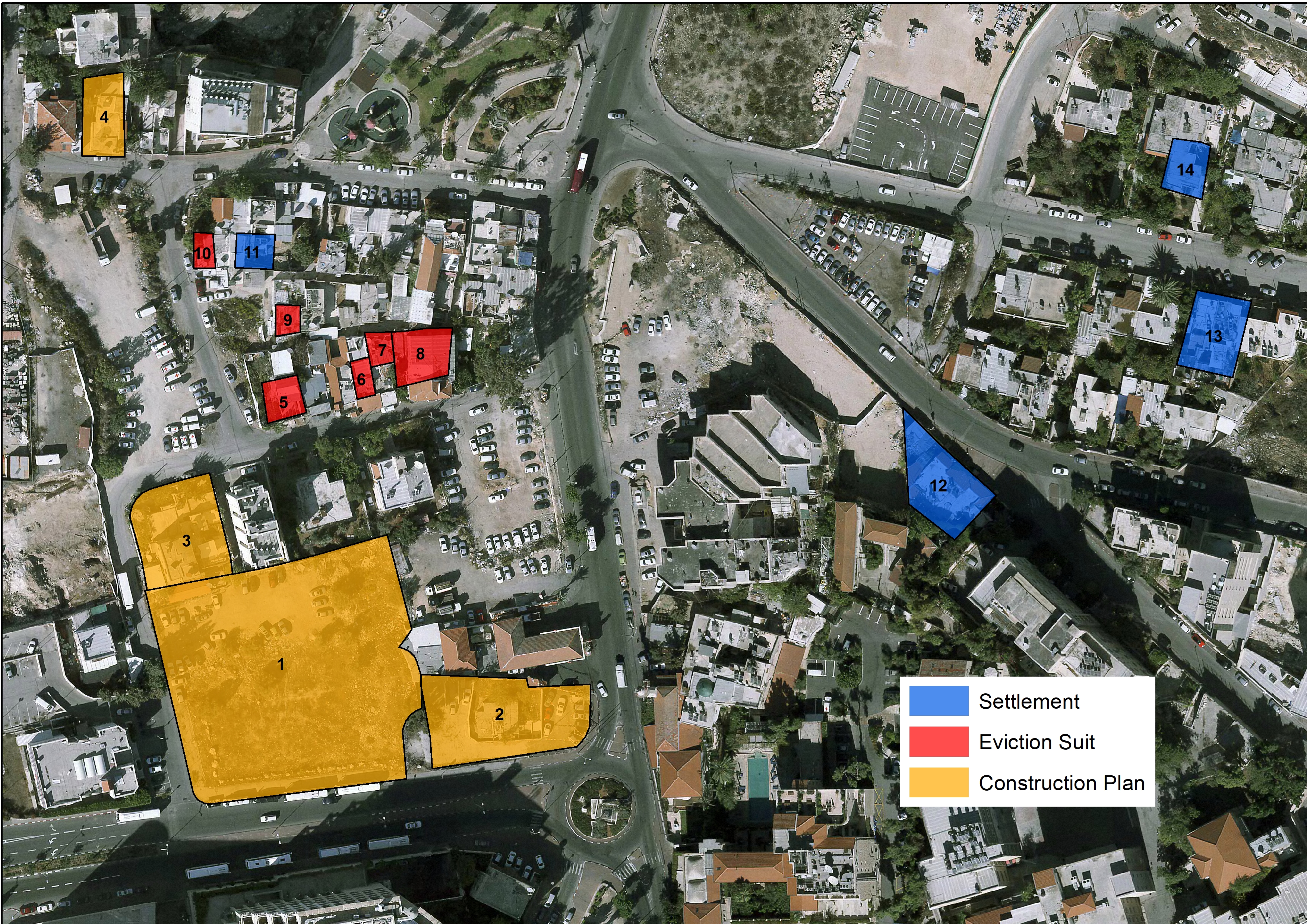
Map by Peace Now
In Sheikh Jarrah, a Palestinian family is fighting against imminent eviction from their family home of 50 years, an eviction ordered by the Israeli Supreme Court. This is the first eviction in the Sheikh Jarrah neighborhood of Jerusalem since 2009 and comes on the heels of several inflammatory settlement announcements which will bring more Israeli settlers into the neighborhood that sits just north of Jerusalem’s Old City. The Court’s decision to evict the Shamasneh family relies on an Israeli law which allows Jews to regain East Jerusalem property owned before Jordan’s 1948 capture of that part of the city. Daily solidarity protests are reportedly being staged in an effort to prevent the family’s eviction.
-

Map by Emek Shaveh
In Silwan, the settler group Elad is bidding to become the majority-owner of an apartment building that Palestinians are in a bidding war to keep. The Siyam family originally owned the entire building but over time lost control of one-half of it to the settlers another one-fourth of it to Israel’s Custodian of Absentee Property. The owners of the remaining one-fourth – Silwan non-violent opposition leader Jawad Siyam and his sister – currently reside. Now the Custodian is auctioning off its one-fourth share and if the settlers have the winning bid, it is a near certainty that Jawad and his sister will be evicted from the house by Israeli courts. This ownership battle could have a decisive impact on the character of this critically-located East Jerusalem neighborhood, which sits in the shadow of the Temple Mount/Haram al-Sharif. Elad has long been active in Silwan, taking over properties and, working hand-in-hand with the Israeli government and Jerusalem Municipality, gaining control over the public domain via tourism and park projects at the expense of the Palestinian residents. Elad recently won the rights to build a state of the art visitor center that will also be a stop on the new cable car line running to the Mount of Olives. Elad’s efforts to take over Palestinian property in East Jerusalem rely in large part on Israel’s “Absentee Property Law” (1950), according to which Palestinians who were not present at their property immediately following the 1967 war are considered “absentee,” and consequently forfeit ownership rights to the Israeli government. The government can then dispose of the property as it sees fit. In Jerusalem, Elad’s multi-million dollar annual budget puts Palestinians at a potentially insurmountable disadvantage. When Israel used the “Absentee Property Law” in 2004 to seize Palestinian property in East Jerusalem, then-President George W. Bush called on Israel to reconsider the decision.
- In al-Walajah, a wave of home demolitions combined with the nearly completed construction of the separation barrier threatens to completely sever and displace al-Walajah’s residents from the West Bank (who hold West Bank IDs, rather than Jerusalem residency, despite the fact that in 1967 most of the village’s land was made part of Jerusalem). Just this week the Israeli government issued demolition orders against 14 Palestinian homes built without the proper permits (these permits are nearly impossible for obtain).
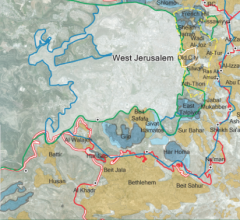
Map by Ir Amim
The 14 homes are in addition to 28 other homes already slated for demolition in the village. On the same day, the Israeli Supreme Court decided to temporarily delay the implementation of 7 of those previous orders in light of a petition brought to the court by the Norwegian Refugee Council. Residents of al-Walajah have fought the growing encroachment the nearby Etzion settlement bloc and the Israeli government’s attempt to de facto annex the bloc as part of “Greater Jerusalem.” Ir Amim explains several prongs of this effort, including a particularly unbelievably section of the separation barrier planned to almost completely encircle the village, to turn its valuable agricultural land into an urban park for Jerusalem, and construction of a highway that will connect the Etzion settlement bloc to Jerusalem with Israeli-only bypass roads.
- In Jabal al-Mukaber, a neighborhood south of the Old City in East Jerusalem, Israel demolished four Palestinian homes without prior notice to the residents. Ma’an News reports, “Israeli authorities have stepped up issuing demolition warrants for Palestinians in East Jerusalem in recent months, particularly after Jerusalem Mayor Nir Barakat threatened that the demolition of the illegal Israeli outpost of Amona in the occupied West Bank would be met with the mass demolition of Palestinian homes lacking the nearly impossible to obtain Israeli-issued building permits.”

Netanyahu Celebrates Expansion of Beitar Illit Settlement
Prime Minister Netanyahu attended a cornerstone-laying ceremony for hundreds of new homes set to be built in the Beitar Illit settlement, a massive, fast-growing, ultra-Orthodox settlement in the Etzion bloc. At the ceremony, Netanyahu proudly repeated his assertion that, “There is no government that does more for the settlement [movement] in Israel than the one under my leadership.” The project will annex a third strategic hilltop to the Beitar Illit, which like much of the Etzion bloc is located on the Israeli side of the separation barrier.
The same day Netanyahu visited Beitar Illit, several right-wing Knesset members traveled to the northern part of the West Bank to call on the Prime Minister to re-establish four Israeli settlements located near the West Bank city of Jenin, that were dismantled in 2005 of part of Ariel Sharon’s disengagement from Gaza. A bill has been introduced in the Knesset that would rescind the 2005 disengagement memo which led to the evacuation of the four settlements.
Attorney General Requests Temporary Injunction Against “Regulation Law”
On August 7th, Israeli Attorney General Avichai Mandelblit weighed in on a petition filed with the Israeli Supreme Court challenging the legality of the “Regulation Law,” which was passed this year and provides a legal basis for retroactive legalization of outposts and other settlement activity in the West Bank on land owned by Palestinians. Mandelblit – who argued against passage of the Regulation Law late last year and after the law’s passage and said he would not defend it in court – asked the High Court to put a temporary injunction against the law until the Court issues its ruling. The injunction would prevent the Civil Administration (the arm of the IDF that rules over the West Bank) from using the law, and possibly from even taking the preliminary steps towards using the law, in order to retroactively legalize outposts and unauthorized settlement activity.
The petition against the Regulation Law (also called the “Expropriation Law,” the “Regularization Law,” the “Legalization Law,” or the “Settlements Law”) was filed in March by three leading Israeli settlement watchdogs: Yesh Din, Peace Now, and ACRI.
Palestinian Leaders Criticize U.S. Peace Efforts & Point to Silence on Settlements
The Palestinian outlook on President Trump’s negotiation efforts has grown outright grim this week. Any initial optimism has been replaced with a sense of abandonment on the part of Mahmoud Abbas’s Palestinian Authority and the topic of unfettered settlement growth has been a recurring talking point. On August 7th in Ramallah, Jordan’s King Abdullah and the Palestinian Authority jointly called for the U.S. to unequivocally state its support for a two-state solution and reiterated that a complete settlement freeze remains a precondition for the resumption of negotiations, including in East Jerusalem. That statement should dispel any lingering questions regarding reports in June that the PA was willing to drop a settlement freeze as a precondition to peace talks.
The new statement comes after a week of terse, unscripted criticism by the Palestinians aimed at President Trump. A top Abbas advisor, Dr. Nabil Sha’ath, told Haaretz that that Palestinians no longer look to the U.S. to be helpful on the issue. Sha’ath said, “Palestinian efforts in the near term will be focused on the international arena in an effort to prevent accelerated settlement construction or the passing of laws that have direct consequences for the peace process.”
In an interview with Jewish Insider last week, top Palestinian negotiator Saeb Erekat did not mince words about his disappointment with the Trump administration’s earlier attempts to get the ball moving on Israeli-Palestinian negotiations. Of note, Erekat laments, “Israel announces thousands of new settlement units that make it almost impossible to achieve the two-state solution, and it’s merely met with silence from U.S. officials.” Erekat is not entirely correct about the U.S.’s silence. The U.S. Department of State has repeatedly issued the same ambiguous statement regarding Israeli settlement policy, that “unrestrained settlement activity is not helpful to the peace process.” The statement echoes President Trump’s remarks in February calling for Israel to “hold back a little” on settlements.
In a third report, an anonymous Palestinian official took aim at Jared Kushner and Jason Greenblatt, Trump’s senior-most envoys dealing with Israel and the Palestinians. The source said, “It’s not a nice thing to say, but they are both ardent supporters of the settlements.They are completely unfamiliar with the other side, they don’t understand the region and they don’t understand the material. You can’t learn about what is happening here in a seminar lasting just a few weeks.” The remarks came one day before the release of a recording of Jared Kushner revealed his thinking on the topic of Israeli-Palestinian issues during which he expressed a lack of interest in history lessons on the topic.
New Poll Reveals Settler Prefer the Status Quo to Annexation or Peace
A new poll reveals remarkable differences between Israeli Jews living within the borders of sovereign Israel and those living in settlements. It sheds light on who in Israel is benefitting from the current “status quo” (which was undefined in the poll’s questions to respondents):
Of Israeli settlers:
- 35% called for the continuation of the status quo
- 24% want Israel to annex the West Bank
- 15% want to see a peace agreement
- 10% back a decisive war against the Palestinians
Of Israeli Jews living in Israel:
- 18% called for the continuation of the status quo
- 9% want Israel to annex the West Bank
- 45% support a peace agreement
- 12% back a decisive war against the Palestinians
The poll also examined the views of Palestinian citizens of Israel and Palestinians in the West Bank and East Jerusalem.
Updates: Machpelah House; New “Amichai” Settlement; Netiv Ha’avot Outpost
Several important updates to last week’s settlement report:
- In Hebron, settlers continue to illegally occupy the Machpelah House under the protection of the Israeli army, despite a new petition seeking their evacuation filed this week by Palestinians who claim to own the house. Last week, the head of the “Samaria Regional Council” Yossi Dagan, moved into the house along with his wife and three children. Approximately 120 Israeli settlers were already living there, having illegally broken into into the house last week in a bid to circumvent legal proceedings regarding rightful ownership. The IDF quickly declared the house a closed military zone, but the order has not been enforced, which is the only reason why Dagan and his family were able to enter the building. Yossi Dagan was elected head of the Samaria Regional Council in 2015. He opened a campaign office for Donald Trump during the 2016 U.S. Presidential election and published an open letter to Steve Bannon expressing his admiration and support for the newly elected U.S. administration.
- Netanyahu’s cabinet gave a major boost to the stalled construction of a new settlement called Amichai by reportedly doubling the size of the government’s financial contribution to the project. Last week, after it was reported that construction has been halted due to lack of funds, Netanyahu quickly issued assurances that the problem will be fixed. The new Amichai settlement – the first to be approved by the government since 1991 – is being built in the Shilo Valley, deep inside of the West Bank, as the payoff for families who built the illegal Amona outpost and were evacuated earlier this year. Immediately next to the Amichai construction site, at the site of the future Shvut Rachel East settlement (which was the original plan to pay-off the Amona evacuees but was rejected because it wasn’t the preferred hilltop — but was nonetheless approved for construction by the Israeli government as a neighborhood of the Shilo settlement) several caravans have been moved onto the recently leveled land in preparation for further construction.
- In two separate meetings last week, settler leaders met with PM Netanyahu and his chief of staff in their bid to cajole the Prime Minister into intervening against a demolition order threatening 15 homes in the Netiv Ha’avot outpost near Bethlehem. Commenting on the issue while at a ceremony in the Beitar Illit settlement, Netanyahu committed to helping the affected families “within the framework of the law that would minimize the damage.” It’s not clear if the Prime Minister was referring to the past damage caused to the Palestinians who own the land upon which settlers built illegally, or the future damage it will cause to relocate the families who live in illegally built homes.
Bonus Reads
- Who Profits Flash Report: “Tracking Annexation: The Jerusalem Light Rail and the Israeli Occupation” (July 2017)
- “The Young Palestinian Men of East Jerusalem Have Nothing to Lose” (August 3, 2017 | Haaretz+)
- Human Rights Watch: “Jerusalem Palestinians Stripped of Status” (August 8, 2017)
- “Demographic hysteria leaves Jerusalemites by the wayside” (August 7, 2017 | +972 Mag)
FMEP has long been a trusted resource on settlement-related issues, reflecting both the excellent work of our grantees on the ground and our own in-house expertise. FMEP’s focus on settlements derives from our commitment to achieving lasting Israeli-Palestinian peace, and our recognition of the fact that Israeli settlements – established for the explicit purpose of dispossessing Palestinians in the West Bank and East Jerusalem of land and resources, and depriving them of the very possibility of self-determination in their own state with borders based on the 1967 lines – are antithetical to that goal.
Welcome to FMEP’s Weekly Settlement Report, covering everything you need to know about Israeli settlement activity this week.
To receive this report via email, please click here.
June 23, 2017
- Coordination? Test #1: Kushner & Greenblatt Arrive as Construction Begins on New Settlement of “Amichai”
- Coordination? Test #2: Bibi Reportedly Ok’s 5,000 East Jerusalem Units After Blocking Them for Years
- Coordination? Test #3: 70% Rise in Settlement Construction Starts Over Past Year
- Ariel University – Located in the settlement of Ariel – Set to Double in Size
- Cleared from Baladim Outpost, “Hilltop Youth” Radicals Stir More Trouble in Yitzhar
- Bonus Reads
For questions and comments please contact FMEP’s Director of Policy & Operations, Kristin McCarthy (kmccarthy@fmep.org).
Coordination? Test #1: Kushner & Greenblatt Arrive as Construction Begins on New Settlement of Amichai
Israeli Defense Minister Avigdor Liberman raised eyebrows late last week with a wide-ranging English language interview with the Times of Israel. When asked if Israel is “coordinating its [settlement] building starts with the United States,” Liberman casually responded, “of course.” Though headlines ran with his confirmation of coordination, it should be noted that when Liberman was pushed to give a more concrete picture of what that coordination entails, he said that Israel and the U.S. do not coordinate on “every 10 houses” but that the U.S. generally respects Israel’s approach and vision for “Jewish settlements in Judea and Samaria.”
That respect was put to the test this week as President Trump’s chief Middle East envoys – Jared Kushner and Jason Greenblatt – visited Israel and Palestine to “to continue the discussion about the possibility of peace.” Kushner’s arrival coincided with the commencement of construction of the first official new settlement in 25 years; the coincidence maintained a long tradition of greeting U.S. envoys with new settlement construction, dating back to the early 1990s and the era of Secretary of State James Baker, whose every visit to Israel was seemingly marked by the establishment of expansion of new settlements.
The Trump administration indicated it won’t object to this new settlement, sometimes referred to as the “Amona exception” (i.e., the rule is still that Israel doesn’t establish new settlements, but Amichai is a one-time exception, as a pay-off to settlers who illegally established the Amona outpost on privately owned Palestinian land and were forcibly evacuated earlier this year). But the timing, which may be entirely coincidental, is nonetheless politically provocative. While Kushner was en route, the State Department reiterated the only policy it has communicated publicly on the issue, saying “unrestrained settlement activity is not helpful to the peace process.” The Palestinian Authority also issued a statement on the timing of the new settlement’s ground-breaking, saying that it shows “Israel is not interested in the U.S. efforts, and is serious about thwarting them as it has with previous U.S. administrations.”
On June 22nd, the Israeli NGO Yesh Din filed a petition, together with residents of the Palestinian village of Jalud, to Israel’s High Court of Justice (equivalent to the U.S. Supreme Court) challenging the establishment of the new settlement of Amichai and demanding transparency in the process of demarcating land for settlement. According to the petition, the jurisdiction granted to the new settlement includes enclaves of privately-owned Palestinian land.
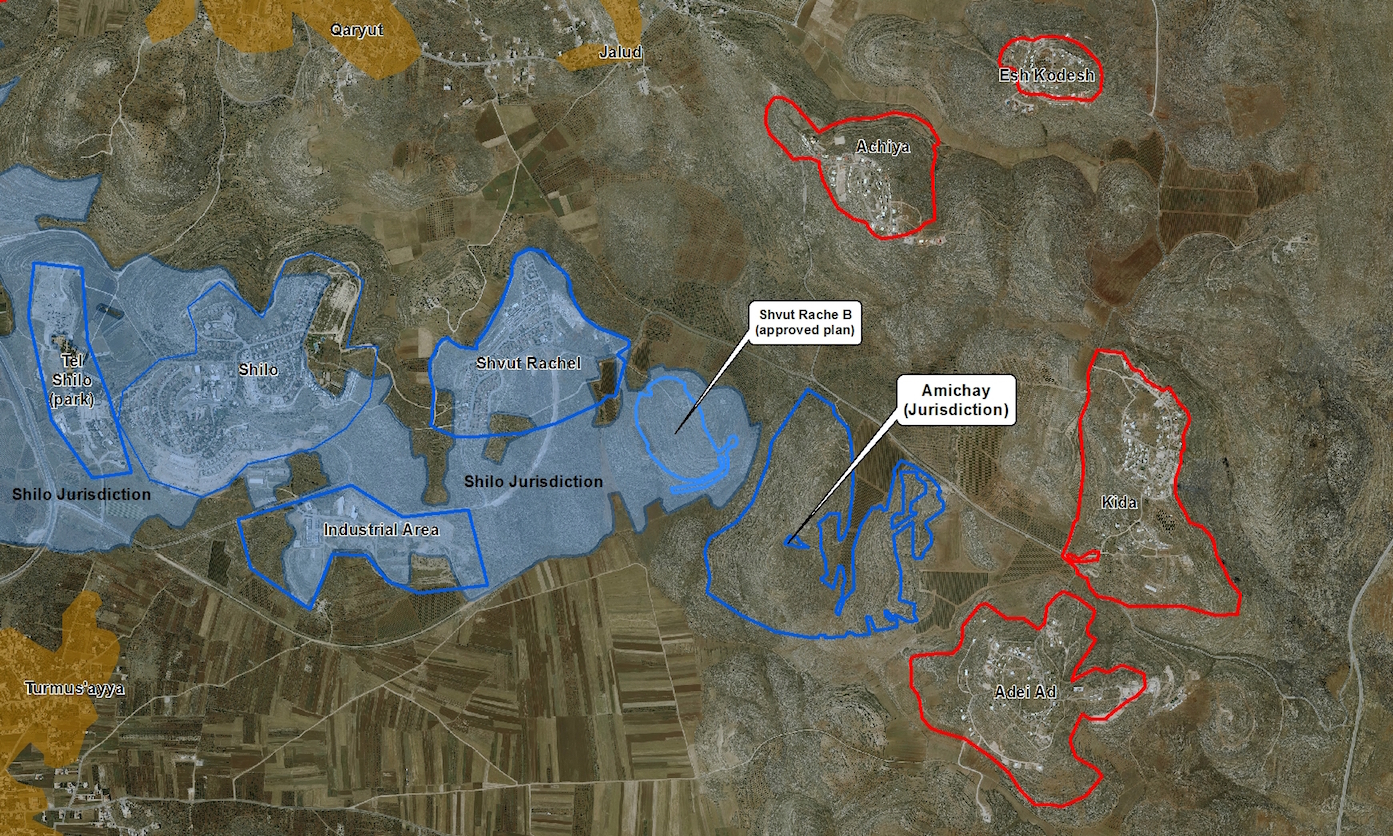 But Amichai isn’t the only construction happening near Jalud. Palestinian officials have reported that construction work has also begun on Shvut Rachel East, a new “neighborhood” of the Shilo settlement (in fact, not a neighborhood but rather a new settlement, as explained by Peace Now). Shvut Rachel East was the original Amona pay-off plan, but Amona evacuees held out for a different plan on a different hilltop – and they got it with the approval of Amichai, to be built literally adjacent to Shvut Rachel East. But what the world might have assumed would be a choice of “this site or that site” became, instead, a jackpot for settlers of “this site AND that site,” and the Shvut Rachel East neighborhood plan was also approved. Meaning that rather than paying a price for breaking the law (and then resisting evacuation), the government rewarded Amona settlers with not one but two new settlements – both located deep inside the West Bank, in an area that Israel could not possibly retain in any land swap agreement, and, both at the expense of Palestinians residing in the area around the settlement of Shilo. And meaning that the government of Israel is, through this policy, continuing to actively incite and incentivize settler law-breaking.
Coordination? Test #2: Bibi Reportedly Ok’s 5,000 East Jerusalem Units After Blocking Them for Years
On June 21st – the very day Trump envoy Jared Kushner arrived in Israel and was meeting with Netanyahu – news broke that Netanyahu was lifting his alleged hold on plans for the construction of 5,000 of new settlement units in East Jerusalem. This news comes on the heels of a June 19th report by Israel’s Army Radio that it had seen secret government documents showing that Prime Minister Netanyahu had imposed a building freeze in East Jerusalem settlements over the past few years. The documents – which were not released by Army Radio – allegedly identify specific projects totalling 6,000 units in Gilo, Pisgat Zeev, and Har Homa, that Netanyahu reportedly froze under intense pressure from the Obama administration. The 5,000 units for which Netanyahu has now reportedly given a green light are part of these 6,000 units, although there are few additional details thus far. Jerusalem Online suggests that some of the units are part of plans that were previously but have expired and need re-approval, and that the Jerusalem local planning committee will convene in short order to re-approve these plans.
It’s worth revisiting the dangerous East Jerusalem construction roller coaster ride of 2017. In January, Netanyahu announced, “I’ve decided to remove the political limitations on construction in East Jerusalem.” The worst was feared, including implementation of Givat Hamatos and/or E1, either of which would have devastating impact on the viability of the two-state solution. Nothing happened until April when rumors frantically swirled suggesting Netanyahu was planning a 15,000-unit construction surge in East Jerusalem. The formal announcement was expected to coincide with Jerusalem Day – and President Trump’s first visit – in May, but nothing was announced. A short time later, on June 6th, the Civil Administration’s High Planning Council advanced 603 units for the massive settlement of Maale Adumim, located just across the Green Line on the northeast border of East Jerusalem.
Coordination? Test #3: 70% Rise in Settlement Construction Starts Over Past Year
Ariel University – Located in the settlement of Ariel – Set to Double in Size
 Israeli Education Minister Naftali Bennett presented a plan to the Knesset that will double the size of “Ariel University,” an Israeli institution of higher education located in the settlement of Ariel settlement. The centerpiece of Bennett’s plan, which will be implemented over the next five years, is a medical center to be named for Sheldon Adelson, who is a major American settlement financier. Adelson is said to be contributing $20 million to the medical school, making good on a commitment made in 2014. The plans still need to secure addition approvals before proceeding.
Ariel is located in the heart of the northern West Bank, reaching literally to the midpoint between the Green Line and the Jordan border. The future of Ariel has long been one of the greatest challenges to any possible peace agreement, since any plan to attach Ariel to Israel will cut the northern West Bank into pieces. Ariel University became an accredited Israeli university in 2012, following significant controversy and opposition, including from Israeli academics. It has since been the focus of additional controversy, linked to what is a clear Israeli-government-backed agenda of exploiting academia to normalize settlements.
Cleared from Baladim Outpost, “Hilltop Youth” Radicals Stir More Trouble in Yitzhar
Earlier this month, the IDF evacuated dozens of radical Israeli settlers from the illegal “Baladim” outpost in the Jordan Valley. Baladim was the most notorious and established outpost in the region, a frequent source of terror for Palestinians and the Israeli army alike. The radical “Hilltop Youth” that camp-out in Baladim have been evacuated dozens of times before, but each time the they return to live illegally in the area.
According to a Haartez report, this time the IDF approached the leaders of the radical settlement of Yitzhar – from which many of Baladim radicals hail – before the outpost’s evacuation. The IDF reportedly warn them about the likely influx of Hilltop Youth to Yitzhar following the evacuation.
The interplay between Yitzhar and the Hilltop Youth is one to watch, particularly after an attack this week on Israeli Army vehicles at Yitzhar’s gate. The settlement’s leaders are claiming that the Hilltop Youth are responsible for perpetrating the attack. Haaretz writes, “Yitzhar is considered an ideological focal point of the radical settler right, yet a large number of residents who spoke to Haaretz condemned the recent stone throwing and the extremist ideology of the Baladim settlers.” Shin Bet officials reportedly met with Yitzhar leaders this week to push them to do more to “calm” the young, violent, and extremely problematic radicals. Yitzhar settlers might be trying to distance themselves from the Baladim (which is problematic given that the Hilltop Youth who have fought for Baladim are from Yitzhar), as the Shin Bet has been more aggressively moving against members of the “Hilltop Youth”, which we covered in last week’s settlement report.
Bonus Reads
- “Who Are You Calling a Settler? Meet the young Israelis living in the West Bank” (Haaretz)
- “Settlement tours: a new frontline in Israel’s ideological conflict” (Reuters)
- “Americans disproportionately leading the charge in settling the West Bank” (Haaretz)
FMEP has long been a trusted resource on settlement-related issues, reflecting both the excellent work of our grantees on the ground and our own in-house expertise. FMEP’s focus on settlements derives from our commitment to achieving lasting Israeli-Palestinian peace, and our recognition of the fact that Israeli settlements – established for the explicit purpose of dispossessing Palestinians in the West Bank and East Jerusalem of land and resources, and depriving them of the very possibility of self-determination in their own state with borders based on the 1967 lines – are antithetical to that goal.