Welcome to FMEP’s Weekly Settlement Report, covering everything you need to know about Israeli settlement activity this week.
To subscribe to this report, please click here.
October 17, 2024
- ILA Approves Tenders for Significant Expansion of Ramat Shlomo Settlement in E Jerusalem
- As Palestinian Olive Harvest Starts, Rampant Settler Violence Already Documented as International Activists Are Deported
- U.K. Sanctions Seven Settler Entities, Including Amana
- Israeli AG Asks for More Paperwork Before Govt Provides Bomb Shelters to Illegal Outposts
- Likud Party Shares Invite “Preparing to Settle” Gaza
- Peace Now Reports On Post-October 7th West Bank Expansion
- Bonus Reads
ILA Approves Tenders for Significant Expansion of Ramat Shlomo Settlement in E Jerusalem
Ir Amim reports that on October 14th the Israel Lands Authority (ILA) published a tender for the expansion of the Ramat Shlomo settlement located on the northern border of East Jerusalem. The tender covers the construction of 286 new settlement units in an open patch of land north of the currently built-up settlement area, expanding the settlement north towards the edge of the Palestinian neighborhood of Beit Hanina. This tender is part of a larger plan for a total of 650 new settlement units units. After approving the tender, the ILA decided to delay its publication date (on which the tender will open for bids) to some time after November 20th.
Ir Amim writes:
“If built, these units would further fragment Palestinian space, achieving two goals of Israeli policy in East Jerusalem: (1) Further complicating the possibility of drawing the future border of a Palestinian capital in Jerusalem and, (2) blocking the ability of Palestinian neighborhoods (Beit Hanina, in this case) to expand and develop in order to meet the needs of their population.”
As Palestinian Olive Harvest Starts, Rampant Settler Violence Already Documented as International Activists Are Deported
The Palestinian olive harvest kicked off October 10th and farmers are already facing harassment and violence by settlers, who are unrestrained by IDF (absence of) enforcement. In addition to the violence, settlers have also been filmed harvesting olives from privately owned orchards. National Security Minister Ben Gvir called on Netanyahu to cancel the olive harvest entirely.
A statement by 12 UN experts called on the Israeli government to protect Palestinians, saying:
“Restricting olive harvests, destroying orchards and banning access to water sources is an attempt by Israel to expand its illegal settlements.”
In addition, the Israeli government has deported at least two American citizens volunteering through an organization called Fazaa to accompany Palestinian farmers during the olive harvest. According to Fazaa, the two volunteers were arrested and interrogated by Israeli soldiers who accused them of violating a closed military zone order. The Israeli government accused the two volunteers of being anarchists and supporting Hamas
According to Haaretz, 17 foreign activists have deported in recent months – – tracking the creation of a team with the IDF dedicated tracking activists in the West Bank.
U.K. Sanctions Seven Settler Entities, Including Amana
On October 15th, the United Kingdom imposed sanctions on three Israeli outposts and four settler groups – including the very powerful Amana organization. Prime Minister Keir Starmer also told the BBC that his government is also considering imposing sanctions on Israeli Ministers Smotrich and Ben Gvir.
U.K. Foreign Secretary David Lammy said in a statement:
“When I went to the West Bank earlier this year, on one of my first trips as Foreign Secretary, I met with Palestinians whose communities have suffered horrific violence at the hands of Israeli settlers. The inaction of the Israeli government has allowed an environment of impunity to flourish where settler violence has been allowed to increase unchecked. Settlers have shockingly even targeted schools and families with young children. Today’s measures will help bring accountability to those who have supported and perpetrated such heinous abuses of human rights. The Israeli government must crack down on settler violence and stop settler expansion on Palestinian land. As long as violent extremists remain unaccountable, the UK and the international community will continue to act.”
The Amana organization is deeply intertwined with the entire settlement enterprise in both legal and illegal (under Israeli law) ways. It plays a central and influential role in the realm of settler political leadership, is very well financed, and owns and develops a large portfolio of land in the West Bank for settlements and outposts. The Times of Israel describes Amana as “ the settlement movement’s development arm and the most prominent Israeli development organization in the West Bank.” The U.K. follows Canada as the second country to impose sanctions on Amana, a growing movement that a group of U.S. Senators urged the Biden Administration to join.
The U.K-sanctioned outposts are:
- Tirzah Valley Farm outpost (the U.K. previously sanctioned Moshe Sharvit, who founded the Meitarim outpost);
- Meitarim outpost (the U.K. previously sanctioned Yinon Levy, who founded the Meitarim outpost); and,
- Shuvi Eretz outpost.
The U.K. also sanctioned the following organizations in addition to Amana:
- Od Yosef Chai Yeshiva – a notoriously violent religious school located in the Yitzhar settlement;
- Torat Lechima – an Israeli charitable organization; and,
- “Hashomer Yosh” – and Israeli organization which brings volunteers to illegal outposts.
Israeli AG Asks for More Paperwork Before Govt Provides Bomb Shelters to Illegal Outposts
Israel’s Attorney General has slowed a plan approved by the Israeli Cabinet to place mobile bomb shelters in illegal outposts. Chastising the Cabinet in a letter to Prime Minister Netanyahu, AG Baharv-Miara insists that such a decision must be reviewed by professionals, a budget impact must be prepared, and a legal position paper must be issued.
In response, Finance Minister Bezalel Smotrich – who also serves as a minister in the Defense Ministry where he acts as the de facto governor of the West Bank – said:
“We will continue to fix, regulate, and create de facto sovereignty, and the attorney general will continue to interfere… [thanks to] the cabinet ministers for voting unanimously in favor of the decision…we are continuing together and with all our strength for the sake of settlement and security.”
Likud Party Shares Invite “Preparing to Settle” Gaza
Haaretz reports that the Likud Party has issued an invitation to an event promoting Israel’s resettlement of Gaza. Hosted by Daniel Weiss’s Nachala settlement group, the event is scheduled to be held next week near the Gaza buffer zone, and at least eight Member of Knesset are expected to attend including Ben-Gvir, Smotrich, Eliyahu, and Wasserlauf.
In a statement, the Nachala group said:
“the event is not just a theoretical conference, but a practical exercise and preparation for renewed settlement in Gaza…the return to settlement in Gaza is no longer just an idea but a process that is already in advanced stages, with government and public support.”
Peace Now Reports On Post-October 7th West Bank Expansion
In a new report, Peace Now detailing Israel’s rapid annexation of land in Area C – including 5 new settlements, 43 new outposts, new roads, and plans for 8,681 new settlement units – since October 2023.
Peace Now writes:
“After a year of war in Gaza and nearly two years under an extreme right-wing, pro-settler government, the Israeli government’s policy in the occupied West Bank has become fully apparent: annexing the West Bank and shrinking Palestinian space in Area C.
This policy is being carried out through the establishment of a record number of illegal outposts, a sharp increase in the quantity and intensity of settler violence—described by the head of the General Security Service (Shin Bet) as Jewish terrorism—closures of roads and highways, and unprecedented measures to legalize and fund illegal outposts. At the same time, the government is completing an administrative infrastructure for the annexation of the West Bank, by transferring powers from the Civil Administration, a military body, to the newly created Settlement Administration, a civil and political administration under the direct authority and control of Minister Smotrich.”
Bonus Reads
- “Shin Bet Accuses Israel Police of Ignoring Dangers of Jewish Terror as Rift Between Authorities Deepens” (Haaretz)
- “Israel’s new tactic to seizing West Bank lands: Settlement ‘buffer zones’” (Middle East Eye)
- “Israel Land Authority tells UNRWA to evacuate Jerusalem premises for breaching lease” (The Times of Israel)
- “UNRWA headquarters in Jerusalem to be seized” (Israel Hayom)
- “Beita’s resurgent civil resistance after a year of settler attacks” (Mondoweiss)
Welcome to FMEP’s Weekly Settlement Report, covering everything you need to know about Israeli settlement activity this week.
To subscribe to this report, please click here.
August 16, 2024
- New Blue Line Map Paves Way for New Settlement, Nahal Heletz
- New Blue Line Map Grants Migdal Oz Settlement More Land
- Tender Issued for Alon Shvut Construction
- Givat Hamatos Expansion Plan Deposited
- Settlers Open Long Awaited “Zip Line” Project in Jerusalem
- Settlers Lead Violent Pogrom in Jit
- Threat of Multiple Demolitions in al-Bustan, Along with Settler Takeovers, Amplifies Threat of Mass Displacement
- IDF Partially Dismantled Giv’at Oz Zion Outpost
- Settlers Stage Another Protest On Gaza Boundary
- Regavim Files Lawsuit Against U.S. Government Over Settler Sanctions
- Canada Revoked JNF Tax Exemption
- Bonus Reads
New Blue Line Map Paves Way for New Settlement, Nahal Heletz
 On August 14th the Israeli Civil Administration’s Blue Line Team released an updated map delineating more state land in the area of the Palestinian village of Battir, land on which the government is advancing plans to build a new settlement, called Nahal Heletz. This move is tantamount to issuing a new declaration of “state land,” though the Israeli government views it as a correction and/or update to previous maps. If built, Nahal Heletz would be the first new settlement the Israeli government has planned since 2017, when the Amichai settlement was established.
Speaking after the declaration, Smotrich said:
“No anti-Israelism or anti-Zionism will stop the continued development of the settlements. We will continue to fight the dangerous idea of a Palestinian state, and establish facts on the ground. This is my life’s mission and God willing I will continue with it as much as I can.”
The updated map of the Blue Line changes the status of an irregularly shaped area of 602.7 dunams to “state land”, allowing the settlement to be planned there – a slice of land much larger than what had previously been planned for the new settlement. Palestinians – whose access to their own privately owned land near the area of the settlement will be restricted – have 45 days to submit an appeal against the designation. Peace Now notes that the shape of the new line:
“rais[es] questions about how it is possible to construct a settlement in such a fragmented and irregularly shaped area. Based on the settlers’ past experience, it is highly likely that parts of the land outside the blue line will be incorporated into the settlement, and Palestinians will be denied access to their land. As seen in the map, extraordinary efforts have been made to create a blue line for the intended settlement…The pace of declarations of blue line boundaries and state land is unprecedented. Just last week (7.8.24), 116 dunams were declared as state land in the Migdal Oz settlement. The numerous declarations of state land and blue line boundaries for settlements are a result of the government’s policy to prevent the establishment of a Palestinian state and to legitimize the settlement enterprise.”
Recall that a month ago the Israeli government established a jurisdiction for the new settlement before the status of the land was clear. The Israeli Blue Line Team (a government effort to precisely map the boundaries of state land in the West Bank) said at the time that it had updated its maps of state land boundaries in the area, but those maps were note released until August 14th, and – to no one’s surprise – discovered the boundaries of state land in the area to include more area than previously declared, allowing for the settlement to be established.
Battir is a Palestinian village known for its ancient terraced hills, which are recorded as a UNESCO World Heritage site. Notably, the new settlement does not include the land on which two illegal outposts already exist on Battir’s land. The new settlement is being planned for land that is between Bethlehem and several villages to its west (Walaja, Battir, and Husan) – meaning that construction on this land will sever the territorial continuity of Palestinian land in the Bethlehem region, and, in the words of Peace Now: “turn them [the villages] into an enclave within Israeli territory.”
Palestinian journalist and commentator Nour Odeh told Al Jazeera:
“[Smotrich] is flexing his muscles, telling the world that he cares very, very little about international law…[the settlement] devours what’s left of [Palestinian] land in the Bethlehem area, which has shrunk to nearly 10 percent of its original size…[it is located] not just in any UNESCO World Heritage Site, but also in … the only place left for agriculture, for picnics, planning and building”.
New Blue Line Map Grants Migdal Oz Settlement More Land
On August 7th, the Israeli Civil Administration published a new map which expands the amount of land in the area of the Migdal Oz settlement by 116.2 dunmans. According to Israeli press, the government is preparing plans for the construction of 500 new settlement units on this land.
Migdal Oz is located between Bethlehem and Hebron in the southern West Bank, in an area where the Israel separation barrier cuts deeply into the West Bank so much so that the Migdal Oz, and Efrat settlements are on the Israeli side of the barrier (de facto annexed into Israeli proper.
Peace Now said in a statement:
“The Israeli government continues to legitimize the injustice and original sin of the settlement enterprise. Instead of evacuating settlements established through military seizure orders, which have taken hundreds of dunams from the Palestinian residents of Beit Ummar, the government perpetuates this injustice with regulations and laws that deepen the hostility between Israelis and Palestinians. This is a messianic government focused solely on annexation and the perpetuation of the war & occupation, with no regard for the security of either Israelis or Palestinians.”
Tender Issued for Alon Shvut Construction
Peace Now reports that the Israeli Ministry of Housing issued a tender for the construction of 110 new settlement units in the Alon Shvut settlement. The Alon Shvut settlement, located just north of the Kfar Etzion settlement and between Bethlehem and Hebron. The Alon Shvut settlement was last expanded in 2019, when the Israeli government created a new outpost near the settlement in order to “temporarily” house settlers who had been forcibly evacuated from the Netiv Ha’avot outpost. The government then added the area on which the settlers were relocated to the jurisdiction of Alon Shvut.
Peace Now notes that this is the second tender published for West Bank construction in 2024.
Peace Now said in a statement:
“This new tender adds to the additional construction that the Israeli government has been advancing across the West Bank since the beginning of the year. So far, the government has promoted over 8,700 units in the planning council, and with this new tender, the total number of housing units put up for tender stands at 630. Instead of focusing on areas like the north or the south that are in need of development and investment, the Israeli government chooses to promote housing units in occupied territories that do not belong to it.”
Givat Hamatos Expansion Plan Deposited
Ir Amim reports that on August 4th the Jerusalem District PLanning Committed formally deposited for public review a plan to massively expand the Givat Hamatos settlement along the Hebron Road. The plan calls for 3,5000 new settlement units and 1,300 hotel rooms to be built on the eastern slopes of the Givat Hamatos settlement – construction which would double the number of housing units in the Givat Hamatos settlement and increase its land mass by 40%. Further, the new settlement will be built on a strategic strip of land that will expand the area of Givat Hamatos eastward, connecting it with another new settlement plan – the “Lower Aqueduct Plan.” These plans ultimately create a string of settlements — spanning from Gilo to Givat Hamatos to Har Homa — that, together with the planned “Givat HaShaked” settlement to its north, completely encircle the East Jerusalem Palestinian neighborhood of Beit Safafa with Israeli settlement construction.
Previous iterations of this plan included the Greek Patriarchate as a co-developer, but the newly deposited plans do not include mention of the Church anywhere. The Church has said in the past that part of the development is intended for use by the city’s Christian community, though previous reports indicate that the plan calls for five synagogues and two mikvehs, clearly showing that the construction is designed to serve Israeli Jews.
Settlers Open Long Awaited “Zip Line” Project in Jerusalem
On August 14th, the settler organization Elad celebrated the opening of one of its many touristic settlements in Jerusalem, this one a zipline in the Jerusalem’s Peace Forest. The zipline travels over the heads of Palestinian houses in the Jabal al Mukhaber neighborhood (see pictures). The zipline connects the “Peace Forest” in the Abu Tor neighborhood to another popular tourism site, the Armon Hanatziv promenade.
 As part of this project, Elad also established a new tourism center in the Peace Forest, a project that was paid for by the Israeli Ministry of Housing, to the tune of 43 million NIS ($12.38 million USD). The House – which the settlers have named “Beit Shatz” – was purchased by Elad as part of Elad’s broader efforts to use tourist projects as a means for taking control over the area, which is situated in a national park.
The behavior of Elad and the Israeli government in the Peace Forest underscores the the systematic discrimination in planning policies and enforcement facing Palestinians in Jerusalem. The several Palestinian families living in the “Peace Forest” and are prohibited from building or expanding/renovating their homes because of the strict building prohibitions for national parks. Elad managed to circumvent those same restrictions by pushing the Jerusalem Municipality to request that the area they are targeting be designated as an “open public space,” which would allow the project to advance. In December 2019, Jerusalem planning authorities granted the settler-backed request. That same month, Israel pursued demolition orders against Palestinian homes in the Peace Forest that lacked building permits, despite the fact that in some cases Palestinians have repeatedly applied for and been denied permits.
Peace Now said in a statement:
“The zip line project is one of many initiatives by the Elad organization in Jerusalem, where, in every case, the municipality and/or government bodies were involved in transferring responsibility for the sites to the foundation. For example, the archaeological site of the City of David has been operated by the Elad organization for decades, the Israeli government is constructing a cable car to the Elad organization’s tourism complex in the City of David, a camping site at the edge of the Peace Forest was developed with three million shekels of state funds, and the Hinnom Valley was handed over for agro-tourism development under Elad’s responsibility
These projects, along with the latest zip line initiative, represent a tourism activity intertwined with political interests, aimed at allowing the foundation to become a powerhouse in Jerusalem’s tourism sector. Elad seeks to control and manage numerous sites, both in terms of the content delivered to the public and the shaping of the space. Elad’s tourism activities can be seen as a form of “touristic settlement,” designed to make the area as “Jewish-Israeli” as possible and to complicate any future compromise agreement in Jerusalem, where two capitals for two states are envisioned.”
Jerusalem expert Daniel Seidemann commented on X:
“Gleeful teenagers will screech as the race above the iconic views of the Mt. of Olives, the Old City and al Aqsa included in the ticket. This is the crass Disneyfication of historic Jerusalem, and it’s not the first. A cable car is under construction leading from West Jerusalem to the settler headquarters in Silwan, a mere 179 meters away from Al Aqsa mosque.”
Settlers Lead Violent Pogrom in Jit
On August 15th, ~100 Israeli settlers from the X settlement launched a violent attack on the Palestinian village of Jit, located near Nablus in the northern West Bank. One Palestinian was killed by settler gunfire and many more were injured. Video of the pogrom show widespread damage to property as a result of settlers setting vehicles and homes on fire. The IDF arrived about an hour into the ordeal, and removed settlers from the town, but made only one arrest. The IDF later said it has opened an investigation into the incident.
Threat of Multiple Demolitions in al-Bustan, Along with Settler Takeovers, Amplifies Threat of Mass Displacement
Ir Amim continues to raise alarm regarding the imminent mass displacement of Palestinians from their longtime homes in the al-Bustan section of Silwan, in East Jerusalem.
The threat turned into reality for the Shehadeh family, whose home was taken over by settlers on August 15th with the assistance of Israeli police. Ir Amim says the Shehadeh family, “lost their home to an organization intent on displacing their entire community, all with the help of a legal system that imparts anything but justice” This is the 15th Palestinian family dispossessed by the Ateret Cohanim settler organization, with another 80+ families facing the same threat. Ateret Cohanim, in coordination with the state, has capitalized on Israel’s discriminatory laws which allow Jews to “reclaim” houses that they owned prior to 1948 (Palestinians have no such parallel right).
On August 5th, Israeli authorities demolished another home in Al-Bustan, where eight more homes face the same demolition threat.
Ir Amim writes:
“All legal remedies have been exhausted. As a result, over 20 more Palestinians stand to be displaced. Several additional homes could likewise be under impending threat. The increased risk of mass demolition in Al Bustan follows the demolition of the home of community leader and well-known activist, Fakhri Abu Diab, in February, which profoundly impacted the community and triggered extreme alarm among its residents. It is assumed that Abu Diab was deliberately targeted due to his work to secure a housing solution for the community and a cruel way for the authorities to instill fear in the rest of the neighborhood.
Demolitions of Palestinian homes have reached unparalleled levels since the outbreak of the war. Such practices constitute a form of collective punishment, retaliatory state violence, and part of a series of repressive measures currently being employed by Israel against Palestinians under its control. Since October 7, 160 homes have been destroyed in East Jerusalem alone, marking a two-fold monthly increase in demolitions compared to the period preceding the war. Between January 1-August 8, 2024, 113 homes have been demolished, representing a 75% increase compared to the same period last year.
The numbers are only liable to accelerate in light of the planned changes in the government ministry which presides over the National Enforcement Unit–one of the units responsible for carrying out demolitions in East Jerusalem. On July 24, the Knesset approved the transfer of the National Enforcement Unit from the Ministry of Finance to the Ministry of National Security, placing it under the direct authority of ultranationalist and far-right Minister Itamar Ben Gvir. The transfer of the unit was included in coalition agreements during the formation of the government last year. Over the past year and half, Ben Gvir has made numerous statements calling for the intensification of demolitions of Palestinian homes. Such a move is cause for extreme alarm and will directly impact areas of East Jerusalem.”
To read more about the multitudes of threats facing Palestinians in al-Bustan, see Ir Amim’s reporting.
IDF Partially Dismantled Giv’at Oz Zion Outpost
On August 6t the IDF dismantled 15 temporary buildings that compromised a new and expanded section of the illegal Giv’at Oz Zion outpost, which settlers built on privately owned Palestinian land north of Ramallah. The outpost, according to the Shin Bet, has been the source of violent terror. Prime Minister Netanyahu and Finance Minister Bezalel Smotrich (who oversees building enforcement in the West Bank) both approved this demolition at the request of the IDF Commander.
Just over a month ago the IDF clashed with settlers at the Oz Zion outpost when forces arrived to demolish the new section. The July demolition was reportedly ok’d by Prime Minister Netanyahu – going over the head of Bezalel Smotrich and the Settlement Administration, which has seized control of building enforcement in the West Bank.
Settlers Stage Another Protest On Gaza Boundary
On August 12th, ~300 Israeli settlers held a protest near the Gaza barrier, continuing to promote their call to resettle the Gaza strip. Specifically, the event was to be held near the entrance to the so-called Netzarim Corridor, a road and control zone that IDF cut into Gaza to severing the north and the south – destroying everything in its path and near it. In anticipation of the rally, the IDF expanded the closed zone around the Gaza barrier. The IDF told The Times of ISrael that it feared the event would be attacked by Palestinians, though Haaretz reports that the IDF anticipated the protestors trying to enter Gaza as they have done at previous protests. During the event itself the IDF escorted 100 protestors to the ANZAC memorial site close to the Netzarim junction.
One of the protestors told Haaretz:
“We requested entry to Netzarim Junction because it is a symbolic location with available land for settlement, a fitting Zionist response to our enemies,” she said. “We have over 600 families ready to move here. We can’t wait for the war to end, and it will also significantly support the war effort.”
The protest, organized in part by the Nahala settler group, was held on the Jewish holiday Tisha B’Av (which commemorating the dates on which two ancient temples in Jerusalem were destroyed) and featured prayer and a traditional reading of scripture.
Regavim Files Lawsuit Against U.S. Government Over Settler Sanctions
The Israeli settler group Regavim “assembled a team of lawyers” (according to its newsletter) and filed a petition challenging sanctions imposed by the Biden Administration on Israeli settlers. The Christian Zionist group “Texas for Israel” filed the petition with the District Court of Northern Texas, arguing that the sanctions violate the rights of Americans because it prohibits citizens from providing financial support to designated individuals and entities, which the complainants say constitutes a violation of the rights to free speech and religion.
There is a growing international sanction regime targeting individual settlers and increasingly connected entities that are alleged to have participated in acts of violence in the West Bank. In July, reports began circulating that the European Union was/is considering sanctions against Regavim specifically. Fearing sanctions, settlers and their allies in the government have mobilized a concerted effort to push back against the continued escalation of those sanctions – which to date have not touched Israeli government officials or major settler organizations other than Amana (which was sanctioned by the Canadian government only).
Canada Revoked JNF Tax Exemption
In addition to being the first state to issue sanctions on the Amana settler organization, Canada has also become the first state to revoke the tax exempt status of organizations – in this case the very prominent Canadian arm of the Jewish National Fund and the Ne’eman Foundation – because of its illegal activities in the West Bank. Haaretz reports that the revokation was prompted by complaints submitted to the government by Palestinian rights groups, alleging that the organizations finance illegal settlement construction.
Bonus Reads
- “New Settlement, expanding outposts, represent wholesale attack on World Heritage Site of Land of Olives and Vines – Cultural Landscape of Southern Jerusalem, Battir” (Joint alert by Peace Now, Combatants for Peace, Emek Shaveh)
- “While We Were at War: The Government’s Annexation Revolution in the West Bank Since October 7th” (Peace Now)
- “Israel is redrawing the West Bank, cutting into a prospective Palestinian state” (Washington Post)
- “Israel’s Top Court: IDF Must Protect Palestinians From West Bank Settlers, Even During War” (Haaretz)
- “US leads international condemnations of Ben Gvir’s ‘provocations’ at Temple Mount” (The Times of Israel)
- “What if the U.S. Doesn’t Veto Sanctions Against Israel? ‘It’s the End of the World,’ Says Legal Expert” (Haaretz)
- “Which countries have sanctioned Israeli settlers – and does it mean much?” (Al-Jazeera)
- “US to continue aid to Israeli military unit involved in Palestinian American’s death” (Middle East Eye)
- “IDF says US activist shot by troops accidentally at West Bank anti-settlement rally” (The Times of Israel)
- “Is the wall around the West Bank for protection or separation?” (Israel Hayom)
Welcome to FMEP’s Weekly Settlement Report, covering everything you need to know about Israeli settlement activity this week.
To subscribe to this report, please click here.
December 8, 2023
- Israel Approves First New East Jerusalem Settlement Since 2012 – the “Lower Aqueduct plan”
- “Kahanist” March Calls for Israeli Control Over Western Wall, Clash With Israeli Police
- In Armenian Quarter, Settler Group Believed to Be Behind Disputed Land Deal
- U.S. & Belgium Imposes Visa Ban on Dozens of Settlers, Criticizes Israel’s Lack of Action
- Miftah Reports on “State Sponsored Settler Terrorism”
- A Roundup of Settler Violence
- Bonus Reads
Israel Approves First New East Jerusalem Settlement Since 2012 – the “Lower Aqueduct plan”
On December 4, 2023 the Jerusalem District Planning Committee approved a plan to build a new settlement – called the “Lower Aqueduct” plan – on a sliver of land located between the controversial settlements of Givat Hamatos and Har Homa in East Jerusalem. The settlement will be adjacent to the Palestinian neighborhood of Umm Tuba and fall on both sides of the 1967 Green Line. Its location is intended to connect the two and in so doing, it will establish a huge, uninterrupted continuum of Israeli settlements on the southern rim of Jerusalem, and will destroy Palestinian contiguity between the West Bank and East Jerusalem. [map]
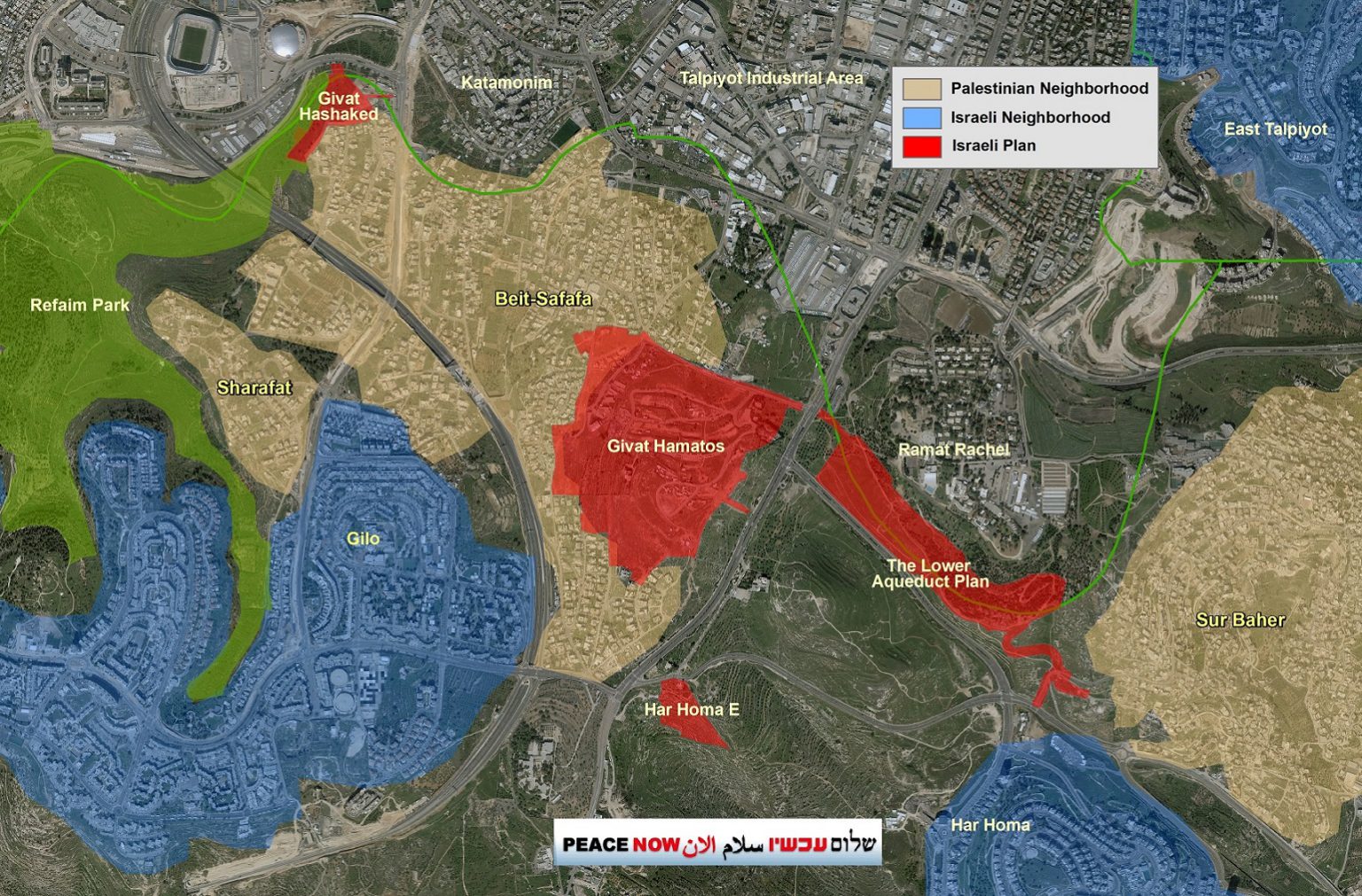
The final approved plan provides for the construction of 1,792 settlement units. According to Ir Amim, this is the first major new East Jerusalem settlement established by Israel since 2012.
Ir Amim says:
“This plan carries serious ramifications on the political future of Jerusalem. If constructed, it will extend the Israeli settlement wedge along East Jerusalem’s southern border, further creating a sealing-off effect of East Jerusalem from the southern West Bank, while fracturing the Palestinian space and depleting more vacant land for Palestinian development….Beyond its geopolitical ramifications, the advancement of this plan underscores the systematic discrimination implicit in Israeli planning and building policy in Jerusalem. Since the beginning of 2023, over 18,500 housing units have been advanced for new or existing Israeli settlements in East Jerusalem, while residential development for Palestinians has been all but neglected. This is despite the fact that Palestinians constitute nearly 40% of Jerusalem’s population. 2023 is slated to join 2022 as being the two years with the highest number of settlement units advanced in the last decade in East Jerusalem. Such inequitable urban planning policy has long served as a driver of Palestinian displacement in service of solidifying a Jewish demographic majority in Jerusalem and further cementing Israeli territorial control to foil prospects for a just political resolution.”
Peace Now said in a statement:
“The Israeli government continues to undermine any viable two-state solution. While the IDF is engaged in the Gaza Strip, and hundreds of Israelis living in border areas in the north and south are uncertain about when they can return to their homes, the government is advancing construction beyond the Green Line, further jeopardizing the security of all Israeli residents seeking a hopeful future with secure borders.”
“Kahanist” March Calls for Israeli Control Over Western Wall, Clash With Israeli Police
On the first night of Hanukkah, approximately 150 far right wing Israelis gathered for a planned march through the Old City of Jerusalem calling for Israeli control over the Temple Mount. Israeli police – which had previously approved the march (likely with the knowledge and approval of Netanyahu) and its route – ultimately stopped the march from leaving its convening point, resulting in clashes and at least one arrest.
The point of the march was to call on Israel to “restore full Jewish control over the Temple Mount and Jerusalem,” an inflammatory message that threatens to further undermine the very delicate status quo. Indeed, the march’s organizers dubbed the march the “Maccabi March,” referencing an important Jewish revolt that ended in the rededication of the Temple. An the night of the march, attendees were shouting racist slogans and raising racist signs.
Israeli Opposition Leader Yair Lapid said in a tweet that the march is:
“A blatant Kahanist attempt to set other [war] fronts on fire and to bring about more destruction and death.”
Daniel Seidemann, founder of Terrestrial Jerusalem, said:
“If there is any provocation more dangerous, more incendiary and more likely to trigger an eruption of violence in East Jerusalem and/or the West Bank and/or the Lebanese border, I can’t think of one.”
In Armenian Quarter, Settler Group Believed to Be Behind Disputed Land Deal
Ir Amim reports that senior executives of the Ateret Cohanim settler groups have recently been seen meeting with representatives of the real estate company behind the controversial purchase of a significant amount of land in the Armenian Quarter of the Old City of Jerusalem. The reports appear to confirm suspicion that Xana Gardens is actively collaborating with settlers in, according to Ir Amim, “attempts to Israelize the Old City and erode its historically multicultural and multireligious character.”
For a background on this case, please see reporting by Ir Amim and Terrestrial Jerusalem.
U.S. & Belgium Imposes Visa Ban on Dozens of Settlers, Criticizes Israel’s Lack of Action
On December 5th, the U.S. Department of State announced that it has placed visa restrictions on dozens of settlers believed to be complicit in violent attacks on Palestinians in the West Bank. The U.S. also imposed visa bans on several dozen Palestinians believed to have perpetrated violence against Israelis.
U.S. Secretary of State Antony Blinken said in announcing the new policy:
“Last week in Israel, I made clear that the United States is ready to take action using our own authorities. Today, the State Department is implementing a new visa restriction policy targeting individuals believed to have been involved in undermining peace, security, or stability in the West Bank, including through committing acts of violence or taking other actions that unduly restrict civilians’ access to essential services and basic necessities. Immediate family members of such persons also may be subject to these restrictions.”
The list of individuals affected by this effort is not expected to be made public, but individuals will be notified if their visas are being revoked. Settlers who are U.S. citizens will not be affected. Axios reports that the last time the U.S. imposed such restrictions was under the Clinton administration.
It is unclear what process the U.S. government is undertaking to identify acts of violence and the individuals involved in them. On December 6th, OCHA reported that since October 7th settlers have launched 318 attacks against Palestinians, resulting in:
- 8 Palestinians have been killed by Israeli settlers;
- 84 Palestinians have been injured by settlers;
- 241 incidents resulting in damage to Palestinian-owned property;
- 1,014 people, including 388 children, have been displaced amid settler violence and access restrictions. The displaced households are from 15 herding/Bedouin communities.
Israel, for its part, is currently holding four settlers and two Israeli (non-settlers) in administrative detention who are believed to have perpetrated violence against Palestinians since October 7th. In announcing the visa bans, U.S. Secretary of State Antony Blinken said that the U.S. continues to push the Israeli government to “do more to hold accountable extremist settlers who have committed violent attacks against Palestinians in the West Bank.”
Soon after the U.S.’s announcement, Belgium announced a similar policy banning settlers suspected of engaging in violence from entering the country. Belgium Prime Minister said in a tweet that he will work with the U.S. in implementing this policy.
Last week, the spokesperson for the French Foreign Ministry publicly stated that the European Union should also consider sanctions on violent settlers. The comments were in support of U.S. President Biden’s op-ed in which he had threatened to impose visa bans, a week before the policy was implemented.
Miftah Reports on “State Sponsored Settler Terrorism”
The Palestinian NGO Miftah has published a short new report on settler violence, saying “settler violence and terror is a systematic state policy pursued by every Israeli government past and present, and the whole government apparatus is complicit and responsible for such terrorism.”
The report calls on the international community to “muster the courage and political will to hold Israel accountable with effective measures.” Specifically, it calls on the International Criminal Court to investigate war crimes in Palestine, label settlement products, impose a complete ban on trade with settlements, blacklist settler groups on terrorists lists, freeze assets of individuals and companies involved in the settlement enterprise, and more.
You can read the full report here.
A Roundup of Settler Violence
The following are a few examples of settler violence that have been picked up by major media outlets over the past two weeks:
- “Left-wing Israeli Activists Attacked While Protecting Settler-targeted West Bank Village” (Haaretz – Dec. 4th)
- “Homes and EU-funded school in West Bank village wrecked after threats by settlers” (The Times of Israel – Dec. 4th)
- “Israeli Soldiers Documented Shooting Disabled Palestinian in West Bank” (Haaretz – Dec. 7th)
- “Two Palestinians Killed in Separate Incidents in West Bank” (Haaretz – Dec. 3rd)
Bonus Reads
- “Return to Gush Katif: A determined movement emerges to resettle Israelis in Gaza” (The Times of Israel)
- “With All Eyes on Gaza, West Bank Palestinians Are Facing Unprecedented Violence” (Haaretz)
- Israeli Army Mulls Shutting Down Unit of Settler ‘Hilltop Youth’ Amid Violent Incidents Against Palestinians““ (Haaretz)
- “A Bitter Season in the West Bank” (The New York Review)
- “Northern Israeli Kibbutz Residents Prevent Palestinians From Harvesting Their Olives” (Haaretz)
- “West Bank settlers unwavering in support for Israeli government” (Al-Monitor)
- “Amid a Settler Onslaught, Protective Presence Activism Falters” (Jewish Currents)
Welcome to FMEP’s Weekly Settlement Report, covering everything you need to know about Israeli settlement activity this week.
To subscribe to this report, please click here.
August 25 2022
- Ir Amim Gets Set to Sue Settlers & State Over Plan for Settler-Run Cultural Center in Silwan
- This Week in Area C: Evangelical Group Launches Land-Grab as Demolition Rates for Palestinian Construction Spike
- IDF Prepares to Fortify Settlers’ Access to Joseph’s Tomb in Nablus
- Bonus Reads
Ir Amim Gets Set to Sue Settlers & State Over Plan for Settler-Run Cultural Center in Silwan
Ir Amim announced that, after exhausting every avenue for administrative remedy, it will likely proceed with a civil lawsuit in light of the State’s move last month to proceed with the construction of a “Yemenite Jewish Culture Center” in the Batan al-Hawa section of Silwan, despite two pending legal petitions against the project.
 Last month (July 2022), the Israeli government announced that the Jerusalem District Court had accepted a plan that would allow the project to move forward. That plan would see the building at the center of the dispute to be leased to a new company, which would establish and manage the cultural center. Hatched in secret by senior government officials and a body known as the Benvenisti Trust (which is at the center of the two pending legal petitions), the plan creates the appearance that the Benvenisti Trust is no longer directly involved in the project — but Ir Amim reports that there is reason to believe that this new company is an affiliate or subsidiary of Ateret Cohanim, the settler body that controls the Benvenisti Trust.
As a reminder, the two legal petitions filed by Ir Amim and residents of Batan al-Hawa against the project are:
- A June 2020 petition directly challenging the legitimacy of Ateret Cohanim’s (a settler group) resuscitation and takeover of the Benvenisti Trust – the Jewish endowment fund which allegedly held title to land in Batan al-Hawa in the late 19th century.
- A December 2020 petition challenging the issuance of a tender for the new culture center, pending the resolution of the first petition regarding the relationship between the Benvenisti Trust and Ateret Cohanim.
Ir Amim explains that, in response to the State’s new plan, it has requested an update on its petitions. Describing a letter it recently sent to the the Ministry of Justice (which was supposed to have launched an investigation into the allegations) Ir Amim provided the following update:
“Ir Amim called again for suspension of the project, stating numerous arguments, including the fact that announcement of such an initiative by Ministers Elkin and Sa’ar (the new State Camp Party) during a transitional government constitutes “campaign advertising” and therefore violates election campaign regulations. Moreover, the letter emphasized that leasing the property to “some other organization” for the establishment of a tourist site still violates the trust’s charter and designated purpose of the property, which is for residential use only. In light of the conduct of the trustees’ (i.e. Ateret Cohanim) and state authorities’ to date, there is reason to believe that this purported organization is a subsidiary or affiliate of Ateret Cohanim.
As the letter states, “if this is indeed the case, this is yet further decisive proof that the Benvenisti Trust is clearly being harnessed for the purposes of Ateret Cohanim and its affiliated bodies. This is another layer of a serious conflict of interest in the trustees’ activity to the point of attempting to alter its official goals, which the Registrar of Trusts considered not in accordance with the law and the opinion of the original grantor. It likewise evades the obligation to comply with the grantor’s instructions concerning the trust’s assets through creating a measure to try and underhandedly circumvent these barriers.” As such, Ir Amim demands the complete suspension of the project and an immediate freeze on the state’s allocation of public funds.”
This Week in Area C: Evangelical Group Launches Land-Grab as Demolition Rates for Palestinian Construction Spike
In its monthly report, OCHA reports that the month of June saw a 48% spike in the number of Palestinian-owned structures demolished or seized by Israel. Recall that this spike comes against the backdrop of settlers’ ongoing campaign to push the Israeli government to more expansively and expeditiously destroy Palestinian buildings in Area C. Four of the structures demolished by Israel in June were demolished within 96 hours of their discovery, under an expedited process Israel formulated and implemented, by fiat, via a military order (Military Order 1797).
Meanwhile, Haaretz reports that an American Evangelical Christian group calling itself “Hayovel” has undertaken a tree-planting campaign on privately-owned Palestinian land in Area C. The group, a U.S. 501(c)(3) nonprofit organization whose mission is to support “Israel’s right to exist in their biblical heart”, is charging donors $25 per tree, and has begun planting trees near the Har Bracha settlement in the central West Bank, south of Nablus. According to Dror Etkes – founder of the settlement watchdog group Kerem Navot – over 90% of the land in the area where the trees are being planted is owned by Palestinians from the nearby town of Burin. The land was once richly cultivated by its Palestinian owners, but has been left fallow for years because the Israeli military and settlers have prevented Palestinians from accessing the area. The American group’s stated objective is to plant 3,000 new trees in the West Bank by the end of 2022, and then 20,000 trees every year following.
When asked about the land on which the trees are planted, Hayovel asserted that it was given permission by several Israeli authorities, telling Haaretz:
“We do not own any of the land where we plant trees. We work closely with individual farmers, local Jewish communities, and local municipality governments. Most of the Greening Israel Project forestry sites are located on land owned and controlled by the State of Israel.”
IDF Prepares to Fortify Settlers’ Access to Joseph’s Tomb in Nablus
Arutz Sheva reports that the IDF is preparing to increase its protection for settlers who regularly visit Joseph’s Tomb, located inside the Palestinian city of Nablus, near the Balata refugee camp. Settlers regularly visit the religious site, escorted by the IDF, which regularly results in clashes with Palestinians.
As a reminder, Nablus is located in Area A of the West Bank, where the Oslo Accords afford Israel no jurisdiction. However, the Oslo Accords designated Joseph’s Tomb as one of two holy sites in Area A over which Israel retained control.
A former IDF Major General (Res.) Gadi Shamni, stressed the absurdity of the situation, telling a radio station:
“The entire story of Joseph’s Tomb is one big mistake. This is a huge operation of bringing people, transportation and other events around the prayers…There are parties who earn a lot of money there and there are many political interests. We have to stop endangering soldiers. Every entry into the site causes friction and it’s only a matter of time until a disaster happens there.”
Bonus Reads
- “Jewish extremists accused of slashing tires, graffitiing in Palestinian town” (The Times of Israel)
- [Video] “Palestinians in Masafer Yatta fear displacement” (Middle East Eye)
- “Demolishing our community center won’t destroy our resistance” (+972 Magazine)
- “Editorial | Denying the Green Line” (Haaretz)
Welcome to FMEP’s Weekly Settlement Report, covering everything you need to know about Israeli settlement activity this week.
To subscribe to this report, please click here.
February 25, 2022
- The Israeli Plans to Expand “National Park” Onto Church (& Palestinian) Property in East Jerusalem
- Israel Freezes Salem Family Eviction in Sheikh Jarrah
- U.S. Ambassador Nides Reiterates His No-Visiting-Settlements Policy, Invites Settlers to Meet with Him
- Further Reading
The Israeli Plans to Expand “National Park” Onto Church (& Palestinian) Property in East Jerusalem
News broke this week that the Jerusalem Local Planning Committee was scheduled to take up at its April 10th meeting a plan to take control of more land in East Jerusalem – including church-owned land on the Mt. of Olives, where many sacred Christian sites are located, as well as privately-owned Palestinian land. Following widespread outcry, the Israeli government postponed (but by no means permanently abandoned) the Committee’s consideration of the plan, after the Israeli National Parks Authority, which has authority over the initiative, announced that the plan is no longer considered ready for discussion.

Map by Haaretz
First reported by Terrestrial Jerusalem, the plan was initiated over a year ago and outlines a significant expansion of the boundaries of the territory designated as the “Jerusalem Walls National Park” — to add land on the Mt. of Olives, in the Ben Hinnom Valley, and in the Kidron Valley. Christian church leaders (who are already in conflict with the Israeli government over settler actions) immediately protested, with the heads of three major Christian churches – the Greek Orthodox Patriarch Theophilos III, the Catholic Custos Francesco Patton and the Armenian Patriarch Nurhan Manougian – writing an unusually pointed letter to Israeli Minister of Environmental Protection Tamar Zandberg (Meretz), stating:
“In recent years we cannot help but feel that various entities are seeing to minimize, not to say eliminate, any non-Jewish characteristics of the Holy City by attempting to alter the status quo on this holy mountain. They have failed due to the objection and lack of cooperation from the Churches. After their attempts failed, they resorted to statutory powers by advancing a plan to declare vast parts of the mountain as a national park…This is a brutal measure that constitutes a direct and premeditated attack on the Christians in the Holy Land, on the churches and on their ancient, internationally guaranteed rights in the Holy City. Under the guise of protecting green spaces, the plan appears to serve an ideological agenda that denies the status and rights of Christians in Jerusalem.”
In addition to the impact on church-owned properties, the plan has enormous significance for the viability and contiguity of Palestinians in Jerusalem, as Terrestrial Jerusalem explained:
“The ramifications of this plan are not routine. While the ringing of the Old City on the north and the south is proceeding apace by means of settlement expansion in Sheikh Jarrah and Silwan, respectively, the expansion of the National Park will remove the remaining obstacles for the development of settlement-related activities to the East. By doing so, it will complete the total encirclement of the Old City by means of settlements and settlement-related projects that are fragmenting the Christian and Palestinian expanses in the visual basin surrounding it.”
Terrestrial Jerusalem then predicted, correctly:
“the Plan will no doubt be interpreted as part of a systematic Israeli policy that seeks to engrave the increasingly hegemonic Jewish-Biblical narrative of East Jerusalem settlers on the landscape surrounding the Old City. This will marginalize both the Christian and Islam equities in that landscape.”
Indeed, the Israeli government has already outsourced a significant part of the operations of the Jerusalem Walls National Park to the settler group Elad, specifically in the Silwan neighborhood where Elad is establishing touristic settlements while waging a house-by-house campaign to evict Palestinians from their homes in favor of Jewish Israeli settlers.
Regarding the relationship between (and goals of) the Israeli government and Elad, Terrestrial Jerusalem explains:
“For many years, the Israel Nature and Parks Authority (“the INPA”) together with other similar governmental bodies, such as the Israel Antiquities Authority, served as the long arm and subcontractors of the East Jerusalem settler organizations. The objective of these symbiotic relationships are clear and coherent:
– encompassing of the Old City through settler-controlled built-up areas, national and municipal parks and trails towards the end of securing the territorial integration of the Old City and its visual basin into the borders of pre-1967 Israel;
– creating a public domain in which the landscape is embedded with distinct expressions of the pseudo-Biblical ideology of the East Jerusalem settlers, while marginalizing the Christian and Muslim presence and ties to Jerusalem;
– fragmenting the urban fabric of Palestinian East Jerusalem in a manner that further undermines the very possibility of a future permanent status agreement.
“These policies are not new and have driven the actions of Israel in and around Jerusalem’s Old City for many years. What IS new is the aggressive application of these policies to Jerusalem’s holy sites, in the framework of a strategic thrust to galvanize sole Israeli control and rule over all of Jerusalem, East and West. The Plan is not an isolated event. One of the major manifestations of these policies may be found in numerous Israeli projects currently being implemented in and around the settlement enclaves to the north of the Old City, in Sheikh Jarrah, and to its south in Silwan. This entails a number of major government and settler projects that aspire to create a pincer maneuver that will surround the Old City with settlements and a settler-inspired public domain, effectively cutting off the Old City and its visual basin from the rest of East Jerusalem.”
A number of Israeli peace and human rights organizations — Bimkom, Emek Shaveh, Ir Amim and Peace Now — issued a joint statement laying out how this “national park” expansion plan fits into other settlement related developments and policies in Jerusalem:
“There is a direct link between what is happening in Sheikh Jarrah [the ongoing evictions of Palestinian families from their homes] and the expansion plan. These are various mechanisms used by Israel in East Jerusalem to entrench its sovereignty, to marginalize non-Jewish presence and to prevent much needed development of Palestinian neighborhoods hereby increasing the pressure to push them out of the Old City basin. This plan is part of a process of transforming the symbolic and political importance of the Historic Basin, by increasing the Jewish religious and national significance of this area while increasing the pressure on the Palestinian residents. We object to the cynical misuse of heritage and environment protection as a tool by Israeli authorities for justifying settlement expansion, for re-shaping the historical narrative and for determining ownership over the historical basin.”
Israel Freezes Salem Family Eviction in Sheikh Jarrah
On February 22nd the Jerusalem Magistrate Court published a decision that would temporarily freeze the eviction orders against the a Palestinian family living in Sheikh Jarrah (the Salem family) as soon as the family deposits a 25,000 shekel ($7,700) “guarantee” with the Court related to a new petition it has filed.
The Salem family has been fighting efforts by settlers to evict them from their longtime home in the Sheikh Jarrah neighborhood of East Jerusalem. The settlers claim to have bought the house from the Jewish family that owned it before 1948 — based on an Israeli law that gave Jewish Israelis the right to “reclaim” properties lost in the 1948 War. In contrast, the Salem family, under Israel law, lacks legal claim both to the home in Sheikh Jarrah where they have lived since being displaced from their home inside the Green Line during the 1948 War, and to their original home inside Israel. With Israeli law fully on their side, the settlers obtained a court-order for the eviction of the Salem family, scheduled by the Court to happen sometime between March 1st and April 1st (the exact date was left vague, in order to give security forces the element of surprise, thereby preventing Palestinians from organizing any protest). That eviction order is now considered frozen until the Court rules on an appeal submitted by the Salem family.
Meanwhile, Kahanist Israeli lawmaker Itamar Ben Gvir continues to operate a makeshift “parliamentary office” on a plot of land directly adjacent to the Salem family home — a deliberate provocation that has succeeded in stoking tensions and conflict in Sheikh Jarrah.
For further background on the Salem family’s case (including on the Israeli laws that were expressly designed to enable the eviction of Palestinians in favor of settlers), see reporting by Ir Amim and Peace Now.
U.S. Ambassador Nides Reiterates His No-Visiting-Settlements Policy, Invites Settlers to Meet with Him
In a meeting with the Conference of Presidents of Major Jewish Organizations on February 21st, U.S. Ambassador to Israel Thomas Nides reiterated that he will not travel to Israel’s illegal settlements. Instead, Nides declared that he will meet with “anyone who wants to meet with me,” and invited settlers to visit the Embassy [note: this is a return to the pre-Trump/Friedman status quo]. Nides went on to note that he had gone out for drinks with a right-wing rabbi who had taken offense to earlier comments Nides made on his decision to not travel to the settlements. This week Nides also appeared to downplay any policy implications of such a travel ban, saying instead that traveling to a settlement with a large motorcade would stoke controversy.
Bonus Reads
- “Palestinian Teen Suffers Head Wound by Rubber-tipped Bullet During West Bank Protests” (Haaretz)
- “The Palestinian village squeezed dry by Israel’s tight water control“ (Middle East Eye)
- “Two Unprecedented Scenarios Emerge in Battle for Control of Jewish Agency” (Haaretz)
Welcome to FMEP’s Weekly Settlement Report, covering everything you need to know about Israeli settlement activity this week.
To subscribe to this report, please click here.
January 14, 2022
- Israeli Attorney General Supports Settler-Led Dispossession of the Sumreen Family in Silwan
- Tender Published for 300 New Units in East Jerusalem Settlement of East Talpiyot
- Israel to Advance Expansion of East Jerusalem settlement of Gilo
- Israel Advances Plan that Will Pave Way for Expansion of East Jerusalem Settlement Enclave of Nof Zion
- IDF Evacuates Oz Zion Outpost (Again)
- Fight Over Homesh Outpost & Yeshiva Continues (Both Physically and Politically)
- Settlers Seek Outpost Gains from Divided & Fragile Government (With Some Success)
- Construction Begins on Key Stretch of the “Tunnels Road” for Settlements South of Jerusalem
- Israel Gives U.S. Army Officers Tour of Hebron Led by Settlement Spokesman
- Further Reading
Israeli Attorney General Supports Settler-Led Dispossession of the Sumreen Family in Silwan
On January 9th, Israeli Attorney General Avichai Mandelblit submitted a legal opinion to the Supreme Court arguing in support of the immediate eviction of the Sumreen family from their home of 60+ years in the Silwan neighborhood of East Jerusalem. The Supreme Court is expected to announce its next steps on the case in the coming days, which might include setting a new hearing date to again consider legal arguments from both sides (now that the Attorney General has weighed in).
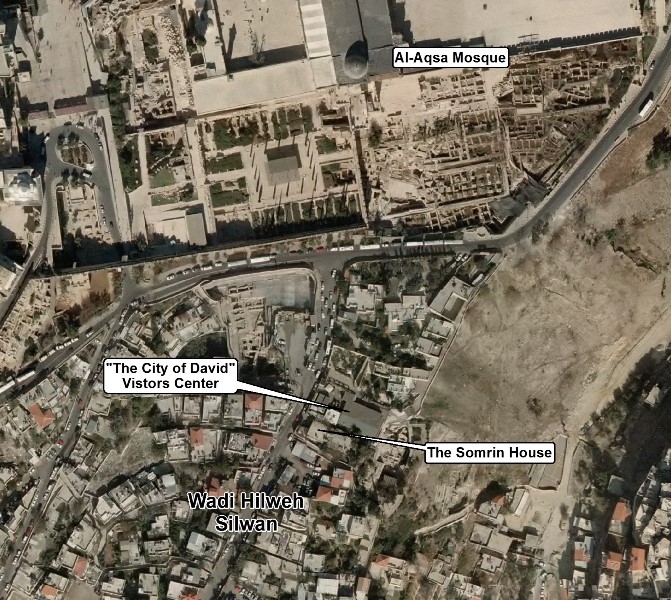
Map by Peace Now (click to expand)
The case to evict the Sumreen family, spearheaded by the JNF, with the secret funding/backing of the Elad settler group, is a key test of the State’s use of the Absentee Property Law to seize Palestinian homes in East Jerusalem. If dispossessed of their home, the Sumreen family case sets a broader precedent for many other ongoing eviction cases in Silwan that could result in the mass displacement of Palestinians in favor of settlers.
In his opinion, the Attorney General did not address the broader political context of widespread dispossession of Palestinians in Silwan, or legally dubious actions on the part of the Elad settler group and the Jewish National Fund in having the property declared to be absentee (see a detailed history of that scandal here) in order to take control over it. Instead, the Attorney General decided simply that there is no new basis on which to overturn the 1999 ruling that legitimized the JNF’s ownership of the home, and that the Sumreen family does not have a legal right to reside there.
Peace Now said in a statement:
“Instead of intervening and doing justice, the Israeli government, through the Attorney General, becomes a direct partner in crime and unforgivable injustice. The Attorney General chooses to ignore the context and the injustice behind the eviction suit and dives into quasi-legal questions to help settlers take over another property in Silwan. The Government’s fingerprints are smeared all over the Sumerin case. This is a political move in which government mechanisms such as the Custodian of Absentee Property and the Israel Land Administration and the JNF have been utilized in order to dispossess Palestinians of their property in East Jerusalem and replace them with settlers.”
It’s worth noting that the Sumreen house is located only a very short distance from the Al-Aqsa Mosque (approximately 10 meters) at the entrance to the Silwan neighborhood, and is adjacent to the “City of David” visitors center built and operated by the Elad settlers. The home is also located in the middle of what today has been designed by Israel as “the City of David National Park.” The entire area is managed by the radical Elad settler organization, which for years has also been pursuing the eviction of Palestinians from the homes in Silwan. For nearly three decades, the Sumreen family has been forced to battle for legal ownership of their home, after the state of Israel, prompted repeatedly by the JNF, declared the Sumreen’s home to be “absentee” property, despite the fact that this was manifestly not the case. Under that designation – which was not communicated to the Sumreen family – Israeli law permitted the State to take over the rights to the building. The State then sold the rights to the home to the JNF in 1991. The JNF has pursued the eviction of the Sumreen family ever since. Israeli courts ruled in favor of the Sumreen family’s ownership claims to the home for years, until a September 2019 ruling by the Jerusalem Magistrate’s Court granted ownership of the family’s home to the JNF, a decision the family immediately appealed to the Jerusalem District Court.
A full history of the saga involving the Sumreen family – which is similar to dozens of other Palestinian homes in Silwan that were declared Absentee Property in the 1990s – can be found on the Peace Now website here.
Tender Published for 300 New Units in East Jerusalem Settlement of East Talpiyot
On January 5th the Israel Lands Authority published a tender for the construction of 300 settlement units in the East Talpiyot settlement, located in East Jerusalem. Ir Amim reports the tender is scheduled to be opened for bids on February 14th.
The new units will expand the built-up footprint of East Talpiyot in the direction of the Palestinian neighborhood of Sur Baher, a neighborhood that is facing multiple new settlement plans that encroach on its historic land (including the Givat HaMatos, Har Homa, and Lower Aqueduct plans). Sur Baher has also been targeted by the Israeli Custodian General in its efforts to gain control over more land that was owned by Jews previous to 1948.
Israel to Advance Expansion of East Jerusalem settlement of Gilo
On January 10th the Jerusalem District Planning Committee convened to discuss two plans that would add 1,538 settlement units to the Gilo settlement in East Jerusalem. The plans are being advanced under the banner of “urban renewal” and will involve demolishing existing settlement units and replacing 470 existing settlement units with 2,008 new units (representing a net expansion of the settlement by 1,538 units). Ir Amim notes that, “while the plans will not necessarily enlarge Gilo territorially, it will increase the Israeli population in the settlement and hence the number of Israelis living in East Jerusalem.”
Israel Advances Plan that Will Pave Way for Expansion of East Jerusalem Settlement Enclave of Nof Zion

Map by Ir Amim (click to expand)
On January 11th, the Jerusalem District Planning Committee held a meeting to discuss public objections to a plan connected to the expansion of Nof Zion, a settlement enclave located inside the Palestinian East Jerualem neighborhood of Jabal Mukaber. One such objection was filed by Palestinian residents of Jabal Mukaber with assistance from Ir Amim. That objection argues that the plan is an affront to the planning needs of the local community and continues Israel’s systematic, city-wide discrimination against the housing, educational, and service-based needs of Palestinian neighborhoods. The Committee closed the meeting without reaching a decision, and has scheduled further private (closed to the public) continuation of its discussion of the plan.
The plan under consideration provides for the construction of a large, new Israeli police station on the border of Jabal Mukhaber neighborhood, on a plot of land that is across the street from the existing police station. The new station, according to Ir Amim, will “constitute a massive security headquarters and border police base, replete with detention facilities and laboratories.” Under the plan, after the new station is built the site of the current station will be designated for public buildings; however, Ir Amim warns that the land is currently allocated for the construction of hotels directly connected to plans to expand the Nof Zion settlement enclave. The relocation of the police station is a step towards the construction of those two hotels, which is part of the larger plan to expand Nof Zion to include the construction of commercial centers, educational institutions, and a sports field.
Ir Amim comments:
“In light of the dearth of public buildings and/or public spaces in the neighborhood, the objection [to the police facility plan] underscores the complete planning error and misuse of the respective plot of land. Rather than allocating the space to meet the dire public needs of the community, the authorities see it fit to utilize the land for a massive security base on the edge of the neighborhood. According to the objection [filed by Ir Amim and Palestinian residents], a plan of such magnitude implies that members of the community are seen as constituting a ‘threat’ rather than actual residents of Jerusalem entitled to equal socioeconomic rights and equitable access to municipal services. The depletion and appropriation of public spaces in East Jerusalem to serve Israeli interests and the expansion of setter enclaves in Palestinian neighborhoods not only erode the fabric of these communities, but severely impinge on Palestinian individual and collective rights and further entrench Israeli control of East Jerusalem.”
Israel has been working consistently to expand and entrench Nof Zion — which it should be underscored is an enclave located wholly inside a Palestinian neighborhood. On July 8, 2021 settlers and their allies held a cornerstone-laying ceremony to mark the beginning of construction on hundreds of new units in Nof Zion. The new construction is just preliminary work on a project that will triple the settlement in size and make it the largest settlement enclave in East Jerusalem.
As a reminder: In 2017, the Israeli government approved a plan to build a new synagogue and mikveh in Nof Zion on private Palestinian land that was expropriated from the Jabel Mukaber neighborhood in 2016. Then, in September 2017, rumors emerged that the government was set to issue 176 building permits for the already-approved project. According to Ir Amim, those permits were ultimately issued in April 2019.
IDF Evacuates Oz Zion Outpost (Again)
On January 10th, settlers sought to obstruct Israeli forces that were dismantling structures at the unauthorized outpost site called Oz Zion, located between Jerusalem and Ramallah. Settlers reportedly chained themselves to structures at the scene, and clashed with Israeli forces when they arrived to remove them.
Oz Zion has been dismantled by the IDF several times in the past (most recently in June 2021). Yet, the settlers – who have violently resisted Israeli forces carrying out the demolition – have repeatedly been allowed to reestablish it. It is one of the outposts for which a standing demolition order was recently re-issued by the IDF.
Fight Over Homesh Outpost & Yeshiva Continues (Both Physically and Politically)
On January 10th, settlers clashed with Israeli forces attempting to confiscate property from the illegal yeshiva settlers have established at the site of the evacuated settlement of Homesh — a yeshiva that the IDF continues to permit settlers to visit and operate. It’s worth recalling the great lengths to which the IDF has gone to offer protection for the settlers to access the yeshiva, at the cost of the freedom of movement and obstruction of normal life to entire nearby Palestinian villages.
In the wake of the killing last month of a settler connected to the illegal yeshiva, national furor – spearheaded by settlers protesting in front of the Prime Minister’s residence – has kept the heat on the government over the fate of the Homesh outpost and yeshiva. Key settler leaders are threatening to bring down the current coalition if the yeshiva is dismantled. While the government has not clearly signaled what it intends to do with the yeshiva, settlers and their political allies outside of the governing coalition are now aggressively pushing the government to undertake hugely consequential efforts on behalf of the settlements — including but not limited to re-establishing the settlement of Homesh and normalizing the status of the illegal yeshiva at the site — in order to prove it allegiance. See below for more details.
Settlers Seek Outpost Gains from Divided & Fragile Government (With Some Success)
As part of their campaign to push the government to authorize the Homesh yeshiva and reestablish the Homesh settlement, key settler leaders are raising at least two additional major initiatives in their aggressive push on the government to compensate the settlers in response to the recent death of settler Yehuda Dimentan.
Those two additional demands by the settlers – a contingent of whom are encamped in front of Prime Minister Bennett’s residence – are:
- To pass a bill – or act unilaterally – to connect unauthorized outposts to the Israeli electric and water grids. To that end, Defense Minister Benny Gantz and Interior Minister Ayelet Shaked reportedly held a meeting on this topic on January 9th. The settler-run news outlet Artuz Sheva optimistically reports that dozens of outposts might meet Israeli criteria for being connected to Israeli infrastructure, and that Gantz would support the move if the Defense Ministry Legal Advisor gives it an OK. This has been a longtime demand of settlers, and has typically included the demand to connect outposts to Israeli water, sewer, power, garbage collection, and other municipal services. Doing so would further entrench the permanence of these outposts and furthers the de facto annexation of Palestinian land. It would also continue and expand on Israel’s long practice of copiously rewarding settlers for breaking Israeli law (by illegally building outposts), and directly incentivizing further settler lawbreaking.
- To more aggressively police Palestinian construction in Area C of the West Bank (some 60% of the land). This demand is grounded in an Orwellian twisting of reality to treat Palestinian construction on Palestinian private land in Area C without permits required by Israel (permits Israel consistently refuses to issue) as theft of Israeli land. For more on this long running, and particularly pernicious, tactic of the settlement movement, see FMEP’s previous reporting.
Construction Begins on Key Stretch of the “Tunnels Road” for Settlements South of Jerusalem
Arutz Sheva reports (gleefully) that ground has been broken on a final stretch of the new tunnel road that will connect settlements to the south of Jerusalem (the Etzion settlement bloc) more seamlessly to the heart of the city. The tunnel is part of Highway 60, which Israel has already begun work to widen, which runs from Jerusalem all the way to the Kiryat Arba in Hebron.
In a deeply researched report on how infrastructure like roads is a means for settlement expansion and annexation, Breaking the Silence explains:
“While Israeli authorities justify many of the projects described in this document by claiming that they serve both the settler and the Palestinian populations in the West Bank, it is important to note that these roads are designed with Israeli, not Palestinian, interests in mind. Many of the roads that are technically open to Palestinian traffic are not intended to lead to locations that are useful to Palestinians.16 Instead, these roads are primarily designed to connect settlements to Israel proper (and thus employment and other services) via lateral roads, rather than to connect Palestinian communities to one another. Further, roads intended to connect Israeli settlements to Jerusalem (many of which are currently under construction) do not serve West Bank Palestinians outside of Jerusalem, as they are not allowed to enter Jerusalem without a permit. In addition, an extensive system of checkpoints and roadblocks allows Israel to control access to bypass roads and the main West Bank highways, and it can restrict Palestinian access when it so chooses.
This prejudice against Palestinian development is even starker when one considers that, according to an official Israeli projection, the expected Palestinian population in the West Bank (excluding East Jerusalem) in 2040 is 4,600,000 individuals. Even if the vision of settler leaders to arrive at 1,000,000 settlers is realized by 2040, the Palestinian population would still be four times the size of the settler one. Despite this discrepancy, priority is still given to settler infrastructure development.
West Bank road and transportation development creates facts on the ground that constitute a significant entrenchment of the de facto annexation already taking place in the West Bank and will enable massive settlement growth in the years to come. By strengthening Israel’s hold on West Bank territory, aiding settlement growth, and fragmenting Palestinian land, this infrastructure growth poses a significant barrier to ending the occupation and achieving an equitable and peaceful solution to the Israeli-Palestinian conflict.”
Israel Gives U.S. Army Officers Tour of Hebron Led by Settlement Spokesman
Raising many eyebrows, the secretariat of the Israeli Central Command reportedly arranged a settler-led tour of Hebron for a delegation of U.S. army officers. The full-day tour designed by the settlers included a visit to the Tomb of the Patriarchs/al-Ibrahimi Mosque and a visit to the settler-run museum (in the Beit Hadassah enclave). The visit empowered settlers to present their version of the religious, historic, geo-political, and security significance of Hebron (including with respect both to settlers/settlements, and presenting Palestinians through the settler lens). The U.S. delegation did not engage any Palestinians while in Hebron, creating an obvious and problematic imbalance in perspective on all matters.
Haaretz reports that the Israeli army has refrained from engaging the settlers for diplomatic tours of Hebron in recent years. In a statement to Haaretz about the tour, the IDF issued a bland statement saying:
“Last week, a few U.S. army officers came for a tour of the Tomb of the Patriarchs and Beit Hadassah led by the commander of the Central Command, for the purpose of learning about the history of the site. As part of the ongoing tours that are held regularly, the American delegation meets with various people in the State of Israel as well as in the Palestinian Authority. This is in order to learn about the area in the best way possible. Dr. Noam Arnon [a far-right-wing settler activist and spokesman for the Hebron settlements] was chosen to guide this tour. The tour was held according to the established regulations in the IDF.”
Further Reading
- “Who Do Israeli Settlement ‘Sheriffs’ Report To? Even They’re Not Sure” (Haaretz)
- “West Bank settlements are annexing land in Israel, too” (+972 Magazine)
- “Fresh Sheikh Jarrah eviction threatens to roil capital anew” (The Times of Israel)
- “From Iron Dome to supply chains, US Christian group quietly shaping US-Israel ties” (The Times of Israel)
- “Editorial | As Israel Bends Over Backwards for Homesh, Palestinians Pay the Price” (Haaretz)
- “The International Community and Israel: Giving Permission to a Permanent Occupation” (Michael Lynk in Just Security)
- “Congress launches bipartisan Abraham Accords Caucus” (Jewish Insider)
Welcome to FMEP’s Weekly Settlement Report, covering everything you need to know about Israeli settlement activity this week.
To subscribe to this report, please click here.
November 5, 2021
- Sheikh Jarrah Families Reject Court-Proposed “Deal” with Settlers; Eviction Orders Expected Soon
- Supreme Court Rules Sheikh Jarrah Businesses – Built on Privately-Owned Palestinian Land But Near Settler Sites – Will Be Demolished
- Israel Demolishes East Jerusalem Muslim Cemetery, In Order to Make Way for Public Garden (& Increase Israeli Control Over Old City Perimeter
- Israeli Court OKs Refusal of Israeli Custodian of Absentee Properties to Disclose Extent of Control Over Palestinian Properties
- New Report from HaMoked: The ‘Seam Zone’ & Israel’s Ongoing Dispossession/Annexation
- Bonus Reads
Sheikh Jarrah Families Reject Court-Proposed “Deal” with Settlers; Eviction Orders Expected Soon
On Tuesday, November 2nd, four families facing imminent eviction from their longtime homes in Sheikh Jarrah in favor of settlers released a statement rejecting a Court-authored “compromise” that would have allowed the families to temporarily remain in their homes as “protected tenants” paying rent to settlers, whose ultimate ownership over the properties would be made official (but technically – though not realistically – still open to legal challenge by the Palestinians). You can review the full terms of the deal here.
The Court ordered both parties to respond to the “deal” by November 2nd. It was only after the Palestinians put forth their statement that we learned that the settlers reportedly accepted the terms, as relayed by Jerusalem Deputy Mayor Arieh King, a staunch supporter and prolific financier of settlements in East Jerusalem, to the AP (this information remains unconfirmed, as the settler-submitted position has not been published).
It’s important to point out — as the Palestinian families note in their statement — that the Court’s handling of the case neatly constructed a lose-lose scenario for the Palestinians. If they had accepted the deal they would have been painted as legitimizing the theft of their property and the claims of the settlers. When they instead refused it, they were immediately painted as rejectionists, in contrast to the settlers who — having waited for Palestinians to reject the deal — positioned themselves as the “reasonable” party in the eyes of the Court.
Both parties were under pressure from the Court to accept the deal. According to Terrestrial Jerusalem, the Court has previously indicated that if either party rejects the deal, the Court would move to swiftly issue a final decision on the cases. Peace Now’s analysis of the Supreme Court’s position predicts that the Court will now rule in favor of the settlers (leading to the eviction of the Palestinian families), like lower Courts have done.
Jerusalem expert Daniel Seidemann also predicts that the Court will rule against the settlers, further speculating:
“There will likely be an eviction verdict [against] the Palestinians soon. Bennett/Lapid will say “we won’t carry out the eviction”. They will likely be sincere – and wrong. One coalition crisis, one terror attack and they will be evicted. This is very bad indeed.”
The statement of rejection from the Palestinians families (the El Kurd, Jaouni, Abu Hasna, and Askafi families) is worth reading in full:
“We reject the ‘proposal’ by the ‘Israeli Supreme Court’ which would have rendered us ‘protected tenants’ at the mercy of settler organizations. We stand firm in our refusal to compromise on our rights despite the lack of institutional guarantees that would protect our presence as Palestinians in occupied Jerusalem.
The Israeli justiciary is circumventing its duty to adjudicate the case and is forcing us instead to choose between our own dispossession or submitting to an oppressive agreement. Naturally, we refuse to commit someone else’s crimes.
Such ‘compromises’ create the illusion of the ball in our court, fabricating a farming in which we reject a ‘generous deal,’ in a situation where our dispossession would still be imminent and our homes would still be regarded as someone else’s. Such ‘deals’ distract from the crime at hand: ethnic cleansing perpetrated by a settler-colonial judiciary and its settlers.
The international community has long maintained that settler expansion and forced expulsion in Sheikh Jarrah are war crimes. Thus it must respond to grave international law violations with real diplomatic and political repercussions. The culture of inaction and impunity must not be maintained.
It is time for our Nakba to end. Our family deserve to live in peace without the looming ghost of imminent dispossession.”
On November 10th, Ir Amim is hosting a briefing with MK and lawyer Gaby Lasky on the Sheikh Jarrah and Silwan cases. RSVP here.
Supreme Court Rules Sheikh Jarrah Businesses – Built on Privately-Owned Palestinian Land But Near Settler Sites – Will Be Demolished
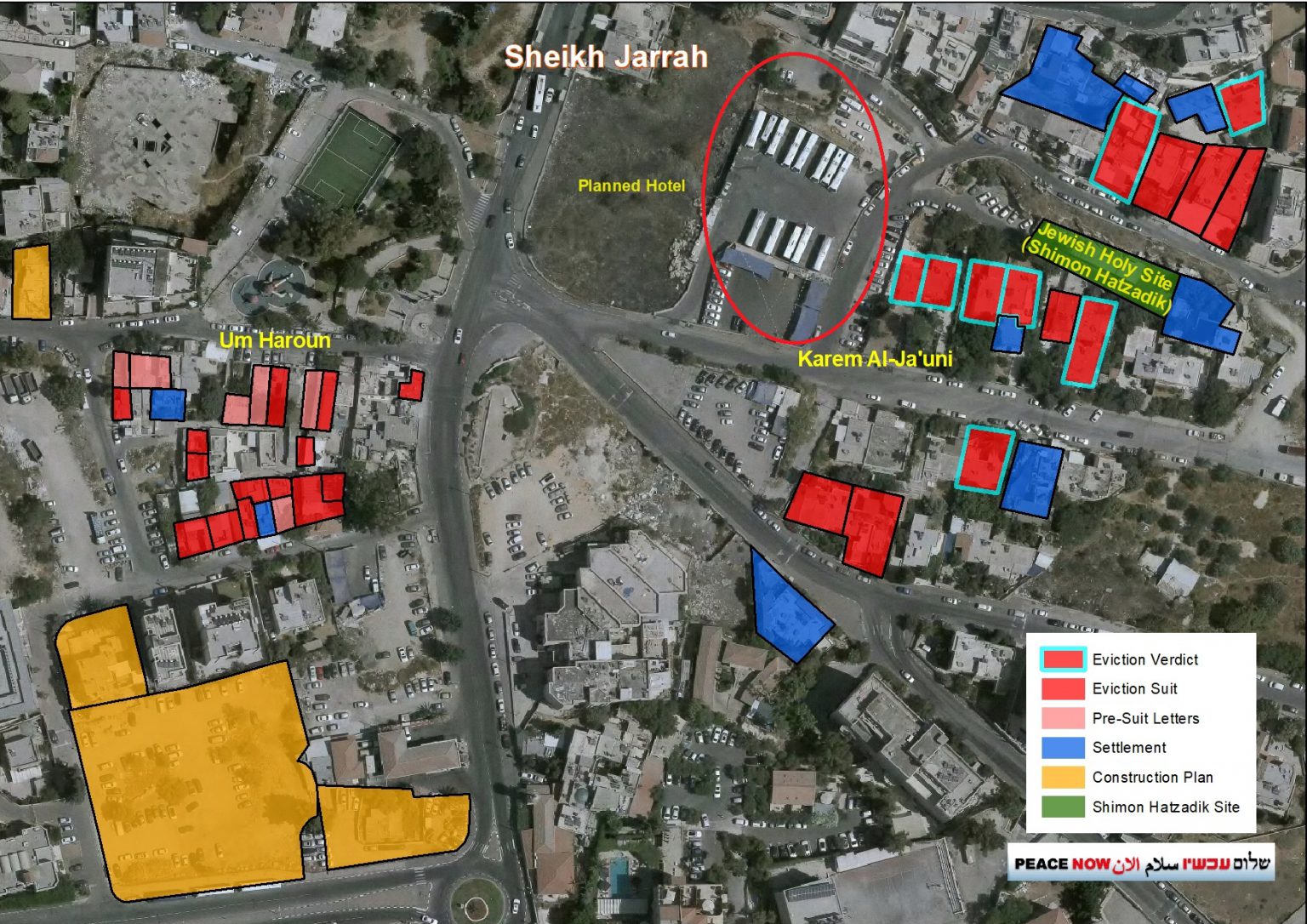
Map by Peace Now
On October 31st, the Israeli Supreme Court rejected the appeals of Palestinian business owners seeking to save their establishments located in the Sheikh Jarrah neighborhood from demolition. The businesses – a bus parking lot and a carwash – are now cleared to be demolished in order to make way for a “public garden” as well as a driveway that will service an as-of-yet-unbuilt Israeli hotel in the neighborhood. Notably, the businesses are located very close to the tomb of Shimon the Righteous, which is a religious site closely associated with the settler enclave in Sheikh Jarrah.
The Jerusalem Municipality previously expropriated the land — which was privately owned by Palestinians – on which the businesses exist. The land was expropriated “for public use,” a tactic that Israeli law permits the State to use in order to confiscate even privately owned land ostensibly to benefit the “public” (a “public” that it seems never includes Palestinians in East Jerusalem), if the State finds it necessary.
Offering critical context, Peace Now raises several absurdities regarding the land expropriation order:
“The decision to expropriate raises several questions. First, the timing. As far as we know to date, no application has been opened for a construction permit for the construction of the hotel. That means there do not appear to be any procedures for starting construction of the hotel soon. The designation for open public space is directly related to the hotel, so it is not clear why it was urgent for the municipality to act right now. We will also mention that the State Comptroller recently remarked to the Ministry of Transportation about the severe shortage of hundreds of parking spaces for buses in Jerusalem, and now the Municipality is cancelling parkings of dozens of buses.
Another issue to wonder about is the proximity of the area to the area of the tomb of Shimon the Righteous (Shimon Ha’tzadik), which is a pilgrimage site for Jews, especially ultra-Orthodox, throughout the year. It is possible that the municipality’s desire to carry out the expropriation is related to the desire to act for the benefit of Jewish visitors to the neighborhood and to allow the Israeli grip of the neighborhood to expand, even if it is formally an open public space intended for the entire Israeli and Palestinian public. Another issue to wonder about is the proximity of the area to the area of the tomb of Shimon the Righteous (Shimon Ha’tzadik), which is a pilgrimage site for Jews, especially ultra-Orthodox, throughout the year. It is possible that the municipality’s desire to carry out the expropriation is related to the desire to act for the benefit of Jewish visitors to the neighborhood and to allow the Israeli grip of the neighborhood to expand, even if it is formally an open public space intended for the entire Israeli and Palestinian public.”
While the court case that will lead to the demolition of the Palestinian businesses in Sheikh Jarrah is not formally linked to the ongoing effort to forcibly dispossess four Palestinian families of their homes in this same neighborhood, radical Kahanist Itamar Ben Gvir did not shy away from making the (obvious) connection between the two cases, commenting that the demolition of the businesses is a:
“necessary step, and now is the time to also evacuate the families of Sheikh Jarrah.”
Israel Demolishes East Jerusalem Muslim Cemetery, In Order to Make Way for Public Garden (& Increase Israeli Control Over Old City Perimeter)
For over ten consecutive days, the Jerusalem Municipality and the Israeli Parks and Nature Authority have been demolishing parts of the Yusufiya cemetery near the Al-Aqsa Mosque in order to turn the area into yet another “public park”. The area in question includes a monument to, and graves of, Palestinians and Jordanians who fought in the 1967 war. Palestinians, many of whom fear that their relatives’ graves will be demolished and exhumed (fears that the Jerusalem Municipality has sought – and failed – to assuage) have protested and clashed with Israeli authorities as they attempt to stop the desecration of the cemetery, the erasure of Arab history, and denial of Palestinian life in the city.
Aviv Tatarsky, a researcher at the Ir Amim, explained:
“The park in question is part of a series of government-funded projects which aim to link settler compounds in the Old City Basin…Similar projects are taking place on the Mount of Olives, [in] Silwan and [in] Sheikh Jarrah…The incidents at the Yusufiya Cemetery are an extreme example of the Israeli government’s lack of respect toward Palestinian property rights, heritage and holy places and its determination to make over the Old City Basin.”
The Grand Mufti of Jerusalem, Muhammad Hussein, told Al-Monitor:
“The cemeteries are part of the identity of the holy city and its narrative, and evidence of the Arab and Islamic presence in the city for thousands of years. Obliterating the city’s landmarks is in the interest of the Jewish settlement project and the Israeli narrative, which is embodied by changing the names of Arab cities, neighborhoods, and streets, and the Judaization of public places and landmarks.”
Hamza Quttaineh, a lawyer advocating for the Martyrs’ Cemetery before the Israeli courts, told Middle East Eye:
“There are huge machinations undertaken by the occupation municipality, along with the Israel Nature and Parks Authority and the judicial system, that provide the legal coverage needed for the Judaisation project encompassing the historical wall of Jerusalem’s Old City.”
Israeli Court OKs Refusal of Israeli Custodian of Absentee Properties to Disclose Extent of Control Over Palestinian Properties
Haaretz has in-depth reporting on a recent freedom of information case relating to the Israeli Custodian of Absentee Properties. The Custodian of Absentee Properties is a government body within the Israeli Finance Ministry that has possession of properties in East Jerusalem that under Israel’s “Absentee Property Law” were “abandoned” by Palestinians during and after the 1948 war, becoming the property of the Israeli state.
In response to a freedom of information request, the Custodian refused to disclose the number of “absentee” properties that it currently controls. The Custodian – Ronen Baruch, who has held the position since 2005 – gave multiple excuses for refusing the request, asserting at different points that his office doesn’t know how many properties it controls, that the process of gathering that information is too complicated, and that revealing this information may compromise the country’s foreign relations (ultimately the winning argument).
During the subsequent Court hearing on the freedom of information request, a senior official from the Israeli Foreign Ministry was granted permission to privately brief the judge, after which the judge ruled against the freedom of information request – a ruling the petitioners intend to appeal. The judge wrote,
“I have been convinced that the disclosure of the requested information may jeopardize the state’s foreign relations…I am satisfied that delivery of the information will cause an unreasonable allocation of resources… Which may disrupt and even paralyze the Custodian’s work.”
The two Israeli lawyers who filed the freedom of information request (Amir Adika and Ram Cohen) told Haaretz:
“What harms the state’s foreign relations? Revealing the information, or the very existence of the law, over 70 years after the country’s founding?…This law is very powerful in regard to the state’s authority over people’s private property…There is public and economic importance in knowing how it conducts itself with this power, how many such properties there are, how many they release, how many they sell. This is a very unconventional law. The impression is that they’re either presenting a very imprecise picture, or that they’re not managing at all.”
As a reminder, Israel’s Absentee Property Law affords Jews the right to reclaim property they owned in East Jerusalem and the West Bank in the period before Israel became a state in 1948, and that they were forced to abandon as a result of the 1948 War. Israel’s law affords no such right to Palestinians who as the result of that same war were likewise forced to abandon property inside what became the State of Israel. After the war, Israel designated such properties “absentee properties” control over which was transferred wholesale to the Israeli state. Use of the Absentee Property Law by settlers organizations with the willing participation of the Israeli government is a key legal mechanism behind past, present, and future evictions of Palestinains from the most sensitive areas of East Jerusalem (like Sheikh Jarrah and Silwan) where Palestinians are facing mass eviction.
New Report from HaMoked: The ‘Seam Zone’ & Israel’s Ongoing Dispossession & Annexation
In a new report, entitled “Creeping Dispossession: Israeli Restrictions on Palestinian Farming Beyond the Barrier,” the Israeli NGO HaMoked takes an in-depth look at the Israeli military bureaucracy which governs – – and systematically infringes upon — the right of Palestinian landowners and farmers to access and effectively cultivate their land which falls in the “Seam Zone” (i.e. the West Bank land that, when Israel constructed its Seperation Barrier along a route that cuts deeply into the West Bank, was left on the Israeli side of the wall/fence).
This important topic shows just how Israel’s policies work to systematically dispossess these Palestinians of their land. The report sarts with an important reminder about the “original sin” involved in this dispossession — Israel’s choice to build its separation barrier not along the 1967 Green Line (which, at the time of the barriers conception in 2002 was an internationally agreed upon divider between Israeli territory and occupied territory) but instead along a route that, for the sake of keeping settlements (and land upon which to expand settlements) on the Israeli side of the barrier, de facto annexed some 9.4% of West Bank land to Israel. [map] The West Bank lands which fell on the Isareli side of the barrier – the “Seam Zone” – were declared “closed military zones,” requiring Palestinians who live on the other side of the barrier to traverse a complicated Israeli bureaucracy in hopes of obtaining access their land (or the land upon which they are employed to cultivate). The matter gets even more complicated from there.
HaMoked writes in conclusion:
“Nearly two decades since the construction of the Barrier, we see the logic of a creeping dispossession – more and more restrictions on Palestinians trying to access areas trapped between the Barrier and the Green Line, and as a result, fewer and fewer people willing to navigate the permit bureaucracy Israel has put in place. Any agricultural community will tell you that land is not merely functional. The land is a source of produce and income, but its benefits cannot be quantified solely in monetary terms. The land is also a site for family and community events, and connection to the land is integral to the local culture. For dozens of Palestinian communities, and tens of thousands of people, all of this has been destroyed by the Separation Barrier. Even those who receive permits to cross the gates during their limited opening hours cannot have a picnic with their family or a spontaneous outing to their land as they once did.
The permit regime reverses the basic logic of international law, that individuals enjoy freedom of movement within their own country, and that movement can only be restricted with just cause. For Palestinians living near the Separation Barrier that Israel built on a route that cuts through the West Bank, free movement is the exception, and the restriction on movement is the rule. And whereas initially Israel promised access to lands behind the Barrier except when security needs warrant precluding access, now no security need is required to deny access. Instead, the premise of the permit regime is now that only Palestinians who prove a need to enter these areas will be allowed to do so. Furthermore, the military periodically amends its definition of “need” to be more and more narrow.
HaMoked has had success in overcoming some of the restrictions: individuals who were denied permits eventually received them following litigation; some restrictive policies have been reversed and others are still under judicial review. However, none of this changes the overall picture emerging from this report: steadily increasing restrictions on Palestinians’ access to the areas of the West Bank known as the Seam Zone have decimated the livelihoods of individuals, families and entire communities.”
Bonus Reads
- “Israel OKs Palestinian homes after advancing settlements” (AP)
- “Israeli forces demolish Palestinian-owned house in occupied Jerusalem” (Quds News Network)
- “Thirty Years On: The Ruse of the Middle East Peace Process” (Inez Abdel Razek for Al-Shabaka)
- “Israel Moves to Silence the Stalwarts of Palestinian Civil Society” (Zena Agha in The New York Times)
Welcome to FMEP’s Weekly Settlement Report, covering everything you need to know about Israeli settlement activity this week.
To subscribe to this report, please click here.
September 10, 2021
- Israeli Supreme Court to Hear Al-Walajah Case on October 6th
- JNF to Start Massive Land Registration Process, Threatening Widespread Eviction of Palestinians
- Bennett Government Requests Six Month Extension to Finalize Plan to Forcibly “Relocate” Khan Al-Ahmar
- Bennett Meets with Settler Council, Promises Settlement Growth (i.e. De Facto Annexation)
- Bonus Reads
Israeli Supreme Court to Hear Al-Walajah Case on October 6th
Ir Amim and Bimkom jointly report that the Israeli Supreme Court has set October 6th as the date it will hold a hearing on 38 demolition orders issued against Palestinian homes in the Al-Walajah neighborhood of East Jerusalem. In July of this year, the State moved to dismiss the current petition filed by Palestinians that, for the moment, has frozen demolition proceedings against their homes. If the Court chooses to dismiss the petition, those 38 houses – homes to some 300 individuals – will likely face immediate demolition.
The State’s argument is that the houses – built by Palestinians on their own land – were built without the required Israeli permits. As a reminder, such permits are in general all but impossible for Palestinians to obtain; in the case of al-Walajah they are literally impossible to obtain, since the area lacks a required Israeli-approved “outline plan,” without which permits are an impossibility. In an effort to overcome this obstacle, Al-Walajah residents, with the help of planning experts, prepared and proposed an outline plan for the area, and for more than 15 years have worked to get Israel to approve it — to no avail. Israeli authorities have repeatedly (in January 2021 and again in March 2021) refused to approve the resident-backed plan, and have also refrained from initiating their own planning process. Indeed, the Jerusalem District Committee, as part of a January 25, 2021 ruling against the outline plan proposed by residents, deemed the area in question — where Palestinians have lived for decades — an “agricultural area” where no building would ever be permitted. The result: Al-Walajah’s residents have been left with zero hope of obtaining the permits required to build on – or keep their current houses – on their own land.
Due to its location and unique political situation Al-Walajah is a village besieged by Israel from every angle. In the words of Danny Seidemann:
“ Since 1967, Walajeh’s inhabitants have lived in a Kafka-esque situation, with their village technically located inside Israel’s expanded borders, but with villagers never given Israeli residency (they are considered West Bankers and thus are not permitted inside Jerusalem). As a result, the villagers’ presence in their own village is, under Israeli law, illegal, and their homes there are, by definition, illegal.”
For decades, the Israeli government has carried out a multi-prong effort to push Palestinians off of their land in al-Walajah. This has included demolition campaigns, construction of the separation barrier along a route that encircles the village and cuts residents off from their land, refusal to grant building permits, and the declaration of state parks over lands on which Palestinians have lived for generations. In October 2020, it was revealed that Israel, in order to build the Har Gilo West settlement, plans to extend the separation barrier to completely encircle al-Walajah, which is already surrounded on three sides by the separation wall. The new section of the barrier will be a 7-meter high concrete slab along the western edge of the built-up area of Al-Walajah.
JNF to Start Massive Land Registration Process, Threatening Widespread Eviction of Palestinians
On September 2nd, the Board of the Jewish National Fund in Israel (called the KKL-JNF) voted to initiate a new effort to register its ownership of land that the JNF claims to have purchased from the Israeli General Custodian. The JNF claims to have internal records of these purchases, despite the fact that the organization never formally registered its deed of ownership after the purchases.
According to Haaretz, the KKL-JNF Board has allocated over $31 million (100 million shekels) to a five-year plan that will see the organization pursue the formal registration of the following:
- A total of 530 files pertaining to acquisitions in the West Bank, of which the KKL-JNF says it has documentation for 360 deals, but only has formal contracts for 170. With respect to the fact that the JNF cannot fully document closed deals for most of these properties, Peace Now warns:
“…in some of the cases the documents only show intent to broker deals, and/or a negotiation that didn’t become a deal, and yet, legally, it could be argued that intent for a deal existed, and on this basis the land could be registered in JNF- KKL’s name. In addition, according to JNF- KKL, past experience shows that JNF- KKL succeeds in convincing the courts to register properties in its name and the chances to succeed in various files is great.”
- A total of 2,050 files pertaining to acquisitions in the Jerusalem area, totalling over 1 square mile in East Jerusalem – where the JNF is actively colluding with settler organizations to displace Palestinians from land it claims to own.
Ir Amim explains further:
“The decision to suddenly transfer this land to the KKL-JNF, which was initiated by a high-ranking individual within the General Custodian who is known to be active in settler projects, follows Ir Amim’s uncovering of a series of alarming Israeli decisions that aim to misuse land registration mechanisms in East Jerusalem for registering sizable areas of land to Israeli authorities or settlers on behalf of settler organizations. These moves are being conducted without proper disclosure or publication, therefore preventing Palestinians from challenging and protecting their property rights. 75 Palestinian families on an area of 35 dunams are currently under threat of eviction from ownership lawsuits levelled by settler organizations in Sheikh Jarrah. 85 families on an area of 5 dunams face a similar threat in Batan al-Hawa, Silwan. Transferring 2,500 dunams of land from the General Custodian to the KKL-JNF will lay the groundwork for potentially thousands of more eviction demands.”
As a reminder, the JNF, established in 1901, devoted itself to buying land for Jews. Today, the JNF owns about 15% of all the land inside the Green Line (a figure which stands to increase if the review process leads to more properties being registered to the JNF). In addition, the JNF has used two subsidiary companies – both called Himanuta – to purchase land in the West Bank, even though the stated JNF policy (until now) did not support such purchases. Peace Now reports that the JNF, via Himanuta, has already purchased over 160,000 acres (65,000 dunams) across the West Bank. Settlements established on some of those lands include Itamar, Alfei Menashe, Einav, Kedumim, Givat Ze’ev, Metzadot Yehuda (Beit Yatir), Otniel and more. At the same time, the JNF and the settler group Elad have been partnering together to pursue the mass eviction of Palestinians from East Jerusalem neighborhoods, including Silwan.
Bennett Government Requests Six Month Extension to Finalize Plan to Forcibly “Relocate” Khan Al-Ahmar
On September 5th, the Israeli government asked the Supreme Court for a six-month extension of its deadline to submit its position on the situation of the Khan al-Ahmar bedouin community – which the Court has set to be forcibly evicted from its current location in the West Bank, just east of Jerusalem (on land that Israel wants to develop for the settlements). In its filing with the Court, the State suggests that there has been “significant progress” towards reaching an agreement with community leaders on the future of the community, which has lived at its present location since being relocated there from the Negev during the 1967 war.
In July 2021, when Khan al-Ahmar was set to be forcibly relocated/demolished, the Court granted the newly formed Bennett government a six-week extension to review the plan that had been negotiated by the Netanyahu government. At that time the Court hinted that it would not be amenable to issuing further extensions on the case.
The terms of the Netanyahu era deal would reportedly see the Khan Al-Ahmar community agree to its forced relocation to a site several miles east of their current homes (the new site is near Abu Dis) in exchange for Israeli residency.
It must be noted that, if reports are correct, Khan al-Ahmar leaders signed the deal after prolonged coercive circumstances. Previous allegations regarding the nature of the Khan al-Ahmar relocation – specifically B’Tselem’s accusation that it is tantamount to a war crime – have not necessarily been assuaged by the community’s agreement. Since the 1950s – when the community was forced to leave their land in the Negev during the 1948 war – the Khan al-Ahmar bedouin community has lived and worked the lands located just east of Jerusalem, in the shadow of the land marked for the construction of the E-1 settlement (which is once again in the headlines).
The settler group Regavim – which petitioned the Court to force the government to demolish Khan al-Ahmar last year (in the midst of a global pandemic) – rejected the possibility of another delay, saying:
“Lapid’s announcement is a political move intended to signal to Bennett and his partners that none of their election promises can be fulfilled. Not in the Negev, not in the Galilee, and not in Khan al-Ahmar.” [Regavim called on Bennett] “to show who’s in charge. We call on you to evacuate Khan al-Ahmar immediately!”
Jerusalem expert Danny Seidemann has previously written:
“the story of Khan Al-Ahmar is not only about the tragedy for the village and its inhabitants, or about Israel’s readiness to carry out an ostensible war crime in the face of the world. It is also about Israel’s determination to clear the entire area of the West Bank east of Jerusalem, and located within the line of the built and planned barrier, of any Palestinian presence. This clearing will prepare the ground for the future construction of E1 and de facto annexation of this so-called bloc, which extends well beyond the built-up area of Maale Adumim.”
Bennett Meets with Settler Council, Promises Settlement Growth (i.e. De Facto Annexation)
On September 9th, Prime Minister Bennett held his first meeting with leaders of the settler Yesha Council (a leadership body that Bennett himself once served as the head of) and promised that his government would not freeze settlement construction, while also stating that his government will not annex West Bank land. Bennett also reportedly told the settlers that he was clear with the Biden Administration that he would not stop settlement building. Crisis Group analyst Maraiv Zonzein puts it:
“Bennett tells settler council the government will consider all requests for settlement construction. ‘We won’t annex but we won’t stop building.’ That is de facto annexation”
Last week, a government source told The Times of Israel that the Trump-era understandings on settlements remain the standard operating practice – meaning that the High Planning Council will be allowed to convene quarterly meetings to advance settlement construction, and that settlement construction should be “limited” in a way that does not expand the existing footprint of settlements. The official said:
“The [Trump-era] understanding may well be adapted, but, as of now, it is still the only game in town,” the official said. “President Biden only spoke generally about his opposition to settlement building, and his team has not gotten into specifics with us.”
As a reminder, settlement construction and de facto annexation soared during the Trump Administration, under these so-called “limitations.”
Bonus Reads
- “Growth rate of settlements plummets to all-time low” (Jerusalem Post)
- “Israel’s New Government Wants to ‘Shrink’ the Occupation. Meet the Man Behind the Idea” (Haaretz)
- “SCOOP: An event marking the one year anniversary of the signing of the Avraham Accords will be held in Washington on September 14.” (Twitter // @amichaistein1)
Welcome to FMEP’s Weekly Settlement & Annexation Report. To subscribe to this report, please click here.
July 30, 2021
- Sheikh Jarrah Updates: Court Issues Delays for Three Cases; Bennett Reportedly Considering Delaying Four Others
- In First Since Settlement Regulation Law Was Overturned, Israel Announces Intent to Demolish Settlement Buildings on Privately Owned Palestinian Land
- Elad Settler Group Loses Control Over East Jerusalem Holy Site/Archaeological Park
- Knesset Votes Down West Bank Annexation Bill, Condemns Ben & Jerry’s
- State Allows (& Funds) “Farming Outposts” to Graze Huge Tracts of West Bank Land
- Outpost Activity Continues in the South Hebron Hills
- Israeli Army Let Settlers Stay at Abandoned Base Despite Knowing Plans for Illegal Outpost
- Bonus Reads
Comments or questions? Email Kristin McCarthy – kmccarthy@fmep.org.
Sheikh Jarrah Updates: Court Issues Delays for Three Cases; Bennett Reportedly Considering Delaying Four Others
On July 29th, the Israeli Supreme Court issued notices delaying the forcible displacement of three families (Dajani, Hammad, and Dahoudi) from their longtime homes in the Sheikh Jarrah neighborhood of East Jerusalem. The eviction orders were set to become enforceable on Sunday August 1st, but the Court has halted the evictions while an appeal filed by the Palestinian families is dealt with.
Also sheduled for August 2nd, the Supreme Court is currently set to hold a final hearing to decide on the fate of four other Palestinian families (Jaouni, Iskafi, al-Kurd, and al-Qadi) facing forcible eviction in Sheikh Jarrah. According to press reports, Prime Minister Naftali Bennett is considering delaying the final hearing (thus stopping the evictions for the time being). Notably, reports suggest Bennett is looking not to cancel the evictions but only to postpone a final decision on them – a postponement that could be reversed at any time at the whim of the Prime Minister (for example, when the world’s attention is elsewhere).
In an op-ed in The Guardian, Mohammad El-Kurd – whose family is facing eviction – powerfully wrote:
“On 2 August, the Israeli supreme court, whose jurisdiction over the eastern part of Jerusalem defies international law, is set to decide whether it will allow the appeal of my family and three others – a last legal obstacle before we can be expelled. There have been postponements before. Palestinians are accustomed to this kind of stalling; it tests our stamina. But we are as stubborn as anyone else faced with the prospect of losing their home – their life, their memories – to those using force, intimidation and biased laws. In the face of this cruelty, and despite teargas and skunk water, we are resisting. We cannot allow them to steal our homes once more, and we refuse to continue living in refugee camps while colonisers live in our houses. We cannot let them throw more of us on to the streets. We are tired of being turned into a refugee population, neighbourhood after neighbourhood, one home at a time. I have no faith in the Israeli judicial system; it is a part of the settler-colonial state, built by settlers for settlers. Nor do I expect any of the international governments who have been deeply complicit in Israel’s colonial enterprise to intervene on our behalf. But I do have faith in those people around the world who protest and pressure their governments to end what is essentially unconditional support for Israeli policies. Impunity and war crimes will not be stopped by statements of condemnation and raised eyebrows. We Palestinians have repeatedly articulated what kind of transformative political measures must be taken – such as civil society boycotts and state-level sanctions. The problem is not ignorance, it is inaction.”
In First Since Settlement Regulation Law Was Overturned, Israel Announces Intent to Demolish Settlement Buildings on Privately Owned Palestinian Land
On July 28th, the Israeli Attorney General’s office informed the High Court of Justice that within three years (!!) it plans to carry out the demolition of two buildings built by settlers on privately owned Palestinian land located inside of the Eli settlement, in the context of a petition filed in 2011 by Palestinian land owners with the assistance of Yesh Din and Bimkom. Notably, the underlying legal petition sought the demolition of a total of 20 buildings constructed illegally on private Palestinian land, 18 of which Israel granted retroactive legalization in February 2020.
According to the Jerusalem Post, this is the first instance of the Court resuming looking at a case of this kind since the Settlement Regulation Law was overturned by the Court in June 2020. Previously, all cases involving illegal construction inside of settlements had been frozen while the Court considered the constitutionality of the law, which sought to create a legal basis by which Israel would be able to grant retroactive legalization to outposts and settlement structures built on land that even Israel acknowledges is privately owned by Palestinians.
In resuming its consideration of the case, the Court first asked to be updated on the State’s reexamination of the status of the land in hopes of finding a means by which to retroactively legalize the illegal construction, despite the fact that a previous government effort confirmed that the two buildings fall outside of the boundaries of state-owned land. With no other avenue available to “legalize” the construction, the State informed the Court this week that it intends to demolish the structures after the three years, which it claimed was the amount of time required to provide new housing for the four affected settler families [demonstrating, as always, that settler law-breakers are never punished and always rewarded]. This long delay also suggests that the State will continue to look for new ways to avoid demolishing the homes.
Leaders of the Land of Israel Lobby in the Knesset, MKs Yoav Kisch and Orit Strock, told Israel Hayom:
“This week, the government informed the High Court of Justice that it agrees to demolish the homes of four families in Eli. This is a horrifying, shocking announcement. Rather than preventing the destruction of Jewish homes in Judea and Samaria, the government is busy regulating the illegal construction crimes in the Bedouin sector. This is a badge of shame for the government, which is freezing construction, as well as going back on all its promises to regulate [settlements] and also demolishing Jews’ homes.”
Yisrael Gantz – who heads the Benyamim settler regional council – said:
“We are surprised that the government is falling in line with the Arab petitioners and announcing that it will, heaven forbid, demolish two homes where families have been living for years, which are part of a living, vibrant neighborhood. Razing a home whose status was legal and which a new review by the Civil Administration left outside the settlement’s borders is a new low in crimes against settlement in Judea and Samaria. These two homes are just a preview. We have hundreds of homes with similar status in the Binyamin settlements and thousands throughout the settlements as a whole that suddenly found themselves outside the new ‘blue lines’ drawn in the Civil Administration’s work. No normal country would demolish homes in a situation like this.”
Elad Settler Group Loses Control Over East Jerusalem Holy Site/Archaeological Park
On July 1st, the State of Israel re-asserted control over a significant and highly sensitive archaeological and holy site – the Davidson Archaeological Park – located just outside of the walls of the Temple Mount/Haram Al-Sharif. The park, which includes most notably tunnels that run directly from the Western Wall plaza to the settler-run Davidson Center in Silawn – had been run by the Elad settler organization since 2018, when the State willingly transferred its authority to Elad to operate the park.
In 2015 the Israeli NGO Emek Shaveh, which is made up of archeological experts, filed a petition against Elad’s role at the park, arguing that “it is highly problematic to place the running or management of a holy site that is situated alongside the Western Wall foundations in the hands of a private and politicized organization.” Emek Shaveh’s argument mirrored an opinion issued by Israel’s Attorney General which held that holy sites should be managed by the State.
Notably, the end of the state’s contract with Elad regarding the Davidson Park reduces but does not eliminate Elad’s role in managing key sites in Jerusalem. Elad continues to operate the nearby City of David archaeological park (just outside the Old City’s walls), where it has been advancing numerous settlement projects meant to strengthen its control over the area and displace Palestinians.
Emek Shaveh said in a statement:
“We are pleased that the authorities have put an end to a highly problematic arrangement whereby a private right-wing organization is operating an important site situated in perhaps the most sensitive place in the region. We hope that in the future the State will take full responsibility for additional sites which it handed over to the settlers’ foundation. The City of David is, no doubt, the next site that ought to be returned to full management by the State. Emek Shaveh’s case regarding the tunnel linking the Davidson Center to Givati is still ongoing.”
Knesset Votes Down West Bank Annexation Bill, Condemns Ben & Jerry’s
In a July 28th preliminary vote the Knesset rejected, by a relatively slim margin (64 to 50), a bill to annex the entire West Bank. Members of Prime Minister Naftali Bennett’s ruling party, Yamina, voted against the bill. The bill had been submitted by members of the Likud party, which is now in the opposition after 15 years of being the most powerful party in the country and having had the ability to pass such a bill if desired. One of the bill’s cosponsors, Miki Zohar, said after the vote:
“You promised again and again that you will take action to bring about sovereignty over Judea and Samaria and you once again broke your word,” Zohar said. “You once again proved that you have no ideology and that no values are holy for you except for keeping your cabinet seats.”
Justice Minister Gideon Sa’ar (New Hope) responded, saying:
“I heard MK Mikki Zohar relating to the fact that in the last administration, Netanyahu wanted to apply sovereignty but Blue and White prevented him from doing so. And I was just thinking to myself, ‘How far from the truth can you get?’…So you, MK Zohar, party whip for the Likud in the last Knesset, could have brought this bill up in the last Netanyahu government, during the Trump administration, during the amazing window of opportunity – you could have submitted the sovereignty bill and had a majority in the Knesset.”
Around the same time this bill was voted on, 90 members of the Knesset, including Yamina members, signed a letter calling on Ben & Jerry’s to reverse its decision to end sales in the occupied West Bank. The letter refers to settlements as “towns and cities in Israel” – a statement tantamount to a declaration of de facto – if not official – annexation. Notably, 6 MKs – from Labor and Meretz – subsequently removed their names for the letter, claiming that they signed on without seeing the final wording, and that the final wording does not reflect their views.
State Allows (& Funds) “Farming Outposts” to Graze Huge Tracts of West Bank Land
In response to a Peace Now inquiry, the Israeli Agricultural Ministry revealed that it has granted permits to unauthorized (i.e., illegal under even Israel law) agricultural outposts to use over 2,000 acres (8,500 dunams) of land in the West Bank for grazing, in a program which entrenches and expands the outposts’ illegal presence across the West Bank.

Map by Peace Now
And if that wasn’t enough of a scandal, the Ministry confirmed that it provided sizable grants – totalling over $800,000 (2.6 million NIS) over the past few years – to at least three settlement organizations for the purpose of bringing volunteers to these outposts – which, again, are illegal even under Israeli law – to work the land. Notably, these settler organizations publicly boast about their farming activities with respect to a total of 50 farming outposts, suggesting that settlers are making use of far more than the 2,000 acres permitted by the Ministry (the Ministry clarified that it funds activities only related to the areas where settlers are authorized to work — so apparently they see no problem].
Peace Now said:
“The Ministry of Agriculture takes millions of Shekels of public monies and give them to associations which are intrinsically linked to illegal activity. If the government wants to stop more outposts such as “Evyatar” from existing, and to stop the small group of ideological settlers who allow themselves to set facts on the ground that determines the foreign and security policies for Israel, it must change its ways immediately and stop supporting outposts and illegal activities”.
Two of the outposts to which the Agricultural Ministry awarded grazing permits are located in the south Hebron hills, on land that is privately owned by Palestinians. One of those outposts, established by a settler named Shavti Kohslaviski, has active demolition orders issued against it. A third outpost that received grazing permits is located near the Elon Moreh settlement, on a site that is partially privately owned Palestinian land that Israel has made inaccessible to its Palestinian owners but on which settlers regularly trespass .
Israeli Army Let Settlers Stay at Abandoned Base Despite Knowing Plans for Illegal Outpost
Kerem Navot reports that on July 23rd, dozens of settlers were allowed to stay at an abandoned military base in the Jordan Valley with permission of the Israeli army. The Israeli Commander in charge of the area reportedly said that he granted permission for the settlers to hike in the area and spend one night at the army base – – despite the fact that the settlers openly declared their intent to establish a permanent presence there. The settlers left after two nights at the site, though a government source told Haaretz that the problem will continue to linger, saying “the minute the brigade commander allowed this one time, they will go up there regularly, when they feel like it, with or without permission, and the defense establishment will have to start dealing with it.”
Kerem Navot reports:
“The organization that is behind this current takeover attempt is called “Nahala.” Nahala is the same group behind the takeover of Mount Sbeih south of the village of Beita, upon which the outpost of Eviatar was founded two months ago, and operates behind a fictional NGO (which we wrote about not long ago- https://bit.ly/3763yJW). Yes, you understood that correctly: The same people who broke the law when they established the outpost Eviatar, are advancing a new aggressive takeover of lands that do not belong to them, instead of standing trial. Welcome to the West Bank.”
Outpost Activity Continues in the South Hebron Hills
On July 25th, Palestinian media reported that settlers have begun reestablishing an outpost in the south Herbron hills, near the town of Yatta. Settlers had abandoned the outpost a few months ago under regular protests by Palestinians.
On July 27th, the Israeli government dismantled another outpost – called “Beit Dror” by settlers – in the south Hebron hills. There were seven families of settlers living at the outpost in pre-fabricated homes which were removed from the area by cranes. Following the evacuation, the settlers held a cornerstone-laying ceremony at the site, vowing to return and permanently build on the land.
Bonus Reads
- “Over 140 Palestinians hurt after Israeli troops attack anti-settlement protesters” (The New Arab)
- “A water spring in the occupied Jordan Valley targeted for takeover by Israeli settlers” (WAFA)
- “Palestinian teenager killed by Israeli troops in West Bank” (The New Arab)
- “Ben & Jerry’s Is Shunning Israeli Settlements. The U.S. Should Too” (DAWN)
Welcome to FMEP’s Weekly Settlement & Annexation Report. To subscribe to this report, please click here.
July 23, 2021
- Ben & Jerry’s Announces End of Ice Cream Sales in Settlements
- Report: Bennett Agreed to Delay Settlement Approvals at U.S. Request
- Israeli Lawyers Prepare Amicus Brief Opposing Sheikh Jarrah Displacement
- State Delays “Relocation” of Khan Al-Ahmar Community Until September 5th
- High Court Green-lights State Sponsorship of Illicit Settlement Activities via Amana Settler Org
- New Docs Show the Israeli Government Uses the JNF to Take Control of West Bank Land for Settlements, & How the JNF Uses a Subsidiary to Hide Deals
- Israeli Consumer Authority Refuses Request for Proper Labelling of Settlement Products
- Coalition of Palestinian Orgs Launches Campaign for Revocation of U.S. Charitable Designation for Settlement Groups
- Senior Israeli Government Official Lives in Settlement Under Demolition Order
- Testimonies Show Israeli IDF Complicity in Settler Violence
- Bonus Reads
Comments or questions? Email Kristin McCarthy – kmccarthy@fmep.org.
Ben & Jerry’s Announces End of Ice Cream Sales in Settlements
Ben & Jerry’s ice cream company has announced that it will not renew the license of its Israeli franchisee because that franchisee refuses to stop operating in settlements. Ben & Jerry’s linked this decision to the illegality of settlements, saying in a statement:
“We believe it is inconsistent with our values for Ben & Jerry’s ice cream to be sold in the Occupied Palestinian Territory (OPT). We also hear and recognize the concerns shared with us by our fans and trusted partners. We have a longstanding partnership with our licensee, who manufactures Ben & Jerry’s ice cream in Israel and distributes it in the region. We have been working to change this, and so we have informed our licensee that we will not renew the license agreement when it expires at the end of next year. Although Ben & Jerry’s will no longer be sold in the OPT, we will stay in Israel through a different arrangement. We will share an update on this as soon as we’re ready.”
Ben & Jerry’s decision to stop selling ice cream in the settlements – which are illegal under international law and have been shown by human rights organizations like Human Rights Watch and Amnesty International to be at the core of violations of Palestinian rights – has received an inordinate amount of attention from the media and from the Israeli government.
Quickly following the announcement that Ben and Jerry’s was exiting the settlements, pro-Israel allies in the U.S. expressed outrage and threatened legal repercussions under state anti-BDS laws. The U.S. State Department also expressed its disagreement with Ben & Jerry’s policy decision – and its outright opposition to, and commitment to combating, BDS targeting Israel and/or Israeli settlements. During a briefing, Spokesman Ned Price said:
“Our position on BDS has been clear. This is not something that we need to review. Again, the BDS movement unfairly singles out Israel… [the U.S.] will be a strong partner in fighting efforts around the world that potentially seek to delegitimize Israel [in a way that is] consistent with the First Amendment rights of the American people.”
Report: Bennett Agreed to Delay Settlement Approvals at U.S. Request
Israel Hayom reports that Prime Minister Naftali Bennett has agreed – at the request of the Biden Administration – to for the time being freeze construction approvals for new settlement units. The outlet reports that over the past month Bennett has prevented the Civil Administration’s High Planning Council from scheduling a meeting in which it could advance settlement construction plans.
The report has drawn criticism from within Naftali Bennet’s inner circle, with Interior Minister Ayelet Shaked threatening to leave the governing coalition – which cannot survive without her – if Bennett in fact agreed to a settlement freeze. Shaked told the press:
“If the government does something that is ideologically serious in my view, we will not be a part of it. For example, if the US administration demands a freeze in Judea and Samaria — there will be no government.”
In response to a question at a State Department press briefing about reports that the U.S. is pressuring the Bennett government to curb settlements, U.S. Department of State Spokesperson Ned Price did not confirm or deny the reports. Instead he merely reiterated the Biden Administration’s standard response to questions related to Israeli settlements, saying:
“When it comes to settlement activity, we have also been clear and consistent on that. We believe it’s critical to refrain from unilateral steps that increase tensions and make it more difficult to advance a negotiated two-state solution. This is a message we have conveyed in public, as I have just now, but also in private. And it has been the longstanding position, certainly the position of this administration and had been a longstanding position of prior administrations.”
Israeli Lawyers Prepare Amicus Brief Opposing Sheikh Jarrah Displacement
Peace Now has assembled a group of prominent Israeli legal authorities to prepare and submit an amicus brief arguing to the Israeli High Court that Palestinians living under the threat of forced displacement in Sheikh Jarrah should not be evicted by the state in favor of settlers. The brief – which deals with the spefic case of the Duweik family but can be applied broadly to other pending displacement cases in Sheikh Jarrah and Silwan – asserts that the Palestinian residents as long-term tenants the Palestinians have accumulated property rights to their homes and should not be evicted.
Peace Now summarizes:
“The brief addresses an approach that has emerged in international jurisprudence on human rights law which puts an emphasis on group vulnerability of occupants facing eviction and institutional, systemic discrimination against them. Where these are present, in certain circumstances, the occupants’ rights, stemming from the human right to housing and specifically, to live in their home and their family’s home – trump the right of the original owner or their substitute to regain possession of the property.
The brief reaches the conclusion that in the Duweik case, the occupants’ property rights and their right to housing supersede the right of the settlers acting on behalf of the pre-1948 original owners to receive possession of the property, based on the following:
1 – The fact that Palestinian residents of East Jerusalem are underprivileged, vulnerable and subjected to discrimination in every aspect of life, and particularly the fact that Israeli law on the restitution of property that changed hands due to wars, openly and deliberately discriminates against them;
2 – The fact that the family entered the property in good faith and/or in accordance with the law applicable at the time, and has developed a legitimate expectation to continue residing in it permanently and without interruption;
3 – The imbalance between the devastating harm the family would suffer and the minor damage the Benvenisti charitable endowment (represented by the settlers), which claims ownership of the property, would sustain, which clearly tips the scales in favor of the family.
In other words, according to the brief, even if the court finds the settlers do, in fact, have ownership, they are not necessarily entitled to remedy in the form of the families’ eviction from their homes, but rather to compensation from the state.”
Peace Now said in a statement about the amicus brief:
“There’s an elephant in the room, and the lofty legal debate in the Sheikh Jarrah and Batan al-Hawa eviction cases ignores it, producing a legal distortion and an egregious injustice. This is not just another real estate dispute between equal parties. This is an organized, programmatic effort, with ample governmental support, to dispossess hundreds of Palestinians from their homes and replace them with settlers. This amicus curiae brief can help the court see the bigger picture, deliver justice and avert the iniquity.”
Michael Sfard, one of the authors of the brief, said:
“For years, judges have been considering the eviction cases in East Jerusalem under the assumption that they involve a dispute between a landlord and a tenant and therefore, proof of ownership on the part of the settlers necessarily triggers a countdown to eviction. The brief reintroduces the context of the legal proceeding – dispossession by the stronger, dominant group against a vulnerable, discriminated community whose members, in some cases, entered the properties for lack of choice and always according to the applicable laws and with a legitimate expectation that the property will be their permanent home. I hope the court takes the opportunity provided by the brief to bolster and defend the occupants’ right to continue living in their homes – a right acknowledged by international human rights law.”
State Delays “Relocation” of Khan Al-Ahmar Community Until September 5th
According to reports, Israeli Prime Minister Naftali Bennett will soon decide whether to move forward with a deal negotiated by his predecessor for the “relocation” of the Khan Al-Ahmar bedouin community. Reportedly, the terms of the deal would see the Khan Al-Ahmar community agree to their relocation in exchange for Israeli residency. Under the reported terms of the agreement, the community would be allowed to re-establish their community several miles east of their current homes – at an empty site near Abu Dis. In expectation of that transfer, the government of Israel has already connected the area to water, electricity, and sewage.
Though the High Court had previously set July 2021 for the demolition and forcible relocation of Khan al-Ahmar, alternate Prime Minister and current Foreign Minister Yair Lapid requested an extension in order to give the new government time to review the deal which was negotiated under the Netanyahu government, and decide whether to move forward with it. Calling the decision a “sensitive issue,” Lapid asked the Court for additional time “to examine the necessary conditions for the evacuation of the outpost and to conduct a significant and in-depth inquiry of all the legal and international consequences of the move.” The Court subsequently gave the government an additional six weeks – until September 5th – to make up its mind.
It must be noted that, if reports are correct, Khan al-Ahmar leaders signed the deal to be removed from their longtime lands after prolonged coercive circumstances. Previous allegations regarding the nature of the Khan al-Ahmar relocation – specifically B’Tselem’s accusation that it is tantamount to a war crime – have not necessarily been assuaged by the community’s agreement. Since the 1950s – when the community was forced to leave their land in the Negev during the 1948 war – the Khan al-Ahmar bedouin community has lived and worked the lands located just east of Jerusalem, in the shadow of the land marked for the construction of the E-1 settlement (which is once again in the headlines).
The settler group Regavim – which petitioned the Court to force the government to demolish Khan al-Ahmar last year, in the midst of a global pandemic – is upset that the demolition has once again been delayed. In response, the organization issued a statement saying:
“Lapid’s announcement is a political move intended to signal to Bennett and his partners that none of their election promises can be fulfilled. Not in the Negev, not in the Galilee, and not in Khan al-Ahmar.” [Regavim called on Bennett] “to show who’s in charge. We call on you to evacuate Khan al-Ahmar immediately!”
Jerusalem expert Danny Seidemann has previously written:
“the story of Khan Al-Ahmar is not only about the tragedy for the village and its inhabitants, or about Israel’s readiness to carry out an ostensible war crime in the face of the world. It is also about Israel’s determination to clear the entire area of the West Bank east of Jerusalem, and located within the line of the built and planned barrier, of any Palestinian presence. This clearing will prepare the ground for the future construction of E1 and de facto annexation of this so-called bloc, which extends well beyond the built-up area of Maale Adumim.”
High Court Green-lights State Sponsorship of Illicit Settlement Activities via Amana Settler Org
On July 18th, the Israeli High Court of Justice dismissed a petition filed in 2019 by Peace Now that sought to stop the transfer of state funds to the Amana settler group, which regularly drives unauthorized (i.e. illegal even under Israeli domestic law) settlement activity. In its ruling, the Court did not reckon with the fundamental problem of allowing state funds to finance illegal activities, but instead ruled on a procedural point that the State (specifically settler municipal councils) is only permitted to fund public institutions – and the Court determined that Amana meets the criteria to be deemed a public institution.
One High Court justice, Menahem Mazuz, issued a minority opinion dissenting from the Court’s ruling. Mazuz said that in his opinion Amana should not be eligible to receive state funds because Amana, though it voluntarily operates on a non-profit basis, is not actually a registered non-profit (it is a cooperative association) and is therefore not subject to the same legal requirements of transparency and supervision.
At the time of filing the underlying petition against state funding for Amana, Peace Now wrote:
“Amana and the regional councils in the territories have established a sophisticated mechanism to exploit the public coffers for illegal activity and to create facts on the ground. There is no limit to the chutzpah of the settlement heads. On one hand, they build outposts, with far-reaching diplomatic consequences, with public funds, and on the other hand, they cry to the government and ask for their criminality ==to be retroactively legalized. What a responsible and fair government needs to do is shut the spigot to Amana and immediately evacuate the illegal outposts.” And, “the regional councils and Amana go to great efforts to hide the information about their financial sources and illegal activities. Even with the legal process in Peace Now’s petition against granting support money to Amana, the councils have refused to provide basic information on the amount of funds transferred to Amana and their use. Amana received tens of millions of shekels from the regional councils every year, and the information received about the activities in Gush Etzion in 2018 and 2019 is just the tip of the iceberg. Peace Now uncovered the mechanism behind the illegal outposts in its “Unraveling the Mechanism behind Illegal Outposts” report which describes the operation by local authorities in the West Bank, together with Amana and the Settlement Division, to support illegal outposts and construction in the settlements, but not all financial sources have been clarified. The support by the Gush Etzion Regional Council is only a small part of Amana’s multi-million shekels operation in this illegal activity, with far-reaching ramifications for Israel’s future.”
New Docs Show the Israeli Government Uses the JNF to Take Control of West Bank Land for Settlements, & How the JNF Uses a Subsidiary to Hide Deals
Haaretz has revealed new documents that show the Israeli Defense Ministry directed the Jewish National Fund (JNF) to purchase privately owned Palestinian land in the West Bank in order to expand settlements and retroactively legalize outposts. In some of the cases, certain JNF staff and the JNF’s subsidiary called Himunata acted to conceal the land purchases from the JNF’s Board of Directors. What’s more, with respect to a series of deals between 2018-2019, various irregularities call into question the validity of the land acquisitions.
According to Haaretz, the JNF’s board of directors has not yet reviewed or discussed the two reports, One report – the Yahav Report (written in 2020) – covers the land purchases in question. The second report – the Lamberger Report – details the lengths to which Himunata and its co-conspirators went to in order to hide the transactions from the JNF staff and Board of Directors.
The JNF’s active involvement in the settlement enterprise is not new, but the direct line between the government and the JNF in conspiring to find means by which to take possession of privately owned land that the government has not found other means by which to seize (and reminder: the Israeli government is very inventive and persistent in finding means by which to seize privately owned Palestinian land) is shocking, and new – showing the extent to which the government is supportive of settlement and outpost growth.
Israeli Consumer Authority Refuses Request for Proper Labelling of Settlement Products
In response to a request made by the nonprofit organization Combatants for Peace, Israel’s consumer protection agency has said it cannot mandate that manufacturers based in the settlements label their products as settlement products instead of using the misleading “Made in Israel” label. The reason given by the agency’s lawyer: the agency does not have the authority to declare that the locations in settlements are “not in the country of ‘Israel’.”
Eitay Mack, the lawyer representing Combatant for Peace, said:
“Not consuming products from the Israeli settlements and outposts in the West Bank is no different from not consuming animal products, or consuming only organic products and free-range eggs, or consuming kosher or non-kosher products, all of which can result from reasons of conscience, religion, ideology or the politics of a citizen of the State of Israel. The misleading labeling of products from the Israeli settlements and outposts as Made in Israel creates unfair competition toward those same Israelis who genuinely (despite the difficulties involved in it) devote their lives to manufacturing within [the borders] of the State of Israel.”
The consumer protection agency has now waded into an ongoing legal effort led by activists across the world to insist upon a product labelling regime that accurately labels settlement products. This effort is pushing against the ongoing campaign by the Israeli government and its allies to erase the Green Line and assert sovereignty – de facto and increasingly, for all intents and purpose, de jure annexation – over the settlements.
A centerpiece of this battle is the case of the Psagot Winery, which has been a willing legal test case for the Israeli government’s efforts. In the waning months of the Trump Administration, the Psagot case was delivered a major victory when then-Secretary of State Mike Pompeo announced new U.S. guidelines that require products made in all areas under Israeli control to be labelled as “Made in Israel” (or iterations thereof) when being exported to the U.S.
This massive and highly consequential shift in U.S. policy, which offers recognition of Israeli sovereignty not only over settlements (as the Trump Administration has previously done) but over all of Area C – some 60% of the West Bank, was – remains U.S. policy today, as the Biden Administration has not publicly reversed it. Notably, this policy, if focused on territory rather than on people, would in principle require even Palestinian-made goods originating from villages in Area C to be labelled as “Made in Israel”. Roughly 150,000 Palestinians live in Area C, where they are subjected to an escalating Israeli campaign to make life untenable for them via discriminatory planning policies and demolitions.
Coalition of Palestinian Orgs Launches Campaign for Revocation of U.S. Charitable Designation for Settlement Groups
A group of 150 Palestinian organizations, village councils, and activists have launched a campaign urging Americans to press the U.S. government to revoke the charitable designations of U.S.-based groups that finance Israeli settlement organizations. Since many of these organizations – including Elad, Israel Land Fund, and Ateret Cohanim – have fundraising arms based in New York, the campaign asks supporters to appeal to New York Attorney General Letitia James to revoke the licenses.
Sami Huraini, a Palestinian activist with Youth of Sumud, told WAFA:
“Israeli settler organizations have funneled US charitable money into a political campaign of displacement. Right now, over 100 homes and some 1,500 Palestinians in Silwan are facing displacement in favor of a theme park run on Palestinian lands by the settler organization Elad. Clearly, this is not the intended outcome of US charitable tax law.”
Hisham Sharabati of the Hebron Defense Committee told WAFA:
“Other campaigns seeking to challenge the flow of US charitable money have targeted the IRS and their complaints have been left unanswered by bureaucrats. This campaign is fundamentally different. Since US charities must maintain a 501(c)(3) status at the state level, the campaign targets one elected official who can be held accountable by her constituents – in this case, New York Attorney General Letitia James.”
Lara Kilani, Advocacy Officer of the Good Shepherd Collective, told WAFA:
“We can see the interest in joint struggle growing. The mobilization we saw in May to speak out against the eviction of families in Sheikh Jarrah and Israel’s bombing of Gazans illustrates that people want to be in solidarity with Palestinians. We’re offering a campaign that can advance liberation in real ways across movements. White supremacist groups like New Century Foundation exploit US charitable laws to finance violence against Black and Brown communities. If the New York Attorney General enforces the existing laws, it can help us cut the funding for these racist organizations.”
Senior Israeli Government Official Lives in Settlement Under Demolition Order
Newly published documents confirm that the Director-General of the Israeli Interior Ministry, Yair Hirsch, lives in an outpost (Kida) that is currently under demolition order because it was built without building permits. The documents were released thanks to a freedom of information request submitted by the anti-settlement watchdog Kerem Navot. The documents further show that the Israeli Civil Administration issued a stop-work order against Hirsch’s house in 2008.
Kerem Navot reports the story behind the Kida outpost and Yair Hirsch:
“Yair Hirsh lives in the illegal outpost of Kida, which was established in 2003 on a hill located about three kilometers east of the settlement of Shiloh. The outpost was founded on part of the historical lands of the village of Jalud, in an area where a team led by the attorney Plia Albeck implemented a large declaration of state land in 1991.
In 2000, about three years before the outpost was established, the Blue Line Team of the Civil Administration remapped Ableck’s declaration. The goal of the mapping was ostensibly to include as state land only the areas that had been “uncultivated” in the past, and to exclude from the declaration area lands that had been cultivated. But the inspection that we carried out revealed that this mapping was extremely negligently done (link to the aerial photos from 1980 and from 2020, in which the cultivated areas in the area can be seen, in the first comment).
Since 2000, the Blue Line Team has returned to map the state land that was declared for those outposts that the state wants to legalize, but for some reason, of all places, the outpost of the appointed Director General of the Ministry of the Interior was overlooked. The reason for this simple: if serious mapping were done in this place, it would become clear that most of the outposts’ houses were built on land that had been cultivated in the past, and therefore there is no way to legalize them.
This secret is well known in the Kida outpost. Therefore, its residents chose to up the ante, with the not-unreasonable assumption, unfortunately, that no one would dare to evict them. And so in recent years, what was once an outpost of modest caravans has become a neighborhood of luxurious villas, for which over each structure hangs a demolition order issued by the Civil Administration. This is how it is when one builds on looted land–a lot of money remains left over for building beautiful villas.
Yes, you got that right: the individual whom the Minister of the Interior selected to run the office that is responsible, among other things, for all of the local authorities in Israel and in the West Bank is someone who, along with all of his neighbors, built his home illegally on land that does not belong to him, and continues to live on it in spite of the demolition orders pending against him. Makes sense.”
Testimonies Show Israeli IDF Complicity in Settler Violence
Breaking the Silence has published a new collection of testimonies from former Israeli soldiers specifically highlighting how active duty soldiers are systematically complicit in settler violence. In 36 testimonies, you can read how the IDF teaches, positions, and incentivizes its soldiers to protect the settlers at all times and in all circumstances – even when the settlers are violent towards Palestinians and their property, and even when settlers are violent towards the Israeli army itself.
In releasing the report, Break the Silence writes:
“The testimony collection is titled ‘On Duty,’ which conveys a double meaning: firstly, that the soldiers are “on duty” to protect the settlers and to advance their political ideology on the ground, constantly remaining at the settler’s beck and call. At the same time, the settlers are “on duty” to advance and entrench the occupation and shape the reality on the ground, much of the time through the use of violence, none of which would be possible without the soldiers’ presence, protection, and even active help. ‘On Duty’ conveys the idea that both forces are constantly there, working to advance each other’s interests, and immediately available to each other. Video footage of this phenomenon is frequently documented by B’Tselem and other human rights groups, including this settler attack on Palestinain homes in the Nablus area, in which IDF soldiers were present and did not stop the attack, and this violent settler raid on ‘Asirah al-Qibliyah, in which an IDF soldier killed 19-year-old Husam ‘Asayrah.
Beyond providing testimony to the occurrence of settler attacks on Palestinians and their lands, ‘On Duty’ offers an explanation of the system that allows them to happen, described from the point of view and in the words of the soldiers who took part in the enforcement of this system. Testifiers to Breaking the Silence describe settlers’ attempts to ingratiate themselves with soldiers through the provision of gifts, food, and hospitality, and when soldiers act against the settlers’ desires, testimonies describe violent attacks by settlers against IDF soldiers. In addition, soldiers describe receiving instruction that their mission is to protect the Jewish settlers, but many are unaware of any clear orders as to how they are to enforce the law on violent settlers. These conditions make it near impossible for soldiers to carry out their task impartially when they are required to prevent or halt the violent attacks against Palestinians.
‘On Duty’ presents testimonies from soldiers who served in different units and across the West Bankwhich unequivocally show that the phenomenon of settler violence is an inevitable consequence of Israel’s occupation and policy of settling the West Bank. Were it not for the IDF’s continuous control over and presence in the occupied territories, this violence would not be a possibility.”
Bonus Reads
- “Bedouin Shepherds Used Palestinian Land With Permission. Israel Seized Their Tents Anyway” (Haaretz)
- “New Israeli government’s land seizure – where’s the EU?” (EU Observer // Sarit Michaeli)
- “Israel imposed tight restrictions on Palestinians in Hebron to secure settler raids” (MEMO)
- “Jenin becomes flashpoint for Israel-Palestinian confrontations” (Al-Monitor)
- “What Israeli soldiers don’t demolish by day, settlers burn by night” (+972 Magazine)
- “Israel turns Silwan into closed military site” (Al-Monitor)
- “Palestinians Fear Eviction From Their Jerusalem Neighborhood To Make Way For A Park” (NPR)
- “Palestinian-Jordanian crisis erupts ahead of Abdullah-Biden meeting” (Jerusalem Post)
- “No one told this young soldier to protect Palestinians from settlers” (Ynet)