Welcome to FMEP’s Weekly Settlement Report, covering everything you need to know about Israeli settlement activity this week.
To subscribe to this report, please click here.
April 19, 2024
- Israeli Courts Order Two Significant Evictions in East Jerusalem, Presaging Mass Forced Displacement in Sheikh Jarrah, Silwan
- Supreme Court Green Lights Eviction of Shehadeh Family from Batan Al-Hawa Home
- Israeli Court Orders Eviction of the Diab Family from Sheikh Jarrah Home
- Lower Aqueduct Settlement Plan Published Tender
- Ir Amim & Bimkom: Israel Has Accelerated East Jerusalem Settlement Building Since Oct 7th
- Ben Gvir Seizes Authority Over East Jerusalem Housing Demolitions
- New Plan to Massively/Strategically Expand the Ariel Settlement Industrial Zone
- Smotrich Designates Symbols for Four Outposts Previously Approved for Retroactive Legalization
- The U.S. & E.U Unveil New Sanctions Targeting Settlers & Settler Entities
- Bonus Reads
Israeli Courts Order Two Significant Evictions in East Jerusalem, Presaging Mass Forced Displacement in Sheikh Jarrah, Silwan
Over the past week – on the eve of Passover and in days after the end of Ramadan, while genocide continues in Gaza and violence escalates in the West Bank – two separate Israeli courts have ordered the eviction of Palestinian families from their longtime homes in East Jerusalem in favor of Israeli settlers; both cases set a terrifying precedent for dozens more Palestinian families fighting against settler groups on the same basis of argumentation. The mass dispossession and displacement of Palestinians from East Jerusalem is advancing. These cases put on full display the tight cooperation between settler entities and the Israeli state in advancing the displacement of Palestinians from East Jerusalem, and their replacement with Israeli Jews.
Ir Amim explains:
“Although the Israeli government often characterizes these cases as private real estate disputes, they are rather part and parcel of a systematic campaign to further entrench Israeli control of the most politically sensitive areas in East Jerusalem. The eviction claims are filed on the basis of a discriminatory Israeli law (see more below) by settler groups working in collaboration with the state to expand Jewish settlement in the heart of Palestinian neighborhoods. This thereby serves to foil any possibility of East Jerusalem serving as a future Palestinian capital.
…A common thread between these cases is that the eviction lawsuits were filed by settler groups based on the 1970 Legal and Administrative Matters law. Article 5 of this law exclusively affords Jews with land restitution rights for assets allegedly owned by Jews in East Jerusalem before 1948 despite many of these properties now inhabited by Palestinians. No parallel legal mechanism exists for Palestinians to recover pre-1948 assets on the Israeli side of the Green Line, many of which are now inhabited by Jews. To the contrary, the 1950 Absentee Property Law enshrines that Palestinians who were forced to abandon their homes and lands in what became Israel after the war of 1948 can never retrieve them…Settler organizations aided by state bodies act to secure ownership rights of these assets despite having no relation to the previous Jewish owners or occupants. Acquisition of these rights provides settler groups with the legal platform to “retrieve” the property from the General Custodian and initiate eviction lawsuits against Palestinian families through application of the 1970 law. A department within the Ministry of Justice, the General Custodian is the Israeli body responsible for managing abandoned property, including alleged pre-1948 Jewish assets in East Jerusalem until “reclaimed.” Between 1948-1967, these properties were administered by the Jordanian Custodian of Enemy Property and then transferred into the management of the Israeli General Custodian in 1967 following Israel’s occupation and annexation of East Jerusalem.”
Supreme Court Green Lights Eviction of Shehadeh Family from Batan Al-Hawa Home
On April 11th, the Israeli Supreme Court Justice Noam Sohleberg dismissed a final petition in the case of the Palestinian Shehadeh family, who has spent years fighting against their eviction from their home of 60 years in the Batan Al-Hawa section of Silwan at the behest of the Ateret Cohanim settler organization. Justice Sohlberg ordered the Shehadeh family to leave by June 1st or face forced eviction by Israeli authorities, and also ordered the family to pay legal fees for the settler group. The case has been ongoing since 2021, and the Supreme Court’s ruling last week marks the end of any potential avenues of further appeal. Ir Amim writes that only state intervention can halt the eviction.
The Shahadeh family is one of 85 families (700 people) in Batan al-Hawa facing displacement at the behest of Ateret Cohanim, a settler organization which has waged a years-long eviction campaign against Palestinians living in Silwan, on property the settler NGO claims to own. The group’s claim is based on having gained control of the historic Benvenisti Trust, which oversaw the assets of Yemenite Jews who lived in Silwan in the 19th century. In 2001 the Israeli Charitable Trust Registrar granted Ateret Cohanim permission to revive the trust and become its trustees, (following 63 years of dormancy). In 2002, the Israeli Custodian General transferred ownership of the land in Batan al-Hawa to the Trust (i.e., to Ateret Cohanim). Since then, Ateret Cohanim has accelerated its multi-pronged campaign to remove Palestinians from their homes, claiming that the Palestinians are illegal squatters.
The Supreme Court ruling ignores ongoing litigation initiated in 2020 by Ir Amim that challenges the legitimacy and legality of Ateret Cohanim’s control of the Benvenisti Trust. In response to the filing, the Israeli Registrar of Trusts (department within the Justice Ministry) announced that it will open an investigation into the allegations. Ir Amim is still awaiting news on the investigation.
Israeli Court Orders Eviction of the Diab Family from Sheikh Jarrah Home
On April 15th, the Jerusalem Magistrate’s Court ruled that the Palestinian Diab family (30 people) can be evicted from their home of 70 years in the Kerem al-Jaouni area of Sheikh Jarrah at the behest of the Nahalat Shimon settler group. The Court ruled that Nahalat Shimon owns the land based on the claim that it was owned by Jews before 1948, which Israeli law allows Jews to “reclaim.” The Diab family was ordered to leave by July 15th, or face forcible displacement by Israeli authorities. The family, who was also ordered to pay the legal fees of the settler group, can appeal this ruling to the Jerusalem District Court.
The Diab family is one of 30 Palestinian families in the Kerem al-Jaouni area of Sheikh Jarrah fighting against the settler group Nahalat Shimon, which is seeking their dispossession. Peace Now explains the

current context of evictions across all of Sheikh Jarrah:
“In 1948, the land, which was then without structures, came under Jordanian rule. The Jordanians designated the land for the rehabilitation of dozens of Palestinian refugee families, who exchanged their refugee status for homes in the newly built neighborhood in Sheikh Jarrah. After 1967, the Jewish associations recovered the ownership rights of the land based on the Legal and Administrative Matters Law (see below), and began to demand that the refugee families vacate their homes. To that extent, the associations were exercising the “right of return” of Jews to properties taken in 1948 (a right not afforded to Palestinians).
The [Israeli] settlement in Karem Ja’uni in Sheikh Jarrah began in 2008 when the al-Kurd family was evicted from their home, and in 2009 the Rawi, Hanoun and part of (another) al-Kurd families were evicted. Since then, settlers have filed at least 14 eviction cases against dozens of families of hundreds of people in Karem Ja’uni in Sheikh Jarrah. On the western side of the Sheikh Jarrah neighborhood, in Um Haroun, there are another few dozens of families facing eviction lawsuits by settlers, and in Batan Al-Hawa in Silwan there are almost 100 families at risk of eviction.
About two years ago, the Supreme Court ruled with regard to four of the Karem Ja’uni families, that they will be able to stay in their homes at least until the land registration procedure in the area is completed. Following this ruling, the Magistrate’s Court applied the same arrangement to two of the eviction cases. The cases of seven additional families is still pending in the Supreme Court, while the cases of the rest of the families are still ongoing in the Jerusalem Magistrate’s Court.”
Peace Now said in a statement:
“This is a heinous injustice based on a discriminatory system of laws. The story here is not legal but political. The court is only the tool by which settlers use with the close assistance of state authorities to commit the crime of displacing an entire community and replacing it with settlement. The Israeli government and settlers have no problem to displace thousands of Palestinians in the name of “the Right of Return” to properties before 1948, while they strongly claim that the millions of Israelis living in Palestinian properties before 1948 cannot be evicted. This injustice can and should be stopped by the government”.
Lower Aqueduct Settlement Plan Published Tender
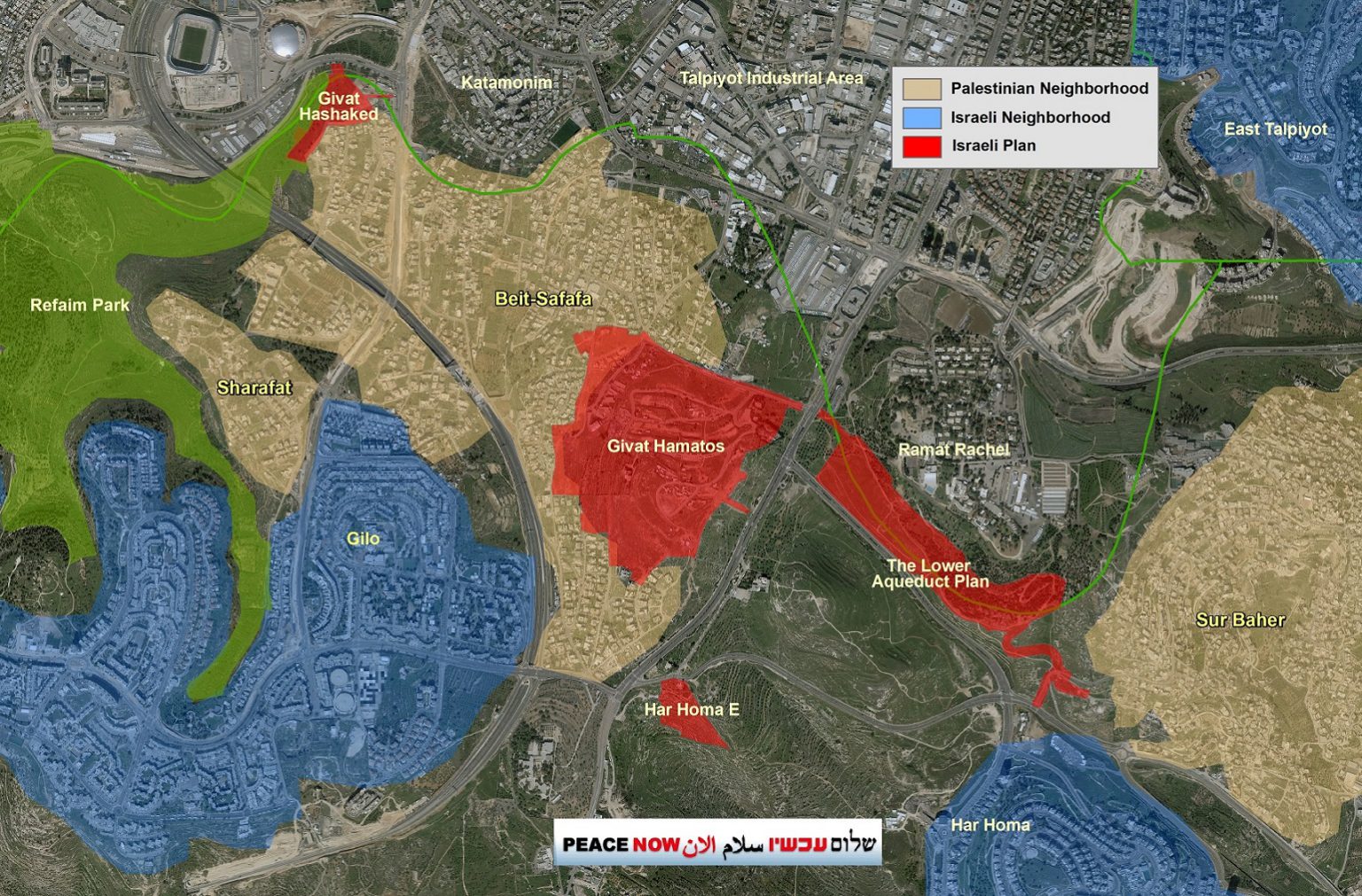 Peace Now reports that the Israeli Housing Ministry has published a tender for the construction of 1,047 settlement units constituting a new settlement in East Jerusalem called the Lower Aqueduct” plan. The settlement will be located on a sliver of land located between the controversial settlements of Givat Hamatos and Har Homa in East Jerusalem, adjacent to the Palestinian neighborhood of Umm Tuba and fall on both sides of the 1967 Green Line. The settlement is designed to connect the two settlements and seal East Jerusalem off from Bethlehem, and in so doing establish a huge, uninterrupted continuum of Israeli settlements on the southern rim of Jerusalem. According to Ir Amim, this is the first major new East Jerusalem settlement established by Israel since 2012.
Peace Now writes:
“The plan was promoted at an unprecedented speed from its inception to the tender issue: it was placed on the table of the District Planning Committee in July 2021, discussed in January 2022 by the District Committee which ordered revisions to the plan, and was approved for deposit in July 2022. That is, the tender was issued less than three years after the plans were submitted.
Politically, this is a strategic plan that will severely impact the possibility of a continuous urban Palestinian connection in East Jerusalem. In practice, the plan blocks the last corridor remaining for connecting Beit Safafa and Sur Baher with other parts of East Jerusalem. It should be noted that although about half of the plan’s area is beyond the Green Line, and half within it, its strategic location between Givat HaMatos and Har Homa makes it particularly problematic politically.”
Ir Amim has previously written:
“This plan carries serious ramifications on the political future of Jerusalem. If constructed, it will extend the Israeli settlement wedge along East Jerusalem’s southern border, further creating a sealing-off effect of East Jerusalem from the southern West Bank, while fracturing the Palestinian space and depleting more vacant land for Palestinian development….Beyond its geopolitical ramifications, the advancement of this plan underscores the systematic discrimination implicit in Israeli planning and building policy in Jerusalem. Since the beginning of 2023, over 18,500 housing units have been advanced for new or existing Israeli settlements in East Jerusalem, while residential development for Palestinians has been all but neglected. This is despite the fact that Palestinians constitute nearly 40% of Jerusalem’s population. 2023 is slated to join 2022 as being the two years with the highest number of settlement units advanced in the last decade in East Jerusalem. Such inequitable urban planning policy has long served as a driver of Palestinian displacement in service of solidifying a Jewish demographic majority in Jerusalem and further cementing Israeli territorial control to foil prospects for a just political resolution.”
Ir Amim & Bimkom: Israel Has Accelerated East Jerusalem Settlement Building Since Oct 7th
The Israeli anti-settlement NGOs Bimkom and Ir Amim have released a joint report reviewing the Israeli government’s wartime policies and how they have led to the acceleration of both settlement activity and home demolitions, posing an ever increasing threat to the rights and futures of Palestinian residents.
The report reads:
“Since the outbreak of the war six months ago, there has been a major surge in the promotion and fast-tracking of new settlement plans in East Jerusalem and a dramatic spike in the rate of demolitions of Palestinian homes. The Israeli government is clearly exploiting the war to create more facts on the ground to predetermine the final status of Jerusalem and thwart all prospects for a negotiated political agreement, while forcibly displacing Palestinians from their homes and the city.
Measures are being taken to establish eight brand-new settlements in East Jerusalem within or adjacent to Palestinian neighborhoods with a total of over 12,000 housing units. For details and analysis of these plans, click here or above for the full policy brief.
In juxtaposition to this major uptick in the advancement of new settlements, demolitions of Palestinian homes have reached unparalleled levels since the start of the war. This serves as a form of collective punishment and part of a series of repressive measures currently being employed by Israel against Palestinians under its control. Between October 7, 2023—March 10, 2024, 98 homes were demolished, which marks a nearly two-fold monthly increase compared to the period preceding the war. (Demolitions were halted during the month of Ramadan as in the past).”
Ben Gvir Seizes Authority Over East Jerusalem Housing Demolitions
On April 8th, the Israeli Cabinet decided to hand extremist minister Ben Gvir power over demolitions and housing enforcement in East Jerusalem. The CAbinet’s decision moved the Real Estate Enforcement Division from the Finance Ministry to the Ministry of National Security, which is controlled by Ben Gvir. The Real Estate Enforcement Division has the power to enforce against illegal construction in East Jerusalem and conducts demolitions and imposes fines alongside the Jerusalem municipality’s Building Supervision Department. It is important to note that the rate of demolitions in East Jerusalem during the Gaza war and in 2023 overall was higher than in other months or years, and it seems that transferring authority to Ben Gvir will only exacerbate this trend.
Daniel Seidemann, founder of Terrestrial Jerusalem, explained on X:
“In the eyes of the Palestinians in East Jerusalem, home demolitions are the most brutal & egregious manifestations of Israeli occupation. W/the exception of real or perceived threat to Al Aqsa, no issue in Jerusalem is more volatile & more incendiary than home demolitions. As per yesterday’s Cabinet Resolution, very broad powers will now be vested in Ben Gvir and an Authority or which he is responsible. these include administrative demolition orders, cease work orders, execution of judicial demolition orders, and much more. Ben Gvir has repeatedly declared his intent to carry out large scale home demolitions, particularly in E. Jerusalem. He then was opposed by the Police Chief, who now does his bidding. Ben Gvir has already expedited demolitions. However Ben Gvir had a problem: he had absolutely no statutory power in relation to demolitions. The role of the Police was to secure the demolitions ordered by the Jerusalem Municipality or Government of Israel (incl. judicial bodies). Bravado aside, he was a spectator.All that changed yesterday by means of the Cabinet Resolution. Having declared his intent “to show the Arabs of East Jerusalem who’s boss” by carrying out large scale demolitions. He will now have all the statutory powers and resources necessary to make good on his promise.”
Peace Now said in a statement:
“It has been unequivocally proven that law enforcement authorities under the responsibility of Itamar Ben Gvir exacerbate tension, violence, and hatred between the state and its citizens. The Real Estate Enforcement Division should operate with integrity and profound sensitivity to our political and social reality. However, it is highly doubtful that this will occur under the authority of Itamar Ben Gvir, the Minister of National Insecurity, who has previously been convicted of inciting racism and supporting a terrorist organization.”
New Plan to Massively/Strategically Expand the Ariel Settlement Industrial Zone
Peace Now reports that the Israeli Civil Administration’s High Planning Council convened on April 10th to consider 26 settlement plans, the most consequential of which is a plan to significantly expand the Ariel settlement industrial zone. This plan proposes to significantly expand the industrial zone eastward toward the new Ariel West settlement, which just began construction, connecting the two for all practical purposes.
Peace Now further explains the consequences of this plan:
“Expanding the industrial area eastward, on the one hand, and the establishment of the planned settlement of Ariel West, which infrastructure works for its establishment have recently begun, on the other hand, are intended to create a territorial continuum of settlements that will effectively block any possibility of development for Palestinian communities in the vicinity, including Salfit, Harres, and Kifl Harres. The plan essentially disconnects Salfit – the district town from the surrounding villages it serves.”
It’s worth revisiting the role settlement industrial zones play in perpetuating ISraeli occupation, annexation, and apartheid. For decades Israel has used industrial zones as another tool to expand and deepen control over West Bank land and natural resources. Industrial zones are part of Israel’s economic exploitation of occupied territory (including the local workforce, land, and other natural resources). Presented as benefiting both Israelis and Palestinians, it is in fact Orwellian to label such initiatives as “coexistence” programs, or to suggest that they offer the Palestinians benefits they should welcome. Importantly, jobs in industrial zones – often the only jobs available for Palestinians living under an Israeli occupation that prevents the development of any normal Palestinian economy – are widely viewed by Palestinians as a double-edged sword. The NGO Who Profits explained:
“Israeli Industrial Zones constitute a foundational pillar of the economy of the occupation. They contribute to the economic development of the settlements, which are in violation of international law and the Fourth Geneva Convention, while relying on the de-development of the Palestinian economy and the exploitation of Palestinian land and labor…The Industrial Zones in the oPt form part of a practice of ‘financial annexation’ which is an essential component of the broader policy of annexation taking place.”
Peace Now said in a statement:
“The government of Israel continues to build at an unprecedented pace in the Occupied Territories. Expanding an industrial area in the heart of the West Bank is not an Israeli interest, and certainly not a Palestinian interest. The industrial area west of Ariel does not promote economic growth, but rather harms both the Israeli and Palestinian economies alike.”
Smotrich Designates Symbols for Four Outposts Previously Approved for Retroactive Legalization
On April 6th, Finance Minister Smotrich (who also heads the Settlement Administration and a minister in the Defense Ministry) issued a statement announcing that he has designated “locality symbols” to four outposts that the government has previously approved to be retroactively legalized as new settlements: Mitzpe Yehuda, Beit Hogla, Shacharit, and Asa’el.
Peace Now explains:
“A ‘locality symbol’ is a serial number assigned by the Ministry of Interior to each official Israeli locality. For the government to allocate funds and resources for settlement development or to prepare construction plans, a settlement must have a “locality symbol.” Smotrich’s announcement aims to bolster his standing among his supporters as someone who does a lot for the settlements. Therefore, he exploits a bureaucratic maneuver and tries to present it as a new achievement.
The significance of assigning locality symbols to these four new settlements is that the government bureaucracy has already begun working to promote these settlements. It should be noted that since the government’s decision in February to establish nine new settlements, the commander of the military’s Central Command, Maj. Gen. Yehuda Fuchs has issued orders in recent months defining the jurisdictional areas of six of them: Mishmar Yehuda, Givat Haroeh. Apparently, defining the jurisdictional area of the remaining three settlements is delayed due to land ownership issues.”
The U.S. & E.U Unveil New Sanctions Targeting Settlers & Settler Entities
On April 19th the United States Department of State announced a third round of sanctions targeting one Israeli settler and two settler entities. The European Union announced sanctions on the same day, against four settlers and two settler entities. This round of sanctions is particularly notable because it expands the sanctions’ targets to include entities which fund settlers involved in violence, and because it targets a prominent political ally and confidant of Itamar Ben Gvir.
The U.S. sanctions target:
- Ben Zion (Bentzi) Gopstein – founder of the radical, violent Lehava settler organization, and “one of the closest confidants” of Kahanist Minister Itamar Ben Gvir. The U.S. State Department says that Lehava and its members “have been involved in acts or threats of violence against Palestinians, often targeting sensitive or volatile areas.” Gopstein was convicted in early 2024 for incitement to racism
- The Mount Hebron Fund – an organization leading a fundraising campaign for Yinon Levi, an Israeli settler previously sanctioned by the U.S. The U.S. group DAWN writes that the crowdfunding campaign had the declared intention of bypassing US sanctions. The AP reports the fundraising effort raised $140,000.
- Shlom Asiraich – an organization leading a fundraising campaign for David Chai Chasdai, an Israeli settler previously sanctioned by the U.S.. The AP reports the fundraising effort raised $31,000.
The European Union sanctions target:
- Lehava – the organization run by Ben Zion Gopstein (who the U.S. sanctioned as an individual, but did not sanction Lehava).
- The Hilltop Youth settler organization – a notoriously violent group based out of the Yitzhar settlement and involved in establishing illegal outposts throughout the West Bank. The Hilltop Youth have been called “the Jewish ISIS,” and regularly engage in violence against Palestinians, Israeli authorities, and activists.
- Neriya Ben Pazi – who was previously sanctioned by the U.S..
- Yinon Levi – who was previously sanctioned by the U.S..
- Meir Ettinger – who is the grandson of the late, extremist rabbi Meir Kahane, and a well-known leader of the Hilltop Youth leader.
- Elisha Yered – who previously served as a spokesperson for MK Limor Son Har-Melech, an ally of Ben Gvir.
Itamar Ben Gvir responded to the new sanction, saying:
“The harassment of the Lehava organization and dearest settlers, who never engaged in terrorism or harmed anyone, are the result of a blood libel by Israel-hating, antisemitic elements who for years have openly supported Hamas, Fatah, and other anarchist organizations that harm IDF soldiers.”
Bonus Reads
- On Settler Terrorism:
- “West Bank sees biggest settler rampage since war in Gaza began as Israeli teen’s body is found” (AP)
- “Al-Haq, Al Mezan and PCHR Urge the International Community to Intervene as Israeli Forces and Settler Violence Intensifies Across the West Bank” (read)
- “Homes burned, animals killed: Palestinians describe Israeli settler rampage” (Washington Post)
- “Israel Responsible for Rising Settler Violence” (Human Rights Watch)
- “Opinion | Dear President Biden, Are You Okay With Israeli Settlers Using American Weapons?” (Amira Hass in Haaretz)
- “Blinken Is Sitting on Staff Recommendations to Sanction Israeli Military Units Linked to Killings or Rapes” (Pro Publica)
- “Blinken says he’s made ‘determinations’ linked to human rights accusations against Israel” (The Times of Israel)
- “Ben Gvir forms police team targeting left-wing activists in the West Bank” (The Times of Israel)
- “Editorial | Goodbye, Green Line: The Israeli Government Goes All Out to Boost West Bank Settlements” (Haaretz Editorial Board)
- “Housing, Showers, Electricity: These Are the Outposts the Israeli Army Is Building in the Heart of Gaza” (Haaretz)
Welcome to FMEP’s Weekly Settlement Report, covering everything you need to know about Israeli settlement activity this week.
To subscribe to this report, please click here.
February 16, 2024
- Tenders Issued for Construction in Geva Binyamin and Karnei Shomron Settlements, Bringing 2024 Total to 523 Tenders
- Hebron Settler Council Launches Crowdfunding Campaign for U.S.-Sanctioned Settler & His Illegal Outpost
- New Outpost Near the Tekoa Settlement
- Israel Has Expedited East Jerusalem Settlement Planning & Home Demolitions in Wake of October 7th
- Israel to Pay Immigrants $550/Month to Move to Settlements
- East Jerusalem Cable Car Project Stalled as Israel Looks for Construction Company
- Settler Population Grew By 3% in 2023
- B’Tselem Details “Extreme Restrictions” on 2023 Olive Harvest
- Peace Now Launches New Settler Violence Hotline
- Israel to Buy 200 Armored Vehicles for Civilan Standby Units, Including in Settlements
- Israel Spying on U.S.-PA Settler Violence Channel
- News & Analysis of Sanctions on Settlers
- Bonus Reads
Tenders Issued for Construction in Geva Binyamin and Karnei Shomron Settlements, Bringing 2024 Total to 523 Tenders
Peace Now reports the Israeli Ministry of Housing published tenders on February 9th for the construction of 60 new settlement units, 12 new units in the Geva Binyamin settlement and 48 in the Karnei Shomron settlement, located in the northern West Bank, east of the Palestinian village of Qalqilya. Israel has openly declared its intention to continue expanding settlements in this area with the stated goal of bringing 1 million settlers to live in the area.
These tenders come just five days after the publication of tenders for 62 new units in the Efrat settlement.
So far in 2024, the Israeli government has issued tenders for the construction of 523 new settlement units in a total of eight settlements.
Peace Now said in a statement:
“The rapid pace and widespread scope of tender publications indicate a clear policy aimed at promoting extensive construction in the West Bank. The Israeli government is capitalizing on the international focus on the Gaza Strip to further entrench Israeli control deep in Palestinian territory, hindering the possibility of a two-state solution.”
Hebron Settler Council Launches Crowdfunding Campaign for U.S.-Sanctioned Settler & His Illegal Outpost
Peace Now reports that the settler municipal body in Hebron (the Har Hevron Regional Council) has launched a crowdfunding campaign to assist Yinon Levy and the illegal outpost he established (“Meitarim Farm”). The campaign was launched in response to the U.S. sanctioning Levy, who is purported to have engaged in violence against Palestinians in the West Bank that lead to the forcible displacement of four nearby Palestinians communities (approximately 300 people).
Peace Now makes the important point:
“The settlers on whom sanctions were imposed are not the story. Behind every violent settler lies an entire governmental system that supports and funds them. Settler violence is not an isolated incident but rather a part of an organized and financed strategy by the authorities to dispossess Palestinians of their lands in the Occupied Territories, and to undermine any potential political solution.”
Proving that point, the Har Hevron Regional Council’s commitment to Levy and his illegal outpost runs deep. In 2021 a coporation owned by the the municipality awarded Levy a contract to establish the outpost as an agricultural farm and to explicitly take control of the whole area. The contract states [emphasis added]:
“The Directorate wants the farmer to establish an agricultural farm … that will maintain a presence in the lands of the area and thus help to preserve the state’s lands and the seizure and preservation of the surrounding lands … The farmer will establish on the farm… a corral for the herd and housing residences near it and necessary additional facilities.”
New Outpost Near the Tekoa Settlement
Haaretz reports that settlers have undertaken a large-scale project to establish a new outpost near the Tekoa settlement, located south of Bethlehem. Photos of the outpost show that the land has been cleared, roads established, and power lines have been installed. A total of six trailers have been moved to the site already. A Defense source told Haaretz that it is “doubtful that the government will evacuate the outpost, which was built on state-controlled land.”
Israel Has Expedited East Jerusalem Settlement Planning & Home Demolitions in Wake of October 7th
Ir Amim and Bimkom jointly report that Israel has led a “stark rise” in home demolitions in EAst Jerusalem since October 7th and the start of Israel’s latest war on Gaza. The groups write:
“As the war rages on in Gaza, claiming the lives of tens of thousands of Palestinians and displacing nearly two million, Israel adds to the conflagration by accelerating demolitions across East Jerusalem. The recent home demolitions in al-Walaja are part of a major surge in demolitions in East Jerusalem since the start of the Israel-Hamas war, which has likewise profoundly impacted the community of Al Bustan, Silwan. Yesterday, the home of community leader and well-known activist, Fakhri Abu Diab, was demolished despite ongoing negotiations with the Jerusalem municipality and strong international outcry. Some 100 homes in Al Bustan are at risk of mass demolition with over 1500 Palestinians under threat of displacement due to Israeli plans to establish an Israeli tourist and archaeological park in the area
Since October 7, there has been a total of 94 demolitions in East Jerusalem, 63 of which were homes. This marks a nearly 70% increase in demolitions compared to the months preceding the war. Moreover, expected changes in the government ministry responsible for the National Enforcement Unit are likely to cause an even more dramatic rise in demolitions. According to recent news reports, on Sunday, the government is slated to approve the transfer of the National Enforcement Unit from the Ministry of Finance to the Ministry of National Security, placing it under the direct authority of ultranationalist and far-right Minister Itamar Ben Gvir. The transfer of the unit was included in coalition agreements during the formation of the government last year. Over the past year, Ben Gvir has made numerous statements calling for the intensification of demolitions. Such a move is cause for extreme alarm and will directly impact areas of East Jerusalem, including al-Walaja.”
While home demolitions are surging, so too are the advancement of settlement plans. Haaretz has fresh reporting on how Israel is expediting plans to build new settlements across Jerusalem, including Nofei Rachel, Givat HaShaked, Umm Lysoon, and Kidmat Zion. The article surveys the planning processes advancing these plans, including the secret land registration and settler interests involved.
Israel to Pay Immigrants $550/Month to Live in Settlements
The Israeli government announced plans to offer heightened financial incentives to new immigrants who settle in the West Bank, along with areas in the country’s northern and southern peripheries. The plan estimates a $19 million cost to provide $550/month for two years to new immigrants choosing to live in settlements or in the periphery areas, as compared to $100-$200/month for new immigrants living in central Israel or Haifa. These funds are dedicated to subsidizing housing costs.
The plan was announced on February 15th at a joint press conference held by Immigration and Integration Minister Ofir Sofer and Finance Minister Smotrich, who holds immense power in the West Bank in his role as a minister in the Defense Ministry with virtually unchecked authority of Area C civilian matters.
East Jerusalem Cable Car Project Stalled As Israel Looks for Construction Company
Haaretz reports that the Israeli government has struggled for 8 months to secure a qualified (and therefore foreign) construction company to build the settler-backed cable car project. Several companies have pulled out of consideration due to the political sensitivities invovled.
As a reminder, the Jerusalem cable car project is an initiative backed by the powerful, state-backed Elad settler group and advanced by the Israeli Tourism Ministry.
Emek Shaveh and other non-governmental organizations, including Who Profits and Terrestrial Jerusalem, have repeatedly challenged (and provided evidence discrediting) the government’s contention that the cable car will serve a legitimate transportation need in Jerusalem, and have clearly enumerated the obvious political drivers behind the plan, the archeological heresies it validates, and the severe negative impacts the cable car project will have on Palestinian residents of Silwan.
Despite lacking a qualified construction firm, Israel has already proceeded to issue 17 orders confiscating privately owned Palestinian land in highly sensitive East Jerusalem neighborhoods to prepare for the construction of the cable car line. Attorney Sami Arshid, who represents the Palestinian residents of Silwan, told Haaretz:
“This is the most unnecessary project in the history of the city. The residents of Silwan and the Old City, like most experts in Israel and around the world, see it as a serious hazard to the city’s urban heritage. The expropriation of properties and homes will cause severe harm to the residents and this in order to establish a megalomaniacal project that harms the history, urban heritage and landscape of the Old City of Jerusalem and its environs.”
Emek Shaveh told Jerusalem:
“The cable car is a political project that lacks feasibility and professional justification. Its goal is to strengthen [Jewish] settlement in Silwan and bring tourists to sites run by Elad. A year and a half after the High Court of Justice rejected petitions against the project, a tender has yet to be published, and now it turns out that even commercial companies whose sole purpose is to make money understand that they are better off staying away from this project. At a time when the State of Israel is facing huge deficits, we say frankly that this is a harmful and superfluous project that should be scrapped, the sooner, the better.”
Settler Population Grew By 3% in 2023
A pro-settler organization released data showing that the West Bank settler population increased by nearly 3% in 2023 (not including East Jerusalem). The population now stands at 517,407.
The report also forecasts “excellerated growth” in the aftermath of October 7th, claiming that “Serious cracks have indeed developed in the wall of opposition to Jewish settlement of the West Bank.”
B’Tselem Details “Extreme Restrictions” on 2023 Olive Harvest
In a new report, B’Tselem asserts that Israeli policies restricting the ability of Palestinians to harvest olive trees in the 2023 harvest season has resulted in financial harm to tens of thousands of Palestinian families. Those policies include canceling the allocation of harvest days to farmers whose land falls in Area C (access to which is regulated by the IDF), the closure of gates in the separation barrier that permit Palestinians to access their land in the “seam zone” (the IDF is solely able to open theses gates), and – of course – unmitigated settler violence.
B’Tselem writes:
“The systemic obstruction of the olive harvest this year, augmented by organized settler violence against harvesters and their property, is not unique to this time of war. It is part of Israel’s longstanding violent policy, which aims to cement the apartheid regime in the West Bank and allow continued expansion of settlements. Bezalel Smotrich, who serves as Minister of Finance and Minister in the Ministry of Defense, and MK Tzvi Sukkot, Chair of the Knesset Subcommittee on Judea and Samaria Affairs, have already said “sterile security spaces” should be created near settlements, where Palestinians would be denied entry altogether. This would clear the way for the state to take over this land and use it for its own purposes. “
Peace Now Launches New Settler Violence Hotline
Peace Now and Looking Occupation in the Eye have launched a dedicated hotline for Palestinians to report instances of settler violence. The groups reported the new initiative to the U.S. and other governments who have recently issued sanctions against four Israeli settlers believed to have participated in violence against Palestinians in the West Bank. A graphic urging people to report instances of violence says, “we will make sure it gets to the right people in the right places.”
Peace Now said in a statement:
“The state is not doing enough against an organized and dangerous attempt to turn the West Bank into a third front. This unequivocally constitutes terrorism and undermines our national interests, yet it is no longer condemned by the Israeli government. We must change the rules and exert all possible pressure. The lawlessness has ended, and those who harm will pay dearly. We will convey the reports to Israel’s friends and allies worldwide.”
Looking the Occupation in the Eye said in a statement:
“For years, we have been active in the occupied territories and have been dealing with terrorism by settlers, complaining to law enforcement authorities but receiving no response. Since October 7th, Jewish lawbreakers have been doing as they please throughout the West Bank, and no one stops them. Like in third-world countries – when a state does not deal with terrorism itself, the big brother across the ocean does it for them. Let’s help stop the process of turning us into a failed, disintegrating, and lawless state.”
Over the past week, many instances of settler violence have been reported on X and in the media. A small sampling includes:
- Settlers from Yitzhar (including the head of security and several wearing IDF uniforms) perpetrated several attacks on February 12th. The IDF was later deployed to the area but no arrests have been made.
- Fifteen settlers were filmed attacking Palestinian property in the village of Asira al-Qibliya on February 12th. Settlers set cars on fire, threw stones, and shooting a Palestinians. Three were injured.
- Settlers were filmed attacking Palestinian property in the village of Madama on February 12th. This followed settlers harassing a farmer and shooting at a tractor.
- Another group of Yitzhar settlers raided the village of Huwara and set cars on fire there.
- On February 11th, 15 settlers were documented throwing rocks and tear gassed at Palestinians near the Bazariya junction. A similar event happened last week as well.
Israel to Buy 200 Armored Vehicles for Civilian Standby Units, Including in Settlements
The JNS reports the Israel Defense Ministry has approved the purchase of more than 200 armored vehicles for civilian “standby units” – including the units based in settlements, the Gaza envelope, and on the Lebanon border. The vehicles will be delivered in the coming months.
Speaking about the purchase, the deputy director of the Defense Ministry said:
“Ordering the security vehicles is another step in the large-scale procurement we are undertaking for the standby squads, which also includes weapons and protective equipment.”
Israel Spying on U.S.-PA Settler Violence Channel
+972 Magazine published a report citing Israeli intelligence sources admitting that Israel is actively spying on reports on settler violence from the the Palestinian Authority to the the Office of U.S. Security Coordinator for Israel and the Palestinian Authority (USSC), with the aim of preventing that information from “developing into sanctions.” A source told +972 that “the Israelis are finding themselves embarrassed. The fact that we are being asked to look for the materials indicates that Israel has no good answers.” The source also said, “we’re working to help refute these allegations, or prevent them from developing into sanctions. The political echelon is concerned that all kinds of international moves will be taken that will force Israel to deal with this issue.”
News & Analysis of Sanctions on Settlers
There was an absolute torrent of news and analysis regarding the U.S. sanctions against four Israeli settlers, which the U.K. and France have replicated.
News/Reporting
- “Scoop: Bibi protests to Biden, criticizes order targeting Israeli settler violence” (Axios)
- “US could target Israel’s Ben-Gvir, Smotrich in latest sanctions” (The Jerusalem Post)
- “Israel Fears Additional Western Countries Will Follow Suit in Sanctioning Violent West Bank Settlers” (Haaretz)
- “Biden urged to include politicians in sanctions on violent Israeli settlers” (The Guardian)
- “France leads EU in sanctioning violent Israeli settlers” (Al-Monitor)
- “France follows UK, U.S. adopting sanctions against 28 ‘violent Israeli settlers’” (i24 News)
Key Analysis
- “Explaining Targeted U.S. Sanctions Under the West Bank Executive Order” (Human Rights First)
- “Palestinians see little solace in Western sanctions against some settlers” (Reuters)
- “Israeli settlements stand in the way of peace. Biden can defund them all” (Michael Schaeffer Omer-Man in The Guardian)
- “Next U.S. Sanctions May Target More Than Just ‘Rogue Elements,’ and Israel Only Has Itself to Blame” (Zvia Bar’el in Haaretz)
- “Biden’s sanctions set ominous precedent for the settlement enterprise” (Shuki Friedman in The Jerusalem Post)
- “The Sleight of Hand in Dismissing Settler Violence” (Michael Koplow for the Israel Policy Forum)
Bonus Reads
- “Israel’s Crackdown on Hebron” (Jewish Currents)
- “Meet the Israelis Who Are Trying to Physically Block the Ethnic Cleansing Unfolding in the West Bank” (Haaretz)
- “The special unit recruiting hilltop youth” (Israel Hayom)
- “Blinken demands investigation into reported killings of U.S. citizens in West Bank” (Washington Post)
- “US investigators visit homes of two Palestinian-American teens killed in the West Bank” (AP)
- “A Fanatical Israeli Settlement Is Funded by New York Suburbanites” (New Lines)
Welcome to FMEP’s Weekly Settlement Report, covering everything you need to know about Israeli settlement activity this week.
To subscribe to this report, please click here.
December 15, 2023
- Israel Expropriates More Land in Silwan For the Settler-Backed Cable Car Project
- Key Hearing on Givat Shaked Settlement Scheduled for Next Week
- Israel Government Planning Decision to Extend Domestic Construction Laws to Settlements (An Act of De Facto Annexation)
- Hamoked Seam Zone Petition Rejected by Supreme Court
- US Delays Rifles to Israel Over Settler Violence
- International Bans on Violent Settlers Grow, Even as Criteria is Unclear
- Bonus Reads
Israel Expropriates More Land in Silwan For the Settler-Backed Cable Car Project
According to reports, on December 10th the Jerusalem Municipality announced the expropriation of 10 dunams (~3 acres) of land in the East Jerusalem neighborhood of Silwan in order to enable the construction of the cable car project, which is promoted by (and designed to benefit) the Elad settler organization. Peace Now reports that the new expropriations are supposed to be “temporary”, and will expire in eight years, in order to allow the Municipality to survey and test the land to determine the final location of the giant pillars which will support the cable car. Once the location for the pillars is determined, that land will be permanently expropriated.

Image by Peace Now
Palestinian landowners were given 60 days to file objections to the “temporary” and future expropriation of their land.
As a reminder, the Jerusalem cable car project is an initiative backed by the powerful, state-backed Elad settler group and advanced by the Israeli Tourism Ministry. While public efforts to “sell” the cable car plan focused on its purported role in helping to grow Jerusalem’s tourism industry or in serving supposedly vital transportation needs, in reality the purpose of the project is to further entrench settler control in Silwan, via archeology and tourism sites, while simultaneously delegitimizing, dispossessing, and erasing the Palestinian presence there. The State of Israel was forced to publicly admit that the implementation of the cable car project will require the confiscation of privately owned Palestinian land in the Silwan neighborhood of East Jerusalem.
Notably, the cable car line is slated to terminate at the settler-run Kedem Center compound (Elad’s large tourism center, currently under construction at the entrance of the Silwan neighborhood, in the shadows of the Old City’s walls and Al-Aqsa Mosque).
The cable car project received final approval in May 2022, but the tender for construction has yet to be issued. Emek Shaveh speculates that the cable car tender might be issued on Jerusalem Day – which will be celebrated with ultranationalist, racist parades through the Old City next week — on May 18th and 19th. Emek Shaveh further warns that several other settler projects in East Jerusalem, including the Ben Hinnom suspension bridge and the zip line over the Peace Forest, are nearing completion and might also be part of Jerusalem Day celebrations.
Emek Shaveh and other non-governmental organizations, including Who Profits and Terrestrial Jerusalem, have repeatedly challenged (and provided evidence discrediting) the government’s contention that the cable car will serve a legitimate transportation need in Jerusalem, and have clearly enumerated the obvious political drivers behind the plan, the archeological heresies it validates, and the severe negative impacts the cable car project will have on Palestinian residents of Silwan. All objections to the plan were dismissed in May 2022.
Following the recent expropriation, Daniel Seidemann of Terrestrial Jerusalem says:
”Before relating to the significant geopolitical impact of the plan it is important to emphasize: the cable car is a crime against Jerusalem, regardless of who rules the city. Only those utterly detached from Jerusalem and its precious unique character could consider acting in a manner that will contribute to the transformation of Jerusalem into a Biblically themed theme park – the disneyfication of Jerusalem. The cable car was initiated by the settlers in Silwan, who were actively involved in promoting the plan.The cable car is part of a much broader scheme to seamlessly integrate occupied East Jerusalem into pr-1967 Israel, by surrounding the religious and historical core of the city with biblically motivated settlements and settlement-related projects. The settlers aspire by these means to transform their settlement enclave into an extension of pre-’67 Israel so as to include the settlement in the Palestinian neighborhood of Silwan.”
Key Hearing on Givat Shaked Settlement Scheduled for Next Week
Ir Amim reports that the Jerusalem District Planning Committee is scheduled to meet on December 19th for a hearing on objections to the Givat Shaked settlement submitted by the public. This hearing is one step towards the approval of the settlement plan, which outlines 700 settlement units (in 4 high-rise towers and several six-story buildings), a school, and commercial buildings, all to be built on a highly sensitive and geopolitically critical sliver of land located within the Palestinian neighborhood of Beit Safafa. Ir Amim further notes that the plan is advancing at a rapid pace, with this hearing coming just days after the close of the objection period. 
The plan for Givat HaShaked is unprecedented, according to the Israeli NGO Terrestrial Jerusalem, in that it is the first settlement of this size that that Israeli government will establish within a Palestinian neighborhood. Beit Safafa is already in the process of being completely surrounded by Israeli development (for Jewish Israelis) — most notably the new Givat Hamatos settlement, which the government is expanding.
The Israeli NGOs Bimkom and Ir Amim filed a joint objection to the Givat Shaked plan, contesting two factors:
- That the plan itself is unjust and discriminatory, the land designated for the settlement is inside of the Palestinian neighborhood Beit Safafa and should be used to address the severe housing crisis faced and lack of schools by Palestinian East Jerusalemites.
- The improper and exceptional role that the Israeli General Custodian has played in initiating a settlement plan for land which it does not own, but which it is a caretaker until the heirs of the land are located (more below).
As a reminder, the Israeli government has been sitting on plans for Givat HaShaked for decades, but has refrained from implementing them because doing so would require the government to seize a sizeable amount of land in East Jerusalem, some of which is privately owned by Palestinian residents of Sharafat (a section of the Palestinian neighborhood of Beit Safafa). Other parts of the land proposed to be used for the Givat HaShaked settlement plan are managed by the Israeli General Custodian (but neither owned or claimed by the government of Israel) – a fact Ir Amim calls “highly unusual and seemingly marks a new phenomenon.” The Israeli General Custodian is empowered by the State to act as a caretaker of land that has unknown ownership until the heirs are located. In an attempt to explain why the General Custodian has the authority to approve a plan for construction on land that the State does not own, the Israeli Justice Ministry told Haaretz that the plan for Givat HaShaked increased the value of the land and that “by law, the administrator general is obligated to care for the assets under his management in a way that will benefit their private owners.” This answer implies, bizarrely, that if and when Palestinian heirs are located, they will be somehow better off with their land having been used to build a settlement.
Another important facet of how Givat HaShaked is being advanced now is the decision by the Israeli government in late 2020 to initiate a (typically secret) registration process for land in East Jerusalem, including in the Sharafat area. At this time, it is unknown whether the land managed by the General Custodian in Sharafat (and designated for the new settlement) has been – or is in the process of being – registered. On that uncertainty, Ir Amim writes:
“…in the event that it is the same location [where formal land registration has taken place], this move would constitute yet another brazen example of how the settlement of title procedures are repeatedly being used to aid state authorities and settler groups in taking over more land in East Jerusalem…Although portrayed as a measure to ostensibly benefit Palestinian residents, there has been grave alarm that these [land registration and settlement of title] procedures would in fact be exploited to confiscate Palestinian land for political purposes, leading to the expansion of Jewish settlement and widespread Palestinian dispossession in the city.”
For a deep dive into land registration in East Jerusalem, please listen to a new FMEP podcast featuring Kristin McCarthy (FMEP) in conversation with Amy Cohen (Ir Amim).
Israel Government Planning Decision to Extend Domestic Construction Laws to Settlements (An Act of De Facto Annexation)
On X, Itay Ephstein (Senior Humanitarian Law and Policy Consultant and Special Advisor to the Norwegian Refugee Council) reports that the Israeli government is preparing to present within 30 days a detailed ordinance which, if approved, would extend Israel’s domestic planning and construction law to its settlements the West Bank. This would further Israel’s de facto and bureaucratic annexation of the West Bank through the application of Israeli domestic law in the occupied territory, and it would likely lead to a massive construction boom in the settlements. Currently, planning and construction in the West Bank is governed by the Israeli Defense Ministry within which Bezalel Smotrich serves as a civilian ministry in charge of all construction matters in Area C of the West Bank.
Hamoked Seam Zone Petition Rejected by Supreme Court
Hamoked reports that the Israeli Supreme Court has rejected two (1, 2) of its recent petitions seeking relief for Palestinian landowners and farmers who have been denied access to their agricultural land in the Seam Zone, the sizeable amount of West Bank land trapped between the Israeli separation wall the 1967 Green Line (i.e. land that was de facto annexed to Israel when Israel built the separation wall along a route the cuts deeply into the West Bank). The Court rejected the petitions in agreement with the State’s contention that, given the events of October 7th and after, it is dangerous to let Palestinians cross the wall and the military cannot supply the necessary troops to operate the designated gates where farmers can cross through the wall and access their land.
Hamoked reports that the Court accepted the security argument without dispute, and did not even discuss Israel’s legal obligations, under both Israeli and international law. Beyond the legal infringement on the rights of landowners, the inability of PAlstinians to harvest their crops not only deprives them of profit this year, but crops can suffer if not harvested – impacting production for years to come.
US Delays Rifles to Israel Over Settler Violence
Axios reports that the Biden Administration is slow-walking the sale of >20,000 M-16 rifles to the Israeli state amidst concern the rifles will end up in the hands of settlers and pressure on Israel to mitigate settler violence in the West Bank.
Despite holding up the sale of rifles, the Biden Administration has simultaneously bypassed Congress to finalize the sale of 14,000 tank shells to Israel for its war on Gaza (worth $106 million). According to Politico, the sale transfers not only 14,000 120mm M830A1 High Explosive Anti-Tank Multi-Purpose with Tracer tank cartridges, but also includes the provision of U.S. support, engineering and logistics.
The juxtaposition of these sales tracks with the Biden Administration’s increasingly focal concern for settler terrorism in the West Bank alongside its tight embrace of Israeli military actions in Gaza and in the West Bank.
International Bans on Violent Settlers Grow, Even as Criteria is Unclear
The United Kingdom is the latest government to announce that it will ban Israeli settlers who participate in violent crimes in the West Bank. European Union Foreign Minister Josep Borrell also announced his support for the EU imposing such a ban.
Though the number of countries to announce a settler ban policy, the mechanics for creating a list of sanctioned settlers is very murky. Haaretz reports that the countries who have announced the new ban policy are struggling with creating the criteria by which names can be added to a list of banned settlers. The U.S. appears to be operating independently of its allies’ complementary efforts to decided criteria and create a list. Part of the impetus behind the actions of these governments is the lack of prosecution and accountability by the Israeli government for settlers who have been involved in violent crimes, so relying on Israeli government actions cannot reasonably serve as a basis for action. And as the Israeli NGO Yesh Din has thoroughly documented for years – only 7% of crimes by settlers that are reported by Palestinians to the Israeli police (which is likely only a fraction of all the crimes) results in an indictment, even though video footage of settler crimes is now commonplace.
In its December 14th report, OCHA documents the following data on settler violence since October 7th
- Settlers are responsible for the death of 8 Paletinians and injuries to 85.
- Settlers have perpetrated at least 343 attacks against Palestinians, resulting in Palestinian casualties (35 incidents), damage to Palestinian-owned property (263 incidents), or both casualties and damage to property (45 incidents);
- Settler violence has contributed to the displacement of at least 189 Palestinian households comprising 1,257 people, including 582 children;
Bonus Reads
- ”Far-right minister calls for Israel to ‘fully occupy’ Gaza, reestablish settlements” (The Times of Israel)
- “How Israeli settler violence is forcing Palestinians to flee their homes – video” (The Guardian)
- “European Financial Institutions’ Continued Complicity in the Illegal Israeli Settlement Enterprise” (Don’t Buy Into Occupation)
Welcome to FMEP’s Weekly Settlement Report, covering everything you need to know about Israeli settlement activity this week.
To subscribe to this report, please click here.
April 7, 2023
- In Rare Ruling, Israeli High Court Rejects JNF/Settler Effort to Evict Palestinian Family from their Home in Silwan
- Israel Advances Plans for 6,500 New Settlement Units in East Jerusalem
- Israel Doubles Funding of Settler Surveillance of Palestinians
- Bonus Reads
In Rare Ruling, Israeli High Court Rejects JNF/Settler Effort to Evict Palestinian Family from their Home in Silwan
 On April 3rd, a three-judge panel of the Israeli Supreme Court ruled against the Jewish National Fund, which has pursued a 32-year legal battle to evict the Palestinian Sumreen family from their longtime home in the Silwan neighborhood of East Jerusalem. In its ruling the Court criticized the government for declaring the Sumreen home to be absentee property “without any basis in law.” The Court further ruled that the JNF’s subsidiary Himnuta (which was created to take the lead for JNF in litigating aggressive settlement takeover cases like this) must compensate the family with 20,000 shekels ($5,560).
The case to evict the Sumreen family has been viewed as a key test of the State’s use of the Absentee Property Law to seize Palestinian homes in East Jerusalem, with the fate of the Sumreen case likely to set a precedent that could impact the many other ongoing eviction cases brought by settlers against Palestinians in Silwan.
Reacting to the ruling, the Sumreen family lawyer told Haaretz:
“This decision is precedential and just. The Supreme Court brought justice after two proceedings in which [the court] ordered the eviction of several families from their homes. The decision includes criticism of how the authorities behaved on this matter and the declaration of absentee property despite the fact that the owner is a living resident of Jerusalem.”
The Free Jerusalem activist movement said in a statement:
“There are few moments in which we feel like a bit of justice has been done in the reality of the occupation. This is one of those movements. Amal Sumreen and her children have lived in their home in Silwan for decades. For the first time in those decades, Amal will be able to sleep soundly tonight” and vowed to continue working “until this racist law, which allows the seizure of homes, is struck down, until the occupation ends, until there is full equality for all.”
The Sumreen family home is located in the middle of what today has been designated by Israel “the City of David National Park” (the home existed long before that designation). The Israeli government has handed over management of the area to the radical Elad settler organization, which for years has also been pursuing the eviction of Palestinians from the homes in Silwan. For nearly three decades, the Sumreen family has been forced to battle for legal ownership of their home, after the state of Israel, prompted repeatedly by the JNF, declared the home to be “absentee” property”. As a reminder, that law (as summarized by the Israeli legal NGO Adalah),
“Defines persons who were expelled, fled, or who left the country after 29 November 1947, mainly due to the war, as well as their movable and immovable property (mainly land, houses and bank accounts etc.), as ‘absentee’. Property belonging to absentees was placed under the control of the State of Israel with the Custodian for Absentees’ Property. The Absentees’ Property Law was the main legal instrument used by Israel to take possession of the land belonging to the internal and external Palestinian refugees, and Muslim Waqf properties across the state.”
Based on that designation – which was not communicated to the Sumreen family, which of course was not “absentee” but was living in the home – Israeli law permitted the state to take over the rights to the building. The state then sold the rights to the home to the JNF in 1991. The JNF has pursued the eviction of the Sumreen family ever since, with the secret funding/backing of the Elad settler group.
Israeli courts ruled in favor of the Sumreen family’s ownership claims to the home for years. This changed, arguably as a direct result of a deliberate policy (led by then-Justice Minister Ayelet Shaked) to pack the courts with right-wing judges) in September 2019, when the Jerusalem Magistrate’s Court tossed out the previous rulings to grant ownership of the family’s home to the JNF — a decision the family immediately appealed to the Jerusalem District Court. Notably: in 2020, the JNF came under considerable international scrutiny for its handling of the Sumreen case, and was pressured to call off its eviction campaign (it did not).
In 2022, the Israeli Attorney General issued a legal opinion supporting the JNF’s legal claim to the home and the eviction of the Sumreens. In his opinion, the Attorney General did not address the broader political context of widespread dispossession of Palestinians in Silwan, or the legally dubious actions on the part of the Elad settler group and the Jewish National Fund in having the property declared to be absentee in order to take control over it. Instead, the Attorney General decided simply that there is no new basis on which to overturn the JNF’s ownership of the home, and therefore the Sumreen family does not have a legal right to reside there.
A full history of the saga involving the Sumreen family – which is similar to dozens of other Palestinian homes in Silwan that were declared Absentee Property in the 1990s – can be found on the Peace Now website here. For more on the collusion of the JNF and the Elad settler group, see reporting by +972 Magazine.
Israel Advances Plans for 6,500 New Settlement Units in East Jerusalem
Ir Amim reports that over the past week various Israeli agencies have advanced plans for a total of 6,500 new settlement units slated for incredibly sensitive areas of East Jerusalem.
On March 29th, the Jerusalem Local Planning Committee took the following actions:
- Wadi Joz Business Center (Silicon Wadi) – the Committee discussed and rejected all objections submitted against this plan, recommending the plan for final approval. The “Silicon Wadi” plan seeks to establish a major high-tech hub along the western side of East Jerusalem’s Wadi Joz neighborhood. While touted as a plan that will benefit Palestinians, its implementation will require the eviction of many Palestinian businesses in the area. You can read Ir Amim’s in-depth reporting on the Silicon Wadi project here.
- Lower Aqueduct Plan – the Committee discussed and rejected all objections submitted against this plan, recommending the plan for final approval. This plan would see a new settlement of 1,465 units built on a sliver of land located between the controversial settlements of Givat Hamatos and Har Homa – and is intended to connect the two. In so doing, it will establish a huge, uninterrupted continuum of Israeli settlements on the southern rim of Jerusalem, and will destroy Palestinian contiguity between the West Bank and East Jerusalem. For more background on the Lower Aqueduct plan, see resources by: Terrestrial Jerusalem and Ir Amim.
- Ramot North A and B – The Committee recommended these two plans, outlining a total of 1,918 units, for deposit for public review. Both plans will expand the existing settlement of Ramot northeastward towards the Palestinian town of Bir Nabala. See more details from Ir Amim here.
On April 3rd, the Jerusalem District Planning Committee was slated to advance the following plans (final confirmation of the committee’s actions has not been reported as of publication on April 6th)
- French Hill/Mount Scopus – The committee was slated to possibly review amendments to two plans for a total of 1,539 new settlement units to be built in the area of French Hill and the premises of Hebrew University’s Mount Scopus campus, most of which would be located beyond the Green Line. One of the plans – called the “Bronfman Dormitory Complex” – will encircle a Palestinian residential area on the Mount of Olives.
- Givat HaShaked – This plan outlines 700 housing units (in 4 high-rise towers and several six-story buildings), a school, and commercial buildings, all to be built on a highly sensitive and geopolitically critical sliver of land located within the Palestinian neighborhood of Beit Safafa. It was approved for public deposit in September 2022. Ir Amim reports, “although approved for deposit, the plan has not yet been formally deposited for public review. An internal session was scheduled […] to amend the decision on the plan. Although the details regarding this amendment are unknown at present, the assumption is that the modification is a technical issue.” For more information on this new settlement, see previous FMEP reporting.
- Pisgat Ze’ev – The committee was slated to possibly review amendments to a plan for 730 new settlement units that would expand the Pisgat Ze’ev settlement eastwards towards the Separation Barrier and the area of the Palestinian town of Hizma, depleting the few remaining open land reserves in the area.
- Ramot – A plan for 240 new units in the settlement of Ramot was slated to be reviewed by the committee for the first time.
Israel Doubles Funding of Settler Surveillance of Palestinians
Haaretz reports that the Israeli government budget request includes $11.1 million for a program that organizes and equips settlers to surveil Palestinian construction in the West Bank, doubling the government budget from 2022. Haaretz explains:
“Recent years have seen the formation of ‘land departments’ in West Bank settlements, which track Palestinian construction and cultivation and report such activity to the Civil Administration and the Israeli military. These departments have no enforcement authority, but its inspectors serve as an additional source of pressure on the Civil Administration in Area C…Settlement authorities could use these budgets to hire members of their inspection units, to purchase aerial photos, drones, tablets and vehicles. For larger settlements, the funds could be enough to hire four full-time inspectors and another four part-time ones. In addition, the funds could be used to pay youths doing their national service, and to hold public diplomacy conferences on the matter.”
It’s worth recalling that Bezalel Smotrich – who today is effectively the sovereign power ruling over the West Bank – has previously suggested empowering settlemers, on their own judgment and authority, to demolish Palestinian construction they believe lacks Israeli-required authorizations. As FMEP has repeatedly explained, Israel has long denied Palestinians the ability to build (on land that Israel recognizes they legally own) in Area C, resulting in many Palestinian structures — including homes, schools, and agricultural structures — being built without the required Israeli-issued permits. To fully understand what is happening, see B’Tselem’s excellent explainer.
The program for which the new Israeli government is doubling funding is only one of the ways in which settlers act as a surveillance mechanism of the Israeli state. In November 2020 the Israeli Civil Administration created a hotline for settlers wishing to report their suspicions of “illegal” Palestinian construction in the West Bank (on the Kochav Ya’akov settlement website, the new phone service is called a “snitch line”). In November 2021, Breaking the Silence and the Washington Post revealed that settlers have been helping the IDF build a facial photo database of West Bank Palestinians. The database serves to buttress the facial recognition capabilities of the Israeli army, as part of its pervasive surveillance arsenal, including a growing network of cameras and smartphones.
Bonus Reads
- “Mount of Olives becomes latest target in fight for control of Jerusalem” (The Guardian)
- “Why the Netanyahu Government’s Disengagement Repeal is so Problematic for the Biden Administration” (Dr. Deborah Shushan, J Street)
- “Israeli Settlements in the Ramallah & Al-Bireh Governorate” (PLO NAD)
- “Israeli Settlers Descend on West Bank Village of Hawara, Injuring Six Palestinians” (Haaretz)
- “As Israel’s Crises Pile Up, a Far-Right Minister Is a Common Thread” (New York Times)
- “To Understand the Settler Mindset, Read This Eulogy” (Avi Garfinkel, Haaretz)
Welcome to FMEP’s Weekly Settlement Report, covering everything you need to know about Israeli settlement activity this week.
To subscribe to this report, please click here.
January 6, 2023
- Mass Expulsion (A War Crime) Underway in Masafer Yatta
- Israeli Govt & Settlers Join Together to Take Over Key Site in Silwan & Announce Start of Excavations
- High Court (& Settlers) Test New Israeli Government on Homesh Case
- United Nations General Assembly Calls for Legal Opinion on Israeli Occupation, Israel Announces Moratorium on Palestinian Construction in Area C
- Bonus Reads
Mass Expulsion (A War Crime) Underway in Masafer Yatta
In the first days of the new year, the Israeli Civil Administration began demolishing Palestinian homes and buildings in the Masafer Yatta region of the South Hebron Hills, an undertaking that won the approval of the Israeli High Court following a two-decade-long legal battle. The area of Masafer Yatta is currently home to 1,000 residents (500 of which are children) in eight villages.
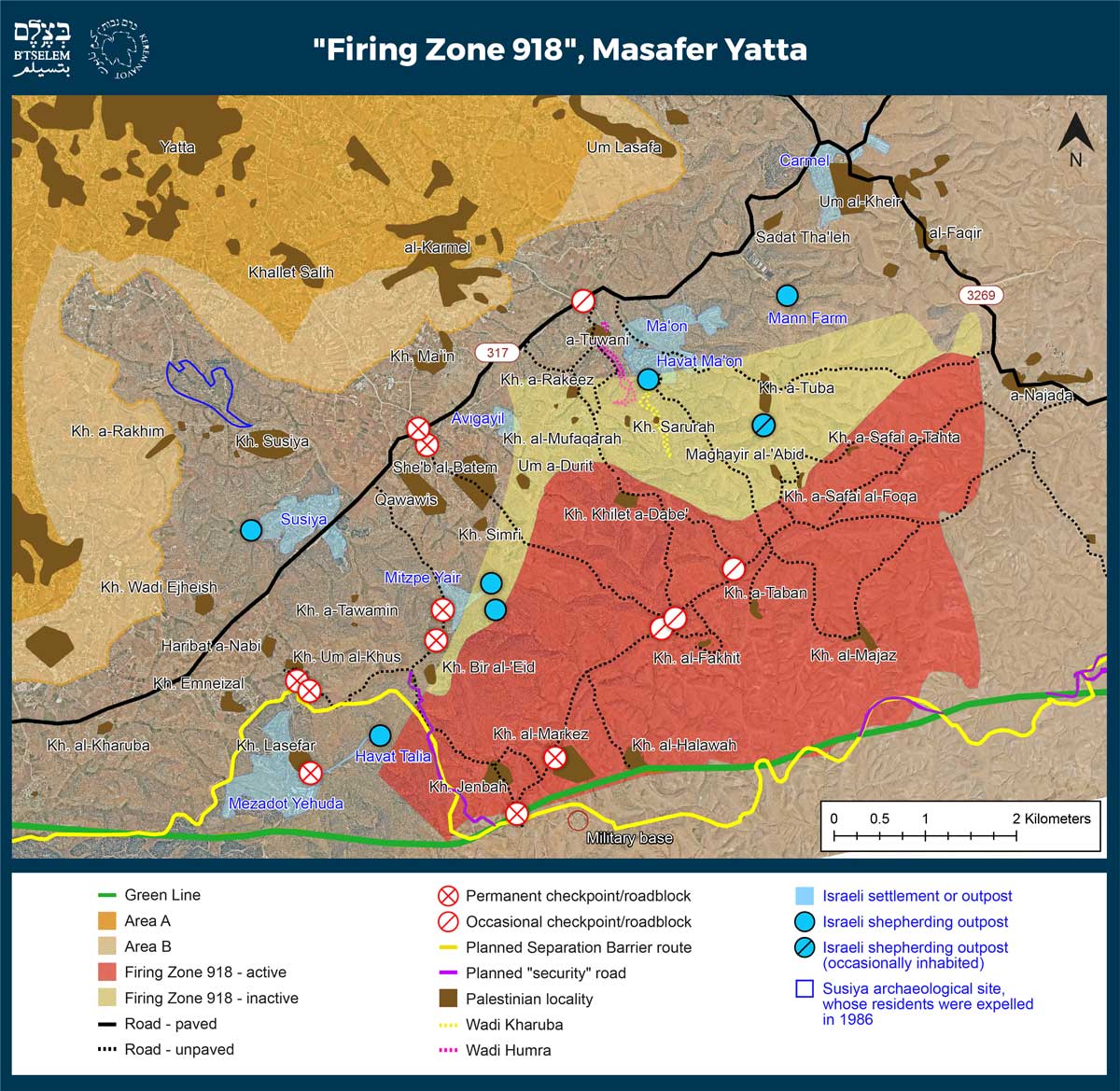 As a reminder: Israel designated the area as a firing zone in the early 1980s for the express purpose of enabling the State to clear out Palestinians who live there, in direct contradiction to a 1967 IDF legal opinion stating, among other things, “Civilians cannot be evacuated from an area in order to create training zones for the IDF, both for political and humanitarian reasons, and for reasons related to the provisions of international law.”
On January 2nd, the Israeli government announced that residents of Masafer Yatta will soon receive notices requiring them to vacate the area, further saying that the residents will be expelled to an alternative location where the State will allow them to live. In response, B’Tselem observed:
“forcible transfer of protected persons in occupied territory is a war crime, therefore, the Israeli offer of an alternative is meaningless and a violent threat that leaves the residents with no choice.”
Shortly following that announcement – on January 3-4 – Israeli forces were documented demolishing and removing Palestinian homes, structures, and olive groves in Masafer Yatta, even confiscating a tent that was used as a makeshift school.
For more information on Masafer Yatta, please check out the following resources:
- Save Masafer Yatta https://savemasaferyatta.com/en/
- +972 Magazine coverage by and about Palestinians in Masafer Yatta
- FMEP’s podcasts and webinars featuring Palestinians living there as well as activists working to stop their forcible transfer.
Israeli Govt & Settlers Join Together to Take Over Key Site in Silwan & Announce Start of Excavations
On December 27th, 2022 — days after Christmas and while most of the world was on holiday — Elad settlers, accompanied by a heavily armed detail of Israeli police, took control of a plot of land immediately adjacent to the Pool of Siloam in the Silwan neighborhood of East Jerusalem. The Pool of Siloam is an important historic site and a sacred Christian site, believed to be the site where Jesus healed the blind.
In a press release celebrating the seizure and the start of excavations – ostensibly aimed at revealing the entirety of the Pool of Siloam — the project was presented as a joint endeavor of the Elad settlers, the Israel National Parks Authority (INPA), and the Israel Antiquities Authority (IAA). Terrestrial Jerusalem characterized this joint action as “further evidence that in Silwan, the settlers and the Government of Israel are one of the same.”
According to reports, the newly-seized plot of land is owned by the Greek Orthodox Church, which leased it to Palestinian Sumarin family in 1931. The land has been used by the Sumarin family for agricultural purposes ever since. With this very public move to take control over the plot, the world learned for the first time that this land is part of the Greek Orthodox Church’s contested and controversial 2004 sale of some of its most prized assets to settler entity Ateret Cohanim (a sale that includes the Petra and New Imperial hotels in the Old City — see previous editions of this report for details on those cases). It remains unknown if there are additional properties involved in that transaction.
Terrestrial Jerusalem adds:
“The Government of Israel and the settlers have decided there is no better time to take over Church property, in a place of cardinal importance to Christianity, than the Christmas week. There is nothing new in this. The settlers and the Government customarily reserve Christmas week for their most problematic initiatives, assuming, not without reason, that the diplomats and decision-makers are all on leave and will not pay attention.”
Emek Shaveh said in response to the takeover:
“The synchronicity of the raid and statement demonstrate the seamless partnership that has evolved between the settlers, the Antiquities Authority and the Nature and Parks Authority in recent years. Now, with a new government that intentionally disavows obligations under international law and disparages democratic norms, the authorities in charge of protecting heritage sites – already thoroughly politicized – will be further challenged to maintain their professional backbone.”
Addressing the narrow and broader context, Terrestrial Jerusalem explains:
“Silwan is nestled beneath the southern ramparts of the Old City. Rich in history, Silwan is the small geographical location where the tectonic plates of Judaism Christianity, and Islam meet. Silwan is a contemporary Palestinian neighborhood in East Jerusalem. Beneath part of Silwan, Wadi Hilweh, lies the biblical City of David. Since 1991, Silwan has been the most controversial and hotly-disputed settlement in East Jerusalem. Fully backed by the Government of Israel. Extreme biblically-motivated settlers aspire to transform Silwan into a renewed manifestation of ancient Biblical Jerusalem. Evictions, displacement, archeology, national parks, demolitions, detentions, etc. have all been weapons in the arsenal of the settlers in pursuing their radical transformation of the character of Silwan. The Pool of Siloam is now the epicenter of this conflict For more background on Silwan, see our recent study.
“…The takeover of the Siloam Pool is not taking place in isolation, and its significance even goes beyond its role in the settler attempt to takeover Silwan. In recent months, we have revealed the implementation of an Israeli Government Plan which entails encircling the Old City with settlements and settler-related projects (like the Pool of Siloam excavations). This plan, not only fragments Palestinian East Jerusalem, it marginalizes the Christian and Muslim presence in the Old City and its environs. We are witnessing the incorporation of the historic, religious and cultural core of Jerusalem into a biblically interpreted Israel under the de facto authority of East Jerusalem. This is not just another bad thing” or “unhelpful unilateral step”. We are witnessing a radical transformation of the very character of Jerusalem, in ways not seen before. The evictions and demolitions in Silwan and Sheikh Jarrah, the cable car, the National Park on the Mount of Olives (see our recent report), the creation of an Israeli night spot in the Christian Quarter are intimately related: they are parts of a puzzle that disclose this unprecedented encirclement of the Old City. The takeover of the Siloam Pool is another part of that puzzle.”
Please also listen to Terrestrial Jerusalem’s latest podcast episode for a discussion of this case.
High Court (& Settlers) Test New Israeli Government on Homesh Case
On January 2, 2023 the Israeli High Court gave the new Israeli government 90 days to submit its position on the court-ordered evacuation of the illegal yeshiva located at the site of the dismantled settlement of Homesh in the northern West Bank. The Court’s order represents a first opportunity (and challenge) for Israel’s new governing coalition to move forward with its stated intention to re-establish Homesh.
To do so, the Israeli government is preparing to amend/repeal the 2005 Disengagement Law. That law not only provided for Israel’s withdrawal and removal of all settlements from Gaza, but also entailed the dismantling of the Homesh settlement, along with three others in the northern West Bank,.
Settlers, who have been pushing to reestablish Homesh for years, are planning their own test of the new government’s plans. The Times of Israel reports that settlers are preparing to spend the night of the first Passover seder (April 5th, which is the day before the Court’s deadline for the State’s response) at the site of Homesh , and are prepared to resist removal should Israeli forces try to make them leave the closed military zone. Settlers are also planning to send 1,000 people to spend that same night in the illegal Evyatar outpost – which the new government has vowed to retroactively legalize. One of the organizers of the initiative told The Times of Israel: “This will be the real test for the new government, in the field…This is no longer coalition deals and statements to the High Court. Thousands of us will return to settlements, legally, knowing we won’t be evacuated anymore.”
The U.S. State Department spoke out against the possible reestablishment of Homesh. Ned Price, the spokesman, said:
“The Homesh outpost in the West Bank is illegal. It is illegal even under Israeli law. Our call to refrain from unilateral steps certainly includes any decision to create a new settlement, to legalize outposts or allowing building of any kind deep in the West Bank, adjacent to Palestinian communities or on private Palestinian land,”
United Nations General Assembly Calls for Legal Opinion on Israeli Occupation, Israel Announces Moratorium on Palestinian Construction in Area C
On 31st December 2022, the United Nations General Assembly (UNGA) adopted a resolution calling on the International Court of Justice (ICJ) to examine the legal implications of Israel’s ongoing violation of the right of the Palestinian people to self-determination, its 55-year-long occupation, settlement, and annexation of the Palestinian territory occupied since 1967—including measures aimed at altering the demographic composition, character, and status of Jerusalem, and from its adoption of related discriminatory legislation and measures.
In response, one Israeli lawmaker – Zvika Fogel of the Otzma Yehudit party, which is part of the governing coalition – confirmed the nature of Israel’s occupation and reiterated his own hopes that Israel will annex the West Bank, saying he “cannot argue with the facts. As of right now, the occupation is permanent. And as of right now I would like to continue to apply Israeli sovereignty over all the areas that I can.”
Other parts of the Israeli government are waging a more aggressive response to the ICJ and the groups and organizations that have called for the ICJ’s involvement. The Israeli Security Cabinet meeting on January 5th to approve five actions to punish the Palestinian Authority for “waging a diplomatic war” against the state. Those actions – helpfully decoded by FMEP’s Lara Friedman – include placing a moratorium on all Palestinian construction in Area C of the West Bank (60% of West Bank land).
The Palestinian human rights group Al Haq – which has requested the advisory opinion from the ICJ – welcomed UNGA’s vote and said in a statement:
“In a historic plenary vote, the UN General Assembly voted in favour of submitting a question for an Advisory Opinion on the Question of Palestine to the International Court of Justice. Al-Haq extends its deepest appreciation to the 87 Member States who aligned with the calls of the Palestinian people and voted in favour of submitting the question for an Advisory Opinion. It is critical that the avenues of justice and rule of law are opened by Third States for the Palestinian people, who have been systematically disenfranchised and denied their inalienable right to self-determination, as well as subjected to grave breaches of jus cogens norms, which incur erga omnes obligations. The Advisory Opinion offers a critically important opportunity for the International Court of Justice to examine the legality of the occupation regime, which if found in breach of international law, may incur, for the first time, important legal obligations on Third States and the international community, to bring the occupation to an end.”
In voting for the ICJ to issue an advisory opinion, the UN General Assembly has invoked the Court’s consideration of the case without the consent of Israel (one of the involved parties). The resulting opinion is non-binding, but will provide a detailed position on the issue of Israel’s occupation.
In addition to the forthcoming work by the International Court of Justice (ICJ) – which considers cases involving states – the International Criminal Court (ICC) is investigating potential war crimes committed by Israeli individuals in the occupied Palestinian territories. The ICC’s Chief Prosecutor, Karim Khan, has indicated his desire to visit Palestine in 2023. A group of 10 Israeli human rights groups sent a joint letter to Khan’s office voicing their support for such a trip. The letter said:
“It is our position that crimes, indeed, have been and are being committed; that the Court has jurisdiction to investigate and prosecute; and, we are all committed to assisting your office in advancing the ongoing investigation of the Situation in Palestine… Israel has a record of preventing international access to the oPt: U.N. Commissions of Inquiry, Special Rapporteurs, OHCHR staff, international scholars and human rights advocates have all been, over the years, barred entry […].This context makes your visit – and the granting of access to your office – ever more important.”
Bonus Reads
- “Podcast: New Year, New Government, Old City” (Terrestrial Jerusalem ft. Danny Seidemann and Evan Gottesman)
- “Leaked EU report details plan to strengthen Palestinian claims in West Bank’s Area C” (The Times of Israel)
- “Gravestones vandalized at Christian cemetery in Jerusalem” (The Times of Israel)
- “New tourism minister Haim Katz vows to invest in West Bank, ‘Israel’s Tuscany’” (The Times of Israel)
- “Norway’s Sovereign Wealth Fund to Stop Investing in Firms Tied to West Bank Settlements” (Haaretz)
- “Haim Drukman, leader of Israeli settler movement, dies at 90” (AP)
Welcome to FMEP’s Weekly Settlement Report, covering everything you need to know about Israeli settlement activity this week.
To subscribe to this report, please click here.
December 9, 2022
- Court Upholds Demolition of Palestinian Apartment Building in Silwan
- Hundreds of Israelis Descend on Site of Former Homesh Settlement, As New Government Agrees to Reestablish It
- Settlers Move to Seize New Tract of Land in Silwan
- Settlers Initiate Renovations on Little Petra Hotel in the Old City
- In Addition to controlling COGAT & Civil Administration, Smotrich Will Control State Legal Cases
- Bonus Reads
Court Upholds Demolition of Palestinian Apartment Building in Silwan
95 Palestinians in Silwan are at imminent risk of displacement, after an Israeli court on December 7th upheld a demolition order for the 13-unit apartment building in which they live. The residents received a letter instructing them to vacate the building within one week.
The court had previously instructed the residents to self-demolish the building by December 7th. The residents refused to do so, and as a result, the Jerusalem Municipality is now expected to not only demolish their homes, but to exorbitantly fine them for not doing it themselves. For more on Israel’s tactic of coerced self-demolitions of Palestinian homes (and punitive actions against Palestinians who refuse to give in to this tactic) see this report from Al Haq.
Wafa news reports that two of the families living in the building are facing their second displacement at the hands of Israeli court-ordered demolitions.
Hundreds of Israelis Descend on Site of Former Homesh Settlement, As New Government Agrees to Reestablish It
Hundreds of Israelis this week participated in a ceremony held at a Jewish religious school (a yeshiva) established illegally (under Israeli law) at the site of the former Homesh settlement in the northern West Bank. As a reminder, Homesh was dismantled by the Israeli government in 2005 as part of the Disengagement Law, but Palestinians have continued to be denied access to the land, even as settlers were permitted regular access and have been granted de facto (but not formal) permission to establish and maintain a yeshiva and outpost there.
For years, settlers have been pushing for the re-establishment of the Homesh settlement – including through holding illegal gatherings there, illegally building a yeshiva at the site, and organizing political rallies attended by right-wing politicians.
Today, settlers are close to victory, as reports suggest that the incoming government — which will be the most far-right, pro-settlements/Greater Israel government in history — has agreed to re-establish Homesh as part of its coalition deal. To do so would require the government to amend the 2005 Disengagement Law (which not only ordered the dismantling of the Homesh settlement along with three others in the northern West Bank, but also provided for Israel’s withdrawal and removal of all settlements from Gaza).
Settlers Move to Seize New Tract of Land in Silwan
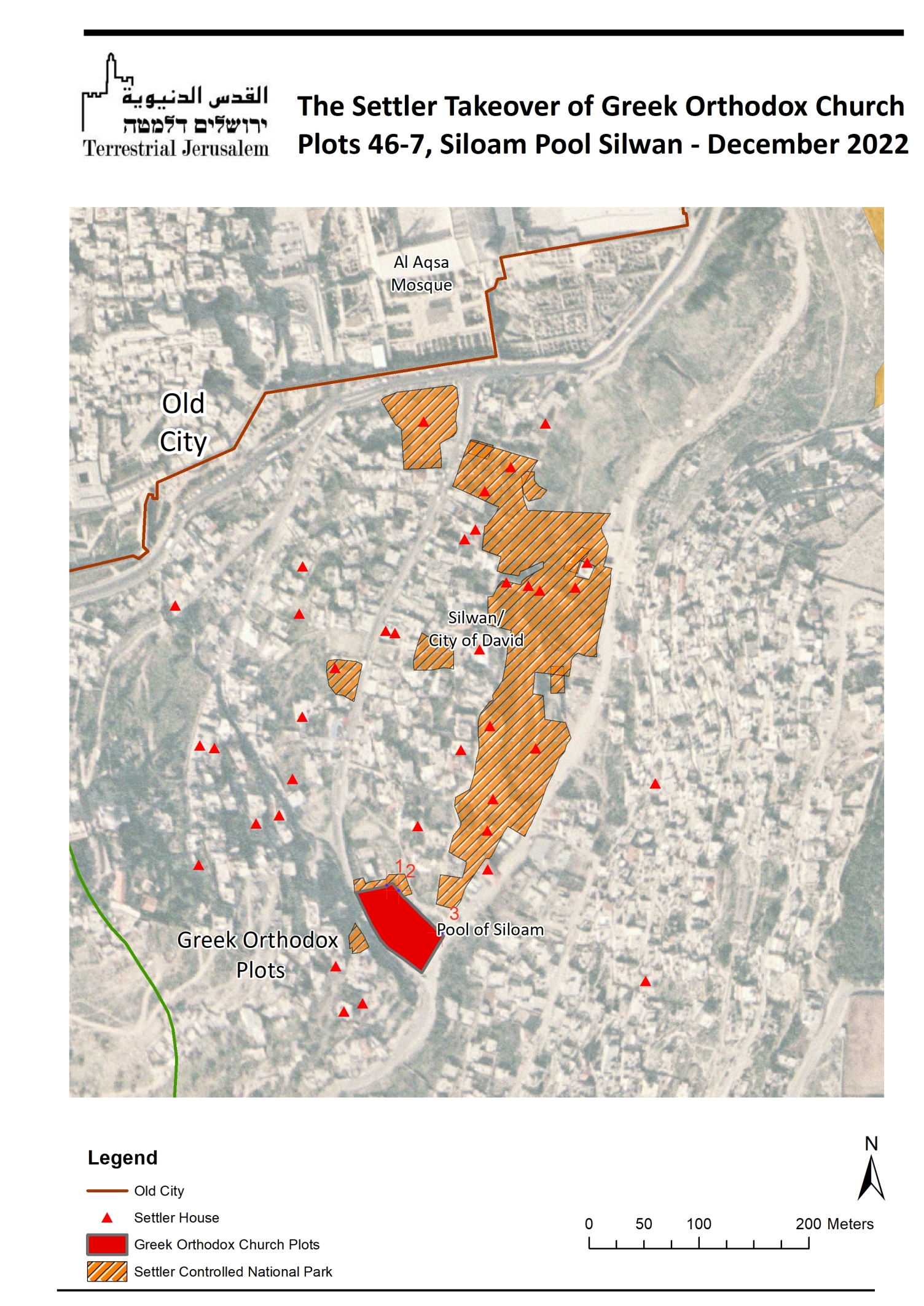
Seidemann tweets:
“This is no routine matter. This is a large tract of land, immediately adjacent to the Siloam Pool, which is of great historical significance to both Jews and Christians. For the former, it is a clear manifestation of Biblical Jerusalem. This in no isolated development and is part of the acceleration of Biblically motivated settlements and settlement-related projects encircling the Old City of Jerusalem. It is reminiscent of another site of importance to the Churches – the sacred sites on the Mount of Olives, which are to be subjected to the growing settler predominance in the public domain, by means of the establishment of an Israeli National Park on the Mount of Olives. This has all the marking of a serious step towards the encirclement of the Old City with settlement enterprises, and a serious crisis between Israel and the Churches. This is not going away.”
According to Elad, the land in question was acquired in the framework of a 2004 transaction in which the Greek Orthodox Church sold the Little Petra Hotel and the Imperial Hotel – both highly prized properties in the Old City of Jerusalem – to the Ateret Cohanim settler organization. The Church leadership has since fought against Ateret Cohanim’s possession of the hotels, alleging the sale was fraudulent, but Israeli courts have ruled in favor of the settlers.
Settlers Initiate Renovations on Little Petra Hotel in the Old City
Israeli settlers appear to have begun renovations of the Little Petra Hotel inside the Old City of Jerusalem. The hotel – which is located at at the entrance of the Christian Quarter in the Old City of Jerusalem – came under the control of the Ateret Cohanim settlement organization through the highly contested and controversial sale of the building to the settler group by the Greek Orthodox Church. The Church alleges the deal was fraudulent and has fought to have the sale canceled by Israeli courts. To date, courts have upheld the sale of the hotel to Ateret Cohanim.
Pictures of the new renovations are alarming Palestinians, with the Palestinian Centre for Human Rights asserting that an internal and archaeologically significant wall has been destroyed. An official with the Israeli Antiquities Authority was pictured at the site during the renovations.
Settlers took over the first floor of the Little Petra Hotel in March 2022 but the legal battle over the properties dates back to 2004, when the Greek Orthodox Patriarchate agreed to sell three properties in the Old City to a foreign real estate company under three separate contracts. It did so not knowing that the radical settler group Ateret Cohanim was behind the transaction. News of the sales made headlines in early 2005.
Upon the revelation that Ateret Cohanim was the real buyer, the Greek Orthodox Patriarchate was deeply embarrassed and immediately sought to retain control of the properties. The Patriarchate alleged that the transactions involved corruption and bribery, arguing that the legal documents had been signed without permission by a finance employee. Dismissing the church’s arguments, in June 2020 the Supreme Court upheld prior rulings that the signatures on the legal documents were valid, with the finance employee acting as a legal proxy of the Patriarchate.
In Addition to controlling COGAT & Civil Administration, Smotrich Will Control State Legal Cases
New details have emerged on the massive power Netanyahu is transferring to extreme-right politician Bezalel Smotrich in the new coalition agreement.
As reported previously, Smotrich will become the Finance Minister and will also gain the authority to appoint a deputy ministry in the Defense Ministry who will be in charge of a newly created portfolio dubbed “Jewish settlement and open land.” Reports suggest Smotrich will appoint himself to this role, granting him control of both COGAT and the “Civil Administration,” [the arm of the Defense Ministry that operates, in effect, as the sovereign power over the West Bank] — giving him near total control over the civil affairs of Palestinians and Israeli settlers in the West Bank. In particular – as ACRI and Peace Now warn – Smotrich, who has for years sought to disband the Civil Administration and bring settlements under direct Israeli law, will move to quickly grant retroactive legalization to all illegal outposts, increase enforcement against “illegal” Palestianian construction in Area C [as a reminder, Palestinians wishing to build on their own land in Area C are virtually always refused Israeli permits to do, rendering virtually all Palestinian construction in Area C “illegal” according to Israel law], and promote massive settlement growth — all in an effort to effect the de facto annexation of Area C.
Smotrich, in a new interview, spoke about his plans – saying:
“Today there are half a million people who live in Judea and Samaria, vote for the Knesset, serve in the army and pay taxes – but [are governed by] the army like in a Banana Republic. This does not make sense. The idea is that responsibility for the residents of Judea and Samaria should be returned to the government ministries…it is necessary to correct this distorted reality, which today manifests itself in planning and construction, in transportation, in the quality of the environment, and in infrastructure. When the Civil Administration was established, it was expressly determined that it would not deal at all with the Jewish residents of Judea and Samaria. The Oslo Accords stipulated that it was to be dissolved. This is a distortion that harms the public, harms the army, harms [national] consensus and it needs to be fixed. Our minister in the Ministry of Defense will have all the civilian powers over Judea and Samaria.”
In addition, the text of the coalition deal, published this week, reveals that Netanyahu has conceded further legal authority to Smotrich (or Smotrich’s appointee, should he not name himself to the deputy ministerial role in the Defense Ministry). Haaretz reports that in addition to effectively running COGAT and the Civil Administration, this deputy minister will also have approval power over legal cases within the Defense Ministry — a move which sidelines the military’s advocate general who has historically advised the Defense Minister on legal issues and formulated the State’s response to legal petitions related to Israeli actions in the West Bank. +972 Magazine explains:
“While the military advocate general has been hardly effective in protecting Palestinian land rights in the West Bank, it at least concedes formally that its actions are subject to the laws of belligerent occupation, which provide for the protection of Palestinians under international humanitarian law. In all likelihood, Smotrich’s lawyers will not concede even that. Third, Smotrich will have the power to authorize any legal position submitted to the Supreme Court in response to a petition relating to these issues. This would mean, for instance, that it is highly unlikely that the state will ever concede to the Court that land is privately owned by Palestinians, making it even harder for Palestinians to fight for their cases in an already hostile legal environment…With Smotrich in charge of the Civil Administration, and Ben Gvir in charge of the police forces, the stage is set for a de facto entity in the West Bank controlled by two rampant anti-Palestinian fundamentalists. As such, Palestinians are in clear and imminent danger, even beyond the dire circumstances already at hand. The human rights situation in the West Bank has long been horrific and rapidly deteriorating, but now, we are hurtling into uncharted territories.”
A full look at the cabinet Netanyahu is assembling is available here.
Bonus Reads
- “They Were Hebron’s First Child Settlers. This Is How It Changed Their Lives” (Haaretz)
Welcome to FMEP’s Weekly Settlement Report, covering everything you need to know about Israeli settlement activity this week.
To subscribe to this report, please click here.
November 18, 2022
- Jerusalem Planning Committee to Discuss (Another) Plan to Significantly Expand Nof Zion Settlement Enclave
- As Court Tries to Avoid Underlying Issue of Land Allocation Practices in the West Bank, Palestinians Reject “Deal” that Would Allow Construction of Givat Eitam/E-2 Settlement,
- Mass Displacement/Dispossession in Silwan Advances, Court Rejects Shahadeh Family Petition
- Elad Continues Illegal Work in East Jerusalem Cemetery
- Bibi’s Coalition Promises on Settlement: Outposts, Homesh, Evyatar, Infrastructure, Override Clause, & More
- Settler Violence Continues to Surge
- U.S Ambassador Visits a Settlement, Less Than a Year After Saying He Won’t
- Bonus Reads
Jerusalem Planning Committee to Discuss (Another) Plan to Significantly Expand Nof Zion Settlement Enclave
Ir Amim reports that on November 23rd the Jerusalem District Planning Committee is scheduled to discuss a plan to expand the Nof Zion settlement enclave, located in the heart of the Palestinan neighborhood of Jabal Mukaber in East Jerusalem. The plan would allow for 100 new residential units and 275 hotel rooms in the settlement enclave, and is part of a larger scheme to connect the enclave to the built-up area of East Talpiot – a scheme which would cut deeply into the Jabal Mukaber neighborhood and entrench the expanding continuum of Israeli settlements surrounding Jerusalem.
Commenting on the plan, the Israeli NGO Ir Amim writes:
“Beyond its geopolitical implications, this is yet another example of the severe discrimination in urban planning and housing in East Jerusalem. Despite the plan being slated for the entrance of Jabal Mukabber, it is not designated for the community’s development needs but rather for the expansion of a Jewish settlement in the middle of a Palestinian neighborhood. It should be noted that Jabal Mukabber is among the Palestinian neighborhoods in East Jerusalem with the highest number of demolitions per year.”
Specifically, the Nof Zion expansion plan to be discussed by the Jerusalem District Planning Committee on November 23rd is interconnected with another plan (last discussed by the Committee in January 2022). That plan seeks to move an Israeli police station [the Oz station] currently located on the border of Jabal Mukaber, to a new site across the street (where it will become a massive Israeli security headquarters), leaving its current location free for the planned expansion of Nof Zion. Ir Amim filed a petition against the police station plan, saying that it is an affront to the planning needs of the local community and continues Israel’s systematic, city-wide discrimination against the housing, educational, and service-based needs of Palestinian neighborhoods. A decision on the police station relocation plan is expected soon.
Ir Amim further explains the impact of these plans:
“Expanding the settlement towards the main entrance of Jabal Mukabber will infringe on the residents’ freedom of movement and further disrupt the fabric of life in the neighborhood. Prior experience show that during clashes and periods of tension and instability, Israel rushes to impose collective restrictions under the pretext of protecting Israeli settlers.”
These plans are just the latest efforts to expand and entrench the Nof Zion settlement enclave. Prior plans include:
- In 2017, the Israeli government approved a plan to build a new synagogue and mikveh for the settlement, to be located on private Palestinian land that had been expropriated form Jabal Mukaber the year before.
- In April 2019, after two years of rumors, the Israeli government issued 176 building permits for the already-approved project to build . According to Ir Amim, those permits were ultimately issued in April 2019.
- In 2019, construction began on a plan to triple the size of the settlement enclave, making it the largest such enclave in East Jerusalem. After a two-year stall, construction on the expansion resumed in 2021 with new financing.
As Court Tries to Avoid Underlying Issue of Land Allocation Practices in the West Bank, Palestinians Reject “Deal” that Would Allow Construction of Givat Eitam/E-2 Settlement
On November 14th, Peace Now tweeted updates from a courtroom where the Israeli Supreme Court was attempting to resolve the ongoing petition against the allocation of “state land” for the construction of the Givat Eitam/E-2 settlement, slated to be build on a strategic hilltop – which Palestinians know as a-Nahle – located just south of Bethlehem. The construction of Givat Eitam/E-2 would significantly expand the Efrat settlement in the direction of Bethlehem. It would also effectively cut Bethlehem off from the southern West Bank and complete the city’s encirclement by Israeli settlements.
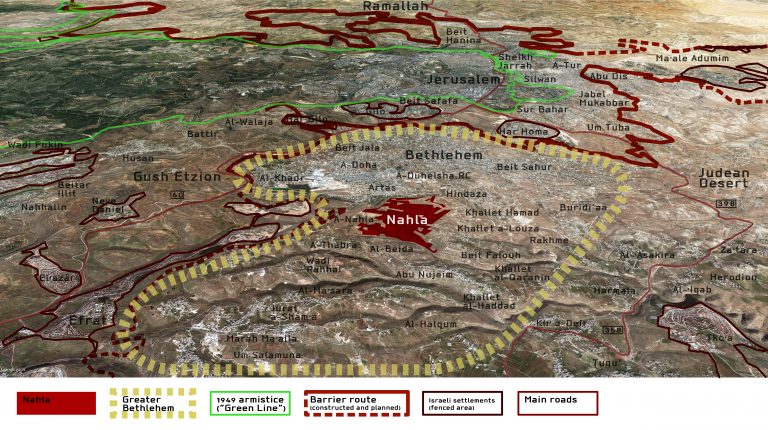 In the hearing, the State of Israel proposed a deal to the Palestinian petitioners, according to which the State would allocate to them a total of 54 dunams (out of the 1,400 dunams originally planned for the construction of the new settlement). The Palestinian landowners rejected the deal, with their lawyer Michael Sfard noting:
“The main problem is that the solution proposed by the court…does not remove the evil of the decree from their heads, and therefore we oppose this proposal…that offer, whether it is 50 or 100 dunams, does not help the Palestinian communities. Since we, and everyone who sits around here, knows that if this neighborhood is built, it’s likely that they won’t even be able to cultivate those acres.”
Peace Now tweeted its sense of where the judges opinions might land, writing:
“The hearing is over. The petitioners rejected the state’s offer. It seems that the judges are trying to avoid a decision on the central question regarding the entire land – whether it should be allocated to the settlements or the Palestinians. The judges keep trying to walk between the drops. On the one hand, they cannot ignore the blatant discrimination in Israel’s land allocation policy. On the other hand, they are trying to avoid the fundamental question of the legality of this land allocation to the settlement.”
The High Court held a hearing in June 2021 on this same petition. Peace Now’s Hagit Ofran told FMEP that at the conclusion of that hearing the Court had given the government of Israel 90 days to respond to a proposal to either allocate to the individual petitioners some of the “state land” directly involved in the case, or to allocate to them “state land” nearby. This decision by the Court purposely narrowed the scope of Peace Now’s legal challenge by addressing only the case of the land in a-Nahle and the individual petitioners involved, thereby dodging the more fundamental question put forth in the petition challenging Israel’s discriminatory practice of allocating 99.8% of “state land” for settlement purposes. This is the first time the issue of state land allocations to settlements is being challenged in an Israel court.
Mass Displacement/Dispossession in Silwan advances, as Court Rejects Shahadeh Family Petition
On November 13th, the Jerusalem District Court announced that it had rejected an appeal by the Palestinian Shehadeh family seeking to cancel eviction orders that seek to dispossess them of their longtime homes in the Batan al-Hawa section of Silwan in favor of the Ateret Cohanim settler organization. The announcement follows a hearing the Court held on the appeal on November 9th.
As a reminder: the Shahadeh family is one of 85 families in Batan al-Hawa facing displacement at the behest of Ateret Cohanim. The legal fate of all of the families is bound together, with the Duweik family’s case being the furthest advanced and setting a dangerous precedent for the Shehadehs and others. Indeed, this week the Supreme Court discussed several of the decisions made in regards to the Duweik family, and their relation to the Shehadehs’ case. Notably, in July 2022 a 3-judge panel of the Supreme Court could not agree on the Duwiek’s family’s petition, which resulted in the petition being sent back to the Jerusalem Magistrate’s Court – where it currently awaits further consideration. One of the judges accepted the argument that the family should be allowed to continue living in their homes because a statute of limitations prohibits Ateret Cohanim – through its management of an historic land trust – from making a claim to the land after such a long period of absence.
As a reminder, Ateret Cohanim has waged a years-long eviction campaign against Palestinians living in Silwan, on property the settler NGO claims to own. In total, Ateret Cohanim’s campaign stands to ultimately dispossess 700 Palestinians (85 families) in Silwan. The group’s claim is based on having gained control of the historic Benvenisti Trust, which oversaw the assets of Yemenite Jews who lived in Silwan in the 19th century. In 2001 the Israeli Charitable Trust Registrar granted Ateret Cohanim permission to revive the trust and become its trustees, (following 63 years of dormancy). In 2002, the Israeli Custodian General transferred ownership of the land in Batan al-Hawa to the Trust (i.e., to Ateret Cohanim). Since then, Ateret Cohanim has accelerated its multi-pronged campaign to remove Palestinians from their homes, claiming that the Palestinians are illegal squatters.
Elad Continues Illegal Work in East Jerusalem Cemetery
Emek Shaveh & Ir Amim tweeted footage of construction work at the site of the Sambuski cemetery, an ancient Jewish cemetery located in the Ben Hinnom Valley in East Jerusalem. The Elad settler group – which is paid by the Israeli government to manage and expand a web of settler-tourist sites and the City of David National Park – has been conducting work on the Sambuski Cemetery despite apparently lacking a permit. Emek Shaveh – an Israeli NGO with expertise in archaeology – notes that any construction within a national park should be heavily scrutinized by professionals and the public before being implemented.
In August 2022, Elad unilaterally closed the main access road leading to the Palestinian neighborhood of Wadi Rababa, which travels past the Sambuski cemetery. 150 families were trapped in the neighborhood while Elad worked on the site.
The Sambuski cemetery was a relatively unknown, neglected site until recent years – but it is deeply integrated into Elad’s overarching, comprehensive plan to take control of the Silwan neighborhood. In 2020, the-president Trump’s “Peace to Prosperity” plan identified the Sambuski cemetery as a place of prime historical and religious importance to Israel, elevating the status of the cemetery. The Israeli NGO Emek Shaveh – which has special expertise on archaeology and the way archeology has been weaponized to serve the political agenda of the settlers and the state of Israel – wrote a report on exactly how the Trump plan supports settler efforts to use Jerusalem’s history and antiquities to promote Israeli-Jewish hegemony and control over the city.
Emek Shaveh explains how the cemetery is connected to other settler endeavors in Silwan:
“For the Elad Foundation the cemetery is a strategic site as it links together two important focal points of its enterprise – the neighborhood of Silwan, home to the City of David archaeological park and specifically to the Pool of Siloam at the southern tip of the site, and the Hinnom Valley an area which Elad has been developing for the past two years (more below).”
Bibi’s Coalition Promises on Settlement: Outposts, Homesh, Evyatar, Infrastructure, Override Clause, & More
Netanyahu continues to negotiate a final coalition agreement in order to form a new government, and has reportedly committed to virtually all of the main demands of the settler movement (short of outright annexation of all the land between the river and the sea), including:
- Passage of the Supreme Court Override Clause (see this new explainer by ACRI). This law would obliviate judicial oversight in Israel, giving ultimate power to the Knesset. Under the new Israeli government and with the current Knesset, this law would likely be used to reinstate the Settlement Regulation Law – the law that seeks to establish a legal basis for Israel to retroactively legalize outposts and settlement structures which are built on land that Israel acknowledges is privately owned by Palestinians. As a reminder, that law was overturned by the Israeli Supreme Court in June 2020. Peace Now estimates that the law stands to convert some 55 unauthorized outposts into official, authorized settlements, seizing some 8,000 dunams of privately owned Palestinian land in the process.
- Full recognition & integration of outposts (i.e., retroactive legalization and de facto annexation). This was reportedly promised to Bezalel Smotrich, who has authored Knesset legislation to grant full status to outposts irregardless of the status of the land on which the outposts were built illegally. Separately, Netanyahu agreed with Itamar Ben Gvir that the outposts would be provided infrastructure services within 60 days of the new government being sworn in.
- The reestablishment of the Homesh Settlement. Netanyahu reportedly committed to Itamar Ben Gvir, a longtime supporter/devotee of Rabbi Meir Kahane, that the settlement of Homesh will be reestablished on the land where it stood prior to being dismantled by the Israeli government in 2005. To do so would require the government to amend the 2005 Disengagement Law that not only ordered the dismantling of the Homesh settlement along with three others in the northern West Bank, but provided for Israel’s withdrawal from Gaza. For more on the long-running campaign by settlers and their allies to reestablish the Homesh settlement – and its consequences for Palestinians who live nearby and own the land on which Homesh once stood – see here.
- The legalization of a yeshiva at the Evyatar Outpost. Netanayhu and Ben Gvir agreed to grant retroactive authorization to a yeshiva established at the Evyator outpost. For more on the Evyatar outpost & yeshiva saga – see here.
- A commitment to expanding settler road infrastructure across the West Bank. Netanyahu agreed with Ben Gvir to allocate $434 million ($1.5 billion shekels) for the paving of new and expanded bypass roads in the West Bank and for the expansion of Highway 60, and to expedite the planning process for doing so. For more analysis on how infrastructure such as roads contribute to Israel’s de facto annexation of the West Bank, see this report by Breaking the Silence.
In addition, Netanyahu is coming under increasing pressure from inside his coalition to name far right-wing MK Bezalel Smotrich as the next Defense Minister. Haaretz reports that Itamar Ben Gvir supports Smotrich’s demand because it will,
“help implement a full right-wing policy, establish new settlements in the West Bank, approve construction of thousands of new housing units in them, stop Palestinian construction in Area C and halt the evictions of illegal outposts.”
Of note, in 2021 Smotrich suggested that a “solution” to Palestinian “illegal” construction in Area C (construction by Palestinians on their own land, but without Israeli-required building permits, that Israeli makes it nearly impossible to obtain) could be to give settlements the authority to demolish Palestinian construction they believe to be unauthorized.
American officials, including Ambassador Nides, have expressed concern over Smotrich’s potential appointment to such a key – and powerful – post. In addition to his pro-settlement, pro-annexation positions, Smotrich is also a self-proclaimed homophobe and has lobbied for the expulsion of Palestinians from Israel.
Lastly, and underscoring the extent to which the settlers’ agenda and the governing coalition’s agenda are one and the same: a newly elected Member of the Knesset, Limor Son Har-Melech of the Religious Zionism coalition, has appointed a member of the radical hilltop youth movement to serve as his spokesperson. Har-Melech’s new spokesman, Elisha Yered, lives in the outpost of Ramat Migron in the northern West Bank, and is under ongoing investigation following his arrest in August 2022 for “racist conspiracy” — amongst other charges for crimes against Palestinians. Yered is quoted as saying:
“the hills are the scene of a war that according to Jewish law one is required to wage…what the hills do is to bring Jewish control to hundreds of dunams – that is something that no soldier in the greatest reconnaissance unit can do during his service.”
Settler Violence Continues to Surge
Following a Palestinian stabbing attack near the Ariel settlement that left 3 Israelis dead and 3 injured, settlers across the West Bank rampaged to take their revenge, committing over 20 attacks against Palestinian and their property, as well as Israeli soldiers, in the 24 hours that followed.
In addition, in its weekly report on Israeli human rights violations covering Nov. 10-16, the Palestinian Centre for Human Rights reports that settlers conducted 4 attacks on Palestinians’ vehicles in different areas in the West Bank during the reporting period Nov. 10-16.
“On 14 November 2022, Israeli settlers moved into Haris village in Salfit, north of the West Bank, and burned four vehicles belonging to the villagers.
On 15 November 2022, Israeli settlers attacked and set fire to a vehicle belonging to a
Palestinian who was in his way back from ‘Attil village in northern Tulkarm to Nablus.On the same day, Israeli settlers intercepted a bus for a women’s trip in Hebron and
prevented it from moving for few hours, enticing fear among the passengers.On 16 November 2022, Israeli settlers threw stones at four vehicles near Ramin village, east of Tulkarm, breaking their windows. On the same day, Israeli settlers damaged a vehicle belonging to a Palestinian doctor near Jit village in Qalqilya.”
PCHR concludes, noting: “Since the beginning of the year, settlers conducted at least 236 attacks. In two of the attacks, 2 Palestinians were killed.”
U.S Ambassador Visits a Settlement, Less Than a Year After Saying He Won’t
This week U.S. Ambassador to Israel Thomas Nides visited the West Bank settlement of Kiryat Netafim to offer his condolences to the grieving family of a victim of Sunday’s stabbing attack that killed three and wounded three. Nides’ trip marks the first time any representative of the Biden Administration has undertaken official travel to any Israeli settlement. A U.S. Embassy spokesperson said that “the shiva visit in no way signals a change in US policy toward settlements”
In January 2022 Ambassador Nides was quoted as saying he “will absolutely not” visit a settlement. It’s worth recalling that the Biden Administration has not reversed or publicly rejected the Trump Administration’s “Pompeo Doctrine,” which made it U.S. policy to view Israeli settlements as not “per se inconsistent with international law.”
Kiryat Netafim is located about half way between the Ariel settlement and the cluster of settlements close to the 1967 Green Line that are slated to be united into a “super settlement” area (Oranit, Elkana, Shiva Tikva, and others). The string of settlements creates a contiguous corridor of Israeli construction and control stretching from sovereign Israeli territory to Ariel. As FMEP has repeatedly pointed out, the Ariel settlement is located in the heart of the northern West Bank, reaching literally to the midpoint between the Green Line and the Jordan border. The future of Ariel has long been one of the greatest challenges to any possible peace agreement, since any plan to attach Ariel to Israel (with a finger of land running through settlements like Kiryat Netafim) will cut the northern West Bank in half..
Bonus Reads
- “Gantz approves upgrade to stretch of West Bank barrier after spate of terror attacks” (The Times of Israel)
- On the U.N.:
- “Key UN committee seeks legal opinion on Israel’s occupation” (Washington Post)
- “Opinion | Israel’s Chutzpah at the United Nations” (Haaretz / Noa Landau)
- “Lapid, Gantz slam UN panel’s call on ICJ to probe Israeli ‘occupation, annexation’” (The Times of Israel)
- “Adalah and Center for Constitutional Rights demand US cancel its plan to build embassy compound in Jerusalem on private Palestinian land” (Adalah)
- “Expulsion by Other Means: Israel’s Campaign Against Palestinians in Masafer Yatta” (J Street)
- “Ben & Jerry’s board bemoans West Bank, east Jerusalem sales” (AP News)
- “Wild boars in Palestine are being weaponized by Israeli colonialism” (Mondoweiss)
- “IDF soldier suspended for cursing left-wing activist in Hebron: ‘You’re a traitor’” (The Times of Israel)
Welcome to FMEP’s Weekly Settlement Report, covering everything you need to know about Israeli settlement activity this week.
To subscribe to this report, please click here.
November 11, 2022
- Israel Gives Settler Group $7.8 Million for East Jerusalem Projects
- Israel Supreme Court Holds Hearing on Silwan Displacement Case
- Israeli Lawmakers Join Settlers on Provocative Visit to Joseph’s Tomb; 1 Palestinian Killed
- Peace Now Video Shows Impact and Tragedy of the Planned E-2 /Givat Eitam Settlement
- A New Israeli Government: Implications for Settlements & Annexation
- Bonus Reads
Israel Gives Settler Group $7.8 Million for East Jerusalem Projects
A Haaretz investigation has revealed that various arms of the Israeli government have transferred a combined total of $7.8 million to the Elad settler organization to develop and manage new tourist projects in the Ben Hinnom Valley in East Jerusalem. This figure is double the State’s original budget for Elad – a settler organization which Israel also pays to manage the City of David National Park.
The additional funding came from three sources: the Jerusalem Affairs & Heritage Ministry, the Israel Lands Authority, and the Jerusalem Municipality. All funds were used to fuel the expansion of integrated tourism projects which underpin Elad’s control over land in the Ben Hinnom Valley, located near Silwan. This is an area where most of the land is privately owned by Palestinians and rich with olive groves. Over the past few years Israel has begun seizing land – plot by plot – mainly via the issuance of ”landscaping” (or “gardening”) orders which allow the government to take control of and develop any land that it deems “neglected.” The land, once seized, is then handed over to Elad..
The Israeli NGO Emek Shaveh responded:
“The settlement project of Elad, one of the richest nonprofits in Israel, is being funded by the citizens of the State of Israel and the residents of the poorest city in Israel – out of their own pockets! But the real price and the irreversible damage will be paid by the heritage sites of Jerusalem. At the end of the day, the ancient landscapes of the Hinnom Valley will become a playground, with a suspension bridge, a cable car and a biblical farm for ancient agriculture with sprinklers, an artificial waterfall and an electric outdoor oven – all in order to push the Palestinians out of the valley.”
In addition to its increasing control of the Ben Hinnom Valley, Elad and the Israel Nature and Parks Authority have had a contract, since 2020, to transfer the management and development of the City of David National Park to Elad. Elad carries out this contract with brutal implications for Palestinians who live inside the borders of this national park – borders Israel imposed on Palestinians residents, many of whom had been living in the areas for generations, with what appears to be total disdain/disinterest in their rights or welfare. Elad’s management of the park also weaponizes archaeology in the service of its explicit agenda: increasing Israeli control and imposing an exclusively Jewish religious and historical narrative over the entire city of Jerusalem. Elad is also a main actor behind the widespread house-by-house dispossession of Palestinians living in Silwan. In addition, Elad is pioneering a never growing slate of touristic settlement projects which increase Israeli control over the area and help reinforce a settler narrative of the city of Jerusalem which emphasizes its Jewish history while erasing past, present, and future Palestinian heritage.
Israel Supreme Court Holds Hearing on Silwan Displacement Case
Ir Amim reports that on November 9th, the Israeli Supreme Court held a hearing on an appeal against the pending eviction of the Shahadeh family from their longtime home in the Batan al-Hawa section of Silwan. A decision is expected to be issued by the Court within a few weeks.
The Shahadeh family is one of 85 families in Batan al-Hawa facing displacement at the behest of the Ateret Cohanim settler organization. The legal fate of all of the families is bound together, with the Duweik family’s case being the furthest advanced and setting an dangerous precedent for the Shehadehs and others. Indeed, this week the Supreme Court discussed several of the decisions made in regards to the Duweik family, and their relation to the Shehadehs’ case. Notably, in July 2022 a 3-judge panel of the Supreme Court could not agree on the Duwiek’s family’s petition, which resulted in the petition being sent back to the Jerusalem Magistrate’s Court – where it currently awaits further consideration. One of the judges accepted the argument that the family should be allowed to continue living in their homes because a statute of limitations prohibits Ateret Cohanim – through its management of an historic land trust – from making a claim to the land after such a long period of absence.
As a reminder, Ateret Cohanim has waged a years-long eviction campaign against Palestinians living in Silwan, on property the settler NGO claims to own. In total, Ateret Cohanim’s campaign stands to ultimately dispossess 700 Palestinians (85 families) in Silwan. The group’s claim is based on having gained control of the historic Benvenisti Trust, which oversaw the assets of Yemenite Jews who lived in Silwan in the 19th century. In 2001 the Israeli Charitable Trust Registrar granted Ateret Cohanim permission to revive the trust and become its trustees, (following 63 years of dormancy). In 2002, the Israeli Custodian General transferred ownership of the land in Batan al-Hawa to the Trust (i.e., to Ateret Cohanim). Since then, Ateret Cohanim has accelerated its multi-pronged campaign to remove Palestinians from their homes, claiming that the Palestinians are illegal squatters.
Israeli Lawmakers Join Settlers on Provocative Visit to Joseph’s Tomb; 1 Palestinian Killed
On November 9th, a Palestinian teenager was killed in Nablus during clashes between Palestinians and the IDF. These clashes resulted from a deliberately provocative visit carried out by settlers and Israeli lawmakers – under IDF protection – to the site of Joseph’s Tomb, which is located inside of Nablus. The settlers and eight current and incoming members of the Knesset visited the site despite a public threat to attack the delegation which was issued the day before by a Palestinian armed faction.
On a monthly basis (and sometimes more often) the IDF arranges for settlers to visit Joseph’s Tomb. The tomb is located within Area A of the West Bank (where Israel does not, under the Oslo Accords, have direct control). However, Joseph’s Tomb is one of two sites in Area A which the Oslo Accords stipulate are under the control of the Israel military. As such, it has been a perennial flashpoint, largely due to deliberately provocative actions by settlers. The whole circumstance – of settlers visiting Joseph’s Tomb – was recently called “absurd” by former IDF Major General Gadi Shamni.
While some Jewish Israelis may want to visit the site of Joseph’s Tomb for non-politically-motivated religious purposes, this latest story should be viewed in the larger context of settlers weaponizing claims to sites like Joseph’s Tomb, and archaeology in general, to expand Israel control over (i.e., de facto annexation of) parts of the West Bank that per the Oslo Accords are under Palestinian Authority control.
Peace Now Video Shows Impact and Tragedy of the Planned E-2 /Givat Eitam Settlement
In advance of a High Court hearing scheduled for Nov. 14th, Peace Now has released a 10 minute video explaining the unfolding tragedy of E-2/Givat Eitam. Peace Now is leading the petition alongside the Palestinian landowners.
The Supreme Court – courtesy of a petition filed by Palestinian landowners with the assistance of Peace Now – is due to continue its consideration of the Palestinians’ challenge to the allocation of “state land” to the Israeli Ministry of Housing for the construction of a new settlement called Givat Eitam on a strategic hilltop – which Palestinians call a-Nahle – located just south of Bethlehem.
As a reminder, the High Court held a hearing in June 2021 on this same petition. Peace Now’s Hagit Ofran told FMEP that at the conclusion of that hearing the Court had given the government of Israel 90 days to respond to a proposal to either allocate to the individual petitioners some of the “state land” directly involved in the case, or to allocate to them “state land” nearby. This decision by the Court purposely narrowed the scope of Peace Now’s legal challenge by addressing only the case of the land in a-Nahle and the individual petitioners involved, thereby dodging the more fundamental question put forth in the petition challenging Israel’s discriminatory practice of allocating 99.8% of “state land” for settlement purposes. This is the first time the issue of state land allocations to settlements is being challenged in an Israel court.
A New Israeli Government: Implications for Settlements & Annexation
Likud Party leader and Israel’s longest-serving (over multiple tenures in office) Prime Minister Benjamin Netanyahu is once again poised to lead the Israeli government, this time relying on a governing coalition that includes extremist/racist/Islamophobic/homophobic Jewish supremacist figures like Itamar Ben Gvir (a longtime supporter/devotee of Rabbi Meir Kahane) and Bezalel Smotrich. Settlers are giddy, with notable settler leaders Daniela Weiss describing the election results as a “revolution,” and saying there will certainly be an acceleration in settlement growth.
Here are key demands being made of Netanyahu that will likely define the new government and influence its policies on settlements and annexation:
- Itamar Ben Gvir – who has called for the expulsion of Palestinian citizens of Israel, who was disqualified from IDF service for his extreme views, and who is closely allied with the settlers in Sheikh Jarrah – is demanding to be named the Minister of Public Security. This would put him in charge of the Israeli police and their power over Palestinians living in Israel and East Jerusalem. The Ministry would also hand Ben Gvir a large role over security at the Temple Mount, which Ben Gvir has advocated for Israel to take unilateral control over – a dangerous proposition. Ben Gvir has also publicly proclaimed that, should he be appointed, he will change the rules of engagement so that Israeli soldiers have broader leeway to shoot at Palestinians (for reasons as minimal as suspected stone-throwing), and he will push for broad immunity for Israeli security officials (which combined appear to be a directive to kill Palestinians under the promise of immunity).
- Bezalel Smotrich – who continues to demand either the Defense, Finance, or Justice Ministries – is making two key legislative demands:
- Passage of the Override Clause, which would allow a simple majority in the Knesset to vote to reinstate any law that the Supreme Court rules is unconstitutional. This is particularly relevant for the Settlement Regulation Law, which the Court struck down by the Court in 2020. The Knesset had passed the Settlement Regulation Law in order to create a legal basis to allow Israel to retroactively legalize outposts and settlement structures which had been built on land that Israel acknowledges is privately owned by Palestinians. Smotrich and many of the coalition members have been longtime supporters of the Override Clause in order to reinstate this law in particular.
- Annexation of settlements. Smotrich is demanding that settlements come under domestic Israeli law, which would implement the annexation of the settlements to Israel. This is also a widely-popular initiative, with Yariv Levin – Netanyahu’s Likud partymate – recently saying that annexation is high on the government’s agenda.
Bonus Reads
- “West Bank Settler Accused of Terrorism After Attacking Palestinian in East Jerusalem” (Haaretz)
- “Israel Resumes Construction of Jewish Town Planned Over Ruins of Yet-to-be-demolished Bedouin Village” (Haaretz)
Welcome to FMEP’s Weekly Settlement Report, covering everything you need to know about Israeli settlement activity this week.
To subscribe to this report, please click here.
October 13, 2022
- Settlers Continue Attacks on Palestinians Around Nablus, also Target Israeli Soldiers
- Ben Gvir Joins, Escalates Settler Attacks in Sheikh Jarrah
- Settlers Attack Palestinian Olive Harvest, Seize Control of Silwan Grove
- Hebron-Area Town Emptied for Israeli Military, Settler Event
- Bonus Reads
Settlers Continue Attacks on Palestinians Around Nablus, also Target Israeli Soldiers
It has been another week of settlers and their allies rampaging across the northern West Bank while Palestinians in Nablus continue to be held hostage by the Israeli army, which continues to severely restrict traffic into and out of the city.
On October 19th, settlers once again attacked Palestinians in Huwara, but this time also turned their violent anger against IDF soldiers attempting to intervene. Two soldiers were injured by the settlers attack, resulting in condemnation from Israeli politicians (even Kahanist MK Ben Gvir), and the IDF arrested an IDF soldier who allegedly joined the settler attack. The Israeli army later released a statement that seemingly condemned the settler attacks on soldiers without actually condemning them (this is the distinction between someone saying “I condemn racism” and “everyone has an obligation to condemn racism” – the first is an actual condemnation; the second, not so much). Notably, that statement also avoids the harsh language routinely used by the IDF with respect to Palestinian stone-throwers, and also, notably, the statement doesn’t even mention settler attacks on Palestinians as something the army condemns or thinks even should be condemned:
“Harm against IDF soldiers by settlers, who are protected by them, is wrongful behavior which we have an obligation to denounce and to work against vociferously.”
IDF chief Aviv Kohavi echoed the same sentiments the following morning:
“This is a very serious incident, embodying shameful and disgraceful criminal behavior, which requires swift and strict justice. I support the important activity of IDF soldiers, who work around the clock to protect the residents of Israel. It is unacceptable that IDF soldiers who defend diligently and devotedly will be violently attacked by settlers.
Ben Gvir Joins, Escalates Settler Attacks in Sheikh Jarrah
On October 13th settlers led a rampage through the Sheikh Jarrah neighborhood in East Jerusalem, during which settlers and their supporters threw stones at Palestinian houses and destroyed Palestinian property in a show of power and impunity. The settlers were joined by Kahanist MK Itamar Ben-Gvir, who pulled out a handgun while urging Israeli police to shoot any Palestinian seen throwing stones (caught on video).
The resulting clashes left more than two dozen Palestinians injured – including one seriously injured man who was struck on the head by a young settler wielding a metal bar. Two settlers were also injured.
Settlers Attack Palestinian Olive Harvest, Seize Control of Silwan Grove
The olive harvest season started this month, marking an annual period of intensive settler attacks against Palestinians olive trees and harvesters. Attacks this week took place across the West Bank, including in Nablus, Tulkarem, and in Bethlehem where settlers severely beat Israelis assisting in the harvest.
In Silwan, settlers and soldiers have colluded to seize control of a historic olive grove. The grove and surrounding area was registered as “absentee property” by the Israeli government in 2021, despite the fact that Palestinian farmers have long worked the land and have documents showing their ownership of the plots dating back decades. Once the land was seized by the government, Israeli authorities turned it over to the Israeli Nature and Parks Authority (NPA) to manage.
In July 2022, +972 Magazine revealed that the NPA signed a contract with the Elad settler group to manage the olive grove — a contract which was connected to the wishes of an American donor who promised to donate the grove to Elad. At the time, a staff member of Elad reportedly promised the Palestinian farmers who had tended to the olive grove for decades that they would be permitted to continue harvesting the trees.
Lo and behold, a few months later Palestinian farmers are now being denied access to their trees. Adding insult to injury, soldiers and settlers were seen picking olives from the trees days before the Palestinians were turned away. +972 Magazine reports:
“The establishment of the “agricultural farm” was intended to “restore biblical agriculture with a modern approach,” the Elad farm manager told Local Call during a visit to the area about two months ago. The manager said that although the farm area is fenced off, the Palestinian landowners are still allowed to enter to take care of the trees and harvest them when the season comes. He also said that the organization does not bring visitors to the olive plots nor allow them to harvest there, and that they only carry out development work in these plots. A few weeks later, when the manager was asked by activists what changes had occurred that allowed the soldiers to enter and harvest the trees earlier this month, he replied that he had received new directives from the Nature and Parks Authority permitting them to pick the olives there. According to him, he did not have this permission a month and a half ago.”
Uri Ehrlich, the media coordinator of Emek Shaveh – an NGO that combats the exploitation of archeological and heritage sites as political tools for dispossession – told +972 Magazine:
“For hundreds of years, the Palestinian residents of Wadi Rababa/ Ben Hinnom planted and tended to the olive trees. The attempt by the police to prevent the harvest is part of an effort to negate the Palestinian history of the valley — which itself is a part of the Judaization of East Jerusalem led by the state, the Nature and Parks Authority, and Elad. It is destined to fail. The olive trees and the traditional agriculture of the Palestinians will continue to exist.”
Hebron-Area Town Emptied for Israeli Military, Settler Event
Haaretz reports that the IDF and settlers held a celebratory conference in the heart of the Palestinian town of Khirbat al-Karmil in the South Hebron Hills, and ordered Palestinians to vacate the area – which includes a water reservoir that services the town.
The town, located in Area A where the Oslo Accords afforded Israel civil and security control, is the site of an ancient pool that settlers have frequently invaded an with army escort during Jewish holidays, in a blatant attempt to takeover the area. The military’s event this week undoubtedly encourages and aids the settlers in their efforts.
Bonus Reads
- “Jaffa may become the next Sheikh Jarrah as Palestinians are pushed out” (Mondoweiss)
- “Israeli Settler Violence Surges as Palestinians Turn to Armed Resistance” (Jewish Currents)
- “How my family came face to face with settler violence on the road to Nablus” (+972 Magazine)
- “Brutal settler attacks on Huwwara find allies in Israeli soldiers” (Middle East Eye)
- “’24 hours of hell’: Israeli settler gangs terrorize Palestinian town under army protection” (Mondoweiss)
Welcome to FMEP’s Weekly Settlement Report, covering everything you need to know about Israeli settlement activity this week.
To subscribe to this report, please click here.
October 13, 2022
- Nablus Region Broiling as Settlers Rampage
- Senior Israel Officials Preside Over Cornerstone-Laying Ceremony for New Settler Tourist Project in East Jerusalem
- Israel Antiquities Chief Releases Map of New Israeli National Park Near Jericho (in Area C)
- Amidst Violent Surge, Settlers Demand Establishment of Evyatar Settlement & Yeshiva
- Bonus Reads
Nablus Region Broiling as Settlers Rampage
As violence continues to escalate across the West Bank and in East Jerusalem, this week settlers have continued, seemingly uninhibited, to instigate clashes with and terrorize Palestinians in the West Bank. Some key examples include the following (for an even more thorough listing, see the Palestine Center for Human Rights’ weekly report):
- On October 11th, Israeli settlers staged a massive march – explicitly designed to provoke Palestinians and demonstrate Israeli dominance/impunity – near the Palestinian town of Sebastia, just north of Nablus. An Israeli soldier providing security to the settlers was shot and killed by a drive-by shooter as the march got underway. Following that shooting, the Palestinian militia group calling itself “Lion’s Den” claimed credit for the drive-by shooting, leading the Israeli army to completely shut down the city of Nablus – where the Lion’s Den is based – in response.
- Late in the evening on October 12th — while the Israeli army was keeping all the entrances and exits to Nablus closed in response to the October 11th shooting of an IDF soldier guarding a settler march — the IDF again provided security for settlers, this time enabling them to enter the city of Nablus (the IDF even transported settlers in military vehicles), ostensibly to visit Joseph’s Tomb and conduct religious prayer there (ostensibly because the timing/nature of the visit appeared to be largely if not entirely about provoking Palestinians). In the course of the operation, IDF soldiers exchanged gunfire with Palestinians; no injuries were reported on either side.
- The following morning, October 13th, settlers marauded through and terrorized the Palestinian town of Huwara, located just south of the Nablus. Video footage documents IDF soldiers actively protecting (and therefore enabling) settlers who were brazenly committing crimes and assaulting Palestinians. The Palestinian Red Crescent reports 53 people were injured.
It’s worth recalling that settlers have staged several protests and marches over the past few weeks, ostensibly to pressure the Israeli government to intensify its ongoing military operation in the West Bank – which Israel has dubbed “Break the Wave” – a reference to recent attacks against Israeli civilians (and IDF soldiers, bearing in mind that when IDF personnel are injured/killed in any context by Palestinains, Israel in effect counts those IDF personnel as civilian victims of terrorism). This operation involves Israel staging near daily raids into Palestinian cities in the West Bank — tactics that have led to numerous Palestinian deaths/injuries/detentions.
Notably, the settler march held on October 11th attracted nearly 10,000 people – including lawmakers Bezalel Smotrich and well-known Kahanist (who is likely to be a powerful plate in the next Israeli government) Itamar Ben-Gvir. The settlers paraded from the Shavei Shomron settlement to the nearby Palestinian town of Sebastia, where settlers have been engaged in an effort to take control over antiquity sites under Palestinian control in the city. At the conclusion of the march, settlers staged a festival in Sebastia with live music acts, speeches, and more.
Samaria Regional Council head Yossi Dagan stated:
“We came here today to wave the Israeli flag, to state that we won’t surrender to those who wish to kick us out of our land. We will continue to settle, march, and hike through our entire country. To answer terror we build the land of Israel. We are excited to see the thousands that are marching with us.”
Senior Israel Officials Preside Over Cornerstone-Laying Ceremony for New Settler Tourist Project in East Jerusalem
 Emek Shaveh reports that a ceremony was held on October 6th to lay the cornerstone of a new pedestrian footbridge over the Ben Hinnom Valley/Wadi Rababa in Jerusalem. The bridge is a project pushed by settler groups and will serve to connect two settler-operated tourist facilities located in two Palestinian neighborhoods on opposite sides of the valley – one in Abu Tor and the other in Silwan. The ceremony was held at one of those settler-run tourist facilities – known as the “House in the Valley”, operated by the Elad Foundation – and was presided over by Israeli Minister of Jerusalem Affairs Ze’ev Elkin, Israeli Transportation Minister Yoel Razvozov, Jerusalem Mayor Moshe Leon, and Israeli Antiquities Authority director general Eli Eskosido.
Emek Shaeh comments:
“The bridge is another project in a list of new projects which are transforming the valley, such as the cable car, and the Elad Foundation’s Farm in the Valley (also called Center for Ancient Agriculture). All of these are part of the larger strategy to establish a continuum of biblically themed tourism ventures and Jewish residential settlements in the Silwan-Hinnom Valley area using a variety of legal and administrative mechanisms to displace Palestinians from their homes, shrink their public spaces and downplay their heritage.”
At the cornerstone laying ceremony on October 6th, Minister Elkin confirmed the intent behind the bridge, saying:
“the suspension bridge is an important strategic project led by the Ministry for Jerusalem Affairs and other partners. We are working to turn the Hinnom Valley into a developed tourism zone and in so doing achieve two additional goals: one is to strengthen the sense of security and sovereignty in the area, the other is to ease access to the Old City.”
On the Abu Tor side of the bridge, the Elad settler organization runs and operates a cultural center and cafe named “House in the Valley,” which opened in 2019 after Elad evicted a Palestinian family and renovated the space. A week after Elad’s new cultural center was opened, the Jerusalem Municipality issued “gardening orders” to take control, for an initial period lasting 5 years (with the likelihood of extensions after that) of 12 nearby plots of privately-owned Palestinian land. “Gardening orders” allow Israel to “temporarily” take over privately owned land for what are ostensibly public purposes (like establishing a parking lot or public garden), based on the argument that the private owners are not presently using the land. In this case, Israel has in effect made rules that guarantee that the latter condition applies: as Emek Shaveh has noted, the 12 plots in question are located in an area declared by Israel to be a national park, meaning that private landowners are legally barred from using their own land.
On the Silwan side – a neighborhood where Elad (alongside other settler organizations, including Ateret Cohanim) is waging a house-by-house campaign to displace Palestinians in favor of settlers and settler-run tourist sites – the bridge will end near the Sambuski cemetery, which until recent years was a relatively unknown, neglected site that even Israel did not recognize as a holy site. Under the Trump “Peace to Prosperity” plan, the Sambuski cemetery was suddenly transformed into a place of prime historical and religious importance to Israel. The Emek Shaveh – which has a special expertise on archaeology and the weaponization of archaeology to serve the political agenda of the settlers and the state – wrote a report on exactly how the Trump “Vision” supports settler efforts to use Jerusalem’s history and antiquities to promote Israeli-Jewish hegemony and control over the city.
Israel Antiquities Chief Releases Map of New Israeli National Park Near Jericho (in Area C)
Emek Shaveh reports that Eli Eskosido, the Director General of the Israeli Antiquities Authority, has been sharing a map showing a new “Hasmonean Palaces National Park” on land located southwest of the Palestinian city of Jericho. Notably, the land in question is located in Area C of the West Bank – where the domestic Antiquities Authority does not, legally (under Israeli law and the Oslo Accords) have any jurisdiction.
The Hasmonean Palaces archaeological site was identified in the Oslo Accords as a place of “archaeological and historic importance to the Israeli side”, granting the Israelis control over this enclave of land within a Palestinian population center. However, the area has not been developed by the Israeli government. Emek Shaveh reports that while a National Park has been planned for the area, it does not currently exist.
Bizarrely, the map promoted by Eskosido is emblazoned with the logos of domestic Israeli government bureaus, which – again – do not have any jurisdiction in the West Bank. A settler group focused on weaponizing archaeology to advance Israeli annexation in the West Bank, “Guardians of Eternity,” alleges that the site has been subject to damage by Palestinians over the years. Emek Shaveh reports that the Binyamin Regional Council – the municipal association in charge of settlements in the area – is reportedly interested in taking over direct management of the site.
Emek Shaveh notes:
“The publication of the map by Mr. Eskosido is another manifestation of steps towards de facto annexation in the realm of antiquities which we wrote about earlier this year following the Knesset’s committee’s recommendation of expanding the Israel Antiquities Authority remit into Area C.
The investment in this site is an outcome of a persistent campaign by Guardians of Eternity (Regavim) and the Shiloh Forum which exploits historical, religious and cultural affinities of the Jewish people to sites in the West Bank with the aim of galvanizing the Israeli government to expand and deepen its control. This latest involvement by the IAA in the Hasmonean Palaces should be considered within this context. Although damage by Palestinians to the site is a problem, for the most part this takes the form of light construction. It is certainly not an expression of a Palestinian Authority led plan to destroy Jewish heritage in the West Bank as the settlers repeatedly claim.”
Amidst Violent Surge, Settlers Demand Establishment of Evyatar Settlement & Yeshiva
Over the Sukkot holiday, settlers in the northern West Bank staged a renewed push for the government, specifically Defense Minister Benny Gantz, to act in order to formally establish the Evyatar settlement and yeshiva, located on Palestinian lands just south of Nablus. In February 2022, the outgoing Israeli Attorney General issued an opinion that provides a basis for granting retroactive legalization to the Evyatar outpost (which would mean authorizing Evyatar as a fully-approved new settlement, “legal” under Israeli law). Since February 2022, Defense Minister Gantz has had the authority to declare the area as “state land” as the first (and most significant) step towards authorizing Evyatar. For reasons that remain unclear, Gantz has not (yet) made a move to do so.
The saga of the Evyatar outpost became a recurring headline news story over the past two years, mostly as a result of the determined effort by Palestinians from the nearby village of Beitar to protest the Evyatar outpost and to resist the Israeli government’s efforts to retroactively legalize it. Palestinians staged regular protests near the site of Evyatar outpost, which was built illegally by settlers on a hilltop that Palestinians have long known as Mt. Sabih, land which has historically belonged to the nearby Palestinian villages of Beita, Yatma, and Qablan. No fewer than seven Palestinian protestors died as a result of the harsh and violent attempt by the IDF to quash the protests.
Bonus Reads
- “Drones terrorized Gaza for years. Now they’ll do the same in the West Bank” (+972 Magazine) → “the army is calling for the use of drones to surveil refugee camps and strike militants, for installing remote-controlled gun turrets to secure high-volume checkpoints, and for employing biometric cameras to track civilians across the West Bank.”
- “The GOP’s Plan to Build the Third Temple” (Jewish Currents)