Welcome to FMEP’s Weekly Settlement & Annexation Report. To subscribe to this report, please click here.
November 20, 2020
- Final Days of Trump Admin, Part 1: Historic Shifts in US Settlements Policy
- Final Days of Trump Admin, Part 2: Full Steam Ahead on Givat Hamatos Settlement
- Final Days of Trump Admin, Part 3: Israel Expected to Advance Har Homa E Settlement Plan
- Final Days of Trump Admin, Part 4: Israel Set to Start Process of Land Registration in East Jerusalem
- Final Days of Trump Admin, Part 5: Settlers Push to Re-Establish Abandoned Settlements in Northern West Bank
- Final Days of Trump Admin, Part 6: Bibi Seeks U.S. OK for More Settlement Projects, Settlers Push for Outpost Authorization
- Israeli Education Minister Celebrates New Settlement Yeshiva
- IDF Pays for Use of Yeshiva After Settlers Destroy Army Base
- Impending Sheikh Jarrah Evictions
- Bonus Reads
Questions/Comments? Email Kristin McCarthy (kmccarthy@fmep.org).
Final Days of Trump Admin, Part 1: Historic Shifts in US Settlements Policy
U.S. Secretary of State Mike Pompeo landed in Israel on November 19th for a two-day visit in which he made history with respect to U.S. support for settlements, delivering a series of extraordinary (though entirely predictable) victories to Israeli settlements and Israel’s Greater Israel pro-annexation movement.
First, Pompeo became the first U.S. Secretary of State to visit the Israel-occupied Golan Heights since the Trump Administration recognized Israeli sovereignty there in March 2019, .
Second, Pompeo became the first U.S. Secretary of State to visit a West Bank Israeli settlement, in a visit publicly framed as establishing the legitimacy of settlements. Pompeo’s visit to the Psagot Winery – located near Ramallah – flouted international law and international consensus, which views Israel’s settlement enterprise as illegal [for a deep dive in the history of the Psagot settlement and the significance of Pompeo’s visit – check out this FMEP podcast with Dror Etkes, Fadi Quran, and Lara Friedman].
Third, in conjunction with his visit to the Psagot Winery settlement, Pompeo announced new U.S. guidelines that require products made in all areas under Israeli control to be labelled as “Made in Israel” (or iterations thereof) when being exported to the U.S. This is a massive and highly consequential shift in U.S. policy that offers recognition of Israeli sovereignty not only over settlements (as the Trump Administration has previously done) but over all of Area C – some 60% of the West Bank. The announcement was urged on by a group of four Republican Senators ahead of Pompeo’s trip. The policy, which if focused on territory, not people, would require even Palestinian-made goods originating from villages in Area C to be labelled as “Made in Israel”. Roughly 150,000 Palestinians live in Area C, where they are subjected to an escalating Israeli campaign to make life untenable for them via discriminatory planning policies and demolitions.
Laying out the new policy, the State Department issued a statement saying:
“Today, the Department of State is initiating new guidelines to ensure that country of origin markings for Israeli and Palestinian goods are consistent with our reality-based foreign policy approach. In accordance with this announcement, all producers within areas where Israel exercises the relevant authorities – most notably Area C under the Oslo Accords - will be required to mark goods as ’Israel’, ’Product of Israel’, or ‘Made in Israel’ when exporting to the United States. This approach recognizes that Area C producers operate within the economic and administrative framework of Israel and their goods should be treated accordingly. This update will also eliminate confusion by recognizing that producers in other parts of the West Bank are for all practical purposes administratively separate and that their goods should be marked accordingly.”
Pompeo made this announcement following his visit to the Psagot winery – which not only named a vintage after Pompeo but has also been at the center of Israel’s global effort to push nations to treat Israeli settlements as indistinguishable from sovereign Israeli territory, with the winery involved in international legal battles over how Israeli businesses located in the settlements are required to label their products. U.S. labelling requirements will now stand at odds with European policy on the matter, which requires differentiation between products made in Israel and products made in settlements.
As part of the major change in U.S. labelling policy, Pompeo also changed how Palestinian-made products (produced in Areas A & B, and in the Gaza Strip) must be labelled, replacing the “West Bank/Gaza” label with separate “West Bank” and “Gaza” labels – another symbolic move laced with antagonism towards Palestinian rights and national aspirations. The change also contradicts the Oslo Accords, under which the Gaza Strip and West Bank are to be treated as a single territorial entity. The U.S. State Department statement on the labelling policy reads:
“We will no longer accept ’West Bank/Gaza’ or similar markings, in recognition that Gaza and the West Bank are politically and administratively separate and should be treated accordingly.”
Fourth, in a press conference alongside PM Netanyahy, Pompeo announced that the U.S. holds the “global BDS campaign” to be anti-Semitic, and said that the U.S. will “immediately take steps to identify the organizations that engage in hateful BDS conduct and withdraw US government support from such groups.” Pompeo called BDS a “cancer.” This is particularly relevant to settlement and annexation watchers because the new U.S. designation makes no distinction between boycotts aimed at Israel and boycotts limited to Israeli settlements – yet another legal step towards offering official U.S. recognition of Israel’s annexation of the settlements. It had previously been reported that the U.S. State Department were preparing to label Human Rights Watch, Oxfam, and Amnesty International as anti-Semitic organizations, based on the IHRA definition of anti-Semitism.
Fifth, under the protection of a large Israeli security escort, Pompeo visited the Elad settler organization’s archeological projects in the City of David, an Israeli national park which was declared on top of the Palestinian neighborhood of Silwan, located right outside of the walls of the Old City of Jerusalem. Under Elad’s direction, and with the support of the Israeli government and the Trump Administration, archeology is being weaponized to erase the historic memory and the modern presence of Palestinians, while emphasizing the Jewish heritage at that site. At the same time, settler organizations including Elad and Ateret Cohanim are battling to implement the mass eviction of Paelstinians from their longtime homes in Silwan.
Israeli NGO Emek Shaveh – a group of expert archaeologists – previously explained:
“The use of archaeology by Israel and the settlers as a political tool is a part of a strategy to shape the historic city and unilaterally entrench Israeli sovereignty over ancient Jerusalem. It is a process which is likely to produce devastating results for both Israel and the Palestinians. It is inexcusable to ignore the Palestinian residents of Silwan, carrying out extensive excavations of an underground city and to use such excavations as part of an effort to tell a historic story that is exclusively Jewish in a 4,000 year-old city with a rich and diverse cultural and religious past.”
And in a piece entitled “Israel Is Using Archeology To Erase Non-Jewish History,” Emek Shaveh further explained:
“The exploitation of archaeology in Jerusalem has been spearheaded by the Elad Foundation, a group of settlers turned archaeology entrepreneurs, who are using ancient sites to take over land and shape the historical narrative. Elad, which emerged 30 years ago with a mission to settle Jews in Palestinian homes in the neighborhood of Silwan, manages the popular archaeological park, the City of David. Visitors to the site are treated to a heavily biblical narrative where discoveries that resonate with the story of King David or the Kingdom of Judea are highlighted. The fact the archaeologists dispute the evidence of a kingdom in the 10th century BCE often goes unmentioned. Furthermore, not many of the half a million people who visit the park annually know about life in the Palestinian neighborhood since Elad arrived on the scene. They will probably never hear about how Elad took over 75 homes in the neighborhood, or closed off virtually the last of the public areas used by the residents and annexed it to the archaeological park. With an annual budget of approximately 100 million shekels, the Elad Foundation now commands several excavation projects in the City of David, including tunnels along an ancient Roman street, which it is marketing as a Second Temple era pilgrims’ route to the Temple. It has recently branched out to establish new projects within the Old City and in other areas throughout the Historic Basin. But Elad couldn’t have done it on their own. If at first they were greeted with mistrust by the authorities in the 1990s, today they have an open door to many government agencies and ministries. From the Israel Antiquities Authority, which is in charge of most of the excavations at the City of David, and the Nature and Parks Authority, which subcontracted Elad to run the site, to the minister of tourism, who is aggressively advancing a cable car to link West Jerusalem to the City of David, to the mayor of Jerusalem, the government and all the relevant agencies are committed to the project of shaping a large tourist zone dedicated to the First and Second Temple periods.”
Final Days of Trump Admin, Part 2: Full Steam Ahead on Givat Hamatos Settlement
On November 15th, the Israel Land Authority published the long-feared/long-awaited (depending who you are) tender for the construction of the Givat Hamatos settlement in East Jerusalem. The tenders provide for the construction of 1,257 settlement units, which is about 200 units more than expected. The tender is set to close for bids on January 18, 2021 – exactly two days before the inauguration of President-elect Joe Biden. In a carefully worded statement to the press, Netanyahu acknowledged that the publication of the Givat Hamatos tender had been coordinated with the Trump Administration (but not the Biden transition team).
Terrestrial Jerusalem writes:
“The decision to proceed with the construction of Givat Hamatos is the most defiant and inflammatory settlement move in recent memory, and should be treated as such. The construction of Givat Hamatos will create a buffer, contributing to an effective seal between East Jerusalem and Bethlehem. In addition, Givat Hamatos will, for the first time, completely surround an East Jerusalem neighborhood, Beit Safafa, with Israel construction, making the implementation of the Clinton parameters in East Jerusalem impossible. Givat Hamatos will have a devastating impact on the very possibility of a future two-state outcome.”
Ir Amim writes:
“The opening of the tender significantly decreases the potentiality to effectively block Israeli building in the area. Concerted opposition and pressure to freeze the tender is therefore vital in this limited window of time. If carried through, Givat Hamatos would become the first new settlement in East Jerusalem in 20 years. Located in a particularly strategic area, Givat Hamatos (along with Har Homa E and E1) has constituted a longstanding international red line due its impact on the prospects of a viable two-state framework with two capitals in Jerusalem. By creating a contiguous Israeli built-up area between the existing settlements of Gilo and Har Homa, construction in Givat Hamatos will serve to seal off the southern perimeter of East Jerusalem from Bethlehem and the southern part of the West Bank, while isolating the Palestinian neighborhood of Beit Safafa. The next two months in lead-up to the change in the US Presidential Administration will be a critical period. We believe that Israel will attempt to exploit this time to advance moves that the incoming administration will potentially oppose. It is crucial that the international community remain vigilant.”
Peace Now writes:
“Construction in Givat Hamatos will severely hamper the prospect of a two-state solution because it will ultimately block the possibility of territorial contiguity between East Jerusalem and Bethlehem–the main Palestinian metropolitan area–and will prevent Palestinian Beit Safafa from connecting with a future Palestinian state…The meaning of the publication of the Tender Booklet is that now the tender is open for bids and contractors may submit their proposals to win the right to build the units in Givat Hamatos. The final day for submitting the proposals is January 18th, 2021, three days before the change in the US administration…This is a major blow to the prospects for peace and the possibility of a two-state solution. This Netanyahu-Gantz government was established to fight the coronavirus but instead it is taking advantage of the final weeks of the Trump administration in order to set facts on the ground that will be exceedingly hard to undo in order to achieve peace. This tender can still be stopped. We hope that those in this government who still have some sense of responsibility for our future will do what they can to cancel the tender before bids are submitted.”
Nabil Abu Rudeineh, the spokesman for President Mahmoud Abbas, said:
“Israel is trying to benefit from the unlimited support of the current U.S. administration, which has provided it with all possible support for the sake of settlement expansion and the takeover of more Palestinian lands.”
PA Prime Minister Muhammed Shtayyeh said in a statement:
“There appears to be an escalating and intensive assault plan for the next 10 weeks in a race against time to create a new fait accompli before Donald Trump leaves the White House on January 21. We look with concern at the frequent reports about new colonial settlement projects in Arab Jerusalem and the West Bank, which aim to encircle and stifle the Palestinian Arab neighborhoods and prevent interaction between them and the rest of the West Bank and to completely isolate the city of Jerusalem.”
International reaction to Israel’s decision to publish the tender for the construction of the Givat Hamatos settlement — long treated as a red line by the international community — was predictably tempered. Several foreign governments issued statements of “concern,” including Saudi Arabia, Germany, France, the UK, Russia, and Italy, in addition to statements from UN Envoy Nikolay Mladenov and European Union High Commissioner Josep Borrell. The United Nations General Assembly passed a resolution – by an overwhelming majority — calling on all governments to refrain from treating Israel’s settlements in the West Bank or East Jerusalem as part of sovereign Israeli territory. B’Tselem Director Hagai El-Ad urged European governments to move from words to action.
Meanwhile, a delegation of European Union representatives received a hostile greeting from right-wing settlement supporters organized by hardline Israeli NGO Im Tirzu when the delegation attempted to visit the site of the future Givat Hamatos settlement on November 16th. The diplomats’ caravan was actually chased off by the right-wing protestors, which included Jerusalem city councilman and settlement empresario Ariyehh King, who shouted “Go home, anti-Semites!” at the visiting EU diplomats.
Though many settlers celebrated the publication of the Givat Hamatos tender, settlers who are currently living in the area of Givat Hamatos remain skeptical that the government will actually follow through. It’s worth noting that the government has provided mobile homes to about 30 families who live in the Givate Hamatos hillside as squatters, having waited 30 years since the Givat Hamatos plan was given final approval for construction to happen. Wall-to-wall international opposition to the settlement plan deterred the Israeli government from publishing them.
MK Miki Zohar (Likud) celebrated the new tender in a tweet saying:
“Now we can talk about it. Before the last elections, Prime Minister Benjamin Netanyahu promised me that he would publicize the building tender in Jerusalem’s Givat Hamatos; this neighborhood is in a strategic location between Beit Safafa and Hebron road. It important to build there in order to maintain a Jewish land continuum … We have a one-time opportunity these days to strengthen our hold in the land of Israel. I am sure that our friend, President [Donald] Trump, and Prime Minister Netanyahu will be wise enough to take full advantage of this opportunity.”
Final Days of Trump Admin, Part 3: Israel Expected to Advance Har Homa E Settlement Plan
As anticipated in last week’s Settlement Report, the Israeli government has decided to press forward with a highly controversial and consequential plan to expand the East Jerusalem settlement of Har Homa westward, toward the site of the future Givat Hamatos settlement (discussed above). Ir Amim reports that on November 23rd, the Jerusalem District Planning Committee is scheduled to take up the plan for 570 new units – called Har Homa E – for the second time this year, and is expected to approve the plan for deposit for public review, one of the final steps before implementation.
Ir Amim warns:
“The rapid advancement of this plan is indicative of the Israeli government’s intent to accelerate as many settlement construction projects as possible in East Jerusalem and its vicinity in the waning days of the Trump administration.”
The construction in Har Homa E will solidify a continuum of Israeli settlement construction within the southern perimeter of East Jerusalem – from Har Homa, to Givat Hamatos, to Gilo – detaching East Jerusalem from Bethlehem and completing the encirclement of the Palestinian East Jerusalem neighborhood of Beit Safafa.
The plan for Har Homa E was last discussed in September 2020, when the District Planning Committee signaled its support for approving the plan for deposit, but requested several amendments prior granting that approval. With the modifications made, the expectation is that the committee will now give its formal approval, setting off a period of 60 days during which the public can submit objections to the plan.
The plan for 570 units currently set for approval represents the first detailed plan under a much larger Master Plan for Har Homa E, which involves a total of 2,200 units. Plans to build the remaining units permitted under the Master Plan are not yet being advanced.
Ir Amim writes:
“Construction in Har Homa E will serve as another step in connecting the existing Gilo and Har Homa neighborhoods/settlements and create a contiguous Israeli built-up area along the southern perimeter of East Jerusalem. This will likewise detach Bethlehem and the southern West Bank from East Jerusalem while isolating the Palestinian neighborhood of Beit Safafa. In line with the new reality created by the Trump Plan and its unilateral recognition of Israeli sovereignty of East Jerusalem, these developments will constitute a major obstacle towards the future establishment of a Palestinian capital in the city and the prospect of a viable two-state framework.”
Final Days of Trump Admin, Part 4: Israel Set to Start Process of Land Registration in East Jerusalem
In an interview celebrating the publication of a tender for Givat Hamatos settlement project, Jerusalem Affairs & Heritage Minister Rafi Peretz connected the project to a larger Israeli effort to begin registering all East Jerusalem land in Israeli records, an effort which Peretz is spearheading. Al-Monitor reports that, as part of the Givat Hamatos project, the Israeli Finance and Justice Ministry’s acted swiftly to approve a budget, remove legal impediments, and finalize “financial compensation packages with the Palestinian land-owners” so that the land can be properly registered in Israeli government books.
Perez stated:
“The fact that almost all of the land in the eastern part of Jerusalem is not registered properly is something that should have been addressed a long time ago already. The plans that I have developed for registering land plots and properties have now been adopted by the various government ministries concerned, and once they are implemented, they will go a long way to improving the situation for the residents of these areas. A united Jerusalem is not a slogan – it’s a vision, and one that needs to apply to the eastern part of the city just as it applies to the west.”
The Israel-run process of registering ownership of land in East Jerusalem land will have far-reaching consequences for Palestinians, who have not had a formal legal avenue for registering land ownership with the Israeli government since East Jerusalem was annexed by Israel in 1967. Palestinians who wanted/needed to prove their land ownership were forced to rely on the “mukhtar protocol” — a procedure in which Palestinians in East Jerusalemites document/prove ownership by collecting signatures from local Palestinian leaders acknowledging that the land in question does, indeed, belong to them. This policy was developed by the Israeli government as an alternative to the formal land-registration process, which was frozen in East Jerusalem since 1967.
In 2019, a mini-saga over the “mukhtar protocol” revealed the uphill battle facing Palestinians if formal registration proceeds. In March 2019, the Jerusalem Planning & Building Committee, at the urging of the Regavim settler group (acting with the clear goal of preventing Palestinian development and undermining Palestinian land ownership claims to land in the city), annulled the mukhtar protocol as a legally acceptable basis for establishing land ownership in the eyes of the Israeli government, putting Palestinian land ownership in East Jerusalem in limbo. The result: having no recognized means to prove their land ownership, Palestinians were prevented from building in East Jerusalem. One month later, the Israeli authorities reversed the decision and again recognized the mukhtar protocol, reportedly following appeals to Jerusalem Mayor Moshe Leon by a city council member.
This news about starting the land registration process in East Jerusalem comes only a few weeks after Israel was reported to be advancing plans to begin a process of land registration for Area C of the West Bank — a process that opens another door for Israel to seize more Palestinian land. The registration process in East Jerusalem is expected to have similar results.
Final Days of Trump Admin, Part 5: Settlers Push to Re-Establish Abandoned Settlements in Northern West Bank
A group of 100 settlers, including children, invaded and set up camp at the abandoned site of the Sa-Nur settlement in the northern West Bank in an attempt to pressure the government to allow them to re-establish the settlement, which the state dismantled as part its 2005 disengagement from Gaza. After the Israeli army arrived at the site to evict the trespassers, MK Miki Zohar (Likud) persuaded the settlers to abandon their illegal campsite and leave the area, with the promise of raising the issue of Sa-Nur’s re establishment directly with Netanyahu.
MK Zohar is a staunch supporter of reestablishing Sa-Nur, along with three other settlements in the area that were likewise dismantled by the Israeli government in 2005 (Homesh, Ganim, and Kadim). Zohar has participated in previous visits to the site to support the settlers’ bid, frequently accompanied by his Likud colleagues, including former Speaker of the Knesset Yuli Edelstein. In July 2018, the Israeli Cabinet had the opportunity to lend government backing to a bill that would have cancelled the 2005 disengagement and allowed the settlers to rebuild those settlements – but the Cabinet blocked the bill. The settlers and their allies are no doubt raising this issue now, at a time when it seems like the wildest wishes of the settler enterprise are being fulfilled one after another.
As a reminder, even though Israel evacuated the four settlements in the West Bank, the IDF issued military orders barring Palestinians from entering the areas, preventing Palestinians from taking control over the area and building there. At the same time, settlers have regularly entered the areas and even repeatedly built a yeshiva at the Homesh site.
Final Days of Trump Admin, Part 6: Bibi Seeks U.S. OK for More Settlement Projects, Settlers Push for Outpost Authorization
In addition to the extraordinary settlement plans unleashed over the past two weeks, Israeli media reports that Prime Minister Netanyahu is seeking the blessing of the Trump Administration to push forward additional East Jerusalem settlement projects in the immediate future. Israel’s Kan News Radio reported that Netanyahu planned to raise the settlement projects with U.S. Secretary of State Mike Pompeo during his trip to Israel this week. With developments related to Givat Hamatos and Har Homa E making the news this week, we can speculate that Netanyahu might be asking specifically about the Atarot settlement plan (northern tip of Jerusalem) and/or the E-1 settlement plan (just east of Jerusalem) – as FMEP laid out last week.
Another possibility is, of course, outpost legalizations. Settlers and their allies in the Israeli government are continuing their campaign to pressure Netanyahu to grant retroactive authorization to all of Israel’s outposts and illegal settler construction across the West Bank before Trump leaves office. Since FMEP’s last reporting two weeks ago, the Israel Land Caucus has begun collecting signatures on a petition calling on Netanyahu to act immediately on this matter. According to the Times of Israel the petition states that the Knesset committee, which includes senior members of Netanyahu’s own Likud Party, is “united in the position that the regulation of young settlements must be done now…it is not fair, reasonable or responsible to leave the settlements without status and the tens of thousands of their residents deprived of their rights.”
Just this week Defense Ministry legal advisor Moshe Frucht stated that a government declaration authorizing the outposts is required prior to any actions that treat the outposts as legal communities – specifically rebuffing the request by settlers for the Defense Ministry to connect unauthorized outposts to Israeli state utilities. Frucht’s statement, combined with Netanyahu’s lack of action, enraged MK Bezalel Smotrich (Yamina) who sharply scolded Netanyahu’s top settlements advisor in a Knesset hearing this week.
Israeli Education Minister Celebrates New Settlement Yeshiva
Israeli Minister of Education Yoav Galant (Likud) attended the opening of a new religious school (yeshiva) in the Bruchin settlement, located in a finger of continuous settlements that extends from the 1967 Green Line to the Ariel settlement in the very center of the northern West Bank.
Making it clear that opening yeshivas is part of Israel’s entrenchment and expansion of settlements across the West Bank, Galant said at the event:
“I am delighted to be here in order to celebrate the inauguration of this new building for a yeshiva high school in Bruchin, together with my good friend Yossi Dagan, who has done so much to develop Jewish settlement in the Samaria region and specifically to advance the educational network here. This new building will serve all the students of the local communities and neighborhoods that have been established in the area in the last few years. I am deeply committed to promoting Jewish settlement in Judea and Samaria. As Education Minister, I will continue to do all I can to further settlement here, just as I did when I was Housing & Construction Minister – and, indeed, as I have done throughout my life. It’s time that we settled the entire Land, from the Jordan River to the sea. I hope that the students who come to learn here will be able to commence their studies this winter.”
IDF Pays for Use of Yeshiva After Settlers Destroy Army Base
The Times of Israel reports that Israel has agreed to pay the operators of a violent yeshiva associated with the Yitzhar settlement a sum of $118,750 (400,000 NIS) to cover the cost of the building’s use by security forces over the past six years.
In 2014, a mob of violent settlers stormed an army base near the Yitzhar settlement, leaving several officers wounded and destroying all military equipment at the site. After the attack, the IDF seized the yeshiva to use as a temporary base (since theirs was destroyed). It has continued to use the yeshiva since that time, and will now pay the settlers for the inconvenience.
Impending Sheikh Jarrah Evictions
Earlier this month, the Jerusalem Magistrate’s court notified four Palestinian families living in Sheikh Jarrah that they must vacate their longtime homes by November 24th, or else be forcibly evicted. One of those families is the Sabbagh family, whose legal struggle against Israeli settler groups has previously caught international attention and sparked weekly protests in Sheikh Jarrah to stop their eviction.
The Sabbagh family has lived in their home for over 64 years, and have been battling the settler organization Nahalat Shimon for their right to remain in their home. Nahalat Shimon was awarded ownership rights of the Sabbagh’s house through the use of the “Legal and Administration Matters Law,” which allows Israeli Jews (but not Palestinians) to reclaim property lost/abandoned during the 1948 war. Nahalat Shimon managed to find the Jewish Israeli family who owned the home prior to the 1948 War and convinced that family to hand over their ownership rights.
Muhammed al-Sabbagh told the Middle East Eye recently:
“I know that the Israeli court will not do justice to me. They will not be on my side against Israeli settlers. But I will fight until the very end to protect my home where I grew up, the only safe haven for me and my family.”
Sami Ershid, the family’s lawyer, told Middle East Eye:
“For years, these [families] wake up thinking what the court will rule against them. They live a life completely devoid of stability, thinking when they will be forcibly expelled from their homes. The [Israeli] goal is clear: to create a new settler neighbourhood on the rubble of their homes.”
Just Vision – who shared one Sheikh Jarrah family’s story in the docuseries “My Neighborhood,” said in an email drawing attention to these evictions:
“While the cases in Sheikh Jarrah are thinly veiled as a legal matter, the political motivations are clear. This latest round of evictions is part of a broader attempt by the Israeli state to forcibly displace Palestinians from their homes in East Jerusalem and the West Bank. The process is methodical and impacts thousands of lives on a daily basis. In the past month alone, Israel hid under the US election media frenzy to undertake the largest demolition of Palestinian homes and structures in a decade, and just yesterday, announced a new settlement, Givat Hamatos, that would effectively cut East Jerusalem off from Bethlehem. This all happens under the United States’ watch – subsequent US administrations have done little to hold the Israeli government to account, and the latest administration has given a carte-blanche for unjust activity like this.”
Bonus Reads
- “Occupied Thoughts: “Pompeo in Psagot” ft. Fadi Quran, Dror Etkes, & Lara Friedman” (FMEP)
- “Israel Impounds Palestinian’s Cows Grazing on Nature Reserve, Ignores Settlers’ Cows” (Haaretz)
- “Israeli settlers in the West Bank confront the Biden reality and dig in for a fight” (Washington Post)
Welcome to FMEP’s Weekly Settlement & Annexation Report. To subscribe to this report, please click here.
November 6, 2020
- Israel Moves Towards Destruction of 200+ Palestinian East Jerusalem Business to Make Way for “Silicon Wadi” Industrial Zone
- Israel Accelerates De Facto Annexation in Area C, Part 1: Israel Razes Entire Palestinian Community (a War Crime) on Eve of U.S. Election Drama
- Israel Accelerates De Facto Annexation in Area C, Part 2: Attorney General Approves Land Registration Process that Opens Another Door for Israel to Seize More Palestinian Land
- Israel Accelerates De Facto Annexation in Area C, Part 3: Tightening the Noose Around Khan Al-Ahmar
- Delayed for a Third Time, Israeli Government Silent on Givat Hamatos Tender
- Settler Campaign to Take Over West Bank Antiquity Sites/Objects Proceeds: Israel Fences Off More Land Near Herodium, Invades Sebastia Site
- Israel Begins Preparations for Construction of Settler-Backed Cable Car Line in Jerusalem, Despite Ongoing Court Case
- Knesset Land Caucus Plots Way Forward on Outpost Legalization
- Bonus Reads
Comments/questions? Contact Kristin McCarthy (kmccarthy@fmep.org)
Israel Moves Towards Destruction of 200+ Palestinian East Jerusalem Business to Make Way for “Silicon Wadi” Industrial Zone
Palestinian media reports that Israeli authorities have formally issued eviction notices to dozens of Palestinian business owners in the Wadi al-Joz district of East Jerusalem, as plans advance to level the entire area and replace it with a massive new business district, dubbed “Silicon Wadi.” The eviction notices instruct tenants to vacate by December 30th, after which time Israel will proceed with demolitions. The Jerusalem Post confirms that as part of the plan, “about 200 Palestinian-owned industrial buildings will have their tenants evicted and be demolished.” The Silicon Wadi project is projected to cost $600 million for construction covering 350,000 square meters to house high-tech companies, real estate, shopping centers, and hotels.
A PLO Spokeswoman said:
“Israel‘s focused and systematic plunder of occupied Jerusalem persists unabated, in violation of international law and proclaimed positions of states worldwide. In addition to a sharp increase in home demolitions and the displacement of many families in Jerusalem during the COVID-19 pandemic, the illegal Israeli ‘municipality’ has unveiled its plans to demolish decades-old Palestinian industrial area in the Wad al-Joz neighborhood and replace it with a gentrified settler neighborhood with the flashy name of ‘Silicon Wadi,’ This is an outrageous and criminal plan that will devastate 200 Palestinian businesses in the area and deprive hundreds of Palestinians of their sources of livelihood. It is a massive scheme that brings Israel’s displacement and replacement policy against the Palestinian people into sharp focus, especially in Jerusalem.”
In June 2020, when plans of the demolitions were revealed to the press, the chairman of East Jerusalem’s Arab Chamber of Commerce and Industry, Kamal Obeidat, called the planned demolitions a “racist order” to to change the character of the Palestinian city and use the land to build Israeli structures.
Grassroots Jerusalem explains the history and current reality facing the Wadi al-Joz neighborhood:
“Overlooking the Mount of Olives and the Kidron Valley, Wadi al-Joz was once the city’s industrial zone until the First and then the Second Intifada. The area is under the jurisdiction of Israeli civil law under the Jerusalem Municipality. As with many neighbourhoods in the area surrounding the Old City, Wadi al-Joz is experiencing severe challenges with the 2009 approved ‘Master Zone Plan’ and the subsequent aggressive expansion of Jewish presence in the area.”
Israel Accelerates De Facto Annexation in Area C, Part 1: Israel Razes Entire Palestinian Community (a War Crime) on Eve of U.S. Election Drama
Late in the evening of November 3rd, Israeli forces arrived at and proceeded to demolish the Palestinian community of Khirbet Humsah in the northern Jordan Valley, rendering 74 Palestinians homeless (of which 41 are minors). Palestinians report that they were given 10 minutes to vacate their tents before the bulldozers razed the herding community, in its entirety, to the ground. Levelling 76 structures in total, this was the largest single demolition by Israel in the past decade. Even prior to this massive demolition, Israel had already broken its own record for the most demolitions of Palestinian structures in a single year, the total now stands at 869 demolished Palestinian structures.
Yasser Abu al-Kbash, a resident of Khirbet Humsah, told NPR:
“I am 99% certain this was taking advantage of the U.S. elections. … There were no journalists around…Our bed is the ground. Our roof is the sky. We hope people will come and see our situation. They will see that Israel, which pretends to be a compassionate country, is chasing us.”
B’Tselem said in a statement:
“While the world deals with the coronavirus crisis, Israel has devoted time and effort to harassing Palestinians instead of helping protected residents living under its control. Israel tries to justify the demolitions with feeble excuses such as “law enforcement” or “building and planning considerations”, while deliberately creating a Kafkaesque reality that leaves Palestinians almost no way to build legally. While Israel has formally given up on annexing the West Bank, the demolition figures indicate that on the ground, reality remains unchanged and the de-facto annexation continues. Israel continues to treat the West Bank as its own – which includes preventing Palestinian development throughout the area (including East Jerusalem) so it can take over more and more land.”
Detailing Israel’s ongoing campaign against Palestinian life in Area C, B’Tselem writes:
“In the midst of an unprecedented health and economic crisis, more Palestinians in the West Bank (including East Jerusalem) lost their homes in the first 10 months of 2020 alone than in any full year since 2016 – the highest year on record since B’Tselem started collecting this data. As a result of Israel’s policy, 798 Palestinians have already lost their homes in 2020, including 404 minors who lived in 218 homes – compared to 677 Palestinians in all of 2019, 397 in 2018 and 521 in 2017….According to Civil Administration (CA) data, in the first 10 months of 2020 alone, the CA confiscated 242 prefabs from Palestinians, as opposed to six in all of 2015. In 2019, some 700 tractors and diggers were confiscated and about 7,500 trees uprooted in Area C. The CA even boasts that its figures show a decrease in international aid projects for Palestinians in Area C, such as setting up prefabs and laying infrastructure, to a mere 12 in 2019 compared to 75 in 2015.”
Yvonne Helle, a senior UN Development Programme official in the Palestinian territories, said about the demolition:
“So far in 2020, 689 structures have been demolished across the West Bank, including East Jerusalem, more than in any full year since 2016; rendering 869 Palestinians homeless. The lack of Israeli-issued building permits is typically cited as a reason, even though, due to the restrictive and discriminatory planning regime, Palestinians can almost never obtain such permits. Demolitions are a key means of creating an environment designed to coerce Palestinians to leave their homes. Located in the Jordan Valley, Humsa Al Bqai’a is one of 38 Bedouin and herding communities partially or fully located within Israeli-declared ‘firing zones.’ These are some of the most vulnerable communities in the West Bank, with limited access to education and health services, and to water, sanitation and electricity infrastructure. I remind all parties that the extensive destruction of property and the forcible transfer of protected people in an occupied territory are grave breaches of the Fourth Geneva Convention. While assuring that the humanitarian community stands ready to support all those who have been displaced or otherwise affected, I strongly reiterate our call to Israel to immediately halt unlawful demolitions.
The European Union said in a statement:
“Such developments constitute an impediment towards the two-state solution. The EU reiterates its call on Israel to halt all such demolitions, including of EU-funded structures, in particular in light of the humanitarian impact of the current coronavirus pandemic.”
Israel Accelerates De Facto Annexation in Area C, Part 2: Attorney General Approves Land Registration Process that Opens Another Door for Israel to Seize More Palestinian Land
Israeli news outlets report that the Israeli Attorney General supports a recent recommendation by COGAT – the Israeli authority responsible for coordinating civilian affairs in the West Bank – to resume the process of registering land in the West Bank. That recommendation came in response to an effort by MK Uzi Dayan (Likud), who contacted COGAT to push for the government to declare more of the West Bank as “state land.” In response, COGAT recommended the land registration process is a better option for taking control of more land, arguing that this would be faster, less expensive, and more final than having the state declare land in the West Bank to be “state land.” This is because declaration of state land can face legal challenges by Palestinians that may take years to resolve, whereas the land registration process affords Palestinians no such ability to challenge Israel’s decisions once they are made.
According to Israel Hayom, the Israeli land registration process would first require a survey of the land, after which time anyone claiming ownership could present documents to the Israeli government seeking to prove their ownership. In the case of land where Israel recognizes no valid ownership claims – including cases where Palestinians do not have documentation that Israel will accept – Haaretz reports that the process gives heavy weight to whomever currently controls the land (e.g., if a settler has built illegally on Palestinian land and lived there, under the protection of the IDF, the process will give weight to their claim absent overwhelming documentation, accepted by Israel, from the Palestinina owner). The registration decisions can be appealed, but once the claims are resolved by an Israeli official appointed to oversee the process, no further appeal is possible. Moreover, all “unclaimed” land – that is, land over which Israel does not recognize any legal ownership, will automatically become “state land.”
Shlomo Zacharia, a land lawyer working with Yesh Din, further explains how the process of Israeli-controlled land registration will dispossess Palestinians, saying:
“If a village has 30 plots, with [specific, documented] ownership claims on only 20 of those, the other ten automatically transfer to the state. If you haven’t filed a claim of ownership, it goes to the state. Period. The arrangement will primarily benefit the Civil Administration and the settlers, since most of the land allocated by the state goes to settlers, and because the arrangement process (in Israel and the West Bank) favors the person holding the land in practice.”
As a reminder, a 2018 report by Peace Now found that Israel almost exclusively allocates state land in the West Bank to Jewish Israeli settlers (99.76% of allocated state land) – meaning that Dayan’s push for state land declarations serves to benefit the expansion of settlement and settler infrastructure. At the time of is 2018 blockbuster report on Israel’s discriminatory land allocation, Peace Now said:
“The significance of the data is that the State of Israel, which has been in control of the West Bank for more than 50 years, allocates the land exclusively to Israelis, while allocating virtually no land for the unqualified benefit of the Palestinian population. Land is one of the most important public resources. Allocation of land for the use of only one population at the expense of another is one of the defining characteristics of apartheid. This is further proof that Israel’s continued control of the occupied territories over millions of Palestinian residents without rights and the establishment of hundreds of settlements on hundreds of thousands of dunams has no moral basis.”
Israel Accelerates De Facto Annexation in Area C, Part 3: Tightening the Noose Around Khan Al-Ahmar
On November 2nd, the Israeli state informed the High Court of Justice that it plans to delay carrying out the court-approved forcible transfer and demolition of Khan al-Ahmar (a war crime) for the coming months, asking the Court for more time to plan how the demolition will be implemented. The State was forced to file the affidavit in light of a petition by the Regavim settler group, which challenged the State’s delay in carrying out the demolition order, which was first issued ten years ago and then given the official greenlight by the Supreme Court in September 2018.
Notwithstanding the continued delay, the Israeli government said that it still “insists on the need to implement the demolition orders in the compound, and in this matter, there is no change in its position.”
Adv. Tawfiq Jabareen, the lawyer lawyer representing Khan al-Ahmar explained:
“The PM said they will try to negotiate with the village in order to evacuate them but if they have not reached an agreement within 4 months then they will begin thinking of evacuating them by force.”
Regarding the recent filing, the Globes news outlet reports (in Hebrew) that even though the filing was submitted jointly by the Defense Ministry and the Prime Minister’s office (signed by the Defense Ministry settler advisor Avi Roeh, who was previously found to have been funnelling government money to Regavim), there is a major disagreement between Gantz and Netanyahu on the matter. Perhaps surprising to those who expected Benny Gantz to moderate Netanyahu’s more extreme impulses, Gantz is reportedly pushing for the immediate demolition of Khan al-Ahmar, while Netanyahu prefers to delay.
B’Tselem spokesperson Sarit Michaeli tweeted:
“the international community is serious about defending the vestiges of its beloved 2 state solution, it must internalize that MoD Benny Gantz will not act of his own volition to prevent the war crime of demolishing Khan al-Ahmar. Only the prospect of real consequences will do.”
In response to the delay, the Director of Regavim slammed the government saying in a statement:
“The alleged commitment on the part of the state to enforce the law and to hold talks with the residents is no different from the previous times in which the state declared the exact same things to the High Court. Each time, another card is drawn from the pile of excuses that prevents the implementation of the state’s declarations. We wonder if Netanyahu has confused ‘cannot’ and ‘don’t want to.’”
Delayed for a Third Time, Israeli Government Silent on Givat Hamatos Tender
Ir Amim reports that, for the third time this year, the Israeli government refrained from opening bidding on the tender for the construction of the Givat Hamatos settlement, which had been scheduled for November 2nd. The tender was published in February 2020, but has yet to be made available online for bidding. Israeli authorities have not explained the delay or provided a new date for the tender to be opened.
In August, at the time of the second postponement, Ir Amim noted:
“Such recurring postponement of a tender is unprecedented. On the one hand, the delays are a sign that Israel is under strong pressure not to open the tender – which is seen as a red line by the international community; it may be that negotiations currently underway with Arab states under the auspices of the Trump administration are also a cause for the delay. On the other hand, the fact that Israel refuses to withdraw the tender and has repeatedly set new dates for its opening shows how determined the government is to begin construction in Givat Hamatos and therefore it is leaving the door open so that it can seize an opportunity once it feels able to do so.”
Givat Hamatos has long been regarded as a doomsday settlement by parties interested in preserving the possibility of a two-state solution. If the Givat Hamatos settlement is built, the Palestinian neighborhood of Beit Safafa in East Jerusalem will be completely surrounded by Israeli construction, severing its connection to the West Bank.
Settler Campaign to Take Over West Bank Antiquity Sites/Objects Proceeds: Israel Fences Off More Land Near Herodium, Invades Sebastia Site
Emek Shaveh reports that the Israeli Civil Administration is building a new fence around a section of the ancient site of Herodium, closing off the only available path by which Palestinians can freely access the site, located southeast of Bethlehem. Emek Shaveh has sent a letter to the Civil Administration requesting that the construction be stopped and that the new fence section be dismantled.
Emek Shaveh writes:
“The site is part of the fabric of their local heritage and residents of the villages used to tour the site freely and hold private and public events around the ruins. The fencing of lower Herodium follows closely after the expropriation of land at the sites of Deir Sam’an and Deir Kala’ northwest of Ramallah in September. These were the first expropriation orders for antiquity sites in the West Bank in 35 years. All of these developments attest to the increasing pressure by the settlers to clear Palestinians from antiquity sites in Area C of the West Bank.”
On November 5th, Palestinian media reported that Israeli soldiers accompanied by members of the IDF’s Corps of Engineers invaded the northern West Bank city of Sebastia, proceededing to close off the Sebastia archeological site. Shortly after, Israeli settlers visited the site. Sebastia is located in Area B of the West Bank, where the Palestinian Authority has a civilian authority, but Israel retains security control.
FMEP has covered the recent surge of settler pressure on the government to take control of archeological sites which are owned and/or controlled by Palestinians. Already racking up major victories, the Israeli Civil Administration issued expropriation orders for two archaeological sites in the West Bank located on privately owned Palestinian property northwest of Ramallah. The expropriations – the first of their kind in 35 years – come amidst a new campaign by settlers lobbying the government to take control of such sites, based on the settlers’ claims that antiquities are being stolen and the sites are being mis-managed by Palestinians. The settlers’ pressure is also credited as the impetus behind the government’s clandestine raid of a Palestinian village in July 2020 to seize an ancient font.The Palestinian envoy to UNESCO, Mounir Anastas, recently called on the United Nations to pressure Israel into returning the font to the Palestinian authorities.
A new settler group calling itself “Shomrim Al Hanetzach” (“Guardians of Eternity”) recently began surveying areas in the West Bank that Israel has designated as archeaological sites in order to call in Israeli authorities to demolish Palestinian construction in these areas. The group communicates its findings to the Archaeology Unit in the Israeli Civil Administration (reminder: the Civil Administration is the arm of the Israeli Defense Ministry which since 1967 has functioned as the de facto sovereign over the West Bank). The Archaeology Unit, playing its part, then delivers eviction and demolition orders against Palestinians, claiming that the structures damage antiquities in the area. As a reminder, in 2017, Israel declared 1,000 new archaeological sites in Area C of the West Bank. The new group is, not coincidentally, an offshoot of the radical Regavim organization, which among other things works to push Israeli authorities to demolish Palestinian construction that lacks Israeli permits (permits that Israel virtually never grants).
The new group has also raised public alarm about the Trump Plan, alleging that hundreds of biblical sites in the West Bank are slated to become Palestinian territory. The group’s leaders accuse the Palestinian Authority of mismanaging the sites and they accuse Palestinians of looting them. The group is demanding that Israel annex all the sites.
Israel Begins Preparations for Construction of Settler-Backed Cable Car Line in Jerusalem, Despite Ongoing Court Case
The Times of Israel reports that the Israeli government has approved the imminent implementation of two projects in preparation for the construction of a settler-backed cable car line slated to terminate in the Silwan neighborhood of East Jerusalem — despite the fact that an Israeli court has yet to make a final ruling on the fate of the cable car plan itself.
 First, the Jerusalem Development Authority received permission from the Agriculture Ministry’s Forest Commissioner’s Unit to cut down trees along the future route of the cable car route. The approval was quickly appealed by Emek Shaveh, which requested that the tree removal be delayed until the High Court rules on the legitimacy of the plan.
Then, on November 4th the director of the cable car project, Shmulik Tzabari, told a meeting of stakeholders that the excavation work would “soon commence,” including the relocation of underground infrastructure (water, sewage, phone/internet lines).
The cable car plan, touted by the radical Elad settler organizations as a tourist and project, is in reality intended to further entrench settler control in Silwan, via archeology and tourism sites, while simultaneously delegitimizing, dispossessing, and erasing the Palestinian presence there. Emek Shaveh and other non-governmental organizations, including Who Profits and Terrestrial Jerusalem, have repeatedly challenged (and provided evidence to discredit) the government’s contention that the cable car will serve as a legitimate tourist attraction and/or address a transportation need in Jerusalem, and have clearly enumerated the obvious political drivers behind the plan, the archeological heresies it validates, and the severe negative impacts the cable car project will have on Palestinian residents of Silwan.
Knesset Land Caucus Plots Way Forward on Outpost Legalization
The Land Caucus – a committee within the israeli Knesset – met on November 2nd to strategize how to push forward the retroactive legalization of unauthorized outposts in the coming months, worrying particularly about how the result of the U.S. election might derail future annexation plans.
The result of the meeting was a declaration calling on Netanyahu to grant authorization to all the outposts, but the caucus did not decide on whether it should spend its energy on advancing legislation to that end (the position of Ayelet Shaked), or should push for Netanyahu to issue a declaration (the position of Bezalel Smotrich).
Speaker of the Knesset Yariv Levin (Likud) urged the lawmakers to focus their efforts for the rest of the year on the 15 outposts located outside of the boundaries of Israeli annexation according to the Trump Plan.
Bonus Reads
- “Settlers Pray for Trump in Hebron” (The Times of Israel)
- “The Israeli Occupation Is Making the Most of One More Day of Trump” (Haaretz)
- “At the Foothills of an Israeli Settlement, Palestinians Are Used to Weekends of Terror” (Haaretz)
- “’I cry for my trees’: Israeli settler attacks wreck Palestinian olive harvest” (Haaretz)
- “A Small Palestinian Business Is Burglarized Over and Over, and Israeli Police Stand By” (Haaretz)
- “UN agencies and international NGOs call for the protection of Palestinian olive harvesters” (OCHA, OHCHR, AIDA)
- “Yossi Dagan: Sovereignty isn’t up to Washington – it’s up to us” (Arutz Sheva)
- “New chairman of Settlement Division prays at Temple Mount” (Jerusalem Post)
Welcome to FMEP’s Weekly Settlement & Annexation Report. To subscribe to this report, please click here.
October 23, 2020
- Trump Admin Recognizes Israel’s De Facto Annexation of the Settlements
- U.S. Takes Another Step to Recognize Israeli Sovereignty Over All of Jerusalem
- Israel to Issue Tenders for 31 Settlement Units in the Heart of Hebron — Despite Pending Court Case
- Israel Advances Planning for Settler-Backed Cable Car Project in Jerusalem — Despite Ongoing Legal Case
- Settlers Push Bibi to Authorize All Outposts As Compensation for Delay in De Jure Annexation
- Bonus Reads
Comments/questions? Contact Kristin McCarthy (kmccarthy@fmep.org)
Trump Admin Recognizes Israel’s De Facto Annexation of the Settlements
On October 28th, U.S. Ambassador to Israel David Friedman signed an amendment to several scientific agreements, removing geographical restrictions limiting the application of the agreements to inside the Green Line. In practice, those restrictions barred Israeli educational institutions located in West Bank settlements and in the Golan Heights (outside of Israel’s recognized borders) from participating in the U.S. taxpayer-funded science programs. This amendment, in effect, confers U.S. recognition of Israeli sovereignty over settlements, defining settlements as a part of the sovereign state of Israel.
Regarding the behind the scenes moves leading up to this change, Axios reporter Barak Ravid says:
“This is a substantial shift in U.S. policy. Until today the U.S. government was not allowed to spend tax payers money in the Israeli settlements in the West Bank and East Jerusalem. The new agreements will allow it…Israeli official told me this U.S. policy shift was led by U.S. ambassador to Israel David Friedman. The official said Friedman wanted to make this move as a gesture for Netanyahu & the settlers after [West Bank] annexation was halted as part of the normalization deal with the UAE.”
FMEP’s Lara Friedman commented in a tweet, cited by the Jerusalem Post:
“To be clear: this is, in effect, the Trump admin[istration’s] official recognition of Israeli sovereignty over [the] West Bank.”
Hanan Ashrawi declared the move:
“a clear recognition of Israel’s annexation of Palestinian territory.”
Putting it rather succinctly, Kohelet Forum scholar Euguene Kontorovich – who has been arguing for the legality of Israel’s settlements for years – told the Washington Post:
“This historic international agreement cements U.S. policy that Israeli settlements are not illegal, and puts money behind it.”
The agreements were signed by Amb. Friedman and PM Netanyahu at a ceremony held in the Ariel settlement – the location of a new medical school funded largely by U.S. casino magnate and Trump mega-supporter Sheldon Adelson, (who was reportedly also behind the push to amend the agreements). Israel has already de facto annexed the university, as a matter of Israeli law, through a drawn out process over the past three years which culminated in Ariel’s university being treated, under Israeli law, as exactly the same as a university located inside the Green Line. The signing of the amendments this week means that the medical school will be able to receive U.S. funding to participate in U.S.-Israeli cooperative projects. It is also worth recalling that the Ariel settlement is located in the heart of the northern West Bank, reaching literally to the midpoint between the Green Line and the Jordan border. The future of Ariel has long been one of the greatest challenges to any possible peace agreement, since any plan to connect Ariel to Israel will cut the northern West Bank into pieces.
In a statement, the U.S. Embassy gloated over the significance of removing geographical restrictions, saying explicitly:
“These geographic restrictions are no longer consistent with U.S. policy following (i) the Administration’s opposition to the provisions of United Nations Security Council Resolution 2334, (ii) the Administration’s recognition of Jerusalem as Israel’s capital and moving the U.S. Embassy from Tel Aviv to Jerusalem, (iii) the Administration’s recognition of Israel’s sovereignty over the Golan Heights, and (iv) the Administration’s announcement that the U.S. will no longer consider that the establishment of civilian settlements in the West Bank is per se inconsistent with international law.”
At the signing ceremony – which many settler leaders who have been critical of the Trump Plan were not invited to – Amb. Friedman added yet another rationale for expanding the agreements to include the settlements, saying that the Trump Administration places:
“great value on academic, cultural, commercial and diplomatic engagement as the best path to peace, whether between Israel and its neighboring states, or between Israel and the Palestinians.”
This “economic peace” rationale was lauded by U.S. Senator James Lankford, who has been pushing U.S. legislation that will fund joint Israeli-Palestinian business projects in the West Bank. See FMEP’s Lara Friedman response to Lankford’s reasoning here. As FMEP has explained many times, economic “coexistence” initiatives are in fact efforts to normalize, entrench, and reward Israeli settlements while perpetuating Israel’s economic exploitation of occupied territory (including the local workforce, land, and other natural resources). Congressional support for such initiatives could mean U.S. taxpayer dollars going directly (and publicly) to the settlements.
Though U.S. recognition of de fact Israeli annexation of its settlements is hugely significant, a key member of the Trump team, Avi Berkowitz, reminded Army Radio that the Trump Administration also supports de jure annexation – at a later time. Berkowitz said:
“annexation is not off the table, just pushed off for now.”
U.S. Takes Another Step to Recognize Israeli Sovereignty Over All of Jerusalem
On October 29th, the U.S. State Department announced that the Embassy will begin allowing U.S. citizens born in Jerusalem to list Israel as their country of birth on their passports, in effect recognizing Israeli sovereignty over all Jerusalem (even settlements in East Jerusalem). The U.S. will now allow individuals to choose whether to have “Jerusalem” or “Jerusalem, Israel” – but not “Jerusalem, Palestine” – listed on their U.S. passports. This is no small matter, evidenced by the decades of lobbying in the U.S. in support of exactly this policy change.
This change builds upon the Trump Administration’s December 2017 recognition of Jerusalem as the capital of Israel.
Jerusalem Deputy Mayor Fleur Hassan-Nahoum told the Jerusalem Post:
“We are happy that today the US has kept its promise to Israel and completed the process of recognizing Jerusalem as Israel’s capital. American citizens born in our capital city will finally be able to have Israel written as their country of birth. It is long overdue, and we are grateful to President Trump and Ambassador Friedman for their leadership on this.”
Israel to Issue Tenders for 31 Settlement Units in the Heart of Hebron — Despite Pending Court Case
Israeli authorities have informed the Jerusalem District Court that they intend to issue tenders in the coming days for the construction of 31 new settlement units on Shuhada Street in downtown Hebron, despite the fact that the Court ordered a stop on the settlement project until a pending egal challenge is resolved. The Court’s next hearing regarding the petition is scheduled for January 31, 2021.
If built, the units would create a new settler enclave in the city (in effect, a new urban settlement, disconnected from already existing settlements in the city). It will be the first new settlement construction approved in downtown Hebron – where Palestinians already live under apartheid conditions – since 2002.
Defending the move, Israeli authorities claim that they are able to issue the tenders without violating the Court order because the order only bars actual construction (not preparations for it). It should be noted that award of tenders is considered a point of not return in the pre-construction process, since tenders involve third-party financial interests (meaning that canceling them can mean lawsuits from developers and individuals).
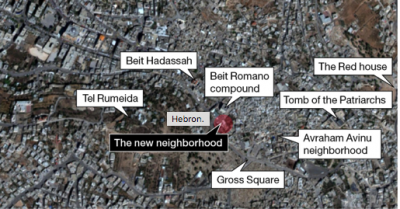
Map by Haaretz
As a reminder: in October 2017, the Israeli Civil Administration approved a building permit for the 31 units, on the condition that the Palestinian municipality of Hebron and others would have the opportunity to file objections to the plan. Soon after, two appeals were filed with the Defense Ministry: one by the Palestinian municipality of Hebron and one by the Israeli settlement watchdog Peace Now. The legal objections to the plan stem from the problematic process by which Israel made land in downtown Hebron available for settlement construction. Located in the Israeli-controlled H-2 area of Hebron (where 500 Israeli settlers live amongst 40,000 Palestinians), Israel seized the land in the 1980s from the Hebron Municipality, for military purposes. In 2007, the Civil Administration’s Legal Advisor issued an opinion stating that once Israel is done using the land for military purposes, it must be returned to the Hebron Municipality, which has protected tenancy rights to the land. Nonetheless, in 2015, the Israeli Civil Administration, with the consent of the Minister of Defense, quietly authorized the Housing Ministry to plan the area for Israeli settlement use, paving the way for that same ministry to subsequently present the plan for 31 units.
In October 2018, with the legal challenges still pending, the Israeli Cabinet voted to expedite the planning of the new settlement and allocated approximately $6.1 million (NIS 22million) for the project, which will require Israel to significantly renovate a military base in order to build the 31 new settlement units, a kindergarten, and “public areas.”
Peace Now said in a statement:
“The state was quick to issue the building permit even though the court has explicitly ruled that work should not start until the… hearing takes place….The attempt to squeeze in this construction of 31 settlement units before the U.S. election is an unscrupulous act that threatens Israel’s national interest and relations on the world stage.”
Israel Advances Planning for Settler-Backed Cable Car Project in Jerusalem — Despite Ongoing Legal Case
On October 25th, the Israeli-run Jerusalem Development Authority — a joint agency of the government and the Jerusalem Municipality — held the first of two meetings for developers interested in bidding on a settler-backed project to build a cable car in East Jerusalem, despite the fact that the Israeli Supreme Court has not yet issued a final ruling on whether or not the state is permitted to expropriate the privately owned Palestinian land that is needed to carry out its construction (for background, see recent reporting in the Settlement Report). A second meeting for prospective developers is reportedly scheduled for next week.
The High Court is actively considering the cable car case, having ordered the state to offer a factual explanation for how the cable car line will boost tourism in the city – an explanation that the state has struggled to articulate convincingly. In response, the State recently submitted an 81-page explanation of the project regurgitating the same arguments it has previously made. The Court is now awaiting response from the petitioners to the State’s latest filings.
Settlers Push Bibi to Authorize All Outposts As Compensation for Delay in De Jure Annexation
The Jerusalem Post reports that settler leadership is pressuring Prime Minister Netanyahu to immediately grant retroactive approval to the hundreds of Israeli outposts in the West Bank that are illegal under Israeli law (and for which Israel has been unable, despite an all-out effort, to find a way to legalize, short of simply declaring that rule of law is irrelevant). The Knesset Land of Israel Caucus is also preparing legislation to achieve this end.
The Post reports that settlers, having impatiently waited as the government has delayed action on many outpost authorizations — as successive elections and then the U.S. promise of annexation have come and gone (for now) — are upping the pressure on Netanyahu to act in a decisive manner on the outposts. Peace Now notes that, despite the settlers’ allegations of foot-dragging, over the past two years the Israeli government has managed to grant retroactive legalization to 21 outposts. with 9 more in process. Instead of considering each outposts’ legal status in a piecemeal manner, the settlers want Netanyahu to grant authorizations in one swift and blanked act – regardless of the facts of each outpost (like private Palestinian ownership of the land on which some outposts have been constructed).
Settlers apparently view this as urgent, given the fact that the Trump Plan leaves around 15 outposts as enclaves within the borders of what is envisioned as a future Palestinian non-state entity. Settlers also view this as just, asserting that Netanyahu owes the settler movement this as “compensation for his failure to to fulfill his annexation pledge.”
The Jerusalem Post article also does a surprisingly great job of explaining Israeli efforts over the past two decades to approve these outposts, which entered a new phase in 2017 with the passage of the Settlement Regulation Law – passed by the Knesset to allow provide a new legal basis by which the government can grant outpost approvals. FMEP has also comprehensively tracked [Table #3] Israel’s efforts over the past two years to retroactively legalize the outposts.
Bonus Reads
- “US amb. to Israel: Change of administration can damage Abraham Accords” (Jerusalem Post)
- “The Annexation That Was and Still Is” (B’Tselem)
- “Muslim Pilgrimage to Haram al Sharif/the Temple Mount: Tinkering with Explosives” (Terrestrial Jerusalem)
- [Thread] “The issue of the ultra-Orthodox sector, which recently caught the public’s attention again in light of the corona crisis, demands discussion about what is happening with the ultra-Orthodox community in the context of the settlements, for two reasons” (@nabothVin)
- “In East Jerusalem, the settler project is expanding underground“ (+972 Magazine)
- “Israelis Who Pillage Palestinian Olive Harvesters Are Not My Brothers” (Haaretz)
Welcome to FMEP’s Weekly Settlement & Annexation Report. To subscribe to this report, please click here.
October 16, 2020
- No Annexation, No Problem – Israel Advances Nearly 5,000 New Settlement Plans, Including New Settlement South of Jerusalem
- Plan for 570 Units in East Jerusalem Settlement Approved for Deposit
- Israel Approves Construction of Elevator at Tomb of the Patriarchs
- Israel Delivers Confiscation Notices to Palestinians Living in the Heart of Hebron
- Palestinians Report Newly Established Outposts & Land Confiscations
- Targeting Palestinians Construction in Area C: State Devotes $6 million to Mapping Program
- In First, Palestinian Authority Courts to Hear Lawsuits Against Settlers
- NF, Elad Face International Heat Over Sumarin Family Eviction Case – Will it Matter?
- Report: U.S. Will Not Back De Jure Annexation Until 2024 [Friedman Says 2021 in Play]
- Bonus Reads
Comments/questions? Contact Kristin McCarthy (kmccarthy@fmep.org)
No Annexation, No Problem – Israel Advances Nearly 5,000 New Settlement Plans, Including New Settlement South of Jerusalem
During meetings held October 14th and 15th, the Israeli High Planning Council advanced plans for a total of 4,948 new settlement units. Of that total, plans for 2,688 units were granted final approval and plans for 2,260 units were approved to be deposited for public review (a late stage in the planning process). The latter approvals include a plan to build a new settlement, “Har Gilo West,” just beyond Jerusalem’s southern border. In addition, the Council granted retroactive approval to 340 existing illegally-built settlement units in the unauthorized outposts of Peni Kedem and Tapuach West, paving the establishment of two new official West Bank settlements (through post-facto legalization of the illegal outposts).
These were the first meetings of the High Planning Council since February 2020, at which time settlement planning was put on pause in favor of attempting to implement annexation plans as designed by Trump’s “Deal of the Century.” Under annexation, authority over the settlement planning/approval process could have been shifted from the Israeli Civil Administration (the branch of the Israeli Defense Ministry, in charge of the administration of affairs in the West Bank, – i.e., Israel’s occupation) into Israel domestic planning mechanism. Such a shift has long been a goal of settlers and their political allies.
In addition to advancing construction of new residential settlement units, the High Planning Council also advanced plans for the construction of new settlement projects that support tourism, further entrench the permanency of settlements, and that continue the exploitation of West Bank land and resources.
Record-Setting Settlement Activity in 2020
With the huge advancement of settlement plans this week, the Israeli government has advanced plans for 12,159 settlement units so far in 2020. With over two months to go, the settlement watchdog group Peace Now reports that this is already the highest total number settlement advancements in any year since Peace Now began tracking totals in 2012. Peace Now also reports that it is possible that the High Planning Council will convene one more time before the year ends.
Har Gilo West Approved for Deposit w/ Plan to Seal Off Al-Walajah
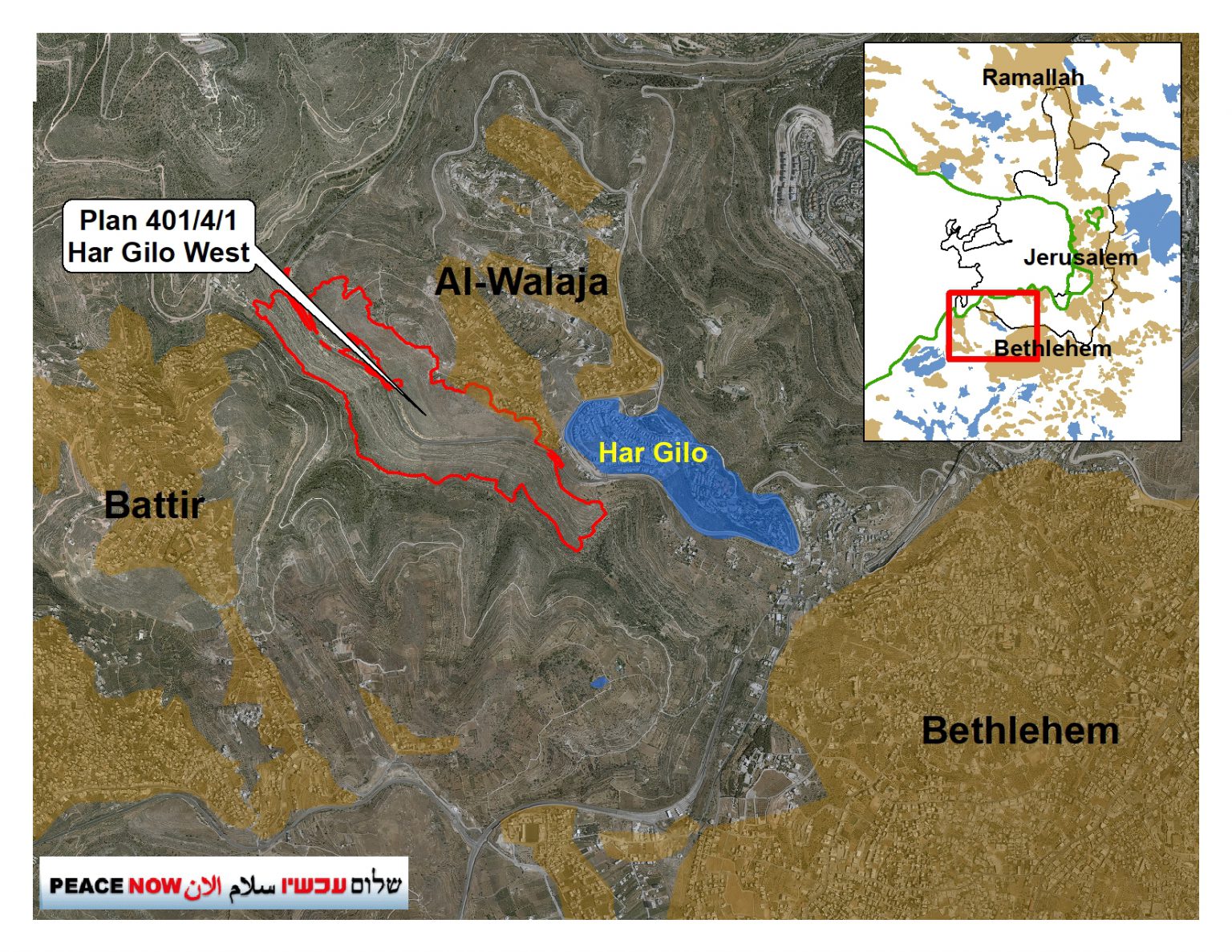 The High Planning Council approved for public deposit a plan to build 560 units at the Har Gilo West settlement site, located just south of Jerusalem. The Council is treating this plan as merely an expansion of the existing Har Gilo settlement, but in actuality it represents the construction of a new settlement on Jerusalem’s southern border, as the two areas of construction (Har Gilo and Har Gilo West) would not be contiguous. The plan for 560 units in Har Gilo West is part of a larger plan to construct around 952 units in the new settlement, extending the its borders right up to the Jerusalem municipal boundary, with dire consequences for the long-beleaguered Palestinian village of Al-Walajah.
The discussion on October 14th further revealed that, in order to build Har Gilo West, Israel plans to extend the separation barrier in that area to completely encircle al-Walajah, which is surrounded on three sides by the separation wall already. The new section of the barrier would be a 7-meters high concrete slab along the western edge of the built-up area of Al-Walajah. That would leave Al-Walajah completely encircled by the separation barrier and Israeli construction beyond it.
Ir Amim explains:
“In the past decade a series of Israeli moves have taken over more and more of Al-Walaja land and gradually isolating it. These are now culminating with the intention to construct the new settlement on the land reserves on the western side of Al-Walaja and to extend the separation barrier so as to complete the encircling of the village. As Al-Walaja will turn into an isolated enclave which lacks an outline plan its residents will be especially vulnerable to increasing home demolitions and other Israeli sanctions. Since the village will separate the new settlement from the existing Har Gilo we are likely to see increasing Israeli actions against Al-Walaja and its residents which will put their future existence at risk.”
Peace Now writes:
“The current plan of 952 housing units to be advanced will create a brand new neighborhood that will be larger than the existing settlement, and will exploit the land cut off by the West Bank barrier to further break up the western Bethlehem metropolitan area, including the land connecting al-Walaja and the town of Battir, as well as Battir and Bethlehem. This land also constitutes some of the only uninhabited fertile land reserves for Bethlehem, which currently is cut off by the West Bank barrier to its immediate north and west.“
FMEP has repeatedly documented various Israeli efforts to seal off al-Walajah from Jerusalem. Residents of al-Walajah have fought the growing encroachment by the nearby Etzion settlement bloc and the Israeli government’s attempt to de facto annex the bloc as part of “Greater Jerusalem.” Ir Amim explains several prongs of this effort, including a particularly unbelievable section of Israel’s separation barrier planned to almost completely encircle the village, to turn its valuable agricultural land into an urban park for Jerusalem, and construction of a highway that will connect the Etzion settlement bloc to Jerusalem with Israeli-only bypass roads.
Two Outposts Advance Towards Retroactive Legalization
The High Planning Council approved for deposit two plans that would, if implemented, have the effect of retroactively legalizing two outposts – bestowing upon those outposts legitimacy in the eyes of Israeli law and, in effect, establishing two new, official settlements. Those plans are:
- Pnei Kedem: A plan to grant retroactive legalization to 120 units in the Pnei Kedem farm outpost by recognizing the outpost as a “neighborhood” of the Metzad/Asfar settlement. This is despite the fact that the two areas of construction are non-contiguous. Pnei Kedem is located halfway between Bethlehem and Hebron in the southern West Bank. Settlers were particularly gleeful about this plan being advanced
- Tapuach West: A plan to grant retroactive legalization to 133 units in the Tapuach West outpost, located south of Bethlehem.
Not Just Residential Units – Council Advances Settler Tourism & Infrastructure Projects
The High Planning Council also advanced plans for the construction of new settlement projects that support tourism, further entrench the permanency of settlements, and that continue the exploitation of West Bank land and resources.
The Council granted final approval to:
- A plan for new shops and an educational site (to include an agricultural farm) in the Kochav Yaakov settlement – located between Jerusalem and Ramallah; and,
- A plan to grant retroactive authorization to a motor park and 120 hotel rooms in the Petza’el settlement, located in the Jordan Valley. As FMEP has covered in the past, this state-of-the-at racetrack and hotel complex is being built partially on land that the Israeli army previously declared a closed firing zone, a designation which resulted in the forcible displacement of Palestinians who lived there. The land remains under this designation today. Rather than halting the construction of this complex, the Israeli authorities instead created a Master Plan for the area in order to enable even more construction in the area.
Plans the Council granted final approval for public deposit include:
- A plan for an industrial zone near the Mishor Adumim settlement; and,
- A plan to build a new commercial area and 50 hotel rooms in the Maale Adumim settlement;
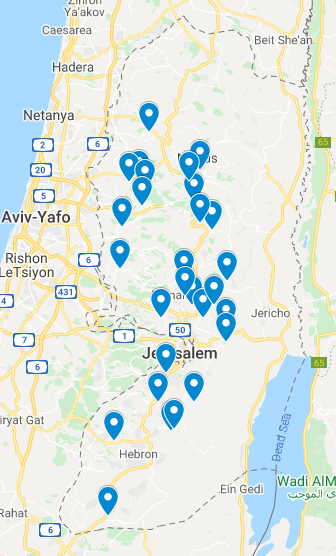
Map by Ben White (@benabyad)
Included in the total number of units receiving final approval and/or retroactive legalization (3,028 units) are (in descending order of number of units): [map]
- 382 units in the Beit El settlement, located in the heart of the northern West Bank. This includes retroactive legalization for 36 units which had been previously built without authorization and the construction of 346 units in highrise buildings with 9 or 10 floors (building up, not out in Beit El) [as a reminder, US Ambassador to Israel David Friedman has deep ties to the Beit El settlement];
- 357 units in the Geva Benyamin (Adam) settlement, located just north east of Jerusalem, just beyond the separation barrier. Israel has been steadily building the Adam settlement in a manner meant to unite the settlement more seamlessly with East Jerusalem settlements and infrastructure, erasing the Green Line;
- 354 units in the Nili settlement, located in the northern West Bank;
- 213 units in the Shiloh settlement, including the retroactive legalization of 21 units built without required approvals. The Shiloh settlement is located in the central West Bank;
- 211 units in the radical and violent Yitzhar settlement, including some retroactive authorizations (exact number not specified) as well as approval for public buildings. Yitzhar, located just south of Nablus, is associated with the Hilltop Youth movement – and a string of illegal outposts in the area associated with repeated attacks on Palestinians and their property;
- 205 units in the Nokdim settlement (actually approved for the Kfar Eldad settlement, which is officially within the jurisdiction of Nokdim), located south of Bethlehem;
- 200 units in the Metzad settlement (also known as Asfar), including the retroactive legalization of an unspecified number of existing units built without necessary approvals;
- 160 units in the Kochav Yaacov settlement, located east of Ramallah;
- 140 units in Kerem Reim settlement – located north west of Ramallah. Peace Now has repeatedly challenged the illegal construction of the Kerem Reim outpost, which the Israeli government retroactively legalized by declaring it a neighborhood of the Talmon settlement even though the areas are non-contiguous. Though a court rejected one Peace Now petition, there is an ongoing case against the Amana settler organization which Peace Now alleges engaged in illegal activities to build the outpost;
- 132 units in Kfar Adumim settlement – located east of Jerusalem and less than one mile from the Khan al-Ahmar bedouin community which the state of Israel is seeking to demolish;
- 106 units in the Ma’ale Shomron settlement, located east of the Palestinian village of Qalqilya;
- 84 new units in the Shima settlement, including retroactive legalization of 14 existing units;
- 74 units in the Yakir settlement – located in the northern West Bank and part of a string of settlements and unauthorized outposts – most notably Ariel – extending from the Green Line deep into the West Bank;
- 64 units in the Telem settlement – located west of Hebron;
- Retroactive legalization of 18 units in the Psagot settlement – located east of Ramallah, and home to the Psagot Winery;
- Retroactive legalization of 2 units in the “Givon Hadasha” settlement;
Plans which were approved for deposit for public review include (in descending order of number of units):
- 629 units in the Eli settlement, including the retroactive legalization of 61 units – located south of Nablus and southeast of the Ariel settlement in the central West Bank. Though the Eli settlement previously received Israeli government approval, a “Master Plan” – which officially zones land for distinct purposes (residential, commercial, public) – has never been issued for Eli, meaning all construction there is illegal under Israeli law;
- 560 units in the Har Gilo settlement located just south of Jerusalem (covered in detail above);
- 286 units in the Har Bracha settlement – located just south of Nablus. If implemented, these new units will double the size of Har Bracha;
- 179 units in the Einav settlement – located northwest of Nablus;
- 148 units in the Rimonim settlement – located between Ramallah and Jericho in the Jordan Valley;
- A plan to grant retroactive legalization to 133 units in the Tapuach West outpost, thereby granting approval to the outpost itself (discussed above);
- A plan to grant retroactive legalization to 120 units in the Pnei Kedem outpost by recognizing the outpost as a “neighborhood” of the Metzad/Asfar settlement although the two areas of construction are non-contiguous. Pnei Kedem is located between Bethlehem and Hebron in the southern West Bank;
- 82 units in the Karnei Shomron settlement – located in the northern West Bank east of the Palestinian village of Qalqilya. Israel is planning to continue expanding Karnei Shomron with the stated goal of bringing 1 million settlers to live in the area surrounding the settlement.;
- 75 units in the Shimaa settlement, including the legalization of 14 units previously built without authorization;
- 52 units received retroactive legalization in the Kfar Adumim settlement;
- 35 units in the Efrat settlement – located south of Bethlehem. As a reminder, Efrat is located inside a settlement block that cuts deep into the West Bank. Efrat’s location and the route of the barrier wall around it, have literally severed the route of Highway 60 south of Bethlehem, cutting off Bethlehem and Jerusalem from the southern West Bank. The economic, political, and social impacts of the closure of Highway 60 at the Efrat settlement (there is literally a wall built across the highway) have been severe for the Palestinian population;
- 14 units (in one building) in the Maale Mikmash settlement – located east of Ramallah;
- 10 units in the Barkan settlement – located about half way between the Ariel settlement and the cluster of settlements slated to be united into a “super settlement” area (Oranit, Elkana, Shiva Tikva, and others).
- 7 units in the Peduel settlement – located in the northern West Bank and part of a string of settlements and unauthorized outposts – most notably Ariel – extending from the Green Line into the very heart of the West Bank and on towards the Jordan Valley; and,
The High Planning Council met only after settlers, who represent a key ally of the embattled Prime Minister, pressured Netanyahu to allow it. Settlers have spent months decrying what they understood to be a freeze on settlement constructed inflicted upon them by Netanyahu. Gush Etzion Regional Council Head Shlomo Ne’eman said:
“Sometimes we take our prime minister to task, which we feel is justified as a result of our disappointment in postponing the application of sovereignty over our country. But now something tangible is happening – we are building and developing our communities, and of course, the highlight of today is the full registration in the Land Authority of the young community of Pnei Kedem, 20 years since it was established.”
Samaria Regional Council head Yossi Dagan said:
“This is a happy day for Samaria. [New construction] in Har Bracha, Yitzhar, Einav and Tapuach is another step on the way to a million residents in this beautiful region of the country…While we’re very content with today’s developments, I call on the Prime Minister not to stop here. We’re overfilled with joy, but it is a drop in the ocean with sovereignty falling off the agenda. The expectation now is that construction and strengthening of the settlement movement will increase tenfold.”
Peace Now responded to the approvals in a statement saying:
“While Israel reels from its second lockdown and economic distress, Netanyahu is promoting construction in isolated settlements that Israel will have to evacuate. Instead of taking advantage of the agreements with the Gulf states and promoting peace with the Palestinians, he is distorting Israel’s priorities and catering to a fringe minority for these settlement unit approvals that will continue to harm future prospects for peace. We call on the Defense Minister and the Alternative Prime Minister Benny Gantz to veto these plans. Far from a ‘settlement freeze,’ the right has been complaining about, the expected settlement approvals announcement next week prove that the settlement enterprise under Netanyahu is moving ahead at full steam toward solidifying the de facto annexation of the West Bank. The move also will be the first major demonstration of Defense Minister Benny Gantz’s bowing to the ‘Greater Israel’ settlement agenda that would in reality bring about a permanent undemocratic one-state reality. By doing so, Israel will be signaling to the world its bi-partisan support for the end to the concept of a two-state solution and a Palestinian state – the paradigm that until now has largely shielded Israel from formal pressure over its 53-year occupation. The settlement enterprise is not in Israel’s national or security interest, and is a strategic mistake at the international level.”
Palestinian Prime Minister Mohammed Shtayyeh denounced the approvals, saying:
“Every settler unit constitutes a plan to annex our land.”
Palestinian Authority spokesman Nabil Abu Rudeineh said in a statement:
“We warn against this Israeli policy that will lead the region to the brink of the abyss, and we call on the international community to intervene immediately and urgently to pressure the Netanyahu government to stop this settlement madness that totally eliminates any real opportunity to achieve a just and comprehensive peace to end the occupation and establish the independent Palestinian state with East Jerusalem as its capital on the 1967 borders.”
UN High Representative Josep Borrell said in a statement:
“In recent days, Israel has announced a significant expansion of settlements in the occupied West Bank, in areas in and around Jerusalem. These plans, which foresee the construction of close to 5.000 housing units, jeopardise the viability and territorial contiguity of a future Palestinian State as the outcome of a negotiated two-state solution, in line with the internationally agreed parameters. Settlements are illegal under international law. As stated consistently, the EU will not recognise any changes to the pre-1967 borders, including with regard to Jerusalem, other than those agreed by the parties. Settlement activity threatens current efforts to rebuild trust, to resume civil and security cooperation between Palestinians and Israelis and to prepare the ground for an eventual resumption of meaningful and direct negotiations. The Government of Israel should reverse these decisions and halt all continued settlement expansion, including in East Jerusalem and sensitive areas such as Har Homa, Givat Hamatos and E1. The period from March to August 2020 also saw a spike in demolitions or confiscations of Palestinian-owned structures in the West Bank in spite of the COVID-19 pandemic. The EU reiterates its call on Israel to halt all such demolitions, including of EU-funded structures, in particular in light of the humanitarian impact of the current pandemic. Against the background of normalization of relations between Israel, UAE and Bahrain, Israelis and Palestinians should seize this opportunity and take urgent steps to build confidence and restore cooperation along the line of previous agreements and in full respect of international law.”
A spokesperson for UN Secretary-General Antonio Guterres issued a statement flagging concern over the advancements, saying:
“We are concerned about the reports of Israel’s settlement advancements in the occupied West Bank and will continue to follow developments closely, as the Israeli High Planning Committee finalizes its meetings tomorrow. The Secretary-General has consistently reiterated that all settlements are illegal under international law and remain a substantial obstacle to peace. We urge the Israeli authorities to refrain from such unilateral actions that fuel instability and further erode the prospects for resuming Palestinian-Israeli negotiations on the basis of relevant UN resolutions, international law and bilateral agreements.”
Plan for 570 Units in East Jerusalem Settlement Approved for Deposit
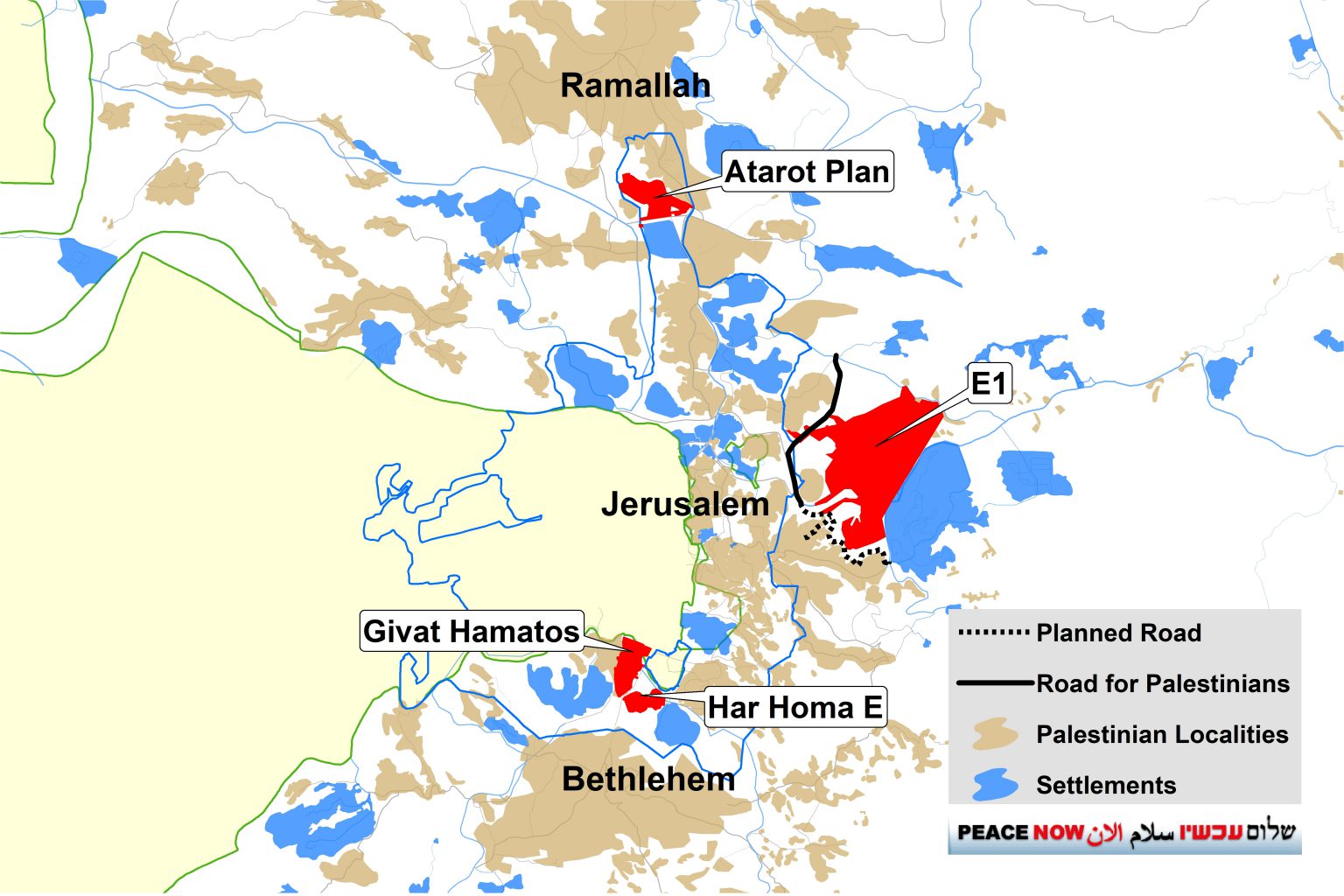 Ir Amim reports that on September 22nd, the Jerusalem District Committee approved for deposit for public review a detailed plan providing for the construction of 570 units in the Har Homa E settlement, located in East Jerusalem. Taken together with the pending construction of the nearby Har Gilo West settlement (discussed in the section above), the Palestinian village of al-Walajah stands to be completely encircled by Israeli settlements.
If implemented, this plan will extend the Har Homa settlement westward, in the direction of the site of the as-of-yet-unbuilt Givat Hamatos settlement. Ir Amim explains:
“If realized, Har Homa E together with construction in Givat Hamatos will connect Har Homa to Gilo creating a contiguous Israeli settlement area that will disconnect East Jerusalem from Bethlehem and the south of the West Bank.”
Ir Amim also reminds us that the Jerusalem District Committee previously approved a Master Plan for a total of 2,200 units in Har Homa E. The plan for 570 units approved for deposit in late September represents the first detailed plan under this Master Plan allows for. Plans to build the remaining units permitted under the Master Plan are not yet being advanced.
Israel Approves Construction of Elevator at Tomb of the Patriarchs
Emek Shaveh reports that on September 29th the Civil Administration granted final approval to a plan to build accessible infrastructure, including an elevator, at the Ibrahimi Mosque/Tomb of the Patriarch in Hebron — a plan which requires Israel to seize land from the Islamic Waqf. As of this writing, Emek Shaveh is considering whether to challenge that approval.
Regarding the significance of the plan, Emek Shaveh said:
“One need not be an archaeologist or architect to review the council’s plan and understand that it is destructive in a manner which is unprecedented. We are convinced that the plan, as approved, would never have been promoted had it not been driven by political motives.”
Emek Shaveh has previously provided critical context as to why this plan is not really, or not fully, being advanced out of humanitarian concerns, explaining:
“Israel’s decision to seize responsibility for the site from the Hebron municipality and the Palestinians sends a clear political message that Israel is reneging on agreements that were signed with the Palestinians in Hebron. Beyond the precedent that will enable the settlers in the future to demand additional changes at the Tomb of the Patriarchs/Ibrahimi Mosque, this is also a precedent that could play out at other sites under the responsibility of the Islamic Waqf. Experience has shown us that what begins in Hebron percolates into other places including Jerusalem. It begins with a seemingly rational demand to benefit the disabled or the general public and evolves into a new status quo. The expected change in Hebron has not escaped the attention of members of the Temple movement and they will know how to present their demands to the government. If Israel can repudiate agreements with the Palestinians in Hebron and expropriate land from the Waqf, it would seem that accepting what appears to be the far more modest demands by the Temple movement to pray or to walk about the Temple Mount complex freely is not so far-fetched. In the reality of Hebron and East Jerusalem, a change involving only several meters at a historic or holy place is not free of political considerations and often it is part of long-term strategy. While it is necessary to tend to the needs and interests of persons with disabilities, the extremists who presume to speak on their behalf must be prevented from forging Israeli policy, even if it is only a matter of a lift and an access path.”
Read Emek Shaveh’s full analysis here: “Humanitarianism Hebron Style.”
Israel Delivers Confiscation Notices to Palestinians Living in the Heart of Hebron
The Palestinian media outlet WAFA news reports that several Palestinians living in the Tel Rumeida section of downtown Hebron were handed confiscation notices from the Israeli authorities, informing them that the State of Israel had confiscated 17 plots of land, including land privately owned by Palestinians.
Tel Rumeida is a part of Hebron located directly in the city center, considered H2 by the Hebron Accords giving Israel full control of security in that area. B’Tselem estimates that there are around 700 settlers living in enclaves amongst approximately 34,000 Palestinians in H2. The Israeli army heavily protects those settlers, and has implemented an apartheid system of segregated movement and checkpoints, most notably in the area of Shuhada Street.
Palestinians Report Newly Established Outposts & Land Confiscations
The Palestinian news outlet WAFA reports that settlers have installed three new outposts over the past month – one near Nablus and a second near Hebron, and a third in the Jordan Valley.
Near Nablus, Palestinians report that the settlers installed mobile homes and a small farm in an attempt to establish a permanent presence on a new plot of land. The settlers are reportedly in the process of connecting the new outpost to the Elon Moreh settlement via roads and water supply. Ghassan Daghlas, who monitors Israeli settlements on behalf of the PLO, told WAFA that the specific area has seen even wider road construction recently, which he sees as an effort to create more seamless contiguity between settlements in the Nablus area and the Jordan Valley. The construction comes at the direct expense of the Palestinian village of Beit Dajani, which has historically owned the land where the outpost and roads are being built.
Near Hebron, WAFA reports that an Israeli settler erected a tent with and Israeli flag on privately owned Palestinian land near the Birin village.
In the Jordan Valley, WAFA reports that settlers set up a caravan on land on which they began planting trees about three months ago. The settlers also reportedly dug a well at the site.
On October 15th, Israel reportedly announced its intention to confiscate large tracts of land (11,000 dunums) adjacent to the Jordan Valley settlements of Rotem, Maskiyot, and Mesovah. This confiscation, according to Palestinian settlement watcher Qasem Awwad, was presented by the Israeli authorities as a move to add land to natural reserve areas, but seems clearly to be linked to efforts to expand settlements and their control over land in the area.
Targeting Palestinians Construction in Area C: State Devotes $6 million to Mapping Program
Despite COVID and the suspension of Israeli’s unilateral annexation of vast tracts of land in the West Bank, the Israeli government — at the urging of settlers and their allies — is continuing its push to consolidate its control over all aspects of life in Area C (the over 60% of the West Bank that is under full Israeli control).
OCHA has documented an acceleration in the Civil Administration’s demolition of Palestinian structures in the West Bank over the summer, documenting the demolition of 389 Palestinian-owned structures in Area C of the West Bank. As a result of those demolitions, 442 Palestinians were made homeless. OCHA further reported that In just the month of August, 205 Palestinians lost their homes, the highest single month total since January 2017. In addition, Israel continues to issue more demolition notices, including against Palestinians living in a cave near Jenin, and against a newly constructed school for bedouin children located east of Ramallah.
To further this effort, on September 10th the Israeli government allocated $6 million USD (20 million NIS) for the newly created Settlement Affairs Ministry to survey and map unauthorized Palestinian construction in Area C of the West Bank, which Israel and its settlers have been aggressively demolishing in an effort to rid the area of Palestinians. Haaretz reports that this is the first time that the state budget has included funds specifically for a land survey in the West Bank. The state also allocated an additional $2.8 million (9.5 million NIS) to an existing grant program specifically for settlement municipalities to cash in on. As a reminder, virtually all Palestinian construction in Area C of the West Bank is unauthorized, because Israel almost universally refuses to give Palestinians permission to build in Area C even on land that Israel recognizes as owned by Palestinians.
The Settlement Affairs Ministry is a new creation of the current coalition government, and is headed by Tzachi Hanegbi (Likud). The funding for the Settlement Affairs Ministry to conduct a survey of unauthorized Palestinian construction in Area C further empowers a domestic Israeli body to exert extraterritorial sovereignty over Area C – in effect, treating the area as land already de facto annexed by Israel. While technically the occupied territories are administered by the Israeli Civil Administration (a body within the Defense Ministry), Israel has spent decades bringing the administration of the territories (specifically the settlements and Area C) ever more directly under direct Israeli sovereignty (de facto annexation).
In the lead up to the allocation of funds for this new survey of Palestinians life in Area C, the Knesset hosted two committee discussions the political outlook of which was clearly indicated in the stated subject of the meetings: “the Palestinian takeover of Area C.” Consistent with this framing (which is predicated on the idea that Area C belongs to Israel), and pushed by outside groups, many members of the Knesset have criticized the Israeli government’s allegedly lackadaisical approach to preserving State interests in Area C (i.e., clearing out Palestinians, expanding settlements, consolidating state infrastructure). Reportedly, Foreign Affairs Minister Gabi Ashkenazi (Blue & White) sent a letter to the committee specifically addressing the Knesset’s outrage over European humanitarian assistance projects for Palestinians in Area C. In the letter, Ashkenazi not only celebrated the reduction of European projects over the past year, but validated settlers’ insinuations regarding the nefarious nature of European assistance for Palestinians, saying that any European activity in the West Bank lacking Israeli permission is “an attempt to define a border.” Ashkenazi also said that Israel will not compensate European donors for confiscated equipment or the demolition of European-funded projects that lack Israeli permission (like in the case of schools built with European funding, and solar panels donated to bedouin communities lacking power).
At one Knesset hearing, MK Bezalel Smotrich (Yamina) suggested that a solution could be to empower the settlements with the ability to demolish Palestinian construction they believe to be unauthorized. Smotrich’s partymate Ayelet Shaked (former Justice Minister) suggested that the government should appoint a project manager tasked with preventing a Palestinian takeover of Area C.
As noted above, Israel has long denied Palestinians the ability to build in Area C. To fully understand what is happening, it is worth reviewing B’Tselem’s excellent explainer:
“Israel’s planning and building policy in the West Bank is aimed at preventing Palestinian development and dispossessing Palestinians of their land. This is masked by use of the same professional and legal terms applied to development in settlements and in Israel proper, such as “planning and building laws”, “urban building plans (UBPs)”, “planning proceedings” and “illegal construction”. However, while the planning and building laws benefit Jewish communities by regulating development and balancing different needs, they serve the exact opposite purpose when applied to Palestinian communities in the West Bank. There, Israel exploits the law to prevent development, thwart planning and carry out demolitions. This is part of a broader political agenda to maximize the use of West Bank resources for Israeli needs, while minimizing the land reserves available to Palestinians….
In the West Bank, the potential for urban, agricultural and economic development remains in Area C. Israel uses its control over the area to quash Palestinian planning and building. In about 60% of Area C – 36% of the West Bank – Israel has blocked Palestinian development by designating large swathes of land as state land, survey land, firing zones, nature reserves and national parks; by allocating land to settlements and their regional councils; or by introducing prohibitions to the area now trapped between the Separation Barrier and the Green Line (the boundary between Israel’s sovereign territory and the West Bank).
Even in the remaining 40% of Area C, Israel restricts Palestinian construction by seldom approving requests for building permits, whether for housing, for agricultural or public uses, or for laying infrastructure. The Civil Administration (CA) – the branch of the Israeli military designated to handle civil matters in Area C – refuses to prepare outline plans for the vast majority of Palestinian communities there. As of November 2017, the Civil Administration had drafted and approved plans for only 16 of the 180 communities which lie in their entirety in Area C. The plans cover a total of 17,673 dunams (1 dunam = 1,000 square meters), less than 1% of Area C, most of which are already built-up. The plans were drawn up without consulting the communities and do not meet international planning standards. Their boundaries run close to the built-up areas of the villages, leaving out land for farming, grazing flocks and future development. Since 2011, seeing that the Civil Administration did not draft plans as it is obliged to do, dozens of Palestinian communities – with the help of Palestinian and international organizations and in coordination with the PA – drafted their own plans. Some of the plans covered communities or villages located in full in Area C and others covered places only partly in Area C. As of September 2018, 102 plans had been submitted to the Civil Administration’s planning bodies, but by the end of 2018, a mere five plans – covering an area of about 1,00 dunams (or about 0.03% of Area C) – had received approval.
The odds of a Palestinian receiving a building permit in Area C – even on privately owned land – are slim to none. Given the futility of the effort, many Palestinians forgo requesting a permit altogether. Without any possibility of receiving a permit and building legally, the needs of a growing population leave Palestinians no choice but to develop their communities and build homes without permits. This, in turn, forces them to live under the constant threat of seeing their homes and businesses demolished.
The impact of this Israeli policy extends beyond Area C, to the hundreds of Palestinians communities located entirely or partially in Areas A and B, as the land reserves for many of these communities lie in Area C and are subject to Israeli restrictions there.
The demand for land for development has grown considerably since the 1995 division of the West Bank: The Palestinian population has nearly doubled, and the land reserves in Areas A and B have been nearly exhausted. Due to the housing shortage, much land still available in these areas is used for residential construction, even if it is more suited for other uses, such as agriculture.
Without land for construction, local Palestinian authorities cannot supply public services that require new structures, such as medical clinics and schools, nor can they plan open spaces for recreation within communities. Realizing the economic potential of Area C – in branches such as agriculture, quarrying for minerals and stone for construction, industry, tourism and community development – is essential to the development of the entire West Bank, including creating jobs and reducing poverty. Area C is also vital for regional planning, including laying infrastructure and connecting Palestinian communities throughout the West Bank.
In contrast to the restrictive planning for Palestinian communities, Israeli settlements – all of which are located in Area C – are allocated vast tracts of land, drawn up detailed plans, connected to advanced infrastructure, and the authorities turn a blind eye to illegal construction in them. Detailed, modern plans have been drawn up for the settlements, including public areas, green zones and, often, spacious residential areas. They enjoy a massive amount of land, including farmland that can serve for future development.
Israel’s policy in Area C is based on the assumption that the area is primarily meant to serve Israeli needs, and on the ambition to annex large parts of it to the sovereign territory of Israel. To that end, Israel works to strengthen its hold on Area C, to further exploit the area’s resources and achieve a permanent situation in which Israeli settlements thrive and Palestinian presence is negligible. In doing so, Israel has de facto annexed Area C and created circumstances that will leverage its influence over the final status of the area.”
In First, Palestinian Authority Courts to Hear Lawsuits Against Settlers
For the first time since the Palestinian Authority was established in 1994, it will allow Palestinians to bring lawsuits against Isareli settlers in Palestinian courts. The Palestinian Authority’s Justice Minister Mohammed al-Shalaldeh announced that the PA had formed a national team to handle these cases, and the team was already working to collect evidence and file suits against settlers who have committed crimes against Palestinians in Hebron and in the village of Burin, located just south of Nablus.
Until this point, no Israeli citizen has been tried in a Palestinian court. Under the Oslo Accords (which established the Palestinian Authority), the Palestinian Authority holds no jurisdication over Israeli citizens – including Israeli citizens living in the West Bank. In May 2020, PA President Mahmoud Abbas announced that the PA considers all accords and agreements with Israel to be void following Israel’s announcement that it intends to annex large parts of the West Bank in accordance with the Trump Plan. Shalaldeh said that the announcement this week flows directly from Abbas’s decision to free the PA from the Oslo Accords’ provisions.
Explaining how these cases might work, Shalaldeh said:
“The Israeli side will be notified as an occupying power to appear before the Palestinian court…If the [Israeli] side refuses the jurisdiction of the Palestinian courts, formal procedures will be followed and in absentia rulings will be issued, in accordance with Palestinian laws.”
JNF, Elad Face International Heat Over Sumreen Family Eviction Case – Will it Matter?
Over the past month, international audiences have directed heightened scrutiny towards the radical settler group Elad and the Jewish National Fund (JNF) for the role both organizations have played in spearheading the effort to evict the Palestinian Sumreen family from their home in the Silwan neighborhood of East Jerusalem. Due to the new attention, the JNF is reportedly reconsidering whether or not to carry out the eviction of the Sumreens – an eviction which the organization has pursued since 1991.

Map by Haaretz
JNF donors – along with activists, religious leaders, members of Congress, and Israel prize winners – reportedly began to express concern and outrage over the JNF’s role in the Sumreen case following the September 2020 ruling by Jerusalem Magistrate’s Court against the Sumreen’s claim to the home. In response to the criticism, the JNF (via actions by the Board of its subsidiary organization, Himnuta, which was created to take the lead for JNF in litigating aggressive settlement takeover cases like this) has acted to freeze the eviction process internally, and was scheduled to consider a proposal for freezing the formal legal proceedings against the Sumreens this past week. Himnuta’s decision and deliberations caused conflict with Elad, which had the Jerusalem Magistrate’s Court intervene to postpone Himnuta’s Board meeting to discuss the proposal. Elad argues that Himnuta transferred all legal authority over the Sumreen case to their organization, and cannot now interfere in the proceedings. The meeting was subsequently postponed at the request of the Court.
Elad is also coming under new international scrutiny following the revelation that Roman Abramovitch – a Russian oligarch and naturalized Israeli citizen who also is one of the owners of the renowned Chelsea football club – is Elad’s single largest donor, having anonymously donated over $100 million to the settler group over the past 13 years. The BBC produced an investigative feature report on Abramovitch’s connection to Elad, pointing out that over the past 15 years more than half of Elad’s funding has come from offshore companies in the Caribbean, which are now known to be owned or controlled by Abramovitch. The BBC feature connects Elad to the settlers’ struggle to evict the Sumreen family, and the larger effort to replace Palestinians in Silwan with Jewish Israelis.
Peace Now writes:
“The news about Abramovich’s involvement highlights the injustice Palestinians face at the hands of these settlement groups. Impoverished families are up against the financial weight of a Russian oligarch. NGOs trying to protect these families are delegitimized and their work dismissed for receiving funding from democratic European aid agencies while settler groups rake in vast sums of non-transparent money from offshore Caribbean shell companies. And the JNF is profiting off of all of this. We can’t force Abramovich to stop his funding or the JNF to stop abetting Elad in its settling campaign, but we can make them worry about their reputation. Peace Now has been conducting a campaign inside Israel to call Abramovich out for his devious funding.”
Regarding the revelations of Elad’s funding source, Emek Shaveh writes:
“…the Elad Foundation, through a combined strategy of sponsoring excavations, developing tourism and settling in Palestinian homes, succeeded in recreating Silwan as the Jewish neighbourhood of Ir David (City of David) and one of the most popular tourist destinations in the country. The exploitation of archaeological tourism by the Elad Foundation has become a number one strategy for entrenching Israeli sovereignty over historic Jerusalem. “
The Sumreen family home is located in the middle of what today has been designed by Israel “the City of David National Park.” The area is managed by the radical Elad settler organization, which for years has also been pursuing the eviction of Palestinians from the homes in Silwan. For nearly three decades, the Sumreen family has been forced to battle for legal ownership of their home, after the state of Israel, prompted repeatedly by the JNF, declared the Sumreen’s home to be “absentee” property. After that designation – which was not communicated to the Sumreen family – Israeli law permitted the state to take over the rights to the building. The state then sold the rights to the home to the JNF in 1991. The JNF has pursued the eviction of the Sumreen family ever since. Israeli courts ruled in favor of the Sumreen family’s ownership claims to the home for years, until a September 2019 ruling by the Jerusalem Magistrate’s Court granted ownership of the family’s home to the JNF, a decision the family immediately appealed to the Jerusalem District Court.
A full history of the saga involving the Sumreen family – which is similar to dozens of other Palestinian homes in Silwan that were declared Absentee Property in the 1990s – can be found on the Peace Now website here.
Report: U.S. Will Not Back De Jure Annexation Until 2024 [But Friedman Says 2021 Is in Play]
A series of reports in mid-September suggested that, as part of its commitment to the U.A.E. in exchange for normalization with Israel, the U.S. promised to withhold its recognition of Israeli annexation until January 2024, at the earliest.
The 2024 timeline harkens back to a concept in Trump’s “Deal of the Century” which gave (oh so generously) the Palestinians a four year window to enter into negotiations with Israel on the basis of the Trump Plan’s conceptual map.
Following these reports regarding a 2024 timeline for the U.S. greenlighting Israeli annexation, U.S. Ambassador David Friedman (who has been a champion of annexation) told Israel’s Army Radio that annexation can happen next year. Friedman, pushing back on U.A.E. press leaks seeking to promote the notion that the Abraham Accords stopped annexation, said:
“We said in our statement that sovereignty will be postponed, and this does not mean that it has been abolished, but rather that it has stopped. It has been suspended for a year, maybe more, but it has not been cancelled.”
Bonus
- “Tourism in the Service of Occupation” (Al-Shabaka)
- “The Status Quo on the Temple Mount/Haram Al Sharif: Dodging a Bullet (For Now)” (Terrestrial Jerusalem)
- “How Evangelicals Working in Settlements Bypassed Israel’s COVID-19 Entry Ban” (Haaretz)
- “ The March of Folly in the Settlements Continues” (Haaretz)
- “Israeli Students in State-funded Scholarship Program Guard Illegal West Bank Outposts” (Haaretz)
Welcome to FMEP’s Weekly Settlement & Annexation Report. To subscribe to this report, please click here.
September 11, 2020
- Gantz Pushes for Quick Approval of 5,000 New Settlement Units
- Givat Hamatos Tender Postponed (Again), But Government Says Construction is Imminent
- One More Step Towards Mass Eviction, Jerusalem Court Orders Eviction of Additional Four Families in Silwan in Favor of Radical Settler Group
- Jerusalem Committee Delays Decision on the Cable Car Project, & Defers Decision on Silwan Land Expropriation to the High Court
- Handing Another Victory to New Settler Strategy, Civil Admin Issues Expropriation Orders for West Bank Antiquities Sites
- State Attempting to Circumvent High Court Order Against Mitzpe Kramim Outpost
- Israeli Using Normalization as a “Cover” to Change Status Quo on Temple Mount
- BonusReads
Comments/questions? Contact Kristin McCarthy (kmccarthy@fmep.org)
Gantz Pushes for Quick Approval of 5,000 New Settlement Units
On September 7th, Israel’s Channel 12 reported that Defense Minister Benny Gantz is seeking approval from Prime Minister Netanyahu to advance 5,000 new settlement units, to be located in settlements across the West Bank. Gantz is said to have sent a letter to Netanyahu calling on him to end what Gantz called a “de facto freeze” on settlement construction by granting permission to immediately convene the High Planning Council in order to grant approval for the settlement plans. The High Planning Council – the body within the Israeli Civil Administration (which itself is a body within the Defense Ministry) responsible for regulating all planning and construction in the West Bank – has advanced plans for a total of 4,385 settler units so far this year in two meetings, but has not been convened since late February 2020.
Channel 12 and the Jerusalem Post report that of the 5,000 units under discussion, 2,000 are ready for final approval and 3,000 are ready to be deposited for public review (a late stage in the planning process). The units are slated to be built in settlements including Beit El, Shiloh, Nokdim, Har Bracha and even some far flung settlements located in the south Hebron hills.
Gantz’s maneuver has served to intensify the discontent and impatience with Netanyahu amongst the settler leadership, which has criticized Netanyahu both for suspending annexation plans and for freezing settlement construction projects.
A Knesset grouping called the “Israel Land Caucus” — which reportedly intends to file a bill in the Knesset mandating a regular schedule of High Planning Council meetings — convened an emergency meeting following the reports of Gantz’s letter. At the meeting, the co-chair of the caucus, Bezalel Smotrich, said:
“I congratulate the Alternate Prime Minister and Defense Minister for approving all the plans and calling on the Prime Minister to convene the planning council. Hopefully the Prime Minister will not leave Gantz to the Right of him”
Smotrich’s co-chair, Likud MK Haim Katz, attempted to defend Netanyahu but also urged immediate action, saying:
“I believe the Prime Minister wants the development of settlement and therefore the Supreme Planning Council must be convened. It’s inconceivable that they don’t convene the planning council. We issued a letter to the Prime Minister, we must try and influence through convening the Lobby. I strongly believe the Prime Minister wants development of settlement and through the Lobby the tools need to be examined to prove to Netanyahu that the Council must convene. Localities are growing and there are basic needs that must be promoted.”
The head of the settler Yesha Council, David Elhayani, was less generous in his assessment of Netanyahu’s motivations, saying:
“I’m unwilling to accept an equation where we’re going to be held hostage by this or that situation. We didn’t come as thieves in the night. The Israeli governments sent us to settle the area. I can’t see how a Rightist prime minister can’t justify why the committee doesn’t convene. It’s not just residential construction, it’s also freezing a day center for people with special needs. The freeze today is not like the freeze in the days of Obama. No matter what the political reasons – the Prime Minister must be real and determined. There’s no reason for us to become 7th-class citizens. There is no difference between a resident of Karnei Shomron, Har Bracha, Eli, or Beit She’an, Beit Shemesh or somewhere else. I expect the Prime Minister to conduct himself in Hebrew and not in English.”
Givat Hamatos Tender Postponed (Again), But Government Says Construction is Imminent
Ir Amim reports that the publication of the tender for construction of the Givat Hamatos settlement in East Jerusalem – which has been fully approved since 2014 – has been delayed once again, marking the third time the government has delayed the opening of the tender. According to an announcement by the Israel Lands Authority, the tender is now scheduled to be opened for bidding on November 2nd.
Following the announcement of delay, Israel’s Housing Ministry issued a statement defending Prime Minister Netanyahu from accusations by settlers and their allies that he has bowed to international pressure to abandon the Givat Hamatos settlement plan. The Ministry released a statement saying that the delays are due to technical issues, not political ones, and that the Ministry is currently discussing routine budgetary and development considerations with the Jerusalem Municipality in preparation for the eventual construction of the settlement.
Ir Amim notes:
“Such recurring postponement of a tender is unprecedented. On the one hand, the delays are a sign that Israel is under strong pressure not to open the tender – which is seen as a red line by the international community; it may be that negotiations currently underway with Arab states under the auspices of the Trump administration are also a cause for the delay. On the other hand, the fact that Israel refuses to withdraw the tender and has repeatedly set new dates for its opening shows how determined the government is to begin construction in Givat Hamatos and therefore it is leaving the door open so that it can seize an opportunity once it feels able to do so.”
Givat Hamatos has long been regarded as a doomsday settlement by parties interested in preserving the possibility of a two-state solution. If the Givat Hamatos settlement is built, the Palestinian neighborhood of Beit Safafa in East Jerusalem will be completely surrounded by Israeli construction, severing its connection to the West Bank.
One More Step Towards Mass Eviction, Jerusalem Court Orders Eviction of Additional Four Families in Silwan in Favor of Radical Settler Group
Peace Now reports that in the case of a longstanding property dispute in Silwan, the Jerusalem Magistrates Court ruled in favor of the radical settler group Ateret Cohanim, ordering the eviction of the Rajabi family, consisting of 26 individuals, from their longtime homes in Silwan. The court ordered the family to vacate the three properties by April 2021.
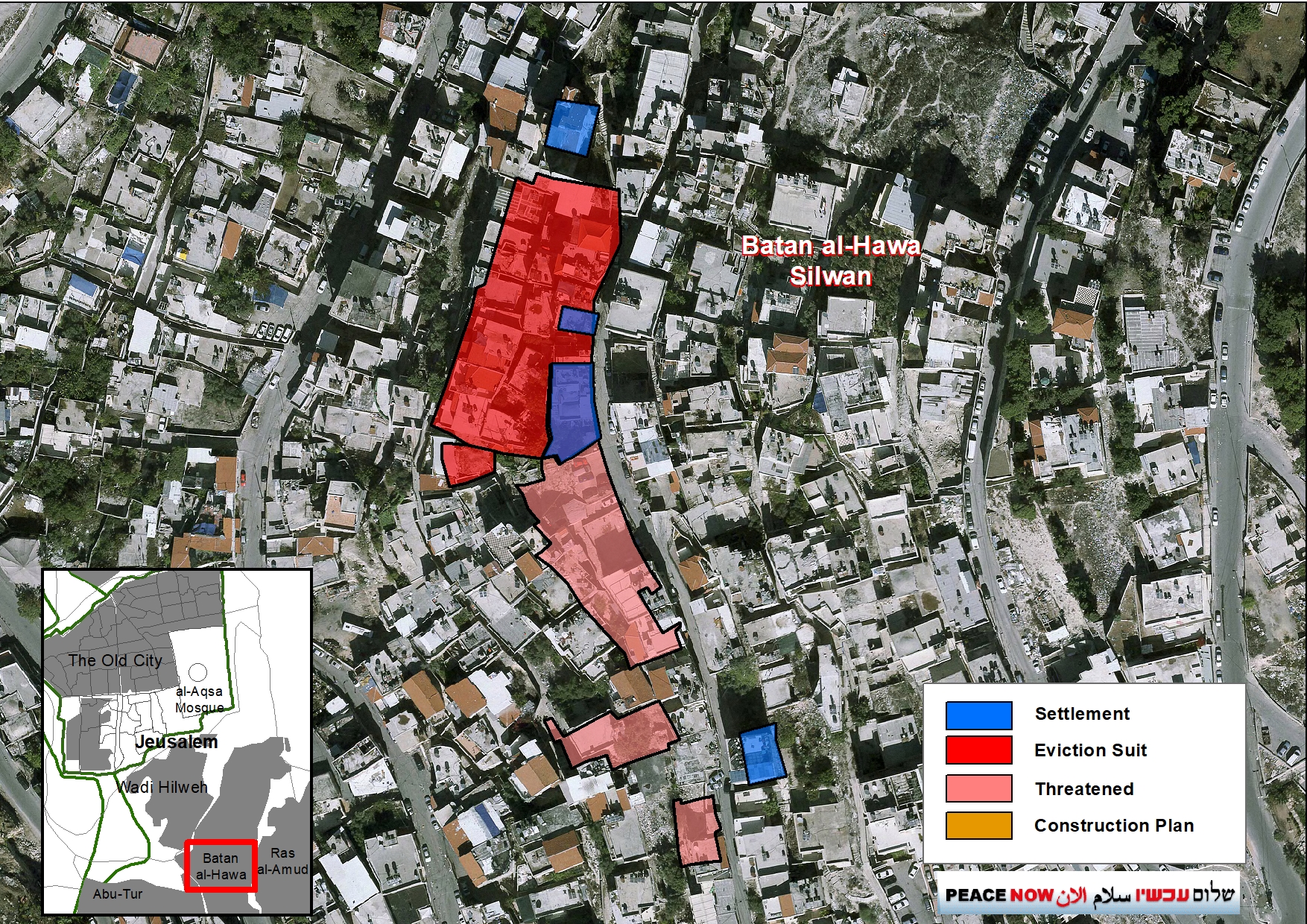
Map by Peace Now
This case is one of nearly a dozen lawsuits brought by Ateret Cohanim seeking the eviction of approximately 700 Palestinians from the Batan al-Hawa section of Silwan. Ateret Cohanim has maneuvered to have the Court order these evictions by gaining control of an pre-1948 land trust – called the Benvenisti Trust – and then asserting their ownership of land in Silwan where Palestinians have lived for generations. This is now the fourth instance in which the Court has ruled in Ateret Cohanim’s favor, strongly suggesting that the dozens of pending cases will also be decided in the settlers favor.
Peace Now said in a statement:
“This is an attempt to displace a Palestinian community and to replace it with an Israeli one, in the heart of a Palestinian neighborhood in East Jerusalem. The settlers could not have succeeded without the Israeli authorities’ close support and assistance. In addition to the hard blow to the prospects for a two-state solution by preventing a Palestinian capital in East Jerusalem, this is an injustice and an act of cruelty to throw out families who have lived lawfully in their homes for decades. For every dunam in East Jerusalem that was owned by Jews and had been lost in the 1948 war, there are tens of thousands of dunams in Israel that were owned by Palestinians who lost them in the 1948 war. The settlers’ demand to disposes the Palestinians based on pre-1948 ownership is a strategic threat on the moral justification of hundreds of thousands of Israelis living on lands that were owned by Palestinians.”
As FMEP has detailed, Ateret Cohanim is a settler organization which works to establish Jewish enclaves inside densely populated Palestinian neighborhoods of East Jerusalem, for the explicit purpose of “reclaiming” Palestinian parts of Jerusalem for Jews. In Silwan, its tactics depend largely on identifying land that belonged to Jews before 1948 and, with the support of Israeli laws and courts, acting to “reclaim” it. Notably, under Israeli law, Palestinians enjoy no similar right to reclaim land that belonged to them before 1948 (to the contrary – Israeli law is engineered to erase Palestinian properties rights based, largely based on the absentee property law). The current and pending evictions are based on the fact that in 2001, Ateret Cohanim gained control of the Benvenisti Trust, which owned land in Silwan in the 19th century. In 2002, the Israeli Custodian General agreed to transfer land in Batan al-Hawa to the Trust/Ateret Cohanim. Since then, Ateret Cohanim has accelerated its multifaceted campaign to remove Palestinians from their homes, claiming that the Palestinians are illegally squatting on sacred land owned by the Trust.
Haaretz columnist Nir Hasson tells the story:
“The neighborhood of Batan al-Hawa is an extreme example stressing the difference between how Arab property was dealt with as opposed to Jewish property. A Jewish neighborhood that had been built for immigrants from Yemen with funds raised by the philanthropic organization Ezrat Nidahim lay in the Batan al-Hawa area until 1938. The homes in the neighborhood were owned by an Ottoman-era land trust that was registered in the name of Rabbi Moshe Benvenisti. In 2001, more than a century after the land trust had been established, the Jerusalem District Court approved the request by three members of Ateret Cohanim to become trustees of the land. With this brief decision that takes up half a page, and a subsequent decision by the Custodian General, the state placed 700 Palestinians, along with their property, under the control of Ateret Cohanim, which seeks to increase Jewish presence in Jerusalem’s Old City.”
Jerusalem Committee Delays Decision on the Cable Car Project, & Defers Decision on Silwan Land Expropriation to the High Court
At a meeting on September 9th, the Jerusalem Municipality’s Planning & Building Committee decided to delay its final approval of plans to build a cable car line in East Jerusalem until the High Court of Justice issues a ruling on whether or not the state is permitted to expropriate the privately owned Palestinian land that is needed to carry out its construction. The High Court is actively considering the cable car case, recently ordering the state to offer a factual explanation for how the cable car line will boost tourism in the city – an explanation that the state has struggled to articulate convincingly. The state was ordered to submit that explanation on September 7th, but requested and received an extension of that deadline to October 1st.
Despite the ongoing court case, the Times of Israel reports that the Jerusalem Development Authority is actively planning for implementation of the project, even issuing public notices in newspapers over the past few weeks in preparation for accepting bids for the construction of the project. The notices announced two conferences slated to be held in October for interested bidders to learn more about the plans.
Some of the land slated for expropriation in connection with the cable car plan is located in Silwan, a densely populated Palestinian neighborhood in East Jerusalem that is the focus of intense settler activity. Ir Amim reports on the details of the expropriation the plan requires:
“The expropriation is intended for the construction of infrastructure poles and stations for the cable car. Some of the expropriation is permanent and some is for an eight-year period. The land targeted for expropriation lies on both sides of the Green Line. On the East of the Green Line, eight parcels of land in Silwan with a total area of 1,357 square meters are targeted for expropriation. The significance of the expropriation is much more than its size may suggest. The lands marked for expropriation are located in the densely built up area of Wadi Hilwe, Silwan. At worst they can lead to the demolition of nearby homes if they were built without a permit. Even if homes are not demolished, the construction of the cable car infrastructure and the subsequent operation of the cable car above their rooftops will greatly harm the community of Wadi Hilwe.
Most significant is the purpose and the impact that the operation of the Cable Car will have on Wadi Hilwe and the whole of Silwan. This huge transportation project is funded by the Israeli Ministry of Tourism at a budget of hundreds of millions of shekels. It will connect between West Jerusalem (“The First Station” complex) and the Kedem Compound in Wadi Hilwe, Silwan. The Kedem Compound is a planned visitor center that the settler organization ELAD is planning to construct on the main road of Silwan across from the City of David National Park which it operates. Although the Cable Car is presented as a means of public transportation for those wishing to visit the Old City, its station is planned to be constructed on the roof of the ELAD controlled Kedem Compound whereby it will lead all those who use it to ELAD’s Activity Center.”
In response to the Committee’s decision this week to delay approval of the plan, Emek Shaveh said:
“We are pleased that the municipality and members of the committee have shown responsibility and stopped the deplorable attempt by the promoters of the cable car to advance the expropriation of private property before the High Court even rules on the matter. We thank the promoters for disclosing how the cable car will look and who will pay the price for its construction: the cable car pillars will be constructed inside the yards of the residents of Silwan and the cars will sail directly over their heads.”
Handing Another Victory to New Settler Strategy, Civil Admin Issues Expropriation Orders for West Bank Antiquities Sites
On August 31st, the Israeli Civil Administration issued expropriation orders for two archaeological sites in the West Bank located on privately owned Palestinian property northwest of Ramallah. The expropriations – the first of their kind in 35 years – come amidst a new campaign by settlers lobbying the government to take control of such sites, based on the settlers’ claims that antiquities are being stolen and the sites are being mis-managed by Palestinians. The settlers’ pressure is also credited as the impetus behind the government’s clandestine raid of a Palestinian village in July 2020 to seize an ancient font.
The two antiquity sites expropriated on August 21st are both located next to settlements. The site of Deir Sam’an is owned by Palestinians from the village of a-Dik, which is adjacent to the settlement of Leshem. The Deir Kala’ archeological site is owned by residents of Deir Balut, and is adjacent to the Peduel settlement. For a background on both of these antiquity sites – see Emek Shaveh’s analysis.
Emek Shaveh said in a statement:
“In the past two years we have witnessed increasing pressure by settler organizations on the Civil Administration and the Staff Officer for Archaeology to increase the use of archaeological sites to remove Palestinians from Area C. While in Susya, the pretext for the expropriation was the existence of an ancient synagogue and therefore logical from the point of view of the authorities, the decision to expropriate two Byzantine era sites is unusual and attests to the growing trend of using archaeological sites as a pretext for barring Palestinians from sites in Area C.”
FMEP has covered the recent surge of settler pressure on the government to take control of archeological sites which are owned and/or controlled by Palestinians. A new settler group calling itself “Shomrim Al Hanetzach” (“Guardians of Eternity”) recently began surveying areas in the West Bank that Israel has designated as archeaological sites in order to call in Israeli authorities to demolish Palestinian construction in these areas. The group communicates its findings to the Archaeology Unit in the Israeli Civil Administration (reminder: the Civil Administration is the arm of the Israeli Defense Ministry which since 1967 has functioned as the de facto sovereign over the West Bank). The Archaeology Unit, playing its part, then delivers eviction and demolition orders against Palestinians, claiming that the structures damage antiquities in the area. As a reminder, in 2017, Israel declared 1,000 new archaeological sites in Area C of the West Bank. The new group is, not coincidentally, an offshoot of the radical Regavim organization, which among other things works to push Israeli authorities to demolish Palestinian construction that lacks Israeli permits (permits that Israel virtually never grants).
The new group has also raised public alarm about the Trump Plan, alleging that hundreds of biblical sites in the West Bank are slated to become Palestinian territory. The group’s leaders accuse the Palestinian Authority of mismanaging the sites and they accuse Palestinians of looting them. The group is demanding that Israel annex all the sites.
State Attempting to Circumvent High Court Order Against Mitzpe Kramim Outpost
The Israeli government is reportedly working to find a way to circumvent the recent High Court order requiring the evacuation of 12 structures built on privately owned Palestinian land in the Mitzpe Kramim outpost from evacuation. Of the 16 structures in the Mitzpe Kramim outpost, 12 were built on land that Israel has (very reluctantly) acknowledged to be owned by Palestinians. Settlers say that evacuation of the 12 homes will spell the end for the entire outpost community.
Israel’s Reshet Bet radio reported that Israeli Settlement Affairs Minister Tzachi Hanegbi, Binyamin Regional Council mayor Yisrael Gantz, and senior Netanyahu aid Ronen Peretz are working together on a plan to get around the Court ruling. There is reportedly a sense of optimism that the team will succeed because the Israeli Attorney General supports the settlers’ claim to stay in their homes, and because Israeli Justice Minister Avi Nissenkorn criticized the ruling, which was issued on August 27th.
In its ruling, the High Court held that construction of the Mitzpe Kramim outpost was not undertaken in “good faith” because there were “multiple warning signs” that the land was privately owned.
The “good faith” condition for retroactive legalization of illegal settler construction on privately-owned Palestinian land is a central element of the “market regulation” legal principle which was issued by Attorney General Avichai Mandelblit in December 2018 as an alternative to the (now overturned) Settlement Regulation Law. The principle offers a path to grant retroactive legalization to the settlers for what this principle treats as “unintentional” land theft – throwing the principles of both rule of law and the private property rights out the window. Peace Now has a comprehensive breakdown of the legal opinion, including the specific criteria outlining which outposts can qualify under the new scheme. Attorney General Mandelblit estimated that 2,000 illegal settlement structures qualify for retroactive legalization using this principle.
Israeli Using Normalization as a “Cover” to Change Status Quo on Temple Mount
In a special report, Terrestrial Jerusalem, the Israeli NGO led by Jerusalem expert Danny Seidemann, warns that the new UAE-Israel normalization deal echoes a controversial provision in the Trump Plan which significantly erodes the status quo on the Haram al-Sharif/Temple Mount.
Under the current understanding – most recently agreed to by Prime Minister Netanyahu and Jordan’s King Abdullah in 2015 – members of all religions are allowed to visit the Haram al-Sharif/Temple Mount, but only Muslims are allowed to pray there. This policy is consistent with the status quo that has reigned on the Temple Mount/Haram al-Sharif dating back to before 1967, and that has been upheld by every Israeli government since it took control of the area in the 1967 War.
In a little-noted but highly consequential shift in approach, the Trump Plan specifically called for people of all faiths to be allowed to pray at the Temple Mount/Haram al-Sharif. The inclusion of this language in the Trump Plan suggested that the current U.S. administration has embraced and is now formally promoting the agenda of Israel’s “Temple Mount-ers” – hardline religious nationalists who seek to expand Israeli/Jewish control of the site and open it to Jewish prayer.
Subsequently, this shift to embracing a change in the Haram al Sharif/Temple Mount status quo showed up again in the Joint Statement released by Israel, the UAE, and the United States, albeit in language that is somewhere more artful. The statement specifies that only Muslims may pray at the al-Aqsa Mosque, while all faiths are allowed to pray at “other holy sites” in Jerusalem. This formula – which is brand new – clearly suggests that Jewish prayer is to be allowed on the Temple Mount/Haram al Sharif, just not in the Aqsa Mosque (meaning, for example, that if Jews want to enter the Dome of the Rock and pray there, they would be permitted to do so).
Terrestrial Jerusalem writes:
“The cumulative message of the new policies and recent events is clear: if, in the past, the Temple Mount/Haram al Sharif was a Muslim place of worship open to the visits of non-Muslim guests, it is rapidly becoming a shared Muslim-Jewish site, like the Ibrahamiya Mosque/Tomb of the Patriarchs in Hebron. This is the declared goal of the Temple Mount Movement and the deepest fears of the Muslim worshipers. And it’s already happening. For centuries, a spark on the Mount has been the likeliest cause of an eruption of violence in the Holy Land, and the current trends on the Mount are making just such an event more likely. Events at Al Aqsa invariably send shock waves throughout the region. Should an incendiary incident on Haram al Sharif/the Temple Mount indeed take place and intersect with the sense that Palestinian/Arab/Muslim interests and equities on the Mount are being bartered away, the results might be dire indeed. And now, what is happening on the ground has been enshrined in the founding statement upon which Israel-Emirati agreement is based.”
The report ends with a warning:
“Jerusalem is a very wise and kind city to those treating her complexities with the reverence they deserve. It is a cruel and vindictive town to those who treat those complexities cavalierly, or ignore them. Jerusalem’s millennia old history is littered with the bodies, literal and figurative, of conquerors, prophets and emperors who acting as though Jerusalem a is a private or collective asset to be exploited at whim, or a commodity which can be bartered. One tinkers with Jerusalem at grave peril to all involved, and the provisions of the Joint Statement recklessly tinker with the status quo. As currently crafted, normalization is being used as a cover to allow one of its stakeholders to remold the most sensitive place in Jerusalem in its own ideological image. One need only recall the aftermath of the opening of the Western Wall Tunnel in 1996 (by the very same Netanyahu) and the Sharon visit to Haram al Sharif/the Temple Mount in 2000 in order to realize just how irresponsible and dangerous this can be.”
Bonus Reads
- “Stop or suspend West Bank annexation? Devil in the detail for Israel-UAE Deal” (Reuters)
- “Israel’s Message to Troops Placing Explosives at Village: Don’t Worry, It’s Combat” (Haaretz)
- “Tourist Attractions in ‘Yesha-stan’: A Display of Israel’s Apartheid Mindset” (Haaretz)
- “Despite COVID-19 Travel Ban, Israel Lets in 70 Evangelicals to Volunteer in Settlements” (Haaretz)
- “Palestinian leaders: Disabled access to Tomb of Patriarchs is ‘war crime’” (Jerusalem Post)
- “Researchers: Israel is going ahead with annexation” (MEMO)
Welcome to FMEP’s Weekly Settlement & Annexation Report. To subscribe to this report, please click here.
July 31, 2020
- Knesset Convenes to Consider “Significant Move” to Annex Area C
- Settlers Step Up Effort to Build New Outpost on Strategic Land Between Bethlehem & Battir
- High Court Demands Evidence that Jerusalem Cable Car Project Will Boost Tourism
- Bonus Reads
Comments/questions? Contact Kristin McCarthy (kmccarthy@fmep.org)
Knesset Convenes to Consider “Significant Move” to Annex Area C
On July 29th, the Knesset Foreign Affairs & Defense Committee convened, for the first time since the new government was formed, for a hearing “on the battle for Area C and illegal, European funded Palestinian Authority construction in areas under full Israeli jurisdiction.” The hearing was called by committee chair Likud MK Zvi Hauser after Hauser participated in a West Bank tour led by the the radical settler group Regavim, which (among other things) works to consolidate Israeli control over the West Bank. The setter-run Arutz Sheva media outlet reports that the goal in convening the hearing was to have the committee “initiate a significant move” to annex all of Area C.
The Director General of Regavim made his expectation of the Knesset hearing’s significance explicit, saying:
“We are confident that today’s hearing will be a significant step toward creating a comprehensive government strategy for facing this challenge.”
As framed by Regavim and its prominent allies in the Knesset, including MK Hauser, Palestinians are engaged in an illegal campaign to “take over” Area C (this, of course, is an Orwellian notion given Israeli de facto annexation policies in Area C, some 60% of the West Bank). The Yamina Party is also a prominent supporter of the push for unilateral annexation of Area C. Yamina MK Matan Kahane recently accused Netanyahu of conspiring with Trump to create a Palestinian state in Area C by overlooking illegal Palestinian construction in the area.
Settlers Step Up Effort to Build New Outpost on Strategic Land Between Bethlehem & Battir
+972 Magazine reports that over the past month, armed settlers from the unauthorized outpost of “Neve Ori” have been working to establish a new unauthorized outpost near the Palestinian village of Battir (a UNESCO World Heritage Site), on land Israel claimed as “state land” that is strategically situated on high ground between Battir and Bethlehem. 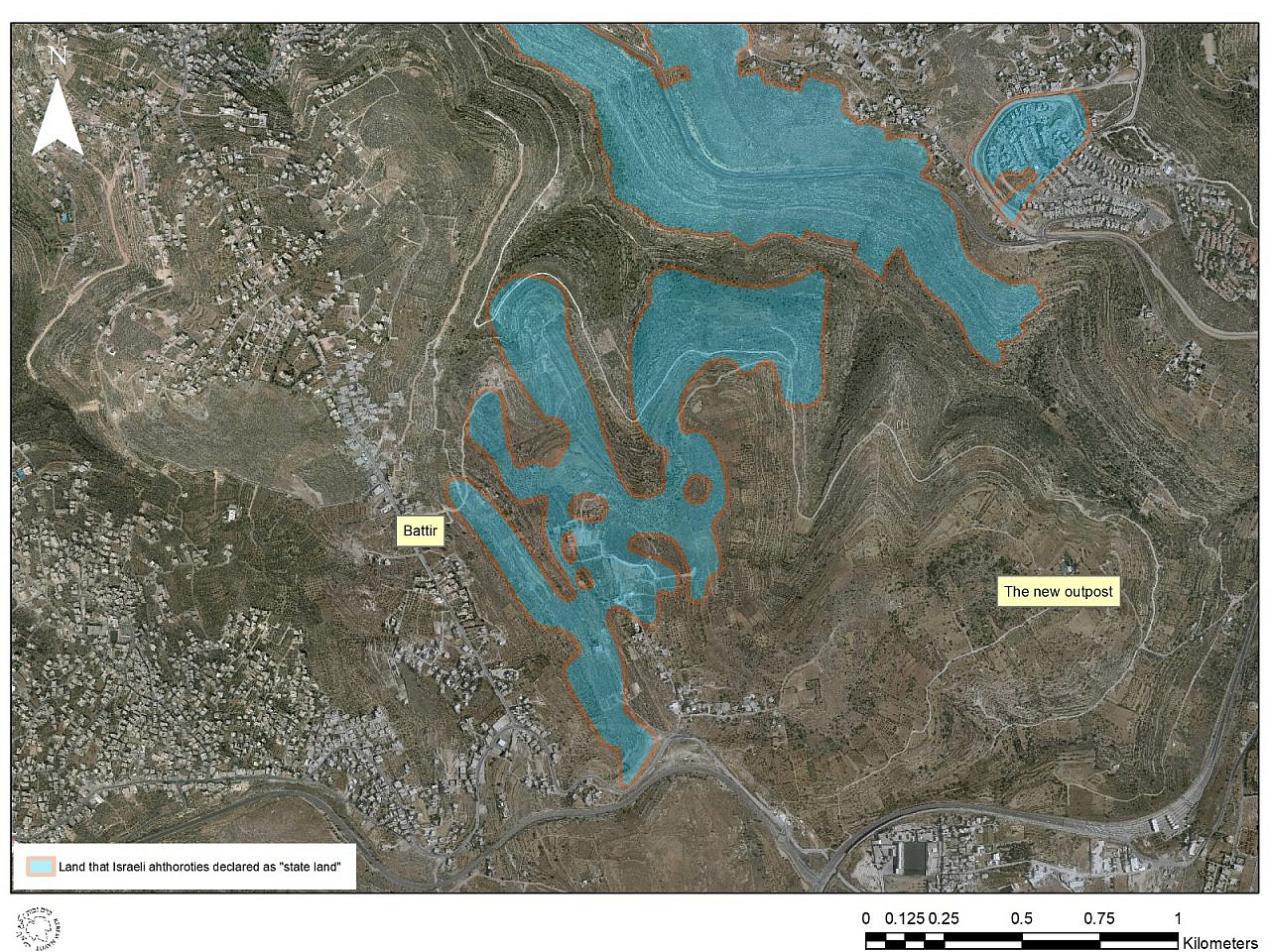
The land was historically a part of the village of Battir and privately owned for generations by the Alyan family (which has an Ottoman-era deed showing their ownership). It was nonetheless declared “state land” by Israel in 1982 under the pretense that the land was not being actively cultivated – despite the fact that the owner of the land, Ghassan Alyan, was only taking a planned break from working that area in order to switch the crops he was growing there. Alyan has repeatedly tried to reclaim the land, but has been prevented from doing so by the Civil Administration.
Palestinians report that a group of eight armed settlers appeared on the land for the first time one month ago, and have since visited the area weekly with the increasingly obvious intent to build an outpost. Last week, a settler named Lior Tal (who told +972 Magazine that “I want all of Battir to go to hell…the State of Israel belongs to the Jewish people”), began knocking on the doors of several homes in Battir demanding that farmers produce documents proving their ownership of the land.
The IDF has responded to reports about the settlers’ armed incursions into Palestinian land, but has failed to remove the settlers and prevent them from returning to the area. Last week, the IDF not only failed to remove the lawbreaking settlers but actually put the weight of the IDF behind in the settlers’ efforts. An IDF soldier told Alyan that he was now forbidden from accessing that land, that the settlers are permitted to be there, and that in order to change the situation Alyan must take his complaints to the Civil Administration and prove his ownership.
Khaled Muammar, a resident of Battir, told +972 about the strategic importance of the land, saying:
“They [the settlers] want to take over this area for three reasons: first of all, because of its elevation; it overlooks the region. Secondly, it separates [Battir from] al-Walajeh; settling there creates a wedge between two Palestinian villages. And thirdly, because it creates geographical continuity between [the Israeli settlement] Har Homa and Jerusalem.”
Settlement expert and founder of Kerem Navot, Dror Etkes, added to the context for the settlers’ actions in Battir:
“Why? Because of the Trump plan. This area, according to the plan, is supposed to be Palestinian territory. They want to take over the area now, before the government signals that it is going to accept the plan. To create facts on the ground.”
Palestinian ecologist Vivien Sansour said:
“The land taken by this settler is Battir’s last room to breathe. People are being forced to emigrate to Bethlehem because they do not allow us to build here.”
The Neve Ori outpost was established in 2019 by Lior Tal, the settler leading the effort against Battir. That outpost also started as a small effort by a handful of settlers who built structures illegally. The Civil Administration told +972 Magazine that it is aware of the outpost and that with respect to dealing with these illegal structures, “on-site enforcement will be carried out in accordance with the authorities and procedures and subject to [the Administration’s] priorities” (based on long experience, demolition of “illegal” Palestinian construction — that is, constuction by Palestinains on their own land, but without Israel’s permission, since it will rarely give permission — is at the top of the Civil Administration’s priorities, while dealing with illegal settler construction is rarely even makes the list).
High Court Demands Evidence that Jerusalem Cable Car Project Will Boost Tourism
One month after the Israeli High Court of Justice heard arguments regarding the State’s plans to build a cable car line in East Jerusalem, the Court has ordered the State to submit a report by September 9th substantiating its claim that the cable car has the potential to be a tourist attraction in the city. According to Emek Shaveh, if the State fails to adequately explain how the cable car will attract tourism, then the Court may invalidate the plan, based on the argument that it was advanced improperly through an expedited planning process reserved for infrastructure projects of national importance.
Emek Shaveh said in a statement:
“This query calls the project’s entire approval process into question. We view the High Court’s demand as an opportunity to approach Minister of Tourism Asaf Zamir about the issue again after he had expressed support for the plan last month. We believe the court’s decision is an opportunity to explain to Zamir that the factual basis for advancing the cable car as a transportation project with touristic value is flimsy at best, and that the cable car project is not a touristic project but a damaging plan which will be highly deleterious to Jerusalem and its landscape.”
As a reminder, the Jerusalem cable car project is an initiative backed by the Elad settler group and advanced by the Israeli Tourism Ministry. Last month, when the High Court heard objections to the plan, the State publicly admitted that the implementation of the cable car project will require the confiscation of privately owned Palestinian land in the Silwan neighborhood of East Jerusalem. The cable car line is slated to terminate at the settler-run Kedem Center compound (Elad’s large tourism center currently under construction at the entrance of the Silwan neighborhood, in the shadows of the Old City’s walls and Al-Aqsa Mosque).
While efforts to “sell” the cable car plan have focused on its supposed role in growing Jerusalem’s tourism industry or serving transportation needs, in reality the purpose of the project is to further entrench settler control in Silwan, via archeology and tourism sites, while simultaneously delegitimizing, dispossessing, and erasing the Palestinian presence there. Emek Shaveh and other non-governmental organizations, including Who Profits and Terrestrial Jerusalem, have repeatedly challenged (and provided evidence to discredit) the government’s contention that the cable car will serve a legitimate transportation need in Jerusalem, and have clearly enumerated the obvious political drivers behind the plan, the archeological heresies it validates, and the severe negative impacts the cable car project will have on Palestinian residents of Silwan.
Bonus Reads
- “European states denounce ‘illegal’ Israeli building plans in Jerusalem area 15 countries and EU again submit protest letter to Fore” (The Times of Israel)
- “They live on West Bank’s only all-girl hilltop, but don’t call them feminists“ (The Times of Israel)
- “Peace Now warns of de facto annexation as E1 planning” (Jerusalem Post)
- “Israel’s Second Coronavirus Wave Stalled Annexation, but Netanyahu Still Wants It” (Haaretz)
Welcome to FMEP’s Weekly Settlement Report, covering everything you need to know about Israeli settlement activity this week.
To subscribe to this report, please click here.
July 3, 2020
- The [Purported] Israeli Counter-Proposal to the Trump Annexation Map
- De Jure Annexation Remains Imminent: Reports Say Trump to Make Final Decision Next Week
- U.S. Said to Ask for Israeli “Gesture” to Palestinians in Order to Approve Annexation Plan
- Settlers Continue Opposition to Trump Plan, While Pushing Bibi to Stop Delaying
- Settler Group Announces New Outpost Near Hebron
- Israeli Court Issues Ruling to Throw Sumreen Family Out of Their House
- Settlers Claim to Have Purchased an Illegally Built Palestinian Home in Wadi Hilweh, Silwan
- Israel Orders Demolition of Illegal Settler Structures Following Reversal of Regulation Law
- State Admits to High Court that Jerusalem Cable Car Project Will Require Confiscating Private Palestinian Land
- New Ir Amim Paper Looks at Jerusalem to Underscore the “Truth About Annexation”
- Bonus Reads
Comments/questions? Contact Kristin McCarthy (kmccarthy@fmep.org)
The [Purported] Israeli Counter-Proposal to the Trump Annexation Map
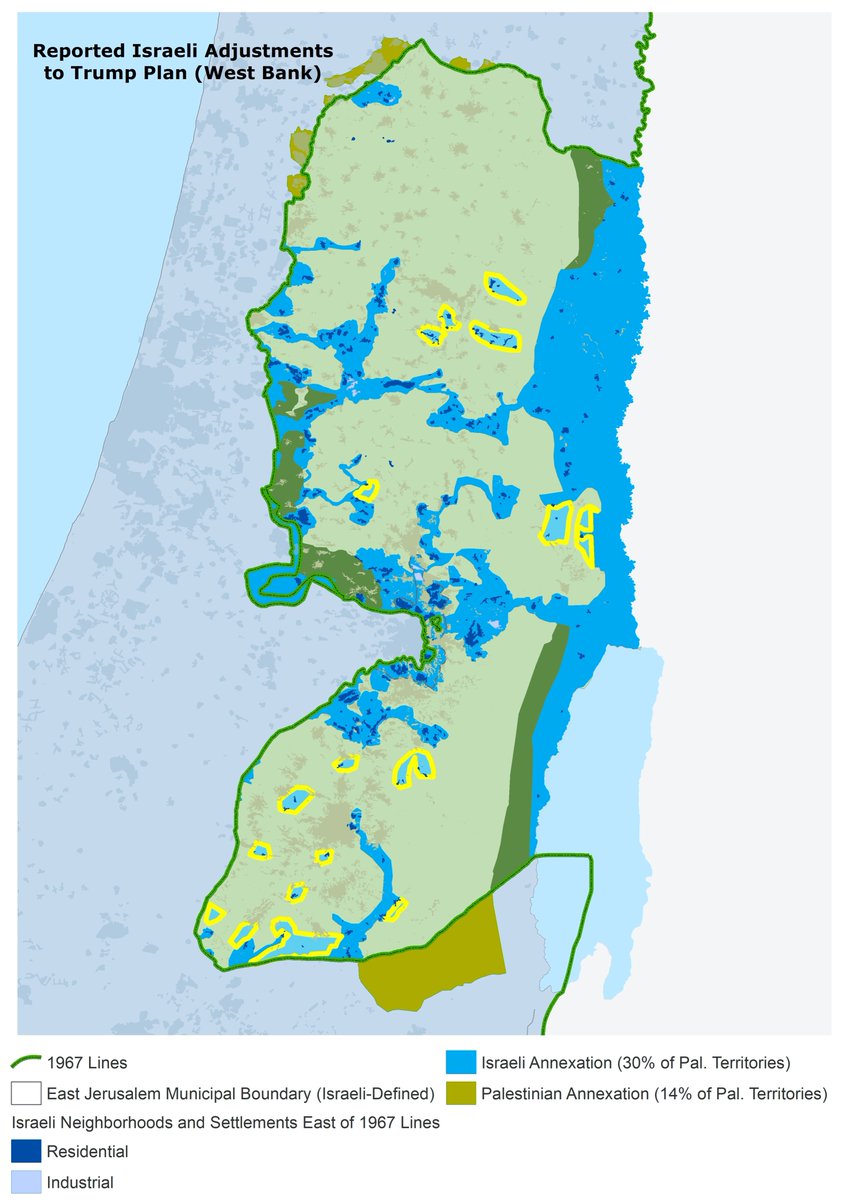 Israel’s Kan News published what it claims to be the Israeli government’s counter-proposal to the Trump annexation map. The reported counter-proposal adds a significant amount of West Bank land to the area Israel will annex, rendering even more severe the fragmentation of any future Palestinian state the plan is supposedly interested in seeing established. Specifically, the counter-proposal (which is exceptionally well explained by Israeli analyst and mapping expert Dan Rothem) achieves four main goals:
- It expands the channels of land which connect 15 far-flung outposts and settlements to what is today sovereign Israel. The Trump map connects these “enclaves” via narrow land corridors and roads (referred to by settlers as “balloons on a string”). The alleged counter-proposal annexes 2.7% more of the West Bank to enlarge those corridors.
- It provides for Israel’s annexation of about 20 additional settlements/outposts left out of the (initial) annexation provided for under the Trump Plan. These include the radical and violent settlement of Yitzhar and its outposts) located near Nablus, as well as the (relatively) nearby settlements Elon Moreh (and its outposts), Har Bracha (and its outposts), and Itamar (and its outposts). All of these settlements/outposts are, notably, located deep in the West Bank heartland.
- It proposes “compensating” Palestinians by designating an additional 4.6% of the West Bank — areas designated under the Trump Plan for Israeli annexation, comprised of West Bank territory where there are no settlers and some empty areas in the Jordan Valley/Judean desert — to (possibly) be under some degree of Palestinian control (without providing details on what would be the status of the land). (Reminder: Netanyahu said he will not annex a single Palestinian).
- The map also appears to propose population transfer, putting parts of the so-called Triangle Area — an area of densely populated towns located within Israel’s sovereign borders, inhabited by Palestinian citizens of Israel — into the area that could theoretically become a Palestinian state (assuming the Palestinians accepted the Trump Plan and satisfied a laundry list of conditions that no Palestinian leadership would ever accept — all to end up with an archipelago of territory that they might be allowed to call a “state” but that would have few if any actual attributes of sovereignty). Reminder: Forcible population transfer is a flagrant violation of international law (as is annexation of any scope); a government re-drawing its borders to deprive its own citizens of their rights, based on their ethnicity, is antithetical to democracy.
Additionally, while Israeli officials originally indicated that annexation would begin with the Jordan Valley, rampant reports indicate that the focus has now shifted to annexing elsewhere (settlement blocs) as the first stage of annexation. Perhaps responding to criticism over delaying the annexation of the Jordan Valley, Israeli Regional Cooperation Minister Ofir Akunis (Likud) told The Jerusalem Post that “of course” the Jordan Valley is included in Israel’s annexation plans [which should surprise nobody, given that politicians across most of the political spectrum in Israel came out in support of annexation of the Jordan Valley (including Benny Gantz), even before the Trump Plan].
So what is Netanyahu really thinking? According to Haaretz, he has not held discussions with his own Security Cabinet on the annexation plan, and the key Israeli bodies which will be involved in implementing annexation – the Justice Ministry, the Attorney General (whom Bibi is in open war with), the IDF chiefs, and Foreign Ministry – have not begun preparing for implementation.
De Jure Annexation Remains Imminent: Reports Say Trump to Make Final Decision Next Week
July 1st – the first day Netanyahu was permitted to bring annexation up for a vote in the Cabinet or in the Knesset, but by no means a deadline for such an action – came and went without an announcement. Reports almost immediately suggested that the annexation decision – reportedly delayed by U.S. demands and Israeli disunity.
After a week of meetings with Israeli leaders, National Security Council advisor Scott Leith and Middle East envoy Avi Berkowitz (who in the meetings were of course joined by US ambassador to Israel David Friedman) headed back to Washington. On Thursday, Berkowitz met with Jared Kushner in preparation for presenting their plan to the President. Despite the palace intrigue surrounding Kushner this week, Kushner plays a critical role in leading Trump a final decision on annexation, expected to come next week..
Though Trump has not been involved in any details of the annexation deliberations, Israeli Regional Cooperation Minister Ofer Akunis asserted that Israel will not act without a statement from Trump himself, telling the Jerusalem Post:
“[annexation] will only happen after a declaration by Trump.”
Following the departure of Leith and Berkowitz (Friedman remained in Israel), an anonymous U.S. official told the Jerusalem Post that the fact that July 1st came and went without an announcement does not mean that annexation is any less likely to happen. That official said:
“The administration is appreciative of the ongoing conversations and serious considerations that have gone into our recent discussions with the Israeli government.July 1 is not and has never been a US deadline, nor do we believe it is an Israeli deadline. We look forward to continuing the dialogue with our Israeli partners and working productively and in earnest towards implementing the president’s Vision for Peace in the Middle East.”
U.S. Said to Ask for Israeli “Gesture” to Palestinians in Order to Approve Annexation Plan
U.S. Amb. David Friedman, National Security Council advisor Scott Leith, and Middle East envoy Avi Berkowitz spent the past week in Israel, negotiating with Israeli Prime Minister Netanyahu and Alternate Prime Minister Gantz over the extent and timing of Israeli annexation of West Bank territory. Israeli press – particularly right-wing outlets – asserted that the Americans were pushing Israel to make a more significant “gesture” to the Palestinians in order to win American support (reminder: the Palestinian leadership has not been involved in negotiations at all).
Reportedly, the US suggested that such a gesture could consist of granting the Palestinian Authority greater control over the remnants of Area C left to the Palestinians after Israeli annexation — with Israel retaining the ability to “secure” those areas as-needed (essentially transforming a small part of Area C land into Area B).
The Jerusalem Post goes so far as to suggest that “many” of the conversations this past week focused on what the Palestinians will be given/offered/forced to accept, rather than the details of what/how/when Israel will annex. More than anything else, this suggests that the U.S. is not imposing limits on what Israel can annex.
Settlers Continue Opposition to Trump Plan, While Pushing Bibi to Stop Delaying
Worried both about the details of the Trump Plan and that Bibi will not pull the trigger on annexation at all, settler leaders and their allies continue their criticism of Netanyahu for every move (and non-move) he makes.
Two prominent settler leaders who oppose the Trump Plan – Yesha Council chairman David Elhayani and Samaria Regional Council chairman Yossi Dagan – continued lashing out at Netanyahu for his posture on issues of key concern to settlers (the creation of settlement enclaves, a settlement construction freeze, and the possibility of future Palestinian statehood) and for failing to act on July 1st. Dagan called the July 1st date “one big farce.”
Elhayani – who estimated that there is an 80% chance that there will be no annexation – told Walla News:
“Tying the lack of sovereignty [announcement] to Benny Gantz is a pathetic excuse..In reality, it is in the hands of the prime minister, who must accept responsibility for the decision, demonstrate leadership and say: ‘I have made this commitment to the electorate in two election campaigns, and I will stand by it’.”
Another group of settlers who are adamantly against the Trump Plan launched a new campaign targeting Netanyahu. The campaign, which was covered in the front page of the Israel Hayom paper, features photos of PA President Mahmoud Abbas, Joint List Parliamentary head MK Ahmed Tibi, and Netanyahu, and alongside the photos uses the slogan:
“They [Abbas and Tibi] will not decide. You’ve [Netanayhu] decided – Keep your promise.”
Another settler group – the Sovereignty Movement – put up billboards all over the country calling on Netanyahu to annex and to say “no” to a Palestinian state.
Former Defense Minister Avigdor Liberman (Yisrael Beytenu) put on a public display of his pointed displeasure with Netanyahu’s failure to advance annexation on July 1st. Visiting a vista overlooking the Palestinian Bedouin village of Khan al-Ahmar in the West Bank – which Netanyahu has long promised to demolish – Lieberman told the press:
“We’re meeting here at Khan al-Akhmar because this is part of the same pattern of behavior. For fourteen months, Netanyahu has been yelling about ‘sovereignty’, and the whole time he’s cheated his voters…Netanyahu has tricked everyone. He has no intention of applying sovereignty: not over Maale Adumim and not even in the Jordan Valley. He always manages to trick everyone, but it was clear to me that he is lying, just as he lied about Khan al-Akhmar.”
Former Justice Minister and Yamina party leader MK Ayelet Shaked told the Jerusalem Post that she believes Bibi has “given up on the Jordan Valley.”
Haaretz reports that settlers – both those who support the Trump Plan and those who want more than what the plan is offering – have been successfully working with U.S. evangelicals to pressure Trump to OK annexation. Netanyahu himself spoke at a high profile online event for Christians United for Israel, and Yossi Dagan was interviewed by the Christian Broadcasting Network. Efrat settlement Mayor Oded Revivi has been in private conversation with U.S. evangelical leaders.
A recent poll by the radical settler group Regavim found that only 30% of settlers supported the Trump Plan after they were told that it will require Israel to agree to the establishment of a Palestinian state. Additionally, 53% of settlers said they believe that Netanyahu will give in to pressure from Trump rather than stand his ground on issues under negotiation.
Settler Group Announces New Outpost Near Hebron
On July 1st, a group of about 500 settlers held a protest against the Trump Plan and announced their plans to establish a new outpost. The protest was held on a hilltop belonging to the Palestinian village of Halhul, near Hebron in the southern West Bank. One of the protests leaders, veteran settler activist Daniella Weiss, told Ynet:
“The Trump plan needs to be thrown in the trash. We came here to establish a settlement. Today everyone understands that the purpose of the plan is to establish a Palestinian state in the heart of Israel.”
Israeli Court Issues Ruling to Throw Sumreen Family Out of Their House
On June 30th, the Jerusalem District Court rejected an appeal by the Palestinian Sumreen family to stop the Jewish National Fund (JNF) from evicting them from the home of 60 years in the Silwan neighborhood of East Jerusalem. The Court gave the 18-member family until August 16th to vacate the property and ordered them to pay 20,000 shekels (about $5,800) to the JNF for legal costs. The Sumreen family is considering taking their case to the Israeli Supreme Court.
The Coalition for the Sumarin Family said in a statement:
“In the ruling, the court did not address the most important, fundamental point, which is that the house was taken in plunder. The JNF’s legal woes did not change the fundamental fact that the use of the Absentees’ Property Law to take over the house was done without good faith, as two government legal advisers and a government inquiry commission, determined”.
The Sumreen family home is located in the middle of what today has been designed by Israel “the City of David National Park.” The area is managed by the radical Elad settler organization, which for years has also been pursuing the eviction of Palestinians from the homes in Silwan. For nearly three decades, the Sumreen family has been forced to battle for legal ownership of their home, after the state of Israel, prompted repeatedly by the JNF, declared the Sumreen’s home to be “absentee” property. After that designation – which was not communicated to the Sumreen family – Israeli law permitted the state to take over the rights to the building. The state then sold the rights to the home to the JNF in 1991. The JNF has pursued the eviction of the Sumreen family ever since. Israeli courts ruled in favor of the Sumreen family’s ownership claims to the home for years, until a September 2019 ruling by the Jerusalem Magistrate’s Court granted ownership of the family’s home to the JNF, a decision the family immediately appealed to the Jerusalem District Court.
A full history of the saga involving the Sumreen family – which is similar to dozens of other Palestinian homes in Silwan that were declared Absentee Property in the 1990s – can be found on the Peace Now website here.
In a recent letter organized by Israeli academics, thirty-four Israel Prize laureates pleaded to the head of the JNF to stop eviction proceedings against the Sumreen family. The letter reads:
“The expulsion of the family, as part of a campaign to Judaize Silwan which has been going on for many years, will stain the reputation of the KKL … we beg of you to desist from taking actions that would be clearly immoral.”
This week, +972 Magazine published an illuminating article by a former staff member of the JNF, looking at the role the organization has played in advancing annexation policies on the ground for decades with evictions like the Sumreen case. IMEU also just published an excellent fact sheet about the Jewish National Fund.
Settlers Claim to Have Purchased an Illegally Built Palestinian Home in Wadi Hilweh, Silwan
On June 30th, a group of settlers invaded a vacant building in the Wadi Hilweh section of the Silwan neighborhood in East Jerusalem, saying that they had purchased the house from its Palestinian owners. Peace Now reports that the home was built by Palestinians years ago without an Israeli-issued permit (Palestinians in East Jerusalem are systematically denied permits to build on their own land). The family that had been living in the house left about four months ago after a demolition order was issued by the Jerusalem Municipality. 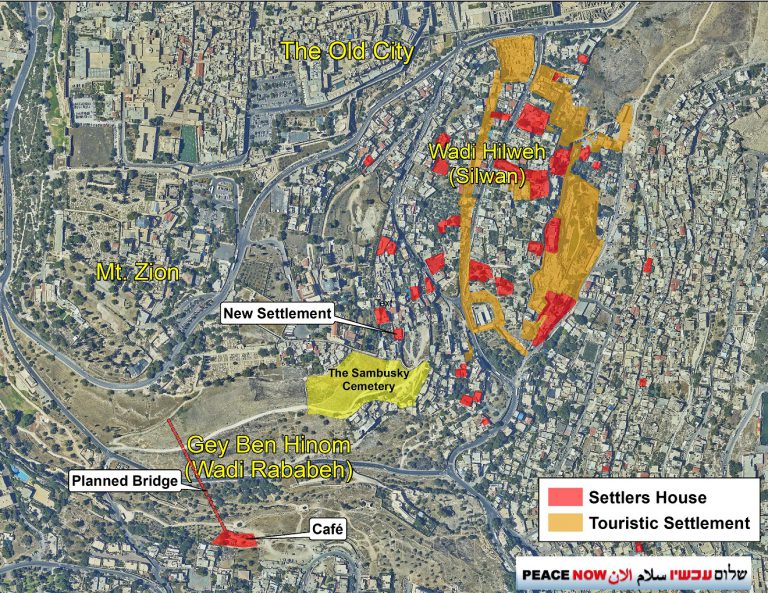
The house is located in the Ben Himmon Valley and very close to a Jewish cemetery that is currently being rehabilitated by the radical Elad settler organization. Elad has been involved in the systematic displacement of Palestinians from the Silwan neighborhood and has been weaponizing tourism and archaeology as a means by which to do so.
Peace Now explains:
“In recent years, the Elad Association, together with the Jerusalem Development Authority and the Nature and Parks Authority, has been intensively developing the Ben Hinnom Valley area leading to the Sambusky Cemetery in an attempt to produce Israeli territorial contiguity from the Sultan’s Pool area and Ben Hinnom Valley area through the cemetery toward Wadi Hilweh and the ‘City of David’ visitors’ center…The takeover of this house extends the settlers’ control in the southwest corner of Wadi Hilweh: In September 2014, the settlers entered a nearby house, and in January 2016 another house adjacent to it…All of these projects, along with the settlers entering the house yesterday, are intended to strengthen Israeli presence in this contested and occupied area, and thus make it more difficult for the territorial compromise in Jerusalem needed for a Palestinian capital in East Jerusalem and therefore the two-state solution itself. Tourism development projects in Jerusalem are one of the most significant ways of settlement, leading to both a change on the ground and in the public domain, as well as a change in Israeli attitudes by hardening them to the idea of this necessary territorial compromise.”
Israel Orders Demolition of Illegal Settler Structures Following Reversal of Regulation Law
In response to a petition filed by Yesh Din and Emek Shaveh, Israel has said it will demolish illegally built settlement structures on privately owned Palestinian land belonging to the villages of Dir Amar and Ras Karakar. Years ago settlers illegally installed tourist accommodations – benches, terraces, paths, picnic benches and a pergola – at the site of an ancient spring in this area, in an attempt to take control of the site known as Nabi Aner. Nabi Aner is part of an historic Muslim pilgrimage route between Hebron and Bethlehem. The entire area is located in Area C of the West Bank.
Israel’s announcement that it will demolish the structures (and, ostensibly, agree to return the site to Palestinian control), comes two weeks after the Israeli High Court of Justice overturned the Regulation Law, which sought to provide a basis for legalizing settlement structures built on land that even Israeli acknowledges is owned by Palestinians (as is the case with the site in question). The petition to demolish the settlers’ construction was filed in 2017, but was not considered by the Court until now, based on the argument that the Regulation Law – if it withstood Court scrutiny — might have provided the State a basis for retroactively legalizing the structures.
Emek Shaveh said in a statement:
“Over the years, the authorities in the area have refrained from enforcing the law with respect to illegal construction that was carried out on private land and around the archaeological site. In recent years, the State used the pretext of the Regularization Law as an excuse for continuing the policy of non-enforcement. This is an example of the importance of the nullification of the Regularization Law, which enabled settlers to take over private lands. But regardless of the Regularization Law and its nullification, we find it regrettable that we were forced to petition the court to instruct the State’s enforcement authorities to simply carry out their duties and prevent the settlers from illegally building on private Palestinian land. We regret that the State does not of its own accord enforce the law and stop the damage to archaeological sites and the process of severing Palestinians from access to their cultural and religious roots.”
State Admits to High Court that Jerusalem Cable Car Project Will Require Confiscating Private Palestinian Land
On June 29th, the Israeli High Court of Justice heard arguments concerning the Jerusalem cable car project, an initiative backed by the Elad settler group and advanced by the Israeli Tourism Ministry. During the hearing, the State admitted the implementation of the cable car project will require the confiscation of privately owned Palestinian land in the Silwan neighborhood of East Jerusalem. The cable car line is slated to terminate at the settler-run Kedem Center compound (Elad’s large tourism center currently under construction at the entrance of the Silwan neighborhood, in the shadows of the Old City’s walls and Al-Aqsa Mosque).
The cable car plan, touted by Elad and other supporters as a vital transportation project, is in reality intended to further entrench settler control in Silwan, via archeology and tourism sites, while simultaneously delegitimizing, dispossessing, and erasing the Palestinian presence there. Emek Shaveh and other non-governmental organizations, including Who Profits and Terrestrial Jerusalem, have repeatedly challenged (and provided evidence to discredit) the government’s contention that the cable car will serve a legitimate transportation need in Jerusalem, and have clearly enumerated the obvious political drivers behind the plan, the archeological heresies it validates, and the severe negative impacts the cable car project will have on Palestinian residents of Silwan.
New Ir Amim Paper Looks at Jerusalem to Underscore the “Truth About Annexation”
In a new policy paper, Ir Amim looks at how Israel’s annexation of East Jerusalem has played out since 1967. Ir Amim’s main points – and warnings regarding Israel’s imminent annexation of more West Bank land – are:
- Israel annexing Palestinian land, but not Palestinian people, who since 1967 have been classified as “permanent residents,” rather than being made citizens, like the Palestinians who remained inside the Green Line after 1948.;
- Since the moment of annexation of East Jerusalem, Israel has pursued policies meant limit the number of Palestinains in the area, including by driving Palestinians from East Jerusalem;
- Since the moment of annexation, Israel has attempted to take control of more and more land in East Jerusalem;
- The Absentees’ Property Law (1950) and The Law and Administration Ordinance (1970) have been Israel’s tools of choice to evict Palestinians from their homes and take their property in East Jerusalem, under the guise of legality;
- Israel has repeatedly attempted to expand the borders of the area it annexed to include nearby settlements.
Ir Amim writes:
“In order to understand the consequences of annexation it is pertinent to learn from the case of East Jerusalem which Israel unilaterally – and in contravention of international law – annexed. Since 1967 East Jerusalem has been subject to the Jerusalem municipality and to Israeli law. In the decades since 1967, Israeli policy in the city has been driven by massive settlement construction and consistent steps to reduce the city’s Palestinian population. The combination of these two methods is considered by Israel the key to solidifying its control over the annexed territory and to asserting its sovereignty. Examining Israeli policies in East Jerusalem can therefore teach us the dangers of what can take place if the current annexation plan of the Israeli government actually takes place.”
Bonus Reads
- “Annexation is Already Here” (Jessica Montell // The Times of Israel)
- “Fight Annexation on Moral Grounds” (Yehuda Shaul // Haaretz)
- “Quick Facts: Israel’s West Bank Settlement Enterprise” (IMEU)
- “Despite Talk of Annexation, Fewer Immigrants to Israel Moving to West Bank Settlements” (Haaretz)
- “Quick Facts: What is the Jewish National Fund” (IMEU)
Welcome to FMEP’s Weekly Settlement Report, covering everything you need to know about Israeli settlement activity this week.
To subscribe to this report, please click here.
June 26, 2020
- Netanyahu Talks to Jordan, Gantz (Finally) Lays Out a Position
- Trump Advisors Meeting in Washington on Annexation Ends Without Decision
- Bibi Provides Likud With Talking Points on Annexation, Says Settlements Cannot Ever Be Evacuated
- Court Approves Sale of Church Properties in Old City of Jerusalem to Radical Settler Org
- Israel Delivers Eviction Orders to Palestinian Businessowners Despite Claims Palestinians Have Consented to the “Silicon Wadi” Project
- Israel is Expanding Settler-Only Bypass Road Near Bethlehem, Cutting Palestinians Off from Land
- Plans for Controversial New Settlement Industrial Zone Near Beitar Illit Are Poised for Final Approval
- High Court Set to Hear Petition Against Cable Car
- Emek Shaveh Submits Petition Against Settler-Backed “Accessibility” Project for the Ibrahimi Mosque/Tomb of the Patriarchs
- Weaponizing Archaeology as a Means of Dispossessing Palestinians
- Democrats Oppose Annexation But Don’t Threaten Consequences; Republicans Lawmakers Offer Support for Annexation
- Bonus Reads
Comments/questions? Contact Kristin McCarthy (kmccarthy@fmep.org)
Netanyahu Talks to Jordan, Gantz (Finally) Lays Out a Position
According to an anonymous Palestinian official, Israel delivered a message to Jordan’s King Abdullah (who then passed it on to Abbas) that Netanyahu is planning to announce annexation of two or three “settlement blocs” as Israel’s initial annexation move, and this announcement will not include annexation of the Jordan Valley. The report provided no details about which “blocs” will be annexed, or how they will be defined. As a reminder, “blocs” is an informal and elastic term that Israel has used to define ever- expanding areas of the West Bank as territory that it will keep.
The reports come after days of suggestions that the U.S. and Netanyahu are favoring a phased annexation plan, meaning that whatever “limited” annexation Israel announces on July 1st (or, more likely, after July 1st), it will be just the first in a wave of annexation announcements, and the fact that it may be “limited” (compared to other options) in no way will signal that Netanyahu has changed his grander ambition to annex every inch of land allowed under Trump Plan. The Trump Plan green lights annexation of around 30% of the West Bank as a starting point, with an implicit green light for further annexation if the Palestinians refuse to negotiate with Israel over the fate of the remaining West Bank territory.
Gantz posted a message on his Facebook page on Friday, June 26th in what some are viewing as an effort to clarify his own position on annexation, which so far has been inconsistent, ambiguous, and confusing. Gantz’s five key positions on annexation according to the new Facebook post are:
- No annexation of areas where there is a “significant” Palestinian population;
- No annexation of land that will impair Palestinians’ freedom of movement;
- Palestinian living in areas annexed by Israel will be given equal rights;
- Israel’s security as well as its existing peace agreements will be safeguarded;
- Israel will initiate “bilateral moves with the Palestinians.”
It was reported earlier this week that Prime Minister Netanyahu presented an ultimatum to Gantz in private deliberations, seeking to force Gantz to choose between supporting annexation or a new round of elections (recent polls suggest new elections would deliver a landslide victory for Netanyahu — no surprise given the fact that in joining the Netanyahu government, Gantz eviscerated Netanyahu’s main opposition party).
Up to this point, Blue & White party leaders Gantz and Ashkenazi have opposed wide-scale, unilateral annexation on July 1st – instead offering a vision for a phased annexation plan, starting with large settlement blocs, that is coordinated with key international players. Perhaps fulfilling Gantz’s demands, the reports regarding Israel’s message to Jordan propose a more limited initial annexation plan, suggesting perhaps that Netanyahu has adopted two of Gantz’s main positions. It’s also worth recalling that last week Gantz and his party mate Ashkenazi were pushing a phased annexation plan and specified that the Ma’ale Adumim and the Etzion settlement blocs (east and south of Jerusalem) are the place to start.
Even before word of the Jordan communique and Gantz’s Facebook message hit the press on June 26th, it was a near consensus position amongst Israeli news outlets and analysts that Gantz was not going to stand in the way of annexation. On June 22nd, Gantz reportedly told a group of defense officials that Israel “won’t keep waiting for the Palestinians” to engage in negotiations on the basis of the Trump Plan. Those remarks were interpreted as a signal of Gantz’s acquiescence to Netanyahu’s annexation plan (or at least of his growing disinterest in even appearing to oppose it). In the same set of remarks, Gantz went on to blame the Palestinians in even more harsh language, saying they are attempting to drag Israel into “deep shit.” Haaretz suggests, “…Gantz’s tone and his actual comments confirm the assumption that there will be no life-and-death battle here. Gantz knows that the final decision is not up to him, but rather up to Netanyahu.” In a separate article, Haaretz columnist Noa Landau put it this way: “[Gantz’s] remarks [on June 22nd] sounded more like a threat against the Palestinians for refusing to extricate him from this mess.”
Trump Advisors Meeting in Washington on Annexation Ends Without Decision
Internal Israeli negotiations set a dramatic stage for 3 days of discussions this week in Washington between the Trump Administration officials who are the architects and managers of the Trump Plan, as the reportedly sought to come to agreement over what form of annexation the Trump Administration will green light for July 1. Multiple reports in the days leading up to the U.S. deliberations suggested that the group was considering options ranging from a “gradual” annexation plan starting with large settlements around Jerusalem, to a more large-scale and immediate plan. At the end of the week, the Americans reportedly failed to reach a decision on how they would want to see Israel’s annexation of West Bank land to proceed. Three members of the team, Avi Berkowitz and NSA Advisor Scott Leith, and Amb. Friedman – are reportedly en route back to Israel and will continue discussions with Netanyahu. Notably, in parallel to the Washington meetings, reports emerged suggesting that Netanyahu’s annexation announcement may be delayed and that July 1st might mark the start of Israeli security cabinet deliberations over annexation (to this point deliberations have been between Netanyahu and Gantz without wider input from cabinet members).
Amb. David Friedman (who flew to back to DC for the meeting) was joined by Secretary of State Mike Pompeo, senior advisor Jared Kushner, Middle East envoy Avi Berkowitz, and national security advisor Robert O’Brien for deliberations starting on June 23rd.
Bibi Provides Likud With Talking Points on Annexation, Says Settlements Cannot Ever Be Evacuated
Netanyahu sent a memo to Likud lawmakers this week laying out key talking points in the ongoing effort to defend annexation, in which he argues that evacuating settlement poses an “immediate existential threat” to Israel. The memo says:
“Relinquishing these territories would not only constitute a historic injustice; such a move would create an immediate existential threat to the Jewish state since Judea and Samaria border central Israeli cities.”
The memo also adopts a U.S. talking point that annexation in fact advances the cause of peace, but instead of giving any nod to a future Palestinian state or two state solution, Bibi’s memo claims that annexing West Bank settlements can provide for “to a realistic regional peace based upon facts on the ground.” This double speak (annexation is peace) was prominently articulated by Ron Dermer in a recent Washington Post op-ed.
Court Approves Sale of Church Properties in Old City of Jerusalem to Radical Settler Org
On June 24th, the Jerusalem District Court rejected a final request filed by the Greek Orthodox Patriarchate to block the sale of its historic church properties to the radical settler group Ateret Cohanim. The Court’s ruling brings an end to 16 years of litigation and paves the way for Ateret Cohanim to evict Palestinian tenants and businessowners from three coveted church properties in the Old City including the Petra Hotel and the Imperial Hotel (together, the buildings flank the Jaffa Gate entrance into the Old City – meaning that Ateret Cohanim now controls a substantial amount of land at a key entrance to the Old City). The third building – known to Palestinians as Beit Amziya – is located in the Muslim Quarter.
The ruling comes just four months after the Jerusalem District Court appointed a lawyer associated with Ateret Cohanim as the legal custodian of the Petra Hotel for the duration of a bankruptcy case against the Palestinians currently operating the hotel.
The legal battle over the properties dates back to 2004, when the Greek Orthodox Patriarchate agreed to sell the three properties to a foreign real estate company under three separate contracts. It did so not knowing that the radical settler group Ateret Cohanim was behind the transaction. News of the sales made headlines in early 2005.
Upon the revelation that Ateret Cohanim was the real buyer, the Greek Orthodox Patriarchate was deeply embarrassed and immediately sought to retain control of the properties. The Patriarchate alleged that the transactions involved corruption and bribery, arguing that the legal documents had been signed without permission by a finance employee. Dismissing the church’s arguments, this week the Supreme Court upheld prior rulings that the signatures on the legal documents were valid, with the finance employee acting as a legal proxy of the Patriarchate.
The Greek Orthodox Church has received significant blowback from the sale of these properties. In January 2018, Palestinians protested in Bethlehem in an attempt to block the arrival of Patriarch Theophilos III for Christmas celebrations.
Israel Delivers Eviction Orders to Palestinian Businessowners Despite Claims Palestinians Have Consented to the “Silicon Wadi” Project
Middle East Eye reports that the “Silicon Wadi” project (as reported on by FMEP on June 5th) is being discussed by the Jerusalem District Committee but has not yet reached the stage of being deposited for public review. According to one Palestinian business owner who faces eviction under the plan, the District Committee required the Jerusalem Municipality to notify the owners and renters of the buildings that will be demolished to make way for the new construction. Last week, the Municipality delivered that notification to renters in the form of eviction orders, saying that the businesses were operating in violation of Israeli regulations (i.e., illegally, even though the businesses have been there – and paying taxes to Israel – for decades). The orders give businesses 6 months to vacate.
One Palestinian businessowner, Mahmoud al-Kurd, told Middle East Eye:
“I will stay here to the last moment. This profession is my passion. In this old space I managed to achieve my successes. It is enough that the soul of my deceased father roams around me here – he is the one who rented this store decades ago and passed on his means of sustenance to us. I refuse to be an employee of a Jewish broker if we were transferred to work in the Israeli industrial areas.”
The Jerusalem Municipality – which claims that this project has the support and consent of Palestinians – also claims that it is looking into options for compensating business owners (mostly auto mechanics) who will lose their garages.
Israel is Expanding Settler-Only Bypass Road Near Bethlehem, Cutting Palestinians Off from Land
The Palestinian news outlet Wafa reports that Israel has begun work on expanding a settler-only bypass road just west of Bethlehem.The road is reportedly being expanded and widened on Palestinian land belonging to the Nahalin village; construction of the new road segment and widening the existing road will cut off Palestinians from 741 acres (3,000 dunams) of their land.
The road serves to directly connect the Beitar Illit settlement to the Modiin Illit settlement, both of which are a part of the so-called “Etzion Bloc.” The construction goes to show that the settlement “Blocs” – around which some suggest there is a “consensus” that Israel will retain them in any future deal with the Palestinians, and others suggest Israel can annex without controvery – are a pretext for a continuing campaign of dispossession, discrimination, and human rights abuses against neighboring Palestinians. For a deep dive into the highly consequential acceptance/normalization of the “settlement bloc” framing, see here.
Plans for Controversial New Settlement Industrial Zone Near Beitar Illit Are Poised for Final Approval
Al Monitor reports that plans for the construction of a new settlement industrial zone near the Beitar Illit settlement in the southern West Bank are ready to be submitted for final approval from the Civil Administration. Environmental activists say the new zone will pollute and possibly destroy the underground water sources feeding the terraced hills of Battir, a UNESCO World Heritage site.
The plan for the new zone – which will include offices, shops, sports facilities, public buildings, and a cemetery – was initiated in 2018 at the insistence of Israel’s former Interior Minister Aryeh Deri. Palestinians claim that plans for the zone include construction on privately owned Palestinian land.
Gidon Bromberg, Executive Director of EcoPeace, told Al-Monitor:
“Planning maps clearly show that the industrial estate would indeed cover much of the buffer zone of the World Heritage site as well as touch the core area itself.”
High Court Set to Hear Petition Against Cable Car
The Israeli NGO Emek Shaveh reports that the Israeli High Court of Justice will take up the case of the Jerusalem cable car project on June 29th. The court will consider three arguments made in a petition filed against the plan submitted by Emek Shaveh and leading experts. Those arguments are:
- “A transitional government is not authorized to make an irreversible decision such as approval of the cable car project: The cable car project will cost the public hundreds of millions of shekels. During a period when the government is carrying out a broad cut in the budget of billions of shekels and is reducing the budgets for health and welfare, it is inappropriate that a transitional government leaves a bequest of this magnitude for the next government to inherit. In the response of the Deputy Attorney General, Att. Othman Roslan, to the petition, while arguing that the process was not in conflict with the law, he did not conceal the fact that the it was problematic. [See FMEP’s coverage of the Israeli government’s approval of the plan in November 2019]
- “There was a serious flaw in the planning process in that the Ministry of Transportation was not included in the project that purports to be a transportation project: While the project is represented as a transport project, the Ministry of Transportation was not included in the process and the project was not required to meet the standards set forth for transportation projects in the State of Israel. Instead it was approved on the basis of reports and data less comprehensive than those required for every other transportation project.
- “The decision was made on the basis of misleading simulations: The backers of the plan did not present complete simulations that accurately illustrate the cable cars in motion and the resulting damage to the historic landscape. The National Infrastructure Committee should have demanded that the backers present simulations that illustrate the actual cars in motion.”
The Jerusalem cable car project is an initiative of the Elad settler organization (which is building a massive tourism center – the Kedem Center – in the Silwan neighborhood of East Jerusalem, slated to be a stop along the cable car’s route). The scheme is intended to further entrench settler control in Silwan, via archeology and tourism sites, while simultaneously delegitimizing, dispossessing, and erasing the Palestinian presence there. Non-governmental organizations including Emek Shaveh, Who Profits, and Terrestrial Jerusalem have repeatedly challenged (and provided evidence to discredit) the government’s contention that the cable car will serve a legitimate transportation need in Jerusalem, and have clearly enumerated the obvious political drivers behind the plan, the archeological heresies it validates, and the severe impacts the cable car project will have on Palestinian residents of Silwan.
Emek Shaveh Submits Petition Against Settler-Backed “Accessibility” Project for the Ibrahimi Mosque/Tomb of the Patriarchs
On June 18th, Emek Shaveh and Palestinian residents of Hebron jointly submitted a petition challenging Israel’s issuance of a permit to build an elevator to the Ibrahimi Mosque/Tomb of the Patriarchs, arguing that:
- “The plan was illegally approved by a transitional government;
- “The plan is in contravention of international agreements to which Israel is a signatory;
- “[The plan] is an unprecedented injury to the character of the ancient structure; No documentation and preservation file has been submitted.”
One signatory on the petition is a disabled Palestinian, Kamal Abadin, who makes the salient point that Israel’s policies in Hebron do not indicate it has concern for accessibility, saying:
“I almost do not come to pray at the mosque because as a Palestinian, I am not permitted to drive in my car from my house to the site, because the road is closed to Palestinian vehicles. If Israel asserts that it wants to make the site accessible to the disabled, let it start with allowing disabled Palestinians to access it by car.”
Emek Shaveh explained in a statement:
“Unfortunately, even at the price of damage to a structure more than 2,000 years old that is holy to Judaism and Islam, Israel is prepared to be led by the settlers and their plans, and on the way, to violate international agreements to which it is a signatory. The settlers have succeeded in turning the needs of persons with disabilities into a political issue and a means for deepening the dispute with the Palestinians. We all know that what begins in Hebron does not stay only in Hebron and the unilateral steps at the Tomb of the Patriarchs could serve as a precedent for unilateral actions at another site which is holy to both Judaism and Islam.”
Weaponizing Archaeology as a Means of Dispossessing Palestinians
A settler group which sprung from the radical Regavim organization has sharpened a new bureaucratic weapon by which to advance the dispossession of Palestinians. The settler group – called Shomrim Al Hanetzach (“Guarding Eternity”) – has been surveying areas in the West Bank that Israel has designated as archeaological sites in order to call in Israeli authorities to demolish Palestinian construction in these areas. In 2017, it should be noted, Israel declared 1,000 new archaeological sites in Area C of the West Bank. The group communicates its findings to the Archaeology Unit in the Israeli Civil Administration (the military body by which the government of Israel regulates all planning and building in the West Bank). The Archaeology Unit, playing its part, then delivers eviction and demolition orders against Palestinians, claiming that the structures damage antiquities in the area.
In addition, in 2019 the Israeli government increased the size of the Archaeology Unit’s staff and granted the unit new authority to carry out investigations into cases of construction on archaeological sites. Moreover, using new powers the Civil Administration gave itself (via a military order) in June 2017, the Israeli goverment has accelerated the demolition of Palestinian buildings by drastically limiting the time period during which Palestinians are permitted to challenge demolition orders. Palestinians have a mere 96 hours after receiving the notice to file a legal challenge.
As a result, there has been a sharp rise in the number of archaeology-related demolition orders over the past year: Israel issued 118 demolition order and warnings against Palestinian structures built on West Bank archaeological sites in 2019, compared to 61 orders in 2018 and 45 orders in 2017.
The Director of Shomrim Al Hanetzach told Haaretz:
“We took it upon ourselves to make the supervision process more efficient – hiking guides and archaeologists turn to us and tell us about the destruction of antiquities, and we report them further to the necessary people.”
In the case of one Palestinian, Mahmoud Bisharat, he says that Israel conducted an archaeological survey of the area in 1972 but never complained about Palestinian construction in the area until now. The Civil Administration ordered Bisharat to demolish his home, olive trees, well, and concrete structures around a well.
In addition to hiking and surveying Palestinian land, Palestinians have reported that Regavim activists also use drones to photograph their land and buildings, and have made the connection between those activities to demolition orders from the Civil Administration.
Democrats Oppose Annexation But Don’t Threaten Consequences; Republicans Lawmakers Offer Support for Annexation
In warring moves this week, Republicans and Democrats staked out positions on Israel’s forthcoming annexation of land in the West Bank.
189 of 233 Democrats in the House signed a letter sent to Netanyahu and Gantz expressing deep concern about annexation, saying it does not serve Israeli security interests nor the peace process. The letter, notably, does not contain any threat of consequences should Israel implement annexation. J Street is reportedly behind drafting and circulating the letters for signatures.
116 out of 198 Republicans in the House signed a letter sent to Prime Minister Nentanyahu expressing support for Israel’s “right to sovereignty and defensible borders.” The letter also praises the Trump Plan. The Republic Jewish Committee is reportedly behind drafting and circulating the letter for signatures.
7 out of 53 Republicans in the Senate signed a letter to President Trump led by Senators Cotton (R-AR) and Cruz (R-TX) that is not only supportive of annexation, but actually encourage Israel to implement annexation.
Back in May, 18 out of 47 Democrats/Independents in the Senate sent a letter to Netanyahu and Gantz cautioning them against annexation.
Bonus Reads
- “How settler groups could use annexation to deepen Palestinian dispossession” (+972 Magazine)
- “Israel’s High Court Is Willfully Blind to Theft of Palestinian Land” (Haaretz)
- “Israel’s ‘strangling’ of Bethlehem tightens as world debates annexation” (+972 Magazine)
- “Settlers Assault Palestinians on Their Own Land, as Israeli Soldiers Watch” (Haaretz)
- “For Netanyahu, Annexation May Spell Little Gain, and Lots of Pain“ (Haaretz)
Welcome to FMEP’s Weekly Settlement Report, covering everything you need to know about Israeli settlement activity this week.
To subscribe to this report, please click here.
June 19, 2020
- High Court Overturns Settlement Regulation Law
- Israel Starts Construction on Major New Settler Bypass Road in East Jerusalem
- Israel Announces New Opening Date for Givat Hamatos Settlement Tender
- Top Court Orders Israel to Explain Failure to Enforce Building Laws in West Bank
- Israel Government Pauses Settler-Backed Excavation in Silwan, Tacitly Acknowledging Impacts on Palestinian Residents
- Israel Demolishes Structures in Two Outposts, Arrests 13 Settlers
- Israel Continues Prepping for Annexation
- With New Phased Plan, Netanyahu Said to Be Ready to Implement Annexation With or Without Gantz’s Support
- Gantz Suggests Annexing Two Large “Consensus” Settlement Areas First
- Amb. David Friedman Tries, Fails to Broker Annexation Agreement Between Israeli Leaders
- Settlers Continue Opposing Key Parts of Trump Plan, But Offer Support for Phased Approach
- “Hilltop Youth” Launch Campaign to Stop Trump Plan, Claim Land in Area A of West Bank
- Settler Group Raises Concern for the Fate of West Bank Religious Sites Under the Trump Plan
- Bonus Reads
Comments/questions? Contact Kristin McCarthy (kmccarthy@fmep.org)
High Court Overturns Settlement Regulation Law
In a ruling issued on June 9th, the Israeli High Court of Justice overturned the Regulation Law, which was passed by the Israeli Knesset in February 2017 in order to create a legal basis to allow Israel to retroactively legalize outposts and settlement structures which had been built on land that Israel acknowledges is privately owned by Palestinians. In overturning the law, the Court found:
- The Knesset cannot legislate directly over the West Bank. The Court’s ruling acknowledged that the West Bank is a region under “belligerent occupation,” where the norm for 53 years has been that the Israeli military commander is the temporary, de facto sovereign authority, not the Knesset. The Regulation Law violates this norm.
- Palestinians living in the West Bank have the special status as “protected persons” living under “belligerent occupation,” and Israeli settlers do not enjoy the same status (i.e., settlers are not part of the “local population” of the West Bank). This particular statement overturns a previous opinion issued by former High Court judge Salim Joubran in 2017, which said settlers can be considered part of the local population — an opinion which had far-reaching implications for Israel’s rule over the West Bank.
- The law violates the right to property and the right to equality, because it only provided a basis for the confiscation of Palestinian land for Israeli use, but not vice versa.
- The law does not serve a legitimate purpose. On this point, Peace Now writes: “Most purposes presented by the state for why expropriating Palestinian private land was allowed were deemed illegitimate [by the Court]. Only one was not categorically rejected: preventing harm to the settlers, who would have to leave their houses. In this case, the Court pointed out that there are other ways to mitigate this unfairness (compensation with money and housing), and that it is not proportional to just continue using someone else’s land. “
In a joint statement following the ruling, Peace Now, Yesh Din and ACRI say:
“The Regulation Law was a black mark on the Israeli Knesset and on Israeli democracy, and the High Court of Justice has ruled the obvious: thou shalt not steal. We are proud that we served as the responsible adult that fought tirelessly to stop it. It was our duty to prevent the harm it threatened to Palestinians living under occupation, as well as to the prospects of peace. The law was of a criminal nature, designed to retroactively legalize thievery and allow systematic plundering of land. We have curbed this unsuccessful attempt to expropriate private land of a people, living under occupation by a government they did not choose, for the benefit of new settlements aimed at fragmenting the West Bank. Although the Court avoided ruling on whether the Knesset has jurisdiction to legislate over the Occupied Territories, it deemed that such legislation is problematic (to say the least). This raises a red flag to the peddlers of annexation. Let it be clear: If the Government of Israel goes ahead with its plan to annex, it will authorize the harsh damages the High Court sought to prevent by revoking this law.”
B’Tselem said:
“All lands in the West Bank are Palestinian, and even after today’s HCJ (High Court of Justice) ruling Israel will continue to take over more and more Palestinian land. This reality of ongoing land theft by the State of Israel does not fundamentally change today, nor does it diminish the Israeli HCJ’s role in legitimizing it over the years.”
Though the High Court’s ruling this week is a positive development, the state’s need for the Regulation Law has entirely been overtaken by events – possible annexation being one, and the “market regulation” principle being another.
Annexation (i.e., under Israeli law, transforming land held under “belligerent occupation” into part of the sovereign state of Israel) would likely render moot two of the key arguments cited by the Court in overturning the Regulation Law. Specifically, after annexation, the Court would likely accede both to the Knesset’s right to legislate directly over West Bank land that is annexed, and to the argument that Palestinians living in these areas enjoy no special protected status. Israel would still need to find or create a legal basis to justify confiscating privately owned Palestinian land annexed by Israel (whether to legalize Israeli construction or to justify taking land from Palestinian landowers who reside beyond the line of annexation).
Whether or not annexation proceeds, Israel has already found and begun implementing an alternative legal tactic to grant retroactively legalization to outposts and settlement structures bult on privately owned Palestinian land. Attorney General Avichai Mandleblit – who opposed the Regulation Law’s legal reasoning, but not its objective – has succeeded in charting out that alternative course via what has been called the “Market Regulation principle.” Mandleblit argues that this principle is “a more proportionate and balanced measure than the arrangement prescribed in the Regulation Law,” providing a narrower legal basis by which Israel can strip Palestinian landowners of their rights (Peace Now estimates that 2,000 structures can be legalized under the “market regulation principle,” compared to 4,000 under the Regulation Law). Of course, this argument overlooks the severe violation of Palestinian rights, the rule of law, and international law inherent in Israel’s decision to in effect erase Palestinian private property rights in the occupied territory to benefit the settlers.
Lastly, it is important to remember that there is a concerted effort being waged against the High Court by Netanyahu and a constellation of his friends and enemies on the political right. For years, right-wing lawmakers have accused the Court of being a leftist bastion, and those lawmakers have been pushing legislation that would allow the Knesset to overrule the High Court of Justice, specifically connecting that campaign to the fate of the Regulation Law.
Following the pattern, after the Court’s ruling against the Regulation Law, the Likud Party called the Court’s decision “unfortunate,” saying that the law was “important to the settlement enterprise and its future” and vowing to immediately act to advance a new law with the same goal. Speaker of the Knesset Yariv Levin (Likud) said:
“the Knesset will no longer be silent in light of the ongoing violation of its powers and status. Today, the High Court once again trampled on Israeli democracy and the basic human rights of many of Israel’s citizens, as has become its wrongful practice. The ruling given seemingly without authority is making another rip in Israeli society and will further damage public confidence in the Supreme Court and its judges.”
The Yamina Party also announced that it would once again be advancing legislation to allow the Knesset to override High Court decisions, saying that anyone who opposes the bill “is a leftist.”
Israel Starts Construction on Major New Settler Bypass Road in East Jerusalem
Israel has started construction on a major new bypass road for settlers – dubbed the “American road” – meant to seamlessly connect settlements located in the north and south of Jerusalem to one another. The road will be accessible to Palestinians, a fact touted as proof of Israeli benevolence, but its clear primary purpose is to entrench Israel settlements, expand Israeli control over all of East Jerusalem, and close off Palestinian East Jerusalem neighborhoods from the rest of the West Bank, thereby (further) torpedoing Palestinian hopes of one day establishing a capital in East Jerusalem.
The new road will be five miles long, stretching from the Har Homa settlement in the southern part of East Jerusalem towards the site of the E-1 settlement site located in the West Bank, on Jerusalem’s eastern periphery near the Maale Adumim settlement. It is being built in three sections. The two southern sections are currently under construction, including a towering bridge over Palestinian neighborhoods. Construction tenders for the northern section of the highway, which will include a 1-mile long tunnel just east of the Mount of Olives, are expected to be issued by the end of the year according to an official at the Jerusalem Municipality. It is forecast to cost approximately $250 million USD.
Fadi Al-Hidmi, the Palestinian Minister of Jerusalem Affairs, told Reuters:
“This project cuts off Palestinian neighborhoods within the city from one another…[it] surrounds occupied East Jerusalem to further connect Israeli settlements and sever the occupied Palestinian capital from the rest of the West Bank.”
Terrestrial Jerusalem founder Daniel Seidemann explains:
“What we are seeing here is, again, the seamless integration of the northern West Bank, East Jerusalem under sole Israeli control, and the southern West Bank for the purposes of the settlers. That is the motivation”
Israel Announces New Opening Date for Givat Hamatos Settlement Tender
On June 15th, the Israel Land Authority announced that the tender for construction of 1,077 units in the Givat Hamatos settlement is set to open for bids on August 2nd. The opening of the bidding period was originally set for May 3rd, but was delayed without explanation. If the new date sticks, the bidding period will be open until September 7th.
Peace Now said in a statement:
“Promoting construction in Givat HaMatos is a dangerous step that could ultimately cripple the prospect of peace and a two-state solution. Netanyahu published the tender while in a probational government, without a mandate. The new government must abolish this disaster and stop the tender. It is sad to see that parties in the government which received the votes of the peace camp are giving a hand to move this plan along instead of annulling it for the sake of Israel’s future.”
Terrestrial Jerusalem speculates as to why, after deferring the opening of the tender, Netanyahu might be moving forward now, saying:
“…Givat Hamatos could well become a compensation to the settlers should the government refrain from pursuing annexation or should it decide to limit the scope of annexation. It is difficult to predict how this will play in the government’s calculus but it is difficult to separate the two issues. The possibly looming annexation, the publication of Givat Hamatos tenders and the hearings slated for July for the final approval of E1 are intimately related to the fact that Netanyahu has chosen this timing to move on plans which he had frozen for decades is an indication that these actions may be viewed as anticipatory annexation.”
As a reminder, the Givat Hamatos settlement has been fully approved but not constructed. Located in the southern part of East Jerusalem, Givat Hamatos settlement has long been called a doomsday settlement by parties interested in preserving the possibility of a two-state solution. If the Givat Hamatos settlement is built, the Palestinian neighborhood of Beit Safafa in East Jerusalem will be completely surrounded by Israeli construction, severing its connection to the West Bank.
Top Court Orders Israel to Explain Failure to Enforce Building Laws in West Bank
On June 15th, the Israeli High Court of Justice gave the Israeli government two months to offer an explanation for why it has not opened a criminal investigation into unauthorized construction in the Hayovel outpost, located in the central West Bank.
The Court’s order comes in response to a petition filed by Peace Now in January 2019 asking the Court to stop the illegal construction at the Hayovel site and investigate the criminal involvement of the Binyamin Regional Council in promoting illegal construction. At that time (18 long months ago), the State announced that the police anti-fraud unit and the State Prosecutor’s Office would “examine” the case. The state has failed to launch that “examination,” and is now being ordered to explain why.
Israel Government Pauses Settler-Backed Excavation in Silwan, Tacitly Acknowledging Impacts on Palestinian Residents
In a report released last month, the Israel Antiquities Authority (IAA) said that several months ago it had briefly halted digging on the excavation of the “Pilgrim’s Road” – an excavation backed by the radical Elad settler group and promoted by U.S. Ambassador David Friedman underneath the Silwan neighborhood of East Jerusalem – because the ground around the site began to sink. In order to shore up the collapsing area, the IAA had to build huge underground steel framed structure to hold up the street and buildings above.
Despite years of Palestinians reporting that settler digging was literally undermining and causing damage to their homes and property in Silwan, Elad and the IAA have always denied any connection between the damage and their archeological projects. In a recent report, the Israeli NGO Emek Shaveh – which has routinely reported on the problematic excavation practices utilized in Silwan and their impacts on Palestinians homeowners and residents – found cracks in 38 houses (home to 200 residents) near the dig site.
The IAA attempted to downplay the pause in excavations, telling Haaretz:
“The excavation is being conducted with ongoing engineering oversight combined with technology that continuously monitors the ground. As part of this monitoring, a few months ago a minor shift was detected on the level of the ancient Herodian street (and not on the modern street, which is eight meters above). An examination found that the area does not run under residential homes or structures. As a result of the monitoring, a new engineering solution was immediately applied and has proven effective.”
Israel Demolishes Structures in Two Outposts, Arrests 13 Settlers
On June 15th the Israeli Civil Administration forcibly evacuated and demolished buildings in two unauthorized outposts – Baladim and Maoz Esther – located in the northern West Bank. Haaretz reports that settlers rioted and threw rocks as the Israeli Border Police carried out the demolition orders, leading to the arrest of 13 settlers.
The unauthorized outpost of Moaz Esther has been repeatedly demolished by the Civil Administration, and settlers have repeatedly re-established the outpost without authorization to do so. This cat-and-mouse game was once dubbed “the never-ending evacuation.”
The Baladim outpost – an outpost associated with the radical, violent “Hilltop Youth” – is located on a hilltop in the northern Jordan Valley and has likewise been evacuated by the IDF and re-occupied by the youth numerous times. It is alleged that settlers from Baladim may have been responsible for the horrific arson attack in the Palestinian village of Duma which killed an infant and both of his parents, and critically wounded his 4-year old brother in July 2015. Background on Jordan Valley settlements and outposts is here.
Israel Continues Prepping for Annexation
While Israeli leaders debate and negotiate what will/won’t happen come July 1st with respect to annexation, the government continues to take preparatory steps suggesting that it intends to implement some degree of annexation on that date.
This week, Alternate Prime Minister Benny Gantz attempted to form a committee to oversee and coordinate annexation across the government. Israel’s Channel 12 news reports that three former senior IDF officials rejected Gantz’s offer to head that committee, and that Gantz has not been able to stand up such a committee as of yet.
In the Jordan Valley, Palestinians continue reporting new indications that Israel is already implementing annexation. This week Palestinians report a sharp increase in home demolitions, police raids in Palestinian villages, and confiscations. Palestinians also say that Israeli police have hand delivered notices informing them that they will soon be brought under Israeli domestic law. On June 2nd, Palestinian Prime Minister Shtayyeh also noted that for the first time ever, the Isreali Civil Administration directly delivered electricity bills to Palesitnian villages in the Jordan Valley, a move which brings Palestinians more directly under Israeli municipal governance and control.
With New Phased Plan, Netanyahu Said to Be Ready to Implement Annexation With or Without Gantz’s Support
Israel Hayom reports that Netanyahu intends to enact annexation on July 1st with or without support from Alternative Prime Minister Benny Gantz and (what is left of) his Blue & White party. The newspaper – which is owned by Netanyahu (and Trump) backer Sheldon Adelson and is so closely aligned with Netanyahu that it has long been nicknamed “Bibiton” – reports that Netanyahu will do so via government approval, bypassing entirely a vote in the Knesset. This comes after the announcement by Communications Minister Yoaz Hendel (of Derekh Eretz, a party in the Blue & White bloc) that he would vote in favor of annexation if presented by Netanyahu, giving Netanyahu a majority in the cabinet. The Israel Hayom report further suggests that in the event that Gantz somehow succeeds in stymying the passage of his annexation plan by the Cabinet, Netanyahu will call for new elections. This follows the results of a recent poll showing that Netanyahu’s Likud Party would win a new election by a landslide.
During negotiations this week Netanyahu also reportedly presented Gantz and U.S. Ambassador to Israel David Friedman with maps of four alternate options for annexation. According to an Israeli official briefed on the meeting, Netanyahu’s proposed scenarios range from annexing 30% of the West Bank (as provided for under the Trump Plan), to annexing a “symbolic” amount of land (reminder: any annexation, no matter how “small” or “symbolic” is a flagrant violation of international law and can only be considered land theft), to options somewhere in between the two. Israel Hayom reports that none of Netanyahu’s four scenarios completely align with the Trump Plan, suggesting perhaps that Netanyahu has adopted some of the demands made by settlers (e.g., no settlement enclaves, no Palestinian state, no construction freeze).
A June 17th report by Israel Hayom offers a theory that Netanyahu is hopeful that the U.S. will support a phased annexation plan. According to this theory, Netanyahu plans for the first phase – to start on July 1st – to involve annexing far-flung settlements located deep inside the West Bank. After that, Bibi will reach out to the Palestinian Authority for talks. If the PA refuses to negotiate, he will proceed with the second phase of annexing all remaining settlements and more land across the entire West Bank. Explaining Netanyahu’s rationale behind this plan, Israel Hayom writes:
“There were reportedly several considerations that prompted the prime minister to consider a two-stage plan to implement sovereignty. First, he expects that the revised plan will send a signal to the international community and the region that Israel listens to their criticism and acts cautiously. Second, a two-stage implementation is also expected to suit the White House, which sees the Trump plan as a peace plan rather than a plan for annexation. The Trump administration wants the Palestinians to realize that time is not on their side, so calling on Palestinian Authority President Mahmoud Abbas to come to the table between the first and second stages of the plan’s implementation serves that purpose…There are other reasons why Netanyahu wants to begin the application of sovereignty ‘deep’ inside Judea and Samaria: refraining from applying sovereignty to the Jordan Valley in the first stage could blunt Jordan’s response, which is a concern. Moreover, a broad agreement that the Jordan Valley will remain in Israel hands under any future peace deal already exists, making the valley less urgent than the Judea and Samaria settlements. The same reasoning applies to the large settlement blocs in areas such as Ariel, Maaleh Adumim, and Gush Etzion. All previous peace plans have stated that these blocs would remain part of Israel, whereas the application of Israeli sovereignty to the far-flung settlements would be a weighty diplomatic statement and eradicate the possibility of them being uprooted and evacuated in the future.”
An anonymous cabinet minister made yet another argument in favor of a more aggressive first phase of annexation, telling Army Radio:
“the diplomatic price Israel will pay if it goes to partial annexation is the same as full annexation, so it is not clear what the thinking is behind a partial move.”
Gantz Suggests Annexing Two Large “Consensus” Settlement Areas First
In a separate report by Kan Radio on June 17th suggests Gantz and his Blue & White Party have their own plan which would have Israel annex the Etzion and Ma’aleh Adumim settlement “blocs” on July 1st, in a direct contradiction to the logic underpinning Netanyahu’s plan to annex the more controversial settlements in the first phase of the plan, as described above. Though the report mentions that Gantz’s plan also involves phases, no further details were revealed.
Earlier in the week, during the three-way negotiations with Netanyahu and U.S. Ambassador David Friedman, Gantz reportedly staked out four key positions for any annexation plan:
- He is opposed to annexing areas that have a large number of Palestinian residents “in order to prevent friction”;
- He insists that all Palestinians living in annexed land must be granted citizenship;
- He wants regional cooperation on annexation (i.e., he wants a plan that would not harm relations with Jordan and that is palatable to the rest of the Arab world, with which Israel has worked for years to court better economic/diplomatic relationships);
- He wants to be able to say Palestinians get some benefits in return for annexation.
In a surprising announcement, Meretz MK Yair Golan came out in support of the Blue & White plan to annex the Maale Adumim and Etzion settlement blocs, stating:
“If the Israeli government says its supreme goal is to separate from the Palestinians and reach a solution where the Palestinians no longer live under our control, then I will support it.”
Amb. David Friedman Tries, Fails to Broker Annexation Agreement Between Israeli Leaders
The new phased approaches to annexation offered by Netanyahu and Gantz come on the heels of a week of negotiations between the two Israeli leaders, kicked off on June 15th at an unprecedented summit convened by U.S. Ambassador David Friedman. Friedman was apparently unsuccessful in brokering an agreement, and at the end of the week reportedly walked away from the negotiations, telling Gantz and Netanyahu something along the lines of, “This is my number, call me if you manage to agree.” It is unclear what role Jared Kushner, the ostensible leader of the U.S. team, might have played in this week’s events; Kushner is reportedly in favor of delaying annexation, while Friedman is pushing for annexation to move ahead as soon as possible. Discussions between Netanyahu and Gantz are scheduled to resume next week.
Netanyahu’s threat (discussed above) to go ahead with annexation without the support of Gantz contravenes the U.S. call for Israeli unity behind any annexation. It was only one week ago that a senior U.S. official said that it is “highly unlikely” that the U.S. will give a greenlight to annexation that is not supported by Gantz. The Israel Hayom report suggests that Netanyahu hopes the U.S. can get behind one of his proposals, allowing him to proceed with or without Gantz.
Settlers Continue Opposing Key Parts of Trump Plan, But Offer Support for Phased Approach
A recent poll found that 56% of settlers support the Trump Plan, as the settler leadership continues lobbying for more land as negotiations over the annexation map continue. The poll found the 28% of settlers believe the plan is “terrible and must be opposed.”
On June 7th Netanayahu, Settlements Minister Tzipi Hotovely, and Speaker of the Knesset Yariv Levin met with a group of eleven settler leaders who support the Trump Plan. Participants in the meeting said that Netanyahu promised that he would not agree to the future establishment of Palestinian state, and that he would not agree to any construction freeze for any settlements – addressing two of the three main demands from settlers, even settlers who support the Trump Plan.
The third key concern/demand from settlers is that the map does not leave Israeli settlements in enclaves surrounded by Palestinian-controlled territory. To that end, settlers from the Yesha Council – which has mostly opposed the Trump Plan – have drawn up their own map, reportedly showing how the construction of a new road system can eliminate the concern about settlement enclaves.
Notably, settlers who participated in the June 7th meeting confirmed early reports about Netanyahu’s design for a phased annexation plan (different from the phased plan reported by Israel Hayom). According to these reports, Phase 1 will start on July 1st with annexing all the settlements, but leaving the rest of the land allocated to Israel under the Trump Plan, including the Jordan Valley, to be annexed later.
Notably, the CEO of the settler Yesha Council, Yigal Dilmoni, came out in support of a phased annexation plan, while doubling down on the settlers’ conditions for accepting such a plan, saying:
“There must be sovereignty, even if it is in stages, but in no way can there be a Palestinian state, nor a [settlement building] freeze, and no enclave settlements.”
Meanwhile, Yesha Council Chairman David Elhayani continues his no-holds-barred attack on the Trump Plan and its architects, telling Haaretz that he prefers the status quo in the West Bank, and going on to say:
“From the beginning, I marked the Americans as a target. I said that [Trump’s special adviser and son-in-law Jared] Kushner had stabbed Netanyahu in the back after the event in Washington, and I later said that Friedman was being deceptive in selling only the sovereignty part without revealing to Israelis that ultimately there’s also a Palestinian state. This was a scam, and it was time to go to Trump – who isn’t familiar with the plan – and tell him: ‘Sir, you’re endangering the security of the State of Israel.’ The Palestinian public is of no interest to them. I’ll tell you what interests them: they want to chalk up some achievement. Kushner wants to bring his father-in-law Trump the achievement of being the greatest leader in the world. No leader since 1948 has managed to solve the Israeli-Palestinian conflict and here, the great Trump arrived and did it! He’ll say, ‘I told you. I’m a businessman and I know how to close deals. This is the deal I closed: Have sovereignty and give a Palestinian state.’ If you met President Trump tomorrow morning and asked him about the details of this plan, do you think he’d know?”
“Hilltop Youth” Launch Campaign to Stop Trump Plan, Claim Land in Area A of West Bank
The Times of Israel reports that dozens of settlers associated with the radical and violent “Hilltop Youth” movement have launched a campaign called “It’s All Ours” that aims to undermine the Trump Plan by staking a claim to areas which the Trump Plan does not give Israel an explicit green light to annex (at least not yet). This means they are targeting areas where there is a large Palestinian population, mainly areas desingated as “Area A” under the Oslo Accords.
Organizers of the campaign said there will be three phases leading up to July 1st (the first day that the Israeli government can enact annexation, as agreed to in the unity government deal). Phase one saw over 100 settlers posted 5,500 fliers along West Bank road. The flyers warned against “the danger of the division of the land that is on the horizon.” Phase two will launch rallies and marches in the West Bank. For phase three, the settlers plan to establish new outposts in “strategic areas.”
Settler Group Raises Concern for the Fate of West Bank Religious Sites Under the Trump Plan
A settler group calling itself “Preserving the Eternal” – which describes itself as a network of entities working to “protect antiquities in Israel and Judea and Samaria,” – has begun raising alarm, alleging that hundreds of biblical sites in the West Bank are slated to remain in Palestinian territory under the Trump Plan. The group’s leaders accuse the Palestinian Authority of mismanaging the sites and they accuse Palestinians of looting them. The group is in favor of Israel annexing all the sites.
Bonus Reads
- “As mammoth high-tech hub is eyed for East Jerusalem, will it benefit locals?” (The Times of Israel)
- “As East Jerusalem Suffers Powers Cuts, Settlers Were Put on Israeli Grid – but Palestinians Not” (Haaretz)
- “‘We’re Totally in the Dark’: Palestinians in Jordan Valley Feel Nobody Wants Them, Just Their Land” (Haaretz)
- “Trump’s “Deal” for Palestinians: Repercussions and Responses”” (Al-Shabaka)
- “Diplomatic Pressure Mounts on Israel to Delay Annexation as Long as Possible” (Haaretz)
- “Mapping West Bank Annexation: Territorial and Political Uncertainties” (WINEP)
- “More Israelis oppose West Bank annexation than support it — survey” (The Times of Israel)
- “Mapping Netanyahu’s annexation plan: Experts explain a charged, complex process” (The Times of Israel)
- “The Annexation’s Ambassador to Israel” (Haaretz)
- “Settler Leader: Trump’s Plan Is a Scam, Netanyahu Will Establish a Palestinian State” (Haaretz)
- “A radical settler wages war against annexation — but he is far from alone” (The Times of Israel)
- “’Annexation could cost Israel NIS 67 billion per year’“ (Jerusalem Post)
Welcome to FMEP’s Weekly Settlement Report, covering everything you need to know about Israeli settlement activity this week.
To subscribe to this report, please click here.
June 5, 2020
- U.S. Pumps Brakes on July 1st Date for Annexation; Israel Keeps Foot on the Gas
- Netanyahu Tries & Fails to Woo Settler Support for His (Not Trump’s) Annexation Plan
- Trump Admin Supports Netanyahu’s Plan to Annexing Jordan Valley Without Annexing Palestinians
- Silwan Residents Petition High Court Against Ateret Cohanim
- HaMoked Files First-Ever Petition Seeking Removal of Section of the Separation Barrier
- E-1 Settlement Plans Are Moving Again, Following West Bank “Planning Freeze” During COVID Emergency
- Jerusalem Municipality to Destroy 200 Palestinians Businesses in East Jerusalem to Build “Silicon Wadi” Industrial Zone
- American Duty Free Millionaire Involved in Fraudulent Acquisition of Palestinian Land Case
- Tightening Control Over Area C, 91% of IDF Eviction Orders for Construction on “State Land” Are Against Palestinians
- >Al-Haq Report on the Atarot Industrial Settlement Zone
- Emek Shaveh Releases New Interactive Map of Settler Projects in Jerusalem’s Historic Basin
- Bonus Reads
Comments/questions? Contact Kristin McCarthy (kmccarthy@fmep.org)
U.S. Pumps Brakes on July 1st Date for Annexation; Israel Keeps Foot on the Gas
Reports this week suggest that top U.S. officials – including the influential voices of Trump-whisperers Jared Kushner, Avi Berkowitz, and Amb. David Friedman – have told Netanyhu and Gantz (in separate meetings and phone calls) that the Trump Administration wants to delay annexation and is “highly unlikely” to approve annexation on July 1st. One report suggests that the work of the joint U.S.-Israeli mapping committee will likely take several more weeks if not months because key American members of the committee have not been able to travel to Israel during the coronavirus pandemic. Another report suggests that the Trump administration has lost enthusiasm for annexation in the short term because it is “preoccupied” with nationwide protests over the murder of George Floyd by Minneapolis police officers.
Likud MK Ze’ev Elkin, who is also a member of the joint mapping committee, seemed to publicly confirm the slow-down, saying that the July 1st date for annexation possibly won’t happen, suggesting instead that “sometime [later] in July” is more likely.
Nonetheless, Israeli officials are proceeding with its plans to implement annexation – which makes sense, even assuming annexation may be delayed, reports are talking about days/weeks, not years or indefinitely. Over the past week, Israel has taken the following preparatory steps:
- On June 1st, Defense Minister (and Prime Minister designate) Benny Gantz ordered the IDF to “step up” its preparations for annexation, and gave a select few IDF generals their first glimpse of the annexation map Israel has been working with the U.S. administration to finalize.
- Gantz also announced that he plans to form a “joint team” to “bring together recommendations — on an operational level — for the efforts that are on the agenda for the West Bank and Gaza Strip.” He also said he would appoint “a point-person” to coordinate between the different government bodies involved in the annexation process.
- Following Gantz’s order to accelerate the IDF’s preparations, Israel’s top security chiefs met on June 3rd to discuss a variety of scenarios that might play out in Jordan, the West Bank, and Gaza after annexation is announced. The IDF was reportedly scheduled to hold a massive war game on June 3rd
- Israeli Mossad chief Yossi Cohen reportedly met with Egyptian officials to discuss the annexation plan.
- According to Israel Hayom (the paper owned by Sheldon Adelson), Israeli officials reportedly participated in secret talks with Saudi Arabia and the U.S., with Jordan’s approval, about increasing Saudi Arabia’s role vis-a-vis the Temple Mount/Haram al-Sharif as a means of curbing the growing Turkish presence there. The paper reported that these talks included the possibility of allowing Saudi Arabia to appoint representatives to the Islamic Waqf, the religious body which plays an important role in managing the Islamic Holy sites. While Israeli media pitched this effort as having the support of Jordan (which controls the Waqf), ICG analyst Ofer Zalzberg reported that this is not the case, and suggested “Team Netanyahu seems to be using Israel Hayom to give Israelis the sense that the Trump administration isn’t alone in supporting Israeli annexation, by giving the impression KSA has something to gain from such a move — namely influence over al-Aqsa.”
- Azzam al-Ahmed, a senior PLO and Fatah official, told the Jerusalem Post that Israel has already begun removing signs that warn Israeli citizens from entering certain areas in the Jordan Valley (i.e., areas that are outside of Area C) which are slated to be annexed under the Trump Plan.
Netanyahu Tries & Fails to Woo Settler Support for His (Not Trump’s) Annexation Plan
Settlers and Netanyahu sparred over the Trump Plan in private and public over the past week. On June 2nd Netanyahu met with leading settler opponents of the Trump Plan in a bid to win their silence, if not their outright support. Details of the meeting were quickly leaked and sparked a war of words in the press.
From the leaked details, it appears Netanyahu had three goals in this meeting. First, Netanyahu had to tell the settlers that annexation is likely to be delayed until sometime after July 1st.
Second, Netanyahu tried to persuade the settlers to stop public criticism of the Trump Administration and its plan, saying: “Your campaigns and statements against the Trump plan are only hindering the goal of annexation in as wide a scope as possible. You’re tickling the tail of the bear, and the bear isn’t even here yet.”
Third, Netanayahu sought to assure the settlers that he is, in fact, in total control of the annexation process, and has not – and will not – accept the elements of the Trump Plan to which the settlers most strongly object (namely, the acceptance, in principle, of a future Palestinian state and the creation of non-contiguous settlement enclaves). The Hebrew-language Maariv outlet reports that Netanyahu said to the leaders something along the lines of “You can relax. We haven’t agreed to what you’re afraid we’ll agree to.” Haaretz reports that Netanyahu told the settlers that he will not acquiesce to all of the Trump Plan’s conditions, and that he does not plan to bring the entire Trump Plan up for a vote, but will instead bring up only the pieces of the plan he likes. He further promised that acceptance of (the legitimacy of theoretical, future) Palestinian statehood would not be included in the annexation proposal for which he will seek approval, a key concern of the settlers [in the recent words of Bezalel Smotrich, “Either the settlements have a future, or the Palestinian state does — but not both.”]. Netanyahu said that his commitment to the future possibility of a Palestinian state would be declarative and not a firm commitment.
Netanyahu was apparently not able to placate the settlers – who left the meeting focused on and furious over the fact that Netanyahu refuses to show them the proposed annexation map – which one settler said was an even bigger concern for the leadership than the future possibility of a Palestinian state (bearing in mind that, at least in theory, that map is still being delineated/negotiated by the US-Israel mapping team).
One day after the meeting in which Netanyahu beseeched settlers to withhold their criticism of the Trump Plan, David Elhayani, chairman of the umbrella Yesha Council representing the settlers, said that Trump is “not a friend of Israel.” The harsh comments prompted a swift response from Netanyahu, who released a statement saying: “President Trump is a great friend of Israel’s. He has led historic moves for Israel’s benefit…It is regrettable that instead of showing gratitude, there are those who are denying his friendship.”
The spat continued to escalate, with an anonymous settlement mayor telling The Times of Israel that a group of settlers were prepared to “blow up” the Trump deal if Netanyahu continues his refusal to share the annexation map with the settlers, and that the Trump Plan is like being forced to eat cake at gunpoint. These comments might have been a bridge too far, even for Elhayani who has been a bombastic and outspoken leader since his election to Yesha Council chairman in November 2019. According to The Times of Israel, Elhayani’s fellow settler leaders have called for his resignation, saying that he is “humiliating” the settlers.
One settler who has been critical of Elhayani’s defiant approach is Efrat Mayor Oded Revivi, who supports the Trump Plan. Revivi penned an op-ed in Haaretz (not a media outlet known to be a settler favorite), pleading with his fellow settler leaders to join him in welcoming the Trump Plan’s offering of sovereignty. Revivi pleads:
“For the first time ever, we are not talking about our border being the ceasefire lines of 1948 or 1967. We are talking about ensuring and securing what is already ours. What can the settlements guarantee our children? Have we forgotten the recent national campaigns by settlement leaders to apply sovereignty over just Ma’ale Adumim? And later, the calls to apply sovereignty calls over Gush Etzion, and only much later to other regions? Those were attempts to secure only ‘settlement blocs,’ one at a time, with no likelihood of international recognition. But Trump’s plan allows us to achieve sovereignty for every town in Judea and Samaria – and right away. We can debate the merits of the Trump plan’s parameters for negotiating towards a Palestinian state, but like it or not, the Palestinians are not going anywhere. We must now take a look inside, at ourselves. We, as settlers, have achieved great things. We, settlers, are part of Israeli society. We, settlers, understand the importance of international recognition. This self-introspection reveals how far we have come, and why it is now our responsibility to embrace the Trump program – and apply Israeli law according to its framework throughout Judea and Samaria.”
Trump Admin Supports Netanayhu’s Plan to Annexing Jordan Valley Without Annexing Palestinians
A Trump administration official supported comments by Prime Minister Netanayahu last week suggesting that Israel will annex the Jordan Valley without annexing Palestinians living in it (and therefore not granting the rights as citizens or residents of Israel). The U.S. official said, “I don’t anticipate Palestinians becoming Israeli, based on the principles laid out in the plan.”
If annexation plays out along those lines, Palestinians living in areas of the Jordan Valley that will be annexed to Israel (with the approval of the Trump Administration) will apparently live in enclaves of territory under the “control” of the Palestinian Authority, though completely surrounded by the state of Israel and whatever military/security presence it inflicts upon the encircled and dispossed Palestinian population. That is, of course, if they are not forcibly displaced by Israel to other areas.
Silwan Residents Petition High Court Against Ateret Cohanim
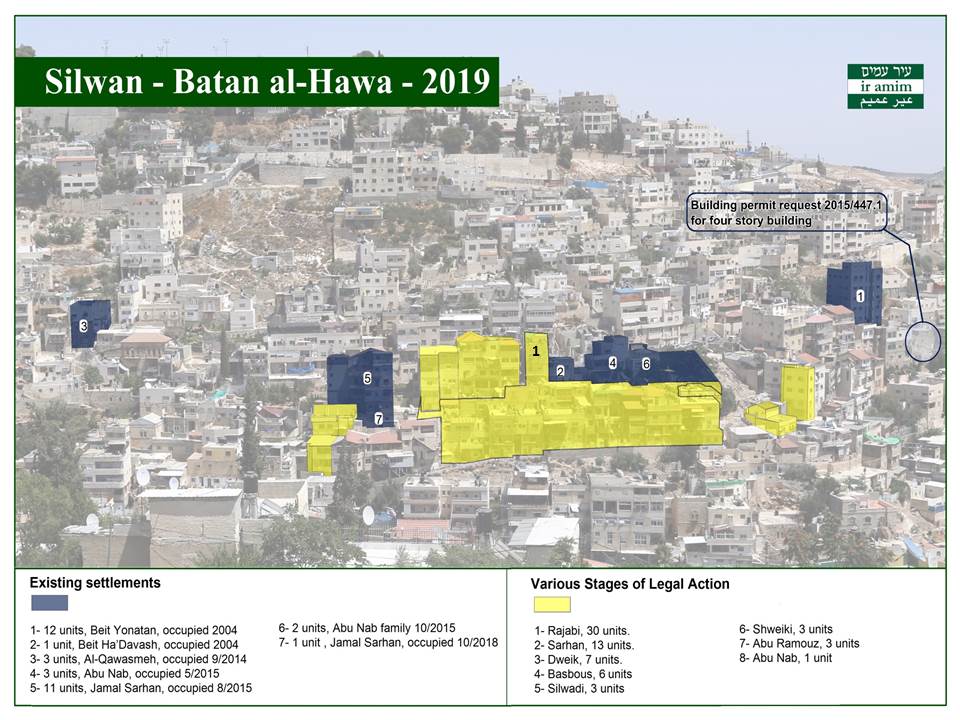 Ir Amim and 22 Palestinian families filed a petition with the High Court of Justice to stop a settler-run land trust from forcefully seizing land and homes in the Batan al-Hawa section Silwan, a Palestinian East Jerusalem neighborhood where 700 people are facing eviction from their longtime homes as a result of the settlers’ effort. The petition argues that the radical settler group Ateret Cohanim is using the Benvenisti Trust as a front for displacing Palestinians, pointing out that the trust does not have a separate organizational structure, bank account, lawyer, or accountant – and that Ateret Cohanim has folded the operations of the trust into its own operations and there is no distinction between the management or assets of the two entities. [map]
Ir Amim’s attorney Ishay Shneydor told Haaretz:
“[The materials show] that this is a planned process of Ateret Cohanim in order to use the trust as a platform to forcefully seize the property.”
The trust itself was founded in 1899 and built houses in what is now the Batan al-Hawa section in order to resettle Jewish Yemenite immigrants. The houses were later abandoned under British pressure in 1938, during the Arab Revolt against British rule. The buildings the trust had built were later demolished.
In 2001, the Israeli Charitable Trust Registrar granted Ateret Cohanim permission to revive the trust and become its trustees, (following 63 years of dormancy). In 2002, the Israeli Custodian General transferred ownership of the land in Batan al-Hawa to the Trust/Ateret Cohanim. Since then, Ateret Cohanim has accelerated its multifaceted campaign to remove Palestinians from their homes, claiming that the Palestinians are illegally squatting on land owned by the trust. Palestinians have fought back against Ateret Cohanim-initiated evictions, unsuccessfully arguing against the validity of the Trust/Ateret Cohanim’s ownership of the land. Most recently in January 2020, the Jerusalem Magistrate’s Court rejected the Palestinians’ arguments and upheld the Trust/Ateret Cohanim’s ownership of the land. That ruling set a key precedent paving the way for the mass eviction of as many as 700 Palestinians from their homes in Silwan.
The new petition filed this week does not take up the same arguments, and instead challenges the legality of the functional operations of the Trust/Ateret Cohanim.
In reaction to the January 2020 rulings, Peace Now added important context in a statement:
“This is an attempt to displace a Palestinian community and to replace it with an Israeli one, in the heart of a Palestinian neighborhood in East Jerusalem. The settlers could not have succeeded without the Israeli authorities’ close support and assistance. In addition to the hard blow to the prospects for a two-state solution by preventing a Palestinian capital in East Jerusalem, this is an injustice and an act of cruelty to throw out families who have lived lawfully in their homes for decades.”
Also in reaction to the January 2020 rulings, Ir Amim said:
“The Ateret Cohanim settler organization is waging one of the most comprehensive settler takeover campaigns in East Jerusalem through initiating mass eviction proceedings against Palestinian families in Batan al-Hawa. Seventeen families have already been evicted with over 80 other households facing eviction demands, placing some 600-700 individuals of one community at risk of displacement. See Ir Amim’s and Peace Now’s joint report, “Broken Trust” for further details and analysis.”
HaMoked Files First-Ever Petition Seeking Removal of Section of the Separation Barrier
HaMoked filed a petition with the High Court of Justice seeking the removal of a section of the separation barrier which is preventing Palestinian farmers (7 of whom joined HaMoked in filing the petition) from accessing their lands in the northwest of the West Bank. The petition argues that the barrier in this area does not serve a security need and has caused severe harm to Palestinian landowners. This is the first-ever petition seeking the removal of part of the barrier.
The petition focuses on a roughly 6-kilometer (3.7 mile) section of the barrier just east of the 1967 Green Line. Since the construction of the separation barrier in this area in 2005, the Israeli military has granted permits for Palestinian landowners to walk through a gate in the fence to access their land beyond to fence (this area is known as the seam zone). The 7 Palestinian farmers who submitted the petition argue that the Israeli military has gradually reduced the number of permits issued to landowners and implemented a series of policies that have further limited their ability to cultivate the land and make a living.
Jessica Montell, HaMoked Executive Director said in a statement
“This petition is the inevitable result of 15 years of experience with the military’s seam zone permit regime. Rather than facilitating access, as the military promised, this cumbersome bureaucracy serves to dispossess entire Palestinian communities of their land, stripping people of their livelihoods and their sources of income, without even the pretense of a security justification. In fact, there’s no security reason for the fence to be built inside the West Bank in this area. So we expect the High Court to make sure that where the fence is designed to dispossess Palestinians rather than protect security – it will be dismantled.”
Shaul Arieli, an Israeli expert on the separation barrier, submitted an opinion in support of the petition, noting that dismantling this section of the fence and relocating it to the west, along the Green Line, would not only end the disruption of life for the Palestinian famers, but would also better serve Israel’s security needs. A barrier along the Green Line in this area would be preferable according to the security parameters the military itself defined: topographical superiority, observation, advance warning, pursuit and other operational considerations.
E-1 Settlement Plans Are Moving Again, Following West Bank “Planning Freeze” During COVID Emergency
On June 3rd, the Israeli military order that froze planning processes in the West Bank during the COVID19 emergency period expired.
Now, the clock is once again ticking on two separate plans for the construction of the E1 settlement just east of Jerusalem. A few days prior to the planning freeze, the E-1 plans had been deposited for public review and submission of objections. Now, Ir Amim reports the public commenting period is set to close on July 23rd.
Jerusalem Municipality to Destroy 200 Palestinians Businesses in East Jerusalem to Build “Silicon Wadi” Industrial Zone
According to the Jerusalem Post, the Jerusalem Municipality is poised to demolish buildings rented by some 200 Palestinian-owned businesses in the Wadi al-Joz neighborhood of East Jerusalem – located just north of the Old City – as part of plans to develop “Silicon Wadi,” a project the Municipality claims will build a large industrial zone for hi-tech, commercial, and hospitality businesses.
According to the Jerusalem Post, the government’s investment in the “Silicon Wadi” project is part of the Israeli government’s five-year plan for economic development in East Jerusalem. A Municipality official claimed that the Palestinian businessowners have agreed to this plan, and have been compensated for their eviction.
The chairman of East Jerusalem’s Arab Chamber of Commerce and Industry, Kamal Obeidat, called the planned demolitions a “racist order” to to change the character of the Palestinian city and use the land to build Israeli structures.
Grassroots Jerusalem explains the history and current reality facing the Wadi al-Joz neighborhood:
“Overlooking the Mount of Olives and the Kidron Valley, Wadi al-Joz was once the city’s industrial zone until the First and then the Second Intifada. The area is under the jurisdiction of Israeli civil law under the Jerusalem Municipality. As with many neighbourhoods in the area surrounding the Old City, Wadi al-Joz is experiencing severe challenges with the 2009 approved ‘Master Zone Plan’ and the subsequent aggressive expansion of Jewish presence in the area.”
American Duty Free Millionaire Involved in Fraudulent Acquisition of Palestinian Land Case
A Palestinian family is fighting to reclaim rights to their land near the Beit El settlement from Simon Falic – a prominent Netanyahu and Trump donor whose family owns the “Duty Free Americas” retail chain. Falic was transferred rights to the land via a highly unusual, and allegedly fraudulent, process.
According to Haaretz, the complicated transfer of ownership started when the original landowner – Palestinian Sadki Hamdan – allegedly signed over his power of attorney to Doron Nir-Tvi, a lawyer who lives in the West Bank outpost of Havat Yair. The power of attorney document authorized Nir-Zvi to transfer ownership of the land to another Palestinian, the late Ramadan Abu Halal. Abu Halal then allegedly transferred the land ownership to Simon Falic, whose signature is on a deed of sale even though the land was later registered to a settler-run organization, named Hakeren Liyad Midreshet Yisrael.
The family of Sadki Hamdan has pointed out numerous issues with the documents associated with the deal, including: Hamdan’s signature on the power of attorney document is not one they recognize from other papers he signed; the notary who certified the power of attorney document testified that no such document was ever signed in his presence; and the chronological order of documents is incongruent (Abu Halal appears to have transferred the land rights to Falic one month before he legally owned the land). Further, the heirs of Abu Halal (to whom the power of attorney transferred the land) believe the deal was fraudulent, saying they did not know about the land at all.
In July 2019, a report by the Associated Press revealed that the Falic family is a major source of financial support for some of the most radical settler groups in Israel. According to documents uncovered by The Democratic Bloc, the Florida-based Falic family is the single largest donor to Israel Prime Minister Netanyahu and has given over $5.6 million to settler groups over the past decade. For more on that story, see FMEP’s coverage here.
Tightening Control Over Area C, 91% of IDF Eviction Orders for Construction on “State Land” Are Against Palestinians
A new report by Kerem Navot and Haqel revealed that the Civil Administration systematically targets Palestinians with evacuation orders for entering/using land Israel has declared “state land.” Data from 2005-2018 shows that 91% of all evacuation orders (and 96% of the total acreage of land involved) related to incursions into “state land” were against Palestinians, while just 8.5% were against Israeli settlers. The data demonstrates, in part, that since 2005 Israel has acted in a manner contrary to its commitments in the Oslo Accords, seeking to remove Palestinians from land in Area C of the West Bank, while simultaneously and systematically allocating “state land” to the settlers.
The authors argue that the nature of eviction orders – which require more management, enforcement, and draw more appeals compared to seizure orders – makes the data revealed by their issues particularly indicative of Israel’s political vision for the West Bank, which, as noted above, does not accord with the notion of a temporary occupation.
The authors further observe:
“A closer examination reveals that solely one quarter (24.7%) of the territory included in the eviction orders is located within settlements’ areas of jurisdiction, while the rest is located on land that does not belong to any specific settlement. This fact indicates that the Civil Administration is attempting to curb Palestinian development in much more expansive areas than those alloted to settlements to date.”
The report also notes how settler organizations – most prominently Regavim – have aided the state (with the encouragement of the state) in monitoring Palestinian “trespassing” (the vast majority of eviction orders were against agricultural activity) onto “state land,” and have assisted in enforcing eviction orders against them.
Dror Etkes of Kerem Navot said:
“When you examine the locations of the eviction notices, you see a strong correlation between territory Israel has for many years devoted great efforts to annex and the numbers of orders, as well as their sizes.”
The full report and analysis of the eviction orders can be read online here.
Al-Haq Report on the Atarot Industrial Settlement Zone
In a new report entitled “Atarot Settlement:The Industrial Key in Israel’s Plan to Permanently Erase Palestine,” Al-Haq takes a deep dive into the details of Israel’s plan to build the Atarot settlement industrial zone (in the northern part of East Jerusalem) and its consequences for Palestinians, individually and collectively.
The report provides essential data and background information on the role of industrial settlements in Israel’s occupation and seizure of Palestinian land and resources and then closely documents Israel’s development of plans for the Atarot industrial zone.
Al-Haq concludes:
“The Atarot industrial settlement is constructed on layers of human rights abuses. This is evidenced in Israel’s deliberated disregard of the presence of Palestinian residents and appropriation of their land where the Atarot industrial settlement has been established. Moreover, it is continued through the imposition of unacceptable living conditions for Palestinian residents therein. In addition, the case of the Atarot industrial settlement reflects Israel’s wider discriminatory planning and zoning regime. The regime entails the confiscation and appropriation of Palestinian land, the systematic denial of building permits, and creates an uninhabitable environment for Palestinians. Currently, the Atarot industrial settlement highlights the immediate and longterm environmental impacts of the existence of similar industrial settlements in the OPT, directly affecting the health of the Palestinian communities. While the deepest impacts of the Atarot industrial settlement are contained in Israel’s long term plan to accelerate economic development there, as a key to economically supporting a radical and all-consuming colonisation of Palestine and erasure of Palestinian presence.”
Emek Shaveh Releases New Interactive Map of Settler Projects in Jerusalem’s Historic Basin
Emek Shaveh released a new multifaceted interactive map showing settler initiatives that impact Jerusalem’s archeological sites. Along with their analysis of the settler projects, the map provides a clear picture of the totality of initiatives that settlers and the Israeli government are advancing to increase their claim to, control over, and presentation of sacred sites around Jerusalem – and the manipulation of archeology to serve their agenda.
Emek Shaveh said in an email:
“In the 53 years [since 1967] that have ensued, the historic center of Jerusalem has undergone enormous change. Although in the 1970s and 1980s large areas of the Jewish Quarter and Silwan were under excavation, most of the significant changes to the character of the city have occured over the past 25 years with the rise of the settlers as key players in defining the agenda for archaeological excavations and tourism development in the Historic Basin. The goal of advancing historic sites as a means to promote exclusive Israeli sovereignty over Jerusalem’s historic core has now been coopted as government policy. Today, the settlers and government agencies work together practically seamlessly to create a narrow historic and symbolic landscape.
The reality around Jerusalem’s historic sites is complicated by the multiplicity of private and government players with varying responsibilities. It makes any objection to projects an extremely complex bureaucratic process. We, in Emek Shaveh, often find ourselves trying to explain the intricate map of interests and players at key historic sites. To make this information more accessible we are pleased to offer you this interactive political and historical map of Jerusalem. The map features two separate, but related, layers. The historical layers present the wealth of historical periods and the history of Jerusalem’s monuments and sites over the centuries. The other layer maps the central private and governmental bodies currently managing and operating major archaeological sites in the Historic Basin.”
Bonus Reads
- “A Would-Be Netanyahu Nemesis Snipes From the Sidelines“ (New York Times)
- “Letter to HeidelbergCement Regarding Nahal Raba Quarry Expansion” (Human Rights Watch)
- “For the Settlers in the West Bank, It Will Never Be Enough” (Haaretz)
- “Peace Now activists warn: Annexation will lead to war” (Jerusalem Post)