Welcome to FMEP’s Weekly Settlement & Annexation Report. To subscribe to this report, please click here.
July 2, 2021
- Israel Starts Demolitions in Al-Bustan Section of Silwan [East Jerusalem]
- New Government, Same Outcome – “Compromise” Opens Door for “Legalizing” Illegal Outpost
- Israel Advances Plan for New Settlement Road Through Palestinian Farmland
- Palestine Lays Out Key Issues it Wants the Biden Administration to Engage On
Comments or questions? Email Kristin McCarthy – kmccarthy@fmep.org.
Israel Starts Demolitions in Al-Bustan Section of Silwan [East Jerusalem]
On Tuesday, June 29th, Israeli authorities demolished a Palestinian-owned butcher shop in the al-Bustan section of the Silwan section of East Jerusalem. Palestinians protested the demolition and attempted to stop the bulldozer; in response, Israeli police used live fire, rubber coated bullets, and tear gas to disperse protesters, injuring at least thirteen Palestinians.
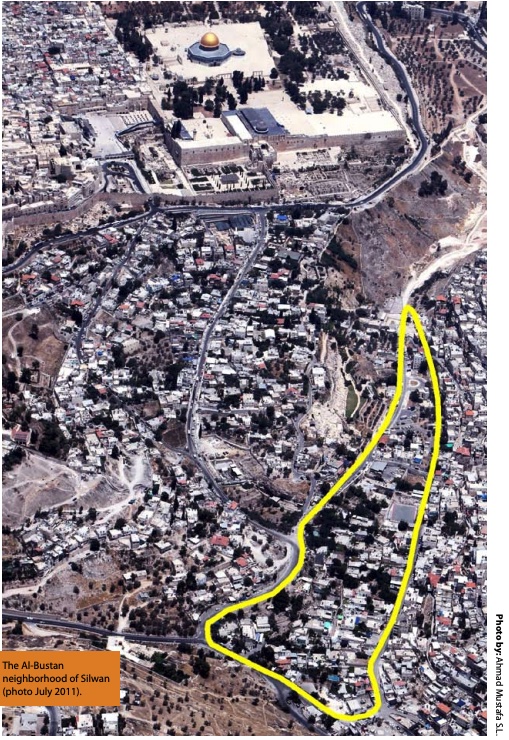 It is widely feared that the demolition of this business presages the imminent implementation of 86 other demolition orders for the same area (housing around 130 families), based on the fact that, like the now-demolished butcher shop, these homes were built without Israel-issued building permits (permits that Israel systematically denies to Palestinians in East Jerusalem). The warning period on demolition orders affecting 14 of those buildings expired on June 27th, meaning bulldozers can appear any day.
The Israeli government has targeted the al-Bustan neighborhood with wide-scale displacement since 2005, when it initiated demolition proceedings on the basis that the buildings do not have Israeli-issued building permits. Israel further declared the area a “green zone” and banned any new construction there. The backdrop to these moves is an Israeli plan to clear al-Bustan of its Palestinian residents in order to make way for an Israeli archaeological park promoted by settlers (the “King’s Garden,” which would be an extension of the settlers’ “City of David” complex).
Residents have until now managed to fight off demolition on the condition that they were engaging with the Israeli government (the Jerusalem Municipality) to develop planning for alternative housing (to which they could be moved). That planning has been ongoing since 2010. Terrestrial Jerusalem explains:
“As noted, in 2017, the Municipality agreed to suspend demolitions while the residents pursue the approval of a statutory Town Plan. The residents’ Town Plan is being drafted by Dr. Yusuf Jabarin, the Dean of Research at Haifa’s prestigious Technion Institute. The plan is working its way slowly through committee, and it is common that plans of this complexity take many years to approve. The plan is based on 11 principles to which the Municipality and the residents both agreed in 2017, and aspires to balance between the housing needs of the residents, the legitimate need for public spaces, in a manner that will serve the residents of al-Bustan, and not the settlers of Silwan. Initially the Municipality viewed the Plan favorably, but, in recent months, that support appears to have been withdrawn.”
New Government, Same Outcome – “Compromise” Opens Door for “Legalizing” Illegal Outpost
In an entirely predictable manner, the new Israeli government led by Naftali Bennet has reached a “deal” with settlers over the fate of the unauthorized Evyatar outpost. Located just south of Nablus, the site of the outpost has become a locus of Palestinian protest and Israeli military violence. Under the terms of the deal, the settlers will (temporarily) vacate the outpost by Friday, July 2nd, with the understanding that the government will leave in place the settlers’ illegal construction at the site — buildings and roads — while it “examines” the status of the land to see if it can be declared “state land” and therefore legally turned into a settlement (opening the door for the settlers to return). In the interim, under the agreement the outpost will be used as a military base while that examination plays out.
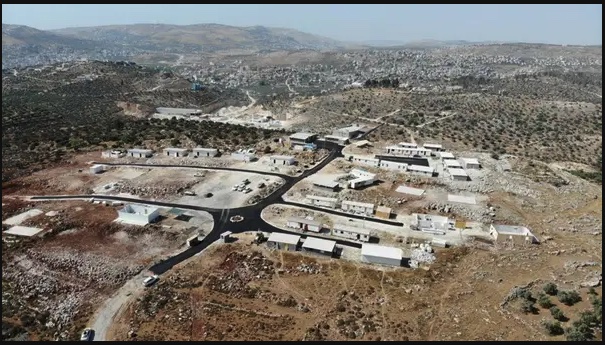 The fact that this “compromise” leaves in place the settlers’ structures and will maintain Israeli control over the site during the “survey” process are clear signals that the government is not concerned with enforcing Israeli law, but rather finding a political solution that works for the settlers. Further, the government of Israel either believes it can, and is determined to, find a pretext to assert that the land on which the outpost stands – known as Jabal Sabih to the Palestinians who have historically cultivated the it – is in fact “state land” which can be used by the state as it sees fit (i.e., give it to the settlers).

In response, the anti-settlement watchdog Yesh Din sent a letter to the Israeli Attorney General outlining exactly how the deal with the settlers contravenes international and Israeli domestic law. In a statement about the letter, Yesh Din says:
“The government’s agreement with the settlers of Evyatar rewards delinquency and grants immunity to those committing offenses, which will act to further embolden violent, lawless settlers to take similar action again in the future, knowing they will, at the very least, face no consequences, and, more likely, be further rewarded with land takeover and settlement expansion. On 1 July 2021, Yesh Din sent a principled letter to Israel’s Attorney General and the Legal Advisor to the Ministry of Defense, denouncing the government’s agreement regarding the outpost of Evyatar as illegal, unconstitutional and morally unacceptable. The letter also demands that an investigation by the police and other relevant authorities be launched into the involvement of the Samaria Regional Council for its part in the outpost’s establishment…
Furthermore, the letter clarifies that the government agreement entails a number of flagrant violations of both local and international laws, including:
In accordance with International Humanitarian Law (IHL), it is prohibited to transfer the civilian population of the occupying power to occupied territory (Article 49, Fourth Geneva Convention), an issue that is now also under investigation of the ICC.
Military presence on lands in occupied territory should only be for urgent security necessity. Safeguarding territory for future Israeli civilian presence cannot be considered an urgent security necessity. The fact that the military did not have permanent military presence in that specific area prior the government agreement reinforces that the military did not discern security justifications.
The decision made in advance to allocate lands for a settlement of Evyatar, providing that they will be declared public lands, without considering the needs of the local population in the area, and especially due to the fact that the outpost is located adjacent to three Palestinian towns, is illegal and unreasonable.
The attempt to disregard planning procedures by issuing a special military order to enable the structures on the site is an abuse of power by the military commander.
The agreement provides no legal basis for not enforcing the law on the illegal structures placed in the area.
It is forbidden to allow political whims to undermine the military commander’s discretion.
According to Israeli law, the decision to establish a new settlement in occupied territory requires a government decision, something that did not transpire in this case.”
Settlers squatting illegally at the site are reportedly not entirely satisfied with the deal. A few are threatening to resist removal from the outpost and are continuing to build permanent structures at the site. Part of the discontent relates to earlier reports that the “compromise” would include a commitment by the government to establish a military yeshiva (religious school associated with the IDF) at the site of the outpost, regardless of the outcome of the land status investigation (or even before the outcome is known). In the final deal, the government agreed to establish a yeshiva at the outpost only after the issue of the land’s status is resolved, and only if that issue is decided in the settlers’ favor. However, the settlers are still asserting that the government has agreed to open a military yeshiva at the site immediately, somewhat of a middle road.
Daniella Weiss, a veteran settler leader who is the leader of the group of settlers who established the Evyatar outpost, believes the land survey will confirm the area is “state land” with only minor adjustments to the boundaries of the outpost. She also said that she expects the yeshiva to be open by September, in time for the Jewish High Holidays. Weiss said:
“This government, which has been so sorely criticized, found the noble and uplifting way to talk with us – without over-powering us, but rather with admiration for pioneer builders of the Land. Our goal is not to force the government’s hand, but rather to uplift it. Our achievement is not in going against the government, but rather in bringing it to the place which it itself wants to be.”
The fate of the outpost has posed an early test for Israel’s new governing coalition. Defense Minister Benny Gantz is on the losing side of this issue (where he is joined by the IDF leadership, which similarly wants the outpost dismantled), having insisted just a few days ago that he is the one in charge of deciding the fate of the outpost and that the outpost will be demolished in accordance with Israeli law. Haaretz explains how the negotiations transpired:
“Gantz looked to his right and to his left, and discovered that he was alone. Prime Minister Naftali Bennett and ministers Ayelet Shaked and Zeev Elkin had negotiated energetically with the settlers on several channels simultaneously. And members of the government’s left wing kept silent. Thus a compromise was reached without the defense minister or the army even being briefed on the talks in real time. Gantz tried to set red lines, already at the outset of the Bennett-Lapid government, in which he is a kind of fifth wheel. He sought to prevent the settlers from creating facts on the ground by taking over land whose legal status is in doubt without any permission from the state or Israel’s Civil Administration in the West Bank. Gantz also sought to prevent the capitulation of the left wing to the right wing in the government. But in reality, it seems that the left has already folded, and the right has laid down its own red line against forcible evictions, which would put Bennett in an uncomfortable situation with what remains of his electoral base. Aside, perhaps, from the new coronavirus outbreak, there probably isn’t an issue in which the government has invested more time during its first two weeks in office than the evacuation of Evyatar. The army doesn’t like the compromise, which defies the original recommendations of its Central Command and the Coordinator of Government Activities in the Territories. Both wanted a full, rapid evacuation of the outpost, which was established in the heart of a group of Palestinian villages south of Nablus. But senior army officers didn’t visit the scene Tuesday morning, and they understand full well the balance of forces there. The moment the prime minister supports the compromise, the army will salute and carry it out.”
The U.S. State Department offered veiled criticism of the deal, saying:
“We believe it is critical to refrain from unilateral steps that exacerbate tensions and undercut efforts to advance equal measures of freedom, security and prosperity and a negotiated two-state solution. This certainly includes establishing new outposts which are illegal even under Israeli law.”
Adding more insight on the U.S. position, the Times of Israel reports:
“The Biden administration is willing to give new Prime Minister Naftali Bennett some time before making asks in the Palestinian arena, but it’s not willing to accept complete paralysis and will speak out clearly against unilateral moves, a source said.”
Israel Advances Plan for New Settlement Road Through Palestinian Farmland
Haaretz reports that the Israel is advancing a plan to pave a new road near the Beitar Illit settlement that will cut through agricultural land belonging to (and actively farmed by) the Palestinian village of Wadi Fukin. If paved, in addition to hemming in Palestinians and closing off their access to their land, it is feared that the projects will restrict the flow of water into natural springs used by Palestinians for farming in the area. This would also be the first road to cut into a wooded area.
Palestinians were not directly informed of this plan, but found out after the plan had been filed with the Civil Administration’s planning authorities. Bimkom, an Israeli NGO, filed an appeal three weeks ago seeking to have the plan frozen until residents of Wadi Fukin can be included in the planning process.
One resident of Wadi Fukin, Mohammed Rabah Sukar, said:
“No one from the Civil Administration talked to us or explained exactly where the road will pass. We don’t know to what extent this will damage our lands and people are very confused and frightened by this road.”

Map by Peace Now
The planned road is connected to two other significant settlement plans in the area, both targeting areas located just south of Bethlehem. One of these plans would expand settlement construction on lands near the Wadi Fukin village. The other plan relates to expansion of the Beitar Illit settlement and the construction of a new settlement – called Gv’aot – on land that historically belonged to five Palestinian villages in the Bethlehem area: Jaba, Surif, Wadi Fukin, Husan and Nahalin. In 2014, the Israeli government issued unilateral, mass expropriation orders for the land (which Israeli officials explictly said was in response to a Palestinian terror attack). At the time, Peace Now reported that the move constituted the largest single expropriation of Palestinian land by the Israeli state in over 30 years. It wasn’t until August 2019 that Israeli planning authorities gave final approval to a plan for a new settlement, including 61 housing units and an educational institute. Today, as it stands, the new units have not been constructed, but a small outpost – which calls itself Gv’aot – has been established…on land not allotted by the Israeli government for future settlement construction.
Palestine Lays Out Key Issues it Wants the Biden Administration to Engage On
Haaretz reports that a new Palestinian negotiation team has asked the Biden Administration to facilitate negotiations with Israel over a series of about 30 issues that it believes can meaningfully improve Palestinian lives – – an approach that has come to define how the Biden Administration is seeking to engage on (but not try to solve) the Israeli-Palestinian situation.
The Palestinian team reportedly included the following proposals related to settlements and annexation in their list:
- Suspension of all settlement construction in the West Bank and East Jerusalem;
- The evacuation of unauthorized outposts;
- The prevention of Israel from controlling land in Area A (where the Palestinian Authority is supposed to have full control, as assigned by the Oslo Accords);.
- The construction of an airport in the West Bank;
- The development of new tourism projects, including religious tourism projects at sites in Area C (the 60% of the West Bank in which, under Oslo, Israel has complete control); and,
- The reopening of Palestinian institutions in East Jerusalem.
An anonymous source with knowledge of the Palestinian initiative told Haaretz:
“Not all of the proposals appearing in the document can be implemented at the present time, but even if it would be possible to advance some of the steps, at least in the civilian field, that would provide achievements to the Palestinian public and improve their day-to-day lives.”
Welcome to FMEP’s Weekly Settlement & Annexation Report. To subscribe to this report, please click here.
April 15, 2021
- New Satellite Imagery Shows Massive Growth of Amichai, Bruchin Over Past Five Years
- Israel Hastens Approval of New East Jerusalem Settlement “Har Homa E”
- Jewish National Fund Pushes Forward Plan to Legalize West Bank Land Purchases
- In-Depth Report on Pending Demolitions in Al-Bustan (Silwan)
- Bonus Reads
Comments or questions? Email Kristin McCarthy – kmccarthy@fmep.org.
New Satellite Imagery Shows Massive Growth of Amichai, Bruchin Over Past Five Years
The Associated Press has published new satellite imagery (captured by Planet Labs Inc.) showing the expansive, transformative growth of the Amichai and Bruchin settlements over the past five years – a period defined by the Trump Administration’s pro-settlement policy.

Aerial image of Amichai, 2017 vs 2021 (via AP / Planet Labs Inc.)
The AP story offers analysis on the predicament facing the Biden Administration, which has articulated support for a two state outcome but has not specifically taken Israel to task for its ongoing settlement construction. The Amichai and Bruchin settlements illustrate this point – both are located in the Shilo Valley region of the West Bank, in a finger of continuous settlements that extends from the 1967 Green Line to the Ariel settlement in the very center of the northern West Bank, cutting the northern West Bank in half. It’s worth recalling that, when the Amichai settlement was built, a settler proudly proclaimed that the settlement would nullify the possibility of a two state outcome.
The new aerial imagery of the Amichai settlement – which was approved in 2017, making it the first new settlement formally approved by the Isareli government in 25 years – is particularly jarring. The images (one from 2017 and the second from 2021) show a previously empty hilltop with cultivated fields nearby transformed into a sizable suburban neighborhood. In addition to the pictured new construction, Amichai was also massively expanded, subsequent to its initial construction, when the Israeli Civil Administration announced that its plan to retroactively legalize the Adei Ad outpost by significantly expanding the borders of the Amichai settlement to turn Adei Ad into a (non-contiguous) neighborhood. In effect, this was a slight-of-hand by Israel to turn the Adei Ad outpost into an entirely new official, legal settlement.
Israel Hastens Approval of New East Jerusalem Settlement “Har Homa E”
Ir Amim reports that the Jerusalem District Planning Committee will now meet on April 20th — one day earlier than previously scheduled — to hear objections filed by members of the public (one of which has informed the Court that they are not available on that date) against a plan to build the Har Homa E settlement. Simultaneously, the District Planning Committee set a date for a second meeting on the plan for April 27th, at which time the committee is able to grant final approval (and is expected to do so).
Ir Amim explains:
“Although one of the individuals who filed an objection to the plan is not available on the new date, the District Committee refused to reschedule. It should be noted that this move is uncharacteristic and underscores the acute pressure on the authorities to approve the plan…While the convening of two separate sessions does seldom take place, the scheduling of the second discussion so rapidly is unordinary and again indicates the immense pressure to expedite approval of the plan.”
Although the Har Homa E plan is framed as an expansion of the Har Homa settlement in East Jerusalem, it is more properly understood as a new settlement since the buildings will be built in an open area that is not contiguous with the built-up area of Har Homa. The plan calls for 540 new settlement units to be built in the area between the Har Homa settlement and the site of the planned Givat Hamatos settlement, tenders for which were issued in January 2021. Meaning that the new construction is a significant step towards completing a ring of Israeli settlements on Jerusalem’s southern edge and encircling the Palestinian neighborhood of Beit Safafa.
Jewish National Fund Pushes Forward Plan to Legalize West Bank Land Purchases
As anticipated, the executive committee of the Board Directors of the Jewish National Fund (called the JNF-KKL) voted in favor of approving the adoption of a policy to officially make the purchase of land in the West Bank a part of the group’s mission. The policy will next be voted on by the full Board of Directors, which JNF Chairman Avraham Duvdevani hopes to see happen next week. As a reminder, the JNF-KKL voted in February 2021 to allocate $12 million towards the purchase of land in the West Bank, even though the policy had not been formally approved.
Notably, Duvdevani also intends to have the new policy, assuming it is adopted, applied retroactively to land purchases the JNF made in that past that fell outside of the group’s publicly stated mission. This intention demonstrates once again that this new policy is nothing more than a shift in public relations, given that the JNF has long worked in support of settlements, but until this point has left settlement-related activities deliberately obscured.
Haaretz also reports that the policy voted on by the Executive Committee this week does not have a restriction on the JNF’s ability to purchase land in the Nablus and Jenin areas. That restriction was cut out of the newest iteration.
In-Depth Report on Pending Demolitions in Al-Bustan (Silwan)
Terrestrial Jerusalem has published a comprehensive look into the recent news that the Jerusalem Municipality is planning to demolish 70+ Palestinian homes in the al-Bustan section of Silwan, in a move that appears to contradict over ten years of agreement between the municipality and Palestinians to find alternate housing for the targeted families. In addition to recapping what exactly happened and adding more details to what has been reported thus far (the report is must-read), Terrestrial Jerusalem explains how this situation came about.
Terrestrial Jerusalem writes:
“Al-Bustan is a target because more than any other Palestinian neighborhood in East Jerusalem, it is an obstacle standing in the way of one of the most important settler/government projects anywhere in East Jerusalem and the West Bank: the socalled restoration of purportedly biblical Jerusalem through genuine artifacts, invented facsimiles, and attractions reminiscent of the pseudo-biblical theme park. Al-Bustan is right in the middle of it.”
Emphasizing the significance of the demolitions pending in Al-Bustan, Terrestrial Jerusalem writes:
“Our analysis above leads to cautious and tentative conclusions indicating that the Bustan demolitions, as abhorrent as they are, have not yet become an acute issue. An important caveat is to be added to this conclusion: over the last few years, the government of Israel has started deviating from policies of restraint that have been a constant since 1967, and is engaging in actions that would have been unthinkable a few years ago. The demolition of al-Bustan is highly compatible into these new policies.Since 1967, Israel was able to transfer 220,000 of its residents to the settlement neighborhoods of East Jerusalem without the largescale displacement of Palestinians.
“The last such largescale displacement took place on the night of June 10, 1967, when the Mughrabi Quarter was razed, and its residents expelled. Nothing remotely similar has taken place in East Jerusalem since then. This, by no means, is meant to detract from the devastating impact the settlement enterprise has had on individual families that have been targeted and displaced by settlers, and the impact this has had on entire Palestinian collective in East Jerusalem. However, the policy of refraining from largescale displacement has recently changed, and is no longer a taboo…”
“The staggering humanitarian implications of mass demolitions in these areas are accompanied by compelling geopolitical ramifications. For the first time since 1967, settlement enclaves that were dis-contiguous with Israel are now becoming extensions of pre-67 Israel, and in a pincer movement: the Old City is being surrounded both on the north and the south by built up Israeli areas.”
Bonus Reads
- “Intimidation. Extortion. Eviction: This Is the Brutal Reality for Palestinians in Silwan, Jerusalem” (Haaretz)
- “New task force hopes to bolster Abraham Accords through entrepreneurship” (Israel Hayom)
- “Jewish population at lowest percentage since founding of Israel” (Jerusalem Post)
Welcome to FMEP’s Weekly Settlement & Annexation Report. To subscribe to this report, please click here.
March 25, 2021
- Construction on Extension of “Apartheid Road” Slated to Begin Next Month as Israel Barrels Towards E-1 Settlement Construction
- Israel Opens National Park on Land Belonging to Al-Walaja
- Palestinians File Appeal Against “King’s Garden” Settlement Plan for Al-Bustan, Silwan
- Bonus Reads
Comments/Questions? Contact Kristin McCarthy (kmccarthy@fmep.org)
Construction on Extension of “Apartheid Road” Slated to Begin Next Month as Israel Barrels Towards E-1 Settlement Construction
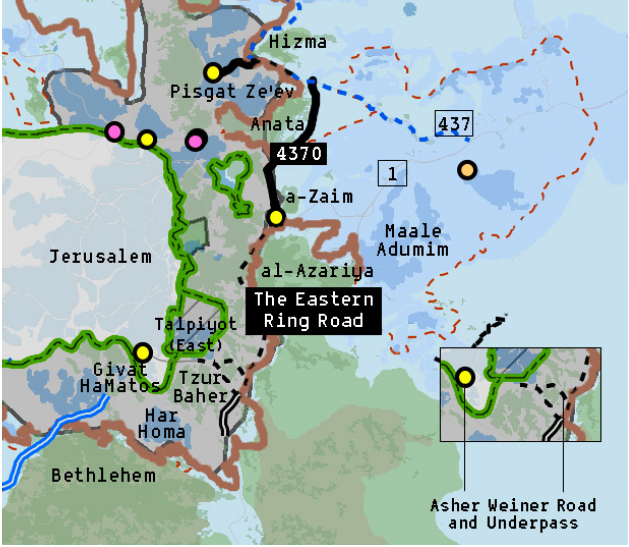
The Israeli Civil Administration announced that construction will begin next week on a new section of Route 4370, aka, the Apartheid Road (having earned the nickname for the high cement wall running down the middle of the road, separating Israeli and Palestinian traffic). The work will expand the road to the south in order to connect to East Jerusalem. The new road, which Israel touts as a benefit for Palestinians, is designed to route Palestinian traffic around the E-1 settlement area – in preparation for that settlement’s eventual construction. According to Ir Amim, the construction of this new road segment “constitutes a major step in laying the groundwork for settlement building in the E1 area.”
Map by Breaking the Silence
Ir Amim further explains:
“While portrayed as a road project to benefit Palestinians by expediting traffic and significantly reducing travel time between Ramallah and Bethlehem, it will in fact serve to completely reroute Palestinian traffic out of E1. Currently, the only road which facilitates Palestinian travel between the two West Bank centers runs through the E1 area. This limits Israel’s ability to carry out its massive settlement plans in the vicinity, which would require blocking Palestinian access to the area. This new road along with Route 4370 will create an alternative corridor between Ramallah and Bethlehem, which would eliminate the need for Palestinians to drive through E1 altogether. Diverting Palestinian traffic thus removes one of the obstacles to settlement construction in E1 and should signal cause for heightened vigilance.”
In a 2008 objection against the construction of the Apartheid Road, Adalah explained:
“The road further aims to consolidate and develop the Jewish settlements in East Jerusalem and the West Bank, and link them directly and conveniently to each other and to West Jerusalem. The road is simultaneously intended to isolate the Arab neighborhoods in East Jerusalem from the main route of the Eastern Ring Road, from each other and from the West Bank. It would thereby turn these neighborhoods into islands that are isolated – geographically, economically and in terms of transportation – from their immediate surroundings and would end Palestinian geographical contiguity within and around East Jerusalem, thereby precluding any future economic and social development or expansion of these neighborhoods. The plan stands to cut the owners of agricultural land off from their lands, to dramatically reduce the accessibility of schools, health services and workplaces for residents of these neighborhoods, and severely disrupt their family and social lives.”
Israeli officials have argued that the now-open road should resolve international objections to Israel building the E-1 settlement (a plan long criticized for effectively cutting the West Bank in half, rendering any future Palestinian state discontiguous and non-viable). In Israel’s view, the road replaces territorial contiguity for Palestinians in the West Bank with “transportational continuity,” i.e., the West Bank would still be cut in half, but the two halves are now inked by a road (albeit it a road that cuts Palestinians off from Jerusalem and that leaves travel between the northern and southern West Bank subject to Israeli control).
Israel Opens National Park on Land Belonging to Al-Walaja
Ir Amim reports that on March 23, the Israeli Nature & Parks Authority would be opening an Israeli national park in the area around the Ein Haniya spring. The spring is a historical part of the al-Walaja village, a Palestinian village located on the southern flank of Jerusalem, and long served as a main sources of water for households, farms, and recreational purposes for the village’s residents. Al-Walaja has long suffered due to its location and its complicated status (much of the village’s lands, including areas with homes, were annexed by Israel in 1967, but Israel never gave the villagers Jerusalem legal residency by Israel – meaning that under Israeli law, their mere presence in their homes is illegal). Today it is acutely suffering from a multi-prong effort by the Israeli government and settlers to grab more land for settlement expansion in pursuit of the “Greater Jerusalem” agenda. This land grab campaign includes past and pending home demolitions, the construction of the separation barrier and bypass roads in a way that seals off the village on three sides, and the denial of planning permits.
The history of this spring is just one example of how the Israeli government pursues land grabs with the facade of legality. As explained by Ir Amim:
“In 2013, in tandem with the construction of the barrier on al Walajeh lands, the Jerusalem District Committee approved an outline plan which designated the 1200 dunams of land as the Nahal Refaim national park in complete disregard of private Palestinian land ownership and traditional Palestinian agriculture in the area.
As a means of completely sealing off these lands from Palestinian access, including from village residents, the Jerusalem municipality began relocating the checkpoint between Jerusalem and al-Walajeh to a location closer to the village in February 2018. Construction on its relocation was suspended in March of the same year due to budgetary reasons and as a result, the Israeli authorities decided to keep the Ein Haniya site closed until the relocation is complete. Upon inquiry, however, Ir Amim was informed today that the plans for the checkpoint’s relocation have been terminated, and that Palestinian access to the area will remain unobstructed “unless security forces decide otherwise.”
Keeping the area open to Palestinian access is a significant achievement, which in no small part is due to al-Walajeh farmers’ perseverance despite the many obstacles and threats they continually face. In spite of this, the INPA’s plans include a variety of projects aimed at transforming al Walajeh’s agricultural terraces into an Israeli touristic and recreational destination, replete with hiking trails and outdoor activities, which creates the illusion of an entirely Israeli space.
The national park extends to the Jerusalem municipal border in close proximity to the area where Israel intends to establish a new settlement on al Walajeh’s lands (Har Gilo West) in the West Bank. In addition to creating contiguity between Jerusalem and the Gush Etzion settlement bloc around Bethlehem, the national park further isolates al Walajeh, turning it into an enclave detached from its Palestinian surroundings. In doing so, Israel advances its entrenchment of control along the southern perimeter, while undermining any prospect of a negotiated agreement in Jerusalem.”
Palestinians File Appeal Against “King’s Garden” Settlement Plan for Al-Bustan, Silwan
Ir Amim reports that Palestinians have filed an appeal to stop the demolition of 70 homes in the Al-Bustan section of the Silwan neighborhood in East Jerusalem. The Palestinians’ appeal responds to a surprising move by the Jerusalem Municipality, made in late February, to request permission from the Court to demolish the homes – demolition which had been frozen by the Courts since 2010 to allow for a negotiated resolution to the situation. For more on the history of this situation, see FMEP’s report from last week.
Additionally, Ir Amim has published a new, and more detailed, explainer on this case – highlighting the political context in which the Jerusalem Municipality made this decision. Ir Amim writes:
“The municipality’s plan called for the establishment of a touristic and archeological park (Plan 18000: “the King’s Garden”) replete with residential and commercial areas, including hotel space. This planned park would extend the existing national park in the City of David (the hub of Elad’s settler operations) southwards spanning the entire neighborhood of Al Bustan and towards the settler enclave in central Silwan (Batan al-Hawa) where the Ateret Cohanim settler organization is active. Since 2010, the plan has not advanced likely due to local and international opposition. However, the municipality’s objection to extension of the freeze signifies its intent to reactivate the plan, consistent with the acceleration of similar Israeli measures over the past year after being emboldened by the Trump Administration…
Beyond the severe humanitarian toll lie the acute demographic and political implications. The “King’s Garden” plan is yet another measure to transform the area into a sprawling Israeli tourist site, while further erasing its Palestinian presence. Silwan is one of the focal points of state-backed ideological settler activity. Settler groups threaten to displace over 800 Palestinians with the goal of establishing settler strongholds in the heart of Palestinian neighborhoods as a means to dismantle the viability of a political resolution on the city. Touristic settlement initiatives serve to reinforce residential settlement by connecting otherwise isolated settler compounds to create a contiguous ring of Israeli control (see map below for illustration), while artificially increasing the Israeli Jewish presence in the area via Israeli tourists visiting the sites. If advanced, the “King’s Garden” would essentially constitute a seamless extension of the City of David’s touristic attractions, further eroding the character of the neighborhood and its fabric of life, while leading to the forcible transfer of nearly an entire community.”
Bonus Reads
- “Samantha Power questioned over U.N. 2334 resolution at confirmation hearing” (Jewish Insider)
- “Save Sheikh Jarrah: Palestinians have a right to remain on their land” (Middle East Eye)
- “Palestinians in Hebron’s Old City build fence to prevent settlers’ attacks” (Al-Monitor)
Welcome to FMEP’s Weekly Settlement & Annexation Report. To subscribe to this report, please click here.
March 18, 2021
- Israel Municipality Asks Court to Ok Mass Demolitions in Silwan
- Israel Issues Demolition Order Against Home in Area B of the West Bank
- Palestinians Raise Alarm Over Impending East Jerusalem Dispossession
- Israeli Demolitions are Historically High
- Palestinians Call on UNESCO to Protect Archaeological Sites in the West Bank
- Settlers Once Again Invade Site of Evacuated Sa-Nur Settlement
- New Yesh Din Report Documents Another Category of West Bank Land Theft by Israel
- Bonus Reads
Comments/Questions? Contact Kristin McCarthy (kmccarthy@fmep.org)
Israel Municipality Asks Court to Ok Mass Demolitions in Silwan
Haaretz reports that three weeks ago, the Jerusalem Municipality petitioned the city courts to “reactivate” demolition orders for more than 70 Palestinian structures (home to more than 1,500 individuals) in the al-Bustan section of the Silwan neighborhood in East Jerusalem. [map]
The legal case around these 70 homes dates back to 2005, when the Israeli government unveiled a plan to establish a new archaeological/touristic park called “The King’s Garden” on privately owned Palestinian land in al-Bustan. Following international blowback the plan was dropped for a time, only to be revived by Jerusalem Mayor Nir Barkat in 2010, who once again began moving forward. To implement the plan, Israel issued demolition notices to Palestinian homes in the area — homes that Palestinians built (on their own land) but without the required Israeli-issued permits. This is, of course, a common circumstance for Palestinians in East Jerusalem and Israeli-controlled Area C of the West Bank, because Israel systematically denies planning and construction permissions to Palestinians.
Following another round of international outcry and an organized response by the Palestinian landowners, Israel (hoping to avoid more scrutiny) began quiet negotiations to provide the Palestinian land and home owners with alternative housing. After nearly seven years, the negotiations reportedly resulted in an agreement under which the city would defer demolition of the homes in question until after the Palestinians were able to build new homes (with permits) on adjacent plots.
According to Haaretz, the city has now decided it will no longer honor its commitment to defer those demolitions. The battle is now playing out in Court, with the city arguing that Palestinians have made no substantial progress on building the new homes. The Palestinians asked the court for a one year delay, saying that there has been progress that the city is not telling the court about.
Explaining the complexity of the situation facing Palestinians, Ir Amim wrote in an 2012 report:
“According to the Municipality’s plan, houses are intended to be demolished only after residents receive alternative housing. Consequently, condensation and construction will precede demolition—the reverse of normal procedure. But this proposed solution does not appear to be feasible. In order for the solution to be realized, the people evicted from the western part of Al-Bustan, against whose homes demolition orders are pending, will find themselves in the position of having to build alternative housing. In most cases, the space designated for alternative housing is on top of existing housing in the eastern part of the area; which is to say, in a built-up area, on the private land of other families. Such an arrangement could only be executed if the family currently on the land reaches agreement with the residents who have been evicted. Once an agreement is reached, the owners of the buildings in the eastern side of the area would have to request building permits, and only once said permits are obtained would the designated demolition of the houses in the western part of the plan take place and the buildings in the eastern part be legalized. The entire process would have to occur within a predetermined period; if not, the houses on both sides of the plan—the east and the west—would be torn down. However, as described above, obtaining building permits in this area is next to impossible. Requesting a building permit can jeopardize home owners on the east side who fear ownership of their current residences may be denied, as well as being a cost prohibitive process for most residents. Moreover, the negotiation challenges posed by evicted east side residents requesting to build on top of their neighbors on the west side all but preclude the likelihood of such arrangements.”
Ir Amim wrote in conclusion:
“As argued in a recent report by Bimkom, Planners for Planning Rights: “Despite the professional and apolitical facade of the planning and declaration of national parks, the picture appears to be more complex. In certain cases and places, it appears that the planning and declaration of national parks and nature reserves serves not only to protect natural and heritage assets and valuable open areas, but also serves as an instrument to limit the building and development of the Palestinian population. This phenomenon is widespread and particularly acute in the Palestinian neighborhoods of East Jerusalem.” The report goes on to state that one of the most salient features of existing plans for the Palestinian neighborhoods of East Jerusalem is the proliferation of “green areas” designated as open spaces, which constitute some 35% of the planned area (p. 6). The King’s Garden is another “green” area planned to be an open public space, though it is located in the middle of an overcrowded Palestinian neighborhood. That such a plan involves the massive demolition of Palestinian homes, and a drastic change of the neighborhood’s character from a Palestinian residential neighborhood to an archaeological park under Israeli control, raises more than reasonable concerns that the planning tool of “greening” is once again being used to establish political facts on the ground.”
The Haaretz Editorial Board intervened to plead for the municipality a return to negotiations, writing:
“Decision-makers must understand that a demolition order demolishes the lives of the inhabitants long before the bulldozer destroys their home. Anyone who hasn’t lived under the constant threat of their home’s destruction, who doesn’t panic every time a heavy vehicle rumbles down the street, or who has not seen the shadow of a bulldozer from the window of the children’s room, cannot understand the terror. Leon must come to his senses and bring the municipality back to the negotiating table, for the good of the residents of Silwan and all Jerusalemites. The success of the negotiations over the Bustan neighborhood and the construction of a new neighborhood next to the park will prove that Jerusalem has a mayor who truly works for the good of his residents and his city.”
Israel Issues Demolition Order Against Home in Area B of the West Bank
The Jerusalem Post reports that the IDF has issued a demolition order against a Palestinian home that is under construction in the Wadi al-Hummus village. The village in question is located just east of the Israel-declared municipal border of Jerusalem, but when Israel built its “separation barrier,” it left part of Wadi al-Hummus on the Israeli side (de facto annexing the land to Israel). The home that is now subject to demolition is thus in the odd position of being located simultaneously in Area B of the West Bank (as defined by the Oslo Accords), but inside Israel’s security barrier (the village of Wadi al-Hummus itself is cut up between East Jerusalem and Areas A, B, and C).
In the demolition notice handed to the homeowner, the IDF stated the house will be demolished because it lacks the proper building permits. However, according to the Palestinian news outlet WAFA, the owner obtained permits from the Palestinian Authority – which under Oslo has civil control (including planning) over Area B, where the home is located.
This is not the first time Israel has pursued the demolition of structures in areas outside of its Oslo-permitted control. In July 2019, Israeli forces demolished 13 large apartment buildings (approximately 70 units) in a section of Wadi al-Hummus, leaving the village looking like a war zone. Those buildings were located in Area A (where according to Oslo the PA has full civil and security control). Israel’s 2019 decision to demolish the buildings was given the official seal of approval by an Israeli Supreme Court decision. In its arguments, the Court held that the buildings posed an unacceptable security risk to the Israeli state because of their close proximity to Israel’s separation barrier (and that this risk over-rode the authorities granted under Oslo).
Palestinians Raise Alarm Over Impending East Jerusalem Dispossession
A coalition of 14 Palestinian civil society groups penned a joint letter asking the United Nations to intervene to stop the impending mass eviction of Palestinians from their homes in neighborhoods across East Jerusalem. The letter singles out the case of 15 Palestinian families (8 in Sheikh Jarrah and 7 in Silwan – for a total of 195 individuals) that are at risk of imminent eviction from their longtime homes in favor of settlers.
It’s worth recalling that, while the fate of 15 families is indeed in an urgent crisis, the legal underpinnings of these eviction cases stand to dispossess hundreds more Palestinians in East Jerusalem. Settler organizations, with state backing, are using Israeli law to take possession of Palestinian homes in key, sensitive neighborhoods in East Jerusalem to further consolidate Israeli hegemony over the city.
“At a time when people around the world are trying to survive the global pandemic, Palestinians in East Jerusalem continue to endure an ongoing Nakba, as they continue to be denied their inalienable rights of return and property restitution. In addition, they are subjected to an intensified coercive environment, exemplified in an array of policies including forced eviction thorough which they are again facing the threat of forced displacement and dispossession. They undergo a lengthy, exhausting, and unaffordable legal struggle to challenge the eviction lawsuits filed against them by settler organisations in Israeli courts. Given the discriminatory and untransparent nature of the Israeli legal system as applied in the occupied territory, they are effectively denied access to the rule of law. Many Palestinians have already been forcibly evicted under the same Israeli forcible transfer policy. In light of the above, this joint urgent appeal to the concerned United Nations (UN) Special Procedures underscores Israel’s establishment and maintenance of its apartheid regime over the Palestinian people as whole, and the intensified forcible transfer policies and measures in occupied East Jerusalem.”
Israeli Demolitions are Historically High
In its February 2021 report, OCHA (the United Nations Office for the Coordination of Humanitarian Affairs) notes that “Israeli authorities demolished, forced people to demolish, or seized 153 Palestinian-owned structures across the West Bank, including East Jerusalem: this is the fourth highest such figure recorded in a single month since OCHA began systematically documenting this practice in 2009, surpassed only by November 2020 (178), February (237) and March 2016 (179).” The 2021 monthly average number of structures demolished or seized is 117, compared to an average of 71 last year.
In February along, 305 individuals including 172 minors were affected by Israeli actions.
Palestinians Call on UNESCO to Protect Archaeological Sites in the West Bank
The Palestinian Foreign Ministry issued a statement calling on UNESCO to “protect all Palestinian archaeological and religious sites from Israeli violations, attacks and falsifications.” The statement went on to condemn Israeli actions in the West Bank and East Jerusalem which “serve the expansion of the illegal settlements,” saying that Israel’s seizure of antiquities in Palestinian-controlled areas are then put on “display …in their museums as evidence of its misleading colonial claims.”
Last week, on March 11th, settlers stormed the ancient site in Sebastia. Settlers have been openly agitating – with some success – for Israel to assert control over the archaeological site in Sebastia for years. In January 2021, Emek Shaveh (an Israeli NGO expert in – and focused on – archaeology) wrote on what is happening in Sebastia, saying:
“The archaeological site of Sebastia is identified with Samaria, the capital of the Kingdom of ancient Israel in 9-8 BCE. The site also features ruins from the Hellenistic, Roman and later periods. The village of Sebastia is situated within Area B while the site itself is located mainly in area C. Over the past few years, the Samaria Regional Council has been organizing tours to the site, particularly during the school holidays. Several times this year, the Civil Administration has removed a Palestinian flag from the village and the site. In the most recent incident, a flag was raised following renovation works funded by the Belgian government. In their response the regional council blamed the Palestinians for destroying a site central to Jewish history and UNESCO for supporting the Palestinians. Sebastia is on the tentative list of World Heritage sites in Palestine….the integration of ancient sites into an organized strategy designed to weaken Palestinian hold on Area C is worrying. The formalization of this approach is likely to result in a steep rise in actions over ancient sites and structures, from water cisterns found in many villages, to major sites such as Sebastia. The justification for preserving and developing ancient sites familiar to us from East Jerusalem is now being applied wholesale to hundreds of places in the West Bank to the detriment of the Palestinians living near the sites and to the multilayered heritage inherent in the ruins which will be distorted for political ends.”
As FMEP has chronicled, settlers and their allies have recently become hyper-focused on taking control of archaeological sites and artifacts under Palestinians control, claiming the sites are neglected and/or damaged. Last month settlers used a construction mishap to raise claims to the Mt. Ebal site.
In January 2021, the state of Israel committed funding to a new settler initiative to surveil archeological sites under Palestinian control. While the objective of protecting antiquities might appear uncontroversial and apolitical, the true objective behind this effort is to support yet another pretext to surveil and police Palestinians, and yet another means to dispossess them of their properties. It is the result of a campaign that has taken place over the past year in which settlers have been escalating their calls for the Israeli government to seize antiquities located in Palestinian communities across the West Bank, especially in Area C, which Israel today treats as virtually (and legally) indistinguishable from sovereign Israeli territory. The controversy that erupted over the Mt. Ebal archaeological site in February 2021 should be viewed in this context.
Previous victories for the settlers include the Israeli Civil Administration’s recent issuance of expropriation orders for two archaeological sites located on privately owned Palestinian property northwest of Ramallah. The expropriations – the first of their kind in 35 years – come amidst a new campaign by settlers lobbying the government to take control of such sites, based on the settlers’ claims that antiquities are being stolen and the sites are being mismanaged by Palestinians. The settlers’ pressure is also credited as the impetus behind the government’s clandestine raid of a Palestinian village in July 2020 to seize an ancient font. The Palestinian envoy to UNESCO, Mounir Anastas, recently called on the United Nations to pressure Israel into returning the font to the Palestinian authorities
In June 2020, a settler group calling itself “Shomrim Al Hanetzach” (“Guardians of Eternity”) began surveying areas in the West Bank that Israel has designated as archeaological sites in order to call in Israeli authorities to demolish Palestinian construction in these areas. The group communicates its findings to the Archaeology Unit of the Israeli Civil Administration (reminder: the Civil Administration is the arm of the Israeli Defense Ministry which since 1967 has functioned as the de facto sovereign over the West Bank). The Archaeology Unit, playing its part, then delivers eviction and demolition orders against Palestinians, claiming that the structures damage antiquities in the area. As a reminder, in 2017, Israel designated 1,000 new archaeological sites in Area C of the West Bank. The “Guardians of Eternity” group, not coincidentally, is an offshoot of the radical Regavim organization, which among other things works to push Israeli authorities to demolish Palestinian construction (on Palestinians’ own land) that lacks Israeli permits (permits that Israel virtually never grants). The group raised public alarm about the Trump Plan, alleging that hundreds of biblical sites in the West Bank are slated to become Palestinian territory.
Settlers Once Again Invade Site of Evacuated Sa-Nur Settlement
On March 16th, dozens of Israeli settler families illegally entered the site of the evacuated Sa-Nur settlement in the northern West Bank in an attempt to reestablish the area as a place of permanent Jewish settlement. Settlers have attempted the feat many times before, often with the active, in-person support of high-profile Israeli politicians, and always without punishment for their illegal actions.
After calling on Netanyahu to immediately authorize their presence at the site (a call that included the voice of prominent settler leader Yossi Dagan), the IDF evacuated the settlers once again.
The last time a group of settlers attempted this, in November 2020, MK Miki Zohar (Likud) persuaded the settlers to abandon their illegal campsite and leave the area, with the promise of raising the issue of Sa-Nur’s re establishment directly with Netanyahu.
MK Zohar is a staunch supporter of reestablishing Sa-Nur, along with three other settlements in the area that were likewise dismantled by the Israeli government in 2005 (Homesh, Ganim, and Kadim). Zohar has participated in previous visits to the site to support the settlers’ bid, frequently accompanied by his Likud colleagues, including former Speaker of the Knesset Yuli Edelstein. In July 2018, the Israeli Cabinet had the opportunity to lend government backing to a bill that would have cancelled the 2005 disengagement and allowed the settlers to rebuild those settlements – but the Cabinet blocked the bill.
As a reminder, even though Israel evacuated the four settlements in the West Bank, the IDF issued military orders barring Palestinians from entering the areas, preventing Palestinians from taking control over the area and building there. At the same time, settlers have regularly entered the areas and even repeatedly built a yeshiva at the Homesh site.
New Yesh Din Report Documents Another Category of West Bank Land Theft by Israel
In a new report entitled “Ill-Gotten Gains”, Yesh Din explains how the Israeli government has taken control of Palestinian land that was in the process of being formally titled and registered when Israeli occupied the West Bank in 1967. Yesh Din estimates that Israel has used its authority as the occupying power to declare as “state land” 41,000 dunans (~10,000 acres) of land that was, at the time, in the process of being registered as privately owned by Palestinians. That declaration precludes Palestinians from attempting to regain control of the land (by proving their ownership through a registration process).
Only one-third of West Bank land was registered and titled (under the British Mandatory government and then continued by Jordan) when Israel seized control of the West Bank. Upon assuming governance of the area the Israeli government issued a military order freezing the land registration process. The process remains frozen today, though there are rumblings from settlers pushing that state to resume the process (for their benefit).
Yesh Din writes:
“Israel’s policy of declaring “state land” in areas where settlement of title was halted is based on selective application of the legal mechanisms that regulate the land regime in the West Bank. Israel does so in violation of the rules of international law that apply to Israel as the occupying power in the West Bank. Such declarations also violate the local law in force in the West Bank and the military order issued by the Israeli military commander (Order Concerning Government Property). Above all, Israel’s policy infringes upon the right to property of Palestinians who took part in settlement of title and allows it to dispossess Palestinian individuals and communities of their land. In practice, Israel, which is and has been responsible for the land registry in the West Bank for over 53 years, is benefiting from this policy. Israel does not permit Palestinians who participated in settlement of title to complete the process and register title to their land, but it does declare these very same lands “state land” and transfers them to the exclusive use of the Israeli settlement enterprise in the West Bank.”
Bonus Reads
- “How Israeli industrial zones exploit Palestinian land and labour” (The New Arab)
- “Settler head urges vaccinating Palestinians, paid for by tax revenues sent to PA” (The Times of Israel)
- “Netanyahu pledges to legalize West Bank settler outposts if re-elected” (Jerusalem Post)
- “Why Some Voters in ‘Settler Heartland’ Are Ready to Turn Their Backs on Netanyahu” (Haaretz)
- “Netanyahu ups focus on settlements, as housing starts hit 10-year low” (Jerusalem Post)
- “‘The settler bashed my head with a pipe, and everything went dark’” (+972 Magazine)
- “The U.S. Billionaires Secretly Funding the Right-wing Effort to Reshape Israel” (Haaretz)
- “No One Is More Deserving of Israel’s Highest Honor Than Its Colonialist Settler Leaders” (Haaretz)