Welcome to FMEP’s Weekly Settlement Report, covering everything you need to know about Israeli settlement activity this week.
To subscribe to this report, please click here.
December 14, 2018
- Israel Seizes on Palestinian Attacks as Pretense to Advance Settlement on Multiple Fronts
- The WZO Used Non-Existent Land Plots as “Collateral” for Loans to Build Illegal Outposts
- Israeli AG Freezes New Grants Program for Illegal Outposts
- At the Opening of New West Bank Highway Interchange for Settlers, Netanyahu Celebrates Erasing the Green Line
- Hanukkah Event Draws Political Support for Settlers’ Bid to Take Over Site in the Old City’s Muslim Quarter
- Huge Holes Open on Streets of Silwan…Above Settler Excavations
- Israel’s Top Court Slams State Rail Company for Moving Debris to Private Palestinian Land as Part of Plan to Build a Settlement Park
- Bonus Reads
Questions/comments? Email kmccarthy@fmep.org
Israel Seizes on Palestinian Attacks as Pretense to Advance Settlement on Multiple Fronts
Seizing on a series of deadly Palestinian attacks this week as his pretext, Prime Minister Netanyahu announced he will:
- retroactively legalize thousands of settlement structures and outposts;
- initiate a plan to build 82 new units in the Ofra settlement;
- build two new settlement industrial zones (one near the Avnei Hefetz settlement and one near the Beitar Illit settlement); and,
- implement a range of policies that collectively punish Palestinians in the West Bank.
In addition, the Israeli Ministerial Committee on Legislation (a committee within the Israeli cabinet that decides whether to give government-backing to Knesset legislative proposals) will consider supporting a bill written by MK Bezalel Smotrich (Habayit Hayehudi) which would allow the government to provide municipal services, like water and electricity, to some illegal outposts. The bill assumes the series of outposts will be retroactively legalized, an assumption based on the work to achieve that end spearheaded by settler leader Pinchas Wallerstein (who has his own history of ignoring the law).
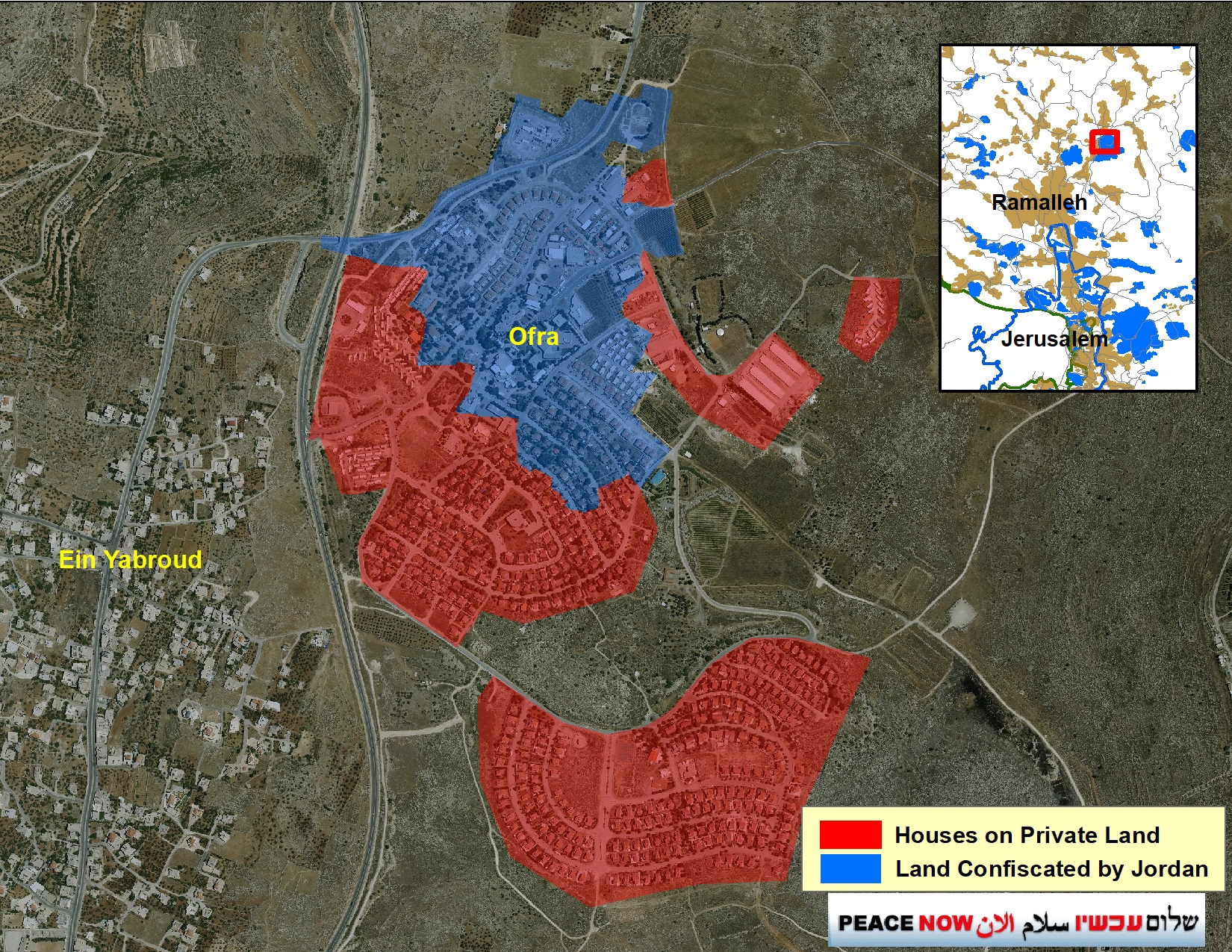 Many other senior Israeli officials joined Netanyahu in advocating for the immediate legalization of every unauthorized (i.e., illegal under Israeli law) structure in the Ofra settlement. The Ofra settlement – located northeast of Ramallah – was first established by settlers on land that had been expropriated in 1966 by the Jordanian government in order to build a military base (which was never built, as Israel took control of the West Bank in 1967). The Israeli government used this pretext to expropriate the land in 1977 in order to recognize the Ofra settlement, which had been established in the area illegally (i.e., without government approval, but with its tacit cooperation) two years prior. However, the majority of the Ofra settlement was not built on the land expropriated by the Israel in 1977, but instead on land that is registered to Palestinian owners from the nearby village of Ein Yabroud. In light of the legal status of the land, no Israeli government has yet been able to find a way to fix the legal status of these homes (not for lack of trying) – meaning that the majority of the structures in Ofra were built without permits, making them illegal under Israeli law.
Peace Now elaborates:
“Most of the houses built in Ofra (approximately 413 out of 625) were built on an area of 550 dunams of privately owned Palestinian land. In addition, hundreds of dunams of Palestinian private land were seized for roads in Ofra, as well as infrastructure and agricultural lands for the settlers. The only way to regulate the theft of these lands would be to expropriate them from the Palestinian landowners for the benefit of the settlers, in complete contradiction to the positions of previous Israeli governments and legal advisors, and contrary to binding rulings of the High Court. Although the current legal advisor (Avichai Mandelblit) allowed land expropriation in some places for settlement purposes (for example, in Haresha), in the regulation of massive land theft such as in Ofra the Israeli government would be crossing a new red line.”
Justice Minister Ayelet Shaked said that she already has a draft resolution and a legal opinion supporting retroactive legalization of Ofra. Shaked further threatened:
“Facing the price tag of Abu Mazen [Palestinian President Mahmoud Abbas], we pose our own price tag. Every terror attack will strengthen the settlement establishment instead of weakening it, and every potential attacker will know in advance that he will be considered responsible for strengthening settlements.”
Speaker of the Knesset Yuli-Yoel Edelstein vowed to push a plan through the Knesset to regulate Ofra, saying:
“The immediate answer to such an incident is to finally regulate Ofra, one of the oldest and most beloved communities. The 20th Knesset has been good and the Government has been positive towards the settlement enterprise. There have been important achievements and laws, but it’s not enough… I pledge to support the plan that will be formulated and advance it myself in the Knesset. This is our duty towards millions of citizens. The fate of Ofra must be the same as the fate of Petah Tikva.”
Yisrael Gantz, the new chairman of the Binyamin Regional Council, called for the:
“immediate approval of thousands of housing units… in order to deepen our roots here.”
The WZO Used Non-Existent Land Plots as “Collateral” for Loans to Build Illegal Outposts
The Israeli NGO Kerem Navot discovered more proof that the World Zionist Organization’s Settlement Division is directly financing the construction of illegal outposts with public funds — by providing loans to settlers based on non-existent assets, including fictitious plots of land in the West Bank. This reporting builds on previous revelations about the WZO’s complicity in illegal settlement construction on privately owned Palestinian land in the West Bank, including in the cases of the Mitzpe Kramim outpost and the Ma’aleh Rahavam outpost. Nonetheless, the Israeli government is rapidly advancing plans to hand over even more West Bank land to the WZO for settlement expansion.
On its latest findings, Kerem Navot founder Dror Etkes told Haaretz:
“This story exposes again the Settlement Division’s swindling ways and dirty dealings. [Like in the case of MK Bezelal Smotrich] who received a mortgage in the Kedumim settlement for a plot that doesn’t exist. It’s obvious from that and from the other cases that this is only the tip of the iceberg of a much broader practice.”
As a reminder, the WZO’s Settlement Division was created by the Israeli government in 1968 and is funded entirely by Israeli taxpayers. Its mandate is to manage West Bank land expropriated by Israel, in order to facilitate the settlement of Israeli Jews in the occupied territories. To make this possible, the Israeli government has allocated approximately 60% of all “state land” in the West Bank to the WZO’s Settlement Division [over the past 50 years Israel has declared huge areas of the West Bank to be “state land,” including more than 40% of Area C, where most of the settlements are located]. In addition, settlement and human rights watchdogs have repeatedly documented how the WZO’s Settlement Division has worked to take over additional land, including privately owned Palestinian land, in order to build more settlements.
Israeli AG Freezes New Grants Program for Illegal Outposts
Israeli Attorney General Avichai Mandelblit has reportedly frozen the implementation of a resolution, passed by the Israeli cabinet last week, designating three outposts as “national priority areas” for development. The resolution would direct enormous amounts of state resources to the outposts for construction.
Mandelblit wrote a letter slamming Housing Minister Yoav Gallant for bypassing the Attorney General in approving the resolution. According to Haaretz, Mandelblit had previously told the Housing Minister that the inclusion of settlements in the list of national priority areas needs to be thoroughly reviewed before the resolution was passed. Ignoring Mandelblit, Gallant advanced the resolution without a thorough review and without the permission of the government’s top legal official.
At the Opening of New West Bank Highway Interchange for Settlers, Netanyahu Celebrates Erasing the Green Line
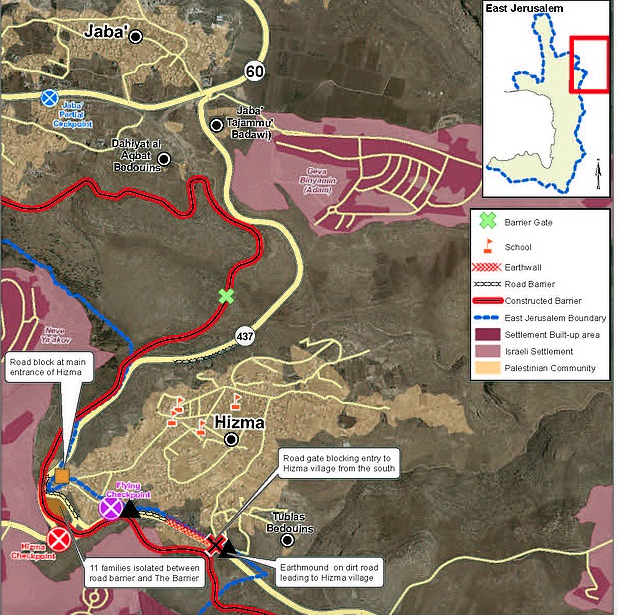
Map by OCHA
Israeli Prime Minister Benjamin Netanyahu attended a ceremony marking the opening of a newly renovated traffic interchange on Highway 60 (the main north-south highway in the West Bank). Located near the Adam/Geva Benyamin settlement and the Palestinian village of Hizma, the new interchange is meant to ease traffic congestion for settlers travelling to Jerusalem from the northern West Bank. More importantly, it advances the seamless integration of infrastructure serving Israeli settlements and sovereign Israeli territory – a key effort by settlers and their government allies to effectively erase the Green Line.
At the event, Netanyahu said:
“We are not stopping here. We will yet complete the paving of bypass roads, the widening of lanes and the improvement of infrastructures. There is a combined transportation-security aspect here. We are making yet another great link. While we are joining the country geographically, we are also joining the present to the future. Today and in this place we are doing something else, we are also joining the present to the past. Our ancestors walked here and took in this view of these valleys and these hills. The greatest dramas in the history of our people and of humanity took place here in this place; therefore, we are also joining our past to our future and this is a very great privilege.”
Minister Katz, who was also in attendance, said:
“We’re promoting a strategic plan on a very wide range with light rail routes at high-risk areas and traffic lights to make Judea and Samaria part of the Israeli norm of a developed and connected country…After we completed these two projects (Adam Interchange and Givat Assaf Traffic Light) we’ll work to enable this connection with a road with better conditions. This is part of the large and complementary projects to allow traffic to flow here.”
In September 2018, the United Nations Office for the Coordination of Humanitarian Affairs (OCHAS) released a report looking at the impact of Israeli roads on the the village of Hizma, as a case study of the effects road closures have on Palestinian rights. OCHA wrote:
“Hizma is a Palestinian village of over 7,000 residents in Jerusalem governorate. The bulk of its built-up area is in Area B but small parts of the village lie in Area C or within the municipal boundaries of Jerusalem, although it is separated from the rest of the city by the Barrier. Between 28 January and the end of March 2018, the three access roads into the village were either totally or partially closed to Palestinian traffic. The Israeli army hung posters on village shops stating that the army ‘will continue its work so long as you [residents] continue to be disruptive’. Other posters showed broken windshields. Following communications with the Israeli military, the head of the village council reported that the posters justified the closures as a response to stone throwing by Palestinian youths at vehicles with Israeli number plates. In 2017 and the first two months of 2018, OCHA recorded 11 incidents of Palestinians throwing stones at Israeli vehicles near Hizma that resulted in Israeli injuries or damage to vehicles.
The closures disrupted access by Hizma’s residents to services and livelihoods. Traffic between the north and south of the West Bank that passed through the village was diverted, undermining the commercial life of the village. Service providers, including a third of the teachers in village schools who commute on a daily basis, faced delays reaching the village. Over 50 shops/businesses that are the main source of income for 150 households were affected by the diversion of Palestinian traffic away from the village. Family life was also affected by the unpredictable nature of the closures.”
Hanukkah Event Draws Political Support for Settlers’ Bid to Take Over Site in the Old City’s Muslim Quarter
The Israeli archeological group Emek Shaveh reports that the Ateret Cohanim settler organization hosted a Hanukkah celebration – drawing the participation of the incoming Mayor of Jerusalem Moshe Lion, Minister of Jerusalem Affairs Ze’ev Elk, and the son of the Israeli Prime Minister, Yair Netanyahu – at the “Little Western Wall.” The site (which Israelis call the “Kotel Ha’Katan”) is a section of the retaining wall of the Temple Mount/Haram al-Sharif located within the Old City’s Muslim Quarter. It is viewed by some religious Jews as the closest point to the Holy of Holies at which Jews are permitted to pray. For historical background on the site and Ateret Cohanim’s role and goals related to it, see this 2016 report by Haaretz’s Nir Hasson.
Emek Shaveh writes:
“The recent Hanukkah ceremonies demonstrate an increase in political support for Ateret Cohanim and, no less important, the growing importance of the Little Western Wall, a politically and religiously charged place, attesting to a growing consensus among the Israeli Right regarding strengthening Jewish presence in areas immediately adjacent to the Temple Mount/Haram al-Sharif.”
Ateret Cohanim is a radical settler organization working to increase the presence of Israeli Jews living inside Palestinian neighborhoods of Jerusalem – including in the Old City, where the group recently succeeded in purchasing a Palestinian house in the Muslim Quarter (a property sale that continues to stoke controversy within the Palestinian community). Ateret Cohanim, along with their compatriots in the Elad settler group, also leads efforts to take over land and evict Palestinians from their homes in the Silwan neighborhood. Ateret Cohanim’s recent efforts in Silwan include using the guise of a Yemenite cultural center to build a new settlement in Silwan with government financing, and winning a High Court ruling that permits them to continue their campaign to evict 700 Palestinians from their homes.
Huge Holes Open on Streets of Silwan…Above Settler Excavations
 The Israeli archeological group Emek Shaveh reports that holes have begun appearing in the ground of Silwan, along the route of an underground excavation run by the Israeli Antiquities Authorities and funded by the Elad settler group. Elad has invested heavily in archeological excavations in Silwan in a campaign to co-opt the ancient history of Jerusalem to strengthen the Jewish hold on and presence in Palestinian neighborhoods in East Jerusalem. Emek Shaveh writes:
“There’s rarely a dull moment in Silwan. Last weekend, after the rain came, large holes opened up in the ground. This is not normal. And no amount of cement poured into the holes will make it so. Perhaps the reason for this odd occurrence can be found in the fact that Israel Antiquities Authority is excavating a tunnel along an ancient Roman road which runs right underneath the places where the holes opened up. There are 15 houses along the route of the tunnel. In some of them cracks have shown up. Others have shown signs of sinking into the ground. A few months ago we asked the Antiquities Authority to examine the homes and were assured the engineer would look into it. We’re still waiting for answers.”
The new holes are just the latest in a long series of above-ground damage related to excavations which the Israel Antiquities Authority (IAA) started in 2013. The IAA began the excavations without notifying Palestinian residents of the project. Palestinians began complaining about the work when cracks began appearing in their homes, threatening their structural integrity, and forcing many to leave their homes.
Emek Shaveh has repeatedly asked the IAA to investigate the issues caused by the excavations, but has not received an answer to date. Emek Shaveh also shared footage of Israelis haphazardly attempting to fill in the new holes with concrete.
Israel’s Top Court Slams State Rail Company for Moving Debris to Private Palestinian Land as Part of Plan to Build a Settlement Park
The Israeli High Court of Justice sharply criticized Israel Railways, the state rail company, for moving debris on to privately owned Palestinian land in the West Bank, as part of a plan to use the debris to develop a new park in the nearby Nili settlement. The debris comes from tunnelling a path for the Tel Aviv to Jerusalem rail line, meaning the debris was transported from sovereign Israeli territory into the West Bank, where it was deposited on Palestinian land.
Back in 2011, the Court chastised Israel Railways for its actions and ordered the debris to be removed. Seven years later, the Palestinian land is still a dumpsite while the Israeli government and Israeli Railways bicker over who is responsible for clearing the refuse. This week the Court rebuked the company and hinted that it would soon issue a ruling against it.
Bonus Reads
- “Q&A with Naftali Bennett” (The Forward)
- “A Plan for Perpetual Conflict” (Carnegie Endowment)
- “The New Capital of Israel” (Haaretz)
- “Annexation Legislation is Imminent, and Dangerous” (Commanders for Israeli Security)
- “Forged Jerusalem Home Sale Gets Jordan’s Attention” (Al-Monitor)
Welcome to FMEP’s Weekly Settlement Report, covering everything you need to know about Israeli settlement activity this week.
To subscribe to this report, please click here.
August 17, 2018
- U.S. Ambassador: There is “No Reason” to Evacuate Settlements from West Bank
- Israel Publishes Tenders for 603 new units in East Jerusalem Settlement of Ramat Shlomo
- Massive Jerusalem Development Deal for 20,000 New Apartments – Including Settlement Expansion Projects
- Israel Triples Size of New Settlement Industrial Zone In Hebron
- Knesset Sends Funds to New Settler Council in Hebron, Despite High Court Injunction
- Knesset Approves Past Due Payment for the Construction of Amichai Settlement & “Temporary” Outpost
- Delay in Opening of new Jerusalem “Park” That Confiscates Palestinian Spring
- Israel Evicts Palestinians from Bethlehem Home Despite Court Order
- Bonus Reads
Comments, questions, or suggestions? Email Kristin McCarthy at kmccarthy@fmep.org.
U.S. Ambassador: There is “No Reason” to Evacuate Settlements from West Bank
According to MK Yehuda Glick (Likud), U.S. Ambassador to Israel David Friedman – who is one of three lead authors of the supposedly forthcoming U.S. peace plan – told a group of settler leaders that he does not see any reason why settlements would need to be evacuated from the West Bank in a peace deal with the Palestinians. MK Glick said Friedman was “very explicit” about that point during the meeting, which was held at the U.S. Embassy in Jerusalem. Notably, the position attributed to Friedman is consistent with positions he has taken in the past, both in speaking and writing.
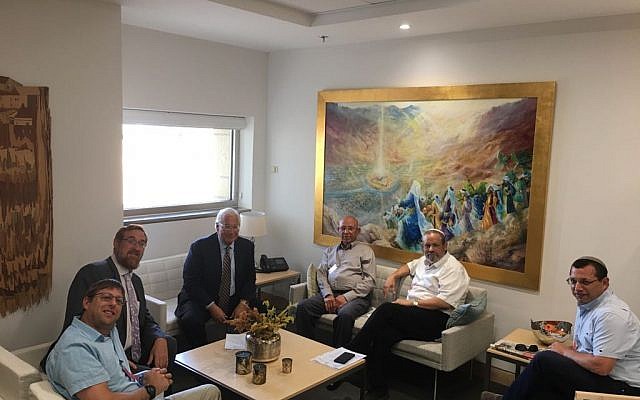 The Embassy declined to comment on the headline-making statement or the meeting itself. Without an American statement, settler leaders are the only source for what transpired in the meeting. According to MK Glick, the small group of settler leaders pushed Ambassador Friedman to endorse an “economic peace plan” as a substitute for a political solution to the conflict. Glick said that an economic proposal would “make redundant the discourse of concessions” (under previous U.S. proposals, Israeli concessions would have included the evacuation of far flung settlements in the West Bank).
Along those lines, the group presented Ambassador Friedman with a plan for a new industrial zone and medical center in the southern West Bank that, according to Glick and Har Hevron Regional Council Chairman Yochai Damari, would employ and serve thousands of Palestinians. The plan was presented by Glick, Damari, and Palestinian businessman Muhammad Nasser, who also attended the meeting. According to Glick, the U.S. Ambassador was supportive of the plan and offered U.S. assistance once the initiative was up and running.
[UPDATED 9/28/18: More details on the joint Israeli-Palestinian industrial zone in the Har Hebron region was later fleshed out by Ynet in a report here. The plan calls for an industrial zone and commercial center to be built near the Tene-Omarim settlement. Israeli Finance Minister Moshe Kahlon briefed the details of the plan to U.S. Treasury Secretary Steven Mnuchin and Jason Greenblatt, U.S. Special Representative for International Negotiations. The U.S. is expected to present the plan to the World Economy Forum during its annual meeting in January 2019]
Israel Publishes Tenders for 603 new units in East Jerusalem Settlement of Ramat Shlomo

Map by Ir Amim
On August 15th, the Israel Land Authority published construction tenders for 603 new settlement units in the Ramat Shlomo settlement in East Jerusalem. The 603 units are part of a larger plan for 1,500 units in Ramat Shlomo (tenders for almost all of which have been published now) that was announced by Israel in 2010, during the visit of then-Vice President Joe Biden. The timing of that announcement, and the inflammatory nature of settlement approvals in East Jerusalem (which the Obama Administration pressured Israel to halt), sparked outrage and prompted Biden to issue harsh criticism of Israel while on the ground. The incident earned the 2010 Ramat Shlomo plan the nickname the “Biden Plan.”
Anti-settlement watchdog Ir Amim comments that the Ramat Shlomo tenders are a part of the Israeli endeavor to:
“expand the Israeli neighborhoods/settlements in such a way as to consume the remaining space between them and nearby Palestinian neighborhoods ( a critical geo-political link between Jerusalem and Ramallah) so as to inhibit their development and further complicate any future division of the city.”
There has been a significant uptick in East Jerusalem settlement advancements since President Trump assumed office in January 2017, reflecting the sea change in U.S. policy towards settlements (evidenced again this week by Ambassador Friedman’s remarks, detailed above). As Ir Amim details, Israel’s unrestrained advancement of settlement construction in East Jerusalem has been coupled with legislative schemes to change the borders of Jerusalem (annexing far flung settlements into Jerusalem and cutting Palestinian neighborhoods out of Jerusalem) in order to engineer a Jewish Israeli majority in Jerusalem.
Massive Jerusalem Development Deal for 20,000 New Apartments – Including Settlement Expansion Projects
On August 15th, the Jerusalem Municipality signed a $380 million deal with the Israel Land Authority to finance a plethora of projects across the city, including 20,000 new apartment units. While much of this development will be in West Jerusalem, some will reportedly be in the East Jerusalem settlements of Pisgat Ze’ev, French Hill, and Atarot. The Jerusalem City Council is expected to give final approval to the plan next week.
Israel Triples Size of New Settlement Industrial Zone In Hebron
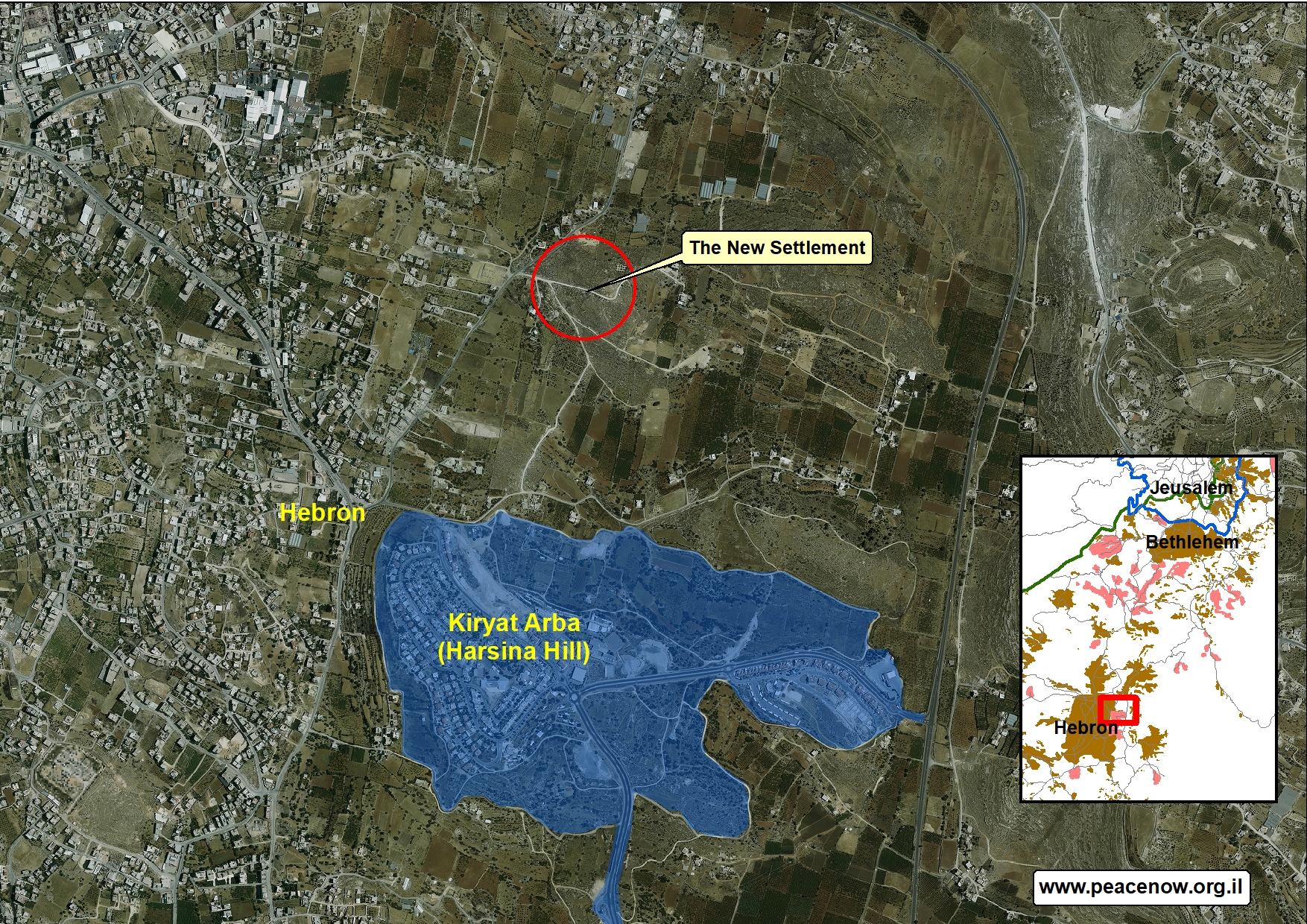
Map by Peace Now
According to The Jerusalem Post, on August 12th the Israeli government approved a plan that will triple the size of an industrial zone in the Kiryat Arba settlement in Hebron, approving 10 million shekels for the project. FMEP reported on the initial plans to build the Kiryat Arba industrial zone in March 2018, noting that the industrial zone is technically within the borders of the settlement but well outside of the developed lines of the settlement and beyond the fence that surrounds it – making it, in effect, a new Israeli settlement in Hebron. Now, the new settlement is set to significantly expand in one of the most volatile areas in the West Bank.
Knesset Sends Funds to New Settler Council in Hebron, Despite High Court Injunction
On August 12th, the Knesset Finance Committee approved 2 million shekels (about $550,000 USD) to fund the new local settler committee in Hebron. The Finance Committee requested that the money be disbursed to the Hebron settler committee “in accordance with an agreement in the past with MK Bezalel Smotrich,” (Habayit Hayehudi)…after the necessary professional and legal checks.”
The creation (via military order) of a new autonomous committee to represent and service a cluster of settlers living in enclaves in Hebron’s city center is being challenged by the Hebron Municipality. In response to the Palestinian petition, the High Court of Justice put a freeze on the plan, effective July 4, 2018, and gave the Israeli government 120 days to explain the legality of the plan. The petition argued that the military order creating the new body was intentionally vague in defining its legal and geographical jurisdiction, and pointed out that the new committee would be able to override decisions by the Hebron Municipality thereby stripping Palestinians of autonomy and representation in matters that directly affect them.
It is unclear from reporting if the Knesset Finance Committee’s decision to fund the new committee is related to the High Court’s ongoing consideration of the case. However, what is clear is that the Knesset is not concerned about undermining the High Court of Justice’s power over West Bank issues — indeed, the Knesset is actively pursuing that end with the recent passage of a new law stripping the Court of jurisdiction over land disputes and transferring it to a domestic Israeli Court, and with ongoing consideration of a bill that would allow the Knesset to reinstate laws that the High Court strikes down.
Knesset Approves Past Due Payment for the Construction of Amichai Settlement & “Temporary” Outpost
On August 12th, the Knesset Finance Committee approved the transfer of $9.5 million to pay contractors for their ongoing work on the first new settlement built with government approval in 25 years, Amichai, and a new “temporary” outpost for settlers whose homes were built on privately owned Palestinian land in the Netiv Ha’avot outpost and were recently demolished. Amichai is the new settlement approved as a pay-off to the settlers who were evacuated from the illegal Amona outpost. Construction on Amichai has begun, but has been interrupted several times due to lack of government cash, a problem ostensibly solved by this week’s cash transfer.
With respect to the new outpost for the Netiv Ha’avot outpost settlers, in February 2017 the Israeli government approved an unusual plan to place 15 mobile homes — connected to Israeli water, power, sewage, roads, and other infrastructure — at a site located near, but not within, the borders of the Alon Shvut settlement, in effect creating a new outpost for settlers evacuated from another outpost. When the High Planning Council initially approved the advancement of this plan in October 2017, it noted that “the plan is improper, but we will have to approve it as a temporary solution.” At the time, the Council ordered the government to go about expanding the borders of the Alon Shvut settlement to include the land. Under the approved plan, the new homes will be allowed to stay in that location for three years. However, based on past practice, it can be expected that within that time, or at the end of those three years, the site will “regulated” by Israel to become a permanent area of Israeli settlement.
In both cases – the Amichai plan and the Netiv Ha’avot plan – the Israeli government massively “compensating” citizens for the inconvenience of having been caught brazenly breaking Israeli law (i.e., for building without permits on privately owned Palestinian land). The two cases highlight the way in which the Israeli government not only encourages illegal settlement building, but generously incentivizes and rewards its. At this point, in addition to two new settlements, approximately 20 million shekels ($5.4 million) has been paid to the Amona evacuees and 15 million shekels ($4 million) to the Netiv Ha’avot evacuees.
Delay in Opening of new Jerusalem “Park” That Confiscates Palestinian Spring
A dispute between Israeli government agencies has led to a delay in the opening of a new Jerusalem tourist site – a park established for the express purpose of taking control over the Ein Al-Hanya spring, which was historically part of the al-Walajah Palestinian village. Originally slated to open April 1st, the delay centers around a battle over who will fund the operations of the site. For now, the site is closed and the grounds are not being maintained.
Regardless of the dispute, Israel has implemented policies that prevent Palestinians from accessing the spring and surrounding lands, including illegally moving a police checkpoint to further choke off al-Walajah from Jerusalem. As detailed in Haaretz, the plan for the park includes three pools filled by the spring – two for Israelis and tourists, and one for al-Walajah residents to water their crops and flocks. However, that third pool for Palestinians has not been built, and the water “merely spills into the nearby wadi.” The other pools, like the park, are currently empty and fenced off.
Israel Evicts Palestinians from Bethlehem Home Despite Court Order
Haaretz reports that settlers have forcibly evicted a Palestinian family from their home near Bethlehem, in defiance of an Israeli court order. The Palestinian Samara family reports that settlers tricked them into leaving the property, after which settlers locked them out, forcibly evicted them and their belongings, and then used a bulldozer to demolish their home. The family has filed an appeal to the High Court of Justice.
The Samara family – which since the early 1980s lived in 3 small units within a larger apartment building – has been targeted for eviction by settlers since 2012, when ownership of the building was transferred to an American organization controlled by Irving Moskowitz, a major funder of Jewish settlement in East Jerusalem. In 2016, the Gush Etzion Regional Council was given jurisdiction over the compound to move in Jewish Israeli settlers. Since that time, the building has been taken over by settlers, except for 2 units in which the Samara family lived as protected tenants (the third was welded shut), based on an Israeli court ruling under which the building’s owner promised not to restrict access to the building for four members of the Samara family (no other family members or visitors were allowed access). Regarding the arrangement, the judge wrote:
“This arrangement will remain in force unless a different judicial order is issued after a legal proceeding instituted by one of the parties.”
As Haaretz notes, there does not appear to be a different or new judicial order that would change the 2016 agreement.
In 2017, the Samaras reported that a new settler family had moved into the compound and began harassing the family members who remained – prompting them to file a complaint on July 26, 2018 with the Israeli police in the Beitar Illit settlement. Two weeks later on August 6th, the family was forcibly evicted and their units were demolished.
Despite the Samara’s harassment complaint and a real-time call to the police while the eviction was taking place, Israeli police took no action to prevent settlers from evicting the Samaras, reportedly stealing their cellphones, and bulldozing the properties. The Beitar Illit police station even refuse to allow the Samara family to enter the station and file a complaint until a lawyer for the family got involved many hours later.
Following intervention by UNRWA, the family was allowed to return to search the site for their ID cards and other important belongings. Now homeless, the Samara are taking their case to Israel’s the High Court of Justice.
Bonus Reads
- “A Palestinian Bedouin Village Braces for Forcible Transfer as Israel Seeks to Split the West Bank in Half” (The Intercept)
- “Between Garbage and Sewage: Israel’s Future Plans for Khan al-Ahmar” (+972 Mag)
- “Their Parents Settled the West Bank for Ideology, They’re Staying for the Vibes” (The Times of Israel)
Welcome to FMEP’s Weekly Settlement Report, covering everything you need to know about Israeli settlement activity this week.
To receive this report via email, please click here.
February 1, 2018
- Minister to Vote on Havat Gilad Legalization this Weekend
- De Facto Annexation Proceeds: Bill Will Extend Israeli Sovereignty to Settlement Universities
- Israeli Army to Take Control Over East Jerusalem Neighborhoods Cut Off by the Barrier
- New West Bank Bypass Road Opens “New Era in Settlement”
- European Union Says Israel is Using Tourism to Legitimize Settlements
- Israeli Expansion Plan Threatens Flood Out (Literally) Palestinian Town
- Yesh Din Report Slams the Israeli Civil Administration
- Bonus Reads
Comments, questions, or suggestions? Email Kristin McCarthy at kmccarthy@fmep.org.
Ministers to Vote on Havat Gilad Legalization this Weekend
Prime Minister Netanyahu announced that the Israeli Cabinet will vote on a resolution declaring the government’s intention to retroactively legalize the Havat Gilad outpost at their next weekly Cabinet meeting, scheduled for February 3rd.
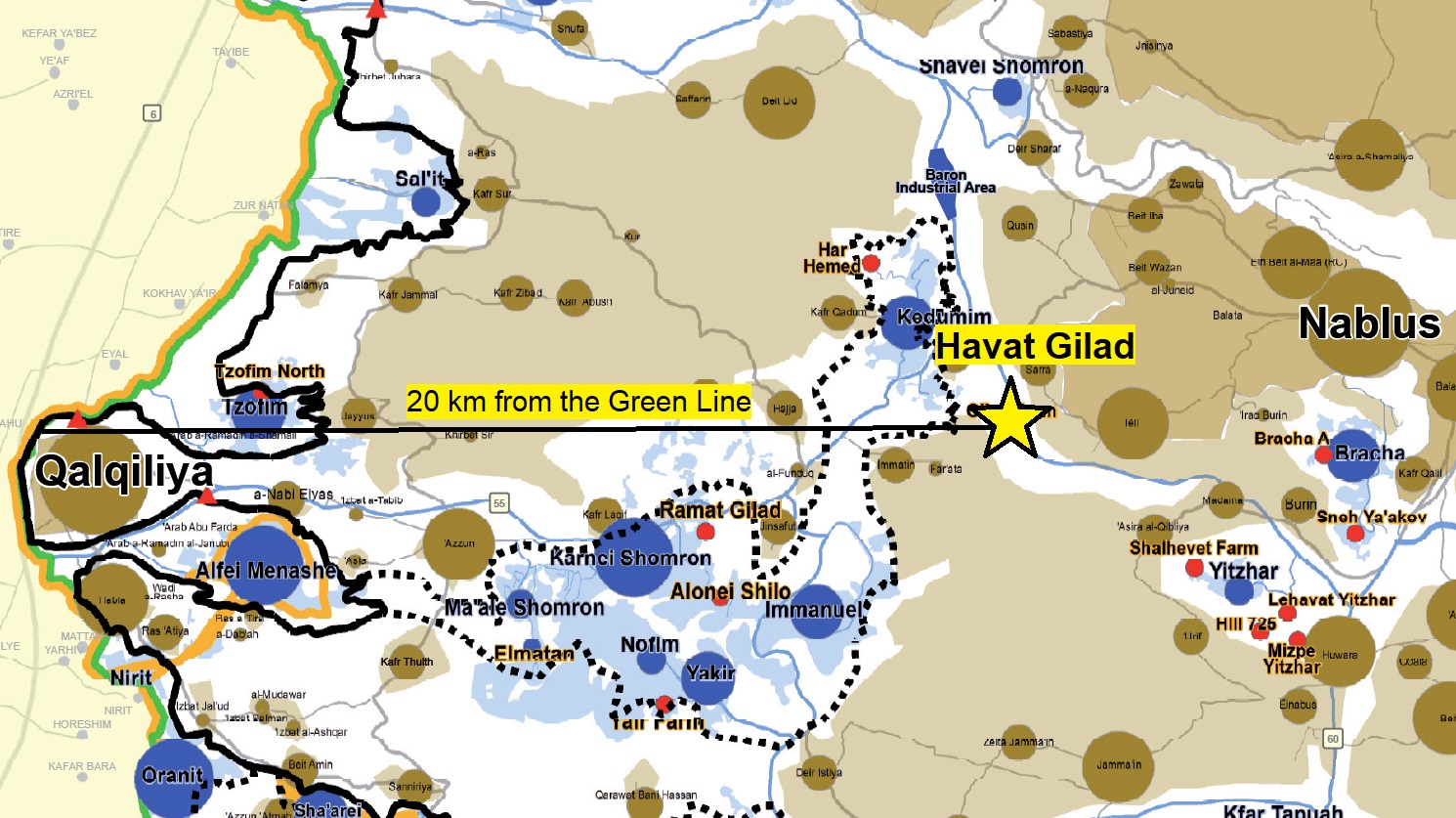
Map by Peace Now
At the last such meeting on January 28th, Netanyahu declined to put Havat Gilad on the agenda. He blasted a number of his own ministers who have criticized him in the press for the delay, which Netanyahu called “tactical.” Netanyahu’s Likud Party even issued a harsh statement in response to Defense Minister Liberman’s public statements, saying:
This is Bayit Yehudi’s [Jewish Home’s] well-known method once again at play – demanding the prime minister to do something they know he is going to do anyway, so they could later present it as their achievement. The bill will be raised next week, just as it was agreed with the bill’s sponsor, Defense Minister Lieberman.
The Jerusalem Post notes that this will be the fourth time since 2009 that Netanyahu’s government has retroactively legalized an outpost, the first three outposts being Bruchin, Rehalim, and Sansana. FMEP has previously reported on efforts by the Defense Ministry to retroactively legalize an additional 70 outposts, and FMEP has also covered the battle over the Netanyahu government’s “Regulation Law,” which was passed in early 2017 to pave the way for legalization of 55 unauthorized outposts and 4,000+ illegal settlement structures, by appropriating thousands of dunams of Palestinian private land.
Peace Now published a comprehensive case for why it would be a grave mistake for the government to legalize the Havat Gilad outpost. They write:
The legalization of the outpost would signal that the government does not intend to advance a final peace agreement, but rather only to extend Israel’s hold on the West Bank and to prevent the possibility of establishing a Palestinian state alongside an Israel with secure, internationally recognized borders. By working to authorize the outpost, the government is encouraging violations of the law, as well as sending a clear message to the settlers that such criminal acts pay off.
De Facto Annexation Proceeds: Bill Will Extend Israeli Sovereignty to Settlement Universities
On January 29, a bill to bring settlement universities under Israeli domestic law passed its first reading in the Knesset’s Education, Culture and Sport Committee. The bill aims to extend the authority of Israel’s Council of Higher Education to include schools located in settlement, which currently fall under a separate authority, as required by the norms of occupation. While Israeli policies are often extended to the settlements on an ad hoc basis through military orders issued by the Civil Administration, which is the arm of the IDF that is for all intents and purposes the sovereign ruler over the occupied territories, this bill capitalizes on the momentum created by a new Knesset policy that formalizes the process by which Israeli domestic law is extended over the settlements, in affect extending Israeli sovereignty over the West Bank and therefore annexing it.

Map by the New York Times
The authors of the policy have unabashedly stated that their goal is to annex the settlements, and even all of Area C, to Israel. One of the authors, MK Shuli Mualem Rafaeli (Jewish Home) said, “Alongside the academic importance of the law there is also a clear element of imposing sovereignty, and I am proud of both.”
The new bill is specifically connected to the opening of a state-of-the-art medical school in the Ariel settlement, funded in part by billionaire American financier Sheldon Adelson. As FMEP reported last June, Ariel University became an accredited Israeli university in 2012, following significant controversy and opposition, including from Israeli academics. It has since been the focus of additional controversy, linked to what is a clear Israeli-government-backed agenda of exploiting academia to normalize settlements. Ariel is located in the heart of the northern West Bank, reaching literally to the midpoint between the Green Line and the Jordan border. The future of Ariel has long been one of the greatest challenges to any possible peace agreement, since any plan to attach Ariel to Israel will cut the northern West Bank into pieces.
Israeli Army to Take Control Over East Jerusalem Neighborhoods Cut Off by the Barrier

Map by Haaretz
The Israeli army announced that it plans to take full security control over two East Jerusalem neighborhoods that have been walled out of the city of Jerusalem by the Israeli separation barrier. The move was justified by saying that there has been in increase in terror attacks carried out by Palestinians with Israeli identification cards (Palestinian residents of East Jerusalem carry Israeli ID cards).
Peace Now slammed the army’s move, noting:
The government insists that East Jerusalem should be part of Israel’s capital, yet it walls off 140,000 residents–1/2-2/3 of which are Israeli citizens–and brings in the army after the radicalization brought on in no small part by years of neglect and discrimination bear fruit. Once again the government has deceived the public by talking about “United Jerusalem” while practicing segregation
Until now, the the Israeli police department was the only permitted security presence in Shuafat refugee camp and Kafr Aqab, both of which are legally parts of Jerusalem, even though they were left on the West Bank side of the separation barrier. The Palestinian Authority is not allowed to operate in East Jerusalem (including these neighborhoods), which Israel annexed following the 1967 war. Israel’s isolation and systematic neglect of these East Jerusalem neighborhoods has come at an extraordinarily high cost for Palestinian residents.
New West Bank Bypass Road Opens “New Era in Settlement”
Israeli officials joined together for the opening of a new bypass road for Israeli settlers in the West Bank, the first major new bypass road opened in 20 years. And this is only the start: the road is the first of five new bypass roads that Netanyahu promised to build under pressure from settlers, who pushed the Prime Minister to expedite funds for projects the settlers claimed were needed for their security. The new Israeli-only road will link several settlements located deep inside the northern West Bank to cities inside Israel (i.e., within the Green Line), while bypassing Palestinian towns.
Prime Minister Netanyahu was clear about the importance of the road and what it means for the future of Israeli settlement construction. Netanyahu said,
Returning to our homeland – that’s what we’re doing here, in the heart of the Land of Israel … This is a festive day. It’s a festive day for Samaria, a festive day for the State of Israel.This bypass road is part of the system of bypass roads that we are building throughout Judea and Samaria that serves the residents of Judea and Samaria and the residents of the entire State of Israel
Not to be outdone, Yossi Dagan, the head of the Samaria Regional Council, a municipal body for settlements in the West Bank, put it even more bluntly saying that this is,
the beginning of a new era in settlement…It is impossible to overstate the importance of these bypass roads and the importance of transportation routes for settlement. They are the keys to the development of settlement.
At the ceremony, Deputy Defense Minister Eli Ben Dahan announced that the government will begin paving two more bypass roads in the coming weeks.
[2/2/2018 Update] Last year, B’Tselem documented Israeli construction of the bypass road Netanyahu christened this week. In order to build the road, Israel uprooted olive trees belonging to the Palestinian city of Qalqilya. Documenting the olive tree destruction, B’Tselem wrote in January 2017:
This work is being carried out as part of the decision made by the military and the Civil Administration to build a bypass road to replace the section of Route 55 that runs through a-Nabi Elyas. Route 55 originally served as the main link between Nablus and Qalqilya and was one of the major traffic arteries in the West Bank. Over time, as settlements expanded, it also became essential to settlers, as it connects several large settlements with Israel’s coastal plains and central region.
The decision to build the bypass road was first made in 1989, with the goal of sparing settlers the need to drive through the village of a-Nabi Elyas. However, it was not pursued until September 2013, when the Civil Administration planning institutions began the planning process. In October 2015, the project was expedited due to pressure by the settler leadership: According to Israeli media reports , Prime Minister Netanyahu promised the heads of the settlement local councils that the road would be built after they had set up a protest tent in October 2015, following the attack that killed Naama and Eitam Henkin.
On 21 December 2015, the head of the Civil Administration issued an expropriation order for 10.4 hectares of land earmarked for the bypass road. The order noted that the new road will “serve the public good” and improve mobility between Nablus and Qalqilya. In March 2016, the Palestinian village councils and landowners petitioned Israel’s High Court of Justice (HCJ) against the expropriation, on the grounds that the road will not serve all residents of the area but only settlers. On 16 November 2016, the HCJ denied the petition after accepting the state’s claim that the road is intended to serve the entire population of the area.
The seizure of the land and uprooting of olive trees have severely harmed the landowners, who have lost a source of income and a major financial asset, as well as an open space that served all local residents for leisure and recreational activities.
The state argued that the road is meant to serve Palestinians in the area, too, in order to comply with the provisions of international law, which allow the occupying power to expropriate land within the occupied area in two circumstances only. The first is a specific military need related to the occupied territory itself, and the second is promoting the wellbeing of the residents of the occupied territory.
European Union Says Israel is Using Tourism to Legitimize Settlements
In a leaked report, European Union officials said that Israeli archaeological and tourism projects in East Jerusalem are “a political tool to modify the historical narrative and to support, legitimacy and expand settlements.”
The Guardian, which saw the annual report written by the EU Heads of Mission in Jerusalem, lists settler-run excavation sites, the proposed cable car project (which FMEP has reported on repeatedly), and national parks in East Jerusalem as part of Israel’s mission to change facts on the ground.
The report covers activity of Israeli settler groups in Silwan (called the “City of David” by settlers and the Israeli government, both of which seek to assert exclusive Jewish heritage there). It is in this area that the Israeli government approved the Kedem Center, a huge tourism complex proposed by the settler group Elad, as the final stop of the Jerusalem cable car project. Silwan is home to 450 hardline settlers, guarded by government-funded private security, living amongst 10,000 Palestinians. The Palestinian population of this area faces home demolitions, land and property seizures, evictions, intense settlement building, and devastating property damage resulting from massive underground excavation projects run by settler-aligned groups with the financing of the Israeli government.
Of the cable car project and the Silwan stop in particular, the report says:
Critics have described the project as turning the World Heritage site of Jerusalem into a commercial theme park while local Palestinian residents are absent from the narrative being promoted to the visitors
[2/2/2018 Update] Emek Shaveh, an Israeli NGO who has been raising concern about archeological settlement activity in Jerusalem since 2009, issued a statement elaborating on the extent of the threat posed by the type of activity the EU report highlights. They wrote,
Archaeological tourism projects are favored by the settlers as a means of winning the hearts of minds of the Israeli, Jewish and evangelical publics. The EU now recognizes how archaeological sites in East Jerusalem are being used as a political tool to “modify the historical narrative and to support, legitimise and expand settlements”. The City of David in Silwan, the new cable car project, the national parks in Palestinian neighborhoods compliment evictions and house demolitions in marginalising and disenfranchising the East Jerusalem Palestinian public. The difference between “cultural projects” such as the national parks or the City of David and house demolitions is that in addition to the physical displacement, the former also expropriate the narrative, dispossessing the Palestinians from their historical and cultural contexts. When it comes to Jerusalem, narrative is not an abstract issue because in Jerusalem history and questions of present-day sovereignty are intertwined. And when it will come to determining the final status of the city, the question of who “owns” the history of the city will be crucial.
Israeli Expansion Plan Threatens Flood Out (Literally) Palestinian Town
Palestinian residents of Wadi Foquin, a West Bank village located in a valley along the 1967 Green Line, west of Bethlehem, are chronicling how nearby construction in Israel has resulted in unprecedented flooding and the severe depletion of their 11 historic natural springs.
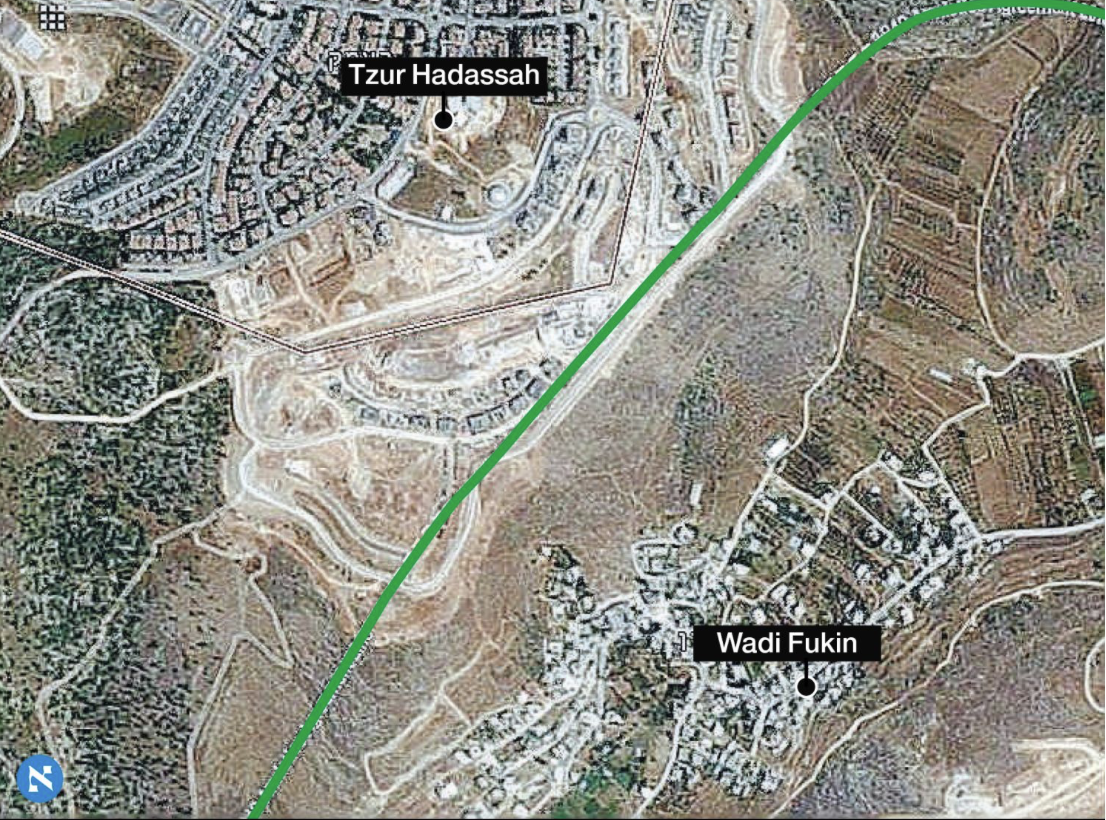
Map by Haaretz
A victim of its location on the Green Line and its lush lands, Wadi Foquin sits between the Israeli city Tzur Haddassah to its west and the ever-growing mega-settlement pf Beitar Illit, to its east. Last year, the Israeli government approved an expansion plan for Tzur Hadassah that extends the city past the Green Line into the West Bank, as reported by the Israeli settlement watchdog Kerem Navot. Wadi Foquin residents say Tzur Hadassah and Beitar Illit, both of which look down on the valley town, have already created something akin to concrete water slides, shooting rainwater straight into Wadi Foquin and flooding their homes, streets, and businesses, while also preventing the water from replenishing the springs. The expansion is only making matters worse. The Israeli government, for its part, claims that all the proper and required ecological studies have been completed and the plan passes muster and will move forward.
Yesh Din Report Slams the Israeli Civil Administration
The Israeli NGO Yesh Din released a new report, “Through the Lense of Israel’s Interests: The Civil Administration’s Role in the West Bank.” The report is an in-depth look at the main functions of the Civil Administration, the arm of the Israeli military which is the de facto sovereign in the West Bank. The Civil Administration regulates virtually every aspect of Palestinian life, including travel permits, roads, land, resource extraction, archeology, and of course settlement-related issues. The report examines the role of the Civil Administration and the ways in which its authorities have become a “means of oppression and domination over Palestinians.”
Yesh Din concludes:
The Civil Administration, established to serve “the welfare and benefit of the population” and “for the purpose of operating and providing public services”, betrays its professed role. Instead of ensuring public order and safety in a temporary trusteeship, as required by international law, the Civil Administration uses administrative tools to effect long-term, irreversible changes in the OPT and to impose restrictions and bans on the protected persons, in a severe, systemic and widespread abuse of the human rights of Palestinians in the West Bank.
Bonus Reads
- “More than 200 companies have Israeli settlement ties: U.N.” (Reuters)
- INFOGRAPHIC “50 Years of Occupation: The Security Burden Continues” (Peace Now)
- “After Netanyahu Summons Ambassador, Irish Senate Postpones Debate on Bill Blocking Israeli Settlement Goods” (Haaretz)
- “Ireland to vote on settlement trade sanctions bill” (+972 Magazine)
FMEP has long been a trusted resource on settlement-related issues, reflecting both the excellent work of our grantees on the ground and our own in-house expertise. FMEP’s focus on settlements derives from our commitment to achieving lasting Israeli-Palestinian peace, and our recognition of the fact that Israeli settlements – established for the explicit purpose of dispossessing Palestinians in the West Bank and East Jerusalem of land and resources, and depriving them of the very possibility of self-determination in their own state with borders based on the 1967 lines – are antithetical to that goal.
Welcome to FMEP’s Weekly Settlement Report, covering everything you need to know about Israeli settlement activity this week.
To receive this report via email, please click here.
August 9, 2017
- Israel Moves Forward with Inflammatory Evictions & Home Demolitions in Jerusalem
- Netanyahu Celebrates Expansion of Beitar Illit Settlement
- Attorney General Requests Temporary Injunction Against “Regulation Law”
- Palestinian Leaders Criticize U.S. Peace Efforts & Point to Silence on Settlements
- New Poll Reveals Settlers Prefer the Status Quo to Annexation or Peace
- Updates: Machpelah House; New “Amichai” Settlement; Netiv Ha’avot Outpost
- Bonus Reads
Comments, questions, or suggestions? Email Kristin McCarthy at kmccarthy@fmep.org.
Israel Moves Forward with Evictions & Home Demolitions in Jerusalem
Last week we covered three devastating bills moving in the Knesset that seeking to remove Palestinians and include far flung settlements in the borders of Jerusalem. Now, several seemingly small but incredibly significant developments in Jerusalem show how Palestinians are already being forced out of the city:
-
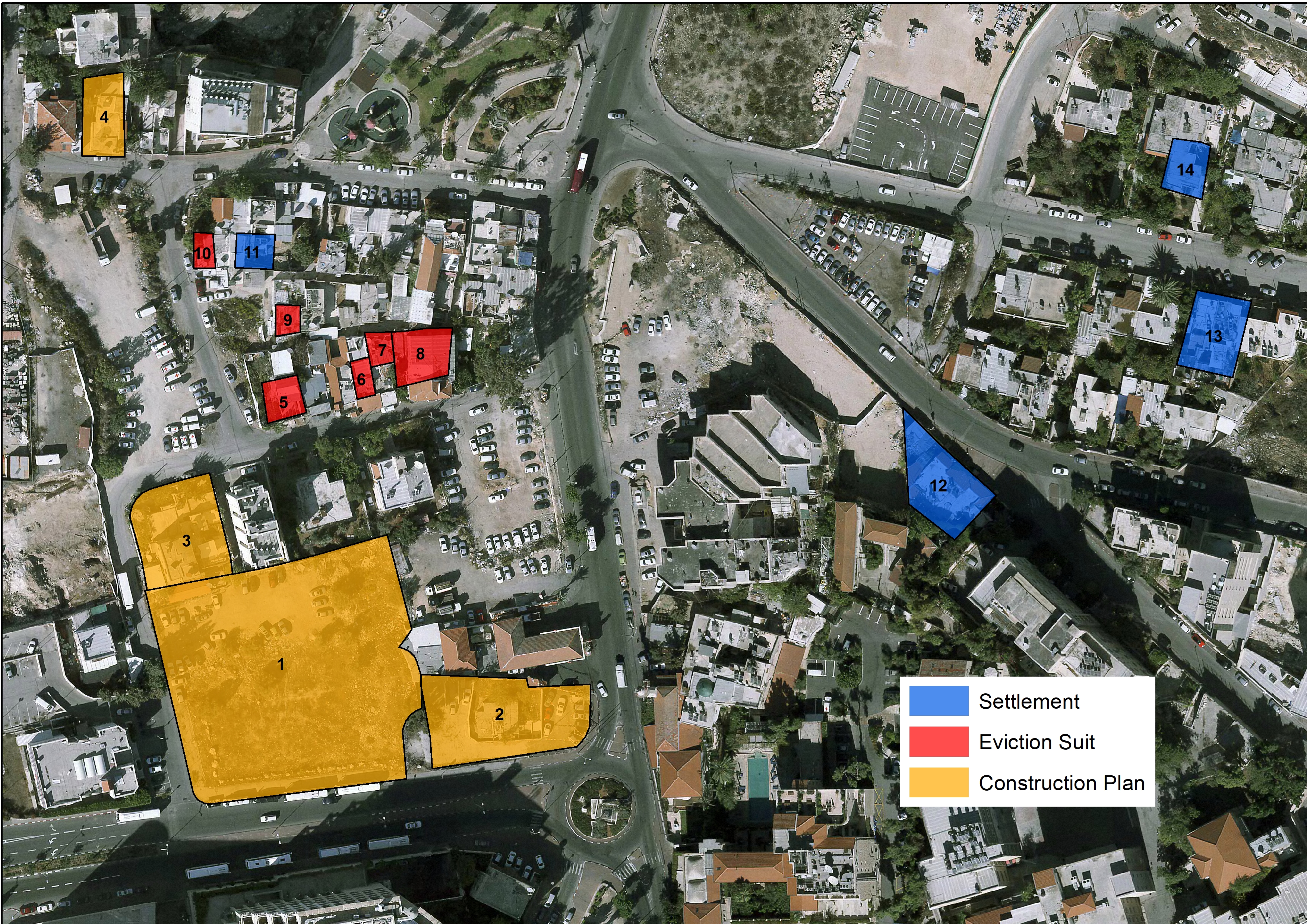
Map by Peace Now
In Sheikh Jarrah, a Palestinian family is fighting against imminent eviction from their family home of 50 years, an eviction ordered by the Israeli Supreme Court. This is the first eviction in the Sheikh Jarrah neighborhood of Jerusalem since 2009 and comes on the heels of several inflammatory settlement announcements which will bring more Israeli settlers into the neighborhood that sits just north of Jerusalem’s Old City. The Court’s decision to evict the Shamasneh family relies on an Israeli law which allows Jews to regain East Jerusalem property owned before Jordan’s 1948 capture of that part of the city. Daily solidarity protests are reportedly being staged in an effort to prevent the family’s eviction.
-

Map by Emek Shaveh
In Silwan, the settler group Elad is bidding to become the majority-owner of an apartment building that Palestinians are in a bidding war to keep. The Siyam family originally owned the entire building but over time lost control of one-half of it to the settlers another one-fourth of it to Israel’s Custodian of Absentee Property. The owners of the remaining one-fourth – Silwan non-violent opposition leader Jawad Siyam and his sister – currently reside. Now the Custodian is auctioning off its one-fourth share and if the settlers have the winning bid, it is a near certainty that Jawad and his sister will be evicted from the house by Israeli courts. This ownership battle could have a decisive impact on the character of this critically-located East Jerusalem neighborhood, which sits in the shadow of the Temple Mount/Haram al-Sharif. Elad has long been active in Silwan, taking over properties and, working hand-in-hand with the Israeli government and Jerusalem Municipality, gaining control over the public domain via tourism and park projects at the expense of the Palestinian residents. Elad recently won the rights to build a state of the art visitor center that will also be a stop on the new cable car line running to the Mount of Olives. Elad’s efforts to take over Palestinian property in East Jerusalem rely in large part on Israel’s “Absentee Property Law” (1950), according to which Palestinians who were not present at their property immediately following the 1967 war are considered “absentee,” and consequently forfeit ownership rights to the Israeli government. The government can then dispose of the property as it sees fit. In Jerusalem, Elad’s multi-million dollar annual budget puts Palestinians at a potentially insurmountable disadvantage. When Israel used the “Absentee Property Law” in 2004 to seize Palestinian property in East Jerusalem, then-President George W. Bush called on Israel to reconsider the decision.
- In al-Walajah, a wave of home demolitions combined with the nearly completed construction of the separation barrier threatens to completely sever and displace al-Walajah’s residents from the West Bank (who hold West Bank IDs, rather than Jerusalem residency, despite the fact that in 1967 most of the village’s land was made part of Jerusalem). Just this week the Israeli government issued demolition orders against 14 Palestinian homes built without the proper permits (these permits are nearly impossible for obtain).
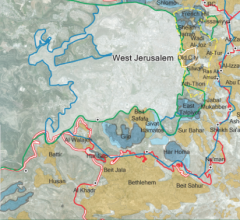
Map by Ir Amim
The 14 homes are in addition to 28 other homes already slated for demolition in the village. On the same day, the Israeli Supreme Court decided to temporarily delay the implementation of 7 of those previous orders in light of a petition brought to the court by the Norwegian Refugee Council. Residents of al-Walajah have fought the growing encroachment the nearby Etzion settlement bloc and the Israeli government’s attempt to de facto annex the bloc as part of “Greater Jerusalem.” Ir Amim explains several prongs of this effort, including a particularly unbelievably section of the separation barrier planned to almost completely encircle the village, to turn its valuable agricultural land into an urban park for Jerusalem, and construction of a highway that will connect the Etzion settlement bloc to Jerusalem with Israeli-only bypass roads.
- In Jabal al-Mukaber, a neighborhood south of the Old City in East Jerusalem, Israel demolished four Palestinian homes without prior notice to the residents. Ma’an News reports, “Israeli authorities have stepped up issuing demolition warrants for Palestinians in East Jerusalem in recent months, particularly after Jerusalem Mayor Nir Barakat threatened that the demolition of the illegal Israeli outpost of Amona in the occupied West Bank would be met with the mass demolition of Palestinian homes lacking the nearly impossible to obtain Israeli-issued building permits.”


Netanyahu Celebrates Expansion of Beitar Illit Settlement
Prime Minister Netanyahu attended a cornerstone-laying ceremony for hundreds of new homes set to be built in the Beitar Illit settlement, a massive, fast-growing, ultra-Orthodox settlement in the Etzion bloc. At the ceremony, Netanyahu proudly repeated his assertion that, “There is no government that does more for the settlement [movement] in Israel than the one under my leadership.” The project will annex a third strategic hilltop to the Beitar Illit, which like much of the Etzion bloc is located on the Israeli side of the separation barrier.
The same day Netanyahu visited Beitar Illit, several right-wing Knesset members traveled to the northern part of the West Bank to call on the Prime Minister to re-establish four Israeli settlements located near the West Bank city of Jenin, that were dismantled in 2005 of part of Ariel Sharon’s disengagement from Gaza. A bill has been introduced in the Knesset that would rescind the 2005 disengagement memo which led to the evacuation of the four settlements.
Attorney General Requests Temporary Injunction Against “Regulation Law”
On August 7th, Israeli Attorney General Avichai Mandelblit weighed in on a petition filed with the Israeli Supreme Court challenging the legality of the “Regulation Law,” which was passed this year and provides a legal basis for retroactive legalization of outposts and other settlement activity in the West Bank on land owned by Palestinians. Mandelblit – who argued against passage of the Regulation Law late last year and after the law’s passage and said he would not defend it in court – asked the High Court to put a temporary injunction against the law until the Court issues its ruling. The injunction would prevent the Civil Administration (the arm of the IDF that rules over the West Bank) from using the law, and possibly from even taking the preliminary steps towards using the law, in order to retroactively legalize outposts and unauthorized settlement activity.
The petition against the Regulation Law (also called the “Expropriation Law,” the “Regularization Law,” the “Legalization Law,” or the “Settlements Law”) was filed in March by three leading Israeli settlement watchdogs: Yesh Din, Peace Now, and ACRI.
Palestinian Leaders Criticize U.S. Peace Efforts & Point to Silence on Settlements
The Palestinian outlook on President Trump’s negotiation efforts has grown outright grim this week. Any initial optimism has been replaced with a sense of abandonment on the part of Mahmoud Abbas’s Palestinian Authority and the topic of unfettered settlement growth has been a recurring talking point. On August 7th in Ramallah, Jordan’s King Abdullah and the Palestinian Authority jointly called for the U.S. to unequivocally state its support for a two-state solution and reiterated that a complete settlement freeze remains a precondition for the resumption of negotiations, including in East Jerusalem. That statement should dispel any lingering questions regarding reports in June that the PA was willing to drop a settlement freeze as a precondition to peace talks.
The new statement comes after a week of terse, unscripted criticism by the Palestinians aimed at President Trump. A top Abbas advisor, Dr. Nabil Sha’ath, told Haaretz that that Palestinians no longer look to the U.S. to be helpful on the issue. Sha’ath said, “Palestinian efforts in the near term will be focused on the international arena in an effort to prevent accelerated settlement construction or the passing of laws that have direct consequences for the peace process.”
In an interview with Jewish Insider last week, top Palestinian negotiator Saeb Erekat did not mince words about his disappointment with the Trump administration’s earlier attempts to get the ball moving on Israeli-Palestinian negotiations. Of note, Erekat laments, “Israel announces thousands of new settlement units that make it almost impossible to achieve the two-state solution, and it’s merely met with silence from U.S. officials.” Erekat is not entirely correct about the U.S.’s silence. The U.S. Department of State has repeatedly issued the same ambiguous statement regarding Israeli settlement policy, that “unrestrained settlement activity is not helpful to the peace process.” The statement echoes President Trump’s remarks in February calling for Israel to “hold back a little” on settlements.
In a third report, an anonymous Palestinian official took aim at Jared Kushner and Jason Greenblatt, Trump’s senior-most envoys dealing with Israel and the Palestinians. The source said, “It’s not a nice thing to say, but they are both ardent supporters of the settlements.They are completely unfamiliar with the other side, they don’t understand the region and they don’t understand the material. You can’t learn about what is happening here in a seminar lasting just a few weeks.” The remarks came one day before the release of a recording of Jared Kushner revealed his thinking on the topic of Israeli-Palestinian issues during which he expressed a lack of interest in history lessons on the topic.
New Poll Reveals Settler Prefer the Status Quo to Annexation or Peace
A new poll reveals remarkable differences between Israeli Jews living within the borders of sovereign Israel and those living in settlements. It sheds light on who in Israel is benefitting from the current “status quo” (which was undefined in the poll’s questions to respondents):
Of Israeli settlers:
- 35% called for the continuation of the status quo
- 24% want Israel to annex the West Bank
- 15% want to see a peace agreement
- 10% back a decisive war against the Palestinians
Of Israeli Jews living in Israel:
- 18% called for the continuation of the status quo
- 9% want Israel to annex the West Bank
- 45% support a peace agreement
- 12% back a decisive war against the Palestinians
The poll also examined the views of Palestinian citizens of Israel and Palestinians in the West Bank and East Jerusalem.
Updates: Machpelah House; New “Amichai” Settlement; Netiv Ha’avot Outpost
Several important updates to last week’s settlement report:
- In Hebron, settlers continue to illegally occupy the Machpelah House under the protection of the Israeli army, despite a new petition seeking their evacuation filed this week by Palestinians who claim to own the house. Last week, the head of the “Samaria Regional Council” Yossi Dagan, moved into the house along with his wife and three children. Approximately 120 Israeli settlers were already living there, having illegally broken into into the house last week in a bid to circumvent legal proceedings regarding rightful ownership. The IDF quickly declared the house a closed military zone, but the order has not been enforced, which is the only reason why Dagan and his family were able to enter the building. Yossi Dagan was elected head of the Samaria Regional Council in 2015. He opened a campaign office for Donald Trump during the 2016 U.S. Presidential election and published an open letter to Steve Bannon expressing his admiration and support for the newly elected U.S. administration.
- Netanyahu’s cabinet gave a major boost to the stalled construction of a new settlement called Amichai by reportedly doubling the size of the government’s financial contribution to the project. Last week, after it was reported that construction has been halted due to lack of funds, Netanyahu quickly issued assurances that the problem will be fixed. The new Amichai settlement – the first to be approved by the government since 1991 – is being built in the Shilo Valley, deep inside of the West Bank, as the payoff for families who built the illegal Amona outpost and were evacuated earlier this year. Immediately next to the Amichai construction site, at the site of the future Shvut Rachel East settlement (which was the original plan to pay-off the Amona evacuees but was rejected because it wasn’t the preferred hilltop — but was nonetheless approved for construction by the Israeli government as a neighborhood of the Shilo settlement) several caravans have been moved onto the recently leveled land in preparation for further construction.
- In two separate meetings last week, settler leaders met with PM Netanyahu and his chief of staff in their bid to cajole the Prime Minister into intervening against a demolition order threatening 15 homes in the Netiv Ha’avot outpost near Bethlehem. Commenting on the issue while at a ceremony in the Beitar Illit settlement, Netanyahu committed to helping the affected families “within the framework of the law that would minimize the damage.” It’s not clear if the Prime Minister was referring to the past damage caused to the Palestinians who own the land upon which settlers built illegally, or the future damage it will cause to relocate the families who live in illegally built homes.
Bonus Reads
- Who Profits Flash Report: “Tracking Annexation: The Jerusalem Light Rail and the Israeli Occupation” (July 2017)
- “The Young Palestinian Men of East Jerusalem Have Nothing to Lose” (August 3, 2017 | Haaretz+)
- Human Rights Watch: “Jerusalem Palestinians Stripped of Status” (August 8, 2017)
- “Demographic hysteria leaves Jerusalemites by the wayside” (August 7, 2017 | +972 Mag)
FMEP has long been a trusted resource on settlement-related issues, reflecting both the excellent work of our grantees on the ground and our own in-house expertise. FMEP’s focus on settlements derives from our commitment to achieving lasting Israeli-Palestinian peace, and our recognition of the fact that Israeli settlements – established for the explicit purpose of dispossessing Palestinians in the West Bank and East Jerusalem of land and resources, and depriving them of the very possibility of self-determination in their own state with borders based on the 1967 lines – are antithetical to that goal.
Welcome to FMEP’s Weekly Settlement Report, covering everything you need to know about Israeli settlement activity this week.
To receive this report via email, please click here.
July 28, 2017
- Bibi Embraces “Population Transfer” – Asks for US OK
- The Knesset & Bibi Move to Gerrymander Jerusalem
- Settlers Set Up Outpost, Seek to Expand Settlement as “Response” to Murders
- Settlers Seize Contested Building in Hebron
- Construction on New Settlement in Shilo Valley Stalled (Due to Lack of Funds)
- High-Ranking Government Officials Defend Outpost from Demolition
- Bonus Reads
Comments, questions, or suggestions? Email Kristin McCarthy at kmccarthy@fmep.org
Bibi Embraces “Population Transfer” – Asks for US OK
According to a report from Israel’s Channel 2 News, Prime Minister Netanyahu recently asked U.S. Ambassador David Friedman and Special Envoy Jason Greenblatt to support a populated land-swap as part of a future peace deal.
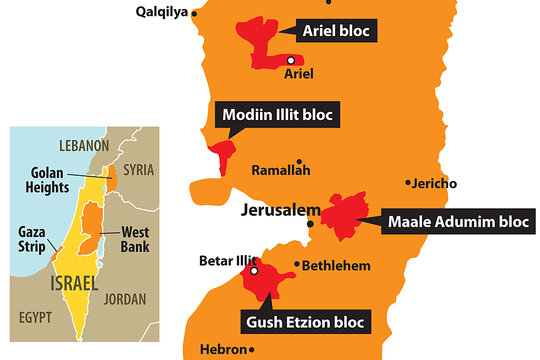
Map in CSMonitor
The swap in question would transfer 300,000 Palestinian citizens of Israel (living in the Wadi Ara region, an area known as “the triangle,” near Haifa) to the Palestinians, in exchange for Israel’s annexation of settlements in the Etzion bloc. The plan – which was previously championed by Defense Minister Avigdor Liberman, who even proposed it at the United Nations – is in effect a population transfer that would allow Israel to get rid of a large cluster of Palestinian cities, including the city where the two terrorists who attacked guards at the Haram al-Sharif/Temple Mount last week grew up.
An unnamed White House official made a statement in response to the report saying, “This may have been one of many ideas discussed several weeks ago in the context of a peace agreement and not in the context of a separate annexation.”
FMEP President Lara Friedman commented on what message Bibi’s endorsement of this idea sends: for the current Israeli government, “citizenship of Jews is inalienable right; citizenship of Arabs is revocable privilege.”
Arab Israeli MK Aida Touma-Suliman responded to the report saying, “The cat is out of the bag and Netanyahu has shown his true colors regarding the Arab population…the [Wadi] Ara residents are not only Israeli citizens, they’re also indigenous people who dwell on their land, and are not to be compared with settlers dwelling on another nation’s land. We the Arab citizens aren’t part of any such equation and aren’t willing to pay the price again for Israel’s policy of occupation and settlements.”
When Avigdor Liberman promoted the idea back in 2014, then-President Shimon Peres said, “Israel cannot take away its citizens’ citizenship simply because they’re Arab.” Then-Interior Minister Gideon Sa’ar said, “An Israeli citizen is not an object and not transferable as part of a framework political agreement.” Netanyahu has never expressed support for the plan prior to this news report, but the plan has allegedly come up in negotiations before.
The area of settlements known as the “Etzion Bloc” is home to over 22 settlements and 75,000 Israeli settlers. The loose cluster of settlements is located south of Jerusalem, extending from the 1967 Green Line deep into the West Bank; most of the settlements are on the Israeli side of the separation barrier. The major traffic junction in the area has recently seen numerous car-ramming and stabbing attacks by Palestinians targeting Israeli settlers and soldiers in the area, including an attack today that resulted in the death of the attacker and no other reported injuries.
The Knesset & Bibi Move to Gerrymander Jerusalem
In tandem with the Temple Mount/Haram al-Sharif crisis is, three important bills regarding Jerusalem’s future have advanced in the Knesset:
-

Map by Haaretz
Prime Minister Netanyahu announced his support for a bill in the Knesset that would allow 130,000 Israeli settlers living four West Bank settlements to vote in Jerusalem’s municipal elections while effectively excluding around 100,000 Palestinians from the Jerusalem municipality (most obviously the Shuafat refugee camp and Kafr Aqab, which are located outside the separation barrier). The four settlements are Maale Adumim, Givat Ze’ev, Beitar Illit, and Efrat, the last of which is six miles from Jerusalem. All are illegal under international law. Netanyahu’s support for this bill means that it is set to move forward when the Knesset’s reconvenes from its 3-month summer recess in November.
- Another bill (introduced a few days before the one described above) would allow the Israeli government to transfer Palestinian neighborhoods of Jerusalem outside the barrier to a separate, new municipality, created especially for this purpose. This bill and the one above aim to remove from the municipal area of Israel’s eternal, united capital those areas that threaten the Jewish demographic majority in Jerusalem, relegating them to a separate authority.
- These bills are complementary to a bill voted on last week that seeks to prevent the Israeli government from transferring parts of Jerusalem to a foreign power (i.e. the Palestinian government) in a future peace deal.
Settlers Set Up Outpost, Seek to Expand Settlement as “Response” to Murders
Following the horrific murder of three Israelis living in the Halamish settlement, the settlement’s leaders are seeking to consolidate and expand their illegal presence in the West Bank.
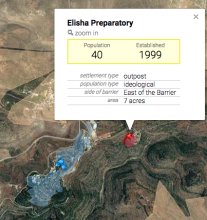
Map by Peace Now Israel
Within hours of the murder, hundreds of Halamish residents set up a campsite and a blockade of the eastern road leading to the settlement. The campsite is being called “Yad Ahi,” or “My Brother’s Hand” in memory of the three family members who were slain by a Palestinian youth last Friday. Settlers are rotating shifts inhabiting the campsite, aiming to make it an official outpost of the settlement and permanently close the road to Palestinians.
Halamish leaders are also demanding the government allow the expansion the settlement’s borders. A spokesman of the Binyamin Regional Council (which represents and provides municipal services to settlements in the Halamish region) called on the government to approve construction plans connecting the Halamish settlement to a nearby outpost called Tzofit, in order to “create a bigger security area and allow building neighborhoods that have already received zoning approvals.” Tzofit (also known as “Zufit” and/or “Elisha Preparatory”) is an illegal outpost that was established in 2007.
U.S. Ambassador David Friedman and Special Envoy Jason Greenblatt went to the illegal Halamish settlement this week to offer their condolences to the victims of the murder.
Halamish is located northwest of Ramallah, deep inside the West Bank. When the settlement was founded in the 1970s, Palestinian residents from the nearby towns of Deir Nidham and Nabi Saleh sued to stop the settlement’s construction, claiming it was being built on their villages’ land. The Israeli Supreme Court ruled in favor of the settlers, declaring the area to be state land. The Halamish settlement and its ever-growing encroachment on surrounding Palestinian villages has inspired weekly protests in Deir Nidham and Nabi Saleh, which has become infamous for weekly demonstrations – often involving clashes with the IDF – in recent years, often with international participation.
Settlers Seize Contested Building in Hebron
On the evening of July 25th — while events in Jerusalem were dominating the attention of the region and the world — 120 settlers broke into and illegally occupied a contested building near the Tomb of the Patriarchs/Ibrahimi Mosque in Hebron. The Israeli army immediately surrounded the building and on the morning of July 26th the area was declared a “closed military zone.” Prime Minister Netanyahu ordered the Defense Ministry to allow the settlers to stay as negotiations on their fate and ownership of the building continue.
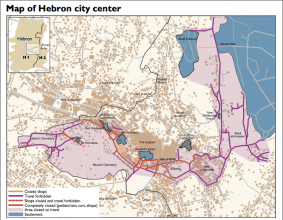
Map by B’Tselem
The Times of Israel reports that, “sources close to the prime minister said that Netanyahu was looking to avoid having to evacuate the families.” On the other hand, Yesh Atid chairman Yair Lapid called for their immediate evacuation. As of this writing, the settlers are still being allowed to illegally squat in the property.
Peace Now warned that the settler’s action can “ignite the region” and called on the government to, “follow the law and the Israeli interest and evacuate the trespassers without delay.”
J Street issued a statement calling on the U.S. government and international actors to pressure Israel to remove the settlers, saying “the Hebron settlers and their allies clearly believe that they can take advantage of the present crisis and push their long-term expansionist agenda by creating new ‘facts on the ground.’ It is vital that the prime minister and defense minister act in the best interests of Israeli security and uphold the rule of law by swiftly removing these families from the property.”
Hebron’s settlers have for some time been waging in a legal struggle to prove they legally purchased the building, known as the Machpela House. Palestinians contend they did not purchase it from the legal owners. While proceedings are ongoing, the settlers have once before broken into and occupied the building; when they did so in 2012, they were allowed to stay in the house for a week before being evacuated at the urging of the then-Attorney General of Israel who argued that it was necessary to preserve the rule of law.
Construction on New Settlement in Shilo Valley Stalled (Due to Lack of Funds)
A month after construction began on the first new settlement authorized by Israel in 25 years, the project has come to a halt – no over politics but due to insufficient government funds. The government had promised to bankroll the settlement’s construction but has not contributed to costs yet, according to the Binyamin Regional Council, which is currently footing the bill. The spokesman for the Binyamin Regional Council speculated on July 25th that the issue will be resolved quickly and expressed confidence in the government’s commitment to the project. Prime Minister Netanyahu reportedly gave orders to ensure construction is resumed quickly. As of this writing, there is no reporting to suggest construction has resumed.
High-Ranking Israeli Officials Defend Outpost from Demolition
Last week we reported on an impending demolition order against the Netiv Ha’avot outpost (near Bethlehem), along with the public relations efforts settlers were leading to elicit government intervention in their favor. The settlers got a helping hand this week when Israeli Education Minister Naftali Bennett and Yair Lapid (who heads the Yesh Atid political party) attended an event at the outpost. The Haaretz report suggests Bennett engaged in a conversation with the outpost’s leaders on how to “deal with” the demolition order and impending deadline.
Bonus Reads
- “This Synagogue Furniture Factory Is Actually a Sweatshop That Tramples Palestinians’ Rights” (July 26, 2017, Haaretz+)
- “The Settler Leader Who’s Even Charming Liberals as Israel’s Top Man in New York” (July 27, 2017, Haaretz+)
- “A Rare Glimpse: Shabak Agent Recruiting Hilltop Youth” (July 3, 2017, Jewish Press)