Welcome to FMEP’s Weekly Settlement Report, covering everything you need to know about Israeli settlement activity this week.
To subscribe to this report, please click here.
February 16, 2024
- Tenders Issued for Construction in Geva Binyamin and Karnei Shomron Settlements, Bringing 2024 Total to 523 Tenders
- Hebron Settler Council Launches Crowdfunding Campaign for U.S.-Sanctioned Settler & His Illegal Outpost
- New Outpost Near the Tekoa Settlement
- Israel Has Expedited East Jerusalem Settlement Planning & Home Demolitions in Wake of October 7th
- Israel to Pay Immigrants $550/Month to Move to Settlements
- East Jerusalem Cable Car Project Stalled as Israel Looks for Construction Company
- Settler Population Grew By 3% in 2023
- B’Tselem Details “Extreme Restrictions” on 2023 Olive Harvest
- Peace Now Launches New Settler Violence Hotline
- Israel to Buy 200 Armored Vehicles for Civilan Standby Units, Including in Settlements
- Israel Spying on U.S.-PA Settler Violence Channel
- News & Analysis of Sanctions on Settlers
- Bonus Reads
Tenders Issued for Construction in Geva Binyamin and Karnei Shomron Settlements, Bringing 2024 Total to 523 Tenders
Peace Now reports the Israeli Ministry of Housing published tenders on February 9th for the construction of 60 new settlement units, 12 new units in the Geva Binyamin settlement and 48 in the Karnei Shomron settlement, located in the northern West Bank, east of the Palestinian village of Qalqilya. Israel has openly declared its intention to continue expanding settlements in this area with the stated goal of bringing 1 million settlers to live in the area.
These tenders come just five days after the publication of tenders for 62 new units in the Efrat settlement.
So far in 2024, the Israeli government has issued tenders for the construction of 523 new settlement units in a total of eight settlements.
Peace Now said in a statement:
“The rapid pace and widespread scope of tender publications indicate a clear policy aimed at promoting extensive construction in the West Bank. The Israeli government is capitalizing on the international focus on the Gaza Strip to further entrench Israeli control deep in Palestinian territory, hindering the possibility of a two-state solution.”
Hebron Settler Council Launches Crowdfunding Campaign for U.S.-Sanctioned Settler & His Illegal Outpost
Peace Now reports that the settler municipal body in Hebron (the Har Hevron Regional Council) has launched a crowdfunding campaign to assist Yinon Levy and the illegal outpost he established (“Meitarim Farm”). The campaign was launched in response to the U.S. sanctioning Levy, who is purported to have engaged in violence against Palestinians in the West Bank that lead to the forcible displacement of four nearby Palestinians communities (approximately 300 people).
Peace Now makes the important point:
“The settlers on whom sanctions were imposed are not the story. Behind every violent settler lies an entire governmental system that supports and funds them. Settler violence is not an isolated incident but rather a part of an organized and financed strategy by the authorities to dispossess Palestinians of their lands in the Occupied Territories, and to undermine any potential political solution.”
Proving that point, the Har Hevron Regional Council’s commitment to Levy and his illegal outpost runs deep. In 2021 a coporation owned by the the municipality awarded Levy a contract to establish the outpost as an agricultural farm and to explicitly take control of the whole area. The contract states [emphasis added]:
“The Directorate wants the farmer to establish an agricultural farm … that will maintain a presence in the lands of the area and thus help to preserve the state’s lands and the seizure and preservation of the surrounding lands … The farmer will establish on the farm… a corral for the herd and housing residences near it and necessary additional facilities.”
New Outpost Near the Tekoa Settlement
Haaretz reports that settlers have undertaken a large-scale project to establish a new outpost near the Tekoa settlement, located south of Bethlehem. Photos of the outpost show that the land has been cleared, roads established, and power lines have been installed. A total of six trailers have been moved to the site already. A Defense source told Haaretz that it is “doubtful that the government will evacuate the outpost, which was built on state-controlled land.”
Israel Has Expedited East Jerusalem Settlement Planning & Home Demolitions in Wake of October 7th
Ir Amim and Bimkom jointly report that Israel has led a “stark rise” in home demolitions in EAst Jerusalem since October 7th and the start of Israel’s latest war on Gaza. The groups write:
“As the war rages on in Gaza, claiming the lives of tens of thousands of Palestinians and displacing nearly two million, Israel adds to the conflagration by accelerating demolitions across East Jerusalem. The recent home demolitions in al-Walaja are part of a major surge in demolitions in East Jerusalem since the start of the Israel-Hamas war, which has likewise profoundly impacted the community of Al Bustan, Silwan. Yesterday, the home of community leader and well-known activist, Fakhri Abu Diab, was demolished despite ongoing negotiations with the Jerusalem municipality and strong international outcry. Some 100 homes in Al Bustan are at risk of mass demolition with over 1500 Palestinians under threat of displacement due to Israeli plans to establish an Israeli tourist and archaeological park in the area
Since October 7, there has been a total of 94 demolitions in East Jerusalem, 63 of which were homes. This marks a nearly 70% increase in demolitions compared to the months preceding the war. Moreover, expected changes in the government ministry responsible for the National Enforcement Unit are likely to cause an even more dramatic rise in demolitions. According to recent news reports, on Sunday, the government is slated to approve the transfer of the National Enforcement Unit from the Ministry of Finance to the Ministry of National Security, placing it under the direct authority of ultranationalist and far-right Minister Itamar Ben Gvir. The transfer of the unit was included in coalition agreements during the formation of the government last year. Over the past year, Ben Gvir has made numerous statements calling for the intensification of demolitions. Such a move is cause for extreme alarm and will directly impact areas of East Jerusalem, including al-Walaja.”
While home demolitions are surging, so too are the advancement of settlement plans. Haaretz has fresh reporting on how Israel is expediting plans to build new settlements across Jerusalem, including Nofei Rachel, Givat HaShaked, Umm Lysoon, and Kidmat Zion. The article surveys the planning processes advancing these plans, including the secret land registration and settler interests involved.
Israel to Pay Immigrants $550/Month to Live in Settlements
The Israeli government announced plans to offer heightened financial incentives to new immigrants who settle in the West Bank, along with areas in the country’s northern and southern peripheries. The plan estimates a $19 million cost to provide $550/month for two years to new immigrants choosing to live in settlements or in the periphery areas, as compared to $100-$200/month for new immigrants living in central Israel or Haifa. These funds are dedicated to subsidizing housing costs.
The plan was announced on February 15th at a joint press conference held by Immigration and Integration Minister Ofir Sofer and Finance Minister Smotrich, who holds immense power in the West Bank in his role as a minister in the Defense Ministry with virtually unchecked authority of Area C civilian matters.
East Jerusalem Cable Car Project Stalled As Israel Looks for Construction Company
Haaretz reports that the Israeli government has struggled for 8 months to secure a qualified (and therefore foreign) construction company to build the settler-backed cable car project. Several companies have pulled out of consideration due to the political sensitivities invovled.
As a reminder, the Jerusalem cable car project is an initiative backed by the powerful, state-backed Elad settler group and advanced by the Israeli Tourism Ministry.
Emek Shaveh and other non-governmental organizations, including Who Profits and Terrestrial Jerusalem, have repeatedly challenged (and provided evidence discrediting) the government’s contention that the cable car will serve a legitimate transportation need in Jerusalem, and have clearly enumerated the obvious political drivers behind the plan, the archeological heresies it validates, and the severe negative impacts the cable car project will have on Palestinian residents of Silwan.
Despite lacking a qualified construction firm, Israel has already proceeded to issue 17 orders confiscating privately owned Palestinian land in highly sensitive East Jerusalem neighborhoods to prepare for the construction of the cable car line. Attorney Sami Arshid, who represents the Palestinian residents of Silwan, told Haaretz:
“This is the most unnecessary project in the history of the city. The residents of Silwan and the Old City, like most experts in Israel and around the world, see it as a serious hazard to the city’s urban heritage. The expropriation of properties and homes will cause severe harm to the residents and this in order to establish a megalomaniacal project that harms the history, urban heritage and landscape of the Old City of Jerusalem and its environs.”
Emek Shaveh told Jerusalem:
“The cable car is a political project that lacks feasibility and professional justification. Its goal is to strengthen [Jewish] settlement in Silwan and bring tourists to sites run by Elad. A year and a half after the High Court of Justice rejected petitions against the project, a tender has yet to be published, and now it turns out that even commercial companies whose sole purpose is to make money understand that they are better off staying away from this project. At a time when the State of Israel is facing huge deficits, we say frankly that this is a harmful and superfluous project that should be scrapped, the sooner, the better.”
Settler Population Grew By 3% in 2023
A pro-settler organization released data showing that the West Bank settler population increased by nearly 3% in 2023 (not including East Jerusalem). The population now stands at 517,407.
The report also forecasts “excellerated growth” in the aftermath of October 7th, claiming that “Serious cracks have indeed developed in the wall of opposition to Jewish settlement of the West Bank.”
B’Tselem Details “Extreme Restrictions” on 2023 Olive Harvest
In a new report, B’Tselem asserts that Israeli policies restricting the ability of Palestinians to harvest olive trees in the 2023 harvest season has resulted in financial harm to tens of thousands of Palestinian families. Those policies include canceling the allocation of harvest days to farmers whose land falls in Area C (access to which is regulated by the IDF), the closure of gates in the separation barrier that permit Palestinians to access their land in the “seam zone” (the IDF is solely able to open theses gates), and – of course – unmitigated settler violence.
B’Tselem writes:
“The systemic obstruction of the olive harvest this year, augmented by organized settler violence against harvesters and their property, is not unique to this time of war. It is part of Israel’s longstanding violent policy, which aims to cement the apartheid regime in the West Bank and allow continued expansion of settlements. Bezalel Smotrich, who serves as Minister of Finance and Minister in the Ministry of Defense, and MK Tzvi Sukkot, Chair of the Knesset Subcommittee on Judea and Samaria Affairs, have already said “sterile security spaces” should be created near settlements, where Palestinians would be denied entry altogether. This would clear the way for the state to take over this land and use it for its own purposes. “
Peace Now Launches New Settler Violence Hotline
Peace Now and Looking Occupation in the Eye have launched a dedicated hotline for Palestinians to report instances of settler violence. The groups reported the new initiative to the U.S. and other governments who have recently issued sanctions against four Israeli settlers believed to have participated in violence against Palestinians in the West Bank. A graphic urging people to report instances of violence says, “we will make sure it gets to the right people in the right places.”
Peace Now said in a statement:
“The state is not doing enough against an organized and dangerous attempt to turn the West Bank into a third front. This unequivocally constitutes terrorism and undermines our national interests, yet it is no longer condemned by the Israeli government. We must change the rules and exert all possible pressure. The lawlessness has ended, and those who harm will pay dearly. We will convey the reports to Israel’s friends and allies worldwide.”
Looking the Occupation in the Eye said in a statement:
“For years, we have been active in the occupied territories and have been dealing with terrorism by settlers, complaining to law enforcement authorities but receiving no response. Since October 7th, Jewish lawbreakers have been doing as they please throughout the West Bank, and no one stops them. Like in third-world countries – when a state does not deal with terrorism itself, the big brother across the ocean does it for them. Let’s help stop the process of turning us into a failed, disintegrating, and lawless state.”
Over the past week, many instances of settler violence have been reported on X and in the media. A small sampling includes:
- Settlers from Yitzhar (including the head of security and several wearing IDF uniforms) perpetrated several attacks on February 12th. The IDF was later deployed to the area but no arrests have been made.
- Fifteen settlers were filmed attacking Palestinian property in the village of Asira al-Qibliya on February 12th. Settlers set cars on fire, threw stones, and shooting a Palestinians. Three were injured.
- Settlers were filmed attacking Palestinian property in the village of Madama on February 12th. This followed settlers harassing a farmer and shooting at a tractor.
- Another group of Yitzhar settlers raided the village of Huwara and set cars on fire there.
- On February 11th, 15 settlers were documented throwing rocks and tear gassed at Palestinians near the Bazariya junction. A similar event happened last week as well.
Israel to Buy 200 Armored Vehicles for Civilian Standby Units, Including in Settlements
The JNS reports the Israel Defense Ministry has approved the purchase of more than 200 armored vehicles for civilian “standby units” – including the units based in settlements, the Gaza envelope, and on the Lebanon border. The vehicles will be delivered in the coming months.
Speaking about the purchase, the deputy director of the Defense Ministry said:
“Ordering the security vehicles is another step in the large-scale procurement we are undertaking for the standby squads, which also includes weapons and protective equipment.”
Israel Spying on U.S.-PA Settler Violence Channel
+972 Magazine published a report citing Israeli intelligence sources admitting that Israel is actively spying on reports on settler violence from the the Palestinian Authority to the the Office of U.S. Security Coordinator for Israel and the Palestinian Authority (USSC), with the aim of preventing that information from “developing into sanctions.” A source told +972 that “the Israelis are finding themselves embarrassed. The fact that we are being asked to look for the materials indicates that Israel has no good answers.” The source also said, “we’re working to help refute these allegations, or prevent them from developing into sanctions. The political echelon is concerned that all kinds of international moves will be taken that will force Israel to deal with this issue.”
News & Analysis of Sanctions on Settlers
There was an absolute torrent of news and analysis regarding the U.S. sanctions against four Israeli settlers, which the U.K. and France have replicated.
News/Reporting
- “Scoop: Bibi protests to Biden, criticizes order targeting Israeli settler violence” (Axios)
- “US could target Israel’s Ben-Gvir, Smotrich in latest sanctions” (The Jerusalem Post)
- “Israel Fears Additional Western Countries Will Follow Suit in Sanctioning Violent West Bank Settlers” (Haaretz)
- “Biden urged to include politicians in sanctions on violent Israeli settlers” (The Guardian)
- “France leads EU in sanctioning violent Israeli settlers” (Al-Monitor)
- “France follows UK, U.S. adopting sanctions against 28 ‘violent Israeli settlers’” (i24 News)
Key Analysis
- “Explaining Targeted U.S. Sanctions Under the West Bank Executive Order” (Human Rights First)
- “Palestinians see little solace in Western sanctions against some settlers” (Reuters)
- “Israeli settlements stand in the way of peace. Biden can defund them all” (Michael Schaeffer Omer-Man in The Guardian)
- “Next U.S. Sanctions May Target More Than Just ‘Rogue Elements,’ and Israel Only Has Itself to Blame” (Zvia Bar’el in Haaretz)
- “Biden’s sanctions set ominous precedent for the settlement enterprise” (Shuki Friedman in The Jerusalem Post)
- “The Sleight of Hand in Dismissing Settler Violence” (Michael Koplow for the Israel Policy Forum)
Bonus Reads
- “Israel’s Crackdown on Hebron” (Jewish Currents)
- “Meet the Israelis Who Are Trying to Physically Block the Ethnic Cleansing Unfolding in the West Bank” (Haaretz)
- “The special unit recruiting hilltop youth” (Israel Hayom)
- “Blinken demands investigation into reported killings of U.S. citizens in West Bank” (Washington Post)
- “US investigators visit homes of two Palestinian-American teens killed in the West Bank” (AP)
- “A Fanatical Israeli Settlement Is Funded by New York Suburbanites” (New Lines)
Welcome to FMEP’s Weekly Settlement Report, covering everything you need to know about Israeli settlement activity this week.
To subscribe to this report, please click here.
May 12, 2023
Israeli Government Funds the De-Facto Annexation of Sebastia Archaeological Site
On May 7, 2023, the Israeli government approved nearly $9 million (NIS 32 million) for a project to develop and “renovate” the archaeological site of Sebastia, located near the Palestinian village of Sebastia, north of Nablus in the heart of the West Bank. The project includes plans to pave a new access road for Israelis to reach the site, which they currently have to access by traveling through the Palestinian village of Sebastia, which will increase and entrench Israeli control not only over the site itself but the surrounding area – effectively weaponizing archaeology as a tool for dispossession.
Emek Shaveh calls this new project “a considerable investment,” saying it “takes Israel’s unilateral actions at heritage sites in the West Bank to a new level.” The investment is in line with the current government’s coalition agreements which include a commitment to invest $40 million into a “National Emergency Plan” under which Israel must take control of heritage sites across the totality of the West Bank, without regard to the Oslo-defined Areas A, B, and C. The Sebastia archaeological site straddles the line designating Areas B and C, with most of the site is in Area C. The Palestinian village of Sebastia – which settlers travel through to reach the site – is in Area B entirely.
Settlers have been openly agitating for Israel to assert control over the archaeological site in Sebastia for years, and the settler Samaria Regional Council organizes regular tours to the site. To secure the settlers’ visits, the IDF shuts down the town of Sebastia, closing Palestinian streets and businesses. As in other cases across the West Bank, settlers allege that Palestinians are damaging the Sebastia site and that the Israeli government needs to intervene. In 2021 amidst intensifying settler efforts related to the site, the Palestinian Foreign Ministry called on UNESCO to “protect all Palestinian archaeological and religious sites from Israeli violations, attacks and falsifications.” The archaeological site of Sebastia is on the tentative list of World Heritage sites in Palestine.
As a reminder: in January 2023 the Israeli government took a decision to transfer the Israeli Antiquities Authority (IAA) from the Ministry of Culture to the Ministry of Heritage, which is now headed by MK Amihai Eliyahu (Jewish Power). The IAA exercises authority over heritage and archaeological sites in Israel, including East Jerusalem, but has increasingly expanded its authorities into Area C of the West Bank, at the expense of the Staff Officer for Archaeology within the Civil Administration, who has historically been in charge. The government also tasked Eliyahu with preparing an emergency plan to “safeguard” antiquity sites in the West Bank specifically. Settlers have spent years alleging that Palestinians and the Palestinian Authority neglect and damage heritage sites, allegations which, turns out, have created a basis for the government to take control over those sites. The government allocated NIS 150 million to the effort.
Emek Shaveh further explains the history and politicization of this archaeological site:
“The battle over Sebastia is also played out in the narratives each side presents to the public. The informational material distributed by the PA does not include an explicit reference to the Kingdom of Israel or to the Hasmonean connection. On the other hand, in recent years the settlers have been rehabilitating the figure of Omri, a King of the Kingdom of Israel, in an effort to imbue Sebastia with greater nationalist significance. Sebastia also holds a special place in recent history for the settlers because it is the place where the leaders of Gush Emunim, the group that first fought for the establishment of settlements in the West Bank in the 1970s, celebrated the government’s agreement to establish the first settlement in the area in 1975.
In tandem with the growing campaign of recent years to apply full Israeli control over Sebastia, larger numbers of Israelis visit the site every week in buses organized by the Samaria Regional Council and accompanied by soldiers.
Sebastia, is a declared national park. National parks and nature reserves in Area C of the West Bank are managed by the Civil Administration and are referred to as “parks”. Their total area spans approximately 500,000 dunams and constitutes roughly 14.5% of Area C. Palestinians’ rights are violated in these territories through various means. In the Ein Prat Nature Reserve, for example, landowners cannot cultivate their land as their access is restricted. In Herodion National Park and Nabi Samuel, residents can neither construct nor renovate their homes.”
Emek Shaveh Warns Israel Is Moving Towards Start of East Jerusalem Cable Car Construction
Emek Shaveh warns that over the past several months a planning committee has approved several contracts that indicate the committee is barrelling towards issuing the long-anticipated (and long-feared) tender for the construction of the East Jerusalem Cable Car project, possibly as soon as next week.
As a reminder, the Jerusalem cable car project is an initiative backed by the powerful, state-backed Elad settler group and advanced by the Israeli Tourism Ministry. While public efforts to “sell” the cable car plan focused on its purported role in helping to grow Jerusalem’s tourism industry or in serving supposedly vital transportation needs, in reality the purpose of the project is to further entrench settler control in Silwan, via archeology and tourism sites, while simultaneously delegitimizing, dispossessing, and erasing the Palestinian presence there. The State of Israel was forced to publicly admit that the implementation of the cable car project will require the confiscation of privately owned Palestinian land in the Silwan neighborhood of East Jerusalem.
Notably, the cable car line is slated to terminate at the settler-run Kedem Center compound (Elad’s large tourism center, currently under construction at the entrance of the Silwan neighborhood, in the shadows of the Old City’s walls and Al-Aqsa Mosque).
The cable car project received final approval in May 2022, but the tender for construction has yet to be issued. Emek Shaveh speculates that the cable car tender might be issued on Jerusalem Day – which will be celebrated with ultranationalist, racist parades through the Old City next week — on May 18th and 19th. Emek Shaveh further warns that several other settler projects in East Jerusalem, including the Ben Hinnom suspension bridge and the zip line over the Peace Forest, are nearing completion and might also be part of Jerusalem Day celebrations.
Emek Shaveh and other non-governmental organizations, including Who Profits and Terrestrial Jerusalem, have repeatedly challenged (and provided evidence discrediting) the government’s contention that the cable car will serve a legitimate transportation need in Jerusalem, and have clearly enumerated the obvious political drivers behind the plan, the archeological heresies it validates, and the severe negative impacts the cable car project will have on Palestinian residents of Silwan. All objections to the plan were dismissed in May 2022.
Supreme Court Dismisses Regavim Effort to Force Immediate Demolition of Khan Al Ahmar
On May 7th, the Israeli High Court dismissed a new petition submitted by the Regavim settler organization (which Bezalel Smotrich, a top official in the current government, co-founded) seeking to force the government to immediately demolish the Khan Al Ahmar bedouin community. The Court granted the government yet another delay in demolitioning the village, saying that the delay was granted due to “diplomatic and security matters of the highest level.” In requesting this most recent delay, the Israeli government reassured the Court that it fully intends to demolish Khan Al Ahmar in the future and is in “negotiations” with its residents regarding their forcible removal.
In response, Regavim called the current government a “disgrace.”
Bezalel Smotrich, who serves as both the Finance Minister and a minister in the Defense Ministry with broad, unchecked authorities over civil affairs in the West Bank, made a remarkable statement, saying the quiet part out loud:
“Khan al-Ahmar will be evicted not because its illegal. (But because)it sits in a strategic area…this is the area that will determine if God forbid there will be an Arab territorial continuum”
While the Israeli government has taken a cautious approach to demolishing Khan Al-Ahmar – largely in consideration of international pressure – the government showed no restraint in demolishing an EU-funded school near Bethlehem. The school served 60 Palestinian children.
Regavim is also behind this demolition, which was carried out by the government in defiance of a request from the EU to not do so. In a statement, the EU said that demolitions like this are:
“illegal under international law, and children’s right to education must be respected. The EU calls on Israel to halt all demolitions and evictions, which will only increase the suffering of the Palestinian population and risk inflaming tensions on the ground.”
Welcome to FMEP’s Weekly Settlement Report, covering everything you need to know about Israeli settlement activity this week.
To subscribe to this report, please click here.
December 3, 2021
- Israel to Advance Atarot Settlement Plan
- New Israeli President Kicks Off Hanukkah with Settlers in Hebron, Sparking Clashes and Raising Ire
- Court OKs Demolition of Palestinian Homes in Wadi Yasul (Silwan)
- “Day of Destruction” – Israel Demolitions in East Jerusalem & West Bank
- Government Contradictions Delay Final Decision on Jerusalem Cable Car Project
- Knesset Holds Hearing on Settler Terrorism
- Bonus Reads
Israel to Advance Atarot Settlement Plan
At its upcoming meeting scheduled for December 6th, the Israeli Interior Ministry District Planning Committee is set to approve the Atarot settlement plan for public deposit.
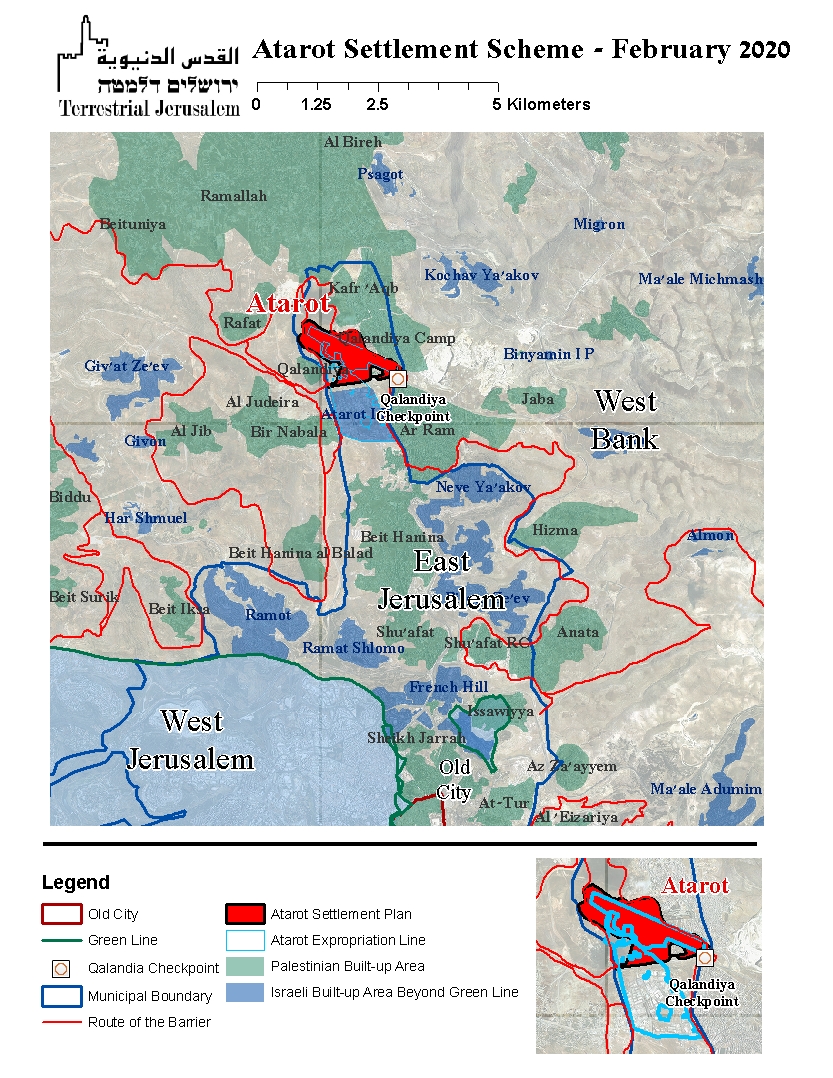 As a reminder, the Atarot plan calls for a huge new settlement on the site of the defunct Qalandiya Airport, located on a sliver of land between Ramallah and Jerusalem. In its current form, the plan provides for up to 9,000 residential units for ultra-Orthodox Jews (assuming, conservatively, an average family size of 6, this means housing for 54,000 people), as well as synagogues, ritual baths (mikvehs), commercial properties, offices and work spaces, a hotel, and a water reservoir. If built, the Atarot settlement will effectively be an Israeli city surrounded by Palestinian East Jerusalem neighborhoods on three sides and Ramallah to its north. Geopolitically, it will have a similar impact to E-1 in terms of dismembering the West Bank and cutting it off from Jerusalem. For more on the Atarot settlement plan, please see here.
The Jerusalem District Planning Committee previously signaled its intent to advance the Atarot settlement plan, most notably by placing it on the December 6th agenda. After apparent pushback from the Biden Administration, on November 25th the plan was suddenly removed from the December 6th agenda, reportedly in fulfillment of a promise to the U.S. to freeze the project. That removal, however, proved short-lived. On November 28th, the Atarot plan reappeared on the agenda, confirming earlier comments Bennett made to the settler-run news outlet Arutz Sheva saying that the plan will indeed be discussed on December 6th. Apparently settling the matter, an Israeli diplomatic source said that the government will act on the plan by approving it for deposit for public review, while at the same time offering the U.S. a rhetorical commitment (but nothing more) that there will be no further advancement in the planning process for at least a year.
Peace Now’s Hagit Ofran cautions:
“‘…please, don’t buy any ‘promise’ that ‘we will not build’ (anyway the planning process takes a while, and even if they work hard and fast they can’t start to build Atarot in less than 3-4 years), what we need is clear: Don’t promote the plan; Shelve it.’ Ofran separately told The Los Angeles Times, ‘As soon as [the committee] approve[s] it, it’s like a snowball.’”
Ir Amim also warns:
“While the Israeli authorities may attempt to relegate the upcoming discussion as a prosaic, bureaucratic step in a lengthy approval process, it is a necessary stage in the plan’s final approval and indeed advances the plan one step closer to full validation.”
For further information about the Atarot plan – and what has transpired over the past week – please see the following two podcasts:
- “The Settlement That Wasn’t But Now Is” ft. Daniel Seidemann & Evan Gottesman (Terrestrial Jerusalem Podcast – 11/30/2021)
- “Scorched Earth & Settlements in Jerusalem” ft. Daniel Seidemann and Kristin McCarthy (FMEP podcast – 12/2/2021)
New Israeli President Kicks Off Hanukkah with Settlers in Hebron, Sparking Clashes and Raising Ire
Isaac Herzog – the former head of the Jewish Agency who was sworn in as the new Israeli President in July 2021 – opted to make a highly political statement by attending a celebration of the first night of Hanukkah in Hebron, at the Tomb of the Patriarchs/al-Ibrahimi Mosque. Herzog’s choice is correctly understood to be an intentional embrace and legitimization of settlers in Hebron, and of the apartheid reality Palestinians experience everyday. In his speech at the event, Herzog emphasized recognition of “the historical affinity of the Jewish people to Hebron, to the Cave of the Patriarchs,” and spoke about the 1929 massacre of Jews in Hebron. He said nothing about Palestinian links to the city, the 1993 Hebron Massacre, or anything else related to Palestinian equities in the city.
Palestinian and Israeli activists protested the event, which led to clashes with the IDF.
The Palestinian Foreign Ministry responded:
“The Israeli government bears full and direct responsibility for this event…[this is] a defiant move aimed at embracing the settlement enterprise and a blatant violation of international law and the international effort to curb unilateral measures.”
MK Ayman Odeh (Joint List) tweeted:
“Herzog did not go to light the first candle, he went to light Hebron…Whoever celebrates with fans of the killer Goldstein cannot be the president of all the citizens of the country.”
Peace Now, commenting on Herzog’s activities, said:
“[Hebron is] the ugliest face of Israeli control over the territories..It is inconceivable that the president, who is supposed to be a unifying figure, would choose, of all places, to light a candle in a place that has become a stronghold of oppression and violence.”
Commenting on the IDF’s preventing protests of Herzog’s appearance, Peace Now also said:
“While the president lights a candle with Baruch Marzel and the Kahanists, security forces are preventing law-abiding citizens from exercising their right to protest”.
In speculating that Herzog’s appearance in Hebron is indicative of his higher political ambitions [to become Prime Minister], Israeli analyst Anshel Pfeffer writes:
“Herzog’s decision to light the first candle of Hanukkah on Sunday night with the settlers of Hebron, [Kahanist MK] Ben-Gvir’s core constituency, should come as no surprise to anyone. These were the kind of people he courted before being elected president and he’s not about to shun them now, or anytime… The visit to Hebron is not an afterthought or a symbolic gesture of ‘unity.’ This was the very first Hanukkah-lighting of Herzog’s presidency, and his choice of venue signals how he intends to build his political brand throughout his term and beyond.”
The Haaretz Editorial Board – in an editorial entitled “Herzog Decided He Wants to Be the President of the Settlements. It’s Not Too Late to Change It” – pleaded with Herzog to cancel his plan, writing:
“Of all the places in Israel, the president chose Hebron, the ultimate symbol of the ugliness and brutality of the occupation and the violence and domineering of the settlers.
“The visit by Israel’s No. 1 citizen to that place – most of whose Palestinian inhabitants have been forced to flee in fear of the settlers and abandon their homes and stores, turning the heart of Hebron into a ghost town – is tantamount to granting official legitimacy to the appalling injustices perpetrated there every day, both before and after Dr. Baruch Goldstein massacred 29 Arab worshipers in the mosque at the Tomb of the Patriarchs.
“In no other place in the West Bank is Israeli apartheid so horrifyingly flagrant: segregated streets on which Palestinians are prohibited from walking; vehicle entry barred to the Palestinians still living there; checkpoints at every turn – only for Palestinians, of course. Violence and humiliation are the daily fare of every Palestinian resident at the hands of the settlers and their children, as well as the army and Border Patrol personnel who are stationed on every corner.
“That is where Herzog believes he must go. His planned visit to Hebron is a gesture of recognition of and solidarity with the most violent settlers and additional proof that occupied Hebron has been annexed to Israel, at least de facto. Otherwise, the president has no reason to go there.”
Court OKs Demolition of Palestinian Homes in Wadi Yasul (Silwan)
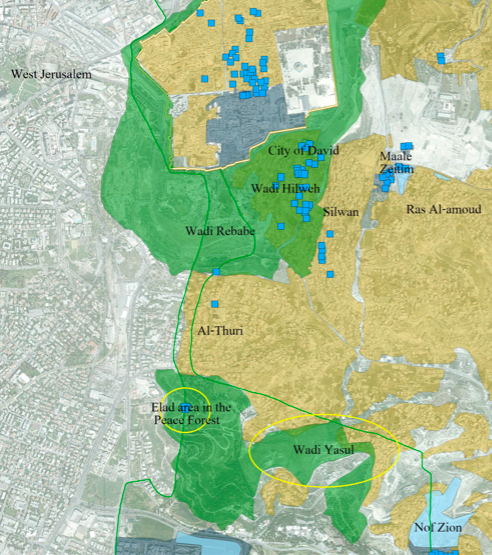
Map by Ir Amim
On November 28th the Jerusalem District Court cleared the way for the immediate demolition of 58 Palestinian homes in the Wadi Yasul section of the Silwan neighborhood in East Jerusalem – adjacent to an area known as the “Peace Forest”. The basis for the order is the Israeli claim that the homes lack Israel-issued building permits. The Court rejected an appeal to continue freezing demolition orders, filed by Palestinian homeowners, ruling that demolition orders can no longer be justifiably suspended because there appeared to be no prospect of Israel legalizing the homes, despite a 15-year effort on the part of Wadi Yasul’s residents to advance planning schemes that could have enabled Israel to rezone the land and legalize the homes.
An attorney representing the Palestinian homeowners told Haaretz:
“The residents have spent millions of shekels on these plans, but in the end, [city officials] broke their promises, posed insurmountable obstacles and insist on implementing the demolition orders and throwing the families out onto the street with no alternative.”
The brutal outcome Israel is meting out to the Palestinian residents of Wadi Yasul stands in stark contrast to the Israeli State and judicial system’s treatment of illegal settler construction in the same area — a reality that underscores the systematic discrimination that characterizes Israeli planning policies and enforcement facing Palestinians in Jerusalem. While pursuing the demolition of Palestinian construction and refusing efforts to address the issue, FMEP reported in 2019 how the Israeli government is working hand-in-hand with Israeli settlers to pursue every avenue to secure the retroactive legalization of the Elad settler group’s illegal construction. Even more brazenly, Israeli officials have been working to rezone the “Peace Forest” [something it refuses to do for Palestinians] in order to allow the Elad settler group to build more infrastructure in the area, including a tourist zipline and a promenade meant to connect settlement enclaves in the area.
Haaretz previously explained how Jerusalem authorities have repeatedly assisted Elad in its illegal activities:
“At first the NGO simply trespassed and built illegal structures there [the “Peace Forest”]. But things changed and gradually various local and national bodies – including the Jerusalem Municipality, the Israel Land Authority, the Tourism Ministry and the JNF – began to grant Elad assistance. This assistance has included granting building permits retroactively, allocating land to the group without a proper bidding process, and generous funding to the tune of tens of millions of shekels… It has been sponsoring activities in the Peace Forest since 2005, despite the fact that it has no ownership rights there or permits from the ILA (the legal owner of the land, which was expropriated from private Palestinian owners).”
Ir Amim explains:
“The scope of settlement projects in the vicinity of Wadi Yasul – and the breadth and depth of state support awarded to Elad, including authorities’ overt efforts to retroactively legalize their own unpermitted buildings – illuminate the stark discrimination in planning that empowers the expansion of radical settlement inside Palestinian neighborhoods while putting their native residents at risk of displacement.”
In a 2019 report on Wadi Yasul, B’Tselem told the story of what’s transpiring there:
“The residents of Wadi Yasul built [their homes] adjacent to a forest, also located on privately owned land that was expropriated from its Palestinian owners in 1970. In 1977, the Jerusalem Municipality zoned the forest and the area where Wadi Yasul was later established as a green space, where construction is prohibited.
“In 2004, the neighborhood’s residents submitted a detailed plan to the District Planning and Building Committee for retroactive authorization of their homes. The committee rejected the plan in 2008, citing incompatibility with the Jerusalem 2000 Outline Plan, which states that the area where the neighborhood was built must remain a green space.
“At the same time, the municipality and the JNF (Jewish National Fund) – the body in charge of managing the forest – gave their approval to settler organization El-Ad to move forward with plans for group campgrounds, including building the longest recreational zipline in Israel. Some of the facilities have already been built in the forest, without building permits. While the city did issue demolition orders against them, it has refrained from following through.
“In contrast, over the last decade, the city has filed indictments with the Court of Local Affairs against all Wadi Yasul homeowners. The court then issued demolition orders for all of the homes and imposed heavy fines, fining each family tens of thousands of shekels. Three of the families appealed these decisions with the District Court. The appeals were dismissed in April on the grounds that “there are no clear and near planning prospects” for the approval of a plan that would see the appellants’ homes, or other homes in the neighborhood, approved. An appeal the families filed with the Supreme Court was also rejected. In late April, 47 other families filed a motion with the District Court seeking an interim injunction staying execution of the demolition orders. The court’s decision is still pending. Consequently, all of the homes in the neighborhood are still under immediate threat of demolition.
“Ever since 1967, planning policy in Jerusalem has been geared toward establishing and maintaining a Jewish demographic majority in the city. Under this policy, it is nearly impossible to obtain a building permit in Palestinian neighborhoods. The outline plans the city has prepared for these neighborhoods are largely aimed at restricting and limiting building opportunities in Palestinian neighborhoods. One way the plans do so is by designating vast areas as open green spaces, thereby barring Palestinians from building there. The resulting housing shortage forces Palestinian residents to build without permits.”
“Day of Destruction” – Israel Demolitions in East Jerusalem & West Bank
On November 23rd, Israeli forces carried out a demolition campaign targeting Palestinian homes in East Jerusalem and the West Bank, under the pretense that these homes lack Israeli-required Israeli-issued building permits (permits Israel systematically refuses to issue to Palestinians in East Jerusalem and in Area C). As a result of these demolitions, 22 people, including 15 children, were rendered homeless in a single day.
The demolitions included:
- 3 homes in the Wadi al-Hummus neighborhood of East Jerusalem. One of the buildings was a multi-unit apartment buildings;
- 1 home and a burial building (perhaps a funeral home) in villages in the South Hebron Hills;
- 1 tent and 3 livestock structures belonging to bedouin families living east of Ramallah;
- An agricultural road near Nablus. The road was used by the residents of ‘Asirah al-Shamaliyah to reach their farmland and also connects the town to Nablus.
B’Tselem writes:
“The wave of demolitions expresses the perception of the Israeli regime, which holds that land is a resource intended primarily to serve the Jewish population. This regime uses a variety of administrative, planning and bureaucratic tools to implement this concept. Governments come and go, but the apartheid regime remains untouched.”
Government Contradictions Delay Final Decision on Jerusalem Cable Car Project
On November 28th, the Israeli High Court of Justice held what was scheduled to be the final hearing to determine the fate of the Jerusalem cable car project — a project which has been promoted by the government and the Elad settler organization until this point. But instead of reaching a decision, the Court ended up giving the Israeli government a 21-day extension, by the end of which the government must explain its position on the project.
 The proximate cause of the Court’s action was Israeli Minister of Transportation Merav Michaeli’s (Labor) statement, delivered two days before the Court hearing, saying that “the cable car has no significant transportation role, and the harm will exceed the benefits.” That statement contradicts and completely undermines the rationale for the project that the government has put forward until this point — i.e., that the cable car will provide a legitimate transportation benefit. Given Michaeli’s statement, the Court issued its order for the State to clarify where it stands.
Commenting on the Court’s action, the Israeli NGO Emek Shaveh – which specializes in archaeology – said:
“We are pleased that after three years, the transport minister has said what we have been saying all along: that the Jerusalem cable car project is not a transportation project and is not an answer to the traffic issues near the Old City. We believe that its value for tourism has also been greatly misrepresented and although the plan is being advanced by the Jerusalem Development Authority and the Tourism Ministry it will primarily benefit a powerful interest group (the Elad Foundation) by transporting thousands of tourists to its hub at the City of David to the detriment of the historic city and its residents. We hope that the judges will rule that the approval process for the cable car plan severely undermined principles of good governance and on those grounds decide to put a stop to the plan.”
As a reminder, the Jerusalem cable car project is an initiative backed by the powerful, state-backed Elad settler group and advanced by the Israeli Tourism Ministry. The State of Israel – which has pushed the project forward in the midst of the COVID-19 pandemic and despite commitments by the government to focus on public health matters only – was previously forced to publicly admit that the implementation of the cable car project will require the confiscation of privately owned Palestinian land in the Silwan neighborhood of East Jerusalem.
While public efforts to “sell” the cable car plan have focused on its purported role in helping to grow Jerusalem’s tourism industry or in serving supposedly vital transportation needs, in reality the purpose of the project is to further entrench settler control in Silwan, via archeology and tourism sites, while simultaneously delegitimizing, dispossessing, and erasing the Palestinian presence there. Notably, the cable car line is slated to terminate at the settler-run Kedem Center compound (Elad’s large tourism center, currently under construction at the entrance of the Silwan neighborhood, in the shadows of the Old City’s walls and Al-Aqsa Mosque).
Emek Shaveh and other non-governmental organizations, including Who Profits and Terrestrial Jerusalem, have repeatedly challenged (and provided evidence discrediting) the government’s contention that the cable car will serve a legitimate transportation need in Jerusalem, and have clearly enumerated the obvious political drivers behind the plan, the archeological heresies it validates, and the severe negative impacts the cable car project will have on Palestinian residents of Silwan.
Knesset Holds Hearing on Settler Terrorism
On November 22nd a group of Knesset members – all hailing from political parties considered to be part of the Israeli Left – convened a hearing on settler violence against Palestinians.
As part of the hearing, several experts were asked to testify, including Ali Awad, a journalist and anti-settlement activist in the South Hebron Hills. Awad testified regarding his experience growing up in Tuba (read about that here), saying:
“I grew up in Tuba in the South Hebron Hills, under the threat of settlers my whole life. The military and settlers are working to steal our resources, rob us of our freedom, and take our land. There is full cooperation between the settlers and the army” [paraphrased by Breaking the Silence]
Peace Now Executive Director Shaqued Morag also testified, and emphasized that unauthorized outposts radiate settler terrorism and violence, serving as a tool for settlers (and the state) to take over more and more land.
A group of retired Israeli commanders – called Commanders for Israeli Security – delivered a written testimony for the hearing, writing:
“Groups of settlers have been perpetrating deadly acts of violence against Palestinians — for the most part helpless villagers — in areas under our control…This is completely unacceptable from an ethical and humanitarian perspective, and it stands in contradiction to Israel’s Jewish values.”
The hearing was not without controversy, as it was held the one day after a Palestinian killed one Jewish Israeli and injured four others in a shooting attack in the Old City of Jerusalem. Right-wing members of the Knesset, including Kahanist MK Ben Gvir, asked for the hearing on settler violence to be cancelled altogether. When it was allowed to proceed, Ben Gvir used the podium to shout his criticism of the Knesset members who organized the hearing, eventually resulting in his removal from the hearing room.
Decrying the lack of participation of many MKs, Meretz Party Chairman Nitzan Horowitz said:
“Their silence and lack of interest is tantamount to the endorsement and encouragement of continued violence.”
Horowitz also said:
“Some people in the Knesset minimize its existence or even deny it entirely. I invite them to visit the area, to meet with the victims of this violence, and to see the photos and video clips they produce.’’
Bonus Reads
- “Highway of hope and heartbreak” (Washington Post)
- “The Gaza Bantustan – Israeli Apartheid in the Gaza Strip” (Al-Mezan Center for Human Rights)
- “‘Hate crime’ attacks by Israeli settlers on Palestinians spike in the West Bank” (Washington Post)
- “Democratic Lawmakers Warn Against ‘Doomsday’ Israeli Settlement Plan” (Haaretz)
- “‘The occupation is trying to uproot us. Art can bring us back’” (+972 Magazine)
- “Israelis attacked, car set on fire after entering Ramallah” (i24 News)
- “The Long Reach of Restraint: For Israel’s Supreme Court, to exercise power might be to lose it.” (Jewish Currents // Elisheva Goldberg)
Welcome to FMEP’s Weekly Settlement & Annexation Report. To subscribe to this report, please click here.
February 25, 2021
- Jerusalem Cable Car Project Dealt Blow by Court
- Israel Breaks Ground on New Settler Bypass Road Near Nablus
- Israeli Army Chief Meets with Violent Settlers (Instead of Arresting them)
- Archaeological Accident Gives Pretext For Settler Takeover in Area B
- Bonus Material
Comments, questions? Email kmccarthy@fmep.org
Jerusalem Cable Car Project Dealt Blow by Court
On February 23rd, the Israeli High Court of Justice issued an order against the construction of the Jeruslame cable car, a project advanced by – and closely connected to – the Elad settler organization. The project is opposed by a broad coalition of city planners, archaeologists, and academics, who oppose it not only because it was advanced in a highly suspicious manner, but also because building a cable car over historic sites in Jerusalem would do irreparable damage to the integrity of the city’s history.
In its order, the High Court asked the State of Israel to answer five questions, the substance of which suggest that the Court is concerned about both the irregular planning process and the archeological heresies construction of the cable car would inflict.
The NGO Emek Shaveh, which opposes the plan, commented:
“The questions raised by the judges bring to light once again the many flaws of the project, particularly the irregular approval process through the National Infrastructure Committee, a fast-track body usually used to advance national transportation projects, rather than through the usual planning committees as well as its destructive ramifications for minority groups such as the Karaite community. The Cable Car project should never have seen the light of day. Jerusalemites and a long list of civil society organizations have for the past three years been asking the same questions put forward yesterday by the High Court but have been ignored. The flaws outlined by the High Court prove that Jerusalem must be protected from those who wish to destroy the city and harm its residents. We hope the developers of the project will demonstrate responsibility, internalize the criticism against the project and stop wasting valuable public resources on such a destructive vision for Jerusalem.”
As a reminder, the Jerusalem cable car project is an initiative backed by the powerful, state-backed Elad settler group and advanced by the Israeli Tourism Ministry. The State of Israel – which has pushed the project forward in the midst of the COVID-19 pandemic and despite commitments by the government to focus on public health matters only – was forced to publicly admit that the implementation of the cable car project will require the confiscation of privately owned Palestinian land in the Silwan neighborhood of East Jerusalem.
While public efforts to “sell” the cable car plan have focused on its purported role in helping to grow Jerusalem’s tourism industry or in serving supposedly vital transportation needs, in reality the purpose of the project is to further entrench settler control in Silwan, via archeology and tourism sites, while simultaneously delegitimizing, dispossessing, and erasing the Palestinian presence there. Notably, the cable car line is slated to terminate at the settler-run Kedem Center compound (Elad’s large tourism center, currently under construction at the entrance of the Silwan neighborhood, in the shadows of the Old City’s walls and Al-Aqsa Mosque).
Emek Shaveh and other non-governmental organizations, including Who Profits and Terrestrial Jerusalem, have repeatedly challenged (and provided evidence discrediting) the government’s contention that the cable car will serve a legitimate transportation need in Jerusalem, and have clearly enumerated the obvious political drivers behind the plan, the archeological heresies it validates, and the severe negative impacts the cable car project will have on Palestinian residents of Silwan.
Israel Breaks Ground on New Settler Bypass Road Near Nablus
The settlers’ news outlet Arutz Sheva reports that the State has begun construction on the Huwwara Bypass Road, a new route long pined for by settlers.
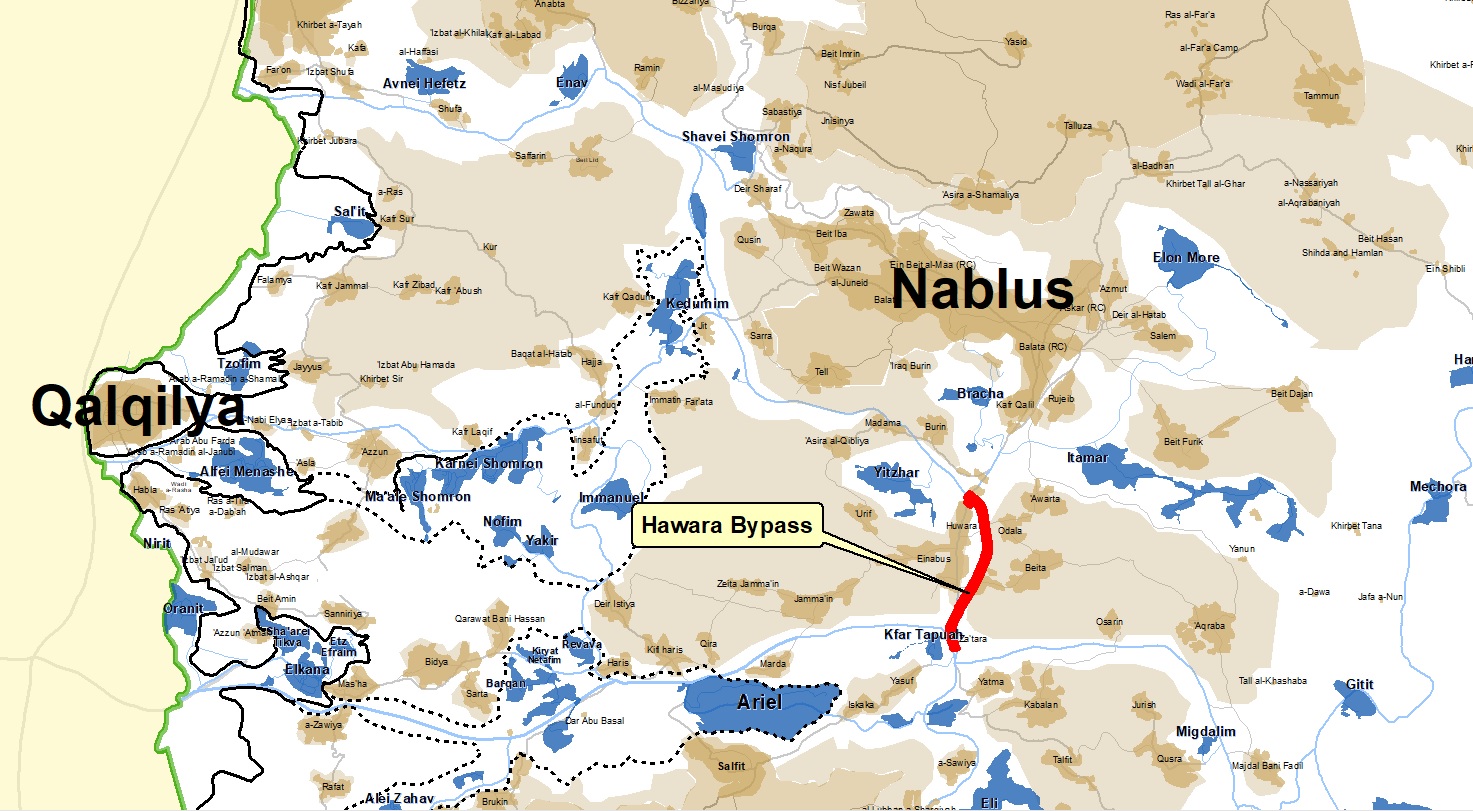 As reported last week, the Huwwara Bypass Road is designed to residents of Nablus-area settlements to bypass the Palestinian village of Huwwara (which is an area with heavy traffic congestion from daily commuters), in order to more easily/directly access Jerusalem. This bypass road has long been a top priority for the settlers, who have complained about the long commute to Jerusalem and the limits this puts on the potential for growth of Nablus-area settlements. Building the road also gained urgency for the settlers after the release of the Trump Plan’s conceptual map, which left the area where the road is slated to be built within the borders a future Palestinian “state.”
Arutz Sheva did not mince words about the importance of this road, writing this week:
“This is one of the most expensive and strategic projects in Judea and Samaria and its cost is estimated at ILS 260 million. The road is intended to connect the center of the country to the localities of Gav HaHar, Yitzhar, Itamar, Elon Moreh and Har Bracha, and will provide a safe trip for residents and passengers to these areas.”
Speaking at the ground breaking ceremony, settler leader Yossi Dagan also stressed the significance of this road to the settlers’ fight for sovereignty over the West Bank. Dagan said:
“This is a groundbreaking, historic moment for Samaria and the entire settlement effort. In about two years, the mountain settlements will become accessible to the center of the country. The road is expected to make traveling in the area safer for both Arabs and Jews, it is hoped that paving the road will lead to prosperity in the area.”
Dagan’s assertion that the road will benefit Palestinians in the area glosses over the fact that Palestinians were stripped of their property rights when Israel unilaterally expropriated private Palestinian land along the route of the road in preparation for construction. On this issue, Peace Now writes:
“A bypass road requires extensive expropriation of Palestinian land. All roads are planned from the Israeli interest toward the settlements and their development. Even if in some cases the Palestinians can benefit from these roads, they are not paved according to a planning conception of the Palestinian needs. This raises the question of Israel’s legal excuse to confiscate land in order to build roads in occupied territory by claiming that the roads will also serve the protected Palestinian population.”
Israeli Army Chief Meets with Violent Settlers (Instead of Arresting them)
Amidst a sharp spike in settler violence directed primarily at Palestinians and their property, but also at Israeli forces, two very senior Israeli security officials held a meeting with leaders in the violent “Hilltop Youth” settler movement, which has carried out a weeks-long crime spree following the death of one of its members. That member, Ahuvia Sandak, died as a result of a car crash while fleeing Israeli police who gave chase to a group of settlers who had been throwing rocks at Palestinian cars.
Haaretz reports that the two Israeli security officials – Central Command chief Maj. Gen. Tamir Yadai and Civil Administration head Brig. Gen. Fares Atila – wanted to “create rapprochement and calm things down.” An army source told Haaretz that “The general explained that the army is an agency that carries out the law of the State of Israel, and we’re trying to find common ground.”
Haaretz columnist Zvi Ba’arel writes of this meeting, and others that preceded it:
“When the head of Israel Defense Forces Central Command, Maj. Gen. Tamir Yadai, meets with “hilltop youth,” residents of the Maoz Esther outpost, in order to “create rapprochement and calm things down” in the words of a military representative, he is conducting negotiations with terrorists…For the “representatives of the outposts” – a new geopolitical term – who met with Yadai on Monday and last month, these meetings are a demonstration of power, not that of the IDF, but theirs…It’s the “representatives” who conduct the negotiations, who determine the rules, who decide if and when they will embark on the next terror activity, and who demand that the IDF understand and accept their motives and see them as a body no less legitimate than the IDF itself. If the army wants a tahadiya (cessation of hostilities) with the “outposts,” if it is begging that the thugs stop throwing stones at soldiers or setting police vans on fire, it must pay a political price. Or, as Prime Minister Benjamin Netanyahu often promises Hamas, “quiet will be answered with quiet.” The IDF, according to the “representatives of the outposts,” must stop chasing the gangs, refrain from demolishing outposts and primarily, preserve the status quo that has been rooted for decades and that maintains that attacks against Palestinians are an internal matter that concerns the relations between the gangs and the Palestinians. Those are the conditions for quiet. The IDF does not really control them.”
Archaeological Accident Gives Pretext For Settler Takeover in Area B
Following the accidental damage to an outer stone wall at the Mount Ebal archaeological site near Nablus, settlers are moving to assert control over the site, which is located in Area B of the West Bank — i.e., the 21% of the occupied territories which assigned to Palestinian civilian control (Israel maintains security control over that area). The incident furthers a settler strategy to use concern (real or feigned) for archeology as an impetus and justification for Israel to take control over more Palestinian land and even seize archeological relics in Palestinian possession.
The story of the recent drama over Mount Ebal – an historic site with stone features that date back to the 11th century BCE – started earlier this month, when a Palestinian construction crew building a new road (plans for which were approved by Israel) demolished a part of the archeological site without realizing the structure was significant. When the damage was detected, settlers and their allies went to the media to decry the incident and make larger claims about the Palestinian Authority’s allegedly malicious disregard for preserving archeological sites and relics under its control. Naftali Bennet went so far as to accuse the PA of an “Islamic State-like act” (suggesting, in effect, that the damage was intentional). Settlers and their allies openly suggested that lack of Israeli control over archeological sites in Area B is the problem, and ought to be changed – with Israeli Reuvin Rivlin calling for the IDF to take control of the Mount Ebal site outright.
Making further headlines, Samaria Regional Council Chairman Yossi Dagan staged a covert operation to “remedy” the damage at the Mount Ebal site, but the work Dagan facilitated was not overseen by a trained archaeologist, and the “restoration” was so problematic that even one of the archaeologists working for the settlers, Dr. Assaf Avraham, said:
“I don’t know what is more of a tragedy…the original destruction or the attempt at reconstruction.”
The Israeli NGO Emek Shaveh, which is composed of archaeologists and experts in West Bank heritage sites, said in response to the Mount Ebal drama:
“Contrary to how the destruction was presented by the settlers, the wall that was destroyed last week was an outer wall and not a part of the main structure. The contractor who paved the road thought it was a terrace and the mayor of town of Asira ash-Shamaliya’s said they were unaware that the wall was part of the site. However the settlers, right wing politicians and the Hebrew media used a clip from a video posted on the Asira ash-Shamaliya’s facebook page to claim that destruction was nationalistically motivated even though in the video, the contractor is merely describing his work practices and sharing with the residents the progress in paving the road. Some have gone as far as to claim that the destruction is akin to ISIS’ practices. Claiming the video is proof of a nationalistic motive behind the destruction of the wall serves the ongoing campaign to place antiquity sites in Area B under Israeli control. “
This incident comes one month after the state of Israel committed funding to a new settler initiative to surveil archeological sites under Palestinian control. While the objective of protecting antiquities might appear uncontroversial and apolitical, the true objective behind this effort is to support yet another pretext to surveil and police Palestinians, and yet another means to dispossess them of their properties. It is the result of a campaign that has taken place over the past year in which settlers have been escalating their calls for the Israeli government to seize antiquities located in Palestinian communities across the West Bank, especially in Area C, which Israel today treats as virtually (and legally) indistinguishable from sovereign Israeli territory.
The funding for the settlers to police Palestinians in the name of protecting antiquities is just the latest victory in the settlers’ campaign to use the issue of antiquities protection as a pretext to further squeeze Palestinians, especially in Area C. Previous victories include the Israeli Civil Administration’s recent issuance of expropriation orders for two archaeological sites located on privately owned Palestinian property northwest of Ramallah. The expropriations – the first of their kind in 35 years – come amidst a new campaign by settlers lobbying the government to take control of such sites, based on the settlers’ claims that antiquities are being stolen and the sites are being mismanaged by Palestinians. The settlers’ pressure is also credited as the impetus behind the government’s clandestine raid of a Palestinian village in July 2020 to seize an ancient font. The Palestinian envoy to UNESCO, Mounir Anastas, recently called on the United Nations to pressure Israel into returning the font to the Palestinian authorities.
A new settler group calling itself “Shomrim Al Hanetzach” (“Guardians of Eternity”) recently began surveying areas in the West Bank that Israel has designated as archeaological sites in order to call in Israeli authorities to demolish Palestinian construction in these areas. The group communicates its findings to the Archaeology Unit of the Israeli Civil Administration (reminder: the Civil Administration is the arm of the Israeli Defense Ministry which since 1967 has functioned as the de facto sovereign over the West Bank). The Archaeology Unit, playing its part, then delivers eviction and demolition orders against Palestinians, claiming that the structures damage antiquities in the area. As a reminder, in 2017, Israel designated 1,000 new archaeological sites in Area C of the West Bank.
This new group, not coincidentally, is an offshoot of the radical Regavim organization, which among other things works to push Israeli authorities to demolish Palestinian construction (on Palestinians’ own land) that lacks Israeli permits (permits that Israel virtually never grants). The group’s leaders accuse the Palestinian Authority of mismanaging the archeological sites, they accuse Palestinians of looting them, and they demand that Israel annex all the sites. The new group has also raised public alarm about the Trump Plan, alleging that hundreds of biblical sites in the West Bank are slated to become Palestinian territory.
Bonus Material
- “Selective Conservation Policy and Funding for Minority Heritage Sites in Israel” (Emek Shaveh)
- “The Europeans Don’t Really Care About the Palestinians Either” (Haaretz // Amira Hass)
- “Netanyahu’s battle for settler votes in Ma’aleh Adumim” (Jerusalem Post)
- “Settler movement takes over Jewish National Fund” (Al-Monitor)
- “Jews split over storied charity’s support for settlements” (AP)
Welcome to FMEP’s Weekly Settlement & Annexation Report. To subscribe to this report, please click here.
November 6, 2020
- Israel Moves Towards Destruction of 200+ Palestinian East Jerusalem Business to Make Way for “Silicon Wadi” Industrial Zone
- Israel Accelerates De Facto Annexation in Area C, Part 1: Israel Razes Entire Palestinian Community (a War Crime) on Eve of U.S. Election Drama
- Israel Accelerates De Facto Annexation in Area C, Part 2: Attorney General Approves Land Registration Process that Opens Another Door for Israel to Seize More Palestinian Land
- Israel Accelerates De Facto Annexation in Area C, Part 3: Tightening the Noose Around Khan Al-Ahmar
- Delayed for a Third Time, Israeli Government Silent on Givat Hamatos Tender
- Settler Campaign to Take Over West Bank Antiquity Sites/Objects Proceeds: Israel Fences Off More Land Near Herodium, Invades Sebastia Site
- Israel Begins Preparations for Construction of Settler-Backed Cable Car Line in Jerusalem, Despite Ongoing Court Case
- Knesset Land Caucus Plots Way Forward on Outpost Legalization
- Bonus Reads
Comments/questions? Contact Kristin McCarthy (kmccarthy@fmep.org)
Israel Moves Towards Destruction of 200+ Palestinian East Jerusalem Business to Make Way for “Silicon Wadi” Industrial Zone
Palestinian media reports that Israeli authorities have formally issued eviction notices to dozens of Palestinian business owners in the Wadi al-Joz district of East Jerusalem, as plans advance to level the entire area and replace it with a massive new business district, dubbed “Silicon Wadi.” The eviction notices instruct tenants to vacate by December 30th, after which time Israel will proceed with demolitions. The Jerusalem Post confirms that as part of the plan, “about 200 Palestinian-owned industrial buildings will have their tenants evicted and be demolished.” The Silicon Wadi project is projected to cost $600 million for construction covering 350,000 square meters to house high-tech companies, real estate, shopping centers, and hotels.
A PLO Spokeswoman said:
“Israel‘s focused and systematic plunder of occupied Jerusalem persists unabated, in violation of international law and proclaimed positions of states worldwide. In addition to a sharp increase in home demolitions and the displacement of many families in Jerusalem during the COVID-19 pandemic, the illegal Israeli ‘municipality’ has unveiled its plans to demolish decades-old Palestinian industrial area in the Wad al-Joz neighborhood and replace it with a gentrified settler neighborhood with the flashy name of ‘Silicon Wadi,’ This is an outrageous and criminal plan that will devastate 200 Palestinian businesses in the area and deprive hundreds of Palestinians of their sources of livelihood. It is a massive scheme that brings Israel’s displacement and replacement policy against the Palestinian people into sharp focus, especially in Jerusalem.”
In June 2020, when plans of the demolitions were revealed to the press, the chairman of East Jerusalem’s Arab Chamber of Commerce and Industry, Kamal Obeidat, called the planned demolitions a “racist order” to to change the character of the Palestinian city and use the land to build Israeli structures.
Grassroots Jerusalem explains the history and current reality facing the Wadi al-Joz neighborhood:
“Overlooking the Mount of Olives and the Kidron Valley, Wadi al-Joz was once the city’s industrial zone until the First and then the Second Intifada. The area is under the jurisdiction of Israeli civil law under the Jerusalem Municipality. As with many neighbourhoods in the area surrounding the Old City, Wadi al-Joz is experiencing severe challenges with the 2009 approved ‘Master Zone Plan’ and the subsequent aggressive expansion of Jewish presence in the area.”
Israel Accelerates De Facto Annexation in Area C, Part 1: Israel Razes Entire Palestinian Community (a War Crime) on Eve of U.S. Election Drama
Late in the evening of November 3rd, Israeli forces arrived at and proceeded to demolish the Palestinian community of Khirbet Humsah in the northern Jordan Valley, rendering 74 Palestinians homeless (of which 41 are minors). Palestinians report that they were given 10 minutes to vacate their tents before the bulldozers razed the herding community, in its entirety, to the ground. Levelling 76 structures in total, this was the largest single demolition by Israel in the past decade. Even prior to this massive demolition, Israel had already broken its own record for the most demolitions of Palestinian structures in a single year, the total now stands at 869 demolished Palestinian structures.
Yasser Abu al-Kbash, a resident of Khirbet Humsah, told NPR:
“I am 99% certain this was taking advantage of the U.S. elections. … There were no journalists around…Our bed is the ground. Our roof is the sky. We hope people will come and see our situation. They will see that Israel, which pretends to be a compassionate country, is chasing us.”
B’Tselem said in a statement:
“While the world deals with the coronavirus crisis, Israel has devoted time and effort to harassing Palestinians instead of helping protected residents living under its control. Israel tries to justify the demolitions with feeble excuses such as “law enforcement” or “building and planning considerations”, while deliberately creating a Kafkaesque reality that leaves Palestinians almost no way to build legally. While Israel has formally given up on annexing the West Bank, the demolition figures indicate that on the ground, reality remains unchanged and the de-facto annexation continues. Israel continues to treat the West Bank as its own – which includes preventing Palestinian development throughout the area (including East Jerusalem) so it can take over more and more land.”
Detailing Israel’s ongoing campaign against Palestinian life in Area C, B’Tselem writes:
“In the midst of an unprecedented health and economic crisis, more Palestinians in the West Bank (including East Jerusalem) lost their homes in the first 10 months of 2020 alone than in any full year since 2016 – the highest year on record since B’Tselem started collecting this data. As a result of Israel’s policy, 798 Palestinians have already lost their homes in 2020, including 404 minors who lived in 218 homes – compared to 677 Palestinians in all of 2019, 397 in 2018 and 521 in 2017….According to Civil Administration (CA) data, in the first 10 months of 2020 alone, the CA confiscated 242 prefabs from Palestinians, as opposed to six in all of 2015. In 2019, some 700 tractors and diggers were confiscated and about 7,500 trees uprooted in Area C. The CA even boasts that its figures show a decrease in international aid projects for Palestinians in Area C, such as setting up prefabs and laying infrastructure, to a mere 12 in 2019 compared to 75 in 2015.”
Yvonne Helle, a senior UN Development Programme official in the Palestinian territories, said about the demolition:
“So far in 2020, 689 structures have been demolished across the West Bank, including East Jerusalem, more than in any full year since 2016; rendering 869 Palestinians homeless. The lack of Israeli-issued building permits is typically cited as a reason, even though, due to the restrictive and discriminatory planning regime, Palestinians can almost never obtain such permits. Demolitions are a key means of creating an environment designed to coerce Palestinians to leave their homes. Located in the Jordan Valley, Humsa Al Bqai’a is one of 38 Bedouin and herding communities partially or fully located within Israeli-declared ‘firing zones.’ These are some of the most vulnerable communities in the West Bank, with limited access to education and health services, and to water, sanitation and electricity infrastructure. I remind all parties that the extensive destruction of property and the forcible transfer of protected people in an occupied territory are grave breaches of the Fourth Geneva Convention. While assuring that the humanitarian community stands ready to support all those who have been displaced or otherwise affected, I strongly reiterate our call to Israel to immediately halt unlawful demolitions.
The European Union said in a statement:
“Such developments constitute an impediment towards the two-state solution. The EU reiterates its call on Israel to halt all such demolitions, including of EU-funded structures, in particular in light of the humanitarian impact of the current coronavirus pandemic.”
Israel Accelerates De Facto Annexation in Area C, Part 2: Attorney General Approves Land Registration Process that Opens Another Door for Israel to Seize More Palestinian Land
Israeli news outlets report that the Israeli Attorney General supports a recent recommendation by COGAT – the Israeli authority responsible for coordinating civilian affairs in the West Bank – to resume the process of registering land in the West Bank. That recommendation came in response to an effort by MK Uzi Dayan (Likud), who contacted COGAT to push for the government to declare more of the West Bank as “state land.” In response, COGAT recommended the land registration process is a better option for taking control of more land, arguing that this would be faster, less expensive, and more final than having the state declare land in the West Bank to be “state land.” This is because declaration of state land can face legal challenges by Palestinians that may take years to resolve, whereas the land registration process affords Palestinians no such ability to challenge Israel’s decisions once they are made.
According to Israel Hayom, the Israeli land registration process would first require a survey of the land, after which time anyone claiming ownership could present documents to the Israeli government seeking to prove their ownership. In the case of land where Israel recognizes no valid ownership claims – including cases where Palestinians do not have documentation that Israel will accept – Haaretz reports that the process gives heavy weight to whomever currently controls the land (e.g., if a settler has built illegally on Palestinian land and lived there, under the protection of the IDF, the process will give weight to their claim absent overwhelming documentation, accepted by Israel, from the Palestinina owner). The registration decisions can be appealed, but once the claims are resolved by an Israeli official appointed to oversee the process, no further appeal is possible. Moreover, all “unclaimed” land – that is, land over which Israel does not recognize any legal ownership, will automatically become “state land.”
Shlomo Zacharia, a land lawyer working with Yesh Din, further explains how the process of Israeli-controlled land registration will dispossess Palestinians, saying:
“If a village has 30 plots, with [specific, documented] ownership claims on only 20 of those, the other ten automatically transfer to the state. If you haven’t filed a claim of ownership, it goes to the state. Period. The arrangement will primarily benefit the Civil Administration and the settlers, since most of the land allocated by the state goes to settlers, and because the arrangement process (in Israel and the West Bank) favors the person holding the land in practice.”
As a reminder, a 2018 report by Peace Now found that Israel almost exclusively allocates state land in the West Bank to Jewish Israeli settlers (99.76% of allocated state land) – meaning that Dayan’s push for state land declarations serves to benefit the expansion of settlement and settler infrastructure. At the time of is 2018 blockbuster report on Israel’s discriminatory land allocation, Peace Now said:
“The significance of the data is that the State of Israel, which has been in control of the West Bank for more than 50 years, allocates the land exclusively to Israelis, while allocating virtually no land for the unqualified benefit of the Palestinian population. Land is one of the most important public resources. Allocation of land for the use of only one population at the expense of another is one of the defining characteristics of apartheid. This is further proof that Israel’s continued control of the occupied territories over millions of Palestinian residents without rights and the establishment of hundreds of settlements on hundreds of thousands of dunams has no moral basis.”
Israel Accelerates De Facto Annexation in Area C, Part 3: Tightening the Noose Around Khan Al-Ahmar
On November 2nd, the Israeli state informed the High Court of Justice that it plans to delay carrying out the court-approved forcible transfer and demolition of Khan al-Ahmar (a war crime) for the coming months, asking the Court for more time to plan how the demolition will be implemented. The State was forced to file the affidavit in light of a petition by the Regavim settler group, which challenged the State’s delay in carrying out the demolition order, which was first issued ten years ago and then given the official greenlight by the Supreme Court in September 2018.
Notwithstanding the continued delay, the Israeli government said that it still “insists on the need to implement the demolition orders in the compound, and in this matter, there is no change in its position.”
Adv. Tawfiq Jabareen, the lawyer lawyer representing Khan al-Ahmar explained:
“The PM said they will try to negotiate with the village in order to evacuate them but if they have not reached an agreement within 4 months then they will begin thinking of evacuating them by force.”
Regarding the recent filing, the Globes news outlet reports (in Hebrew) that even though the filing was submitted jointly by the Defense Ministry and the Prime Minister’s office (signed by the Defense Ministry settler advisor Avi Roeh, who was previously found to have been funnelling government money to Regavim), there is a major disagreement between Gantz and Netanyahu on the matter. Perhaps surprising to those who expected Benny Gantz to moderate Netanyahu’s more extreme impulses, Gantz is reportedly pushing for the immediate demolition of Khan al-Ahmar, while Netanyahu prefers to delay.
B’Tselem spokesperson Sarit Michaeli tweeted:
“the international community is serious about defending the vestiges of its beloved 2 state solution, it must internalize that MoD Benny Gantz will not act of his own volition to prevent the war crime of demolishing Khan al-Ahmar. Only the prospect of real consequences will do.”
In response to the delay, the Director of Regavim slammed the government saying in a statement:
“The alleged commitment on the part of the state to enforce the law and to hold talks with the residents is no different from the previous times in which the state declared the exact same things to the High Court. Each time, another card is drawn from the pile of excuses that prevents the implementation of the state’s declarations. We wonder if Netanyahu has confused ‘cannot’ and ‘don’t want to.’”
Delayed for a Third Time, Israeli Government Silent on Givat Hamatos Tender
Ir Amim reports that, for the third time this year, the Israeli government refrained from opening bidding on the tender for the construction of the Givat Hamatos settlement, which had been scheduled for November 2nd. The tender was published in February 2020, but has yet to be made available online for bidding. Israeli authorities have not explained the delay or provided a new date for the tender to be opened.
In August, at the time of the second postponement, Ir Amim noted:
“Such recurring postponement of a tender is unprecedented. On the one hand, the delays are a sign that Israel is under strong pressure not to open the tender – which is seen as a red line by the international community; it may be that negotiations currently underway with Arab states under the auspices of the Trump administration are also a cause for the delay. On the other hand, the fact that Israel refuses to withdraw the tender and has repeatedly set new dates for its opening shows how determined the government is to begin construction in Givat Hamatos and therefore it is leaving the door open so that it can seize an opportunity once it feels able to do so.”
Givat Hamatos has long been regarded as a doomsday settlement by parties interested in preserving the possibility of a two-state solution. If the Givat Hamatos settlement is built, the Palestinian neighborhood of Beit Safafa in East Jerusalem will be completely surrounded by Israeli construction, severing its connection to the West Bank.
Settler Campaign to Take Over West Bank Antiquity Sites/Objects Proceeds: Israel Fences Off More Land Near Herodium, Invades Sebastia Site
Emek Shaveh reports that the Israeli Civil Administration is building a new fence around a section of the ancient site of Herodium, closing off the only available path by which Palestinians can freely access the site, located southeast of Bethlehem. Emek Shaveh has sent a letter to the Civil Administration requesting that the construction be stopped and that the new fence section be dismantled.
Emek Shaveh writes:
“The site is part of the fabric of their local heritage and residents of the villages used to tour the site freely and hold private and public events around the ruins. The fencing of lower Herodium follows closely after the expropriation of land at the sites of Deir Sam’an and Deir Kala’ northwest of Ramallah in September. These were the first expropriation orders for antiquity sites in the West Bank in 35 years. All of these developments attest to the increasing pressure by the settlers to clear Palestinians from antiquity sites in Area C of the West Bank.”
On November 5th, Palestinian media reported that Israeli soldiers accompanied by members of the IDF’s Corps of Engineers invaded the northern West Bank city of Sebastia, proceededing to close off the Sebastia archeological site. Shortly after, Israeli settlers visited the site. Sebastia is located in Area B of the West Bank, where the Palestinian Authority has a civilian authority, but Israel retains security control.
FMEP has covered the recent surge of settler pressure on the government to take control of archeological sites which are owned and/or controlled by Palestinians. Already racking up major victories, the Israeli Civil Administration issued expropriation orders for two archaeological sites in the West Bank located on privately owned Palestinian property northwest of Ramallah. The expropriations – the first of their kind in 35 years – come amidst a new campaign by settlers lobbying the government to take control of such sites, based on the settlers’ claims that antiquities are being stolen and the sites are being mis-managed by Palestinians. The settlers’ pressure is also credited as the impetus behind the government’s clandestine raid of a Palestinian village in July 2020 to seize an ancient font.The Palestinian envoy to UNESCO, Mounir Anastas, recently called on the United Nations to pressure Israel into returning the font to the Palestinian authorities.
A new settler group calling itself “Shomrim Al Hanetzach” (“Guardians of Eternity”) recently began surveying areas in the West Bank that Israel has designated as archeaological sites in order to call in Israeli authorities to demolish Palestinian construction in these areas. The group communicates its findings to the Archaeology Unit in the Israeli Civil Administration (reminder: the Civil Administration is the arm of the Israeli Defense Ministry which since 1967 has functioned as the de facto sovereign over the West Bank). The Archaeology Unit, playing its part, then delivers eviction and demolition orders against Palestinians, claiming that the structures damage antiquities in the area. As a reminder, in 2017, Israel declared 1,000 new archaeological sites in Area C of the West Bank. The new group is, not coincidentally, an offshoot of the radical Regavim organization, which among other things works to push Israeli authorities to demolish Palestinian construction that lacks Israeli permits (permits that Israel virtually never grants).
The new group has also raised public alarm about the Trump Plan, alleging that hundreds of biblical sites in the West Bank are slated to become Palestinian territory. The group’s leaders accuse the Palestinian Authority of mismanaging the sites and they accuse Palestinians of looting them. The group is demanding that Israel annex all the sites.
Israel Begins Preparations for Construction of Settler-Backed Cable Car Line in Jerusalem, Despite Ongoing Court Case
The Times of Israel reports that the Israeli government has approved the imminent implementation of two projects in preparation for the construction of a settler-backed cable car line slated to terminate in the Silwan neighborhood of East Jerusalem — despite the fact that an Israeli court has yet to make a final ruling on the fate of the cable car plan itself.
 First, the Jerusalem Development Authority received permission from the Agriculture Ministry’s Forest Commissioner’s Unit to cut down trees along the future route of the cable car route. The approval was quickly appealed by Emek Shaveh, which requested that the tree removal be delayed until the High Court rules on the legitimacy of the plan.
Then, on November 4th the director of the cable car project, Shmulik Tzabari, told a meeting of stakeholders that the excavation work would “soon commence,” including the relocation of underground infrastructure (water, sewage, phone/internet lines).
The cable car plan, touted by the radical Elad settler organizations as a tourist and project, is in reality intended to further entrench settler control in Silwan, via archeology and tourism sites, while simultaneously delegitimizing, dispossessing, and erasing the Palestinian presence there. Emek Shaveh and other non-governmental organizations, including Who Profits and Terrestrial Jerusalem, have repeatedly challenged (and provided evidence to discredit) the government’s contention that the cable car will serve as a legitimate tourist attraction and/or address a transportation need in Jerusalem, and have clearly enumerated the obvious political drivers behind the plan, the archeological heresies it validates, and the severe negative impacts the cable car project will have on Palestinian residents of Silwan.
Knesset Land Caucus Plots Way Forward on Outpost Legalization
The Land Caucus – a committee within the israeli Knesset – met on November 2nd to strategize how to push forward the retroactive legalization of unauthorized outposts in the coming months, worrying particularly about how the result of the U.S. election might derail future annexation plans.
The result of the meeting was a declaration calling on Netanyahu to grant authorization to all the outposts, but the caucus did not decide on whether it should spend its energy on advancing legislation to that end (the position of Ayelet Shaked), or should push for Netanyahu to issue a declaration (the position of Bezalel Smotrich).
Speaker of the Knesset Yariv Levin (Likud) urged the lawmakers to focus their efforts for the rest of the year on the 15 outposts located outside of the boundaries of Israeli annexation according to the Trump Plan.
Bonus Reads
- “Settlers Pray for Trump in Hebron” (The Times of Israel)
- “The Israeli Occupation Is Making the Most of One More Day of Trump” (Haaretz)
- “At the Foothills of an Israeli Settlement, Palestinians Are Used to Weekends of Terror” (Haaretz)
- “’I cry for my trees’: Israeli settler attacks wreck Palestinian olive harvest” (Haaretz)
- “A Small Palestinian Business Is Burglarized Over and Over, and Israeli Police Stand By” (Haaretz)
- “UN agencies and international NGOs call for the protection of Palestinian olive harvesters” (OCHA, OHCHR, AIDA)
- “Yossi Dagan: Sovereignty isn’t up to Washington – it’s up to us” (Arutz Sheva)
- “New chairman of Settlement Division prays at Temple Mount” (Jerusalem Post)
Welcome to FMEP’s Weekly Settlement & Annexation Report. To subscribe to this report, please click here.
October 23, 2020
- Trump Admin Recognizes Israel’s De Facto Annexation of the Settlements
- U.S. Takes Another Step to Recognize Israeli Sovereignty Over All of Jerusalem
- Israel to Issue Tenders for 31 Settlement Units in the Heart of Hebron — Despite Pending Court Case
- Israel Advances Planning for Settler-Backed Cable Car Project in Jerusalem — Despite Ongoing Legal Case
- Settlers Push Bibi to Authorize All Outposts As Compensation for Delay in De Jure Annexation
- Bonus Reads
Comments/questions? Contact Kristin McCarthy (kmccarthy@fmep.org)
Trump Admin Recognizes Israel’s De Facto Annexation of the Settlements
On October 28th, U.S. Ambassador to Israel David Friedman signed an amendment to several scientific agreements, removing geographical restrictions limiting the application of the agreements to inside the Green Line. In practice, those restrictions barred Israeli educational institutions located in West Bank settlements and in the Golan Heights (outside of Israel’s recognized borders) from participating in the U.S. taxpayer-funded science programs. This amendment, in effect, confers U.S. recognition of Israeli sovereignty over settlements, defining settlements as a part of the sovereign state of Israel.
Regarding the behind the scenes moves leading up to this change, Axios reporter Barak Ravid says:
“This is a substantial shift in U.S. policy. Until today the U.S. government was not allowed to spend tax payers money in the Israeli settlements in the West Bank and East Jerusalem. The new agreements will allow it…Israeli official told me this U.S. policy shift was led by U.S. ambassador to Israel David Friedman. The official said Friedman wanted to make this move as a gesture for Netanyahu & the settlers after [West Bank] annexation was halted as part of the normalization deal with the UAE.”
FMEP’s Lara Friedman commented in a tweet, cited by the Jerusalem Post:
“To be clear: this is, in effect, the Trump admin[istration’s] official recognition of Israeli sovereignty over [the] West Bank.”
Hanan Ashrawi declared the move:
“a clear recognition of Israel’s annexation of Palestinian territory.”
Putting it rather succinctly, Kohelet Forum scholar Euguene Kontorovich – who has been arguing for the legality of Israel’s settlements for years – told the Washington Post:
“This historic international agreement cements U.S. policy that Israeli settlements are not illegal, and puts money behind it.”
The agreements were signed by Amb. Friedman and PM Netanyahu at a ceremony held in the Ariel settlement – the location of a new medical school funded largely by U.S. casino magnate and Trump mega-supporter Sheldon Adelson, (who was reportedly also behind the push to amend the agreements). Israel has already de facto annexed the university, as a matter of Israeli law, through a drawn out process over the past three years which culminated in Ariel’s university being treated, under Israeli law, as exactly the same as a university located inside the Green Line. The signing of the amendments this week means that the medical school will be able to receive U.S. funding to participate in U.S.-Israeli cooperative projects. It is also worth recalling that the Ariel settlement is located in the heart of the northern West Bank, reaching literally to the midpoint between the Green Line and the Jordan border. The future of Ariel has long been one of the greatest challenges to any possible peace agreement, since any plan to connect Ariel to Israel will cut the northern West Bank into pieces.
In a statement, the U.S. Embassy gloated over the significance of removing geographical restrictions, saying explicitly:
“These geographic restrictions are no longer consistent with U.S. policy following (i) the Administration’s opposition to the provisions of United Nations Security Council Resolution 2334, (ii) the Administration’s recognition of Jerusalem as Israel’s capital and moving the U.S. Embassy from Tel Aviv to Jerusalem, (iii) the Administration’s recognition of Israel’s sovereignty over the Golan Heights, and (iv) the Administration’s announcement that the U.S. will no longer consider that the establishment of civilian settlements in the West Bank is per se inconsistent with international law.”
At the signing ceremony – which many settler leaders who have been critical of the Trump Plan were not invited to – Amb. Friedman added yet another rationale for expanding the agreements to include the settlements, saying that the Trump Administration places:
“great value on academic, cultural, commercial and diplomatic engagement as the best path to peace, whether between Israel and its neighboring states, or between Israel and the Palestinians.”
This “economic peace” rationale was lauded by U.S. Senator James Lankford, who has been pushing U.S. legislation that will fund joint Israeli-Palestinian business projects in the West Bank. See FMEP’s Lara Friedman response to Lankford’s reasoning here. As FMEP has explained many times, economic “coexistence” initiatives are in fact efforts to normalize, entrench, and reward Israeli settlements while perpetuating Israel’s economic exploitation of occupied territory (including the local workforce, land, and other natural resources). Congressional support for such initiatives could mean U.S. taxpayer dollars going directly (and publicly) to the settlements.
Though U.S. recognition of de fact Israeli annexation of its settlements is hugely significant, a key member of the Trump team, Avi Berkowitz, reminded Army Radio that the Trump Administration also supports de jure annexation – at a later time. Berkowitz said:
“annexation is not off the table, just pushed off for now.”
U.S. Takes Another Step to Recognize Israeli Sovereignty Over All of Jerusalem
On October 29th, the U.S. State Department announced that the Embassy will begin allowing U.S. citizens born in Jerusalem to list Israel as their country of birth on their passports, in effect recognizing Israeli sovereignty over all Jerusalem (even settlements in East Jerusalem). The U.S. will now allow individuals to choose whether to have “Jerusalem” or “Jerusalem, Israel” – but not “Jerusalem, Palestine” – listed on their U.S. passports. This is no small matter, evidenced by the decades of lobbying in the U.S. in support of exactly this policy change.
This change builds upon the Trump Administration’s December 2017 recognition of Jerusalem as the capital of Israel.
Jerusalem Deputy Mayor Fleur Hassan-Nahoum told the Jerusalem Post:
“We are happy that today the US has kept its promise to Israel and completed the process of recognizing Jerusalem as Israel’s capital. American citizens born in our capital city will finally be able to have Israel written as their country of birth. It is long overdue, and we are grateful to President Trump and Ambassador Friedman for their leadership on this.”
Israel to Issue Tenders for 31 Settlement Units in the Heart of Hebron — Despite Pending Court Case
Israeli authorities have informed the Jerusalem District Court that they intend to issue tenders in the coming days for the construction of 31 new settlement units on Shuhada Street in downtown Hebron, despite the fact that the Court ordered a stop on the settlement project until a pending egal challenge is resolved. The Court’s next hearing regarding the petition is scheduled for January 31, 2021.
If built, the units would create a new settler enclave in the city (in effect, a new urban settlement, disconnected from already existing settlements in the city). It will be the first new settlement construction approved in downtown Hebron – where Palestinians already live under apartheid conditions – since 2002.
Defending the move, Israeli authorities claim that they are able to issue the tenders without violating the Court order because the order only bars actual construction (not preparations for it). It should be noted that award of tenders is considered a point of not return in the pre-construction process, since tenders involve third-party financial interests (meaning that canceling them can mean lawsuits from developers and individuals).
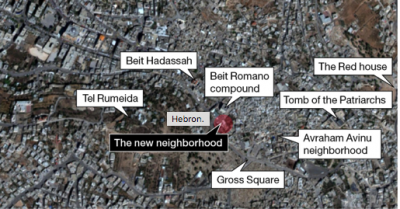
Map by Haaretz
As a reminder: in October 2017, the Israeli Civil Administration approved a building permit for the 31 units, on the condition that the Palestinian municipality of Hebron and others would have the opportunity to file objections to the plan. Soon after, two appeals were filed with the Defense Ministry: one by the Palestinian municipality of Hebron and one by the Israeli settlement watchdog Peace Now. The legal objections to the plan stem from the problematic process by which Israel made land in downtown Hebron available for settlement construction. Located in the Israeli-controlled H-2 area of Hebron (where 500 Israeli settlers live amongst 40,000 Palestinians), Israel seized the land in the 1980s from the Hebron Municipality, for military purposes. In 2007, the Civil Administration’s Legal Advisor issued an opinion stating that once Israel is done using the land for military purposes, it must be returned to the Hebron Municipality, which has protected tenancy rights to the land. Nonetheless, in 2015, the Israeli Civil Administration, with the consent of the Minister of Defense, quietly authorized the Housing Ministry to plan the area for Israeli settlement use, paving the way for that same ministry to subsequently present the plan for 31 units.
In October 2018, with the legal challenges still pending, the Israeli Cabinet voted to expedite the planning of the new settlement and allocated approximately $6.1 million (NIS 22million) for the project, which will require Israel to significantly renovate a military base in order to build the 31 new settlement units, a kindergarten, and “public areas.”
Peace Now said in a statement:
“The state was quick to issue the building permit even though the court has explicitly ruled that work should not start until the… hearing takes place….The attempt to squeeze in this construction of 31 settlement units before the U.S. election is an unscrupulous act that threatens Israel’s national interest and relations on the world stage.”
Israel Advances Planning for Settler-Backed Cable Car Project in Jerusalem — Despite Ongoing Legal Case
On October 25th, the Israeli-run Jerusalem Development Authority — a joint agency of the government and the Jerusalem Municipality — held the first of two meetings for developers interested in bidding on a settler-backed project to build a cable car in East Jerusalem, despite the fact that the Israeli Supreme Court has not yet issued a final ruling on whether or not the state is permitted to expropriate the privately owned Palestinian land that is needed to carry out its construction (for background, see recent reporting in the Settlement Report). A second meeting for prospective developers is reportedly scheduled for next week.
The High Court is actively considering the cable car case, having ordered the state to offer a factual explanation for how the cable car line will boost tourism in the city – an explanation that the state has struggled to articulate convincingly. In response, the State recently submitted an 81-page explanation of the project regurgitating the same arguments it has previously made. The Court is now awaiting response from the petitioners to the State’s latest filings.
Settlers Push Bibi to Authorize All Outposts As Compensation for Delay in De Jure Annexation
The Jerusalem Post reports that settler leadership is pressuring Prime Minister Netanyahu to immediately grant retroactive approval to the hundreds of Israeli outposts in the West Bank that are illegal under Israeli law (and for which Israel has been unable, despite an all-out effort, to find a way to legalize, short of simply declaring that rule of law is irrelevant). The Knesset Land of Israel Caucus is also preparing legislation to achieve this end.
The Post reports that settlers, having impatiently waited as the government has delayed action on many outpost authorizations — as successive elections and then the U.S. promise of annexation have come and gone (for now) — are upping the pressure on Netanyahu to act in a decisive manner on the outposts. Peace Now notes that, despite the settlers’ allegations of foot-dragging, over the past two years the Israeli government has managed to grant retroactive legalization to 21 outposts. with 9 more in process. Instead of considering each outposts’ legal status in a piecemeal manner, the settlers want Netanyahu to grant authorizations in one swift and blanked act – regardless of the facts of each outpost (like private Palestinian ownership of the land on which some outposts have been constructed).
Settlers apparently view this as urgent, given the fact that the Trump Plan leaves around 15 outposts as enclaves within the borders of what is envisioned as a future Palestinian non-state entity. Settlers also view this as just, asserting that Netanyahu owes the settler movement this as “compensation for his failure to to fulfill his annexation pledge.”
The Jerusalem Post article also does a surprisingly great job of explaining Israeli efforts over the past two decades to approve these outposts, which entered a new phase in 2017 with the passage of the Settlement Regulation Law – passed by the Knesset to allow provide a new legal basis by which the government can grant outpost approvals. FMEP has also comprehensively tracked [Table #3] Israel’s efforts over the past two years to retroactively legalize the outposts.
Bonus Reads
- “US amb. to Israel: Change of administration can damage Abraham Accords” (Jerusalem Post)
- “The Annexation That Was and Still Is” (B’Tselem)
- “Muslim Pilgrimage to Haram al Sharif/the Temple Mount: Tinkering with Explosives” (Terrestrial Jerusalem)
- [Thread] “The issue of the ultra-Orthodox sector, which recently caught the public’s attention again in light of the corona crisis, demands discussion about what is happening with the ultra-Orthodox community in the context of the settlements, for two reasons” (@nabothVin)
- “In East Jerusalem, the settler project is expanding underground“ (+972 Magazine)
- “Israelis Who Pillage Palestinian Olive Harvesters Are Not My Brothers” (Haaretz)
Welcome to FMEP’s Weekly Settlement & Annexation Report. To subscribe to this report, please click here.
July 31, 2020
- Knesset Convenes to Consider “Significant Move” to Annex Area C
- Settlers Step Up Effort to Build New Outpost on Strategic Land Between Bethlehem & Battir
- High Court Demands Evidence that Jerusalem Cable Car Project Will Boost Tourism
- Bonus Reads
Comments/questions? Contact Kristin McCarthy (kmccarthy@fmep.org)
Knesset Convenes to Consider “Significant Move” to Annex Area C
On July 29th, the Knesset Foreign Affairs & Defense Committee convened, for the first time since the new government was formed, for a hearing “on the battle for Area C and illegal, European funded Palestinian Authority construction in areas under full Israeli jurisdiction.” The hearing was called by committee chair Likud MK Zvi Hauser after Hauser participated in a West Bank tour led by the the radical settler group Regavim, which (among other things) works to consolidate Israeli control over the West Bank. The setter-run Arutz Sheva media outlet reports that the goal in convening the hearing was to have the committee “initiate a significant move” to annex all of Area C.
The Director General of Regavim made his expectation of the Knesset hearing’s significance explicit, saying:
“We are confident that today’s hearing will be a significant step toward creating a comprehensive government strategy for facing this challenge.”
As framed by Regavim and its prominent allies in the Knesset, including MK Hauser, Palestinians are engaged in an illegal campaign to “take over” Area C (this, of course, is an Orwellian notion given Israeli de facto annexation policies in Area C, some 60% of the West Bank). The Yamina Party is also a prominent supporter of the push for unilateral annexation of Area C. Yamina MK Matan Kahane recently accused Netanyahu of conspiring with Trump to create a Palestinian state in Area C by overlooking illegal Palestinian construction in the area.
Settlers Step Up Effort to Build New Outpost on Strategic Land Between Bethlehem & Battir
+972 Magazine reports that over the past month, armed settlers from the unauthorized outpost of “Neve Ori” have been working to establish a new unauthorized outpost near the Palestinian village of Battir (a UNESCO World Heritage Site), on land Israel claimed as “state land” that is strategically situated on high ground between Battir and Bethlehem. 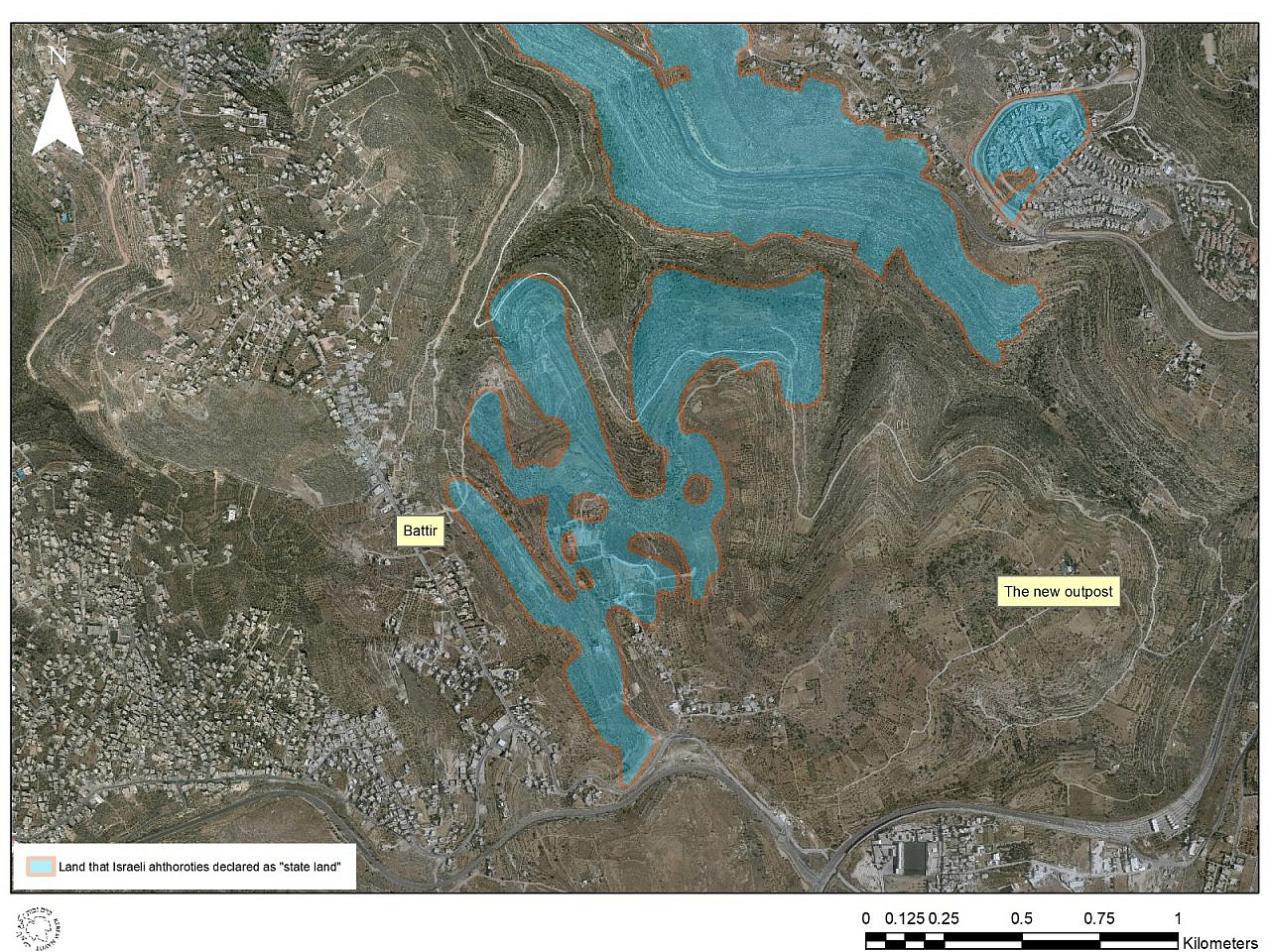
The land was historically a part of the village of Battir and privately owned for generations by the Alyan family (which has an Ottoman-era deed showing their ownership). It was nonetheless declared “state land” by Israel in 1982 under the pretense that the land was not being actively cultivated – despite the fact that the owner of the land, Ghassan Alyan, was only taking a planned break from working that area in order to switch the crops he was growing there. Alyan has repeatedly tried to reclaim the land, but has been prevented from doing so by the Civil Administration.
Palestinians report that a group of eight armed settlers appeared on the land for the first time one month ago, and have since visited the area weekly with the increasingly obvious intent to build an outpost. Last week, a settler named Lior Tal (who told +972 Magazine that “I want all of Battir to go to hell…the State of Israel belongs to the Jewish people”), began knocking on the doors of several homes in Battir demanding that farmers produce documents proving their ownership of the land.
The IDF has responded to reports about the settlers’ armed incursions into Palestinian land, but has failed to remove the settlers and prevent them from returning to the area. Last week, the IDF not only failed to remove the lawbreaking settlers but actually put the weight of the IDF behind in the settlers’ efforts. An IDF soldier told Alyan that he was now forbidden from accessing that land, that the settlers are permitted to be there, and that in order to change the situation Alyan must take his complaints to the Civil Administration and prove his ownership.
Khaled Muammar, a resident of Battir, told +972 about the strategic importance of the land, saying:
“They [the settlers] want to take over this area for three reasons: first of all, because of its elevation; it overlooks the region. Secondly, it separates [Battir from] al-Walajeh; settling there creates a wedge between two Palestinian villages. And thirdly, because it creates geographical continuity between [the Israeli settlement] Har Homa and Jerusalem.”
Settlement expert and founder of Kerem Navot, Dror Etkes, added to the context for the settlers’ actions in Battir:
“Why? Because of the Trump plan. This area, according to the plan, is supposed to be Palestinian territory. They want to take over the area now, before the government signals that it is going to accept the plan. To create facts on the ground.”
Palestinian ecologist Vivien Sansour said:
“The land taken by this settler is Battir’s last room to breathe. People are being forced to emigrate to Bethlehem because they do not allow us to build here.”
The Neve Ori outpost was established in 2019 by Lior Tal, the settler leading the effort against Battir. That outpost also started as a small effort by a handful of settlers who built structures illegally. The Civil Administration told +972 Magazine that it is aware of the outpost and that with respect to dealing with these illegal structures, “on-site enforcement will be carried out in accordance with the authorities and procedures and subject to [the Administration’s] priorities” (based on long experience, demolition of “illegal” Palestinian construction — that is, constuction by Palestinains on their own land, but without Israel’s permission, since it will rarely give permission — is at the top of the Civil Administration’s priorities, while dealing with illegal settler construction is rarely even makes the list).
High Court Demands Evidence that Jerusalem Cable Car Project Will Boost Tourism
One month after the Israeli High Court of Justice heard arguments regarding the State’s plans to build a cable car line in East Jerusalem, the Court has ordered the State to submit a report by September 9th substantiating its claim that the cable car has the potential to be a tourist attraction in the city. According to Emek Shaveh, if the State fails to adequately explain how the cable car will attract tourism, then the Court may invalidate the plan, based on the argument that it was advanced improperly through an expedited planning process reserved for infrastructure projects of national importance.
Emek Shaveh said in a statement:
“This query calls the project’s entire approval process into question. We view the High Court’s demand as an opportunity to approach Minister of Tourism Asaf Zamir about the issue again after he had expressed support for the plan last month. We believe the court’s decision is an opportunity to explain to Zamir that the factual basis for advancing the cable car as a transportation project with touristic value is flimsy at best, and that the cable car project is not a touristic project but a damaging plan which will be highly deleterious to Jerusalem and its landscape.”
As a reminder, the Jerusalem cable car project is an initiative backed by the Elad settler group and advanced by the Israeli Tourism Ministry. Last month, when the High Court heard objections to the plan, the State publicly admitted that the implementation of the cable car project will require the confiscation of privately owned Palestinian land in the Silwan neighborhood of East Jerusalem. The cable car line is slated to terminate at the settler-run Kedem Center compound (Elad’s large tourism center currently under construction at the entrance of the Silwan neighborhood, in the shadows of the Old City’s walls and Al-Aqsa Mosque).
While efforts to “sell” the cable car plan have focused on its supposed role in growing Jerusalem’s tourism industry or serving transportation needs, in reality the purpose of the project is to further entrench settler control in Silwan, via archeology and tourism sites, while simultaneously delegitimizing, dispossessing, and erasing the Palestinian presence there. Emek Shaveh and other non-governmental organizations, including Who Profits and Terrestrial Jerusalem, have repeatedly challenged (and provided evidence to discredit) the government’s contention that the cable car will serve a legitimate transportation need in Jerusalem, and have clearly enumerated the obvious political drivers behind the plan, the archeological heresies it validates, and the severe negative impacts the cable car project will have on Palestinian residents of Silwan.
Bonus Reads
- “European states denounce ‘illegal’ Israeli building plans in Jerusalem area 15 countries and EU again submit protest letter to Fore” (The Times of Israel)
- “They live on West Bank’s only all-girl hilltop, but don’t call them feminists“ (The Times of Israel)
- “Peace Now warns of de facto annexation as E1 planning” (Jerusalem Post)
- “Israel’s Second Coronavirus Wave Stalled Annexation, but Netanyahu Still Wants It” (Haaretz)
Welcome to FMEP’s Weekly Settlement Report, covering everything you need to know about Israeli settlement activity this week.
To subscribe to this report, please click here.
July 3, 2020
- The [Purported] Israeli Counter-Proposal to the Trump Annexation Map
- De Jure Annexation Remains Imminent: Reports Say Trump to Make Final Decision Next Week
- U.S. Said to Ask for Israeli “Gesture” to Palestinians in Order to Approve Annexation Plan
- Settlers Continue Opposition to Trump Plan, While Pushing Bibi to Stop Delaying
- Settler Group Announces New Outpost Near Hebron
- Israeli Court Issues Ruling to Throw Sumreen Family Out of Their House
- Settlers Claim to Have Purchased an Illegally Built Palestinian Home in Wadi Hilweh, Silwan
- Israel Orders Demolition of Illegal Settler Structures Following Reversal of Regulation Law
- State Admits to High Court that Jerusalem Cable Car Project Will Require Confiscating Private Palestinian Land
- New Ir Amim Paper Looks at Jerusalem to Underscore the “Truth About Annexation”
- Bonus Reads
Comments/questions? Contact Kristin McCarthy (kmccarthy@fmep.org)
The [Purported] Israeli Counter-Proposal to the Trump Annexation Map
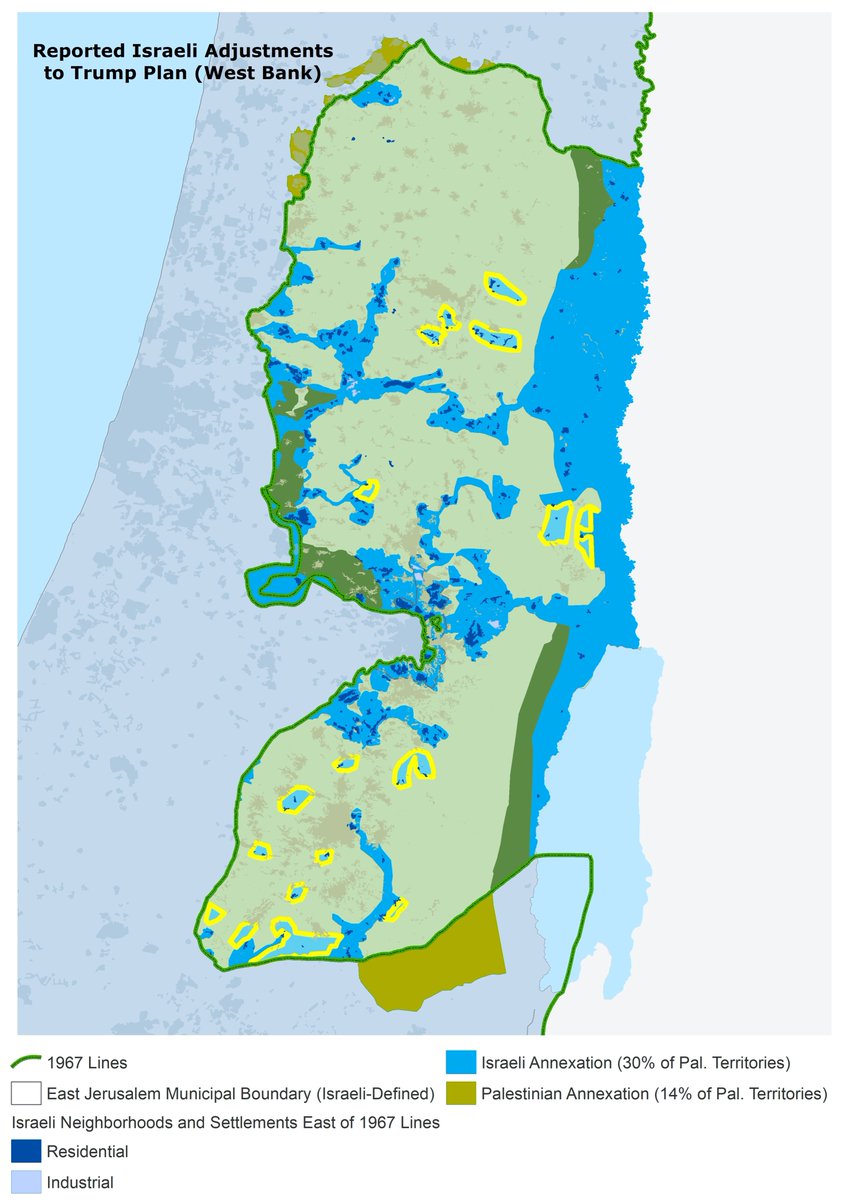 Israel’s Kan News published what it claims to be the Israeli government’s counter-proposal to the Trump annexation map. The reported counter-proposal adds a significant amount of West Bank land to the area Israel will annex, rendering even more severe the fragmentation of any future Palestinian state the plan is supposedly interested in seeing established. Specifically, the counter-proposal (which is exceptionally well explained by Israeli analyst and mapping expert Dan Rothem) achieves four main goals:
- It expands the channels of land which connect 15 far-flung outposts and settlements to what is today sovereign Israel. The Trump map connects these “enclaves” via narrow land corridors and roads (referred to by settlers as “balloons on a string”). The alleged counter-proposal annexes 2.7% more of the West Bank to enlarge those corridors.
- It provides for Israel’s annexation of about 20 additional settlements/outposts left out of the (initial) annexation provided for under the Trump Plan. These include the radical and violent settlement of Yitzhar and its outposts) located near Nablus, as well as the (relatively) nearby settlements Elon Moreh (and its outposts), Har Bracha (and its outposts), and Itamar (and its outposts). All of these settlements/outposts are, notably, located deep in the West Bank heartland.
- It proposes “compensating” Palestinians by designating an additional 4.6% of the West Bank — areas designated under the Trump Plan for Israeli annexation, comprised of West Bank territory where there are no settlers and some empty areas in the Jordan Valley/Judean desert — to (possibly) be under some degree of Palestinian control (without providing details on what would be the status of the land). (Reminder: Netanyahu said he will not annex a single Palestinian).
- The map also appears to propose population transfer, putting parts of the so-called Triangle Area — an area of densely populated towns located within Israel’s sovereign borders, inhabited by Palestinian citizens of Israel — into the area that could theoretically become a Palestinian state (assuming the Palestinians accepted the Trump Plan and satisfied a laundry list of conditions that no Palestinian leadership would ever accept — all to end up with an archipelago of territory that they might be allowed to call a “state” but that would have few if any actual attributes of sovereignty). Reminder: Forcible population transfer is a flagrant violation of international law (as is annexation of any scope); a government re-drawing its borders to deprive its own citizens of their rights, based on their ethnicity, is antithetical to democracy.
Additionally, while Israeli officials originally indicated that annexation would begin with the Jordan Valley, rampant reports indicate that the focus has now shifted to annexing elsewhere (settlement blocs) as the first stage of annexation. Perhaps responding to criticism over delaying the annexation of the Jordan Valley, Israeli Regional Cooperation Minister Ofir Akunis (Likud) told The Jerusalem Post that “of course” the Jordan Valley is included in Israel’s annexation plans [which should surprise nobody, given that politicians across most of the political spectrum in Israel came out in support of annexation of the Jordan Valley (including Benny Gantz), even before the Trump Plan].
So what is Netanyahu really thinking? According to Haaretz, he has not held discussions with his own Security Cabinet on the annexation plan, and the key Israeli bodies which will be involved in implementing annexation – the Justice Ministry, the Attorney General (whom Bibi is in open war with), the IDF chiefs, and Foreign Ministry – have not begun preparing for implementation.
De Jure Annexation Remains Imminent: Reports Say Trump to Make Final Decision Next Week
July 1st – the first day Netanyahu was permitted to bring annexation up for a vote in the Cabinet or in the Knesset, but by no means a deadline for such an action – came and went without an announcement. Reports almost immediately suggested that the annexation decision – reportedly delayed by U.S. demands and Israeli disunity.
After a week of meetings with Israeli leaders, National Security Council advisor Scott Leith and Middle East envoy Avi Berkowitz (who in the meetings were of course joined by US ambassador to Israel David Friedman) headed back to Washington. On Thursday, Berkowitz met with Jared Kushner in preparation for presenting their plan to the President. Despite the palace intrigue surrounding Kushner this week, Kushner plays a critical role in leading Trump a final decision on annexation, expected to come next week..
Though Trump has not been involved in any details of the annexation deliberations, Israeli Regional Cooperation Minister Ofer Akunis asserted that Israel will not act without a statement from Trump himself, telling the Jerusalem Post:
“[annexation] will only happen after a declaration by Trump.”
Following the departure of Leith and Berkowitz (Friedman remained in Israel), an anonymous U.S. official told the Jerusalem Post that the fact that July 1st came and went without an announcement does not mean that annexation is any less likely to happen. That official said:
“The administration is appreciative of the ongoing conversations and serious considerations that have gone into our recent discussions with the Israeli government.July 1 is not and has never been a US deadline, nor do we believe it is an Israeli deadline. We look forward to continuing the dialogue with our Israeli partners and working productively and in earnest towards implementing the president’s Vision for Peace in the Middle East.”
U.S. Said to Ask for Israeli “Gesture” to Palestinians in Order to Approve Annexation Plan
U.S. Amb. David Friedman, National Security Council advisor Scott Leith, and Middle East envoy Avi Berkowitz spent the past week in Israel, negotiating with Israeli Prime Minister Netanyahu and Alternate Prime Minister Gantz over the extent and timing of Israeli annexation of West Bank territory. Israeli press – particularly right-wing outlets – asserted that the Americans were pushing Israel to make a more significant “gesture” to the Palestinians in order to win American support (reminder: the Palestinian leadership has not been involved in negotiations at all).
Reportedly, the US suggested that such a gesture could consist of granting the Palestinian Authority greater control over the remnants of Area C left to the Palestinians after Israeli annexation — with Israel retaining the ability to “secure” those areas as-needed (essentially transforming a small part of Area C land into Area B).
The Jerusalem Post goes so far as to suggest that “many” of the conversations this past week focused on what the Palestinians will be given/offered/forced to accept, rather than the details of what/how/when Israel will annex. More than anything else, this suggests that the U.S. is not imposing limits on what Israel can annex.
Settlers Continue Opposition to Trump Plan, While Pushing Bibi to Stop Delaying
Worried both about the details of the Trump Plan and that Bibi will not pull the trigger on annexation at all, settler leaders and their allies continue their criticism of Netanyahu for every move (and non-move) he makes.
Two prominent settler leaders who oppose the Trump Plan – Yesha Council chairman David Elhayani and Samaria Regional Council chairman Yossi Dagan – continued lashing out at Netanyahu for his posture on issues of key concern to settlers (the creation of settlement enclaves, a settlement construction freeze, and the possibility of future Palestinian statehood) and for failing to act on July 1st. Dagan called the July 1st date “one big farce.”
Elhayani – who estimated that there is an 80% chance that there will be no annexation – told Walla News:
“Tying the lack of sovereignty [announcement] to Benny Gantz is a pathetic excuse..In reality, it is in the hands of the prime minister, who must accept responsibility for the decision, demonstrate leadership and say: ‘I have made this commitment to the electorate in two election campaigns, and I will stand by it’.”
Another group of settlers who are adamantly against the Trump Plan launched a new campaign targeting Netanyahu. The campaign, which was covered in the front page of the Israel Hayom paper, features photos of PA President Mahmoud Abbas, Joint List Parliamentary head MK Ahmed Tibi, and Netanyahu, and alongside the photos uses the slogan:
“They [Abbas and Tibi] will not decide. You’ve [Netanayhu] decided – Keep your promise.”
Another settler group – the Sovereignty Movement – put up billboards all over the country calling on Netanyahu to annex and to say “no” to a Palestinian state.
Former Defense Minister Avigdor Liberman (Yisrael Beytenu) put on a public display of his pointed displeasure with Netanyahu’s failure to advance annexation on July 1st. Visiting a vista overlooking the Palestinian Bedouin village of Khan al-Ahmar in the West Bank – which Netanyahu has long promised to demolish – Lieberman told the press:
“We’re meeting here at Khan al-Akhmar because this is part of the same pattern of behavior. For fourteen months, Netanyahu has been yelling about ‘sovereignty’, and the whole time he’s cheated his voters…Netanyahu has tricked everyone. He has no intention of applying sovereignty: not over Maale Adumim and not even in the Jordan Valley. He always manages to trick everyone, but it was clear to me that he is lying, just as he lied about Khan al-Akhmar.”
Former Justice Minister and Yamina party leader MK Ayelet Shaked told the Jerusalem Post that she believes Bibi has “given up on the Jordan Valley.”
Haaretz reports that settlers – both those who support the Trump Plan and those who want more than what the plan is offering – have been successfully working with U.S. evangelicals to pressure Trump to OK annexation. Netanyahu himself spoke at a high profile online event for Christians United for Israel, and Yossi Dagan was interviewed by the Christian Broadcasting Network. Efrat settlement Mayor Oded Revivi has been in private conversation with U.S. evangelical leaders.
A recent poll by the radical settler group Regavim found that only 30% of settlers supported the Trump Plan after they were told that it will require Israel to agree to the establishment of a Palestinian state. Additionally, 53% of settlers said they believe that Netanyahu will give in to pressure from Trump rather than stand his ground on issues under negotiation.
Settler Group Announces New Outpost Near Hebron
On July 1st, a group of about 500 settlers held a protest against the Trump Plan and announced their plans to establish a new outpost. The protest was held on a hilltop belonging to the Palestinian village of Halhul, near Hebron in the southern West Bank. One of the protests leaders, veteran settler activist Daniella Weiss, told Ynet:
“The Trump plan needs to be thrown in the trash. We came here to establish a settlement. Today everyone understands that the purpose of the plan is to establish a Palestinian state in the heart of Israel.”
Israeli Court Issues Ruling to Throw Sumreen Family Out of Their House
On June 30th, the Jerusalem District Court rejected an appeal by the Palestinian Sumreen family to stop the Jewish National Fund (JNF) from evicting them from the home of 60 years in the Silwan neighborhood of East Jerusalem. The Court gave the 18-member family until August 16th to vacate the property and ordered them to pay 20,000 shekels (about $5,800) to the JNF for legal costs. The Sumreen family is considering taking their case to the Israeli Supreme Court.
The Coalition for the Sumarin Family said in a statement:
“In the ruling, the court did not address the most important, fundamental point, which is that the house was taken in plunder. The JNF’s legal woes did not change the fundamental fact that the use of the Absentees’ Property Law to take over the house was done without good faith, as two government legal advisers and a government inquiry commission, determined”.
The Sumreen family home is located in the middle of what today has been designed by Israel “the City of David National Park.” The area is managed by the radical Elad settler organization, which for years has also been pursuing the eviction of Palestinians from the homes in Silwan. For nearly three decades, the Sumreen family has been forced to battle for legal ownership of their home, after the state of Israel, prompted repeatedly by the JNF, declared the Sumreen’s home to be “absentee” property. After that designation – which was not communicated to the Sumreen family – Israeli law permitted the state to take over the rights to the building. The state then sold the rights to the home to the JNF in 1991. The JNF has pursued the eviction of the Sumreen family ever since. Israeli courts ruled in favor of the Sumreen family’s ownership claims to the home for years, until a September 2019 ruling by the Jerusalem Magistrate’s Court granted ownership of the family’s home to the JNF, a decision the family immediately appealed to the Jerusalem District Court.
A full history of the saga involving the Sumreen family – which is similar to dozens of other Palestinian homes in Silwan that were declared Absentee Property in the 1990s – can be found on the Peace Now website here.
In a recent letter organized by Israeli academics, thirty-four Israel Prize laureates pleaded to the head of the JNF to stop eviction proceedings against the Sumreen family. The letter reads:
“The expulsion of the family, as part of a campaign to Judaize Silwan which has been going on for many years, will stain the reputation of the KKL … we beg of you to desist from taking actions that would be clearly immoral.”
This week, +972 Magazine published an illuminating article by a former staff member of the JNF, looking at the role the organization has played in advancing annexation policies on the ground for decades with evictions like the Sumreen case. IMEU also just published an excellent fact sheet about the Jewish National Fund.
Settlers Claim to Have Purchased an Illegally Built Palestinian Home in Wadi Hilweh, Silwan
On June 30th, a group of settlers invaded a vacant building in the Wadi Hilweh section of the Silwan neighborhood in East Jerusalem, saying that they had purchased the house from its Palestinian owners. Peace Now reports that the home was built by Palestinians years ago without an Israeli-issued permit (Palestinians in East Jerusalem are systematically denied permits to build on their own land). The family that had been living in the house left about four months ago after a demolition order was issued by the Jerusalem Municipality. 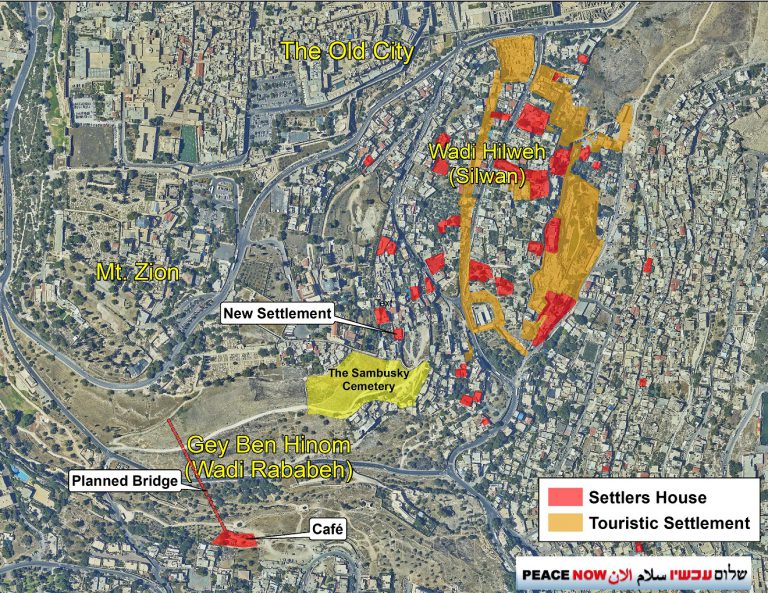
The house is located in the Ben Himmon Valley and very close to a Jewish cemetery that is currently being rehabilitated by the radical Elad settler organization. Elad has been involved in the systematic displacement of Palestinians from the Silwan neighborhood and has been weaponizing tourism and archaeology as a means by which to do so.
Peace Now explains:
“In recent years, the Elad Association, together with the Jerusalem Development Authority and the Nature and Parks Authority, has been intensively developing the Ben Hinnom Valley area leading to the Sambusky Cemetery in an attempt to produce Israeli territorial contiguity from the Sultan’s Pool area and Ben Hinnom Valley area through the cemetery toward Wadi Hilweh and the ‘City of David’ visitors’ center…The takeover of this house extends the settlers’ control in the southwest corner of Wadi Hilweh: In September 2014, the settlers entered a nearby house, and in January 2016 another house adjacent to it…All of these projects, along with the settlers entering the house yesterday, are intended to strengthen Israeli presence in this contested and occupied area, and thus make it more difficult for the territorial compromise in Jerusalem needed for a Palestinian capital in East Jerusalem and therefore the two-state solution itself. Tourism development projects in Jerusalem are one of the most significant ways of settlement, leading to both a change on the ground and in the public domain, as well as a change in Israeli attitudes by hardening them to the idea of this necessary territorial compromise.”
Israel Orders Demolition of Illegal Settler Structures Following Reversal of Regulation Law
In response to a petition filed by Yesh Din and Emek Shaveh, Israel has said it will demolish illegally built settlement structures on privately owned Palestinian land belonging to the villages of Dir Amar and Ras Karakar. Years ago settlers illegally installed tourist accommodations – benches, terraces, paths, picnic benches and a pergola – at the site of an ancient spring in this area, in an attempt to take control of the site known as Nabi Aner. Nabi Aner is part of an historic Muslim pilgrimage route between Hebron and Bethlehem. The entire area is located in Area C of the West Bank.
Israel’s announcement that it will demolish the structures (and, ostensibly, agree to return the site to Palestinian control), comes two weeks after the Israeli High Court of Justice overturned the Regulation Law, which sought to provide a basis for legalizing settlement structures built on land that even Israeli acknowledges is owned by Palestinians (as is the case with the site in question). The petition to demolish the settlers’ construction was filed in 2017, but was not considered by the Court until now, based on the argument that the Regulation Law – if it withstood Court scrutiny — might have provided the State a basis for retroactively legalizing the structures.
Emek Shaveh said in a statement:
“Over the years, the authorities in the area have refrained from enforcing the law with respect to illegal construction that was carried out on private land and around the archaeological site. In recent years, the State used the pretext of the Regularization Law as an excuse for continuing the policy of non-enforcement. This is an example of the importance of the nullification of the Regularization Law, which enabled settlers to take over private lands. But regardless of the Regularization Law and its nullification, we find it regrettable that we were forced to petition the court to instruct the State’s enforcement authorities to simply carry out their duties and prevent the settlers from illegally building on private Palestinian land. We regret that the State does not of its own accord enforce the law and stop the damage to archaeological sites and the process of severing Palestinians from access to their cultural and religious roots.”
State Admits to High Court that Jerusalem Cable Car Project Will Require Confiscating Private Palestinian Land
On June 29th, the Israeli High Court of Justice heard arguments concerning the Jerusalem cable car project, an initiative backed by the Elad settler group and advanced by the Israeli Tourism Ministry. During the hearing, the State admitted the implementation of the cable car project will require the confiscation of privately owned Palestinian land in the Silwan neighborhood of East Jerusalem. The cable car line is slated to terminate at the settler-run Kedem Center compound (Elad’s large tourism center currently under construction at the entrance of the Silwan neighborhood, in the shadows of the Old City’s walls and Al-Aqsa Mosque).
The cable car plan, touted by Elad and other supporters as a vital transportation project, is in reality intended to further entrench settler control in Silwan, via archeology and tourism sites, while simultaneously delegitimizing, dispossessing, and erasing the Palestinian presence there. Emek Shaveh and other non-governmental organizations, including Who Profits and Terrestrial Jerusalem, have repeatedly challenged (and provided evidence to discredit) the government’s contention that the cable car will serve a legitimate transportation need in Jerusalem, and have clearly enumerated the obvious political drivers behind the plan, the archeological heresies it validates, and the severe negative impacts the cable car project will have on Palestinian residents of Silwan.
New Ir Amim Paper Looks at Jerusalem to Underscore the “Truth About Annexation”
In a new policy paper, Ir Amim looks at how Israel’s annexation of East Jerusalem has played out since 1967. Ir Amim’s main points – and warnings regarding Israel’s imminent annexation of more West Bank land – are:
- Israel annexing Palestinian land, but not Palestinian people, who since 1967 have been classified as “permanent residents,” rather than being made citizens, like the Palestinians who remained inside the Green Line after 1948.;
- Since the moment of annexation of East Jerusalem, Israel has pursued policies meant limit the number of Palestinains in the area, including by driving Palestinians from East Jerusalem;
- Since the moment of annexation, Israel has attempted to take control of more and more land in East Jerusalem;
- The Absentees’ Property Law (1950) and The Law and Administration Ordinance (1970) have been Israel’s tools of choice to evict Palestinians from their homes and take their property in East Jerusalem, under the guise of legality;
- Israel has repeatedly attempted to expand the borders of the area it annexed to include nearby settlements.
Ir Amim writes:
“In order to understand the consequences of annexation it is pertinent to learn from the case of East Jerusalem which Israel unilaterally – and in contravention of international law – annexed. Since 1967 East Jerusalem has been subject to the Jerusalem municipality and to Israeli law. In the decades since 1967, Israeli policy in the city has been driven by massive settlement construction and consistent steps to reduce the city’s Palestinian population. The combination of these two methods is considered by Israel the key to solidifying its control over the annexed territory and to asserting its sovereignty. Examining Israeli policies in East Jerusalem can therefore teach us the dangers of what can take place if the current annexation plan of the Israeli government actually takes place.”
Bonus Reads
- “Annexation is Already Here” (Jessica Montell // The Times of Israel)
- “Fight Annexation on Moral Grounds” (Yehuda Shaul // Haaretz)
- “Quick Facts: Israel’s West Bank Settlement Enterprise” (IMEU)
- “Despite Talk of Annexation, Fewer Immigrants to Israel Moving to West Bank Settlements” (Haaretz)
- “Quick Facts: What is the Jewish National Fund” (IMEU)