Welcome to FMEP’s Weekly Settlement & Annexation Report. To subscribe to this report, please click here.
May 13, 2021
- Knesset Advances Three Key Annexation Bills
- Israel’s Official Maps of Jerusalem Land Expropriations — Discrepancies and Room for Interpretation
- Israel Advances Plan to Build On the Ruins of Lifta, a Historic Palestinian Neighborhood in West Jerusalem
- In Victory for Settlement Companies, Canadian Appeals Court Reverses Settlement Product Labelling Ruling
- <New Campaign in Norway Pushes for State Pension Fund to Divest from Occupation
- Bonus Reads
Comments or questions? Email Kristin McCarthy – kmccarthy@fmep.org.
Knesset Advances Three Key Annexation Bills
Notwithstanding surging protests and violence across Israel and the territories it belligerently occupies, the Israeli Knesset voted on May 10th to give preliminary approval to three incendiary bills: one would grant retroactive legalization to 70 unauthorized outposts; a second would rescind the 2005 Disengagement Law, thereby allowing Israel and its settlers to re-establish four settlements in the northern West Bank which were dismantled under that law; and a third bill would empower the Knesset to override decisions by the Israeli Supreme Court and reinstate laws the Court ruled to be unconstitutional (like the Settlement Regulation Law, which is the key target of this legislative effort). FMEP has previously explained these bills here. Ahead of the vote, Defense Minister Benny Gantz asked Prime Minister Netanyahu to intervene to delay the bills, citing the rising violence and unrest.
With the vote to advance the bills on May 10th, the Knesset will need to pass the bills through three more readings. The three bills have long been high on the wish list of many Israeli politicians who support Israel’s annexation of West Bank land.
Israel’s Official Maps of Jerusalem Land Expropriations — Discrepancies and Room for Interpretation
Following years of advocacy by the Israeli group Bimkom: Planners for Planning Rights, the official maps drawn by the Israeli government when it annexed (illegally) lands around Jerusalem have been released in their entirety for the first time. Though bits and pieces of the maps had been released in the past by the Israel Lands Authority in response to specific inquiries related to land expropriations, the state had kept the maps hidden from the public until now.
With the maps in hand, Bimkom has launched a website where the maps can be analysed. On the significance of the maps and the ability of the public to access them, Bimkom writes:
“The original expropriation maps were drawn by hand, as was customary at the time. The manual drawing and the passage of years however, have led to defects and distortions in the original paper documents. In many places there is a discrepancy between the hand-drawn maps and contemporary mappings made with the latest technology, and their reading leaves room for interpretation. Hiding the expropriation maps from the public allowed the state authorities to be the sole interpreters of the maps. But now, with the help of the interactive on-line tools offered on Bimkom’s new site, interpretation of the maps will be in the public domain.”
Israel Advances Plan to Build On the Ruins of Lifta, a Historic Palestinian Neighborhood in West Jerusalem
On May 10th (Jerusalem Day), the Israel Lands Authority announced that on July 4, 2021 it will open bidding on construction plans to build a new neighborhood on the ruins of the Palestinian neighborhood of Lifta, located in West Jerusalem. While FMEP’s settlement and annexation report focuses on settlement building in areas located over the 1967 Green Line, the story of Lifta – and of other Palestinian villages forcibly depopulated by Israeli forces in the 1948 – is another facet of the Israeli government’s policy of erasure of Palestinians via the establishment of Jewish Israeli communities. You can read one Palestinian’s account of forced her forced displacement from Lifta, here.
Lifta is the last Palestinian village in Jerusalem to remain partially intact. Israel has prevented Palestinian refugees and landowners from returning to it, but has not yet demolished all the original structures (55 out of the original 400 structures still remain), or opened up the area for Israeli re-development. In 2017 the ruins of Lifta were named by the World Monuments Fund as one of 25 at-risk sites around the world.
The plans being advanced call for the construction of 259 apartment units, a luxury hotel, and other commercial buildings. Former-Jerusalem Municipality council member Yair Gabbai told the Jerusalem Post that a synagogue will be added to the development plan – leaving no doubt about for whom the housing is intended.
In Victory for Settlement Companies, Canadian Appeals Court Reverses Settlement Product Labelling Ruling
On May 6th, a Canadian federal appeals court reversed a 2019 ruling that had prevented Israeli companies based in settlements from labelling their products as “Made in Israel.” The new ruling by the appeals court found that the 2019 decision had been made “improperly,” and sent the case (which was initiated by the Psagot settlement winery) to Canada’s Food Inspection Agency – which had previously allowed the products (wine) from settlements to be labelled as “Made in Israel.”
Psagot Winery is a willing legal test case, as part of an ongoing international campaign led by Israel and its defenders to erase any/all distinction that foreign countries might want to make between the territory recognized by the world as the sovereign state of Israel, and Israeli settlements built in the occupied territories, which are illegal under international law. By convincing countries to treat settlements products as products of the state of Israel, this campaign seeks to secure de facto recognition of Israeli sovereignty over its settlements.
For a deep dive in the history of the Psagot settlement and the significance of former Sec. of State Mike Pompeo’s visit there in the waning days of the Trump Administration – check out this FMEP podcast with Dror Etkes, Fadi Quran, and Lara Friedman.
New Campaign in Norway Pushes for State Pension Fund to Divest from Occupation
This week two well-respected organizing groups in Norway – the Norwegian Union of Municipal and General Employees and Norwegian People’s Aid – have launched a campaign calling on the Government Pension Fund (the largest sovereign wealth fund in the world) to exclude from its investment portfolio 64 companies that are “involved in activities that support and profit from illegal Israeli settlements in the Occupied Palestinian Territory, as well as the occupation economy, in general.”
The campaign website explains:
“The campaign aims to shed light on how investments made by the Government Pension Fund Global (GPFG), popularly known as the Norwegian oil fund, can contribute to the occupation…Businesses play a key role in supporting the construction, maintenance and expansion of the illegal settlements. International and Israeli companies are found in many business sectors, including banking, tourism, security, technology, construction, real estate, extractive industries, telecommunications, agriculture, transport and industry. Various UN bodies have stated that the close link between settlements and violations of human rights and international law make it practically impossible for a company to do business with the settlements and be compliant with international law and international standards for business and human rights. For this reason, some of these companies have already been excluded by other Norwegian and international financial institutions. We believe that the oil fund should do the same. The oil fund has recently taken steps to look more closely into portfolio companies that operate in high-risk conflict areas. Despite this, investments in companies with activities in occupied Palestinian territory have increased.”
Bonus Reads
- “EU Court Backs Group Opposed to Imports From Israeli Settlements” (Reuters)
- “Co-existence in Jaffa Could Cost Arab Residents Their Homes” (Haaretz)
Welcome to FMEP’s Weekly Settlement & Annexation Report. To subscribe to this report, please click here.
November 20, 2020
- Final Days of Trump Admin, Part 1: Historic Shifts in US Settlements Policy
- Final Days of Trump Admin, Part 2: Full Steam Ahead on Givat Hamatos Settlement
- Final Days of Trump Admin, Part 3: Israel Expected to Advance Har Homa E Settlement Plan
- Final Days of Trump Admin, Part 4: Israel Set to Start Process of Land Registration in East Jerusalem
- Final Days of Trump Admin, Part 5: Settlers Push to Re-Establish Abandoned Settlements in Northern West Bank
- Final Days of Trump Admin, Part 6: Bibi Seeks U.S. OK for More Settlement Projects, Settlers Push for Outpost Authorization
- Israeli Education Minister Celebrates New Settlement Yeshiva
- IDF Pays for Use of Yeshiva After Settlers Destroy Army Base
- Impending Sheikh Jarrah Evictions
- Bonus Reads
Questions/Comments? Email Kristin McCarthy (kmccarthy@fmep.org).
Final Days of Trump Admin, Part 1: Historic Shifts in US Settlements Policy
U.S. Secretary of State Mike Pompeo landed in Israel on November 19th for a two-day visit in which he made history with respect to U.S. support for settlements, delivering a series of extraordinary (though entirely predictable) victories to Israeli settlements and Israel’s Greater Israel pro-annexation movement.
First, Pompeo became the first U.S. Secretary of State to visit the Israel-occupied Golan Heights since the Trump Administration recognized Israeli sovereignty there in March 2019, .
Second, Pompeo became the first U.S. Secretary of State to visit a West Bank Israeli settlement, in a visit publicly framed as establishing the legitimacy of settlements. Pompeo’s visit to the Psagot Winery – located near Ramallah – flouted international law and international consensus, which views Israel’s settlement enterprise as illegal [for a deep dive in the history of the Psagot settlement and the significance of Pompeo’s visit – check out this FMEP podcast with Dror Etkes, Fadi Quran, and Lara Friedman].
Third, in conjunction with his visit to the Psagot Winery settlement, Pompeo announced new U.S. guidelines that require products made in all areas under Israeli control to be labelled as “Made in Israel” (or iterations thereof) when being exported to the U.S. This is a massive and highly consequential shift in U.S. policy that offers recognition of Israeli sovereignty not only over settlements (as the Trump Administration has previously done) but over all of Area C – some 60% of the West Bank. The announcement was urged on by a group of four Republican Senators ahead of Pompeo’s trip. The policy, which if focused on territory, not people, would require even Palestinian-made goods originating from villages in Area C to be labelled as “Made in Israel”. Roughly 150,000 Palestinians live in Area C, where they are subjected to an escalating Israeli campaign to make life untenable for them via discriminatory planning policies and demolitions.
Laying out the new policy, the State Department issued a statement saying:
“Today, the Department of State is initiating new guidelines to ensure that country of origin markings for Israeli and Palestinian goods are consistent with our reality-based foreign policy approach. In accordance with this announcement, all producers within areas where Israel exercises the relevant authorities – most notably Area C under the Oslo Accords - will be required to mark goods as ’Israel’, ’Product of Israel’, or ‘Made in Israel’ when exporting to the United States. This approach recognizes that Area C producers operate within the economic and administrative framework of Israel and their goods should be treated accordingly. This update will also eliminate confusion by recognizing that producers in other parts of the West Bank are for all practical purposes administratively separate and that their goods should be marked accordingly.”
Pompeo made this announcement following his visit to the Psagot winery – which not only named a vintage after Pompeo but has also been at the center of Israel’s global effort to push nations to treat Israeli settlements as indistinguishable from sovereign Israeli territory, with the winery involved in international legal battles over how Israeli businesses located in the settlements are required to label their products. U.S. labelling requirements will now stand at odds with European policy on the matter, which requires differentiation between products made in Israel and products made in settlements.
As part of the major change in U.S. labelling policy, Pompeo also changed how Palestinian-made products (produced in Areas A & B, and in the Gaza Strip) must be labelled, replacing the “West Bank/Gaza” label with separate “West Bank” and “Gaza” labels – another symbolic move laced with antagonism towards Palestinian rights and national aspirations. The change also contradicts the Oslo Accords, under which the Gaza Strip and West Bank are to be treated as a single territorial entity. The U.S. State Department statement on the labelling policy reads:
“We will no longer accept ’West Bank/Gaza’ or similar markings, in recognition that Gaza and the West Bank are politically and administratively separate and should be treated accordingly.”
Fourth, in a press conference alongside PM Netanyahy, Pompeo announced that the U.S. holds the “global BDS campaign” to be anti-Semitic, and said that the U.S. will “immediately take steps to identify the organizations that engage in hateful BDS conduct and withdraw US government support from such groups.” Pompeo called BDS a “cancer.” This is particularly relevant to settlement and annexation watchers because the new U.S. designation makes no distinction between boycotts aimed at Israel and boycotts limited to Israeli settlements – yet another legal step towards offering official U.S. recognition of Israel’s annexation of the settlements. It had previously been reported that the U.S. State Department were preparing to label Human Rights Watch, Oxfam, and Amnesty International as anti-Semitic organizations, based on the IHRA definition of anti-Semitism.
Fifth, under the protection of a large Israeli security escort, Pompeo visited the Elad settler organization’s archeological projects in the City of David, an Israeli national park which was declared on top of the Palestinian neighborhood of Silwan, located right outside of the walls of the Old City of Jerusalem. Under Elad’s direction, and with the support of the Israeli government and the Trump Administration, archeology is being weaponized to erase the historic memory and the modern presence of Palestinians, while emphasizing the Jewish heritage at that site. At the same time, settler organizations including Elad and Ateret Cohanim are battling to implement the mass eviction of Paelstinians from their longtime homes in Silwan.
Israeli NGO Emek Shaveh – a group of expert archaeologists – previously explained:
“The use of archaeology by Israel and the settlers as a political tool is a part of a strategy to shape the historic city and unilaterally entrench Israeli sovereignty over ancient Jerusalem. It is a process which is likely to produce devastating results for both Israel and the Palestinians. It is inexcusable to ignore the Palestinian residents of Silwan, carrying out extensive excavations of an underground city and to use such excavations as part of an effort to tell a historic story that is exclusively Jewish in a 4,000 year-old city with a rich and diverse cultural and religious past.”
And in a piece entitled “Israel Is Using Archeology To Erase Non-Jewish History,” Emek Shaveh further explained:
“The exploitation of archaeology in Jerusalem has been spearheaded by the Elad Foundation, a group of settlers turned archaeology entrepreneurs, who are using ancient sites to take over land and shape the historical narrative. Elad, which emerged 30 years ago with a mission to settle Jews in Palestinian homes in the neighborhood of Silwan, manages the popular archaeological park, the City of David. Visitors to the site are treated to a heavily biblical narrative where discoveries that resonate with the story of King David or the Kingdom of Judea are highlighted. The fact the archaeologists dispute the evidence of a kingdom in the 10th century BCE often goes unmentioned. Furthermore, not many of the half a million people who visit the park annually know about life in the Palestinian neighborhood since Elad arrived on the scene. They will probably never hear about how Elad took over 75 homes in the neighborhood, or closed off virtually the last of the public areas used by the residents and annexed it to the archaeological park. With an annual budget of approximately 100 million shekels, the Elad Foundation now commands several excavation projects in the City of David, including tunnels along an ancient Roman street, which it is marketing as a Second Temple era pilgrims’ route to the Temple. It has recently branched out to establish new projects within the Old City and in other areas throughout the Historic Basin. But Elad couldn’t have done it on their own. If at first they were greeted with mistrust by the authorities in the 1990s, today they have an open door to many government agencies and ministries. From the Israel Antiquities Authority, which is in charge of most of the excavations at the City of David, and the Nature and Parks Authority, which subcontracted Elad to run the site, to the minister of tourism, who is aggressively advancing a cable car to link West Jerusalem to the City of David, to the mayor of Jerusalem, the government and all the relevant agencies are committed to the project of shaping a large tourist zone dedicated to the First and Second Temple periods.”
Final Days of Trump Admin, Part 2: Full Steam Ahead on Givat Hamatos Settlement
On November 15th, the Israel Land Authority published the long-feared/long-awaited (depending who you are) tender for the construction of the Givat Hamatos settlement in East Jerusalem. The tenders provide for the construction of 1,257 settlement units, which is about 200 units more than expected. The tender is set to close for bids on January 18, 2021 – exactly two days before the inauguration of President-elect Joe Biden. In a carefully worded statement to the press, Netanyahu acknowledged that the publication of the Givat Hamatos tender had been coordinated with the Trump Administration (but not the Biden transition team).
Terrestrial Jerusalem writes:
“The decision to proceed with the construction of Givat Hamatos is the most defiant and inflammatory settlement move in recent memory, and should be treated as such. The construction of Givat Hamatos will create a buffer, contributing to an effective seal between East Jerusalem and Bethlehem. In addition, Givat Hamatos will, for the first time, completely surround an East Jerusalem neighborhood, Beit Safafa, with Israel construction, making the implementation of the Clinton parameters in East Jerusalem impossible. Givat Hamatos will have a devastating impact on the very possibility of a future two-state outcome.”
Ir Amim writes:
“The opening of the tender significantly decreases the potentiality to effectively block Israeli building in the area. Concerted opposition and pressure to freeze the tender is therefore vital in this limited window of time. If carried through, Givat Hamatos would become the first new settlement in East Jerusalem in 20 years. Located in a particularly strategic area, Givat Hamatos (along with Har Homa E and E1) has constituted a longstanding international red line due its impact on the prospects of a viable two-state framework with two capitals in Jerusalem. By creating a contiguous Israeli built-up area between the existing settlements of Gilo and Har Homa, construction in Givat Hamatos will serve to seal off the southern perimeter of East Jerusalem from Bethlehem and the southern part of the West Bank, while isolating the Palestinian neighborhood of Beit Safafa. The next two months in lead-up to the change in the US Presidential Administration will be a critical period. We believe that Israel will attempt to exploit this time to advance moves that the incoming administration will potentially oppose. It is crucial that the international community remain vigilant.”
Peace Now writes:
“Construction in Givat Hamatos will severely hamper the prospect of a two-state solution because it will ultimately block the possibility of territorial contiguity between East Jerusalem and Bethlehem–the main Palestinian metropolitan area–and will prevent Palestinian Beit Safafa from connecting with a future Palestinian state…The meaning of the publication of the Tender Booklet is that now the tender is open for bids and contractors may submit their proposals to win the right to build the units in Givat Hamatos. The final day for submitting the proposals is January 18th, 2021, three days before the change in the US administration…This is a major blow to the prospects for peace and the possibility of a two-state solution. This Netanyahu-Gantz government was established to fight the coronavirus but instead it is taking advantage of the final weeks of the Trump administration in order to set facts on the ground that will be exceedingly hard to undo in order to achieve peace. This tender can still be stopped. We hope that those in this government who still have some sense of responsibility for our future will do what they can to cancel the tender before bids are submitted.”
Nabil Abu Rudeineh, the spokesman for President Mahmoud Abbas, said:
“Israel is trying to benefit from the unlimited support of the current U.S. administration, which has provided it with all possible support for the sake of settlement expansion and the takeover of more Palestinian lands.”
PA Prime Minister Muhammed Shtayyeh said in a statement:
“There appears to be an escalating and intensive assault plan for the next 10 weeks in a race against time to create a new fait accompli before Donald Trump leaves the White House on January 21. We look with concern at the frequent reports about new colonial settlement projects in Arab Jerusalem and the West Bank, which aim to encircle and stifle the Palestinian Arab neighborhoods and prevent interaction between them and the rest of the West Bank and to completely isolate the city of Jerusalem.”
International reaction to Israel’s decision to publish the tender for the construction of the Givat Hamatos settlement — long treated as a red line by the international community — was predictably tempered. Several foreign governments issued statements of “concern,” including Saudi Arabia, Germany, France, the UK, Russia, and Italy, in addition to statements from UN Envoy Nikolay Mladenov and European Union High Commissioner Josep Borrell. The United Nations General Assembly passed a resolution – by an overwhelming majority — calling on all governments to refrain from treating Israel’s settlements in the West Bank or East Jerusalem as part of sovereign Israeli territory. B’Tselem Director Hagai El-Ad urged European governments to move from words to action.
Meanwhile, a delegation of European Union representatives received a hostile greeting from right-wing settlement supporters organized by hardline Israeli NGO Im Tirzu when the delegation attempted to visit the site of the future Givat Hamatos settlement on November 16th. The diplomats’ caravan was actually chased off by the right-wing protestors, which included Jerusalem city councilman and settlement empresario Ariyehh King, who shouted “Go home, anti-Semites!” at the visiting EU diplomats.
Though many settlers celebrated the publication of the Givat Hamatos tender, settlers who are currently living in the area of Givat Hamatos remain skeptical that the government will actually follow through. It’s worth noting that the government has provided mobile homes to about 30 families who live in the Givate Hamatos hillside as squatters, having waited 30 years since the Givat Hamatos plan was given final approval for construction to happen. Wall-to-wall international opposition to the settlement plan deterred the Israeli government from publishing them.
MK Miki Zohar (Likud) celebrated the new tender in a tweet saying:
“Now we can talk about it. Before the last elections, Prime Minister Benjamin Netanyahu promised me that he would publicize the building tender in Jerusalem’s Givat Hamatos; this neighborhood is in a strategic location between Beit Safafa and Hebron road. It important to build there in order to maintain a Jewish land continuum … We have a one-time opportunity these days to strengthen our hold in the land of Israel. I am sure that our friend, President [Donald] Trump, and Prime Minister Netanyahu will be wise enough to take full advantage of this opportunity.”
Final Days of Trump Admin, Part 3: Israel Expected to Advance Har Homa E Settlement Plan
As anticipated in last week’s Settlement Report, the Israeli government has decided to press forward with a highly controversial and consequential plan to expand the East Jerusalem settlement of Har Homa westward, toward the site of the future Givat Hamatos settlement (discussed above). Ir Amim reports that on November 23rd, the Jerusalem District Planning Committee is scheduled to take up the plan for 570 new units – called Har Homa E – for the second time this year, and is expected to approve the plan for deposit for public review, one of the final steps before implementation.
Ir Amim warns:
“The rapid advancement of this plan is indicative of the Israeli government’s intent to accelerate as many settlement construction projects as possible in East Jerusalem and its vicinity in the waning days of the Trump administration.”
The construction in Har Homa E will solidify a continuum of Israeli settlement construction within the southern perimeter of East Jerusalem – from Har Homa, to Givat Hamatos, to Gilo – detaching East Jerusalem from Bethlehem and completing the encirclement of the Palestinian East Jerusalem neighborhood of Beit Safafa.
The plan for Har Homa E was last discussed in September 2020, when the District Planning Committee signaled its support for approving the plan for deposit, but requested several amendments prior granting that approval. With the modifications made, the expectation is that the committee will now give its formal approval, setting off a period of 60 days during which the public can submit objections to the plan.
The plan for 570 units currently set for approval represents the first detailed plan under a much larger Master Plan for Har Homa E, which involves a total of 2,200 units. Plans to build the remaining units permitted under the Master Plan are not yet being advanced.
Ir Amim writes:
“Construction in Har Homa E will serve as another step in connecting the existing Gilo and Har Homa neighborhoods/settlements and create a contiguous Israeli built-up area along the southern perimeter of East Jerusalem. This will likewise detach Bethlehem and the southern West Bank from East Jerusalem while isolating the Palestinian neighborhood of Beit Safafa. In line with the new reality created by the Trump Plan and its unilateral recognition of Israeli sovereignty of East Jerusalem, these developments will constitute a major obstacle towards the future establishment of a Palestinian capital in the city and the prospect of a viable two-state framework.”
Final Days of Trump Admin, Part 4: Israel Set to Start Process of Land Registration in East Jerusalem
In an interview celebrating the publication of a tender for Givat Hamatos settlement project, Jerusalem Affairs & Heritage Minister Rafi Peretz connected the project to a larger Israeli effort to begin registering all East Jerusalem land in Israeli records, an effort which Peretz is spearheading. Al-Monitor reports that, as part of the Givat Hamatos project, the Israeli Finance and Justice Ministry’s acted swiftly to approve a budget, remove legal impediments, and finalize “financial compensation packages with the Palestinian land-owners” so that the land can be properly registered in Israeli government books.
Perez stated:
“The fact that almost all of the land in the eastern part of Jerusalem is not registered properly is something that should have been addressed a long time ago already. The plans that I have developed for registering land plots and properties have now been adopted by the various government ministries concerned, and once they are implemented, they will go a long way to improving the situation for the residents of these areas. A united Jerusalem is not a slogan – it’s a vision, and one that needs to apply to the eastern part of the city just as it applies to the west.”
The Israel-run process of registering ownership of land in East Jerusalem land will have far-reaching consequences for Palestinians, who have not had a formal legal avenue for registering land ownership with the Israeli government since East Jerusalem was annexed by Israel in 1967. Palestinians who wanted/needed to prove their land ownership were forced to rely on the “mukhtar protocol” — a procedure in which Palestinians in East Jerusalemites document/prove ownership by collecting signatures from local Palestinian leaders acknowledging that the land in question does, indeed, belong to them. This policy was developed by the Israeli government as an alternative to the formal land-registration process, which was frozen in East Jerusalem since 1967.
In 2019, a mini-saga over the “mukhtar protocol” revealed the uphill battle facing Palestinians if formal registration proceeds. In March 2019, the Jerusalem Planning & Building Committee, at the urging of the Regavim settler group (acting with the clear goal of preventing Palestinian development and undermining Palestinian land ownership claims to land in the city), annulled the mukhtar protocol as a legally acceptable basis for establishing land ownership in the eyes of the Israeli government, putting Palestinian land ownership in East Jerusalem in limbo. The result: having no recognized means to prove their land ownership, Palestinians were prevented from building in East Jerusalem. One month later, the Israeli authorities reversed the decision and again recognized the mukhtar protocol, reportedly following appeals to Jerusalem Mayor Moshe Leon by a city council member.
This news about starting the land registration process in East Jerusalem comes only a few weeks after Israel was reported to be advancing plans to begin a process of land registration for Area C of the West Bank — a process that opens another door for Israel to seize more Palestinian land. The registration process in East Jerusalem is expected to have similar results.
Final Days of Trump Admin, Part 5: Settlers Push to Re-Establish Abandoned Settlements in Northern West Bank
A group of 100 settlers, including children, invaded and set up camp at the abandoned site of the Sa-Nur settlement in the northern West Bank in an attempt to pressure the government to allow them to re-establish the settlement, which the state dismantled as part its 2005 disengagement from Gaza. After the Israeli army arrived at the site to evict the trespassers, MK Miki Zohar (Likud) persuaded the settlers to abandon their illegal campsite and leave the area, with the promise of raising the issue of Sa-Nur’s re establishment directly with Netanyahu.
MK Zohar is a staunch supporter of reestablishing Sa-Nur, along with three other settlements in the area that were likewise dismantled by the Israeli government in 2005 (Homesh, Ganim, and Kadim). Zohar has participated in previous visits to the site to support the settlers’ bid, frequently accompanied by his Likud colleagues, including former Speaker of the Knesset Yuli Edelstein. In July 2018, the Israeli Cabinet had the opportunity to lend government backing to a bill that would have cancelled the 2005 disengagement and allowed the settlers to rebuild those settlements – but the Cabinet blocked the bill. The settlers and their allies are no doubt raising this issue now, at a time when it seems like the wildest wishes of the settler enterprise are being fulfilled one after another.
As a reminder, even though Israel evacuated the four settlements in the West Bank, the IDF issued military orders barring Palestinians from entering the areas, preventing Palestinians from taking control over the area and building there. At the same time, settlers have regularly entered the areas and even repeatedly built a yeshiva at the Homesh site.
Final Days of Trump Admin, Part 6: Bibi Seeks U.S. OK for More Settlement Projects, Settlers Push for Outpost Authorization
In addition to the extraordinary settlement plans unleashed over the past two weeks, Israeli media reports that Prime Minister Netanyahu is seeking the blessing of the Trump Administration to push forward additional East Jerusalem settlement projects in the immediate future. Israel’s Kan News Radio reported that Netanyahu planned to raise the settlement projects with U.S. Secretary of State Mike Pompeo during his trip to Israel this week. With developments related to Givat Hamatos and Har Homa E making the news this week, we can speculate that Netanyahu might be asking specifically about the Atarot settlement plan (northern tip of Jerusalem) and/or the E-1 settlement plan (just east of Jerusalem) – as FMEP laid out last week.
Another possibility is, of course, outpost legalizations. Settlers and their allies in the Israeli government are continuing their campaign to pressure Netanyahu to grant retroactive authorization to all of Israel’s outposts and illegal settler construction across the West Bank before Trump leaves office. Since FMEP’s last reporting two weeks ago, the Israel Land Caucus has begun collecting signatures on a petition calling on Netanyahu to act immediately on this matter. According to the Times of Israel the petition states that the Knesset committee, which includes senior members of Netanyahu’s own Likud Party, is “united in the position that the regulation of young settlements must be done now…it is not fair, reasonable or responsible to leave the settlements without status and the tens of thousands of their residents deprived of their rights.”
Just this week Defense Ministry legal advisor Moshe Frucht stated that a government declaration authorizing the outposts is required prior to any actions that treat the outposts as legal communities – specifically rebuffing the request by settlers for the Defense Ministry to connect unauthorized outposts to Israeli state utilities. Frucht’s statement, combined with Netanyahu’s lack of action, enraged MK Bezalel Smotrich (Yamina) who sharply scolded Netanyahu’s top settlements advisor in a Knesset hearing this week.
Israeli Education Minister Celebrates New Settlement Yeshiva
Israeli Minister of Education Yoav Galant (Likud) attended the opening of a new religious school (yeshiva) in the Bruchin settlement, located in a finger of continuous settlements that extends from the 1967 Green Line to the Ariel settlement in the very center of the northern West Bank.
Making it clear that opening yeshivas is part of Israel’s entrenchment and expansion of settlements across the West Bank, Galant said at the event:
“I am delighted to be here in order to celebrate the inauguration of this new building for a yeshiva high school in Bruchin, together with my good friend Yossi Dagan, who has done so much to develop Jewish settlement in the Samaria region and specifically to advance the educational network here. This new building will serve all the students of the local communities and neighborhoods that have been established in the area in the last few years. I am deeply committed to promoting Jewish settlement in Judea and Samaria. As Education Minister, I will continue to do all I can to further settlement here, just as I did when I was Housing & Construction Minister – and, indeed, as I have done throughout my life. It’s time that we settled the entire Land, from the Jordan River to the sea. I hope that the students who come to learn here will be able to commence their studies this winter.”
IDF Pays for Use of Yeshiva After Settlers Destroy Army Base
The Times of Israel reports that Israel has agreed to pay the operators of a violent yeshiva associated with the Yitzhar settlement a sum of $118,750 (400,000 NIS) to cover the cost of the building’s use by security forces over the past six years.
In 2014, a mob of violent settlers stormed an army base near the Yitzhar settlement, leaving several officers wounded and destroying all military equipment at the site. After the attack, the IDF seized the yeshiva to use as a temporary base (since theirs was destroyed). It has continued to use the yeshiva since that time, and will now pay the settlers for the inconvenience.
Impending Sheikh Jarrah Evictions
Earlier this month, the Jerusalem Magistrate’s court notified four Palestinian families living in Sheikh Jarrah that they must vacate their longtime homes by November 24th, or else be forcibly evicted. One of those families is the Sabbagh family, whose legal struggle against Israeli settler groups has previously caught international attention and sparked weekly protests in Sheikh Jarrah to stop their eviction.
The Sabbagh family has lived in their home for over 64 years, and have been battling the settler organization Nahalat Shimon for their right to remain in their home. Nahalat Shimon was awarded ownership rights of the Sabbagh’s house through the use of the “Legal and Administration Matters Law,” which allows Israeli Jews (but not Palestinians) to reclaim property lost/abandoned during the 1948 war. Nahalat Shimon managed to find the Jewish Israeli family who owned the home prior to the 1948 War and convinced that family to hand over their ownership rights.
Muhammed al-Sabbagh told the Middle East Eye recently:
“I know that the Israeli court will not do justice to me. They will not be on my side against Israeli settlers. But I will fight until the very end to protect my home where I grew up, the only safe haven for me and my family.”
Sami Ershid, the family’s lawyer, told Middle East Eye:
“For years, these [families] wake up thinking what the court will rule against them. They live a life completely devoid of stability, thinking when they will be forcibly expelled from their homes. The [Israeli] goal is clear: to create a new settler neighbourhood on the rubble of their homes.”
Just Vision – who shared one Sheikh Jarrah family’s story in the docuseries “My Neighborhood,” said in an email drawing attention to these evictions:
“While the cases in Sheikh Jarrah are thinly veiled as a legal matter, the political motivations are clear. This latest round of evictions is part of a broader attempt by the Israeli state to forcibly displace Palestinians from their homes in East Jerusalem and the West Bank. The process is methodical and impacts thousands of lives on a daily basis. In the past month alone, Israel hid under the US election media frenzy to undertake the largest demolition of Palestinian homes and structures in a decade, and just yesterday, announced a new settlement, Givat Hamatos, that would effectively cut East Jerusalem off from Bethlehem. This all happens under the United States’ watch – subsequent US administrations have done little to hold the Israeli government to account, and the latest administration has given a carte-blanche for unjust activity like this.”
Bonus Reads
- “Occupied Thoughts: “Pompeo in Psagot” ft. Fadi Quran, Dror Etkes, & Lara Friedman” (FMEP)
- “Israel Impounds Palestinian’s Cows Grazing on Nature Reserve, Ignores Settlers’ Cows” (Haaretz)
- “Israeli settlers in the West Bank confront the Biden reality and dig in for a fight” (Washington Post)
Welcome to FMEP’s Weekly Settlement Report, covering everything you need to know about Israeli settlement activity this week.
To subscribe to this report, please click here.
November 22, 2019
-
- Trump Administration Reverses U.S. Policy on Legality of Israeli Settlements
- A Quick Review of U.S. Settlement Policy
- Reactions to the New U.S. Settlement Policy
- European Union Rejects Conflation, Upholds Labelling of Goods from Settlements
- Will the Trump Admin Implement Conflation by Changing U.S. Labelling Policy?
- Netanyahu Backs Bill to Annex the Jordan Valley
- Tender Published for First Ever Ma’ale Adumim Hotel
- Bonus Reads
Questions/comments? Contact Kristin at kmccarthy@fmep.org
Trump Administration Reverses U.S. Policy on Legality of Israeli Settlements
On November 18th — on the heels of the European Court of Justice’s ruling in support of accurate labeling of settlement products — U.S. Secretary of State Mike Pompeo announced that a comprehensive legal review by the State Department concluded that Israeli settlements are not “per se inconsistent with international law”:
“We believe that what we’ve done today is we have recognized the reality on the ground. We’ve now declared that settlements are not per se illegal under international law, and we have provided…the very space for Israel and the Palestinians to come together to find a political solution to this very, very vexing problem.”
According to a senior White House official, U.S. Ambassador to Israel David Friedman drove the effort to change U.S. policy on settlements, a mission that the ideologically-driven Ambassador began working on from the early days of his appointment. Friedman, who is much closer to President Trump than Secretary Pompeo, offered a much more succinct and direct description of the latest policy shift, tweeting:
“After commissioning a lengthy and comprehensive review of the issues, Secretary Pompeo has concluded that Israeli civilian settlements in Judea and Samaria are not categorically illegal.”
Pompeo also stated that the U.S. will defer to Israeli courts concerning the legality of specific settlements – in effect suggesting that the U.S. is treating Israel as the sovereign power in the West Bank with sole authority to determine the legality/illegality of construction in it (a position which is arguably indistinguishable from recognition of Israeli annexation):
“we recognize that – as Israeli courts have – the legal conclusions relating to individual settlements must depend on an assessment of specific facts and circumstances on the ground. Therefore, the United States Government is expressing no view on the legal status of any individual settlement. The Israeli legal system affords an opportunity to challenge settlement activity and assess humanitarian considerations connected to it. Israeli courts have confirmed the legality of certain settlement activities and has concluded that others cannot be legally sustained…”
As a reminder, the Israeli High Court of Justice is currently weighing major cases related to settlements, and specifically to the right of Israel to retroactively “legalize” illegal settler construction by means of seizing private Palestinian land. These cases highlight the fact that, in the opinion of Israel’s top law enforcement official, Israel has the right to suspend the rule of law to expropriate privately owned Palestinian land in the occupied West Bank and give it to Israeli settlers; the only disagreement he has with the Knesset is over the method of doing so. Specifically, the cases revolve around two competing legal strategies for legalizing outposts, as put forward by the government of Israel:
- The “market regulation” principle is a legal strategy developed by Israeli Attorney General Avichai Mandleblit in November 2017. According to this principle – which contradicts any notion of rule of law or the sanctity of private property rights – Israeli settlement structures and outposts built illegally on private Palestinian land can be legalized by the State if the State determines that the Israeli settlers acted “in good faith” when they took over and built on the land. The principle has been twice accepted by the Jerusalem District Court as a valid basis for taking land/legalizing settlement structures; it is now pending, on appeal, before the Israeli High Court, in two separate cases (the Mitzpe Kramim outpost case and the Alei Zehav outpost case). How the Court rules in these cases will, in effect, be the final decision on the constitutionality of the “market regulation” principle. (Note for readers who are deep follow this issue in detail: the market regilation principle was first advanced in relation to the Haresha outpost; the State subsequently found yet another basis (in this case, construction of a road) for temporary expropriating privately owned Palestinian land to pave the way for the retroactive legalization of Haresha).
- The settlement “Regulation Law” was passed by the Knesset in February 2017. Its purpose is, in effect, to direct the Israeli government to literally suspend the rule of law to seize privately owned Palestinian land for the benefit of settlers. The law was quickly challenged by civil society groups and has ever since been frozen while the High Court of Justice considers its constitutionality. Despite the freeze, in December 2018 the Israeli Cabinet voted unanimously to endorse a bill – called the “Young Settlements Bill” or “Regulation Law 2” – that, on the basis of the Regulation Law, directs the government to treat 66 unauthorized outposts built on privately owned Palestinian land as legal settlements, while giving the government 2 years to find a way to legalize them retroactively. It should be noted that Israeli Attorney General Mandleblit opposed both the Regulation Law and the “Young Settlements Bill,” and in fact called on the High Court of Justice to overturn the Regulation Law (in favor of his own “market regulation principle.” In a letter to the High Court Justices, Mandleblit argued that implementing the “market regulation principle” is “a more proportionate and balanced measure than the arrangement prescribed in the Regulation Law,” providing a more narrow legal basis by which Israel can strip Palestinian landowners of their rights (estimating that 2,000 structures can be legalized under the “market regulation principle,” compared to an estimated 4,000 under the Regulation Law).
FMEP tracks all Knesset, Cabinet, and Judicial action related to annexation in its Annexation Policy Tables. For Knesset legislation related to annexation, see Yesh Din’s handy Annexation Legislation Database.
A Quick Review of U.S. Policy on Settlements
The Nov. 18th announcement adds yet another chapter to the decades-long dance of U.S. Presidents articulating the stated U.S. policy vis a vis Israeli settlements, which by and large has remained remarkably consistent.
The closest U.S. policy has ever come to calling the settlements illegal was under the Carter Administration, which produced the Hansell Memorandum to Congress stating that the U.S. holds settlements are “inconsistent with international law.” However, Carter’s Chief of Staff wrote an even further in a memo where he wrote “Our position on illegal settlements is well know.” The memo used the term “illegal” 16 times.
In 1981, U.S. President Ronald Reagan softened the Carter Administration’s language, instead insisting that settlements are merely harmful to the peace process, language which has been echoed, if not in exact wording, by all the following administrations. Notably, President Reagan was the first U.S. President to call for a settlement freeze.
Under Pres. George H.W. Bush, the stated U.S. policy was to “oppose new settlements in territories beyond the 1967 lines.” Bush then insisted on conditioning U.S. loan guarantees to Israel based on Israel’s settlement activity.
President Clinton called the settlements an “obstacle to peace” and later, in 2001, said that the settlement enterprise “is inconsistent with the Oslo commitment.”
The “Roadmap” produced by President George W. Bush insisted on a settlement freeze and the evacuation of outposts.
The Obama Administration continued to call for a settlement freeze. At the tail end of the Obama Adminstration, in December 2016, Pres. Obama abstained from vetoing (but did not actively support) the passage of UN Security Council Resolution 2334, which declared that Israeli settlements in the West Bank and East Jerusalem have “no legal validity and constitutes a flagrant violation under international law.” While pains have been taken by the U.S. to perfectly enunciate its publicly stated policy, successive Israeli governments have continued to build settlements in the West Bank and East Jerusalem without consequences.
Noura Erekat, Palestinian human rights attorney, legal scholar, writer, and assistant professor at Rutgers University, explains the consistency in U.S. settlement policy over the years:
“This is not necessarily a reversal in U.S. policy, only in its stated policy. For 50 — for more than five decades, since 1967, all U.S. administrations have talked out of both sides of their mouth. On the one hand, they have condemned settlements as counterproductive to peace and as a contravention of international law, and, on the other hand, have provided Israel with the unequivocal diplomatic, military and financial aid in order to entrench their settlements. Even the Obama administration, as it was abstaining on U.N. Security Council Resolution 2334 condemning the settlements as a flagrant violation, has been part of the problem. They issued that abstention only two weeks before they left office. Simultaneously, the Obama administration increased aid from $3 billion to $3.8 billion a year. And in 2012, that same administration used its first veto at the Security Council to condemn a resolution, a U.N. Security Council resolution condemning settlements using exact U.S. foreign policy language on settlements. So, what we’re seeing now is not a sharp reversal of U.S. foreign policy on the question of settlements and Palestine, but instead the culmination of it. For us to blame this on Trump is basically to exculpate ourselves and to create a revisionist history. Instead, we should be accountable and actually take responsibility for how we have been part of this problem.”
The overwhelming majority of the international community holds that all Israeli settlements and outposts in the West Bank are illegal pursuant to Article 49 of the Fourth Geneva Convention, which states (as excerpted by Amnesty International):
“The Occupying Power shall not deport or transfer parts of its own civilian population into the territory it occupies.” It also prohibits the “individual or mass forcible transfers, as well as deportations of protected persons from occupied territory”.
Reactions to the New U.S. Settlement Policy
The following are statements made by key international actors, organizations, and civil society organizations in reaction to the U.S. settlement announcement. Reactions from Israel – both predictable and unpredictable – are nicely summarized and analyzed by The Times of Israel settlements correspondent Jacob Magid here.
Palestinian Authority Foreign Minister Riyad Malki called on the international community to issue a firm response to the U.S. declaration, saying in a statement:
“The State of Palestine condemns in the strongest terms the US administration’s lawless position on Israel’s illegal settlements in occupied territory of the State of Palestine, as announced by the Secretary of State Mike Pompeo. This position violates international law, decades-long international consensus over the issue and determinations of the International Court of Justice, the High Contracting Parties to the Geneva Conventions and United Nations resolutions, including Security Council resolutions. The current US Administration has adopted an anti-Palestinian agenda and endeavored to empower and legitimize the Israeli colonial settler agenda. This ideologically driven and irresponsible policy, including this most recent announcement by Secretary Pompeo, proves beyond any doubt that the current US administration has aligned itself with Israel’s illegal colonial enterprise and thus fails to meet the most basic requirements to play any role in any future solution. This administration cannot and will not rewrite international law. However, the Trump administration’s disregard to the Palestinian people’s inalienable rights is symptomatic of its disregard and contempt to the rules-based international system and multilateralism, whose effects go beyond the Question of Palestine. Allowing this agenda to prevail would ensure the demise of the international order and cause irreversible damage to the achievements of humanity over the past seven decades and threatens to plunge the world into chaos and violence. The State of Palestine will not stop pursuing justice and redress for the Palestinian people. The Palestinian leadership will continue to take all measures possible to honor its moral and political responsibility towards our people, and defend their national rights including their natural right to a life of dignity, freedom and prosperity.”
Jordan Foreign Minister Ayman Safadi said in a tweet:
“Settlements in occupied Palestine are a blatant violation of Int’l law & UNSCRs. They are an illegal action that’ll kill 2-state solution. Jordan’s position in condemning them is unwavering. We warn against dangerous consequences of US change of position on settlements on MEPP”
The Saudi press reported that the Saudi government rejects the new U.S. position.
U.N. human rights spokesman Rupert Colville said at a press briefing:
“We continue to follow the long-standing position of the U.N. that Israeli settlements are in breach of international law. A change in the policy position of one state does not modify existing international law nor its interpretation by the International Court of Justice and the Security Council.”
United Nations Special Rapporteur Michael Lynk said that the U.S. announcement is:
“the latest in a series of recent moves that has undermined the rules-based international order. This will only confirm a one-state reality characterized by a rigid two-tier system of legal and political rights, based on ethnicity and religion. This would meet the international definition of apartheid.”
The European Union’s High Representative/Vice-President Federica Mogherini said in a statement:
“The European Union’s position on Israeli settlement policy in the occupied Palestinian territory is clear and remains unchanged: all settlement activity is illegal under international law and it erodes the viability of the two-state solution and the prospects for a lasting peace, as reaffirmed by UN Security Council Resolution 2334. The EU calls on Israel to end all settlement activity, in line with its obligations as an occupying power. The EU will continue to support a resumption of a meaningful process towards a negotiated two-state solution, the only realistic and viable way to fulfil the legitimate aspirations of both parties.”
Reportedly, the state of Hungary blocked an effort by the European Union to issue a joint statement signed by all 28 member states condemning the new U.S. policy. Many European states issued independent statements, all opposing the U.S. statement.
The German government issued a statement saying:
“The Federal Government reaffirms its position with regards to Israel’s settlement policy in the occupied territories. In the Federal Government’s view, the construction of settlements is illegal under international law, represents an obstacle to the possibility of a peace process and makes a negotiated two-state solution more difficult. We wish to refer in this regard to Resolution 2334 of the UN Security Council, which reaffirms this assessment under international law. Together with its partners in the EU, the Federal Government will continue to work to achieve an amicable negotiated solution that takes into account the legitimate demands of both parties to the conflict.”
The French government released the following statement:
“Israel’s settlement policy in the occupied territories is illegal under international law, in particular international humanitarian law, and contravenes Security Council resolutions. Colonization also contributes to escalating tensions on the ground and undermines the two-State solution. Such is the constant position of France. We regret any decision likely to encourage the continuation of colonization.”
Switzerland released a statement saying:
“Switzerland’s position towards Israeli settlements is very clear: they are illegal under international law, in particular the Fourth Geneva Convention. They also constitute a major obstacle to peace and the implementation of a two-State solution. Switzerland regularly calls on the Israeli authorities to cease all settlement activity, in accordance with their obligations as the occupying power.”
Spain released the following statement:
“The Government of Spain wishes to reiterate its public and constant position on the settlements, which coincides with the collection in various resolutions of the United Nations, especially Resolution 2334 of the Security Council, of December 2016. Spain considers, as stated in the aforementioned resolution , that the settlements in the territories occupied by Israel since 1967 have no legal validity and constitute a flagrant violation of International Law. They are also an obstacle to the negotiated solution of the two States and the achievement of a just and lasting peace that meets the legitimate aspirations of both parties. Therefore, the Government of Spain calls for an end to the settlements, in line with that made by the High Representative of the European Union.”
A spokesman for the International Committee of the Red Cross said:
“the ICRC has repeatedly stated that Israel’s settlements policy goes against key provisions of IHL, or the law of occupation, and is contrary to its intent and spirit. The recent U.S. declaration does not change the ICRC’s position on the matter.”
The Vatican released the following statement:
“In the context of recent decisions that risk undermining further the Israeli-Palestinian peace process and the already fragile regional stability, the Holy See reiterates its position of a two-state solution for two peoples, as the only way to reach a complete solution to this age-old conflict. The Holy See supports the right of the State of Israel to live in peace and security within the borders recognized by the international community and supports the same right that belongs to the Palestinian people, which must be recognized, respected and implemented.”
Peace Now said in a statement:
“No declaration will change the fact that the settlements were built on occupied territory, in contravention of international law, and that they pose among the greatest obstacles to peace. It is an Orwellian absurdity to claim that greenlighting more egregious settlement activity by undermining the international consensus against them will foster better conditions for a just and viable conflict-ending agreement.”
B’Tselem said in a statement:
“The Trump Administration’s farcical announcement doesn’t just green-light Israel’s illegal settlement project, but also other human rights violations around the world by obliterating the principles of international law. In so doing, the American administration is pushing the world over 70 years backwards, to the period at the end of the 2nd world war, when only in its aftermath did the world come to terms with the consequences of the absence of such protections.”
The Association for Civil Rights in Israel said in a statement:
“Settlements and outposts are illegal under international law, and no political declaration can change that fact. The settlements, which are founded on occupied Palestinian land, lead to a continued and systematic violation of the rights of Palestinians living in the West Bank. To legalize such a sweeping violation and to justify the institutionalized legal regime of two legal systems in the West Bank-based on an ethnic-national basis violates the rights of millions of people living under occupation and cannot be justified via a baseless statement stemming from purely political interests.”
Amnesty International said in a statement:
“Today, the United States government announced to the rest of the world that it believes the U.S. and Israel are above the law: that Israel can continue to violate international law and Palestinians’ human rights and the U.S. will firmly support it in doing so.”
Human Rights Watch said in a statement:
“This changes nothing. President Trump can’t wipe away decades of established international law that settlements are a war crime.”
J Street said in a statement:
“The International Court of Justice and the United Nations have made clear the judgment of the world that Israel’s settlement enterprise is illegal under international law. This administration’s attempt to unilaterally erase those judgments only further shatters America’s limited remaining credibility in the region and around the world.”
Americans for Peace Now said in a statement:
“This latest announcement by the Trump administration will do further damage to prospects for peace, particularly if it is taken by right-wing Israeli politicians as yet another indication that President Trump will accept Israeli annexation of parts of the West Bank. This damages US national interests which, as successive US administrations of both parties have held, will be served by a peaceful resolution to the Israeli-Palestinian conflict. Meanwhile, in bucking the international legal consensus on the status of settlements in territory occupied by Israel, the Trump administration is deepening America’s isolation. It is also chipping away at the international legal order the US helped established, which has served US interests since the end of World War II.”
Jewish Voice for Peace said in a statement:
“The pronouncement by Pompeo is just the latest atrocity in the Trump administration’s farcical peace plan: Moving the U.S. embassy to Jerusalem, defunding UNRWA, embracing Netanyhau’s plans of massive annexation of Palestinian land, and now an attempt to undo decades of international consensus on the illegality of the settlements. That the plan is devoid of peace is no surprise, but the contempt it shows for cooperation and an agreed-upon set of ethics that safeguards the most vulnerable in war and conflict is alarming. Pompeo couldn’t be more wrong claiming that, ‘arguments about who is right and who is wrong as a matter of international law will not bring peace.’ In fact, holding ourselves and each other to principles, like those within international law, is essential to bring not just peace, but freedom, equality and justice. The Trump administration was never focused on promoting peace, but instead on propping up Netanyahu’s and Trump’s careers and perpetuating Israeli control and dominance over Palestinian land and lives at all costs. Pompeo and the Trump administration don’t get to rewrite international law.”
European Court Rejects Conflation, Upholds Labelling of Goods from Settlements
On November 12th, the European Court of Justice (ECJ) ruled that EU member states must properly identify products made in Israeli settlements on their labels, a decision upholding the EU’s legal distinction between Israel proper and Israeli settlements in the occupied territories.
The ECJ said in the ruling:
“[settlements] give concrete expression to a policy of population transfer conducted by that State outside its territory, in violation of the rules of general international humanitarian law…[failure to identify the point of origin of produce meant that] consumers have no way of knowing, in the absence of any information capable of enlightening them in that respect, that a foodstuff comes from a locality or a set of localities constituting a settlement established in one of those territories in breach of the rules of international humanitarian law.”
The case came to court after the Psagot Winery, located in the Psagot settlement, brought a legal challenge against France’s labelling policy, arguing that any differentiation between Israeli products and products made in the settlements is discriminatory. In June 2019, a top advocate general for the European Court of Justice issued a preliminary opinion rejecting that argument and stressed that EU law requires labelling products based on their true origin in order to give customers the necessary information to make informed purchasing decisions. Reportedly, Psagot Winery hired a prominent U.S. lobby firm (which employs former US ambassador to the EU Stuart Eizenstat) to lobby Congress on its behalf against the labeling effort.
Commenting on the ECJ’s ruling, Palestinian negotiator Saeb Erekat urged further action, writing in a column in Haaretz:
“A large percentage of settlers live in occupied Palestine thanks to the economic incentives they receive, including benefits from international agreements signed with Israel, and the support of several organizations working freely in Western countries, such as the Jewish National Fund. That is why the decision of the European Union Court of Justice regarding the labeling of Israeli settlement products is an important step. It reiterates the international obligation of differentiation between Israel and the territory it occupies, as laid out in UN Security Council resolution 2334.Still, we believe that settlement products shouldn’t just be labelled, but banned. There is nothing ethical in trading in products made with stolen natural resources on stolen land. That is why we cannot understand why the UN High Commissioner for Human Rights, Michelle Bachelet, still hasn’t fulfilled the mandate given to her by the UN Human Rights Council in Resolution 31/36 – to publish the long-overdue list of companies involved with the Israeli occupation.”
Unsurprisingly, the Trump Administration issued a statement criticizing the court’s ruling:
“The United States is deeply concerned by the EU requirement identified in the decision issued yesterday by the Court of Justice of the European Union (CJEU) in the Psagot Case. The circumstances surrounding the labeling requirement in the specific facts presented to the Court are suggestive of anti-Israel bias. This requirement serves only to encourage, facilitate, and promote boycotts, divestments, and sanctions (BDS) against Israel. The United States unequivocally opposes any effort to engage in BDS, or to otherwise economically pressure, isolate, or otherwise delegitimize Israel. The path toward resolving the Israel-Palestinian conflict is through direct negotiations. America stands with Israel against efforts to economically pressure, isolate, or delegitimize it.”
As explained at length by FMEP’s Lara Friedman, forces in the U.S. have long worked to conflate Israel with its settlements as a matter of U.S. law and policy — including actions in Congress (i.e., legislation conflating the two, Congressional actions objecting to differentiation in labeling, etc.).
Will the Trump Admin Implement Conflation by Changing U.S. Labelling Policy?
Speaking to Al-Monitor, FMEP President Lara Friedman warns that the timing of the Trump Administration’s settlement policy announcement might be linked to the ruling last week by a European court upholding the EU’s policy of differentiation and ruling that products made in Israeli settlements cannot be labelled “Made in Israel.” Friedman said:
“I don’t think it is a coincidence that this is happening days after the European Court of Justice ruling on labeling. That is clear. The substantive impact will depend on what flesh we [the U.S.] put on the bones. The President, the State Department can tell Customs and Border to change our policy on labeling [of goods produced from the settlements].”
If the policy change is directed by the White House, it would be doing so with ample standing in U.S. law as passed by the Congress, which for the past four years has intentionally included wording the explicitly conflates Israel with the settlements as far as U.S. law is concerned. Lara Friedman has maintained a detailed table documenting such legis;ation, which she first warned about in 2015.
Netanyahu Backs Bill to Annex the Jordan Valley
Following the Nov. 18th announcement changing U.S. policy on Israeli settlements, Israeli Prime Minister Netanyahu agreed to support and expedite the passage of a Knesset bill providing for the annexation of the Jordan Valley – some 25% of land in the occupied West Bank. The bill was introduced on November 3rd by Likud MK Sharren Haskell, and it calls for extending Israeli sovereignty over the area. On November 19th, Haskel tweeted that she has submitted a request to exempt the bill from the mandatory 6-week waiting period, so that it can be brought to a vote next week regardless of the fact that there is a caretaker government while Israeli political chaos continues to unfold.
In a video message posted to Twitter, Netanyahu said:
“The historic decision by the American administration from yesterday hands us a unique opportunity to set Israel’s eastern border and annex the Jordan Valley.”
Netanyahu previously vowed to annex the Jordan Valley should he be reelected, a plan which was endorsed by his rival Benny Gantz and supported by then-U.S. National Security Advisor John Bolton. Notably, when Netanyahu promised to annex the Jordan Valley, he stated that he would have already enacted his Jordan Valley annexation plan if not for Israeli Attorney General Avichai Mandleblit’s opposition to taking a decision of this magnitude while Netanyahu was overseeing a caretaker government.
Shlomo Eldar, columnist for Al-Monitor, discusses the politics that contribute Netanyahu’s sudden endorsement of Haskell’s bill (which had been introduced in the previous Knesset but not supported by Netanyahu):
“It is not clear how the present Knesset will vote on the bill for annexing the Jordan Valley, should it ever come to a vote. What is clear is that the issue of the valley’s annexation has created a catch-22 for Gantz and the Blue and White. A vote in favor by his alliance will lead it to lose Joint List support after the next elections. There is no chance that members of the Joint List will support a faction that endorses any kind of annexation. If Blue and White begins to vacillate and oppose the bill, then Netanyahu will criticize and ridicule them during the election campaign. Therefore Knesset member Avi Nissenkorn (Blue and White), head of the Knesset’s Arrangements Committee, will definitely try to prevent the bill from reaching the stage of a preliminary hearing. Regardless of whether Nissenkorn succeeds, it seems that annexation of the Jordan Valley is on its way, with the encouragement of the Trump administration.”
Under Netanyahu’s own annexation plan, Israel would annex land constituting nearly a quarter of the West Bank (22.3%) including 30 settlements and 18 illegal outposts. According to Peace Now, 20% of the targeted land (62,000 acres) is privately owned by Palestinians and approximately 8,775 Palestinians live in 48 Palestinian herding communities in the area he plans to annex.
In total, some 11,000 settlers and 65,000 Palestinians live in the Jordan Valley – the latter facing severe restrictions on land use and freedom of movement, and lack of access to municipal services like water and electricity. Israeli government officials have publicly and repeatedly demanded complete Israeli sovereignty over the Jordan Valley in the context of any peace agreement, meaning that any future Palestinian state would be entirely encircled by Israel, having no international border with any other nation.
Yesh Din tracks all Knesset legislation related to annexation in this handy Annexation Legislation Database, and FMEP tracks all Knesset, Cabinet, and Judicial action related to annexation in its Annexation Policy Tables.
Tender Published for First Ever Ma’ale Adumim Hotel
On November 18th, the Israel Lands Authority published a tender for the construction of a six-story hotel in the Ma’ale Adumim settlement, located in the West Bank just east of Jerusalem. The Jerusalem Post reports:
“Hagit Ofran of Peace Now said tenders have unsuccessfully been published for hotels in Ma’aleh Adumim in the past. Such development should be inside of sovereign Israel and not outside of it, she said, adding that it does not serve Israel’s interest to encourage tourism in the West Bank settlements.”
Israel’s intentional investment and green light to expanding the settlement tourism industry is a strategic endeavor intended to entrench settlements, provide for their expansion, normalize their existence within the international community, and advance their seamless integration into Israeli territory. In a recent report on companies which profit from tourism in the settlements, Amnesty International further explains:
“In recent years the Israeli government has invested huge sums to develop the tourism industry in settlements. It uses the designation of certain locations as tourist sites to justify the takeover of Palestinian land and homes, and often deliberately constructs settlements next to archaeological sites to emphasize the Jewish people’s historic connections to the region.”
Bonus Reads
- “With softening of US settlement policy, is annexation train leaving the station?” (Times of Israel)
- “Secular Israelis Flock to West Bank Settlements in Search of Good, Cheap Life” (Haaretz)
- “The Problem With Settlements Is Not That They Are Illegal. It’s That They Are Immoral” (The Forward)
- “On West Bank, No One Rests Easy, No Matter What U. S. Says About Settlements” (New York Times)
- “Stop Calling Violent Settlers Bad Apples. They Are The Inevitable Outcome Of Occupation” (The Forward)
- “West Bank settlers escalate attacks on Arab olive harvesters in annual violence” (Washington Post)
- “‘It’s So Easy to Live Here.’ Jewish Settlements Go Mainstream in Israel” (Wall Street Journal)
Welcome to FMEP’s Weekly Settlement Report, covering everything you need to know about Israeli settlement activity this week.
To subscribe to this report, please click here.
October 11, 2019
- Israeli Government Data Shows 14,400 New Settlers Added in 2018
- Palestinian Landowners to Ask Israel to Evict Settlers from Illegal Outpost
- Masked Settlers Expand Reach of Hate Crimes Targets
- Congress Still On Board w/ Economic Peace Scheme & Rave About Settler Business Council
- ECFR Publishes “Differentiation Tracker” To Hold EU States Accountable for Their Policy Towards Occupation and Settlements
- Bonus Reads
Questions/Comments? Email Kristin McCarthy (kmccarthy@fmep.org)
Israeli Government Data Shows 14,400 New Settlers Added in 2018
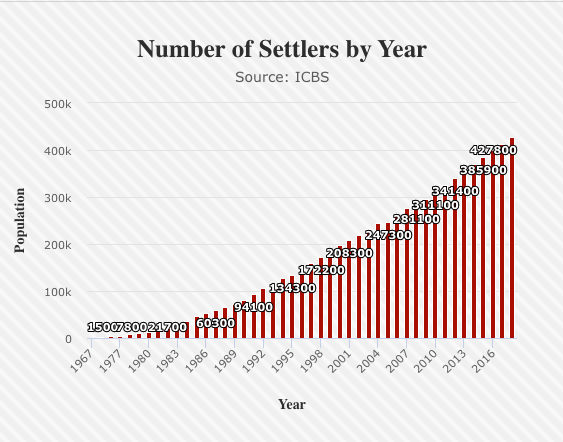
Graph by Peace Now
The Israeli Central Bureau of Statistics released new official data charting population growth in Israel and in the West Bank for 2018. Before diving into the numbers regarding settler population growth, it is essential to note that the data below does not specifically count the population of settlers in East Jerusalem or their growth rate as a discreet group. Instead, East Jerusalem settlers are treated as normal/everyday Israeli citizens, reflecting Israel’s assertion that it has annexed East Jerusalem, a claim which is rejected by the international community.
According to an analysis of the new data by Peace Now:
- The population growth rate in the settlements was 3.5% – almost double the growth rate in Israel proper (1.9%)
- The Jerusalem Post noted that this is the third year in a row that the settlement population growth rate has been 3.5% – reflecting stagnation.
- In 2018, the settler population in the West Bank grew by 14,400 individuals.
- 8,050 of the new settlers (56%) moved or were born in settlements that Israel would probably need to evacuate under a two-state peace agreement (according to the Geneva Initiative proposed border).
- There are a total of 427,800 settlers in the West Bank, not including East Jerusalem.
- According to Jerusalem expert Daniel Seidemann: “The most up-to-date and reliable statistics put the number [of Israeli settlers living in East Jerusalem] at about 218,000, of those 215,000 in large settlement neighborhoods, 2,700 in settlement enclaved implanted in Palestinian neighborhoods.” The approximate total number of settlers (West Bank + East Jerusalem) is therefore around 640,000.
- Settlers account for 14% of people living in the West Bank, not including East Jerusalem settlers.
Peace Now said in a statement:
“Thousands of new settlers have been added to the settlements this year with almost no attention or public discussion, even though this is a trend that could doom Israel’s fate to an ongoing conflict and an apartheid reality. Particularly worrying is that most of the settlers were added to the settlements that Israel would probably have to evacuate in order to reach a peace agreement. In order to save its existence, Israel would eventually have to end the occupation, yet any house built in the settlements is making evacuation more difficult and painful.”
Palestinian Landowners to Ask Israel to Evict Settlers from Illegal Outpost
Peace Now reports that Palestinian landowners in the Makhrour region west of Bethlehem are planning to file a police complaint demanding the eviction of the settlers from a new, unauthorized outpost that was recently established on their land. The new outpost – which, according to Peace Now is 1 of 25 new outposts set up since 2016 – is just 70 meters from the site of the recently demolished Palestinian Cassia family’s home and business.
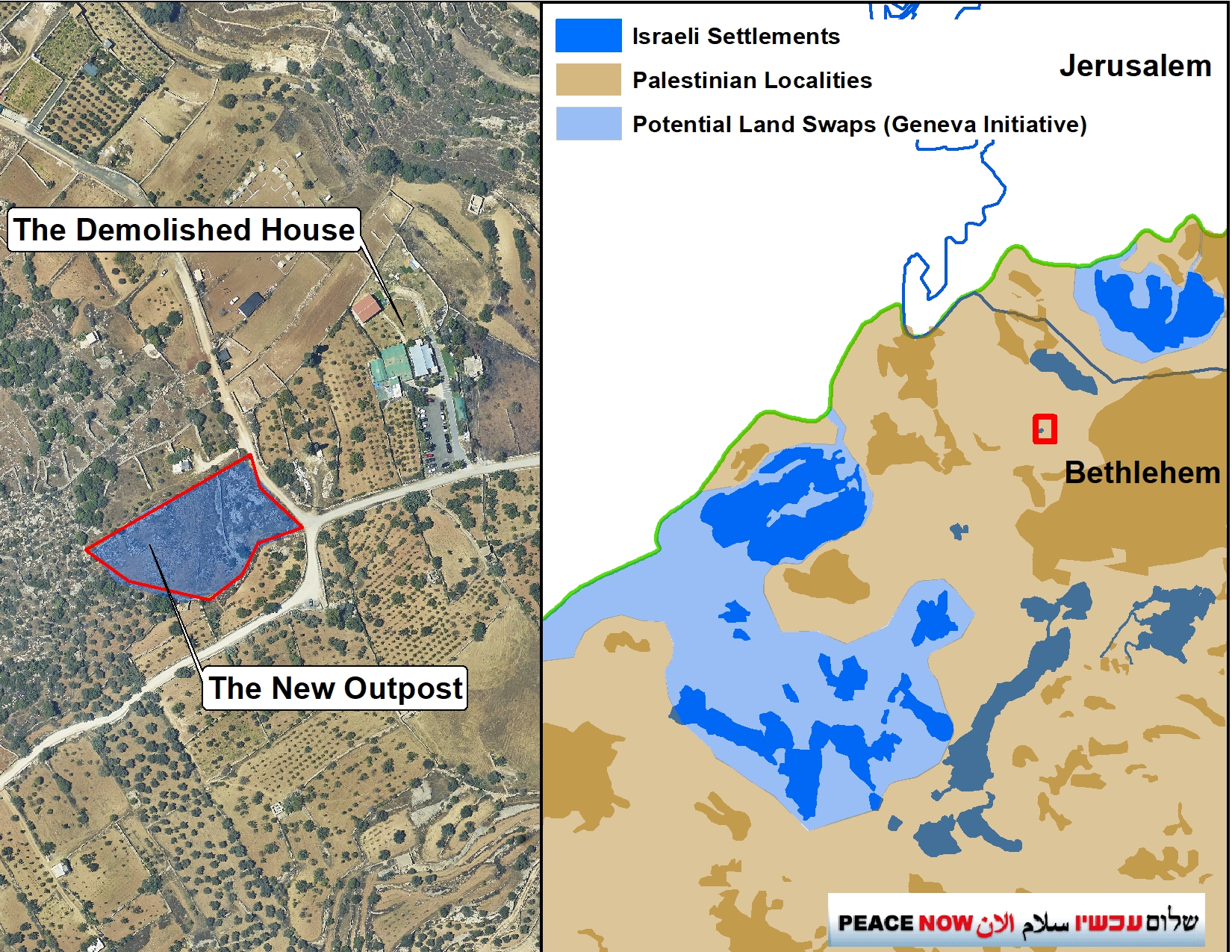 In the weeks since the Cassia family’s eviction and the demolition of their property, settlers have moved in to the area and started illegally building structures. The settlers claim to have leased the land from the Jewish National Fund (more specifically, they claim to lease the land from Himanuta – a subsidiary of the JNF). The JNF claimed to have bought the land in the 1960s, but only recently brought forward ownership claims and began waging a legal battle against Palestinian landowners, including the Cassia family, to evict Palestinians living there. Helpfully, Peace Now has published a detailed history of settler attempts to takeover land in the Makhrour area, which is a strategic parcel of land that connects Bethlehem to five Palestinians villages to its west and also runs between a string of settlements to the immediate north and south of the area.
Peace Now said in a statement:
“Establishing the new 70m outpost on a Palestinian house destroyed by JNF pressure removes any doubt: When the JNF demanded the demolition of the Cassia family’s house, it didn’t mind illegal construction on the land it claimed; it just did not want Palestinians on the land. Now it leases the land to Israelis who have erected an illegal outpost on this land. Unfortunately, the Jewish National Fund has become a Jewish settler.”
As a reminder, the Cassia case is part of Himanuta’s long-running campaign to expel Palestinians from their homes in recent years, a campaign which has been reinvigorated over recent years in partnership with other pro-settlement groups including Elad and Regavim.
Masked Settlers Expand Reach of Hate Crimes Targets
Palestinians in the village of Qira woke up on October 6th to find they were victims of a hate crime evidenced by hatefuly graffiti sprayed across their cars, buildings, and streets. Video footage would later show masked individuals entering the village in the middle of the night, and defacing property and puncturing car tires.
A local council head Aisha Nimr told Haaretz that this is the first time settlers targeted Qira with their hate crimes, which Nimr suggested signals a dangerous escalation in the Jewish settlers’ conduct. The Palestinian governor the Qira area called on all Palestinian communities near settlements to establish guard committees to protect themselves.
Congress Still On Board w/ Economic Peace Scheme & Rave About Settler Business Council
Members of a recent Congressional delegation to Israel led by Congresswoman Cathy McMorris Rodgers (R-Wash.), recently spoke on the floor of the House of Representatives to promote the work of the now infamous Judea and Samaria Chamber of Commerce (JSCC), a business council run by an Israeli settler, Avi Zimmerman, and a disgraced Palestinian businessman, Ashraf Jabari. Rep. McMorris Rodgers also stated that she will be asking the Trump Administration to support this group – and more broadly economic cooperation between settlers and Palestinians – as part of its peace plan.
As FMEP has repeatedly explained, initiatives like the JSCC perpetuate Israel’s economic exploitation of occupied territory (including the local workforce, land, and other natural resources). Labelling such initiatives as “coexistence” programs or suggesting that Palestinians should welcome the benefits of settlement economies is perverse.
Statements by members in support of this Orwellian organization and the fraudulent notion that they further peace in the region include:
Congresswoman Cathy McMorris Rodgers (R-Wash.): “We were witnessing amazing cooperation between the Palestinians and the Israelis. For me, I just feel like it is the untold story. It is a story about opportunity and hope at a time when too many despair. It was the Palestinian business leaders and workers who told us that BDS hurts their ability to work and to provide for their families. They want economic freedom, not boycotts…We are going to be talking to the administration and urging them to include in any kind of a peace plan this economic cooperation and America standing in support of this bottom-up, grassroots approach that really makes a difference in people’s lives. We need to have the economic cooperation and encourage the economic cooperation between the Israelis and the Palestinian business leaders.”
Rep. Ann Wagner (R-Mo.): “We saw firsthand Israelis and Palestinians working together to promote peace and harmony. … Many of the Palestinians were making between three and four times what they would otherwise earn if they did not have this opportunity to have this integrated business that we saw going on in Israel. They were standing up to what I would call strong divisive forces that seek to vilify Israel and undermine its credibility as a force for peace.”
Rep. Phil Roe (R-Tenn.): “You saw people, not nations, working together to make life better for their community.”
Rep. Bradley Byrne (R-Ala.): “It is good for Palestinians to be able to take advantage of the miracle of the Israeli economy—giving them that opportunity so that they can have a better life for them and their families. I hope that we in this country and we in this Congress do everything in our power to help these people grow economically in their businesses, but also to find that peace that only people-to-people actions can find for us all.”
ECFR Publishes “Differentiation Tracker” To Hold EU States Accountable for Their Policy Towards Occupation and Settlements
The European Council on Foreign Relations released a new online tool – – called “The Differentiation Tracker” – – to see if, and to what extent, member states of the European Union are complying with their own policies which require states to explcitly exclude Israeli settlements from dealings with Israel (i.e. uphold a hard distinction between Israel and the occupied territories). To learn more about what “differentiation” is – see this founding treatise published in October 2016 by ECFR.
ECFR’s Policy Fellow Hugh Lovatt explains the significance of the new tracking tool:
“Amid the failure of international efforts to curtail Israel’s policy of settlement and annexation of occupied territory, a fuller and more diligent implementation of legally necessitated differentiation measures remains one of the few effective means of defending the territorial footprint for a two state solution. In order to comply with UNSCR 2334, bilateral agreements signed with Israel should contain a ‘differentiation’ clause defining the territorial scope of an agreement’s application to within Israel’s pre-June 1967 borders (the ‘Green Line’). Correcting pre-existing agreements that have fallen short of such a requirement is undoubtedly more laborious but just as important.”
Along with the tracking tool, ECFR published analysis of the data. The main findings include:
- By differentiating between Israel and the settlements, the EU has acted as a trailblazer, setting down important markers for others to follow. Since December 2013, the EU has insisted on the inclusion of a differentiation clause within all new agreements with Israel. Yet the EU’s job is by no means finished and work remains to consistently apply its differentiation principle to all areas of its relations with Israel, including trade with settlements, police cooperation, cross-border data transfers, and marketing standards for fruit and vegetables.
- A number of European states have undertaken their own differentiation measures. One of the oldest examples can be found in the UK’s 1957 social security agreement – pre-dating the occupation – which limits its applicability to the “territory administered by the Government of Israel on the 19th of July, 1956”. The British government has also pledged to exclude the settlements in full from its new post-Brexit trade agreement. Denmark, Germany, the Netherlands too have also taken measures to exclude settlements from some aspects of their bilateral relations relating to social security, and research and development projects.
- Although harder to track, ECFR research indicates that in a few instances negotiations over new agreements (including new social security provisions) may have stalled over member state insistence, and Israeli refusal, on the inclusion of a differentiation clause. In 2017, the Israeli government also backed out of the EU’s ‘Creative Europe’ programme over its exclusion of Israeli settlements, although it signed onto other such deals before and after.
- A majority of EU member states have published advisories warning their businesses of the legal, financial and reputational consequences they could expose themselves to by dealing with Israeli settlement entities.
- Despite positive examples of differentiation measures, a majority of European bilateral agreements with Israel potentially benefit its settlements, their companies, and residents – including with regard to social security, taxation provisions, and the burgeoning cooperation in research and development. National governments have also done very little to enforce the European Commission labelling guidelines for settlement products.
- Of the 268 European agreements reviewed by ECFR, at least 158 were signed without any territorial definition defining their scope of implementation. A further 65 agreements contain either vague or ambiguous clauses, including definitions of Israeli territory according to ‘the laws of the State of Israel’ or ‘the territory where it levies taxation’ – descriptions that could justify the inclusion of Israeli settlements. Some of the most common agreements relate to social security, taxation, research and development, and financial investments.
Bonus Reads
- “Jerusalem Is Becoming a Jewish Disneyland, NYT’s Architecture Critic Warns” (Haaretz)
- “My Day With the West Bank Settlers Who Are Destroying Zionism” (Haaretz)
- “With or without Netanyahu, West Bank annexation is on Israel’s agenda” (The Arab Weekly)
- “Annexing the Jordan Valley Doesn’t Make Security Sense” (Haaretz)
- “Who do the settlers vote for? – Voting figures in Judea and Samaria in the 22nd Knesset elections” (Yesha Council)
Welcome to FMEP’s Weekly Settlement Report, covering everything you need to know about Israeli settlement activity this week.
To subscribe to this report, please click here.
August 2, 2019
- Consolidating Annexation of Area C, Part 1: Israel Issues Permits for 715 Palestinian Structures
- Consolidating Annexation of Area C, Part 2: Israel Issues Permits for 6,000 New Settlement Units
- Consolidating Annexation of Area C, Part 3: Big Promises for Efrat, Jordan Valley
- Canadian Judge: Settlements Are Not Israel (All Remaining International Law Supporters: AMEN!)
- Bonus Reads
Questions or comments? Contact Kristin McCarthy at kmccarthy@fmep.org.
Consolidating Annexation of Area C, Part 1: Israel Issues Permits for 715 Palestinian Structures
On July 30th, in an exceedingly rare move, the Israeli Cabinet unanimously approved the issuance of building permits for 715 Palestinian structures in Area C of the West Bank. How rare? Between 2009 and 2016 Israel issued only 66 building permits to Palestinians in Area C (more than offset by demolitions — over the past 2 years alone, Israel has demolished at least 400 Palestinian structures in Area C because they were built without the impossible to obtain Israeli permits).
The approval of even this comparatively small number of permits for Palestinians angered Israeli settlers and their supporters. They expressed outrage at what they characterized as Israeli government “support” for any Palestinian presence in Area C, the 60% of the West Bank settlers have been pressuring the government to unilaterally annex.
Statements made around the approval, however, make clear that the decision to issue the permits for Palestinian construction is not a concession or gift to the Palestinians. One Israeli security cabinet member who voted for the plan, far-right-wing Transportation Minister Bezalel Smotrich (Tkuma), stated in a Facebook post that Israel’s decision to issue the permits actually advances annexation, writing:
“In the last ten years, since the launch of the Fayyad program, the Arab vision of establishing a terrorist state in Area C has been fulfilled in practice. An area under full Israeli security and civil responsibility.
For the first time, the State of Israel will make sure that in Area C, there will only be construction for the Arabs who were original residents of the area since 1994 and not Arabs who came later from Areas A and B.
For the first time, the State of Israel will determine in a clear and unmistakable manner that original inhabitants of the area will be able to build and develop only in places that do not harm the settlement enterprise and security, and do not create territorial contiguity or a de facto Palestinian state. Places that do not serve the national interests of the Arabs, rather the national strategic interests of the State of Israel.
For the first time ever, the State of Israel will implement its sovereignty over the entire territory and take responsibility for what happens inside it. Gone are the days of construction plans pushed by the PA that serve its interests. For the first time, the State of Israel will create a tool basket for real enforcement that will be enacted to neutralize the Palestinian takeover plan.”
As Smotrich made clear, by approving the permits Israel aims to entrench and normalize its complete sovereign control over Area C and the 200k-300k Palestinians who have managed to continue living in that area (again, an area that accounts for 60% of the West Bank land mass), despite the coercive environment Israel has created designed to systematically push out Palestinians.
Peace Now writes:
“The goal of the construction plan is ultimately to serve the settlers, and not out of some sincere concern for the needs of the Palestinian population. The Israeli government is making a significant step toward annexing and applying sovereignty over the territories, and thereby severely damaging the prospect of reaching a political agreement to end this occupation of more than 52 years.”
Notably, an anonymous Israeli official attributed Israel’s approval of the Palestinian permits to American pressure to allow some Palestinan construction in Area C – a theory U.S. Ambassador Friedman denied. However, the theory that there was U.S. involvement in the decision is seemingly backed by two facts: first, U.S. Ambassador David Friedman (extraordinarily) attended the Israeli cabinet meeting at which the permits were approved; and second, the approvals were announced just one day ahead of Jared Kushner’s arrival to Israel. The theory is likewise bolstered by the reality that, as already noted, this issuance of 715 permits for Palestinian structures in Area C is not a generous gift to the Palestinians but rather a move designed to entrench and normalize Israeli control over Area C (60% of the West Bank) – an objective the Trump Administration has clearly embraced.
Consolidating Annexation of Area C, Part 2: Israel Issues Permits for 6,000 New Settlement Units
On July 30th, the Israeli Cabinet unanimously ALSO approved the issuance of permits for 6,000 new settlement units. This massive approval must not be overshadowed by the news of Israel’s rare (and clearly cynical) decision to issue 715 construction permits to the Palestinians (discussed above).
Though details of the settlement plans have not yet been published, if the 6,000 figure is accurate, the cabinet will have in one fell swoop approved around double the number of units Israel has advanced so far this year (which previously stood at 3,691) — bringing the total number of new settlement units approved to a whopping 9,691 – the most in a single year over the past (at least) four years – and the year is only two-thirds over. Assuming (conservatively) a family size of 5, this equals housing for nearly 50k new settlers.
Commenting on the issuance of the permits by Israel and the settlement approvals, Palestinian Prime Minister Mohammed Shtayyeh rejected the current status quo in Area C, in which Israel decides what Palestinians can and cannot do with their own land. He said:
“We do not need permission from the occupying power to build our homes on our lands. Building on land classified as ‘C’ is a right for Palestinians that is not up for exchange with settlements or to treat both as the same. [The Israeli security cabinet’s decision] is aimed at deceiving international public opinion, legitimizing the settlements and attempting to equate Palestinian construction on their lands with the colonial settlement construction that steals the land, the water and the air. The settlements are illegitimate and illegal and will end as they ended in many countries and our right to our land will prevail despite all these decisions.”
Consolidating Annexation of Area C, Part 3: Big Promises for Efrat, Jordan Valley
In addition to the 6,000 units approved this week, during a campaign stop at the Efrat settlement on July 31st, Netanyahu promised to advance plans for 8,250 new housing units in Efrat. Netanyahu also reiterated his (now common) refrain that he will not allow a single settler to be removed, saying:
“No settlement or settler will be uprooted. That is over…What you’re doing here is forever.”
Meanwhile, one of Netanyahu’s biggest rivals in the September elections Benny Gantz (Blue & White) toured the Jordan Valley settlements where he proclaimed that Israeli will never cede control over the border region.
Canadian Judge: Settlements Are Not Israel (All Remaining International Law Supporters: AMEN!)
On July 29th, Candian Judge Anne Maktavish ruled that it is “false, misleading, and deceptive” to label wine from Israeli settlements as “Made in Israel.” The ruling, if effect, rebuffs the international campaign Israel and its defenders are waging to erase any/all distinction that foreign countries make between Israel and Israeli settlements built in the occupied territories, which are illegal under international law.
Naturally, the Candian judge’s ruling upset settlement defenders, who immediately announced their intention to request an appeal.
With this ruling, Canada has aligned itself with a small but significant chorus insisting on a policy which differentiates between Israel and its settlements. In June 2019, a senior advisor to the European Court of Justice issued a strong legal opinion advising the court that under EU rules, labels must make it clear if products originate from Israeli settlements in the occupied territories. Now, the onus is on the EU and its member states to implement the legal opinion.
In response to the Candian judgement this week, PLO Executive Committeewoman Hanan Ashrawi said:
“This is an important first step for Canada and beyond, as this landmark ruling is an affirmation of the supremacy of the law and Canada’s obligation to respect international law, which considers settlements illegal and does not recognize them as part of Israel.”
She also called out the EU, noting:
“It is long overdue for the EU to take the minimal step of properly labeling products originating from Israel’s illegal settlements and to ensure that its partnership agreements do not further enable or favor the continued looting of Palestinian natural resources and the profiteering from the commission is a war crime, as defined in the Rome Statute. Israel’s illegal settlement regime is the embodiment of its colonial agenda in Palestine and its determined efforts to deny the Palestinian people their inalienable rights to self-determination and freedom. The obligation of all states to respect international law and the Palestinian people’s national rights is absolute. Such respect can only be ensured by practical steps that deny Israel and complicit companies the ability to profiteer from the colonial occupation and the flagrant violations of international law. Accountability is the shortest and most assured path to justice”
In the U.S., Israel has benefitted from legislation passed into law by Congress and state governments that directly or indirectly defines “Israel” to include settlements. That legislative onslaught is chronicled and analyzed by FMEP’s Lara Friedman in tables tracking federal and state efforts (with specific focus on the inclusion of settlements).
Bonus Reads
- “What Israel’s Demolition of 70 Palestinian Homes Was Really About” (Haaretz)
- “Digging in the Holy Land: Evangelicals are excavating occupied soil to help their cause, and Israel’s” (The National)
- “Strange Bedfellows: Can Settlers and Leftists Work Together for Peace?” (Partners for a Progressive Israel)
- “With Settlements Strong on Israeli Agenda, Haredi Nationalists Pick Up the Fight for ‘Family Values’” (Haaretz)
- “US Amb: Not Ready to Talk About Palestinian State” (CNN)
- “America Joins Israel’s Campaign to Smear and Silence Palestinians” (Haaretz)
Welcome to FMEP’s Weekly Settlement Report, covering everything you need to know about Israeli settlement activity this week.
To subscribe to this report, please click here.
June 14, 2019
- Court Rules in Favor of Israeli Settler Group, Against Greek Orthodox Church, un Battle Over 3 Claiming Old City Properties
- Israel Gave German Construction Giant More Palestinian Land for Quarrying
- Settlers Retaliate Against Palestinians for Israel’s (Rare) Demolition of Outpost Buildings
- IDF Cuts Budget for Civilian Security Guards in Settlements
- New International Crisis Group Report on Israel’s Ongoing Annexation of East Jerusalem
- Shadowy Group Wants to Go After All Companies Not Currently Operating in the Settlements – Starting with McDonald’s
- European Court of Justice Issues Opinion Upholding EU Differentiation Policy
- Anger [& Joy] at U.S. Ambassador Reiterating Support for Israeli Annexation of West Bank Land
- Bonus Reads
Questions or comments? Contact Kristin McCarthy at kmccarthy@fmep.org.
Court Rules in Favor of Israeli Settler Group, Against Greek Orthodox Church, un Battle Over 3 Claiming Old City Properties
Ending a nearly 16-year legal battle, on June 11th the Israeli Supreme Court ruled that the settler group Ateret Cohanim has legal rights to three prized properties in strategic locations in the Old City of Jerusalem, including two famous hotels currently operated by Palestinians. Until now, the properties were owned by the Greek Orthodox Church, which had been fighting to invalidate the transactions at the root of the settlers’ claim to them.
As a reminder, Ateret Cohanim is a radical settler organization working to increase the presence of Israeli Jews living inside Palestinian neighborhoods of Jerusalem – including in the Old City. Ateret Cohanim, along with its compatriots in the Elad settler group, is also leading efforts to take over land and evict Palestinians from their homes in the Silwan neighborhood.
The properties awarded to Ateret Cohanim by the Israeli High Court are:
-
The Petra Hotel, a four-story building near the Jaffa Gate, one of the key entrances to the Old City. Under the ruling, Ateret Cohanim has a valid 99-year lease with an option for an additional 99 years afterwards. The price Ateret Cohanim paid in the transaction the Church said was improper? A meager $500,000, far below market value.
-
The Imperial Hotel, located directly across the street from the Petra Hotel – meaning that a radical Israeli settler group now controls a substantial amount of land at a key entrance to the Old City (the Jaffa Gate). The Imperial Hotel is a two-story building. Ateret Cohanim’s lease for the Imperial Hotel is also for 99-years with an option for 99 more. The price paid in, again, a transaction the Church argued was improper and invalid? $1.25 million – far higher than the price paid for the Petra Hotel but still well below the fair market value of the property.
-
Beit Amziya, a building in the Bab a-Kuta neighborhood of the Muslim Quarter of the Old City. Ateret Cohanim paid $55,000 for this property, again, far below fair market value.
The legal battle over the properties dates back to 2004, when the Greek Orthodox Patriarchate agreed to sell the three properties to a foreign real estate company under three separate contracts. It did so not knowing that the radical settler group Ateret Cohanim was behind the transaction. News of the sales made headlines in early 2005.
Upon the revelation that Ateret Cohanim was the real buyer, the Greek Orthodox Patriarchate was deeply embarrassed and immediately sought to retain control of the properties. The Patriarchate alleged that the transactions involved corruption and bribery, arguing that the legal documents had been signed without permission by a finance employee. Dismissing the church’s arguments, this week the Supreme Court upheld prior rulings that the signatures on the lease documents were valid, with the finance employee acting as a legal proxy of the Patriarchate.
The Greek Orthodox Church has received significant blowback from the sale of these properties. In January 2018, Palestinians protested in Bethlehem in an attempt to block the arrival of Patriarch Theophilos III for Christmas celebrations.
In response to the Supreme Court’s ruling, multi-denominational Christian leaders in Jerusalem issued a rare joint statement criticizing the Court’s action. The statement says:
“The actions of this radical group do not only mean an assault on the property rights of the Greek Orthodox Church, but an assault on the status quo protections for all Christians in this holy city of Jerusalem and deeply threatens the Christian presence in our beloved Holy Land. An attempt to undermine the presence of one church here undermines all the churches and the wider Christian community around the world. We reaffirm our belief that a vibrant Christian community is an essential element in the preservation of Jerusalem’s historically diverse society and a prerequisite for peace in this city; Jerusalem must maintain its multicultural and multi-religious mosaic character, being home to the three monotheistic religions.”
Israel Gave German Construction Giant More Palestinian Land for Quarrying
Kerem Navot has produced government documents showing that in February 2019 the Israeli Civil Administration – the arm of the IDF that is effectively the sovereign ruler over the West Bank – signed over rights to 25 acres of Palestinian land to the German construction company HeidelbergCement. The purpose? To expand the Nahal Raba quarry, located on 145 acres of Palestinian land near the Elkana settlement in the West Bank.
HeidelbergCement is the world’s largest cement producer and has a global footprint. In a comprehensive brief, the Israeli organization Who Profits details the situation of the Nahal Raba quarry and the larger context of Israel’s illegal exploitation of natural resources in the West Bank:
“The Nahal Raba quarry is a 600 Dunam aggregate quarry, owned and operated by Hanson Israel [which HeidelbergCement owns]. The quarry is located in Area C of the West Bank and is licensed by the Israeli Civil Administration. The adjacent Palestinian village of Alzawiyah owns the Palestinian land on which the quarry is situated. This land was taken by Israel’s Civil Administration after declaring it to be state land, despite the fact that it was privately owned by the Palestinian villagers in the adjacent town of Al-Zawiyah. As mentioned by Human Rights Watch in its recent report, Occupation Inc., in 2004 Israel built the separation wall in the area to encompass the quarry from the east, unlawfully diverting the route of the wall into occupied territory beyond the pre-1967 armistice line. Today, the quarry is enclaved into Israeli territory, while the separation wall separates the village of Zawiyah and its rightful owners from their land and quarry. Article 55 of the Hague Regulations (1907) establishes that ‘the occupying State shall be regarded only as administrator and usufructuary’ of the natural resources of the occupied territory, and therefore it is prohibited from exploiting them for commercial purposes. Moreover, Article 43 of the Hague Regulations has been interpreted as obliging the occupying State to exercise its powers for the benefit of the residents of the occupied area.”
In 2009, the Israeli NGO Yesh Din submitted a High Court petition demanding that Israel end all mining and quarrying activities in the West Bank, observing that the activity constitutes a brutal economic exploitation of occupied territory for Israel’s exclusive economic interests. In December 2011, the High Court rejected the petition, giving permission for the continuation and expansion of Israel-regulated quarrying in the West Bank. Yesh Din’s 2017 report, “The Great Drain: Israeli Quarries in the West Bank,” provides a comprehensive accounting of the damage imposed on Palestinians by quarrying activities.
Settlers Retaliate Against Palestinians for Israel’s (Rare) Demolition of Outpost Buildings
Palestinians in the Einabus village woke up on June 13th to find the words “Price tag [for the] Yitzhar evacuation” spray painted on the town mosque and adjacent buildings, and several car tires were slashed. The tagged phrase suggest the settlers have taken revenge on the Palestinian village in respose to these demolition of illegally built settlement structures near the radical Yitzhar settlement by Israeli security foces last week.
Following documentation of the damage by Yesh Din, the IDF announced it had opened an investigation into the incident.
This price tag attack is just the latest in a string of violent attacks by settlers on Palestinian villages in the Nablus region. Over the past few weeks, settlers have set several fields on fire and were caught on video hurling stones at Palestinian school, homes, and cars.
IDF Cuts Budget for Civilian Security Guards in Settlements
Ynet reports that the IDF Central Command has informed settlements that budgetary constraints are forcing it to reduce the number of civilian guards working in several settlements across the West Bank. The reductions will see eight security outposts eliminated completely, including posts in the Kiryat Arba settlement in Hebron. A security officer from Kiryat Arba said in response: “This is abandonment of human life, and the Defense Ministry must come to its senses as soon as possible,”
The IDF said that:
“It’s clear to everyone the reduction in the number of guards in not ideal, but – all things considered – it’s necessary.”
New International Crisis Group Report on Israel’s Ongoing Annexation of East Jerusalem
In a new report, the Crisis Group provides a comprehensive overview of Israeli settlement and annexation policies affecting East Jerusalem, starting with Israeli actions in the immediate aftermath of 1967 through to present day. The report, entitled “Reversing Israeli’s Deepening Annexation of Occupation,” calls on the international community to stop Israel’s creeping annexation of East Jerusalem and reverse decades of intentional neglect designed to push Palestinians out of East Jerusalem and adjacent areas.
Shadowy Group Wants to Go After All Companies Not Currently Operating in the Settlements – Starting with McDonald’s
Following up on FMEP reporting last week, Haaretz has new details on the organization behind a new drive to ban McDonald’s from participating in the Israeli government’s tender process — because McDonald’s doesn’t operate in any Israeli settlements.
The group, named “Forum of Disabled IDF Veterans for Israel’s Security,” is not registered in Israel as a charitable organization. It thus has the luxury of operating in near total secrecy – not required to disclose who is behind the effort or funding it.
In a statement, the group made its ambitions clear:
“We want every company that isn’t interested in opening branches over the Green Line to be prevented from competing on these tenders. We’ll reach everyone.”
Sources told Haaretz that the group is made up of only a handful of activists, all of whom are disabled veterans of the IDF, and works primarily in cooperation with larger pro-settlement, pro-annexation groups like Im Tirtzu and Ad Kan. The group has hired Rosenbaum Communications to steer the campaign against McDonald’s, though the funding source for the project is unknown.
European Court of Justice Issues Opinion Upholding EU Differentiation Policy
On June 13th, an advocate general for the European Court of Justice (the top court for the EU) issued a legal opinion holding that products made in the Israeli settlements must be clearly labeled as such. The ruling upholds the enforcement of European Union’s legal obligations with regard to the settlements (a policy known as differentiation). The labelling requirements, as required by EU law, necessarily distinguish between sovereign Israeli territory and Isareli settlements built illegally in the occupied territories.
The new legal opinion, which is not binding but nonetheless sets the tone for rulings to come, was issued in response to a petition filed by Psagot Winery, located in the Psagot settlement, which argues that French labelling laws discriminate against its products by requiring them to specify the origin of their wine. Rejecting that argument the advocate general stressed that EU law requires labelling products based on their true origin in order to give customers the necessary information to make informed purchasing decisions.
Psagot Winery is part of a broad global effort to blur the legal context around Israeli settlements, pushing nations to treat Israeli settlements as indistinguishable from sovereign Isareli territory.
Anger [& Joy] at U.S. Ambassador Reiterating Support for Israeli Annexation of West Bank Land
Coming quickly on the heels of Jared Kushner’s disastrous interview with Axios, Ambassador David Friedman attracted even more outrage over his recent interview with the New York Times in which Friedman reiterated his support for Israeli annexation of land in the West Bank (a position he has held, clearly, since long before becoming ambassador). The interview sparked a barrage of media coverage, worldwide concern about the possibility of unilateral Israeli annexation of its settlements, glee among pro-annexationist lawmakers in Israel, and indignant rationalizing by American Greater Israel apologists like Alan Dershowitz.
Notably, Israeli Prime Minister Netanyahu – who in the waning days of his April election promised to extend Israeli sovereignty over the settlements – has not commented on Friedman’s statement. Haaretz columnist Anshel Pfeffer observed:
“The easiest way for Netanyahu to counter the settlers’ demands while keeping them in his coalition was to complain about pressure from the Americans. That was his answer every time he was asked why Israel wasn’t building more settlements or evicting more Palestinians. Friedman has taken away Netanyahu’s excuse. It is certainly no coincidence that Netanyahu — usually so quick to praise the slightest gesture coming from the Trump administration — has yet to say a word publicly about the interview. Friedman has done Netanyahu no favors. In less than 100 days — assuming the right wing/religious bloc wins another majority in 2019’s second election, which is almost a certainty — Netanyahu will be more vulnerable than ever.”
Bonus Reads
-
“A high-tech facelift takes the sting out of an Israeli checkpoint — but not out of the occupation” (Washington Post)
-
“The Fate of the Palestinians” (LobeLog)
-
“WATCH: What occupation looks like in the Jordan Valley” (+972 Mag)