Welcome to FMEP’s Weekly Settlement & Annexation Report. To subscribe to this report, please click here.
May 7, 2021
- Protests Against Dispossession Continue in Sheikh Jarrah, as Israeli Court Delays Decision
- Israel Has Been Conducting a Secretive Land Registration Process in Sheikh Jarrah, Excluding Palestinians
- Har Homa E Settlement Plan Granted Approval, With Minor Conditions
- Knesset Attempts Fast-Track Vote on Two Key Bills: One to Authorize Outposts; Another to Cancel 2005 Disengagement
- Bibi Reportedly Dismisses U.S. Concerns Over Settlements
- Construction Begins on New “Legal” Settlement in Southern West Bank, Foreshadowing More to Come
- Following Deadly Drive-By-Shooting, Settlers Establish New Outpost & Terrorize Palestinians Near Nablus
- Al Haq Report on Palestinian Workers in Settlements & the Complicity of Multinational Corporations
- Bonus Reads
Comments or questions? Email Kristin McCarthy – kmccarthy@fmep.org.
Protests Against Dispossession Continue in Sheikh Jarrah, as Israeli Court Delays Decision
On May 2nd, the date set by the Israeli Supreme Court for the forced dispossession of four Palestinians families from their longtime homes in Sheikh Jarrah in favor of Israeli settlers, the Supreme Court delayed the evictions and gave the parties four days (until May 6th) to consider a proposed “solution.” The Court’s suggested “solution” was that the Palestinians acknowledge Jewish ownership of the land, and in exchange be allowed to remain there as tenants – paying rent to the settlers – but only until the original tenant dies. At that time, the remaining family members would have to vacate the premises and the settlers would take control of the homes
In a powerful statement issued on May 2nd, the four families targeted for dispossession this week rejected that proposal outright, saying:
“We the four Sheikh Jarrah families firmly reject the terms of this agreement, for these are our homes and settlers are not our landlords. The inherently unjust system of Israel’s colonial courts is not considering the questioning of illegal settlers’ ownership and has already decided on the families’ dispossession.” This pattern of elongating the legal process is common practice to dull popular resistance and public opinion protesting these expansionist colonial efforts. As the threat of expulsion from our home remains as imminent as ever, we will continue our international campaign to stop this ethnic cleansing”
On May 6th, the Court once again delayed the dispossession, and said it would reconvene a three judge panel on May 10th to decide whether to allow the Palestinian families to continue appealing their eviction cases. Ir Amim reports that the likelihood of the panel ruling in the Palestinians’ favor is “slim.”
The date the Supreme Court chose for handing down its decision – May 10th – also happens to be Jerusalem Day. This is the day when as many as 25,000 Israeli settlers and fellow right-winger fanatics engage in an annual provocation against Palestinians, with a parade through the Muslim Quarter of the Old City and neighboring areas of East Jerusalem to “celebrate” Israel’s capture of the city in 1967 (called “The Dance of Flags,” including racist chants and signs). Given the high tension in Jerusalem over the pending Sheikh Jarrah evictions, as well as over the recent protests over Israel’s closure of the area around Damascus Gate, the end of Ramadan, and the killings over the past two days of several Palestinains in the West Bank, Jerusalem Day poses a significant threat of escalation, and has already elicited warnings from the Israeli Chief of Police to reroute the parade. So far, those warnings appear to be falling on deaf ears.
To be clear: escalation has already begun. Shortly following the Supreme Court’s second delay, dozens of Israeli protestors marched through Salah Eddin Street (the major commercial thoroughfare in Palestinian East Jerusalem), and were reportedly “throwing stones at Palestinian cars and demanding the ethnic cleansing of Sheikh Jarrah.” Not long after that, the head of the Otzma Yehudit party Itamar Ben-Gvir (a devotee of Kahanism and the ethnic cleansing of Palestinians) set up a tent-office in Sheikh Jarrah across from where Palestinians had prepared an iftar celebration. Settlers then began taunting the Palestinians sitting down for dinner, which escalated into clashes when a settler sprayed what appeared to be pepper spray. Later that evening, Israeli forces were seen protecting the “office” and the settlers there – including Jerusalem Deputy Mayor and settler empresario Arieh King, who was caught on video telling an injured Palestinian that the Israeli police ought to have shot him in the head.
On Friday morning May 7th, Sheikh Jarrah residents report that the Israeli police have cordoned off the neighborhood, and are checking IDs before permitting entry. Overnight raids and arrests of Palestinians also continue to be reported, with 15 arrested overnight on May 7th (settlers faced no arrests or punishments, despite being filmed shooting guns)
Prie Minister Netanyahu is reportedly proposing a permanent police presence in Sheikh Jarrah to protect the settlers — an arrangement much like the prevailing reality in Hebron
For a Palestinian view on what is happening in Sheikh Jarrah (and a plethora of additional resources on this topic), check out this FMEP webinar from May 6, 2021, and on Twitter you can follow #SaveSheikhJarrah for the latest news.
Israel Has Been Conducting a Secretive Land Registration Process in Sheikh Jarrah, Excluding Palestinians
Ir Amim and Bimkom report that Israeli authorities have been carrying out a secretive land registration process for the benefit of settlers in the Umm Haroun section of the Sheikh Jarrah neighborhood of East Jerusalem, and have already registered several plots of land to Jewish Israeli owners. Palestinian residents – inlcuding 45 families (40 houses) living on the plots of land secretly registered to the settlers – were not notified by Israeli authorities that the registraiton process was taking place, as is required by Israeli law. The stakes, as noted by Bimkom and Ir Amim, are high not only for Palestinians in Sheikh Jarrah who are being targeted at this time, but also for Palestinians across East Jerusalem, as any land registration process – let alone a secretive process undertaken for the benefit of Israeli Jews – can lead to “widespread Palestinian dispossession in the city.”
On May 2nd, Ir Amim and Bimkom filed an urgent petition with the Israeli High Court of Justice asking the Court to freeze the registration process and “expunge all invalid land registration as a result of this unethical procedure”. On May 3rd, the Israeli court issued a temporary injunction stopping the process at least until a ruling can be made on the case. The State has until June 3, 2021 to submit a response to the petition.
Har Homa E Settlement Plan Granted Approval, With Minor Conditions
Ir Amim reports that the Jerusalem District Committee has granted its conditional final approval to a plan to build 540 new settlement units in the new Har Homa E settlement. The conditions outline a few minor modifications to the plan (like more clearly marking bike trails) which will not take much time. Once those modifications are made the plan will be formally approved via publication without requiring another meeting of the Committee.
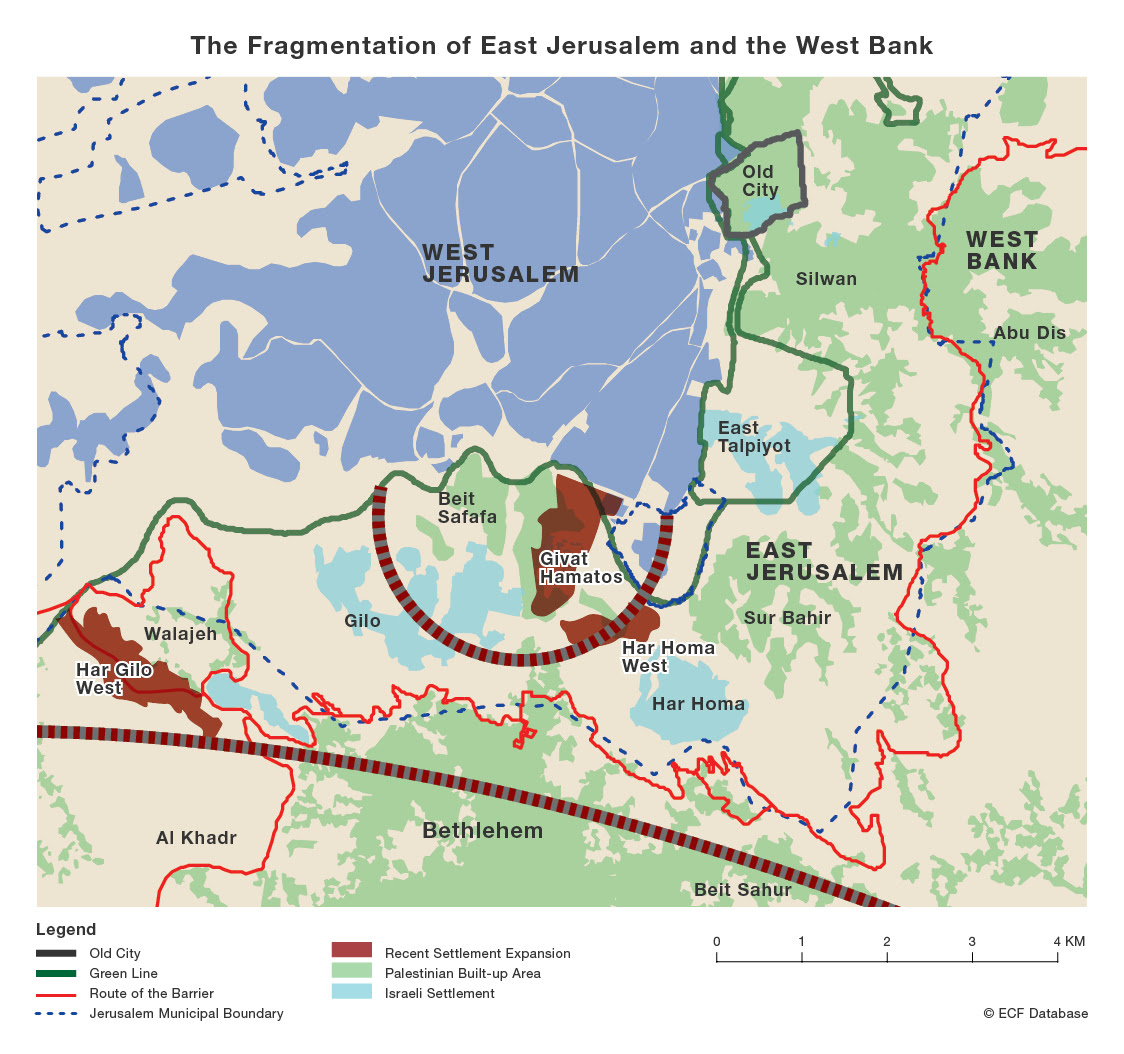 Because the land on which the new settlement will be built is privately-owned, building plans will not be subject to a government-run tender process. Ir Amim reports that once the plan is published, building permits can theoretically be issued any time (though technical obstacles might delay things but not change the inevitability of construction).
Reminder: Although the Har Homa E plan is framed as merely an expansion of the Har Homa settlement in East Jerusalem, it is more properly understood as a new settlement since the buildings will be built in an open area that is not contiguous with the built-up area of Har Homa. The plan calls for 540 new settlement units to be built in the area between the Har Homa settlement and the site of the planned Givat Hamatos settlement (tenders for which were issued in January 2021). Meaning that the new construction is a significant step towards completing a ring of Israeli settlements on Jerusalem’s southern edge and encircling the Palestinian neighborhood of Beit Safafa.
Knesset Attempts Fast-Track Vote on Two Key Bills: One to Authorize Outposts; Another to Cancel 2005 Disengagement
On May 4th, the Knesset Arrangements Committee voted in favor of fast-tracking two settlement-related bills. The first would cancel the 2005 Disengagement Law, thereby allowing settlers to re-establish the four settlements in the northern West Bank which were evacuated under that law (which settlers have been attempting to do on their own, illegally but with significant political support, for years). The second would grant retroactive authorization (i.e., legalize) the nearly 70 outposts that Israel has failed to find any other way to legalize (because they were built on land even Israel recognizes is privately owned by Palestinians). Now on a fasttrack, the bills can be called for its first vote at any time after May 5th (to pass, all bills most be voted on three times in the Knesset and sent to committees for approval).
The fast-tracking of these bills at this time is an attempt to get the bills passed into law before a new government is formed or new elections are called, and to use the issue of settlements as a political weapon against parties that oppose the bills. The Times of Israel reports that internal politics will likely see the bills languish as parties jockey to form a new governing coalition. The bills are a source of division between parties that are currently deep in negotiations to form a governing coalition – led by Yair Lapid and the Yesh Atid party (which opposes the bill).
When asked for comment on the outpost legalization bill by the Times of Israel, a spokesperson for the U.S. State Department gave its most substantive comments on settlements yet, saying:
“We are deeply concerned about the potential ‘legalization’ of outposts that have long been deemed illegal under Israeli law…As we have long said, it is critical that Israel refrain from unilateral steps that exacerbate tensions or take us further away from peace. This includes evictions, settlement activity and home demolitions, and certainly includes the legalization of Israeli outposts in the West Bank that have long been illegal even under Israeli law.”
Bibi Reportedly Dismisses U.S. Concerns Over Settlements
According to a report by Israel’s Channel 12 News, the Israeli Prime Minister Benjamin Netanyahu has on three separate occasions over the past month rebuffed U.S. diplomats’ concerns regarding Israel’s settlement activities.
The first communication was from Jonathan Shrier, the chargé d’affaires of the U.S. Embassy (the ranking U.S. diplomat in Israel, in the absence of an Ambassador). Shrier was reported to have relayed U.S. concerns over the approval of the Har Homa E settlement plans earlier this month, but the concerns were dismissed.
The second communication came from National Security Advisor Jake Sullivan (a top official in the Biden White House), who reportedly expressed U.S. concerns over the approval of the Har Homa E settlement as well as settlement construction in the West Bank. The Times of Israel reports that Netanyahu responded, “Jerusalem is not a settlement, but the capital of Israel.”
The third communication came May 5th regarding the violence in Sheikh Jarrah; that communication was reportedly also rebuffed. Perhaps suggesting that there is growing frustration with the issue inside the Biden Administration, a day later, on May 6th, the U.S. the Department of State issued its most pointed public statement on Israeli settlement activity yet.
Construction Begins on New “Legal” Settlement in Southern West Bank, Foreshadowing More to Come
This week settlers celebrated the start of construction on 164 settlement units in the new (or at least, newly-legal under Israeli law) Ibei Hanachal settlement, located between Bethlehem and Hebron in the southern West Bank. This comes nearly one year after Israel began clearing the land to prepare for construction.
Ibei Hanachal was established illegally by settlers in 1999, but was granted retroactive approval as a neighborhood of the Ma’ale Amos settlement by the Israeli government in August 2019. Declaring illegal outposts to be neighborhoods of settlements – even outposts that are non-contiguous with the allegedly parent settlement, as is the case with Ibei Hanachal – is one of the legal mechanisms that Israel has found to retroactively “legalize” illegal outposts. In this way, Israel has not only been “legalizing” construction by settlers that violates Israel law, but has in effect been establishing brand new settlements – like Ibei Hanachal.
Elsewhere, construction has reportedly started on 164 units in the Neve Daniel settlement, located on the southwestern border of lands belonging to Bethlehem
The news of these new construction starts is a reminder that the massive number of settlement approvals the Israeli government granted during the Trump era will soon potentially translate into a massive number of settlement construction starts during the Biden Administration. The AP reported earlier this month:
“Israel has also laid the groundwork for a massive construction boom in the years to come, advancing plans for 12,159 settler homes in 2020. That was the highest number since Peace Now started collecting data in 2012. It usually takes one to three years for construction to begin after a project has been approved. Unlike his immediate predecessors, who largely confined settlement construction to major blocs that Israel expects to keep in any peace agreement, Netanyahu has encouraged construction in remote areas deep inside the West Bank, further scrambling any potential blueprint for resolving the conflict. Settler advocates have repeatedly said that it would take several years for Trump’s support to manifest in actual construction. Peace Now said that trend is now in its early stages and expected to gain steam. “2020 was really the first year where everything that was being built was more or less because of what was approved at the beginning of the Trump presidency,” said Peace Now spokesman Brian Reeves. “It’s the settlement approvals that are actually more important than construction.””
Following Deadly Drive-By-Shooting, Settlers Establish New Outpost & Terrorize Palestinians Near Nablus
In the wake of a drive-by-shooting at a junction in the northern West Bank that left one Israeli dead and two others injured, settlers have been exacting their revenge. In addition to raiding a village and allegedly setting fields on fire in Burin – settlers have also established an outpost south of Nablus, on a hilltop known as Jabal Sbeih.
The new outpost consists of a few mobile homes, which settlers were able to move into the area uncontested while the IDF enforced a closure in the Nablus area while hunting down the suspect of the drive by shooting.
Al Haq Report on Palestinian Workers in Settlements & the Complicity of Multinational Corporations
In a new report entitled “Captive Markets, Captive Lives: Palestinian Workers in Israeli Settlements,” Al-Haq explains the circumstances that Palestinians who work in settlements face, including discrimination, dangerous conditions, violence, and shame. In 2019, Al Haq estimated there were between 23,000 and 34,000 such workers.
The report also briefly examines the activity of two multinational corporations in the settlement economy – Heidelberg Cement and General Mills. The report directly addresses and repudiates the claim put forth by settlers and these corporations that jobs are a net gain for Palestinians who would otherwise be unemployed if not for jobs in settlements.
Al-Haq writes:
“Palestinian labour rights in Israeli settlements are almost non-existent. The deliberate lack of regulation of labour rights by Israeli authorities empowers settlers by encouraging further violations of Palestinian workers’ rights with no accountability. Palestinians working in Israeli settlements in the West Bank are treated under the outdated Jordanian labour law while their Israeli counterparts are treated under Israeli labour law leading to a complete denial of access to social and health benefits. Many workers are denied health care when injured while on-duty. Workers with permanent disabilities due to work related injuries are not compensated. Meanwhile families of victims are not even compensated in the event of death on duty. As this report has shown, Palestinian workers are not provided with the necessary protective equipment and are constantly exposed to hazardous waste and material. At the same time, Palestinian workers’ unions are targeted by Israeli employers in an attempt to thwart unionization efforts. Accordingly, this report dispels the myth that international companies provide necessary work and benefits to the Palestinian workforce that justifies their illegal operations in the OPT. Instead, the ugly truth unfolds of international and Israeli companies exploiting a captive Palestinian workforce in a captive economy, in companies operating on unlawfully appropriated Palestinian lands, pillaging the natural resources and subsistence of the Palestinian people, and maintained by a lethal military occupation and apartheid regime under the wilful profiting eye of the international community.”
Bonus Reads
- “This Checkpoint Revitalized the Palestinian City of Jenin. Why Has Israel Refused to Reopen It?” (Haaretz)
- “Settlers to sue B’Tselem for alleging they set Palestinian fields ablaze” (Jerusalem Post)
- “Palestinian fears rise as settlers visit synagogue ruins in Jericho” (Al-Monitor)
- “Jerusalem’s Jewish majority hits new low” (Arutz Sheva)
- “Israel Blew Up Their Houses in 1966. Now It Claims Their Village Never Existed” (Haaretz)
- “Over 180 Israeli Intellectuals, Scientists Warn ICC: Don’t Rely on Israel to Probe War Crimes” (Haaretz)
Welcome to FMEP’s Weekly Settlement Report, covering everything you need to know about Israeli settlement activity this week.
To subscribe to this report, please click here.
January 4, 2019
- Israel Advances Plans for 2,191 New Settlement Units – Including Establishing 2 New Settlements & Laying Groundwork for 2 New Settlement Industrial Zones
- Based on New Legal Tools to Take Palestinian Land, Israel Announces Intention to Build A New Settlement (“Givat Eitam/E-2”) Near Bethlehem
- Following High Profile Political Support, Settlers Violently Resist Evacuation from Amona Outpost Site
- Knesset Speaker & Leaders Call for Annexation of Hebron
- Regavim Petitions Jerusalem District Court to Stop the EU-Backed “Arab Takeover” of Area C
- Knesset Lawyer Criticizes Bill to Give Palestinian Land to the World Zionist Organization
- Sheldon Adelson’s Medical School in Ariel Settlement May Not Open
- Bonus Reads
Questions/comments? Email kmccarthy@fmep.org
Israel Advances Plans for 2,191 New Settlement Units – Including Establishing 2 New Settlements & Laying Groundwork for 2 New Settlement Industrial Zones

Map on Twitter by @JacobMagid
During its final meetings of 2018 (held on December 26th and 27th), the Israeli Civil Administration High Planning Council advanced plans for a total of 2,191 new settlement units. Peace Now reports that 87% of the settlement plans advanced are located deep inside of the West Bank, far beyond any of the negotiated parameters for a border between Israel and a future Palestinian state.
The flood of settlement approvals includes plans that will effectively create two new settlements (by legalizing the unauthorized outposts of Ibei Hanachal and Gva’ot, detailed below) and establish two new settlement industrial zones (one near the Beitar Illit settlement and one near the Avnei Hefetz settlement). Another plan, for an educational campus and a gas station, will serve to connect the unauthorized outpost of Mitzpeh Danny to a nearby settlement (Ma’aleh Mikhmash) – paving the way towards the eventual legalization of that outpost, creating yet another new settlement.
Of that total, plans for 1,159 units were given final approval for construction – meaning building permits can be issued immediately. These include
- 220 new units in the Givat Ze’ev settlement;
- 180 new units in the Neveh Daniel settlement;
- 135 new units in the Tene settlement;
- 120 new units in the Karmei Tzur settlement;
- 129 new units in the Avnei Hefetz settlement (where plans to build a new, noncontiguous industrial zone nearby were also advanced – see below);
- 61 new units in the Tzofim settlement;
- 42 new units in the Alfei Menashe settlement;
- 55 new units in the Tomer settlement;
- 18 new units in the Adora settlement;
- 16 new units in the Metzad settlement;
- 1 new units in the Shilo settlement; and,
- 62 new units in the Ma’aleh Mikhmash settlement;
-

Map by Peace Now
A plan to build an educational campus and a gas station between the Malakeh Mikhmash settlement and the unauthorized outpost of Mitzpeh Danny. Peace Now writes, “Although this is not a residential program, these buildings also qualify as the establishment of a new settlement complex in the West Bank. The plan covers 140 dunams and will create a permanent presence of hundreds of Israeli students and teachers…During the discussion it was noted that the Mateh Binyamin Regional Council is preparing a plan to regulate the outpost.”
- A plan to build a cemetary on an area of “state land” south of the Palestinian city of Qalqilya. The area used to be a closed firing zone, but that military designation was rescinded years back, and the site has since been the subject of settlement planning. Peace Now writes, “The planned cemetery is likely to be the first component on the road to the establishment of an industrial zone, which is also a type of settlement.”
Settlement plans that were advanced through earlier stages of the planning process include:
-
Map by WINEP
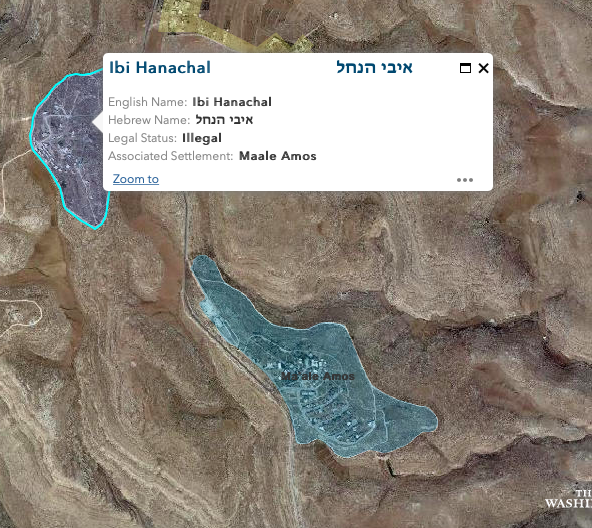
A plan for 98 units in the unauthorized Ibei Hanachal outpost, which will turn the outpost as a “neighborhood” of the Maale Amos settlement. In reality, the outpost is not contiguous with the built-up area of the Maale Amos settlement, meaning that the implementation of this plan will, in effect, create a distinct new settlement.
- A plan for 61 new units in the unauthorized Gva’ot outpost, an outpost originally built in 1999 by the settlers as a “neighborhood” of the Alon Shvut settlement. The settlers built a yeshiva there, but abandoned it not long after. The new settlement plan is for a public building, likely an educational institute with housing.
- 82 new units in th Ofra settlement. FMEP reported on this plan in the Dec 14th edition of the Settlement Report, in conjunction with the litany of punitive settlement plans advanced by Israel in response to terror attacks. The area where the new units are slated to be built is land that was allegedly purchased by the settlers from its original Palestinian owners.
- Plans for two new settlement industrial zones, one near the Beitar Illit settlement and one near the Avnei Hefetz settlement. The latter industrial zone, called Bustani Hefetz, will cover a large area of land (some 730 dunams) and will not be not contiguous with any other settlement. Peace Now writes, “an industrial zone of this scope, which is cut off from any other settlement, in all actuality constitutes a new settlement.”
- 121 new units in the Yitzhar settlement, where the IDF has been trying to rein in the violence perpetrated by the “Hilltop Youth” settlers, who are based in Yitzhar.
- 152 new units in the Shavei Shomron settlement.
- 212 new units in the Har Bracha settlement.
- 94 new units in the Beit Haggai settlement.
- A plan to legalize 75 existing settlement units in the Shvut Rachel settlement, which Israel considers a “neighborhood” of the Shiloh settlement.
- 100 new units in the Halamish settlement.
Peace Now released a statement saying:
“In 2018, the government advanced thousands of housing units, including most which can be found in isolated settlements deep inside the West Bank that Israel will eventually have to evacuate. Those who build these places have no intention of achieving peace and a two-state solution. The latest announcement, which as an aside was cynically passed on Christmas while most Western governments are on holiday, shows that Netanyahu is willing to sacrifice Israeli interests in favor of an election gift to the settlers in an attempt to attract a few more votes from his right-wing flank.”
Top Palestinian negotiator, Saeb Erekat, released a statement saying:
“While the world is celebrating Christmas with its spirit of peace and joy, the Grinch ‘occupation’ decided to steal the Christmas spirit from the people of Palestine. As part of his early election campaign, the Israeli Prime Minister Benjamin Netanyahu has as well stolen more Palestinian land and resources for the benefit of Israel’s illegal colonial settlement expansion. Such illegal actions are a deliberate campaign to destroy the two-state solution and to prevent the establishment of an independent and sovereign State of Palestine with East Jerusalem as its capital.”
Tamar Zandberg, head of the Meretz Party, slammed the new announcements, and previous decisions taken by the government to retroactively legalize 60 outposts. Zandberg said:
“The Israeli government has become a settlement government. (MKs Bezalel) Smotrich, Moti Yogev, (Justice Minister) Shaked and (Education Minister) Bennett are its landlords. They exploit the (Palestinian) attacks to build more settlements. But the truth needs to be said. To achieve security we need to evacuate settlements, not build more and more…”The 60 new settlements are the real threat to Israel’s security and to IDF soldiers. The pogroms they are waging in Palestinian villages. The stone-throwing, the shooting and the uprooting of the trees. This is the danger to our moral image and our security! They eight seats of Habayit Hayehudi party dictate eight million lives.”
Based on New Legal Tools to Take Palestinian Land, Israel Announces Intention to Build A New Settlement (“Givat Eitam/E-2”) Near Bethlehem
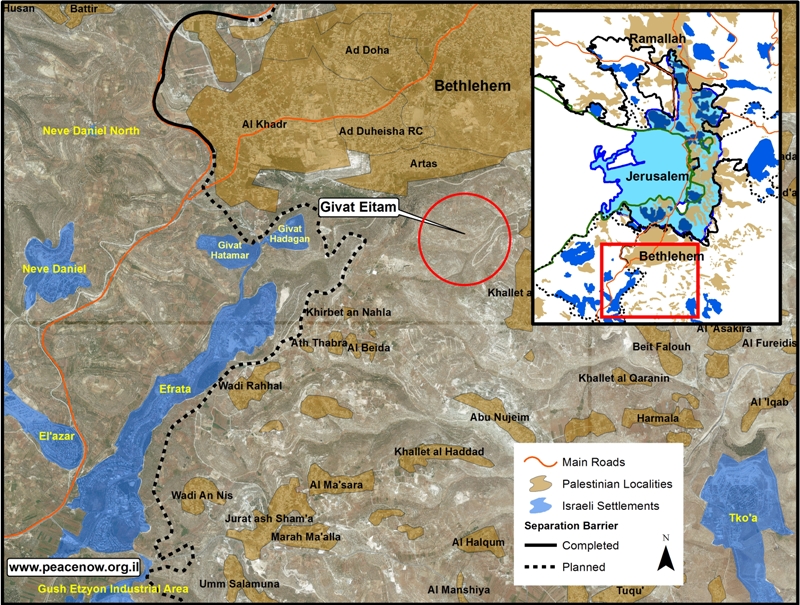
On December 26th, the Israeli Civil Administration announced that it will draft plans to build as many as 2,500 new settlement units at the Givat Eitam outpost site, creating a new settlement on a strategic hilltop that will cut off Bethlehem from the southern West Bank, completing the near encirclement of Bethlehem by Israeli settlements.
Map by Peace Now
For years, settlers have lobbied for construction at the site, but those efforts have been stymied by the lack of a legal access road to the outpost, which is surrounded by land that even Israel recognizes is privately owned by Palestinians. Until recently, Israel has balked at seizing private land from Palestinians for the exclusive benefit of the settlements. But now, several new legal opinions have allowed Israel to violate the private property rights of Palestinians for the sole purpose of legalizing settlements and settlement infrastructure. Those legal opinions include the “market regulation” principle, the opinion(s) regarding the Haresha outpost case, and the Regulation Law. It is unclear which legal argument will be applied to the Givat Eitam/E-2 case.
The Givat Eitam outpost has been nicknamed “E-2” by settlement watchers for for its resemblance, in terms of dire geopolitical implications, to the infamous E-1 settlement plan. Located east of the separation barrier on a strategic hilltop overlooking the Palestinian city of Bethlehem to its north, Givat Eitam/E-2 is located within the municipal borders of the Efrat settlement but is not contiguous with Efrat’s built-up area, making Givat Eitam/E-2 effectively a new settlement that, according to Peace Now, will:
“block Bethlehem from the south, and prevent any development in the only direction that has not yet been blocked by settlements (the city is already blocked from the North by the East Jerusalem settlements of Gilo and Har Homa, and from the West by the Gush Etzion Settlements) or bypass roads (that were paved principally for Israeli settlers). The planned building in area E2 would likely finalize the cutting off of Bethlehem city from the southern West Bank, delivering a crushing blow to the Two States solution.”
In September 2018 FMEP reported that the local council of the Efrat settlement encouraged the start of (unauthorized) construction of an outpost at the Givat Eitam/E-2 site (presuming that any such illegal construction would be retroactively legalized by the government) in response to a Palestinian terror attack in the Efrat settlement. Since then, the Civil Administration has allowed the settlers to build and maintain an agricultural farm there.
FMEP tracks all developments related to Israeli legislative, cabinet, and judicial action that promotes the retroactive legalization of outposts built on privately owned Palestinian land as part of its documentation of creeping annexation – available here.
Following High Profile Political Support, Settlers Violently Resist Evacuation from Amona Outpost Site
On January 3rd, 23 Israeli police officers were injured by Israeli settlers and their supporters who violently resisted the court-ordered evacuation from illegal encampments erected on privately owned Palestinian land as part of an effort to re-establish the Amona outpost. Approximately 300 settlers showed up at the Amona site (which is currently a closed military zone) overnight to resist the removal of settlers and two caravans from the hilltop, which was ordered by the Jerusalem District Court. The settlers and their supporters burned approximately 300 tires at the entrance to the outpost, poured oil on the access roads, and threw rocks and boulders at the Israeli police. Seven suspects were arrested and quickly released.
The evacuation of the outpost was reportedly carried out in defiance of a direct order from Prime Minister Netanyahu. According to the Haaretz report, Netanyahu gave orders to the Israeli military secretary, Col. Avi Bluth, to stop the evacuation. Col. Bluth did not relay the message in time, and the evacuation was carried out. Now, Netanyahu has ordered a disciplinary hearing to investigate the actions of Col. Bluth, which is scheduled for January 4th.
The violent evacuation of settlers from the Amona hilltop follows a week of high profile support for their efforts. Israeli Cultural Minister Miri Regev attended a ceremony near the recently re-established (yet unauthorized) Amona outpost to express her support for authorizing construction on the hilltop – which, according to the Israeli High Court of Justice, is privately owned Palestinian land. Regev could not go to the actual Amona site, because the area is a closed military zone where no one (settlers, politicians, and even the Palestinians who own the land) is permitted to enter. Regev and the settlers claim that the hilltop land has been legally purchased by the settlers, but that claim has not been investigated, much less verified. Casting doubt on the settlers’ claims, Haaretz notes:
“The lot in question is jointly owned by several different Palestinians, which means every single one of them would have to consent to the purchase for it to be legal. It’s not clear which, if any, of these Palestinians signed the sale document. In the end, the land was designated military land, is zoned for agriculture and has no building permits.The Binyamin Regional Council didn’t await the administration’s decision before moving two prefab homes into Amona and providing basic infrastructure such as water tankers.”
Israeli Attorney General Avichai Mandleblit slammed the settlers for trespassing and illegally moving caravans onto the site. Mandelblit criticized MK Bezalel Smotrich and the heads of regional settlement councils who went to the site to express support, saying:
“Breaking the law with the support of public figures, like placing caravans on privately-owned lands, can’t be a source of pride.”
A Haaretz report recently revealed Bezalel Smotrich was a founding member of a non-governmental group called Ofek Lehityashvut, which directly financed the illegal reestablishment of the Amona outpost last month by purchasing the two caravans that settlers moved onto the hilltop. The Haaretz report goes on to reveal that the Benyamin Regional Council has purposefully tailored various calls for proposals so that Ofek Kehityashvut would be the only group qualified to receive financing for that project. As a result of that manipulation, Ofek Kehityashvut has received substantial amounts of funding from the Benyamin REgional Council, which is an Israeli-taxpayer funded entity.
Knesset Speaker & Leaders Call for Annexation of Hebron
The speaker of the Israeli Knesset, Yuli Edelstein (Likud), called for Israel to apply its sovereignty over the city of Hebron – which would constitute an act of de facto annexation. Edelstein released a statement announcing his intention to go on a tour of Hebron – where some 500-800 settlers live under Israeli military protection amongst 200,000+ Palestinians – with the far-right, pro-annexationist group Im Tirzu. In the statement he wrote:
“In my view, it’s delusional that some Knesset members dare to undermine the Jewish people’s right to dwell in the city of our forefathers,” Edelstein said in a press statement issued prior to the conference. “We’re developing Hebron, investing in it and inculcating its importance in future generations. We are saying clearly – sovereignty in Hebron first.”
Speaker Edelstein also participated in a conference highlighting Israel’s historic connection to the city of Hebron. Organized by the Knesset Land of Israel Lobby, the event culminated in the signing of a document that reads:
“We, the undersigned, hereby express deep solidarity with the roots of the Jewish people in Hebron and the support of the Jewish community in Hebron that has clung to the city despite all the difficulties. We declare an unambiguous commitment to the continued existence, security and prosperity of Hebron as the city of both our forefathers and children.”
The event was co-organized by MK Bezalel Smotrich (Jewish Home) who said:
“Hebron is a litmus test. What is happening in Hebron shows our Jewish pulse….[those who call for settlers to leave Hebron] understand very well that if Hebron grows and develops, the entire settlement enterprise will grow and develop, so they invest in harming Hebron. But they will continue to shout and complain while we will continue to build, reach the people and connect with our roots.”
Regavim Petitions Jerusalem District Court to Stop the EU-Backed “Arab Takeover” of Area C
Following the Knesset’s passage of a bill in July 2018 that brought many West Bank legal matters under Israel’s domestic jurisdiction (an act of de facto annexation), the Jerusalem District Court is set to hear its first case concerning land disputes in the occupied territory. The bill was sponsored by Israeli Justice Minister Ayelet Shaked, whose three-fold rationale for the bill explicitly states that its purpose is to help settlers take more Palestinian land and shut-down Palestinian challenges to such thefts — by bringing matters to the Jerusalem Court instead of the High Court of Justice, which Shaked believes is too concerned with Palestinian rights and international law. The bill is part of the legislative body’s broader effort to erase all remaining distinctions (legal, judicial, economic, and otherwise) between sovereign Israel and the occupied territories, distinctions which allowed Israel to preserve the guise of respect for rule of law, and good intentions, for the last 50 years.
Looking to cash in the bill’s explicit purpose, the radical settler group Regavim initiated the petition asking the court to intervene to stop the “illegal Arab takeover” of land in the West Bank. Regavim’s petition claims that Palestinians are cultivating “state land” near the Mezad settlement. The petition also blames the European Union for its financial backing for the agricultural projects on the land. (Note: Regavim, like most settler media outlets, uses the word “Arab” to describe Palestinians, a vocabulary choice meant to erase any recognition of Palestinian identity).
A coordinator for Regavim told the Arutz Sheva outlet:
“The intervention of the European Union in what is happening in Area C is a brazen and aggressive intervention. We see extensive involvement on their part in lawbreaking and invading state land throughout Judea and Samaria. Their symbols are everywhere, and the State of Israel must respond to this blatant intervention on the diplomatic level as well.”
Shlomo Ne’eman, head of the Gush Etzion Regional Council said:
“The direct involvement of the European Union in financing Arab squatters in the territories and state lands has already become a plague on the state. We congratulate Justice Minister Ayelet Shaked on the obvious step that has led to great logic and justice in reducing the burden on the Supreme Court and in uniform enforcement against the land grabs by hostile elements…the Arabs understand that the real battle is on the ground. Foreign countries with their money are trying to shape a false consciousness and finally change the map of the state, but nothing can change history and our natural belonging on our national land.”
FMEP tracks the application of domestic Israeli law over the occupied West Bank (the de facto annexation of the West Bank) on its Annexation Policy Tables, which are regularly updated.
Knesset Lawyer Criticizes Bill to Give Palestinian Land to the World Zionist Organization
The legal advisors to the Knesset Constitution, Law and Justice Committee criticized a bill that would transfer vast tracts of land in Area C of the West Bank to the Settlement Division of the World Zionist Organization (WZO), a quasi-private state-funded entity that works to establish and expand settlements in the West Bank. Despite pressure to pass the bill, the legal advisors called on the committee to reexamine the text over concerns that it would also give the WZO authority over Palestinian communities in Area C. The experts wrote in a legal opinion for the committee:
“The proposed definitions of ‘rural settlement’ and ‘land’ do not include references to the character and nature of the settlement, and it seems that land that is government or abandoned property intended for Palestinian rural settlement will also be included in the boundaries of the proposed arrangement, and will be transferred to the management of the Settlement Division. Is the intention of the bill that the Settlement Division will also manage the Palestinian rural settlement in the area?”
As FMEP has previously reported, the bill was proposed by MK Bezalel Smotrich (Habayit Hayehudi) to accelerate the transfer of almost all of the land in Area C to the control of the World Zionist Organization. The land transfer is, in fact, taking place at the bureaucratic level, but Smotrich and the Israeli Cabinet (which endorsed the bill) are increasingly frustrated by the slow pace of the transfer (and perhaps also the limited scope of land slated to be handed over). Israeli Attorney General Avichai Mandelblit expressed his opposition to the bill, saying it is unnecessary given that ministry staffs are already working to transfer more land to the WZO through an administrative process.
In June 2018, when the Knesset gave preliminary approval to the bill, Peace Now responded:
“the government is scandalously planning to give the biggest land thieves responsibility for managing the land distribution, which will continue to be done under the cover of darkness if the bill passes into law.”
For more information on this bill, read a comprehensive background briefing by Peace Now.
Sheldon Adelson’s Medical School in Ariel Settlement May Not Open
The state-of-the-art medical school planned to be built in the Ariel settlement is now in danger of not opening, after a letter from the Israeli Justice Ministry warned that the school’s approval is in jeopardy. The Justice Ministry discovered an undisclosed conflict of interest that voids an important vote in favor of approving the school by the planning and budgeting subcommittee of the Higher Education Council. A member of the subcommittee, Dr. Rivka Wadmany-Shauman, allegedly met with the heads of Ariel University ahead of the vote, and made her approval of the new medical school conditional on being promoted to the rank of professor. Israel Hayom reports the Ariel University has already shelved plans to inaugurate the new school for its first semester in the Fall of 2019.
As FMEP has previously reported, Ariel University became an accredited Israeli university in 2012, following significant controversy and opposition, including from Israeli academics. It has since been the focus of additional controversy, linked to what is a clear Israeli government-backed agenda of exploiting academia to normalize and annex settlements. In 2018, the settlement broke ground on the new medical school, with significant financial backing from U.S. casino magnate and settlement financier, Sheldon Adelson. In February 2018, in an act of deliberate de facto annexation, the Israeli Knesset passed a law that extends the jurisdiction of the Israeli Council on Higher Education over universities in the settlements (beyond Israel’s self-declared borders), ensuring that the Ariel settlement medical school (and its graduates) are entitled to all the same rights, privileges, and certifications as schools and students in sovereign Israel.
As a reminder, Ariel is located in the heart of the northern West Bank, reaching literally to the midpoint between the Green Line and the Jordan border. The future of Ariel has long been one of the greatest challenges to any possible peace agreement, since any plan to attach Ariel to Israel will cut the northern West Bank into pieces.
Bonus Reads
- “Israeli settlements threaten to engulf West Bank communities” (Al-Monitor)
- “Israeli settlement activity appears to surge in Trump era” (AP)
- “It Pays Off to be an Israel Settler, Whether Trespasser or Landowner” (Haaretz+)
- “In the West Bank, the Israeli army works for the settlers” (Haaretz)
- “Netanyahu’s pro-settler allies force annexation into campaign agenda” (Al-Monitor)