Welcome to FMEP’s Weekly Settlement Report, covering everything you need to know about Israeli settlement activity this week.
To subscribe to this report, please click here.
November 8, 2019
- Israel Advances Plans for 2,342 New Settlement Units
- Israeli Government Approves Settler-Initiated Plans for Cable Car in Jerusalem — Despite Professional, Human Rights Objections
- Israel Plans to Build a New Waste Treatment Plant (to serve Israelis) in the West Bank
- No More Waiting: MKs Introduce Annexation Bills Despite Political Deadlock
- Annexation-via-New Roads (the new Smotrich Plan)
- Annexation-via-Movies (Govt-Funded Settlement Hasbara)
- Annexation-via-Education (Ambassador Friedman’s Favorite Medical School)
- Settler Leaders Elect New Chairman of the Yesha Council
- Israeli Official Calls on Evangelicals to Defend Settlements, Fight BDS, and Support “Economic Peace”
- Bonus Reads
Questions/comments? Contact Kristin at kmccarthy@fmep.org
Israel Advances Plans for 2,342 New Settlement Units
With little attention, on October 10th the High Planning Council – a body within the Israeli Defense Ministry’s Civil Administration, responsible for regulating all construction in the West Bank – advanced plans for 2,342 new settlement units, as well as for two additional settlement projects. Of that total, 719 units were approved for validation (the penultimate step in the planning process), and 1,623 settlement units were approved for deposit for public review (an earlier but decisive stage in the planning process).
The 719 units which received final approved for validation comprise:
- 207 units in the Bracha (aka Har Bracha) settlement, located south of Nablus. In September 2019, the Israeli Central Command signed an order that expanded the settlment’s jurisdiction, a move which paved the way for the approval of these new units (see our September 2019 report). According to Peace Now, this plan – if implemented – will significantly expand both settlement’s population and its physical footprint.
- 206 units in the Tzofim settlement, located north of the Palestinian town of Qalqilya – a town completely encircled by Israel’s seperation barrier (except for a single road connecting it to the rest of the West Bank) – in the northern West Bank.
- 166 units in the Alei Zahav settlement, located in a string of settlements stretching across the northern West Bank. Alei Zahav and its settlement neighbors create a contiguous Israeli populated areas linking Israel proper (west of the Green Line) all the way to the Ariel settlement, located in the heart of the West Bank (the eastern end of Ariel is closer to the Jordan border than to the Green Line). Notably, Alei Zahav is one of the settlements in which the “market principle” has been applied to legalize settlers theft of land recognized by Israel as belonging to Palestinians (see our July 2019 report).
- 140 units in the Mezadot Yehuda settlement, located at the very southern tip of the West Bank, just south of the Palestinian village of Susya, which the Israeli government has been threatening to demolish for years. This plan would nearly double the number of authorized units in the settlement.
Also receiving final approval for validation:
- A plan to retroactively legalize the illegal Brosh outpost in the Jordan Valley. According to Peace Now, the Brosh settlement serves as an educational institution that houses hundreds of students and families of staff members.
- A plan to build a tourist/visitors center in the Shilo settlement – where settlers and the Israeli government have been investing in developing tourism sites for Jewish and evangelical tourists.
The 1,623 units which were deposited for public review include:
- 609 units in the Beitar Illit settlement, located west of Bethlehem, near the Green Line. Beitar Illit is a massive, fast-growing ultra-Orthodox settlement.
- 382 housing units in the Dolev settlement, located west of Ramallah. This is a significant plan for Dolev, as it will more than double the number of existing units. Prime Minister Netanyahu previously promised to build 300 new units in Dolev in response to a Palestinian-perpetrated bombing at a spring (which settlers had taken over from Palestinians) near the settlement that killed a 17-year old Israeli and injured several others.
- 182 units in the Mevo’ot Yericho settlement, located north of Jericho in the Jordan Valley. The validation of this plan is the actualization of the Israeli security cabinet decision to grant the illegal outpost of Mevo’ot Yericho retroactive legalization, an action for which the security cabinet urgently convened on the eve of the September 19th elections. The plan approved by the High Planning Council on Oct. 10th granted legalization to the existing 20 existing units and, if implemented, will allow the settlement to significantly expand.
- 146 units in the Kfar Etzion settlement, located southwest of Bethlehem.
- 140 units in the Kerem Reim outpost located north west of Ramallah. Peace Now has repeatedly challenged the illegal construction of the Kerem Reim outpost, which the Israeli government retroactively legalized by declaring it a neighborhood of the Talmon settlement even though the areas are non-contiguous. Though a court rejected one Peace Now petition, there is an ongoing case against the Amana settler organization which Peace Now alleges engaged in illegal activities to build the outpost.
- 100 units in the Nokdim settlement, located southeast of Bethlehem. Former Israeli Defense Minister Avigdor Liberman – currently one of the most important figures in the race to form a governing coalition – lives in Nokdim.
- 64 units in the Telem settlement, located west of Hebron.
- A plan to build new shops and services in the Kochav Yakov settlement, located between Jerusalem and Ramallah.
Peace Now said in a statement:
“The figures speak for themselves. Netanyahu continues to sabotage the possibility of a political agreement with the Palestinians by promoting more settlement construction in the West Bank, including in places where Israel may have to evacuate as part of a future agreement. This is yet another dangerous step for both Israel and the Palestinians, led by a transitional prime minister whom the public did not trust in his policies. The next government must put a freeze on the development of settlements and to strive for immediate resumption of negotiations with the Palestinians without preconditions and to end the bloody conflict based on the principle of two states for two peoples.”
The European Union issued a statement criticizing the approvals, saying:
“The European Union’s position on Israeli settlement policy in the occupied Palestinian territory is clear and remains unchanged: all settlement activity is illegal under international law and it erodes the viability of the two-state solution and the prospects for a lasting peace, as reaffirmed by UN Security Council Resolution 2334. Israeli authorities also approved a building permit for the construction of a new tunnel road, which bypasses Bethlehem to the west. The progressive construction of a separate road network, connecting settlements and outposts to each other and to the road network in Israel while circumventing Palestinian towns and communities, is entrenching the fragmentation of the West Bank. The EU calls on Israel to end all settlement activity, in line with its obligations as an occupying power. The EU will continue to support a resumption of a meaningful process towards a negotiated two-state solution, the only realistic and viable way to fulfil the legitimate aspirations of both parties.”
Israeli Government Approves Settler-Initiated Plans for Cable Car in Jerusalem — Despite Professional, Human Rights Objections
On November 4th, the Israeli Housing Cabinet approved a settler-initiated plans to build a cable car line in East Jerusalem, despite the fact that the Israeli Attorney General has not yet rendered a decision on whether plans for such a significant and sensitive project can be advanced by a caretaker Israeli government. Emek Shaveh – an Israeli NGO fighting the politicization of archeology in Jerusalem – announced that it intends to appeal the approval to the Israeli Supreme Court.
As FMEP has repeatedly covered, this Jerusalem cable car project is an initiative of the Elad settler organization (which is building a massive tourism center – the Kedem Center – in the Silwan neighborhood, which will be a stop along the cable car’s route). The scheme is intended to further entrench settler control, via archeology and tourism sites, inside the Silwan neighborhood of East Jerusalem, while simultaneously delegitimizing, dispossessing, and erasing the Palestinian presence there. Non-governmental organizations like Emek Shaveh, Who Profits, and Terrestrial Jerusalem have repeatedly discredited the government’s contention that the cable car serves a legitimate transportation need in Jerusalem, and have clearly enumerated the obvious political drivers behind the plan, the archeological heresies it validates, and the severe impacts the cable car project will have on Palestinian residents of Silwan.
Ir Amim field researcher Aviv Tartarsky told Middle East Eye:
‘The project is a way to whitewash Israel’s taking of areas in Silwan to use for archaeological and touristic reasons…If someone wants to go to the Western Wall of the Old City, they have to go through the ELAD activity centre. This project will give ELAD legitimacy and influence, as it is taking part in a governmental project. This is the political reason for why the government is doing this project,’ Tatarsky said.”
Israel Plans to Build a New Waste Treatment Plant (to serve Israelis) in the West Bank
In October 2019 the Israeli government issued a construction tender to build a waste-to-energy plant in the West Bank, on an area of land that is within the jurisdiction of the Ma’ale Adumim settlement where several Palestinian Bedouin communities live. The plant – which is expected to cost USD $284 million (1 billion NIS) – will treat Israeli-generated waste.
B’Tselem – which previously published a comprehensive report criticizing the illegal Israeli practice of exporting its waste to the occupied territories – writes:
“For many years, Israel has been taking advantage of its power as occupier to transfer the treatment of waste (including hazardous waste) and sewage from its sovereign territory to the West Bank. To that end, it has created a situation in which environmental legislation in the West Bank is much laxer than inside Israel, conveniently overlooking the long-term impact of environmental hazards on the Palestinian population and on natural resources, and neglecting to prepare future rehabilitation plans. This has created a financial incentive to transfer the treatment of environmental hazards from Israel to the West Bank. The Palestinians who live in the occupied territory are the ones to pay the price for this environmental damage, even though they were never asked their opinion on the matter and although, as a population under occupation, they have no political power and no real ability to resist.”
B’Tselem also takes aim at the European Union (EU), which has invested millions in the implementation of the Isareli Ministry of Environmental Protection’s 2030 strategic plan, of which the waste-to-energy treatment plant is a part. B’Tselem writes:
“In 2019, Israel and the EU signed an agreement as part of the EU’s twinning instrument, which establishes cooperation with the EU’s neighboring countries, guaranteeing Israel approximately 1.5 million euros over the next two years to support the Ministry of Environmental Protection’s implementation of its 2030 strategic plan. In the agreement, Israel committed to creating a legal framework that adopts European practices and standardization for sustainable waste treatment. As in every agreement between the EU and Israel, it contains a territorial clause that stipulates that it will not apply beyond Israel’s 1967 borders. Yet the EU’s support for the ministry’s strategic plan – which defines the establishment of the plant at Ma’ale Adumim as a goal and presents the exploitation of West Bank land to resolve environmental problems as a matter of course – empties this annex of meaning. By supporting this plan, the EU will be supplying Israel with knowledge and experience that will help deepen its exploitation of Palestinian land resources and bolster the economic status of the Ma’ale Adumim settlement.”
No More Waiting: MKs Introduce Annexation Bills Despite Political Deadlock
Israeli political figures appear to be done waiting for a new government to be formed before acting on the loud signals from the Trump Administration supporting Israeli annexation of West Bank land.
On November 4th, Yamina party leader Ayelet Shaked filed a bill with the Knesset to unilaterally annex the Jordan Valley, the Ma’ale Adumim settlement just east of Jerusalem, and all 22 settlements and 75,000 Israeli settlers in what is broadly termed the Etzion “settlement bloc” located south of Bethlehem. Shaked’s bill calls for Israel to “apply sovereignty” to these settlements, which in practice would constitute the annexation of the settlements. Applying Israel law to areas outside of Israel’s sovereign borders is de facto annexation, as FMEP has explained and documented.
Shaked urged expeditious consideration of the bill, saying:
“There is a diplomatic window of opportunity and willingness on the part of the US for this kind of annexation that will not return. We cannot afford to hesitate or wait. We must take advantage of this window of opportunity immediately and begin to apply sovereignty over these areas. It is for this reason that the State of Israel cannot be dragged into another election cycle.”
On November 3rd, Likud MK Sharren Haskel submitted a draft bill for the annexation of the Jordan Valley, a bill she has introduced previously without success. Haskel said:
“It’s time to make the residents of the Jordan Valley legal Israeli citizens, thus kick-starting the development and prosperity of the region.The communities of the Jordan Valley and their residents are a strategic resource of the highest order for Israel. There is a wide consensus today about the region, following the long-awaited U.S. president’s recognition of the Golan Heights as under Israeli sovereignty. It is time to do the same with the Jordan Valley. After Blue and White leader Benny Gantz proposed to do the same, I call upon him and my fellow party members to support my proposal.”
In March 2019, ahead of the first round of Israeli elections this year, leaked reports suggested that U.S. diplomats were engaged in discussions with Israel about the latter’s intention to annex several “settlement blocs” – even more so-called blocs than called for by Shaked’s latest plan – following the elections. The reports were not corroborated by U.S. sources, but in the intervening time U.S. Ambassador to Israel David Friedman has made repeated statements to the press (in addition to speculative reporting about a forthcoming U.S. political plan) in support of Israel’s right to annex territory in the West Bank – cues the Israeli government has enthusiastically welcomed. In the lead-up to the September elections, Netanyahu vowed to annex the Jordan Valley should he be reelected, a plan endorsed by his rival Benny Gantz and supported by then-U.S. National Security Advisor John Bolton.
As a reminder, over the years there has been no shortage of attempts to normalize the idea that Israel will retain “settlement blocs” in any negotiated peace agreement — logic that originally applied narrowly to the Etzion bloc (defined on much less expansive terms), Maale Adumim, and, in the eyes of some, Ariel. The terminology has been exploited for decades by the Israeli government to convey legitimacy to building in the so-called “blocs.” Over the years the definition of what is a “bloc” has been twisted to include a much larger idea of the Etzion bloc, as well as the entire Jordan Valley. The implied idea regarding what the blocs are and the fact that they are inarguably Israel’s to keep, is incredibly misleading. The term “settlement blocs” has no formal definition or legal standing, and the future of the blocs – no matter how they are defined – is indisputably a matter at the heart of what will one day be negotiations aimed at a two-state solution (if there is ever to be such a solution). For more context, see resources from Americans for Peace Now here and here. (NOTE: A Haaretz investigation last year estimated that a total of 380,000 Israeli settlers live in the West Bank, of which 170,000 live outside of the so-called blocs, as defined by Haaretz).
Annexation-via-New Roads (the new Smotrich Plan)
On November 1st, Israeli Minister of Transportation Bezalel Smotrich unveiled a new government plan to advance Israeli “sovereignty through transportation.” The plan calls for massive investment (USD $283 million) in new/expanded roads and rails lines, for the express purpose of more seamlessly integrating Israeli settlements into Israel proper. Smotrich made clear that his ultimate goal is the complete integration of the West Bank into the national planning mechanisms of Israel proper. The move will erase the government’s current distinction between transportation projects in the West Bank (across the Green Line) and Israel proper [fun note: the Israeli Ministry of Foreign Affairs has an official map posted on its website entitled, “Transportation and Built-Up Areas” that includes the entire West Bank as part of Israel).
Touting the significance of his plan, Smotrich said:
“I do not give preference to Judea and Samaria [the West Bank] but also am not willing to continue the discrimination. These areas will receive treatment just like anywhere else in Israel. While it is only about roads and trains, it has political significance.”
Smotrich created a new bureau for “Judea and Samaria Planning” within the Transportation Ministry to oversee the implementation of this project, and more generally ensure that the ministry is geared towards serving the settlements as a matter of normal business. The institutionalization of such bureaucratic structures within the Israeli government is a significant, and often overlooked, mechanism by which the Israeli government has been engaging in annexation for years. The new bureau – much like parallel structures former Minister Ayelet Shaked set up in the Justice Ministry – is a formal and public statement that the Israeli government is pursuing (and allocating resources to) annexing the settlements.
It should be noted that Israel has used infrastructure projects in the West Bank to advance its settlement agenda, and to further fragment Palestinian life – two completementary goals powerfully explained by B’Tselem in a recently released interactive: “Conquer and Divide: The Shattering of Palestinian Space by Israel.”
FMEP tracks developments related to the ongoing annexation of West Bank land in its Annexation Policies Tables.
Annexation-via-Movies (Govt-Funded Settlement Hasbara)
On November 6th, Israeli Cultural & Sports Minister Miri Regev announced new government funding for film projects initiated by Israeli settlers. According to the guidelines, the new funding will support Israeli citizens living in West Bank settlements who want to make documentaries and films.It is widely understood that the goal is to encourage the creation of more pro-settlement propaganda.
Celebrating her new initiative, Regev essentially admitted that annexation was her motive, saying:
“I made a promise and I am keeping my promise! We are making history today. The Culture and Sports Ministry will support the regional production of films in the north, and for the first time in Judea and Samaria too, and in the hope that in the near future also in the south… The wheels of cultural justice, which bring to expression the range of voices in Israeli society, have worked quickly and now another stage in correcting the cultural map in Israel has been completed. The artists from the periphery, the north and from Judea and Samaria, will become more and more in the center of things, not just on stage but also on the screens. Soon we will allow them to express their ability and talent.”
One critic of the fund, Israeli producer Liran Atzmor, nailed why the new fund is highly problematic and a tool of de facto annexation:
“Setting up a fund that supports filmmaking in the occupied territories with Israeli taxpayers’ money amounts to creeping annexation, which is happening in many areas, obviously, but is happening now more forcefully in the realm of culture, thanks to this fund. As long as the fate of those territories has not been determined, one cannot accept the fact that public funds are distributed there to people of only one color, one nationality and one religion.”
Shlomo Eldar writes:
“…And that is the whole point, to show life in the settlements in a positive light, as a Zionist enterprise glorifying the State of Israel. Head of the Samaria Regional Council Yossi Dagan described the fund as a ‘giant piece of good news. … I believe this move will bring the story of Judea and Samaria to the big screen. … I call on all artists to take part in this party, to come and film in Judea and Samaria and tell its story, so that we can present the public with other faces and other stories that have yet to be seen on the screen’.”
Libby Lenkinski, Vice President of the New Israel Fund, explained in a tweet:
“Creeping annexation and normalization of settlements is not just happening on the land, it’s also a narrative strategy that uses arts and culture funding to move forward. #StopAnnexation”
Annexation-Via-Education (Ambassador Friedman’s Favorite Medical School)
Despite delays and scandals, the sparkling new medical school at Ariel University has officially launched its first school year, with a ceremony attended by a who’s-who of settlement financiers and supporter rejoicing in the opening of the school and in the implications of its opening for the Greater Israel enterprise.
Dr. Miriam Adelson and her husband, Trump-backer/U.S. casino magnate Sheldon Adelson, were in attendance. The Adelsons donated $20 million to the medical school, which was named after Miriam. Addressing the crowd, Dr. Adelson said:
“In Israel, being Israel, we also had to withstand our tribulations. In Israel, being Israel, there were opponents who tried to block the establishment of a critical institution on ancient Jewish land and to deny us legitimacy. But we won, Zionism won, the truth won.”
U.S. Ambassador David Friedman recited the “shehecheyanu,” a prayer of gratitude to God, as part of his speech, also exclaiming:
“A new medical school has opened in Samaria. It’s worth saying that again: A new medical school has opened in Samaria! How many people ever thought those words would be spoken?…The United States Embassy enjoys warm relations with Ariel University, and we are inspired by its contributions to Israeli society and to the scientific world.” [NOTE: “Samaria” is a biblical name used mainly by settlers and their allies to refer to the northern part of the West Bank]
MK Naftali Bennet put an even finer point on the significance of opening a medical school in Ariel settlement, saying:
“No longer is there a Green Line. We are one [united] Israel and that is how it should be. We are going to serve everyone here.”
There are 70 Israeli students enrolled to attend the settlement university. Even though classes are set to begin, the medical school still does not have an approved budget for the 2020 school year.
As a reminder, the Ariel settlement is located in the heart of the northern West Bank, reaching literally to the midpoint between the Green Line and the Jordan border. The future of Ariel has long been one of the greatest challenges to any possible peace agreement, since any plan to attach Ariel to Israel will cut the northern West Bank into pieces. Nonetheless, in February 2018, the Israeli Knesset passed a law extending the jurisdiction of the Israeli Council on Higher Education to universities in the settlements (beyond Israel’s sovereign borders) – an act of de facto annexation. The law was necessary to ensure that the Ariel settlement medical school (and its graduates) would be entitled to all the same rights, privileges, and certifications as schools and students in sovereign Israel. FMEP has tracked this process, and all other annexation policies in its Annexation Policy tables. A fuller history of the Ariel Medical School saga can be found here.
Settler Leaders Elect New Chairman of the Yesha Council
David Elhayani was narrowly elected to serve as the next Chairman of the powerful settler Yesha Council – an umbrella body representing all the settlement regional councils. Elhayani is a well known personality, having served for 10 years as the head of the Jordan Valley Regional Council (a quasi municipal body serving the needs and interests of settlements in the Jordan Valley).
The Times of Israel’s settlement correspondent Jacob Magid explains the relevant politics involved behind Elhayani’s narrow victory over Yigal Lahav, a younger, more radical voice:
“Elhayani and Lahav represented opposite sides of an intensifying rift between an older generation of settler leaders that is closely aligned with Prime Minister Benjamin Netanyahu and a younger group of council chairmen who believe in acting more aggressively on behalf of the movement, even if that means being at odds with right-wing governments that the Likud chief has led. Elhayani, from the old-timer’s camp, edged out Lahav 13-12 after the votes of 24 West Bank council chairman plus settler elder Zeev ‘Zambish’ Hever were counted.”
Elhayani addressed the dynamics of the old guard (of which he is a part) vs. new, more radical, guard ahead of the elections, saying:
“There’s a crisis of trust in the Yesha Council where many council chairmen don’t see the body as being capable of serving the needs of their residents. Many council chairmen don’t show up to Yesha meetings at all.”
Elhayani promised a more “aggressive” demeanor so that those the Council represents will see that they “finally have someone who will fight for them.” So, despite being what some settlers may consider the “mainstream,” i.e. less willing to aggressively challenge the perceived slow-walking of settlement expansion and annexation by the Israeli government, Elhayani is still best understood as an ideologue in his own right.
Ahead of the vote, Elhayani did offer strong criticism of what he sees to be the Isareli government’s discrimination against the settlements, saying that he will fight for better “quality of life”for the settlements – making infrastructure as a core part of his agenda:
“Our residents are sick of the poor infrastructure that has led to power outages, water shortages and traffic jams. It is the responsibility of settler leadership to provide adequate services. You cannot improve quality of life until you improve infrastructure. We still need to be aggressive in demanding infrastructure improvements in the meantime, in addition to preventing a Palestinian takeover of Area C so that there will be something to [annex] when the time comes.”
Israeli Official Calls on Evangelicals to Defend Settlements, Fight BDS, and Support “Economic Peace”
Speaking to an audience of leaders in the evangelical media world, a top Netanyahu aid asked the crowd to join Israeli government efforts to defend the legitimacy and permanence of the settlements, and coached the crowd on how to frame settlements in a way that advances their normalization.
This was the third annual “Christian Media Summit” hosted by the Israeli Government Press Office to develop the group into “ambassadors for Israel.” According to Haaretz, the 2019 event was attended by approximately 150 journalists, mostly from the United States, working for Christian media outlets from 30 different countries. Entitled, “Between Jerusalem and the Golan: International Recognition,” the event featured addresses by Benjamin Netanyahu and President Reuven Rivlin. U.S. Ambassador David Friedman attended as well.
Speaking to the group, Deputy Chief of Foreign Affairs Reuven Azar said:
“The return of Jews to Judea and Samaria is not a curse, it’s a blessing for all the residents of the area…Calling for their expulsion is a recipe for destruction and for chaos… Look what happened when we went out of Gaza. Our presence in Judea and Samaria [the West Bank], and in Jerusalem brings stability… because we bring security by fighting the bad guys…We must partner in embracing our brothers and sisters who live in Judea and Samaria, and fight against those who claim their presence is illegal, or try to dehumanize them through different means. Help us to fight boycotts, they are not just, and they hurt us and they hurt our neighbors even more. ‘The revival of the Jewish people in the land of Israel is a divine promise being fulfilled…It is a blessing for our people, our region, for the world. A force for good, a force for peace, prosperity and happiness’.”
Following his remarks, the Front for the Protection of Democracy – an Israeli NGO – filed a complaint with the Civil Service Commission seeking disciplinary action against Azar. The Prime Minister’s Office quickly came to Azar’s defense, saying: “Political adviser Reuven Azar expressed government policy.”
Azar repeatedly referred to settlements as “communities” – a term that erases the illegality of those “communities” under international law. This pro-settlement framing was recently endorsed by outgoing U.S. advisor Jason Greenblatt. Azar also touted the now familiar but Orwellian claim that settlements are an economic gift to the Palestinians, claiming that “communities [settlements] in Judea and Samaria [the West Bank] provide opportunities, and jobs…” Azar invited the audience to visit the Barkan industrial zone, stating: “The best paying jobs for Palestinians are in Barkan.”
As FMEP has previously explained, for decades Israel has used industrial zones as another tool to expand and deepen control over West Bank land and natural resources. Industrial zones perpetuate Israel’s economic exploitation of occupied territory (including the local workforce, land, and other natural resources), and that it is Orwellian to label such initiatives as “coexistence” programs, or to suggest that they offer the Palestinians benefits they should welcome. Importantly, jobs in industrial zones – often the only jobs available for Palestinians living under an Israeli occupation that prevents the development of any normal Palestinian economy – are widely viewed by Palestinians as a double-edged sword.
Bonus Reads
- “Five Settlers Arrested on Suspicion of Attacking Israeli Policemen at West Bank Outpost” (Haaretz)
- “Israel’s Right New Bank – The Jewish National Fund” (Haaretz)
- “Why did Microsoft fund an Israeli firm that surveils West Bank Palestinians?” (NBC News)
- “Israeli Schools Teach Pro-settler Religious Nationalism Is the Only Way to Be Jewish” (Haaretz)
- “A Wall, Arrests and Close Surveillance: How Israel Fences in a Palestinian Family” (Haaretz)
- “Hilltop Youth Battle The IDF Over Expulsion Order “ (JNS)
- “Welcomed, then Attacked by Yitzhar” (New Voices)
Welcome to FMEP’s Weekly Settlement Report, covering everything you need to know about Israeli settlement activity this week.
To subscribe to this report, please click here.
October 25, 2018
- More Evidence of WZO Support for Illegal Settlement Activity
- Israel to Expropriate More Palestinian Land to Widen West Bank Highway
- Settlers Take Over Another Building in Silwan
- Hugely Disproportionate Amount of Government Grants to Regional Councils Go to Settlements
- Fearing Unfavorable Court Ruling, Palestinians Petition ICC to Stop Hebron Settlement Plan
- Cabinet to Consider Bill to Allow the Knesset to Overrule the High Court of Justice
- Knesset Advances Bill to Politicize Legal Advisors
- More Drama Surrounding Palestinians Who Sold Old City House to Settlers
- Israeli “Sovereignty Movement” Asks Candidates About Annexation Views
- Bonus Reads
Comments, questions, or suggestions? Email Kristin McCarthy at kmccarthy@fmep.org.
More Evidence of WZO Support for Illegal Settlement Activity
The Israeli non-profit organization Kerem Navot revealed new documents offering new evidence that the Settlement Division of the World Zionist Organization employs unlawful practices in its drive to help settlers build illegal outposts and unauthorized settlement structures on Palestinian land in the West Bank. The documents show that the WZO’s Settlement Division has regularly engaged in practices including:
- Granting loans – using taxpayer money – for illegal construction of settlement unauthorized outposts;
- Accepting highly questionable “collateral” from the settlers to guarantee such loans, including sheep, a chicken coop, date trees, and agricultural equipment; and
- Providing false confirmations to private banks that settlers owned or were legally working land, in order to enable settlers to acquiring private mortgages for homes in unauthorized outposts and/or homes built illegally in existing settlements.
Dror Etkes, founder of Kerem Navot, told Haaretz:
“It’s been obvious for years that the [Settlement] division has adopted unlawful patterns of operation after assuming the role of contractor carrying out the dirty work that state authorities have tried to distance themselves from having direct responsibility for. The documents show systematic and continuous unlawful conduct intended to support the most extremist and violent elements among the settlers, people who are responsible for the expulsion and expropriation of Palestinian communities from wide areas of the West Bank.”
The WZO’s Settlement Division was created by the Israeli government in 1968 – and is funded entirely by Israeli taxpayers. Its mandate is to manage West Bank land expropriated by Israel, in order to facilitate the settlement of Israeli Jews in the occupied territories. To make this possible, the Israeli government has allocated approximately 60% of all “state land” to the WZO’s Settlement Division [over the past 50 years Israel has declared huge areas of the West Bank to be “state land,” including more than 40% of Area C, where most of the settlements are located]. But apparently that wasn’t enough for the WZO’s Settlement Division: settlement and human rights watchdogs have repeatedly documented how it has worked to take over additional land, including privately owned Palestinian land, in order to build more settlements.
Despite the controversies, in June 2018 the Knesset gave preliminary approval to a bill that would hand over almost all of Area C to the WZO’s Settlement Division. Peace Now responded at the time:
“the government is scandalously planning to give the biggest land thieves responsibility for managing the land distribution, which will continue to be done under the cover of darkness if the bill passes into law.”
Israel to Expropriate More West Bank Land to Widen West Bank Highway
According to Palestinian press reports, the Israeli Minister of Transportation Yisrael Katz has greenlighted a project to confiscate vast tracts of Palestinian land in the West Bank, in order to widen a section of the West Bank’s main north-south highway, Route 60, in an area spanning between Bethlehem-area settlements to Hebron-area settlements. In addition to confiscating land to add two lanes to the road (doubling the number of lanes from 2 to 4), Palestinians fear that the highway expansion is part of a larger project seeking to expand the West Bank settler population to 1 million Israelis by 2030, as promised by Education Minister and the leader of the Jewish Home party Naftali Bennet. The Israeli Transportation Ministry has reportedly allocated $50 million to the project.
Highway 60 is the sole major roadway providing north/south contiguity through the West Bank. Palestinian access to Route 60 is restricted in sections near settlements, and Route 60 has been completely severed between Jerusalem and Bethlehem by Israel’s separation barrier (there is literally a wall across the highway) in order to include the Efrat settlement on the Israeli side of the barrier. The economic, political, and social impacts of the closure of Highway 60 have been severe for the Palestinian population.
Settlers Take Over Another Building in Silwan
Ir Amim reports that the last remaining Palestinian tenants have been evicted from an apartment building located in the Batan al-Hawa section of Silwan, the site of the single largest settler takeover operation in East Jerusalem since the annexation of East Jerusalem in 1967.
The Abu-Sneina family was the last tenant in a 4-story, 10-unit building. The Israeli Custodian General transferred ownership of the building to the Ateret Cohanim settler organization (which works to establish Jewish enclaves inside densely populated Palestinian neighborhoods of East Jerusalem) in 2015, based on the settlers’ taking over management of the Benvenisti Trust, which oversaw the assets of Yemenite Jews who lived in the neighborhood in the 19th century. Palestinians have challenged the legitimacy of the Benvinisti Trust’s rights to the currently existing buildings, saying that the trust only covered the old buildings (none of which remain standing) and not the land. Indeed, the State admitted to the Courts on June 10, 2018 that the land had been transferred to the Benvenisti Trust/Ateret Cohanim without a proper investigation into its legal status. On June 17, 2018, the Israeli High Court of Justice ordered the Israeli government to provide more information and an explanation of the decision to give the land/buildings to the Trust. Nonetheless, in September 2018 the Jerusalem Magistrate Court ruled that evictions could proceed in buildings that Ateret Cohanim controls, even though Ateret Cohanim’s ownership of the buildings – based on its control of the Trust – remains in legal question.
As FMEP has previously reported, Ateret Cohanim is implementing a multifaceted campaign to remove Palestinians from their homes in the Batan al-Hawa section of Silwan, claiming that the Palestinians are illegally squatting on land owned by the Trust. To date, Ateret Cohanim has managed to acquire the deeds to six Palestinian homes in Batan al-Hawa, inserting some 20 Israeli Jewish families in place of evicted Palestinian residents. The organization has eviction orders pending against an additional 21 homes, with 800 Palestinians at risk of eviction.
Yakoub al-Rajabi, a Palestinian resident of Batan al-Hawa, recently told The Washington Post:
“We know that this was a well-orchestrated plan to force us to leave. And if we stay, it will paralyze us and isolate us in our homes.”
In a 2016 report that covers the Batan al-Hawa situation in detail, Ir Amim and Peace Now underscore the significance of Ateret Cohanim’s efforts:
“If the settlers are successful, Batan al-Hawa is anticipated to become the largest settlement compound in a Palestinian neighborhood in the Historic Basin of the Old City, with the outcome of significantly tightening the emerging ring of settlements around the Old City and severely undermining the possibility of a future two state solution in Jerusalem.”
Celebrating the takeover of another building in Batan al-Hawa in August 2018, Ateret Cohanim director Daniel Luria told The Times of Israel:
“Every acquisition is very difficult. We’re up against a mobilized Arab world, parts of which are violent. There is huge pressure and millions of dollars are being pumped in to strengthen the Arab hold on the city…[the] biggest problem is trying to get the Jewish world to understand what needs to be done. We have the best relations ever with a US administration. For [US Vice President Mike] Pence and [US Ambassador to Israel David] Friedman and the others, [settling Jews in East Jerusalem] is a no-brainer. What’s our right-wing government waiting for? It’s not about what the US says. It’s about what we do. We are not doing anything to stop the peace process but will not compromise on a millimeter of Jerusalem. You have to show strength of conviction and sovereignty to have peace and coexistence. This can only happen when you live together under Jewish sovereignty.”
Hugely Disproportionate Amount of Government Grants to Regional Councils Go To Settlements
The Knesset Research and Information Center issued a report revealing that 25% of all state funds allocated to Israeli regional councils are given to West Bank regional councils, despite the fact these settlement regional councils account for just 5% of all regional councils operating on both sides of the Green Line.
Examining funding channels – including grants to regional councils for education, welfare, and for projects of the Interior Ministry – it was found that the settlement regional councils are far better funded than those located in sovereign Israel. Putting a fine point on the discrepancy, a student attending school in a settlement receives nearly twice the amount of government benefits per year as compared to a student studying in sovereign Israeli territory.
MK Stav Shaffir (Zionist Union), who ordered the report, points out that the report doesn’t even begin to document the total amount of money that the government diverts from sovereign Israel into settlements:
“This is only the tip of the iceberg, since the report doesn’t include the budgets that are transferred outside the budget plan, like the Settlement Division’s budgets that are mostly invested in the West Bank settlements and not in the State of Israel.”
The Adva Center, an Israel non-profit that documents and analyzes the cost of occupation on the state budget, published a report [full report in Hebrew, executive summary in English] in August 2018 showing that Israel is not only disproportionately funding settlement councils in general, but in particular is disproportionately funding settlement councils located deep inside of the West Bank, in areas that are most problematic to any future attempts to draw borders for a two-state solution. Adva writes:
“Non-Haredi settlements in the occupied territories are still to be found at the top on 3 measures. Compared to several other types of municipalities – the 15 most affluent Israeli localities, the largely Mizrahi “development towns,” the Arab localities within Israel, and Haredi settlements, the non-Haredi settlements continue to enjoy the largest per capita municipal expenditure, the largest per capita central government “designated” subsidy (mainly for education and social welfare services), and the largest per capita central government balance grant. The non-Haredi settlements, on the other hand, include, among others, the so called “ideological” settlements, many of them deep inside Palestinian territories and strongly opposed to the creation of a Palestinian state.”
Fearing Unfavorable Court Ruling, Palestinians Petition ICC to Stop Hebron Settlement Plan
On October 18th, top Palestinian diplomat Saeb Erekat sent a letter to the International Criminal Court (ICC) asking it to expedite the launch of a criminal investigation into Israeli settlement activity, citing the urgency of preventing the construction of a new 31-unit settlement in the heart of Hebron. Palestinians most recently referred a case against Israeli settlements to the ICC for investigation in May 2018, its eighth referral on the matter.
Speaking to Al-Monitor, Tawfiq Jahshan – a lawyer for the Hebron Rehabilitation Committee – explained that Erekat’s letter might have been motivated by the Israeli government’s decision to approve the new settlement plan despite pending litigation against it. Jahshan said:
“There were deliberations [about petitions against the plan] and hearings. Most recently in June, the final hearing was postponed and the decision was to be notified — once issued — by way of email. But surprisingly Israel’s Cabinet approved Oct. 14 the financing of the project. By acting before the issuance of the judicial decision, the Israeli Cabinet gave the green light to the judges to refuse the objection…There is no competent Palestinian judicial body to examine such cases, so we have to resort to Israeli justice often unfair to us. Resorting to the ICC is a necessary step to face the injustice shown by the Israeli judiciary.”
To date, the Israeli Defense Ministry has not issued a response to either of the two formal complaints filed against the settlement plan. Both petitioners – the Hebron Municipality and Peace Now – have stated they will appeal the case to High Court of Justice if the Defense Ministry decides the settlement can be built.
Cabinet to Consider Bill to Allow the Knesset to Overrule the High Court of Justice
Israeli Justice Minister Ayelet Shaked and her Jewish Home party have decided to advance a new, narrow version of the so-called High Court override law which will make it impossible for the High Court of Justice to strike down the Knesset’s plans to deport African asylum seekers and migrants. The new version has been narrowed in order to gain support from parties that are willing to see the High Court overruled when it comes to Africa asylum seekers, but opposed to a broader overrule law.
The decision to advance the narrower version increases the likelihood that the law will pass, and in so doing deals another body blow to Israel’s judicial system. At the same time, the decision drew protest from hardliners. Seeking to assuage right-wing critics of the limited plan, Shaked announced that Jewish Home will demand support for the broader version of the law as a part of a future coalition agreement (elections are widely expected to be called soon, meaning the governing coalition agreement will need to be renegotiated). If the broader version passes into law, the Knesset will be able to reinstate any law struck down by the High Court (including most relevantly, the settlement Regulation Law, if it is struck down as expected).
Economic Minister Moshe Kahlon (leader of the Kulanu Party, which is part of the current governing coalition) has effectively blocked the broader bill from moving forward by whipping his party members to stand firm against it. Kahlon has taken heat from all sides concerning his support for the limited version this week. From the left, Zionist Union MK Michal Biran said:
“Kahlon declared he would support a narrow notwithstanding clause, concerning the infiltrators. Meaning, in some cases it’s allowed to bypass the High Court, but in other cases it’s not. Kahlon’s attempt to run between the raindrops in this extremist right-wing government shows lack of ideology, lack of trust in the justice system, and lack of trust in the fact the public is not stupid. Kahlon’s voters wanted to see a man in the government who represents the sane center, and got a submissive slave of Netanyahu. With his own hands Kahlon is helping bypass Basic Law: Human Dignity and Liberty over political whims.”
From the right, MK Shuli Mualim said:
“This is a test Minister Kahlon, who has for months been preventing the enactment of the broader legislation on the issue … the bill formulated now is exactly the kind of bill Kahlon claimed he would support. I expect him to keep his promises to the residents of southern Tel Aviv.”
The narrow bill will be presented to the Ministerial Committee on Legislation at its next meeting on October 28th, and is expected to receive the seal of government-backing. If the committee votes to back the bill, it will then be sent to the Knesset where it will need to pass three readings.
Knesset Advances Bill to Politicize Ministerial Legal Advisors
On October 22nd, the Knesset’s Constitution, Law, and Justice Committee reviewed a bill being promoted by Justice Minister Ayelet Shaked that, if passed, will allow each government minister to select his/her own ministerial legal advisor, a move which politicizes a key office charged with ensuring that the rule of law is followed when implementing policy. Legal advisors have the authority to block actions of the minister if they are deemed unlawful, a critical power that requires political independence from the ruling coalition and party figure at the head of the ministry. The bill has already passed its first Knesset reading.
The Haaretz Editorial Board published blistering piece on the bill, writing:
“Instead of legal advisers who are honest, independent, loyal to the law and prepared to warn against illegal, corrupt and improper activity, we will have legal advisers who close their eyes to government corruption and who will be prepared to whitewash anything. Instead of independent advisers we will get dependent and submissive ones.”
There has been widespread criticism of Shaked’s bill, including from Israeli Attorney General Avichai Mandelblit (who argued against the law before the Knesset), Israeli President Reuven Rivlin, and many other legal luminaries.
More Drama Surrounding Palestinians Who Sold Old City House to Israeli Settlers
The Israeli Shin Bet arrested (and later released) two Palestinian Authority (PA) officials suspected of abducting a Palestinian-American real estate dealer who was allegedly involved in the sale to an Israeli settler organization of a house in the Muslim Quarter of the Old City, abutting the al-Aqsa Mosque. The two men arrested were Adnan Ghaith, who was appointed as the Governor of Jerusalem by the Palestinian Authority (PA), and Jihad al-Fakih, the director of the PA’s intelligence efforts in Jerusalem. The PA claims that the Palestinian-American man surrendered himself willingly into its custody, where he reportedly remains under interrogation at the order of President Abbas. The unnamed individual’s family has submitted requests for help to the American Embassy in Jerusalem. The U.S. State Department has said it is in touch with the PA about the reports.
Israeli “Sovereignty Movement” Asks Candidates About Annexation Views
The settler organization known as the “Sovereignty Movement” has polled candidates running in the upcoming Israeli local elections on their support for annexation policies. The resulting compendium of candidate statements in support of annexation was published in the Arutz Sheva settler-aligned news outlet.
Local elections will be held October 30th across Israel and West Bank settlements. The Sovereignty Movement released a statement calling on candidates to support annexation, saying:
“Implementing Israeli sovereignty in Judea and Samaria constitutes the next essential step in the Zionist vision of the return of the People of Israel to its Land, and a vital step in security, but is also necessary in order to provide civil rights for the residents of Judea and Samaria that is equal to those of the rest of the citizens of Israel. The heads of local authorities understand well the difficult challenges in dealing with military figures to promote even the elementary civil needs of the residents. Applying sovereignty will put a stop to the discrimination and harming almost a half-million Judea and Samaria residents. This is the time to tell the different candidates in the various authorities: Support sovereignty and we will vote for you!.”
Bonus Reads
- “Israel Has Chosen Settlements Over Security” (The Forward)
Welcome to FMEP’s Weekly Settlement Report, covering everything you need to know about Israeli settlement activity this week.
To receive this report via email, please click here.
August 16, 2017
- Israel Demolishes Buildings in Key East Jerusalem Areas
- Bedouin are Powerless in E-1 Area as Settlement Plans Loom
- Jewish National Fund Resumes Targeting Land in the Occupied West Bank
- Settlers in Israeli Government Turn Blind Eye to Settlers Breaking Israeli Law
- Former Israeli AG Says Sheikh Jarrah Property Should be Given to Palestinians
- Three New Outposts Near Nablus
- Updates: Al-Walajah, Sheikh Jarrah, Amichai Settlement
- Bonus Reads
Comments, questions, or suggestions? Email Kristin McCarthy at kmccarthy@fmep.org.
Israel Demolishes Buildings in Key East Jerusalem Areas
The Israeli government demolished eight Palestinian structures in the East Jerusalem neighborhoods of Silwan, Beit Hanina, Jabal Mukaber, and Isawiyyah. According to Ir Amim, the two apartments demolished in the al-Bustan area of Silwan are the first demolitions to be carried out there since 2008. Looking at East Jerusalem as a whole, Ir Amim writes, “[these] demolitions bring the 2017 total to 128, including 84 residential units and 44 non-residential units. These numbers are on well on target to meet or surpass the total number of 203 demolitions executed in East Jerusalem last year.”
Bedouin are Powerless in E-1 Area as Settlement Plans Loom
According to B’Tselem, last week Israeli officials confiscated solar panels that were providing electricity to a Bedouin community’s school in the controversial area adjacent to Jerusalem known as “E-1.” The confiscation happened despite a temporary court-ordered injunction against it. The Israeli government has long refused to connect the Bedouin to a power grid; the solar panels confiscated this week were donated only a month ago by a humanitarian organization.

Map by the Economist
The E-1 area has long been slated for Israeli settlement construction, but plans have been continuously delayed by the Israeli political echelon – due in large part to pressure from U.S. administrations and others in the international community. If E-1 is developed it will seal Palestinian East Jerusalem off from the West Bank to its east, and create a land bridge from Jerusalem to the Maale Adumim settlement. The settlement will render the two-state solution impossible because it would preclude the ability to draw contiguous borders for a future Palestinian state with a capital in East Jerusalem.
East Jerusalem expert Danny Seidemann has issued several warnings this year that E-1 – a “doomsday settlement” – might be slated for advancement under the current settlement policy of the Netanyahu government and with no discernable counter-pressure from the Trump Administration. Seidemann warned in January, “The main obstacle preventing a green light for E-1 has, until now, been wall-to-wall opposition from the international community, led by the United States (dating back to the era of President Clinton).”
The Bedouin community living in the E-1 area has long been threatened with forcible relocation (which would amount to population transfer). The 18 Bedouin tribes that live in the vicinity of Maale Adumim and E-1, totaling approximately 3,000 people, have already endured numerous emolitions this year alone.
Jewish National Fund Resumes Targeting Land in the Occupied West Bank
According to Peace Now, the Jewish National Fund (JNF) is set to resume its practice of purchasing land in the West Bank for use by Israeli settlers, after abandoning the effort many years ago. In the past, many of the JNF’s land purchases reportedly involved fraud, extortion, and/or forgery on the part of middlemen.
Peace Now writes, “Through purchasing lands in the occupied territories, JNF serves the settlers, hurts the possibility to arrive at a two state solution, and jeopardizes the future of Israel as a Jewish and democratic state.”
The JNF – which collects donations internationally, including in the United States – currently owns land (through its Israeli subsidiary) in numerous settlements, including Itamar, Alfei Menashe, Enav, Kedumim, Givat Ze’ev, Metzadot Yehuda, and Otniel.
Settlers in Israeli Government Turn Blind Eye to Settlers Breaking Israeli Law
There have been several recent reports about structures inside of settlements that were built (or are being built) without the legally-necessary permissions, as Israeli officials turn a blind eye.

Map of the Hayovel outpost by Times of Israel Red encircles site construction, arrow points to the house of Liberman’s settlement affairs advisor.
Notably, one report identifies dozens of unauthorized homes being built in the outpost of Hayovel (which is effectively an extension of the settlement of Eli), despite a stop-work order issued by Civil Administration (the arm of the Ministry of Defense that is sovereign in the West Bank). The construction is taking place virtually across the street from the home of Israeli Defense Minister Avigdor Liberman’s own adviser on settlement affairs, who is himself a resident of the illegal outpost (Liberman is also a settler, residing in the settlement of Nokdim). The illegal construction will double the size of the outpost.
Another report reveals that Shlomo Ne’eman, the head of the Gush Etzion Regional Council – which promotes the expansion of settlements in the Etzion bloc – lives in an illegal outpost. The Regional Council insists that the outpost is a “neighborhood” of the Karmei Tzur settlement, but aerial images show it is outside of the settlement’s municipal border. The Israeli Civil Administration has ordered the structures there to be demolished but has not carried out those orders. Settlement watchdog Kerem Naboth says, “Ne’eman has joined the list of elected officials and politicos among the settlers who are not only assisting others in stealing land, but are also doing it themselves.”
Haaretz notes that these two are part of a longer list of elected officials and senior civil servants living in illegal outposts, Also on that list far right-wing Knesset Member Bezalel Smotrich (Habayit Hayehudi), who lives in an illegally-built home in Kedumim (not coincidentally, Smotrich was one of the key backers of a law passed earlier this year to “legalize” such settlement illegalities). Likewise, a January report revealed that the head of the Finance Ministry’s department of building regulations enforcement, Avi Cohen, lives in an illegal outpost of the Eli settlement. At the time of the report in January, Rabbis for Human Rights said, “A situation in which the system responsible for enforcing building laws is headed by someone living in an outpost demonstrates contempt for the system and Israel’s values.”

Image by Kerem Naboth
Another report documents how in the Efrat settlement (in the Etzion settlement bloc) a school was recently expanded, illegally, on private Palestinian land located land outside of the settlement’s border. Funding for the project was raised by an organization, called the Ohr Torah Stone, which operates a branch in the United States and is eligible to receive tax-deductible donations from U.S. donors. According to settlement watchdog Kerem Naboth, the Efrat settlement itself was built on land that the Palestinian village of al-Khadr had long cultivated. Kerem Naboth reports, “aerial photographs from the 1980s indicate that in the past there was a vineyard on site.”
Former Israeli AG Says Sheikh Jarrah Property Should be Given to Palestinians
Speaking in Sheikh Jarrah, former Israeli Attorney General Michael Ben-Yair called on the Israeli government to intervene to stop the eviction of the Shamasneh family from their longtime family home. Ben- Yair served as the AG from 1993-1997, under prime ministers Rabin and Netanyahu.
Ben-Yair, whose family lived in Sheikh Jarrah until 1948, suggested he would be ready to reclaim his family’s property and then transfer it to the Palestinians currently living there – and called on the government to adopt a policy to do exactly that, across the board. He said, ”If the Israeli government would have acted decently toward all its residents, including you [the Arab residents], it would have appropriated the properties in the neighborhood [from their Jewish owners who lived there before the War of Independence] and given these properties to the Palestinians who live there today.”
The former AG also noted that Jews who lost property in the 1948 war were already compensated – at the expense of Palestinians. Ben-Yair said, “My family and the family of my cousin who were forced to leave the neighborhood in January 1948 got properties of Palestinians refugees on Jaffa Road and in the Katamon neighborhood in west Jerusalem. They were worth much more than the properties that we left in Sheikh Jarrah.
Since we covered the Shamasneh family’s story last week, a temporary injunction against the eviction expired on Sunday, August 13th. The family’s lawyer requested a second injunction, but the petition is still pending. As of this writing the family is still living in the home.
Three New Outposts Near Nablus
The Palestinian Authority is reporting that settlers from the radical Yitzhar settlement, south of Nablus, have moved 11 mobile homes to an area outside of the settlement, a move which would expand the settlement’s footprint. In addition, nine mobile homes were reportedly placed near the Palestinian village of Qusin, which is a few miles east of Nablus, and another nine were placed near the border of the Einav settlement, a few miles east of Qusin.
Updates: Al-Walajah, Sheikh Jarrah, Amichai Settlement
Updates from last week’s Settlement Report:
- Residents of the village of Al-Walajah were able to stop the demolition of one home last week by forming a human barrier around it, blocking a bulldozer from tearing it down. Approximately one third of the village is inside of Jerusalem’s municipal boundary. In this area specifically, Ir Amim estimates that 50% of the homes are under threat of demolition. Al-Walajah residents say the Israeli government has recently increased the rate of home demolitions significantly and has also resumed construction of the separation barrier around the village.
- UNRWA has weighed in on the pending eviction of the Shamasneh family from their home in Sheikh Jarrah. UNRWA spokesman Christopher Gunness states, “The members of the Shamasneh family are long-standing Palestine refugee residents in East Jerusalem, which is occupied territory and affected by continued settlement expansion contrary to international law. It is a matter of deep concern that Palestine refugees who have already endured multiple displacements should be subject to the humiliation of the kind inflicted by forced evictions.” The statement calls on the Israeli government to reconsider the eviction ruling.
- Construction on the first new settlement in 25 years, Amichai, remains stalled due to lack of government funding. After nearly three weeks of inactivity on the construction site, the families who the settlement is being built for are preparing to move to the area with semi-permanent structures and take up residence. On plans to move to the site while construction is stalled, one settler told Ynet News, “It is clear that when we do go there [to the site of Amichai], thousands of youths will join us. When we do, it will be to stay for good.”
Bonus Reads
- “Adalah opposes mandate of Israeli Interior Ministry borders cmte. weighing annexation of West Bank land to settlements” (August 13, 2017)
FMEP has long been a trusted resource on settlement-related issues, reflecting both the excellent work of our grantees on the ground and our own in-house expertise. FMEP’s focus on settlements derives from our commitment to achieving lasting Israeli-Palestinian peace, and our recognition of the fact that Israeli settlements – established for the explicit purpose of dispossessing Palestinians in the West Bank and East Jerusalem of land and resources, and depriving them of the very possibility of self-determination in their own state with borders based on the 1967 lines – are antithetical to that goal.
Welcome to FMEP’s Weekly Settlement Report, covering everything you need to know about Israeli settlement activity this week.
To receive this report via email, please click here.
July 28, 2017
- Bibi Embraces “Population Transfer” – Asks for US OK
- The Knesset & Bibi Move to Gerrymander Jerusalem
- Settlers Set Up Outpost, Seek to Expand Settlement as “Response” to Murders
- Settlers Seize Contested Building in Hebron
- Construction on New Settlement in Shilo Valley Stalled (Due to Lack of Funds)
- High-Ranking Government Officials Defend Outpost from Demolition
- Bonus Reads
Comments, questions, or suggestions? Email Kristin McCarthy at kmccarthy@fmep.org
Bibi Embraces “Population Transfer” – Asks for US OK
According to a report from Israel’s Channel 2 News, Prime Minister Netanyahu recently asked U.S. Ambassador David Friedman and Special Envoy Jason Greenblatt to support a populated land-swap as part of a future peace deal.
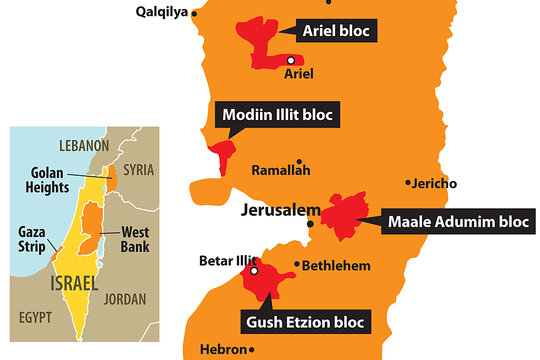
Map in CSMonitor
The swap in question would transfer 300,000 Palestinian citizens of Israel (living in the Wadi Ara region, an area known as “the triangle,” near Haifa) to the Palestinians, in exchange for Israel’s annexation of settlements in the Etzion bloc. The plan – which was previously championed by Defense Minister Avigdor Liberman, who even proposed it at the United Nations – is in effect a population transfer that would allow Israel to get rid of a large cluster of Palestinian cities, including the city where the two terrorists who attacked guards at the Haram al-Sharif/Temple Mount last week grew up.
An unnamed White House official made a statement in response to the report saying, “This may have been one of many ideas discussed several weeks ago in the context of a peace agreement and not in the context of a separate annexation.”
FMEP President Lara Friedman commented on what message Bibi’s endorsement of this idea sends: for the current Israeli government, “citizenship of Jews is inalienable right; citizenship of Arabs is revocable privilege.”
Arab Israeli MK Aida Touma-Suliman responded to the report saying, “The cat is out of the bag and Netanyahu has shown his true colors regarding the Arab population…the [Wadi] Ara residents are not only Israeli citizens, they’re also indigenous people who dwell on their land, and are not to be compared with settlers dwelling on another nation’s land. We the Arab citizens aren’t part of any such equation and aren’t willing to pay the price again for Israel’s policy of occupation and settlements.”
When Avigdor Liberman promoted the idea back in 2014, then-President Shimon Peres said, “Israel cannot take away its citizens’ citizenship simply because they’re Arab.” Then-Interior Minister Gideon Sa’ar said, “An Israeli citizen is not an object and not transferable as part of a framework political agreement.” Netanyahu has never expressed support for the plan prior to this news report, but the plan has allegedly come up in negotiations before.
The area of settlements known as the “Etzion Bloc” is home to over 22 settlements and 75,000 Israeli settlers. The loose cluster of settlements is located south of Jerusalem, extending from the 1967 Green Line deep into the West Bank; most of the settlements are on the Israeli side of the separation barrier. The major traffic junction in the area has recently seen numerous car-ramming and stabbing attacks by Palestinians targeting Israeli settlers and soldiers in the area, including an attack today that resulted in the death of the attacker and no other reported injuries.
The Knesset & Bibi Move to Gerrymander Jerusalem
In tandem with the Temple Mount/Haram al-Sharif crisis is, three important bills regarding Jerusalem’s future have advanced in the Knesset:
-

Map by Haaretz
Prime Minister Netanyahu announced his support for a bill in the Knesset that would allow 130,000 Israeli settlers living four West Bank settlements to vote in Jerusalem’s municipal elections while effectively excluding around 100,000 Palestinians from the Jerusalem municipality (most obviously the Shuafat refugee camp and Kafr Aqab, which are located outside the separation barrier). The four settlements are Maale Adumim, Givat Ze’ev, Beitar Illit, and Efrat, the last of which is six miles from Jerusalem. All are illegal under international law. Netanyahu’s support for this bill means that it is set to move forward when the Knesset’s reconvenes from its 3-month summer recess in November.
- Another bill (introduced a few days before the one described above) would allow the Israeli government to transfer Palestinian neighborhoods of Jerusalem outside the barrier to a separate, new municipality, created especially for this purpose. This bill and the one above aim to remove from the municipal area of Israel’s eternal, united capital those areas that threaten the Jewish demographic majority in Jerusalem, relegating them to a separate authority.
- These bills are complementary to a bill voted on last week that seeks to prevent the Israeli government from transferring parts of Jerusalem to a foreign power (i.e. the Palestinian government) in a future peace deal.
Settlers Set Up Outpost, Seek to Expand Settlement as “Response” to Murders
Following the horrific murder of three Israelis living in the Halamish settlement, the settlement’s leaders are seeking to consolidate and expand their illegal presence in the West Bank.
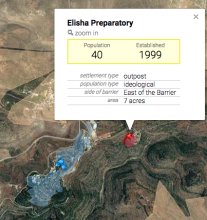
Map by Peace Now Israel
Within hours of the murder, hundreds of Halamish residents set up a campsite and a blockade of the eastern road leading to the settlement. The campsite is being called “Yad Ahi,” or “My Brother’s Hand” in memory of the three family members who were slain by a Palestinian youth last Friday. Settlers are rotating shifts inhabiting the campsite, aiming to make it an official outpost of the settlement and permanently close the road to Palestinians.
Halamish leaders are also demanding the government allow the expansion the settlement’s borders. A spokesman of the Binyamin Regional Council (which represents and provides municipal services to settlements in the Halamish region) called on the government to approve construction plans connecting the Halamish settlement to a nearby outpost called Tzofit, in order to “create a bigger security area and allow building neighborhoods that have already received zoning approvals.” Tzofit (also known as “Zufit” and/or “Elisha Preparatory”) is an illegal outpost that was established in 2007.
U.S. Ambassador David Friedman and Special Envoy Jason Greenblatt went to the illegal Halamish settlement this week to offer their condolences to the victims of the murder.
Halamish is located northwest of Ramallah, deep inside the West Bank. When the settlement was founded in the 1970s, Palestinian residents from the nearby towns of Deir Nidham and Nabi Saleh sued to stop the settlement’s construction, claiming it was being built on their villages’ land. The Israeli Supreme Court ruled in favor of the settlers, declaring the area to be state land. The Halamish settlement and its ever-growing encroachment on surrounding Palestinian villages has inspired weekly protests in Deir Nidham and Nabi Saleh, which has become infamous for weekly demonstrations – often involving clashes with the IDF – in recent years, often with international participation.
Settlers Seize Contested Building in Hebron
On the evening of July 25th — while events in Jerusalem were dominating the attention of the region and the world — 120 settlers broke into and illegally occupied a contested building near the Tomb of the Patriarchs/Ibrahimi Mosque in Hebron. The Israeli army immediately surrounded the building and on the morning of July 26th the area was declared a “closed military zone.” Prime Minister Netanyahu ordered the Defense Ministry to allow the settlers to stay as negotiations on their fate and ownership of the building continue.
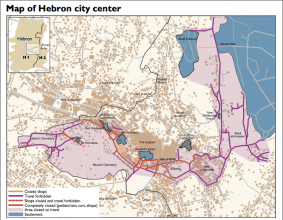
Map by B’Tselem
The Times of Israel reports that, “sources close to the prime minister said that Netanyahu was looking to avoid having to evacuate the families.” On the other hand, Yesh Atid chairman Yair Lapid called for their immediate evacuation. As of this writing, the settlers are still being allowed to illegally squat in the property.
Peace Now warned that the settler’s action can “ignite the region” and called on the government to, “follow the law and the Israeli interest and evacuate the trespassers without delay.”
J Street issued a statement calling on the U.S. government and international actors to pressure Israel to remove the settlers, saying “the Hebron settlers and their allies clearly believe that they can take advantage of the present crisis and push their long-term expansionist agenda by creating new ‘facts on the ground.’ It is vital that the prime minister and defense minister act in the best interests of Israeli security and uphold the rule of law by swiftly removing these families from the property.”
Hebron’s settlers have for some time been waging in a legal struggle to prove they legally purchased the building, known as the Machpela House. Palestinians contend they did not purchase it from the legal owners. While proceedings are ongoing, the settlers have once before broken into and occupied the building; when they did so in 2012, they were allowed to stay in the house for a week before being evacuated at the urging of the then-Attorney General of Israel who argued that it was necessary to preserve the rule of law.
Construction on New Settlement in Shilo Valley Stalled (Due to Lack of Funds)
A month after construction began on the first new settlement authorized by Israel in 25 years, the project has come to a halt – no over politics but due to insufficient government funds. The government had promised to bankroll the settlement’s construction but has not contributed to costs yet, according to the Binyamin Regional Council, which is currently footing the bill. The spokesman for the Binyamin Regional Council speculated on July 25th that the issue will be resolved quickly and expressed confidence in the government’s commitment to the project. Prime Minister Netanyahu reportedly gave orders to ensure construction is resumed quickly. As of this writing, there is no reporting to suggest construction has resumed.
High-Ranking Israeli Officials Defend Outpost from Demolition
Last week we reported on an impending demolition order against the Netiv Ha’avot outpost (near Bethlehem), along with the public relations efforts settlers were leading to elicit government intervention in their favor. The settlers got a helping hand this week when Israeli Education Minister Naftali Bennett and Yair Lapid (who heads the Yesh Atid political party) attended an event at the outpost. The Haaretz report suggests Bennett engaged in a conversation with the outpost’s leaders on how to “deal with” the demolition order and impending deadline.
Bonus Reads
- “This Synagogue Furniture Factory Is Actually a Sweatshop That Tramples Palestinians’ Rights” (July 26, 2017, Haaretz+)
- “The Settler Leader Who’s Even Charming Liberals as Israel’s Top Man in New York” (July 27, 2017, Haaretz+)
- “A Rare Glimpse: Shabak Agent Recruiting Hilltop Youth” (July 3, 2017, Jewish Press)
Welcome to FMEP’s Weekly Settlement Report, covering everything you need to know about Israeli settlement activity this week.
To receive this report via email, please click here.
July 21, 2017
- In Jerusalem’s North: The “Adam-Neve Ya’akov” Plan Resurfaces
- In Jerusalem’s South: The “Gilo Southeast” Plan Expected to Advance
- In the Shadow of Jerusalem’s Old City: Settler-Run Visitor Center is Approved
- In the Heart of East Jerusalem: Alarming Plans Advance As Expected
- U.S. Department of State: Settlements & Settlers Provoke Violence
- Settlement Outpost Near Bethlehem is Angling to Avoid Demolition
- Court Wants Settlers/Palestinians to “Negotiate” Land Theft Ex-Post Facto
- Bonus Reads
Comments, questions, or suggestions? Email Kristin McCarthy at kmccarthy@fmep.org
In Jerusalem’s North: The “Adam-Neve Ya’akov” Plan Resurfaces
The Israeli Construction & Housing Ministry announced impending plans for a 1,100 unit housing project to Jerusalem’s immediate northeast.
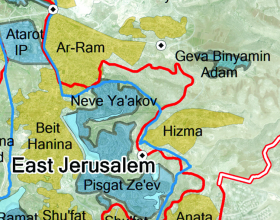
Map by Ir Amim
The plan aims to connect large settlements in East Jerusalem (Neveh Ya’akov and Pisgat Zeev) with an isolated settlement in the West Bank (Adam, aka Geva Binyamin). The land identified for the project is within the municipal boundaries of Adam, but on the Israeli side of the separation barrier (the route of the separation barrier in this area cuts deep into the West Bank). If implemented, the Adam settlement would have built up areas on both sides of the barrier.
Israeli Housing Minister Yoav Galant’s office issued a statement explaining, “We will be everywhere that it is possible to build and to provide solutions to the housing shortage, particularly, as in the case of Adam, in the vicinity of Jerusalem. In Greater Jerusalem, there is also particular security importance in Israeli [territorial] contiguity from the Gush Etzion Bloc in the south to Atarot in the north, and from Ma’aleh Adumim in the east to Givat Ze’ev in the west.”
Ir Amim writes that the plan would, “further fracture a future Palestinian state by… breaking contiguity from north to south… while isolating the southern perimeter of Ramallah from East Jerusalem, the future capital of the Palestinian state. Advancing a project of this size, given its extreme geo-political ramifications, would have a fatal impact on the two-state solution.”
The same plan was developed in the early 2000s and explored in 2007 and again in 2008, but shelved because of its political sensitivity and international concern for the future of Jerusalem and the prospects for a two-state solution. Jerusalem expert Daniel Seidemann of Terrestrial Jerusalem writes, “What is different now than in the past is talk of the plan comes in the context of an opening of the settlement floodgates in East Jerusalem, including green lights and expediting of plans the implementation of which, for any number of reasons, in the past was far-fetched or even inconceivable. Consequently, it is important to flag this scheme as early as possible, and to monitor in vigilantly.”
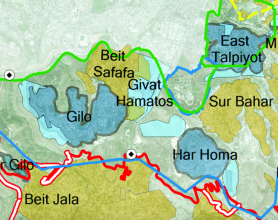
In Jerusalem’s South: The “Gilo Southeast” Plan Expected to Advance
Map by Ir Amim
The Israeli government is set to advance a plan to expand the borders of the Gilo settlement (between Jerusalem and Bethlehem) in order to build 3,000 new units. This plan, called “Gilo Southeast,” is expected to be considered at a meeting on July 26th.
If implemented, Gilo Southeast would further surround the Palestinian city of Beit Safafa, severing the town from the West Bank. An area of intense Israeli settlement infrastructure growth (a settler-only freeway divides the community, and the area has been the focus of demolitions of Palestinian homes), Beit Safafa’s Palestinian residents describe a life under siege.
Gilo Southeast is just one of several alarming plans threatening to sever Palestinian contiguity between East Jerusalem and the southern West Bank:
- Gilo Southeast would abut the border of the Givat Hamatos doomsday plan, which is only waiting for the publication of tenders to begin construction. The Givat Hamatos plan has remained blocked under the previous political calculations, but can be tendered at any moment.
- The plan would also connect Gilo to Har Homa, a fast growing settlement that was built with the Netanyahu’s approval in 1997 – the last official settlement to be built until the recent approval of the Amichai settlement.
Ir Amim writes that Gilo Southeast would create “one more link in a chain of developments designed to seal off the southern perimeter of Jerusalem from the West Bank, nullifying prospects for a two state solution.”
In the Shadow of Jerusalem’s Old City: Settler-Run Visitor Center is Approved

Map by Emek Shaveh
Last week the controversial Visitor’s Center in the Palestinian neighborhood of Silwan (known to Israelis as the “City of David” and located just outside the walls of Jerusalem’s Old City in the shadow of the Temple Mount/Haram al-Sharif) took another important step forward in the final stages of the planning process. According to the Israeli NGO Emek Shaveh, the plan “awaits final approval by the Israel Antiquities Authority, which will only be granted once the archaeological excavations at the site are completed. In our assessment this should happen soon.”
Known as the “Kedem Center,” the building is being financed and promoted by the settler-run Elad Foundation, whose goal is to establish Jewish hegemony over all of Jerusalem (i.e. erase all Palestinian presence, history, and any visibility in the city). The Center will be the largest, state-of-the-art tourism center in Jerusalem and will also serve as a station for the new cable car line approved this year, a cable car line that is designed to facilitate tourists visits to Jewish sites in East Jerusalem while preventing tourists from encountering Palestinians.
Emek Shaveh issued a statement saying, “this project will change the landscape in the area between the Old City and the village of Silwan, and will have a considerable impact on the identity of the Historic Basin. The purpose of the Kedem Center is first and foremost political – to Judaize Silwan and prevent a political solution for Jerusalem.”
The Jerusalem Post reports the Kedem Center plan was approved by Prime Minister Netanyahu as a defiant gesture following UNESCO’s decision to designate sites in Hebron as World Heritage Sites, which Netanyahu incorrectly says deny Jewish history.
In the Heart of East Jerusalem: Plans Advance as Expected
In addition to the north, south, and center settlements plans detailed above, previously reported settlement plans targeting East Jerusalem were all approved for deposit for public review at a government meeting last week. We reported extensively on these in our last edition, here. The plans approved for deposit for public review include the incendiary plans in the Palestinian East Jerusalem neighborhood of Sheikh Jarrah, and more.
Though the plans were all approved for deposit for public review, as of this writing none have been deposited (yet). Like almost every step in the Israeli settlement planning process, actually depositing the plans for public comment is itself a political decision.
U.S. Department of State: Settlements & Settlers Provoke Violence
In the recently released 2016 Country Reports on Terrorism, Secretary Tillerson’s State Department writes, “Continued drivers of violence included a lack of hope in achieving Palestinian statehood, Israeli settlement construction in the West Bank, settler violence against Palestinians in the West Bank, the perception that the Israeli government was changing the status quo on the Haram Al Sharif/Temple Mount, and IDF tactics that the Palestinians considered overly aggressive.” [emphasis added]
Notably, the 2015 Country Reports on Terrorism (an Obama Administration document) did not focus on the role of settlements or identify settlements/settlers as a “driver of violence.” The 2015 document simply noted a handful of terrorist incidents, including the trend of “price-tag attacks,” committed by settlers and committed by Palestinians near settlements.
Settlement Outpost Near Bethlehem is Angling to Avoid Demolition
A settlement outpost near Bethlehem – built illegally even under Israeli law – is fighting a decision by the Israeli Supreme Court to demolish 17 buildings that were found to have been built on land owned by Palestinians. A 2016 decision ruled that buildings in the center of the outpost sit partially on Palestinian land and must be demolished by March 2018. The NGO Yesh Din has an additional, broader petition before the High Court that seeks to prove that the whole outpost is on Palestinian land.

Map by Peace Now
The Netiv Ha’avot outpost was built in 2001 as an additional “neighborhood” of the Elazar settlement southwest of Bethlehem, but was in fact built on a hilltop near the outskirts of the settlement, on land located beyond the settlement’s borders. Forty Israeli settler families currently live there, 15 of which will be affected by the demolition orders.
The outposts’ residents are aggressively pressuring Prime Minister Netanyahu to intervene in their favor (Netanyahu has already caved to vociferous settler protests several times this year). At a demonstration in support of the outpost, signs read “This destruction too is on your watch” (referring to the Amona evacuation) and “Bibi wake up and intervene.”
Court Wants Settlers/Palestinians to “Negotiate” Land Theft Ex-Post Facto
The Israeli Supreme Court made an unusual move to try to avoid having to return private land to Palestinians. The ruling pertains to a case in the Jordan Valley, where the Israeli military seized Palestinian private land for military uses, and subsequently (and improperly, according to Israeli law) gave the land to settlers. Rather than compel the settlers to return the stolen land to its owners, the court wants the Palestinians to negotiate with the settlers for compensation. The court’s move – which is in response to a 2013 petition – is an attempt to resolve the issue without having to rule on the validity of the land seizure, and without having to compel Israel to forfeit the land and evict the settlers (even if doing so requires suspending even the pretense of the rule of law).
Haaretz explains how we got here, “After the Israeli occupation of the West Bank began in 1967, the army issued an order prohibiting Palestinians from entering the area between the border fence and the Jordan River. At the beginning of the ‘80s, the government decided to encourage farmers to work the fields to create a buffer zone with Jordan. The World Zionist Organization was given the land and leased it to settlers.”
- “In Israel’s ‘eternal capital’ anti-Palestinian discrimination is built-in” (July 16, 2017; +972 Mag)
- “Black is the New Orange: 30% of Settlers are Haredim” (July 18, 2017; Times of Israel)
- “Why Adelson is Pouring Millions of Dollars Into an Army-run Israeli University in the West Bank” (July 19, 2017; Haaretz+)
- “The Biggest Attack in Jerusalem” (July 18, 2017; Haaretz+)
- REPORT: “Insurance against political risk: Settlements and the Yanai governmental insurance corporation” (Akevot, July 21, 2017)
Overview: “Archival records, now declassified at Akevot’s request, tell the story of the financial safety net Israeli government provided for commercial companies and settlement agencies beyond the Green Line. Referred to as a “political guarantee” or “political insurance”, it protected settlers and investors in the occupied territories against such “political risks” as Israel’s evacuation from the occupied territories, policy changes or boycotts. As use of the government guarantees gradually expanded, a government insurance corporation was created, to sell insurance policies against these political risks. This is the story of the political guarantee in the occupied territories and the Yanai insurance corporation.”
FMEP has long been a trusted resource on settlement-related issues, reflecting both the excellent work of our grantees on the ground and our own in-house expertise. FMEP’s focus on settlements derives from our commitment to achieving lasting Israeli-Palestinian peace, and our recognition of the fact that Israeli settlements – established for the explicit purpose of dispossessing Palestinians in the West Bank and East Jerusalem of land and resources, and depriving them of the very possibility of self-determination in their own state with borders based on the 1967 lines – are antithetical to that goal.
Welcome to FMEP’s Weekly Settlement Report, covering everything you need to know about what is happening this week related to Israeli settlement activity – news, context, background, and why it matters.
To receive this report via email, please subscribe here.
May 19, 2017
- Statements on Israeli Settlements by the Trump Administration
- Bibi to ask for Trump’s Approval of Massive Settlement Blueprint During Visit
- Plans Actively Moving to Start Construction on Two-State-Ending Settlements
- Updates: Amona, More Settler Violence in Nablus, New Jordan Valley Outpost
Comments, questions, or suggestions? Email Kristin McCarthy at kmccarthy@fmep.org.
Statements on Israeli Settlements by the Trump Administration
Ahead of President Donald Trump’s first visit to Israel, there is still some debate about whether the United States has already shifted its policy on Israeli settlements. Here are Trump officials in their own words:
May 16, 2017: U.S. Ambassador David Friedman, ahead of President Trump’s arrival in Israel and anticipated peace push, said, “we have no demand for a settlement freeze.” Also: “If you look at what the president has said since taking office about settlements, his position has been remarkably different than the Obama administration’s. He has not come out and said that settlements are an obstacle to peace; he has not called for a settlement freeze; he has worked for the Israelis to come up with a common understanding about how they might proceed. The president is aware of the Israeli government’s need to replace the Amona community [reference to settler law-breakers evicted from an illegal outpost].”
March 20-23, 2017: In a read out of joint U.S.-Israel consultations on peace negotiations, the White House reported, “The two delegations also discussed Israeli settlement construction, following up on Prime Minister Netanyahu’s visit to Washington and Mr. Greenblatt’s recent visit to Israel. The United States delegation reiterated President Trump’s concerns regarding settlement activity in the context of moving towards a peace agreement. The Israeli delegation made clear that Israel’s intent going forward is to adopt a policy regarding settlement activity that takes those concerns into consideration. The talks were serious and constructive, and they are ongoing.”
February 15, 2017: At a press conference alongside PM Netanyahu at the White House, President Trump said, “As far as settlements, I’d like to see you hold back on settlements for a little bit. We’ll work something out.” On the same day, the White House released a read-out of Netanyahu & Trump’s private meeting, relaying “The two leaders discussed the issue of Israeli settlement construction, and agreed to continue those discussions and to work out an approach that is consistent with the goal of advancing peace and security.”
February 2, 2017: In an official statement issued after Israel announced significant new settlement plans in the West Bank, the White House said “While we don’t believe the existence of settlements is an impediment to peace, the construction of new settlements or the expansion of existing settlements beyond their current borders may not be helpful in achieving that goal.”
Bibi to ask for Trump’s Approval of Massive Settlement Blueprint During Visit
PM Netanyahu will reportedly ask for President Trump’s approval of a massive blueprint for future settlement construction that includes highly sensitive areas beyond the 1967 Green Line – including construction of Givat Hamatos and Atarot in Jerusalem (see below).
If Netanyahu in fact presents a map detailing plans for new construction, it will be a major test of President Trump’s still-unconfirmed policy shift on settlements, which is speculated to include an American “ok” for construction in East Jerusalem, settlement blocs and “bloc-adjacent” areas. As detailed previously, this shift – if it has in fact taken place – should be understood as a green light for massive settlement growth across the West Bank. The U.S. may not be the only party considering giving this green light to settlement growth; the Wall Street Journal reported this week that some Arab gulf countries are also considering accepting the parameter (the world is awaiting confirmation of this report).
Hoping for Trump’s approval of this blueprint, PM Netanyahu’s office reportedly intervened to delay a meeting of the High Planning Committee (which oversees all construction in the Occupied Territories) until after President Trump’s visit.
Plans Actively Moving to Start Construction on Two-State-Ending Settlements
New details have emerged on two alarming settlement developments that could imminently affect the future of Jerusalem, and thus any hopes of a two state solution.
 Givat Hamatos
Final tenders for the construction of Givat Hamatos are could to be published soon, at which point construction will soon start on the ground. This settlement, will completely sever Palestinian communities in Jerusalem from the West Bank, and will prevent a future division of Jerusalem that leaves Palestinian areas under Palestinian sovereignty and Israeli areas under Israeli sovereignty (map). Publishing tenders for 2,000 units in Givat Hamatos – which is, again, imminently expected – will spell the end to the future possibility of a contiguous Palestinian state. For more on Givat Hamatos – history, maps, state of play, and consequences – see the expert analysis of Terrestrial Jerusalem and Peace Now Israel.

Atarot
Israel may soon approve a plan for 10,000 units to create an ultra-orthodox settler neighborhood in Atarot, the site of a disused airport in the northern part of East Jerusalem, extending to Ramallah’s southern border. To date, no official planning approvals have been published for public review – which means that the Atarot plan has a potentially long bureaucratic process to navigate. The site was reportedly promised as the airport of a future Palestinian state. The construction of a new settlement at the site will compromise the territorial integrity of a future Palestinian state, as well as preventing a Palestinian capital in East Jerusalem. For more on Atarot, read this analysis from Jerusalem expert Danny Seidemann.
Additionally, in the center of the West Bank, a regional council run by Israeli settlers has begun soliciting construction bids to expand the illegal settlement of Kochav Yaakov. The growth – in the settlement’s ultra orthodox neighborhood called Tel Zion – was technically approved by in 1980 but never constructed. Some 37 years later, the settler council officially opened the bidding process to construct 209 new apartments. Peace Now’s Settlement Watch director Hagit Ofran noted, “There are tens of thousands of units [like these] that could be built under old plans. In practice, there was no [construction] freeze and there is no freeze in the settlements. This is a large project beyond the separation barrier that will continue to undermine the two-state solution.”
Updates: Amona Outpost-ers, More Settler Violence in Nablus, New Jordan Valley Outpost
Here are short, but important, updates on settlement news we covered in previous editions of FMEP’s Weekly Settlement Report:
- Already facing planning delays on their new settlement, the law-breaking Amona outpost-ers attempted to get expedited approval on “temporary” construction at their desired Shilo Valley hilltop; that temporary approval is now facing bureaucratic delays of it’s own.
- The greater Nablus area is once again becoming a major flashpoint of settler violence in the West Bank. A string of settler attacks on local Palestinians (and their property) escalated when a settler shot and killed a Palestinian stone-thrower in Huwarra. The settler’s gun fire also wounded a photographer with the Associated Press.
- In the northern Jordan Valley, Palestinian press is reporting a new illegal outpost being constructed by radical settlers.
FMEP has long been a trusted resource on settlement-related issues, reflecting both the excellent work of our grantees on the ground and our own in-house expertise. FMEP’s focus on settlements derives from our commitment to achieving lasting Israeli-Palestinian peace, and our recognition of the fact that Israeli settlements – established for the explicit purpose of dispossessing Palestinians in the West Bank and East Jerusalem of land and resources, and depriving them of the very possibility of self-determination in their own state with borders based on the 1967 lines – are antithetical to that goal.