Welcome to FMEP’s Weekly Settlement Report, covering everything you need to know about Israeli settlement activity this week.
To receive this report via email, please click here.
March 30, 2018
- 2017 – A Record Year in Settlement Expansion
- Hebron Settlers Leave One Disputed Property, Only to Enter Two More
- Settlers Celebrate Moving to Amichai, the First New Government-Backed Settlement in 25 Years
- Housing Minister on Annexation: Settlements are a Non-Negotiable Security Asset, Israel Must Keep Building
- Ambassador Friedman: U.S. Will Not Intervene To Stop Israeli Annexation
- After Annexing Settlement Universities, Israeli Education Ministry Moves to Censor Campus Criticism of Settlements/Occupation
- Terrestrial Jerusalem Report: “The Creation of a Settler Realm in and Around Jerusalem’s Old City”
- Al-Shabaka Policy Brief: Israel’s Annexation Crusade in Jerusalem
- Yesh Din/Emek Shaveh Report: “Appropriating the Past: Israel’s Archaeological Practices in the West Bank”
- Emek Shaveh Report: The Jerusalem Cable Car Undermines the History & Multiculturalism of the Historic Basin
- You Can’t Make This Stuff Up: Settler Lands Helicopter at Qalandiya Checkpoint (in Attempt to Seize It)
- Bonus Reads
Comments, questions, or suggestions? Email Kristin McCarthy at kmccarthy@fmep.org
2017 – A Record Year in Settlement Expansion
In its annual report on settlement activity, the settlement watchdog group Peace Now documents two significant facts about settlement growth in 2017 – the first year in the era of the Trump Administration era. Peace Now figures show that there was a large spike in new settlement starts compared to previous years; and second, most of these new construction starts are located in areas that are beyond the area that Israel can realistically expect to retain under any negotiated two-state agreement. 
Specifically, Peace Now reports that in 2017, construction began on 2,783 new settler housing units, an increase of around 17% over the yearly average rate since 2009. In terms of location of these new starts, Peace Now found that:
- More than three-quarters of the new housing starts are in settlements located deep inside the West Bank, beyond what would be a realistic border for a negotiated two-state agreement.
- Fewer than one-fifth of the new construction starts are located in areas west of the security barrier, as currently constructed (i.e., in settlements already de facto annexed to Israel by the barrier).
- At least one out of every ten of the new settlement starts is illegal according to Israeli laws (all settlements are illegal under international law), with most located in illegal outposts.
Director of the Peace Now Settlement Watch project, Shabtay Benet told i24News,
“If in the past, the government had focused on construction and housing within the blocs, it appears that the government is [today] openly working toward a reality of annexation.”
In addition, Peace Now documents in detail other major 2017 settlement-related developments, including:
- the establishment of three new illegal outposts in 2017: “Neve Achi” (near Ramallah ), “Kedem Arava” (near Jericho), and “Shabtai’s Farm” (south of Hebron).
- the establishment of the new “legal” settlement of “Amichai,” which is the first new settlement built with government approval in 25 years.
- Construction of a major new bypass road to link settlers more seamlessly to Jerusalem,
- The seizure by Israel of nearly 1,000 dunams of Palestinian land near Nablus in order to begin legalizing outposts in the area.
- The approval by the Israeli government of 31 new units for settlers in the heart of the Palestinian city of Hebron.
 The report also provides a timeline of data showing the fluctuation of Israeli government policy regarding outposts from 1996-2017. The data indicate that a 2006 pledge by Netanyahu to cease funding the construction of new outposts (a pledge that followed the publication of the government-mandated report on outposts known as the Sasson Report) expired in 2012, at which time the government began allowing (if not supporting) the construction of new outposts. Since 2012, 16 new outposts have been built and allowed to remain, some of which are now in the process of being retroactively legalized by the government.
The full report is available online here.
Hebron Settlers Leave One Disputed Property, Only to Enter Two More
After nearly eight months of illegally occupying a disputed property in Hebron, more than 100 settlers left the Beit Machpelah/Abu Rajab building. The High Court has ruled that the settlers must leave the residence while the Justices’ consider a case regarding rightful ownership of the property – a case that is not expected to wrap up in the near term.
In tandem with the departure of the settlers, the new head of the Israeli Army’s Central Command, Maj. Gen. Nadav Padan, signed an order declaring the area around the property – which is across the street from the the Tomb of the Patriarchs/Al-Ibrahimi Mosque – as a “closed military zone,” where civilian access is forbidden. Ostensibly intended to prevent the settlers from re-entering the property, the order will inevitably further restrict freedom of movement for Palestinians, who already face acute limitations resulting from segregated and closed-off streets, a maze of checkpoints, harassment by settlers living in the middle of the city, and the heavy IDF presence guarding a few hundred Israeli settlers living amidst ~150,000 Palestinians in Hebron.

Map by Peace Now
Undeterred (or emboldened) by their experience with the Beit Machpelah/Abu Rajab building, Hebron settlers subsequently broke into and occupied two additional properties in downtown Hebron (which settlers are calling “Beit Leah” and “Beit Rachel,” and which Palestinians call the “Zaatari Compound,” after the Palestinian family who owns the buildings). Like in the case of the Beit Machpelah/Abu Rajab building, ownership of these two properties is disputed, with settlers claiming to have purchased the properties lawfully from Palestinian owners, and the Palestinians denying having sold them. And like the past nearly eight months in the case of the Beit Machpelah/Abu Rajab building, the settlers are for now being allowed to stay in the two disputed properties, under the protection of the IDF, in violation of Israeli law.
Breaking the Silence – an Israeli NGO recently barred from giving tours in Hebron – told The Times of Israel that the removal of the settlers from the Beit Machpelah/Abu Rajab building was “appropriate” but:
“Still, this is just only a drop of water in the sea of illegal invasions that we guarded as soldiers… For 50 years, settlers have been establishing facts on the ground and we are being sent to guard them at the expense of the Palestinians.”
With respect to the two new properties occupied by the settlers, Peace Now said:
“The settlers’ recent break-in into the Zaatari compound constitutes just the latest in a slew of such unauthorized incidents in Hebron. Their strategy is clear. Since they have failed thus far to obtain the ownership rights legally, instead they must resort to illegal means to establish facts on the ground by squatting, knowing that the right-wing government will be reluctant to attract negative publicity from its base by evicting settlers, and will in turn attempt to delay the eviction or perhaps find a way to legalize the take-over. Fellow Israeli citizens must not give in to this emotional blackmail, and the authorities must evict these squatters without delay.”
Settlers Celebrate Moving to Amichai, the First New Government-Backed Settlement in 25 Years
Settlers who were removed from the unauthorized Amona outpost last year held a ceremony March 26, 2018, marking the day that they moved into Amichai, the new settlement that was promised to them as compensation. Amichai is the first new settlement built with government approval in 25 years. The leader of the law-breaking Amona settlers, Avichai Boaran, said at the ceremony:
“After a long wait and a stubborn struggle – tomorrow it happens. Amichai residents enter their new community! We are looking forward to entering our new homes, which we were able to establish with the blood of our hearts, with determination and faith, love for the land and for Zionism.”
The settlers will be housed in temporary mobile homes while construction continues in the settlement. The Master Plan approved for Amichai permits 102 units on a hilltop in the Shiloh Valley, a third of which face additional legal proceedings as a result of petitions filed by Palestinian landowners.
As FMEP has covered many times in the past, Amichai is the first of two new settlements approved by the Israeli government in early 2017 as pay-off to settlers who were forced to leave the Amona outpost by the High Court of Justice. That Amona outpost was established without authorization from the Israeli government and was located on private Palestinian land; the government of Israel fought for years to retroactively legalize it, but eventually was forced by the High Court to evacuate its residents (evacuation that some residents resisted violently). The establishment of Amichai clearly demonstrates that settler law-breaking not only goes unpunished, but is handsomely rewarded by the Israeli government, and that establishing illegal outposts is an effective route to establishing new settlements.
Housing Minister on Annexation: Settlements are a Non-Negotiable Security Asset, Israel Must Keep Building
Minister of Housing and Construction, Yoav Galant (Kulanu), told settler leaders that he believes Israel must bolster the settlements, calling them “non-negotiable [security] assets” that Israel must always maintain “full control” over. Galant’s remarks were made during a meeting with leaders of the Yesha Council (a settlement umbrella group) during which he also bragged about doubling the budget for settlement construction. He said:
“The Ministry of Construction and Housing, headed by me, has invested twice the budgets of the previous government in planning and development in Yehuda and Shomron.” [Note: “Yehuda and Shomron” means Judea and Samaria, the biblical names for the area in the West Bank]
Yesha Council Chairman Chananel Dorani thanked Minister Galant for his support, saying:
“Minister Galant leads the Housing Ministry to important goals and objectives for the development of the State of Israel, the area of Yehuda, Shomron and the Jordan Valley is a suitable space for massive construction and dispersal of the population of the country. I am thankful for your consistent support for the settlement, for the ideal, but also for the actions.”
Ambassador Friedman: U.S. Will Not Intervene To Stop Israeli Annexation
In an interview with an Israeli Orthodox newspaper this week, U.S. Ambassador David Friedman was quoted as suggesting that the U.S. was ready to replace President Abbas if he refused to play ball with U.S. efforts. Friedman subsequently claimed he was misquoted. He did not, however, suggest that he was misquoted on another subject that came up in that interview: possible annexation of part of the West Bank. Friedman was asked in the interview if the U.S. would support partial annexation of the West Bank. Friedman reportedly answered:
“On these issues, Israel ought to decide for itself, we will not intervene with the government in Jerusalem regarding its way of handling the conflict. We will definitely express our opinion when asked, but we’ll avoid unnecessary involvement in decision making.”
Friedman’s remark come amidst a growing wave of legislation and legal opinions pushing Israeli annexation schemes forward, none of which the U.S. has publically intervened to stop, or even criticize. To date, Israeli Prime Minister Netanyahu has held at bay the most forthright annexation legislation – like a bill to annex Ma’ale Adumim/E-1, the “Greater Jerusalem Bill,” a Jordan Valley annexation bill, and the Likud-inspired the “Annexation/Sovereignty Bill” – always citing concerns about coordinating with the United States. Friedman’s comments, which were neither clarified nor contradicted by anyone in Washington, suggest that the Trump Administration would not object to legislation of this kind moving forward.
Simultaneously, Netanyahu has allowed annexation to proceed on several more subtle fronts, including: giving government support to the “Ariel Bill” (now law) which effectively annexed settlement universities and colleges; giving government support to a bill that would transfer jurisdiction over West Bank land disputes from the High Court to the Jerusalem District Court (where a pro-settlement judge was recently installed by Justice Minister Shaked); defending the “Regulation Law” and, at least seemingly, beginning to implement it against the dictates of a court-ordered injunction; finding additional legal bases (1 and 2) to retroactively legalize outposts; installing radical settlers in government posts tasked with handling land disputes in the West Bank and East Jerusalem; and much more. These annexation policies are, of course, in addition to the day-to-day settlement construction on the ground that is gobbling up more and more West Bank land (documented in detail in Peace Now’s comprehensive report on settlement activity in 2017, discussed above).
Americans for Peace Now responded to Friedman’s latest pro-settlement, pro-annexation remarks, saying:
“Friedman is a loose cannon, whose statements on the Israeli-Palestinian conflict routinely upend longstanding US foreign policy. Given Friedman’s advocacy on their behalf, it is not difficult to see why settler leaders see President Trump and his Middle East team as sent by God.”
After Annexing Settlement Universities, Israeli Education Ministry Moves to Censor Campus Criticism of Settlements/Occupation
A month after bringing settlement universities under Israeli sovereign control (affectively annexing them), the Israeli Council of Higher Education advanced a new code of ethics that seeks to ban professors in all Israeli universities from criticising settlements or the occupation.
The new code has five principles, most having to do with preventing discrimination based on political views and affiliation. The principles include clauses prohibiting lecturers from calling for or engaging in activity that promotes an academic boycott of Israel or its academic institutions (some of which are now in the settlements), and another clause that prohibits faculty from promoting the idea of boycotting Israel.
Israel’s Association of University Heads (VERA) slammed the move as an attempt to politically censor academia, saying they will not “serve as political thought police for the government.” The statement from VERA, representing the heads of Israeli universities, goes on to say:
“We are already seeing a dangerous deterioration on the edge of the abyss with regards to freedom of expression and academic freedom, as is customary in dark countries and not in a country that claims to be a democracy. [We] do not accept the dictation from ‘the top’ and do not intend to serve as a tool for narrow political interests. We will continue to fight for academic freedom, free speech and freedom of expression in the democratic State of Israel.”
Education Minister Naftali Bennett, who requested the new code, called the statement from VERA “puzzling” and turned logic on its head to defend the new code from criticism, saying:
“We must keep the world of academic free of politics and foreign interests. Complete academic freedom – yes. Promoting political agendas and calling for a boycott – no. We are in fact limiting the freedom of condemnation and increasing the freedom of expression, so the academic discourse in Israel remains free of politics and discrimination. At the gates of academia, leave politics outside.”
Now that the new code has been adopted, the Council for Higher Education is seeking input from universities. After the input is collected, the Council will review and amend the code before bringing it up for a final vote. The Council said it aims to have the code adopted by universities by 2019, with required reporting on efforts to implement its provision due to the Council in 2020.
Terrestrial Jerusalem Report: “The Creation of a Settler Realm in and Around Jerusalem’s Old City”
Terrestrial Jerusalem published a comprehensive look at how Israel is creating a “settler realm” in Jerusalem. The report opens,
“taken as a whole, the array of ongoing projects and plans centered on the Old City and its immediate hinterlands represents an unprecedented move to fundamentally change the character and fabric of life in these areas, turning them into – as we’ve termed it in the past – a Disneyland-style area in which one historical and religious narrative, the Jewish one, predominates and marginalizes/erases all others.”

Map by Terrestrial Jerusalem
The report focuses on 12 recent and ongoing projects that are taking place largely in the context of a 2005 decision of the Sharon government – following its withdrawal from Gaza – to pursue, “a thinly veiled scheme to consolidate the settlers’ control over the public domain in the Old City and its environs.” At that point, an ad hoc, what had been an incremental settler campaign to establish Jewish hegemony over East Jerusalem became a multi-million-shekel per year government-backed endeavor to fortify a Jewish Israeli settler control over all areas of East Jerusalem and the Old City.
Commenting on the settler regime, Terrestrial Jerusalem founder Daniel Seidemann writes:
“While these are all recent developments, they reflect the culmination of a process that has been going on for many years. The data … further illustrate the predominant role played by Elad and the JDA [the Jerusalem Development Authority] in advancing settlers’ control over East Jerusalem, and the complicity of the State in doing so, as detailed in the Comptroller Report published on November 2016 (see our analysis here). Indeed, the settler “DNA” has been injected into virtually all of the governmental organs with any relevant authority in and around the Old City: the Israel Lands Authority, the Custodian General, the Absentee Property Custodian, the Israel Police, the Planning Committees, the Jerusalem Municipality, the Ministry of Finance and many more. Similarly, many of the authorities of these governmental agencies have been outsourced to the settlers. The governmental adoption of the settler ideology and the outsourcing of governmental authority create a situation in which the public interest and the settler interest have become virtually indistinguishable. No new master plan has been created, and none is necessary – the brakes that slowed these schemes have merely been removed. Israel remains a feisty, albeit increasingly challenged democracy: when it comes to the Old City and its visual basin, it morphs into something highly reminiscent of a regime.”
Al-Shabaka Policy Brief: Israel’s Annexation Crusade in Jerusalem
A new report from Al-Shabaka: The Palestinian Policy Network, titled “Israel’s Annexation Crusade in Jerusalem: The Role of Ma’ale Adumim and the E1 Corridor,” paints a picture of Israeli policies building towards the eventual annexation of the settlements bordering Jerusalem, paying particular attention to the history and centrality of the Ma’ale Adumim and E1 settlement areas. Though Netanyahu has delayed the outright annexation of these settlements by blocking the passage of the “Greater Jerusalem Bill,” Al-Shabaka’s brief examines several other bills, projects, resolutions, and regulations that effectively advance the annexation more subtly.
The report’s author, Zena Agha, concludes with key recommendations emphasizing the need to more stridently highlight and oppose the Israeli settlement enterprise and the creeping annexation inherent in recent policies. Agha writes,
“Since it is evident that the Trump administration will not be the restraining force on the right-wing coalition in the Knesset, nations other than the US as well as international bodies must apply pressure on the Israeli government to ensure any annexation bill is costly. Palestinian civil society and the Palestine solidarity movement must go further in raising awareness of how close the Israeli settlement project is to the point of no return in their current and planned campaigns with policymakers.”
Yesh Din/Emek Shaveh Report: “Appropriating the Past: Israel’s Archaeological Practices in the West Bank”
In a new joint report documenting a 4-year project, Emek Shaveh and Yesh Din reveal how Israeli organizations used a guise of archaeological preservation to dispossess Palestinians of privately owned land across the West Bank since 1967. The report, titled “Appropriating the Past: Israel’s Archaeological Practices in the West Bank,” introduces the topic by explaining:
“Israel continues to use its position as the administrator of archaeological sites in the West Bank as a means to deepen its control over West Bank land, to expand the settlement enterprise, and extend the policy of dispossession of Palestinians from their lands and cultural assets. Although the takeover of land through archaeology is not the main method of achieving Israeli control over land, it is significant because of its symbolic aspects and impact on public awareness.”
The report goes on to document several examples of how archaeology is used to advance settlements. Those include:
- Gerrymandering the jurisdiction of settlements to include antiquity sites, as in the case of the Anatot-Almon settlement and the Tel-Alamit antiquity site;
- Illegally invading of antiquity sites, as in the case of the Ain al Qaws spring near Nabi Saleh; and,
- Using archaeological excavations to retroactively justify the establishment of new settlements, as in the case of the Shiloh settlement and the now evacuated Amona outpost.
The report concludes:
“By controlling all aspects of archaeology – the excavations, management of the sites, the interpretation of the nds, and which knowledge is disclosed to (or concealed from) the public – Israel appropriates the archaeological treasures uncovered in the West Bank and exploits them in order to sustain a narrative of continued Israeli control over the OPT.”
The report is available online here.
Emek Shaveh Report: The Jerusalem Cable Car Undermines the History & Multiculturalism of the Historic Basin
In a recent paper, the Israeli NGO Emek Shaveh analyzes the detrimental impacts of the new Israeli cable car project, including the dispossession and tangible economic consequences facing Palestinian Jerusalemites.
The paper concludes:
“The cable car is an experimental project driven by political interests in the most important and sensitive site in our region – the Old City of Jerusalem. Although this project is presented to the public as a response to transportation and tourism needs, its goal is political – strengthening Israel’s hold on East Jerusalem with a national-religious narrative and by “establishing facts on the ground” that will erase the chances of a historic compromise in the Holy Basin and the rich cultural diversity of the city. The cable car will also seriously damage the historical nature of the Old City and corrupt its famous beauty, which attracts visitors from all over the world.”
FMEP has tracked the planning process for the cable car, a project promoted by the settler group Elad. Elad aggressively pursues the eviction of Palestinians and the growing presence of Jewish Israelis across East Jerusalem, but particularly in the Silwan neighborhood where the Kedem Center is being built to serve as the final stop of the cable car line. The project has been harshly critiqued by the international community.
You Can’t Make This Stuff Up: Settler Lands Helicopter at Qalandiya Checkpoint (in Attempt to Seize It)
This week, Yedidya Meshulami – a settler living in an illegal outpost near Nablus – attempted to usurp the Israeli Army and take control of the Qalandiya checkpoint by landing his personal helicopter nearby, declaring “I don’t care what they do to me, I’ll take it [the checkpoint] over.” Israeli security forces arrested Meshulami and seized his helicopter (shortly thereafter he was released to house arrest; it goes without saying that had he been a Palestinian seeking to take over the checkpoint by any means whatsoever, he would still be in custody). The Qalandiya checkpoint is the most heavily trafficked checkpoint in the West Bank, through which 26,000 Palestinians (who are lucky enough to have permits to enter Israel) pass en route to Jerusalem on a daily basis.
Meshulami landed his helicopter at the site of the defunct Atarot airport, situated on a strategic strip of land between Jerusalem and Ramallah near the Qalandiya checkpoint he hoped to take control over. Rumors concerning plans to build a settlement at the Atarot site have been rumbling for over a year, fed by the Knesset’s decision to allocate millions of shekels to the project last October. Developing the airport into an Israeli settlement would deprive a future Palestinian state of the only airport in the West Bank, would cut through many Palestinian neighborhoods, and would further sever East Jerusalem from a Palestinian state (acting like E-1 on Jerusalem’s northeast flank, and like Givat Hamatos on Jerusalem’s southern flank).
Meshulami, lives in an unauthorized outpost called “Alumot” near the settlement of Itamar, south of Nablus. Meshulami helped establish the outpost in 1996 after serving in the Israeli Air Force and, despite lacking permits, he personally built an airstrip in the outpost in 2013. According to reports this week, Israeli security forces had previously revoked Meshulami’s pilot license for flying over the West Bank without a permit. Two days after his arrest, the IDF raided the illegal airstip and seized a second helicopter. They also found an ultralight plane that will reportedly be seized in the coming days.
Bonus Reads
- VIDEO: Times of Israel Settlements Correspondent Jacob Magid discusses internal settler dynamis w/ Ron Kampeas (FMEP)
- “Settler Violence Against Palestinians Is on the Rise, but Goes Regularly Unpunished” (Haaretz)
- “Israel’s government and the settlers want terror.” (Haaretz+)
- “Israel’s Separation Barrier: Legitimate in theory, malicious in practice” (Times of Israel)
Welcome to FMEP’s Weekly Settlement Report, covering everything you need to know about Israeli settlement activity this week.
To receive this report via email, please click here.
January 19, 2018
- The Havat Gilad Outpost Saga Continues
- Defense Ministry Working to Retroactively Legalize 70 Outposts
- Bill to Annex Settlements into the Jerusalem Municipality Regains Steam
- First New Israeli Bypass Road in 11 Years Set to Open Near Qalqilya
- Dispossession in the Northern Jordan Valley: Settlements and outposts as part of the land grab process
- Human Rights Watch Report Slams Israeli Settlements
- Bonus Reads
Comments, questions, or suggestions? Email Kristin McCarthy at kmccarthy@fmep.org.
The Havat Gilad Outpost Saga Continues

Map by Haaretz
The bid to retroactively legalize the Havat Gilad outpost – home to the Israeli settler who was murdered January 9, 2018 – took several turns over the past week. Two days after the murder, Prime Minister Netanyahu ordered the Defense Ministry to connect the illegal outpost to the Israeli national power grid, a move that would require the kind of major infrastructure work that would entrench the outpost’s presence. On January 15th, Israeli Defense Minister Avigdor Liberman (who is himself a settler) presented a symbolic resolution to the Israeli cabinet that calls for the retroactive legalization for the Havat Gilad. The settler-run news outlet Arutz reported on January 18th that Netanyahu has decided the Israeli cabinet will not consider the resolution on Havat Gilad during its weekly meeting scheduled for this Sunday.
All of this comes amidst widespread and growing calls for the outpost to be legalized. Efforts to turn Havat Gilad into a legal settlement appear, however, to have hit a major snag. On January 15th, Israeli security sources reportedly told the government that the outpost is not eligible for legalization under Israel’s regulation law (specifically passed last year to give Israel a way to suspend the rule of law in order to legalize illegal outposts that could not be legalized any other way). The security sources explained that Havat Gilad was built almost entirely on land that the Israeli land registrar for the West Bank has documented as privately owned by Palestinians. Israeli recognition of Palestinian ownership of the land ostensibly makes Israel’s retroactive legalization of the outpost impossible; the constant evolution of Israeli laws and legal precedents that are crafted to pave the way for regulating all unauthorized Israeli settlement activity in the West Bank, however, suggest that where there is sufficient political will, rule of law (or even the semblance thereof) will not be allowed to stand in the way. In the waning weeks of 2017, the Israeli Attorney General submitted two highly consequential legal opinions (1 & 2) that validate Israeli expropriation of privately owned land for the exclusive benefit of settlers and the regulation of unauthorized outposts. So while regulating Havat Gilad might be impossible under current Israeli law and precedent, there is every reason to expect that this obstacle will be challenged and overcome.
Defense Ministry Working to Retroactively Legalize 70 Outposts
While the fate of the Havat Gilad outpost is occupying headlines, a leaked recording shed light on the Israeli Defense Ministry’s ongoing efforts to advance the retroactive legalization of 70 settlement outposts built illegally (according event to Israeli law) across the West Bank.
Israeli Deputy Defense Minister Ben Dahan was recorded bragging that the Defense Ministry has begun charting out a process to legalize the 70 illegal outposts, with a 4-5 person team working for the past six months to catalogue every outpost’s unique situation and to prescribe a course of action for each.
Around the same time this outpost team reportedly started its work, Israeli Attorney General Avichai Mandleblit forced Defense Minister Liberman to create a division in the Defense Ministry responsible for enforcing Israeli planning laws in settlements and outposts. It was also around this same time that the Israeli government offered its first defense of the Regulation Law to the High Court of Justice, which Liberman criticized vehemently, arguing that the law could legalize Palestinian construction as well as Israeli.
After the recording made headlines this week, Deputy Defense Minister Dahan was reprimanded and banned from participating in future government efforts to legalize outposts. Notably, the reprimand/ban appears to have little to nothing to do with the activities Dahan was engaged in (Israel’s Regulation Law was passed in order to legalize outposts, the Defense Ministry has a leading role in making that happen, and everyone knew the Ministry was forging ahead with that goal), and more to do with the fact that Dahan was caught bragging about the details of a process that Liberman apparently preferred to keep secret.
Bill to Annex Settlements into the Jerusalem Municipality Regains Steam
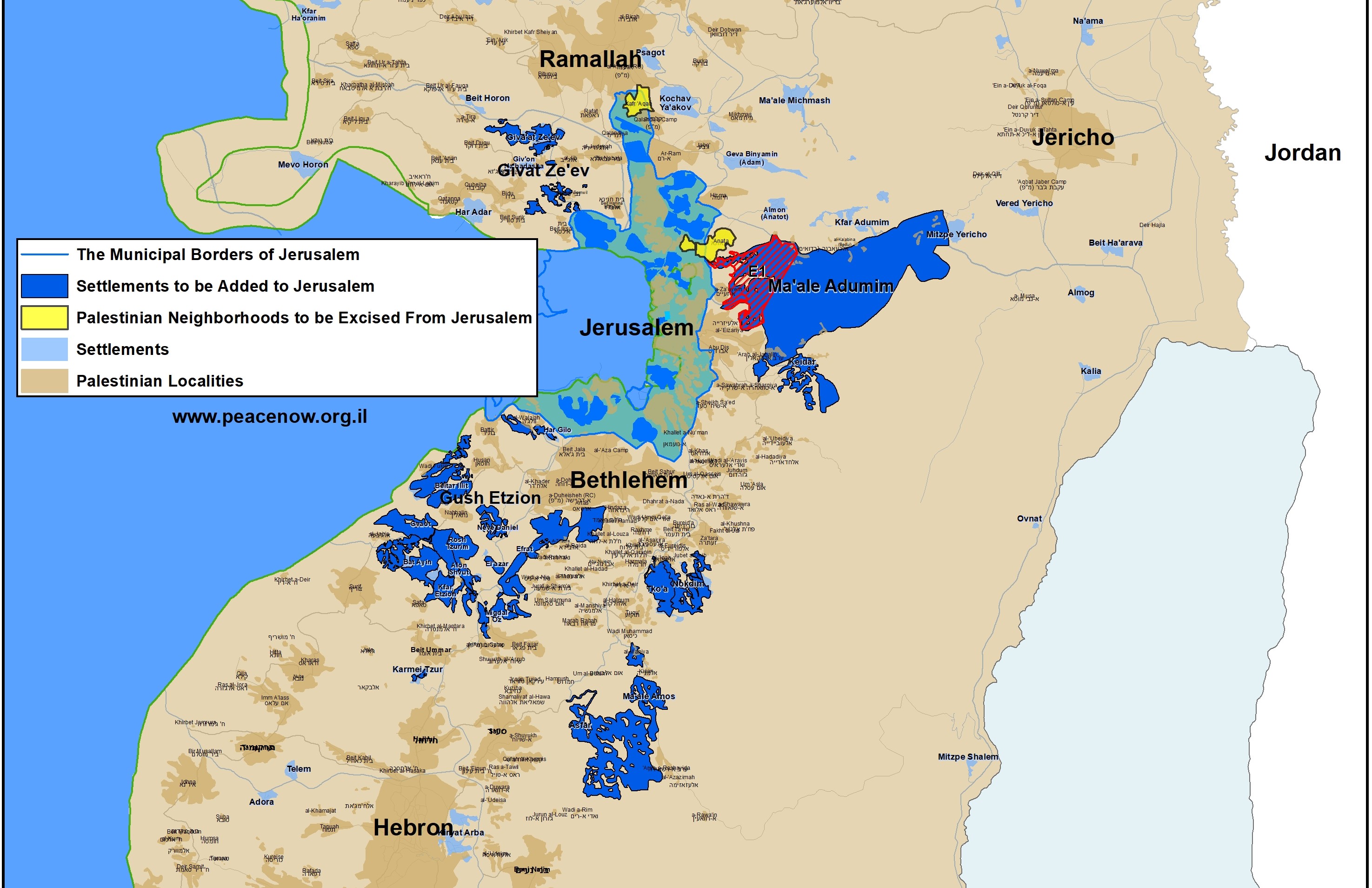
Map by Peace Now
Jerusalem expert Danny Seidemann’s NGO, Terrestrial Jerusalem, reports that the Greater Jerusalem bill – which seeks to annex far-flung settlements into the Jerusalem municipality, thereby de facto annexing a large part of the West Bank and gerrymandering a Jewish majority in the city – has renewed momentum.
In October 2017, Netanyahu backed down from advancing the controversial bill, reportedly under pressure from the Trump administration. Now, Netanyahu is once again coming under significant pressure from his own party (recall that on January 1, 2018 the Likud central committee voted in favor of a resolution calling on Netanyahu to annex the settlements) to allow the legislation to move in the Knesset.
First New Israeli Bypass Road in 11 Years Set to Open Near Qalqilya
The Israeli NGO Kerem Navot reports and documents the first new Israeli bypass road in the West Bank in more than a decade is set to open near Qalailya. Kerem Navot writes:
Most of the bypass roads in the West Bank were built during the 1990s, in parallel to the signing of the Oslo Accords. The last completed bypass road was the Liberman Road built in 2007, connecting Jerusalem with the settlements of Tekoa and Nokdim, southeast of Bethlehem.
This is the Nabi Ilyas bypass road, which is 3.3 kilometers long. The road will enable settlers of Ma’ale Shomron, Karnei Shomron and Kedumim to build settlements along the Qalqiliya Nablus road (Road 55), bypassing the village of Nabi Ilyas and expediting travel time from the settlements into and out of Israel. The road was built following massive pressure from the settler lobby, demanding that Netanyahu approve and fund the construction of two additional bypass roads. And indeed, Channel 7 recently reported that Netanyahu approved and allocated 800 million shekels for the paving of bypass roads in the West Bank.
This is first and foremost for two additional bypass roads that settlers have been trying to promote for years: the bypass road to Al Arroub and the Huwwara bypass road. These roads, too, are planned to be paved on cultivated agricultural land and their paving will cause enormous fiscal damage to residents whose lands will be lost. A third road that settlers are now trying to advance is the Shilo bypass road, which is meant to connect Route 60 with the Alon Road, part of which was already breached in the 1990s. This road is also intended to serve as the access road to the new settlement of Amichai, which Israel is currently building for Amona evacuees.
In November 2014 we exposed Israel’s full-fledged road plan throughout the West Bank. This is a “contingency plan” that was formulated over two decades after Oslo and is comprised of 44 plans for roads proposed by Israel in the territories. The plans have not yet been implemented, though 24 of them have already been approved. The total length of the roads already approved is approximately 157 kilometers.
Upon assessing the mass and sprawl of the roads approved over the years following Oslo, as with the planned roads yet to be approved, it is clear that, contrary to all official declarations, Israeli governments have not internalized the idea that an independent Palestinian state will be established in the West Bank. Israel continues to invest in planning expensive infrastructure deep in the West Bank, intended to entrench settlements and perforate Palestinian contiguity.
Dispossession in the Northern Jordan Valley: Settlements and outposts as part of the land grab process
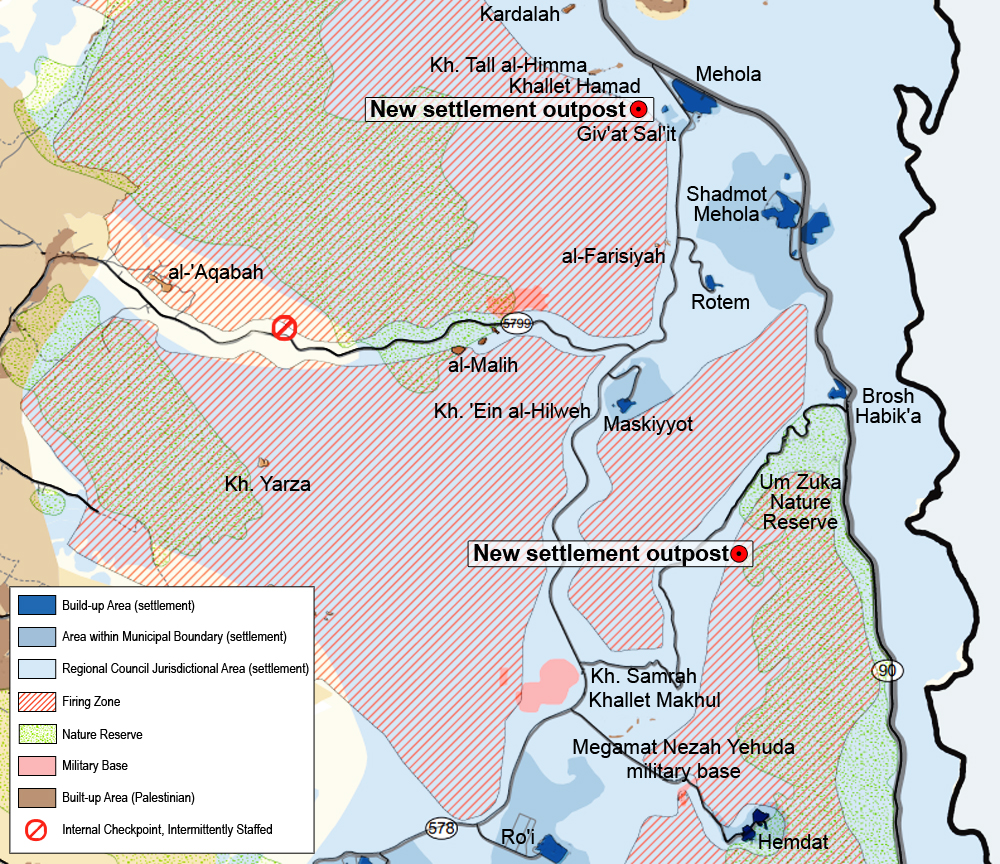
Map by B’Tselem
In a new report, B’Tselem documents how two new outposts that were established in the northern Jordan Valley in 2017 have contributed to the escalating dispossession of Palestinian communities in the Jordan Valley, where Israel retains exclusive control over and access to 85% of the land.
At the same time the outposts were allowed to grow, Israel also engaged in policies that amount to the forcible displacement of Palestinian communities around them: Since the outposts were established, the Israeli military has demolished 205 Palestinian structures in nearby communities, rendering 391 people homeless, including 157 children. The Israeli military has also refused to intervene or arrest settlers who engage use violence tactics in order to prevent Palestinians from accessing their lands.
The report concludes:
The establishment of the two new settlement outposts helps Israel realize its main goal for the West Bank: dispossessing Palestinian residents of their homes and land, and taking over their property. Each of the restrictions the state imposes on the Palestinian residents has enabled settlers to encroach on their land, build settlements and settlement outposts and take over vast areas around them. The state may say that the settlement outposts are “illegal” and are a “private initiative” by the settlers, but these claims ring hollow given Israel’s complete inaction to change this reality. The state’s refusal to remove the settlement outposts, prevent the routine attacks and prosecute those responsible for them speaks volumes as to Israel’s reliance on the settlers’ criminal behavior to entrench its control of the area while paying lip service to the law by formally disavowing any ties to them. These actions complement the official measures Israel takes in its pursuit of Palestinian dispossession in the area (and in other parts of the West Bank) and play a key role in the implementation of its policy.
Human Rights Watch Report Slams Israeli Settlements
In its “World Report 2018,” Human Rights Watch provides updated information on how Israeli settlement activity in 2017 ran afoul of international law and significantly contributed to the ongoing violation of Palestinian human rights.
Human Rights Watch reports:
Israel continued to provide security, administrative services, housing, education, and medical care for about 607,000 settlers residing in unlawful settlements in the West Bank, including East Jerusalem. Israel’s building of 2,000 new settlement housing units in the period between July 2016 and June 2017 marked an 18 percent decrease over the same period in 2015-2016, but Israeli authorities approved plans for 85 percent more housing units in the first half of 2017 than all of 2016, according to the Israeli group Peace Now. International humanitarian law bars an occupying power’s transfer of its civilians to occupied territory.
Building permits are difficult, if not impossible, for Palestinians to obtain in East Jerusalem or in the 60 percent of the West Bank under exclusive Israeli control (Area C). This has driven Palestinians to construct housing and business structures that are at constant risk of demolition or confiscation by Israel on the grounds of being unauthorized. Palestinians in these areas have access to water, electricity, schools, and other state services that are either far more limited or costlier than the same services that the state makes available to Jewish settlers there.
Of the 381 Palestinian homes and other property demolished in the West Bank (including East Jerusalem) in 2017 as of November 6, displacing 588 people, Israeli authorities sought to justify most for failure to have a building permit. Israel also destroyed the homes of families in retaliation for attacks on Israelis allegedly carried out by a family member, a violation of the international humanitarian law prohibition on collective punishment.
Bonus Reads
- “With Trump in power, emboldened Israelis try redrawing Jerusalem’s borders” (Washington Post)
- “Israeli Army Considering Taking Control of Palestinian Areas in East Jerusalem” (Haaretz)
- “Prominent Right-wing NGO Receives Millions of Shekels in Public Funds” (Haaretz)
FMEP has long been a trusted resource on settlement-related issues, reflecting both the excellent work of our grantees on the ground and our own in-house expertise. FMEP’s focus on settlements derives from our commitment to achieving lasting Israeli-Palestinian peace, and our recognition of the fact that Israeli settlements – established for the explicit purpose of dispossessing Palestinians in the West Bank and East Jerusalem of land and resources, and depriving them of the very possibility of self-determination in their own state with borders based on the 1967 lines – are antithetical to that goal.
Welcome to FMEP’s Weekly Settlement Report, covering everything you need to know about Israeli settlement activity this week.
To receive this report via email, please click here.
November 30, 2017
- Israeli Attorney General Argues Against “Regulation Law,” But Endorses its Goal
- One Structure Demolished in the Netiv Ha’avot Outpost, But Will Others Follow?
- Interior Ministry Pushes Plan for a New Settlement City in West Bank “Seam-Line” Region
- Ir Amim & Bimkom Report – “Deliberately Planned: A Policy to Thwart Planning in the Palestinian Neighborhoods of Jerusalem”
- UPDATES: Bedouin Communities Fight Eviction; Jerusalem “Supermajority” Bill Advances
- Bonus Reads
Comments, questions, or suggestions? Email Kristin McCarthy at kmccarthy@fmep.org.
Israeli Attorney General Argues Against “Regulation Law,” But Endorses its Goal
On November 22nd, Israeli Attorney General Avichai Mandleblit issued his much-anticipated response to a petition before the Supreme Court challenging the constitutionality of the “Regulation Law,” a law passed by the Knesset in February 2017 paving the way for the retroactive legalization of 55 Israeli outposts, 4,000 illegally constructed settlement units, and seizure of thousands of dunams of Palestinian agricultural land. Two petitions were filed against the law, one by a group of Israeli NGOs (ACRI, Peace Now, and Yesh Din),the second by a group of Palestinian NGOs including Al-Mezan and Adalah.
In a 72-page opinion, AG Mandleblit said the law is “a sweeping and injurious arrangement that does not meet the test of proportionality,” adding it “will also cause severe discrimination against the Palestinian population in the region.” At the same time, Mandelblit’s underlying argument – consistent with his actions and words in recent weeks – effectively endorsed the goal of retroactively legalizing the illegal construction and land seizures through other legal means.
The Palestinian NGOs sharply criticized the AG’s opinion, saying:
Although Israeli Attorney General Avichai Mandelblit maintains that the law should be repealed, his position is still problematic from the standpoint of international law. In parallel to his opposition to the law, the AG noted that “validating” the settlements is a worthy act and that the State of Israel now has a number of other tools at its disposal that allow it to “validate” Israeli construction on private Palestinian land that was transferred to a settlement “in good faith.”
In the AG’s response, he authorizes use of these tools including, amongst other measures, expropriation of Palestinian land for “public needs,” such “regulating” the construction of an access road to an illegal Israeli settlement outpost.
Adalah, JLAC, and Al Mezan emphasize that the AG’s position clashes directly with international law explicitly forbidding the construction of settlements and the transfer of the occupying power’s civilian population into occupied territory – this is considered a war crime. International law specifically bans harm to Palestinian property in the West Bank for the purposes of development and expansion of settlements.
Peace Now, ACRI, and Yesh Din also issued a joint statement criticizing the Attorney General for his support for retroactive legalization by means other than the Regulation Law, saying:
…despite opposing the “Regularization Law”, Mandelblit has recently approved other legal steps to allow for the takeover of privately owned Palestinian land. During the past two weeks, the AG issued two legal opinions, one concerning land near the Haresha outpost and another in Ofra, in which he approved expropriation of private Palestinian land for the sole benefit of settlements.
In his legal opinions Mandelblit fails to recognize that any takeover of private Palestinian land for the purpose of settlements stands in violation of IHL, specifically the laws of occupation that apply to the West Bank.
The undersigned organizations [ACRI, Peace Now, and Yesh Din] will continue to work against any government initiative, whether through legislation or by form of legal opinions, which violates human rights of Palestinians in the West Bank.
One Structure Demolished in the Netiv Ha’avot Outpost, But Will Others Follow?
On November 29th, the Israeli army razed an illegally-built structure in the unauthorized outpost of Netiv Ha’avot, near the Elazar settlement south of Jerusalem. Dozens of settlers protested the demolition by barricading themselves inside, forcing the Israeli army to remove them one-by-one against their protests before demolishing the building.
As FMEP reported in October, the Supreme Court upheld a 2016 decision ordering the demolition of 17 structures in Netiv Ha’avot that were built on privately owned Palestinian land. The structure razed on November 29th was the second to be demolished in accordance with this ruling, following the razing of a memorial statue earlier this year. The remaining 15 structures are residential homes and must be demolished by March 2018, according to the court order.

Map by Haaretz
However, Haaretz reports that Israeli Attorney General Avichai Mandleblit will soon decide whether to save six of the remaining structures from complete demolition by issuing building permits for the sections of the homes that were built (without permits) on Israeli state land. The six structures – unlike the remaining nine – were built mostly on land that has not been proven to be privately owned by Palestinians (allowing Israel to seize it as “state land”). As FMEP reported last month, the Supreme Court has already dismissed a similar petition submitted by the settlers arguing for partial demolitions; the AG’s issuance of building permits would circumvent the court’s decision.
The Netiv Ha’avot settlers are also fighting to retroactively legalize the entire unauthorized Netiv Ha’avot outpost (not only the 17 structures that have been ordered to be demolished), which was built without permission from the Israeli government. In October, the High Planning Council advanced plans to build homes for Netiv Ha’avot residents in an alternate, ostensibly permitted, location; however, the plans specified a parcel of land that is also problematic under Israeli law because it is outside of the borders of any “legal” settlement. Indicative of how the settlement planning process often rewards illegal settlement activity with more settlement activity, the Council sought to address this challenge by ordering the borders of the nearby Alon Shvut settlement to be expanded to incorporate the land where the structures are planned to be built.
Interior Ministry Pushes Plan for a New Settlement City in West Bank “Seam-Line” Region
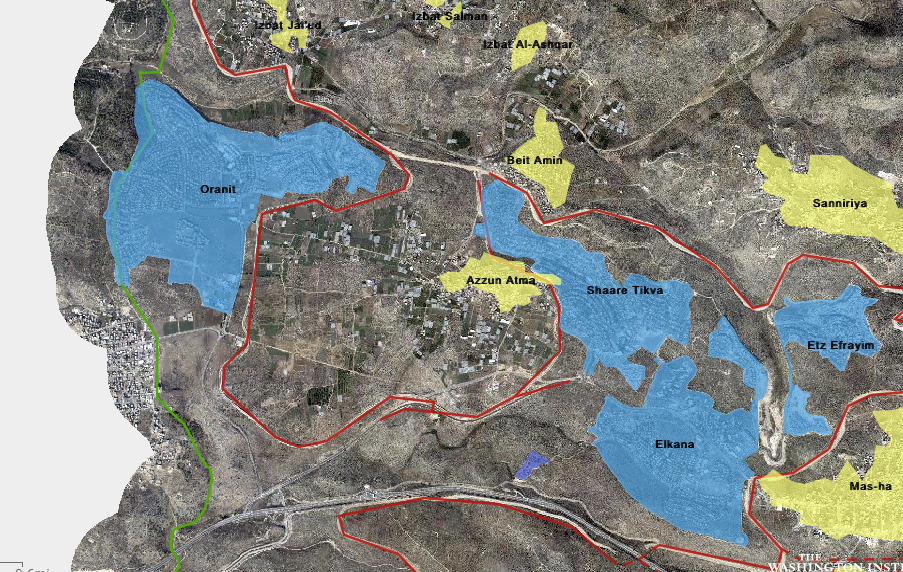
Map by WINEP
The Israeli Interior Ministry has reportedly recommended creating a new Israeli [settlement] city in the West Bank that unites four West Bank settlements – Etz Efraim, Sha’arei Tikva, Oranit and Elkana – allowing for increased construction on the land between them. The four settlements are all located in the “seam-line” zone, the area created by the weaving route of the Israeli separation barrier that was built to keep many settlements on the Israeli side of the barrier despite being east of the 1967 Green Line.
FMEP will report more details on this story as it develops.
Ir Amim & Bimkom Report – “Deliberately Planned: A Policy to Thwart Planning in the Palestinian Neighborhoods of Jerusalem”
A new report by Ir Amim and Bimkom shines a harsh spotlight on the discriminatory urban planning process in East Jerusalem, as well as the increasing rate of home demolitions that, coupled with settlement expansion, are undermining the future of the Palestinian community there. In three case studies, the report’s authors look at how Israel deliberately blocks applications for planning and building in Palestinian neighborhoods in East Jerusalem, making it impossible for Palestinians to build legally.
Ir Amim & Bimkom write
This discrimination in planning is the product of a policy driven by demographic considerations – in particular, the objective of increasing the Israeli population while reducing the Palestinian population, with the underlying goal of ensuring Jewish demographic superiority….
The outcome of this policy has a devastating impact at both the individual and community levels. Barriers to legal building push many Palestinians to build without permits. Each year, the Jerusalem Municipality (herein, Municipality) and the District Planning Bureau (formerly under the auspices of the Interior Ministry and now the Finance Ministry), demolish dozens of housing units constructed without permits in the Palestinian neighborhoods of East Jerusalem; in 2016 alone, the authorities demolished 123 housing units. The psychological and economic ramifications of this reality are profound. Moreover, inadequate planning prevents the construction of schools and the development of public spaces and employment and commercial zones, thereby weakening the community as a whole.
This treatment is clearly discriminatory, particularly when contrasted with the fact that the Israeli government continues to approve and fast-track approvals both for settlement planning in construction in major settlement neighborhoods of East Jerusalem and in settlement enclaves located in the heart of Palestinian neighborhoods. For details see this recent report from Peace Now.
UPDATES: Bedouin Communities Fight Eviction; Jerusalem “Supermajority” Bill Advances
- Over 100 Palestinians joined residents of Jabal al-Baba to protest the Bedouin community’s imminent eviction from the E-1 settlement area just east of Jerusalem. The Jabal al-Baba community, which has lived in the area since it was expelled from the Negev in 1948, was given an eviction notice earlier this month demanding that it leave the area and stating that all structures there will be demolished. Jabal al-Baba is one of the many Bedouin communities located near Israeli settlements in Area C that are facing the imminent threat of eviction; the Khan al-Ahmar community (also located in the Maale Adumim/E-1 area) and two Jordan Valley bedouin villages have also been ordered to leave their land. The European Union has called on Israel to halt the planned demolitions. The EU statement also highlighted the impending demolition of Susiya, a Palestinian city in the South Hebron Hills. Both Susiya and Khan al-Ahmar were the subject of concern of a recent letter to Prime Minister Netanyahu, signed by 10 U.S. Senators, demanding the demolitions be canceled and articulating serious concerns about the settlement enterprise, saying, “these communities are currently facing the imminent threat of evacuations and demolitions, and have been targeted by settlement movement activists seeking to entrench the Israeli occupation and prevent the ultimate creation of an independent Palestinian state.”
- The Knesset’s Constitution, Law & Justice Committee voted to advance a bill that, if passed into law, will require a supermajority of votes in the Knesset to approve any deal that transfers sovereignty of any part of Jerusalem to a foreign power. This law would in effect give a minority in the Knesset veto power over any future peace deal with the Palestinians. The bill is now set for two final votes in the Knesset before becoming law. Ir Amim provides valuable analysis of the bill, and points out that the language is careful to differentiate between territorial concessions and municipal changes, a distinction that is apparently intended to support other pending legislation that would bureaucratically excise some Palestinian neighborhoods from Jerusalem – a move that the Knesset is also considering in order to manufacture and preserve a Jewish majority in the city.
Bonus Reads
- “UN Settlement Business Data Can Stem Abuse” (Human Rights Watch)
- “Border Homes, in Jerusalem but Not, Face an Existential Deadline” (New York Times)
- “Why Won’t Israel Let Me Mourn My Father?” (New York Times)
- “US Ambassador David Friedman Drops Out of West Bank Memorial Ceremony for Murdered US Citizen” (Jerusalem Post)
__
FMEP has long been a trusted resource on settlement-related issues, reflecting both the excellent work of our grantees on the ground and our own in-house expertise. FMEP’s focus on settlements derives from our commitment to achieving lasting Israeli-Palestinian peace, and our recognition of the fact that Israeli settlements – established for the explicit purpose of dispossessing Palestinians in the West Bank and East Jerusalem of land and resources, and depriving them of the very possibility of self-determination in their own state with borders based on the 1967 lines – are antithetical to that goal.
Welcome to FMEP’s Weekly Settlement Report, covering everything you need to know about Israeli settlement activity this week.
To subscribe to this report, please click here.
November 9, 2017
- Netanyahu Writes $57 Million Check for West Bank Settlement Roads
- Israel Moves to Expand Karnei Shomron Settlement
- State-Funded NGO Moves to Legalize Outpost
- Knesset Holds Special Hearing on Jerusalem Annexation and Gerrymandering Plans
- Netanyahu Takes His Case for Settlements to London
- Bonus Reads
Comments, questions, or suggestions? Email Kristin McCarthy at kmccarthy@fmep.org.
Netanyahu Writes $57 Million Check for West Bank Settlement Roads
Two weeks into a hunger strike led by settlers demanding government funding for security and infrastructure projects, on November 6th Israeli Prime Minister Netanyahu delivered a check for $57 million (USD) to fund the fortification of settler-only bypass roads in the West Bank. Peace Now has detailed reports on the five bypass roads, four of which service settlements deep inside the West Bank at the acute expense of Palestinians, that are part of Netanyahu’s promise to improve security infrastructure for the settlers over the next two years.
The payment is, in principle, advance installment on a $939 million budget Defense Minister Liberman has promised for settler security projects through 2019. Under escalating pressure from settlers who have lost family members in attacks, n Oct. 25th Netanyahu had promised that $228 million of the funds would be invested in 2018. Unsatisfied with that commitment, settlers launched a hunger strike – producing $57 million in immediate results.
Israel Moves to Expand Karnei Shomron Settlement
Israel has begun clearing nearly 2,200 landmines from West Bank land near the Karnei Shomron settlement in preparation for building 1,200 new units. Deputy Defense Minister Eli Ben-Dahan said that the new units will bring “a million Jews who will live in Judea and Samaria in the future.”

Map by B’Tselem
The Karnei Shomron settlement is located east of Qalqilya, a large Palestinian city that is literally surrounded on three sides by Israel’s separation barrier. A checkpoint restricting the town’s only outlet to the West Bank and the separation barrier cuts the village off from its historic agricultural lands. Earlier this year, settler leaders and the Knesset killed a plan promoted by PM Netanyahu and Defense Minister Liberman to permit the construction of 14,000 new homes in Qalqilya for Palestinians.
Israel has repeatedly confiscated land between Qalqilya and Karnei Shomron by declaring it as “state land.” In January 2016, Israel expropriated 104 dunams from Qalqilya in order to build a bypass road to Karnei Shomron. In November 2015 Israel seized 30 dunams of land near Karnei Shomron in order to retroactively legalize settlement structures built there previously. The 2015 declaration was the first time in over a year that Israel used the maneuver to expropriate land.
Landmines are buried across the West Bank, many being relics of pre-1967 conflicts. This mine-clearing effort, explicitly designed for the expansion of a settlement, is the first-ever governmental effort to address the issue since 1967. Indeed, mine-clearance experts note that “Clearance in the West Bank is largely constrained by political factors, including the lack of authorization granted by Israel for Palestine to conduct or oversee mine clearance operations.” They also note that the impact of these mines is substantial – specifically:
In addition to posing a risk to civilians, mines affect the socio-economic development of Palestinian communities. All mined areas are located in, or close to, populated areas, mostly on privately owned agricultural and grazing land or along roads used daily by communities; and are either poorly marked or not marked at all. Yet they are accessible to the population, and in some cases, are even under cultivation.
State-Funded NGO Moves to Legalize Outpost
The Israeli Education Ministry established and funds a non-governmental organization located in an unauthorized outpost known as ”Hill 387,” located near Maale Adumim. The ostensible purpose of this NGO, known as “Jewish Shepherd,” is to rehabilitate the so-called “Hilltop Youth” — extremists who themselves are responsible for erecting illegal outposts. This week, Haaretz reporting revealed that the state-funded group has launched a petition to have the Hill 387 outpost retroactively legalized, even as the constitutionality of such moves are being challenged in the Israeli High Court.
The Hill 387 outpost is currently facing demolition orders against its structures and access road – orders that the Civil Administration (the organization that is effectively the Israeli sovereign body in the West Bank) has not yet mplemented. The outposts’ structures were all built without permits, against Israeli law. Dror Etkes, founder of the anti-settlement monitor Kerem Navot, provided the Civil Administration with aerial photos showing that the access road leading to the outpost was built on land owned privately by Palestinians.
Knesset Holds Special Hearing on Jerusalem Annexation and Gerrymandering Plans
The three proposals to alter the borders of Jerusalem (details here) were the subject of a special Knesset hearing this week featuring Ze’ev Elkin, the Israeli Minister of Jerusalem Affairs. Elkin authored one of the bills under consideration (his version would require a supermajority in the Knesset to approve any deal that cedes land in Jerusalem to a foreign power – almost certainly blocking any future peace agreement).
During the hearing, Elkin backed a second Jerusalem bill that would, in effect, cut some Palestinian neighborhoods out of Jerusalem and place them under a new Israeli municipality, separated from the city by the Israeli barrier. This ethnic gerrymandering would decrease the Palestinian population of the city. Elkin argued these bills are the best way to handle the “demographic challenge” the Palestinian population poses to preserving a Jewish majority in Jerusalem.
Netanyahu Takes His Case for Settlements to London
During a week of anniversaries – the 100th anniversary of the Balfour Declaration and the 22nd anniversary of the assassination of Yitzhak Rabin – Netanyahu once again vowed to protect Israeli settlements from future evacuation or any other demands of a peace deal.
In his speech at the venerable Chatham House, while celebrating the Balfour Declaration in London, Netanyahu said that removing Israeli settlers from the West Bank would constitute “ethnic cleansing.” This is not the first time Netanyahu has employed this argument; writing a year ago, FMEP’s Lara Friedman took apart the “ethnic cleansing” argument here.
Netanyahu’s speech also challenged the conception of sovereignty, positing that Palestinians can only be given a state with something less than full sovereignty. He said, “it’s time we reassessed whether the modern model we have of sovereignty, and unfettered sovereignty, is applicable everywhere in the world.”
In an interview with the BBC, Netanyahu called settlements a “side issue” and dismissed the idea of a one-state solution. When asked if he supports full sovereignty for a Palestinian state, Netanyahu quipped vaguely, “I think they should have all the powers to govern themselves and none of the powers to threaten us.”
Bonus Reads
- “Don’t Mess with Jerusalem” (Naomi Chazan, Times of Israel)
- “Legalizing the Annexation of Jerusalem” (Al Jazeera)
___
FMEP has long been a trusted resource on settlement-related issues, reflecting both the excellent work of our grantees on the ground and our own in-house expertise. FMEP’s focus on settlements derives from our commitment to achieving lasting Israeli-Palestinian peace, and our recognition of the fact that Israeli settlements – established for the explicit purpose of dispossessing Palestinians in the West Bank and East Jerusalem of land and resources, and depriving them of the very possibility of self-determination in their own state with borders based on the 1967 lines – are antithetical to that goal.
Welcome to FMEP’s Weekly Settlement Report, covering everything you need to know about Israeli settlement activity this week.
To subscribe to this report, please click here.
November 2, 2017
- Netanyahu Delays Cabinet Vote on the “Greater Jerusalem [Annexation] Bill”
- More Settlement Approvals in East Jerusalem: Ramat Shlomo & Ramot Plans to Advance
- Settlers Continue Protests for Immediate “Security Package” Funding
- Israel Appoints Settler Leader to Craft Legal Cases to Retroactively Authorize Outposts
- Bonus Reads
Comments, questions, or suggestions? Email Kristin McCarthy at kmccarthy@fmep.org.
Netanyahu Delays Cabinet Vote on the “Greater Jerusalem [Annexation] Bill”
At the last minute, Prime Minister Netanyahu postponed the Israeli Cabinet’s consideration of the highly controversial “Greater Jerusalem [Annexation] Bill,” scheduled to take place on Oct. 29th. In the words of the bill’s author, the purpose of the legislation is to guarantee a Jewish majority in Jerusalem by annexing over a dozen settlements into the Jerusalem Municipality. You can find a detailed explanation of the bill, including key resources from anti-settlement watchdogs, in last week’s Settlement Report.
Map by Peace Now
Despite sustained, strong international condemnation of the annexation bill, the Trump administration’s eleventh hour intervention is what convinced Netanyahu to delay the bill from advancing. Ynet News reports that Saudi Arabia’s prodding is what ultimately convinced the U.S. to intervene against the bill, rather than concerns of the U.S. itself (pro-settler media reports that the U.S. knew about the bill for months and never expressed criticism).
An unnamed U.S. official commented, “It’s fair to say that the U.S. is discouraging actions that it believes will unduly distract the principals from focusing on the advancement of peace negotiations. The Jerusalem expansion bill was considered by the administration to be one of those actions.”
Though tabled for the time being, the “Greater Jerusalem [Annexation] Bill” could resurface anytime. One of the bill’s authors, Transportation Minister Yisrael Katz, has already announced that he is redrafting the bill and expects the Knesset to pass during it during the current winter session. The new draft will not extend Israeli sovereignty to the prescribed settlements, but will still count the settlers as Jerusalem voters.

Map by Haaretz
The “Greater Jerusalem [Annexation] Bill” is not the only active Israeli effort to redraw the borders of Jerusalem in ways that seek to secure Jewish majority in the city. As we reported last week, a second bill that similarly aims to gerrymander a Jewish majority in Jerusalem is still in play. This bill will cut out some 100,000 Palestinians in East Jerusalem from the Jerusalem Municipality, creating a new Israeli regional council for them – and only them – instead. And a third bill, the so-called “Jerusalem Supermajority,” is also in play. This bill will required 80 out of 120 votes in the Knesset to approve any deal transferring parts of Jerusalem to a foreign entity.
Ir Amim writes,
These dangerous unilateral initiatives disregard the wishes and interests of the Palestinian residents of East Jerusalem, treating them as a pawn to be moved around at will. Such plans will bring neither peace nor stability to Jerusalem.
More Settlement Approvals in East Jerusalem: Ramat Shlomo & Ramot Plans to Advance
Another 700 highly controversial East Jerusalem settlement units are set to be promoted by the Jerusalem Planning and Building Committee this week. The plans are for 500 units in the Ramat Shlomo settlement and 200 units in the Ramot settlement. The Ramat Shlomo and Ramot announcements follow a month of alarming settlement advancements made by the High Planning Council and last week by the Jerusalem Planning Council, both of which include highly sensitive plans in East Jerusalem.
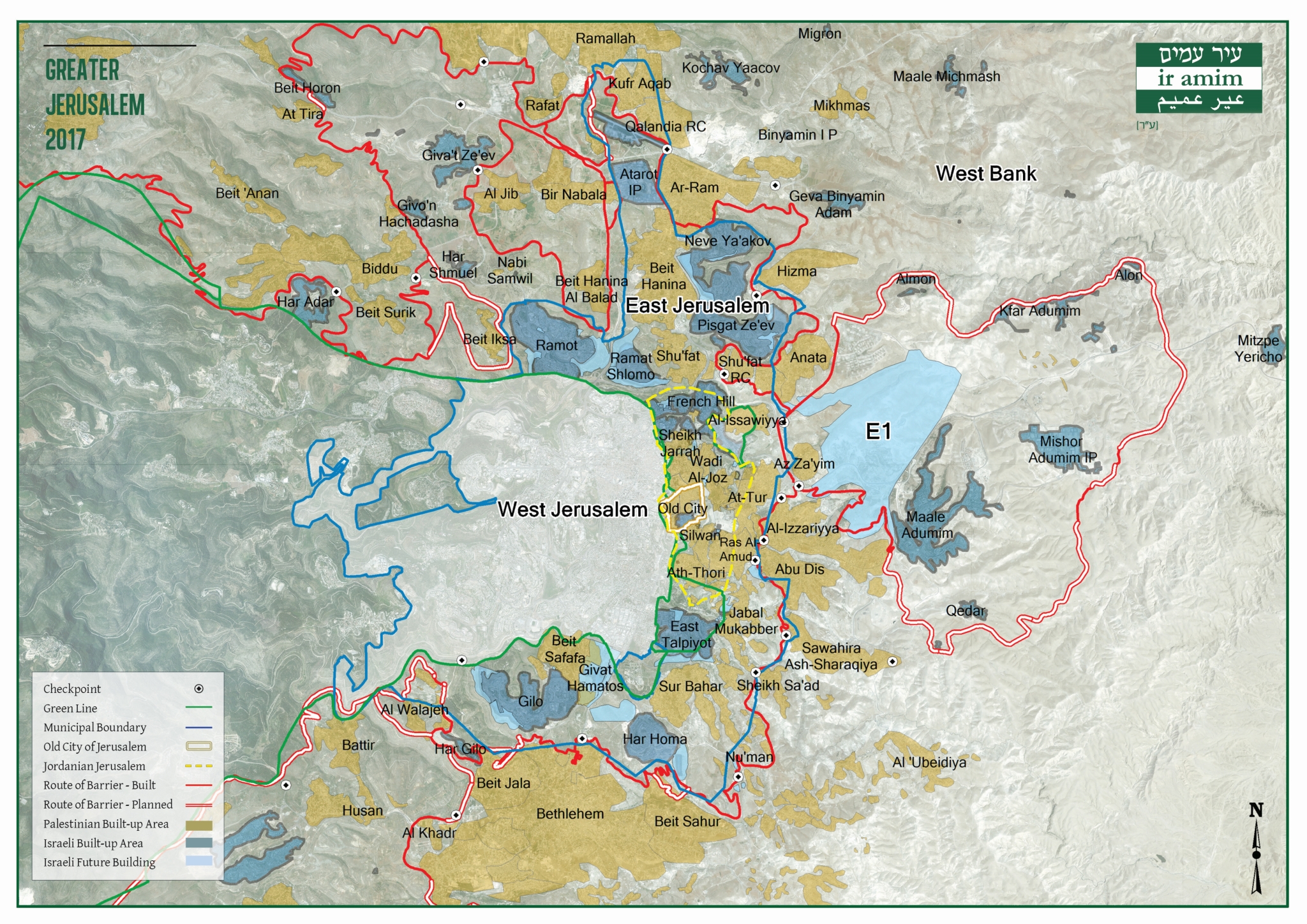
Map by Ir Amim
The plans for Ramat Shlomo and Ramat are particularly noteworthy, not just for their location in Palestinian East Jerusalem but also in light of very recent history. A vote on the plans was scheduled in December 2016 on the same day that U.S. Secretary of State John Kerry arrived in Israel to give a major speech on U.S. peace principles. Israel cancelled the vote in light of U.S. anger. In 2010, tenders were issued for units in Ramat Shlomo while Vice President Joe Biden was in Israel, leading the Vice President to issue sharp words against Israel while on the ground. Henceforth the plans for Ramat Shlomo that were advanced in 2010 have been dubbed “The Biden Plan.”
The promotion of these plans comes in the context of an opening of the settlement floodgates in Jerusalem, starting at the beginning of July. For details, see this comprehensive timeline of East Jerusalem settlement-related developments (July 1 – Oct 30), published by Jerusalem expert Danny Seidemann. Seidemann notes:
The intensity of the government initiatives in Jerusalem in the last four months is unprecedented, whether in regard to the scope and implications of the settlements announcements, to the nature of the legislative initiatives, or to the political assault against all those daring to challenge the occupation and the government narrative in Jerusalem.
Settlers Continue Protest for Immediate “Security Package” Funding
Settlers staged another protest in front of Netanyahu’s home to demand immediate funding for infrastructure projects across the West Bank. In early October, Defense Minister Avigdor Liberman promised a $939 million “settler security package” as part of the 2019 budget. A week later, Netanyahu promised that $228 million will be made available in January 2018 for settler infrastructure projects. Not trusting Netanyahu at his word, settlers insist that the money be allocated immediately.
Peace Now has detailed information and maps showing the 5 bypass roads that will be funded in 2018 as specified by Prime Minister Netanyahu in a letter to settler authorities. Peace Now points out the 4 out of 5 bypass roads serve settlements deep inside the West Bank, one near the Nablus and another near Hebron.
Peace Now writes,
The projects…have far-reaching implications in terms of reaching a two state solution as on the one hand expansion of settlements connected to the roads is expected to accelerate and on the other hand the possibility for Palestinian development will be limited or eliminated in those areas.
In addition to the bypass roads, the funds will also cover projects to install cell phone service towers, street lights, and to increase the number of armored buses services settlers across the West Bank.
Israel Appoints Settler Leader to Craft Legal Cases to Retroactively Authorize Outposts
A top settler advocate has been appointed to lead a new government committee that was formed in the wake of the Amona outpost evacuation in order to protect unauthorized Israeli outposts from similar actions. The appointee, Pinchas Wallerstein, has an extensive history representing settlements, and last year he admitted to lying to the Israeli government about the construction of the Amona outpost, which was later proven to have been knowingly built on privately owned Palestinian land.
In response to Wallerstein’s appointment, Dror Etkes – who heads the settlement watchdog Kerem Navot – commented:
In a normal, healthy society Mr Wallerstein, who is involved in countless number of criminal actions of land grab and dispossession, would likely be writing his memoir from jail right now; but in 2017…he is treated as a culture hero.
The work of the outpost defense committee is set to begin in the coming weeks, but the work should ostensibly be on hold under an injunction against the so-called “Regulation Law.” The law was passed by the Knesset earlier this year to provide a legal basis for the retroactive legalization of outposts constructed without Israeli authorization. The injunction was issued by Israeli Attorney General Avichai Mandleblit in August, to allow the High Court to hear arguments on two petitions that civil society groups launched to challenge the law’s constitutionality. In September, the Knesset asked the Court to reject the petitions; the Court has not rejected the petitions. Arguments were expected to be heard in October, but have not yet been scheduled.
Peace Now found that 55 outposts (out of approximately 100 across the West Bank) and 4,000 outpost units stand to be retroactively legalized if the Regulation Law survives the pending challenges (in addition to legalizing the unauthorized seizure of large areas of West Bank land being used for settler agriculture).
Bonus Reads
- “Jewish Federations Donated Millions to Israeli Settlements Over Four Years” (Haaretz)
- “Creeping Annexation” (J Street)
- “FIFA will not take action on Israeli settlement teams” (Al Jazeera)
- “Israel Denies Entry to Amnesty USA Staff Member” (Amnesty International)
FMEP has long been a trusted resource on settlement-related issues, reflecting both the excellent work of our grantees on the ground and our own in-house expertise. FMEP’s focus on settlements derives from our commitment to achieving lasting Israeli-Palestinian peace, and our recognition of the fact that Israeli settlements – established for the explicit purpose of dispossessing Palestinians in the West Bank and East Jerusalem of land and resources, and depriving them of the very possibility of self-determination in their own state with borders based on the 1967 lines – are antithetical to that goal.
Welcome to FMEP’s Weekly Settlement Report, covering everything you need to know about Israeli settlement activity this week.
To receive this report via email, please click here.
October 26, 2017
- Assault on Jerusalem [And a Negotiated Solution], Part 1: Cabinet to vote Sunday on “Greater Jerusalem [Annexation] Bill,” with Netanyahu’s Backing
- Assault on Jerusalem [And a Negotiated Solution], Part 2: East Jerusalem Settlement Enclave in Jabal Mukaber Set to Triple in Size
- Assault on Jerusalem [And a Negotiated Solution], Part 3: First New East Jerusalem Settlement in Decades, Atarot, Is Inching Closer Towards Construction
- The New U.S. Settlement Policy: Expand at Will, but Don’t Surprise Us
- Israeli Justice Minister Personally Involved in Drafting State Responses to Settlement Petitions before the High Court of Justice
- Updates: Netiv Ha’avot and the “Settler Security Package”
- Bonus Reads
Comments, questions, or suggestions? Email Kristin McCarthy at kmccarthy@fmep.org.
Assault on Jerusalem [And a Negotiated Solution], Part 1: The “Greater Jerusalem [Annexation] Bill” is Set for a Vote on Sunday with Netanyahu’s Backing
The Israeli Knesset reconvened on Monday for it finals session of the year; in addition to a litany of anti-democratic bills [Americans Peace Now published an excellent explainer of those bills here], Netanyahu has reportedly signalled the Knesset to pass the “Greater Jerusalem Bill” [text here]. With Netanyahu’s approval, the bill is expected to be come up for a vote in the Cabinet on Sunday, October 29th, and after that to be sent to the Knesset.
If passed into law, the “Greater Jerusalem Bill” will:
-
Map by Peace Now
Effectively annex a an enormous area of the West Bank into Israel’s Jerusalem Municipality, including not only the settlements but huge areas of adjacent land designated by Israel as belonging to the settlements. Peace Now has a map of the settlements/land that will annexed [click for greater detail].
- Include as part of Jerusalem settlements/lands located far from the current borders of Jerusalem, extending deep into the West Bank nearly to Jericho (the Palestinian city located on the border with Jordan) and including settlement located closer to Hebron than to Jerusalem.
- Effectively annex the area of the planned E-1 settlement, the same area where the Khan al-Ahmar community continues to await the fate of Israel’s plan to forcibly relocate them (a war crime) out of the area.
- Redraw the borders of the Jerusalem Municipality to cut out several Palestinian neighborhoods that are legally part of the Municipality but that Israel elected to leave on the West Bank side of its separation barrier (these neighborhoods would have new “sub-municipalities” created for them).
PLO Executive Committee member Hanan Ashrawi stated bluntly “such efforts represent the end of the two-state solution.”
The anti-settlement watchdog Peace Now writes,
The bill states that its implementation would allow to maintain a “demographic balance” between Jews and Palestinians in Jerusalem, and will allow for the expansion of construction of housing units and industry in the area. It is clear that the idea is to allow rapid settlement construction in settlements near Jerusalem and create facts on the ground which will prevent the chance for a two state solution, and at the same time excise Palestinian neighborhood by the formation of “sub-municipalities” or if you will, Bantustans, devoid of resources which will allow them to be self-sufficient.
J Street writes that passage of the bill,
would be a major step in Israel’s ongoing, de facto annexation of territory throughout the West Bank – and pose a massive threat to the possibility of ever achieving a two-state solution. If carried out, Israel would be crossing a major red line by unilaterally imposing its own solution to a vital final status issue.
In addition to the “Greater Jerusalem Bill,” a second bill regarding Jerusalem is also on the Knesset’s winter docket. If passed, this bill would amend Israel’s Basic Law to require a supermajority – 80 out of 120 votes – in the Knesset to approve any deal that transfers sovereignty over any part of Jerusalem to a foreign entity. This gives the Knesset veto power over any future peace deal reasonably assuming that the Palestinians will not agree to cede all of Jerusalem (it’s historic capital and home to sacred religious and national sites) to Israel.
Americans for Peace Now explains,
If passed into law, this measure would be unmatched in the Israeli legal code. No other Israeli government executive decision requires a two-thirds majority. This legislation would tie the hands of future governments in negotiating peace and will grant a de facto veto to representatives of the Israeli public’s anti-peace minority. The bill passed an initial vote and will need to pass three additional readings to become law. The absurdity is that the law, if passed, will surely garner significantly fewer than the 80 votes it demands for a future decision on Jerusalem.
Earlier this month, when these two bills were first unveiled, Terrestrial Jerusalem’s founder Danny Seidemann warned:
Cumulatively, these … initiatives constitute an effort to implement the most radical changes in the status of East Jerusalem since the Israeli annexation in June 1967, and threaten to profoundly detrimental impacts on the prospects of a future political agreement. Indeed, it is difficult to overestimate their significance. Together they would create a radically new geopolitical reality in Jerusalem and its environs.
Ir Amim also cautions:
The bills have not surfaced in a vacuum; they complement a series of recent initiatives calculated to impose crucial territorial-political facts on the ground under the guise of “municipal moves.” They would preempt chances of a political resolution to the conflict, weaken the urban fabric, and ratchet up tensions in Jerusalem.
Assault on Jerusalem [And a Negotiated Solution], Part 2: East Jerusalem Settlement Enclave in Jabal al-Mukaber Set to Triple in Size
In addition to the wave of settlement approvals by the Israeli High Planning Council last week [read last week’s Settlement Report here], on Oct. 25th, the Jerusalem Municipality issued conditional building permits for 176 new units in the Nof Zion settlement enclave. The permits are pending until the settlers submit proof of ownership papers; the missing paperwork has delayed the issuance of the permits since the plan was first leaked in early September (it’s not clear what has changed to allow for them to be issued now).
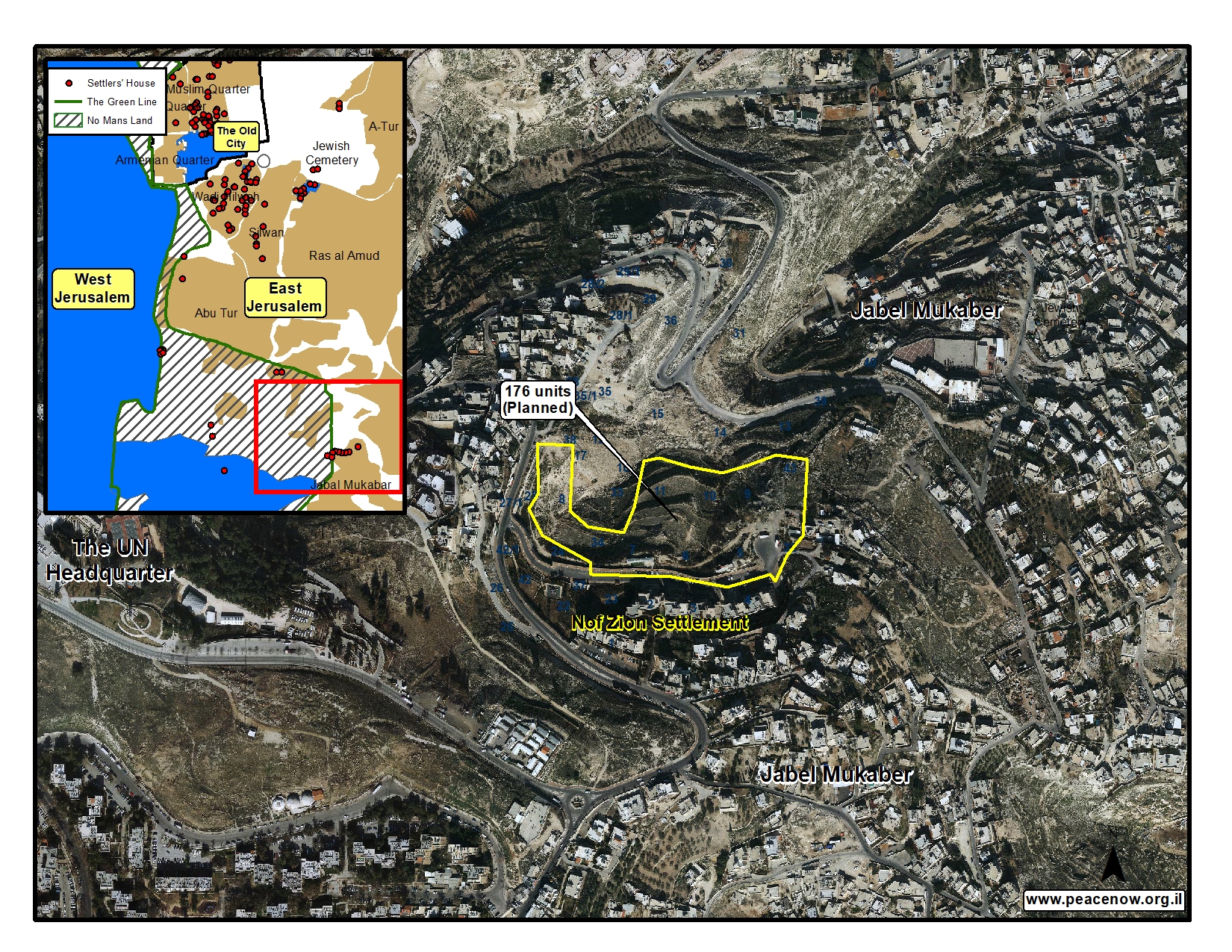
Map by Peace Now
Nof Zion is inside the Palestinian neighborhood of Jabel al-Mukaber in occupied East Jerusalem. The new units will nearly triple the size of the enclave, making it the largest of its kind in East Jerusalem.
When reports of the building permits for Nof Zion surfaced earlier this year, it sparked outrage and concern over unrestrained settlement growth in East Jerusalem and its impacts on the future of Jerusalem. The same concerns are now more urgent and alarming, as it appears there are no settlement plans too controversial for the Netanyahu government to greenlight.
Ir Amim writes,
The primary objective of the settlers’ infiltration into the Palestinian neighborhoods in and around the Old City is to undermine the possibility of dividing Jerusalem, thereby foiling the possibility of a political resolution on the city and an end to the Israeli-Palestinian conflict. The building permits will issue a clear statement that the Israeli government sanctions and supports the establishment of new facts on the ground designed for this purpose.
Assault on Jerusalem [And a Negotiated Solution], Part 3: First New, Government-Backed East Jerusalem Settlement in Decades, Atarot, Inches Closer Towards Construction
In a move described by city planning experts as “nothing less than fantasty,” the Israeli government has set aside millions of shekels to build 10,000+ units in a new settlement planned at the site known as Atarot, in the northern part of East Jerusalem. If implemented, Atarot would be the first new government-backed settlement established in East Jerusalem since the construction of Har Homa in the 1990s [unless plans to move ahead with the new settlement of Givat Hamatos come to fruition first – in that case, Givat Hamatos would be the first new government-backed settlement established in East Jerusalem since the early 1990s; Atarot would be the second].
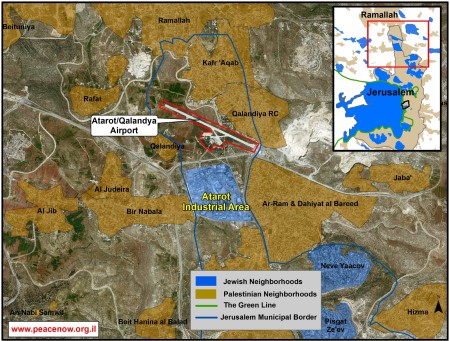
Map by Peace Now
The planned Atarot settlement would be located in the northern part of the East Jerusalem, extending to the southern edge of the West Bank city of Ramallah. It would include 10,000+ units for ultra-Orthodox Jewish Israelis. The location for construction is site of the disused Atarot airport. The airport site is an important commodity, reportedly promised to the Palestinians for their state’s future international gateway. Developing the site into a Jewish Israeli settlement would deprive a future Palestinian state of the only airport in the West Bank, dismember Palestinian neighborhoods in the norther part of the city, and sever East Jerusalem from a Palestinian state on this northern flank of the city (acting like E-1 on Jerusalem’s northeast flank, and like Givat Hamatos on Jerusalem’s southern flank).
FMEP first reported on Atarot in April 2017 when the settlement plan was rumored to be included on the master blueprint of settlements for which Netanyahu intended to seek U.S. approval. It was expected to be announced in May on the occasion of the Jerusalem Day celebration, but until now, the plan has not advanced.
The plan dates back to 2007; it was pursued by the Israeli government in 2012 but shelved under pressure from the Obama administration. At that time, Peace Now’s Hagit Ofran observed:
Not only that this plan might severely harm the future Palestinian State, destroying the only airport in the West Bank, but it will also cut between East Jerusalem and Ramallah at the heart of many Palestinian neighborhoods: Shu’afat and Beit Hanina in the South, Bir Nabala, Al Judeira, Al Jib, Rafat and Qalandia in the West, Ar-Ram, Dahiyat al Bareed and Jaba’ from the East, and Qalandia Refugee Camp, Kafr ‘Aqab and Ramallah from the North. It seems that what the Givat Hamatos plan is meant to do in the South of Jerusalem (to cut between Bethlehem and East Jerusalem), this plan will, god forbid, do at the North of it. The goal of this plan is clear: to prevent the possibility of a Palestinian State in the West Bank, and thus to kill the two states solution.
This week, Peace Now commented:
This is a crazy plan, both politically and in terms of planning. It is an attempt to drive a wedge into the heart of an urban area of hundreds of thousands of Palestinians. Since the neighborhood of Har Homa was established in the 1990s, no new Israeli neighborhood has been built beyond the Green Line in Jerusalem.
Reported New U.S. Settlement Policy: Expand at Will, but Don’t Surprise Us
According to a report posted on Al-Monitor, two months of secret negotiations between the U.S. and Israel have resulted in an unofficial framework for how Israel, with U.S. approval, will advance and expand settlements. The agreement reportedly entails the following:
- The U.S. will see all settlement plans Israel has decided to approve before they are advanced bureaucratically (i.e., before moves that allow them to become public).
- Israel can approve plans for new settlement units anywhere that is adjacent to an existing unit (read: in any/all/every settlement or outpost).
- With respect to the West Bank, there is an unspecified limit on the quantity of new units that each new settlement project is allowed.
- With respect to East Jerusalem, there is no limit on the number of units allowed to advance as long as rules 1 & 2 are respected.
It should be noted that the only plan that appears to violate the letter of this leaked deal is the plan for the Atarot settlement in East Jerusalem, which is not adjacent to any existing units (rule #2).
Israeli Justice Minister Personally Involved in Drafting State Responses to Settlement Petitions before the High Court of Justice
Israeli Justice Minister Ayelet Shaked is coming under fire for her intervention in every case before the High Court related to Israeli settlements and unauthorized outposts. Haaretz reported this week that since being appointed, Shaked has retained the services of a private lawyer to review and redraft each and every state response related to settlements and outposts before that response is submitted to the High Court of Justice. Moreover, the lawyer Shaked selected for this task comes from the notorious far-right, pro-settler group Regavim — a group that devotes its efforts to systematically mapping out and expelling Palestinians from strategic areas in Jerusalem, the West Bank, and the Negev.
Further Haaretz reporting revealed the Israeli Attorney General Avichai Mandleblit and the State Prosecutor Shai Nitzan (whose office ostensibly produces the first draft of state responses that Shaked then edits) have defended Shaked against criticism for this heavy handed political interference in legal matters.
Updates: Netiv Ha’avot and the “Settler Security Package”
-
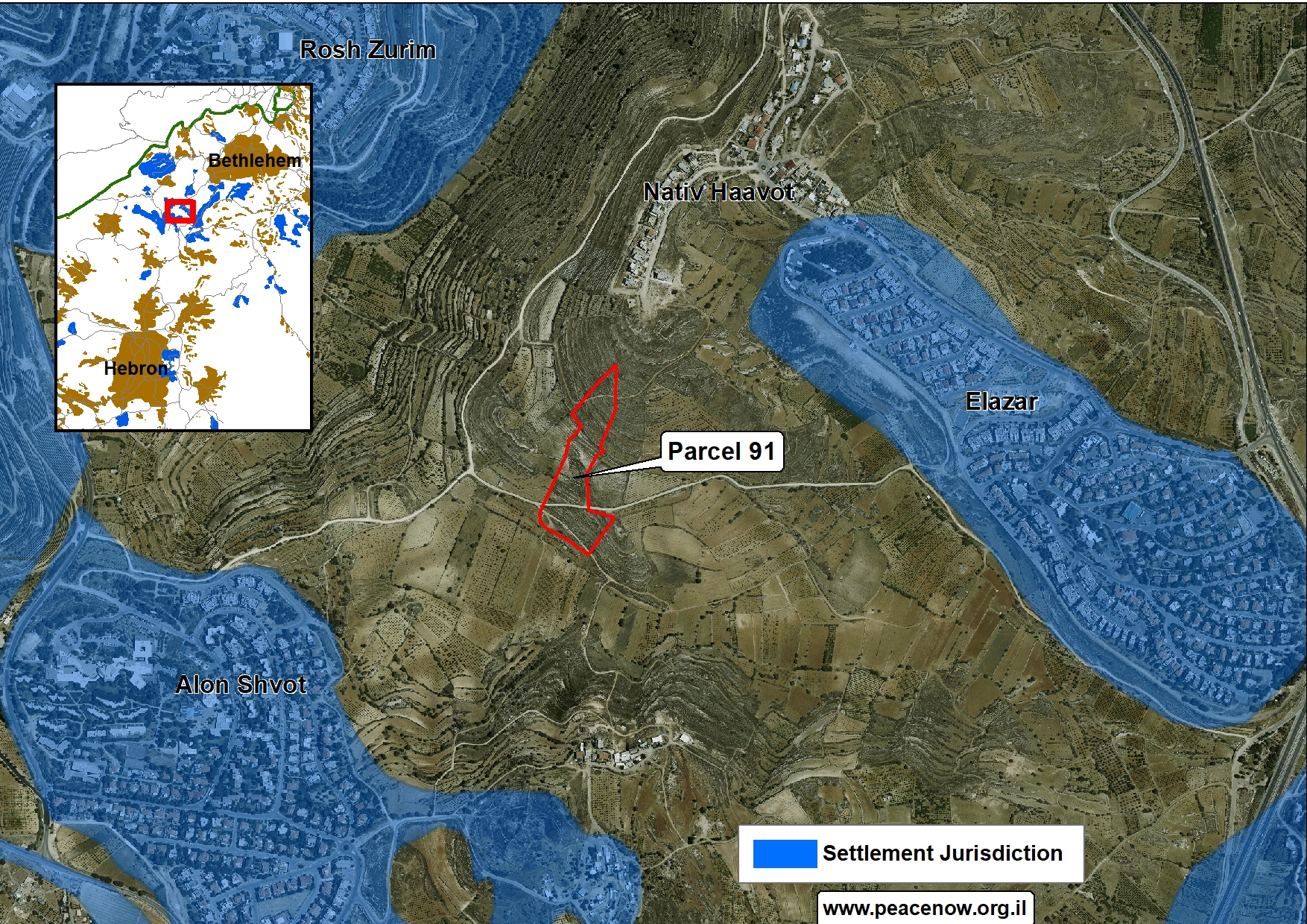
Map by Peace Now
The Israeli High Court dismissed a state-backed petition by settlers challenging the planned demolition of 17 structures built wholly or partly on privately-owned Palestinian land in the unauthorized outpost of Netiv Ha’avot. The settlers asked that 15 of the structures only be partially demolished, leaving intact the portions of them that are not on Palestinian land. The Court rejected the request and ordered the structures to be demolished. The entire outpost of Netiv Ha’avot is slated to be razed by March 2018 following a High Court ruling. Just last week, the High Planning Council approved a plan (a plan it called “improper” but approved anyway) to build 17 temporary new homes for Netiv Ha’avot residents on lands between the Elazar and Alon Shvut settlements. This land parcel is outside of either of the settlements’ jurisdictions – in effect, it is another case of rewarding settlers for breaking the law by “compensating” them with the establishment of a brand-new settlement. However, to avoid the appearance that this is the case, the High Planning Council ordered the borders of Alon Shvut to be formally expanded before the structures are built to include the parcel (which would mean that the plan would not, retroactively, violate the new U.S.-Israeli policy understanding reported previously).
- Settlers continued to protest Netanyahu even after news last week that the government plans to dispense $939 million in 2019 for the “settler security package” they are demanding. In an attempt to placate the settlers’ demands, Netanyahu met with the settler leaders to speed up his government’s timeline for beginning the West Bank settlement infrastructure projects, outlining a plan to invest $228 million beginning in next year. According to the unwritten plan, the 2018 projects will include paving five new settler-only highways to bypass Palestinian villages.
Bonus Reads
- “Dangerously ‘imprecise’ on Israeli settlements” (Americans for Peace Now)
- “Unprotected: Detention of Palestinian Teenagers in East Jerusalem” (B’Tselem & HaMoked)
- “Settler Leaders Appeal to High Court Over Bypass Road” (Jerusalem Post)
FMEP has long been a trusted resource on settlement-related issues, reflecting both the excellent work of our grantees on the ground and our own in-house expertise. FMEP’s focus on settlements derives from our commitment to achieving lasting Israeli-Palestinian peace, and our recognition of the fact that Israeli settlements – established for the explicit purpose of dispossessing Palestinians in the West Bank and East Jerusalem of land and resources, and depriving them of the very possibility of self-determination in their own state with borders based on the 1967 lines – are antithetical to that goal.
Welcome to FMEP’s Weekly Settlement Report, covering everything you need to know about Israeli settlement activity this week.
To receive this report via email, please click here.
July 28, 2017
- Bibi Embraces “Population Transfer” – Asks for US OK
- The Knesset & Bibi Move to Gerrymander Jerusalem
- Settlers Set Up Outpost, Seek to Expand Settlement as “Response” to Murders
- Settlers Seize Contested Building in Hebron
- Construction on New Settlement in Shilo Valley Stalled (Due to Lack of Funds)
- High-Ranking Government Officials Defend Outpost from Demolition
- Bonus Reads
Comments, questions, or suggestions? Email Kristin McCarthy at kmccarthy@fmep.org
Bibi Embraces “Population Transfer” – Asks for US OK
According to a report from Israel’s Channel 2 News, Prime Minister Netanyahu recently asked U.S. Ambassador David Friedman and Special Envoy Jason Greenblatt to support a populated land-swap as part of a future peace deal.
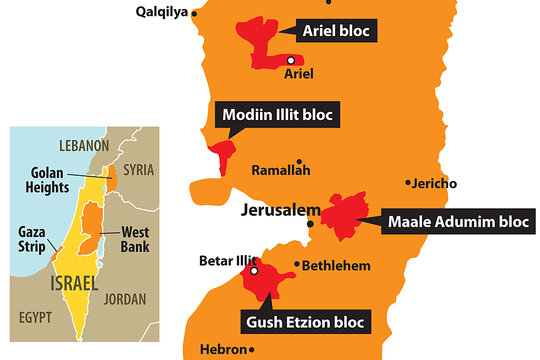
Map in CSMonitor
The swap in question would transfer 300,000 Palestinian citizens of Israel (living in the Wadi Ara region, an area known as “the triangle,” near Haifa) to the Palestinians, in exchange for Israel’s annexation of settlements in the Etzion bloc. The plan – which was previously championed by Defense Minister Avigdor Liberman, who even proposed it at the United Nations – is in effect a population transfer that would allow Israel to get rid of a large cluster of Palestinian cities, including the city where the two terrorists who attacked guards at the Haram al-Sharif/Temple Mount last week grew up.
An unnamed White House official made a statement in response to the report saying, “This may have been one of many ideas discussed several weeks ago in the context of a peace agreement and not in the context of a separate annexation.”
FMEP President Lara Friedman commented on what message Bibi’s endorsement of this idea sends: for the current Israeli government, “citizenship of Jews is inalienable right; citizenship of Arabs is revocable privilege.”
Arab Israeli MK Aida Touma-Suliman responded to the report saying, “The cat is out of the bag and Netanyahu has shown his true colors regarding the Arab population…the [Wadi] Ara residents are not only Israeli citizens, they’re also indigenous people who dwell on their land, and are not to be compared with settlers dwelling on another nation’s land. We the Arab citizens aren’t part of any such equation and aren’t willing to pay the price again for Israel’s policy of occupation and settlements.”
When Avigdor Liberman promoted the idea back in 2014, then-President Shimon Peres said, “Israel cannot take away its citizens’ citizenship simply because they’re Arab.” Then-Interior Minister Gideon Sa’ar said, “An Israeli citizen is not an object and not transferable as part of a framework political agreement.” Netanyahu has never expressed support for the plan prior to this news report, but the plan has allegedly come up in negotiations before.
The area of settlements known as the “Etzion Bloc” is home to over 22 settlements and 75,000 Israeli settlers. The loose cluster of settlements is located south of Jerusalem, extending from the 1967 Green Line deep into the West Bank; most of the settlements are on the Israeli side of the separation barrier. The major traffic junction in the area has recently seen numerous car-ramming and stabbing attacks by Palestinians targeting Israeli settlers and soldiers in the area, including an attack today that resulted in the death of the attacker and no other reported injuries.
The Knesset & Bibi Move to Gerrymander Jerusalem
In tandem with the Temple Mount/Haram al-Sharif crisis is, three important bills regarding Jerusalem’s future have advanced in the Knesset:
-

Map by Haaretz
Prime Minister Netanyahu announced his support for a bill in the Knesset that would allow 130,000 Israeli settlers living four West Bank settlements to vote in Jerusalem’s municipal elections while effectively excluding around 100,000 Palestinians from the Jerusalem municipality (most obviously the Shuafat refugee camp and Kafr Aqab, which are located outside the separation barrier). The four settlements are Maale Adumim, Givat Ze’ev, Beitar Illit, and Efrat, the last of which is six miles from Jerusalem. All are illegal under international law. Netanyahu’s support for this bill means that it is set to move forward when the Knesset’s reconvenes from its 3-month summer recess in November.
- Another bill (introduced a few days before the one described above) would allow the Israeli government to transfer Palestinian neighborhoods of Jerusalem outside the barrier to a separate, new municipality, created especially for this purpose. This bill and the one above aim to remove from the municipal area of Israel’s eternal, united capital those areas that threaten the Jewish demographic majority in Jerusalem, relegating them to a separate authority.
- These bills are complementary to a bill voted on last week that seeks to prevent the Israeli government from transferring parts of Jerusalem to a foreign power (i.e. the Palestinian government) in a future peace deal.
Settlers Set Up Outpost, Seek to Expand Settlement as “Response” to Murders
Following the horrific murder of three Israelis living in the Halamish settlement, the settlement’s leaders are seeking to consolidate and expand their illegal presence in the West Bank.
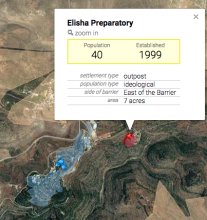
Map by Peace Now Israel
Within hours of the murder, hundreds of Halamish residents set up a campsite and a blockade of the eastern road leading to the settlement. The campsite is being called “Yad Ahi,” or “My Brother’s Hand” in memory of the three family members who were slain by a Palestinian youth last Friday. Settlers are rotating shifts inhabiting the campsite, aiming to make it an official outpost of the settlement and permanently close the road to Palestinians.
Halamish leaders are also demanding the government allow the expansion the settlement’s borders. A spokesman of the Binyamin Regional Council (which represents and provides municipal services to settlements in the Halamish region) called on the government to approve construction plans connecting the Halamish settlement to a nearby outpost called Tzofit, in order to “create a bigger security area and allow building neighborhoods that have already received zoning approvals.” Tzofit (also known as “Zufit” and/or “Elisha Preparatory”) is an illegal outpost that was established in 2007.
U.S. Ambassador David Friedman and Special Envoy Jason Greenblatt went to the illegal Halamish settlement this week to offer their condolences to the victims of the murder.
Halamish is located northwest of Ramallah, deep inside the West Bank. When the settlement was founded in the 1970s, Palestinian residents from the nearby towns of Deir Nidham and Nabi Saleh sued to stop the settlement’s construction, claiming it was being built on their villages’ land. The Israeli Supreme Court ruled in favor of the settlers, declaring the area to be state land. The Halamish settlement and its ever-growing encroachment on surrounding Palestinian villages has inspired weekly protests in Deir Nidham and Nabi Saleh, which has become infamous for weekly demonstrations – often involving clashes with the IDF – in recent years, often with international participation.
Settlers Seize Contested Building in Hebron
On the evening of July 25th — while events in Jerusalem were dominating the attention of the region and the world — 120 settlers broke into and illegally occupied a contested building near the Tomb of the Patriarchs/Ibrahimi Mosque in Hebron. The Israeli army immediately surrounded the building and on the morning of July 26th the area was declared a “closed military zone.” Prime Minister Netanyahu ordered the Defense Ministry to allow the settlers to stay as negotiations on their fate and ownership of the building continue.
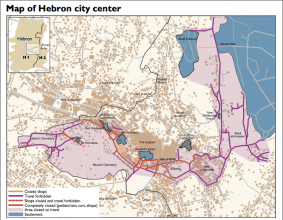
Map by B’Tselem
The Times of Israel reports that, “sources close to the prime minister said that Netanyahu was looking to avoid having to evacuate the families.” On the other hand, Yesh Atid chairman Yair Lapid called for their immediate evacuation. As of this writing, the settlers are still being allowed to illegally squat in the property.
Peace Now warned that the settler’s action can “ignite the region” and called on the government to, “follow the law and the Israeli interest and evacuate the trespassers without delay.”
J Street issued a statement calling on the U.S. government and international actors to pressure Israel to remove the settlers, saying “the Hebron settlers and their allies clearly believe that they can take advantage of the present crisis and push their long-term expansionist agenda by creating new ‘facts on the ground.’ It is vital that the prime minister and defense minister act in the best interests of Israeli security and uphold the rule of law by swiftly removing these families from the property.”
Hebron’s settlers have for some time been waging in a legal struggle to prove they legally purchased the building, known as the Machpela House. Palestinians contend they did not purchase it from the legal owners. While proceedings are ongoing, the settlers have once before broken into and occupied the building; when they did so in 2012, they were allowed to stay in the house for a week before being evacuated at the urging of the then-Attorney General of Israel who argued that it was necessary to preserve the rule of law.
Construction on New Settlement in Shilo Valley Stalled (Due to Lack of Funds)
A month after construction began on the first new settlement authorized by Israel in 25 years, the project has come to a halt – no over politics but due to insufficient government funds. The government had promised to bankroll the settlement’s construction but has not contributed to costs yet, according to the Binyamin Regional Council, which is currently footing the bill. The spokesman for the Binyamin Regional Council speculated on July 25th that the issue will be resolved quickly and expressed confidence in the government’s commitment to the project. Prime Minister Netanyahu reportedly gave orders to ensure construction is resumed quickly. As of this writing, there is no reporting to suggest construction has resumed.
High-Ranking Israeli Officials Defend Outpost from Demolition
Last week we reported on an impending demolition order against the Netiv Ha’avot outpost (near Bethlehem), along with the public relations efforts settlers were leading to elicit government intervention in their favor. The settlers got a helping hand this week when Israeli Education Minister Naftali Bennett and Yair Lapid (who heads the Yesh Atid political party) attended an event at the outpost. The Haaretz report suggests Bennett engaged in a conversation with the outpost’s leaders on how to “deal with” the demolition order and impending deadline.
Bonus Reads
- “This Synagogue Furniture Factory Is Actually a Sweatshop That Tramples Palestinians’ Rights” (July 26, 2017, Haaretz+)
- “The Settler Leader Who’s Even Charming Liberals as Israel’s Top Man in New York” (July 27, 2017, Haaretz+)
- “A Rare Glimpse: Shabak Agent Recruiting Hilltop Youth” (July 3, 2017, Jewish Press)