Welcome to FMEP’s Weekly Settlement Report, covering everything you need to know about Israeli settlement activity this week.
To subscribe to this report, please click here.
May 17, 2019
- TV Report: U.S. Peace Plan Allows for Israeli Annexation of All Settlements
- Peace Now Special Report, Part 1: Key 2018 Settlement Data & Analysis
- Peace Now Special Report, Part 2: Settlement Growth During 10 Years of Netanyahu
- Following Trump Election, Netanyahu Unleashed 39% Increase in Settlement Funding
- 11 Knesset Members Join Campaign to Cancel 2005 Disengagement Law & Re-establish Evacuated West Bank Settlements
- Bibi Pushes High Court Override Legislation During Coalition Negotiations
- Trump Envoy Praises US-Backed Economic “Coexistence” Group for Joint Settler-Palestinian Hebron Iftar
- Bonus Reads
TV Report: U.S. Peace Plan Allows for Israeli Annexation of All Settlements
According to an Israel TV report, the Trump Administration’s peace plan allows for Israel’s annexation of all settlements in the West Bank. Israel TV also reports that, independent of the fate of the peace deal, the U.S. will not object to Israel’s unilateral annexation of those settlements through the extension of Israeli law over them. Though the Trump Administration position on settlements has been made explicitly clear for some time, the reporting, if accurate, confirms that the U.S. “peace plan” is no more than a plan for permanent Israel control in the West Bank.
As FMEP has explained, institutionalizing the application of Israeli law over the settlements – which ends the legal distinctions between Israel and the settlements, as upheld by current Israeli law – would be tantamount to de facto annexation. FMEP has also documented, in great detail, Israel’s progress towards incrementally annexing the settlements in this manner, as various initiatives move through the Knesset, the Executive/Ministerial body, and the Courts. That data can be found on the second table on this document.
Settlers immediately celebrated the Israel TV report. Har Hevron Regional Council Chairman Yohai Damari said:
“I call on the prime minister to immediately announce, following the establishment of a government, that he will extend Israeli law to all the Jewish settlements as a basis for any offer that may come. We have to take advantage of this window of opportunity during the Trump administration in the wake of the transfer of the embassy to Jerusalem and the recognition of the Golan Heights. Now it is time for sovereignty in Judea and Samaria.”
Damari’s plea to the Prime Minister to act quickly to annex the settlements only adds to the growing crescendo pushing for the immediate, unilateral annexation, which U.S. Ambassador Friedman publicly urged on during his recent speech at the AIPAC national policy conference.
Peace Now Special Report, Part 1: Key 2018 Settlement Data & Analysis
In a special version of its annual report on settlement growth – entitled “Special Annual Settlement Construction Report 2018: A Glance at 10 Years Under Netanyahu” – the settlement watchdog group Peace Now published important data and analysis of settlement activity in 2018 (not including East Jerusalem).
According to the report, during 2018:
Israel began construction on 2,100 new settlement units.
- This represents a 9% increase from the annual average of the past 10 years.
- Of that 2,100 units,
- At least 10% (218 new units) are in illegal outposts;
- Nearly 73% (1,539 new units) are in settlements outside of the proposed Geneva Initiative border;
- At least 10 are located on privately owned Palestinian land.
Construction began on 2 new settlements.
- The government officially planned and approved the establishment of the new Amichai settlement, the first new government-backed settlement in over 20 years. Amichai is located in the heart of the West Bank on a hilltop that settlers chose in the hopes it will prevent the possibility of the two-state solution.
- In addition, developers began construction on 108 new units in an area east of the Avnei Hafez settlement and then marketed the new units as a new settlement, which they call “Kedem”. Developers built this settlement based on a construction plan approved in 1998.
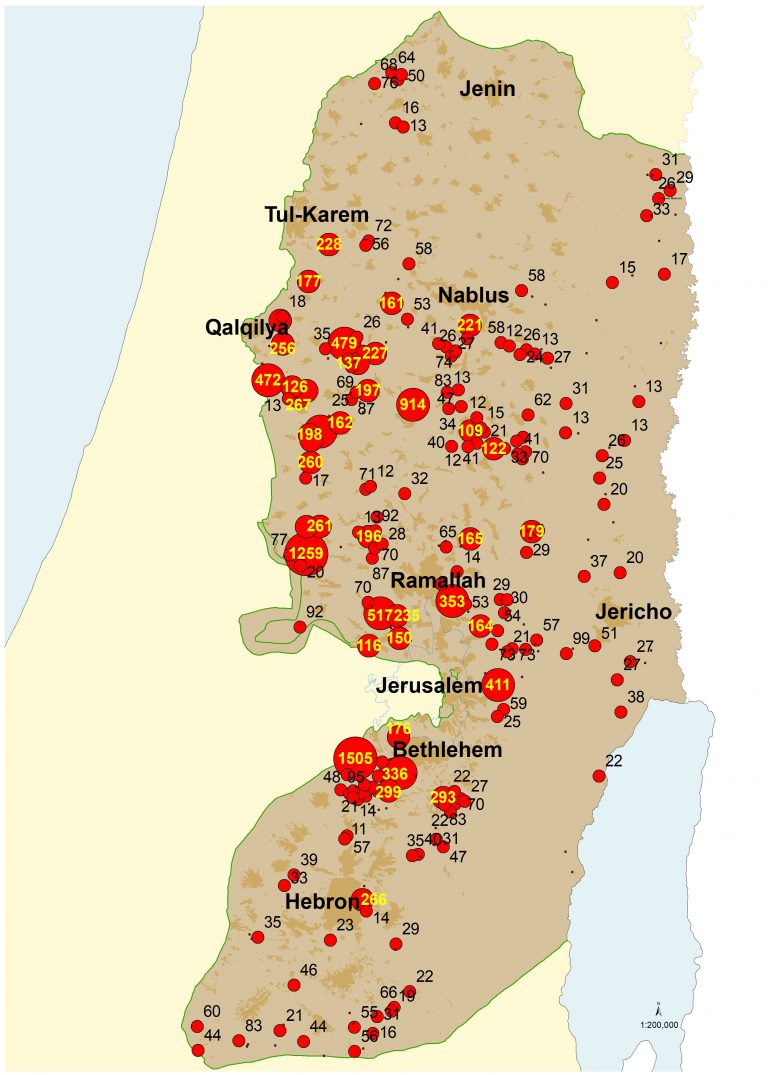
A total of 5,618 settlement units were advanced through plans in 79 settlements.
-
Map by Peace Now
Of that number, almost 83% (4,672 housing units) are planned in settlements east of the proposed Geneva Initiative border.
A total of 5,808 settlement construction tenders were published (but construction had not yet began)
- This was the highest annual total for settlement tenders in almost two decades.
- The Beitar Illit settlement saw the most construction starts in 2018, concentrated in a new neighborhood which significantly expands the footprint of the settlement.
Additional 2018 Key Data Points
- Israel continued to build up an Israeli settler presence on the land between the Elkana settlement and its surrounding settlements (Etz Efraim to its east and Shaarei Tikva to its west), effectively creating one large “super settlement” and building a contiguous settlement band towards the Ariel settlement in the heart of the West Bank.
- In addition to West Bank settlement tenders, tenders for 603 new settlement units in East Jerusalem were also published in 2018.
Peace Now Special Report, Part 2: Settlement Growth During 10 Years of Netanyahu

Peace Now writes:
“In the past decade, most of the construction was in isolated settlements that Israel will have to evacuate. The Peace Now count of housing construction starts reveals that 73 percent of the construction in 2018 (1,539 housing units) and 70 percent of construction during the decade of Netanyahu’s government (13,608 housing units) were implemented precisely in places that jeopardize a two-state agreement (east of the proposed border route of the Geneva Initiative). In this decade, close to 50,000 settlers have been added to these settlements, and the housing units built have the potential to add 60,000 settlers. This means that the Israeli government is digging the country a pit to fall in. Every house built in the settlements and every family that moves there will need to be brought back into Israel in a painful and difficult evacuation. Even if the government does not believe that peace can be achieved in the near future, there is no logic to expanding the settlements and making the solution impossible.”
Following Trump Election, Netanyahu Unleashed 39% Increase in Settlement Funding
After two years of repeatedly submitting freedom of information requests, the AP published results, based on documents turned over by Israel’s Finance Ministry. The documents reveal that the government unleashed at least a 39% funding increase – dubbed by the AP a “spending binge” – on settlement activities in the immediate aftermath of President Trump’s election.
According to the Finance Ministry data, in 2017 the Israeli government spent $459.8 million (NIS 1.65 billion) on roads, schools, and public buildings in settlements across the West Bank, compared to $333.2 million (NIS 1.19 billion) in 2016. AP notes that the new data does not include funds spent on police, education, health, and military, and completely omits government investments made in East Jerusalem settlement related activities — meaning the numbers actually undercount Israeli settlement-related spending (in both years).
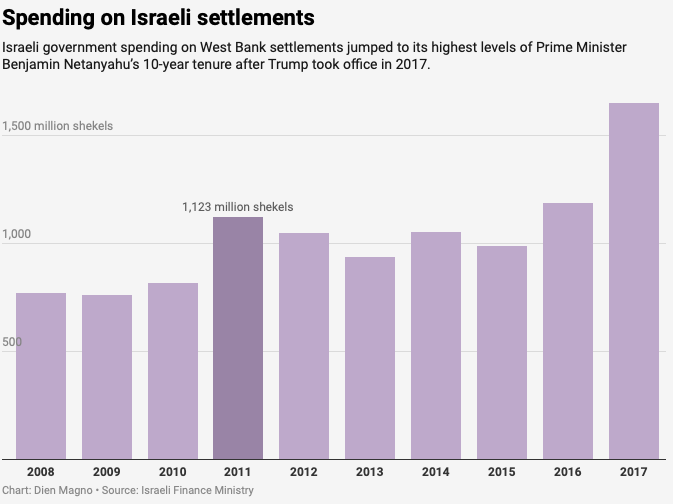 The 2017 figures are the highest amount of Israeli government funds invested in the settlements by the government of Israel during any year since Netanyahu became prime minister 10 years ago (and has remained in power since). The Israeli government tracks its own spending on settlement activities in order to report that total sum to the U.S. government, a practice which began under President George H.W. Bush – which in theory is supposed to deduct the sum from U.S. loan guarantees available to Israel (in reality, the U.S. has made only occasional and minimal deductions).
The areas with the highest growth rate in funding in 2017 were school construction (68% increase from 2016) and road construction (54% increase from 2016). Hagit Ofran, co-Director of the Settlement Watch project at Peace Now, explained the significance of Israeli investments in roads for the settlements:
“We see it very immediately, after the opening of a road, a big boom in construction along the road,” she said. “I think the investments we have these years in the roads are dramatic and will allow the expansion of settlements dramatically. That is very much worrying.”
Nabil Abu Rudaineh, spokesman for Palestinian President Mahmoud Abbas said:
“This proves that the current U.S. administration encouraged settlement activities.”
11 Knesset Members Join Campaign to Cancel 2005 Disengagement Law & Re-establish Evacuated West Bank Settlements
Eleven members of the Knesset, including Speaker of the Knesset Yuli Edelstein, participated in tour of one of the four settlements in the northern West Bank which Israel evacuated in 2005 as part of its Gaza Disengagement plan. The IDF had to provide special permission for the MKs to visit the Homesh settlement, because , even all these years later, it is a closed military zone. This is just the latest event in a settler-led campaign to pressure Netanyahu into canceling the 2005 Gaza Disengagement Plan and re-establishing those settlements.
After Israel’s evacuation of the four settlements in the West Bank – Homesh, Sa-Nur, Ganim, and Kadim – the IDF issued military orders barring Palestinians from entering the areas, let alone building in them. At the same time, settlers have regularly entered the areas and even repeatedly built a yeshiva at the Homesh site.
Bibi Pushes High Court Override Legislation During Coalition Negotiations
Haaretz reports that Prime Minister Netanyahu plans to promote the so-called High Court Override bill, which would empower the Knesset to effectively strip the High Court of its power to review and strike down legislation it deems unconstitutional, as well as overrule the Court’s administrative decisions – a new, and alarming, component of the long touted law. This new component is needed in order for Netanyahu to ensure his own immunity against criminal charges, but it will also empower the Knesset to ignore the Court’s administrative decisions issued in response to petitions – effectively giving elected and partisan government officials a veto over the only justice system accessible by Palestinians. As Haaretz explains: “for example, if a minister makes a decision that is overruled by the court in response to a petition – such as Netanyahu’s decision to ban the entry of Palestinian participants of a joint memorial day ceremony – the minister could reissue the decision anyway.”
Critical for FMEP reporting, if the law is passed the Knesset will be empowered to reinstate the settlement Regulation Law if the High Court rules against it, which it has long been expected to do. The law, passed in February 2017 and quickly frozen, directs the government to retroactively legalize a huge number of illegal outposts and settlement structures which were built on privately owned Palestinian land. Implementation of the Regulation Law was quickly frozen in light of petitions to the High Court challenging its constitutionality.
According to the Haaretz report, an agreement to promote the override bill will be included in the coalition agreement Netanyahu is negotiating to form the next government, and parties are engaged in debates over the specific form the law will take. The right-wing parties want to pass the law within 60 days after the new government takes over, and in a form that would totally negate the authority of the High Court to strike down decisions by elected officials or bodies like the cabinet, the ministers or the Knesset. The comparatively centrist Likud members support the principle of the override law but not the specifics proposed by negotiating partners. Likud members say they are reviewing various models for the law which tinker with the mechanism by which the Knesset can override High Court rulings and administrative decisions.
The override bill has been a key objective of Netanyahu’s negotiating partners, most prominently MK Bezalel Smotrich and Transportation Minister Yariv Levin, who are competing to become the next Justice Minister and whose negotiation demands FMEP analyzed some weeks back. FMEP has also documented the progress of the High Court Override bill in its Annexation Policies tables.
Trump Envoy Praises US-Backed Economic “Coexistence” Group for Joint Settler-Palestinian Hebron Iftar
On May 14th, U.S. peace envoy Jason Greenblatt tweeted his praise for a joint settler-Palestinian iftar event in Hebron, hosted by the “Judea and Samaria Chamber of Commerce,” a favorite group of the Trump Administration’s peace team. As has become a key mantra, Greenblatt said the event helps lay the “groundwork for peace” and said it was a “wonderful example of what could be possible.” As pointed out by many voices on Twitter, praise for the event ignores ignoring the apartheid conditions in Hebron under which Israeli policies deny Palestinian rights and well-being, for the benefit of some 800 Israeli settlers.
Palestinian businessman Sheikh Ashraf Jabari held the event in his Hebron home. Jabari recently launched a new Palestinian political party, the Reform and Development Party, advocating for a one-state solution because, Jabari argues, Palestinians have no other choice than to accept Israeli sovereignty over them. It is well known that Jabari has close ties to the Trump administration, which has very publicly embraced settler-Palestinian economic co-existence initiatives as a core U.S. priority on the ground and are seeking an alternative Palestinian leadership with which to make a deal.
Jabari told the Jerusalem Post about the iftar event and his broader aims:
“We want to build a united front, to create a breakthrough on the economic issue. We are issuing a clear call to separate between economics and politics, and hope to have fruitful cooperation on the subject. From our point of view, we need to strengthen the connection between the US legislature and activity that promotes economic equality here. This meal is meant to reinforce the growing trend in which economic-business connections can strengthen relations and friendship, by way of leading people to a more positive place.”
Along with Jabari, high profile event attendees – which included Samaria Regional Council head Yossi Dagan and Hebron Jewish community leader Yishai Fleisher – praised the business initiative as a model for peaceful relations.
Uri Karzen, the Director General of the settlers in Hebron and an attendee of the iftar, said in a tweet:
“First #Iftar in #Hebron with Kosher food. We are laying the groundwork for peace between people and economic prosperity for all.”
Heather Johnston, executive-director of the US-Israel Education Association which leads U.S. congressional delegation to settlements and runs camps in the Ariel settlement (no joke – to help Ethiopian Jews rediscover their roots), told the event attendees:
“Each of you have played a role in helping to build this integrated business movement. You have made sacrifices. You have gone into the unknown. You have been willing to take risks in business and in relationships. And this is what it takes to pioneer something that will one day be a humongous success. I have been involved in Samaria for the last 22 years. I believe there is more hope today for this important relationship to actually succeed than ever before.”
Chamber president Avi Zimmerman, of the Ariel settlement, said:
“We can measure progress at a people-to-people level, at every business transaction. Every time I get up and say ‘this is only about economics, it is not about peace,’ everyone starts talking about peace. Which makes me believe that if everyone keeps talking about peace when we speak of economics, that these incremental, measured steps toward mutual interest are actually what will birth the peace. They can birth a political process, but it will not happen the other way around,” he said. “We have learned for 70 years that it is not going to be the other way. It has to start this way.”
FMEP has repeatedly explained how initiatives like this perpetuate Israel’s economic exploitation of occupied territory (including the local workforce, land, and other natural resources), and that it is perverse to label such initiatives as “coexistence” programs, or to suggest that they offer the Palestinians benefits they should welcome. The New York Times quoted a spokesman for the Palestinian Authority explaining the Orwellian reality of settlement industrial zones:
“Somebody occupies your country, steals your land, steals your water, steals your resources, then says: ‘I’ll make a good deal for you if you come work for me. I’ll create jobs for you. We are not occupiers. We are employers.’ This is ridiculous. The colonial settlements are illegal in every sense of the word.”
Bonus Reads
- “Israel Okays Major West Bank Roads, Seizing Large Tracts of Palestinian Land” (Haaretz)
- “Israel Dismisses Complaint Against Lawmaker Who Called to Ban Arabs from Highway” (Haaretz)
Welcome to FMEP’s Weekly Settlement Report, covering everything you need to know about Israeli settlement activity this week.
To subscribe to this report, please click here.
May 10, 2019
- Annexation Proceeds: Israel Tourism Ministry Creates Official Funding Channel for Hotels in Settlements
- Settlers Take Over Another Palestinian Home in Hebron, IDF Says It Was for “Military Needs”
- IDF Helps Settlers Celebrate Passover At the Site of the Evacuated Amona Outpost (Which Palestinians Still Cannot Access)
- Israel Issues Construction Permits for Two Settler Bypass Roads
- Every Month Israeli Forces Evacuate the Same Outpost; This Time, 18 Settlers Were Arrested
- No Shame: Settler Builds Illegal Outpost Near Khan Al-Ahmar While Calling for Bedouins’ Eviction
- UNSC Holds Meeting on Israeli Settlements; U.S. Peace Envoy Says Settlements Are Not a Problem
- Greenblatt Touts “Shared Prosperity” Paradigm for Peace Plan Following Beverly Hills Conference
- Bonus Reads
Annexation Proceeds: Israel Tourism Ministry Creates Official Funding Channel for Hotels in Settlements
On April 18th, Israeli Tourism Minister Yariv Levin – who has emerged as a frontrunner to be given the Justice Ministry portfolio in the next government – announced that his ministry had launched a new grant program to expedite funding channels for the construction of hotels in settlements located in Area C of the West Bank. Under previously Israeli law, hotel projects in settlements had to receive special approval from the government; the new program expedites and normalizes that process.
These grants are more than an economic program. Investing in the growing tourism industry inside of settlements in the West Bank is a strategic endeavor intended to entrench settlements, provide for their expansion, normalize their existence within the international community, and advance their seamless integration into Israeli territory. In a recent report on companies which profit from tourism in the settlements, Amnesty International further explains:
“In recent years the Israeli government has invested huge sums to develop the tourism industry in settlements. It uses the designation of certain locations as tourist sites to justify the takeover of Palestinian land and homes, and often deliberately constructs settlements next to archaeological sites to emphasize the Jewish people’s historic connections to the region.”
Following the announcement of the new grant program, Hananel Dorani – Chairman of the powerful Yesha Council, a settlement umbrella group – told the press:
“We thank [Tourism] Minister Yariv Levin (Likud) for his important work on the issue of tourism in Judea, Samaria, and the Jordan Valley. Building hotels and guest houses in the area is an important step which shows the deepening of our roots in the ground and paves the way for Israeli sovereignty in Judea and Samaria. Giving grants for the creation of hotels is another supplemental step which will help solve the problem of where to sleep and will strengthen settlements and our hold on Judea and Samaria.”
Oded Revivi – the foreign envoy of the the Yesha Council – commented:
“[Tourists] will see how there are good neighborly relations between Jews and Arabs. Unlike what has been told to them, they will see that there is not war here every day and that there is no apartheid.”
The Palestinian Ministry of Foreign Affairs and Expatriates said in a statement:
“These plans fall within the framework of the gradual erosion of the occupied Palestinian territory, in particular Area C, under various security, military, economic, settlement and tourism pretexts, which requires the international community to move urgently to save what is left of the chance to achieve peace on the basis of a two-state solution.”
Settlers Take Over Another Palestinian Home in Hebron, IDF Says It Was for “Military Needs”
In early May 2019, a group of settlers broke into a Palestinian-owned home in the Casbah area of the Old City of Hebron. The settlers moved in and promptly started renovating the property. The property is legally owned by the Arafeh family, who were forced to move out in 2005 due to the extreme restrictions on Palestinian movement in the area imposed by the Israeli military.

Map by Peace Now
A lawyer for the Arafeh family asked the Israeli Civil Administration to evict the settlers from the privately owned property. Rather than take action against the settlers, a spokesperson for the Civil Administration justified the settlers’ illegal entrance to the property and the “renovations” they undertook, arguing that the settlers were working on behalf of the IDF to build a military post on the roof of the Arafeh family’s house. This, despite the fact that, according to Peace Now, the Palestinian homeowners never received a notification that the IDF was seizing the property, as required under Israeli law.
Peace Now said in a statement:
“If the works were done for the IDF, it is a shame that the IDF does not respect Palestinian ownership and treats their empty homes as if they were no-man’s property. The Palestinians were forced to leave their houses because of the heavy restrictions imposed by the IDF in order to protect the settlers in Hebron. Those ‘temporary’ restrictions have remained in place now for decades, and the way the IDF and the settlers treat the Palestinian properties show that the security excuse cannot hold anymore and that what is done in the Old City of Hebron may be better described as forced displacement. If the works were done by the settlers, then it is part of a cruel method of the Palestinian dispossession in Hebron: first the IDF closes streets, shops and Palestinian homes to protect a handful of settlers. Then, because of the severe restrictions, Palestinian families are forced to leave their homes. And then settlers take over the empty houses without any permit. Finally the government allows them to remain and establish a new, illegal settlement in the heart of the Palestinian population.”
IDF Helps Settlers Celebrate Passover At the Site of the Evacuated Amona Outpost (Which Palestinians Still Cannot Access)
Haaretz reports that the Israeli military assisted settlers in trespassing into the site of the evacuated Amona outpost to celebrate Passover. The land – which in 2017 the Israeli High Court ruled to be legally owned by Palestinians – remains inaccessible to the Palestinian landowners under a military closure order barring all civilians from entering the area. In practice, the closure only applies to Palestinians. Settlers, on the other hand, are not only given free rein in the area but received high profile political backing and significant funding in their December 2018 efforts to illegally rebuild the Amona outpost. With much scandal, in January the IDF removed several pre-fab structures the settlers managed to install at the Amona site, and evacuated the settlers despite their violent resistance.
In January 2019, the Israeli NGO Yesh Din assisted the Palestinian landowners to filed a new petition with the Higher Court of Justice to reverse the military closure order to allow Palestinian landowners to access their land and restrict Israeli settlers from doing so. The petition is still pending.
Israel Issues Construction Permits for Two Settler Bypass Roads
On May 1st, the Israeli Civil Administration approved construction permits for two new bypass roads for settlers – the Huwwara and Al-Arroub roads. The approval brings construction of the roads closer, though it may still be stalled if Palestinians challenge the government’s confiscation of privately owned Palestinian land for the roads (confiscated on the basis of “security needs”). It’s worth recalling that a recent Kerem Navot report found that a whopping 47% of the total land seized by Israel for “security needs” is currently used to serve the needs of the settler population.
Peace Now said in a statement:
“These expropriations are part of the government’s continued capitulation to the settlers to build Israeli-oriented bypass roads throughout the West Bank. The settlers know very well that without good roads the settlements will not be able to develop, and tactically demand that they be built ‘for security reasons.’ This stated rationale masks the real goal behind these roads: to expand the settlements and to advance plans for annexing the West Bank at the cost of a two-state solution.”
Both roads will be located deep inside of the West Bank: the Huwwara road will serve settlements near Nablus and the Al-Arroub road will serve settlements near Hebron. Among the many benefits for settlers, bypass roads entrench the presence of settlements, enable their expansion, and advance their seamless integration into Israel proper.
Gloating over the new roads, Samaria Regional Council chief Yossi Dagan said:
“The Prime Minister has proven his leadership, responsibility, and his integrity. Netanyahu kept his promise, and I praise him for sticking by the agreement. The Hawara and Al-Arroub bypass roads are strategic roads, which, God-willing, will change the map of the State of Israel in general and the map of Judea and Samaria in particular.”
Every Month Israeli Forces Evacuate the Same Outpost; This Time, 18 Settlers Were Arrested
According to Haaretz, the cat and mouse game (once dubbed “the never-ending evacuation”) between settlers and the IDF over the “Esther Maoz” outpost site has finally resulted in the arrest of 18 settlers.
For years, the IDF has evacuated settlers from the outpost only to allow them to immediately rebuild it. Following the settlers evacuation and arrest, the NGO Honenu – which acts as a legal defense fund for settlers – alleged that the security forces “used intense violence” against the settlers.
The Esther Maoz site is located near the Kokhav Hashahar settlement, and can only be accessed by road from inside of the settlement.
No Shame: Settler Builds Illegal Outpost Near Khan Al-Ahmar While Calling for Bedouins’ Eviction
An Israeli settler name Boaz Ido is funding the illegal construction of an unauthorized outpost just hundreds of meters from the location of the embattled Khan al-Ahmar Bedouin community. Construction at the outpost site has continued despite stop-work orders issued against it by the Civil Administration.
While funding the illegal project, Ido has lobbied the government to forcibly remove Khan al-Ahmar’s inhabitants, based on the argument that the village lacks the required Israel-issued building permits.
Haaretz visited the site of Ido’s new outpost and found a group of Israeli settlers working to construct a straw and mud structure. The location of the construction falls within the approved borders of the Ma’ale Adumim settlement, but is not contiguous with the built-up area of the settlement. Moreover, there are no valid building plans or permits for Ido’s current undertaking.
Dror Etkes, founder of Kerem Navot, told Haaretz:
“It’s no wonder that someone who has been investing so much energy into evicting the Bedouin neighbors who were in the area for decades before him is the same person who is investing a lot of energy into controlling land that he has not even a hint of a right to.”
Ido is a well-connected settler living in the Ma’ale Adumim area. He runs the nearby “Genesis Land” tourism site and is an active member of the Jerusalem Periphery Forum, a group working to evict bedouin from the area. Ido has been deeply involved in pushing the government to evict the bedouin from Khan al-Ahmar, including extracting assurances from Prime Minister Netanyahu and briefing the Knesset about “Palestinian take over of Area C.” According to the settler-run Arutz Sheva outlet, Ido told the Knesset members:
“We cannot lose control of Route 1 and permit illegal [Arab] construction as in the Negev. We are working continuously on the ground and I am pleased that, for the first time, in 2016, cooperation with the Civil Administration has been stepped up, with corresponding results – a halt to illegal construction as well as a small reduction in the number of structures on the ground.”
So in addition to his current hypocrisy, Ido is also complicit in an extraordinary manipulation of facts regarding Area C — a term which refers to the 60% of the occupied West Bank which the Oslo Accords temporarily assigned to complete Israeli control (civil and security) as part of an interim agreement designed to remain in place for a short period, pending conclusion of permanent status negotiations. Since then, Israel has implemented a discriminatory planning policy in Area C, which B’Tselem says is aimed at “preventing Palestinian development and dispossessing Palestinians of their land.”
While implementing a planning system under which it is nearly impossible for Palestinians to obtain building permits, Israel routinely enforces demolition orders against Palestinian structures built without permits while looking the other way with regards to illegal settlement construction in the area. In addition, the government is undertaking a systematic campaign to retroactively authorize the vast majority of illegal outposts and unauthorized settlement construction – – a contradiction which clearly benefits Ido’s new outpost.
UNSC Holds Meeting on Israeli Settlements; U.S. Peace Envoy Says Settlements Are Not a Problem
On May 9th the United Nations Security Council held a meeting at the request of Indonesia, Kuwait, and South Africa entitled “Israeli Settlements and Settlers: Core of the Occupation, Protection Crisis and Obstruction of Peace.” The informal “Arria formula” meeting provided a forum for member states to be briefed by experts in the field; speakers included John Quigley ( Ohio State University), Emily Schaeffer Omer-Man (Israeli human rights attorney); Mohammed Khatib (Popular Struggle Coordination Committee); and James Zogby (Arab American Institute). Member states in attendance included France, Germany, Russia, and Colombia.
U.S. Special Representative for International Negotiations Jason Greenblatt delivered remarks at the meeting on behalf of the United States (not as an expert). His remarks – rather than dealing with the substance of criticisms on settlements – sought to flip the script and attack the UNSC for alleged anti-Israel bias and accuse it of ignoring Hamas attacks on Israelis. Unsurprisingly, given the Trump administration’s public embrace of settlements, Greenblatt said:
“Let’s stop pretending that settlements are what’s keeping the sides from a negotiated peaceful solution. This farce and obsessive focus on one aspect of this complicated conflict helps no one.”
Arab American Institute President Dr. Jim Zogby said of the deterioration of U.S. policy on settlements:
“There has been a steady erosion of US policy on Israeli settlements, it went from rejection to acceptance, and from passive acquiescence to legitimization. It saddens me as an American to say: This makes my government complicit, and more recently an enabler of this criminal activity. A new strategy is needed, not just to challenge Israel, but to challenge the impunity the US has bestowed on Israel that makes it unaccountable.”
Indonesian Foreign Minister Retno Marsudi, who chaired the meeting, said:
“inaction was not an option. Public pressure to end the settlement is absolutely vital… Indonesia will spare no effort to ensure that the Palestinian issue remains one of the main focus of the UN.”
Marsudi also suggested creating an international day of solidarity with the victims of illegal settlements.
Greenblatt Touts “Shared Prosperity” Paradigm for Peace Plan Following Beverly Hills Conference
On April 29th, following a private briefing for attendees at the ritzy Milken Institute’s 2019 Global Conference, U.S. Special Representative for International Negotiations Jason Greenblatt tweeted:
“this year’s [Milken Global Conference] theme ‘Driving Shared Prosperity’ couldn’t be more fitting for what Jared, Amb. David Friedman and I hope will be the future of our peace vision for Israel, Palestinians and the region.”
Jared Kushner also made an appearance at the conference, held in Beverly Hills, California. Kushner and Greenblatt were not listed among the conference speakers, which included prominent celebrity figures such as animal biologist Jane Goodall and NFL quarterback Tom Brady.
The Milken Institute describes itself as:
“a nonprofit, nonpartisan think tank determined to increase global prosperity by advancing collaborative solutions that widen access to capital, create jobs and improve health. We do this through independent, data-driven research, action-oriented meetings, and meaningful policy initiatives.”
Bonus Reads
- “Will Netanyahu Annex the Settlements?” (Newsweek)
- “As Israeli Group Expands, Palestinian Houses Face Demolition” (Associated Press)
- “Some of Israel’s Best American Friends Worried by Netanyahu Annexation Talk” (Times of Israel)
Welcome to FMEP’s Weekly Settlement Report, covering everything you need to know about Israeli settlement activity this week.
To subscribe to this report, please click here.
April 26, 2019
- Israeli Court Reaffirms: Settlers Must Vacate Palestinian Home in Hebron
- Israel Confiscates Privately Palestinian Land for New Settler Bypass Road
- Annexation in Play in Negotiations over Israel’s Next Coalition Government
- OCHA: Palestinians in Downtown Hebron Suffer at Hands of Settlers & IDF; Israel Politicians: Time to Triple Number of Hebron Settlers
- Bonus Reads
Israeli Court Reaffirms: Settlers Must Vacate Palestinian Home in Hebron
On April 22nd, the Jerusalem Magistrate’s Court rejected an appeal by settlers to stop their eviction from a Palestinian-owned home in Hebron, where they have been squatting for the past 18 years. In addition, the court ordered the settlers to pay the true homeowners – the Palestinian Bakri family – $160,000 (NIS 80,000) in damages. Unsurprisingly, the settlers’ attorney immediately announced that they will file another appeal with the Jerusalem District Court — delaying the implementation of the eviction order once again.
The Bakri family has spent the past 18 years petitioning Israeli police and Israeli courts to remove the settlers — cases the Bakri family has repeatedly won. Yet, the settlers have managed to repeatedly delay their eviction by exploiting every possible legal argument, no matter how absurd or contradictory: at different points over the past 18 years, settlers have argued in court that they had a rental agreement; that they purchased the home; that the plot of land was owned by a Jewish trust prior to 1948 and so they have a right to “reclaim” the property; and that regardless of ownership before they took possession, because they have now invested so much money in improving the property it now, under Ottoman Law, legally belongs to them. Underscoring the mockery settlers have made out of the Israeli justice system, when at one point some years ago the courts ruled that the settlers had to vacate, the settlers who at the time were occupying the Bakri home did, indeed, leave, only to be immediately replaced by other settlers — at which point the Israeli Attorney General told the Bakri family that if they wanted THESE settlers, out, they had to start eviction proceedings anew.
For a detailed timeline of the Bakri family’s 18-year saga — which to this day remains unresolved and justice remains denied — see this report from Peace Now.
Israel Confiscates Privately Palestinian Land for New Settler Bypass Road
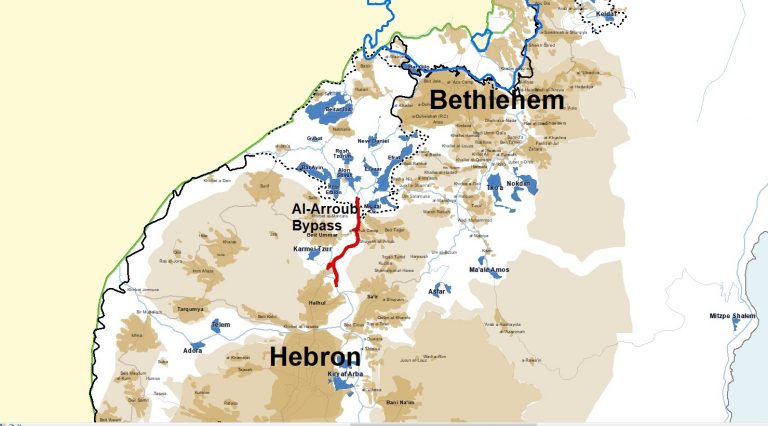
On April 3rd, the Israeli Civil Administration signed a military order to confiscate privately owned Palestinian land in the West Bank in order to build a new bypass road, to be called the “Al-Arroub/Lev Yehuda bypass road,” approved by the Israeli government in 2012. The Palestinian villages Beit Ummar and Halul, whose land was taken for the road, are expected to file objections to the confiscation..
Map by Peace Now
While settlers claim the road is needed both for transportation and security reasons, construction of the road advances a far more important strategic objective for settlers: the establishment of a more direct route between Hebron-area settlements – particularly Kiryat Arba – and sovereign Israeli territory, without going through any Palestinian towns.
This is the second bypass road advanced by Israeli in the month of April; on April 9th, FMEP reported on the advancement of the Huwwara bypass road. Both of these new bypass roads are part of a 5-road package that Prime Minister Netanyahu, under immense pressure from the settler lobby, known as the Yesha Council, promised to build.
Peace Now explained:
“This expropriation is part of the government’s continued capitulation to the settlers to build bypass roads throughout the West Bank. The settlers know very well that without good roads the settlements will not be able to develop, but cynically demand they be built ‘for security reasons.’ In fact, the goal behind these roads is to expand the settlements and advance plans to annex the West Bank into Israel in order to prevent the chances of reaching a two-state solution.”
Settlers and the government say that the roads will be open to both Palestinian and Israeli traffic, but as Peace Now explains, “even if in some cases the Palestinians can benefit from these roads, they are not paved according to a planning conception of the Palestinian needs.” Indeed, bypass roads are not just oblivious to Palestinian needs; they are strategically located to constrict the growth of Palestinian villages, as explained at length by Americans for Peace Now. Moreover, history shows most bypass roads ultimately end up being settler-only routes, as B’Tselem extensively documented in its authoritative 2004 report, “Forbidden Roads: The Discriminatory West Bank Road Regime.”
OCHA: Palestinians in Downtown Hebron Suffer at Hands of Settlers & IDF; Israel Politicians: Time to Triple Number of Hebron Settlers
The United Nations Office for the Coordination of Humanitarian Affairs (OCHA) published a new report based on a survey of 280 Palestinian families living in the downtown part of Hebron know as “H-2”, under the direct control of the Israeli military and cheek-to-jowl with settlers. Accounting for 20% of land in Hebron, the downtown H-2 area is home to some 33,000 Palestinians and a few hundred of the most radical and violent Israeli settlers, whom the IDF protects through a policy of segregation, including keeping areas “sterile,” defined to me free of and off limits to Palestinians.
Palestinian H-2 resident and human rights defender Issa Amro wrote a powerful depiction of the apartheid reality in which he and other Palestinians live. Key findings of the new OCHA report, that give even more detail to that reality, include:
- When asked to list the three major concerns related to their current residence in H-2,
- 75% of the households surveyed cited harassment by Israeli forces;
- 67% cited social isolation [access to the area is generally limited to the residents, cutting them off from family and friends];
- 64% cited limited livelihood opportunities [Palestinian commercial life in the area has for the most part died]
- While only 2% of the households cited settler violence and harassment as a top concern, OCHA notes that the “general perception among Palestinians that most incidents of harassment involve, in one way or another, both settlers and soldiers, rendering the differentiation [between settlers and Israeli forces] meaningless.”
- When asked specifically about violence and harassment by settlers, almost 70% of the respondents reported that at least one member of their household has experienced an incident of settler violence or harassment since October 2015:
- 20% reported experiencing settler violence on a weekly basis;
- 80% of affected households reported psychological distress,
- 25% reported property damage;
- 18% reported physical injury.
Based on these findings, OCHA deemds H-2 a “coercive environment,” writing:
“In addition to settler violence and access restrictions, the lives of Palestinians in H2 have been severely affected by constant raids and incursions into their homes by Israeli forces, which often include the temporary takeover of parts of the homes. These policies and practices have generated a coercive environment, which has undermined the living conditions of Palestinians, including their security, sources of livelihoods, access to services, and family and social life. Thousands have been forced to leave the affected area.”
Against the backdrop of the extraordinary difficulties already facing Palestinians living in the center of Hebron, Israeli politicians are now looking to significantly boost the number of Israeli settlers living there. Speaking at the Tomb of the Patriarchs/Ibrahimi Mosque in Hebron, Bezalel Smotrich – who is jockeying to be the next Justice Minister – called to immediately triple the number of settlers living in the heart of Hebron, and keep increasing the settler population from there, promising:
“That would just be the start. Hebron is a large city. There is a lot of space here for many Jews to redeem this city, which will allow us to draw strength from the strong connection to the city of our forefathers.”
Also at that same event, Deputy Defense Minister Eli Ben Dahan (who famously referred to Palestinians as “animals”) said:
“We are praying that we will create a new government, a government that will declare sovereignty on Judea and Samaria. A government that with God’s help will show the world that there is no difference between Hebron and Beersheba. Hebron is what connects Jerusalem to Beersheba. Here in Hebron the nation of Israel connects to its roots. With God’s help we will declare that Judea and Samaria is an inseparable part of Israel.”
Annexation in Play in Negotiations over Israel’s Next Coalition Government
As negotiations to form the next ruling coalition get underway, the head of the Union of Right Wing Parties (URWP), Bezalel Smotrich, issued a list of demands for Netanyahu’s Likud Party amounting to a checklist for the next phase of Israel’s de facto annexation of the West Bank. None of the URWP’s annexation-related demands are new ideas or efforts — a reminder that Israel has been discussing and promoting annexation policies since long before Netanyahu publicly announced it to the international community. The fact that they are not new and, indeed, have in the past generated significant support — coupled with Netanyahu’s newfound public enthusiasm for annexation and the Trump Administration’s Golan annexation trial balloon — suggests that Smotrich’s/URWP’s annexation-related demands are more than mere political gamesmanship. Rather, they should be examined carefully and treated as serious.
Before jumping into the list of demands, it’s worth recalling that the URWP is made up of three main parties: the national religious Jewish Home, the National Union/Tekuma party, and the Otzma Yehudit/Jewish Power party. It is also worth recalling that the latter party is the latest incarnation of the Kach/Kahane Chai party, which was banned in Israel for racism (and is a U.S.-designated Foreign Terrorist Organization). Netanyahu personally brokered a deal to include Otzma Yehudit in the URWP coalition – a move so appalling that it garnered criticism, albeit veiled, from some of Netanyahu’s most ardent supporters in the United States.
Here are the demands:
Demand #1: Giving a simple majority in the Knesset the power to overrule the High Court of Justice. Smotrich demands that the government promote the “High Court override bill.” If this becomes law, it will allow the Knesset to re-enact legislation that had been struck down by Israel’s highest court by a simple majority vote, in effect turning rule of law into rule by the dictatorship of the majority. This bill is the extreme version of a longtime legislative priority of right-wing Israeli parties, who view the High Court as overly sympathetic to Palestinians, overly deferential to international law, and biased against Israeli settlers (they view the mere fact that Israel’s legal system distinguishes between sovereign Israel proper and the West Bank (which even according to Israel remains, legally speaking, land held under belligerent occupation) constitutes discrimination against settlers. Netanyahu has supported this initiative in the past, making it an all but guaranteed agenda item for the next government. The consequences of the bill will be profound. Since 1967, the High Court of Justice has been the court of first jurisdiction for cases related to Palestinians living in the West Bank, reflecting the extraordinariness of Israeli judges issuing, in effect, extra-territorial legal rulings. By empowering the Knesset (to which West Bank Palestinians are not entitled to elect representatives) to overrule the High Court with a bare majority vote, the rule of law in Israel will be wholly politicized – no doubt against Palestini.
Demand #2: Give URWP power to retroactively legalize illegal settler construction and to open the settlement floodgates. Smotrich demands the formation of a ministerial committee headed by a URWP member that would take over the implementation of plans to retroactive legalize all unauthorized settlement construction and outposts, entrenching even the most far-flung and isolated outposts and allowing for their expansion. Smotrich also wants this committee to take control of the Settlement Division of the World Zionist Organization and its efforts to settle Jews in all areas of the West Bank. Smotrich has previously championed a bill that would hand over a vast tracts of land in Area C of the West Bank to the Settlement Division. By taking control over the Settlement Division, the URWP-headed committee can accelerate this land transfer, opening up more West Bank land for more settlement construction.
Demand #3: Disband the Civil Administration. The Civil Administration is the body within the Israeli Defense Ministry that acts as the sovereign governing power over the West Bank. By shuttering the Civil Administration – the legal structure supporting and maintaining occupation created by Israel as a means to administer the West Bank as distinct entity from sovereign Israeli territory – any legal distinction between the two land areas will vanish, resulting in the annexation of the West Bank. Smotrich has been pushing this move for over a year. Under his plan, Israeli settlers in the West Bank would come under the full sovereignty of domestic Israeli institutions, while Palestinians would be ruled by “Regional Liaison administrations.”
Demand #4: Reverse the 2005 Disengagement Law. Smotrich demands that Israelis be allowed to return both to four northern West Bank settlements and to Gaza, from which settlers were removed in 20005 following the passage of Ariel Sharon’s Disengagement law. A Knesset bill to this effect has been circulating since June 2017, and various Knesset members including Smotrich have joined settlers protests in the West Bank demanding the right to return to the evacuated settlements there.
Demand #5: Diminish the power of the Israeli Attorney General. Smotrich demands that the new government limit the power and independence of the Israeli Attorney General, by forbidding him (or maybe someday, her) from arguing against the Israeli government in a court of law. The catalyst for this demand is the action by the current Attorney General, Avichai Mandelblit, who argued against the government regarding the “Regulation Law,” which Mandelblit said is unconstitutional and which is strongly supported by Smotrich and the Israeli right.
Demand #6: Get the State Comptroller under control. Smotrich demands new restrictions on the State Comptroller’s authority, seemingly an effort to stop the publication of embarrassing or politically awkward government-issued reports that reveal how taxpayer money is funneled to illegal settlement activities. The Times of Israel notes that Israeli Ombudsman Aharon Shapira has published reports over the past several years that have been heavily critical of several ministries funneling of funds toward illegal West Bank outposts.
In addition to the annexation-related demands, the URWP – which won only 5 seats in the Knesset but appears to be playing the role of kingmaker for the Netanyahu’s next coalition – is demanding that two of is members be named to powerful ministerial posts: Smotrich (leader of the National Union party and head of the URWP coalition) wants to be the next Justice Minister and, Rafi Peretz wants to be the next Education Minister. These two high-profile posts are being vacated by Ayelet Shaked and Naftali Bennett, whose newly formed party failed to win any seats in the next Knesset. During her tenure as Justice Minister, Shaked undertook what she deemed a “legal revolution” aimed at completely erasing any distinction between the settlements/outposts and Israel proper, and, significantly, making it more difficult for Palestinians to access the only means of justice available to them under occupation by stripping the Israeli High Court of Justice of primary jurisdiction over land disputes.
As made clear by his personal history and political record – which led to Haaretz to dub him “the youthful face of unrepentant Jewish extremism” – Smotrich is an even more radical ideologue than Shaked. His unapologetic push for annexation and his eagerness to enshrine an apartheid system to permanently rule over the Palestinians leaves no question about how Smotrich will approach the role of Justice Minister, if he succeeds in securing that appointment.
Bonus Reads
- “For Palestinian Families: ‘No Light at the End of the Tunnel’” (New York Times)
- “Palestinians Have No Leverage Against Israeli Annexation” (Al-Monitor)
- “Israel Opens New Qalandiya Checkpoint, Phasing Out Inadequate Crossing” (Times of Israel)
Welcome to FMEP’s Weekly Settlement Report, covering everything you need to know about Israeli settlement activity this week.
To subscribe to this report, please click here.
March 21, 2019
- After 18 Years, Court Evicts Settlers from Stolen Home in Downtown Hebron
- Knesset Leader: U.S. Support for Annexation of Golan is First Step Towards West Bank Annexation
- Israeli Education Ministry Funds Group Behind Violent Outpost at Site of Dismantled Settlement
- Settler Excavations in Silwan Hit a Wall [Literally]
- Settlers Lobby Key U.S. Stakeholders to Protect Settlements from Trump’s “Peace Plan” & Promote Settler-Palestinian Business “Coexistence” Initiatives
- Palestinian-Americans Intervene in Lawsuit Against AirBnB, Bringing First Challenge Against Settlements to U.S. Courts
- Hoping to Avoid ICC Investigation, Pro-Settlement Groups Submit Defense of Settlements
- Bonus Reads
Questions/comments? Email kmccarthy@fmep.org
After 18 Years, Court Evicts Settlers from Stolen Home in Downtown Hebron
On March 12, 2019, the Jerusalem Magistrate Court ruled to evict settlers from a house in the heart of downtown Hebron (in the notorious Tel Rumeida section), that the settlers have illegally occupied since 2001. The court ruling gives the settlers 45 days to vacate the house, but the settlers are able to – and expected to based on the history of this case – appeal the ruling.
The Palestinian homeowners – the Bakri family – temporarily fled their home under constant settler harassment during the second intifada, a time when Tel Rumeida could be described as an “urban battlefield.” While the family was gone, settlers broke into the house, damaged it, destroyed the Bakri’s property, and ultimately took up residence there.
The Bakri family has spent the past 18 years petitioning Israeli police and the courts to remove the settlers — cases the Bakri family repeatedly won.
The settlers have managed to repeatedly delay their eviction by essentially exploiting every possible legal defense, no matter how absurd or contradictory. At different points over the past 18 yrs, settlers have argued in court that they had a rental agreement; that they purchased the home; that the plot of land was owned by a Jewish trust prior to 1948 and so they able to reclaim the property; and that because they had invested so much money in improving the land since taking it over, under Ottoman Law it now legally belongs to them. When at one point some years ago the courts ruled that the settlers had to evacuate, the settler occupants of the Bakri home did, indeed, leave, only to be immediately replaced by other settlers — at which point the Israeli Attorney General told the Bakri family that they had to start eviction proceedings anew. For a detailed timeline of the Bakri family’s saga, see this report from Peace Now.
Throughout the course of this saga, the settlers’ effort to hold on to the Bakri home was aided by the State’s unwillingness to implement court orders against the settlers. Peace Now said in a statement:
“This is not only a matter of cruelty, deceit and theft of settlers who are not loathe to take control of assets that are not theirs, but also a matter of the lack of government accountability. For 18 years the government did not enforce the law against the invading settlers, and even assisted them and allowed them to continue to steal the house and terrorize their Palestinian neighbors in Tel Rumeida. Furthermore, it should be remembered that Hebron is under Israeli occupation and the Palestinian residents cannot remove the settlers from their homes by appealing to the Palestinian Authority. The power lies in the hands of the Israeli government, which does nothing to fulfill its responsibilities to protect abandoned Palestinian property.”
Knesset Leader: U.S. Recognition of Israeli Sovereignty Over Golan is First Step Towards West Bank Annexation
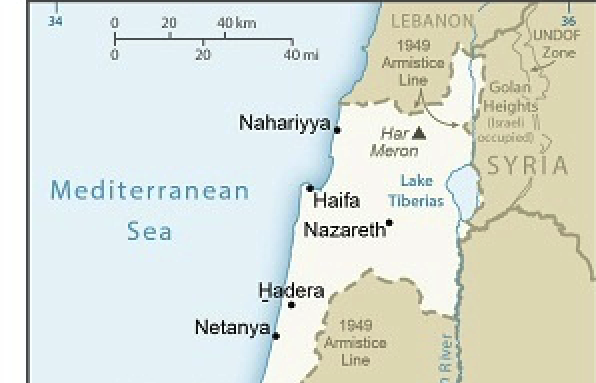
At a public event on March 17th in Tel Aviv, Israeli Speaker of the Knesset Yuli Edelstein (Likud) told an audience that U.S. recognition of Israeli sovereignty over the Golan Heights is the first step towards U.S. support for Israel’s annexation of the West Bank. Edelstein’s comments came shortly after the publication of the 2018 U.S. State Department’s annual Human Rights Report, which refers to the Golan Heights – under international law considered Israeli-occupied Syrian territory – as “the Israeli-controlled Golan.” Previous U.S. reports referred to the Golan is “Israeli-occupied.”
Edelstein also promised the audience that if the Likud does well in the upcoming elections, there will be a serious debate in the Knesset about annexing the West Bank.
Map by the CIA, as of 3/21/19
[NOTE: On March 21st, President Trump formally recognized (via tweet) Israeli sovereignty over the Golan Heights. Hours before this tweet, press reports suggested that the Trump Administration was planning to announce the new policy when Prime Minister Netanyahu was the White House, during meetings scheduled for March 25-26. It is also worth noting on February 26, resolutions were introduced in Congress, in both the House and Senate, seeking to make it U.S. policy to recognize Israeli sovereignty over the Golan.]
Israeli Education Ministry Funds Group Behind Violent Outpost at Site of Dismantled Settlement
Haaretz reports that the Israeli Education Ministry has been contributing significant funds to a non-governmental organization that is the driving force behind illegal settler activity at the of what was formerly the Homesh settlement in the northern West Bank.
Homesh was dismantled and its residents evicted by Israel in 2005, as part of the Gaza disengagement. Since then, settlers have been obsessed with the desire to re-establish Homesh, hosting religious events and protests at the site of Homesh, some of which have been attended by Israeli MKs and politicians.
As part of this movement to reclaim the site and re-establish Homesh, settlers associated with the violent “hilltop youth” settler movement have repeatedly attempted to establish an outpost on the site, only to have the IDF remove them again and again. The non-governmental organization – Midreseht Ma’amakim – widely publicize its efforts to build and maintain a outpost at the Homesh settlement site, and boasts about operating a religious school there (called the “Homesh yeshiva”) for the past 12 years. According to the new report, from 2014-2017, the Israeli Education Ministry transferred more than $6 million to the NGO — nearly $2.5 million (8.5 million shekels) in 2017, $1.9 million in 2016, and $1.7 million in 2015 and in 2014. The Ministry told Haaretz that the funds were provided in support of the organization’s educational activities, not its illegal activities.
Lior Amihai, Executive Director of Yesh Din, explained:
“The place remains a hostage of a violent and illegal yeshiva, which prevents Palestinian farmers and landowners from reaching the place. Now it turns out that the Education Ministry enable the presence of the yeshiva by funding an association that fundraises for it.”
Yesh Din has for years been working with leaders of the neighboring Palestinian village of Burqa in regards to the situation at the site of Homesh, built on lands owned by Palestinians and seized by Israel in 1978 for “security needs.” In 2011, Yesh Din and Palestinian landowners petitioned the Israeli government to revoke the 1978 military seizure order, which legally should at this point be moot: the IDF only used the land for approximately two years, after which settlers took over the site to establish the (civilian) Homesh settlement, which was allowed to remain and expand until it was dismantled in 2005. In 2013, Yesh Din’s petition succeeded, and the state of Israel took the unprecedented step of revoking the military seizure order.
Yet, while technically the Palestinian landowners are no longer barred by Israel from accessing their own lands, de facto the area is still off limits to them, policed by violent Israeli settlers who for all intents and purposes enjoy free reign in the area.
Settler Excavations in Silwan Hit a Wall [Literally]
Emek Shaveh reports that one of the ongoing excavation efforts in Silwan led by the radical settler group Elad might not be able to continue, having run into the foundation of a massive wall, believed to be part of an Umayyad palace dating back to the 7th century CE.
The discovery – one which serves to highlight the multiplicity of cultures, religions, and peoples who are deeply connected to Jerusalem – is not a welcome one for the settlers, whose ultimate goal is to dig a tunnel connecting settler-run tourist sites in Silwan to a settler-run tourist site in the Old City. Since the excavation project is being carried out by Elad in cooperation with (and with financing from) the Israeli Antiquities Authority (IAA), the government bureau will decided whether or not to continue the dig. According to Haaretz, the IAA is considering plans to dismantle the wall and create a large hole for tourist groups to walk through.
The archeological experts at Emek Shaveh explain:
“From a professional standpoint, the wall should be left in its proper place, but the practical significance of this is a halt to the excavation, which began as part of a government decision to connect Silwan with the excavations south of the Temple Mount/Haram al-Sharif…In the reality of Jerusalem, where remains of building are not only scientifically significant but have symbolic and emotional resonance as well, the damage caused by the tunnels excavations has a negative impact on the possibility of presenting the city’s many cultures and their histories in a balanced manner. This is not only an archaeology-tourism problem, but a political problem of ignoring and even erasing certain historical strata, in order to present Jerusalem in a manner that serves the settlement enterprise in the Old City basin.”
The IAA said in response to news of the wall:
“…due to the wish to give the millions of tourists who visit Jerusalem from all over the world a better travelling experience, roads and paths were developed over the past decades. In addition, several openings have been made to the Old City’s walls and in the foundations of the Umayyad buildings. The hole in question is a narrow opening that was made in the foundations of one of these buildings after meticulous archaeological examination and documenation [sic] were carried out. This opening enables tourists to move between the two parts of ancient Jerusalem on either side of the Old City walls. This project is part of the ‘Shalem program’ [i.e. whole in Hebrew]: A government-funded plan to unveil, preserve, research and develop the sites of ancient Jerusalem.”
Settlers Lobby Key U.S. Stakeholders to Protect Settlements from Trump’s “Peace Plan” & Promote Settler-Palestinian Business “Coexistence” Initiatives
While in Washington, D.C. for the upcoming AIPAC policy conference, a delegation of Israeli settlers held meetings with members of Congress members and White House officials in a bid to ensure that any American “peace plan” will not inconvenience Israel’s settlement enterprise. The delegation, which included Yossi Dagan (head of the Samaria Regional Council, a settlement municipal body) and Arnon Klein (CEO of the Barkan Industrial Zone, near the settlement of Ariel), also met with evangelical leaders – a key constituency which recently extracted assurances from the White House regarding the Trump plan. The settlers reportedly implored the group to:
“help to fight plans to freeze construction in Judea and Samaria. We cannot allow a plan which will destroy or harm Jewish communities in Judea and Samaria. Our task is to build. We have 36 communities and half a million Jews living in our forefathers’ home. We need your help. This is a very sensitive time. Especially now, when the US president is considered to be a friend of Israel, there is a huge risk that a diplomatic plan will include a division between settlements in blocs and outside of blocs, and that construction will be frozen. And we haven’t even talked about the worst – uprooting Jewish settlements and dividing Jerusalem – which may also on the table.”
In addition, the delegation pitched the centrality of business “coexistence” initiatives between settlers and Palestinians, an increasingly obvious part of the Trump Administration’s agenda on the ground, as a core objective. Writing last week, FMEP’s Lara Friedman pointed to the activities of Ambassador Friedman and Congressman Lankford (R-OK), in support of the the idea that:
“…peace would come from economic and business cooperation between Palestinians (living under Israeli occupation, governed by Israeli military and military law designed to promote the interests and needs of Israel, entirely disenfranchised from the powers that control their lives) and settlers (living in settlements built on land taken from Palestinians, enjoying all the entitlements and protections of Israeli citizenship and law, and with representatives and allies at every level of Israeli government). This approach…exemplifies a vision of ‘peace’ based on promises of improved quality of life for individual Palestinians, de-coupled from any pretense of helping Palestinians end an occupation that the United States no longer believes to exist, or achieve national self-determination that the United States no longer supports.”
Likewise, FMEP has previously explained how for decades Israel has used industrial zones as another tool to expand and deepen control over West Bank land and natural resources. Importantly, jobs in industrial zones – often the only jobs available for Palestinians living under an Israeli occupation that prevents the development of any normal Palestinian economy – are widely viewed by Palestinians as a double-edged sword.
Palestinian-Americans Intervene in Lawsuit Against AirBnB, Bringing First Challenge Against Settlements to U.S. Courts
In the first case of its kind in a U.S. federal court, the Center for Constitutional Rights (CCR) filed a lawsuit challenging the legality of the Israeli settlement enterprise. The case was filed on March 18th on behalf of two Palestinian Americans – Randa Wahbe and Ziad Alwan – and two Palestinian villages – Ein Yabroud and Jalud. Journalist Mairav Zonszein succinctly explained the complex backdrop of the new filing:
“The CCR’s claim is not a stand-alone lawsuit but an intervention in Silber v. Airbnb, a suit filed by a group of Jewish and Israeli-American citizens who either host or wish to rent homes on Airbnb; the claim is directed, not at Airbnb, but at the sub-group of settlers serving as hosts. These settlers filed suit against Airbnb in November 2018, days after the company announced it would be taking down about 200 rental listings located in Israeli settlements in the occupied West Bank…In intervening in the lawsuit, the CCR argues that it is the settler’s conduct—and not Airbnb’s attempt to reconcile its business practices with basic human-rights law and principles—that discriminates against their clients and millions of other Palestinians.”
CCR issued a press release stating:
“Today’s filing argues that the Israeli settlers who sued Airbnb have participated in war crimes by aiding in Israel’s seizure of land in occupied Palestinian territory, including the specific lands on which the Airbnb properties stand. The rentals are in Israeli-only settlements from which Palestinian residents of the West Bank are barred as per Israeli military orders, and which are sometimes surrounded by physical barriers, military bases, and security gates.”
Diala Shamas, a staff attorney at the CCR, said:
“The settlers who sued Airbnb are cynically using the language of discrimination in order to further their own unlawful ends,” said Center for Constitutional Rights Staff Attorney Diala Shamas. “Our clients’ experiences –Palestinians who are directly affected by these settlers’ actions – show where the real discrimination and illegality lies. This case puts the settlers on trial in a U.S. court.”
CCR’s filing – and accompanying videos – shines a bright light on at two stories that exemplify Palestinians’ lives under occupation, and make clear how the settlements infringe on their basic rights to property. One of the intervenors, Ziad Alwan, was born in the Palestinian village of Ein Yabroud and holds the title deed for part of the land on which the Ofra settlement was built, as registered by the Israel Land Registry. One of the settlers in the underlying lawsuit previously listed a property in the Ofra settlement on AirBnB — meaning that the settler and AirBnB were, in effect, profiting from the rental of a property located on land that rightfully belongs to Alwan, and moreover, which Alwan, despite being the rightful owner, cannot access and does not benefit from.
Residents of the Palestinian village of Jalud – a second intervenor – explain how Israeli settlements and unauthorized outposts have been built on the village’s land, making 80% of their farmland inaccessible. One of the outposts that took Jalud’s land is Adei Ad, an outpost established illegally under Israeli law, which the Israeli government announced its intention to retroactively legalize. One of the settlers in the underlying case runs a bed and breakfast in the Adei Ad outpost, meaning the settler and AirBnB are profiting from a business located on the historic land of Jalud, a business which Palestinians cannot access and do not benefit from. In their claim, residents of Jalud are challenging not only the claim that Airbnb’s decision to delist the settlers’ rental property is discriminatory, but also the claim that the settlers legally own the property in the first place.
The lawyer representing the settlers in the underlying case (which claims AirBnB’s decision violates the Fair Housing Act), said in response to CCR’s claim:
“There are those who say that the settlements are illegal. There are those who say they are not. This is the heartland of the Land of Israel.”
Randa Wahbe, one of the petitions, told The Nation:
“The fact that settlers are using the specific piece of legislation pushed through after Martin Luther King’s assassination to protect disenfranchised black communities, in order to discriminate against Palestinians, is what I find so horrifying.”
Hoping to Avoid ICC Investigation, Pro-Settlement Groups Submit Defense of Settlements
On March 14th, two well-known pro-settlement legal attack groups – UK Lawyers for Israel (UKFLI) and the Lawfare Project – submitted a brief to the International Criminal Court (ICC) arguing that the court is prohibited under the Rome Statute from investigating Israeli settlements. The ICC has been conducting a preliminary investigation into the possibility of opening a war crimes probe into Israel’s settlement for the past four years.
The brief argues that the Israeli High Court of Justice (HCJ) has sufficiently and genuinely investigated issues related to the settlements, making the matter inadmissible at the ICC because the Rome Statute’s regulations prohibit the court from taking on issues that national courts have adjudicated. The brief even proudly highlights the fact that Israel’s HCJ has ruled in favor of Palestinians, though as a recent report published by B’Tselem explains, the Israeli HCJ is complicit in the establishment and continuing expansion of the settlement enterprise (and therefore cannot conceivably carry out a genuine investigation of this enterprise).
The legal brief comes amidst a barrage of threats issued by Israel and the United States against the ICC in light of its consideration of opening this case. On March 17th, U.S. Secretary of State Mike Pompeo threatened ICC staff with travel restrictions and financial sanctions if the court opens a probe into Israel. In November 2018, Israeli Attorney General threatened to launch, according to the Jerusalem Post, a “public legal campaign, aggressively contesting its jurisdiction.”
In the brief, the authors also announced their intention to file further information with the court challenging its jurisdiction over the matter.
Bonus Reads
- “Natural Born Settlers” (New York Times)
- “Not Breaking News: Trump Administration Does Not Believe in Occupation” (LobeLog – by FMEP President Lara Friedman Part 1 of 2)
- “Erasing Occupation: The Pernicious Role of Congress” (LobeLog – by FMEP President Lara Friedman Part 2 of 2)
- “‘The entire world knows the settlers have declared war on us’” (+972 Mag)
- “Leading architects urge Israeli PM to cancel cable car plan” (Associated Press)
Welcome to FMEP’s Weekly Settlement Report, covering everything you need to know about Israeli settlement activity this week.
To subscribe to this report, please click here.
March 1, 2019
- As Elections Approach, Here’s Two Settlement Plans Bibi Might Advance to Win Votes/Deflect Pressure
- Palestinians March in Hebron on Anniversary of Goldstein Massacre
- U.S. Charities Are Financing Radical, Violent Hilltop Youth Settler Movement
- Bonus Reads
Questions/comments? Email kmccarthy@fmep.org
As Elections Approach, Here’s Two Settlement Plans Bibi Might Advance to Win Votes/Deflect Pressure
Terrestrial Jerusalem published a comprehensive analysis of how Jerusalem-related issues, including settlement plans, could become a factor in the current Israeli elections campaign. Danny Seidemann writes:
“On the eve of Israel’s national elections and the possible launching of Trump’s so-called ‘peace plan,’ concerns raised in January 2017 regarding the most sensitive and ambitious settlement and settlement-related projects are more relevant than ever…the common denominator to the issues on which we [Terrestrial Jerusalem] are focusing below is this: each is something of a banner under which the ideological right has decided to march. As a result, there is no doubt that these issues will figure prominently in election rhetoric, towards the goal of forcing an already susceptible Netanyahu’s hand.”
Seidemann goes on to lay out likely actions Netanyahu might take, including action on two specific settlement plans:
-
“E-1: E-1 is a settlement planned for an area on East Jerusalem’s northeastern flank (beyond the city’s municipal borders), designed to cement a contiguous block of settlements stretching from Maale Adumim to the city’s east, through Neve Yaacov and Pisgat Zeev to the north, and extending to Givat Zeev, to the northwest (download map here).We have described in several reports the dire threat the implementation of E-1 would cause to the two-state solution, primarily by dismembering a potential future Palestinian state into two non-contiguous cantons and sealing off East Jerusalem from its environs in the West Bank…implementation of E-1 today still depends solely on Netanyahu giving the green light for the publication of the plans. Once he does, the clock will start ticking toward construction; assuming Netanyahu and his government obey normal planning rules, this clock will run for up to a year — between the resumption of planning and the publication of tenders for construction. Once the green light is given, it will be very difficult (but not impossible) to prevent the publication of tenders.”
-
“Givat Hamatos: As we explained in our January 2017 analysis, plans for construction in Givat Hamatos have been fully approved, but tenders have not yet been published: tenders for the construction of up to 1500 of the 4500 units could be published literally at any time, based on the whim of Netanyahu. As elections approach, the chances that Netanyahu will give the order to publish these tenders rises exponentially — and the significance of him doing so cannot be overstated. In planning terms, the publication of tenders is a Rubicon that, once crossed, is a point of no return, since at that point, third-party rights (purchasers) become involved. In short, the publication of tenders, effectively, would make the construction of Givat Hamatos a virtual certainty. While E-1 is larger in scope and has greater notoriety than Givat Hamatos, the danger posed by the latter is in some respects greater. Assuming Netanyahu and his government follow normal planning rules on E-1, any decision he takes on E-1 will in effect by a trip-wire that will give the world as long as a year in which to engage to try to prevent actual construction. With respect to Givat Hamatos, a move by Netanyahu won’t be a trip-wire, but rather the beginning of a series of detonations that cannot be stopped.”
Palestinians March in Hebron on Anniversary of Goldstein Massacre
On February 22nd, hundreds of Palestinians and international activists led a march towards Shuhada Street in downtown Hebron to commemorate the 29 victims of Israeli-American settler Baruch Goldstein, who opened fire on worshippers in the Ibrahimi Mosque/Tomb of the Patriarch 25 years ago. The march was also a protest against Israel’s policy of segregation (a word that fails to capture the damage done to the fabric of Palestinian life in the heart of Hebron) that was implemented following the massacre. +972 Mag reports:
“…protestors marched toward Checkpoint 56, which separates the part of the city governed by the Palestinian Authority from the Israeli-controlled area. They carried signs calling for the return of the Temporary International Presence in Hebron (TIPH) – the only observer group in the city with an official international mandate. In late January, Israeli Prime Minister Benjamin Netanyahu decided not to renew the group’s mandate, effectively expelling the observers from the city after 22 years of monitoring the human rights situation there…Israeli soldiers were stationed along the route of the protest, on the side of the city allegedly controlled by the PA, already before the protest began. When the crowd of demonstrators approached Checkpoint 56, soldiers pushed them back. At another checkpoint, close to the Tel Rumeida area, soldiers fired tear gas, stun grenades and rubber bullets at a group of protestors who were hurling stones – against the organizers’ request to keep the protest peaceful. Soldiers also fired stun grenades at a group of journalists.”
U.S. Charities Are Financing Radical, Violent Hilltop Youth Settler Movement
An investigation has revealed that a U.S. charity, The Charity of Light Fund, is the U.S. arm of an Israeli organization called Chasdei Meir that funds the radical and violent Hilltop Youth settler movement. Journalist Mairav Zonszein explains that Chasdei Meir, which is not registered as a tax exempt organization in Israel, recently issued a donation receipt thanking the donor (who made the donation in order to glean more information about the group’s operations) for “helping keep the residents of the outposts in Judea and Samaria warm.” Zonszein goes on to report:
“According to the Israeli outlet Ynet, Chasdei Meir has been linked to the coordination in 2011 of settler violence against Palestinians known as ‘price tag’ attacks, as well as financing settler youth who inhabit illegal settlement outposts and plant trees there as a way of claiming ownership over the land.”
Zonszein’s report lays out how Chasdei Meir and the Charity of Light Fund are part of a larger network of shadowy groups and figures that have found ways to direct U.S. tax-deductible donations to the settlement enterprise as well as groups that ascribe to the racist, nationalist ideology of Meir Kahane and the political party he founded, Kach. The Kach party, which is on the U.S. list of terrorist organizations, recently joined forces with Prime Minister Netanyahu, who brokered a political marriage between the Otzma Yehudit (“Jewish Power”) party, which is the current incarnation of the Kach party, and the Jewish Home party, in the hopes of winning sufficient votes to form a coalition that will keep him in power.
Bonus Reads
-
“A Violent Gang of Young Settlers Haunts Palestinians” (Haaretz)
-
“Under Occupation, Water is a Luxury” (Haaretz)
-
“Israel’s Termination of the Temporary International Presence in Hebron” (Al-Shabaka)
Welcome to FMEP’s Weekly Settlement Report, covering everything you need to know about Israeli settlement activity this week.
To subscribe to this report, please click here.
February 15, 2019
- Israel Announces Plan to Retroactively Legalize Settlement Units Built on Privately Owned Palestinian Land
- Jerusalem Planning Authorities Are Quietly Advancing Sensitive Settlement Projects in East Jerusalem
- Peace Now Files Appeal Against Settler Land Grab for New “E-2/Givat Eitam” Settlement
- Peace Now Petitions High Court to End Flow of Public Funds to Settler Organization
- AG Paves Way for Ariel Medical School to Open, Despite Rejection by Key Committee
- Following Expulsion of International Observers, Emboldened Settlers Attack Palestinians
- Yitzhar Settlers Attack Palestinian School, So IDF Restricts Palestinian Access to Roads to Allow Yitzhar Settler Protests
- NEW: Ir Amim Publishes 2019 Map of Settlement Projects In and Around Jerusalem’s Old City
- Bonus Reads
Questions/comments? Email kmccarthy@fmep.org
Israel Announces Plan to Retroactively Legalize Settlement Units Built on Privately Owned Palestinian Land
On February 10th, the Israeli government informed the Jerusalem District Court that it plans to invoke the “market regulation” principle in order to retroactively legalize four structures in the Alei Zahav settlement – structures built on land that even Israel acknowledges is privately owned by Palestinians.
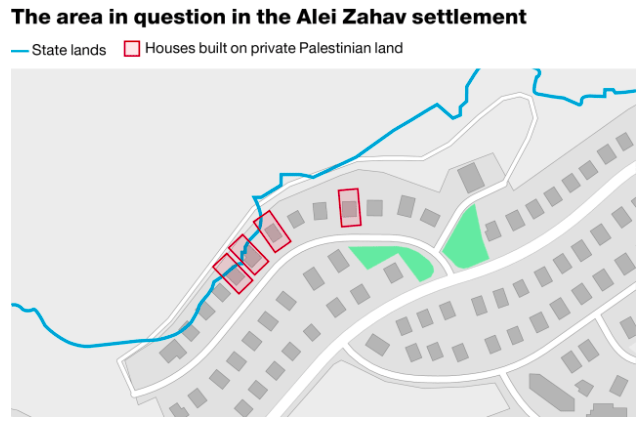
According to Haaretz, a 2016 land survey conducted by the Israeli Civil Administration discovered the existence of privately owned Palestinian land in the settlement, which older Israeli maps had marked as “state land.” After the discovery, settlers went to court to sue the World Zionist Organization (which was allocated the land by the Israeli government), the Israeli Defense Ministry, and the contractor who built the settlement demanding that they fix the situation. The state’s response to the Jerusalem District Court this week freezes the settler’s petition while the government’s plan is implemented.
The “market regulation” principle was identified by Israeli Attorney General Avichai Mandelblit as an alternative to the settlement Regulation Law (the controversial law passed by the Knesset that, in effect, lets the Israeli government suspend the rule of law to seize privately owned Palestinian land for the benefit of settlers). Both the Regulation Law and the “market regulation” principle are designed to give Israel legal cover to retroactively legalize outposts and settlement structures that, because they are built on land that Israel acknowledges is privately owned by Palestinians, the State had been unable legalize under existing Israeli law (despite great efforts to do so). The “market regulation” principle holds that Israeli settlement construction can be retroactively legalized if it was carried out “in good faith” with government support on land that was later discovered to be privately owned by Palestinians.
The Israeli High Court is already considering a petition against the constitutionality of the “market regulation” principle, a case stemming from the State’s first attempt to implement it in order to retroactively legalize the Mitzpe Kramim outpost.
If allowed to proceed on the basis of the “market regulation” principle, the state will first have to publish an official planning scheme for the area, and allow the public (including the Palestinian landowners, as recognized by Israeli) to object. Attorney Alaa Mahajna, who is representing the Palestinian landowners involved in the case, said:
“Even without making use of the vilified expropriation law [aka the Regulation Law], the state still finds ways and uses other routes to attain the same goal, giving its legal imprimatur to robbery of land, with residents who are protected under international law.”
FMEP tracks the ongoing legislative, political, and legal transformations happening in the Israeli government to justify the expropriation of Palestinian land for the settlements in its Annexation Policy Tables.
Jerusalem Planning Authorities Are Quietly Advancing Sensitive Settlement Projects in East Jerusalem
Ir Amim reports that East Jerusalem settlement planning authorities are advancing sensitive settlement projects in East Jerusalem through secretive and expedited processes, thereby limiting the opportunity for stakeholders and the public to challenge the plans.
For example, on February 5th, the Jerusalem Local Planning and Building Committee discussed public objections filed against two settlement plans in Sheikh Jarrah. Both of the plans are being promoted by East Jerusalem settlement impresario and city council member Aryeh King. The committee did not notify those objecting to the plan that these proceedings were planned, and so no one objecting to the plan was present in the February 5th discussion. The plans, which would allow for the construction of two new buildings – one with 10 units and the other with 3 units – would involve the eviction of 5 Palestinian families from buildings that would be demolished.
On February 17th, the Jerusalem District Planning and Building Committee will consider the Glassman Yeshiva project – a plan to build a Jewish religious school, including dormitories, at the entrance to the Sheikh Jarrah neighborhood. Ir Amim reports that it is unclear what the committee will do in considering the plan, since authorities have advanced the plan outside of the normal planning process, even succeeding in have land allocated for the yeshiva despite the fact that the plan was never deposited for public review (meaning stakeholders and the public have had no opportunity to object).
Ir Amim writes:
“Despite their tremendous political and environmental sensitivity, plans are now being fast tracked, some outside of appropriate planning channels and with limited public participation, in service to decidedly political considerations and with the prominent involvement of settler associations. The new map and accompanying map notes detail the numerous projects and eviction cases now advancing.”
For an explanation of how East Jerusalem settlement planning/approval is supposed to work under Israeli law and practice, see Terrestrial Jerusalem’s presentation here.
Peace Now Files Appeal Against Settler Land Grab for New “E-2/Givat Eitam” Settlement
On February 7th, the settlement watchdog group Peace Now and dozens of Palestinian landowners filed a petition with the Israeli Custodian of Government and Abandoned Property demanding the annulment of the allocation of “state land” for the sole declared purpose of building the new “E-2/Givat Eitam” settlement.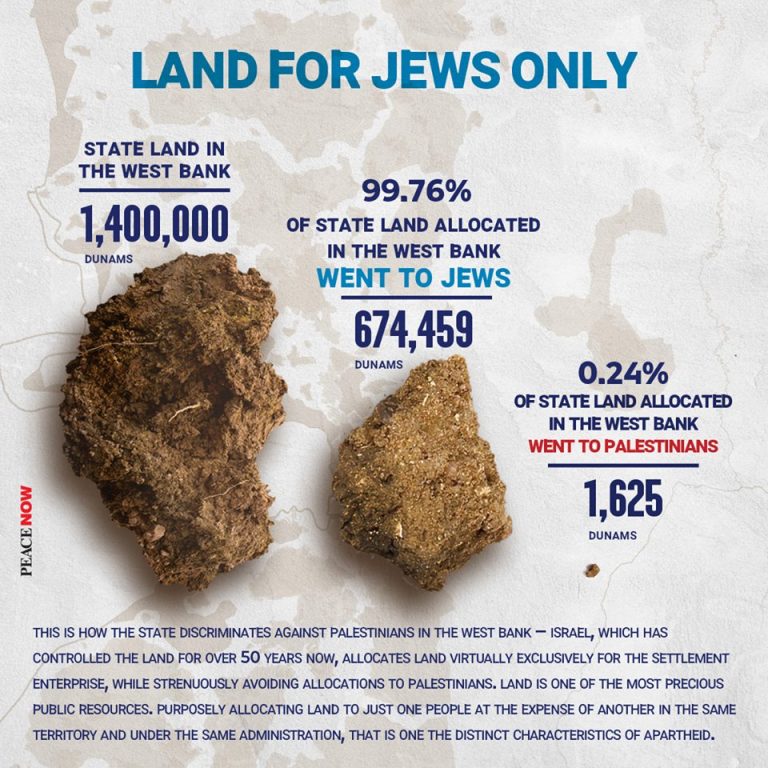 Rather than challenging Israel’s classification of the land as “state land,” the petition asks that the land be allocated instead for Palestinian use, challenging Israel’s discriminatory allocation of “state land” for the settlements. It builds on recent revelations that since 1967, Israel has allocated a jaw-dropping 99.8% of state land in the West Bank to settlements and just 0.2% for Palestinians.
The petition argues that the allocation of state land for the exclusive use of settlements/settlers is illegal both under the Hague Conventions and under domestic anti-discrimination laws in Israel.
Regarding the new petition, Peace Now says:
“Since the 1979 Elon Moreh ruling, no petition has succeeded in undermining the legal infrastructure that enables the ongoing expansion of the settlement enterprise. This initiative and the surrounding public struggle aims to undermine the prevailing view that “state land” in the occupied territories effectively constitutes land available for Israeli use, and to obligate the Supreme Court and the Israeli public, to address this fundamental question.”
Israel announced on December 26, 2018 that it will draft plans to build as many as 2,500 new settlement units at the Givat Eitam outpost site, creating a new settlement on a strategic hilltop that will cut off Bethlehem from the southern West Bank, completing the encirclement of Bethlehem by Israeli settlements.
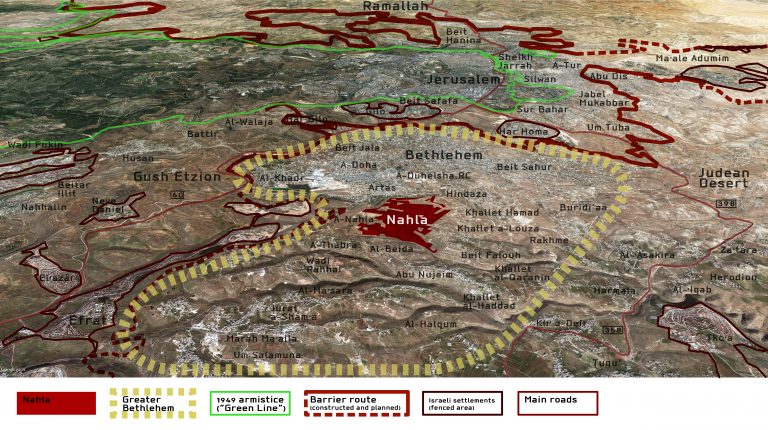
Map by Peace Now
The Givat Eitam outpost has been nicknamed “E-2” by settlement watchers for for its resemblance, in terms of dire geopolitical implications, to the infamous E-1 settlement plan. Located east of the separation barrier on a strategic hilltop overlooking the Palestinian city of Bethlehem to its north, the site of Givat Eitam/E-2 is within the municipal borders of the Efrat settlement but is not contiguous with Efrat’s built-up area. As such, Givat Eitam/E-2 would effectively be a new settlement that, according to Peace Now, would:
“block Bethlehem from the south, and prevent any development in the only direction that has not yet been blocked by settlements (the city is already blocked from the North by the East Jerusalem settlements of Gilo and Har Homa, and from the West by the Gush Etzion Settlements) or bypass roads (that were paved principally for Israeli settlers). The planned building in area E2 would likely finalize the cutting off of Bethlehem city from the southern West Bank, delivering a crushing blow to the Two States solution.”
Peace Now Petitions High Court to End Flow of Public Funds to Settler Organization
The settlement watchdog group Peace Now has filed a petition with the High Court of Justice to stop public funding flowing to the radical Amana settler organization, which is a private, for-profit entity engaging in various illegal activities to establish and expand Israeli settlements and outposts across the West Bank.
The new petition is based on Peace Now’s investigative work revealing the substantial amount of money that has been secretly funneled to Amana through settlement regional councils. The settlement regional council budgets obtained by Peace Now revealed that money allocated to support non-profit public welfare groups was instead being used to fund Amana. Funding for Amana in this manner violates Israeli Interior Ministry policies prohibiting public subsidies for private, for-profit entities – and it is this funding that Peace Now is petitioning the High Court to end.
Peace Now’s work is backed up two separate reports of the Israeli Comptroller’s office, one from November 2017 and another from July 2018, which detailed the extent to which the Binyamin Regional Council – the largest settlement regional council – secretly funneled money to organizations engaged in illegal settlement construction. The July 2018 report revealed that the Binyamin Regional Council funneled $10 million to Amana between 2013-2015 alone.
Peace Now said in a statement:
“This grave phenomenon in which taxpayers’ money is transferred to an organization that has specialized in construction violations for decades, is against the law and regulations; an organization that works tirelessly to change reality by illegally establishing unauthorized facts on the ground, is dire and must be stopped. Only a complete cessation of this cash flow will prevent further construction rampages throughout the West Bank, and retain the opportunity for a future agreement.”
AG Paves Way for Ariel Medical School to Open, Despite Rejection by Key Committee
On February 13th, Israeli Attorney General Avichai Mandelblit announced that the vote last week by the Planning & Budgeting Committee of the Council for Higher Education in Israel is a non-binding recommendation, and that the fate of the Ariel settlement’s new medical school will be determined by a final vote to be held by the council’s main body. In so doing, Mandelblit made it possible for the main body of the Council for Higher Education in Israel to vote against its own professional subcommittee, contrary to the normal practice. Indeed, Haaretz columnist Or Kashti even called it “unreasonable.”
Mandelblit said that the Council for Higher Education in Israel should reconvene to vote within the next two months in order to give the medical school, its faculty, and its students, adequate time to prepare. Haaretz reports that Education Minister Naftali Bennett – who serves as the Chairman of the Council for Higher Education in Israel – is expected to delay the vote until he is confident that he has enough votes in favor of approving the medical school.
In addition, Mandelblit also allowed the West Bank arm of the Council for Higher Education – a settler body which oversees and promotes educational institutes located in West Bank settlements (i.e. outside of sovereign Israeli territory) – to take vote on the matter. Unsurprisingly, on Feb. 13th the settler body voted unanimously to approve the medical school. It did so in a vote that was held in the final hours before that settler body was absorbed by Council for Higher Education in Israel, following a law passed by the Israeli Knesset in Feb 2018 that extends the jurisdiction of the Council for Higher Education in Israel to include schools in the settlements (an act of de facto annexation).
Weighing in on the debate, the Haaretz Editorial Board noted that supporters of the Ariel medical school – including Naftali Bennett – lobbied for the settlers’ own Council for Higher Education to be permitted to vote on the matter in an attempt to overrule the Planning & Budgeting Committee’s unfavorable decision. The Board writes:
“In a country governed by the rule of law, the [Planning & Budgeting] committee’s latest vote should have settled the matter. But Ariel University and its supporters, above all Education Minister Naftali Bennett, have ways to circumvent the committee. We will soon find out whether Mendelblit will approve this move, enabling Ariel to overcome the professional objections of the Planning and Budgeting Committee, the opposition of the other universities and Wadmany Shauman’s conflict of interest. This hasty resort to the Council for Higher Education in Judea and Samaria – which has never dealt with budgetary issues, only ideological ones – should set off alarm bells. After the Planning and Budgeting Committee’s previous vote, approving the med school, no one demanded reaffirmation from the council. That’s not how the higher education system should operate. The Planning and Budgeting Committee steers its course, including the disbursal of its 11 billion shekel ($3 billion) annual budget.”
As FMEP has previously reported, Ariel University became an accredited Israeli university in 2012, following significant controversy and opposition, including from Israeli academics. It has since been the focus of additional controversy, linked to what is a clear Israeli government-backed agenda of exploiting academia to normalize and annex settlements. In 2018, the settlement broke ground on the new medical school, with significant financial backing from U.S. casino magnate, settlement financier, and Trump backer Sheldon Adelson. In February 2018, in an act of deliberate de facto annexation, the Israeli Knesset passed a law extending the jurisdiction of the Israeli Council on Higher Education over universities in the settlements (beyond Israel’s recognized sovereign borders), ensuring that the Ariel settlement medical school (and its graduates) would be entitled to all the same rights, privileges, and certifications as schools and students in sovereign Israel.
The Ariel settlement is located in the heart of the northern West Bank, reaching literally to the midpoint between the Green Line and the Jordan border. The future of Ariel has long been one of the greatest challenges to any possible peace agreement, since any plan to attach Ariel to Israel will cut the northern West Bank into pieces.
Following Expulsion of International Observers, Emboldened Settlers Attacks on Palestinians
In the week since Israeli Prime Minister announced that he would not renew the mandate of the Temporary International Presence in Hebron (TIPH) – in effect, expelling international observers from the city – radical, violent settlers have repeatedly harassed and attacked Palestinians, including school children. Thus far the Israeli military has failed to intervene to stop the encounters.
Following the expulsion of the observers, who previously escorted Palestinian school children on their daily commute near settlement enclaves in downtown Hebron, Palestinians formed a volunteer group to escort and protect the children. On February 10th, alarming video footage shows settlers harassing and attacking this new group as it was escorting children. In response, the Israeli army issued an order on Feb. 13th that declared the area as a closed military zone, barring the volunteers from escorting the students.
On the evening of February 12th, a group of settlers attacked Palestinian homes on Shuhada Street, the main street in downtown Hebron which Israel has “sterilized” by preventing all Palestinian vehicles, limiting Palestinian pedestrians, and relegating Palestinian foot traffic to a specific area. One Palestinian resident reported that a settler jumped onto his roof and broke into his home; the IDF had to escort the settler out, and disperse the group of settlers who were chanting anti-Palestinian threats. Video footage captured the scenes.
Yitzhar Settlers Attack Palestinian School, So IDF Restricts Palestinian Access to Roads to Allow Yitzhar Settler Protests
On February 10th, dozens of settlers from the Yitzhar settlement descended from their hilltop neighborhood to violently attack a high school in the Palestinian village of Urif. According to reports, high school students clashed with IDF soldiers who were providing protection for the raiding group of settlers. Ten students reportedly required medical care for tear gas inhalation.
The next day, on February 11th, the Israeli IDF sealed off several roads near the Yitzhar settlement to allow the settlers to assemble to protest against “the deteriorating security situation in the West Bank.”
The anti-settlement group Yesh Din recently published a report, entitled “Yitzhar – A Case Study,” chronicling the violence of the Yitzhar settlement, and how that violence is used as a strategic means to take over Palestinian land.
NEW: Ir Amim Publishes 2019 Map of Settlement Projects In and Around Jerusalem’s Old City
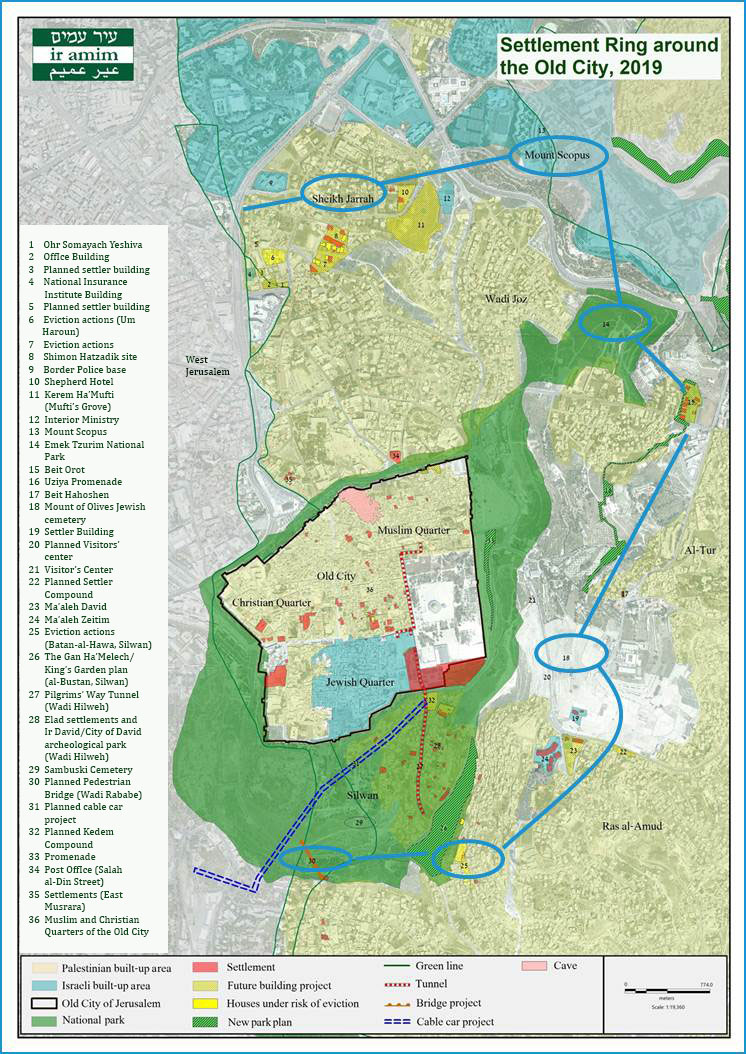 Ir Amim released an updated map showing settler activities around Jerusalem’s Old City.
Announcing the new map, Ir Amim writes:
“Ir Amim’s latest map, ‘Settlement Ring around the Old City, 2019,’ graphically illustrates the accelerated, intensifying chain of new facts on the ground in the most historically contested and politically sensitive part of Jerusalem: the Old City and adjacent ring of Palestinian neighborhoods. In addition to a mounting number of state-sponsored settlement campaigns inside Palestinian neighborhoods – settler initiated evictions of Palestinians, takeovers of their homes, and the expansion of settler compounds – touristic settlement sites function as key points along a ring of tightening Israeli control….These projects – including promenades, national parks and visitor centers – serve manifold purposes: They connect otherwise isolated and relatively small settlement compounds inside Palestinian neighborhoods, creating a contiguous ring of settler controlled areas; They fracture the Palestinian space, disrupting freedom of movement and breaking large neighborhoods into smaller, easier to police enclaves;While the number of ideologically driven settlers living inside Palestinian neighborhoods may still be relatively small, tens of thousands of non-ideological Israeli tourists visiting these sites serves to strengthen the Jewish presence inside Palestinian areas of the city.”
The map can be downloaded here and accompanying detailed notes here.
Bonus Reads
- “Why Residents of Jerusalem’s Sheikh Jarrah Face Eviction” (Al-Monitor)
- “Imminent Eviction of Palestinian family in East Jerusalem” (OCHA)
- “Two Jewish Groups’ Disagreement Over Jewish Law Might Dash Jerusalem’s Dreams (Haaretz)
- “What Kind of Occupation do Israelis Want?” (Ynet)
Welcome to FMEP’s Weekly Settlement Report, covering everything you need to know about Israeli settlement activity this week.
To subscribe to this report, please click here.
February 1, 2019
- Jerusalem Cable Car Plan Advances Again, Despite Israel’s Refusal to Release Report Justifying its Necessity
- Bibi Tells Settlers: Evacuating Illegal Outpost Was A “Mishap,” Will Never Happen Again
- Bibi Cancels Mandate for International Observer Force in Hebron
- WZO Caught Giving Mortgages for Illegally Built Settlement Homes, Again
- Amnesty International: Online Tourism Companies Are Enabling and Profiting from Occupation
- Israel Arrests Settler for 2018 Murder of Palestinian Woman; Settlers Respond with More Attacks on Palestinians
- Roseanne Barr’s 2019 Israel Victory (and Settlement Propaganda) Tour
- Bonus Reads
Questions/comments? Email kmccarthy@fmep.org
Jerusalem Cable Car Plan Advances Again, Despite Israel’s Refusal to Release Report Justifying its Necessity
The Israeli Interior Ministry announced its plan to deposit the Jerusalem cable car plan for public review on February 1st, which will mark the beginning of a 60-day public commenting period. At the close of the public commenting period (appx. April 1st), the National Infrastructure Committee (NIC) will consider objections submitted against the plan as part of the process of granting it final approval.

Map by Terrestrial Jerusalem
As FMEP has previously covered, the Jerusalem cable car project is an initiative of the Elad settler organization (which is building a massive tourism center – the Kedem Center – in the Silwan neighborhood, which will be a stop along the cable car’s route). The cable car project is intended to further entrench settler activities and tourism sites inside the Silwan neighborhood of East Jerusalem while simultaneously delegitimizing, dispossessing, and erasing the Palestinian presence there.
The NIC is a body within the Finance Ministry that fast-tracks projects deemed a national priority, circumventing the scrutiny and delays that are part of the normal planning processes for non-priority plans. In order to justify the cable car line, the Israeli government has advanced the project as a public transportation “solution” to address traffic congestion in and around the Old City and to serve the needs of everyday residents of Jerusalem (the government actually changed a law in order to give the NIC jurisdiction over its planning process). The government has so far refused to release an internal economic feasibility report supposedly backing up that claim.
Israeli experts counter that the plan manifestly has nothing to do with the transportation needs of the city and its residents. Non-governmental groups like Emek Shaveh, Who Profits, and Terrestrial Jerusalem have repeatedly discredited the government’s line, and have clearly enumerated the obvious political drivers behind the plan, the archeological heresies it validates, and the severe impacts the cable car project will have on Palestinian residents of Silwan if implemented.
Emek Shaveh released a statement this week once again explaining:
“The cable car plan is a political ploy aimed at strengthening the Elad [settler] association in Silwan and the tourist sites that present the Jewish past, like these sites, the cable car will contribute to rendering the Palestinian presence in the region invisible. The passengers and tourists arriving at the Western Wall by cable car will descend at the station of Elad’s Kedem Center and from there continue through an underground passage to the Western Wall, thus moving from one Jewish area to another without seeing and sensing the presence of Palestinian residents and the Arab spaces of Jerusalem. Although the entrepreneurs tend to present the cable car as a transportation initiative, to the best of our understanding, based on the extensive information we have gathered, the plan will not provide a transportation solution at all. It is not coordinated with the Ministry of Transportation and, by its very nature, cannot serve as part of the mass transportation system for Jerusalem, which is under the jurisdiction of the Ministry. These basic facts refute the entrepreneurs’ claims that the cable car will constitute a transportation solution. Furthermore, the actual plan that was deposited lacked any content by which it could be considered a transportation plan…We at Emek Shaveh, together with a coalition of organizations and individuals, will not be deterred from the struggle against the cable car project. As we have stated in the past, this is a destructive plan for Jerusalem. The cable car clashes with the character and uniqueness of Jerusalem as a historical and religious city for the three religions and promotes the political interests of the settlers in Jerusalem’s Arab neighborhoods.”
Following the public deposit of the plan, Jerusalem expert Daniel Seidemann, who has also written extensive critiques of the cable car project, wrote:
“this project is part of the government’s and settlers’ joint efforts to aggressively promote an agenda that seeks to marginalize and to the greatest extent possible over-write the Palestinian presence in Old City and Historic Basin, replacing it with a Biblical-Jewish Disneyland. Both the project itself and the context of its approval – celebrating the ‘reunification’ of the city in a location that is at the core of the tensions between Israel and the Palestinians – are blunt statements that Israel is determined to take ownership over Jerusalem holy sites, in total denial of the sensitive nature of the place for faiths other than the Jewish one.”
The Israeli non-governmental organization Who Profits – which produced a detailed brief on the cable car project and the French engineering company that has been contracted to design it – also released a statement, saying:
“If carried out, the cable car project would give a major boost to the settlement tourism industry in East Jerusalem and strengthen the ongoing Judaization and ethnic cleansing of the Palestinian neighborhoods of Silwan and the Old City.”
Bibi Tells Settlers: Evacuating Illegal Outpost Was A “Mishap,” Will Never Happen Again
Hitting the campaign trail, Prime Minister Benjamin Netanyahu promised that Israel will never evacuate settlements or outposts again. His promise was notable not only for its content, but also for when and where he delivered it: during a meeting with settlers as part of a high-profile visit to the site of an illegal outpost.
The outpost in question, Netiv Ha’avot, was the center of a lengthy battle which culminated in the Israeli government evicting settlers from a number structures, after the Israeli High Court ruled the structures were built on land privately owned by Palestinians.
Addressing the settlers (ones living in structures also built illegally, but permitted to remain in place since the land on which they were built is not recognized by Israel as privately owned by Palestinians), Netanyahu called the court-ordered evacuation and demolitions in the outpost as a “mishap” that would not happen again. Netanyahu went on to say.
“As far as I am concerned, there will not be any more uprooting of communities or the cessation of (building in) communities, but rather the exact opposite. The Land of Israel is ours and it will remain ours. What has fallen will be rebuilt. It is ours. We are building here, and you are living here.”
Indeed – Israeli lawmakers are working assiduously to prevent any future court-ordered evacuations of outposts and illegal settlement structures, as FMEP details in its comprehensive tracking of such moves. The Israeli cabinet recently endorsed a bill that gives the government 2 years to retroactively legalize 66 outposts across the West Bank, including Netiv Ha’avot. The bill also directs the government to immediately begin treating those outposts as if they are legal, meaning that if the bill becomes law, the illegal outposts will be connected to Israel water and electricity grids, receive municipal services, and receive government-approved and government-funded budgets. The bill also allows the finance minister to guarantee mortgages in the outposts.
The Israeli government is also planning to retroactively legalize and expand the Netiv Ha’avot outpost – proving once again that Israel not only doesn’t punish settler law-breaking, it rewards it. FMEP has previously covered how the Israeli government has exploited the evacuation of settlers from 15 homes in the Netiv Ha’avot outpost as an opportunity not only to advance construction in another settlement (Elazar), but also to build an entirely new outpost as “temporary” housing for the settlers. The “temporary” outpost – where 15 mobile homes have been placed and are connected to Israeli water, power, sewage, roads, and other infrastructure – is located outside the borders of the Alon Shvut settlement. That fact did not stop the High Planning Council (a body within the Israeli Civil Administration, which regulates planning and building in the West Bank) from approving the plan, noting that “the plan is improper, but we will have to approve it as a temporary solution.” As part of its approval of the plan, the Council ordered the government to take steps towards expanding the borders of the Alon Shvut settlement to include the outpost, underscoring the meaninglessness of the word “temporary” in this context.
Bibi Cancels Mandate for International Observer Force in Hebron
On January 28th, Prime Minister Netanyahu announced that he will not renew the mandate allowing the Temporary International Presence in Hebron (TIPH) to continue to operate. The TIPH has been observing and documenting incidents between Palestinians, settlers, and the Israeli army in Hebron since 1997 – when Netanyahu (who was then in his first stint as Prime Minister) signed the Hebron Protocols which laid out arrangements for a divided Hebron. Many Israeli lawmakers, including Netanyahu, have levied heavy criticism against the TIPH over the past year, particularly after an internal TIPH report was leaked in December 2018 that detailed Israel’s “severe and regular” breaches of international law in Hebron.
Peace Now said:
“Netanyahu is frightened. He is so afraid of the settlers that he gives in to a fringe agenda that only harms Israel. The removal of TIPH whose only role is to observe, puts Israel in line with countries like Iran and China, which are afraid of criticism and have something to hide”
Senior Israeli politicians have ratcheted up calls for annexation of Hebron. Most recently Knesset Speaker Yuli Edelstein participated in a conference focused on the goal of establishing Israeli hegemony over Hebron.
Avner Gvaryahu, President of Breaking the Silence – a group which regularly guides tours for tourists willing to see the impact of Israelis settlers and policies in Hebron – told Al-Monitor:
“This isn’t just about the observers. It is part of a much broader and bigger effort…There is a deep-rooted process underway to empty downtown Hebron of its Palestinian residents and turn it into a ghost town.”
Indeed, over the past year Israel advanced numerous settlement plans entrenching and expanding the Israeli settler presence in the city’s most sensitive areas, including plans for the first new settlement construction in Hebron in 16 years. Those settlement plans are:
- Advancing a plan for a new settlement industrial zone inside of the boundaries of the Kiryat Arba settlement, but in a location that is not contiguous with the built-up area of the settlement (expanding the footprint of the settlement on the ground).
- Advancing plans for a new settlement to be located above the historic Palestinian vegetable market in downtown Hebron.
- Approving a plan to build a new 31-unit settlement at the site of an Israeli army base in downtown Hebron.
- Creating and funding a new settler municipal body for the settlers living in small enclaves in downtown Hebron.
WZO Caught Giving Mortgages for Illegally Built Settlement Homes, Again
The Israeli settlement watchdog NGO Kerem Navot discovered yet another case where the World Zionist Organization (WZO) provided a mortgage for an illegally built settlement structure, in this case a house in the Eli settlement, “owned” by a settler named Gilad Ach. Ach heads the radical Ad Kan organization which is known for infiltrating organizations that are working to end the occupation in order to undermine them. FMEP has repeatedly covered reports of evidence that the Settlement Division of the WZO (which is entirely funded by Israeli taxpayer money) engages breaks Israeli law in order to advance the settlement enterprise; this latest report continues to add to that body of evidence.
In the case of Ach’s house in Eli, the WZO decided to issue the mortgage despite the fact that not a single structure in the Eli settlement is legal. Though the Eli settlement has received Israeli government approval, a “Master Plan” – which officially zones land for distinct purposes (residential, commercial, public) – has never been issued. Meaning, Ach’s house lacks a valid building permit.
Kerem Navot told Haaretz:
“As is known, Gilad Ach works energetically to promote law enforcement and transparency, and therefore we are certain that he would be pleased to know that in the settlement of Eli, where he lives, the Settlement Division is granting mortgages for the purchase of homes in violation of the law. We are convinced that Ach and his organization, Ad Kan, will act diligently to eliminate this serious phenomenon as they have done in other instances in the past in which there has been suspected violation of the law.”
Despite the WZO’s criminal track record, the Israeli government is actively transferring more land in the West Bank over to the WZO for management. A government-backed bill to expedite the transfer more land to the WZO was recently stalled in the Knesset by the Israeli Attorney General, who assured the Knesset that the legislation was unnecessary because the transfer was already proceeding at the administrative level.
As a reminder, the WZO’s Settlement Division was created by the Israeli government in 1968 and is funded entirely by Israeli taxpayers. Its mandate is to manage West Bank land expropriated by Israel, in order to facilitate the settlement of Israeli Jews in the occupied territories. To make this possible, the Israeli government has allocated approximately 60% of all “state land” in the West Bank to the WZO’s Settlement Division [over the past 50 years Israel has declared huge areas of the West Bank to be “state land,” including more than 40% of Area C, where most of the settlements are located].
Amnesty International: Online Tourism Companies Are Enabling and Profiting from Occupation
Amnesty International (AI) published a new report – entitled “Destination: Occupation” – outlining how AirBnb, Booking.com, TripAdvisor, and Expedia (the largest global online booking and travel companies) are fueling human rights violations and the expansion of settlements through their decision to list rental properties located in Israeli settlements in the occupied West Bank and East Jerusalem.
In a press release about the report, Seema Joshi, AI’s Director of Global Thematic Issues, said:
“Israel’s unlawful seizure of Palestinian land and expansion of settlements perpetuates immense suffering, pushing Palestinians out of their homes, destroying their livelihoods and depriving them of basics like drinking water. Airbnb, Booking.com, Expedia and TripAdvisor model themselves on the idea of sharing and mutual trust, yet they are contributing to these human rights violations by doing business in the settlements. The Israeli government uses the growing tourism industry in the settlements as a way of legitimizing their existence and expansion, and online booking companies are playing along with this agenda. It’s time for these companies to stand up for human rights by withdrawing all of their listings in illegal settlements on occupied land. War crimes are not a tourist attraction.”
AirBnB, one of the companies scrutinized both by AI and in a complementary report published by Human Rights Watch, announced in November 2018 that it would no longer list properties located in Israeli settlements in the West Bank, excluding about 100 listings in East Jerusalem settlements. The AI report calls on AirBnB to extend its decision to East Jerusalem settlement listings. The report goes on to detail settler activities in the East Jerusalem neighborhood of Silwan, showing how TripAdvisor in particular is supporting settlers and their initiatives. The report observes:
“…at the time of writing, TripAdvisor featured the City of David and Elad prominently. TripAdvisor did not just provide its standard listings and page for reviews (where the City of David is ranked ‘#15 of 318 things to do in Jerusalem’), but also promoted four tours which feature the City of David and are managed by Elad. These include tickets to an underground tour for US$11, a ‘Night-Time Spectacular Show’ for US$18 and a “2 hour Segway tour” for US$43. TripAdvisor allowed users to book and pay for these attractions through its site and charged a fee when a booking was made. By actively encouraging users to visit the City of David and take guided tours of the site, TripAdvisor has boosted Elad’s business and derived a profit itself from every booking made through its site. In this way, the company has contributed to the illegal situation created by the presence and growth of settlement enclaves in East Jerusalem. The company has also been a key participant in the expansion plans of the Israeli government and Elad in the city, which are putting the human rights of Palestinians at risk. It has also, arguably, heightened the risk of forced evictions.”
Israel Arrests Settler for 2018 Murder of Palestinian Woman; Settlers Respond with More Attacks on Palestinians
Despite political interference, on January 24th the Israeli Shin Bet announced that it had filed an indictment charging a settler with manslaughter, for the 2018 murder of Aisha al-Rabih. Rabih, a Palestinian mother living in the West Bank, was killed by a large rock thrown through the windshield of a car she was riding in with her family. The settler charged with the crime – based on DNA evidence – is a 16-year-old from the Rehelim settlement, where he attended yeshiva (Jewish religious school).
Following the indictment, violently skirmishes erupted in hotspots in the West Bank known for the activities of radical settlers.
- On January 26th, settlers living in the Adei Ad outpost reportedly approached the Palestinian village of al-Mughayir, resulting in clashes during which the settlers are believed to have shot and killed Hamdi Nassan. The murder resulted in widespread international attention and concern, though Israel has reportedly not yet questioned settlers who were present at the crime scene.
- On January 26th, video cameras caught settlers vandalizing property in Turmusaya – located within sight of the Adei Ad outpost in the Shiloh Valley.
- Clashes between IDF forces and Palestinians also erupted on January 27th at the entrance of Turmusaya. That morning, Israeli forces erected a new checkpoint along the road leading to Turmusaya in anticipation of a funeral parade for Hamdi Nassan, killed by settlers in al-Mughayir the day before. During the clashes, Israeli forces reportedly fired live ammunition, tear gas, and stun grenades at the Palestinians.
As a reminder, the illegal Adei Ad outpost is built on land that has historically belonged to Turmusaya. Yesh Din published a lengthy report chronicling how Adei Ad outpost settlers use violence as a means of land confiscation. Rewarding their criminality, in August 2018 the Israeli government approved a plan to included the Adei Ad outpost within the expanded borders of the Amichai settlement, the first new government-backed settlement in 25 years. The massive expansion of the Amichai settlement and the transformation of Adei Ad into a brand new settlement, if implemented, will be a significant step towards creating an uninterrupted corridor of settlements connecting sovereign Israel to the Ariel settlement, through the isolated Shiloh Valley settlements, all the way to the Jordan Valley. In so doing, It will completely bisect the northern part of the West Bank.
In response to the violence and the escalation in Israeli settlement planning, Michael Lynk, the United Nations Special Rapporteur for human rights in the occupied Palestinian territory, issued a statement on Wednesday saying in part:
“…Israeli forces, obligated to protect the Palestinian population under international humanitarian law, stand idly by while olive trees are destroyed, livelihoods are damaged, and even while people are injured or, at worst, killed. The events in the West Bank village of Al Mughayyir on 26 January are a sobering example of this extremely troubling phenomenon, where a Palestinian villager was shot dead in the presence of Israeli settlers and soldiers. These incidents not only violate numerous human rights such as the rights to life, security of the person, and freedom of movement of Palestinians, but also serve to expand the area of land over which Israeli settlers have control. It is impossible to square the international community’s rhetorical support for a genuine two-state solution with its persistent unwillingness to confront Israel with any meaningful injunctions to halt and reverse these steps towards annexation. The Israeli settlements are the engine of the 51-year long occupation. This occupation will not die of old age, but only with the resolute imposition of consequences on Israel for ignoring international law and numerous United Nations resolutions.”
Roseanne Barr’s 2019 Israel Victory (and Settlement Propaganda) Tour
Disgraced American actress Roseanne Barr was shepherded on a tour of Israeli settlements and settler installations by Rabbi Shmuley Boteach, a prominent American activist and settlement supporter. The two were accompanied by fawning senior Israeli politicians, including Culture and Sports Minister Miri Regev. Barr’s trip was funded by Rabbi Boteach’s group, World Values Network.
Barr’s tour – which she said was aimed at pushing back against the growing calls to boycott Israel and/or its settlements – included several public speaking engagements, a visit to the West Bank settlement of Peduel (a history of the Peduel settlement can be found here), a visit to the Muslim Quarter of the Old City to visit a home owned by the radical settler group Ateret Cohanim.
At one event, Barr compared the BDS movement to Nazi boycotts against Jews. Drawing headlines at another event, Barr said:
“There is no occupation. The only occupation I see is they built a dome on top of our Temple and I’m not allowed to pray at my holiest site.”
At a media spray at the Peduel settlement, Barr told the settlers:
“You are pioneers. The people of Samaria are standing on the front line of the State of Israel.”
Barr was famously fired from her eponymous tv show after she posted racist public comments posted to Twitter. Commenting on her firing to an Israeli audience, Barr joked that she was “BDSed by ABC,” suggesting that the real reason she was fired was Hollywood’s intolerance for her support for Trump (who is widely loved in Israel) and her Zionism.
Bonus Reads
- “Israel’s Growing Settlement Force Stark Choices About Its Future” (The Economist)
- “Can the Shin Bet Stop Hilltop Youths’ March to Armageddon?” (Al-Monitor)
- “Education According to Bennett: More Judaism, Less Democracy” (Haaretz)
- “I Was a Settler. I Know How Settlers Become Killers” (Haaretz)
- “Helipad Completed in Liberman’s Settlement, After His Exit From Defense Ministry” (Times of Israel)
Welcome to FMEP’s Weekly Settlement Report, covering everything you need to know about Israeli settlement activity this week.
To subscribe to this report, please click here.
January 4, 2019
- Israel Advances Plans for 2,191 New Settlement Units – Including Establishing 2 New Settlements & Laying Groundwork for 2 New Settlement Industrial Zones
- Based on New Legal Tools to Take Palestinian Land, Israel Announces Intention to Build A New Settlement (“Givat Eitam/E-2”) Near Bethlehem
- Following High Profile Political Support, Settlers Violently Resist Evacuation from Amona Outpost Site
- Knesset Speaker & Leaders Call for Annexation of Hebron
- Regavim Petitions Jerusalem District Court to Stop the EU-Backed “Arab Takeover” of Area C
- Knesset Lawyer Criticizes Bill to Give Palestinian Land to the World Zionist Organization
- Sheldon Adelson’s Medical School in Ariel Settlement May Not Open
- Bonus Reads
Questions/comments? Email kmccarthy@fmep.org
Israel Advances Plans for 2,191 New Settlement Units – Including Establishing 2 New Settlements & Laying Groundwork for 2 New Settlement Industrial Zones

Map on Twitter by @JacobMagid
During its final meetings of 2018 (held on December 26th and 27th), the Israeli Civil Administration High Planning Council advanced plans for a total of 2,191 new settlement units. Peace Now reports that 87% of the settlement plans advanced are located deep inside of the West Bank, far beyond any of the negotiated parameters for a border between Israel and a future Palestinian state.
The flood of settlement approvals includes plans that will effectively create two new settlements (by legalizing the unauthorized outposts of Ibei Hanachal and Gva’ot, detailed below) and establish two new settlement industrial zones (one near the Beitar Illit settlement and one near the Avnei Hefetz settlement). Another plan, for an educational campus and a gas station, will serve to connect the unauthorized outpost of Mitzpeh Danny to a nearby settlement (Ma’aleh Mikhmash) – paving the way towards the eventual legalization of that outpost, creating yet another new settlement.
Of that total, plans for 1,159 units were given final approval for construction – meaning building permits can be issued immediately. These include
- 220 new units in the Givat Ze’ev settlement;
- 180 new units in the Neveh Daniel settlement;
- 135 new units in the Tene settlement;
- 120 new units in the Karmei Tzur settlement;
- 129 new units in the Avnei Hefetz settlement (where plans to build a new, noncontiguous industrial zone nearby were also advanced – see below);
- 61 new units in the Tzofim settlement;
- 42 new units in the Alfei Menashe settlement;
- 55 new units in the Tomer settlement;
- 18 new units in the Adora settlement;
- 16 new units in the Metzad settlement;
- 1 new units in the Shilo settlement; and,
- 62 new units in the Ma’aleh Mikhmash settlement;
-

Map by Peace Now
A plan to build an educational campus and a gas station between the Malakeh Mikhmash settlement and the unauthorized outpost of Mitzpeh Danny. Peace Now writes, “Although this is not a residential program, these buildings also qualify as the establishment of a new settlement complex in the West Bank. The plan covers 140 dunams and will create a permanent presence of hundreds of Israeli students and teachers…During the discussion it was noted that the Mateh Binyamin Regional Council is preparing a plan to regulate the outpost.”
- A plan to build a cemetary on an area of “state land” south of the Palestinian city of Qalqilya. The area used to be a closed firing zone, but that military designation was rescinded years back, and the site has since been the subject of settlement planning. Peace Now writes, “The planned cemetery is likely to be the first component on the road to the establishment of an industrial zone, which is also a type of settlement.”
Settlement plans that were advanced through earlier stages of the planning process include:
-
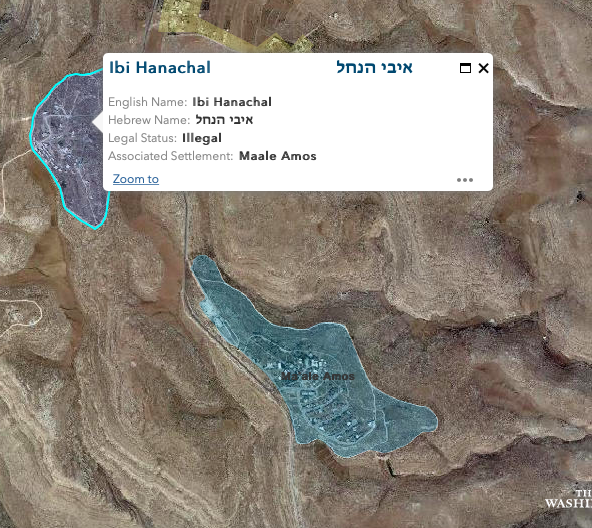
Map by WINEP
A plan for 98 units in the unauthorized Ibei Hanachal outpost, which will turn the outpost as a “neighborhood” of the Maale Amos settlement. In reality, the outpost is not contiguous with the built-up area of the Maale Amos settlement, meaning that the implementation of this plan will, in effect, create a distinct new settlement.
- A plan for 61 new units in the unauthorized Gva’ot outpost, an outpost originally built in 1999 by the settlers as a “neighborhood” of the Alon Shvut settlement. The settlers built a yeshiva there, but abandoned it not long after. The new settlement plan is for a public building, likely an educational institute with housing.
- 82 new units in th Ofra settlement. FMEP reported on this plan in the Dec 14th edition of the Settlement Report, in conjunction with the litany of punitive settlement plans advanced by Israel in response to terror attacks. The area where the new units are slated to be built is land that was allegedly purchased by the settlers from its original Palestinian owners.
- Plans for two new settlement industrial zones, one near the Beitar Illit settlement and one near the Avnei Hefetz settlement. The latter industrial zone, called Bustani Hefetz, will cover a large area of land (some 730 dunams) and will not be not contiguous with any other settlement. Peace Now writes, “an industrial zone of this scope, which is cut off from any other settlement, in all actuality constitutes a new settlement.”
- 121 new units in the Yitzhar settlement, where the IDF has been trying to rein in the violence perpetrated by the “Hilltop Youth” settlers, who are based in Yitzhar.
- 152 new units in the Shavei Shomron settlement.
- 212 new units in the Har Bracha settlement.
- 94 new units in the Beit Haggai settlement.
- A plan to legalize 75 existing settlement units in the Shvut Rachel settlement, which Israel considers a “neighborhood” of the Shiloh settlement.
- 100 new units in the Halamish settlement.
Peace Now released a statement saying:
“In 2018, the government advanced thousands of housing units, including most which can be found in isolated settlements deep inside the West Bank that Israel will eventually have to evacuate. Those who build these places have no intention of achieving peace and a two-state solution. The latest announcement, which as an aside was cynically passed on Christmas while most Western governments are on holiday, shows that Netanyahu is willing to sacrifice Israeli interests in favor of an election gift to the settlers in an attempt to attract a few more votes from his right-wing flank.”
Top Palestinian negotiator, Saeb Erekat, released a statement saying:
“While the world is celebrating Christmas with its spirit of peace and joy, the Grinch ‘occupation’ decided to steal the Christmas spirit from the people of Palestine. As part of his early election campaign, the Israeli Prime Minister Benjamin Netanyahu has as well stolen more Palestinian land and resources for the benefit of Israel’s illegal colonial settlement expansion. Such illegal actions are a deliberate campaign to destroy the two-state solution and to prevent the establishment of an independent and sovereign State of Palestine with East Jerusalem as its capital.”
Tamar Zandberg, head of the Meretz Party, slammed the new announcements, and previous decisions taken by the government to retroactively legalize 60 outposts. Zandberg said:
“The Israeli government has become a settlement government. (MKs Bezalel) Smotrich, Moti Yogev, (Justice Minister) Shaked and (Education Minister) Bennett are its landlords. They exploit the (Palestinian) attacks to build more settlements. But the truth needs to be said. To achieve security we need to evacuate settlements, not build more and more…”The 60 new settlements are the real threat to Israel’s security and to IDF soldiers. The pogroms they are waging in Palestinian villages. The stone-throwing, the shooting and the uprooting of the trees. This is the danger to our moral image and our security! They eight seats of Habayit Hayehudi party dictate eight million lives.”
Based on New Legal Tools to Take Palestinian Land, Israel Announces Intention to Build A New Settlement (“Givat Eitam/E-2”) Near Bethlehem
On December 26th, the Israeli Civil Administration announced that it will draft plans to build as many as 2,500 new settlement units at the Givat Eitam outpost site, creating a new settlement on a strategic hilltop that will cut off Bethlehem from the southern West Bank, completing the near encirclement of Bethlehem by Israeli settlements.
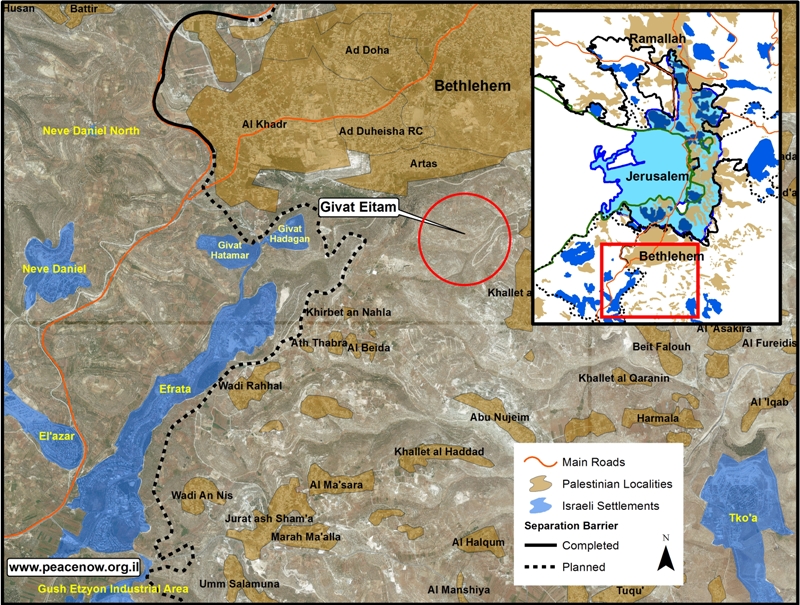
Map by Peace Now
For years, settlers have lobbied for construction at the site, but those efforts have been stymied by the lack of a legal access road to the outpost, which is surrounded by land that even Israel recognizes is privately owned by Palestinians. Until recently, Israel has balked at seizing private land from Palestinians for the exclusive benefit of the settlements. But now, several new legal opinions have allowed Israel to violate the private property rights of Palestinians for the sole purpose of legalizing settlements and settlement infrastructure. Those legal opinions include the “market regulation” principle, the opinion(s) regarding the Haresha outpost case, and the Regulation Law. It is unclear which legal argument will be applied to the Givat Eitam/E-2 case.
The Givat Eitam outpost has been nicknamed “E-2” by settlement watchers for for its resemblance, in terms of dire geopolitical implications, to the infamous E-1 settlement plan. Located east of the separation barrier on a strategic hilltop overlooking the Palestinian city of Bethlehem to its north, Givat Eitam/E-2 is located within the municipal borders of the Efrat settlement but is not contiguous with Efrat’s built-up area, making Givat Eitam/E-2 effectively a new settlement that, according to Peace Now, will:
“block Bethlehem from the south, and prevent any development in the only direction that has not yet been blocked by settlements (the city is already blocked from the North by the East Jerusalem settlements of Gilo and Har Homa, and from the West by the Gush Etzion Settlements) or bypass roads (that were paved principally for Israeli settlers). The planned building in area E2 would likely finalize the cutting off of Bethlehem city from the southern West Bank, delivering a crushing blow to the Two States solution.”
In September 2018 FMEP reported that the local council of the Efrat settlement encouraged the start of (unauthorized) construction of an outpost at the Givat Eitam/E-2 site (presuming that any such illegal construction would be retroactively legalized by the government) in response to a Palestinian terror attack in the Efrat settlement. Since then, the Civil Administration has allowed the settlers to build and maintain an agricultural farm there.
FMEP tracks all developments related to Israeli legislative, cabinet, and judicial action that promotes the retroactive legalization of outposts built on privately owned Palestinian land as part of its documentation of creeping annexation – available here.
Following High Profile Political Support, Settlers Violently Resist Evacuation from Amona Outpost Site
On January 3rd, 23 Israeli police officers were injured by Israeli settlers and their supporters who violently resisted the court-ordered evacuation from illegal encampments erected on privately owned Palestinian land as part of an effort to re-establish the Amona outpost. Approximately 300 settlers showed up at the Amona site (which is currently a closed military zone) overnight to resist the removal of settlers and two caravans from the hilltop, which was ordered by the Jerusalem District Court. The settlers and their supporters burned approximately 300 tires at the entrance to the outpost, poured oil on the access roads, and threw rocks and boulders at the Israeli police. Seven suspects were arrested and quickly released.
The evacuation of the outpost was reportedly carried out in defiance of a direct order from Prime Minister Netanyahu. According to the Haaretz report, Netanyahu gave orders to the Israeli military secretary, Col. Avi Bluth, to stop the evacuation. Col. Bluth did not relay the message in time, and the evacuation was carried out. Now, Netanyahu has ordered a disciplinary hearing to investigate the actions of Col. Bluth, which is scheduled for January 4th.
The violent evacuation of settlers from the Amona hilltop follows a week of high profile support for their efforts. Israeli Cultural Minister Miri Regev attended a ceremony near the recently re-established (yet unauthorized) Amona outpost to express her support for authorizing construction on the hilltop – which, according to the Israeli High Court of Justice, is privately owned Palestinian land. Regev could not go to the actual Amona site, because the area is a closed military zone where no one (settlers, politicians, and even the Palestinians who own the land) is permitted to enter. Regev and the settlers claim that the hilltop land has been legally purchased by the settlers, but that claim has not been investigated, much less verified. Casting doubt on the settlers’ claims, Haaretz notes:
“The lot in question is jointly owned by several different Palestinians, which means every single one of them would have to consent to the purchase for it to be legal. It’s not clear which, if any, of these Palestinians signed the sale document. In the end, the land was designated military land, is zoned for agriculture and has no building permits.The Binyamin Regional Council didn’t await the administration’s decision before moving two prefab homes into Amona and providing basic infrastructure such as water tankers.”
Israeli Attorney General Avichai Mandleblit slammed the settlers for trespassing and illegally moving caravans onto the site. Mandelblit criticized MK Bezalel Smotrich and the heads of regional settlement councils who went to the site to express support, saying:
“Breaking the law with the support of public figures, like placing caravans on privately-owned lands, can’t be a source of pride.”
A Haaretz report recently revealed Bezalel Smotrich was a founding member of a non-governmental group called Ofek Lehityashvut, which directly financed the illegal reestablishment of the Amona outpost last month by purchasing the two caravans that settlers moved onto the hilltop. The Haaretz report goes on to reveal that the Benyamin Regional Council has purposefully tailored various calls for proposals so that Ofek Kehityashvut would be the only group qualified to receive financing for that project. As a result of that manipulation, Ofek Kehityashvut has received substantial amounts of funding from the Benyamin REgional Council, which is an Israeli-taxpayer funded entity.
Knesset Speaker & Leaders Call for Annexation of Hebron
The speaker of the Israeli Knesset, Yuli Edelstein (Likud), called for Israel to apply its sovereignty over the city of Hebron – which would constitute an act of de facto annexation. Edelstein released a statement announcing his intention to go on a tour of Hebron – where some 500-800 settlers live under Israeli military protection amongst 200,000+ Palestinians – with the far-right, pro-annexationist group Im Tirzu. In the statement he wrote:
“In my view, it’s delusional that some Knesset members dare to undermine the Jewish people’s right to dwell in the city of our forefathers,” Edelstein said in a press statement issued prior to the conference. “We’re developing Hebron, investing in it and inculcating its importance in future generations. We are saying clearly – sovereignty in Hebron first.”
Speaker Edelstein also participated in a conference highlighting Israel’s historic connection to the city of Hebron. Organized by the Knesset Land of Israel Lobby, the event culminated in the signing of a document that reads:
“We, the undersigned, hereby express deep solidarity with the roots of the Jewish people in Hebron and the support of the Jewish community in Hebron that has clung to the city despite all the difficulties. We declare an unambiguous commitment to the continued existence, security and prosperity of Hebron as the city of both our forefathers and children.”
The event was co-organized by MK Bezalel Smotrich (Jewish Home) who said:
“Hebron is a litmus test. What is happening in Hebron shows our Jewish pulse….[those who call for settlers to leave Hebron] understand very well that if Hebron grows and develops, the entire settlement enterprise will grow and develop, so they invest in harming Hebron. But they will continue to shout and complain while we will continue to build, reach the people and connect with our roots.”
Regavim Petitions Jerusalem District Court to Stop the EU-Backed “Arab Takeover” of Area C
Following the Knesset’s passage of a bill in July 2018 that brought many West Bank legal matters under Israel’s domestic jurisdiction (an act of de facto annexation), the Jerusalem District Court is set to hear its first case concerning land disputes in the occupied territory. The bill was sponsored by Israeli Justice Minister Ayelet Shaked, whose three-fold rationale for the bill explicitly states that its purpose is to help settlers take more Palestinian land and shut-down Palestinian challenges to such thefts — by bringing matters to the Jerusalem Court instead of the High Court of Justice, which Shaked believes is too concerned with Palestinian rights and international law. The bill is part of the legislative body’s broader effort to erase all remaining distinctions (legal, judicial, economic, and otherwise) between sovereign Israel and the occupied territories, distinctions which allowed Israel to preserve the guise of respect for rule of law, and good intentions, for the last 50 years.
Looking to cash in the bill’s explicit purpose, the radical settler group Regavim initiated the petition asking the court to intervene to stop the “illegal Arab takeover” of land in the West Bank. Regavim’s petition claims that Palestinians are cultivating “state land” near the Mezad settlement. The petition also blames the European Union for its financial backing for the agricultural projects on the land. (Note: Regavim, like most settler media outlets, uses the word “Arab” to describe Palestinians, a vocabulary choice meant to erase any recognition of Palestinian identity).
A coordinator for Regavim told the Arutz Sheva outlet:
“The intervention of the European Union in what is happening in Area C is a brazen and aggressive intervention. We see extensive involvement on their part in lawbreaking and invading state land throughout Judea and Samaria. Their symbols are everywhere, and the State of Israel must respond to this blatant intervention on the diplomatic level as well.”
Shlomo Ne’eman, head of the Gush Etzion Regional Council said:
“The direct involvement of the European Union in financing Arab squatters in the territories and state lands has already become a plague on the state. We congratulate Justice Minister Ayelet Shaked on the obvious step that has led to great logic and justice in reducing the burden on the Supreme Court and in uniform enforcement against the land grabs by hostile elements…the Arabs understand that the real battle is on the ground. Foreign countries with their money are trying to shape a false consciousness and finally change the map of the state, but nothing can change history and our natural belonging on our national land.”
FMEP tracks the application of domestic Israeli law over the occupied West Bank (the de facto annexation of the West Bank) on its Annexation Policy Tables, which are regularly updated.
Knesset Lawyer Criticizes Bill to Give Palestinian Land to the World Zionist Organization
The legal advisors to the Knesset Constitution, Law and Justice Committee criticized a bill that would transfer vast tracts of land in Area C of the West Bank to the Settlement Division of the World Zionist Organization (WZO), a quasi-private state-funded entity that works to establish and expand settlements in the West Bank. Despite pressure to pass the bill, the legal advisors called on the committee to reexamine the text over concerns that it would also give the WZO authority over Palestinian communities in Area C. The experts wrote in a legal opinion for the committee:
“The proposed definitions of ‘rural settlement’ and ‘land’ do not include references to the character and nature of the settlement, and it seems that land that is government or abandoned property intended for Palestinian rural settlement will also be included in the boundaries of the proposed arrangement, and will be transferred to the management of the Settlement Division. Is the intention of the bill that the Settlement Division will also manage the Palestinian rural settlement in the area?”
As FMEP has previously reported, the bill was proposed by MK Bezalel Smotrich (Habayit Hayehudi) to accelerate the transfer of almost all of the land in Area C to the control of the World Zionist Organization. The land transfer is, in fact, taking place at the bureaucratic level, but Smotrich and the Israeli Cabinet (which endorsed the bill) are increasingly frustrated by the slow pace of the transfer (and perhaps also the limited scope of land slated to be handed over). Israeli Attorney General Avichai Mandelblit expressed his opposition to the bill, saying it is unnecessary given that ministry staffs are already working to transfer more land to the WZO through an administrative process.
In June 2018, when the Knesset gave preliminary approval to the bill, Peace Now responded:
“the government is scandalously planning to give the biggest land thieves responsibility for managing the land distribution, which will continue to be done under the cover of darkness if the bill passes into law.”
For more information on this bill, read a comprehensive background briefing by Peace Now.
Sheldon Adelson’s Medical School in Ariel Settlement May Not Open
The state-of-the-art medical school planned to be built in the Ariel settlement is now in danger of not opening, after a letter from the Israeli Justice Ministry warned that the school’s approval is in jeopardy. The Justice Ministry discovered an undisclosed conflict of interest that voids an important vote in favor of approving the school by the planning and budgeting subcommittee of the Higher Education Council. A member of the subcommittee, Dr. Rivka Wadmany-Shauman, allegedly met with the heads of Ariel University ahead of the vote, and made her approval of the new medical school conditional on being promoted to the rank of professor. Israel Hayom reports the Ariel University has already shelved plans to inaugurate the new school for its first semester in the Fall of 2019.
As FMEP has previously reported, Ariel University became an accredited Israeli university in 2012, following significant controversy and opposition, including from Israeli academics. It has since been the focus of additional controversy, linked to what is a clear Israeli government-backed agenda of exploiting academia to normalize and annex settlements. In 2018, the settlement broke ground on the new medical school, with significant financial backing from U.S. casino magnate and settlement financier, Sheldon Adelson. In February 2018, in an act of deliberate de facto annexation, the Israeli Knesset passed a law that extends the jurisdiction of the Israeli Council on Higher Education over universities in the settlements (beyond Israel’s self-declared borders), ensuring that the Ariel settlement medical school (and its graduates) are entitled to all the same rights, privileges, and certifications as schools and students in sovereign Israel.
As a reminder, Ariel is located in the heart of the northern West Bank, reaching literally to the midpoint between the Green Line and the Jordan border. The future of Ariel has long been one of the greatest challenges to any possible peace agreement, since any plan to attach Ariel to Israel will cut the northern West Bank into pieces.
Bonus Reads
- “Israeli settlements threaten to engulf West Bank communities” (Al-Monitor)
- “Israeli settlement activity appears to surge in Trump era” (AP)
- “It Pays Off to be an Israel Settler, Whether Trespasser or Landowner” (Haaretz+)
- “In the West Bank, the Israeli army works for the settlers” (Haaretz)
- “Netanyahu’s pro-settler allies force annexation into campaign agenda” (Al-Monitor)
Welcome to FMEP’s Weekly Settlement Report, covering everything you need to know about Israeli settlement activity this week.
To subscribe to this report, please click here.
December 21, 2018
- Israel Nears Final Move to Carry Out Massive Land Theft to “Regulate” Illegal Outposts
- Ministers Back a Bill to Legalize 66 Outposts
- In New Legal Opinion, Israeli AG Outlines Strategy for Legalizing Outposts
- New Outpost #1 : Settlers & Government Officials Illegally Re-Build Amona Outpost
- New Outpost #2: Settlers Build Outpost Overlooking Hebron
- More Details on the Plan to Dig a Tunnel Road to the Haresha Outpost
- High Court Criticizes State Over Illegal Road on Palestinian Land
- New Report Documents Israel’s “Severe and Regular” Violation of International Law in Hebron
- High-Rise Settlement Housing Promoted As a Means to Achieve 2020 Settler Vision & As a Solution to Israel’s Affordable Housing Shortage
- Fourth Quarter Decline in 2018 Settlement Construction Starts Doesn’t Tell the Whole Story
- Bonus Reads
Questions/comments? Email kmccarthy@fmep.org
Israel Nears Final Move to Carry Out Massive Land Theft to “Regulate” Illegal Outposts
As has become routine, Israeli settlers and their allies in government are exploiting the recent deaths of three Israelis (two soldiers and a baby) at the hands of Palestinian attackers as an opportunity to accelerate settlement-related activities. This includes advancing new legislation and accelerating/expanding the application of new legal tools designed to entrench and expand the permanence of some of the most radical Israeli settlers living in isolated outposts across the West Bank.
If implemented, the plans and legislation detailed below (and in last week’s settlement report) will expropriate huge amounts of land that even Israel recognizes as privately owned by Palestinians, in order to retroactively legalize Israeli outposts scattered across the West Bank. Such a move will complete what has been a gradual but steady formal suspension of even the pretense of maintaining the rule of law with regard to Israeli settlers’ or the Israeli government’s’ actions in the West Bank (which comes on top of Israel’s official and open contempt for international law). As Haaretz columnist Zvi Bar’el writes:
“The legal criminality that the government invented in honor of the settlers… is an unbridled attack on the rule of law, the undermining of Palestinian landowners’ right to appeal at the High Court, and the destruction of the planning and building system. And mainly, it turns terror into a real estate perk for lawbreaking extortionists.”
Americans for Peace Now said:
“In reaction to murderous terrorist attacks targeting West Bank Jewish settlers and Israeli soldiers, the government of Israel has come under pressure from the settlers to exact retribution against Palestinians. Two of the measures adopted are bound to open the floodgates for the legalization of existing settlement-outposts and the establishment of new ones.”
Ministers Back a Bill to Legalize 66 Outposts
On December 16th, the Israeli Cabinet voted unanimously to give government backing to a bill (called “Regulation Law 2” or the “Young Settlement Bill”) that directs the government to treat 66 illegal outposts built on privately owned Palestinian land as legal settlements, while giving the government 2 years to find a way to retroactively legalize those outposts.
The bill, proposed by MK Bezalel Smotrich (Habayit Hayehudi) and MK Yoav Kisch (Likud), also freezes any/all legal proceedings against the outposts and requires the government to connect the outposts to state infrastructure including water, electricity, provide garbage removal, and also approve budgets for them. The law also allows the finance minister to guarantee mortgages for settlers seeking to buy units in these outposts, even before the legal status of the land is resolved (a remarkable state-directed violation of normal practices in the mortgage industry). With government backing, the bill will now be introduced in the Knesset, where it must pass three readings before becoming law.
Though this bill has been ready for months, the Cabinet decided to advance the bill now in response to recent Palestinian terror attacks. MK Smotrich said: “This is the definitive answer to the murderous terrorism of the Arabs.” This sentiment was echoed widely across the settler movement.
The Cabinet voted to support the bill despite strong opposition from the Israeli Attorney General’s office. Deputy AG Ran Nizri told the Cabinet ahead of the vote that the bill has “significant legal problems,” represents a sweeping violation of the property rights of Palestinians in the West Bank, and will likely face a drawn out Court battle that might result in the High Court of Justice overturning the law. Notwithstanding these seemingly principled arguments opposing this tactic for legalizing outposts, it should be recalled that the Attorney General’s office has proposed what it believes is a more defensible means means to accomplish the same ends – called the Market Regulation principle (discussed below).
The Jerusalem Post speculates that passage of the “Regulation Law 2” in the Knesset may not be automatic, in light of past instances where international condemnation of such moves to legalize outposts led to hold-ups. The Times of Israel points out that the Trump Administration has failed to express any criticism about the new bill, which is unsurprising given Trump Administration officials’ statements and actions embracing and normalizing the settlements.
Israeli Justice Minister Shaked praised the bill, saying:
“[the bill is a] clear statement that will legalize young settlements [outposts] in Judea and Samaria. In the last three years, we changed the conversation from one of evacuation to one of legalization. There is no reason for the residents of Judea and Samaria to always have to live under the sword of evacuation.”
Peace Now said:
“Another populist and unconstitutional initiative is approved by the settler government, and only in such a state can an ‘illegal settlement’ be classified as a ‘young settlement.’ The settlers’ violence against Palestinian passerby that we witnessed during the weekend is a direct result of the government’s policy and of such bills that actually telling the settlers that they are above the law and whatever violation of the law the make, the government will legalize it.”
The bill is a follow-up to the first Regulation Law, which was passed by the Knesset in February 2017 but has since then been frozen by the High Court of Justice while it considers the law’s constitutionality. One month after passage of the Regulation Law, the Israeli Cabinet passed a resolution to enact the law expeditiously, at which point the cabinet created a committee – now headed by settler leader Pinchas Wallerstein – to build a list of outposts which the government can retroactively legalize and to complete the bureaucratic work required to do so. Wallerstein – who has a long history of ignoring Israeli law but is now responsible for massaging it to suit his needs – has been vocal about what the government can do immediately, telling the Knesset in October 2018 that there are at least 20 outposts which can be “easily” legalized as neighborhoods of existing settlements, and 50 more outposts that can be legalized but require more complex solutions.
The outposts slated to be legalized are scattered across the West Bank, many of which FMEP has reported on regularly, including: Haresha (the center of recent legal maneuvers aimed at legalizing an access road built on privately owned Palestinian land); Givat Assaf (where two Israeli soldiers were killed on December 13th); Havat Gilad (another outpost which gained political support following a Palestinian terror attack); Yitzhar South, Yitzhar East (satellites of the radical and violent Yitzhar settlement near Nablus; Ma’ale Rehavam (which was built on privately owned Palestinian land that the WZO illegally allotted to the settlers); Mitzpe Kramim (where once again the WZO gave settlers land owned by Palestinians. A court recently ruled the WZO acted in “good faith” in the transaction despite evidence to the contrary); Netiv Ha’avot (FMEP extensively covered the saga of Netiv Ha’avot); and, Adei Ad (a violent outpost that has been approved to be added to the jurisdiction of the new Amichai settlement in the Shilo Valley).
FMEP tracks all developments related to Israeli legislative, cabinet, and judicial action that promotes the retroactive legalization of outposts built on privately owned Palestinian land as part of its documentation of creeping annexation – available here.
In New Legal Opinion, Israeli AG Outlines Strategy for Legalizing Outposts
On December 13th, Israeli Attorney General Avichai Mandleblit issued a new legal opinion outlining how the government can implement the “market regulation” principle (which he invented) as a new legal basis for retroactively legalizing outposts and settlement structures built on privately owned Palestinian land. According to this principle – which contradicts any notion of rule of law or the sanctity of private property rights – settlement structures and outposts built illegally on private Palestinian land, can be legalized, if the settlers acted “in good faith” when they took over and built on the land. His opinion and subsequent arguments to the Israeli High Court of Justice (below) confirm that in the view of the Israel’s top law official, Israel has the right to expropriate privately owned Palestinian land in the occupied West Bank and give it to Israeli settlers; the only disagreement he has with the Knesset is over the method of doing so.
Peace Now has a comprehensive breakdown of the new legal opinion, including the specific criteria outlining which outposts can qualify under the new scheme. AG Mandelblit estimates that 2,000 illegal settlement structures qualify for retroactive legalization using this principle,
The Israeli government has already used the “market regulation principle” in court twice, both in defending against lawsuits filed by Palestinians (first in response to petitions by Palestinian landowners against structures on their land near the Ofra settlement, second in response to petitions filed by Palestinian landowners against the Mitzpe Kramim outpost). This week’s move by the Attorney General allows the government to proactively initiate proceedings to retroactively legalize unauthorized outposts and settlement structures.
Reportedly, the Attorney General prepared this legal opinion a while back, but was stopped from publishing it by Prime Minister Netanyahu, who was concerned about the international and diplomatic repercussions. It seems likely that the recent string of Palestinian terror attacks prompted Netanyahu to give the AG the green light to go ahead, along with advancing a number of other punitive settlement plans.
Shortly after approving the implementation of the “market regulation principle,” Mandleblit called on the High Court of Justice to overturn the Regulation Law, which the Court has been considering for more than a year. In a letter to the High Court Justices, Mandleblit argued that implementing the “market regulation principle” is “a more proportionate and balanced measure than the arrangement prescribed in the Regulation Law,” providing a more narrow legal basis by which Israel can strip Palestinian landowners of their rights (estimating that 2,000 structures can be legalized under the “market regulation principle,” compared to an estimated 4,000 under the Regulation Law). Of course, this argument overlooks the severe violation of Palestinian rights, the rule of law, and international law inherent in Israel’s decision to in effect erase Palestinian private property rights in the occupied territory to benefit the settlers.
Peace Now said:
“The attorney general is crossing yet another red line by laying the foundations for an institutionalized theft mechanism that will expropriate land from Palestinians and allocate it to settlers who stole it.This is part of a larger move led by AG Mandelblit to reduce the rights of Palestinians in the occupied territories and to expand the privileges of the settlers, thereby bringing us closer to an apartheid reality.”
FMEP tracks all developments related to Israeli legislative, cabinet, and judicial action that promotes the retroactive legalization of outposts built on privately owned Palestinian land as part of its documentation of creeping annexation – available here.
New Outpost #1 : Settlers & Government Officials Illegally Re-Build Amona Outpost
In recent days, dozens of Israeli settlers moved two mobile homes placed on the hilltop where the illegal Amona outpost once stood, claiming to have purchased the land from its Palestinian owners. Prominent settler leaders and MK Bezalel Smotrich (Habayit Hayehudi) visited the site to celebrate the resurrection of the infamous outpost, an endeavor which was directly supported and facilitated by the Binyamin Regional Council (a settlement regional authority which draws its budget from Israeli taxpayer funds).
Settlers have reportedly submitted documents to the Israeli Civil Administration which they claim prove the land has been legally purchased (a claim which, even if true, does not justify the settlers’ illegal invasion of and construction in an area designated by Israel as a closed military zone). The Civil Administration – which is the sovereign power over the West Bank and responsible for enforcing the law there – has confirmed that it is aware of the new outpost and has received documents from the settlers, but has not yet reviewed the documents.
Yesh Din, an Israeli NGO representing the Palestinian landowners, immediately filed a petition to have the illegal structures removed. Yesh Din also filed a criminal complaint against the Israeli government officials who were involved with invading the hilltop. As of this writing they have not received a response on either front. Peace Now has also stated it will pursue legal action against the settlers.
Yesh Din explains key context in the Amona outpost saga:
“After the evacuation [of the Amona outpost] in 2017, the Israeli army declared the area a closed military zone, prohibiting entry of Israelis and Palestinians to the area where the outpost had been located. The closure, however, was not enforced for Israelis, who freely entered, while Palestinians – including the legal landowners – were forbidden to enter and cultivate the very land for which they had struggled for years. In addition to the audacity of blatantly defying the High Court of Justice ruling and trampling on the rights of the landowners, the placing of the new structures this weekend violates the closure order and constitutes a further infringement of the law as the establishment of a new settlement in Amona was never authorized – certainly no permits or outline plans exist. But in the ‘land of the settlers,’ the concept of rule of law has long since lost any meaning. Any Israeli can decide to build a settlement on a hill, merely because they feel like it. The buildings then remain regardless of their illegality, Israeli authorities not daring to challenge their imposing presence.”
Benyamin Regional Council Chairman Yisrael Gantz said in a statement:
“After two years of this place being uninhabited, we are fortunate to resume Israeli life here. The plots upon which we erected the structures were legally purchased. Yesterday, I promised to establish a new settlement in Binyamin in response to the deadly attacks and today we are carrying it out.”
Yossi Dagan, head of the Samaria Regional Council said at the event:
“In these dark days, when terrorist attacks are so numerous and the honor of the people of Israel is harmed, we must get fired up and today’s ascent to Amona is an appropriate Zionist response.”
Peace Now said in a statement:
“There is no limit to the cynicism of the hilltop criminals who exploit the events of recent days to trample the law and ignite disturbances, all with public funds. These pyromaniacs are backed by Knesset members and local politicians… It is difficult to understand how an order has not yet been issued to evacuate them, and we ask whether the IDF and the police would have allowed this if they were Palestinians. This disgrace should be addressed today.”
Re-establishing the Amona outpost would hand a complete and total victory to the settlers who were forcibly evacuated from the site in 2017 – proving that not only does settler law-breaking go unpunished, but it is handsomely rewarded by the Israeli government, and that establishing illegal outposts is an effective route to establishing new settlements. Since being evacuated, the Amona outpost settlers have (so far) been “compensated” by the government with financial compensation and two new settlements:
- The first new government-backed settlement in 25 years, Amichai. The Israeli Civil Administration High Planning Council subsequently approved a plan to triple the size of the Amichai settlement to include the Adei Ad outpost and the lands between the two; and,
- The Shvut Rachel East settlement. This is an outpost that was granted authorization as a “neighborhood” of the Shilo settlement, but is properly understood as a new settlement unto itself. Teh Amona outpost settlers were first offered the Shvut Rachel East hilltop as a relocation site, but rejected it in favor of the nearby Amichai hilltop. Despite rejection, Shvut Rachel East received authorization anyways.
New Outpost #2: Settlers Build Outpost Overlooking Hebron
In recent days, a group of settlers have moved back into the site of an evacuated outpost near the city of Hebron, just north of the Kiryat Arba settlement, which settlers are calling Givat Mevaser. At a celebration of the decision by settlers to reestablish the outpost, the chairman of the Kiryat Arba settlement local council, Eliyahu Libman, said:
“We made a decision in light of the harsh news endured by the people of Israel last week to permanently move families into Givat Mevaser.”
The IDF was present at the celebratory event to protect the settlers, but an official at the Defense Ministry admitted that the settlers did not coordinate their actions with authorities. The site was previously approved to be developed into a settlement industrial zone, and according to a spokesperson for the new outpost, settlers are in the process of changing the building plan in order to get authorization for residential housing. Nonetheless, the settlers are at present violating Israeli law by taking up residence at the site.
More Details on the Plan to Dig a Tunnel Road to the Haresha Outpost
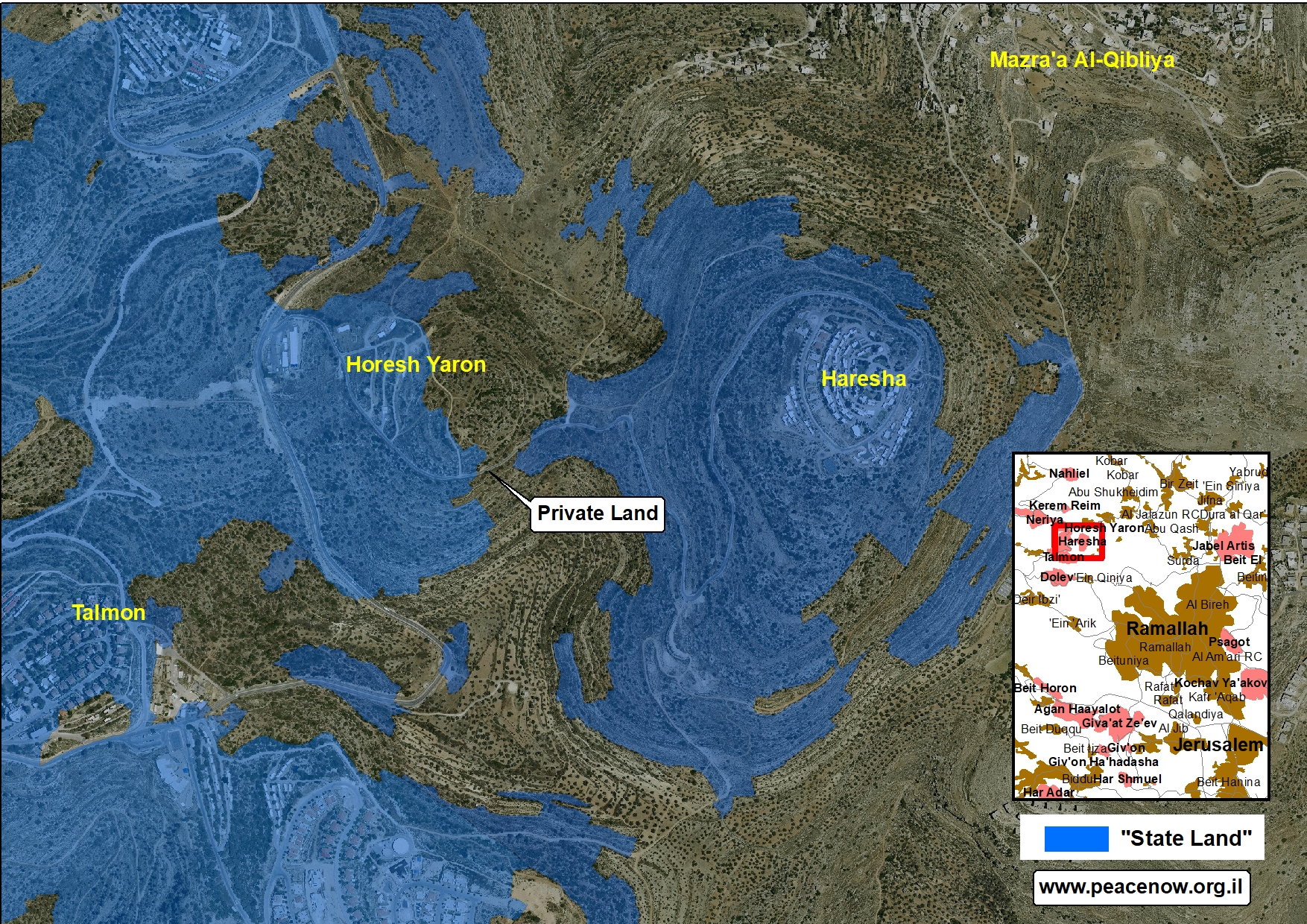 Kerem Navot has published a Justice Ministry opinion that provides further details on the government’s plan – approved on December 6th – to retroactively legalize the Haresha outpost by building a tunnel road underneath privately owned Palestinian land (an olive grove). The Justice Ministry document explains that while the Israeli government in principle has the right to permanently expropriate the land from its Palestinian owners, such an action would likely be challenged in the High Court of Justice, where it might be overturned. The Justice Ministry suggests instead that the government should “temporarily” expropriate the land while a tunnel is dug and road paved beneath the olive grove – with the plan being, ostensibly, to return the land to its Palestinian owners after construction is complete.
Kerem Navot comments:
“now, in order to legalize the outpost, shady legal advisers (of the type to whom Justice Minister Ayelet Shaked is drawn) write documents in which they lay down their doubts on whether to expropriate the grove ‘permanently,’ which will be cheaper and faster (but it is likely to be rejected by the High Court of Justice), or to ‘temporarily’ expropriate it solely for the construction of a tunnel through the ‘excavation and cover-up’ method.”
As a reminder, in November 2017 the Attorney General gave the Israeli government a green light to permanently expropriate the privately owned land based on a legal argument that holds Israeli settlers to be part of the “local population” of the West Bank, and therefore eligible to be the sole beneficiaries of state land expropriated for “public use.”
High Court Criticizes State Over Illegal Road on Palestinian Land
At a December 18th hearing, the High Court of Justice gave the government of Israel 60 days to explain why it should not be required to demolish a road and several buildings that were built on land that the state has admitted it believes is privately owned by Palestinians. The case is before the court on a petition by Palestinians who claim that a 200-meter (650-foot) stretch of the road is built on their land.
The Court also slammed the State for allowing the construction of the road and buildings to be completed after a stop-work order was issued against the construction, a stop-work order the State assured the Court would be implemented. At the December 18th hearing, an attorney from the State Prosecutor’s Office told the Court that the road in question was a dirt road, and argued that the state had not sanctioned or had a hand in its construction.
New Report Documents Israel’s “Severe and Regular” Violation of International Law in Hebron
Haaretz shares details from a leaked report written by the Temporary International Presence in Hebron (TIPH), which documents the totality of Israel’s policies in Hebron, serve to aid and protect settler and which collectively impose severe human rights violations and restrictions on Palestinians.
The report accuses Israel of being in “severe and regular breach” of international law, highlighting the many ways in which the human rights of Palestinians are systematically trampled on – specifically as it relates to radical settlers, their increasing activities in Hebron’s Old City, and the role of nearby settlements.
The Temporary International Presence in Hebron (TIPH) was first established in 1997 as part of the Oslo Accords’ Hebron Protocol, which allowed the partial redeployment of Israeli military forces to the part of the city that remained under its control. Israel must renew the TIPH’s mandate every six months; some fear that the next renewal has been jeopardized by the leaked report’s publication.
High-Rise Settlement Housing Promoted As a Means to Achieve 2020 Settler Vision & As a Solution to Israel’s Affordable Housing Shortage
Haaretz reports that the Yesha Council – the umbrella group representing all settlements in the West Bank – has adopted a strategic goal to advance “high quality, high density” settlement schemes in order to reach their goal of having 1 million settlers living in the West Bank by 2020. The basic idea is to build high-rise apartment complexes in settlements close to major highways in the West Bank and aggressively market them to Israelis who are seeking cheap rent and a fast commute, two key complaints of Israelis living and working in sovereign Israeli territory.
The strategy marks a shift in how settlements have typically been marketed to the Israeli public; once sold as an answer for young Israeli families looking for a single family unit with land, housing in settlements is now being marketed as the answer for young professionals looking for affordability, convenience and accessibility. The Yesha Council has coupled the new strategy with pressure on the government (and a promise to potential purchasers) to expedite West Bank infrastructure projects that will ease traffic, including bypass roads and detours around Palestinian towns.
In a February 2018 article, the Chairman of the Yesha Council wrote:
“Looking ahead, the patterns of thinking and action in the settlement movement need to be changed in two main areas: high-rise construction and doing away with admission committees. The available land for building is not plentiful. Until now, we’ve been used to rural communities with a one-family home on a half-dunam plot, but the goal from now on should be to build as many housing units as possible on that same land. High-density construction — building up or in a terraced fashion, depending on topography — will change the balance in the area and also require a new approach to infrastructure development to suit the number of residents in the future.” [Note: the Haaretz article explains that “admission committees” are a function of settlements which have standards for who is permitted to live there, mostly in ultra-orthodox and ideological settlements]
Fourth Quarter Decline in 2018 Settlement Construction Starts Doesn’t Tell the Whole Story
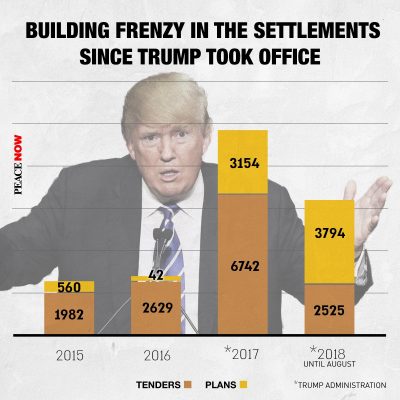
by Peace Now
The Israeli Central Bureau of Statistics (CBS) released new data showing a 52% decrease in the number of settlement construction starts in the third quarter of 2018 compared to the second quarter of 2018. News about a “decline,” relative to the last quarter, obscures the clear and alarming settlement surge currently taking place. As Peace Now has reported, by August 2018 the total number of settlement tenders and plans that have been advanced (6,319) is more than double the total amount in 2016 (3,189).
In addition, it is important to bear in mind that the number of construction starts do not begin to depict or reveal the level of settlement activity happening in the West Bank. Israel’s settlement enterprise is not solely a matter of residential housing plans, but also the unceasing expansion of infrastructure and security measures that exclusively benefit Israeli settlers, the normalization and development of settlement industrial zones, and illegal settlement activity (outposts, which are now regularly legalized ex post facto) that does not register in numbers tracking the settlement planning process.
Bonus Reads
- “Israel Has Weaponized the Settlements” (Haaretz Editorial)
- December 2018 public opinion poll – Palestinian Center for Policy and Survey Research
Welcome to FMEP’s Weekly Settlement Report, covering everything you need to know about Israeli settlement activity this week.
To subscribe to this report, please click here.
November 21, 2018
- Supreme Court Upholds Eviction of 40 Palestinians in Sheikh Jarrah, More Likely to Follow
- New Report Calls on AirBnB, Booking.com to Stop Listing Rentals Located in West Bank Settlements
- Settler Council Uses Taxpayer Money to Finance Illegal Construction of a Racetrack in Jordan Valley
- Knesset is Advancing a Bill to Give More Land in Area C to the World Zionist Organization
- Conference in Knesset Will Make Case for Evacuating Settlers from Hebron
- Bonus Reads
Questions/comments? Email kmccarthy@fmep.org
Supreme Court Upholds Eviction of 40 Palestinians in Sheikh Jarrah, More Likely to Follow
On November 15th, the Israeli Supreme Court denied an appeal that would have delayed the eviction of 40 members of a Palestinian family, the Sabags, from their homes in the East Jerusalem neighborhood of Sheikh Jarrah. The appeal asked the Court to take the time to reconsider ownership claims to the land. In denying the appeal, the Supreme Court upheld Israeli Jewish ownership claims to the plot of land based on its purchase in 1876. The eviction is expected to take place within months.
The land in question was abandoned during the 1948 war and was under Jordanian rule until 1967, during which time homes were built on it, including the those inhabited by the Sabag family. Notably, while Israeli law provides Jewish residents with the right to reclaim property lost in the 1948 War, it affords Palestinians no similar right to return to, or reclaim, property lost in that same war.
Responding the Supreme Court decision, 71-year old Mohammad Sabag said:
“We have two houses in Jaffa, on Hasneh Street and Hagidam Street, and we have 250 dunams [62.5 acres] in Yavneh and also in Ashdod. Why can’t I ask for my property from before 1948?”
In the early 2000s a company named Nahalat Shimon International (reportedly registered in Delaware, USA), “purchased” land in Sheikh Jarrah from the Jews who owned it prior to the 1948 war. Since then, Nahalat Shimon has been undertaking legal action to evict Palestinians. In 2009 the first eviction took place – sparking a sustained protest in the Sheikh Jarrah neighborhood which has garnered international attention.
The Sabag family has been fighting Nahalat Shimon’s attempts to evict them since 2008, claiming that the land was not properly registered with the Ottoman Empire prior to 1948, leaving ownership of the plot unclear. Settling the matter definitively, the Israeli Supreme Court refused to reconsider ownership claims to the land, saying that the statute of limitations has long since expired.
Looking at the broader impact of the ruling, Haaretz noted:
“The ruling will also make it very difficult for dozens of other Palestinian families in Sheikh Jarrah to avoid eviction.”
New Report Calls on AirBnB, Booking.com to Stop Listing Rentals Located in West Bank Settlements
A new report by Kerem Navot and Human Rights Watch details how online rental companies like AirBnB and Booking.com perpetuate Israel’s discrimination against Palestinians by listing rentals located in illegal Israeli settlements in the occupied West Bank. The report, entitled “Bed and Breakfast on Stolen Land,” details how rentals in West Bank settlements run afoul of the companies’ own business and human rights principles, and contribute to the economic viability and legitimization of the settlement enterprise.
On the eve of the report’s publication, AirBnB announced that it will remove 139 rental listings located in West Bank settlements, 15 of which are built on land which Israel has acknowledged is privately owned by Palestinians. Following AirBnB’s announcement, Booking.com signalled that it would not remove its listings from settlements, insisting that all their practices accord with all applicable local (Israeli) laws. According to Human Rights Watch, Booking.com has 26 rentals listings in settlements, 2 of which are located on privately owned Palestinian land that Israel expropriated for “public use” and then designated for the exclusive use of settlements.
Following AirBnB’s announcement, Human Rights Watch released a statement saying:
“By delisting rentals in illegal settlements off-limits to Palestinians, Airbnb has taken a stand against discrimination, displacement, and land theft. The continued business activities of Booking.com and other companies in settlements contribute to entrenching a two-tiered discriminatory regime in the West Bank.”
AirBnB’s decision sparked outrage and immediate calls for action from Israeli government officials, who are promoting several ways to retaliate against AirBnB. Officials have said that Israel will restrict AirBnB’s operations in sovereign Israeli territory and also levy a special new tax on its operations in light of its boycott of the settlements. Israeli Strategic Affairs Minister Gilad Erdan – whose responsibilities include fighting boycotts, divestment, and sanctions (BDS) – urged Israeli AirBnB hosts in settlements to sue the company. Israeli Tourism Minister Yariv Levin announced that the Israeli government will consult with the U.S. government in order to assist Americans in suing AirBnB (which is based in San Francisco); 24 states including California have passed anti-boycott legislation intended to stop U.S. companies and individuals from participating in boycotts of Israel and/or Israeli-controlled territories (i.e. settlements), though unless AirBnB is competing for government-funded contracts in these states, there is no basis to use these laws against it. Eugene Kontorovich, who self-identifies as a key figure in drafting the anti-boycott (but really anti-free speech) laws for states, called AirBnB’s decision “anti-Semitic.”
Peace Now released a statement slamming the Israeli government response, saying:
“Even if Netanyahu and Bennett refuse to see the Green Line, the rest of the world differentiates between Israel and the occupied territories. International companies are interested in doing business with Israel but are not ready to accept the continuation of military control over millions of Palestinians.”
Two years ago, +972 Magazine was first to report on the discriminatory and illegal nature of companies which list rentals across the Green Line, in what the international community considers as territory being held by Israel under military occupation.
Settler Council Uses Taxpayer Money to Finance Illegal Construction of a Racetrack in Jordan Valley
A freedom of information request filed by Peace Now and the Movement for Freedom of Information revealed that the Jordan Valley Regional Council – which Israeli municipal body thas authority for over settlements in the Jordan Valley and is responsible for enforcing building laws – is directly financing the illegal construction of a state-of-the-art car racing complex near the Jordan Valley settlement of Petza’el.
As +972 Mag and Kerem Navot revealed in August 2017, the large complex is being built partially on land that the Israeli army previously declared a closed firing zone, a designation which resulted in the forcible displacement of Palestinians who lived there. The land remains under this designation today.
In light of the track’s encroachment into the closed firing zone, the Israeli Civil Administration – the arm of the Israeli Defense Ministry that acts as the sovereign power in the West Bank – issued a stop-work order against the construction in February 2017 (which settlers ignored). Demonstrating that, as usual, law-breaking pays off for settlers, the Civil Administration also announced that it was considering a “master plan” for a touristic site – including a hotel – in the same area (with the development designed not to cross into the firing zone).
Despite the Civil Administration’s intervention and promise of a pay-off, the Jordan Valley Regional Council transferred NIS 284,000 (around $8,000) in 2017 for the construction of the racetrack, and then approved NIS 5,615,000 (around $1.5 million) for the project in 2018, nearly all of which comes from a grant to the Council for the project from the Israeli Interior Ministry.
In response to the new budget documents, the Israeli Interior Ministry told Haaretz that the grant was approved but will not actually be transferred until plans for the racetrack receive retroactive authorization from the government.
Peace Now states:
“In recent years, the Jordan Valley has become the wild west of the West Bank, and it appears that the regional council, which is supposed to be the sovereign that enforces the law, is a full partner in the crimes taking place there. This is an absurdity that is unfortunately all too common in the settlements. The Jordan Valley Regional Council is following in the footsteps of its big sisters among the regional councils–Binyamin, Shomron, Gush Etzion and Har Hevron–which regularly funnel public funds to illegal activity to create facts on the ground intended to deny Israel the option for a two-state solution.”
Knesset is Advancing a Bill to Give More Land in Area C to the World Zionist Organization
Earlier this month, the New Israel Fund reported on the Knesset’s ongoing consideration of a radical bill that seeks to accelerate the transfer of almost all of the land in Area C to the control of the World Zionist Organization (WZO).
As we have reported previously, the WZO’s Settlement Division was created by the Israeli government in 1968 – and is funded entirely by Israeli taxpayers. Its mandate is to manage West Bank land expropriated by Israel, in order to facilitate the settlement of Israeli Jews in the occupied territories. To make this possible, the Israeli government has allocated approximately 60% of all “state land” to the WZO’s Settlement Division [over the past 50 years Israel has declared huge areas of the West Bank to be “state land,” including more than 40% of Area C, where most of the settlements are located]. In addition, settlement and human rights watchdogs have repeatedly documented how the WZO’s Settlement Division has worked to take over additional land, including privately owned Palestinian land, in order to build more settlements.
At a hearing last week, Israeli Attorney General Avichai Mandelblit expressed his opposition to the bill (which is endorsed by the Israeli cabinet), saying it is unnecessary given that ministry staffs are already working to transfer more land to the WZO through an administrative process. MKs from the Jewish Home party have said they will bring the bill up for a vote at the committee level next week if they are not satisfied with the progress that the ministry staffs have made in transferring land to the WZO.
In June 2018, when the Knesset gave preliminary approval to the bill, Peace Now responded:
“the government is scandalously planning to give the biggest land thieves responsibility for managing the land distribution, which will continue to be done under the cover of darkness if the bill passes into law.”
For more information on this bill, read a complete background briefing by Peace Now.
Conference in Knesset Will Make Case for Evacuating Settlers from Hebron
Next week, the Knesset will hold a conference entitled, “Hebron First,” featuring Israeli civil society leaders making the case to lawmakers for the removal of Israeli settlers from Hebron. The event is being organized by MK Ayman Odeh (Joint List), Dov Khenin (Joint List), and Michal Rozin (Meretz). The President of B’Tselem, Hagai El-Ad, is expected to make a speech.
In a joint statement about the event, the MKs said:
“The settlement in Hebron is the expression of an extremist government policy that pours mass sums of money and endangers human lives to strengthen and maintain a handful of extremist settlers. The evacuation of the settlement in Hebron is a first and necessary step to promoting a diplomatic solution and bringing the Israeli-Palestinian conflict to an end.”
Over the five months, the Israeli government has advanced highly controversial plans that promote the growth and permanence of settlements in Hebron. Earlier this month (November 2018), Israeli Defense Minister Avigdor Liberman (who recently resigned) announced plans to build a new settlement above a section of the Palestinian market in the Old City of Hebron. In October 2018, the government announced a new settlement at the site of an Israeli military installment in Hebron, and in July 2018, the Cabinet decided to fund a new settler municipal body meant to empower Israeli settlers living in enclaves in downtown areas of Hebron, despite a court injunction against forming the body.
Bonus Reads
- “Avigdor Liberman: The settler defense minister who couldn’t please the settlers” (Times of Israel)
- “ ‘Things are going so well’: Settlers line up in opposition to elections” (Times of Israel)
- “Knesset conference calls for evacuation of Hebron settlers” (Ynet)