Welcome to FMEP’s Weekly Settlement Report, covering everything you need to know about Israeli settlement activity this week.
To subscribe to this report, please click here.
July 5, 2019
- With a Sledgehammer in Silwan, U.S. Officials Legitimize Radical Settler Agenda & Offer De Facto U.S. Recognition of Israeli Sovereignty over East Jerusalem
- For the Second Time, Jerusalem District Court Accepts “Market Regulation” Principle as Basis For Seizing Privately Owned Palestinian Land for Settlements
- Settlers, Anticipating Victory on Area C Annexation Push, Expand Annexation Campaign to Include (de facto) Extension of Israeli Control Into Area B
- U.S. Owners of “Duty Free Americas” Are Sending Millions to the Settlements/li>
- U.S. Envoy Greenblatt Prefers to Call Settlements “Neighborhoods and Cities” Because International Law is Not “Clear Cut”
- Bonus Reads
Questions or comments? Contact Kristin McCarthy at kmccarthy@fmep.org.
With a Sledgehammer in Silwan, U.S. Officials Legitimize Radical Settler Agenda & Offer De Facto U.S. Recognition of Israeli Sovereignty over East Jerusalem
In a gratuitous political stunt that represented an unprecedented statement of U.S. support for Israel’s assertion of sovereignty over East Jerusalem, as well as for agenda of radical right-wing Israeli settlers in East Jerusalem, on June 30, 2019, U.S. Ambassador to Israel David Friedman and Special Representative Jason Greenblatt participated in a highly provocative ceremony at an archeological site in East Jerusalem. The ceremony marking the “opening” of what Israel has dubbed the “Pilgrim’s Road”- an excavation project initiated by the radical settler group Elad beneath the Wadi Hilweh section of Silwan, a Palestinian neighborhood in East Jerusalem adjacent to the Temple Mount/Haram Al-Sharif.
In response to widespread condemnation of his role in the ceremony (which, among other things, was protested by the anti-settlement watchdog group Peace Now), Friedman made his support for Israel’s claim over East Jerusalem even more explicit. He said:
“The City of David brings truth and science to a debate that has been marred for too long by myths and deceptions. Its findings, in most cases by secular archaeologists, bring an end to the baseless efforts to deny the historical fact of Jerusalem’s ancient connection to the Jewish people. It brings to life the historical truth of that momentous period in Jewish history. Peace between Israel and the Palestinians must be based upon a foundation of truth. The City of David advances our collective goal of pursuing a truth-based resolution. It is important for all sides of the conflict…The City of David is an essential component of the national heritage of the State of Israel. It would be akin to America returning the Statue of Liberty.”
Peace Now said in a responded:
“This is no less than American recognition of Israeli sovereignty in the sensitive area of the Holy Basin, contrary to the American position throughout the years since 1967. The Trump Team chooses to strengthen the hold of the settler fringe in the sensitive area of the Holy Basin instead of advancing a conflict-ending peace agreement. The tunnel, the way it was dug and its geo-political ramifications, are trampling on the reputation of Jerusalem as a city sacred to all religions and belonging to all its inhabitants. It is part of the transformation of Silwan into a Disneyland of the messianic extreme right wing in Israel and the United States – just steps from the Al-Aqsa Mosque and the Temple Mount.”
Raising the ignored (by Friedman, Greenblatt, et al) issue of the project’s impact on Palestinians living above the excavation site, the Haaretz Editorial Board wrote, in a piece entitled “Settlers in the White House,”:
“The participation of American diplomats at an event sponsored by a right-wing group in East Jerusalem constitutes de facto recognition of Israeli sovereignty in Jerusalem’s historic basin…This recognition doesn’t just put the American administration on the extreme right of the Israeli political map – thus undercutting the claim that American can be an unbiased broker between Israel and the Palestinians – but it also ignores the complicated reality in Silwan, East Jerusalem and the entire region. The tunnel, which was excavated using controversial methods from a scientific standpoint, harnesses archaeology to politics while ignoring the nuances of Jerusalem’s ancient past. But the main problem is that excavating under the street blatantly ignores what’s happening at street level. In Silwan alone there are 20,000 Palestinians without citizenship or civil rights, who justifiably feel that this archaeological project is aimed at forcing them out of their neighborhood. Surrounding Silwan are another 300,000 Palestinian residents of East Jerusalem, also without rights.”
Israeli NGO Emek Shaveh – a group of expert archaeologists – said in a statement:
“The use of archaeology by Israel and the settlers as a political tool is a part of a strategy to shape the historic city and unilaterally entrench Israeli sovereignty over ancient Jerusalem. It is a process which is likely to produce devastating results for both Israel and the Palestinians. It is inexcusable to ignore the Palestinian residents of Silwan, carrying out extensive excavations of an underground city and to use such excavations as part of an effort to tell a historic story that is exclusively Jewish in a 4,000 year-old city with a rich and diverse cultural and religious past.”
Greenblatt – who is not an archeologist, punched back with a tweet suggesting that Emek Shaveh “NGO seems to misunderstand the meaning of ‘archeology.’”
The Palestinian Authority said in a statement:
“We consider the participation of (US Mideast Envoy) Jason Greenblatt and David Friedman to be criminal collusion in the commission of a war crime that must be condemned as well as universally and unequivocally confronted.”
Elad launched its excavation of the “Pilgrim’s Road” in 2007, with the full support of the Israel Antiquities Authority (IAA). For more background on the tunnels and how radical Israeli settlers have exploited excavation, tourism, and the ancient character of Jerusalem in order to serve their ideological agenda – see the comprehensive reporting by Emek Shaveh.
For the Second Time, Jerusalem District Court Accepts “Market Regulation” Principle as Basis For Seizing Privately Owned Palestinian Land for Settlements
In June 2019, Judge Carmi Mossek became the second district court judge to accept the “market regulation” principle as a valid legal basis for retroactively legalizing settlement buildings that were built on land that even Israel recognizes is privately owned by Palestinians. The case in question revolves around four buildings in the Alei Zahav settlement that are partially built on Palestinian land, as revealed by the results of a land survey in 2016 by the Israeli “Blue Line” team (a team whose purpose is to survey the West Bank in order to find more land onto which Israel can expand settlements).
According to Israeli Attorney General Avichai Mandleblit – who first promoted the use of the “market regulation” principle – the principle can only be applied to cases in which all parties involved in the “accidental” construction can demonstrate that they acted in “good faith,” – e.g., with support from the State and without knowing the land in question was privately owned Palestinian land (an argument which of course ignores Israel’s responsibility under international law to protect the property rights of Palestinians living under Israeli occupation).
In this latest case, the state argued that the “market regulation” principle provides a basis for legalizing settlement construction that was “accidentally” built on privately owned Palestinian land in the Alei Zahav settlement. The judge accepted this argument, despite the fact that the High Court of Justice is still considering the validity of “market regulation” as a legal principle. Depending on how the High Court rules, the “market regulation” principle could pave the way for Israel to expropriate Paelstinian land across the West Bank instead of returning it to its legal owners in order to retroactively legalize as many as 3,000 settlement units. In her ruling, Judge Mossek agreed with the State that the settlers’ “good faith” entitles them to be recognized as the legal owners of the land. Jude Mossek gave the state until September to complete the administrative process of retroactively legalizing the houses.
The first case the state of Israel brought forward to test the “market regulation” principle, relating to the Mitzpe Kramim outpost, made clear that “good faith” is in the eye of the beholder, and that when the beholder is the state of Israel, there is a readiness to stretch and twist the meaning of the term “good faith” well beyond any reasonable understanding of the term. That case is the one currently being considered by the High Court of Justice.
Settlers, Anticipating Victory on Area C Annexation Push, Expand Annexation Campaign to Include (de facto) Extension of Israeli Control Into Area B
Settlers recently sent a letter to Israeli Prime Minister Netanyahu asking him to stop Palestinian construction taking place in Area B of the West Bank, arguing that the construction is too close to Israeli settlements in Area C. As defined in the Oslo Agreements, Area C is 60% of the West Bank that Israel retained civil and security control over; Area B constitutes 22% of the West Bank where the Palestinian Authority has civilian control, but Israel exerts control over all security matters.
This new plea from the settlers is a dangerous – but predictable – extension of the settlers’ success in pushing for Israel’s unilateral annexation of Area C, a demand which is increasingly validated in the official discourse of both the Netanyahu government and the Trump Administration. It is consistent with a tactic that has, for decades, served the settlers well: as settlements (by various means) expand ever-closer to Palestinian built-up areas, and ever-deeper into the West Bank, settlers complain that the close proximity of Palestinians threatens their security, and demand that the IDF take action (leading to road closures, land seizures or closures for “security reasons,” “temporary” seizures of homes for IDF use, etc).
In their plea to stop Palestinians from building on land that even Israel recognizes belongs to them, and that under Oslo is under Palestinian civilian control land, the settlers argue:
“This is a construction that seriously harms the personal security of every Israeli living in the communities of Gush Shilo and especially in Amichai, and the public expects the cabinet to wake up, take responsibility and stop this thing immediately.”
U.S. Owners of “Duty Free Americas” Are Sending Millions to the Settlements
An Associated Press investigation revealed that family that owns the highly profitable and ubiquitous retail chain “Duty Free Americas” is a major source of financial support for some of the most radical settler groups in Israel. According to documents uncovered by the Democratic Bloc, the Florida-based Falic family is the single largest donor to Israel Prime Minister Netanyahu and has given over $5.6 million to settler groups over the past decade. These donations have included:
- $1 million to projects associated with the radical group Ateret Cohanim, which is focused on taking control of property in East Jerusalem, especially in the Old City, including by means that are morally and legally questionable;
- Roughly $600,000 to “Hachnasat Orchim Hebron,” an organization that brings tourists to visit radical settlers living in downtown Hebron enclaves. The group was founded by Baruch Marzel, who served as an aid to the ultra-nationalist and racist leader Meir Kahane; Marzel is still listed by name in the CIA World Factbook as a leader of Kach/Kahane Chai, which are U.S.-designated Foreign Terrorist Organizations. In addition to bringing tourists to the settlers, the group also distributes snacks to Israeli soldiers who protect the radical enclaves;
- Funding to organizations that call for Israel to take control over the Temple Mount, tear down the Al-Aqsa Mosque and the Dome of the Rock, and build a synagogue in their place (the “Third Temple”);
- Support for a winery inside the Psagot settlement. The Psagot winery – as is the case with other settler-run wineries in the West Bank and the Golan Heights – is complicit in advancing and normalizing the settlements through tourism;
- A biblical theme park inside of the Shiloh settlement;
- In 2014, the Falics donated to the construction of a synagogue and mikveh (a ritual bath) in the unauthorized Kerem Reim outpost. Since then the Israeli government retroactively legalized the Kerem Reim outpost;
- $50,000 to an organization that acts as a fundraising arm on behalf of Lehava, an extremist, openly-racist Israel organization that advocates against Jewish-Arab couples and assimilation in Israel. Lehava is often is accused of using intimidation and even violence.
While the Falic family’s tax records disclose many causes their family foundation supports, when it comes to most of their donations to Israel-based groups, that money appears to be channeled via Panamanian-based companies, through the family’s Israel-based Segal foundation (whose name is a Hebrew acronym based on the Falic brothers’ first names). This arrangement – which the family states is because one of the Falic brothers lives in Panama – allows for next to zero transparency regarding where the money ends up.
Ran Cohen of the Democratic Bloc, an Israeli NGO which did key research for the AP investigative story on the Falic family, told FMEP:
“Unfortunately, the Falic family story is just another example in a wider picture of private American funding that goes to support racist and anti-democratic trends in Israel. Many of these supporters maintain a public face as Israel-loving philanthropists, when in fact, they fuel some of the most dangerous, extreme, and racist agendas in Israel. We at the Israeli Democratic Bloc, took upon ourselves the mission to research , educate and systematically expose those who threaten Israel’s democratic space”
MK Aida Touma-Sliman (Hadash-Ta’al) said:
“The Falics donate to racist organizations preserving the ‘purity of the Jewish race’ and to the most violent segregationists settling in Hebron and East Jerusalem. The settlements cannot exist without the support of extremist capitalists from the US, these donors must be exposed.”
This revelation is the latest in a growing body of investigative work into previously secretive channels of U.S. money flowing to Israeli settlements and extremists. In January 2019, the American NGO T’ruah investigated and revealed that U.S. donations were finding their way to Kahanist groups in Israel. A December 2018 investigation by Haaretz revealed that Christian groups have given up to $65 million in projects in the “Biblical Heartland” over the past decade, in addition to non-financial donations like volunteer laborers. In October 2018, journalist Josh Nathan-Kazis reported that the San Francisco Jewish Federation was using an Israeli organization to channel funds to organizations fighting to stifle criticism of Israeli policies and punish activists who engage in such criticism, particularly on college campuses. A 2017 Haaretz investigation revealed that millions of tax-deductible donations to the Jewish Federations of North America go to fund West Bank settlements.
U.S. Envoy Greenblatt Prefers to Call Settlements “Neighborhoods and Cities,” Claiming International Law is Not “Clear Cut”
U.S. Special Representative Jason Greenblatt told the audience at a conference on U.S.-Israel relations hosted by Sheldon Adelson’s “Israel Hayom” media outlet that:
“International law, UN resolutions and internationally recognized parameters are not always clear cut. They are interpreted differently in good faith by different parties and they do not provide an executable solution to this conflict…[To resolve the conflict, people have to stop] pretending that settlements, or what I like to call neighborhoods and cities, are the reason for the lack of peace.”
In fact, international law is clear. According to Article 49 of the 4th Geneva Convention, “The Occupying Power shall not deport or transfer parts of its own civilian population into the territory it occupies.” [It is worth re-reading the whole thing to grasp the scope of Israel’s violations of international law in its conduct in the territories it occupied in 1967). Amnesty International also notes that:
“The extensive appropriation of land and the appropriation and destruction of property required to build and expand settlements also breach other rules of international humanitarian law. Under the Hague Regulations of 1907, the public property of the occupied population (such as lands, forests and agricultural estates) is subject to the laws of usufruct. This means that an occupying state is only allowed a very limited use of this property. This limitation is derived from the notion that occupation is temporary, the core idea of the law of occupation. In the words of the International Committee of the Red Cross, the occupying power ‘has a duty to ensure the protection, security, and welfare of the people living under occupation and to guarantee that they can live as normal a life as possible, in accordance with their own laws, culture, and traditions.’ The Hague Regulations prohibit the confiscation of private property. The Fourth Geneva Convention prohibits the destruction of private or state property, ‘except where such destruction is rendered absolutely necessary by military operations.’”
In addition to Greenblatt’s fawning over the settlements, Dr. Miriam Adelson also drew headlines for her speech in which she speculated that there might eventually be a “Book of Trump” added to the Bible in recognition of what Trump has done for the state of Israel. Adelson got the love right back, in the form of a remarkably candid comment from former U.S. Ambassador to the UN, Nikki Haley (who many speculate is the Adelsons’ chosen candidate to succeed Trump). During a public interview in Jerusalem conducted by Miriam Adelson, Haley noted: “A lot of the strength the U.S. is showing for Israel, Sheldon and Miriam Adelson played a very big part in” [As noted by FMEP’s President Lara Friedman: “If a critic of Israel said this, they’d be instantly accused of antisemitism…”]
Bonus Reads
- “How TripAdvisor is Fueling Human Rights Violation is Khirbet Susiya” (Amnesty International)
Welcome to FMEP’s Weekly Settlement Report, covering everything you need to know about Israeli settlement activity this week.
To subscribe to this report, please click here.
June 28, 2019
- Radical Settler Group Deepens Control Over East Jerusalem Neighborhood & Tourism Network
- Israel Advances Plan for Settlement Enclave in Beit Hanina Neighborhood of East Jerusalem
- Former Mayor of Jerusalem Proposes Plan to Build 12 New Settlement Industrial Zones in Area C
- McDonald’s Wins Bid to Operate in Ben Gurion, Despite Settler Campaign
- Settlers Continue Price Tag Attacks on Palestinian Villages, Still No Arrests
- The Bahrain Workshop [Shhh… Don’t mention Settlements!]
- Bolton Tours Jordan Valley & Hints at U.S. Support for Permanent Israeli Control
- Bonus Reads
Questions or comments? Contact Kristin McCarthy at kmccarthy@fmep.org.
Radical Settler Group Deepens Control Over East Jerusalem Neighborhood & Tourism Network
Approximately two months ago, the radical settler organization Elad opened a new cultural center and cafe in the Palestinian neighborhood of Abu Tor (Abu Tor is a mixed but segregated neighborhood). Named “House in the Valley,” Elad’s new cafe is uncoincidentally located adjacent to the site of a planned new pedestrian footbridge designed to expand Elad’s tourist infrastructure across the area. Specifically, that new footbridge will connect Abu Tor with Elad-run tourist sites and settler homes in the Palestinian Silwan neighborhood – located just outside the Old City’s Dung Gate, in the shadow of the Temple Mount/Haram Al-Sharif.
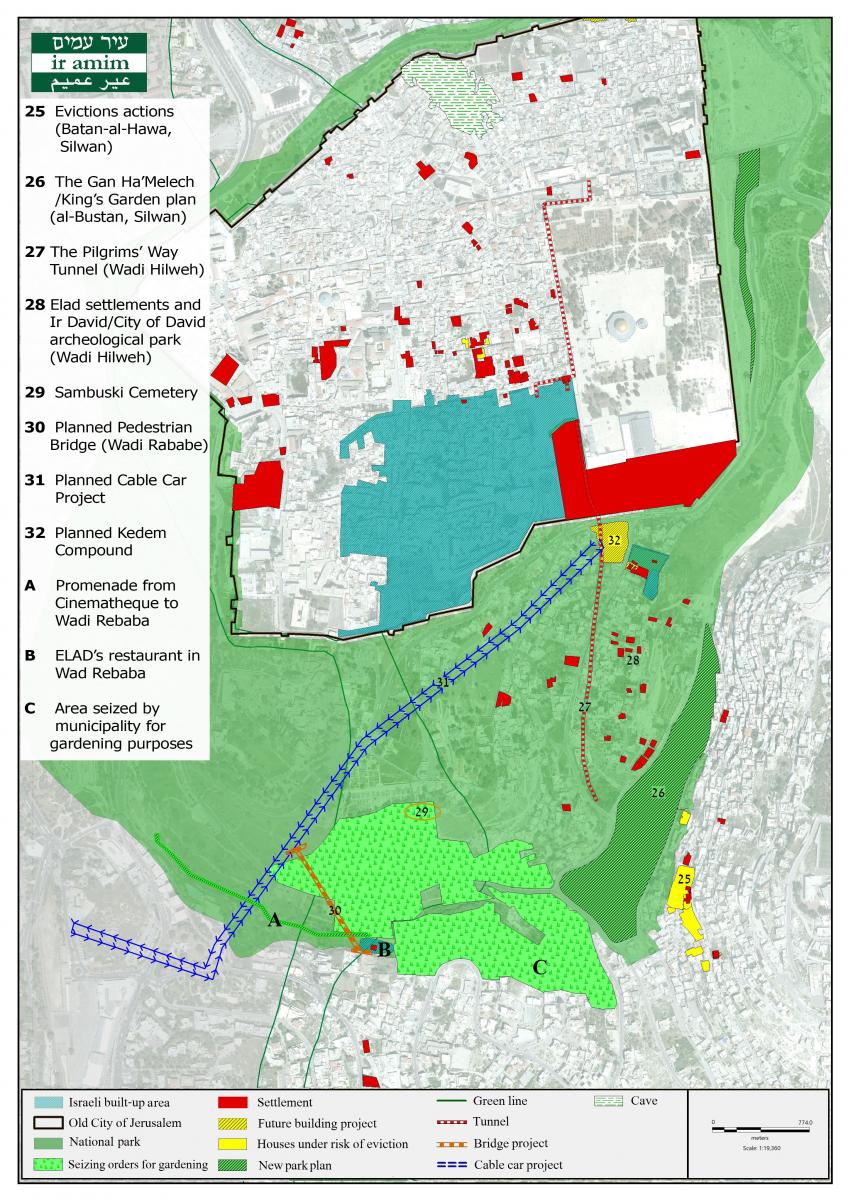
A week after Elad’s new cultural center was opened in April 2019, the Jerusalem Municipality issued “gardening orders” to take control, for a period lasting 5 years (with the likelihood of extensions after that), of 12 nearby plots of privately owned Palestinian land. “Gardening orders” allow Israel to “temporarily” take over privately owned land for what are public purposes (like establishing a parking lot or public garden), based on the argument that the owners are not presently using the land.The government notices posted on the land, say that the Jerusalem Municipality intends to transform the plots with new landscaping, adding new terraces, and a new walking path. Importantly, as Emek Shaveh notes, the 12 plots in question are located in an area declared by Israel to be a national park, meaning that private landowners are legally barred from using their own land.
In short, this is an Orwellian situation wherein Israel has actively blocked Palestinains from using their own land, and is now using the fact that the Palestinians aren’t using their land as a pretext for seizing it. Adding insult to injury, the land is being taken ostensibly for public purposes – but the public the seizures are designed is Elad and its supporters, not the Palestinian residents of the area.
Ir Amim explains key context:
“Portrayed as a seemingly innocuous new establishment for arts and culture designed to serve the Israeli public, Elad’s ‘House in the Valley’ serves as an entry point into the settlement ring around the Old City. The new promenade, constructed by the municipality to aid and abet Elad’s efforts by connecting its center with the Jerusalem Cinemateque, not only enables access from West Jerusalem to an Elad-managed site beyond the Green Line, but it propagates the idea of a contiguous Israeli space, while blurring its Palestinian surroundings and diffusing the political agenda behind these efforts. Moreover, the confiscation of privately-owned Palestinian land for purported purposes of beautification is intended to serve the Israeli public projected to visit Elad’s new complex and likely lead to additional settler activities in the area.”
Emek Shaveh says:
“In effect, the gardening orders and the tourism development of the area are part of an attempt by the Elad Foundation, with the assistance of the Jerusalem Municipality, to gain a foothold in Abu Tor as well and to increase the Israeli presence in the Palestinian part of the neighborhood. A pedestrian bridge that will lead to the café from Mount Zion (see map) is also part of this effort. A budget of 1.8 million shekels for the construction of this bridge was approved two months ago by the Jerusalem Municipality.”
As a reminder, Elad – along with its fellow travelers at Ateret Cohanim – has undertaken a politically- and ideologically-motivated project to hide, marginalize, and erase the presence and history of East Jerusalem’s Palestinian population. It has done so in large part by developing and controlling tourist attractions and infrastructure in the area. Elad’s activities in this regard have been funded, politically and bureaucratically enabled, and encouraged by successive Israeli governments. One of Elad’s most spectacular projects is the planned Jerusalem cable car line – which, despite objections from transportation and planning professionals, was recently advanced through another phase of the planning process. That project, like Elad’s other tourism schemes, is designed to further entrench settler activities and tourism sites inside Silwan, while simultaneously delegitimizing, dispossessing, and erasing the Palestinian presence there. As a spokesman for Elad once proudly declared, “Our aim is Judaize East Jerusalem”).
Israel Advances Plan for Settlement Enclave in Beit Hanina Neighborhood of East Jerusalem
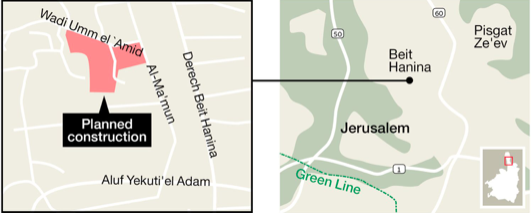
Map by Haaretz
On June 27th, a plan for 150 new settlement units in the Beit Hanina neighborhood of East Jerusalem was deposited for public review, a move which sets off a 60-day period for the public to submit objections to the plan. The Beit Hanina settlement plan – as FMEP has previously reported – is backed and promoted by settlement impresario Aryeh King, and it provides for the construction of 150 new units in the southern end of the Beit Hanina neighborhood. If built, it will be the first-ever authorized settlement project in Beit Hanina, located north of the Old City.
Ir Amim explains essential context:
“If approved, the plan will enable an ideologically driven settler outpost in the heart of Beit Hanina, a neighborhood located on the northern perimeter of East Jerusalem that has remained relatively untouched by Israeli settlement within its limits. Since the land in question is not far from Ramat Shlomo to the south-west and Pisgat Zeev to the north-east of it, its construction may mark the beginning of a far sweeping move to create contiguity between the two settlements, while driving a wedge between Bet Hanina and Shuafat.”
According to the plan, 75 units units would theoretically be earmarked for Palestinians – a point used by the plan’s supporters to suggest that it is actually benevolent. The key word here, however, is: theoretically. As noted by Jerusalem expert Danny Seidemann in another context:
“Since 1967, the Government of Israel has directly engaged in the construction of 55,000 units for Israelis in East Jerusalem; in contrast, fewer than 600 units have been built for Palestinians in East Jerusalem, the last of which were built 40 years ago.”
Former Mayor of Jerusalem Proposes Plan to Build 12 New Settlement Industrial Zones in Area C
Former Mayor of Jerusalem Nir Barkat joined Professor Michael Porter of Harvard University to write what a proposal calling for the establishment of 12 new settlement industrial zones in the West Bank, which Barkat argues will complement the recently unveiled U.S. economic “plan” in jump-starting the Palestinian economy. Like the U.S. plan, Barkat and Porter’s scheme seeks to entrench permanent Israel control and annexation of the land, people, resources, and economy of the West Bank. Barkat made as much clear in an interview with Israel Hayom when he said:
“The plan’s working assumption is avoiding the eviction of Jewish or Arab residents from their homes. Our goal is to take advantage of the relative advantage every society has. The Israeli side can bring the innovation, the capital and managerial knowledge for the benefit of the Palestinian side, which through working in these industrial areas could significantly increase its income. This is a plan that is also good for the settlements, and all the settlement heads have welcomed it.”
Barkat and Porter’s plan – which they say can employ over 200,000 Palestinians and double their average salary – is based on the demonstrably false notion that industrial zones benefit the Palestinian work force and economy. In fact, as Who Profits recently explained:
“Israeli IZs constitute a foundational pillar of the economy of the occupation. They contribute to the economic development of the settlements, which are in violation of international law and the Fourth Geneva Convention, while relying on the de-development of the Palestinian economy and the exploitation of Palestinian land and labor…The IZs in the oPt form part of a practice of ‘financial annexation’ which is an essential component of the broader policy of annexation taking place.”
The report on Barkat and Porter’s plan does not include many specific details as to the locations of the 12 proposed industrial zones, but it hints at several projects that are already known to the public, like the “super settlement” and industrial zone planned to unite four settlements in the northern West Bank, and the industrial zone in the South Hebron Hills near the Tene-Omarin settlement – the latter of which was briefed to the U.S. administration by the Israeli government in September 2018. It is also worth recalling that in January 2019, the Israel government advanced plans for two new industrial zones, one near the Beitar Illit settlement and another near the Avnei Hafez settlement.
Barkat and Porter also call for investments in the West Bank tourism industry, specifically Biblical sites like the Ibrahimi Mosque/Tomb of the Patriarchs (in Hebron) and Solomon’s Pools (located just south of Bethlehem).
According to the report, Barkat and Porter presented this plan to Israeli Prime Minister Netanayhu and U.S. peace envoys Jared Kushner and Jason Greenblatt, all of whom – according to Barkat – welcomed it. Barkat believes his plan enhances the U.S. menu of investments and proposals outlined in Kushner’s “Peace to Prosperity” presentation. Further, Barkat argues that his plan is more feasible than the U.S. program because it only envisions projects in Area C, the 60% of the West Bank over which Israel maintains full control, while (he argued) the U.S. plans focus on Areas A & B. In fact, nothing in the text of the Kushner plan specifies any territorial locations, boundaries, or divisions for the proposed projects.
McDonald’s Wins Bid to Operate in Ben Gurion, Despite Settler Campaign
On June 23rd, the McDonald’s franchise owner in Israel was awarded a government contract to operate one of the few food stands at Ben Gurion International Airport. His bid of 17 million shekels ($4.7 million) was vastly higher than other competing bids, winning him the right to operate a McDonald’s branch in the airport for seven years, with an optional 2-year extension.
Ahead of the government’s decision, settlers led a campaign to disqualify Omri Padan – the Israeli man who holds the only McDonald’d Israel franchise license – from bidding on the contract, based on Padan’s failure to open any McDonald’s branch in an Israeli settlement. The settlers claimed that Padan’s failure to do so violates Israel’s Anti-Boycott Law and therefore disqualifies him from receiving public contracts.
Settlers Continue Price Tag Attacks on Palestinian Villages, Still No Arrests
Settlers are believed to be behind three separate attacks on Palestinian property this week, including a rash of hate crimes that damaged Palestinian cars, homes, and religious buildings, and served to intimidate Palestinians living near Israeli settlements.
On June 24th, Palestinians in the village of Sinjil woke up to discover 12 cars with tires slashed and hate messages sprayed painted in Hebrew on several buildings. This is the fifth hate crime connected to settlers in the month of June. Some of the graffiti read “a village of terrorists” and “We give them jobs and they rape.” The latter is a reference to the horrific alleged rape of a 7-year old girl in a settlement; a Palestinian man was immediately charged with the crime and subjected to the equivalent of a national political and media lynching; this week, after 55-days of imprisonment, he was released due to lack of evidence.
On June 26th, vehicles were vandalized and hate messages were spray painted on walls in the Palestinian town of Sarta, which is located west of the Ariel settlement in the northern West Bank. Some of the graffiti read, “non-Jews = enemies,” and the Star of David appeared many times. This is the first time that Sarta has been targeted in a price tag attack.
Yesh Din – an Israeli NGO that tracks and demands justice for settler violence – said in a Facebook post:
“The violent action tonight joins a series of riots that we document in the West Bank against Palestinians and their property. A reality in which families wake up for a day’s work and are forced to discover that while they are sleeping, unknown gentlemen in an area where their children play with the neighbors’ children has become routine. Over the past month we have reported such riots in various areas of the West Bank: Sinjil, Kafr Malik, Einabus, Asira al Qibliya, Burin from Madame, and more. The one who is supposed to prevent the disturbance, and to stop the unknown people who terrorize the Palestinian villages are the policemen of the SJ District, who only this week presented their amateurish work at best, and failed in their worst case. These interrogators and police officers have a responsibility for the personal security of the Palestinians and they do not fulfill their duties. Thus, they create a reality of terror in which there is no safe place for the Palestinian population, and a sense of security does not exist even in the most private space.”
The Bahrain Workshop [Shhh… Don’t mention Settlements!]
The U.S.-hosted “Peace to Prosperity” economic workshop took place in Manama, Bahrain from June 25-26. The widely-ridiculed event focused on a 95-page project prospectus published by the White House in the two days ahead of the workshop. Without giving any real details, the plan talked about enhancing Palestinian property rights — a notion that begs a myriad of questions given that Palestinain private property rights today are undermined first and foremost by Israel, which in 1967 closed the land registry, and which since 1967 has exploited every available mechanism to seize Palestinian private land, and where such mechanisms could not be found, it created them (like the Regulation Law). Notably, the Trump Administration plan treats Palestinian land registration strictly as a means to foster a better investment climate in the West Bank and Gaza (as opposed to a pillar of rule of law that upholds fundamental rights of individuals).
In this regard, the Director of Human Rights Watch Israel, wrote:
“The plan speaks of the importance of private property rights without mentioning the Israeli authorities’ methodical theft of thousands of hectares of privately owned Palestinian land in the West Bank to build settlements, which are illegal under international humanitarian law, or their illegal.”
Mocking the workshop’s very strange approach to Palestinian property rights, The Economist journalist Gregg Carlstrom – who live-tweeted his disbelief of the entire conference – noted sarcastically on June 26th:
“We kickoff the afternoon’s fun with Kevin Hassett, the ‘Dow 36,000’ guy, talking about property rights. In Palestine, ‘You can radically transform economies when you improve their ability to document property rights!’”
Another notable storyline from Manama: Palestinian businessman Ashraf Jabari was the only Palestinian to be on-stage at the event. As FMEP has previously covered, Jabari has been slammed as a traitor by the Palestinian Authority, shunned and dismissed by his fellow Palestinian business people, and disowned by his family in light of his ongoing role with the Judea and Samaria Chamber of Commerce, an initiative Jabari runs alongside Israeli settlers.
In Manama, Jabari spoke about developing thriving businesses in the West Bank. The Washington Post notes that Jabari was the only speaker to discuss political matters on the stage. The Post writes:
“When asked by British broadcast journalist Nik Gowing…whether the plan could benefit him, Jabari replied that it could — if Palestinians had a state.”
Jabari might have been telling the truth, but he apparently failed to mention the fact that he, alongside Israeli settler Avi Zimmerman, have proposed the launch of a “bond bank” to become the financing vehicle for the Trump Administration’s plan. The bond bank would aggregate projects and issue debt to fund them, allowing for lower borrowing costs. According to the White House presentation, the U.S. envisions a funding mechanism it calls, “The Peace to Prosperity Master Fund” which will manage the money and projects.
Bolton Tours Jordan Valley & Hints at U.S. Support for Permanent Israeli Control
On June 24th, U.S. National Security Advisor John Bolton toured the Jordan Valley, Jerusalem, and the separation barrier, accompanied by Israeli Prime Minister Netanyahu, U.S. Ambassador David Friedman, and Israeli Ambassador to the U.S. Ron Dermer. At a stop overlooking the Jordan Valley, Netanyahu explained to Bolton:
“For those who say that for peace to be established Israel has to leave the Jordan Valley, I’ll say that’s not going to bring peace, that’s going to bring war and terror. We’ve been there and we don’t want to be there again. Under any peace agreement, our position will be that Israel’s presence should continue here for Israel’s security and for the security of all.”
Following the tour, Bolton did not disappoint Netanyahu, tweeting:
“Today I visited the Jordan Valley and Jordan River with PM @netanyahu, Israeli NSA Meir Ben-Shabbat, @USAmbIsrael, & @AmbDermer. I saw firsthand the strategic importance that these locations have on Israel’s national security. In similar acknowledgement of the simple but profound reality that for Israel to defend itself, it cannot relinquish strategic ground along its border, the President in March, signed a proclamation recognizing Israeli sovereignty over the Golan Heights.America welcomes the opportunity to strengthen the already deep cooperation between the U.S. and Israel and build on our lasting partnership, demonstrated repeatedly when courage and persistence are required.”
Some 11,000 settlers and 65,000 Palestinians live in the Jordan Valley – the latter facing severe restrictions on land use and freedom of movement, and lack of access to municipal services like water and electricity. Israeli government officials have publicly and repeatedly demanded complete Israeli sovereignty over the Jordan Valley – which makes up 30% of the West Bank – in the context of any peace agreement, meaning that any future Palestinian state would be entirely encircled by Israel, having no international border with any other nation. Likud MK Sharren Haskel has led several Knesset efforts to formally annex the entire Jordan Valley, and recently re-submitted a bill to that affect in May 2019.
Bonus Reads
- “The Day After: What Happens If Israel Annexes the West Bank?” (Mint Press News)
Welcome to FMEP’s Weekly Settlement Report, covering everything you need to know about Israeli settlement activity this week.
To subscribe to this report, please click here.
June 21, 2019
- Court Awards Radical Settler Group Rights to Another Palestinian Home in Silwan, Evictions to Follow
- At Settler’s Urging, Silwan Streets To Be Named After Rabbis
- Who Profits Issues Critical Report on Industrial Zones in the West Bank, Slamming “Peace” Schemes Promoting Them
- B’Tselem Publishes New Resource on Israel’s Planned Mass Eviction of Palestinians from Wadi Yasul
- Greenblatt Supports Annexation, But Prefers Israel Hold Off Until U.S. “Peace Plan” is Presented
- Bonus Reads
Questions or comments? Contact Kristin McCarthy at kmccarthy@fmep.org.
Court Awards Radical Settler Group Rights to Another Palestinian Home in Silwan, Evictions to Follow
On June 18th, the Jerusalem District Court ruled that the radical Elad settler organization is the legal owner of an apartment and adjacent storefront in the Silwan neighborhood of East Jerusalem long inhabited by members of the Palestinian Siyam family. With the ruling, Elad can evict members of the Siyam family from the apartment and store – increasing settler control over the building where other members of the Siyam family will still live. The court also ordered the Siyam family to pay 10,000 NIS (~$2,700 USD) in court costs.
Elad has waged an eviction campaign against the Siyam family for over 30 years, bringing six different legal cases asserting the organization’s ownership of the building. Making the ruling sting even more for the entire Silwan community, Jawad Siyam – who will be one of the only remaining Palestinian apartment owners living in the building after the ruling this week – is a prominent community activist in Silwan fighting against settlement activities in the neighborhood.
The legal saga – detailed here by Peace Now – shows just how determined Elad has been to gain ownership of the building at the expense of its longtime Palestinian tenants. Elad used seemingly every legal mechanism available, hoping that one would do the trick. Fortunately for Elad, the Israeli Custodian of Absentee Property General (which conspired with Elad to legally sell the rights to ¼ of the building) and Israeli court system (which allowed Elad to exploit Israeli law and set new precedents at the expense of Palestinian residents of Jerusalem) were willing to help the settler organization achieve its goal.
Following an earlier ruling against the Siyam family regarding this same case, Peace Now succinctly explained:
“This case is an example of how the settlers manage to take control of Palestinian property in East Jerusalem by combining manipulations, money, forgery and significant aid from the Israeli authorities. It is not a regular case between equal sides, but a story of David and Goliath, and the settlers are the Goliath. There is a settlers organization with almost unlimited financial resources and enormous political power against an ordinary Palestinian family that has been forced into court for more than 20 years, to invest tremendous resources in legal defense and to deal with various and varied purchase claims. This way the settlers are causing great damage to Israel when they harm the delicate fabric of life in Jerusalem and the possibility of compromise in Jerusalem and a two-state solution.“
As FMEP chronicles on a near weekly basis, Silwan is one of the most intense areas of settlement activity in East Jerusalem. Its location – literally in the shadow of the Temple Mount/Haram al-Sharif – and historic significance make the neighborhood the focus of intense efforts by radical groups like Elad and Ateret Cohanim to displace Palestinians and replace them with Israeli Jews.
In addition to the threat of mass eviction of Palestinians in Silwan, Elad and Ateret Cohanim are also working hand in hand with the many branches of the Israeli government to build tourist attractions and infrastructure designed to hide, marginalize, and over-write the presence and history of the area’s Palestinians. In particular, the Elad-linked cable car project – which was recently advanced through another phase of the planning process despite professional objections – is intended to further entrench settler activities and tourism sites inside Silwan, while simultaneously delegitimizing, dispossessing, and erasing the Palestinian presence there.
At Settler’s Urging, Silwan Streets To Be Named After Rabbis
In a powerful statement of contempt for Palestinians residents of the Silwan neighborhood of East Jerusalem, and an equally powerful statement of support for the activities and agenda of hardline settlers groups targeting of Silwan, the naming committee of the Jerusalem Municipality voted to name five streets in the Silwan neighborhood of East Jerusalem after deceased Jewish rabbis. Notably, the population of Silwan remains overwhelmingly Palestinian, despite a decades-long, energetic effort by extremist Jewish groups, with Israeli government support, to increase the number of Israeli settlers living in their midst – an effort that is proceeding with greater energy and government backing today than perhaps at any time since 1967.
The renaming of the streets was opposed by a professional advisory panel, which warned that the move will increase tensions; that it will be essentially futile, because the names will not be used by the local population; and that, most basically, “it is inappropriate to give Jewish street names in neighborhoods overwhelmingly populated by Arabs.”
Jerusalem Mayor Moshe Leon heads the committee that decided in favor of renaming the streets, an initiative led by the radical settler group Ateret Cohanim. Settlers requested the move in recognition of a small Jewish-Yemenite community that lived in Silwan 80 years ago.
Who Profits Issues Critical Report on Industrial Zones in the West Bank, Slamming “Peace” Schemes Promoting Them
In a new report, the anti-occupation Israeli NGO Who Profits examines the illegality of 91 industrial zones that Israel has built in the occupied territories, and also names international corporations operating in them, in contravention of international law.
Summing how the issue relates to current politically driven “peace” proposals, Who Profit writes:
“Industrial Zones are held up by corporations and Israeli politicians as being part of the framework of ‘economic peace’. It is argued that they provide employment opportunities for Palestinians and form spaces of interaction and coexistence between Palestinian and Israeli workers. Shraga Brosh, the head of the Manufacturers Association of Israel, noted that the employment of Palestinian workers ‘aids security in the region and advances economic peace’. This claim was rejected outright by the United Nations Office of the High Commissioner for Human Rights in a 2018 report and by some 82% of Palestinian workers who stated that they would leave their jobs in the settlements, if there were another choice.”
B’Tselem Publishes New Resource on Israel’s Planned Mass Eviction of Palestinians from Wadi Yasul
In a new brief, B’Tselem provides essential context for Israel’s imminent eviction of Palestinians living in the East Jerusalem neighborhood of Wadi Yasul, where every single home has a standing demolition order issued against it. The publication also includes interviews with several of the Palestinians whose homes in Wadi Yasul have already been demolished.
B’Tselem writes:
“Ever since 1967, planning policy in Jerusalem has been geared toward establishing and maintaining a Jewish demographic majority in the city. Under this policy, it is nearly impossible to obtain a building permit in Palestinian neighborhoods. The outline plans the city has prepared for these neighborhoods are largely aimed at restricting and limiting building opportunities in Palestinian neighborhoods. One way the plans do so is by designating vast areas as open green spaces, thereby barring Palestinians from building there. The resulting housing shortage forces Palestinian residents to build without permits. At the turn of the millennium, the city estimated that about 20,000 housing units had been built without a permit in East Jerusalem. This estimate was made before the Separation Barrier cut off Kafr Aqab and Shu’fat Refugee Camp from the city. Since that time, many high-rises have been built in those areas.”
Greenblatt Supports Annexation, But Prefers Israel Hold Off Until U.S. “Peace Plan” is Presented
In an interview is an Israeli news outlet, U.S. Envoy Jason Greenblatt said he would prefer that Israel delay annexation of the West Bank until after the U.S. presents the long-anticipated “Deal of the Century.” The interview was one in a series of media hits for Greeblatt ahead of the U.S.-conceived economic conference in Bahrain; at an event with New York Times columnist Bret Stephens and American provocateur Rabbi Shmuley Boteach, Greenblatt reiterated his belief that settlements are not an obstacle to peace.
Unsurprisingly, Israeli political figures continue to call for Israel to take advantage of Trump’s tenure in office to annex West Bank territory. At the Jerusalem Post’s recent conference in New York City, Israeli Deputy Minister of Foreign Affairs Tzipi Hotovely told the audience that it is time for Israel to apply sovereignty over all of Area C. Hotovely made the case:
“Using the term annex is not true. You annex something that is not yours. This is not a story of annexation. This is a story of realization. Many ask what’s next, what’s going to happen, what’s going to change [after the annexation of Area C]. For 52 years, we were feeding this myth of occupation. It’s a myth. It’s not true.”
Former Israeli Justice Minister Ayelet Shaked also spoke at the Jerusalem Post conference, also urging Israel to annex Area C while Trump is in office. Following her speech, Shaked tweeted:
“There is no better time than now. Do not miss Trump’s reign – that’s what I just said at the Jerusalem Post in New York.”
Back in Israel, senior Likud figure Gidon Saar tweeted:
“Recent statements by senior US officials indicate that there’s an extraordinary window of opportunity to apply Israeli law to our settlements in Judea, Samaria, and the Jordan Rift. We’ll do everything not to squander [the opportunity].”
Bonus Reads
- “First They’ll Take Area C, Then They’ll Take the West Bank” (Haaretz)
- “Annexing East Jerusalem, First Step Before Annexing the West Bank?” (Al-Monitor)
- “West Bank is a long-established goal” (The National)
Welcome to FMEP’s Weekly Settlement Report, covering everything you need to know about Israeli settlement activity this week.
To subscribe to this report, please click here.
June 7, 2019
- Visualizing 52 Years of Occupation and Settlement Growth
- Settler-Backed Jerusalem Cable Car Project Advances, Despite Objections from Public & Experts
- One Spring Tells the Tale of How Israel Settlement Councils Succeed in Taking Over More and More Palestinian Land
- Netanyahu Appoints Pro-Annexation Settler Leader as Key Settlement Advisor
- McDonalds: Either Open in Settlements or Face Sanctions Under Anti-Boycott Law
- Bonus Reads
Questions or comments? Contact Kristin McCarthy, kmccarthy@fmep.org.
Visualizing 52 Years of Occupation and Settlement Growth
On the 52nd anniversary of the Israeli occupation, the human rights group B’Tselem published a remarkable interactive visualization of the devastating impact that Israel’s occupation policies have had on contiguity of Palestinian space in the West Bank and Gaza. Along with the portal, entitled “Conquer & Divide: The Shattering of Palestinian Space,”B’Tselem writes:
“Ever since 1967, when Israel occupied the West Bank and the Gaza Strip, it has marshaled all its legislative, legal, planning, funding and defense authorities in order to fragment Palestinian space, dividing it into dozens of separate sections, which are easier to rule and exploit, and in order to break up Palestinian social and spatial fabric: In the West Bank, Israel minimized Palestinian presence, condensing it into dozens of densely populated and unconnected enclaves, while exploiting the majority of West Bank resources for its own benefit. In addition, Israel annexed thousands of hectares of West Bank land, which it then placed within Jerusalem’s municipal borders. In the Gaza Strip, nearly two million Palestinians are essentially imprisoned on a small bit of land in appalling conditions, due to the Israeli policy of cutting off Gaza from the rest of the world, including from the West Bank. This interactive map follows a timeline illustrating the implementation of the various measures Israel has implemented to achieve this reality.”
Settler-Backed Jerusalem Cable Car Project Advances, Despite Objections from Public & Experts
On Monday June 3, 2019 the Israeli government’s National Infrastructure Committee (NIC) elected to ignore all public objections submitted against the settler-backed plan for a cable car in Jerusalem, approving the plan and paving the way for it to be submitted for final approval by the government.
Following the NIC’s decision, the Israel NGO Emek Shaveh asked the Israeli Attorney General to postpone a government discussion on the plan until after the elections, citing concerns about a transitional government exercising power – concerns backed by Israeli Supreme Court precedent.
As FMEP has previously covered, the Jerusalem cable car project is an initiative of the Elad settler organization (which is building a massive tourism center – the Kedem Center, which will be a stop along the cable car’s route – in the Silwan neighborhood). The cable car project is intended to further entrench and advance settler activities and tourism sites inside Silwan, while simultaneously delegitimizing, dispossessing, and erasing the Palestinian presence there.
One of the many (rejected) complaints filed against the cable car project was submitted by Emek Shaveh. Signed by Israeli intellectuals and hundreds of residents, it expressed deep concern regarding the irreparable damage that the construction of a cable car will wreak on the historic archeological landscape and environment surrounding the Old City and the harm it will do to the residents of Silwan. In addition, the objection argued that, while marketed as a “solution” to transportation needs around the Old City, the cable car plan has nothing to do with actual transportation needs, but rather is designed to implement the settlers’ agenda in the area. Emek Shaveh writes:
“Besides destroying the view of the Ben Hinnom Valley and the Old City walls along its planned route, the cable car is a political project intended to strengthen the Elad Foundation’s hold on Silwan and is central to development plans by the Israeli government and settler organizations for East Jerusalem.”
Jerusalem expert Daniel Seidemann tweeted in response to the project’s advancement:
“This crass disney-fication is a crime against Jerusalem, regardless of politics. It’s also part of the settler scheme to turn Silwan into a pseudo-biblical theme park.”
And in a piece in The Forward, entitled “Israel Is Using Archeology To Erase Non-Jewish History,” two experts at Emek Shaveh write:
“The exploitation of archaeology in Jerusalem has been spearheaded by the Elad Foundation, a group of settlers turned archaeology entrepreneurs, who are using ancient sites to take over land and shape the historical narrative. Elad, which emerged 30 years ago with a mission to settle Jews in Palestinian homes in the neighborhood of Silwan, manages the popular archaeological park, the City of David. Visitors to the site are treated to a heavily biblical narrative where discoveries that resonate with the story of King David or the Kingdom of Judea are highlighted. The fact the archaeologists dispute the evidence of a kingdom in the 10th century BCE often goes unmentioned. Furthermore, not many of the half a million people who visit the park annually know about life in the Palestinian neighborhood since Elad arrived on the scene. They will probably never hear about how Elad took over 75 homes in the neighborhood, or closed off virtually the last of the public areas used by the residents and annexed it to the archaeological park. With an annual budget of approximately 100 million shekels, the Elad Foundation now commands several excavation projects in the City of David, including tunnels along an ancient Roman street, which it is marketing as a Second Temple era pilgrims’ route to the Temple. It has recently branched out to establish new projects within the Old City and in other areas throughout the Historic Basin. But Elad couldn’t have done it on their own. If at first they were greeted with mistrust by the authorities in the 1990s, today they have an open door to many government agencies and ministries. From the Israel Antiquities Authority, which is in charge of most of the excavations at the City of David, and the Nature and Parks Authority, which subcontracted Elad to run the site, to the minister of tourism, who is aggressively advancing a cable car to link West Jerusalem to the City of David, to the mayor of Jerusalem, the government and all the relevant agencies are committed to the project of shaping a large tourist zone dedicated to the First and Second Temple periods.”
One Spring Tells the Tale of How Israel Settlement Councils Succeed in Taking Over More and More Palestinian Land
Deep in northern West Bank, near the settlement of Eli, settlers have illegally taken control over a natural spring they call “Ma’ayan Hagvura,” Hebrew for “Spring of Courage.” To claim the site, the Mateh Benyamin Regional Council – which is funded by the Israeli government – financed and carried out its “upgrading,” actively guard the area, and continue to promote it as a destination in nearby settlements. The regional council did all of this despite the fact that the spring is located on Palestinian land in an area that is outside of of its jurisdiction. By doing so, the settlement council has de facto extended the borders of its jurisdiction and increased the amount of land under its control – and in the process seized more natural resources from the Palestinians.
The situation of the spring near Eli is not unique. It is in fact just one of dozens of West Bank springs settlers have taken over. And in case after case, the Israeli Civil Administration – which is responsible for enforcing all planning and building laws in the West Bank – has failed to intervene to prevent the settlement councils from taking land beyond their jurisdiction and violating the rights of Palestinians. Haaretz writes:
“The Civil Administration knows that the lack of law enforcement leads to the regional councils operating in many areas that are not under their jurisdiction, but it claims it has no authority to enforce the ordinance. ‘Their jurisdiction does not include closed areas or private land’ says the Administration, ‘even if the area is included in maps defining the regional council’s jurisdiction. The boundaries are examined from time to time and are updated according to circumstances. The regional councils are only authorized to operate within their defined jurisdictions.’”
In addition to the dozens of natural springs settler councils have taken over in this manner, an investigation by the Israeli settlement watchdog Kerem Navot reveals that settlement councils have used similar tactics to illegally take over 50,000 acres of land in the southern Hebron hills, and 200,000 acres in the Jordan Valley. Based on its findings, Kerem Navot estimates that, according to Israeli law, fully half of the territory settler councils control has been taken illegally (according to international law, all control of land by Israeli settlers is illegal). Kerem Navot writes in detail:
“…[there are] six regional councils in the West Bank: Samaria, the Jordan Valley, Binyamin, Gush Etzion, Megillot, and Mount Hebron…Each of these councils has a separate map of jurisdiction, signed by military commanders of the West Bank. These maps, which have not yet been updated nearly 40 years after their signing, include a total area of 2,675,000 dunams, or approximately half of the total area of the West Bank. However, comparing these maps with the language of Order 783, noted above, indicates that nearly half of the areas included in the regional councils maps, are either private Palestinian-owned territories or land included in military firing zones (there is considerable overlap between these two groups, which was offset to calculate the area set to be cleared from the maps): two categories, which can’t be included in the regional councils’ territory according to the order.”
In 2012 OCHA published a report on the seizure of Palestinian springs specifically, detailing the humanitarian impact on Palestinians well-being in addition to the loss of land. OCHA writes:
“The impact of the above practices and policies is not limited to those directly affected by settler violence and property losses. The continuous encroachment on Palestinian land for the purpose of settlement expansion is a key cause of humanitarian vulnerability of the Palestinian population and the most significant reason behind the ongoing fragmentation of the West Bank, which undermines the right of the Palestinian people to self-determination.”
Netanyahu Appoints Pro-Annexation Settler Leader as Key Settlement Advisor
Settler leaders were surprised, and initially upset, when Prime Minister Netanyahu fired Kobi Eliraz from his post as the adviser on settlement affairs in the Israeli Defense Ministry, where he had served for the past five years. Their mood likely changed again a few days later when, Netanyahu – who is acting Defense Minister – appointed Avi Roeh as Eliraz’s successor.
Roeh previously served as the Chairman of the settler Yesha Council – an umbrella group that coordinates and leads settlement relations between settlers and the government – and has remained an outspoken figure in Yesha strategy since leaving that role in 2017, typically playing the role of Netanyahu’s ally in quieting settler fury at perceived government inaction for the settlements. Roeh has called for the annexation of the West Bank and for one million Israeli Jews to move there.
Roeh’s appointment may not completely appease the settlers. He does not have the government expertise for which the settlers loved Eliraz, particularly when it comes to understanding and managing the levers of government needed to advance settlement construction. Moreover, many settlers reportedly believe that Eliraz was an innocent victim of Netanyahu’s vendetta against former Defense Minister Avigdor Lieberman (for whom Eliraz worked). Lieberman, it should be recalled, was a key figure in blocking Netanyahu’s efforts to form a new governing coalition, leading to yet another Israeli elections scheduled for September 2019.
Prior to the appointment of Roeh, the Yesha Council published a letter asking Netanyahu to reverse Eliraz’s firing, and suggesting that Eliraz’s absence will hinder government efforts to retroactively legalize outposts. The letter notes:
“Kobi has taken care of Israeli settlement and its residents with great professionalism. He is credited for many advancements [on our behalf] in the fields of construction, infrastructure development, security and more.”
The Times of Israel observes, significantly, that the Yesha Council was able to get every single settlement Mayor to sign the letter, explaining:
“The Yesha Council in recent years has struggled to get all of its members on board with its initiative, but the umbrella group’s ability to gather the signatures of every Israeli mayor beyond the Green Line is testament to the broad respect that Eliraz holds among settler leader.”
As of this writing, there has been no official reaction from the Yesha Council to the appointment of Roeh.
McDonalds: Either Open in Settlements or Face Sanctions Under Anti-Boycott Law
Yossi Dagan, the head of the settlers’ Samaria Regional Council, is demanding that the Israel ban McDonald’s from operating in Ben Gurion airport, claiming that the franchise owner (who happens to be a co-founder of the anti-settlement watchdog Peace Now) is violating Israel’s punitive anti-boycott law by refraining from opening a branch in a settlement.
In a letter to the Israeli Transportation and Finance Ministries, Dagan argued that McDonald’s must be barred from participating in the tender process for the airport, where McDonald’s currently operates. In response, the Transportation Ministry said it “does not deal with commercial tenders at the Airports Authority,” and the Finance Ministry said “the issue does not concern us.”
Dagan’s contention stems from a 2013 decision by Omri Padan, the McDonald’s franchisee, to decline an offer to open a McDonald’s branch in the Ariel settlement. At the time, Padan stated that it had always been McDonald’s policy not to operate beyond the 1967 Green Line.
Praising Padan and McDonald’s, Haaretz columnist Gideon Levy writes:
“McDonald’s has issued a resounding statement: The West Bank and Gaza aren’t here. It has said yes to Israel, no to the occupation, which counts for more than 1,000 protest signs at a demonstration. The franchisee never had a license in a piece of land to which Israel also never had a license.”
Israel’s anti-boycott law – passed in 2011 – was specifically designed to make it illegal for Israeli citizens to advocate or engage in a boycott of Israel or settlements. The Association for Civil Rights in Israel explains:
“The purpose of the law is, first and foremost, to squelch legitimate boycotts against goods produced in the settlements. In so doing, it seriously undermines a means of protest that is non-violent, legitimate, legally recognized and accepted worldwide (including in Israel), while violating the freedom of speech, freedom of dissent, and freedom of association of Israeli citizens.”
In addition to the boycott law, Israel passed an amendment to the Entry Law in 2017, which gives Israel an avenue to punish non-Israeli citizens for their association with boycotts of Israel or Israeli settlements. The amendment authorizes the Israeli interior minister to refuse entry to activists or representatives of organizations who publicly call for a boycott of Israel or the settlements. Famously, Israel tried and failed to bar American student Lara Alqasem from entering the country under the new Entry Law provision. Israeli is currently trying to deport Human Rights Watch director Omar Shakir from Israel based on that law.
Bonus Reads
- “Palestinians Prove Fraud, Regain Land After Decades” (Al-Monitor)
- “Jerusalem’s No Man Land: Chaos and anarchy in the Kafr Aqab neighborhood” (Times of Israel)
- “Israel’s Annexation Drive Requires Fighting for Justice in One State” (Middle East Eye)
Welcome to FMEP’s Weekly Settlement Report, covering everything you need to know about Israeli settlement activity this week.
To subscribe to this report, please click here.
April 19, 2019
- Israel Demolishes Palestinian Homes in East Jerusalem…While Re-writing the Law, and the zoning, to Cater to Settlers
- After Meeting with U.S. Ambassador, Jerusalem Mayor Predicts “Restrictions” on Settlement Plans Will Be Lifted
- U.S. State Department: Distinguishing between Settlers & Palestinians is “Discriminatory”
- Wild, Wild West Bank: Settler Nearly Downs IDF Plane Over West Bank
- Israel Reinstates Ability of East Jerusalem Palestinians to (Try to) Prove Land Ownership Claims
- Palestinian-Americans Continue Legal Case Against Settlements Despite AirBnB Reversal
- IDF Helps Cover Up Execution of a Palestinian
- Bonus Reads
Israel Demolishes Palestinian Homes in East Jerusalem…While Re-writing the Law, and the zoning, to Cater to Settlers
With the approval of the Supreme Court, on April 17th Israeli police began demolishing Palestinian buildings in the Wadi Yasul neighborhood of Silwan. The reason for the demolitions: the buildings lack legally-required Israel-issued building permits – which cannot be obtained by Palestinians the land in question has been designed by Israel as the “Peace Forest” [a designation that does not permit the Palestinians to build, even on their own land]. The “Peace Forest” was established by the Jewish National Fund following the 1967 war, on privately owned Palestinian land expropriated by Israel.
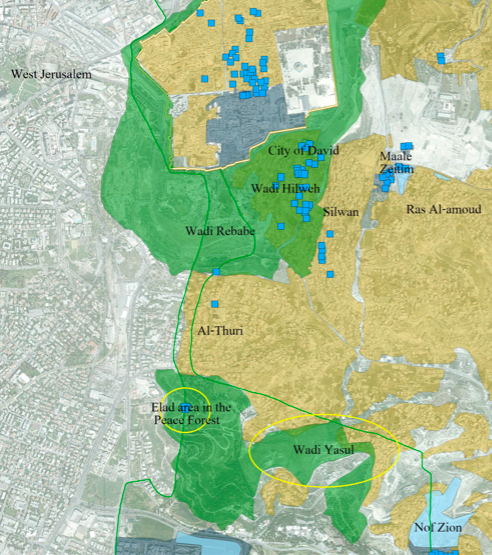
Map by Ir Amim
The Israeli NGO Ir Amim warns that the fate of these buildings likely signals the implementation of 63 additional demolition proceedings against Palestinian buildings in the same area, which could result in the wide scale demolition of 60 Palestinian homes, impacting approximately 500 Palestinians.
Importantly, for over a decade, Palestinians in Wadi Yasul have worked with architects and lawyers to try to obtain Israeli-issued permits to build in the area. Those plans and requests were rejected in 2008 because, according to Israel, they contradicted zoning laws for the “Peace Forest.”
On April 13th, the Israeli Supreme Court ruled against Palestinian appeals to stop the demolitions, appeals which challenged the self-evidently discriminatory patterns of Israel’s planning regime in East Jerusalem. Supreme Court Justice Yosef Elron explained the court’s decision to reject Palestinian petitions without even considering claims of discrimination. As Haaretz noted, Justice Elron in effect said that the criminal justice system is not the place to discuss whether or not the Jerusalem municipality discriminated against the residents and avoided planning the neighborhood, which in turn prevented them from getting building permits for their homes [which raises the question: does Justice Elron believe Palestinian residents of East Jerusalem have any other venues where they can expect to obtain justice?].” Rather, Justice Elron argued:
“I believe that the appellants’ claims that the defendant [Israel] discriminates against local [Palestinians] residents, and avoided advancing any zoning plan, are irrelevant to a discussion in the context of criminal wrongdoing. From the request in front of me I see that the residents are seeking a zoning plan for their needs and that should be welcome. But these efforts cannot retroactively legitimize so much illegal construction or justify any delay in carrying out demolition orders.”
Underscoring the brazen political motivations behind land-related decision in Jerusalem, even as Israeli officials have consistently refused to grant building permits for Palestinians to build on their own land in the area designed as the “Peace Forest,” and even as Israeli officials have actively pursued demolitions against the Palestinians living there, the radical settler group Elad has been engaged in its own illegal construction inside the “Peace Forest” for over 14 years. Rather than pursue demolitions, the Israeli government has worked with Elad to pursue every avenue to allow the retroactive legalization of Elad’s illegal construction. Even more brazenly, in tandem with the demolition of Palestinian homes in the area, Israeli officials have been working with the Elad to rezone the “Peace Forest” [something it refused to do for Palestinians] in order to allow the Elad to build a commercial/tourist project for tourists (a zipline).
Haaretz recently explained how Jerusalem authorities have repeatedly assisted Elad in its illegal activities:
“At first the NGO simply trespassed and built illegal structures there [the “Peace Forest”]. But things changed and gradually various local and national bodies – including the Jerusalem Municipality, the Israel Land Authority, the Tourism Ministry and the JNF – began to grant Elad assistance. This assistance has included granting building permits retroactively, allocating land to the group without a proper bidding process, and generous funding to the tune of tens of millions of shekels… It has been sponsoring activities in the Peace Forest since 2005, despite the fact that it has no ownership rights there or permits from the ILA (the legal owner of the land, which was expropriated from private Palestinian owners).”
Ir Amim explains:
“The scope of settlement projects in the vicinity of Wadi Yasul – and the breadth and depth of state support awarded to Elad, including authorities’ overt efforts to retroactively legalize unpermitted building – illuminate the stark discrimination in planning that empowers the expansion of radical settlement inside Palestinian neighborhoods while putting their native residents at risk of displacement.”
After Meeting with U.S. Ambassador, Jerusalem Mayor Predicts “Restrictions” on Settlement Plans Will Be Lifted
This week, Jerusalem Mayor Moshe Lion told the settler-run outlet Arutz Sheva:
“…I know what I want to accomplish, I know which projects the city needs – and the most important thing is to build, and I cannot do that alone. I need the Israeli government standing behind me, because we need a Jewish majority here, and we need to end the net negative migration. We need more young couples to move here…I sat down with the US ambassador to Israel, and we discussed the issue. I think that in the coming years, we’ll build a great deal in Jerusalem, and there won’t be a need for restrictions in this matter.”
Since Trump took office, Israel has advanced numerous controversial and devastating East Jerusalem/Greater Jerusalem settlement plans which had previously been held up due to international pressure (mainly from the U.S.), including in Ramot/Ramat Shlomo and a slew of plans in Sheikh Jarrah neighborhood of East Jerusalem. Based on this track record, and clear signals from the Trump Administration in support of Israel’s claim to Jerusalem and the West Bank, it is unclear what if any “restrictions” the Trump Administration is imposing on construction in Jerusalem.
What is clear is that, to date, the Israeli government has refrained from moving on either of the two most problematic East Jerusalem/Greater Jerusalem settlement schemes, E-1 and Givat Hamatos – construction of either of which would represent a fatal obstacle to the realization of the two-state solution. That argument, however, may be nearing its sell-by date, given the increasing sense that Israel and the Trump Administration are getting set to formally walk away from that solution (accompanied by what appears to be the increasingly likelihood that Israel will annex part or all of the West Bank).
U.S. State Department: Distinguishing between Settlers & Palestinians is “Discriminatory”
In the wake of the drama over Airbnb (and its decision to walk back its policy of not listing rental properties in settlements, newly appointed U.S. Envoy to Monitor & Combat Anti-Semitism, Elan Carr was asked by reporters on April 11th whether he made a distinction between boycotts of Israel and boycotts of settlements. In his response, Carr not only rejected the distinction, but went on to tell reporters distinguishing between settlements and neighboring Palestinians communities in the West Bank to be discriminatory (and implied that this discrimination between, in his words, “Jewish communities” and “Arab communities,” is based on anti- Semitism).
This position ignores the fact that Israeli settlements are illegal under international law (not surprising, given that the Trump Administration has made clear it views international law as irrelevant in the context of Israel and the occupied territories). But it also ignores an even more obvious fact that cannot be simply dismissed: Israel, as a matter of both policy and law, treats Israeli settlements and neighboring Palestinians communities differently. FMEP’s Lara Friedman summarized the situation for the UN Security Council in 2016, and the situation has only become magnified today:
“Israeli law follows Israeli citizens who enter or live in the Occupied Territories. This means that Israeli settlers live under Israeli law – no different than if they were living inside Israel – while Palestinians live under military law. This policy has created a dangerous and ugly political reality in the occupied territories – a reality in which two populations live on the same land, under different legal systems, separate and entirely unequal, with the governing authority serving one population at the expense of the other. One population is comprised of privileged Israeli citizens, enjoying the benefits of a prosperous, powerful state, with their rights guaranteed by a democratic government accountable to their votes. The other population is comprised of disenfranchised Palestinians, living under foreign military occupation explicitly designed to protect and promote the interests not of Palestinian residents of the territories, but of Israeli settlers.”
A transcript of the briefing reads:
QUESTION: Just to follow up… do you make a distinction between boycotting Israel per se and boycotting products that are produced in the settlements that’s considered illegal under international law?
MR CARR: So refusing to buy products made by Jewish communities and wanting to buy products made by Arab communities that live next door to each other seems to me to be discriminatory. That seems pretty clear to me.
QUESTION: But this is settlements. Settlements under international law is illegal. So I’m just – I’m trying to figure out, from a legal point of view, do you see that – okay, is it considered —
MR CARR: Like I said, if two communities are living side-by-side and one refuses to buy from Jews and one wants to buy from non-Jews, I think that’s pretty clear what that is.
…
QUESTION: Again, off the back of my colleagues’ questions, just to clarify: So the legal element about where Jewish settlements stand in international law as opposed to Arab villages makes no difference to you whatsoever?
MR CARR: Well, as you know, there is a peace plan being worked on currently, hasn’t been unveiled. The United States has long cared about this issue and on resolving the issues between Israel and its Palestinian neighbors in a way that’s fair for everybody. Resolution of those issues is not going to come about by attempting to strangle the Jews out of existence in their communities. That’s not how you’re going to get peace. And so I want to thank the administration for focusing on this issue, and all the work the White House is doing to try to really promote a plan that would finally have – get us to an agreement where the Israelis and the Palestinians can live side-by-side in peace.
Wild, Wild West Bank Skies: Settler Nearly Downs IDF Plane Over West Bank
A settler nearly flew his helicopter into an IDF transport plane conducting a training exercise in the Jordan Valley. The settler, Yedidya Meshulami, was charged with several crimes involved with illegally flying his helicopter and endangering lives in West Bank airspace, which is controlled by the Israeli military.
The IDF is no stranger to Meshulami and his illegal aerial activities. A former Israeli reserves pilot, in March 2018 Meshulami attempted to take control of the Qalandiya checkpoint in Ramallah by landing his helicopter nearby, declaring “I don’t care what they do to me, I’ll take it [the checkpoint] over.” Following his arrest and release to house arrest, the IDF confiscated two helicopters and an ultralight plane from Meshulami’s personal airstrip, which he built illegally in an outpost near the Itamar settlement, south of Nablus.
Israel Reinstates Ability of East Jerusalem Palestinians to (Try to) Prove Land Ownership Claims
One month after the Jerusalem Planning & Building Committee annulled the “mukthar protocol” – the only means by which Israel permits Palestinians to prove their land ownership claims in East Jerusalem – the committee reversed itself and will once again allow Palestinians to use this protocol as a valid legal basis for land ownership claims. Likewise, the committee will resume considering building permit applications that rely on the procedure. Without the mukthar protocol, and without building permits, Palestinians cannot legally build anything in East Jerusalem.
The “mukhtar protocol” was developed by the Israeli government as an alternative to the formal land-registration process, necessitated by the fact that Israel froze that process for land in East Jerusalem in 1967. The procedure requires Palestinian East Jerusalemites to collect signatures from local Palestinian leaders acknowledging that the land in question is, indeed, owned by the claimant.
Radical settler groups including Regavim campaigned to invalidate the mukhtar protocol, with the obvious goal of preventing development and improvement in East Jerusalem Palestinian communities. The protocol was reportedly reinstated following appeals to Jerusalem Mayor Moshe Leon by a city council member. Haaretz reports that even though the mukhtar protocol has been reinstated, Jerusalem municipal officials suggested that they would be changing the makeup of the mukhtar committees.
Palestinian-Americans Continue Legal Case Against Settlements Despite AirBnB Reversal
Palestinian-Americans are moving to continue their legal claim against Israeli-Americans who own property in Israeli settlements and rent those properties on the AirBnB platform. Their lawsuit – which was filed not as a stand-alone case, but as an intervention in the Silber vs. AirBnB case brought by Israeli-Americans against AirBnB – was put in jeopardy when AirBnB reversed its decision to delist rental properties in West Bank settlements, a reversal which had the effect of settling the Silber vs. AirBnB case. With the help of the Center for Constitutional Rights (CCR), the Palestinian-Americans have asked a judge to permit their legal claims to proceed.
The Center for Constitutional Rights explained:
“Today [April 11th], attorneys representing Palestinian landowners and West Bank residents urged a federal judge to permit their claims against Israeli settlers to proceed in the lawsuit over Airbnb’s listing of properties in illegal settlements in the West Bank. Dual Israeli-U.S. citizen settlers sued Airbnb after the booking platform announced its decision to remove the rentals. Palestinian landowners—including those who possess documents establishing their ownership of the land on which the rentals sit—moved to intervene in the case. A dual Palestinian-U.S. citizen, who cannot rent the properties because they are in Jewish-only settlements, also moved to intervene. The Palestinian intervenors also sought to countersue the settlers. The intervenors have argued that the Israeli settlers’ actions constitute war crimes, crimes against humanity, and discrimination on the basis of religion and national origin, as well as trespass and unjust enrichment. In today’s filing by the Center for Constitutional Rights, human rights attorneys argued that allowing the dismissal of the lawsuit before considering the motion to intervene would prejudice the intervenors’ rights.”
CCR Attorney Diala Shamas said:
“Our clients, Palestinians directly affected by these Airbnb postings, intervened in the lawsuit precisely because they have significant interests at stake, and to prevent an outcome that utterly ignored those interests. To dismiss this lawsuit without even considering the intervenors’ claims would be yet another affront to the rights of people who have had their land stolen and who have been discriminated against on the basis of their religion and national origin.”
IDF Helps Settlers Cover Up Execution of a Palestinian
An investigation by B’Tselem reveals that the IDF helped settlers to cover up evidence of their execution of a Palestinian man on April 3, 2019. The incident was widely covered by the press as an attempted stabbing. In fact, video evidence and eyewitness testimony show that two settlers opened fire on 23 year-old Muhammad ‘Abd al-Fatah while he was laying wounded on the ground. When the IDF arrived on the scene, the soldiers sought out and deleted surveillance footage captured by nearby businesses; they also dispersed Palestinians who gathered near the scene with stun grenades. No arrests were made.
B’Tselem reports at length:
“At 8:30 A.M. that morning, Muhammad ‘Abd al-Fatah…stopped by a dumpster across from the village square in the nearby village of Beita and started throwing stones at cars bearing Israeli license plates that were heading from the direction of Huwarah towards the village of Za’tarah and Tapuah Junction. ‘Abd al-Fatah threw stones at two passing cars and then threw a third stone, which hit a car. The driver, an Israeli named Yehoshua Sherman, pulled over. Then two gunshots were heard, apparently fired from inside the vehicle. The driver then got out of the car. At that point, ‘Abd al-Fatah was crouching among the dumpsters. Sherman approached him and fired several more shots at him. A truck driving along the road also stopped, and the driver got out. He came over to stand next to Sherman, and the two men fired several more shots at ‘Abd al-Fatah, who was lying wounded on the ground…Minutes after the two settlers opened fire, Israeli military jeeps arrived on the scene and soldiers used stun grenades to disperse the crowd that had begun to gather. Immediately after that, about eight soldiers went into two nearby shops to check their security cameras. They dismantled a DVR in one of the shops and left. About twenty minutes later, the soldiers returned to the shop, reinstalled the DVR and watched the footage. Two soldiers filmed the screen with their mobile phones. They then erased the footage from the DVR and left…The Israeli security forces that arrived on the scene ignored these facts. They did nothing to arrest the two settlers, promptly drove the Palestinians away from the scene, and then addressed the urgent task of eliminating any footage of the incident, to ensure that the truth never comes to light and the shooters would not face any charges or be held accountable in any way. The identity of both shooters is known. If the authorities so choose, they could easily track them down, at least for questioning. Yet given the troops’ conduct immediately after the incident, and Israel’s longstanding policy, the chances of this are slim to none.”
Bonus Reads
- “The True Cost of Israeli Settlers’ Annexation Dream” (Haaretz)
- “Who needs Bennett when Netanyahu is already annexing the West Bank?” (+972 Mag)
- “Stop Calling it Annexation” (+972 Mag)
- “The Illusion of Trump’s Mideast Peace Plan” (The American Prospect)
- “Easter Travellers to the Holy Lands Should Avoid Supporting Israel’s Settlement Tourism Industry” (Huffington Post)
Welcome to FMEP’s Weekly Settlement Report, covering everything you need to know about Israeli settlement activity this week.
To subscribe to this report, please click here.
March 21, 2019
- After 18 Years, Court Evicts Settlers from Stolen Home in Downtown Hebron
- Knesset Leader: U.S. Support for Annexation of Golan is First Step Towards West Bank Annexation
- Israeli Education Ministry Funds Group Behind Violent Outpost at Site of Dismantled Settlement
- Settler Excavations in Silwan Hit a Wall [Literally]
- Settlers Lobby Key U.S. Stakeholders to Protect Settlements from Trump’s “Peace Plan” & Promote Settler-Palestinian Business “Coexistence” Initiatives
- Palestinian-Americans Intervene in Lawsuit Against AirBnB, Bringing First Challenge Against Settlements to U.S. Courts
- Hoping to Avoid ICC Investigation, Pro-Settlement Groups Submit Defense of Settlements
- Bonus Reads
Questions/comments? Email kmccarthy@fmep.org
After 18 Years, Court Evicts Settlers from Stolen Home in Downtown Hebron
On March 12, 2019, the Jerusalem Magistrate Court ruled to evict settlers from a house in the heart of downtown Hebron (in the notorious Tel Rumeida section), that the settlers have illegally occupied since 2001. The court ruling gives the settlers 45 days to vacate the house, but the settlers are able to – and expected to based on the history of this case – appeal the ruling.
The Palestinian homeowners – the Bakri family – temporarily fled their home under constant settler harassment during the second intifada, a time when Tel Rumeida could be described as an “urban battlefield.” While the family was gone, settlers broke into the house, damaged it, destroyed the Bakri’s property, and ultimately took up residence there.
The Bakri family has spent the past 18 years petitioning Israeli police and the courts to remove the settlers — cases the Bakri family repeatedly won.
The settlers have managed to repeatedly delay their eviction by essentially exploiting every possible legal defense, no matter how absurd or contradictory. At different points over the past 18 yrs, settlers have argued in court that they had a rental agreement; that they purchased the home; that the plot of land was owned by a Jewish trust prior to 1948 and so they able to reclaim the property; and that because they had invested so much money in improving the land since taking it over, under Ottoman Law it now legally belongs to them. When at one point some years ago the courts ruled that the settlers had to evacuate, the settler occupants of the Bakri home did, indeed, leave, only to be immediately replaced by other settlers — at which point the Israeli Attorney General told the Bakri family that they had to start eviction proceedings anew. For a detailed timeline of the Bakri family’s saga, see this report from Peace Now.
Throughout the course of this saga, the settlers’ effort to hold on to the Bakri home was aided by the State’s unwillingness to implement court orders against the settlers. Peace Now said in a statement:
“This is not only a matter of cruelty, deceit and theft of settlers who are not loathe to take control of assets that are not theirs, but also a matter of the lack of government accountability. For 18 years the government did not enforce the law against the invading settlers, and even assisted them and allowed them to continue to steal the house and terrorize their Palestinian neighbors in Tel Rumeida. Furthermore, it should be remembered that Hebron is under Israeli occupation and the Palestinian residents cannot remove the settlers from their homes by appealing to the Palestinian Authority. The power lies in the hands of the Israeli government, which does nothing to fulfill its responsibilities to protect abandoned Palestinian property.”
Knesset Leader: U.S. Recognition of Israeli Sovereignty Over Golan is First Step Towards West Bank Annexation
At a public event on March 17th in Tel Aviv, Israeli Speaker of the Knesset Yuli Edelstein (Likud) told an audience that U.S. recognition of Israeli sovereignty over the Golan Heights is the first step towards U.S. support for Israel’s annexation of the West Bank. Edelstein’s comments came shortly after the publication of the 2018 U.S. State Department’s annual Human Rights Report, which refers to the Golan Heights – under international law considered Israeli-occupied Syrian territory – as “the Israeli-controlled Golan.” Previous U.S. reports referred to the Golan is “Israeli-occupied.”
Edelstein also promised the audience that if the Likud does well in the upcoming elections, there will be a serious debate in the Knesset about annexing the West Bank.
Map by the CIA, as of 3/21/19
[NOTE: On March 21st, President Trump formally recognized (via tweet) Israeli sovereignty over the Golan Heights. Hours before this tweet, press reports suggested that the Trump Administration was planning to announce the new policy when Prime Minister Netanyahu was the White House, during meetings scheduled for March 25-26. It is also worth noting on February 26, resolutions were introduced in Congress, in both the House and Senate, seeking to make it U.S. policy to recognize Israeli sovereignty over the Golan.]
Israeli Education Ministry Funds Group Behind Violent Outpost at Site of Dismantled Settlement
Haaretz reports that the Israeli Education Ministry has been contributing significant funds to a non-governmental organization that is the driving force behind illegal settler activity at the of what was formerly the Homesh settlement in the northern West Bank.
Homesh was dismantled and its residents evicted by Israel in 2005, as part of the Gaza disengagement. Since then, settlers have been obsessed with the desire to re-establish Homesh, hosting religious events and protests at the site of Homesh, some of which have been attended by Israeli MKs and politicians.
As part of this movement to reclaim the site and re-establish Homesh, settlers associated with the violent “hilltop youth” settler movement have repeatedly attempted to establish an outpost on the site, only to have the IDF remove them again and again. The non-governmental organization – Midreseht Ma’amakim – widely publicize its efforts to build and maintain a outpost at the Homesh settlement site, and boasts about operating a religious school there (called the “Homesh yeshiva”) for the past 12 years. According to the new report, from 2014-2017, the Israeli Education Ministry transferred more than $6 million to the NGO — nearly $2.5 million (8.5 million shekels) in 2017, $1.9 million in 2016, and $1.7 million in 2015 and in 2014. The Ministry told Haaretz that the funds were provided in support of the organization’s educational activities, not its illegal activities.
Lior Amihai, Executive Director of Yesh Din, explained:
“The place remains a hostage of a violent and illegal yeshiva, which prevents Palestinian farmers and landowners from reaching the place. Now it turns out that the Education Ministry enable the presence of the yeshiva by funding an association that fundraises for it.”
Yesh Din has for years been working with leaders of the neighboring Palestinian village of Burqa in regards to the situation at the site of Homesh, built on lands owned by Palestinians and seized by Israel in 1978 for “security needs.” In 2011, Yesh Din and Palestinian landowners petitioned the Israeli government to revoke the 1978 military seizure order, which legally should at this point be moot: the IDF only used the land for approximately two years, after which settlers took over the site to establish the (civilian) Homesh settlement, which was allowed to remain and expand until it was dismantled in 2005. In 2013, Yesh Din’s petition succeeded, and the state of Israel took the unprecedented step of revoking the military seizure order.
Yet, while technically the Palestinian landowners are no longer barred by Israel from accessing their own lands, de facto the area is still off limits to them, policed by violent Israeli settlers who for all intents and purposes enjoy free reign in the area.
Settler Excavations in Silwan Hit a Wall [Literally]
Emek Shaveh reports that one of the ongoing excavation efforts in Silwan led by the radical settler group Elad might not be able to continue, having run into the foundation of a massive wall, believed to be part of an Umayyad palace dating back to the 7th century CE.
The discovery – one which serves to highlight the multiplicity of cultures, religions, and peoples who are deeply connected to Jerusalem – is not a welcome one for the settlers, whose ultimate goal is to dig a tunnel connecting settler-run tourist sites in Silwan to a settler-run tourist site in the Old City. Since the excavation project is being carried out by Elad in cooperation with (and with financing from) the Israeli Antiquities Authority (IAA), the government bureau will decided whether or not to continue the dig. According to Haaretz, the IAA is considering plans to dismantle the wall and create a large hole for tourist groups to walk through.
The archeological experts at Emek Shaveh explain:
“From a professional standpoint, the wall should be left in its proper place, but the practical significance of this is a halt to the excavation, which began as part of a government decision to connect Silwan with the excavations south of the Temple Mount/Haram al-Sharif…In the reality of Jerusalem, where remains of building are not only scientifically significant but have symbolic and emotional resonance as well, the damage caused by the tunnels excavations has a negative impact on the possibility of presenting the city’s many cultures and their histories in a balanced manner. This is not only an archaeology-tourism problem, but a political problem of ignoring and even erasing certain historical strata, in order to present Jerusalem in a manner that serves the settlement enterprise in the Old City basin.”
The IAA said in response to news of the wall:
“…due to the wish to give the millions of tourists who visit Jerusalem from all over the world a better travelling experience, roads and paths were developed over the past decades. In addition, several openings have been made to the Old City’s walls and in the foundations of the Umayyad buildings. The hole in question is a narrow opening that was made in the foundations of one of these buildings after meticulous archaeological examination and documenation [sic] were carried out. This opening enables tourists to move between the two parts of ancient Jerusalem on either side of the Old City walls. This project is part of the ‘Shalem program’ [i.e. whole in Hebrew]: A government-funded plan to unveil, preserve, research and develop the sites of ancient Jerusalem.”
Settlers Lobby Key U.S. Stakeholders to Protect Settlements from Trump’s “Peace Plan” & Promote Settler-Palestinian Business “Coexistence” Initiatives
While in Washington, D.C. for the upcoming AIPAC policy conference, a delegation of Israeli settlers held meetings with members of Congress members and White House officials in a bid to ensure that any American “peace plan” will not inconvenience Israel’s settlement enterprise. The delegation, which included Yossi Dagan (head of the Samaria Regional Council, a settlement municipal body) and Arnon Klein (CEO of the Barkan Industrial Zone, near the settlement of Ariel), also met with evangelical leaders – a key constituency which recently extracted assurances from the White House regarding the Trump plan. The settlers reportedly implored the group to:
“help to fight plans to freeze construction in Judea and Samaria. We cannot allow a plan which will destroy or harm Jewish communities in Judea and Samaria. Our task is to build. We have 36 communities and half a million Jews living in our forefathers’ home. We need your help. This is a very sensitive time. Especially now, when the US president is considered to be a friend of Israel, there is a huge risk that a diplomatic plan will include a division between settlements in blocs and outside of blocs, and that construction will be frozen. And we haven’t even talked about the worst – uprooting Jewish settlements and dividing Jerusalem – which may also on the table.”
In addition, the delegation pitched the centrality of business “coexistence” initiatives between settlers and Palestinians, an increasingly obvious part of the Trump Administration’s agenda on the ground, as a core objective. Writing last week, FMEP’s Lara Friedman pointed to the activities of Ambassador Friedman and Congressman Lankford (R-OK), in support of the the idea that:
“…peace would come from economic and business cooperation between Palestinians (living under Israeli occupation, governed by Israeli military and military law designed to promote the interests and needs of Israel, entirely disenfranchised from the powers that control their lives) and settlers (living in settlements built on land taken from Palestinians, enjoying all the entitlements and protections of Israeli citizenship and law, and with representatives and allies at every level of Israeli government). This approach…exemplifies a vision of ‘peace’ based on promises of improved quality of life for individual Palestinians, de-coupled from any pretense of helping Palestinians end an occupation that the United States no longer believes to exist, or achieve national self-determination that the United States no longer supports.”
Likewise, FMEP has previously explained how for decades Israel has used industrial zones as another tool to expand and deepen control over West Bank land and natural resources. Importantly, jobs in industrial zones – often the only jobs available for Palestinians living under an Israeli occupation that prevents the development of any normal Palestinian economy – are widely viewed by Palestinians as a double-edged sword.
Palestinian-Americans Intervene in Lawsuit Against AirBnB, Bringing First Challenge Against Settlements to U.S. Courts
In the first case of its kind in a U.S. federal court, the Center for Constitutional Rights (CCR) filed a lawsuit challenging the legality of the Israeli settlement enterprise. The case was filed on March 18th on behalf of two Palestinian Americans – Randa Wahbe and Ziad Alwan – and two Palestinian villages – Ein Yabroud and Jalud. Journalist Mairav Zonszein succinctly explained the complex backdrop of the new filing:
“The CCR’s claim is not a stand-alone lawsuit but an intervention in Silber v. Airbnb, a suit filed by a group of Jewish and Israeli-American citizens who either host or wish to rent homes on Airbnb; the claim is directed, not at Airbnb, but at the sub-group of settlers serving as hosts. These settlers filed suit against Airbnb in November 2018, days after the company announced it would be taking down about 200 rental listings located in Israeli settlements in the occupied West Bank…In intervening in the lawsuit, the CCR argues that it is the settler’s conduct—and not Airbnb’s attempt to reconcile its business practices with basic human-rights law and principles—that discriminates against their clients and millions of other Palestinians.”
CCR issued a press release stating:
“Today’s filing argues that the Israeli settlers who sued Airbnb have participated in war crimes by aiding in Israel’s seizure of land in occupied Palestinian territory, including the specific lands on which the Airbnb properties stand. The rentals are in Israeli-only settlements from which Palestinian residents of the West Bank are barred as per Israeli military orders, and which are sometimes surrounded by physical barriers, military bases, and security gates.”
Diala Shamas, a staff attorney at the CCR, said:
“The settlers who sued Airbnb are cynically using the language of discrimination in order to further their own unlawful ends,” said Center for Constitutional Rights Staff Attorney Diala Shamas. “Our clients’ experiences –Palestinians who are directly affected by these settlers’ actions – show where the real discrimination and illegality lies. This case puts the settlers on trial in a U.S. court.”
CCR’s filing – and accompanying videos – shines a bright light on at two stories that exemplify Palestinians’ lives under occupation, and make clear how the settlements infringe on their basic rights to property. One of the intervenors, Ziad Alwan, was born in the Palestinian village of Ein Yabroud and holds the title deed for part of the land on which the Ofra settlement was built, as registered by the Israel Land Registry. One of the settlers in the underlying lawsuit previously listed a property in the Ofra settlement on AirBnB — meaning that the settler and AirBnB were, in effect, profiting from the rental of a property located on land that rightfully belongs to Alwan, and moreover, which Alwan, despite being the rightful owner, cannot access and does not benefit from.
Residents of the Palestinian village of Jalud – a second intervenor – explain how Israeli settlements and unauthorized outposts have been built on the village’s land, making 80% of their farmland inaccessible. One of the outposts that took Jalud’s land is Adei Ad, an outpost established illegally under Israeli law, which the Israeli government announced its intention to retroactively legalize. One of the settlers in the underlying case runs a bed and breakfast in the Adei Ad outpost, meaning the settler and AirBnB are profiting from a business located on the historic land of Jalud, a business which Palestinians cannot access and do not benefit from. In their claim, residents of Jalud are challenging not only the claim that Airbnb’s decision to delist the settlers’ rental property is discriminatory, but also the claim that the settlers legally own the property in the first place.
The lawyer representing the settlers in the underlying case (which claims AirBnB’s decision violates the Fair Housing Act), said in response to CCR’s claim:
“There are those who say that the settlements are illegal. There are those who say they are not. This is the heartland of the Land of Israel.”
Randa Wahbe, one of the petitions, told The Nation:
“The fact that settlers are using the specific piece of legislation pushed through after Martin Luther King’s assassination to protect disenfranchised black communities, in order to discriminate against Palestinians, is what I find so horrifying.”
Hoping to Avoid ICC Investigation, Pro-Settlement Groups Submit Defense of Settlements
On March 14th, two well-known pro-settlement legal attack groups – UK Lawyers for Israel (UKFLI) and the Lawfare Project – submitted a brief to the International Criminal Court (ICC) arguing that the court is prohibited under the Rome Statute from investigating Israeli settlements. The ICC has been conducting a preliminary investigation into the possibility of opening a war crimes probe into Israel’s settlement for the past four years.
The brief argues that the Israeli High Court of Justice (HCJ) has sufficiently and genuinely investigated issues related to the settlements, making the matter inadmissible at the ICC because the Rome Statute’s regulations prohibit the court from taking on issues that national courts have adjudicated. The brief even proudly highlights the fact that Israel’s HCJ has ruled in favor of Palestinians, though as a recent report published by B’Tselem explains, the Israeli HCJ is complicit in the establishment and continuing expansion of the settlement enterprise (and therefore cannot conceivably carry out a genuine investigation of this enterprise).
The legal brief comes amidst a barrage of threats issued by Israel and the United States against the ICC in light of its consideration of opening this case. On March 17th, U.S. Secretary of State Mike Pompeo threatened ICC staff with travel restrictions and financial sanctions if the court opens a probe into Israel. In November 2018, Israeli Attorney General threatened to launch, according to the Jerusalem Post, a “public legal campaign, aggressively contesting its jurisdiction.”
In the brief, the authors also announced their intention to file further information with the court challenging its jurisdiction over the matter.
Bonus Reads
- “Natural Born Settlers” (New York Times)
- “Not Breaking News: Trump Administration Does Not Believe in Occupation” (LobeLog – by FMEP President Lara Friedman Part 1 of 2)
- “Erasing Occupation: The Pernicious Role of Congress” (LobeLog – by FMEP President Lara Friedman Part 2 of 2)
- “‘The entire world knows the settlers have declared war on us’” (+972 Mag)
- “Leading architects urge Israeli PM to cancel cable car plan” (Associated Press)
Welcome to FMEP’s Weekly Settlement Report, covering everything you need to know about Israeli settlement activity this week.
To subscribe to this report, please click here.
March 15, 2019
- State Submits Defense of Mitzpe Kramim Outpost Legalization to High Court, Peace Now Petitions to Join the Case
- Civil Administration Employees Go on Strike, Delaying Approval of 4,500 New Settlement Units
- 47% of Palestinian Land Expropriated by Israel for “Security Needs” Has Been Given to the Settlements
- Transportation Ministry Denies Involvement in Jerusalem Cable Car Project, Calls it a “Tourist Cable Car”
- State Department Formalizes Occupation Denial as Official U.S. Policy; Israeli Politicians Immediately Plan for Annexation
- For the First Time, AIPAC National Policy Conference to Host Settler Leader
- Wind Power & Israel’s Occupation of the Golan Heights
- Bonus Reads
Questions/comments? Email kmccarthy@fmep.org
State Submits Defense of Mitzpe Kramim Outpost Legalization to High Court, Peace Now Petitions to Join the Case
On March 10th, the state of Israel submitted a written argument to the High Court of Justice in defense of its plan to expropriate land that it acknowledges is privately owned by Palestinians in order to retroactively legalize the Mitzpe Kramim outpost.
The state’s argument was previously accepted by the Jerusalem District Court in an August 2018 ruling, which paved the way for the High Court to resume its consideration of a petition against the Mitzpe Kramim outpost, submitted by the registered Palestinian landowners in 2011.
In both cases the state’s argument relies on the “market regulation” principle, which the Israeli Attorney General invented as a legal basis for retroactively legalizing settlements and outposts built on land that even Israel recognizes as undeniably owned by Palestinians.
According to the “market regulation” principle, in cases where all relevant parties – in this case, the government, the World Zionist Organization, and the settlers – acted “in good faith” in the course of events that lead to the establishment of the unauthorized outpost on privately owned Palestinian land, the ownership of that land can legally be given over to the settlers. It is notable that the Palestinians are not considered relevant parties in this analysis (even when they and human rights groups alerted Israeli authorities in real time of the illegal building taking place – challenging the very idea of “good faith” mistakes).
The state’s March 10th argument also attempts to explain why the landmark 1979 Elon Moreh ruling, which explicitly prohibits Israel from building settlements on land expropriated for military purposes, should not apply to the Mitzpe Kramim case, given that the outpost was allegedly built in “good faith” based on the settlers’ belief that the land in question was part of a military seizure order from the 1970s (this belief was incorrect – the land was/is recorded in the Israeli Land Registry as privately owned by Palestinians from the village of Deir Jarir).
Also on March 10th, Peace Now filed an application to join the Mitzpe Kramim High Court case as a “friend of the court,” citing the organization’s professional expertise on the subject matter. In the application, Peace Now explained the potential devastating ramifications of the “market regulation” principle, and challenged the notion that “good faith” can be attributed to the Israeli parties involved in illegally building the Mitzpe Kramim outpost. Peace Now’s main points on the case are:
- The broad implications of the ruling – Peace Now has submitted to the court a list of 132 settlements and outposts where nearly 7,000 housing units have been built on private Palestinian land, stretching over 10,000 dunams. This is in addition to thousands of dunams or even tens of thousands of dunams taken from their owners by settlements for infrastructure, agriculture, and so on. The ruling is likely to serve as a precedent for the massive land grabs that the state has carried out over the years in the settlements.
- Land Management by the Custodian of Government and Abandoned Property in Judea and Samaria – A description of a series of failures in the General Director’s actions led to the many “errors” in the allocation of land that is not owned by the state. Some of the failures were presented in official government reports and by the state comptroller, which attest to historic failures and oversights that have not been corrected to this day.
- Land management by the Settlement Division, not done in “good faith” – Extensive information on the activities of the Settlement Division on land allocated to it (and land not allocated to it) and in many cases of allocations granted without authorization.
- The nature of the “market” for which the “market regulation” is applied – In fact, there is no “market” or “normal trading life” in transactions of the kind that the state manages in the territories. There is no ongoing trade, certainly not in “state lands” allocated by the state to settlers and transactions between the state and the World Zionist Organization (the umbrella organization that includes the Settlement Division). Moreover, there is no possibility – even theoretically – of the opposite situation: seizing privately owned land for Jews and transferring it “by mistake” to Palestinians. Nor is there a governmental body in the area that expropriates private land from Jews. Only one side is consistently discriminated against, as evidenced in the data according to which 99.76% of the allocated state land in the West Bank was given to the Israeli population, and while less than a quarter of a percent was allocated to Palestinians since 1967.
FMEP’s Annexation Policy Tables track the ongoing legislative, political, and legal transformations happening in the Israeli government to justify the expropriation of Palestinian land for settlements. As a reminder, the “market regulation” principle was promoted by Israeli Attorney General Avichai Mandelblit, who offered it as an alternative to the legal basis provided in the “Regulation Law” to legalize unauthorized outposts and settlement construction.
Civil Administration Employees Go on Strike, Delaying Approval of 4,500 New Settlement Units
The Times of Israel’s settlement correspondent Jacob Magid reports that employees of the Israeli Civil Administration – the Israeli legal body that runs the West Bank, operating under the Ministry of Defense – will resume a strike for improved compensation and working conditions. Employees of the Civil Administration went on strike in July 2018 over the same set of issues.
The strike, if it happens, may delay the next meeting of the Civil Administration’s High Planning Committee (the body which regulates all planning and building in the West Bank), scheduled for next week. The committee is expected to advance 4,500 new settlement units.
47% of Palestinian Land Expropriated by Israel for “Security Needs” Has Been Given to the Settlements

Graph by Kerem Navot
A new report by Kerem Navot has revealed the extent to which military seizure orders have been used to expropriate privately owned Palestinian land in the West Bank not for military or security purposes, but to advance the settlements.
The report – entitled, “Seize the Moral Low Ground: Land Seizures for ‘Security Needs’ in the West Bank” – provides detailed data on how land taken by Israel via military seizure orders is currently being used. Important and illustrative data points include:
- Under international law Israel, as the occupying power, may seize private Palestinian land for military purposes, but such seizures must be temporary in nature (the land must be returned to its owners when it is no longer being used for the purposes for which it was seized) and the owners must be compensated for the period of the seizure.
- From 1967-2014 Israel issued 1,150 military seizure orders, taking nearly 25,000 acres (just over 100,000 dunams).
- 67% of land seized by military order is privately owned by Palestinians.
- 47% of the total land seized by Israel by military orders is currently used to serve the needs of the settler population.
The new report also provides a fascinating explanation of how Israeli courts have at times held that the establishment of a civilian settlement on land seized for security needs is a valid use of that land, holding that settlements promote Israeli security. This was the case in a 1980 ruling on the Beit El settlement, which held that the civilian settlement of Beit El, constructed on land seized for military purposes, should be viewed as a security asset. Regarding this concept, the judge wrote:
“Israel, a small country within the long narrow confines of the Green Line, is surrounded, very regretfully, by countries that do not hide their hostility toward it. It is doubtful whether this situation, into which I will not go into detail, has any parallel in the history of humankind. … It is therefore reasonable to assume that in this unique situation, which requires supreme alertness to precede any possible calamity if, where, and when it may flare up, it is necessary to make use of exceptional solutions as well. … One of these solutions — and the topic of the discussion before us — is the creation of a Jewish civilian presence at particularly sensitive points. … I am aware of the fact that we are referring to a civilian population. … Against this backdrop, I accept Major General Orly’s claim that a civilian presence at these sensitive points is the necessary solution.”
This legal argument appears to directly contradict the landmark Elon Moreh settlement ruling in 1979, in which the courts barred the state from using privately owned Palestinian land that had been seized for security needs in order to build civilian settlements.
The report is available online here.
Transportation Ministry Denies Involvement in Jerusalem Cable Car Project, Calls it a “Tourist Cable Car”
The Israeli Transportation Ministry has publicly confirmed that it is not involved in the development of the Jerusalem cable car project, contradicting the Israeli Tourism Ministry, which has pitched the project as a transportation solution for traffic congestion around the Old City.

Map by Terrestrial Jerusalem
In response to an inquiry from the Israeli NGO Emek Shaveh – a prominent critic of the cable car’s settler-linked agenda and damaging impact on Jerusalem’s archeological integrity – an official at the Transportation Ministry said, “We have no information on the cable car project. This is a tourist project not a transport one.” That fact was confirmed by The Times of Israel, which received the following response to their own inquiry: “This is a tourist cable car, and therefore the Ministry of Transportation is not involved in the project.”
The non-involvement of the Transportation Ministry only compounds the secrecy and unusual circumstances surrounding Tourism Minister Yair Levin’s promotion of the cable car project. In addition to circumventing the normal planning process for such large-scale, landscape-altering construction projects in and around the Old City, the Jerusalem Development Authority (JDA) – the quasi-governmental body that is leading efforts to implement the plan – continues to refuse requests to release the “economic feasibility report” outlining critical details about the cable car plan. The JDA said that the publication of the report would “disrupt the project’s progress” and “harm” the tender process.
Emek Shaveh filed a petition with the Jerusalem District Court to compel the release of the economic feasibility report, only to be told by the court that the respondents to the petition (the JDA and the Tourism Ministry) do not have to respond to the petition until the Fall, well after the April 2nd date for public comment.
In a statement issued in March 2019, Emek Shaveh wrote:
“The fact that the developers of the cable car project are concealing such important information from the planning committees casts a dark shadow over the project. It is no secret that the project was presented in the National Infrastructure Committee, because it obviously would not have passed in the planning committees. Even in a governmental committee that is their own playing field, the project’s developers have to scheme in order to get it approved. The cable car initiative is a destructive plan that clashes with the unique character of Jerusalem as an historic and holy city for three religions. Spurred by the political interest of strengthening the settler organization “Elad,” the Israeli government is willing to compromise the Old City walls, the skyline of the Historic Basin and its antiquities – and dares to call it tourism. We, at Emek Shaveh, together with a coalition of organizations and people, will do everything we can to object to and stop this plan, which will harm World Heritage assets that were entrusted to the State of Israel.”
Emek Shaveh attorney Eitay Mack said:
“The public has access neither to a transport plan nor to an economic plan. This is a populist project, which hasn’t been thought through and risks becoming a white elephant.”
As FMEP has previously covered, the Jerusalem cable car project is an initiative of the Elad settler organization (which is building a massive tourism center – the Kedem Center, which will be a stop along the cable car’s route – in the Silwan neighborhood). The cable car project is intended to further entrench settler activities and tourism sites inside Silwan, while simultaneously delegitimizing, dispossessing, and erasing the Palestinian presence there.
State Department Formalizes Occupation Denial as Official U.S. Policy; Israeli Politicians Immediately Plan for Annexation
Under the close guidance of U.S. Ambassador David Friedman, the U.S. Department of State’s annual report on human rights covering events in 2018 does not recognize the West Bank and Gaza as occupied territory. The 2018 report also marks U.S. recognition of the Golan Heights as “Israeli-controlled” rather than “Israeli-occupied,” as previous administrations had addressed the Syrian territory.
Following the report’s release, and widespread press coverage of the language change, Education Minister Naftali Bennett and Justice Minister Ayelet Shaked (who are campaigning for the next Knesset as the co-leaders of The New Right party) announced that they will be introducing a bill to annex Area C of the West Bank. Making the connection to the U.S. policy shift clear, Bennett said:
“Now that the United States no longer sees Judea and Samaria as an occupied territory, there is no reason to wait [on annexing Area C] any longer. Half a million Israelis have to stop being second-class citizens. In Ariel, Ma’aleh Adumim and Ofra Jewish citizens discriminated against because they chose to settle the land. I would like to thank President Trump for the tremendous change in the administration’s position, it is a correct step in the right direction.”
Shaked added:
“It is time to apply sovereignty in Area C. The declaration of the United States obliges the State of Israel to make bold and courageous decisions that will help Israel’s security and full equality of rights for all its citizens.”
Ambassador Friedman has spent his two-year tenure pushing for and implementing pro-settlement policy changes, which is in line with his belief that Israeli settlements in the West Bank are not illegal and that occupation is a matter of allegations and opinions. Reflecting Ambassador Friedman’s talking points, a State Department official told Haaretz:
“We retitled the human rights report to refer to the commonly used geographic names of the area the report covers.”
The 2017 State Department report laid the groundwork for the wholesale elimination of occupation from the State Department lexicon this year. It was the 2017 report – issued in 2018 by Acting Secretary of State John Sullivan – that altered the titles of the two sections covering Israel and the Palestinians, from “Israel” and “The Occupied Territories” to “Israel and the Golan Heights” and “West Bank and Gaza.” The 2017 report did acknowledge Israel’s occupation of the West Bank and East Jerusalem in 1967, though reference to and criticism of the occupation was severely neutered compared to previous reports (including the 2016 report issued by the newly inaugurated Trump Administration under Secretary of State Rex Tillerson).
Hanan Ashrawi, member of the Executive Committee of the Palestine Liberation Organization (PLO), said in a statement:
“After the release of the so-called Human Rights Report by the US State Department, it is now abundantly clear that the Trump administration is gearing all branches of the government to whitewash the Israeli occupation and its pervasive violations of human rights. The ‘report’ also decontextualizes the reality by omitting the inescapable fact of Israeli occupation of Palestine, reflecting this administration’s infatuation with an alternative yet fallacious version of reality and legality…The intention of this publication is clear. It is to exonerate Israel from its indisputable human rights violations, while deliberately attempting to depict the racist policies and attitudes of the Israeli government as benign despite the fact that they deny the Palestinian people’s humanity, nationality, and narrative. In its zealous pursuit to justify and mainstream the right-wing agenda in Israel, the Trump administration has made a mockery of the Human Rights ‘Report’ and reaffirmed its complicity in the promotion and support of human rights violations against the Palestinian people.”
Debra Shushan, Director of Policy & Government Relations at American for Peace Now, told FMEP in reaction:
“Denying occupation doesn’t change the reality of occupation. As for the Golan Heights, US acceptance of Israeli annexation there is a gateway drug to recognizing annexation of West Bank. If the administration, with support from some Congressional Republicans, is willing to recognize the violation of international law with regard to Syrian territory annexed by Israel, why not recognize annexation of other territories Israel occupied in 1967? Naftali Bennett and Ayelet Shaked are taking the State Department report as a US decision that ‘US no longer sees Judea and Samaria as occupied territory’ and pledge to introduce legislation to annex Area C in first week of next Knesset session. If Netanyahu retains the prime ministership he’s likely to agree to anything to get a right-wing coalition to support immunity for him so he can stay out of jail. This report, and the broader Trump/Friedman policy of which it is part, could have huge consequences.”
Also commenting from the U.S., Eugene Kontorovich – head of the international law department at the Kohelet Policy Forum, a right-wing pro-settlement organization, who has long argued that Israel is not occupying Palestinian territory – said:
“This year’s report for the first time does not use the inaccurate legal description ‘occupation’ to refer to Israel’s presence in the West Bank or Golan…This is a massive change in how America relates to the conflict. It is coming to understand that while Israel and the Palestinians have a dispute, international law does not provide the answers to that dispute. The report also for the first time expresses skepticism at the claims and submissions of anti-Israel groups, whose poorly documented allegations had previously been accepted as gospel.”
As a reminder, Kontorovich self-identifies as a key figure in the drafting of “anti-BDS” (but actually, anti-free speech/pro-settlement) laws in the United States. Kontorovich has also testified multiple times to U.S. Congress, including in support of moving the U.S. Embassy to Jerusalem; in support of Congress legislating U.S. foreign policy, including with regard to Jerusalem; on the impact of the BDS movement, and in support of U.S. recognition of Israel’s sovereignty over the Golan Heights, a push which gained even more momentum in Congress this week when Senator Lindsey Graham visited the Golan Heights alongside Netanyahu and Amb. Friedman.
Senator Ted Cruz (R-TX) also commented on the significance of the Human Rights Report’s language. A spokesman for the Senator told Jewish Insider:
“Sen. Cruz believes that it is in the United States’ national security interests to recognize Israel’s sovereignty over the Golan Heights. Anything that moves in that direction is a welcome step, but we must do more. He will continue advancing his legislation, introduced with Sen. Cotton and Rep. Gallagher in the House, to establish that it is the policy of the United States to recognize Israel’s sovereignty. Any policy short of full recognition is a policy that falls short of securing American national security interests.”
For the First Time, AIPAC National Policy Conference to Host Settler Leader
The American-Israel Public Affairs Committee (AIPAC) will host settler leader Oded Revivi at the upcoming AIPAC national policy conference in Washington, D.C. Revivi will speak on a panel entitled, “The Future of Judea and Samaria.” Revivi is the former head of the Yesha Council, an umbrella group that represents all settlements in the West Bank; he currently serves as Mayor of the Efrat settlement and the foreign envoy of the Yesha Council. In September 2018, Revivi proudly boasted about his role in illegally establishing a new outpost on privately owned Palestinian land.
With respect to his invitation, Revivi told the Jerusalem Post:
“AIPAC has finally realized that they cannot ignore half-a-million people living in Judea and Samaria, who are becoming more and more attractive to the audience of AIPAC.”
AIPAC denies that Revivi’s official role in the conference marks a change in policy; AIPAC publicly supports the two state solution – a position which produced an awkward public fight between settlers leaders – who do not support a two state solution – and AIPAC last year. An AIPAC spokesman said:
“At every policy conference, we have scores of speakers from across the political spectrum — including those with diverse views on settlements — and this year is no different..we do not take a position on settlements.”
At the 2018 AIPAC policy conference, several prominent Israeli politicians held pro-settlement, pro-annexationist discussions on the margins of the AIPAC conference – but were not part of the official program. Mondoweiss notes that there are growing ties between AIPAC and the Yesha Council, and that AIPAC delegations (including Congressional delegations) regularly meet with Revivi while in Israel and the West Bank.
Wind Power & Israel’s Occupation of the Golan Heights
The Israeli NGO Who Profits has released a new report entitled, “Greenwashing the Golan: The Israeli Wind Energy Industry in the Occupied Syrian Golan.” The report details Israeli commercial wind farms currently under development in the Golan and their role in exploiting Syrian land, strengthening illegal settlements and normalizing the Israeli occupation. The report also exposes the involvement of private international and Israeli corporations, including the involvement of the U.S.-based multinational General Electric and the Israeli publicly traded companies Enlight Renewable Energy, Minrav Group and Energix Renewable Energies.
Bonus Reads
- “BBC Global Questions – Trump’s ‘Deal of the Century’” (YouTube/BBC)
- “VIDEO: Sabbagh Family Faces Imminent Eviction in Sheikh Jarrah” (YouTube/Ir Amim)
- “70% of Israeli Jews Find Israeli Control Over the Palestinians as Immoral” (Jerusalem Post)
Welcome to FMEP’s Weekly Settlement Report, covering everything you need to know about Israeli settlement activity this week.
To subscribe to this report, please click here.
February 1, 2019
- Jerusalem Cable Car Plan Advances Again, Despite Israel’s Refusal to Release Report Justifying its Necessity
- Bibi Tells Settlers: Evacuating Illegal Outpost Was A “Mishap,” Will Never Happen Again
- Bibi Cancels Mandate for International Observer Force in Hebron
- WZO Caught Giving Mortgages for Illegally Built Settlement Homes, Again
- Amnesty International: Online Tourism Companies Are Enabling and Profiting from Occupation
- Israel Arrests Settler for 2018 Murder of Palestinian Woman; Settlers Respond with More Attacks on Palestinians
- Roseanne Barr’s 2019 Israel Victory (and Settlement Propaganda) Tour
- Bonus Reads
Questions/comments? Email kmccarthy@fmep.org
Jerusalem Cable Car Plan Advances Again, Despite Israel’s Refusal to Release Report Justifying its Necessity
The Israeli Interior Ministry announced its plan to deposit the Jerusalem cable car plan for public review on February 1st, which will mark the beginning of a 60-day public commenting period. At the close of the public commenting period (appx. April 1st), the National Infrastructure Committee (NIC) will consider objections submitted against the plan as part of the process of granting it final approval.
Map by Terrestrial Jerusalem
As FMEP has previously covered, the Jerusalem cable car project is an initiative of the Elad settler organization (which is building a massive tourism center – the Kedem Center – in the Silwan neighborhood, which will be a stop along the cable car’s route). The cable car project is intended to further entrench settler activities and tourism sites inside the Silwan neighborhood of East Jerusalem while simultaneously delegitimizing, dispossessing, and erasing the Palestinian presence there.
The NIC is a body within the Finance Ministry that fast-tracks projects deemed a national priority, circumventing the scrutiny and delays that are part of the normal planning processes for non-priority plans. In order to justify the cable car line, the Israeli government has advanced the project as a public transportation “solution” to address traffic congestion in and around the Old City and to serve the needs of everyday residents of Jerusalem (the government actually changed a law in order to give the NIC jurisdiction over its planning process). The government has so far refused to release an internal economic feasibility report supposedly backing up that claim.
Israeli experts counter that the plan manifestly has nothing to do with the transportation needs of the city and its residents. Non-governmental groups like Emek Shaveh, Who Profits, and Terrestrial Jerusalem have repeatedly discredited the government’s line, and have clearly enumerated the obvious political drivers behind the plan, the archeological heresies it validates, and the severe impacts the cable car project will have on Palestinian residents of Silwan if implemented.
Emek Shaveh released a statement this week once again explaining:
“The cable car plan is a political ploy aimed at strengthening the Elad [settler] association in Silwan and the tourist sites that present the Jewish past, like these sites, the cable car will contribute to rendering the Palestinian presence in the region invisible. The passengers and tourists arriving at the Western Wall by cable car will descend at the station of Elad’s Kedem Center and from there continue through an underground passage to the Western Wall, thus moving from one Jewish area to another without seeing and sensing the presence of Palestinian residents and the Arab spaces of Jerusalem. Although the entrepreneurs tend to present the cable car as a transportation initiative, to the best of our understanding, based on the extensive information we have gathered, the plan will not provide a transportation solution at all. It is not coordinated with the Ministry of Transportation and, by its very nature, cannot serve as part of the mass transportation system for Jerusalem, which is under the jurisdiction of the Ministry. These basic facts refute the entrepreneurs’ claims that the cable car will constitute a transportation solution. Furthermore, the actual plan that was deposited lacked any content by which it could be considered a transportation plan…We at Emek Shaveh, together with a coalition of organizations and individuals, will not be deterred from the struggle against the cable car project. As we have stated in the past, this is a destructive plan for Jerusalem. The cable car clashes with the character and uniqueness of Jerusalem as a historical and religious city for the three religions and promotes the political interests of the settlers in Jerusalem’s Arab neighborhoods.”
Following the public deposit of the plan, Jerusalem expert Daniel Seidemann, who has also written extensive critiques of the cable car project, wrote:
“this project is part of the government’s and settlers’ joint efforts to aggressively promote an agenda that seeks to marginalize and to the greatest extent possible over-write the Palestinian presence in Old City and Historic Basin, replacing it with a Biblical-Jewish Disneyland. Both the project itself and the context of its approval – celebrating the ‘reunification’ of the city in a location that is at the core of the tensions between Israel and the Palestinians – are blunt statements that Israel is determined to take ownership over Jerusalem holy sites, in total denial of the sensitive nature of the place for faiths other than the Jewish one.”
The Israeli non-governmental organization Who Profits – which produced a detailed brief on the cable car project and the French engineering company that has been contracted to design it – also released a statement, saying:
“If carried out, the cable car project would give a major boost to the settlement tourism industry in East Jerusalem and strengthen the ongoing Judaization and ethnic cleansing of the Palestinian neighborhoods of Silwan and the Old City.”
Bibi Tells Settlers: Evacuating Illegal Outpost Was A “Mishap,” Will Never Happen Again
Hitting the campaign trail, Prime Minister Benjamin Netanyahu promised that Israel will never evacuate settlements or outposts again. His promise was notable not only for its content, but also for when and where he delivered it: during a meeting with settlers as part of a high-profile visit to the site of an illegal outpost.
The outpost in question, Netiv Ha’avot, was the center of a lengthy battle which culminated in the Israeli government evicting settlers from a number structures, after the Israeli High Court ruled the structures were built on land privately owned by Palestinians.
Addressing the settlers (ones living in structures also built illegally, but permitted to remain in place since the land on which they were built is not recognized by Israel as privately owned by Palestinians), Netanyahu called the court-ordered evacuation and demolitions in the outpost as a “mishap” that would not happen again. Netanyahu went on to say.
“As far as I am concerned, there will not be any more uprooting of communities or the cessation of (building in) communities, but rather the exact opposite. The Land of Israel is ours and it will remain ours. What has fallen will be rebuilt. It is ours. We are building here, and you are living here.”
Indeed – Israeli lawmakers are working assiduously to prevent any future court-ordered evacuations of outposts and illegal settlement structures, as FMEP details in its comprehensive tracking of such moves. The Israeli cabinet recently endorsed a bill that gives the government 2 years to retroactively legalize 66 outposts across the West Bank, including Netiv Ha’avot. The bill also directs the government to immediately begin treating those outposts as if they are legal, meaning that if the bill becomes law, the illegal outposts will be connected to Israel water and electricity grids, receive municipal services, and receive government-approved and government-funded budgets. The bill also allows the finance minister to guarantee mortgages in the outposts.
The Israeli government is also planning to retroactively legalize and expand the Netiv Ha’avot outpost – proving once again that Israel not only doesn’t punish settler law-breaking, it rewards it. FMEP has previously covered how the Israeli government has exploited the evacuation of settlers from 15 homes in the Netiv Ha’avot outpost as an opportunity not only to advance construction in another settlement (Elazar), but also to build an entirely new outpost as “temporary” housing for the settlers. The “temporary” outpost – where 15 mobile homes have been placed and are connected to Israeli water, power, sewage, roads, and other infrastructure – is located outside the borders of the Alon Shvut settlement. That fact did not stop the High Planning Council (a body within the Israeli Civil Administration, which regulates planning and building in the West Bank) from approving the plan, noting that “the plan is improper, but we will have to approve it as a temporary solution.” As part of its approval of the plan, the Council ordered the government to take steps towards expanding the borders of the Alon Shvut settlement to include the outpost, underscoring the meaninglessness of the word “temporary” in this context.
Bibi Cancels Mandate for International Observer Force in Hebron
On January 28th, Prime Minister Netanyahu announced that he will not renew the mandate allowing the Temporary International Presence in Hebron (TIPH) to continue to operate. The TIPH has been observing and documenting incidents between Palestinians, settlers, and the Israeli army in Hebron since 1997 – when Netanyahu (who was then in his first stint as Prime Minister) signed the Hebron Protocols which laid out arrangements for a divided Hebron. Many Israeli lawmakers, including Netanyahu, have levied heavy criticism against the TIPH over the past year, particularly after an internal TIPH report was leaked in December 2018 that detailed Israel’s “severe and regular” breaches of international law in Hebron.
Peace Now said:
“Netanyahu is frightened. He is so afraid of the settlers that he gives in to a fringe agenda that only harms Israel. The removal of TIPH whose only role is to observe, puts Israel in line with countries like Iran and China, which are afraid of criticism and have something to hide”
Senior Israeli politicians have ratcheted up calls for annexation of Hebron. Most recently Knesset Speaker Yuli Edelstein participated in a conference focused on the goal of establishing Israeli hegemony over Hebron.
Avner Gvaryahu, President of Breaking the Silence – a group which regularly guides tours for tourists willing to see the impact of Israelis settlers and policies in Hebron – told Al-Monitor:
“This isn’t just about the observers. It is part of a much broader and bigger effort…There is a deep-rooted process underway to empty downtown Hebron of its Palestinian residents and turn it into a ghost town.”
Indeed, over the past year Israel advanced numerous settlement plans entrenching and expanding the Israeli settler presence in the city’s most sensitive areas, including plans for the first new settlement construction in Hebron in 16 years. Those settlement plans are:
- Advancing a plan for a new settlement industrial zone inside of the boundaries of the Kiryat Arba settlement, but in a location that is not contiguous with the built-up area of the settlement (expanding the footprint of the settlement on the ground).
- Advancing plans for a new settlement to be located above the historic Palestinian vegetable market in downtown Hebron.
- Approving a plan to build a new 31-unit settlement at the site of an Israeli army base in downtown Hebron.
- Creating and funding a new settler municipal body for the settlers living in small enclaves in downtown Hebron.
WZO Caught Giving Mortgages for Illegally Built Settlement Homes, Again
The Israeli settlement watchdog NGO Kerem Navot discovered yet another case where the World Zionist Organization (WZO) provided a mortgage for an illegally built settlement structure, in this case a house in the Eli settlement, “owned” by a settler named Gilad Ach. Ach heads the radical Ad Kan organization which is known for infiltrating organizations that are working to end the occupation in order to undermine them. FMEP has repeatedly covered reports of evidence that the Settlement Division of the WZO (which is entirely funded by Israeli taxpayer money) engages breaks Israeli law in order to advance the settlement enterprise; this latest report continues to add to that body of evidence.
In the case of Ach’s house in Eli, the WZO decided to issue the mortgage despite the fact that not a single structure in the Eli settlement is legal. Though the Eli settlement has received Israeli government approval, a “Master Plan” – which officially zones land for distinct purposes (residential, commercial, public) – has never been issued. Meaning, Ach’s house lacks a valid building permit.
Kerem Navot told Haaretz:
“As is known, Gilad Ach works energetically to promote law enforcement and transparency, and therefore we are certain that he would be pleased to know that in the settlement of Eli, where he lives, the Settlement Division is granting mortgages for the purchase of homes in violation of the law. We are convinced that Ach and his organization, Ad Kan, will act diligently to eliminate this serious phenomenon as they have done in other instances in the past in which there has been suspected violation of the law.”
Despite the WZO’s criminal track record, the Israeli government is actively transferring more land in the West Bank over to the WZO for management. A government-backed bill to expedite the transfer more land to the WZO was recently stalled in the Knesset by the Israeli Attorney General, who assured the Knesset that the legislation was unnecessary because the transfer was already proceeding at the administrative level.
As a reminder, the WZO’s Settlement Division was created by the Israeli government in 1968 and is funded entirely by Israeli taxpayers. Its mandate is to manage West Bank land expropriated by Israel, in order to facilitate the settlement of Israeli Jews in the occupied territories. To make this possible, the Israeli government has allocated approximately 60% of all “state land” in the West Bank to the WZO’s Settlement Division [over the past 50 years Israel has declared huge areas of the West Bank to be “state land,” including more than 40% of Area C, where most of the settlements are located].
Amnesty International: Online Tourism Companies Are Enabling and Profiting from Occupation
Amnesty International (AI) published a new report – entitled “Destination: Occupation” – outlining how AirBnb, Booking.com, TripAdvisor, and Expedia (the largest global online booking and travel companies) are fueling human rights violations and the expansion of settlements through their decision to list rental properties located in Israeli settlements in the occupied West Bank and East Jerusalem.
In a press release about the report, Seema Joshi, AI’s Director of Global Thematic Issues, said:
“Israel’s unlawful seizure of Palestinian land and expansion of settlements perpetuates immense suffering, pushing Palestinians out of their homes, destroying their livelihoods and depriving them of basics like drinking water. Airbnb, Booking.com, Expedia and TripAdvisor model themselves on the idea of sharing and mutual trust, yet they are contributing to these human rights violations by doing business in the settlements. The Israeli government uses the growing tourism industry in the settlements as a way of legitimizing their existence and expansion, and online booking companies are playing along with this agenda. It’s time for these companies to stand up for human rights by withdrawing all of their listings in illegal settlements on occupied land. War crimes are not a tourist attraction.”
AirBnB, one of the companies scrutinized both by AI and in a complementary report published by Human Rights Watch, announced in November 2018 that it would no longer list properties located in Israeli settlements in the West Bank, excluding about 100 listings in East Jerusalem settlements. The AI report calls on AirBnB to extend its decision to East Jerusalem settlement listings. The report goes on to detail settler activities in the East Jerusalem neighborhood of Silwan, showing how TripAdvisor in particular is supporting settlers and their initiatives. The report observes:
“…at the time of writing, TripAdvisor featured the City of David and Elad prominently. TripAdvisor did not just provide its standard listings and page for reviews (where the City of David is ranked ‘#15 of 318 things to do in Jerusalem’), but also promoted four tours which feature the City of David and are managed by Elad. These include tickets to an underground tour for US$11, a ‘Night-Time Spectacular Show’ for US$18 and a “2 hour Segway tour” for US$43. TripAdvisor allowed users to book and pay for these attractions through its site and charged a fee when a booking was made. By actively encouraging users to visit the City of David and take guided tours of the site, TripAdvisor has boosted Elad’s business and derived a profit itself from every booking made through its site. In this way, the company has contributed to the illegal situation created by the presence and growth of settlement enclaves in East Jerusalem. The company has also been a key participant in the expansion plans of the Israeli government and Elad in the city, which are putting the human rights of Palestinians at risk. It has also, arguably, heightened the risk of forced evictions.”
Israel Arrests Settler for 2018 Murder of Palestinian Woman; Settlers Respond with More Attacks on Palestinians
Despite political interference, on January 24th the Israeli Shin Bet announced that it had filed an indictment charging a settler with manslaughter, for the 2018 murder of Aisha al-Rabih. Rabih, a Palestinian mother living in the West Bank, was killed by a large rock thrown through the windshield of a car she was riding in with her family. The settler charged with the crime – based on DNA evidence – is a 16-year-old from the Rehelim settlement, where he attended yeshiva (Jewish religious school).
Following the indictment, violently skirmishes erupted in hotspots in the West Bank known for the activities of radical settlers.
- On January 26th, settlers living in the Adei Ad outpost reportedly approached the Palestinian village of al-Mughayir, resulting in clashes during which the settlers are believed to have shot and killed Hamdi Nassan. The murder resulted in widespread international attention and concern, though Israel has reportedly not yet questioned settlers who were present at the crime scene.
- On January 26th, video cameras caught settlers vandalizing property in Turmusaya – located within sight of the Adei Ad outpost in the Shiloh Valley.
- Clashes between IDF forces and Palestinians also erupted on January 27th at the entrance of Turmusaya. That morning, Israeli forces erected a new checkpoint along the road leading to Turmusaya in anticipation of a funeral parade for Hamdi Nassan, killed by settlers in al-Mughayir the day before. During the clashes, Israeli forces reportedly fired live ammunition, tear gas, and stun grenades at the Palestinians.
As a reminder, the illegal Adei Ad outpost is built on land that has historically belonged to Turmusaya. Yesh Din published a lengthy report chronicling how Adei Ad outpost settlers use violence as a means of land confiscation. Rewarding their criminality, in August 2018 the Israeli government approved a plan to included the Adei Ad outpost within the expanded borders of the Amichai settlement, the first new government-backed settlement in 25 years. The massive expansion of the Amichai settlement and the transformation of Adei Ad into a brand new settlement, if implemented, will be a significant step towards creating an uninterrupted corridor of settlements connecting sovereign Israel to the Ariel settlement, through the isolated Shiloh Valley settlements, all the way to the Jordan Valley. In so doing, It will completely bisect the northern part of the West Bank.
In response to the violence and the escalation in Israeli settlement planning, Michael Lynk, the United Nations Special Rapporteur for human rights in the occupied Palestinian territory, issued a statement on Wednesday saying in part:
“…Israeli forces, obligated to protect the Palestinian population under international humanitarian law, stand idly by while olive trees are destroyed, livelihoods are damaged, and even while people are injured or, at worst, killed. The events in the West Bank village of Al Mughayyir on 26 January are a sobering example of this extremely troubling phenomenon, where a Palestinian villager was shot dead in the presence of Israeli settlers and soldiers. These incidents not only violate numerous human rights such as the rights to life, security of the person, and freedom of movement of Palestinians, but also serve to expand the area of land over which Israeli settlers have control. It is impossible to square the international community’s rhetorical support for a genuine two-state solution with its persistent unwillingness to confront Israel with any meaningful injunctions to halt and reverse these steps towards annexation. The Israeli settlements are the engine of the 51-year long occupation. This occupation will not die of old age, but only with the resolute imposition of consequences on Israel for ignoring international law and numerous United Nations resolutions.”
Roseanne Barr’s 2019 Israel Victory (and Settlement Propaganda) Tour
Disgraced American actress Roseanne Barr was shepherded on a tour of Israeli settlements and settler installations by Rabbi Shmuley Boteach, a prominent American activist and settlement supporter. The two were accompanied by fawning senior Israeli politicians, including Culture and Sports Minister Miri Regev. Barr’s trip was funded by Rabbi Boteach’s group, World Values Network.
Barr’s tour – which she said was aimed at pushing back against the growing calls to boycott Israel and/or its settlements – included several public speaking engagements, a visit to the West Bank settlement of Peduel (a history of the Peduel settlement can be found here), a visit to the Muslim Quarter of the Old City to visit a home owned by the radical settler group Ateret Cohanim.
At one event, Barr compared the BDS movement to Nazi boycotts against Jews. Drawing headlines at another event, Barr said:
“There is no occupation. The only occupation I see is they built a dome on top of our Temple and I’m not allowed to pray at my holiest site.”
At a media spray at the Peduel settlement, Barr told the settlers:
“You are pioneers. The people of Samaria are standing on the front line of the State of Israel.”
Barr was famously fired from her eponymous tv show after she posted racist public comments posted to Twitter. Commenting on her firing to an Israeli audience, Barr joked that she was “BDSed by ABC,” suggesting that the real reason she was fired was Hollywood’s intolerance for her support for Trump (who is widely loved in Israel) and her Zionism.
Bonus Reads
- “Israel’s Growing Settlement Force Stark Choices About Its Future” (The Economist)
- “Can the Shin Bet Stop Hilltop Youths’ March to Armageddon?” (Al-Monitor)
- “Education According to Bennett: More Judaism, Less Democracy” (Haaretz)
- “I Was a Settler. I Know How Settlers Become Killers” (Haaretz)
- “Helipad Completed in Liberman’s Settlement, After His Exit From Defense Ministry” (Times of Israel)
Welcome to FMEP’s Weekly Settlement Report, covering everything you need to know about Israeli settlement activity this week.
To subscribe to this report, please click here.
January 25, 2019
- A 45-person Palestinian Family Will Be Evicted from Home in Sheikh Jarrah for the Benefit of Settlers
- Bidding War Between Settlers and Palestinians Drives $3.27 Million Price for Sheikh Jarrah House
- Settlers Impose Sabbath Closure on Palestinian Residents of Silwan; High Court Asks: Why?
- Israel to “Examine” Two Cases of lllegal Outpost Construction
- MK Bezalel Smotrich – A Radical Settler – Elected to Lead National Union Party
- European Union Statement Lambasts “Givat Eitam/E-2” Settlement Plan
- Bonus Reads
Questions/comments? Email kmccarthy@fmep.org
A 45-person Palestinian Family Will Be Evicted from Home in Sheikh Jarrah for the Benefit of Settlers
With the Israeli Supreme Court’s decision to refuse consideration of new information in the Sabbagh family eviction case, the Court has given a greenlight for Israeli settlers and their allies to not only evict the Sabbaghs but to continue pursuing the large-scale eviction of Palestinians from their homes in East Jerusalem based on the discriminatory “Legal and Administrative Matters Law of 1970.” The Sabbaghs were ordered to vacate their home by January 23, 2019; as of publication, there have been no news about the status of the Sabbagh’s. United Nations officials Jamie McGoldrick (Humanitarian Coordinator), Gwyn Lewis (Director of West Bank Operations for UNRWA), and James Heenan (Head of OHCHR in the occupied Palestinian territory) released a statement calling on Israel to halt the eviction of the Sabbagh family “to prevent further displacement of these refugees, cease settlement construction, and abide by their obligations as an occupying power under international humanitarian law and international human rights law.”
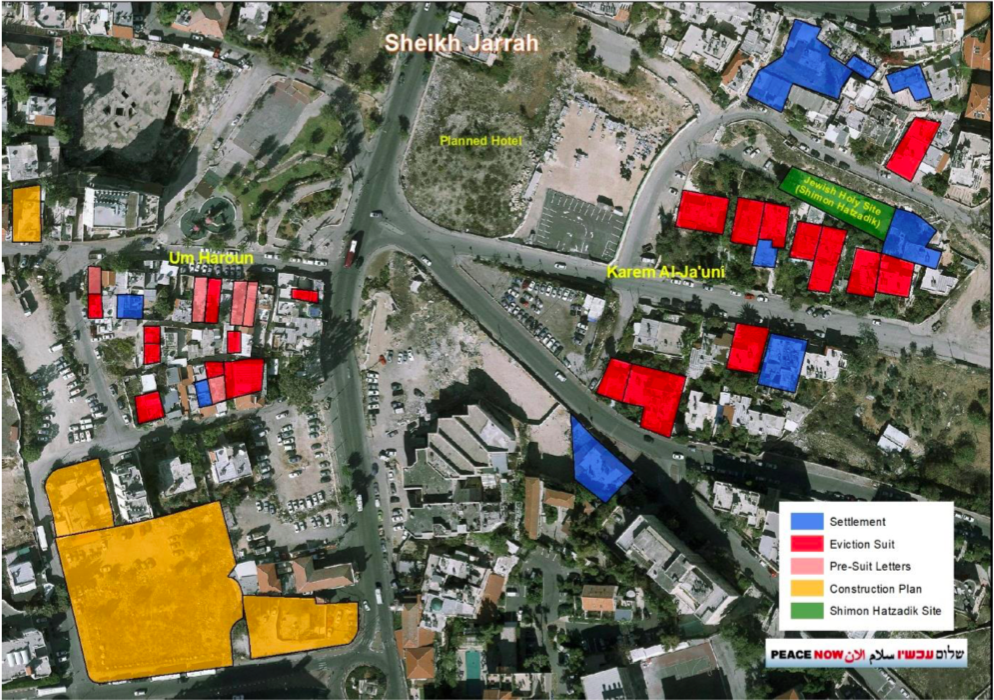 According to Peace Now, the Sabbagh family is one of 175 Palestinian families in East Jerusalem that face eviction under the discriminatory law: 75 families in the Sheikh Jarrah neighborhood and 100 families in the Silwan neighborhood (specifically in the Batan al-Hawa section, where several Palestinian residents were recently handed eviction notices). What’s more, the Sabbagh family was believed to have the best chance at escaping eviction based on historic Ottoman documents relating to the land obtained by the family’s lawyer. These are the documents that Supreme Court Chief Justice Esther Hayut declined to consider this week. The Sabbagh family lawyer told Haaretz:
“Once again, families from Sheikh Jarrah are facing eviction and a second refugeehood. In Israeli courts, which refrain from hearing the residents’ just and substantive arguments, people are sentenced to refugeehood on procedural grounds.”
In advance of the Sabbagh’s eviction, protests erupted, and have continued for a second straight day, in support of the family and against Israeli settlement activity in East Jerusalem. Israeli and international protestors marched from the center of Jerusalem to Sheikh Jarrah, where they were joined by Palestinians in front of one of the homes where Palestinians are facing eviction. Daniel Roth, one of the protestors told +972 Mag:
“At the core of this whole thing is the idea that all people have a right to a home, and what’s going on here is that the powers that be are taking homes from some people because of their national identity, period. What we’re looking at is racist policy and action around people’s very homes, and that should wake people up to stand up with these folks.”
Under the “Legal and Administrative Matters Law of 1970,” which is being used to evict the Sabbagh family, Jewish owners are afforded a legal avenue to reclaim property that they owned prior to the 1948 war which, as a result of the war, came under Jordanian rule. It should be noted that Palestinian refugees from that same war – who lost property in what became Israel – are not afforded an equivalent right to reclaim their abandoned property, creating a dual legal system in which ethnicity is the sole determinant factor when it comes to rights.
Exploiting the special standing granted to historic Jewish property owners, the settler group “Nahalat Shimon” has undertaken a campaign to track down the Jewish owners of coveted land in East Jerusalem that was under Jordanian rule, in order to purchase from them the property rights and then evict Palestinian tenants, most of whom have lived in these properties for more than 50 years. This is the context against which the 45-member Sabbagh family (who are themselves refugees of the 1948 war, but are not allowed to legally reclaim their family property in Jaffa) is being forced to leave their home of 60+ years. Following the Supreme Court’s January 10th decision to refuse the family’s request to consider new evidence in the case (based on the argument that it was too late), Israeli authorities delivered an eviction notice telling the family to leave before January 23rd.
Peace Now writes:
“This is part of an organized and systematic campaign of settlers, with the assistance of government agencies, to expel entire communities in East Jerusalem and to establish settlements in their stead. Dozens of other families face the risk of eviction by legal proceedings in which settlers and government officials exploit discriminatory laws that allow Jews to return to pre-1948 assets yet forbid Palestinians from doing the same. In this way, settlers seek to create a buffer inside the Palestinian neighborhood and make it difficult to reach a territorial compromise in Jerusalem so essential to a two-state solution.”
Bidding War Between Settlers and Palestinians Drives $3.27 Million Price for Sheikh Jarrah House
A bidding war erupted over a house in the Sheikh Jarrah neighborhood of East Jerusalem, pitting the Palestinian family living in the building against Aryeh King, a radical settler impresario behind many settlement schemes across East Jerusalem. When the price hit $3.27 million (12 million shekels), King decided to withdraw his bid – allowing the Palestinian Abdel Razeq family to purchase the home, should they be able to raise the necessary funds.
If the family is able to raise the funds to buy the house, this would be a rare, albeit astronomically expensive, victory for Palestinians fighting to remain in their homes against an ongoing campaign by Israeli settler groups to “reclaim” Jewish property in East Jerusalem that was abandoned during the 1948 war.
As discussed above, under Israeli law, Jewish property owners are entitled to reclaim property in East Jerusalem that was abandoned during the war, while Palestinians who lost property in what became Israel have no similar right. King and other pro-settler activists take advantage of this law by tracking down Jews who owned property in sensitive areas of East Jerusalem prior to 1948 (Sheikh Jarrah being a key target), and convincing the owners (or their heirs) to sign over the property rights – all in order to evict current Palestinian tenants and move in Israeli settlers.
The case involving the Abdel Razeq family’s house did not go according to the settlers’ script. A dispute broke out between members of the Jewish family who, under Israeli law, are heirs to the property. The case went to a Family Court, which ruled that the house should be sold through a public bidding process, with the proceeds to be split amongst the heirs.
Explaining his decision to drop out of the bidding, King took to social media to attack the Jewish family that is selling the property, saying:
“[it is] a black day for the Jewish people. A Jewish family is negotiating with the enemies of the Jewish people to sell a property that the family’s grandfather purchased a hundred years ago in East Jerusalem….I am full of shame that people act this way about a place that their grandfather bought out of Zionist motives and a place where soldiers paid with their lives and were wounded, and they sell it just to make another profit.”
King’s perspective on this – in essence, that Jews should sell only to other Jews – is notable, given recent controversy over a Palestinian who sold property to settlers. Israel and many supporters of Israel were outraged at what they saw as the anti-Semitic demand that Palestinians not sell property to settlers. In this latest case, the seller was arrested by the PA, leading the U.S. Ambassador to Israel, David Friedman, to tweet: “The Pal Authority has been holding US citizen Isaam Akel in prison for ~2 months. His suspected ‘crime’? Selling land to a Jew. Akel’s incarceration is antithetical to the values of the US & to all who advocate the cause of peaceful coexistence. We demand his immediate release.”
Settlers Impose Sabbath Closure on Palestinian Residents of Silwan; High Court Asks: Why?
On January 16th, the Israeli High Court of Justice ordered the Israel Nature and Parks Authority (INPA) and the radical Elad settler group to defend its practice of closing parts of the “City of David National Park” – a name that Israel has applied to an area that includes a large Palestinian residential section of Silwan – on the Jewish Sabbath, evenings, and on Jewish holidays. The closures deny Palestinians, including residents of Silwan, access to parts of the neighborhood.
 As FMEP has repeatedly covered, the radical Elad settler group has managed the City of David National Park on behalf of the INPA since 2001. This arrangement that gives the settler group authority over not only areas controlled by settlers – whose interests Elad shares and promotes – but also thousands of Palestinians, to whom Elad has no legal responsibility and whose very presence is part of a “demographic balance” Elad is working actively to flip.
The petition which prompted the Court’s order was filed by the residents of Silwan and the Israeli nongovernmental archaeological group Emek Shaveh. Explaining the situation caused by Elad’s mismanagement of the City of David National Park, Emek Shaveh writes:
“The City of David National Park is situated at the heart of a populated, urban space. Extensive areas in the park are public spaces in a neighborhood that suffers from a chronic deficiency of such spaces. In 2015, the Elad Foundation placed gates and closed archaeological areas known as Area E and Area G (No. 6 and 7 and No. 3 on the map). These public spaces had been open to the residents at least as far back as the British Mandate. The gates that were placed are locked at closing time, thus blocking passage between two neighborhoods within the village. The site closes on the Sabbath and on Holidays as the Elad Foundation observes the Sabbath, thus restricting the local residents’ freedom of movement and use of public spaces. As most of Silwan’s residents work in West Jerusalem, Shabbat (Saturday) is their day of rest, yet it is on this day that the nearby green public areas are closed off to them.”
Elad and the INPA have previously tried to defend the park closures on security grounds – citing alleged incidents of vandalism on park grounds. That defense was rejected by the Israeli Attorney General, who noted that no formal complaints about vandalism had been filed, and neither the Israeli police nor the Israel Antiquities Authority had be informed about the problem or Elad’s decision to close the park on religious occasions. Following the January 19th court order, Elad and the INPA have 60 days to submit a new defense.
Israel to “Examine” Two Cases of Illegal Outpost Construction
In response to petitions filed by Peace Now, on January 7th the State of Israel announced that it will “examine” two specific cases of illegal (under Israeli law) outpost construction: the Kerem Reim case and the Hayovel case, both located in the area controlled by the Binyamin Regional Council (the Israeli government-funded settlement municipal authority in charge of the area located north of Jerusalem stretching to north of Ramallah). The examination will be led by a police anti-fraud unit and the State Prosecutor’s Office.
As summarized in a recent report, Peace Now has previously filed numerous complaints and has provided evidence to the State Prosecutor’s office regarding the involvement of the Binyamin Regional Council and the Amana settler organization in the illegal construction of outposts and settlement structures.
Given the State’s demonstrated refusal to promptly respond to the complaints by opening an official investigation into the criminal activity, Peace Now cautions that this latest move to “examine” the cases is problematic, saying:
“an examination is an ambiguous, non-legal term that comes in lieu of a proper, legal investigation. An ‘examination’ may just be the state’s tactic to mollify the High Court by showing that it is serious looking into the matter, though without actually taking any substantive action.”
In addition to Peace Now’s documentation, the Israeli State Comptroller’s office published a July 2018 report exposing the criminal involvement of the Binyamin Regional Council and the Amana settler organization in illegal settlement construction.
Peace Now also released an official statement saying:
“For 50 years now, a handful of settlers have been using public funds through the settlement councils and Amana to put facts on the ground that affect the future of all of us in violation of the law and of the government’s decisions. The hesitation of the State Prosecutor’s Office and the police to investigate the organized crime of illegal construction in the settlements is tantamount to granting immunity to the offenders and shows a lack of respect for the rule of law. The message the government is sending to the settlers is that they are above the law.”
In 2017, Peace Now published a comprehensive report outlining how government and private entities are systematically using Israeli taxpayer money to establish new settlements and outposts.
MK Bezalel Smotrich – A Radical Settler – Elected to Lead National Union Party
MK Bezalel Smotrich has been elected to take the reins of the extreme right-wing nationalist political faction, called the National Union Party. With leadership secured, Smotrich aims to next be chosen to lead Habayit Hayehudi – an umbrella group which unites the far-right factions into a single voting bloc – following Naftali Bennett’s decision to leave Habayit Hayehudi and form a new political party alongside Ayelet Shaked.
Smotrich currently lives in the Kedumim settlement, but his house is located inside of an enclave of privately owned Palestinian land that is not included in the settlement’s Master Plan, making it illegal even under Israeli law.
Smotrich is a co-founder of Regavim, a radical settler group that works to dispossess Palestinians of their land and property in the West Bank by “helping” the Israeli government to enforce planning and building laws. Like Smotrich, many of Regavim’s key staff live in illegally built settlement units, but instead of seeking to enforce Israeli law against their own illegal building, Regavim and Smotrich are working to retroactively legalize their own homes through legislation.
Beyond the headlines, Smotrich has been an extremely active member of the Knesset, and is behind many of the boldest and most brazen legislative attempts at annexation. Some of Smotrich’s recent efforts include:
- Introducing the “Young Settlements Bill,” which would direct the government to treat 66 illegal outposts built on privately owned Palestinian land as legal settlements, while giving the government 2 years to find a way to retroactively legalize those outposts. The bill would also freeze any/all legal proceedings against the outposts and requires the government to connect the outposts to state infrastructure including water and electricity; provide garbage removal; and approve budgets for them. The law also allows the finance minister to guarantee mortgages for settlers seeking to buy units in these outposts, even before the legal status of the land is resolved (a remarkable state-directed violation of normal practices in the mortgage industry). The bill received government backing on December 16, 2018, and will next need to be introduced in the Knesset, where it must pass three readings to become law.
- Calling for the Israeli Civil Administration to be disbanded, in a scheme that would annex the entire West Bank to Israel, leaving the Palestinians bantustans to be governed by “Regional Liaison Committees.”
- Leading the charge for the Knesset to fund a new municipal body for Israeli settlers in Hebron, despite a court injunction freezing government plans to create such a body.
- Introducing a bill that would hand over more land in Area C of the West Bank to the World Zionist Organization.
European Union Statement Lambasts “Givat Eitam/E-2” Settlement Plan
On January 22, 2019, the European Union presented a statement at the United Nations Security Council Open Debate representing the view of its member states that:
“Today there is a risk of further escalation that would move Israelis and Palestinians further away from an end to the conflict. This risk is compounded by the advancement in December 2018 of Israeli plans for over two thousand settlement units and renewed plans to “legalise” West Bank outposts. The allocation of an area south of Bethlehem for the purpose of planning a new settlement (Givat Eitam) constitutes a serious blow to the viability of a two-state solution. The European Union’s position on Israeli settlement policy – including eviction of Palestinians – for example in Sheikh Jarrah – and related activities in the occupied Palestinian territory is clear and remains unchanged: all settlement activity is illegal under international law and it erodes the viability of the two-state solution and the prospects for a lasting peace – as reaffirmed by UNSCR 2334.”
For FMEP reporting on the Givat Eitam/E-2 settlement, see the January 4th edition of the Settlement Report.
Bonus Reads
- “The Israeli-Palestinian Conflict is Not a Bankruptcy Sale” (Lawfare Blog)
- “When Freud Visits Israeli Civil Administration in the West Bank” (Haaretz)
- “A Guided Tour of Hebron, From Two Sides of the Occupation” (The New Yorker)
- “Another Step Toward the Annexation of the West Bank” (Haaretz)
- “Israel’s Apartheid Road is About More Than Segregation” (+972 Mag)
Welcome to FMEP’s Weekly Settlement Report, covering everything you need to know about Israeli settlement activity this week.
To subscribe to this report, please click here.
December 14, 2018
- Israel Seizes on Palestinian Attacks as Pretense to Advance Settlement on Multiple Fronts
- The WZO Used Non-Existent Land Plots as “Collateral” for Loans to Build Illegal Outposts
- Israeli AG Freezes New Grants Program for Illegal Outposts
- At the Opening of New West Bank Highway Interchange for Settlers, Netanyahu Celebrates Erasing the Green Line
- Hanukkah Event Draws Political Support for Settlers’ Bid to Take Over Site in the Old City’s Muslim Quarter
- Huge Holes Open on Streets of Silwan…Above Settler Excavations
- Israel’s Top Court Slams State Rail Company for Moving Debris to Private Palestinian Land as Part of Plan to Build a Settlement Park
- Bonus Reads
Questions/comments? Email kmccarthy@fmep.org
Israel Seizes on Palestinian Attacks as Pretense to Advance Settlement on Multiple Fronts
Seizing on a series of deadly Palestinian attacks this week as his pretext, Prime Minister Netanyahu announced he will:
- retroactively legalize thousands of settlement structures and outposts;
- initiate a plan to build 82 new units in the Ofra settlement;
- build two new settlement industrial zones (one near the Avnei Hefetz settlement and one near the Beitar Illit settlement); and,
- implement a range of policies that collectively punish Palestinians in the West Bank.
In addition, the Israeli Ministerial Committee on Legislation (a committee within the Israeli cabinet that decides whether to give government-backing to Knesset legislative proposals) will consider supporting a bill written by MK Bezalel Smotrich (Habayit Hayehudi) which would allow the government to provide municipal services, like water and electricity, to some illegal outposts. The bill assumes the series of outposts will be retroactively legalized, an assumption based on the work to achieve that end spearheaded by settler leader Pinchas Wallerstein (who has his own history of ignoring the law).
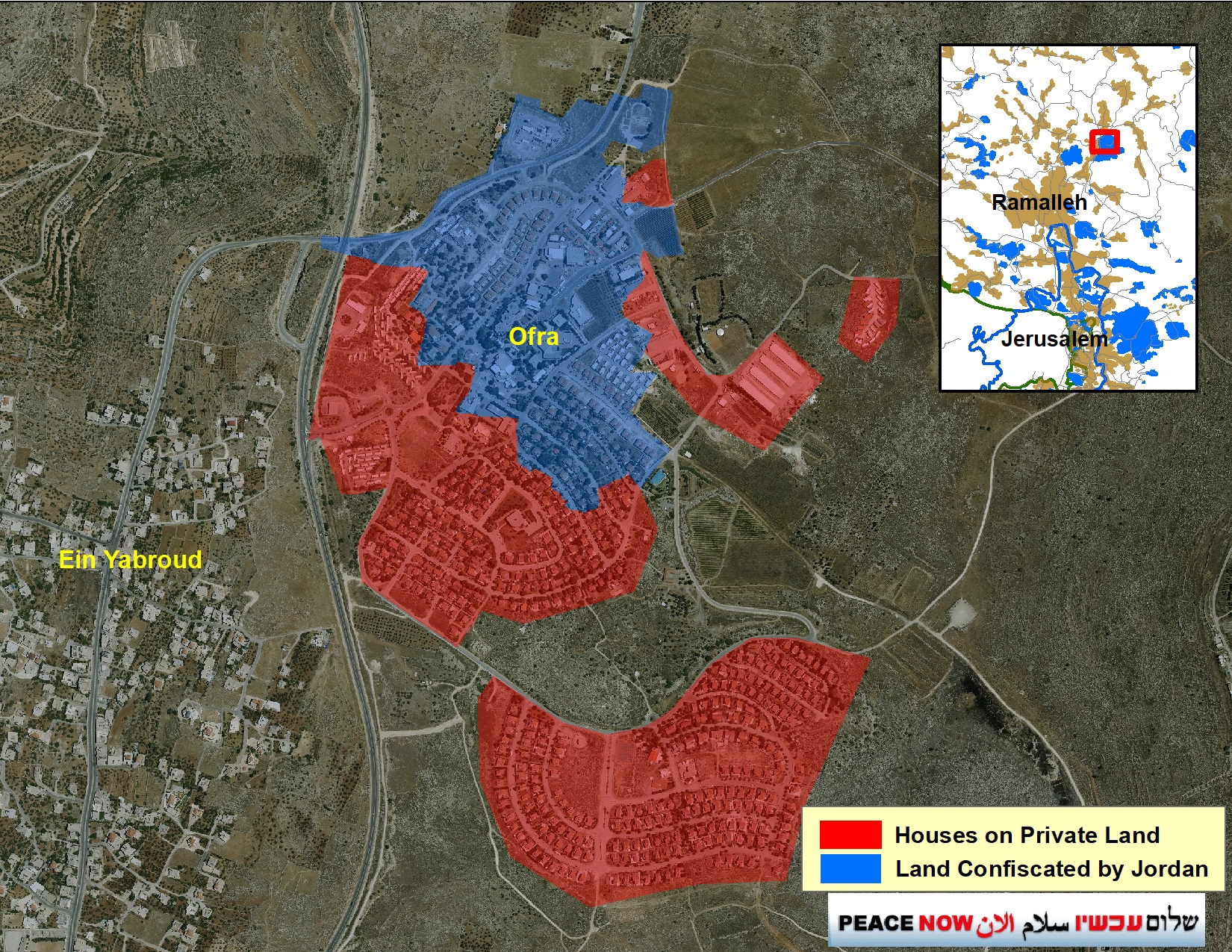 Many other senior Israeli officials joined Netanyahu in advocating for the immediate legalization of every unauthorized (i.e., illegal under Israeli law) structure in the Ofra settlement. The Ofra settlement – located northeast of Ramallah – was first established by settlers on land that had been expropriated in 1966 by the Jordanian government in order to build a military base (which was never built, as Israel took control of the West Bank in 1967). The Israeli government used this pretext to expropriate the land in 1977 in order to recognize the Ofra settlement, which had been established in the area illegally (i.e., without government approval, but with its tacit cooperation) two years prior. However, the majority of the Ofra settlement was not built on the land expropriated by the Israel in 1977, but instead on land that is registered to Palestinian owners from the nearby village of Ein Yabroud. In light of the legal status of the land, no Israeli government has yet been able to find a way to fix the legal status of these homes (not for lack of trying) – meaning that the majority of the structures in Ofra were built without permits, making them illegal under Israeli law.
Peace Now elaborates:
“Most of the houses built in Ofra (approximately 413 out of 625) were built on an area of 550 dunams of privately owned Palestinian land. In addition, hundreds of dunams of Palestinian private land were seized for roads in Ofra, as well as infrastructure and agricultural lands for the settlers. The only way to regulate the theft of these lands would be to expropriate them from the Palestinian landowners for the benefit of the settlers, in complete contradiction to the positions of previous Israeli governments and legal advisors, and contrary to binding rulings of the High Court. Although the current legal advisor (Avichai Mandelblit) allowed land expropriation in some places for settlement purposes (for example, in Haresha), in the regulation of massive land theft such as in Ofra the Israeli government would be crossing a new red line.”
Justice Minister Ayelet Shaked said that she already has a draft resolution and a legal opinion supporting retroactive legalization of Ofra. Shaked further threatened:
“Facing the price tag of Abu Mazen [Palestinian President Mahmoud Abbas], we pose our own price tag. Every terror attack will strengthen the settlement establishment instead of weakening it, and every potential attacker will know in advance that he will be considered responsible for strengthening settlements.”
Speaker of the Knesset Yuli-Yoel Edelstein vowed to push a plan through the Knesset to regulate Ofra, saying:
“The immediate answer to such an incident is to finally regulate Ofra, one of the oldest and most beloved communities. The 20th Knesset has been good and the Government has been positive towards the settlement enterprise. There have been important achievements and laws, but it’s not enough… I pledge to support the plan that will be formulated and advance it myself in the Knesset. This is our duty towards millions of citizens. The fate of Ofra must be the same as the fate of Petah Tikva.”
Yisrael Gantz, the new chairman of the Binyamin Regional Council, called for the:
“immediate approval of thousands of housing units… in order to deepen our roots here.”
The WZO Used Non-Existent Land Plots as “Collateral” for Loans to Build Illegal Outposts
The Israeli NGO Kerem Navot discovered more proof that the World Zionist Organization’s Settlement Division is directly financing the construction of illegal outposts with public funds — by providing loans to settlers based on non-existent assets, including fictitious plots of land in the West Bank. This reporting builds on previous revelations about the WZO’s complicity in illegal settlement construction on privately owned Palestinian land in the West Bank, including in the cases of the Mitzpe Kramim outpost and the Ma’aleh Rahavam outpost. Nonetheless, the Israeli government is rapidly advancing plans to hand over even more West Bank land to the WZO for settlement expansion.
On its latest findings, Kerem Navot founder Dror Etkes told Haaretz:
“This story exposes again the Settlement Division’s swindling ways and dirty dealings. [Like in the case of MK Bezelal Smotrich] who received a mortgage in the Kedumim settlement for a plot that doesn’t exist. It’s obvious from that and from the other cases that this is only the tip of the iceberg of a much broader practice.”
As a reminder, the WZO’s Settlement Division was created by the Israeli government in 1968 and is funded entirely by Israeli taxpayers. Its mandate is to manage West Bank land expropriated by Israel, in order to facilitate the settlement of Israeli Jews in the occupied territories. To make this possible, the Israeli government has allocated approximately 60% of all “state land” in the West Bank to the WZO’s Settlement Division [over the past 50 years Israel has declared huge areas of the West Bank to be “state land,” including more than 40% of Area C, where most of the settlements are located]. In addition, settlement and human rights watchdogs have repeatedly documented how the WZO’s Settlement Division has worked to take over additional land, including privately owned Palestinian land, in order to build more settlements.
Israeli AG Freezes New Grants Program for Illegal Outposts
Israeli Attorney General Avichai Mandelblit has reportedly frozen the implementation of a resolution, passed by the Israeli cabinet last week, designating three outposts as “national priority areas” for development. The resolution would direct enormous amounts of state resources to the outposts for construction.
Mandelblit wrote a letter slamming Housing Minister Yoav Gallant for bypassing the Attorney General in approving the resolution. According to Haaretz, Mandelblit had previously told the Housing Minister that the inclusion of settlements in the list of national priority areas needs to be thoroughly reviewed before the resolution was passed. Ignoring Mandelblit, Gallant advanced the resolution without a thorough review and without the permission of the government’s top legal official.
At the Opening of New West Bank Highway Interchange for Settlers, Netanyahu Celebrates Erasing the Green Line
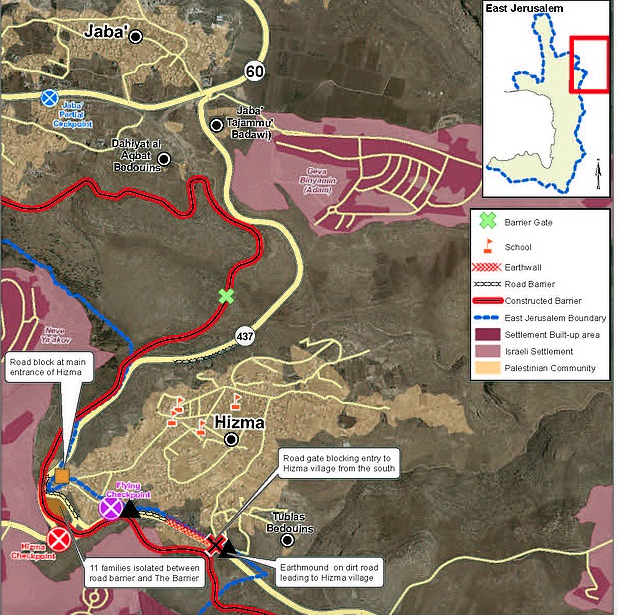
Map by OCHA
Israeli Prime Minister Benjamin Netanyahu attended a ceremony marking the opening of a newly renovated traffic interchange on Highway 60 (the main north-south highway in the West Bank). Located near the Adam/Geva Benyamin settlement and the Palestinian village of Hizma, the new interchange is meant to ease traffic congestion for settlers travelling to Jerusalem from the northern West Bank. More importantly, it advances the seamless integration of infrastructure serving Israeli settlements and sovereign Israeli territory – a key effort by settlers and their government allies to effectively erase the Green Line.
At the event, Netanyahu said:
“We are not stopping here. We will yet complete the paving of bypass roads, the widening of lanes and the improvement of infrastructures. There is a combined transportation-security aspect here. We are making yet another great link. While we are joining the country geographically, we are also joining the present to the future. Today and in this place we are doing something else, we are also joining the present to the past. Our ancestors walked here and took in this view of these valleys and these hills. The greatest dramas in the history of our people and of humanity took place here in this place; therefore, we are also joining our past to our future and this is a very great privilege.”
Minister Katz, who was also in attendance, said:
“We’re promoting a strategic plan on a very wide range with light rail routes at high-risk areas and traffic lights to make Judea and Samaria part of the Israeli norm of a developed and connected country…After we completed these two projects (Adam Interchange and Givat Assaf Traffic Light) we’ll work to enable this connection with a road with better conditions. This is part of the large and complementary projects to allow traffic to flow here.”
In September 2018, the United Nations Office for the Coordination of Humanitarian Affairs (OCHAS) released a report looking at the impact of Israeli roads on the the village of Hizma, as a case study of the effects road closures have on Palestinian rights. OCHA wrote:
“Hizma is a Palestinian village of over 7,000 residents in Jerusalem governorate. The bulk of its built-up area is in Area B but small parts of the village lie in Area C or within the municipal boundaries of Jerusalem, although it is separated from the rest of the city by the Barrier. Between 28 January and the end of March 2018, the three access roads into the village were either totally or partially closed to Palestinian traffic. The Israeli army hung posters on village shops stating that the army ‘will continue its work so long as you [residents] continue to be disruptive’. Other posters showed broken windshields. Following communications with the Israeli military, the head of the village council reported that the posters justified the closures as a response to stone throwing by Palestinian youths at vehicles with Israeli number plates. In 2017 and the first two months of 2018, OCHA recorded 11 incidents of Palestinians throwing stones at Israeli vehicles near Hizma that resulted in Israeli injuries or damage to vehicles.
The closures disrupted access by Hizma’s residents to services and livelihoods. Traffic between the north and south of the West Bank that passed through the village was diverted, undermining the commercial life of the village. Service providers, including a third of the teachers in village schools who commute on a daily basis, faced delays reaching the village. Over 50 shops/businesses that are the main source of income for 150 households were affected by the diversion of Palestinian traffic away from the village. Family life was also affected by the unpredictable nature of the closures.”
Hanukkah Event Draws Political Support for Settlers’ Bid to Take Over Site in the Old City’s Muslim Quarter
The Israeli archeological group Emek Shaveh reports that the Ateret Cohanim settler organization hosted a Hanukkah celebration – drawing the participation of the incoming Mayor of Jerusalem Moshe Lion, Minister of Jerusalem Affairs Ze’ev Elk, and the son of the Israeli Prime Minister, Yair Netanyahu – at the “Little Western Wall.” The site (which Israelis call the “Kotel Ha’Katan”) is a section of the retaining wall of the Temple Mount/Haram al-Sharif located within the Old City’s Muslim Quarter. It is viewed by some religious Jews as the closest point to the Holy of Holies at which Jews are permitted to pray. For historical background on the site and Ateret Cohanim’s role and goals related to it, see this 2016 report by Haaretz’s Nir Hasson.

Emek Shaveh writes:
“The recent Hanukkah ceremonies demonstrate an increase in political support for Ateret Cohanim and, no less important, the growing importance of the Little Western Wall, a politically and religiously charged place, attesting to a growing consensus among the Israeli Right regarding strengthening Jewish presence in areas immediately adjacent to the Temple Mount/Haram al-Sharif.”
Ateret Cohanim is a radical settler organization working to increase the presence of Israeli Jews living inside Palestinian neighborhoods of Jerusalem – including in the Old City, where the group recently succeeded in purchasing a Palestinian house in the Muslim Quarter (a property sale that continues to stoke controversy within the Palestinian community). Ateret Cohanim, along with their compatriots in the Elad settler group, also leads efforts to take over land and evict Palestinians from their homes in the Silwan neighborhood. Ateret Cohanim’s recent efforts in Silwan include using the guise of a Yemenite cultural center to build a new settlement in Silwan with government financing, and winning a High Court ruling that permits them to continue their campaign to evict 700 Palestinians from their homes.
Huge Holes Open on Streets of Silwan…Above Settler Excavations
 The Israeli archeological group Emek Shaveh reports that holes have begun appearing in the ground of Silwan, along the route of an underground excavation run by the Israeli Antiquities Authorities and funded by the Elad settler group. Elad has invested heavily in archeological excavations in Silwan in a campaign to co-opt the ancient history of Jerusalem to strengthen the Jewish hold on and presence in Palestinian neighborhoods in East Jerusalem. Emek Shaveh writes:
“There’s rarely a dull moment in Silwan. Last weekend, after the rain came, large holes opened up in the ground. This is not normal. And no amount of cement poured into the holes will make it so. Perhaps the reason for this odd occurrence can be found in the fact that Israel Antiquities Authority is excavating a tunnel along an ancient Roman road which runs right underneath the places where the holes opened up. There are 15 houses along the route of the tunnel. In some of them cracks have shown up. Others have shown signs of sinking into the ground. A few months ago we asked the Antiquities Authority to examine the homes and were assured the engineer would look into it. We’re still waiting for answers.”
The new holes are just the latest in a long series of above-ground damage related to excavations which the Israel Antiquities Authority (IAA) started in 2013. The IAA began the excavations without notifying Palestinian residents of the project. Palestinians began complaining about the work when cracks began appearing in their homes, threatening their structural integrity, and forcing many to leave their homes.
Emek Shaveh has repeatedly asked the IAA to investigate the issues caused by the excavations, but has not received an answer to date. Emek Shaveh also shared footage of Israelis haphazardly attempting to fill in the new holes with concrete.
Israel’s Top Court Slams State Rail Company for Moving Debris to Private Palestinian Land as Part of Plan to Build a Settlement Park
The Israeli High Court of Justice sharply criticized Israel Railways, the state rail company, for moving debris on to privately owned Palestinian land in the West Bank, as part of a plan to use the debris to develop a new park in the nearby Nili settlement. The debris comes from tunnelling a path for the Tel Aviv to Jerusalem rail line, meaning the debris was transported from sovereign Israeli territory into the West Bank, where it was deposited on Palestinian land.
Back in 2011, the Court chastised Israel Railways for its actions and ordered the debris to be removed. Seven years later, the Palestinian land is still a dumpsite while the Israeli government and Israeli Railways bicker over who is responsible for clearing the refuse. This week the Court rebuked the company and hinted that it would soon issue a ruling against it.
Bonus Reads
- “Q&A with Naftali Bennett” (The Forward)
- “A Plan for Perpetual Conflict” (Carnegie Endowment)
- “The New Capital of Israel” (Haaretz)
- “Annexation Legislation is Imminent, and Dangerous” (Commanders for Israeli Security)
- “Forged Jerusalem Home Sale Gets Jordan’s Attention” (Al-Monitor)