Welcome to FMEP’s Weekly Settlement Report, covering everything you need to know about Israeli settlement activity this week.
To subscribe to this report, please click here.
December 3, 2021
- Israel to Advance Atarot Settlement Plan
- New Israeli President Kicks Off Hanukkah with Settlers in Hebron, Sparking Clashes and Raising Ire
- Court OKs Demolition of Palestinian Homes in Wadi Yasul (Silwan)
- “Day of Destruction” – Israel Demolitions in East Jerusalem & West Bank
- Government Contradictions Delay Final Decision on Jerusalem Cable Car Project
- Knesset Holds Hearing on Settler Terrorism
- Bonus Reads
Israel to Advance Atarot Settlement Plan
At its upcoming meeting scheduled for December 6th, the Israeli Interior Ministry District Planning Committee is set to approve the Atarot settlement plan for public deposit.
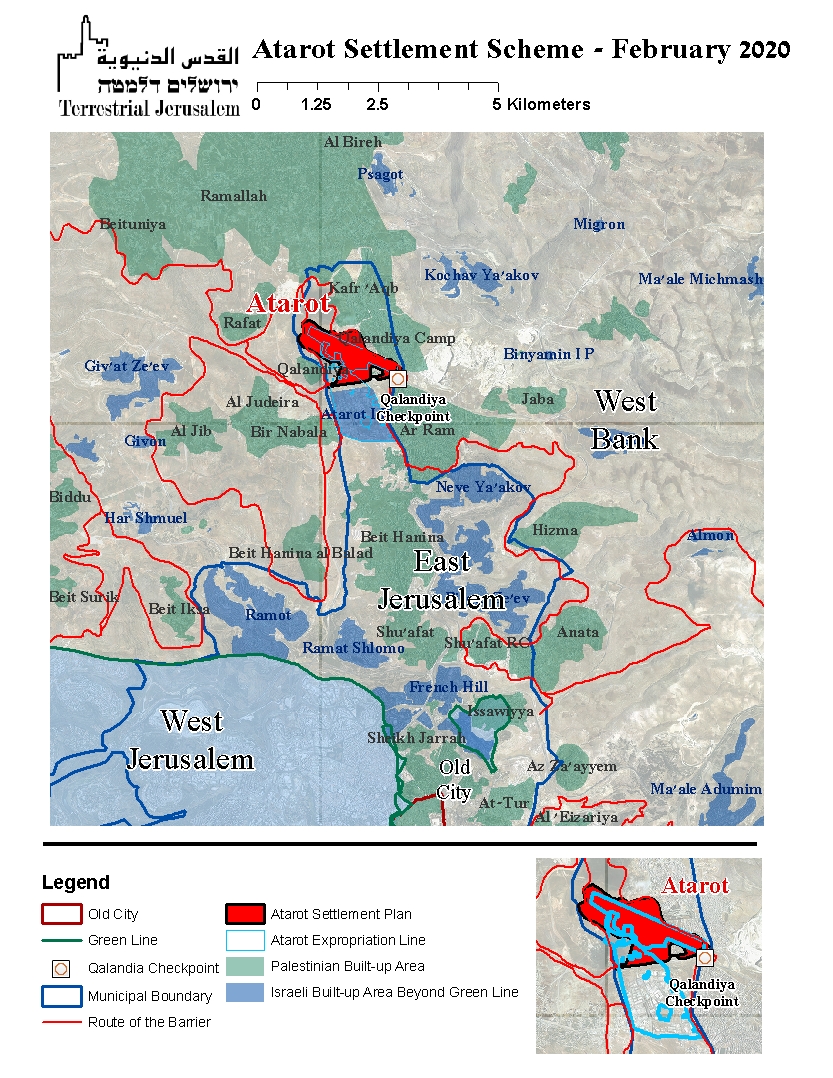 As a reminder, the Atarot plan calls for a huge new settlement on the site of the defunct Qalandiya Airport, located on a sliver of land between Ramallah and Jerusalem. In its current form, the plan provides for up to 9,000 residential units for ultra-Orthodox Jews (assuming, conservatively, an average family size of 6, this means housing for 54,000 people), as well as synagogues, ritual baths (mikvehs), commercial properties, offices and work spaces, a hotel, and a water reservoir. If built, the Atarot settlement will effectively be an Israeli city surrounded by Palestinian East Jerusalem neighborhoods on three sides and Ramallah to its north. Geopolitically, it will have a similar impact to E-1 in terms of dismembering the West Bank and cutting it off from Jerusalem. For more on the Atarot settlement plan, please see here.
The Jerusalem District Planning Committee previously signaled its intent to advance the Atarot settlement plan, most notably by placing it on the December 6th agenda. After apparent pushback from the Biden Administration, on November 25th the plan was suddenly removed from the December 6th agenda, reportedly in fulfillment of a promise to the U.S. to freeze the project. That removal, however, proved short-lived. On November 28th, the Atarot plan reappeared on the agenda, confirming earlier comments Bennett made to the settler-run news outlet Arutz Sheva saying that the plan will indeed be discussed on December 6th. Apparently settling the matter, an Israeli diplomatic source said that the government will act on the plan by approving it for deposit for public review, while at the same time offering the U.S. a rhetorical commitment (but nothing more) that there will be no further advancement in the planning process for at least a year.
Peace Now’s Hagit Ofran cautions:
“‘…please, don’t buy any ‘promise’ that ‘we will not build’ (anyway the planning process takes a while, and even if they work hard and fast they can’t start to build Atarot in less than 3-4 years), what we need is clear: Don’t promote the plan; Shelve it.’ Ofran separately told The Los Angeles Times, ‘As soon as [the committee] approve[s] it, it’s like a snowball.’”
Ir Amim also warns:
“While the Israeli authorities may attempt to relegate the upcoming discussion as a prosaic, bureaucratic step in a lengthy approval process, it is a necessary stage in the plan’s final approval and indeed advances the plan one step closer to full validation.”
For further information about the Atarot plan – and what has transpired over the past week – please see the following two podcasts:
- “The Settlement That Wasn’t But Now Is” ft. Daniel Seidemann & Evan Gottesman (Terrestrial Jerusalem Podcast – 11/30/2021)
- “Scorched Earth & Settlements in Jerusalem” ft. Daniel Seidemann and Kristin McCarthy (FMEP podcast – 12/2/2021)
New Israeli President Kicks Off Hanukkah with Settlers in Hebron, Sparking Clashes and Raising Ire
Isaac Herzog – the former head of the Jewish Agency who was sworn in as the new Israeli President in July 2021 – opted to make a highly political statement by attending a celebration of the first night of Hanukkah in Hebron, at the Tomb of the Patriarchs/al-Ibrahimi Mosque. Herzog’s choice is correctly understood to be an intentional embrace and legitimization of settlers in Hebron, and of the apartheid reality Palestinians experience everyday. In his speech at the event, Herzog emphasized recognition of “the historical affinity of the Jewish people to Hebron, to the Cave of the Patriarchs,” and spoke about the 1929 massacre of Jews in Hebron. He said nothing about Palestinian links to the city, the 1993 Hebron Massacre, or anything else related to Palestinian equities in the city.
Palestinian and Israeli activists protested the event, which led to clashes with the IDF.
The Palestinian Foreign Ministry responded:
“The Israeli government bears full and direct responsibility for this event…[this is] a defiant move aimed at embracing the settlement enterprise and a blatant violation of international law and the international effort to curb unilateral measures.”
MK Ayman Odeh (Joint List) tweeted:
“Herzog did not go to light the first candle, he went to light Hebron…Whoever celebrates with fans of the killer Goldstein cannot be the president of all the citizens of the country.”
Peace Now, commenting on Herzog’s activities, said:
“[Hebron is] the ugliest face of Israeli control over the territories..It is inconceivable that the president, who is supposed to be a unifying figure, would choose, of all places, to light a candle in a place that has become a stronghold of oppression and violence.”
Commenting on the IDF’s preventing protests of Herzog’s appearance, Peace Now also said:
“While the president lights a candle with Baruch Marzel and the Kahanists, security forces are preventing law-abiding citizens from exercising their right to protest”.
In speculating that Herzog’s appearance in Hebron is indicative of his higher political ambitions [to become Prime Minister], Israeli analyst Anshel Pfeffer writes:
“Herzog’s decision to light the first candle of Hanukkah on Sunday night with the settlers of Hebron, [Kahanist MK] Ben-Gvir’s core constituency, should come as no surprise to anyone. These were the kind of people he courted before being elected president and he’s not about to shun them now, or anytime… The visit to Hebron is not an afterthought or a symbolic gesture of ‘unity.’ This was the very first Hanukkah-lighting of Herzog’s presidency, and his choice of venue signals how he intends to build his political brand throughout his term and beyond.”
The Haaretz Editorial Board – in an editorial entitled “Herzog Decided He Wants to Be the President of the Settlements. It’s Not Too Late to Change It” – pleaded with Herzog to cancel his plan, writing:
“Of all the places in Israel, the president chose Hebron, the ultimate symbol of the ugliness and brutality of the occupation and the violence and domineering of the settlers.
“The visit by Israel’s No. 1 citizen to that place – most of whose Palestinian inhabitants have been forced to flee in fear of the settlers and abandon their homes and stores, turning the heart of Hebron into a ghost town – is tantamount to granting official legitimacy to the appalling injustices perpetrated there every day, both before and after Dr. Baruch Goldstein massacred 29 Arab worshipers in the mosque at the Tomb of the Patriarchs.
“In no other place in the West Bank is Israeli apartheid so horrifyingly flagrant: segregated streets on which Palestinians are prohibited from walking; vehicle entry barred to the Palestinians still living there; checkpoints at every turn – only for Palestinians, of course. Violence and humiliation are the daily fare of every Palestinian resident at the hands of the settlers and their children, as well as the army and Border Patrol personnel who are stationed on every corner.
“That is where Herzog believes he must go. His planned visit to Hebron is a gesture of recognition of and solidarity with the most violent settlers and additional proof that occupied Hebron has been annexed to Israel, at least de facto. Otherwise, the president has no reason to go there.”
Court OKs Demolition of Palestinian Homes in Wadi Yasul (Silwan)
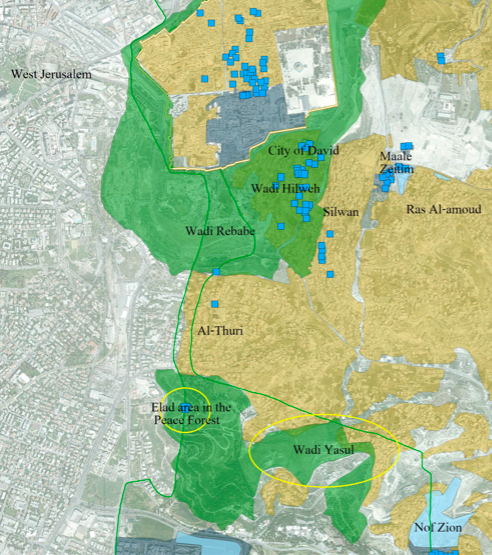
Map by Ir Amim
On November 28th the Jerusalem District Court cleared the way for the immediate demolition of 58 Palestinian homes in the Wadi Yasul section of the Silwan neighborhood in East Jerusalem – adjacent to an area known as the “Peace Forest”. The basis for the order is the Israeli claim that the homes lack Israel-issued building permits. The Court rejected an appeal to continue freezing demolition orders, filed by Palestinian homeowners, ruling that demolition orders can no longer be justifiably suspended because there appeared to be no prospect of Israel legalizing the homes, despite a 15-year effort on the part of Wadi Yasul’s residents to advance planning schemes that could have enabled Israel to rezone the land and legalize the homes.
An attorney representing the Palestinian homeowners told Haaretz:
“The residents have spent millions of shekels on these plans, but in the end, [city officials] broke their promises, posed insurmountable obstacles and insist on implementing the demolition orders and throwing the families out onto the street with no alternative.”
The brutal outcome Israel is meting out to the Palestinian residents of Wadi Yasul stands in stark contrast to the Israeli State and judicial system’s treatment of illegal settler construction in the same area — a reality that underscores the systematic discrimination that characterizes Israeli planning policies and enforcement facing Palestinians in Jerusalem. While pursuing the demolition of Palestinian construction and refusing efforts to address the issue, FMEP reported in 2019 how the Israeli government is working hand-in-hand with Israeli settlers to pursue every avenue to secure the retroactive legalization of the Elad settler group’s illegal construction. Even more brazenly, Israeli officials have been working to rezone the “Peace Forest” [something it refuses to do for Palestinians] in order to allow the Elad settler group to build more infrastructure in the area, including a tourist zipline and a promenade meant to connect settlement enclaves in the area.
Haaretz previously explained how Jerusalem authorities have repeatedly assisted Elad in its illegal activities:
“At first the NGO simply trespassed and built illegal structures there [the “Peace Forest”]. But things changed and gradually various local and national bodies – including the Jerusalem Municipality, the Israel Land Authority, the Tourism Ministry and the JNF – began to grant Elad assistance. This assistance has included granting building permits retroactively, allocating land to the group without a proper bidding process, and generous funding to the tune of tens of millions of shekels… It has been sponsoring activities in the Peace Forest since 2005, despite the fact that it has no ownership rights there or permits from the ILA (the legal owner of the land, which was expropriated from private Palestinian owners).”
Ir Amim explains:
“The scope of settlement projects in the vicinity of Wadi Yasul – and the breadth and depth of state support awarded to Elad, including authorities’ overt efforts to retroactively legalize their own unpermitted buildings – illuminate the stark discrimination in planning that empowers the expansion of radical settlement inside Palestinian neighborhoods while putting their native residents at risk of displacement.”
In a 2019 report on Wadi Yasul, B’Tselem told the story of what’s transpiring there:
“The residents of Wadi Yasul built [their homes] adjacent to a forest, also located on privately owned land that was expropriated from its Palestinian owners in 1970. In 1977, the Jerusalem Municipality zoned the forest and the area where Wadi Yasul was later established as a green space, where construction is prohibited.
“In 2004, the neighborhood’s residents submitted a detailed plan to the District Planning and Building Committee for retroactive authorization of their homes. The committee rejected the plan in 2008, citing incompatibility with the Jerusalem 2000 Outline Plan, which states that the area where the neighborhood was built must remain a green space.
“At the same time, the municipality and the JNF (Jewish National Fund) – the body in charge of managing the forest – gave their approval to settler organization El-Ad to move forward with plans for group campgrounds, including building the longest recreational zipline in Israel. Some of the facilities have already been built in the forest, without building permits. While the city did issue demolition orders against them, it has refrained from following through.
“In contrast, over the last decade, the city has filed indictments with the Court of Local Affairs against all Wadi Yasul homeowners. The court then issued demolition orders for all of the homes and imposed heavy fines, fining each family tens of thousands of shekels. Three of the families appealed these decisions with the District Court. The appeals were dismissed in April on the grounds that “there are no clear and near planning prospects” for the approval of a plan that would see the appellants’ homes, or other homes in the neighborhood, approved. An appeal the families filed with the Supreme Court was also rejected. In late April, 47 other families filed a motion with the District Court seeking an interim injunction staying execution of the demolition orders. The court’s decision is still pending. Consequently, all of the homes in the neighborhood are still under immediate threat of demolition.
“Ever since 1967, planning policy in Jerusalem has been geared toward establishing and maintaining a Jewish demographic majority in the city. Under this policy, it is nearly impossible to obtain a building permit in Palestinian neighborhoods. The outline plans the city has prepared for these neighborhoods are largely aimed at restricting and limiting building opportunities in Palestinian neighborhoods. One way the plans do so is by designating vast areas as open green spaces, thereby barring Palestinians from building there. The resulting housing shortage forces Palestinian residents to build without permits.”
“Day of Destruction” – Israel Demolitions in East Jerusalem & West Bank
On November 23rd, Israeli forces carried out a demolition campaign targeting Palestinian homes in East Jerusalem and the West Bank, under the pretense that these homes lack Israeli-required Israeli-issued building permits (permits Israel systematically refuses to issue to Palestinians in East Jerusalem and in Area C). As a result of these demolitions, 22 people, including 15 children, were rendered homeless in a single day.
The demolitions included:
- 3 homes in the Wadi al-Hummus neighborhood of East Jerusalem. One of the buildings was a multi-unit apartment buildings;
- 1 home and a burial building (perhaps a funeral home) in villages in the South Hebron Hills;
- 1 tent and 3 livestock structures belonging to bedouin families living east of Ramallah;
- An agricultural road near Nablus. The road was used by the residents of ‘Asirah al-Shamaliyah to reach their farmland and also connects the town to Nablus.
B’Tselem writes:
“The wave of demolitions expresses the perception of the Israeli regime, which holds that land is a resource intended primarily to serve the Jewish population. This regime uses a variety of administrative, planning and bureaucratic tools to implement this concept. Governments come and go, but the apartheid regime remains untouched.”
Government Contradictions Delay Final Decision on Jerusalem Cable Car Project
On November 28th, the Israeli High Court of Justice held what was scheduled to be the final hearing to determine the fate of the Jerusalem cable car project — a project which has been promoted by the government and the Elad settler organization until this point. But instead of reaching a decision, the Court ended up giving the Israeli government a 21-day extension, by the end of which the government must explain its position on the project.
 The proximate cause of the Court’s action was Israeli Minister of Transportation Merav Michaeli’s (Labor) statement, delivered two days before the Court hearing, saying that “the cable car has no significant transportation role, and the harm will exceed the benefits.” That statement contradicts and completely undermines the rationale for the project that the government has put forward until this point — i.e., that the cable car will provide a legitimate transportation benefit. Given Michaeli’s statement, the Court issued its order for the State to clarify where it stands.
Commenting on the Court’s action, the Israeli NGO Emek Shaveh – which specializes in archaeology – said:
“We are pleased that after three years, the transport minister has said what we have been saying all along: that the Jerusalem cable car project is not a transportation project and is not an answer to the traffic issues near the Old City. We believe that its value for tourism has also been greatly misrepresented and although the plan is being advanced by the Jerusalem Development Authority and the Tourism Ministry it will primarily benefit a powerful interest group (the Elad Foundation) by transporting thousands of tourists to its hub at the City of David to the detriment of the historic city and its residents. We hope that the judges will rule that the approval process for the cable car plan severely undermined principles of good governance and on those grounds decide to put a stop to the plan.”
As a reminder, the Jerusalem cable car project is an initiative backed by the powerful, state-backed Elad settler group and advanced by the Israeli Tourism Ministry. The State of Israel – which has pushed the project forward in the midst of the COVID-19 pandemic and despite commitments by the government to focus on public health matters only – was previously forced to publicly admit that the implementation of the cable car project will require the confiscation of privately owned Palestinian land in the Silwan neighborhood of East Jerusalem.
While public efforts to “sell” the cable car plan have focused on its purported role in helping to grow Jerusalem’s tourism industry or in serving supposedly vital transportation needs, in reality the purpose of the project is to further entrench settler control in Silwan, via archeology and tourism sites, while simultaneously delegitimizing, dispossessing, and erasing the Palestinian presence there. Notably, the cable car line is slated to terminate at the settler-run Kedem Center compound (Elad’s large tourism center, currently under construction at the entrance of the Silwan neighborhood, in the shadows of the Old City’s walls and Al-Aqsa Mosque).
Emek Shaveh and other non-governmental organizations, including Who Profits and Terrestrial Jerusalem, have repeatedly challenged (and provided evidence discrediting) the government’s contention that the cable car will serve a legitimate transportation need in Jerusalem, and have clearly enumerated the obvious political drivers behind the plan, the archeological heresies it validates, and the severe negative impacts the cable car project will have on Palestinian residents of Silwan.
Knesset Holds Hearing on Settler Terrorism
On November 22nd a group of Knesset members – all hailing from political parties considered to be part of the Israeli Left – convened a hearing on settler violence against Palestinians.
As part of the hearing, several experts were asked to testify, including Ali Awad, a journalist and anti-settlement activist in the South Hebron Hills. Awad testified regarding his experience growing up in Tuba (read about that here), saying:
“I grew up in Tuba in the South Hebron Hills, under the threat of settlers my whole life. The military and settlers are working to steal our resources, rob us of our freedom, and take our land. There is full cooperation between the settlers and the army” [paraphrased by Breaking the Silence]
Peace Now Executive Director Shaqued Morag also testified, and emphasized that unauthorized outposts radiate settler terrorism and violence, serving as a tool for settlers (and the state) to take over more and more land.
A group of retired Israeli commanders – called Commanders for Israeli Security – delivered a written testimony for the hearing, writing:
“Groups of settlers have been perpetrating deadly acts of violence against Palestinians — for the most part helpless villagers — in areas under our control…This is completely unacceptable from an ethical and humanitarian perspective, and it stands in contradiction to Israel’s Jewish values.”
The hearing was not without controversy, as it was held the one day after a Palestinian killed one Jewish Israeli and injured four others in a shooting attack in the Old City of Jerusalem. Right-wing members of the Knesset, including Kahanist MK Ben Gvir, asked for the hearing on settler violence to be cancelled altogether. When it was allowed to proceed, Ben Gvir used the podium to shout his criticism of the Knesset members who organized the hearing, eventually resulting in his removal from the hearing room.
Decrying the lack of participation of many MKs, Meretz Party Chairman Nitzan Horowitz said:
“Their silence and lack of interest is tantamount to the endorsement and encouragement of continued violence.”
Horowitz also said:
“Some people in the Knesset minimize its existence or even deny it entirely. I invite them to visit the area, to meet with the victims of this violence, and to see the photos and video clips they produce.’’
Bonus Reads
- “Highway of hope and heartbreak” (Washington Post)
- “The Gaza Bantustan – Israeli Apartheid in the Gaza Strip” (Al-Mezan Center for Human Rights)
- “‘Hate crime’ attacks by Israeli settlers on Palestinians spike in the West Bank” (Washington Post)
- “Democratic Lawmakers Warn Against ‘Doomsday’ Israeli Settlement Plan” (Haaretz)
- “‘The occupation is trying to uproot us. Art can bring us back’” (+972 Magazine)
- “Israelis attacked, car set on fire after entering Ramallah” (i24 News)
- “The Long Reach of Restraint: For Israel’s Supreme Court, to exercise power might be to lose it.” (Jewish Currents // Elisheva Goldberg)
Welcome to FMEP’s Weekly Settlement Report, covering everything you need to know about Israeli settlement activity this week.
To subscribe to this report, please click here.
May 1, 2020
- International Criminal Court Chief Prosecutor Concludes: YES, Palestine is a State & Court has Jurisdiction to Investigate Alleged Israeli (and Hamas) War Crimes
- Netanyahu: Annexation Will Happen in “A Couple Months”; US again Signals UNCONDITIONAL Support
- Leading East Jerusalem Settler Poised to Become Deputy Mayor of Jerusalem
- Updates on Three Settler-Backed Projects in Silwan
- Joe Biden Says He Will Keep Embassy in Jerusalem, [kind of] Re-Open the Consulate, & Recommit to the Two-State Solution
- Bonus Reads
Comments/questions? Contact Kristin McCarthy (kmccarthy@fmep.org).
International Criminal Court Chief Prosecutor Concludes: YES, Palestine is a State & Court has Jurisdiction to Investigate Alleged Israeli (and Hamas) War Crimes
On April 30th, the Chief Prosecutor of the International Criminal Court, Fatou Bensouda, filed her opinion with an Pre-Trial Chamber arguing that Palestine can be considered a state and therefore the Court does have jurisdiction over alleged crimes committed by parties in Palestine. Previously, in January 2020, Bensouda determined that there was reasonable basis upon which to open an investigation, but convened a Pre-Trial Chamber to rule on the issue of the Court’s jurisdiction. If the pre-trial Chamber determines that the Court has jurisdiction, a case can be opened into the matter of alleged Israeli war crimes in the West Bank, East Jerusalem, and Gaza Strip, as well as alleged crimes committed by Hamas in Gaza. The Pre-Trial Chamber does not have a deadline for making their ruling, but is expected to do so in the next 120 days.
Bensouda’s detailed (60-page) decision concludes that the Oslo Accords – signed by the Palestinian Authority and Israel – are a credible legal basis for establishing Palestine as an internationally recognized state. Her influential legal opinion also directly and systematically refutes the amicus curiae briefs filed by several countries, including Germany (the second largest funder of the ICC), arguing that Palestine is not a state and that the Court does not have jurisdiction. Czech Republic, Austria, Australia, Hungary, Brazil and Uganda also filed briefs along those lines. The brief also systematically rebuts the raft of arguments made by various international lawfare organizations asserting that the Court has no right to investigate (the decision is well worth reading in full).
Netanyahu: Annexation Will Happen in “A Couple Months”; US again Signals UNCONDITIONAL Support
On April 26th, Prime Minister Netanyahu announced his belief that annexation will be realized in “a couple months” and that he is “confident” that President Trump will recognize that annexation. Under the recent coalition agreement signed by Netanyahu and Benny Gantz, annexation will have to wait until at least July 1st.
Netanyahu’s confidence in the Trump Administration’s support for Israeli annexation plans rests on solid footing. As a reminder, on April 22nd Secretary of State Mike Pompeo called annexation an “Israeli decision.” The remarks drew attention because of the existence of a joint U.S.-Israeli mapping committee, which suggests an active U.S. role in deciding the extent of Israel’s annexation, and which gives the appearance, at least, that the Trump Plan is something less than a carte blanche for Israel to annex whatever it chooses.
On April 27th, a spokesperson for the Department of State elaborated on Secretary Pompeo’s remarks in a statement to The Times of Israel:
“As we have made consistently clear, we are prepared to recognize Israeli actions to extend Israeli sovereignty and the application of Israeli law to areas of the West Bank that the vision foresees as being part of the State of Israel…in the context of the Government of Israel agreeing to negotiate with the Palestinians along the lines set forth in President Trump’s Vision…The annexation would be in the context of an offer to the Palestinians to achieve statehood based upon specific terms, conditions, territorial dimensions and generous economic support. This is an unprecedented and highly beneficial opportunity for the Palestinians.”
These remarks drew dramatic headlines suggesting that now, after more than three years of statements and policies aligned with Israel’s pro-annexation right, Trump is pumping the brakes by making U.S. support conditional on Israel agreeing in principle to the establishment of a Palestinian state (which, under the Trump Plan is, would be a non-autonoumous/non-sovereign entity). Unsurprisingly, within 24 hours of the first headline offering this analysis, an official at the U.S. Embassy in Jerusalem clarified the policy, making it emphatically clear that U.S. support for Israel’s annexation of West Bank territory is in no way connected to, or conditioned on, the issue of a future Palestinian state. The official said:
“Our position has not changed. As we have made consistently clear, we are prepared to recognize Israeli actions to extend Israeli sovereignty and the application of Israeli law to areas of the West Bank that the [Trump peace plan] foresees as being part of the State of Israel. This will give the Palestinians an opportunity to come to the table and negotiate a peace agreement that will result in the establishment of a state of their own. The United States stands ready and willing to offer wide-ranging assistance to facilitate a final peace agreement.”
While it was clearly a stretch to read the State Department remarks as the unveiling of a new U.S. policy conditioning approval of annexation on some kind of concession to the Palestinians or on the two-state solution, the difference in tone/content of the two statements highlights the longstanding disconnect between the U.S. State Department and the Embassy in the Trump era. This disconnect is largely attributable to the close relationship and direct line that U.S. Ambassador David Friedman enjoys to the White House, to the exclusion of the State Department. Friedman — who is a key member of the joint mapping committee, a key architect of the Trump Plan, and whose views and statements have consistently been more indicative of the direction of U.S. policy than those of the State Department’s spokespersons — has publicly disregarded the necessity of Palestinian involvement in implementing the Trump Plan, in contrast with the State Department’s statement this week. For a refresher on Friedman’s anti-two-state, anti-Palestinian views, recall this excellent list of quotes compiled by APN.
In the context of Amb. Friedman’s centrality in setting U.S. policy on annexation, a recent tweet from Friedman in celebration of the 100th anniversary of the San Remo Resolution is notable. The resolution gave Great Britain a mandate to rule the historic region of Palestine and formally conferred recognition to the Jewish people’s right to establish a national homeland there. Haaretz explains that the San Remo Resolution is increasingly cited by “Greater Israel” advocates as a legal basis for Israeli claims to the entire area at the expense of Palesttinian national aspirations, based on the fact that the British mandate was over all the land, including the West Bank and Gaza Strip. Friedman tweeted:
“Recalling today the 100th anniversary of the San Remo Resolution, whereby the world powers recognized the ancient connection of the Jewish people to the Land of Israel and the right of the Jewish people to a national home on that land was given the force of International Law.”
Leading East Jerusalem Settler Poised to Become Deputy Mayor of Jerusalem
Jerusalem’s Mayor Moshe Leon is seeking approval to appoint notorious settlement empresario Arieh King to be his Deputy Mayor, a move which will further empower King – who has served as a city councilman since 2013 – to promote ideologically-motivated settlement projects throughout East Jerusalem.
King openly calls for the “Judaization of Jerusalem,” and is behind many unprecedented, ideological settlement plans, including currently advancing plans to build the first-ever settlement enclave inside of the Beit Hanina neighborhood of East Jerusalem. Most infamously, King has led and financed a longtime effort to evict Palestinians from their homes in the Sheikh Jarrah neighborhood in East Jerusalem. In this effort he sometimes uses Arab middle-men and at other times he has found and convinced Jewish heirs to Sheikh Jarrah properties to “reclaim” the property under Israel’s Absentee Property Law and then to transfer the properties for use by settlers.
King is also behind the ongoing drive to build new, official settlements in Sheikh Jarrah, for which he has received expedited approvals from the city planning committees. King is also involved with plans to expand the settlement enclave of Nof Zion in the Jabal al-Mukhaber neighborhood of East Jerusalem.
A member of the City Council from the Meretz Party, Laura Wharton, threatened to quit the city’s governing coalition over King’s appointment. King responded by making clear that as Deputy Mayor he would, indeed, continue to focus on settlement in East Jerusalem – and snarkily suggested that for this very reason, the Meretz member should support him. King told Haaretz:
“I’m very surprised that Laura Wharton is threatening to leave. After all, she knows full well that she will have no better partner than I in improving the infrastructure in East Jerusalem, and in listening to the needs of its residents. I hope the Meretz branch [whose members] I consider staunch political opponents will step up and see the advantages in my becoming deputy mayor, by which East Jerusalem will undoubtedly receive more attention from the municipality…”
Updates on Three Settler-Backed Projects in Silwan
Emek Shaveh this week provided updates on three settler-backed projects in Silwan, two of which have continued progressing despite the nation-wide lockdown to stop the spread of the coronavirus.
First, Emek Shaveh reports that construction on the “stepped street” section of the archeological site called the “Pilgrim’s Road” continued throughout the months of March and April. The project is driven by the radical Elad settler group, and is located beneath the Wadi Hilweh section of Silwan, a Palestinian neighborhood in East Jerusalem adjacent to the Temple Mount/Haram Al-Sharif. Infamously, U.S. Ambassador David Friedman and then-White House advisor Jason Greenblatt took part in the opening of the site in June 2019, including a gratuitous photo-op – a sign that made clear the Trump Administration’s support not only for settlement schemes, but for their larger agenda of consolidating Israeli sovereignty over even the most contentious areas of East Jerusalem.
Elad launched its excavation of the “Pilgrim’s Road” in 2007, with the full support of the Israel Antiquities Authority (IAA). For more background on the tunnels and how radical Israeli settlers have exploited excavation, tourism, and the ancient character of Jerusalem in order to serve their ideological agenda – see the comprehensive reporting by Emek Shaveh.
Second, Emek Shaveh reports that Elad has continued construction on transforming a house located in Jerusalem’s “Peace Forest” into a tourism center that will be used as the base for a settler-run tourism project — a zipline slated to traverse the Forest’s canopy. The zipline will connect the “Peace Forest” in the Abu Tor neighborhood to another popular tourism site, the Armon Hanatziv promenade. Coming in at 2,570 feet, this will be Israel’s longest zipline and will travel over the Palestinian neighborhood Jabal al-Mukaber. Renovations of the house are paid for by the Israeli Ministry of Housing, which allocated 43 million NIS ($12.38 million USD) for the project. The House – which the settlers have named “Beit Shatz” – was purchased by Elad as part of Elad’s broader efforts to use tourist projects as a means for taking control over the area, which is situated in a national park.
The behavior of Elad and the Israeli government in the Peace Forest underscores the the systematic discrimination in planning policies and enforcement facing Palestinians in Jerusalem. The several Palestinian families living in the “Peace Forest” and are prohibited from building or expanding/renovating their homes because of the strict building prohibitions for national parks. Elad managed to circumvent those same restrictions by pushing the Jerusalem Municipality to request that the area they are targeting be designated as an “open public space,” which would allow the project to advance. In December 2019, Jerusalem planning authorities granted the settler-backed request. That same month, Israel pursued demolition orders against Palestinian homes in the Peace Forest that lacked building permits, despite the fact that in some cases Palestinians have repeatedly applied for and been denied permits.
Third, Emek Shaveh also reports that progress on the controversial East Jerusalem cable car project has been stalled due to the coronavirus shutdown. Emek Shaveh reports:
“Following its approval by the National Infrastructure Committee in June 2019, and the 200 million NIS government allocation, the project was to enter the tender phase. However the bidding process for an international company specializing in the construction of cable cars has been hampered by the pandemic. Our [Emek Shaveh’s] appeal to the High Court against the project is scheduled for June.”
Joe Biden Says He Will Keep Embassy in Jerusalem, [kind of] Re-Open the Consulate, & Recommit to the Two-State Solution
Speaking at a virtual fundraising event on April 29th, presumptive Democratic presidential nominee Joe Biden told supporters that he would keep the U.S. Embassy in Jerusalem despite the fact he disagrees with the Trump Administration’s decision to move the embassy there from Tel Aviv. As a reminder, in February 2020 the New York Times published the results of its survey of Democratic candidates policies vis-a-vis Israel. In response to the question, “Should the United States Embassy in Israel be moved from Jerusalem back to Tel Aviv?” Biden – like every candidate other than Sanders and Warren – responded with a clear answer: “No.”
Biden also told supporters that he would “re-open” the U.S. Consulate in Jerusalem in order to facilitate talks with the Palestinians toward a two-state solution. As a reminder: shortly after the Trump Administration moved the Embassy from Tel Aviv to Jerusalem, it closed the U.S. Consulate and Ambassador Friedman began converting the compound into his personal residence. Simultaneously, Friedman created a “Palestinian Affairs” unit in the new Embassy, signaling that henceforth the U.S. would treat Palestinians and Palestinian-related matters not as merely as a subset of issues between the U.S. and Israel, rather than part of a U.S.-Palestinian bilateral relationship. the U.S. was represented in Jerusalem by a Consulate General from 1844 until the mission was closed by the Trump Administration in March 2019. From the start of the peace process in the 1990s until its closure, the Consulate served as the de facto U.S. diplomatic mission to the Palestinians, and was a central player in advancing U.S. efforts to broker a negotiated end to the conflict. Notably, Biden’s comments this week suggest that he may not be talking about a re-opening of the Consulate to function as it had in the past, so much as a re-purposing of the Consulate to serve a specific, limited function.
While Biden reportedly did not say anything about annexation during his fundraising call (and has conspicuously refrained from commenting on the issue since the Israeli unity government agreement made annexation an imminent reality), on April 28th his senior foreign policy advisor Tony Blinken told a group of supporters that Biden opposes annexation on the basis that it contradicts the two-state solution and would be bad for Israel. According to Blinken, Biden has said:
“on the record several times [that] unilateral steps taken by either side that make the prospect of a negotiated two-state outcome less likely is something he opposes, and that includes annexation. In many ways, pulling the plug on a two-state solution is pulling the plug, potentially, on an Israel that is not only secure but is Jewish and democratic — for the future. That’s not something any of us, who are ardent supporters of Israel, would want to see.”
Bonus Reads
- “Can Anyone Stop Netanyahu’s Annexation Plans?” (Al-Monitor)
- “Arab League slams West Bank annexation plans as ‘war crime’” (Al-Monitor)
- “Lots of bark, some actual bite? How the world will react to West Bank annexation” (The Times of Israel)
- “Europeans formally protest West Bank sovereignty plans” (Jerusalem Post)
- “Israel doesn’t need ‘advice’ against annexation — it needs consequences” (+972 Magazine)
- “WEBINAR: The Legal Impacts of Annexation w/ Michael Sfard” (J Street)
- “Israeli annexation plans would lead to ‘cascade of bad human rights consequences’, says UN expert” (UN)
- “How should Palestinians respond to Israeli threats of annexation?” (Al Jazeera)
- “Lots of bark, some actual bite? How the world will react to West Bank annexation” (The Times of Israel)
Welcome to FMEP’s Weekly Settlement Report, covering everything you need to know about Israeli settlement activity this week.
To subscribe to this report, please click here.
December 13, 2019
- Jerusalem Municipality Advances Plans to Retroactively Legalize Settler Buildings in Jerusalem’s “Peace Forest” [While the State Continues Demolition Crusade Against Palestinian Homes There]
- Bennet Tries Blackmailing Hebron Municipality into Accepting New Settlement Plan
- High Court Asks State to Consider (Maybe, Just Maybe, but Not Necessarily) Allowing Palestinians to Access their Land
- New ICC Report Expresses “Concern” Over Israeli Annexation; Palestinian Groups Slam Report as Legitimizing the Fragmentation of Palestine
- Netanyahu and Pompeo Discuss [or didn’t discuss?] Jordan Valley Annexation
- Bonus Reads
Questions/comments? Contact Kristin at kmccarthy@fmep.org
Jerusalem Municipality Advances Plans to Retroactively Legalize Settler Buildings in Jerusalem’s “Peace Forest” [While the State Continues Demolition Crusade Against Palestinian Homes There]
Ir Amim reports that on December 10th the National Planning Committee approved a request (submitted by the Jerusalem Municipality but steered by the radical settler group Elad) that would, in effect, rezone Jerusalem’s “Peace Forest” in order to green light the retroactive legalization of Elad’s illegal construction there, while also allowing Elad to continue building there at the direct expense of Palestinians living literally nextdoor. Ir Amim explains:
“During the discussion, a presentation was made by the municipality, revealing the scope of the plans for the area, which will essentially turn the residential neighborhoods of Jabal Mukkaber, Silwan and A-Thuri into so-called touristic sites. According to the presentation, grassy areas and recreational facilities are slated for the area of Wadi Yasul, a Palestinian neighborhood located on the south-eastern edge of Silwan [which is] currently under threat of wide-scale home demolitions and the potential displacement of 500 residents. The amendment to the forest’s designation will not only retroactively legalize all of Elad’s unpermitted building in the area, but it will bolster the organization’s hold and enable it to continue to expand their touristic settlement operations in the forest.”

Map by Haaretz
Underscoring the the systematic discrimination in planning policies and enforcement facing Palestinians in Jerusalem, Israeli officials have consistently refused to grant building permits for Palestinians to build on their own land in the area designed as the “Peace Forest” and have actively pursued demolitions against the Palestinians living there. In April 2019, the state began demolishing Palestinian buildings in the “Peace Forest” in an area known as the Wadi Yasul neighborhood. The reason for the demolitions: the buildings lack legally-required Israel-issued building permits, i.e. the buildings had the same legal status as Elad’s tourist buildings, but the two face vastly different treatment by Israeli authorities.
Rather than demolishing Elad’s buildings in the same manner as Palestinian construction, the Israeli government is working hand in hand with the settlers to pursue every avenue to allow the retroactive legalization of Elad’s illegal construction. Even more brazenly, in tandem with the demolition of Palestinian homes in the area, Israeli officials have been working with the Elad to rezone the “Peace Forest” [something it refused to do for Palestinians] in order to allow the Elad to build more infrasture in the forest, including a tourist zipline and a promenade meant to connect settlement eclaves in the area.
Haaretz previously explained how Jerusalem authorities have repeatedly assisted Elad in its illegal activities:
“At first the NGO simply trespassed and built illegal structures there [the “Peace Forest”]. But things changed and gradually various local and national bodies – including the Jerusalem Municipality, the Israel Land Authority, the Tourism Ministry and the JNF – began to grant Elad assistance. This assistance has included granting building permits retroactively, allocating land to the group without a proper bidding process, and generous funding to the tune of tens of millions of shekels… It has been sponsoring activities in the Peace Forest since 2005, despite the fact that it has no ownership rights there or permits from the ILA (the legal owner of the land, which was expropriated from private Palestinian owners).”
Ir Amim explains:
“The scope of settlement projects in the vicinity of Wadi Yasul – and the breadth and depth of state support awarded to Elad, including authorities’ overt efforts to retroactively legalize unpermitted building – illuminate the stark discrimination in planning that empowers the expansion of radical settlement inside Palestinian neighborhoods while putting their native residents at risk of displacement.”
Bennet Tries Blackmailing Hebron Municipality into Accepting New Settlement Plan
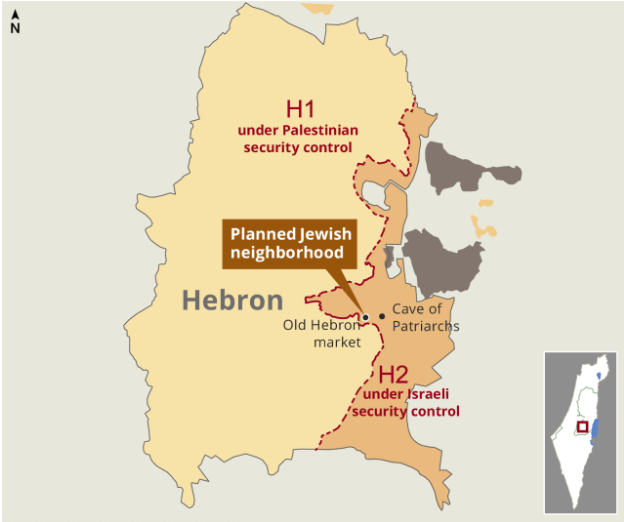
Map by Haaretz
On December 1st, Israeli Defense Minister Naftali Bennet sent a letter to the Hebron Municipality giving the Municipality 30 days to sign off on Israel’s plan to build a new settlement over an historic Palestinian marketplace in downtown Hebron, and threatening that the state will initiate legal proceedings to strip the Municipality of its protected tenancy rights in the marketplace if it does not accept the plan.
Haaretz explains the contention that the state made in the letter:
“The Israeli custodian of government and abandoned property in the West Bank claims that government has a legal basis to evict the municipality from the market and as a practical matter, to lift its standing as a protected tenant since the municipality has another marketplace at its disposal (the location of the other marketplace was not specified). The letter states that the municipality will retain its rights to the new property’s ground floor if it doesn’t oppose the plan…Samer Shehadeh, who represents the municipality, claims that Israel needs the municipality’s consent for its proposed plan because the protected status rights include the entire site, including air rights to build additional floors or demolish existing buildings. He disputes that there are legal grounds for rescinding the municipality’s standing as a protected tenant. ‘This letter is akin to a threat and an attempt to pressure the municipality to grant its consent to the move, but it will never happen,’ he said.”
Peace Now responded to Bennet’s letter, saying:
“The legal acrobatics have reached new heights when it comes to expanding the settlements. Ethical standards are being trampled to satisfy an extremist minority that wishes to deepen control and entrench the apartheid that exists in the Hebron settlement. This is an additional example proving the extent to which the occupation is messianic.”
On December 9th, the Palestinian Fatah party led a general strike in Hebron to protest Israel’s plan.
High Court Asks State to Consider (Maybe, Just Maybe, but Not Necessarily) Allowing Palestinians to Access their Land
On December 11th, the Israeli High Court of Justice asked the state to consider allowing Palestinian landowners to access their land which was previously stolen from them by settlers who built the Amona outpost. The state was given 15 days to consider and respond to the court’s request.
The illegal Amona outpost was evacuated by Israel in February 2017. Since then, the Israeli Civil Administration has classified the site as a “closed military zone,” preventing Palestinian landowners (whose legal ownership of the land Israel officially recognizes) from accessing their land. At the same time, Israeli settlers have repeatedly returned to the area attempting to reestablish the Amona outpost, and have even held IDF-protected celebrations there.
In January 2019, the Israeli NGO Yesh Din launched a legal petition to reverse the military order, restore access to the land for Palestinians, and enforce orders prohibiting settlers from trespassing on the land. In response, the state claimed that the order was meant to prevent friction between Palestinians and settlers (in effect, Palestinians are being barred from access to their own land in order to placate settlers who stole the land from them in the first place). The recent ruling was given in response to this case.
New ICC Report Expresses “Concern” Over Israeli Annexation; Palestinian Groups Slam Report as Legitimizing the Fragmentation of Palestine
On December 5th, the Office of the Prosecutor of the International Criminal Court (ICC) released a report providing an update on all the current inquiries before the court, including a section on the nearly 5-year preliminary investigation into “The Situation of Palestine.”
In the report, ICC Chief Prosecutor Fatou Bensouda states that the preliminary investigation is nearly complete (a statement she also made in the 2018 version of the same report), and, notably, expressed concern about Israel’s plan to annex the Jordan Valley. The latter remark reportedly prompted Israeli Attorney General Avichai Mandleblit to warn Netanyahu that moving forward with his plan to annex the Jordan Valley is likely to trigger the opening of investigations into IDF officers and Israeli settlers.
At the same time, Palestinian rights groups slammed the new report on several counts, most substantively centered on the report’s treatment of the Gaza Strip as separate from the West Bank and East Jerusalem. In a lengthy and detailed statement, civil society groups Al-Haq, Al Mezan, and PCHR said:
“Our organizations reject and condemn in the strongest manner what can only be described as a territorial reordering by the Office of the Prosecutor, in describing the West Bank and East Jerusalem as under the ‘control’ of Israel, and therefore occupied territory, while presenting the Gaza Strip separately as an area of ongoing hostilities. This assessment is manifestly out of step with agreed international positions on the status of the West Bank, East Jerusalem and the Gaza Strip as comprising the occupied Palestinian territory since 1967, as determined by the myriad of UN Human Rights Council Resolutions, UN General Assembly Resolutions, UN Security Council Resolutions, the in-depth findings of UN Commissions of Inquiry, and an Advisory Opinion of the International Court of Justice. Our organizations remind that the territory of the West Bank, East Jerusalem and the Gaza Strip is internationally recognized as one territorial legal unit. We further remind that the failure to include the status of the Gaza Strip as occupied territory resiles from previous reports of the Office of the Prosecutor, which consider that ‘the prevalent view within the international community is that Israel remains an occupying power in Gaza despite the 2005 disengagement’. As such, the report feeds into Israel’s fragmentation of the occupied Palestinian territory, for the purposes of its colonialist territorial expansion, a fragmentation that is further entrenched by the application of different legal regimes in the West Bank, East Jerusalem and the Gaza Strip, the denial of freedom of Palestinian movement through its construction of Annexation Wall and checkpoints in and around the West Bank and Jerusalem, military walls, fences, buffer-zones, watchtowers and drone surveillance surrounding and imprisoning over 2 million people in the Gaza Strip, where Israel also retains undisputed control over the territorial water and airspace. Additionally, Israel’s continued effective control over all Palestinians through, inter alia, the Population Registry, denial of family reunifications, denial of return of Palestinian refugees, denial of freedom of movement of people, goods and services throughout the occupied territory, and the division of the Palestinian population through a discriminatory ID system, have fragmented families for decades throughout the OPT.”
Netanyahu and Pompeo Discuss [or didn’t discuss?] Jordan Valley Annexation
Following their meeting on December 4th in Portugal, Israeli PM Netanyahu and U.S. Secretary of State Mike Pompeo had a diplomatic tiff over whether the two discussed Israeli annexation of the Jordan Valley.
Briefing reporters immediately following their meeting, Netanyahu said that they discussed annexation:
“[I] discussed with Pompeo the annexation of the Jordan Valley. Clearly it will be easier [if the Jordan Valley is annexed under] a government and not a transitional government which is much more complicated, we are looking for solutions.”
Responding to inquiries prompted by Netanyahu’s statement,, Assistant Secretary of State for Near Eastern Affairs David Schenker said:
“there was no annexation plan, full or partial, for any part of the West Bank was presented to – by Israel to the United States during the meeting.”
Cutting straight through the American diplomatic denial, Netanyahu clarified by telling the press that they did not discuss an annexation plan but they did discuss annexation:
“I want American recognition of our sovereignty in the Jordan Valley…It was said that we had not discussed a formal plan and that was true, but the issue was raised and I raised it with Secretary of State Pompeo and I intend to raise the issue with the Trump administration.”
As of this writing, there has been no further clarification from the United States.
Bonus Reads
- “When the Settlement Bloc Expands” (Haaretz)
Welcome to FMEP’s Weekly Settlement Report, covering everything you need to know about Israeli settlement activity this week.
To subscribe to this report, please click here.
June 21, 2019
- Court Awards Radical Settler Group Rights to Another Palestinian Home in Silwan, Evictions to Follow
- At Settler’s Urging, Silwan Streets To Be Named After Rabbis
- Who Profits Issues Critical Report on Industrial Zones in the West Bank, Slamming “Peace” Schemes Promoting Them
- B’Tselem Publishes New Resource on Israel’s Planned Mass Eviction of Palestinians from Wadi Yasul
- Greenblatt Supports Annexation, But Prefers Israel Hold Off Until U.S. “Peace Plan” is Presented
- Bonus Reads
Questions or comments? Contact Kristin McCarthy at kmccarthy@fmep.org.
Court Awards Radical Settler Group Rights to Another Palestinian Home in Silwan, Evictions to Follow
On June 18th, the Jerusalem District Court ruled that the radical Elad settler organization is the legal owner of an apartment and adjacent storefront in the Silwan neighborhood of East Jerusalem long inhabited by members of the Palestinian Siyam family. With the ruling, Elad can evict members of the Siyam family from the apartment and store – increasing settler control over the building where other members of the Siyam family will still live. The court also ordered the Siyam family to pay 10,000 NIS (~$2,700 USD) in court costs.
Elad has waged an eviction campaign against the Siyam family for over 30 years, bringing six different legal cases asserting the organization’s ownership of the building. Making the ruling sting even more for the entire Silwan community, Jawad Siyam – who will be one of the only remaining Palestinian apartment owners living in the building after the ruling this week – is a prominent community activist in Silwan fighting against settlement activities in the neighborhood.
The legal saga – detailed here by Peace Now – shows just how determined Elad has been to gain ownership of the building at the expense of its longtime Palestinian tenants. Elad used seemingly every legal mechanism available, hoping that one would do the trick. Fortunately for Elad, the Israeli Custodian of Absentee Property General (which conspired with Elad to legally sell the rights to ¼ of the building) and Israeli court system (which allowed Elad to exploit Israeli law and set new precedents at the expense of Palestinian residents of Jerusalem) were willing to help the settler organization achieve its goal.
Following an earlier ruling against the Siyam family regarding this same case, Peace Now succinctly explained:
“This case is an example of how the settlers manage to take control of Palestinian property in East Jerusalem by combining manipulations, money, forgery and significant aid from the Israeli authorities. It is not a regular case between equal sides, but a story of David and Goliath, and the settlers are the Goliath. There is a settlers organization with almost unlimited financial resources and enormous political power against an ordinary Palestinian family that has been forced into court for more than 20 years, to invest tremendous resources in legal defense and to deal with various and varied purchase claims. This way the settlers are causing great damage to Israel when they harm the delicate fabric of life in Jerusalem and the possibility of compromise in Jerusalem and a two-state solution.“
As FMEP chronicles on a near weekly basis, Silwan is one of the most intense areas of settlement activity in East Jerusalem. Its location – literally in the shadow of the Temple Mount/Haram al-Sharif – and historic significance make the neighborhood the focus of intense efforts by radical groups like Elad and Ateret Cohanim to displace Palestinians and replace them with Israeli Jews.
In addition to the threat of mass eviction of Palestinians in Silwan, Elad and Ateret Cohanim are also working hand in hand with the many branches of the Israeli government to build tourist attractions and infrastructure designed to hide, marginalize, and over-write the presence and history of the area’s Palestinians. In particular, the Elad-linked cable car project – which was recently advanced through another phase of the planning process despite professional objections – is intended to further entrench settler activities and tourism sites inside Silwan, while simultaneously delegitimizing, dispossessing, and erasing the Palestinian presence there.
At Settler’s Urging, Silwan Streets To Be Named After Rabbis
In a powerful statement of contempt for Palestinians residents of the Silwan neighborhood of East Jerusalem, and an equally powerful statement of support for the activities and agenda of hardline settlers groups targeting of Silwan, the naming committee of the Jerusalem Municipality voted to name five streets in the Silwan neighborhood of East Jerusalem after deceased Jewish rabbis. Notably, the population of Silwan remains overwhelmingly Palestinian, despite a decades-long, energetic effort by extremist Jewish groups, with Israeli government support, to increase the number of Israeli settlers living in their midst – an effort that is proceeding with greater energy and government backing today than perhaps at any time since 1967.
The renaming of the streets was opposed by a professional advisory panel, which warned that the move will increase tensions; that it will be essentially futile, because the names will not be used by the local population; and that, most basically, “it is inappropriate to give Jewish street names in neighborhoods overwhelmingly populated by Arabs.”
Jerusalem Mayor Moshe Leon heads the committee that decided in favor of renaming the streets, an initiative led by the radical settler group Ateret Cohanim. Settlers requested the move in recognition of a small Jewish-Yemenite community that lived in Silwan 80 years ago.
Who Profits Issues Critical Report on Industrial Zones in the West Bank, Slamming “Peace” Schemes Promoting Them
In a new report, the anti-occupation Israeli NGO Who Profits examines the illegality of 91 industrial zones that Israel has built in the occupied territories, and also names international corporations operating in them, in contravention of international law.
Summing how the issue relates to current politically driven “peace” proposals, Who Profit writes:
“Industrial Zones are held up by corporations and Israeli politicians as being part of the framework of ‘economic peace’. It is argued that they provide employment opportunities for Palestinians and form spaces of interaction and coexistence between Palestinian and Israeli workers. Shraga Brosh, the head of the Manufacturers Association of Israel, noted that the employment of Palestinian workers ‘aids security in the region and advances economic peace’. This claim was rejected outright by the United Nations Office of the High Commissioner for Human Rights in a 2018 report and by some 82% of Palestinian workers who stated that they would leave their jobs in the settlements, if there were another choice.”
B’Tselem Publishes New Resource on Israel’s Planned Mass Eviction of Palestinians from Wadi Yasul
In a new brief, B’Tselem provides essential context for Israel’s imminent eviction of Palestinians living in the East Jerusalem neighborhood of Wadi Yasul, where every single home has a standing demolition order issued against it. The publication also includes interviews with several of the Palestinians whose homes in Wadi Yasul have already been demolished.
B’Tselem writes:
“Ever since 1967, planning policy in Jerusalem has been geared toward establishing and maintaining a Jewish demographic majority in the city. Under this policy, it is nearly impossible to obtain a building permit in Palestinian neighborhoods. The outline plans the city has prepared for these neighborhoods are largely aimed at restricting and limiting building opportunities in Palestinian neighborhoods. One way the plans do so is by designating vast areas as open green spaces, thereby barring Palestinians from building there. The resulting housing shortage forces Palestinian residents to build without permits. At the turn of the millennium, the city estimated that about 20,000 housing units had been built without a permit in East Jerusalem. This estimate was made before the Separation Barrier cut off Kafr Aqab and Shu’fat Refugee Camp from the city. Since that time, many high-rises have been built in those areas.”
Greenblatt Supports Annexation, But Prefers Israel Hold Off Until U.S. “Peace Plan” is Presented
In an interview is an Israeli news outlet, U.S. Envoy Jason Greenblatt said he would prefer that Israel delay annexation of the West Bank until after the U.S. presents the long-anticipated “Deal of the Century.” The interview was one in a series of media hits for Greeblatt ahead of the U.S.-conceived economic conference in Bahrain; at an event with New York Times columnist Bret Stephens and American provocateur Rabbi Shmuley Boteach, Greenblatt reiterated his belief that settlements are not an obstacle to peace.
Unsurprisingly, Israeli political figures continue to call for Israel to take advantage of Trump’s tenure in office to annex West Bank territory. At the Jerusalem Post’s recent conference in New York City, Israeli Deputy Minister of Foreign Affairs Tzipi Hotovely told the audience that it is time for Israel to apply sovereignty over all of Area C. Hotovely made the case:
“Using the term annex is not true. You annex something that is not yours. This is not a story of annexation. This is a story of realization. Many ask what’s next, what’s going to happen, what’s going to change [after the annexation of Area C]. For 52 years, we were feeding this myth of occupation. It’s a myth. It’s not true.”
Former Israeli Justice Minister Ayelet Shaked also spoke at the Jerusalem Post conference, also urging Israel to annex Area C while Trump is in office. Following her speech, Shaked tweeted:
“There is no better time than now. Do not miss Trump’s reign – that’s what I just said at the Jerusalem Post in New York.”
Back in Israel, senior Likud figure Gidon Saar tweeted:
“Recent statements by senior US officials indicate that there’s an extraordinary window of opportunity to apply Israeli law to our settlements in Judea, Samaria, and the Jordan Rift. We’ll do everything not to squander [the opportunity].”
Bonus Reads
- “First They’ll Take Area C, Then They’ll Take the West Bank” (Haaretz)
- “Annexing East Jerusalem, First Step Before Annexing the West Bank?” (Al-Monitor)
- “West Bank is a long-established goal” (The National)
Welcome to FMEP’s Weekly Settlement Report, covering everything you need to know about Israeli settlement activity this week.
To subscribe to this report, please click here.
April 19, 2019
- Israel Demolishes Palestinian Homes in East Jerusalem…While Re-writing the Law, and the zoning, to Cater to Settlers
- After Meeting with U.S. Ambassador, Jerusalem Mayor Predicts “Restrictions” on Settlement Plans Will Be Lifted
- U.S. State Department: Distinguishing between Settlers & Palestinians is “Discriminatory”
- Wild, Wild West Bank: Settler Nearly Downs IDF Plane Over West Bank
- Israel Reinstates Ability of East Jerusalem Palestinians to (Try to) Prove Land Ownership Claims
- Palestinian-Americans Continue Legal Case Against Settlements Despite AirBnB Reversal
- IDF Helps Cover Up Execution of a Palestinian
- Bonus Reads
Israel Demolishes Palestinian Homes in East Jerusalem…While Re-writing the Law, and the zoning, to Cater to Settlers
With the approval of the Supreme Court, on April 17th Israeli police began demolishing Palestinian buildings in the Wadi Yasul neighborhood of Silwan. The reason for the demolitions: the buildings lack legally-required Israel-issued building permits – which cannot be obtained by Palestinians the land in question has been designed by Israel as the “Peace Forest” [a designation that does not permit the Palestinians to build, even on their own land]. The “Peace Forest” was established by the Jewish National Fund following the 1967 war, on privately owned Palestinian land expropriated by Israel.
Map by Ir Amim
The Israeli NGO Ir Amim warns that the fate of these buildings likely signals the implementation of 63 additional demolition proceedings against Palestinian buildings in the same area, which could result in the wide scale demolition of 60 Palestinian homes, impacting approximately 500 Palestinians.
Importantly, for over a decade, Palestinians in Wadi Yasul have worked with architects and lawyers to try to obtain Israeli-issued permits to build in the area. Those plans and requests were rejected in 2008 because, according to Israel, they contradicted zoning laws for the “Peace Forest.”
On April 13th, the Israeli Supreme Court ruled against Palestinian appeals to stop the demolitions, appeals which challenged the self-evidently discriminatory patterns of Israel’s planning regime in East Jerusalem. Supreme Court Justice Yosef Elron explained the court’s decision to reject Palestinian petitions without even considering claims of discrimination. As Haaretz noted, Justice Elron in effect said that the criminal justice system is not the place to discuss whether or not the Jerusalem municipality discriminated against the residents and avoided planning the neighborhood, which in turn prevented them from getting building permits for their homes [which raises the question: does Justice Elron believe Palestinian residents of East Jerusalem have any other venues where they can expect to obtain justice?].” Rather, Justice Elron argued:
“I believe that the appellants’ claims that the defendant [Israel] discriminates against local [Palestinians] residents, and avoided advancing any zoning plan, are irrelevant to a discussion in the context of criminal wrongdoing. From the request in front of me I see that the residents are seeking a zoning plan for their needs and that should be welcome. But these efforts cannot retroactively legitimize so much illegal construction or justify any delay in carrying out demolition orders.”
Underscoring the brazen political motivations behind land-related decision in Jerusalem, even as Israeli officials have consistently refused to grant building permits for Palestinians to build on their own land in the area designed as the “Peace Forest,” and even as Israeli officials have actively pursued demolitions against the Palestinians living there, the radical settler group Elad has been engaged in its own illegal construction inside the “Peace Forest” for over 14 years. Rather than pursue demolitions, the Israeli government has worked with Elad to pursue every avenue to allow the retroactive legalization of Elad’s illegal construction. Even more brazenly, in tandem with the demolition of Palestinian homes in the area, Israeli officials have been working with the Elad to rezone the “Peace Forest” [something it refused to do for Palestinians] in order to allow the Elad to build a commercial/tourist project for tourists (a zipline).
Haaretz recently explained how Jerusalem authorities have repeatedly assisted Elad in its illegal activities:
“At first the NGO simply trespassed and built illegal structures there [the “Peace Forest”]. But things changed and gradually various local and national bodies – including the Jerusalem Municipality, the Israel Land Authority, the Tourism Ministry and the JNF – began to grant Elad assistance. This assistance has included granting building permits retroactively, allocating land to the group without a proper bidding process, and generous funding to the tune of tens of millions of shekels… It has been sponsoring activities in the Peace Forest since 2005, despite the fact that it has no ownership rights there or permits from the ILA (the legal owner of the land, which was expropriated from private Palestinian owners).”
Ir Amim explains:
“The scope of settlement projects in the vicinity of Wadi Yasul – and the breadth and depth of state support awarded to Elad, including authorities’ overt efforts to retroactively legalize unpermitted building – illuminate the stark discrimination in planning that empowers the expansion of radical settlement inside Palestinian neighborhoods while putting their native residents at risk of displacement.”
After Meeting with U.S. Ambassador, Jerusalem Mayor Predicts “Restrictions” on Settlement Plans Will Be Lifted
This week, Jerusalem Mayor Moshe Lion told the settler-run outlet Arutz Sheva:
“…I know what I want to accomplish, I know which projects the city needs – and the most important thing is to build, and I cannot do that alone. I need the Israeli government standing behind me, because we need a Jewish majority here, and we need to end the net negative migration. We need more young couples to move here…I sat down with the US ambassador to Israel, and we discussed the issue. I think that in the coming years, we’ll build a great deal in Jerusalem, and there won’t be a need for restrictions in this matter.”
Since Trump took office, Israel has advanced numerous controversial and devastating East Jerusalem/Greater Jerusalem settlement plans which had previously been held up due to international pressure (mainly from the U.S.), including in Ramot/Ramat Shlomo and a slew of plans in Sheikh Jarrah neighborhood of East Jerusalem. Based on this track record, and clear signals from the Trump Administration in support of Israel’s claim to Jerusalem and the West Bank, it is unclear what if any “restrictions” the Trump Administration is imposing on construction in Jerusalem.
What is clear is that, to date, the Israeli government has refrained from moving on either of the two most problematic East Jerusalem/Greater Jerusalem settlement schemes, E-1 and Givat Hamatos – construction of either of which would represent a fatal obstacle to the realization of the two-state solution. That argument, however, may be nearing its sell-by date, given the increasing sense that Israel and the Trump Administration are getting set to formally walk away from that solution (accompanied by what appears to be the increasingly likelihood that Israel will annex part or all of the West Bank).
U.S. State Department: Distinguishing between Settlers & Palestinians is “Discriminatory”
In the wake of the drama over Airbnb (and its decision to walk back its policy of not listing rental properties in settlements, newly appointed U.S. Envoy to Monitor & Combat Anti-Semitism, Elan Carr was asked by reporters on April 11th whether he made a distinction between boycotts of Israel and boycotts of settlements. In his response, Carr not only rejected the distinction, but went on to tell reporters distinguishing between settlements and neighboring Palestinians communities in the West Bank to be discriminatory (and implied that this discrimination between, in his words, “Jewish communities” and “Arab communities,” is based on anti- Semitism).
This position ignores the fact that Israeli settlements are illegal under international law (not surprising, given that the Trump Administration has made clear it views international law as irrelevant in the context of Israel and the occupied territories). But it also ignores an even more obvious fact that cannot be simply dismissed: Israel, as a matter of both policy and law, treats Israeli settlements and neighboring Palestinians communities differently. FMEP’s Lara Friedman summarized the situation for the UN Security Council in 2016, and the situation has only become magnified today:
“Israeli law follows Israeli citizens who enter or live in the Occupied Territories. This means that Israeli settlers live under Israeli law – no different than if they were living inside Israel – while Palestinians live under military law. This policy has created a dangerous and ugly political reality in the occupied territories – a reality in which two populations live on the same land, under different legal systems, separate and entirely unequal, with the governing authority serving one population at the expense of the other. One population is comprised of privileged Israeli citizens, enjoying the benefits of a prosperous, powerful state, with their rights guaranteed by a democratic government accountable to their votes. The other population is comprised of disenfranchised Palestinians, living under foreign military occupation explicitly designed to protect and promote the interests not of Palestinian residents of the territories, but of Israeli settlers.”
A transcript of the briefing reads:
QUESTION: Just to follow up… do you make a distinction between boycotting Israel per se and boycotting products that are produced in the settlements that’s considered illegal under international law?
MR CARR: So refusing to buy products made by Jewish communities and wanting to buy products made by Arab communities that live next door to each other seems to me to be discriminatory. That seems pretty clear to me.
QUESTION: But this is settlements. Settlements under international law is illegal. So I’m just – I’m trying to figure out, from a legal point of view, do you see that – okay, is it considered —
MR CARR: Like I said, if two communities are living side-by-side and one refuses to buy from Jews and one wants to buy from non-Jews, I think that’s pretty clear what that is.
…
QUESTION: Again, off the back of my colleagues’ questions, just to clarify: So the legal element about where Jewish settlements stand in international law as opposed to Arab villages makes no difference to you whatsoever?
MR CARR: Well, as you know, there is a peace plan being worked on currently, hasn’t been unveiled. The United States has long cared about this issue and on resolving the issues between Israel and its Palestinian neighbors in a way that’s fair for everybody. Resolution of those issues is not going to come about by attempting to strangle the Jews out of existence in their communities. That’s not how you’re going to get peace. And so I want to thank the administration for focusing on this issue, and all the work the White House is doing to try to really promote a plan that would finally have – get us to an agreement where the Israelis and the Palestinians can live side-by-side in peace.
Wild, Wild West Bank Skies: Settler Nearly Downs IDF Plane Over West Bank
A settler nearly flew his helicopter into an IDF transport plane conducting a training exercise in the Jordan Valley. The settler, Yedidya Meshulami, was charged with several crimes involved with illegally flying his helicopter and endangering lives in West Bank airspace, which is controlled by the Israeli military.
The IDF is no stranger to Meshulami and his illegal aerial activities. A former Israeli reserves pilot, in March 2018 Meshulami attempted to take control of the Qalandiya checkpoint in Ramallah by landing his helicopter nearby, declaring “I don’t care what they do to me, I’ll take it [the checkpoint] over.” Following his arrest and release to house arrest, the IDF confiscated two helicopters and an ultralight plane from Meshulami’s personal airstrip, which he built illegally in an outpost near the Itamar settlement, south of Nablus.
Israel Reinstates Ability of East Jerusalem Palestinians to (Try to) Prove Land Ownership Claims
One month after the Jerusalem Planning & Building Committee annulled the “mukthar protocol” – the only means by which Israel permits Palestinians to prove their land ownership claims in East Jerusalem – the committee reversed itself and will once again allow Palestinians to use this protocol as a valid legal basis for land ownership claims. Likewise, the committee will resume considering building permit applications that rely on the procedure. Without the mukthar protocol, and without building permits, Palestinians cannot legally build anything in East Jerusalem.
The “mukhtar protocol” was developed by the Israeli government as an alternative to the formal land-registration process, necessitated by the fact that Israel froze that process for land in East Jerusalem in 1967. The procedure requires Palestinian East Jerusalemites to collect signatures from local Palestinian leaders acknowledging that the land in question is, indeed, owned by the claimant.
Radical settler groups including Regavim campaigned to invalidate the mukhtar protocol, with the obvious goal of preventing development and improvement in East Jerusalem Palestinian communities. The protocol was reportedly reinstated following appeals to Jerusalem Mayor Moshe Leon by a city council member. Haaretz reports that even though the mukhtar protocol has been reinstated, Jerusalem municipal officials suggested that they would be changing the makeup of the mukhtar committees.
Palestinian-Americans Continue Legal Case Against Settlements Despite AirBnB Reversal
Palestinian-Americans are moving to continue their legal claim against Israeli-Americans who own property in Israeli settlements and rent those properties on the AirBnB platform. Their lawsuit – which was filed not as a stand-alone case, but as an intervention in the Silber vs. AirBnB case brought by Israeli-Americans against AirBnB – was put in jeopardy when AirBnB reversed its decision to delist rental properties in West Bank settlements, a reversal which had the effect of settling the Silber vs. AirBnB case. With the help of the Center for Constitutional Rights (CCR), the Palestinian-Americans have asked a judge to permit their legal claims to proceed.
The Center for Constitutional Rights explained:
“Today [April 11th], attorneys representing Palestinian landowners and West Bank residents urged a federal judge to permit their claims against Israeli settlers to proceed in the lawsuit over Airbnb’s listing of properties in illegal settlements in the West Bank. Dual Israeli-U.S. citizen settlers sued Airbnb after the booking platform announced its decision to remove the rentals. Palestinian landowners—including those who possess documents establishing their ownership of the land on which the rentals sit—moved to intervene in the case. A dual Palestinian-U.S. citizen, who cannot rent the properties because they are in Jewish-only settlements, also moved to intervene. The Palestinian intervenors also sought to countersue the settlers. The intervenors have argued that the Israeli settlers’ actions constitute war crimes, crimes against humanity, and discrimination on the basis of religion and national origin, as well as trespass and unjust enrichment. In today’s filing by the Center for Constitutional Rights, human rights attorneys argued that allowing the dismissal of the lawsuit before considering the motion to intervene would prejudice the intervenors’ rights.”
CCR Attorney Diala Shamas said:
“Our clients, Palestinians directly affected by these Airbnb postings, intervened in the lawsuit precisely because they have significant interests at stake, and to prevent an outcome that utterly ignored those interests. To dismiss this lawsuit without even considering the intervenors’ claims would be yet another affront to the rights of people who have had their land stolen and who have been discriminated against on the basis of their religion and national origin.”
IDF Helps Settlers Cover Up Execution of a Palestinian
An investigation by B’Tselem reveals that the IDF helped settlers to cover up evidence of their execution of a Palestinian man on April 3, 2019. The incident was widely covered by the press as an attempted stabbing. In fact, video evidence and eyewitness testimony show that two settlers opened fire on 23 year-old Muhammad ‘Abd al-Fatah while he was laying wounded on the ground. When the IDF arrived on the scene, the soldiers sought out and deleted surveillance footage captured by nearby businesses; they also dispersed Palestinians who gathered near the scene with stun grenades. No arrests were made.
B’Tselem reports at length:
“At 8:30 A.M. that morning, Muhammad ‘Abd al-Fatah…stopped by a dumpster across from the village square in the nearby village of Beita and started throwing stones at cars bearing Israeli license plates that were heading from the direction of Huwarah towards the village of Za’tarah and Tapuah Junction. ‘Abd al-Fatah threw stones at two passing cars and then threw a third stone, which hit a car. The driver, an Israeli named Yehoshua Sherman, pulled over. Then two gunshots were heard, apparently fired from inside the vehicle. The driver then got out of the car. At that point, ‘Abd al-Fatah was crouching among the dumpsters. Sherman approached him and fired several more shots at him. A truck driving along the road also stopped, and the driver got out. He came over to stand next to Sherman, and the two men fired several more shots at ‘Abd al-Fatah, who was lying wounded on the ground…Minutes after the two settlers opened fire, Israeli military jeeps arrived on the scene and soldiers used stun grenades to disperse the crowd that had begun to gather. Immediately after that, about eight soldiers went into two nearby shops to check their security cameras. They dismantled a DVR in one of the shops and left. About twenty minutes later, the soldiers returned to the shop, reinstalled the DVR and watched the footage. Two soldiers filmed the screen with their mobile phones. They then erased the footage from the DVR and left…The Israeli security forces that arrived on the scene ignored these facts. They did nothing to arrest the two settlers, promptly drove the Palestinians away from the scene, and then addressed the urgent task of eliminating any footage of the incident, to ensure that the truth never comes to light and the shooters would not face any charges or be held accountable in any way. The identity of both shooters is known. If the authorities so choose, they could easily track them down, at least for questioning. Yet given the troops’ conduct immediately after the incident, and Israel’s longstanding policy, the chances of this are slim to none.”
Bonus Reads
- “The True Cost of Israeli Settlers’ Annexation Dream” (Haaretz)
- “Who needs Bennett when Netanyahu is already annexing the West Bank?” (+972 Mag)
- “Stop Calling it Annexation” (+972 Mag)
- “The Illusion of Trump’s Mideast Peace Plan” (The American Prospect)
- “Easter Travellers to the Holy Lands Should Avoid Supporting Israel’s Settlement Tourism Industry” (Huffington Post)