Welcome to FMEP’s Weekly Settlement Report, covering everything you need to know about Israeli settlement activity this week.
To subscribe to this report, please click here.
November 8, 2019
- Israel Advances Plans for 2,342 New Settlement Units
- Israeli Government Approves Settler-Initiated Plans for Cable Car in Jerusalem — Despite Professional, Human Rights Objections
- Israel Plans to Build a New Waste Treatment Plant (to serve Israelis) in the West Bank
- No More Waiting: MKs Introduce Annexation Bills Despite Political Deadlock
- Annexation-via-New Roads (the new Smotrich Plan)
- Annexation-via-Movies (Govt-Funded Settlement Hasbara)
- Annexation-via-Education (Ambassador Friedman’s Favorite Medical School)
- Settler Leaders Elect New Chairman of the Yesha Council
- Israeli Official Calls on Evangelicals to Defend Settlements, Fight BDS, and Support “Economic Peace”
- Bonus Reads
Questions/comments? Contact Kristin at kmccarthy@fmep.org
Israel Advances Plans for 2,342 New Settlement Units
With little attention, on October 10th the High Planning Council – a body within the Israeli Defense Ministry’s Civil Administration, responsible for regulating all construction in the West Bank – advanced plans for 2,342 new settlement units, as well as for two additional settlement projects. Of that total, 719 units were approved for validation (the penultimate step in the planning process), and 1,623 settlement units were approved for deposit for public review (an earlier but decisive stage in the planning process).
The 719 units which received final approved for validation comprise:
- 207 units in the Bracha (aka Har Bracha) settlement, located south of Nablus. In September 2019, the Israeli Central Command signed an order that expanded the settlment’s jurisdiction, a move which paved the way for the approval of these new units (see our September 2019 report). According to Peace Now, this plan – if implemented – will significantly expand both settlement’s population and its physical footprint.
- 206 units in the Tzofim settlement, located north of the Palestinian town of Qalqilya – a town completely encircled by Israel’s seperation barrier (except for a single road connecting it to the rest of the West Bank) – in the northern West Bank.
- 166 units in the Alei Zahav settlement, located in a string of settlements stretching across the northern West Bank. Alei Zahav and its settlement neighbors create a contiguous Israeli populated areas linking Israel proper (west of the Green Line) all the way to the Ariel settlement, located in the heart of the West Bank (the eastern end of Ariel is closer to the Jordan border than to the Green Line). Notably, Alei Zahav is one of the settlements in which the “market principle” has been applied to legalize settlers theft of land recognized by Israel as belonging to Palestinians (see our July 2019 report).
- 140 units in the Mezadot Yehuda settlement, located at the very southern tip of the West Bank, just south of the Palestinian village of Susya, which the Israeli government has been threatening to demolish for years. This plan would nearly double the number of authorized units in the settlement.
Also receiving final approval for validation:
- A plan to retroactively legalize the illegal Brosh outpost in the Jordan Valley. According to Peace Now, the Brosh settlement serves as an educational institution that houses hundreds of students and families of staff members.
- A plan to build a tourist/visitors center in the Shilo settlement – where settlers and the Israeli government have been investing in developing tourism sites for Jewish and evangelical tourists.
The 1,623 units which were deposited for public review include:
- 609 units in the Beitar Illit settlement, located west of Bethlehem, near the Green Line. Beitar Illit is a massive, fast-growing ultra-Orthodox settlement.
- 382 housing units in the Dolev settlement, located west of Ramallah. This is a significant plan for Dolev, as it will more than double the number of existing units. Prime Minister Netanyahu previously promised to build 300 new units in Dolev in response to a Palestinian-perpetrated bombing at a spring (which settlers had taken over from Palestinians) near the settlement that killed a 17-year old Israeli and injured several others.
- 182 units in the Mevo’ot Yericho settlement, located north of Jericho in the Jordan Valley. The validation of this plan is the actualization of the Israeli security cabinet decision to grant the illegal outpost of Mevo’ot Yericho retroactive legalization, an action for which the security cabinet urgently convened on the eve of the September 19th elections. The plan approved by the High Planning Council on Oct. 10th granted legalization to the existing 20 existing units and, if implemented, will allow the settlement to significantly expand.
- 146 units in the Kfar Etzion settlement, located southwest of Bethlehem.
- 140 units in the Kerem Reim outpost located north west of Ramallah. Peace Now has repeatedly challenged the illegal construction of the Kerem Reim outpost, which the Israeli government retroactively legalized by declaring it a neighborhood of the Talmon settlement even though the areas are non-contiguous. Though a court rejected one Peace Now petition, there is an ongoing case against the Amana settler organization which Peace Now alleges engaged in illegal activities to build the outpost.
- 100 units in the Nokdim settlement, located southeast of Bethlehem. Former Israeli Defense Minister Avigdor Liberman – currently one of the most important figures in the race to form a governing coalition – lives in Nokdim.
- 64 units in the Telem settlement, located west of Hebron.
- A plan to build new shops and services in the Kochav Yakov settlement, located between Jerusalem and Ramallah.
Peace Now said in a statement:
“The figures speak for themselves. Netanyahu continues to sabotage the possibility of a political agreement with the Palestinians by promoting more settlement construction in the West Bank, including in places where Israel may have to evacuate as part of a future agreement. This is yet another dangerous step for both Israel and the Palestinians, led by a transitional prime minister whom the public did not trust in his policies. The next government must put a freeze on the development of settlements and to strive for immediate resumption of negotiations with the Palestinians without preconditions and to end the bloody conflict based on the principle of two states for two peoples.”
The European Union issued a statement criticizing the approvals, saying:
“The European Union’s position on Israeli settlement policy in the occupied Palestinian territory is clear and remains unchanged: all settlement activity is illegal under international law and it erodes the viability of the two-state solution and the prospects for a lasting peace, as reaffirmed by UN Security Council Resolution 2334. Israeli authorities also approved a building permit for the construction of a new tunnel road, which bypasses Bethlehem to the west. The progressive construction of a separate road network, connecting settlements and outposts to each other and to the road network in Israel while circumventing Palestinian towns and communities, is entrenching the fragmentation of the West Bank. The EU calls on Israel to end all settlement activity, in line with its obligations as an occupying power. The EU will continue to support a resumption of a meaningful process towards a negotiated two-state solution, the only realistic and viable way to fulfil the legitimate aspirations of both parties.”
Israeli Government Approves Settler-Initiated Plans for Cable Car in Jerusalem — Despite Professional, Human Rights Objections
On November 4th, the Israeli Housing Cabinet approved a settler-initiated plans to build a cable car line in East Jerusalem, despite the fact that the Israeli Attorney General has not yet rendered a decision on whether plans for such a significant and sensitive project can be advanced by a caretaker Israeli government. Emek Shaveh – an Israeli NGO fighting the politicization of archeology in Jerusalem – announced that it intends to appeal the approval to the Israeli Supreme Court.
As FMEP has repeatedly covered, this Jerusalem cable car project is an initiative of the Elad settler organization (which is building a massive tourism center – the Kedem Center – in the Silwan neighborhood, which will be a stop along the cable car’s route). The scheme is intended to further entrench settler control, via archeology and tourism sites, inside the Silwan neighborhood of East Jerusalem, while simultaneously delegitimizing, dispossessing, and erasing the Palestinian presence there. Non-governmental organizations like Emek Shaveh, Who Profits, and Terrestrial Jerusalem have repeatedly discredited the government’s contention that the cable car serves a legitimate transportation need in Jerusalem, and have clearly enumerated the obvious political drivers behind the plan, the archeological heresies it validates, and the severe impacts the cable car project will have on Palestinian residents of Silwan.
Ir Amim field researcher Aviv Tartarsky told Middle East Eye:
‘The project is a way to whitewash Israel’s taking of areas in Silwan to use for archaeological and touristic reasons…If someone wants to go to the Western Wall of the Old City, they have to go through the ELAD activity centre. This project will give ELAD legitimacy and influence, as it is taking part in a governmental project. This is the political reason for why the government is doing this project,’ Tatarsky said.”
Israel Plans to Build a New Waste Treatment Plant (to serve Israelis) in the West Bank
In October 2019 the Israeli government issued a construction tender to build a waste-to-energy plant in the West Bank, on an area of land that is within the jurisdiction of the Ma’ale Adumim settlement where several Palestinian Bedouin communities live. The plant – which is expected to cost USD $284 million (1 billion NIS) – will treat Israeli-generated waste.
B’Tselem – which previously published a comprehensive report criticizing the illegal Israeli practice of exporting its waste to the occupied territories – writes:
“For many years, Israel has been taking advantage of its power as occupier to transfer the treatment of waste (including hazardous waste) and sewage from its sovereign territory to the West Bank. To that end, it has created a situation in which environmental legislation in the West Bank is much laxer than inside Israel, conveniently overlooking the long-term impact of environmental hazards on the Palestinian population and on natural resources, and neglecting to prepare future rehabilitation plans. This has created a financial incentive to transfer the treatment of environmental hazards from Israel to the West Bank. The Palestinians who live in the occupied territory are the ones to pay the price for this environmental damage, even though they were never asked their opinion on the matter and although, as a population under occupation, they have no political power and no real ability to resist.”
B’Tselem also takes aim at the European Union (EU), which has invested millions in the implementation of the Isareli Ministry of Environmental Protection’s 2030 strategic plan, of which the waste-to-energy treatment plant is a part. B’Tselem writes:
“In 2019, Israel and the EU signed an agreement as part of the EU’s twinning instrument, which establishes cooperation with the EU’s neighboring countries, guaranteeing Israel approximately 1.5 million euros over the next two years to support the Ministry of Environmental Protection’s implementation of its 2030 strategic plan. In the agreement, Israel committed to creating a legal framework that adopts European practices and standardization for sustainable waste treatment. As in every agreement between the EU and Israel, it contains a territorial clause that stipulates that it will not apply beyond Israel’s 1967 borders. Yet the EU’s support for the ministry’s strategic plan – which defines the establishment of the plant at Ma’ale Adumim as a goal and presents the exploitation of West Bank land to resolve environmental problems as a matter of course – empties this annex of meaning. By supporting this plan, the EU will be supplying Israel with knowledge and experience that will help deepen its exploitation of Palestinian land resources and bolster the economic status of the Ma’ale Adumim settlement.”
No More Waiting: MKs Introduce Annexation Bills Despite Political Deadlock
Israeli political figures appear to be done waiting for a new government to be formed before acting on the loud signals from the Trump Administration supporting Israeli annexation of West Bank land.
On November 4th, Yamina party leader Ayelet Shaked filed a bill with the Knesset to unilaterally annex the Jordan Valley, the Ma’ale Adumim settlement just east of Jerusalem, and all 22 settlements and 75,000 Israeli settlers in what is broadly termed the Etzion “settlement bloc” located south of Bethlehem. Shaked’s bill calls for Israel to “apply sovereignty” to these settlements, which in practice would constitute the annexation of the settlements. Applying Israel law to areas outside of Israel’s sovereign borders is de facto annexation, as FMEP has explained and documented.
Shaked urged expeditious consideration of the bill, saying:
“There is a diplomatic window of opportunity and willingness on the part of the US for this kind of annexation that will not return. We cannot afford to hesitate or wait. We must take advantage of this window of opportunity immediately and begin to apply sovereignty over these areas. It is for this reason that the State of Israel cannot be dragged into another election cycle.”
On November 3rd, Likud MK Sharren Haskel submitted a draft bill for the annexation of the Jordan Valley, a bill she has introduced previously without success. Haskel said:
“It’s time to make the residents of the Jordan Valley legal Israeli citizens, thus kick-starting the development and prosperity of the region.The communities of the Jordan Valley and their residents are a strategic resource of the highest order for Israel. There is a wide consensus today about the region, following the long-awaited U.S. president’s recognition of the Golan Heights as under Israeli sovereignty. It is time to do the same with the Jordan Valley. After Blue and White leader Benny Gantz proposed to do the same, I call upon him and my fellow party members to support my proposal.”
In March 2019, ahead of the first round of Israeli elections this year, leaked reports suggested that U.S. diplomats were engaged in discussions with Israel about the latter’s intention to annex several “settlement blocs” – even more so-called blocs than called for by Shaked’s latest plan – following the elections. The reports were not corroborated by U.S. sources, but in the intervening time U.S. Ambassador to Israel David Friedman has made repeated statements to the press (in addition to speculative reporting about a forthcoming U.S. political plan) in support of Israel’s right to annex territory in the West Bank – cues the Israeli government has enthusiastically welcomed. In the lead-up to the September elections, Netanyahu vowed to annex the Jordan Valley should he be reelected, a plan endorsed by his rival Benny Gantz and supported by then-U.S. National Security Advisor John Bolton.
As a reminder, over the years there has been no shortage of attempts to normalize the idea that Israel will retain “settlement blocs” in any negotiated peace agreement — logic that originally applied narrowly to the Etzion bloc (defined on much less expansive terms), Maale Adumim, and, in the eyes of some, Ariel. The terminology has been exploited for decades by the Israeli government to convey legitimacy to building in the so-called “blocs.” Over the years the definition of what is a “bloc” has been twisted to include a much larger idea of the Etzion bloc, as well as the entire Jordan Valley. The implied idea regarding what the blocs are and the fact that they are inarguably Israel’s to keep, is incredibly misleading. The term “settlement blocs” has no formal definition or legal standing, and the future of the blocs – no matter how they are defined – is indisputably a matter at the heart of what will one day be negotiations aimed at a two-state solution (if there is ever to be such a solution). For more context, see resources from Americans for Peace Now here and here. (NOTE: A Haaretz investigation last year estimated that a total of 380,000 Israeli settlers live in the West Bank, of which 170,000 live outside of the so-called blocs, as defined by Haaretz).
Annexation-via-New Roads (the new Smotrich Plan)
On November 1st, Israeli Minister of Transportation Bezalel Smotrich unveiled a new government plan to advance Israeli “sovereignty through transportation.” The plan calls for massive investment (USD $283 million) in new/expanded roads and rails lines, for the express purpose of more seamlessly integrating Israeli settlements into Israel proper. Smotrich made clear that his ultimate goal is the complete integration of the West Bank into the national planning mechanisms of Israel proper. The move will erase the government’s current distinction between transportation projects in the West Bank (across the Green Line) and Israel proper [fun note: the Israeli Ministry of Foreign Affairs has an official map posted on its website entitled, “Transportation and Built-Up Areas” that includes the entire West Bank as part of Israel).
Touting the significance of his plan, Smotrich said:
“I do not give preference to Judea and Samaria [the West Bank] but also am not willing to continue the discrimination. These areas will receive treatment just like anywhere else in Israel. While it is only about roads and trains, it has political significance.”
Smotrich created a new bureau for “Judea and Samaria Planning” within the Transportation Ministry to oversee the implementation of this project, and more generally ensure that the ministry is geared towards serving the settlements as a matter of normal business. The institutionalization of such bureaucratic structures within the Israeli government is a significant, and often overlooked, mechanism by which the Israeli government has been engaging in annexation for years. The new bureau – much like parallel structures former Minister Ayelet Shaked set up in the Justice Ministry – is a formal and public statement that the Israeli government is pursuing (and allocating resources to) annexing the settlements.
It should be noted that Israel has used infrastructure projects in the West Bank to advance its settlement agenda, and to further fragment Palestinian life – two completementary goals powerfully explained by B’Tselem in a recently released interactive: “Conquer and Divide: The Shattering of Palestinian Space by Israel.”
FMEP tracks developments related to the ongoing annexation of West Bank land in its Annexation Policies Tables.
Annexation-via-Movies (Govt-Funded Settlement Hasbara)
On November 6th, Israeli Cultural & Sports Minister Miri Regev announced new government funding for film projects initiated by Israeli settlers. According to the guidelines, the new funding will support Israeli citizens living in West Bank settlements who want to make documentaries and films.It is widely understood that the goal is to encourage the creation of more pro-settlement propaganda.
Celebrating her new initiative, Regev essentially admitted that annexation was her motive, saying:
“I made a promise and I am keeping my promise! We are making history today. The Culture and Sports Ministry will support the regional production of films in the north, and for the first time in Judea and Samaria too, and in the hope that in the near future also in the south… The wheels of cultural justice, which bring to expression the range of voices in Israeli society, have worked quickly and now another stage in correcting the cultural map in Israel has been completed. The artists from the periphery, the north and from Judea and Samaria, will become more and more in the center of things, not just on stage but also on the screens. Soon we will allow them to express their ability and talent.”
One critic of the fund, Israeli producer Liran Atzmor, nailed why the new fund is highly problematic and a tool of de facto annexation:
“Setting up a fund that supports filmmaking in the occupied territories with Israeli taxpayers’ money amounts to creeping annexation, which is happening in many areas, obviously, but is happening now more forcefully in the realm of culture, thanks to this fund. As long as the fate of those territories has not been determined, one cannot accept the fact that public funds are distributed there to people of only one color, one nationality and one religion.”
Shlomo Eldar writes:
“…And that is the whole point, to show life in the settlements in a positive light, as a Zionist enterprise glorifying the State of Israel. Head of the Samaria Regional Council Yossi Dagan described the fund as a ‘giant piece of good news. … I believe this move will bring the story of Judea and Samaria to the big screen. … I call on all artists to take part in this party, to come and film in Judea and Samaria and tell its story, so that we can present the public with other faces and other stories that have yet to be seen on the screen’.”
Libby Lenkinski, Vice President of the New Israel Fund, explained in a tweet:
“Creeping annexation and normalization of settlements is not just happening on the land, it’s also a narrative strategy that uses arts and culture funding to move forward. #StopAnnexation”
Annexation-Via-Education (Ambassador Friedman’s Favorite Medical School)
Despite delays and scandals, the sparkling new medical school at Ariel University has officially launched its first school year, with a ceremony attended by a who’s-who of settlement financiers and supporter rejoicing in the opening of the school and in the implications of its opening for the Greater Israel enterprise.
Dr. Miriam Adelson and her husband, Trump-backer/U.S. casino magnate Sheldon Adelson, were in attendance. The Adelsons donated $20 million to the medical school, which was named after Miriam. Addressing the crowd, Dr. Adelson said:
“In Israel, being Israel, we also had to withstand our tribulations. In Israel, being Israel, there were opponents who tried to block the establishment of a critical institution on ancient Jewish land and to deny us legitimacy. But we won, Zionism won, the truth won.”
U.S. Ambassador David Friedman recited the “shehecheyanu,” a prayer of gratitude to God, as part of his speech, also exclaiming:
“A new medical school has opened in Samaria. It’s worth saying that again: A new medical school has opened in Samaria! How many people ever thought those words would be spoken?…The United States Embassy enjoys warm relations with Ariel University, and we are inspired by its contributions to Israeli society and to the scientific world.” [NOTE: “Samaria” is a biblical name used mainly by settlers and their allies to refer to the northern part of the West Bank]
MK Naftali Bennet put an even finer point on the significance of opening a medical school in Ariel settlement, saying:
“No longer is there a Green Line. We are one [united] Israel and that is how it should be. We are going to serve everyone here.”
There are 70 Israeli students enrolled to attend the settlement university. Even though classes are set to begin, the medical school still does not have an approved budget for the 2020 school year.
As a reminder, the Ariel settlement is located in the heart of the northern West Bank, reaching literally to the midpoint between the Green Line and the Jordan border. The future of Ariel has long been one of the greatest challenges to any possible peace agreement, since any plan to attach Ariel to Israel will cut the northern West Bank into pieces. Nonetheless, in February 2018, the Israeli Knesset passed a law extending the jurisdiction of the Israeli Council on Higher Education to universities in the settlements (beyond Israel’s sovereign borders) – an act of de facto annexation. The law was necessary to ensure that the Ariel settlement medical school (and its graduates) would be entitled to all the same rights, privileges, and certifications as schools and students in sovereign Israel. FMEP has tracked this process, and all other annexation policies in its Annexation Policy tables. A fuller history of the Ariel Medical School saga can be found here.
Settler Leaders Elect New Chairman of the Yesha Council
David Elhayani was narrowly elected to serve as the next Chairman of the powerful settler Yesha Council – an umbrella body representing all the settlement regional councils. Elhayani is a well known personality, having served for 10 years as the head of the Jordan Valley Regional Council (a quasi municipal body serving the needs and interests of settlements in the Jordan Valley).
The Times of Israel’s settlement correspondent Jacob Magid explains the relevant politics involved behind Elhayani’s narrow victory over Yigal Lahav, a younger, more radical voice:
“Elhayani and Lahav represented opposite sides of an intensifying rift between an older generation of settler leaders that is closely aligned with Prime Minister Benjamin Netanyahu and a younger group of council chairmen who believe in acting more aggressively on behalf of the movement, even if that means being at odds with right-wing governments that the Likud chief has led. Elhayani, from the old-timer’s camp, edged out Lahav 13-12 after the votes of 24 West Bank council chairman plus settler elder Zeev ‘Zambish’ Hever were counted.”
Elhayani addressed the dynamics of the old guard (of which he is a part) vs. new, more radical, guard ahead of the elections, saying:
“There’s a crisis of trust in the Yesha Council where many council chairmen don’t see the body as being capable of serving the needs of their residents. Many council chairmen don’t show up to Yesha meetings at all.”
Elhayani promised a more “aggressive” demeanor so that those the Council represents will see that they “finally have someone who will fight for them.” So, despite being what some settlers may consider the “mainstream,” i.e. less willing to aggressively challenge the perceived slow-walking of settlement expansion and annexation by the Israeli government, Elhayani is still best understood as an ideologue in his own right.
Ahead of the vote, Elhayani did offer strong criticism of what he sees to be the Isareli government’s discrimination against the settlements, saying that he will fight for better “quality of life”for the settlements – making infrastructure as a core part of his agenda:
“Our residents are sick of the poor infrastructure that has led to power outages, water shortages and traffic jams. It is the responsibility of settler leadership to provide adequate services. You cannot improve quality of life until you improve infrastructure. We still need to be aggressive in demanding infrastructure improvements in the meantime, in addition to preventing a Palestinian takeover of Area C so that there will be something to [annex] when the time comes.”
Israeli Official Calls on Evangelicals to Defend Settlements, Fight BDS, and Support “Economic Peace”
Speaking to an audience of leaders in the evangelical media world, a top Netanyahu aid asked the crowd to join Israeli government efforts to defend the legitimacy and permanence of the settlements, and coached the crowd on how to frame settlements in a way that advances their normalization.
This was the third annual “Christian Media Summit” hosted by the Israeli Government Press Office to develop the group into “ambassadors for Israel.” According to Haaretz, the 2019 event was attended by approximately 150 journalists, mostly from the United States, working for Christian media outlets from 30 different countries. Entitled, “Between Jerusalem and the Golan: International Recognition,” the event featured addresses by Benjamin Netanyahu and President Reuven Rivlin. U.S. Ambassador David Friedman attended as well.
Speaking to the group, Deputy Chief of Foreign Affairs Reuven Azar said:
“The return of Jews to Judea and Samaria is not a curse, it’s a blessing for all the residents of the area…Calling for their expulsion is a recipe for destruction and for chaos… Look what happened when we went out of Gaza. Our presence in Judea and Samaria [the West Bank], and in Jerusalem brings stability… because we bring security by fighting the bad guys…We must partner in embracing our brothers and sisters who live in Judea and Samaria, and fight against those who claim their presence is illegal, or try to dehumanize them through different means. Help us to fight boycotts, they are not just, and they hurt us and they hurt our neighbors even more. ‘The revival of the Jewish people in the land of Israel is a divine promise being fulfilled…It is a blessing for our people, our region, for the world. A force for good, a force for peace, prosperity and happiness’.”
Following his remarks, the Front for the Protection of Democracy – an Israeli NGO – filed a complaint with the Civil Service Commission seeking disciplinary action against Azar. The Prime Minister’s Office quickly came to Azar’s defense, saying: “Political adviser Reuven Azar expressed government policy.”
Azar repeatedly referred to settlements as “communities” – a term that erases the illegality of those “communities” under international law. This pro-settlement framing was recently endorsed by outgoing U.S. advisor Jason Greenblatt. Azar also touted the now familiar but Orwellian claim that settlements are an economic gift to the Palestinians, claiming that “communities [settlements] in Judea and Samaria [the West Bank] provide opportunities, and jobs…” Azar invited the audience to visit the Barkan industrial zone, stating: “The best paying jobs for Palestinians are in Barkan.”
As FMEP has previously explained, for decades Israel has used industrial zones as another tool to expand and deepen control over West Bank land and natural resources. Industrial zones perpetuate Israel’s economic exploitation of occupied territory (including the local workforce, land, and other natural resources), and that it is Orwellian to label such initiatives as “coexistence” programs, or to suggest that they offer the Palestinians benefits they should welcome. Importantly, jobs in industrial zones – often the only jobs available for Palestinians living under an Israeli occupation that prevents the development of any normal Palestinian economy – are widely viewed by Palestinians as a double-edged sword.
Bonus Reads
- “Five Settlers Arrested on Suspicion of Attacking Israeli Policemen at West Bank Outpost” (Haaretz)
- “Israel’s Right New Bank – The Jewish National Fund” (Haaretz)
- “Why did Microsoft fund an Israeli firm that surveils West Bank Palestinians?” (NBC News)
- “Israeli Schools Teach Pro-settler Religious Nationalism Is the Only Way to Be Jewish” (Haaretz)
- “A Wall, Arrests and Close Surveillance: How Israel Fences in a Palestinian Family” (Haaretz)
- “Hilltop Youth Battle The IDF Over Expulsion Order “ (JNS)
- “Welcomed, then Attacked by Yitzhar” (New Voices)
Welcome to FMEP’s Weekly Settlement Report, covering everything you need to know about Israeli settlement activity this week.
To subscribe to this report, please click here.
August 9, 2019
- Summary: Another Week, Another Round of Major Settlement Approvals
- Israeli Annexation via Settlement Construction Unleashed, Part 1: Three Outposts are “Legalized”
- Israeli Annexation via Settlement Construction Unleashed, Part 2: Final Approval for 648 New Settlement Units
- Israeli Annexation via Settlement Construction Unleashed, Part 3: Plans Advanced for 1,466 New Settlement Units (With More to Come)
- Israeli Annexation via Settlement Construction Unleashed, Part 4: Reactions
- Following Murder of Settler Youth, Netanyahu Doubles Down on Commitment to Settlements
- Latin Patriarchate Files Suit Claiming New Proof of Fraud Behind Settler Takeover of Old City Hotel Properties
- Education Minister Strips Key Committee Membership from Professor Who Objected to Authorization of Settlement Medical School
- Bimkom Report: Israel’s “No Construction Zone” Adjacent to the Separation Barrier Has Little To Do With Security
- Ir Amim: Israel’s Crackdown in Issawiya Advances Settlement Project in East Jerusalem
- Terrestrial Jerusalem In-Depth Report: The Silwan Tunnel Project
- Bonus Reads
Questions or comments? Contact Kristin McCarthy at kmccarthy@fmep.org.
Summary: Another Week, Another Round of Major Settlement Approvals
During its quarterly convening on August 5th and 6th, the Israeli Defense Ministry’s High Planning Council advanced plans for a total of 2,304 new settlement units. This includes:
- the approval of plans legalizing 190 units that have the effect of retroactively legalizing 3 unauthorized outposts;
- final approval for the construction of 648 settlement units; and
- interim approval (i.e., a step toward final approval) for the construction of 1,466 new settlement units
These approvals comes on the heels of the Israeli Security Cabinet’s decision to issue 6,000 building permits for settlement units last week (details of which are still unpublished). The past week of massive settlement advancements is a clearer-than-ever indication that Israel (with very public backing from top U.S. officials) is not holding back its illegal settlement activities and its ongoing annexation of the West Bank, particularly in Area C.
Details of this week’s approvals are broken down below.
Israeli Annexation via Settlement Construction Unleashed, Part 1: Three Outposts are “Legalized”
Plans advanced August 5-6 by the Israeli Defense Ministry’s High Planning Council In its decisions taken August 5th and 6th include at least 190 units in three illegal outposts — which have the effect of retroactively legalizing those three outposts. The outposts that gained retroactive approval this week are:
- Haroah Haivri – The council approved a plan for an educational institute and accompanying housing for students and staff. Most extraordinarily, Haroah Haivri, located just east of Jerusalem, is within eyesight of the Khan al-Ahmar community, which Israel is planning to demolish (forcibly relocating the Palestinian bedouin community that has lived there since the 1950s) — ostensibly because the structures in Khan al Ahmar were built without necessary Israeli approvals. The Haroah Haivri outpost was also built without the necessary Israeli approvals, but instead of demolishing the construction, Israel has retroactively legalized it — demonstrating once again that, when it comes to administering the occupation, Israel prefers “rule by law” – where law is turned into a tool to elevate the rights/interests of one party over another, over the democratic rule of law.
- Ibei Hanachal – The Council approved 96 units in this outpost, located southeast of Bethlehem, turning it into a “neighborhood” of the Maale Amos settlement. In reality, the outpost is not contiguous with the built-up area of the Maale Amos settlement, meaning that the implementation of this plan will, in effect, create a distinct new settlement (for coverage of this plan, see here) .
- Givat Salit – The Council approved 94 units in this outpost, located in the northern Jordan Valley, as part of turning it into a “neighborhood” of the nearby Mechola settlement.
The legalization of these three outposts only adds to the success of Israel’s ongoing and increasingly successful effort to retroactively legalize all illegal settler construction in the West Bank (that is, construction undertaken illegally under Israel law; all settlement construction is illegal under international law). The lengths to which Israel has gone to in order to achieve that goal include inventing new legal grounds — some outlined by the government’s “Zandberg report” and another – the “market regulation principle” identified by the Isareli Attorney General — that in effect allow Israel to suspend the rule of law and erase private property rights of Palestinians. For the past 2.5 years, FMEP has documented this campaign in detail in its Annexation Policies Tables – regularly updated and available online.
Israeli Annexation via Settlement Construction Unleashed, Part 2: Final Approval for 648 New Settlement Units
The actions taken this week by the High Planning Council include issuing final approval for 648 settlement units – mostly new construction but also some approval of existing construction that had been undertaken without approval (all of this is in addition to the 190 units in outposts legalized retroactively). Details of these approvals for new settlement construction are as follows:
-
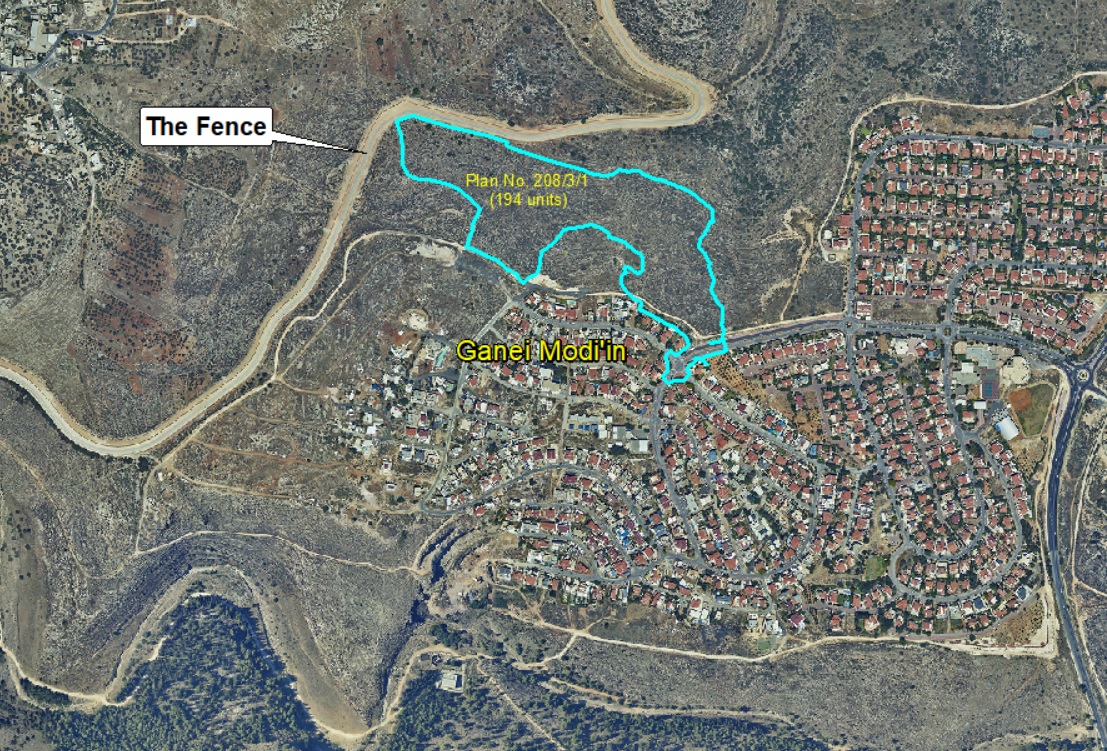
Map by Peace Now
194 units in the Ganei Modlin settlement, located in the northern “seam line zone” in the West Bank but on the Israeli side of the security barrier (by design of the Israeli government). The plan for 194 new units will bring the settlement’s built-up area directly up to the separation barrier, a particularly notable plan given Israel’s recent demolition of 70 Palestinian homes in the West Bank, based on the argument that the construction within a 200-250 foot Israeli-imposed “no construction zone” on either side of the barrier poses an unacceptable security risk to Israel. Israel rejected an offer by Palestinians to privately finance the construction of new and higher wall near the buildings; developers behind the Ganei Modlin project also offered to finance the construction of high wall near the construction, an offer the courts saw fit to accept – resolving the matter in the eyes of the High Planning Council, which approved the plan.
- 96 units in the Kiryat Netafim settlement, located in the northern West Bank and part of a string of settlements and unauthorized outposts – most notably Ariel – extending from the Green Line into the very heart of the West Bank and on towards the Jordan Valley.
- 76 units in the Beit Hagai settlement, located just south of Hebron,
- 66 units in the Efrat settlement, located south of Bethlehem. Efrat had already received final permission for 1,000 new settlement units at the most recent High Planning Council meeting, in April 2019. As a reminder, Efrat is located inside a settlement enclave that cuts deep into the West Bank. Efrat’s location and the route of the barrier wall around it, have literally severed the route of Highway 60 south of Bethlehem, cutting off Bethlehem and Jerusalem from the southern West Bank. The economic, political, and social impacts of the closure of Highway 60 at the Efrat settlement (there is literally a wall built across the highway) have been severe for the Palestinian population.
- 61 units attached to an educational institute in the Gva’ot settlement, located south of Bethlehem. The Gva’ot (Gevaot) settlement was established as an outpost of mobile homes, and later benefited from Israel’s unilateral, mass expropriation of Palestinian land in 2014 (which Israeli officials explictly said was done in response to a Palestinian terror attack). At the time, Peace Now reported that the move constituted the largest single expropriation of Palestinian land by the Israeli state in over 30 years.
- 51 units in Shvut Rachel, which only recently became an authorized settlement area when Israel extended the jurisdiction of the Shiloh settlement to include it as a “neighborhood” (along with three other outposts). The plans approved this week will retroactive legalize existing units and permit the construction of a few news one.
- 29 units in the Otniel settlement, located in the South Hebron Hills area. The plans serve to retroactively legalize existing units.
- 27 units in the Maskiyot settlement, located in the northern Jordan Valley. These units are part of a plan allowing the construction of a “bed and breakfast” with 27 additional rooms (and calling to mind Amnesty International’s recent report on the role tourism plays in supporting the occupation).
- 19 units in the Peduel settlement, located in the northern West Bank and part of a string of settlements and unauthorized outposts – most notably Ariel – extending from the Green Line into the very heart of the West Bank and on towards the Jordan Valley.
- 18 units and a park in the Ma’ale Adumim settlement.
- 11 units in the Einav settlement, located northwest of Nablus.
In addition, the Council gave retroactive approval for a controversial archeological site in the Shiloh settlement, located in the center of the northern West Bank. The Israeli government has devoted a significant amount of money and political energy towards building the tourist site, which is now drawing upwards of 60,000 evangelical tourists each year. For background on the site, see this Emek Shaveh report from 2014 and this brief from 2017, when the government approved the commercialization of the site. For analysis on how the site fits into a bigger pattern of Israeli efforts to normalize the settlements through tourism, see this report by Amnesty International.
Israeli Annexation via Settlement Construction Unleashed, Part 3: Plans Advanced for 1,466 New Settlement Units (With More to Come)
Actions taken August 5-6 by the Israeli Defense Ministry’s High Planning Council include advancing plans that, when they eventually receive final approval, will allow for the construction of 1,466 settlement units (details of the various steps of the planning/approval process are laid out by Peace Now here). Specifically, the Higher Planning Council this week approved the following plans for deposit for public review:
- 382 units in the Beit El settlement, located north of Ramallah. The plans include the retroactive legalization of 36 units; the remaining 346 are new units. As a reminder, Beit El is the settlement closely associated with U.S. Ambassador to Israel David Friedman, who among other things was the President of the “Friends of Beit El” organization, which raised money on its behalf.
- 354 in the Nili settlement, located in the northern West Bank;
- 200 units in the Asfar settlement, located northeast of Hebron. If approved, this plan will triple the size of the Asfar settlement.
- 168 units in the Talmon settlement, located north west of Ramallah. In December 2018, FMEP reported on a deadly encounter between neighboring Palestinians and settlers from Talmon and/or the many unauthorized outposts associated with it. The settlers had been attempting to takeover another hilltop on the outskirts of the Palestinian village of al-Mazra’ah al-Qibliyah. When Palestinians staged an attempt to stop the settlers from entering the area, a scuffle ensued and Israeli soldiers shot and killed two Palestinians.
- 132 units in the Kfar Adumim settlement, located east of Jerusalem and less than one mile from the Khan al-Ahmar bedouin community which the state of Israel is seeking to demolish.
- 84 units in the Shima settlement, located in the southern tip of the West Bank.
- 74 units in the Yakir settlement, located in the northern West Bank and part of a string of settlements and unauthorized outposts – most notably Ariel – extending from the Green Line deep into the West Bank.
- 48 units in the Bracha settlement, located south of Nablus.
- A recreational area in the Kochav Yaakov settlement, located just south of Ramallah.
In addition to the plans approved and advanced detailed above, the High Planning Council delayed consideration of two additional plans, which are:
- A plan that would effectively legalize another outpost, known as Brosh. Similar to the Haroah Haivri plan, discussed above, the plans relating to Brosh serve to retroactively legalize an existing educational institute. Approval of the plan was delayed because the Council had not resolved objections that were filed against the plan, including an objection filed by Peace Now.
A plan for 207 settlement units in the Bracha settlement, located near Nablus (these plans are in addition to the plans for 48 units approved to be deposited for public review, covered above). Though plan was on the Council’s schedule, it could not be approved because the Council first needs to approve the extension of Har Bracha’s existing settlement jurisdiction to include the area units are to be built. Since the plan calls for the construction of units outside of the existing area of jurisdiction, the plan could not be approved.
Israeli Annexation via Settlement Construction Unleashed, Part 4: Reactions
Following this week’s advancement of plans for 2,304 settlement units, settlement watchers and key members and bodies of the international community issued sharp criticism and sounded the annexation alarm bells. In contrast, there was glaring – and very, very, very predictable – silence came from the U.S. administration. A few notable reactions are included below.
Peace Now said in a statement:
“The approval of settlement plans is part of a disastrous government policy designed to prevent the possibility of peace and a two-state solution, and to annex part or all of the West Bank. The linkage of thousands of housing permits for settlers and a negligible number of housing units for Palestinians cannot hide the government’s discrimination policy. As a result, we see for example an approval of the illegal outpost (Haroeh Haivri) built for Israelis adjacent to the Palestinian bedouin village of Khan Al-Ahmar, for which the government refuses to approve any construction permits and instead seeks to transfer. Or we see, the approval of the construction of a new settlement neighborhood adjacent to the separation barrier after demolishing 72 housing units built adjacent to the separation barrier in Wadi Hummus, despite offering to fund security measures.”
The European Union issued a statement which reads:
“The EU expects the Israeli authorities to fully meet their obligations as an occupying power under International Humanitarian Law, and to cease the policy of settlement construction and expansion, of designating land for exclusive Israeli use, and of denying Palestinian development.”
United Nations Special Coordinator for the Middle East Peace Process Nickolay Mladenov said in a statement:
“The expansion of settlements has no legal effect and constitutes a flagrant violation of international law. By advancing the effective annexation of the West Bank, it undermines the chances for establishing a Palestinian state based on relevant UN resolutions, as part of a negotiated two-state solution.”
British Foreign Secretary Dominic Raab urged Israel to stop what he called:
“the effective annexation of the West Bank.”
Leilani Farha, the United Nations Special Rapporteur for the right to housing, and Michael Lynk, the United Nations Special Rapporteur for human rights in the Palestinian territory occupied since 1967, said in a statement:
“These settlement housing units are clearly meant to solidify the Israeli claim of sovereignty over the West Bank. Building civilian settlements in occupied territory is illegal, as is the annexation of territory. The international community has spoken out against the Israeli settlements, but it has not imposed effective consequences for the country’s defiance of international law. Israel’s actions indicate it plans to remain permanently and advance a claim of sovereignty. The Israeli Prime Minister made this clear when he said recently that: ‘No settlement and no settlers will ever be uprooted.’ Should we not take him at his word that Israel has no intention of complying with international law? Criticism without consequences is hollow. The international community has a wide menu of commonly-used countermeasures to push recalcitrant states into compliance with their international duties. If the international community is serious about its support for Palestinian self-determination and its opposition to Israeli settlements then, surely, the time has come for meaningful action.”
Israeli settlers, on the other hand, we filled with glee. Gush Etzion Regional Council Head Shlomo Ne’eman said in a statement:
“Thank God today we received approval from the Higher Planning Council for new housing units in Gush Etzion. Congratulations to all of our residents on the 200 units in Metzad, which is historic in that it will triple the size of the community. Congratulations on the final approvals for the Sadna institution, which works towards integration and is located in Gevaot, and will enable permanent construction of tens of units. Another major breakthrough is the final approval for Ibei Hanachal, which essentially fully legalizes the community and includes the construction of 96 permanent homes. These are major accomplishments for southeastern Gush Etzion, for the Jewish communities in the Judean Desert, and of course for all of Judea and Samaria. This is an opportunity for me to thank Prime Minister Netanyahu on this impressive accomplishment. Let’s hope that the trend of development and construction in Judea and Samaria continues full speed ahead.”
Following Murder of Settler Youth, Netanyahu Doubles Down on Commitment to Settlements
Following the murder of a 19-year old Israeli settler, Prime Minister Netanyahu vowed once again that he will promote settlement construction in all areas of the West Bank. Speaking at a ceremony marking the establishment of a new neighborhood of 650 units in the settlement of Beit El (which just saw plans for 382 new units advance, see above) Bibi said:
“We promised to build hundreds of housing units. Today we are doing it, both because we promised and because our mission is to establish the nation of Israel in our country. We know that the Land of Israel is bought in agony. Today another one of our sons fell. He was from a family that has already made a heavy sacrifice for the Land of Israel. These vicious terrorists: They come to uproot, we come to plant. They come to destroy, we come to build. Our hands will reach out and we will deepen our roots in our homeland – in all parts of it.”
Bibi’s words — which suggest an intention to continue/expand settlement construction across the entirely of the West Bank — did not satisfy many of his challengers on the Israeli right (against whom he is squaring off against in the upcoming election). Ayelet Shaked – who is leading a union of right wing parties – called directly for annexation. She said:
“We have to apply sovereignty to Judea and Samaria. Gush Etzion is in consensus and there is no reason not to apply sovereignty there.”
Knesset Speaker Yuli Edelstein (Likud) said:
“our response to the murder has to be [to] apply sovereignty on the settlements, starting with Gush Etzion.”
And the Sovereignty Movement – is an offshoot of the Women in Green organization, and has been working to formalize its expanding influence over Israeli politicians and public discourse by pushing for the establishment of a Knesset committee devoted to the cause of Israeli annexation of the West Bank – issued a statement saying:
“It is either us or them! This is a 52-year-old struggle that must be resolved. Sovereignty will bring resolution and will erase the hope of pushing us out of here through terror attacks. The resolution must be clear and unambiguous – we have returned to the heritage of our fathers, we will bring another million Jews here, we will build dozens of communities. The Arabs are invited to live under our sovereignty as individuals and enjoy a prosperous life as residents.”
Latin Patriarchate Files Suit Claiming New Proof of Fraud Behind Settler Takeover of Old City Hotel Properties
On August 5th, the Greek Orthodox Patriarchate in Jerusalem filed a request to reopen the underlying case in Jerusalem District Court which awarded the radical settler group Ateret Cohanim the ownership rights to three historic church properties in the Old City of Jerusalem. The Patriarchate’s appeal is based on new evidence of fraud committed by the Jerusalem settler organization Ateret Cohanim – with the aid of church officials – during the sale of the properties. The original Jerusalem District Court ruling acknowledged that there were problems in the transaction, but found that the church failed to prove its allegations of bribery and corruption.
The allegations of fraud rely on the testimony of Ted Bloomfield, a man who managed the Petra Hotel in the 1990s. Bloomfield reportedly told the Greek Patriarchate that Ateret Cohanim paid him to help persuade the Palestinian protected tenants to sell their rights. The lawsuit says these actions are “extraordinary in their severity” and include fraud, forgery of legal documents, and bribery – including alleged attempted sexual bribery. The church’s complaint also alleges that the settler group obstructed justice in deliberately concealing documents during legal proceedings.
Haaaretz recently published a moving video testimony of one Palestinian man, Abu-Walid Dajani, whose family has run the New Imperial Hotel, one of the targeted properties, since 1949. Dajani is now facing eviction.
Education Minister Strips Key Committee Membership from Professor Who Objected to Authorization of Settlement Medical School
The Haaretz Editorial Board penned a sharp criticism of newly appointed (and interim) Israeli Education Minister Rafi Peretz, who recently removed Professor Yossi Shain from the Planning & Budgeting Committee of the Higher Education Council. Shain was one of the members of the key professional committee – which essentially serves as the gatekeeper for schools hoping to join the ranks of accredited Isareli education institutions – who objected to the rushed and politicized process by which, in contravention to the Council’s normal practice, a medical school located in the settlement of Ariel received approval from the Higher Education Council.
The Editorial Board writes:
“The ‘revenge’ taken by Peretz against someone acting according to his professional judgment is a worrisome sign. The message conveyed by the education minister’s bureau is crystal clear: In education and academia, loyalty to the occupation and annexation project has become a decisive criterion.”
Bimkom Report: Israel’s “No Construction Zone” Adjacent to the Separation Barrier Has Little To Do With Security
In a new report, the Israeli NGO Bimkom sheds light on the very problematic regulation that was the legal pretext behind Israel’s recent demolition of 70 Palestinian homes in Wadi Hummos – i.e., the argument that the construction was located too close to Israel’s separation barrier.
Bimkom explains that in 2011, the Israeli military issued a “no construction order” to prevent construction close to the separation barrier, ostensibly on the basis of security considerations. The zone defined by the order ranges from ranges from 30 meters to 700 meters in different areas (on both sides of the barrier). Given that much of the barrier passes through the West Bank (meaning the land on both sides is Palestinian land), the cumulative impact on the Palestinians is significant. According to Bimkon, the total area affected by the no-construction order is approximately 195,000 dunams [48,185 acres/195km2] of land, belonging to 115 Palestinian villages.
While the order also (theoretically) impacts 15,000 dunams of land in areas where there are settlements located close to the barrier, the perimeter of the zone and enforcement against construction within it follows a predictable logic in favor of the settlements.
Bimkom writes:
“Similar to the barrier route, the no-construction order is determined such that its impact on settlement construction is minimal, but its impact on Palestinian villages is enormous. The negative impact of the physical barrier on hundreds of thousands of Palestinians is intensified expanded to hundreds of meters in which Palestinian construction is prevented. The potential for Palestinian development in Area C is already very limited, and the no-construction zone only serves to exacerbate the situation. In summary, it can be seen that the security considerations which are supposedly behind the construction ban are often questionable, and this also applies to Wadi al-Hummus. The obvious conclusion is that the security considerations according to which buildings in Areas A and B were demolished are a smoke-screen for political considerations whose purpose is to reduce the Palestinian population in the seam zone, especially in the Jerusalem region, or even to punish them for unrest in the area, according to army reports. The threat of demolition still hangs over Wadi al-Hummus, as there are a large number of other buildings that have received demolition orders and the court is scheduled to discuss their case in the coming months.”
Also, as detailed above, the inconsistency of Israeli policy when it comes to enforcing the “no-construction zone” was on display this week, as Israel approved the construction of 194 units in the Ganei Modlin settlement, right up to the barrier (discussed above). Whereas Israel rejected an offer by Palestinians in Wadi Hummos to privately finance the construction of new and higher wall near their buildings (and went ahead and demolished them), Israel authorities accepted an offer by developers behind the Ganei Modlin project to finance the construction of high wall near the construction, allowing expansion of a settlement to move ahead.
Ir Amim: Israel’s Crackdown in Issawiya Advances Settlement Project in East Jerusalem
In +972 Mag, Ir Amim researcher Aviv Tartarsky published a superb analysis of the ongoing campaign of daily harassment and intimidation Israeli authorities have unleashed against Palestinians living in the Issawiya neighborhood of East Jerusalem. Tatarsky writes:
“The campaign against Issawiya signals a new stage in Israel’s oppressive policies in East Jerusalem, and is part of the overall change in Israeli policy toward the Palestinians with the backing of the Trump administration. In the past, Israel primarily focused on settlement construction in the eastern part of the city. By building so-called ‘facts on the ground,’ the government intended to make it as difficult as possible to draw a border along the Green Line and create two capitals in Jerusalem. Today that focus has dangerously shifted to breaking apart Palestinian Jerusalem. Israel is pouring hundreds of millions of shekels into projects that will take over large parts of the the Old City and its surrounding neighborhoods, while fragmenting Palestinian territory and jeopardizing the Palestinian population. Neighborhoods such as Silwan, A-Tur and Sheikh Jarrah have seen an intensification of home demolitions and evictions on the one hand, while on the other the municipality has built promenades, heritage centers, and other tourist attractions for the Jewish settlers living inside Palestinian neighborhoods. Meanwhile, Israel is aiming to redraw the city’s municipal borders so as to push 120,000 Palestinians — more than a third of the city’s Palestinian population — out of the city. According to legislation advanced last year by Jerusalem Affairs Minister Ze’ev Elkin, neighborhoods such as Kufr Aqab, Ras Hamis and the Shuafat refugee camp — already separated from the rest of the city by the separation wall — will be drawn out of the municipal boundaries. Issawiya, then, portends what Israel has in store for the remaining Palestinian neighborhoods of Jerusalem: continual violence that has no aim other than oppressing and making life miserable for all who live there.”
Terrestrial Jerusalem In-Depth Report: The Silwan Tunnel Project
Terrestrial Jerusalem produced an essential in-depth report on Israeli and U.S. policy towards Silwan, offering important context and shedding new light on the significance of Ambassador Friedman and Jason Greenblatt’s political stunt alongside Elad in the tunnels underneath the neighborhood.
Danny Seidemann writes in the report’s introduction:
“The event was not merely dramatic. The choreography illuminated at one critical moment and in one critical space two apparently disparate dimensions of the Israel-Palestine conflict, and their current dynamics: the territorial skirmishing and the battle over narrative in Jerusalem. More than anywhere else, the settlement in Silwan embodies the significant changes taking place in the Old City of Jerusalem and its immediate environs. The opening tunnel was, superficially, a minor routine event that disclosed developments that are anything but routine. As such, it requires an in-depth analysis that takes a hard look at the event, its background and its consequences. In our three sectioned report, we will begin by examining the background and significance of the settlement in Silwan. In Part II, we will examine the tunnel, its archeological, historical and ideological significance and the context in which it was excavated. Part III will deal with the nature of the shift in US policy regarding Silwan, its sources and its ramifications.”
Bonus Reads
- “Goodbye withdrawal, hello sovereignty: The triumph of the settlers” (Times of Israel)
- “Peace Cast: Housing Rather than Ideology” (Americans for Peace Now)
- “How Ayelet Shaked, a secular woman, came to dominate the right-wing religious camp in Israel” (JTA)
- “India’s Settler-Colonial Project in Kashmir Takes a Disturbing Turn” (Washington Post)
Welcome to FMEP’s Weekly Settlement Report, covering everything you need to know about Israeli settlement activity this week.
To subscribe to this report, please click here.
May 31, 2019
- Israel Publishes Tenders for 805 Settlement Units in East Jerusalem; More May Be Coming
- The World Zionist Organization Continues to Finance Illegal Settlement Construction
- Yitzhar Settlers Attack Israeli Police Officers, Again
- Israel Cut-Off & Trapped a Palestinian Family on the Israeli Side of the Wall, Then Banned Them from Entering Israel
- Palestinians React to Latest Annexation Rumors Amidst Israeli Government Chaos
- Florida Governor Leads Headline-Grabbing Trade Delegation to West Bank Settlements
- Scheindlin: Israel’s Democratic Decay is Happening for the Sake of Annexation
- Bonus Reads
For questions and/or comments contact Kristin McCarthy – kmccarthy@fmep.org.
Israel Publishes Tenders for 805 Settlement Units in East Jerusalem; More May Be Coming
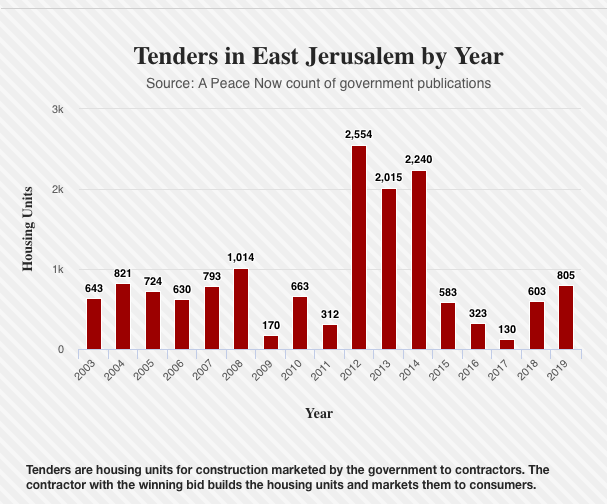 On May 30th, the Israel Land Authority published tenders for a total of 805 new settlement units in East Jerusalem, a decisive step towards the start of construction. The 805 tenders were issued for 345 units in the Ramot settlement and 460 new units in the Pisgat Ze’ev settlement. These are the first tenders published for East Jerusalem settlement construction since April 2018, and collectively are the most tenders published in a single year (let alone simultaneously) since 2014. Moreover, as Jerusalem expert Daniel Seidemann explains, this batch of tenders allows for more construction in East Jerusalem settlements than the government has approved for East Jerusalem Palestinian neighborhoods since Israel gained control of East Jerusalem in 1967.
Furthermore, the Jerusalem settlement watchdog group Ir Amim warns that this batch of tenders may only be the first of an oncoming wave:
“For several years after the collapse of the Kerry initiative in April 2014, there was a significant decrease in the approval of master plans in East Jerusalem and as a result, few tenders were announced. This dramatically changed in 2017 and 2018 with the advancement of master plans reaching near record levels. Today’s tenders are primarily a result of plan approvals from last year, potentially signaling impending large-scale announcements of tenders based on additional plans which have been approved over the last year.”
Peace Now, the veteran settlement monitoring organization, said in a statement:
“Continued construction in East Jerusalem does not contribute to Jerusalem and does not contribute to Israel. As long as we have not reached a permanent agreement with the Palestinians on Israel’s borders, building beyond the Green Line is illegitimate and only harms the prospects for peace and trust between the sides.”
The World Zionist Organization Continues to Finance Illegal Settlement Construction
According to documents acquired by Israel’s Movement for Freedom of Information, over the past two years the Settlement Division of the World Zionist Organization continued to finance illegal settlement construction while simultaneously trying to hide this information from the public.
As a reminder, the Settlement Division is technically part of the World Zionist Organization, but in practice the unit was created by the Israeli government in 1968 and is funded entirely by the Israeli government (and Israeli taxpayers). Its mandate is to manage West Bank land expropriated by Israel, in order to facilitate the settlement of Israeli Jews in the occupied territories. To make this possible, the Israeli government has allocated approximately 60% of all “state land” in the West Bank to the WZO’s Settlement Division [over the past 50 years Israel has declared huge areas of the West Bank to be “state land,” including more than 40% of Area C, where most of the settlements are located]. Together, the WZO and the Israeli government work in coordination to develop West Bank settlements and encourage Jews to move into them, working together so closely that the Settlement Division even splits its real estate profits with the Israeli Housing and Construction Ministry.
According to the WZO’s financial documents for 2017-2018, the WZO subsided settlement projects that are illegal under Israeli law — to the tune of $734,577 USD (NIS 2,668,427).
In addition, the WZO failed to specify how it spent an additional USD $16 million (NIS 58 million) in support of new construction projects, leaving the exact location and legal status of the construction unknown. This represents 43% of the WZO’s overall budget for subsidizing projects.
The settlement projects known to have been subsidized by the WZO in 2017-2018 include:
-
- $640,000 USD (NIS 2,330,973) for the establishment of a community center in the Eli settlement. Though the Eli settlement previously received Israeli government approval, a “Master Plan” – which officially zones land for distinct purposes (residential, commercial, public) – has never been issued for Eli, meaning all construction there is illegal under Israeli law.
- $85,816 USD (NIS 311,736) on projects in the unauthorized Brosh outpost (the Israeli government is advancing a plan that would legalize Brosh retroactively, but until it does, all projects in it are illegal).
- $42,000 USD (NIS 153,127) for infrastructure development in the unauthorized Givat Eitam/E-2 outpost, which according to Peace Now appears had not been transferred as of the end of 2018. FMEP has covered the settlers efforts to establish the Givat Eitam/E-2 outpost and the government’s plan to retroactively authorize it as an official settlement in detail. It is worth recalling that the location of the Givat Eitam/E-2 has dire geopolitical consequences for the fate of the two state solution as well as the development of Palestinian communities just south of Bethlehem.
- $6,000 USD (NIS 22,445) for projects in the unauthorized Mitzpe Kramim outpost. Funding for Mitzpe Kramim over the past two years is particularly galling, given ongoing litigation that has included evidence that the Settlement Division knowingly gave land privately owned by Palestinians to settlers in order to build the outpost.
- $900 USD (NIS 3,273) for renovation of illegal structures in the unauthorized outpost of Haresha. The Israeli government has successfully used the Haresha outpost as a test case for new legal tools the government of Israel developed in order to justify the expropriation of privately owned Palestinian land in order to retroactively legalize outposts. Using these tools, the government has found a way to “legally” build an access road to the settlement through privately owned Palestinian land; once the road is built, there is nothing preventing the government from retroactively legalizing Haresha.
Peace Now said in a statement:
“The Settlement Division is a body that was born in sin immediately after 1967 in order to carry out the dubious works of building settlements for the government. It turns out that even today, after regulating the activities of the Settlement Division, it still operates without transparency and continues to finance illegal activity. The time has come to dismantle the Settlement Division and to restore to the government the governmental activities it has privatized.”
Despite the WZO’s ongoing defiance of Israeli planning and building laws — or perhaps in light of its direct and very effective role in entrenching and expanding the settlements — the Israeli government is actively seeking to transfer more West Bank land to the WZO for management. In the last Knesset session, a government-backed bill to expedite the transfer of more land to the WZO was stalled by the Israeli Attorney General only because the bill, in the view of the Attorney General, was duplicative of his own efforts to enrich the Settlement Division at the administrative level.
Yitzhar Settlers Attack Israeli Police Officers, Again
On May 26th, dozens of masked Israeli settlers violently attacked Israeli police officers who approached an illegal outpost near the settlement of Yitzhar, forcing the Israeli army to intervene in order to get the police officers to safety.
Not a single settler was arrested for the attack.
The event started when Israeli police arrived at the Kippah Sruga outpost in response to calls saying that clashes had broken out between Palestinians and Israelis in the area. According to Israeli police, when they arrived masked settlers began launching stones at them and slashed their car tires with a knife.
Haaretz reporting on this incident reminds readers:
“Over the past several weeks, settlers from Yizhar and surrounding settlements have been involved in several altercations, yet police have not arrested a single suspect. Last week, Israelis and Palestinians reported a field set ablaze and clashes in the Palestinian towns of Burin, Urief and Asira al-Qibliya. In a video disseminated by Asira al-Qibliya’s council, settlers are seen throwing stones at Palestinians, while soldiers nearby do nothing to arrest them. In response to the video, the IDF spokesman said that ‘Palestinians started a fire near Asira al-Qibliya. The IDF, the Border Police and civilian volunteers worked to extinguish the fire, which was spreading towards a military position and the edge of Yitzhar.’ After a B’Tselem video surfaced, showing settlers setting fire to fields, the army revised its response and confirmed that Jewish settlers also took part in setting fires.”
Israel Cut-Off & Trapped a Palestinian Family on the Israeli Side of the Wall, Then Banned Them from Entering Israel
On May 27th, Haaretz published a gut wrenching profile of the Hajajla family who lives on the Israeli side of the separation wall that cut them off from their hometown of al-Walajah, a Palestinian village just south of Jerusalem. Two days after publication of the profile – which FMEP shares in brief below – Israel issued an order banning the patriarch of the family, Omar Hajajala, from entering Israel, though he lives on the Israeli side of the wall in a spot where the route of the wall juts into the West Bank.
Before jumping into the full story, here is a reminder about the situation facing all of the residents of al-Walajah, in the words of Danny Seidemann:
“Walajeh is a village on Jerusalem’s southern flank that is entirely surrounded by the separation barrier. Since 1967, Walajeh’s inhabitants have lived in a Kafka-esque situation, with their village technically located inside Israel’s expanded borders, but with villagers never given Israeli residency (they are considered West Bankers and thus are not permitted inside Jerusalem). As a result, the villagers’ presence in their own village is, under Israeli law, illegal, and their homes there are, by definition, illegal.”
The Hajajla family was the only home in al-Walajah disconnected from the village when the separation barrier was built, leaving the family home on the Israeli side of the wall since 2014. The family refused to abandon their home despite the coercive and legal efforts by Israel to force them to do so. In 2014, after a petition before the High Court of Justice, the Defense Ministry opted to build the family a special passage underneath the barrier so it could reach the village, at a cost $1.1 million USD (NIS 4 million).
After the tunnel was constructed, the Israeli government began to impose new, burdensome, and compounding restrictions on the family regarding its use of the passageway. In 2017, the government decided to install a locked gate at one end of the passageway to control who enters and exits, which could be opened only by a single remote control given to the family. That single remote meant that whenever one member of the family left the home (impossible without taking the remote control with them), the rest of the family was left trapped, literally, until the remote-holder returned.
To make the situation more workable, Omar Hajajla, the family’s patriarch rigged an electric bell near the gate so that the single remote control can stay at the house while family members leave and return (the bell enables someone in the home to know that someone is at the gate needing to be let in). The bell has been in place for over a year, but only recently the Israeli Border police opted to make it an issue. This month, the police took Omar in for questioning and changed the lock so that the family could not open the gate at all. Omar Hajajla was ultimately fined and released, but the lock on the gate remained — until Haaretz filed an inquiry on May 26, 2019.
Omar Hajajla speculates that a recent court ruling in his family’s favor prompted the Israeli Border police to escalate their harassment of the family and make an issue of the bell. About a month ago, the Jerusalem Magistrate’s Court rejected the state’s assertion that the family’s home is illegal – allowing the Hajajla family to stay put.(Note: The state of Israel has initiated demolition proceedings against dozens of homes in al-Walajah claiming that they were built without Israeli building permits – which are next to impossible for Palestinians to obtain, let alone Palestinians on coveted land like al-Walajah) –
In response to the May 27th Haaretz profile, Israeli police stated:
“At issue is a security passage that provides a short passage for the family from their home in Israeli territory to the Palestinian Authority areas. As you can see from the attached video and photos, the gate was shut last Monday to repair security cameras that were broken, to repair damage to the gate and to remove an electric bell that the father of the family had installed against the law, by attaching an unapproved electric wire from his home, a distance of dozens of meters from the passage. After the repair the passage was opened on Wednesday but when the father was seen exploiting it to illegally allow Palestinians to enter it was shut again and the suspect was taken for questioning. The passage was opened again yesterday, but because of a technical problem that was discovered it was shut again and we are working to fix it quickly. The Israel Police will not allow any damage to the security passages it is responsible for and will bring to justice anyone who vandalizes them and tries to harm the State of Israel’s security.”
The treatment of the Hajajla family should be seen in context of Israeli efforts to seal off al-Walajah from Jerusalem. As FMEP has previously reported, residents of al-Walajah have long been struggling against the growing encroachment the nearby Etzion settlement bloc and the Israeli government’s attempt to de facto annex the bloc as part of “Greater Jerusalem.” Ir Amim explains several prongs of this effort, including a particularly problematic section of the separation barrier around al-Walajah that has been planned in order to (a) almost completely encircle the village, (b) turn its valuable agricultural land into an urban park for Jerusalem, and (c) enable construction of a highway that will connect the Etzion settlement bloc to Jerusalem with Israeli-only bypass roads.
Palestinians React to Latest Annexation Rumors Amidst Israeli Government Chaos
Al-Monitor reports reactions from Palestinian leaders who are increasingly fearful that rumors about Israeli annexation of the settlements will be acted upon. Those rumors – as FMEP wrote last week – suggest that Israel will strip the Israel Civil Administration of its authority over the settlements and bring all settlements under Israeli domestic law, making settlement affairs the responsibility of the various Israeli ministries.
Wasel Abu Youssef, member of the PLO Executive Committee in the West Bank, told Al-Monitor:
“Expanding the powers of the Israeli ministries at the expense of the civil administration is an attempt to impose occupation and establish it in the West Bank, to end the [idea of a] two-state solution and prevent the establishment of a Palestinian state, which falls within the framework of denying the Palestinian people their rights to freedom and independence. These efforts mean practically annexing parts of the West Bank to Israel. Unfortunately, this comes with the blessing of the administration of US President Donald Trump, who doesn’t recognize the option of a two-state solution and gives Israel the green light to do whatever it wants in the West Bank.”
Walid Assaf, head of the Colonization and Wall Resistance Commission, told Al-Monitor:
“The efforts to transfer the powers of the civil administration to the Israeli ministries directly mean the annexation of the West Bank settlements to Israel. This will lead to annexing Area C — which amounts to over 60% of the entire area of the West Bank — to Israeli sovereignty…Annexing West Bank settlements to Israel would pave the way for Israel to perpetuate a policy of ethnic cleansing against the Palestinians, and this will push the Palestinians in Area C to migrate to PA-controlled Areas A and B.”
Hanna Issa, an international law professor at Al-Quds University in Abu Dis, told Al-Monitor:
“The Israeli occupation has always been there. It is essential that the Palestinian territories [including the Israeli settlements] remain administered through the civil administration of the Israeli army [in cooperation with the Palestinians] until this occupation ends…“Limiting the powers of this administration and giving its responsibilities to the Israeli ministries is a dangerous step aimed at annexing occupied areas under international law.”
Scheindlin: Israel’s Democratic Decay is Happening for the Sake of Annexation
In a new paper for The Century Foundation, Israeli pollster and political analyst Dahlia Scheindlin writes an important analysis regarding Israel’s path to annexation:
“This report argues that Israel’s slide into illiberal democracy can only be understood as part of an attempt to go beyond military or physical control and establish a political and legal foundation for permanent annexation of both land and people. The assault on Israel’s democratic norms over the past decade initially appeared only indirectly related to a future of permanent annexation, as they suppressed the mechanisms of dissent and undermined the basis for minority rights. Then, in the recent elections, Prime Minister Benjamin Netanyahu made explicit his goal to annex occupied territory in the West Bank, which represented the culmination (to date) of increasingly open policies and legislative initiatives from the previous term that explicitly advance annexation.”
The entire paper is worth reading, and is available online here.
Florida Governor Leads Headline-Grabbing Trade Delegation to West Bank Settlements
From May 25-31, Florida Governor Ron DeSantis led a trade mission – purposefully and prominently also visiting settlements in the West Bank. While on the ground, DeSantis made headlines by blasting BDS, endorsing Israeli settlements, and gloating about Florida’s role in AirBnB’s reversal of its decision to remove rental listing located in Israeli settlements.
DeSantis signed several formal partnerships between Florida universities and Israeli schools, most notably including an agreement between Florida Atlantic University and Ariel University – the first such deal between a U.S. school and an Israeli school located in a settlement. In recognition of the historic deal, Ariel University presented DeSantis with an Honorary Fellowship Award at an event in the settlement, attended by U.S. casino magnates and settlement financiers Sheldon Adelson and Dr. Miriam Adelson. In his acceptance speech, the Governor invoked the Bible to lend his support for Israel’s permanent control of the West Bank, saying:
“We are now in the heart of the Holy Land of Israel. When you think about Israel’s history and the tradition that connects Israel and the U.S., it’s inspiring. On my last visit to Israel in 2014, the U.S. embassy was in Tel Aviv and we were on the verge of signing a destructive agreement with Iran, and I am happy that today we have achieved real progress. We have an American embassy in Jerusalem with an American acceptance of the sovereignty of the State of Israel on the Golan Heights and the agreement with Iran has been removed from the stage of history. I, personally, have fought Airbnb’s discriminatory policy against Jewish-owned properties in Judea and Samaria, and only recently have they changed their discriminatory policy. I say here: BDS has no place in Florida. The memorandum of understanding signed today between the University of Ariel and Florida State University is a blessed agreement that will bring these two institutions forward. I am happy to say that Florida is a very diverse state, but not when it comes to its unequivocal support for the State of Israel.”
U.S. Ambassador to Israel David Friedman also hosted DeSantis for a reception and Israel’s Minister of Public Security Gilad Erdan joined DeSantis on a visit to additional West Bank settlements, this time in Gush Etzion, for a briefing about the fight against BDS. Friedman said:
“Israel has no greater friend in all the 50 governor mansions than Ron DeSantis. I welcome you and the Cabinet members and your delegation to this small but incredibly important country.”
As mentioned by Ambassador Friedman, DeSantis was joined by members of the Florida Cabinet on the trade mission, including Florida Attorney General Ashley Moody and Florida Agricultural Commissioner Nikki Fried. In a controversial move, DeSantis convened a Florida cabinet meeting on May 29th at the Embassy in Jerusalem, despite a lawsuit filed in Florida seeking to stop him from doing so. The lawsuit was filed by a government watchdog group and several news outlets, arguing that convening the Cabinet in Israel violated a state law that requires government meetings to be accessible to the public. The lawsuit was dismissed because the court could not serve paperwork to DeSantis and the other named defendants – who were, obviously, in Israel.
At the Cabinet meeting on may 29th, DeSantis signed a bill to prohibit anti-Semitism in Florida’s public schools and universities. The new law wrongly conflates anti-Semitism with criticism of Israel by including in the definition of anti-Semitism, “drawing comparisons of contemporary Israeli policy to that of the Nazis,” ″blaming Israel for all interreligious or political tensions,” and/or “requiring behavior of Israel that is not expected or demanded of any other democratic nation.”
The next day, DeSantis met with Prime Minister Netanyahu while the larger delegation visited the City of David national park, which is run by the radical Elad settler group.
Bonus Reads
- “Israel’s High Court Seeks Order, Not Justice” (Haaretz)
- “Another Company Withdraws from Israeli Light Rail Project” (IMEMC)