Welcome to FMEP’s Weekly Settlement & Annexation Report. To subscribe to this report, please click here.
August 14, 2020
- Bibi (Temporarily) “Suspends” Annexation as Part of UAE-Israel Normalization Agreement
- Forging Ahead with De Facto Annexation: Israel Starts Construction on Two New Settlement Projects
- Israel Advances Plans for More Bypass Roads for Jerusalem-Area Settlements
- Settlers Continue to Escalate Terror Campaign Against Palestinians, Israeli Police
- Bonus Reads
Comments/questions? Contact Kristin McCarthy (kmccarthy@fmep.org)
Bibi (Temporarily) “Suspends” Annexation as Part of UAE-Israel Normalization Agreement
On August 13th, the United Arab Emirates and Israel announced the signing of a U.S.-brokered “peace deal” that will fully normalize relations between the two countries – in effect bringing barely hidden secretive relations between the two nations out into the open. In a statement on the deal tweeted by President Trump, the countries have agreed to pause the implementation of Trump’s “Deal of the Century,” with Israel committing – at the request of President Trump – to suspend its plans to annex the West Bank. However (and predictably), Netanyahu quickly clarified that annexation is still very much on his agenda, saying during a televised address:
“There is no change to our plans to apply sovereignty over Judea and Samaria, in coordination with the US. I remain committed to that” and that he will “never give up on our rights in our land.””
U.S. Ambassador David Friedman – who travelled to Washington this week to participate in talks – quickly backed Netanyahu’s refusal to shelve annexation. The Jerusalem Post reports the following:
“US Ambassador to the US David Friedman clarified that the word which had been chosen to describe the [annexation] situation was “suspended” and that word had been chosen “very carefully” because it means a temporary halt. Sovereignty, Friedman said was “off the table” not but not “off the table permanently.” But at an earlier stage in the conference Friedman noted that the application of sovereignty to West Bank settlements was incompatible with the overall goal of normalized ties between Israel and the Arab world. Friedman has been one of the strongest supporters of Jewish communities in Judea and Samaria. On Thursday night, as he spoke with Trump in Washington, he said, however, “we are putting our eggs into the basket of peace. The US Ambassador explained that, “we have an agreement with the Emirates. We are going to nail all the details, embassies, overflights, commercial. Then we are going to extrapolate that to the rest of the region. “How long that takes, I cannot tell you. But we have prioritized peace over the sovereignty movement. It’s not off the table, it’s just something that has been deferred until we have given peace every single chance.” When asked if a deal with the UAE could have been reached without Netanyahu’s decision to suspend annexation. “I think you can’t do both at the same time,” Friedman said. “Prioritize peace. Sovereignty after peace is given every opportunity.”
The Palestinian Authority denounced the UAE-Israel agreement, stating that “The UAE is not entitled to speak on behalf of the Palestinian people,” and calling for an urgent meeting of the Arab League. PLO Executive Committee member Hanan Ashrawi tweeted:
“Israel got rewarded for not declaring openly what it’s been doing to Palestine illegally & persistently since the beginning of the occupation. The UAE has come out in the open on its secret dealings/normalization with Israel. Please don’t do us a favor. We are nobody’s fig leaf!”
For more reaction from Palestinian factions, see this helpful Twitter thread from Ben White.
The UAE-Israel normalization deal serves many, many purposes for the three parties involved – the Trump Administration, the UAE government, and Netanyahu. For the U.S., it gives Donald Trump a foreign policy “victory” heading into the November elections. For the UAE, it is presented as a political “victory” that stops Israeli de jure annexation (even if only temporarily), while simultaneously allowing for the expansion of security and diplomatic cooperation (not to mention dividends from the U.S. that may become known later). And for Israel, it allows Netanyahu to claim a significant foreign policy victory, at a moment when he is facing the possibility of another election, while also providing a new rationale for why he has not yet advanced annexation of the settlements.
Notably, none of these purposes has anything to do with the rights and future of the Palestinian people. To the contrary, the deal facilitates the continuation of the current situation, in which Israel continues with settlement expansion, de facto annexation of the West Bank, and denial/violation of Palestinian rights, and at best temporarily delays the move by Israel toward formal, de jure annexation.
Al-Shabaka analyst and expert Tareq Baconi explained:
“This is not a “historic peace agreement” but a repackaging of an ongoing reality of normalisation between the UAE and Israel against the backdrop of de facto annexation and occupation of Palestinian territories. Repackaging reality and selling it as a diplomatic breakthrough is a show we’ve seen from the Trump administration before. Deal of the century to sell apartheid anyone? It’s not diplomacy, its marketing spin. But, this is also not inconsequential business as usual. The UAE’s decision to proceed in this way is a dangerous precedent in the post-Arab Peace Initiative era, where official normalization has become possible despite continued Palestinian subjugation. Bahrain next? This is the latest in a long history of Arab leaders selling the Palestinian issue or manipulating the Palestinian struggle to further their own interests, from the very inception of the PLO on. Sadat? Two ways to read Bibi. 1. Annexation may have always been a house of mirrors. Now he can be rewarded for not annexing: peace for occupation. 2. This is an admission of defeat; he was unable to annex, and needs a shiny new object to detract attention…Two things are certain. First, this agreement is one more step in the effort to formalise a new vision for the Middle East that is even further away from the calls of the Arab street that resonated in 2011. Second, this is another indication that the Palestinian leadership remains a spectator to events that determine their fate, unable to influence the unfolding trends. And finally, after a whole lot of fanfare around annexation, where are we now? Everyone breathing a sigh of relief that Israel continues to control the same territory.”
Adding to that analysis, FMEP’s Lara Friedman noted:
“…3rd option: annexation temporarily “suspended” for sake of normalization w/ UAE (& others?), but still on table. Given Trump Admin Greater Israel predilections & Evangelical voters, expect some concrete move before Nov elex.”
Palestinian expert Omar Baddar of the Institute for Middle East Understanding tweeted:
“ 1) There is nothing “historic” or “groundbreaking” about this agreement: Israel & the UAE have been strong allies under the table for many years! This is merely making that friendship public (which is still interesting). Israel didn’t “halt” the annexation for the West Bank (annexation is ALREADY a de facto reality on the ground). Israel merely “suspended” its announcement of a reality it has already illegally imposed on Palestinians. It is FALSE to say Israel suspended it at the UAE’s request. Israel suspended (put off) its annexation announcement after realizing it was going to be costly to Israel, with many US Democrats threatening for the first time to cut off military aid to Israel. The suspension came long before this UAE deal was reached. The claim that the UAE deal is responsible for halting Israel’s annexation announcement is merely a PR stunt for the UAE government, which knows full well that normalization with Israel WHILE Israel continues to brutalize Palestinians is extremely unpopular in the region. The Arab Peace Initiative already promised full normalization of relations between Israel and all Arab countries in exchange for ending Israel’s illegal occupation of the Palestinian territories to allow a tiny Palestinian state to exist. Israel rejected this generous offer. Some Arab governments see “the Palestinian cause” as a burden, feigning concern for their human rights while secretly working with Israel on “more important” partnerships: economic, intelligence, undermining Iran’s influences in the region…etc. Israel may be able to normalize w/these dictatorial governments w/out treating Palestinian like human beings who deserve basic rights, but Israel will never be truly accepted by the PEOPLE of the region so long as Palestinians live without freedom under the boot of occupation.”
Former Vice President and current Democratic presidential nominee Joe Biden released a statement praising the deal, and reiterating his opposition to annexation (conspicuously not acknowledging occupation and ongoing de facto annexation):
“Annexation would be a body blow to the cause of peace, which is why I oppose it now and would oppose it as president. It would virtually end any chance of a two-state solution that would secure Israel’s future as a Jewish and democratic state and uphold the right of Palestinians to a state of their own. By forestalling that possibility and replacing it with the hope of greater connection and integration in the regions, the UAE and Israel have pointed a path toward a more peaceful, stable Middle East.”
U.S. Congresswoman Rashida Tlaib tweeted:
“We won’t be fooled by another Trump/Netanyahu deal. We won’t celebrate Netanyahu for not stealing land he already controls in exchange for a sweetheart business deal. The heart of the issue has never been planned, formal annexation, but ongoing, devastating apartheid. The focus needs to be on promoting solidarity between Palestinians & Israelis who are joining together in struggle to end an apartheid system. We must stand with the people. This Trump/Netanyahu deal will not alleviate Palestinian suffering—it will further normalize it.”
Former Obama Administration official Ben Rhodes commented:
“This agreement enshrines what has been the emerging status quo in the region for a long time (including the total exclusion of Palestinians). Dressed up as an election eve achievement from two leaders who want Trump to win.”
B’Tselem Director Hagai El-Ad tweeted:
“Now that Israel has magnanimously agreed to “suspend declaring sovereignty”, all can calmly get back to underwriting Israel’s tried-and-tested perpetual oppression of Palestinians: arbitrary killings, land theft, controlling every aspect of an entire people’s life. Biz-as-usual.”
Netanyahu is already receiving criticism from staunch pro-annexation forces to his right, which largely feel betrayed by Netanyahu.
Yamin MK Naftali Bennet (whose popularity is soaring), said:
“it’s sad [Prime Minister Benjamin] Netanyahu missed a once-in-a-century opportunity to extend Israeli sovereignty over the Jordan Valley… and the rest of Israeli settlements [in the West Bank]. It’s tragic Netanyahu hasn’t seized the moment and hasn’t had the courage to extend sovereignty even over an inch of the Land of Israel.”
Israeli Transportation Minister Miri Regev said:
“This is a historic agreement on every level, security, economic, business — but it can’t come at the expense of sovereignty that the prime minister and all of us have committed to.”
David Elhayani, head of the Yesha Council of settlers said:
“He [Netnayahu] deceived us. He has deceived half a million residents of the area and hundreds of thousands of voters.”
Notably, Egypt, Oman, and Bahrain came out with statements welcoming the agreement.
Forging Ahead with De Facto Annexation: Israel Starts Construction on Two New Settlement Projects
Over the past week, Palestinian media has documented the start of the construction on two significant new settlement projects.
On August 12th, Wafa News reports that Israeli construction crews began leveling land near the Palestinian villages of Iskaka and Yasuf in preparation for expanding the nearby unauthorized outpost of Nofei Nehemia. The area is located east of the Ariel settlement in the heart of the northern West Bank. ActiveStills documented this construction project as it continued on August 13th.
On August 13th, Wafa News reports that Israel began construction on a new settler bypass road near the Kafr al-Labad village, located east of Tulkarm in the northern West Bank.
Israel Advances Plans for More Bypass Roads for Jerusalem-Area Settlements
Ir Amim reports that the High Planning Council recently advanced a massive outline plan for expanding the road infrastructure for settlers in the West Bank, with the goal of more seamlessly integrating the settlements into the Jerusalem metropolitan area. Ir Amim detailed the plans for three new bypass roads in the Greater Jerusalem area, which were deposited for public review on July 3rd:
1 – A new road that will allow settler traffic to bypass the Qalandiya checkpoint via a new tunnel. This plan specifically serves a cluster of settlements – located deep inside the West Bank, in an area that under any reasonable sense of a two-state solution cannot become part of Israel — that Netanyahu has recently dubbed a “fourth settlement bloc.” In so doing, Netanyahu is in effect defining these settlements as forming an area over which Israel will never relinquish control. This “bloc” includes the settlements of Adam, Kochav Yaakov, Ofra, and Beit El. Ir Amim writes:
“The planned road will create a quick and smooth connection for settler traffic entering Jerusalem from the northeast… it will enhance the contiguity between Jerusalem and the so called ‘fourth settlement bloc’ and enable the expansion of settlement construction. The planned road will also cut through the A-Ram and Qalandia area between A-Ram and Ramallah. Today there are no settlements in this area nor is settler traffic passing through it. It is telling that during the discussion the planners explained that the route of the road was designed to pass a distance away from the Kochav Yaakov settlement and close to the town of A-Ram. As in many other cases, this means that the road leaves a large area next to the settlements enabling its future expansion, while its construction will serve to limit the possibility of A-Ram’s future development. For the construction of the road, private Palestinian land will have to be expropriated. According to rulings of the Israeli courts based on International Law, private Palestinian land cannot be seized for the purpose of settlements and settler traffic, therefore the Civil Administration claims that the road will also serve Palestinian traffic and for that purpose an interchange nearby Qalandia will connect it to the road to Ramallah. But when examining the schedule for construction of the road, it is clear that this interchange is scheduled to be operational only in the year 2040- many years after the road serving settler traffic is scheduled to open. The fact that Israel is advancing large scale plans for 20 years into the future demonstrates Israeli intentions regarding its control of the area for decades to come.
2 – Expansion of an existing bypass road leading from the Adam settlement into Jerusalem. This plan will likewise serve settler traffic connecting the “fourth settlement bloc” to Jerusalem. This project will also require the expropriation of privately owned Palestinian land. Ir Amim writes: “The committee claims to justify the expropriation by stating that the road serves Palestinian traffic as well, yet it is doubtful if there is any significant Palestinian public transportation on the road.”
3 – A new bypass road near the Palestinian village of al-Walajeh, connecting the Etzion settlement block to Jerusalem. Ir Amim notes that this road is a prerequisite for Israel’s expansion of the Har Gilo settlement. This plan will require the expropriation of privately owned Palestinian land. Ir Amim writes: “the Israeli Civil Administration wishes to justify its confiscation of Palestinian private lands needed for the construction of the road by claiming that it will also serve Palestinian traffic. This claim would clearly be false as the road only leads into Jerusalem along a route from which Palestinian traffic is blocked by Israeli checkpoints…The planned expansion of Har Gilo by 560 housing units – an addition which will more than double the current size of Har Gilo – is located adjacent to Al-Walaja from the west and will result in the village’s complete isolation.”
Commenting on the plans as a whole, Ir Amim notes:
“These plans for road infrastructure are part of the huge investments of the Israeli government into the de-facto annexation of Greater Jerusalem through furthering large-scale, unilateral, facts on the ground. If realized, these projects will dramatically change the landscape around Jerusalem and deep into the West Bank, allowing for rapid settlement expansion and further fragmentation of the Palestinian space. These moves will deal a death blow to the prospect of a two state solution and lay the ground for the formal annexation of Greater Jerusalem whether through a ‘minor’ or ‘major’ scope of annexation.”
Settlers Continue to Escalate Terror Campaign Against Palestinians, Israeli Police
Rights groups and media outlets have documented several instances of settler-perpetrated violence in the vicinity of the Yitzhar settlement over the last week:
- On August 11th, B’Tselem reports that settlers threw stones at Palestinians in two separate incidents.
- On August 12th, dozens of masked settlers violently clashed with Israeli police while the police attempted to dismantle the unauthorized Shevach Haaretz outpost near Yitzhar, located just south of Nablus. The settlers deployed pepper spray, threw paint cans, and punctured car tires during the incident. One police officer needed medical attention, and additional forces were deployed to the area before the riot was dispersed. No arrests were reported.
- On August 13th, Yesh Din reports that a group of settlers set a bulldozer on fire at a Palestinian quarry in the Nablus region, near the radical Yitzhar settlement (home of the Hilltop Youth settler movement).
- The Palestinian villages of Asira al Kabalia and Urif were vandalized with hateful graffiti spray painted in the villages and damage to vehicles.
Bonus Reads
- “Normalization Deal Between Israel and the UAE Signals a Shift in the Region” (Foreign Policy)
- “These Settler Farmers Are All About Peace and Love – Just Don’t Mention Land Theft” (Haaretz)
- “’The Left Made Israel More Moral, but Their Mistakes Made Them Irrelevant’” (Haaretz)
Welcome to FMEP’s Weekly Settlement & Annexation Report. To subscribe to this report, please click here.
July 10, 2020
- Yesh Din Declares: Israel is Committing the Crime of Apartheid in the West Bank
- (FWIW) Mort Klein Says 50+% Chance Trump Approves Annexation Within Next 45-Days
- An “Off-the-Rack” Annexation Scenario
- Another Yitzhar Outpost Demolished, Another Violent Encounter Between IDF & Settlers
- Settlers & Settlement Minister Escalate Drive to Take Palestinians Land in Area C
- Greek Patriarchate Mobilizes Allies to Continue Fighting Settlers’ Acquisition of Jerusalem Properties
- Settlement Real Estate Market Heating Up?
- Bonus Reads
Comments/questions? Contact Kristin McCarthy (kmccarthy@fmep.org)
Yesh Din Declares: Israel is Committing the Crime of Apartheid in the West Bank
In a first for Israeli human rights groups, Yesh Din published a legal analysis, written by renowned Israeli human rights lawyer Michael Sfard, that concludes that Israel is committing the crime of apartheid in the West Bank, as defined by the International Convention on the Suppression and Punishment of the Crime of Apartheid AND the Rome Statute. The legal judgement closely analyzes the ways in which Israel’s current policies and actions in the West Bank constitute both the systematic oppression of one group and privileging of the other with the intent to maintain a regime of domination, and inhumane acts, including persecution and denial of rights.
Sfard finds Israel’s settlement project and “creeping legal annexation” of the West Bank to be indisputable evidence that Israel intends to maintain permanent control over the area. Safrd marks the February 2017 passage by Israel’s Knesset of Israel’s “Regulation Law” — a law governing land usage rights in the West Bank designed explicitly to take Palestinian land for the benefit of settlers — a “seminal moment” in the evolution of Israel’s West Bank regime into an apartheid system, noting that this was the first time that the Israeli Knesset passed a law to directly govern matters in the West Bank (read more here about the Regulation Law). FMEP has tracked the Knesset’s creeping legal annexation of the West Bank in its regularly updated Annexation Policy Tables, available here (Table #2).
Speaking to +972 Magazine, Sfard said that the goal of the legal opinion is to:
“change the internal Israeli discourse, and no longer talk about our presence in the West Bank as an occupation that is temporary, but as an illegitimate crime.”
Lior Amihai, executive director of Yesh Din, said in a statement:
“Apartheid is a crime against humanity, and it is a reality today, but we have the power and the responsibility to end it. We call on all people who wish to leave a better future for the coming generations of Palestinians and Israelis to demand that our decision makers act now to end apartheid and occupation. All Israeli and Palestinian children deserve a future of freedom and equality, free from apartheid.”
Further information: full Yesh Din legal report here; Executive Summary here; very thorough FAQ about apartheid in the West Bank here; Sfard’s interview with +972 Magazine here; Subscribe to receive Yesh Din updates here. Stay tuned for an FMEP webinar with Michael in the near future by signing up to receive FMEP event alerts here.
(FWIW) Mort Klein Says 50+% Chance Trump Approves Annexation Within Next 45-Days
This week, Mort Klein, the head of the far right-wing Zionist Organization of American (ZOA), told the Jerusalem Post that a U.S. official told him that there is “more than a 50% chance” chance that Trump team deciding on annexation will make their decision within 45 days. Klein — famous these days for Tweets and comments that get him accused regularly (sometimes daily) of being a racist, an Islamophobe, and of cozying up to antisemites — is also one of the rare members of the public known to have access in the Trump Administration, no doubt because the ZOA’s policies align neatly with those Trump officials responsible for Israel policy.
Trump’s Israel team – Jared Kushner, Avi Berkowitz, and Scott Leith – reportedly met (again) on July 8th, reconvening after meetings last week ended in no decision about annexation. A source told the Post that a decision this month (July) is “still possible,” despite repeated delays and a shift in focus in Israel and the U.S. to fighting a resurgence of the coronavirus.
An “Off-the-Rack” Annexation Scenario
In a new paper – entitled, “Is there a ‘Likeliest’ Annexation Scenario?” – Israel NGO Terrestrial Jerusalem, led by Jerusalem expert Daniel Seidemann, predicts that if Netanyahu follows through on his annexation pledge, there are two very compelling reasons to believe that he will do so by annexing the so-called “settlement blocs” closest to Jerusalem: Ma’ale Adumim, Givat Ze’ev, Beitar Illit, Efrat, and the entire Etzion Bloc.
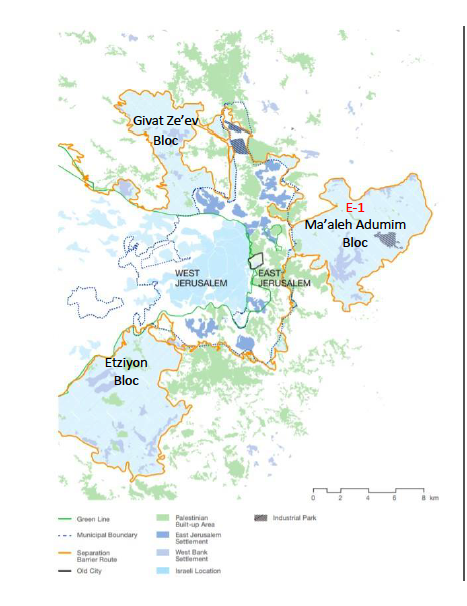 Laying out its logic, Terrestrial Jerusalem points to Netanyahu’s longstanding goal of uniting “Greater Jerusalem” by expanding the Jerusalem Municipality in order to annex as many nearby settlements as possible. The report details Netanayhu’s efforts to do so in detail, starting in 1997.
In addition, the “settlement blocs” doctrine – which has been prominently normalized by the likes of David Makovsky, Dennis Ross, and Michael Koplow – has provided Nentanyahu with an “off-the-rack” annexation option. This doctrine, on the basis of claimed “pragmatism,” has sought to allow Israel to continue unrestricted settlement expansion within large areas located near the Green Line (aka, the 1948 Armistice Line). After three decades of touting this doctrine, Netanyahu can now use it as the basis of his annexation.
Warning of the consequences of this “most likely” annexation scenario, Terrestrial Jerusalem writes:
“The annexation of one or more of the settlement blocs will have a devastating impact on the very possibility of any future agreement between Israel and Palestine. It will fragment the built-up Palestinian areas in greater Jerusalem, condemning the Palestinians to permanent occupation in an archipelago of disjointed, disconnected villages. The annexation of East Jerusalem, Ma’aleh Adumim, the Etzion Bloc and Givat Ze’ev alone would cumulatively seize 225 sq. km. of the landmass of the West Bank.”
Another Yitzhar Outpost Demolished, Another Violent Encounter Between IDF & Settlers
On July 10th, the IDF demolished an outpost that was illegally constructed by 30 settlers earlier that day. Settlers attempted to violently prevent the IDF soldiers from reaching the site of their outpost by setting up roadblocks using burning tires, and the attacking the troops with pepper spray and even threw punches during their assault on the troops.
The outpost squatters were from the radical and violent Yitzhar settlement, located in the heart of the West Bank just southeast of Nablus. The outpost – named “Kippah Sruga” by the settlers – was built in an area that the military commander marked as a “closed military zone” where civilians are not permitted to enter much less take up (illegal) residence.
Unsurprising, the leader of the Yitzhar settlement rushed to the defense of the settlers involved in the attack on the IDF. A spokesperson released a statement expressing regret that:
“some of the officers arrived at the scene without wearing masks [and] some did not have tags [identifying them as police]. The Border police officers used harsh violence against residents who did not do a thing. Of course we oppose stone-throwing and these incidents should have no place in Yitzhar.”
Settlers & Settlement Minister Escalate Drive to Take Palestinians Land in Area C
The radical settler group Regavim – which has dedicated itself to “helping” Israel police Palestinian construction in the West Bank – has filed a petition with the Jerusalem District Court asking the court to compel the demolition of Palestinian buildings located near the village of Nahalin, claiming that the newly built structures lack Israeli permits and that the Israeli Civil Administration has failed to act.
The group says Palestinians built 20 structures outside of the village, on land that is technically in Area C (the village of Nahalin is designated as Area B under the Olso Accords, but some village lands fall into Area C). Regavim asked the Civil Administration to take advantage of new powers it granted itself in June 2017 (via a military order) that allows it to demolish “new construction” a mere 96 hours after warning Palestinians of its intent (in effect depriving Palestinians of any meaningful opportunity to challenge the planned demolition).
Regavim Movement Director Meir Deutsch said:
“While our heads of state are debating whether and how sovereignty will be applied, the Palestinian Authority is hard at work, establishing facts on the ground. If we don’t wake up, in a few years we will find ourselves faced with an unchangeable reality – and the security and policy ramifications that come with it.”
Boosting Regavim’s mission, on July 7th newly crowned Settlement Affairs Minister Tzipi Hotovely toured the Mount Hebron Regional settlement council jurisdiction. Hotovely emphasized that part of her mission is to “prevent the Palestinian takeover of Area C” – an Orwellian framing suggesting that Israel is the victim of Palestinian aggressors seeking to steal Israeli land, when exactly the opposite is the case.
Hotovely said:
“At this time, it is very important to strengthen the settlement enterprise and prevent a Palestinian takeover of Area C. The Mount Hebron Regional Council has great potential for strengthening the Negev and the settlement. Applying sovereignty in this area will allow us to continue to develop the settlement in the Northern Negev and Mount Hebron.”
Greek Patriarchate Mobilizes Allies to Continue Fighting Settlers’ Acquisition of Jerusalem Properties
Since having its appeal rejected by the Jerusalem District Court on June 24th, the Greek Orthodox Patriarchate is continuing its fight to reclaim three prized properties in Jerusalem that were sold to the radical Ateret Cohanim settler organization under circumstances the Patriarchate claims are fraudulent.
In addition to planning to take its case to the Israeli Supreme Court, a spokesman for the Patriarchate, Father Issa Musleh, said that that Patriarchate will launch an international campaign in hopes of engaging the UN Security Council, Russia, Greece, Cyprus, and others to pressure Israel to return the properties to the church.
In addition, on July 7th, 13 Church leaders in Jerusalem issued a joint statement, saying:
“We, the Heads of the Churches and Christian Communities in Jerusalem, stand united in our commitment to safeguard the historical Status Quo of the Holy Sites and rights of the Churches which are universally recognized. The case of Jaffa Gate threatens this Status Quo. We are concerned by the recent judgment of the District Court of Jerusalem, which dismissed evidence demonstrating the Greek Orthodox Church’s case. We strongly support the efforts of the Greek Orthodox Church in their plea for justice…We don’t see this case as a mere property dispute. We see the undertaking of radical groups to take control of properties at Jaffa Gate as a systematic attempt to undermine the integrity of the Holy City, to obstruct the Christian pilgrim route and to weaken the Christian presence in Jerusalem.”
Settlement Real Estate Market Heating Up?
Israeli realtors hawking homes in the settlements are now talking up the possibility of a real estate boom in settlements because of the possibility of annexation.
Daniel Wach, who runs a real estate business out of the settlement of Eli — located deep inside the northern part of the West Bank — told AFP that he has done “as much business in the past two months as the last few years.” Wach said that Israeli families are buying now in anticipation of home prices rising after annexation. Post-annexation, Wach predicts will quickly rise 10-15%.
Another real estate agent who exclusively deals with settlements said: “Annexation will make a big difference…It’s gonna be a big market, we’ll need to get ready, work hard for this opportunity.”
Bonus Reads
- “Israel arrests Palestinian expert on settlements in Jerusalem” (MEMO)
- “Israel Will continue Its Campaign of Dividing and Conquering Palestinians, Annexation of Not” (Tania Hary // Haaretz)
- “Israel’s Possible Annexation of West Bank Areas: Frequently Asked Questions” (Congressional Research Service)
- “Ayelet Shaked submits candidacy to serve in Judicial Selection Committee” (Ynet)
- “Settlers and Palestinians unite in opposition to annexation” (The Times of Israel)
- “If Israel’s planned annexation goes ahead, can any response make a difference?” (Al-Shabaka)
Welcome to FMEP’s Weekly Settlement Report, covering everything you need to know about Israeli settlement activity this week.
To subscribe to this report, please click here.
May 22, 2020
- New Israeli Government Sworn In: Gantz & Netanyahu Continue to Back Annexation & the Trump Plan
- New Israeli Government Sworn In: The Cast of Ministers Relevant to Settlements/Annexation
- Settler Groups in Public Disagreement Over Trump Plan
- ICYMI: Sec. State Pompeo Went to Israel Last Week
- Israel Expropriates Land, Green Lights Building Permits for “Humanitarian Access” to Hebron’s Tomb of the Patriarchs/Ibrahimi Mosque
- Israeli Demolitions in al-Walajah, Displacing Palestinians to Make Way for New Israeli Park
- High Court Rejects Regulation Incentivizing Artists Performing in Settlements
- Violence on the Rise
- Breaking the Silence Breaks Down What Annexation Will Mean on the Ground
- Al-Haq Report: Israeli Annexation of Jerusalem Since 1948
- B’Tselem Report: Jewish Supremacy on Display in Issawiya
- Human Rights Watch Report: Israeli Land Policies Strangle Palestinian Communities in Israel
- Bonus Reads
Questions/comments? Email Kristin McCarthy (kmccarthy@fmep.org)
New Israeli Government Sworn In: Gantz & Netanyahu Continue to Back Annexation & the Trump Plan
The new Israeli government was sworn in on Sunday, May 17th. The message from the government’s leaders – Netanyahu and Gantz – remains that they are firmly and unequivocally behind the plan to advance annexation, in accordance with the Trump Plan.
In his inaugural address, Prime Minister Netanyahu said:
“The time has come to apply sovereignty to Jewish communities in Judea and Samaria. This won’t distance peace, it will bring it closer. The truth is — and everybody knows it — that the hundreds of thousands of settlers living in Judea and Samaria will remain there, no matter what arrangement is reached. The only reason the whole issue of sovereignty is on the agenda is because I promoted it personally for the last three years, both overtly and covertly.”
In his inaugural address, Alternate (and, theoretically, future) Prime Minister Benny Gantz said:
“Alongside this and for its sake, we will maintain our strength, to seize regional opportunities in general, and to advance the US government and US President Trump’s peace plan and everything it contains.”
New Israeli Government Sworn In: The Cast of Ministers Relevant to Settlements/Annexation
In addition to Netanyahu and Gantz, key figures in the new government’s drive for annexation will likely be:
- Tzipi Hotovely (Likud), who is Israel’s “Settlements Minister.” This is a new cabinet position invented by Netanyahu and Gantz. Hotovely will serve in this role for the first nine months of the government and then be replaced by Tzachi Hanegbi (Likud) for the second nine months (of course, if Israel annexes all the settlements, this role either won’t need to exist anymore or its mandate will have to change). It is unclear if this ministry will take power away from the Defense Ministry (and its Civil Administration), which has typically been the central address for managing most issues related to the settlements.
- Gilad Erdan (Likud), who is Israel’s new Ambassador to both the United Nations and the United States. Erdan will hold both offices simultaneously for the first nine months of the government. Shortly following his swearing in, Erdan reiterated his well-established support for annexation, saying he believes Israel has a “biblical right” to the land.
- Avi Nissenkorn (Blue & White) who is Israel’s new Justice Minister. Israel’s Justice Minister has historically played an important role in issuing legal opinions which provide Israel a domestic legal rationale for land seizures and settlement activities. The Justice Ministry is also a key because it has been (at least in recent years) increasingly oppositional to the role of the Israeli Supreme Court. Netanyahu has directly confronted the Supreme Court, and former Justice Minister Ayelet Shaked accused the Court of (among other things) being “overly concerned” with Palestinian rights.
- Gabi Ashkenazi (Blue & White), who is Israel’s new Foreign Minister, and who will theoretically take over the job of Defense Minister during the second nine months of the government (assuming Gantz rotates over to become Prime Minister). Ashkenazi has made clear his support for annexation, even while giving lip service to concerns about relations with allies and in the region. On May 18th he, said: “We’re facing significant regional opportunities, primarily President [Donald] Trump’s peace initiative. I consider this plan a significant milestone. President Trump presented us with a historic opportunity to shape the future of the State of Israel and its boundaries for decades to come…The plan will be advanced responsibly, with full coordination with the United States and maintaining all of the State of Israel’s peace agreements and strategic interests.”
Key Government Figures Outside of the Coalition
- Naftali Bennett, Ayelet Shaked, Bezalel Smotrich (Yamina Party). Relegated to the opposition, Bennett and company have come out swinging – taking shots at Netanyahu for allegedly betraying right wing values and vowing to fight tooth and nail against the Trump Plan. Bennett has charged that Netanyahu is making a fatal mistake by supporting the Trump Plan because it would mean that Israel has acknowledged and accepted the concept of a Palestinian state (notwithstanding that, under the Trump Plan, what is available to the Palestinians does not meet even the most modest definition of a state). Bennett said that recognition “is a point of no return. One can’t recognize and then un-recognize Palestinian statehood. It’s like un-cooking scrambled eggs…I will oppose anything that allows for acceptance or recognition of a Palestinian state.”
Settler Groups in Public Disagreement Over Trump Plan
Settler leaders form a key interest group outside of the central government (though many settler leaders serve on municipal councils) — a group that will play a key role in the deliberations around annexation. And with the swearing in of the new government that embraces the Trump Plan, disagreements among settler leaders are beginning to become more clear.
Like the Yamina Party, the official settler leadership body – known as the Yesha Council – passed a resolution on May 21st criticizing several aspects of the Trump Plan, without stating its outright opposition to it. While acknowledging it as a “positive change in U.S. policy towards settlements,” the resolution goes on to:
- Assert that annexation does not require American approval;
- Reject recognition of – or agreement to recognize in the future – a Palestinian state;
- Reject any construction freeze in any of the settlements and outposts;
- Reject the creation of enclaves.
Following the passage of the resolution, Yesha Council chairman David Elhayani said:
“For years, the Yesha Council has been working to apply sovereignty [in the West Bank], and we’ve gone from a situation in which almost no one talked about the subject or was aware of it to the unprecedented situation where the prime minister and the US president discuss an agreement that includes sovereignty. However, we will not agree to the establishment of a Palestinian state in the heart of the Land of Israel. If the result of the [Trump] agreement is to establish a terror state in Judea and Samaria (the West Bank), include the creation of isolated enclaves and a freeze on construction, we are ready to give up sovereignty, despite all the hard work and resources we have invested in the issue in recent years.”
In opposition to the Yesha council’s statement, a group of settler mayors – representing major settlements like Efrat and Ariel, as well as settlements that, due to their population, have extra weight politically (like Alfei Menashe, which is home to many retired senior IDF officers) — organized their own statement calling for support of the Trump Plan. The statement – led by Efrat Mayor Oded Revivi – was signed by the mayor/chairmen of Ariel, Megilot, Oranit, Alfei Menashe, Elkana, and Har Adar.
ICYMI: Sec. State Pompeo Went to Israel Last Week
On Wednesday, May 13th, U.S. Secretary of State Mike Pompeo travelled to Israel for an 8-hour visit to meet with leaders of the new Israeli government (which was set to be sworn in the next day, though that was delayed until Sunday the 17th). In response to an unconvincing statement by the State Department concerning the trip’s purpose – which was officially about coordination on fighting COVID-19 and Iran – an avalanche of speculative media coverage preceded and trailed Pompeo’s trip, trying to suss out what the trip was truly about, with many focusing on annexation or confronting Israel’s growing ties to China. In response, a State Department official who travelled with Pompeo told the press after Pompeo departed: “[we can] dispel the notion that we flew halfway around the world to talk about annexation…that was not the purpose of the trip…This wasn’t the top line.”
Media speculation that annexation was on Pompeo’s agenda was fueled by an interview Pompeo gave to Israel Hayom one day prior to his trip. When asked directly by a reporter if he planned to ask Israel to delay annexation, Pompeo declined to answer but reiterated his prior comments stressing that annexation is an Israeli decision. And then, on the day that Pompeo arrived in Israel, an anonymous “senior U.S. official” told Israel’s Channel 13 news that the U.S. had passed a message to Israeli leaders that annexation does not have to happen on July 1st.
In a press conference following their meeting, Pompeo appeared to again suggesting that Israel could (or should) delay annexation. Appearing alongside Netanyahu, Pompeo said (to Bibi):
“We’re now some months on from the day that you came to Washington when President Trump announced that Vision for Peace when you were there. There remains work yet to do, and we need to make progress on that. I’m looking forward to it.”
Not long after, Pompeo told the press:
“We spoke of ways to advance the peace plan, Trump’s peace plan.”
Reading into these comments, the New York Times ran pieces suggesting that Pompeo told Netanyahu that the U.S. wants him to delay annexation. In the article, Crisis Group analyst Ofer Zalzberg suggested that Pompeo sought to re-establish a role for Benny Gantz in the government’s consideration of annexation (after Gantz forfeit such a role as part of the coalition deal). Adding to the chatter around delay, Channel 13 News in Israel even reported that Gantz and Ashkenazi voiced concerns about annexation during their meeting with Pompeo, though both Gantz and Ashkenzi have continued to publicly promote the plan (see section above).
Israel Expropriates Land, Green Lights Building Permits for “Humanitarian Access” to Hebron’s Tomb of the Patriarchs/Ibrahimi Mosque
On May 13th, the IDF Commander issued an expropriation order to take control of an area outside of Hebron’s Tomb of the Patriarchs/Ibrahimi Mosque in order to build an elevator and wheelchair ramp leading to the site. The land is owned by the Islamic Waqf and is under the municipal jurisdiction of the Palestinian-run Hebron Municipality, according to multiple agreements signed by Israel and the Palestinians concerning the governance of the site. Israel’s expropriation order violates the terms of the Hebron Protocols.
Four days later, on May 17th, the Israeli Civil Administration deposited for public review plans for the project, starting the clock on a 60-day period during which the public can submit objections to the plan.
Emek Shaveh writes:
“The project is presented as a response to a humanitarian need but the settlers and the government are in fact creating a precedent of expropriation from the Waqf and construction at a shared holy site. Moreover, according to the Oslo Accords, the tomb comes under the auspices of the Hebron Municipality who have not consented to the plan.”
Palestinian Authority Minister for the Civilian Affairs Hussein al-Shiekh tweeted in response:
“today the so-called Israeli Minister of Defense signed a decision to confiscate [and] annex parts of the Ibrahimi campus in Hebron, which is a violation of the Hebron protocol, an end of the agreement signed between the PLO and Israel [and] a continuation of the #annexation project in the [West Bank and] #Jerusalem”
Israeli Demolitions in al-Walajah, Displacing Palestinians to Make Way for New Israeli Park
On May 18, Israeli forces demolished six structures (three homes and three agricultural buildings) in the Palestinian village of al-Walajah, in an area of the village that is within the expanded Israeli municipal borders of Jerusalem and also inside ofthe Nahal Rephaim National Park. Israel established the park in 2013 on al-Walajah’s land. Ir Amim reports that the demolitions are part of the Israeli government’s plans to open a new visitors center in the park for Israelis in the near future.
 The demolitions were carried out by Israeli authorities, despite circumstances that should have required them to be delayed — including the fact that the Palestinian homeowners were unaware that demolition orders had been issued against their property. Moreover, on March 18th the Israeli Justice Ministry declared that residential demolitions would be suspended during the coronavirus crisis (and such has been the case for the past 2 months in East Jerusalem). Further, Israel customarily pauses demolition orders during the month of Ramadan (which is about to end).
For decades, the Israeli government has carried out a multi-prong effort to push Palestinians off of their land in al-Walajah. This has included demolition campaigns, construction of the separation barrier along a route that encircles the village and cuts residents off from their land, refusal to grant building permits, and the declaration of state parks over lands on which Palestinians have lived for generations.
High Court Rejects Regulation Incentivizing Artists Performing in Settlements
On May 13th, the Israeli High Court of Justice overturned a controversial government regulation which conditioned the amount of federal funding for arts and cultural institutions (orchestras, theaters, choirs, etc) on their willingness to perform in West Bank settlements. The program was put in place by former Culture Minister Miri Regev. It incentivized arts institutions to perform in the settlements (an act of normalization and de facto annexation) by offering a 10% bonus to cultural groups which perform in the settlements, while reducing grants by 33% for groups unwilling to perform in the settlements.
The Court’s ruling came in response to a 2016 petition filed by the Association for Civil Rights in Israel (ACRI); the petition claimed the regulation violated the right to freedom of expression and conscience.
Justice Hanan Melcer said:
“Refraining from appearing in a controversial region constitutes an expression of opinion and such an expression merits protection. The right to freedom of expression obligates the authorities not to discriminate between people or institutions on the basis of their views and requires them to remain neutral.”
For a fantastic re-telling of Miri Regev’s controversial and dramatic tenure as Culture Minister, see this article by Al-Monitor. In the new unity government, Regev was sworn in to serve as Israel’s Minister of Transportation for the first nine months, and will then serve as Israel Foreign Minister. Regev will be a member of the Israeli security cabinet for the entire duration of the government (18 months).
Violence on the Rise
On the evening of May 21st, settlers from the radical Yitzhar settlement – homebase of the violent “Hilltop Youth” – instigated clashes with Palestinians from the nearby village of Hawwara. The settlers were throwing rocks at Palestinian vehicles along the main road to the village, and Palestinians then gathered and responded by throwing rocks at the settlers. Israeli police arrived to disperse the crowd, directing stun gun fire at the Palestinians.
The head of the Hawwara village council told Haaretz that Palestinian property, including cars and store fronts, were damaged by the settlers.
The incident follows an apparent Palestinian-perpetrated attack (or attempted attack) on Israeli forces near Hawwara earlier this week. Many analysts are now noting the persistent occurrence of violent clashes throughout the WEst Bank, including the death of an Israeli soldier during an IDF night raid in Jenin, the death of a Palestinian youth in Hebron also during a nighttime raid by the IDF, an apparent car-ramming attack, and now the events this week.
Breaking the Silence Breaks Down What Annexation Will Mean on the Ground
In a policy paper, Breaking the Silence co-founder Yehuda Shaul answers several key questions about what annexation might look like, and how the legal structure of Israel’s control over Palestinian life in the West Bank will be transformed. Read the full paper here.
Shaul explains that following annexation:
- Planning and construction for the settlements will no longer be regulated by the Defense Ministry, where political considerations at times intervened to stop controversial settlement plans. When settlement construction comes under Israel’s domestic bureaucratic procedures, plans for expansion of settlements are expected to move more quickly.
- The state of Israel will no longer have an existing legal basis for removing settlers from the West Bank (in the hypothetical scenario in which the state should choose to do so). Since 1948, the state has said (at least formally) that the settlements are “temporary” and that they fulfill a “military need.” When Israel evacuated its Gaza settlements, it did so pursuant to a military order saying that the settlements no longer serve a military need, and can be removed. The Court was then able to violate the civil rights Israel affords to its settlers in order to carry out the evacuation. Following annexation, the settlements will no longer be connected to any “military need” and will certainly no longer be held as a “temporary” endeavor, removing power from the government to carry out evacuations should it so choose.
- Settler municipal bodies will enjoy increased autonomy and power over Palestinians living in annexed land. This means that Palestinians could be paying taxes to the settler bodies, and relying on their benevolence for construction planning, building permits, and other services, etc. Palestinians would likely enjoy no representation in those municipal bodies, which would also have the authority to enforce demolition orders against Palestinians.
- The bureaucratic process of combining two regimes (the Israeli government and the Israeli military command) to govern the newly annexed territory will take a lot of legislation and it will require Israel to form a complex and massive structure to police the borders of Israeli territory.
- The Absentee Property’s Law and declarations of newly annexed land for “public use” will be the key legal tools Israel uses to take privately owned Palestinian land on a massive scale.
The paper also establishes that annexation of West Bank land will mean apartheid. Annexation under the Trump Plan would leave Palestinians living in fragmented enclaves within the Israeli state, without any rights in Israel (i.e. Apartheid). Even if Israel grants some rights to the subset of Palestinians living in the territory annexed to Israel (the report details 5 scenarios Israel might consider), that does not change the overall legal status of the new regime as an apartheid system, where people are granted or not granted rights primarily based on ethnicity.
Al-Haq Report: Israeli Annexation of Jerusalem Since 1948
In a new report, entitled “Annexing A City: Israel’s Illegal Measures to Annex Jerusalem Since 1948,” Al-Haq examines Israel’s annexation of West Jerusalem in 1948 and East Jerusalem in 1967, and the many Israeli policies which have sought to shore up those annexations in the intervening years.
Al-Haq writes:
“Indeed, Israel’s actions towards the city, from beginning to move its Government ministries to West Jerusalem in 1949, to redrawing the municipal boundaries of the city in 1967, have all been aimed at establishing irreversible facts on the ground before concrete action is taken by the international community. Accordingly, Israel’s policies and practices imposed today in occupied East Jerusalem, ranging from residency revocations to house demolitions, form part of a continuing effort to displace and dispossess Palestinians in Jerusalem, thereby feeding into Israel’s calculated efforts to alter the legal status, character, and demographic composition of the city, in violation of its protected status under international law.”
B’Tselem Report: Jewish Supremacy on Display in Issawiya
In a new report, entitled “This is Jerusalem: Violence and Dispossession in al- ‘Esawiyah,” B’Tselem describes life in the Palestinian East Jerusalem neighborhood of Issawiya (aka al-‘Esawiyah). In it, B’Tselem analyzes how Israeli policies have aimed and succeeded at dispossessing Palestinians in Issawiya through deliberate neglect, lack of planning, and an ongoing police campaign in the neighborhood aimed at harassing residents.
B’Tselem writes:
“Since annexing East Jerusalem, Israel has viewed the Palestinians who live there as an unwanted addition. The policy it implements in these neighborhoods – which is particularly blatant in al-‘Esawiyah – is aimed at incessantly pressuring the residents. In the short term, this is meant to oppress Palestinians in the city, control them and keep them poor, underprivileged and in a state of constant anxiety. Given Israel’s declared intention to ensure a Jewish demographic supremacy in Jerusalem, the long-term goal of this cruel policy appears to be to drive Palestinians to breaking point, so that they “choose” to desert their homes and leave the city. This conduct clearly demonstrates the demographic considerations that guide Israel’s actions: preferring Jewish citizens over unwanted Palestinian residents. Accordingly, the Israeli authorities incessantly harass the entire Palestinian population of Jerusalem, including the blatant example reviewed in this report: the 22,000 people who live in al-‘Esawiyah. This abuse, which is the result of an ongoing policy led by all Israeli governments since 1967, lays bare Israel’s priorities in the only part of the West Bank it has – as yet – taken the trouble to formally annex: no equality, no rights, and not even reasonable municipal services. Instead, state authorities use their power in the annexed territory to cement the superiority of one group over another.”
Human Rights Watch Report: Israeli Land Policies Strangle Palestinian Communities in Israel
In a new report – entitled “Israel: Discriminatory Land Policies Hem in Palestinians” Human Rights Watch documents how policies which have Israel’s occupation policy extened beyond the occupied territories – and also serve to tighly constrict the growth and development of Palestinian cities inside of Israeli borders.
Eric Goldstein, acting Middle East executive director at Human Rights Watch, said in a statement:
“Israeli policy on both sides of the Green Line restricts Palestinians to dense population centers while maximizing the land available for Jewish communities. These practices are well-known when it comes to the occupied West Bank, but Israeli authorities are also enforcing discriminatory land practices inside Israel.”
Bonus Reads
- “Annexation is not just about stealing land — it’s about expelling Palestinians“ (+972 Magazine)
- “Land grab and deportation: A leading Israeli lawyer’s annexation prediction” (Middle East Eye)
- “Jerusalem Day Obscures The Reality of Modern Jerusalem” (Daniel Seidemann for T’ruah)
- “What’s the Real Purpose of Israel’s Annexation Plan?” (Hagai El-Ad in Haaretz)
- “For Medicinal Purposes The Israeli Military Sector and the Coronavirus Crisis” (Who Profits)
- “EU Countries Mull Slapping Sanctions on Israel to Deter West Bank Annexation” (Haaretz)
- “Israel expands settlement projects around Hebron’s mosque” (Al-Monitor)
Welcome to FMEP’s Weekly Settlement Report, covering everything you need to know about Israeli settlement activity this week.
To subscribe to this report, please click here.
February 28, 2020
- Fuel on the Fire: Netanyahu Advances E-1 Settlement Plans
- Making Good On Bibi’s Promise, Israel Issues Tenders for Givat Hamatos Settlement – And Plans for More
- High Planning Council Advances Plans for 1,739 Settlement Units, Including a New Industrial Zone
- Netanyahu Orders 12 Outposts Hooked Up to Israeli Infrastructure, with More to Follow
- Israel is Planning New West Bank Electricity Grid to Serve the Settlements
- Deputy Israeli AG Bemoans “Alarming Accumulation” Of Cases in Which Political Echelon Stops Outpost Evacuations
- Joint U.S.-Israeli Annexation Mapping Team Begin Work in Ariel
- Bonus Reads
Comments or questions – email Kristin McCarthy (kmccarthy@fmep.org).
Fuel on the Fire: Netanyahu Advances E-1 Settlement Plans
On February 26th, the High Planning Council of the Israeli Civil Administration deposited for public review two separate plans (for a combined total of 3,401 units) for the construction of the infamous E-1 settlement. This move sets in motion a 60-day public commenting period, after which the committee can grant final approval for construction. Long called a “doomsday” settlement by supporters of a two-state solution, construction of the E-1 settlement would sever the West Bank effectively in half, foreclosing the possibility of drawing a border between Israel and Palestine in a manner which preserves territorial contiguity between the northern and southern parts of the West Bank. It would likewise consolidate the isolation of Palestinian neighborhoods in East Jerusalem from the West Bank. In combination with the recent advancements on Givat Hamatos and new tenders for Har Homa, Prime Minister Netanyahu’s Greater Jerusalem settlement construction announcements – leading up to the third round of Israeli elections – have crossed red lines (in the eyes of the international community) that Netanyahu didn’t dare cross in the past.
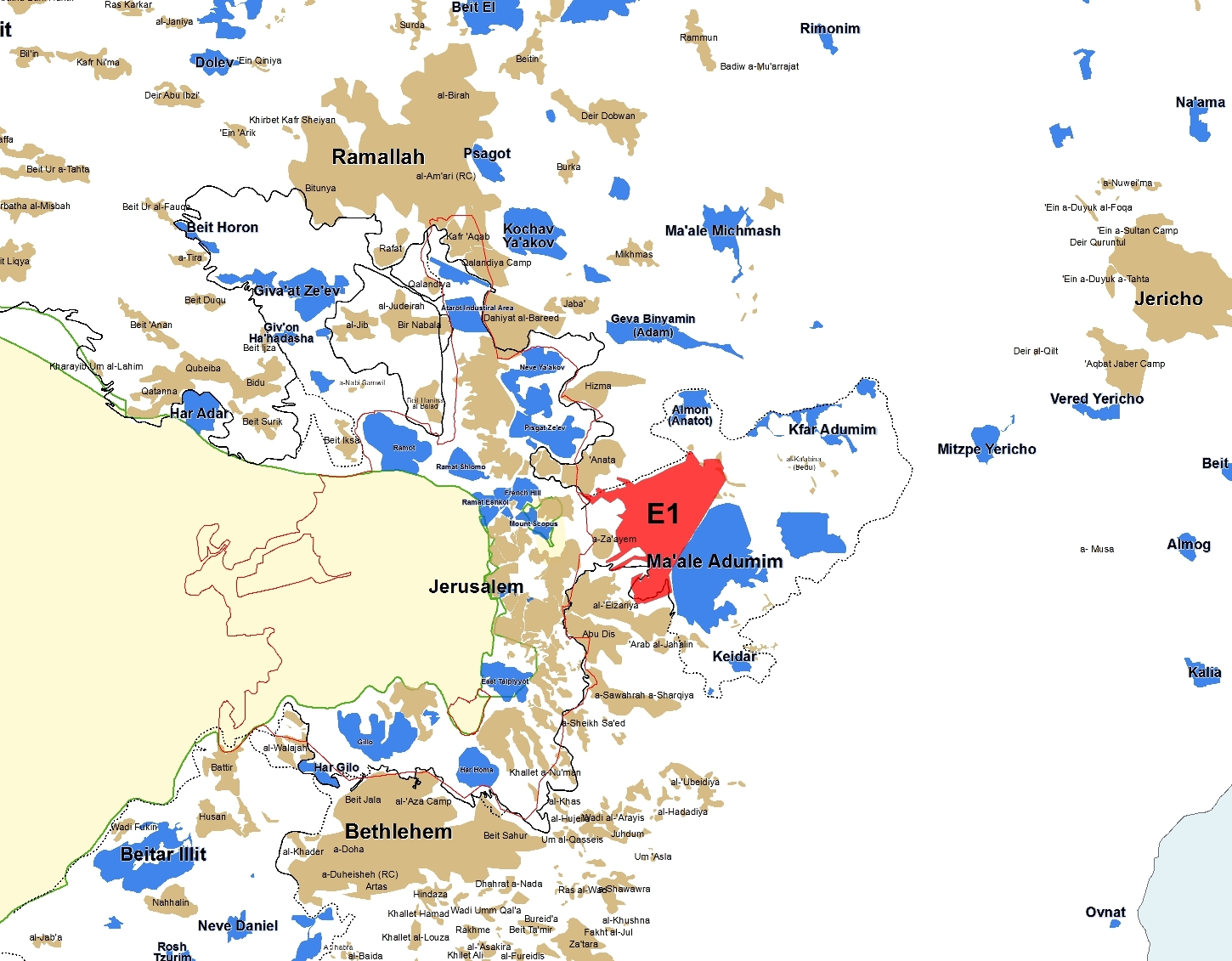
Map by Peace Now
The day before the High Planning Committee’s decision to deposit the plans, Netanyahu announced that he had lifted the freeze on E-1 that his government has imposed since 2012. Though the plans were approved for deposit in 2012, the administrative act of actually depositing the plans (which requires the plans to be published in at least three newspapers to inform the public) never occurred, largely as a result of intense international opposition to E-1. Under the recently released Trump Plan, the area where E-1 is located is slated to become part of Israel, meaning the long-held U.S. opposition to E-1 has transformed into apparent support.
Peace Now explains important context to Netanyahu’s flood of East Jerusalem settlement approvals:
“This move to promote settlement units in E1 should be understood in the context of government actions to promote settlement construction in Givat Hamatos and Har Homa to sever the Bethlehem-Jerusalem continuum, and the early promotion of a plan to turn the decommissioned Atarot Airport into a new Jerusalem settlement that would work toward severing the Ramallah-Jerusalem continuum. With E1 added to the mix, the pattern of severing the East Jerusalem and the West Bank is a clear policy direction of this government. While this announcement may be connected to the upcoming election, Netanyahu should be taken at his word and his comments should not be written off as campaign bluster. Indeed just this week he fulfilled a promise he made the week prior to publish tenders in Givat HaMatos, another area that was seen as a red line by the international community. It is likely that if moving on E1 is not met with deterring action domestically or abroad then it will further encourage settlement activity, seeing as E1 is the most recognized red line on settlement construction. The US, which has traditionally played a large role in deterring activity in E1, will likely not do so now with its current administration. Indeed, the Trump Plan envisions E1 as part of Israel, and allows for Israeli annexation pending coordination with the US and not negotiations with the Palestinians.”
Ir Amim adds:
“Although these advancements have taken place against the backdrop of the upcoming Israeli elections, they should also be seen as an alarm bell in the context of a new reality which has been created with the publication of the US Peace Plan. Carte blanche has essentially been given to Netanyahu and the Israeli government to further carry out unilateral measures in the Jerusalem area with little to no resistance. An acute exemplification of this major shift is the spate of new settlement plans (Atarot, Har Homa E, Givat Hamatos) being advanced over the Green Line in East Jerusalem, and now within the E1 area. After years of restraint due to international opposition, Israel is now set to advance construction in some of the most controversial areas in Jerusalem and along its perimeter. The realization of these plans will serve as an immense obstacle towards the future establishment of a Palestinian capital in the city and the prospect of a negotiated agreement based on a viable two-state framework.”
PLO Executive Committeewoman Hanan Ashrawi said in a statement:
“With the active participation and support of the current US administration, Israel is unilaterally and illegally annexing Palestinian territory and trampling on the Palestinian people’s most basic rights. These announcements are the practical translation of an extremist, ideologically-driven, and dangerous right-wing agenda that trounces Palestinian human rights and threatens to unravel the international order in favor of unilateralism, exceptionalism and political bullying.”
UN Special Coordinator for the Middle East Peace Process, Nikolay Mladenov, said:
“I am very concerned about Israel’s recent announcements regarding the advancement of settlement construction in Giv’at Hamatos and Har Homa, as well as the worrying plans for 3,500 units in the controversial E1 area of the occupied West Bank. All settlements are illegal under international law and remain a substantial obstacle to peace. If the E1 plan were to be implemented, it would sever the connection between northern and southern West Bank, significantly undermining the chances for establishing a viable and contiguous Palestinian state as part of a negotiated two-state solution. I urge the Israeli authorities to refrain from such unilateral actions that fuel instability and further erode the prospects for resuming Palestinian-Israeli negotiations on the basis of relevant UN resolutions, international law and bilateral agreements.”
Making Good On Bibi’s Promise, Israel Issues Tenders for Givat Hamatos Settlement – And Plans for More
As expected, on February 24th the Israeli Lands Authority published a tender for the construction of 1,077 housing units in the Givat Hamatos settlement. Haaretz reports that the tender relates to plans for “state land” and are intended to be sold as part of the the Treasury Ministry’s subsidized housing plan for young Jewish couples. Private companies will invited to bid on the project starting March 5th, with bidding set to close on June 22nd.
In addition to issuing tenders, the Jerusalem District Planning Committee met on February 27th to discuss the possibility of creating a new master plan for Givat Hamatos, in order to allow for more construction in the area. Ir Amim reports that the committee is considering a plan allowing for 6,500 residential units – which nearly doubles the total outlined in the current plan.
Ir Amim writes:
“This is the first time since the late 1990’s that Israel is constructing a new neighborhood/settlement in East Jerusalem. Furthermore, the location of Givat Hamatos means that its consturction will have dire consequences: It will serve to detach Bethlehem and the south of the West Bank from East Jerusalem while isolating the Palestinian neighborhood of Beit Safafa. For several years Netanyahu has abstained from publishing the Givat Hamatos tenders, serving as a source of frustration among rightwing parties. Netanyahu’s announcement therefore constitutes a break in the longstanding restraint. This dramatic change of policy should be seen in the context of his re-election campaign and against the backdrop of the formal release of the US Peace Plan.”
In announcing his support for the construction of the Givat Hamatos settlement last week, Netanyahu also mentioned plans to build 1,000 new homes for Palestinian residents of Beit Safafa – an East Jerusalem neighborhood which will be completely encircled by Israeli construction if/when the Givat Hamatos and Har Homa West settlement plans are implemented. According to Haaretz, the plan was/is to build 1,000 units on “Arab-owned” land — and that plan, in fact, is frozen.
In reaction to the tender for construction of the Givat Hamatos settlement, European Union High Representative Josep Borrell said in a statement:
“The Israeli authorities have announced an imminent decision regarding settlement construction in the Givat Hamatos and Har Homa neighbourhoods in East Jerusalem. Such steps would be deeply detrimental to a two-state-solution. As set out clearly on numerous occasions by the European Union, including in Council conclusions, such steps would cut the geographic and territorial contiguity between Jerusalem and Bethlehem, isolate Palestinian communities living in these areas, and threaten the viability of a two-state solution, with Jerusalem as capital of both states. Settlements are illegal under international law. The EU will not recognise any changes to the pre-1967 borders, including with regard to Jerusalem, other than those agreed by the parties. We call on Israel to reconsider these plans.”
High Planning Council Advances Plans for 1,739 Settlement Units, Including a New Industrial Zone
On February 27th, the High Planning Council – a body within the Israeli Civil Administration responsible for regulating all construction in the West Bank – approved the advancement of plans for 1,739 settlement units in the West Bank. These advancements come on the heels of the publication of tenders to build the E-1 settlement , the initiation of plans to massively expand the Har Homa settlement, and the recommitment of Israel to build a new massive new settlement in East Jerusalem, at the site of the disused Atarot airport. All of these plans deal with construction on the edges of Jerusalem and serve collectively to sever the connection between Palestinian neighborhoods of East Jerusalem and the West Bank (consolidating Israel’s uncontested sovereignty over “Greater Jerusalem”).
Of the total, 703 units received final approval, including:
- Plans to grant retroactive legalization to 620 units in the Eli settlement, a move which had been frozen by the High Court of Justice for the past 5 years while the Court considered a petition filed by Palestinians (with the assistance of Yesh Din and Bimkom) claiming to own the land. Last week, the High Court ruled against the Pallestinian petition and removed the injunction against the plans. The Eli settlement is located south of Nablus and southeast of the Ariel settlement in the central West Bank
- 48 units in the Har Bracha settlement, located just south of Nablus
- 35 units in the Givat Ze’ev settlement, located south west of Ramallah (north of Jerusalem).
Of the total, 1,036 units were approved for deposit for public review, including:
- A new industrial zone – called “Shaar Hashomron” – to be located south of the Palestinian village of Qalqilya (a town which is literally surrounded on three sides by the Israeli separation barrier – which in this area is, indeed, a massive wall). Peace Now reports: “[the new industrial zone is] close to Green Line, east of Salfit and South of Qalqilya, near the planned Nahal Rabah cemetery. In the area of Nahal Rabah, there existed a firing zone for years that prevented the use of the land. The land’s designation as a firing zone was lifted a few years ago, and the government’s Blue Line team set new boundaries for the state lands that comprised this area, all in preparation for a plan to build a new industrial zone. Industrial zones are a type of settlement in of themselves, and the planned cemetery is likely to be the first component toward establishing the new industrial zone. The plan for this new industrial park is separate from the 1,739 housing units advanced in the HPC announcement.”
- A winery in the Kiryat Arba settlement, located on the border of Hebron.
- 534 units in the Shvut Rachel settlement, located near the Shilo settlement in the central West Bank. Shvut Rachel only recently became an authorized settlement area when Israel extended the jurisdiction of the Shiloh settlement to include it as a “neighborhood” (along with three other outposts).
- Two plans for a total of 156 units in the Tzofim settlement, located just north of the Palestinian village of Qalqilya, a town completely encircled by Israel’s seperation barrier (except for a single road connecting it to the rest of the West Bank) – in the northern West Bank.
- 110 units in the Alon Shvut settlement, located south west of Bethlehem.
- 106 units in the Ma’aleh Shomron settlement, located east of the Palestinian village of Qalqilya.
- 105 units in Kfar Eldad (formally a part of the Nokdim settlement), located south of Bethlehem.
- 24 units in the Karnei Shomron settlement, located in the northern West Bank east of the Palestinian village of Qalqilya. Israel is planning to continue expanding Karnei Shomron with the stated goal of bringing 1 million settlers to live in the area surrounding the settlement.
The Times of Israel notes that this is the second time the High Planning Council has convened in as many months, marking an uptick in the frequency of such meetings, which until now have taken place quarterly (4x/year) since the Trump Administration came into power.
Peace Now said in a statement:
“The caretaker government, without a public and moral mandate, sets facts on the ground for a small and extreme minority, against the will of the majority. In the battle over the settler right-wing vote, Bennett and Netanyahu are dragging Israel to invest in thousands of harmful and unnecessary settlement units. This is how a cynical and irresponsible leadership that is willing to abandon the Israeli interest for its political survival behaves.”
Netanyahu Orders 12 Outposts Hooked Up to Israeli Infrastructure, with More to Follow
On February 23rd, Prime Minister Netanyahu announced that he had ordered 12 unauthorized outposts to be connected to Israeli infrastructure, and that his government was working to formally legalize over 100 outposts. Connecting outposts to Israeli water, sewer, power, garbage collection, and other municipal services entrenches the permanence of these outposts and furthers the de facto annexation of Palestinian land. It also copiously rewarding settlers for breaking Israeli law (by illegally building outposts), incentivizing further lawbreaking by Israel’s most radical and ideological settlers. 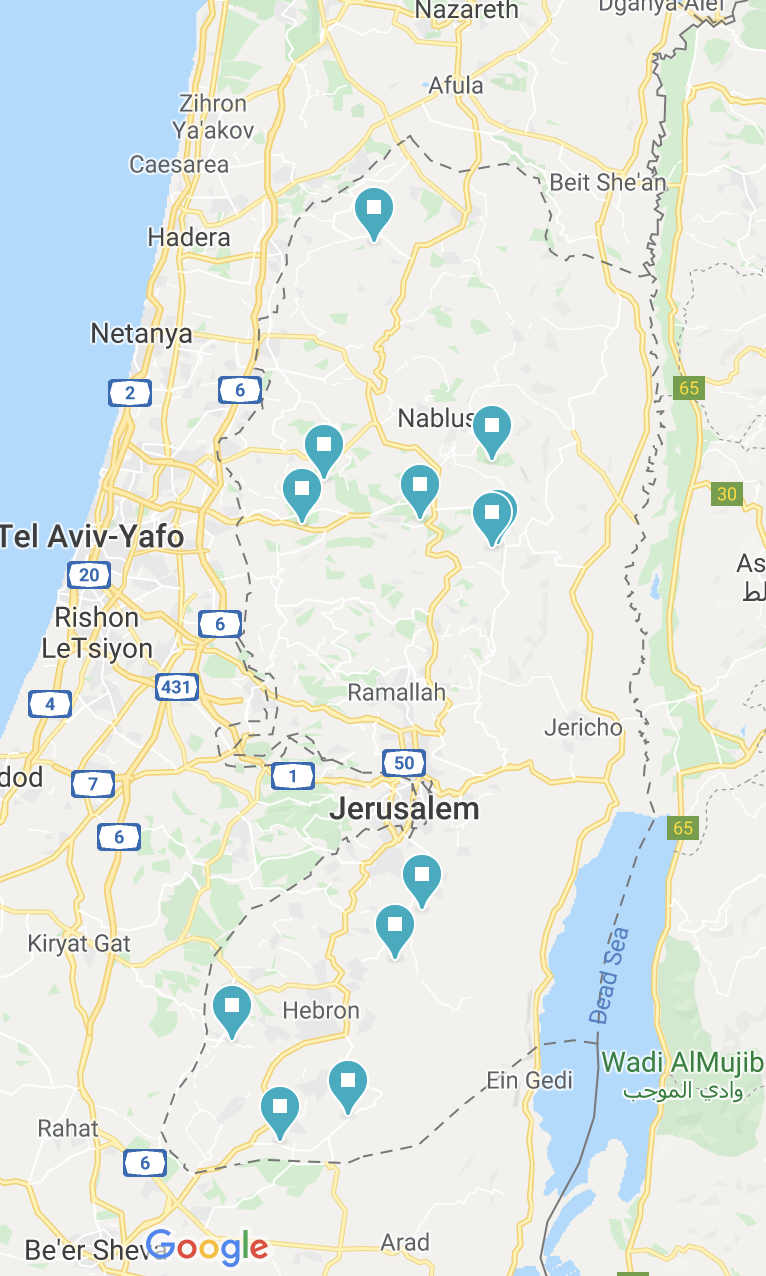
According to a letter from Netanyahu’s office, the 12 unauthorized outposts that will be connected to Israeli infrastructure were all built with “government encouragement” (though not formal approval or permits). In a perversion of the very notion of the “rule of law,” this unofficial encouragement for illegal actions is now treated by Israel as a valid legal basis for granting those outposts authorization.
The outposts slated for connection to Israeli municipal services are:
- The Nofei Nehemia outpost, located east of the Ariel settlement in the heart of the West Bank.
- The Havot Yair (Yair Farm) outpost, located west of Nablus.
- An outpost called “Hill 851”, located south east of Nablus in the central West Bank.
- The Maoz Zvi outpost, located in the northern West Bank.
- The Shaharit outpost, located in a string of settlements stretching from Israel proper to the Ariel settlement in the central West Bank, and going on to the Jordan Valley.
- The Pnei Kedem Farm outpost, located halfway between Bethlehem and Hebron in the southern West Bank.
- The Tekoa D outpost, located southeast of Bethlehem.
- The Negohot Farm outpost, located west of Hebron.
- The Avigayil outpost, located in the South Hebron Hills near the village of Susya.
- The Asa’el outpost, located east of the Palestinian village of Susiya in the southern tip of the West Bank.
- The Esh Kodesh outpost, located east of the Ariel and Shilo settlements, in a string of settlements stretching to the Jordan Valley.
- Ahiya, located in the Shilo Valley in the central West Bank.
David Elhayani, head of the umbrella settlement body called the Yesha Council, cheered Netanyahu’s announcement, saying:
“This is an important step for the benefit of young communities that have been suffering from electricity problems for years, and will now be able to receive electricity, just like any other citizen in the country.”
Since the passage of the Regulation Law in February 2017 and the invention of the “market regulation” principle by the Israeli Attorney General, the Netanyahu government has undertaken an energetic effort to grant retroactive legalization to outposts for which the Israeli government has not yet found a means to grant retroactive approval (though it has tried). The obstacle in all of these cases has been the fact that the outposts were built on privately owned Palestinian land. Following passage of the Regulation Law, Netanyahu immediately formed a committee tasked with finding a way to suspend the property rights of Palestinians; that committee produced the Zandberg Report in May 2018 — a report that, indeed, offers several justifications for the government to expropriate privately owned Palestinian land (one of the Report’s recommendations is to connect the outposts to Israeli municipal services). Following the publication of the Zandberg report, Netanyahu formed another committee tasked with implementing the report’s recommendations, by preparing individualized plans for each outpost to gain retroactive legalization. That taskforce, headed by notorious settler Pinchas Wallerstein. helped secure Cabinet approval for another bill to grant authorization to 66 outposts. All but two of the outposts named by Netanyahu this week (Hill 851 & Negohot) were part of a December 2018 bill to regulate 66 outposts – a fact that has drawn the wrath of settler leaders who bemoan Netanyahu’s delayed implementation.
FMEP tracks all events related to Israeli annexation and the drive to authorize outposts in its regularly updated Annexation Policy Tables.
Israel is Planning New West Bank Electricity Grid to Serve the Settlements
Haaretz reports that the Israeli government is close to approving a Master Plan for a new electricity grid in the West Bank, which will service Israel’s settlements. It may also serve Palestinian villages but only if — and it is a big if — the Palestinian Authority agrees to jointly implement the project. The plan is in the hands of Israel’s National Infrastructure, Energy and Water Ministry, which seeks to “provide a blueprint for the electricity market in the West Bank through 2040 and to develop infrastructure for Israeli settlements as well as for the Palestinians residing there.” However, the Israel-conceived plan calls upon the the Palestinian Authority to take responsibility over the Palestinian side of the equation, and the PA has refused to play that role and has condemned the plan.
In a statement, the Palestinian Authority’s Energy Authority said that the plan is designed:
“to establish Israeli sovereignty in the West Bank and to support the brutal presence of the settlements on our land.”
Settler leaders concurred with the PA’s assessment. Gush Etzion Regional Council chairman Shlomo Ne’eman told Haaretz:
“All moves point to sovereignty, and when we build infrastructure, there is also a basic understanding that the State of Israel is the sovereign. We are pleased that more and more government ministries have realized that this sovereignty is the reality.”
The plan, as reported by Haaretz, would see the Israeli Electric Company build a vast network of power lines across the West Bank. Israel will build six substations in Area C of the West Bank to distribute the high voltage power to settlements. Palestinians, if they are willing, are called upone to build eight substations in order to distribute power to Palestinian homes. The project is expected to cost between $870 million to $1.2 billion. The integration of settlements into Israel’s domestic planning schemes and the construction of massive infrastructure in the West Bank to service the settlements are significant advancements in Israel’s ongoing, de facto annexation of land in the West Bank.
Deputy Israeli AG Bemoans “Alarming Accumulation” Of Cases in Which Political Echelon Stops Outpost Evacuations
Haaretz reports that the Israeli Civil Administration planned to evacuate the unauthorized Mitzpe Yehuda outpost, located east of Jerusalem, in September 2019, but was directed to cancel the evacuation by one of Netanyahu’s personal aids in the Defense Ministry – Avi Roeh. The political interference was revealed in a High Court case filed by Palestinians claiming to own the land upon which the outpost was illegally constructed. The Palestinians are seeking to have the outpost immediately evacuated. Settlers claim to have purchased the land, and even submitted an application to have the outpost retroactively legalized by the government.
At the time of the scandal, Deputy Attorney General Erez Kaminitz wrote to Ronen Peretz, acting director of the Prime Minister’s Office, criticizing Roeh’s role in the Mitzpe Yehuda case, as well as the recurrence of political interference on behalf of the outposts. Citing several cases in which such interference occurred (Sde Ephraim, Givat Assaf, and Havat Negohot), Kaminitz wrote:
“This is a very alarming accumulation of cases that raises the specter of the emergence of a highly problematic trend that undermines the rule of law. It’s important to make clear that, as a rule, the political echelon is not authorized to intervene in decisions related to law enforcement.
Joint U.S.-Israeli Annexation Mapping Team Begin Work in Ariel
On February 24th, members of the U.S.-Israeli team tasked with mapping Israel’s annexation of West Bank land under the Trump Plan met for the first time to “explore the terrain.” At a vista near the Ariel settlement, Netanyahu underscored the significance of the project:
“The joint mapping process of the Israeli team and the American team is underway here in Ariel. This is a major mission. The area has an 800-km. perimeter. There is serious work, but we will work as quickly as possible to get it done…[the mapping process will] allow for the application of Israeli law [sovereignty] on these areas and later American recognition as well…[once complete] sovereignty can happen immediately.”
U.S. Ambassador David Friedman said:
“In Israel rain is a blessing, and I hope that our efforts should be blessed as much as the rain is coming down right now,” Friedman declared before the meeting started, the US Embassy in Jerusalem said in a statement. “We have our team here, and we’re going to get to work right away. We hope to complete it as soon as possible, and complete it the right way for the State of Israel.”
Ariel Mayor Eli Shaviro – one of the few settler leaders who publicly supports the Trump Plan – praised the mapping team, saying:
“The sovereignty ship is under way. As I have said in the past, I believe that the prime minister will advance the ‘Deal of the Century’ with President Trump and US officials. believe that the application of Israeli law in the Jordan Valley and in the communities of Judea and Samaria is closer than ever.”
Shaviro recently resigned from the settler Yesha Council over the group’s disavowal of the Trump Plan.
Bonus Reads + Resources
- “An Alternative Guide to City of David Archeological Park” (Emek Shaveh)
- “The Trump plan threatens the status quo at al-Haram al-Sharif” (Al Jazeera)
- “50 ex-European leaders and FMs condemn Trump plan, cite apartheid similarities” (The Times of Israel)
- “Planned Western Wall Train Will Threaten Historic Jerusalem Spring, Report Says” (Haaretz)
- “The Israelis fighting to keep the Jordan Valley Palestinian” (Al-Monitor)
Welcome to FMEP’s Weekly Settlement Report, covering everything you need to know about Israeli settlement activity this week.
To subscribe to this report, please click here.
April 19, 2019
- Israel Demolishes Palestinian Homes in East Jerusalem…While Re-writing the Law, and the zoning, to Cater to Settlers
- After Meeting with U.S. Ambassador, Jerusalem Mayor Predicts “Restrictions” on Settlement Plans Will Be Lifted
- U.S. State Department: Distinguishing between Settlers & Palestinians is “Discriminatory”
- Wild, Wild West Bank: Settler Nearly Downs IDF Plane Over West Bank
- Israel Reinstates Ability of East Jerusalem Palestinians to (Try to) Prove Land Ownership Claims
- Palestinian-Americans Continue Legal Case Against Settlements Despite AirBnB Reversal
- IDF Helps Cover Up Execution of a Palestinian
- Bonus Reads
Israel Demolishes Palestinian Homes in East Jerusalem…While Re-writing the Law, and the zoning, to Cater to Settlers
With the approval of the Supreme Court, on April 17th Israeli police began demolishing Palestinian buildings in the Wadi Yasul neighborhood of Silwan. The reason for the demolitions: the buildings lack legally-required Israel-issued building permits – which cannot be obtained by Palestinians the land in question has been designed by Israel as the “Peace Forest” [a designation that does not permit the Palestinians to build, even on their own land]. The “Peace Forest” was established by the Jewish National Fund following the 1967 war, on privately owned Palestinian land expropriated by Israel.
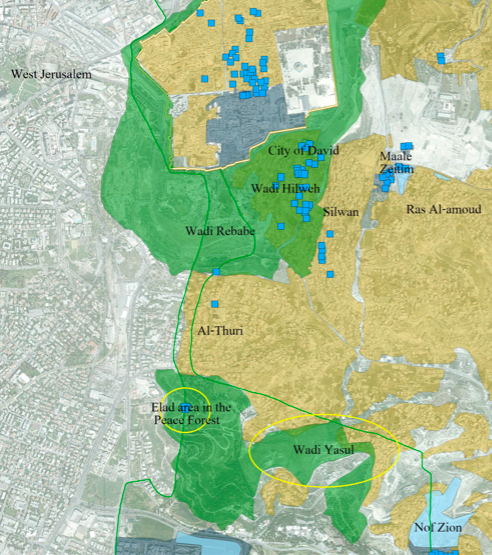
Map by Ir Amim
The Israeli NGO Ir Amim warns that the fate of these buildings likely signals the implementation of 63 additional demolition proceedings against Palestinian buildings in the same area, which could result in the wide scale demolition of 60 Palestinian homes, impacting approximately 500 Palestinians.
Importantly, for over a decade, Palestinians in Wadi Yasul have worked with architects and lawyers to try to obtain Israeli-issued permits to build in the area. Those plans and requests were rejected in 2008 because, according to Israel, they contradicted zoning laws for the “Peace Forest.”
On April 13th, the Israeli Supreme Court ruled against Palestinian appeals to stop the demolitions, appeals which challenged the self-evidently discriminatory patterns of Israel’s planning regime in East Jerusalem. Supreme Court Justice Yosef Elron explained the court’s decision to reject Palestinian petitions without even considering claims of discrimination. As Haaretz noted, Justice Elron in effect said that the criminal justice system is not the place to discuss whether or not the Jerusalem municipality discriminated against the residents and avoided planning the neighborhood, which in turn prevented them from getting building permits for their homes [which raises the question: does Justice Elron believe Palestinian residents of East Jerusalem have any other venues where they can expect to obtain justice?].” Rather, Justice Elron argued:
“I believe that the appellants’ claims that the defendant [Israel] discriminates against local [Palestinians] residents, and avoided advancing any zoning plan, are irrelevant to a discussion in the context of criminal wrongdoing. From the request in front of me I see that the residents are seeking a zoning plan for their needs and that should be welcome. But these efforts cannot retroactively legitimize so much illegal construction or justify any delay in carrying out demolition orders.”
Underscoring the brazen political motivations behind land-related decision in Jerusalem, even as Israeli officials have consistently refused to grant building permits for Palestinians to build on their own land in the area designed as the “Peace Forest,” and even as Israeli officials have actively pursued demolitions against the Palestinians living there, the radical settler group Elad has been engaged in its own illegal construction inside the “Peace Forest” for over 14 years. Rather than pursue demolitions, the Israeli government has worked with Elad to pursue every avenue to allow the retroactive legalization of Elad’s illegal construction. Even more brazenly, in tandem with the demolition of Palestinian homes in the area, Israeli officials have been working with the Elad to rezone the “Peace Forest” [something it refused to do for Palestinians] in order to allow the Elad to build a commercial/tourist project for tourists (a zipline).
Haaretz recently explained how Jerusalem authorities have repeatedly assisted Elad in its illegal activities:
“At first the NGO simply trespassed and built illegal structures there [the “Peace Forest”]. But things changed and gradually various local and national bodies – including the Jerusalem Municipality, the Israel Land Authority, the Tourism Ministry and the JNF – began to grant Elad assistance. This assistance has included granting building permits retroactively, allocating land to the group without a proper bidding process, and generous funding to the tune of tens of millions of shekels… It has been sponsoring activities in the Peace Forest since 2005, despite the fact that it has no ownership rights there or permits from the ILA (the legal owner of the land, which was expropriated from private Palestinian owners).”
Ir Amim explains:
“The scope of settlement projects in the vicinity of Wadi Yasul – and the breadth and depth of state support awarded to Elad, including authorities’ overt efforts to retroactively legalize unpermitted building – illuminate the stark discrimination in planning that empowers the expansion of radical settlement inside Palestinian neighborhoods while putting their native residents at risk of displacement.”
After Meeting with U.S. Ambassador, Jerusalem Mayor Predicts “Restrictions” on Settlement Plans Will Be Lifted
This week, Jerusalem Mayor Moshe Lion told the settler-run outlet Arutz Sheva:
“…I know what I want to accomplish, I know which projects the city needs – and the most important thing is to build, and I cannot do that alone. I need the Israeli government standing behind me, because we need a Jewish majority here, and we need to end the net negative migration. We need more young couples to move here…I sat down with the US ambassador to Israel, and we discussed the issue. I think that in the coming years, we’ll build a great deal in Jerusalem, and there won’t be a need for restrictions in this matter.”
Since Trump took office, Israel has advanced numerous controversial and devastating East Jerusalem/Greater Jerusalem settlement plans which had previously been held up due to international pressure (mainly from the U.S.), including in Ramot/Ramat Shlomo and a slew of plans in Sheikh Jarrah neighborhood of East Jerusalem. Based on this track record, and clear signals from the Trump Administration in support of Israel’s claim to Jerusalem and the West Bank, it is unclear what if any “restrictions” the Trump Administration is imposing on construction in Jerusalem.
What is clear is that, to date, the Israeli government has refrained from moving on either of the two most problematic East Jerusalem/Greater Jerusalem settlement schemes, E-1 and Givat Hamatos – construction of either of which would represent a fatal obstacle to the realization of the two-state solution. That argument, however, may be nearing its sell-by date, given the increasing sense that Israel and the Trump Administration are getting set to formally walk away from that solution (accompanied by what appears to be the increasingly likelihood that Israel will annex part or all of the West Bank).
U.S. State Department: Distinguishing between Settlers & Palestinians is “Discriminatory”
In the wake of the drama over Airbnb (and its decision to walk back its policy of not listing rental properties in settlements, newly appointed U.S. Envoy to Monitor & Combat Anti-Semitism, Elan Carr was asked by reporters on April 11th whether he made a distinction between boycotts of Israel and boycotts of settlements. In his response, Carr not only rejected the distinction, but went on to tell reporters distinguishing between settlements and neighboring Palestinians communities in the West Bank to be discriminatory (and implied that this discrimination between, in his words, “Jewish communities” and “Arab communities,” is based on anti- Semitism).
This position ignores the fact that Israeli settlements are illegal under international law (not surprising, given that the Trump Administration has made clear it views international law as irrelevant in the context of Israel and the occupied territories). But it also ignores an even more obvious fact that cannot be simply dismissed: Israel, as a matter of both policy and law, treats Israeli settlements and neighboring Palestinians communities differently. FMEP’s Lara Friedman summarized the situation for the UN Security Council in 2016, and the situation has only become magnified today:
“Israeli law follows Israeli citizens who enter or live in the Occupied Territories. This means that Israeli settlers live under Israeli law – no different than if they were living inside Israel – while Palestinians live under military law. This policy has created a dangerous and ugly political reality in the occupied territories – a reality in which two populations live on the same land, under different legal systems, separate and entirely unequal, with the governing authority serving one population at the expense of the other. One population is comprised of privileged Israeli citizens, enjoying the benefits of a prosperous, powerful state, with their rights guaranteed by a democratic government accountable to their votes. The other population is comprised of disenfranchised Palestinians, living under foreign military occupation explicitly designed to protect and promote the interests not of Palestinian residents of the territories, but of Israeli settlers.”
A transcript of the briefing reads:
QUESTION: Just to follow up… do you make a distinction between boycotting Israel per se and boycotting products that are produced in the settlements that’s considered illegal under international law?
MR CARR: So refusing to buy products made by Jewish communities and wanting to buy products made by Arab communities that live next door to each other seems to me to be discriminatory. That seems pretty clear to me.
QUESTION: But this is settlements. Settlements under international law is illegal. So I’m just – I’m trying to figure out, from a legal point of view, do you see that – okay, is it considered —
MR CARR: Like I said, if two communities are living side-by-side and one refuses to buy from Jews and one wants to buy from non-Jews, I think that’s pretty clear what that is.
…
QUESTION: Again, off the back of my colleagues’ questions, just to clarify: So the legal element about where Jewish settlements stand in international law as opposed to Arab villages makes no difference to you whatsoever?
MR CARR: Well, as you know, there is a peace plan being worked on currently, hasn’t been unveiled. The United States has long cared about this issue and on resolving the issues between Israel and its Palestinian neighbors in a way that’s fair for everybody. Resolution of those issues is not going to come about by attempting to strangle the Jews out of existence in their communities. That’s not how you’re going to get peace. And so I want to thank the administration for focusing on this issue, and all the work the White House is doing to try to really promote a plan that would finally have – get us to an agreement where the Israelis and the Palestinians can live side-by-side in peace.
Wild, Wild West Bank Skies: Settler Nearly Downs IDF Plane Over West Bank
A settler nearly flew his helicopter into an IDF transport plane conducting a training exercise in the Jordan Valley. The settler, Yedidya Meshulami, was charged with several crimes involved with illegally flying his helicopter and endangering lives in West Bank airspace, which is controlled by the Israeli military.
The IDF is no stranger to Meshulami and his illegal aerial activities. A former Israeli reserves pilot, in March 2018 Meshulami attempted to take control of the Qalandiya checkpoint in Ramallah by landing his helicopter nearby, declaring “I don’t care what they do to me, I’ll take it [the checkpoint] over.” Following his arrest and release to house arrest, the IDF confiscated two helicopters and an ultralight plane from Meshulami’s personal airstrip, which he built illegally in an outpost near the Itamar settlement, south of Nablus.
Israel Reinstates Ability of East Jerusalem Palestinians to (Try to) Prove Land Ownership Claims
One month after the Jerusalem Planning & Building Committee annulled the “mukthar protocol” – the only means by which Israel permits Palestinians to prove their land ownership claims in East Jerusalem – the committee reversed itself and will once again allow Palestinians to use this protocol as a valid legal basis for land ownership claims. Likewise, the committee will resume considering building permit applications that rely on the procedure. Without the mukthar protocol, and without building permits, Palestinians cannot legally build anything in East Jerusalem.
The “mukhtar protocol” was developed by the Israeli government as an alternative to the formal land-registration process, necessitated by the fact that Israel froze that process for land in East Jerusalem in 1967. The procedure requires Palestinian East Jerusalemites to collect signatures from local Palestinian leaders acknowledging that the land in question is, indeed, owned by the claimant.
Radical settler groups including Regavim campaigned to invalidate the mukhtar protocol, with the obvious goal of preventing development and improvement in East Jerusalem Palestinian communities. The protocol was reportedly reinstated following appeals to Jerusalem Mayor Moshe Leon by a city council member. Haaretz reports that even though the mukhtar protocol has been reinstated, Jerusalem municipal officials suggested that they would be changing the makeup of the mukhtar committees.
Palestinian-Americans Continue Legal Case Against Settlements Despite AirBnB Reversal
Palestinian-Americans are moving to continue their legal claim against Israeli-Americans who own property in Israeli settlements and rent those properties on the AirBnB platform. Their lawsuit – which was filed not as a stand-alone case, but as an intervention in the Silber vs. AirBnB case brought by Israeli-Americans against AirBnB – was put in jeopardy when AirBnB reversed its decision to delist rental properties in West Bank settlements, a reversal which had the effect of settling the Silber vs. AirBnB case. With the help of the Center for Constitutional Rights (CCR), the Palestinian-Americans have asked a judge to permit their legal claims to proceed.
The Center for Constitutional Rights explained:
“Today [April 11th], attorneys representing Palestinian landowners and West Bank residents urged a federal judge to permit their claims against Israeli settlers to proceed in the lawsuit over Airbnb’s listing of properties in illegal settlements in the West Bank. Dual Israeli-U.S. citizen settlers sued Airbnb after the booking platform announced its decision to remove the rentals. Palestinian landowners—including those who possess documents establishing their ownership of the land on which the rentals sit—moved to intervene in the case. A dual Palestinian-U.S. citizen, who cannot rent the properties because they are in Jewish-only settlements, also moved to intervene. The Palestinian intervenors also sought to countersue the settlers. The intervenors have argued that the Israeli settlers’ actions constitute war crimes, crimes against humanity, and discrimination on the basis of religion and national origin, as well as trespass and unjust enrichment. In today’s filing by the Center for Constitutional Rights, human rights attorneys argued that allowing the dismissal of the lawsuit before considering the motion to intervene would prejudice the intervenors’ rights.”
CCR Attorney Diala Shamas said:
“Our clients, Palestinians directly affected by these Airbnb postings, intervened in the lawsuit precisely because they have significant interests at stake, and to prevent an outcome that utterly ignored those interests. To dismiss this lawsuit without even considering the intervenors’ claims would be yet another affront to the rights of people who have had their land stolen and who have been discriminated against on the basis of their religion and national origin.”
IDF Helps Settlers Cover Up Execution of a Palestinian
An investigation by B’Tselem reveals that the IDF helped settlers to cover up evidence of their execution of a Palestinian man on April 3, 2019. The incident was widely covered by the press as an attempted stabbing. In fact, video evidence and eyewitness testimony show that two settlers opened fire on 23 year-old Muhammad ‘Abd al-Fatah while he was laying wounded on the ground. When the IDF arrived on the scene, the soldiers sought out and deleted surveillance footage captured by nearby businesses; they also dispersed Palestinians who gathered near the scene with stun grenades. No arrests were made.
B’Tselem reports at length:
“At 8:30 A.M. that morning, Muhammad ‘Abd al-Fatah…stopped by a dumpster across from the village square in the nearby village of Beita and started throwing stones at cars bearing Israeli license plates that were heading from the direction of Huwarah towards the village of Za’tarah and Tapuah Junction. ‘Abd al-Fatah threw stones at two passing cars and then threw a third stone, which hit a car. The driver, an Israeli named Yehoshua Sherman, pulled over. Then two gunshots were heard, apparently fired from inside the vehicle. The driver then got out of the car. At that point, ‘Abd al-Fatah was crouching among the dumpsters. Sherman approached him and fired several more shots at him. A truck driving along the road also stopped, and the driver got out. He came over to stand next to Sherman, and the two men fired several more shots at ‘Abd al-Fatah, who was lying wounded on the ground…Minutes after the two settlers opened fire, Israeli military jeeps arrived on the scene and soldiers used stun grenades to disperse the crowd that had begun to gather. Immediately after that, about eight soldiers went into two nearby shops to check their security cameras. They dismantled a DVR in one of the shops and left. About twenty minutes later, the soldiers returned to the shop, reinstalled the DVR and watched the footage. Two soldiers filmed the screen with their mobile phones. They then erased the footage from the DVR and left…The Israeli security forces that arrived on the scene ignored these facts. They did nothing to arrest the two settlers, promptly drove the Palestinians away from the scene, and then addressed the urgent task of eliminating any footage of the incident, to ensure that the truth never comes to light and the shooters would not face any charges or be held accountable in any way. The identity of both shooters is known. If the authorities so choose, they could easily track them down, at least for questioning. Yet given the troops’ conduct immediately after the incident, and Israel’s longstanding policy, the chances of this are slim to none.”
Bonus Reads
- “The True Cost of Israeli Settlers’ Annexation Dream” (Haaretz)
- “Who needs Bennett when Netanyahu is already annexing the West Bank?” (+972 Mag)
- “Stop Calling it Annexation” (+972 Mag)
- “The Illusion of Trump’s Mideast Peace Plan” (The American Prospect)
- “Easter Travellers to the Holy Lands Should Avoid Supporting Israel’s Settlement Tourism Industry” (Huffington Post)
Welcome to FMEP’s Weekly Settlement Report, covering everything you need to know about Israeli settlement activity this week.
To subscribe to this report, please click here.
March 1, 2019
- As Elections Approach, Here’s Two Settlement Plans Bibi Might Advance to Win Votes/Deflect Pressure
- Palestinians March in Hebron on Anniversary of Goldstein Massacre
- U.S. Charities Are Financing Radical, Violent Hilltop Youth Settler Movement
- Bonus Reads
Questions/comments? Email kmccarthy@fmep.org
As Elections Approach, Here’s Two Settlement Plans Bibi Might Advance to Win Votes/Deflect Pressure
Terrestrial Jerusalem published a comprehensive analysis of how Jerusalem-related issues, including settlement plans, could become a factor in the current Israeli elections campaign. Danny Seidemann writes:
“On the eve of Israel’s national elections and the possible launching of Trump’s so-called ‘peace plan,’ concerns raised in January 2017 regarding the most sensitive and ambitious settlement and settlement-related projects are more relevant than ever…the common denominator to the issues on which we [Terrestrial Jerusalem] are focusing below is this: each is something of a banner under which the ideological right has decided to march. As a result, there is no doubt that these issues will figure prominently in election rhetoric, towards the goal of forcing an already susceptible Netanyahu’s hand.”
Seidemann goes on to lay out likely actions Netanyahu might take, including action on two specific settlement plans:
-
“E-1: E-1 is a settlement planned for an area on East Jerusalem’s northeastern flank (beyond the city’s municipal borders), designed to cement a contiguous block of settlements stretching from Maale Adumim to the city’s east, through Neve Yaacov and Pisgat Zeev to the north, and extending to Givat Zeev, to the northwest (download map here).We have described in several reports the dire threat the implementation of E-1 would cause to the two-state solution, primarily by dismembering a potential future Palestinian state into two non-contiguous cantons and sealing off East Jerusalem from its environs in the West Bank…implementation of E-1 today still depends solely on Netanyahu giving the green light for the publication of the plans. Once he does, the clock will start ticking toward construction; assuming Netanyahu and his government obey normal planning rules, this clock will run for up to a year — between the resumption of planning and the publication of tenders for construction. Once the green light is given, it will be very difficult (but not impossible) to prevent the publication of tenders.”
-
“Givat Hamatos: As we explained in our January 2017 analysis, plans for construction in Givat Hamatos have been fully approved, but tenders have not yet been published: tenders for the construction of up to 1500 of the 4500 units could be published literally at any time, based on the whim of Netanyahu. As elections approach, the chances that Netanyahu will give the order to publish these tenders rises exponentially — and the significance of him doing so cannot be overstated. In planning terms, the publication of tenders is a Rubicon that, once crossed, is a point of no return, since at that point, third-party rights (purchasers) become involved. In short, the publication of tenders, effectively, would make the construction of Givat Hamatos a virtual certainty. While E-1 is larger in scope and has greater notoriety than Givat Hamatos, the danger posed by the latter is in some respects greater. Assuming Netanyahu and his government follow normal planning rules on E-1, any decision he takes on E-1 will in effect by a trip-wire that will give the world as long as a year in which to engage to try to prevent actual construction. With respect to Givat Hamatos, a move by Netanyahu won’t be a trip-wire, but rather the beginning of a series of detonations that cannot be stopped.”
Palestinians March in Hebron on Anniversary of Goldstein Massacre
On February 22nd, hundreds of Palestinians and international activists led a march towards Shuhada Street in downtown Hebron to commemorate the 29 victims of Israeli-American settler Baruch Goldstein, who opened fire on worshippers in the Ibrahimi Mosque/Tomb of the Patriarch 25 years ago. The march was also a protest against Israel’s policy of segregation (a word that fails to capture the damage done to the fabric of Palestinian life in the heart of Hebron) that was implemented following the massacre. +972 Mag reports:
“…protestors marched toward Checkpoint 56, which separates the part of the city governed by the Palestinian Authority from the Israeli-controlled area. They carried signs calling for the return of the Temporary International Presence in Hebron (TIPH) – the only observer group in the city with an official international mandate. In late January, Israeli Prime Minister Benjamin Netanyahu decided not to renew the group’s mandate, effectively expelling the observers from the city after 22 years of monitoring the human rights situation there…Israeli soldiers were stationed along the route of the protest, on the side of the city allegedly controlled by the PA, already before the protest began. When the crowd of demonstrators approached Checkpoint 56, soldiers pushed them back. At another checkpoint, close to the Tel Rumeida area, soldiers fired tear gas, stun grenades and rubber bullets at a group of protestors who were hurling stones – against the organizers’ request to keep the protest peaceful. Soldiers also fired stun grenades at a group of journalists.”
U.S. Charities Are Financing Radical, Violent Hilltop Youth Settler Movement
An investigation has revealed that a U.S. charity, The Charity of Light Fund, is the U.S. arm of an Israeli organization called Chasdei Meir that funds the radical and violent Hilltop Youth settler movement. Journalist Mairav Zonszein explains that Chasdei Meir, which is not registered as a tax exempt organization in Israel, recently issued a donation receipt thanking the donor (who made the donation in order to glean more information about the group’s operations) for “helping keep the residents of the outposts in Judea and Samaria warm.” Zonszein goes on to report:
“According to the Israeli outlet Ynet, Chasdei Meir has been linked to the coordination in 2011 of settler violence against Palestinians known as ‘price tag’ attacks, as well as financing settler youth who inhabit illegal settlement outposts and plant trees there as a way of claiming ownership over the land.”
Zonszein’s report lays out how Chasdei Meir and the Charity of Light Fund are part of a larger network of shadowy groups and figures that have found ways to direct U.S. tax-deductible donations to the settlement enterprise as well as groups that ascribe to the racist, nationalist ideology of Meir Kahane and the political party he founded, Kach. The Kach party, which is on the U.S. list of terrorist organizations, recently joined forces with Prime Minister Netanyahu, who brokered a political marriage between the Otzma Yehudit (“Jewish Power”) party, which is the current incarnation of the Kach party, and the Jewish Home party, in the hopes of winning sufficient votes to form a coalition that will keep him in power.
Bonus Reads
-
“A Violent Gang of Young Settlers Haunts Palestinians” (Haaretz)
-
“Under Occupation, Water is a Luxury” (Haaretz)
-
“Israel’s Termination of the Temporary International Presence in Hebron” (Al-Shabaka)
Welcome to FMEP’s Weekly Settlement Report, covering everything you need to know about Israeli settlement activity this week.
To subscribe to this report, please click here.
September 7, 2018
- Israel Advances Plan for New Settlement in East Jerusalem
- Even More East Jerusalem Settlement Plans Advanced
- Israel Demolishes Homes in al-Walajah, Advancing “Greater Jerusalem” Project
- State Admits to High Court it Built Settler Road on Palestinian Private Land
- Prominent Human Rights Activists Arrested While Leading Tour of Hebron Region
- Government Official Claims Jerusalem Cable Car Project Will Benefit Palestinians in Silwan
- BonusReads
Comments, questions, or suggestions? Email Kristin McCarthy at kmccarthy@fmep.org. To subscribe to this report, please click here.
Israel Advances Plan for New Settlement in East Jerusalem
On September 5th, the Jerusalem Local Planning and Building Committee advanced a plan to build a large new settlement enclave (150 units) within yet another Palestinian neighborhood of East Jerusalem. The project – a pet project of Jerusalem settlement financier (and since 2013, Jerusalem city council member) Aryeh King – would be the first-ever authorized settlement project in the Beit Hanina neighborhood of East Jerusalem, located north of the Old City.
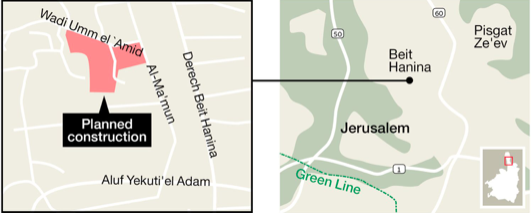
Map by Haaretz
The plan would build housing for approximately 75 settler families (which, based on a conservative estimate, would mean a population of around 500 settlers in Beit Hanina). If built, it would be one of the largest Israeli settlement enclaves inside any Palestinian neighborhood in East Jerusalem.
According to the plan, 75 units units would theoretically be earmarked for Palestinians – a point used by the plan’s supporters to suggest that it is actually benevolent. The key word here, however, is: theoretically. As noted by Jerusalem expert Danny Seidemann in another context:
“Since 1967, the Government of Israel has directly engaged in the construction of 55,000 units for Israelis in East Jerusalem; in contrast, fewer than 600 units have been built for Palestinians in East Jerusalem, the last of which were built 40 years ago.”
In announcing the approval of the plan, Israel’s deputy mayor made clear what part of the plan the Municipality is actually focused on:
“We’re happy to announce today that we’ve approved construction of 150 housing units in Beit Hanina, and especially that 75 Jewish families can now live there.”
Notably, the Jerusalem Local Planning and Building Committee advanced the plan through the first stage of the planning process, despite an objection filed by the private Palestinian company that owns 45% of the land upon which the new units would be built (ownership that the Israeli government tried – and so far failed – to cancel, through efforts to rescind the sale of the land to that company). The Committee explained its decision to ignore the objection by asserting that it was only discussing planning schemes and not ownership issues. The Jerusalem Municipality also weighed in, suggesting that the Palestinian company is too late in asserting its rights, saying that the ownership issue was “examined as part of the examination of the plan’s preconditions.”
Director of the Peace Now Settlement Watch program, Hagit Ofran, rejected that argument, saying:
“this is not a real estate project but a project of defiance and settlement. The fact that Israeli entrepreneurs, who own only half of the land, have prepared a plan without consulting Palestinian owners [of the other half] indicates that they have no intention of coexistence and peace.”
 A handful Israeli settlers already live in Beit Hanina, having directly acquired private property in the heart of the neighborhood. This small group of settlers clearly benefit from the plan, both because it lends legitimacy to their presence in and broader claims to the neighborhood, and because the new project would create a territorial linkage between the new settlement in Beit Hanina and the large ultra-Orthodox settlement of Ramat Shlomo to its south.
The historic nature of the Beit Hanina settlement plan is being hailed by pro-settlement media and activists. The Deputy Mayor of Jerusalem, Yossi Deitch, said, “I hope approval of the units will be the sign and signal that construction in the city will be unfrozen next year throughout the city and for all sectors. I’ll do everything possible to thaw the construction freeze in Jerusalem.”
Israel has increased home demolitions across East Jerusalem, including Beit Hanina, over the past year. In Beit Hanina, many homes are under the threat of demolition because they lack Israeli-issued building permits – permits that Palestinians find all but impossible to secure. Just this week, Israel demolished the Farrah family home in Beit Hanina, built over 16 years ago – despite the fact that the family has spent years attempting to obtain the necessary permits and has paid 250,000 shekel ($69,362) fine to the Israeli government.
Even More East Jerusalem Settlement Plans Advanced
In addition to the Beit Hanina settlement plan, Ir Amim reports that Jerusalem authorities have advanced several other inflammatory settlement projects in East Jerusalem over the past week:
- The Local Planning and Building Committee discussed issuing a permit to retroactively legalize unauthorized settlement construction – several shops and offices – in Silwan, located at the entrance of the settler-run City of David National Park. The buildings were constructed, without permits, under the direction of the radical Elad settler group, which is contracted by the Israel National Parks Authority to run the City of David National Park. As a reminder, Elad’s mission is to establish a permanent Jewish presence in Palestinian neighborhoods of East Jerusalem. The retroactive permit, in addition to legalizing the current buildings, would also allow the group to build an additional story to one of the buildings, to serve a”lookout” point. Demonstrating government collusion with the settlement enterprise in Jerusalem, the permit request was filed by the Israel National Parks Authority, not Elad.
- The Local Planning and Building Committee committee discussed public objections filed against a plan to build a 6-story office building for settlers at the entrance of the Sheikh Jarrah neighborhood. The office building, if approved, would be located adjacent to the site of a planned Jewish religious school to also be built in Sheikh Jarrah – called the Glassman Yeshiva. That school, once it is built, will house dozens of young religious settlers. Together, the two projects will flank the road leading into Sheikh Jarrah and become part of a settlement bridge/corridor connecting the isolated settlement enclaves in the heart of Sheikh Jarrah to West Jerusalem. Ir Amim notes that both settlement projects have been advanced “despite the area being zoned for public buildings for a Palestinian neighborhood sorely lacking in social services.” This latest advancement was anticipated and noted in last week’s Settlement Report.
- The Jerusalem Local Committee advanced two plans to increase the number of new units authorized to be built in the Gilo and Neve Ya’akov settlements. In both instances, the Local Committee discussed plans that increase the number of units permitted to be built under already-approved plans (adding an additional 48 units in both cases, bringing the Neve Ya’akov project to 86 units total and the Gilo project to 148 units total).
Israel Demolishes Homes in al-Walajah, Advancing “Greater Jerusalem” Project
On September 3rd, Israeli officials demolished four buildings in the al-Walajah village, on the pretext that they lack required Israel-issued building permits. Israeli security forces fired tear gas and rubber-coated steel bullets at a crowd of protestors who gathered to try to stop the demolition, injuring several.
The demolitions were in the Ein Juweza neighborhood of the village – an area that is technically located within the municipal borders of Jerusalem (the border runs through the village, leaving the rest of al-Walajah in the West Bank), and therefore subject to Israeli planning and building laws. An additional 189 homes in al-Walajah have demolition orders issued against them.
The lawyer representing al-Walajah residents in this case said,
“The residents’ attempts to submit a master plan [without which it is impossible for residents to even apply for permits to build on their own land] were thwarted by the objection of the state and subsequently, the planning authorities. In this situation of criminal neglect of the village and its residents, the only service the state gives them is ‘home demolition service.’ This is an impossible, illegal situation that contradicts the most minimal fairness.”
Ir Amim reports:
“While refusing to allow building in Walajeh, in the area around the village Israel is promoting construction of thousands of housing units for Israelis on lands – some of which were confiscated from Walajeh – in the settlements of Gilo and Har Gilo. To the north of the village, within the Green Line and on lands that belonged to Walajeh until 1948, a construction plan of over 4,000 housing units is being advanced. These construction plans, together with the national park declared on al-Walajeh land in 2013, are meant to create an Israeli continuum between Jerusalem and the Gush Etzion settlements surrounding Bethlehem. This morning’s demolitions in Walajeh are an inherent part of the policy to transform this area into an Israeli space.”
As FMEP has previously reported, residents of al-Walajah have long been struggling against the growing encroachment the nearby Etzion settlement bloc and the Israeli government’s attempt to de facto annex the bloc as part of “Greater Jerusalem.” Ir Amim explains several prongs of this effort, including a particularly problematic section of the separation barrier around al-Walajah that has been planned in order to (a) almost completely encircle the village, (b) turn its valuable agricultural land into an urban park for Jerusalem, and (c) enable construction of a highway that will connect the Etzion settlement bloc to Jerusalem with Israeli-only bypass roads.
State Admits to High Court it Built Settler Road on Palestinian Private Land
The Israeli government admitted to the High Court of Justice that it cut and paved a road on land that is privately owned by Palestinians in the South Hebron Hills. The State claimed it did so by mistake, believing the land in question, which had been included in construction plan for the settlement of Shima – despite the fact that Palestinian owners objected as soon as construction started in 2015. Even after the objections were lodged against the construction, Israeli authorities took months before issuing a stop work order, allowing the road to be completed/paved in the meantime.
In the brief submitted this week, the State asked the High Court to dismiss the case regarding the road, explaining that the Civil Administration had already taken action to correct the borders of the Shima settlement to, in effect, return the land to is owners (now paved with a road for the settlers). The State says that action was prompted in 2015 when the Civil Administration “Blue Line” team released new mapping of the area, which clarified that the land is indeed privately owned by Palestinians.
Commenting on the story, a spokesperson for Rabbis for Human Rights told Haaretz:
“The state acted like the ‘hilltop youth’ [a radical settler group]. You can’t explain this away using the excuse of an innocent mistake, given that even after our warnings it took a long and embarrassing legal procedure to get them to do the obvious: check who actually owns the land.”
Prominent Human Rights Activists Arrested While Leading Tour of the Hebron Region
Israeli security forces arrested three prominent human rights activists while they were leading a sizeable group on a tour of settlements and outposts in the Hebron/South Hebron Hills area. Avner Gvaryahu (Executive Director of Breaking the Silence), Michael Sfard (a prominent Israeli human rights lawyer), and Achiya Schatz (Communications Director for Breaking the Silence) were released after three hours of detention.
The men were arrested near the Mitzpe Yair outpost in Hebron, the same spot where activists from Taayush – “Israelis & Palestinians striving together to end the Israeli occupation and to achieve full civil equality through daily non-violent direct-action” – were violently attacked by settlers the previous week, with at least four wounded seriously enough to be evacuated to for medical treatment. In that attack, IDF soldiers reportedly stood by and did nothing (and in its aftermath, the Israeli government and senior officials, including Netanyahu, said nothing).
Breaking the Silence related the events, saying:
“As we drove up the road leading to the outpost, we were blocked by a Border Police jeep. Within minutes, we were presented with a ‘closed military zone’ order, signed by the brigade commander. We were given one minute to evacuate a group of 120 participants, some of whom weren’t so young. When we asked for more time to get everyone on the buses, the arrests started. As was reported in the media, the arrests were aimed at the leaders of the tour, which reinforced our suspicion that they were initially meant to sabotage the tour….Upon arriving at the police station, Avner, Achiya, and Michael had been told that they were in fact not arrested but rather detained, and that there was no immediate need for investigations or arrests. They were then told to return in a month and a half for further investigation.”
The group’s email to supporters ends:
“we refuse to cave in to settler violence and to surrender to their intimidation, incitement, and violence directed against those who oppose the immoral reality of the occupied territories.”
Government Official Claims Jerusalem Cable Car Project Will Benefit Palestinians in Silwan
On September 5th, the Society for the Protection of Nature held a public forum to discuss the planned cable car project in Jerusalem, which is slated to have its final stop at the settler-run Kedem Center in Silwan. The Kedem Center is a project of the radical Elad settler group, which works to settle Jewish Israelis inside Palestinian neighborhoods of East Jerusalem.
Sami Arsheid, a lawyer representing Palestinian residents of Silwan (who will be deeply impacted by the project), attended the town hall event to raise their concerns. Arsheid said that Palestinians had not been consulted and noted that the invitation to the meeting was written in Hebrew only.
A Israeli government official responsible for planning the cable car project, Aner Ozeri, stressed how the project will ease movement and alleviate transportation pressures, and insisted that the project will, in fact, benefit Palestinian residents of Silwan. Even if that claim turns out to be true, it glosses over the fact that, assuming the most benign intent, the Israeli government is engaging in planning in Silwan that rejects/ignores the views of the vast majority of the residents (i.e., the only residents of Silwan whose voices are listened to in this process are the settlers). Moreover, in the case of this plan the intent, entirely unhidden by planners, is by no means benign: the purpose of the cable car project has nothing to do with the interests of Palestinian residents – rather, its purpose is to facilitate tourist visits to Jewish sites in East Jerusalem, in a manner that prevents tourists from seeing or encountering Palestinians.
The meeting was also attended by government officials tasked with explaining and defending the project, as well as architects, academics, preservation experts, and tourism professionals who criticized the plan on a myriad of bases – mostly highlighting how the project will damage the historic landscape of Jerusalem.
Bonus Reads
- “In West Bank Settlements, It’s a Bull Housing Market” (Haaretz)
- “Israeli right wing party aims at one million settlers” (Al-Monitor)
Welcome to FMEP’s Weekly Settlement Report, covering everything you need to know about Israeli settlement activity this week.
To subscribe to this report, please click here.
August 17, 2018
- U.S. Ambassador: There is “No Reason” to Evacuate Settlements from West Bank
- Israel Publishes Tenders for 603 new units in East Jerusalem Settlement of Ramat Shlomo
- Massive Jerusalem Development Deal for 20,000 New Apartments – Including Settlement Expansion Projects
- Israel Triples Size of New Settlement Industrial Zone In Hebron
- Knesset Sends Funds to New Settler Council in Hebron, Despite High Court Injunction
- Knesset Approves Past Due Payment for the Construction of Amichai Settlement & “Temporary” Outpost
- Delay in Opening of new Jerusalem “Park” That Confiscates Palestinian Spring
- Israel Evicts Palestinians from Bethlehem Home Despite Court Order
- Bonus Reads
Comments, questions, or suggestions? Email Kristin McCarthy at kmccarthy@fmep.org.
U.S. Ambassador: There is “No Reason” to Evacuate Settlements from West Bank
According to MK Yehuda Glick (Likud), U.S. Ambassador to Israel David Friedman – who is one of three lead authors of the supposedly forthcoming U.S. peace plan – told a group of settler leaders that he does not see any reason why settlements would need to be evacuated from the West Bank in a peace deal with the Palestinians. MK Glick said Friedman was “very explicit” about that point during the meeting, which was held at the U.S. Embassy in Jerusalem. Notably, the position attributed to Friedman is consistent with positions he has taken in the past, both in speaking and writing.
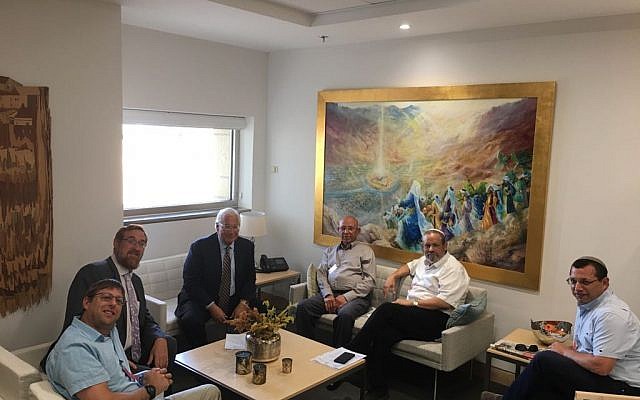 The Embassy declined to comment on the headline-making statement or the meeting itself. Without an American statement, settler leaders are the only source for what transpired in the meeting. According to MK Glick, the small group of settler leaders pushed Ambassador Friedman to endorse an “economic peace plan” as a substitute for a political solution to the conflict. Glick said that an economic proposal would “make redundant the discourse of concessions” (under previous U.S. proposals, Israeli concessions would have included the evacuation of far flung settlements in the West Bank).
Along those lines, the group presented Ambassador Friedman with a plan for a new industrial zone and medical center in the southern West Bank that, according to Glick and Har Hevron Regional Council Chairman Yochai Damari, would employ and serve thousands of Palestinians. The plan was presented by Glick, Damari, and Palestinian businessman Muhammad Nasser, who also attended the meeting. According to Glick, the U.S. Ambassador was supportive of the plan and offered U.S. assistance once the initiative was up and running.
[UPDATED 9/28/18: More details on the joint Israeli-Palestinian industrial zone in the Har Hebron region was later fleshed out by Ynet in a report here. The plan calls for an industrial zone and commercial center to be built near the Tene-Omarim settlement. Israeli Finance Minister Moshe Kahlon briefed the details of the plan to U.S. Treasury Secretary Steven Mnuchin and Jason Greenblatt, U.S. Special Representative for International Negotiations. The U.S. is expected to present the plan to the World Economy Forum during its annual meeting in January 2019]
Israel Publishes Tenders for 603 new units in East Jerusalem Settlement of Ramat Shlomo

Map by Ir Amim
On August 15th, the Israel Land Authority published construction tenders for 603 new settlement units in the Ramat Shlomo settlement in East Jerusalem. The 603 units are part of a larger plan for 1,500 units in Ramat Shlomo (tenders for almost all of which have been published now) that was announced by Israel in 2010, during the visit of then-Vice President Joe Biden. The timing of that announcement, and the inflammatory nature of settlement approvals in East Jerusalem (which the Obama Administration pressured Israel to halt), sparked outrage and prompted Biden to issue harsh criticism of Israel while on the ground. The incident earned the 2010 Ramat Shlomo plan the nickname the “Biden Plan.”
Anti-settlement watchdog Ir Amim comments that the Ramat Shlomo tenders are a part of the Israeli endeavor to:
“expand the Israeli neighborhoods/settlements in such a way as to consume the remaining space between them and nearby Palestinian neighborhoods ( a critical geo-political link between Jerusalem and Ramallah) so as to inhibit their development and further complicate any future division of the city.”
There has been a significant uptick in East Jerusalem settlement advancements since President Trump assumed office in January 2017, reflecting the sea change in U.S. policy towards settlements (evidenced again this week by Ambassador Friedman’s remarks, detailed above). As Ir Amim details, Israel’s unrestrained advancement of settlement construction in East Jerusalem has been coupled with legislative schemes to change the borders of Jerusalem (annexing far flung settlements into Jerusalem and cutting Palestinian neighborhoods out of Jerusalem) in order to engineer a Jewish Israeli majority in Jerusalem.
Massive Jerusalem Development Deal for 20,000 New Apartments – Including Settlement Expansion Projects
On August 15th, the Jerusalem Municipality signed a $380 million deal with the Israel Land Authority to finance a plethora of projects across the city, including 20,000 new apartment units. While much of this development will be in West Jerusalem, some will reportedly be in the East Jerusalem settlements of Pisgat Ze’ev, French Hill, and Atarot. The Jerusalem City Council is expected to give final approval to the plan next week.
Israel Triples Size of New Settlement Industrial Zone In Hebron
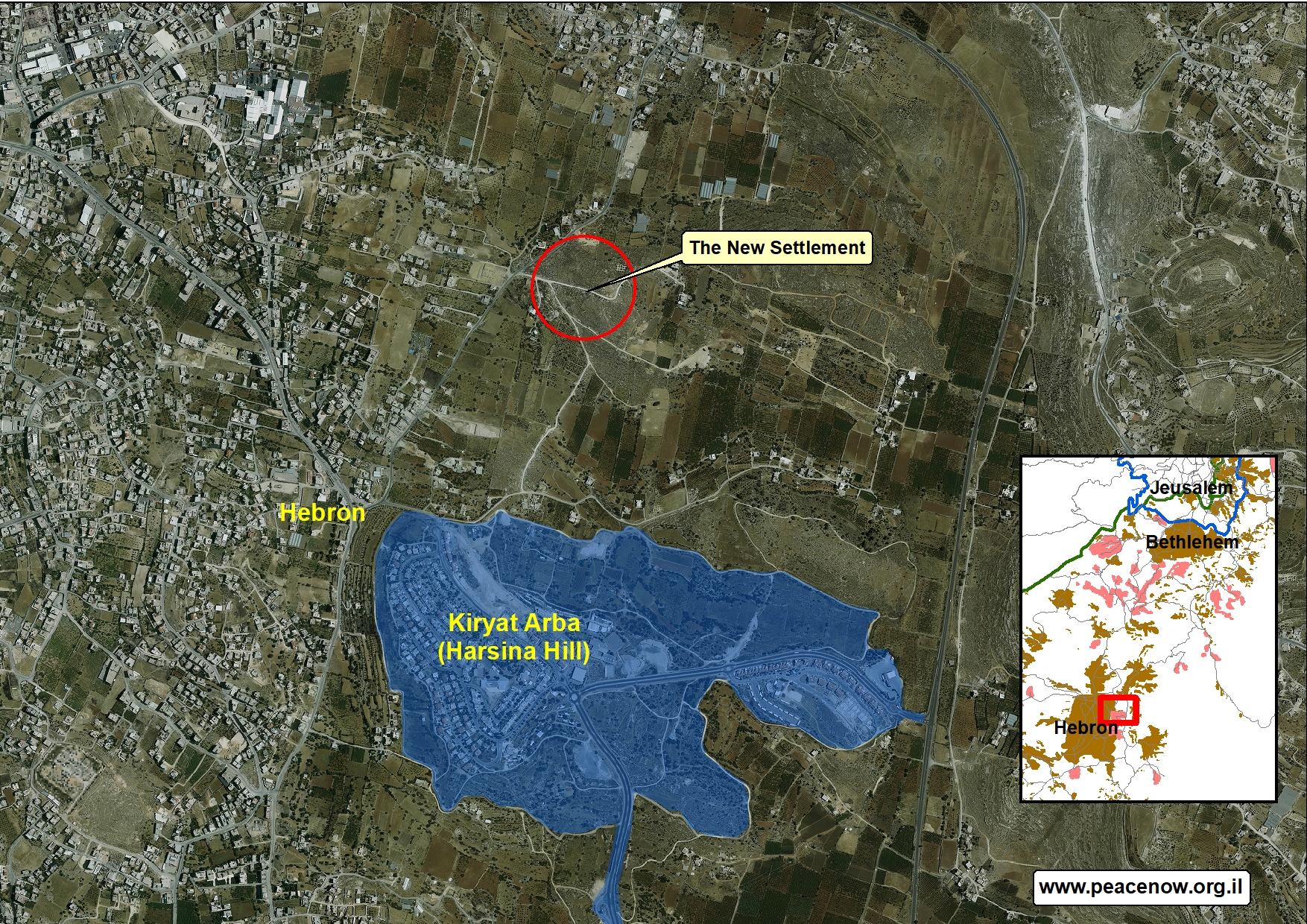
Map by Peace Now
According to The Jerusalem Post, on August 12th the Israeli government approved a plan that will triple the size of an industrial zone in the Kiryat Arba settlement in Hebron, approving 10 million shekels for the project. FMEP reported on the initial plans to build the Kiryat Arba industrial zone in March 2018, noting that the industrial zone is technically within the borders of the settlement but well outside of the developed lines of the settlement and beyond the fence that surrounds it – making it, in effect, a new Israeli settlement in Hebron. Now, the new settlement is set to significantly expand in one of the most volatile areas in the West Bank.
Knesset Sends Funds to New Settler Council in Hebron, Despite High Court Injunction
On August 12th, the Knesset Finance Committee approved 2 million shekels (about $550,000 USD) to fund the new local settler committee in Hebron. The Finance Committee requested that the money be disbursed to the Hebron settler committee “in accordance with an agreement in the past with MK Bezalel Smotrich,” (Habayit Hayehudi)…after the necessary professional and legal checks.”
The creation (via military order) of a new autonomous committee to represent and service a cluster of settlers living in enclaves in Hebron’s city center is being challenged by the Hebron Municipality. In response to the Palestinian petition, the High Court of Justice put a freeze on the plan, effective July 4, 2018, and gave the Israeli government 120 days to explain the legality of the plan. The petition argued that the military order creating the new body was intentionally vague in defining its legal and geographical jurisdiction, and pointed out that the new committee would be able to override decisions by the Hebron Municipality thereby stripping Palestinians of autonomy and representation in matters that directly affect them.
It is unclear from reporting if the Knesset Finance Committee’s decision to fund the new committee is related to the High Court’s ongoing consideration of the case. However, what is clear is that the Knesset is not concerned about undermining the High Court of Justice’s power over West Bank issues — indeed, the Knesset is actively pursuing that end with the recent passage of a new law stripping the Court of jurisdiction over land disputes and transferring it to a domestic Israeli Court, and with ongoing consideration of a bill that would allow the Knesset to reinstate laws that the High Court strikes down.
Knesset Approves Past Due Payment for the Construction of Amichai Settlement & “Temporary” Outpost
On August 12th, the Knesset Finance Committee approved the transfer of $9.5 million to pay contractors for their ongoing work on the first new settlement built with government approval in 25 years, Amichai, and a new “temporary” outpost for settlers whose homes were built on privately owned Palestinian land in the Netiv Ha’avot outpost and were recently demolished. Amichai is the new settlement approved as a pay-off to the settlers who were evacuated from the illegal Amona outpost. Construction on Amichai has begun, but has been interrupted several times due to lack of government cash, a problem ostensibly solved by this week’s cash transfer.
With respect to the new outpost for the Netiv Ha’avot outpost settlers, in February 2017 the Israeli government approved an unusual plan to place 15 mobile homes — connected to Israeli water, power, sewage, roads, and other infrastructure — at a site located near, but not within, the borders of the Alon Shvut settlement, in effect creating a new outpost for settlers evacuated from another outpost. When the High Planning Council initially approved the advancement of this plan in October 2017, it noted that “the plan is improper, but we will have to approve it as a temporary solution.” At the time, the Council ordered the government to go about expanding the borders of the Alon Shvut settlement to include the land. Under the approved plan, the new homes will be allowed to stay in that location for three years. However, based on past practice, it can be expected that within that time, or at the end of those three years, the site will “regulated” by Israel to become a permanent area of Israeli settlement.
In both cases – the Amichai plan and the Netiv Ha’avot plan – the Israeli government massively “compensating” citizens for the inconvenience of having been caught brazenly breaking Israeli law (i.e., for building without permits on privately owned Palestinian land). The two cases highlight the way in which the Israeli government not only encourages illegal settlement building, but generously incentivizes and rewards its. At this point, in addition to two new settlements, approximately 20 million shekels ($5.4 million) has been paid to the Amona evacuees and 15 million shekels ($4 million) to the Netiv Ha’avot evacuees.
Delay in Opening of new Jerusalem “Park” That Confiscates Palestinian Spring
A dispute between Israeli government agencies has led to a delay in the opening of a new Jerusalem tourist site – a park established for the express purpose of taking control over the Ein Al-Hanya spring, which was historically part of the al-Walajah Palestinian village. Originally slated to open April 1st, the delay centers around a battle over who will fund the operations of the site. For now, the site is closed and the grounds are not being maintained.
Regardless of the dispute, Israel has implemented policies that prevent Palestinians from accessing the spring and surrounding lands, including illegally moving a police checkpoint to further choke off al-Walajah from Jerusalem. As detailed in Haaretz, the plan for the park includes three pools filled by the spring – two for Israelis and tourists, and one for al-Walajah residents to water their crops and flocks. However, that third pool for Palestinians has not been built, and the water “merely spills into the nearby wadi.” The other pools, like the park, are currently empty and fenced off.
Israel Evicts Palestinians from Bethlehem Home Despite Court Order
Haaretz reports that settlers have forcibly evicted a Palestinian family from their home near Bethlehem, in defiance of an Israeli court order. The Palestinian Samara family reports that settlers tricked them into leaving the property, after which settlers locked them out, forcibly evicted them and their belongings, and then used a bulldozer to demolish their home. The family has filed an appeal to the High Court of Justice.
The Samara family – which since the early 1980s lived in 3 small units within a larger apartment building – has been targeted for eviction by settlers since 2012, when ownership of the building was transferred to an American organization controlled by Irving Moskowitz, a major funder of Jewish settlement in East Jerusalem. In 2016, the Gush Etzion Regional Council was given jurisdiction over the compound to move in Jewish Israeli settlers. Since that time, the building has been taken over by settlers, except for 2 units in which the Samara family lived as protected tenants (the third was welded shut), based on an Israeli court ruling under which the building’s owner promised not to restrict access to the building for four members of the Samara family (no other family members or visitors were allowed access). Regarding the arrangement, the judge wrote:
“This arrangement will remain in force unless a different judicial order is issued after a legal proceeding instituted by one of the parties.”
As Haaretz notes, there does not appear to be a different or new judicial order that would change the 2016 agreement.
In 2017, the Samaras reported that a new settler family had moved into the compound and began harassing the family members who remained – prompting them to file a complaint on July 26, 2018 with the Israeli police in the Beitar Illit settlement. Two weeks later on August 6th, the family was forcibly evicted and their units were demolished.
Despite the Samara’s harassment complaint and a real-time call to the police while the eviction was taking place, Israeli police took no action to prevent settlers from evicting the Samaras, reportedly stealing their cellphones, and bulldozing the properties. The Beitar Illit police station even refuse to allow the Samara family to enter the station and file a complaint until a lawyer for the family got involved many hours later.
Following intervention by UNRWA, the family was allowed to return to search the site for their ID cards and other important belongings. Now homeless, the Samara are taking their case to Israel’s the High Court of Justice.
Bonus Reads
- “A Palestinian Bedouin Village Braces for Forcible Transfer as Israel Seeks to Split the West Bank in Half” (The Intercept)
- “Between Garbage and Sewage: Israel’s Future Plans for Khan al-Ahmar” (+972 Mag)
- “Their Parents Settled the West Bank for Ideology, They’re Staying for the Vibes” (The Times of Israel)
Welcome to FMEP’s Weekly Settlement Report, covering everything you need to know about Israeli settlement activity this week.
To receive this report via email, please click here.
June 21, 2018
- Settlers Attack Israeli Police Evacuating Structures in West Bank Outpost
- Israel Strips Palestinians of Ability to Challenge Demolition Orders
- Applying Israeli Domestic Law to Settlements: Knesset Passes One Bill, Advances a Second
- High Court Demands Further Explanation re: Justice Ministry’s Decision Transfer Silwan/Batan al Hawa Property to Settlers
- Bibi Calls (again) for Permanent Control Over the West Bank
- A Case Study of Israel’s Discriminatory & Strategic Planning Policies in Area C: the Village of Nabi Samwil
- New UN Report Expected to Criticize Israel for Conduct in Gaza & for Settlement Activity
Comments, questions, or suggestions? Email Kristin McCarthy at kmccarthy@fmep.org.
Settlers Attack Israeli Police Evacuating Structures in West Bank Outpost
On June 17th, hundreds of Israeli police officers carried out the court-ordered evacuation of 10 uninhabited structures in the outpost known as West Tapuah, in an area south of Nablus known to be a hotbed of settler extremism. During the demolition, dozens of settlers attacked the police, throwing bleach, stones, sticks, eggs, and other objects. 11 police officers were injured; 6 settlers were arrested on the scene.
The court ordered the evacuation because settlers built the structures on privately owned Palestinian land. The evacuation comes on the heels of the February 2017 High Court ruling on a petition filed by Yesh Din regarding the outpost. In that ruling, the Court ordered the state to relocate or demolish 17 structures in the West Tapuah outpost, seven of which were relocated (to “state land” in the Tapuah settlement) prior to June 17th. But significantly, the ruling rejected Yesh Din’s motion to have the entire outpost evacuated, and instead accepted the state’s plan to retroactively legalize 18 structures in the outpost that were built on state land. The state argued for the plan based on the settlement “Regulation Law” which is currently being weighed by High Court and expected to be overturned.
The settler violence in the West Tapuah outpost came less than a week after similar settler violence against Israeli forces during the demolition of structures in the Netiv Ha’avot outpost (which the Israeli government also plans on retroactively legalizing). While several left-wing Israeli lawmakers spoke out against the violence coming from the settler movement, right-wing politicians who are typically quick to denounce Palestinian violence against Israeli police have been notably silent. Writing in Yediot Ahronot, former Peace Now Secretary General Yariv Oppenheimer observed:
“Justice Minister Shaked, who sponsored legislation to ramp up punishments for stone throwers, is silent. Internal Security Minister Erdan, who rushes to slam and point an accusing finger at the Arab sector following every incident, is silent. Defense Minister Lieberman, who made his political capital from his incitement against Arab Knesset members, is silent. And Prime Minister Netanyahu has already learned that he shouldn’t get into trouble with the hard core of the right-wing support base. The Tapuach settlers are immune. One doesn’t have to go too far to understand the extent of hypocrisy here. Only seven months ago, the whole country was shocked by the documentation of teenager Ahed Tamimi confronting and slapping two soldiers. The incident was met with endless condemnations from the Right, and although she didn’t physically wound anyone, the demand for her arrest was loud and clear.”
In +972 Mag, Joshua Leifer noted another inconsistency:
“In the West Bank, the consequences for throwing stones at Israeli soldiers differ dramatically, depending on who’s doing the throwing. The same act, when carried out by Jews in the West Bank, is met — often literally — with a soft-gloved hand. When carried out by Palestinians, the punishment can be as severe as death.”
Israel Strips Palestinians of Ability to Challenge Demolition Orders
On June 17th, a new Israeli military order entered into effect denying Palestinians living in the West Bank any right to legally challenge most demolition orders issued by the Civil Administration. The new diktat applies in cases where Israeli authorities deem Palestinian construction to be new, defined to mean construction that is incomplete or completed in the past six months. New residential construction may be demolished if still unoccupied or newly occupied (within 30 days). In cases where the owner of the targeted property has a building permit, they have 96 hours within which to apply to have the demolition canceled; if they fail to do so (and fail to self-demolish), Israeli authorities may “remove the structure and anything attached thereto from the property”, so long as it is “not located within the confines of a detailed building plan”, and after consulting with the legal advisor or his representative.
In short, under the new order, Israel can summarily demolish Palestinian homes, with impunity. This is just the latest Israeli effort to deny Palestinians the right to challenge Israeli policies that deprive them of the right to build on their own land.
B’Tselem notes:
“About a year ago, the state attempted to use a different method, originally designed to remove illegal settlement outposts. The military declared an area where an entire community resides as a ‘restricted area’ and ordered the removal of any real property found therein, foregoing the need to issue demolition orders for each structure separately. The state has so far issued such orders against three [Palestinian] communities. The communities have petitioned Israel’s High Court of Justice and are awaiting its decision.”
Prior to this new military order, Palestinians had a theoretical right to challenge demolition orders. That legal process was already deeply problematic (usually ending, predictably, with the demolition being carried out), but at least provided some hope and a delay before the family in question lost their home. This new order, in effect, removes even the pretense that Israel offers Palestinians any chance to defend their rights.
As B’Tselem explains:
“In essence, the new military order removes the façade of judicial review over demolition orders and over Israel’s planning and building policy in the West Bank. This is no trifling matter: upholding the regime of occupation requires façades and Israel goes to great lengths to maintain them. This is true of the military law enforcement system, the military courts and the takeover of tens of thousands of hectares in the West Bank. Israel’s readiness to lift the veil on this matter indicates its plan to accelerate and expand the dispossession of Palestinians throughout the West Bank, and a conviction that it will not be called to task over this either internationally or locally.”
Applying Israeli Domestic Law to Settlements: Knesset Passes One Bill, Advances a Second
On June 18th, the Israeli Knesset voted on two bills which apply Israeli domestic law over the settlements, further destroying the legal significance the Green Line and effecting the de facto annexation of the settlements.
The first bill, which was passed into law, allows chicken farmers located in the settlements to sell their egg-production quotas to farmers in sovereign Israel (whose quotas are smaller). The second bill, which was passed through its first reading, would allow certain tax revenues from inside sovereign Israel to be sent to the settlements (FMEP covered this bill in the June 8th Settlement Report).
Following the votes, MK Abd al-Hakim Hajj Yahya (Joint List) said:
“Carrying out creeping annexation on the backs of the chickens too is getting to be too much. These are quotas from people who are living [in the West Bank] in violation of international law – war criminals who are in the territories as settlers. What is needed is to return them [the settlers] rather than unnecessarily returning the egg quotas that they have there” to Israel.”
MK Hilik Bar (Zionist Union) challenged the Knesset in regards to the tax-sharing bill:
“Your agenda is annexation, so don’t carry out creeping annexation. Instead, put it on the table and pass an annexation bill. Let’s see you let the truth blow up in your faces.”
As FMEP has extensively documented, Israel’s accelerating efforts to apply Israel domestic law outside of its sovereign borders is one of the key ways by which Israel is moving to unilaterally annex territory in the West Bank.
High Court Demands Further Explanation re: Justice Ministry’s Decision Transfer Silwan/Batan al Hawa Property to Settlers
The Israeli High Court of Justice has ordered the Justice Ministry to provide more information regarding its 2002 decision to transfer land in the Batan al Hawa area of Silwan, in East Jerusalem, to a trust controlled by the Ateret Cohanim settler organization. The Court asked the Justice Ministry to explain how it determined that the original deed from the Ottoman era was eligible for transfer, and if the 700 Palestinians affected by the deed transfer were given proper notice. The Court also asked the petitioners to provide information on any previous legal data involving the land.
As FMEP reported last week, Ateret Cohanim facilitates and encourages Jewish Israelis to settle in Palestinian neighborhoods of East Jerusalem. Ir Amim reports that Ateret Cohanim’s takeover of land in Batan al-Hawa is, “the single largest takeover campaign in a Palestinian neighborhood of Jerusalem since 1967.”
Bibi Calls (again) for Permanent Control Over the West Bank
On June 17th, the Israeli Shin Bet announced that it had uncovered a Hamas cell in Nablus that had allegedly been working for months to plan bombings and suicide attacks on Tel Aviv, Jerusalem, and the Itamar settlement. In response, Prime Minister Netanyahu said, “Hamas is trying to harm us both from Gaza and from Judea and Samaria. That’s why we will continue to maintain security control over all the territory west of the Jordan [River].”
This is not the first time Netanyahu has said that Israel will never give up the West Bank. For example, in August 2017, he vowed that no more settlements would ever be removed and, speaking of the West Bank, promised, “We are here to stay, forever.” In a speech delivered in July 2014, during Israel’s military assault on Gaza, Netanyahu stated: “I think the Israeli people understand now what I always say: that there cannot be a situation, under any agreement, in which we relinquish security control of the territory west of the River Jordan.”
A Case Study of Israel’s Discriminatory & Strategic Planning Policies in Area C: the Village of Nabi Samwil
A new report published by Al-Haq – “Hidden In Plain Sight: The Village Of Nabi Samwil” – examines how the lives of Palestinians living in the village of Nabi Samwil have been severely impacted by Israel’s discriminatory planning policies. Al-Haq shows how Israel’s treatment of Nabi Samwil is aimed at displacing Palestinians from the area by creating “a coercive environment that propels their transfer from Nabi Samwil.”

Map by B’Tselem
Located on one of highest mountain tops east of Jerusalem, Nabi Samwil has been a target for Israeli takeover since 1971 (at least), when Israeli lawmakers lamented the failure of the government to include Nabi Samwil in the municipal borders of Jerusalem that were expanded following the 1967 war. Arguing that the village was of high strategic importance, the Israeli government took actions to encourage Palestinians to leave – including demolishing 52 homes in a single day – while advancing plans to build Israeli settlements in the area.
The situation took a turn for the worse in 1995 when, in light of the state’s new focus on the religious significance of the area, which is said to be where the prophet Samuel is buried, Israel declared the area a national park. Since then, Israel has undertaken excavations that have further negatively impacted Nabi Samwil residents.
The lives of Nabi Samwil’s residents became nearly unbearable starting in 2005, when Israel built its West Bank separation barrier to the east of the village – in effect isolating Nabi Samwil. The village is still technically located in the West Bank, not Jerusalem. Its residents carry West Bank ID cards, meaning they are legally forbidden from entering Israel without a special permit (which few have) and must look to the West Bank – now cut off from them by the barrier, for all their needs. In order to enter/exit the West Bank residents must pass through an Israeli checkpoint, where Israeli regulations prevent them from carrying virtually anything with them.
As a result, living conditions in Nabi Samwil – including decaying house, absence of health, education, and sanitation services, no local employment, and being cut off from the fabric of life of the West Bank (other Palestinians cannot visit Nabi Samwil unless they have an Israeli-issued permit to enter Jerusalem) – are among the worst in the entire West Bank. Efforts to improve these conditions have for years been blocked by Israel, even as settlement construction surges in the surrounding area.
Despite all of this, Nabi Samwil’s residents refuse to leave.
Al-Haq writes:
“Every aspect of life for Palestinians in Nabi Samwil is shaped and impacted by an array of Israeli policies and practices that target the land and its people. As described by one resident, living in Nabi Samwil is like being confined to ‘an invisible cage.’”
New UN Report Expected to Criticize Israel for Conduct in Gaza & for Settlement Activity
United Nations Secretary General Antonio Guterres is expected to release a new report that will be harshly critical of Israel’s handling of protests along the Gaza fence and, once again, call out Israel for its unabated, illegal settlement activity. The U.S. reportedly tried to suppress the report, which was leaked to the press before Amb. Nikki Haley announced the U.S. withdrawal from the UN Human Rights Council on June 19th.
Welcome to FMEP’s Weekly Settlement Report, covering everything you need to know about Israeli settlement activity this week.
To receive this report via email, please click here.
June 15, 2018
- “Greater Jerusalem” Annexation Bill Back on the Agenda
- Expanding a Settlement, Suffocating a Village – Har Gilo West vs. al-Walajah
- Full Steam Ahead on 325 New Settlement Units Near the E-1 Settlement Area
- Plans for Largest-Ever Settlement Industrial Zone, as Part of “Super Settlement” Area
- Israel Admits: We Gave Settlers Part of Silwan Without Checking Who Owned It
- Despite Pay-Offs and Promises, Settlers Violently Resist Netiv Ha’avot Demolitions
- New Bill Would Hand Over Area C to the World Zionist Organization
- Settler Whistleblower: Not Concerned With Law, Only Concerned with Dispossessing Palestinians
- MK Introduces Bill to Dismantle the Civil Administration, Annex the Settlements
- Settlers Kill Knesset Plan to Complete the West Bank Barrier
- While No One Was Watching, Jerusalem Suburb Has Been Annexing “No Man’s Land”
- Bonus Reads
Comments, questions, or suggestions? Email Kristin McCarthy at kmccarthy@fmep.org.
“Greater Jerusalem” Annexation Bill Back on the Agenda
Jerusalem Settlement watchdog Ir Amim reports this week that, the Ministerial Committee for Legislation (the body of Israeli Cabinet members which decides whether or not the government will endorse legislation) is once again scheduled to discuss the “Greater Jerusalem” annexation bill. Members of the Ministerial Committee have long pushed for the Committee to consider the bill – with Ministers Ayelet Shaked (Jewish Home) and Naftali Bennett (Jewish Home) eager to secure government support for it – but Prime Minister Netanyahu intervened at the last minute to take the bill off of the committee’s October 2017 agenda, relegating the bill to political uncertainty. At the time, reports insinuated that Netanyahu blocked consideration of the bill due to international pressure. At the time the Trump Administration publicly stated it would not oppose the bill, but reportedly it discouraged movement on the bill at that time, apparently over concerns that it would undermine ongoing US efforts to engage other regional parties.
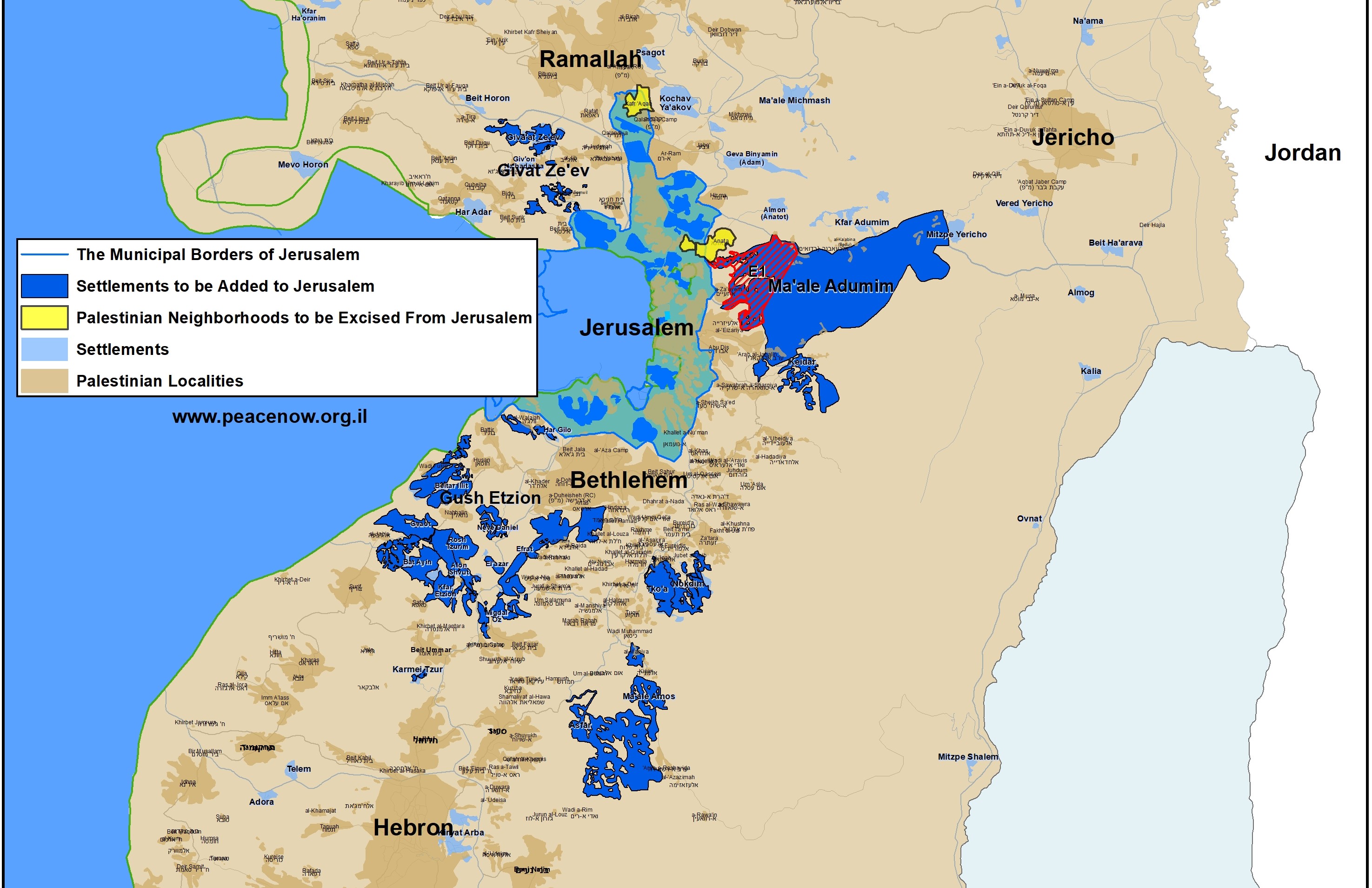
Map by Peace Now
FMEP has regularly reported on the “Greater Jerusalem” bill, which was introduced in July 2017 by two members of Prime Minister Netanyahu’s own Likud Party, Yoav Kisch and Yisrael Katz. The bill proposes absorbing 19 settlements into the Jerusalem municipality (an act of incremental de facto annexation), allowing the settlements to participate in Jerusalem elections and be counted in the Jerusalem census. Earlier versions of the bill also included a clause that would have applied Israeli domestic law to these same settlements – another means of de facto annexation – but the clause was stripped from the (ostensibly) final version that the Committee is now set to consider.
FMEP continues to track the Greater Jerusalem bill in its weekly settlement reports and in its tables tracking annexation policies.
Expanding a Settlement, Suffocating a Village – Har Gilo West vs. al-Walajah
.jpg) The Planning and Building Committee of the Gush Etzion Regional Council met on March 25th to discuss a 330-unit plan to expand the Har Gilo settlement onto a non-contiguous plot of land that would effectively seal shut the Palestinian village of al-Walajah. The Council’s discussion of the plan kicks off the official planning process; the next step will be a discussion by the High Planning Council and then deposit of the plan for public review.
The Planning and Building Committee of the Gush Etzion Regional Council met on March 25th to discuss a 330-unit plan to expand the Har Gilo settlement onto a non-contiguous plot of land that would effectively seal shut the Palestinian village of al-Walajah. The Council’s discussion of the plan kicks off the official planning process; the next step will be a discussion by the High Planning Council and then deposit of the plan for public review.
The plan – called “Har Gilo West” – will nearly double the population of Har Gilo by building what is by all measures a new settlement on the far side of the Palestinian village of al-Walajah. Ir Amim explains:
“Though publicized as an expansion of the Har Gilo settlement, the area demarcated for the plan is clearly distinct from Har Gilo, with the Palestinian village of Walaja and the Separation Barrier positioned in between the two… In effect, along with Har Gilo, the new development would create a wall of settlement around the West Bank portion of Walaja, completing a series of steps to entirely seal the village off from its surroundings.
…In the last decade, Israeli authorities have established several dramatic facts on the ground – including completion of the Separation Barrier around Walaja and a national park built on its land – to strategically address Walaja’s obstruction of Israel’s plan to absorb the Gush Etzion bloc into Greater Jerusalem. Har Gilo West should be seen in the context of this overarching geo-political goal. It is one more measure in a series of steps to disconnect the built-up area of Walaja from its surroundings, create an isolated enclave out of the village, and enable a contiguous Israeli controlled territory from Jerusalem to the Gush Etzion Regional Council.”
FMEP has repeatedly documented various Israeli efforts to seal off al-Walajah from Jerusalem. Residents of al-Walajah have fought the growing encroachment by the nearby Etzion settlement bloc and the Israeli government’s attempt to de facto annex the bloc as part of “Greater Jerusalem.” Ir Amim explains several prongs of this effort, including a particularly unbelievable section of Israel’s separation barrier planned to almost completely encircle the village, to turn its valuable agricultural land into an urban park for Jerusalem, and construction of a highway that will connect the Etzion settlement bloc to Jerusalem with Israeli-only bypass roads.
Full Steam Ahead on 325 New Settlement Units Near the E-1 Settlement Area
On June 14th, the Israeli Defense Ministry deposited for public review a plan, previously approved by Israeli High Planning Council, to build 325 settlement units in the Alon settlement, situated on the northern edge of the area slated for the E-1 settlement, east of Jerusalem. The plan includes a residential zone, a commercial area, a park, roads and public buildings.

Map by Ir Amim
As FMEP has reported on repeatedly, the E-1 area has long been slated for Israeli settlement construction, but plans have been continuously delayed by the Israeli political echelon – due in large part to pressure from past U.S. administrations and others in the international community. E-1 is often called a “doomsday settlement” because it will seal Palestinian East Jerusalem off from the West Bank to its east, and creating a land bridge from Jerusalem to the Maale Adumim settlement that bisects the West Bank. The settlement will render the two-state solution impossible because it would preclude the ability to draw contiguous borders for a future Palestinian state with a capital in East Jerusalem.
East Jerusalem expert Danny Seidemann issued numerous warnings in 2017 that E-1 might be slated for advancement under the current settlement policy of the Netanyahu government and with no discernable counter-pressure from the Trump Administration. Seidemann warned in January 2017, “The main obstacle preventing a green light for E-1 has, until now, been wall-to-wall opposition from the international community, led by the United States (dating back to the era of President Clinton).”
Plans for Largest-Ever Settlement Industrial Zone, as part of “Super Settlement” Area
According to the settler-aligned Arutz Sheva media outlet, a number of settlement municipalities have agreed to a plan to build the largest-ever settlement industrial zone — in the area where Israel is planning to unite multiple settlements into one “super settlement area.”

Map by WINEP
FMEP reported on the future “super settlement” in February 2018, when rumors first broke about the government’s plan to unite several settlements (Elkana, Sha’arei Tikva, Etz Efraim, and Oranit). FMEP covered the story again in March 2018, when Palestinians began to protest the plan. By uniting the settlements, Israel will significantly increase the footprint of developed land, allowing for massive projects like the industrial zone. The four settlements and the land between them are located in the “seam-line” zone, the area created by the weaving route of the Israeli separation barrier that was built to keep many settlements on the Israeli side of the barrier despite being east of the 1967 Green Line.
The planning of the new mega industrial zone – which will cover 2 million square meters (nearly 500 acres) near the Shaarei Tikva, Elkana, and Etz Efraim settlements – has been delayed for nearly 10 years amidst disputes between competing settlement municipalities. Now, with the consensus amongst the planners, the proposal will be submitted for approval.
The head of the Samaria Regional Council, Yossi Dagan, said:
“this is a historic move that is expected to change the face of settlement in Samaria in general and the settlements of Samaria Gate in particular. The new industrial zone is planned on an area of 3,000 dunams (340 acres) north and south of Highway 5, and it will include areas for commerce and high-tech offices, areas for regional public buildings, and industrial areas.”
With a consensus around the location and details of the planned industrial zone, Arutz Sheva speculates that construction will begin by the end of 2018. The plan includes a major upgrade to a settler transportation hub, known as the Sha’ar Shomron interchange, which is expected to be a stop on the future settler-only light rail line slated to cut across the West Bank.
Arutz Sheva also reports that settlers are ready to submit another plan for a new cemetery to be located east of the area where the industrial zone will be built, to “provide a regional response to the needs of the towns in western Samaria.”
Israel Admits: We Gave Settlers Part of Silwan Without Checking Who Owned It
Palestinian residents of the Batan al-Hawa section of the Silwan neighborhood in East Jerusalem have petitioned the High Court to stop the government facilitated settler takeover of a large area of their neighborhood and the eviction of 700 Palestinian residents.
In a hearing on the petition held on June 10th, the Israel government’s lawyer admitted that the State gave the land to the settler organization Ateret Cohanim without a proper investigation into the underlying legal status of the land and the buildings on it, but argued that the Palestinians’ petition should be dismissed because the land was granted to Ateret Cohanim in 2002 (intimating that Palestinians should have petitioned against the move earlier). Ateret Cohanim facilitates and encourages Jewish Israelis to settle in Palestinian neighborhoods of East Jerusalem. Ir Amim reports that Ateret Cohanim’s takeover of land in Batan al-Hawa is, “the single largest takeover campaign in a Palestinian neighborhood of Jerusalem since 1967.”
According to Ir Amim, 17 Palestinian families have been evicted from the homes on the land since the deed was transferred in 2002. 83 Palestinian families, approximately 700 people, remain the target of eviction. Ir Amim writes:
“This well organized Ateret Cohanim campaign represents not only the displacement of an entire community but also the direct involvement of the Israeli government in facilitating private settlement in the Old City and surrounding band of Palestinian neighborhoods. The government has acted through the General Custodian and the Registrar of Trusts (both under the Ministry of Justice) to facilitate settlers’ seizure of Batan al-Hawa, as well as increasing its security budget by 119% from 2009 – 2016 to ensure the protection of radical Jews settling in the hearts of Palestinian neighborhoods in East Jerusalem.”
The Haaretz Editorial Board also weighed in vehemently criticizing the Israeli government’s handling of the case. The Board wrote:
“The settlement in Batan al-Hawa is the most problematic of all the settlements in Palestinian neighborhoods in Jerusalem. It is located in the heart of a crowded inner city, weighs heavily on the residents’ daily lives and is intended to prevent any diplomatic solution with the Palestinians. Every Jewish family there needs security that costs around 1 million shekels ($280,000) a year. But the damage doesn’t seem confined to Silwan. This settlement has also corrupted Israel’s bureaucracy.
When the administrator general and state prosecutors found that the 2002 decision had been mistaken, the only decent thing to do would have been to cancel it and freeze the eviction proceedings against the Palestinian families. Instead, government clerks and lawyers are fighting for eviction along with Ateret Cohanim. This is further proof of the extent to which the settlements have corrupted public administration in Israel. Now the issue rests with the High Court. Hopefully, despite the pressure being put on the justices, they will halt the oppression and corruption.”
On June 6, Peace Now published a backgrounder, “The Systematic dispossession of Palestinian neighborhoods in Sheikh Jarrah and Silwan.” Back in 2016, the Israeli human rights organization B’Tselem produced a comprehensive multi-media backgrounder on the threat to Batan al Hawa. Jerusalem expert Danny Seidemann has also published extensive background and analysis on the assault on Batan al Hawa (here and here).
Despite Pay-Offs and Promises, Settlers Violently Resist Netiv Ha’avot Demolitions
Approximately 1,000 Israeli settlers and their sympathizers gathered to protest the long-planned, court-ordered demolition of 15 structures built on privately owned Palestinian land in the unauthorized Netiv Ha’avot outpost. The demolitions were completed on June 14th. Dozens of settlers barricaded themselves inside the last two structures to be demolished, some of whom hurled stones and other objects at Israeli policeman who were forced to drag them out of the buildings, resulting in thirteen injuries to police officers. Three suspects were arrested, but released a day later.
Touting the growing governmental effort to compensate the settlers of Netiv Ha’avot for paying a price for their illegal activity, several prominent leaders from the Jewish Home party joined protesters at the outpost during the demolitions, including Justice Minister Ayelet Shaked, who said:
“The evacuation is the result of a serious mistake. It began with an erroneous response from the state several years ago, but that was fixed from the root, and ended with an erroneous High Court decision. The news is that it ends here. In the past three years, we have changed the discourse. Instead of asking, ‘When are we evacuating?’ we’re asking, ‘How do we regulate?’”
Education Minister Naftali Bennett also attended and said:
“Whoever wishes to raze 15 homes will receive 350 on this hill. This is a difficult evening. It is incomprehensible to the residents of the Netiv Ha’avot neighborhood and to anyone who has settled the precious Land of Israel. It’s absurd. I cannot recall a legal action as irrational as this. The campaign will not be won until the prime minister abides in full and builds a huge neighborhood here on this hill.”
Agriculture and Rural Development Minister Uri Ariel (Jewish Home) was also on hand and said:
“There’s no benefit in demolishing homes and driving people from their homes. The High Court hearing was conducted as if it was in Sodom and Gomorrah, but we won’t give in. We won’t let this keep us from settling throughout the Land of Israel.”
In contrast, Peace Now declared a partial victory against illegal settlement growth, saying:
“After 17 years of theft, evasions, delays, and manipulation, justice is being served as the private land on which the Nativ Ha’Avot outpost was built is being vacated, in line with the High Court of Justice’s ruling. We hope these evictions will send a clear message that crime does not pay, and that anyone who builds on land without authorization or even purchasing it first will ultimately be compelled to leave. Peace Now will continue to monitor all settlement construction in the West Bank, and will fight against any land theft or attempt to destroy the viability of a two-state solution.”
However – as the Jewish Home party leaders made clear – the victory is not complete, as the Netiv Ha’avot settlers have successfully waged a public shaming campaign against the government for failing to prevent the enforcement of its laws against the settlers. As reported succinctly by The Times of Israel, various arms of the Israeli government are currently working in concert to retroactively legalize the remaining structures in the Netiv Ha’avot outpost and to prepare plans for 350 new units there. In addition, the government has already rewarded Netiv Ha’avot with what is effectively a new outpost built for the settlers affected by the demolitions – settlers who will additionally receive a monetary compensation package paid for by Israeli taxpayers for their misfortune of having built illegally on land that is owned by Palestinians. For more background, see Peace Now’s comprehensive recap of the Netiv Ha’avot saga.
New Bill Would Hand Over Area C to the World Zionist Organization
Peace Now reports that the Knesset is moving a bill that would transfer the responsibility of “managing” rural land in Area C of the occupied West Bank to the Settlement Division of the World Zionist Organization (WZO), a body dedicated to the establishment and development of settlements, whose activities have been dogged by fraud and illegalities for decades.
The bill was introduced by MKs Bezalel Smotrich (Jewish Home), Yoav Kisch (Likud), and David Bitan (Likud), and it passed through the first of three Knesset readings on June 13th. Reportedly, the bill will be put on hold for two weeks so the government has time to examine the possibility of achieving the same result through a Cabinet decision, avoiding the politics and pushback that might come in Knesset debate.
As Peace Now notes, under international law Israel, as an occupying power, cannot grant non-governmental organizations the authority to manage lands outside of its borders.
Peace Now said:
“The Knesset today approved a bill allowing five decades of land theft, delinquency and corruption under the guise of ‘unique characteristics and development of settlement.’ Despite stacks of State Comptroller reports, complaints from legal advisers and evidence of criminal offenses, the government is scandalously planning to give the biggest land thieves responsibility for managing the land distribution, which will continue to be done under the cover of darkness if the bill passes into law.”
Peace Now also provides an excellent overview of the activities the WZO has engaged in since 1968, when the Israeli government gave the organization’s Settlement Division the authority and the funding to build settlements in the occupied territory. The arrangement worked for the Israeli government, by contracting out settlement building the government found a way to escape the rules, restrictions, and transparency norms that inhibit government bodies from operating freely. Peace Now reports:
“The Settlement Division manages the land without any transparency, contrary to the rules of proper administration, without supervision, and sometimes with corruption and fraud. Thus, for example, the Settlement Division gave settlers in Amona, Giv’at Haulpana, Mitzpeh Kramim and others the rights to build on what was private land belonging to Palestinians.”
For more information on the WZO, and for background on a High Court case seeking to make the WZO’s land holdings public, see the Peace Now report. The legal issues with the WZO’s operations were highlighted in the official report by Talia Sasson, commissioned by Ariel Sharon. Also see media reports: here, here, here, and here, for example.
Settler Whistleblower: Not Concerned With Law, Only Concerned with Dispossessing Palestinians
The Israeli daily newspaper Yedioth Ahronoth published a comprehensive investigation into the leaders of the publicly-funded Regavim settler group. The group’s stated mission is “to ensure responsible, legal, accountable & environmentally friendly use of Israel’s national lands and the return of the rule of law to all areas and aspects of the land and its preservation.” The investigation reveals, however, that the organization’s efforts to identify and stop illegal construction are merely a tool to dispossess Palestinians of their land.
The Investigation found, in fact, that Regavim and its leader have a demonstrable disregard for the Israeli planning and building laws that they purport to be dedicated to enforcing, evidenced most plainly by the fact that 15 Regavim officers are living in structures built on privately owned Palestinian land, some with demolition orders issued against them. These include the building where Yehuda Eliyahu, the current executive director of Regavim, lives.
The outlaw behavior of Regavim leaders is more consequential than just 15 units. The investigation also details how leaders of the group have helped to illegally establish settlements at the cost of Palestinians. Yediot Ahronot reports:
“Somehow, all this doesn’t prevent the movement and its representatives from appealing to the High Court of Justice in dozens of petitions, and to successfully act as the guarantors of law and order to eliminate construction violations. Among other things, Regavim operates in sensitive areas of international interest, such as a legal proceeding following which 76 members of [U.S.] Congress recently demanded that the government not demolish Palestinian homes.” [referring to Khan al-Ahmar]
Dror Etkes, founder of the anti-settlement watchdog Kerem Navot, commented:
“Regavim’s lie holds no water: they preach action against illegal construction, but live in illegally built homes. They talk about the ‘rule of law’ as they violently transgress it. The findings exposed today indicate that Regavim is in fact an enemy of the principle of ‘rule of law,’ which its members use manipulatively to strip it of its meaning.”
J Street weighed in on the investigation, urging:
“Yedioth Ahronoth’s report underscores the long-term impact and agenda of the settlement movement. For decades, they have moved aggressively to build housing in — and push Palestinians out — of key parts of the occupied territory, with varyingly strong degrees of support from successive Israeli governments…The fanatical ideology of Regavim and the broader settler movement — along with their allies in the Netanyahu government and the Trump administration — must be confronted.”
The report and investigation was published two weeks after the Israeli High Court of Justice upheld demolition orders against the Khan al-Ahmar Bedouin community, a case that Regavim and its supporters in the government (including Jewish Home MK Bezalel Smotrich, who founded Regavim in 2006) have been pushing for years. MK Smotrich and Regavim are simultaneously pushing legislation like the settlement “Regulation Law,” which seeks to retroactively legalize Israeli settlement activity that does not comply with Israeli planning and building law. The Regulation Law, which FMEP has reported on extensively, will resolve the conundrum of demolishing unauthorized Palestinian building while legalizing unauthorize Israeli building by gutting the rule of law entirely.
MK Introduces Bill to Dismantle the Civil Administration, Annex the Settlements
Punctuating a busy week, MK Bezalel Smotrich (Jewish Home) announced that he has submitted a new bill to dismantle the Israeli Civil Administration, the governing body of the West Bank (operating under the Israeli Defense Ministry). Smotrich also featured prominently in the investigative report into Regavim (covered above), participated in the protests at the Netiv Ha’avot outpost (covered above), and saw his bill to empower the World Zionist Organization to manage Area C pass through its first reading (covered above).
According to a report by the settler-aligned Arutz Sheva media outlet, Smotrich alleged that the Civil Administration’s “lack of modern computing and mapping tools” is the real culprit behind the accidental, illegal settlement construction that necessitate legislation like the settlement “Regulation Law.”
Speaking at a conference organized by Regavim, Smotrich said:
“The Civil Administration has no normal website, no access to the public. A lot of the mistakes that led to the enactment of the [settlement] regulation law were caused by a lack of modern computing and mapping tools. There is very little organizational memory in the Civil Administration system because many of them are military personnel who change positions every two years. If I want to buy an apartment in Tel Aviv, within three minutes a document will arrive in my email. In order to sell or buy a house in Judea and Samaria, I have to enter a military base and go through an archaic system with a clerk who still works with binders and then wait for weeks to receive any documents. The bill sets a target date for the dismantling of the Civil Administration, and the Administration’s responsibilities will be distributed to the various government ministries, as already happens today, for example, in the Education Ministry. This is the right thing in terms of democracy, it is the right thing in terms of values, [and it puts us] on the path to normalization in Judea and Samaria. Also on the practical level it improves services to the citizens.”
The report on Smotrich’s new bill does not mention anything regarding the future of the Palestinians, who lives are governed, in virtually every aspect, by the Civil Administration.
Settlers Kill Knesset Plan to Complete the West Bank Barrier
Israeli settlers have successfully lobbied the Knesset to kill, for a third time, a bill to compel the Israeli government to finish building the West Bank the separation barrier. The Knesset voted to reject the bill 42-23. The government has failed to complete the construction, which began in 2002 amidst international outrage and allegations of war crimes, despite the adamant arguments of the Israeli government that the wall is a security necessity. According to B’Tselem, only 65% of the barrier has actually been erected – leaving significant gaps that seem to undermine the security logic of the barrier. Adding to that, 85% of the barrier is located inside West Bank territory, creating one form of de facto annexation of the areas on the Israeli side of the barrier, which include a long list of Israeli settlements and surrounding lands for their expansion.
In Al-Monitor, Mazal Mualem explains:
“…the right is concerned that an Israeli initiative of putting up a fence that separates West Bank settlements from Palestinian villages around them would constitute an official endorsement of a future border between Israel and a Palestinian state.”
The bill was pushed by members of the Zionist Union coalition on the left – without the support of the Joint List MKs (representing Palestinian citizens of Israel) – who stress the security imperative of closes the existing gaps. Avi Gabbay, head of the Labor Party, slammed the government’s foot-dragging, saying that delaying the completion of the barrier risks allowing the next terrorist attack Israel. Gabbay said the Netanyahu government is:
“simply afraid of settlers who don’t want to close the gaps for political considerations. These so-called political considerations damage the security of the State of Israel.”
Gabbay’s coalition partner, Tzipi Livni who heads the Zionist Union, explained the left-wing coalition’s rationale for supporting the barrier. Livni said:
“If you support the idea of two states for two people, you need to support this fence. At the beginning, we need a border between us and the Palestinians and then maybe in 50 years, when we live happily ever after, we can dismantle it. For now, this is the concept: security for Israelis but also dividing the land into two states for two peoples.”
The annexation of the West Bank land on the Israeli side of the barrier is an implicit assumption of Gabbay and Livni’s statements.
While No One Was Watching, Jerusalem Suburb Has Been Annexing “No Man’s Land”
 For decades, the Israeli government has expanded the Jerusalem neighborhood of Mevasseret Zion into the no-man’s land between the internationally recognized 1967 Green Line and the Israeli separation barrier. Kerem Navot, an anti-settlement watchdog, recently discovered the cross-border expansion – which is plain to see on Google maps – of the neighborhood, along with a slew of other buildings, including a water facility and a synagogue. Additionally, the Israel Land Authority is advancing plans to build 300 new homes in the northern part of Mevasseret Zion, where it crosses over the Green Line.
Dror Etkes, the founder of Kerem Navot, told Haaretz:
“It’s obvious that the planners of this neighborhood knew very well where the Green Line runs. But they chose to ‘straighten’ the line there in order to make room for a few dozen more homes. It’s only natural that the state, which for decades has been investing massive resources in seizing control of the space of a neighboring people, should also expand communities situated within the Green Line into the West Bank. The amazing thing is that any sort of effort is being made still to maintain the distinction between communities within the Green Line and the settlements, since the declared policy of most of Israel’s governments in the past five decades was and remains the very opposite.”
A spokesman for the Mevasseret Zion neighborhood – whose residents almost certainly did not know they were living in a settlement – issued a disgruntled statement regarding the discovery and the Israel Land Authority’s plan to expand the encroachment:
“The plan currently being promoted [by the Israel Land Authority] is vigorously opposed by the council and the local residents, and they are working together to block the project. The council and residents object to the plan going ahead with regard to both the areas across the Green Line and those in the permitted areas.”