Welcome to FMEP’s Weekly Settlement Report, covering everything you need to know about Israeli settlement and annexation activity this week.
To subscribe to this report, please click here.
January 31, 2025
- Bill to Allow Israelis to Buy West Bank Land Advances in Knesset
- Weekly Settlement Advancements Continue for Ninth Week
- On First Day in Office, Trump Cancels Sanctions on Violent Settlers
- Bonus Reads
Bill to Allow Israelis to Buy West Bank Land Advances in Knesset
On January 29th, the Israeli Knesset’s plenum approved the preliminary reading of a bill (58 – 33) that will allow Israelis to purchase land in the West Bank without any restrictions. In response, Peace Now called this “annexation and apartheid.”
Under the current law, private, non-Arab individuals cannot purchase land in the West Bank. In 1971, the law was amended to add a loophole allowing companies registered to operate in the West Bank (like the World Zionist Organization and the Jewish National Fund) to purchase property, and often do so only to give it to Israeli settlers. This additional change would open the door for private purchases across the West Bank by settlers and their backers, including in the heart of Palestinian cities. Notably, Israeli security officials have in the past objected to changing this law, based on their recognition of the fact that settlers implanting themselves wherever they want in the West Bank – including in acts intended to be deliberately provocative – will be a security nightmare for the IDF and will enable settlers and their financial patrons to further hijack the national security agenda of the state of Israel.
MK Aida Touma-Sliman wrote:
“Annexation on steroids: The bill that was approved in preliminary reading in the Knesset plenary now removes another obstacle on the way to a complete takeover of the West Bank. In serious violation of international law, Israel behaves as a sovereign in an occupied territory and promotes de jure annexation, a colonialism that is brazenly called “equality”. The approval of the bill today is a direct continuation of structural changes carried out in the area, including construction permits, declaration of state lands, construction of outposts in Area B, road construction, transfer of civil administration powers to Messianic ministers and more. The annexation is no longer crawling, not racing, it is carried out slowly but surely.”
Peace Now writes:
“This is yet another annexation move initiated by the messianic right. The proposal seeks to allow settlers to purchase land without any oversight throughout the West Bank, effectively making them ‘landlords’ in the West Bank in both symbolic and practical terms. The bill would give a small number of extremist settlers the ability to acquire land and later establish settlements, whether in the heart of Hebron or anywhere else and drag the IDF to risk soldiers’ lives and protect them. Furthermore, the Knesset has no authority to legislate laws for areas that are not under Israeli sovereignty, and the attempt to apply Knesset laws to the occupied territory constitutes annexation and a blatant violation of international law.”
Yesh Din explains:
“The law aims to ease the purchase of land in the occupied territory by settlers and to expand the settlement enterprise. It seeks to establish permanent changes in land ownership in the West Bank by enabling, for the first time, individual Israelis to buy land directly instead of the current requirement to buy land through companies registered with the Civil Administration Companies Registry. This kind of ownership would be permanent and irreversible.
The name of the law and its explanatory notes are misleading. The bill presents itself as fixing an ongoing injustice of alleged discrimination against settlers. In reality, the land regime in the West Bank enacts blatant discrimination in which 99% of the public (‘state’) lands are allocated to settlements. If the legislation is fully enacted, it will not only futher entrench the existing discrimination but ease and facilitate the purchase of West Bank lands by Israeli settlers.
Additionally, and no less significantly, legislation by the Israeli Knesset regarding the occupied territory constitutes the application of Israeli sovereignty to the occupied land, in violation of international law, which prohibits annexation.”
Weekly Settlement Advancements Continue for Ninth Week
Peace Now reports the Israeli High Planning Council advanced plans for the construction of 682 settlement units on January 29th. The units are planned for three settlements:
- Halamish – plans for 531 new units were deposited for public review. If approved, these plans will double the number of houses there.
- Mitzad – plans for 126 new units were deposited for public review. And,
- Peduel – plans for 25 new units received final approval.
This marks the continuation of the weekly convening of the High Planning Council in order to greenlight massive settlement construction.
On First Day in Office, Trump Cancels Sanctions on Violent Settlers
On January 20th – the same day he took office – President Trump announced that he will rescind the February 2024 Executive Order under which the Biden Administration implemented sanctions against Israeli settlers and settler-aligned organizations alleged to have participated in violence in the West Bank. The U.S. Treasury Department officially lifted the sanctions on January 24th.
Israeli Finance Minister Bezalel Smotrich called Trump’s move an “expression of your deep connection to the Jewish people and our historical right to our land.”
Executive Order 14115 issued on Feb. 1, 2024, which authorized the imposition of certain sanctions “on Persons Undermining Peace,
In a statement, the U.S. advocacy group DAWN said in a statement:
“President Trump’s decision to revoke the U.S. government’s only sanctions against violent settlers and malign settlement organizations driving land theft and settler violence isn’t only a slap in the face to millions of Palestinians enduring decades of terrorist pogroms, but erodes what little hope we have that Trump will succeed in establishing a Palestinian state,” said Sarah Leah Whitson, executive director of DAWN. “Instead, Trump is kowtowing to his vicious pro-Israel donor base who were apoplectic at efforts to hold extremist Israelis accountable and convinced him to revoke the sanctions.”
Bonus Reads
- “Humanitarian Situation Update #260 | West Bank” (OCHA)
- “As Ceasefire Nears, Jared Kushner’s New Investments Could Boost Israeli Settlements” (The Lever)
- “US: Sanction Jewish National Fund-Israel (KKL-JNF) for Funding Settlement Expansion and Fostering Settler Violence” (DAWN)
- “From Gaza to the West Bank: Israel’s Shifting Fire and the Cost of Impunity” (CIHRS)
- “Jenin is ‘only the beginning’: Israel moves its war on Palestinians to the West Bank” (Mondoweiss)
- “Israel is shifting its battlefield from Gaza to the West Bank” (The New Arab)
- “Online Calls to Action Preceded a Settler Onslaught in the West Bank, and Once Again Palestinians Were Left Unprotected” (Haaretz)
- “Israeli Finance Minister Smotrich Appoints West Bank Council Chief as Ministry Director” (Haaretz)
Welcome to FMEP’s Weekly Settlement Report, covering everything you need to know about Israeli settlement activity this week.
To subscribe to this report, please click here.
June 23, 2023
- Smotrich Receives Near Unilateral Power Over Shortened Settlement Planning Process
- Israel To Advance Plans for 4,799 New Settlement Units, Including Retroactive Authorization of an Outpost
- Netanyahu Announces 1,000 New Units for the Eli Settlement in “Response” Palestinian Attack
- Settlers Reoccupy Evyatar Outpost As Netanyahu Reportedly Decides to “Legalize” It & Ben Gvir Encourages More Illegal Settlement Activity
- With Assistance from IDF, Settlers Establish a New Outpost Near Eli
- Settler Violently Rampage Across West Bank with Little to No Repercussion
- Eviction of Palestinian Ghaith-Sub Laban Family Scheduled
- Bonus Reads
Smotrich Receives Near Unilateral Power Over Shortened Settlement Planning Process
On Sunday, June 18th the Israeli Cabinet approved a measure that immediately expands Bezalel Smotrich’s authority over construction in existing settlements by significantly shortening the planning process and removing almost any role for Israeli politicians in that process, a lever which – for decades – has been utilized by successive Israeli governments to intervene in settlement planning usually in consideration of pressure from the international diplomatic community. Under the new procedures, political approval is only needed once at the very beginning stage of the planning process, whereas for the past three decades political approval was needed at each and every phase.
In Haaretz, Israel lawyers Ronit Levine-Schnur and Michael Saliternik explain:
“The requirement of the defense minister’s approval at each stage reflected the understanding that settlement construction, which is illegal under international law, has major legal, diplomatic and security implications. This requirement enabled government officials to halt or postpone construction in the settlements based on the changing political and security situation, and sharpened the distinction between construction within the state’s sovereign borders and construction on occupied land under Israel’s temporary military control….This week’s decision…is designed to prevent or significantly reduce not only the government’s but also the public’s and international community’s oversight of settlement construction.”
Removing the role of political figures surrenders the power of settlement planning and construction to an avowed annexationist whose agenda, at least in part, is to double the number of settlers while further entrenching Israeli domestic rule over settlers and leaving Palestinians under Israeli military rule. The Israeli Cabinet decision advances both of these goals: it differentiates settlement planning from planning for Palestinians (which remains a more complicated political-bureaucratic process in which Smotrich and Defense Minister Gallant both have power); and, as Smotrich and his allies are framing it, this procedural change “normalizes” the laws governing settlers by aligning them with Israeli domestic rule. In the words of Peace Now, “From a planning perspective, there is no difference between the Tel Aviv district and the ‘Judea and Samaria’ district, except for the initial decision by Minister Smotrich.”
The change is celebrated by settler leadership. Yisrael Gantz, head of the Benjamin Regional Council, said:
“This government resolution brings the residents of Judea and Samaria to the regular situation of the entire State of Israel,” said Gantz, using the biblical name for the West Bank region. “This step will turn construction in the settlements into something that is not newsworthy but rather, routine.”
Yossi Dagan, head Head of the Samaria Regional Council, said:
“We must stop treating residents of Judea and Samaria as second-class citizens. It’s unthinkable that only residents of Judea and Samaria need approval from the political echelon in order to build a home or a kindergarten.”
It’s worth re-sharing the latest legal analysis and commentary arguing that Israel has, even without a formal declaration, annexed the West Bank via bureaucratic transformations such as this: “A Theory of Annexation” (Berda, Meggido, & Levin-Schner, January 2023 – SSSN); “Israel is Officially Annexing the West Bank” (Sfard, June 2023 – Foreign Policy); and, “Israel’s Annexation of the West Bank Has Already Begun” (Scheindlin & Berda, June 2023 – Foreign Affairs); “This Decision by Israel Is as Dramatic as Attempts at Constitutional Change” (Levine-Schnur & Saliternik, June 2023 – Haaretz)
Peace Now further comments:
“The implication of this decision is that once Minister Smotrich decides and approves the advancement of construction plans in West Bank settlements, the plans will go directly to the planning committees in the West Bank (the Higher Planning Council), and the political and military echelon will have no authority to delay or influence the planning stages or the submitted plans. This process will allow unrestricted construction in the West Bank, disregarding security and diplomatic considerations, and perpetuating de facto annexation in the West Bank.”
The Haaretz Editorial Board writes:
“The settlers’ patience has paid off. After 27 years, they have managed to bring about a change in the way the system operates. The government decided to give a messianic settler, one who favors Israeli sovereignty over the entire Land of Israel and supports Jewish supremacy, the power to speed up construction in the settlements…Smotrich and the settlers understood very well that Netanyahu’s utter dependence on the extreme right opened a historic window of opportunity for them, and they are exploiting every moment of it to take over more and more Palestinian land to build, alter the area irreversibly and entrench one large apartheid state between the Jordan River and the Mediterranean Sea. The crisis that Israel is mired in is a golden opportunity for the settlers and their destructive project.”
Israel To Advance Plans for 4,799 New Settlement Units, Including Retroactive Authorization of an Outpost
On the same day Smotrich was awarded new power to oversee settlement construction, the Israeli High Planning Council published an agenda for its June 26th meeting outlining plans for 4,799 settlement units which will be advanced, to include plans which would have the effect of retroactively legalizing the Palgei Maim outpost as a neighborhood of the Eli settlement. The June 26th meeting will be the second time the High Planning Council convenes this year, and could bring the total number of settlement units advanced in 2023 to 12,149 – – nearly three times more than in the entire 2022 year (4,427 units). Smotrich – who now has near unilateral authority over construction planning for settlements – gloated in a statement saying that 2023 has set “a record for the rate of settlement construction [planning] in the last decade” and:
“The construction boom in Judea and Samaria and in all parts of our country continues. As we promised, today we are advancing the construction of thousands more new units in Judea and Samaria… We will continue to develop the settlements and strengthen Israel’s hold on the territory.”
Peace Now said in a statement:
“The Israeli government is advancing us at an unprecedented pace towards the annexation of the West Bank. The promotion of nearly 5,000 housing units, including the authorization of a settlement in the heart of the West Bank, joins a series of destructive decisions that the government has advanced, including yesterday’s decision granting exclusive power to Minister Smotrich for promoting settlements in the occupied territories. As the world remains silent and public attention is focused on preventing the judicial coup, the government is rushing towards an annexation coup turning Israel into an apartheid state.”
Of the total number of units on the agenda, 1,434 units are set for final approval, including:
- Carmel – 42 units, expanding construction in the settlement towards the southeast. This settlement is located in the South Hebron Hills, where Palestinians are facing ongoing displacement and forcible relocation.
- Elkana – 351 housing units. Elkana is located in the northern West Bank in an area where the Israeli separation barrier cuts deeply into the land in order to keep settlements on the Israeli side of the barrier.
- Givat Ze’ev – three plans totalling 642 units. Givat Ze’ev is located north of Jerusalem.
- Revava – 399 housing units. Revava is located west of the Ariel settlement in the heart of the northern West Bank.
Of the total, 3,306 units will be approved for deposit (an earlier stages of the planning process):
- Adora – 310 housing units. If approved, this will triple the size of the Adora settlement. Adora is located west of Hebron.
- Beitar Illit – a total of 312 units in three plans. Beitar Illit is located west of Bethlehem.
- Eli – 142 units.
- Etz Efraim – 264 units in two plans. Etz Efraim is located near the Elkana settlement in the northern West Bank in an area where the Israeli separation barrier cuts deeply into the land in order to keep settlements on the Israeli side of the barrier.
- Givat Ze’ev – 228 units. Givat Ze’ev is located north of Jerusalem.
- Halamish (also called Neve Tzuf) – 330 units, which will significantly expand the Elisha “neighborhood” of the settlement, which began as an outpost that was retroactively legalized in 2015 as a neighborhood of Halamish. If approved, this will more than double the size of the Halamish settlement. Located between Ramallah and the Ariel settlement in the northern West Bank.
- Hashmonaim – 150 units. Hashmonaim is located just over the 1967 Green Line, west of the Modin Illit settlement in the northern West Bank.
- Karnei Shomron – 104 units in two plans. Karnei Shomron is located in the northern West Bank, east of the Palestinian village of Qalqilya. Israel has openly declared its intention to continue expanding settlements in this area with the stated goal of bringing 1 million settlers to live in the area.
- Ma’ale Adumim – 340 units. Located east of Jerusalem.
- Ma’ale Amos – 152 units. If approved, this will more than double the size of the Ma’ale Amos settlement, which is located between Bethlehem and Hebron.
- Metzad (Asfar) – 78 units.
- Kiryat Arba – 120 units. Located just outside of Hebron.
- Migdalim – 184 units. Located in the extreme south of the West Bank.
- Palgei Maim outpost – 347 units located within the Palgei Maim outpost. This plan will have the effect of retroactively legalizing the outpost as a neighborhood of the Eli settlement
Netanyahu Announces 1,000 New Units for the Eli Settlement in “Response” Palestinian Attack, Bringing Outpost Legalization Total to 3 This Week
In response to the murder of four Israelis by Palestinian gunmen near the settlement of Eli on June 21st, the Israeli government announced that it is advancing plans for 1,000 new settlement units in Eli, which come in addition to the 499 units expected to be advanced by the High Planning Council at its meeting next week (see the above section). The decision was made by Prime Minister Netanyahu, Defense Minister Gallant, and Finance Minister Smotrich. The trio said in a statement:
“Our response to terror is to hit it hard and build in our land.”
According to Peace Now, the plans for 1,000 units announced by Netanyahu include three discrete schemes, inlcuding two plans to grant retroactive legalization and add hundreds of units in two outposts associated with Eli – HaYovel and Nof Harim. The third plan is for a new neighborhood in the Eli settlement consisting of 650 units. Recall that that part of what the High Planning Council is expected to advance next week is a plan to retroactively legalize and expand yet another outpost of the Eli settlement, called Palgei Maim outpost, meaning that the Eli settlement could see three of its outposts legalized soon. Peace Now comments on the totality of plans to expand the Eli settlement:
“The implication of the government’s decisions in the past week is the doubling of the number of settlers residing at Eli while legalizing and expanding three outposts located at the edge of the settlement, in close proximity to the Palestinian villages of As-Sawiya (Palegi Mayim) and Karyut (Jubal).”
National Missions Orit Strock (Religious Zionism party) celebrated the announcement, saying:
“1,000 more Jewish families in the place where Jewish lives were cut short. Every terrorist must know that this was the Zionist price tag for murdering Jews. In the place from where they try to uproot us – there we will deepen our roots. Not instead of eliminating the terrorists, not instead of the checkpoints, and not instead of drying up the terror swamp. But absolutely, as a necessary and clear Zionist step.’’
Settlers Reoccupy Evyatar Outpost As Netanyahu Reportedly Decides to “Legalize” It & Ben Gvir Encourages More Illegal Settlement Activity
Hundreds of settlers moved into the illegal Evyatar outpost on June 21st in an effort to permanently reoccupy the outpost. The massive action only escalates the demand that the government expedite the implementation of its decision (as agreed to in its coalition deals) to grant retroactive authorization to the outpost, and is now framing that demand as part of the government’s response to the murder of four Israelis by Palestinian gunmen near the Eli settlement. According to Peace Now, Israeli press reports suggest that on June 21st Prime Minister Netanyahu made a final decision to grant retroactive authorization to the outpost.
The area of the Evyatar outpost – located east of the Ariel settlement, closer to the Jordan Valley than to sovereign Israeli territory – remains a closed military zone, where Israelis and Palestinians are barred from entering. Nonetheless, the IDF appears to have deliberately decided to allow the settlers to enter the outpost area, and are now providing security for the settlers entering and leaving the area. All of this suggests that the settlers will not be removed from the site.
National Security Minister Itamar Ben Gvir traveled to the Evyatar outpost on June 23rd, congratulating the settlers and encouraging them to continue to establish new outposts and urging more violent action against Palestinians. Ben Gvir said:
“Run to the hilltops. Here, there should be a full settlement, not only here, but in all the hills around us. We should settle the Land of Israel, and at the same time, launch a military operation, take down buildings and eliminate terrorists. Not just one or two, but dozens and hundreds and if needed, thousands.”
MK Zvi Sukkot participated in the demonstration on June 21st, saying:
“We’ve returned home to Evyatar…Terrorists should know that any attack will only deepen the Jewish hold on the territory. Two years after being evacuated, the time has come for us to return forever.”
As a reminder, Evyatar is an illegal outpost (established by settlers in violation of Israeli law, in addition to international law) built on a hilltop that Palestinians have long known as Mt. Sabih, land which has historically belonged to the nearby Palestinian villages of Beita, Yatma, and Qablan. The outpost was evacuated by the Israeli government in 2021 in the context of an agreement with settlers that left all construction at the site in place, maintained an IDF presence at the site, and made clear the government’s intent to legalize settlement at the site in the future. Since then, re-establishment/legalization of Evyatar has been a regular demand of settlers and their political backers, and was agreed to in writing as part of the coalition agreements that formed the current Israeli government.
In April 2023, settlers staged another march to demand Evyatar be reestablished, with march organizers hosting a carnival-like rally at the Evyatar site. Importantly and perhaps tellingly, Haaretz reports that the April march was the first time settlers have received approval to enter the Evyatar outpost since the aforementioned 2021 agreement.
For full background on the Evyatar outpost saga, see previous FMEP reporting here.
With Assistance from IDF, Settlers Establish a New Outpost Near Eli
On evening of June 21st, a group of settlers moved five mobile homes to land near the Eli settlement but belonging to the Palestinian villages of Sinjil and Lubban ash-Sharqiya (a village settlers violently attacked the night before) in order to establish a new outpost, which they are calling “HaMor”. The Wafa news outlet reports that the IDF assisted the settlers efforts by leveling the ground with a tractor prior to their arrival with the mobile homes.
Peace Now has published pictures of this new outpost and reported:
“It appears that the outpost was established deliberately in a predetermined location, receiving support and funding from institutional sources, enabling the transportation of relatively spacious caravans, heavy equipment, and the commencement of infrastructure work.”
Peace Now further comments:
“Netanyahu’s government’s complicity in allowing and supporting settler outposts fuels an already volatile situation in the occupied Palestinian territories, intensifying violence against innocent Palestinians by extremist settlers. This flagrant disregard for justice and human rights undermines the prospects for a political resolution. The international community must vehemently condemn these actions and hold Israel accountable for its role. Moreover, the alarming rise in settler violence further exacerbates the situation. Urgent measures are imperative to prevent and punish such acts, fostering a culture of accountability and ensuring the safety and well-being of Palestinians. While the world remains silent and Israeli public attention is focused on preventing a judicial coup, the government is hastily moving towards an annexation coup, which will ultimately transform Israel into an apartheid state.”
Settler Violently Rampage Across West Bank with Little to No Repercussion
On June 20th hundreds of settlers descended on the Palestinian village of Turmus Ayya in the northern West Bank where they attacked Palestinians and their property – injuring 11 and setting fires across the town that damaged 30 houses and 60 vehicles. When the IDF came to help the settlers leave the village after residents confronted them, IDF soldiers shot indiscriminately at Palestinians resulting in one death and several serious injuries.
Another group of settlers attacked Huwara, the village where settlers committed a pogrom earlier this year. Still another group of settlers attacked the village of Al Luban Al Sharqiya located near the Eli settlement. There, settlers attacked a 12-year old boy riding his bike, leaving him seriously injured.
The Times of Israel reports that four Israelis have been arrested in connection to these attacks. B’Tselem spokesperson Roy Yellin commented that, “We didn’t expect much…The rule is impunity from justice.” Yesh Din Executive Director Ziv Stahl called the arrests a “drop in the bucket” and told AP:
“(The army) had four months after (the attack in) Hawara to study how to deal with this and stop it,” she said. “But everything happened in broad daylight. They didn’t detain anyone on the scene. They allowed the settlers to do whatever they felt like doing.”
B’Tselem said in a statement:
“Responsibility for deadly West Bank pogrom wave lies with Israel, which arms settler gangs and encourages them to attack Palestinians. Right after the deadly shooting near the settlement of Eli yesterday afternoon, settlers backed by the state began rioting across the West Bank, attacking Palestinians and their property.The rioting continues today, with one Palestinian reported killed and three others wounded by live fire in the village of Turmusaya. These events are not a single, isolated failure of the military or state, but a clear expression of Israel’s policy in the OpT. As part of this policy, Israel arms gangs of settlers and allows and even encourages them to attack Palestinians.”
Eviction of Palestinian Ghaith-Sub Laban Family Scheduled
Living under imminent risk of dispossession since June 11th, this week the Ghaith-Sub Laban family received an order from the Israeli Enforcement and Collection Authority stating that the couple will be evicted anytime between June 28th and July 13th. Ir Amim reports that Israeli authorities oftentimes state a window for carrying out forced evictions in order to “maintain an element of surprise to reduce anticipated resistance and ensure the eviction is carried out without disruption.” Ir Amim reports that the family – consisting of an elderly couple, Nora Ghaith and Mustafa Sub Laban – are presently living under extreme conditions, writing:
“Over the course of the past few weeks, the Ghaith-Sub Laban family has been subject to ongoing harassment by the police, private security guards, and settlers in the area. On numerous occasions, Israeli security forces arrived to their home demanding information and IDs of those present in the apartment, including activists, journalists, and diplomats. Beyond the looming threat of displacement, the continued uncertainty has added to their severe psychological distress.”
The Ghaith-Sub Laban family has spent more than 45 years in a legal battle against settlers (and the State) over their home in the Muslim Quarter of the Old City of Jerusalem. Nora recently told Haaretz columnist Gideon Levy when asked if she has ever considered giving up her struggle:
“I will answer with a question. If you had been born in this house, and all your brothers and sisters had been born here, grown up in it, married in it, if your mother and father had died in it, your brother had been exiled from it – would you surrender and forsake it? I want an answer. Every minute that I remain in this house is another minute of protecting my childhood memories. Every minute is to feel embraced by family members who are no longer with us. I am never alone in this house, even when I am by myself – all my family and all my memories are always with me in this house. If they come to evict us, I will not open the door. But if I feel danger to myself and to my husband, I will surrender and forsake it in order to safeguard my family. If I am evicted, I will give the house to God. This house will remain a prison until it is liberated. I will return. And if not me, then my children. One day the occupation will end, and we will return.”
This family’s story is not unique, and the broader, systemic processes behind the forcible dispossession of Palestinians in Jerusalem is also discussed. In March 2023, FMEP hosted Rafat Sub Laban and Ir Amim’s Amy Cohen on a podcast – “‘We Are Determined to Stay”: One Palestinian Family’s Story of Dispossession in Jerusalem” – to discuss the Sub Laban case and how it relates to broader State-back settler efforts to dispossess Palestinians across Jerusalem.
A large consortium of Palestinian civil society groups released a joint statement on the Sub Laban family dispossession, which reads:
“Alarmed by the imminent forcible transfer of the Ghaith-Sub Laban family from their house in the Old City of Jerusalem, which is slated to occur sometime between 28 June and 13 July 2023, the Palestinian NGOs Network (PNGO) and the Palestinian Human Rights Organisations Council (PHROC) vociferously assert that such manifestation of the ongoing Palestinian Nakba is a result of the international community’s deliberate failure and unwillingness to take effective and meaningful measures to end Israel’s illegal occupation, and settler-colonial apartheid regime…….For over 45 years, the Ghaith-Sub Laban family has endured a lengthy, exhausting, and unaffordable legal struggle, actively resisting recurring lawsuits, harassment, and efforts by Israel and settler organisations to forcibly displace them and seize their home for the purpose of expanding settlements in the eastern part of occupied Jerusalem…Indeed, the Ghaith-Sub Laban’s case is not an isolated incident but rather emblematic of a larger widespread and systematic attack against the Palestinian civilian population. The Israeli occupying authorities – mobilising its discriminatory judicial system – have consistently employed similar methods and policies to forcibly transfer dozens of Palestinian families from the Old City, Silwan, Sheikh Jarrah and other neighbourhoods of the eastern part of occupied Jerusalem.”
Bonus Reads
- “As Israel seeks West Bank expansion, a controversial outpost is revived” (Washington Post)
- “In the West Bank, UNESCO site Battir could face a water shortage from a planned Israeli settlement” (AP)
- “We’ve Found Something Settlers and Palestinians Agree On: How Ugly This Construction Is” (Haaretz)
- “Israel’s annexation drive is behind escalations in the West Bank” (The New Arab)
- “Jerusalem Permits Building U.S. Embassy on Disputed Site as Washington Mulls Location” (Haaretz)
Welcome to FMEP’s Weekly Settlement Report, covering everything you need to know about Israeli settlement activity this week.
To subscribe to this report, please click here.
January 10, 2020
- ICC Opens Formal Investigation into Israeli War Crimes, Including Israeli Settlements
- Israel to ICC: You Do Not Have Jurisdiction & You Will Not Stop Us from Advancing Settlements and Annexation
- Following ICC Announcement, Israel Advances Plans for Nearly 2,000 Settlement Units
- Following ICC Announcement, Israel Begins Planning Jordan Valley Annexation
- Plans Advance in East Jerusalem, Part 1: New Settlement Enclave in Palestinian Neighborhood
- Plans Advance in East Jerusalem, Part 2: Reports on Har Homa & Rumors on Givat Hamatos
- Plan Advance in East Jerusalem, Part 3: Israel Approves Plans for Two More Settler-Run Tourist Sites in East Jerusalem
- Plans Advance in East Jerusalem, Part 4: Tenders for Pisgat Zeev and Gilo
- For Second Time, Israeli Court Rules Against Settler Claim to Bakri House in Hebron
- Peace Now Wins Interim Decision Against Secretive Public Funding to Amana
- Israeli Court Dismisses Palestinian Landowners’ Petition Against the Ofra Settlement
- Bennett Launches Initiative to More Aggressively Police Palestinians in Area C
- Bennett Appoints Key Settler Ally to Lead New Government Task Force on Area C Annexation Plans, Immediately Announces Plan to Legalize Settlements
- Following ICC Announcement, Pompeo Says Israel Has “Fundamental Rights” to Land
- Pro-Settlement Legal Forum Conference Draws Big Names, Big Promises
- Bonus Reads
Comments/questions? Email Kristin McCarthy (kmccarthy@fmep.org)
ICC Opens Formal Investigation into Israeli War Crimes, Including Israeli Settlements
On December 20, 2019 the Chief Prosecutor of the International Criminal Court (ICC) Fatou Bensouda announced that the court has found a reasonable basis upon which to open an investigation into Israeli war crimes against Palestinians in the West Bank, East Jerusalem, and Gaza. Bensouda said that the preliminary investigation, launched five years ago, established sufficient evidence of war crimes, citing Israeli settlements and Israel’s conduct during its 2014 incursion into the Gaza Strip, which Israel gave the title “Operation Protective Edge”. The statement said that the Court found evidence that Hamas and armed Palestinian groups also committed war crimes during the 50 days of hostilities in 2014.
Before proceeding with a formal investigation, Bensouda requested a pre-trial chamber to rule on the Court’s territorial jurisdiction, as outlined in the Rome Statute, over the West Bank, East Jerusalem, and Gaza Strip. Bensouda requested a ruling on the matter within 120 days. Bensouda has previously articulated her opinion on the matter, suggesting that questions regarding Palestinian statehood do not necessarily need to be resolved because Palestine acceded to the Rome Statute and formally became a “State Party” to the court.
Israel to ICC: You Do Not Have Jurisdiction & You Will Not Stop Us from Advancing Settlements and Annexation
Prior to Bensouda’s announcement on December 20th that the ICC will proceed with an investigation into Israeli war crimes in the West Bank, East Jerusalem, and Gaza, Israeli Attorney General Avichai Mandleblit published a 34-page legal opinion arguing that the Court does not have jurisdiction over those territories because Palestine does not meet the criteria for statehood, and non-sovereign entities cannot confer jurisdiction to the Court. Notably, that opinion doesn’t address (let alone dispute or challenge) the assertion that Israeli actions might constitute war crimes.
Going beyond Mandleblit’s legal arguments, Netanyahu launched a disingenuous attack on Bensouda’s criticism of Israeli settlements, saying:
“[Bensouda] says it is a crime, a war crime, for Jews to live in their homeland, the land of the Bible, the land of our forefathers.”
Netanyahu later said:
“This will not deter us — not in the slightest”
Netanyahu is riding a wave of defiant, ultra-confident language following his Dec. 27th victory in the Likud primaries, after which he promised to secure U.S. recognition for Israeli sovereignty over the Jordan Valley and all settlements in the West Bank. In his victory speech, Netanyahu laid out a 6-point plan he will implement if he goes on to win the March 2020 elections:
“First, we will finalize our borders; second, we will push the US to recognize our sovereignty in the Jordan Valley and the northern Dead Sea; third, we will push for US recognition of our extension of sovereignty over all the communities in Judea and Samaria, all of them without exception; fourth, we will push for a historic defense alliance with the US that will preserve Israeli freedom of action; fifth, stop Iran and its allies decisively; and sixth, push for normalization and agreements that will lead to peace accords with Arab countries. The opportunities are within reach.”
Demonstrating that Netanyahu means what he says, shortly following the ICC’s announcement his government advanced plans for nearly 2,000 settlement units and launched the planning process for annexing the Jordan Valley. Both of these items – in addition to several other significant settlement advancements which were not explicitly linked to the ICC’s announcement – are covered in detail below.
Following ICC Announcement, Israel Advances Plans for Nearly 2,000 Settlement Units
Over the course of a two-day meeting Jan 5-6, 2020, the Israeli Civil Administration’s High Planning Committee approved plans for 1,936 settlement units, of which 786 units received final approval for construction. The Israeli Civil Administration is the body of the Defense Ministry which regulates all construction in the West Bank, both Palestinian and Israeli settler.
The Civil Administration granted final approval to the following plans:
- A plan for 258 units in the unauthorized Haresha outpost, located east of Ramallah, to take them to the final stage of the approval process. If granted final approval, the plan will have the effect of retroactively legalizing the Haresha outpost. This outpost has been one of several test cases for the Israel government’s evolving legal justifications for granting retroactive approval to unauthorized outposts built on privately owned Palestinian land. In the case of Haresha, an outpost built on an island of “state land” surrounded by privately owned Palestinian land, then-Israeli Justice Minister Ayelet Shaked issued a new legal opinion in December 2018 outlining a legal basis for temporarily seizing the private Palestinian land for the construction of a tunnel road underneath it (essentially holding that Palestinian land rights – which can be temporarily infringed upon at any time for the sake of the settlements – do not extend below the ground’s surface). The tunnel road has not yet been constructed, an important qualification that Israel, to this point, has generally required outposts to meet prior to legalization.
- 147 units in the Mitzpe Yericho settlement, located just west of the Palestinian city of Jericho in the Jordan Valley. The plan will have the effect of retroactively legalizing existing illegal construction in the settlement.
- 120 units in the Karnei Shomron settlement, located in the northern West Bank east of the Palestinian village of Qalqilya. Israel is planning to continue expanding Karnei Shomron with the stated goal of bringing 1 million settlers to live in the area surrounding the settlement.
- 107 units in the Elon Moreh settlement, located east of Nablus.
- 100 units in the Halamish settlement, (where settlers have built a strategic outpost, with the protection of the IDF, in order to further restrict Palestinian access to the area);
- 25 units in the Peduel settlement, located in the northern West Bank and part of a string of settlements and unauthorized outposts – most notably Ariel – extending from the Green Line into the very heart of the West Bank and on towards the Jordan Valley.
- 12 units in the Ariel settlement, located in the central West Bank.
- 10 units in the Etz Efraim settlement, located in the northern West Bank, one of several settlements slated to become a “super settlement” area.
- 7 units in the Rechelim settlement, located east of the Ariel settlement and south of Nablus, in the heart of the West Bank.
The Civil Administration advanced the following plans:
- 224 units in the Talmon settlement, located west of Ramallah.
- 204 units in the Shilo settlement, located in the central West Bank.
- A plan for 180 units in the unauthorized Mitzpe Danny outpost, located east of Ramallah. If approved, the plan will have the effect of retroactively legalizing the outpost, which was built without Israeli permission in 1999 in an area that includes privately owned Palestinian land. The Binyamin Regional Council – a settler body acting as the municipal government for settlements in the central West Bank – has been angling to retroactively legalize Mitzpe Danny for some time. As part of that effort, the regional council successfully lobbied for approval of a plan to build an educational campus for settlers that will create a territorial link between the Maale Mikhmash settlement (which has official recognition from the government) and the outpost. That plan received final approval in January 2019.
- 160 units in the Kochav Yaakov settlement, located between Jerusalem and Ramallah.
- 92 units in the Tzofim settlement, one of the settlements that flank the Palestinian city of Qalqilya in the northern West Bank.
- 91 units in the Almon settlement, located northeast of Jerusalem.
- 136 units in the Givat Zeev settlement, located south of Ramallah.
- 63 units in the Maale Adumim settlement, located just east of Jerusalem.
- A plan for 204 new units in the Shvut Rachel settlement, which only recently became an authorized settlement area when Israel extended the jurisdiction of the Shiloh settlement to include it as a “neighborhood” (along with three other outposts).
Peace Now said in a statement:
“Despite lacking a clear mandate, for this caretaker government it’s business as usual – Continue the massive promotion of harmful and unnecessary construction in occupied territory and in places that Israel will have to evacuate. Netanyahu continues to sabotage the prospects of peace, dragging Israel into an anti-democratic one-state reality resembling apartheid.”
The Yesha Council, an umbrella group representing all the settlements, celebrated the approvals, saying in a statement:
“To our delight, construction in Judea, Samaria and the Jordan Valley is commonplace and we are pleased to see that every few months plans are up in the Supreme Planning Council. The time has come for extremist Leftist organizations to accept that the U.S. has also declared that settling in Judea, Samaria, and the Jordan Valley is not contrary to international law and that applying Israeli sovereignty is a consensus in the State of Israel. After eight years of unprecedented construction freeze, the government regularly approves construction and we strengthen the hands of the Prime Minister and Defense Minister on their blessed work. We need more and more construction to promote the prosperity and growth of settlement.”
The head of the Binyamin Regional Council, Yisrael Gantz, spoke happily about the settlement advancements but also kept focused on the settlement movement’s ultimate demand: annexation. Gantz told Arutz Sheva:
“This is undoubtedly an important and significant step. I hope we will soon be able to applaud the application of full Israeli sovereignty and the closure of the Civil Administration in order to truly develop the regions of our amazing country, in the same way that it is possible in the entire State of Israel.”
Despite the celebratory remarks, settlers were disappointed with the final number of settlement units, which fell short of the 3,000 units Netanyahu promised to advance on the eve of the Likud primary leadership vote (which went in Netanyahu’s favor). When promising the 3,000 units, Netanyahu also promised:
“We are going to bring [secure] US recognition for our sovereignty in the Jordan Valley [and] in all the settlements, those in the blocs and those that are beyond it.”
Following ICC Announcement, Israel Begins Planning Jordan Valley Annexation
On January 5th, the inter-ministerial committee created to plan the annexation of the Jordan Valley held its first meeting, in an effort to prepare an official proposal for how Israel can annex the Jordan Valley. The committee – dubbed the “Sovereignty Committee” – is headed by the Prime Minister’s Office Director General Ronen Peretz and includes representatives from the Foreign Ministry, the Israel Defense Forces, and the National Security Council.
The meeting took place despite (or perhaps because of) reports that Netanayhu put Jordan Valley annexation plans in a “deep freeze” following ICC Chief Prosecutor Fatou Bensouda’s announcement on Dec. 20th that the Court will open an investigation into war crimes committed by Israel in the West Bank, East Jerusalem, and Gaza. Following those reports, the head of the Yesha Council, the settler umbrella group, David ElHayani spoke to Netanyahu on the phone to gain reassurance that the annexation plan was not frozen, which Netanyahu reportedly gave him.
Haaretz reports:
“Sources familiar with the establishment of the inter-ministerial committee told Haaretz that the insistence on moving forward with the discussions are mainly to show that the idea has not been abandoned due to international pressure.”
Plans Advance in East Jerusalem, Part 1: New Settlement Enclave in Palestinian Neighborhood
On January 8th the Jerusalem District Planning Committee granted final approval to a new 75-unit settlement compound to be built in the heart of the Palestinian East Jerusalem neighborhood of Beit Hanina. If built, it will be the first-ever authorized settlement project in Beit Hanina, located north of the Old City.
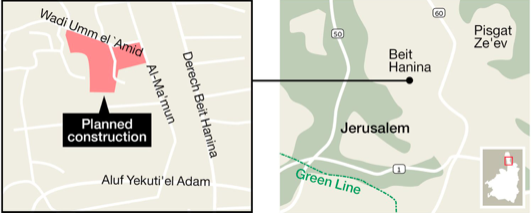
May by Haaretz
The Beit Hanina settlement plan – as FMEP has previously reported – is backed and promoted by settlement impresario Aryeh King, and it provides for the construction of a total of 150 new units in the southern end of the Beit Hanina neighborhood. The land slated for the 150 units is privately owned, 53% of the land is owned by an Israeli who is supportive of the plan, and 47% by a Palestinian company who objects to the plan and has fought against it. Because the land has not been surveyed to demarcate the split ownership, Israeli planning authorities decided that the settlement plan is designated for the entire property, with construction rights split evenly between the parties, meaning the 75 units granted final approval on January 8th represent the Israeli-controlled half of the project.
Ir Amim notes the larger picture of Isreali settlement activity north of the Old City:
“In close proximity to Ramat Shlomo to the southwest and Pisgat Zeev to the northeast, construction of this new compound may signal the beginning of a move to create contiguity between the two settlements, while fracturing the contiguous space between Bet Hanina and Shuafat. As exemplified by the ring of state-sponsored settlement strongholds throughout the Old City Basin, the establishment of a settler enclave in the midst of Beit Hanina will not only impact the fabric of this community, but will further erode opening conditions for a political solution to the conflict based on two capitals in Jerusalem.”
Ir Amim explains essential context:
“the plan will enable an ideologically driven settler outpost in the heart of Beit Hanina, a neighborhood located on the northern perimeter of East Jerusalem that has remained relatively untouched by Israeli settlement within its limits. Since the land in question is not far from Ramat Shlomo to the south-west and Pisgat Zeev to the north-east of it, its construction may mark the beginning of a far sweeping move to create contiguity between the two settlements, while driving a wedge between Bet Hanina and Shuafat.”
Plans Advance in East Jerusalem, Part 2: Reports on Har Homa & Rumors on Givat Hamatos
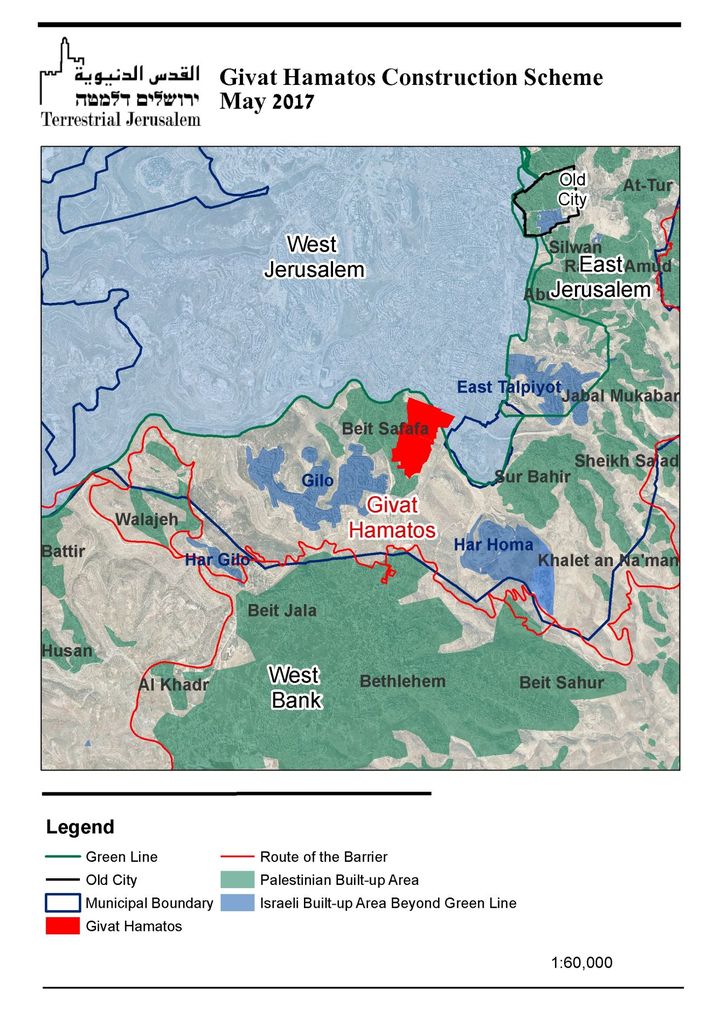 On January 7th, the popular Isareli broadcaster network Kan reported that the Prime Minister’s office has blocked a plan to build 2,000 new settlement units in the settlement of Har Homa, citing “diplomatic difficulties.” In response to an inquiry, the office did not deny the report, but issued the following statement:
“Israel has built in Jerusalem, is building in Jerusalem and will continue building in Jerusalem — while exercising judgment.”
Jerusalem expert Daniel Seidemann raised a key question and larger concerns about the reports concerning Har Homa, saying:
“The construction potential at Har Homa has been exhausted, and it’s not possible to build anything near 2,000 units. So what are they talking about? Something is clearly going on. Three possibilities come to mind, all problematic…Possibility no. 1: the nearby planned doomsday settlement of Givat Hamatos, which is awaiting tenders. Possibility no. 2: Hirbet Mazmoriyya, to the northeast of Har Homa. The lands owned by Palestinians that will have to be expropriated. Not likely. Too complicated and controversial. Possibility no. 3: the area wedged betw. Mar Elias Monastery, the Hebron Road, the 300 Checkpoint, dubbed Bethlehem Gate or Har Homa West. The land is ownership is a mixture of Palestinian &Church lands, along with settlement developers.”
Ir Amim notes that, while reportedly stalling the Har Homa plan, Netanyahu is – in fact – simultaneously facing mounting pressure to issue tenders for the construction of the Givat Hamatos settlement, the site for which is the northern border of Har Homa. Ir Amim writes:
“Last week, rightwing groups launched a coordinated campaign to exert pressure on Prime Minister Netanyahu to advance construction in the area of Givat Hamatos, which has been essentially frozen for the past six years. While the approval of the plan for 2,610 housing units in the area was formally published in 2014, there has been no announcement of tenders since then. This has been largely attributed to international opposition, namely from the United States and Germany. Likely attempting to ratchet up pressure on Netanyahu in lead-up to the upcoming elections in March, the campaign has been spearheaded on a public level by rightwing organizations. Several prominent rabbis known for supporting the settler movement penned a letter to the Prime Minister calling on him to announce the tenders for Givat Hamatos, while rightwing media outlets have published daily articles demanding an ‘end to the freeze.’ A rightwing institute likewise published a lengthy paper on the significance of establishing a new settlement in the area as a means of thwarting any potential future division of Jerusalem within the framework of a resumed peace process.”
Plan Advance in East Jerusalem, Part 3: Israel Approves Plans for Two More Settler-Run Tourist Sites in East Jerusalem
On December 25, 2019 the Jerusalem Local Planning approved two significant settler-backed schemes in East Jerusalem:
- The committee approved the Israeli government’s plan to seize land in the Palestinian East Jerusalem neighborhood of Sheikh Jarrah, in order to establish a park adjacent to the infamous Shepherd Hotel, an historic/iconic building that was taken over by the radical Ateret Chohanim settler organization in 2011. The new park – called “Hakidron Park” has been discussed and considered by Israeli governments for the past 15 years.
- The committee also approved the Israeli government’s plan to confiscate land in the Ras al-Amud neighborhood of East Jerusalem, for the purpose of opening a tourist and religious services center on the Mount of Olives, adjacent to the Jewish cemetery. The Jerusalem Municipality hired an architect, Arie Rahamivov, who is also employed by the radical Elad settler group for the planning and construction of their crown jewel: the Kedem Center in Silwan. The new center in Ras al Amud will be yet another tourist center under the management of Elad, which already operates another visitors center on the Mount of Olives.
Ir Amim writes:
“Approval of the aforementioned land expropriations would signal intent to begin construction at both sites and will help to further solidify the settlement ring around the Old City Basin. While both plans can be posited as innocuous municipal initiatives to serve local residents and visitors to the areas, such touristic projects play an integral role in expanding the scope of settlement strongholds in the area and creating a more contiguous Israeli space, while diffusing the political agenda behind these efforts.”
Plans Advance in East Jerusalem, Part 4: Tenders for Pisgat Zeev and Gilo
Ir Amim reports that the Israel Lands Authority published construction tenders for the following East Jerusalem settlements in early January:
- 3 tenders for a total of 461 new settlement units in the Pisgat Zeev
- 1 tender for commercial buildings in the Gilo settlement, located
For Second Time, Israeli Court Rules Against Settler Claim to Bakri House in Hebron
On December 23rd, the Jerusalem District Court ruled that the Palestinian Bakri family are the rightful owners of a disputed property in Hebron. This ruling should deal a final blow to the 18-year long legal battle settlers have waged to gain control of the Bakri family house (“should”, not “will”, because the settlers have repeated been dealt defeats in court and each time are able to manufacture a new claim or appeal) .
The ruling – which affirmed a March 2019 ruling by the Magistrate court, which the settlers had appealed – called for the immediate evacuation of the settlers whom Israel has permitted to illegally squat in the house while the legal processes were ongoing. For a full history of the Bakri house saga, see here.
Following the ruling, Peace Now said:
“[the] court again ruled that the settlers had forged [documents] and lied all along… We hope that after [almost] two decades of violence, lies and terror, justice will be carried out and the invaders will be evicted.”
Peace Now Wins Interim Decision Against Secretive Public Funding to Amana
In response to a Peace Now petition, on December 31st the Israeli High Court issued an interim decision that requires state bodies to request approval from the court before transferring funds to Amana, a settlement body which is known to undertake illegal settlement activities across the West Bank. Peace Now filed the petition after discovering that state bodies have been secretly funneling money to Amana.
Peace Now said in a statement:
“Amana is the most significant organization operating in the settlements. For decades, it has overseen the establishment of dozens of illegal outposts and neighborhoods with the help of massive budgets, some of which have been transferred from Israeli taxpayer money through local settlement authorities in violation of the law. The judges’ decision is a dramatic yet necessary step that limits, for the time being, this illicit transfer of funds to illegal projects in the settlements and outposts. We hope that in this spirit, the court will rule that public funds should no longer be transferred to Amana via subsidy procedures. This situation in which the State of Israel backs illegal activities with public funds is unconscionable, and we urge the Israeli government to put an end to it.”
Israeli Court Dismisses Palestinian Landowners’ Petition Against the Ofra Settlement
On January 6th, the Israeli High Court of Justice dismissed a petition filed by Palestinian landowners challenging the legality of the Ofra settlement. The petition was based on the fact that the settlement is partially built on privately owned Palestinian land. The court ruled that the majority of the settlement had been built on land expropriated by Israel, and that the minority of land that Palestinians claim ownership over was not enough to invalidate the entire Master Plan for the settlement. Further, the court stated that the settlement structures built on the privately owned Palestinian land were built by settlers “in good faith,” under the mistaken belief that land had also been expropriated by the Israeli government.
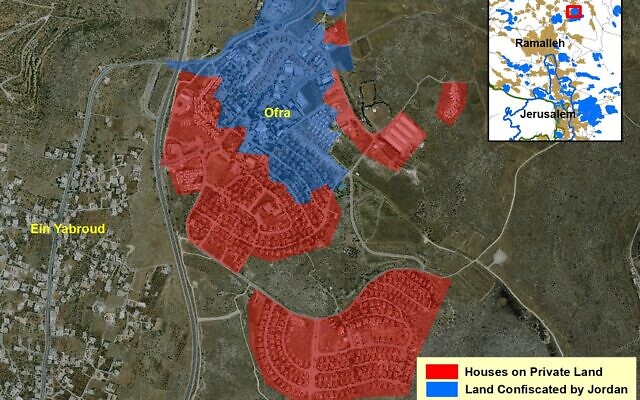
Map by Peace Now
This High Court ruling does not fix the legal status of Ofra settlement buildings, but it is nonetheless significant because it continues to deny Palestinians their property rights. Likewise, it gives a green light to the use of the “market regulation” principle to expropriate land in order to retroactively legalize the structures. As a reminder, the “market regulation” principle – which was invented by the Israeli Attorney General – holds that if settlers acted “in good faith” when they built on privately owned Palestinian land, the state can expropriate that land, thereby making what was illegal before, now perfectly legal.
The Ofra settlement’s legal situation has long been an issue that the Israeli government has tried to fix. Ofra was first established by settlers on land that the Jordanian government had expropriated in 1966, in order to build a military base (which was never built). The Israeli government used this pretext to expropriate the land in 1977, in order to recognize the Ofra settlement, which had been established illegally but with tacit cooperation of the government on the site two years earlier. However, the settlers built the majority of the Ofra settlement on land that was not expropriated by Israel in 1977 — land that was in fact registered to Palestinians from the nearby village of Ein Yabroud. In light of the legal status of the land, no Israeli government has since found a way to fix the legal status of these homes (not for lack of trying) – meaning that the majority of the structures in Ofra were built without permits, making them illegal under Israeli law.
Peace Now elaborates on what is at stake in the Ofra settlement case:
“Most of the houses built in Ofra (approximately 413 out of 625) were built on an area of 550 dunams of privately owned Palestinian land. In addition, hundreds of dunams of Palestinian private land were seized for roads in Ofra, as well as infrastructure and agricultural lands for the settlers. The only way to regulate the theft of these lands would be to expropriate them from the Palestinian landowners for the benefit of the settlers, in complete contradiction to the positions of previous Israeli governments and legal advisors, and contrary to binding rulings of the High Court. Although the current legal advisor (Avichai Mandelblit) allowed land expropriation in some places for settlement purposes (for example, in Haresha), in the regulation of massive land theft such as in Ofra the Israeli government would be crossing a new red line.”
FMEP documents the government’s efforts to expropriate Palestinian land for the settlements in its Annexation Policy Tables.
Bennett Launches Initiative to More Aggressively Demolish Palestinian Construction in Area C
Making the most of his appointment as Israeli Defense Minister in the current caretaker government, Naftali Bennett is pushing an initiative to annex Area C and to aggressively demolish Palestinian construction in the area (reminder: Area C constitutes nearly 60% of the West Bank; it is land that under Oslo II was supposed to have been “gradually transferred to Palestinian jurisdiction”).
As part of his efforts, Bennett has launched legal research into how Israeli can bring settlement building in Area C under the direct authority of the Justice Ministry, cutting out the Civil Administration. This Civil Administration, it should be recalled, is the arm of the Israeli Defense Ministry which acts as the sovereign power over the West Bank, in a system of governance Israel created based on its recognition of the different legal status of the area. Bennett has called for that system to be disbanded (in addition to annexing Area C). To be clear: transferring the construction and planning processes in Area C to domestic Israeli jurisdiction would by any definition constitute the Israeli state extending its sovereignty over area — an act of annexation.
Bennett has requested that Defense Ministry officials present several legal options for how Israel can bring planning processes under the Justice Ministry (integrating the settlements into the normal planning process). The settler-run Arutz Sheva outlet attributes the following quote Bennett in a private meeting:
“We are in essence discussing applying procedural sovereignty only. Full sovereignty is under the authority of the political echelon, but this is a step in the right direction. There is no reason that residents of Judea and Samaria should continue being discriminated against. We must stop this. Residents of Beit El and Ariel are no less Zionist than residents of Kfar Saba and Tel Aviv. They pay taxes and serve in the army, and they need to receive the same services from the government.”
Bennett is also advancing several initiatives that will empower and compel the Civil Administration to more aggressively enforce demolition orders against Palestinian construction in Area C (based on Israel’s policy of not granting permits to Palestinians in Area C, nearly every Palestinian structure in this territory has a demolition order pending against it). Bennett is also eyeing ways to combat what he considers illegitimate and nefarious funding from the European Union to Palestinian communities living in Area C. Israel Hayom reports:
“Bennett’s plan to stop the Palestinians from chipping away at Area C demands action in four areas: Operational, economic, legal, and PR. He wants to change enforcement priorities to put an emphasis on eradicating illegal buildings in strategic locations rather than by numbers. For example, home demolitions would be carried out in accordance with Israeli interests, prioritizing illegal buildings next to roads or settlements. Bennett also instructed the Central Command and the Civil Administration to work more closely to implement his plan and asked that the Civil Administration report to him monthly to update him on progress. Meanwhile, the defense minister is weighing the possibility of allocating more resources to the Civil Administration for enforcement, which would entail hiring more personnel. Bennett also wants to take steps to stop the flow of European money that funds the illegal Palestinian construction in the first place, allowing the “Fayyad Plan” to flourish.”
Bennett Appoints Key Settler Ally to Lead New Government Task Force on Area C Annexation Plans, Immediately Announces Plan to Legalize Settlements
In addition to his new initiative targeting Palestinian construction in Area C, Israeli Defense Minister Naftali Bennett announced that he has created an inter-ministerial taskforce to develop settlement and annexation plans for the future of Area C in the West Bank.
Bennett’s chief of staff, Itay Hershkowitz, has been in weeks-long consultations with key settler leaders to decide what items to act on immediately. Haaretz reports their agenda includes:
- Allowing Jews to privately purchase land in the West Bank. [See here for a detailed explanation of this complicated matter]
- Connecting unauthorized outposts to water and electricity.
- Granting official recognition to unauthorized outposts that are located near established settlements by recognizing them as “neighborhoods” of the settlement.
- Repealing a military order that empowers the Civil Administration to evict settlers from privately owned Palestinian land with or without a Palestinian-initiated petition to have the settlers removed.
- Legalizing 30 sheep farms in the West Bank that are under pending demolition orders.
On Thursday, Bennett announced that he has appointed West Bank settler Koby Eliraz to lead the new taskforce. Calling Eliraz a “bulldozer,”Bennett said:
“The territorial future of the Land of Israel is at stake. The State of Israel has simply not been up to the task of stopping [Palestinian construction]. We are changing direction and embarking on a battle that Israel must win… The defense establishment will fight for this territory, and it is essential for someone to lead this campaign.”
Eliraz previously served as Netanyahu’s settlement advisor, but was fired by the Prime Minister in June 2019 reportedly because he was believed to be allied too closely to Netanyahu rival Avigdor Liberman, who Netanyahu also dismissed. At the time of Eliraz’s firing, settler leaders were outraged and published a letter asking Netanyahu to reverse Eliraz’s firing, suggesting that Eliraz’s absence will hinder government efforts to retroactively legalize outposts. The letter noted:
“Kobi has taken care of Israeli settlement and its residents with great professionalism. He is credited for many advancements [on our behalf] in the fields of construction, infrastructure development, security and more.”
The Times of Israel observed, significantly, that the Yesha Council was able to get every single settlement Mayor to sign the letter in support of Eliraz, explaining:
“The Yesha Council in recent years has struggled to get all of its members on board with its initiative, but the umbrella group’s ability to gather the signatures of every Israeli mayor beyond the Green Line is testament to the broad respect that Eliraz holds among settler leader.”
Following ICC Announcement, Pompeo Says Israel Has “Fundamental Rights” to Land
At a press briefing on December 22nd, U.S. Secretary of State Mike Pompeo did not specifically address the ICC announcement, but made lengthy comments regarding statements from European countries and the European Union that were critical of the new U.S. position on settlements (that they are not “per se illegal” under international law). Pompeo’s comments hold relevance to the U.S. position on the ICC case and more generally on the U.S. approach to the Israeli-Palestinian conflict:
“First, the legal analysis that the EU performed [on settlements] we just think is wrong. We think they have an improper analysis of the international law surrounding this. So as the technical legal matter, [EU Foreign Minister] Ms. Mogherini just – she’s just wrong. And so we are doing our level best to demonstrate to them our legal theory, our understandings, and why it is that we’re convinced that under international law these settlements are not per se illegal. So we’re working that element of it as well. But at another level, and perhaps at the level that will lead to the right outcome, which is why we did this, this has to be resolved through political means, and we hope that all nations, including member nations inside of the EU and the EU itself and countries all over the world, will come to recognize the fundamental rights that the Israeli people have to this land, to this space. There are real security needs. The risk that is presented from the world as anti-Semitism is on the rise, we hope that every nation will recognize that and weigh in on this conflict in a way that is constructive, that will ultimately lead to the peace that is so desperately needed.” [Emphasis added by editor]
Pro-Settlement Legal Forum Conference Draws Big Names, Big Promises
The Kohelet Policy Forum, a right-wing advocacy organization that has enormous influence with senior Israeli – and increasingly American – government figures, hosted a “Conference on the Pompeo Doctrine” in Jerusalem, Jan. 7-8, 2020. The conference served as a gleeful celebration and forward-looking projection of what the new U.S. settlement policy towards settlements means for Israel. The conference drew participation from all the leading Israeli politicians and several senior members of the Trump Administration, including Secretary of State. Pompeo. Key quotes from the conference speakers are copied below.
U.S. Secretary of State Mike Pompeo:
“We’re recognizing that these settlements don’t inherently violate international law. That is important. We’re disavowing the deeply flawed 1978 Hansell memo, and we’re returning to a balanced and sober Reagan-era approach. “In doing so, we’re advancing the cause of peace between Israelis and Palestinians.”
U.S. Ambassador David Friedman:
“…when we came into office the lingering issues included three of significant importance: the status of 1) Jerusalem, 2) the Golan Heights and 3) Judea and Samaria. We have approached them in ascending order of complexity…I thank God that President Trump had the courage and the wisdom to recognize Jerusalem as the capital of Israel and move our embassy to Jerusalem from Tel Aviv…In recognizing Israel’s sovereignty over the Golan Heights, President Trump, evaluating the continuous malign and barbarous threats posed by Syria, concluded that no northern boundary for Israel would be secure except a boundary that incorporated the Golan. He acted well within the language of 242. [Judea and Samaria] is certainly the most complicated of the issues because of the large indigenous Palestinian population. Over the years before we came into office, it’s only gotten more complicated and more challenging. The proverbial goalposts have moved and moved – to the point today where they are no longer even on the field….The Pompeo Doctrine does not resolve the conflict over Judea and Samaria. But it does move the goalposts back onto the field. It does not obfuscate the very real issue that 2 million or more Palestinians reside in Judea and Samaria, and we all wish that they live in dignity, in peace, and with independence, pride and opportunity. We are committed to find a way to make that happen. The Pompeo Doctrine says clearly that Israelis have a right to live in Judea and Samaria. But it doesn’t say that Palestinians don’t….it calls for a practical negotiated resolution of the conflict that improves lives on both sides.”
Israeli Prime Minister Netanyahu said:
“I will not let any settlements be uprooted in any diplomatic plan. This idea of ethnic cleansing… it won’t happen. There is a window of opportunity. It opened, but it could close…There was no West Bank separate from the rest of the land. It was seen as the heart of the land. We never lost our right to live in Judea and Samaria. The only thing we lost temporarily was the ability to exercise the right. When Israel returned to the West Bank We didn’t return to a foreign land. That is a distortion of history. Jews lived in Jerusalem and Hebron for thousands of years consecutively…The Pompeo declaration about the status of the towns [in Judea and Samaria] establishes the truth that we are not strangers in our land. In a clearly defensive war, we returned… to the land where our forefathers put down roots thousands of years ago…Unlike some in Europe who think the Pompeo declaration distances peace, I think it will promote peace, because peace must be based on truth, not lies. Settlements are not the root of the conflict. We are standing with justice and the truth. It is a great struggle.”
Israeli Defense Minister Naftali Bennett on Area C annexation and his initiatives in that regard:
“Our aim is that within a decade a million Israeli citizens will live in Judea and Samaria” and later “Our objective is that within a short amount of time, and we will work for it, we will apply [Israeli] sovereignty to all of Area C, not just the settlements, not just this bloc or another. We are embarking on a real and immediate battle for the future of the Land of Israel and the future of Area C. It started a month ago and I am announcing it here today. A month ago, I convened a meeting and I explained the clear directive, the State of Israel will do everything to ensure that these territories [Area C] will be part of the State of Israel.”
Likud MK and former Mayor of Jerusalem Nir Barkat said:
“I am confident that Secretary Pompeo’s statement is an integral part of the American plan and is closely linked to Jared Kushner’s proposal advanced in Bahrain promoting significant economic investment in the Palestinian economy…Now is a perfect opportunity to similarly grow the communities throughout Judea and Samaria at a pace like never before. This declaration is a recognition of the legal and historic right of the Jewish people to live wherever we wish. This is how it should be in other parts of the world and certainly here in the Jewish State. This declaration is therefore an exceptional opportunity for Israel to ensure our continued growth and expansion throughout these areas. Israel needs to set a goal for the settlement of two million people in Judea and Samaria within fifty years. This is a commitment which requires that we already now lay the framework to make that possible and this is an investment which will also benefit the Palestinian people” [Editor’s note: Barkat has been working with Harvard Professor Michael Porter to promote an economic peace scheme, most recently speaking at Harvard about the plan in December 2019]
Eugene Kontorovich, Director of International Law at the Jerusalem-based Kohelet Policy Forum and a key shaper of anti-BDS/pro-settlement legislation in U.S. Congress and across state governments, said:
“American Policy is now clearer than ever, Jews living in Judea and Samaria is not a crime. For decades, the obscure Carter-era memo was used as justification for anti-Israel policies despite the fact that its conclusions were rejected by subsequent administrations. Sec. Pompeo’s statement at the Kohelet conference today makes clear the U.S.’s wholesale rejection of the legal theory that holds that international law restricts Israeli Jews from moving into areas from which Jordan had ethnically cleansed them in 1949.”
Bonus Reads
- “The Atarot Exception? Business and Human Rights Under Colonization” (Marya Farah in Jerusalem Quarterly)
- “The Decade Israel Erased the Green Line” (+972 Magazine)
- “Settlers are seizing ‘empty’ land. The Palestinian owners are fighting back” (+972)
- “Israeli Right Wants to End Peace with Jordan” (Haaretz)
- “Security official says police, courts scuttling efforts to curb settler violence” (The Times of Israel)
Welcome to FMEP’s Weekly Settlement Report, covering everything you need to know about Israeli settlement activity this week.
To receive this report via email, please click here.
May 25, 2018
- Israeli Government to Advance 3,900 Settlement Units Next Week
- Finance Ministry Announces Bargain Construction in Beit El & Ma’ale Adumim Settlements
- Defense Ministry Supports Expropriation of Private Palestinian Land for Settlements
- High Court Supports Destruction of Khan al-Ahmar [A War Crime], Clearing the Way for E-1 Settlement
- Palestinians Ask the ICC to Open Investigation into the Israeli Settlement Regime
- Bonus Reads
Comments, questions, or suggestions? Email Kristin McCarthy at kmccarthy@fmep.org.
Israeli Government to Advance 3,900 Settlement Units Next Week
Israeli Defense Minister Avigdor Lieberman (Yisrael Beiteinu) announced that the High Planning Council (the body in the Defense Ministry’s which oversees all construction in the occupied West Bank) is expected to advance plans for 3,900 settlement units next week. Of that total, 2,500 units will reportedly receive final approval for construction and 1,400 will be advanced through the planning process. Peace Now estimates that 52% of the units will be located in isolated settlements.
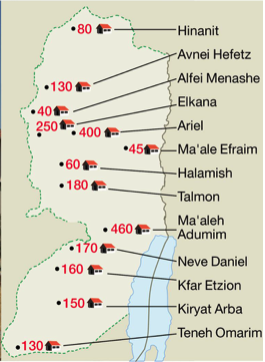
Map by Haaretz
Lieberman – whom The Times of Israel and Haaretz note has repeatedly inflated settlement approval numbers in the past – said the specific plans set to advance will include:
- 400 units in the Ariel settlement (where a medical school financed by Sheldon Adelson was recently brought under Israeli domestic jurisdiction, in a case of de facto annexation. And where a future stop on the recently approved settler-only light rail is slated to be built.);
- 460 units in the Ma’aleh Adumim settlement;
- 250 units for an assisted living center in the Elkana settlement (where the settler-only light rail will also have a stop);
- 180 units in the the Talmon settlement;
- 170 units in the Neve Daniel settlement;
- 160 units in the Kfar Etzion settlement;
- 150 units in the Kiryat Arba settlement (where construction preparations for a new industrial zone – which in reality is a new settlement in Hebron – recently began);
- 130 units in the Avnei Hefetz settlement;
- 130 units in the Tene Omarim settlement;
- 80 units in the Hinanit settlement;
- 60 units in the Halamish settlement (where settlers have built a strategic outpost, with the protection of the IDF, in order to further restrict Palestinian access to the area);
- 45 units in the Ma’ale Efraim settlement;
- 40 units in the Avnei Hafetz settlement;
- 45 units in unspecified settlements.
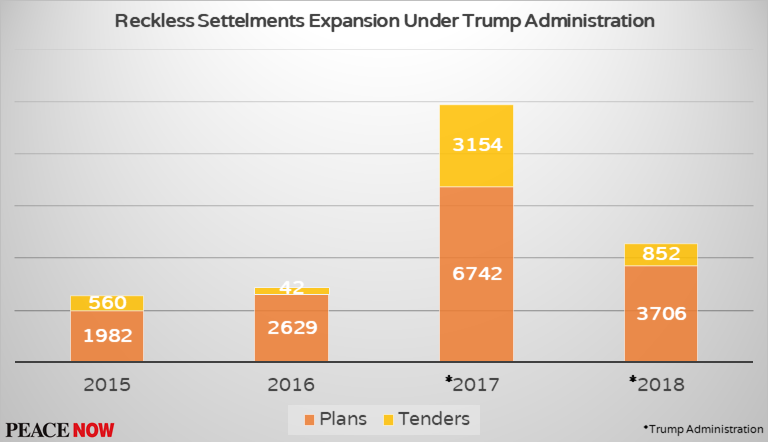
This will be the third meeting of the High Planning Council in 2018, in accordance with a reported agreement between Israel and the United States to consolidate and coordinate the number of times settlement plans are announced. The first regularly scheduled meeting of the year was in January, when 1,122 new settlement units were advanced, of which 352 received final approval for construction. The Council met again, unexpectedly in February, which Lieberman tried to minimize by calling it “less significant” because the majority of the projects approved were non-residential. In fact, the projects were extremely significant. All of the plans expanded the footprint of settlements located deep inside the West Bank – including plans for a race track and hotel in the Jordan Valley. One “unusual” plan even created a new outpost to house settlers evacuated from a different outpost (the Netiv Ha’avot outpost case that FMEP has covered in exhaustive detail).
The anti-settlement watchdog group Peace Now writes:
“In the year and a half since President Trump took office some 14,454 units in the West Bank has been approved (in plans and tenders, including today’s announcement not including East Jerusalem), which is more than three times the amount that was approved in the year and half before his inauguration (4,476 units)…The Netanyahu government is clearly continuing to take advantage of the carte blanche the Trump Administration has given it in order to destroy the chances for peace. It is well-known that for a two-state solution to be feasible Israel will have to withdraw from most of the West Bank, yet the government keeps raising the political cost of this redeployment and the evictions it will entail. By adding housing to settlements, the government shows total disregard for the two-state solution.”
In reaction to Lieberman’s announcement, PLO Executive Committee member Hanan Ahrawi said:
“Such egregious policies affirm the imperative need for the International Criminal Court to open an immediate criminal investigation into Israel’s flagrant violations of international law and conventions,” she said in a statement….Israel’s declared intention to build thousands of illegal settler units in the occupied West Bank discloses the real nature of Israeli colonialism, expansionism and lawlessness…Undoubtedly, Israel is deliberately working to enhance its extremist Jewish settler population and to superimpose ‘Greater Israel’ on all of historic Palestine…It is evident that the recent provocative and unlawful moves adopted by the United States, Guatemala and Paraguay have emboldened Israel to move forward with enhancing its illegal settlement enterprise, thereby finalizing the total annexation of the occupied West Bank.”
Saeb Erekat, a top diplomat for the Palestinian Authority released a video response, in which he highlighted the PA’s recent referral to the International Criminal Court (ICC) to investigate Israeli settlement crimes (see FMEP’s coverage on the ICC referral, below). Erekat said in part:
“This is a flagrant violation and an eye opener to the judicial council of the ICC that an official judicial investigation must be opened immediately. This cannot go on. Israel cannot continue business as usual with this impunity and immunity that they think they have.”
Nadil Abu Rudeina, a spokesman for PA President Mahmoud Abbas, said:
“The continuation of the settlement policy, statements by American officials supporting settlements and incitement by Israeli ministers have ended the two-state solution and ended the American role in the region.”
Finance Ministry Announces Bargain Construction in Beit El & Ma’ale Adumim Settlements
In addition to the approvals expected from the High Planning Council this week, the Israeli Finance Ministry has announced that a 300-unit project in the Beit El settlement and 44-unit project in the Ma’ale Adumim settlement have been marketed as part of the “Buyer’s Price” program. Under this program, the government sells land to construction companies at low prices, and those companies commit to offering future settlement units at below market prices. With the plan being marketed in Beit El, the government is accepting bids on the project from construction companies which commit to pricing the apartments 20% below market value – in effect creating a powerful financial subsidy that incentivizes Israelis to move into settlements.
The Beit El project involves 5 buildings with a total of 296 units. According to Ynet:
“the program’s goal is to transform Beit El’s southeast agricultural area into a residential neighborhood as well as unification and re-division of the lands, which will be allocated to building houses, public offices, commercial areas, routes, and a public open space.”
FMEP has covered the progress of this Beit El project repeatedly over the past year, particularly because the push around Beit El projects typifies the Netanyahu-Trump era of settlement growth. Beit El settlers have lobbied for the project for over 5 years, ever since the settlers were evacuated from an outpost of Beit El (called “Ulpana”) in 2012. When the outpost was evacuated, Prime Minister Netanyahu promised to build replacement settlement units in Beit El. Buoyed by the apparent green-light from the Trump administration, over the summer of 2017 settler leaders repeatedly and publicly shamed Netanyahu for failing to fulfill that promise, and in response Netanyahu very publicly and repeatedly promised that the settlement units will be built expeditiously. After being ignored by the High Council during its September meeting, the plan for 296 units was then approved for marketing in October 2017. Now, this week, the government has acted on that approval to market the plan, moving ever closer to the start of construction. As the Ynet report notes, if/when the 300 units are built, this will be the first new, government-sanctioned construction in the Beit El settlement in 10 years.
Also in Beit El, the settler-aligned media outlet Arutz Sheva reports that the IDF plans to build a new “razor wire” fence to separate the settlement from the Palestinian Jalazone refugee camp, located across the street (where it has been since before Beit El’s establishment). At the time of this writing, there has been no additional reporting on where the fence will be placed, and if it relates to plans to build a wall between Beit El and the Jalazone refugee camp. To better understand the severe implications of the Beit El settlement on the lives of Palestinian in Jalazone, see B’Tselem’s updated, expanded, and now pictorial project: “Life under the shadow of the Beit El Settlement.”
As a reminder, U.S. Ambassador to Israel David Friedman is closely associated with the Beit El settlement, having donated to and fundraised for it prior to his appointment as ambassador (including in his capacity as the President of the American Friends of Beit El, reportedly from 2011 until he became ambassador).
The Beit El settlement was established in 1977, on land previously seized by Israel for military purposes. A second military seizure in 1979 enabled Beit El to expand. This method of establishing and expanding settlements has been repeatedly challenged in Israeli courts. The Israeli group Yesh Din led one such petition against Beit El, seeking to have the second seizure annulled; that petition was dismissed earlier this year. Yesh Din writes:
“The State understood that it was impossible to legally defend the land theft that has been ongoing in Beit El for 40 years on land that was seized for arbitrary reasons, but it refrained, once again, from defending the rights of the weakest population, simply because they are Palestinians. Despite this, we at Yesh Din will continue to fight against the dispossession of Palestinians and the infringement of their rights.”
Defense Ministry Supports Expropriation of Private Palestinian Land for Settlements
On May 24th, the Israeli Defense Ministry released a legal opinion endorsing the government’s plan to expropriate privately owned Palestinian land in the Ofra settlement in order to retroactively legalize illegal settlement structures built there. The opinion adopts the “market regulation” principle as a legal basis for Israel to expropriate privately owned Palestinian land in cases of settlements in which decades-old structures were built and/or purchased by Israelis “in good faith” (believing the Israeli government to be the rightful owner of the land). The legal opinion also calls for the Palestinian owners to be “fully compensated, if not more than that,” and recommends that the principle should not apply to cases of unauthorized outposts. The Ofra situation is a test case for the “market regulation” principle, which has not yet been used (or tested in court) to justify expropriating Palestinian land for Israeli settlements.
Defense Ministry legal advisor Itai Ofir called on Attorney General Avichai Mandleblit to adopt the legal opinion as a government policy, which stands a good chance of happening (Mandleblit already endorsed the Ofra expropriation on that basis). In fact, the Attorney General invented the “market regulation” principle in the first place, as an alternative to the legal argument made in the Regulation Law (which he opposed). The “market regulation” principle was also recommended in the recently released “Zandberg Report,” as one of the tools that the Israeli government should use to carry out massive land expropriations, retroactive legalizations, and continued and intensified settlement growth.
FMEP has chronologically documented the development and adoption of the “market regulation” principle in the Annexation Policies tables.
High Court Supports Destruction of Khan al-Ahmar [A War Crime], Clearing the Way for E-1 Settlement
On May 24th, the High Court of Justice upheld a government plan to destroy the Palestinian Bedouin community of Khan al-Ahmar and forcibly relocate its residents out of the Ma’ale Adumim/E-1 settlement area east of Jerusalem – which Israel is expected to carry out soon. The Court reasoned that the community’s structures were built on State Land without the proper permits, even though Israel deliberately makes such permits nearly impossible to obtain. Clearing Khan al-Ahmar from the its current site (where it has been for 60+ years) is widely interpreted to be a step towards building the “doomsday” E-1 settlement which, if built, will complete a ring of Israeli settlements around East Jerusalem, destroying the territorial contiguity between Palestinians living there and the West Bank, and preventing any possibility of a viable, contiguous Palestinian state with its capital in East Jerusalem.

Map by Ir Amim
Israel has faced intense criticism for its plan to forcibly relocate Khan al-Ahmar, a plan many, including B’Tselem, call a war crime. A group of 76 U.S. Members of Congress recently sent a letter to Netanyahu beseeching him to abandon the plan, as well as the plan to demolish the Palestinian community of Susya, in the South Hebron Hills.
Peace Now says:
“The State of Israel must implement a policy of moral values, justice, equality and human rights for the Jahalin people. It is not in the Israeli interest to forcibly move them from their homes. We must stop the abuse that has been going on for decades, and allow them to live according to their way of life, to make a living and to educate their children in a way that is no different from that of the Jews living in their neighborhoods.”
The Jahalin Bedouin built the Khan al-Ahmar community in the area east of Jerusalem in the 1950s, after they were expelled from their lands in the Negev by the Israeli military. A total of 18 Bedouin tribes live in the vicinity of Ma’ale Adumim/E-1, totaling approximately 3,000 people, who have already endured numerous demolitions this year alone. The Ma’ale Adumim settlement was built in 1975 on land near where the Khan al-Ahmar community already existed; the plan for the E-1 settlement was approved in 1999.
Palestinians Ask the ICC to Open Investigation into the Israeli Settlement Regime
The Palestinian Authority has officially asked the International Criminal Court (ICC) to open an investigation into the Israeli government’s illegal settlement activity. The text of the referral can be found here. Citing “sufficient compelling evidence” and an “alarming intensification of Israeli crimes,” Palestinian Minister of Foreign Affairs Riad Malki asked the ICC to immediately open an investigation into war crimes and crimes against humanity that have been committed against Palestinians in the West Bank, East Jerusalem, and Gaza. The referral requests that the investigation include:
“those who plan, prepare and implement policies linked to the settlements regime as well as those who enable it, whether through financial, military, or logistical support or otherwise aid and abet or encourage the commission of crimes connected to that regime.”
The referral lists specific, ongoing crimes that are “among the most widely documented in contemporary history,” for the ICC to investigate. The PA’s allegations mainly relate to settlement activity (much of which is documented on a weekly basis in FMEP’s Settlement Reports) including: the unlawful appropriation and destruction of private and public properties, including land, houses and buildings, as well as natural resources; the forcible transfer of Palestinians; the unlawful transfer of the Israeli Occupying Power’s population into Occupied Palestinian Territory; the “persecution, including the grave, widespread and systematic denial or violation of basic human rights on discriminatory grounds against Palestinians, including those resulting in or intended to achieve the deportation of forcible transfer, directly or indirectly, of the Palestinian population, the re-population of ‘cleansed’ territories with Israeli settlers and the unlawful appropriation of Palestinian land and properties”; and “the establishment of a system of apartheid based in particular on the adoption of discriminatory laws, policies and practices as well as the commission of inhumane acts intended to establish an institutionalized regime of separation and advancement of Israeli settlements accompanied by the systematic oppression and domination by Israeli settlers over Palestinians.”
After the PA submitted its referral, Israeli Foreign Minister Avigdor Lieberman argued that the “ICC lacks jurisdiction over the Israeli-Palestinian issue, since Israel is not a member of the Court and because the Palestinian Authority is not a state.” While Israel is not a member of the ICC, the State of Palestine acceded to the ICC in December 2014, and its membership took force in April 2015. In January 2015, the ICC’s Office of the Prosecutor opened a preliminary inquiry to “ascertain whether the criteria for opening an investigation are met.” The preliminary inquiry is listed as “ongoing” on the ICC website. Following by the referral for an investigation submitted this week, ICC Chief Prosecutor Mrs. Fatou Bensouda released a statement saying:
“Since 16 January 2015, the situation in Palestine has been subject to a preliminary examination in order to ascertain whether the criteria for opening an investigation are met. This preliminary examination has seen important progress and will continue to follow its normal course, strictly guided by the requirements of the Rome Statute.”
The press release also notes that this is the eighth referral on the matter to date (previously, the situation in Palestine was referred to the ICC for investigation by Uganda, the Democratic Republic of the Congo, the Central African Republic, Mali, the Comoros Islands, and the Gabonese Republic).
Bonus Reads
- “Minister Ariel initiates museum of settlement” (Arutz Sheva)
- “Cherry Plantation Burned in Settlement a Hay Torched in Southern West Bank” (Haaretz)
- “Sheikh Jarrah: A Tale of Eviction and Resettlement” (Al Jazeera)
“In new film, Tel Aviv leftist picks up and moves to a West Bank settlement” (Times of Israel)
***Preeminent Israeli human rights lawyer Michael Sfard recently joined FMEP non-resident fellow Peter Beinart for a podcast, available here, to discuss how Israel’s occupation violates international laws governing belligerent occupation, and why he believes the occupation will end. Sfard’s highly recommended new book, “The Wall and the Gate: Israel, Palestine and the Legal Battle for Human Rights” is available for purchase here. Haaretz interviewed Sfard about the book, and the resulting, must-read article “For an Israeli Lawyer Fighting for Palestinian Rights, Winning Is a Double-edged Sword” is available here.***
___
Welcome to FMEP’s Weekly Settlement Report, covering everything you need to know about Israeli settlement activity this week.
To receive this report via email, please click here.
February 8, 2018
- Another New Settlement: Havat Gilad Outpost Set to Be Relocated & Legalized
- Knesset Caucus Pushes to Extend Israeli Sovereignty Over Entire West Bank
- Update on the Unauthorized Expansion of the Halamish Settlement
- Palestinians Still Cannot Access Land Where the Amona Outpost Once Stood
- Trump’s “Ultimate Deal” to Give 10% of West Bank Land to Israel
- Israeli Settler Leader Does Not Know Specifics of U.S. Settlement Policy, Despite Close Relations with Trump Negotiators
- Bonus Reads
Comments, questions, or suggestions? Email Kristin McCarthy at kmccarthy@fmep.org.
Another New Settlement: Havat Gilad Outpost Set to Be Relocated & Legalized
On February 5th, the Israeli cabinet voted unanimously build a new settlement for future evacuees of the unauthorized outpost, Havat Gilad, where 50 families are living illegally. After much hand wringing about how to proceed on the retroactive legalization of Havat Gilad, the government decided to evacuate the the outpost because some of it was knowingly built on land that is privately owned by Palestinians, and therefore there is (at present) no basis on which Israel can pursue its retroactive legalization.
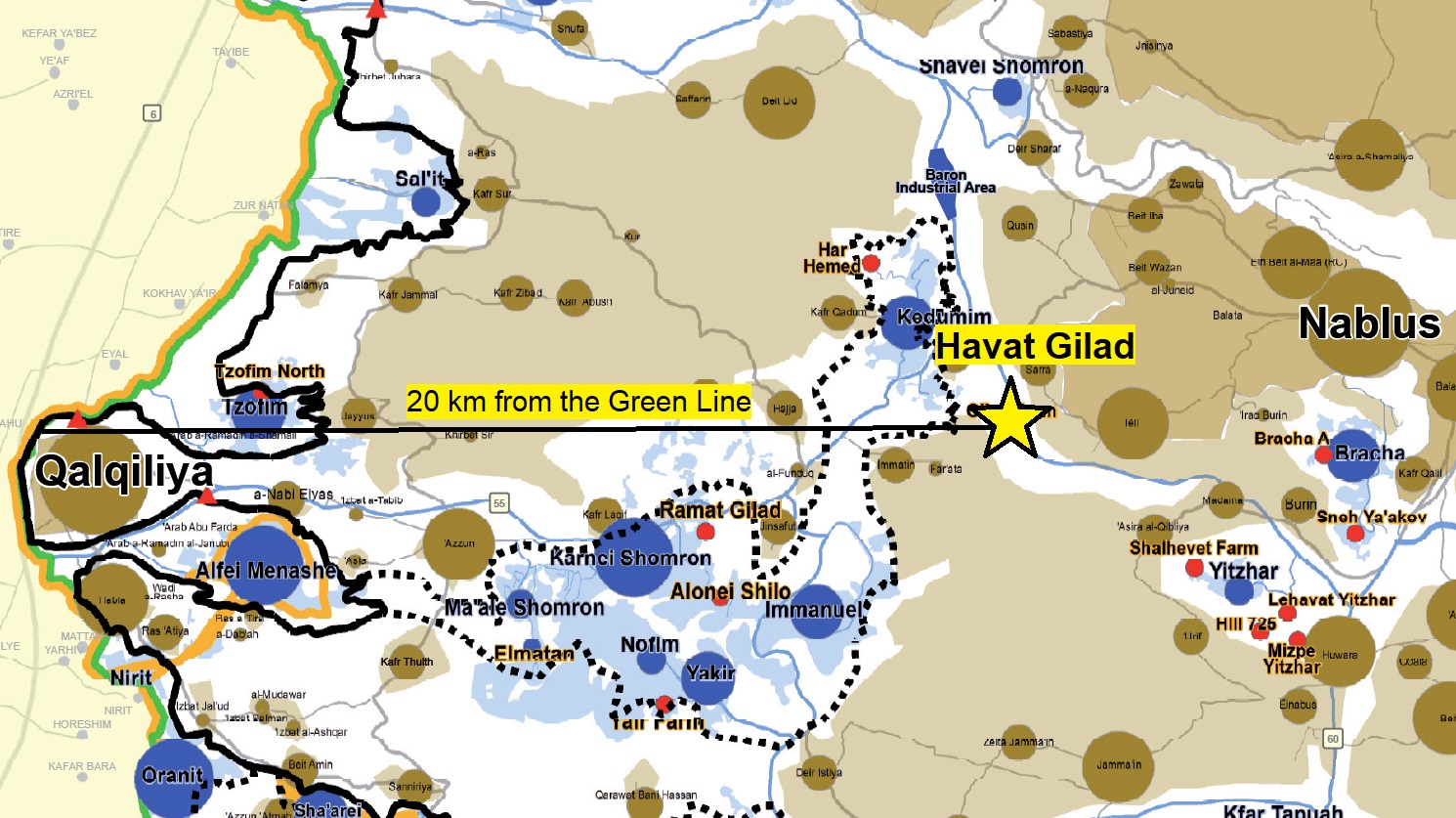
Map by Peace Now
Details of the outpost’s planned relocation are not clear, but it might not entail any movement, save the relocation of any structures that stand on Palestinian land. Most of the outpost is built on land classified by Israel as “state land,” so the majority of the outpost might stay in place and only the structures built on land privately owned by Palestinians will be moved, likely to the areas of the outpost that is on “state land.”
After spending five weeks demonstrating their fervent support for the retroactive legalization of Havat Gilad (in the wake of the murder of one of the outpost’s residents), the Israeli Cabinet now appears to be downplaying the significance of the Havat Gilad decision, likely in anticipation of international criticism of their decision to establish another new settlement (the Amichai settlement, which was approved in February 2017, was the first new settlement established with government backing in the last 20 years). Israeli Cabinet Secretary Tzachi Braverman said:
the decision regarding Havat Gilad is only a technical decision that [is meant to] legalize an existing settlement and does not call for the establishment of a new settlement…There is no intention to expand and to annex privately-owned Palestinian lands but only to legalize the existing settlement after the murder [of Rabbi Shevach] and to connect it to water and electricity as well as make it accessible for humanitarian reasons.
Nonetheless, the Cabinet’s decision to establish a new settlement received considerable international media attention, including critical coverage by the Associated Press that appeared in the New York Times and the Washington Post. The AP report touched on Israel’s settlement activity as well as the recent demolition of Bedouin classrooms funded by the European Union in the E-1 settlement area, outside of Jerusalem.
The Israeli NGO Peace Now, which has tracked settlements for decades, released a statement saying:
Legalizing Havat Gilad is a new height of groveling before settlers. By legalizing Havat Gilad, an isolated outpost deep within the West Bank, the government is harming the chance for two states and rewarding land-stealing felons.
Knesset Caucus Pushes to Extend Israeli Sovereignty Over Entire West Bank
The “Land of Israel” caucus in the Israeli Knesset held a conference this week to draw support for legislation that seeks to extend Israeli sovereignty over the West Bank, i.e., to annex the entire area to Israel.
The conference hyped a future vote by the Ministerial Committee for Legislation (a committee of the governing coalition that meets to decide if the government will give its support to legislative proposals). The vote will consider a bill – which was adapted by MK Kisch (Likud) from a recent resolution passed by the Likud party, which notably received Prime Minister Netanyahu’s backing – to annex the settlements by applying Israeli domestic law there. Left-wing MKs say (correctly) that the bill is tantamount to annexation. At the same time, some far-right MKs object to it on the grounds that it falls short of full annexation and therefore relinquishes Israeli claims over the rest of the land. On his bill, MK Kisch told the Arutz Sheva settler-aligned outlet:
This bill will allow cabinet ministers to set up a timetable [for the application of sovereignty]. It is the legislative mechanism will enable the application of [Israeli] sovereignty onto land in Judea and Samaria considered vitally important to the State of Israel…The Prime Minister also backs this process [for applying sovereignty]. It’s only a question of the timing. I think that Pence’s visit has strengthened the feeling that this is the right time, that this is the time to apply sovereignty. We’re at a historic juncture.
Notably, the pro-settlement posture of the Trump Administration was a recurring talking point at the Land of Israel caucus conference, where members took turns underscoring the fact that the time is ripe to assert Israeli sovereignty over the occupied territories.
There are currently several pieces of legislation in the Knesset that propose different iterations of annexation. Those proposals include: a bill to annex Ma’ale Adumim; the “Greater Jerusalem Bill” that seeks to annex 19 settlements into the municipality of Jerusalem in order to gerrymander a Jewish majority (covered in detail in past editions of the Settlement Report here, here, and here); and another proposal, covered in last week’s Settlement Report, that seeks to extend Israeli sovereignty over settlement universities. And, earlier this year the Israeli Justice Ministry implemented a new rule requiring all Knesset legislation seeking government backing to include clauses regarding the law’s application to the settlements.
Update on the Unauthorized Expansion of the Halamish Settlement
 Last covered in the September 20, 2017 Settlement Report, the Halamish settlement’s residents (where a Palestinian brutally murdered four people in July 2017) have been successfully capitalizing on the attack in order to expand, massively, and entrench the settlement’s boundaries.
The settlement watchdog organization Kerem Navot reports that the settlers have fortified a new outpost close to Halamish meant to extend the settlement borders. The Israeli army now guards the road that leads to the settlement, passing by the new outpost, and the army is operating a checkpoint to conduct full vehicle searches of any Palestinian driver. The outpost and the army further restrict Palestinians’ freedom of movement by discouraging them from using roads in the area.
The settlers have also reportedly undertaken several unauthorized construction projects inside the settlement including, over the past six months, building dozens of new homes. Over the last week, bulldozers have been leveling a large area of land (500 dunams) in preparation for massive new infrastructure. Kerem Navot explains:
For about a week now, bulldozers have broken ground on a system of peripheral roads (completely illegally, of course) east of the settlement, in order to take control of the areas into which the settlement aspires to expand. As is usual in such cases, the takeover of territories begins by means of a peripheral road system that marks the area designated for takeover. The land at hand belongs to the Palestinian villages of Umm Safa and Jibya, which were declared “state land” by Israel during the 1980s and were transferred to the settlers of Halamish.
The case of Halamish is a classic case of how settlements expand with the permission – expressed or implicit – of the Israeli government, which does nothing to rein in settlers even as they break Israeli law.
Palestinians Still Cannot Access Land Where the Amona Outpost Once Stood
The Israeli NGO Yesh Din reports that the Israeli army is still preventing Palestinian owners from regularly accessing their land, land on which the Amona outpost once stood, one year after the Israeli government ordered the land to be returned them. In 2014, the High Court of Justice ordered the Israeli government to evacuate the Amona outpost and return the land to its rightful Palestinian owners. After a long legal and political battle, Amona was finally evacuated in January 2017, but the Israeli army continues to obstruct the owners access to the area – ironically, based on a ruling written to prevent Israelis from accessing the land. At the same time, the IDF allows Israeli settlers to regularly visit the site.
Trump’s “Ultimate Deal” to Give 10% of West Bank Land to Israel
New reporting has illuminated the contours of the “ultimate deal” that the Trump administration has spent the past year crafting in the hopes of resolving the Israeli-Palestinian conflict. The deal reportedly proposes that 10% of the West Bank land will become sovereign Israeli territory, though Netanyahu has been pushing for 15%. The US figure does not include the Jordan Valley or East Jerusalem, over which the Trump Administration backs Israel’s demand to retain “overriding security control.” All together, the American plan would leave just 40% of the West Bank (Areas A & B) and the Gaza Strip to compose the future, semi-autonomous Palestinian “state.”
Geoffrey Aronson, who for many years authored FMEP’s “Settlement Report,” wrote:
When Israel’s permanent control of East Jerusalem and the Jordan Valley is included, Israel is effectively awarded upwards of 60 percent of the West Bank. These terms will enable Israel to annex every one of its existing settlements throughout the West Bank and enable every settler to remain in place under Israeli sovereignty. The leavings will comprise a rump Palestinian territory unable to exercise true sovereignty anywhere.
According to reports, on two of the most volatile permanent status issues, Jerusalem and refugees, Palestinians are denied any concessions. The US deal reprises the old gambit according to which Abu Dis (a neighborhood on the outskirts of Jerusalem) will be the capital of the Palestinian state, a notion the Palestinians were quick to reject (as they have done consistently in the past). And there will be no right of return for Palestinian refugees. Speaking to Al-Monitor off-the-record, one Palestinian source said
There is not and will not be a Palestinian who would accept such plans as basis for negotiations. These US positions result from pressure by American evangelist and Jewish communities in order to enhance Trump’s chances to be re-elected in the 2020 elections.
The Palestinian Authority Foreign Ministry made several statements on the rumored Trump plan and recent statements by US Envoy Jason Greenblatt. The PA Ministry slammed the plan saying it “bypasses” Palestinians and that
this is a plan that was drafted by Israel and endorsed by the US administration. If Greenblatt wants to open channels between Israel and some Arab countries, while excluding the Palestinians, we emphasize that no one in the region would dare to accept such an American plan that drops the Palestinian dimension or gives up Jerusalem. For this reason, we believe that the plan of Greenblatt and his Zionist group is doomed to failure.
Top Fatah official Jibril Rajoub said:
They [Trump administration officials] will not find a [Palestinian] puppet to fulfill their goals. Our will is free and independent and no one can control it. We will work with the Arab countries to thwart the deal. Our effort should focus on foiling any attempt to create a Palestinian partner for the deal of the century.
In past rounds of negotiations, the most West Bank land that Palestinians had ever considered ceding to Israel – in the context of equitable land swaps – was reportedly around 2%, and Israel has reportedly never formally asked from more than 10%. In its own 2011 study, the Washington Institute for Near East Policy proposed three options for land swaps based on previous offers from the negotiating parties. The most generous of WINEP’s three proposals awarded Israel with 4.73% of the West Bank (the lowest proposed 3.72% to Israel), while Israel would give the Palestinians the exact same amount of land (4.73%) in return. Every WINEP proposal had 1:1 land swaps.
Israeli Settler Leader Does Not Know Specifics of U.S. Settlement Policy, Despite Close Relations with Trump Negotiators
The Jewish Journal reports that Oded Revi has close ties to the US peace envoys (US Ambassador David Friedman and US Special Representative for International Negotiations, Jason Greenblatt) formulating US policy and plans for Israel and peace negotiations. Revi, who is a high ranking member of the Yesha Council (the umbrella organization representing Israeli settlements) and Mayor of the Efrat settlement, was invited to attend the Trump inauguration in January 2017.
Revi recently told Jewish Journal:
In my understanding — and I’ve had quite a few meetings with the prime minister [Benjamin Netanyahu], and I try to understand what are American guidelines for building in Judea and Samaria — it seems to me President Trump said to the prime minister something along the lines of parents wanting a child to play nicely, when the parent says: ‘I know you know how to behave.’ The reaction of the child is to freeze in his place because he doesn’t know what his boundaries are.
While Revi is not clear on specifics, US envoy Jason Greenblatt continued to affirm the reported generalities of a US policy, telling a crowd of European Union Ambassadors that the U.S. believes Israel has been careful with settlement construction over the past year and that the U.S. does not believe that settlements are an obstacle to peace.
Bonus Reads
- “A Dangerous Course Israel Should Avoid” (New York Times)
- “Newly formed German coalition deal opposes Israeli settlements for the first time” (i24 News)
FMEP has long been a trusted resource on settlement-related issues, reflecting both the excellent work of our grantees on the ground and our own in-house expertise. FMEP’s focus on settlements derives from our commitment to achieving lasting Israeli-Palestinian peace, and our recognition of the fact that Israeli settlements – established for the explicit purpose of dispossessing Palestinians in the West Bank and East Jerusalem of land and resources, and depriving them of the very possibility of self-determination in their own state with borders based on the 1967 lines – are antithetical to that goal.
Welcome to FMEP’s Weekly Settlement Report, covering everything you need to know about Israeli settlement activity this week.
To receive this report via email, please click here.
September 20, 2017
- Israel Moves to Forcibly Transfer West Bank Community [A War Crime]
- Normalizing Settlements in the Name of Peace – The WINEP Approach
- NEW REPORT: Yesh Din on Systematic Land Theft by Israeli Quarries in the West Bank
- NEW REPORT: Human Rights Watch on Israeli Banks’ Financing of Settlement Expansion
- Updates: Al-Walajah, Ras al-Amud, Halamish, Hebron
- Bonus Reads
Comments, questions, or suggestions? Email Kristin McCarthy at kmccarthy@fmep.org.
Israel Moves to Forcibly Transfer West Bank Community [A War Crime]
B’Tselem reports that the Civil Administration is set to soon forcibly relocate the Palestinian Bedouin community of Khan al-Ahmar in the West Bank, a war crime under international law. Haaretz confirmed the Israeli government’s intention to carry out the plan. Khan al Ahmar is located in an area that is considered key for Israel’s desired expansion of the Maale Adumim settlement and construction of the new “E-1” settlement.

Map by B’Tselem
Last week Israeli officials went to Khan al-Ahmar to tell the residents that their only option was to relocate to a site in the nearby Palestinian city of Abu Dis, next to the Abu Dis garbage dump. The village’s lawyer was not present at the time of the officials’ visit, despite Israeli authorities previously committing to not meet with the residents without their lawyer present.
Khan al-Ahmar’s residents settled in their current West Bank location in the 1950s, by Israel – after having been forced off their lands in the Negev (i.e., inside Israel proper). Israel subsequently declared the land of Khan al-Ahmar to be “state land” and over the years have repeatedly threatened the total demolition of the community. For years, international pressure – which importantly included a strong stance by the Obama Administration specifically regarding the E-1 area – has prevented Israel from going ahead with the demolitions and relocation. The Trump Administration has not commented on this specific matter to date.
Btselem Executive Director Hagai El-Ad has penned an urgent letter to Prime Minister Benjamin Netanyahu articulating why the forcible transfer of Khan al-Ahmar would constitute a war crime under international law. The accompanying press release notes:
Demolition of an entire community in the Occupied Territories is virtually unprecedented since 1967. Under the Fourth Geneva Convention, which Israel is obliged to respect in all its actions in the West Bank, this amounts to forcible transfer of protected persons, which constitutes a war crime.
B’Tselem has long documented Israel’s routine harassment of the Khan al-Ahmar community. The harassment has included: In 2015, the Israeli Civil Administration confiscated 12 solar panels donated by an international humanitarian group and that served as the sole power source for the community. In 2016, Israel demolished 12 homes, leaving 60 people homeless. In February 2017, Israel issued demolition orders for every structure in the village and that same month, Israel demolished a mobile home, leaving an elderly woman homeless. Settlers from the Maale Adumim settlement have filed petitions (starting in 2011) demanding that the Khan al-Ahmar school – a school that serves not just the Khan al-Ahmar community but others nearby – demolished.
The Israeli High Court of Justice (the equivalent of the Supreme Court) is set to hear petitions and decide on the community’s future on September 25th. Settlers have petitioned to expedite the demolitions, and Khan al-Ahmar community members have petitioned against the demolition orders.
Normalizing Settlements in the Name of Peace – The WINEP Approach
The Washington Institute for Near East Policy (WINEP) is set to launch a new portal with “up-to-date, granular information” about settlements in the West Bank. [Editor’s note: If you are looking for up-to-date, granular information about Israeli settlements, Peace Now, Terrestrial Jerusalem, Ir Amim, Yesh Din, and many other Israeli and Palestinian civil society organizations host it their websites currently. Contact FMEP for additional resources.]
The yet-to-be-revealed portal and its architect, David Makovsky, were given an early endorsement by the Washington Post’s Jackson Diehl, in a piece this week entitled “How Trump could save Palestinian statehood.” The article, quoting Makovsky extensively, promotes the notion that Trump can save the hope for peace by adopting a policy according to which, “Netanyahu stops building in areas beyond the West Bank fence, and Abbas stops paying off militants and their families.”
For people who follow the work of Makovsky and his WINEP colleague Dennis Ross, this logic should sound familiar; it is nearly identical to what Ross has been proposing, over and over, since 2013 (see also, for example: March 2015, Feb 2016, Nov 2016, Jan 2017). At the core of this logic is the notion that Israel getting U.S. backing to, in effect, unilaterally annex around 10% of the West Bank – including areas that obstruct the contiguity of a future Palestinian state and that will prevent the possibility of any viable Palestinian capital in East Jerusalem – should be seen as a generous Israeli concession to the Palestinians and a down-payment on a peace agreement.
FMEP’s Lara Friedman deconstructed these arguments back in 2013 – that analysis has not changed. As she noted back in 2013, this approach:
“…is a recipe not for strengthening the two-state solution, but for imposing a unilateral Israeli vision of a Greater Israel extending beyond the Green Line, adjacent to a balkanized Palestinian entity. Such an outcome may be appealing to Benjamin Netanyahu and his U.S. apologists. It will never be acceptable to the Palestinians and the international community, and it certainly shouldn’t be mistaken for a “solution” to the Israeli-Palestinian conflict.”
NEW REPORT: Yesh Din on Systematic Land Theft by Israeli Quarries in the West Bank
In its new report, “The Great Drain: Israeli quarries in the West Bank: High Court Sanctioned Institutionalized Theft,” the Israeli non-governmental organization Yesh Din documents how Israel’s mining and quarry activities in the West Bank constitute economic exploitation of the occupied West Bank for Israel’s exclusive profit, in violation of international law. In 2008, Yesh Din petitioned the High Court to stop all such activities; that petition was rejected.
Key findings in the new report include:
- Since the High Court of Justice ruled against Yesh Din’s 2008 petition, Israel has dramatically expanded its mining and quarrying activities in the West Bank.
- Over 20% of the State of Israel’s general consumption of gravel now comes from the quarries in the Occupied Territories.
- Official documents indicate that the Israeli authorities have a long-term plan to rely on the mining potential in the West Bank for at least the next 30 years.
Yesh Din concludes: “Decades of Israeli looting of natural resources in the West Bank are the embodiment of colonialism. In practice, the High Court ruling has rendered meaningless the acceptable interpretation of international humanitarian law, leaving in place the continued, irreversible exploitation of the occupied territory for the Israel’s economic purposes.”
NEW REPORT: Human Rights Watch on Israeli Banks’ Financing of Settlement Expansion
In its new report, “Israeli Law and Banking in the West Bank,” Human Rights Watch document how Israeli banks are failing to respect international humanitarian law by providing services to and in settlements. In doing so, the banks contribute to the expansion and entrenchment of settlements, at the expense of Palestinians.
Key findings of the report include:
- All five of Israel’s largest banks, as well as the Bank of Israel (Israel’s central bank) are operating in settlements. These five largest banks are: Bank Leumi, Hapoalim, Bank Discount, Mizrahi Tfahot, and First International Bank of Israel.
- The Israeli Association of Banks claimed to be legally obliged to offer financial services in and to settlements under Israel’s Anti-Discrimination Law (5761-2000), but the Association did not explain how refusing to provide services to settlements would constitute discrimination on the basis of nationality, race, religion, or political views. (Israel’s Anti-Discrimination Act was recently amended to require businesses, including banks, to notify customers if they decline to provide services to settlements. However, the amended version of the law does not require businesses to provide services to settlements.)
- Israel’s domestic “Banking Law” is applied to settlements via military order, which violates international humanitarian law.
- The Banking Law only prohibits banks for unreasonably refusing to provide three services: receiving deposits, opening and managing a checking account, and issuing bankers’ checks. No other services are required/obligated under the Banking Law.
The report concludes, “Human Rights Watch does not believe it is possible for businesses to operate in the settlements in compliance with their international responsibilities, due to the inherent international humanitarian law and human rights violations that characterize settlements. Human Rights Watch is calling for banks, like other businesses, to comply with their own human rights responsibilities by ceasing settlement-related activities.”
Updates: Al-Walajah, Ras al-Amud, Halamish, Hebron
- In Al-Walajah, Israelis and Palestinians marched together in protest of a wave of pending home demolitions and the imminent completion of the separation barrier which will completely encircle the village. Israel resumed construction of the wall in April and has issued dozens of demolition notices to the residents since then. In early August, al-Walaja residents formed a human barrier to prevent Israeli bulldozers from demolishing one of the threatened homes. Since then, Israel has not attempted to execute another demolition.
- Israel demolished a two-story apartment building in the Ras al-Amud, a Palestinian neighborhood of East Jerusalem. B’Tselem reports that Israel has demolished 45 Palestinian homes in East Jerusalem in 2017.
- In the area near the settlement of Halamish (where several members of an Israeli family were brutally murdered earlier this year), Kerem Navot has updated reporting on how road closures and plans for a new bypass road are leading to the settlement’s expansion and takeover of the Umm Saffa forest, a nature reserve.
- In Hebron, the Israeli settlers who broke into and illegally set up residence in the disputed “Machpela House” continue to remain in the house, under the protection of the Israeli army. They even received a visit from the Israeli Interior Minister, Aryeh Deri (Shas), this week. The High Court of Justice has not made a decision on the ownership of the house, and has granted the settlers’ wish to delay their evacuation from the house, going against an order from the Israeli Attorney General.
Bonus Reads
- “Law But Not Justice in Sheikh Jarrah” (Times of Israel)
- “WATCH: Settler attacks left-wing activist” (+972 Magazine)
- “Have Amona ‘refugees’ found recipe for post-evacuation success?” (Times of Israel)
- “Drowning in the Waste of Israeli Settlers” (Al Jazeera)
FMEP has long been a trusted resource on settlement-related issues, reflecting both the excellent work of our grantees on the ground and our own in-house expertise. FMEP’s focus on settlements derives from our commitment to achieving lasting Israeli-Palestinian peace, and our recognition of the fact that Israeli settlements – established for the explicit purpose of dispossessing Palestinians in the West Bank and East Jerusalem of land and resources, and depriving them of the very possibility of self-determination in their own state with borders based on the 1967 lines – are antithetical to that goal.
Welcome to FMEP’s Weekly Settlement Report, covering everything you need to know about Israeli settlement activity this week.
To receive this report via email, please click here.
July 28, 2017
- Bibi Embraces “Population Transfer” – Asks for US OK
- The Knesset & Bibi Move to Gerrymander Jerusalem
- Settlers Set Up Outpost, Seek to Expand Settlement as “Response” to Murders
- Settlers Seize Contested Building in Hebron
- Construction on New Settlement in Shilo Valley Stalled (Due to Lack of Funds)
- High-Ranking Government Officials Defend Outpost from Demolition
- Bonus Reads
Comments, questions, or suggestions? Email Kristin McCarthy at kmccarthy@fmep.org
Bibi Embraces “Population Transfer” – Asks for US OK
According to a report from Israel’s Channel 2 News, Prime Minister Netanyahu recently asked U.S. Ambassador David Friedman and Special Envoy Jason Greenblatt to support a populated land-swap as part of a future peace deal.
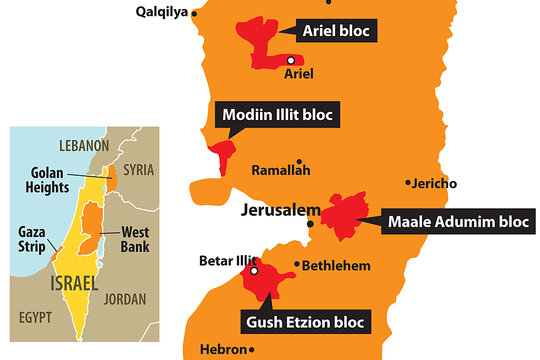
Map in CSMonitor
The swap in question would transfer 300,000 Palestinian citizens of Israel (living in the Wadi Ara region, an area known as “the triangle,” near Haifa) to the Palestinians, in exchange for Israel’s annexation of settlements in the Etzion bloc. The plan – which was previously championed by Defense Minister Avigdor Liberman, who even proposed it at the United Nations – is in effect a population transfer that would allow Israel to get rid of a large cluster of Palestinian cities, including the city where the two terrorists who attacked guards at the Haram al-Sharif/Temple Mount last week grew up.
An unnamed White House official made a statement in response to the report saying, “This may have been one of many ideas discussed several weeks ago in the context of a peace agreement and not in the context of a separate annexation.”
FMEP President Lara Friedman commented on what message Bibi’s endorsement of this idea sends: for the current Israeli government, “citizenship of Jews is inalienable right; citizenship of Arabs is revocable privilege.”
Arab Israeli MK Aida Touma-Suliman responded to the report saying, “The cat is out of the bag and Netanyahu has shown his true colors regarding the Arab population…the [Wadi] Ara residents are not only Israeli citizens, they’re also indigenous people who dwell on their land, and are not to be compared with settlers dwelling on another nation’s land. We the Arab citizens aren’t part of any such equation and aren’t willing to pay the price again for Israel’s policy of occupation and settlements.”
When Avigdor Liberman promoted the idea back in 2014, then-President Shimon Peres said, “Israel cannot take away its citizens’ citizenship simply because they’re Arab.” Then-Interior Minister Gideon Sa’ar said, “An Israeli citizen is not an object and not transferable as part of a framework political agreement.” Netanyahu has never expressed support for the plan prior to this news report, but the plan has allegedly come up in negotiations before.
The area of settlements known as the “Etzion Bloc” is home to over 22 settlements and 75,000 Israeli settlers. The loose cluster of settlements is located south of Jerusalem, extending from the 1967 Green Line deep into the West Bank; most of the settlements are on the Israeli side of the separation barrier. The major traffic junction in the area has recently seen numerous car-ramming and stabbing attacks by Palestinians targeting Israeli settlers and soldiers in the area, including an attack today that resulted in the death of the attacker and no other reported injuries.
The Knesset & Bibi Move to Gerrymander Jerusalem
In tandem with the Temple Mount/Haram al-Sharif crisis is, three important bills regarding Jerusalem’s future have advanced in the Knesset:
-

Map by Haaretz
Prime Minister Netanyahu announced his support for a bill in the Knesset that would allow 130,000 Israeli settlers living four West Bank settlements to vote in Jerusalem’s municipal elections while effectively excluding around 100,000 Palestinians from the Jerusalem municipality (most obviously the Shuafat refugee camp and Kafr Aqab, which are located outside the separation barrier). The four settlements are Maale Adumim, Givat Ze’ev, Beitar Illit, and Efrat, the last of which is six miles from Jerusalem. All are illegal under international law. Netanyahu’s support for this bill means that it is set to move forward when the Knesset’s reconvenes from its 3-month summer recess in November.
- Another bill (introduced a few days before the one described above) would allow the Israeli government to transfer Palestinian neighborhoods of Jerusalem outside the barrier to a separate, new municipality, created especially for this purpose. This bill and the one above aim to remove from the municipal area of Israel’s eternal, united capital those areas that threaten the Jewish demographic majority in Jerusalem, relegating them to a separate authority.
- These bills are complementary to a bill voted on last week that seeks to prevent the Israeli government from transferring parts of Jerusalem to a foreign power (i.e. the Palestinian government) in a future peace deal.
Settlers Set Up Outpost, Seek to Expand Settlement as “Response” to Murders
Following the horrific murder of three Israelis living in the Halamish settlement, the settlement’s leaders are seeking to consolidate and expand their illegal presence in the West Bank.
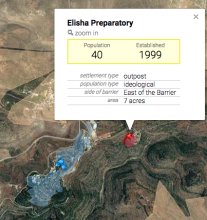
Map by Peace Now Israel
Within hours of the murder, hundreds of Halamish residents set up a campsite and a blockade of the eastern road leading to the settlement. The campsite is being called “Yad Ahi,” or “My Brother’s Hand” in memory of the three family members who were slain by a Palestinian youth last Friday. Settlers are rotating shifts inhabiting the campsite, aiming to make it an official outpost of the settlement and permanently close the road to Palestinians.
Halamish leaders are also demanding the government allow the expansion the settlement’s borders. A spokesman of the Binyamin Regional Council (which represents and provides municipal services to settlements in the Halamish region) called on the government to approve construction plans connecting the Halamish settlement to a nearby outpost called Tzofit, in order to “create a bigger security area and allow building neighborhoods that have already received zoning approvals.” Tzofit (also known as “Zufit” and/or “Elisha Preparatory”) is an illegal outpost that was established in 2007.
U.S. Ambassador David Friedman and Special Envoy Jason Greenblatt went to the illegal Halamish settlement this week to offer their condolences to the victims of the murder.
Halamish is located northwest of Ramallah, deep inside the West Bank. When the settlement was founded in the 1970s, Palestinian residents from the nearby towns of Deir Nidham and Nabi Saleh sued to stop the settlement’s construction, claiming it was being built on their villages’ land. The Israeli Supreme Court ruled in favor of the settlers, declaring the area to be state land. The Halamish settlement and its ever-growing encroachment on surrounding Palestinian villages has inspired weekly protests in Deir Nidham and Nabi Saleh, which has become infamous for weekly demonstrations – often involving clashes with the IDF – in recent years, often with international participation.
Settlers Seize Contested Building in Hebron
On the evening of July 25th — while events in Jerusalem were dominating the attention of the region and the world — 120 settlers broke into and illegally occupied a contested building near the Tomb of the Patriarchs/Ibrahimi Mosque in Hebron. The Israeli army immediately surrounded the building and on the morning of July 26th the area was declared a “closed military zone.” Prime Minister Netanyahu ordered the Defense Ministry to allow the settlers to stay as negotiations on their fate and ownership of the building continue.
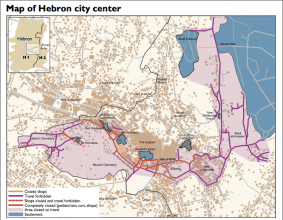
Map by B’Tselem
The Times of Israel reports that, “sources close to the prime minister said that Netanyahu was looking to avoid having to evacuate the families.” On the other hand, Yesh Atid chairman Yair Lapid called for their immediate evacuation. As of this writing, the settlers are still being allowed to illegally squat in the property.
Peace Now warned that the settler’s action can “ignite the region” and called on the government to, “follow the law and the Israeli interest and evacuate the trespassers without delay.”
J Street issued a statement calling on the U.S. government and international actors to pressure Israel to remove the settlers, saying “the Hebron settlers and their allies clearly believe that they can take advantage of the present crisis and push their long-term expansionist agenda by creating new ‘facts on the ground.’ It is vital that the prime minister and defense minister act in the best interests of Israeli security and uphold the rule of law by swiftly removing these families from the property.”
Hebron’s settlers have for some time been waging in a legal struggle to prove they legally purchased the building, known as the Machpela House. Palestinians contend they did not purchase it from the legal owners. While proceedings are ongoing, the settlers have once before broken into and occupied the building; when they did so in 2012, they were allowed to stay in the house for a week before being evacuated at the urging of the then-Attorney General of Israel who argued that it was necessary to preserve the rule of law.
Construction on New Settlement in Shilo Valley Stalled (Due to Lack of Funds)
A month after construction began on the first new settlement authorized by Israel in 25 years, the project has come to a halt – no over politics but due to insufficient government funds. The government had promised to bankroll the settlement’s construction but has not contributed to costs yet, according to the Binyamin Regional Council, which is currently footing the bill. The spokesman for the Binyamin Regional Council speculated on July 25th that the issue will be resolved quickly and expressed confidence in the government’s commitment to the project. Prime Minister Netanyahu reportedly gave orders to ensure construction is resumed quickly. As of this writing, there is no reporting to suggest construction has resumed.
High-Ranking Israeli Officials Defend Outpost from Demolition
Last week we reported on an impending demolition order against the Netiv Ha’avot outpost (near Bethlehem), along with the public relations efforts settlers were leading to elicit government intervention in their favor. The settlers got a helping hand this week when Israeli Education Minister Naftali Bennett and Yair Lapid (who heads the Yesh Atid political party) attended an event at the outpost. The Haaretz report suggests Bennett engaged in a conversation with the outpost’s leaders on how to “deal with” the demolition order and impending deadline.
Bonus Reads
- “This Synagogue Furniture Factory Is Actually a Sweatshop That Tramples Palestinians’ Rights” (July 26, 2017, Haaretz+)
- “The Settler Leader Who’s Even Charming Liberals as Israel’s Top Man in New York” (July 27, 2017, Haaretz+)
- “A Rare Glimpse: Shabak Agent Recruiting Hilltop Youth” (July 3, 2017, Jewish Press)