Welcome to FMEP’s Weekly Settlement Report, covering everything you need to know about Israeli settlement activity this week.
To subscribe to this report, please click here.
November 12, 2021
- Settlers Secure Deal for Eventual Eviction of Another Sheikh Jarrah Family
- Increasing Pressure on the Government, Settlers to Operationalize Plan to Increase Control Over Area C
- JNF Stops Funding 18-Year Legal Battle Over Beit Bakri in Hebron
- Demolitions in East Jerusalem Continue, Including in Al-Walaja
- Settler Violence & Expansionism Continue to Escalate in the South Hebron Hills
- Bennett Pledges Evyatar Outpost will be Legalized, Sparking Palestinian Ire & More Coalition Threats
- Government Punts on Outpost Legalization Bill, Knesset Might Move Forward Anyway
- Bonus Reads
Settlers Secure Deal for Eventual Eviction of Another Sheikh Jarrah Family
Israel Hayom reports that a Palestinian family in the Sheikh Jarrah neighborhood has reached a Court-approved “deal” with settlers to recognize settler ownership of their home (where they have lived since 1956), in exchange for being allowed to stay as paying tenants for a period of at least ten years. The “deal” follows the broad outline of a Court-authored compromise that was rejected last week by four other Palestinian families (the cases are separate, but not unrelated).
Israel Hayom additionally speculates:
“The compromise, which was given the force of a legal ruling in the Jerusalem Magistrates Court a few days ago, could serve as a precedent for other local Arab families and is seen as a blow to the Palestinian Authority and Hamas, which are both pressuring Arab residents of Sheikh Jarrah-Shimon HaTzadik to refuse any proposed deals to vacate the properties.”
Increasing Pressure on the Government, Settlers to Operationalize Plan to Increase Control Over Area C
In a closed meeting on November 10th, the heads of settler regional councils met to discuss their ongoing effort to get the Israeli government to annex Area C of the West Bank. According to Arutz Sheva (the settler media outlet), the meeting resulted in significant decisions that create a more unified settler operation on the matter, including the formation of a “joint command center” through which all of the councils will act together, and a commitment by all the regional leaders to form a unified front to pressure the government.
Following the meeting, the participants released a statement saying:
“This struggle is over whether we continue to exist or to fold. This is an existential battle involving the entire Nation of Israel. We are all committed towards working together in order to stop the hostile takeover of our lands and in order to preserve the future of Jewish life in Judea and Samaria.”
An op-ed published in Israel Hayom on November 11th – entitled “In Area C, the time has come to get off the fence” – seemingly making the case for such an effort, the settlement activist Sara Haetzni-Cohen writes:
“Efrat’s dedicated residents have established their own war room. They track every brick and every bit of cement that is spilled and report it to the authorities. They know every demolition order that is issued but not enforced, and they do not give up. But the state quite simply does not exist. The Civil Administration is failing at its task and by choice…We’ve reached a stage where there is no state on which to rely on major issues. Real leadership from leaders who will get off the fence is needed. Local leadership in Judea and Samaria, whether elected or civilian organizations, must get off the fence and protect state lands, settlement lands, our homeland. It should be done intelligently, responsibly, and in a law-abiding manner. We should not resort to violence or vandalism against the Arab population, but rather go about this in a positive way, by planting trees and working the land, by showing our presence on the ground. If we will not be for ourselves, who will be for us? There simply isn’t any choice. We must get off the psychological and physical fence and defend our land.”
As a reminder, under the Oslo Accords, the West Bank was divided into 3 “areas” – Area A, B, and C – pending a permanent status Israeli-Palestinian agreement that would determine final control over all the land (an agreement that was supposed to have been reached by by May 1999). The Oslo Accords gave Israel complete control over Area C, which accounts for around 60% of the West Bank. Throughout the 28 years since the Oslo Accords were signed (and with no peace agreement achieved or in sight), Israel has systematically denied Palestinians in Area C permits that would enable them to build “legally” (under Israeli law) on their own land. As a result, Palestinians have been forced to build without Israeli permits (i.e., “illegally” in the eyes of Israeli authorities), and Israel has responded by issuing wide-scale demolition orders and carrying out frequent demolitions. In recent years, Israel has increasingly treated Area C as indistinguishable from sovereign Israeli territory, effectively extending its laws and regulations to the area and its Israeli settler inhabitants. In parallel, settler groups – most notably the notorious “Regavim” – have lobbied Israeli authorities to crack down on “illegal” Palestinian construction, claiming that Palestinians are trying to “take over Israeli land”.
As part of these ongoing efforts — by settlers and the Israeli government — to entrench and expand Israel’s control over/de facto annexation of the entirety of Area C, in September 2020 the Israeli government allocated 20 million NIS ($6 million USD) for the newly created Settlement Affairs Ministry. That ministry was given the mission of surveying and mapping “unauthorized” (by Israel) Palestinian construction in Area C (the same construction which Israel has been aggressively demolishing). This funding further empowers a domestic Israeli body to exert extraterritorial sovereignty over Area C – in effect, treating the area as land already annexed by Israel.
The Knesset has also repeatedly hosted forums to discuss the alleged (by settlers and their allies/advocates) “Palestinian takeover of Area C” — framing predicated on the assertion that Area C belongs to Israel (an assertion that is not supported by the Oslo Accords) and must be defended against Palestinian efforts to “steal” it. Consistent with this framing, and under pressure from various outside groups, many members of the Knesset have criticized the Israeli government’s alleged failure to robustly “defend” Israel’s rights/ interests in Area C (e.g., failure to prevent/destroy “illegal” Palestinian construction, failure to block foreign government-funded humanitarian projects that support Palestinians’ presence in the area; failure to clear out Palestinians from the area, expand settlements, and consolidate state-built settlement infrastructure; etc.).
JNF Stops Funding 18-Year Legal Battle Over Beit Bakri in Hebron
The Jerusalem Post reports that the Board of the Jewish National Fund in Israel has decided to stop funding the legal costs of a group of settlers battling to win control over a contested home in Tel Rumeida, in the heart of downtown Hebron (and to that end, forging documents). Israeli Courts have ruled against the settlers’ claim to the home twice, most recently in December 2019, in a ruling which affirmed that the Palestinian Bakri family is the rightful owner (the house is known as “Beit Bakri”).
At the request of the settlers, the JNF has agreed to pay installments on a legal guarantee to Israeli courts in order to allow the settlers to avoid eviction while pursuing an appeal against the December 2019 ruling against them. Since 2019, the JNF has paid some $35,000 (110,000 NIS) towards the case.
The Palestinian homeowners – the Bakri family – temporarily fled their home under constant settler harassment during the Second Intifada, a time when Tel Rumeida could have been accurately described as an “urban battlefield.” While the family was gone, settlers broke into the house, damaged it, destroyed the Bakri’s property, and ultimately took up residence there.
The Bakri family has spent the past 18 years petitioning Israeli police and the courts to remove the settlers — cases the Bakri family repeatedly won. The settlers have managed to repeatedly delay their eviction by essentially exploiting every possible legal defense, no matter how absurd or contradictory. For example: At different points over the past 18 years, settlers argued in court that they had a rental agreement; that they purchased the home; that the plot of land was owned by a Jewish trust prior to 1948 and they are “reclaiming” the property; and that because they had invested so much money in improving the land since taking it over, under Ottoman Law it now legally belongs to them, regardless of the means by which they acquired it. When at one point some years ago the courts ruled that the settlers had to evacuate, the settler occupants of the Bakri home did, indeed, leave, only to be immediately replaced by other settlers — at which point the Israeli Attorney General told the Bakri family that they had to start eviction proceedings anew. For a detailed timeline of the Bakri family’s saga, see this report from Peace Now.
Throughout the course of this saga, the settlers’ effort to hold on to the Bakri home was aided by the State’s unwillingness to implement court orders against the settlers. Peace Now said in a statement:
“This is not only a matter of cruelty, deceit and theft of settlers who are not loathe to take control of assets that are not theirs, but also a matter of the lack of government accountability. For 18 years the government did not enforce the law against the invading settlers, and even assisted them and allowed them to continue to steal the house and terrorize their Palestinian neighbors in Tel Rumeida. Furthermore, it should be remembered that Hebron is under Israeli occupation and the Palestinian residents cannot remove the settlers from their homes by appealing to the Palestinian Authority. The power lies in the hands of the Israeli government, which does nothing to fulfill its responsibilities to protect abandoned Palestinian property.”
Demolitions in East Jerusalem Continue, Including in Al-Walaja
Over the past week the Israeli government has moved forward with demolitions in Palestinian neighborhoods across East Jerusalem, including:
- The demolition of three Palestinian homes in the village of Al-Walajah on November 9th. For more on Israel’s systematic campaign to demolish homes in Al-Walajah – including its refusal to approve building plans initiated by Palestinians – see FMEP’s September 9, 2021 settlement report;
- Israeli authorities delivered demolition notices to 10 Palestinian families (70 individuals) living in an apartment building in the al-Tur neighborhood. The notice ordered the families to self-demolish the four-story building within one week, or have Israeli forces demolish the building, with the cost of the demolition billed to the residents. The families reportedly began removing their belongings from the building on November 5th in anticipation of demolition;
- Under coercive Israeli policies, a Palestinian family opted to self-demolish an apartment building in the Beit Hanina neighborhood;
- Under coercive Israeli policies, a Palestinian family opted to self-demolish its house in the Jabel al-Mukaber neighborhood.
As is always the Israeli position, the State asserts that the homes being demolished and under threat of demolition have been built by Palestinians without the required Israeli permits (often on land that even Israel recognizes they privately own). Such permits are generally all but impossible for Palestinians to obtain; in the case of al-Walajah, they are literally impossible to obtain, since the area lacks the required Israeli-approved “outline plan,” without which permits are an impossibility. Facing the reality of having Israel demolish their homes and being required to pay excessive costs and fees associated with such demolitions, Palestinians sometimes choose to self-demolish their homes.
Settler Violence & Expansionism Continues to Escalate in the South Hebron Hills
On Wednesday, November 10th a group of settlers attempting to install a campsite and graze their flocks on land near the Palestinian village of Khilet al-Daba clashed with local Palestinians, who worried that the settlers were making an attempt to take over the land – an understandable concern giving the growing phenomenal of farming outposts as a means for settlement expansion. The clashes – which took place at night after a full day of building tensions – took a violent turn when settlers set a Palestinian agricultural structure on fire. The evening ended with two Palestinians being shot by settlers with live rounds, three Palestinians wounded by settlers throwing rocks, and damage to several cars owned by Palestinians.
The land on which the settlers were grazing their flocks and attempting to install a campsite was declared to be a firing zone by the Israeli government, making it illegal for Palestinians to build there or even enter. According to Haaretz, the Israeli state has plans to evict Palestinians who live in this area (who have ostensibly lived in the area prior to it being declared by Israel to be a firing zone).
The IDF, which had been at the scene intermittently during the day, eventually sought to separate the groups by declaring the area a closed military zone. South Hebron Hills activist Basil Al-Adraa explained how this practice works to allow settlers to accomplish their goals, saying:
“The army arrived, declared it a closed military zone and kicked us out. But they didn’t kick out the settlers or take down the tent they put up today.”
The South Hebron Hills is a hotbed for settler violence, and was the scene of a settler attack – a Jewish pogrom – in September. Earlier this week, settlers from a nearby outpost – aided by the IDF – temporarily blocked Palestinian access to a playground in the village of Susiya. In addition to settler violence, the Israeli government is also acting to significantly expand settlements and retroactively legalize outposts in the South Hebron Hills.
Notably, two U.S members of Congress – Mark Pocan (D, WI-2) and Jamaal Bowman (D, NY-16) – visited the village of Susiya in the South Hebron Hills on November 10th (prior to the outbreak of violence that night). They pair met with local Paelstinian activist where they were told of the violence settlers inflict on the local population.
In an interview with Jewish Currents in October 2021, Basil Al-Adraa explained how violence and land takeovers are two sides of the same coin in the South Hebron Hills,
“Settlers have long been attacking the communities here. The [Israeli] Civil Administration gives them land stolen from the Palestinians: They declared it state land so they can take it by force, for settlers to build settlements and outposts and farms. This year, the settlers have started these new sheep farms around the West Bank, where they bring volunteers to work on these farms. But the settlers aren’t content with the tens of thousands of dunams [one dunam equals 1,000 square meters] they’ve been granted: They bring their animals to our private fields, which the state can’t take from us. They bring them to our orange trees, to drink from our water systems—like the well where we collect rainwater—and to graze on our grass. And what’s been happening recently, especially since May, is they’ve been organizing big attacks on Shabbat and holidays because settlers don’t have much work to do on those days. Dozens of settlers will come masked, with hammers, machine guns, sticks, and stones. The army escorts them two or three kilometers from their settlements to our villages. They burn houses, cut down olive trees. If the army sees some Palestinian trying to defend themselves, then they will shoot at [that Palestinian] with live stun grenades, or tear gas, or rubber bullets. They use all the force. We are under army law as Palestinians in Area C, but the settlers are under civilian law, so the soldiers in the area can’t deal with the settlers, who are under the jurisdiction of the police. But the police take three or four hours to come, only after the attacks have finished. In my community, al-Tuwani, there have been at least seven organized attacks. A lot of people look at these as [isolated] incidents, and this time, there was more media attention to the issue because there was a three-year-old child who was wounded. But it’s part of a policy, in which settlers and the Israeli army don’t want us to feel safe where we live. Like the home demolitions, the blocking of roads, the cutting water and electricity networks, it’s all leading to one goal: They want to kick us out of this land, out of Area C toward Area A [areas under Palestinian administrative and police control, like Ramallah]. But our land is here, our life is here.”
Bennett Pledges Evyatar Outpost will be Legalized, Sparking Palestinian Ire & More Coalition Threats
In a press conference on November 7th, Prime Minister Bennet affirmed his commitment to granting retroactive legalization to the unauthorized outpost of Evyatar – which was built on a strategic hilltop named Mount Sabih, located just south of Nablus on land historically belonging to nearby Palestinian villages Beita, Yatma, and Qablan. Even before Bennett’s most recent statement, several members of his fragile coalition have spoken out to insist that the reestablishment of Evyatar is a redline that, if crossed, could bring down the coalition (FMEP covered a few such statements two weeks ago). In the wake of Bennett’s press conference, more continued to do so, which only adds to the growing public fracture in the coalition over outposts and settlement building more broadly.
Public Security Minister Bar Lev (Labor) pledged to block the legalization of Evyatar, said this week:
“There are enough ways to dissolve this agreement. The Evyatar community [outpost] was illegal and illegal communities should be evacuated.”
The Mayor of Beita predicts that Bennett’s pledge to legalize the outpost (coupled with the end of the olive harvest season, which consumed protestors’ time elsewhere) will spark renewed energy in Palestinian-led protests in the town of Beita. Since settlers struck a deal with the government to temporarily vacate the outpost back in July 2021, Palestinians have staged regular protests against Evyatar outpost, and against the continue denial of access to the land on which the outposts continues to exist (the area is a closed military zone, where Palestinians are denied the ability to access). The protests over the summer were particularly violent, resulting in the killing of at least five Palestinian protestors by Israeli soldiers.
An organizer of the protests, Amal Bani Shamseh, told The New Arab:
“the people in Beita can not stand the idea of a single settler moving back to Mount Sabih and are willing to intensify protests, and women are the first to affirm it.”
As a reminder, the fate of the Evyatar outpost was the first controversy that threatened to divide the fragile Bennett-led government when it was sworn in. Bennet’s partners were bitterly divided on whether to evacuate the outpost or let it be, while the government sought to grant it retroactive legalization. In the end, the government reached a “deal” which saw the settlers (temporarily) vacate the outpost on Friday, July 2nd. In return, the government left the settlers’ illegal construction at the site in place (i.e., did not demolish it) — including buildings and roads — while it “examines” the status of the land to see if it can be declared “state land” and therefore “legally” turned into a settlement (opening the door for the settlers to return). Under the agreement, the outpost is being used as a military base in the interim.
The fact that the “compromise” left in place the settlers’ structures and allowed Israel to maintain complete control over the site during the “survey” process signalled from the start that the government is not concerned with enforcing Israeli law, but rather is focused on finding a political solution that works for the settlers. It was further clear from the terms of the “compromise” that the Bennet government believed it will be succeed in finding a pretext to assert that the land on which the outpost stands is “state land” which can be used by the state as it sees fit (i.e., give it to the settlers). If the state decides, pursuant to the investigation, that it has a basis on which to declare the site to be “state land,” the settlers will be allowed to return and resume the establishment of what would from that point no longer be an illegal outpost, but a new “legal” settlement.
Government Punts on Outpost Legalization Bill, Knesset Might Move Forward Anyway
The Jerusalem Post reports that the Ministerial Committee on Legislation has decided to delay by four months its decision on whether to grant government backing to a bill that would grant retroactive authorization (i.e., legalize) nearly 70 West Bank settlement outposts that Israel has failed to find any other way to legalize (because they are built on land even Israel recognizes is privately owned by Palestinians). As a reminder, the Ministerial Committee on Legislation is composed of government Ministers, and decides whether or not the governing coalition will throw its support behind a bill in the Knesset – ensuring either its passage or defeat.
In response to this news, MK Orit Struck (Religious Zionist Party) — who is also a longtime Hebron settlement leader — said that she intends to bring the bill to the Knesset for an initial reading despite lacking government-backing. Struck believes a strong majority of Knesset Members, regardless of the government’s position, will support the bill. Members of the Knesset attempted to fast-track the passage of this same bill in May 2021, while Bennett and Lapid were in negotiations to form the current governing coalition.
The bill introduced in May 2021 included an explanatory text claiming that the proposed law is in line with a decision the Security Cabinet took in 2017, when it tasked a new committee – headed by notorious settler leader Pinchas Wallerstein – to prepare individualized plans for each outpost to gain retroactive legalization based on the passage of the Regulation Law and the recommendations in the Zandberg Report. Bills similar to this have been filed several times in the past, and the Israeli government has debated granting retroactive authorization to the outposts via a government decision – and came close to doing so in the waning days of the Trump Administration.
Bonus Reads
- “Israeli Settlers Escalate Violence in West Bank” (Foreign Policy)
- “Nearly 20 years on, Israeli barrier shapes Palestinian lives” (AP)
- “Far-right protestors clash with cops in Jerusalem over settler teen’s death” (The Times of Israel)
- “They should have been lawyers. Instead they’re at Israeli construction sites” (Basil al-Adraa in +972 Magazine)
- “How the Occupation Harms Not Only the Palestinians, but the Planet Too” (Haaretz)
- “Palestinians say no to work in settlements” (Al-Monitor)
Welcome to FMEP’s Weekly Settlement & Annexation Report. To subscribe to this report, please click here.
July 30, 2021
- Sheikh Jarrah Updates: Court Issues Delays for Three Cases; Bennett Reportedly Considering Delaying Four Others
- In First Since Settlement Regulation Law Was Overturned, Israel Announces Intent to Demolish Settlement Buildings on Privately Owned Palestinian Land
- Elad Settler Group Loses Control Over East Jerusalem Holy Site/Archaeological Park
- Knesset Votes Down West Bank Annexation Bill, Condemns Ben & Jerry’s
- State Allows (& Funds) “Farming Outposts” to Graze Huge Tracts of West Bank Land
- Outpost Activity Continues in the South Hebron Hills
- Israeli Army Let Settlers Stay at Abandoned Base Despite Knowing Plans for Illegal Outpost
- Bonus Reads
Comments or questions? Email Kristin McCarthy – kmccarthy@fmep.org.
Sheikh Jarrah Updates: Court Issues Delays for Three Cases; Bennett Reportedly Considering Delaying Four Others
On July 29th, the Israeli Supreme Court issued notices delaying the forcible displacement of three families (Dajani, Hammad, and Dahoudi) from their longtime homes in the Sheikh Jarrah neighborhood of East Jerusalem. The eviction orders were set to become enforceable on Sunday August 1st, but the Court has halted the evictions while an appeal filed by the Palestinian families is dealt with.
Also sheduled for August 2nd, the Supreme Court is currently set to hold a final hearing to decide on the fate of four other Palestinian families (Jaouni, Iskafi, al-Kurd, and al-Qadi) facing forcible eviction in Sheikh Jarrah. According to press reports, Prime Minister Naftali Bennett is considering delaying the final hearing (thus stopping the evictions for the time being). Notably, reports suggest Bennett is looking not to cancel the evictions but only to postpone a final decision on them – a postponement that could be reversed at any time at the whim of the Prime Minister (for example, when the world’s attention is elsewhere).
In an op-ed in The Guardian, Mohammad El-Kurd – whose family is facing eviction – powerfully wrote:
“On 2 August, the Israeli supreme court, whose jurisdiction over the eastern part of Jerusalem defies international law, is set to decide whether it will allow the appeal of my family and three others – a last legal obstacle before we can be expelled. There have been postponements before. Palestinians are accustomed to this kind of stalling; it tests our stamina. But we are as stubborn as anyone else faced with the prospect of losing their home – their life, their memories – to those using force, intimidation and biased laws. In the face of this cruelty, and despite teargas and skunk water, we are resisting. We cannot allow them to steal our homes once more, and we refuse to continue living in refugee camps while colonisers live in our houses. We cannot let them throw more of us on to the streets. We are tired of being turned into a refugee population, neighbourhood after neighbourhood, one home at a time. I have no faith in the Israeli judicial system; it is a part of the settler-colonial state, built by settlers for settlers. Nor do I expect any of the international governments who have been deeply complicit in Israel’s colonial enterprise to intervene on our behalf. But I do have faith in those people around the world who protest and pressure their governments to end what is essentially unconditional support for Israeli policies. Impunity and war crimes will not be stopped by statements of condemnation and raised eyebrows. We Palestinians have repeatedly articulated what kind of transformative political measures must be taken – such as civil society boycotts and state-level sanctions. The problem is not ignorance, it is inaction.”
In First Since Settlement Regulation Law Was Overturned, Israel Announces Intent to Demolish Settlement Buildings on Privately Owned Palestinian Land
On July 28th, the Israeli Attorney General’s office informed the High Court of Justice that within three years (!!) it plans to carry out the demolition of two buildings built by settlers on privately owned Palestinian land located inside of the Eli settlement, in the context of a petition filed in 2011 by Palestinian land owners with the assistance of Yesh Din and Bimkom. Notably, the underlying legal petition sought the demolition of a total of 20 buildings constructed illegally on private Palestinian land, 18 of which Israel granted retroactive legalization in February 2020.
According to the Jerusalem Post, this is the first instance of the Court resuming looking at a case of this kind since the Settlement Regulation Law was overturned by the Court in June 2020. Previously, all cases involving illegal construction inside of settlements had been frozen while the Court considered the constitutionality of the law, which sought to create a legal basis by which Israel would be able to grant retroactive legalization to outposts and settlement structures built on land that even Israel acknowledges is privately owned by Palestinians.
In resuming its consideration of the case, the Court first asked to be updated on the State’s reexamination of the status of the land in hopes of finding a means by which to retroactively legalize the illegal construction, despite the fact that a previous government effort confirmed that the two buildings fall outside of the boundaries of state-owned land. With no other avenue available to “legalize” the construction, the State informed the Court this week that it intends to demolish the structures after the three years, which it claimed was the amount of time required to provide new housing for the four affected settler families [demonstrating, as always, that settler law-breakers are never punished and always rewarded]. This long delay also suggests that the State will continue to look for new ways to avoid demolishing the homes.
Leaders of the Land of Israel Lobby in the Knesset, MKs Yoav Kisch and Orit Strock, told Israel Hayom:
“This week, the government informed the High Court of Justice that it agrees to demolish the homes of four families in Eli. This is a horrifying, shocking announcement. Rather than preventing the destruction of Jewish homes in Judea and Samaria, the government is busy regulating the illegal construction crimes in the Bedouin sector. This is a badge of shame for the government, which is freezing construction, as well as going back on all its promises to regulate [settlements] and also demolishing Jews’ homes.”
Yisrael Gantz – who heads the Benyamim settler regional council – said:
“We are surprised that the government is falling in line with the Arab petitioners and announcing that it will, heaven forbid, demolish two homes where families have been living for years, which are part of a living, vibrant neighborhood. Razing a home whose status was legal and which a new review by the Civil Administration left outside the settlement’s borders is a new low in crimes against settlement in Judea and Samaria. These two homes are just a preview. We have hundreds of homes with similar status in the Binyamin settlements and thousands throughout the settlements as a whole that suddenly found themselves outside the new ‘blue lines’ drawn in the Civil Administration’s work. No normal country would demolish homes in a situation like this.”
Elad Settler Group Loses Control Over East Jerusalem Holy Site/Archaeological Park
On July 1st, the State of Israel re-asserted control over a significant and highly sensitive archaeological and holy site – the Davidson Archaeological Park – located just outside of the walls of the Temple Mount/Haram Al-Sharif. The park, which includes most notably tunnels that run directly from the Western Wall plaza to the settler-run Davidson Center in Silawn – had been run by the Elad settler organization since 2018, when the State willingly transferred its authority to Elad to operate the park.
In 2015 the Israeli NGO Emek Shaveh, which is made up of archeological experts, filed a petition against Elad’s role at the park, arguing that “it is highly problematic to place the running or management of a holy site that is situated alongside the Western Wall foundations in the hands of a private and politicized organization.” Emek Shaveh’s argument mirrored an opinion issued by Israel’s Attorney General which held that holy sites should be managed by the State.
Notably, the end of the state’s contract with Elad regarding the Davidson Park reduces but does not eliminate Elad’s role in managing key sites in Jerusalem. Elad continues to operate the nearby City of David archaeological park (just outside the Old City’s walls), where it has been advancing numerous settlement projects meant to strengthen its control over the area and displace Palestinians.
Emek Shaveh said in a statement:
“We are pleased that the authorities have put an end to a highly problematic arrangement whereby a private right-wing organization is operating an important site situated in perhaps the most sensitive place in the region. We hope that in the future the State will take full responsibility for additional sites which it handed over to the settlers’ foundation. The City of David is, no doubt, the next site that ought to be returned to full management by the State. Emek Shaveh’s case regarding the tunnel linking the Davidson Center to Givati is still ongoing.”
Knesset Votes Down West Bank Annexation Bill, Condemns Ben & Jerry’s
In a July 28th preliminary vote the Knesset rejected, by a relatively slim margin (64 to 50), a bill to annex the entire West Bank. Members of Prime Minister Naftali Bennett’s ruling party, Yamina, voted against the bill. The bill had been submitted by members of the Likud party, which is now in the opposition after 15 years of being the most powerful party in the country and having had the ability to pass such a bill if desired. One of the bill’s cosponsors, Miki Zohar, said after the vote:
“You promised again and again that you will take action to bring about sovereignty over Judea and Samaria and you once again broke your word,” Zohar said. “You once again proved that you have no ideology and that no values are holy for you except for keeping your cabinet seats.”
Justice Minister Gideon Sa’ar (New Hope) responded, saying:
“I heard MK Mikki Zohar relating to the fact that in the last administration, Netanyahu wanted to apply sovereignty but Blue and White prevented him from doing so. And I was just thinking to myself, ‘How far from the truth can you get?’…So you, MK Zohar, party whip for the Likud in the last Knesset, could have brought this bill up in the last Netanyahu government, during the Trump administration, during the amazing window of opportunity – you could have submitted the sovereignty bill and had a majority in the Knesset.”
Around the same time this bill was voted on, 90 members of the Knesset, including Yamina members, signed a letter calling on Ben & Jerry’s to reverse its decision to end sales in the occupied West Bank. The letter refers to settlements as “towns and cities in Israel” – a statement tantamount to a declaration of de facto – if not official – annexation. Notably, 6 MKs – from Labor and Meretz – subsequently removed their names for the letter, claiming that they signed on without seeing the final wording, and that the final wording does not reflect their views.
State Allows (& Funds) “Farming Outposts” to Graze Huge Tracts of West Bank Land
In response to a Peace Now inquiry, the Israeli Agricultural Ministry revealed that it has granted permits to unauthorized (i.e., illegal under even Israel law) agricultural outposts to use over 2,000 acres (8,500 dunams) of land in the West Bank for grazing, in a program which entrenches and expands the outposts’ illegal presence across the West Bank.

Map by Peace Now
And if that wasn’t enough of a scandal, the Ministry confirmed that it provided sizable grants – totalling over $800,000 (2.6 million NIS) over the past few years – to at least three settlement organizations for the purpose of bringing volunteers to these outposts – which, again, are illegal even under Israeli law – to work the land. Notably, these settler organizations publicly boast about their farming activities with respect to a total of 50 farming outposts, suggesting that settlers are making use of far more than the 2,000 acres permitted by the Ministry (the Ministry clarified that it funds activities only related to the areas where settlers are authorized to work — so apparently they see no problem].
Peace Now said:
“The Ministry of Agriculture takes millions of Shekels of public monies and give them to associations which are intrinsically linked to illegal activity. If the government wants to stop more outposts such as “Evyatar” from existing, and to stop the small group of ideological settlers who allow themselves to set facts on the ground that determines the foreign and security policies for Israel, it must change its ways immediately and stop supporting outposts and illegal activities”.
Two of the outposts to which the Agricultural Ministry awarded grazing permits are located in the south Hebron hills, on land that is privately owned by Palestinians. One of those outposts, established by a settler named Shavti Kohslaviski, has active demolition orders issued against it. A third outpost that received grazing permits is located near the Elon Moreh settlement, on a site that is partially privately owned Palestinian land that Israel has made inaccessible to its Palestinian owners but on which settlers regularly trespass .
Israeli Army Let Settlers Stay at Abandoned Base Despite Knowing Plans for Illegal Outpost
Kerem Navot reports that on July 23rd, dozens of settlers were allowed to stay at an abandoned military base in the Jordan Valley with permission of the Israeli army. The Israeli Commander in charge of the area reportedly said that he granted permission for the settlers to hike in the area and spend one night at the army base – – despite the fact that the settlers openly declared their intent to establish a permanent presence there. The settlers left after two nights at the site, though a government source told Haaretz that the problem will continue to linger, saying “the minute the brigade commander allowed this one time, they will go up there regularly, when they feel like it, with or without permission, and the defense establishment will have to start dealing with it.”
Kerem Navot reports:
“The organization that is behind this current takeover attempt is called “Nahala.” Nahala is the same group behind the takeover of Mount Sbeih south of the village of Beita, upon which the outpost of Eviatar was founded two months ago, and operates behind a fictional NGO (which we wrote about not long ago- https://bit.ly/3763yJW). Yes, you understood that correctly: The same people who broke the law when they established the outpost Eviatar, are advancing a new aggressive takeover of lands that do not belong to them, instead of standing trial. Welcome to the West Bank.”
Outpost Activity Continues in the South Hebron Hills
On July 25th, Palestinian media reported that settlers have begun reestablishing an outpost in the south Herbron hills, near the town of Yatta. Settlers had abandoned the outpost a few months ago under regular protests by Palestinians.
On July 27th, the Israeli government dismantled another outpost – called “Beit Dror” by settlers – in the south Hebron hills. There were seven families of settlers living at the outpost in pre-fabricated homes which were removed from the area by cranes. Following the evacuation, the settlers held a cornerstone-laying ceremony at the site, vowing to return and permanently build on the land.
Bonus Reads
- “Over 140 Palestinians hurt after Israeli troops attack anti-settlement protesters” (The New Arab)
- “A water spring in the occupied Jordan Valley targeted for takeover by Israeli settlers” (WAFA)
- “Palestinian teenager killed by Israeli troops in West Bank” (The New Arab)
- “Ben & Jerry’s Is Shunning Israeli Settlements. The U.S. Should Too” (DAWN)
Welcome to FMEP’s Weekly Settlement & Annexation Report. To subscribe to this report, please click here.
July 2, 2021
- Israel Starts Demolitions in Al-Bustan Section of Silwan [East Jerusalem]
- New Government, Same Outcome – “Compromise” Opens Door for “Legalizing” Illegal Outpost
- Israel Advances Plan for New Settlement Road Through Palestinian Farmland
- Palestine Lays Out Key Issues it Wants the Biden Administration to Engage On
Comments or questions? Email Kristin McCarthy – kmccarthy@fmep.org.
Israel Starts Demolitions in Al-Bustan Section of Silwan [East Jerusalem]
On Tuesday, June 29th, Israeli authorities demolished a Palestinian-owned butcher shop in the al-Bustan section of the Silwan section of East Jerusalem. Palestinians protested the demolition and attempted to stop the bulldozer; in response, Israeli police used live fire, rubber coated bullets, and tear gas to disperse protesters, injuring at least thirteen Palestinians.
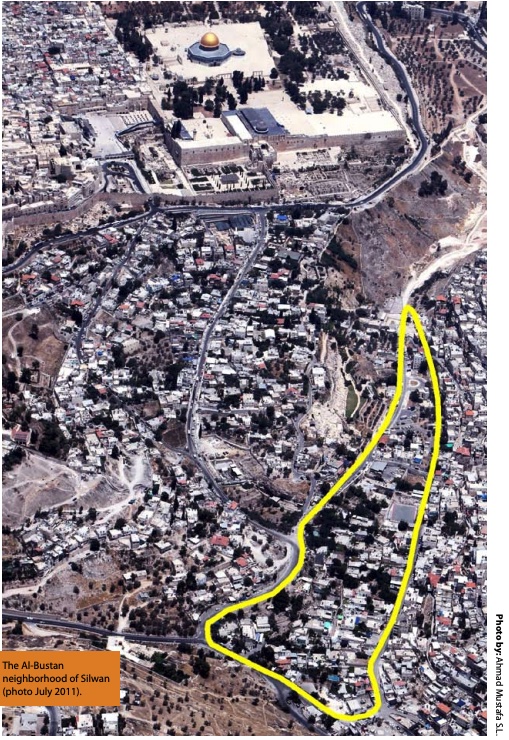 It is widely feared that the demolition of this business presages the imminent implementation of 86 other demolition orders for the same area (housing around 130 families), based on the fact that, like the now-demolished butcher shop, these homes were built without Israel-issued building permits (permits that Israel systematically denies to Palestinians in East Jerusalem). The warning period on demolition orders affecting 14 of those buildings expired on June 27th, meaning bulldozers can appear any day.
The Israeli government has targeted the al-Bustan neighborhood with wide-scale displacement since 2005, when it initiated demolition proceedings on the basis that the buildings do not have Israeli-issued building permits. Israel further declared the area a “green zone” and banned any new construction there. The backdrop to these moves is an Israeli plan to clear al-Bustan of its Palestinian residents in order to make way for an Israeli archaeological park promoted by settlers (the “King’s Garden,” which would be an extension of the settlers’ “City of David” complex).
Residents have until now managed to fight off demolition on the condition that they were engaging with the Israeli government (the Jerusalem Municipality) to develop planning for alternative housing (to which they could be moved). That planning has been ongoing since 2010. Terrestrial Jerusalem explains:
“As noted, in 2017, the Municipality agreed to suspend demolitions while the residents pursue the approval of a statutory Town Plan. The residents’ Town Plan is being drafted by Dr. Yusuf Jabarin, the Dean of Research at Haifa’s prestigious Technion Institute. The plan is working its way slowly through committee, and it is common that plans of this complexity take many years to approve. The plan is based on 11 principles to which the Municipality and the residents both agreed in 2017, and aspires to balance between the housing needs of the residents, the legitimate need for public spaces, in a manner that will serve the residents of al-Bustan, and not the settlers of Silwan. Initially the Municipality viewed the Plan favorably, but, in recent months, that support appears to have been withdrawn.”
New Government, Same Outcome – “Compromise” Opens Door for “Legalizing” Illegal Outpost
In an entirely predictable manner, the new Israeli government led by Naftali Bennet has reached a “deal” with settlers over the fate of the unauthorized Evyatar outpost. Located just south of Nablus, the site of the outpost has become a locus of Palestinian protest and Israeli military violence. Under the terms of the deal, the settlers will (temporarily) vacate the outpost by Friday, July 2nd, with the understanding that the government will leave in place the settlers’ illegal construction at the site — buildings and roads — while it “examines” the status of the land to see if it can be declared “state land” and therefore legally turned into a settlement (opening the door for the settlers to return). In the interim, under the agreement the outpost will be used as a military base while that examination plays out.
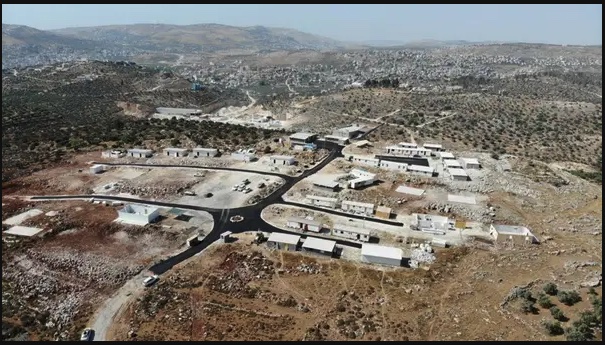 The fact that this “compromise” leaves in place the settlers’ structures and will maintain Israeli control over the site during the “survey” process are clear signals that the government is not concerned with enforcing Israeli law, but rather finding a political solution that works for the settlers. Further, the government of Israel either believes it can, and is determined to, find a pretext to assert that the land on which the outpost stands – known as Jabal Sabih to the Palestinians who have historically cultivated the it – is in fact “state land” which can be used by the state as it sees fit (i.e., give it to the settlers).

In response, the anti-settlement watchdog Yesh Din sent a letter to the Israeli Attorney General outlining exactly how the deal with the settlers contravenes international and Israeli domestic law. In a statement about the letter, Yesh Din says:
“The government’s agreement with the settlers of Evyatar rewards delinquency and grants immunity to those committing offenses, which will act to further embolden violent, lawless settlers to take similar action again in the future, knowing they will, at the very least, face no consequences, and, more likely, be further rewarded with land takeover and settlement expansion. On 1 July 2021, Yesh Din sent a principled letter to Israel’s Attorney General and the Legal Advisor to the Ministry of Defense, denouncing the government’s agreement regarding the outpost of Evyatar as illegal, unconstitutional and morally unacceptable. The letter also demands that an investigation by the police and other relevant authorities be launched into the involvement of the Samaria Regional Council for its part in the outpost’s establishment…
Furthermore, the letter clarifies that the government agreement entails a number of flagrant violations of both local and international laws, including:
In accordance with International Humanitarian Law (IHL), it is prohibited to transfer the civilian population of the occupying power to occupied territory (Article 49, Fourth Geneva Convention), an issue that is now also under investigation of the ICC.
Military presence on lands in occupied territory should only be for urgent security necessity. Safeguarding territory for future Israeli civilian presence cannot be considered an urgent security necessity. The fact that the military did not have permanent military presence in that specific area prior the government agreement reinforces that the military did not discern security justifications.
The decision made in advance to allocate lands for a settlement of Evyatar, providing that they will be declared public lands, without considering the needs of the local population in the area, and especially due to the fact that the outpost is located adjacent to three Palestinian towns, is illegal and unreasonable.
The attempt to disregard planning procedures by issuing a special military order to enable the structures on the site is an abuse of power by the military commander.
The agreement provides no legal basis for not enforcing the law on the illegal structures placed in the area.
It is forbidden to allow political whims to undermine the military commander’s discretion.
According to Israeli law, the decision to establish a new settlement in occupied territory requires a government decision, something that did not transpire in this case.”
Settlers squatting illegally at the site are reportedly not entirely satisfied with the deal. A few are threatening to resist removal from the outpost and are continuing to build permanent structures at the site. Part of the discontent relates to earlier reports that the “compromise” would include a commitment by the government to establish a military yeshiva (religious school associated with the IDF) at the site of the outpost, regardless of the outcome of the land status investigation (or even before the outcome is known). In the final deal, the government agreed to establish a yeshiva at the outpost only after the issue of the land’s status is resolved, and only if that issue is decided in the settlers’ favor. However, the settlers are still asserting that the government has agreed to open a military yeshiva at the site immediately, somewhat of a middle road.
Daniella Weiss, a veteran settler leader who is the leader of the group of settlers who established the Evyatar outpost, believes the land survey will confirm the area is “state land” with only minor adjustments to the boundaries of the outpost. She also said that she expects the yeshiva to be open by September, in time for the Jewish High Holidays. Weiss said:
“This government, which has been so sorely criticized, found the noble and uplifting way to talk with us – without over-powering us, but rather with admiration for pioneer builders of the Land. Our goal is not to force the government’s hand, but rather to uplift it. Our achievement is not in going against the government, but rather in bringing it to the place which it itself wants to be.”
The fate of the outpost has posed an early test for Israel’s new governing coalition. Defense Minister Benny Gantz is on the losing side of this issue (where he is joined by the IDF leadership, which similarly wants the outpost dismantled), having insisted just a few days ago that he is the one in charge of deciding the fate of the outpost and that the outpost will be demolished in accordance with Israeli law. Haaretz explains how the negotiations transpired:
“Gantz looked to his right and to his left, and discovered that he was alone. Prime Minister Naftali Bennett and ministers Ayelet Shaked and Zeev Elkin had negotiated energetically with the settlers on several channels simultaneously. And members of the government’s left wing kept silent. Thus a compromise was reached without the defense minister or the army even being briefed on the talks in real time. Gantz tried to set red lines, already at the outset of the Bennett-Lapid government, in which he is a kind of fifth wheel. He sought to prevent the settlers from creating facts on the ground by taking over land whose legal status is in doubt without any permission from the state or Israel’s Civil Administration in the West Bank. Gantz also sought to prevent the capitulation of the left wing to the right wing in the government. But in reality, it seems that the left has already folded, and the right has laid down its own red line against forcible evictions, which would put Bennett in an uncomfortable situation with what remains of his electoral base. Aside, perhaps, from the new coronavirus outbreak, there probably isn’t an issue in which the government has invested more time during its first two weeks in office than the evacuation of Evyatar. The army doesn’t like the compromise, which defies the original recommendations of its Central Command and the Coordinator of Government Activities in the Territories. Both wanted a full, rapid evacuation of the outpost, which was established in the heart of a group of Palestinian villages south of Nablus. But senior army officers didn’t visit the scene Tuesday morning, and they understand full well the balance of forces there. The moment the prime minister supports the compromise, the army will salute and carry it out.”
The U.S. State Department offered veiled criticism of the deal, saying:
“We believe it is critical to refrain from unilateral steps that exacerbate tensions and undercut efforts to advance equal measures of freedom, security and prosperity and a negotiated two-state solution. This certainly includes establishing new outposts which are illegal even under Israeli law.”
Adding more insight on the U.S. position, the Times of Israel reports:
“The Biden administration is willing to give new Prime Minister Naftali Bennett some time before making asks in the Palestinian arena, but it’s not willing to accept complete paralysis and will speak out clearly against unilateral moves, a source said.”
Israel Advances Plan for New Settlement Road Through Palestinian Farmland
Haaretz reports that the Israel is advancing a plan to pave a new road near the Beitar Illit settlement that will cut through agricultural land belonging to (and actively farmed by) the Palestinian village of Wadi Fukin. If paved, in addition to hemming in Palestinians and closing off their access to their land, it is feared that the projects will restrict the flow of water into natural springs used by Palestinians for farming in the area. This would also be the first road to cut into a wooded area.
Palestinians were not directly informed of this plan, but found out after the plan had been filed with the Civil Administration’s planning authorities. Bimkom, an Israeli NGO, filed an appeal three weeks ago seeking to have the plan frozen until residents of Wadi Fukin can be included in the planning process.
One resident of Wadi Fukin, Mohammed Rabah Sukar, said:
“No one from the Civil Administration talked to us or explained exactly where the road will pass. We don’t know to what extent this will damage our lands and people are very confused and frightened by this road.”

Map by Peace Now
The planned road is connected to two other significant settlement plans in the area, both targeting areas located just south of Bethlehem. One of these plans would expand settlement construction on lands near the Wadi Fukin village. The other plan relates to expansion of the Beitar Illit settlement and the construction of a new settlement – called Gv’aot – on land that historically belonged to five Palestinian villages in the Bethlehem area: Jaba, Surif, Wadi Fukin, Husan and Nahalin. In 2014, the Israeli government issued unilateral, mass expropriation orders for the land (which Israeli officials explictly said was in response to a Palestinian terror attack). At the time, Peace Now reported that the move constituted the largest single expropriation of Palestinian land by the Israeli state in over 30 years. It wasn’t until August 2019 that Israeli planning authorities gave final approval to a plan for a new settlement, including 61 housing units and an educational institute. Today, as it stands, the new units have not been constructed, but a small outpost – which calls itself Gv’aot – has been established…on land not allotted by the Israeli government for future settlement construction.
Palestine Lays Out Key Issues it Wants the Biden Administration to Engage On
Haaretz reports that a new Palestinian negotiation team has asked the Biden Administration to facilitate negotiations with Israel over a series of about 30 issues that it believes can meaningfully improve Palestinian lives – – an approach that has come to define how the Biden Administration is seeking to engage on (but not try to solve) the Israeli-Palestinian situation.
The Palestinian team reportedly included the following proposals related to settlements and annexation in their list:
- Suspension of all settlement construction in the West Bank and East Jerusalem;
- The evacuation of unauthorized outposts;
- The prevention of Israel from controlling land in Area A (where the Palestinian Authority is supposed to have full control, as assigned by the Oslo Accords);.
- The construction of an airport in the West Bank;
- The development of new tourism projects, including religious tourism projects at sites in Area C (the 60% of the West Bank in which, under Oslo, Israel has complete control); and,
- The reopening of Palestinian institutions in East Jerusalem.
An anonymous source with knowledge of the Palestinian initiative told Haaretz:
“Not all of the proposals appearing in the document can be implemented at the present time, but even if it would be possible to advance some of the steps, at least in the civilian field, that would provide achievements to the Palestinian public and improve their day-to-day lives.”
Welcome to FMEP’s Weekly Settlement & Annexation Report. To subscribe to this report, please click here.
June 25, 2021
- Defense Ministry Approves 31 New Projects in Settlements
- Settlers Pressure Bennet Over Fate of (Illegal, even under Israeli law) Evyatar Outpost, Plan to Appeal to the High Court for Protection
- Demolish “Oz Zion” Outpost
- Gantz Orders Construction of Settler-Backed “Accessibility” Project at Tomb of the Patriarchs/al-Ibrahimi Mosque in Hebron
- Settlers Raid Homes of Prominent Activists in Sheikh Jarrah
- Bonus Reads
Comments or questions? Email Kristin McCarthy – kmccarthy@fmep.org.
Defense Ministry Approves 31 New Projects in Settlements
On Wednesday, June 24th – just two weeks after Naftali Bennett became Prime Minister – the Israeli Defense Ministry advanced the construction of 31 settlement zoning plans (with 18 receiving final approval), in settlements across the West Bank. This is the first time this particular subcommittee inside the Defense Ministry – which handles smaller settlement plans, while the Defense Ministry’s High Planning Council considers larger plans – has met since January 2021.
The plans which were advanced provide for the construction of public buildings, including a special needs school in the Elkana settlement, a new shopping mall in the Mishor Adumim settlement, and the Kfar Adumim and Karnei Shomron settlements both received approval for new synagogues and seminaries. As of the time of publication, final details of each plan are not publicly available.
The settler Yesha Council, led by David Elhayani (who had been publicly hopeful about the Bennett-led government), released a statement deriding the government for its failure to advance not just public buildings but also settlement housing units. The statement demands that Bennet convene the High Planning Council in order to issue more approvals.
The Joint List’s Ayman Odeh denounced the new government, including its left-wing members, over the settlement advancements:
“The government has existed for less than two weeks, and already, 31 construction plans have been approved in the settlements…the left is surrendering to the right and setting the diplomatic issue aside, but the right continues to sabotage the chances of peace and to deepen the occupation, repression, and dispossession of millions of Palestinians. Only the end of the occupation and a just peace will bring equality, democracy, and social justice to both peoples.”
Settlers Pressure Bennet Over Fate of (Illegal, even under Israeli law) Evyatar Outpost, Plan to Appeal to the High Court for Protection
New Israeli Foreign Minister (and Prime Minister in waiting) Yair Lapid has told press that the unauthorized outpost of Evyatar, located Palestinian land south of Nablus, will be razed as ordered by the Civil Administration. Yet, the dozens of settler families who are illegally squatting in approximately 50 buildings at the site are hoping to avoid that fate, and have until Monday June 28th to file an appeal with the Israeli Supreme Court or else face removal from the outpost barring political interference from PM Bennett (who is facing pressure from within his own party to save the outpost). The outpost continues to be a central flashpoint of violence in the West Bank over the past month, so far five Palestinians have been killed by IDF fire while protesting the land takeover.
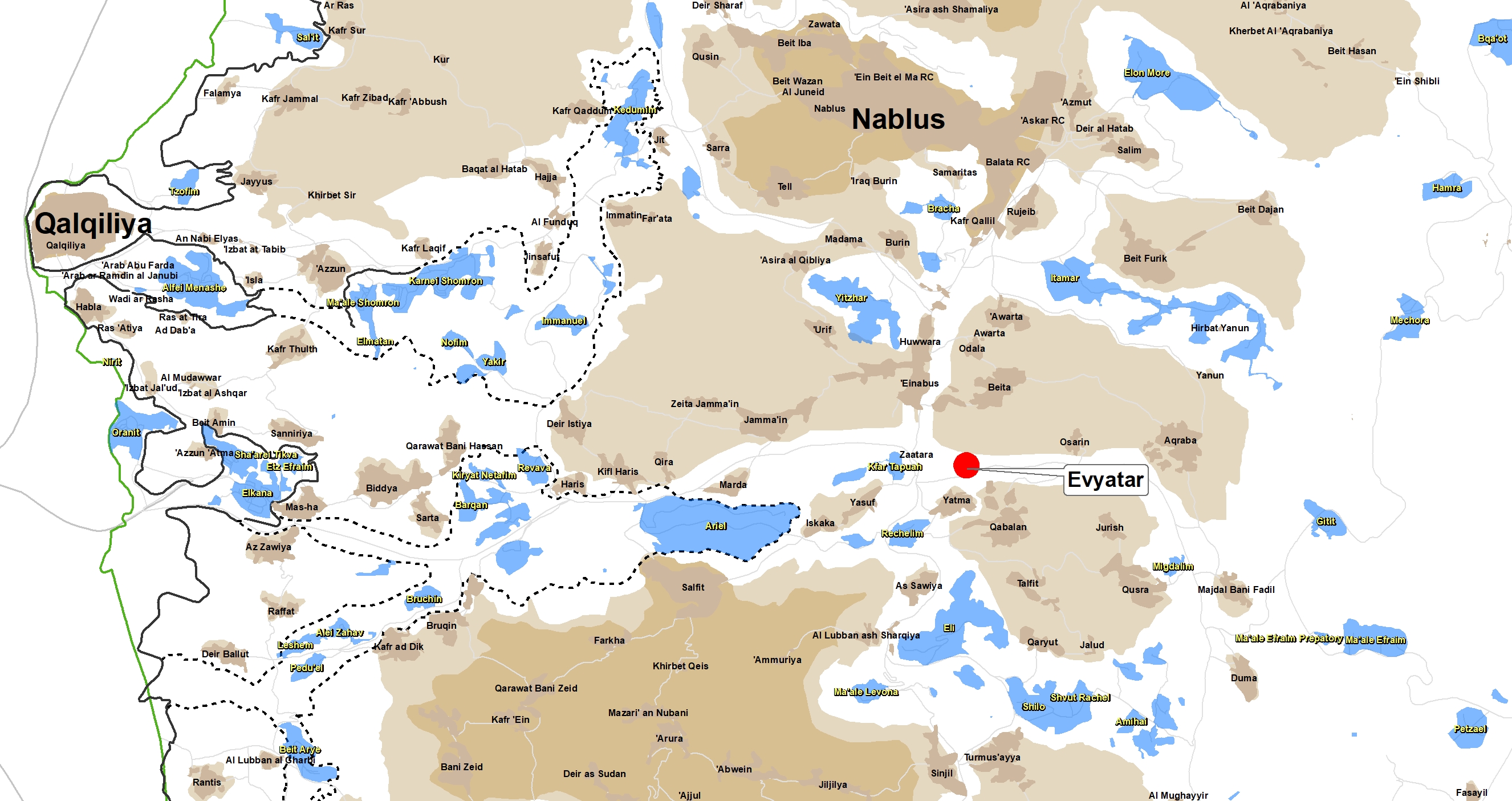
Map by Peace Now
Late last week, the settlers submitted plans – which outlined 100 housing units in addition to land for parks, a synagogue, a daycare center, and a school – to the IDF’s Civil Administration, in hopes of gaining retroactive legalization for the structures they already illegally built on the land. The plan framed the outpost as an extension of the nearby (but not contiguous) Kfar Tapuah settlement. This tactic – issuing retroactive approval to outposts under the premise that they are new neighborhoods of existing settlements – has in the past proven effective, and is a tactic promulgated by the Israeli government. For a few examples, see the following cases: the Adei Ad outpost, the Har Homa E settlement, Shvut Rachel East, and New Migron.
Speaking about the settlers’ hopes of gaining retroactive legalization of Evyatar, prominent settler leader and head of the Samaria settler municipal council, Yossi Dagan, said:
“The Council only submitted a request to authorize construction for the town of Evyatar after establishing beyond doubt that it is not situated on privately held land. Rather, it is situated on state-held land, and only the lack of a clear decision on the part of politicians is preventing its authorization. After going through such a difficult period, the State of Israel should be mobilizing all its forces to take this step, which would be both moral and ethical – it should be strengthening the 50 families who live here and giving Evyatar equal legal status to any other town in the country.”
Nonetheless, the Civil Administration (the arm of the Israeli Defense Ministry responsible for running the West Bank) rejected the settlers’ plans, based on the fact that the outpost was built illegally in blatant violation of Israeli planning laws. The military has also said the outpost undermines “security [and] stability” in the area. Further, the authorities said that the plan was not “properly developed” and that settlers do not have rights to the land. Following the Civil Administration’s rejection of their plans, Evyatar settlers plan to appeal to the Israeli High Court of Justice to stop the demolition, which is set for June 27th.
Notably, the Civil Administration’s rejection of the settlers’ plans for Evyatar does not mean that the IDF recognizes Palestinian ownership of the land, even though aerial photos obtained by the NGO Kerem Navot show that Palestinians cultivated the land at least until 1980. Rather, the IDF is now investigating the status of the land, leaving open the possibility that the land may be declared “state land” – at which point (based on past practice) it is a near certainty it would be allocated for Israeli settlement.
Peace Now also provides a key insight on the settler group which is behind the creation of this new outpost, and why it matters, writing:
“The body behind the establishment of the outpost is the settler organization of Nahala, with the close assistance of the Shomron municipality and its mayor, Yossi Dagan (a central member of the Likud party). The Nahala organization and the main activists of the new outposts are not the mainstream old-guard settlers (like the Amanah organization who is behind many other settlements and outposts and gets much more support from the authorities), however they are not a small fringe. This outpost is an example of a rift that is being created within the Israeli right wing. The more extreme right, which is willing to challenge the system more strongly, and the old-guard settlers who continue the mentality of working ‘with’ the government as much as possible. On the partisan level we see this rift in the creation of two different parties: Yamina, headed by Naftali Bennet, and the Jewish Zionism, headed by Betzalel Smotrich and Itamar Ben Gvir. The challenge of the new outpost puts the new shaky government, which is a coalition of parties which don’t agree about many things, to face its first big political test. The extreme right is signaling that it is planning to continue to challenge the new government, like it had done in the flags march in East Jerusalem, and in yesterday’s settlers’ marches throughout the West Bank.”
Peace Now called for the outpost to be expeditiously demolished, saying:
“A small group of people is creating facts on the ground that effect dramatically Israel’s security and its foreign policy without any authority. The new government must not accept that. This outpost must be evicted not only because it is deepening the occupation of the Palestinians in the West Bank but because it is bad for the security of Israel and bad for the possibility of future peace for Israel”.
IDF Demolish “Oz Zion” Outpost
On June 23rd, the Israel IDF dismantled an illegal outpost – called “Oz Zion” by the settlers – located between Ramallah and Jerusalem. The Times of Israel reports that the IDF removed more than 20 settlers and demolished several structures. Seven settlers were arrested for throwing objects at Israeli soldiers. This particular outpost has been built by settlers, and then demolished by the IDF, several times previously.
Opposition MK Bezalel Smotrich railed against the new government for its demolition of the outpost, saying:
“As we feared, within days of the formation of the government the destruction of communities has begun… Arab construction is out of control in the Negev, Galilee and Judea and Samaria and Bennett and [Justice Minister Ayelet] Shaked are choosing to demolish for Jews.”
As a reminder, Naftali Bennet once served as the head of the settler Yesha Council – which is effectively the main body lobbying the Israeli government on behalf of the settlement movement. That fact does not sit well with Kahanist MK Itamar Ben-Gvir, who said in a statement:
“The person who was once the director of the Yesha Council is now leading the demolition and destruction of the settlements. It is amazing that without blinking, Bennett approved the demolition of a settlement, at a time when he and his friends are making sure that there won’t be demolitions in the Bedouin sector. There is one law for the Bedouin, and a different law for the Jews. What an embarrassment.”
Gantz Orders Construction of Settler-Backed “Accessibility” Project at Tomb of the Patriarchs/al-Ibrahimi Mosque in Hebron
On June 10th, Israeli Defense Minister Benny Gantz gave instructions to COGAT – the body within the Defense Ministry which coordinates civilian affairs in the occupied territories – to issue a building permit and sign a contract for the construction of accessible infrastructure, including an elevator and wheel chair ramp, at the Tomb of the Patriarchs/al-Ibrahimi Mosque in Hebron. The project, which required Israel to seize land that is owned by the Islamic Waqf, strengthens Israeli control over the site and its immediate surrounding area.
The orders from Gantz follow a decision by the Israeli High Court of Justice to dismiss a petition against the plan filed by the Palestinian-run Hebron Municipality. The petition argued that the plan violates agreements, including the Hebron Protocols, signed by Israel specifying that the Palestinian-led municipality has planning authority over the site.
Emek Shaveh – an Israeli NGO with expertise in archaeology and settlement planning – also filed a petition against the plan, describing the plan as “unprofessional” and “a farce.” Emek Shaveh said previously:
“One need not be an archaeologist or architect to review the council’s plan and understand that it is destructive in a manner which is unprecedented. We are convinced that the plan, as approved, would never have been promoted had it not been driven by political motives.”
Emek Shaveh has previously provided critical context as to why this plan is not really, or not fully, being advanced out of humanitarian concerns, explaining:
“Israel’s decision to seize responsibility for the site from the Hebron municipality and the Palestinians sends a clear political message that Israel is reneging on agreements that were signed with the Palestinians in Hebron. Beyond the precedent that will enable the settlers in the future to demand additional changes at the Tomb of the Patriarchs/Ibrahimi Mosque, this is also a precedent that could play out at other sites under the responsibility of the Islamic Waqf. Experience has shown us that what begins in Hebron percolates into other places including Jerusalem. It begins with a seemingly rational demand to benefit the disabled or the general public and evolves into a new status quo. The expected change in Hebron has not escaped the attention of members of the Temple movement and they will know how to present their demands to the government. If Israel can repudiate agreements with the Palestinians in Hebron and expropriate land from the Waqf, it would seem that accepting what appears to be the far more modest demands by the Temple movement to pray or to walk about the Temple Mount complex freely is not so far-fetched. In the reality of Hebron and East Jerusalem, a change involving only several meters at a historic or holy place is not free of political considerations and often it is part of long-term strategy. While it is necessary to tend to the needs and interests of persons with disabilities, the extremists who presume to speak on their behalf must be prevented from forging Israeli policy, even if it is only a matter of a lift and an access path.”
Read Emek Shaveh’s full analysis here: “Humanitarianism Hebron Style.”
Settlers Ramp Up Battle for Area C with Provocative West Bank Marches
In recent years, Israel has increasingly treated Area C as indistinguishable from sovereign Israeli territory. In parallel, settler groups – most notably Regavim – have lobbied Israeli authorities to crack down on “illegal” Palestinian construction, claiming that Palestinians are trying to use “illegal” construction to “take over” Israeli land.
In line with this effort, on June 21st, hundreds of settlers participated in marches throughout friction zones in the West Bank, in an effort to push the newly sworn-in Israeli government to increase their persecution of Palestinian construction in Area C of the West Bank. In advance of the march, settler leaders (excluding Yesha Council head David Elhayani) released a joint statement saying:
“It is our duty to do everything legally passive to stop the savage Arab invasion of Area C to stifle Jewish settlement and establish facts on the ground. Together we will head out to explore the area, to occupy the space with our feet and demand that the authorities enforce the law in the area out of a deep belief that this land is ours.”
Making clear that the settlers have no sense of irony, one of the settler marches was held near the unauthorized Evyatar outpost – which the settlers built illegally and over which they are now engaged in a struggle with the government to prevent Israeli law from being applied to their (Jewish Israeli) illegal construction.
As a reminder, Area C accounts for around 60% of the West Bank. The Oslo Accords gave Israel complete control over Area C, and Israel for years has systematically denied Palestinians in Area C permits that would enable them to “legally” build on their own land. As a result, members of these communities have been forced to build without Israeli permits, and then face Israeli demolition orders, and demolitions, for having done so.
Settlers Raid Homes of Prominent Activists in Sheikh Jarrah
On Tuesday, June 22nd, a group of settlers attempted to force their way into three homes belonging to the El Kurd, Diab, and Qasem families – all of which are living under imminent threat of forced displacement – in the Sheikh Jarrah neighborhood of East Jerusalem. The families were able to prevent their entry.
Israeli MK Bezalel Smotrich and the head of Nahalat Shimon (the settler organization behind the campaign to displace Palestinians from their homes in Shiekh Jarrah) were among the group of settlers who tried illegally invade the homes and threatened the Palestinian occupants. Eventually, Israeli police calmly escorted the settlers away from the homes.
These home invasions followed one of the most violent days Sheikh Jarrah has seen in recent months. During protests against settler takeovers in the neighborhood on June 21st, 21 Palestinians were wounded including three who were hit with live bullets fired by the IDF and three Palestinians who were beaten. As a reminder – a recent investigative report revealed that a New York-based lawyer, Seymour Braun, is financially connected to settler efforts to displace Palestinians in Sheikh Jarrah.
Bonus Reads
- “’Silent intifada’: West Bank is at boiling point” (Ynet)
- “Israeli forces launch violent crackdown on protesters in Beita” (Middle East Eye)
- “Reality of a West Bank Outpost: Four Dead Palestinians and a Drone Spraying Tear Gas” (Haaretz)
- “Ariel University opens medical school in honor of Sheldon Adelson” (Arutz Sheva)
- “ Israel Stops Its Nighttime ‘Mapping’ Raids, but Constant Surveillance of Palestinians Continues” (Haaretz)
- “Amazon’s Investments in Israel Reveal Complicity in Settlements and Military Operations” (The Nation)
- “The Photos Exposing What Israel Is Trying to Hide” (Haaretz)
- “Israel’s Demographic Warfare Rages on Both Sides of Green Line. With One Difference” (Haaretz)
- “The Trilemma of Power, Aid, and Peacebuilding in the Israeli-Palestinian Context” (Middle East Institute/Dr. Carol Kasbari)
Welcome to FMEP’s Weekly Settlement & Annexation Report. To subscribe to this report, please click here.
June 17, 2021
- The New Israeli Government: Key Figures, Items on the Agenda, & Early Indications Related to Settlements & Annexation
- Struggle Against New Outpost Sparks West Bank Protests & Israeli Army Violence
- 30 Palestinian Families in Hebron Receive Demolition Notices to Make Way for Kiryat Arba Settlement Expansion
- Settlers Continue Persistent Invasions of Sebastia Archaeological Site Near Nablus
- Bonus Reads
Comments or questions? Email Kristin McCarthy – kmccarthy@fmep.org.
The New Israeli Government: Key Figures, Items on the Agenda, & Early Indications Related to Settlements & Annexation
A new Israeli government was sworn into office on June 13, 2021. For settlement watchers – here are key facts to know.
Key figures involved in settlement and annexation policy:
- Prime Minister: Naftali Bennet (Yamina)
- Alternate Prime Minister & Foreign Affairs Minister, to rotate to Prime Minister in 2023: Yair Lapid (Yesh Atid)
- Defense Minister: Benny Gantz (Blue and White)
- The Israeli Defense Ministry oversees the Civil Administration, the oddly-named arm of the Defense Ministry responsible for administering the occupation in the West Bank. The Civil Administration has total civilian and security control over Area C including the settlements (60% of the West Bank), and security control over Area B (21% of the West Bank). Press reports suggest that Labor’s Merav Michaeli – who is now serving as the Transportation Minister – attempted to bring West Bank roads under her purview (which would be an act of de facto annexation – West Bank roads are outside of Israel’s sovereignty and not under its domestic control). That was rejected by Gantz, who will retain control of West Bank matters as Defense Minister. One settler recently paraphrased Gantz as saying: “Only I will decide on settlement construction and negotiate with the Americans on issues pertaining to Judea and Samaria.”
- Settlement Affairs Minister: Nir Orbach (Yamina)
- Construction and Housing Minister & Minister for Jerusalem Affairs: Ze’ev Elkin (New Hope)
- Justice Minister: Gideon Sa’ar (New Hope)
- Minister of the Interior: Ayelet Shaked (Yamina)
- Shaked, who previously served as Justice Minister, hard-bargained her way into a second highly consequential posting as the government representative to the Knesset’s Judicial Selection Committee. Ynet reports that the coalition has agreed to name Shaked to the post only after a representative from the Labor Party (reportedly Merav Michaeli) is seated on the panel.
- The coalition’s Security Cabinet will include: Bennett, Lapid, Gantz, Sa’ar, Shaked, Elkin, in addition to: Avigdor Liberman (Finance Minister – Yisrael Beiteinu) Merav Michaeli (Transportation Minister, Labor), Omer Barlev (Public Security Minister – Labor), Nitzan Horowitz (Health Minister – Meretz), Matan Kahana (Religious Minister – Yamina), and Yifat Shasha-Biton (Education Minister – New Hope).
The new government, headed by Nafatli Bennet, published a list of the agreements made by the new coalition – terms that were agreed by all parties as a condition of forming the new government. Those agreements include the following settlement- and annexation-related commitments:
- “Establish a budget for the unfunded students of Ariel University.”
-
-
- Reminder #1: Ariel University is located in the Ariel settlement in the West Bank. As it is not within Israeli sovereign territory, establishing the university, bringing it under domestic authorities like the Israel High Education Council, and establishing a state budget for it, are all acts of de facto annexation.
- Reminder #2: While serving previously as Minister of Education, Naftali Bennett was intimately – and inappropriately – involved in bringing Ariel University under the domestic jurisdiction of the Israeli Higher Education Council.
- Reminder #3: During the Trump Administration, the U.S. signed agreements with Ariel University, a de facto recognition of Israel’s sovereignty in the West Bank. In addition, Florida Governor Rob DeSantis (a close Trump ally and rising political powerhouse in the Trump-aligned Republican party) also signed several agreements establishing academic partnerships between schools in Florida and Ariel University
-
- “Overall plan for transportation in Judea and Samaria and the Jordan Valley.”
-
- For a deep dive into how Israel uses roads and infrastructure as means of de facto annexation and towards the forced displacement of Paelstinians, read this fantastic piece by Break the Silence: “Highway to Annexation: Israeli Road and Infrastructure Development in the West Bank”
- “Ensuring Israel’s national interests in Area C. Allocation of resources to the Ministry of Defense for enforcement in cases of construction violations and illegal takeover of land in Area C.”
- In his first speech to the Knesset after being sworn in as Prime Minister, Naftali Bennett paid particular attention to this promise, saying: “We will ensure Israel’s national interests in Area C – and we will increase standards to that end after much neglect in this area.”
- Reminder #1: This is the continuation of an ongoing campaign – led by settlers and their allies in government, including Bennett and Shaked – to entrench and expand Israel’s control over (and de facto annexation of) the entirety of Area C, which represents around 60% of the West Bank. While in the Knesset, Bennet and others were highly critical of the Netanyahu government’s alleged failure to robustly “defend” Israel’s rights/interests in Area C (e.g., preventing “illegal” Palestinian construction, preventing foreign projects that support Palestinians’ presence in the area, clearing out Palestinians, expanding settlements, consolidating state-built settlement infrastructure). Knesset has also repeatedly hosted forums to discuss the alleged “Palestinian takeover of Area C.”
- Reminder #2: In September 2020 the Netanyahu government allocated 20 million NIS ($6 million USD) for the newly created Settlement Affairs Ministry to survey and map unauthorized (by Israel) Palestinian construction in Area C (construction for which Palestinians can virtually never obtain Israeli approval, and which Israel has been aggressively demolishing). This funding further empowers a domestic Israeli body to exert extraterritorial sovereignty over Area C – in effect, treating the area as land already annexed by Israel.
- The Times of Israel reports that the coalition has also agreed to allow the High Planning Council – the body within the Defense Ministry that considers and approves all settlement construction plans – to continue to meet on a quarterly basis, as has been the practice since 2017. The body has not met since January 2021, during the waning hours of the Trump Administration.
Prior to the new government’s swearing-in ceremony, one settler leader – David Elhayani, who heads the Yesha Council (a settler umbrella group) and the Jordan Valley settlement council, and may be the only settler leader who has come out in support of the new coalition – told the Times of Israel that the new coalition had promised that there would be no freeze on settlement construction.
Struggle Against New Outpost Sparks West Bank Protests & Israeli Army Violence
 Palestinians have continued their weekly protests against the new illegal outpost – which settlers call “Evyatar,” built on on Mount Sabih, which is land belonging to the village of Beita – located south of Nablus. The Israeli army continues to violently suppress these protests, killing two young Palestinians from Beita over the past two weeks: on June 11th, the IDF shot in the chest (with a live round) and killed 16-year old Palestinian Mohammed Said Mohammad Hamayel; on June 16th, the IDF fatally shot 16-year old Ahmed Bani Shamsa in the head. Seven other protestors have also been shot and a total of five Palestinians have been killed by Israeli forces during protests related to Beita and the Evyatar outpost in the past two months.
A representative from Defense for Children International – Palestine said:
“Israeli forces frequently use live ammunition for crowd control to disperse protesters, ignoring their obligation under international law to only resort to intentional lethal force when a direct, mortal threat to life or of serious injury exists/ Systemic impunity has fostered an environment where Israeli forces know no bounds.”
As a reminder, last week Defense Minister Gantz marked this outpost for evacuation and demolition. But in the week since the military orders were issued against the outpost (during which a new Israeli government was sworn in) those orders have not been carried out. Instead of evacuating and dismantling the illegal outpost, uniformed IDF soldiers this week were pictured helping the settlers install new construction at the site.
Explaining the situation, an activist and resident of Beita, Ibrahim Dawoud, told Middle East Eye:
“On every level, the Israeli state is assisting these settlers in the takeover of our land, even though their outpost is illegal under Israel’s own laws. Within 40 days of establishing their outpost, the Israeli government has given these settlers running water, electricity, and have paved a settler-only road for them straight up the mountain…For years the soldiers have prevented [Palstinians from Beita] from accessing their land on the mountain, and it is ours. We have the papers to prove ownership, they do not. They have no right to this land. If someone from Beita even tried to erect a tent on the mountain, just a small tent, the soldiers would be there within seconds, shooting at them and kicking them off their own land. And this is not just in Beita, it’s happening all over Palestine. Israeli settlers are allowed to steal our land freely, but when we try to defend it, we are killed.”
A Facebook page updated by settlers at the outpost states explicitly that the purpose of the outpost is to prevent contiguity between the surrounding Palestinian villages while connecting the Israeli settlement of Tapuah to the Za’atara Junction and Migdalim settlement. [photo]
30 Palestinian Families in Hebron Receive Demolition Notices to Make Way for Kiryat Arba Settlement Expansion
Al-Monitor reports that 30 Palestinian families (approximately 300 people) are under threat of forced displacement from their longtime homes and agricultural land in an area called Khirbet al-Aida, near the Kiryat Arba settlement just outside of Hebron. Israel has asserted the land is “state land,” despite the fact that, according to the nearby Palestinian municipality, all of the families possess Ottoman-era land titles proving their ownership.
Samer Jaber, one of the Palestinians under threat of displacement, recently received an eviction notice after submitting a building permit application to the Israeli authorities. That application was rejected and returned with a notice that Israel has classified Jaber’s land “state land,” and ordered his family’s eviction from the site. Israeli authorities have previously demolished sheds that Jaber built on his land.
Settlers Continue Persistent Invasions of Sebastia Archaeological Site Near Nablus
WAFA reports that on June 16th, hundreds of settlers invaded the Sebastia archaeological site under the protection of the Israeli army. The site is located in the town of Sebastia, near Nablus, a town that is in Area B of the West Bank where Israel – as stipulated in Oslo – should not be operating in. The Mayor of Sebastia, Mohammed Azzem, told WAFA that a large number of Israeli soldiers shut down the town and took up positions in the streets and several rooftops near the site in order to provide security for the settlers.
Settlers have been openly agitating – with some success – for Israel to assert control over the archaeological site in Sebastia for years. In January 2021, Emek Shaveh (an Israeli NGO expert in – and focused on – archaeology) wrote about what is happening in Sebastia, saying:
“The archaeological site of Sebastia is identified with Samaria, the capital of the Kingdom of ancient Israel in 9-8 BCE. The site also features ruins from the Hellenistic, Roman and later periods. The village of Sebastia is situated within Area B while the site itself is located mainly in area C. Over the past few years, the Samaria Regional Council has been organizing tours to the site, particularly during the school holidays. Several times this year, the Civil Administration has removed a Palestinian flag from the village and the site. In the most recent incident, a flag was raised following renovation works funded by the Belgian government. In their response the regional council blamed the Palestinians for destroying a site central to Jewish history and UNESCO for supporting the Palestinians. Sebastia is on the tentative list of World Heritage sites in Palestine….the integration of ancient sites into an organized strategy designed to weaken Palestinian hold on Area C is worrying. The formalization of this approach is likely to result in a steep rise in actions over ancient sites and structures, from water cisterns found in many villages, to major sites such as Sebastia. The justification for preserving and developing ancient sites familiar to us from East Jerusalem is now being applied wholesale to hundreds of places in the West Bank to the detriment of the Palestinians living near the sites and to the multilayered heritage inherent in the ruins which will be distorted for political ends.”
As FMEP has chronicled, settlers and their allies are intent upon taking control of archaeological sites and artifacts that are currently under Palestinian control, claiming the sites are neglected and/or damaged. For example, in February 2021 settlers used a construction mishap to raise claims to the Mt. Ebal site.
In January 2021, the state of Israel committed funding to a new settler initiative to surveil archeological sites under Palestinian control. While the objective of protecting antiquities might appear uncontroversial and apolitical, the true (and transparently self-evident) objective behind this effort is to support yet another pretext to surveil and police Palestinians, and yet another means to dispossess them of their properties. It is the result of a campaign that has taken place over the past year in which settlers have escalated their calls for the Israeli government to seize antiquities located in Palestinian communities across the West Bank, especially in Area C, which Israel today treats as functionally (and legally) indistinguishable from sovereign Israeli territory. The controversy that erupted over the Mt. Ebal archaeological site in February 2021 should be understood in this context.
Previous victories for the settlers include the Israeli Civil Administration’s recent issuance of expropriation orders for two archaeological sites located on privately owned Palestinian property northwest of Ramallah. The expropriations – the first of their kind in 35 years – come amidst a new campaign by settlers lobbying the government to take control of such sites, based on the settlers’ claims that antiquities are being stolen and the sites are being mismanaged by Palestinians. The settlers’ pressure is also credited as the impetus behind the government’s clandestine raid of a Palestinian village in July 2020 to seize an ancient font. The Palestinian envoy to UNESCO, Mounir Anastas, recently called on the United Nations to pressure Israel into returning the font to the Palestinian authorities.
In June 2020, a settler group calling itself “Shomrim Al Hanetzach” (“Guardians of Eternity”) began surveying areas in the West Bank that Israel has designated as archeaological sites in order to call in Israeli authorities to demolish Palestinian construction in these areas. The group communicates its findings to the Archaeology Unit of the Israeli Civil Administration (reminder: the Civil Administration is the arm of the Israeli Defense Ministry which since 1967 has functioned as the de facto sovereign over the West Bank). The Archaeology Unit, playing its part, then delivers eviction and demolition orders against Palestinians, claiming that the structures damage antiquities in the area.
As a reminder, in 2017, Israel designated 1,000 new archaeological sites in Area C of the West Bank. The “Guardians of Eternity” group, not coincidentally, is an offshoot of the radical Regavim organization, which among other things works to push Israeli authorities to demolish Palestinian construction (on Palestinians’ own land) that lacks Israeli permits (permits that Israel virtually never grants). The group raised public alarm about the Trump Plan, alleging that hundreds of biblical sites in the West Bank are slated to become Palestinian territory.
Bonus Reads
- “Former Attorney General Discovers Settler Group Took Over His Family’s Sheikh Jarrah Home” (Haaretz)
- “Israeli settler assaults Jerusalemite activist Muna al-Kurd” (WAFA)
- “Karim Khan, new ICC chief prosecutor, to decide Israel’s fate” (Jerusalem Post)
- “How Israel’s Occupation Came Home” (NewLines // Elizabeth Tsurkov)
- “Saving Lifta: Palestinians rally against latest threat to depopulated Jerusalem village” (Middle East Eye)
- “Palestinian mom fights to stave off punitive home demolition” (AP)
- “Israel to halt nighttime ‘mapping’ of Palestinian homes” (AP)
- “Family left in shock by shooting of young Palestinian woman” (AP)
- “Roadblocks upend Palestinian family’s life in East Jerusalem’s Sheikh Jarrah” (Reuters)
Welcome to FMEP’s Weekly Settlement & Annexation Report. To subscribe to this report, please click here.
June 10, 2021
- Israeli AG Declines Involvement in Sheikh Jarrah Dispossession Cases, Clearing Way for Supreme Court Ruling
- Pending Silwan Dispossession Cases Continue
- Israeli Supreme Court Hears Landmark Case on West Bank Land Appropriation for Settlement
- Extremists “March of Flags” in Jerusalem Rescheduled for June 15th
- IDF Issues Evacuation Notice Against Outpost, Causing Political Stir
- Bonus Reads
Comments or questions? Email Kristin McCarthy – kmccarthy@fmep.org.
Israeli AG Declines Involvement in Sheikh Jarrah Dispossession Cases, Clearing Way for Supreme Court Ruling
On June 7th, Israeli Attorney General Avichai Mandelblit informed the Supreme Court that he will not submit a legal opinion on the cases threatening the immediate displacement of seven Palestinian families (13 households) from their longtime homes in the Sheikh Jarrah neighborhood of East Jerusalem. These cases will serve as further precedent for even more widespread dispossession of Palestinians in favor of settlers.
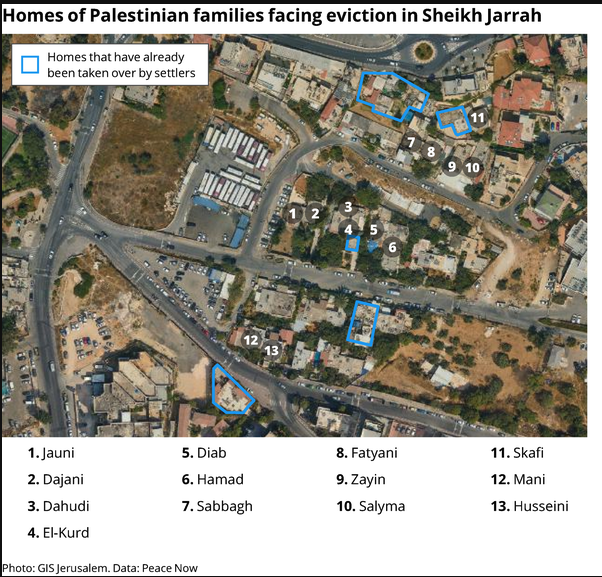
Map by Haaretz
Haaretz reports that Mandelblit believes the Palestninians’ have “too weak” of a case, and that his legal opinion would not prevent their eviction. Haaretz also reports that the political leadership in Israel approves of the Attorney General’s decision to allow the cases to proceed.
Peace Now responded to Mandelblit’s decision:
“Israel’s Attorney General has decided not to give his opinion in the Sheikh Jarrah cases. This means Israeli government is ridding itself of responsibility in matters of discriminatory laws and dispossessing hundreds of Palestinian.”
These Sheikh Jarrah eviction cases – which have been at the center of heightened international attention and outcry – have been in limbo since last month, when the Attorney General was given until June 8th to submit his opinion. Now that Mandelblit has decided against weighing in, the Supreme Court is expected to convene a hearing and issue its ruling on the Palestinians’ appeal before July 20th, which is the last day of the Israeli judicial calendar — notwithstanding the fact that the Supreme Court could delay the hearing under various pretexts, if it was inclined to do so. Commenting on the anticipated quick move by the Supreme Court to hold this final hearing, Terrestrial Jerusalem’s Danny Seidemann tweeted “…The wheels of justice grind slowly, but sometimes we make exceptions. Enough said.”
Ir Amim said:
“The eviction procedures in both Sheikh Jarrah and Silwan largely reflect one another and are predicated on the same discriminatory legal mechanism, which state-sponsored settler groups are exploiting to systemically dispossess Palestinian families and seize their homes for Jewish settlement. A total of 1000 Palestinians – some 300 individuals from Sheikh Jarrah and more than 700 people from Silwan— are under threat of mass displacement. These measures not only constitute a flagrant violation of human rights, but also carry far-reaching, humanitarian, geopolitical, and moral implications. Concerted pressure must be exerted on the Israeli government to end these measures of dispossession and to undertake a sustainable and just solution for the families to remain in their homes.”
In a piece entitled “Israel Is Shirking Its Responsibility for Residents of Sheikh Jarrah,” the Haaretz Editorial Board wrote:
“The enlistment of the state employees, from the attorney general to the last of the policemen, for the benefit of the expulsion and settlement enterprise in Sheikh Jarrah is an embarrassment for Israel. It causes moral damage, harms public diplomacy and poses a security risk to all Israelis. Let us hope the new government will have broader considerations and will order the attorney general to intervene for the sake of common sense and justice.”
Ironically, as the clock ticks down to a final decision by the Court – a decision that will almost certainly mean the expulsion of these Palestinains from their homes — Israel seems to be making a special effort to keep the world’s attention focused on how it treats Palestinians in Sheikh Jarrah. This effort included arresting (with brutality captured on video) a well-respected Al Jazeera journalist Givara Budeiri, and detaining and interrogating two of the most prominent Paelstinian activists in the world – Muna and Mohammed El-Kurd. The siblings – whose family is one of the seven facing immediate expulsion from their homes – were released following intense interrogation. These high-profile arrests are but a small part of a large wave of arrests Israel is carrying out across Jerusalem and other parts of the country. Budeiri was also released.
Pending Silwan Dispossession Cases Continue
On June 10th an Israeli court in Jerusalem was due to hold a hearing with respect to Palestinian appeals in two cases of pending dispossession of Palestinains of their homes in the Silwan neighborhood of East Jerusalem. The Court instead delayed the hearing on the appeals, rescheduling it to July 8.
In addition to the two cases above, the fate of another 15 Palestinians households in Silwan — all facing eviction/dispossession — awaits the action of Attorney General Mandelblit. The case of eight of those families, all from the Batan al-Hawa section of Silwan, is currently before the Supreme Court, which has ordered Mandelblit to give his opinion in the cases, or formally decline to do so, by June 30. How those cases are decided will become the precedent that will decide the fate of another seven Palestinian households whose cases are currently in an Israeli District Court.
One Silwan resident, Zuheir al-Rajabi – whose family’s case was profiled in the New York Times – told Al-Monitor that the Silwan families are also considering taking their case to the International Criminal Court. As a reminder, the ICC is currently considering whether to launch a full fledged investigation into Israeli war crimes – an investigation which would include settlement activity.
Israeli Supreme Court Hears Landmark Case on West Bank Land Appropriation for Settlement
Peace Now reports that on June 7th, the Israeli High Court of Justice held a hearing on a petition filed by Palestinian landowners challenging the allocation of “state land” to the Israeli Ministry of Housing in order to enable to the construction of a new settlement called Givat Eitam on a strategic hilltop – which Palestinians call a-Nahle – located just south of Bethlehem.
Hagit Ofran of Peace Now – which is leading the petition alongside the Palestinian landowners – told FMEP that the hearing concluded with Court giving the State 90 days in which to respond to a proposal to allocate some the land directly involved in the case to the individual petitioners, or whether it will agree to allocate land nearby to the petitioners. This decision by the Court purposefully narrows the scope of Peace Now’s legal challenge by only addressing the case of the land in a-Nahle and the individual petitioners involved. The decision dodges the more fundamental question put forth in the petition challenging Israel’s discriminatory practice of allocating 99.8% of “state land” for settlement purposes. This is the first time the issue of state land allocations to settlements is being challenged in an Israel court.
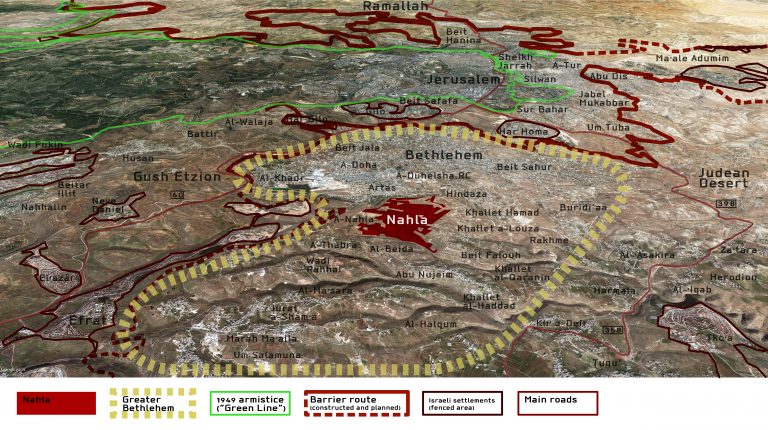
Map by Peace Now
This petition comes after previous legal efforts have failed to overturn Israel’s declaration of the land of a-Nahle as “state land”. Past attempts to use litigation in Israeli courts to prevent Israel from building new settlements have typically not continued past this point. One reason for this is that in order to challenge how “state land” is allocated, the petitioner must, in effect, concede that the land in question is legitimately “state land” in the first place — something Palestinians do not concede with respect to land seized by Israel. That makes this petition, which is led by Peace Now along with over a dozen Palestinian landowners, novel.
As a reminder, the settlement at the heart of the case is called Givat Eitam by settlers, but it is called “E-2” by anti-settlement watchdogs, in light of its dire geopolitical implications for any future Palestinian state (similar to those of the E-1 settlement on Jerusalem’s eastern flank). The construction of Givat Eitam/E-2 would significantly expand the Efrat settlement in the direction of Bethlehem, effectively cutting Bethlehem off from the southern West Bank and completing the city’s encirclement by Israeli settlements.
Extremists “March of Flags” in Jerusalem Rescheduled for June 15th
Delayed twice in light of Israel’s concerns of violence, the Israeli Security Cabinet voted to give its permission for radical, ultranationalist Israelis to hold a parade – called the March of Flags – on June 15th through the Old City of Jerusalem, ostensibly in celebration of the reunification of East and West Jerusalem following the 1967 War. Hedging, the Security Cabinet made its permission conditional on the route of the parade being approved by the Israeli police.
Israeli police have expressed concern that the provocative parade – which organizers want to have go through Damascus Gate and the Muslim Quarter, in a deliberate finger-in-the-eye to Palestinians (the provocative overtones of the annual march are never subtle, with racist/Islamophic signs and chants the norm) – could trigger Hamas rocket fire, and have in the past refused to approve the parade route insisted upon by its organizers.
According to press reports, the police have said that it will consider approving a new proposal for a different, less provocative route. However, organizers of the march have rejected this option, stating, “the outline presented to us by the police does not express the purpose of the parade, by the Jewish people, with Israeli flags in the Israeli capital.” Making clear that provocation is the goal, MK Itamar Ben Gvir, a acolyte of Rabbi Meir Kahane – whom police had, for security reasons, explicitly barred from participating in any flag march at this time, or from visiting the Temple Mount/Haram al Sharif – held his own protest at Damascus Gate, leading, as he surely hoped, to a confrontation between Palestinians and Israeli forces accompanying him (and to the arrest of five Palestinians).
Notably, the parade is currently planned for Tuesday, June 15th – a date that falls two days after a new government is expected to be confirmed and sworn in. Commenting on the timing, a Haaretz analyst noted:
“Instead of approving the march on its original date, Netanyahu made his first decision as opposition leader on Tuesday night: He rolled the hot potato into the hands of prime minister-designate Naftali Bennett. This move may become the first crisis of the fragile unity government: Bennett, who is right-wing, has made it clear that his government would have a ‘soft right’ character and would have a hard time explaining to his voters why he was working to thwart the march.”
IDF Issues Evacuation Notice Against Outpost, Causing Political Stir
Haaretz reports that a group of 200 settlers have re-established an outpost (which they call “Evyatar”) on a strategic hilltop called Mount Sabih, located south of Nablus on lands belonging to the Palestinian villages of Beita, Qabalan, and Yatma. On June 9, the Israeli army issued a military order designating the area as a closed zone, and ordered the settlers (and their security team of guard dogs) to vacate the area within eight days. The IDF said it would demolish/remove the more than 40 structures – including tents, a synagogue, prefab houses, and sanitation facilities – that settlers have installed at the site if the settlers do not remove them voluntarily. A spokesperson for the outpost – Daniella Weiss of the Nahala settler organization – said that 46 settler families (approximately 200 people) have moved to the outpost already, and 75 settler families are “hoping to join them soon.”
Palestinians from the nearby villages to which the land belongs have actively sought to prevent settler incursions into the lands surrounding Beita. During a recent protest against another outpost settlers were trying to establish on lands belonging to Beita, the Israeli army shot and killed two young Palestinians, and wounded 25 others. On June 6th, the army closed off the main entrance to Beita in an attempt to quell Palestinian resistance; Beita remains sealed off as of June 10. As a reminder,
With defiance and pride, a spokesperson for the outpost told Haaretz that the land on which the outpost stands is in the process of being declared “state land” by Israel. The Times of Israel reports that, indeed, the Israeli government regards the land’s status as unclear – and is examining whether it can claim the land as “state land” under the legal pretext that it has not been actively cultivated by Palestinians for a long enough period of time. As a reminder, Palestinians have been prevented from building and farming on this land for decades. In the 1980s, Israel used the hilltop as a “temporary” military base. When the base was removed in the 1990s, Palestinians were prohibited from building on the site – which is in Area C of the West Bank where Israel exercises unilateral power.
If the land is declared as “state land” it could then be allocated to the settlers and the outpost could be retroactively authorized, consistent with the longstanding efforts of the whole of the Israeli government – the Knesset, the Executive, and the Judiciary – which has spared no efforts to find the means by which to issue retroactive authorization to more than 70 outposts scattered throughout the West Bank.
The imminent evacuation of the “Evyatar” outpost has caused controversy in the waning hours of the Netanyahu regime, and might become one of the first points of contention for the incoming government coalition. After the IDF issued an order closing the area and declaring its intent to raze the outpost, Prime Minister Netanyahu wrote a letter to Defense Minister Gantz (who oversees the Civil Administration, which has authority over West Bank building and security) arguing that the outpost should be left alone while the land status is investigated. Gantz rebuffed the letter, writing back that the outpost was built in contravention of Israeli law and the IDF will raze the outpost regardless of the question of land status. The letter from Gantz’s office said: “It is those anomalous characteristics of this case that led to the decision to issue a demarcation order, which followed consultation with all relevant defense and legal authorities.”
Looking forward, Haaretz succinctly explains why the evacuation of this outpost might pose a predicament to the new Israeli government, due to be sworn in over the weekend. Haaretz writes:
“From a legal perspective, the site must be evacuated…But how will [Naftali Bennet] the former director general of the Yesha Council of settlements – who is the prime minister-designate – behave in the face of what remains of his political base?”
Bonus Reads
- “Fights over settlements holding up coalition deal signings” (Jerusalem Post)
Welcome to FMEP’s Weekly Settlement & Annexation Report. To subscribe to this report, please click here.
May 7, 2021
- Protests Against Dispossession Continue in Sheikh Jarrah, as Israeli Court Delays Decision
- Israel Has Been Conducting a Secretive Land Registration Process in Sheikh Jarrah, Excluding Palestinians
- Har Homa E Settlement Plan Granted Approval, With Minor Conditions
- Knesset Attempts Fast-Track Vote on Two Key Bills: One to Authorize Outposts; Another to Cancel 2005 Disengagement
- Bibi Reportedly Dismisses U.S. Concerns Over Settlements
- Construction Begins on New “Legal” Settlement in Southern West Bank, Foreshadowing More to Come
- Following Deadly Drive-By-Shooting, Settlers Establish New Outpost & Terrorize Palestinians Near Nablus
- Al Haq Report on Palestinian Workers in Settlements & the Complicity of Multinational Corporations
- Bonus Reads
Comments or questions? Email Kristin McCarthy – kmccarthy@fmep.org.
Protests Against Dispossession Continue in Sheikh Jarrah, as Israeli Court Delays Decision
On May 2nd, the date set by the Israeli Supreme Court for the forced dispossession of four Palestinians families from their longtime homes in Sheikh Jarrah in favor of Israeli settlers, the Supreme Court delayed the evictions and gave the parties four days (until May 6th) to consider a proposed “solution.” The Court’s suggested “solution” was that the Palestinians acknowledge Jewish ownership of the land, and in exchange be allowed to remain there as tenants – paying rent to the settlers – but only until the original tenant dies. At that time, the remaining family members would have to vacate the premises and the settlers would take control of the homes
In a powerful statement issued on May 2nd, the four families targeted for dispossession this week rejected that proposal outright, saying:
“We the four Sheikh Jarrah families firmly reject the terms of this agreement, for these are our homes and settlers are not our landlords. The inherently unjust system of Israel’s colonial courts is not considering the questioning of illegal settlers’ ownership and has already decided on the families’ dispossession.” This pattern of elongating the legal process is common practice to dull popular resistance and public opinion protesting these expansionist colonial efforts. As the threat of expulsion from our home remains as imminent as ever, we will continue our international campaign to stop this ethnic cleansing”
On May 6th, the Court once again delayed the dispossession, and said it would reconvene a three judge panel on May 10th to decide whether to allow the Palestinian families to continue appealing their eviction cases. Ir Amim reports that the likelihood of the panel ruling in the Palestinians’ favor is “slim.”
The date the Supreme Court chose for handing down its decision – May 10th – also happens to be Jerusalem Day. This is the day when as many as 25,000 Israeli settlers and fellow right-winger fanatics engage in an annual provocation against Palestinians, with a parade through the Muslim Quarter of the Old City and neighboring areas of East Jerusalem to “celebrate” Israel’s capture of the city in 1967 (called “The Dance of Flags,” including racist chants and signs). Given the high tension in Jerusalem over the pending Sheikh Jarrah evictions, as well as over the recent protests over Israel’s closure of the area around Damascus Gate, the end of Ramadan, and the killings over the past two days of several Palestinains in the West Bank, Jerusalem Day poses a significant threat of escalation, and has already elicited warnings from the Israeli Chief of Police to reroute the parade. So far, those warnings appear to be falling on deaf ears.
To be clear: escalation has already begun. Shortly following the Supreme Court’s second delay, dozens of Israeli protestors marched through Salah Eddin Street (the major commercial thoroughfare in Palestinian East Jerusalem), and were reportedly “throwing stones at Palestinian cars and demanding the ethnic cleansing of Sheikh Jarrah.” Not long after that, the head of the Otzma Yehudit party Itamar Ben-Gvir (a devotee of Kahanism and the ethnic cleansing of Palestinians) set up a tent-office in Sheikh Jarrah across from where Palestinians had prepared an iftar celebration. Settlers then began taunting the Palestinians sitting down for dinner, which escalated into clashes when a settler sprayed what appeared to be pepper spray. Later that evening, Israeli forces were seen protecting the “office” and the settlers there – including Jerusalem Deputy Mayor and settler empresario Arieh King, who was caught on video telling an injured Palestinian that the Israeli police ought to have shot him in the head.
On Friday morning May 7th, Sheikh Jarrah residents report that the Israeli police have cordoned off the neighborhood, and are checking IDs before permitting entry. Overnight raids and arrests of Palestinians also continue to be reported, with 15 arrested overnight on May 7th (settlers faced no arrests or punishments, despite being filmed shooting guns)
Prie Minister Netanyahu is reportedly proposing a permanent police presence in Sheikh Jarrah to protect the settlers — an arrangement much like the prevailing reality in Hebron
For a Palestinian view on what is happening in Sheikh Jarrah (and a plethora of additional resources on this topic), check out this FMEP webinar from May 6, 2021, and on Twitter you can follow #SaveSheikhJarrah for the latest news.
Israel Has Been Conducting a Secretive Land Registration Process in Sheikh Jarrah, Excluding Palestinians
Ir Amim and Bimkom report that Israeli authorities have been carrying out a secretive land registration process for the benefit of settlers in the Umm Haroun section of the Sheikh Jarrah neighborhood of East Jerusalem, and have already registered several plots of land to Jewish Israeli owners. Palestinian residents – inlcuding 45 families (40 houses) living on the plots of land secretly registered to the settlers – were not notified by Israeli authorities that the registraiton process was taking place, as is required by Israeli law. The stakes, as noted by Bimkom and Ir Amim, are high not only for Palestinians in Sheikh Jarrah who are being targeted at this time, but also for Palestinians across East Jerusalem, as any land registration process – let alone a secretive process undertaken for the benefit of Israeli Jews – can lead to “widespread Palestinian dispossession in the city.”
On May 2nd, Ir Amim and Bimkom filed an urgent petition with the Israeli High Court of Justice asking the Court to freeze the registration process and “expunge all invalid land registration as a result of this unethical procedure”. On May 3rd, the Israeli court issued a temporary injunction stopping the process at least until a ruling can be made on the case. The State has until June 3, 2021 to submit a response to the petition.
Har Homa E Settlement Plan Granted Approval, With Minor Conditions
Ir Amim reports that the Jerusalem District Committee has granted its conditional final approval to a plan to build 540 new settlement units in the new Har Homa E settlement. The conditions outline a few minor modifications to the plan (like more clearly marking bike trails) which will not take much time. Once those modifications are made the plan will be formally approved via publication without requiring another meeting of the Committee.
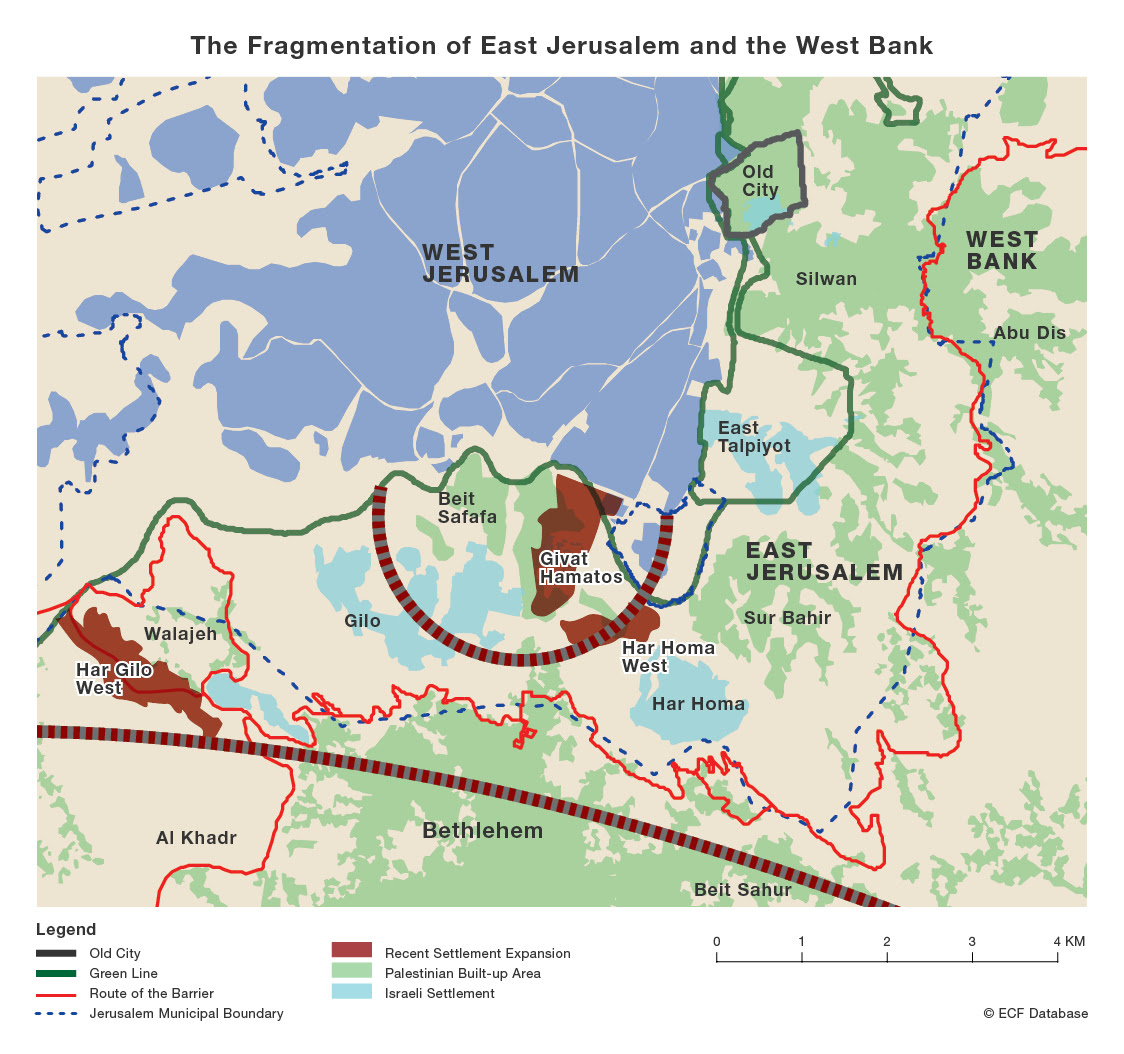 Because the land on which the new settlement will be built is privately-owned, building plans will not be subject to a government-run tender process. Ir Amim reports that once the plan is published, building permits can theoretically be issued any time (though technical obstacles might delay things but not change the inevitability of construction).
Reminder: Although the Har Homa E plan is framed as merely an expansion of the Har Homa settlement in East Jerusalem, it is more properly understood as a new settlement since the buildings will be built in an open area that is not contiguous with the built-up area of Har Homa. The plan calls for 540 new settlement units to be built in the area between the Har Homa settlement and the site of the planned Givat Hamatos settlement (tenders for which were issued in January 2021). Meaning that the new construction is a significant step towards completing a ring of Israeli settlements on Jerusalem’s southern edge and encircling the Palestinian neighborhood of Beit Safafa.
Knesset Attempts Fast-Track Vote on Two Key Bills: One to Authorize Outposts; Another to Cancel 2005 Disengagement
On May 4th, the Knesset Arrangements Committee voted in favor of fast-tracking two settlement-related bills. The first would cancel the 2005 Disengagement Law, thereby allowing settlers to re-establish the four settlements in the northern West Bank which were evacuated under that law (which settlers have been attempting to do on their own, illegally but with significant political support, for years). The second would grant retroactive authorization (i.e., legalize) the nearly 70 outposts that Israel has failed to find any other way to legalize (because they were built on land even Israel recognizes is privately owned by Palestinians). Now on a fasttrack, the bills can be called for its first vote at any time after May 5th (to pass, all bills most be voted on three times in the Knesset and sent to committees for approval).
The fast-tracking of these bills at this time is an attempt to get the bills passed into law before a new government is formed or new elections are called, and to use the issue of settlements as a political weapon against parties that oppose the bills. The Times of Israel reports that internal politics will likely see the bills languish as parties jockey to form a new governing coalition. The bills are a source of division between parties that are currently deep in negotiations to form a governing coalition – led by Yair Lapid and the Yesh Atid party (which opposes the bill).
When asked for comment on the outpost legalization bill by the Times of Israel, a spokesperson for the U.S. State Department gave its most substantive comments on settlements yet, saying:
“We are deeply concerned about the potential ‘legalization’ of outposts that have long been deemed illegal under Israeli law…As we have long said, it is critical that Israel refrain from unilateral steps that exacerbate tensions or take us further away from peace. This includes evictions, settlement activity and home demolitions, and certainly includes the legalization of Israeli outposts in the West Bank that have long been illegal even under Israeli law.”
Bibi Reportedly Dismisses U.S. Concerns Over Settlements
According to a report by Israel’s Channel 12 News, the Israeli Prime Minister Benjamin Netanyahu has on three separate occasions over the past month rebuffed U.S. diplomats’ concerns regarding Israel’s settlement activities.
The first communication was from Jonathan Shrier, the chargé d’affaires of the U.S. Embassy (the ranking U.S. diplomat in Israel, in the absence of an Ambassador). Shrier was reported to have relayed U.S. concerns over the approval of the Har Homa E settlement plans earlier this month, but the concerns were dismissed.
The second communication came from National Security Advisor Jake Sullivan (a top official in the Biden White House), who reportedly expressed U.S. concerns over the approval of the Har Homa E settlement as well as settlement construction in the West Bank. The Times of Israel reports that Netanyahu responded, “Jerusalem is not a settlement, but the capital of Israel.”
The third communication came May 5th regarding the violence in Sheikh Jarrah; that communication was reportedly also rebuffed. Perhaps suggesting that there is growing frustration with the issue inside the Biden Administration, a day later, on May 6th, the U.S. the Department of State issued its most pointed public statement on Israeli settlement activity yet.
Construction Begins on New “Legal” Settlement in Southern West Bank, Foreshadowing More to Come
This week settlers celebrated the start of construction on 164 settlement units in the new (or at least, newly-legal under Israeli law) Ibei Hanachal settlement, located between Bethlehem and Hebron in the southern West Bank. This comes nearly one year after Israel began clearing the land to prepare for construction.
Ibei Hanachal was established illegally by settlers in 1999, but was granted retroactive approval as a neighborhood of the Ma’ale Amos settlement by the Israeli government in August 2019. Declaring illegal outposts to be neighborhoods of settlements – even outposts that are non-contiguous with the allegedly parent settlement, as is the case with Ibei Hanachal – is one of the legal mechanisms that Israel has found to retroactively “legalize” illegal outposts. In this way, Israel has not only been “legalizing” construction by settlers that violates Israel law, but has in effect been establishing brand new settlements – like Ibei Hanachal.
Elsewhere, construction has reportedly started on 164 units in the Neve Daniel settlement, located on the southwestern border of lands belonging to Bethlehem
The news of these new construction starts is a reminder that the massive number of settlement approvals the Israeli government granted during the Trump era will soon potentially translate into a massive number of settlement construction starts during the Biden Administration. The AP reported earlier this month:
“Israel has also laid the groundwork for a massive construction boom in the years to come, advancing plans for 12,159 settler homes in 2020. That was the highest number since Peace Now started collecting data in 2012. It usually takes one to three years for construction to begin after a project has been approved. Unlike his immediate predecessors, who largely confined settlement construction to major blocs that Israel expects to keep in any peace agreement, Netanyahu has encouraged construction in remote areas deep inside the West Bank, further scrambling any potential blueprint for resolving the conflict. Settler advocates have repeatedly said that it would take several years for Trump’s support to manifest in actual construction. Peace Now said that trend is now in its early stages and expected to gain steam. “2020 was really the first year where everything that was being built was more or less because of what was approved at the beginning of the Trump presidency,” said Peace Now spokesman Brian Reeves. “It’s the settlement approvals that are actually more important than construction.””
Following Deadly Drive-By-Shooting, Settlers Establish New Outpost & Terrorize Palestinians Near Nablus
In the wake of a drive-by-shooting at a junction in the northern West Bank that left one Israeli dead and two others injured, settlers have been exacting their revenge. In addition to raiding a village and allegedly setting fields on fire in Burin – settlers have also established an outpost south of Nablus, on a hilltop known as Jabal Sbeih.
The new outpost consists of a few mobile homes, which settlers were able to move into the area uncontested while the IDF enforced a closure in the Nablus area while hunting down the suspect of the drive by shooting.
Al Haq Report on Palestinian Workers in Settlements & the Complicity of Multinational Corporations
In a new report entitled “Captive Markets, Captive Lives: Palestinian Workers in Israeli Settlements,” Al-Haq explains the circumstances that Palestinians who work in settlements face, including discrimination, dangerous conditions, violence, and shame. In 2019, Al Haq estimated there were between 23,000 and 34,000 such workers.
The report also briefly examines the activity of two multinational corporations in the settlement economy – Heidelberg Cement and General Mills. The report directly addresses and repudiates the claim put forth by settlers and these corporations that jobs are a net gain for Palestinians who would otherwise be unemployed if not for jobs in settlements.
Al-Haq writes:
“Palestinian labour rights in Israeli settlements are almost non-existent. The deliberate lack of regulation of labour rights by Israeli authorities empowers settlers by encouraging further violations of Palestinian workers’ rights with no accountability. Palestinians working in Israeli settlements in the West Bank are treated under the outdated Jordanian labour law while their Israeli counterparts are treated under Israeli labour law leading to a complete denial of access to social and health benefits. Many workers are denied health care when injured while on-duty. Workers with permanent disabilities due to work related injuries are not compensated. Meanwhile families of victims are not even compensated in the event of death on duty. As this report has shown, Palestinian workers are not provided with the necessary protective equipment and are constantly exposed to hazardous waste and material. At the same time, Palestinian workers’ unions are targeted by Israeli employers in an attempt to thwart unionization efforts. Accordingly, this report dispels the myth that international companies provide necessary work and benefits to the Palestinian workforce that justifies their illegal operations in the OPT. Instead, the ugly truth unfolds of international and Israeli companies exploiting a captive Palestinian workforce in a captive economy, in companies operating on unlawfully appropriated Palestinian lands, pillaging the natural resources and subsistence of the Palestinian people, and maintained by a lethal military occupation and apartheid regime under the wilful profiting eye of the international community.”
Bonus Reads
- “This Checkpoint Revitalized the Palestinian City of Jenin. Why Has Israel Refused to Reopen It?” (Haaretz)
- “Settlers to sue B’Tselem for alleging they set Palestinian fields ablaze” (Jerusalem Post)
- “Palestinian fears rise as settlers visit synagogue ruins in Jericho” (Al-Monitor)
- “Jerusalem’s Jewish majority hits new low” (Arutz Sheva)
- “Israel Blew Up Their Houses in 1966. Now It Claims Their Village Never Existed” (Haaretz)
- “Over 180 Israeli Intellectuals, Scientists Warn ICC: Don’t Rely on Israel to Probe War Crimes” (Haaretz)
Welcome to FMEP’s Weekly Settlement & Annexation Report. To subscribe to this report, please click here.
April 29, 2021
- Sheikh Jarrah Evictions Set for May 2nd; Protests & Diplomacy Ratchet Up
- Resources for Understanding Recent Protests and Violence in Jerusalem
- WZO Admits It Gave Palestinian Land to Settlers Without Written Agreements
- Jewish National Fund Delays Decision on Formalizing Policy on West Bank Land Purchases
- Ariel University Giving Academic Credit for Outpost Volunteers
- IDF Stops Settler Attempt to Establish Yeshiva on Site of Dismantled Homesh Settlement
- Settlers Celebrate Israeli Independence Day
- Settler-Run Chamber of Commerce Planning a Hotel in Hebron in Partnership with Palestinian Businessman Ahsraf Jabari
- Smotrich’s Party Files Bill for Outpost Legalization
- Roundup of Settler Violence This Week
- Human Rights Watch: Israel is Guilty of the Crime of Apartheid
- Bonus Reads
Comments or questions? Email Kristin McCarthy – kmccarthy@fmep.org.
Sheikh Jarrah Evictions Set for May 2nd; Protests & Diplomacy Ratchet Up
Over the past two weeks, activist groups have stepped up advocacy efforts to stop the impending dispossession of 8 Palestinian families (87 individuals) from their longtime homes in the Sheikh Jarrah neighborhood of East Jerusalem in favor of settlers. The eviction of four families has been set by Israeli courts for May 2nd, and three more families face eviction in August.
The Times of Israel reports that Jordan – which was the governing authority in East Jerusalem from 1948 until 1967 – has also gotten involved, and is said to have found “documents proving that the [Jordanian] ministry of development that built these houses had in 1956 finalized lease agreements for homes in Sheikh Jarrah.” Jordanian Foreign Minister Ayman Safadi said that the documents are contracts between Jordan and the Palestinian tenants, and were certified at the time by UNRWA. Such documents might help Palestinians disprove the settlers’ contention that the homes were originally owned by Jews who fled during the 1948 war. Israeli law allows such Jews – and their descendants – to reclaim their lost properties in East Jerusalem and the West Bank, while denying Palestinians any such right to reclaim properties they were forced to abandon in 1967 or 1948 inside what is today Israel.
On April 22, 2021 a group of 500 Palestinian residents of Sheikh Jarrah and 191 organizational signers sent a letter to the International Criminal Court. The letter calls on the ICC’s Chief Prosecutor to publicly condemn the evictions and investigate what is happening in Sheikh Jarrah as part of the ICC’s larger investigation into the situation in Palestine. The families write:
“If the forced evictions move forward, we will be subjected to other Israeli policies that together make-up Israeli practices that result in the widespread and systematic transfer of the Palestinian Jerusalemite population. If we set up a tent outside our houses, the Israeli occupying forces will demolish it, as part of its widespread and systematic policy of demolition of Palestinian property. If we rent a home outside Jerusalem because we cannot afford to rent in Jerusalem, we will be at risk of having our residency status revoked and not be allowed to enter Jerusalem, pursuant to Israel’s residency revocation policy, which requires Palestinian Jerusalemites to constantly prove their “center of life” is in the city”
On April 16th, hundreds of protestors rallied in Sheikh Jarrah to bring attention to the pending mass displacement. At the protest, former Palestinian Authority Minister for Jerusalem Affairs Hatem Abd al-Qadir told the Times of Israel:
“These protests are an expression of our rejection of the decisions of Israeli courts in expelling the residents of Sheikh Jarrah. This is ethnic cleansing and expulsion at the barrel of a gun.”
Resources for Understanding Recent Protests and Violence in Jerusalem
Since the beginning of Ramadan, Israel’s decision to close the plaza in front of the Damascus Gate – the main gate used by Palestinians to access Jerusalem’s Old City – sparked an outbreak of violence in Jerusalem (Israel subsequently reopened the plaza, but the situation on the ground is still volatile). Several FMEP grantees, partners, and other notable sources have published resources that help contextualize and assess exactly what is happening. Below are resources and excerpts most relevant to settlement observers seeking understanding of how current events fit into the larger picture of Israeli intentions and actions in Jerusalem, including the aforementioned impending dispossessions in Sheikh Jarrah.
Ir Amim published an update under the subject, “Closure of Damascus Gate Plaza & Aggressive Police Measures.” In the brief Ir Amim summarizes exactly what is happening:
“Many of the incidents of friction and confrontation in the area stem from the closure of the Damascus Gate steps and unprovoked police aggression and use of excessive force towards Palestinians, which disrupt the peace and lead to escalation. Over the past week, Palestinian youth have protested the plaza’s closure. The Israel police dispersed them with disproportionate use of force. The police claim that there have been incidents of Palestinians throwing stones at police, and indeed Israeli vehicles were damaged amid the confrontations. However, during the last few nights, police forces have assaulted Palestinians in the Damascus Gate area with no prior provocation on their part, including the use of stun grenades and the deployment of mounted police charging into hundreds of Palestinians who were solely visiting the Old City for Ramadan…
In tandem, right-wing Jewish extremists and nationalist organizations have been exploiting the friction to further incite and call for retaliation (both on social media and mainstream media) against the Palestinian protests and isolated incidents of Palestinian harassment of Haredi Jews. On Monday, Knesset Members from the extremist rightwing Religious Zionism party went to Damascus Gate in a hostile and provocative call to “show Palestinians who’s boss.”
In recent days, large groups of nationalistic Israeli youth have rallied in West Jerusalem’s city center shouting “death to Arabs,” while hunting down and attacking Palestinian pedestrians, which has led to clashes between Jews and Palestinians. In contrast to the police’s aggressive operations at the Damascus Gate, serious measures by the police to disperse these groups or protect attacked Palestinians have not been observed. These groups have called to gather tonight in Jerusalem, marching from the City Hall Square to Damascus Gate and the Old City with the intent of clashing with Palestinians “to teach them a lesson.”
Emek Shaveh published a brief entitled “The Last Gate,” exploring how the state of Israel has spent the past several years asserting more and more control over key archeological sites in and around the Old City, and why the Damascus Gate is a hugely important part of that still unfolding story. Emek Shaveh writes:
“Over the past two decades, the Old City’s Historic Basin has undergone unprecedented development. The State of Israel has invested billions of shekels in tourism projects and archaeological excavations alone, whether in the neighborhood of Silwan, excavations of the Western Wall tunnels, or on the Mount of Olives, among other initiatives. As noted, Damascus Gate is just the latest in this chain of investments. Damascus Gate is the most convenient gate from which to enter the Old City. It has a broad entrance and does not require walking uphill, as with Jaffa Gate or Zion Gate. Moreover, it is close to the center of Jerusalem. While Israel claims that it aims to develop the area around the gate, it is effectively redefining its character, promoting tourism, and increasing Israeli presence so as to diminish or conceal the Palestinian character of the area. The recent clashes along the stone steps of Damascus Gate plaza should be considered in the context of this development boom. Perhaps the authorities’ concern with young Palestinians sitting on the steps was just another chapter in the struggle over identity, belonging, and sovereignty, as with many in the Old City’s Historic Basin. After so many changes to the gates of the Old City, Damascus Gate is one of the last bastions of this ongoing struggle.”
The PLO Negotiation Affairs Unit issued a policy brief entitled “Occupied Jerusalem Protests Apartheid,” in it, writing:
“Since the first day of the holy month of Ramadan, the Israeli occupying authorities have been intensifying their restrictive and oppressive policies against the Palestinians in occupied Jerusalem as part of their continuous attempts to ultimately alter the Arab and Palestinian character of the city in defiance of international legitimacy. Such cruel acts are part and parcel of Israel’s illegal policies and practices, mainly its colonial- settlement expansion, home demolitions, and forced evictions of Palestinian families, including in Sheikh Jarrah and Silwan, in addition to its current denial for Palestinians in Jerusalem from running as candidates or participating in the upcoming Palestinian elections. In this context, it’s imperative to point out that seven Palestinian families currently face the risk of imminent forcible eviction from their homes in the Sheikh Jarrah neighborhood by 2 May 2021. Seventy Palestinian families live in this part of Sheikh Jarrah, 34 of which are undergoing a battle in the occupying power’s legal system to confront the threat of forcible transfer, a war crime under the Rome Statute of the International Criminal Court, which allows Israeli settlers to replace Palestinians and take over their homes. Israel’s illegal policies throughout occupied Palestine, particularly in Jerusalem, are rooted in an extremist ideology that enforces Jewish supremacy over the indigenous Palestinian population as articulated in the “Jewish Nation-State Law” of 2018 that legitimizes Israel’s institutionalized discrimination against the Palestinian citizens of Israel and turns a de facto reality on the ground to a de jure apartheid regime for all Palestinians in historic Palestine.“
WZO Admits It Gave Palestinian Land to Settlers Without Written Agreements
On April 26th, the Israeli High Court of Justice held a hearing on a petition filed by Palestinian landowners seeking the cancellation of a 1969 military seizure order which included a parcel of their land, and seeking the removal of settlers who have since been allowed by the State of Israel to live there and build a successful company growing date palms. The Palestinian landowners had previously filed a petition solely seeking the removal of the settlers, but the petition was denied by the High Court. The new petition seeks to cancel the underlying seizure of the land by the State.
To date, the Israeli government – along with the World Zionist Organization, to whom the State transferred the land in question – have not provided the Court with any documentation regarding the assignment of the land to the Israel settlers. Though the land was part of the military seizure order, a lawyer representing the WZO actually conceded that the land was given to the settlers without a written agreement, but suggested that it was approved by the Israeli Cabinet. Leading up to this admission, High Court President Esther Hayut rebuked Roi Shweika, the lawyer for the state, asking:
“How can it be that the state gives land to a person and there are no agreements and they don’t know for how long, especially when it’s not state land? Whoever heard of such a thing?…What efforts have you made to ask the people to produce the agreements that they have? If they don’t have agreements to produce, that raises a suspicion that there are no agreements.”
Haaretz also reported out a truly unbelievable intervention by the settler-owner of the date farm company, Ayala Smith:
Smith “To the best of my knowledge, the land has been worked since 1982, and more than 30 years went by before [the Palestinian owner] opened his mouth for the first time. I’m there every day, raising the best dates in the world, not him.”
Chief Justice Esther Hayut replied: “They weren’t given access to the land. They told him he couldn’t enter. Instead, they let you come in and you raised the best dates in the world. It borders on provocation to argue that.”
Jewish National Fund Delays Decision on Formalizing Policy on West Bank Land Purchases
The Chairman of the Jewish National Fund in Israel (JNF-KKL), Avraham Duvdevani, postponed a final vote by the Board of Directors – originally scheduled for April 22nd – on whether to formally adopt a policy of purchasing land in the West Bank for settlement construction. In anticipation of the policy’s adoption, the JNF-KKL Board voted in February 2021 to allocate nearly $12 million towards the purchase of land in the West Bank.
The decision to postpone the vote follows weeks of outcry from a Jewish organizations who donate to and promote the work of the JNF around the world. A new date for the vote has not yet been announced. As a reminder, the proposed policy is little more than a shift in public relations strategies. The JNF has long worked in support of settlements, but until this point has preferred to leave its settlement-related activities deliberately obscured.
Ariel University Giving Academic Credit for Outpost Volunteers
Haaretz reports that Ariel University, located in the Ariel settlement in the heart of the northern West Bank, is offering academic credit to students who volunteer as farmhands and security guards at unauthorized/illegal settlement outposts across the West Bank. The volunteer program is run through an organization called Hashomer Yosh (“Guardians of Judea and Samaria”), a group touted by the Chairman of Ariel University for its work against “those who want to disturb the right of the people of Israel to settle in the land and to develop agriculture.” The program was described on the Ariel University website as “linking the students with the national Zionist task of contemporary agriculture.””
Haaretz reports that the academic program placed five students at three outposts, including the Bar Yosef outpost which was founded by an individual who has been repeatedly filmed harassing Palestinians. Ariel University staff defended the program by arguing that the outposts in question are known to be built on “state land” (suggesting that their unauthorized status is a mere technicality). Of course, as is the case with all unauthorized outposts, these proto-settlements were built without formal permission or building permits in contravention of Israeli military law which governs the occupied West Bank, and are therefore illegal even under Israeli law.
Israeli attorney Eitay Mack has filed a complaint against the program, asking the Israeli Attorney General and the Israeli Council on Higher Education (which admitted Ariel University as a member in April 2019) to examine the legality of the program. The complaint has been assigned to Deputy Attorney General Raz Nizri.
Commenting on the program, Ariel University told Haaretz:
“In the framework of the law encouraging significant volunteering in the community, like other institutions, the university works with many and varied entities with expertise in placing volunteers in the community. In that framework, Hashomer Yosh received approval as an entity using volunteers for the current academic year.”
IDF Stops Settler Attempt to Establish Yeshiva on Site of Dismantled Homesh Settlement
On April 26th, the Israeli army removed settlers who had built a makeshift religious school (a yeshiva) and housing for students at the site of the dismantled settlement of Homesh in the northern West Bank. Undeterred, the settlers returned to the site the next day to hold classes.
According to the Jerusalem Post, the settlers brought in modular structures and plywood to build the housing, and used a large tent for the yeshiva itself. It is unclear how long the settlers had been allowed to remain at the site prior to their removal this week.
As a reminder: Homesh is one of four settlements in the northern West Bank that Israel dismantled in 2005 under the Disengagement Law, which primarily removed all Israeli settlers from the Gaza Strip. After Israel removed settlers from these four sites, the IDF issued military orders barring Palestinians from entering the areas, let alone building in them. At the same time, settlers have regularly entered the areas and even repeatedly built a yeshiva at the Homesh site. Settlers have been openly obsessed with the desire to re-establish Homesh, hosting religious events and protests at the site of Homesh, some of which have been attended by Israeli MKs and politicians.
Settlers Celebrate Israeli Independence Day
Settlers celebrated Israeli Independence Day with continued efforts to advance the Greater Israel cause – and to remind the Palestinians who is in charge – across the West Bank, including:
Northern West Bank: Settlers continue to agitate for the reconstruction of the Sa-Nur settlement in the northern West Bank, which Israel removed settlers from and dismantled as part of the 2005 Gaza withdrawal along with three other nearby settlements (Homesh, Ganim, and Kadim). On Israeli Independence Day, April 15th, thousands of Israeli settlers visited the site of the evacuated Sa-Nur settlement, an area which – despite removing the settlers from – has not been returned by Israel to Palestinian control, but instead maintains a military closure of the area. The festive event, which included performances and crafts, was organized by the Samaria Regional Council, in violation of the military closure. Instead of enforcing the order, the IDF allowed settlers to freely come and go via pre-arranged shuttles. Arutz Sheva reports that the event was the largest gathering of Israelis at the event since 2005.
Jordan Valley: In the Jordan Valley, settlers held a parade of cars and armed guards near the Palestinian village of Tubas – an event which caused panic amongst school children. I
Southern West Bank: Settlers living in tiny enclaves in the center of Hebron held celebrations that included a huge fireworks show (something Palestinians would likely never be allowed to do).
Settler-Run Chamber of Commerce Planning a Hotel in Hebron in Partnership with Palestinian Businessman Ahsraf Jabari
A settler leader in the city center of Hebron, Hillel Horowitz, is hatching a plan to build a hotel near the Tomb of the Patriarchs/Al-Ibrahimi Mosque, and he is seeking financial investment from Palestinian businessman Ashraf Jabari. Jabari is known for co-founding the Judea and Samaria Chamber of Commerce (JSCC) alongside settlers, and for his tight embrace of the Trump “Peace to Prosperity” plan. Jabari has been widely criticized by his peers and family.
Hillel pitched the idea while attending an iftar dinner at Jabari’s home in Hebron, an event organized by the JSCC. The Jerusalem Post reports that the pitch was greeted with applause from all in attendance.
Smotrich’s Party Files Bill for Outpost Legalization
Though participating in a mandate-less government, a member of MK Bezalal Smotrich’s Religious Zionist party filed a bill in the Knesset to grant unilateral authorization about 70 outposts in the West Bank that were built without the necessary permissions from the state of Israel. The Jerusalem Posts reports that there are enough votes to pass the bill, but given the state of continuous elections and coalition talks in Israel it is unclear if the Knesset will remain in session long enough to bring the bill to a vote.
The Jerusalem Post reports that an explanatory text of the bill claims that the proposed law is in line with a decision the Security Cabinet took in 2017, when it tasked a new committee – headed by notorious settler leader Pinchas Wallerstein – to prepare individualized plans for each outpost to gain retroactive legalization based on the passage of the Regulation Law and the recommendations in the Zandberg Report.
Bills similar to this have been filed several times in the past, and the Israeli government has debated granting retroactive authorization to the outposts via a government decision – and came close to doing so in the waning days of the Trump Administration.
Settler leaders offered their support for the bill. Gush Etzion Regional Council Head Shlomo Ne’eman said:
“We trust that all the right-wing factions and the government will support this law, and will authorize these communities quickly.”
Mateh Binyamin Regional Council head Israel Ganz said:
“The time has come to complete the work and give the tens of thousands of residents sent by the Israeli governments basic rights.There is no need to wait for the formation of a new government. The Knesset can and must do so now.”
Round-up of Settler Violence this Week
Violence is a key tool settlers use to take over and control more land across the West Bank. Many instances of settler violence towards Palestinians made headlines this week, including:
- “Soldier shoots and kills Palestinian protestor during dispersal of weekly protest against illegal outpost” (B’Tselem)
- “Israel settlers set fire to cars in Jerusalem chanting ‘May your village burn’” (MEMO)
- “Palestinian cars set on fire in Beit Iksa in apparent Jewish attack” (i24 News)
- “Israeli settler attacks on Palestinians spike to 210 so far this year, says UN” (The Nation)
Human Rights Watch: Israel is Guilty of the Crime of Apartheid
In a new report, entitled “A Threshold Crossed: Israeli Authorities and the Crimes of Apartheid and Persecution,” Human Rights Watch declared that Israel’s policy towards Palestinians – defined in the report as “to maintain the domination of Jewish Israelis over Palestinians and to discriminate against them” – amounts to crimes against humanity, specifically the crimes of apartheid and persecution. Settlements, settlers, and annexation figure heavily into the facts and analysis that lead to the report’s conclusion.
You can read the full report here.
You can read a helpful Q&A about the report here.
For reaction to and analysis of the report, see coverage in FMEP’s daily news roundup from April 27th (date of the report’s publication), 28th, and 29th. You can subscribe to FMEP’s daily news round up here. Highlights include:
- “One system, one policy’: Why Human Rights Watch is charging Israel with apartheid” (+972 Magazine // Amjad Iraqi interviews Omar Shakir)
- “Say Israel is committing apartheid? It’s not a decision we reached lightly.” (The Forward // Eric Goldstein)
- “Israel Has No Place Left to Hide” (Medium // Sam Bahour)
- “B’Tselem on Human Rights Watch report: an urgent wake-up call” (B’Tselem press release)
- “US dismisses apartheid accusations against Israel” (Al Anadolu)
- “Even ‘apartheid’ doesn’t capture fullness of our Palestinian suffering. But it helps.” (The Forward // Mohammed Shehade)
- “We Can Keep Lying to Ourselves on ‘Apartheid,’ but Israel Has Crossed the Line” (Haaretz // Gideon Levy)
- “US Disagrees that Israel Carrying out ‘Apartheid’” (Ashraq Al-Awsat)
Bonus Reads
- “The Master Plan for Building in Jerusalem? Preserve a Jewish Majority” (Haaretz)
- “Foreign Ministry: Palestine waiting for a strong US position against settlements” (Jerusalem Post)
- “’Death to Arabs’: Palestinians Need International Protection From Israel’s Racist Jewish Thugs” (Haaretz)
- “Israeli Settlements Could Be Headed for Self-destruction, and It Has Nothing to With the Occupation” (Haaretz)
- “Israeli Settler Slapped a Palestinian Activist. A Jerusalem Court Slapped Her Back” (Haaretz)
- “’Like Spy Agencies’: Inside East Jerusalem’s Jewish Settlement” (Haaretz)
- “What Is Israel Planning, Expulsion by Bus or by Truck?” (Haaretz)
- “To Jaffa Arabs, Sales of ‘Absentee Ownership’ Properties Aim to Expel Them From the City” (Haaretz)
- “Israel Using Drones to Tear Gas Palestinian Demonstrators in West Bank” (Haaretz)
Welcome to FMEP’s Weekly Settlement & Annexation Report. To subscribe to this report, please click here.
January 22, 2021
- Cashing In Before Trump Cashes Out, PART 1: Israel Awards Tender for the Construction of Givat Hamatos
- Cashing In Before Trump Cashes Out, PART 2: Israel Issues Tenders for 2,572 Settlement Units
- Cashing In Before Trump Cashes Out, PART 3: In Final Hours of Trump Era, Israel Advances Plans for 780 Settlement Units Across the West Bank
- Netanyahu’s Bid for Mass Legalization of Outposts Fails (For Now)
- Bonus Material
Comments/Questions – email Kristin McCarthy (kmccarthy@fmep.org)
Cashing In Before Trump Cashes Out, PART 1: Israel Awards Tender for the Construction of Givat Hamatos
Map by Terrestrial Jerusalem
On January 19th, the Israel Land Authority issued the tender for the construction of the Givat Hamatos settlement in East Jerusalem (the tender is for a total of 1,257 settlement units). The issuance of the tender came a mere 6 hours before Joe Biden was sworn in as the President of the United States.
Prior to the issuance of the tender, the Jerusalem District Court rescinded its injunction against the tender, which the Court had issued last week in response to a petition filed by Palestinian residents of East Jerusalem and the Israeli NGO Ir Amim. That petition – which alleges that the planned construction of government-subsidized housing has discriminatory eligibility guidelines – is still pending, and the Court scheduled a discussion of the petition for May 27th.
According to Jerusalem expert Daniel Seidemann (of the Israeli NGO Terrestrial Jerusalem), now that the tender has been issued and awarded, construction of Givat Hamatos is now “virtually inevitable.” Givat Hamatos has long been regarded as a doomsday settlement by parties interested in preserving the possibility of a two-state solution, in that it will prevent the division of Jerusalem into an Israeli capitol and a Palestinian capitol (if the Givat Hamatos settlement is built, the Palestinian neighborhood of Beit Safafa in East Jerusalem will be completely surrounded by Israeli construction, severing its connection to the West Bank). Regardless of the implications of Givat Hamatos on a two state solution, the impact of the new settlement on the Beit Safafa neighborhood are nonetheless significant.
Explaining how Netanyahu bears direct responsibility for the highly consequential decision to move ahead with Givat Hamatos, Terrestrial Jerusalem writes:
“Netanyahu could have made this ‘go way’ at ZERO political cost to himself. He could have said truthfully: I tried, but the Court didn’t let me. Instead, he pulled out all plugs and instructed the State Attorney to aggressively pursue the rescission of the injunction. He went out of his way to make this happen. The tender process may now be completed, after which construction is virtually inevitable.This is happening because Netanyahu wants it to happen. This is happening now, because Netanyahu wants it to happen now.”
Ir Amim punctuates its analysis of the move by writing:
“The fact that the ILA hastened to announce the winners of the tender only 6 hours before Joe Biden’s inauguration serves to underline how determined the Israeli government is to create as many facts on the ground as possible before Biden takes office.”
Regarding the prospects of its petition against the Givat Hamatos tender, Ir Amim writes:
“The petition targets the conditions of eligibility for subsidized housing within the tender which discriminate against Palestinians. The petition does not call for cancellation of the tender but it remains to be seen how the petition will be viewed by the court and whether or not this will affect more than the specific discrimination present. One possible result of the petition – although we do not think its likelihood is high – can be that subsidized housing be completely removed from the tender in which case it is very possible that the tender will have to be reissued.”
Cashing In Before Trump Cashes Out, PART 2: Israel Issues Tenders for 2,572 Settlement Units
On January 20, 2021 – inauguration day in the U.S., the Israeli government issued tenders for the construction of 2,572 units (total) in settlements across the West Bank, as well in East Jerusalem. Now that the tenders are issued, construction companies are invited to bid to win the contract. Peace Now estimates that building is likely to happen within two years from now.
The issuance of these tenders comes in addition to the Givat Hamatos tender (see section above) and the advancement of plans for 780 more settlement units (see section below).
Commenting on the tenders, Peace Now said in a statement:
“Our out-of-touch government leadership continues to press on with its mad scramble to promote as much settlement activity as possible until the last minutes before the change of the administration in Washington. By doing so, Netanyahu is signaling to the incoming President that he has no intention of giving the new chapter in US-Israel relations even one day of grace, nor serious thought to how to plausibly resolve our conflict with the Palestinians.”
The 2,572 tenders issued on January 20 provide for:
- 941 units in the Emanuel settlement, located in the northern West Bank east of the Palestinian village of Qalqilya. Israel has openly declared its intention to continue expanding settlements in this area – which includes the settlements of Karnei Shomron and Alfei Menashe – with the stated goal of bringing 1 million settlers to live in the area.
- 460 units in the Pisgat Zeev settlement, the largest settlement in East Jerusalem. This involves the issuance of two tenders, one for 210 units and a second for 250 units.
- 377 units in the Adam (aka Geva Binyamin) settlement, through the issuance of three tenders, one for 94 units, a second for 263 units, and a third for 20 units. The Adam settlement is located northeast of Jerusalem, just beyond the separation barrier. Israel has for some years been steadily building the Adam settlement in a manner meant to connect the settlement seamlessly with East Jerusalem settlements and infrastructure, erasing the Green Line.
- 359 units in the Beit Aryeh settlement, located northwest of Ramallah, through the issuance of two tenders, one for 159 units and a second for 200 units.
- 220 units in the Maaleh Efraim settlement, located in the northern West Bank in the area between the central ridge and the Jordan Valley, through the issuance of three tenders, one for 24 units, a second for 178 units, and a third for 18.
- 150 units in the Alfei Menashe settlement, located in the northern West Bank east of the Palestinian village of Qalqilya. Israel is planning to continue expanding this area – which includes Karnei Shomron and Emmanuel – with the stated goal of bringing 1 million settlers to live in the area.
- 49 units in the Karnei Shomron settlement, through the issuance of two tenders, one for 48 units and a second for 1 unit). Israel also advanced plans for construction of 24 more units in the Karnei Shomron settlement through an earlier stage of the planning process (see the section below). Karnei Shomron is located in the northern West Bank east of the Palestinian village of Qalqilya. Israel is planning to continue expanding Karnei Shomron with the stated goal of bringing 1 million settlers to live in the area.
- 16 units in the Beitar Illit settlement. through the issuance of two tenders, one for 14 units and a second for 2 units). Beitar Illit is located west of Bethlehem, near the Green Line.

Cashing In Before Trump Cashes Out, PART 3: In Final Hours of Trump Era, Israel Advances Plans for 780 Settlement Units Across the West Bank
At its final meeting of the Trump era — which took place the day before Joe Biden’s inauguration — Israel’s High Planning Council advanced plans for 780 new settlement units. This includes final approval for plans for a total of 365 units plus the expansion of an industrial zone and approval for deposit for public review (one of last steps before final approval) for a total of 415 units, including retroactive legalization to two illegal outposts.
Commenting on the Council’s actions, Peace Now said in a statement:
“By promoting hundreds of settlement units, Prime Minister Netanyahu is once again putting his personal political interests over those of the country. Not only will this settlement activity erode the possibility for a conflict-ending resolution with the Palestinians in the long-term, but in the short-term it needlessly sets Israel on a collision course with the incoming Biden administration.”
Specifically, plans granted final approval by the Council include:
- 152 new units in the Shavei Shomron settlement, located in the northern West Bank, northwest of Nablus.
- 123 new units in the Itamar settlement, located southeast of Nablus in a cluster of notoriously violent settlements and outposts.
- 66 new units in the Oranit settlement, located in the northern West Bank, in the “seam zone” between the 1967 Green Line and the Israel separation barrier (a barrier constructed along a route designed to keep as many settlements and as much adjacent land as possible on the Israeli side of the wall/fence).
- 24 new units in the Karnei Shomron settlement, located in the northern West Bank east of the Palestinian village of Qalqilya. Israel is planning to continue expanding Karnei Shomron with the stated goal of bringing 1 million settlers to live in the area.
- Expansion of the Barkan Settlement Industrial Zone, located in the northern West Bank and a part of a strand of settlements connecting Israel proper and the Ariel settlement. Ariel is located in the very heart of the northern West Bank, reaching literally to the midpoint between the Green Line and the Jordan border. The future of Ariel and the settlements between Ariel and Israel proper have long been one of the greatest challenges to any possible peace agreement, since any plan to connect Ariel to Israel will cut the northern West Bank into pieces. For background on this industrial zone and others, see here.
Plans the Council approved for deposit for public review include:
- The retroactive legalization of 118 existing units in the Nofei Nehemia outpost. If implemented, this plan would have the effect of retroactively legalizing the outpost as a “neighborhood” of the Rehelim settlement, notwithstanding the fact that the Nofei Nehemia outpost is a fair distance from the Rehelim settlement and is not contiguous with the built-up area of Rehelim. In reality, Nofei Nehemia – if authorized – should be understood as a brand new settlement in its own right, rather than an expansion of an existing one (as the Israeli government wants the world to believe). The Nofei Nehemia outpost is located east of the Ariel settlement in the very heart of the northern West Bank. The Nofei Nehemia outpost made news this week with launch of a public bus route through the outpost – an overt act of entrenching and normalizing its presence by Israeli authorities.
- 107 new units in the Tal Menashe settlement, located on the tip of the northern West Bank, inside the “seam zone” between the 1967 Green Line and the Israel separation barrier, which was constructed along a route designed to keep as many settlements and as much adjacent land as possible on the Israeli side of the wall/fence. Tal Menashe is technically a neighborhood of the Hinanit settlement, though the built-up areas do not connect. The plans for 107 units would, if implemented, “dramatically increase” the size of the Tal Menashe settlement, which is the settlement where Esther Horgan – who was murdered by a Palestinian in late December 2020 – lived. Israeli government officials have made it a clear policy to advance settlement construction in response to deadly attacks on settlers by Palestinians, an approach publicly endorsed by U.S. Ambassador to Israel David Friedman.
- The retroactive legalization of 96 units in the Havot Yair outpost, with the intention of granting retroactive legalization (under Israeli law) to the entire outpost. The Havat Yair outpost is located near the Karnei Shomron settlement in the northern West Bank, east of the Palestinian village of Qalqilya. Israel is planning to continue expanding Karnei Shomron area with the stated goal of bringing 1 million settlers to live in the area.
Netanyahu’s Bid for Mass Legalization of Outposts Fails (For Now)
Despite an intensive last ditch effort, Netanyahu did not succeed in pushing through a government decision to grant retroactive legalization to dozens of outposts in the waning hours of the Trump era.
According to reports, Netanyahu made a last minute effort to gain Gantz’s support for a more narrow authorization – for 6 outposts instead of the 43 outposts as included in an earlier draft government decision. Gantz reportedly blocked Netanyahu’s proposal from coming up for a vote at the Israeli government cabinet meeting on January 19th, saying that “no diplomatically irresponsible proposal will be raised at such a sensitive time.” Other reports suggest European leaders intervened to make their objections to outpost authorization clear.
According to Haaretz, Netanyahu made several attempts to get the decision passed, including convening a call with Israel’s Attorney General to make progress. During that call Netanyahu complained that “jurists” were getting in his way. Netanyahu then surprised Gantz by adding the outpost issue to the Cabinet’s meeting planned for January 19th (a meeting devoted solely to the COVID-19 crisis).
The 6 outposts Netanyahu’s proposal reportedly listed for legalization are: Tel Zion, Ovnat, Metzoke Deragot, Kedem Arava, Avigail, and Asa’el. For more information on those outposts, see Peace Now’s reporting. Of those outposts, three would have been legalized as neighborhoods of existing settlements (Tel Zion, Ovnat, Metzoke Deragot), and three would have been authorized as full-fledged independent settlements (Kedem Arava, Avigail, Asa’el). Netanuyahu’s new proposal also called for the government to allocate over $6.2 million (NIS 20 million) to hire 13 new staff members at the Civil Administration tasked with continuing outpost legalization legal efforts.
FMEP has traced this saga for weeks – from the time when Likud and Blue & White officials were collaborating to draft such a decision, to last week’s news that Gantz decided to continue blocking the move despite a private meeting with settlers asking him to give his OK. It’s worth reiterating that Gantz has made clear he is not opposed to granting retroactive legalization to outposts, but is opposed to this manner of doing so. Gantz prefers for each outpost to be considered on an individual basis.
Bonus Material
- “A regime of Jewish supremacy from the Jordan River to the Mediterranean Sea: This is apartheid” (B’Tselem)
- “Al-Haq Welcomes B’Tselem’s Recognition of Israeli Apartheid” (Al-Haq)
- [VIDEO] “Calling the Thing by its Proper Name: “Apartheid” Between the Jordan River & the Mediterranean Sea” (FMEP)
- “Palestinian factory workers strike in West Bank industrial zone” (Al-Monitor)
- “West Bank demolitions and displacement | December 2020” (OCHA)
Welcome to FMEP’s Weekly Settlement & Annexation Report. To subscribe to this report, please click here.
January 15, 2021
- Tender for Givat Hamatos Settlement Construction Delayed
- Israel Expected to Advance Plans for (At Least) 684 Settlement Units, Grant Retroactive Approval to Outposts
- Netanyahu Promises to Boost Funds for “Sovereignty Road”
- Settlers Escalate Campaign for Outposts Legalization
- Israel Sets Up New Hotline to Assist Settler Surveillance of Palestinian Construction in Area C
- Key Quotes from U.S. Amb. Friedman on His Way Out the Door
- Bonus Reads
by Kristin McCarthy (kmccarthy@fmep.org)
Tender for Givat Hamatos Settlement Construction Delayed
On January 15th, the Jerusalem District Court issued a temporary injunction against the issuance of the tender for construction of 1,257 units in the Givat Hamatos settlement, slated to be built in East Jerusalem. Givat Hamatos has long been regarded as a doomsday settlement by parties interested in preserving the possibility of a two-state solution, assuming that Jerusalem will need to be divided and shared. If the Givat Hamatos settlement is built, the Palestinian neighborhood of Beit Safafa in East Jerusalem will be completely surrounded by Israeli construction, severing its connection to the West Bank.
Map by Terrestrial Jerusalem
The injunction comes in response to an emergency petition submitted on January 14th by 25 Palestinian residents of East Jerusalem with the assistance of the Israeli NGO Ir Amim. The petition argues that the conditions of the tender represent “severe housing discrimination” in that non-Isareli citizens are ineligible for the government subsidized housing planned for Givat Hamatos. Rather than seeking to stop the construction of Givat Hamatos, the petition asks the government to correct these discriminatory conditions so that Palestinian residents are also welcome to purchase homes in Givat Hamatos.
The tender was scheduled to be published on January 18th (2 days before the inauguration of Joe Biden as the new U.S. president). The injunction delays that publication and orders the government to respond to Ir Amim’s petition by January 21st.
Ir Amim explains the petition’s claims in detail:
“40% of the homes [planned for Givat Hamatos] will be allocated to individuals who are eligible for a government subsidized housing scheme. To qualify, individuals must be a non- homeowner and an Israeli citizen, which entirely precludes EJ Palestinians, as the vast majority do not hold citizenship but rather permanent residency. Not only are they excluded from an affordable subsidized housing option, but only 60% of the apartment supply offered to an Israeli citizen is available to a Palestinian resident, which discriminates on two planes. The petition therefore calls for the following remedies:
1 – to grant Palestinian residents eligibility to qualify for the subsidized apartments on Givat Hamatos,
2 – Instruct the state to consider equitably allocating a significant number of affordable apartments to Palestinian residents of Jerusalem,
3 – Postpone the apartment marketing process for a period of no less than six months to allow for interested Palestinian Jerusalem residents to apply for eligibility for the subsidized housing scheme, or
4 – To cancel the subsidized housing scheme and rather sell all apartments on the free market, making them accessible to all…
East Jerusalem Palestinians already suffer from acute housing shortages and suppression of residential development stemming from long-standing discriminatory planning and building policies. Since East Jerusalem’s annexation in 1967, not one neighborhood has been built for Palestinians, while only 8.5 % of Jerusalem is zoned for their residential use despite them constituting nearly 40% of the city’s population. 1/3 of the land in East Jerusalem was confiscated to build Israeli neighborhoods/settlements. If and when residential outline plans are approved for existing Palestinian neighborhoods, they only allow for a few hundred housing units versus thousands of housing units in Israeli neighborhoods across the city.”
Terrestrial Jerusalem’s Daniel Seidemann comments:
“This is far from over, and one can never estimate the life expectancy of an injunction like this, but this is very good news. As matters stand the tender process regarding Givart Hamatos will NOT end on January 18, and the bids will not open.”
Israel Expected to Advance Plans for (At Least) 684 Settlement Units, Grant Retroactive Approval to Outposts
The Israeli Defense Ministry’s Higher Planning Council (which oversees all construction in the occupied West Bank) is expected to meet on January 17th to advance plans for at least 684 – but potentially 850 or more – settlement units across the West Bank, while also advancing the retroactive legalization of two outposts. These approvals will come only days before the inauguration of Joe Biden as the new President of the United States, a changing of the guards expected to temper U.S. support and approval for settlement construction.
An additional report by Middle East Eye reports that on January 13th the Israeli planning authorities in Jerusalem advanced plans for 400 units in the Gilo settlement and 130 units in the Ramat Shlomo settlement, both located in East Jerusalem. FMEP will provide more details when those reports are confirmed.
FMEP will confirm the details of the Civil Administration’s High Planning Council meeting in next week’s Settlement Report. Based on what is known today, the settlement units expected to receive final approval include:
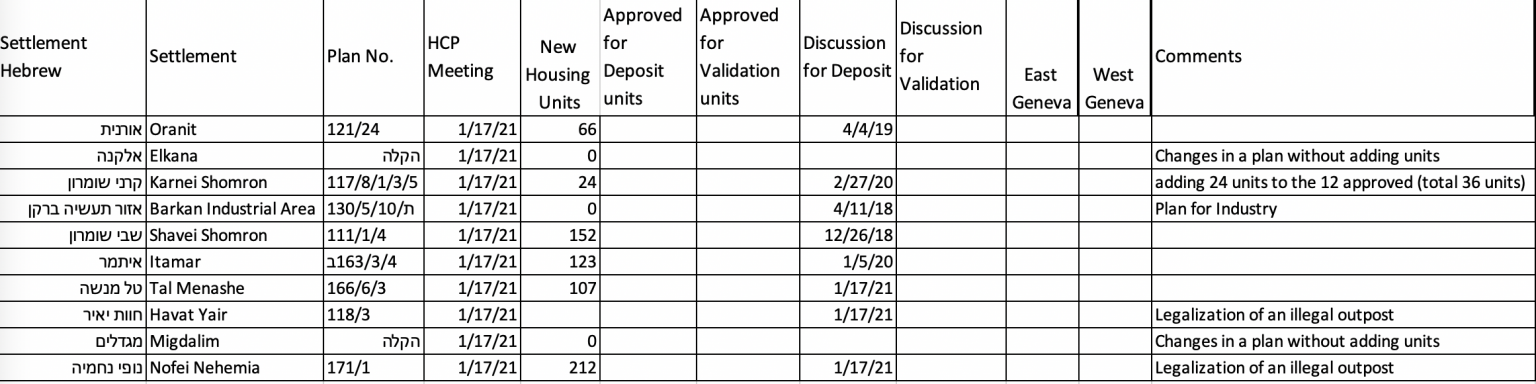
- 152 new units in the Shavei Shomron settlement, located in the northern West Bank – northwest of Nablus;
- 123 new units in the Itamar settlement, located southeast of Nablus in a cluster of notoriously violent settlements and outposts;
- 66 new settlements units in the Oranit settlement, located in the northern West Bank, in the “seam zone” between the 1967 Green Line and the Israel separation barrier (constructed along a route designed to keep as many settlements as possible on the Israeli side of the wall/fence);
- 24 new units in the Karnei Shomron settlement, located in the northern West Bank east of the Palestinian village of Qalqilya. Israel is planning to continue expanding Karnei Shomron with the stated goal of bringing 1 million settlers to live in the area surrounding the settlement;
- Expansion of the Barkan Settlement Industrial Zone, located in the northern West Bank and a part of a strand of settlements leading from Israel proper all the way to the Ariel settlement in the very heart of the northern West Bank, reaching literally to the midpoint between the Green Line and the Jordan border. The future of Ariel and the settlements between Ariel and Israel proper have long been one of the greatest challenges to any possible peace agreement, since any plan to connect Ariel to Israel will cut the northern West Bank into pieces. For background on this industrial zone and others, see here.
The settlement units slated to be advanced to the planning stage of depositing for public review include:
- The retroactive legalization of 212 existing units in the Nofei Nehemia outpost, which if implemented would have the effect of retroactively legalizing the outpost as a neighborhood of the Rehelim settlement. The Nofei Nehemia outpost is a fair distance from the Rehelim settlement and is not contiguous with the built up area of Rehelim, making Nofei Nehemia – if authorized – more properly understood as a brand new settlement rather than an expansion of an existing settlement (as the Israeli government would want one to believe). The Nofei Nehemia outpost is located east of the Ariel settlement in the very heart of the northern West Bank.
- 107 new units in the Tal Menashe settlement, located on the tip of the northern West Bank. Tal Menashe is technically a neighborhood of the Hinanit settlement, though the built up areas do not connect. Notably, the plans for 107 units would, if implemented, “dramatically increase” the size of the Tal Menashe settlement, which is the settlement where Esther Horgan – who was murdered by a Palestinian in late December 2020 – lived. Israeli government officials have made it a clear policy to advance settlement construction in response to deadly attacks on settlers by Palestinians, an approach publicly endorsed by current U.S. Ambassador David Friedmam. Tal Menashe is situated in the “seam zone” between the 1967 Green Line and the Israel separation barrier, which was constructed along a route designed to keep as many settlements as possible on the Israeli side of the wall/fence.
- An unknown number of units in the Havot Yair outpost with the intention of granting retroactive legalization (under Israeli law) to the entire outpost. The Havat Yair outpost is located near the Karnei Shomron settlement in the northern West Bank, east of the Palestinian village of Qalqilya.
Wasel Abu Youssef, a member of the Executive Committee of the Palestine Liberation Organization told Reuters:
“[Israel’s advancement of settlement construction] is an attempt to race against time and benefit from the last days of the current U.S. administration.”
Peace Now said in a statement:
“By promoting hundreds of settlement units, Prime Minister Netanyahu is once again putting his personal political interests over those of the country. Not only will this settlement activity erode the possibility for a conflict-ending resolution with the Palestinians in the long-term, but in the short-term it needlessly sets Israel on a collision course with the incoming Biden administration. For eight years as vice president, Biden and the rest of the Obama administration gradually became more irritated and willing to spar with Israel over settlements, and for the past four years Biden has watched Netanyahu stroke Trump’s ego to promote policies meant to undermine the very foundations for a two-state solution. Although supporting more settlement activity may be a shrewd way to attract votes over the increasing number of rivals to his right, Netanyahu is gambling with Israel’s all-important relationship with its US ally.”
It’s worth noting that current Israeli Defense Minister (and increasingly disgraced Blue & White party leader) Benny Gantz, following the publication of the High Planning Council’ agenda for settlement construction, announced that his office had taken “preliminary steps” towards the approval of Palestinian construction plans in communities located in Area C of the West Bank (some 60% of the West Bank which Israel exercises unilateral civil and security control over, and which is the focus of the most intense settler campaigns for de jure annexation). The Times of Israel reports that those plans include: the expansion of the Palestinian village of Al-Walaja (located south of Jerusalem and surrounded on three sides by the Israeli separation barrier), the expansion of Hizma (located on the northern border of the Jerusalem municipal boundary), approval of a new hotel in the Bethlehem area (note: Bethlehem itself is not in Area C), a hearing on plans for a hotel in Beit Jala (located on the eastern border of Bethlehem, 75% of land belonging to Beit Jala was designated as Area C under the Oslo Accords), and a hearing on the retroactive legalization of farming buildings in al-Fara (located in the northern West Bank). Commenting on Gantz’s announcement of these Palestinian plans, Bimkom researcher Alon Cohen-Lifshitz told told The Times of Israel:
“This is like mocking the poor. Most of the plans are from 2012. They’re all very small in terms of their land use and do not allow for [further] development.”
Predictably, settlers responded with vitriol to the rumor of plans to regulate (i.e., post-facto legalize) Palestinian construction in Area C. A spokesman for the Young Settlements Forum (“young settlements” is a new euphemism for illegal outposts that has been catching on in Israeli politics) said:
“There is no limit to this cynicism. The defense minister and the prime minister want to legitimize the illegal Palestinian takeover of Area C in violation of political agreements, and remove from the agenda the regulation of Israeli settlements that have been built on state land.”
Netanyahu Promises to Boost Funds for “Sovereignty Road”
According to the Jerusalem Post, Prime Minister Netanyahu has promised to allocate an additional $4 million USD (NIS 14 million) or more to the construction of the so-called “Sovereignty Road.” The road is a key element in Israel’s plan to build the E-1 settlement east of Jerusalem and its larger ambition to annex (de facto or de jure) a huge area of West Bank territory located between Jerusalem and Jericho.
According to the Jerusalem Post, Netanyahu met with Benny Kashriel, mayor of the Ma’ale Adumim settlement (located adjacent to the E-1 site), along with Transportation Minister Miri Regev and Finance Minister Israel Katz to discuss the matter this week. During the meeting, Bibi made the verbal commitment to allocating additional funds to see that the road is built.
Peace Now responded to the news:
“Netanyahu’s election campaign is costing Israel a very heavy price. Once again, he is using the election period to try to impress key Likud supporters by promoting a plan that could eliminate the possibility of a two-state solution. The planned road will allow Israel to cut the West Bank in two, build E1 and the separation barrier, and close the door on the possibility of developing a sustainable Palestinian state.”
For decades, construction of the E-1 settlement – which is now actively advancing through the planning process – has been adamantly opposed by the international community. A key criticism of the plan is that it would effectively cut the West Bank in half — thereby preventing any two-state solution. The “Sovereignty Road” has long been Israel’s answer to that criticism, with Israel arguing that it will replace territorial contiguity with limited “transportational continuity” – via a sealed road that is under Israel’s total control (meaning they can cut off passage through it at any time).
If built, a section of the Palestinian-only road is projected to run under the separation barrier (which is not currently built in this area). The rest of the road will run relatively adjacent to the route of the planned separation barrier, in order – in the words of former Defense Minister Bennet – to prevent Palestinian traffic from coming “near Jewish communities.” This new section of road connects to the infamous “apartheid road” (aka, the Eastern Ring Road) which has a high wall down the middle dividing Israeli and Palestinian traffic, and which was opened for Palestinian traffic in January 2019.
In March 2020, then Defense Minister Naftali Bennet gave final approval for the “Sovereignty Road” plan, at the time giving lip service to the idea that the plan will benefit Palestinians (even as it further cuts them off from Jerusalem, takes more land, and cuts the West Bank in half). At the same time, he made clear his real objective. stating:
“[the road] will improve the quality of life for residents in the area, avoid unnecessary friction [for Israelis] with the Palestinian population and most importantly — allow for continued [settlement] construction. We’re applying sovereignty [to the West Bank] in deeds, not in words.”
Peace Now has previously explained the issue with Israel’s design:
“The new road is intended to allow Palestinians to pass under the route of the separation barrier, and to travel ‘inside’ the Adumim Bloc along a wall without entering the ‘Israeli’ side, as in a kind of tunnel. Once the road is paved, Israel can then claim that construction in E1, and the construction of the barrier around the Adumim bloc does not sever the West Bank because the Palestinians have an alternative transport route. This argument is preposterous. A thin line of road connecting separate territorial sections–transportational contiguity–does not meet the needs for territorial viability for the development and livelihoods of Palestinians in the critical Ramallah-Jerusalem-Bethlehem metropolitan area. Without actual territorial contiguity, an independent Palestinian state cannot be established and prosper, and therefore a two-state solution cannot be reached.”
Settlers Escalate Campaign for Outposts Legalization
Kan radio reported that Defense Minister Benny Gantz told settlers that he remains opposed to issuing retroactive authorization to dozens of outposts in one fell swoop, but will instead prefers that each outpost go through a legal process individually in order to gain legalization.
Settlers have been encamped in front of the Prime Minister’s office for nearly two weeks demanding for the passage of a government decision for large scale retroactive legalization of as many as 70 outposts. That decision has been drafted but has been held up by Defense Minister Gantz; In December 2020, Knesset introduced a bill to circumvent Gantz’s opposition and grant authorization to 65 outposts.
Some of the protesting settlers began a hunger strike in hopes of escalating their demands for outpost authorization. Numerous politicians and officials have visited the encamped settlers to show solidarity, including aspiring Prime Minister Naftali Bennett visited the encamped hunger strikers, saying:
“Netanyahu, authorize the young settlements [outposts] now in these coming 10 days. If you don’t do it, when I am the prime minister, I will do it.”
Israel Sets Up New Hotline to Assist Settler Surveillance of Palestinian Construction in Area C
Haaretz reports that in November 2020 the Israeli Civil Administration (the body within the Israeli Defense Ministry tasked with coordinating all civilian affairs in the occupied West Bank) created a new hotline for settlers wishing to report their suspicions of “illegal” Palestinian construction in the West Bank (on the Kochav Ya’akov settlement website, the new phone service is called a “snitch line”).
Amira Hass reports in Haaretz that the Civil Administration’s announcement of the “snitch line” said:
“Have you seen Palestinian construction work that looks to you to be suspicious and unauthorized? Have you encountered a sanitation hazard created by Palestinians who disdain the law? From now on you have a ‘snitch-line’ of your own. Call at any hour of the day and submit a complaint about it. Every day there will be a summary of the complaints and a display of what was examined and what was confiscated in the event that there was improper conduct. Good luck.”
Testing whether the new hotline was exclusively for Israeli settlers reporting on Palestinians, the Palestinian-led NGO Haqel tried reporting illegal construction by the settlers. In response, the Civil Administration said that the “coordination office representatives sent someone to check what’s going on.”
The new hotline is yet another victory in the campaign by settlers to stop Palestinian construction in Area C, and push Palestinians out altogether. In November 2020, in addition to razing an entire Palestinian community, Khirbet Humsa, and tightening the noose on Khan Al-Ahmar – the Israeli government advanced plans to begin a land registration process in Area C as a means by which the state can declare more West Bank land to be “state land,” a way to retroactively legalize unauthorized settlement construction there (as well as put more land off limits to Palestinain construction and even render some existing Palestinian construction illegal).
Additionally, on September 10th the Israeli government allocated $6 million USD (20 million NIS) for the newly created Settlement Affairs Ministry to survey and map unauthorized (by Israel) Palestinian construction in Area C of the West Bank, which Israel – egged on by settlers – has been aggressively demolishing in an effort to rid the area of Palestinians. Haaretz reports that this is the first time that the state budget has included funds specifically for a land survey in the West Bank. The state also allocated an additional $2.8 million (9.5 million NIS) to an existing grant program specifically for settlement municipalities to cash in on. As a reminder, virtually all Palestinian construction in Area C of the West Bank is “unauthorized,” because Israel almost universally refuses to give Palestinians permission to build in Area C even on land that Israel recognizes as owned by Palestinians.
The Settlement Affairs Ministry is a new creation of the current coalition government, and is headed by Tzachi Hanegbi (Likud). The funding for the Settlement Affairs Ministry to conduct a survey of unauthorized Palestinian construction in Area C further empowers a domestic Israeli body to exert extraterritorial sovereignty over Area C – in effect, treating the area as land already de facto annexed by Israel. While technically the occupied territories are administered by the Israeli Civil Administration (a body within the Defense Ministry), Israel has spent decades bringing the administration of the territories (specifically the settlements and Area C) ever more directly under direct Israeli law (de facto annexation).
The Knesset has also repeatedly hosted forums to discuss “the Palestinian takeover of Area C.” Consistent with this framing (which is predicated on the idea that Area C belongs to Israel), and pushed by outside groups, many members of the Knesset have criticized the Israeli government’s allegedly lackadaisical approach to defending Israel’s rights/ interests in Area C (i.e., preventing “illegal” Palestinian construction, preventing foreign projects that support Palestinians’ presence in the area, clearing out Palestinians, expanding settlements, consolidating state infrastructure). Reportedly, Foreign Affairs Minister Gabi Ashkenazi (Blue & White) sent a letter to the committee in October 2020 specifically addressing the Knesset’s outrage over European humanitarian assistance projects for Palestinians in Area C. In the letter, Ashkenazi not only celebrated the reduction of European projects over the past year, but validated settlers’ insinuations regarding the nefarious nature of European assistance for Palestinians, saying that any European activity in the West Bank lacking Israeli permission is “an attempt to define a border.”
At one Knesset hearing, MK Bezalel Smotrich (Yamina) suggested that a solution could be to empower the settlements with the ability to demolish Palestinian construction they believe to be unauthorized. Smotrich’s partymate Ayelet Shaked (former Justice Minister) suggested that the government should appoint a project manager tasked with preventing a “Palestinian takeover” of Area C.
As noted above, Israel has long denied Palestinians the ability to build in Area C, resulting in many Palestinian structures (including homes, schools, farms, etc) being built without the required Israeli-issued permits. To fully understand what is happening, see B’Tselem’s excellent explainer.
Key Quotes from U.S. Amb. Friedman on His Way Out the Door
Please read the New York Times feature on David Friedman in its entirety, and the two separate threads (one and two) journalist David Halbfinger tweeted with supplemental material from the interview. A few key quotes regarding U.S. settlement and annexation policy over the past four years are copied below.
On internal Israeli annexation negotiations between Netanyahu and his government coalition partners:
“I was invited.”
On the future of Israel’s de jure annexation of West Bank land:
“They [Israel] can act unilaterally. It’s suboptimal, but at some point, it’s just sort of necessary just to move on.”
On how the U.S. settlement policy over the past four years:
“he agreed with the Israelis that they should build ‘from the inside out’ — to expand settlements ‘with the least amount of damage to the overall footprint. And that’s how they’ve been operating over the last four years’.”
On the opposition to settlement construction by previous U.S. administrations:
“just to kind of virtue-signal that we think the Palestinians should have something more, made no sense to me…[What Israel does inside or outside the settlements is] an internal decision.” And also on the idea of asking for a settlement freeze: “for them [Israel], I think a freeze of construction is the acknowledgment that the land doesn’t belong to them.”
On criticisms of the Trump Plan map:
“We spent months working on ways to achieve contiguity. You can drive from Hebron to Nablus and never see an Israeli. “I used to take the Midtown Tunnel to work every day. If you tell me that there’s a river, that I go under a river, I don’t know that. I never saw the river once. I drove under that thing for 30 years, never saw a river. So I take it on faith that there’s an East River. I’m just saying that we created enough contiguity so that Palestinians could go throughout the West Bank without ever coming face-to-face with the Israelis.”
On the role Israelis played in creating the Trump Plan and map:
“The editorial control was always ours. This was entirely authored by us and almost entirely conceptualized by us.”
On how to get Israelis to buy into future peace talks:
“Peace talks would only gain traction with the Israeli right, he ‘without the accusation that somehow it’s a thief and being asked to return things that it stole. Israel will not and should not come to the table on the basis of being an illegal occupier of stolen land’”
On the current status quo (in which Israel occupies the West Bank and blocakes the Gaza Strip):
“the status quo is not unsustainable, but I think the status quo is suboptimal and should be.”
On the dangers posed to Israeli democracy by permanent occupation:
“I don’t think it has anything to do with Israel’s democracy because Israel’s democracy is the function of the citizens, and these are not citizens of Israel.”
Friedman confirmed that the Trump Plan and normalization deals between Israel and the UAE and Bahrain held out the “aspiration” of a massive change to the status quo on the Temple Mount in which non-Muslim prayer would be allowed at all areas except Al Aqsa Mosque.
Dismissing any remaining doubt that normalization deals between Israel and Arab countries were contingent on Israel’s permanent suspension of annexation:
“I don’t think it would’ve been appropriate for Israel to, especially without the consensus of the Israeli population, to just give up territory permanently for any agreement with another country,”
He blamed the Israeli left for a tense moment in 2010 between then Vice President Biden and the Israeli government, when Biden arrived in Israel on the same day Isreal announced settlement construction plans:
“The reality here is whenever under the last administration somebody of significance came to visit, the Israeli left would immediately publicize whatever they could find in terms of settlement expansion, to create that friction,”
On his future plans:
“I’m going to stay American-only for at least four years. I want to give myself every opportunity to return to government.” And later, “Finally, there’s talk of his forming an Israel-based pro-settlement group. He hinted: ‘I will stay in the space somehow, but I just don’t know how,’ he said. ‘I’ll try to maintain a voice. I mean, it’s a huge drop-off when you no longer have access to the president’.”
Bonus Reads
- “[Webinar] ‘Raided and Razed’: West Bank Education under Attack” (FMEP & NRC)
- “‘Does someone have to die for West Bank outposts to be legalized?’” (Jerusalem Post)
- “Land of wine and honey? Israeli settlers export to UAE, to Palestinian chagrin” (Reuters)