Welcome to FMEP’s Weekly Settlement Report, covering everything you need to know about Israeli settlement activity this week.
To subscribe to this report, please click here.
January 10, 2020
- ICC Opens Formal Investigation into Israeli War Crimes, Including Israeli Settlements
- Israel to ICC: You Do Not Have Jurisdiction & You Will Not Stop Us from Advancing Settlements and Annexation
- Following ICC Announcement, Israel Advances Plans for Nearly 2,000 Settlement Units
- Following ICC Announcement, Israel Begins Planning Jordan Valley Annexation
- Plans Advance in East Jerusalem, Part 1: New Settlement Enclave in Palestinian Neighborhood
- Plans Advance in East Jerusalem, Part 2: Reports on Har Homa & Rumors on Givat Hamatos
- Plan Advance in East Jerusalem, Part 3: Israel Approves Plans for Two More Settler-Run Tourist Sites in East Jerusalem
- Plans Advance in East Jerusalem, Part 4: Tenders for Pisgat Zeev and Gilo
- For Second Time, Israeli Court Rules Against Settler Claim to Bakri House in Hebron
- Peace Now Wins Interim Decision Against Secretive Public Funding to Amana
- Israeli Court Dismisses Palestinian Landowners’ Petition Against the Ofra Settlement
- Bennett Launches Initiative to More Aggressively Police Palestinians in Area C
- Bennett Appoints Key Settler Ally to Lead New Government Task Force on Area C Annexation Plans, Immediately Announces Plan to Legalize Settlements
- Following ICC Announcement, Pompeo Says Israel Has “Fundamental Rights” to Land
- Pro-Settlement Legal Forum Conference Draws Big Names, Big Promises
- Bonus Reads
Comments/questions? Email Kristin McCarthy (kmccarthy@fmep.org)
ICC Opens Formal Investigation into Israeli War Crimes, Including Israeli Settlements
On December 20, 2019 the Chief Prosecutor of the International Criminal Court (ICC) Fatou Bensouda announced that the court has found a reasonable basis upon which to open an investigation into Israeli war crimes against Palestinians in the West Bank, East Jerusalem, and Gaza. Bensouda said that the preliminary investigation, launched five years ago, established sufficient evidence of war crimes, citing Israeli settlements and Israel’s conduct during its 2014 incursion into the Gaza Strip, which Israel gave the title “Operation Protective Edge”. The statement said that the Court found evidence that Hamas and armed Palestinian groups also committed war crimes during the 50 days of hostilities in 2014.
Before proceeding with a formal investigation, Bensouda requested a pre-trial chamber to rule on the Court’s territorial jurisdiction, as outlined in the Rome Statute, over the West Bank, East Jerusalem, and Gaza Strip. Bensouda requested a ruling on the matter within 120 days. Bensouda has previously articulated her opinion on the matter, suggesting that questions regarding Palestinian statehood do not necessarily need to be resolved because Palestine acceded to the Rome Statute and formally became a “State Party” to the court.
Israel to ICC: You Do Not Have Jurisdiction & You Will Not Stop Us from Advancing Settlements and Annexation
Prior to Bensouda’s announcement on December 20th that the ICC will proceed with an investigation into Israeli war crimes in the West Bank, East Jerusalem, and Gaza, Israeli Attorney General Avichai Mandleblit published a 34-page legal opinion arguing that the Court does not have jurisdiction over those territories because Palestine does not meet the criteria for statehood, and non-sovereign entities cannot confer jurisdiction to the Court. Notably, that opinion doesn’t address (let alone dispute or challenge) the assertion that Israeli actions might constitute war crimes.
Going beyond Mandleblit’s legal arguments, Netanyahu launched a disingenuous attack on Bensouda’s criticism of Israeli settlements, saying:
“[Bensouda] says it is a crime, a war crime, for Jews to live in their homeland, the land of the Bible, the land of our forefathers.”
Netanyahu later said:
“This will not deter us — not in the slightest”
Netanyahu is riding a wave of defiant, ultra-confident language following his Dec. 27th victory in the Likud primaries, after which he promised to secure U.S. recognition for Israeli sovereignty over the Jordan Valley and all settlements in the West Bank. In his victory speech, Netanyahu laid out a 6-point plan he will implement if he goes on to win the March 2020 elections:
“First, we will finalize our borders; second, we will push the US to recognize our sovereignty in the Jordan Valley and the northern Dead Sea; third, we will push for US recognition of our extension of sovereignty over all the communities in Judea and Samaria, all of them without exception; fourth, we will push for a historic defense alliance with the US that will preserve Israeli freedom of action; fifth, stop Iran and its allies decisively; and sixth, push for normalization and agreements that will lead to peace accords with Arab countries. The opportunities are within reach.”
Demonstrating that Netanyahu means what he says, shortly following the ICC’s announcement his government advanced plans for nearly 2,000 settlement units and launched the planning process for annexing the Jordan Valley. Both of these items – in addition to several other significant settlement advancements which were not explicitly linked to the ICC’s announcement – are covered in detail below.
Following ICC Announcement, Israel Advances Plans for Nearly 2,000 Settlement Units
Over the course of a two-day meeting Jan 5-6, 2020, the Israeli Civil Administration’s High Planning Committee approved plans for 1,936 settlement units, of which 786 units received final approval for construction. The Israeli Civil Administration is the body of the Defense Ministry which regulates all construction in the West Bank, both Palestinian and Israeli settler.
The Civil Administration granted final approval to the following plans:
- A plan for 258 units in the unauthorized Haresha outpost, located east of Ramallah, to take them to the final stage of the approval process. If granted final approval, the plan will have the effect of retroactively legalizing the Haresha outpost. This outpost has been one of several test cases for the Israel government’s evolving legal justifications for granting retroactive approval to unauthorized outposts built on privately owned Palestinian land. In the case of Haresha, an outpost built on an island of “state land” surrounded by privately owned Palestinian land, then-Israeli Justice Minister Ayelet Shaked issued a new legal opinion in December 2018 outlining a legal basis for temporarily seizing the private Palestinian land for the construction of a tunnel road underneath it (essentially holding that Palestinian land rights – which can be temporarily infringed upon at any time for the sake of the settlements – do not extend below the ground’s surface). The tunnel road has not yet been constructed, an important qualification that Israel, to this point, has generally required outposts to meet prior to legalization.
- 147 units in the Mitzpe Yericho settlement, located just west of the Palestinian city of Jericho in the Jordan Valley. The plan will have the effect of retroactively legalizing existing illegal construction in the settlement.
- 120 units in the Karnei Shomron settlement, located in the northern West Bank east of the Palestinian village of Qalqilya. Israel is planning to continue expanding Karnei Shomron with the stated goal of bringing 1 million settlers to live in the area surrounding the settlement.
- 107 units in the Elon Moreh settlement, located east of Nablus.
- 100 units in the Halamish settlement, (where settlers have built a strategic outpost, with the protection of the IDF, in order to further restrict Palestinian access to the area);
- 25 units in the Peduel settlement, located in the northern West Bank and part of a string of settlements and unauthorized outposts – most notably Ariel – extending from the Green Line into the very heart of the West Bank and on towards the Jordan Valley.
- 12 units in the Ariel settlement, located in the central West Bank.
- 10 units in the Etz Efraim settlement, located in the northern West Bank, one of several settlements slated to become a “super settlement” area.
- 7 units in the Rechelim settlement, located east of the Ariel settlement and south of Nablus, in the heart of the West Bank.
The Civil Administration advanced the following plans:
- 224 units in the Talmon settlement, located west of Ramallah.
- 204 units in the Shilo settlement, located in the central West Bank.
- A plan for 180 units in the unauthorized Mitzpe Danny outpost, located east of Ramallah. If approved, the plan will have the effect of retroactively legalizing the outpost, which was built without Israeli permission in 1999 in an area that includes privately owned Palestinian land. The Binyamin Regional Council – a settler body acting as the municipal government for settlements in the central West Bank – has been angling to retroactively legalize Mitzpe Danny for some time. As part of that effort, the regional council successfully lobbied for approval of a plan to build an educational campus for settlers that will create a territorial link between the Maale Mikhmash settlement (which has official recognition from the government) and the outpost. That plan received final approval in January 2019.
- 160 units in the Kochav Yaakov settlement, located between Jerusalem and Ramallah.
- 92 units in the Tzofim settlement, one of the settlements that flank the Palestinian city of Qalqilya in the northern West Bank.
- 91 units in the Almon settlement, located northeast of Jerusalem.
- 136 units in the Givat Zeev settlement, located south of Ramallah.
- 63 units in the Maale Adumim settlement, located just east of Jerusalem.
- A plan for 204 new units in the Shvut Rachel settlement, which only recently became an authorized settlement area when Israel extended the jurisdiction of the Shiloh settlement to include it as a “neighborhood” (along with three other outposts).
Peace Now said in a statement:
“Despite lacking a clear mandate, for this caretaker government it’s business as usual – Continue the massive promotion of harmful and unnecessary construction in occupied territory and in places that Israel will have to evacuate. Netanyahu continues to sabotage the prospects of peace, dragging Israel into an anti-democratic one-state reality resembling apartheid.”
The Yesha Council, an umbrella group representing all the settlements, celebrated the approvals, saying in a statement:
“To our delight, construction in Judea, Samaria and the Jordan Valley is commonplace and we are pleased to see that every few months plans are up in the Supreme Planning Council. The time has come for extremist Leftist organizations to accept that the U.S. has also declared that settling in Judea, Samaria, and the Jordan Valley is not contrary to international law and that applying Israeli sovereignty is a consensus in the State of Israel. After eight years of unprecedented construction freeze, the government regularly approves construction and we strengthen the hands of the Prime Minister and Defense Minister on their blessed work. We need more and more construction to promote the prosperity and growth of settlement.”
The head of the Binyamin Regional Council, Yisrael Gantz, spoke happily about the settlement advancements but also kept focused on the settlement movement’s ultimate demand: annexation. Gantz told Arutz Sheva:
“This is undoubtedly an important and significant step. I hope we will soon be able to applaud the application of full Israeli sovereignty and the closure of the Civil Administration in order to truly develop the regions of our amazing country, in the same way that it is possible in the entire State of Israel.”
Despite the celebratory remarks, settlers were disappointed with the final number of settlement units, which fell short of the 3,000 units Netanyahu promised to advance on the eve of the Likud primary leadership vote (which went in Netanyahu’s favor). When promising the 3,000 units, Netanyahu also promised:
“We are going to bring [secure] US recognition for our sovereignty in the Jordan Valley [and] in all the settlements, those in the blocs and those that are beyond it.”
Following ICC Announcement, Israel Begins Planning Jordan Valley Annexation
On January 5th, the inter-ministerial committee created to plan the annexation of the Jordan Valley held its first meeting, in an effort to prepare an official proposal for how Israel can annex the Jordan Valley. The committee – dubbed the “Sovereignty Committee” – is headed by the Prime Minister’s Office Director General Ronen Peretz and includes representatives from the Foreign Ministry, the Israel Defense Forces, and the National Security Council.
The meeting took place despite (or perhaps because of) reports that Netanayhu put Jordan Valley annexation plans in a “deep freeze” following ICC Chief Prosecutor Fatou Bensouda’s announcement on Dec. 20th that the Court will open an investigation into war crimes committed by Israel in the West Bank, East Jerusalem, and Gaza. Following those reports, the head of the Yesha Council, the settler umbrella group, David ElHayani spoke to Netanyahu on the phone to gain reassurance that the annexation plan was not frozen, which Netanyahu reportedly gave him.
Haaretz reports:
“Sources familiar with the establishment of the inter-ministerial committee told Haaretz that the insistence on moving forward with the discussions are mainly to show that the idea has not been abandoned due to international pressure.”
Plans Advance in East Jerusalem, Part 1: New Settlement Enclave in Palestinian Neighborhood
On January 8th the Jerusalem District Planning Committee granted final approval to a new 75-unit settlement compound to be built in the heart of the Palestinian East Jerusalem neighborhood of Beit Hanina. If built, it will be the first-ever authorized settlement project in Beit Hanina, located north of the Old City.
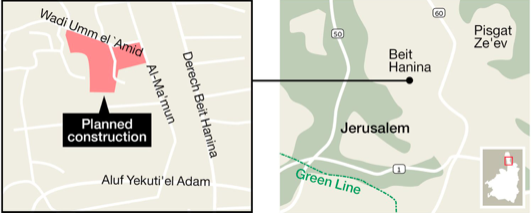
May by Haaretz
The Beit Hanina settlement plan – as FMEP has previously reported – is backed and promoted by settlement impresario Aryeh King, and it provides for the construction of a total of 150 new units in the southern end of the Beit Hanina neighborhood. The land slated for the 150 units is privately owned, 53% of the land is owned by an Israeli who is supportive of the plan, and 47% by a Palestinian company who objects to the plan and has fought against it. Because the land has not been surveyed to demarcate the split ownership, Israeli planning authorities decided that the settlement plan is designated for the entire property, with construction rights split evenly between the parties, meaning the 75 units granted final approval on January 8th represent the Israeli-controlled half of the project.
Ir Amim notes the larger picture of Isreali settlement activity north of the Old City:
“In close proximity to Ramat Shlomo to the southwest and Pisgat Zeev to the northeast, construction of this new compound may signal the beginning of a move to create contiguity between the two settlements, while fracturing the contiguous space between Bet Hanina and Shuafat. As exemplified by the ring of state-sponsored settlement strongholds throughout the Old City Basin, the establishment of a settler enclave in the midst of Beit Hanina will not only impact the fabric of this community, but will further erode opening conditions for a political solution to the conflict based on two capitals in Jerusalem.”
Ir Amim explains essential context:
“the plan will enable an ideologically driven settler outpost in the heart of Beit Hanina, a neighborhood located on the northern perimeter of East Jerusalem that has remained relatively untouched by Israeli settlement within its limits. Since the land in question is not far from Ramat Shlomo to the south-west and Pisgat Zeev to the north-east of it, its construction may mark the beginning of a far sweeping move to create contiguity between the two settlements, while driving a wedge between Bet Hanina and Shuafat.”
Plans Advance in East Jerusalem, Part 2: Reports on Har Homa & Rumors on Givat Hamatos
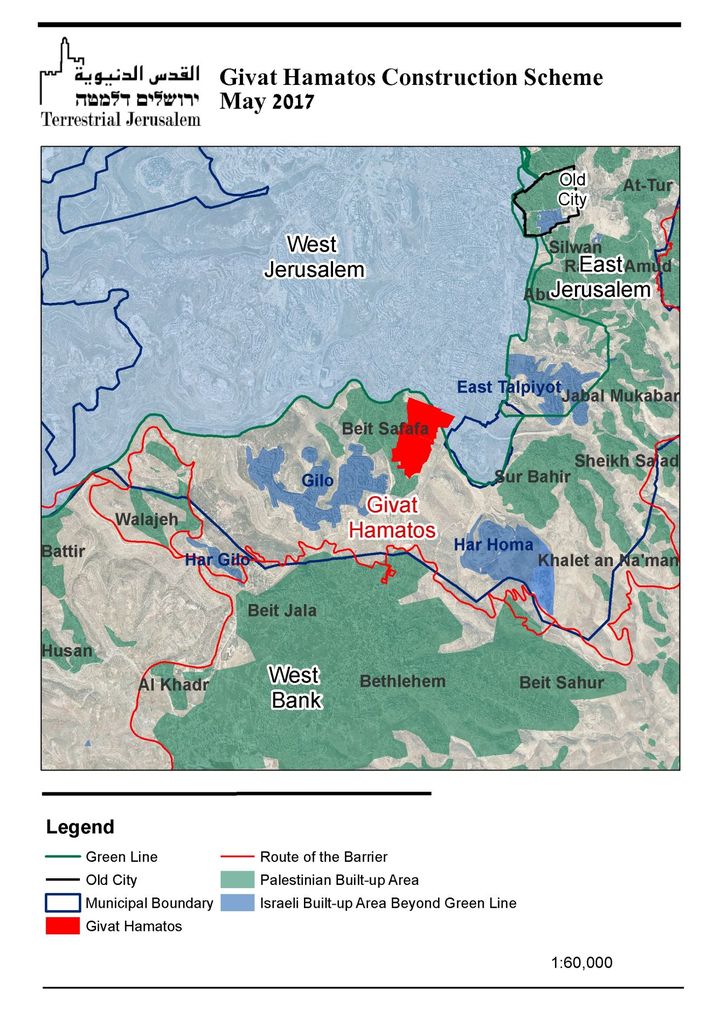 On January 7th, the popular Isareli broadcaster network Kan reported that the Prime Minister’s office has blocked a plan to build 2,000 new settlement units in the settlement of Har Homa, citing “diplomatic difficulties.” In response to an inquiry, the office did not deny the report, but issued the following statement:
“Israel has built in Jerusalem, is building in Jerusalem and will continue building in Jerusalem — while exercising judgment.”
Jerusalem expert Daniel Seidemann raised a key question and larger concerns about the reports concerning Har Homa, saying:
“The construction potential at Har Homa has been exhausted, and it’s not possible to build anything near 2,000 units. So what are they talking about? Something is clearly going on. Three possibilities come to mind, all problematic…Possibility no. 1: the nearby planned doomsday settlement of Givat Hamatos, which is awaiting tenders. Possibility no. 2: Hirbet Mazmoriyya, to the northeast of Har Homa. The lands owned by Palestinians that will have to be expropriated. Not likely. Too complicated and controversial. Possibility no. 3: the area wedged betw. Mar Elias Monastery, the Hebron Road, the 300 Checkpoint, dubbed Bethlehem Gate or Har Homa West. The land is ownership is a mixture of Palestinian &Church lands, along with settlement developers.”
Ir Amim notes that, while reportedly stalling the Har Homa plan, Netanyahu is – in fact – simultaneously facing mounting pressure to issue tenders for the construction of the Givat Hamatos settlement, the site for which is the northern border of Har Homa. Ir Amim writes:
“Last week, rightwing groups launched a coordinated campaign to exert pressure on Prime Minister Netanyahu to advance construction in the area of Givat Hamatos, which has been essentially frozen for the past six years. While the approval of the plan for 2,610 housing units in the area was formally published in 2014, there has been no announcement of tenders since then. This has been largely attributed to international opposition, namely from the United States and Germany. Likely attempting to ratchet up pressure on Netanyahu in lead-up to the upcoming elections in March, the campaign has been spearheaded on a public level by rightwing organizations. Several prominent rabbis known for supporting the settler movement penned a letter to the Prime Minister calling on him to announce the tenders for Givat Hamatos, while rightwing media outlets have published daily articles demanding an ‘end to the freeze.’ A rightwing institute likewise published a lengthy paper on the significance of establishing a new settlement in the area as a means of thwarting any potential future division of Jerusalem within the framework of a resumed peace process.”
Plan Advance in East Jerusalem, Part 3: Israel Approves Plans for Two More Settler-Run Tourist Sites in East Jerusalem
On December 25, 2019 the Jerusalem Local Planning approved two significant settler-backed schemes in East Jerusalem:
- The committee approved the Israeli government’s plan to seize land in the Palestinian East Jerusalem neighborhood of Sheikh Jarrah, in order to establish a park adjacent to the infamous Shepherd Hotel, an historic/iconic building that was taken over by the radical Ateret Chohanim settler organization in 2011. The new park – called “Hakidron Park” has been discussed and considered by Israeli governments for the past 15 years.
- The committee also approved the Israeli government’s plan to confiscate land in the Ras al-Amud neighborhood of East Jerusalem, for the purpose of opening a tourist and religious services center on the Mount of Olives, adjacent to the Jewish cemetery. The Jerusalem Municipality hired an architect, Arie Rahamivov, who is also employed by the radical Elad settler group for the planning and construction of their crown jewel: the Kedem Center in Silwan. The new center in Ras al Amud will be yet another tourist center under the management of Elad, which already operates another visitors center on the Mount of Olives.
Ir Amim writes:
“Approval of the aforementioned land expropriations would signal intent to begin construction at both sites and will help to further solidify the settlement ring around the Old City Basin. While both plans can be posited as innocuous municipal initiatives to serve local residents and visitors to the areas, such touristic projects play an integral role in expanding the scope of settlement strongholds in the area and creating a more contiguous Israeli space, while diffusing the political agenda behind these efforts.”
Plans Advance in East Jerusalem, Part 4: Tenders for Pisgat Zeev and Gilo
Ir Amim reports that the Israel Lands Authority published construction tenders for the following East Jerusalem settlements in early January:
- 3 tenders for a total of 461 new settlement units in the Pisgat Zeev
- 1 tender for commercial buildings in the Gilo settlement, located
For Second Time, Israeli Court Rules Against Settler Claim to Bakri House in Hebron
On December 23rd, the Jerusalem District Court ruled that the Palestinian Bakri family are the rightful owners of a disputed property in Hebron. This ruling should deal a final blow to the 18-year long legal battle settlers have waged to gain control of the Bakri family house (“should”, not “will”, because the settlers have repeated been dealt defeats in court and each time are able to manufacture a new claim or appeal) .
The ruling – which affirmed a March 2019 ruling by the Magistrate court, which the settlers had appealed – called for the immediate evacuation of the settlers whom Israel has permitted to illegally squat in the house while the legal processes were ongoing. For a full history of the Bakri house saga, see here.
Following the ruling, Peace Now said:
“[the] court again ruled that the settlers had forged [documents] and lied all along… We hope that after [almost] two decades of violence, lies and terror, justice will be carried out and the invaders will be evicted.”
Peace Now Wins Interim Decision Against Secretive Public Funding to Amana
In response to a Peace Now petition, on December 31st the Israeli High Court issued an interim decision that requires state bodies to request approval from the court before transferring funds to Amana, a settlement body which is known to undertake illegal settlement activities across the West Bank. Peace Now filed the petition after discovering that state bodies have been secretly funneling money to Amana.
Peace Now said in a statement:
“Amana is the most significant organization operating in the settlements. For decades, it has overseen the establishment of dozens of illegal outposts and neighborhoods with the help of massive budgets, some of which have been transferred from Israeli taxpayer money through local settlement authorities in violation of the law. The judges’ decision is a dramatic yet necessary step that limits, for the time being, this illicit transfer of funds to illegal projects in the settlements and outposts. We hope that in this spirit, the court will rule that public funds should no longer be transferred to Amana via subsidy procedures. This situation in which the State of Israel backs illegal activities with public funds is unconscionable, and we urge the Israeli government to put an end to it.”
Israeli Court Dismisses Palestinian Landowners’ Petition Against the Ofra Settlement
On January 6th, the Israeli High Court of Justice dismissed a petition filed by Palestinian landowners challenging the legality of the Ofra settlement. The petition was based on the fact that the settlement is partially built on privately owned Palestinian land. The court ruled that the majority of the settlement had been built on land expropriated by Israel, and that the minority of land that Palestinians claim ownership over was not enough to invalidate the entire Master Plan for the settlement. Further, the court stated that the settlement structures built on the privately owned Palestinian land were built by settlers “in good faith,” under the mistaken belief that land had also been expropriated by the Israeli government.
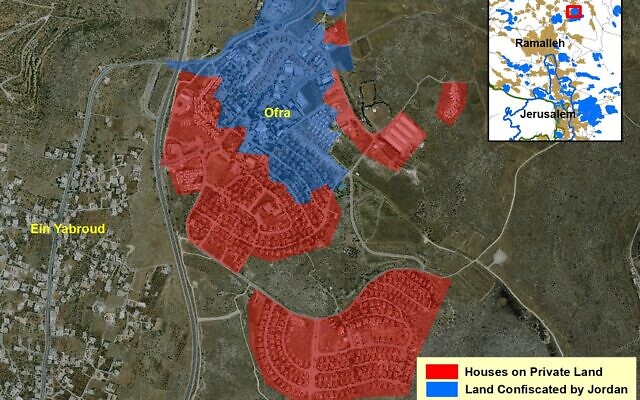
Map by Peace Now
This High Court ruling does not fix the legal status of Ofra settlement buildings, but it is nonetheless significant because it continues to deny Palestinians their property rights. Likewise, it gives a green light to the use of the “market regulation” principle to expropriate land in order to retroactively legalize the structures. As a reminder, the “market regulation” principle – which was invented by the Israeli Attorney General – holds that if settlers acted “in good faith” when they built on privately owned Palestinian land, the state can expropriate that land, thereby making what was illegal before, now perfectly legal.
The Ofra settlement’s legal situation has long been an issue that the Israeli government has tried to fix. Ofra was first established by settlers on land that the Jordanian government had expropriated in 1966, in order to build a military base (which was never built). The Israeli government used this pretext to expropriate the land in 1977, in order to recognize the Ofra settlement, which had been established illegally but with tacit cooperation of the government on the site two years earlier. However, the settlers built the majority of the Ofra settlement on land that was not expropriated by Israel in 1977 — land that was in fact registered to Palestinians from the nearby village of Ein Yabroud. In light of the legal status of the land, no Israeli government has since found a way to fix the legal status of these homes (not for lack of trying) – meaning that the majority of the structures in Ofra were built without permits, making them illegal under Israeli law.
Peace Now elaborates on what is at stake in the Ofra settlement case:
“Most of the houses built in Ofra (approximately 413 out of 625) were built on an area of 550 dunams of privately owned Palestinian land. In addition, hundreds of dunams of Palestinian private land were seized for roads in Ofra, as well as infrastructure and agricultural lands for the settlers. The only way to regulate the theft of these lands would be to expropriate them from the Palestinian landowners for the benefit of the settlers, in complete contradiction to the positions of previous Israeli governments and legal advisors, and contrary to binding rulings of the High Court. Although the current legal advisor (Avichai Mandelblit) allowed land expropriation in some places for settlement purposes (for example, in Haresha), in the regulation of massive land theft such as in Ofra the Israeli government would be crossing a new red line.”
FMEP documents the government’s efforts to expropriate Palestinian land for the settlements in its Annexation Policy Tables.
Bennett Launches Initiative to More Aggressively Demolish Palestinian Construction in Area C
Making the most of his appointment as Israeli Defense Minister in the current caretaker government, Naftali Bennett is pushing an initiative to annex Area C and to aggressively demolish Palestinian construction in the area (reminder: Area C constitutes nearly 60% of the West Bank; it is land that under Oslo II was supposed to have been “gradually transferred to Palestinian jurisdiction”).
As part of his efforts, Bennett has launched legal research into how Israeli can bring settlement building in Area C under the direct authority of the Justice Ministry, cutting out the Civil Administration. This Civil Administration, it should be recalled, is the arm of the Israeli Defense Ministry which acts as the sovereign power over the West Bank, in a system of governance Israel created based on its recognition of the different legal status of the area. Bennett has called for that system to be disbanded (in addition to annexing Area C). To be clear: transferring the construction and planning processes in Area C to domestic Israeli jurisdiction would by any definition constitute the Israeli state extending its sovereignty over area — an act of annexation.
Bennett has requested that Defense Ministry officials present several legal options for how Israel can bring planning processes under the Justice Ministry (integrating the settlements into the normal planning process). The settler-run Arutz Sheva outlet attributes the following quote Bennett in a private meeting:
“We are in essence discussing applying procedural sovereignty only. Full sovereignty is under the authority of the political echelon, but this is a step in the right direction. There is no reason that residents of Judea and Samaria should continue being discriminated against. We must stop this. Residents of Beit El and Ariel are no less Zionist than residents of Kfar Saba and Tel Aviv. They pay taxes and serve in the army, and they need to receive the same services from the government.”
Bennett is also advancing several initiatives that will empower and compel the Civil Administration to more aggressively enforce demolition orders against Palestinian construction in Area C (based on Israel’s policy of not granting permits to Palestinians in Area C, nearly every Palestinian structure in this territory has a demolition order pending against it). Bennett is also eyeing ways to combat what he considers illegitimate and nefarious funding from the European Union to Palestinian communities living in Area C. Israel Hayom reports:
“Bennett’s plan to stop the Palestinians from chipping away at Area C demands action in four areas: Operational, economic, legal, and PR. He wants to change enforcement priorities to put an emphasis on eradicating illegal buildings in strategic locations rather than by numbers. For example, home demolitions would be carried out in accordance with Israeli interests, prioritizing illegal buildings next to roads or settlements. Bennett also instructed the Central Command and the Civil Administration to work more closely to implement his plan and asked that the Civil Administration report to him monthly to update him on progress. Meanwhile, the defense minister is weighing the possibility of allocating more resources to the Civil Administration for enforcement, which would entail hiring more personnel. Bennett also wants to take steps to stop the flow of European money that funds the illegal Palestinian construction in the first place, allowing the “Fayyad Plan” to flourish.”
Bennett Appoints Key Settler Ally to Lead New Government Task Force on Area C Annexation Plans, Immediately Announces Plan to Legalize Settlements
In addition to his new initiative targeting Palestinian construction in Area C, Israeli Defense Minister Naftali Bennett announced that he has created an inter-ministerial taskforce to develop settlement and annexation plans for the future of Area C in the West Bank.
Bennett’s chief of staff, Itay Hershkowitz, has been in weeks-long consultations with key settler leaders to decide what items to act on immediately. Haaretz reports their agenda includes:
- Allowing Jews to privately purchase land in the West Bank. [See here for a detailed explanation of this complicated matter]
- Connecting unauthorized outposts to water and electricity.
- Granting official recognition to unauthorized outposts that are located near established settlements by recognizing them as “neighborhoods” of the settlement.
- Repealing a military order that empowers the Civil Administration to evict settlers from privately owned Palestinian land with or without a Palestinian-initiated petition to have the settlers removed.
- Legalizing 30 sheep farms in the West Bank that are under pending demolition orders.
On Thursday, Bennett announced that he has appointed West Bank settler Koby Eliraz to lead the new taskforce. Calling Eliraz a “bulldozer,”Bennett said:
“The territorial future of the Land of Israel is at stake. The State of Israel has simply not been up to the task of stopping [Palestinian construction]. We are changing direction and embarking on a battle that Israel must win… The defense establishment will fight for this territory, and it is essential for someone to lead this campaign.”
Eliraz previously served as Netanyahu’s settlement advisor, but was fired by the Prime Minister in June 2019 reportedly because he was believed to be allied too closely to Netanyahu rival Avigdor Liberman, who Netanyahu also dismissed. At the time of Eliraz’s firing, settler leaders were outraged and published a letter asking Netanyahu to reverse Eliraz’s firing, suggesting that Eliraz’s absence will hinder government efforts to retroactively legalize outposts. The letter noted:
“Kobi has taken care of Israeli settlement and its residents with great professionalism. He is credited for many advancements [on our behalf] in the fields of construction, infrastructure development, security and more.”
The Times of Israel observed, significantly, that the Yesha Council was able to get every single settlement Mayor to sign the letter in support of Eliraz, explaining:
“The Yesha Council in recent years has struggled to get all of its members on board with its initiative, but the umbrella group’s ability to gather the signatures of every Israeli mayor beyond the Green Line is testament to the broad respect that Eliraz holds among settler leader.”
Following ICC Announcement, Pompeo Says Israel Has “Fundamental Rights” to Land
At a press briefing on December 22nd, U.S. Secretary of State Mike Pompeo did not specifically address the ICC announcement, but made lengthy comments regarding statements from European countries and the European Union that were critical of the new U.S. position on settlements (that they are not “per se illegal” under international law). Pompeo’s comments hold relevance to the U.S. position on the ICC case and more generally on the U.S. approach to the Israeli-Palestinian conflict:
“First, the legal analysis that the EU performed [on settlements] we just think is wrong. We think they have an improper analysis of the international law surrounding this. So as the technical legal matter, [EU Foreign Minister] Ms. Mogherini just – she’s just wrong. And so we are doing our level best to demonstrate to them our legal theory, our understandings, and why it is that we’re convinced that under international law these settlements are not per se illegal. So we’re working that element of it as well. But at another level, and perhaps at the level that will lead to the right outcome, which is why we did this, this has to be resolved through political means, and we hope that all nations, including member nations inside of the EU and the EU itself and countries all over the world, will come to recognize the fundamental rights that the Israeli people have to this land, to this space. There are real security needs. The risk that is presented from the world as anti-Semitism is on the rise, we hope that every nation will recognize that and weigh in on this conflict in a way that is constructive, that will ultimately lead to the peace that is so desperately needed.” [Emphasis added by editor]
Pro-Settlement Legal Forum Conference Draws Big Names, Big Promises
The Kohelet Policy Forum, a right-wing advocacy organization that has enormous influence with senior Israeli – and increasingly American – government figures, hosted a “Conference on the Pompeo Doctrine” in Jerusalem, Jan. 7-8, 2020. The conference served as a gleeful celebration and forward-looking projection of what the new U.S. settlement policy towards settlements means for Israel. The conference drew participation from all the leading Israeli politicians and several senior members of the Trump Administration, including Secretary of State. Pompeo. Key quotes from the conference speakers are copied below.
U.S. Secretary of State Mike Pompeo:
“We’re recognizing that these settlements don’t inherently violate international law. That is important. We’re disavowing the deeply flawed 1978 Hansell memo, and we’re returning to a balanced and sober Reagan-era approach. “In doing so, we’re advancing the cause of peace between Israelis and Palestinians.”
U.S. Ambassador David Friedman:
“…when we came into office the lingering issues included three of significant importance: the status of 1) Jerusalem, 2) the Golan Heights and 3) Judea and Samaria. We have approached them in ascending order of complexity…I thank God that President Trump had the courage and the wisdom to recognize Jerusalem as the capital of Israel and move our embassy to Jerusalem from Tel Aviv…In recognizing Israel’s sovereignty over the Golan Heights, President Trump, evaluating the continuous malign and barbarous threats posed by Syria, concluded that no northern boundary for Israel would be secure except a boundary that incorporated the Golan. He acted well within the language of 242. [Judea and Samaria] is certainly the most complicated of the issues because of the large indigenous Palestinian population. Over the years before we came into office, it’s only gotten more complicated and more challenging. The proverbial goalposts have moved and moved – to the point today where they are no longer even on the field….The Pompeo Doctrine does not resolve the conflict over Judea and Samaria. But it does move the goalposts back onto the field. It does not obfuscate the very real issue that 2 million or more Palestinians reside in Judea and Samaria, and we all wish that they live in dignity, in peace, and with independence, pride and opportunity. We are committed to find a way to make that happen. The Pompeo Doctrine says clearly that Israelis have a right to live in Judea and Samaria. But it doesn’t say that Palestinians don’t….it calls for a practical negotiated resolution of the conflict that improves lives on both sides.”
Israeli Prime Minister Netanyahu said:
“I will not let any settlements be uprooted in any diplomatic plan. This idea of ethnic cleansing… it won’t happen. There is a window of opportunity. It opened, but it could close…There was no West Bank separate from the rest of the land. It was seen as the heart of the land. We never lost our right to live in Judea and Samaria. The only thing we lost temporarily was the ability to exercise the right. When Israel returned to the West Bank We didn’t return to a foreign land. That is a distortion of history. Jews lived in Jerusalem and Hebron for thousands of years consecutively…The Pompeo declaration about the status of the towns [in Judea and Samaria] establishes the truth that we are not strangers in our land. In a clearly defensive war, we returned… to the land where our forefathers put down roots thousands of years ago…Unlike some in Europe who think the Pompeo declaration distances peace, I think it will promote peace, because peace must be based on truth, not lies. Settlements are not the root of the conflict. We are standing with justice and the truth. It is a great struggle.”
Israeli Defense Minister Naftali Bennett on Area C annexation and his initiatives in that regard:
“Our aim is that within a decade a million Israeli citizens will live in Judea and Samaria” and later “Our objective is that within a short amount of time, and we will work for it, we will apply [Israeli] sovereignty to all of Area C, not just the settlements, not just this bloc or another. We are embarking on a real and immediate battle for the future of the Land of Israel and the future of Area C. It started a month ago and I am announcing it here today. A month ago, I convened a meeting and I explained the clear directive, the State of Israel will do everything to ensure that these territories [Area C] will be part of the State of Israel.”
Likud MK and former Mayor of Jerusalem Nir Barkat said:
“I am confident that Secretary Pompeo’s statement is an integral part of the American plan and is closely linked to Jared Kushner’s proposal advanced in Bahrain promoting significant economic investment in the Palestinian economy…Now is a perfect opportunity to similarly grow the communities throughout Judea and Samaria at a pace like never before. This declaration is a recognition of the legal and historic right of the Jewish people to live wherever we wish. This is how it should be in other parts of the world and certainly here in the Jewish State. This declaration is therefore an exceptional opportunity for Israel to ensure our continued growth and expansion throughout these areas. Israel needs to set a goal for the settlement of two million people in Judea and Samaria within fifty years. This is a commitment which requires that we already now lay the framework to make that possible and this is an investment which will also benefit the Palestinian people” [Editor’s note: Barkat has been working with Harvard Professor Michael Porter to promote an economic peace scheme, most recently speaking at Harvard about the plan in December 2019]
Eugene Kontorovich, Director of International Law at the Jerusalem-based Kohelet Policy Forum and a key shaper of anti-BDS/pro-settlement legislation in U.S. Congress and across state governments, said:
“American Policy is now clearer than ever, Jews living in Judea and Samaria is not a crime. For decades, the obscure Carter-era memo was used as justification for anti-Israel policies despite the fact that its conclusions were rejected by subsequent administrations. Sec. Pompeo’s statement at the Kohelet conference today makes clear the U.S.’s wholesale rejection of the legal theory that holds that international law restricts Israeli Jews from moving into areas from which Jordan had ethnically cleansed them in 1949.”
Bonus Reads
- “The Atarot Exception? Business and Human Rights Under Colonization” (Marya Farah in Jerusalem Quarterly)
- “The Decade Israel Erased the Green Line” (+972 Magazine)
- “Settlers are seizing ‘empty’ land. The Palestinian owners are fighting back” (+972)
- “Israeli Right Wants to End Peace with Jordan” (Haaretz)
- “Security official says police, courts scuttling efforts to curb settler violence” (The Times of Israel)
Welcome to FMEP’s Weekly Settlement Report, covering everything you need to know about Israeli settlement activity this week.
To subscribe to this report, please click here.
December 20, 2019
- Israeli Court Rules Sumreen Family Can Temporarily Temporarily Stay in East Jerusalem Home
- Judge Reopens Case Over Sale of Church Properties in Jerusalem’s Old City of to Settler Organizations
- Vying for Likud Leadership, Gideon Sa’ar Pressures Netanyahu on E-1 Settlement, Area C Annexation, and Evacuation of Khan al-Ahmar
- Visiting Harvard, Former Jerusalem Mayor Promotes Settler-Palestinian Business Projects
- UN: Since passage of UNSCR 2334 Three Years Ago, Israel Has Continuously Expanded Settlements
- In First, Delegation of UN Ambassadors Tour Israeli Settlements, Praise Settlement Industrial Zones
- Pompeo Slaps Back After Members of Congress Send Letter Objecting to Shift in U.S. Settlements Policy
- Bonus Reads
Questions/comments? Contact Kristin at kmccarthy@fmep.org
Israeli Court Rules Sumreen Family Can Temporarily Temporarily Stay in East Jerusalem Home
The Jerusalem District Court has ruled that the Sumreen family is permitted to remain in their East Jerusalem home as the court considers the family’s appeal against a lower court ruling that granted ownership of their home to the Jewish National Fund, which has worked in concert with the radical settler group Elad to gain control of the property.
The Sumreen family has been forced into the battle over its legal ownership of the home after the state of Israel, prompted repeatedly by the JNF, declared the Sumreen’s home to be “absentee” property. After that designation – which was not communicated to the Sumreen family – Israeli law permitted the state to take over the rights to the building. The state then sold the rights to the home – located in the Silwan neighborhood of East Jerusalem – to the JNF in 1991. The Jewish National Fund has pursued the eviction of the 18-member Sumreen family since then. Israeli courts ruled in favor of the Sumreen family’s ownership claims to the home for years, until a September 2019 ruling by the Jerusalem Magistrate’s Court granted ownership of the family’s home to the JNF, a decision the family immediately appealed to the Jerusalem District Court.
A full history of the saga involving the Sumreen family – which is similar to dozens of other Paelstinian homes in Silwan that were declared Absentee Property in the 1990s – can be found on the Peace Now website here.
Judge Reopens Case Over Sale of Church Properties in Jerusalem’s Old City of to Settler Organizations
On November 28th, the Jerusalem District Court ruled to reopen a high profile case which previously awarded the radical settler group Ateret Cohanim ownership rights to three historic church properties in the Old City of Jerusalem. The court made the decision because shell companies involved in the real estate transaction failed to respond to a court requests. Jerusalem District Judge Tamar Bar-Asher also ordered Ateret Cohanim to pay the church $14,400 (NIS 50,000) to cover legal expenses.
In June 2019, the High Court ruled in favor of Ateret Cohanim’s ownership claims to the three buildings. That ruling was promptly challenged by the Greek Patriarchate, which claimed to have new evidence showing Ateret Cohanim’s forgery of key documents and its payment of bribes to obtain the property. The original Jerusalem District Court ruling acknowledged that there were problems in the transaction, but found that the church failed to prove its allegations of bribery and corruption.
The legal battle over the properties dates back to 2004, when the Greek Orthodox Patriarchate agreed to sell the three properties to a foreign real estate company under three separate contracts. It did so not knowing that the radical settler group Ateret Cohanim was behind the transaction. News of the sales made headlines in early 2005.
Upon the revelation that Ateret Cohanim was the real buyer, the Greek Orthodox Patriarchate was deeply embarrassed and immediately sought to retain control of the properties. The Patriarchate alleged that the transactions involved corruption and bribery, arguing that the legal documents had been signed without permission by a finance employee. Dismissing the church’s arguments, this week the Supreme Court upheld prior rulings that the signatures on the lease documents were valid, with the finance employee acting as a legal proxy of the Patriarchate.
The Greek Orthodox Church has received significant blowback from the sale of these properties. In January 2018, Palestinians protested in Bethlehem in an attempt to block the arrival of Patriarch Theophilos III for Christmas celebrations.
Vying for Likud Leadership, Gideon Sa’ar Pressures Netanyahu on E-1 Settlement, Area C Annexation, and Evacuation of Khan al-Ahmar
On December 10th, Gideon Sa’ar launched his campaign to challenge Netanyahu as the head of the Likud party by touring the E-1 settlement site on the outskirts of Jerusalem. With press following his every move, Sa’ar promised to build E-1, implement Israeli sovereignty over Area C, and evict the bedouin residents of the village of Khan al-Ahmar, located in the shadow of the E-1 site. All three of his promises are key longrunning asks of the powerful settler movement, which has been a pillar of support for Netanyahu despite its displeasure with Netanyahu’s delay in delivering on those specific promises.
In a swipe at Netanyahu, Sa’ar said:
“The struggle for E-1 is a struggle for the heart of Israel,” Sa’ar said. “Netanyahu out of all people, who built the Har Homa neighborhood [in Jerusalem] despite international pressure, should be building here. The rule for Har Homa should be the rule for E-1 and Givat Hamatos [in Jerusalem].” And, “In Khan al-Ahmar, as in the rest of Area C, the question is simple. Who is in control – Israel, or the Palestinian Authority, which is using aide from the European Union to create facts on the ground? The Supreme Court has rejected appeals against [Khan al-Akhmar’s] demolition four times.The future of Judea and Samaria will be determined by actions, not words. Evacuate Khan al-Akhmar immediately. A solution needs to be found for the residents, but you have to understand that the issue here is not just about the residents, the question is who is the sovereign here and what will be the future of Area C as a whole, and here we need to take clear, continuous action.”
The E-1 settlement plan still needs to receive final approval from the Israeli High Planning Committee, the body of the Civil Administration which regulates all construction in the West Bank. The plan has been approved for public deposit, but until this juncture Netanyahu has kept his finger off the trigger – keeping the plan from being deposited.
A week after his E-1/Khan al-Ahmar tour, Sa’ar launched a second attack on Netanyahu’s failure to deliver on major Jerusalem-area settler demands. Touring the Givat Hamatos settlement site in East Jerusalem, Sa’ar said:
“The future of Jerusalem will be decided through actions, not words…this location has strategic significance…Construction here will damage the territorial contiguity that the Palestinians are striving for and will be a barrier to the establishment of a Palestinian state. That is why there is also diplomatic pressure, European mainly, to prevent construction for Jews here….The demographic balance between the Jewish majority and Arab minority over the last decade has changed for the worse.”
The Givat Hamatos settlement has been approved but not constructed. Sa’ar’s assertion of the strategic significance of Givat Hamatos is correct; located in the southern part of East Jerusalem, Givat Hamatos has long been called a doomsday settlement by parties interested in preserving the possibility of a two-state solution. If Givat Hamatos is built, the Palestinian neighborhood of Beit Safafa in East Jerusalem will be completely surrounded by Israeli construction, severing its connection to the West Bank.
if built the settlement will severe any territorial connection between the Palestinian East Jerusalem neighborhood and the West Bank – leaving the neighborhood completely encircled by Israeli construction. Terrestrial Jerusalem’s Danny Seidemann writes:
“In short, Givat Hamatos is not just another detrimental settlement; it is a game-changer. While it is a smaller project, its implications are no less problematic than those of E-1 – something very much recognized by the Palestinians. The key difference is this: while global opposition has been rallied against E-1, far less attention and opposition has been devoted to Givat Hamatos. Most importantly, with E-1 there is a tripwire. Should Netanyahu decide to proceed on E-1, there will be up to a year to stop him. With Givat Hamatos there will be no warning, and the damage will be mostly immediate.”
Seidemann speculates that Netanyahu, under an ever-increasing amount of pressure both politically and personally, specifically increasingly likely to move forward with settlement plans for the E-1 settlement and forcibly evacuating the Khan al-Ahmar bedouin village.
Seidemann writes:
“Netanyahu is fighting for his political life and is determined to avoid criminal prosecution and prison time. There is very little he will not do in order to remain Prime Minister under indictment. His failure to approve E-1 and to evacuate Khan al Ahmar has become a rallying point for the settler right, with periodic advertisements appearing in the right wing press calling on him to implement both. The fact that he has refrained thus far from carrying out both these schemes is testimony to the impact that EU engagement on these issues. Sensing Netanyahu’s vulnerability, Sa’ar is attempting to use E-1 and Khan al Ahmar to embarrass and pressure the Prime Minister, and to shift votes to himself. Under circumstances like these, Netanyahu may find the price of ignoring Sa’ar’s pressure to be greater than the anticipated harsh EU response.”
Visiting Harvard, Former Jerusalem Mayor Promotes Settler-Palestinian Business Projects
Likud MK and former Jerusalem mayor Nir Barkat recently lectured at Harvard Business School, a platform he used to promote “economic peace” schemes that normalize settlements in the name of boosting the West Bank economy. Arutz Sheva, the settler-run media outlet, reports that Barkat’s speech included a push for joint economic projects between Israelis living in the West Bank (settlers) and Palestinians. Arutz Sheva writes:
“He [Barkat] further advanced his vision for increased economic cooperation with the Palestinian workforce via a plan to develop increased ‘industrial clusters’ throughout Judea and Samaria along the lines of those which already exist in places like Barkan and Mishor Adumim.”
Barkat’s language aligns with the work of the Judea and Samaria Chamber of Commerce – an Orwellian-named business scheme FMEP has tracked from its emergence – and the growing attention to and support for its work in U.S. Congress.
Barkat has enjoyed a close relationship with Harvard Business School professor Michael Porter for years, and has spoken at Harvard at Porter’s invitation at least once before.
UN: Since passage of UNSCR 2334 Three Years Ago, Israel Has Continuously Expanded Settlements
Nearing the three-year anniversary of the passage of UNSCR 2334 condemning Israel’s settlement activities, U.N. Secretary-General Antonio Guterres and U.N. Mideast envoy Nickolay Mladenov told the Security Council that Israel has not ceased the expansion of settlements. They reported that since passage of UNSCR 2334, Israel has approved plans for 22,000 new settlement units and have issued 8,000 tenders for settlement construction.
U.N. Secretary-General Antonio Guterres said:
“The existence and expansion of settlements fuel resentment and hopelessness among the Palestinian population and significantly heighten Israeli-Palestinian tensions. In addition, they continue to undermine the prospects for ending the (Israeli) occupation and achieving the two-state solution by systematically eroding the possibility of establishing a contiguous and viable Palestinian state.”
In First, Delegation of UN Ambassadors Tour Israeli Settlements, Praise Settlement Industrial Zones
At the invitation of Israeli Ambassador to the UN Danny Danon, twenty-three ambassadors to the UN participated in a delegation to Israeli settlements in the northern West Bank, marking the first time a UN delegation has taken an official delegation to the settlements. Participants included UN ambassadors from Poland, Romania, the Czech Republic, Ukraine, Guatemala, and Haiti.
The tour included a stop at Barkan settlement industrial zone, which appears to have won support from at least one UN Ambassador for economic peace schemes that, in the name of coexistence and prosperity, entrench the occupation and exploitation of Palestinian workers and their economy.
The Ambassador from Bosnia, Sven Alkala, said:
“We have seen Arab and Israeli coexistence in factories and we think this is a very important project. By buying these products, we can give peace a real chance.”
As FMEP has previously explained, for decades Israel has used industrial zones as another tool to expand and deepen control over West Bank land and natural resources. Industrial zones perpetuate Israel’s economic exploitation of occupied territory (including the local workforce, land, and other natural resources), and that it is Orwellian to label such initiatives as “coexistence” programs, or to suggest that they offer the Palestinians benefits they should welcome. Importantly, jobs in industrial zones – often the only jobs available for Palestinians living under an Israeli occupation that prevents the development of any normal Palestinian economy – are widely viewed by Palestinians as a double-edged sword. The Israeli group Who Profits recently explained:
“Israeli Industrial Zones constitute a foundational pillar of the economy of the occupation. They contribute to the economic development of the settlements, which are in violation of international law and the Fourth Geneva Convention, while relying on the de-development of the Palestinian economy and the exploitation of Palestinian land and labor…The Industrial Zones in the oPt form part of a practice of ‘financial annexation’ which is an essential component of the broader policy of annexation taking place.”
Pompeo Slaps Back After Members of Congress Send Letter Objecting to Shift in U.S. Settlements Policy
U.S. Secretary of State Mike Pompeo responded to criticisms against the Trump Administration’s settlement policy announcement launched by a group of 106 Congressional Democrats, calling the positions they were defending “foolish.” The Democratic letter to Secretary Pompeo, rather than making the case for a principled stance against Israeli settlement activity, focused on the suggestion that the Trump administration is out of step with bipartisan U.S. policy on settlements, as well as the fact that settlements run afoul of international law.
Responding to the signers of the letter, Pompeo (unsurprisingly) disagreed with both assertions. He went on to use the Democrats’ arguments as a springboard for writing his own largely ahistorical version of the history of U.S. settlements policy, and for re-hashing a number of highly creative arguments challenging the view that settlements are illegal — arguments formulated and promulgated by a handful of ideological legal experts who have for decades defended all Israeli activities related to the occupation.
Praising Sec. Pompeo’s letter, U.S. Ambassador to Israel David Friedman succinctly summarized Pompeo’s letter, saying:
“In his response to the 106 congressmen, Secretary Pompeo lays to rest the criticism that the Administration’s determination with regard to Israeli settlements was contrary to law or inconsistent with bipartisan policy. Indeed, the administration’s decision, in reversing secretary Kerry’s unfortunate statement in support of UNSCR 2334, restores the United States to its historic and appropriate role in mediating the conflict between Israelis and Palestinians.”
Bonus Reads
- “Expansion of Nof Zion in the heart of Jabal Mukkaber” (Terrestrial Jerusalem)
- “Renewed effort to advance Atarot settlement” (Terrestrial Jerusalem)
- “Palestinians plan legal steps to stop new Hebron settlement” (Al Monitor)
- “Despite Court Order, Israeli Army Denies Palestinian Landowners Access to Evacuated Settlement Site” (Haaretz)
- “Fearing Investigation, Israel Says Hague Has No Jurisdiction in West Bank or Gaza” (Haaretz)
- “High Court: Israel Police Handling of Palestinian Complaint ‘Troubling, to Say the Least’” (Haaretz)
- “France to support Palestinian agriculture in West Bank areas under Israeli control” (Al-Monitor)
- “UN: Israel has advanced 22,000 housing units in West Bank” (AP)
- “Bennett, the Battle for Judea Has Been Decided” (Haaretz)
- “Local settlers despair as Hilltop Youth moves in” (Ynet)
Welcome to FMEP’s Weekly Settlement Report, covering everything you need to know about Israeli settlement activity this week.
To subscribe to this report, please click here.
August 30, 2019
- NEW: Peace Now Releases Updated 2019 Settlement Map
- Netanyahu Promises 300 New Units in Dolev Settlement in Response to Terror Attack
- Following New Ruling, Settlers Move Back in to Contested Hebron Property
- Israel Demolishes Palestinian Home & Business Near Bethlehem After High Court Rules in Favor of Settlement Organization
- Israeli Govt Approves School Trips to Contested West Bank Religious Sites; Settlers Storm Joseph’s Tomb in Violent Celebration
- Israeli Economic Minister Promises to Compensate Settlements if they are Hurt by South Korea FTA
- Ayelet Shaked Rolls out Campaign Pledge to Build 113,000 New Settlement Units — & Thereby Solve the Israeli Housing Shortage & Erase the Green Line
- Israeli Occupation & the Case of Beit Ur al-Fauqa, where Rep. Tlaib’s Family Lives
- Pro-settlement U.S. group Brings GOP Codel to the West Bank
- Pro-Settlement Propaganda Continues to Grease Gears for Israeli Annexation of AreaC
- Bonus Reads
Questions or comments? Contact Kristin McCarthy at kmccarthy@fmep.org.
NEW: Peace Now Releases Updated 2019 Settlement Map
Peace Now recently released an updated version of its 2019 Settlement Map, available online and for download here. New on this version is the site (a garbage dump adjacent to Abu Dis) where Israel wants to forcibly transfer residents from Khan al-Ahmar, as well as a detailed outline of the E-2 settlement plan, and the 11 outposts established since 2018.
Netanyahu Promises 300 New Units in Dolev Settlement in Response to Terror Attack
On August 26th, Prime Minister Netanyahu ordered the Civil Administration to give final approval to a plan for 300 new settlement units in the Dolev settlement, located west of Ramallah. The move was framed as a response to a terror attack on a nearby spring (called Ein Bubin) in which an Israeli teenager was killed.
In response to Netanyahu’s approval for 300 units in the Dolev settlement, Peace Now said in a statement:
“Netanyahu has adopted the morbid conception of the settler Right that there is a payoff in the form of settlement expansion for the blood of terrorism victims. This calculation cynically turns terrorism into a political tool to promote an ideological vision, without bringing up the issue for national debate on whether we want to forever control the West Bank at the cost of our democracy.”
Notably, the Ein Bubin spring, like many others across the West Bank, was historically a Palestinian, taken over in recent years by Israeli settlers. According to settlement expert Dror Etkes, as reported by Haaretz, there are:
“60 springs in the central West Bank that settlers coveted and seized as part of a project of plunder that began 10 years ago. The landscaping and renovation work at about half of them has been completed, the dispossession made absolute, the Palestinians blocked from even approaching the springs and their lands. Other springs targeted by the settlers are in various stages of takeover.”
Following New Ruling, Settlers Move Back in to Contested Hebron Property
Israeli settlers once again illegally moved into a disputed home – called “Beit Machpelah” by the settlers and the Abu Rajab House by Palestinians (named for the building’s owners, the Abu Rajab family). Settlers previously illegally entered the Beit Machpelah/Abu Rajab building several times – in 2012, 2013 and most recently in 2017 – but each time were forced to evacuate by the IDF. The disputed building is located on Shuhada street in downtown Hebron, across the street from the Al-Ibrahimi Mosque/Tomb of the Patriarchs.
Settlers moved back into the property following a recent ruling by Israel’s Civil Administration (the arm of the IDF that acts as the sovereign authority in the West Bank) affirming that the settlers own 50% of the three-story building. They did not coordinate the move with Israeli authorities, and it appears to have been premature and illegal. This is because the Isreeli Civil Administration ruled that there still must be a process to adjudicate how the settlers will share the building with the Palestinians who own the other 50%.
The ruling – issued by the Civil Administration’s Israeli First Registration Committee – validated the settlers claim that they legally purchased a portion of the building from members of the Abu Rajab family in 2017 — based entirely on circumstantial evidence. For example, committee members cited as the fact that the Palestinian Authority arrested members of the Abu Rajab family as proof that family members must have sold the building to settlers. The committee’s ruling (accompanied by reports of Netayahu’s personal intervention in the case to help the settlers) – and subsequent illegal re-entry into the home by the settlers – comes just one week before a planned visit by Netanyahu to Hebron to attend a ceremony marking the 90th anniversary of the 1929 Hebron massacre, in which 67 Jews were killed by Arab rioters.
Israel Demolishes Palestinian Home & Business Near Bethlehem After High Court Rules in Favor of Settlement Organization
On August 26th, Israeli authorities demolished the home and business of the Cassia family, located just west of Bethlehem, in Area C of the West Bank (documented in real time on Twitter by Peace Now’s Hagit Ofran, here). The demolition followed a campaign waged by Himunata – a pro-settlement group associated with the Jewish National Fund (KKL-JNF) – which claims that it legally purchased the land in 1969. 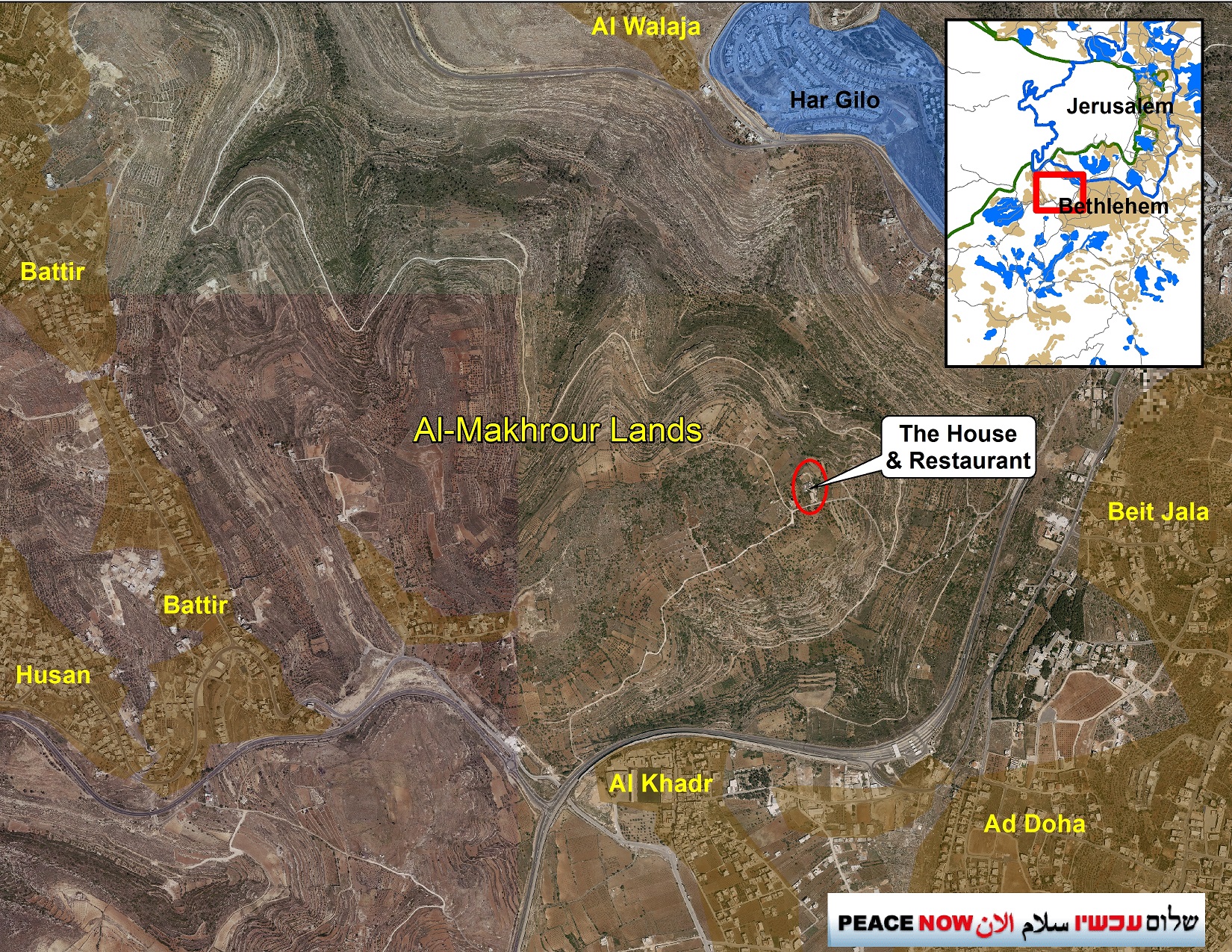
The Cassia family fought against the state and Himunata’s legal assault on their property rights for years, arguing they have lived on the land for decades and never sold the rights to it, and furnishing documents showing the paid property tax on the land from the period when Jordan ruled the West Bank. Nonetheless, on July 29, 2019, the High Court dismissed the family’s latest effort to defend their rights, allowing the demolition to move forward.
Peace Now said in a statement:
“KKL-JNF has become The Fund for the Expulsion of Palestinians. Through greed and cruelty of the JNF, it has thrown its weight its resources to the interests of the settlement agenda. Even if it were true that Himanuta was the owner of the land (which is under dispute), still, it could have come up with different solutions rather than demolition. It could have tried to negotiate with the family about renting or buying the land. The interest of evicting the Palestinian family that has been living in the area for decades, and destroying the restaurant from which it subsists, is not in the interest of the Jewish National Fund and does not reflect the desire of thousands of Jews in the world who donate their money to it.”
Peace Now also notes that this case is part of Himanuta’s long-running campaign to expel Palestinians from their homes in recent years, a campaign which has been reinvigorated over recent years in partnership with other pro-settlement groups including Elad and Regavim. Victories include a November 2018 ruling against Palestinian landowners south of Bethlehem.
Israeli Govt Approves School Trips to Contested West Bank Religious Sites; Settlers Storm Joseph’s Tomb in Violent Celebration
On August 20th, the Israeli Education Ministry announced that it will fund school programs to bring Israeli students (from schools located inside the Green Line) to religious sites – including Joseph’s Tomb and Tel Shiloh, under the control of settlers in the West Bank. Until now, Israeli schools have been prohibited from taking field trips into the occupied West Bank. This shift is part of a growing trend in Israeli policies of formally treating the West Bank as part of Israel.
The same day the decision was announced, the IDF escorted buses of Israeli settlers to Joseph’s Tomb – a site located in Nablus, in an area dotted by violent outposts and settlers. Predictably, the visiting settlers clashed with Palestinians who attempted to prevent their entry to the site; the IDF used live gunfire and tear gas to disperse the Palestinians, injuring several.
Peace Now said:
“the Ministry of Education should not be the information arm of the Yesha Council and the messianic right…We will not let Rafi Peretz [the current Israeli Education Minister] brainwash our kids! Declare that you will not send your children to lend a hand to the occupation.”
Since being appointed to the position in June 2019, Peretz has advanced a controversial agenda, and has begun instituting policy changes called for by the religious right-wing parties. For example, Peretz announced that the Nation-State Law – which last year declared Israel the “national home of the Jewish people” and stated that “the state views Jewish settlement as a national value and will labor to encourage and promote its establishment and development” – will be added to Israeli school curriculums.
Israeli Economic Minister Promises to Compensate Settlements if they are hurt by South Korea FTA
Israel and South Korea signed a free trade agreement on August 21st, ending three years of negotiations over South Korea’s insistence that the deal excludes Israeli settlements in East Jerusalem, the West Bank, and the Golan Heights. Israeli and international media reported that Israel agreed to the South Korean demand, allowing the terms of the trade deal to make a hard legal distinction between businesses located what the international community recognizes as sovereign Israel versus business located in settlements in what the international community views as occupied territory. Since the text has not yet been published, the exact terms of the deal are unclear.
Economic Minister Cohen, a strong advocate for the settlers, initially denied that Israel had agreed to this distinction (“there is no agreement that we sign which includes territorial separation. As far as we are concerned, Judea and Samaria are part of the State of Israel. There is no change in that, period”). He then clarified that if the terms of the deal,did in fact, make any such distinction, “there will be complete compensation by the Israeli government for manufacturers in Judea and Samaria,” and made clear the settlers have already been assured that this is the government’s position.
Surprisingly, Cohen’s statement was publicly endorsed by the Yesha Council, the umbrella group which represents all settlements in the West Bank, which issued a statement saying:
“In a conversation between Economy Minister Eli Cohen and Yesha Council Chairman Hananel Dorani, it was clarified that the agreement makes no mention of a territorial distinction that discriminates or could hurt businesses and entrepreneurs in Judea, Samaria, the Jordan Valley or the Golan Heights, and that the agreement was crafted on the model of existing agreements with the European Union…[Cohen] promised that if South Korea does not grant customs benefits to businesses from Judea, Samaria and the Golan Heights, that the Economy Ministry intends to fully compensate them.”
Why would the Yesha Council be giving the green light for the government to sign an international agreement that distinguishes between Israel and settlements (a position that, when adopted by Europe of anti-occupation activists has consisently been case as anti-Israel, anti-Semitic, similar to the Nazis, and even supportive of terrorist)? Veteran Israeli analyst Akiva Eldar speculates:
“This strange reaction to the agreement that discriminates against the settlements may lie in internal right-wing politics on the eve of the elections. Another possible explanation could lie in the equanimity with which the news was received. Israel has decided on a mechanism — similar to the one it adopted vis-a-vis the free trade deal with the EU — which would compensate exporters from the settlements in the occupied territories. The compensation reflects the difference between the duties paid on their exports and the duties that would have been paid under the beneficial terms of the free trade agreement. This mechanism significantly eases these exporters’ discrimination compared to those exporting goods and services from sovereign Israeli territory.”
Ayelet Shaked Rolls out Campaign Pledge to Build 113,000 New Settlement Units — & Thereby Solve the Israeli Housing Shortage & Erase the Green Line
Speaking at a campaign press conference on August 21st, former Justice Minister Ayelet Shaked – who heads the newly formed Yemina Party – announced a five-year plan to build 113,000 new settlement units in the northern West Bank as a means of solving Israel’s affordable housing shortage and of furthering Israel’s annexation of Area C. If built, the plan envisions bringing an estimated 500,000 new settlers to the West Bank, which would more than double the number of settlers living there currently.

Shaked also promised to extend the length and lanes of Route 5 (called the “Trans Samaria Highway,” which Palestinians have only restricted access to). The road project would allow settlers a short commute to Tel Aviv and would facilitate future settlement growth. Bezalel Smotrich, the third-ranking member of Yemina, boasts that the plan will “erase the Green Line” dividing the West Bank from Israel.
The Democratic Bloc party said in response:
“Shaked and Smotrich have decided to turn the entire population into settlers. Not only [do they want] religious coercion in the education system, but they want to transfer the citizens of the state to live in the settlements where they can re-educate them in the laws of halacha.”
The Peace Now issued a statement:
“Instead of investing in unnecessary settlements and harming the prospect of peace, the State of Israel should focus on addressing actual distress and on strengthening the periphery communities in the Negev and the Galilee.”
Israeli Occupation & the Case of Beit Ur al-Fauqa, where Rep. Tlaib’s Family Lives
Dror Etkes – founder of the Israeli NGO Kerem Navot and long-time settlement watchdog – published the timely analysis of how Israeli settlements have negatively impacted the village of Beit al-Fauqa, the Palestinian village where the family of U.S. Congresswoman Rashida Tlaib is from (and where members of her family, including her elderly grandmother, still live).
Etkes writes:
“…the real story of Beit Ur al-Fauqa is not the settlement of Beit Horon [built nearby on land taken by Israel from the village] but Route 443, a highway built through the West Bank in the early 90s to connect northern Jerusalem and its adjacent settlements to Israel’s coastal area. To pave this road, the Israeli army confiscated 50 acres of the village’s land in the late 80s. Hearing that their land would be confiscated, landowners from Beit Ur al-Fauqa and the neighboring villages petitioned Israel’s High Court of Justice. The High Court would eventually dismiss the petition, accepting instead the IDF claim that the road would also serve the ‘local population,’ who will be able to drive on it faster and more securely.
“When the road was finally paved, 425 acres of Beit Ur al-Fauqa’s cultivated and grazing land were practically disconnected from the village, remaining southwest of Route 443. What about an access road to these 425 acres or a tunnel under the newly-built highway? Not in the West Bank. Once the road was constructed, the villagers were forced to make a seven-kilometer detour to reach their land
“…At the end of 2000, as the violence of the Second Intifada was beginning to unfold, Palestinians were sporadically banned by the IDF from using Route 443. Following several cases of Palestinian gunfire at Israeli vehicles on the road, in which six Israeli citizens and one resident of East Jerusalem were killed, Israel entirely prohibited Palestinians from using the road in 2002. Yet the IDF had officially committed to the High Court’s demand that Palestinians be allowed to use the road. For this, the army uses ‘temporary seizure orders.’
“Between 2005 and 2006, the IDF issued seizure orders for 30 more of the village’s acres in order to pave two ‘fabric of life’ roads — an alternate network of roads and tunnels intended for Palestinian use only — that would serve as Palestinian bypass roads on Beit Ur al-Fauqa’s land. It is true that Beit Ur al-Fauqa does not suffer the worst consequences of Israel’s occupation and its land grabbing enterprise. In many ways, it’s just ‘another village’ — and that’s bad enough.”
Pro-settlement U.S. group Brings GOP Codel to the West Bank
A delegation of four Republican members of Congress recently toured the Hebron and Ariel settlement industrial zones in the West Bank and met with members of the Judea and Samaria Chamber of Commerce. The delegation was hosted by Heather Johnson of the US Israel Education Association (USIEA), a U.S. evangelical group deeply involved in supporting and normalizing settlements, working in partnership with the Israeli government. USIEA is also works with the Family Research Council to lead Congressional delegations to Israel and runs a bible camp in the Ariel settlement.
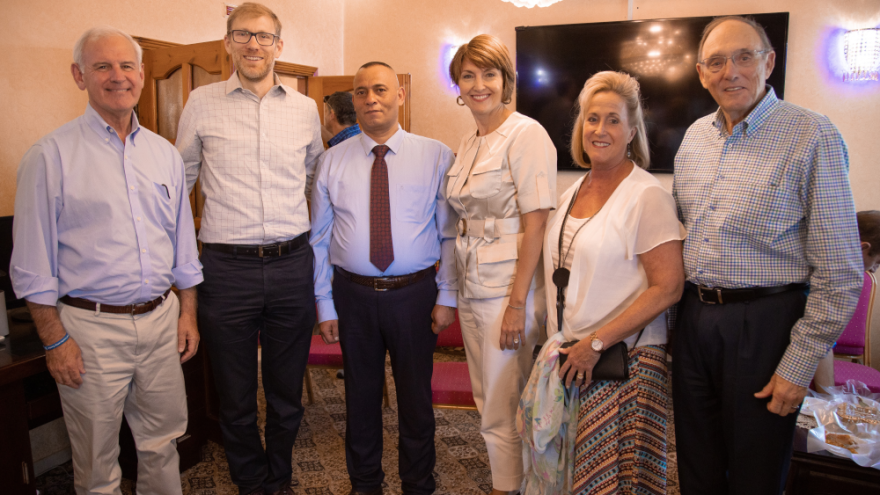
Credit: JS Chamber of Commerce
A darling of the Trump adminstration diplomatic trio, the Judea and Samaria Chamber of Commerce is a group formed by Israeli settlers from Hebron and Palestinian businessman Ashraf Jabari, who has been slammed as a traitor by the Palestinian Authority, shunned and dismissed by his fellow Palestinian business people, and disowned by his family in light of his ongoing role with the committee. As FMEP has repeatedly explained, initiatives like this perpetuate Israel’s economic exploitation of occupied territory (including the local workforce, land, and other natural resources), and that it is Orwellian to label such initiatives as “coexistence” programs, or to suggest that they offer the Palestinians benefits they should welcome.
The Congressional delegation hosted by such a pro-settlement group has not received a hint of criticism from other members of the U.S. Congress. FMEP President Lara Friedmand notes that:
“While folks are still bashing @IlhanMN & @RashidaTlaib for having [the] temerity to try to visit Isr/Pal w/ group other than AIPAC, right-wing media is crowing re: Members visiting ‘Judea & Samaria’ with group devoted to getting Congress to back ‘Greater Israel’ 1-state solution.”
Pro-Settlement Propaganda Continues to Grease Gears for Israeli Annexation of Area C
Two recent articles continue an effort to normalize the concept of Israel’s annexation of land in the West Bank.
The Times of Israel published an op-ed by Andy Blumenthal entitled, “The Coming Annexation.” The piece goes on to outline eight reasons why Israel’s annexation of the West Bank is completely legitimate, including this:
“Reality on The Ground: Israel has around 450,000 settlers in the West Bank in about 130 settlements (the vast majority in Area C) and 300,000 live in East Jerusalem (the later which Israel already annexed in 1967). These Israelis are living in and working the land and building it productively, and many are deeply nationally, religiously and ideologically tied to the biblical Promised Land of the Jewish people that includes the West Bank (and even beyond). It is wholly irrational to think that this multitude of Israeli citizens would be uprooted or abandoned under any circumstance.”
The settler-run outlet Arutz Sheva published analysis of a report by the radical settler group Regavim. The report surveys five years of Palestinian construction in Area C – which Regavim decries – and claims that there have been upwards of 10,000 “illegal” projects undertaken by Palestinians as part of the Palestinian campaign to create a de facto state. The author, Edwin Black, adds commentary that attempts to further paint Palestinian existence in Area C as illegal, ill-intentioned, and a problem that the Israeli government must end.
Bonus Reads
- “[Letter from Silwan] Common Ground: The Politics of Archaeology in Jerusalem” (Harpers Magazine)
- “Ignoring or Downplaying Price of West Bank Annexation Is Playing With Fire” (Haaretz)
- “Palestinian community denied access to water in occupied West Bank” (Middle East Eye)
Welcome to FMEP’s Weekly Settlement Report, covering everything you need to know about Israeli settlement activity this week.
To subscribe to this report, please click here.
August 2, 2019
- Consolidating Annexation of Area C, Part 1: Israel Issues Permits for 715 Palestinian Structures
- Consolidating Annexation of Area C, Part 2: Israel Issues Permits for 6,000 New Settlement Units
- Consolidating Annexation of Area C, Part 3: Big Promises for Efrat, Jordan Valley
- Canadian Judge: Settlements Are Not Israel (All Remaining International Law Supporters: AMEN!)
- Bonus Reads
Questions or comments? Contact Kristin McCarthy at kmccarthy@fmep.org.
Consolidating Annexation of Area C, Part 1: Israel Issues Permits for 715 Palestinian Structures
On July 30th, in an exceedingly rare move, the Israeli Cabinet unanimously approved the issuance of building permits for 715 Palestinian structures in Area C of the West Bank. How rare? Between 2009 and 2016 Israel issued only 66 building permits to Palestinians in Area C (more than offset by demolitions — over the past 2 years alone, Israel has demolished at least 400 Palestinian structures in Area C because they were built without the impossible to obtain Israeli permits).
The approval of even this comparatively small number of permits for Palestinians angered Israeli settlers and their supporters. They expressed outrage at what they characterized as Israeli government “support” for any Palestinian presence in Area C, the 60% of the West Bank settlers have been pressuring the government to unilaterally annex.
Statements made around the approval, however, make clear that the decision to issue the permits for Palestinian construction is not a concession or gift to the Palestinians. One Israeli security cabinet member who voted for the plan, far-right-wing Transportation Minister Bezalel Smotrich (Tkuma), stated in a Facebook post that Israel’s decision to issue the permits actually advances annexation, writing:
“In the last ten years, since the launch of the Fayyad program, the Arab vision of establishing a terrorist state in Area C has been fulfilled in practice. An area under full Israeli security and civil responsibility.
For the first time, the State of Israel will make sure that in Area C, there will only be construction for the Arabs who were original residents of the area since 1994 and not Arabs who came later from Areas A and B.
For the first time, the State of Israel will determine in a clear and unmistakable manner that original inhabitants of the area will be able to build and develop only in places that do not harm the settlement enterprise and security, and do not create territorial contiguity or a de facto Palestinian state. Places that do not serve the national interests of the Arabs, rather the national strategic interests of the State of Israel.
For the first time ever, the State of Israel will implement its sovereignty over the entire territory and take responsibility for what happens inside it. Gone are the days of construction plans pushed by the PA that serve its interests. For the first time, the State of Israel will create a tool basket for real enforcement that will be enacted to neutralize the Palestinian takeover plan.”
As Smotrich made clear, by approving the permits Israel aims to entrench and normalize its complete sovereign control over Area C and the 200k-300k Palestinians who have managed to continue living in that area (again, an area that accounts for 60% of the West Bank land mass), despite the coercive environment Israel has created designed to systematically push out Palestinians.
Peace Now writes:
“The goal of the construction plan is ultimately to serve the settlers, and not out of some sincere concern for the needs of the Palestinian population. The Israeli government is making a significant step toward annexing and applying sovereignty over the territories, and thereby severely damaging the prospect of reaching a political agreement to end this occupation of more than 52 years.”
Notably, an anonymous Israeli official attributed Israel’s approval of the Palestinian permits to American pressure to allow some Palestinan construction in Area C – a theory U.S. Ambassador Friedman denied. However, the theory that there was U.S. involvement in the decision is seemingly backed by two facts: first, U.S. Ambassador David Friedman (extraordinarily) attended the Israeli cabinet meeting at which the permits were approved; and second, the approvals were announced just one day ahead of Jared Kushner’s arrival to Israel. The theory is likewise bolstered by the reality that, as already noted, this issuance of 715 permits for Palestinian structures in Area C is not a generous gift to the Palestinians but rather a move designed to entrench and normalize Israeli control over Area C (60% of the West Bank) – an objective the Trump Administration has clearly embraced.
Consolidating Annexation of Area C, Part 2: Israel Issues Permits for 6,000 New Settlement Units
On July 30th, the Israeli Cabinet unanimously ALSO approved the issuance of permits for 6,000 new settlement units. This massive approval must not be overshadowed by the news of Israel’s rare (and clearly cynical) decision to issue 715 construction permits to the Palestinians (discussed above).
Though details of the settlement plans have not yet been published, if the 6,000 figure is accurate, the cabinet will have in one fell swoop approved around double the number of units Israel has advanced so far this year (which previously stood at 3,691) — bringing the total number of new settlement units approved to a whopping 9,691 – the most in a single year over the past (at least) four years – and the year is only two-thirds over. Assuming (conservatively) a family size of 5, this equals housing for nearly 50k new settlers.
Commenting on the issuance of the permits by Israel and the settlement approvals, Palestinian Prime Minister Mohammed Shtayyeh rejected the current status quo in Area C, in which Israel decides what Palestinians can and cannot do with their own land. He said:
“We do not need permission from the occupying power to build our homes on our lands. Building on land classified as ‘C’ is a right for Palestinians that is not up for exchange with settlements or to treat both as the same. [The Israeli security cabinet’s decision] is aimed at deceiving international public opinion, legitimizing the settlements and attempting to equate Palestinian construction on their lands with the colonial settlement construction that steals the land, the water and the air. The settlements are illegitimate and illegal and will end as they ended in many countries and our right to our land will prevail despite all these decisions.”
Consolidating Annexation of Area C, Part 3: Big Promises for Efrat, Jordan Valley
In addition to the 6,000 units approved this week, during a campaign stop at the Efrat settlement on July 31st, Netanyahu promised to advance plans for 8,250 new housing units in Efrat. Netanyahu also reiterated his (now common) refrain that he will not allow a single settler to be removed, saying:
“No settlement or settler will be uprooted. That is over…What you’re doing here is forever.”
Meanwhile, one of Netanyahu’s biggest rivals in the September elections Benny Gantz (Blue & White) toured the Jordan Valley settlements where he proclaimed that Israeli will never cede control over the border region.
Canadian Judge: Settlements Are Not Israel (All Remaining International Law Supporters: AMEN!)
On July 29th, Candian Judge Anne Maktavish ruled that it is “false, misleading, and deceptive” to label wine from Israeli settlements as “Made in Israel.” The ruling, if effect, rebuffs the international campaign Israel and its defenders are waging to erase any/all distinction that foreign countries make between Israel and Israeli settlements built in the occupied territories, which are illegal under international law.
Naturally, the Candian judge’s ruling upset settlement defenders, who immediately announced their intention to request an appeal.
With this ruling, Canada has aligned itself with a small but significant chorus insisting on a policy which differentiates between Israel and its settlements. In June 2019, a senior advisor to the European Court of Justice issued a strong legal opinion advising the court that under EU rules, labels must make it clear if products originate from Israeli settlements in the occupied territories. Now, the onus is on the EU and its member states to implement the legal opinion.
In response to the Candian judgement this week, PLO Executive Committeewoman Hanan Ashrawi said:
“This is an important first step for Canada and beyond, as this landmark ruling is an affirmation of the supremacy of the law and Canada’s obligation to respect international law, which considers settlements illegal and does not recognize them as part of Israel.”
She also called out the EU, noting:
“It is long overdue for the EU to take the minimal step of properly labeling products originating from Israel’s illegal settlements and to ensure that its partnership agreements do not further enable or favor the continued looting of Palestinian natural resources and the profiteering from the commission is a war crime, as defined in the Rome Statute. Israel’s illegal settlement regime is the embodiment of its colonial agenda in Palestine and its determined efforts to deny the Palestinian people their inalienable rights to self-determination and freedom. The obligation of all states to respect international law and the Palestinian people’s national rights is absolute. Such respect can only be ensured by practical steps that deny Israel and complicit companies the ability to profiteer from the colonial occupation and the flagrant violations of international law. Accountability is the shortest and most assured path to justice”
In the U.S., Israel has benefitted from legislation passed into law by Congress and state governments that directly or indirectly defines “Israel” to include settlements. That legislative onslaught is chronicled and analyzed by FMEP’s Lara Friedman in tables tracking federal and state efforts (with specific focus on the inclusion of settlements).
Bonus Reads
- “What Israel’s Demolition of 70 Palestinian Homes Was Really About” (Haaretz)
- “Digging in the Holy Land: Evangelicals are excavating occupied soil to help their cause, and Israel’s” (The National)
- “Strange Bedfellows: Can Settlers and Leftists Work Together for Peace?” (Partners for a Progressive Israel)
- “With Settlements Strong on Israeli Agenda, Haredi Nationalists Pick Up the Fight for ‘Family Values’” (Haaretz)
- “US Amb: Not Ready to Talk About Palestinian State” (CNN)
- “America Joins Israel’s Campaign to Smear and Silence Palestinians” (Haaretz)
Welcome to FMEP’s Weekly Settlement Report, covering everything you need to know about Israeli settlement activity this week.
To subscribe to this report, please click here.
July 26, 2019
- Annexation By Demolition in East Jerusalem-adjacent area of West Bank
- High Court Rules Settlers Can Stay in Hebron Compound Owned by Palestinians
- Peace Now Report: Return of Rampant Outpost Construction is Ushering in Annexation & “A Permanent Single Undemocratic State”
- Settlement Construction Boom Preys on Vulnerable Palestinian Workers
- Settler Groups: We Want Israeli Annexation, But Not Israeli Law
- Regavim Ups Pressure on Candidates to Promise Annexation of Area C
- Settler-Palestinian “Business Council” Visits Dead Sea
- Bonus Reads
Questions or comments? Contact Kristin McCarthy at kmccarthy@fmep.org.
Annexation By Demolition in East Jerusalem-adjacent area of West Bank
On July 22nd, Israeli forces demolished 13 large apartment buildings (approximately 70 units) in the Wadi al-Hummus neighborhood, leaving the area – located in the West Bank just east of the Israel-declared municipal border of Jerusalem, but on the Israeli side of the separation barrier – looking like a war zone.
 Israel’s decision to demolish the buildings was given the official seal of approval by a Supreme Court decision (much to the comfort and pride of U.S. Ambassador David Friedman). It its arguments, the Court held that the buildings, located mostly in Area A — where the Palestinian Authority is supposed to have full control — posed an unacceptable security risk to the Israeli state because of their close proximity to Israel’s separation barrier.
In so ruling, the Supreme Court set an alarming precedent that puts thousands of additional Palestinian buildings located near the separation barrier at risk of demolition. In addition, the Court provided yet another legal tool in the service of Israel’s ongoing campaign of de facto annexation of Palestinian land.
This case demonstrates yet again, that the Israeli court system affords no meaningful measure of protection or justice for Paelstinians, a fact clearly illustrated in a recent B’Tselem report. B’Tselem said in a statement:
“The Supreme Court ruling, written by Justice Meni Mazuz, fully accepted the State’s framing of the issue as one of purely security matter… Like in many past cases, the judges did not discuss in their ruling the Israeli policy almost completely preventing Palestinian construction in East Jerusalem, with the purpose of forcing a Jewish demographic majority in the city – a policy that forces the residents to build without permits…Instead, the judges ruled that the home demolitions were necessary for security considerations, because construction near the fence ‘can provide hiding for terrorists or illegal aliens’ and enable ‘arms smuggling.’ The judgment also clarifies the extent to which the ‘transfer of powers’ to the Palestinian Authority in areas A and B as part of the interim agreements has no practical meaning – except for the need to promote Israeli propaganda. When it serves its own convenience, Israel relies on that ‘transfer of powers’ to cultivate the illusion that most of the residents of the West Bank do not really live under occupation, and that actually, the occupation is almost over. Whereas when it is not convenient for Israel, like in this case, it sets aside the appearance of ‘self-government,’ raises ‘security arguments,’ and realizes its full control of the entire territory and all of its residents.”
The Israeli NGO “Terrestrial Jerusalem” (led by Danny Seidemann) writes:
“This one case, unfolding in remote areas of the Jerusalem municipal boundary that few Israelis or Palestinians have ever heard of, illuminates the inherent absurdity of the mythical ‘undivided capital of Israel’ and the lack of correlation between the location of a village, the laws that apply to its residents and the authority that governs them. Hence, the residents of Wadi Hummus live on the Jerusalem side of the barrier, but with no rights in Israel, in an area where governance is vested in those with no formal power to govern, where the only “legitimate” use of governmental power is by an occupier whose authorities are based exclusively on military necessity.”
Daniel Sokatch, CEO of the New Israel Fund, writes:
“…we know that Israel’s policy of home demolitions is not just about security. It is an ongoing policy that has been carried out for years that is part of a deliberate planning regime designed to prevent Palestinian demographic growth in East Jerusalem. We know this because our grantees have systematically documented Israel’s policies in East Jerusalem for decades, designed to secure a Jewish majority in the city by diminishing the possibility of Palestinian life and growth…Israel’s demolition of unauthorized Palestinian structures has accelerated massively under President Donald Trump. That makes a lot of sense. Prime Minister Netanyahu and pro-annexationist government know a green light when they see one. Jason Greenblatt, President Trump’s special envoy for negotiations, recently said, that he ‘hasn’t found anything to criticize’ in Netanyahu’s policies.”
High Court Rules Settlers Can Stay in Hebron Compound Owned by Palestinians
On July 21st, a three-judge panel of the Israeli High Court of Justice ruled that Israeli settlers may continue squatting in two disputed Hebron properties while litigation regarding ownership of the property remains ongoing. The property – called the Zaatari Compound after its Palestinian owners, but called “Beit Rachel and “Beit Leah” by the settlers – is located in the heart of downtown Hebron on Shuhada Street, within sight of the Tomb of the Patriarchs/Al-Ibrahimi Mosque. Settlers claim that they purchased the property from the Zaatari family. The Zaatari family rejects that claim. The case remains under consideration in the High Court of Justice.
The new ruling is in response to the Zaatari family’s petition to have the settlers removed from the property, where the settlers have been squatting under the protection of the Israeli military since March 2018, when they broke into the homes. The settlers tried to pull off this stunt once before in 2016 to much less success; that time around, instead of validating the settlers’ theft by allowing them to stay put, a court ordered the Israeli police to evacuate the settlers.
In response to the March 2018 invasion, Peace Now said:
“The settlers’ recent break-in into the Zaatari compound constitutes just the latest in a slew of such unauthorized incidents in Hebron. Their strategy is clear. Since they have failed thus far to obtain the ownership rights legally, instead they must resort to illegal means to establish facts on the ground by squatting, knowing that the right-wing government will be reluctant to attract negative publicity from its base by evicting settlers, and will in turn attempt to delay the eviction or perhaps find a way to legalize the take-over. Fellow Israeli citizens must not give in to this emotional blackmail, and the authorities must evict these squatters without delay.”
Peace Now Report: Return of Rampant Outpost Construction is Ushering in Annexation & “A Permanent Single Undemocratic State”
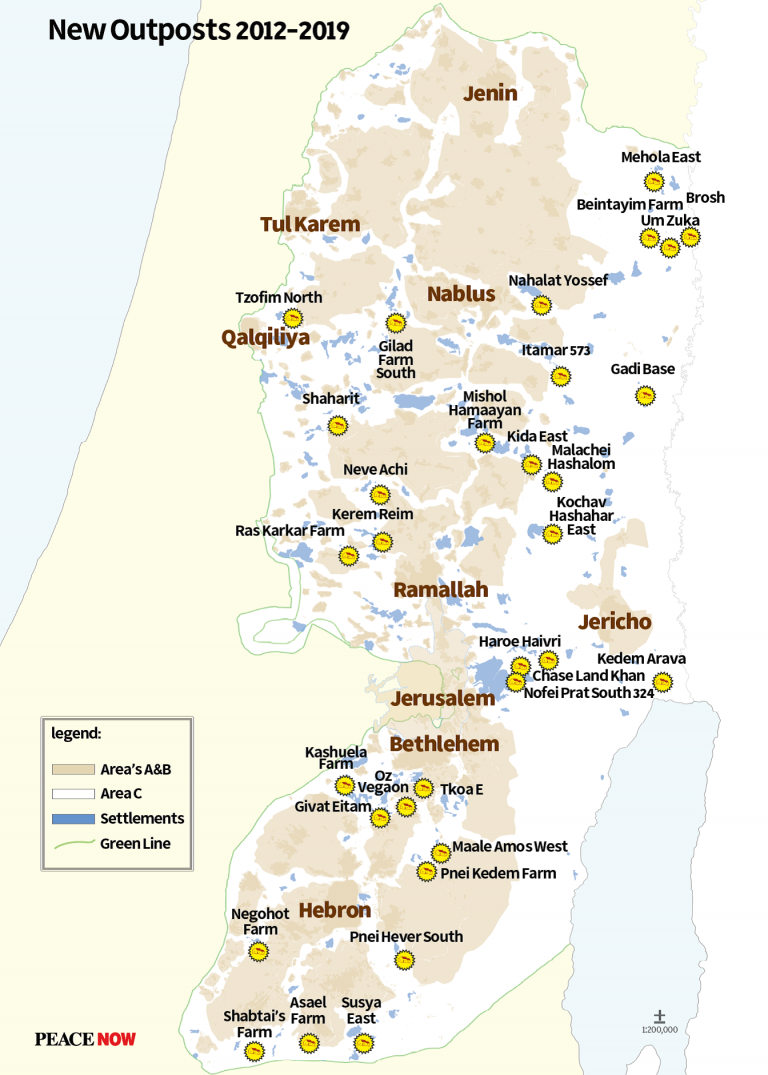 In a new report entitled, “Return of the Outpost Method,” the Israeli settlement watchdog group Peace Now documents the proliferation of new illegal outposts (i.e., new settlement sites established in contravention of Israeli law and regulations; according to international law, ALL settlement activity is illegal) in the West Bank over the past 7 years, with the direct assistance of the Israeli government. The report catalogues 32 new unauthorized outposts established deep in the West Bank since 2012; of those, 18 (56%) were established during the 2.5 years since President Trump took office.
Peace Now said in a statement accompanying the report:
“The Netanyahu government has established dozens of new settlement outposts quietly, without any public debate, in order to take over more territory and prevent the two-state solution. This comes despite talk of regulating the legal status of the more established outposts, in part to create a semblance of law enforcement in the West Bank. When the government and Knesset declare that they will do anything to legalize any unauthorized construction by settlers and even steal private land, settlers see this correctly as an incentive to build more outposts. This outpost method has consequently become a choice tactic in the process of de facto annexation of the West Bank, and it is leading us to a permanent single undemocratic state.”
For many years prior to 2012, settlers did not devote much effort towards establishing new outposts, a decision that bore in mind effective forms of international criticism of outpost construction in addition to the signals sent to the settlers by the Israel government’s decision to evacuate the unauthorized outposts. It was only after March 2011, when Netanyahu’s government declared its intention to legalize as many outposts as possible, that settlers once again set out to build outposts and claim more land in the West Bank. True to its word, the Netanyahu government has undertaken several legal projects aimed at retroactively legalizing these new outposts along with others, a campaign which FMEP has chronicled in detail (see here).
Additional key findings of the new Peace Now report include:
- Since 2012, 32 new outposts have been established, the majority after President Trump was elected. All of the new outposts (except one) are located deep inside the West Bank, in areas that Israel will likely have to evacuate within the framework of any imaginable permanent agreement.
- 21 of the outposts are agricultural farms, which take over large areas for pasturing and cultivation, while their settlers work to remove Palestinian shepherds and farmers from the vicinity.
- Around some of the new outposts there is an increase in violence and attacks against Palestinians.
- The outposts are established in an organized fashion with the involvement of the local settlement authorities, Amana and the Settlement Division of the World Zionist Organization.
- At the same time, the government is working to retroactively legalize existing outposts. To date, 15 outposts have been legalized (“regularized”) as independent settlements or “neighborhoods” in existing settlements. At least 35 additional outposts are undergoing the legalization process.
- One of the outposts established in 2012, Kerem Re’im, has already been legalized, thus becoming an official settlement with nearly 70 families living in dozens of permanent homes.
Settlement Construction Boom Preys on Vulnerable Palestinian Workers
Al-Monitor spoke with several Palestinian construction workers about the risks of participating in the surge of settlement construction that has unfolded in the Trump-Netanyahu era, which has spurred a 39% increase in Israeli spending on infrastructure in the West Bank. The surge has exacerbated an employment “catch-22” facing Palestinians: many Palestinians see no other option but to work in the settlements, but by working in the settlements, they facilitate the expansion and entrenchment of Israeli occupation that ensures there can be no normal Palestinian economic development within which they could find alternate employment.
In addition to that moral/political dilemma that settlement jobs present to an exploited and severely underemployed Palestinian workforce, Al-Monitor columnist Miriam Deprez explains:
“Settlement construction thrives off systemic labor rights abuses of the Palestinian workers by denying proper wages, insurance and basic personal protection equipment, complain the workers and a handful of organizations who try to protect them.”
One Palestinian laborer, Naser Qaswal, worked in a settlement for 25-years before he was forced to leave his job because of injuries he sustained due to the physical demands of the job, yet the settlement employer has not paid Qaswal any form of compensation. According to Qaswal, his cousin lost two fingers in an accident while working at an Israeli settlement, but he did not hold ask his employer for compensation or support in fear that Israel would withdraw his permit to work in Israel. Another laborer, Ahmed, explained how his father fell three stories off a crane while working at a settlement. The accident left him paralyzed from the neck down. The employer paid wages and caregiver fees to Ahmed’s family for the next two years, until his father passed away at the age of 52. The family was left with no income.
The absence of labor safety regulations in the settlements does not only affect Palestinians, as tragically illustrated on July 26th by the death of an Israeli two days after he fell off of a ladder while on the job at a construction site in Neriya settlement. Haaretz reports that the 2019 death toll for settlement laborers stands at 48.
Settler Groups: We Want Israeli Annexation, But Not Israeli Law
For years, settlers have been demanding that the Israel law treat the settlements exactly as part of Israel, with demands for Israeli law to apply and increasingly for outright annexation. Yet, now it seems settlers want to have their cake and eat it too, as illustrated by the Hebron Hills Regional Council – a settlement municipal association – which is fighting against a High Court petition that seeks to extend Israeli laws over settlements in its jurisdiction. Why? Because in this case, Israeli law would limit the Council’s ability to collect association fees from new homebuyers. The petition stems from a request by 26 settlers to who paid exorbitant fees to the association when they moved to the Eshkolot settlement, located in the southern tip of the West Bank but on the Israeli side of the separation barrier.
Haaretz writes:
“…the Hebron Hills Regional Council as well as the Eshkolot community association are arguing before the court that the rule on fees should not apply to [the West Bank]. The Hebron Hills Regional Council’s stand is particularly surprising because like other settler regional councils, it has been insistently calling for Israeli law to be applied in the settlements. Against this, the government is arguing that the rule applies to the settlements because it is a policy of the government’s Custodian for Government and Abandoned Property. What applies inside the Green Line, applies outside it and to Eshkolot.”
Regavim Ups Pressure on Candidates to Promise Annexation of Area
On July 19th, the radical settler group Regavim placed full-page newspaper ads warning: “A Terrorist State – Just Around the Corner.” The group accused the Israeli government of ignoring the alleged “Arab takeover” of Area C, some 60% of the West Bank that the Oslo Accords placed under (temporary) full Israeli control, as an interim stage towards negotiating permanent status of the West Bank and East Jerusalem. Specifically, Regavim accused the government of allowing the Palestinian Authority to build thousands of structures on “state-owned land in strategic locations,” construction which the settlers allege is funded by the European Union with the intention of propping up a “terrorist state” next of Israel. Regavim called on ministers and Knesset members to “take immediate action to prevent a terrorist state in our backyard.”
Settler-Palestinian “Business Council” Visits Dead Sea
On July 9th, leaders of the “Judea and Samaria Chamber of Commerce” took a field trip to the Dead Sea. Ashraf Jabari – one of the few Palestinians who attended the recent U.S.-convened “Peace to Prosperity” shindig and the only Palestinian given a speaking role on-stage at the event (also the only Palestinian to publicly praise the event) – said that the trip was a “direct continuation of the economic workshop in Bahrain,” and mentioned that the group was exploring opportunities to expand cooperation between Israeli and Palestinian business communities.
As FMEP has previously covered, Jabari has been slammed as a traitor by the Palestinian Authority, shunned and dismissed by his fellow Palestinian business people, and disowned by his family in light of his ongoing role with the Judea and Samaria Chamber of Commerce, an initiative Jabari runs alongside Israeli settlers.
Bonus Reads
- “The US Law Restricting Satellite Imagery of Palestine-Israel” (Al-Shabaka)
- “How the Goliath of the Jerusalem settler movement persuaded the world it’s really David” (Mondoweiss)
- “Amnesty International Requests TripAdvisor Employees to Delist Jewish Settlements” (Jerusalem Post)
- “In Bethlehem basement, Palestinian distiller is toasted with global acclaim” (Times of Israel)
- “I’m an Israeli settler. This is why I spoke with J Street’s first ‘alternative Birthright’ group.” (JTA)
Welcome to FMEP’s Weekly Settlement Report, covering everything you need to know about Israeli settlement activity this week.
To subscribe to this report, please click here.
July 12, 2019
- Israel Evicts Palestinians from Silwan Apartment, Turns Property Over to Settlers
- Mayor Reveals Israel’s New Settlement Policy in Jerusalem: Build Everything (Except Givat Hamatos)
- Bibi’s “Principles” for Future Deal Seek International Approval for Apartheid-Like Status Quo
- Stunt by Radical Settler Group Hoped to Scare Government Into Annexing Area C
- United Nations Human Rights Expert Lays Down the Law on Israeli Annexation, Urges International Community to Consider Imposing Consequences
- John Bolton Joins U.S. Chorus Defending & Normalizing Isareli Settlements, Calls them “Housing Projects” at Evangelical Confab
- Adva Center: Israel Has Chosen Settlements/Annexation at the Expense of Development
- Bonus Reads
Questions or comments? Contact Kristin McCarthy at kmccarthy@fmep.org.
Israel Evicts Palestinians from Silwan Apartment, Turns Property Over to Settlers
On June 10th, Israeli police forcibly evicted five members of the Palestinian Siam (also spelled ”Siyyam”) family from their apartment in the Wadi Hilweh section of Silwan, in East Jerusalem. The action took place following a 30-year legal battle of the course of which settlers attempted six separate times (and failed the first five) to convince a court to evict the Siams. On the sixth try, the Jerusalem District Court ruled that the radical settler group Elad is the legal owner of the apartment.
Not only has Elad won the apartment (which increases its ownership share of the entire apartment building, where a few Palestinians owners continue to live), the settler organization (which is funded and abetted by the state of Israel) put a lien on donations crowdfunded to support the Siam family, claiming the money is belongs to Elad pursuant to the court order requiring the Siams to pay Elad 10,000 shekels ($2,798) for legal fees.
As a reminder, U.S. officials Ambassador David Friedman and special envoy Jason Greenblatt recently endorsed Elad’s operations in Silwan by participating in a political stunt promoting one of Elad’s excavation projects in Silwan – an unprofessional and destructive excavation located within a few hundred meters of the apartment from which the Siams were evicted.
Ir Amim explains why this eviction is particularly noteworthy in Elad’s campaign to evict Palestinians and deepen control in East Jerusalem:
“Elad has targeted the Siam family’s property since the early 1990’s, bringing a total of six lawsuits against the family and embroiling them in a lengthy and costly legal battle. Over the course of nearly three decades, it has managed to take over the majority of the family’s property through various mechanisms, most recently through the application of the Absentee Property Law of 1950. The settler takeover of 6/8 of the Siam family’s property is also a symbolic blow to the Palestinian community in Silwan since Jawad Siam, a social worker and longtime community leader, who established community centers for local children and youth, serves as a leading figure in the struggle to protect the Palestinian residents of Silwan.”
Mayor Reveals Israel’s New Settlement Policy in Jerusalem: Build Everything (Except Givat Hamatos)
On June 2nd, Jerusalem Mayor Moshe Leon told the right-wing outlet Makor Rishon that, with the singular exception of the plans for the Givat Hamatos settlement, there is no longer any political pressure holding back unrestrained settlement building across East Jerusalem. Leon said (as translated by Terrestrial Jerusalem):
“I do not know of any problem today in building beyond the Green Line, except for Givat Hamatos, all the construction plans have a green light for implementation. We start and actually build everywhere – in Gilo, in Armon Hanatsiv, in Homat Shmuel [Har Homa] and in the whole city.”
 The one exception, the planned but yet to be built Givat Hamatos settlement located in the southern part of East Jerusalem, has long been called a doomsday settlement by parties interested in preserving the possibility of a two-state solution. This is because if Givat Hamatos is built, the Palestinian neighborhood of Beit Safafa in East Jerusalem will be completely surrounded by Israeli construction.
However, Terrestrial Jerusalem predicts notwithstanding Leon’s comments, Givat Hamatos and E-1 are very much still a threat:
“…if, in the run-up to elections, Netanyahu fears that he is losing his base to the parties to the right of the Likud, he may feel compelled to consolidate his support by giving the green light to one or more bold settlement moves. In such an eventuality, Netanyahu may move on Khan al Ahmar prior to the elections. That said, Netanyahu does not currently seem prone to take action on Khan al Ahmar, Givat Hamatos and E-1, and as we will now see, he may indeed have very compelling reasons to act on these schemes – but only after the elections. If, after the approaching election results come in, Netanyahu will be asked by the President to form a government, he will use all the cards in his deck to achieve one overriding objective: securing his immunity from prosecution. We believe it likely that in the coalition negotiations, Netanyahu will attempt to “trade” the implementation of Givat Hamatos, E-1 and/or Khan al Ahmar in exchange for legislation granting him immunity from criminal prosecution. It is less likely he will “waste” these moves on anything less – including the possibility of approving these during the election campaign.”
Bibi’s “Principles” for Future Deal Seek International Approval for Apartheid-Like Status Quo
Speaking at an event in the Revava settlement, celebrating the 40th anniversary of the Samaria Regional Council (a settlement municipal body in the northern West Bank), lame-duck Israeli Prime Minister Bibi Netanyahu laid out his “principles” and promises with respect to the future of the West Bank in any “political agreement”. He said:
“…I am guided by several principles when it comes to the West Bank. The first – this is our homeland. The second – we will continue to build and develop it. Third – not one resident [settler] or community [settlement] will be uprooted in a political agreement. Fourth – the Israeli military and security forces will continue to rule the entire territory, up to the Jordan Valley. Fifth – I am working to get international ratification of these principles. Look at what we did in the Golan Heights and East Jerusalem. To be continued.”
Bibi also said:
“I also make no distinction between the settlement blocs and isolated settlement sites. Every such spot is Israeli from my point of view.”
Though bleak, the “principles” laid out by Netanyahu are not merely forward-looking. Rather, they paint an accurate picture of what is already happening on the ground: Israel’s construction of new settlements, expansion of existing settlements and corresponding infrastructure, retroactive legalization of unauthorized outposts, expropriation of privately owned Palestinian land, tightening grip over the Jordan Valley including effort that appears designed to drive Palestinians away, and pushing Palestinians out of of Area C, alongside policies designed to prevent the natural growth of Palestinian villages.
In addition to these principles, Netanyahu tossed in a commitment to no forced evictions of either Jews or Palestinians (whom Netanyahu refers to only as “Arabs,” a pointed denial of the existence of the Paelstinian identity and national aspirations). This surprising – and seemingly conciliatory – comment is clearly disingenuous. As demonstrated by the case of the Siam family (discussed above), which just this week was forcibly evicted from its home in Silwan, Netanyahu’s words are emptied of meaning by the large body of Israeli laws and regulations literally designed to dispossess Palestinians of their land and homes. Under the guise of legality, these laws are regularly wielded by the state, often in cooperation and coordination with the settlers, to eviction Palestinians and turn land over to the settlers, as powerfully demonstrated in a recent B’Tselem report on this topic.
Stunt by Radical Settler Group Hoped to Scare Government Into Annexing Area C
In a gratuitous stunt, the radical settler group Regavim placed Palestinian flags along several of the main West Bank highways used by settlers. It should be emphasized that it is not illegal to fly the Palestinian flag in Area C of the West Bank (yet). However, Regavim clearly understands that most Israeli settlers, who take for granted Israeli complete control over the area, would be shocked by the flags and likely perceived them as a Palestinian challenge and provocation.
The intent behind the stunt, according to Regavim Director Meir Deutsch, was to:
“shock, alert, and illustrate what will happen if illegal Arab construction is allowed to continue unhindered and a de facto Palestinian state is established as per the Fayyad Plan of 2009…The [Israeli] population of Judea and Samaria [the West Bank} has been lulled into a dangerous slumber. The flags that we put up this morning won’t change the future of Judea and Samaria but the tens of thousands of structures that were built over the past decade and the thousands of dunams that the PA has taken over with the assistance of European countries will determine the future of Area C.”
MK Bezalel Smotrich – who helped establish the Regavim organization – called the stunt “important and even critical,” saying:
“The time has come for all of us to wake up and thwart the Arab takeover of our homeland. These flags are not dangerous, but the thousands of houses, roads, and trees that the Arabs are building, and paving, and planting under our noses are! The responsibility falls on the shoulders of one man — Netanyahu.”
United Nations Human Rights Expert Lays Down the Law on Israeli Annexation, Urges International Community to Consider Imposing Consequences
UN Special Rapporteur on the situation of human rights in the Palestinian territory, Michael Lynk, responded to the growing U.S.-Israeli consensus on Israel’s annexation of areas in the West Bank. Lynk said:
“International law is very clear: annexation and territorial conquest are forbidden by the Charter of the United Nations. The Security Council, beginning with Resolution 242 in November 1967, has expressly affirmed the inadmissibility of the acquisition of territory by war or force on eight occasions, most recently in 2016. While annexation has not disappeared from the modern world, this strict prohibition in international law has had a considerable dampening effect. The power of the prohibition is that annexations in the modern world, when they do happen, are rarely recognized by other nations. International law, when married to international resolve, works. International criticism, absent any consequences, can no longer be justified in the current circumstances,” said Lynk “If annexation proceeds, the chances for a genuine and just peace in the foreseeable future will have gone from implausible to unimaginable.”
In an interview with Al Jazeera, Lynk elaborated on what those consequences might be:
“The international community has to look at the available menu of countermeasures that is commonly used to a wide range of countries involving gross human rights violations and has to decide what are the appropriate ones to consider to use with respect to Israel. The international community actually holds a lot of cards with Israel, and it has to say to Israel: ‘Your membership or privileges through bilateral or multilateral agreements with respect to your economy, political and cultural relationships are all going to be called into question and reviewed unless you show genuine attempts to unwind and undo the occupation’.”
Lynk also outlined immediate steps that he believes the international community can call for, including the publication of a long-awaited database of Israeli and international companies that profit from operations in Israeli settlements in the occupied West Bank and for the International Criminal Court to complete its preliminary investigation of allegations of rights abuses by Israel. Lynk states:
“Unless there is international pressure on Israel to do the right thing, Israel will continue to deepen and further entrench the occupation,” Lynk told Al Jazeera. I don’t know what the international community needs to come to the realisation that Israel is not going to unwind the occupation and permit Palestinian self-determination all on its own.”
John Bolton Joins U.S. Chorus Defending & Normalizing Isareli Settlements, Calls them “Housing Projects” at Evangelical Confab
Speaking at the Christians United for Israel (CUFI) conference on July 10th, U.S. National Security Advisor John Bolton told the audience:
“At the behest of the so-called State of Palestine, the ICC has threatened to investigate Israeli housing projects in addition to targeting Israeli counter-terrorism efforts in the West Bank – and we’ll not allow the ICC bureaucrats in the Hague to dictate our foreign policy.”
In addition to John Bolton, the CUFI conference drew participation from U.S. ambassador to Israel David Friedman and U.S. Envoy Jason Greenblatt. Asked to respond to the chorus of critics who lambasted him and Friedman for participating in an excavation controlled by the radical Elad settler group, Greenblatt said:
“We were accused of Judaizing the city. We will not tolerate that kind of language. I know that’s been tolerated before, but under President Trump, we will push back every single [time]. You cannot possibly build peace without a foundation of truth. And for somebody to suggest that this tunnel is not the truth, they need to be corrected.”
To note, spokesman for Elad Yigal Kaufman has said, on the record, that the mission of Elad is to “Judaize” East Jerusalem.
Adva Center: Israel Has Chosen Settlements/Annexation at the Expense of Development
In a new report, entitled “Annexation Trumps Start-Up Nation,” the Adva Center compares Israel’s investment in so-called “development towns” (cities established on the Israeli periphery with the aim of creating cultural and economic hubs) to its investment in settlements established at the same time.
The results are clear: development has disappeared from the Israeli agenda, in part replaced by a more narrow concept of economic growth, but, more broadly speaking, completely overshadowed by the government’s ideological focus and support for expanding the settlements. The Adva Center writes:
“the settlements project promises that annexation will continue to trump development. Had the sums spent on the settlements over the years been channeled to the Israeli periphery, it is reasonable to assume that it would by now be far less peripheral. As long as the conflict continues, the Israeli economy will labor under the threat of instability, threatening its international status; As long as the conflict continues, Israel will not be up to the task of reducing the socio-economic gaps between its center and periphery; As long as the conflict continues, Israel will be hard pressed to reduce the poverty rate, which is among the highest among developed countries; As long as the conflict continues, Israel will not find the wherewithal to reduce inequality within; today, Israel is among the developed countries with the highest degree of inequality. As long as the conflict continues, Israel will have a hard time extracting itself from the delirium of annexation in order to adopt an agenda of development.”
In addition to the economic advantages showered on the settlements, the Adva Center notes that the settlements have also succeeded in gaining an influential foothold on political power, writing:
“the political power of the settler right goes beyond its electoral achievements. This is because the settlements are now the very heart of the continuing conflict. Thus, the settler right constitutes a key factor in the determination of the entire national agenda: the constant pressure to jettison the Oslo Accords, to oppose negotiations with the Palestinians, to increase construction in the recognized settlements, to achieve recognition for the illegal outposts, to take over Palestinian buildings, to tormentPalestinian farmers, to demand more and more military protection – to define who and what is patrioticand who and what is not. Development towns – and the entire Israeli periphery – never succeeded in attaining such a position, one that would enable it to put development back on the Israeli agenda. Annexation trumps development.”
Bonus Reads
- “U.S Duty Free Magnates Bankrolled Expansion of Israeli Settlement Vineyard Over Palestinian Land” (The Independent)
- “Mobile Companies Break Deal on Judea and Samaria” (Globes)
- “Graffit in West Bank Targets Palestinian Who Was Suspected of Raping a 7-Year Old Israeli Girl” (Times of Israel)
Welcome to FMEP’s Weekly Settlement Report, covering everything you need to know about Israeli settlement activity this week.
To subscribe to this report, please click here.
July 5, 2019
- With a Sledgehammer in Silwan, U.S. Officials Legitimize Radical Settler Agenda & Offer De Facto U.S. Recognition of Israeli Sovereignty over East Jerusalem
- For the Second Time, Jerusalem District Court Accepts “Market Regulation” Principle as Basis For Seizing Privately Owned Palestinian Land for Settlements
- Settlers, Anticipating Victory on Area C Annexation Push, Expand Annexation Campaign to Include (de facto) Extension of Israeli Control Into Area B
- U.S. Owners of “Duty Free Americas” Are Sending Millions to the Settlements/li>
- U.S. Envoy Greenblatt Prefers to Call Settlements “Neighborhoods and Cities” Because International Law is Not “Clear Cut”
- Bonus Reads
Questions or comments? Contact Kristin McCarthy at kmccarthy@fmep.org.
With a Sledgehammer in Silwan, U.S. Officials Legitimize Radical Settler Agenda & Offer De Facto U.S. Recognition of Israeli Sovereignty over East Jerusalem
In a gratuitous political stunt that represented an unprecedented statement of U.S. support for Israel’s assertion of sovereignty over East Jerusalem, as well as for agenda of radical right-wing Israeli settlers in East Jerusalem, on June 30, 2019, U.S. Ambassador to Israel David Friedman and Special Representative Jason Greenblatt participated in a highly provocative ceremony at an archeological site in East Jerusalem. The ceremony marking the “opening” of what Israel has dubbed the “Pilgrim’s Road”- an excavation project initiated by the radical settler group Elad beneath the Wadi Hilweh section of Silwan, a Palestinian neighborhood in East Jerusalem adjacent to the Temple Mount/Haram Al-Sharif.
In response to widespread condemnation of his role in the ceremony (which, among other things, was protested by the anti-settlement watchdog group Peace Now), Friedman made his support for Israel’s claim over East Jerusalem even more explicit. He said:
“The City of David brings truth and science to a debate that has been marred for too long by myths and deceptions. Its findings, in most cases by secular archaeologists, bring an end to the baseless efforts to deny the historical fact of Jerusalem’s ancient connection to the Jewish people. It brings to life the historical truth of that momentous period in Jewish history. Peace between Israel and the Palestinians must be based upon a foundation of truth. The City of David advances our collective goal of pursuing a truth-based resolution. It is important for all sides of the conflict…The City of David is an essential component of the national heritage of the State of Israel. It would be akin to America returning the Statue of Liberty.”
Peace Now said in a responded:
“This is no less than American recognition of Israeli sovereignty in the sensitive area of the Holy Basin, contrary to the American position throughout the years since 1967. The Trump Team chooses to strengthen the hold of the settler fringe in the sensitive area of the Holy Basin instead of advancing a conflict-ending peace agreement. The tunnel, the way it was dug and its geo-political ramifications, are trampling on the reputation of Jerusalem as a city sacred to all religions and belonging to all its inhabitants. It is part of the transformation of Silwan into a Disneyland of the messianic extreme right wing in Israel and the United States – just steps from the Al-Aqsa Mosque and the Temple Mount.”
Raising the ignored (by Friedman, Greenblatt, et al) issue of the project’s impact on Palestinians living above the excavation site, the Haaretz Editorial Board wrote, in a piece entitled “Settlers in the White House,”:
“The participation of American diplomats at an event sponsored by a right-wing group in East Jerusalem constitutes de facto recognition of Israeli sovereignty in Jerusalem’s historic basin…This recognition doesn’t just put the American administration on the extreme right of the Israeli political map – thus undercutting the claim that American can be an unbiased broker between Israel and the Palestinians – but it also ignores the complicated reality in Silwan, East Jerusalem and the entire region. The tunnel, which was excavated using controversial methods from a scientific standpoint, harnesses archaeology to politics while ignoring the nuances of Jerusalem’s ancient past. But the main problem is that excavating under the street blatantly ignores what’s happening at street level. In Silwan alone there are 20,000 Palestinians without citizenship or civil rights, who justifiably feel that this archaeological project is aimed at forcing them out of their neighborhood. Surrounding Silwan are another 300,000 Palestinian residents of East Jerusalem, also without rights.”
Israeli NGO Emek Shaveh – a group of expert archaeologists – said in a statement:
“The use of archaeology by Israel and the settlers as a political tool is a part of a strategy to shape the historic city and unilaterally entrench Israeli sovereignty over ancient Jerusalem. It is a process which is likely to produce devastating results for both Israel and the Palestinians. It is inexcusable to ignore the Palestinian residents of Silwan, carrying out extensive excavations of an underground city and to use such excavations as part of an effort to tell a historic story that is exclusively Jewish in a 4,000 year-old city with a rich and diverse cultural and religious past.”
Greenblatt – who is not an archeologist, punched back with a tweet suggesting that Emek Shaveh “NGO seems to misunderstand the meaning of ‘archeology.’”
The Palestinian Authority said in a statement:
“We consider the participation of (US Mideast Envoy) Jason Greenblatt and David Friedman to be criminal collusion in the commission of a war crime that must be condemned as well as universally and unequivocally confronted.”
Elad launched its excavation of the “Pilgrim’s Road” in 2007, with the full support of the Israel Antiquities Authority (IAA). For more background on the tunnels and how radical Israeli settlers have exploited excavation, tourism, and the ancient character of Jerusalem in order to serve their ideological agenda – see the comprehensive reporting by Emek Shaveh.
For the Second Time, Jerusalem District Court Accepts “Market Regulation” Principle as Basis For Seizing Privately Owned Palestinian Land for Settlements
In June 2019, Judge Carmi Mossek became the second district court judge to accept the “market regulation” principle as a valid legal basis for retroactively legalizing settlement buildings that were built on land that even Israel recognizes is privately owned by Palestinians. The case in question revolves around four buildings in the Alei Zahav settlement that are partially built on Palestinian land, as revealed by the results of a land survey in 2016 by the Israeli “Blue Line” team (a team whose purpose is to survey the West Bank in order to find more land onto which Israel can expand settlements).
According to Israeli Attorney General Avichai Mandleblit – who first promoted the use of the “market regulation” principle – the principle can only be applied to cases in which all parties involved in the “accidental” construction can demonstrate that they acted in “good faith,” – e.g., with support from the State and without knowing the land in question was privately owned Palestinian land (an argument which of course ignores Israel’s responsibility under international law to protect the property rights of Palestinians living under Israeli occupation).
In this latest case, the state argued that the “market regulation” principle provides a basis for legalizing settlement construction that was “accidentally” built on privately owned Palestinian land in the Alei Zahav settlement. The judge accepted this argument, despite the fact that the High Court of Justice is still considering the validity of “market regulation” as a legal principle. Depending on how the High Court rules, the “market regulation” principle could pave the way for Israel to expropriate Paelstinian land across the West Bank instead of returning it to its legal owners in order to retroactively legalize as many as 3,000 settlement units. In her ruling, Judge Mossek agreed with the State that the settlers’ “good faith” entitles them to be recognized as the legal owners of the land. Jude Mossek gave the state until September to complete the administrative process of retroactively legalizing the houses.
The first case the state of Israel brought forward to test the “market regulation” principle, relating to the Mitzpe Kramim outpost, made clear that “good faith” is in the eye of the beholder, and that when the beholder is the state of Israel, there is a readiness to stretch and twist the meaning of the term “good faith” well beyond any reasonable understanding of the term. That case is the one currently being considered by the High Court of Justice.
Settlers, Anticipating Victory on Area C Annexation Push, Expand Annexation Campaign to Include (de facto) Extension of Israeli Control Into Area B
Settlers recently sent a letter to Israeli Prime Minister Netanyahu asking him to stop Palestinian construction taking place in Area B of the West Bank, arguing that the construction is too close to Israeli settlements in Area C. As defined in the Oslo Agreements, Area C is 60% of the West Bank that Israel retained civil and security control over; Area B constitutes 22% of the West Bank where the Palestinian Authority has civilian control, but Israel exerts control over all security matters.
This new plea from the settlers is a dangerous – but predictable – extension of the settlers’ success in pushing for Israel’s unilateral annexation of Area C, a demand which is increasingly validated in the official discourse of both the Netanyahu government and the Trump Administration. It is consistent with a tactic that has, for decades, served the settlers well: as settlements (by various means) expand ever-closer to Palestinian built-up areas, and ever-deeper into the West Bank, settlers complain that the close proximity of Palestinians threatens their security, and demand that the IDF take action (leading to road closures, land seizures or closures for “security reasons,” “temporary” seizures of homes for IDF use, etc).
In their plea to stop Palestinians from building on land that even Israel recognizes belongs to them, and that under Oslo is under Palestinian civilian control land, the settlers argue:
“This is a construction that seriously harms the personal security of every Israeli living in the communities of Gush Shilo and especially in Amichai, and the public expects the cabinet to wake up, take responsibility and stop this thing immediately.”
U.S. Owners of “Duty Free Americas” Are Sending Millions to the Settlements
An Associated Press investigation revealed that family that owns the highly profitable and ubiquitous retail chain “Duty Free Americas” is a major source of financial support for some of the most radical settler groups in Israel. According to documents uncovered by the Democratic Bloc, the Florida-based Falic family is the single largest donor to Israel Prime Minister Netanyahu and has given over $5.6 million to settler groups over the past decade. These donations have included:
- $1 million to projects associated with the radical group Ateret Cohanim, which is focused on taking control of property in East Jerusalem, especially in the Old City, including by means that are morally and legally questionable;
- Roughly $600,000 to “Hachnasat Orchim Hebron,” an organization that brings tourists to visit radical settlers living in downtown Hebron enclaves. The group was founded by Baruch Marzel, who served as an aid to the ultra-nationalist and racist leader Meir Kahane; Marzel is still listed by name in the CIA World Factbook as a leader of Kach/Kahane Chai, which are U.S.-designated Foreign Terrorist Organizations. In addition to bringing tourists to the settlers, the group also distributes snacks to Israeli soldiers who protect the radical enclaves;
- Funding to organizations that call for Israel to take control over the Temple Mount, tear down the Al-Aqsa Mosque and the Dome of the Rock, and build a synagogue in their place (the “Third Temple”);
- Support for a winery inside the Psagot settlement. The Psagot winery – as is the case with other settler-run wineries in the West Bank and the Golan Heights – is complicit in advancing and normalizing the settlements through tourism;
- A biblical theme park inside of the Shiloh settlement;
- In 2014, the Falics donated to the construction of a synagogue and mikveh (a ritual bath) in the unauthorized Kerem Reim outpost. Since then the Israeli government retroactively legalized the Kerem Reim outpost;
- $50,000 to an organization that acts as a fundraising arm on behalf of Lehava, an extremist, openly-racist Israel organization that advocates against Jewish-Arab couples and assimilation in Israel. Lehava is often is accused of using intimidation and even violence.
While the Falic family’s tax records disclose many causes their family foundation supports, when it comes to most of their donations to Israel-based groups, that money appears to be channeled via Panamanian-based companies, through the family’s Israel-based Segal foundation (whose name is a Hebrew acronym based on the Falic brothers’ first names). This arrangement – which the family states is because one of the Falic brothers lives in Panama – allows for next to zero transparency regarding where the money ends up.
Ran Cohen of the Democratic Bloc, an Israeli NGO which did key research for the AP investigative story on the Falic family, told FMEP:
“Unfortunately, the Falic family story is just another example in a wider picture of private American funding that goes to support racist and anti-democratic trends in Israel. Many of these supporters maintain a public face as Israel-loving philanthropists, when in fact, they fuel some of the most dangerous, extreme, and racist agendas in Israel. We at the Israeli Democratic Bloc, took upon ourselves the mission to research , educate and systematically expose those who threaten Israel’s democratic space”
MK Aida Touma-Sliman (Hadash-Ta’al) said:
“The Falics donate to racist organizations preserving the ‘purity of the Jewish race’ and to the most violent segregationists settling in Hebron and East Jerusalem. The settlements cannot exist without the support of extremist capitalists from the US, these donors must be exposed.”
This revelation is the latest in a growing body of investigative work into previously secretive channels of U.S. money flowing to Israeli settlements and extremists. In January 2019, the American NGO T’ruah investigated and revealed that U.S. donations were finding their way to Kahanist groups in Israel. A December 2018 investigation by Haaretz revealed that Christian groups have given up to $65 million in projects in the “Biblical Heartland” over the past decade, in addition to non-financial donations like volunteer laborers. In October 2018, journalist Josh Nathan-Kazis reported that the San Francisco Jewish Federation was using an Israeli organization to channel funds to organizations fighting to stifle criticism of Israeli policies and punish activists who engage in such criticism, particularly on college campuses. A 2017 Haaretz investigation revealed that millions of tax-deductible donations to the Jewish Federations of North America go to fund West Bank settlements.
U.S. Envoy Greenblatt Prefers to Call Settlements “Neighborhoods and Cities,” Claiming International Law is Not “Clear Cut”
U.S. Special Representative Jason Greenblatt told the audience at a conference on U.S.-Israel relations hosted by Sheldon Adelson’s “Israel Hayom” media outlet that:
“International law, UN resolutions and internationally recognized parameters are not always clear cut. They are interpreted differently in good faith by different parties and they do not provide an executable solution to this conflict…[To resolve the conflict, people have to stop] pretending that settlements, or what I like to call neighborhoods and cities, are the reason for the lack of peace.”
In fact, international law is clear. According to Article 49 of the 4th Geneva Convention, “The Occupying Power shall not deport or transfer parts of its own civilian population into the territory it occupies.” [It is worth re-reading the whole thing to grasp the scope of Israel’s violations of international law in its conduct in the territories it occupied in 1967). Amnesty International also notes that:
“The extensive appropriation of land and the appropriation and destruction of property required to build and expand settlements also breach other rules of international humanitarian law. Under the Hague Regulations of 1907, the public property of the occupied population (such as lands, forests and agricultural estates) is subject to the laws of usufruct. This means that an occupying state is only allowed a very limited use of this property. This limitation is derived from the notion that occupation is temporary, the core idea of the law of occupation. In the words of the International Committee of the Red Cross, the occupying power ‘has a duty to ensure the protection, security, and welfare of the people living under occupation and to guarantee that they can live as normal a life as possible, in accordance with their own laws, culture, and traditions.’ The Hague Regulations prohibit the confiscation of private property. The Fourth Geneva Convention prohibits the destruction of private or state property, ‘except where such destruction is rendered absolutely necessary by military operations.’”
In addition to Greenblatt’s fawning over the settlements, Dr. Miriam Adelson also drew headlines for her speech in which she speculated that there might eventually be a “Book of Trump” added to the Bible in recognition of what Trump has done for the state of Israel. Adelson got the love right back, in the form of a remarkably candid comment from former U.S. Ambassador to the UN, Nikki Haley (who many speculate is the Adelsons’ chosen candidate to succeed Trump). During a public interview in Jerusalem conducted by Miriam Adelson, Haley noted: “A lot of the strength the U.S. is showing for Israel, Sheldon and Miriam Adelson played a very big part in” [As noted by FMEP’s President Lara Friedman: “If a critic of Israel said this, they’d be instantly accused of antisemitism…”]
Bonus Reads
- “How TripAdvisor is Fueling Human Rights Violation is Khirbet Susiya” (Amnesty International)
Welcome to FMEP’s Weekly Settlement Report, covering everything you need to know about Israeli settlement activity this week.
To subscribe to this report, please click here.
May 10, 2019
- Annexation Proceeds: Israel Tourism Ministry Creates Official Funding Channel for Hotels in Settlements
- Settlers Take Over Another Palestinian Home in Hebron, IDF Says It Was for “Military Needs”
- IDF Helps Settlers Celebrate Passover At the Site of the Evacuated Amona Outpost (Which Palestinians Still Cannot Access)
- Israel Issues Construction Permits for Two Settler Bypass Roads
- Every Month Israeli Forces Evacuate the Same Outpost; This Time, 18 Settlers Were Arrested
- No Shame: Settler Builds Illegal Outpost Near Khan Al-Ahmar While Calling for Bedouins’ Eviction
- UNSC Holds Meeting on Israeli Settlements; U.S. Peace Envoy Says Settlements Are Not a Problem
- Greenblatt Touts “Shared Prosperity” Paradigm for Peace Plan Following Beverly Hills Conference
- Bonus Reads
Annexation Proceeds: Israel Tourism Ministry Creates Official Funding Channel for Hotels in Settlements
On April 18th, Israeli Tourism Minister Yariv Levin – who has emerged as a frontrunner to be given the Justice Ministry portfolio in the next government – announced that his ministry had launched a new grant program to expedite funding channels for the construction of hotels in settlements located in Area C of the West Bank. Under previously Israeli law, hotel projects in settlements had to receive special approval from the government; the new program expedites and normalizes that process.
These grants are more than an economic program. Investing in the growing tourism industry inside of settlements in the West Bank is a strategic endeavor intended to entrench settlements, provide for their expansion, normalize their existence within the international community, and advance their seamless integration into Israeli territory. In a recent report on companies which profit from tourism in the settlements, Amnesty International further explains:
“In recent years the Israeli government has invested huge sums to develop the tourism industry in settlements. It uses the designation of certain locations as tourist sites to justify the takeover of Palestinian land and homes, and often deliberately constructs settlements next to archaeological sites to emphasize the Jewish people’s historic connections to the region.”
Following the announcement of the new grant program, Hananel Dorani – Chairman of the powerful Yesha Council, a settlement umbrella group – told the press:
“We thank [Tourism] Minister Yariv Levin (Likud) for his important work on the issue of tourism in Judea, Samaria, and the Jordan Valley. Building hotels and guest houses in the area is an important step which shows the deepening of our roots in the ground and paves the way for Israeli sovereignty in Judea and Samaria. Giving grants for the creation of hotels is another supplemental step which will help solve the problem of where to sleep and will strengthen settlements and our hold on Judea and Samaria.”
Oded Revivi – the foreign envoy of the the Yesha Council – commented:
“[Tourists] will see how there are good neighborly relations between Jews and Arabs. Unlike what has been told to them, they will see that there is not war here every day and that there is no apartheid.”
The Palestinian Ministry of Foreign Affairs and Expatriates said in a statement:
“These plans fall within the framework of the gradual erosion of the occupied Palestinian territory, in particular Area C, under various security, military, economic, settlement and tourism pretexts, which requires the international community to move urgently to save what is left of the chance to achieve peace on the basis of a two-state solution.”
Settlers Take Over Another Palestinian Home in Hebron, IDF Says It Was for “Military Needs”
In early May 2019, a group of settlers broke into a Palestinian-owned home in the Casbah area of the Old City of Hebron. The settlers moved in and promptly started renovating the property. The property is legally owned by the Arafeh family, who were forced to move out in 2005 due to the extreme restrictions on Palestinian movement in the area imposed by the Israeli military.

Map by Peace Now
A lawyer for the Arafeh family asked the Israeli Civil Administration to evict the settlers from the privately owned property. Rather than take action against the settlers, a spokesperson for the Civil Administration justified the settlers’ illegal entrance to the property and the “renovations” they undertook, arguing that the settlers were working on behalf of the IDF to build a military post on the roof of the Arafeh family’s house. This, despite the fact that, according to Peace Now, the Palestinian homeowners never received a notification that the IDF was seizing the property, as required under Israeli law.
Peace Now said in a statement:
“If the works were done for the IDF, it is a shame that the IDF does not respect Palestinian ownership and treats their empty homes as if they were no-man’s property. The Palestinians were forced to leave their houses because of the heavy restrictions imposed by the IDF in order to protect the settlers in Hebron. Those ‘temporary’ restrictions have remained in place now for decades, and the way the IDF and the settlers treat the Palestinian properties show that the security excuse cannot hold anymore and that what is done in the Old City of Hebron may be better described as forced displacement. If the works were done by the settlers, then it is part of a cruel method of the Palestinian dispossession in Hebron: first the IDF closes streets, shops and Palestinian homes to protect a handful of settlers. Then, because of the severe restrictions, Palestinian families are forced to leave their homes. And then settlers take over the empty houses without any permit. Finally the government allows them to remain and establish a new, illegal settlement in the heart of the Palestinian population.”
IDF Helps Settlers Celebrate Passover At the Site of the Evacuated Amona Outpost (Which Palestinians Still Cannot Access)
Haaretz reports that the Israeli military assisted settlers in trespassing into the site of the evacuated Amona outpost to celebrate Passover. The land – which in 2017 the Israeli High Court ruled to be legally owned by Palestinians – remains inaccessible to the Palestinian landowners under a military closure order barring all civilians from entering the area. In practice, the closure only applies to Palestinians. Settlers, on the other hand, are not only given free rein in the area but received high profile political backing and significant funding in their December 2018 efforts to illegally rebuild the Amona outpost. With much scandal, in January the IDF removed several pre-fab structures the settlers managed to install at the Amona site, and evacuated the settlers despite their violent resistance.
In January 2019, the Israeli NGO Yesh Din assisted the Palestinian landowners to filed a new petition with the Higher Court of Justice to reverse the military closure order to allow Palestinian landowners to access their land and restrict Israeli settlers from doing so. The petition is still pending.
Israel Issues Construction Permits for Two Settler Bypass Roads
On May 1st, the Israeli Civil Administration approved construction permits for two new bypass roads for settlers – the Huwwara and Al-Arroub roads. The approval brings construction of the roads closer, though it may still be stalled if Palestinians challenge the government’s confiscation of privately owned Palestinian land for the roads (confiscated on the basis of “security needs”). It’s worth recalling that a recent Kerem Navot report found that a whopping 47% of the total land seized by Israel for “security needs” is currently used to serve the needs of the settler population.
Peace Now said in a statement:
“These expropriations are part of the government’s continued capitulation to the settlers to build Israeli-oriented bypass roads throughout the West Bank. The settlers know very well that without good roads the settlements will not be able to develop, and tactically demand that they be built ‘for security reasons.’ This stated rationale masks the real goal behind these roads: to expand the settlements and to advance plans for annexing the West Bank at the cost of a two-state solution.”
Both roads will be located deep inside of the West Bank: the Huwwara road will serve settlements near Nablus and the Al-Arroub road will serve settlements near Hebron. Among the many benefits for settlers, bypass roads entrench the presence of settlements, enable their expansion, and advance their seamless integration into Israel proper.
Gloating over the new roads, Samaria Regional Council chief Yossi Dagan said:
“The Prime Minister has proven his leadership, responsibility, and his integrity. Netanyahu kept his promise, and I praise him for sticking by the agreement. The Hawara and Al-Arroub bypass roads are strategic roads, which, God-willing, will change the map of the State of Israel in general and the map of Judea and Samaria in particular.”
Every Month Israeli Forces Evacuate the Same Outpost; This Time, 18 Settlers Were Arrested
According to Haaretz, the cat and mouse game (once dubbed “the never-ending evacuation”) between settlers and the IDF over the “Esther Maoz” outpost site has finally resulted in the arrest of 18 settlers.
For years, the IDF has evacuated settlers from the outpost only to allow them to immediately rebuild it. Following the settlers evacuation and arrest, the NGO Honenu – which acts as a legal defense fund for settlers – alleged that the security forces “used intense violence” against the settlers.
The Esther Maoz site is located near the Kokhav Hashahar settlement, and can only be accessed by road from inside of the settlement.
No Shame: Settler Builds Illegal Outpost Near Khan Al-Ahmar While Calling for Bedouins’ Eviction
An Israeli settler name Boaz Ido is funding the illegal construction of an unauthorized outpost just hundreds of meters from the location of the embattled Khan al-Ahmar Bedouin community. Construction at the outpost site has continued despite stop-work orders issued against it by the Civil Administration.
While funding the illegal project, Ido has lobbied the government to forcibly remove Khan al-Ahmar’s inhabitants, based on the argument that the village lacks the required Israel-issued building permits.
Haaretz visited the site of Ido’s new outpost and found a group of Israeli settlers working to construct a straw and mud structure. The location of the construction falls within the approved borders of the Ma’ale Adumim settlement, but is not contiguous with the built-up area of the settlement. Moreover, there are no valid building plans or permits for Ido’s current undertaking.
Dror Etkes, founder of Kerem Navot, told Haaretz:
“It’s no wonder that someone who has been investing so much energy into evicting the Bedouin neighbors who were in the area for decades before him is the same person who is investing a lot of energy into controlling land that he has not even a hint of a right to.”
Ido is a well-connected settler living in the Ma’ale Adumim area. He runs the nearby “Genesis Land” tourism site and is an active member of the Jerusalem Periphery Forum, a group working to evict bedouin from the area. Ido has been deeply involved in pushing the government to evict the bedouin from Khan al-Ahmar, including extracting assurances from Prime Minister Netanyahu and briefing the Knesset about “Palestinian take over of Area C.” According to the settler-run Arutz Sheva outlet, Ido told the Knesset members:
“We cannot lose control of Route 1 and permit illegal [Arab] construction as in the Negev. We are working continuously on the ground and I am pleased that, for the first time, in 2016, cooperation with the Civil Administration has been stepped up, with corresponding results – a halt to illegal construction as well as a small reduction in the number of structures on the ground.”
So in addition to his current hypocrisy, Ido is also complicit in an extraordinary manipulation of facts regarding Area C — a term which refers to the 60% of the occupied West Bank which the Oslo Accords temporarily assigned to complete Israeli control (civil and security) as part of an interim agreement designed to remain in place for a short period, pending conclusion of permanent status negotiations. Since then, Israel has implemented a discriminatory planning policy in Area C, which B’Tselem says is aimed at “preventing Palestinian development and dispossessing Palestinians of their land.”
While implementing a planning system under which it is nearly impossible for Palestinians to obtain building permits, Israel routinely enforces demolition orders against Palestinian structures built without permits while looking the other way with regards to illegal settlement construction in the area. In addition, the government is undertaking a systematic campaign to retroactively authorize the vast majority of illegal outposts and unauthorized settlement construction – – a contradiction which clearly benefits Ido’s new outpost.
UNSC Holds Meeting on Israeli Settlements; U.S. Peace Envoy Says Settlements Are Not a Problem
On May 9th the United Nations Security Council held a meeting at the request of Indonesia, Kuwait, and South Africa entitled “Israeli Settlements and Settlers: Core of the Occupation, Protection Crisis and Obstruction of Peace.” The informal “Arria formula” meeting provided a forum for member states to be briefed by experts in the field; speakers included John Quigley ( Ohio State University), Emily Schaeffer Omer-Man (Israeli human rights attorney); Mohammed Khatib (Popular Struggle Coordination Committee); and James Zogby (Arab American Institute). Member states in attendance included France, Germany, Russia, and Colombia.
U.S. Special Representative for International Negotiations Jason Greenblatt delivered remarks at the meeting on behalf of the United States (not as an expert). His remarks – rather than dealing with the substance of criticisms on settlements – sought to flip the script and attack the UNSC for alleged anti-Israel bias and accuse it of ignoring Hamas attacks on Israelis. Unsurprisingly, given the Trump administration’s public embrace of settlements, Greenblatt said:
“Let’s stop pretending that settlements are what’s keeping the sides from a negotiated peaceful solution. This farce and obsessive focus on one aspect of this complicated conflict helps no one.”
Arab American Institute President Dr. Jim Zogby said of the deterioration of U.S. policy on settlements:
“There has been a steady erosion of US policy on Israeli settlements, it went from rejection to acceptance, and from passive acquiescence to legitimization. It saddens me as an American to say: This makes my government complicit, and more recently an enabler of this criminal activity. A new strategy is needed, not just to challenge Israel, but to challenge the impunity the US has bestowed on Israel that makes it unaccountable.”
Indonesian Foreign Minister Retno Marsudi, who chaired the meeting, said:
“inaction was not an option. Public pressure to end the settlement is absolutely vital… Indonesia will spare no effort to ensure that the Palestinian issue remains one of the main focus of the UN.”
Marsudi also suggested creating an international day of solidarity with the victims of illegal settlements.
Greenblatt Touts “Shared Prosperity” Paradigm for Peace Plan Following Beverly Hills Conference
On April 29th, following a private briefing for attendees at the ritzy Milken Institute’s 2019 Global Conference, U.S. Special Representative for International Negotiations Jason Greenblatt tweeted:
“this year’s [Milken Global Conference] theme ‘Driving Shared Prosperity’ couldn’t be more fitting for what Jared, Amb. David Friedman and I hope will be the future of our peace vision for Israel, Palestinians and the region.”
Jared Kushner also made an appearance at the conference, held in Beverly Hills, California. Kushner and Greenblatt were not listed among the conference speakers, which included prominent celebrity figures such as animal biologist Jane Goodall and NFL quarterback Tom Brady.
The Milken Institute describes itself as:
“a nonprofit, nonpartisan think tank determined to increase global prosperity by advancing collaborative solutions that widen access to capital, create jobs and improve health. We do this through independent, data-driven research, action-oriented meetings, and meaningful policy initiatives.”
Bonus Reads
- “Will Netanyahu Annex the Settlements?” (Newsweek)
- “As Israeli Group Expands, Palestinian Houses Face Demolition” (Associated Press)
- “Some of Israel’s Best American Friends Worried by Netanyahu Annexation Talk” (Times of Israel)
Welcome to FMEP’s Weekly Settlement Report, covering everything you need to know about Israeli settlement activity this week.
To subscribe to this report, please click here.
January 4, 2019
- Israel Advances Plans for 2,191 New Settlement Units – Including Establishing 2 New Settlements & Laying Groundwork for 2 New Settlement Industrial Zones
- Based on New Legal Tools to Take Palestinian Land, Israel Announces Intention to Build A New Settlement (“Givat Eitam/E-2”) Near Bethlehem
- Following High Profile Political Support, Settlers Violently Resist Evacuation from Amona Outpost Site
- Knesset Speaker & Leaders Call for Annexation of Hebron
- Regavim Petitions Jerusalem District Court to Stop the EU-Backed “Arab Takeover” of Area C
- Knesset Lawyer Criticizes Bill to Give Palestinian Land to the World Zionist Organization
- Sheldon Adelson’s Medical School in Ariel Settlement May Not Open
- Bonus Reads
Questions/comments? Email kmccarthy@fmep.org
Israel Advances Plans for 2,191 New Settlement Units – Including Establishing 2 New Settlements & Laying Groundwork for 2 New Settlement Industrial Zones

Map on Twitter by @JacobMagid
During its final meetings of 2018 (held on December 26th and 27th), the Israeli Civil Administration High Planning Council advanced plans for a total of 2,191 new settlement units. Peace Now reports that 87% of the settlement plans advanced are located deep inside of the West Bank, far beyond any of the negotiated parameters for a border between Israel and a future Palestinian state.
The flood of settlement approvals includes plans that will effectively create two new settlements (by legalizing the unauthorized outposts of Ibei Hanachal and Gva’ot, detailed below) and establish two new settlement industrial zones (one near the Beitar Illit settlement and one near the Avnei Hefetz settlement). Another plan, for an educational campus and a gas station, will serve to connect the unauthorized outpost of Mitzpeh Danny to a nearby settlement (Ma’aleh Mikhmash) – paving the way towards the eventual legalization of that outpost, creating yet another new settlement.
Of that total, plans for 1,159 units were given final approval for construction – meaning building permits can be issued immediately. These include
- 220 new units in the Givat Ze’ev settlement;
- 180 new units in the Neveh Daniel settlement;
- 135 new units in the Tene settlement;
- 120 new units in the Karmei Tzur settlement;
- 129 new units in the Avnei Hefetz settlement (where plans to build a new, noncontiguous industrial zone nearby were also advanced – see below);
- 61 new units in the Tzofim settlement;
- 42 new units in the Alfei Menashe settlement;
- 55 new units in the Tomer settlement;
- 18 new units in the Adora settlement;
- 16 new units in the Metzad settlement;
- 1 new units in the Shilo settlement; and,
- 62 new units in the Ma’aleh Mikhmash settlement;
-

Map by Peace Now
A plan to build an educational campus and a gas station between the Malakeh Mikhmash settlement and the unauthorized outpost of Mitzpeh Danny. Peace Now writes, “Although this is not a residential program, these buildings also qualify as the establishment of a new settlement complex in the West Bank. The plan covers 140 dunams and will create a permanent presence of hundreds of Israeli students and teachers…During the discussion it was noted that the Mateh Binyamin Regional Council is preparing a plan to regulate the outpost.”
- A plan to build a cemetary on an area of “state land” south of the Palestinian city of Qalqilya. The area used to be a closed firing zone, but that military designation was rescinded years back, and the site has since been the subject of settlement planning. Peace Now writes, “The planned cemetery is likely to be the first component on the road to the establishment of an industrial zone, which is also a type of settlement.”
Settlement plans that were advanced through earlier stages of the planning process include:
-
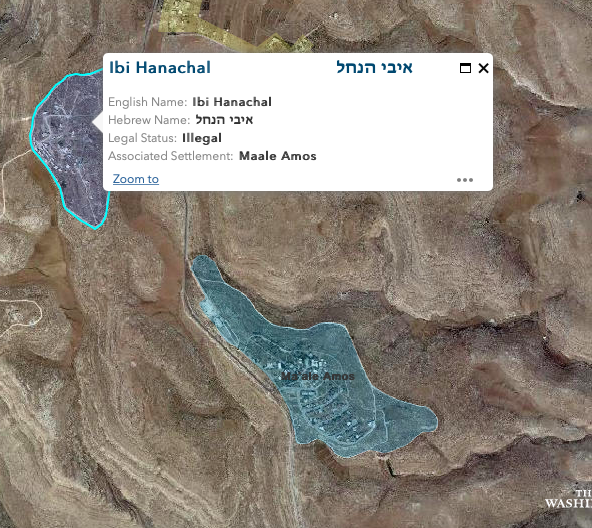
Map by WINEP
A plan for 98 units in the unauthorized Ibei Hanachal outpost, which will turn the outpost as a “neighborhood” of the Maale Amos settlement. In reality, the outpost is not contiguous with the built-up area of the Maale Amos settlement, meaning that the implementation of this plan will, in effect, create a distinct new settlement.
- A plan for 61 new units in the unauthorized Gva’ot outpost, an outpost originally built in 1999 by the settlers as a “neighborhood” of the Alon Shvut settlement. The settlers built a yeshiva there, but abandoned it not long after. The new settlement plan is for a public building, likely an educational institute with housing.
- 82 new units in th Ofra settlement. FMEP reported on this plan in the Dec 14th edition of the Settlement Report, in conjunction with the litany of punitive settlement plans advanced by Israel in response to terror attacks. The area where the new units are slated to be built is land that was allegedly purchased by the settlers from its original Palestinian owners.
- Plans for two new settlement industrial zones, one near the Beitar Illit settlement and one near the Avnei Hefetz settlement. The latter industrial zone, called Bustani Hefetz, will cover a large area of land (some 730 dunams) and will not be not contiguous with any other settlement. Peace Now writes, “an industrial zone of this scope, which is cut off from any other settlement, in all actuality constitutes a new settlement.”
- 121 new units in the Yitzhar settlement, where the IDF has been trying to rein in the violence perpetrated by the “Hilltop Youth” settlers, who are based in Yitzhar.
- 152 new units in the Shavei Shomron settlement.
- 212 new units in the Har Bracha settlement.
- 94 new units in the Beit Haggai settlement.
- A plan to legalize 75 existing settlement units in the Shvut Rachel settlement, which Israel considers a “neighborhood” of the Shiloh settlement.
- 100 new units in the Halamish settlement.
Peace Now released a statement saying:
“In 2018, the government advanced thousands of housing units, including most which can be found in isolated settlements deep inside the West Bank that Israel will eventually have to evacuate. Those who build these places have no intention of achieving peace and a two-state solution. The latest announcement, which as an aside was cynically passed on Christmas while most Western governments are on holiday, shows that Netanyahu is willing to sacrifice Israeli interests in favor of an election gift to the settlers in an attempt to attract a few more votes from his right-wing flank.”
Top Palestinian negotiator, Saeb Erekat, released a statement saying:
“While the world is celebrating Christmas with its spirit of peace and joy, the Grinch ‘occupation’ decided to steal the Christmas spirit from the people of Palestine. As part of his early election campaign, the Israeli Prime Minister Benjamin Netanyahu has as well stolen more Palestinian land and resources for the benefit of Israel’s illegal colonial settlement expansion. Such illegal actions are a deliberate campaign to destroy the two-state solution and to prevent the establishment of an independent and sovereign State of Palestine with East Jerusalem as its capital.”
Tamar Zandberg, head of the Meretz Party, slammed the new announcements, and previous decisions taken by the government to retroactively legalize 60 outposts. Zandberg said:
“The Israeli government has become a settlement government. (MKs Bezalel) Smotrich, Moti Yogev, (Justice Minister) Shaked and (Education Minister) Bennett are its landlords. They exploit the (Palestinian) attacks to build more settlements. But the truth needs to be said. To achieve security we need to evacuate settlements, not build more and more…”The 60 new settlements are the real threat to Israel’s security and to IDF soldiers. The pogroms they are waging in Palestinian villages. The stone-throwing, the shooting and the uprooting of the trees. This is the danger to our moral image and our security! They eight seats of Habayit Hayehudi party dictate eight million lives.”
Based on New Legal Tools to Take Palestinian Land, Israel Announces Intention to Build A New Settlement (“Givat Eitam/E-2”) Near Bethlehem
On December 26th, the Israeli Civil Administration announced that it will draft plans to build as many as 2,500 new settlement units at the Givat Eitam outpost site, creating a new settlement on a strategic hilltop that will cut off Bethlehem from the southern West Bank, completing the near encirclement of Bethlehem by Israeli settlements.
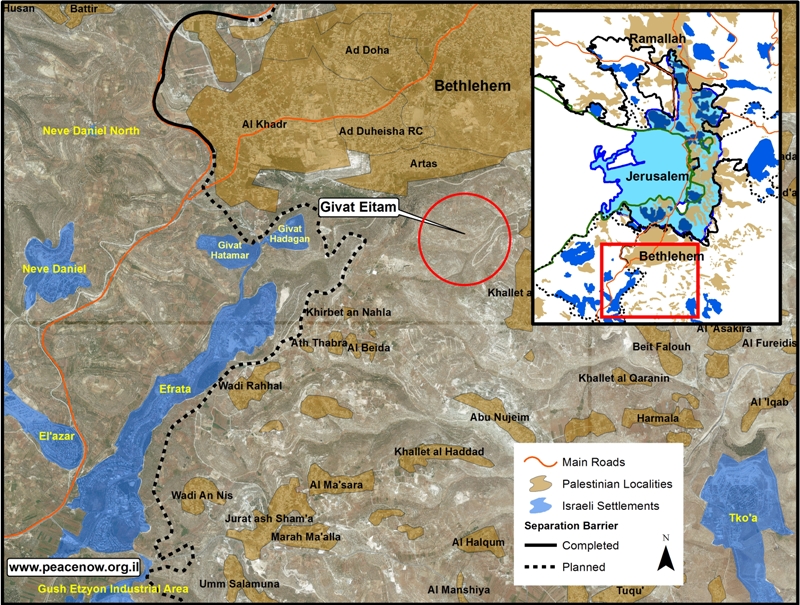
Map by Peace Now
For years, settlers have lobbied for construction at the site, but those efforts have been stymied by the lack of a legal access road to the outpost, which is surrounded by land that even Israel recognizes is privately owned by Palestinians. Until recently, Israel has balked at seizing private land from Palestinians for the exclusive benefit of the settlements. But now, several new legal opinions have allowed Israel to violate the private property rights of Palestinians for the sole purpose of legalizing settlements and settlement infrastructure. Those legal opinions include the “market regulation” principle, the opinion(s) regarding the Haresha outpost case, and the Regulation Law. It is unclear which legal argument will be applied to the Givat Eitam/E-2 case.
The Givat Eitam outpost has been nicknamed “E-2” by settlement watchers for for its resemblance, in terms of dire geopolitical implications, to the infamous E-1 settlement plan. Located east of the separation barrier on a strategic hilltop overlooking the Palestinian city of Bethlehem to its north, Givat Eitam/E-2 is located within the municipal borders of the Efrat settlement but is not contiguous with Efrat’s built-up area, making Givat Eitam/E-2 effectively a new settlement that, according to Peace Now, will:
“block Bethlehem from the south, and prevent any development in the only direction that has not yet been blocked by settlements (the city is already blocked from the North by the East Jerusalem settlements of Gilo and Har Homa, and from the West by the Gush Etzion Settlements) or bypass roads (that were paved principally for Israeli settlers). The planned building in area E2 would likely finalize the cutting off of Bethlehem city from the southern West Bank, delivering a crushing blow to the Two States solution.”
In September 2018 FMEP reported that the local council of the Efrat settlement encouraged the start of (unauthorized) construction of an outpost at the Givat Eitam/E-2 site (presuming that any such illegal construction would be retroactively legalized by the government) in response to a Palestinian terror attack in the Efrat settlement. Since then, the Civil Administration has allowed the settlers to build and maintain an agricultural farm there.
FMEP tracks all developments related to Israeli legislative, cabinet, and judicial action that promotes the retroactive legalization of outposts built on privately owned Palestinian land as part of its documentation of creeping annexation – available here.
Following High Profile Political Support, Settlers Violently Resist Evacuation from Amona Outpost Site
On January 3rd, 23 Israeli police officers were injured by Israeli settlers and their supporters who violently resisted the court-ordered evacuation from illegal encampments erected on privately owned Palestinian land as part of an effort to re-establish the Amona outpost. Approximately 300 settlers showed up at the Amona site (which is currently a closed military zone) overnight to resist the removal of settlers and two caravans from the hilltop, which was ordered by the Jerusalem District Court. The settlers and their supporters burned approximately 300 tires at the entrance to the outpost, poured oil on the access roads, and threw rocks and boulders at the Israeli police. Seven suspects were arrested and quickly released.
The evacuation of the outpost was reportedly carried out in defiance of a direct order from Prime Minister Netanyahu. According to the Haaretz report, Netanyahu gave orders to the Israeli military secretary, Col. Avi Bluth, to stop the evacuation. Col. Bluth did not relay the message in time, and the evacuation was carried out. Now, Netanyahu has ordered a disciplinary hearing to investigate the actions of Col. Bluth, which is scheduled for January 4th.
The violent evacuation of settlers from the Amona hilltop follows a week of high profile support for their efforts. Israeli Cultural Minister Miri Regev attended a ceremony near the recently re-established (yet unauthorized) Amona outpost to express her support for authorizing construction on the hilltop – which, according to the Israeli High Court of Justice, is privately owned Palestinian land. Regev could not go to the actual Amona site, because the area is a closed military zone where no one (settlers, politicians, and even the Palestinians who own the land) is permitted to enter. Regev and the settlers claim that the hilltop land has been legally purchased by the settlers, but that claim has not been investigated, much less verified. Casting doubt on the settlers’ claims, Haaretz notes:
“The lot in question is jointly owned by several different Palestinians, which means every single one of them would have to consent to the purchase for it to be legal. It’s not clear which, if any, of these Palestinians signed the sale document. In the end, the land was designated military land, is zoned for agriculture and has no building permits.The Binyamin Regional Council didn’t await the administration’s decision before moving two prefab homes into Amona and providing basic infrastructure such as water tankers.”
Israeli Attorney General Avichai Mandleblit slammed the settlers for trespassing and illegally moving caravans onto the site. Mandelblit criticized MK Bezalel Smotrich and the heads of regional settlement councils who went to the site to express support, saying:
“Breaking the law with the support of public figures, like placing caravans on privately-owned lands, can’t be a source of pride.”
A Haaretz report recently revealed Bezalel Smotrich was a founding member of a non-governmental group called Ofek Lehityashvut, which directly financed the illegal reestablishment of the Amona outpost last month by purchasing the two caravans that settlers moved onto the hilltop. The Haaretz report goes on to reveal that the Benyamin Regional Council has purposefully tailored various calls for proposals so that Ofek Kehityashvut would be the only group qualified to receive financing for that project. As a result of that manipulation, Ofek Kehityashvut has received substantial amounts of funding from the Benyamin REgional Council, which is an Israeli-taxpayer funded entity.
Knesset Speaker & Leaders Call for Annexation of Hebron
The speaker of the Israeli Knesset, Yuli Edelstein (Likud), called for Israel to apply its sovereignty over the city of Hebron – which would constitute an act of de facto annexation. Edelstein released a statement announcing his intention to go on a tour of Hebron – where some 500-800 settlers live under Israeli military protection amongst 200,000+ Palestinians – with the far-right, pro-annexationist group Im Tirzu. In the statement he wrote:
“In my view, it’s delusional that some Knesset members dare to undermine the Jewish people’s right to dwell in the city of our forefathers,” Edelstein said in a press statement issued prior to the conference. “We’re developing Hebron, investing in it and inculcating its importance in future generations. We are saying clearly – sovereignty in Hebron first.”
Speaker Edelstein also participated in a conference highlighting Israel’s historic connection to the city of Hebron. Organized by the Knesset Land of Israel Lobby, the event culminated in the signing of a document that reads:
“We, the undersigned, hereby express deep solidarity with the roots of the Jewish people in Hebron and the support of the Jewish community in Hebron that has clung to the city despite all the difficulties. We declare an unambiguous commitment to the continued existence, security and prosperity of Hebron as the city of both our forefathers and children.”
The event was co-organized by MK Bezalel Smotrich (Jewish Home) who said:
“Hebron is a litmus test. What is happening in Hebron shows our Jewish pulse….[those who call for settlers to leave Hebron] understand very well that if Hebron grows and develops, the entire settlement enterprise will grow and develop, so they invest in harming Hebron. But they will continue to shout and complain while we will continue to build, reach the people and connect with our roots.”
Regavim Petitions Jerusalem District Court to Stop the EU-Backed “Arab Takeover” of Area C
Following the Knesset’s passage of a bill in July 2018 that brought many West Bank legal matters under Israel’s domestic jurisdiction (an act of de facto annexation), the Jerusalem District Court is set to hear its first case concerning land disputes in the occupied territory. The bill was sponsored by Israeli Justice Minister Ayelet Shaked, whose three-fold rationale for the bill explicitly states that its purpose is to help settlers take more Palestinian land and shut-down Palestinian challenges to such thefts — by bringing matters to the Jerusalem Court instead of the High Court of Justice, which Shaked believes is too concerned with Palestinian rights and international law. The bill is part of the legislative body’s broader effort to erase all remaining distinctions (legal, judicial, economic, and otherwise) between sovereign Israel and the occupied territories, distinctions which allowed Israel to preserve the guise of respect for rule of law, and good intentions, for the last 50 years.
Looking to cash in the bill’s explicit purpose, the radical settler group Regavim initiated the petition asking the court to intervene to stop the “illegal Arab takeover” of land in the West Bank. Regavim’s petition claims that Palestinians are cultivating “state land” near the Mezad settlement. The petition also blames the European Union for its financial backing for the agricultural projects on the land. (Note: Regavim, like most settler media outlets, uses the word “Arab” to describe Palestinians, a vocabulary choice meant to erase any recognition of Palestinian identity).
A coordinator for Regavim told the Arutz Sheva outlet:
“The intervention of the European Union in what is happening in Area C is a brazen and aggressive intervention. We see extensive involvement on their part in lawbreaking and invading state land throughout Judea and Samaria. Their symbols are everywhere, and the State of Israel must respond to this blatant intervention on the diplomatic level as well.”
Shlomo Ne’eman, head of the Gush Etzion Regional Council said:
“The direct involvement of the European Union in financing Arab squatters in the territories and state lands has already become a plague on the state. We congratulate Justice Minister Ayelet Shaked on the obvious step that has led to great logic and justice in reducing the burden on the Supreme Court and in uniform enforcement against the land grabs by hostile elements…the Arabs understand that the real battle is on the ground. Foreign countries with their money are trying to shape a false consciousness and finally change the map of the state, but nothing can change history and our natural belonging on our national land.”
FMEP tracks the application of domestic Israeli law over the occupied West Bank (the de facto annexation of the West Bank) on its Annexation Policy Tables, which are regularly updated.
Knesset Lawyer Criticizes Bill to Give Palestinian Land to the World Zionist Organization
The legal advisors to the Knesset Constitution, Law and Justice Committee criticized a bill that would transfer vast tracts of land in Area C of the West Bank to the Settlement Division of the World Zionist Organization (WZO), a quasi-private state-funded entity that works to establish and expand settlements in the West Bank. Despite pressure to pass the bill, the legal advisors called on the committee to reexamine the text over concerns that it would also give the WZO authority over Palestinian communities in Area C. The experts wrote in a legal opinion for the committee:
“The proposed definitions of ‘rural settlement’ and ‘land’ do not include references to the character and nature of the settlement, and it seems that land that is government or abandoned property intended for Palestinian rural settlement will also be included in the boundaries of the proposed arrangement, and will be transferred to the management of the Settlement Division. Is the intention of the bill that the Settlement Division will also manage the Palestinian rural settlement in the area?”
As FMEP has previously reported, the bill was proposed by MK Bezalel Smotrich (Habayit Hayehudi) to accelerate the transfer of almost all of the land in Area C to the control of the World Zionist Organization. The land transfer is, in fact, taking place at the bureaucratic level, but Smotrich and the Israeli Cabinet (which endorsed the bill) are increasingly frustrated by the slow pace of the transfer (and perhaps also the limited scope of land slated to be handed over). Israeli Attorney General Avichai Mandelblit expressed his opposition to the bill, saying it is unnecessary given that ministry staffs are already working to transfer more land to the WZO through an administrative process.
In June 2018, when the Knesset gave preliminary approval to the bill, Peace Now responded:
“the government is scandalously planning to give the biggest land thieves responsibility for managing the land distribution, which will continue to be done under the cover of darkness if the bill passes into law.”
For more information on this bill, read a comprehensive background briefing by Peace Now.
Sheldon Adelson’s Medical School in Ariel Settlement May Not Open
The state-of-the-art medical school planned to be built in the Ariel settlement is now in danger of not opening, after a letter from the Israeli Justice Ministry warned that the school’s approval is in jeopardy. The Justice Ministry discovered an undisclosed conflict of interest that voids an important vote in favor of approving the school by the planning and budgeting subcommittee of the Higher Education Council. A member of the subcommittee, Dr. Rivka Wadmany-Shauman, allegedly met with the heads of Ariel University ahead of the vote, and made her approval of the new medical school conditional on being promoted to the rank of professor. Israel Hayom reports the Ariel University has already shelved plans to inaugurate the new school for its first semester in the Fall of 2019.
As FMEP has previously reported, Ariel University became an accredited Israeli university in 2012, following significant controversy and opposition, including from Israeli academics. It has since been the focus of additional controversy, linked to what is a clear Israeli government-backed agenda of exploiting academia to normalize and annex settlements. In 2018, the settlement broke ground on the new medical school, with significant financial backing from U.S. casino magnate and settlement financier, Sheldon Adelson. In February 2018, in an act of deliberate de facto annexation, the Israeli Knesset passed a law that extends the jurisdiction of the Israeli Council on Higher Education over universities in the settlements (beyond Israel’s self-declared borders), ensuring that the Ariel settlement medical school (and its graduates) are entitled to all the same rights, privileges, and certifications as schools and students in sovereign Israel.
As a reminder, Ariel is located in the heart of the northern West Bank, reaching literally to the midpoint between the Green Line and the Jordan border. The future of Ariel has long been one of the greatest challenges to any possible peace agreement, since any plan to attach Ariel to Israel will cut the northern West Bank into pieces.
Bonus Reads
- “Israeli settlements threaten to engulf West Bank communities” (Al-Monitor)
- “Israeli settlement activity appears to surge in Trump era” (AP)
- “It Pays Off to be an Israel Settler, Whether Trespasser or Landowner” (Haaretz+)
- “In the West Bank, the Israeli army works for the settlers” (Haaretz)
- “Netanyahu’s pro-settler allies force annexation into campaign agenda” (Al-Monitor)
Welcome to FMEP’s Weekly Settlement Report, covering everything you need to know about Israeli settlement activity this week.
To subscribe to this report, please click here.
November 21, 2018
- Supreme Court Upholds Eviction of 40 Palestinians in Sheikh Jarrah, More Likely to Follow
- New Report Calls on AirBnB, Booking.com to Stop Listing Rentals Located in West Bank Settlements
- Settler Council Uses Taxpayer Money to Finance Illegal Construction of a Racetrack in Jordan Valley
- Knesset is Advancing a Bill to Give More Land in Area C to the World Zionist Organization
- Conference in Knesset Will Make Case for Evacuating Settlers from Hebron
- Bonus Reads
Questions/comments? Email kmccarthy@fmep.org
Supreme Court Upholds Eviction of 40 Palestinians in Sheikh Jarrah, More Likely to Follow
On November 15th, the Israeli Supreme Court denied an appeal that would have delayed the eviction of 40 members of a Palestinian family, the Sabags, from their homes in the East Jerusalem neighborhood of Sheikh Jarrah. The appeal asked the Court to take the time to reconsider ownership claims to the land. In denying the appeal, the Supreme Court upheld Israeli Jewish ownership claims to the plot of land based on its purchase in 1876. The eviction is expected to take place within months.
The land in question was abandoned during the 1948 war and was under Jordanian rule until 1967, during which time homes were built on it, including the those inhabited by the Sabag family. Notably, while Israeli law provides Jewish residents with the right to reclaim property lost in the 1948 War, it affords Palestinians no similar right to return to, or reclaim, property lost in that same war.
Responding the Supreme Court decision, 71-year old Mohammad Sabag said:
“We have two houses in Jaffa, on Hasneh Street and Hagidam Street, and we have 250 dunams [62.5 acres] in Yavneh and also in Ashdod. Why can’t I ask for my property from before 1948?”
In the early 2000s a company named Nahalat Shimon International (reportedly registered in Delaware, USA), “purchased” land in Sheikh Jarrah from the Jews who owned it prior to the 1948 war. Since then, Nahalat Shimon has been undertaking legal action to evict Palestinians. In 2009 the first eviction took place – sparking a sustained protest in the Sheikh Jarrah neighborhood which has garnered international attention.
The Sabag family has been fighting Nahalat Shimon’s attempts to evict them since 2008, claiming that the land was not properly registered with the Ottoman Empire prior to 1948, leaving ownership of the plot unclear. Settling the matter definitively, the Israeli Supreme Court refused to reconsider ownership claims to the land, saying that the statute of limitations has long since expired.
Looking at the broader impact of the ruling, Haaretz noted:
“The ruling will also make it very difficult for dozens of other Palestinian families in Sheikh Jarrah to avoid eviction.”
New Report Calls on AirBnB, Booking.com to Stop Listing Rentals Located in West Bank Settlements
A new report by Kerem Navot and Human Rights Watch details how online rental companies like AirBnB and Booking.com perpetuate Israel’s discrimination against Palestinians by listing rentals located in illegal Israeli settlements in the occupied West Bank. The report, entitled “Bed and Breakfast on Stolen Land,” details how rentals in West Bank settlements run afoul of the companies’ own business and human rights principles, and contribute to the economic viability and legitimization of the settlement enterprise.
On the eve of the report’s publication, AirBnB announced that it will remove 139 rental listings located in West Bank settlements, 15 of which are built on land which Israel has acknowledged is privately owned by Palestinians. Following AirBnB’s announcement, Booking.com signalled that it would not remove its listings from settlements, insisting that all their practices accord with all applicable local (Israeli) laws. According to Human Rights Watch, Booking.com has 26 rentals listings in settlements, 2 of which are located on privately owned Palestinian land that Israel expropriated for “public use” and then designated for the exclusive use of settlements.
Following AirBnB’s announcement, Human Rights Watch released a statement saying:
“By delisting rentals in illegal settlements off-limits to Palestinians, Airbnb has taken a stand against discrimination, displacement, and land theft. The continued business activities of Booking.com and other companies in settlements contribute to entrenching a two-tiered discriminatory regime in the West Bank.”
AirBnB’s decision sparked outrage and immediate calls for action from Israeli government officials, who are promoting several ways to retaliate against AirBnB. Officials have said that Israel will restrict AirBnB’s operations in sovereign Israeli territory and also levy a special new tax on its operations in light of its boycott of the settlements. Israeli Strategic Affairs Minister Gilad Erdan – whose responsibilities include fighting boycotts, divestment, and sanctions (BDS) – urged Israeli AirBnB hosts in settlements to sue the company. Israeli Tourism Minister Yariv Levin announced that the Israeli government will consult with the U.S. government in order to assist Americans in suing AirBnB (which is based in San Francisco); 24 states including California have passed anti-boycott legislation intended to stop U.S. companies and individuals from participating in boycotts of Israel and/or Israeli-controlled territories (i.e. settlements), though unless AirBnB is competing for government-funded contracts in these states, there is no basis to use these laws against it. Eugene Kontorovich, who self-identifies as a key figure in drafting the anti-boycott (but really anti-free speech) laws for states, called AirBnB’s decision “anti-Semitic.”
Peace Now released a statement slamming the Israeli government response, saying:
“Even if Netanyahu and Bennett refuse to see the Green Line, the rest of the world differentiates between Israel and the occupied territories. International companies are interested in doing business with Israel but are not ready to accept the continuation of military control over millions of Palestinians.”
Two years ago, +972 Magazine was first to report on the discriminatory and illegal nature of companies which list rentals across the Green Line, in what the international community considers as territory being held by Israel under military occupation.
Settler Council Uses Taxpayer Money to Finance Illegal Construction of a Racetrack in Jordan Valley
A freedom of information request filed by Peace Now and the Movement for Freedom of Information revealed that the Jordan Valley Regional Council – which Israeli municipal body thas authority for over settlements in the Jordan Valley and is responsible for enforcing building laws – is directly financing the illegal construction of a state-of-the-art car racing complex near the Jordan Valley settlement of Petza’el.
As +972 Mag and Kerem Navot revealed in August 2017, the large complex is being built partially on land that the Israeli army previously declared a closed firing zone, a designation which resulted in the forcible displacement of Palestinians who lived there. The land remains under this designation today.
In light of the track’s encroachment into the closed firing zone, the Israeli Civil Administration – the arm of the Israeli Defense Ministry that acts as the sovereign power in the West Bank – issued a stop-work order against the construction in February 2017 (which settlers ignored). Demonstrating that, as usual, law-breaking pays off for settlers, the Civil Administration also announced that it was considering a “master plan” for a touristic site – including a hotel – in the same area (with the development designed not to cross into the firing zone).
Despite the Civil Administration’s intervention and promise of a pay-off, the Jordan Valley Regional Council transferred NIS 284,000 (around $8,000) in 2017 for the construction of the racetrack, and then approved NIS 5,615,000 (around $1.5 million) for the project in 2018, nearly all of which comes from a grant to the Council for the project from the Israeli Interior Ministry.
In response to the new budget documents, the Israeli Interior Ministry told Haaretz that the grant was approved but will not actually be transferred until plans for the racetrack receive retroactive authorization from the government.
Peace Now states:
“In recent years, the Jordan Valley has become the wild west of the West Bank, and it appears that the regional council, which is supposed to be the sovereign that enforces the law, is a full partner in the crimes taking place there. This is an absurdity that is unfortunately all too common in the settlements. The Jordan Valley Regional Council is following in the footsteps of its big sisters among the regional councils–Binyamin, Shomron, Gush Etzion and Har Hevron–which regularly funnel public funds to illegal activity to create facts on the ground intended to deny Israel the option for a two-state solution.”
Knesset is Advancing a Bill to Give More Land in Area C to the World Zionist Organization
Earlier this month, the New Israel Fund reported on the Knesset’s ongoing consideration of a radical bill that seeks to accelerate the transfer of almost all of the land in Area C to the control of the World Zionist Organization (WZO).
As we have reported previously, the WZO’s Settlement Division was created by the Israeli government in 1968 – and is funded entirely by Israeli taxpayers. Its mandate is to manage West Bank land expropriated by Israel, in order to facilitate the settlement of Israeli Jews in the occupied territories. To make this possible, the Israeli government has allocated approximately 60% of all “state land” to the WZO’s Settlement Division [over the past 50 years Israel has declared huge areas of the West Bank to be “state land,” including more than 40% of Area C, where most of the settlements are located]. In addition, settlement and human rights watchdogs have repeatedly documented how the WZO’s Settlement Division has worked to take over additional land, including privately owned Palestinian land, in order to build more settlements.
At a hearing last week, Israeli Attorney General Avichai Mandelblit expressed his opposition to the bill (which is endorsed by the Israeli cabinet), saying it is unnecessary given that ministry staffs are already working to transfer more land to the WZO through an administrative process. MKs from the Jewish Home party have said they will bring the bill up for a vote at the committee level next week if they are not satisfied with the progress that the ministry staffs have made in transferring land to the WZO.
In June 2018, when the Knesset gave preliminary approval to the bill, Peace Now responded:
“the government is scandalously planning to give the biggest land thieves responsibility for managing the land distribution, which will continue to be done under the cover of darkness if the bill passes into law.”
For more information on this bill, read a complete background briefing by Peace Now.
Conference in Knesset Will Make Case for Evacuating Settlers from Hebron
Next week, the Knesset will hold a conference entitled, “Hebron First,” featuring Israeli civil society leaders making the case to lawmakers for the removal of Israeli settlers from Hebron. The event is being organized by MK Ayman Odeh (Joint List), Dov Khenin (Joint List), and Michal Rozin (Meretz). The President of B’Tselem, Hagai El-Ad, is expected to make a speech.
In a joint statement about the event, the MKs said:
“The settlement in Hebron is the expression of an extremist government policy that pours mass sums of money and endangers human lives to strengthen and maintain a handful of extremist settlers. The evacuation of the settlement in Hebron is a first and necessary step to promoting a diplomatic solution and bringing the Israeli-Palestinian conflict to an end.”
Over the five months, the Israeli government has advanced highly controversial plans that promote the growth and permanence of settlements in Hebron. Earlier this month (November 2018), Israeli Defense Minister Avigdor Liberman (who recently resigned) announced plans to build a new settlement above a section of the Palestinian market in the Old City of Hebron. In October 2018, the government announced a new settlement at the site of an Israeli military installment in Hebron, and in July 2018, the Cabinet decided to fund a new settler municipal body meant to empower Israeli settlers living in enclaves in downtown areas of Hebron, despite a court injunction against forming the body.
Bonus Reads
- “Avigdor Liberman: The settler defense minister who couldn’t please the settlers” (Times of Israel)
- “ ‘Things are going so well’: Settlers line up in opposition to elections” (Times of Israel)
- “Knesset conference calls for evacuation of Hebron settlers” (Ynet)