Welcome to FMEP’s Weekly Settlement Report, covering everything you need to know about Israeli settlement activity this week.
To receive this report via email, please click here.
March 22, 2018
- New Light Rail for West Bank Settlers
- Settlers Complain that Government Employee Strike May Stall Settlement Construction
- Palestinians Slam Israel’s 2019 Budget for Entrenching Occupation & Discrimination
- Likud Candidates Run on Platform of Unrestrained Settlement Construction
- Bonus Reads
Comments, questions, or suggestions? Email Kristin McCarthy at kmccarthy@fmep.org.
New Light Rail for West Bank Settlers
Israeli Transportation Minister Yisrael Katz approved a plan for the first-ever light rail connecting Israeli settlements to Israel proper. Early planning has a stop at the Tapuah Junction, east of the with a far-flung settlement of Ariel which is located closer to the Jordan border than the Green Line. That site has been a flashpoint of violence for decades, in large part linked to its close proximity to settlements home of the most (famously) violent, extremist settlers in the West Bank (Kfar Tapuah and Yitzhar). The new rail line, which will literally bisect the northern West Bank, is anticipated to cost $1.16 billion (USD) and to take until 2025 to complete.
Minister Katz stressed the practical need for the rail line and the inconvenience of traffic congestion that settlers face under the current conditions, saying:
“The majority of Ariel residents work along the route of the [planned] train, which passes through the Barkan industrial zone. The new light rail will enable them to reach their workplaces, shopping centers, or entertainment venues quickly and safely.”
In response to the news, Ariel settlement mayor Eli Shaviro said, “I want to thank Minister Israel Katz and his team for working together to establish and promote the city as the capital of Samaria.”
Earlier this year, Israel passed a historic law to bring settlement universities and colleges under Israeli domestic law – a law that is, in effect, a form of de facto annexation. That law was designed to benefit a new, multi-million dollar medical school that is to open in Ariel University, funded in large part by U.S. settlement financier Sheldon Adelson.
As a reminder, the Ariel settlement is located in the heart of the northern West Bank, reaching literally to the midpoint between the Green Line and the Jordan border. The future of Ariel has long been one of the greatest challenges to any possible peace agreement, since any plan to attach Ariel to Israel will cut the northern West Bank into pieces.
Settlers Complain that Government Employee Strike May Stall Settlement Construction
Settler leaders are complaining about the repercussions of an employee strike at the Israeli Civil Administration (the branch of the Defense Ministry responsible for governing all affairs in the West Bank, including construction), which was launched on March 21, 2018. Strikers are demanding better benefits and improvements to employment conditions. The strike has led to a shut down of all public services for which the Civil Administration, including issuing construction permits for settlement projects (as well as, of course, issuing work permits, travel permits and all other documents that regulate most aspects of the lives of Palestinians, as required by Israel – meaning that thousands of Palestinians are out of work due to the strike).
Per a reported agreement with the United States, the Civil Administration meets on a quarterly basis to consider settlement construction plans; the next meeting is likely to be in April, but the strike – if unresolved – might necessitate delaying the meeting. An official at the Defense Ministry told The Times of Israel that the April meeting has not been cancelled yet.
Yesha Council Chairman Hananel Dorani wrote a letter to Defense Minister Avigdor Liberman (Yisrael Beitenu) calling on him to “act immediately to allow the Civil Administration to function once again and prevent a technical freeze on construction and development in Judea, Samaria and the Jordan Valley.”
Palestinians Slam Israel’s 2019 Budget for Entrenching Occupation & Discrimination
Last week the Israeli Knesset passed a USD $140 billion budget for 2019, an unusually early passage that was rushed through in light of concerns about the coalition government crumbling (so far it has not). Approximately 11.5% of the budget (USD $21 billion) is allocated to the Defense Ministry.
Ministers with the Joint List (composed of Palestinian citizens of Israel) slammed the budget, saying it “perpetuates the occupation, intensifies settlement, and deepens discrimination and prejudices Arab citizens.”
The Palestine Liberation Organization’s National Bureau released a report saying the budget will “perpetuate occupation and intensify illegal settlement construction in the West Bank.”
Commenting on the budget, the NGO “Who Profits” wrote,
“The occupation is ranking high in Israel’s newly approved 2019 budget, with nearly a quarter of the $137 billion budget allocated to the army, to settlements and to so called internal security. Funds for new roads bypassing Palestinian communities have been approved, settlements will receive funds to speed up construction, and a 475 kilometer railway network connecting illegal settlements with Israel is on its way.”
Likud Candidates Run on Platform of Unrestrained Settlement Construction
With continued uncertainty about Netanyahu’s tenure as Prime Minister, at least two candidates are preparing to enter the race to replace him, should an indictment come. Jerusalem Mayor Nir Barkat (Likud) is expected to declare his candidacy this week, and former MK Gideon Sa’ar (Likud) has already declared himself as a future candidate for the job.
The Times of Israel has a new profile of Sa’ar, including an interview in which he made clear that he intends to be far more permissive on settlement construction than Netanyahu. Among the many issues explored, Sa’ar called for unlimited construction in settlements and annexation of all existing settlements. Speaking at an event in London over the weekend, Sa’ar explained his views on settlements and the future of the West Bank with remarkable candor:
“There is no two-state solution; there is at most a two-state slogan [note: this wording is remarkably similar to what now-US Ambassador to Israel David Friedman wrote in Aug 2016: “There has never been a “two-state solution” – only a “two-state narrative.”]. It is not for nothing that 25 years of negotiations on the basis of this idea have not brought us closer to peace, security, or stability. The establishment of a Palestinian state a few miles away from Ben-Gurion Airport and Israel’s major population centers would create a security and demographic danger to Israel…I am convinced that 10 years from today, at the most, [Israeli] law will be applied [to Israeli settlements]. Maybe much sooner than that. Because the current situation cannot possibly go on like this for a long time….But let’s assume there is a Palestinian state in the West Bank. Who can guarantee us that this territory would not be flooded by Palestinians? After all [Palestinian Authority President Mahmoud Abbas] says he wants to bring in masses of refugees…The [demographic] balance between Jews and Arabs in the space between the Mediterranean and the Jordan river would quickly turn to our detriment.”
Jerusalem Mayor Nir Barkat’s intentions to run for the Knesset have been clear for some time. As Terrestrial Jerusalem founder Danny Seidemann recently explained in analyzing Barkat’s inflammatory move to tax church properties in Jerusalem:
“Barkat’s defiant mood is also likely linked to his desire to attract larger support for himself, personally, within the Likud party. Like all Israeli politicians, Barkat knows that taking hardline, aggressive stances on issues related to Jerusalem has traditionally been a surefire way to gain popularity among the Israeli right-wing.”
Barkat’s hardline stances are not limited to tax issues. Over the past year alone, Barkat has overseen the opening of the settlement floodgates in East Jerusalem, including efforts to move forward with projects in the Givat Hamatos, Atarot, and Gilo settlements, the construction of the settler-run Kedem Center and cable car project in the Silwan neighborhood, the approval of a settler-run zipline over Jabal al-Mukaber, the approval of plans for the Nof Zion settlement enclave also in Jabal al-Mukaber to triple in size, the eviction of the Shamasneh family in Sheikh Jarrah and approval of several settlement projects there, and more. This is in addition to the emergence of the “Greater Jerusalem” Bill, which seeks to annex 19 settlements into the Jerusalem municipality while simultaneously excising three Palestinian neighborhoods.
Also noteworthy, in the context of his recent visit to Washington, D.C. for the AIPAC policy conference, Barkat briefed the House Committee on Oversight and Government Reform’s Subcommittee on National Security about the upcoming relocation of the U.S. Embassy to Jerusalem. That briefing can be viewed online.
Bonus Reads
- “Israel has accelerated its annexation of the West Bank from a slow creep to a run” (The National)
- “Growing Concern over Human Rights Abuses Associated with Settlements” (Human Rights Watch)
- “In one Palestinian village, the story of the whole occupation” (+972 Magazine)
Welcome to FMEP’s Weekly Settlement Report, covering everything you need to know about Israeli settlement activity this week.
To receive this report via email, please click here.
February 15, 2018
- Longtime Settler Leader Appointed to Head Government Team to Legalize Outposts
- Plans Advance for Settlement Expansion, Including “Unusual” Plan for the Netiv Ha’avot Outpost
- De Facto Annexation: Israel Extend Domestic Law to Settlement Colleges & Universities
- Bibi Blocks Settlement Annexation Bill, But Signals Something Bigger
- Updates on Jerusalem Settlement Activity
- Lara Friedman: Stop Parsing Trump’s ‘Word Salad’ on Settlements
- Bonus Must-Reads
Comments, questions, or suggestions? Email Kristin McCarthy at kmccarthy@fmep.org.
Longtime Settler Leader Appointed to Head Government Team to Legalize Outposts
Despite criticism from the High Court of Justice, this week the Prime Minister’s office finalized the appointment of settler leader Pinchas Wallerstein to head a government team tasked with leading the process of retroactively legalizing illegal outposts across the West Bank. As FMEP reported when Wallerstein’s appointment was first announced in late October 2017, Wallerstein has been prosecuted for knowingly violating Israeli law by building a sewage plant near the Ofra settlement on private Palestinian land; has admitted to issuing forged building permits for settlement construction without the authority to do so; and has admitted to lying (again) to government authorities to expedite the construction of the (since evacuated) building the Amona outpost.
The team Wallerstein will now lead is tasked with developing legal cases – likely based on new legal precedents and opinions (here, here, and most recently here) established by Israeli Attorney General Avichai Mandelblit that support the appropriation of private Palestinian land for a public good – to “regularize” outposts (i.e., convert outposts built in violation of Israeli law into official “legal” settlements). The government has already begun to the lay the groundwork for Wallerstein’s work: a leaked recording that surfaced in mid-January revealed that a small team within the Defense Ministry has spent months identifying 70 outposts across the West Bank that it believes can be retroactively legalized.
With this appointment, Wallerstein — who has worked full-time to strengthen settlements since 1979 — will lead government-backed effort to shape the ever-evolving legal mechanisms for justifying, in the eyes of Israeli courts, the appropriation of as much private Palestinian land as possible in order to expand and entrench Israeli settlements and outposts. And notably, the legalization of these outposts will mean, in effect, that while for years Israel committed to not establish new settlements, new settlements were in reality being established continuously through unofficial means.
Plans Advance for Settlement Expansion, Including “Unusual” Plan for the Netiv Ha’avot Outpost
This week, the High Planning Council of the Israeli Civil Administration (the arm of the Israeli Defense Ministry that is the sovereign over the West Bank, governing all aspects of life) advanced several plans to expand settlements and outposts across the West Bank.
Settlement watchdog Peace Now notes that the approvals include plans both for the creation of new settlement “areas” (expanding the footprint of settlements in the West Bank) and expansion within the existing footprints:
- A plan to build a hotel and race track for tourists in the Jordan Valley, near the Petza’el settlement (approved for deposit for public review).
- A plan to build a gas station and school in the outpost of Mitzpe Danny, located east of Ramallah, in the middle of the West Bank (approved for validation).
- A new outpost to “temporarily” house mobile homes for the residents of the Netiv Ha’avot outpost (approved the validation) – more below).
- A plan for 68 new units in the Elazar settlement near Bethlehem (approved the validation).
- A plan for a new cemetery to be located south of Qalqiliya (discussed but decision to deposit for public review postponed).
The Defense Ministry tried to minimize the significance of these approvals, calling them “non-residential” or “less significant,” because the High Planning Council is only supposed to convene a few times a year, per a reported agreement with the United States. The High Planning Council met once already this year, and is not due for another (what the Defense Ministry might call “significant”) meeting until April.
Peace Now responded to the plans the Defense Ministry’s claim with a statement saying,
“The government is building new settlement areas under the guise of ‘insignificant’ plans that will not include housing units. This is an old trick used to establish new settlements without calling them that by name. All of these plans—the construction of a hotel and tourist complex in the Jordan Valley, an educational campus in an illegal outpost, and even a cemetery as the first stage in the construction of a new industrial zone—in actuality create new settlements. The Netanyahu government has lost all the brakes on the road to de facto annexation of the West Bank, and it continues to distance Israel from the prospects for peace and the two-state solution.”
The plan for the Netiv Ha’avot outpost bears further explanation:
-
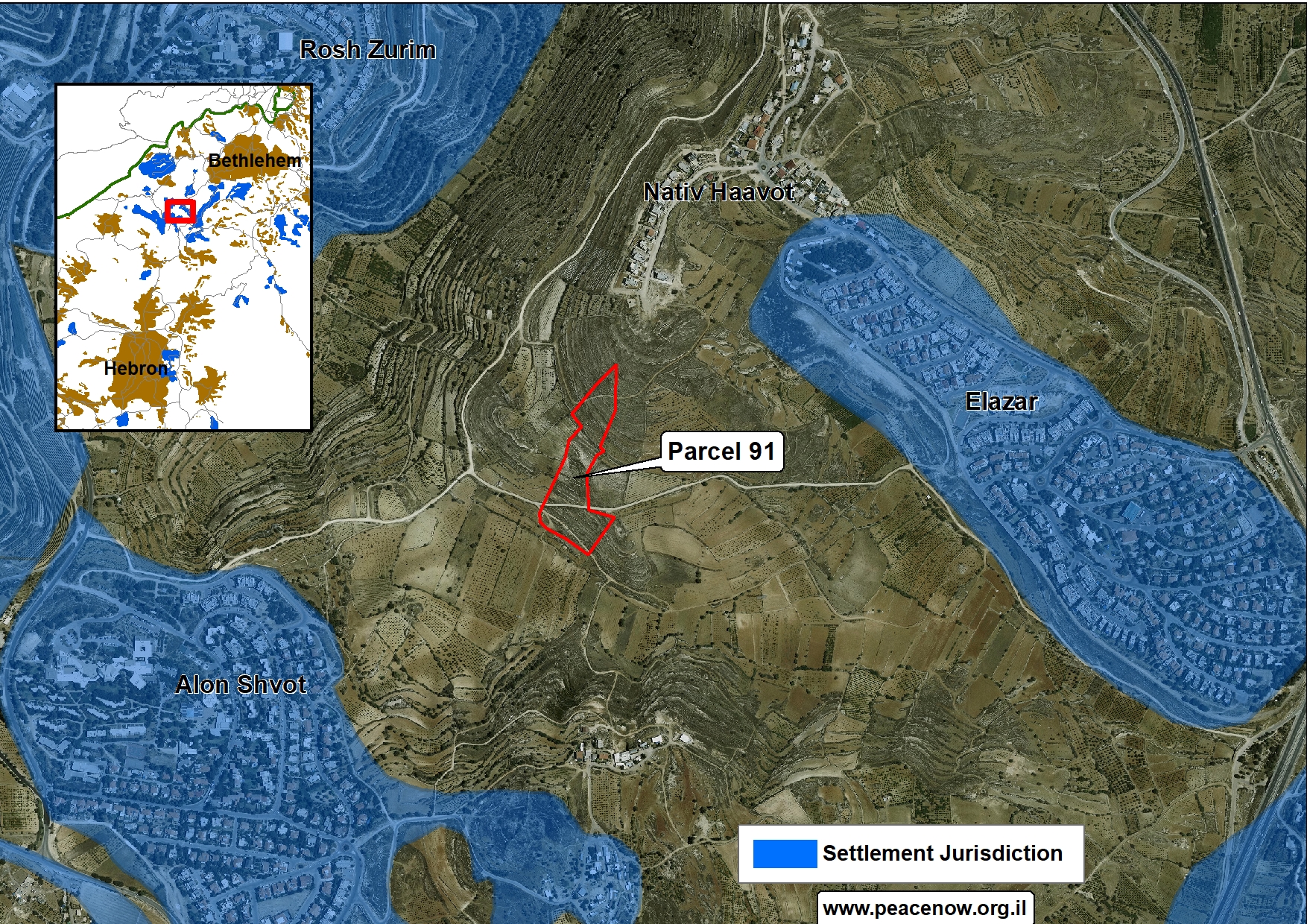
Map by Peace Now
As noted above, the High Planning Council this week approved the validation of a plan to establish a new settlement site to “temporarily” house residents of the Netiv Ha’avot outpost who are facing a court-ordered eviction from Netiv Ha’avot because the outpost was built without permits, and sits partially on private Palestinian land.
- The plan moved ahead after Israeli authorities dismissed an objection brought by Peace Now and Palestinian residents of the village of Al-Khader, whose land the plan affects.
- According to the approved plan, Israel will place 15 mobile homes at the selected site — connected to Israeli water, power, sewage, roads, and other infrastructure — located near, but not within, the borders of the Alon Shvut settlement.
- When the High Planning Council initially approved the advancement of this plan in October 2017, it noted that “the plan is improper, but we will have to approve it as a temporary solution.” At the time, the Council ordered the government to go about expanding the borders of the Alon Shvut settlement to include the land.
- Because the mobile homes will be put on land that is outside of any settlement border, the plan in effect creates a new outpost.
- Under the approved plan, the new homes will be allowed to stay in that location for three years. However, based on past practice, it can be expected that within that time, or at the end of those three years, the site will “regulated” by Israel to become a permanent area of Israeli settlement.
FMEP has covered the many unfolding storylines in the Netiv Ha’avot drama repeatedly and in detail, but as a reminder: in 2016 the Israeli High Court of Justice ordered the demolition of the Netiv Ha’avot outpost. As of now, 15 structures in the outpost are scheduled to be demolished next month, though efforts are still ongoing to save the structures from complete demolition. High ranking officials in the Israeli government, including Yesh Atid’s leader Yair Lapid, have supported the outposts campaign not only to save the 15 structures but to retroactively legalize the entire outpost. If the latter campaign succeeds, it will mean that the newly approved mobile home site will be available for additional settlers to inhabit for at least three years.
De Facto Annexation: Israel Extend Domestic Law to Settlement Colleges & Universities
The Knesset this week passed a bill that extends the state’s jurisdiction outside of its borders, bringing colleges and universities in settlements under the authority of the Israeli Council for Higher Education, among other things paving the way for establishment of a medical school funded by US settlement backer (and key Netanyahu and Trump supporter) Sheldon Adelson. FMEP previously reported on this bill and its implications on Feb. 1, 2018 when it passed first reading in the Knesset (a signal that the ruling coalition had approved its passage). Though limited in its direct impact, the bill’s authors and supporters have effectively created the rhetorical and legislative space in which the extraterritorial application of Israeli law is no longer questioned, nor is the ultimate end goal of annexing as much West Bank land as possible.
Unsurprisingly, the Trump Administration offered no criticism of the move.
Making clear the underlying goal of the initiative, Environmental Protection Minister Ze’ev Elkin (Likud) said:
“From the application of sovereignty on Ariel University [let us proceed] to the application of sovereignty on Jewish communities in Judea and Samaria!”
Similarly, a leader of the Yesha Council (the umbrella organization representing Israeli settlements), Shiloh Adler, said:
“Just as there is no reason why Ariel University should be managed by a different council for higher education, we hope that the Jewish communities in Judea, Samaria and the Jordan Valley will soon be placed under Israeli sovereignty just like all other Jewish communities in the State of Israel”
PLO Spokeswoman Hanan Ashrawi responded with a statement saying the bill:
“…represents another dangerous step in the annexation of the occupied West Bank…All settlements are illegal and constitute a war crime under the Rome Statute of the International Criminal Court and a direct violation of international law and conventions, including UNSC resolution 2334. Israel is thereby demonstrating its intent to prolong and consolidate its military occupation by working to ‘legalize’ the presence of extremist Jewish settlers, institutions and settlements in the occupied Palestinian territory.”
Bibi Blocks Settlement Annexation Bill, But Signals Something Bigger
Prime Minister Benjamin Netanyahu this week intervened to block a vote in the Israeli cabinet on whether to lend government support to a bill in the Knesset that seeks to extend Israeli domestic law to “areas of settlement in Judea and Samaria.” The bill is modelled on a resolution adopted in January, with Netanyahu’s support, by the Likud Central Committee. That resolution calling for the formal annexation of the settlements.
In explaining his decision to block the vote at a Likud faction meeting, Netanyahu pleaded with his party to hold off on settlement annexation while he coordinated the matter with the White House, stating that he has been in discussions with the Trump Administration about “applying sovereignty” to the settlements for “some time.” A White House spokesman for Jared Kushner (who officially leads the Trump Administration’s Israel-Palestine peace efforts) strongly denied that the U.S. had engaged in any discussions with Israel about plans to annex the West Bank. The statement did not weigh in on those plans, instead reaffirming the U.S. commitment to brokering peace. Reportedly, U.S. officials privately told the Israeli government to put out a correction of Netanyahu’s statement and a senior Israeli official later released a statement partially walking back Netanyahu’s claim, suggesting instead that Netanyahu has kept the U.S. informed about various proposals in the Knesset (there are several annexation proposals that have already passed and some that are still pending).
Ignoring the kerfuffle, several MKs called on Netanyahu to ignore U.S. statements and proceed with annexation.
Americans for Peace Now released a statement saying,
“The Trump Administration must be unequivocal in both its public statements and its private discussions with Israeli officials that the United States regards annexation as entirely unacceptable.”
J Street released a statement saying,
“It would be completely irresponsible for the Trump administration to contemplate endorsing unilateral annexation in any way. US officials should be strongly warning Israel that such a move would be unacceptable — not holding discussions that could give annexation the green light.”
Updates on Jerusalem Settlement Activity
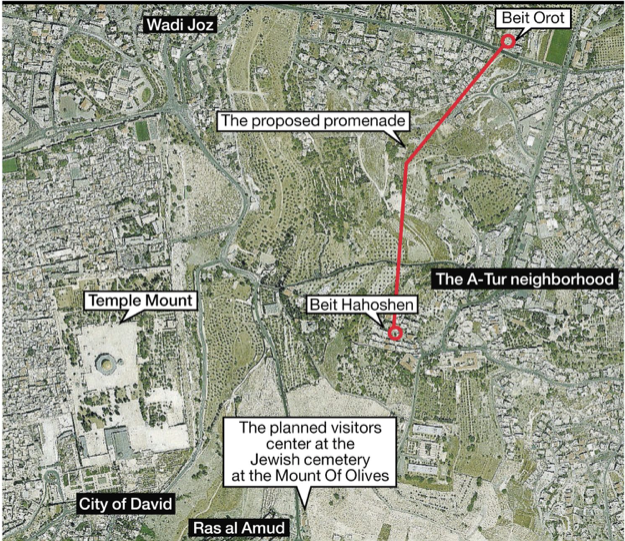
Ir Amim reports that the Jerusalem Local Planning and Building Committee met last week to privately discuss three plans for new East Jerusalem settlement projects, all on the Mount of Olives. The three plans were all drafted by the head architect of the Elad settler organization [learn more about Elad, here]. The meeting was an attempt to circumvent the standard planning process that governs construction projects in Jerusalem – a process which requires public hearings.
Map by Haaretz
Two of the plans relate to the proposal for a new promenade connecting two settlement enclaves (Beit Orot and Beith Hahoshen) located inside the Palestinian neighborhood of A-Tur, the construction of which will require the expropriation of private Palestinian land.
The third plan is for a visitors’ center (to be run by Elad) abutting the Mount of Olives Cemetery – a plan rumored to be moving forward in June 2017. At that time, Peace Now slammed the plan, saying:
“Dragged by settler organizations, the Israeli government is willing to go out of its way to approve this sensitive plan through a highly unusual procedure. In the current political context, to establish a visitor center next to a mosque and 300 meters away from Temple Mount/Al-Haram A-Sharif is to play with fire. A visitor center in this sensitive area could have far reaching implications on the future of the two state solution and the possibility for a compromise in Jerusalem.”
Ir Amim researcher Aviv Tatarsky told Haaretz:
“Over the past two years we have witnessed increased settlement activity under the guise of tourism and heritage initiatives around the Old City. The Old City and the neighborhoods around it are the home of 100,000 Palestinians…On one hand the authorities make it hard for residents to get building permits and deny them adequate services. On the other, they are advancing in dubious ways initiatives aimed at serving the settlement organizations in the eastern part of the city.”
Lara Friedman: Stop Parsing Trump’s ‘Word Salad’ on Settlements
In an interview with Adelson-financed Israeli daily newspaper Israel Hayom, President Trump said, “The settlements are something that very much complicates and always have complicated making peace, so I think Israel has to be very careful with the settlements.”
When asked about the significance of Trump’s criticism of settlements, FMEP President Lara Friedman said:
“He didn’t raise the issue of settlements, he was asked about it and gave a word salad response that implies nothing….There was nothing that indicated that there will be any pressure on Israel in response to the settlements. Since this administration came in, what they say has matched what their feet are doing. They are suggesting policies that are sympathetic to the Israeli right and far-right. There is nothing in [the interview] that contradicts their policy.”
Bonus Must-Reads
- [Op-ed] “Take a look around. This is what annexation looks like” (+972 Mag)
- [Op-ed] “No chance for peace while settlers dream of holy war” (Al-Monitor)
FMEP has long been a trusted resource on settlement-related issues, reflecting both the excellent work of our grantees on the ground and our own in-house expertise. FMEP’s focus on settlements derives from our commitment to achieving lasting Israeli-Palestinian peace, and our recognition of the fact that Israeli settlements – established for the explicit purpose of dispossessing Palestinians in the West Bank and East Jerusalem of land and resources, and depriving them of the very possibility of self-determination in their own state with borders based on the 1967 lines – are antithetical to that goal.
Welcome to FMEP’s Weekly Settlement Report, covering everything you need to know about Israeli settlement activity this week.
To receive this report via email, please click here.
February 1, 2018
- Minister to Vote on Havat Gilad Legalization this Weekend
- De Facto Annexation Proceeds: Bill Will Extend Israeli Sovereignty to Settlement Universities
- Israeli Army to Take Control Over East Jerusalem Neighborhoods Cut Off by the Barrier
- New West Bank Bypass Road Opens “New Era in Settlement”
- European Union Says Israel is Using Tourism to Legitimize Settlements
- Israeli Expansion Plan Threatens Flood Out (Literally) Palestinian Town
- Yesh Din Report Slams the Israeli Civil Administration
- Bonus Reads
Comments, questions, or suggestions? Email Kristin McCarthy at kmccarthy@fmep.org.
Ministers to Vote on Havat Gilad Legalization this Weekend
Prime Minister Netanyahu announced that the Israeli Cabinet will vote on a resolution declaring the government’s intention to retroactively legalize the Havat Gilad outpost at their next weekly Cabinet meeting, scheduled for February 3rd.
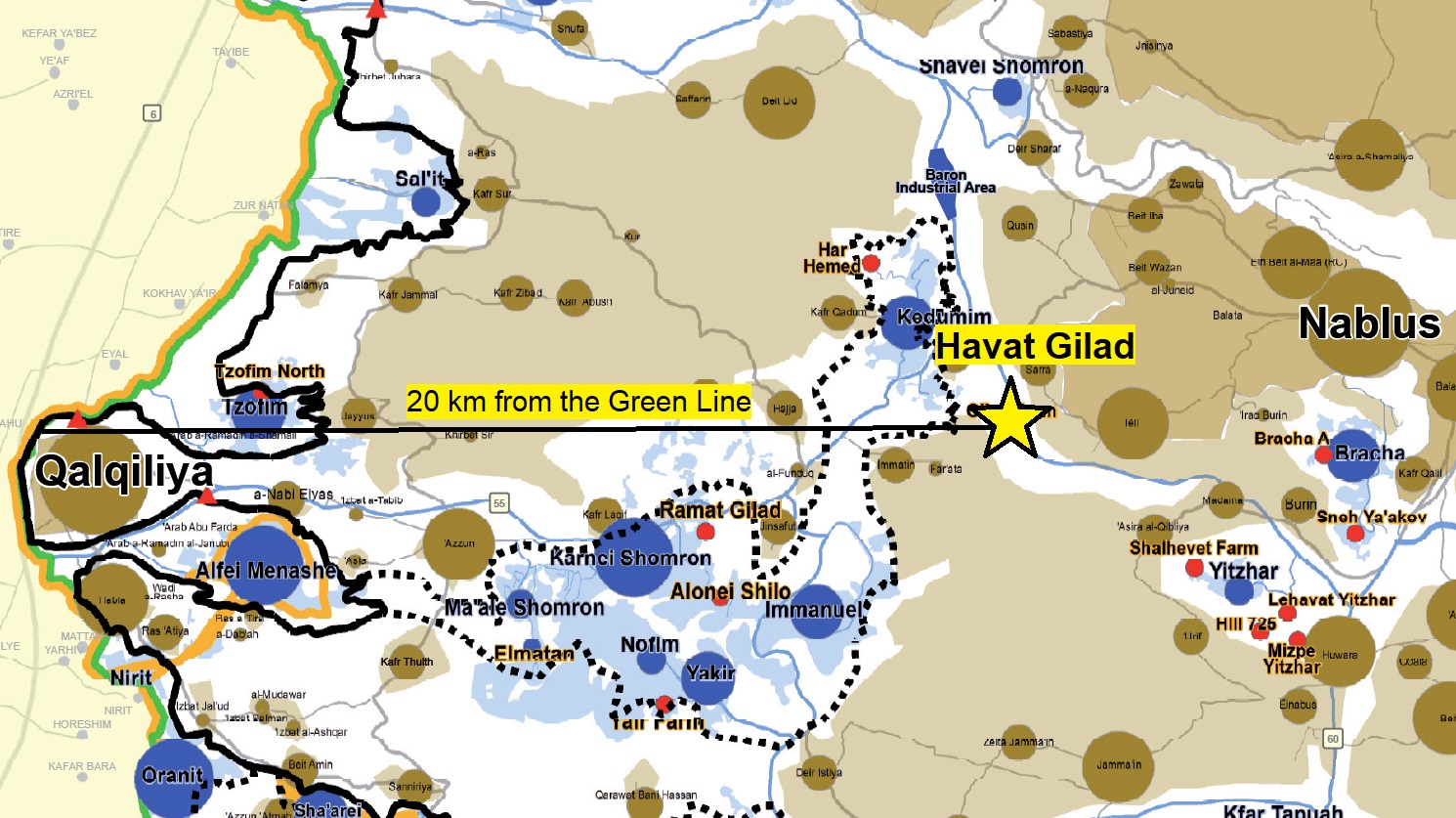
Map by Peace Now
At the last such meeting on January 28th, Netanyahu declined to put Havat Gilad on the agenda. He blasted a number of his own ministers who have criticized him in the press for the delay, which Netanyahu called “tactical.” Netanyahu’s Likud Party even issued a harsh statement in response to Defense Minister Liberman’s public statements, saying:
This is Bayit Yehudi’s [Jewish Home’s] well-known method once again at play – demanding the prime minister to do something they know he is going to do anyway, so they could later present it as their achievement. The bill will be raised next week, just as it was agreed with the bill’s sponsor, Defense Minister Lieberman.
The Jerusalem Post notes that this will be the fourth time since 2009 that Netanyahu’s government has retroactively legalized an outpost, the first three outposts being Bruchin, Rehalim, and Sansana. FMEP has previously reported on efforts by the Defense Ministry to retroactively legalize an additional 70 outposts, and FMEP has also covered the battle over the Netanyahu government’s “Regulation Law,” which was passed in early 2017 to pave the way for legalization of 55 unauthorized outposts and 4,000+ illegal settlement structures, by appropriating thousands of dunams of Palestinian private land.
Peace Now published a comprehensive case for why it would be a grave mistake for the government to legalize the Havat Gilad outpost. They write:
The legalization of the outpost would signal that the government does not intend to advance a final peace agreement, but rather only to extend Israel’s hold on the West Bank and to prevent the possibility of establishing a Palestinian state alongside an Israel with secure, internationally recognized borders. By working to authorize the outpost, the government is encouraging violations of the law, as well as sending a clear message to the settlers that such criminal acts pay off.
De Facto Annexation Proceeds: Bill Will Extend Israeli Sovereignty to Settlement Universities
On January 29, a bill to bring settlement universities under Israeli domestic law passed its first reading in the Knesset’s Education, Culture and Sport Committee. The bill aims to extend the authority of Israel’s Council of Higher Education to include schools located in settlement, which currently fall under a separate authority, as required by the norms of occupation. While Israeli policies are often extended to the settlements on an ad hoc basis through military orders issued by the Civil Administration, which is the arm of the IDF that is for all intents and purposes the sovereign ruler over the occupied territories, this bill capitalizes on the momentum created by a new Knesset policy that formalizes the process by which Israeli domestic law is extended over the settlements, in affect extending Israeli sovereignty over the West Bank and therefore annexing it.

Map by the New York Times
The authors of the policy have unabashedly stated that their goal is to annex the settlements, and even all of Area C, to Israel. One of the authors, MK Shuli Mualem Rafaeli (Jewish Home) said, “Alongside the academic importance of the law there is also a clear element of imposing sovereignty, and I am proud of both.”
The new bill is specifically connected to the opening of a state-of-the-art medical school in the Ariel settlement, funded in part by billionaire American financier Sheldon Adelson. As FMEP reported last June, Ariel University became an accredited Israeli university in 2012, following significant controversy and opposition, including from Israeli academics. It has since been the focus of additional controversy, linked to what is a clear Israeli-government-backed agenda of exploiting academia to normalize settlements. Ariel is located in the heart of the northern West Bank, reaching literally to the midpoint between the Green Line and the Jordan border. The future of Ariel has long been one of the greatest challenges to any possible peace agreement, since any plan to attach Ariel to Israel will cut the northern West Bank into pieces.
Israeli Army to Take Control Over East Jerusalem Neighborhoods Cut Off by the Barrier

Map by Haaretz
The Israeli army announced that it plans to take full security control over two East Jerusalem neighborhoods that have been walled out of the city of Jerusalem by the Israeli separation barrier. The move was justified by saying that there has been in increase in terror attacks carried out by Palestinians with Israeli identification cards (Palestinian residents of East Jerusalem carry Israeli ID cards).
Peace Now slammed the army’s move, noting:
The government insists that East Jerusalem should be part of Israel’s capital, yet it walls off 140,000 residents–1/2-2/3 of which are Israeli citizens–and brings in the army after the radicalization brought on in no small part by years of neglect and discrimination bear fruit. Once again the government has deceived the public by talking about “United Jerusalem” while practicing segregation
Until now, the the Israeli police department was the only permitted security presence in Shuafat refugee camp and Kafr Aqab, both of which are legally parts of Jerusalem, even though they were left on the West Bank side of the separation barrier. The Palestinian Authority is not allowed to operate in East Jerusalem (including these neighborhoods), which Israel annexed following the 1967 war. Israel’s isolation and systematic neglect of these East Jerusalem neighborhoods has come at an extraordinarily high cost for Palestinian residents.
New West Bank Bypass Road Opens “New Era in Settlement”
Israeli officials joined together for the opening of a new bypass road for Israeli settlers in the West Bank, the first major new bypass road opened in 20 years. And this is only the start: the road is the first of five new bypass roads that Netanyahu promised to build under pressure from settlers, who pushed the Prime Minister to expedite funds for projects the settlers claimed were needed for their security. The new Israeli-only road will link several settlements located deep inside the northern West Bank to cities inside Israel (i.e., within the Green Line), while bypassing Palestinian towns.
Prime Minister Netanyahu was clear about the importance of the road and what it means for the future of Israeli settlement construction. Netanyahu said,
Returning to our homeland – that’s what we’re doing here, in the heart of the Land of Israel … This is a festive day. It’s a festive day for Samaria, a festive day for the State of Israel.This bypass road is part of the system of bypass roads that we are building throughout Judea and Samaria that serves the residents of Judea and Samaria and the residents of the entire State of Israel
Not to be outdone, Yossi Dagan, the head of the Samaria Regional Council, a municipal body for settlements in the West Bank, put it even more bluntly saying that this is,
the beginning of a new era in settlement…It is impossible to overstate the importance of these bypass roads and the importance of transportation routes for settlement. They are the keys to the development of settlement.
At the ceremony, Deputy Defense Minister Eli Ben Dahan announced that the government will begin paving two more bypass roads in the coming weeks.
[2/2/2018 Update] Last year, B’Tselem documented Israeli construction of the bypass road Netanyahu christened this week. In order to build the road, Israel uprooted olive trees belonging to the Palestinian city of Qalqilya. Documenting the olive tree destruction, B’Tselem wrote in January 2017:
This work is being carried out as part of the decision made by the military and the Civil Administration to build a bypass road to replace the section of Route 55 that runs through a-Nabi Elyas. Route 55 originally served as the main link between Nablus and Qalqilya and was one of the major traffic arteries in the West Bank. Over time, as settlements expanded, it also became essential to settlers, as it connects several large settlements with Israel’s coastal plains and central region.
The decision to build the bypass road was first made in 1989, with the goal of sparing settlers the need to drive through the village of a-Nabi Elyas. However, it was not pursued until September 2013, when the Civil Administration planning institutions began the planning process. In October 2015, the project was expedited due to pressure by the settler leadership: According to Israeli media reports , Prime Minister Netanyahu promised the heads of the settlement local councils that the road would be built after they had set up a protest tent in October 2015, following the attack that killed Naama and Eitam Henkin.
On 21 December 2015, the head of the Civil Administration issued an expropriation order for 10.4 hectares of land earmarked for the bypass road. The order noted that the new road will “serve the public good” and improve mobility between Nablus and Qalqilya. In March 2016, the Palestinian village councils and landowners petitioned Israel’s High Court of Justice (HCJ) against the expropriation, on the grounds that the road will not serve all residents of the area but only settlers. On 16 November 2016, the HCJ denied the petition after accepting the state’s claim that the road is intended to serve the entire population of the area.
The seizure of the land and uprooting of olive trees have severely harmed the landowners, who have lost a source of income and a major financial asset, as well as an open space that served all local residents for leisure and recreational activities.
The state argued that the road is meant to serve Palestinians in the area, too, in order to comply with the provisions of international law, which allow the occupying power to expropriate land within the occupied area in two circumstances only. The first is a specific military need related to the occupied territory itself, and the second is promoting the wellbeing of the residents of the occupied territory.
European Union Says Israel is Using Tourism to Legitimize Settlements
In a leaked report, European Union officials said that Israeli archaeological and tourism projects in East Jerusalem are “a political tool to modify the historical narrative and to support, legitimacy and expand settlements.”
The Guardian, which saw the annual report written by the EU Heads of Mission in Jerusalem, lists settler-run excavation sites, the proposed cable car project (which FMEP has reported on repeatedly), and national parks in East Jerusalem as part of Israel’s mission to change facts on the ground.
The report covers activity of Israeli settler groups in Silwan (called the “City of David” by settlers and the Israeli government, both of which seek to assert exclusive Jewish heritage there). It is in this area that the Israeli government approved the Kedem Center, a huge tourism complex proposed by the settler group Elad, as the final stop of the Jerusalem cable car project. Silwan is home to 450 hardline settlers, guarded by government-funded private security, living amongst 10,000 Palestinians. The Palestinian population of this area faces home demolitions, land and property seizures, evictions, intense settlement building, and devastating property damage resulting from massive underground excavation projects run by settler-aligned groups with the financing of the Israeli government.
Of the cable car project and the Silwan stop in particular, the report says:
Critics have described the project as turning the World Heritage site of Jerusalem into a commercial theme park while local Palestinian residents are absent from the narrative being promoted to the visitors
[2/2/2018 Update] Emek Shaveh, an Israeli NGO who has been raising concern about archeological settlement activity in Jerusalem since 2009, issued a statement elaborating on the extent of the threat posed by the type of activity the EU report highlights. They wrote,
Archaeological tourism projects are favored by the settlers as a means of winning the hearts of minds of the Israeli, Jewish and evangelical publics. The EU now recognizes how archaeological sites in East Jerusalem are being used as a political tool to “modify the historical narrative and to support, legitimise and expand settlements”. The City of David in Silwan, the new cable car project, the national parks in Palestinian neighborhoods compliment evictions and house demolitions in marginalising and disenfranchising the East Jerusalem Palestinian public. The difference between “cultural projects” such as the national parks or the City of David and house demolitions is that in addition to the physical displacement, the former also expropriate the narrative, dispossessing the Palestinians from their historical and cultural contexts. When it comes to Jerusalem, narrative is not an abstract issue because in Jerusalem history and questions of present-day sovereignty are intertwined. And when it will come to determining the final status of the city, the question of who “owns” the history of the city will be crucial.
Israeli Expansion Plan Threatens Flood Out (Literally) Palestinian Town
Palestinian residents of Wadi Foquin, a West Bank village located in a valley along the 1967 Green Line, west of Bethlehem, are chronicling how nearby construction in Israel has resulted in unprecedented flooding and the severe depletion of their 11 historic natural springs.
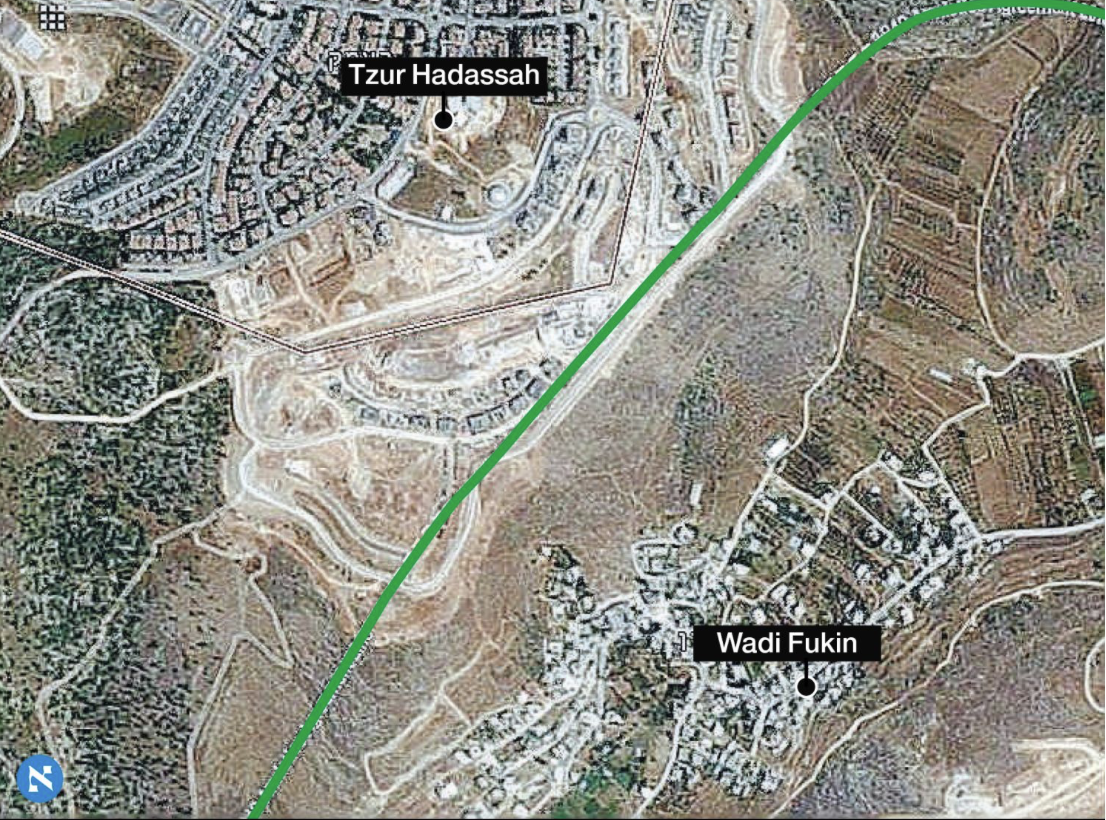
Map by Haaretz
A victim of its location on the Green Line and its lush lands, Wadi Foquin sits between the Israeli city Tzur Haddassah to its west and the ever-growing mega-settlement pf Beitar Illit, to its east. Last year, the Israeli government approved an expansion plan for Tzur Hadassah that extends the city past the Green Line into the West Bank, as reported by the Israeli settlement watchdog Kerem Navot. Wadi Foquin residents say Tzur Hadassah and Beitar Illit, both of which look down on the valley town, have already created something akin to concrete water slides, shooting rainwater straight into Wadi Foquin and flooding their homes, streets, and businesses, while also preventing the water from replenishing the springs. The expansion is only making matters worse. The Israeli government, for its part, claims that all the proper and required ecological studies have been completed and the plan passes muster and will move forward.
Yesh Din Report Slams the Israeli Civil Administration
The Israeli NGO Yesh Din released a new report, “Through the Lense of Israel’s Interests: The Civil Administration’s Role in the West Bank.” The report is an in-depth look at the main functions of the Civil Administration, the arm of the Israeli military which is the de facto sovereign in the West Bank. The Civil Administration regulates virtually every aspect of Palestinian life, including travel permits, roads, land, resource extraction, archeology, and of course settlement-related issues. The report examines the role of the Civil Administration and the ways in which its authorities have become a “means of oppression and domination over Palestinians.”
Yesh Din concludes:
The Civil Administration, established to serve “the welfare and benefit of the population” and “for the purpose of operating and providing public services”, betrays its professed role. Instead of ensuring public order and safety in a temporary trusteeship, as required by international law, the Civil Administration uses administrative tools to effect long-term, irreversible changes in the OPT and to impose restrictions and bans on the protected persons, in a severe, systemic and widespread abuse of the human rights of Palestinians in the West Bank.
Bonus Reads
- “More than 200 companies have Israeli settlement ties: U.N.” (Reuters)
- INFOGRAPHIC “50 Years of Occupation: The Security Burden Continues” (Peace Now)
- “After Netanyahu Summons Ambassador, Irish Senate Postpones Debate on Bill Blocking Israeli Settlement Goods” (Haaretz)
- “Ireland to vote on settlement trade sanctions bill” (+972 Magazine)
FMEP has long been a trusted resource on settlement-related issues, reflecting both the excellent work of our grantees on the ground and our own in-house expertise. FMEP’s focus on settlements derives from our commitment to achieving lasting Israeli-Palestinian peace, and our recognition of the fact that Israeli settlements – established for the explicit purpose of dispossessing Palestinians in the West Bank and East Jerusalem of land and resources, and depriving them of the very possibility of self-determination in their own state with borders based on the 1967 lines – are antithetical to that goal.
Welcome to FMEP’s Weekly Settlement Report, covering everything you need to know about Israeli settlement activity this week.
To receive this report via email, please click here.
- “Disappointment” So Far for Settlers in the Trump-Bibi Era, But…
- Sheikh Jarrah Project Recommended for Deposit for Public Review
- Long Delayed “Apartheid Road” Possibly Moving
- Beit El Housing to Advance After a Settlers Throw a Tantrum
- Bibi Vows that Israel will Keep Ariel
- Efrat and “How the Borders of Settlements Expand While No One is Watching”
- Yitzhar & Its “Hilltop Youth” Continue to Terrorize Nablus Area
- Bonus Reads
For questions and comments please contact FMEP’s Director of Policy & Operations, Kristin McCarthy (kmccarthy@fmep.org).
“Disappointment” So Far for Settlers in the Trump-Bibi Era, But…
Israeli Minister of Education Naftali Bennett – and staunch settlement advocate – expressed disappointment with the lack of settlement growth since Donald Trump assumed office. Bennett said, “Unfortunately from our perspective, he [Trump] is sort of going down the same unsuccessful path that his predecessors did…So yes, there is disappointment out there.” When Trump was elected, many settlers hoped that his administration would allow some, if not all, of the most problematic settlement plans to proceed. That includes several projects that, if built, would destroy the possibility of contiguous Palestinian state (Givat Hamatos, E1, etc). These projects have not moved forward…yet.
But Mr. Bennett need not be too disappointed. In fact, there has been a sharp rise in the number of settlement units and plans advanced and in construction so far in the Trump-Bibi settlement era, as detailed extensively by Peace Now and covered by FMEP in last week’s Settlement Round Up.
There are also new alarming developments this week that suggest the floodgates might be beginning to open….
Sheikh Jarrah Project Recommended for Deposit for Public Review
Ir Amim reports that plans for a 6-story Israeli commercial building at the entrance of the Palestinian East Jerusalem neighborhood of Sheikh Jarrah have been recommended for deposit for public review. The land designated for this project is adjacent to a plot designated for settlers to build a religious school and dormitories, known as the Glassman Campus project.
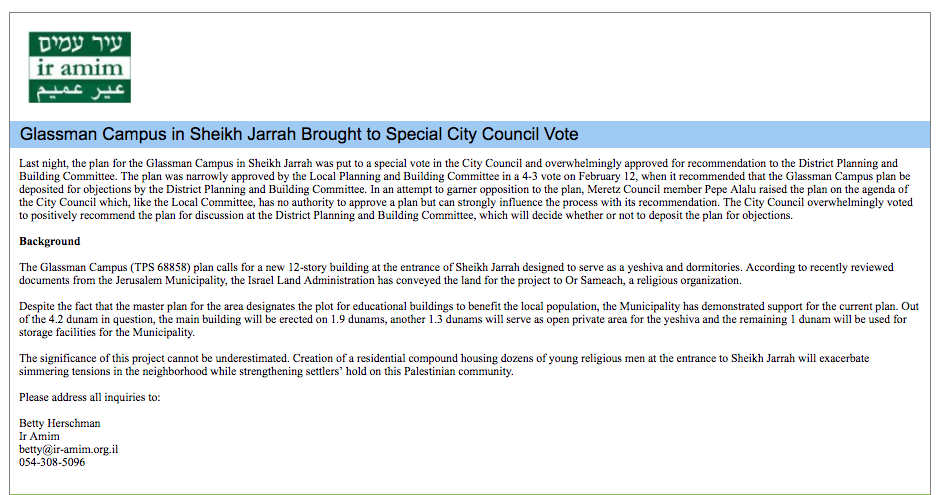

Map by Ir Amim
Located just north of Jerusalem’s Old City, Sheikh Jarrah has endured years of aggressive settlement activity by radical settlers, employing various means, including Israel’s court system to strip Palestinians of their ownership rights. Sheikh Jarrah’s plight was featured in a 2013 film by Just Vision, “My Neighborhood.” Just Vision also produced “Home Front,” a series of video interviews with the Palestinian residents and Israeli activists fighting together against settlement expansion in Sheikh Jarrah. For more on Sheikh Jarrah and the protest it sparked, 972+ Magazine has a compilation of resources online here.
Depositing settlement plans for public review is a significant step in the East Jerusalem planning process; it sends a signal that the political echelon may no longer be blocking the advancement of projects in the Jerusalem area that have been considered to be especially inflammatory to Palestinians and Muslims, and detrimental to peace negotiations. This could be an early sign of the opening floodgates.
Long Delayed “Apartheid Road” Possibly Moving
Ir Amim reports that a budget has been approved for construction of the northern part of the Jerusalem “Eastern Ring Road,” following years of delays and protests. If constructed according to existing plans, the northern section of the Eastern Ring Road will have separate lanes for Israeli settlers and Palestinians, with a physical barrier dividing the two. It will not allow the Palestinian lanes to access East Jerusalem. As noted in Haaretz, “This is the only highway in the West Bank that will have a separation wall running right down the middle. For that reason, the plan’s opponents are already dubbing it ‘Apartheid Road.’” Adalah, a legal group for minority rights in Israel, previously filed a petition to block the road’s construction.
Ir Amim notes that this is one of several projects that prepares the way for building in the E-1 area. E-1, as Jerusalem expert Danny Seidemann has long explained, is a “doomsday” project; if implemented, an E-1 settlement will end the possibility of a contiguous Palestinian state and completely sever East Jerusalem from the rest of the West Bank. The “Eastern Ring Road” seeks to “solve” one of these problems – by providing the Palestinians with “transportational contiguity” between the northern and southern West Bank – even as it would cement the cutting off of East Jerusalem from the West Bank.
Beit El Housing to Advance After Settlers Throw a Tantrum
Late last week, Netanyahu said he will approve the construction of 300 housing units in the Beit El settlement by September. The announcement came after a very public (and embarrassing) series of confrontations with members of his own political party as well as settlers. The leaders of the Beit El settlement threatened to petition the High Court over the issue, and staged a demonstration in front of the Prime Minister’s office to issue the threat. Beit El’s leaders replayed footage of Netanyahu promising to build the units in 2012, after several structures were taken down because they were built on land recognized even by Israel as privately owned by Palestinians.
The Beit El spat erupted after the Jerusalem Post reported an alleged freeze brokered between Israel and the U.S. The report suggested that Israel agreed to stop publishing construction tenders (the final step in the planning process) for all settlements through the end of 2017. The Beit El units had reached that final phase of planning, but would ostensibly not move forward if the report was true.
Beit El has deep connections to the current U.S. Ambassador to Israel, David Friedman; Friedman ran a U.S. fundraising effort for Beit El before being appointed Ambassador.
Bibi Vows that Israel will Keep Ariel
 At the ground-breaking ceremony for a new medical school in “Ariel University,” Prime Minister Netanyahu vowed, “Ariel will always be part of the State of Israel.” Alongside Education Minister Naftali Bennett, the Prime Minister Netanyahu attended a ceremony dedicating the school to American casino magnate and settlement financier, Sheldon Adelson – who donated funding for the new facility.
As explained last week, the future of Ariel has long been one of the greatest challenges to any possible peace agreement, since any plan to attach Ariel to Israel will cut the northern West Bank into pieces.
Efrat and “How the Borders of Settlements Expand While No One is Watching”
Three structures in the settlement of Efrat were found to have been built outside the border of the settlement’s jurisdiction. Dror Etkes (founder of Kerem Navot, a settlement watch group) petitioned Israel’s Civil Administration (the arm of the Israeli military that is effectively the sovereign authority in the West Bank, and therefore has authority over all construction ithere) over the buildings. This week the Civil Administration confirmed that the buildings were built without permits, had stop-work orders issued against them at the time, and might potentially be built on land recognized by Israel as privately owned by Palestinians. There are no reports of demolition orders against the illegal structures.
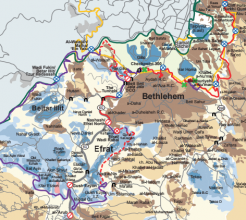
Map by B’Tselem
Located south of Bethlehem and west of the route of the separation barrier, Efrat poses many of the same challenges to a peace agreement as Ariel (discussed above). Connecting it to Israel means cutting deep into the West Bank, severing the route of Highway 60 between Jerusalem/Bethlehem and the southern West Bank, and contributing to the near total isolation of Bethlehem.
Yitzhar & Its “Hilltop Youth” Continue to Terrorize Nablus Area
Recent arrests of Yitzhar settlers have not deterred the terror coming from Yitzhar and/or its Hilltop Youth, with this week’s target being the Palestinian village of Burin. On Sunday, Rabbis for Human Rights documented 45 olive trees in Burin that were destroyed and spray painted with the words “revenge.” The suspected hate crime was precipitated by a violent clash between Yitzhar settlers and the Israeli army during the razing of an illegal structure in the settlement. On Wednesday, settlers from Yitzhar set fire to an olive grove – burning over 400 trees – according to the Israeli Army. Video of the incident shows masked settlers clashing with Israeli soldiers.
This week’s violence follows a warning to Yitzhar’s leaders from the Shin Bet earlier this month to keep the “Hilltop Youth” who call Yitzhar their home under control. In response, Yitzhar’s governing body has taken several actions, including forcing the youth to sign a code of conduct under threat of expulsion. But the code of conduct did not stop one Hilltop Youth religious leader and teacher at a yeshiva in Yitzhar – Rabbi Yitzchak Ginsburg – from urging his students to “cause a revolution” without getting caught because it is “a shame to waste time in prison.”
Israel’s Ynet news agency reports that the terror tactics of the Hilltop Youth are increasingly targeting Israeli security forces in the West Bank and Jerusalem. One Hilltop Youth whines, “all we want to do is sit on the hill. Just imagine how we feel each time a detective destroys our tent or confiscates our stuff. We have no peace and quiet.” And from a soldier’s perspective on his time serving in the Yitzhar area: “The scariest thing in the area was to clash with Jews. Give me an Arab terrorist and I’ll know how to deal with him. Give me a Jew who is throwing stones at me and I’ll simply flee.”
A lawyer with Yesh Din, an Israeli organization deeply involved in protecting the area from Yitzhar settlers, said “violence will not cease if there is no real deterrence, protection for Palestinians, a thorough investigation, prosecution of offenders and an imposition of significant penalties.” Though the Shin Bet has said it take the matter seriously, the violence continues. Yesh Din’s legal work documents the impunity with which settlers perpetrate crimes: A March 2017 report reveals only 8.2% of allegations of crimes committed by settlers in the West Bank result in indictments.
Bonus Reads
- “City on a Hilltop: American-Jewish Settlers“ w/ Dr. Sara Yael Hirschhorn, Ori Nir, and Lara Friedman (A podcast by Americans for Peace Now, June 25, 2017).
- Settlements: The Real Story, by Gershom Gorenberg (The American Prospect, Summer 2017)
Welcome to FMEP’s Weekly Settlement Report, covering everything you need to know about Israeli settlement activity this week.
To receive this report via email, please click here.
June 23, 2017
- Coordination? Test #1: Kushner & Greenblatt Arrive as Construction Begins on New Settlement of “Amichai”
- Coordination? Test #2: Bibi Reportedly Ok’s 5,000 East Jerusalem Units After Blocking Them for Years
- Coordination? Test #3: 70% Rise in Settlement Construction Starts Over Past Year
- Ariel University – Located in the settlement of Ariel – Set to Double in Size
- Cleared from Baladim Outpost, “Hilltop Youth” Radicals Stir More Trouble in Yitzhar
- Bonus Reads
For questions and comments please contact FMEP’s Director of Policy & Operations, Kristin McCarthy (kmccarthy@fmep.org).
Coordination? Test #1: Kushner & Greenblatt Arrive as Construction Begins on New Settlement of Amichai
Israeli Defense Minister Avigdor Liberman raised eyebrows late last week with a wide-ranging English language interview with the Times of Israel. When asked if Israel is “coordinating its [settlement] building starts with the United States,” Liberman casually responded, “of course.” Though headlines ran with his confirmation of coordination, it should be noted that when Liberman was pushed to give a more concrete picture of what that coordination entails, he said that Israel and the U.S. do not coordinate on “every 10 houses” but that the U.S. generally respects Israel’s approach and vision for “Jewish settlements in Judea and Samaria.”
That respect was put to the test this week as President Trump’s chief Middle East envoys – Jared Kushner and Jason Greenblatt – visited Israel and Palestine to “to continue the discussion about the possibility of peace.” Kushner’s arrival coincided with the commencement of construction of the first official new settlement in 25 years; the coincidence maintained a long tradition of greeting U.S. envoys with new settlement construction, dating back to the early 1990s and the era of Secretary of State James Baker, whose every visit to Israel was seemingly marked by the establishment of expansion of new settlements.
The Trump administration indicated it won’t object to this new settlement, sometimes referred to as the “Amona exception” (i.e., the rule is still that Israel doesn’t establish new settlements, but Amichai is a one-time exception, as a pay-off to settlers who illegally established the Amona outpost on privately owned Palestinian land and were forcibly evacuated earlier this year). But the timing, which may be entirely coincidental, is nonetheless politically provocative. While Kushner was en route, the State Department reiterated the only policy it has communicated publicly on the issue, saying “unrestrained settlement activity is not helpful to the peace process.” The Palestinian Authority also issued a statement on the timing of the new settlement’s ground-breaking, saying that it shows “Israel is not interested in the U.S. efforts, and is serious about thwarting them as it has with previous U.S. administrations.”
On June 22nd, the Israeli NGO Yesh Din filed a petition, together with residents of the Palestinian village of Jalud, to Israel’s High Court of Justice (equivalent to the U.S. Supreme Court) challenging the establishment of the new settlement of Amichai and demanding transparency in the process of demarcating land for settlement. According to the petition, the jurisdiction granted to the new settlement includes enclaves of privately-owned Palestinian land.
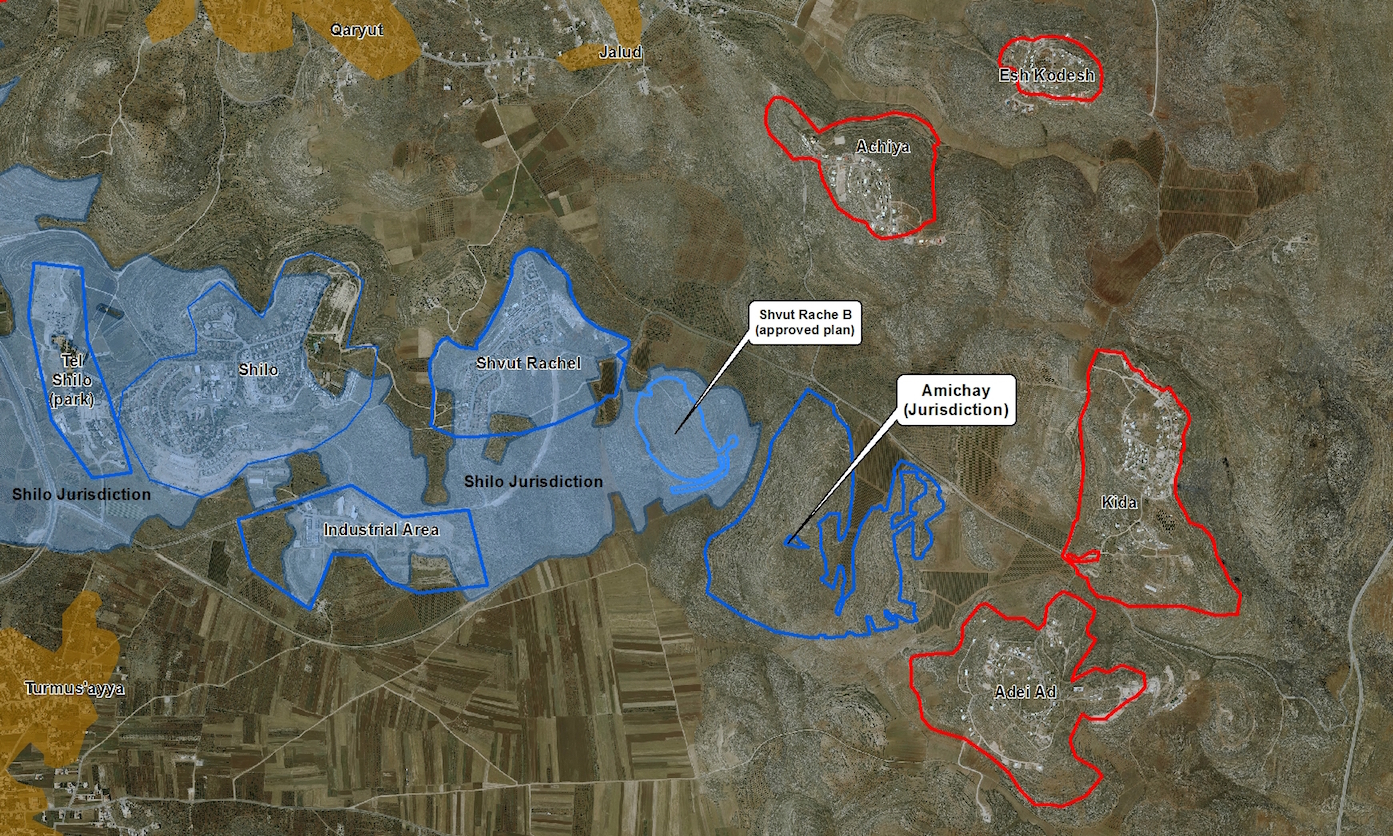 But Amichai isn’t the only construction happening near Jalud. Palestinian officials have reported that construction work has also begun on Shvut Rachel East, a new “neighborhood” of the Shilo settlement (in fact, not a neighborhood but rather a new settlement, as explained by Peace Now). Shvut Rachel East was the original Amona pay-off plan, but Amona evacuees held out for a different plan on a different hilltop – and they got it with the approval of Amichai, to be built literally adjacent to Shvut Rachel East. But what the world might have assumed would be a choice of “this site or that site” became, instead, a jackpot for settlers of “this site AND that site,” and the Shvut Rachel East neighborhood plan was also approved. Meaning that rather than paying a price for breaking the law (and then resisting evacuation), the government rewarded Amona settlers with not one but two new settlements – both located deep inside the West Bank, in an area that Israel could not possibly retain in any land swap agreement, and, both at the expense of Palestinians residing in the area around the settlement of Shilo. And meaning that the government of Israel is, through this policy, continuing to actively incite and incentivize settler law-breaking.
Coordination? Test #2: Bibi Reportedly Ok’s 5,000 East Jerusalem Units After Blocking Them for Years
On June 21st – the very day Trump envoy Jared Kushner arrived in Israel and was meeting with Netanyahu – news broke that Netanyahu was lifting his alleged hold on plans for the construction of 5,000 of new settlement units in East Jerusalem. This news comes on the heels of a June 19th report by Israel’s Army Radio that it had seen secret government documents showing that Prime Minister Netanyahu had imposed a building freeze in East Jerusalem settlements over the past few years. The documents – which were not released by Army Radio – allegedly identify specific projects totalling 6,000 units in Gilo, Pisgat Zeev, and Har Homa, that Netanyahu reportedly froze under intense pressure from the Obama administration. The 5,000 units for which Netanyahu has now reportedly given a green light are part of these 6,000 units, although there are few additional details thus far. Jerusalem Online suggests that some of the units are part of plans that were previously but have expired and need re-approval, and that the Jerusalem local planning committee will convene in short order to re-approve these plans.
It’s worth revisiting the dangerous East Jerusalem construction roller coaster ride of 2017. In January, Netanyahu announced, “I’ve decided to remove the political limitations on construction in East Jerusalem.” The worst was feared, including implementation of Givat Hamatos and/or E1, either of which would have devastating impact on the viability of the two-state solution. Nothing happened until April when rumors frantically swirled suggesting Netanyahu was planning a 15,000-unit construction surge in East Jerusalem. The formal announcement was expected to coincide with Jerusalem Day – and President Trump’s first visit – in May, but nothing was announced. A short time later, on June 6th, the Civil Administration’s High Planning Council advanced 603 units for the massive settlement of Maale Adumim, located just across the Green Line on the northeast border of East Jerusalem.
Coordination? Test #3: 70% Rise in Settlement Construction Starts Over Past Year
Ariel University – Located in the settlement of Ariel – Set to Double in Size
Israeli Education Minister Naftali Bennett presented a plan to the Knesset that will double the size of “Ariel University,” an Israeli institution of higher education located in the settlement of Ariel settlement. The centerpiece of Bennett’s plan, which will be implemented over the next five years, is a medical center to be named for Sheldon Adelson, who is a major American settlement financier. Adelson is said to be contributing $20 million to the medical school, making good on a commitment made in 2014. The plans still need to secure addition approvals before proceeding.
Ariel is located in the heart of the northern West Bank, reaching literally to the midpoint between the Green Line and the Jordan border. The future of Ariel has long been one of the greatest challenges to any possible peace agreement, since any plan to attach Ariel to Israel will cut the northern West Bank into pieces. Ariel University became an accredited Israeli university in 2012, following significant controversy and opposition, including from Israeli academics. It has since been the focus of additional controversy, linked to what is a clear Israeli-government-backed agenda of exploiting academia to normalize settlements.
Cleared from Baladim Outpost, “Hilltop Youth” Radicals Stir More Trouble in Yitzhar
Earlier this month, the IDF evacuated dozens of radical Israeli settlers from the illegal “Baladim” outpost in the Jordan Valley. Baladim was the most notorious and established outpost in the region, a frequent source of terror for Palestinians and the Israeli army alike. The radical “Hilltop Youth” that camp-out in Baladim have been evacuated dozens of times before, but each time the they return to live illegally in the area.
According to a Haartez report, this time the IDF approached the leaders of the radical settlement of Yitzhar – from which many of Baladim radicals hail – before the outpost’s evacuation. The IDF reportedly warn them about the likely influx of Hilltop Youth to Yitzhar following the evacuation.
The interplay between Yitzhar and the Hilltop Youth is one to watch, particularly after an attack this week on Israeli Army vehicles at Yitzhar’s gate. The settlement’s leaders are claiming that the Hilltop Youth are responsible for perpetrating the attack. Haaretz writes, “Yitzhar is considered an ideological focal point of the radical settler right, yet a large number of residents who spoke to Haaretz condemned the recent stone throwing and the extremist ideology of the Baladim settlers.” Shin Bet officials reportedly met with Yitzhar leaders this week to push them to do more to “calm” the young, violent, and extremely problematic radicals. Yitzhar settlers might be trying to distance themselves from the Baladim (which is problematic given that the Hilltop Youth who have fought for Baladim are from Yitzhar), as the Shin Bet has been more aggressively moving against members of the “Hilltop Youth”, which we covered in last week’s settlement report.
Bonus Reads
- “Who Are You Calling a Settler? Meet the young Israelis living in the West Bank” (Haaretz)
- “Settlement tours: a new frontline in Israel’s ideological conflict” (Reuters)
- “Americans disproportionately leading the charge in settling the West Bank” (Haaretz)
FMEP has long been a trusted resource on settlement-related issues, reflecting both the excellent work of our grantees on the ground and our own in-house expertise. FMEP’s focus on settlements derives from our commitment to achieving lasting Israeli-Palestinian peace, and our recognition of the fact that Israeli settlements – established for the explicit purpose of dispossessing Palestinians in the West Bank and East Jerusalem of land and resources, and depriving them of the very possibility of self-determination in their own state with borders based on the 1967 lines – are antithetical to that goal.
Welcome to FMEP’s Weekly Settlement Report, covering everything you need to know about Israeli settlement activity this week.
To receive this report via email, please subscribe here.
June 9, 2017
- A New Settlement and Thousands of New Units Approved
- Bibi Abandons Talk of ‘Restraint’, Abbas Abandons Demand for ‘Freeze’
- No Statement [or Outreach] from U.S. State Department
- New Settlement Plans in the Works
- The New Norm: Blatant Walk Towards Annexation
For questions and comments please contact FMEP’s Director of Policy & Operations, Kristin McCarthy (kmccarthy@fmep.org).
A New Settlement and Thousands of New Units Approved
During the highly anticipated meeting this week, Israel’s High Planning Council approved the advancement of plans for nearly 3,000 new settlement units. The Jerusalem Post, Reuters, and Times of Israel reported the following details:
- The brand-new settlement of “Amichai”: The Council approved for deposit for public review (one of the last steps before final approval/implementation) plans for 102 homes in “Amichai,” which will be the first entirely new Israeli settlement established in the occupied West Bank in the past two decades. This new settlement, it should be recalled, is a pay-off for settlers who previously broke Israel law and built illegally elsewhere in the West Bank (Amona). When the government could find no possible way to legalize that illegal construction it removed the settlers but promised to (more than) compensate them with new “legal” homes elsewhere in the West Bank.
- Kerem Reim: The Council granted retroactive approval (by advancing for validation) to 255 units built illegally in the West Bank outpost of “Kerem Reim.” In effect, this maneuver legalizes the illegal outpost in the eyes of Israel law (it remains illegal under international law).
- Ariel: The Council approved plans for 839 new units.
- Ma’aleh Adumim: The Council advanced plans for 603 new units.
- Beit El: The Council approved the advancement of plans for 200 new units.
Bibi Abandons Talk of ‘Restraint’, Abbas Abandons Demand for ‘Freeze’
In addition to the approvals issued by the High Planning Council, several political statements made this week suggest that that status quo on settlements has changed for Israel and for the Palestinian Authority. On the Israeli side, these statements come amidst enormous pressure and disappointment (real or pretended) with the number of settlement plans Netanyahu allowed the High Planning Council to consider earlier in the week.
On June 5th, the Jerusalem Post quoted an anonymous source close to Prime Minister Netanyahu declaring the PM is not restricting settlement to the so-called “settlement blocs,” which was a policy position that was reportedly agreed upon by Bibi and President Trump in March.
On June 6th, Netanyahu, in a speech he delivered at celebration of the 50th anniversary of the 1967 Six Day War (when Israeli began its military occupation of Gaza and the West Bank), said, “No one will be uprooted from their home, I’m doing everything to protect the settlement enterprise…We decided to build in all parts of Judea and Samaria and we are building both inside and outside the settlements.”
On June 7th, Netanyahu met privately with several disgruntled settlement leaders about the state of settlement construction. Following the meeting, the settlers indicated no three are no immediate, concrete outcomes resulting form the “positive” meeting, but they expressed hope there would be soon.
On June 8th, Bloomberg News reported that Palestinian President Mahmoud Abbas is no longer demanding a settlement freeze as a precondition for resuming peace negotiations. A top Abbas advisor told Bloomberg, “we have not made the settlements an up-front issue this time.” This came after Netanyahu’s speech promising permanent settlement construction across all of the occupied territories, and after the High Planning Committee’s approval of the new Amichai on occupied territory (among other things).
No Statement [or Outreach] from U.S. State Department
Yesterday, U.S. Department of State Spokeswoman Heather Nauert made the following statement regarding the new settlement announcements:
We are aware of the announcement that the [Israeli] government made about 2,500 units in the West Bank. President Trump has talked about this consistently, and he has said, in his opinion, unrestrained settlement activity does not help advance the peace process. He’s been pretty clear about that. It doesn’t help the prospect for peace. That is something that the Israeli-Palestinian peace process is important to this administration, and they will keep promoting that.
Ms. Nauert said she is “not sure” if the administration will be releasing an official statement on the settlements (as has been customary following past settlement announcements) and she is “not aware of any diplomatic conversations” between the U.S. and Palestinian President Mahmoud Abbas regarding the report that he is willing to drop a total settlement freeze as a precondition for resuming talks.
New Settlement Plans in the Works
The settlers’ leadership body, known as the Yesha Council, presented plans for 67,000 more settlement units to the Knesset’s Interior Committee. A report commissioned by the Yesha Council found that there is “vacant” land between the Karnei Shomron and Ariel settlements able to hold 67,000 units for 340,000 settlers, which is what was subsequently proposed to the Knesset. 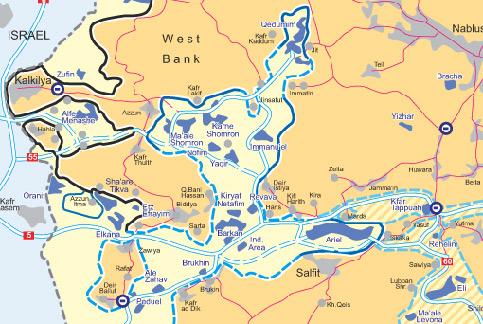 Settlement construction in the area would fortify the territorial linkage between Ariel – a settlement that extends so deep into the West Bank that in no circumstance could it be annexed by Israel if Palestinians are to have a contiguous state – and settlements located closer to the separation barrier and 1967 Green Line. It would further sever Palestinian communities from their land, resources, and important transportation routes to Nablus, Ramallah, and beyond.
The New Norm: Blatant Walk Towards Annexation
Israeli Justice Minister Ayelet Shaked issued a directive this week requiring all new Israeli laws to explicitly state whether or not they apply to Israeli settlements – and requiring those that do not apply to settlements to explain why. In effect, Shaked’s directive makes it a default position to apply Israel law inside the settlements, in contrast to the past 50 years of practice. (Israeli settlers enjoy the full rights and protections of Israeli law; the settlements, which are located in areas over which Israel has not formally extended its sovereignty, operate under Israeli military law). This is a significant move towards outright annexation of the settlements; and some of Shaked’s supporters are not shy about saying so. The Times of Israel quotes Jewish Home MK Shuli Moallem-Refaeli saying she “had ‘no desire to conceal’ the government’s intention to annex the West Bank. She added that the process must not be done in a ‘backdoor’ fashion, but rather openly.”
U.S. Ambassador to the United Nations Nikki Haley is reportedly pushing to annul the anti-settlement UN Security Council Resolution 2334, which passed last December, with the Obama administration abstaining. The resolution condemns Israeli settlements, stating that they have no legal validity. The resolution was an important reiteration of the imperative to differentiate between Israel and settlements. Haley is in Israel this week, on the heels of a stern warning she gave the UN Human Rights Council that the U.S. would leave if “Agenda item 7” (which censures Israel for its human rights abuses in the occupied territories) is not removed from their upcoming schedule.
Welcome to FMEP’s Weekly Settlement Report, covering everything you need to know about Israeli settlement activity this week.
To receive this report via email, please subscribe here.
June 2, 2017
- High Planning Council Announces Agenda for June 7th Meeting
- Plans Advance (Again) for New Settlement for Amona Families
- This Week in Settlement-Related Violence
- Bonus Reads: Archives, Fragments, and a Biography
Contact Kristin McCarthy (kmccarthy@fmep.org) with questions and comments.
High Planning Council Announces June 7th Meeting
This morning (June 2), the Israeli High Planning Council announced the highly anticipated agenda for its June 7th meeting. According to the agenda, the committee will consider plans to advance thousands of new housing units in the West Bank (Note: Haaretz is reporting 2,100 new units, Times of Israel is reporting as many as 2,600 new units, and the settler media outlet Arutz Sheva is reporting 2,600). This does not mean imminent construction of all of these new units. The majority of the plans before the council, though significant, have more procedural steps to take before building begins. Only 400 are up for final approval according to the Times of Israel.
Reportedly, 1,500 of the 2,100 units are in settlements located inside “settlement blocs”: Maaleh Adumim (on Jerusalem’s northeast flank) and Ariel (located in the heart of the northern part of the West Bank, between Nablus to the north, Ramallah to the south, and at almost exactly the midpoint between the Green Line and the Jordan border – for background on Ariel and the Ariel “bloc” see here). Plans for new units in the South Hebron Hills and the now infamous Beit El settlement, north of Ramallah, will also be considered. Haaretz also reports that the Council will move to retroactively legalize the Kerem Reim outpost, which is currently under a stop-work order thanks to a Peace Now Israel petition before the High Court of Justice.
The announcement of this agenda – and the approvals that will likely come out of the meeting – is significant, as it is the first indication of what Netanyahu’s policy of “restrained settlement growth” will mean, post-Trump’s visit. Ahead of the announcement, Netanyahu tried to temper expectations amongst his right wing coalition members who are heavily pressuring him for rapid settlement expansion. Netanyahu reportedly told Knesset members earlier in the week that Israel does not “have a blank check” from the U.S. to build in the West Bank. Following that, Haaretz reported that the Prime Minister’s Office stepped in on Thursday night to remove “thousands” of units from the meeting agenda. Predictably, settler leaders are disappointed with the total number of units up for discussion. As things stand, it appears that Trump will make the case that approving thousands of units is, in fact, an example of “restraint,” and that, as a result, this move should earn him credit rather than criticism from the Trump Administration and the world.
Plans Advance (Again) for New Settlement for Amona Families
Map by Peace Now Israel
Over the weekend, Israeli authorities approved a jurisdictional outline for the first entirely new Israeli settlement established with government permission since 1992. The settlement is being called Amichai, and it is situated on a hilltop near the highly problematic Shilo settlement, located deep in the northern West Bank heartland. Peace Now Israel covers the important history of how this settlement (and a second settlement) is being built as pay-off to the families who were evacuated from the illegal Amona outpost earlier this year (i.e., it represents a concrete reward for breaking Israeli law and an incentive for further settler law-breaking).
The approval of this new jurisdiction will likely speed up the projected completion date for the Amichai settlement, which was once thought to be on a three-year timetable. Despite the rapid pace the Amichai approval is now taking, the Amona lawbreakers are demanding permission to construct temporary shelters in the jurisdiction that was just created.
This Week in Settlement-Related Violence
An IDF soldier was lightly wounded in an alleged stabbing incident at the entrance gate of the Israeli settlement Mevo Dotan. Reportedly, a 16-year old Palestinian girl approached the main gate of Mevo Dotan and stabbed a soldier who was telling her to leave the area. The girl was shot and transported to a nearby hospital where she later died of her wounds. Mevo Dotan is in the northern tip of the West Bank, fairly close to the separation barrier’s route. Previously a small settlement of ~330 people, last year Mevo Dotan nearly doubled in size.
Bonus Reads: Archives, Fragments, and a Biography
Reuters recently picked up on the impressive archival work of Akevot, an Israeli NGO unearthing and preserving Israeli government documents. The story covers more than just archived documents relating to settlements, but here’s a real money quote:
Theodor Meron, one of the world’s leading jurists who was then legal adviser to the [Israeli] foreign ministry, wrote several memos in late 1967 and early 1968 laying out his position on settlements. In a covering letter to one secret memo sent to the [Israeli] prime minister’s political secretary, Meron said: “My conclusion is that civilian settlement in the administered territories contravenes explicit provisions of the Fourth Geneva Convention.”
The United Nations Office for the Coordination of Humanitarian Affairs – Occupied Palestinian Territories (OCHA oPt) put out a new report this week titled, “Fragmented Lives: Humanitarian Overview 2016. ” In it, OCHA highlights many important ways the Israeli settlement enterprise impacted Palestinian lives in 2016. These include settler violence, settler takeovers of Palestinian property in East Jerusalem, discriminatory planning practices, the movement and access restrictions in areas near settlements, and more.
Israel’s +972 Magazine ran a feature piece on prominent Israeli activist and settlement expert Dror Etkes. The story includes his work challenging the Amona outpost as well as a great explanation of the Ottoman era law that Israeli settlers are using to massively expand settlement growth.
FMEP has long been a trusted resource on settlement-related issues, reflecting both the excellent work of our grantees on the ground and our own in-house expertise. FMEP’s focus on settlements derives from our commitment to achieving lasting Israeli-Palestinian peace, and our recognition of the fact that Israeli settlements – established for the explicit purpose of dispossessing Palestinians in the West Bank and East Jerusalem of land and resources, and depriving them of the very possibility of self-determination in their own state with borders based on the 1967 lines – are antithetical to that goal.