Welcome to FMEP’s Weekly Settlement & Annexation Report. To subscribe to this report, please click here.
January 22, 2021
- Cashing In Before Trump Cashes Out, PART 1: Israel Awards Tender for the Construction of Givat Hamatos
- Cashing In Before Trump Cashes Out, PART 2: Israel Issues Tenders for 2,572 Settlement Units
- Cashing In Before Trump Cashes Out, PART 3: In Final Hours of Trump Era, Israel Advances Plans for 780 Settlement Units Across the West Bank
- Netanyahu’s Bid for Mass Legalization of Outposts Fails (For Now)
- Bonus Material
Comments/Questions – email Kristin McCarthy (kmccarthy@fmep.org)
Cashing In Before Trump Cashes Out, PART 1: Israel Awards Tender for the Construction of Givat Hamatos
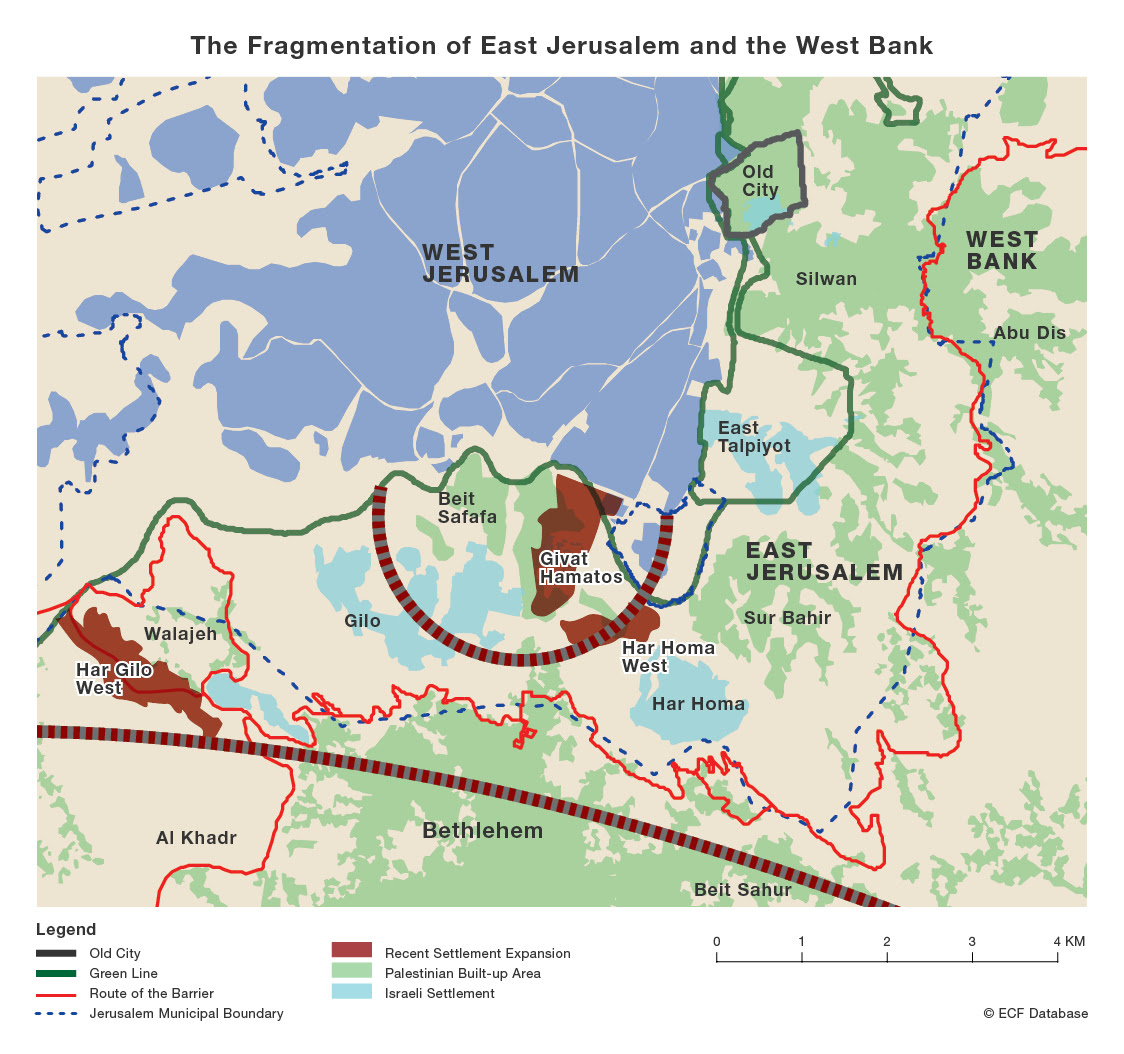
Map by Terrestrial Jerusalem
On January 19th, the Israel Land Authority issued the tender for the construction of the Givat Hamatos settlement in East Jerusalem (the tender is for a total of 1,257 settlement units). The issuance of the tender came a mere 6 hours before Joe Biden was sworn in as the President of the United States.
Prior to the issuance of the tender, the Jerusalem District Court rescinded its injunction against the tender, which the Court had issued last week in response to a petition filed by Palestinian residents of East Jerusalem and the Israeli NGO Ir Amim. That petition – which alleges that the planned construction of government-subsidized housing has discriminatory eligibility guidelines – is still pending, and the Court scheduled a discussion of the petition for May 27th.
According to Jerusalem expert Daniel Seidemann (of the Israeli NGO Terrestrial Jerusalem), now that the tender has been issued and awarded, construction of Givat Hamatos is now “virtually inevitable.” Givat Hamatos has long been regarded as a doomsday settlement by parties interested in preserving the possibility of a two-state solution, in that it will prevent the division of Jerusalem into an Israeli capitol and a Palestinian capitol (if the Givat Hamatos settlement is built, the Palestinian neighborhood of Beit Safafa in East Jerusalem will be completely surrounded by Israeli construction, severing its connection to the West Bank). Regardless of the implications of Givat Hamatos on a two state solution, the impact of the new settlement on the Beit Safafa neighborhood are nonetheless significant.
Explaining how Netanyahu bears direct responsibility for the highly consequential decision to move ahead with Givat Hamatos, Terrestrial Jerusalem writes:
“Netanyahu could have made this ‘go way’ at ZERO political cost to himself. He could have said truthfully: I tried, but the Court didn’t let me. Instead, he pulled out all plugs and instructed the State Attorney to aggressively pursue the rescission of the injunction. He went out of his way to make this happen. The tender process may now be completed, after which construction is virtually inevitable.This is happening because Netanyahu wants it to happen. This is happening now, because Netanyahu wants it to happen now.”
Ir Amim punctuates its analysis of the move by writing:
“The fact that the ILA hastened to announce the winners of the tender only 6 hours before Joe Biden’s inauguration serves to underline how determined the Israeli government is to create as many facts on the ground as possible before Biden takes office.”
Regarding the prospects of its petition against the Givat Hamatos tender, Ir Amim writes:
“The petition targets the conditions of eligibility for subsidized housing within the tender which discriminate against Palestinians. The petition does not call for cancellation of the tender but it remains to be seen how the petition will be viewed by the court and whether or not this will affect more than the specific discrimination present. One possible result of the petition – although we do not think its likelihood is high – can be that subsidized housing be completely removed from the tender in which case it is very possible that the tender will have to be reissued.”
Cashing In Before Trump Cashes Out, PART 2: Israel Issues Tenders for 2,572 Settlement Units
On January 20, 2021 – inauguration day in the U.S., the Israeli government issued tenders for the construction of 2,572 units (total) in settlements across the West Bank, as well in East Jerusalem. Now that the tenders are issued, construction companies are invited to bid to win the contract. Peace Now estimates that building is likely to happen within two years from now.
The issuance of these tenders comes in addition to the Givat Hamatos tender (see section above) and the advancement of plans for 780 more settlement units (see section below).
Commenting on the tenders, Peace Now said in a statement:
“Our out-of-touch government leadership continues to press on with its mad scramble to promote as much settlement activity as possible until the last minutes before the change of the administration in Washington. By doing so, Netanyahu is signaling to the incoming President that he has no intention of giving the new chapter in US-Israel relations even one day of grace, nor serious thought to how to plausibly resolve our conflict with the Palestinians.”
The 2,572 tenders issued on January 20 provide for:
- 941 units in the Emanuel settlement, located in the northern West Bank east of the Palestinian village of Qalqilya. Israel has openly declared its intention to continue expanding settlements in this area – which includes the settlements of Karnei Shomron and Alfei Menashe – with the stated goal of bringing 1 million settlers to live in the area.
- 460 units in the Pisgat Zeev settlement, the largest settlement in East Jerusalem. This involves the issuance of two tenders, one for 210 units and a second for 250 units.
- 377 units in the Adam (aka Geva Binyamin) settlement, through the issuance of three tenders, one for 94 units, a second for 263 units, and a third for 20 units. The Adam settlement is located northeast of Jerusalem, just beyond the separation barrier. Israel has for some years been steadily building the Adam settlement in a manner meant to connect the settlement seamlessly with East Jerusalem settlements and infrastructure, erasing the Green Line.
- 359 units in the Beit Aryeh settlement, located northwest of Ramallah, through the issuance of two tenders, one for 159 units and a second for 200 units.
- 220 units in the Maaleh Efraim settlement, located in the northern West Bank in the area between the central ridge and the Jordan Valley, through the issuance of three tenders, one for 24 units, a second for 178 units, and a third for 18.
- 150 units in the Alfei Menashe settlement, located in the northern West Bank east of the Palestinian village of Qalqilya. Israel is planning to continue expanding this area – which includes Karnei Shomron and Emmanuel – with the stated goal of bringing 1 million settlers to live in the area.
- 49 units in the Karnei Shomron settlement, through the issuance of two tenders, one for 48 units and a second for 1 unit). Israel also advanced plans for construction of 24 more units in the Karnei Shomron settlement through an earlier stage of the planning process (see the section below). Karnei Shomron is located in the northern West Bank east of the Palestinian village of Qalqilya. Israel is planning to continue expanding Karnei Shomron with the stated goal of bringing 1 million settlers to live in the area.
- 16 units in the Beitar Illit settlement. through the issuance of two tenders, one for 14 units and a second for 2 units). Beitar Illit is located west of Bethlehem, near the Green Line.

Cashing In Before Trump Cashes Out, PART 3: In Final Hours of Trump Era, Israel Advances Plans for 780 Settlement Units Across the West Bank
At its final meeting of the Trump era — which took place the day before Joe Biden’s inauguration — Israel’s High Planning Council advanced plans for 780 new settlement units. This includes final approval for plans for a total of 365 units plus the expansion of an industrial zone and approval for deposit for public review (one of last steps before final approval) for a total of 415 units, including retroactive legalization to two illegal outposts.
Commenting on the Council’s actions, Peace Now said in a statement:
“By promoting hundreds of settlement units, Prime Minister Netanyahu is once again putting his personal political interests over those of the country. Not only will this settlement activity erode the possibility for a conflict-ending resolution with the Palestinians in the long-term, but in the short-term it needlessly sets Israel on a collision course with the incoming Biden administration.”
Specifically, plans granted final approval by the Council include:
- 152 new units in the Shavei Shomron settlement, located in the northern West Bank, northwest of Nablus.
- 123 new units in the Itamar settlement, located southeast of Nablus in a cluster of notoriously violent settlements and outposts.
- 66 new units in the Oranit settlement, located in the northern West Bank, in the “seam zone” between the 1967 Green Line and the Israel separation barrier (a barrier constructed along a route designed to keep as many settlements and as much adjacent land as possible on the Israeli side of the wall/fence).
- 24 new units in the Karnei Shomron settlement, located in the northern West Bank east of the Palestinian village of Qalqilya. Israel is planning to continue expanding Karnei Shomron with the stated goal of bringing 1 million settlers to live in the area.
- Expansion of the Barkan Settlement Industrial Zone, located in the northern West Bank and a part of a strand of settlements connecting Israel proper and the Ariel settlement. Ariel is located in the very heart of the northern West Bank, reaching literally to the midpoint between the Green Line and the Jordan border. The future of Ariel and the settlements between Ariel and Israel proper have long been one of the greatest challenges to any possible peace agreement, since any plan to connect Ariel to Israel will cut the northern West Bank into pieces. For background on this industrial zone and others, see here.
Plans the Council approved for deposit for public review include:
- The retroactive legalization of 118 existing units in the Nofei Nehemia outpost. If implemented, this plan would have the effect of retroactively legalizing the outpost as a “neighborhood” of the Rehelim settlement, notwithstanding the fact that the Nofei Nehemia outpost is a fair distance from the Rehelim settlement and is not contiguous with the built-up area of Rehelim. In reality, Nofei Nehemia – if authorized – should be understood as a brand new settlement in its own right, rather than an expansion of an existing one (as the Israeli government wants the world to believe). The Nofei Nehemia outpost is located east of the Ariel settlement in the very heart of the northern West Bank. The Nofei Nehemia outpost made news this week with launch of a public bus route through the outpost – an overt act of entrenching and normalizing its presence by Israeli authorities.
- 107 new units in the Tal Menashe settlement, located on the tip of the northern West Bank, inside the “seam zone” between the 1967 Green Line and the Israel separation barrier, which was constructed along a route designed to keep as many settlements and as much adjacent land as possible on the Israeli side of the wall/fence. Tal Menashe is technically a neighborhood of the Hinanit settlement, though the built-up areas do not connect. The plans for 107 units would, if implemented, “dramatically increase” the size of the Tal Menashe settlement, which is the settlement where Esther Horgan – who was murdered by a Palestinian in late December 2020 – lived. Israeli government officials have made it a clear policy to advance settlement construction in response to deadly attacks on settlers by Palestinians, an approach publicly endorsed by U.S. Ambassador to Israel David Friedman.
- The retroactive legalization of 96 units in the Havot Yair outpost, with the intention of granting retroactive legalization (under Israeli law) to the entire outpost. The Havat Yair outpost is located near the Karnei Shomron settlement in the northern West Bank, east of the Palestinian village of Qalqilya. Israel is planning to continue expanding Karnei Shomron area with the stated goal of bringing 1 million settlers to live in the area.
Netanyahu’s Bid for Mass Legalization of Outposts Fails (For Now)
Despite an intensive last ditch effort, Netanyahu did not succeed in pushing through a government decision to grant retroactive legalization to dozens of outposts in the waning hours of the Trump era.
According to reports, Netanyahu made a last minute effort to gain Gantz’s support for a more narrow authorization – for 6 outposts instead of the 43 outposts as included in an earlier draft government decision. Gantz reportedly blocked Netanyahu’s proposal from coming up for a vote at the Israeli government cabinet meeting on January 19th, saying that “no diplomatically irresponsible proposal will be raised at such a sensitive time.” Other reports suggest European leaders intervened to make their objections to outpost authorization clear.
According to Haaretz, Netanyahu made several attempts to get the decision passed, including convening a call with Israel’s Attorney General to make progress. During that call Netanyahu complained that “jurists” were getting in his way. Netanyahu then surprised Gantz by adding the outpost issue to the Cabinet’s meeting planned for January 19th (a meeting devoted solely to the COVID-19 crisis).
The 6 outposts Netanyahu’s proposal reportedly listed for legalization are: Tel Zion, Ovnat, Metzoke Deragot, Kedem Arava, Avigail, and Asa’el. For more information on those outposts, see Peace Now’s reporting. Of those outposts, three would have been legalized as neighborhoods of existing settlements (Tel Zion, Ovnat, Metzoke Deragot), and three would have been authorized as full-fledged independent settlements (Kedem Arava, Avigail, Asa’el). Netanuyahu’s new proposal also called for the government to allocate over $6.2 million (NIS 20 million) to hire 13 new staff members at the Civil Administration tasked with continuing outpost legalization legal efforts.
FMEP has traced this saga for weeks – from the time when Likud and Blue & White officials were collaborating to draft such a decision, to last week’s news that Gantz decided to continue blocking the move despite a private meeting with settlers asking him to give his OK. It’s worth reiterating that Gantz has made clear he is not opposed to granting retroactive legalization to outposts, but is opposed to this manner of doing so. Gantz prefers for each outpost to be considered on an individual basis.
Bonus Material
- “A regime of Jewish supremacy from the Jordan River to the Mediterranean Sea: This is apartheid” (B’Tselem)
- “Al-Haq Welcomes B’Tselem’s Recognition of Israeli Apartheid” (Al-Haq)
- [VIDEO] “Calling the Thing by its Proper Name: “Apartheid” Between the Jordan River & the Mediterranean Sea” (FMEP)
- “Palestinian factory workers strike in West Bank industrial zone” (Al-Monitor)
- “West Bank demolitions and displacement | December 2020” (OCHA)
Welcome to FMEP’s Weekly Settlement Report, covering everything you need to know about Israeli settlement activity this week.
To subscribe to this report, please click here.
April 5, 2019
- Israel Expected to Advance Nearly 5,000 Settlement Units
- Glassman/Or Sameach Yeshiva Project at Entrance of Sheikh Jarrah Neighborhood Approved for Public Deposit
- Also in Sheikh Jarrah, The Sabbagh Family Receives Another Eviction Notice
- New Settler Bypass Road Gets Go-Ahead After Deadly, Disputed Incident at Huwwara Interchange
- Settlers Are Cultivating Palestinian Farmland Taken by the Construction of Israel’s Separation Wall
- Transportation Ministry Voices New Concern About Elad’s Zipline Project in East Jerusalem
- Yesh Din Issues Authoritative Report on Israel’s “Racist Endeavor” to Retroactively Authorize Outposts
- Al-Haq Report: Israel Appropriated ‘Ein Fara Spring; TripAdvisor Now Promotes It as an Israeli Tourist Destination
- Settler Leader: “Settlements are a Bridge to Socio Economic Peace”
- Bonus Reads
Questions/comments? Email kmccarthy@fmep.org
Israel Expected to Advance Nearly 5,000 Settlement Units
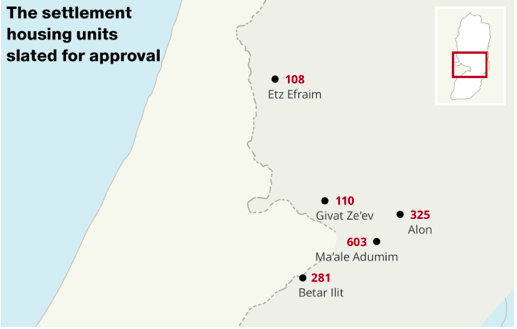
Map by Haaretz
According to reports last week, Israeli planning bodies were expected to meet and advance plans for nearly 5,000 new settlement units at a meeting on April 1st. However, that meeting appears to have been delayed.
Nonetheless, it is worth reviewing the leaked details of the settlement plans slated to be advanced, of which 1,427 are reportedly set to receive final approval from the High Planning Council, including
- 603 new units in the Ma’aleh Adumim settlement just east of Jerusalem;
- 325 new units in the Alon settlement, near the disputed Palestinian village of Khan al-Ahmar east of Jerusalem;
- 108 new units in the Etz Efraim settlement, in the northern West Bank, one of several settlements slated to become a “super settlement” area;
- 110 new units in the Givat Ze’ev settlement just north of Jerusalem;
- 281 new units in the Beitar Illit settlement.
A subcommittee of the Israeli Civil Administration was also set to meet on April 1st (no press reports indicate that the meeting actually happened), and was expected to advance plans for 3,474 new settlement units for public deposit, an earlier stage of the settlement planning process (reminder: all stages of the settlement planning process are significant, as each step through the publication of tenders is a political act of the Israeli government). The plans slated to be approved for public deposit include plans in settlement across the West Bank, reportedly include the following settlements:
- Elon Moreh, located east of Nablus in the central West Bank;
- Karnei Shomron, in the northern West Bank;
- Elkana and Oranit, which along with Etz Efraim, are slated to become a part of a “super settlement” area;
- Ariel in the central West Bank;
- Beit Aryeh northwest of Ramallah;
- Shiloh in the central West Bank;
- Talmon north of Ramallah.
- Peduel, in the northern West Bank but on the Israeli side of the separation barrier; and,
- Mitzpeh Yericho, just west of Jericho.
Glassman/Or Sameach Yeshiva Project at Entrance of Sheikh Jarrah Neighborhood Approved for Public Deposit
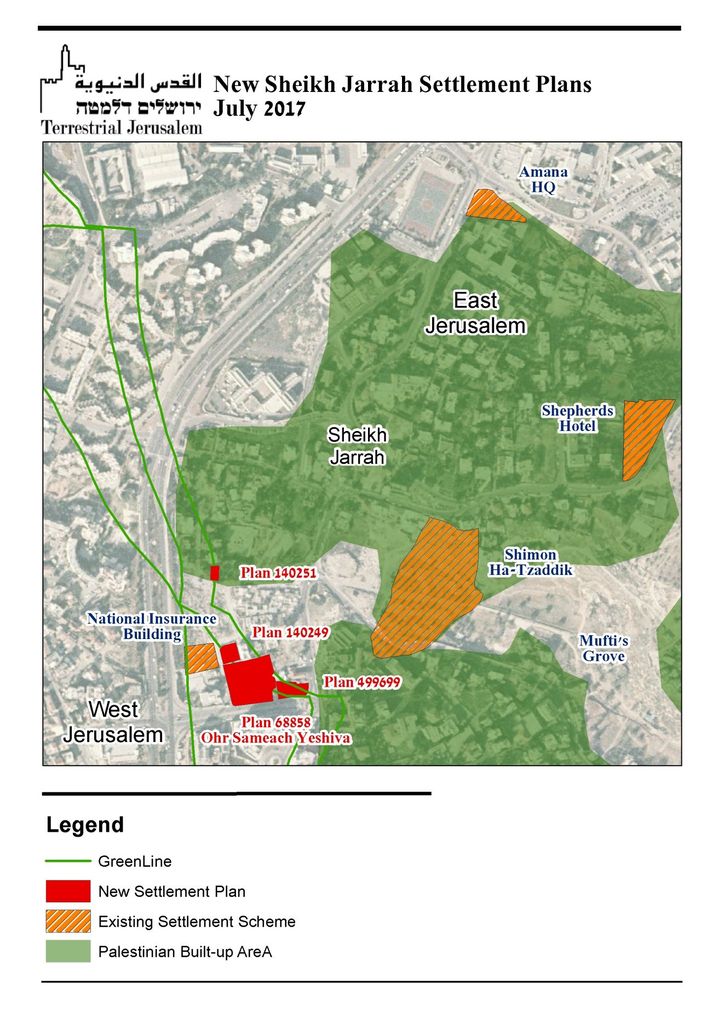 On April 2nd, the Jerusalem District Planning and Building Committee approved the Glassman/Or Sameach yeshiva project for public deposit. The plan, as FMEP has repeatedly covered, seeks to build a Jewish religious school (a yeshiva) at the entrance of the Sheikh Jarrah neighborhood of East Jerusalem. The yeshiva is one of several settlement projects set to flank the road leading into the Sheikh Jarrah neighborhood, designed to strengthen Israeli settlers’ hold on the neighborhood and seamlessly connect the growing settler enclave in Sheikh Jarrah with West Jerusalem.
Ir Amim warns and explains:
“[The Glassman/Or Sameach yeshiva] plan should be seen as an alarm bell in the context of Israel’s ramped up efforts to deepen its circle of control around the Old City Basin. The plan (Plan No. 68858) calls for construction of an eleven-story building with eight levels above ground and three below, including a dormitory for hundreds of students and housing for faculty, to be located at the mouth of Sheikh Jarrah. It was submitted by the Ohr Somayach Institutions, to which the Israel Land Authority has already allotted land without a transparent tender process, and approved for deposit by the District Planning and Building Committee in July 2017.”
In a detailed report on the Glassman yeshiva project, Terrestrial Jerusalem described it as:
“a clear effort to exploit Torah study to expand and normalize occupation in East Jerusalem (including by making the site politically untouchable, as it will now be linked with religious activities).”
Also in Sheikh Jarrah, The Sabbagh Family Receives Another Eviction Notice
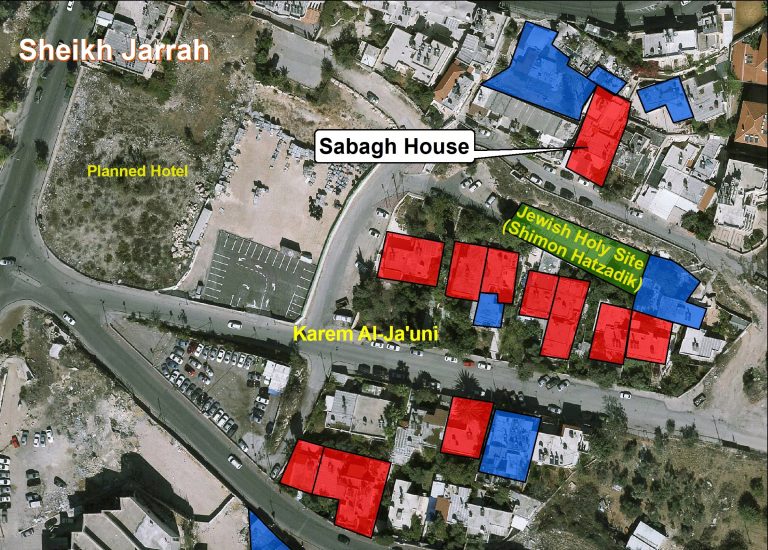
Map by Peace Now
On March 31st, the Palestinians Sabbagh family was handed another eviction notice, weeks after Israeli authorities rejected the family’s latest petition to reconsider the legal authority by which settlers are seeking to evict them from their home of 60+ years. Peace Now reports that the Sabbagh family is still attempting to delay their eviction, but is unlikely to succeed.
In a comprehensive briefing on the Sabbagh family’s protracted legal struggle, Ir Amim and Peace Now write:
“Increasingly, settler initiated, state-backed evictions of Palestinian families are being used as a strategy to help cement Israeli control over the area. Given their strategic location as gateways to the Old City, Sheikh Jarrah to the north of the Old City and Silwan to the south are the two neighborhoods under greatest pressure from Israeli settler groups. Some 150 families in these two areas alone are under threat of eviction…The Sabbagh family is only the latest family threatened with eviction in the Kerem Alja’oni section of Sheikh Jarrah. If evicted, their home will be the tenth to be seized by settlers. Roughly 30 Palestinian families are under threat of eviction and at least eleven have open court cases. Those cases were suspended pending the Supreme Court decision on the Sabbagh case; the recent removal of that stopgap could usher in a wave of new evictions. On the other side of Nablus road, in the Um Haroun section of Sheik Jarrah, an additional 40 or so families face the threat of eviction.”
New Settler Bypass Road Gets Go-Ahead After Deadly, Disputed Incident at Huwwara Interchange
Map by Peace Now
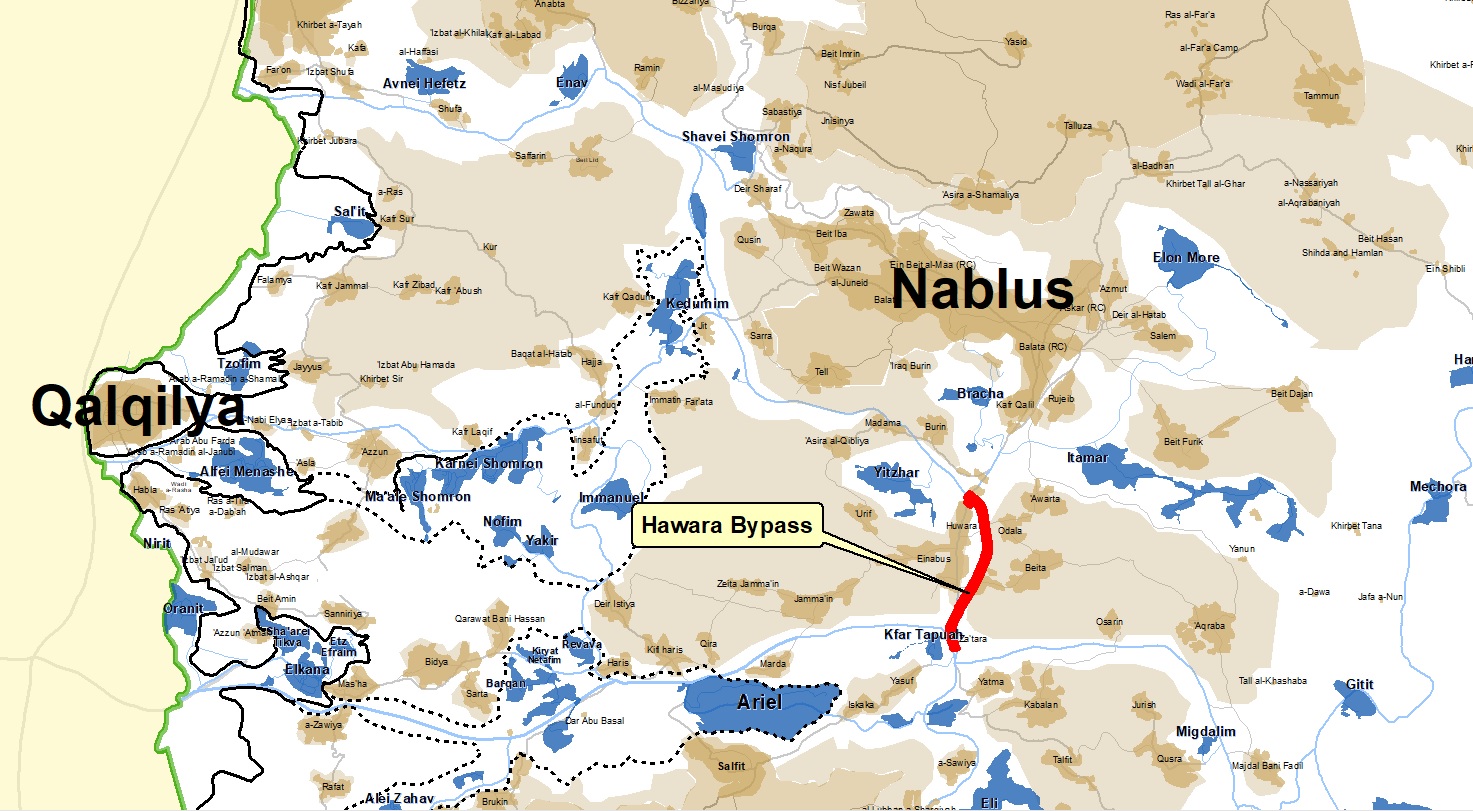
The Israeli Defense Ministry announced that it approved the construction of a new bypass road to divert settler traffic around the Palestinian village of Huwwara. The new road will allow settlers to avoid the Huwwara interchange, a perpetually congested section of the main West Bank highway, Route 60, and an area that has been a site of Palestinian violence against the settlers, including a recent incident where a settler shot and killed a Palestinian teenager allegedly attacking the settler. Dubbed the “Huwwara Bypass,” the new road will be built on land historically a part of the Palestinian villages of Huwwara and Beita, which Israel seized for security reasons.
This road is one of five new bypass roads that Prime Minister Netanyahu promised to build under immense pressure from the settler lobby, known as the Yesha Council. It was one part of a massive security package that the Netanyahu government funded to the tune of $228 million in 2017. Peace Now detailed each of the five bypass roads slated for construction, and wrote:
“The planned roads…are meant to serve settlements located deep in the West Bank, which will not be a part of Israeli in the framework of an agreement according to the Geneva Initiative’s proposed border.Historically, the paving of bypass roads has led to an acceleration of the development of the adjacent settlements…Additionally, paving new roads in the West Bank entails the confiscation of private Palestinian lands. All of the roads are built due to needs of settlers rather than the needs of the Palestinians. In certain cases the roads can also be useful for Palestinians, but the majority of these roads are hardly used by Palestinians at all. This fact puts into question the Israeli legal argument behind the confiscation, as according to international law, the confiscation of lands must serve the local population, meaning the Palestinians.”
Transportation Ministry Voices New Concern About Elad’s Zipline Project in East Jerusalem
An official from the Israeli Transportation Ministry voiced reservations regarding the Elad settlement organization’s request to re-zone the “Peace Forest” as a “public use space” in order to allow for the construction of its zipline project there. At a meeting on April 1st (a previous meeting was covered by FMEP last week) to consider the request, a transportation official expressed concern that the project is a private commercial endeavor, not a public use project – meaning that the project might not be legal even if the forest were to be re-zoned for public use. The official said:
“[A zipline] constitutes commercial use: It’s not going to be operated by the municipality or a youth group. This alone is a reason not to approve the plan.”
The Haaretz report on the April 1st meeting also provides historical context on Elad’s illegal activities in the “Peace Forest” (which was established by the Jewish National Fund on privately owned land in East Jerusalem following the 1967 war) over the past 14 years. Haaretz writes:
“At first the NGO simply trespassed and built illegal structures there. But things changed and gradually various local and national bodies – including the Jerusalem Municipality, the Israel Land Authority, the Tourism Ministry and the JNF – began to grant Elad assistance. This assistance has included granting building permits retroactively, allocating land to the group without a proper bidding process, and generous funding to the tune of tens of millions of shekels…Most of Elad’s current focus is on managing and developing the City of David National Park in the Palestinian neighborhood of Silwan, and purchasing homes for Jews from the Arabs living there. But the NGO isn’t neglecting its other projects: It has been sponsoring activities in the Peace Forest since 2005, despite the fact that it has no ownership rights there or permits from the ILA (the legal owner of the land, which was expropriated from private Palestinian owners). These activities are essentially expanding Elad’s reach from Silwan into the entire historic basin of Jerusalem’s Old City, from the Mount of Olives to the Armon Hanatziv promenade (which actually consists of several different walkways, projects of the Jerusalem Foundation).”
Settlers Are Cultivating Palestinian Farmland Taken by the Construction of Israel’s Separation Wall
For the past six years, Israeli farmers have been farming Palestinian land that was left on the Israeli side of the separation barrier, an area Palestinian landowners are largely barred from entering.
When the separation wall was constructed in the early 2000s, it confiscated 35,000 acres (140,000 dunams) of Palestinian land as a result of its circuitous route that snakes deep inside of the West Bank. The land between the wall and the 1967 Green Line is commonly referred to as the “seam zone.”
Kerem Navot founder Dror Etkes – who obtained aerial photography documenting settler activity in the area – explained:
“One of the same plots to which landowners are barred from entering is located west of the Palestinian village of Nuba, about 15 kilometers northwest of Hebron. Nearly half of the village’s land was lost in 1948 because it remained west of the Green Line, and with the construction of the separation barrier in the area from 2005-2006, residents lost another 1,000 dunams that remained on the other side of the barrier. Although there’s an agricultural gate on site that was supposed to be used by landowners to reach their territory to the west, their entry has not been possible since the barrier was constructed. This ‘vacuum’ was identified by the ‘Mateh Yehuda Agricultural Association,’ which cultivates vast swaths of land that were transferred to Israeli moshavim in the area, including those west of the Green Line. After a few years in which the villagers didn’t access their land, the Agricultural Association decided that it was time to take over of one of the wadis in the area.”
Etkes separately told Haaretz:
“This story allows a peek into the jungle Israel created in areas left between the barrier and the Green Line. This area, called ‘the seam’ by Israel, is gradually becoming a looting ground for anyone who can grab a plot while exploiting a reality in which tens of thousands of West Bank residents are unable to reach their lands. All this proves that the route along which the barrier was built passes mostly through the West Bank, serving political interests, as anyone with eyes in his head saw and understood as the barrier was being built.”
Yesh Din Issues Authoritative Report on Israel’s “Racist Endeavor” to Retroactively Authorize Outposts
In a new report, the Israeli NGO Yesh Din analyzes the legal pretexts Israel has created to systematically legalize outposts across the West Bank that were built in contravention of Israeli law and on privately owned Palestinian land.
The report reviews and rebutts the findings of the “Zandberg Report” – which (approvingly) outlined various legal tactics and tools the state can use to save those outposts.
Yesh Din found that the Zandberg Report’s recommendations allow for 99% of all unauthorized outposts to be retroactively approved within 2-3 years, anticipating that the government will declare 20 new settlements in the process.
Yesh Din’s report also examines how Israel has already undertaken the first step in this effort, by introducing the “market regulation” principle into the courts. If validated by the courts, the “market regulation” principle will provids legal cover to ‘regularize’ 2,700-3,000 illegal structures built on privately owned Palestinian land.
Yesh Din writes:
“The Zandberg Committee aids a racist endeavor whose essence is the dispossession of Palestinians from their land on the basis of ethnicity. The euphemisms used in the report and the legal terminology it employs do nothing to hide the fact that the ‘Regularization Committee’ report is, in fact, an expropriation report which provides the government more methods for normalizing and deepening the iniquity of Israel’s settlement policy: one area, the West Bank, with two populations – privileged Israeli citizens and Palestinians living under military rule, dispossessed and oppressed.”
Analyzing the Zandberg Report as an alternative to the settlement “Regulation Law,” Yesh Din states:
“The Zandberg Committee seemingly offers a more restrained framework for ‘regularization’ or retroactive authorization that purports to be less injurious than the ‘Regularization Law’ and relies on legal doctrines. In truth, however, the report cloaks landgrab, dispossession and expropriation on an extremely large scale – approaching that of the Regularization Law – in a shroud of legality.”
Al-Haq Report: Israel Appropriated ‘Ein Fara Spring; TripAdvisor Now Promotes It as an Israeli Tourist Destination
Al-Haq, the preeminent Palestinian human rights group, published a report documenting Israel’s appropriation of the ‘Ein Fara spring, located on the lands of the Palestinian village of Anata northeast of Jerusalem. The spring historically served as the primary source of drinking water and agricultural water for Anata and several surrounding villages.
Since 1967, Israel has appropriated the spring and its waters, and built five settlement on the surrounding land.
Israel renamed the spring the “En Prat Nature Reserve” and promotes religious tourism at the site, as does TripAdvisor.
Al-Haq writes:
“The appropriation of village lands, confiscation of water resources and continued denied access to Palestinians violates the right to self-determination, further breaches the prohibition of discrimination, the right to life including the duty to ensure access to water, the right to water, the rights of freedom of movement, the right to a livelihood, and cultural rights related to the integral use of the ‘Ein Fara spring to communal village life. Al-Haq reminds that Trip Advisor is advertising ‘En Prat Nature Reserve’ a settler tourism service, on its internet platform. Al-Haq stresses that Trip Advisor is providing an economic service for the benefit of Israeli settlements, which may amount to an involvement in settlement related activities.”
Settler Leader: “Settlements are a Bridge to Socio Economic Peace”
Writing in the Jewish News Syndicate, Yochai Dimri (chairman of Har Hevron Regional Council) makes a pitch for the Israeli public and elected officials to drop hopes of a “peace deal” in favor of socio-economic “co-existence” initiatives that normalize the settlements.
As FMEP has documented, this message lines up exactly with the activities and priorities of the Trump Administration, particularly with Amb. David Friedman who has been in partnership with the Har Hevron Regional Council to promote the Judea and Samaria Chamber of Commerce as an Israeli-Palestinian business cooperative.
In a piece entitled – “Settlements are a Bridge to SocioEconomic Peace” – Dimri writes:
“The Barkan Industrial Park near Ariel is an outstanding model for collaboration between Jews and Arabs, and is the wellspring of local employment for both populations. A similar industrial area in Har Hevron is currently in the planning stages, and flourishing businesses and factories are expected to be established there to benefit the residents of Har Hevron and the Negev…The need of the hour is to expand collaborations to include health, education and other necessary areas as well—not through international initiatives, but through Israeli ones. Once Israel learns to view the settlement communities in Judea and Samaria as an asset and not a liability, as an impetus for change and not a roadblock, it will discover that they are not an obstacle to peace, but rather a bridge to achieving economic and social peace.”
FMEP’s Lara Friedman reacted to this notion in a recent op-ed:
“Last October, Friedman participated in a public event convened in the settlement of Ariel. The event, which featured Israeli settlers and a handful of Palestinians, promoted the view that the key to peace is not political agreements or negotiations. Rather, peace would come from economic and business cooperation between Palestinians (living under Israeli occupation, governed by Israeli military and military law designed to promote the interests and needs of Israel, entirely disenfranchised from the powers that control their lives) and settlers (living in settlements built on land taken from Palestinians, enjoying all the entitlements and protections of Israeli citizenship and law, and with representatives and allies at every level of Israeli government). This approach, not coincidentally, exemplifies a vision of ‘peace’ based on promises of improved quality of life for individual Palestinians, de-coupled from any pretense of helping Palestinians end an occupation that the United States no longer believes to exist, or achieve national self-determination that the United States no longer supports. Tweeting about that event, Friedman suggested that this kind of cooperation was precisely the kind of opportunity that the Palestinian people truly want and could have, if only their leadership would listen.”
Bonus Reads
- “How Israel is Working to Remove Palestinians from Jerusalem” (The National)
- “Annexation Will Free Israel from the Fake Commitment to Liberty and Equality” (Haaretz)
Welcome to FMEP’s Weekly Settlement Report, covering everything you need to know about Israeli settlement activity this week.
To subscribe to this report, please click here.
November 8, 2018
- Jerusalem Municipality Gives Final Approval to Two East Jerusalem Settlement Schemes Pushing Towards Beit Hanina
- Claiming Ignorance, State Tells the Court it Will Demolish New Jordan Valley Outpost
- Government Officials Lay Cornerstone of “New Migron” Settlement
- Israel Seizes Palestinian Land to Build New Road to Settlement
- Bennett Violated Govt Rules to Get a Legal Opinion Supporting the De Facto Annexation of Ariel University
- In Reversal, Israeli Ministers Embrace Bill to Allow Knesset to Overrule High Court on Any Issue (Not Just on Deporting Asylum Seekers)
- Settlers Group Alleges Palestinians are Undertaking a European-Backed Scheme to “Take Over” Area C of West Bank
- UN Report Details Israel’s De Facto Annexation of West Bank Land
- Four Alleged Security Incidents Near Settlements
- Bonus Reads
Comments, questions, or suggestions? Email Kristin McCarthy at kmccarthy@fmep.org.
Jerusalem Municipality Gives Final Approval to Two East Jerusalem Settlement Schemes Pushing Towards Beit Hanina
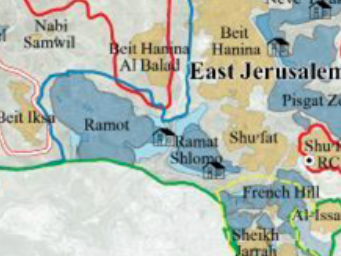 On November 6th, Jerusalem planning authorities granted approval to two settlement projects totalling 652 units in strategic areas that will increase the encroachment of settlements on the Palestinian East Jerusalem neighborhood of Beit Hanina – where the Israeli government is also advancing the first-ever government-backed settlement enclave inside of the neighborhood. This week the Committee approved:
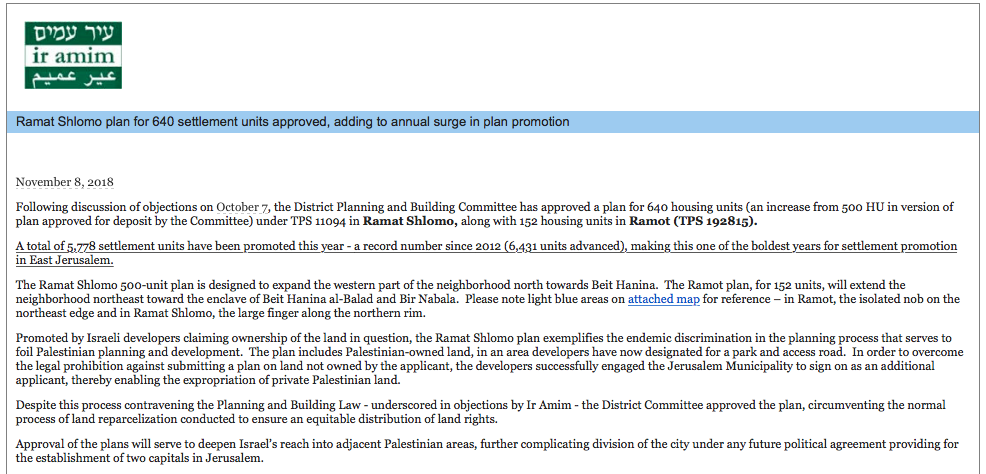
- A plan for 152 new units in the Ramot settlement in northern Jerusalem, extending the settlement’s footprint towards the Palestinian neighborhood of Beit Hanina.
- A plan for 640-units in the Ramat Shlomo settlement, to be built partially on Palestinian land, also extending the settlement north towards an existing settlement enclave inside of the Palestinian Beit Hanina neighborhood.
In granting final approval for the Ramat Shlomo plan, the Jerusalem District Planning and Building Committee decided to increase the number of approved units, from the proposed 500 to 640. And significantly, the Committee rejected serious complaints about expropriating privately owned Palestinian land for settlement purposes.
The Israel anti-settlement watchdog NGO Ir Amim filed one such complaint against the plan, explaining:
“Promoted by Israeli developers claiming ownership of the land in question, the Ramat Shlomo plan exemplifies the endemic discrimination in the planning process that serves to foil Palestinian planning and development. The plan includes Palestinian-owned land, in an area developers have now designated for a park and access road. In order to overcome the legal prohibition against submitting a plan on land not owned by the applicant, the developers successfully engaged the Jerusalem Municipality to sign on as an additional applicant, thereby enabling the expropriation of private Palestinian land.”
Ir Amim researcher Aviv Tartarsky told Haaretz this week:
“It’s very disappointing that the district committee relied on formalistic reasons to approve a step that violates the property rights of Palestinian landowners through and through. These aren’t extremist settlers in outposts somewhere out on hilltops in Samaria [the northern West Bank] but state institutions that are working in Israel’s capital city. This decision is additional proof that Israeli control in East Jerusalem means a regime based on serious discrimination.”
The new approvals add to an ever-growing tidal wave of settlement activity in East Jerusalem affecting the viability of the two-state solution, while tightening the screws on the local Palestinian population.
Claiming Ignorance, State Tells the Court it Will Demolish New Jordan Valley Outpost
Israeli government lawyers told the High Court of Justice that the State of Israel does not know who built an illegal outpost on a disused military base in the Jordan Valley, which settlers have named “Camp Gadi”, and announced that the Civil Administration will demolish it. If the Civil Administration moves to demolishes the outpost, it will require evicting several settler families who are squatting there, and shutting down a pre-military school that the families have been promoting.
The head of the Jordan Valley Regional Council, David Lahiani, seemed to contradict the government’s claim to innocence when he said that he has been in touch with the Civil Administration about legalizing the outpost. If Lahiani has been in touch with the Civil Administration, then questions arise about at what point the Israeli government learned about the outpost and who is behind it. Lahiani’s statement also contradicts (or at least raises questions about) a prior statement from the Jordan Valley Regional Council which denied involvement in establishing the outpost. Further calling into question the role of the Jordan Valley Regional Council, Lahiani was in a picture taken at the outpost which was uploaded to Facebook on October 24th.
Government Officials Lay Cornerstone of “New Migron” Settlement
A cornerstone laying ceremony marked the start of construction on the “New Migron” settlement, to be for the settlers who were removed from the illegal Migron outpost. Several government officials were on hand to lay the cornerstone of the new settlement, plans for which were approved in 2017, near the Kochav Yaakov settlement north of Jerusalem.
In 2011, the Israeli High Court ruled that the Migron outpost must be evacuated because it was built on privately owned Palestinian land. Most of the illegal outpost’s residents were evacuated and most buildings were demolished in Migron in 2012. Determined to demonstrate its support for settlers in the face of this court-compelled evacuation, the government promised to establish two new settlements: “New Migron” (located close to Kochav Yaakov settlement) as well as the approval of a plan for 184 housing units east of the Adam settlement (aka Geva Binyamin). All said, the two new settlements and temporary housing for the evicted settlers cost Israeli taxpayers millions of dollars – sending settlers a clear message that for them, law-breaking pays off.
At the ceremony this week, Jerusalem Affairs Minister Ze’ev Elkin said:
“During such events, it is customary to rejoice, but as someone who accompanied Migron from the moment of the evacuation to the present day, this is not a happy event. We would be happy if we had another legal system that made a logical decision, and I long for the days when the justice system will do justice. The settlement will grow and expand this way from time immemorial. The evacuation attempts will only lead to the strengthening and expansion of settlement.”
Housing Minister Yoav Galant, also at the ceremony, said:
“laying the cornerstone means that the territories of Yehudah and Shomron are not negotiable. It is not a subject for sale. We are laying a cornerstone for Migron and we will build it. I will see to it that the Israeli government does so by the end of the year.”
Knesset Speaker Yuli Edelstein, also in attendance, said:
“I did not come here to convince anyone about our rights in the land of Israel, I came here with mixed feelings of happiness from laying the cornerstone, alongside the great sadness of the difficult evacuation five years ago. We are here, first and foremost, thanks to the families of Migron that did not give up.”
Israel Seizes Palestinian Land to Build New Road to Settlement
According to Maan News, Israeli forces seized 38 acres (155 dunams) of Palestinian land in order to pave a road to the Beit Aryeh settlement, located northwest of Ramallah. Members of the al-Lubban al-Gharbi village council claim that the land is privately owned by Palestinians from the village and called on village residents to find documents proving land ownership in anticipation of an appeal against the construction.
So far this year, the Beit Aryeh settlement has been the beneficiary of two significant settlement advancements totalling 563 new units:
- On August 23, 2018 the Israeli Housing Ministry published a tender for 52 new settlement units in Beit Aryeh.
- On August 11, 2018 the government published a tender for 511 new settlement units in Beit Aryeh.
Bennett Violated Govt Rules to Get a Legal Opinion Supporting the De Facto Annexation of Ariel University
According to a new Haaretz report, Education Minister Naftali Bennett violated Israeli guidelines by using a private law firm to support his Knesset bill bringing settlement colleges and universities under the authority of the Israeli Higher Education Council. Prior to the Knesset’s passage of Bennet’s bill in February 2018, the Higher Education Council only included schools located inside of sovereign Israeli territory. The new law is tantamount to de facto annexation of settlement schools, and members of the Israeli Higher Education Council remain vocally opposed to the move.
The use of a private law firm is seen as an attempt to bypass the Education Ministry’s own apolitical (for now) legal advisors, and is a breach of the guidelines set years ago for every ministry by the Israeli Attorney General. The guidelines stipulate that in cases where private opinions are sought, the legal advisors for the ministry must supervise the process.
Bennet reportedly used an opinion paper issued by the Herzog Fox & Neeman firm stating the inclusion of Ariel University in the domestic Higher Education Council would not violate existing grant terms between universities in sovereign Israel and the European Union (which does not do business in the occupied territories). The opinion was then presented to members of the Higher Education Council to assuage fears that implementing the new law would result in losing international funding. The opinion said that the potential for funding cuts is “nearly non-existent.”
An anonymous senior official with the Higher Education Council told Haaretz:
“You cannot base official policy on an opinion paid for by an interested party. That’s not serious.”
Ariel University has not yet been admitted to the Council, despite the passage of the law in February 2018 and despite Minister Bennett’s repeated threats to end state relations with the Council if it did not immediately grant membership to the school. Israeli President Reuven Rivlin issued a rebuke to Bennett’s threats, saying:
“It’s possible to love Ariel without mocking academia.”
In Reversal, Israeli Ministers Embrace Bill to Allow Knesset to Overrule High Court on Any Issue (Not Just on Deporting Asylum Seekers)
At a meeting on November 4th, ministers in the governing Israeli coalition reportedly decided to abandon a bill that would empower the Knesset to reinstate its plan to deport African asylum seekers after it was struck down by the High Court, in favor of a much more far-reaching bill granting the Knesset the ability to reinstate any law the High Court strikes down. The passage of that bill would likely impact the fate of not only African asylum seekers but settlement-related legislation that has already been passed – most notably,the settlement Regulation Law – and other undemocratic measures that might follow. This news follows an exact opposite announcement two weeks ago, when Justice Minister Ayelet Shaked embraced the single-issue version of the bill, while promising to make the unlimited version a sticking point in any future coalition agreement.
Notably, the leaders of the current governing coalition decided to make this move at a meeting that was not attended by Kulanu Party leader Moshe Kahlon, who has until now blocked the coalition from advancing the unlimited version bill.
Israeli Attorney General Mandelblit vehemently opposes the bill. Mandelblit said:
“One must vigorously oppose this bill, which harms the constitutional regime of the State of Israel as a Jewish and democratic state. Removing all restrictions on undermining the human rights of a specific group, as is proposed now, has far-reaching implications for constitutional law and the democratic regime in Israel, and I strongly oppose it.”
Settlers Group Alleges Palestinians are Undertaking a European-Backed Scheme to “Take Over” Area C of West Bank
The radical settler organization Regavim – which devotes its efforts to systematically mapping out and expelling Palestinians from strategic areas in Jerusalem, the West Bank, and the Negev – presented a new report to the Knesset this week claiming that the Palestinian Authority (PA) is using European funding to take over land in Area C of the West Bank. The report alleges that the PA uses European money to pave roads, build on strategic military and diplomatic locations, and “steal” water resources, at the expense of Israel.
Regavim warns:
“If the government does not come to its senses and does something now, the Palestinian plan will create irrevocable changes and facts on the ground.”
Adding irony to Regavim’s current efforts to stop “illegal” Palestinian activity in the West Bank, in August 2018 the Israeli daily newspaper Yedioth Ahronoth published a comprehensive investigation into Regavim’s leaders. The group’s stated mission is “to ensure responsible, legal, accountable & environmentally friendly use of Israel’s national lands and the return of the rule of law to all areas and aspects of the land and its preservation.” The investigation revealed, however, that the organization’s efforts to identify and stop illegal construction are merely a tool to dispossess Palestinians of their land.
The Investigation found, in fact, that Regavim and its leaders have a demonstrable disregard for the Israeli planning and building laws that they purport to be dedicated to enforcing, evidenced most plainly by the fact that 15 Regavim officers are living in structures built on privately owned Palestinian land, some with demolition orders issued against them. These include the building where Yehuda Eliyahu, the current executive director of Regavim, lives.
UN Report Details Israel’s De Facto Annexation of West Bank Land
The United Nations Special Rapporteur on Situation of Human Rights in Palestinian Territories, Michael Lynk, issued a new report to the UN General Assembly – half of which is devoted to documenting the Israeli government’s annexation of Palestinian land in East Jerusalem and de facto annexation of land in the occupied West Bank.
The report concludes in part:
“These statements of political intent, together with Israel’s colonizing acts on the ground, its legislative activity, and its refusal to adhere to its solemn obligations under international law or to follow the direction of the international community with respect to its 51-year-old occupation, have established the probative evidence that Israel has effectively annexed a significant part of the West Bank and is treating this territory as its own. While Israel has not yet declared formal sovereignty over any parts of the West Bank, the Special Rapporteur submits that the strict prohibition against annexation in international law applies not only to a formal declaration, but also to those acts of territorial appropriation by Israel that have been a cumulative part of its efforts to stake a future claim of formal sovereignty over the occupied Palestinian territory.”
Four Alleged Security incidents Near Settlements
In the past three days, Israeli authorities have reported four security incidents near settlements:
On November 7th, the IDF reported that unknown assailants shot at a bus and lightly injured two Israelis near the settlement of Beit El, located deep inside the West Bank near Ramallah.
On November 6th, three Palestinian men were arrested near the Mevo Dotan settlement, south of Jenin, one of whom was allegedly carrying a gun.
Earlier on November 6th, a Palestinian woman was shot and arrested near the Kfar Adumim settlement, between Jerusalem and Jericho,after allegedly attacking Israeli border policemen with a pair of scissors.
On November 5th, a Palestinian man was shot and arrested after allegedly attempting to stab Israeli settlers and an Israeli IDF officer near the Kiryat Arba settlement, in Hebron.
Bonus Reads
- Khan al-Ahmar and Israel’s Creeping Annexation of the West Bank” (Newsweek)
- “Everyone Knows Settlers Cut Down Palestinian Olive Trees. But Israel Doesn’t Care” (Haaretz)
- “Settler leaders warned Rabin not to ‘cross redlines’ before assassination” (Times of Israel)
- “Hard Questions, Tough Answers: Why the Israeli mainstream turned right” (Americans for Peace Now)
- “An Interview with MK Sharen Haskel” (Fathom Journal)
- “Israeli justice minister opposes letting government jurists act as ‘gatekeepers’” (Haaretz)
***NOTE: This week the Israeli government unleashed a massive wave of approvals to advance plans for settlement construction — in excess of 2,000 units — in highly sensitive and strategically significant areas deep inside the West Bank and in East Jerusalem. More approvals/advancements are expected in the coming weeks. See below for detailed coverage of the individual plans, keeping in mind both the significance of each approval on its own, and as part of the overarching Israeli government agenda clearly intending to both prevent any possibility of a Palestinian state and to further the march toward formal annexation of the West Bank. Also keep in mind, importantly, that there has been zero public push back from the Trump Administration against this surge, which comes on the heels of Ambassador Friedman’s statement last week that Israel will never be required to remove any settlements.***
August 24, 2018
- Settlement Wave, Part 1: High Planning Council Advances Plans for 1,004 Settlement Units (96% Located Deep in the West Bank)
- Settlement Wave, Part 2: Housing Ministry Published Tenders for 420 Settlement Units
- Settlement Wave, Part 3: Jerusalem District Committee Advances Plans for 603 Settlement Units in East Jerusalem
- Settlement Wave, Part 4: More Settlement Construction Coming Soon
- U.S. Stands by Israeli “Intentions” on Settlements
- State Tells High Court: We Can Annex the West Bank – International Law Be Damned
- This Week in Ariel: Settlers Celebrate 40 Years, A Construction Boom, A Medical School, & An Evangelical “Leadership Camp”
- Amana (the Official Settler Movement) Moves Its HQ to Sheikh Jarrah
- Settlement Gains in East Jerusalem Result in Palestinians Self-Demolitioning Their Homes
- Bonus Reads
Comments, questions, or suggestions? Email Kristin McCarthy at kmccarthy@fmep.org. To subscribe to this report, please click here.
Settlement Wave, Part 1: High Planning Council Advances Plans for 1,004 Settlement Units (96% Located Deep in the West Bank)
On August 22nd, the Israeli Defense Ministry’s High Planning Council (the body in the Israeli Defense Ministry responsible for regulating all construction in the West Bank) advanced plans for 1,004 new settlement units, 96% of which are located deep inside of the West Bank. Of the total, 620 units were approved for deposit for public review and 382 units were given final approval for construction.
As reported by Israeli settlement watchdog Peace Now, the plans approved for deposit for public review (totalling 620 units) are:
- 370 units in the Adam settlement (aka Geva Benyamin). This project was urged on by Defense Minister Liberman following a stabbing attack in the settlement, which resulted in one death and injuries to three others. The 370 units are part of a larger plan for 1,000+ units that will, if built, connect the Adam settlement to two large settlements in East Jerusalem (Neve Ya’akov and Pisgat Ze’ev) that are on the Israeli side of the separation barrier (the route of the barrier juts far beyond the 1967 Green Line to include Pisgat Ze’ev and Neve Ya’akov on the Israeli side while the Adam settlement is on the West Bank side). If the larger plan is implemented, the Adam settlement will have built up areas on both sides of the separation barrier, which could (in all likelihood) present Israel an opportunity to re-route the barrier around Adam — which would de facto annex even more West Bank land to Israel and further choke off Palestinian East Jerusalem from the West Bank to its north. [Note: FMEP’s Lara Friedman and Peace Now’s Hagit Ofran published an op-ed in Haaretz in 2008 warning of this plan – you can read that background here].
- 85 units in Karnei Shomron settlement. Israel has repeatedly confiscated as “state land” located between Karnei Shomron and the Palestinian village of Qalqilya (which is literally surrounded on three sides by the separation barrier). In November 2017, Israel began clearing landmines from that “state land” in order to prepare for settlement construction. At the time, Deputy Defense Minister Eli Ben-Dahan said that the new construction in the Karnei Shomron area will bring “a million Jews [to] live in Judea and Samaria in the future.”
- 84 units in the Kiryat Netafim settlement, located about half way between the Ariel settlement and the cluster of settlements close to the 1967 Green Line that are slated to be united into a “super settlement” area (Oranit, Elkana, Shiva Tikva, and others). The expansion of Kiryat Netafim will go towards creating a contiguous corridor of Israeli settlements stretching from sovereign Israeli territory, though the super settlement, to Ariel. As FMEP has repeatedly said, the Ariel settlement is located in the heart of the northern West Bank, reaching literally to the midpoint between the Green Line and the Jordan border. The future of Ariel has long been one of the greatest challenges to any possible peace agreement, since any plan to attach Ariel to Israel (with a finger of land running through settlements like Kiryat Netafim) will cut the northern West Bank into pieces.
- 52 units in the Beit El settlement. This is the second major approval for new units in Beit El in 2018, with a third plan for 300 more units coming soon, according to Israel Hayom. The construction boom is being hailed by the settler-aligned Arutz Sheva outlet, which wrote that the plans will increase the size of Beit El by 65%. If any of the units are constructed it will be first new, government-sanctioned construction in Beit El in over 10 years. U.S. Ambassador to Israel David Friedman is closely associated with the Beit El settlement, having donated to and fundraised for it prior to his appointment as ambassador (including in his capacity as the President of the American Friends of Beit El, reportedly from 2011 until he became ambassador).
- 29 units in the Otinel settlement, located south of Hebron. MK Yehuda Glick (Likud) lives in Otinel.
Plans that gained final approval, meaning no additional formal approvals are required to move ahead with construction (totalling 382 units) are:
- 168 units in the Tzofim settlement, located on the Israeli side of the separation barrier, but jutting towards the Karnei Shomron settlement, which also received advancements this week. See the section on Karnei Shomron, above, for context and news regarding this area of settlements.
- 108 units in the Nofim settlement, located on the Israeli side of the separation barrier but jutting towards the Karnei Shomron settlement, which also received advancements this week. See the section on Karnei Shomron, above, for context and news regarding this area of settlements.
- 56 units in the Barkan settlement, located near the Kiryat Netafim settlement. Both Barkan and Netafim are located about half way between the Ariel settlement and the cluster of settlements slated to be united into a “super settlement” area (Oranit, Elkana, Shiva Tikva, and others). See the section on Kiryat Netafim, above. for context and news regarding this area of settlements.
- 44 units in Ma’ale Adumim, the mega settlement just east of Jerusalem.
- 6 units in the Avnei Hefetz settlement, located southeast of the Palestinian city of Tulkarem.
Notably, Netanyahu intervened to remove two items from the High Planning Council’s agenda, both of which would have led to the retroactive legalization of illegal outposts. Those plans are:
- A plan to retroactively legalize the Ibei Hanahel outpost, which is a non-contiguous “neighborhood” of the Ma’ale Amos settlement, located deep in the southern West Bank. The plan would have allowed the outpost to be demolished and then rebuilt legally with residential units, transforming the outpost into a new, fully authorized settlement.
- A plan to build an education center in the Nofei Prat South outpost, which is a non-contiguous“neighborhood” of the Kfar Adumim settlement, located northeast of Jerusalem. The land on which the project would be built is located just 1.5 km away from the Khan Al-Ahmar Bedouin community – the same one that the Israeli government plans to forcibly evacuate in order to cleanse the area of Palestinians and expand settlements. The outpost was established by the Haroeh Ha’ivri (“the Hebrew Shepherd”) nonprofit association, which is funded by the Israeli Education Ministry.
In response to Netanyahu’s directive to remove these two items from the agenda, the heads of the Knesset’s “Land of Israel Lobby,” Bezalel Smotrich (Jewish Home) and Yoav Kisch (Likud), said that the Prime Minister should “ act with greater rigor to promote settlement, rather than doing the opposite.”
Settler leaders were also unsatisfied with the High Planning Council’s overall numbers. Yossi Dagan, head of the Samaria Regional Council (a municipal body for settlements in the northern West Bank), said:
“We are happy about every new house in Samaria, but we have to tell the truth. Hundreds of housing units are not enough for an area that constitutes 12% of the State of Israel…We expect the government to step in the gas, stop worrying about what they will say overseas, and develop this beautiful region.”
Settlement Wave, Part 2: Housing Ministry Published Tenders for 420 Settlement Units
On August 23rd, one day after the Defense Ministry’s High Planning Council advanced a huge tranche of settlement plans (detailed above), the Israeli Housing Ministry published tenders for a total of 425 settlement units (under plans previously approved by the High Planning Council).
Those tenders include:
- 211 units in the Ma’ale Efraim settlement, located in the Jordan Valley.
- 54 units in the Givat Ze’ev settlement, located north of Jerusalem.
- 52 units in the Beit Aryeh settlement, which comes in addition to the the publication of tenders for 511 units in the settlement last week.
- 42 units in the Ariel settlement. See reporting below for extensive coverage of the many reasons settlers in Ariel are celebrating this week.
Settlement Wave, Part 3: Jerusalem District Committee Advances Plans for 603 Settlement Units in East Jerusalem
In addition to the tranche of settlement plans advanced by the Defense Ministry’s High Planning Council and the tenders published by the Housing Ministry (detailed above), the Jerusalem District Committee deposited for public review (one of the final steps before approval) plans for a total of 608 new settlement units in East Jerusalem, with 345 units slated for the Gilo settlement and 263 units in the Ramot settlement.
On the plan for the Gilo settlement, Ir Amim explains:
“The Gilo plan is being promoted in tandem with development of the new Green Line branch of the Light Rail (construction of which was launched in May), which will be built adjacent to the settlement expansion. This sequencing of events once again exemplifies a pattern of the state investing billions of shekels in transportation infrastructures to allow for extensive construction beyond the Green Line.”
As Ir Amim notes, this week’s advancements come on the heels of Israel’s August 15th decision to publish tenders for 603 units in Ramat Shlomo, and its June 2018 advancement of plans for 1,064 settlement units in the Pisgat Ze’ev settlement — bringing Israel’s two-month total of settlement advancements in East Jerusalem to 2,275 units.
As a reminder, approvals/advancement of settlement plans is not the only ongoing threat to Palestinians in East Jerusalem. Settlers and settler-run organizations continue their campaign to take over sensitive areas in East Jerusalem neighborhoods neighborhood – like Silwan and Sheikh Jarrah – and to create more settler run tourist sites – like the Jerusalem cable car, the Kedem Center, the Abu-Tor footbridge, the Yemenite “heritage center,” and more – to erase the visibility of Palestinians in Jerusalem. Meanwhile, pending legislation in the Knesset seeks to gerrymander the borders of Jerusalem to create a Jewish majority by annexing settlements and cutting out Palestinian neighborhoods from the borders of the city. Sounding the alarm on all of these trends, Ir Amim writes:
“It is vital that the traditional calculus of settlement building be readjusted to a) treat these coordinated efforts to consolidate control of the Old City and surrounding Palestinian neighborhoods with the same urgency afforded to settlement building throughout the whole of East Jerusalem; b) ensure a holistic response that regards private settlement inside the Old City Basin and touristic settlement not as individual phenomena but as multiple elements of a unified and politically lethal strategy.”
Settlement Wave, Part 4: More Settlement Construction Coming Soon
In addition to the plans for 1,004 units that were advanced this week by the High Planning Council, the 425 tenders published by the Housing Ministry, and the 608 units advanced in East Jerusalem (all detailed above), this week saw reports that additional plans are expected to advance soon. Those are:
- Ir Amim reports that on September 2nd, the Jerusalem District Committee is expected to discuss a plan to build a six-story building in Sheikh Jarrah, a neighborhood in which at least 75 families face eviction by radical settlers, with the backing of the Israeli government and courts. For detailed reporting on the building, plans for which were deposited for public review in May 2018, see FMEP reporting here.
- Peace Now reports that tenders are expected to be issued (having already been marketed) for more units in the Adam (Geva Binyamin) settlement. If true, this will be another step towards uniting Adam to the East Jerusalem settlements – the details of which are covered above.
- Peace Now also notes that a plan for 300 units in Beit El is expected to be advanced. This comes in addition to the 52 tenders issued for Beit El this week.
- The Times of Israel reports that plans for hundreds of additional settlement units will soon be marketed for construction by the Defense Ministry. These plans received final approval before this week’s High Planning Council meeting. A Civil Administration official hinted that the plans will be marketed for the Alfei Menashe and Ma’ale Efraim settlements. [NOTE: This reporting was before the subsequent publication of tenders for 211 units in Ma’ale Efraim, covered above.]
U.S. Stands By Israeli “Intentions” on Settlements
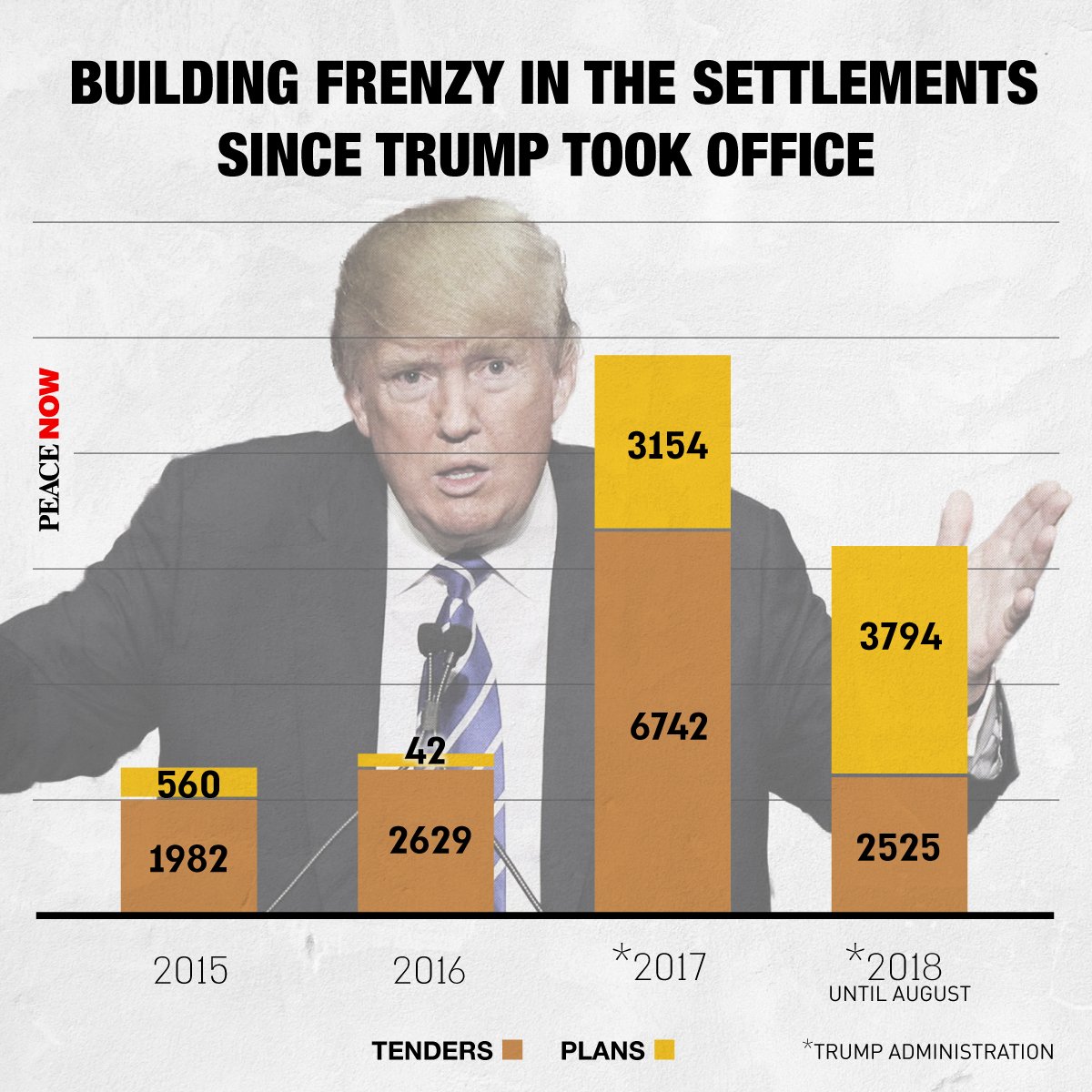
Image by Peace Now
When asked for comment on the various major settlement announcements, the U.S. State Department said that the Trump Administration believes the Israeli government has clearly demonstrated an intent to “adopt a policy regarding settlement activity that takes the president’s concerns into consideration” – a statement that suggests unequivocally that the Trump Administration has given a green light for massive settlement expansion across the length and breadth of the West Bank and East Jerusalem.
Notably, on the same day that the bulk of the settlement announcements were made, President Trump’s National Security Advisor, Ambassador John Bolton, was on the ground in Jerusalem. Not only did he offer no comment or criticism of the settlement announcements, he very publicly joined Israeli politicians and settlers leaders for dinner in East Jerusalem, dining in the “City of David National Park,” the archeological/touristic/residential site in the Palestinian neighborhood of Silwan that is run by the radical Elad settler organization. As FMEP has repeatedly covered, the Elad settler organization is spearheading a government-aided campaign to evict Palestinians from their homes in Silwan, replace them with Jewish Israeli settlers, and transform the neighborhood into a Biblical tourist site emphasizing exclusively the area’s Jewish history.
The head of the Peace Now Settlement Watch program, Shabtay Bendet, told Al-Monitor:
“The situation on the ground is changing rapidly…Restraints on construction in the settlements have been lifted. The Americans don’t care…”
State Tells High Court: We Can Annex the West Bank, International Law Be Damned
On August 7th, the state’s private attorney Harel Arnon submitted a second brief [Hebrew] to the High Court of Justice in defense of the settlement “Regulation Law.” In it he argues that the Knesset is not bound by international law and has the right to apply its own laws outside of its borders and annex land, if it wishes.
Arnon argues:
“The mere application of a certain Israeli norm [law] to an anonymous place outside the state does not necessarily make that anonymous place part of Israel. The Knesset is not restricted from legislating extra-territorially anywhere in the world, including in the region, the Knesset can legislate in Judea and Samaria.”
The brief also argues:
“The Knesset is permitted to impose the powers of the military commander of the West Bank region as it sees fit. The Knesset is permitted to define the authorities of the military commander as it sees fit. The authority of the government of Israel to annex any territory or to enter into international conventions derives from its authority as determined by the Knesset…[and] the Knesset is allowed to ignore the directives of international law in any field it desires.”
Lawyers representing Adalah responded:
“the Israeli government’s extremist response has no parallel anywhere in the world. It stands in gross violation of international law and of the United Nations Charter which obligates member states to refrain from threatening or using force against the territorial integrity of other states – including occupied territories. The Israeli government’s extremist position is, in fact, a declaration of its intention to proceed with its annexation of the West Bank.”
Harel was ordered to submit a second defense of the bill in response to a petition filed by Adalah and Al-Mezan on behalf of seventeen local Palestinian authorities. The petition argues that the Regulation Law violates international law and that the Knesset cannot enact laws over the West Bank where the majority of the population is Palestinians (who are not Israeli citizens and cannot vote).
The High Court of Justice is widely expected to strike down the “Regulation Law,” but has yet to make a ruling. Just last week, Arnon made the case that the recently passed Nation-State Law, which makes “Jewish settlement,” a “constitutional value,” can help him defend the settlement law before the High Court.
For ongoing tracking of the Regulation Law and other annexation trends in Israel, see FMEP’s Annexation Policy Tables.
This Week in Ariel: Settlers Celebrate 40 Years, A Construction Boom, A Medical School, & An Evangelical “Leadership Camp”
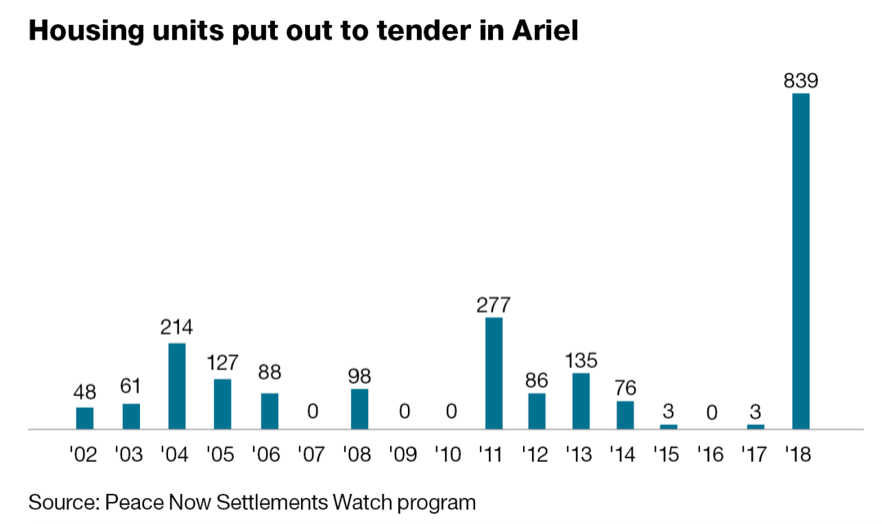 Haaretz published a lengthy report this week on the history of the the Ariel settlement – which is celebrating its 40th anniversary this month – and the dramatic spike in construction in the settlement in 2018. Even before tenders were issued for 42 new units this week (see above), plans for 839 units had already been approved during the first eight months of 2018, compared to tenders for fewer than 5 units each of the past three years. One of the original settlers of Ariel said:
“During the Obama years, everything here was frozen. But thanks to Donald Trump, we’re starting to see the light at the end of the tunnel.”
Not only has Ariel seen a massive surge in construction advancements this year, but the settlement broke ground on a new medical school heavily financed by U.S. casino magnate, and Trump backer, Sheldon Adelson (who this week gave $25 million to the GOP to help it keep the Senate, and in May gave the GOP $30 million to help it keep the House). Many settler leaders and Israeli officials, as well as Adelson and his wife Miriam, were in Ariel this weekend to attend a dedication ceremony for the medical school, despite ongoing controversy around its accreditation under domestic Israeli law. Prime Minister Netanyahu was notably absent from (and reportedly was not invited to) the ceremony, fueling rumors regarding the growing disaffection between him and Adelson.
According to another recent report in Haaretz, Ariel university is illegally dumping construction debris on land that Israel acknowledges is not “state land.” The dump site is outside of the so-called “Blue Line” which the Israeli government uses to demarcate the land that it considers “state land.” Since the dump site is not within the Blue Line, it is likely on land that even the government of Israel recognizes as being privately owned by Palestinians. Anti-settlement watchdog and founder of Kerem Navot, Dror Etkes, commented:
“It’s not surprising that Ariel University, which is the only university in the world built and existing by military order, has adopted the standards accepted in the West Bank involving the takeover of private Palestinian land.”
According to a third Haaretz report, the Israeli Education Ministry has signed a contract to sponsor 3,000-4,000 Israeli high school students of Ethiopian descent to take part in a leadership training program located in Ariel. The program, called “JH Israel,” was founded by American evangelical mega-church pastors Bruce and Heather Johnston, the latter of whom also runs the U.S. Israel Education Association, a pro-Israel, pro-settlement, non-profit group which works with the Family Research Council to lead Congressional delegations to Israel. The JH Israel website says its mission is to help Jewish Israeli students who are “disconnected from the roots of their faith” to establish “a deeper connection to God by embracing their biblical and cultural heritage.” The website also says that Ariel is “at the forefront of biblical prophecy unfolding in modern Israel.”
As FMEP has repeatedly documented, Ariel is located in the heart of the northern West Bank, reaching literally to the midpoint between the Green Line and the Jordan border. The future of Ariel has long been one of the greatest challenges to any possible peace agreement, since any plan to connect Ariel to Israel will cut the northern West Bank into pieces.
Peace Now Settlement Watch Director Shabtay Bendet spoke to Haaretz about the future of the Ariel settlement and the (other) significant repercussions of opening the new medical school. Bendet said:
“Most places in Israel don’t get recognized as cities unless they have 20,000 to 30,000 residents. Ariel became a city when it had just 11,000 residents. Why was this so significant? Because maybe you can uproot a settlement, but you don’t uproot a city. The same holds true for the university. Why was it so important for him to get it accredited? Because when a place has a university, that means it’s established — no pulling it out of the ground….By creating a buffer between the northern and southern parts of the West Bank it makes any future Palestinian state unviable. But besides that, it is also causing damage in the present because its continued expansion impinges on the ability of the surrounding Palestinian villages to develop and grow.”
Amana (the Official Settler Movement) Moves Its HQ to Sheikh Jarrah
The Ynet news outlet reports that the Amana settler organization – the official body of the settlement movement, operating since the 1970s – has moved into its new headquarters in the heart of the Sheikh Jarrah neighborhood of East Jerusalem, where settlers are continuing to wage a displacement campaign against Palestinian residents. Though Amana has owned the plot of land since 1992, various legal challenges and incredibly sensitive geopolitical considerations have slowed construction of the building, called the “Amana House” (see a detailed history here).
Regarding the strategic implications of the location, Ynet reports:
“Amana says the new headquarters will help bolster the territorial contiguity of Jewish settlements in east Jerusalem.”
Agriculture and Rural Development Minister Uri Ariel (Bayit Yehudi) who previously served as the CEO of Amana, commented that the organization’s relocation:
“constitutes a significant reinforcement to the (Jewish) settlement in east Jerusalem and the bolstering of the Jewish territorial contiguity in the area.”
Several settlement plans are currently proceeding in Sheikh Jarrah, underscoring the strategic location and goals of settler activity in Sheikh Jarrah. As covered previously in this report, Israel is expected to advance a plan for a 6-story office building for settlers, located at the entrance to the neighborhood. Across the street from that building, a highly consequential plan for a new religious school (the Glassman yeshiva) was approved for deposit for public review in July 2017. The goal is clear: to unite the enclaves of settlers living inside of the Palestinian neighborhood by creating a contiguous area of settlement that connects to West Jerusalem, thereby cementing an immovable Jewish Israeli presence in a key Palestinian neighborhood – closing off the possibility of evacuation under a future peace deal.
Settlement Gains in East Jerusalem Result in Palestinians Self-Demolishing Their Homes
OCHA reports that two Palestinian homes in the East Jerusalem neighborhood of Beit Hanina were self-demolished after the Israeli Supreme Court ruled in favor of settlers’ ownership claims. OCHA writes:
“In recent decades, Israeli settler organizations, with the support of the Israeli authorities, have taken control of properties within Palestinian neighbourhoods in East Jerusalem, and some 180 Palestinian families are currently facing eviction cases, filed mainly by settler organizations.”
Bonus Reads
- “How Israeli Right-wing Thinkers Envision the Annexation of the West Bank” (Haaretz)
- “Let’s Admit It: The Settlers Have Won and We Have Lost” (Haaretz)