Welcome to FMEP’s Weekly Settlement Report, covering everything you need to know about Israeli settlement activity this week.
To subscribe to this report, please click here.
June 16, 2023
- E-1 Hearing Canceled, Israel Announces Plan for 4,570 of New Settlement Units
- Ir Amim Warns Plans for 7,000+ East Jerusalem Settlement Are on the Agenda
- Homesh Outpost Connected to State Water Grid
- Settlers Press for Jordan Valley Annexation
- Israel Begins Work on New Industrial Zone Near Ramallah
- Ghaith Sub Laban Family Under Eviction Order
- New Report Shows Nearly Half of West Bank Land Taken By Israel “For Public Purposes” Has Gone for Exclusive Use of Settlers
- Adalah Spells Out What Annexation Looks Like, Calls for Urgent Intervention
- Bonus Reads
E-1 Hearing Canceled, Israel Announces Plan for 4,500 of New Settlement Units
Haaretz reports that Prime Minister Netanyahu intervened to postpone a decisive hearing on plans to build the E-1 settlement that was set to take place on June 12th, with no new date set. The delay followed the typical international opposition to the E-1 settlement, which for decades has been viewed as a “dooms-day” settlement and treated a red line for countries pushing diplomatic efforts towards a two state solution. E-1 is also vehemently opposed by Palestinians and human rights activists because of the impact it will have on thousands of bedouin who live in the area slated for the settlements’ construction, just east of Jerusalem.
Daniel Seidemann – founder of Terrestrial Jerusalem and an expert on all things Jerusalem – commented on the cancellation of the E-1 hearing:
“This not at all trivial. But there is an iron-clad rule. Any time that Netanyahu does anything that can be seen as conciliatory, he compensates by doing other outrages, especially in Jerusalem, sometimes the West Bank.”
True to the format, some three days later, on June 12th, news broke that the Israeli government plans to advance 4,570 new settlement units at an upcoming meeting of the Civil Administration’s High Planning Council, set to convene near the end of June.
Preliminary reports on what will be on the agenda indicates that 1,000 units will be up for final approval, including:
- 500 units in Givat Ze’ev
- 300+ units in Elkana
- 300+ units in Revava
Settlements plan which might be advanced through earlier stages of the planning process include:
- Givat Ze’ev (in addition to the 500 units up for final approval)
- Ma’ale Adumim
- Kiryat Arba
- Beitar Illit
- And a dozen more.
This will be the second time the High Planning Council meets this year, and will come some four months after Israel signed the Aqaba Agreement – in which Israel agreed to a four month freeze. Of course, there has been no such freeze in settlement planning, construction, and other annexation activities across the West Bank (as this weekly report has chronicled – all accomplished without convening the High Planning Council. As a reminder, in its first meeting in February 2023, the High Planning Council advanced the largest slate of settlement plans – 7,287 units – in the past decade, including granting retroactive legalization to ten outposts.
Ir Amim Warns Plans for 7,000+ East Jerusalem Settlement Are on the Agenda
Ir Amim warns that – in addition to the actions that the High Planning Council might take in the West Bank – various other domestic Israeli authorities are poised to advance plans for over 7,000 new settlement units across East Jerusalem.
East Jerusalem settlement plans that are on the agenda of planning authorities include:
- Givat Hamatos A (“Tzmerot” Plan) – scheduled for June 12th, but no updates are available at the time of publication. This plan aims to massively expand the current construction outline for the Givat Hamatos settlement in East Jerusalem by adding an additional 1,200 units to the existing plan, bringing the total number of settlement units to be built in Givat Hamatos to 3,810 (assuming, conservatively, an average family size of 5, this means housing for an additional nearly 20,000 Israelis).
- Givat Hamatos / New Talpiyot Hill – scheduled to be discussed by the Jerusalem Local Planning Committee on June 28th. This plan will expand the area of the Givat Hamatos settlement in East Jerusalem by 40%, more than doubling the number of housing units slated to be built there. It involves the construction of 3500 units and 1300 hotel rooms, to be built on a strategic strip of land that will expand the area of Givat Hamatos eastward, connecting it with another new settlement plan – the “Lower Aqueduct Plan.”
- Kidmat Zion – scheduled to be discussed by the Jerusalem Local Planning Council on July 12th. Kidmat Zion will be located between the Ras al-Amud neighborhood and the Israeli separation barrier, with the Abu Dis neighborhood on the other side of the wall. The settlement enclave will be accessible only by driving through densely populated areas of Ras Al-Amud; and,
- Ramot A and B -scheduled for discussion and approval for deposit for objections on June 26. These two plans, outlining a total of 1,918 units, for deposit for public review. Both plans will expand the existing settlement of Ramot northeastward towards the Palestinian town of Bir Nabala. See more details from Ir Amim here.
There are several additional plans for East Jerusalem settlements that, though unscheduled at the moment, are also important to watch: Givat HaShaked, Lower Aqueduct Plan, Nof Zahav, and the Wadi Joz (“Silicon Wadi”) project.
Ir Amim writes:
“Although the E1 plans were again halted due reportedly to international pressure, a spate of other detrimental settlement plans are moving forward at full force in East Jerusalem which require immediate attention.
Against the backdrop of the 56th year anniversary of the Israeli occupation and illegal annexation of East Jerusalem, it is clear that such developments only continue to cement a one-state reality of permanent occupation and systematic oppression whereby one group is afforded full human and civil rights and the other is deprived of those rights.
In Jerusalem, one of the most severe expressions of this reality is the Israeli urban planning policy which aims to engineer Jewish demographic dominance, while pushing significant parts of the Palestinian population out of the city. In contrast to the thousands of housing units advanced annually for Israeli settlements in East Jerusalem, residential development in Palestinian areas is systematically suppressed and neglected, which undermines Palestinian rights to housing and serves as a lever of displacement.
In the absence of equitable urban planning and housing solutions, Palestinians are either forced out of Jerusalem or compelled to construct homes without building permits, which subjects them to the threat of demolition. Between January 1-June 15, 2023, there have been 68 home demolitions across East Jerusalem under the pretext of lacking building permits. This marks a significant rise from 2022 for the same period.”
Homesh Outpost Connected to State Water Grid As Settlers Move In
Weeks after being moved some one hundred yards from its original location – – to a small island of land Israel believes to be “state land” amidst privately owned Palestinian land – – Homesh settlers have swiftly worked to build a more “permanent” yeshiva, which is already hosting 40-50 religious students. The illegal Homesh yeshiva is now connected to the Israel water system – becoming what Haaretz called an “irreversible reality.” Settlers are now agitating for the state to pave access roads, which will necessarily require the expropriation of private Palestinian land.
 Settlers have carried out their work to build a new Homesh yeshiva with the unofficial permission of the Israeli government (and an obedient IDF) even though their construction is illegal. Over the past few months, the Israeli government has taken several radical steps towards establishing a new settlement in the area of the former Homesh settlement – including the repeal of relevant clauses in the Disengagement Law and the issuance of a military order to allow an Israeli civilian presence in the area. Haaretz further revealed that a state-funded organization – B’nai Horin-Neriya – has acted as a conduit to obscure the investment of state funds into the Homesh outpost. The organization has paid salaries of two Homesh yeshiva teachers since at least 2020.
Homesh was built on lands historically belonging to the Palestinian village of Burqa. The land was never returned to its Palestinian owners even after the settlement was dismantled in 2005.
In a new website promoting a campaign to stop the establishment of Homesh, Yesh Din – an Israeli NGO which has assisted Palestinians’ legal efforts to regain access to their land – writes:
“For 45 years Israel has denied residents of the Palestinian village Burqa in the West Bank access to their privately-owned land where the Israeli settlement Homesh once stood. The private Palestinian lands were expropriated in 1978 through a military seizure order for ‘security’ needs and two years later the settlement of Homesh was erected there. For 25 years, several dozen Israeli families lived in the settlement until Israel evacuated Homesh in 2005 as part of the disengagement plan. Almost continuously since the evacuation, an illegal Israeli outpost has been present in this area. For over a decade, Yesh Din has been assisting the residents of Burqa in their persistent legal battle aimed at evacuating the outpost that was established on their lands and allowing them free and safe access to them.”
Settlers are celebrating their triumph at Homesh, and have continued to openly discuss their goals of reestablishing the three other settlements dismantled by the Israeli government as a result of the 2005 Disengagement Law.
Shmuel Wende, executive director of the Homesh Yeshivah for the past three-and-a-half year, told JNS:
“We moved into our new permanent structure but had to do so in the middle of the night so as not to make a fuss. We are calling on the government to make this area 100% official, to pave roads, and go back to the way it was before the expulsion [disengagement].”
On the B’nai Horin-Neriya website – the state-funded organization which pays Homesh salaries and raises money to support constructions there – boasts:
“It’s not often in history that we get to see history taking shape in front of our eyes… this is one of the greatest events of the settlement enterprise to have taken place! The State of Israel is returning to northern Samaria!”
Settlers Press for the Annexation of the Jordan Valley
With a mounting number of victories, parts of the settler lobby are once again centering a longtime demand to annex the Jordan Valley. Justice Minister Levin and several other ministers offered supportive speeches and videos at a recent youth conference hosted by the “Sovereignty Movement”.
The Sovereignty Movement’s co-chair, Yehudit Katsover, said at the conference:
“We are beginning with the Jordan Valley. This is the eastern wall of the State of Israel and it must be strong. There is a broad consensus regarding the Jordan Valley. It is not an issue of Right and Left, It is clear to everyone that we must be here. Gantz also spoke about it at the time, the Prime Minister spoke about it, and opposition Knesset members proposed legislation on this issue. The Jordan Valley will be, with God’s help, under Israeli sovereignty, it’s only a matter of time. Of course, we are not relinquishing Judea and Samaria, but we are taking one step forward because the chance is greater in the Jordan Valley.”
Justice Minister Yariv Levin (Likud) said in a video sent to the conference:
“The Land of Israel, did, does, and will always belong to the people of Israel, as its name indicates. I am convinced that the joint effort that we have been exerting over the years to promote and strengthen our hold in the country and responsibly facilitate the application of Israeli law throughout the Land of Israel will ultimately produce results.”
Settlement and National Missions Minister, Orit Struk (Religious Zionism) said:
“The Jordan Valley is the most important place for the application of Sovereignty because it is, in fact, the place that secures our current eastern border. Therefore, your gathering here today and your continued activity are crucial. It is important that you know that our government established the issue of sovereignty as part of its agenda. It is found in the guidelines of the government and it is found in its political program as an objective when it will become politically possible. There is an excellent chance that we are on the way to achieving that objective.”
Annexation of the Jordan Valley has, in the past, garnered serious effort from the Israeli government. During his 2019 campaign, Netanyahu announced that he would immediately annex the Jordan Valley if reelected, and presented an error-ridden map explaining how he would annex the area without annexing a single Palestinian. His plan called for the annexation of an area which constitutes nearly a quarter of the area of the West Bank (22.3%) where (at the time) 30 settlements and 18 outposts had been established. Peace Now estimated 20% of the targeted land (62,000 acres) is privately owned by Palestinians – a fact that Netanyahu did not even mention, much less explain how he would address. After being elected, Netanyahu faced international opposition to the plan, and in order to quiet the criticism while saving face with his base – Netanyahu formed an inter-ministerial task force dubbed the “Sovereignty Committee” to design a plan for the annexation of the Jordan Valley.
Israel Begins Work on New Industrial Zone Near Ramallah
Kerem Navot shares photographs of bulldozers appearing to begin clearing land just west of Ramallah, a site where Israel intends to build a new industrial zone. The new industrial zone was fully approved in 2016, and will be constructed along the “Apartheid Road” route. In addition to a commercial area, the development will include public buildings, stores, roads, a parking lot and open space.
Ghaith Sub Laban Family Under Eviction Order
On Sunday June 11th an eviction order came into effect allowing for the removal, at any moment, of the Ghaith Sub Laban family from their longtime home in the Old City of Jerusalem. The forcible removal of the couple was not carried out as of publication, and it is reported that the settlers behind the eviction have requested a flexible timeline for carrying out the eviction – normally two weeks. Meaning the Ghait h Sub Laban family is living under constant insecurity.
Since then, their streets outside of their home have been a near constant scene of protest and solidarity, with activists organizing to stop any attempts to forcibly remove the couple from their home.
The Ghaith-Sub Laban family has spent the past 40-years in a legal battle against settlers (and the State) over their home in the Muslim Quarter of the Old City of Jerusalem. This family’s story is not unique, and the broader, systemic processes behind the forcible dispossession of Palestinians in Jerusalem is also discussed. In March 2023, FMEP hosted Rafat Sub Laban and Ir Amim’s Amy Cohen on a podcast – “‘We Are Determined to Stay”: One Palestinian Family’s Story of Dispossession in Jerusalem” – to discuss the Sub Laban case and how it relates to broader State-back settler efforts to dispossess Palestinians across Jerusalem.
Ir Amim explains:
“The family of veteran Ir Amim staff member, Ahmad Sub Laban, has been embroiled in a 45-year legal battle against persistent attempts by the state and settler groups to displace them and takeover their home for Jewish settlement. The family rented the house in 1953 from the Hashemite Kingdom of Jordan and as such was afforded protected tenancy rights. After 45 years of recurring lawsuits and harassment by the Israeli authorities and settler organizations, the Supreme Court recently ruled to terminate the family’s protected tenancy status and evict them from their home.”
For a comprehensive overview of the Sub Laban family’s legal battle, as well as other East Jerusalem eviction cases, please see Ir Amim’s report.
New Report Shows Nearly Half of West Bank Land Taken By Israel “For Public Purposes” Has Gone for Exclusive Use of Settlers
In a first of its kind report published by the Israeli NGOs Kerem Navot and Haqel – entitled, “For the Common Good” – military orders from 1967-2022 are examined to show how the Israeli government has mis-used expropriation orders that are issued “for the public good” to give land to settlements and outposts.
After a thorough legal examination of Israel’s ability to expropriate West Bank land, the report closely examines all 313 expropriation orders, finding that out of a total of 74,000 dunams seized (over 18,000 acres):
- 50% of the land (37,000 dunams / 9,142 acres) now serves both Palestinians and Israelis. These orders were issued mainly to pave shared roads throughout the West Bank;
- 48% of the land (36,000 dunams / 8,895 acres) now serves Israeli settlers exclusively. Much of the land was eventually handed over for the construction of settlements and/or access roads to settlements;
- 2% (1,532 dunams / 378 acres) are now used by Palestinians only.
The authors write:
“The conclusion of this study is evident: under the guise of its legal obligation to ensure the wellbeing of the Palestinian population in the West Bank, Israel has nevertheless expropriated extensive areas of land to promote the settlement project beginning in 1967. In some cases, it has done so while completely and blatantly ignoring its duty to ensure that the expropriated area is for the use of the Palestinian population, and in other, more sophisticated cases, it has done so by creating a dependency between the mutual interests of both Palestinian and settler populations.”
The issue of Israel’s use of expropriate orders to further the settlement movement is highly relevant to the events unfolding in the West Bank today, particularly in light of the government’s undisguised efforts to grant retroactive legalization to outposts that were built on land determined to be privately owned Palestinian land. On this score, the report offers this important history (p.22):
“Recently, the issue of expropriation for settlement purposes has been raised again when Attorney General Avichai Mandelblit approved the expropriation of private land in order to pave a road leading to the illegal outpost of Harasha. His legal opinion relied, among other things, on the verdict of Justice Salim Jubran in the HCJ Ziada case, which referred to settlers as part of the area’s ‘local population,’ rendering their welfare as the concern of the military commander. This position, as stated by the Attorney General, diverged from ‘the traditional legal position accepted for many years, according to which the expropriation of private land for public purposes that serve Israeli settlement may be allowed only when it also serves the Palestinian population”. In the summary of his opinion he stated that in light of the final verdict, there is no longer any legal principle that impedes the promotion of a regulated access road to the Harasha outpost by way of expropriation for public purposes, subject to criteria based on proportionality and reasonability. Note that afterwards, as part of a request for an additional hearing in the HCJ Ziada case given its precedents, including the allowance to take possession of private Palestinian land for the exclusive benefit of settlers, Supreme Court President Esther Hayut stated that “indeed, as noted by the plaintiffs, it appears that the verdict contradicts previous law in this context, and presents both renewal and difficulty”.
After the hearing in the HCJ Ziada case, the court addressed this issue directly as part of the petitions against the Regulation Law. Supreme Court President Hayut ruled with the majority opinion:
‘Indeed, as this court ruled, the military commander is entitled by the power of his authority according to Article 43 of the Hague Regulations to consider the benefit of the local population in its entirety as well, including the Israeli population in the area (the Abu Safia issue, in paragraph 20). However, as far as we are concerned with the question of “public purpose” according to the expropriation laws applicable in the area, I do not find that these allow the expropriation of private land owned by Palestinians or claimed to have proprietary relations, for the purpose of building and expanding Israeli settlements, and for that purpose alone.’
Thus, the court reverted to the traditional legal position whereby Palestinians’ private land must not be expropriated to serve the needs of the Israeli settler population exclusively.”
Adalah Spells Out What Annexation Looks Like, Calls for Urgent Intervention
The Palestinian NGO Adalah issued a blistering paper showing the ongoing ways in which the Israeli government is annexing Palestinians lands in the West Bank. The short and to the point document calls on the international community to intervene to stop Israel’s actions.
Joining a chorus of other analysts asserting that annexation is happening via bureaucratic changes within the Israeli government, Adalah’s analysis offers a detailed accounting of how the current Israeli government has brought the West Bank under the control of its civilian government.
The report concludes:
“The Israeli government is working systematically to implement the policy goals declared in its coalition agreements. Its actions express an intention to continue to entrench a regime of Jewish supremacy that grants the Jewish people an exclusive right to self-determination, as enshrined in the 2018 Basic Law: Israel- the Nation-State of the Jewish People, and to extend it beyond the Green Line into occupied Palestinian territory. All of the government’s declarations and actions demonstrate that its stated intention is not merely de facto annexation camouflaged in the framework of a temporary occupation but annexation de jure, in flagrant violation of international law.
The measures adopted by the government and the legislation approved by the Knesset thus far clearly reveal the trend of transferring parts of the military regime’s sphere of operation associated with the settlements to various Israeli government offices. The concept regarding the unification of laws between the localities in Israel and the settlements is expressed in a most alarming way in the aforementioned decisions.
These measures and laws deepen and expand the subjugation and oppression of the Palestinian people and express the total denial of their right to self-determination in their homeland, while implementing laws and institutional measures which, in practice, bypass the applicability of IHL and replace it with domestic Israeli law.
These decisions constitute annexation of parts of the West Bank, wherein a variety of government ministries will administer the settlements and, in practice, manage occupied territories as if they were an integral part of Israeli territory. Hence, these decisions will lead to the deepening of the de facto annexation of occupied territories and could be considered part of a de jure annexation process, in absolute violation of the laws of occupation.”
Bonus Reads
Welcome to FMEP’s Weekly Settlement Report, covering everything you need to know about Israeli settlement activity this week.
To subscribe to this report, please click here.
June 9, 2023
- NEXT WEEK – E-1 Back On the Agenda
- Israel Advances Plan for Massive New Industrial Zone
- Israel Quietly Expropriated Land to Facilitate the Retroactive Legalization of Havat Gilad
- Israel Allows Settlers to Operate Farms inside the Masafer Yatta Firing Zone, From Which Palestinians Are Being Forcibly Displaced
- Armenian Orthodox Church Sells Key Jerusalem Properties to an Israeli Investor
- Israel Preps New Laws to “Judaize” the Galilee, Subsidize Jewish-Only Communities in Galilee, Negev, and West Bank
- 17 Israeli Human Rights Orgs Issue Status Report on Occupation
- Yesh Din Re-Releases “Annexation Database”
- Bonus Reads
NEXT WEEK – E-1 Back On the Agenda
The High Planning Council’s Subcommittee for Objections is set to hold a third and final meeting on Monday June 12th to discuss objections that have been filed against the construction of the E-1 settlement, planned for an area just northeast of Jerusalem. Construction of this settlement would have severe geopolitical implications (cutting the West Bank in half, cutting it off from East Jerusalem); would necessitate the forcible transfer of several bedouin communities (a war crime); and affect thousands of Palestinians (shredding the fabric of life).
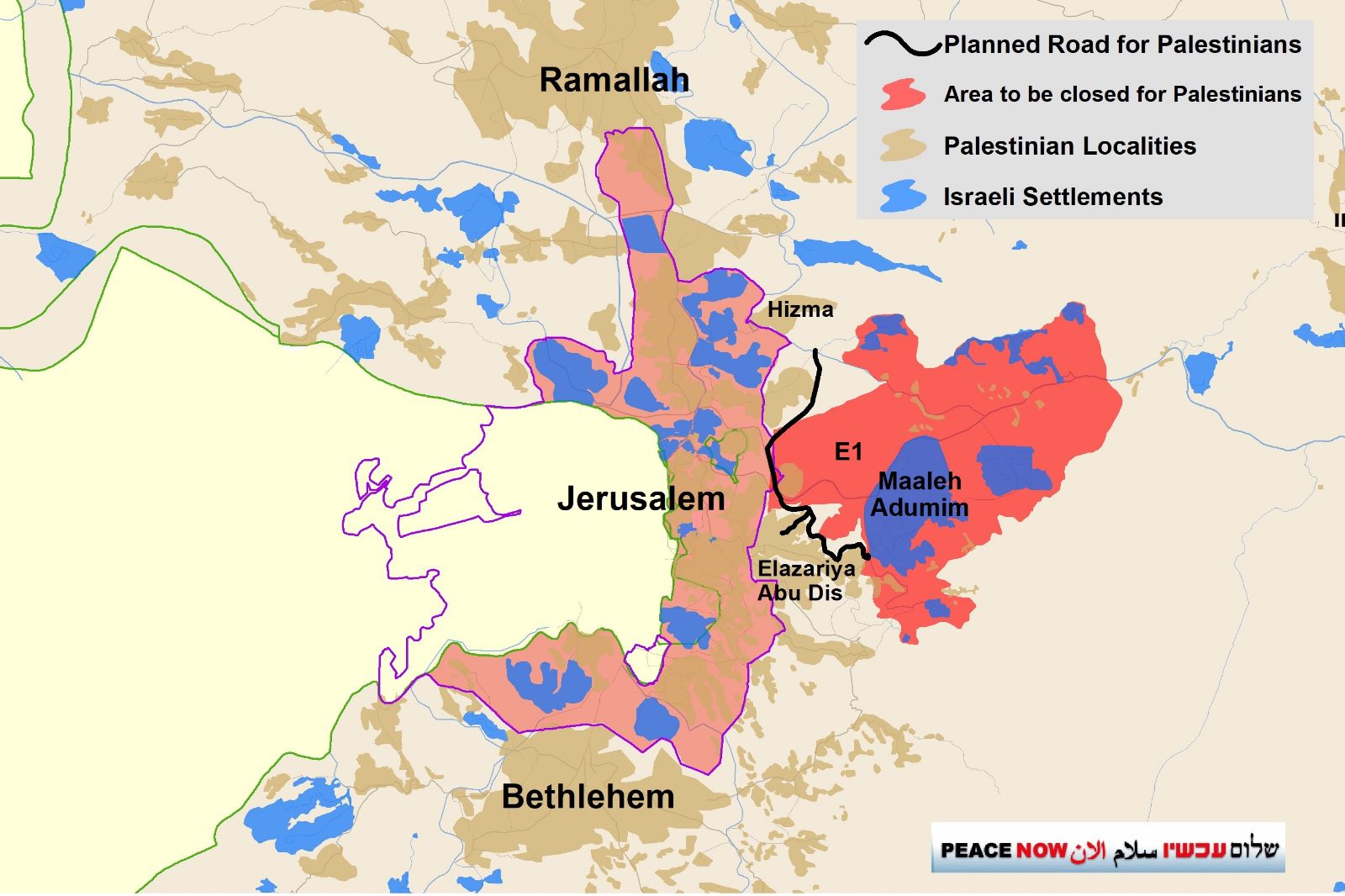 Assuming there is not another last-minute decision to take E-1 off the agenda (something that could well happen, and has happened repeatedly) this upcoming meeting promises to be a decisive one for the long-pending E-1 plan. It could very well result in the Committee – which is now under the authority of longtime settler advocate, Israeli Minister Bezalel Smotrich – granting final approval to the highly contentious plan.
As a reminder: in its current form, the E-1 plan provides for the construction of 3,412 new settlement units on a site located northeast of Jerusalem. The site is home to several Palestinian bedouin communities, comprising 3,000 people, including Khan al-Ahmar, which Israel is planning to forcibly relocate. Long called a “doomsday” settlement by supporters of a two-state solution, construction of the E-1 settlement would sever East Jerusalem from its West Bank hinterland, preventing East Jerusalem from ever functioning as a viable Palestinian capital. It would also cut the West Bank effectively in half, isolating the northern West Bank from the southern West Bank and foreclosing the possibility of the establishment of a Palestinian state with territorial contiguity.
Israel’s “answer” to that latter concern has long been to argue that Palestinians don’t need territorial contiguity, and that new roads can instead provide “transportational continuity,” via a plan called the “Sovereignty Road. If built, the “Sovereignty Road” will seal and divert Palestinian traffic around the area where Israel intends to build the E-1 settlement. In March 2023 Israel announced that construction of this so-called “Sovereignty Road” was set to begin in May 2023. There have since been reports that Israeli authorities have issued notices to Palestinian landowners whose land will be seized for construction of the road, undertaken prep work for construction, and has allocated millions of shekels to fund components of the road.
And another reminder: there have been attempts to promote the E-1 plan since the early 1990s, but due to wall-to-wall international opposition, the plan was not advanced until 2012. At that time Netaynuahu ordered it to be approved for deposit for public review (a key step in the approval process), ostensibly as payback for the Palestinians seeking recognition at the United Nations. Following an outcry from the international community, the plan again went into a sort of dormancy, only to be put back on the agenda by Netanyahu in February 2020, when he was facing his third round of elections in two years. Also, as a reminder: under the Trump Plan (which the Biden Administration has yet to comment on), the area where E-1 is located is slated to become part of Israel.
Peace Now said in a statement:
“The advancement of construction in E1 is another step in the current Israeli government’s actions, which since its establishment, has been establishing new settlements, returning settlers to the northern West Bank, and now working to create conditions for the annexation of the West Bank. Just last week, the Israeli government violated its commitment to the US government and re-established the outpost of Homesh in the northern West Bank. Next week it will violate an Israeli commitment again by promoting the construction plan in E1. This pro-settler and annexationist government seems to continue to act according to a systematic plan that leads us to a reality of apartheid, undermining the chances of a political solution between Israelis and Palestinians. The Israeli public and our friends around the world must wake up and stop Israel from falling into the abyss.”
Israel Advances Plan for Massive New Industrial Zone
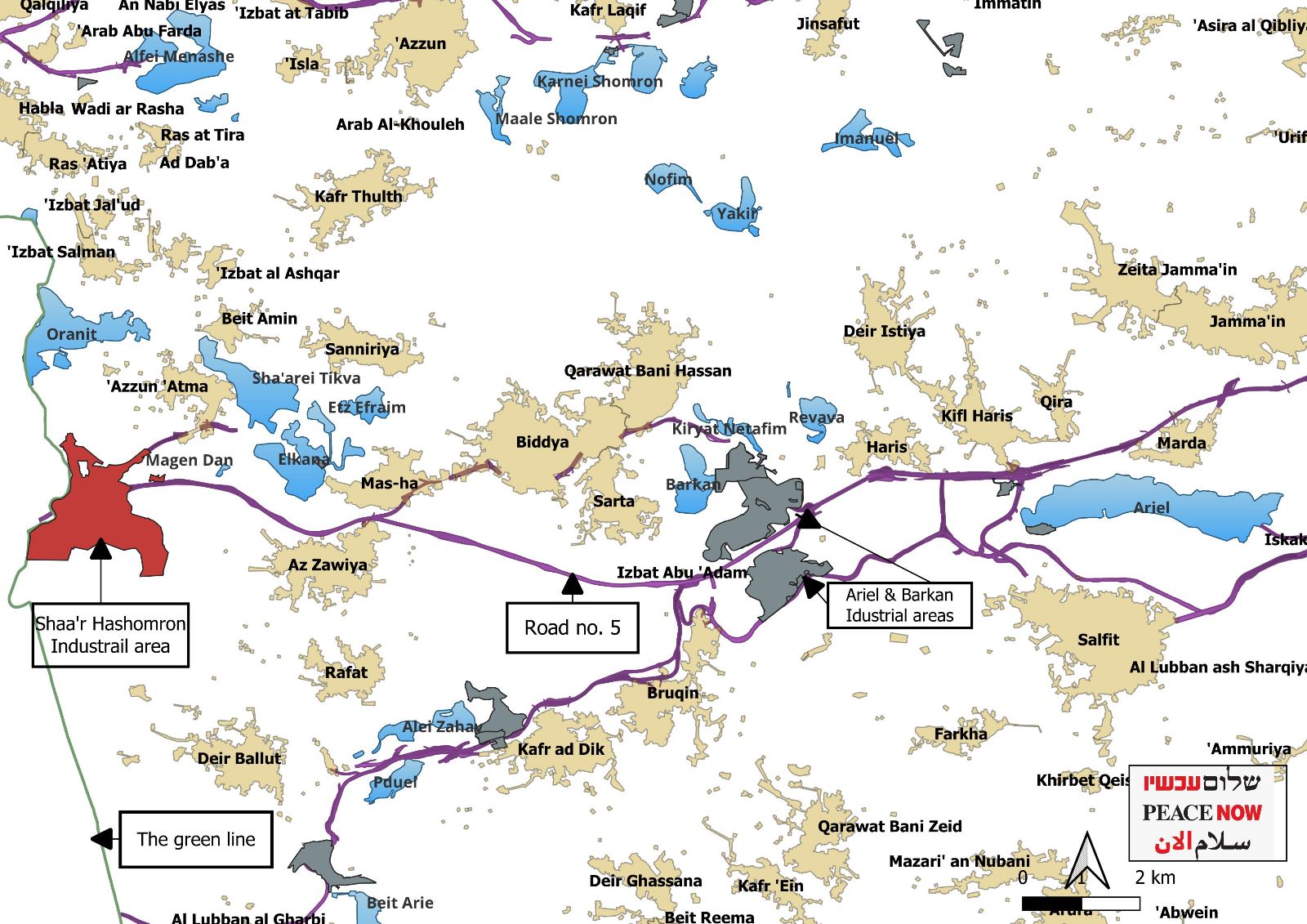 Peace Now reports that on June 2nd the Israeli High Planning Council deposited for public review a plan for the establishment of a massive new settlement industrial zone (called “Sha’ar Shomron”) to be located on lands historically belonging to the Palestinian villages of Siniria, Rafat, and Az-Zawiya in the northern West Bank. In addition to planning for industrial complexes and commercial areas, the plan also provides for the construction of educational buildings, office complexes, sports facilities, recreational areas, and tourism sites – and there is a future plan to connect the new industrial zone to the Israeli railway grid. The new settlement industrial zone is slated to be built directly adjacent to the Green Line, contributing to the erasure of the Green Line and Israel’s annexation of the West Bank.
Peace Now further reports that if the plan is approved, this will likely be the largest Israeli industrial zone in the West Bank, with 2,700 dunams of land, of which 2 million square meters will be for industrial use. Further, Peace Now notes that there is a “lack of need for an additional industrial zone”, especially in this area given that the Ariel and Barkan Industrial Zones are nearby.
Peace Now said in a statement:
“The settlement enterprise is about to receive tremendous economic support in the form of a 2 million square meter industrial zone that will greatly benefit the Shomron Regional Council, strengthen its economy, and, as in previous cases, provide very little, if anything at all, to the Palestinian villages and Palestinians themselves. The Sha’ar Shomron industrial zone is set to deeply integrate Israel’s economy into the occupation mechanism and turn thousands of Israelis into workers for the benefit of the settlement enterprise. This is a hazardous industrial settlement, not only for the Palestinians whose lands it is being built on but for the entire Israeli and Palestinian public. There is no economic prosperity here but rather another expression of the settlement enterprise and the occupation.”
For decades Israel has used industrial zones as another tool to expand and deepen control over West Bank land and natural resources. Industrial zones perpetuate Israel’s economic exploitation of occupied territory (including the local workforce, land, and other natural resources). Presented as benefiting both Israelis and Palestinians, it is in fact Orwellian to label such initiatives as “coexistence” programs, or to suggest that they offer the Palestinians benefits they should welcome. Importantly, jobs in industrial zones – often the only jobs available for Palestinians living under an Israeli occupation that prevents the development of any normal Palestinian economy – are widely viewed by Palestinians as a double-edged sword. The NGO Who Profits explained:
“Israeli Industrial Zones constitute a foundational pillar of the economy of the occupation. They contribute to the economic development of the settlements, which are in violation of international law and the Fourth Geneva Convention, while relying on the de-development of the Palestinian economy and the exploitation of Palestinian land and labor…The Industrial Zones in the oPt form part of a practice of ‘financial annexation’ which is an essential component of the broader policy of annexation taking place.”
Israel Quietly Expropriated Land to Facilitate the Retroactive Legalization of Havat Gilad
The anti-settlement watchdog Kerem Navot (aka Naboth’s Vineyard) reports that on May 2, 2023 the Israeli Custodian of Abandoned and Government Property – Yossi Segal – signed a military order declaring a small tract of land in the West Bank to be “state land.” The small tract of land happens to be where settlers have been allowed to illegally build the Havat Gilad outpost, despite the fact that aerial imagery shows that that area had been continuously cultivated by Palestinians prior to settlers taking over the land (and therefore cannot be taken over by Israel as “state land”). Nonetheless, settlers have been allowed to illegally build on this land, illegal activity which is now being rewarded and further incentivized by Segal’s move to expropriate the land – a move that paves the way for the retroactive legalization of the outpost.
As Kerem Navot chronicles, the Havat Gilad outpost has been the subject of controversy since it was first established by settlers in 2002. Since then, the outpost has become a source of radical, serious, and frequent violence against Palestinians. In 2014, two Havat Gilad settlers were sentenced to prison for setting Palestinian vehicles on fire in a price-tag attack; its residents have also been documented harassing Palestinian farmers and denying them access to their own lands. The Israeli NGO Yesh Din – which has documented violence emanating from Havat Gilad, including against Yesh Din employees – has filed several petitions against the outpost, including a 2010 case that resulted in the demolition of some of the outpost’s structures that were built on land Israel recognized as privately-owned by Palestinians. Yesh Din’s investigation shows that Havat Gilad was built on lands that the Israeli Civil Administration has now declared to be “state land” have in fact been continuously cultivated and privately owned by Palestinians; most of the outpost’s structures have standing (but unenforced) demolition orders issued against them.
In 2018, the Israeli government came under intense pressure from the settler lobby to legalize Havat Gilad in response to a Palestinian terror attack that killed a Havat Gilad settler — and came very close to doing so. At the time, the government ran into difficulties in legalizing the outpost because some of the illegal buildings were located on land Israel recognized as privately-owned by Palestinians, and the government could not – at that time – find a legal means by which to expropriate it. Meanwhile, the settler killed in the attack was subsequently buried at the outpost, and as Al-Monitor explains, the presence of a cemetery in the outpost makes its future evacuation nearly impossible. Kerem Navot’s Dror Etkes spoke to Haaretz around this same time about the phenomenon of settlers being buried in the West Bank:
“Etkes tells Haaretz he believes the choice of where the cemeteries are situated – particularly when they lie on private land some distance from the nearest homes – is not a coincidence. ‘I work on the assumption that there are always deliberate intentions afoot,’ he says. The placement of a cemetery ‘is not chosen for no reason. It is a very long-term investment – and in Judaism, whoever buries people in a certain place does so on the understanding they will not be removed. Obviously, there is deliberate intent lurking behind the location of these cemeteries,’ Etkes continues, ‘and it may be assumed that whoever buries the dead on private Palestinian land knows exactly what he’s doing.’”
Israel Allows Settlers to Operate Farms inside the Masafer Yatta Firing Zone, From Which Palestinians Are Being Forcibly Displaced
Amira Hass reports for Haaretz that Israel is allowing settlers to operate six sheep herding farms [what Americans would call “ranches”] in the Masafer Yatta area of the South Hebron Hills, which Israel has declared a “firing zone”, thereby making it illegal for civilians to enter, live, or farm on the land. This settler activity is being allowed while Israel is simultaneously pursuing the mass forcible expulsion of Palestinians from the area, based on the argument that their lives and homes in a firing zone are illegal. According to a settler from an illegal outpost, the IDF has even provided “grazing permits” to settlers authorizing their activities in the area.
The phenomenon of settlers using agricultural and farming outposts as a highly efficient means of taking control of land (a few farmers can easily take control over vast amounts of herding/grazing lands) has been thoroughly documented by Kerem Navot, which calls it “Israel’s most significant mechanism for dispossessing Palestinian communities.”
Two of the settler farms were established before the May 2022 ruling by the Israeli High Court which authorized the expulsion of Palestinians from the area, the other four were established after. Predictably, though these farms may have started as bare-bones operations, Palestinians now report:
“continuous and brisk activity around these farms, with trucks unloading, a cement truck laying down a concrete surface and all-terrain vehicles entering and leaving the farms, as well as people on horseback…Palestinians in the area say that they often see soldiers in the vicinity of Israeli shepherds, accompanying them within the firing zone.”
In stark contrast to the tolerance and assistance the IDF gives to settlers in the area who have illegally built outposts and these sheep farms, the nearby Palestinians living in Masafer Yatta are ruthlessly tormented, harassed, and attacked by Israeli settlers and the IDF. In a shocking and heartbreaking examination of what life in Masafer Yatta have become for Palestinians, Palestinian journalist and activist Hamdan Mohammed Al-Huraini quotes Issa Makhamra, a resident, who said:
“Everything is forbidden under the pretext that we live in a firing zone, even grazing sheep. Whenever we go anywhere, they set up a checkpoint. When I want to go to the city, I have to pass through this checkpoint, and I am stopped and detained for long hours. I swear to you, if the army could keep sunlight and air from us, they would do it.”
Armenian Orthodox Church Sells Key Jerusalem Properties to an Israeli Investor
The Associated Press reports that in a highly controversial move, the Armenian Orthodox Church signed a 99-year lease giving several church properties in the Old City of Jerusalem to an Australian-Israeli businessman, Danny Rothman (sometimes referred to as Danny Rubenstein). The lease reportedly includes the Hadiqat Al-Baqar (The Cows’ Garden) and its surrounding properties, including the Qishla building in Bab al-Khalil (Jaffa Gate), located in the Armenian Quarter. Rumors of this sale first surfaced in 2021, but recently a sign was placed on one of the tracts saying the land is the property of Xana Capital, the company which Danny Rothman owns. According to a bishop involved in the sale, Rothman and his business Xana Capital plans to develop the land into a luxury resort managed by a Dubai-based company.
The Armenian Archbishop, Nourhan Manougian, alleged that the Church’s real estate official and priest – Baret Yeretsian – sold the land in a “fraudulent and deceitful” deal that he was unaware of. Yeretsian, in turn, said he carried out the deal at the direction of Manougian. Both Manougian and Yeretsian have been forced into hiding due to communal outrage, with Yeretsian fleeing a mob attack with help from Israeli security forces and then relocating to California. Manougian has barricaded himself inside of a convent in the Old City, and protesters have staged weekly protests outside.
Dimitri Diliani, president of the National Christian Coalition of the Holy Land, told the AP: “From a Palestinian point of view, this is treason. From a peace activist point of view, this undermines possible solutions to the conflict.
Manuel Hassassian, the Palestinian Ambassador to Denmark, told the New Arab: “It’s a huge tract of land. By conceding it, they are erasing the Armenian presence historically, demographically, and culturally.”
In the wake of this deal coming to light, Palestinian President Mahmoud Abbas and Jordan’s King Abdullah II have both suspended recognition of Manougian’s authority, rendering him unable to sign contracts, complete transactions, or make decisions in the Palestinian territories and Jordan.
Israel Preps New Laws to “Judaize” the Galilee, Subsidize Jewish-Only Communities in Galilee, Negev, and West Bank
Two weeks ago, the Israeli security cabinet quietly organized an effort to draft and pass new laws designed to encourage Israeli Jews to move to the Galilee region of Israel, where Palestinian citizens of Israel are the majority. There are two main components of this effort so far:
- Amending the “admission committees” law to expand the number of Israel communities permitted to use such committees to screen future residents — a tool used primarily if not exclusively to prevent Palestinian citizens of Israel from moving into communities that residents want to preserve as Jewish-only towns and neighborhoods. The Israeli Ministerial Committee for Legislation granted government-backing to this proposed law weeks ago, and it recently passed its first reading in the Knesset.
- A law that will see the government subsidize land for “communities” that (in the eyes of the Israeli government) suffer from “demographic or security hardships” (which per a key backer of the law does not include Arab areas of Israel, as “Arab settlement does not suffer from similar hardships” as Jewish settlement). This law would in effect see the Israeli government subsidizing Jewish Israelis moving to areas like the Galilee and the Negev — and Prime Minister Benjamin Netanyahu is being pushed by Religious Zionism lawmakers to extend this plan to settlements in the West Bank.
Haaretz Editorial Board writes:
“The bill is part of a broader agenda that is euphemistically called ‘Zionism,’ but whose essence is Jewish supremacy in the spirit of the nation-state law. It’s a follow-up to the cabinet discussion of a resolution meant to give Jews preference in land allocations.”
17 Israeli Human Rights Orgs Issue Status Report on Occupation
On the 56th anniversary of the Occupation, a group of 17 Israel human rights organizations came together to author and publish a concise and highly relevant joint “Situation Report” on the state of the occupation. The report covers four main themes: security forces’ violence, annexation, displacement, and attacks on NGOs.
On annexation, the report covers several important issues that are being closely monitored:
- Structural changes to Israeli governance which amount to annexation of the West Bank;
- Settlement expansion;
- The completion of the Eastern Ring Road (aka the Apartheid Road);
- The “seam zone” permit regime; and,
- Gaza.
The report’s annexation section concludes with the following warnings:
» Changes advanced by Israel’s 37th government, even if not implemented in full, will lead to an irreversible transformation of the West Bank and will cement Israel’s control of the oPt’s Palestinian population and its property. The government’s policies are concurrently advanced via administrative tools, structural changes, legal reforms and huge budget allocations to settler causes. These should not be viewed piecemeal, but as a harmonized policy to accelerate the West Bank’s annexation.
» An exponential increase of the settler population is planned, paired with an unprecedented settlement-expansion drive. Building plans in over 37 settlements have already been approved and ten illegal outposts legalized – with legalization of a further 70 in the pipeline.
» Israel’s current government policies and its Jewish-supremacy ideology will further erode Palestinians’ rights and legal protections under military law, augmenting the West Bank’s dual legal system’s apartheid character. Palestinians’ diminished capacity to be served by the ICA has already been further hampered, and additional restrictions are expected.
» Large-scale construction plans are in place for the E1 area, including the Eastern Ring Road and a new settlement of 3,400 housing units. If realized, these projects will de facto annex strategic parts of Area C, east of Jerusalem, depleting much of East Jerusalem’s land reserves and further fragmenting the West Bank. Annexation of this area has been vehemently and successfully opposed by the international community in the past.
» With all eyes on the West Bank and East Jerusalem, Gaza and its population continue to be largely overlooked and its isolation from the West Bank and the outside world has been accepted as an insoluble reality. Palestinians in Gaza continue to live on the perpetual edge of a humanitarian crisis. Israel’s current government’s annexation policies and cementing of an apartheid regime will further increase Gaza’s isolation and its population’s unbearable predicament.
Yesh Din Re-Releases “Annexation Database”
The Israeli NGO Yesh Din has re-released an updated and incredibly useful database of Israeli laws – past, present, and pending; enacted and abandoned – that amount to annexation of West Bank land. The Annexation Legislation Database categorizes annexation bills into four types:
- The application of Israeli law and sovereignty;
- Direct legislation by the Knesset on the occupied territory;
- The transfer of authorities away from the military commander;
- The blurring of the Green Line.
The re-released database is complemented by a powerful article by Yesh Din’s longtime legal advisor Michael Sfard (who is a legal advisor to a host of anti-occupation, anti-apartheid, anti-settlement groups) in Foreign Policy, entitled “Israel Is Officially Annexing the West Bank.” Sfard writes:
“The high road to legal annexation is an official, public declaration, as Putin made when he annexed the Crimean Peninsula in 2014. But annexation does not necessarily involve pomp and ceremony. It can happen in dull, windowless offices and through seemingly dreary administrative and bureaucratic actions.
Exposing Israel’s annexation requires zooming out. This is what the international community fails to do, and it is why Israel’s brazen violation of international law has not drawn the ire it deserves. International discourse is hung up on the ceremonial, formal version of annexation—Putin’s annexation, which was rightly met with rebuke and sanctions. The world does not know how to deal with Netanyahu’s tactics.
Though it was not accompanied by a grand statement, the Israeli defense ministry’s portfolio transfer to Smotrich amounts to an act of de jure annexation of the West Bank—and is a dangerous step toward entrenching apartheid within the territory.”
Bonus Reads
- “Tantura massacre: Palestinian families call on Israel to mark site of mass graves” (Middle East Eye)
- “Israeli settlers encircling Jerusalem, EU envoys warn” (EU Observer)
- “Palestinian Forum Highlights Threats of Autonomous Weapons” (Human Rights Watch)
- “Settlement expansion is obstacle to peace, Blinken tells US Israel lobby” (Reuters)
Welcome to FMEP’s Weekly Settlement Report, covering everything you need to know about Israeli settlement activity this week.
To subscribe to this report, please click here.
June 1, 2023
-
- Ghaith-Sub Laban Family Face June 11th Eviction from Old City Home
- Construction of Homesh Settlement Continues
- A New Look at Israel’s Annexation & Slow Erasure of Palestinians in Nabi Samwil
- 7amleh Analyzes Israeli Social Media Hate Speech on Huwara, Leading to Pogrom
- New, Comprehensive Report on Children in the Israeli Military Court System
- New Report Details Big Tech Companies’ Facilitation of Occupation
- Bonus Reads
Ghaith-Sub Laban Family Face June 11th Eviction from Old City Home
 Ir Amim reports that the Palestinian Ghaith-Sub Laban family have been issued a new eviction notice ordering them to vacate their decades-long home in the Old City of Jerusalem by June 11, 2023, or else be forcibly evicted. The elderly Ghaith-Sub Laban couple – who have steadfastly remained in their home despite unimaginable challenges and harassment by settlers – report that they expect the eviction to be forcibly carried out as soon as June 11.
The Ghaith-Sub Laban family has spent the past 40-years in a legal battle against settlers (and the State) over their home in the Muslim Quarter of the Old City of Jerusalem. This family’s story is not unique, and the broader, systemic processes behind the forcible dispossession of Palestinians in Jerusalem is also discussed. In March 2023, FMEP hosted Rafat Sub Laban and Ir Amim’s Amy Cohen on a podcast – “‘We Are Determined to Stay”: One Palestinian Family’s Story of Dispossession in Jerusalem” – to discuss the Sub Laban case and how it relates to broader State-back settler efforts to dispossess Palestinians across Jerusalem.
Ir Amim explains:
“The family of veteran Ir Amim staff member, Ahmad Sub Laban, has been embroiled in a 45-year legal battle against persistent attempts by the state and settler groups to displace them and takeover their home for Jewish settlement. The family rented the house in 1953 from the Hashemite Kingdom of Jordan and as such was afforded protected tenancy rights. After 45 years of recurring lawsuits and harassment by the Israeli authorities and settler organizations, the Supreme Court recently ruled to terminate the family’s protected tenancy status and evict them from their home.”
For a comprehensive overview of the Sub Laban family’s legal battle, as well as other East Jerusalem eviction cases, please see Ir Amim’s report.
Construction of Homesh Settlement Continues
The Palestinian Centre for Human Rights reports that non May 29th settlers brought caravans and heavy equipment to the site where they are building permanent infrastructure for the Homesh settlement. Though the Israeli government has not issued building permits or completed planning for the reestablishment of the Homesh settlement, the IDF continues to obey orders to allow the settlers to proceed with construction.
As a reminder, On May 18th the IDF Commander signed a military order that finalized the Knesset’s recent repeal of key sections of the 2005 Disengagement Law, allowing Israelis to enter the area in the northern West Bank where the Homesh settlement stood before it was dismantled by the Israeli government in 2005 as part of Disengagement. In parallel, the Israeli Defense Minister announced that the government plans to relocate the Homesh outpost – a yeshiva (that is, a Jewish religious school) established illegally by settlers as part of their drive to re-establish the Homesh settlement – from its current location, which is on land that Israeli courts have recognized as private Palestinian property, to a small plot of nearby “state land” a few hundred of meters away. The Times of Israel further reports that the IDF Commander signed additional orders on May 15th that temporarily bar Israelis from entering the existing Homesh outpost until the outpost’s yeshiva is relocated to the “state land” plot, and that add the Homesh outpost as an official community under the umbrella of the Shomron Regional Council (a settlement municipal body), which allows the planning of the settlement to begin.
Yesh Din – an Israeli NGO which has led petitions to return the land on which Homesh was built to its Palestinian owners – told Haaretz:
“Moving the yeshiva is adding sin to crime. Its new location still doesn’t allow Palestinians to reach their land and continues their dispossession. Instead of evacuating the outpost immediately, Israel is rewarding serious criminals.”
PCHR further reports that on 30 May 2023, settlers known to be working on the Homesh settlement attacked a home in the Burqa village, and smashed the rear window of the house owner’s vehicle.
Haaretz columnist Amos Harel explained why the government’s actions vis a vis Homesh reveal the true nature of the coalition, saying
“The Homesh affair reiterates the true balance of power within the government, which is controlled by the far-right and ultra-Orthodox parties. The Homesh yeshiva’s relocation was essentially orchestrated by the head of the Samaria Regional Council, Yossi Dagan, who was provided cover from the government by Finance Minister Bezalel Smotrich.”
A New Look at Israel’s Annexation & Slow Erasure of Palestinians in Nabi Samwil
A new Haaretz piece looks at the history of the Palestinian village of Nabu Samwil, located on a strategic hilltop between Jerusalem and Ramallah. This location places the village’s residents — who remain in the eyes of the Israeli government residents of the West Bank, for whom access to Jerusalem is forbidden without a special permit — in a Kafka-esque situation: they are cut off from the West Bank by the separation barrier but barred entry to Jerusalem. They are legally forbidden from taking the one road out of the village because it passes through Jerusalem, and the West Bank is accessible to them only via a circuitous route that passes through an Israeli checkpoint (for background see: The Palestinian village where Israel forbids everything, and this Twitter thread of resources curated by Lara Friedman). The suffocation of Nabi Samwil is in line with Israel’s long-time ambitions to completely de-populate the village and take control of the land.
Palestinian refugees of Nabi Samwil, in conjunction with activists, have held protests to demand recognition from the Israeli government, in order to be able to build legal structures and be granted permits to enter Jerusalem. Refugees have petitioned the Israeli government for over 20 years to accept a formal building plan for the village, in order to allow the buildings to be deemed legal, but the government has refused. Instead, in 2021 the Israeli government greenlit a major project to renovate an archeological and holy site in Nabi Samwil. The plan will see the construction of a new access road, a visitors area, a restaurant, a learning center for tour groups, a shop, and a conference room.
7amleh Analyzes Israeli Social Media Hate Speech on Huwara, Leading to Pogrom
The Palestinian NGO 7amleh: The Arab Center for the Advancement of Social Media has issued a new report – “An Analysis of the Israeli Inciteful speech against the Village of ‘Huwara’ on Twitter” – documenting the social media frenzy that preceded settler-perpetrated pogrom on Huwara on February 27, 2023. The report identified a total of 15,250 Hebrew tweets containing hashtags related to Huwara, of which 80.2% of these tweets contained negative content against the village and its residents. The intensity of incitement and hate speech peaked before and after the attack. During this time, an average of 188 negative tweets per day targeting Huwara were published by approximately 158 accounts on Twitter.
The report recommends that social media companies take decisive measures to prevent the spread of incitement, racism, and violence against Arabs and Palestinians on their platforms. It suggests the development of a lexicon of hate speech in Hebrew for monitoring purposes, the implementation of content management policies for Israeli content in Hebrew, and an end to discriminatory double standards between Palestinian and Israeli content.
New, Comprehensive Report on Children in the Israeli Military Court System
Defense for Children International – Palestinian has released a new report – “Arbitrary by Default: Palestinian children in the Israeli military court system” – comprehensively examining the systemic denial of fair trial rights inherent in Israeli forces’ practice of arrest, detention, interrogation, and prosecution of Palestinian children in the Israeli military courts.
Building on years of documentation, the report’s main findings based on hard evidence are:
- Israeli military courts do not meet the standards of independence and impartiality when dealing with civilians, including children.
- Palestinian children detained and prosecuted in the Israeli military court system are denied the right to a fair hearing by a competent, independent, and impartial tribunal.
- Israeli authorities frequently arrest Palestinian children without issuing arrest warrants, failing to establish a legal basis for detention.
- Israeli authorities rarely provide explanations or information to the child or their family regarding the reasons for arrest.
- Palestinian children are denied prompt access to legal assistance and the presence of a family member during interrogation.
- Israeli forces’ systematic non-compliance with the prohibition of torture or cruel, inhuman, or degrading treatment constitutes arbitrary detention.
New Report Details Big Tech Companies’ Facilitation of Occupation
Who Profits has issued updated company profiles for Microsoft, Cisco Systems, IBM, and Dell Technologies – all of which are Multinational Companies (MCs) which support the Israeli occupation economy through the provision of infrastructure, technology, knowledge, and products to both civil and military institutions. The report highlights the extensive and diverse involvement of these companies in bolstering the capacity of the Israeli occupation economy and its ability to exert control and surveillance over Palestinians on both sides of the Green Line.
Please use the following links to read more on the role and activities of each company:
Bonus Reads
- “Israel Is on a Mission to Supersize Its West Bank Settlements” (Hagit Ofran, Haaretz)
- “Is Judicial Reform a Trojan Horse for West Bank Annexation?” (Yaakov Or, Haaretz)
- “Jewish residents hold morning prayers at entrance to Arab village to protest attacks” (Arutz Sheva)
- “After backlash, conference drops Israeli archeologist for settlement university ties” (+972 Magazine)
Welcome to FMEP’s Weekly Settlement Report, covering everything you need to know about Israeli settlement activity this week.
To subscribe to this report, please click here.
May 19, 2023
- Peace Now Reports: 613 New Settlement Units Advanced, Including Tender for A New Settlement – “Ariel West”
- March of Flags Expanded Route
- Gallant Orders IDF To Allow Israeli Jews to Reestablish Homesh Outpost & Yeshiva
- Smotrich is Leading a Push to Double Settler Population
- Al Walajah Checkpoint Construction Blocks Palestinians from Land
- Settler Visit to Joseph’s Tomb Causes Conflict
- MKs Oppose New Section of Security Wall, Say it Will Divide Settlements from Israel
- Bonus Reads
Peace Now Reports: 613 New Settlement Units Advanced, Including Tender for A New Settlement – “Ariel West”
Peace Now reports that Israeli planning authorities convened on May 17th to advance plans for a total of 613 new settlement units, including a move by the Israeli Ministry of Housing and Construction to re-publish a tender for the construction of 58 units constituting a new “neighborhood” of the Ariel settlement which is, in effect, a new settlement. The Civil Administration’s High Planning Committee also convened on the 17th and is expected to have issued final approval to a plan for 552 units in the Givat Ze’ev settlement, and also to have deposited for public review a plan for 2 more units in Givat Ze’ev as well as a plan for 1 new unit in the Itamar settlement (final confirmation of the Committee’s decision was not available at the time of publication). Peace Now warns that construction could commence quickly on the plan to build 552 new units in the Givat Ze’ev settlement because a contractor has already been selected. Givat Ze’ev is located south of Ramallah in an area that is on the Israeli side of the barrier. 
The Ministry of Housing and Construction’s issuance of a tender to build 58 units in the Ariel settlement is final approval to build a brand new settlement, dubbed “Ariel West.” Plans for the Ariel West settlement were first made public in November 2021, after the tenders were issued under the guise of a plan to “expand” the Ariel settlement [for more on how this plan was kept quiet, see Peace Now’s detailed history]. The units for the new Ariel West settlement will be built on a hilltop located 1.2 miles away from Ariel, in an area that is non-contiguous with the built-up area of the current Ariel settlement. The new settlement will be directly adjacent to the Palestinian village of Salfit, further limiting the future development of Salfit and restricting Palestinian agricultural workers’ access to land, as illustrated in this video by Peace Now. [map]
Peace Now said in a statement:
“It is clear that annexing the West Bank is the main agenda of the Israeli government. Promoting more than 600 housing units in settlements, among them a tender for the construction ‘Ariel West’, an entirely new settlement established under the official guise of a neighborhood an Ariel settlement, joins previous devastating annexationist decisions advancing annexation, made by the government, such the decision to legalise 15 outposts, the advancement of nearly 10,000 housing units in settlements, the cancelation of the disengagement law from the North part of the West Bank, the promotion of the apartheid road east of Jerusalem and the transfer of powers from the military to Minister Smotrich. Each decision alone demonstrates that the government is acting with an intention to annex the occupied territory, prevent the possibility of establishing a viable Palestinian State, and to escalate tensions between Palestinians and Israel.”
March of Flags Expanded Route
Tens of thousands of ultra-nationalist extremist Israeli Jews participated in the annual Jerusalem Day “Flag March” through Jerusalem in celebration of Israel’s (illegal) annexation of East Jerusalem in 1967. The parade drew security support from over 3,200 Israeli security forces and aerial drones, which sealed off the route of the parade and shuttered large parts of Jerusalem for Palestinians. The parade poses an annual threat of erupting into large-scale violence because it is a direct provocation – which Israeli lawmakers egg on and participate in – against Palestinians in Jerusalem. Israeli Jews participating in the parade chant Jewish Supremacist slogans and anti-Palestinian slurs including “Death to Arabs” and “May Your Village Burn,” the latter of which is particularly horrific given the pogrom Israeli settlers committed against the Palestinian village of Huwara earlier this year.
This year the Israeli government extended the route of the Flag March, which Haaretz estimated to impact at least an additional 50,000 Palestinian residents of East Jerusalem. The longer route will include stops at two East Jerusalem settlement compounds, bringing the parade for the first time through the Palestinian neighborhood of A-Tur and near the village of Ras Al-Amud. Haaretz also reports that march organizers will hold tours in Sheikh Jarrah.
Ir Amim’s Yudith Oppenheimer explained the motivation of the marchers:
“At the parade’s core lies an ideology that Palestinians ought to be humiliated and pushed to their limit; they should be reminded at every moment that they live in an occupied city where they have no authority and no place; every reaction by Palestinians must be exploited to justify increased use of force and establish more facts on the ground.This is why the parade organizers and their sponsors insist on the route going through Damascus Gate and the Muslim Quarter. And if necessary, may our city burn just to prove it.”
The Haaretz Editorial Board wrote:
“The essence of the Flag March is to poke a finger in the eye of the city’s Palestinian inhabitants, to humiliate them and to drive home the fact that 40 percent of the residents of Israel’s capital live under occupation. Absurdly, the march actually underscores the fragility of Israeli sovereignty over East Jerusalem. It takes place under heavy security provided by thousands of police officers, after the police impose severe restrictions on the Palestinian public and merchants.”
Gallant Orders IDF To Allow Israeli Jews to Reestablish Homesh Outpost & Yeshiva
On Wednesday May 17th, Defense Minister Yoav Gallant issued an order instructing the head of the IDF Central Command – Yehuda Fuchs – to sign a military order that makes it legal for Israeli Jews to enter and reside in the area of the Homesh settlement in the northern West Bank, including the Homesh settlement which settlers have been pushing to reestablish. The military order is needed even after the Knesset repealed clauses of the 2005 Disengagement Law in March 2023, which it did explicitly in order to facilitate the reestablishment of the Homesh settlement which was dismantled under the law, along with three other settlements in the area.
The Knesset’s repeal of the Disengagement Law faced international criticism, which Prime Minister Netanyahu, at the time, assuaged by issuing a statement that his government has ““no intention of establishing new settlements in the area.”
The U.S. State Department issued a statement to Israel Hayom in reaction to Gallant;s order, reiterating opposition to the reestablishment of Homesh, saying:
“The United States strongly urges Israel to refrain from allowing the return of Israeli settlers to the area covered by the legislation passed in March, consistent with both former PM [Ariel] Sharon’s and the current Israeli government’s commitments to the United States…We have been clear that advancing settlements is an obstacle to peace and the achievement of a two-state solution. This certainly includes creating new settlements, building or legalizing outposts, or allowing building of any kind on private Palestinian land or deep in the West Bank adjacent to Palestinian communities”
Further reports suggest Gallant and Smotrich are working on a plan to build the Homesh settlement on a small plot of “state land” in the settlement’s former location, which was built almost entirely on land that belongs to (and is recognized by Israel as registered as belonging to) Palestinian owners. The Israeli NGO Yesh Din noted that the repeal of clauses related to Homesh in the Disengagement Law did not change the legal status of the land, and did not create a legal option for reestablishing the Homesh settlement there. Smotrich and Gallant are apparently advancing a plan to build Homesh on the small parcel of “state land” in the area, which in effect will allow settlers – and the security apparatus that enables, accompanies, and entrenches their presence – to retain total control over the Homesh area even though the land is privately owned by Paelstinians.
As a reminder, even after the Homesh settlement was dismantled in 2005, control over the land was never returned to its owners. The area was instead declared by the Israeli army to be a closed military zone, with Palestinains, including the owners of the land, barred from access. The Palestinians owners have been fighting for the right to access their own land since 2009, with no success. At the same time, the Israeli army allowed Jewish Israeli settlers to access the area regularly, and even permitted the settlers to illegally (under Israeli law) establish a religious school and settlement outpost at the site. Rather than enforce Israel’s own laws against the settlers, the current Israeli government has agreed to grant retroactive approval to the settlers’ illegal presence, the first step towards doing so being the aforementioned repeal of clauses in the Disengagement Law that make any Israeli presence there illegal. A
Smotrich is Leading a Push to Double Settler Population
Haaretz reports that since Bezalel Smotrich was granted vast authority over civil affairs in the West Bank, he has set out to initiate wide-scale planning to add 500,000 new settlers, essentially doubling the current number of Isarelis living in the West Bank (not including East Jerusalem). This push includes orders to improve the infrastructure for every settlement and outposts (regardless of legal status) within the next two years. Smotrich is also pursuing ways by which to make it easier for settlers to cross into Israel without the hassle imposed on currently by the checkpoint system.
Haaretz further reports that Defense officials are expected to oppose Smotrich’s planning, even though detailed information has not yet been provided. In addition to security challenges to Smotrich’s plan, he also lacks the massive budget that such an effort would require.
Al Walajah Checkpoint Construction Blocks Palestinians from Land
Ir Amim reports that the Jerusalem Municipality has formally announced the start of work on a project to relocate a key IDF checkpoint leading to the Palestinian village of Al-Walajah, a village which is located on (and partially within) the southern perimeter of Jerusalem’s expanded municipal borders. The effort to move the checkpoint closer to the built-up area of Al-Walajah is part of the Israeli government’s long running effort to take control over an increasing amount of land – and importantly, the Ein Haniya spring – that historically belongs to Al-Walajah.
By relocating the checkpoint to a point closer to Al-Walajah, Palestinians from the village will no longer have unfettered access to approximately 1200 dunams of agricultural land, including the site of the Ein Haniya springs. The Ein Al-Hanya spring, which the Jerusalem Municipality declared a national park in 2013 and then spent years and millions of dollars renovating into a tourist destination, is located on land historically part of Al-Walajah and it long served as a main source of water for households, farms, and recreational purposes for the village’s residents.
Since 1967, Al-Walajah has suffered due to its location and its complicated status (much of the village’s lands, including areas with homes, were annexed by Israel in 1967, but Israel never gave the villagers Jerusalem legal residency by Israel – meaning that under Israeli law, their mere presence in their homes is illegal). Today it is acutely suffering from a multi-prong effort by the Israeli government and settlers to grab more land for settlement expansion in pursuit of the “Greater Jerusalem” agenda. This land grab campaign includes home demolitions (four homes in Al-Walajah were demolished by Israel on November 2, 2022, for example), the construction of the separation barrier and bypass roads in a way that seals off the village on three sides, and the systematic denial of planning permits.
You can join a webinar entitled “What’s Next for al-Walaja”on May 24th at 12pm eastern to learn more about al-Walajah (hosted by Ameinu, Peace Now, T’ruah, and Telos on May 24th at 12pm eastern. Register here.
Settler Visit to Joseph’s Tomb Causes Conflict
On the night of May 17th, thousands of Israeli Jews – including at least two elected officials – staged a trip to the Joseph’s Tomb site in Nablus under the heavy protection of the IDF, which attempted to enforce a curfew on nearby Palestinian neighborhoods. Clashes erupted as Palestinian confronted the parade of settlers, resulting in at least two injuries.
In response to the violence, settler leader Yossi Dagan called on Israel to take complete control over the site, to build a yeshiva there, and to “restore the ISraeli flag at this holy site and show everyone, both ourselves and our enemies, that we are not afraid.”
The tomb is located within Area A of the West Bank (where Israel does not, under the Oslo Accords, have direct control). However, Joseph’s Tomb is one of two sites in Area A which the Oslo Accords stipulate are under the control of the Israeli military. As such, it has been a perennial flashpoint, largely due to deliberately provocative actions by settlers. The whole circumstance – of settlers visiting Joseph’s Tomb – was recently called “absurd” by former IDF Major General Gadi Shamni.
MKs Oppose New Section of Security Wall, Say it Will Divide Settlements from Israel
Israel Hayom reports that the Israeli Defense Ministry is moving towards the start of construction on a very controversial section of the West Bank separation barrier near the Etzion settlement bloc. This particular section has not been built since its initial approval in 2006 because of fierce opposition to the proposed route that, even though the barrier’s route cuts deeply into the West Bank in order to keep the majority of settlements in the Etzion Bloc on the “Israeli side” of the barrier, it leaves a few settlements including Nokdim on the “Palestinian side.”
The IDF said in a statement that the project does not include the construction of concrete walls, but will feature different types of construction that cater to wildlife and the area’s topography – to include “special monitoring technology and sensors.”
Israeli lawmakers reacted negatively to the news of this project, saying that it has the potential to create a “de facto border” between the settlements and Israel proper and that it would turn settlements in the area into enclaves. This opposition is in line with the right wing demands to annex the West Bank to Israel, in which context building a barrier is viewed as conceding land to Palestinians.
For background on the separation barrier, please see B’Tselem’s explainer.
Bonus Reads
- “The Settler Terrorists in Palestinian Vineyards” (Amira Hass, Haaretz)
- “A precious resource: how Israel uses water to control the West Bank” (The Guardian)
- “When Israel’s Highest Court Assaults Human Rights” (Jessica Montell, Haaretz)
Welcome to FMEP’s Weekly Settlement Report, covering everything you need to know about Israeli settlement activity this week.
To subscribe to this report, please click here.
March 4, 2022
- Israeli High Court Temporarily Freezes Evictions of Four Sheikh Jarrah Families, Will Revisit Land Ownership Claims
- Plan to Expand National Park onto Church-Owned Land in Jerusalem Back on Agenda
- Israel to Advance Plan to Expand Mount Scopus Slopes National Park in Jerusalem
- High Court Says Settlements are a Significant Part of (and Benefit to) Israel’s “Security Doctrine” & Refuses to Return Land to Palestinians
- Israel Advances Plan to Build Tourist Promenade Over Muslim Cemetery Along Jerusalem’s Old City Walls
- New Report on Israel’s Collective Punishment of Beita As Palestinian Protests Against Evyatar Outpost Continue
- Further Reading
Israeli High Court Temporarily Freezes Evictions of Four Sheikh Jarrah Families, Will Revisit Land Ownership Claims
On March 1st, a three-judge panel of the Israeli High Court issued an order to temporarily freeze the eviction of four Palestinian families from their homes in the Sheikh Jarrah neighborhood of East Jerusalem. With this new decision, the High Court granted the Al-Qasim, El-Kurd, Iskafi, and Jaouni families the right to appeal decades worth of previous decisions by lower courts that recognized settler ownership of the land on which they live. The High Court ruled that final ownership of the land has not been determined and must be revisited, and that until that determination is made (via the settlement of title and registration processes), the families are permitted to remain in their homes as legally “protected tenants,” paying rent into an escrow account managed by lawyers involved in the case – funds that won’t go to the settlers who claim ownership unless and until the title and registration processes conclude that the land does, in fact, belong to the settlers.
Haaretz reports that the Court’s decision in these four cases has the potential to affect the proceedings of 13 other cases of settler-led expulsion in Sheikh Jarrah, and comes just one week after a decision by a lower Israeli Court to temporarily delay the eviction of the Palestinian Salem family from their Sheikh Jarrah home in favor of settlers, fearing renewed violence. Taken together, the Courts may be attempting to calm tensions in Sheikh Jarrah and across East Jerusalem. — tensions that have been mounting in anticipation of the Salem family eviction, with the deliberate provocation of a Kahanist Member of Knesset who established his “office” in Sheikh Jarrah; and with the upcoming convergence of major religious holidays (Ramadan, Easter, and Passover). As a reminder, the four cases revisited this week provided a significant spark for the Palestinian Unity Intifada that unfolded in 2021 and ultimately led to Israel’s bombardment of Gaza.
In response to the Court’s decision, a group representing Palestinian families in Sheikh Jarrah issued the following statement:
“The battle to solidify our rights in our lands and our homes is far from over – rather, it has started anew. The Occupation authorities weaponize ‘land settlement and registration’ as a tool to control land in occupied Jerusalem. We reaffirm: our cause is righteous and we will continue our fight. We know we will not receive justice from Israeli Occupation courts. Rather, we count on the population and global movements that have accomplished the unprecedented feat of forcing the court to cancel the imminent expulsion. Yet, the threat of dispossession is still looming over our community. Through this decision, the Occupation’s Supreme Court imposed on the four families the status of ‘protected tenant,’ a special legal status in which families deposit an annual amount to a trust account held by the lawyers until the ‘title settlement and registration’ procedures are complete. However, such procedures can take anywhere between months to years. Therefore, we must rely on continual and persistent grassroots efforts until this battle is officially over and our families – and all Palestinian families – can live in their homes without fear of exulsion.”
As a reminder: With its annexation of East Jerusalem following the 1967 war, Israel suspended the process of land registration and settlement of title in East Jerusalem. Israeli lawmakers have pointedly stated over the past two years their intentions to reinitiate these processes, and reports have suggested that Israel has begun to do so – secretively – in Sheikh Jarrah. The launching of an Israel-run process of registering ownership of land in East Jerusalem land will have far-reaching consequences for Palestinians, who have not had a formal, legal avenue for registering land ownership with the Israeli government since East Jerusalem was annexed by Israel in 1967 – meaning, for example, that if a property owner has died, his/her heirs have had no legal way to register as the current owners. As a consequence, such a process is liable to be used against Palestinians by settlers.
Plan to Expand National Park onto Church-Owned Land in Jerusalem Back on Agenda
Despite reports last week that Israel has abandoned a highly controversial and sensitive plan to expand the boundaries of the Jerusalem Walls National Park to include privately owned Palestinian land as well as land owned by major Christian churches on which sits prominent holy sites, Israeli planning authorities are (once again) scheduled to take up a discussion of the plan at two meetings scheduled for August 24th and 31st . The discussion of this plan proceeded despite reports last week that consideration of the plan was being tabled following widespread outcry by the heads of major Christian denominations, who linked the plan to ongoing efforts by Israeli settlement organizations to “minimize…any non-Jewish characteristics of the Holy City.”
Peace Now said in a statement:
“This plan is part of a process of transforming the symbolic, religious, and political import of the Old City Basin by augmenting the Jewish religious and national significance of this area while eroding the multi-religious and multi-cultural nature of the space and blurring the Palestinian presence in its bounds. This plan is not justified from a planning perspective and is of no value to the protection of historical assets. Its sole purpose (alongside other discriminatory laws and policies) is to serve a religious right-wing agenda for the Old City Basin. It is a cynical misuse of heritage and environment protection discourse as a tool for justifying settlement expansion, restricting Palestinian development, and further entrenching Israeli sovereignty. The current plan should be canceled and in its place the Israeli government should promote a plan to reduce the size of the National Park Surrounding the Old City Walls in a way that does not include Wadi Hilweh and al-Hizbe in the National Park’s boundaries, hereby allowing them to develop into equitable urban neighborhoods. Such development can be done in a way that will not harm the landscape and the visibility of the Old City Walls. This should be done while simultaneously promoting implementable and adequate urban plans for these areas.”
Israel to Advance Plan to Expand Mount Scopus Slopes National Park in Jerusalem
 On March 1st the Jerusalem District Planning & Construction Committee met to hear objections to a plan that, if approved, would significantly expand the borders of the Mount Scopus Slopes National Park to include land that is currently open space between the Palestinian neighborhoods of al-Isawiyyah and A-Tur. This move would isolate those neighborhoods and restrict their growth. Notably, the designation of this land as an Israeli national park would extend Israeli control from the Hebrew University on Mount Scopus ever more solidly towards the area designated for the construction of the E-1 settlement.
As a result of the hearing, the Jerusalem District Planning & Construction Committee said it will convene another hearing on the matter, but did not set a date and noted that it will be a closed meeting, not open to the public. This plan is in the final stages of the approval process
Ir Amim explains the history and significance of this plan:
“The National Park plan was initiated over a decade ago, however, essentially frozen since 2014. From the outset, the plan was intended to block any expansion of the adjacent Palestinian neighborhoods who already suffer from acute housing shortages, overcrowding and an ongoing planning stranglehold. In addition to its severe implications on Palestinian housing and development rights, this National Park would enable Israel to create further territorial contiguity between Jerusalem and the E1/Maaleh Adumim area, while increasing fragmentation of the Palestinian space. Together, these measures further erode conditions for any agreed political resolution in the future. The Mount Scopus Slopes plan must be seen within the context of the INPA’s recent attempts to advance an extension of the National Park around the Old City Walls. While the plans are technically separate, if the dots are connected, it essentially extends the emerging ring of Israeli control around the Old City Basin, marked with a constellation of national parks, settler enclaves, and touristic settlement sites.”
High Court Says Settlements are a Significant Part of (and Benefit to) Israel’s “Security Doctrine” & Refuses to Return Land to Palestinians
In a ruling issued February 28, 2022, the Israeli High Court rejected an appeal filed by the Palestinian Muncipality of Hebron challenging the Israeli military’s 1980 seizure of land for “security purposes.” The land in question previously served as Hebron’s central bus station, and is located in the heart of the Old City of Hebron on Shuhada Street – the main road leading to the Ibrahimi Mosque/Tomb of the Patriarchs that in the wake of the 1994 massacre of Palestinians at prayer in the Ibrahimi Mosque, by an American-Israeli settler, has been completely or mostly off-limits to Palestinians.
In making this ruling, the author of the Court’s opinion, Justice Alex Stein, dismissed legal objections against the questionable process by which Israel made parts of the land – originally seized for “security purposes” – available for settlement construction. In doing so, he overturned High Court precedent (dating back to 1979) to assert that, in the view of the High Court today, building and maintaining civilian settlements in the West Bank is part and parcel of Israel’s security doctrine, saying:
“A Jewish civilian presence constitutes part of the regional security doctrine of the Israel Defense Forces in the area. This is because the presence of citizens of the country who hold the seized property makes a significant contribution to the security situation in that same area, and makes it easier for the army to carry out its mission.”
According to Haaretz, the legal argument that settlements are a valid security mechanism has not been tested in the Courts since it was rejected in the Elon Moreh settlement case. The Haaretz Editorial Board bluntly wrote:
“Stein is turning back the legal clock and claiming that a settlement is a security asset.”
Background:
- The land in question is located in the Israeli-controlled H-2 area of Hebron (where approximately 500 Israeli settlers live amongst around 40,000 Palestinians). Israel seized this land in the 1980s, from the Hebron Municipality, for “military purposes.”
- In 2007, the Civil Administration’s Legal Advisor issued an opinion stating that once Israel is done using the land for military purposes, it must be returned to the Hebron Municipality, which has protected tenancy rights to the land.
- Nonetheless, in 2015, the Israeli Civil Administration, with the consent of the Minister of Defense, quietly authorized the Housing Ministry to plan the area for Israeli settlement use, paving the way for that same ministry to subsequently present a plan for the 31 settlement units.
- In October 2018, with legal challenges to Israel’s using the land for settlements still pending, the Israeli Cabinet voted to expedite the planning of the new settlement and allocated approximately $6.1 million (NIS 22 million) for the project, which will require Israel to significantly renovate the bus station/military base in order to build the 31 new settlement housing units, as well as a kindergarten, and “public areas” for the new settler residents. This is a new settler enclave in the city and is, in effect, a new urban settlement, disconnected from already existing settlements in the city. It will be the first new settlement construction approved in downtown Hebron – where Palestinians already live under apartheid conditions – since 2002.
- Notwithstanding the ongoing legal battle over the land, Israel went ahead and began construction on the new settlement at the site back in October 2021.
- The Palestinians’ appeal – rejected on 2/28/22 by the High Court – argued that the State’s actions in recent years prove that the land was not seized for security purposes at all, but rather for the political purpose of expanding settlements in Hebron. The High Court rejected this argument, affirming that this Court – in effect – views the building settlements as, ipso facto, a security purpose for the State of Israel.
Peace Now explained the significance of the States actions to build a settlement on this land, a move that the Court has now approved:
“The approval of the building permit in the heart of Hebron is an extraordinary move not only because it is a new settlement in Hebron for the first time since 2001, but because it indicates a significant change in Israeli legal interpretation of what is allowed and forbidden in occupied territory. The area in question was owned by Jews before 1948, and it was leased by the Jordanian government in protected tenancy to the Hebron municipality for the purpose of establishing the central bus station. Since 1967, the Israeli authorities managed the land and continued the lease to the Hebron municipality, until in the 1980s when the area was seized for military purposes, the bus station was closed and a military base was established there. A legal opinion of the Judea and Samaria Attorney General on the issue in 2007 emphatically stated that by law the municipality’s protected lease must not be revoked.”
Israel Advances Plan to Build Tourist Promenade Over Muslim Cemetery Along Jerusalem’s Old City Walls

Map by Haaretz
Haaretz reports that the Jerusalem District and Planning Committee – with the support of the Israeli Minister of Environmental Protection Tamar Zandberg (Meretz) – has rejected appeals by the Muslim Waqf to stop plans to build a new promenade for tourists on land which is owned by the Waqf and that is part of a Muslim cemetery, located just outside the northeast corner of Old City Walls of Jerusalem. In October 2021, human remains were found in this area.
According to Sami Arshid, a lawyer representing the Waqf, the land in question has been leased by the Waqf for more than a century to successive regimes controlling Jerusalem (Turkish, British, Jordanian, Israeli). But in 2018, Arshid reports that Israel stopped paying rent and instead began advancing plans to build on the area. Though the Israel Nature and Parks Authority said in a statement that Israel does not plan to formally expropriate the land (it will merely build upon it without the consent of its owners), the planning committee said that it was important to advance the plan “without reference to those who hold rights within it.”
Arshid told Haaretz:
“This plan was born in sin. It deprives the owners of the land of their rights and infringes on people’s basic rights as well as harming the delicate balance in the fabric around the Old City. The planned project also harms the Old City walls and the world heritage of the place.”
New Report on Israel’s Collective Punishment of Beita As Palestinian Protests Against Evyatar Outpost Continue
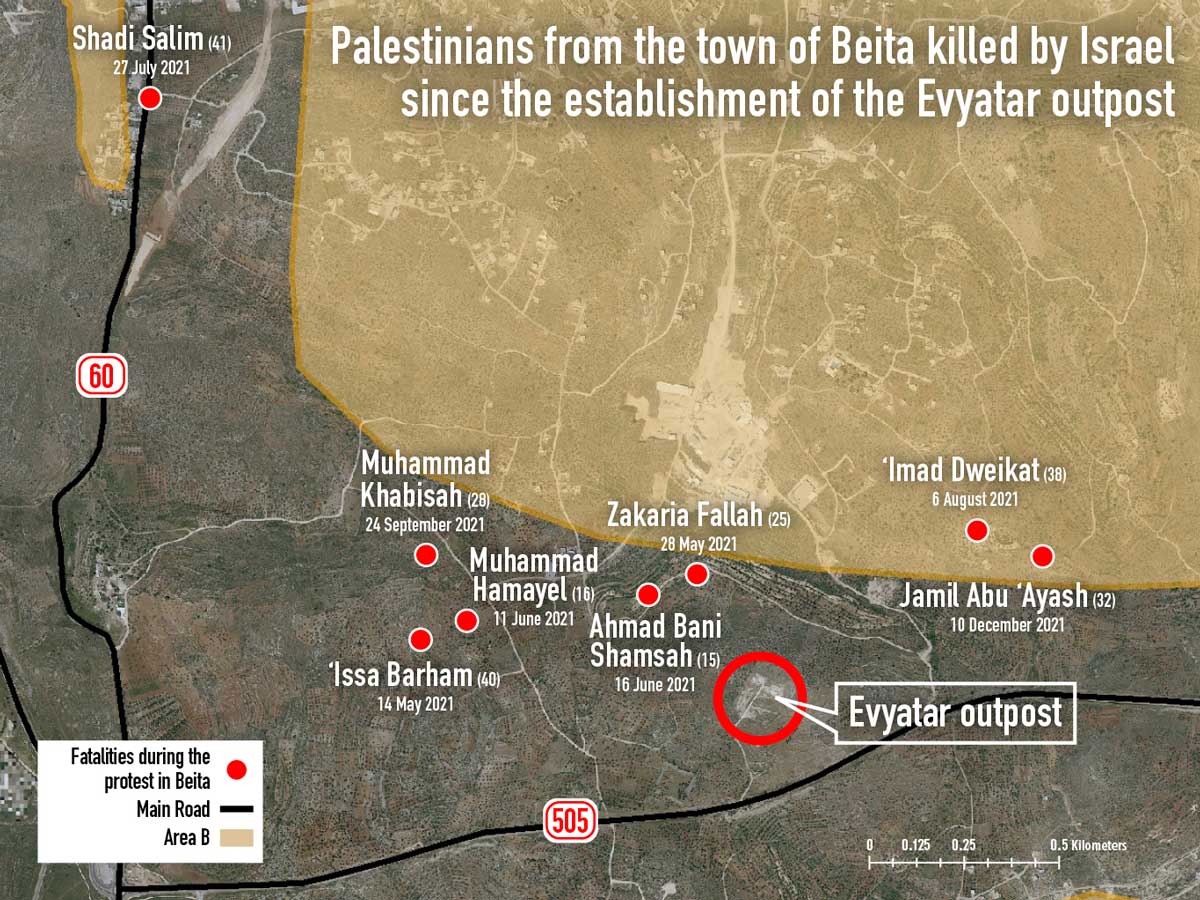 B’Tselem has published a new report documenting the death and violence surrounding the ongoing saga of the Evyatar outpost, which was built illegally by Israeli settlers on land known to Palestinians and Mount Sabih – just south of Nablus. The outpost has sparked sustained protests led by Palestinians demanding the outpost be removed and the land returned, protests which have been violently suppressed by the Israeli military. Seven Palestinians have died and many dozens have been injured as a result.
B’Tselem writes on the other means by which the Israeli military is punishing Palestinian resistance:
“In addition to implementing a lethal open-fire policy, Israeli security forces have arrested dozens of town residents since the protests began. To wear down the protesters, the military closed off the main entrance to the town for a month and a half, and military bulldozers blocked and dug up agricultural roads leading to the demonstration flashpoints, damaging about a kilometer of agricultural terraces and some 2,000 trees about a kilometer away from the outpost. The deputy council head of Beita told B’Tselem that Israel revoked the work permits of about 150 residents. Soldiers also used severe violence against Israeli protesters who came to the demonstrations to show solidarity with the Palestinian protesters, and arrested them on false pretenses. Evyatar was established on Palestinian land – not on the private initiative of several settlers, but as part of Israel’s settlement policy in the West Bank, with the full cooperation of all the relevant Israeli authorities. However, the state is not content with appropriating the land and building a settlement there. It also insists on forbidding the Palestinian residents from protesting these acts and forcibly prevents any attempt at resistance — including with lethal force. Let us reiterate: the establishment of settlements is illegal under international law, and the International Criminal Court in the Hague is currently investigating Israel’s policy on the matter. Israel’s choice to prevent area residents from protesting the establishment of Evyatar, to implement a lethal open-fire policy in circumstances that do not endanger soldiers’ lives, and to uphold this policy even after its fatal outcomes have become clear – adds insult to injury.”
Bonus Reads
- “Eight Settlers Arrested for Attacking Soldiers, Palestinians Near Illegal West Bank Outpost” (Haaretz)
- “Israeli army blocking activists from calling ‘hotlines’ to report settler violence” (+972 Magazine)
- “Israel Surpasses 1,000 Demolitions in the Occupied West Bank Since Joe Biden Took Office” (The Intercept)
Welcome to FMEP’s Weekly Settlement Report, covering everything you need to know about Israeli settlement activity this week.
To subscribe to this report, please click here.
December 23, 2021
- Homesh Settlement Violence Continues As Knesset Rejects Plan to Authorize Outpost
- Settler/State Displacement of Palestinians in Sheikh Jarrah, Part 1: Salem Family Gets Brief Reprieve of Expulsion from Home in Sheikh Jarrah
- Settler/State Displacement of Palestinians in Sheikh Jarrah, Part 2: Salhia Family Receives Eviction Order
- Settler/State Displacement of Palestinians in Sheikh Jarrah, Part 3: Skafi Family Turns Down $5 million Offer from Settlers for Home
- Israeli Supreme Court to Decide on (Likely Swift) Mass Demolitions in al-Walajah
- Church Leaders Launch Campaign Against “Systematic Attempt” to Rid Jerusalem of Christians
- Bonus Reads
Homesh Settlement Violence Continues As Knesset Rejects Plan to Authorize Outpost
In the days following a deadly attack by Palestinians on Israeli settlers near the site of the former Homesh settlement in the northern West Bank, Israeli settlers and their allies, predictably, have exacted revenge on Palestinian communities, with violent attacks that Israel has done little or nothing to prevent. Also predictably, they have demanded that, in response to the attack, the government authorize the illegal outposts/yeshiva at the site of Homesh, as well as additional new settlements.
Despite an emotional plea by the family of the murdered settler – Yehuda Dimentman – and accompanying pressure from the settler constituency, the Knesset voted 59-50 against a declaration that would have urged Prime Minister Bennett to grant authorization to the Homesh outpost along with 70 other outposts in the West Bank. In addition, the text of the declaration urged Bennett “decisively prevent the evacuation of the Homesh Yeshiva, authorize it and to allow its students to study and live there.”
As a reminder, the Homesh settlement was dismantled by the Israeli government in 2005 as part of its “disengagement” from the Gaza Strip. Homesh was ruled to have been built on land privately owned by the Palestinian village of Burqa, ownership which was legally recognized by the Israeli High Court of Justice. Nonetheless, since 2005 Israeli authorities have permitted settlers to retain effective control over the area, including via establishing and operating an [illegal] religious school (aka, yeshiva) at the site for the past 15 years. The yeshiva lacks any permits/planning authorization — authorization that is impossible given that in 2005 the IDF declared the Homesh site to be a closed military zone. As such, both Palestinians and settlers are prohibited from entering the area (let alone building on it). That restriction, however, in practice has been applied to only one population (the one that has been recognized by Israel as the legal owners of the land), and for years, the IDF has turned a blind eye to the yeshiva, despite warnings about the outpost’s violence and repeated confrontations. The recent attack targeted settlers departing from that [illegal] yeshiva.
Within days of last week’s attack, settlers moved to expand the outpost/yeshiva at the Homesh site. On December 18th, settlers managed to erect new, prefabricated buildings at the site, adjacent to the existing (illegal) yeshiva. In the process, settlers reportedly clashed with the IDF, which tried (and failed) to prevent them accessing the site.
On December 19th, the IDF moved in to dismantle the new (illegal) buildings, but did not dismantle the (equally illegal) yeshiva. At the same time, a group of 200 settlers attempted to reach the yeshiva and protest the removal of the outpost buildings, resulting in violent clashes with the IDF. Later, on December 22nd, Israeli authorities arrested the head of the illegal Homesh yeshiva – Rabbi Elishama Cohen – on “suspicion of violating the 2005 Disengagement Law” (the law that provided for the evacuation of the Homesh settlement). Cohen was soon released following intervention by top settler leader Yossi Dagan, but told to return to the police station for further questioning. The arrest infuriated MK Bezalel Smotrich, from the far-right Religious Zionism party, who slammed the Bennett government, saying:
“As part of the government’s decision to eliminate the Homesh yeshivai in response to the terrorist attack in which Yehuda Dimentman was killed and to reward terrorism, the police were sent today to persecute, arrest and deter him. They will not scare us. We call on the masses of the house of Israel to arrive tomorrow and march with Yehuda’s family, demanding an arrangement be made with the Homesh yeshiva.”
The Jerusalem Post reports that the IDF has plans to dismantle the yeshiva following a seven day mourning period for Dimentman.
Settler/State Displacement of Palestinians in Sheikh Jarrah, Part 1: Salem Family Gets Brief Reprieve of Expulsion from Home in Sheikh Jarrah
The expulsion of the Palestinian Salem family from their home of 70 years in Sheikh Jarrah has been delayed on a technicality. +972 Magazine reports that the eviction order was paused because the settler (Aryeh King) who pompously hand-delivered the order to the Salem family was not legally empowered to do so, forcing the Jerusalem court to annul that order (which had set the expulsion for December 29th) and issue a new order, which will reportedly be delivered to the family in the coming weeks.
The delay follows notable attention on the case from international actors, including a visit by diplomats from the European Union. +972 Magazine further reports:
“A source in the Israeli government told +972 that various ministries have been turning their attention to the expulsion of the Salem family due to concern over the political ramifications (developments in the neighborhood remain closely watched by Palestinians and by foreign governments). Some Israeli officials have even looked into legal possibilities for the family to further appeal the ruling, in an attempt to stall its implementation. Israel’s Foreign Ministry provided +972 with the following response, which it said had been coordinated among all relevant government bodies: ‘The State of Israel is a state governed by rule of law, and the ruling of the court — which are known for their independence and the balance they provide on sensitive issues — is binding. The implementation of the ruling will be carried out by the authorities that take into account all the relevant factors, including the appropriate preparations before every move. Any attempt by extremists, and particularly the Hamas terrorist group, to exploit the situation to increase incitement, violence, and terrorism should be rejected.’”
Settler/State Displacement of Palestinians in Sheikh Jarrah, Part 2: Salhia Family Receives Eviction Order
On December 20th, Israeli authorities reportedly delivered an eviction notice to the Palestinian Salhia family in Sheikh Jarrah, in the area near the British Consulate, with the eviction date set for January 25th. The order pertains to a plot of privately owned land – purchased by a Salhia elder in 1967 – on which the Salhia family has built two homes. Israeli authorities had previously delivered an eviction order to the Salhia family in October 2021, that order has since expired – prompting this new order to be issued.
Mohammad Salhia told Middle East Monitor that the Jerusalem Municipality offered to delay the eviction by 8 months if he signed a legal agreement giving up claim to ownership of the land and turning his family into merely tenants of the buildings (he refused).
According to the WAFA report, in 2019 Israel issued an order to unilaterally seize the plot for the “public interest” in order to establish a school there. This school was originally planned to be built on a different parcel of land, however, the Israeli government gave this land to an Ultra-Orthodox organization in order to build the Glassman yeshiva (a settlement project). In the absurdity of land use in East Jerusalem, now, in order to build the school, the government has opted to confiscate the Salhia family’s land.
Settler/State Displacement of Palestinians in Sheikh Jarrah, Part 3: Skafi Family Turns Down $5 million Offer from Settlers for Home
Al-Monitor reports that the Palestinian Skafi family has turned down an offer by settlers to purchase their home in Sheikh Jarrah for an astounding $5 million. Abdel Fattah Skafi told Al-Monitor:
“The family, similar to others in the neighborhood, will not accept any tempting offers by the Israeli authorities, whether financial or an offer to grant them another piece of land as an alternative. We inherited the house from our ancestors and we will pass it on to our children and grandchildren, no matter how long the conflict with the settlers.”
The Skafi family (14 individuals) live in a large house surrounded by homes that have already been taken over by Israeli settlers. In order to access the house, the Skafis must pass through a narrow alley in front of the settler-inhabited homes. The family has been subjected to daily harassment and violence as a result of this reality.
Israeli Supreme Court to Decide on (Likely Swift) Mass Demolitions in al-Walajah
On December 26th, the Israeli Supreme Court is set to hold a final hearing on demolition orders against 38 Palestinian homes – in which around 300 people live – in the village of Al-Walajah, a small part of which is located within the municipal borders of Jerusalem (illegally annexed by Israel following the 1967 war). The State has asked the Court to lift a freeze on the demolition orders, arguing (as usual) that the houses – built by Palestinians on their own land – were built without the required Israeli permits. Ir Amim cautions that if the Court decides to greenlight the demolition orders, it is likely that the mass demolitions will be carried out very quickly. Ir Amim explains:
“The demolitions would likely be carried out very swiftly because the National Enforcement Unit under the Ministry of Finance has assumed responsibility for building and planning enforcement in this area since 2016. This unit is considered the most aggressive Israeli enforcement body. Indeed in the past five years, this unit has executed demolition orders in al-Walajeh immediately after the conclusion of court proceedings. Some 12 additional homes not protected by the appeal likewise face impending demolitions, four of which were carried out over the past few months, including one at the beginning of December. Roughly half of the homes in the annexed part of al-Walajeh have received demolition orders, and approximately 30 have already been executed since 2016 (including those mentioned above). These mass demolition orders, together with the absence of urban planning, threaten to uproot hundreds of al-Walajeh residents for a second time.”
As a reminder, it is all but impossible for Palestinians to obtain building permits from Israel to build “legally” on their own land in East Jerusalem and in Area C of the West Bank. In the case of al-Walajah, the situation is even worse: such permits are, literally, impossible to obtain, since the area lacks a required Israeli-approved “outline plan,” without which permits are an impossibility. In an effort to overcome this obstacle, Al-Walajah residents, with the help of planning experts, prepared and proposed an outline plan for the area, and for more than 15 years have worked to get Israel to approve it — to no avail. Israeli authorities have repeatedly (in January 2021 and again in March 2021) refused to approve the resident-backed plan, and have also refrained from initiating their own planning process. Indeed, the Jerusalem District Committee, as part of a January 25, 2021 ruling against the outline plan proposed by residents, deemed the area in question — where Palestinians have lived for decades — an “agricultural area” where no building would ever be permitted. The result: Al-Walajah’s residents have been left with zero hope of obtaining the permits required to build on their own land – or keep their current homes located there.
Ir Amim writes:
“Demolitions in Al-Walaja are due to two combined Israeli policy decisions: On the one hand, Israeli authorities have never made an outline plan for the annexed part of Al-Walaja and residents therefore have no possibility of obtaining a building permit. All construction that has taken place in Al-Walaja since 1967 is thereby considered illegal under Israeli law. On the other hand, in 2016 the government decided to increase home demolitions – specifically targeting Palestinian communities. Since that year, the National Enforcement Unit (under the authority of the Ministry of Finance) began issuing and carrying out demolition orders in Al-Walaja. This unit is the most aggressive of the Israeli enforcement units. The combined effect of no outline plan and aggressive enforcement has led to half of the homes of the Jerusalem section of Al-Walaja currently being under threat of demolition. In January of this year (2021), the al-Walaja’s community most recent attempt to advance the outline plan they prepared for their village was rejected by the Jerusalem District Committee. Meanwhile, Israeli construction plans of thousands of housing units around Al-Walaja are advancing – including a new settlement on the Western side of the village. Indeed, demolitions in Al-Walaja are part of the creeping annexation Israel is advancing within the Greater Jerusalem area, specifically with the aim of connecting settlements near Bethlehem to Jerusalem, which would effectively fragment the Palestinian space of the southern West Bank.”
Church Leaders Launch Campaign Against “Systematic Attempt” to Rid Jerusalem of Christians
A group of high ranking Christian church leaders have launched a campaign protesting the treatment of churches and Christian residents in Jerusalem. They specifically cite settler violence and attempts to take over church-owned properties in the Old City as key parts of an effort to rid Jerusalem, and other parts of the Holy Land, of Christians.
A statement issued by the campaign reads:
“The principle that the spiritual and cultural character of Jerusalem’s distinct and historic quarters should be protected is already recognised in Isarlei law with respect to the Jewish Quarter. Yet radical groups continue to acquire strategic property in the Christian Quarter, with aim of diminishing the Christian presence, often using underhanded dealings and intimidation tactics to evict residents from their homes, dramatically decreasing the Christian presence, and further disrupting the historic pilgrim routes between Bethlehem and Jerusalem.”
The campaign asks the Israeli government to:
“Deal with the challenges presented by radical groups in Jerusalem to both heChristian community and the rule of law, so as to ensure that no citizen or institution has to live under threat of violence or intimidation.”
The leader behind the new campaign is the Greek Orthodox Patriarch of Jerusalem, Theophilos III, whose Patriarchate has been in a particularly nasty (and muddled) battle with settlers over the fate of three prized Old City properties which have been long-owned by the church, but which settlers claim to have purchased (via a sale to a foreign real estate company acting secretly on behalf of the radical settler group Ateret Cohanim). Once Ateret Cohanim’s role became known, the Patriarchate sought to retain control of the properties, but over the course of a long legal battle, multiple Israeli courts, including the Supreme Court, validated the sale. The Greek Orthodox Church has received significant blowback from the sale of these properties to the settlers, including in January 2018, when Palestinians protested in Bethlehem in an attempt to block the arrival of Patriarch Theophilos III for Christmas celebrations.
In addition to the coalition of Church leaders based in Jerusalem, the campaign was boosted by the Archbishop of Canterbury, who joined the archbishop of the Episcopal Church of Jerusalem and the Middle East (the Anglican Church) to issue a statement that was also published as an article in the London-based The Sunday Times, entitled “Let us pray for the Christians being driven from the Holy Land.”
In response to the campaign, the Israeli Foreign Ministry dismissed the concerns raised by Christian leaders as “baseless,” and claimed that the campaign “distort[s] the reality of the Christian community in Israel.” The Foreign Ministry went on to criticize the Church leaders for their alleged silence regarding the plight of Christians elsewhere in the Middle East, implying that the leaders are unfairly singling out Israel. This line of argument is tantamount to the Israeli government calling these church leaders antisemitic — tying in closely with the Israeli government-backed definition of antisemitism, according to which “applying double standards” in critizing Israel is a form of “contemporary” antisemitism.
Bonus Reads
- “De-emphasized under Trump, report shows Biden taking settler violence more seriously” (The Times of Israel)
- “Israeli Troops and Settlers Zero in on a New Target for Attacks: Palestinian Schools” (Haaretz)
- “Opinion | The U.S. Funding Challenges Facing the Israel-Palestine ‘Peace Industry’” (Haaretz)
- “Opinion: Mr. Blinken, you can pick up the phone and save a Palestinian village from destruction” (Washington Post)
- “Why Jerusalem Cannot be ‘Taken Off the Table’” (Crisis Group)
Welcome to FMEP’s Weekly Settlement Report, covering everything you need to know about Israeli settlement activity this week.
To subscribe to this report, please click here.
December 17, 2021
- In Sheikh Jarrah, Palestinian Family Faces Immediate Displacement, While Israel Begins Work on New Settler Garden at Entrance to the Neighborhood
- Israeli Custodian General is Behind Six New Settlement Plans Across East Jerusalem
- Israel Custodian General Reveals New Details on Regulations Governing its Management of East Jerusalem Properties, Leaving More Questions
- Israel Forges Ahead with New Settlements on the Golan Heights
- Following Murder of Israeli Settler, Settlers Launch Attacks of their Own & Attempt to Establish New Outpost
- Gantz Moves to Send More Police to West Bank to Monitor Settler Violence
- Meanwhile in Israel…Political Storm Ensues Over Whether Settler Terrorism Is a Problem or Not
- Bonus Reads
In Sheikh Jarrah, Palestinian Family Faces Immediate Displacement, While Israel Begins Work on New Settler Garden at Entrance to the Neighborhood
Courtesy of an eviction order hand-delivered by settler impresario and Jerusalem city councilman Aryeh King, and his colleague Jonathan Yosef, the Palestinian Salaam family has been ordered to vacate their Sheikh Jarrah home of 70 years by December 29, 2021. King and Yosef assert they are the legal owners of the home, which is located in the Umm Haroun section of Sheikh Jarrah, having bought it from the heirs of the Jewish family that owned the property prior to 1948. Peace Now has produced a helpful timeline of the full history of the Salaam’s home.
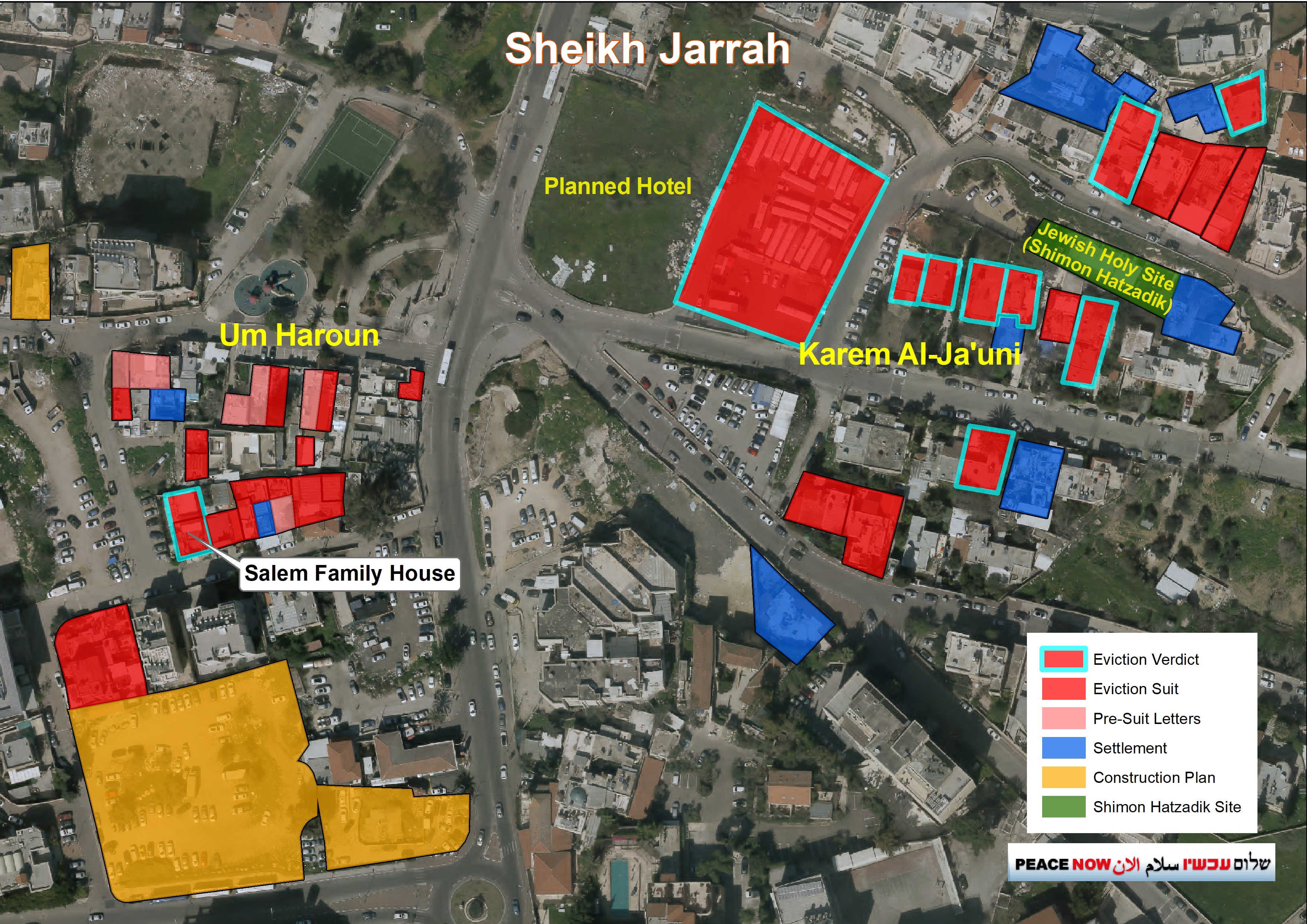 This purchase took place, without a doubt, thanks to the help of the Israeli Custodian General – the body that manages property abandoned by Jews in 1948 when their heirs are unknown – which almost certainly helped King and Yosef in identifying the property, locating the heirs and securing its sale (see Peace Now’s excellent report on the Absentee Property Law for more legal background on how this happens).
On December 15th, Ir Amim documented the scene as settlers, under the protection of Israeli police, fenced off the Salaam family’s land (where they are supposedly permitted to live until the 29th) in an attempt to prevent Palestinians, including the Salaam family, from accessing the area.
Peace Now said in response:
“This is a terrible injustice based on the cynical exploitation of a discriminatory law that allows Jews to exercise the ‘right of return; to property lost to them in 1948, at the expense of Palestinian families legally living in the property, while another Israeli law denies the same right to Palestinians. This is exactly what the Mishnah says: ‘He who says: mine is mine and yours is mine, is called evil’. The State of Israel, which took the Palestinian refugees’ properties lost to them in 1948, cannot today allow settlers to take from Palestinians Jewish properties lost in 1948 and on which they are have already received compensation. The government can stop this evacuation, and it must do so.”
The eviction of the Salaam family comes as the government of Israel is pursuing the displacement of as many as 70 Palestinian families in Sheikh Jarrah.
In parallel, the Israeli government has begun construction on a settlement installation (including a “public garden” as well as a driveway that will service an as-of-yet-unbuilt Israeli hotel in the neighborhood) at the entrance to Sheikh Jarrah, including the demolition of several Palestinian businesses. Notably, the site of this project is very close to the tomb of Shimon the Righteous, which is a religious site closely associated with the settler enclave in Sheikh Jarrah. The Jerusalem Municipality previously expropriated the land, which was privately owned by Palestinians, “for public use” — an Israeli legal tactic that permits the State to confiscate even privately owned land ostensibly to benefit the “public” (a “public” that it seems never includes Palestinians in East Jerusalem).
In October 2021, the Israeli Supreme Court rejected the appeals by the business owners to stop the demolition. This week, bulldozers leveled a plot of land owned by four Palestinian families and that was the location of two Palestinian businesses, a car wash and a parking lot. The business owners were handed an immediate eviction notice on December 14th, just one day before the bulldozers began work.
Israeli Custodian General is Behind Six New Settlement Plans Across East Jerusalem

Map by Haaretz
Haaretz reports that the Israeli Custodian General is planning six new settlement enclaves, to be located in some of the most sensitive areas of East Jerusalem. The news comes one week after the public learned of one of these plans, Givat HaShaked (see FMEP’s reporting last week), which is now understood to be part of a larger Israeli government plan to advance a slate of new settlement enclaves across East Jerusalem. As a reminder, the Israeli Custodian General is empowered by the State to act as caretaker of land that has unknown ownership.
While details on the plans are scant for the time being, Haaretz reports that the Israeli Custodian General is planning new settlements buildings that include:
1 – A new settler enclave in Sheikh Jarrah, in an area known as Um Haroun. As has been well documented, Palestinians are in a battle to stay in their longtime homes in Sheikh Jarrah while the Israeli Custodian General and Israeli settlers work hand-in-hand to displace them. Thirteen Palestinian families in Sheikh Jarrah (whose legal battle will impact dozens more) are still awaiting a Court ruling on their displacement at the hands of settlers. Haaretz reports:
“According to a custodian document, it administers 33 plots out of a total of 58 in the neighborhood. Five more plots have been expropriated by the Israel Land Authority. The city zoning plan allows for the demolition of the old structures and construction of buildings up to four-stories in their stead, or expanding them to that height. This could mean the construction of a neighborhood containing hundreds of housing units in the heart of Sheikh Jarrah. The Justice Ministry’s Land Registrar recently completed the registration of the neighborhood to its Jewish owners, so it is likely that any neighborhood built there will be for the Jewish population.”
2 – A new settler enclave near the Damascus Gate, near the Old City of Jerusalem, where approximately 10 Jewish Israeli families have already established a settlement enclave.
3 – Two new settler enclaves near Beit Safafa, one being the Givat HaShaked settlement plan which FMEP covered in greater detail last week. The second plan is not far from where the Givat HaShaked settlement would be built, and reportedly would involve a large settler compound with dozens more settlement units to be built in the sliver of land between Beit Safafa and the Talpiot Industrial Zone.
4 – A new settler enclave in Sur Baher. Reportedly, the Custodian is hoping to add more land to its holdings in Sur Baher (it currently holds 3.3 dunams and is attempting to gain 2 more dunams), meaning this plan could expand.
5 – A large new settler enclave in Beit Hanina. The Custodian is reportedly looking to build dozens of new settler units on six dunams of land (1.5 acres), to be located on a plot adjacent to the IDF Central Command base. The Custodian has also sought the cooperation of the Defense Ministry in promoting this plan.
The Justice Ministry, which houses the Custodian General, attempted to dodge these reports, telling Haaretz that it is not “advancing” any of these plans other than the one in Sheikh Jarrah, where it says it is “examining a construction project.”
Israel Custodian General Reveals New Details on Regulations Governing its Management of East Jerusalem Properties, Leaving More Questions
Under pressure from an impending court hearing, on December 11th the Israeli Custodian General submitted a document to the Court purporting to enumerate the regulations governing its management of properties in East Jerusalem. The Custodian General was facing a December 14th Court hearing on a petition filed by the Israeli NGO Ir Amim along with Palestinian residents of Sheikh Jarrah, that asserted no such regulations existed, enabling “severe misconduct and collaboration with settler groups to initiate evictions of Palestinian families in East Jerusalem, which severely infringes on the rights of Palestinians in the city.” Some 70 families in the Sheikh Jarrah neighborhood are facing homelessness because of the Custodian General’s collusion with settlers seeking their displacement from properties in which they have lived, legally, for decades.
In light of the Custodian General’s new publication (which the court viewed as resolving the complaint against the State), the Court dismissed the petition without prejudice, meaning the petitioners are permitted to file a new case on the same matter in the future.
Ir Amim filed the petition following news that the Custodian General has advanced a plan to build a new settlement – Givat HaShaked – on property it manages. As reported last week, this is an unprecedented move by the Custodian General, raising questions about whether the Custodian General is permitted to allow properties under its management to be developed. The document submitted to the Court this week by the Custodian General only raises more unanswered questions about the parameters governing the Custodian General’s ability to act as a property developer for properties that it does not own (only manages while awaiting the locating of the legal owners/heirs). Ir Amim further explains:
“The procedure includes dozens of clauses, none of which reference the possibility that the custodian may itself file plans and build residential complexes on a lot it owns. One clause refers to this indirectly, stating, ‘When initiated, or if contacted regarding urban renewal or planned improvements, the Custodian General shall examine the essence of the request and its impact on the administered property.’ Indeed, planning sources are unfamiliar with any case in which the custodian acted as a realty entrepreneur by improving the properties it holds. The subject raises another issue: the custodian is technically forbidden to sell property. Therefore, it remains unclear whether the apartments built in these various compounds will be sold on the open market, or whether they will remain the property of the custodian, who will rent them out. The Justice Ministry has not responded to clarify the matter.”
Israel Forges Ahead with New Settlements on the Golan Heights
At the recommendation and with the approval of Prime Minister Bennett, on October 14th Interior Minister Ayelet Shaked signed off on two orders establishing a settlement municipal authority in the occupied Golan Heights, a move that opens the door for an expedited planning process for existing and new settlements in the area. This includes the construction of the infamous “Trump Heights” settlement in addition to planned settlements called Givot Eden, Asif, and Matar. Last week, Prime Minister Naftali Bennett said that Israel’s plan is to double the settler population in the Golan Heights by 2030.
The special committee, which will act as a zoning board with broad planning authority, will have the combined powers of local and district planning and building committees, but will not include members who represent the public – an anomaly in the Israeli planning system.
The committee has already completed initial work by laying out the territorial borders of the “Trump Heights” settlement, which will cover 276 dunamns (about 70 acres). With its borders decided, the committee will move to expedite construction plans for residential housing, public buildings, industrial areas, roads and more.
On this massive settlement effort, the Haaretz Editorial Board writes:
“Occupied territories are occupied territories and annexation is annexation, even when it’s the Golan Heights and even when the annexation plan is called “a plan for encouraging sustainable demographic growth.”…We must tell it like it is. This is an artificial population expansion project, meant to strengthen Israel’s grip on the Golan Heights and create facts on the ground that will make it difficult for future leaders who might consider holding negotiations on the territory. To expedite matters, the Prime Minister’s Office seeks to create a “special committee” with the powers of the local and regional planning and building committees, but without the customary inclusion of public representatives. This is a national project. Like the so-called Judaization of the Galilee. Like the settlement enterprise.”
Al-Monitor provides a helpful background on the occupied Golan Heights and the creation of “Trump Heights”:
“Israel seized the Golan Heights from Syria in the 1967 Six-Day War. In 1981, Menachem Begin’s government formally annexed the territory. This unilateral move was not recognized by any country until Trump came along. In March 2019, his administration changed long-standing American policy by recognizing Israeli sovereignty over the region. A proclamation signed by Trump declared, ‘The State of Israel took control of the Golan Heights in 1967 to safeguard its security from external threats. Today, aggressive acts by Iran and terrorist groups, including Hezbollah, in southern Syria, continue to make the Golan Heights a potential launching ground for attacks on Israel. Any possible future peace agreement in the region must account for Israel’s need to protect itself from Syria and other regional threats. Based on these unique circumstances, it is therefore appropriate to recognize Israeli sovereignty over the Golan Heights.’ Three months later, the [Israeli] Cabinet convened for a special session in the Golan Heights and approved the establishment of a new settlement named for the US president. At that meeting, a huge sign decorated with Israeli and American flags was unveiled at the entrance to the new settlement. Written on it in gold letters was the name Ramat Trump.”
Following Murder of Israeli Settler,Settler Launch Attacks of their Own & Attempt to Establish New Outpost
On December 17th, a Palestinian gunmen opened fire on a settler vehicle near the dismantled settlement of Homesh, in the northern West Bank, killing one man – Yehuda Dimentman – and injuring two others. The IDF has apprehended several suspects already.
Though the Homesh settlement was evacuated by the Israeli government in 2005 – and military orders have barred Palestinians from entering the area – settlers have been allowed to establish an unauthorized outpost at the site, where the settlers also operate a yeshiva. Settlers have been openly obsessed with the desire to re-establish Homesh, hosting religious events and protests at the site, some of which have been attended by Israeli MKs and politicians. At the funeral for Dimentman, which several Israeli politicians attended, already begun calling for the government to formally reestablish the Homesh settlement.
In the hours following news of Dimentan’s death, settlers have already begun exacting revenge – with little to no interference from the IDF, though the outpouring of violence is an entirely predictable established pattern in the wake of Palestinians attacks. In the Palestinian village of Qayrut, a group of at least 15 settlers launched and especially violent attack on a Palestinian home, knocking on the door pretending to be Israeli soldiers at 4am, then proceeding to ransack the house and severely beat Mohammed Makbal – sending him to the hospital. No suspects have been apprehended, though several were caught on camera.
Within 24 hours of the attack, settlers from the Kiryat Arba settlement in Hebron moved to establish a new outpost in honor of Dimentan, called Nofei Yehuda. In this case, the IDF moved in swiftly to remove the settlers from the area. The outpost was established by members of the Nahala settler movement, of which Dimentan was a part. Nahala is behind a lot of unauthorized construction in the West Bank, and is a leading force in the battle over the Evyatar outpost.
Peace Now has written about the Nahala Movement, saying:
“The Nahala organization and the main activists of the new outposts are not the mainstream old-guard settlers (like the Amanah organization who is behind many other settlements and outposts and gets much more support from the authorities), however they are not a small fringe. This outpost is an example of a rift that is being created within the Israeli right wing. The more extreme right, which is willing to challenge the system more strongly, and the old-guard settlers who continue the mentality of working ‘with’ the government as much as possible. On the partisan level we see this rift in the creation of two different parties: Yamina, headed by Naftali Bennet, and the Jewish Zionism, headed by Betzalel Smotrich and Itamar Ben Gvir. The challenge of the new outpost puts the new shaky government, which is a coalition of parties which don’t agree about many things, to face its first big political test. The extreme right is signaling that it is planning to continue to challenge the new government, like it had done in the flags march in East Jerusalem, and in yesterday’s settlers’ marches throughout the West Bank.”
Gantz Moves to Send More Police to West Bank to Monitor Settler Violence
Defense Minister Benny Gantz and Israeli Public Security Minister Omer Bar-Leg have agreed to draft hundreds of Israeli soldiers into the (domestic) police force, so that Israeli police can then be reassigned to the West Bank partly to fill posts dedicated to policing settler violence.
Settlers, of course, are not thrilled about the new attention being paid to settler terrorism experienced by Palestinian communities across the West Bank, and which has increased over the past year. According to Israeli government data (which does not systematically track settler violence against Palestinians) the Shin Bet logged 272 “violent incidents” in the West Bank in 2020; so far in 2021, there have been 397 “violent incidents” recorded by the Shin Bet. The UN recorded even more attacks this year – 450 as of December 6 – compared to 358 in all of 2020 and 335 in 2019.B’Tselem, which recently released an excellent report on settler terrorism, documents a 28.6% increase in settler violence in 2021 over 2020. Yesh Din, which also documents settler violence while seeking justice and accountability, notes that only 5% of cases it filed from 2018-2021 (238 total cases filed, while it documented 540 total cases) have resulted in indictments. Palestinians have increasingly declined to file police reports regarding settler crimes, with so few cases actually resulting in any tangible good for the victim.
For a SMALL sample of the terrorism inflicted by settlers on Palestinians in the West Bank on a daily basis, see the following reports from the past week by WAFA news:
- “Settlers, backed by Israeli army, intensify attacks against Palestinians in Nablus area”
- “Israeli forces attack Palestinian farmers, seize tractor in Masafer Yatta area”
- “Israeli settlers leave several villagers wounded, fractured south of Nablus”
- “Settlers attack Palestinian vehicles south of Jenin”
- “Israeli settlers attack Palestinian vehicles, bloc traffic artery east of Hebron”
- “Israeli settlers rampage through Nablus-district town”
- “Israeli settlers take over water spring in northern Jordan Valley”
Meanwhile in Israel…Political Storm Ensues Over Whether Settler Terrorism Is a Problem or Not
Following months (which followed years, which followed decades) of settler terrorism against Palestinians, this week Israeli Public Security Minister Omer Bar-Lev (Labor) set off a political clash within Israel over the issue. In comments made alongside U.S. Deputy Secretary of State Victoria Nuland — and after Israeli diplomats have allegedly come to believe that the Biden Administration is “obsessed” with “settler violence” (though other reporting contradicts that claim) – Bar-Lev called settler terrorism “severe” and said that Israel is taking steps to address it.
Those comments were seen as a betrayal by many of Bar-Lev’s pro-settler coalition partners, and elicited some strong condemnations. Interior Minister Ayelet Shaked (Yamina) said Bar-Lev is “confused.” MK Bezalel Smotrich (Religious Zionism) called Bar-Lev a “bastard” and tweeted “shame on you, little man.”
The drama also drew comment from Israeli Prime Minister Naftali Bennet who, it should be recalled, relies heavily on the settler constituency and is also ideologically closely aligned with the settlers, having once served as the head of the top settler body called the Yesha Council. Bennett appeared to dismiss Bar-Lev’s comments, in effect giving official cover for an a green-light to continued and unaccountable settler terrorism, tweeting:
“The settlers in Judea and Samaria have been suffering from violence and terrorism, every day, for decades. They are the defensive wall of us all and we must strengthen them and support them, in words and deeds…There are marginal phenomena in every public, they should be dealt with by all means, but we must not generalize an entire public.”
B’Tselem’s Executive Director, Hagai El-Ad, responded to Bennett’s claim, telling Haaretz:
“There’s a propagandistic façade here that’s convenient for Israel…There’s a few bad settlers, or more, on one side, and on the other is the good state of Israel, which seeks to enforce the law. But that isn’t the truth. Both the state and the settlers want the same thing – to dispossess Palestinians of their land.”
This relationship – between the settlers and the State when it comes to dispossessing Palestinians – was spelled out in a recent B’Tselem report, “State Business: Israel’s misappropriation of land in the West Bank through settler violence.”
Bonus Reads
- “Mining Gold From East Jerusalem’s Streets” (Amira Hass for Haaretz)
- “This was the deadliest year for Palestinian children since 2014” (Khaled Quzmar for +972 Magazine)
- “Unearthing the Palestinian Neighborhood Buried Beneath a Tel Aviv Park” (Haaretz)
- “Fact Sheet: Israel’s E1 Settlement” (IMEU)
- “Opinion: Israel just showed its strategy on settlement boycotts: Gaslighting” (Gershom Gorenberg in the Washington Post)
Welcome to FMEP’s Weekly Settlement & Annexation Report. To subscribe to this report, please click here.
April 29, 2021
- Sheikh Jarrah Evictions Set for May 2nd; Protests & Diplomacy Ratchet Up
- Resources for Understanding Recent Protests and Violence in Jerusalem
- WZO Admits It Gave Palestinian Land to Settlers Without Written Agreements
- Jewish National Fund Delays Decision on Formalizing Policy on West Bank Land Purchases
- Ariel University Giving Academic Credit for Outpost Volunteers
- IDF Stops Settler Attempt to Establish Yeshiva on Site of Dismantled Homesh Settlement
- Settlers Celebrate Israeli Independence Day
- Settler-Run Chamber of Commerce Planning a Hotel in Hebron in Partnership with Palestinian Businessman Ahsraf Jabari
- Smotrich’s Party Files Bill for Outpost Legalization
- Roundup of Settler Violence This Week
- Human Rights Watch: Israel is Guilty of the Crime of Apartheid
- Bonus Reads
Comments or questions? Email Kristin McCarthy – kmccarthy@fmep.org.
Sheikh Jarrah Evictions Set for May 2nd; Protests & Diplomacy Ratchet Up
Over the past two weeks, activist groups have stepped up advocacy efforts to stop the impending dispossession of 8 Palestinian families (87 individuals) from their longtime homes in the Sheikh Jarrah neighborhood of East Jerusalem in favor of settlers. The eviction of four families has been set by Israeli courts for May 2nd, and three more families face eviction in August.
The Times of Israel reports that Jordan – which was the governing authority in East Jerusalem from 1948 until 1967 – has also gotten involved, and is said to have found “documents proving that the [Jordanian] ministry of development that built these houses had in 1956 finalized lease agreements for homes in Sheikh Jarrah.” Jordanian Foreign Minister Ayman Safadi said that the documents are contracts between Jordan and the Palestinian tenants, and were certified at the time by UNRWA. Such documents might help Palestinians disprove the settlers’ contention that the homes were originally owned by Jews who fled during the 1948 war. Israeli law allows such Jews – and their descendants – to reclaim their lost properties in East Jerusalem and the West Bank, while denying Palestinians any such right to reclaim properties they were forced to abandon in 1967 or 1948 inside what is today Israel.
On April 22, 2021 a group of 500 Palestinian residents of Sheikh Jarrah and 191 organizational signers sent a letter to the International Criminal Court. The letter calls on the ICC’s Chief Prosecutor to publicly condemn the evictions and investigate what is happening in Sheikh Jarrah as part of the ICC’s larger investigation into the situation in Palestine. The families write:
“If the forced evictions move forward, we will be subjected to other Israeli policies that together make-up Israeli practices that result in the widespread and systematic transfer of the Palestinian Jerusalemite population. If we set up a tent outside our houses, the Israeli occupying forces will demolish it, as part of its widespread and systematic policy of demolition of Palestinian property. If we rent a home outside Jerusalem because we cannot afford to rent in Jerusalem, we will be at risk of having our residency status revoked and not be allowed to enter Jerusalem, pursuant to Israel’s residency revocation policy, which requires Palestinian Jerusalemites to constantly prove their “center of life” is in the city”
On April 16th, hundreds of protestors rallied in Sheikh Jarrah to bring attention to the pending mass displacement. At the protest, former Palestinian Authority Minister for Jerusalem Affairs Hatem Abd al-Qadir told the Times of Israel:
“These protests are an expression of our rejection of the decisions of Israeli courts in expelling the residents of Sheikh Jarrah. This is ethnic cleansing and expulsion at the barrel of a gun.”
Resources for Understanding Recent Protests and Violence in Jerusalem
Since the beginning of Ramadan, Israel’s decision to close the plaza in front of the Damascus Gate – the main gate used by Palestinians to access Jerusalem’s Old City – sparked an outbreak of violence in Jerusalem (Israel subsequently reopened the plaza, but the situation on the ground is still volatile). Several FMEP grantees, partners, and other notable sources have published resources that help contextualize and assess exactly what is happening. Below are resources and excerpts most relevant to settlement observers seeking understanding of how current events fit into the larger picture of Israeli intentions and actions in Jerusalem, including the aforementioned impending dispossessions in Sheikh Jarrah.
Ir Amim published an update under the subject, “Closure of Damascus Gate Plaza & Aggressive Police Measures.” In the brief Ir Amim summarizes exactly what is happening:
“Many of the incidents of friction and confrontation in the area stem from the closure of the Damascus Gate steps and unprovoked police aggression and use of excessive force towards Palestinians, which disrupt the peace and lead to escalation. Over the past week, Palestinian youth have protested the plaza’s closure. The Israel police dispersed them with disproportionate use of force. The police claim that there have been incidents of Palestinians throwing stones at police, and indeed Israeli vehicles were damaged amid the confrontations. However, during the last few nights, police forces have assaulted Palestinians in the Damascus Gate area with no prior provocation on their part, including the use of stun grenades and the deployment of mounted police charging into hundreds of Palestinians who were solely visiting the Old City for Ramadan…
In tandem, right-wing Jewish extremists and nationalist organizations have been exploiting the friction to further incite and call for retaliation (both on social media and mainstream media) against the Palestinian protests and isolated incidents of Palestinian harassment of Haredi Jews. On Monday, Knesset Members from the extremist rightwing Religious Zionism party went to Damascus Gate in a hostile and provocative call to “show Palestinians who’s boss.”
In recent days, large groups of nationalistic Israeli youth have rallied in West Jerusalem’s city center shouting “death to Arabs,” while hunting down and attacking Palestinian pedestrians, which has led to clashes between Jews and Palestinians. In contrast to the police’s aggressive operations at the Damascus Gate, serious measures by the police to disperse these groups or protect attacked Palestinians have not been observed. These groups have called to gather tonight in Jerusalem, marching from the City Hall Square to Damascus Gate and the Old City with the intent of clashing with Palestinians “to teach them a lesson.”
Emek Shaveh published a brief entitled “The Last Gate,” exploring how the state of Israel has spent the past several years asserting more and more control over key archeological sites in and around the Old City, and why the Damascus Gate is a hugely important part of that still unfolding story. Emek Shaveh writes:
“Over the past two decades, the Old City’s Historic Basin has undergone unprecedented development. The State of Israel has invested billions of shekels in tourism projects and archaeological excavations alone, whether in the neighborhood of Silwan, excavations of the Western Wall tunnels, or on the Mount of Olives, among other initiatives. As noted, Damascus Gate is just the latest in this chain of investments. Damascus Gate is the most convenient gate from which to enter the Old City. It has a broad entrance and does not require walking uphill, as with Jaffa Gate or Zion Gate. Moreover, it is close to the center of Jerusalem. While Israel claims that it aims to develop the area around the gate, it is effectively redefining its character, promoting tourism, and increasing Israeli presence so as to diminish or conceal the Palestinian character of the area. The recent clashes along the stone steps of Damascus Gate plaza should be considered in the context of this development boom. Perhaps the authorities’ concern with young Palestinians sitting on the steps was just another chapter in the struggle over identity, belonging, and sovereignty, as with many in the Old City’s Historic Basin. After so many changes to the gates of the Old City, Damascus Gate is one of the last bastions of this ongoing struggle.”
The PLO Negotiation Affairs Unit issued a policy brief entitled “Occupied Jerusalem Protests Apartheid,” in it, writing:
“Since the first day of the holy month of Ramadan, the Israeli occupying authorities have been intensifying their restrictive and oppressive policies against the Palestinians in occupied Jerusalem as part of their continuous attempts to ultimately alter the Arab and Palestinian character of the city in defiance of international legitimacy. Such cruel acts are part and parcel of Israel’s illegal policies and practices, mainly its colonial- settlement expansion, home demolitions, and forced evictions of Palestinian families, including in Sheikh Jarrah and Silwan, in addition to its current denial for Palestinians in Jerusalem from running as candidates or participating in the upcoming Palestinian elections. In this context, it’s imperative to point out that seven Palestinian families currently face the risk of imminent forcible eviction from their homes in the Sheikh Jarrah neighborhood by 2 May 2021. Seventy Palestinian families live in this part of Sheikh Jarrah, 34 of which are undergoing a battle in the occupying power’s legal system to confront the threat of forcible transfer, a war crime under the Rome Statute of the International Criminal Court, which allows Israeli settlers to replace Palestinians and take over their homes. Israel’s illegal policies throughout occupied Palestine, particularly in Jerusalem, are rooted in an extremist ideology that enforces Jewish supremacy over the indigenous Palestinian population as articulated in the “Jewish Nation-State Law” of 2018 that legitimizes Israel’s institutionalized discrimination against the Palestinian citizens of Israel and turns a de facto reality on the ground to a de jure apartheid regime for all Palestinians in historic Palestine.“
WZO Admits It Gave Palestinian Land to Settlers Without Written Agreements
On April 26th, the Israeli High Court of Justice held a hearing on a petition filed by Palestinian landowners seeking the cancellation of a 1969 military seizure order which included a parcel of their land, and seeking the removal of settlers who have since been allowed by the State of Israel to live there and build a successful company growing date palms. The Palestinian landowners had previously filed a petition solely seeking the removal of the settlers, but the petition was denied by the High Court. The new petition seeks to cancel the underlying seizure of the land by the State.
To date, the Israeli government – along with the World Zionist Organization, to whom the State transferred the land in question – have not provided the Court with any documentation regarding the assignment of the land to the Israel settlers. Though the land was part of the military seizure order, a lawyer representing the WZO actually conceded that the land was given to the settlers without a written agreement, but suggested that it was approved by the Israeli Cabinet. Leading up to this admission, High Court President Esther Hayut rebuked Roi Shweika, the lawyer for the state, asking:
“How can it be that the state gives land to a person and there are no agreements and they don’t know for how long, especially when it’s not state land? Whoever heard of such a thing?…What efforts have you made to ask the people to produce the agreements that they have? If they don’t have agreements to produce, that raises a suspicion that there are no agreements.”
Haaretz also reported out a truly unbelievable intervention by the settler-owner of the date farm company, Ayala Smith:
Smith “To the best of my knowledge, the land has been worked since 1982, and more than 30 years went by before [the Palestinian owner] opened his mouth for the first time. I’m there every day, raising the best dates in the world, not him.”
Chief Justice Esther Hayut replied: “They weren’t given access to the land. They told him he couldn’t enter. Instead, they let you come in and you raised the best dates in the world. It borders on provocation to argue that.”
Jewish National Fund Delays Decision on Formalizing Policy on West Bank Land Purchases
The Chairman of the Jewish National Fund in Israel (JNF-KKL), Avraham Duvdevani, postponed a final vote by the Board of Directors – originally scheduled for April 22nd – on whether to formally adopt a policy of purchasing land in the West Bank for settlement construction. In anticipation of the policy’s adoption, the JNF-KKL Board voted in February 2021 to allocate nearly $12 million towards the purchase of land in the West Bank.
The decision to postpone the vote follows weeks of outcry from a Jewish organizations who donate to and promote the work of the JNF around the world. A new date for the vote has not yet been announced. As a reminder, the proposed policy is little more than a shift in public relations strategies. The JNF has long worked in support of settlements, but until this point has preferred to leave its settlement-related activities deliberately obscured.
Ariel University Giving Academic Credit for Outpost Volunteers
Haaretz reports that Ariel University, located in the Ariel settlement in the heart of the northern West Bank, is offering academic credit to students who volunteer as farmhands and security guards at unauthorized/illegal settlement outposts across the West Bank. The volunteer program is run through an organization called Hashomer Yosh (“Guardians of Judea and Samaria”), a group touted by the Chairman of Ariel University for its work against “those who want to disturb the right of the people of Israel to settle in the land and to develop agriculture.” The program was described on the Ariel University website as “linking the students with the national Zionist task of contemporary agriculture.””
Haaretz reports that the academic program placed five students at three outposts, including the Bar Yosef outpost which was founded by an individual who has been repeatedly filmed harassing Palestinians. Ariel University staff defended the program by arguing that the outposts in question are known to be built on “state land” (suggesting that their unauthorized status is a mere technicality). Of course, as is the case with all unauthorized outposts, these proto-settlements were built without formal permission or building permits in contravention of Israeli military law which governs the occupied West Bank, and are therefore illegal even under Israeli law.
Israeli attorney Eitay Mack has filed a complaint against the program, asking the Israeli Attorney General and the Israeli Council on Higher Education (which admitted Ariel University as a member in April 2019) to examine the legality of the program. The complaint has been assigned to Deputy Attorney General Raz Nizri.
Commenting on the program, Ariel University told Haaretz:
“In the framework of the law encouraging significant volunteering in the community, like other institutions, the university works with many and varied entities with expertise in placing volunteers in the community. In that framework, Hashomer Yosh received approval as an entity using volunteers for the current academic year.”
IDF Stops Settler Attempt to Establish Yeshiva on Site of Dismantled Homesh Settlement
On April 26th, the Israeli army removed settlers who had built a makeshift religious school (a yeshiva) and housing for students at the site of the dismantled settlement of Homesh in the northern West Bank. Undeterred, the settlers returned to the site the next day to hold classes.
According to the Jerusalem Post, the settlers brought in modular structures and plywood to build the housing, and used a large tent for the yeshiva itself. It is unclear how long the settlers had been allowed to remain at the site prior to their removal this week.
As a reminder: Homesh is one of four settlements in the northern West Bank that Israel dismantled in 2005 under the Disengagement Law, which primarily removed all Israeli settlers from the Gaza Strip. After Israel removed settlers from these four sites, the IDF issued military orders barring Palestinians from entering the areas, let alone building in them. At the same time, settlers have regularly entered the areas and even repeatedly built a yeshiva at the Homesh site. Settlers have been openly obsessed with the desire to re-establish Homesh, hosting religious events and protests at the site of Homesh, some of which have been attended by Israeli MKs and politicians.
Settlers Celebrate Israeli Independence Day
Settlers celebrated Israeli Independence Day with continued efforts to advance the Greater Israel cause – and to remind the Palestinians who is in charge – across the West Bank, including:
Northern West Bank: Settlers continue to agitate for the reconstruction of the Sa-Nur settlement in the northern West Bank, which Israel removed settlers from and dismantled as part of the 2005 Gaza withdrawal along with three other nearby settlements (Homesh, Ganim, and Kadim). On Israeli Independence Day, April 15th, thousands of Israeli settlers visited the site of the evacuated Sa-Nur settlement, an area which – despite removing the settlers from – has not been returned by Israel to Palestinian control, but instead maintains a military closure of the area. The festive event, which included performances and crafts, was organized by the Samaria Regional Council, in violation of the military closure. Instead of enforcing the order, the IDF allowed settlers to freely come and go via pre-arranged shuttles. Arutz Sheva reports that the event was the largest gathering of Israelis at the event since 2005.
Jordan Valley: In the Jordan Valley, settlers held a parade of cars and armed guards near the Palestinian village of Tubas – an event which caused panic amongst school children. I
Southern West Bank: Settlers living in tiny enclaves in the center of Hebron held celebrations that included a huge fireworks show (something Palestinians would likely never be allowed to do).
Settler-Run Chamber of Commerce Planning a Hotel in Hebron in Partnership with Palestinian Businessman Ahsraf Jabari
A settler leader in the city center of Hebron, Hillel Horowitz, is hatching a plan to build a hotel near the Tomb of the Patriarchs/Al-Ibrahimi Mosque, and he is seeking financial investment from Palestinian businessman Ashraf Jabari. Jabari is known for co-founding the Judea and Samaria Chamber of Commerce (JSCC) alongside settlers, and for his tight embrace of the Trump “Peace to Prosperity” plan. Jabari has been widely criticized by his peers and family.
Hillel pitched the idea while attending an iftar dinner at Jabari’s home in Hebron, an event organized by the JSCC. The Jerusalem Post reports that the pitch was greeted with applause from all in attendance.
Smotrich’s Party Files Bill for Outpost Legalization
Though participating in a mandate-less government, a member of MK Bezalal Smotrich’s Religious Zionist party filed a bill in the Knesset to grant unilateral authorization about 70 outposts in the West Bank that were built without the necessary permissions from the state of Israel. The Jerusalem Posts reports that there are enough votes to pass the bill, but given the state of continuous elections and coalition talks in Israel it is unclear if the Knesset will remain in session long enough to bring the bill to a vote.
The Jerusalem Post reports that an explanatory text of the bill claims that the proposed law is in line with a decision the Security Cabinet took in 2017, when it tasked a new committee – headed by notorious settler leader Pinchas Wallerstein – to prepare individualized plans for each outpost to gain retroactive legalization based on the passage of the Regulation Law and the recommendations in the Zandberg Report.
Bills similar to this have been filed several times in the past, and the Israeli government has debated granting retroactive authorization to the outposts via a government decision – and came close to doing so in the waning days of the Trump Administration.
Settler leaders offered their support for the bill. Gush Etzion Regional Council Head Shlomo Ne’eman said:
“We trust that all the right-wing factions and the government will support this law, and will authorize these communities quickly.”
Mateh Binyamin Regional Council head Israel Ganz said:
“The time has come to complete the work and give the tens of thousands of residents sent by the Israeli governments basic rights.There is no need to wait for the formation of a new government. The Knesset can and must do so now.”
Round-up of Settler Violence this Week
Violence is a key tool settlers use to take over and control more land across the West Bank. Many instances of settler violence towards Palestinians made headlines this week, including:
- “Soldier shoots and kills Palestinian protestor during dispersal of weekly protest against illegal outpost” (B’Tselem)
- “Israel settlers set fire to cars in Jerusalem chanting ‘May your village burn’” (MEMO)
- “Palestinian cars set on fire in Beit Iksa in apparent Jewish attack” (i24 News)
- “Israeli settler attacks on Palestinians spike to 210 so far this year, says UN” (The Nation)
Human Rights Watch: Israel is Guilty of the Crime of Apartheid
In a new report, entitled “A Threshold Crossed: Israeli Authorities and the Crimes of Apartheid and Persecution,” Human Rights Watch declared that Israel’s policy towards Palestinians – defined in the report as “to maintain the domination of Jewish Israelis over Palestinians and to discriminate against them” – amounts to crimes against humanity, specifically the crimes of apartheid and persecution. Settlements, settlers, and annexation figure heavily into the facts and analysis that lead to the report’s conclusion.
You can read the full report here.
You can read a helpful Q&A about the report here.
For reaction to and analysis of the report, see coverage in FMEP’s daily news roundup from April 27th (date of the report’s publication), 28th, and 29th. You can subscribe to FMEP’s daily news round up here. Highlights include:
- “One system, one policy’: Why Human Rights Watch is charging Israel with apartheid” (+972 Magazine // Amjad Iraqi interviews Omar Shakir)
- “Say Israel is committing apartheid? It’s not a decision we reached lightly.” (The Forward // Eric Goldstein)
- “Israel Has No Place Left to Hide” (Medium // Sam Bahour)
- “B’Tselem on Human Rights Watch report: an urgent wake-up call” (B’Tselem press release)
- “US dismisses apartheid accusations against Israel” (Al Anadolu)
- “Even ‘apartheid’ doesn’t capture fullness of our Palestinian suffering. But it helps.” (The Forward // Mohammed Shehade)
- “We Can Keep Lying to Ourselves on ‘Apartheid,’ but Israel Has Crossed the Line” (Haaretz // Gideon Levy)
- “US Disagrees that Israel Carrying out ‘Apartheid’” (Ashraq Al-Awsat)
Bonus Reads
- “The Master Plan for Building in Jerusalem? Preserve a Jewish Majority” (Haaretz)
- “Foreign Ministry: Palestine waiting for a strong US position against settlements” (Jerusalem Post)
- “’Death to Arabs’: Palestinians Need International Protection From Israel’s Racist Jewish Thugs” (Haaretz)
- “Israeli Settlements Could Be Headed for Self-destruction, and It Has Nothing to With the Occupation” (Haaretz)
- “Israeli Settler Slapped a Palestinian Activist. A Jerusalem Court Slapped Her Back” (Haaretz)
- “’Like Spy Agencies’: Inside East Jerusalem’s Jewish Settlement” (Haaretz)
- “What Is Israel Planning, Expulsion by Bus or by Truck?” (Haaretz)
- “To Jaffa Arabs, Sales of ‘Absentee Ownership’ Properties Aim to Expel Them From the City” (Haaretz)
- “Israel Using Drones to Tear Gas Palestinian Demonstrators in West Bank” (Haaretz)
Welcome to FMEP’s Weekly Settlement & Annexation Report. To subscribe to this report, please click here.
July 10, 2020
- Yesh Din Declares: Israel is Committing the Crime of Apartheid in the West Bank
- (FWIW) Mort Klein Says 50+% Chance Trump Approves Annexation Within Next 45-Days
- An “Off-the-Rack” Annexation Scenario
- Another Yitzhar Outpost Demolished, Another Violent Encounter Between IDF & Settlers
- Settlers & Settlement Minister Escalate Drive to Take Palestinians Land in Area C
- Greek Patriarchate Mobilizes Allies to Continue Fighting Settlers’ Acquisition of Jerusalem Properties
- Settlement Real Estate Market Heating Up?
- Bonus Reads
Comments/questions? Contact Kristin McCarthy (kmccarthy@fmep.org)
Yesh Din Declares: Israel is Committing the Crime of Apartheid in the West Bank
In a first for Israeli human rights groups, Yesh Din published a legal analysis, written by renowned Israeli human rights lawyer Michael Sfard, that concludes that Israel is committing the crime of apartheid in the West Bank, as defined by the International Convention on the Suppression and Punishment of the Crime of Apartheid AND the Rome Statute. The legal judgement closely analyzes the ways in which Israel’s current policies and actions in the West Bank constitute both the systematic oppression of one group and privileging of the other with the intent to maintain a regime of domination, and inhumane acts, including persecution and denial of rights.
Sfard finds Israel’s settlement project and “creeping legal annexation” of the West Bank to be indisputable evidence that Israel intends to maintain permanent control over the area. Safrd marks the February 2017 passage by Israel’s Knesset of Israel’s “Regulation Law” — a law governing land usage rights in the West Bank designed explicitly to take Palestinian land for the benefit of settlers — a “seminal moment” in the evolution of Israel’s West Bank regime into an apartheid system, noting that this was the first time that the Israeli Knesset passed a law to directly govern matters in the West Bank (read more here about the Regulation Law). FMEP has tracked the Knesset’s creeping legal annexation of the West Bank in its regularly updated Annexation Policy Tables, available here (Table #2).
Speaking to +972 Magazine, Sfard said that the goal of the legal opinion is to:
“change the internal Israeli discourse, and no longer talk about our presence in the West Bank as an occupation that is temporary, but as an illegitimate crime.”
Lior Amihai, executive director of Yesh Din, said in a statement:
“Apartheid is a crime against humanity, and it is a reality today, but we have the power and the responsibility to end it. We call on all people who wish to leave a better future for the coming generations of Palestinians and Israelis to demand that our decision makers act now to end apartheid and occupation. All Israeli and Palestinian children deserve a future of freedom and equality, free from apartheid.”
Further information: full Yesh Din legal report here; Executive Summary here; very thorough FAQ about apartheid in the West Bank here; Sfard’s interview with +972 Magazine here; Subscribe to receive Yesh Din updates here. Stay tuned for an FMEP webinar with Michael in the near future by signing up to receive FMEP event alerts here.
(FWIW) Mort Klein Says 50+% Chance Trump Approves Annexation Within Next 45-Days
This week, Mort Klein, the head of the far right-wing Zionist Organization of American (ZOA), told the Jerusalem Post that a U.S. official told him that there is “more than a 50% chance” chance that Trump team deciding on annexation will make their decision within 45 days. Klein — famous these days for Tweets and comments that get him accused regularly (sometimes daily) of being a racist, an Islamophobe, and of cozying up to antisemites — is also one of the rare members of the public known to have access in the Trump Administration, no doubt because the ZOA’s policies align neatly with those Trump officials responsible for Israel policy.
Trump’s Israel team – Jared Kushner, Avi Berkowitz, and Scott Leith – reportedly met (again) on July 8th, reconvening after meetings last week ended in no decision about annexation. A source told the Post that a decision this month (July) is “still possible,” despite repeated delays and a shift in focus in Israel and the U.S. to fighting a resurgence of the coronavirus.
An “Off-the-Rack” Annexation Scenario
In a new paper – entitled, “Is there a ‘Likeliest’ Annexation Scenario?” – Israel NGO Terrestrial Jerusalem, led by Jerusalem expert Daniel Seidemann, predicts that if Netanyahu follows through on his annexation pledge, there are two very compelling reasons to believe that he will do so by annexing the so-called “settlement blocs” closest to Jerusalem: Ma’ale Adumim, Givat Ze’ev, Beitar Illit, Efrat, and the entire Etzion Bloc.
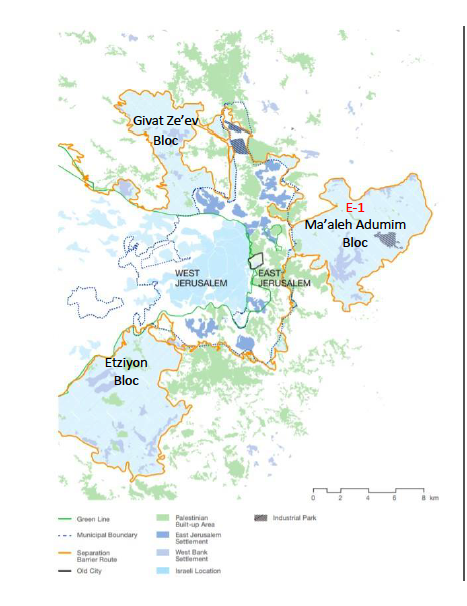 Laying out its logic, Terrestrial Jerusalem points to Netanyahu’s longstanding goal of uniting “Greater Jerusalem” by expanding the Jerusalem Municipality in order to annex as many nearby settlements as possible. The report details Netanayhu’s efforts to do so in detail, starting in 1997.
In addition, the “settlement blocs” doctrine – which has been prominently normalized by the likes of David Makovsky, Dennis Ross, and Michael Koplow – has provided Nentanyahu with an “off-the-rack” annexation option. This doctrine, on the basis of claimed “pragmatism,” has sought to allow Israel to continue unrestricted settlement expansion within large areas located near the Green Line (aka, the 1948 Armistice Line). After three decades of touting this doctrine, Netanyahu can now use it as the basis of his annexation.
Warning of the consequences of this “most likely” annexation scenario, Terrestrial Jerusalem writes:
“The annexation of one or more of the settlement blocs will have a devastating impact on the very possibility of any future agreement between Israel and Palestine. It will fragment the built-up Palestinian areas in greater Jerusalem, condemning the Palestinians to permanent occupation in an archipelago of disjointed, disconnected villages. The annexation of East Jerusalem, Ma’aleh Adumim, the Etzion Bloc and Givat Ze’ev alone would cumulatively seize 225 sq. km. of the landmass of the West Bank.”
Another Yitzhar Outpost Demolished, Another Violent Encounter Between IDF & Settlers
On July 10th, the IDF demolished an outpost that was illegally constructed by 30 settlers earlier that day. Settlers attempted to violently prevent the IDF soldiers from reaching the site of their outpost by setting up roadblocks using burning tires, and the attacking the troops with pepper spray and even threw punches during their assault on the troops.
The outpost squatters were from the radical and violent Yitzhar settlement, located in the heart of the West Bank just southeast of Nablus. The outpost – named “Kippah Sruga” by the settlers – was built in an area that the military commander marked as a “closed military zone” where civilians are not permitted to enter much less take up (illegal) residence.
Unsurprising, the leader of the Yitzhar settlement rushed to the defense of the settlers involved in the attack on the IDF. A spokesperson released a statement expressing regret that:
“some of the officers arrived at the scene without wearing masks [and] some did not have tags [identifying them as police]. The Border police officers used harsh violence against residents who did not do a thing. Of course we oppose stone-throwing and these incidents should have no place in Yitzhar.”
Settlers & Settlement Minister Escalate Drive to Take Palestinians Land in Area C
The radical settler group Regavim – which has dedicated itself to “helping” Israel police Palestinian construction in the West Bank – has filed a petition with the Jerusalem District Court asking the court to compel the demolition of Palestinian buildings located near the village of Nahalin, claiming that the newly built structures lack Israeli permits and that the Israeli Civil Administration has failed to act.
The group says Palestinians built 20 structures outside of the village, on land that is technically in Area C (the village of Nahalin is designated as Area B under the Olso Accords, but some village lands fall into Area C). Regavim asked the Civil Administration to take advantage of new powers it granted itself in June 2017 (via a military order) that allows it to demolish “new construction” a mere 96 hours after warning Palestinians of its intent (in effect depriving Palestinians of any meaningful opportunity to challenge the planned demolition).
Regavim Movement Director Meir Deutsch said:
“While our heads of state are debating whether and how sovereignty will be applied, the Palestinian Authority is hard at work, establishing facts on the ground. If we don’t wake up, in a few years we will find ourselves faced with an unchangeable reality – and the security and policy ramifications that come with it.”
Boosting Regavim’s mission, on July 7th newly crowned Settlement Affairs Minister Tzipi Hotovely toured the Mount Hebron Regional settlement council jurisdiction. Hotovely emphasized that part of her mission is to “prevent the Palestinian takeover of Area C” – an Orwellian framing suggesting that Israel is the victim of Palestinian aggressors seeking to steal Israeli land, when exactly the opposite is the case.
Hotovely said:
“At this time, it is very important to strengthen the settlement enterprise and prevent a Palestinian takeover of Area C. The Mount Hebron Regional Council has great potential for strengthening the Negev and the settlement. Applying sovereignty in this area will allow us to continue to develop the settlement in the Northern Negev and Mount Hebron.”
Greek Patriarchate Mobilizes Allies to Continue Fighting Settlers’ Acquisition of Jerusalem Properties
Since having its appeal rejected by the Jerusalem District Court on June 24th, the Greek Orthodox Patriarchate is continuing its fight to reclaim three prized properties in Jerusalem that were sold to the radical Ateret Cohanim settler organization under circumstances the Patriarchate claims are fraudulent.
In addition to planning to take its case to the Israeli Supreme Court, a spokesman for the Patriarchate, Father Issa Musleh, said that that Patriarchate will launch an international campaign in hopes of engaging the UN Security Council, Russia, Greece, Cyprus, and others to pressure Israel to return the properties to the church.
In addition, on July 7th, 13 Church leaders in Jerusalem issued a joint statement, saying:
“We, the Heads of the Churches and Christian Communities in Jerusalem, stand united in our commitment to safeguard the historical Status Quo of the Holy Sites and rights of the Churches which are universally recognized. The case of Jaffa Gate threatens this Status Quo. We are concerned by the recent judgment of the District Court of Jerusalem, which dismissed evidence demonstrating the Greek Orthodox Church’s case. We strongly support the efforts of the Greek Orthodox Church in their plea for justice…We don’t see this case as a mere property dispute. We see the undertaking of radical groups to take control of properties at Jaffa Gate as a systematic attempt to undermine the integrity of the Holy City, to obstruct the Christian pilgrim route and to weaken the Christian presence in Jerusalem.”
Settlement Real Estate Market Heating Up?
Israeli realtors hawking homes in the settlements are now talking up the possibility of a real estate boom in settlements because of the possibility of annexation.
Daniel Wach, who runs a real estate business out of the settlement of Eli — located deep inside the northern part of the West Bank — told AFP that he has done “as much business in the past two months as the last few years.” Wach said that Israeli families are buying now in anticipation of home prices rising after annexation. Post-annexation, Wach predicts will quickly rise 10-15%.
Another real estate agent who exclusively deals with settlements said: “Annexation will make a big difference…It’s gonna be a big market, we’ll need to get ready, work hard for this opportunity.”
Bonus Reads
- “Israel arrests Palestinian expert on settlements in Jerusalem” (MEMO)
- “Israel Will continue Its Campaign of Dividing and Conquering Palestinians, Annexation of Not” (Tania Hary // Haaretz)
- “Israel’s Possible Annexation of West Bank Areas: Frequently Asked Questions” (Congressional Research Service)
- “Ayelet Shaked submits candidacy to serve in Judicial Selection Committee” (Ynet)
- “Settlers and Palestinians unite in opposition to annexation” (The Times of Israel)
- “If Israel’s planned annexation goes ahead, can any response make a difference?” (Al-Shabaka)
Welcome to FMEP’s Weekly Settlement Report, covering everything you need to know about Israeli settlement activity this week.
To subscribe to this report, please click here.
June 26, 2020
- Netanyahu Talks to Jordan, Gantz (Finally) Lays Out a Position
- Trump Advisors Meeting in Washington on Annexation Ends Without Decision
- Bibi Provides Likud With Talking Points on Annexation, Says Settlements Cannot Ever Be Evacuated
- Court Approves Sale of Church Properties in Old City of Jerusalem to Radical Settler Org
- Israel Delivers Eviction Orders to Palestinian Businessowners Despite Claims Palestinians Have Consented to the “Silicon Wadi” Project
- Israel is Expanding Settler-Only Bypass Road Near Bethlehem, Cutting Palestinians Off from Land
- Plans for Controversial New Settlement Industrial Zone Near Beitar Illit Are Poised for Final Approval
- High Court Set to Hear Petition Against Cable Car
- Emek Shaveh Submits Petition Against Settler-Backed “Accessibility” Project for the Ibrahimi Mosque/Tomb of the Patriarchs
- Weaponizing Archaeology as a Means of Dispossessing Palestinians
- Democrats Oppose Annexation But Don’t Threaten Consequences; Republicans Lawmakers Offer Support for Annexation
- Bonus Reads
Comments/questions? Contact Kristin McCarthy (kmccarthy@fmep.org)
Netanyahu Talks to Jordan, Gantz (Finally) Lays Out a Position
According to an anonymous Palestinian official, Israel delivered a message to Jordan’s King Abdullah (who then passed it on to Abbas) that Netanyahu is planning to announce annexation of two or three “settlement blocs” as Israel’s initial annexation move, and this announcement will not include annexation of the Jordan Valley. The report provided no details about which “blocs” will be annexed, or how they will be defined. As a reminder, “blocs” is an informal and elastic term that Israel has used to define ever- expanding areas of the West Bank as territory that it will keep.
The reports come after days of suggestions that the U.S. and Netanyahu are favoring a phased annexation plan, meaning that whatever “limited” annexation Israel announces on July 1st (or, more likely, after July 1st), it will be just the first in a wave of annexation announcements, and the fact that it may be “limited” (compared to other options) in no way will signal that Netanyahu has changed his grander ambition to annex every inch of land allowed under Trump Plan. The Trump Plan green lights annexation of around 30% of the West Bank as a starting point, with an implicit green light for further annexation if the Palestinians refuse to negotiate with Israel over the fate of the remaining West Bank territory.
Gantz posted a message on his Facebook page on Friday, June 26th in what some are viewing as an effort to clarify his own position on annexation, which so far has been inconsistent, ambiguous, and confusing. Gantz’s five key positions on annexation according to the new Facebook post are:
- No annexation of areas where there is a “significant” Palestinian population;
- No annexation of land that will impair Palestinians’ freedom of movement;
- Palestinian living in areas annexed by Israel will be given equal rights;
- Israel’s security as well as its existing peace agreements will be safeguarded;
- Israel will initiate “bilateral moves with the Palestinians.”
It was reported earlier this week that Prime Minister Netanyahu presented an ultimatum to Gantz in private deliberations, seeking to force Gantz to choose between supporting annexation or a new round of elections (recent polls suggest new elections would deliver a landslide victory for Netanyahu — no surprise given the fact that in joining the Netanyahu government, Gantz eviscerated Netanyahu’s main opposition party).
Up to this point, Blue & White party leaders Gantz and Ashkenazi have opposed wide-scale, unilateral annexation on July 1st – instead offering a vision for a phased annexation plan, starting with large settlement blocs, that is coordinated with key international players. Perhaps fulfilling Gantz’s demands, the reports regarding Israel’s message to Jordan propose a more limited initial annexation plan, suggesting perhaps that Netanyahu has adopted two of Gantz’s main positions. It’s also worth recalling that last week Gantz and his party mate Ashkenazi were pushing a phased annexation plan and specified that the Ma’ale Adumim and the Etzion settlement blocs (east and south of Jerusalem) are the place to start.
Even before word of the Jordan communique and Gantz’s Facebook message hit the press on June 26th, it was a near consensus position amongst Israeli news outlets and analysts that Gantz was not going to stand in the way of annexation. On June 22nd, Gantz reportedly told a group of defense officials that Israel “won’t keep waiting for the Palestinians” to engage in negotiations on the basis of the Trump Plan. Those remarks were interpreted as a signal of Gantz’s acquiescence to Netanyahu’s annexation plan (or at least of his growing disinterest in even appearing to oppose it). In the same set of remarks, Gantz went on to blame the Palestinians in even more harsh language, saying they are attempting to drag Israel into “deep shit.” Haaretz suggests, “…Gantz’s tone and his actual comments confirm the assumption that there will be no life-and-death battle here. Gantz knows that the final decision is not up to him, but rather up to Netanyahu.” In a separate article, Haaretz columnist Noa Landau put it this way: “[Gantz’s] remarks [on June 22nd] sounded more like a threat against the Palestinians for refusing to extricate him from this mess.”
Trump Advisors Meeting in Washington on Annexation Ends Without Decision
Internal Israeli negotiations set a dramatic stage for 3 days of discussions this week in Washington between the Trump Administration officials who are the architects and managers of the Trump Plan, as the reportedly sought to come to agreement over what form of annexation the Trump Administration will green light for July 1. Multiple reports in the days leading up to the U.S. deliberations suggested that the group was considering options ranging from a “gradual” annexation plan starting with large settlements around Jerusalem, to a more large-scale and immediate plan. At the end of the week, the Americans reportedly failed to reach a decision on how they would want to see Israel’s annexation of West Bank land to proceed. Three members of the team, Avi Berkowitz and NSA Advisor Scott Leith, and Amb. Friedman – are reportedly en route back to Israel and will continue discussions with Netanyahu. Notably, in parallel to the Washington meetings, reports emerged suggesting that Netanyahu’s annexation announcement may be delayed and that July 1st might mark the start of Israeli security cabinet deliberations over annexation (to this point deliberations have been between Netanyahu and Gantz without wider input from cabinet members).
Amb. David Friedman (who flew to back to DC for the meeting) was joined by Secretary of State Mike Pompeo, senior advisor Jared Kushner, Middle East envoy Avi Berkowitz, and national security advisor Robert O’Brien for deliberations starting on June 23rd.
Bibi Provides Likud With Talking Points on Annexation, Says Settlements Cannot Ever Be Evacuated
Netanyahu sent a memo to Likud lawmakers this week laying out key talking points in the ongoing effort to defend annexation, in which he argues that evacuating settlement poses an “immediate existential threat” to Israel. The memo says:
“Relinquishing these territories would not only constitute a historic injustice; such a move would create an immediate existential threat to the Jewish state since Judea and Samaria border central Israeli cities.”
The memo also adopts a U.S. talking point that annexation in fact advances the cause of peace, but instead of giving any nod to a future Palestinian state or two state solution, Bibi’s memo claims that annexing West Bank settlements can provide for “to a realistic regional peace based upon facts on the ground.” This double speak (annexation is peace) was prominently articulated by Ron Dermer in a recent Washington Post op-ed.
Court Approves Sale of Church Properties in Old City of Jerusalem to Radical Settler Org
On June 24th, the Jerusalem District Court rejected a final request filed by the Greek Orthodox Patriarchate to block the sale of its historic church properties to the radical settler group Ateret Cohanim. The Court’s ruling brings an end to 16 years of litigation and paves the way for Ateret Cohanim to evict Palestinian tenants and businessowners from three coveted church properties in the Old City including the Petra Hotel and the Imperial Hotel (together, the buildings flank the Jaffa Gate entrance into the Old City – meaning that Ateret Cohanim now controls a substantial amount of land at a key entrance to the Old City). The third building – known to Palestinians as Beit Amziya – is located in the Muslim Quarter.
The ruling comes just four months after the Jerusalem District Court appointed a lawyer associated with Ateret Cohanim as the legal custodian of the Petra Hotel for the duration of a bankruptcy case against the Palestinians currently operating the hotel.
The legal battle over the properties dates back to 2004, when the Greek Orthodox Patriarchate agreed to sell the three properties to a foreign real estate company under three separate contracts. It did so not knowing that the radical settler group Ateret Cohanim was behind the transaction. News of the sales made headlines in early 2005.
Upon the revelation that Ateret Cohanim was the real buyer, the Greek Orthodox Patriarchate was deeply embarrassed and immediately sought to retain control of the properties. The Patriarchate alleged that the transactions involved corruption and bribery, arguing that the legal documents had been signed without permission by a finance employee. Dismissing the church’s arguments, this week the Supreme Court upheld prior rulings that the signatures on the legal documents were valid, with the finance employee acting as a legal proxy of the Patriarchate.
The Greek Orthodox Church has received significant blowback from the sale of these properties. In January 2018, Palestinians protested in Bethlehem in an attempt to block the arrival of Patriarch Theophilos III for Christmas celebrations.
Israel Delivers Eviction Orders to Palestinian Businessowners Despite Claims Palestinians Have Consented to the “Silicon Wadi” Project
Middle East Eye reports that the “Silicon Wadi” project (as reported on by FMEP on June 5th) is being discussed by the Jerusalem District Committee but has not yet reached the stage of being deposited for public review. According to one Palestinian business owner who faces eviction under the plan, the District Committee required the Jerusalem Municipality to notify the owners and renters of the buildings that will be demolished to make way for the new construction. Last week, the Municipality delivered that notification to renters in the form of eviction orders, saying that the businesses were operating in violation of Israeli regulations (i.e., illegally, even though the businesses have been there – and paying taxes to Israel – for decades). The orders give businesses 6 months to vacate.
One Palestinian businessowner, Mahmoud al-Kurd, told Middle East Eye:
“I will stay here to the last moment. This profession is my passion. In this old space I managed to achieve my successes. It is enough that the soul of my deceased father roams around me here – he is the one who rented this store decades ago and passed on his means of sustenance to us. I refuse to be an employee of a Jewish broker if we were transferred to work in the Israeli industrial areas.”
The Jerusalem Municipality – which claims that this project has the support and consent of Palestinians – also claims that it is looking into options for compensating business owners (mostly auto mechanics) who will lose their garages.
Israel is Expanding Settler-Only Bypass Road Near Bethlehem, Cutting Palestinians Off from Land
The Palestinian news outlet Wafa reports that Israel has begun work on expanding a settler-only bypass road just west of Bethlehem.The road is reportedly being expanded and widened on Palestinian land belonging to the Nahalin village; construction of the new road segment and widening the existing road will cut off Palestinians from 741 acres (3,000 dunams) of their land.
The road serves to directly connect the Beitar Illit settlement to the Modiin Illit settlement, both of which are a part of the so-called “Etzion Bloc.” The construction goes to show that the settlement “Blocs” – around which some suggest there is a “consensus” that Israel will retain them in any future deal with the Palestinians, and others suggest Israel can annex without controvery – are a pretext for a continuing campaign of dispossession, discrimination, and human rights abuses against neighboring Palestinians. For a deep dive into the highly consequential acceptance/normalization of the “settlement bloc” framing, see here.
Plans for Controversial New Settlement Industrial Zone Near Beitar Illit Are Poised for Final Approval
Al Monitor reports that plans for the construction of a new settlement industrial zone near the Beitar Illit settlement in the southern West Bank are ready to be submitted for final approval from the Civil Administration. Environmental activists say the new zone will pollute and possibly destroy the underground water sources feeding the terraced hills of Battir, a UNESCO World Heritage site.
The plan for the new zone – which will include offices, shops, sports facilities, public buildings, and a cemetery – was initiated in 2018 at the insistence of Israel’s former Interior Minister Aryeh Deri. Palestinians claim that plans for the zone include construction on privately owned Palestinian land.
Gidon Bromberg, Executive Director of EcoPeace, told Al-Monitor:
“Planning maps clearly show that the industrial estate would indeed cover much of the buffer zone of the World Heritage site as well as touch the core area itself.”
High Court Set to Hear Petition Against Cable Car
The Israeli NGO Emek Shaveh reports that the Israeli High Court of Justice will take up the case of the Jerusalem cable car project on June 29th. The court will consider three arguments made in a petition filed against the plan submitted by Emek Shaveh and leading experts. Those arguments are:
- “A transitional government is not authorized to make an irreversible decision such as approval of the cable car project: The cable car project will cost the public hundreds of millions of shekels. During a period when the government is carrying out a broad cut in the budget of billions of shekels and is reducing the budgets for health and welfare, it is inappropriate that a transitional government leaves a bequest of this magnitude for the next government to inherit. In the response of the Deputy Attorney General, Att. Othman Roslan, to the petition, while arguing that the process was not in conflict with the law, he did not conceal the fact that the it was problematic. [See FMEP’s coverage of the Israeli government’s approval of the plan in November 2019]
- “There was a serious flaw in the planning process in that the Ministry of Transportation was not included in the project that purports to be a transportation project: While the project is represented as a transport project, the Ministry of Transportation was not included in the process and the project was not required to meet the standards set forth for transportation projects in the State of Israel. Instead it was approved on the basis of reports and data less comprehensive than those required for every other transportation project.
- “The decision was made on the basis of misleading simulations: The backers of the plan did not present complete simulations that accurately illustrate the cable cars in motion and the resulting damage to the historic landscape. The National Infrastructure Committee should have demanded that the backers present simulations that illustrate the actual cars in motion.”
The Jerusalem cable car project is an initiative of the Elad settler organization (which is building a massive tourism center – the Kedem Center – in the Silwan neighborhood of East Jerusalem, slated to be a stop along the cable car’s route). The scheme is intended to further entrench settler control in Silwan, via archeology and tourism sites, while simultaneously delegitimizing, dispossessing, and erasing the Palestinian presence there. Non-governmental organizations including Emek Shaveh, Who Profits, and Terrestrial Jerusalem have repeatedly challenged (and provided evidence to discredit) the government’s contention that the cable car will serve a legitimate transportation need in Jerusalem, and have clearly enumerated the obvious political drivers behind the plan, the archeological heresies it validates, and the severe impacts the cable car project will have on Palestinian residents of Silwan.
Emek Shaveh Submits Petition Against Settler-Backed “Accessibility” Project for the Ibrahimi Mosque/Tomb of the Patriarchs
On June 18th, Emek Shaveh and Palestinian residents of Hebron jointly submitted a petition challenging Israel’s issuance of a permit to build an elevator to the Ibrahimi Mosque/Tomb of the Patriarchs, arguing that:
- “The plan was illegally approved by a transitional government;
- “The plan is in contravention of international agreements to which Israel is a signatory;
- “[The plan] is an unprecedented injury to the character of the ancient structure; No documentation and preservation file has been submitted.”
One signatory on the petition is a disabled Palestinian, Kamal Abadin, who makes the salient point that Israel’s policies in Hebron do not indicate it has concern for accessibility, saying:
“I almost do not come to pray at the mosque because as a Palestinian, I am not permitted to drive in my car from my house to the site, because the road is closed to Palestinian vehicles. If Israel asserts that it wants to make the site accessible to the disabled, let it start with allowing disabled Palestinians to access it by car.”
Emek Shaveh explained in a statement:
“Unfortunately, even at the price of damage to a structure more than 2,000 years old that is holy to Judaism and Islam, Israel is prepared to be led by the settlers and their plans, and on the way, to violate international agreements to which it is a signatory. The settlers have succeeded in turning the needs of persons with disabilities into a political issue and a means for deepening the dispute with the Palestinians. We all know that what begins in Hebron does not stay only in Hebron and the unilateral steps at the Tomb of the Patriarchs could serve as a precedent for unilateral actions at another site which is holy to both Judaism and Islam.”
Weaponizing Archaeology as a Means of Dispossessing Palestinians
A settler group which sprung from the radical Regavim organization has sharpened a new bureaucratic weapon by which to advance the dispossession of Palestinians. The settler group – called Shomrim Al Hanetzach (“Guarding Eternity”) – has been surveying areas in the West Bank that Israel has designated as archeaological sites in order to call in Israeli authorities to demolish Palestinian construction in these areas. In 2017, it should be noted, Israel declared 1,000 new archaeological sites in Area C of the West Bank. The group communicates its findings to the Archaeology Unit in the Israeli Civil Administration (the military body by which the government of Israel regulates all planning and building in the West Bank). The Archaeology Unit, playing its part, then delivers eviction and demolition orders against Palestinians, claiming that the structures damage antiquities in the area.
In addition, in 2019 the Israeli government increased the size of the Archaeology Unit’s staff and granted the unit new authority to carry out investigations into cases of construction on archaeological sites. Moreover, using new powers the Civil Administration gave itself (via a military order) in June 2017, the Israeli goverment has accelerated the demolition of Palestinian buildings by drastically limiting the time period during which Palestinians are permitted to challenge demolition orders. Palestinians have a mere 96 hours after receiving the notice to file a legal challenge.
As a result, there has been a sharp rise in the number of archaeology-related demolition orders over the past year: Israel issued 118 demolition order and warnings against Palestinian structures built on West Bank archaeological sites in 2019, compared to 61 orders in 2018 and 45 orders in 2017.
The Director of Shomrim Al Hanetzach told Haaretz:
“We took it upon ourselves to make the supervision process more efficient – hiking guides and archaeologists turn to us and tell us about the destruction of antiquities, and we report them further to the necessary people.”
In the case of one Palestinian, Mahmoud Bisharat, he says that Israel conducted an archaeological survey of the area in 1972 but never complained about Palestinian construction in the area until now. The Civil Administration ordered Bisharat to demolish his home, olive trees, well, and concrete structures around a well.
In addition to hiking and surveying Palestinian land, Palestinians have reported that Regavim activists also use drones to photograph their land and buildings, and have made the connection between those activities to demolition orders from the Civil Administration.
Democrats Oppose Annexation But Don’t Threaten Consequences; Republicans Lawmakers Offer Support for Annexation
In warring moves this week, Republicans and Democrats staked out positions on Israel’s forthcoming annexation of land in the West Bank.
189 of 233 Democrats in the House signed a letter sent to Netanyahu and Gantz expressing deep concern about annexation, saying it does not serve Israeli security interests nor the peace process. The letter, notably, does not contain any threat of consequences should Israel implement annexation. J Street is reportedly behind drafting and circulating the letters for signatures.
116 out of 198 Republicans in the House signed a letter sent to Prime Minister Nentanyahu expressing support for Israel’s “right to sovereignty and defensible borders.” The letter also praises the Trump Plan. The Republic Jewish Committee is reportedly behind drafting and circulating the letter for signatures.
7 out of 53 Republicans in the Senate signed a letter to President Trump led by Senators Cotton (R-AR) and Cruz (R-TX) that is not only supportive of annexation, but actually encourage Israel to implement annexation.
Back in May, 18 out of 47 Democrats/Independents in the Senate sent a letter to Netanyahu and Gantz cautioning them against annexation.
Bonus Reads
- “How settler groups could use annexation to deepen Palestinian dispossession” (+972 Magazine)
- “Israel’s High Court Is Willfully Blind to Theft of Palestinian Land” (Haaretz)
- “Israel’s ‘strangling’ of Bethlehem tightens as world debates annexation” (+972 Magazine)
- “Settlers Assault Palestinians on Their Own Land, as Israeli Soldiers Watch” (Haaretz)
- “For Netanyahu, Annexation May Spell Little Gain, and Lots of Pain“ (Haaretz)