Welcome to FMEP’s Weekly Settlement Report, covering everything you need to know about Israeli settlement activity this week.
To subscribe to this report, please click here.
June 14, 2019
- Court Rules in Favor of Israeli Settler Group, Against Greek Orthodox Church, un Battle Over 3 Claiming Old City Properties
- Israel Gave German Construction Giant More Palestinian Land for Quarrying
- Settlers Retaliate Against Palestinians for Israel’s (Rare) Demolition of Outpost Buildings
- IDF Cuts Budget for Civilian Security Guards in Settlements
- New International Crisis Group Report on Israel’s Ongoing Annexation of East Jerusalem
- Shadowy Group Wants to Go After All Companies Not Currently Operating in the Settlements – Starting with McDonald’s
- European Court of Justice Issues Opinion Upholding EU Differentiation Policy
- Anger [& Joy] at U.S. Ambassador Reiterating Support for Israeli Annexation of West Bank Land
- Bonus Reads
Questions or comments? Contact Kristin McCarthy at kmccarthy@fmep.org.
Court Rules in Favor of Israeli Settler Group, Against Greek Orthodox Church, un Battle Over 3 Claiming Old City Properties
Ending a nearly 16-year legal battle, on June 11th the Israeli Supreme Court ruled that the settler group Ateret Cohanim has legal rights to three prized properties in strategic locations in the Old City of Jerusalem, including two famous hotels currently operated by Palestinians. Until now, the properties were owned by the Greek Orthodox Church, which had been fighting to invalidate the transactions at the root of the settlers’ claim to them.
As a reminder, Ateret Cohanim is a radical settler organization working to increase the presence of Israeli Jews living inside Palestinian neighborhoods of Jerusalem – including in the Old City. Ateret Cohanim, along with its compatriots in the Elad settler group, is also leading efforts to take over land and evict Palestinians from their homes in the Silwan neighborhood.
The properties awarded to Ateret Cohanim by the Israeli High Court are:
-
The Petra Hotel, a four-story building near the Jaffa Gate, one of the key entrances to the Old City. Under the ruling, Ateret Cohanim has a valid 99-year lease with an option for an additional 99 years afterwards. The price Ateret Cohanim paid in the transaction the Church said was improper? A meager $500,000, far below market value.
-
The Imperial Hotel, located directly across the street from the Petra Hotel – meaning that a radical Israeli settler group now controls a substantial amount of land at a key entrance to the Old City (the Jaffa Gate). The Imperial Hotel is a two-story building. Ateret Cohanim’s lease for the Imperial Hotel is also for 99-years with an option for 99 more. The price paid in, again, a transaction the Church argued was improper and invalid? $1.25 million – far higher than the price paid for the Petra Hotel but still well below the fair market value of the property.
-
Beit Amziya, a building in the Bab a-Kuta neighborhood of the Muslim Quarter of the Old City. Ateret Cohanim paid $55,000 for this property, again, far below fair market value.
The legal battle over the properties dates back to 2004, when the Greek Orthodox Patriarchate agreed to sell the three properties to a foreign real estate company under three separate contracts. It did so not knowing that the radical settler group Ateret Cohanim was behind the transaction. News of the sales made headlines in early 2005.
Upon the revelation that Ateret Cohanim was the real buyer, the Greek Orthodox Patriarchate was deeply embarrassed and immediately sought to retain control of the properties. The Patriarchate alleged that the transactions involved corruption and bribery, arguing that the legal documents had been signed without permission by a finance employee. Dismissing the church’s arguments, this week the Supreme Court upheld prior rulings that the signatures on the lease documents were valid, with the finance employee acting as a legal proxy of the Patriarchate.
The Greek Orthodox Church has received significant blowback from the sale of these properties. In January 2018, Palestinians protested in Bethlehem in an attempt to block the arrival of Patriarch Theophilos III for Christmas celebrations.
In response to the Supreme Court’s ruling, multi-denominational Christian leaders in Jerusalem issued a rare joint statement criticizing the Court’s action. The statement says:
“The actions of this radical group do not only mean an assault on the property rights of the Greek Orthodox Church, but an assault on the status quo protections for all Christians in this holy city of Jerusalem and deeply threatens the Christian presence in our beloved Holy Land. An attempt to undermine the presence of one church here undermines all the churches and the wider Christian community around the world. We reaffirm our belief that a vibrant Christian community is an essential element in the preservation of Jerusalem’s historically diverse society and a prerequisite for peace in this city; Jerusalem must maintain its multicultural and multi-religious mosaic character, being home to the three monotheistic religions.”
Israel Gave German Construction Giant More Palestinian Land for Quarrying
Kerem Navot has produced government documents showing that in February 2019 the Israeli Civil Administration – the arm of the IDF that is effectively the sovereign ruler over the West Bank – signed over rights to 25 acres of Palestinian land to the German construction company HeidelbergCement. The purpose? To expand the Nahal Raba quarry, located on 145 acres of Palestinian land near the Elkana settlement in the West Bank.
HeidelbergCement is the world’s largest cement producer and has a global footprint. In a comprehensive brief, the Israeli organization Who Profits details the situation of the Nahal Raba quarry and the larger context of Israel’s illegal exploitation of natural resources in the West Bank:
“The Nahal Raba quarry is a 600 Dunam aggregate quarry, owned and operated by Hanson Israel [which HeidelbergCement owns]. The quarry is located in Area C of the West Bank and is licensed by the Israeli Civil Administration. The adjacent Palestinian village of Alzawiyah owns the Palestinian land on which the quarry is situated. This land was taken by Israel’s Civil Administration after declaring it to be state land, despite the fact that it was privately owned by the Palestinian villagers in the adjacent town of Al-Zawiyah. As mentioned by Human Rights Watch in its recent report, Occupation Inc., in 2004 Israel built the separation wall in the area to encompass the quarry from the east, unlawfully diverting the route of the wall into occupied territory beyond the pre-1967 armistice line. Today, the quarry is enclaved into Israeli territory, while the separation wall separates the village of Zawiyah and its rightful owners from their land and quarry. Article 55 of the Hague Regulations (1907) establishes that ‘the occupying State shall be regarded only as administrator and usufructuary’ of the natural resources of the occupied territory, and therefore it is prohibited from exploiting them for commercial purposes. Moreover, Article 43 of the Hague Regulations has been interpreted as obliging the occupying State to exercise its powers for the benefit of the residents of the occupied area.”
In 2009, the Israeli NGO Yesh Din submitted a High Court petition demanding that Israel end all mining and quarrying activities in the West Bank, observing that the activity constitutes a brutal economic exploitation of occupied territory for Israel’s exclusive economic interests. In December 2011, the High Court rejected the petition, giving permission for the continuation and expansion of Israel-regulated quarrying in the West Bank. Yesh Din’s 2017 report, “The Great Drain: Israeli Quarries in the West Bank,” provides a comprehensive accounting of the damage imposed on Palestinians by quarrying activities.
Settlers Retaliate Against Palestinians for Israel’s (Rare) Demolition of Outpost Buildings
Palestinians in the Einabus village woke up on June 13th to find the words “Price tag [for the] Yitzhar evacuation” spray painted on the town mosque and adjacent buildings, and several car tires were slashed. The tagged phrase suggest the settlers have taken revenge on the Palestinian village in respose to these demolition of illegally built settlement structures near the radical Yitzhar settlement by Israeli security foces last week.
Following documentation of the damage by Yesh Din, the IDF announced it had opened an investigation into the incident.
This price tag attack is just the latest in a string of violent attacks by settlers on Palestinian villages in the Nablus region. Over the past few weeks, settlers have set several fields on fire and were caught on video hurling stones at Palestinian school, homes, and cars.
IDF Cuts Budget for Civilian Security Guards in Settlements
Ynet reports that the IDF Central Command has informed settlements that budgetary constraints are forcing it to reduce the number of civilian guards working in several settlements across the West Bank. The reductions will see eight security outposts eliminated completely, including posts in the Kiryat Arba settlement in Hebron. A security officer from Kiryat Arba said in response: “This is abandonment of human life, and the Defense Ministry must come to its senses as soon as possible,”
The IDF said that:
“It’s clear to everyone the reduction in the number of guards in not ideal, but – all things considered – it’s necessary.”
New International Crisis Group Report on Israel’s Ongoing Annexation of East Jerusalem
In a new report, the Crisis Group provides a comprehensive overview of Israeli settlement and annexation policies affecting East Jerusalem, starting with Israeli actions in the immediate aftermath of 1967 through to present day. The report, entitled “Reversing Israeli’s Deepening Annexation of Occupation,” calls on the international community to stop Israel’s creeping annexation of East Jerusalem and reverse decades of intentional neglect designed to push Palestinians out of East Jerusalem and adjacent areas.
Shadowy Group Wants to Go After All Companies Not Currently Operating in the Settlements – Starting with McDonald’s
Following up on FMEP reporting last week, Haaretz has new details on the organization behind a new drive to ban McDonald’s from participating in the Israeli government’s tender process — because McDonald’s doesn’t operate in any Israeli settlements.
The group, named “Forum of Disabled IDF Veterans for Israel’s Security,” is not registered in Israel as a charitable organization. It thus has the luxury of operating in near total secrecy – not required to disclose who is behind the effort or funding it.
In a statement, the group made its ambitions clear:
“We want every company that isn’t interested in opening branches over the Green Line to be prevented from competing on these tenders. We’ll reach everyone.”
Sources told Haaretz that the group is made up of only a handful of activists, all of whom are disabled veterans of the IDF, and works primarily in cooperation with larger pro-settlement, pro-annexation groups like Im Tirtzu and Ad Kan. The group has hired Rosenbaum Communications to steer the campaign against McDonald’s, though the funding source for the project is unknown.
European Court of Justice Issues Opinion Upholding EU Differentiation Policy
On June 13th, an advocate general for the European Court of Justice (the top court for the EU) issued a legal opinion holding that products made in the Israeli settlements must be clearly labeled as such. The ruling upholds the enforcement of European Union’s legal obligations with regard to the settlements (a policy known as differentiation). The labelling requirements, as required by EU law, necessarily distinguish between sovereign Israeli territory and Isareli settlements built illegally in the occupied territories.
The new legal opinion, which is not binding but nonetheless sets the tone for rulings to come, was issued in response to a petition filed by Psagot Winery, located in the Psagot settlement, which argues that French labelling laws discriminate against its products by requiring them to specify the origin of their wine. Rejecting that argument the advocate general stressed that EU law requires labelling products based on their true origin in order to give customers the necessary information to make informed purchasing decisions.
Psagot Winery is part of a broad global effort to blur the legal context around Israeli settlements, pushing nations to treat Israeli settlements as indistinguishable from sovereign Isareli territory.
Anger [& Joy] at U.S. Ambassador Reiterating Support for Israeli Annexation of West Bank Land
Coming quickly on the heels of Jared Kushner’s disastrous interview with Axios, Ambassador David Friedman attracted even more outrage over his recent interview with the New York Times in which Friedman reiterated his support for Israeli annexation of land in the West Bank (a position he has held, clearly, since long before becoming ambassador). The interview sparked a barrage of media coverage, worldwide concern about the possibility of unilateral Israeli annexation of its settlements, glee among pro-annexationist lawmakers in Israel, and indignant rationalizing by American Greater Israel apologists like Alan Dershowitz.
Notably, Israeli Prime Minister Netanyahu – who in the waning days of his April election promised to extend Israeli sovereignty over the settlements – has not commented on Friedman’s statement. Haaretz columnist Anshel Pfeffer observed:
“The easiest way for Netanyahu to counter the settlers’ demands while keeping them in his coalition was to complain about pressure from the Americans. That was his answer every time he was asked why Israel wasn’t building more settlements or evicting more Palestinians. Friedman has taken away Netanyahu’s excuse. It is certainly no coincidence that Netanyahu — usually so quick to praise the slightest gesture coming from the Trump administration — has yet to say a word publicly about the interview. Friedman has done Netanyahu no favors. In less than 100 days — assuming the right wing/religious bloc wins another majority in 2019’s second election, which is almost a certainty — Netanyahu will be more vulnerable than ever.”
Bonus Reads
-
“A high-tech facelift takes the sting out of an Israeli checkpoint — but not out of the occupation” (Washington Post)
-
“The Fate of the Palestinians” (LobeLog)
-
“WATCH: What occupation looks like in the Jordan Valley” (+972 Mag)
Welcome to FMEP’s Weekly Settlement Report, covering everything you need to know about Israeli settlement activity this week.
To subscribe to this report, please click here.
March 15, 2019
- State Submits Defense of Mitzpe Kramim Outpost Legalization to High Court, Peace Now Petitions to Join the Case
- Civil Administration Employees Go on Strike, Delaying Approval of 4,500 New Settlement Units
- 47% of Palestinian Land Expropriated by Israel for “Security Needs” Has Been Given to the Settlements
- Transportation Ministry Denies Involvement in Jerusalem Cable Car Project, Calls it a “Tourist Cable Car”
- State Department Formalizes Occupation Denial as Official U.S. Policy; Israeli Politicians Immediately Plan for Annexation
- For the First Time, AIPAC National Policy Conference to Host Settler Leader
- Wind Power & Israel’s Occupation of the Golan Heights
- Bonus Reads
Questions/comments? Email kmccarthy@fmep.org
State Submits Defense of Mitzpe Kramim Outpost Legalization to High Court, Peace Now Petitions to Join the Case
On March 10th, the state of Israel submitted a written argument to the High Court of Justice in defense of its plan to expropriate land that it acknowledges is privately owned by Palestinians in order to retroactively legalize the Mitzpe Kramim outpost.
The state’s argument was previously accepted by the Jerusalem District Court in an August 2018 ruling, which paved the way for the High Court to resume its consideration of a petition against the Mitzpe Kramim outpost, submitted by the registered Palestinian landowners in 2011.
In both cases the state’s argument relies on the “market regulation” principle, which the Israeli Attorney General invented as a legal basis for retroactively legalizing settlements and outposts built on land that even Israel recognizes as undeniably owned by Palestinians.
According to the “market regulation” principle, in cases where all relevant parties – in this case, the government, the World Zionist Organization, and the settlers – acted “in good faith” in the course of events that lead to the establishment of the unauthorized outpost on privately owned Palestinian land, the ownership of that land can legally be given over to the settlers. It is notable that the Palestinians are not considered relevant parties in this analysis (even when they and human rights groups alerted Israeli authorities in real time of the illegal building taking place – challenging the very idea of “good faith” mistakes).
The state’s March 10th argument also attempts to explain why the landmark 1979 Elon Moreh ruling, which explicitly prohibits Israel from building settlements on land expropriated for military purposes, should not apply to the Mitzpe Kramim case, given that the outpost was allegedly built in “good faith” based on the settlers’ belief that the land in question was part of a military seizure order from the 1970s (this belief was incorrect – the land was/is recorded in the Israeli Land Registry as privately owned by Palestinians from the village of Deir Jarir).
Also on March 10th, Peace Now filed an application to join the Mitzpe Kramim High Court case as a “friend of the court,” citing the organization’s professional expertise on the subject matter. In the application, Peace Now explained the potential devastating ramifications of the “market regulation” principle, and challenged the notion that “good faith” can be attributed to the Israeli parties involved in illegally building the Mitzpe Kramim outpost. Peace Now’s main points on the case are:
- The broad implications of the ruling – Peace Now has submitted to the court a list of 132 settlements and outposts where nearly 7,000 housing units have been built on private Palestinian land, stretching over 10,000 dunams. This is in addition to thousands of dunams or even tens of thousands of dunams taken from their owners by settlements for infrastructure, agriculture, and so on. The ruling is likely to serve as a precedent for the massive land grabs that the state has carried out over the years in the settlements.
- Land Management by the Custodian of Government and Abandoned Property in Judea and Samaria – A description of a series of failures in the General Director’s actions led to the many “errors” in the allocation of land that is not owned by the state. Some of the failures were presented in official government reports and by the state comptroller, which attest to historic failures and oversights that have not been corrected to this day.
- Land management by the Settlement Division, not done in “good faith” – Extensive information on the activities of the Settlement Division on land allocated to it (and land not allocated to it) and in many cases of allocations granted without authorization.
- The nature of the “market” for which the “market regulation” is applied – In fact, there is no “market” or “normal trading life” in transactions of the kind that the state manages in the territories. There is no ongoing trade, certainly not in “state lands” allocated by the state to settlers and transactions between the state and the World Zionist Organization (the umbrella organization that includes the Settlement Division). Moreover, there is no possibility – even theoretically – of the opposite situation: seizing privately owned land for Jews and transferring it “by mistake” to Palestinians. Nor is there a governmental body in the area that expropriates private land from Jews. Only one side is consistently discriminated against, as evidenced in the data according to which 99.76% of the allocated state land in the West Bank was given to the Israeli population, and while less than a quarter of a percent was allocated to Palestinians since 1967.
FMEP’s Annexation Policy Tables track the ongoing legislative, political, and legal transformations happening in the Israeli government to justify the expropriation of Palestinian land for settlements. As a reminder, the “market regulation” principle was promoted by Israeli Attorney General Avichai Mandelblit, who offered it as an alternative to the legal basis provided in the “Regulation Law” to legalize unauthorized outposts and settlement construction.
Civil Administration Employees Go on Strike, Delaying Approval of 4,500 New Settlement Units
The Times of Israel’s settlement correspondent Jacob Magid reports that employees of the Israeli Civil Administration – the Israeli legal body that runs the West Bank, operating under the Ministry of Defense – will resume a strike for improved compensation and working conditions. Employees of the Civil Administration went on strike in July 2018 over the same set of issues.
The strike, if it happens, may delay the next meeting of the Civil Administration’s High Planning Committee (the body which regulates all planning and building in the West Bank), scheduled for next week. The committee is expected to advance 4,500 new settlement units.
47% of Palestinian Land Expropriated by Israel for “Security Needs” Has Been Given to the Settlements

Graph by Kerem Navot
A new report by Kerem Navot has revealed the extent to which military seizure orders have been used to expropriate privately owned Palestinian land in the West Bank not for military or security purposes, but to advance the settlements.
The report – entitled, “Seize the Moral Low Ground: Land Seizures for ‘Security Needs’ in the West Bank” – provides detailed data on how land taken by Israel via military seizure orders is currently being used. Important and illustrative data points include:
- Under international law Israel, as the occupying power, may seize private Palestinian land for military purposes, but such seizures must be temporary in nature (the land must be returned to its owners when it is no longer being used for the purposes for which it was seized) and the owners must be compensated for the period of the seizure.
- From 1967-2014 Israel issued 1,150 military seizure orders, taking nearly 25,000 acres (just over 100,000 dunams).
- 67% of land seized by military order is privately owned by Palestinians.
- 47% of the total land seized by Israel by military orders is currently used to serve the needs of the settler population.
The new report also provides a fascinating explanation of how Israeli courts have at times held that the establishment of a civilian settlement on land seized for security needs is a valid use of that land, holding that settlements promote Israeli security. This was the case in a 1980 ruling on the Beit El settlement, which held that the civilian settlement of Beit El, constructed on land seized for military purposes, should be viewed as a security asset. Regarding this concept, the judge wrote:
“Israel, a small country within the long narrow confines of the Green Line, is surrounded, very regretfully, by countries that do not hide their hostility toward it. It is doubtful whether this situation, into which I will not go into detail, has any parallel in the history of humankind. … It is therefore reasonable to assume that in this unique situation, which requires supreme alertness to precede any possible calamity if, where, and when it may flare up, it is necessary to make use of exceptional solutions as well. … One of these solutions — and the topic of the discussion before us — is the creation of a Jewish civilian presence at particularly sensitive points. … I am aware of the fact that we are referring to a civilian population. … Against this backdrop, I accept Major General Orly’s claim that a civilian presence at these sensitive points is the necessary solution.”
This legal argument appears to directly contradict the landmark Elon Moreh settlement ruling in 1979, in which the courts barred the state from using privately owned Palestinian land that had been seized for security needs in order to build civilian settlements.
The report is available online here.
Transportation Ministry Denies Involvement in Jerusalem Cable Car Project, Calls it a “Tourist Cable Car”
The Israeli Transportation Ministry has publicly confirmed that it is not involved in the development of the Jerusalem cable car project, contradicting the Israeli Tourism Ministry, which has pitched the project as a transportation solution for traffic congestion around the Old City.

Map by Terrestrial Jerusalem
In response to an inquiry from the Israeli NGO Emek Shaveh – a prominent critic of the cable car’s settler-linked agenda and damaging impact on Jerusalem’s archeological integrity – an official at the Transportation Ministry said, “We have no information on the cable car project. This is a tourist project not a transport one.” That fact was confirmed by The Times of Israel, which received the following response to their own inquiry: “This is a tourist cable car, and therefore the Ministry of Transportation is not involved in the project.”
The non-involvement of the Transportation Ministry only compounds the secrecy and unusual circumstances surrounding Tourism Minister Yair Levin’s promotion of the cable car project. In addition to circumventing the normal planning process for such large-scale, landscape-altering construction projects in and around the Old City, the Jerusalem Development Authority (JDA) – the quasi-governmental body that is leading efforts to implement the plan – continues to refuse requests to release the “economic feasibility report” outlining critical details about the cable car plan. The JDA said that the publication of the report would “disrupt the project’s progress” and “harm” the tender process.
Emek Shaveh filed a petition with the Jerusalem District Court to compel the release of the economic feasibility report, only to be told by the court that the respondents to the petition (the JDA and the Tourism Ministry) do not have to respond to the petition until the Fall, well after the April 2nd date for public comment.
In a statement issued in March 2019, Emek Shaveh wrote:
“The fact that the developers of the cable car project are concealing such important information from the planning committees casts a dark shadow over the project. It is no secret that the project was presented in the National Infrastructure Committee, because it obviously would not have passed in the planning committees. Even in a governmental committee that is their own playing field, the project’s developers have to scheme in order to get it approved. The cable car initiative is a destructive plan that clashes with the unique character of Jerusalem as an historic and holy city for three religions. Spurred by the political interest of strengthening the settler organization “Elad,” the Israeli government is willing to compromise the Old City walls, the skyline of the Historic Basin and its antiquities – and dares to call it tourism. We, at Emek Shaveh, together with a coalition of organizations and people, will do everything we can to object to and stop this plan, which will harm World Heritage assets that were entrusted to the State of Israel.”
Emek Shaveh attorney Eitay Mack said:
“The public has access neither to a transport plan nor to an economic plan. This is a populist project, which hasn’t been thought through and risks becoming a white elephant.”
As FMEP has previously covered, the Jerusalem cable car project is an initiative of the Elad settler organization (which is building a massive tourism center – the Kedem Center, which will be a stop along the cable car’s route – in the Silwan neighborhood). The cable car project is intended to further entrench settler activities and tourism sites inside Silwan, while simultaneously delegitimizing, dispossessing, and erasing the Palestinian presence there.
State Department Formalizes Occupation Denial as Official U.S. Policy; Israeli Politicians Immediately Plan for Annexation
Under the close guidance of U.S. Ambassador David Friedman, the U.S. Department of State’s annual report on human rights covering events in 2018 does not recognize the West Bank and Gaza as occupied territory. The 2018 report also marks U.S. recognition of the Golan Heights as “Israeli-controlled” rather than “Israeli-occupied,” as previous administrations had addressed the Syrian territory.
Following the report’s release, and widespread press coverage of the language change, Education Minister Naftali Bennett and Justice Minister Ayelet Shaked (who are campaigning for the next Knesset as the co-leaders of The New Right party) announced that they will be introducing a bill to annex Area C of the West Bank. Making the connection to the U.S. policy shift clear, Bennett said:
“Now that the United States no longer sees Judea and Samaria as an occupied territory, there is no reason to wait [on annexing Area C] any longer. Half a million Israelis have to stop being second-class citizens. In Ariel, Ma’aleh Adumim and Ofra Jewish citizens discriminated against because they chose to settle the land. I would like to thank President Trump for the tremendous change in the administration’s position, it is a correct step in the right direction.”
Shaked added:
“It is time to apply sovereignty in Area C. The declaration of the United States obliges the State of Israel to make bold and courageous decisions that will help Israel’s security and full equality of rights for all its citizens.”
Ambassador Friedman has spent his two-year tenure pushing for and implementing pro-settlement policy changes, which is in line with his belief that Israeli settlements in the West Bank are not illegal and that occupation is a matter of allegations and opinions. Reflecting Ambassador Friedman’s talking points, a State Department official told Haaretz:
“We retitled the human rights report to refer to the commonly used geographic names of the area the report covers.”
The 2017 State Department report laid the groundwork for the wholesale elimination of occupation from the State Department lexicon this year. It was the 2017 report – issued in 2018 by Acting Secretary of State John Sullivan – that altered the titles of the two sections covering Israel and the Palestinians, from “Israel” and “The Occupied Territories” to “Israel and the Golan Heights” and “West Bank and Gaza.” The 2017 report did acknowledge Israel’s occupation of the West Bank and East Jerusalem in 1967, though reference to and criticism of the occupation was severely neutered compared to previous reports (including the 2016 report issued by the newly inaugurated Trump Administration under Secretary of State Rex Tillerson).
Hanan Ashrawi, member of the Executive Committee of the Palestine Liberation Organization (PLO), said in a statement:
“After the release of the so-called Human Rights Report by the US State Department, it is now abundantly clear that the Trump administration is gearing all branches of the government to whitewash the Israeli occupation and its pervasive violations of human rights. The ‘report’ also decontextualizes the reality by omitting the inescapable fact of Israeli occupation of Palestine, reflecting this administration’s infatuation with an alternative yet fallacious version of reality and legality…The intention of this publication is clear. It is to exonerate Israel from its indisputable human rights violations, while deliberately attempting to depict the racist policies and attitudes of the Israeli government as benign despite the fact that they deny the Palestinian people’s humanity, nationality, and narrative. In its zealous pursuit to justify and mainstream the right-wing agenda in Israel, the Trump administration has made a mockery of the Human Rights ‘Report’ and reaffirmed its complicity in the promotion and support of human rights violations against the Palestinian people.”
Debra Shushan, Director of Policy & Government Relations at American for Peace Now, told FMEP in reaction:
“Denying occupation doesn’t change the reality of occupation. As for the Golan Heights, US acceptance of Israeli annexation there is a gateway drug to recognizing annexation of West Bank. If the administration, with support from some Congressional Republicans, is willing to recognize the violation of international law with regard to Syrian territory annexed by Israel, why not recognize annexation of other territories Israel occupied in 1967? Naftali Bennett and Ayelet Shaked are taking the State Department report as a US decision that ‘US no longer sees Judea and Samaria as occupied territory’ and pledge to introduce legislation to annex Area C in first week of next Knesset session. If Netanyahu retains the prime ministership he’s likely to agree to anything to get a right-wing coalition to support immunity for him so he can stay out of jail. This report, and the broader Trump/Friedman policy of which it is part, could have huge consequences.”
Also commenting from the U.S., Eugene Kontorovich – head of the international law department at the Kohelet Policy Forum, a right-wing pro-settlement organization, who has long argued that Israel is not occupying Palestinian territory – said:
“This year’s report for the first time does not use the inaccurate legal description ‘occupation’ to refer to Israel’s presence in the West Bank or Golan…This is a massive change in how America relates to the conflict. It is coming to understand that while Israel and the Palestinians have a dispute, international law does not provide the answers to that dispute. The report also for the first time expresses skepticism at the claims and submissions of anti-Israel groups, whose poorly documented allegations had previously been accepted as gospel.”
As a reminder, Kontorovich self-identifies as a key figure in the drafting of “anti-BDS” (but actually, anti-free speech/pro-settlement) laws in the United States. Kontorovich has also testified multiple times to U.S. Congress, including in support of moving the U.S. Embassy to Jerusalem; in support of Congress legislating U.S. foreign policy, including with regard to Jerusalem; on the impact of the BDS movement, and in support of U.S. recognition of Israel’s sovereignty over the Golan Heights, a push which gained even more momentum in Congress this week when Senator Lindsey Graham visited the Golan Heights alongside Netanyahu and Amb. Friedman.
Senator Ted Cruz (R-TX) also commented on the significance of the Human Rights Report’s language. A spokesman for the Senator told Jewish Insider:
“Sen. Cruz believes that it is in the United States’ national security interests to recognize Israel’s sovereignty over the Golan Heights. Anything that moves in that direction is a welcome step, but we must do more. He will continue advancing his legislation, introduced with Sen. Cotton and Rep. Gallagher in the House, to establish that it is the policy of the United States to recognize Israel’s sovereignty. Any policy short of full recognition is a policy that falls short of securing American national security interests.”
For the First Time, AIPAC National Policy Conference to Host Settler Leader
The American-Israel Public Affairs Committee (AIPAC) will host settler leader Oded Revivi at the upcoming AIPAC national policy conference in Washington, D.C. Revivi will speak on a panel entitled, “The Future of Judea and Samaria.” Revivi is the former head of the Yesha Council, an umbrella group that represents all settlements in the West Bank; he currently serves as Mayor of the Efrat settlement and the foreign envoy of the Yesha Council. In September 2018, Revivi proudly boasted about his role in illegally establishing a new outpost on privately owned Palestinian land.
With respect to his invitation, Revivi told the Jerusalem Post:
“AIPAC has finally realized that they cannot ignore half-a-million people living in Judea and Samaria, who are becoming more and more attractive to the audience of AIPAC.”
AIPAC denies that Revivi’s official role in the conference marks a change in policy; AIPAC publicly supports the two state solution – a position which produced an awkward public fight between settlers leaders – who do not support a two state solution – and AIPAC last year. An AIPAC spokesman said:
“At every policy conference, we have scores of speakers from across the political spectrum — including those with diverse views on settlements — and this year is no different..we do not take a position on settlements.”
At the 2018 AIPAC policy conference, several prominent Israeli politicians held pro-settlement, pro-annexationist discussions on the margins of the AIPAC conference – but were not part of the official program. Mondoweiss notes that there are growing ties between AIPAC and the Yesha Council, and that AIPAC delegations (including Congressional delegations) regularly meet with Revivi while in Israel and the West Bank.
Wind Power & Israel’s Occupation of the Golan Heights
The Israeli NGO Who Profits has released a new report entitled, “Greenwashing the Golan: The Israeli Wind Energy Industry in the Occupied Syrian Golan.” The report details Israeli commercial wind farms currently under development in the Golan and their role in exploiting Syrian land, strengthening illegal settlements and normalizing the Israeli occupation. The report also exposes the involvement of private international and Israeli corporations, including the involvement of the U.S.-based multinational General Electric and the Israeli publicly traded companies Enlight Renewable Energy, Minrav Group and Energix Renewable Energies.
Bonus Reads
- “BBC Global Questions – Trump’s ‘Deal of the Century’” (YouTube/BBC)
- “VIDEO: Sabbagh Family Faces Imminent Eviction in Sheikh Jarrah” (YouTube/Ir Amim)
- “70% of Israeli Jews Find Israeli Control Over the Palestinians as Immoral” (Jerusalem Post)
Welcome to FMEP’s Weekly Settlement Report, covering everything you need to know about Israeli settlement activity this week.
To subscribe to this report, please click here.
March 8, 2019
- Settlers Take Over Two Palestinian Homes in the Muslim Quarter of Jerusalem’s Old City
- Jerusalem Planning Authority Nullifies Only Way Palestinians Can Prove Land Ownership in East Jerusalem
- Report: Jerusalem City Council to Approve Plan to Build Two New Settlements, Expand Others
- Israeli Court Rejects Another Petition to Stop the Eviction of the Sabbagh Family from their Home in Sheikh Jarrah
- Ambassador Friedman Takes Over Palestinian Relations & Settlement Reporting
- Congressional Funding for Settler Business Council?
- UNHCR Delays (Again) Publication of Database Identifying Businesses Operating in Settlements
- Bonus Reads
Questions/comments? Emailkmccarthy@fmep.org
Settlers Take Over Two Palestinian Homes in the Muslim Quarter of Jerusalem’s Old City
On March 6th, settlers, in coordination with Israeli security forces, moved into a house in the Muslim Quarter of Jerusalem’s Old City. The settlers have elected to name the house after slain American-Israeli settler Ari Fuld, who was killed in a knife attack perpetrated by a Palestinian in September 2018.
The house in question was acquired by the radical Ateret Cohanim settler organization last year. The sale of the home, which is just 100 meters from the Dome of the Rock/Al-Haram al-Sharif, sparked intense controversy in the local Palestinian community and political factions, leading to the arrest and alleged torture of the Palestinian-American who was responsible for the transaction, Issam Aqel, by the Palestinian Authority.
An attorney for Ateret Cohanim told Haaretz:
“Happily another house in the Old City was redeemed. The racist Palestinian Authority, which uses terror against Arabs who dare sell a house to Jews, suffered another defeat today.”
Knesset Member Moti Yogev (Habayit Hayehudi) visited the new settlement house and said:
“the house was purchased by Jews and will house Jewish residents, despite efforts by the Palestinian Authority, which tortured Aqel and manufactured forged documents showing ownership of the house, while imposing terror within sovereign Israeli territory, at the heart of our eternal capital Jerusalem.”
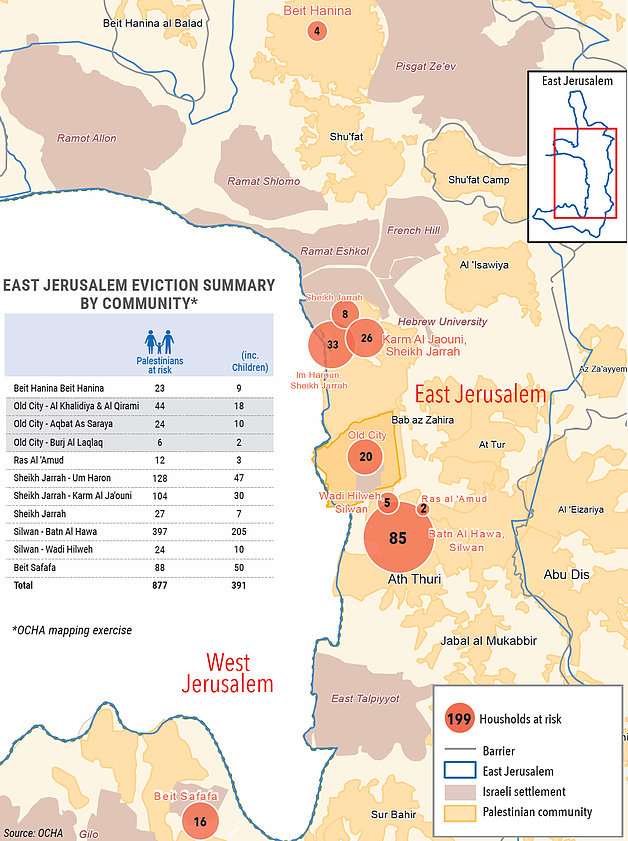
Map by OCHA
In an unrelated report, Maan News reports that settlers have evicted the al-Halabi family from its home and taken over their property in the Muslim Quarter of Jerusalem’s Old City. Settlers reportedly used pepper spray against Palestinians who attempted to prevent them from entering the apartment while the al-Halabi family was out shopping; five Palestinians were detained by the Israeli forces. The home is in a 4-unit building in which, according to Ma’an, Israeli settlers have succeeded in acquiring a majority ownership from its Palestinian owners.
According to OCHA-OPT, there are 20 Palestinian families (74 adults and 30 children) living in Jerusalem’s Old City under threat of eviction. FMEP recently reported on two families under imminent risk of eviction at the behest of settlers.
Jerusalem Planning Authority Nullifies Only Way Palestinians Can Prove Land Ownership in East Jerusalem
In what appears to be a significant change in Israeli policy in governing East Jerusalem – where Palestinians live under Israeli domestic law but are not citizens and do not the same rights as citizens – the Jerusalem Planning and Building Committee annulled the long-standing Israel-accepted procedure which was the only means by which Palestinians could document their land ownership claims in East Jerusalem. Known as the “mukhtar protocol” under this procedures Palestinian East Jerusalemites could document/prove ownership by collecting signatures from local Palestinian leaders acknowledging that the land in question was, indeed, owned by the claimant. The longstanding policy was developed by the Israeli government as an alternative to the formal land-registration process, which has been frozen in East Jerusalem since 1967, after the Six-Day War.
With this shift in policy, the Jerusalem Planning and Building Committee reportedly denied 20 applications for building permits submitted by Palestinians at a meeting in early March 2019, where the applications relied on the “mukhtar protocol.”
Mohammed Abu Ghanem, an architect whose plan for 12 homes in the Silwan neighborhood was rejected this week, called the shift in Israeli policy a “catastrophe,” saying:
“we have no other ownership documents to present, and 90 percent of the land is not registered.”
Haaretz reports that settlement impresario Aryeh King is reportedly behind the campaign for the government to stop recognizing Palestinian land ownership based on this procedure.
In May 2018, Israeli Justice Minister Ayelet Shaked announced funding for a new initiative to start the process of registering land in East Jerusalem as a means of consolidating Israeli claims to Palestinian neighborhoods (and undoubtedly find more “unowned” land for the settlers). At the time, Israel’s Minister of Justice Ayelet Shaked said:
“the start of land settlement of title and registration in East Jerusalem [is] a step toward promoting Israeli sovereignty and control over the city….[t]he day before the strengthening of Jerusalem through the transfer of the American embassy to Jerusalem, and after decades of Israeli sovereignty in eastern Jerusalem, we are strengthening the city and actually applying sovereignty through the program of land regulation in East Jerusalem.”
The Palestinian human rights group Al-Mezan responded:
“This policy violates Palestinian rights and breaches international humanitarian law, whereas this situation almost always results in the conversion of lands into ‘state property’ due to lack of availability of ‘proof of ownership’ by Palestinian current landowners. This will also allow the re-implantation of the Absentee Property Law, which allows the state to seize, manage, lease, transform, and sell the properties of Palestinians who are declared ‘absentees’.”
Report: Jerusalem City Council to Approve Plan to Build Two New Settlements, Expand Others
The settler-run news outlet Arutz Sheva reports that the Jerusalem City Council is preparing to approve a huge plan for new construction in both East and West Jerusalem. If implemented, the plan will allow the construction of two brand-new settlements in East Jerusalem. One, called “Ramot 07,” will consist of 2,000 units built north of the existing Ramot settlement; the second, called “Moradot Neve Ya’akov,” will also consist of 2,000 new units built between the settlements of Pisgat Ze’ev settlement and Neve Ya’akov. Both new settlements are specifically for ultra-orthodox (Haredi) Israelis.
Jerusalem expert Daniel Seidemann notes that the Arutz Sheva report – specifically in regards to the large scale settlement construction in East Jerusalem – which has not been confirmed by other outlets, might not be accurate. Seidemann tells FMEP:
“The report sounds highly questionable. Large scale construction can take place only within the boundaries of the expropriated lands, and the potential there has all but been exhausted. I am unaware of other sites where building of this scale or anything like it is possible elsewhere, and I doubt such sites exist.”
Israeli Court Rejects Another Petition to Stop the Eviction of the Sabbagh Family from their Home in Sheikh Jarrah
On March 3rd, the Israel Law Enforcement and Collection Authority, a support unit for the courts under the Ministry of Justice, dismissed a petition objecting to the eviction of the Sabbagh family from its home of 60+ years in the Sheikh Jarrah neighborhood of East Jerusalem at the behest of Israeli settlers.
The ruling puts the 45-member Sabbagh family, once again, at imminent risk of eviction.
The Sabbagh family has been struggling against eviction proceedings initiated by the settler organization Nahalat Shimon, which was awarded ownership rights of their house through use of the “Legal and Administration Matters Law,” which allows Israeli Jews (but not Palestinians) to reclaim property lost/abandoned during the 1948 war. Nahalat Shimon managed to find the Jewish Israeli family who owned the home prior to the war and convinced that family to hand over their ownership rights.
The Norwegian Refugee Council writes:
“The risk of imminent forced eviction of the Sabbagh family in Sheikh Jarrah; the eviction of the Abu Asab family in the Old City and its replacement by Israeli settlers in mid-February; and the progress of settler compounds and touristic settlement in Silwan indicate a bolder intent to further entrench and tighten Israeli control over key locations across East Jerusalem, including through altering the demographic composition of the territory.”
There have been weekly protests in Sheikh Jarrah against the eviction of the Sabbagh family.
Peace Now writes:
“This is part of an organized and systematic campaign of settlers, with the assistance of government agencies, to expel entire communities in East Jerusalem and to establish settlements in their stead. Dozens of other families face the risk of eviction by legal proceedings in which settlers and government officials exploit discriminatory laws that allow Jews to return to pre-1948 assets yet forbid Palestinians from doing the same. In this way, settlers seek to create a buffer inside the Palestinian neighborhood and make it difficult to reach a territorial compromise in Jerusalem so essential to a two-state solution.”
Ambassador Friedman Takes Over Palestinian Relations & Settlement Reporting
On March 4th, the U.S. Consulate General in Jerusalem was formally closed, and a new “Palestinian Affairs Unit” began operating under the supervision of U.S. Ambassador David Friedman, as part of the U.S. Embassy to Israel, recently established in Jerusalem by the Trump Administration.
The U.S. has been represented in Jerusalem by a Consulate General since 1844; from the start of the peace process in the 1990s until this week, the Consulate served as the de facto U.S. diplomatic mission to the Palestinians, and was a central player in advancing U.S. efforts to broker a negotiated end to the conflict.
Explaining the significance of the closure – and batting down headlines that suggest the consulate was merely “merging” with the new Embassy – Jerusalem expert Daniel Seidemann tweeted:
“No, the Consulate (the de facto US mission to Palestine) will NOT ‘merge’ with the Embassy. It will be subsumed into the Embassy to Israel. This is no mere technicality, and precisely reflects current US policies: all things Palestinian are subservient to Israeli interests.”
Notably, the Consulate General in Jerusalem reported directly to Washington, covering not only Palestinian affairs but also, notably, all issues related to settlements in the West Bank and East Jerusalem (consulates in nearly all other cases are subsidiaries of the U.S. embassy in a given country, and any reporting they do flows through the embassy and the Ambassador). Now, all that reporting will be overseen by U.S. Ambassador David Friedman.
Friedman, it should be recalled, is a long-time and unabashed settlements supporter. In addition to personal donations to the settlements, prior to his appointment as Ambassador, Friedman served as the President of a U.S. organization dedicated to fundraising for the Beit El settlement. Friedman recently declared to the press that he is a proud “right-wing” defender of Israel. According to reports, Friedman has tried to eliminate the words “West Bank” from the State Department’s lexicon in favor “Judea and Samaria” (the term used by settlers), and, n a departure from longstanding U.S. policy, frequently visits the settlements.
All of this suggests that Friedman – who has made clear that he regards the settlements as part of Israel, does not oppose settlement construction, and that he does not believe the U.S. should or will ask Israel to withdraw from settlements in the context of a peace “plan” or negotiations with the Palestinians – will likely stem the flow of information to Washington regarding settlements, and re-focus it in support of a pro-settlement political agenda.
Notably, in his capacity as Ambassador, Friedman has publicly embraced and promoted economic co-existence initiatives -between settlers and Palestinians – as a core U.S. priority on the ground (FMEP has repeatedly explained the perversity of labeling Israel’s economic exploitation of occupied territory, including the local workforce, land, and other natural resources, “coexistence,” or suggesting that it brings to the Palestinians benefits they should welcome.
Regarding the consulate closure, the PLO said in a statement:
“The decision of the American administration to close the American consulate in Palestine, which was opened in Jerusalem in 1844, as of this morning and merge it with the US embassy in Israel after moving it from Tel Aviv to Jerusalem and operating a special unit for Palestine in the embassy reflect the level of audacity of the American administration in striking the international decisions, which it has contributed to writing, and a denial of the historic rights of our people and the international conventions and laws that support the right of our people to end the Israeli occupation of the Palestinian territories started in 1967, the establishment of the independent Palestinian state with East Jerusalem as its capital and the right of return for refugees as per United Nations resolution 194. This decision is the implementation of the policy and decision of the colonial settlements council in the West Bank.”
Hanan Ashrawi, a member of the PLO central committee, said that the merger:
“is not an administrative decision. It is an act of political assault on Palestinian rights and identity.”
Congressional Funding for Settler Business Council?
U.S. Senator James Lankford created confusion recently by suggesting that a new U.S. law provides a funding for the “Judea and Samaria Chamber of Congress,” a purported group of Israeli and Palestinian businesspeople cooperating on new ventures in the settlements for the benefit of both peoples (a claim which, as FMEP has repeatedly explained, is ultimately aimed at normalizing and entrenching the exploitative nature of Israel’s occupation and settlement of the West Bank).
The confusion stems from the fact that Sen. Lankford’s suggestion appears to be factually incorrect – Congress has not approved any such funding. One bill which U.S. congresspeople might use for this purpose, the Palestinian Partnership Fund (HR 7060/ S. 3549), was introduced in the last Congress, but has not yet been moved in the new Congress. The bill’s authors intended (and ostensibly continue to intend) to provide funding for people-to-people exchanges that bring Palestinian and Israeli civil society together, with the understanding that such programming is an important complementary track to good-faith peace negotiations.
If and when (and with whatever motive) the U.S. Congress acts on HR 7060/S. 3549, or introduces any legislation relating to financing these economic coexistence endeavors, it will be reported and analyzed by FMEP President Lara Friedman in her weekly legislative roundup (subscribe here).
UNHCR Delays (Again) Publication of Database Identifying Businesses Operating in Settlements
On March 5th, United Nations High Commissioner for Human Rights Michelle Bachelet announced that the Human Rights Council has once again delayed the publication of a database listing companies that do business inside of Israeli settlements. In a letter, Bachelet committed to publishing the database “in coming months.”
The UN Human Rights Council (UNHRC) adopted a resolution on March 24, 2016 mandating the creation of the database listing the business enterprises that “have, directly and indirectly, enabled, facilitated and profited from the construction and growth of the settlements.” The database is meant to assist UN member states in complying with their legal obligations under international law. International legal scholar Valentina Azarova explained:
“The UN database is a mechanism to document, report, and engage primary interested parties. It does not have the mandate to adjudicate the responsibility of concerned parties, nor to act as a coercive tool of law enforcement. Thus, commentators who refer to it as a “blacklist” misrepresent it and undermine its legitimacy.”
Human Rights Watch issued a statement regarding the latest delay, saying:
“Israeli authorities’ brazen expansion of illegal settlements underscores why the U.N. database of businesses facilitating these settlements needs to be published,” Bruno Stagno Ugarte, an advocacy director for Human Rights Watch, said in a statement. “Each delay further entrenches corporate involvement in the systematic rights abuses stemming from illegal settlements.”
Israel and the United States have fought tooth-and-nail against the publication of the database, labeling it an anti-Israel “blacklist.”
Bonus Reads
-
“Are Palestinian Police Protecting Settlers?” (Al-Monitor)
-
“One Israeli’s Journey from Ultra-Orthodox Settler to Peace Activist” (NBC News)
-
“At West Bank High School, Knesset Candidates’ Discuss Future of Pupils’ Home” (Times of Israel)
-
“What Netanyahu’s Election Strategy Shows About How Settlers Vote” (Times of Israel)
-
“By Force of Forgery: How Settlers Claim Palestinian Homes” (Middle East Eye)
Welcome to FMEP’s Weekly Settlement Report, covering everything you need to know about Israeli settlement activity this week.
To subscribe to this report, please click here.
February 22, 2019
- Settlers Fly Israeli Flag Over Muslim Quarter Home Following Eviction of Palestinian Family
- Israel Approves Massive Jerusalem Housing Project – Including Settlement Units in East Jerusalem
- Facing Supreme Court Hearing, Civil Administration Decides to Partially Comply with Geo Data Request from Radical Settler Group Regavim
- U.S. Ambassador to Israel Pushes Economic Peace Scheme (Again) to “Judea & Samaria Chamber of Commerce & Industry”
- Two U.S. Congressmen Tour Settlements, Promote Annexation
- The “Sovereignty Movement” Promoting Annexation, & the Pushback
- Bonus Reads
Questions/comments? Email kmccarthy@fmep.org
Settlers Fly Israeli Flag Over Muslim Quarter Home Following Eviction of Palestinian Family
On February 17, Israeli security forces evicted the 7-member Abu Asab family was from its home of nearly 70 years in the Muslim Quarter of Jerusalem’s Old City. Within hours of the eviction, Israeli settlers moved into the home and raised an Israeli flag on its roof.
Before 1948, the property in question was owned by a Jewish family, the Maisals, which abandoned the property during Israel’s War of Independence. The Abu Asab family was settled in the property by the Jordanian government during this same period – which Palestinians know as the Nakba (the catastrophe), in the wake of their expulsion from their own home in what became Israeli West Jerusalem. Their eviction this week came at the behest of Israeli settlers who had gained control over the land trust to which the original Jewish owners had passed their property rights.
As background: Under Israel’s Legal and Administrative Matters Law, Jews who lost property in 1948 (of which there are approximately 2,000) have the right to reclaim their property. Palestinians who lost property in that same war (of which there are approximately 20,000-30,000) do not have a similar right. Settler organizations have sought to take full advantage of that law, undertaking campaigns to identify Jewish families who abandoned property now occupied by Palestinians, gain title to those properties (even if the original landowner has made no effort to reclaim the property), and then start eviction proceedings against the Palestinian residents. This is happening across East Jerusalem neighborhoods, most prominently in Sheikh Jarrah and Silwan.
Palestinian residents targeted by these evictions, like the the Abu Asab family, have no legal avenue for reclaiming their property in West Jerusalem.
Peace Now explains:
“The Maisel family dedicated the property to a trust. A few years ago, settlers managed to appoint themselves as directors of this trust, and in their name they sued the family who lived in the property in protected rent during the days of the Jordanians and paid rent regularly. With this crooked legal situation, the court granted the settlers the house and the Abu Asab family became refugees for the second time…This eviction is part of a larger strategy by proponents of the settlement enterprise to change the character of Palestinian Jerusalem neighborhoods in order to cement Israeli hegemony over the Old City and its surroundings and to prevent the chances of a two-state solution.”
Ir Amim researcher Aviv Tatarsky writes:
“When Jewish settlers move into Palestinian neighborhoods, they almost always bring with them armed guards to stand guard on their rooftops and outside their doors, a dynamic that has a detrimental influence on entire neighborhoods. Day to day life is disrupted, with residents facing pressure seemingly designed to push them out of their homes. Israeli authorities have various ways of abetting that effort, from the law allowing only Jews to reclaim property, to funding private security guards for the settlers who move in to their properties, to funding tourism initiatives that strengthen the image of those settlements vis-à-vis the Israeli and international public.”
Israel Approves Massive Jerusalem Housing Project – Including Settlement Units in East Jerusalem
According to the Middle East Eye, on February 20th the Jerusalem Planning & Building Committee approved a project for 4,416 new housing units across Jerusalem, including units in Israeli settlements and settler units located within Palestinian neighborhoods in East Jerusalem. Early reporting on the details of the plan describe:
- 76 new units in the Shuafat neighborhood of East Jerusalem
- 56 new units in the Beit Hanina neighborhood of East Jerusalem
- 464 units in the Gilo settlement
- The construction of a new commercial complex at the Atarot settlement industrial zone site, including 3 buildings with 8 floors each.
FMEP will report more details on the plan as the are clarified.
Facing Supreme Court Hearing, Civil Administration Decides to Partially Comply with Data Request from Radical Settler Group Regavim
The settler-aligned Arutz Sheva outlet reports that, days before a scheduled hearing at the Supreme Court, the Israeli Civil Administration announced that it will provide a portion of the geographical information that the radical settler group Regavim requested via a freedom of information request last year. Regavim works to dispossess Palestinians of their land and property in the West Bank by “helping” (i.e., pushing) the Israeli government to enforce planning and building laws – and possession of the Civil Administration’s most recent geographical data will undoubtedly aid Regavim in pursuing its mission. Notably, Regavim works for the application of planning and building laws only against Palestinians; key Regavim staff members actually live in illegally built settlement units (illegal even under Israeli law), which Regavim works to retroactively legalize.
Supreme Court Justice Meni Mazuz chided the Civil Administration for its failure to respond to the initial information request, and for the nine-month delay in responding to Regavim’s court petition. In light of the Civil Administration’s announcement, the Supreme Court subsequently dismissed Regavim’s petition and and ordered the Civil Administration to pay Regavim’s legal expenses related to the case.
Regavim’s Attorney Boaz Arzi crowed:
“Although it took far too long, after a year and a half we finally received the data we needed – but through legal petition, not through the Freedom of Information process. Regavim is considering submitting a new petition against the Civil Administration’s interpretation of its obligations – or more precisely, its presumptive lack of obligation – under the Freedom of Information Law, an interpretation that contradicts the Attorney General’s directive.”
The Civil Administration said:
“We will study this case and draw conclusions in order to improve our responsiveness to the public.”
U.S. Ambassador to Israel Pushes Economic Peace Scheme (Again) to “Judea & Samaria Chamber of Commerce & Industry”
On February 21st, U.S. Ambassador to Israel, David Friedman, spoke about economic co-existence initiatives at a conference hosted by the “Judea Samaria Chamber of Commerce and Industry (JSC)” (an Israeli settler body) and US-Israel Education Association (USIEA) (conference website is here). The USIEA is a U.S. evangelical group deeply involved in supporting and normalizing settlements, working in partnership with the Israeli government. It is also works with the Family Research Council to lead Congressional delegations to Israel and runs a bible camp in the Ariel settlement.
This is the second time the Ambassador has met with the JSC, the first was in October 2018 at a meeting in the Ariel settlement. Speaking to the press at this week’s conference, Ambassador Friedman said the goal of the forum is to “encourage business development in Judea and Samaria, encourage the prosperity of people who live there, most of them Palestinian residents.” Notably, until this point the U.S. State Department has not officially referred to the West Bank as “Judea & Samaria” – a biblical term for the area that is preferred by Israeli settlers and pro-annexationists.
Friedman said in his speech:
“This is not a time for words, this is a time for action, and this is the path I’m confident we’re on. One day, I believe in the near future, as we begin to see Israelis and Palestinians working together, studying together, investing together, and living together in real peace – not the ‘peace’ that comes from a piece of paper, but the real peace that’s in the heart and the soul of everyone who’s here. We will look back on days like today to understand how it all began.”
Commenting on Friedman’s remarks, FMEP President Lara Friedman tweeted:
“Folks, pay close attention to actions/statements like this one. All evidence so far suggests that US direct engagement (new policies, initiatives, funding) to normalize occupation while de-nationalizing Palestinians IS the Trump ‘peace plan’”
FMEP has repeatedly chronicled Amb. Friedman’s embrace of economic co-existence initiatives as a core U.S. priority on the ground, and has repeatedly explained the perversity of labeling Israel’s economic exploitation of occupied territory (including the local workforce, land, and other natural resources) “coexistence” or suggesting that it brings to the Palestinians benefits they should welcome. The New York Times quoted a spokesman for the Palestinian Authority explaining the Orwellian reality of settlement industrial zones:
“Somebody occupies your country, steals your land, steals your water, steals your resources, then says: ‘I’ll make a good deal for you if you come work for me. I’ll create jobs for you. We are not occupiers. We are employers.’ This is ridiculous. The colonial settlements are illegal in every sense of the word.”
Two U.S. Congressmen Tour Settlements, Promote Annexation
While on a tour of Israeli settlements in the West Bank (something that in itself would have been unusual and controversial in the past), U.S. members of Congress Andy Harris (R-MD) and Andy Barr (R-KY) expressed support for Israeli annexation of the settlements and spoke in favor of settlement industrial zones, suggesting that such zones promote peace and prosperity in the region.
While at the Barkan Industrial Zone in the northern West Bank, Barr told members of the press:
“Our job after witnessing what we have seen here today is to communicate to the administration that the best way forward for peace and prosperity for everyone, Jews and Arabs, is more industrial development here, where we can have integration and not segregation: That is the path to peace…free enterprise, where everyone has the opportunity for upward mobility and prosperity – working together – is the best way forward for peace.”
Barr’s comments echo the views of U.S. Ambassador to Israel David Friedman, who once described the Barkan Industrial Zone as a “model of Israeli-Palestinian coexistence since 1982, with thousands working and prospering together.” The reality of West Bank industrial zones, and the role they play in the lives of Palestinians, is more complicated. For decades Israel has used industrial zones as another tool to expand and deepen control over West Bank land. Jobs in industrial zones – often the only jobs available for Palestinians living under an Israeli occupation that prevents the development of any normal Palestinian economy – are widely viewed by Palestinians as a double-edged sword. FMEP has previously reported on the false notion that settlement industrial zones are in the best interests of the Palestinian people living under occupation.
Representatives Harris and Barr met with settler leader Yossi Dagan, the head of the Samaria Regional Council, and two members of the radical activist group called Women in Green, which has long advocated for Israeli annexation of the West Bank. Later on the same trip, the two also met with Prime Minister Benjamin Netanyahu.
Rep. Barr told the Women in Green:
“we will share this [sovereignty] message with our colleagues in Congress and our constituents in the United States as we echo your sentiment that a strong Israel and Israeli sovereignty is an interest not just of the Jewish people but of the United States as well.”
The “Sovereignty Movement” Promoting Annexation, & the Pushback
The Israeli “Sovereignty Movement” (an offshoot of the Women in Green organization) is working to further formalize its expanding influence over Israeli politicians and public discourse by pushing for the establishment of a Knesset committee devoted to the cause of Israeli annexation of the West Bank.
In a recent article detailing how the Israeli political echelon no longer conceals its annexationist aims, veteran Israeli journalist Shlomi Eldar explains that the “Sovereignty Movement” has been instrumental in pushing politicians and candidates to speak more openly and supportively in favor of annexation. Eldar writes:
“The Sovereignty Movement is currently focused on creating a lobby in the Knesset. Its activists are working the ruling party, distributing a journal running a website and promoting paid content on social media. The movement’s influence played a role in Likud’s Central Committee voting in December 2017 in favor of a non-binding decision imposing Israeli sovereignty on Israeli-controlled territories of the West Bank, including the Jordan Valley. This, it turns out, was just the beginning. The Sovereignty Movement posted a video on Feb. 12 calling for imposing Israeli sovereignty on the West Bank territories. ‘First of all, we get the idea of a Palestinian state off the table,’ says Science and Space Minister Ofir Akunis in the video. ‘Second, we need to make brave, difficult, challenging decisions that aren’t simple when facing the international community. First of all, we must impose sovereignty on West Bank Area C.’ According to him, on the land designated Area C, under Israeli civil and security control, there is a clear Israeli and Jewish majority.”
Commanders for Israeli Security – an organization comprised of retired and former senior officials in the Israeli defense establishment – released a statement in direct response to the growing influence of the “Sovereignty Movement,” and its newly revealed ambition of creating a Knesset committee. The statement reads:
“Today, the extreme right’s mode of operation for annexing millions of Palestinians was revealed. Undetected, a right-wing extremist group is working to ensure that the next government will implement its plan. Although most of the Israeli public understands the destructive implications of annexation, utterly opposes it, and is unaware of the measures to realize this horror scenario, the Sovereignty Movement creates facts on the ground, mobilizes extreme right-wing politicians and lays the groundwork for implementing the move. It is now clear that these are not merely delusional dreams. The declarations favoring annexation, or using the laundered term “application of sovereignty,” frequently delivered by extreme right-wing politicians, are public expressions of a well thought-out plan developed in hiding, whose implementation began during the term of the outgoing government. With backwind of the support they have mobilized so far, the annexationists no longer hide their intentions, openly proclaiming their determination to accomplish the feat during the term of the next government, leading to the destruction of Israel as a Jewish, secure and democratic state. The annexation pressure is on. The pressure exerted on politicians to express support for annexation are but the prelude to the pressure to be exerted on Prime Minister Benjamin Netanyahu, if elected, to commit to annexation as a condition for forming the next government. If the annexation move is not halted immediately, we will wake up to a different Israel during the term of the next government, without a solid Jewish majority and all the security and other implications of integrating millions of Palestinians into the State of Israel. This pressure should be stopped right now.”
Bonus Reads
- “Palestinians Live in Caves to Preserve their Land” (Al-Monitor)
- “Netanyahu Pretends the Occupation Doesn’t Exist” (Al-Monitor)
- “Honenu: The legal arm of Israel’s radical settlers” (Ynet)
- “The Escalation of Israeli Collective Punishment of Palestinians” (Al-Shabaka)
- “Verizon, Pfizer, Bank of America – US Corporations are Funding Israeli Settlements” (In These Times)
Welcome to FMEP’s Weekly Settlement Report, covering everything you need to know about Israeli settlement activity this week.
To subscribe to this report, please click here.
February 8, 2019
- Another Challenge to Israel’s Plan to Retroactively Legalize Adei Ad Outpost
- New Eviction Proceedings Against Two Palestinian Families in the Muslim Quarter of the Old City
- Higher Education Council Reverses Approval of Adelson-Backed Medical School in Ariel University
- Activists Ask High Court to Revoke Status of West Bank Nature Reserve Run By Settlers
- Settlers Threaten to Blacklist Palestinians Who Work with Human Rights Organizations
- Prominent Israeli Politicians Pledge To End Two-State Solution
- 40 Ambassadors to the United Nations Visit Settler-Run Tourist Site in Occupied East Jerusalem
- Settler Org Credits Trump for Growth in West Bank Settler Population & Death of Two-State Solution
- New B’Tselem Report Slams High Court for Role in Dispossessing Palestinians, Validating Occupation
- Video Compilation of Likud Candidates Touting Role of Tourism in Expanding Settlements
- EU Settlement Report Details “Unprecedented” Level of Settlement Advancements 2018
- Bonus Reads
Questions/comments? Email kmccarthy@fmep.org
Another Challenge to Israel’s Plan to Retroactively Legalize Adei Ad Outpost
On January 31st, Yesh Din filed a petition with the High Court of Justice to reverse an expansion of “state land” boundaries in the Shiloh Valley that seized privately owned Palestinian land in order to retroactively legalize the notoriously (and recently) violent Adei Ad outpost.
In 2014, Palestinian landowners, in cooperation with Yesh Din, first petitioned the Court to evacuate the unauthorized Adei Ad outpost which was built on their land in contravention of both international and Israeli law. Instead of enforcing the law, the Israeli Civil Administration announced that it would “reexamine” the boundaries of state land in the area, an examination which found that Adei Ad was, according to the new Israeli mapping of the area, built on state land. To make the findings of the reexamination official, the Civil Administration used an entirely new procedure (a “declaration amendment”) to expand the boundaries of a previous state land declaration. In so doing, the Civil Administration found a way to avoid issuing a new state land declaration, which can be challenged in a court by Palestinians and legal groups like Yesh Din. For “declaration amendments,” landowners can only seek recourse through the Civil Administration. Objections filed to the expansion of state land in this case were all dismissed.
The new Yesh Din petition filed on January 31st challenges the secretive and unjust process by which the Civil Administration expanded the scope of state land to include the Adei Ad outpost. The petition reads:
“[…] Not only does the procedural structure for objection to the declaration, as stated in the procedure, substantially diminish the rights of the petitioners and other objectors who seek to receive their day in court before an independent and impartial judiciary (which is offered without exception to their neighbors, indicative of institutional discrimination), but even in substantive terms, the decision of the first respondent [the head of the Civil Administration] was carried out in violation of the law, in contrast to judicial decisions, in a manner entirely lacking transparency and conveying the arbitrariness that ultimately results from irrelevant considerations — the desire to legalize the outpost of Adei Ad at all costs.”
The new petition seeks to stop the implementation of the next step in the Civil Administration’s process to retroactively legalize Adei Ad, a plan that was announced in August 2018. Under the scheme, Adei Ad will be retroactively legalized by defining it as a “neighborhood” of the Amichai settlement – the first new government-backed settlement in 25 years, approved as payoff to the settlers who were evacuated from the unauthorized Amona outpost – located nearby.
In 2013, Yesh Din published a lengthy report about the Adei Ad outpost – how it was established and how the settlers who live there use violence to take over more and more land from nearby Palestinians.
Kerem Navot recently wrote:
“The outpost of Adei Ad has the hard-earned dubious reputation as one of the wildest and most violent outposts in the West Bank. Since its establishment in the late 1990s, settlers have initiated numerous violent incidents, all based on one simple rationale: take control of as much land as possible. As a reward for 20 years of wreaking havoc, the state is currently authorizing the outpost and has recently deemed it a ‘neighborhood.’ Guess whose: a ‘neighborhood’ of the settlement of Amichai that was established less than two years ago after the state granted “compensation” estimated at 300 million shekels, to the group of land thieves who were evicted from the outpost of Amona.”
New Eviction Proceedings Against Two Palestinian Families in the Muslim Quarter of the Old City
Ir Amim reports that settlers are behind two new eviction proceedings against Palestinians in the Muslim Quarter of the Old City of Jerusalem.
In the first case, the Abu Asab family received a notice that they must vacate their home in the Muslim Quarter by February 12th. The family has been renting the house since the 1960s, when the Old City was under the authority of the Jordanian government, which managed leases for vacant properties. In 2014, a settler-run trust – the Maisel Trust – petitioned to annul the family’s protected tenancy rights, arguing that those rights had been lost when the original tenants allegedly “abandoned” the property (the current residents are second generation relatives of the original renters). The Court ruled in the settlers’ favor in, and a subsequent appeal against the ruling was rejected.
In the second case, just 100 meters away from the Abu Asab family home, the Ghaith-Sub Laban family was warned that another settler-managed trust – the Gengel Trust – filed a new request for their eviction, arguing that the original tenants had abandoned the home and therefore forfeited their protected tenancy rights. The new eviction proceedings were initiated despite a 2016 Supreme Court ruling that held that Nora Gaith and husband Mustafa Sub Laban are legally allowed to remain in the apartment for 10 years), at which time their protected tenancy will be (prematurely) terminated and their children’s status as protected tenants annulled.
Ir Amim notes that there are a total of eight Palestinian families at imminent risk of eviction in the Muslim Quarter of the Old City, all in close proximity to the cases detailed above.
Higher Education Council Reverses Approval of Adelson-Backed Medical School in Ariel University
On February 7th, the Planning & Budgeting subcommittee of Israel’s Higher Education Council voted 3-2 against the approval of a medical school in Ariel University, reversing the subcommittee’s previous vote to approve the medical school in July 2018.
The Israeli Attorney General’s office ordered the second vote after it was revealed that one of the members of the subcommittee should not have been able to vote in July 2018, due to a major conflict of interest (Ariel University had promised the individual a promotion in the event the school was approved).
Since receiving the approval in July 2018, Ariel University has taken significant steps towards opening the medical school this fall, despite multiple unfolding controversies surrounding the process by which the school was approved. In addition to addition to the controversy surrounding the July 2018 vote, Israeli Education Minister Naftali Bennett is accused of violating government rules to secure a legal opinion in favor bringing the school under Israeli domestic laws (an act of de facto annexation). Bennett is also accused of inappropriately intervening to expedite the approval of the school.
In response to the vote Israeli Education Minister Naftali Bennett, said:
“I do not intend to give up. I will fight the university cartel until we establish the Faculty of Medicine at Ariel University.”
Following the vote, the settler Yesha Council (an umbrella group which lobbies on behalf of the settlements) issued a statement saying:
“We expect the Israeli government to handle the matter and renew the permit in the coming year.”
As FMEP has previously reported, Ariel University became an accredited Israeli university in 2012, following significant controversy and opposition, including from Israeli academics. It has since been the focus of additional controversy, linked to what is a clear Israeli government-backed agenda of exploiting academia to normalize and annex settlements. In 2018, the settlement broke ground on the new medical school, with significant financial backing from U.S. casino magnate, settlement financier, and Trump backer Sheldon Adelson. In February 2018, in an act of deliberate de facto annexation, the Israeli Knesset passed a law that extends the jurisdiction of the Israeli Council on Higher Education over universities in the settlements (beyond Israel’s recognized sovereign borders), ensuring that the Ariel settlement medical school (and its graduates) would be entitled to all the same rights, privileges, and certifications as schools and students in sovereign Israel.
As a reminder, Ariel is located in the heart of the northern West Bank, reaching literally to the midpoint between the Green Line and the Jordan border. The future of Ariel has long been one of the greatest challenges to any possible peace agreement, since any plan to attach Ariel to Israel will cut the northern West Bank into pieces.
Activists Ask High Court to Revoke Status of West Bank Nature Reserve Run By Settlers
A group of Israeli human rights activists have petitioned the Israeli High Court to revoke the special status of the Umm Zuka nature reserve and firing zone in the West Bank, saying the Israel’s designation of the land as a protected area has only served as a pretext to remove Palestinians and allow settlers to take over.
The petition goes on to explain that Israeli settlers have built an unauthorized outpost on the land that is slated to be added to the existing nature reserve, and have essentially turned the wilderness area into a private settler park where Palestinians are not allowed to enter. Despite complaints, the Israeli Civil Administration has not removed the unauthorized outpost – which consists of several structures connected to the water, sewage, and electricity of a nearby army base. The Civil Administration spokesperson told Haaretz that it is undertaken unspecified “enforcement proceedings” against the unauthorized outpost.
Eitay Mack, a lawyer who filed the petition on behalf of the group, told Haaretz:
“the reserve and the firing zone have effectively become a private settler farm that receives personal security service from Israel Defense Forces soldiers and bars entry to the farm’s enormous territory on the basis of ethnicity, nationality, religion and political opinions.”
Settlers Threaten to Blacklist Palestinians Who Work with Human Rights Organizations
Settlers have taken to posting signs in Palestinian villages warning that Palestinians who cooperate with human rights organizations will be prohibited from working in of Israeli settlements. The posters threaten:
“Do you wish to keep working in the settlements? Do you want to provide a living for your families from the Jews? Whoever cooperates with any one of these individuals and organizations (Ta’ayush and Rabbis for Human Rights) will never be allowed to enter the settlements for work. Be warned!”
+972 Magazine reports that the settlers behind the posters have also distributed leaflets to business owners inside of the settlements which list names of Palestinians alleged to work with (or have family members who work with) human rights groups – ostensibly encouraging Israeli business owners to fire them.
An Israeli activist working with the Tayyush organization (which is named on the posters as a group Palestinians cannot work with) explained:
“These flyers are yet another reminder that we [Israeli human rights groups] are a target of far-right groups, which get their marching orders from the Israeli government. The goal is clear: to expel Palestinians from their Area C of the West Bank and minimize their ability to defend themselves.”
Observers have noted the similarity between these flyers and signs posted by the Ku Klux Klan in the US years back targeting Black Americans.
Prominent Israeli Politicians Pledge To End Two-State Solution
In the context of Israel’s current election campaign, dozens of Israeli politicians have signed a pledge to the “Nahalah Movement” which reads:
“I hereby commit to be loyal to the land of Israel, not to cede one inch of our inheritance from our forefathers. I hereby commit to act to realize the settlement plan for the settlement of 2 million Jews in Judea and Samaria in accordance with Prime Minister Yitzhak Shamir’s plan, as well as to encourage and lead the redemption of all the lands throughout Judea and Samaria. I commit to act to cancel the declaration of two states for two peoples and replace it with the stately declaration: The land of Israel: One country for one people.”
Among the most prominent signatories are Knesset Speaker Yuli Edelstein (Likud), Transportation Minister Yisrael Katz (Likud), Justice Minister Ayelet Shaked (New Right) Education Minister Naftali Bennett (New Right), Tourism Minister Yariv Levin, Environmental Protection and Jerusalem Affairs Minister Zeev Elkin, Public Security Minister Gilad Erdan, Culture Minister Miri Regev, Regional Cooperation Minister Tzachi Hanegbi, Communication Minister Ayoub Kara, Immigration and Absorption Minister Yoav Galant, Social Equality Minister Gila Gamliel.
The petition was introduced and signed as the climax of the Nahalah Movement’s two-week-long protest outside of Prime Minister Netanyahu’s residence in Jerusalem. The activists were protesting what they portray as Netanyahu’s policy of severely restricting settlement construction. The Nahalah movement calls for unconstrained settlement construction and the establishment of new settlements. The Nahalah Movement released a statement saying:
“The signing of the petition opposite the Prime Minister’s Residence at the height of the Likud primary election campaign and at the height of the efforts to compile the [Knesset] lists in the right-wing and center bloc and in particular ahead of the coming election campaigns constitutes an ideological and ethical loyalty test for the various contenders.”
The settlement agenda promoted by former Prime Minister Yitzhak Shamir – the one mentioned in the Nahalah pledge – was one of unrestrained growth and absolute opposition to compromise with the Palestinians and/or Arab governments in the region. Notably, Shamir’s promotion of the settlement enterprise was strongly opposed by then-U.S. President George W. Bush, who threatened to cut U.S. aid to Israel if settlement construction did not stop.
40 Ambassadors to the United Nations Visit Settler-Run Tourist Site in Occupied East Jerusalem
A group of 40 Ambassadors to the United Nations visited a tourist site run by the radical Elad settler organization in the East Jerusalem neighborhood of Silwan. The delegation was led by Israel’s own Ambassador to the UN, Danny Danon, who appeared on video saying:
“We arrive today with nearly 40 UN Ambassadors to the City of David, Ir David, to show them the real truth about Israel….when the Ambassadors come here and they see for themselves the history of the Jewish people they understand why you cannot disconnect the Jewish people from our eternal capital Jerusalem.”
In the same clip, the President of Elad (aka the “City of David Foundation”) said:
“Why are they here? Far away from the halls of the United Nations building, here they will travel with us through the field and actually lift up the archaeological evidence and see the facts in front of their eyes. This is not a matter of fantasy and not only a matter of faith. Here we have facts that prove the connection of the Jewish people to Jerusalem.”
As a reminder, the explicit ambition of the Elad settler organization is to increase Jewish hegemony across all of Jerusalem at the explicit and intended expense of the Palestinian East Jerusalemites. In Silwan in particular, Elad has undertaken a multi-faceted campaign to evict Palestinians and increase the number of Jewish settlers living there.
Intending to give a backhanded compliment to the visiting delegation, Eugene Kontorovich – who heads the international law department at the Kohelet Policy Forum, a right-wing pro-settlement organization – tweeted that the UN Ambassadors must not agree with U.N. Resolution 2334, which calls on the international community to differentiate between Israel and areas occupied by Israel in their dealings in the region. Kontorovich also told Jewish Insider:
“The Security Council resolution calls on countries to ‘differentiate’ between Israel and territories that came under its control in 1967. The resolution is of course not binding, and by going on in official state visit across the green line in the company of Israeli government officials, these UN ambassadors show that they are fully aware what a dead letter the resolution is.”
As a reminder, Kontorovich self-identifies as a key figure in the drafting of “anti-BDS” (but actually, anti-free speech/pro-settlement) laws in the United States. At the core of these laws is the conflation of Israeli settlements with Israeli proper, based on Kontorovich’s argument that Israel is not occupying Palestinian territory. Kontorovich has also testified multiple times to U.S. Congress, including in support of moving the U.S. Embassy to Jerusalem; in support of Congress legislating U.S. foreign policy, including with regard to Jerusalem; on the impact of the BDS movement, and in support of U.S. recognition of Israel’s sovereignty over the Golan Heights.
Settler Org Credits Trump for Growth in West Bank Settler Population & Death of Two-State Solution
A settler-run organization has released an analysis of Israeli government data citing the Trump Administration as a key driver of a “surge” in the growth rate of the Israeli settler population in 2018, and predicted a larger surge to come. The group claims the settler population in the West Bank grew by 3.3% last year (449,508 – excluding East Jerusalem – as of January 2019), compared to a 1.9% increase in Israel’s overall population.
The director of the group, Baruch Gordon, told the Associated Press:
“Since the change of the U.S. administration, the atmosphere for construction permits has become much easier. They’re being given with greater ease. I think possibly the next report and certainly in the ones after that, I think we’ll start to see a huge surge in the numbers here….Those who continue to talk about a two-state solution, in my mind it’s just a sign that they’re removed from the reality and the facts on the ground.”
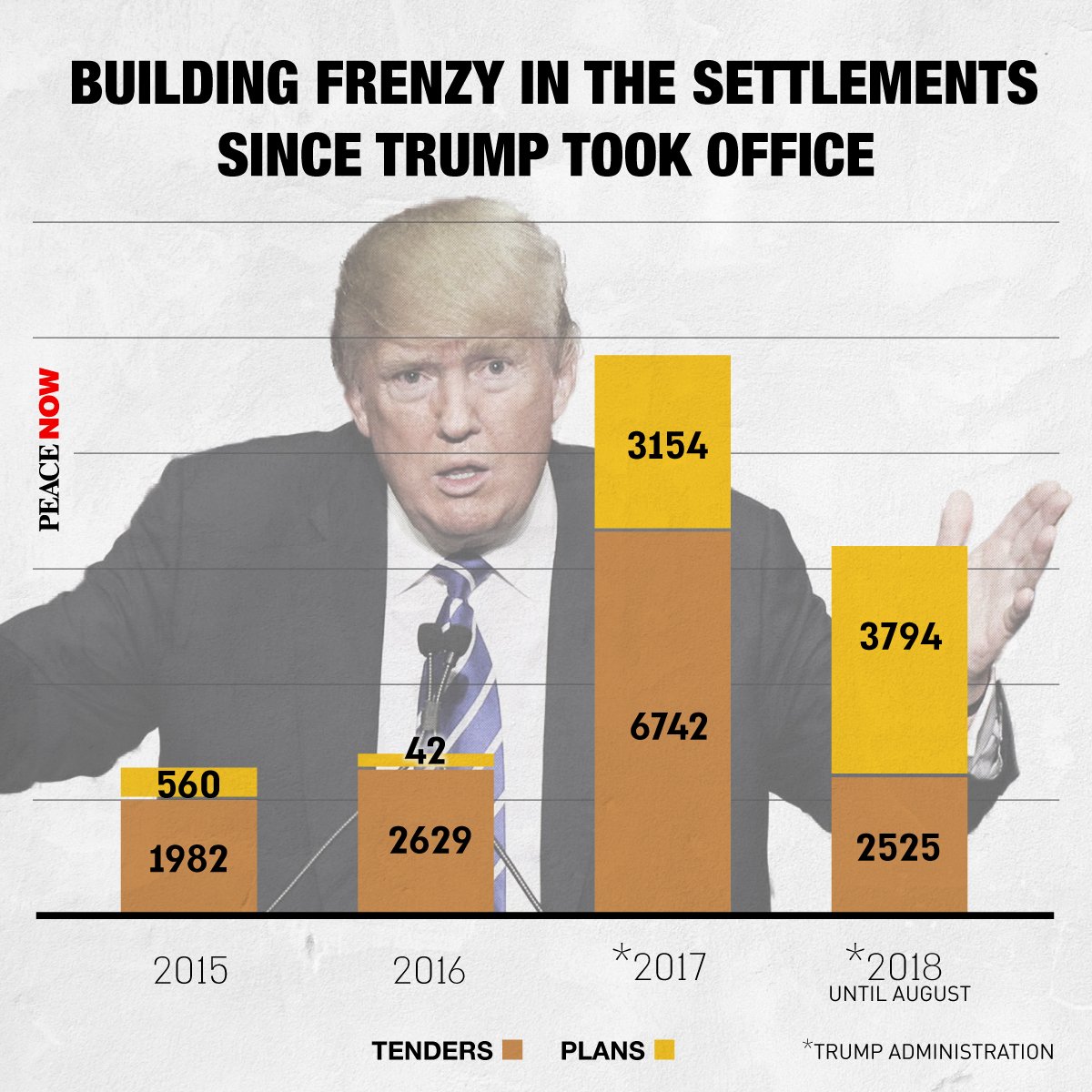
Image by Peace Now
When another settler organization – the Council of Jewish Communities in Judea and Samaria – published near identical data points in January 2019 (literally last month), the overwhelming response of the settler community was to blame former U.S. President Barack Obama for a slowdown in the population growth from the 2017 rate, which was at 3.4%. However, if Gordon is correct in his prediction of a settler surge to come, that surge will indeed by blamed on or credited to – depending on the source – U.S. President Donald Trump.
Peace Now has documented the sharp in increase in settlement advancements in 2018, which will eventually result in an increase in the population of settlers (by as many as 60,000 settlers) once those new units are built and sold.
Nabil Abu Rudeineh, spokesman for Palestinian President Mahmoud Abbas, told the AP:
“The American support for settlements through silence is doomed to failure because there is no peace and stability without an agreement with the Palestinian people and its legitimate leadership.”
New B’Tselem Report Slams High Court for Role in Dispossessing Palestinians, Validating Occupation
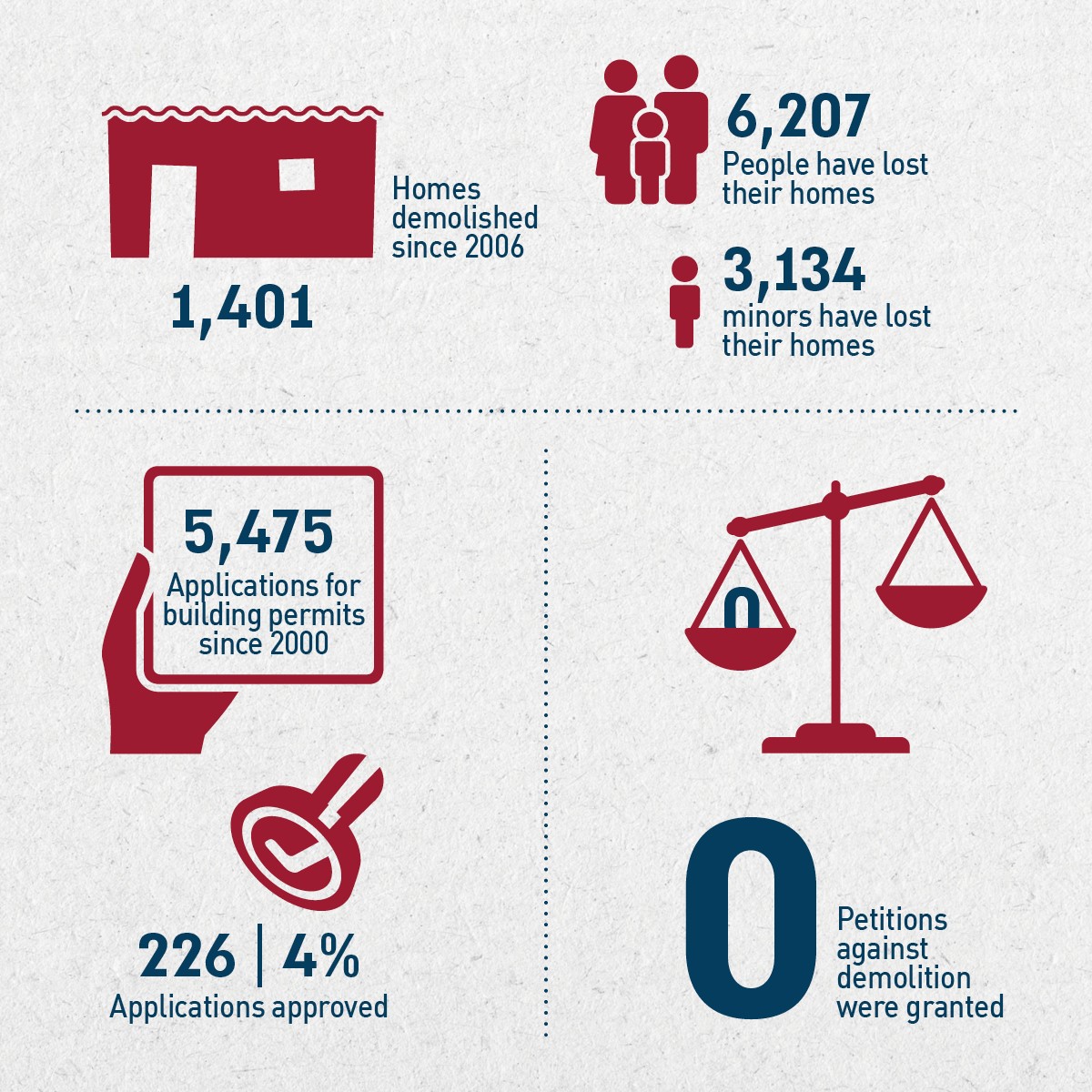
Image by B’Tselem
B’Tselem published an important new report entitled “Fake Justice: The Responsibility Israel’s High Court Justices Bear for the Demolition of Palestinian Homes and the Dispossession of Palestinians.” The report examines the role the highest court in Israel (and the only practicable avenue by which Palestinians can challenge Israeli policies and settler actions) has played in perpetuating the severe injustices inflicted upon Palestinians by the Israeli occupation and providing a guise of legality to for the Israeli policies behind them. Looking at its actions over the years as a whole, the report concludes that the court’s support of Israeli planning policy in the West Bank is tantamount to support for “forcible transfer” — a war crime.
The report’s executive summary explains:
“On the declarative level, Israeli authorities consider the demolition of Palestinian homes in the West Bank as no more than a matter of illegal construction, as if Israel does not have long-term goals in the West Bank and as if the matter does not have far-reaching implications for the human rights of hundreds of thousands of individuals, including their ability to subsist, make a living and manage their own routine. The Supreme Court has fully embraced this point of view. In hundreds of rulings and decisions handed down over the years on the demolition of Palestinian homes in the West Bank, the justices have regarded Israeli planning policy as lawful and legitimate, nearly always focusing only on the technical issue of whether the petitioners had building permits. Time and time again, the justices have ignored the intent underlying the Israeli policy and the fact that, in practice, this policy imposes a virtually blanket prohibition on Palestinian construction. They have also ignored the policy’s consequences for Palestinians: the barest – sometimes positively appalling – living conditions, being compelled to build homes without permits, and absolute uncertainty as to the future.”
The report is available to read and download here.
Video Compilation of Likud Candidates Touting Role of Tourism in Expanding Settlements
The Israeli archaeological group Emek Shaveh produced a video compilation of prominent Likud candidates touting their role in driving settlement tourism projects – in statements made in anticipation of the Likud primary elections (which were held on February 5th). Snippets in the video include:
- Former Mayor of Jerusalem Nir Barakat bragging about his work on behalf of settlement projects run by Elad in the Silwan neighborhood;
- Transportation Minister Yaariv Levin bragging on Facebook about the huge investments his ministry made into developing a settlement tourism industry, including doubling the amount of tourism to the West Bank in two years, funding two hotels in the Kiryat Arba settlement, and starting a grants program for tourist projects in settlements;
- Jerusalem Affairs Minister Zeev Elkin celebrating the opening of a “visitors center” in a settlement near the central West Bank city of Nablus.
Emek Shaveh writes:
“What was previously termed ‘hidden settlement’ has quietly transformed amid the Likud primaries into open policy. The extent of the Israeli government’s investments in the tourist settlement is now being exposed.”
There has been a growing awareness of – and opposition to – Israel’s overt investment in settlement tourism as means to expand and entrench Israeli settlements, most acutely in East Jerusalem. In February 2018, a leaked report by the European Union said explicitly that Israeli archaeological and tourism projects in East Jerusalem are “a political tool to modify the historical narrative and to support, legitimacy and expand settlements.”
Emek Shaveh issued a statement elaborating on leaked EU report, saying:
“Archaeological tourism projects are favored by the settlers as a means of winning the hearts of minds of the Israeli, Jewish and evangelical publics. The EU now recognizes how archaeological sites in East Jerusalem are being used as a political tool to ‘modify the historical narrative and to support, legitimise and expand settlements’. The City of David in Silwan, the new cable car project, the national parks in Palestinian neighborhoods compliment evictions and house demolitions in marginalising and disenfranchising the East Jerusalem Palestinian public. The difference between ‘cultural projects’ such as the national parks or the City of David and house demolitions is that in addition to the physical displacement, the former also expropriate the narrative, dispossessing the Palestinians from their historical and cultural contexts. When it comes to Jerusalem, narrative is not an abstract issue because in Jerusalem history and questions of present-day sovereignty are intertwined. And when it will come to determining the final status of the city, the question of who ‘owns’ the history of the city will be crucial.”
EU Settlement Report Details “Unprecedented” Level of Settlement Advancements 2018
On February 4th, the European Union issued its bi-annual report (pdf) documenting and analyzing trends in Israeli settlement activity from July through December 2018. It also provides a big picture summary of settlement activity in recent years, which found that there was a three-to-four-fold increase in settlement advancements in 2017/2018 (the era of U.S. President Donald Trump) compared to 2015/2016 (under Barack Obama).
The full report is available as a pdf here.
Bonus Reads
- “As West Bank Violence Surges, Israel is Silent on Attacks by Jews” (New York Times)
- “Digging Up Controversy” (US News)
- “US Blocks UN Statement on Israel Ending Hebron Monitors Mention” (Ynet)
- “CAF rejects tender for Jerusalem’s Railway as it Traverses ‘67 Borders” (Maan News)
Welcome to FMEP’s Weekly Settlement Report, covering everything you need to know about Israeli settlement activity this week.
To subscribe to this report, please click here.
December 14, 2018
- Israel Seizes on Palestinian Attacks as Pretense to Advance Settlement on Multiple Fronts
- The WZO Used Non-Existent Land Plots as “Collateral” for Loans to Build Illegal Outposts
- Israeli AG Freezes New Grants Program for Illegal Outposts
- At the Opening of New West Bank Highway Interchange for Settlers, Netanyahu Celebrates Erasing the Green Line
- Hanukkah Event Draws Political Support for Settlers’ Bid to Take Over Site in the Old City’s Muslim Quarter
- Huge Holes Open on Streets of Silwan…Above Settler Excavations
- Israel’s Top Court Slams State Rail Company for Moving Debris to Private Palestinian Land as Part of Plan to Build a Settlement Park
- Bonus Reads
Questions/comments? Email kmccarthy@fmep.org
Israel Seizes on Palestinian Attacks as Pretense to Advance Settlement on Multiple Fronts
Seizing on a series of deadly Palestinian attacks this week as his pretext, Prime Minister Netanyahu announced he will:
- retroactively legalize thousands of settlement structures and outposts;
- initiate a plan to build 82 new units in the Ofra settlement;
- build two new settlement industrial zones (one near the Avnei Hefetz settlement and one near the Beitar Illit settlement); and,
- implement a range of policies that collectively punish Palestinians in the West Bank.
In addition, the Israeli Ministerial Committee on Legislation (a committee within the Israeli cabinet that decides whether to give government-backing to Knesset legislative proposals) will consider supporting a bill written by MK Bezalel Smotrich (Habayit Hayehudi) which would allow the government to provide municipal services, like water and electricity, to some illegal outposts. The bill assumes the series of outposts will be retroactively legalized, an assumption based on the work to achieve that end spearheaded by settler leader Pinchas Wallerstein (who has his own history of ignoring the law).
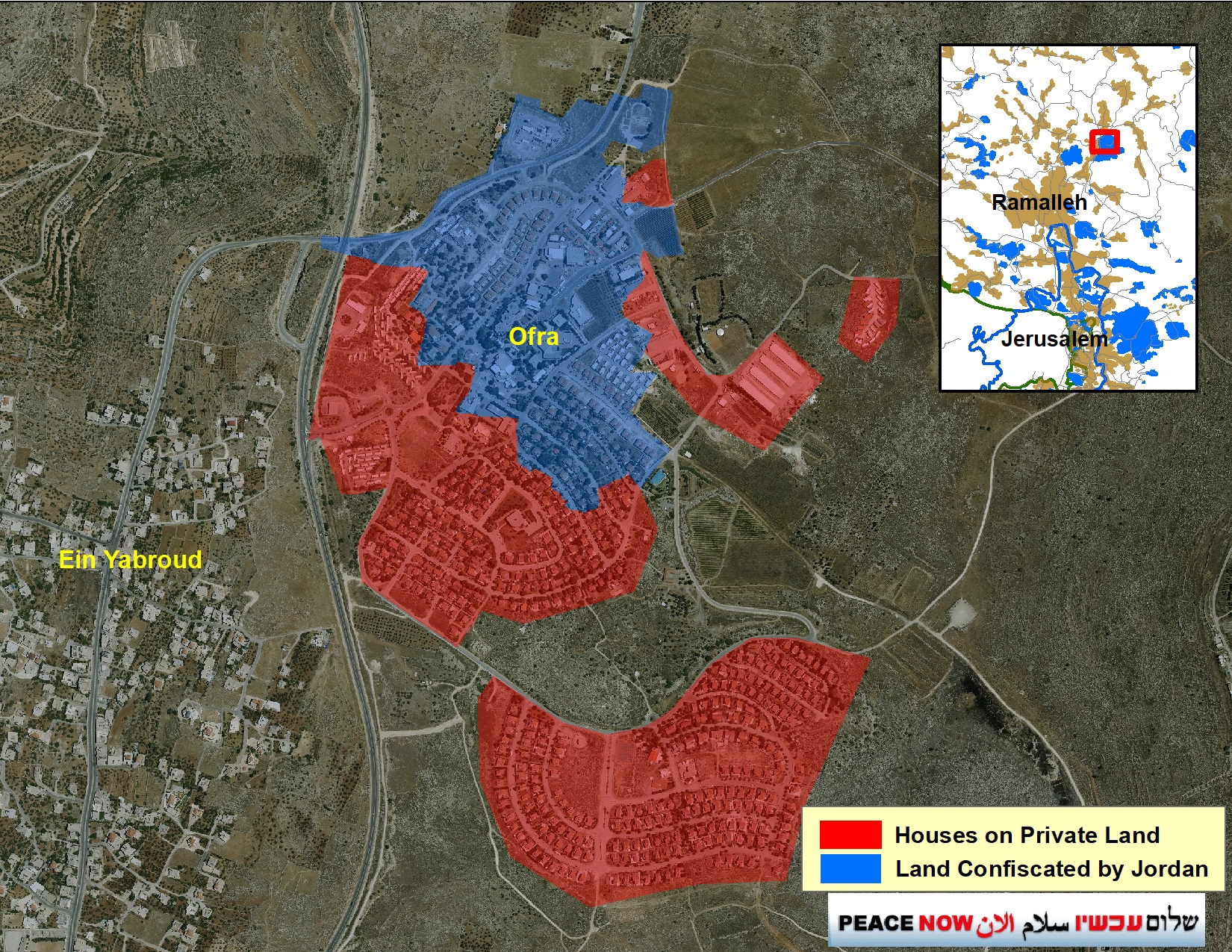 Many other senior Israeli officials joined Netanyahu in advocating for the immediate legalization of every unauthorized (i.e., illegal under Israeli law) structure in the Ofra settlement. The Ofra settlement – located northeast of Ramallah – was first established by settlers on land that had been expropriated in 1966 by the Jordanian government in order to build a military base (which was never built, as Israel took control of the West Bank in 1967). The Israeli government used this pretext to expropriate the land in 1977 in order to recognize the Ofra settlement, which had been established in the area illegally (i.e., without government approval, but with its tacit cooperation) two years prior. However, the majority of the Ofra settlement was not built on the land expropriated by the Israel in 1977, but instead on land that is registered to Palestinian owners from the nearby village of Ein Yabroud. In light of the legal status of the land, no Israeli government has yet been able to find a way to fix the legal status of these homes (not for lack of trying) – meaning that the majority of the structures in Ofra were built without permits, making them illegal under Israeli law.
Peace Now elaborates:
“Most of the houses built in Ofra (approximately 413 out of 625) were built on an area of 550 dunams of privately owned Palestinian land. In addition, hundreds of dunams of Palestinian private land were seized for roads in Ofra, as well as infrastructure and agricultural lands for the settlers. The only way to regulate the theft of these lands would be to expropriate them from the Palestinian landowners for the benefit of the settlers, in complete contradiction to the positions of previous Israeli governments and legal advisors, and contrary to binding rulings of the High Court. Although the current legal advisor (Avichai Mandelblit) allowed land expropriation in some places for settlement purposes (for example, in Haresha), in the regulation of massive land theft such as in Ofra the Israeli government would be crossing a new red line.”
Justice Minister Ayelet Shaked said that she already has a draft resolution and a legal opinion supporting retroactive legalization of Ofra. Shaked further threatened:
“Facing the price tag of Abu Mazen [Palestinian President Mahmoud Abbas], we pose our own price tag. Every terror attack will strengthen the settlement establishment instead of weakening it, and every potential attacker will know in advance that he will be considered responsible for strengthening settlements.”
Speaker of the Knesset Yuli-Yoel Edelstein vowed to push a plan through the Knesset to regulate Ofra, saying:
“The immediate answer to such an incident is to finally regulate Ofra, one of the oldest and most beloved communities. The 20th Knesset has been good and the Government has been positive towards the settlement enterprise. There have been important achievements and laws, but it’s not enough… I pledge to support the plan that will be formulated and advance it myself in the Knesset. This is our duty towards millions of citizens. The fate of Ofra must be the same as the fate of Petah Tikva.”
Yisrael Gantz, the new chairman of the Binyamin Regional Council, called for the:
“immediate approval of thousands of housing units… in order to deepen our roots here.”
The WZO Used Non-Existent Land Plots as “Collateral” for Loans to Build Illegal Outposts
The Israeli NGO Kerem Navot discovered more proof that the World Zionist Organization’s Settlement Division is directly financing the construction of illegal outposts with public funds — by providing loans to settlers based on non-existent assets, including fictitious plots of land in the West Bank. This reporting builds on previous revelations about the WZO’s complicity in illegal settlement construction on privately owned Palestinian land in the West Bank, including in the cases of the Mitzpe Kramim outpost and the Ma’aleh Rahavam outpost. Nonetheless, the Israeli government is rapidly advancing plans to hand over even more West Bank land to the WZO for settlement expansion.
On its latest findings, Kerem Navot founder Dror Etkes told Haaretz:
“This story exposes again the Settlement Division’s swindling ways and dirty dealings. [Like in the case of MK Bezelal Smotrich] who received a mortgage in the Kedumim settlement for a plot that doesn’t exist. It’s obvious from that and from the other cases that this is only the tip of the iceberg of a much broader practice.”
As a reminder, the WZO’s Settlement Division was created by the Israeli government in 1968 and is funded entirely by Israeli taxpayers. Its mandate is to manage West Bank land expropriated by Israel, in order to facilitate the settlement of Israeli Jews in the occupied territories. To make this possible, the Israeli government has allocated approximately 60% of all “state land” in the West Bank to the WZO’s Settlement Division [over the past 50 years Israel has declared huge areas of the West Bank to be “state land,” including more than 40% of Area C, where most of the settlements are located]. In addition, settlement and human rights watchdogs have repeatedly documented how the WZO’s Settlement Division has worked to take over additional land, including privately owned Palestinian land, in order to build more settlements.
Israeli AG Freezes New Grants Program for Illegal Outposts
Israeli Attorney General Avichai Mandelblit has reportedly frozen the implementation of a resolution, passed by the Israeli cabinet last week, designating three outposts as “national priority areas” for development. The resolution would direct enormous amounts of state resources to the outposts for construction.
Mandelblit wrote a letter slamming Housing Minister Yoav Gallant for bypassing the Attorney General in approving the resolution. According to Haaretz, Mandelblit had previously told the Housing Minister that the inclusion of settlements in the list of national priority areas needs to be thoroughly reviewed before the resolution was passed. Ignoring Mandelblit, Gallant advanced the resolution without a thorough review and without the permission of the government’s top legal official.
At the Opening of New West Bank Highway Interchange for Settlers, Netanyahu Celebrates Erasing the Green Line
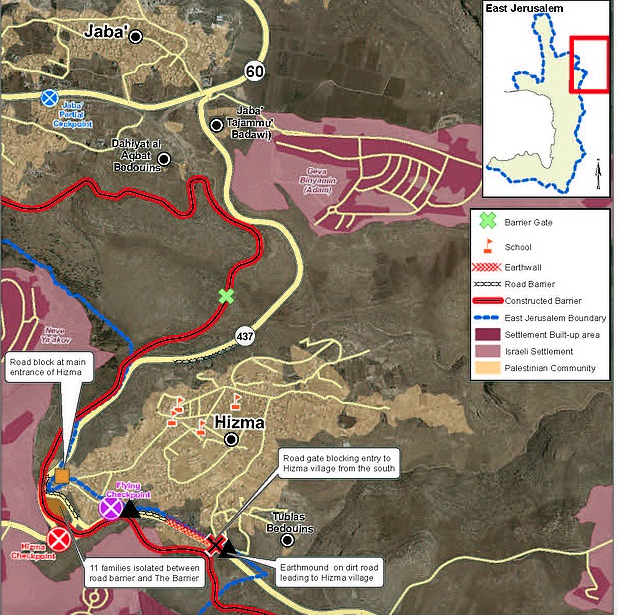
Map by OCHA
Israeli Prime Minister Benjamin Netanyahu attended a ceremony marking the opening of a newly renovated traffic interchange on Highway 60 (the main north-south highway in the West Bank). Located near the Adam/Geva Benyamin settlement and the Palestinian village of Hizma, the new interchange is meant to ease traffic congestion for settlers travelling to Jerusalem from the northern West Bank. More importantly, it advances the seamless integration of infrastructure serving Israeli settlements and sovereign Israeli territory – a key effort by settlers and their government allies to effectively erase the Green Line.
At the event, Netanyahu said:
“We are not stopping here. We will yet complete the paving of bypass roads, the widening of lanes and the improvement of infrastructures. There is a combined transportation-security aspect here. We are making yet another great link. While we are joining the country geographically, we are also joining the present to the future. Today and in this place we are doing something else, we are also joining the present to the past. Our ancestors walked here and took in this view of these valleys and these hills. The greatest dramas in the history of our people and of humanity took place here in this place; therefore, we are also joining our past to our future and this is a very great privilege.”
Minister Katz, who was also in attendance, said:
“We’re promoting a strategic plan on a very wide range with light rail routes at high-risk areas and traffic lights to make Judea and Samaria part of the Israeli norm of a developed and connected country…After we completed these two projects (Adam Interchange and Givat Assaf Traffic Light) we’ll work to enable this connection with a road with better conditions. This is part of the large and complementary projects to allow traffic to flow here.”
In September 2018, the United Nations Office for the Coordination of Humanitarian Affairs (OCHAS) released a report looking at the impact of Israeli roads on the the village of Hizma, as a case study of the effects road closures have on Palestinian rights. OCHA wrote:
“Hizma is a Palestinian village of over 7,000 residents in Jerusalem governorate. The bulk of its built-up area is in Area B but small parts of the village lie in Area C or within the municipal boundaries of Jerusalem, although it is separated from the rest of the city by the Barrier. Between 28 January and the end of March 2018, the three access roads into the village were either totally or partially closed to Palestinian traffic. The Israeli army hung posters on village shops stating that the army ‘will continue its work so long as you [residents] continue to be disruptive’. Other posters showed broken windshields. Following communications with the Israeli military, the head of the village council reported that the posters justified the closures as a response to stone throwing by Palestinian youths at vehicles with Israeli number plates. In 2017 and the first two months of 2018, OCHA recorded 11 incidents of Palestinians throwing stones at Israeli vehicles near Hizma that resulted in Israeli injuries or damage to vehicles.
The closures disrupted access by Hizma’s residents to services and livelihoods. Traffic between the north and south of the West Bank that passed through the village was diverted, undermining the commercial life of the village. Service providers, including a third of the teachers in village schools who commute on a daily basis, faced delays reaching the village. Over 50 shops/businesses that are the main source of income for 150 households were affected by the diversion of Palestinian traffic away from the village. Family life was also affected by the unpredictable nature of the closures.”
Hanukkah Event Draws Political Support for Settlers’ Bid to Take Over Site in the Old City’s Muslim Quarter
The Israeli archeological group Emek Shaveh reports that the Ateret Cohanim settler organization hosted a Hanukkah celebration – drawing the participation of the incoming Mayor of Jerusalem Moshe Lion, Minister of Jerusalem Affairs Ze’ev Elk, and the son of the Israeli Prime Minister, Yair Netanyahu – at the “Little Western Wall.” The site (which Israelis call the “Kotel Ha’Katan”) is a section of the retaining wall of the Temple Mount/Haram al-Sharif located within the Old City’s Muslim Quarter. It is viewed by some religious Jews as the closest point to the Holy of Holies at which Jews are permitted to pray. For historical background on the site and Ateret Cohanim’s role and goals related to it, see this 2016 report by Haaretz’s Nir Hasson.

Emek Shaveh writes:
“The recent Hanukkah ceremonies demonstrate an increase in political support for Ateret Cohanim and, no less important, the growing importance of the Little Western Wall, a politically and religiously charged place, attesting to a growing consensus among the Israeli Right regarding strengthening Jewish presence in areas immediately adjacent to the Temple Mount/Haram al-Sharif.”
Ateret Cohanim is a radical settler organization working to increase the presence of Israeli Jews living inside Palestinian neighborhoods of Jerusalem – including in the Old City, where the group recently succeeded in purchasing a Palestinian house in the Muslim Quarter (a property sale that continues to stoke controversy within the Palestinian community). Ateret Cohanim, along with their compatriots in the Elad settler group, also leads efforts to take over land and evict Palestinians from their homes in the Silwan neighborhood. Ateret Cohanim’s recent efforts in Silwan include using the guise of a Yemenite cultural center to build a new settlement in Silwan with government financing, and winning a High Court ruling that permits them to continue their campaign to evict 700 Palestinians from their homes.
Huge Holes Open on Streets of Silwan…Above Settler Excavations
 The Israeli archeological group Emek Shaveh reports that holes have begun appearing in the ground of Silwan, along the route of an underground excavation run by the Israeli Antiquities Authorities and funded by the Elad settler group. Elad has invested heavily in archeological excavations in Silwan in a campaign to co-opt the ancient history of Jerusalem to strengthen the Jewish hold on and presence in Palestinian neighborhoods in East Jerusalem. Emek Shaveh writes:
“There’s rarely a dull moment in Silwan. Last weekend, after the rain came, large holes opened up in the ground. This is not normal. And no amount of cement poured into the holes will make it so. Perhaps the reason for this odd occurrence can be found in the fact that Israel Antiquities Authority is excavating a tunnel along an ancient Roman road which runs right underneath the places where the holes opened up. There are 15 houses along the route of the tunnel. In some of them cracks have shown up. Others have shown signs of sinking into the ground. A few months ago we asked the Antiquities Authority to examine the homes and were assured the engineer would look into it. We’re still waiting for answers.”
The new holes are just the latest in a long series of above-ground damage related to excavations which the Israel Antiquities Authority (IAA) started in 2013. The IAA began the excavations without notifying Palestinian residents of the project. Palestinians began complaining about the work when cracks began appearing in their homes, threatening their structural integrity, and forcing many to leave their homes.
Emek Shaveh has repeatedly asked the IAA to investigate the issues caused by the excavations, but has not received an answer to date. Emek Shaveh also shared footage of Israelis haphazardly attempting to fill in the new holes with concrete.
Israel’s Top Court Slams State Rail Company for Moving Debris to Private Palestinian Land as Part of Plan to Build a Settlement Park
The Israeli High Court of Justice sharply criticized Israel Railways, the state rail company, for moving debris on to privately owned Palestinian land in the West Bank, as part of a plan to use the debris to develop a new park in the nearby Nili settlement. The debris comes from tunnelling a path for the Tel Aviv to Jerusalem rail line, meaning the debris was transported from sovereign Israeli territory into the West Bank, where it was deposited on Palestinian land.
Back in 2011, the Court chastised Israel Railways for its actions and ordered the debris to be removed. Seven years later, the Palestinian land is still a dumpsite while the Israeli government and Israeli Railways bicker over who is responsible for clearing the refuse. This week the Court rebuked the company and hinted that it would soon issue a ruling against it.
Bonus Reads
- “Q&A with Naftali Bennett” (The Forward)
- “A Plan for Perpetual Conflict” (Carnegie Endowment)
- “The New Capital of Israel” (Haaretz)
- “Annexation Legislation is Imminent, and Dangerous” (Commanders for Israeli Security)
- “Forged Jerusalem Home Sale Gets Jordan’s Attention” (Al-Monitor)
Welcome to FMEP’s Weekly Settlement Report, covering everything you need to know about Israeli settlement activity this week.
To subscribe to this report, please click here.
October 12, 2018
- Israeli Cabinet to Expedite Construction of 1st New Settlement in Hebron in 16 Years
- Israeli Settlers Move Into a House in Jerusalem’s Old City, Next to Temple Mount/al-Haram al-Sharif
- Settler’s New Silwan Property Sits on Massive Settler-Driven Excavation Site
- De Facto Annexation: Israel Applies Two Domestic Agricultural Laws to West Bank Settlements
- Government Approves Funds for Settlement Propaganda Film
- Shaked: Annexation Plan Can Accommodate 100,000 Palestinian Citizens in Area C
- Murder Prompts Critical Coverage of Settlement Industrial Zones
- Bonus Reads
Comments, questions, or suggestions? Email Kristin McCarthy at kmccarthy@fmep.org.
Israeli Cabinet to Expedite Construction of 1st New Settlement in Hebron in 16 Years
Israeli Defense Minister Avigdor Liberman announced on October 11th that he expects the Israeli Cabinet to move to expedite plans to build 31 new settlement units on Shuhada Street in the heart of downtown Hebron. The units, which would be the first new construction in Hebron to be approved in 16 years, would create a new settler enclave in the city (in effect, a new urban settlement, not connected to already existing settlements in the city).
The Israeli Civil Administration approved a building permit for the 31 units in October 2017, but did so conditionally. One condition was that the Palestinian municipality of Hebron and others would have the opportunity to file objections to the plan. Soon after, two appeals were filed with the Defense Ministry: one by the Palestinian municipality of Hebron and one by the Israeli settlement watchdog Peace Now. This week, in response to Liberman’s announcement and potential Cabinet-level involvement in the plan, the Israeli Defense Ministry said that “a decision will be released soon” on the petitions. Peace Now said that if the Defense Ministry rejects its appeal, it will file a petition with the High Court of Justice.
The legal objections to the plan stem from the problematic process by which Israel made land in downtown Hebron available for settlement construction. Located in the Israeli-controlled H-2 area of Hebron (where 500 Israeli settlers live amongst 40,000 Palestinians), the land was seized in the 1980s from the Hebron Municipality by Israel for military use. In 2007, the Civil Administration’s Legal Advisor issued an opinion stating that once Israel is done using the land for military purposes, it must be returned to the Hebron Municipality, which has protected tenancy rights to the land. Nonetheless, in 2015, the Israeli Civil Administration, with the consent of the Minister of Defense, quietly authorized the Housing Ministry to plan the area, paving the way for that same ministry to subsequently present the plan for 31 units.
The Cabinet might decide to take up the plan as soon as October 14th, during its next weekly meeting. Liberman’s move this week to involve the Cabinet is an attempt to expedite and coordinate the implementation of the plan, which requires funding from several ministries. It might also be an effort to put a thumb on the scale against petitions that have stalled (and may continue to stall) the plan’s implementation.
Israeli Settlers Move Into a House in Jerusalem’s Old City, Next to Temple Mount/al-Haram al-Sharif
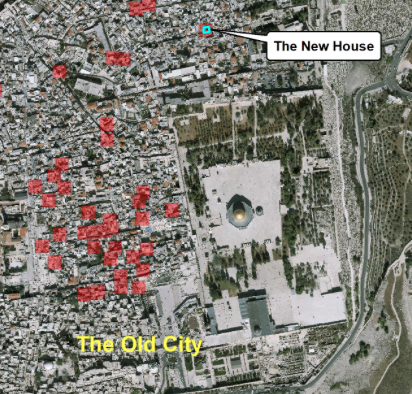
Map by Peace Now
The radical Ateret Cohanim settler organization managed to purchase a house in an incredibly sensitive and inflammatory location inside the Muslim Quarter of the Old City of Jerusalem, only 100 meters from the Dome of the Rock/al-Haram al-Sharif. Settlers moved into the house this week and have already begun renovating the property. Some reports blamed infighting between Palestinian Authority President Mahmoud Abbas and political rival Mohammed Dahlan for the sale to the settlers. The settlers gained control of the house, which was owned by a prestigious Palestinian family for decades, after the Palestinians sold it to a middleman, who then sold it for $17 million to Ateret Cohanim.
News of the sale of the home to settlers has reverberated within the Palestinian body politic, engendering intense public outrage directed at Palestinian Authority officials who are believed to have been involved in killing the sale of the house to a Palestinian American with ties to Dahlan, and at others who vouched for the credibility of a middleman who eventually sold the house to settlers.
Internal politics notwithstanding, the fact of the matter is that the sale only advances Israeli settlers’ and Temple Mount activists’ ongoing efforts to undermine and change the status quo in the Old City and on the Temple Mount. Israeli provocations on and around the Temple Mount have proven to be (and continue to be) a volatile flashpoint for the outbreak of widespread violence.
Peace Now released a statement saying:
“The settlement activity around the Temple Mount is akin to playing with fire, and instead of keeping the pyromaniacs at a distance, the government serves them matches.”
Writing in 2009 but ringing even more true today, FMEP’s Lara Friedman and Terrestrial Jerusalem’s Daniel Seidemann warned:
“The city is the major fault line of the Israeli-Palestinian conflict, and earthquakes have been triggered invariably by events in and around the volcanic core of that conflict: the Haram al-Sharif/Temple Mount. It is precisely in this area – spreading from Sheikh Jarrah to Silwan – where events today have begun to careen out of control.”
Settler’s New Silwan Property Sits on Massive Settler-Driven Excavation Site
New details have emerged regarding the Silwan house that settlers moved into last week, having previously purchased it from its Palestinian owners (covered by FMEP last week). According to new Peace Now reporting, the significance of the property goes beyond its location in the Palestinian East Jerusalem neighborhood of Silwan (a site of concentrated and aggressive settlement activity). The house’s precise location sits on top of a massive and controversial underground archaeological excavation led by the Israel Antiquities Authority under the direction of the radical Elad settler organization. Elad is dedicated to increasing a Jewish presence in East Jerusalem neighborhoods at the expense of current and historical Palestinian connections.
Elad has been trying to acquire the property since the 1990s. The house is located next to the al-Ein mosque in Wadi Hilweh, near the Siloam Pool, which has been under settler control for the last few years. According to Peace Now, by purchasing the house, Elad will have “easy access to the underground excavation and to create an exit or entrance point to the underground project.” The ultimate goal of the project is to create a walking path from the Siloam Pool to the Temple Mount, a spiritual walk highlighting Jewish history that former Jerusalem Mayor Nir Barakat envisions as a way to teach pilgrims “exactly who owns this city.”
In 2017, the excavation project severely damaged Palestinian homes in Silwan above the site. At the time, Haaretz reported that:
“two senior Israel Antiquity Authority archaeologists criticized the excavations in internal correspondence. They wrote that the work being done in the tunnels, contrary to accepted practice, was ‘bad archaeology’ and added that ‘the authority could not be proud of this excavation.’”
Emek Shaveh, a non-governmental organization specifically dedicated to fighting attempts to co-opt the archeological history of Jerusalem to serve political agendas, has a large body of reporting on excavation projects linked to Elad, the Israel Antiquities Authority in Silwan. Emek Shaveh writes:
“Temple Mount/Haram al-Sharif in particular – i.e. the Old City and the village of Silwan – there can be no doubt but that Israel is interested in expanding its presence and entrenching its authority over the area. The Israeli authorities and settler NGOs invest their best efforts in transforming Silwan into a tourist site and into the Israeli settlement of ‘The City of David’. At the same time, the Old City is undergoing unprecedented development of a nature which prioritizes Jewish belonging and the Jewish people’s historic rights to Jerusalem… The volume and pace of archaeological works and development for tourism is in striking contrast with the years of neglect of the Palestinian population. These processes in the city solidify an Israeli vision that ancient Jerusalem should remain under Israeli sovereignty forever.”
De Facto Annexation: Israel Applies Two Domestic Agricultural Laws to West Bank Settlements
After months of pressure from senior government officials, this week the head of the Israeli Defense Forces agreed to allow the government to directly apply two Israeli laws over the West Bank settlements. One law, allowing settlers to share their egg quotas with farmers in Israeli proper, was passed by the Knesset in June 2018. The second law, regulating the production and sale of organic produce, was passed in 2005.
As FMEP has extensively documented (see Table #3 in red), this is just the latest in a string of moves over the past 2+ years by which the Knesset and Israeli government has begun institutionalizing the application of Israeli domestic law over areas of Israeli settlement outside of its borders, amounting to a process of de facto annexation. .
Government Approves Funds for Settlement Propaganda Film
The Israeli Minister of Social Equality, Gila Gamliel, has allocated 1.5 million shekels ($413,000 USD) to a film project that will glorify the history of the settlement movement and the personal stories of leading settlement figures. The project will be a governmental collaboration with the Menachem Begin Heritage Center and the Yesha Council – an umbrella group representing all settlements in the West Bank; both organizations will appoint representatives to the steering committee for the project.
Minister Gamliel said:
“This is the purpose of the testimonies project – to give expression to the significant role of the veterans of settlement in Judea and Samaria in fashioning the moral and Zionist image of the State of Israel.”
The Director-General of the Yesh Council, Yigal Dilmoni, said:
“There are many young people today who are searching for inspiration for Zionist activities…If we give them this story, it will give the next generation the strength to continue to carry out [the ideals of] Zionism, to build and develop the State of Israel.”
Haaretz quotes a source close to Minister Gamliel saying:
“This is another step toward sovereignty…This isn’t a project initiated by a nonprofit or an organization, but by the state itself.”
Contrary to the claims of those backing the project, the history and personal stories of leading figures of the settlement movement have been extensively documented – most epically by Akiva Eldar in “Lords of the Land: The War Over Israel’s Settlements in the Occupied Territories 1967-2007.” Eldar’s historical accounting of early settlers unveils the reality that most early settlers were knowingly and deliberately breaking Israeli law by building without government permits and directly undermining Israeli government policies. Another superb book, Dear Brothers: the West Bank Jewish Underground, by Haggai Segal (now a prominent right-wing Israeli journalist), provides first-hand documentation and testimony regarding a critical chapter in the settlement movement: the 1980s Jewish Underground, which among other things carried out and celebrated a series of terrorist attacks against Palestinian mayors and planned to blow up the Dome of the Rock. This new film project, on the other hand, promises to be a piece of propaganda designed to sanitize and mythologize these same people and events.
Shaked: Annexation Plan Can Accommodate 100,000 Palestinian Citizens in Area C
A lengthy profile of Israeli Justice Minister Ayelet Shaked shed new light on the Jewish Home’s plan for the annexation of the West Bank’s Area C. The Atlantic columnist and chief anchorwoman for The News Company in Israeli, Yonit Levi, writes:
“Bennett and Shaked are trying to advance a plan for the annexation of Area C, the part of the West Bank (about 60 percent) that is under Israeli control. The plan would require extending citizenship to the Palestinians who live there. ‘We can definitely take in 100,000 Palestinian citizens,’ Shaked says. ‘These processes take time to ripen. At the moment, the annexation plan looks like science fiction, but I think that slowly, gradually, people will see what’s going on in the Middle East and realize that it really could happen.’ Shaked, too, sees clearly that the annexation plan could put Israel on a confrontational path, even with the current supportive American administration—and even more so if the administration changes. ‘Sadly, it’s impossible to ignore the processes taking place in the Democratic Party. You know, the party itself is becoming less and less what’s considered Zionist,’ she says. When I ask her whether this is the result of processes occurring in Israel, she responds: ‘We’re also seeing a strengthening of the Palestinian narrative among liberal circles, not only in the United States, and we must deal with this, too. Clearly, the Democrats will return to power at some point—things always change there—and it’s obvious that we have to maintain good relations with them and explain what’s going on in Israel.’”
Murder Prompts Critical Coverage of Settlement Industrial Zones
In response to the heinous murder of Israeli employees by a Palestinian worker at the Barkan Industrial Zone (a settlement industrial zone located deep inside the West Bank, near the Ariel settlement), U.S. Ambassador to Israel described Barkan as a “model of Israeli-Palestinian coexistence since 1982, with thousands working and prospering together.” The reality of West Bank industrial zones, and the role they play in the lives of Palestinians, is, in fact, more complicated. For decades Israel has used industrial zones as another tool to expand and deepen control over West Bank land, and jobs in industrial zones – often the only jobs available for Palestinians living under an Israeli occupation that prevents the development of any normal Palestinian economy – are widely viewed by Palestinians as a double-edged sword.
These realities were touched on in some of the coverage of the murder. The New York Times wrote:
“The West Bank settlements, constructed in territory that Israel captured from Jordan in the 1967 war, and which the Palestinians envision as part of their state, are considered a violation of international law by most of the world. But many Israelis, particularly the settler leadership, hold up the Barkan industrial park, where the attack took place on Sunday, as a model of cooperation and an important source of employment for thousands of Palestinians…”
The Washington Post offers noted:
“Thousands of Israelis and Palestinians work side by side at the [Barkan] industrial zone, which includes 160 factories. The Palestinian economy is heavily restricted under Israeli military rule, forcing tens of thousands of Palestinians to seek work in Israel as well as Jewish settlements.”
Bonus Reads
- “‘Traitor? Who Me?’ Talia Sasson Sums Up Her Term as New Israel Fund President” (Haaretz)
- “Trump’s Pation-In-Chief” (ProPublica)