Welcome to FMEP’s Weekly Settlement Report, covering everything you need to know about Israeli settlement activity this week.
To subscribe to this report, please click here.
November 11, 2022
- Israel Gives Settler Group $7.8 Million for East Jerusalem Projects
- Israel Supreme Court Holds Hearing on Silwan Displacement Case
- Israeli Lawmakers Join Settlers on Provocative Visit to Joseph’s Tomb; 1 Palestinian Killed
- Peace Now Video Shows Impact and Tragedy of the Planned E-2 /Givat Eitam Settlement
- A New Israeli Government: Implications for Settlements & Annexation
- Bonus Reads
Israel Gives Settler Group $7.8 Million for East Jerusalem Projects
A Haaretz investigation has revealed that various arms of the Israeli government have transferred a combined total of $7.8 million to the Elad settler organization to develop and manage new tourist projects in the Ben Hinnom Valley in East Jerusalem. This figure is double the State’s original budget for Elad – a settler organization which Israel also pays to manage the City of David National Park.
The additional funding came from three sources: the Jerusalem Affairs & Heritage Ministry, the Israel Lands Authority, and the Jerusalem Municipality. All funds were used to fuel the expansion of integrated tourism projects which underpin Elad’s control over land in the Ben Hinnom Valley, located near Silwan. This is an area where most of the land is privately owned by Palestinians and rich with olive groves. Over the past few years Israel has begun seizing land – plot by plot – mainly via the issuance of ”landscaping” (or “gardening”) orders which allow the government to take control of and develop any land that it deems “neglected.” The land, once seized, is then handed over to Elad..
The Israeli NGO Emek Shaveh responded:
“The settlement project of Elad, one of the richest nonprofits in Israel, is being funded by the citizens of the State of Israel and the residents of the poorest city in Israel – out of their own pockets! But the real price and the irreversible damage will be paid by the heritage sites of Jerusalem. At the end of the day, the ancient landscapes of the Hinnom Valley will become a playground, with a suspension bridge, a cable car and a biblical farm for ancient agriculture with sprinklers, an artificial waterfall and an electric outdoor oven – all in order to push the Palestinians out of the valley.”
In addition to its increasing control of the Ben Hinnom Valley, Elad and the Israel Nature and Parks Authority have had a contract, since 2020, to transfer the management and development of the City of David National Park to Elad. Elad carries out this contract with brutal implications for Palestinians who live inside the borders of this national park – borders Israel imposed on Palestinians residents, many of whom had been living in the areas for generations, with what appears to be total disdain/disinterest in their rights or welfare. Elad’s management of the park also weaponizes archaeology in the service of its explicit agenda: increasing Israeli control and imposing an exclusively Jewish religious and historical narrative over the entire city of Jerusalem. Elad is also a main actor behind the widespread house-by-house dispossession of Palestinians living in Silwan. In addition, Elad is pioneering a never growing slate of touristic settlement projects which increase Israeli control over the area and help reinforce a settler narrative of the city of Jerusalem which emphasizes its Jewish history while erasing past, present, and future Palestinian heritage.
Israel Supreme Court Holds Hearing on Silwan Displacement Case
Ir Amim reports that on November 9th, the Israeli Supreme Court held a hearing on an appeal against the pending eviction of the Shahadeh family from their longtime home in the Batan al-Hawa section of Silwan. A decision is expected to be issued by the Court within a few weeks.
The Shahadeh family is one of 85 families in Batan al-Hawa facing displacement at the behest of the Ateret Cohanim settler organization. The legal fate of all of the families is bound together, with the Duweik family’s case being the furthest advanced and setting an dangerous precedent for the Shehadehs and others. Indeed, this week the Supreme Court discussed several of the decisions made in regards to the Duweik family, and their relation to the Shehadehs’ case. Notably, in July 2022 a 3-judge panel of the Supreme Court could not agree on the Duwiek’s family’s petition, which resulted in the petition being sent back to the Jerusalem Magistrate’s Court – where it currently awaits further consideration. One of the judges accepted the argument that the family should be allowed to continue living in their homes because a statute of limitations prohibits Ateret Cohanim – through its management of an historic land trust – from making a claim to the land after such a long period of absence.
As a reminder, Ateret Cohanim has waged a years-long eviction campaign against Palestinians living in Silwan, on property the settler NGO claims to own. In total, Ateret Cohanim’s campaign stands to ultimately dispossess 700 Palestinians (85 families) in Silwan. The group’s claim is based on having gained control of the historic Benvenisti Trust, which oversaw the assets of Yemenite Jews who lived in Silwan in the 19th century. In 2001 the Israeli Charitable Trust Registrar granted Ateret Cohanim permission to revive the trust and become its trustees, (following 63 years of dormancy). In 2002, the Israeli Custodian General transferred ownership of the land in Batan al-Hawa to the Trust (i.e., to Ateret Cohanim). Since then, Ateret Cohanim has accelerated its multi-pronged campaign to remove Palestinians from their homes, claiming that the Palestinians are illegal squatters.
Israeli Lawmakers Join Settlers on Provocative Visit to Joseph’s Tomb; 1 Palestinian Killed
On November 9th, a Palestinian teenager was killed in Nablus during clashes between Palestinians and the IDF. These clashes resulted from a deliberately provocative visit carried out by settlers and Israeli lawmakers – under IDF protection – to the site of Joseph’s Tomb, which is located inside of Nablus. The settlers and eight current and incoming members of the Knesset visited the site despite a public threat to attack the delegation which was issued the day before by a Palestinian armed faction.
On a monthly basis (and sometimes more often) the IDF arranges for settlers to visit Joseph’s Tomb. The tomb is located within Area A of the West Bank (where Israel does not, under the Oslo Accords, have direct control). However, Joseph’s Tomb is one of two sites in Area A which the Oslo Accords stipulate are under the control of the Israel military. As such, it has been a perennial flashpoint, largely due to deliberately provocative actions by settlers. The whole circumstance – of settlers visiting Joseph’s Tomb – was recently called “absurd” by former IDF Major General Gadi Shamni.
While some Jewish Israelis may want to visit the site of Joseph’s Tomb for non-politically-motivated religious purposes, this latest story should be viewed in the larger context of settlers weaponizing claims to sites like Joseph’s Tomb, and archaeology in general, to expand Israel control over (i.e., de facto annexation of) parts of the West Bank that per the Oslo Accords are under Palestinian Authority control.
Peace Now Video Shows Impact and Tragedy of the Planned E-2 /Givat Eitam Settlement
In advance of a High Court hearing scheduled for Nov. 14th, Peace Now has released a 10 minute video explaining the unfolding tragedy of E-2/Givat Eitam. Peace Now is leading the petition alongside the Palestinian landowners.
The Supreme Court – courtesy of a petition filed by Palestinian landowners with the assistance of Peace Now – is due to continue its consideration of the Palestinians’ challenge to the allocation of “state land” to the Israeli Ministry of Housing for the construction of a new settlement called Givat Eitam on a strategic hilltop – which Palestinians call a-Nahle – located just south of Bethlehem.
As a reminder, the High Court held a hearing in June 2021 on this same petition. Peace Now’s Hagit Ofran told FMEP that at the conclusion of that hearing the Court had given the government of Israel 90 days to respond to a proposal to either allocate to the individual petitioners some of the “state land” directly involved in the case, or to allocate to them “state land” nearby. This decision by the Court purposely narrowed the scope of Peace Now’s legal challenge by addressing only the case of the land in a-Nahle and the individual petitioners involved, thereby dodging the more fundamental question put forth in the petition challenging Israel’s discriminatory practice of allocating 99.8% of “state land” for settlement purposes. This is the first time the issue of state land allocations to settlements is being challenged in an Israel court.
A New Israeli Government: Implications for Settlements & Annexation
Likud Party leader and Israel’s longest-serving (over multiple tenures in office) Prime Minister Benjamin Netanyahu is once again poised to lead the Israeli government, this time relying on a governing coalition that includes extremist/racist/Islamophobic/homophobic Jewish supremacist figures like Itamar Ben Gvir (a longtime supporter/devotee of Rabbi Meir Kahane) and Bezalel Smotrich. Settlers are giddy, with notable settler leaders Daniela Weiss describing the election results as a “revolution,” and saying there will certainly be an acceleration in settlement growth.
Here are key demands being made of Netanyahu that will likely define the new government and influence its policies on settlements and annexation:
- Itamar Ben Gvir – who has called for the expulsion of Palestinian citizens of Israel, who was disqualified from IDF service for his extreme views, and who is closely allied with the settlers in Sheikh Jarrah – is demanding to be named the Minister of Public Security. This would put him in charge of the Israeli police and their power over Palestinians living in Israel and East Jerusalem. The Ministry would also hand Ben Gvir a large role over security at the Temple Mount, which Ben Gvir has advocated for Israel to take unilateral control over – a dangerous proposition. Ben Gvir has also publicly proclaimed that, should he be appointed, he will change the rules of engagement so that Israeli soldiers have broader leeway to shoot at Palestinians (for reasons as minimal as suspected stone-throwing), and he will push for broad immunity for Israeli security officials (which combined appear to be a directive to kill Palestinians under the promise of immunity).
- Bezalel Smotrich – who continues to demand either the Defense, Finance, or Justice Ministries – is making two key legislative demands:
- Passage of the Override Clause, which would allow a simple majority in the Knesset to vote to reinstate any law that the Supreme Court rules is unconstitutional. This is particularly relevant for the Settlement Regulation Law, which the Court struck down by the Court in 2020. The Knesset had passed the Settlement Regulation Law in order to create a legal basis to allow Israel to retroactively legalize outposts and settlement structures which had been built on land that Israel acknowledges is privately owned by Palestinians. Smotrich and many of the coalition members have been longtime supporters of the Override Clause in order to reinstate this law in particular.
- Annexation of settlements. Smotrich is demanding that settlements come under domestic Israeli law, which would implement the annexation of the settlements to Israel. This is also a widely-popular initiative, with Yariv Levin – Netanyahu’s Likud partymate – recently saying that annexation is high on the government’s agenda.
Bonus Reads
- “West Bank Settler Accused of Terrorism After Attacking Palestinian in East Jerusalem” (Haaretz)
- “Israel Resumes Construction of Jewish Town Planned Over Ruins of Yet-to-be-demolished Bedouin Village” (Haaretz)
Welcome to FMEP’s Weekly Settlement Report, covering everything you need to know about Israeli settlement activity this week.
To subscribe to this report, please click here.
October 13, 2022
- Settlers Continue Attacks on Palestinians Around Nablus, also Target Israeli Soldiers
- Ben Gvir Joins, Escalates Settler Attacks in Sheikh Jarrah
- Settlers Attack Palestinian Olive Harvest, Seize Control of Silwan Grove
- Hebron-Area Town Emptied for Israeli Military, Settler Event
- Bonus Reads
Settlers Continue Attacks on Palestinians Around Nablus, also Target Israeli Soldiers
It has been another week of settlers and their allies rampaging across the northern West Bank while Palestinians in Nablus continue to be held hostage by the Israeli army, which continues to severely restrict traffic into and out of the city.
On October 19th, settlers once again attacked Palestinians in Huwara, but this time also turned their violent anger against IDF soldiers attempting to intervene. Two soldiers were injured by the settlers attack, resulting in condemnation from Israeli politicians (even Kahanist MK Ben Gvir), and the IDF arrested an IDF soldier who allegedly joined the settler attack. The Israeli army later released a statement that seemingly condemned the settler attacks on soldiers without actually condemning them (this is the distinction between someone saying “I condemn racism” and “everyone has an obligation to condemn racism” – the first is an actual condemnation; the second, not so much). Notably, that statement also avoids the harsh language routinely used by the IDF with respect to Palestinian stone-throwers, and also, notably, the statement doesn’t even mention settler attacks on Palestinians as something the army condemns or thinks even should be condemned:
“Harm against IDF soldiers by settlers, who are protected by them, is wrongful behavior which we have an obligation to denounce and to work against vociferously.”
IDF chief Aviv Kohavi echoed the same sentiments the following morning:
“This is a very serious incident, embodying shameful and disgraceful criminal behavior, which requires swift and strict justice. I support the important activity of IDF soldiers, who work around the clock to protect the residents of Israel. It is unacceptable that IDF soldiers who defend diligently and devotedly will be violently attacked by settlers.
Ben Gvir Joins, Escalates Settler Attacks in Sheikh Jarrah
On October 13th settlers led a rampage through the Sheikh Jarrah neighborhood in East Jerusalem, during which settlers and their supporters threw stones at Palestinian houses and destroyed Palestinian property in a show of power and impunity. The settlers were joined by Kahanist MK Itamar Ben-Gvir, who pulled out a handgun while urging Israeli police to shoot any Palestinian seen throwing stones (caught on video).
The resulting clashes left more than two dozen Palestinians injured – including one seriously injured man who was struck on the head by a young settler wielding a metal bar. Two settlers were also injured.
Settlers Attack Palestinian Olive Harvest, Seize Control of Silwan Grove
The olive harvest season started this month, marking an annual period of intensive settler attacks against Palestinians olive trees and harvesters. Attacks this week took place across the West Bank, including in Nablus, Tulkarem, and in Bethlehem where settlers severely beat Israelis assisting in the harvest.
In Silwan, settlers and soldiers have colluded to seize control of a historic olive grove. The grove and surrounding area was registered as “absentee property” by the Israeli government in 2021, despite the fact that Palestinian farmers have long worked the land and have documents showing their ownership of the plots dating back decades. Once the land was seized by the government, Israeli authorities turned it over to the Israeli Nature and Parks Authority (NPA) to manage.
In July 2022, +972 Magazine revealed that the NPA signed a contract with the Elad settler group to manage the olive grove — a contract which was connected to the wishes of an American donor who promised to donate the grove to Elad. At the time, a staff member of Elad reportedly promised the Palestinian farmers who had tended to the olive grove for decades that they would be permitted to continue harvesting the trees.
Lo and behold, a few months later Palestinian farmers are now being denied access to their trees. Adding insult to injury, soldiers and settlers were seen picking olives from the trees days before the Palestinians were turned away. +972 Magazine reports:
“The establishment of the “agricultural farm” was intended to “restore biblical agriculture with a modern approach,” the Elad farm manager told Local Call during a visit to the area about two months ago. The manager said that although the farm area is fenced off, the Palestinian landowners are still allowed to enter to take care of the trees and harvest them when the season comes. He also said that the organization does not bring visitors to the olive plots nor allow them to harvest there, and that they only carry out development work in these plots. A few weeks later, when the manager was asked by activists what changes had occurred that allowed the soldiers to enter and harvest the trees earlier this month, he replied that he had received new directives from the Nature and Parks Authority permitting them to pick the olives there. According to him, he did not have this permission a month and a half ago.”
Uri Ehrlich, the media coordinator of Emek Shaveh – an NGO that combats the exploitation of archeological and heritage sites as political tools for dispossession – told +972 Magazine:
“For hundreds of years, the Palestinian residents of Wadi Rababa/ Ben Hinnom planted and tended to the olive trees. The attempt by the police to prevent the harvest is part of an effort to negate the Palestinian history of the valley — which itself is a part of the Judaization of East Jerusalem led by the state, the Nature and Parks Authority, and Elad. It is destined to fail. The olive trees and the traditional agriculture of the Palestinians will continue to exist.”
Hebron-Area Town Emptied for Israeli Military, Settler Event
Haaretz reports that the IDF and settlers held a celebratory conference in the heart of the Palestinian town of Khirbat al-Karmil in the South Hebron Hills, and ordered Palestinians to vacate the area – which includes a water reservoir that services the town.
The town, located in Area A where the Oslo Accords afforded Israel civil and security control, is the site of an ancient pool that settlers have frequently invaded an with army escort during Jewish holidays, in a blatant attempt to takeover the area. The military’s event this week undoubtedly encourages and aids the settlers in their efforts.
Bonus Reads
- “Jaffa may become the next Sheikh Jarrah as Palestinians are pushed out” (Mondoweiss)
- “Israeli Settler Violence Surges as Palestinians Turn to Armed Resistance” (Jewish Currents)
- “How my family came face to face with settler violence on the road to Nablus” (+972 Magazine)
- “Brutal settler attacks on Huwwara find allies in Israeli soldiers” (Middle East Eye)
- “’24 hours of hell’: Israeli settler gangs terrorize Palestinian town under army protection” (Mondoweiss)
Welcome to FMEP’s Weekly Settlement Report, covering everything you need to know about Israeli settlement activity this week.
To subscribe to this report, please click here.
October 13, 2022
- Nablus Region Broiling as Settlers Rampage
- Senior Israel Officials Preside Over Cornerstone-Laying Ceremony for New Settler Tourist Project in East Jerusalem
- Israel Antiquities Chief Releases Map of New Israeli National Park Near Jericho (in Area C)
- Amidst Violent Surge, Settlers Demand Establishment of Evyatar Settlement & Yeshiva
- Bonus Reads
Nablus Region Broiling as Settlers Rampage
As violence continues to escalate across the West Bank and in East Jerusalem, this week settlers have continued, seemingly uninhibited, to instigate clashes with and terrorize Palestinians in the West Bank. Some key examples include the following (for an even more thorough listing, see the Palestine Center for Human Rights’ weekly report):
- On October 11th, Israeli settlers staged a massive march – explicitly designed to provoke Palestinians and demonstrate Israeli dominance/impunity – near the Palestinian town of Sebastia, just north of Nablus. An Israeli soldier providing security to the settlers was shot and killed by a drive-by shooter as the march got underway. Following that shooting, the Palestinian militia group calling itself “Lion’s Den” claimed credit for the drive-by shooting, leading the Israeli army to completely shut down the city of Nablus – where the Lion’s Den is based – in response.
- Late in the evening on October 12th — while the Israeli army was keeping all the entrances and exits to Nablus closed in response to the October 11th shooting of an IDF soldier guarding a settler march — the IDF again provided security for settlers, this time enabling them to enter the city of Nablus (the IDF even transported settlers in military vehicles), ostensibly to visit Joseph’s Tomb and conduct religious prayer there (ostensibly because the timing/nature of the visit appeared to be largely if not entirely about provoking Palestinians). In the course of the operation, IDF soldiers exchanged gunfire with Palestinians; no injuries were reported on either side.
- The following morning, October 13th, settlers marauded through and terrorized the Palestinian town of Huwara, located just south of the Nablus. Video footage documents IDF soldiers actively protecting (and therefore enabling) settlers who were brazenly committing crimes and assaulting Palestinians. The Palestinian Red Crescent reports 53 people were injured.
It’s worth recalling that settlers have staged several protests and marches over the past few weeks, ostensibly to pressure the Israeli government to intensify its ongoing military operation in the West Bank – which Israel has dubbed “Break the Wave” – a reference to recent attacks against Israeli civilians (and IDF soldiers, bearing in mind that when IDF personnel are injured/killed in any context by Palestinains, Israel in effect counts those IDF personnel as civilian victims of terrorism). This operation involves Israel staging near daily raids into Palestinian cities in the West Bank — tactics that have led to numerous Palestinian deaths/injuries/detentions.
Notably, the settler march held on October 11th attracted nearly 10,000 people – including lawmakers Bezalel Smotrich and well-known Kahanist (who is likely to be a powerful plate in the next Israeli government) Itamar Ben-Gvir. The settlers paraded from the Shavei Shomron settlement to the nearby Palestinian town of Sebastia, where settlers have been engaged in an effort to take control over antiquity sites under Palestinian control in the city. At the conclusion of the march, settlers staged a festival in Sebastia with live music acts, speeches, and more.
Samaria Regional Council head Yossi Dagan stated:
“We came here today to wave the Israeli flag, to state that we won’t surrender to those who wish to kick us out of our land. We will continue to settle, march, and hike through our entire country. To answer terror we build the land of Israel. We are excited to see the thousands that are marching with us.”
Senior Israel Officials Preside Over Cornerstone-Laying Ceremony for New Settler Tourist Project in East Jerusalem
 Emek Shaveh reports that a ceremony was held on October 6th to lay the cornerstone of a new pedestrian footbridge over the Ben Hinnom Valley/Wadi Rababa in Jerusalem. The bridge is a project pushed by settler groups and will serve to connect two settler-operated tourist facilities located in two Palestinian neighborhoods on opposite sides of the valley – one in Abu Tor and the other in Silwan. The ceremony was held at one of those settler-run tourist facilities – known as the “House in the Valley”, operated by the Elad Foundation – and was presided over by Israeli Minister of Jerusalem Affairs Ze’ev Elkin, Israeli Transportation Minister Yoel Razvozov, Jerusalem Mayor Moshe Leon, and Israeli Antiquities Authority director general Eli Eskosido.
Emek Shaeh comments:
“The bridge is another project in a list of new projects which are transforming the valley, such as the cable car, and the Elad Foundation’s Farm in the Valley (also called Center for Ancient Agriculture). All of these are part of the larger strategy to establish a continuum of biblically themed tourism ventures and Jewish residential settlements in the Silwan-Hinnom Valley area using a variety of legal and administrative mechanisms to displace Palestinians from their homes, shrink their public spaces and downplay their heritage.”
At the cornerstone laying ceremony on October 6th, Minister Elkin confirmed the intent behind the bridge, saying:
“the suspension bridge is an important strategic project led by the Ministry for Jerusalem Affairs and other partners. We are working to turn the Hinnom Valley into a developed tourism zone and in so doing achieve two additional goals: one is to strengthen the sense of security and sovereignty in the area, the other is to ease access to the Old City.”
On the Abu Tor side of the bridge, the Elad settler organization runs and operates a cultural center and cafe named “House in the Valley,” which opened in 2019 after Elad evicted a Palestinian family and renovated the space. A week after Elad’s new cultural center was opened, the Jerusalem Municipality issued “gardening orders” to take control, for an initial period lasting 5 years (with the likelihood of extensions after that) of 12 nearby plots of privately-owned Palestinian land. “Gardening orders” allow Israel to “temporarily” take over privately owned land for what are ostensibly public purposes (like establishing a parking lot or public garden), based on the argument that the private owners are not presently using the land. In this case, Israel has in effect made rules that guarantee that the latter condition applies: as Emek Shaveh has noted, the 12 plots in question are located in an area declared by Israel to be a national park, meaning that private landowners are legally barred from using their own land.
On the Silwan side – a neighborhood where Elad (alongside other settler organizations, including Ateret Cohanim) is waging a house-by-house campaign to displace Palestinians in favor of settlers and settler-run tourist sites – the bridge will end near the Sambuski cemetery, which until recent years was a relatively unknown, neglected site that even Israel did not recognize as a holy site. Under the Trump “Peace to Prosperity” plan, the Sambuski cemetery was suddenly transformed into a place of prime historical and religious importance to Israel. The Emek Shaveh – which has a special expertise on archaeology and the weaponization of archaeology to serve the political agenda of the settlers and the state – wrote a report on exactly how the Trump “Vision” supports settler efforts to use Jerusalem’s history and antiquities to promote Israeli-Jewish hegemony and control over the city.
Israel Antiquities Chief Releases Map of New Israeli National Park Near Jericho (in Area C)
Emek Shaveh reports that Eli Eskosido, the Director General of the Israeli Antiquities Authority, has been sharing a map showing a new “Hasmonean Palaces National Park” on land located southwest of the Palestinian city of Jericho. Notably, the land in question is located in Area C of the West Bank – where the domestic Antiquities Authority does not, legally (under Israeli law and the Oslo Accords) have any jurisdiction.
The Hasmonean Palaces archaeological site was identified in the Oslo Accords as a place of “archaeological and historic importance to the Israeli side”, granting the Israelis control over this enclave of land within a Palestinian population center. However, the area has not been developed by the Israeli government. Emek Shaveh reports that while a National Park has been planned for the area, it does not currently exist.
Bizarrely, the map promoted by Eskosido is emblazoned with the logos of domestic Israeli government bureaus, which – again – do not have any jurisdiction in the West Bank. A settler group focused on weaponizing archaeology to advance Israeli annexation in the West Bank, “Guardians of Eternity,” alleges that the site has been subject to damage by Palestinians over the years. Emek Shaveh reports that the Binyamin Regional Council – the municipal association in charge of settlements in the area – is reportedly interested in taking over direct management of the site.
Emek Shaveh notes:
“The publication of the map by Mr. Eskosido is another manifestation of steps towards de facto annexation in the realm of antiquities which we wrote about earlier this year following the Knesset’s committee’s recommendation of expanding the Israel Antiquities Authority remit into Area C.
The investment in this site is an outcome of a persistent campaign by Guardians of Eternity (Regavim) and the Shiloh Forum which exploits historical, religious and cultural affinities of the Jewish people to sites in the West Bank with the aim of galvanizing the Israeli government to expand and deepen its control. This latest involvement by the IAA in the Hasmonean Palaces should be considered within this context. Although damage by Palestinians to the site is a problem, for the most part this takes the form of light construction. It is certainly not an expression of a Palestinian Authority led plan to destroy Jewish heritage in the West Bank as the settlers repeatedly claim.”
Amidst Violent Surge, Settlers Demand Establishment of Evyatar Settlement & Yeshiva
Over the Sukkot holiday, settlers in the northern West Bank staged a renewed push for the government, specifically Defense Minister Benny Gantz, to act in order to formally establish the Evyatar settlement and yeshiva, located on Palestinian lands just south of Nablus. In February 2022, the outgoing Israeli Attorney General issued an opinion that provides a basis for granting retroactive legalization to the Evyatar outpost (which would mean authorizing Evyatar as a fully-approved new settlement, “legal” under Israeli law). Since February 2022, Defense Minister Gantz has had the authority to declare the area as “state land” as the first (and most significant) step towards authorizing Evyatar. For reasons that remain unclear, Gantz has not (yet) made a move to do so.
The saga of the Evyatar outpost became a recurring headline news story over the past two years, mostly as a result of the determined effort by Palestinians from the nearby village of Beitar to protest the Evyatar outpost and to resist the Israeli government’s efforts to retroactively legalize it. Palestinians staged regular protests near the site of Evyatar outpost, which was built illegally by settlers on a hilltop that Palestinians have long known as Mt. Sabih, land which has historically belonged to the nearby Palestinian villages of Beita, Yatma, and Qablan. No fewer than seven Palestinian protestors died as a result of the harsh and violent attempt by the IDF to quash the protests.
Bonus Reads
- “Drones terrorized Gaza for years. Now they’ll do the same in the West Bank” (+972 Magazine) → “the army is calling for the use of drones to surveil refugee camps and strike militants, for installing remote-controlled gun turrets to secure high-volume checkpoints, and for employing biometric cameras to track civilians across the West Bank.”
- “The GOP’s Plan to Build the Third Temple” (Jewish Currents)
Welcome to FMEP’s Weekly Settlement Report, covering everything you need to know about Israeli settlement activity this week.
To subscribe to this report, please click here.
August 25 2022
- Ir Amim Gets Set to Sue Settlers & State Over Plan for Settler-Run Cultural Center in Silwan
- This Week in Area C: Evangelical Group Launches Land-Grab as Demolition Rates for Palestinian Construction Spike
- IDF Prepares to Fortify Settlers’ Access to Joseph’s Tomb in Nablus
- Bonus Reads
Ir Amim Gets Set to Sue Settlers & State Over Plan for Settler-Run Cultural Center in Silwan
Ir Amim announced that, after exhausting every avenue for administrative remedy, it will likely proceed with a civil lawsuit in light of the State’s move last month to proceed with the construction of a “Yemenite Jewish Culture Center” in the Batan al-Hawa section of Silwan, despite two pending legal petitions against the project.
 Last month (July 2022), the Israeli government announced that the Jerusalem District Court had accepted a plan that would allow the project to move forward. That plan would see the building at the center of the dispute to be leased to a new company, which would establish and manage the cultural center. Hatched in secret by senior government officials and a body known as the Benvenisti Trust (which is at the center of the two pending legal petitions), the plan creates the appearance that the Benvenisti Trust is no longer directly involved in the project — but Ir Amim reports that there is reason to believe that this new company is an affiliate or subsidiary of Ateret Cohanim, the settler body that controls the Benvenisti Trust.
As a reminder, the two legal petitions filed by Ir Amim and residents of Batan al-Hawa against the project are:
- A June 2020 petition directly challenging the legitimacy of Ateret Cohanim’s (a settler group) resuscitation and takeover of the Benvenisti Trust – the Jewish endowment fund which allegedly held title to land in Batan al-Hawa in the late 19th century.
- A December 2020 petition challenging the issuance of a tender for the new culture center, pending the resolution of the first petition regarding the relationship between the Benvenisti Trust and Ateret Cohanim.
Ir Amim explains that, in response to the State’s new plan, it has requested an update on its petitions. Describing a letter it recently sent to the the Ministry of Justice (which was supposed to have launched an investigation into the allegations) Ir Amim provided the following update:
“Ir Amim called again for suspension of the project, stating numerous arguments, including the fact that announcement of such an initiative by Ministers Elkin and Sa’ar (the new State Camp Party) during a transitional government constitutes “campaign advertising” and therefore violates election campaign regulations. Moreover, the letter emphasized that leasing the property to “some other organization” for the establishment of a tourist site still violates the trust’s charter and designated purpose of the property, which is for residential use only. In light of the conduct of the trustees’ (i.e. Ateret Cohanim) and state authorities’ to date, there is reason to believe that this purported organization is a subsidiary or affiliate of Ateret Cohanim.
As the letter states, “if this is indeed the case, this is yet further decisive proof that the Benvenisti Trust is clearly being harnessed for the purposes of Ateret Cohanim and its affiliated bodies. This is another layer of a serious conflict of interest in the trustees’ activity to the point of attempting to alter its official goals, which the Registrar of Trusts considered not in accordance with the law and the opinion of the original grantor. It likewise evades the obligation to comply with the grantor’s instructions concerning the trust’s assets through creating a measure to try and underhandedly circumvent these barriers.” As such, Ir Amim demands the complete suspension of the project and an immediate freeze on the state’s allocation of public funds.”
This Week in Area C: Evangelical Group Launches Land-Grab as Demolition Rates for Palestinian Construction Spike
In its monthly report, OCHA reports that the month of June saw a 48% spike in the number of Palestinian-owned structures demolished or seized by Israel. Recall that this spike comes against the backdrop of settlers’ ongoing campaign to push the Israeli government to more expansively and expeditiously destroy Palestinian buildings in Area C. Four of the structures demolished by Israel in June were demolished within 96 hours of their discovery, under an expedited process Israel formulated and implemented, by fiat, via a military order (Military Order 1797).
Meanwhile, Haaretz reports that an American Evangelical Christian group calling itself “Hayovel” has undertaken a tree-planting campaign on privately-owned Palestinian land in Area C. The group, a U.S. 501(c)(3) nonprofit organization whose mission is to support “Israel’s right to exist in their biblical heart”, is charging donors $25 per tree, and has begun planting trees near the Har Bracha settlement in the central West Bank, south of Nablus. According to Dror Etkes – founder of the settlement watchdog group Kerem Navot – over 90% of the land in the area where the trees are being planted is owned by Palestinians from the nearby town of Burin. The land was once richly cultivated by its Palestinian owners, but has been left fallow for years because the Israeli military and settlers have prevented Palestinians from accessing the area. The American group’s stated objective is to plant 3,000 new trees in the West Bank by the end of 2022, and then 20,000 trees every year following.
When asked about the land on which the trees are planted, Hayovel asserted that it was given permission by several Israeli authorities, telling Haaretz:
“We do not own any of the land where we plant trees. We work closely with individual farmers, local Jewish communities, and local municipality governments. Most of the Greening Israel Project forestry sites are located on land owned and controlled by the State of Israel.”
IDF Prepares to Fortify Settlers’ Access to Joseph’s Tomb in Nablus
Arutz Sheva reports that the IDF is preparing to increase its protection for settlers who regularly visit Joseph’s Tomb, located inside the Palestinian city of Nablus, near the Balata refugee camp. Settlers regularly visit the religious site, escorted by the IDF, which regularly results in clashes with Palestinians.
As a reminder, Nablus is located in Area A of the West Bank, where the Oslo Accords afford Israel no jurisdiction. However, the Oslo Accords designated Joseph’s Tomb as one of two holy sites in Area A over which Israel retained control.
A former IDF Major General (Res.) Gadi Shamni, stressed the absurdity of the situation, telling a radio station:
“The entire story of Joseph’s Tomb is one big mistake. This is a huge operation of bringing people, transportation and other events around the prayers…There are parties who earn a lot of money there and there are many political interests. We have to stop endangering soldiers. Every entry into the site causes friction and it’s only a matter of time until a disaster happens there.”
Bonus Reads
- “Jewish extremists accused of slashing tires, graffitiing in Palestinian town” (The Times of Israel)
- [Video] “Palestinians in Masafer Yatta fear displacement” (Middle East Eye)
- “Demolishing our community center won’t destroy our resistance” (+972 Magazine)
- “Editorial | Denying the Green Line” (Haaretz)
Welcome to FMEP’s Weekly Settlement Report, covering everything you need to know about Israeli settlement activity this week.
To subscribe to this report, please click here.
August 4, 2022
- Encircling Jerusalem: Israel Advances Settlement Plans Across the City, While Settler Projects Tighten the Noose
- Dumping Any Pretense of Respect for Rule of Law, Israeli High Court Reverses Course, Allows Mitzpe Kramim Outpost to be “Legalized”
- Settlers Acquire Another Home in Downtown Hebron
- Elad Closes Palestinian Access Road Near Sambuski Cemetary in Silwan
- This Week in Area C, Part 1: JNF Approves Purchase of Palestinian Land In Jordan Valley While High Court Weighs Petition
- This Week in Area C, Part 2: Regavim Files Petition Pushing for Immediate Demolition of Palestinian Construction in Area C
- This Week in Area C, Part 3: Settlers Continue to Occupy Six Sites After Recent Attempt to Establish New Outposts En Masse
- Groups Petition to Cancel New Israeli-Led Archeological Dig in the West Bank Citing Legal Questions
- Bonus Reads
Encircling Jerusalem: Israel Advances Settlement Plans Across the City, While Settler Projects Tighten the Noose
It must be stressed that events over the past several months (while the Settlement Report has taken an abbreviated form) have rapidly accelerated the encirclement of Jerusalem by settlements and settler-backed projects — developments which come at the direct expense of Palestinians — their presence in Jerusalem, their rights as land owners, and their quality of life. This encirclement continues to progress, unabated and almost entirely unchallenged, each day. 
Last week, on July 25th, the Jerusalem District Planning Committee advanced plans for two brand new settlements in East Jerusalem – “Givat HaShaked” and the “Lower Aqueduct” plan. These two settlements that would nearly complete the encirclement of Jerusalem to the south. Details of those plans are:
- The Lower Aqueduct plan (1,465 new units) was approved for deposit for public comment. This plan would see a new settlement – called the Lower Aqueduct Plan – built on a small sliver of land between the controversial settlements of Givat Hamatos and Har Homa – and is intended to connect them. In so doing, it will establish an uninterrupted continuum of Israeli settlements on the southern rim of Jerusalem, and destroy the contiguity of Palestinian land in the West Bank and East Jerusalem.
- The Givat HaShaked settlement was also discussed, and the Committee opted to increase the total number of units that the plan outlines for construction, from ~400 to 700 housing units, plus schools and synagogues. Ir Amim and Terrestrial Jerusalem both report that, after a few technical requirements are met, the plan to build Givat HaShaked is expected to receive final approval when the Committee reconvenes in the coming weeks. The plan for Givat HaShaked is unprecedented, according to Terrestrial Jerusalem, in that it is the first settlement of this size that that Israeli government will establish inside of a Palestinian neighborhood – Beit Safafa, which will be completely encircled by Israeli construction if Givat HaShaked is built.
For more background on the Lower Aqueduct plan, see resources by: Terrestrial Jerusalem and Ir Amim.
These plans are significant developments in the effort to establish settler hegemony over East Jerusalem, but are only part of the story of how the encirclement of East Jerusalem has rapidly advanced over the past months. In addition to the construction of new settlements and growth of existing ones, settlers are succeeding in advancing new projects under the guise of tourism (like: the Cable Car, a new visitors center in Batan Al Hawa, and more) and the State is undertaking systematic efforts to take over more and more land. Those methods include the revival of a politicized land registration process in East Jerusalem and the expansion of “national park” lands onto the Mount of Olives. Palestinians in Sheikh Jarrah and Silwan also continue to face the looming threat of dispossession through Court proceedings. In a rare piece of good news — on July 21st the Israeli Supreme Court partially accepted a petition filed by the Duweik family, which has led to the (temporary) freezing of their eviction.
Another facet is the looming threat is the seemingly growing inevitability of the construction of the E-1 settlement to Jerusalem’s east. Prior to the arrival of U.S. President Joe Biden in Jerusalem on July 13th, the Israeli government intervened to postpone a critical hearing on the E-1 settlement, rescheduling it for September 12th. The rescheduled hearing, if it is not postponed yet again, could result in granting final approval to the highly contentious plan (and barring intensive outside pressure such additional postponement seems highly improbable, given the Israeli domestic politics and the upcoming national election). See Terrestrial Jerusalem for a recap of President Biden’s visit.
Dumping Any Pretense of Respect for Rule of Law, Israeli High Court Reverses Course, Allows Mitzpe Kramim Outpost to be “Legalized”
Nearly two years after ruling there is no possible legal basis by which the Mitzpe Kramim outpost can be retroactively “legalized” under Israeli law, the Israeli Supreme Court has now reversed course and will allow the State to formally legalize the settlement using the so-called Market Regulation principle.
In its original ruling, issued in September 2020, the High Court held that construction of the Mitzpe Kramim outpost was not undertaken in “good faith” because there were “multiple warning signs” that the land was privately owned by Palestinians. The outpost was ordered to be dismantled at that time. Now, with apparently no new evidence, the Court decided to accept the settlers’ claim of “good faith.”
The “good faith” condition for retroactive legalization of illegal settler construction on privately-owned Palestinian land is a central element of the “market regulation” legal principle which was devised by former Attorney General Avichai Mandelblit in December 2018 as an alternative to the (now overturned) Settlement Regulation Law. The principle offers a path to grant retroactive legalization to the settlers for what this principle treats as “unintentional” land theft – throwing the principles of both rule of law and private property rights out the window. Peace Now has a comprehensive breakdown of the legal opinion, including the specific criteria outlining which outposts can qualify under the new scheme. It is estimated that 2,000 illegal settlement structures qualify for retroactive legalization using this principle.
Yesh Din writes on the significance of this ruling:
“This ruling overtly indicates Israel’s intentions to continue to pursue retroactive legalization of illegal Israeli construction in blatant disregard of the rights of the local Palestinian population of the West Bank. The State of Israel continues to ignore the duties bestowed upon it by IHL, as the occupying power, to protect the occupied population. Additionally, as the occupying power, Israel is prohibited from transferring the occupier’s population into occupied territory. The interpretation of the Supreme Court’s majority opinion will, in practice, undoubtedly serve to fulfill the intentions of the repealed Regularization Bill from 2017. It will enable settlers, backed by the Civil Administration and other State authorities, to take over thousands of dunams of Palestinian land, leading to human rights violations on a massive scale all over the West Bank and serving as the basis for future negligent and illegal policies, which are now more likely to be given the go-ahead by the Supreme Court. This ruling symbolizes a turning point of Israel’s Supreme Court, which, for the first time, has endorsed the forced confiscation of privately owned land, which is not required for military needs, for the sole purpose of use by Israeli civilians for the establishment of a new settlement.”
In +972 Magazine, Orly Noy writes:
“The court’s ruling could potentially pave the way for the retroactive legalization of thousands more homes in outposts built on privately-owned Palestinian land…The legalization of Mitzpe Kramim is only a footnote in Israel’s policies of dispossession and land theft on both sides of the Green Line, carried out through what the Israeli regime deems completely “legal” expropriations…And one more word regarding the concept of “good faith,” which was sufficient reasoning for the High Court to retroactively legalize the theft of private Palestinian land. This same line of argumentation did not protect the residents of Umm al-Hiran, a Bedouin village in the Negev/Naqab, from being threatened with destruction and expulsion, even though they were physically placed where the village exists today in the 1950s by the military government after it expelled them from their original land, on which Kibbutz Shoval now sits. Although the state itself was the one to move them to their new location, the residents of Umm al-Hiran have lived for decades without basic infrastructure such as water and electricity — that is, until the state decided to destroy the village in order to build Hiran, a town for Jews alone, on its ruins. Unlike the settlers of Mitzpe Kramim, the residents of Umm al-Hiran did not take over land that did not belong to them, nor did they settle on private land that belonged to others. And yet, the state did not hesitate to brutally deport them — even killing a local resident, Yacoub Abu al-Qi’an, in the process. The same court that will allow the residents of Mitzpe Kramim to remain on land it itself admits does not belong to them did not hesitate to legalize the cleansing of Umm al-Hiran. Because, after all, in the apartheid regime, even the concept of “good faith” applies solely to Jewish citizens.”
Settlers Acquire Another Home in Downtown Hebron
On July 28th, a settler group called Harchvi announced it has purchased a three-story house in central Hebron, very close to the Tomb of the Patriarchs/Al-Ibrahimi Mosque and on the Palestinian side of a key IDF checkpoint (the “Pharmacy” checkpoint), which Israeli Jews are supposed to be prohibited from crossing. The group was granted a purchase agreement by the Israeli Defense Ministry this week, which seemingly legitimizes the settlers claim to have purchased the property – but it is not a final determination of the legality of the transaction. This is the second such house in Hebron that settlers have claimed to have purchased from Palestinians owners this year.
Providing more detail on the status of the house, Peace Now writes:
“Peace Now has no information regarding the alleged deal in this case. We know from many other cases in Hebron and in the West Bank that these are dubious purchases, which are sometimes based on forgery or the purchase of only small parts of the property. It almost always turns out that the settlers may have managed to acquire the rights from one person, but the rest of the rights holders did not agree and the issue gets to courts for lengthy hearings. When settlers entered the Za’atari house in March 2018, the case got to the courts and the legal argument is still pending, but the settlers are still in the house. Every purchase of land in the territories requires the approval of the Minister of Defense – according to the law in the Occupied Territories, in order to make a transaction and register it in the land registry, a transaction permit from the Civil Administration is required. Any such transaction-permit requires the prior approval of the Minister of Defense. In this case, it is hard to believe that the settlers have a transaction permit from the Minister of Defense. In all previous cases the settlers hurry to establish a fact on the ground, enter the house and only then submit applications for registration of purchase, and only then does it come to the Defense Minister’s approval. The defense minister can refuse and prevent the execution of the deal.”
In addition to the settlement activity in Hebron that the state of Israel has formally (and publicly) sanctioned, +972 Magazine reports this week that over the past month settlers have been bulldozing Palestinian stores that have been inaccessible to their owners for more than 20 years under Israel closure orders. Though the Israeli Civil Administration has denied authorizing the settlers’ destruction of the stores over the past month, one of the Palestinian shop owners, Tareq Al-Kiyal, raises the point that “Nothing moves in the Old City — and certainly no bulldozers come in and destroy buildings — without a green light from the army.” Palestinians have filed a police report regarding the damage to the stores, which they believe were demolished by settlers in order to expand the nearby settlement enclave, Avraham Avinu.
The shops are in an area referred to as the Kiyal Market, which was “temporarily” shuttered by the Israeli army in 2001 during the Second Intifada. Since then, Palestinians have been forbidden from reopening the shops and cannot even enter their shops to remove valuable equipment. Meanwhile, Israeli settlers have systematically looted the stores, and have been using the buildings for warehouses, recreational spaces, and even as housing.
Elad Closes Palestinian Access Road Near Sambuski Cemetary in Silwan
Emek Shaveh reports that the Elad settler group has blocked an access road near the Sambuski cemetery in the Silwan neighborhood of East Jerusalem, a move which blocks car traffic to the Wadi Rababa area of Silwan where some 150 Palestinian families live. Palestinian residents, in partnership with Emek Shaveh, have appealed to several Israeli authoritative bodies (including the Israeli Nature and Parks Authority, the Jerusalem Municipality, and the Israeli police) to remove the boulders blocking the road, but Elad has failed to cooperate with efforts to negotiate a solution and has instead continued their work at the site. Emek Shaveh reports that the ongoing blockage of the road has led to daily friction between Palestinians and Elad employees.
The Sambuski cemetery is deeply integrated into Elad’s overarching, comprehensive plan to control the Silwan neighborhood. However, the cemetery was a relatively unknown, neglected site until recent years. In 2020, the Trump “Peace to Prosperity” plan identified the Sambuski cemetery as a place of prime historical and religious importance to Israel, elevating the status of the cemetery. The Israeli NGO Emek Shaveh – which has a special expertise on archaeology and the way archeology has been weaponized to serve the political agenda of the settlers and the state – wrote a report on exactly how the Trump “Vision” supports settler efforts to use Jerusalem’s history and antiquities to promote Israeli-Jewish hegemony and control over the city.
Emek Shaveh explains how the cemetery is connected to other settler endeavors in Silwan:
“For the Elad Foundation the cemetery is a strategic site as it links together two important focal points of its enterprise – the neighborhood of Silwan, home to the City of David archaeological park and specifically to the Pool of Siloam at the southern tip of the site, and the Hinnom Valley an area which Elad has been developing for the past two years (more below).”
This Week in Area C, Part 1: JNF Approves Purchase of Palestinian Land In Jordan Valley While High Court Weighs Petition
At the urging of the Israeli government, the Board of the Jewish National Fund (JNF) approved the allocation of $18 million for the purchase of 250 acres (1,000 dunams) of Palestinian-owned land in the Jordan Valley, land that is the subject of a petition with the High Court of Justice.
Israel has controlled the land in question since issuing a military closure order in 1969. In the 1980s, the World Zionist Organization then allocated the land (which is privately owned by Palestinians) to settlers without any documentation of either having received control of the land from the government, or documentation allocating the land to the settlers. Since then, settlers have developed the land into profitable date farms. In 2018, several Palestinian landowners have filed a petition with the High Court of Justice to have the settlers removed from the area and the land returned to their control. In a contentious court hearing in June 2022, in which the State conceded that it does not know how or why the settlers were allocated the land in the first place, High Court Justice Esther Hayut told the State lawyer: “Given that you cannot explain how the land was given to those to whom it was given, does that give them the right to remain there forever?”
The JNF – via its subsidiary group Himnuta, which handles West Bank transactions – allegedly secured a deal with a Palestinian landowner to purchase the land in phases, starting with a smaller plot in 2018. Further phases of the the transaction were canceled due to criticism of the JNF’s involvement in land purchases in the occupied West Bank at the time. The deal is now back in process at the request of the Isareli Defense Ministry in order to finalize the transaction before the High Court.
This Week in Area C, Part 2: Regavim Files Petition Pushing for Immediate Demolition of Palestinian Construction in Area C
The settler group Regavim filed a petition with the Israeli High Court of Justice seeking to change operational procedures within the Civil Administration so that Palestinian construction in Area C can be immediately demolished – eliminating any chance for Palestinian landowners to challenge the demolition of their property – if it is believed to be illegal. Regavim calls it “absurd” that the Civil Administration would allow Palestinians a chance to assert their legal rights to build on land in Area C before demolition is carried out.
While settlers push for faster demolition of illegal (under Israeli law) Palestinian construction in Area C, a new piece by +972 Magazine reveals that an Israeli official who is in charge of handing out demolition orders against Palestinian buildings in the Massaffer Yatta region, himself lives in an illegally built home in an illegally built outpost. This only furthers the clear message that settler groups are not interested in ensuring the faithful enforcement of Israeli law, but are rather interested in wielding Israeli law as a weapon to displace and replace Palestinians.
This Week in Area C, Part 3: Settlers Continue to Occupy Six Sites After Recent Attempt to Establish New Outposts En Masse
According to an op-ed by Arlene Kushner, settlers continue to ”maintain a presence” at six sites located in Area C where they are planning to establish new outposts. These are the same sites that were part of a large-scale effort two weeks ago, led by the Nahala settler movement, to establish six new outposts all at once. That effort was thwarted by Defense Minister Benny Gantz, who ordered Israeli security forces to prevent and remove settlers from the sites.
The determination of settlers to violate the law is unsurprising, in the ensuing hours after the failed operation a leader of the Nahala Movement, Daniela Weiss, told Haaretz:
“We’ll be back, of course. We’ll try to come back in a day or two. If it’s this Shabbat, I can’t say. We’re taking it one step at a time.”
Groups Petition to Cancel New Israeli-Led Archeological Dig in the West Bank Citing Legal Questions
The Israeli NGOs Haqel and Emek Shaveh report that on July 25th, an Israeli archaeologist launched a new excavation of the “Tel Tibnah” site in the Ramallah district, with sponsorship from the Israeli Bar-Ilan University. The NGOs jointly raised concerns about the political motivation behind the excavation, given “several fundamental legal and ethical issues” with the dig. The groups have called for the immediate cancellation of the excavation.
Haqel and Emek Shaveh further explain:
To the best of our knowledge, the site is situated on private and public lands of three Palestinian villages: Deir-Nisham, Beit Rima and Nebi Salah, and lies in proximity to the village of Abud. These lands are used by the local Palestinian population for agriculture and herding. In addition, within the site there is a spring that serves for drinking and irrigation. Initiating archaeological projects on privately owned land, even if these are declared as archaeological sites, demands that notification be given to the owners of these lands and their approval is required in advance. Entering private property without the permission of the owner is defined as a criminal act of incursion, even more so when conducting actions that might damage property and prevent access to the property, as is a frequent occurrence throughout the West Bank. The local residents unambiguously submitted their objection to the proposed excavations which will have a dramatic effect on their lives, impact their freedom of movement and violate their property rights. So far, this objection has not been taken into consideration.
The main question at stake is the State of Israel’s range of legitimate courses of action and that of Israeli academia. Initiation of an academic archaeological excavation serves, by nature, a scientific-academic motivation. This project does not serve an immediate necessity or mitigate against a pending danger, and does not meet the criteria as a “salvage excavation”, nor does it serve the local population living around the site. Any attempt to “govern” archaeological sites that are not within the sovereign borders of Israel is a political act and not a scientific one.
In addition, the claims of “antiquity robbery” should not justify state actions, and the political act should not be concealed as an archaeological one. The erosion of the distinction between heritage protection on the one hand and settlement and annexation on the other, threatens the future of archaeology.”
As FMEP has chronicled, settlers and their allies are intent on taking control of archaeological sites in the West Bank, and and seizing artifacts that are currently under Palestinian control. Settlers claim the sites are neglected and/or damaged. To that end, the settler groups known as “the Shilo Forum” and the “Shomrim al HaNetzach” (“Preservers of the Eternal”) — see background on these groups here — issued a report surveying 365 sites in the West Bank and arguing that the Palestinian Authority is moving to “erase all traces of Israel’s ancient Jewish heritage.” The accusations were in addition to allegations of neglect, mismanagement, and intentional damage. The report is part of the organizations’ campaign to push the Israeli government to assert control over these sites.
Bonus Reads
- “Saving Masafer Yatta: The Fight Against Expulsion” (Mondoweiss)
- “Military Rule: Testimonies of soldiers from the Civil Administration, Gaza DCL and COGAT (2011-2021)” (Breaking the Silence)
- “Palestinian family encircled by Israeli settlement” (Al-Monitor)
Welcome to FMEP’s Weekly Settlement Report, covering everything you need to know about Israeli settlement activity this week.
To subscribe to this report, please click here.
January 14, 2022
- Israeli Attorney General Supports Settler-Led Dispossession of the Sumreen Family in Silwan
- Tender Published for 300 New Units in East Jerusalem Settlement of East Talpiyot
- Israel to Advance Expansion of East Jerusalem settlement of Gilo
- Israel Advances Plan that Will Pave Way for Expansion of East Jerusalem Settlement Enclave of Nof Zion
- IDF Evacuates Oz Zion Outpost (Again)
- Fight Over Homesh Outpost & Yeshiva Continues (Both Physically and Politically)
- Settlers Seek Outpost Gains from Divided & Fragile Government (With Some Success)
- Construction Begins on Key Stretch of the “Tunnels Road” for Settlements South of Jerusalem
- Israel Gives U.S. Army Officers Tour of Hebron Led by Settlement Spokesman
- Further Reading
Israeli Attorney General Supports Settler-Led Dispossession of the Sumreen Family in Silwan
On January 9th, Israeli Attorney General Avichai Mandelblit submitted a legal opinion to the Supreme Court arguing in support of the immediate eviction of the Sumreen family from their home of 60+ years in the Silwan neighborhood of East Jerusalem. The Supreme Court is expected to announce its next steps on the case in the coming days, which might include setting a new hearing date to again consider legal arguments from both sides (now that the Attorney General has weighed in).
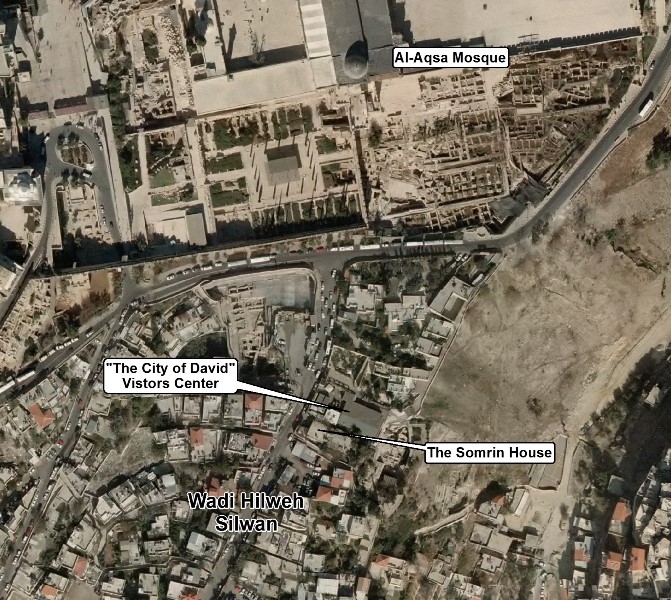
Map by Peace Now (click to expand)
The case to evict the Sumreen family, spearheaded by the JNF, with the secret funding/backing of the Elad settler group, is a key test of the State’s use of the Absentee Property Law to seize Palestinian homes in East Jerusalem. If dispossessed of their home, the Sumreen family case sets a broader precedent for many other ongoing eviction cases in Silwan that could result in the mass displacement of Palestinians in favor of settlers.
In his opinion, the Attorney General did not address the broader political context of widespread dispossession of Palestinians in Silwan, or legally dubious actions on the part of the Elad settler group and the Jewish National Fund in having the property declared to be absentee (see a detailed history of that scandal here) in order to take control over it. Instead, the Attorney General decided simply that there is no new basis on which to overturn the 1999 ruling that legitimized the JNF’s ownership of the home, and that the Sumreen family does not have a legal right to reside there.
Peace Now said in a statement:
“Instead of intervening and doing justice, the Israeli government, through the Attorney General, becomes a direct partner in crime and unforgivable injustice. The Attorney General chooses to ignore the context and the injustice behind the eviction suit and dives into quasi-legal questions to help settlers take over another property in Silwan. The Government’s fingerprints are smeared all over the Sumerin case. This is a political move in which government mechanisms such as the Custodian of Absentee Property and the Israel Land Administration and the JNF have been utilized in order to dispossess Palestinians of their property in East Jerusalem and replace them with settlers.”
It’s worth noting that the Sumreen house is located only a very short distance from the Al-Aqsa Mosque (approximately 10 meters) at the entrance to the Silwan neighborhood, and is adjacent to the “City of David” visitors center built and operated by the Elad settlers. The home is also located in the middle of what today has been designed by Israel as “the City of David National Park.” The entire area is managed by the radical Elad settler organization, which for years has also been pursuing the eviction of Palestinians from the homes in Silwan. For nearly three decades, the Sumreen family has been forced to battle for legal ownership of their home, after the state of Israel, prompted repeatedly by the JNF, declared the Sumreen’s home to be “absentee” property, despite the fact that this was manifestly not the case. Under that designation – which was not communicated to the Sumreen family – Israeli law permitted the State to take over the rights to the building. The State then sold the rights to the home to the JNF in 1991. The JNF has pursued the eviction of the Sumreen family ever since. Israeli courts ruled in favor of the Sumreen family’s ownership claims to the home for years, until a September 2019 ruling by the Jerusalem Magistrate’s Court granted ownership of the family’s home to the JNF, a decision the family immediately appealed to the Jerusalem District Court.
A full history of the saga involving the Sumreen family – which is similar to dozens of other Palestinian homes in Silwan that were declared Absentee Property in the 1990s – can be found on the Peace Now website here.
Tender Published for 300 New Units in East Jerusalem Settlement of East Talpiyot
On January 5th the Israel Lands Authority published a tender for the construction of 300 settlement units in the East Talpiyot settlement, located in East Jerusalem. Ir Amim reports the tender is scheduled to be opened for bids on February 14th.
The new units will expand the built-up footprint of East Talpiyot in the direction of the Palestinian neighborhood of Sur Baher, a neighborhood that is facing multiple new settlement plans that encroach on its historic land (including the Givat HaMatos, Har Homa, and Lower Aqueduct plans). Sur Baher has also been targeted by the Israeli Custodian General in its efforts to gain control over more land that was owned by Jews previous to 1948.
Israel to Advance Expansion of East Jerusalem settlement of Gilo
On January 10th the Jerusalem District Planning Committee convened to discuss two plans that would add 1,538 settlement units to the Gilo settlement in East Jerusalem. The plans are being advanced under the banner of “urban renewal” and will involve demolishing existing settlement units and replacing 470 existing settlement units with 2,008 new units (representing a net expansion of the settlement by 1,538 units). Ir Amim notes that, “while the plans will not necessarily enlarge Gilo territorially, it will increase the Israeli population in the settlement and hence the number of Israelis living in East Jerusalem.”
Israel Advances Plan that Will Pave Way for Expansion of East Jerusalem Settlement Enclave of Nof Zion

Map by Ir Amim (click to expand)
On January 11th, the Jerusalem District Planning Committee held a meeting to discuss public objections to a plan connected to the expansion of Nof Zion, a settlement enclave located inside the Palestinian East Jerualem neighborhood of Jabal Mukaber. One such objection was filed by Palestinian residents of Jabal Mukaber with assistance from Ir Amim. That objection argues that the plan is an affront to the planning needs of the local community and continues Israel’s systematic, city-wide discrimination against the housing, educational, and service-based needs of Palestinian neighborhoods. The Committee closed the meeting without reaching a decision, and has scheduled further private (closed to the public) continuation of its discussion of the plan.
The plan under consideration provides for the construction of a large, new Israeli police station on the border of Jabal Mukhaber neighborhood, on a plot of land that is across the street from the existing police station. The new station, according to Ir Amim, will “constitute a massive security headquarters and border police base, replete with detention facilities and laboratories.” Under the plan, after the new station is built the site of the current station will be designated for public buildings; however, Ir Amim warns that the land is currently allocated for the construction of hotels directly connected to plans to expand the Nof Zion settlement enclave. The relocation of the police station is a step towards the construction of those two hotels, which is part of the larger plan to expand Nof Zion to include the construction of commercial centers, educational institutions, and a sports field.
Ir Amim comments:
“In light of the dearth of public buildings and/or public spaces in the neighborhood, the objection [to the police facility plan] underscores the complete planning error and misuse of the respective plot of land. Rather than allocating the space to meet the dire public needs of the community, the authorities see it fit to utilize the land for a massive security base on the edge of the neighborhood. According to the objection [filed by Ir Amim and Palestinian residents], a plan of such magnitude implies that members of the community are seen as constituting a ‘threat’ rather than actual residents of Jerusalem entitled to equal socioeconomic rights and equitable access to municipal services. The depletion and appropriation of public spaces in East Jerusalem to serve Israeli interests and the expansion of setter enclaves in Palestinian neighborhoods not only erode the fabric of these communities, but severely impinge on Palestinian individual and collective rights and further entrench Israeli control of East Jerusalem.”
Israel has been working consistently to expand and entrench Nof Zion — which it should be underscored is an enclave located wholly inside a Palestinian neighborhood. On July 8, 2021 settlers and their allies held a cornerstone-laying ceremony to mark the beginning of construction on hundreds of new units in Nof Zion. The new construction is just preliminary work on a project that will triple the settlement in size and make it the largest settlement enclave in East Jerusalem.
As a reminder: In 2017, the Israeli government approved a plan to build a new synagogue and mikveh in Nof Zion on private Palestinian land that was expropriated from the Jabel Mukaber neighborhood in 2016. Then, in September 2017, rumors emerged that the government was set to issue 176 building permits for the already-approved project. According to Ir Amim, those permits were ultimately issued in April 2019.
IDF Evacuates Oz Zion Outpost (Again)
On January 10th, settlers sought to obstruct Israeli forces that were dismantling structures at the unauthorized outpost site called Oz Zion, located between Jerusalem and Ramallah. Settlers reportedly chained themselves to structures at the scene, and clashed with Israeli forces when they arrived to remove them.
Oz Zion has been dismantled by the IDF several times in the past (most recently in June 2021). Yet, the settlers – who have violently resisted Israeli forces carrying out the demolition – have repeatedly been allowed to reestablish it. It is one of the outposts for which a standing demolition order was recently re-issued by the IDF.
Fight Over Homesh Outpost & Yeshiva Continues (Both Physically and Politically)
On January 10th, settlers clashed with Israeli forces attempting to confiscate property from the illegal yeshiva settlers have established at the site of the evacuated settlement of Homesh — a yeshiva that the IDF continues to permit settlers to visit and operate. It’s worth recalling the great lengths to which the IDF has gone to offer protection for the settlers to access the yeshiva, at the cost of the freedom of movement and obstruction of normal life to entire nearby Palestinian villages.
In the wake of the killing last month of a settler connected to the illegal yeshiva, national furor – spearheaded by settlers protesting in front of the Prime Minister’s residence – has kept the heat on the government over the fate of the Homesh outpost and yeshiva. Key settler leaders are threatening to bring down the current coalition if the yeshiva is dismantled. While the government has not clearly signaled what it intends to do with the yeshiva, settlers and their political allies outside of the governing coalition are now aggressively pushing the government to undertake hugely consequential efforts on behalf of the settlements — including but not limited to re-establishing the settlement of Homesh and normalizing the status of the illegal yeshiva at the site — in order to prove it allegiance. See below for more details.
Settlers Seek Outpost Gains from Divided & Fragile Government (With Some Success)
As part of their campaign to push the government to authorize the Homesh yeshiva and reestablish the Homesh settlement, key settler leaders are raising at least two additional major initiatives in their aggressive push on the government to compensate the settlers in response to the recent death of settler Yehuda Dimentan.
Those two additional demands by the settlers – a contingent of whom are encamped in front of Prime Minister Bennett’s residence – are:
- To pass a bill – or act unilaterally – to connect unauthorized outposts to the Israeli electric and water grids. To that end, Defense Minister Benny Gantz and Interior Minister Ayelet Shaked reportedly held a meeting on this topic on January 9th. The settler-run news outlet Artuz Sheva optimistically reports that dozens of outposts might meet Israeli criteria for being connected to Israeli infrastructure, and that Gantz would support the move if the Defense Ministry Legal Advisor gives it an OK. This has been a longtime demand of settlers, and has typically included the demand to connect outposts to Israeli water, sewer, power, garbage collection, and other municipal services. Doing so would further entrench the permanence of these outposts and furthers the de facto annexation of Palestinian land. It would also continue and expand on Israel’s long practice of copiously rewarding settlers for breaking Israeli law (by illegally building outposts), and directly incentivizing further settler lawbreaking.
- To more aggressively police Palestinian construction in Area C of the West Bank (some 60% of the land). This demand is grounded in an Orwellian twisting of reality to treat Palestinian construction on Palestinian private land in Area C without permits required by Israel (permits Israel consistently refuses to issue) as theft of Israeli land. For more on this long running, and particularly pernicious, tactic of the settlement movement, see FMEP’s previous reporting.
Construction Begins on Key Stretch of the “Tunnels Road” for Settlements South of Jerusalem
Arutz Sheva reports (gleefully) that ground has been broken on a final stretch of the new tunnel road that will connect settlements to the south of Jerusalem (the Etzion settlement bloc) more seamlessly to the heart of the city. The tunnel is part of Highway 60, which Israel has already begun work to widen, which runs from Jerusalem all the way to the Kiryat Arba in Hebron.
In a deeply researched report on how infrastructure like roads is a means for settlement expansion and annexation, Breaking the Silence explains:
“While Israeli authorities justify many of the projects described in this document by claiming that they serve both the settler and the Palestinian populations in the West Bank, it is important to note that these roads are designed with Israeli, not Palestinian, interests in mind. Many of the roads that are technically open to Palestinian traffic are not intended to lead to locations that are useful to Palestinians.16 Instead, these roads are primarily designed to connect settlements to Israel proper (and thus employment and other services) via lateral roads, rather than to connect Palestinian communities to one another. Further, roads intended to connect Israeli settlements to Jerusalem (many of which are currently under construction) do not serve West Bank Palestinians outside of Jerusalem, as they are not allowed to enter Jerusalem without a permit. In addition, an extensive system of checkpoints and roadblocks allows Israel to control access to bypass roads and the main West Bank highways, and it can restrict Palestinian access when it so chooses.
This prejudice against Palestinian development is even starker when one considers that, according to an official Israeli projection, the expected Palestinian population in the West Bank (excluding East Jerusalem) in 2040 is 4,600,000 individuals. Even if the vision of settler leaders to arrive at 1,000,000 settlers is realized by 2040, the Palestinian population would still be four times the size of the settler one. Despite this discrepancy, priority is still given to settler infrastructure development.
West Bank road and transportation development creates facts on the ground that constitute a significant entrenchment of the de facto annexation already taking place in the West Bank and will enable massive settlement growth in the years to come. By strengthening Israel’s hold on West Bank territory, aiding settlement growth, and fragmenting Palestinian land, this infrastructure growth poses a significant barrier to ending the occupation and achieving an equitable and peaceful solution to the Israeli-Palestinian conflict.”
Israel Gives U.S. Army Officers Tour of Hebron Led by Settlement Spokesman
Raising many eyebrows, the secretariat of the Israeli Central Command reportedly arranged a settler-led tour of Hebron for a delegation of U.S. army officers. The full-day tour designed by the settlers included a visit to the Tomb of the Patriarchs/al-Ibrahimi Mosque and a visit to the settler-run museum (in the Beit Hadassah enclave). The visit empowered settlers to present their version of the religious, historic, geo-political, and security significance of Hebron (including with respect both to settlers/settlements, and presenting Palestinians through the settler lens). The U.S. delegation did not engage any Palestinians while in Hebron, creating an obvious and problematic imbalance in perspective on all matters.
Haaretz reports that the Israeli army has refrained from engaging the settlers for diplomatic tours of Hebron in recent years. In a statement to Haaretz about the tour, the IDF issued a bland statement saying:
“Last week, a few U.S. army officers came for a tour of the Tomb of the Patriarchs and Beit Hadassah led by the commander of the Central Command, for the purpose of learning about the history of the site. As part of the ongoing tours that are held regularly, the American delegation meets with various people in the State of Israel as well as in the Palestinian Authority. This is in order to learn about the area in the best way possible. Dr. Noam Arnon [a far-right-wing settler activist and spokesman for the Hebron settlements] was chosen to guide this tour. The tour was held according to the established regulations in the IDF.”
Further Reading
- “Who Do Israeli Settlement ‘Sheriffs’ Report To? Even They’re Not Sure” (Haaretz)
- “West Bank settlements are annexing land in Israel, too” (+972 Magazine)
- “Fresh Sheikh Jarrah eviction threatens to roil capital anew” (The Times of Israel)
- “From Iron Dome to supply chains, US Christian group quietly shaping US-Israel ties” (The Times of Israel)
- “Editorial | As Israel Bends Over Backwards for Homesh, Palestinians Pay the Price” (Haaretz)
- “The International Community and Israel: Giving Permission to a Permanent Occupation” (Michael Lynk in Just Security)
- “Congress launches bipartisan Abraham Accords Caucus” (Jewish Insider)
Welcome to FMEP’s Weekly Settlement Report, covering everything you need to know about Israeli settlement activity this week.
To subscribe to this report, please click here.
December 3, 2021
- Israel to Advance Atarot Settlement Plan
- New Israeli President Kicks Off Hanukkah with Settlers in Hebron, Sparking Clashes and Raising Ire
- Court OKs Demolition of Palestinian Homes in Wadi Yasul (Silwan)
- “Day of Destruction” – Israel Demolitions in East Jerusalem & West Bank
- Government Contradictions Delay Final Decision on Jerusalem Cable Car Project
- Knesset Holds Hearing on Settler Terrorism
- Bonus Reads
Israel to Advance Atarot Settlement Plan
At its upcoming meeting scheduled for December 6th, the Israeli Interior Ministry District Planning Committee is set to approve the Atarot settlement plan for public deposit.
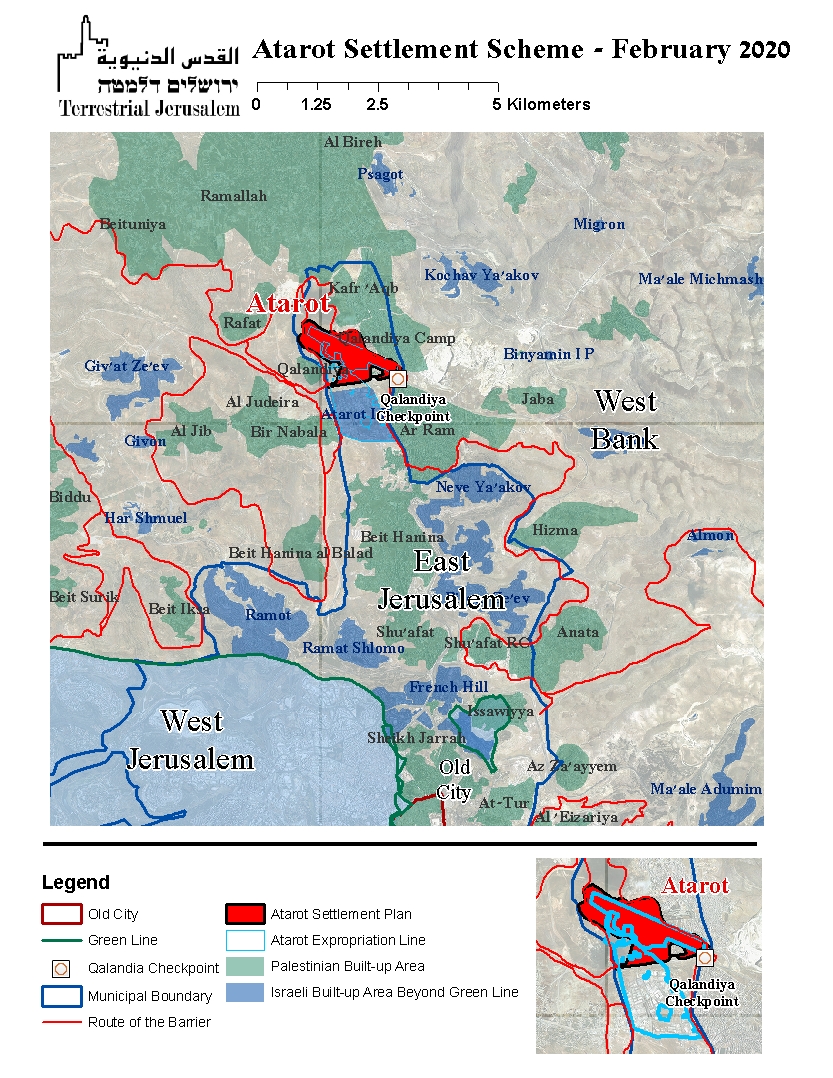 As a reminder, the Atarot plan calls for a huge new settlement on the site of the defunct Qalandiya Airport, located on a sliver of land between Ramallah and Jerusalem. In its current form, the plan provides for up to 9,000 residential units for ultra-Orthodox Jews (assuming, conservatively, an average family size of 6, this means housing for 54,000 people), as well as synagogues, ritual baths (mikvehs), commercial properties, offices and work spaces, a hotel, and a water reservoir. If built, the Atarot settlement will effectively be an Israeli city surrounded by Palestinian East Jerusalem neighborhoods on three sides and Ramallah to its north. Geopolitically, it will have a similar impact to E-1 in terms of dismembering the West Bank and cutting it off from Jerusalem. For more on the Atarot settlement plan, please see here.
The Jerusalem District Planning Committee previously signaled its intent to advance the Atarot settlement plan, most notably by placing it on the December 6th agenda. After apparent pushback from the Biden Administration, on November 25th the plan was suddenly removed from the December 6th agenda, reportedly in fulfillment of a promise to the U.S. to freeze the project. That removal, however, proved short-lived. On November 28th, the Atarot plan reappeared on the agenda, confirming earlier comments Bennett made to the settler-run news outlet Arutz Sheva saying that the plan will indeed be discussed on December 6th. Apparently settling the matter, an Israeli diplomatic source said that the government will act on the plan by approving it for deposit for public review, while at the same time offering the U.S. a rhetorical commitment (but nothing more) that there will be no further advancement in the planning process for at least a year.
Peace Now’s Hagit Ofran cautions:
“‘…please, don’t buy any ‘promise’ that ‘we will not build’ (anyway the planning process takes a while, and even if they work hard and fast they can’t start to build Atarot in less than 3-4 years), what we need is clear: Don’t promote the plan; Shelve it.’ Ofran separately told The Los Angeles Times, ‘As soon as [the committee] approve[s] it, it’s like a snowball.’”
Ir Amim also warns:
“While the Israeli authorities may attempt to relegate the upcoming discussion as a prosaic, bureaucratic step in a lengthy approval process, it is a necessary stage in the plan’s final approval and indeed advances the plan one step closer to full validation.”
For further information about the Atarot plan – and what has transpired over the past week – please see the following two podcasts:
- “The Settlement That Wasn’t But Now Is” ft. Daniel Seidemann & Evan Gottesman (Terrestrial Jerusalem Podcast – 11/30/2021)
- “Scorched Earth & Settlements in Jerusalem” ft. Daniel Seidemann and Kristin McCarthy (FMEP podcast – 12/2/2021)
New Israeli President Kicks Off Hanukkah with Settlers in Hebron, Sparking Clashes and Raising Ire
Isaac Herzog – the former head of the Jewish Agency who was sworn in as the new Israeli President in July 2021 – opted to make a highly political statement by attending a celebration of the first night of Hanukkah in Hebron, at the Tomb of the Patriarchs/al-Ibrahimi Mosque. Herzog’s choice is correctly understood to be an intentional embrace and legitimization of settlers in Hebron, and of the apartheid reality Palestinians experience everyday. In his speech at the event, Herzog emphasized recognition of “the historical affinity of the Jewish people to Hebron, to the Cave of the Patriarchs,” and spoke about the 1929 massacre of Jews in Hebron. He said nothing about Palestinian links to the city, the 1993 Hebron Massacre, or anything else related to Palestinian equities in the city.
Palestinian and Israeli activists protested the event, which led to clashes with the IDF.
The Palestinian Foreign Ministry responded:
“The Israeli government bears full and direct responsibility for this event…[this is] a defiant move aimed at embracing the settlement enterprise and a blatant violation of international law and the international effort to curb unilateral measures.”
MK Ayman Odeh (Joint List) tweeted:
“Herzog did not go to light the first candle, he went to light Hebron…Whoever celebrates with fans of the killer Goldstein cannot be the president of all the citizens of the country.”
Peace Now, commenting on Herzog’s activities, said:
“[Hebron is] the ugliest face of Israeli control over the territories..It is inconceivable that the president, who is supposed to be a unifying figure, would choose, of all places, to light a candle in a place that has become a stronghold of oppression and violence.”
Commenting on the IDF’s preventing protests of Herzog’s appearance, Peace Now also said:
“While the president lights a candle with Baruch Marzel and the Kahanists, security forces are preventing law-abiding citizens from exercising their right to protest”.
In speculating that Herzog’s appearance in Hebron is indicative of his higher political ambitions [to become Prime Minister], Israeli analyst Anshel Pfeffer writes:
“Herzog’s decision to light the first candle of Hanukkah on Sunday night with the settlers of Hebron, [Kahanist MK] Ben-Gvir’s core constituency, should come as no surprise to anyone. These were the kind of people he courted before being elected president and he’s not about to shun them now, or anytime… The visit to Hebron is not an afterthought or a symbolic gesture of ‘unity.’ This was the very first Hanukkah-lighting of Herzog’s presidency, and his choice of venue signals how he intends to build his political brand throughout his term and beyond.”
The Haaretz Editorial Board – in an editorial entitled “Herzog Decided He Wants to Be the President of the Settlements. It’s Not Too Late to Change It” – pleaded with Herzog to cancel his plan, writing:
“Of all the places in Israel, the president chose Hebron, the ultimate symbol of the ugliness and brutality of the occupation and the violence and domineering of the settlers.
“The visit by Israel’s No. 1 citizen to that place – most of whose Palestinian inhabitants have been forced to flee in fear of the settlers and abandon their homes and stores, turning the heart of Hebron into a ghost town – is tantamount to granting official legitimacy to the appalling injustices perpetrated there every day, both before and after Dr. Baruch Goldstein massacred 29 Arab worshipers in the mosque at the Tomb of the Patriarchs.
“In no other place in the West Bank is Israeli apartheid so horrifyingly flagrant: segregated streets on which Palestinians are prohibited from walking; vehicle entry barred to the Palestinians still living there; checkpoints at every turn – only for Palestinians, of course. Violence and humiliation are the daily fare of every Palestinian resident at the hands of the settlers and their children, as well as the army and Border Patrol personnel who are stationed on every corner.
“That is where Herzog believes he must go. His planned visit to Hebron is a gesture of recognition of and solidarity with the most violent settlers and additional proof that occupied Hebron has been annexed to Israel, at least de facto. Otherwise, the president has no reason to go there.”
Court OKs Demolition of Palestinian Homes in Wadi Yasul (Silwan)
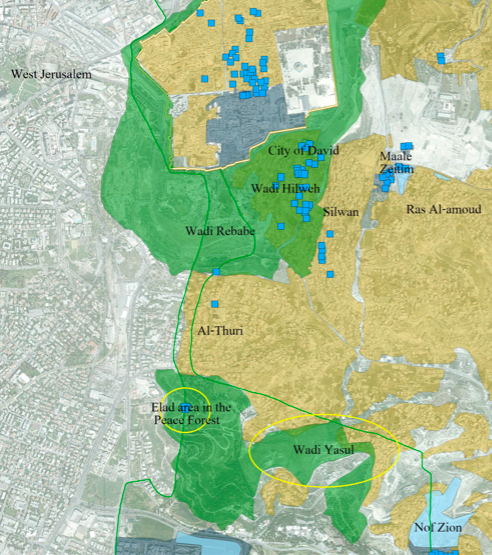
Map by Ir Amim
On November 28th the Jerusalem District Court cleared the way for the immediate demolition of 58 Palestinian homes in the Wadi Yasul section of the Silwan neighborhood in East Jerusalem – adjacent to an area known as the “Peace Forest”. The basis for the order is the Israeli claim that the homes lack Israel-issued building permits. The Court rejected an appeal to continue freezing demolition orders, filed by Palestinian homeowners, ruling that demolition orders can no longer be justifiably suspended because there appeared to be no prospect of Israel legalizing the homes, despite a 15-year effort on the part of Wadi Yasul’s residents to advance planning schemes that could have enabled Israel to rezone the land and legalize the homes.
An attorney representing the Palestinian homeowners told Haaretz:
“The residents have spent millions of shekels on these plans, but in the end, [city officials] broke their promises, posed insurmountable obstacles and insist on implementing the demolition orders and throwing the families out onto the street with no alternative.”
The brutal outcome Israel is meting out to the Palestinian residents of Wadi Yasul stands in stark contrast to the Israeli State and judicial system’s treatment of illegal settler construction in the same area — a reality that underscores the systematic discrimination that characterizes Israeli planning policies and enforcement facing Palestinians in Jerusalem. While pursuing the demolition of Palestinian construction and refusing efforts to address the issue, FMEP reported in 2019 how the Israeli government is working hand-in-hand with Israeli settlers to pursue every avenue to secure the retroactive legalization of the Elad settler group’s illegal construction. Even more brazenly, Israeli officials have been working to rezone the “Peace Forest” [something it refuses to do for Palestinians] in order to allow the Elad settler group to build more infrastructure in the area, including a tourist zipline and a promenade meant to connect settlement enclaves in the area.
Haaretz previously explained how Jerusalem authorities have repeatedly assisted Elad in its illegal activities:
“At first the NGO simply trespassed and built illegal structures there [the “Peace Forest”]. But things changed and gradually various local and national bodies – including the Jerusalem Municipality, the Israel Land Authority, the Tourism Ministry and the JNF – began to grant Elad assistance. This assistance has included granting building permits retroactively, allocating land to the group without a proper bidding process, and generous funding to the tune of tens of millions of shekels… It has been sponsoring activities in the Peace Forest since 2005, despite the fact that it has no ownership rights there or permits from the ILA (the legal owner of the land, which was expropriated from private Palestinian owners).”
Ir Amim explains:
“The scope of settlement projects in the vicinity of Wadi Yasul – and the breadth and depth of state support awarded to Elad, including authorities’ overt efforts to retroactively legalize their own unpermitted buildings – illuminate the stark discrimination in planning that empowers the expansion of radical settlement inside Palestinian neighborhoods while putting their native residents at risk of displacement.”
In a 2019 report on Wadi Yasul, B’Tselem told the story of what’s transpiring there:
“The residents of Wadi Yasul built [their homes] adjacent to a forest, also located on privately owned land that was expropriated from its Palestinian owners in 1970. In 1977, the Jerusalem Municipality zoned the forest and the area where Wadi Yasul was later established as a green space, where construction is prohibited.
“In 2004, the neighborhood’s residents submitted a detailed plan to the District Planning and Building Committee for retroactive authorization of their homes. The committee rejected the plan in 2008, citing incompatibility with the Jerusalem 2000 Outline Plan, which states that the area where the neighborhood was built must remain a green space.
“At the same time, the municipality and the JNF (Jewish National Fund) – the body in charge of managing the forest – gave their approval to settler organization El-Ad to move forward with plans for group campgrounds, including building the longest recreational zipline in Israel. Some of the facilities have already been built in the forest, without building permits. While the city did issue demolition orders against them, it has refrained from following through.
“In contrast, over the last decade, the city has filed indictments with the Court of Local Affairs against all Wadi Yasul homeowners. The court then issued demolition orders for all of the homes and imposed heavy fines, fining each family tens of thousands of shekels. Three of the families appealed these decisions with the District Court. The appeals were dismissed in April on the grounds that “there are no clear and near planning prospects” for the approval of a plan that would see the appellants’ homes, or other homes in the neighborhood, approved. An appeal the families filed with the Supreme Court was also rejected. In late April, 47 other families filed a motion with the District Court seeking an interim injunction staying execution of the demolition orders. The court’s decision is still pending. Consequently, all of the homes in the neighborhood are still under immediate threat of demolition.
“Ever since 1967, planning policy in Jerusalem has been geared toward establishing and maintaining a Jewish demographic majority in the city. Under this policy, it is nearly impossible to obtain a building permit in Palestinian neighborhoods. The outline plans the city has prepared for these neighborhoods are largely aimed at restricting and limiting building opportunities in Palestinian neighborhoods. One way the plans do so is by designating vast areas as open green spaces, thereby barring Palestinians from building there. The resulting housing shortage forces Palestinian residents to build without permits.”
“Day of Destruction” – Israel Demolitions in East Jerusalem & West Bank
On November 23rd, Israeli forces carried out a demolition campaign targeting Palestinian homes in East Jerusalem and the West Bank, under the pretense that these homes lack Israeli-required Israeli-issued building permits (permits Israel systematically refuses to issue to Palestinians in East Jerusalem and in Area C). As a result of these demolitions, 22 people, including 15 children, were rendered homeless in a single day.
The demolitions included:
- 3 homes in the Wadi al-Hummus neighborhood of East Jerusalem. One of the buildings was a multi-unit apartment buildings;
- 1 home and a burial building (perhaps a funeral home) in villages in the South Hebron Hills;
- 1 tent and 3 livestock structures belonging to bedouin families living east of Ramallah;
- An agricultural road near Nablus. The road was used by the residents of ‘Asirah al-Shamaliyah to reach their farmland and also connects the town to Nablus.
B’Tselem writes:
“The wave of demolitions expresses the perception of the Israeli regime, which holds that land is a resource intended primarily to serve the Jewish population. This regime uses a variety of administrative, planning and bureaucratic tools to implement this concept. Governments come and go, but the apartheid regime remains untouched.”
Government Contradictions Delay Final Decision on Jerusalem Cable Car Project
On November 28th, the Israeli High Court of Justice held what was scheduled to be the final hearing to determine the fate of the Jerusalem cable car project — a project which has been promoted by the government and the Elad settler organization until this point. But instead of reaching a decision, the Court ended up giving the Israeli government a 21-day extension, by the end of which the government must explain its position on the project.
 The proximate cause of the Court’s action was Israeli Minister of Transportation Merav Michaeli’s (Labor) statement, delivered two days before the Court hearing, saying that “the cable car has no significant transportation role, and the harm will exceed the benefits.” That statement contradicts and completely undermines the rationale for the project that the government has put forward until this point — i.e., that the cable car will provide a legitimate transportation benefit. Given Michaeli’s statement, the Court issued its order for the State to clarify where it stands.
Commenting on the Court’s action, the Israeli NGO Emek Shaveh – which specializes in archaeology – said:
“We are pleased that after three years, the transport minister has said what we have been saying all along: that the Jerusalem cable car project is not a transportation project and is not an answer to the traffic issues near the Old City. We believe that its value for tourism has also been greatly misrepresented and although the plan is being advanced by the Jerusalem Development Authority and the Tourism Ministry it will primarily benefit a powerful interest group (the Elad Foundation) by transporting thousands of tourists to its hub at the City of David to the detriment of the historic city and its residents. We hope that the judges will rule that the approval process for the cable car plan severely undermined principles of good governance and on those grounds decide to put a stop to the plan.”
As a reminder, the Jerusalem cable car project is an initiative backed by the powerful, state-backed Elad settler group and advanced by the Israeli Tourism Ministry. The State of Israel – which has pushed the project forward in the midst of the COVID-19 pandemic and despite commitments by the government to focus on public health matters only – was previously forced to publicly admit that the implementation of the cable car project will require the confiscation of privately owned Palestinian land in the Silwan neighborhood of East Jerusalem.
While public efforts to “sell” the cable car plan have focused on its purported role in helping to grow Jerusalem’s tourism industry or in serving supposedly vital transportation needs, in reality the purpose of the project is to further entrench settler control in Silwan, via archeology and tourism sites, while simultaneously delegitimizing, dispossessing, and erasing the Palestinian presence there. Notably, the cable car line is slated to terminate at the settler-run Kedem Center compound (Elad’s large tourism center, currently under construction at the entrance of the Silwan neighborhood, in the shadows of the Old City’s walls and Al-Aqsa Mosque).
Emek Shaveh and other non-governmental organizations, including Who Profits and Terrestrial Jerusalem, have repeatedly challenged (and provided evidence discrediting) the government’s contention that the cable car will serve a legitimate transportation need in Jerusalem, and have clearly enumerated the obvious political drivers behind the plan, the archeological heresies it validates, and the severe negative impacts the cable car project will have on Palestinian residents of Silwan.
Knesset Holds Hearing on Settler Terrorism
On November 22nd a group of Knesset members – all hailing from political parties considered to be part of the Israeli Left – convened a hearing on settler violence against Palestinians.
As part of the hearing, several experts were asked to testify, including Ali Awad, a journalist and anti-settlement activist in the South Hebron Hills. Awad testified regarding his experience growing up in Tuba (read about that here), saying:
“I grew up in Tuba in the South Hebron Hills, under the threat of settlers my whole life. The military and settlers are working to steal our resources, rob us of our freedom, and take our land. There is full cooperation between the settlers and the army” [paraphrased by Breaking the Silence]
Peace Now Executive Director Shaqued Morag also testified, and emphasized that unauthorized outposts radiate settler terrorism and violence, serving as a tool for settlers (and the state) to take over more and more land.
A group of retired Israeli commanders – called Commanders for Israeli Security – delivered a written testimony for the hearing, writing:
“Groups of settlers have been perpetrating deadly acts of violence against Palestinians — for the most part helpless villagers — in areas under our control…This is completely unacceptable from an ethical and humanitarian perspective, and it stands in contradiction to Israel’s Jewish values.”
The hearing was not without controversy, as it was held the one day after a Palestinian killed one Jewish Israeli and injured four others in a shooting attack in the Old City of Jerusalem. Right-wing members of the Knesset, including Kahanist MK Ben Gvir, asked for the hearing on settler violence to be cancelled altogether. When it was allowed to proceed, Ben Gvir used the podium to shout his criticism of the Knesset members who organized the hearing, eventually resulting in his removal from the hearing room.
Decrying the lack of participation of many MKs, Meretz Party Chairman Nitzan Horowitz said:
“Their silence and lack of interest is tantamount to the endorsement and encouragement of continued violence.”
Horowitz also said:
“Some people in the Knesset minimize its existence or even deny it entirely. I invite them to visit the area, to meet with the victims of this violence, and to see the photos and video clips they produce.’’
Bonus Reads
- “Highway of hope and heartbreak” (Washington Post)
- “The Gaza Bantustan – Israeli Apartheid in the Gaza Strip” (Al-Mezan Center for Human Rights)
- “‘Hate crime’ attacks by Israeli settlers on Palestinians spike in the West Bank” (Washington Post)
- “Democratic Lawmakers Warn Against ‘Doomsday’ Israeli Settlement Plan” (Haaretz)
- “‘The occupation is trying to uproot us. Art can bring us back’” (+972 Magazine)
- “Israelis attacked, car set on fire after entering Ramallah” (i24 News)
- “The Long Reach of Restraint: For Israel’s Supreme Court, to exercise power might be to lose it.” (Jewish Currents // Elisheva Goldberg)
Welcome to FMEP’s Weekly Settlement Report, covering everything you need to know about Israeli settlement activity this week.
To subscribe to this report, please click here.
October 22, 2021
- Israel to Advance Plans for Nearly 3,000 Settlement Units & 1,300 Palestinian Homes in Area C
- Israeli Supreme Court to Hold Hearing on Batan al-Hawa, Silwan Dispossession Cases Next Week; AG Declines Intervention
- Israel Begins Construction on New Settlement in Downtown Hebron
- Israel Advances “Silicon Wadi” Project in East Jerusalem
- Recap: Israel Advances Settlement Plans Across Greater Jerusalem Area
- Recap: Court Pushes for Palestinians to “Compromise” with Settlers in Sheikh Jarrah
- New Report: State-Backed Settler “Tourism” Projects in East Jerusalem
- Bonus Reads
Israel to Advance Plans for Nearly 3,000 Settlement Units & 1,300 Palestinian Homes in Area C
The Israeli Civil Administration’s High Planning Council will convene next week — for the first time since Bennett and Biden took over leadership in Israel and the U.S., respectively — to advance the construction of 2,862 new settlement units (of which 1,231 will be eligible to receive final approval). These plans include the retroactive legalization of two unauthorized outposts (Mitzpe Danny and Haroeh Haivri), which should be properly understood as the creation of two new settlements.
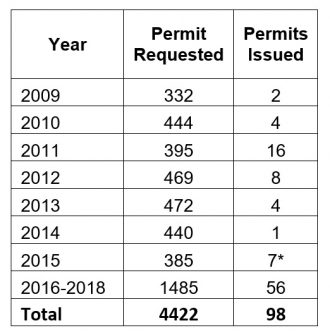
Peace Now data
In addition, reports suggest that Israel will also advance plans for 1,303 Palestinian homes in Area C – about half of which, importantly, are already built. A majority of these units have been awaiting Israeli approval for many, many years. If approved, the permits under consideration next week for Palestinians will be the first of any significant quantity issued by Israel since, at least, 2009 (data from before this period has not been released by the Israeli government). Between 2009 and 2018, Israel issued a total of 98 building permits to Palestinians according to data released by the Israeli government in response to a freedom of information request submitted by Bimkom.
As a reminder, Area C is the 60% of the West Bank over which Israel enjoys absolute authority. For years Israel has systematically denied Palestinians the right to build on land in Area C that even Israel recognizes is privately owned by them, At the same time, it has continuously promoted the expansion of settlements and unauthorized outposts, while systematically demolishing Palestinian private construction. In terms of numbers: between 2016 to 2018, Israel issued only 21 building permits to Palestinians in Area C, while issuing 2,147 demolition orders against Palestinians during.
Commenting on the Planning Council agenda’s Peace Now observed:
“The approval of a handful of plans for the Palestinians is only a fig leaf intended to try to reduce criticism of the government. For years, Israel has pursued a policy of blatant discrimination that does not allow almost any construction for Palestinians in Area C, while in the settlements it encourages and promotes the construction of thousands of housing units each year for Israelis. The approval of a few hundred housing units for Palestinians can not cover up discrimination and does not change the fact that Israel maintains an illegal regime of occupation and discrimination in the territories.”
It is worth noting that many of the settlement units and Palestinian permits on next week’s agenda were expected to have been advanced earlier this year, in August 2021, but the High Planning Council never convened to do so.
Below are lists of settlement plans expected to be given final approval and plans expected to be advanced next week (italicized plans represent those which appear to have been added to the slate of plans that were expected to be advanced in August 2021).
Settlement plans expected to be granted final approval include:
- 629 units, including the retroactive legalization of 61 units, in the Eli settlement – located south of Nablus and southeast of the Ariel settlement in the central West Bank. Though the Eli settlement previously received Israeli government approval, a “Master Plan” – which officially zones land for distinct purposes (residential, commercial, public) – has never been issued for Eli, meaning all construction there is illegal under Israeli law;
- 286 units in the Har Bracha settlement, located south of Nablus. If implemented, these new units will double the size of Har Bracha;
- 224 units in the Talmon settlement, located west of Ramallah;
- 146 units in the Kfar Etzion settlement, located between Bethlehem and Hebron and on the Israeli side of the planned route of the barrier (which is not yet built in this area);
- 110 units in the Alon Shvut settlement, located just north of the Kfar Etzion settlement and between Bethlehem and Hebron;
- 82 units in the Karnei Shomron settlement, located in the northern West Bank, east of the Palestinian village of Qalqilya. Israel has openly declared its intention to continue expanding settlements in this area with the stated goal of bringing 1 million settlers to live in the area.;
- 52 units in the Beit El settlement, located in the heart of the northern West Bank [as a reminder, former US Ambassador to Israel David Friedman has deep ties to the Beit El settlement]; Construction on 350 new units in Beit El began earlier this year;
- 42 units in the Givat Zeev settlement, located south of Ramallah in an area that is on the Israeli side of the barrier;
- 24 units in the Haroeh Haivri outpost, a plan that will effectively grant retroactive legalization to this outpost. The Haroeh Haivri outpost is located just east of Jerusalem, within eyesight of the Khan al-Ahmar community, which Israel is threatening to demolish (forcibly relocating the Palestinian bedouin community that has lived there since the 1950s) — ostensibly because the structures in Khan al Ahmar were built without necessary Israeli approvals. The Haroah Haivri outpost was also built without the necessary Israeli approvals, but instead of demolishing the construction, Israel is moving to retroactively legalize it — demonstrating once again that, when it comes to administering the occupation, Israel prefers “rule by law” – where law is turned into a tool to elevate the rights/interests of one party over another, over the democratic rule of law.;
- 14 units in the Ma’aleh Mikhmash settlement, a plan that will effectively grant retroactive legalization to one of Ma’aleh Mikhmash’s outposts – – Mitzpe Danny;
- 10 units in the Barkan settlement, located about half way between the Ariel settlement and the cluster of settlements slated to be united into a “super settlement” area (Oranit, Elkana, Shiva Tikva, and others);
- 5 units in the Shima’a settlement, located in the southern tip of the West Bank;
- 7 units in the Peduel settlement, located in the northern West Bank and part of a string of settlements and unauthorized outposts – most notably Ariel – extending from the Green Line into the very heart of the West Bank and on towards the Jordan Valley.
Settlement plans expected to be approved for deposit (an earlier stage in the planning process) include:
- 399 units in the Revava settlement, located just east of the Barkan settlement and west of the Ariel settlement, in a string of settlements and unauthorized outposts – most notably Ariel – extending from the Green Line into the very heart of the West Bank and on towards the Jordan Valley.
- 380 units in the Kedumim settlement, located just east of Nablus. Israeli MK Bezalel Smotrich lives in the Kedumim settlement on a section of land in the settlement that has been found to be privately owned by Palestinians.;
- 100 units in the Elon Moreh settlement, located east of Nablus (for background on the significance of the Elon Moreh settlement, please see here);
- 100 units in the Sansana settlement, located on the southern tip of the West Bank on the Israeli side of the separation barrier;
- 73 units in the Givat Zeev settlement, which is also expected to receive final approval for 42 units. Givat Zeev is located south of Ramallah in an area that is on the Israeli side of the barrier;
- 68 units in the Tene settlement, located on the southern tip of the West Bank;
- 45 units in the Vered Yericho settlement, located just west of the Palestinian city of Jericho in the Jordan Valley;
- 27 units in the Karnei Shomron settlement, which is also expected to receive final approval for 82 units. Karnei Shomron is located in the northern West Bank, east of the Palestinian village of Qalqilya. Israel has openly declared its intention to continue expanding settlements in this area with the stated goal of bringing 1 million settlers to live in the area.;
- 18 units in the Alon Shvut settlement, which is also expected to receive final approval for 110 units. Alon Shvut is located just north of the Kfar Etzion settlement and between Bethlehem and Hebron;
- 10 units in the Tal Menashe settlement, located located on the tip of the northern West Bank, inside the “seam zone” between the 1967 Green Line and the Israel separation barrier, which was constructed along a route designed to keep as many settlements and as much adjacent land as possible on the Israeli side of the wall/fence.
- 7 units in the Hermesh settlement, located in the northern West Bank;
- 4 units in the Efrat settlement, located south of Bethlehem, inside a settlement block that cuts deep into the West Bank. Efrat’s location and the route of the barrier wall around it, have literally severed the route of Highway 60 south of Bethlehem, cutting off Bethlehem and Jerusalem from the southern West Bank. The economic, political, and social impacts of the closure of Highway 60 at the Efrat settlement (there is literally a wall built across the highway) have been severe for the Palestinian population.
Peace Now reports that the Planning Council will also consider advancing the following plans for Palestinian homes:
- 270 houses in the Bir al-Bash village, located south of Jenin in the northern West Bank;
- 270 houses in the Al-Ma’asara village, located south of Bethlehem;
- 233 houses in the the Almasqufa village, located near Tulkarem in the northern West Bank;
- 200 houses in the Dkeika village in the South Hebron Hills;
- 170 houses in the Khirbet Abdallah Younas village, located in the Jenin area;
- 160 houses in the Abba a-Sharqiya village, also located south of Jenin in the northern West Bank;
Israeli Supreme Court to Hold Hearing on Batan al-Hawa, Silwan Dispossession Cases Next Week; AG Declines Intervention
On October 25th, the Israeli Supreme Court is scheduled to hold an important hearing on the case of the Palestinian Duweik family which is under threat of being dispossessed of their longtime home in the Batan al-Hawa section of the Silwan neighborhood in East Jerusalem by the Ateret Cohanim settler organization.
In advance of that hearing – and after repeated extensions on a Court-ordered deadline – the Israeli Attorney General finally submitted his position on the case to the Court. The document submitted by the Attorney General was only 1 page, and simply stated that the case does not merit intervention either on the specific case of the Duweik family or regarding the wider legal principle at stake, which threatens an additional 85 families living under threat of eviction in Batan al-Hawa.
Ir Amim writes:
“Among the 85 families facing eviction, the Duweik family case is the first to reach the Supreme Court level, and its outcome will inevitably set a precedent, significantly impacting the rest of the cases in the neighborhood…As in the eviction cases in Sheikh Jarrah, the Attorney General and by extension, the government, was given a rare opportunity to take a moral stand by providing a legal opinion and policy position to help prevent the mass displacement of these families. Yet, at this point, the Attorney General’s response appears to imply that he has declined to intervene. Now, the decision concerning the fate of these families seems to lie solely in the hands of the Supreme Court. The rights of Palestinians to housing and shelter and the right to family and community life are fundamental and must be upheld. The same discriminatory legal system, which led to the confiscation of these families’ original homes in 1948, is now being exploited 73 years later to displace them for a second time from their current homes in which they have lived for decades. The Supreme Court has the power to make a principled and just decision to uphold the rights of these families to remain safely in their homes, free from the constant threat of being forcibly uprooted and driven from their homes and communities.”
Peace Now said in response to the AG’s decision to not intervene:
“The Attorney General’s response actually says that for the Israeli government, there is no problem to kick hundreds of residents out from their homes, on the basis of a discriminatory law, in favor of a settlement. The government was given an opportunity here to try to prevent moral injustice and political folly, but instead of taking a stand, it chose to remain on the sidelines, as if Silwan’s story, like that of Sheikh Jarrah, was a legal matter and not a political one.”
In July 2021, Peace Now assembled a coalition of Israeli lawyers to submit an amicus brief to the Court regarding the Duweik case. Peace Now summarizes:
“The brief addresses an approach that has emerged in international jurisprudence on human rights law which puts an emphasis on group vulnerability of occupants facing eviction and institutional, systemic discrimination against them. Where these are present, in certain circumstances, the occupants’ rights, stemming from the human right to housing and specifically, to live in their home and their family’s home – trump the right of the original owner or their substitute to regain possession of the property.
The brief reaches the conclusion that in the Duweik case, the occupants’ property rights and their right to housing supersede the right of the settlers acting on behalf of the pre-1948 original owners to receive possession of the property, based on the following:
1 – The fact that Palestinian residents of East Jerusalem are underprivileged, vulnerable and subjected to discrimination in every aspect of life, and particularly the fact that Israeli law on the restitution of property that changed hands due to wars, openly and deliberately discriminates against them;
2 – The fact that the family entered the property in good faith and/or in accordance with the law applicable at the time, and has developed a legitimate expectation to continue residing in it permanently and without interruption;
3 – The imbalance between the devastating harm the family would suffer and the minor damage the Benvenisti charitable endowment (represented by the settlers), which claims ownership of the property, would sustain, which clearly tips the scales in favor of the family.
In other words, according to the brief, even if the court finds the settlers do, in fact, have ownership, they are not necessarily entitled to remedy in the form of the families’ eviction from their homes, but rather to compensation from the state.”
Israel Begins Construction on New Settlement in Downtown Hebron
Peace Now reports that construction has begun on 31 new settlement units at the site of an old bus station previously repurposed as an IDF base, located in the heart of the Old City of Hebron on the infamous Shuhada street. This is a new settler enclave in the city and is, in effect, a new urban settlement, disconnected from already existing settlements in the city. It will be the first new settlement construction approved in downtown Hebron – where Palestinians already live under apartheid conditions – since 2002.
Peace Now said in a statement:
“The government is acting like an annexation government, not as a change government. Since the 1980s, no government has dared to build a new settlement in the heart of the largest Palestinian city in the West Bank, with the exception of one building built under the auspices of the second intifada in 2001. The Defense Minister has to stop construction, even if the plan was approved by the previous government. The settlement in Hebron is the ugly face of Israeli control of the territories. The moral and political price of having a settlement in Hebron is unbearable.”
As a reminder: in October 2017, the Israeli Civil Administration approved a building permit for the 31 units, on the condition that the Palestinian municipality of Hebron and others would have the opportunity to file objections to the plan. Soon after, two appeals were filed with the Defense Ministry: one by the Palestinian municipality of Hebron and one by the Israeli settlement watchdog Peace Now. The legal objections were based on the legally questionable process by which Israel made land in downtown Hebron available for settlement construction. Located in the Israeli-controlled H-2 area of Hebron (where 500 Israeli settlers live amongst 40,000 Palestinians), Israel seized the land in the 1980s from the Hebron Municipality, for military purposes. In 2007, the Civil Administration’s Legal Advisor issued an opinion stating that once Israel is done using the land for military purposes, it must be returned to the Hebron Municipality, which has protected tenancy rights to the land. Nonetheless, in 2015, the Israeli Civil Administration, with the consent of the Minister of Defense, quietly authorized the Housing Ministry to plan the area for Israeli settlement use, paving the way for that same ministry to subsequently present the plan for the 31 units.
In October 2018, with the legal challenges still pending, the Israeli Cabinet voted to expedite the planning of the new settlement and allocated approximately $6.1 million (NIS 22 million) for the project, which will require Israel to significantly renovate the bus station/military base in order to build the 31 new settlement housing units, as well as a kindergarten, and “public areas” for the new settler residents. Peace Now explains:
“The approval of the building permit in the heart of Hebron is an extraordinary move not only because it is a new settlement in Hebron for the first time since 2001, but because it indicates a significant change in Israeli legal interpretation of what is allowed and forbidden in occupied territory. The area in question was owned by Jews before 1948, and it was leased by the Jordanian government in protected tenancy to the Hebron municipality for the purpose of establishing the central bus station. Since 1967, the Israeli authorities managed the land and continued the lease to the Hebron municipality, until in the 1980s when the area was seized for military purposes, the bus station was closed and a military base was established there. A legal opinion of the Judea and Samaria Attorney General on the issue in 2007 emphatically stated that by law the municipality’s protected lease must not be revoked.”
Israel Advances “Silicon Wadi” Project in East Jerusalem
On October 13th, the Jerusalem Local Planning Committee met to initiate the planning process for the “Silicon Wadi” project, which was initiated by the Jerusalem Municipality and outlines plans to build a large industrial zone for hi-tech, commercial, and hospitality businesses in the heart of East Jerusalem’s Wadi Joz neighborhood. The project requires the demolition of some 200 Palestinian-owned businesses that currently operate in the area; dozens of demolition notices for which were issued in November 2020.
Ir Amim writes:
“Beyond the devastating impact of widespread demolitions of existing businesses and structures, the plan also raises concerns that the Israeli authorities will exploit the planning procedures to locate alleged Palestinian absentee properties and transfer lands into the hands of the State. It should also be noted that while Israel focuses on bolstering employment and economic activity in East Jerusalem, it simultaneously continues to suppress residential development in Palestinian neighborhoods. As with nearly all outline plans advanced in East Jerusalem in recent years, the Wadi Joz business park plan only allocates a marginal amount for residential use, which hardly meets the acute housing needs of the Palestinian population. Rather than undertaking measures to rectify the housing crisis, these plans only exacerbate the current situation and perpetuate the residential planning stranglehold, which ultimately serves to push Palestinians out of the city.”
Recap: Israel Advances Settlement Plans Across Greater Jerusalem Area
Over the past two weeks, the government of Israel has advanced four highly controversial and politically consequential settlement plans in the Greater Jerusalem area:
- The Givat Hamatos Settlement: On October 13th, the Jerusalem Local Planning Committee approved the expropriation of lands designated for public use in the Givat Hamatos area for the construction of roads, public buildings and the development of open space for the planned new settlement/neighborhood. For more on the Givat Hamatos settlement plan, please see here.
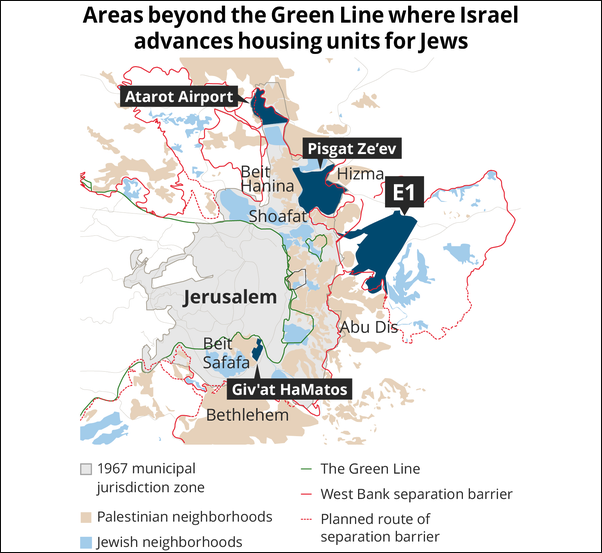
Map by Haaretz
- The E-1 Settlement: The Israel Civil Administration moved forward with advancing plans for the construction of the E-1 settlement, setting a date for a third hearing to discuss public objections to the plan (now set for November 8th). The first hearing was held on October 4th, but Palestinians were denied the ability to participate in that hearing (which was held virtually, making it inaccessible to the many Palestinians affected by the plan who do not have internet access). As a result, the Court scheduled this 3rd hearing (to allow the participation of Palestinians). The second hearing was held on October 18th; at that hearing three objections were presented (one by the Palestinian village of Anata, a second by the Palestinian village of Al-Azariya, and a third joint submission filed by Ir Amim and Peace Now). Ir Amim reports that there was no substantive discussion of these objections, with the Civil Administration panel offering no questions or comments on them. For more on the E-1 settlement plan, please see Terrestrial Jeruaslem’s excellent and thorough reporting.
- The Atarot Settlement: The Jerusalem District Planning Committee formally signaled that it will proceed with a hearing on the Atarot settlement plan – scheduled for December 6th – to build a huge new settlement on the site of the former Qalandiya airport (located at the northern tip of East Jerusalem). In its current form, the plan provides for up to 9,000 residential units for ultra-Orthodox Jews (assuming, conservatively, an average family size of 6, this means housing for 54,000 people), as well as synagogues, ritual baths (mikvehs), commercial properties, offices and work spaces, a hotel, and a water reservoir. If built, the Atarot settlement will effectively be a small Israeli city surrounded by Palestinian East Jerusalem neighborhoods on three sides and Ramallah to its north. Geopolitically, it will have a similar impact to E-1 in terms of dismembering the West Bank and cutting it off from Jerusalem. For more on the Atarot settlement plan, please see here.
- The Pisgat Ze’ev Settlement: The Israeli government advanced plans for 470 new settlement units in Pisgat Ze’ev, the largest settlement located in East Jerusalem.

Recap: Court Pushes for Palestinians to “Compromise” with Settlers in Sheikh Jarrah
The Israeli Supreme Court has set November 2nd as the deadline for Palestinian families living at risk of forced displacement in Shiekh Jarrah to decide wether or not to accept a Court-authored deal which would help them – at least temporarily – avoid eviction from their homes, in part by requiring them to recognize settler ownership over the properties.
Under the terms of the Court’s deal, which it is pressuring both parties to accept, the following would take place:
- The settler group Nahalat Shimon will be recognized as the owners of the site.
- The Palestinians will be recognized as protected tenants and be required to pay an nominal annual rental fee to the attorney of the settlers (in effect recognizing the settlers as the owners) but
- The Palestinians will be able to continue pursuing legal challenges to the underlying ownership of the land
- The Palestinians are permitted to renovate the properties without interference
- Settlers will be able to instigate eviction proceedings against Palestinians if they are in violation of the Court’s compromise agreement or in violation of Israel’s tenancy laws.
Terrestrial Jerusalem writes:
“The most problematic element of the settlement relates to the settlers’ ability to institute evictions even if the residents are not in violation of the agreement or of the tenancy laws. The settlers will be entitled to institute such proceedings in the event that the ownership rights are conclusively awarded to them, or after 15 years, the earlier of the two. This can be done if the settlers either wish to personally use the property or to demolish and rebuild. Under these circumstances, the settlers will need to offer the residents alternative equivalent quarters. Palestinian residents might hope settlers reject the deal to avoid having to make an ‘excruciatingly painful decision.’”
According to Terrestrial Jerusalem, the Court has signaled that further negotiations are acceptable, but that if either party rejects the agreement a decision on the eviction cases will be handed down swiftly.
New Report: State-Backed Settler “Tourism” Projects in East Jerusalem
In a new report entitled, “The Valley of Hinnom: Trees and Flowerbeds in the Political Struggle over East Jerusalem,” the Israeli NGO Emek Shaveh surveys the multitude of recent “tourism” projects jointly undertaken by the Elad settler organization and the Israeli government in the Ben Hinnom Valley — a strategic area between East and West Jerusalem (stretching past the 1967 Green Line), and located within the area designated by Israel as the Jerusalem “Walls National Park”.
Emek Shaveh writes:
“The nature of the tourism-settlement activity in the Valley of Hinnom conducted jointly by Elad and government authorities is familiar to us from the City of David/Silwan. The series of joint ventures such as the café, the Center for Ancient Agriculture and the cable car in effect hand over large expanses of land to the settlers of the Elad Foundation under the guise of tourism. Although unlike Silwan, the valley is sparsely populated, the activity there must be viewed as an integral part of the struggle for the Old City Basin of Jerusalem and as a means to clear this highly strategic area from the presence of Palestinians.”
In conclusion, we wish to emphasize the following points:
1 – Development in East Jerusalem is almost always driven by political objectives. Recent developments in the Valley of Hinnom are part of the grand plan to change the character and the landscape of the Old City Basin and ought to be considered an integral component of the settlement enterprise in the Palestinian neighborhoods surrounding the Old City.
2 – Halting the destructive development schemes in the areas surrounding the Old City is vital in order to preserve Jerusalem as a multicultural historic city and is indirectly essential for safeguarding the status quo at the holy places.
3 – The Palestinian protests against the expansion of the settlers’ grip over the open spaces such as the Hinnom Valley is part of the struggle by the residents of Silwan and the surrounding neighborhoods to preserve the character of their neighborhoods. In our view, one ought to view the various activities by the settlers and the authorities in the Historic Basin such as the expulsion of residents from their homes, taking over land and the shaping of a historic narrative as part of the same general bid to cement their control over the Historic Basin.”
Bonus Reads
- “[PODCAST] The Occupation & the Biden Administration” (FMEP ft. Danny Seidemann and Yehuda Shaul with Lara Friedman and Khaled Elgindy)
- “How offshore accounts turned the British Virgin Islands into an east Jerusalem landlord” (JTA)
- “Beita residents reach lands for first time since settler takeover” (Al Jazeera)
- “After Years of Neighborly Relations, Settlers Try to Foil Recognition of Palestinian Hamlet” (Haaretz)
- “Palestinian protests turn deadly as Israel considers the future of a new settlement” (NPR)
- “These Palestinian Families Face Eviction From Their East Jerusalem Homes” (Haaretz)
- “When Settler Becomes Native” (Jewish Currents)
Welcome to FMEP’s Weekly Settlement Report, covering everything you need to know about Israeli settlement activity this week.
To subscribe to this report, please click here.
August 13, 2021
- The First Bennett/Biden Settlement Wave, Part 1: Israel Set to Advance 2,259 Settlement Units
- The First Bennett/Biden Settlement Wave, Part 2: Israel Announces Intention to Issue 863 Building Permits for Palestinians in Area C
- The First Bennett/Biden Settlement Wave, Part 3: Observations on Settlement Policy Coordination Between Governments
- Jerusalem District Court Orders 16 Homes to Be Demolished While Delaying – for 6 months – Demolition of Others in Silwan
- Israel Begins Work on Settler-Back Project at the Ibrahimi Mosque/Tomb of the Patriarchs
- Atarot Settlement Plan to Be Discussed on December 6th
- Bonus Reads
Questions/comments? Email kmccarthy@fmep.org
The First Bennett/Biden Settlement Wave, Part 1: Israel Set to Advance 2,259 Settlement Units
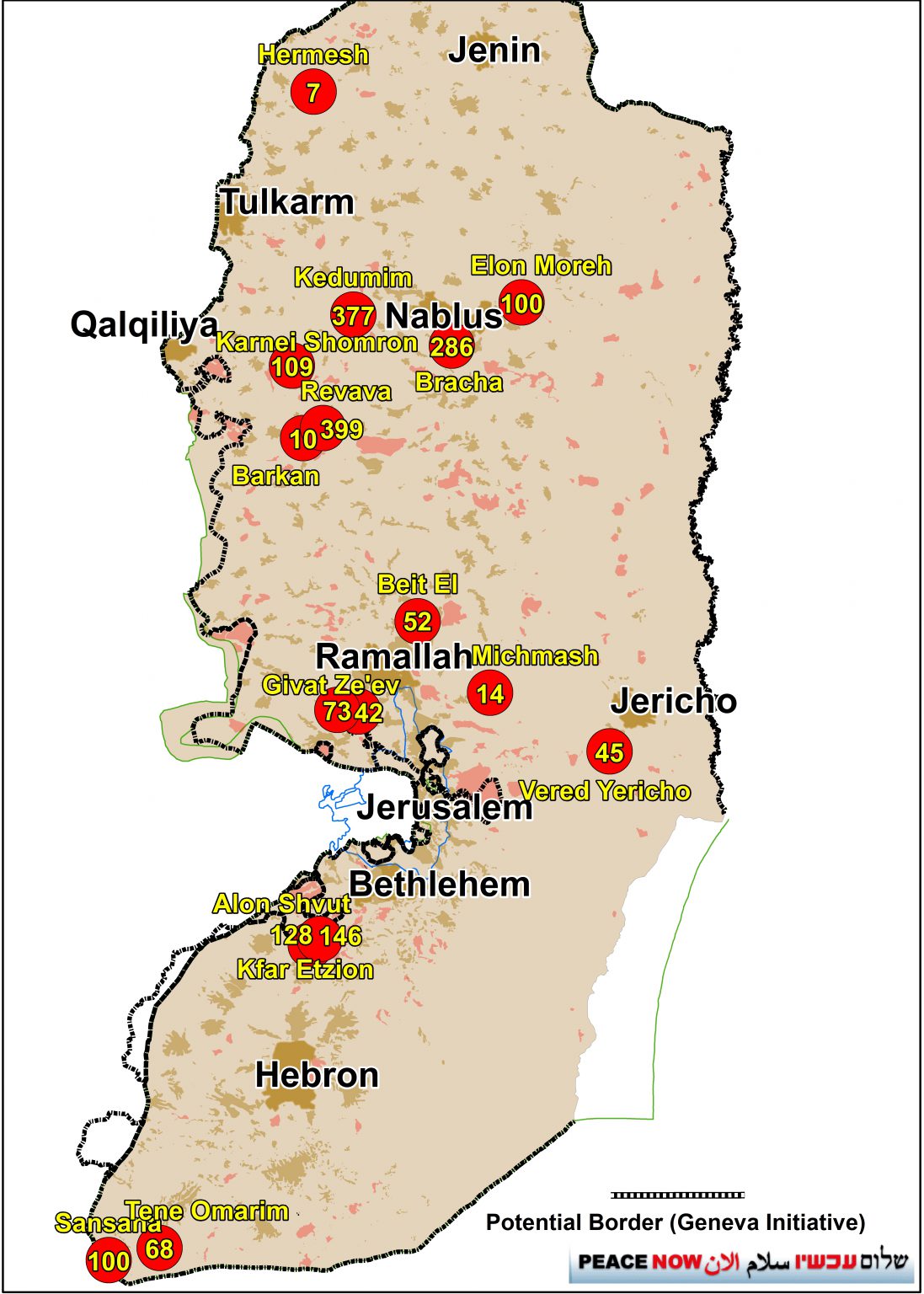 On August 12th, Israeli Defense Minister Benny Gantz announced that the High Planning Council will convene on August 18th to advance 2,259 new settlement units, as part of projects across the West Bank. Of these, 908 units are slated to receive final approval, including many units in areas beyond Israel’s security barrier. This will be the first time that the High Planning Council (HPC) has convened in 10 months, and it will be the first time a large number of settlement units has been advanced since Biden entered the White House. As a reminder, the HPC is a body within the Israeli Civil Administration (which is a part of the Israeli Ministry of Defense) that has authority over construction planning and approvals for both settlers and Palestinians in the West Bank (the HPC does not have authority with respect to settlement construction in East Jerusalem; since Israel annexed the area in 1967, Israeli domestic Israeli planning authorities are in charge there).
The plans expected to receive final approval include:
- 286 units in the Har Bracha settlement, located south of Nablus. If implemented, these new units will double the size of Har Bracha;
- 146 units in the Kfar Etzion settlement, located between Bethlehem and Hebron and on the Israeli side of the planned route of the barrier (which is not yet built in this area);
- 110 units in the Alon Shvut settlement, located just north of the Kfar Etzion settlement and between Bethlehem and Hebron;
- 82 units in the Karnei Shomron settlement, located in the northern West Bank, east of the Palestinian village of Qalqilya. Israel has openly declared its intention to continue expanding settlements in this area with the stated goal of bringing 1 million settlers to live in the area.;
- 52 units in the Beit El settlement, located in the heart of the northern West Bank [as a reminder, former US Ambassador to Israel David Friedman has deep ties to the Beit El settlement]; Construction on 350 new units in Beit El began earlier this year;
- 42 units in the Givat Zeev settlement, located south of Ramallah in an area that. is on the Israeli side of the barrier;
- 14 units in the Ma’aleh Mikhmash settlement, located east of Ramallah;
- 10 units in the Barkan settlement, located about half way between the Ariel settlement and the cluster of settlements slated to be united into a “super settlement” area (Oranit, Elkana, Shiva Tikva, and others).;
Peace Now said:
“The approval of thousands of housing units in the settlements harms the Israeli interest and the chances of reaching peace. It seems that the approval of a handful of plans for the Palestinians is only intended to try to reduce criticism of the government and to please the US administration ahead of Prime Minister Bennett’s expected visit to Washington in the coming weeks. For years, Israel has pursued a policy of blatant discrimination that does not allow almost any construction for Palestinians in Area C, while in the settlements it encourages and promotes the construction of thousands of housing units each year for Israelis. The approval of a few hundred housing units for Palestinians can not cover up discrimination and does not change the fact that Israel maintains an illegal regime of occupation and discrimination in the territories.”
The First Bennett/Biden Settlement Wave, Part 2: Israel Announces Intention to Issue 863 Building Permits for Palestinians in Area C
In announcing plans to advance over 2,000 new settlement units, Defense Minister Gantz also announced his intention to issue permits for 863 houses – some of which will be issued for existing structures – for Palestinians living in Area C. Haaretz reports that the permits are being advanced in order to buy the consent of the few members of the Israeli governing coalition that oppose settlement construction, and as “calculated risk” with respect to the Biden administration.
As a reminder, Area C is the 60% of the West Bank where Israel enjoys absolute authority and has systematically denied Palestinian building rights, while promoting the expansion of settlements and unauthorized outposts. If issued, these permits for Palestinians will be the first issued by Israel in years, and the first of any significant size. Only 21 building permits were issued to Palestinians between 2016 to 2018, while 2,147 demolition orders were issued in the same period.
Commenting on the announcement of the planned permits (which, given past experience, there is no reason to assume will ever be issued) Peace Now said:
“It is a very small expansion of the Palestinian villages and a drop in the ocean in terms of real Palestinian development needs.”
Peace Now reports that these permits, if they are ever issued, might be for:
- 270 houses in the Bir al-Bash village, located south of Jenin in the northern West Bank;
- 233 houses in the the Almasqufa village, located near Tulkarem in the norhtern West Bank;
- 160 houses in the Abba a-Sharqiya village, also located south of Jenin in the northern West Bank;
- 150 houses in the Al-Ma’asara village, located south of Bethlehem; and,
- 50 houses in the Khirbet Zakariya, also located south of Bethlehem.
The First Bennett/Biden Settlement Wave, Part 3: Observations on Settlement Policy Coordination Between Governments
In reporting over the past week, Axios journalist Barak Ravid has documented the efforts by the Israeli and U.S. governments to square conflicting positions with regards to settlement growth.
On the U.S. side, the Biden Administration has appeared to take pains to make room in its official discourse to begrudgingly tolerate settlement construction. While the U.S. has criticized the new batch of settlement advancements, until this week the U.S. had reportedly identified three actions it has asked Israel to refrain from, notably not including settlement expansion. Those three actions are: the demolition of Palestinian homes, the eviction of Palestinians from their homes, and the establishment of new outposts in the West Bank. The U.S. is also reportedly asking Israel to take positive steps to stabilize the Palestinian Authority, which is suffering from economic shortfalls and crashing levels of popular support.
For it’s part, Israeli press suggests that the Bennett government reduced the number of upcoming settlement advancements in order to appease the Biden Administration. The Israelis wanted to advance 3,623 plans, but announced a total of 2,259 (a 39% cut according to Jerusalem Post). Axios also reports that the Israeli government is assertively framing its settlement policy as one of restraint, prioritizing settlement projects that address the supposed “natural growth” needs of existing settlements.
“Natural growth” has been used many times in the past by the Israeli government as an argument for why settlements must be allowed to expand. FMEP’s Lara Friedman has debunked this argument many times in the past, explaining:
“While ‘natural growth’ has no formal definition, it has generally been used in the settler context to mean population growth due to births, as contrasted to growth due to immigration from Israel or other places. But in numerical terms (according to Israeli official statistics), taking into account deaths and people migrating out of settlements, births inside the settlements account for approximately 60% of the annual population growth in settlements, while around 40% is immigration from inside Israel or abroad. So clearly population growth in settlements is not simply a matter of births. Perhaps this is why some excuse-makers have expanded ‘natural growth’ to include other ways that families can grow, from non-settler spouses to aged non-settler relatives moving in.
“Regardless of what definition people want to use, the fact is that ‘natural growth’ is not a legitimate argument against a complete freeze in settlement construction. Yes, settlers, like people everywhere, indeed have the right to have babies, and yes, their children indeed have the right to grow up and have families and homes of their own. But nowhere in the world – not in New York, or Paris, or Tel Aviv – do people have an inalienable right to live exactly where they want – in the size home they want, in the neighborhood they want – irrespective of real estate market factors, or any political, economic, zoning, or other considerations that may come into play (including in this case, considerations about actual land ownership). Inside Israel, just like in other countries, people regularly face difficult decisions about where to live, given that major cities like Tel Aviv and Jerusalem are crowded and little affordable housing is available.
“Settlers have the right to have babies and to take in their parents or grandparents. When settler children grow up they have the right to start families and have homes of their own. But the settlers must do what people everywhere must do: reconcile their needs as best as possible to the housing market, which is affected not only by demand but by a myriad of other variables – including, in this case, the fact that settlers have knowingly and voluntarily chosen to make their lives on land that is the subject of a political dispute of global proportions.”
Axios quotes an Israeli government official saying:
“The Biden administration knows we are going to build. We know they don’t like it, and both sides don’t want to reach a confrontation around this issue.”
An Israeli government source summarized the dance going on between the respective governments by saying:
“[The U.S.] will express opposition to this move, but everyone wants this impossible coalition in Israel to hold out… It was clear for Bennett he would not have been able to advance this move after his meeting with [U.S. President Joe] Biden at the end of the month, so as not to damage their relations, and that’s why he had to announce it as early as he did.
Jerusalem District Court Orders 16 Homes to Be Demolished While Delaying – for 6 months – Demolition of Others in Silwan
On August 12th, a Jerusalem Court granted a six-month freeze on demolition orders affecting dozens of Palestinian homes in the al-Bustan section in the Silwan neighborhood of East Jerusalem. At the same time, the Court cleared the way for the immediate demolition of 16 Palestinian homes in the same area.
A lawyer representing the Palestinians involved in these demolition cases said his clients intend to file for permits for the structures, which were built on land that Palestinians assert they own. Israel argues that the land is public land.
Israel Begins Work on Settler-Back Project at the Ibrahimi Mosque/Tomb of the Patriarchs
This week, an Israeli crew began construction on a new elevator leading to the Ibrahimi Mosque/Tomb of the Patriarchs in Hebron, arguably one of the most sensitive religious sites outside of Jerusalem. The project to install accessible infrastructure at the site has been backed and pushed by settlers for over two decades and provides a means by which the State of Israel has increased its control over the site. The project is roundly opposed by Palestinians along with archaeologists and other experts. The Israeli archeology group Emek Shaveh explains its opposition:
“We claim that while the plan is couched in terms of concern for the disabled and elderly worshippers, in actual fact it is unilaterally advancing changes to a site mired in deep political controversy…The size and characteristics of the structure demonstrate that at issue is not simply a lift for persons with disabilities, but a significant change to the compound. The lift will constitute a change in the status quo and a strengthening of the settlers’ control of the holy site. Ignoring the fact that the site falls under the auspices of the Hebron Municipality is evidence that Israel is further reneging on its commitments to agreements signed in the past with Palestinians.”
Atarot Settlement Plan to Be Discussed on December 6th
As expected, the Jerusalem District Planning and Building Committee has set a date – December 6th – for the advancement of the Atarot settlement plan. This plan would allow for the construction of 9,000 settlement units, to be built on the site of the former Qalandiya airport (located at the northern tip of East Jerusalem).
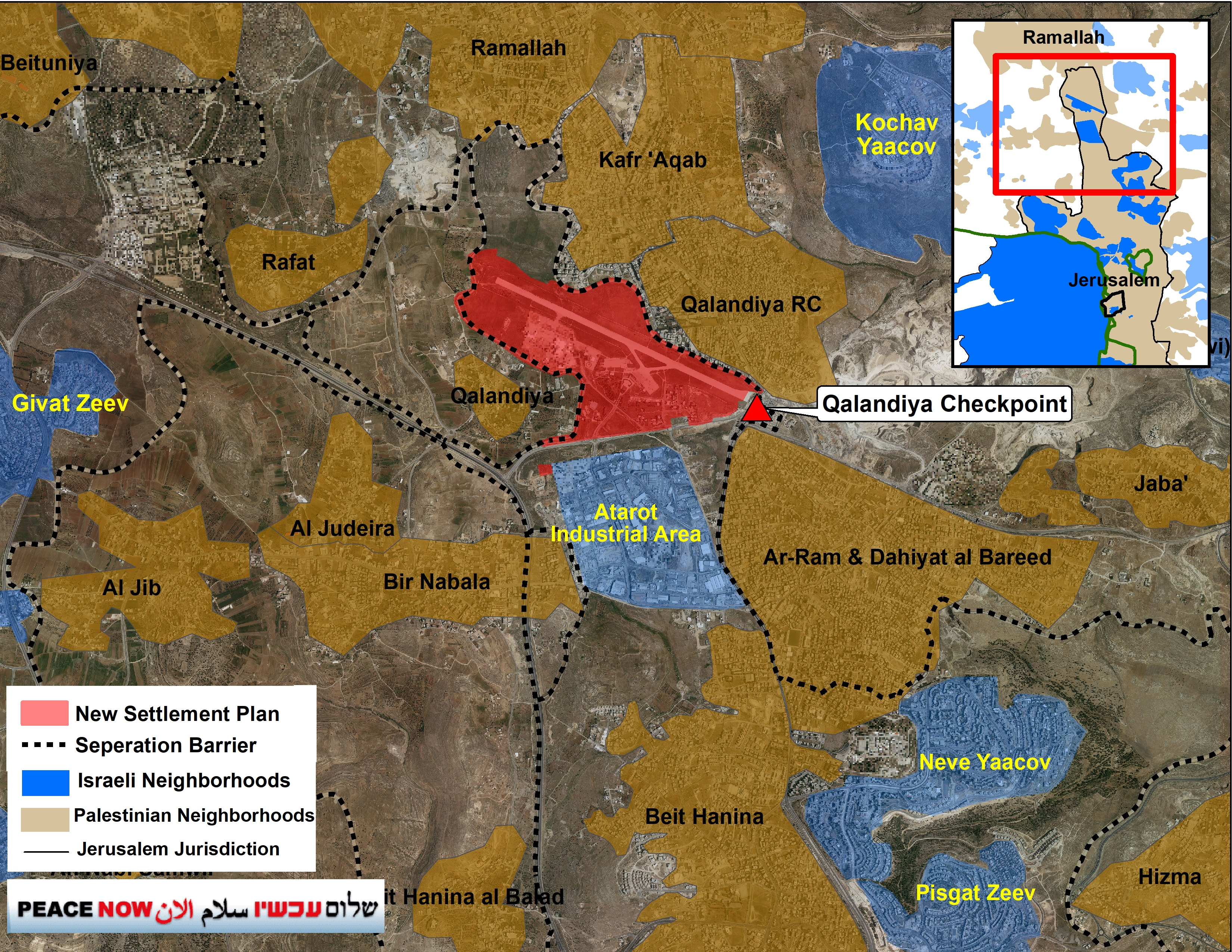 The Atarot settlement plan dates back to 2007. It was pursued by the Israeli government in 2012 but shelved under pressure from the Obama administration. The plan came back into consideration in April 2017 (a few months following the inauguration of President Trump) when it was rumored to be included on Netanyahu’s master blueprint of settlements for which he was seeking U.S. approval. In February 2020, following the publication of the Trump Plan – which designated the area that would be used for the settlement as a “special tourist zone” for Palestinians – the Atarot settlement plan was formally introduced. In January 2021 then-Prime Minister Netanyahu dangled the advancement of the plan as an incentive for parties to join his flagging coalition in order to remain in power.
In its current form, the plan provides for up to 9,000 residential units for ultra-Orthodox Jews (assuming, conservatively, an average family size of 6, this means housing for 54,000 people), as well as synagogues, ritual baths (mikvehs), commercial properties, offices and work spaces, a hotel, and a water reservoir. If built, the Atarot settlement will effectively be a small Israeli city surrounded by Palestinian East Jerusalem neighborhoods on three sides and Ramallah to its north.
There are currently 15 Palestinian families living in buildings on the land slated for the settlement, part of which is privately owned by Palestinians. Other land in the area has been declared “state land” by Israel or belongs to the Jewish National Fund. To solve the problem of Palestinian land owners, the Israeli government will need to evict the Palestinians living there and demolish their homes — a step that will be facilitated by the fact that all of the homes lack Israeli-issued building permits (which are essentially impossible for Palestinians to receive). The private Palestinian landowners will then be subjected to a non-consensual process of “reparcelization,” in which Israel will unilaterally reparcel and then redistribute the land amongst its owners on the basis of the value of the land (as determined by Israel) and the percentage of their ownership claim.
The Atarot airport site is an important commodity and, during past negotiations, it was promised to the Palestinians for their state’s future international gateway. Israeli development of the site as a settlement would — by design — not only deprive a future Palestinian state of the only airport in a Palestinian area, but also dismember Palestinian neighborhoods in the northern part of the Jerusalem, and sever East Jerusalem from a Palestinian state on this northern flank of the city (acting like E-1 on Jerusalem’s northeast flank, and like Givat Hamatos on Jerusalem’s southern flank).
Bonus Reads
- “Case Study: How a Settler Law-Breaker Became the #2 Official in Israel’s Ministry of the Interior” (FMEP // Lara Friedman w/ Dror Etkes)
- “Senior Israeli Official’s Appointment Approved Despite Demolition Order for His Settlement Home” (Haaretz)
- “In Sheikh Jarrah, anonymous actors and an absent state have created a powder keg” (The Times of Israel)
- “The Fight for Palestine’s Sheikh Jarrah Isn’t Over” (Jacobin)
- “ICC Mulls Probing Israel Over Razing Palestinian Homes in Jordan Valley” (Haaretz)
- “81 Palestinian homes demolished by Israel in East Jerusalem in 2021” (Middle East Monitor)
- “Jewish claim of land ownership in occupied East Jerusalem neighborhood displaces five Palestinian families” (WAFA)
Welcome to FMEP’s Weekly Settlement & Annexation Report. To subscribe to this report, please click here.
July 30, 2021
- Sheikh Jarrah Updates: Court Issues Delays for Three Cases; Bennett Reportedly Considering Delaying Four Others
- In First Since Settlement Regulation Law Was Overturned, Israel Announces Intent to Demolish Settlement Buildings on Privately Owned Palestinian Land
- Elad Settler Group Loses Control Over East Jerusalem Holy Site/Archaeological Park
- Knesset Votes Down West Bank Annexation Bill, Condemns Ben & Jerry’s
- State Allows (& Funds) “Farming Outposts” to Graze Huge Tracts of West Bank Land
- Outpost Activity Continues in the South Hebron Hills
- Israeli Army Let Settlers Stay at Abandoned Base Despite Knowing Plans for Illegal Outpost
- Bonus Reads
Comments or questions? Email Kristin McCarthy – kmccarthy@fmep.org.
Sheikh Jarrah Updates: Court Issues Delays for Three Cases; Bennett Reportedly Considering Delaying Four Others
On July 29th, the Israeli Supreme Court issued notices delaying the forcible displacement of three families (Dajani, Hammad, and Dahoudi) from their longtime homes in the Sheikh Jarrah neighborhood of East Jerusalem. The eviction orders were set to become enforceable on Sunday August 1st, but the Court has halted the evictions while an appeal filed by the Palestinian families is dealt with.
Also sheduled for August 2nd, the Supreme Court is currently set to hold a final hearing to decide on the fate of four other Palestinian families (Jaouni, Iskafi, al-Kurd, and al-Qadi) facing forcible eviction in Sheikh Jarrah. According to press reports, Prime Minister Naftali Bennett is considering delaying the final hearing (thus stopping the evictions for the time being). Notably, reports suggest Bennett is looking not to cancel the evictions but only to postpone a final decision on them – a postponement that could be reversed at any time at the whim of the Prime Minister (for example, when the world’s attention is elsewhere).
In an op-ed in The Guardian, Mohammad El-Kurd – whose family is facing eviction – powerfully wrote:
“On 2 August, the Israeli supreme court, whose jurisdiction over the eastern part of Jerusalem defies international law, is set to decide whether it will allow the appeal of my family and three others – a last legal obstacle before we can be expelled. There have been postponements before. Palestinians are accustomed to this kind of stalling; it tests our stamina. But we are as stubborn as anyone else faced with the prospect of losing their home – their life, their memories – to those using force, intimidation and biased laws. In the face of this cruelty, and despite teargas and skunk water, we are resisting. We cannot allow them to steal our homes once more, and we refuse to continue living in refugee camps while colonisers live in our houses. We cannot let them throw more of us on to the streets. We are tired of being turned into a refugee population, neighbourhood after neighbourhood, one home at a time. I have no faith in the Israeli judicial system; it is a part of the settler-colonial state, built by settlers for settlers. Nor do I expect any of the international governments who have been deeply complicit in Israel’s colonial enterprise to intervene on our behalf. But I do have faith in those people around the world who protest and pressure their governments to end what is essentially unconditional support for Israeli policies. Impunity and war crimes will not be stopped by statements of condemnation and raised eyebrows. We Palestinians have repeatedly articulated what kind of transformative political measures must be taken – such as civil society boycotts and state-level sanctions. The problem is not ignorance, it is inaction.”
In First Since Settlement Regulation Law Was Overturned, Israel Announces Intent to Demolish Settlement Buildings on Privately Owned Palestinian Land
On July 28th, the Israeli Attorney General’s office informed the High Court of Justice that within three years (!!) it plans to carry out the demolition of two buildings built by settlers on privately owned Palestinian land located inside of the Eli settlement, in the context of a petition filed in 2011 by Palestinian land owners with the assistance of Yesh Din and Bimkom. Notably, the underlying legal petition sought the demolition of a total of 20 buildings constructed illegally on private Palestinian land, 18 of which Israel granted retroactive legalization in February 2020.
According to the Jerusalem Post, this is the first instance of the Court resuming looking at a case of this kind since the Settlement Regulation Law was overturned by the Court in June 2020. Previously, all cases involving illegal construction inside of settlements had been frozen while the Court considered the constitutionality of the law, which sought to create a legal basis by which Israel would be able to grant retroactive legalization to outposts and settlement structures built on land that even Israel acknowledges is privately owned by Palestinians.
In resuming its consideration of the case, the Court first asked to be updated on the State’s reexamination of the status of the land in hopes of finding a means by which to retroactively legalize the illegal construction, despite the fact that a previous government effort confirmed that the two buildings fall outside of the boundaries of state-owned land. With no other avenue available to “legalize” the construction, the State informed the Court this week that it intends to demolish the structures after the three years, which it claimed was the amount of time required to provide new housing for the four affected settler families [demonstrating, as always, that settler law-breakers are never punished and always rewarded]. This long delay also suggests that the State will continue to look for new ways to avoid demolishing the homes.
Leaders of the Land of Israel Lobby in the Knesset, MKs Yoav Kisch and Orit Strock, told Israel Hayom:
“This week, the government informed the High Court of Justice that it agrees to demolish the homes of four families in Eli. This is a horrifying, shocking announcement. Rather than preventing the destruction of Jewish homes in Judea and Samaria, the government is busy regulating the illegal construction crimes in the Bedouin sector. This is a badge of shame for the government, which is freezing construction, as well as going back on all its promises to regulate [settlements] and also demolishing Jews’ homes.”
Yisrael Gantz – who heads the Benyamim settler regional council – said:
“We are surprised that the government is falling in line with the Arab petitioners and announcing that it will, heaven forbid, demolish two homes where families have been living for years, which are part of a living, vibrant neighborhood. Razing a home whose status was legal and which a new review by the Civil Administration left outside the settlement’s borders is a new low in crimes against settlement in Judea and Samaria. These two homes are just a preview. We have hundreds of homes with similar status in the Binyamin settlements and thousands throughout the settlements as a whole that suddenly found themselves outside the new ‘blue lines’ drawn in the Civil Administration’s work. No normal country would demolish homes in a situation like this.”
Elad Settler Group Loses Control Over East Jerusalem Holy Site/Archaeological Park
On July 1st, the State of Israel re-asserted control over a significant and highly sensitive archaeological and holy site – the Davidson Archaeological Park – located just outside of the walls of the Temple Mount/Haram Al-Sharif. The park, which includes most notably tunnels that run directly from the Western Wall plaza to the settler-run Davidson Center in Silawn – had been run by the Elad settler organization since 2018, when the State willingly transferred its authority to Elad to operate the park.
In 2015 the Israeli NGO Emek Shaveh, which is made up of archeological experts, filed a petition against Elad’s role at the park, arguing that “it is highly problematic to place the running or management of a holy site that is situated alongside the Western Wall foundations in the hands of a private and politicized organization.” Emek Shaveh’s argument mirrored an opinion issued by Israel’s Attorney General which held that holy sites should be managed by the State.
Notably, the end of the state’s contract with Elad regarding the Davidson Park reduces but does not eliminate Elad’s role in managing key sites in Jerusalem. Elad continues to operate the nearby City of David archaeological park (just outside the Old City’s walls), where it has been advancing numerous settlement projects meant to strengthen its control over the area and displace Palestinians.
Emek Shaveh said in a statement:
“We are pleased that the authorities have put an end to a highly problematic arrangement whereby a private right-wing organization is operating an important site situated in perhaps the most sensitive place in the region. We hope that in the future the State will take full responsibility for additional sites which it handed over to the settlers’ foundation. The City of David is, no doubt, the next site that ought to be returned to full management by the State. Emek Shaveh’s case regarding the tunnel linking the Davidson Center to Givati is still ongoing.”
Knesset Votes Down West Bank Annexation Bill, Condemns Ben & Jerry’s
In a July 28th preliminary vote the Knesset rejected, by a relatively slim margin (64 to 50), a bill to annex the entire West Bank. Members of Prime Minister Naftali Bennett’s ruling party, Yamina, voted against the bill. The bill had been submitted by members of the Likud party, which is now in the opposition after 15 years of being the most powerful party in the country and having had the ability to pass such a bill if desired. One of the bill’s cosponsors, Miki Zohar, said after the vote:
“You promised again and again that you will take action to bring about sovereignty over Judea and Samaria and you once again broke your word,” Zohar said. “You once again proved that you have no ideology and that no values are holy for you except for keeping your cabinet seats.”
Justice Minister Gideon Sa’ar (New Hope) responded, saying:
“I heard MK Mikki Zohar relating to the fact that in the last administration, Netanyahu wanted to apply sovereignty but Blue and White prevented him from doing so. And I was just thinking to myself, ‘How far from the truth can you get?’…So you, MK Zohar, party whip for the Likud in the last Knesset, could have brought this bill up in the last Netanyahu government, during the Trump administration, during the amazing window of opportunity – you could have submitted the sovereignty bill and had a majority in the Knesset.”
Around the same time this bill was voted on, 90 members of the Knesset, including Yamina members, signed a letter calling on Ben & Jerry’s to reverse its decision to end sales in the occupied West Bank. The letter refers to settlements as “towns and cities in Israel” – a statement tantamount to a declaration of de facto – if not official – annexation. Notably, 6 MKs – from Labor and Meretz – subsequently removed their names for the letter, claiming that they signed on without seeing the final wording, and that the final wording does not reflect their views.
State Allows (& Funds) “Farming Outposts” to Graze Huge Tracts of West Bank Land
In response to a Peace Now inquiry, the Israeli Agricultural Ministry revealed that it has granted permits to unauthorized (i.e., illegal under even Israel law) agricultural outposts to use over 2,000 acres (8,500 dunams) of land in the West Bank for grazing, in a program which entrenches and expands the outposts’ illegal presence across the West Bank.

Map by Peace Now
And if that wasn’t enough of a scandal, the Ministry confirmed that it provided sizable grants – totalling over $800,000 (2.6 million NIS) over the past few years – to at least three settlement organizations for the purpose of bringing volunteers to these outposts – which, again, are illegal even under Israeli law – to work the land. Notably, these settler organizations publicly boast about their farming activities with respect to a total of 50 farming outposts, suggesting that settlers are making use of far more than the 2,000 acres permitted by the Ministry (the Ministry clarified that it funds activities only related to the areas where settlers are authorized to work — so apparently they see no problem].
Peace Now said:
“The Ministry of Agriculture takes millions of Shekels of public monies and give them to associations which are intrinsically linked to illegal activity. If the government wants to stop more outposts such as “Evyatar” from existing, and to stop the small group of ideological settlers who allow themselves to set facts on the ground that determines the foreign and security policies for Israel, it must change its ways immediately and stop supporting outposts and illegal activities”.
Two of the outposts to which the Agricultural Ministry awarded grazing permits are located in the south Hebron hills, on land that is privately owned by Palestinians. One of those outposts, established by a settler named Shavti Kohslaviski, has active demolition orders issued against it. A third outpost that received grazing permits is located near the Elon Moreh settlement, on a site that is partially privately owned Palestinian land that Israel has made inaccessible to its Palestinian owners but on which settlers regularly trespass .
Israeli Army Let Settlers Stay at Abandoned Base Despite Knowing Plans for Illegal Outpost
Kerem Navot reports that on July 23rd, dozens of settlers were allowed to stay at an abandoned military base in the Jordan Valley with permission of the Israeli army. The Israeli Commander in charge of the area reportedly said that he granted permission for the settlers to hike in the area and spend one night at the army base – – despite the fact that the settlers openly declared their intent to establish a permanent presence there. The settlers left after two nights at the site, though a government source told Haaretz that the problem will continue to linger, saying “the minute the brigade commander allowed this one time, they will go up there regularly, when they feel like it, with or without permission, and the defense establishment will have to start dealing with it.”
Kerem Navot reports:
“The organization that is behind this current takeover attempt is called “Nahala.” Nahala is the same group behind the takeover of Mount Sbeih south of the village of Beita, upon which the outpost of Eviatar was founded two months ago, and operates behind a fictional NGO (which we wrote about not long ago- https://bit.ly/3763yJW). Yes, you understood that correctly: The same people who broke the law when they established the outpost Eviatar, are advancing a new aggressive takeover of lands that do not belong to them, instead of standing trial. Welcome to the West Bank.”
Outpost Activity Continues in the South Hebron Hills
On July 25th, Palestinian media reported that settlers have begun reestablishing an outpost in the south Herbron hills, near the town of Yatta. Settlers had abandoned the outpost a few months ago under regular protests by Palestinians.
On July 27th, the Israeli government dismantled another outpost – called “Beit Dror” by settlers – in the south Hebron hills. There were seven families of settlers living at the outpost in pre-fabricated homes which were removed from the area by cranes. Following the evacuation, the settlers held a cornerstone-laying ceremony at the site, vowing to return and permanently build on the land.
Bonus Reads
- “Over 140 Palestinians hurt after Israeli troops attack anti-settlement protesters” (The New Arab)
- “A water spring in the occupied Jordan Valley targeted for takeover by Israeli settlers” (WAFA)
- “Palestinian teenager killed by Israeli troops in West Bank” (The New Arab)
- “Ben & Jerry’s Is Shunning Israeli Settlements. The U.S. Should Too” (DAWN)