Welcome to FMEP’s Weekly Settlement Report, covering everything you need to know about Israeli settlement and annexation activity this week.
To subscribe to this report, please click here.
January 17, 2025
- Settlement Advancement Continue on Weekly Basis
- Judge Rules on Five Cases, All in Favor of Settlers Claims in Batan al-Hawa
- New Bimkom-Ir Amim Report: Planning in East Jerusalem Completely Halted by New Protocol
- New Data Confirms: Settlers Face Virtually NO Accountability for Crimes Against Palestinians & Their Property
- Al-Haq and Partners File Additional Info on Booking.Com Settlement Business
- Trump Invites Settler Leaders to Attend Inauguration
- Bonus Reads
Settlement Advancement Continue on Weekly Basis
Peace Now reports the High Planning Council was scheduled to convene on January 15th to advance plans for 372 new settlement units, all planned for the Beitar Illit settlement. This is the seventh week in a row the HPC has met to approve settlement construction.
The HPC is scheduled to meet again next week, on January 22nd, for the eighth consecutive week. At that meeting, the HPC is expected to give final approval to a plan for the construction of 184 new settlement units in the Migdalim settlement.
Peace Now writes:
“Since the current Netanyahu government took office, record numbers of housing units have been advanced in the West Bank. In 2023, the HPC approved 12,349 housing units—a record high. In 2024, 9,884 housing units were approved. The transition to weekly planning approvals is the result of policy changes introduced by the Netanyahu-Smotrich government. One key decision, made in June 2023, abolished the requirement for the Defense Minister’s approval at every stage of advancing settlement plans. Previously, settlement construction plans required prior approval from the Defense Minister. In recent years, the Defense Minister limited settlement planning sessions to approximately four times a year, resulting in the approval of thousands of units in each session.
In recent weeks, however, a significant change has occurred, with the HPC convening every week to approve a few hundred housing units in each meeting. This systematic approach aims to normalize settlement planning and attract less public and international attention and criticism.”
Judge Rules on Five Cases, All in Favor of Settlers Claims in Batan al-Hawa
Peace Now reports that the Jerusalem Magistrate’s Court has ruled in favor of Israeli settlers in four cases (with a fifth ruling expected soon), resulting in the impending eviction of Palestinians from their longtime homes in the Batan al-Hawa section of the Silwan neighborhood in East Jerusalem in favor of the settlers. The five cases will result in 27 Palestinian families (131 individuals, mostly children) being forcibly displaced from their homes. The Court gave the families a six month deadline.
 The Court’s ruling accepts settlers’ claim to own the land on which the Palestinians’ homes are located, homes which the Court recognized were legally purchased by Palestinians in the 1960s. Regardless of the validity of the home ownership, the Court recognized the settler’s ownership of the land under a discriminatory Israeli law that allows Jews to “reclaim” property and land that was owned by Jews prior to 1948. This law is being used by settlers to achieve mass displacement of Palestinians across East Jerusalem.
Peace Now writes:
“This is an injustice and a crime against a vulnerable population living under occupation in East Jerusalem. The dispossession of Palestinians from their homes in Silwan, enabled by the application of the Jewish ‘right of return,’ represents an indelible stain on the State of Israel. The Israeli judicial system has failed to protect the fundamental rights of Palestinians to their homes, effectively endorsing the racist and messianic policies of the current Israeli government. A responsible government would halt the forced expulsions of this community. Tragically, our government demonstrates anything but responsibility in any regard. The International Court of Justice has explicitly addressed the discriminatory legal framework and Israel’s settlement policy in East Jerusalem in its advisory opinion, declaring these practices a violation of international law.”
Ir Amim writes:
“Since the outbreak of the war, there has been a dramatic spike in the number of court decisions authorizing evictions of Palestinian families in favor of settler groups. Over the past several months, the courts have ruled to evict a total of 17 families (households), numbering some 100 individuals–the majority of whom are from Batan al-Hawa.”
New Bimkom-Ir Amim Report: Planning in East Jerusalem Completely Halted by New Protocol
Ir Amim and Bimkom have released a new report examining the recent intensification of Israel systematical denial of the ability for Palestinians to plan for construction in East Jerusalem. In 2023 Israel replaced the traditional “Muktar Protocol” with a new process which has resulted in a near total freeze on planning for Palestinians on unregistered private property.
The report explains:
“In comparison to the “Mukhtar Protocol,” the new protocol has had a detrimental impact on private residential planning (and building) in East Jerusalem4. According to the new protocol, planning and building submissions are required to include Jordanian property tax certificates from the early 1960s or earlier (or Israeli property tax until the year 2000) along with records detailing the historical chain of ownership up to the present. These requirements, usually demanded only as part of SOLT procedures– which are problematic in themselves– are new to the planning process. Additionally, the new protocol requires that the District Planning Bureau approach state authorities, such as the Custodian of Absentee Property (CAP), the General Custodian (GC), the Israel Land Authority (ILA), the Municipality, and the SOLT registrar to check whether they have claims on the same land. In the past, the SOLT registrar was not on this list, and the Planning Bureau often did not wait for responses from the other entities to proceed.
Now, the SOLT registrar has been in effect given the right of veto within the planning process. The added requirements present East Jerusalem Palestinians with two difficulties – a bureaucratic and a fundamental one. The bureaucratic difficulty is related to the challenge of obtaining the necessary documents. The fundamental difficulty is the real danger of losing land under the Absentee Property Law, which is applied through the new protocol, as it is via SOLT.”
New Data Confirms: Settlers Face Virtually NO Accountability for Crimes Against Palestinians & Their Property
Yesh Din’s newly updated tracking shows that 94% of criminal investigations into ideological offenses committed by Israelis against Palestinians in the West Bank in the past 20 years have been closed without indictments. Further, Yesh Din has found insufficient investigations into 81% of the cases, displaying “a longstanding systemic and deliberate failure in law enforcement responses to ideologically motivated crime against Palestinians in the West Bank.”
Yesh Din further explains that the larger context of this data paints an even more dire picture. They find 66% of Palestinian victims chose not to file complaints against Israeli offenders at all – meaning the data does not tell the full story. Palestinians victims of Israeli violence routinely cite a lack of faith in the Israel Police and trust that the Israeli authorities in their decision not to file a complaint.
The picture is clear: violence is a policy. Settler violence is part of a systematic approach aimed at expanding control over West Bank territory by making Palestinian lives unbearable and pushing them off their lands.
Yesh Din writes:
“This reflects the ongoing failure of Israeli authorities to enforce the law against Israeli citizens who commit serious crimes against Palestinians and their property. For two decades, we have monitored this phenomenon and provided legal assistance to Palestinian victims. The new data underscores the lack of deterrence and the lenient policies of Israeli law enforcement toward ideological crimes. Most investigations are closed on grounds such as “unknown perpetrator” or “lack of evidence,” highlighting negligent and ineffective investigations. Only 3% of cases resulted in convictions, giving offenders a sense of immunity from accountability for their actions while Palestinians whose rights are violated remain unprotected by the law.”
Al-Haq and Partners File Additional Info on Booking.Com Settlement Business
Al-Haq and partners have filed additional evidence against Booking.com accusing the travel company of profiting from stolen land through its decision to promote rentals located in settlements in East Jerusalem and the West Bank. The new evidence, which was submitted to a court in the Netherlands where the case was filed in 2023, accuses Booking.com of adding to the number of listings it hosts in settlements – from 13 rentals to 39 rentals in East Jerusalem over the past year.
The complainants write:
“In our complaint, we argue that by promoting and listing properties in illegal settlements, Booking.com directly supports the normalisation and economic sustainability of these unlawful practices. The company provides financial backing to settlers and their enterprises, furthering the displacement of Palestinians and solidifying settlement expansion. This conduct sustains Israel’s settler-colonial regime and violations of international law, including the Fourth Geneva Convention, which prohibits population transfer into occupied territories. We have substantiated our claims thoroughly. For instance, the additional evidence builds on the July 2024 Advisory Opinion of the International Court of Justice, which reaffirmed the illegality of Israeli settlements and underscored the responsibility of states to prevent economic activities that perpetuate them.”
Trump Invites Settler Leaders to Attend Inauguration
Settlers leaders from the powerful Yesha Council are gleefully celebrating their invitation to attend the inauguration of Donald Trump, who is being sworn into office on January 20th. Yesha Council Chairman and Binyamin Regional Council Head Israel Ganz, Samaria Regional Council Head Yossi Dagan, Oranit Council Head Or Piron-Zomer, and Yesha Council CEO Omer Rahamim all plan to attend as official guests.
The Times of Israel reports the delegation plans to deliver a letter thanking Trump for “redeeming” Jerusalem and recognizing Israel’s annexation of the Golan Heights during his previous presidency.
Speaking about the delegations plans, a Yesha Council official told Israel Hayom:
“Our objective is to strengthen existing connections and forge new ones. Washington’s attention is elsewhere at present. Trump is focused on Greenland sovereignty matters, not Israel’s concerns in Judea and Samaria. Timing is crucial. We must proceed strategically and appropriately.”
In a statement to Israel Hayom, Yesha Council Chairman Israel Ganz said:
“We represent Judea and Samaria residents in standing with our allies and President-elect Trump at this historic moment. The administration’s invitation reflects our shared Biblical values with the US. We face a common moral challenge against global threats, with Judea and Samaria settlements serving as the frontline defense for Israel, America, and the free world. We envision achieving transformative progress that will ensure global stability for generations, and we support Trump’s leadership in this endeavor. Our ongoing dialogue with senior administration officials continues to advance these goals.”
Samaria Regional Council Head Yossi Dagan told Israel Hayom:
“Our delegation brings the blessing of the communities in Judea and Samaria to the new administration. Years of relationship-building with our newly elected American friends have created this pivotal opportunity for Israel, particularly its government, to achieve significant advances in strengthening our presence in the Land of Israel. Our unified approach underscores the importance of maintaining strong ties with the incoming American administration and bolstering support for the communities in Judea and Samaria, both internationally and among US Jewish communities.”
Bonus Reads
- “Defense Chief Cancels Detention Without Trial for Settlers Ahead of ‘Terrorists’ Release in Gaza Hostage Deal” (Haaretz)
- “Humanitarian Situation Update #256 | West Bank” (OCHA)
- “Israeli minister asks PM to back plan for a million Jews in Samaria” (JNS)
Welcome to FMEP’s Weekly Settlement Report, covering everything you need to know about Israeli settlement activity this week.
To subscribe to this report, please click here.
July 12, 2024
- A Stunning, Expansive Time for Israel’s West Bank Annexation
- Civil Admin Seizes Patchwork of Plots as “State Land” in Order to Legalize the Evyatar Outpost
- Government Establishes Jurisdiction for New Settlement on World Heritage Site Near Bethlehem
- Settlers Takeover New Building in Hebron
- Historic Year for Land Grabs: Israel Seizes Over 3,000 Acres in the Jordan Valley as “State Land”
- Civil Admin Advances Plans to Legalize Three Outposts & Build 5k New Units Across West Bank
- Israeli Cabinet Gives Civil Admin Authority Over Antiquity Sites in Area B
- Israeli Cabinet Supports Knesset Considers Bill to Transfer West Bank Antiquities Control from Civil Admin to Domestic Body
- U.S. Issues New Round of Sanctions Against Settlers & Settler Organizations
- Israeli Court Orders 11 Families Out of Homes in Batan al-Hawa, Silwan
- Israeli Court Rules to Demolish Wadi Hilweh Info Center in Silwan
- Israeli Court Tells Settlers To Leave Khalidi Library in Old City of Jerusalem
- Israel to Advance 6,000+ Settlement Units in East Jerusalem in Coming Weeks
- Amidst Wave of Violence, Settlers Lead Progrom On Massafer Yatta Region
- Ariel Settlers Close Access Road to Palestinians
- IDF Demolishes Outposts, Clashes With Settlers
- Bonus Reads
A Stunning, Expansive Time for Israel’s West Bank Annexation
Over the past two weeks, Israel has unleashed a flurry of settlement activity that makes its annexation of the West Bank complete. Even a small sampling of those acts, detailed below along with other news, are stunning when taken together. Indeed, Israeli National Missions Minister Orti Strock called this “a miraculous time,” referring to the control her and her allies have over key government bodies and how easy it is for them to fund settlement construction. Strock is a member of the Religious Zionism party, along with Bezalel Smotrich.
Renowned Israeli human rights lawyer Michael Sfard encapsulates this time powerfully in an article entitled, “Smotrich Has Completed Israel’s Annexation of the West Bank”:
“The only thing the annexationist criminals must be saying to themselves now is: why did we wait for 57 years? It’s so easy.”
Civil Admin Seizes Patchwork of Plots as “State Land” in Order to Legalize the Evyatar Outpost
On July 8th, the Israeli government declared 16 acres (66 dunams) of land south of Nablus as Israeli “state land” in order to pave the way for the legalization of the Evyatar outpost. Palestinians who have private ownership claims to the land have 45 days in which to submit an appeal. The declaration is the result of three years of “work” by Smotrich’s Settlements Administration to examine the status of the land in order to find a way for the state to take control of the land in order to legalize the outpost. The declaration comes one week after the Israeli Security of Cabinet decided in favor of legalizing the Evyatar outpost along with four other outposts.
The Evyatar outpost was illegally built by settlers on a strategic hilltop named Mount Sabih, located just south of Nablus on land historically belonging to nearby Palestinian villages Beita, Yatma, and Qablan. It was evacuated by the Israeli government in 2021 in the context of an agreement with settlers that left all construction at the site in place, maintained an IDF presence at the site, and made clear the government’s intent to legalize settlement at the site in the future – a goal which was made more than official when it was agreed to in writing as part of the coalition agreements that formed the current Israeli government.
 To underscore the absurdity which has characterized the State’s blatant intent to legalize Evyatar even though Israeli law makes that an impossibility because parts of the land are recognized by the State as privately owned by Palestinians (which is the only reason Evyatar has yet to be legalized), the State’s new declaration of “state land” is a complete patchwork. The order does not include the land on which the central square of the outpost is built, nor does it include 11 buildings, or, very importantly, the access road leading from the main road to the outpost. The implications of this patchwork is that even though the privately owned land was not seized, Palestinians will remain unable to access the land and will, in practice, lose that land as well as land abutting the settlement as it grows, expands, and establishes control over the area with the assistance of the IDF.
Peace Now reports that this is the fifth “state land” declaration so far in 2024 bringing the total land in the West Bank taken into Israeli control this year to 5,879 acres (23,572 dunams), breaking all previous annual records combined. Israel invented the concept of “state land” in order to find means by which to confiscate land in the occupied West Bank, and to do so Israel cites Ottoman law which provided that land which has not been cultivated in consecutives years becomes the property of the sovereign. Peace Now explains:
“The declaration process is essentially a legal maneuver developed by Israel to circumvent the prohibition in international law against expropriating private property of the occupied population for the benefit of the occupying power. To “convert” private land into public land (termed “state land”) without expropriating it, Israel claims that it is not changing the land’s status but merely “declaring” it officially.
According to Israel’s interpretation of Ottoman land law, which underpins the land laws in the occupied territories, if a landowner does not cultivate their land for several years, the land is no longer theirs and becomes public property. To this end, the mapping personnel of the Civil Administration, now operating under the Settlements Administration with legal counsel under Minister Smotrich, examine aerial photographs to identify uncultivated lands and mark them as “state land.”
The declaration map for the Evyatar outpost shows that there were indeed several cultivated lands, even by Israel’s stringent interpretation. For example, the declaration creates an enclave of about 3.5 dunams in the middle of the area designated for the settlement, considered private land. In principle, Israel would argue that it is not expropriating this area and that the Palestinian landowners are still recognized as the owners. However, as in hundreds of similar cases, it is clear that they will not have access to their land and no possibility of using it when it is located in the middle of an Israeli settlement.
To enable an access road connecting the outpost to the main road without crossing private land, the map’s designers managed to “find” an 11-meter-long and 1.5-meter-wide corridor of land that they claim was uncultivated and thus considered state land. This interpretation of Ottoman law brings it to absurdity.
According to this, if a person has a plot and cultivates it intensively, but there is a small uncultivated strip on the edges, say a rock that cannot be plowed, that small part of the plot is not owned by the landowner. This interpretation is far removed from the purpose of the Ottoman law, which was to encourage the empire’s subjects to cultivate the lands to increase its tax revenues.
Regarding the access road – in any case, for modern vehicles, a road 1.5 meters wide is insufficient, and it is clear that to allow access to the settlement, the state will encroach on private Palestinian lands (requiring another legal maneuver). Thus, it can be said that this entire declaration of state land is essentially an unlawful expropriation under international law.”
Government Establishes Jurisdiction for New Settlement on World Heritage Site Near Bethlehem
On July 9th, the IDF Commander signed an order establishing the jurisdiction for a new settlement on the lands just west of Bethlehem, lands that are recognized as a World Heritage Site by UNESCO. Notably, the jurisdiction for the new settlement, called “Nahal Heletz”, does not include the land on which two illegal outposts already exist on Battir’s land. The new settlement is being planned for land that is between Bethlehem and several villages to its west (Walaja, Battir, and Husan) – meaning that construction on this land will sever the territorial continuity of Palestinian land in the Bethlehem region, and, in the words of Peace Now: “turn them [the villages] into an enclave within Israeli territory.”
There are several extraordinary facts about this land and Israel’s legal acrobatics to establish a new settlement at this location:
-
- The status of the land within the new jurisdiction is unclear, and quite possibly includes privately owned Palestinian land. The Israeli Blue Line Team (a government effort to precisely map the boundaries of state land in the West Bank) has prepared updated maps to show the boundaries of state land in the area, but has yet to release it – meaning that the status of the land is unclear. The jurisdiction appears to stretch beyond the previously understood boundaries of land that Israel seized as “state land” in the 1980s, onto land that is privately owned by Palestinians. The updated boundaries might change that fact in the eyes of the Israeli government. But,once the new Blue Line in the area is made public, Palestinians will/should be able to contest it.
- There is no access road to the area, and it is surrounded by privately owned Palestinian land. Israel will have to unilaterally expropriate privately owned Palestinian land in order to pave a road to the new settlement – – an extraordinary act which Israel has done in the past (having invented a legal basis on which to do it, a concept which considers Israeli settlers as part of the “local population” of the West Bank).
- The jurisdictional area established by this new order is too small for real development – just under 30 acres (120 dunams). Peace Now explains that “small settlements severely impact open spaces, require substantial resources for infrastructure and transportation, and contradict fundamental planning principles. The sole reason for establishing such a settlement is political: the desire to prevent a Palestinian territorial continuity in the Bethlehem area and the possibility of a viable Palestinian state.”
- The jurisdiction is a stones throw away from Palestinian houses and Area B.
Settlers Takeover New Building in Hebron
Peace Now reports that in early June 2024 settlers have taken over a building (“Beit HaTkuma”) in Hebron and established a new settlement enclave there. The house, which settlers illegally entered once before but were removed under the Bennet-Lapid government, on the main road leading from the Kiryat Arba settlement to the Tomb of the Patriarchs/Al-Ibrahimi Mosque.
Settlers claim to have purchased the house, which is a three-story building, from its Palestinians owners, and report that the Civil Administration has recently issued them a permit to begin the registration process. The timing of this permit coincides with the first days of Hillel Roth’s assumption of his role in the Defense Ministry as the civilian in charge of all land matters in the West Bank. Upon receiving the permit (allegedly), the settlers decided to enter and occupy the building although the permit does not provide for that. [map]
Historic Year for Land Grabs: Israel Seizes Over 3,000 Acres in the Jordan Valley as “State Land”
 On June 25th, the head of the IDF signed an order declaring 3,138 acres (12,700 dunams) of land in the Jordan Valley as “state land” – the largest state land seizure since the Oslo Accords were signed in 1993. This is the first declaration enacted under the authority of Hillel Roth, the new civilian deputy in the Civil Administration responsible for land policy in Area C of the West Bank. Peace Now reports that the legal opinion supporting this massive declaration of state land was crafted by lawyers in the Department of Defense and not legal advisors with the IDF.
Peace Now further reports:
“A significant part of the area that was declared as state land was previously defined as a nature reserve, and also as a “fire area”, for military use, for decades. Today’s announcement completes the Israeli takeover of this area that has been done so far through the declaration of the area as a military area and as a nature reserve – something that imposed many restrictions on the Palestinians’ ability to use their lands. The declaration creates a territorial continuity between the settlements in the Jordan Valley (Yifit and Masu’a) and the settlements at the eastern end of the mountainside (Gitit and Ma’ale Efraim).”
So far in 2024, Israel has declared 5,852 acres as “state land” a figure eclipsing any other year since the Oslo Accords were signed in 1993. The highest previous total was in 2014, and it was for 1,181 acres.
Civil Admin Advances Plans to Legalize Three Outposts & Build 5k New Units Across West Bank
On July 4th, the Israeli Civil Administration approved the advancement of plans for 5,295 settlement units, including plans which would in effect legalize three outposts under the guise of being “neighborhoods” of existing settlements. This is the first time the Civil Administration’s High Planning Council has met since it came under the authority of a civilian official, Hillel Roth, who was appointed by Bezalel Smotrich. The HPC last met in March 2024. The Associated Press has called Israel’s advancement of plans a “turbo charged settlement drive [that] threatens to further stoke tensions on the West Bank.”
The three outposts that are now on their way to legalization, once given final approval, are:
- Mahane Gadi – to be legalized as a neighborhood of the Masu’a settlement in the northern Jordan Valley. This outpost was built in 2018 on an abandoned Isareli military camp. The outpost currently functions as an educational campus and pre-military academy. Plans advanced this week are for the construction of 260 settlement units. Masu’a settlement, and its outpost satellites, were recently benefitted by the Israeli government’s massive declaration of state land that borders Masu’a.
- Givat Hanan (Susya East) – to be legalized as a neighborhood of the Susya settlement located in the South Hebron Hills.
- Kedem Arava – it appears that the Kedem Arava outpost was legalized along with Beit Hogla in February 2023 (previously unclear), located south east of Jericho. Plans advanced this week are for 316 settlement units in the Kedem Arava outpost area, but filed as if they are plans for the Beit Hogla settlement.
The settlement plans that were approved for validation (a near final step in the West Bank planning process) are:
- Beitar Illit – 298 settlement units. An additional 453 units were approved for deposit (751 settlement units total).
- Givat Zeev – 452 settlement units
- Mitzpe Yericho – 365 settlement units
- Nokdim – 290 settlement units
- Immanuel – 266 settlement units
- Elon Moreh – 186 settlement units
- Kiryat Arba – 165 settlement units
- Negohot – 158 settlement units
- Tzofim – 74 settlement units
- Ganei Modiin – 46 settlement units
- Etz Efraim – 12 settlement units. An additional 24 units were approved for deposit (36 units total)
- Eli – 24 settlement units
- Mitzad (Asfar) – 6 settlement units
The settlement plans that were approved for deposit (an earlier step in the West Bank planning process) are:
- Neria – 436 settlement units
- Modin Illit – 300 settlement units
- Gva’ot – 250 settlement units. There were over 1,000 plans for the Gva’ot settlement on the High Planning Council’s agenda, but only one plan was advanced, the rest continue to be worked on.
- Yakir – 168 settlement units. Haaretz reports that these units are slated to be built on land that is discontiguous from the built up area of the Yakir settlement, on the far side of the settlement’s access road, effectively building a new settlement. The construction of these units requires the evacuation of a military base.
- Kiryat Netafim – 136 settlement units
- Hagai – 135 settlement units
- Maale Shomron (Elamatan) – 120 settlement units
- Almon (Anatot) – 91 settlement units
- Shilo – 90 settlement units
- Pduel – 37 settlement units
- Revava – 16 settlement units
- Elkana – 8 settlement units
- Shaarei Tikva – 6 settlement units
Peace Now said in a statement:
“Netanyahu and Smotrich’s agenda became evident through the decisions of the Planning Council: approval for thousands of housing units, the establishment of three new settlements, and strategic appointments of Smotrich’s allies in key roles instead of military personnel underscore the annexation occurring in the West Bank. Our government continues to change the rules of the game in the occupied West Bank, leading to irreversible harm. While the north is neglected and citizens across the country are abandoned, with 120 hostages still in Gaza, the process of annexation and land theft continues to expand, contrary to Israeli interests. This annexationist government severely undermines the security and future of both Israelis and Palestinians, and the cost of this recklessness will be paid for generations to come. We must bring down the government before it’s too late.”
Israeli Cabinet Gives Civil Admin Authority Over Antiquity Sites in Area B
In late June, the Israeli Cabinet approved several punitive measures against the Palestinian Authority, measures which included usurping the Palestinian Authority’s singular responsibility for antiquity sites in Area B. Under the decision passed last week, the Civil Administration was granted enforcement powers over antiquity sites in Area B that are alleged to be damaged.
Emek Shaveh explains why this is incredibly significant:
“Approximately 6,000 archaeological sites have been identified in the West Bank. Almost every village or settlement contains archaeological and historical remains that require archaeological supervision to prevent damage to sites, structures, or findings. Thousands of sites are located in Areas A and B…expanding the powers of the [Civil Administration] into these areas represents another Israeli departure from the Oslo Accords. The implications of the decision for Palestinian residents are far reaching. The Staff Officer for Archaeology [in the Civil Administration], which derives its authority from the antiquities law effective in the West Bank (the Jordanian Antiquities Law of 1966), will now be empowered to perform various enforcement actions in Area B including:
- Declaration of archaeological sites, determining their boundaries.
- Issuing work stoppage orders for any development within the boundaries of a declared site or a site suspected of containing archaeological remains.
- Imposing fines for damage to an antiquity site, whether the site is declared or not.
- Demolishing structures located within a declared archaeological site or one that will be declared in the future.
- Collecting information, investigating, and requesting the arrest of suspects in antiquities theft or illegal antiquities trade.
This decision taken together with other decisions for Area B aimed at promoting annexation will dramatically reduce Palestinian space. It should be noted that the SOA consistently avoids enforcing the law when it comes to heritage site destruction by settlers (this is true in Hebron, Battir, and in other places)….
The expansion of archaeological activity into the oPt, especially as reflected in this cabinet decision, indicates the government’s intention to promote annexation by any means. It also fundamentally challenges the possibility of conducting impartial archaeological-scientific activity as long as it operates as part of an oppressive mechanism under military auspices. Israeli archaeological activity in the West Bank necessarily becomes an act of land appropriation and a deepening of Israel’s hold on the West Bank. This action violates international law and ethics, disregards the existence of the Palestinian community, and serves as a weapon for oppression.
The destruction of sites cannot and should not serve as a pretext for political action, and political action should not be disguised as archaeological activity. Blurring the distinction between heritage preservation and settlement and annexation activities turns the practice of archaeology into a weapon of oppression while undermining its professional legitimacy.”
Notably, Israel Hayom credits this Cabinet action to a settler group called “Keepers of the Eternal,” (or, “Guardians of Eternity” – an offshoot of Regavim) the leader of which called the new powers granted to the Civil Administration “dramatic.” FMEP has reported on this group repeatedly as it has increased its pressure on and work with the government to take control of West Bank antiquity sites. Dating back to June 2020, the “Guardians of Eternity” began surveying areas in the West Bank that Israel has designated as archaeological sites, looking for Palestinian construction (barred by Israel in such areas) that they could then use as a pretext to demand that Israeli authorities demolish it. The group systematically began communicating its findings to the Archaeology Unit of the Israeli Civil Administration.
Then in January 2021, the Israeli government committed funding to a settler initiative to surveil archeological sites under Palestinian control. While the objective of protecting antiquities might appear uncontroversial and apolitical, the true (and transparently self-evident) objectives behind this effort are: to support yet another pretext to surveil and police Palestinians; to establish and exploit yet another means to dispossess Palestinians of their properties; to expand/deepen Israeli control across the West Bank; and to further entrench Israeli technical, bureaucratic and legal paradigms that treat the West Bank as sovereign Israeli territory. It is the result of a campaign that has taken place over the past year in which settlers have escalated their calls for the Israeli government to seize antiquities and “heritage sites” located in Palestinian communities across the West Bank, especially in Area C, which Israel today treats as functionally (and legally) indistinguishable from sovereign Israeli territory.
Israeli Cabinet Supports Knesset Considers Bill to Transfer West Bank Antiquities Control from Civil Admin to Domestic Body
Emek Shaveh reports that the Israeli cabinet gave its support to a bill in the Knesset that would transfer authority over West Bank antiquity sites from the Defense Ministry’s Civil Administration to the domestic Israeli Antiquities Authority, bringing the cultural, heritage, and archaeological sites in the West Bank under the direct control of the Israeli government in which West Bank Palestinians have no rights.
The bill, as proposed by Likud’s Amit Halevi, explains that the move is justifiable because the West Bank antiquity sites (unbelievably) “have no historical or other connection to the Palestinian Authority.” The bill passed a preliminary vote in the Knesset on July 10th.
U.S. Issues New Round of Sanctions Against Settlers & Settler Organizations
On July 11th, the United States announced another round of sanctions targeting Israeli settlers and settler organizations it asserts are perpetrating violent crimes against Palestinians and Israeli solidarity activists in the West Bank. These sanctions expand the web or already sanctioned individuals and entities.
The individuals and entities sanctioned by the U.S. this week are:
- 1 settler organization:
- Lehava – a settler group led by Benzi Gopstein, who is already under U.S. sanctions.
- 3 individuals:
- Issachar Manne – who established the Manne’s Farm outpost.
- Reut Ben Haim – the co-head of the Tzav 9 settler group, which is already under U.S. sanctions;
- Shlomo Sari – the co-head of the Tzav 9 settler group, which is already under U.S. sanctions;
- Four illegal outposts:
- Meitarim Farm (established by Yinon Levi, who is already under U.S. sanctions);
- HaMahoch Farm (established by Neria Ben Pazi, who is already under U.S. sanctions);
- Neria’s Farm (established by Neria Ben Pazi, who is already under U.S. sanctions); and,
- Manne’s Farm, established by Issachar Manne, who came under sanctions this week, and located in the South Herbon Hills.
Notably, The Times of Israel has previously reported that in 2021 a corporation owned by the Har Hebron Regional Council signed a legally binding contract with Yinon Levi (a previously sanctioned individual) to establish Meitarim Farm. This legal connection exposes the settlement municipality to US sanctions as well.
Aaron David Miler, a former state department Middle East negotiator now a senior fellow at the Carnegie Endowment for International Peace, tells The Guardian that the expanding targets of U.S. sanctions are creeping closer towards the Israeli government, saying:
“It appears that [the U.S. State Department] not just targeted extremist settlers but … introduced a linkage to territoriality by citing illegal outposts…It doesn’t take much imagination to conclude that the next target would be [Israeli] government financing for illegal outposts. And that would be a new departure to be sure.”
Sara Yager, Washington director of Human Rights Watch, said:
“In this case we’re pleased that the Biden administration is going farther than before with the alert…Now it’s time for sanctions against the Israeli authorities that are approving and inciting. We want to see the US, UK, Canada and others focus on power behind all this in the West Bank.”
Israeli Court Orders 11 Families Out of Homes in Batan al-Hawa, Silwan
This week the Jerusalem District Court ruled on two significant cases affecting 11 Palestinian families in Silwan facing forcible eviction from their homes at the hands of the Ateret Cohanim settler organization. Both cases were found in favor of the settlers, leaving 11 families at risk of imminent mass displacement from East Jerusalem. The Palestinians plan to appeal the ruling to the Israeli Supreme Court – though it was only a month ago that the Supreme Court rejected an appeal by the Shehadeh family whose case is similar to those decided this week.
On July 9th, the Israeli court rejected the final appeal of the Gheith and Abu Nab families (4 family units totalling 22 individuals) and ordered their immediate eviction. The families were also ordered to pay the legal fees incurred by Ateret Cohanim.
On July 10th, the Israeli court rejected the final appeal of the Rajabi family (7 family units, 65 individuals), ruling that the 66-member family must vacate their longtime home by January 2025.
In both cases, Ateret Cohanim claims ownership of the buildings becuase it gained control of the historic Benvenisti Trust, which oversaw the assets of Yemenite Jews who lived in Silwan in the 19th century. In 2001 the Israeli Charitable Trust Registrar granted Ateret Cohanim permission to revive the trust and become its trustees following 63 years of dormancy. In 2002, the Israeli Custodian General transferred ownership of the land in Batan al-Hawa to the Trust (i.e., to Ateret Cohanim). Since then, Ateret Cohanim has accelerated its multi-pronged campaign to remove Palestinians from their homes, claiming that the Palestinians are illegal squatters. Silwan is just one site of Ateret Cohanim’s work to establish Jewish enclaves inside densely populated Palestinian neighborhoods of East Jerusalem, for the explicit purpose of “reclaiming” Palestinian parts of Jerusalem for Jews.
Ir Amim explains:
“These families are among some 85 Palestinian families, consisting of over 700 individuals, who face largescale displacement and settler takeovers of their homes in Batan al-Hawa. This is a result of eviction claims filed by a Jewish trust established in the 19th century, which is now controlled by the Ateret Cohanim settler group who is exploiting it to take over Palestinian homes.
While carried out under a veneer of legitimacy, the proceedings are underpinned by discriminatory laws, political motivations, and a system that is rigged against Palestinians from the outset which deprives them of equal access to justice. Moreover, theses measures are a violation of international law and could amount to a form of forcible transfer.
Rather than adjudicating these cases from a broader perspective, which includes moral, geopolitical, and humanitarian considerations, as well as international law, the Israeli judiciary is instead complicit with these moves.
These cases are part and parcel of a coordinated and systematic political campaign aimed at uprooting Palestinians and expanding Jewish settlement in the heart of Palestinian neighborhoods. While the eviction claims themselves are initiated by settlers, they are aided and abetted on all levels of the state, which carry far-reaching implications on the future of Jerusalem and the conflict as a whole.”
Israeli Court Rules to Demolish Wadi Hilweh Info Center in Silwan
On July 3rd, the Jerusalem Court of Local Affairs ruled that the Wadi Hilweh Information Center will be demolished within a year, and fined the Center over $5,000 (NIS 20,000). The Wadi Hilweh Information Center is run by prominent activist Jawad Siyam, who along with the center is a fixture in Silwan and an important interlocutor with diplomats and alternative tourism who are seeking to learn about Palestinian history in the area and current struggles to remain there while enduring state + settler harassment and displacement.
The Center was opened in 2009, at which time the Jerusalem Municipality issued a warning notice demanding the demolition of part of the building that was recently “renovated” (the roof was repaired) because the Center did not obtain an Israeli-issued building permit to do the work. The Center says that the building itself predates Israel’s control of the area in 1967. It currently stands in the shadow of the massive “City of David Visitors Center” complex that the Elad settler organization has built over the years.
Peace Now said in a statement:
“Instead of taking care of all the residents of Jerusalem, Jews and Arabs, the Jerusalem Municipality works to harm the Palestinian residents and make their lives difficult. The tourist settlement in the Palestinian neighborhoods around the Old City, which is massively supported by the government, is aiming at erasing the Palestinian presence from the public space in East Jerusalem. The pressures exerted by the municipality against the Wadi Hilweh Information Center in Silwan and the intention to demolish it, are for the political purpose of not allowing the residents to organize and make their voices heard in the public domain.”
Israeli Court Tells Settlers To Leave Khalidi Library in Old City of Jerusalem
On June 30th, the Jerusalem District Court made a group of settlers vacate ta building in the Khalidi Library complex located in the Old City of Jerusalem after they broke into the building and occupied it three days prior. The library is within eyesight of the Western/Wailing Wall plaza (Kotel Plaza), on Chain Gate Road, which leads to the Haram al-Sharif. There is an IDF checkpoint right outside of the door, reflecting what an intensely sensitive area it is in.
The settlers had forged documents claiming to have purchased the building, but upon review of the Khalidi families’ own documents which show the family has owned the building for at least 160 years, the Court ordered the settlers to leave. There is another hearing set in the coming weeks which will allow the settlers, if they choose, to make their case.
Listen to Rashid Khalidi explain the history of the Khalidi Library, the current situation and its importance, and the ongoing fears of settler takeover in a conversation with FMEP Fellow Peter Beinart on a recent episode of FMEP’s “Occupied Thoughts” podcast.
In a statement, the Khalidi family said:
“Despite this temporary success, there is an ongoing fear of settler violence and the chilling effect of the occupation. Two of the settlers involved have been identified as Eli Attal ad Erez Zaka, the former linked to previous takeovers of Palestinian properties in the old city. After today’s ruling, scores of settlers remain lingering outside the house and on the rooftops filming and occasionally bagining on the doors and windows, posing a threat of breaking and entry and further illegal actions.”
Israel to Advance 6,000+ Settlement Units in East Jerusalem in Coming Weeks
Ir Amim reports that within the next two weeks Israel is planning to advance plans for 6,700 new settlement units in East Jerusalem. Plans to be advanced include:
-
- Givat Hamatos – plans for 3,500 new units, 1,300 new hotel rooms, five synagogues, and two mikvahs (ritual baths). This plan wouldl double the number of units in the settlement and expand its size by nearly 40%;
- Gilo – two plans for a total of 1,288 new settlement units, expanding hte settlement to the south east, further choking the Palestinian neighborhood of Beit Safafa and severing neighborhoods in southern Jerusalem from the Bethlehem area;
- Ramot – plans for 800 new settlement units.
Details of the plans slated for advancement are reported here by Ir Amim, and will be reported by FMEP in more detail when they are advanced.
Amidst Wave of Violence, Settlers Lead Progrom On Massafer Yatta Region
Palestinian residents in Masafer Yatta, an area of small villages in the South Hebron Hills, have been live streaming the frequent and intensifying terror that Israeli settlers have been inflicting on them for years. The terror peaked to unimaginable levels over the last weeks when, on multiple occasions, armed settlers descended on villages in the area inflicting terror, violence, and intimidation.
Eid Suleman, a prominent activist in Umm al-Khair, told the Associated Press:
“We know what this is. They’re trying to expel us out of here. The military did the dirty job last week and now the settlers are following up.”
Some of the events that have transpired include:
On June 26th, the IDF arrived in Umm al-Khair early in the morning and proceeded to demolish a third of Umm al-Khair’s structures (11 homes), leaving 38 people (30 children) homeless).
On July 1st, armed settlers descended on Umm al-Khair, some dressed as IDF officers, and fired live ammunition toward Palestinians, deployed tear gas, and attacked people with wooden sticks. Israel soldiers and police were nearby but did not intervene.
On July 2nd, settlers were accompanied by Isreali soldiers as the entered the village of Umm al-Khair and built a tent in the center square, where 40 settlers gathered in a sort of celebration. When they eventually left, the settlers cut the water pipes supplying the village and warned of their plans to return the next day.
On July 3rd, settlers descended on the nearby village of Khalled al-Daba’a and set agricultural crops and trees on fire. The settlers then proceeded to march on the homes in the village carrying cans of gasoline and guns.
On July 4th, Palestinian residents reported that 100 settlers attacked the village of Khaled al-Daba, setting fire to fruit trees and shooting live ammunition directly towards Palestinians. Settlers proceeded to beat villages with sticks. Israeli forces arrested one Palestinian.
Settlers then moved to Mufagarah, a nearby village, where they destroyed vehicles and prevented emergency medical workers from reaching Palestinians and internationals in need. Palestinians report several Palestinians and two internationals were injured by the settlers.
On July 7th, the IDF arrested members of the Hureini family – who are all prominent activists in the area – who had called the police to report that settlers had shepherded flocks of sheep onto the Hureini’s land.
The Center for Jewish Nonviolence (which maintains a protective presence in Masafer Yatta and closely allied with the local population there) reports that “the attacks on Umm al-Khair after the demolition on Wednesday are being led by a settler named Shimon Atiya (or Atia), a leader of the nearby illegal outpost, Havat Shorashim (or “Roots Farm” in English). For months, he has been one of countless settlers acting with impunity while wreaking havoc on Palestinian communities across Area C.”
The events in Massafer Yatta bring into stark relief the intensity and persistence of settler terrorism in the West Bank, especially since October 7, 2023. AIDA (Association of International Development Agencies) has recorded 1,000 incidents of settler violence since October 7th.
The outgoing head of the Israeli Army’s Central Command, Yehuda Fuchs, used his farewell speech to criticize Israel policy makers for their failure to deter settler terrorism in the West Bank.
Ariel Settlers Close Access Road to Palestinians
The Mayor of the Ariel settlement has blockaded on the main access road leading to the nearby Palestinian village ofSalfit, boasting about his actions in an Instagram post. In addition to building a blockade of boulders and a welded gate, workers also destroyed parts of the road. The Civil Administration has attempted to remove the blockades and restore use of the road, but each time the settlers have re-constructed the blockade.
The Ariel settlement Mayor, Yair Chetboun, said in the video:
“Security is foremost upon us, upon the city. We trust the IDF, love the IDF, but if the senior levels don’t understand the importance of blockading this route – which led to attacks and enables car theft. We won’t permit such a reality. We are also operating on the political front but also on the ground.”
IDF Demolishes Outposts, Clashes With Settlers
On July 3rd, settlers clashed with Israeli authorities as they attempted to demolish the illegal outpost “Oz Zion B.” Haaretz reports that five settlers were arrested for violence against Israeli Border Police, and four were quickly released without questioning or restrictions. One settler who pepper sprayed an officer was brought to court for a hearing but later released and forbidden from going near the outpost.
The demolition of the outpost was reportedly ok’d by Prime Minister Netanyahu – going over the head of Bezalel Smotrich and the Settlement Administration, which has seized control of building enforcement in the West Bank. The outpost, according to the Shin Bet, was the source of violent terror.
Bonus Reads
- “Road to Redemption: How Israel’s War Against Hamas Turned Into a Springboard for Jewish Settlement in Gaza” (Haaretz)
- “A look at how settlements have grown in the West Bank over the years” (AP)
- “West Bank Annexation and Destabilization in the Shadow of the Israel-Hamas War” (J Street)
- “The Status of De Jure West Bank Annexation” (Israel Policy Forum)
- “Mounting International Sanctions Against Powerful Israeli Settler Group Could Be Earth-shattering” (Haaretz)
- “A warm relationship is being built between Judea, Samaria and America” (JNS)
- “Why there is no uprising in the West Bank – yet” (Mondoweiss)
- “In His Retirement Speech, Israel’s Top Officer in the West Bank Revealed the Hidden Truth” (Haaretz)
- “The Companies Making it Easy to Buy in the West Bank” (The Intercept)
Welcome to FMEP’s Weekly Settlement Report, covering everything you need to know about Israeli settlement activity this week.
To subscribe to this report, please click here.
June 23, 2023
- Smotrich Receives Near Unilateral Power Over Shortened Settlement Planning Process
- Israel To Advance Plans for 4,799 New Settlement Units, Including Retroactive Authorization of an Outpost
- Netanyahu Announces 1,000 New Units for the Eli Settlement in “Response” Palestinian Attack
- Settlers Reoccupy Evyatar Outpost As Netanyahu Reportedly Decides to “Legalize” It & Ben Gvir Encourages More Illegal Settlement Activity
- With Assistance from IDF, Settlers Establish a New Outpost Near Eli
- Settler Violently Rampage Across West Bank with Little to No Repercussion
- Eviction of Palestinian Ghaith-Sub Laban Family Scheduled
- Bonus Reads
Smotrich Receives Near Unilateral Power Over Shortened Settlement Planning Process
On Sunday, June 18th the Israeli Cabinet approved a measure that immediately expands Bezalel Smotrich’s authority over construction in existing settlements by significantly shortening the planning process and removing almost any role for Israeli politicians in that process, a lever which – for decades – has been utilized by successive Israeli governments to intervene in settlement planning usually in consideration of pressure from the international diplomatic community. Under the new procedures, political approval is only needed once at the very beginning stage of the planning process, whereas for the past three decades political approval was needed at each and every phase.
In Haaretz, Israel lawyers Ronit Levine-Schnur and Michael Saliternik explain:
“The requirement of the defense minister’s approval at each stage reflected the understanding that settlement construction, which is illegal under international law, has major legal, diplomatic and security implications. This requirement enabled government officials to halt or postpone construction in the settlements based on the changing political and security situation, and sharpened the distinction between construction within the state’s sovereign borders and construction on occupied land under Israel’s temporary military control….This week’s decision…is designed to prevent or significantly reduce not only the government’s but also the public’s and international community’s oversight of settlement construction.”
Removing the role of political figures surrenders the power of settlement planning and construction to an avowed annexationist whose agenda, at least in part, is to double the number of settlers while further entrenching Israeli domestic rule over settlers and leaving Palestinians under Israeli military rule. The Israeli Cabinet decision advances both of these goals: it differentiates settlement planning from planning for Palestinians (which remains a more complicated political-bureaucratic process in which Smotrich and Defense Minister Gallant both have power); and, as Smotrich and his allies are framing it, this procedural change “normalizes” the laws governing settlers by aligning them with Israeli domestic rule. In the words of Peace Now, “From a planning perspective, there is no difference between the Tel Aviv district and the ‘Judea and Samaria’ district, except for the initial decision by Minister Smotrich.”
The change is celebrated by settler leadership. Yisrael Gantz, head of the Benjamin Regional Council, said:
“This government resolution brings the residents of Judea and Samaria to the regular situation of the entire State of Israel,” said Gantz, using the biblical name for the West Bank region. “This step will turn construction in the settlements into something that is not newsworthy but rather, routine.”
Yossi Dagan, head Head of the Samaria Regional Council, said:
“We must stop treating residents of Judea and Samaria as second-class citizens. It’s unthinkable that only residents of Judea and Samaria need approval from the political echelon in order to build a home or a kindergarten.”
It’s worth re-sharing the latest legal analysis and commentary arguing that Israel has, even without a formal declaration, annexed the West Bank via bureaucratic transformations such as this: “A Theory of Annexation” (Berda, Meggido, & Levin-Schner, January 2023 – SSSN); “Israel is Officially Annexing the West Bank” (Sfard, June 2023 – Foreign Policy); and, “Israel’s Annexation of the West Bank Has Already Begun” (Scheindlin & Berda, June 2023 – Foreign Affairs); “This Decision by Israel Is as Dramatic as Attempts at Constitutional Change” (Levine-Schnur & Saliternik, June 2023 – Haaretz)
Peace Now further comments:
“The implication of this decision is that once Minister Smotrich decides and approves the advancement of construction plans in West Bank settlements, the plans will go directly to the planning committees in the West Bank (the Higher Planning Council), and the political and military echelon will have no authority to delay or influence the planning stages or the submitted plans. This process will allow unrestricted construction in the West Bank, disregarding security and diplomatic considerations, and perpetuating de facto annexation in the West Bank.”
The Haaretz Editorial Board writes:
“The settlers’ patience has paid off. After 27 years, they have managed to bring about a change in the way the system operates. The government decided to give a messianic settler, one who favors Israeli sovereignty over the entire Land of Israel and supports Jewish supremacy, the power to speed up construction in the settlements…Smotrich and the settlers understood very well that Netanyahu’s utter dependence on the extreme right opened a historic window of opportunity for them, and they are exploiting every moment of it to take over more and more Palestinian land to build, alter the area irreversibly and entrench one large apartheid state between the Jordan River and the Mediterranean Sea. The crisis that Israel is mired in is a golden opportunity for the settlers and their destructive project.”
Israel To Advance Plans for 4,799 New Settlement Units, Including Retroactive Authorization of an Outpost
On the same day Smotrich was awarded new power to oversee settlement construction, the Israeli High Planning Council published an agenda for its June 26th meeting outlining plans for 4,799 settlement units which will be advanced, to include plans which would have the effect of retroactively legalizing the Palgei Maim outpost as a neighborhood of the Eli settlement. The June 26th meeting will be the second time the High Planning Council convenes this year, and could bring the total number of settlement units advanced in 2023 to 12,149 – – nearly three times more than in the entire 2022 year (4,427 units). Smotrich – who now has near unilateral authority over construction planning for settlements – gloated in a statement saying that 2023 has set “a record for the rate of settlement construction [planning] in the last decade” and:
“The construction boom in Judea and Samaria and in all parts of our country continues. As we promised, today we are advancing the construction of thousands more new units in Judea and Samaria… We will continue to develop the settlements and strengthen Israel’s hold on the territory.”
Peace Now said in a statement:
“The Israeli government is advancing us at an unprecedented pace towards the annexation of the West Bank. The promotion of nearly 5,000 housing units, including the authorization of a settlement in the heart of the West Bank, joins a series of destructive decisions that the government has advanced, including yesterday’s decision granting exclusive power to Minister Smotrich for promoting settlements in the occupied territories. As the world remains silent and public attention is focused on preventing the judicial coup, the government is rushing towards an annexation coup turning Israel into an apartheid state.”
Of the total number of units on the agenda, 1,434 units are set for final approval, including:
- Carmel – 42 units, expanding construction in the settlement towards the southeast. This settlement is located in the South Hebron Hills, where Palestinians are facing ongoing displacement and forcible relocation.
- Elkana – 351 housing units. Elkana is located in the northern West Bank in an area where the Israeli separation barrier cuts deeply into the land in order to keep settlements on the Israeli side of the barrier.
- Givat Ze’ev – three plans totalling 642 units. Givat Ze’ev is located north of Jerusalem.
- Revava – 399 housing units. Revava is located west of the Ariel settlement in the heart of the northern West Bank.
Of the total, 3,306 units will be approved for deposit (an earlier stages of the planning process):
- Adora – 310 housing units. If approved, this will triple the size of the Adora settlement. Adora is located west of Hebron.
- Beitar Illit – a total of 312 units in three plans. Beitar Illit is located west of Bethlehem.
- Eli – 142 units.
- Etz Efraim – 264 units in two plans. Etz Efraim is located near the Elkana settlement in the northern West Bank in an area where the Israeli separation barrier cuts deeply into the land in order to keep settlements on the Israeli side of the barrier.
- Givat Ze’ev – 228 units. Givat Ze’ev is located north of Jerusalem.
- Halamish (also called Neve Tzuf) – 330 units, which will significantly expand the Elisha “neighborhood” of the settlement, which began as an outpost that was retroactively legalized in 2015 as a neighborhood of Halamish. If approved, this will more than double the size of the Halamish settlement. Located between Ramallah and the Ariel settlement in the northern West Bank.
- Hashmonaim – 150 units. Hashmonaim is located just over the 1967 Green Line, west of the Modin Illit settlement in the northern West Bank.
- Karnei Shomron – 104 units in two plans. Karnei Shomron is located in the northern West Bank, east of the Palestinian village of Qalqilya. Israel has openly declared its intention to continue expanding settlements in this area with the stated goal of bringing 1 million settlers to live in the area.
- Ma’ale Adumim – 340 units. Located east of Jerusalem.
- Ma’ale Amos – 152 units. If approved, this will more than double the size of the Ma’ale Amos settlement, which is located between Bethlehem and Hebron.
- Metzad (Asfar) – 78 units.
- Kiryat Arba – 120 units. Located just outside of Hebron.
- Migdalim – 184 units. Located in the extreme south of the West Bank.
- Palgei Maim outpost – 347 units located within the Palgei Maim outpost. This plan will have the effect of retroactively legalizing the outpost as a neighborhood of the Eli settlement
Netanyahu Announces 1,000 New Units for the Eli Settlement in “Response” Palestinian Attack, Bringing Outpost Legalization Total to 3 This Week
In response to the murder of four Israelis by Palestinian gunmen near the settlement of Eli on June 21st, the Israeli government announced that it is advancing plans for 1,000 new settlement units in Eli, which come in addition to the 499 units expected to be advanced by the High Planning Council at its meeting next week (see the above section). The decision was made by Prime Minister Netanyahu, Defense Minister Gallant, and Finance Minister Smotrich. The trio said in a statement:
“Our response to terror is to hit it hard and build in our land.”
According to Peace Now, the plans for 1,000 units announced by Netanyahu include three discrete schemes, inlcuding two plans to grant retroactive legalization and add hundreds of units in two outposts associated with Eli – HaYovel and Nof Harim. The third plan is for a new neighborhood in the Eli settlement consisting of 650 units. Recall that that part of what the High Planning Council is expected to advance next week is a plan to retroactively legalize and expand yet another outpost of the Eli settlement, called Palgei Maim outpost, meaning that the Eli settlement could see three of its outposts legalized soon. Peace Now comments on the totality of plans to expand the Eli settlement:
“The implication of the government’s decisions in the past week is the doubling of the number of settlers residing at Eli while legalizing and expanding three outposts located at the edge of the settlement, in close proximity to the Palestinian villages of As-Sawiya (Palegi Mayim) and Karyut (Jubal).”
National Missions Orit Strock (Religious Zionism party) celebrated the announcement, saying:
“1,000 more Jewish families in the place where Jewish lives were cut short. Every terrorist must know that this was the Zionist price tag for murdering Jews. In the place from where they try to uproot us – there we will deepen our roots. Not instead of eliminating the terrorists, not instead of the checkpoints, and not instead of drying up the terror swamp. But absolutely, as a necessary and clear Zionist step.’’
Settlers Reoccupy Evyatar Outpost As Netanyahu Reportedly Decides to “Legalize” It & Ben Gvir Encourages More Illegal Settlement Activity
Hundreds of settlers moved into the illegal Evyatar outpost on June 21st in an effort to permanently reoccupy the outpost. The massive action only escalates the demand that the government expedite the implementation of its decision (as agreed to in its coalition deals) to grant retroactive authorization to the outpost, and is now framing that demand as part of the government’s response to the murder of four Israelis by Palestinian gunmen near the Eli settlement. According to Peace Now, Israeli press reports suggest that on June 21st Prime Minister Netanyahu made a final decision to grant retroactive authorization to the outpost.
The area of the Evyatar outpost – located east of the Ariel settlement, closer to the Jordan Valley than to sovereign Israeli territory – remains a closed military zone, where Israelis and Palestinians are barred from entering. Nonetheless, the IDF appears to have deliberately decided to allow the settlers to enter the outpost area, and are now providing security for the settlers entering and leaving the area. All of this suggests that the settlers will not be removed from the site.
National Security Minister Itamar Ben Gvir traveled to the Evyatar outpost on June 23rd, congratulating the settlers and encouraging them to continue to establish new outposts and urging more violent action against Palestinians. Ben Gvir said:
“Run to the hilltops. Here, there should be a full settlement, not only here, but in all the hills around us. We should settle the Land of Israel, and at the same time, launch a military operation, take down buildings and eliminate terrorists. Not just one or two, but dozens and hundreds and if needed, thousands.”
MK Zvi Sukkot participated in the demonstration on June 21st, saying:
“We’ve returned home to Evyatar…Terrorists should know that any attack will only deepen the Jewish hold on the territory. Two years after being evacuated, the time has come for us to return forever.”
As a reminder, Evyatar is an illegal outpost (established by settlers in violation of Israeli law, in addition to international law) built on a hilltop that Palestinians have long known as Mt. Sabih, land which has historically belonged to the nearby Palestinian villages of Beita, Yatma, and Qablan. The outpost was evacuated by the Israeli government in 2021 in the context of an agreement with settlers that left all construction at the site in place, maintained an IDF presence at the site, and made clear the government’s intent to legalize settlement at the site in the future. Since then, re-establishment/legalization of Evyatar has been a regular demand of settlers and their political backers, and was agreed to in writing as part of the coalition agreements that formed the current Israeli government.
In April 2023, settlers staged another march to demand Evyatar be reestablished, with march organizers hosting a carnival-like rally at the Evyatar site. Importantly and perhaps tellingly, Haaretz reports that the April march was the first time settlers have received approval to enter the Evyatar outpost since the aforementioned 2021 agreement.
For full background on the Evyatar outpost saga, see previous FMEP reporting here.
With Assistance from IDF, Settlers Establish a New Outpost Near Eli
On evening of June 21st, a group of settlers moved five mobile homes to land near the Eli settlement but belonging to the Palestinian villages of Sinjil and Lubban ash-Sharqiya (a village settlers violently attacked the night before) in order to establish a new outpost, which they are calling “HaMor”. The Wafa news outlet reports that the IDF assisted the settlers efforts by leveling the ground with a tractor prior to their arrival with the mobile homes.
Peace Now has published pictures of this new outpost and reported:
“It appears that the outpost was established deliberately in a predetermined location, receiving support and funding from institutional sources, enabling the transportation of relatively spacious caravans, heavy equipment, and the commencement of infrastructure work.”
Peace Now further comments:
“Netanyahu’s government’s complicity in allowing and supporting settler outposts fuels an already volatile situation in the occupied Palestinian territories, intensifying violence against innocent Palestinians by extremist settlers. This flagrant disregard for justice and human rights undermines the prospects for a political resolution. The international community must vehemently condemn these actions and hold Israel accountable for its role. Moreover, the alarming rise in settler violence further exacerbates the situation. Urgent measures are imperative to prevent and punish such acts, fostering a culture of accountability and ensuring the safety and well-being of Palestinians. While the world remains silent and Israeli public attention is focused on preventing a judicial coup, the government is hastily moving towards an annexation coup, which will ultimately transform Israel into an apartheid state.”
Settler Violently Rampage Across West Bank with Little to No Repercussion
On June 20th hundreds of settlers descended on the Palestinian village of Turmus Ayya in the northern West Bank where they attacked Palestinians and their property – injuring 11 and setting fires across the town that damaged 30 houses and 60 vehicles. When the IDF came to help the settlers leave the village after residents confronted them, IDF soldiers shot indiscriminately at Palestinians resulting in one death and several serious injuries.
Another group of settlers attacked Huwara, the village where settlers committed a pogrom earlier this year. Still another group of settlers attacked the village of Al Luban Al Sharqiya located near the Eli settlement. There, settlers attacked a 12-year old boy riding his bike, leaving him seriously injured.
The Times of Israel reports that four Israelis have been arrested in connection to these attacks. B’Tselem spokesperson Roy Yellin commented that, “We didn’t expect much…The rule is impunity from justice.” Yesh Din Executive Director Ziv Stahl called the arrests a “drop in the bucket” and told AP:
“(The army) had four months after (the attack in) Hawara to study how to deal with this and stop it,” she said. “But everything happened in broad daylight. They didn’t detain anyone on the scene. They allowed the settlers to do whatever they felt like doing.”
B’Tselem said in a statement:
“Responsibility for deadly West Bank pogrom wave lies with Israel, which arms settler gangs and encourages them to attack Palestinians. Right after the deadly shooting near the settlement of Eli yesterday afternoon, settlers backed by the state began rioting across the West Bank, attacking Palestinians and their property.The rioting continues today, with one Palestinian reported killed and three others wounded by live fire in the village of Turmusaya. These events are not a single, isolated failure of the military or state, but a clear expression of Israel’s policy in the OpT. As part of this policy, Israel arms gangs of settlers and allows and even encourages them to attack Palestinians.”
Eviction of Palestinian Ghaith-Sub Laban Family Scheduled
Living under imminent risk of dispossession since June 11th, this week the Ghaith-Sub Laban family received an order from the Israeli Enforcement and Collection Authority stating that the couple will be evicted anytime between June 28th and July 13th. Ir Amim reports that Israeli authorities oftentimes state a window for carrying out forced evictions in order to “maintain an element of surprise to reduce anticipated resistance and ensure the eviction is carried out without disruption.” Ir Amim reports that the family – consisting of an elderly couple, Nora Ghaith and Mustafa Sub Laban – are presently living under extreme conditions, writing:
“Over the course of the past few weeks, the Ghaith-Sub Laban family has been subject to ongoing harassment by the police, private security guards, and settlers in the area. On numerous occasions, Israeli security forces arrived to their home demanding information and IDs of those present in the apartment, including activists, journalists, and diplomats. Beyond the looming threat of displacement, the continued uncertainty has added to their severe psychological distress.”
The Ghaith-Sub Laban family has spent more than 45 years in a legal battle against settlers (and the State) over their home in the Muslim Quarter of the Old City of Jerusalem. Nora recently told Haaretz columnist Gideon Levy when asked if she has ever considered giving up her struggle:
“I will answer with a question. If you had been born in this house, and all your brothers and sisters had been born here, grown up in it, married in it, if your mother and father had died in it, your brother had been exiled from it – would you surrender and forsake it? I want an answer. Every minute that I remain in this house is another minute of protecting my childhood memories. Every minute is to feel embraced by family members who are no longer with us. I am never alone in this house, even when I am by myself – all my family and all my memories are always with me in this house. If they come to evict us, I will not open the door. But if I feel danger to myself and to my husband, I will surrender and forsake it in order to safeguard my family. If I am evicted, I will give the house to God. This house will remain a prison until it is liberated. I will return. And if not me, then my children. One day the occupation will end, and we will return.”
This family’s story is not unique, and the broader, systemic processes behind the forcible dispossession of Palestinians in Jerusalem is also discussed. In March 2023, FMEP hosted Rafat Sub Laban and Ir Amim’s Amy Cohen on a podcast – “‘We Are Determined to Stay”: One Palestinian Family’s Story of Dispossession in Jerusalem” – to discuss the Sub Laban case and how it relates to broader State-back settler efforts to dispossess Palestinians across Jerusalem.
A large consortium of Palestinian civil society groups released a joint statement on the Sub Laban family dispossession, which reads:
“Alarmed by the imminent forcible transfer of the Ghaith-Sub Laban family from their house in the Old City of Jerusalem, which is slated to occur sometime between 28 June and 13 July 2023, the Palestinian NGOs Network (PNGO) and the Palestinian Human Rights Organisations Council (PHROC) vociferously assert that such manifestation of the ongoing Palestinian Nakba is a result of the international community’s deliberate failure and unwillingness to take effective and meaningful measures to end Israel’s illegal occupation, and settler-colonial apartheid regime…….For over 45 years, the Ghaith-Sub Laban family has endured a lengthy, exhausting, and unaffordable legal struggle, actively resisting recurring lawsuits, harassment, and efforts by Israel and settler organisations to forcibly displace them and seize their home for the purpose of expanding settlements in the eastern part of occupied Jerusalem…Indeed, the Ghaith-Sub Laban’s case is not an isolated incident but rather emblematic of a larger widespread and systematic attack against the Palestinian civilian population. The Israeli occupying authorities – mobilising its discriminatory judicial system – have consistently employed similar methods and policies to forcibly transfer dozens of Palestinian families from the Old City, Silwan, Sheikh Jarrah and other neighbourhoods of the eastern part of occupied Jerusalem.”
Bonus Reads
- “As Israel seeks West Bank expansion, a controversial outpost is revived” (Washington Post)
- “In the West Bank, UNESCO site Battir could face a water shortage from a planned Israeli settlement” (AP)
- “We’ve Found Something Settlers and Palestinians Agree On: How Ugly This Construction Is” (Haaretz)
- “Israel’s annexation drive is behind escalations in the West Bank” (The New Arab)
- “Jerusalem Permits Building U.S. Embassy on Disputed Site as Washington Mulls Location” (Haaretz)
Welcome to FMEP’s Weekly Settlement Report, covering everything you need to know about Israeli settlement activity this week.
To subscribe to this report, please click here.
March 24, 2023
-
- Israel Reaffirms Commitment to Short Settlement Pause – Then Immediately Violates it, Publishing Tenders for 1,029 New Settlement Units
- Knesset Repeals Clauses of 2005 Disengagement Law, Allowing for Reestablishment of Four West Bank Settlements
- Netanyahu Contradicts Coalition Agreements in Attempt to Pacify International Outcry Over Disengagement Law Repeal
- Knesset Initiates Bill for West Bank “Admission Committees”
- U.S. State Department Issues Its 2022 Human Rights Report
- Bonus Reads
Israel Reaffirms Commitment to Short Settlement Pause – Then Immediately Violates it, Publishing Tenders for 1,029 New Settlement Units
At a second summit in the last month, Israeli and Palestinian officials signed a second joint communique brokered by Egypt, Jordan, and the United States. In it, the Israeli government once again pledged to pause discussion of new settlement units for four months and postpone the authorization of outposts for six months.
On March 22nd, three days after the second communique was signed, the Israel Land Authority (ILA) published tenders for the construction of 1,029 new settlement units. Those units are as follows:
- 89 units in the East Jerusalem settlement of Gilo, located in southern Jerusalem between the isolated Palestinian East Jerusalem neighborhood of Beit Safafa and the West Bank city of Bethlehem;
- 193 units in the Efrat settlement located south of Bethlehem, inside a settlement block that cuts deep into the West Bank. Efrat’s location and the route of the barrier wall around it, have literally severed the route of Highway 60 south of Bethlehem, cutting off Bethlehem and Jerusalem from the southern West Bank. The economic, political, and social impacts of the closure of Highway 60 at the Efrat settlement (there is literally a wall built across the highway) have been severe for the Palestinian population.; and,
- 747 units in the Beitar Illit settlement, a massive ultra-orthodox settlement located west of Bethlehem.
On the publication of tenders for 1,029 settlement units, Peace Now said:
“This is yet another harmful and unnecessary construction initiative, as part of the messianic coup that is unfolding alongside the regime coup. The most extreme right-wing government in the history of the country is not only trampling on democracy but also on the possibility of a future political agreement, and on our relations with the US and friendly countries. Lies and violations of these commitments are a sure way to turn Israel into an isolated country.”
Further eroding the credibility of Israeli assurances, on the day after the summit concluded – a summit that was called in order to calm tensions that have been mounting across the West Bank and Israel – Israeli Finance Minister Bezalel Smotrich made an inflammatory speech in France, during which he said:
“There is no such thing as a Palestinian nation. There is no Palestinian history. There is no Palestinian language.”
Smotrich delivered these remarks while standing at a podium bearing the flag of the Jewish Irgun, bearing a map of Israel that includes the West Bank and parts of Jordan. The map – and its meaning – was reaffirmed in Smotrich’s speech in which he reiterated his belief that Israeli Jews have a God-given, exclusive right to the land.
Smotrich has been roundly condemned for his incitement, including by the U.S. State Department spokesperson Vedant Patel, who said:
“The comments, which were delivered at a podium adorned with an inaccurate and provocative map, are offensive, they are deeply concerning, and, candidly, they’re dangerous. The Palestinians have a rich history and culture, and the United States greatly values our partnership with the Palestinian people.”
Palestinian Prime Minister Mohammad Shtayyeh said Smotrich’s remarks are: “conclusive evidence of the extremist, racist Zionist ideology that governs the parties of the current Israeli government.”
Knesset Repeals Clauses of 2005 Disengagement Law, Allowing for Reestablishment of Four West Bank Settlements
On March 21st, the Israeli Knesset passed a law repealing parts of the 2005 Disengagement Law (which legislated Israel’s dismantling of all settlements in the Gaza Strip and four settlements in the northern West Bank). The repeal of these clauses enables the reestablishment of all four of the settlements in the northern West Bank that were dismantled by the Israeli government as part of the 2005 Disengagement initiative – Homesh, Sa-Nur, Ganim and Kadim. The bill repealing these clauses in the Disengagement law — an act which sets the stage for efforts to more broadly undo Israel’s 2005 Disengagement — was supported even by members of the Israeli opposition.
With the law amended, the government can now advance its plan to reestablish the Homesh settlement (see FMEP’s previous reporting on the efforts to reestablish Homesh). In the longer term, the repeal of these provisions will undoubtedly give rise to pressure to reestablish the other three dismantled settlements; and in the immediate aftermath of the repeal of these clauses, one right-wing minister in the current government is already raising the demand for Israel to reestablish settlements in the Gaza Strip, and MK Limor Son Har-Melec said shortly after the law was passed:
“We must not rest on our laurels and bask in the euphoria, and we must charge at the next two tasks that lie ahead of us tomorrow: the re-establishment of the four settlements that were evacuated [in the northern West Bank], and return home to the [evacuated Gaza settlement Gush Katif] that … became a nest of terror.”
As a reminder, the Homesh settlement was built almost entirely on land that belongs to (and is recognized by Israel as registered as belonging to Palestinian owners. Yet, after the Homesh settlement was dismantled in 2005, control over the land was never returned to its owners. The area was instead declared by the Israeli army to be a closed military zone, with Palestinains, including the owners of the land, barred from access. The Palestinians owners have been fighting for the right to access their own land since 2009, with no success. At the same time, the Israeli army has allowed Jewish Israeli settlers to access the area regularly, and even permitted the settlers to illegally (under Israeli law) establish a religious school and settlement outpost at the site. Rather than enforce Israel’s own laws against the settlers, the current Israeli government has agreed to grant retroactive approval to the settlers’ illegal presence.
The Times of Israel notes that, even with the new law, the head of the IDF will have to sign a new military order that allows Israelis to enter the area. This will likely not be a problem, given that for years – long before this new law – the IDF has allowed Israelis to access and stay at the site. Moreover, Bezalel Smotrich, who is in effect the ruling sovereign over the West Bank after being handed vast powers within the Defense Ministry, tweeted that the repeal of the 2005 Disengagement Law “advances the regularisation of our presence at Homesh.” Note that “regularization” is a euphemism for retroactive legalization, granting post-facto approval to illegal settlement activity, which has the effect of establishing a new settlement.
Settlers [who are the government] have moved quickly to press for next steps on the retroactive legalization of the Homesh yeshiva. On March 22nd, approximately 150 settlers invaded the site of Homesh and set up camp there.
Finally, the Israeli NGO Yesh Din, which closely documents settler- and settlement-related developments, notes that repealing the West Bank-related clauses in the Disengagement Law does not change the legal status of the land, which Israel has recognized as privately owned by Palestinians. This means, according to Yesh Din, that Israel still has “no legal option for legalizing the [Homesh] outpost.” Based on the commitments made by this new government, it seems probable that this legal “problem” will be just one more challenge to be overcome.
Netanyahu Contradicts Coalition Agreements in Attempt to Pacify International Outcry Over Disengagement Law Repeal
After days of international criticism over the repeal of clauses in the 2005 Disengagement Law, Prime Minister Netanyahu issued a statement saying that the Israeli government has “no intention of establishing new settlements in the area.” Axios reports that the U.S. and several other European nations attempted to persuade Netanyahu to block the bill or postpone the Knesset’s vote, but Netanyahu said it was part of his commitments to his ruling partners.
The United States took a lead role in reprimanding the Israeli government for amending the 2005 Disengagement Law. U.S. criticism included a summons for Israeli Ambassador to the U.S. Michael Herzog to attend an impromptu, reportedly tense, meeting with U.S. Deputy Secretary of State Wendy Sherman, as well as a lengthy statement by the U.S. Department of State Spokesperson, Vedant Patel, which ended with the announcement that the U.S. is considering several options in response to Israel’s West Bank policy.
Knesset Initiates Bill for West Bank “Admission Committees”
Mondoweiss reports that on March 20th in a preliminary reading, the Knesset Economic Affairs Committee approved a bill that would allow Israel “admission committees” to be established for areas where settlement expansion is proceeding, including the South Hebron Hills, the Jordan Valley, and the Galilee. These “Admission Committees” are already established in Israel proper, so this new bill will allow extend Israeli domestic law into the West Bank.
Explaining the Admissions Committee law, Adalah writes:
“The Admissions Committees Law legalizes “Admission Committees” that operate in hundreds of small community towns built on state land in the Naqab (Negev) and Galilee. The law gives Admission Committees, bodies that select applicants for housing units and plots of land, almost full discretion to accept or reject individuals from living in these towns. The Committees include a representative from the Jewish Agency or the World Zionist Organization, quasi-governmental entities. The Committees, in practice, filter out Arab Palestinian applicants and others from marginalized groups.
While one of the law’s provisions states a duty to respect the right to equality and prevent discrimination, the law allows these Committees to reject applicants deemed “unsuitable to the social life of the community… or the social and cultural fabric of the town,” thereby legitimizing the exclusion of entire groups. The law also authorizes Admissions Committees to adopt criteria determined by individual community towns themselves based on their “special characteristics”, including those community towns that have defined themselves as having a “Zionist vision”.”
U.S. State Department Issues Its 2022 Human Rights Report
The U.S. Department of State published its annual report on human rights conditions in every country in the world. The publication is always notable because of the ever-evolving treatment of the occupied Palestinian territories, and for the closely scrutinized statements regarding Israel’s treatment of Palestinians living under Israel’s military occupation.
Notable inclusions and omissions include:
1 – The Biden State Department opted to maintain the new format imposed on the report by the Trump Administration, with a section entitled “Israel, West Bank, and Gaza.” Under this format, which the Biden Administration also used in its 2020 and 2021 reports, there is a section on Israel (looking at the practices of the Israeli government in sovereign Israeli territory, including East Jerusalem) and a separate section on the West Bank & Gaza (looking primarily at the practices of the Palestinian Authority, Hamas, and the “Israeli authorities in the West Bank”). Prior to the Trump era, the report and its sections were entitled “Israel and the Occupied Territories.” The Trump administration adopted the new section titles in its 2017 report and completed its elimination of the word “occupation” in its 2018 report. The Biden Administration’s decision to continue this new format was widely reported when the administration’s first report was released in early 2021.
2 – The report acknowledged, but did not take a position on, Israel’s declaration of six Palestinian organizations as terrorist entities. The report says, “Israeli authorities cited laws against terrorism or protecting national security to arrest or punish critics of the government or deter criticism of government policies or officials.” This is notable because the Biden Administration has come under intense pressure to mirror Israel’s terrorist designation of these organizations, but thus far has refrained from doing so. The Biden Administration has also not contradicted or criticized Israel’s declarations, and has instead repeatedly stated that it is investigating the matter and reviewing information on the groups’ alleged ties to terrorism that the Israeli government has presented to the U.S., and has explicitly left the door open for Israel to continue to provide more “evidence” (incentivizing Israel to continue to violate the rights of Palestinian human rights defenders, including by arresting people and in effect threatening to hold them indefinitely without due process unless they confess to crimes or incriminate others — all of which is then offered as new “evidence.”).
3 – In reporting on the killing of Palestinian-American journalist Shireen Abu Akleh, the report deferred to an Israel account which said that it was a “high possibility” that Abu Akleh – who was wearing a flak jackets that clearly marked her as “press” — was hit by Israeli gunfire “accidentally,” but not deliberately. This narrative is contradicted by Palestinian eyewitness accounts, in addition to forensic scientists’ reconstruction of the events leading up to her death which show conclusively that Abu Akleh was killed by IDF gunfire and that it is improbable in the extreme that the shooting was not deliberate. Notably, the report included mention of Abu Akleh’s death under the “freedom of expression” section, not under the section where extrajudicial killings were covered.
4 – The report, like in years past, does not explicitly criticize settlement construction, which has been shown to be the driving force behind the systematic human rights abuses against Palestinians.
Bonus Reads
- “Protection of Civilians Report | 28 February – 13 March 2023” (OCHA)
- “This Is the Disturbing Reality of Israeli Land Theft and Right-wing Rule” (Amira Hass, Haaretz)
- “Editorial | They Frequented West Bank Hilltops and Interrogation Rooms. Now They Set Police Policy” (Haaretz)
- “Ben-Gvir’s Chief of Staff Bosses Police Around Despite Not Being Employed as Civil Servant” (Haaretz)
- “Armed settlers break into Palestinian family home under cover of darkness” (+972 Magazine)
Welcome to FMEP’s Weekly Settlement & Annexation Report. To subscribe to this report, please click here.
July 2, 2021
- Israel Starts Demolitions in Al-Bustan Section of Silwan [East Jerusalem]
- New Government, Same Outcome – “Compromise” Opens Door for “Legalizing” Illegal Outpost
- Israel Advances Plan for New Settlement Road Through Palestinian Farmland
- Palestine Lays Out Key Issues it Wants the Biden Administration to Engage On
Comments or questions? Email Kristin McCarthy – kmccarthy@fmep.org.
Israel Starts Demolitions in Al-Bustan Section of Silwan [East Jerusalem]
On Tuesday, June 29th, Israeli authorities demolished a Palestinian-owned butcher shop in the al-Bustan section of the Silwan section of East Jerusalem. Palestinians protested the demolition and attempted to stop the bulldozer; in response, Israeli police used live fire, rubber coated bullets, and tear gas to disperse protesters, injuring at least thirteen Palestinians.
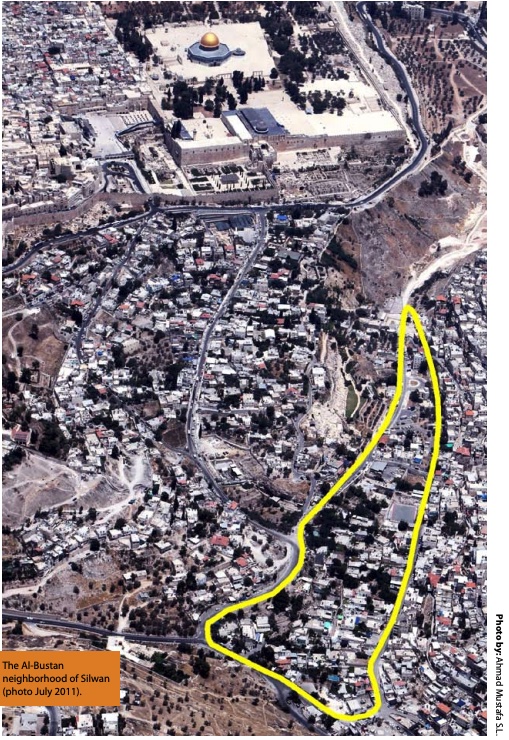 It is widely feared that the demolition of this business presages the imminent implementation of 86 other demolition orders for the same area (housing around 130 families), based on the fact that, like the now-demolished butcher shop, these homes were built without Israel-issued building permits (permits that Israel systematically denies to Palestinians in East Jerusalem). The warning period on demolition orders affecting 14 of those buildings expired on June 27th, meaning bulldozers can appear any day.
The Israeli government has targeted the al-Bustan neighborhood with wide-scale displacement since 2005, when it initiated demolition proceedings on the basis that the buildings do not have Israeli-issued building permits. Israel further declared the area a “green zone” and banned any new construction there. The backdrop to these moves is an Israeli plan to clear al-Bustan of its Palestinian residents in order to make way for an Israeli archaeological park promoted by settlers (the “King’s Garden,” which would be an extension of the settlers’ “City of David” complex).
Residents have until now managed to fight off demolition on the condition that they were engaging with the Israeli government (the Jerusalem Municipality) to develop planning for alternative housing (to which they could be moved). That planning has been ongoing since 2010. Terrestrial Jerusalem explains:
“As noted, in 2017, the Municipality agreed to suspend demolitions while the residents pursue the approval of a statutory Town Plan. The residents’ Town Plan is being drafted by Dr. Yusuf Jabarin, the Dean of Research at Haifa’s prestigious Technion Institute. The plan is working its way slowly through committee, and it is common that plans of this complexity take many years to approve. The plan is based on 11 principles to which the Municipality and the residents both agreed in 2017, and aspires to balance between the housing needs of the residents, the legitimate need for public spaces, in a manner that will serve the residents of al-Bustan, and not the settlers of Silwan. Initially the Municipality viewed the Plan favorably, but, in recent months, that support appears to have been withdrawn.”
New Government, Same Outcome – “Compromise” Opens Door for “Legalizing” Illegal Outpost
In an entirely predictable manner, the new Israeli government led by Naftali Bennet has reached a “deal” with settlers over the fate of the unauthorized Evyatar outpost. Located just south of Nablus, the site of the outpost has become a locus of Palestinian protest and Israeli military violence. Under the terms of the deal, the settlers will (temporarily) vacate the outpost by Friday, July 2nd, with the understanding that the government will leave in place the settlers’ illegal construction at the site — buildings and roads — while it “examines” the status of the land to see if it can be declared “state land” and therefore legally turned into a settlement (opening the door for the settlers to return). In the interim, under the agreement the outpost will be used as a military base while that examination plays out.
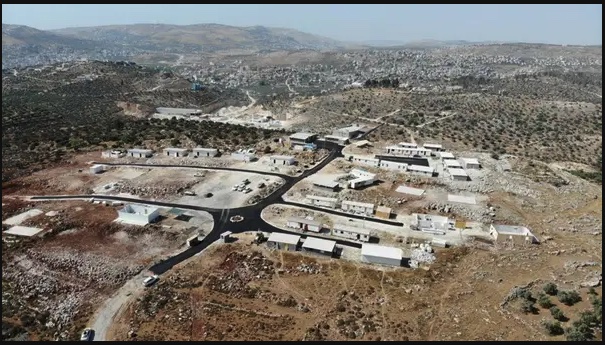 The fact that this “compromise” leaves in place the settlers’ structures and will maintain Israeli control over the site during the “survey” process are clear signals that the government is not concerned with enforcing Israeli law, but rather finding a political solution that works for the settlers. Further, the government of Israel either believes it can, and is determined to, find a pretext to assert that the land on which the outpost stands – known as Jabal Sabih to the Palestinians who have historically cultivated the it – is in fact “state land” which can be used by the state as it sees fit (i.e., give it to the settlers).


In response, the anti-settlement watchdog Yesh Din sent a letter to the Israeli Attorney General outlining exactly how the deal with the settlers contravenes international and Israeli domestic law. In a statement about the letter, Yesh Din says:
“The government’s agreement with the settlers of Evyatar rewards delinquency and grants immunity to those committing offenses, which will act to further embolden violent, lawless settlers to take similar action again in the future, knowing they will, at the very least, face no consequences, and, more likely, be further rewarded with land takeover and settlement expansion. On 1 July 2021, Yesh Din sent a principled letter to Israel’s Attorney General and the Legal Advisor to the Ministry of Defense, denouncing the government’s agreement regarding the outpost of Evyatar as illegal, unconstitutional and morally unacceptable. The letter also demands that an investigation by the police and other relevant authorities be launched into the involvement of the Samaria Regional Council for its part in the outpost’s establishment…
Furthermore, the letter clarifies that the government agreement entails a number of flagrant violations of both local and international laws, including:
In accordance with International Humanitarian Law (IHL), it is prohibited to transfer the civilian population of the occupying power to occupied territory (Article 49, Fourth Geneva Convention), an issue that is now also under investigation of the ICC.
Military presence on lands in occupied territory should only be for urgent security necessity. Safeguarding territory for future Israeli civilian presence cannot be considered an urgent security necessity. The fact that the military did not have permanent military presence in that specific area prior the government agreement reinforces that the military did not discern security justifications.
The decision made in advance to allocate lands for a settlement of Evyatar, providing that they will be declared public lands, without considering the needs of the local population in the area, and especially due to the fact that the outpost is located adjacent to three Palestinian towns, is illegal and unreasonable.
The attempt to disregard planning procedures by issuing a special military order to enable the structures on the site is an abuse of power by the military commander.
The agreement provides no legal basis for not enforcing the law on the illegal structures placed in the area.
It is forbidden to allow political whims to undermine the military commander’s discretion.
According to Israeli law, the decision to establish a new settlement in occupied territory requires a government decision, something that did not transpire in this case.”
Settlers squatting illegally at the site are reportedly not entirely satisfied with the deal. A few are threatening to resist removal from the outpost and are continuing to build permanent structures at the site. Part of the discontent relates to earlier reports that the “compromise” would include a commitment by the government to establish a military yeshiva (religious school associated with the IDF) at the site of the outpost, regardless of the outcome of the land status investigation (or even before the outcome is known). In the final deal, the government agreed to establish a yeshiva at the outpost only after the issue of the land’s status is resolved, and only if that issue is decided in the settlers’ favor. However, the settlers are still asserting that the government has agreed to open a military yeshiva at the site immediately, somewhat of a middle road.
Daniella Weiss, a veteran settler leader who is the leader of the group of settlers who established the Evyatar outpost, believes the land survey will confirm the area is “state land” with only minor adjustments to the boundaries of the outpost. She also said that she expects the yeshiva to be open by September, in time for the Jewish High Holidays. Weiss said:
“This government, which has been so sorely criticized, found the noble and uplifting way to talk with us – without over-powering us, but rather with admiration for pioneer builders of the Land. Our goal is not to force the government’s hand, but rather to uplift it. Our achievement is not in going against the government, but rather in bringing it to the place which it itself wants to be.”
The fate of the outpost has posed an early test for Israel’s new governing coalition. Defense Minister Benny Gantz is on the losing side of this issue (where he is joined by the IDF leadership, which similarly wants the outpost dismantled), having insisted just a few days ago that he is the one in charge of deciding the fate of the outpost and that the outpost will be demolished in accordance with Israeli law. Haaretz explains how the negotiations transpired:
“Gantz looked to his right and to his left, and discovered that he was alone. Prime Minister Naftali Bennett and ministers Ayelet Shaked and Zeev Elkin had negotiated energetically with the settlers on several channels simultaneously. And members of the government’s left wing kept silent. Thus a compromise was reached without the defense minister or the army even being briefed on the talks in real time. Gantz tried to set red lines, already at the outset of the Bennett-Lapid government, in which he is a kind of fifth wheel. He sought to prevent the settlers from creating facts on the ground by taking over land whose legal status is in doubt without any permission from the state or Israel’s Civil Administration in the West Bank. Gantz also sought to prevent the capitulation of the left wing to the right wing in the government. But in reality, it seems that the left has already folded, and the right has laid down its own red line against forcible evictions, which would put Bennett in an uncomfortable situation with what remains of his electoral base. Aside, perhaps, from the new coronavirus outbreak, there probably isn’t an issue in which the government has invested more time during its first two weeks in office than the evacuation of Evyatar. The army doesn’t like the compromise, which defies the original recommendations of its Central Command and the Coordinator of Government Activities in the Territories. Both wanted a full, rapid evacuation of the outpost, which was established in the heart of a group of Palestinian villages south of Nablus. But senior army officers didn’t visit the scene Tuesday morning, and they understand full well the balance of forces there. The moment the prime minister supports the compromise, the army will salute and carry it out.”
The U.S. State Department offered veiled criticism of the deal, saying:
“We believe it is critical to refrain from unilateral steps that exacerbate tensions and undercut efforts to advance equal measures of freedom, security and prosperity and a negotiated two-state solution. This certainly includes establishing new outposts which are illegal even under Israeli law.”
Adding more insight on the U.S. position, the Times of Israel reports:
“The Biden administration is willing to give new Prime Minister Naftali Bennett some time before making asks in the Palestinian arena, but it’s not willing to accept complete paralysis and will speak out clearly against unilateral moves, a source said.”
Israel Advances Plan for New Settlement Road Through Palestinian Farmland
Haaretz reports that the Israel is advancing a plan to pave a new road near the Beitar Illit settlement that will cut through agricultural land belonging to (and actively farmed by) the Palestinian village of Wadi Fukin. If paved, in addition to hemming in Palestinians and closing off their access to their land, it is feared that the projects will restrict the flow of water into natural springs used by Palestinians for farming in the area. This would also be the first road to cut into a wooded area.
Palestinians were not directly informed of this plan, but found out after the plan had been filed with the Civil Administration’s planning authorities. Bimkom, an Israeli NGO, filed an appeal three weeks ago seeking to have the plan frozen until residents of Wadi Fukin can be included in the planning process.
One resident of Wadi Fukin, Mohammed Rabah Sukar, said:
“No one from the Civil Administration talked to us or explained exactly where the road will pass. We don’t know to what extent this will damage our lands and people are very confused and frightened by this road.”

Map by Peace Now
The planned road is connected to two other significant settlement plans in the area, both targeting areas located just south of Bethlehem. One of these plans would expand settlement construction on lands near the Wadi Fukin village. The other plan relates to expansion of the Beitar Illit settlement and the construction of a new settlement – called Gv’aot – on land that historically belonged to five Palestinian villages in the Bethlehem area: Jaba, Surif, Wadi Fukin, Husan and Nahalin. In 2014, the Israeli government issued unilateral, mass expropriation orders for the land (which Israeli officials explictly said was in response to a Palestinian terror attack). At the time, Peace Now reported that the move constituted the largest single expropriation of Palestinian land by the Israeli state in over 30 years. It wasn’t until August 2019 that Israeli planning authorities gave final approval to a plan for a new settlement, including 61 housing units and an educational institute. Today, as it stands, the new units have not been constructed, but a small outpost – which calls itself Gv’aot – has been established…on land not allotted by the Israeli government for future settlement construction.
Palestine Lays Out Key Issues it Wants the Biden Administration to Engage On
Haaretz reports that a new Palestinian negotiation team has asked the Biden Administration to facilitate negotiations with Israel over a series of about 30 issues that it believes can meaningfully improve Palestinian lives – – an approach that has come to define how the Biden Administration is seeking to engage on (but not try to solve) the Israeli-Palestinian situation.
The Palestinian team reportedly included the following proposals related to settlements and annexation in their list:
- Suspension of all settlement construction in the West Bank and East Jerusalem;
- The evacuation of unauthorized outposts;
- The prevention of Israel from controlling land in Area A (where the Palestinian Authority is supposed to have full control, as assigned by the Oslo Accords);.
- The construction of an airport in the West Bank;
- The development of new tourism projects, including religious tourism projects at sites in Area C (the 60% of the West Bank in which, under Oslo, Israel has complete control); and,
- The reopening of Palestinian institutions in East Jerusalem.
An anonymous source with knowledge of the Palestinian initiative told Haaretz:
“Not all of the proposals appearing in the document can be implemented at the present time, but even if it would be possible to advance some of the steps, at least in the civilian field, that would provide achievements to the Palestinian public and improve their day-to-day lives.”
Welcome to FMEP’s Weekly Settlement & Annexation Report. To subscribe to this report, please click here.
January 22, 2021
- Cashing In Before Trump Cashes Out, PART 1: Israel Awards Tender for the Construction of Givat Hamatos
- Cashing In Before Trump Cashes Out, PART 2: Israel Issues Tenders for 2,572 Settlement Units
- Cashing In Before Trump Cashes Out, PART 3: In Final Hours of Trump Era, Israel Advances Plans for 780 Settlement Units Across the West Bank
- Netanyahu’s Bid for Mass Legalization of Outposts Fails (For Now)
- Bonus Material
Comments/Questions – email Kristin McCarthy (kmccarthy@fmep.org)
Cashing In Before Trump Cashes Out, PART 1: Israel Awards Tender for the Construction of Givat Hamatos
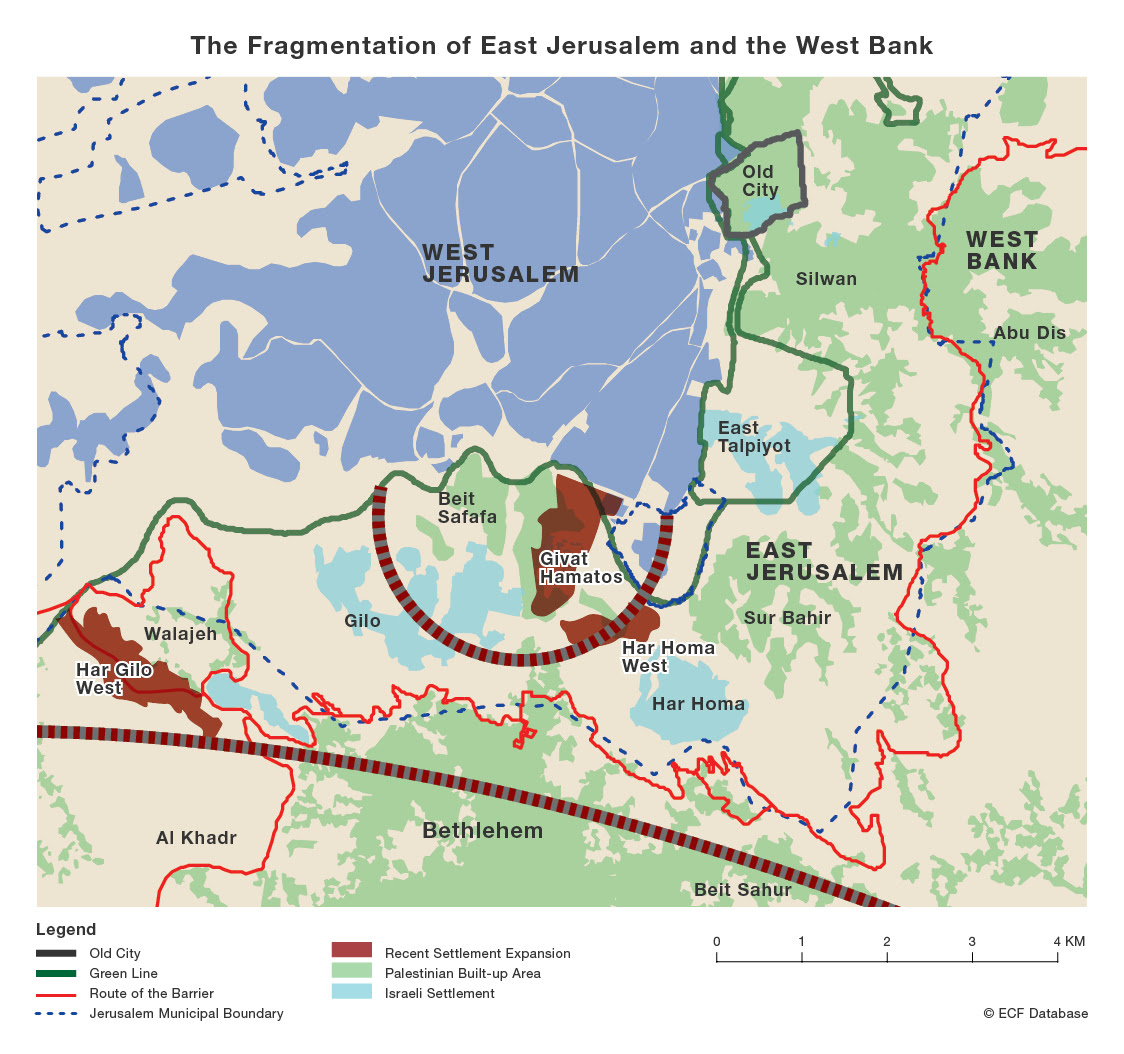
Map by Terrestrial Jerusalem
On January 19th, the Israel Land Authority issued the tender for the construction of the Givat Hamatos settlement in East Jerusalem (the tender is for a total of 1,257 settlement units). The issuance of the tender came a mere 6 hours before Joe Biden was sworn in as the President of the United States.
Prior to the issuance of the tender, the Jerusalem District Court rescinded its injunction against the tender, which the Court had issued last week in response to a petition filed by Palestinian residents of East Jerusalem and the Israeli NGO Ir Amim. That petition – which alleges that the planned construction of government-subsidized housing has discriminatory eligibility guidelines – is still pending, and the Court scheduled a discussion of the petition for May 27th.
According to Jerusalem expert Daniel Seidemann (of the Israeli NGO Terrestrial Jerusalem), now that the tender has been issued and awarded, construction of Givat Hamatos is now “virtually inevitable.” Givat Hamatos has long been regarded as a doomsday settlement by parties interested in preserving the possibility of a two-state solution, in that it will prevent the division of Jerusalem into an Israeli capitol and a Palestinian capitol (if the Givat Hamatos settlement is built, the Palestinian neighborhood of Beit Safafa in East Jerusalem will be completely surrounded by Israeli construction, severing its connection to the West Bank). Regardless of the implications of Givat Hamatos on a two state solution, the impact of the new settlement on the Beit Safafa neighborhood are nonetheless significant.
Explaining how Netanyahu bears direct responsibility for the highly consequential decision to move ahead with Givat Hamatos, Terrestrial Jerusalem writes:
“Netanyahu could have made this ‘go way’ at ZERO political cost to himself. He could have said truthfully: I tried, but the Court didn’t let me. Instead, he pulled out all plugs and instructed the State Attorney to aggressively pursue the rescission of the injunction. He went out of his way to make this happen. The tender process may now be completed, after which construction is virtually inevitable.This is happening because Netanyahu wants it to happen. This is happening now, because Netanyahu wants it to happen now.”
Ir Amim punctuates its analysis of the move by writing:
“The fact that the ILA hastened to announce the winners of the tender only 6 hours before Joe Biden’s inauguration serves to underline how determined the Israeli government is to create as many facts on the ground as possible before Biden takes office.”
Regarding the prospects of its petition against the Givat Hamatos tender, Ir Amim writes:
“The petition targets the conditions of eligibility for subsidized housing within the tender which discriminate against Palestinians. The petition does not call for cancellation of the tender but it remains to be seen how the petition will be viewed by the court and whether or not this will affect more than the specific discrimination present. One possible result of the petition – although we do not think its likelihood is high – can be that subsidized housing be completely removed from the tender in which case it is very possible that the tender will have to be reissued.”
Cashing In Before Trump Cashes Out, PART 2: Israel Issues Tenders for 2,572 Settlement Units
On January 20, 2021 – inauguration day in the U.S., the Israeli government issued tenders for the construction of 2,572 units (total) in settlements across the West Bank, as well in East Jerusalem. Now that the tenders are issued, construction companies are invited to bid to win the contract. Peace Now estimates that building is likely to happen within two years from now.
The issuance of these tenders comes in addition to the Givat Hamatos tender (see section above) and the advancement of plans for 780 more settlement units (see section below).
Commenting on the tenders, Peace Now said in a statement:
“Our out-of-touch government leadership continues to press on with its mad scramble to promote as much settlement activity as possible until the last minutes before the change of the administration in Washington. By doing so, Netanyahu is signaling to the incoming President that he has no intention of giving the new chapter in US-Israel relations even one day of grace, nor serious thought to how to plausibly resolve our conflict with the Palestinians.”
The 2,572 tenders issued on January 20 provide for:
- 941 units in the Emanuel settlement, located in the northern West Bank east of the Palestinian village of Qalqilya. Israel has openly declared its intention to continue expanding settlements in this area – which includes the settlements of Karnei Shomron and Alfei Menashe – with the stated goal of bringing 1 million settlers to live in the area.
- 460 units in the Pisgat Zeev settlement, the largest settlement in East Jerusalem. This involves the issuance of two tenders, one for 210 units and a second for 250 units.
- 377 units in the Adam (aka Geva Binyamin) settlement, through the issuance of three tenders, one for 94 units, a second for 263 units, and a third for 20 units. The Adam settlement is located northeast of Jerusalem, just beyond the separation barrier. Israel has for some years been steadily building the Adam settlement in a manner meant to connect the settlement seamlessly with East Jerusalem settlements and infrastructure, erasing the Green Line.
- 359 units in the Beit Aryeh settlement, located northwest of Ramallah, through the issuance of two tenders, one for 159 units and a second for 200 units.
- 220 units in the Maaleh Efraim settlement, located in the northern West Bank in the area between the central ridge and the Jordan Valley, through the issuance of three tenders, one for 24 units, a second for 178 units, and a third for 18.
- 150 units in the Alfei Menashe settlement, located in the northern West Bank east of the Palestinian village of Qalqilya. Israel is planning to continue expanding this area – which includes Karnei Shomron and Emmanuel – with the stated goal of bringing 1 million settlers to live in the area.
- 49 units in the Karnei Shomron settlement, through the issuance of two tenders, one for 48 units and a second for 1 unit). Israel also advanced plans for construction of 24 more units in the Karnei Shomron settlement through an earlier stage of the planning process (see the section below). Karnei Shomron is located in the northern West Bank east of the Palestinian village of Qalqilya. Israel is planning to continue expanding Karnei Shomron with the stated goal of bringing 1 million settlers to live in the area.
- 16 units in the Beitar Illit settlement. through the issuance of two tenders, one for 14 units and a second for 2 units). Beitar Illit is located west of Bethlehem, near the Green Line.

Cashing In Before Trump Cashes Out, PART 3: In Final Hours of Trump Era, Israel Advances Plans for 780 Settlement Units Across the West Bank
At its final meeting of the Trump era — which took place the day before Joe Biden’s inauguration — Israel’s High Planning Council advanced plans for 780 new settlement units. This includes final approval for plans for a total of 365 units plus the expansion of an industrial zone and approval for deposit for public review (one of last steps before final approval) for a total of 415 units, including retroactive legalization to two illegal outposts.
Commenting on the Council’s actions, Peace Now said in a statement:
“By promoting hundreds of settlement units, Prime Minister Netanyahu is once again putting his personal political interests over those of the country. Not only will this settlement activity erode the possibility for a conflict-ending resolution with the Palestinians in the long-term, but in the short-term it needlessly sets Israel on a collision course with the incoming Biden administration.”
Specifically, plans granted final approval by the Council include:
- 152 new units in the Shavei Shomron settlement, located in the northern West Bank, northwest of Nablus.
- 123 new units in the Itamar settlement, located southeast of Nablus in a cluster of notoriously violent settlements and outposts.
- 66 new units in the Oranit settlement, located in the northern West Bank, in the “seam zone” between the 1967 Green Line and the Israel separation barrier (a barrier constructed along a route designed to keep as many settlements and as much adjacent land as possible on the Israeli side of the wall/fence).
- 24 new units in the Karnei Shomron settlement, located in the northern West Bank east of the Palestinian village of Qalqilya. Israel is planning to continue expanding Karnei Shomron with the stated goal of bringing 1 million settlers to live in the area.
- Expansion of the Barkan Settlement Industrial Zone, located in the northern West Bank and a part of a strand of settlements connecting Israel proper and the Ariel settlement. Ariel is located in the very heart of the northern West Bank, reaching literally to the midpoint between the Green Line and the Jordan border. The future of Ariel and the settlements between Ariel and Israel proper have long been one of the greatest challenges to any possible peace agreement, since any plan to connect Ariel to Israel will cut the northern West Bank into pieces. For background on this industrial zone and others, see here.
Plans the Council approved for deposit for public review include:
- The retroactive legalization of 118 existing units in the Nofei Nehemia outpost. If implemented, this plan would have the effect of retroactively legalizing the outpost as a “neighborhood” of the Rehelim settlement, notwithstanding the fact that the Nofei Nehemia outpost is a fair distance from the Rehelim settlement and is not contiguous with the built-up area of Rehelim. In reality, Nofei Nehemia – if authorized – should be understood as a brand new settlement in its own right, rather than an expansion of an existing one (as the Israeli government wants the world to believe). The Nofei Nehemia outpost is located east of the Ariel settlement in the very heart of the northern West Bank. The Nofei Nehemia outpost made news this week with launch of a public bus route through the outpost – an overt act of entrenching and normalizing its presence by Israeli authorities.
- 107 new units in the Tal Menashe settlement, located on the tip of the northern West Bank, inside the “seam zone” between the 1967 Green Line and the Israel separation barrier, which was constructed along a route designed to keep as many settlements and as much adjacent land as possible on the Israeli side of the wall/fence. Tal Menashe is technically a neighborhood of the Hinanit settlement, though the built-up areas do not connect. The plans for 107 units would, if implemented, “dramatically increase” the size of the Tal Menashe settlement, which is the settlement where Esther Horgan – who was murdered by a Palestinian in late December 2020 – lived. Israeli government officials have made it a clear policy to advance settlement construction in response to deadly attacks on settlers by Palestinians, an approach publicly endorsed by U.S. Ambassador to Israel David Friedman.
- The retroactive legalization of 96 units in the Havot Yair outpost, with the intention of granting retroactive legalization (under Israeli law) to the entire outpost. The Havat Yair outpost is located near the Karnei Shomron settlement in the northern West Bank, east of the Palestinian village of Qalqilya. Israel is planning to continue expanding Karnei Shomron area with the stated goal of bringing 1 million settlers to live in the area.
Netanyahu’s Bid for Mass Legalization of Outposts Fails (For Now)
Despite an intensive last ditch effort, Netanyahu did not succeed in pushing through a government decision to grant retroactive legalization to dozens of outposts in the waning hours of the Trump era.
According to reports, Netanyahu made a last minute effort to gain Gantz’s support for a more narrow authorization – for 6 outposts instead of the 43 outposts as included in an earlier draft government decision. Gantz reportedly blocked Netanyahu’s proposal from coming up for a vote at the Israeli government cabinet meeting on January 19th, saying that “no diplomatically irresponsible proposal will be raised at such a sensitive time.” Other reports suggest European leaders intervened to make their objections to outpost authorization clear.
According to Haaretz, Netanyahu made several attempts to get the decision passed, including convening a call with Israel’s Attorney General to make progress. During that call Netanyahu complained that “jurists” were getting in his way. Netanyahu then surprised Gantz by adding the outpost issue to the Cabinet’s meeting planned for January 19th (a meeting devoted solely to the COVID-19 crisis).
The 6 outposts Netanyahu’s proposal reportedly listed for legalization are: Tel Zion, Ovnat, Metzoke Deragot, Kedem Arava, Avigail, and Asa’el. For more information on those outposts, see Peace Now’s reporting. Of those outposts, three would have been legalized as neighborhoods of existing settlements (Tel Zion, Ovnat, Metzoke Deragot), and three would have been authorized as full-fledged independent settlements (Kedem Arava, Avigail, Asa’el). Netanuyahu’s new proposal also called for the government to allocate over $6.2 million (NIS 20 million) to hire 13 new staff members at the Civil Administration tasked with continuing outpost legalization legal efforts.
FMEP has traced this saga for weeks – from the time when Likud and Blue & White officials were collaborating to draft such a decision, to last week’s news that Gantz decided to continue blocking the move despite a private meeting with settlers asking him to give his OK. It’s worth reiterating that Gantz has made clear he is not opposed to granting retroactive legalization to outposts, but is opposed to this manner of doing so. Gantz prefers for each outpost to be considered on an individual basis.
Bonus Material
- “A regime of Jewish supremacy from the Jordan River to the Mediterranean Sea: This is apartheid” (B’Tselem)
- “Al-Haq Welcomes B’Tselem’s Recognition of Israeli Apartheid” (Al-Haq)
- [VIDEO] “Calling the Thing by its Proper Name: “Apartheid” Between the Jordan River & the Mediterranean Sea” (FMEP)
- “Palestinian factory workers strike in West Bank industrial zone” (Al-Monitor)
- “West Bank demolitions and displacement | December 2020” (OCHA)
Welcome to FMEP’s Weekly Settlement Report, covering everything you need to know about Israeli settlement activity this week.
To subscribe to this report, please click here.
June 26, 2020
- Netanyahu Talks to Jordan, Gantz (Finally) Lays Out a Position
- Trump Advisors Meeting in Washington on Annexation Ends Without Decision
- Bibi Provides Likud With Talking Points on Annexation, Says Settlements Cannot Ever Be Evacuated
- Court Approves Sale of Church Properties in Old City of Jerusalem to Radical Settler Org
- Israel Delivers Eviction Orders to Palestinian Businessowners Despite Claims Palestinians Have Consented to the “Silicon Wadi” Project
- Israel is Expanding Settler-Only Bypass Road Near Bethlehem, Cutting Palestinians Off from Land
- Plans for Controversial New Settlement Industrial Zone Near Beitar Illit Are Poised for Final Approval
- High Court Set to Hear Petition Against Cable Car
- Emek Shaveh Submits Petition Against Settler-Backed “Accessibility” Project for the Ibrahimi Mosque/Tomb of the Patriarchs
- Weaponizing Archaeology as a Means of Dispossessing Palestinians
- Democrats Oppose Annexation But Don’t Threaten Consequences; Republicans Lawmakers Offer Support for Annexation
- Bonus Reads
Comments/questions? Contact Kristin McCarthy (kmccarthy@fmep.org)
Netanyahu Talks to Jordan, Gantz (Finally) Lays Out a Position
According to an anonymous Palestinian official, Israel delivered a message to Jordan’s King Abdullah (who then passed it on to Abbas) that Netanyahu is planning to announce annexation of two or three “settlement blocs” as Israel’s initial annexation move, and this announcement will not include annexation of the Jordan Valley. The report provided no details about which “blocs” will be annexed, or how they will be defined. As a reminder, “blocs” is an informal and elastic term that Israel has used to define ever- expanding areas of the West Bank as territory that it will keep.
The reports come after days of suggestions that the U.S. and Netanyahu are favoring a phased annexation plan, meaning that whatever “limited” annexation Israel announces on July 1st (or, more likely, after July 1st), it will be just the first in a wave of annexation announcements, and the fact that it may be “limited” (compared to other options) in no way will signal that Netanyahu has changed his grander ambition to annex every inch of land allowed under Trump Plan. The Trump Plan green lights annexation of around 30% of the West Bank as a starting point, with an implicit green light for further annexation if the Palestinians refuse to negotiate with Israel over the fate of the remaining West Bank territory.
Gantz posted a message on his Facebook page on Friday, June 26th in what some are viewing as an effort to clarify his own position on annexation, which so far has been inconsistent, ambiguous, and confusing. Gantz’s five key positions on annexation according to the new Facebook post are:
- No annexation of areas where there is a “significant” Palestinian population;
- No annexation of land that will impair Palestinians’ freedom of movement;
- Palestinian living in areas annexed by Israel will be given equal rights;
- Israel’s security as well as its existing peace agreements will be safeguarded;
- Israel will initiate “bilateral moves with the Palestinians.”
It was reported earlier this week that Prime Minister Netanyahu presented an ultimatum to Gantz in private deliberations, seeking to force Gantz to choose between supporting annexation or a new round of elections (recent polls suggest new elections would deliver a landslide victory for Netanyahu — no surprise given the fact that in joining the Netanyahu government, Gantz eviscerated Netanyahu’s main opposition party).
Up to this point, Blue & White party leaders Gantz and Ashkenazi have opposed wide-scale, unilateral annexation on July 1st – instead offering a vision for a phased annexation plan, starting with large settlement blocs, that is coordinated with key international players. Perhaps fulfilling Gantz’s demands, the reports regarding Israel’s message to Jordan propose a more limited initial annexation plan, suggesting perhaps that Netanyahu has adopted two of Gantz’s main positions. It’s also worth recalling that last week Gantz and his party mate Ashkenazi were pushing a phased annexation plan and specified that the Ma’ale Adumim and the Etzion settlement blocs (east and south of Jerusalem) are the place to start.
Even before word of the Jordan communique and Gantz’s Facebook message hit the press on June 26th, it was a near consensus position amongst Israeli news outlets and analysts that Gantz was not going to stand in the way of annexation. On June 22nd, Gantz reportedly told a group of defense officials that Israel “won’t keep waiting for the Palestinians” to engage in negotiations on the basis of the Trump Plan. Those remarks were interpreted as a signal of Gantz’s acquiescence to Netanyahu’s annexation plan (or at least of his growing disinterest in even appearing to oppose it). In the same set of remarks, Gantz went on to blame the Palestinians in even more harsh language, saying they are attempting to drag Israel into “deep shit.” Haaretz suggests, “…Gantz’s tone and his actual comments confirm the assumption that there will be no life-and-death battle here. Gantz knows that the final decision is not up to him, but rather up to Netanyahu.” In a separate article, Haaretz columnist Noa Landau put it this way: “[Gantz’s] remarks [on June 22nd] sounded more like a threat against the Palestinians for refusing to extricate him from this mess.”
Trump Advisors Meeting in Washington on Annexation Ends Without Decision
Internal Israeli negotiations set a dramatic stage for 3 days of discussions this week in Washington between the Trump Administration officials who are the architects and managers of the Trump Plan, as the reportedly sought to come to agreement over what form of annexation the Trump Administration will green light for July 1. Multiple reports in the days leading up to the U.S. deliberations suggested that the group was considering options ranging from a “gradual” annexation plan starting with large settlements around Jerusalem, to a more large-scale and immediate plan. At the end of the week, the Americans reportedly failed to reach a decision on how they would want to see Israel’s annexation of West Bank land to proceed. Three members of the team, Avi Berkowitz and NSA Advisor Scott Leith, and Amb. Friedman – are reportedly en route back to Israel and will continue discussions with Netanyahu. Notably, in parallel to the Washington meetings, reports emerged suggesting that Netanyahu’s annexation announcement may be delayed and that July 1st might mark the start of Israeli security cabinet deliberations over annexation (to this point deliberations have been between Netanyahu and Gantz without wider input from cabinet members).
Amb. David Friedman (who flew to back to DC for the meeting) was joined by Secretary of State Mike Pompeo, senior advisor Jared Kushner, Middle East envoy Avi Berkowitz, and national security advisor Robert O’Brien for deliberations starting on June 23rd.
Bibi Provides Likud With Talking Points on Annexation, Says Settlements Cannot Ever Be Evacuated
Netanyahu sent a memo to Likud lawmakers this week laying out key talking points in the ongoing effort to defend annexation, in which he argues that evacuating settlement poses an “immediate existential threat” to Israel. The memo says:
“Relinquishing these territories would not only constitute a historic injustice; such a move would create an immediate existential threat to the Jewish state since Judea and Samaria border central Israeli cities.”
The memo also adopts a U.S. talking point that annexation in fact advances the cause of peace, but instead of giving any nod to a future Palestinian state or two state solution, Bibi’s memo claims that annexing West Bank settlements can provide for “to a realistic regional peace based upon facts on the ground.” This double speak (annexation is peace) was prominently articulated by Ron Dermer in a recent Washington Post op-ed.
Court Approves Sale of Church Properties in Old City of Jerusalem to Radical Settler Org
On June 24th, the Jerusalem District Court rejected a final request filed by the Greek Orthodox Patriarchate to block the sale of its historic church properties to the radical settler group Ateret Cohanim. The Court’s ruling brings an end to 16 years of litigation and paves the way for Ateret Cohanim to evict Palestinian tenants and businessowners from three coveted church properties in the Old City including the Petra Hotel and the Imperial Hotel (together, the buildings flank the Jaffa Gate entrance into the Old City – meaning that Ateret Cohanim now controls a substantial amount of land at a key entrance to the Old City). The third building – known to Palestinians as Beit Amziya – is located in the Muslim Quarter.
The ruling comes just four months after the Jerusalem District Court appointed a lawyer associated with Ateret Cohanim as the legal custodian of the Petra Hotel for the duration of a bankruptcy case against the Palestinians currently operating the hotel.
The legal battle over the properties dates back to 2004, when the Greek Orthodox Patriarchate agreed to sell the three properties to a foreign real estate company under three separate contracts. It did so not knowing that the radical settler group Ateret Cohanim was behind the transaction. News of the sales made headlines in early 2005.
Upon the revelation that Ateret Cohanim was the real buyer, the Greek Orthodox Patriarchate was deeply embarrassed and immediately sought to retain control of the properties. The Patriarchate alleged that the transactions involved corruption and bribery, arguing that the legal documents had been signed without permission by a finance employee. Dismissing the church’s arguments, this week the Supreme Court upheld prior rulings that the signatures on the legal documents were valid, with the finance employee acting as a legal proxy of the Patriarchate.
The Greek Orthodox Church has received significant blowback from the sale of these properties. In January 2018, Palestinians protested in Bethlehem in an attempt to block the arrival of Patriarch Theophilos III for Christmas celebrations.
Israel Delivers Eviction Orders to Palestinian Businessowners Despite Claims Palestinians Have Consented to the “Silicon Wadi” Project
Middle East Eye reports that the “Silicon Wadi” project (as reported on by FMEP on June 5th) is being discussed by the Jerusalem District Committee but has not yet reached the stage of being deposited for public review. According to one Palestinian business owner who faces eviction under the plan, the District Committee required the Jerusalem Municipality to notify the owners and renters of the buildings that will be demolished to make way for the new construction. Last week, the Municipality delivered that notification to renters in the form of eviction orders, saying that the businesses were operating in violation of Israeli regulations (i.e., illegally, even though the businesses have been there – and paying taxes to Israel – for decades). The orders give businesses 6 months to vacate.
One Palestinian businessowner, Mahmoud al-Kurd, told Middle East Eye:
“I will stay here to the last moment. This profession is my passion. In this old space I managed to achieve my successes. It is enough that the soul of my deceased father roams around me here – he is the one who rented this store decades ago and passed on his means of sustenance to us. I refuse to be an employee of a Jewish broker if we were transferred to work in the Israeli industrial areas.”
The Jerusalem Municipality – which claims that this project has the support and consent of Palestinians – also claims that it is looking into options for compensating business owners (mostly auto mechanics) who will lose their garages.
Israel is Expanding Settler-Only Bypass Road Near Bethlehem, Cutting Palestinians Off from Land
The Palestinian news outlet Wafa reports that Israel has begun work on expanding a settler-only bypass road just west of Bethlehem.The road is reportedly being expanded and widened on Palestinian land belonging to the Nahalin village; construction of the new road segment and widening the existing road will cut off Palestinians from 741 acres (3,000 dunams) of their land.
The road serves to directly connect the Beitar Illit settlement to the Modiin Illit settlement, both of which are a part of the so-called “Etzion Bloc.” The construction goes to show that the settlement “Blocs” – around which some suggest there is a “consensus” that Israel will retain them in any future deal with the Palestinians, and others suggest Israel can annex without controvery – are a pretext for a continuing campaign of dispossession, discrimination, and human rights abuses against neighboring Palestinians. For a deep dive into the highly consequential acceptance/normalization of the “settlement bloc” framing, see here.
Plans for Controversial New Settlement Industrial Zone Near Beitar Illit Are Poised for Final Approval
Al Monitor reports that plans for the construction of a new settlement industrial zone near the Beitar Illit settlement in the southern West Bank are ready to be submitted for final approval from the Civil Administration. Environmental activists say the new zone will pollute and possibly destroy the underground water sources feeding the terraced hills of Battir, a UNESCO World Heritage site.
The plan for the new zone – which will include offices, shops, sports facilities, public buildings, and a cemetery – was initiated in 2018 at the insistence of Israel’s former Interior Minister Aryeh Deri. Palestinians claim that plans for the zone include construction on privately owned Palestinian land.
Gidon Bromberg, Executive Director of EcoPeace, told Al-Monitor:
“Planning maps clearly show that the industrial estate would indeed cover much of the buffer zone of the World Heritage site as well as touch the core area itself.”
High Court Set to Hear Petition Against Cable Car
The Israeli NGO Emek Shaveh reports that the Israeli High Court of Justice will take up the case of the Jerusalem cable car project on June 29th. The court will consider three arguments made in a petition filed against the plan submitted by Emek Shaveh and leading experts. Those arguments are:
- “A transitional government is not authorized to make an irreversible decision such as approval of the cable car project: The cable car project will cost the public hundreds of millions of shekels. During a period when the government is carrying out a broad cut in the budget of billions of shekels and is reducing the budgets for health and welfare, it is inappropriate that a transitional government leaves a bequest of this magnitude for the next government to inherit. In the response of the Deputy Attorney General, Att. Othman Roslan, to the petition, while arguing that the process was not in conflict with the law, he did not conceal the fact that the it was problematic. [See FMEP’s coverage of the Israeli government’s approval of the plan in November 2019]
- “There was a serious flaw in the planning process in that the Ministry of Transportation was not included in the project that purports to be a transportation project: While the project is represented as a transport project, the Ministry of Transportation was not included in the process and the project was not required to meet the standards set forth for transportation projects in the State of Israel. Instead it was approved on the basis of reports and data less comprehensive than those required for every other transportation project.
- “The decision was made on the basis of misleading simulations: The backers of the plan did not present complete simulations that accurately illustrate the cable cars in motion and the resulting damage to the historic landscape. The National Infrastructure Committee should have demanded that the backers present simulations that illustrate the actual cars in motion.”
The Jerusalem cable car project is an initiative of the Elad settler organization (which is building a massive tourism center – the Kedem Center – in the Silwan neighborhood of East Jerusalem, slated to be a stop along the cable car’s route). The scheme is intended to further entrench settler control in Silwan, via archeology and tourism sites, while simultaneously delegitimizing, dispossessing, and erasing the Palestinian presence there. Non-governmental organizations including Emek Shaveh, Who Profits, and Terrestrial Jerusalem have repeatedly challenged (and provided evidence to discredit) the government’s contention that the cable car will serve a legitimate transportation need in Jerusalem, and have clearly enumerated the obvious political drivers behind the plan, the archeological heresies it validates, and the severe impacts the cable car project will have on Palestinian residents of Silwan.
Emek Shaveh Submits Petition Against Settler-Backed “Accessibility” Project for the Ibrahimi Mosque/Tomb of the Patriarchs
On June 18th, Emek Shaveh and Palestinian residents of Hebron jointly submitted a petition challenging Israel’s issuance of a permit to build an elevator to the Ibrahimi Mosque/Tomb of the Patriarchs, arguing that:
- “The plan was illegally approved by a transitional government;
- “The plan is in contravention of international agreements to which Israel is a signatory;
- “[The plan] is an unprecedented injury to the character of the ancient structure; No documentation and preservation file has been submitted.”
One signatory on the petition is a disabled Palestinian, Kamal Abadin, who makes the salient point that Israel’s policies in Hebron do not indicate it has concern for accessibility, saying:
“I almost do not come to pray at the mosque because as a Palestinian, I am not permitted to drive in my car from my house to the site, because the road is closed to Palestinian vehicles. If Israel asserts that it wants to make the site accessible to the disabled, let it start with allowing disabled Palestinians to access it by car.”
Emek Shaveh explained in a statement:
“Unfortunately, even at the price of damage to a structure more than 2,000 years old that is holy to Judaism and Islam, Israel is prepared to be led by the settlers and their plans, and on the way, to violate international agreements to which it is a signatory. The settlers have succeeded in turning the needs of persons with disabilities into a political issue and a means for deepening the dispute with the Palestinians. We all know that what begins in Hebron does not stay only in Hebron and the unilateral steps at the Tomb of the Patriarchs could serve as a precedent for unilateral actions at another site which is holy to both Judaism and Islam.”
Weaponizing Archaeology as a Means of Dispossessing Palestinians
A settler group which sprung from the radical Regavim organization has sharpened a new bureaucratic weapon by which to advance the dispossession of Palestinians. The settler group – called Shomrim Al Hanetzach (“Guarding Eternity”) – has been surveying areas in the West Bank that Israel has designated as archeaological sites in order to call in Israeli authorities to demolish Palestinian construction in these areas. In 2017, it should be noted, Israel declared 1,000 new archaeological sites in Area C of the West Bank. The group communicates its findings to the Archaeology Unit in the Israeli Civil Administration (the military body by which the government of Israel regulates all planning and building in the West Bank). The Archaeology Unit, playing its part, then delivers eviction and demolition orders against Palestinians, claiming that the structures damage antiquities in the area.
In addition, in 2019 the Israeli government increased the size of the Archaeology Unit’s staff and granted the unit new authority to carry out investigations into cases of construction on archaeological sites. Moreover, using new powers the Civil Administration gave itself (via a military order) in June 2017, the Israeli goverment has accelerated the demolition of Palestinian buildings by drastically limiting the time period during which Palestinians are permitted to challenge demolition orders. Palestinians have a mere 96 hours after receiving the notice to file a legal challenge.
As a result, there has been a sharp rise in the number of archaeology-related demolition orders over the past year: Israel issued 118 demolition order and warnings against Palestinian structures built on West Bank archaeological sites in 2019, compared to 61 orders in 2018 and 45 orders in 2017.
The Director of Shomrim Al Hanetzach told Haaretz:
“We took it upon ourselves to make the supervision process more efficient – hiking guides and archaeologists turn to us and tell us about the destruction of antiquities, and we report them further to the necessary people.”
In the case of one Palestinian, Mahmoud Bisharat, he says that Israel conducted an archaeological survey of the area in 1972 but never complained about Palestinian construction in the area until now. The Civil Administration ordered Bisharat to demolish his home, olive trees, well, and concrete structures around a well.
In addition to hiking and surveying Palestinian land, Palestinians have reported that Regavim activists also use drones to photograph their land and buildings, and have made the connection between those activities to demolition orders from the Civil Administration.
Democrats Oppose Annexation But Don’t Threaten Consequences; Republicans Lawmakers Offer Support for Annexation
In warring moves this week, Republicans and Democrats staked out positions on Israel’s forthcoming annexation of land in the West Bank.
189 of 233 Democrats in the House signed a letter sent to Netanyahu and Gantz expressing deep concern about annexation, saying it does not serve Israeli security interests nor the peace process. The letter, notably, does not contain any threat of consequences should Israel implement annexation. J Street is reportedly behind drafting and circulating the letters for signatures.
116 out of 198 Republicans in the House signed a letter sent to Prime Minister Nentanyahu expressing support for Israel’s “right to sovereignty and defensible borders.” The letter also praises the Trump Plan. The Republic Jewish Committee is reportedly behind drafting and circulating the letter for signatures.
7 out of 53 Republicans in the Senate signed a letter to President Trump led by Senators Cotton (R-AR) and Cruz (R-TX) that is not only supportive of annexation, but actually encourage Israel to implement annexation.
Back in May, 18 out of 47 Democrats/Independents in the Senate sent a letter to Netanyahu and Gantz cautioning them against annexation.
Bonus Reads
- “How settler groups could use annexation to deepen Palestinian dispossession” (+972 Magazine)
- “Israel’s High Court Is Willfully Blind to Theft of Palestinian Land” (Haaretz)
- “Israel’s ‘strangling’ of Bethlehem tightens as world debates annexation” (+972 Magazine)
- “Settlers Assault Palestinians on Their Own Land, as Israeli Soldiers Watch” (Haaretz)
- “For Netanyahu, Annexation May Spell Little Gain, and Lots of Pain“ (Haaretz)
Welcome to FMEP’s Weekly Settlement Report, covering everything you need to know about Israeli settlement activity this week.
To subscribe to this report, please click here.
November 8, 2019
- Israel Advances Plans for 2,342 New Settlement Units
- Israeli Government Approves Settler-Initiated Plans for Cable Car in Jerusalem — Despite Professional, Human Rights Objections
- Israel Plans to Build a New Waste Treatment Plant (to serve Israelis) in the West Bank
- No More Waiting: MKs Introduce Annexation Bills Despite Political Deadlock
- Annexation-via-New Roads (the new Smotrich Plan)
- Annexation-via-Movies (Govt-Funded Settlement Hasbara)
- Annexation-via-Education (Ambassador Friedman’s Favorite Medical School)
- Settler Leaders Elect New Chairman of the Yesha Council
- Israeli Official Calls on Evangelicals to Defend Settlements, Fight BDS, and Support “Economic Peace”
- Bonus Reads
Questions/comments? Contact Kristin at kmccarthy@fmep.org
Israel Advances Plans for 2,342 New Settlement Units
With little attention, on October 10th the High Planning Council – a body within the Israeli Defense Ministry’s Civil Administration, responsible for regulating all construction in the West Bank – advanced plans for 2,342 new settlement units, as well as for two additional settlement projects. Of that total, 719 units were approved for validation (the penultimate step in the planning process), and 1,623 settlement units were approved for deposit for public review (an earlier but decisive stage in the planning process).
The 719 units which received final approved for validation comprise:
- 207 units in the Bracha (aka Har Bracha) settlement, located south of Nablus. In September 2019, the Israeli Central Command signed an order that expanded the settlment’s jurisdiction, a move which paved the way for the approval of these new units (see our September 2019 report). According to Peace Now, this plan – if implemented – will significantly expand both settlement’s population and its physical footprint.
- 206 units in the Tzofim settlement, located north of the Palestinian town of Qalqilya – a town completely encircled by Israel’s seperation barrier (except for a single road connecting it to the rest of the West Bank) – in the northern West Bank.
- 166 units in the Alei Zahav settlement, located in a string of settlements stretching across the northern West Bank. Alei Zahav and its settlement neighbors create a contiguous Israeli populated areas linking Israel proper (west of the Green Line) all the way to the Ariel settlement, located in the heart of the West Bank (the eastern end of Ariel is closer to the Jordan border than to the Green Line). Notably, Alei Zahav is one of the settlements in which the “market principle” has been applied to legalize settlers theft of land recognized by Israel as belonging to Palestinians (see our July 2019 report).
- 140 units in the Mezadot Yehuda settlement, located at the very southern tip of the West Bank, just south of the Palestinian village of Susya, which the Israeli government has been threatening to demolish for years. This plan would nearly double the number of authorized units in the settlement.
Also receiving final approval for validation:
- A plan to retroactively legalize the illegal Brosh outpost in the Jordan Valley. According to Peace Now, the Brosh settlement serves as an educational institution that houses hundreds of students and families of staff members.
- A plan to build a tourist/visitors center in the Shilo settlement – where settlers and the Israeli government have been investing in developing tourism sites for Jewish and evangelical tourists.
The 1,623 units which were deposited for public review include:
- 609 units in the Beitar Illit settlement, located west of Bethlehem, near the Green Line. Beitar Illit is a massive, fast-growing ultra-Orthodox settlement.
- 382 housing units in the Dolev settlement, located west of Ramallah. This is a significant plan for Dolev, as it will more than double the number of existing units. Prime Minister Netanyahu previously promised to build 300 new units in Dolev in response to a Palestinian-perpetrated bombing at a spring (which settlers had taken over from Palestinians) near the settlement that killed a 17-year old Israeli and injured several others.
- 182 units in the Mevo’ot Yericho settlement, located north of Jericho in the Jordan Valley. The validation of this plan is the actualization of the Israeli security cabinet decision to grant the illegal outpost of Mevo’ot Yericho retroactive legalization, an action for which the security cabinet urgently convened on the eve of the September 19th elections. The plan approved by the High Planning Council on Oct. 10th granted legalization to the existing 20 existing units and, if implemented, will allow the settlement to significantly expand.
- 146 units in the Kfar Etzion settlement, located southwest of Bethlehem.
- 140 units in the Kerem Reim outpost located north west of Ramallah. Peace Now has repeatedly challenged the illegal construction of the Kerem Reim outpost, which the Israeli government retroactively legalized by declaring it a neighborhood of the Talmon settlement even though the areas are non-contiguous. Though a court rejected one Peace Now petition, there is an ongoing case against the Amana settler organization which Peace Now alleges engaged in illegal activities to build the outpost.
- 100 units in the Nokdim settlement, located southeast of Bethlehem. Former Israeli Defense Minister Avigdor Liberman – currently one of the most important figures in the race to form a governing coalition – lives in Nokdim.
- 64 units in the Telem settlement, located west of Hebron.
- A plan to build new shops and services in the Kochav Yakov settlement, located between Jerusalem and Ramallah.
Peace Now said in a statement:
“The figures speak for themselves. Netanyahu continues to sabotage the possibility of a political agreement with the Palestinians by promoting more settlement construction in the West Bank, including in places where Israel may have to evacuate as part of a future agreement. This is yet another dangerous step for both Israel and the Palestinians, led by a transitional prime minister whom the public did not trust in his policies. The next government must put a freeze on the development of settlements and to strive for immediate resumption of negotiations with the Palestinians without preconditions and to end the bloody conflict based on the principle of two states for two peoples.”
The European Union issued a statement criticizing the approvals, saying:
“The European Union’s position on Israeli settlement policy in the occupied Palestinian territory is clear and remains unchanged: all settlement activity is illegal under international law and it erodes the viability of the two-state solution and the prospects for a lasting peace, as reaffirmed by UN Security Council Resolution 2334. Israeli authorities also approved a building permit for the construction of a new tunnel road, which bypasses Bethlehem to the west. The progressive construction of a separate road network, connecting settlements and outposts to each other and to the road network in Israel while circumventing Palestinian towns and communities, is entrenching the fragmentation of the West Bank. The EU calls on Israel to end all settlement activity, in line with its obligations as an occupying power. The EU will continue to support a resumption of a meaningful process towards a negotiated two-state solution, the only realistic and viable way to fulfil the legitimate aspirations of both parties.”
Israeli Government Approves Settler-Initiated Plans for Cable Car in Jerusalem — Despite Professional, Human Rights Objections
On November 4th, the Israeli Housing Cabinet approved a settler-initiated plans to build a cable car line in East Jerusalem, despite the fact that the Israeli Attorney General has not yet rendered a decision on whether plans for such a significant and sensitive project can be advanced by a caretaker Israeli government. Emek Shaveh – an Israeli NGO fighting the politicization of archeology in Jerusalem – announced that it intends to appeal the approval to the Israeli Supreme Court.
As FMEP has repeatedly covered, this Jerusalem cable car project is an initiative of the Elad settler organization (which is building a massive tourism center – the Kedem Center – in the Silwan neighborhood, which will be a stop along the cable car’s route). The scheme is intended to further entrench settler control, via archeology and tourism sites, inside the Silwan neighborhood of East Jerusalem, while simultaneously delegitimizing, dispossessing, and erasing the Palestinian presence there. Non-governmental organizations like Emek Shaveh, Who Profits, and Terrestrial Jerusalem have repeatedly discredited the government’s contention that the cable car serves a legitimate transportation need in Jerusalem, and have clearly enumerated the obvious political drivers behind the plan, the archeological heresies it validates, and the severe impacts the cable car project will have on Palestinian residents of Silwan.
Ir Amim field researcher Aviv Tartarsky told Middle East Eye:
‘The project is a way to whitewash Israel’s taking of areas in Silwan to use for archaeological and touristic reasons…If someone wants to go to the Western Wall of the Old City, they have to go through the ELAD activity centre. This project will give ELAD legitimacy and influence, as it is taking part in a governmental project. This is the political reason for why the government is doing this project,’ Tatarsky said.”
Israel Plans to Build a New Waste Treatment Plant (to serve Israelis) in the West Bank
In October 2019 the Israeli government issued a construction tender to build a waste-to-energy plant in the West Bank, on an area of land that is within the jurisdiction of the Ma’ale Adumim settlement where several Palestinian Bedouin communities live. The plant – which is expected to cost USD $284 million (1 billion NIS) – will treat Israeli-generated waste.
B’Tselem – which previously published a comprehensive report criticizing the illegal Israeli practice of exporting its waste to the occupied territories – writes:
“For many years, Israel has been taking advantage of its power as occupier to transfer the treatment of waste (including hazardous waste) and sewage from its sovereign territory to the West Bank. To that end, it has created a situation in which environmental legislation in the West Bank is much laxer than inside Israel, conveniently overlooking the long-term impact of environmental hazards on the Palestinian population and on natural resources, and neglecting to prepare future rehabilitation plans. This has created a financial incentive to transfer the treatment of environmental hazards from Israel to the West Bank. The Palestinians who live in the occupied territory are the ones to pay the price for this environmental damage, even though they were never asked their opinion on the matter and although, as a population under occupation, they have no political power and no real ability to resist.”
B’Tselem also takes aim at the European Union (EU), which has invested millions in the implementation of the Isareli Ministry of Environmental Protection’s 2030 strategic plan, of which the waste-to-energy treatment plant is a part. B’Tselem writes:
“In 2019, Israel and the EU signed an agreement as part of the EU’s twinning instrument, which establishes cooperation with the EU’s neighboring countries, guaranteeing Israel approximately 1.5 million euros over the next two years to support the Ministry of Environmental Protection’s implementation of its 2030 strategic plan. In the agreement, Israel committed to creating a legal framework that adopts European practices and standardization for sustainable waste treatment. As in every agreement between the EU and Israel, it contains a territorial clause that stipulates that it will not apply beyond Israel’s 1967 borders. Yet the EU’s support for the ministry’s strategic plan – which defines the establishment of the plant at Ma’ale Adumim as a goal and presents the exploitation of West Bank land to resolve environmental problems as a matter of course – empties this annex of meaning. By supporting this plan, the EU will be supplying Israel with knowledge and experience that will help deepen its exploitation of Palestinian land resources and bolster the economic status of the Ma’ale Adumim settlement.”
No More Waiting: MKs Introduce Annexation Bills Despite Political Deadlock
Israeli political figures appear to be done waiting for a new government to be formed before acting on the loud signals from the Trump Administration supporting Israeli annexation of West Bank land.
On November 4th, Yamina party leader Ayelet Shaked filed a bill with the Knesset to unilaterally annex the Jordan Valley, the Ma’ale Adumim settlement just east of Jerusalem, and all 22 settlements and 75,000 Israeli settlers in what is broadly termed the Etzion “settlement bloc” located south of Bethlehem. Shaked’s bill calls for Israel to “apply sovereignty” to these settlements, which in practice would constitute the annexation of the settlements. Applying Israel law to areas outside of Israel’s sovereign borders is de facto annexation, as FMEP has explained and documented.
Shaked urged expeditious consideration of the bill, saying:
“There is a diplomatic window of opportunity and willingness on the part of the US for this kind of annexation that will not return. We cannot afford to hesitate or wait. We must take advantage of this window of opportunity immediately and begin to apply sovereignty over these areas. It is for this reason that the State of Israel cannot be dragged into another election cycle.”
On November 3rd, Likud MK Sharren Haskel submitted a draft bill for the annexation of the Jordan Valley, a bill she has introduced previously without success. Haskel said:
“It’s time to make the residents of the Jordan Valley legal Israeli citizens, thus kick-starting the development and prosperity of the region.The communities of the Jordan Valley and their residents are a strategic resource of the highest order for Israel. There is a wide consensus today about the region, following the long-awaited U.S. president’s recognition of the Golan Heights as under Israeli sovereignty. It is time to do the same with the Jordan Valley. After Blue and White leader Benny Gantz proposed to do the same, I call upon him and my fellow party members to support my proposal.”
In March 2019, ahead of the first round of Israeli elections this year, leaked reports suggested that U.S. diplomats were engaged in discussions with Israel about the latter’s intention to annex several “settlement blocs” – even more so-called blocs than called for by Shaked’s latest plan – following the elections. The reports were not corroborated by U.S. sources, but in the intervening time U.S. Ambassador to Israel David Friedman has made repeated statements to the press (in addition to speculative reporting about a forthcoming U.S. political plan) in support of Israel’s right to annex territory in the West Bank – cues the Israeli government has enthusiastically welcomed. In the lead-up to the September elections, Netanyahu vowed to annex the Jordan Valley should he be reelected, a plan endorsed by his rival Benny Gantz and supported by then-U.S. National Security Advisor John Bolton.
As a reminder, over the years there has been no shortage of attempts to normalize the idea that Israel will retain “settlement blocs” in any negotiated peace agreement — logic that originally applied narrowly to the Etzion bloc (defined on much less expansive terms), Maale Adumim, and, in the eyes of some, Ariel. The terminology has been exploited for decades by the Israeli government to convey legitimacy to building in the so-called “blocs.” Over the years the definition of what is a “bloc” has been twisted to include a much larger idea of the Etzion bloc, as well as the entire Jordan Valley. The implied idea regarding what the blocs are and the fact that they are inarguably Israel’s to keep, is incredibly misleading. The term “settlement blocs” has no formal definition or legal standing, and the future of the blocs – no matter how they are defined – is indisputably a matter at the heart of what will one day be negotiations aimed at a two-state solution (if there is ever to be such a solution). For more context, see resources from Americans for Peace Now here and here. (NOTE: A Haaretz investigation last year estimated that a total of 380,000 Israeli settlers live in the West Bank, of which 170,000 live outside of the so-called blocs, as defined by Haaretz).
Annexation-via-New Roads (the new Smotrich Plan)
On November 1st, Israeli Minister of Transportation Bezalel Smotrich unveiled a new government plan to advance Israeli “sovereignty through transportation.” The plan calls for massive investment (USD $283 million) in new/expanded roads and rails lines, for the express purpose of more seamlessly integrating Israeli settlements into Israel proper. Smotrich made clear that his ultimate goal is the complete integration of the West Bank into the national planning mechanisms of Israel proper. The move will erase the government’s current distinction between transportation projects in the West Bank (across the Green Line) and Israel proper [fun note: the Israeli Ministry of Foreign Affairs has an official map posted on its website entitled, “Transportation and Built-Up Areas” that includes the entire West Bank as part of Israel).
Touting the significance of his plan, Smotrich said:
“I do not give preference to Judea and Samaria [the West Bank] but also am not willing to continue the discrimination. These areas will receive treatment just like anywhere else in Israel. While it is only about roads and trains, it has political significance.”
Smotrich created a new bureau for “Judea and Samaria Planning” within the Transportation Ministry to oversee the implementation of this project, and more generally ensure that the ministry is geared towards serving the settlements as a matter of normal business. The institutionalization of such bureaucratic structures within the Israeli government is a significant, and often overlooked, mechanism by which the Israeli government has been engaging in annexation for years. The new bureau – much like parallel structures former Minister Ayelet Shaked set up in the Justice Ministry – is a formal and public statement that the Israeli government is pursuing (and allocating resources to) annexing the settlements.
It should be noted that Israel has used infrastructure projects in the West Bank to advance its settlement agenda, and to further fragment Palestinian life – two completementary goals powerfully explained by B’Tselem in a recently released interactive: “Conquer and Divide: The Shattering of Palestinian Space by Israel.”
FMEP tracks developments related to the ongoing annexation of West Bank land in its Annexation Policies Tables.
Annexation-via-Movies (Govt-Funded Settlement Hasbara)
On November 6th, Israeli Cultural & Sports Minister Miri Regev announced new government funding for film projects initiated by Israeli settlers. According to the guidelines, the new funding will support Israeli citizens living in West Bank settlements who want to make documentaries and films.It is widely understood that the goal is to encourage the creation of more pro-settlement propaganda.
Celebrating her new initiative, Regev essentially admitted that annexation was her motive, saying:
“I made a promise and I am keeping my promise! We are making history today. The Culture and Sports Ministry will support the regional production of films in the north, and for the first time in Judea and Samaria too, and in the hope that in the near future also in the south… The wheels of cultural justice, which bring to expression the range of voices in Israeli society, have worked quickly and now another stage in correcting the cultural map in Israel has been completed. The artists from the periphery, the north and from Judea and Samaria, will become more and more in the center of things, not just on stage but also on the screens. Soon we will allow them to express their ability and talent.”
One critic of the fund, Israeli producer Liran Atzmor, nailed why the new fund is highly problematic and a tool of de facto annexation:
“Setting up a fund that supports filmmaking in the occupied territories with Israeli taxpayers’ money amounts to creeping annexation, which is happening in many areas, obviously, but is happening now more forcefully in the realm of culture, thanks to this fund. As long as the fate of those territories has not been determined, one cannot accept the fact that public funds are distributed there to people of only one color, one nationality and one religion.”
Shlomo Eldar writes:
“…And that is the whole point, to show life in the settlements in a positive light, as a Zionist enterprise glorifying the State of Israel. Head of the Samaria Regional Council Yossi Dagan described the fund as a ‘giant piece of good news. … I believe this move will bring the story of Judea and Samaria to the big screen. … I call on all artists to take part in this party, to come and film in Judea and Samaria and tell its story, so that we can present the public with other faces and other stories that have yet to be seen on the screen’.”
Libby Lenkinski, Vice President of the New Israel Fund, explained in a tweet:
“Creeping annexation and normalization of settlements is not just happening on the land, it’s also a narrative strategy that uses arts and culture funding to move forward. #StopAnnexation”
Annexation-Via-Education (Ambassador Friedman’s Favorite Medical School)
Despite delays and scandals, the sparkling new medical school at Ariel University has officially launched its first school year, with a ceremony attended by a who’s-who of settlement financiers and supporter rejoicing in the opening of the school and in the implications of its opening for the Greater Israel enterprise.
Dr. Miriam Adelson and her husband, Trump-backer/U.S. casino magnate Sheldon Adelson, were in attendance. The Adelsons donated $20 million to the medical school, which was named after Miriam. Addressing the crowd, Dr. Adelson said:
“In Israel, being Israel, we also had to withstand our tribulations. In Israel, being Israel, there were opponents who tried to block the establishment of a critical institution on ancient Jewish land and to deny us legitimacy. But we won, Zionism won, the truth won.”
U.S. Ambassador David Friedman recited the “shehecheyanu,” a prayer of gratitude to God, as part of his speech, also exclaiming:
“A new medical school has opened in Samaria. It’s worth saying that again: A new medical school has opened in Samaria! How many people ever thought those words would be spoken?…The United States Embassy enjoys warm relations with Ariel University, and we are inspired by its contributions to Israeli society and to the scientific world.” [NOTE: “Samaria” is a biblical name used mainly by settlers and their allies to refer to the northern part of the West Bank]
MK Naftali Bennet put an even finer point on the significance of opening a medical school in Ariel settlement, saying:
“No longer is there a Green Line. We are one [united] Israel and that is how it should be. We are going to serve everyone here.”
There are 70 Israeli students enrolled to attend the settlement university. Even though classes are set to begin, the medical school still does not have an approved budget for the 2020 school year.
As a reminder, the Ariel settlement is located in the heart of the northern West Bank, reaching literally to the midpoint between the Green Line and the Jordan border. The future of Ariel has long been one of the greatest challenges to any possible peace agreement, since any plan to attach Ariel to Israel will cut the northern West Bank into pieces. Nonetheless, in February 2018, the Israeli Knesset passed a law extending the jurisdiction of the Israeli Council on Higher Education to universities in the settlements (beyond Israel’s sovereign borders) – an act of de facto annexation. The law was necessary to ensure that the Ariel settlement medical school (and its graduates) would be entitled to all the same rights, privileges, and certifications as schools and students in sovereign Israel. FMEP has tracked this process, and all other annexation policies in its Annexation Policy tables. A fuller history of the Ariel Medical School saga can be found here.
Settler Leaders Elect New Chairman of the Yesha Council
David Elhayani was narrowly elected to serve as the next Chairman of the powerful settler Yesha Council – an umbrella body representing all the settlement regional councils. Elhayani is a well known personality, having served for 10 years as the head of the Jordan Valley Regional Council (a quasi municipal body serving the needs and interests of settlements in the Jordan Valley).
The Times of Israel’s settlement correspondent Jacob Magid explains the relevant politics involved behind Elhayani’s narrow victory over Yigal Lahav, a younger, more radical voice:
“Elhayani and Lahav represented opposite sides of an intensifying rift between an older generation of settler leaders that is closely aligned with Prime Minister Benjamin Netanyahu and a younger group of council chairmen who believe in acting more aggressively on behalf of the movement, even if that means being at odds with right-wing governments that the Likud chief has led. Elhayani, from the old-timer’s camp, edged out Lahav 13-12 after the votes of 24 West Bank council chairman plus settler elder Zeev ‘Zambish’ Hever were counted.”
Elhayani addressed the dynamics of the old guard (of which he is a part) vs. new, more radical, guard ahead of the elections, saying:
“There’s a crisis of trust in the Yesha Council where many council chairmen don’t see the body as being capable of serving the needs of their residents. Many council chairmen don’t show up to Yesha meetings at all.”
Elhayani promised a more “aggressive” demeanor so that those the Council represents will see that they “finally have someone who will fight for them.” So, despite being what some settlers may consider the “mainstream,” i.e. less willing to aggressively challenge the perceived slow-walking of settlement expansion and annexation by the Israeli government, Elhayani is still best understood as an ideologue in his own right.
Ahead of the vote, Elhayani did offer strong criticism of what he sees to be the Isareli government’s discrimination against the settlements, saying that he will fight for better “quality of life”for the settlements – making infrastructure as a core part of his agenda:
“Our residents are sick of the poor infrastructure that has led to power outages, water shortages and traffic jams. It is the responsibility of settler leadership to provide adequate services. You cannot improve quality of life until you improve infrastructure. We still need to be aggressive in demanding infrastructure improvements in the meantime, in addition to preventing a Palestinian takeover of Area C so that there will be something to [annex] when the time comes.”
Israeli Official Calls on Evangelicals to Defend Settlements, Fight BDS, and Support “Economic Peace”
Speaking to an audience of leaders in the evangelical media world, a top Netanyahu aid asked the crowd to join Israeli government efforts to defend the legitimacy and permanence of the settlements, and coached the crowd on how to frame settlements in a way that advances their normalization.
This was the third annual “Christian Media Summit” hosted by the Israeli Government Press Office to develop the group into “ambassadors for Israel.” According to Haaretz, the 2019 event was attended by approximately 150 journalists, mostly from the United States, working for Christian media outlets from 30 different countries. Entitled, “Between Jerusalem and the Golan: International Recognition,” the event featured addresses by Benjamin Netanyahu and President Reuven Rivlin. U.S. Ambassador David Friedman attended as well.
Speaking to the group, Deputy Chief of Foreign Affairs Reuven Azar said:
“The return of Jews to Judea and Samaria is not a curse, it’s a blessing for all the residents of the area…Calling for their expulsion is a recipe for destruction and for chaos… Look what happened when we went out of Gaza. Our presence in Judea and Samaria [the West Bank], and in Jerusalem brings stability… because we bring security by fighting the bad guys…We must partner in embracing our brothers and sisters who live in Judea and Samaria, and fight against those who claim their presence is illegal, or try to dehumanize them through different means. Help us to fight boycotts, they are not just, and they hurt us and they hurt our neighbors even more. ‘The revival of the Jewish people in the land of Israel is a divine promise being fulfilled…It is a blessing for our people, our region, for the world. A force for good, a force for peace, prosperity and happiness’.”
Following his remarks, the Front for the Protection of Democracy – an Israeli NGO – filed a complaint with the Civil Service Commission seeking disciplinary action against Azar. The Prime Minister’s Office quickly came to Azar’s defense, saying: “Political adviser Reuven Azar expressed government policy.”
Azar repeatedly referred to settlements as “communities” – a term that erases the illegality of those “communities” under international law. This pro-settlement framing was recently endorsed by outgoing U.S. advisor Jason Greenblatt. Azar also touted the now familiar but Orwellian claim that settlements are an economic gift to the Palestinians, claiming that “communities [settlements] in Judea and Samaria [the West Bank] provide opportunities, and jobs…” Azar invited the audience to visit the Barkan industrial zone, stating: “The best paying jobs for Palestinians are in Barkan.”
As FMEP has previously explained, for decades Israel has used industrial zones as another tool to expand and deepen control over West Bank land and natural resources. Industrial zones perpetuate Israel’s economic exploitation of occupied territory (including the local workforce, land, and other natural resources), and that it is Orwellian to label such initiatives as “coexistence” programs, or to suggest that they offer the Palestinians benefits they should welcome. Importantly, jobs in industrial zones – often the only jobs available for Palestinians living under an Israeli occupation that prevents the development of any normal Palestinian economy – are widely viewed by Palestinians as a double-edged sword.
Bonus Reads
- “Five Settlers Arrested on Suspicion of Attacking Israeli Policemen at West Bank Outpost” (Haaretz)
- “Israel’s Right New Bank – The Jewish National Fund” (Haaretz)
- “Why did Microsoft fund an Israeli firm that surveils West Bank Palestinians?” (NBC News)
- “Israeli Schools Teach Pro-settler Religious Nationalism Is the Only Way to Be Jewish” (Haaretz)
- “A Wall, Arrests and Close Surveillance: How Israel Fences in a Palestinian Family” (Haaretz)
- “Hilltop Youth Battle The IDF Over Expulsion Order “ (JNS)
- “Welcomed, then Attacked by Yitzhar” (New Voices)
Welcome to FMEP’s Weekly Settlement Report, covering everything you need to know about Israeli settlement activity this week.
To subscribe to this report, please click here.
April 12, 2019
- In Largest Settlement Surge Since Trump, Israel Advances Plans for 3,659 Settlement Units – Including Plan to Retroactively Legalize the Haresha Outpost
- Housing Ministry Publishes Tenders for 956 Settlement Units
- Ariel Medical School Gets Approval, But Faces Two High Court Petitions
- Settlers Celebrate Right-Wing Election Victory
- AirBnb Reverses Settlement Policy
- U.S. Ambassador Friedman Touts East Jerusalem Settlement Business as “Path to Peace”
- Bonus Reads
Questions/comments? Email kmccarthy@fmep.org
In Largest Settlement Surge Since Trump, Israel Advances Plans for 3,659 Settlement Units – Including Plan to Retroactively Legalize the Haresha Outpost
Following up on FMEP’s reporting last week, on April 4th the Israeli Civil Administration Higher Planning Council (the body responsible for regulating all construction in the occupied West Bank) advanced plans for at least 3,659 settlement units, including a plan to retroactively legalize homes in the unauthorized Haresha outpost.
This is the largest batch of settlement plans advanced at one meeting by the High Planning Council since President Trump took office in January 2017; previous High Planning Council meetings (which happen every three months, per a reported agreement with the U.S. Administration) advanced plans on the order of 1,000 to 2,000 units.
Of the total units advanced on April 4th, the High Planning Council granted final approval for 1,226 new settlement, to be built entirely on the west side of the Israeli separation wall. These are:
- In Beitar Illit:
- 31 new units
- A 100 room building for the elderly, or a hotel
-
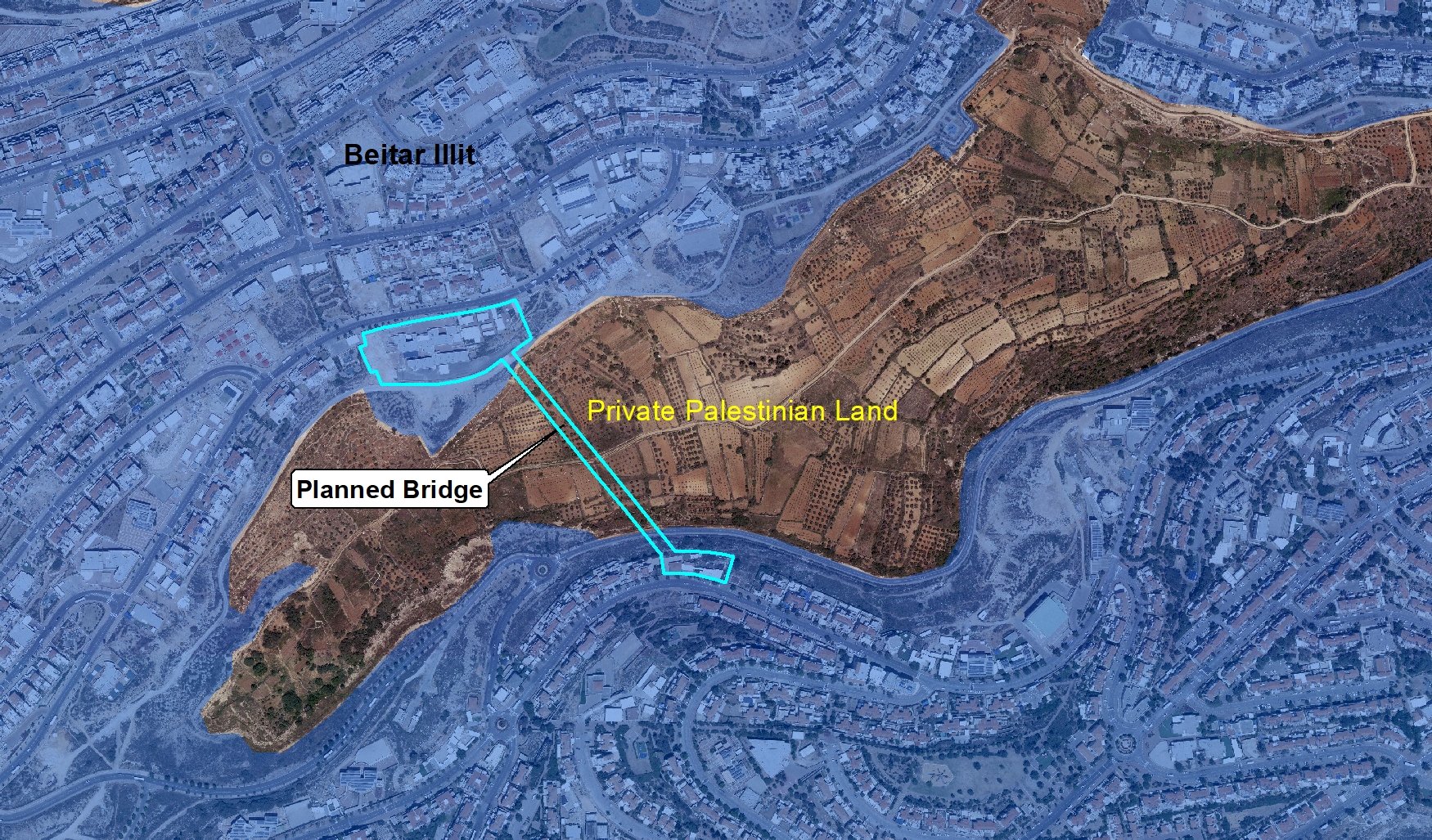
Map by Peace Now
A new pedestrian bridge over privately owned Palestinian land for Israeli settlers to use on the Sabbath (when observant Jews do not drive, and had to walk a long route in order to reach other parts of the settlement).
- 603 new units in Maale Adumim
- A plan to retroactively legalize residential units in the Sde Bar settlement; Peace Now has not yet verified how many units are involved in this plan. Sde Bar was first established as an outpost of the Nokdim settlement in 1998, but Israel granted full approval to that outpost, recognizing it as an educational institute and a full-fledged settlement, in 2005. Settlers recently built a residential neighborhood there without Israeli authorization. The plan approved by the council on April 4th will grant retroactive authorization to those residential settlement units.
- 289 new units in the Alon settlement, located on the Palestinian side of the separation wall within sight of the Khan al-Ahmar bedouin village that Israel is prepared to forcibly relocate. There are plans to expand the neighboring Kfar Adumim settlement to takeover the land where Khan al-Ahmar currently stands.
- 110 new units in the Givat Zeev settlement.
- 108 new units in the Etz Efraim settlement.
- 85 new units in the Karnei Shomron settlement.
Of the total units advanced on April 4th, the High Planning Council also approved for deposit for public review plans for 2,433 new settlement units, the majority of which (1,198) will be built on the east side of the Israeli separation barrier, including:
- 1000 units in Efrat
- A plan to retroactively legalize 720 units in the Haresha outpost. This is part of the Israeli government’s ongoing efforts to retroactively legalize the outpost, which hinges on Israel’s ability to build a legal access road to the outpost. The Israeli government has found several creative solutions to that problem – like building a tunnel or building a bridge – all of which will undoubtedly infringe on the property rights and livelihoods of the Palestinian land owners.
- 210 units in Shiloh – expanding the footprint of the settlement to its north
- 147 units in Ariel.
- 147 units in Mitzpe Yericho.
- 114 units in Elon Moreh.
- 73 new units in Beitar Illit (in addition to the final approvals covered previously).
- 66 units in Oranit.
- 42 more units in Givat Zeev.
- 32 units in Beit Arie.
- 7 new units in Rehelim.
- An unverified number of new units in the following settlements: Paduel, Karnei Shomron, and Elkana.
Peace Now said in response:
“Netanyahu has decided, officially or unofficially, to annex the West Bank to Israel, otherwise one cannot explain the promotion of thousands of units for Israelis in the Occupied Territories. The construction of the settlements only makes it harder to end the occupation and to get to a two states peace agreement and is bad for the Israeli interest to remain a democratic and secured state.”
Housing Ministry Publishes Tenders for 956 Settlement Units
On April 4th the Israeli Ministry of Housing and the Israel Lands Authority met and published tenders for the construction of 956 new settlement units, including commercial complexes; 106 tenders are for plans in settlements east of the separation barrier. These units are in addition to the 3,659 units advanced this week by the Civil Administration’s High Planning Council (discussed above).
The published tenders are:
- 250 units in the Elkana settlement.
- 195 units in the Ariel settlement.
- 118 units in the Ofarim settlement.
- 112 in the Alfei Menashe settlement.
- 111 units in the Oranit settlement.
- 62 in the Adam (Geva Binyamin) settlement, located east of the separation barrier.
- 50 in the Emmanuel settlement.
- 44 units in the Maale Ephraim settlement, located east of the separation barrier.
- 14 units in the Beitar Illit settlement
As Peace Now explains, “some of the tenders are for units that were published in previous tenders but were not sold. The new tenders mean that the government is currently seeking to promote and build those units although failed to do so in the past.”
Ariel Medical School Gets Approval, But Faces High Court Petition
On April 12th, the Israel Higher Education Council voted to approve a new medical school in Ariel University, located in the West Bank settlement of Ariel. This approval contravenes the normal practice of the council, in that it ignores a vote to reject the school by the Higher Education Council’s own professional subcommittee. The medical school is slated to open this fall with significant financing from American casino magnate (and Trump supporter/financial backer) Sheldon Adelson.
However, the High Court of Justice is set to hear a petition regarding the unusual and scandal-ridden process by which the school gained approval at various stages of the planning process. The petition was filed by two Israeli academics – Prof. David Harel of the Weizmann Institute of Science and Prof. Alon Harel of the Hebrew University of Jerusalem – asserting that the approval “casts a heavy shadow on the decision making process in higher education.” It is unclear how the outcome of the petitions might affect the newly approved plan to open the medical school this fall.
Settlers Celebrate Right-Wing Election Victory
Settlers are mostly celebrating the results of Israel’s April 9th elections (in which West Bank and East Jerusalem Palestinians could not vote), which delivered incumbent Prime Minister Netanyahu an opportunity to form and lead the next government.
As has come to be expected, Netanyahu made an 11th hour election pitch by promising to start the process of annexation if he was reelected. Settlers received Netanyahu’s annexation promise and his reelection with predictable enthusiasm. The Yesha Council released a congratulatory statement saying:
“This morning we can say with certainty: In the face of all the campaigns and manipulations, the people of Israel chose the right. The people expressed their loyalty to the Land of Israel and chose in favor of applying Israeli sovereignty over Judea, Samaria and the Jordan Valley. We congratulate Prime Minister Benjamin Netanyahu on his election, and look forward to the establishment of a strong and broad right-wing government. In the next Knesset, too, we will continue to build, expand, legalize and jointly develop Israeli communities in the region.”
Not all settlers believe that Netanyahu will deliver on his promise to annex the settlements, but generally speaking, settlers dismiss the “will he/won’t he” debate (perhaps correctly) as a political decision that does not impact the reality of their presence on the ground.
Peace Now issued a sharp statement on the election results:
“Now the settlement lobby and its re-elected backers in the Knesset are doing what they know best – extorting and manipulating to save Netanyahu from prosecution in exchange for his compliance in working toward annexation. We at Peace Now were never relying on the election to change reality, but rather see grassroots public engagement as the only way to build pressure on the government. Now that Netanyahu has let the annexation genie out of the bag with his pre-election rhetoric, we stand even more equipped to go on the offense by showing fellow Israelis the bleak future the settler lobby and its Knesset backers are leading us, and what viable alternative path Israel can take toward a more prosperous, democratic, secure future.”
AirBnb Reverses Settlement Policy
On April 9th, AirBnB announced that it had reversed its decision to remove rental listings located inside of Israeli settlements in the occupied West Bank, despite previously acknowledging that settlements “are at the core of the dispute between Israelis and Palestinians,” and that the listings there “contribute to existing human suffering.”
AirBnB’s new announcement acknowledges (again) that settlements are “central to ongoing tensions,” but says it will nonetheless continue to allow those listings to remain on their website. Giving a nod to the controversial nature of this decision, AirBnB promised to donate all profits derived from West Bank settlement listings to humanitarian groups, but it conspicuously specified that these will be humanitarian groups working in other parts of the world (as opposed to with the Palestinians).
Omar Shakir, the Israel/Palestine Director at Human Rights Watch – which issued a significant and damning report on the issue of tourism being used to normalize occupation – tweeted in reaction:
“Disappointing @Airbnb decision reverses their stance to fully respect rights. Donating profits from unlawful settlement listings does nothing to remedy ‘human suffering’ they’ve acknowledged causing. By continuing to do business in settlements, they remain complicit in abuses.”
Along with AirBnB’s policy reversal, it settled several lawsuits filed against AirBnB in U.S. courts. FMEP President Lara Friedman tweeted on this important element:
“And just like that, US courts let themselves becomes weapons used to legitimize the violation of intl law, the re-definition of ‘lsrael’ to mean ‘all the land between the river and the sea,’ & the re-definition of ‘anti-Semitism’ to mean ‘refusal to endorse/normalize occupation.’ This is part of a broader trend that very few people are paying any attention to, which is a dangerous mistake. By the time folks wake up it will likely be too late. [link to: https://forward.com/opinion/417058/opinion-the-surprising-new-battleground-in-the-war-against-palestinian/]”
The Center for Constitutional Rights – which recently intervened in the legal cases involving AirBnB – issued a response saying:
“We are dismayed that Airbnb has caved to the legal bullying of Israeli settlers and re-listed properties in illegal settlements in occupied Palestinian territory. Airbnb’s decision reflects an alarming lack of commitment to human rights. When we filed counterclaims on behalf of the Palestinians who actually own the land the listed properties unlawfully sit on, we laid out the international and domestic law violations committed by the settlers, including war crimes and crimes against humanity. In backing down from its decision not to list properties in occupied Palestinian territory, Airbnb is in breach of its international human rights obligations, and is discriminating against Palestinians.”
Amnesty International – which also published a report on the complicity of online rental companies who list properties in East Jerusalem and the West Bank – said in response to AirBnB:
“Airbnb’s decision to continue to allow accommodation listings in illegal Israeli settlements in the occupied West Bank is a reprehensible and cowardly move that will be another devastating blow for the human rights of Palestinians…Airbnb are trying to absolve themselves by stating they will donate the profits from these listings to charity, but that fails to change the fact that by continuing to drive tourism to illegal settlements they are helping to boost the settlement economy. In doing so, they are directly contributing to the maintenance and expansion of illegal settlements, a breach of the Geneva Conventions and a war crime under Rome Statute of the International Criminal Court. Airbnb had a clear opportunity to make the right decision to uphold human rights and use their influence to set a precedent in the tourism industry. Instead, they have chosen to bury their heads in the sand – ignoring blatant evidence that they are helping to fuel violations that cause immense suffering to Palestinians. Airbnb’s reversal demonstrates why we can’t just rely on companies to take the right decisions, and that we need governments to fulfil their obligations by intervening and passing laws obliging their companies to respect human rights.”
U.S. Ambassador Friedman Touts East Jerusalem Settlement Business as “Path to Peace”
U.S. Ambassador David Friedman tweeted his support for the new Rami Levy mall, located in the Atarot settlement industrial zone within sight of Ramallah but inside the security barrier and within Israel’s municipal border, as expanded by Israel after the 1967 war.
Friedman said:
“Great morning at the new Atarot Mall in northern Jerusalem, anchored by a Rami Levy Supermarket. Was given a tour by Rami Levy himself. Israelis and Palestinians working, shopping and doing business together — a simple path to peace!”
FMEP President Lara Friedman tweeted in response:
“Amb Friedman & co’s special notion of peace, based on racist notion that unlike Jews who for 1000s of years refused to forsake their history/narrative, Palestinians will be beaten into submission or bribed into giving up basic human demand for freedom & equal rights.”
When the Rami Levy mall opened in January 2019, FMEP explained:
“The massive new mall is the crown jewel of the shopping empire built by Israeli businessman Rami Levy, who already operates a network of supermarkets in settlements. Like all of Levy’s projects (and settlement industrial zones in general), the new mall is branded as a socially-conscience, ‘coexistence’-building business initiative, with Levy and government officials praising the fact that the new mall will attract both Israeli and Palestinian shoppers and be home not only to Israeli businesses, but to to a few Palestinian-owned/operated businesses as well.”
The ‘coexistence’ argument is dismantled by the Israeli watchdog group Who Profits, which explained:
“The Jerusalem mall would mark a new stage in Levy’s involvement in the occupation economy…[which] began with providing services to Israeli settlers and continued with the exploitation of Palestinians as a cheap labor force in his supermarkets. He now appears to be turning his attention to massive construction projects on occupied Palestinian land and the exploitation of a Palestinian captive market in the East Jerusalem…Rami Levy is in a position that would allow him establish a large mall on “virgin land” because the Israeli authorities have prevented Palestinian businesses from competing with Israelis. Levy’s plan would take advantage of the fact that Palestinians do not have other large-scale retail facilities. A flourishing market in Bir Nabala was destroyed by Israel’s wall in the West Bank. And venturing into West Jerusalem is not an option for Palestinians, most of whom live below the poverty line. Although there is every likelihood that the Israeli authorities will portray Levy’s mall as beneficial to Palestinians, there are important facts to be remembered. Palestinians entering his mall will not be exercising the right of a consumer to informed choice. Rather, they will be captive clients — belonging to an occupied people.”
Bonus Reads
- “Democracy, Israeli Style” (New York Times)
- “Jerusalem is Finally Unified, In Opposition to this Plan” (Haaretz)
Welcome to FMEP’s Weekly Settlement Report, covering everything you need to know about Israeli settlement activity this week.
To subscribe to this report, please click here.
April 5, 2019
- Israel Expected to Advance Nearly 5,000 Settlement Units
- Glassman/Or Sameach Yeshiva Project at Entrance of Sheikh Jarrah Neighborhood Approved for Public Deposit
- Also in Sheikh Jarrah, The Sabbagh Family Receives Another Eviction Notice
- New Settler Bypass Road Gets Go-Ahead After Deadly, Disputed Incident at Huwwara Interchange
- Settlers Are Cultivating Palestinian Farmland Taken by the Construction of Israel’s Separation Wall
- Transportation Ministry Voices New Concern About Elad’s Zipline Project in East Jerusalem
- Yesh Din Issues Authoritative Report on Israel’s “Racist Endeavor” to Retroactively Authorize Outposts
- Al-Haq Report: Israel Appropriated ‘Ein Fara Spring; TripAdvisor Now Promotes It as an Israeli Tourist Destination
- Settler Leader: “Settlements are a Bridge to Socio Economic Peace”
- Bonus Reads
Questions/comments? Email kmccarthy@fmep.org
Israel Expected to Advance Nearly 5,000 Settlement Units
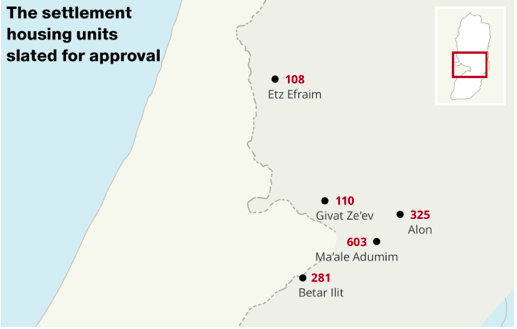
Map by Haaretz
According to reports last week, Israeli planning bodies were expected to meet and advance plans for nearly 5,000 new settlement units at a meeting on April 1st. However, that meeting appears to have been delayed.
Nonetheless, it is worth reviewing the leaked details of the settlement plans slated to be advanced, of which 1,427 are reportedly set to receive final approval from the High Planning Council, including
- 603 new units in the Ma’aleh Adumim settlement just east of Jerusalem;
- 325 new units in the Alon settlement, near the disputed Palestinian village of Khan al-Ahmar east of Jerusalem;
- 108 new units in the Etz Efraim settlement, in the northern West Bank, one of several settlements slated to become a “super settlement” area;
- 110 new units in the Givat Ze’ev settlement just north of Jerusalem;
- 281 new units in the Beitar Illit settlement.
A subcommittee of the Israeli Civil Administration was also set to meet on April 1st (no press reports indicate that the meeting actually happened), and was expected to advance plans for 3,474 new settlement units for public deposit, an earlier stage of the settlement planning process (reminder: all stages of the settlement planning process are significant, as each step through the publication of tenders is a political act of the Israeli government). The plans slated to be approved for public deposit include plans in settlement across the West Bank, reportedly include the following settlements:
- Elon Moreh, located east of Nablus in the central West Bank;
- Karnei Shomron, in the northern West Bank;
- Elkana and Oranit, which along with Etz Efraim, are slated to become a part of a “super settlement” area;
- Ariel in the central West Bank;
- Beit Aryeh northwest of Ramallah;
- Shiloh in the central West Bank;
- Talmon north of Ramallah.
- Peduel, in the northern West Bank but on the Israeli side of the separation barrier; and,
- Mitzpeh Yericho, just west of Jericho.
Glassman/Or Sameach Yeshiva Project at Entrance of Sheikh Jarrah Neighborhood Approved for Public Deposit
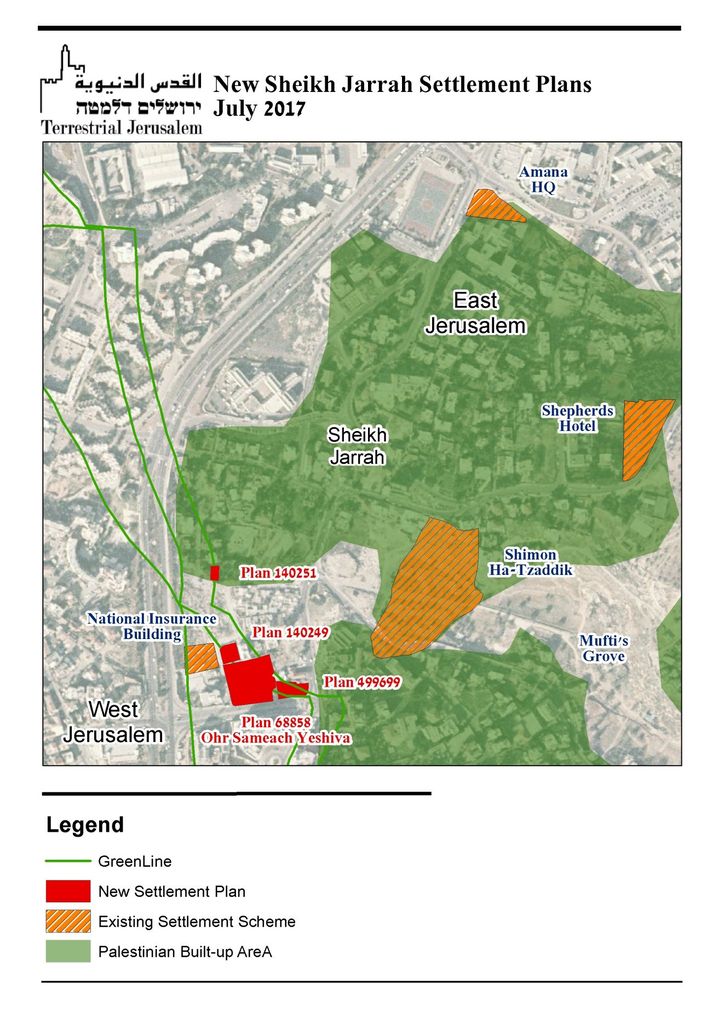 On April 2nd, the Jerusalem District Planning and Building Committee approved the Glassman/Or Sameach yeshiva project for public deposit. The plan, as FMEP has repeatedly covered, seeks to build a Jewish religious school (a yeshiva) at the entrance of the Sheikh Jarrah neighborhood of East Jerusalem. The yeshiva is one of several settlement projects set to flank the road leading into the Sheikh Jarrah neighborhood, designed to strengthen Israeli settlers’ hold on the neighborhood and seamlessly connect the growing settler enclave in Sheikh Jarrah with West Jerusalem.
Ir Amim warns and explains:
“[The Glassman/Or Sameach yeshiva] plan should be seen as an alarm bell in the context of Israel’s ramped up efforts to deepen its circle of control around the Old City Basin. The plan (Plan No. 68858) calls for construction of an eleven-story building with eight levels above ground and three below, including a dormitory for hundreds of students and housing for faculty, to be located at the mouth of Sheikh Jarrah. It was submitted by the Ohr Somayach Institutions, to which the Israel Land Authority has already allotted land without a transparent tender process, and approved for deposit by the District Planning and Building Committee in July 2017.”
In a detailed report on the Glassman yeshiva project, Terrestrial Jerusalem described it as:
“a clear effort to exploit Torah study to expand and normalize occupation in East Jerusalem (including by making the site politically untouchable, as it will now be linked with religious activities).”
Also in Sheikh Jarrah, The Sabbagh Family Receives Another Eviction Notice
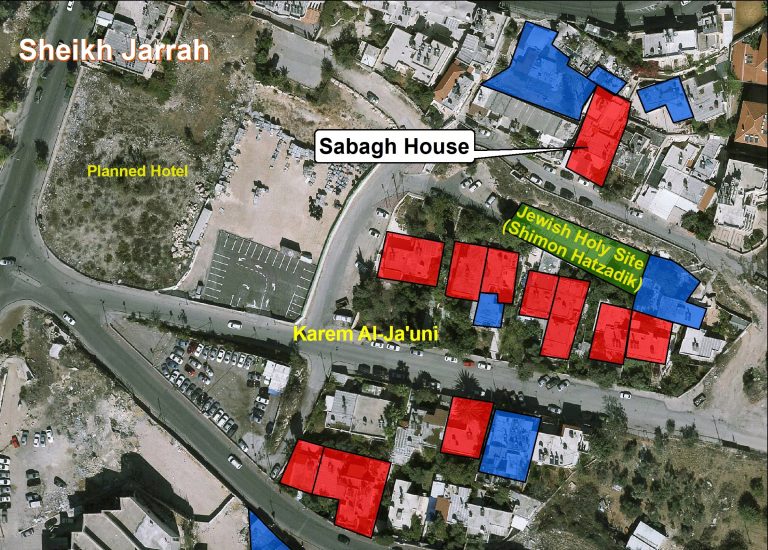
Map by Peace Now
On March 31st, the Palestinians Sabbagh family was handed another eviction notice, weeks after Israeli authorities rejected the family’s latest petition to reconsider the legal authority by which settlers are seeking to evict them from their home of 60+ years. Peace Now reports that the Sabbagh family is still attempting to delay their eviction, but is unlikely to succeed.
In a comprehensive briefing on the Sabbagh family’s protracted legal struggle, Ir Amim and Peace Now write:
“Increasingly, settler initiated, state-backed evictions of Palestinian families are being used as a strategy to help cement Israeli control over the area. Given their strategic location as gateways to the Old City, Sheikh Jarrah to the north of the Old City and Silwan to the south are the two neighborhoods under greatest pressure from Israeli settler groups. Some 150 families in these two areas alone are under threat of eviction…The Sabbagh family is only the latest family threatened with eviction in the Kerem Alja’oni section of Sheikh Jarrah. If evicted, their home will be the tenth to be seized by settlers. Roughly 30 Palestinian families are under threat of eviction and at least eleven have open court cases. Those cases were suspended pending the Supreme Court decision on the Sabbagh case; the recent removal of that stopgap could usher in a wave of new evictions. On the other side of Nablus road, in the Um Haroun section of Sheik Jarrah, an additional 40 or so families face the threat of eviction.”
New Settler Bypass Road Gets Go-Ahead After Deadly, Disputed Incident at Huwwara Interchange
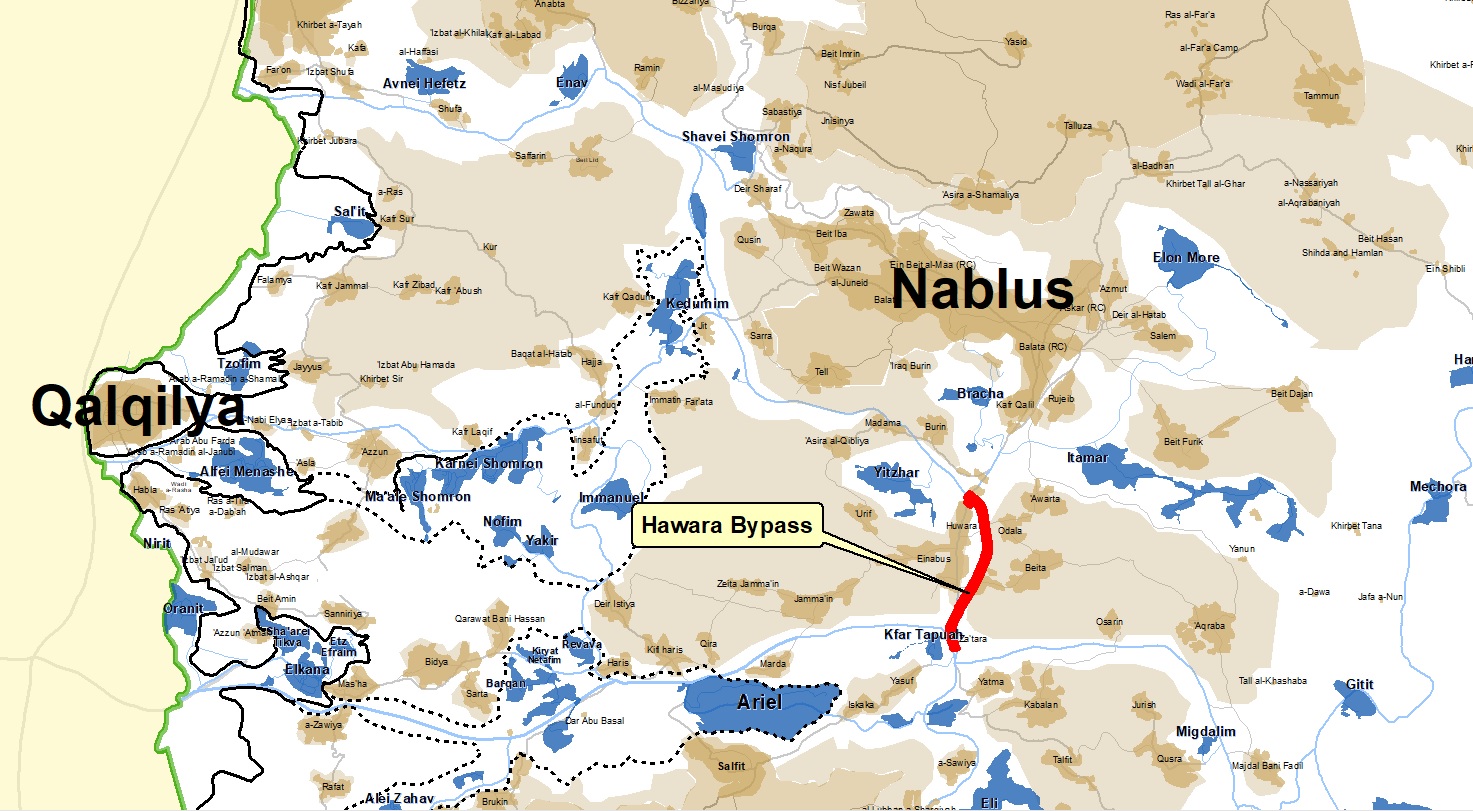
Map by Peace Now
The Israeli Defense Ministry announced that it approved the construction of a new bypass road to divert settler traffic around the Palestinian village of Huwwara. The new road will allow settlers to avoid the Huwwara interchange, a perpetually congested section of the main West Bank highway, Route 60, and an area that has been a site of Palestinian violence against the settlers, including a recent incident where a settler shot and killed a Palestinian teenager allegedly attacking the settler. Dubbed the “Huwwara Bypass,” the new road will be built on land historically a part of the Palestinian villages of Huwwara and Beita, which Israel seized for security reasons.
This road is one of five new bypass roads that Prime Minister Netanyahu promised to build under immense pressure from the settler lobby, known as the Yesha Council. It was one part of a massive security package that the Netanyahu government funded to the tune of $228 million in 2017. Peace Now detailed each of the five bypass roads slated for construction, and wrote:
“The planned roads…are meant to serve settlements located deep in the West Bank, which will not be a part of Israeli in the framework of an agreement according to the Geneva Initiative’s proposed border.Historically, the paving of bypass roads has led to an acceleration of the development of the adjacent settlements…Additionally, paving new roads in the West Bank entails the confiscation of private Palestinian lands. All of the roads are built due to needs of settlers rather than the needs of the Palestinians. In certain cases the roads can also be useful for Palestinians, but the majority of these roads are hardly used by Palestinians at all. This fact puts into question the Israeli legal argument behind the confiscation, as according to international law, the confiscation of lands must serve the local population, meaning the Palestinians.”
Transportation Ministry Voices New Concern About Elad’s Zipline Project in East Jerusalem
An official from the Israeli Transportation Ministry voiced reservations regarding the Elad settlement organization’s request to re-zone the “Peace Forest” as a “public use space” in order to allow for the construction of its zipline project there. At a meeting on April 1st (a previous meeting was covered by FMEP last week) to consider the request, a transportation official expressed concern that the project is a private commercial endeavor, not a public use project – meaning that the project might not be legal even if the forest were to be re-zoned for public use. The official said:
“[A zipline] constitutes commercial use: It’s not going to be operated by the municipality or a youth group. This alone is a reason not to approve the plan.”
The Haaretz report on the April 1st meeting also provides historical context on Elad’s illegal activities in the “Peace Forest” (which was established by the Jewish National Fund on privately owned land in East Jerusalem following the 1967 war) over the past 14 years. Haaretz writes:
“At first the NGO simply trespassed and built illegal structures there. But things changed and gradually various local and national bodies – including the Jerusalem Municipality, the Israel Land Authority, the Tourism Ministry and the JNF – began to grant Elad assistance. This assistance has included granting building permits retroactively, allocating land to the group without a proper bidding process, and generous funding to the tune of tens of millions of shekels…Most of Elad’s current focus is on managing and developing the City of David National Park in the Palestinian neighborhood of Silwan, and purchasing homes for Jews from the Arabs living there. But the NGO isn’t neglecting its other projects: It has been sponsoring activities in the Peace Forest since 2005, despite the fact that it has no ownership rights there or permits from the ILA (the legal owner of the land, which was expropriated from private Palestinian owners). These activities are essentially expanding Elad’s reach from Silwan into the entire historic basin of Jerusalem’s Old City, from the Mount of Olives to the Armon Hanatziv promenade (which actually consists of several different walkways, projects of the Jerusalem Foundation).”
Settlers Are Cultivating Palestinian Farmland Taken by the Construction of Israel’s Separation Wall
For the past six years, Israeli farmers have been farming Palestinian land that was left on the Israeli side of the separation barrier, an area Palestinian landowners are largely barred from entering.
When the separation wall was constructed in the early 2000s, it confiscated 35,000 acres (140,000 dunams) of Palestinian land as a result of its circuitous route that snakes deep inside of the West Bank. The land between the wall and the 1967 Green Line is commonly referred to as the “seam zone.”
Kerem Navot founder Dror Etkes – who obtained aerial photography documenting settler activity in the area – explained:
“One of the same plots to which landowners are barred from entering is located west of the Palestinian village of Nuba, about 15 kilometers northwest of Hebron. Nearly half of the village’s land was lost in 1948 because it remained west of the Green Line, and with the construction of the separation barrier in the area from 2005-2006, residents lost another 1,000 dunams that remained on the other side of the barrier. Although there’s an agricultural gate on site that was supposed to be used by landowners to reach their territory to the west, their entry has not been possible since the barrier was constructed. This ‘vacuum’ was identified by the ‘Mateh Yehuda Agricultural Association,’ which cultivates vast swaths of land that were transferred to Israeli moshavim in the area, including those west of the Green Line. After a few years in which the villagers didn’t access their land, the Agricultural Association decided that it was time to take over of one of the wadis in the area.”
Etkes separately told Haaretz:
“This story allows a peek into the jungle Israel created in areas left between the barrier and the Green Line. This area, called ‘the seam’ by Israel, is gradually becoming a looting ground for anyone who can grab a plot while exploiting a reality in which tens of thousands of West Bank residents are unable to reach their lands. All this proves that the route along which the barrier was built passes mostly through the West Bank, serving political interests, as anyone with eyes in his head saw and understood as the barrier was being built.”
Yesh Din Issues Authoritative Report on Israel’s “Racist Endeavor” to Retroactively Authorize Outposts
In a new report, the Israeli NGO Yesh Din analyzes the legal pretexts Israel has created to systematically legalize outposts across the West Bank that were built in contravention of Israeli law and on privately owned Palestinian land.
The report reviews and rebutts the findings of the “Zandberg Report” – which (approvingly) outlined various legal tactics and tools the state can use to save those outposts.
Yesh Din found that the Zandberg Report’s recommendations allow for 99% of all unauthorized outposts to be retroactively approved within 2-3 years, anticipating that the government will declare 20 new settlements in the process.
Yesh Din’s report also examines how Israel has already undertaken the first step in this effort, by introducing the “market regulation” principle into the courts. If validated by the courts, the “market regulation” principle will provids legal cover to ‘regularize’ 2,700-3,000 illegal structures built on privately owned Palestinian land.
Yesh Din writes:
“The Zandberg Committee aids a racist endeavor whose essence is the dispossession of Palestinians from their land on the basis of ethnicity. The euphemisms used in the report and the legal terminology it employs do nothing to hide the fact that the ‘Regularization Committee’ report is, in fact, an expropriation report which provides the government more methods for normalizing and deepening the iniquity of Israel’s settlement policy: one area, the West Bank, with two populations – privileged Israeli citizens and Palestinians living under military rule, dispossessed and oppressed.”
Analyzing the Zandberg Report as an alternative to the settlement “Regulation Law,” Yesh Din states:
“The Zandberg Committee seemingly offers a more restrained framework for ‘regularization’ or retroactive authorization that purports to be less injurious than the ‘Regularization Law’ and relies on legal doctrines. In truth, however, the report cloaks landgrab, dispossession and expropriation on an extremely large scale – approaching that of the Regularization Law – in a shroud of legality.”
Al-Haq Report: Israel Appropriated ‘Ein Fara Spring; TripAdvisor Now Promotes It as an Israeli Tourist Destination
Al-Haq, the preeminent Palestinian human rights group, published a report documenting Israel’s appropriation of the ‘Ein Fara spring, located on the lands of the Palestinian village of Anata northeast of Jerusalem. The spring historically served as the primary source of drinking water and agricultural water for Anata and several surrounding villages.
Since 1967, Israel has appropriated the spring and its waters, and built five settlement on the surrounding land.
Israel renamed the spring the “En Prat Nature Reserve” and promotes religious tourism at the site, as does TripAdvisor.
Al-Haq writes:
“The appropriation of village lands, confiscation of water resources and continued denied access to Palestinians violates the right to self-determination, further breaches the prohibition of discrimination, the right to life including the duty to ensure access to water, the right to water, the rights of freedom of movement, the right to a livelihood, and cultural rights related to the integral use of the ‘Ein Fara spring to communal village life. Al-Haq reminds that Trip Advisor is advertising ‘En Prat Nature Reserve’ a settler tourism service, on its internet platform. Al-Haq stresses that Trip Advisor is providing an economic service for the benefit of Israeli settlements, which may amount to an involvement in settlement related activities.”
Settler Leader: “Settlements are a Bridge to Socio Economic Peace”
Writing in the Jewish News Syndicate, Yochai Dimri (chairman of Har Hevron Regional Council) makes a pitch for the Israeli public and elected officials to drop hopes of a “peace deal” in favor of socio-economic “co-existence” initiatives that normalize the settlements.
As FMEP has documented, this message lines up exactly with the activities and priorities of the Trump Administration, particularly with Amb. David Friedman who has been in partnership with the Har Hevron Regional Council to promote the Judea and Samaria Chamber of Commerce as an Israeli-Palestinian business cooperative.
In a piece entitled – “Settlements are a Bridge to SocioEconomic Peace” – Dimri writes:
“The Barkan Industrial Park near Ariel is an outstanding model for collaboration between Jews and Arabs, and is the wellspring of local employment for both populations. A similar industrial area in Har Hevron is currently in the planning stages, and flourishing businesses and factories are expected to be established there to benefit the residents of Har Hevron and the Negev…The need of the hour is to expand collaborations to include health, education and other necessary areas as well—not through international initiatives, but through Israeli ones. Once Israel learns to view the settlement communities in Judea and Samaria as an asset and not a liability, as an impetus for change and not a roadblock, it will discover that they are not an obstacle to peace, but rather a bridge to achieving economic and social peace.”
FMEP’s Lara Friedman reacted to this notion in a recent op-ed:
“Last October, Friedman participated in a public event convened in the settlement of Ariel. The event, which featured Israeli settlers and a handful of Palestinians, promoted the view that the key to peace is not political agreements or negotiations. Rather, peace would come from economic and business cooperation between Palestinians (living under Israeli occupation, governed by Israeli military and military law designed to promote the interests and needs of Israel, entirely disenfranchised from the powers that control their lives) and settlers (living in settlements built on land taken from Palestinians, enjoying all the entitlements and protections of Israeli citizenship and law, and with representatives and allies at every level of Israeli government). This approach, not coincidentally, exemplifies a vision of ‘peace’ based on promises of improved quality of life for individual Palestinians, de-coupled from any pretense of helping Palestinians end an occupation that the United States no longer believes to exist, or achieve national self-determination that the United States no longer supports. Tweeting about that event, Friedman suggested that this kind of cooperation was precisely the kind of opportunity that the Palestinian people truly want and could have, if only their leadership would listen.”
Bonus Reads
- “How Israel is Working to Remove Palestinians from Jerusalem” (The National)
- “Annexation Will Free Israel from the Fake Commitment to Liberty and Equality” (Haaretz)