Welcome to FMEP’s Weekly Settlement & Annexation Report. To subscribe to this report, please click here.
October 16, 2020
- No Annexation, No Problem – Israel Advances Nearly 5,000 New Settlement Plans, Including New Settlement South of Jerusalem
- Plan for 570 Units in East Jerusalem Settlement Approved for Deposit
- Israel Approves Construction of Elevator at Tomb of the Patriarchs
- Israel Delivers Confiscation Notices to Palestinians Living in the Heart of Hebron
- Palestinians Report Newly Established Outposts & Land Confiscations
- Targeting Palestinians Construction in Area C: State Devotes $6 million to Mapping Program
- In First, Palestinian Authority Courts to Hear Lawsuits Against Settlers
- NF, Elad Face International Heat Over Sumarin Family Eviction Case – Will it Matter?
- Report: U.S. Will Not Back De Jure Annexation Until 2024 [Friedman Says 2021 in Play]
- Bonus Reads
Comments/questions? Contact Kristin McCarthy (kmccarthy@fmep.org)
No Annexation, No Problem – Israel Advances Nearly 5,000 New Settlement Plans, Including New Settlement South of Jerusalem
During meetings held October 14th and 15th, the Israeli High Planning Council advanced plans for a total of 4,948 new settlement units. Of that total, plans for 2,688 units were granted final approval and plans for 2,260 units were approved to be deposited for public review (a late stage in the planning process). The latter approvals include a plan to build a new settlement, “Har Gilo West,” just beyond Jerusalem’s southern border. In addition, the Council granted retroactive approval to 340 existing illegally-built settlement units in the unauthorized outposts of Peni Kedem and Tapuach West, paving the establishment of two new official West Bank settlements (through post-facto legalization of the illegal outposts).
These were the first meetings of the High Planning Council since February 2020, at which time settlement planning was put on pause in favor of attempting to implement annexation plans as designed by Trump’s “Deal of the Century.” Under annexation, authority over the settlement planning/approval process could have been shifted from the Israeli Civil Administration (the branch of the Israeli Defense Ministry, in charge of the administration of affairs in the West Bank, – i.e., Israel’s occupation) into Israel domestic planning mechanism. Such a shift has long been a goal of settlers and their political allies.
In addition to advancing construction of new residential settlement units, the High Planning Council also advanced plans for the construction of new settlement projects that support tourism, further entrench the permanency of settlements, and that continue the exploitation of West Bank land and resources.
Record-Setting Settlement Activity in 2020
With the huge advancement of settlement plans this week, the Israeli government has advanced plans for 12,159 settlement units so far in 2020. With over two months to go, the settlement watchdog group Peace Now reports that this is already the highest total number settlement advancements in any year since Peace Now began tracking totals in 2012. Peace Now also reports that it is possible that the High Planning Council will convene one more time before the year ends.
Har Gilo West Approved for Deposit w/ Plan to Seal Off Al-Walajah
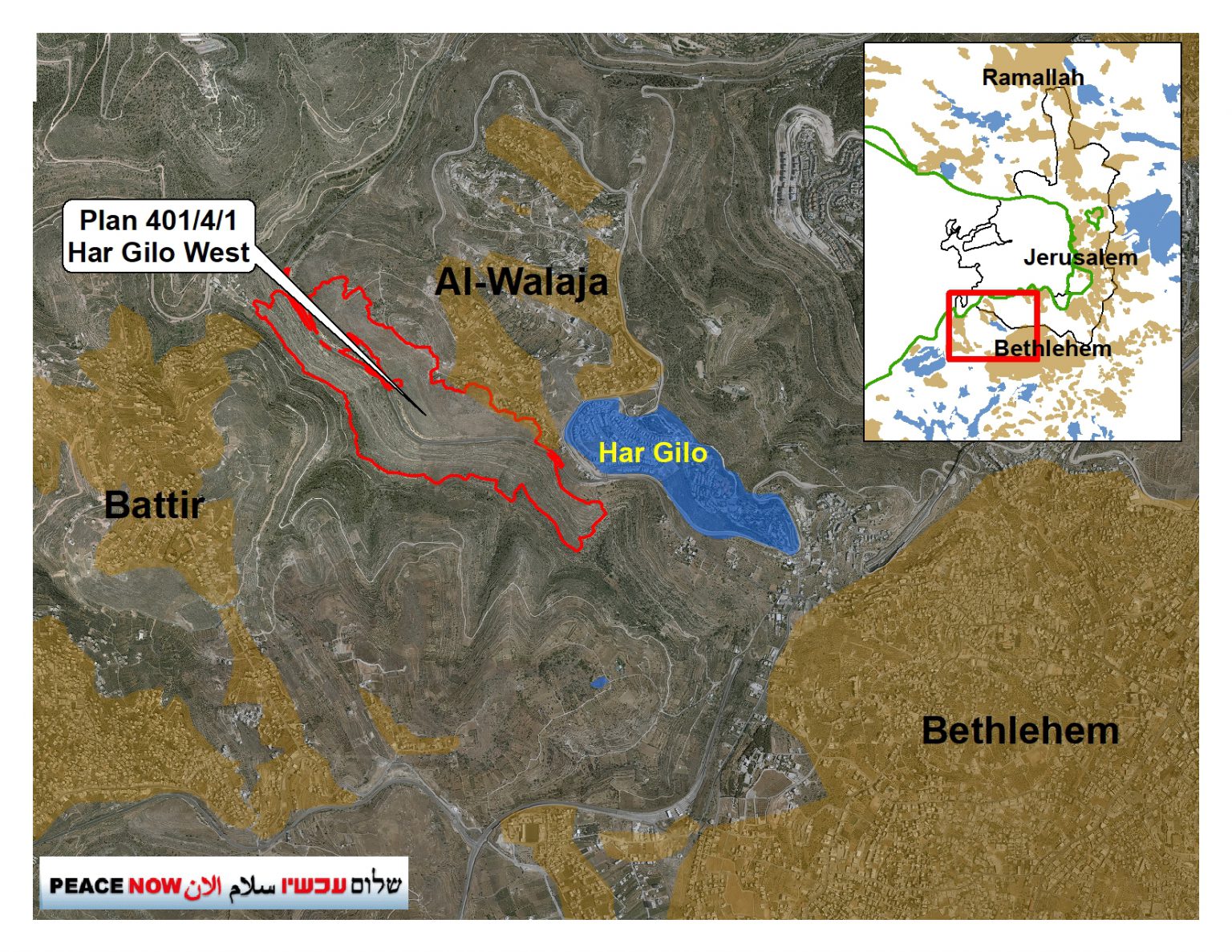 The High Planning Council approved for public deposit a plan to build 560 units at the Har Gilo West settlement site, located just south of Jerusalem. The Council is treating this plan as merely an expansion of the existing Har Gilo settlement, but in actuality it represents the construction of a new settlement on Jerusalem’s southern border, as the two areas of construction (Har Gilo and Har Gilo West) would not be contiguous. The plan for 560 units in Har Gilo West is part of a larger plan to construct around 952 units in the new settlement, extending the its borders right up to the Jerusalem municipal boundary, with dire consequences for the long-beleaguered Palestinian village of Al-Walajah.
The discussion on October 14th further revealed that, in order to build Har Gilo West, Israel plans to extend the separation barrier in that area to completely encircle al-Walajah, which is surrounded on three sides by the separation wall already. The new section of the barrier would be a 7-meters high concrete slab along the western edge of the built-up area of Al-Walajah. That would leave Al-Walajah completely encircled by the separation barrier and Israeli construction beyond it.
Ir Amim explains:
“In the past decade a series of Israeli moves have taken over more and more of Al-Walaja land and gradually isolating it. These are now culminating with the intention to construct the new settlement on the land reserves on the western side of Al-Walaja and to extend the separation barrier so as to complete the encircling of the village. As Al-Walaja will turn into an isolated enclave which lacks an outline plan its residents will be especially vulnerable to increasing home demolitions and other Israeli sanctions. Since the village will separate the new settlement from the existing Har Gilo we are likely to see increasing Israeli actions against Al-Walaja and its residents which will put their future existence at risk.”
Peace Now writes:
“The current plan of 952 housing units to be advanced will create a brand new neighborhood that will be larger than the existing settlement, and will exploit the land cut off by the West Bank barrier to further break up the western Bethlehem metropolitan area, including the land connecting al-Walaja and the town of Battir, as well as Battir and Bethlehem. This land also constitutes some of the only uninhabited fertile land reserves for Bethlehem, which currently is cut off by the West Bank barrier to its immediate north and west.“
FMEP has repeatedly documented various Israeli efforts to seal off al-Walajah from Jerusalem. Residents of al-Walajah have fought the growing encroachment by the nearby Etzion settlement bloc and the Israeli government’s attempt to de facto annex the bloc as part of “Greater Jerusalem.” Ir Amim explains several prongs of this effort, including a particularly unbelievable section of Israel’s separation barrier planned to almost completely encircle the village, to turn its valuable agricultural land into an urban park for Jerusalem, and construction of a highway that will connect the Etzion settlement bloc to Jerusalem with Israeli-only bypass roads.
Two Outposts Advance Towards Retroactive Legalization
The High Planning Council approved for deposit two plans that would, if implemented, have the effect of retroactively legalizing two outposts – bestowing upon those outposts legitimacy in the eyes of Israeli law and, in effect, establishing two new, official settlements. Those plans are:
- Pnei Kedem: A plan to grant retroactive legalization to 120 units in the Pnei Kedem farm outpost by recognizing the outpost as a “neighborhood” of the Metzad/Asfar settlement. This is despite the fact that the two areas of construction are non-contiguous. Pnei Kedem is located halfway between Bethlehem and Hebron in the southern West Bank. Settlers were particularly gleeful about this plan being advanced
- Tapuach West: A plan to grant retroactive legalization to 133 units in the Tapuach West outpost, located south of Bethlehem.
Not Just Residential Units – Council Advances Settler Tourism & Infrastructure Projects
The High Planning Council also advanced plans for the construction of new settlement projects that support tourism, further entrench the permanency of settlements, and that continue the exploitation of West Bank land and resources.
The Council granted final approval to:
- A plan for new shops and an educational site (to include an agricultural farm) in the Kochav Yaakov settlement – located between Jerusalem and Ramallah; and,
- A plan to grant retroactive authorization to a motor park and 120 hotel rooms in the Petza’el settlement, located in the Jordan Valley. As FMEP has covered in the past, this state-of-the-at racetrack and hotel complex is being built partially on land that the Israeli army previously declared a closed firing zone, a designation which resulted in the forcible displacement of Palestinians who lived there. The land remains under this designation today. Rather than halting the construction of this complex, the Israeli authorities instead created a Master Plan for the area in order to enable even more construction in the area.
Plans the Council granted final approval for public deposit include:
- A plan for an industrial zone near the Mishor Adumim settlement; and,
- A plan to build a new commercial area and 50 hotel rooms in the Maale Adumim settlement;
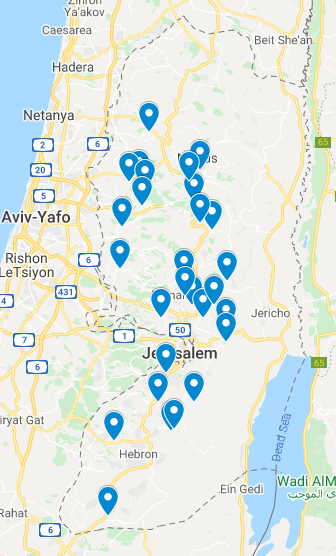
Map by Ben White (@benabyad)
Included in the total number of units receiving final approval and/or retroactive legalization (3,028 units) are (in descending order of number of units): [map]
- 382 units in the Beit El settlement, located in the heart of the northern West Bank. This includes retroactive legalization for 36 units which had been previously built without authorization and the construction of 346 units in highrise buildings with 9 or 10 floors (building up, not out in Beit El) [as a reminder, US Ambassador to Israel David Friedman has deep ties to the Beit El settlement];
- 357 units in the Geva Benyamin (Adam) settlement, located just north east of Jerusalem, just beyond the separation barrier. Israel has been steadily building the Adam settlement in a manner meant to unite the settlement more seamlessly with East Jerusalem settlements and infrastructure, erasing the Green Line;
- 354 units in the Nili settlement, located in the northern West Bank;
- 213 units in the Shiloh settlement, including the retroactive legalization of 21 units built without required approvals. The Shiloh settlement is located in the central West Bank;
- 211 units in the radical and violent Yitzhar settlement, including some retroactive authorizations (exact number not specified) as well as approval for public buildings. Yitzhar, located just south of Nablus, is associated with the Hilltop Youth movement – and a string of illegal outposts in the area associated with repeated attacks on Palestinians and their property;
- 205 units in the Nokdim settlement (actually approved for the Kfar Eldad settlement, which is officially within the jurisdiction of Nokdim), located south of Bethlehem;
- 200 units in the Metzad settlement (also known as Asfar), including the retroactive legalization of an unspecified number of existing units built without necessary approvals;
- 160 units in the Kochav Yaacov settlement, located east of Ramallah;
- 140 units in Kerem Reim settlement – located north west of Ramallah. Peace Now has repeatedly challenged the illegal construction of the Kerem Reim outpost, which the Israeli government retroactively legalized by declaring it a neighborhood of the Talmon settlement even though the areas are non-contiguous. Though a court rejected one Peace Now petition, there is an ongoing case against the Amana settler organization which Peace Now alleges engaged in illegal activities to build the outpost;
- 132 units in Kfar Adumim settlement – located east of Jerusalem and less than one mile from the Khan al-Ahmar bedouin community which the state of Israel is seeking to demolish;
- 106 units in the Ma’ale Shomron settlement, located east of the Palestinian village of Qalqilya;
- 84 new units in the Shima settlement, including retroactive legalization of 14 existing units;
- 74 units in the Yakir settlement – located in the northern West Bank and part of a string of settlements and unauthorized outposts – most notably Ariel – extending from the Green Line deep into the West Bank;
- 64 units in the Telem settlement – located west of Hebron;
- Retroactive legalization of 18 units in the Psagot settlement – located east of Ramallah, and home to the Psagot Winery;
- Retroactive legalization of 2 units in the “Givon Hadasha” settlement;
Plans which were approved for deposit for public review include (in descending order of number of units):
- 629 units in the Eli settlement, including the retroactive legalization of 61 units – located south of Nablus and southeast of the Ariel settlement in the central West Bank. Though the Eli settlement previously received Israeli government approval, a “Master Plan” – which officially zones land for distinct purposes (residential, commercial, public) – has never been issued for Eli, meaning all construction there is illegal under Israeli law;
- 560 units in the Har Gilo settlement located just south of Jerusalem (covered in detail above);
- 286 units in the Har Bracha settlement – located just south of Nablus. If implemented, these new units will double the size of Har Bracha;
- 179 units in the Einav settlement – located northwest of Nablus;
- 148 units in the Rimonim settlement – located between Ramallah and Jericho in the Jordan Valley;
- A plan to grant retroactive legalization to 133 units in the Tapuach West outpost, thereby granting approval to the outpost itself (discussed above);
- A plan to grant retroactive legalization to 120 units in the Pnei Kedem outpost by recognizing the outpost as a “neighborhood” of the Metzad/Asfar settlement although the two areas of construction are non-contiguous. Pnei Kedem is located between Bethlehem and Hebron in the southern West Bank;
- 82 units in the Karnei Shomron settlement – located in the northern West Bank east of the Palestinian village of Qalqilya. Israel is planning to continue expanding Karnei Shomron with the stated goal of bringing 1 million settlers to live in the area surrounding the settlement.;
- 75 units in the Shimaa settlement, including the legalization of 14 units previously built without authorization;
- 52 units received retroactive legalization in the Kfar Adumim settlement;
- 35 units in the Efrat settlement – located south of Bethlehem. As a reminder, Efrat is located inside a settlement block that cuts deep into the West Bank. Efrat’s location and the route of the barrier wall around it, have literally severed the route of Highway 60 south of Bethlehem, cutting off Bethlehem and Jerusalem from the southern West Bank. The economic, political, and social impacts of the closure of Highway 60 at the Efrat settlement (there is literally a wall built across the highway) have been severe for the Palestinian population;
- 14 units (in one building) in the Maale Mikmash settlement – located east of Ramallah;
- 10 units in the Barkan settlement – located about half way between the Ariel settlement and the cluster of settlements slated to be united into a “super settlement” area (Oranit, Elkana, Shiva Tikva, and others).
- 7 units in the Peduel settlement – located in the northern West Bank and part of a string of settlements and unauthorized outposts – most notably Ariel – extending from the Green Line into the very heart of the West Bank and on towards the Jordan Valley; and,
The High Planning Council met only after settlers, who represent a key ally of the embattled Prime Minister, pressured Netanyahu to allow it. Settlers have spent months decrying what they understood to be a freeze on settlement constructed inflicted upon them by Netanyahu. Gush Etzion Regional Council Head Shlomo Ne’eman said:
“Sometimes we take our prime minister to task, which we feel is justified as a result of our disappointment in postponing the application of sovereignty over our country. But now something tangible is happening – we are building and developing our communities, and of course, the highlight of today is the full registration in the Land Authority of the young community of Pnei Kedem, 20 years since it was established.”
Samaria Regional Council head Yossi Dagan said:
“This is a happy day for Samaria. [New construction] in Har Bracha, Yitzhar, Einav and Tapuach is another step on the way to a million residents in this beautiful region of the country…While we’re very content with today’s developments, I call on the Prime Minister not to stop here. We’re overfilled with joy, but it is a drop in the ocean with sovereignty falling off the agenda. The expectation now is that construction and strengthening of the settlement movement will increase tenfold.”
Peace Now responded to the approvals in a statement saying:
“While Israel reels from its second lockdown and economic distress, Netanyahu is promoting construction in isolated settlements that Israel will have to evacuate. Instead of taking advantage of the agreements with the Gulf states and promoting peace with the Palestinians, he is distorting Israel’s priorities and catering to a fringe minority for these settlement unit approvals that will continue to harm future prospects for peace. We call on the Defense Minister and the Alternative Prime Minister Benny Gantz to veto these plans. Far from a ‘settlement freeze,’ the right has been complaining about, the expected settlement approvals announcement next week prove that the settlement enterprise under Netanyahu is moving ahead at full steam toward solidifying the de facto annexation of the West Bank. The move also will be the first major demonstration of Defense Minister Benny Gantz’s bowing to the ‘Greater Israel’ settlement agenda that would in reality bring about a permanent undemocratic one-state reality. By doing so, Israel will be signaling to the world its bi-partisan support for the end to the concept of a two-state solution and a Palestinian state – the paradigm that until now has largely shielded Israel from formal pressure over its 53-year occupation. The settlement enterprise is not in Israel’s national or security interest, and is a strategic mistake at the international level.”
Palestinian Prime Minister Mohammed Shtayyeh denounced the approvals, saying:
“Every settler unit constitutes a plan to annex our land.”
Palestinian Authority spokesman Nabil Abu Rudeineh said in a statement:
“We warn against this Israeli policy that will lead the region to the brink of the abyss, and we call on the international community to intervene immediately and urgently to pressure the Netanyahu government to stop this settlement madness that totally eliminates any real opportunity to achieve a just and comprehensive peace to end the occupation and establish the independent Palestinian state with East Jerusalem as its capital on the 1967 borders.”
UN High Representative Josep Borrell said in a statement:
“In recent days, Israel has announced a significant expansion of settlements in the occupied West Bank, in areas in and around Jerusalem. These plans, which foresee the construction of close to 5.000 housing units, jeopardise the viability and territorial contiguity of a future Palestinian State as the outcome of a negotiated two-state solution, in line with the internationally agreed parameters. Settlements are illegal under international law. As stated consistently, the EU will not recognise any changes to the pre-1967 borders, including with regard to Jerusalem, other than those agreed by the parties. Settlement activity threatens current efforts to rebuild trust, to resume civil and security cooperation between Palestinians and Israelis and to prepare the ground for an eventual resumption of meaningful and direct negotiations. The Government of Israel should reverse these decisions and halt all continued settlement expansion, including in East Jerusalem and sensitive areas such as Har Homa, Givat Hamatos and E1. The period from March to August 2020 also saw a spike in demolitions or confiscations of Palestinian-owned structures in the West Bank in spite of the COVID-19 pandemic. The EU reiterates its call on Israel to halt all such demolitions, including of EU-funded structures, in particular in light of the humanitarian impact of the current pandemic. Against the background of normalization of relations between Israel, UAE and Bahrain, Israelis and Palestinians should seize this opportunity and take urgent steps to build confidence and restore cooperation along the line of previous agreements and in full respect of international law.”
A spokesperson for UN Secretary-General Antonio Guterres issued a statement flagging concern over the advancements, saying:
“We are concerned about the reports of Israel’s settlement advancements in the occupied West Bank and will continue to follow developments closely, as the Israeli High Planning Committee finalizes its meetings tomorrow. The Secretary-General has consistently reiterated that all settlements are illegal under international law and remain a substantial obstacle to peace. We urge the Israeli authorities to refrain from such unilateral actions that fuel instability and further erode the prospects for resuming Palestinian-Israeli negotiations on the basis of relevant UN resolutions, international law and bilateral agreements.”
Plan for 570 Units in East Jerusalem Settlement Approved for Deposit
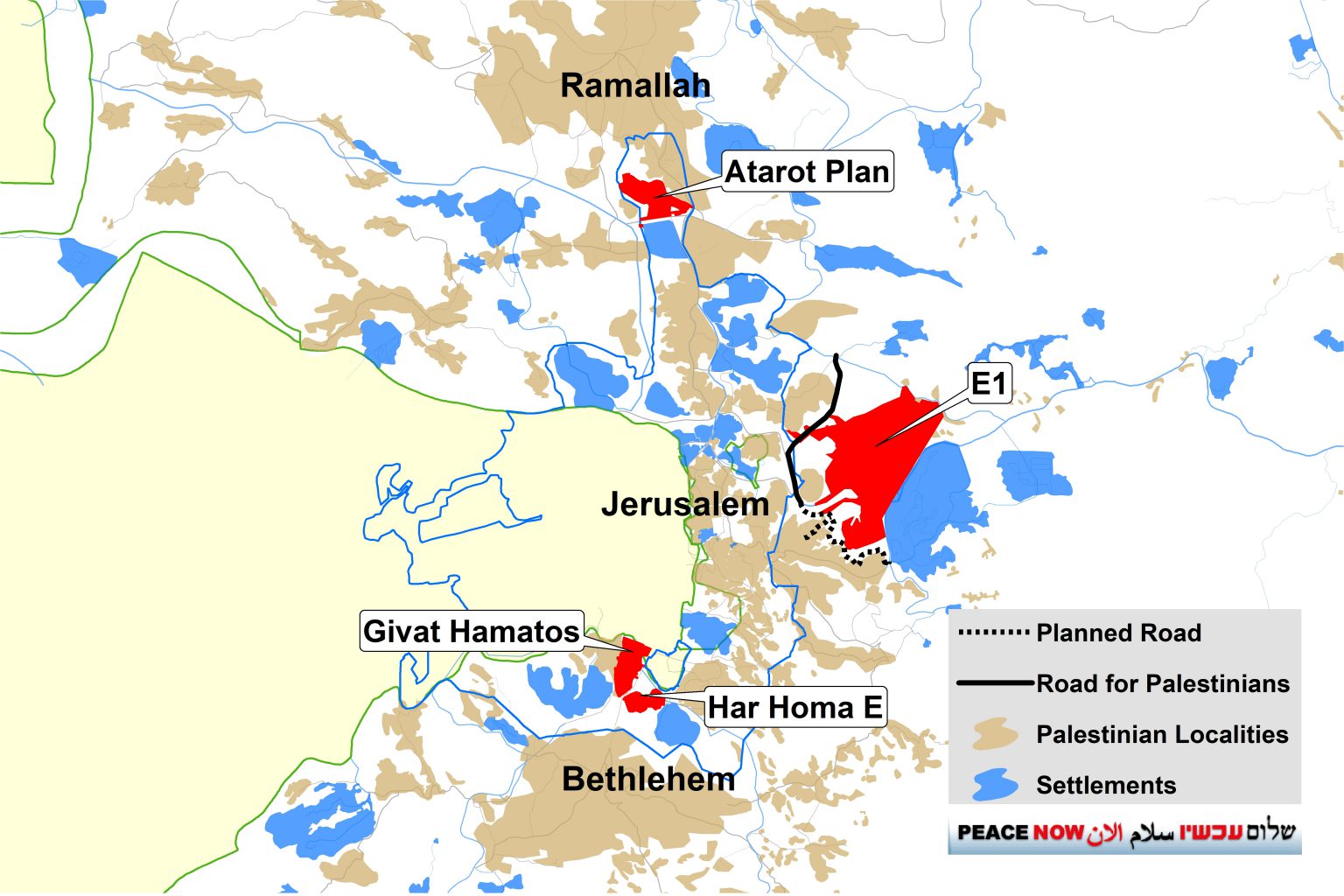 Ir Amim reports that on September 22nd, the Jerusalem District Committee approved for deposit for public review a detailed plan providing for the construction of 570 units in the Har Homa E settlement, located in East Jerusalem. Taken together with the pending construction of the nearby Har Gilo West settlement (discussed in the section above), the Palestinian village of al-Walajah stands to be completely encircled by Israeli settlements.
If implemented, this plan will extend the Har Homa settlement westward, in the direction of the site of the as-of-yet-unbuilt Givat Hamatos settlement. Ir Amim explains:
“If realized, Har Homa E together with construction in Givat Hamatos will connect Har Homa to Gilo creating a contiguous Israeli settlement area that will disconnect East Jerusalem from Bethlehem and the south of the West Bank.”
Ir Amim also reminds us that the Jerusalem District Committee previously approved a Master Plan for a total of 2,200 units in Har Homa E. The plan for 570 units approved for deposit in late September represents the first detailed plan under this Master Plan allows for. Plans to build the remaining units permitted under the Master Plan are not yet being advanced.
Israel Approves Construction of Elevator at Tomb of the Patriarchs
Emek Shaveh reports that on September 29th the Civil Administration granted final approval to a plan to build accessible infrastructure, including an elevator, at the Ibrahimi Mosque/Tomb of the Patriarch in Hebron — a plan which requires Israel to seize land from the Islamic Waqf. As of this writing, Emek Shaveh is considering whether to challenge that approval.
Regarding the significance of the plan, Emek Shaveh said:
“One need not be an archaeologist or architect to review the council’s plan and understand that it is destructive in a manner which is unprecedented. We are convinced that the plan, as approved, would never have been promoted had it not been driven by political motives.”
Emek Shaveh has previously provided critical context as to why this plan is not really, or not fully, being advanced out of humanitarian concerns, explaining:
“Israel’s decision to seize responsibility for the site from the Hebron municipality and the Palestinians sends a clear political message that Israel is reneging on agreements that were signed with the Palestinians in Hebron. Beyond the precedent that will enable the settlers in the future to demand additional changes at the Tomb of the Patriarchs/Ibrahimi Mosque, this is also a precedent that could play out at other sites under the responsibility of the Islamic Waqf. Experience has shown us that what begins in Hebron percolates into other places including Jerusalem. It begins with a seemingly rational demand to benefit the disabled or the general public and evolves into a new status quo. The expected change in Hebron has not escaped the attention of members of the Temple movement and they will know how to present their demands to the government. If Israel can repudiate agreements with the Palestinians in Hebron and expropriate land from the Waqf, it would seem that accepting what appears to be the far more modest demands by the Temple movement to pray or to walk about the Temple Mount complex freely is not so far-fetched. In the reality of Hebron and East Jerusalem, a change involving only several meters at a historic or holy place is not free of political considerations and often it is part of long-term strategy. While it is necessary to tend to the needs and interests of persons with disabilities, the extremists who presume to speak on their behalf must be prevented from forging Israeli policy, even if it is only a matter of a lift and an access path.”
Read Emek Shaveh’s full analysis here: “Humanitarianism Hebron Style.”
Israel Delivers Confiscation Notices to Palestinians Living in the Heart of Hebron
The Palestinian media outlet WAFA news reports that several Palestinians living in the Tel Rumeida section of downtown Hebron were handed confiscation notices from the Israeli authorities, informing them that the State of Israel had confiscated 17 plots of land, including land privately owned by Palestinians.
Tel Rumeida is a part of Hebron located directly in the city center, considered H2 by the Hebron Accords giving Israel full control of security in that area. B’Tselem estimates that there are around 700 settlers living in enclaves amongst approximately 34,000 Palestinians in H2. The Israeli army heavily protects those settlers, and has implemented an apartheid system of segregated movement and checkpoints, most notably in the area of Shuhada Street.
Palestinians Report Newly Established Outposts & Land Confiscations
The Palestinian news outlet WAFA reports that settlers have installed three new outposts over the past month – one near Nablus and a second near Hebron, and a third in the Jordan Valley.
Near Nablus, Palestinians report that the settlers installed mobile homes and a small farm in an attempt to establish a permanent presence on a new plot of land. The settlers are reportedly in the process of connecting the new outpost to the Elon Moreh settlement via roads and water supply. Ghassan Daghlas, who monitors Israeli settlements on behalf of the PLO, told WAFA that the specific area has seen even wider road construction recently, which he sees as an effort to create more seamless contiguity between settlements in the Nablus area and the Jordan Valley. The construction comes at the direct expense of the Palestinian village of Beit Dajani, which has historically owned the land where the outpost and roads are being built.
Near Hebron, WAFA reports that an Israeli settler erected a tent with and Israeli flag on privately owned Palestinian land near the Birin village.
In the Jordan Valley, WAFA reports that settlers set up a caravan on land on which they began planting trees about three months ago. The settlers also reportedly dug a well at the site.
On October 15th, Israel reportedly announced its intention to confiscate large tracts of land (11,000 dunums) adjacent to the Jordan Valley settlements of Rotem, Maskiyot, and Mesovah. This confiscation, according to Palestinian settlement watcher Qasem Awwad, was presented by the Israeli authorities as a move to add land to natural reserve areas, but seems clearly to be linked to efforts to expand settlements and their control over land in the area.
Targeting Palestinians Construction in Area C: State Devotes $6 million to Mapping Program
Despite COVID and the suspension of Israeli’s unilateral annexation of vast tracts of land in the West Bank, the Israeli government — at the urging of settlers and their allies — is continuing its push to consolidate its control over all aspects of life in Area C (the over 60% of the West Bank that is under full Israeli control).
OCHA has documented an acceleration in the Civil Administration’s demolition of Palestinian structures in the West Bank over the summer, documenting the demolition of 389 Palestinian-owned structures in Area C of the West Bank. As a result of those demolitions, 442 Palestinians were made homeless. OCHA further reported that In just the month of August, 205 Palestinians lost their homes, the highest single month total since January 2017. In addition, Israel continues to issue more demolition notices, including against Palestinians living in a cave near Jenin, and against a newly constructed school for bedouin children located east of Ramallah.
To further this effort, on September 10th the Israeli government allocated $6 million USD (20 million NIS) for the newly created Settlement Affairs Ministry to survey and map unauthorized Palestinian construction in Area C of the West Bank, which Israel and its settlers have been aggressively demolishing in an effort to rid the area of Palestinians. Haaretz reports that this is the first time that the state budget has included funds specifically for a land survey in the West Bank. The state also allocated an additional $2.8 million (9.5 million NIS) to an existing grant program specifically for settlement municipalities to cash in on. As a reminder, virtually all Palestinian construction in Area C of the West Bank is unauthorized, because Israel almost universally refuses to give Palestinians permission to build in Area C even on land that Israel recognizes as owned by Palestinians.
The Settlement Affairs Ministry is a new creation of the current coalition government, and is headed by Tzachi Hanegbi (Likud). The funding for the Settlement Affairs Ministry to conduct a survey of unauthorized Palestinian construction in Area C further empowers a domestic Israeli body to exert extraterritorial sovereignty over Area C – in effect, treating the area as land already de facto annexed by Israel. While technically the occupied territories are administered by the Israeli Civil Administration (a body within the Defense Ministry), Israel has spent decades bringing the administration of the territories (specifically the settlements and Area C) ever more directly under direct Israeli sovereignty (de facto annexation).
In the lead up to the allocation of funds for this new survey of Palestinians life in Area C, the Knesset hosted two committee discussions the political outlook of which was clearly indicated in the stated subject of the meetings: “the Palestinian takeover of Area C.” Consistent with this framing (which is predicated on the idea that Area C belongs to Israel), and pushed by outside groups, many members of the Knesset have criticized the Israeli government’s allegedly lackadaisical approach to preserving State interests in Area C (i.e., clearing out Palestinians, expanding settlements, consolidating state infrastructure). Reportedly, Foreign Affairs Minister Gabi Ashkenazi (Blue & White) sent a letter to the committee specifically addressing the Knesset’s outrage over European humanitarian assistance projects for Palestinians in Area C. In the letter, Ashkenazi not only celebrated the reduction of European projects over the past year, but validated settlers’ insinuations regarding the nefarious nature of European assistance for Palestinians, saying that any European activity in the West Bank lacking Israeli permission is “an attempt to define a border.” Ashkenazi also said that Israel will not compensate European donors for confiscated equipment or the demolition of European-funded projects that lack Israeli permission (like in the case of schools built with European funding, and solar panels donated to bedouin communities lacking power).
At one Knesset hearing, MK Bezalel Smotrich (Yamina) suggested that a solution could be to empower the settlements with the ability to demolish Palestinian construction they believe to be unauthorized. Smotrich’s partymate Ayelet Shaked (former Justice Minister) suggested that the government should appoint a project manager tasked with preventing a Palestinian takeover of Area C.
As noted above, Israel has long denied Palestinians the ability to build in Area C. To fully understand what is happening, it is worth reviewing B’Tselem’s excellent explainer:
“Israel’s planning and building policy in the West Bank is aimed at preventing Palestinian development and dispossessing Palestinians of their land. This is masked by use of the same professional and legal terms applied to development in settlements and in Israel proper, such as “planning and building laws”, “urban building plans (UBPs)”, “planning proceedings” and “illegal construction”. However, while the planning and building laws benefit Jewish communities by regulating development and balancing different needs, they serve the exact opposite purpose when applied to Palestinian communities in the West Bank. There, Israel exploits the law to prevent development, thwart planning and carry out demolitions. This is part of a broader political agenda to maximize the use of West Bank resources for Israeli needs, while minimizing the land reserves available to Palestinians….
In the West Bank, the potential for urban, agricultural and economic development remains in Area C. Israel uses its control over the area to quash Palestinian planning and building. In about 60% of Area C – 36% of the West Bank – Israel has blocked Palestinian development by designating large swathes of land as state land, survey land, firing zones, nature reserves and national parks; by allocating land to settlements and their regional councils; or by introducing prohibitions to the area now trapped between the Separation Barrier and the Green Line (the boundary between Israel’s sovereign territory and the West Bank).
Even in the remaining 40% of Area C, Israel restricts Palestinian construction by seldom approving requests for building permits, whether for housing, for agricultural or public uses, or for laying infrastructure. The Civil Administration (CA) – the branch of the Israeli military designated to handle civil matters in Area C – refuses to prepare outline plans for the vast majority of Palestinian communities there. As of November 2017, the Civil Administration had drafted and approved plans for only 16 of the 180 communities which lie in their entirety in Area C. The plans cover a total of 17,673 dunams (1 dunam = 1,000 square meters), less than 1% of Area C, most of which are already built-up. The plans were drawn up without consulting the communities and do not meet international planning standards. Their boundaries run close to the built-up areas of the villages, leaving out land for farming, grazing flocks and future development. Since 2011, seeing that the Civil Administration did not draft plans as it is obliged to do, dozens of Palestinian communities – with the help of Palestinian and international organizations and in coordination with the PA – drafted their own plans. Some of the plans covered communities or villages located in full in Area C and others covered places only partly in Area C. As of September 2018, 102 plans had been submitted to the Civil Administration’s planning bodies, but by the end of 2018, a mere five plans – covering an area of about 1,00 dunams (or about 0.03% of Area C) – had received approval.
The odds of a Palestinian receiving a building permit in Area C – even on privately owned land – are slim to none. Given the futility of the effort, many Palestinians forgo requesting a permit altogether. Without any possibility of receiving a permit and building legally, the needs of a growing population leave Palestinians no choice but to develop their communities and build homes without permits. This, in turn, forces them to live under the constant threat of seeing their homes and businesses demolished.
The impact of this Israeli policy extends beyond Area C, to the hundreds of Palestinians communities located entirely or partially in Areas A and B, as the land reserves for many of these communities lie in Area C and are subject to Israeli restrictions there.
The demand for land for development has grown considerably since the 1995 division of the West Bank: The Palestinian population has nearly doubled, and the land reserves in Areas A and B have been nearly exhausted. Due to the housing shortage, much land still available in these areas is used for residential construction, even if it is more suited for other uses, such as agriculture.
Without land for construction, local Palestinian authorities cannot supply public services that require new structures, such as medical clinics and schools, nor can they plan open spaces for recreation within communities. Realizing the economic potential of Area C – in branches such as agriculture, quarrying for minerals and stone for construction, industry, tourism and community development – is essential to the development of the entire West Bank, including creating jobs and reducing poverty. Area C is also vital for regional planning, including laying infrastructure and connecting Palestinian communities throughout the West Bank.
In contrast to the restrictive planning for Palestinian communities, Israeli settlements – all of which are located in Area C – are allocated vast tracts of land, drawn up detailed plans, connected to advanced infrastructure, and the authorities turn a blind eye to illegal construction in them. Detailed, modern plans have been drawn up for the settlements, including public areas, green zones and, often, spacious residential areas. They enjoy a massive amount of land, including farmland that can serve for future development.
Israel’s policy in Area C is based on the assumption that the area is primarily meant to serve Israeli needs, and on the ambition to annex large parts of it to the sovereign territory of Israel. To that end, Israel works to strengthen its hold on Area C, to further exploit the area’s resources and achieve a permanent situation in which Israeli settlements thrive and Palestinian presence is negligible. In doing so, Israel has de facto annexed Area C and created circumstances that will leverage its influence over the final status of the area.”
In First, Palestinian Authority Courts to Hear Lawsuits Against Settlers
For the first time since the Palestinian Authority was established in 1994, it will allow Palestinians to bring lawsuits against Isareli settlers in Palestinian courts. The Palestinian Authority’s Justice Minister Mohammed al-Shalaldeh announced that the PA had formed a national team to handle these cases, and the team was already working to collect evidence and file suits against settlers who have committed crimes against Palestinians in Hebron and in the village of Burin, located just south of Nablus.
Until this point, no Israeli citizen has been tried in a Palestinian court. Under the Oslo Accords (which established the Palestinian Authority), the Palestinian Authority holds no jurisdication over Israeli citizens – including Israeli citizens living in the West Bank. In May 2020, PA President Mahmoud Abbas announced that the PA considers all accords and agreements with Israel to be void following Israel’s announcement that it intends to annex large parts of the West Bank in accordance with the Trump Plan. Shalaldeh said that the announcement this week flows directly from Abbas’s decision to free the PA from the Oslo Accords’ provisions.
Explaining how these cases might work, Shalaldeh said:
“The Israeli side will be notified as an occupying power to appear before the Palestinian court…If the [Israeli] side refuses the jurisdiction of the Palestinian courts, formal procedures will be followed and in absentia rulings will be issued, in accordance with Palestinian laws.”
JNF, Elad Face International Heat Over Sumreen Family Eviction Case – Will it Matter?
Over the past month, international audiences have directed heightened scrutiny towards the radical settler group Elad and the Jewish National Fund (JNF) for the role both organizations have played in spearheading the effort to evict the Palestinian Sumreen family from their home in the Silwan neighborhood of East Jerusalem. Due to the new attention, the JNF is reportedly reconsidering whether or not to carry out the eviction of the Sumreens – an eviction which the organization has pursued since 1991.

Map by Haaretz
JNF donors – along with activists, religious leaders, members of Congress, and Israel prize winners – reportedly began to express concern and outrage over the JNF’s role in the Sumreen case following the September 2020 ruling by Jerusalem Magistrate’s Court against the Sumreen’s claim to the home. In response to the criticism, the JNF (via actions by the Board of its subsidiary organization, Himnuta, which was created to take the lead for JNF in litigating aggressive settlement takeover cases like this) has acted to freeze the eviction process internally, and was scheduled to consider a proposal for freezing the formal legal proceedings against the Sumreens this past week. Himnuta’s decision and deliberations caused conflict with Elad, which had the Jerusalem Magistrate’s Court intervene to postpone Himnuta’s Board meeting to discuss the proposal. Elad argues that Himnuta transferred all legal authority over the Sumreen case to their organization, and cannot now interfere in the proceedings. The meeting was subsequently postponed at the request of the Court.
Elad is also coming under new international scrutiny following the revelation that Roman Abramovitch – a Russian oligarch and naturalized Israeli citizen who also is one of the owners of the renowned Chelsea football club – is Elad’s single largest donor, having anonymously donated over $100 million to the settler group over the past 13 years. The BBC produced an investigative feature report on Abramovitch’s connection to Elad, pointing out that over the past 15 years more than half of Elad’s funding has come from offshore companies in the Caribbean, which are now known to be owned or controlled by Abramovitch. The BBC feature connects Elad to the settlers’ struggle to evict the Sumreen family, and the larger effort to replace Palestinians in Silwan with Jewish Israelis.
Peace Now writes:
“The news about Abramovich’s involvement highlights the injustice Palestinians face at the hands of these settlement groups. Impoverished families are up against the financial weight of a Russian oligarch. NGOs trying to protect these families are delegitimized and their work dismissed for receiving funding from democratic European aid agencies while settler groups rake in vast sums of non-transparent money from offshore Caribbean shell companies. And the JNF is profiting off of all of this. We can’t force Abramovich to stop his funding or the JNF to stop abetting Elad in its settling campaign, but we can make them worry about their reputation. Peace Now has been conducting a campaign inside Israel to call Abramovich out for his devious funding.”
Regarding the revelations of Elad’s funding source, Emek Shaveh writes:
“…the Elad Foundation, through a combined strategy of sponsoring excavations, developing tourism and settling in Palestinian homes, succeeded in recreating Silwan as the Jewish neighbourhood of Ir David (City of David) and one of the most popular tourist destinations in the country. The exploitation of archaeological tourism by the Elad Foundation has become a number one strategy for entrenching Israeli sovereignty over historic Jerusalem. “
The Sumreen family home is located in the middle of what today has been designed by Israel “the City of David National Park.” The area is managed by the radical Elad settler organization, which for years has also been pursuing the eviction of Palestinians from the homes in Silwan. For nearly three decades, the Sumreen family has been forced to battle for legal ownership of their home, after the state of Israel, prompted repeatedly by the JNF, declared the Sumreen’s home to be “absentee” property. After that designation – which was not communicated to the Sumreen family – Israeli law permitted the state to take over the rights to the building. The state then sold the rights to the home to the JNF in 1991. The JNF has pursued the eviction of the Sumreen family ever since. Israeli courts ruled in favor of the Sumreen family’s ownership claims to the home for years, until a September 2019 ruling by the Jerusalem Magistrate’s Court granted ownership of the family’s home to the JNF, a decision the family immediately appealed to the Jerusalem District Court.
A full history of the saga involving the Sumreen family – which is similar to dozens of other Palestinian homes in Silwan that were declared Absentee Property in the 1990s – can be found on the Peace Now website here.
Report: U.S. Will Not Back De Jure Annexation Until 2024 [But Friedman Says 2021 Is in Play]
A series of reports in mid-September suggested that, as part of its commitment to the U.A.E. in exchange for normalization with Israel, the U.S. promised to withhold its recognition of Israeli annexation until January 2024, at the earliest.
The 2024 timeline harkens back to a concept in Trump’s “Deal of the Century” which gave (oh so generously) the Palestinians a four year window to enter into negotiations with Israel on the basis of the Trump Plan’s conceptual map.
Following these reports regarding a 2024 timeline for the U.S. greenlighting Israeli annexation, U.S. Ambassador David Friedman (who has been a champion of annexation) told Israel’s Army Radio that annexation can happen next year. Friedman, pushing back on U.A.E. press leaks seeking to promote the notion that the Abraham Accords stopped annexation, said:
“We said in our statement that sovereignty will be postponed, and this does not mean that it has been abolished, but rather that it has stopped. It has been suspended for a year, maybe more, but it has not been cancelled.”
Bonus
- “Tourism in the Service of Occupation” (Al-Shabaka)
- “The Status Quo on the Temple Mount/Haram Al Sharif: Dodging a Bullet (For Now)” (Terrestrial Jerusalem)
- “How Evangelicals Working in Settlements Bypassed Israel’s COVID-19 Entry Ban” (Haaretz)
- “ The March of Folly in the Settlements Continues” (Haaretz)
- “Israeli Students in State-funded Scholarship Program Guard Illegal West Bank Outposts” (Haaretz)
Welcome to FMEP’s Weekly Settlement Report, covering everything you need to know about Israeli settlement activity this week.
To subscribe to this report, please click here.
November 8, 2019
- Israel Advances Plans for 2,342 New Settlement Units
- Israeli Government Approves Settler-Initiated Plans for Cable Car in Jerusalem — Despite Professional, Human Rights Objections
- Israel Plans to Build a New Waste Treatment Plant (to serve Israelis) in the West Bank
- No More Waiting: MKs Introduce Annexation Bills Despite Political Deadlock
- Annexation-via-New Roads (the new Smotrich Plan)
- Annexation-via-Movies (Govt-Funded Settlement Hasbara)
- Annexation-via-Education (Ambassador Friedman’s Favorite Medical School)
- Settler Leaders Elect New Chairman of the Yesha Council
- Israeli Official Calls on Evangelicals to Defend Settlements, Fight BDS, and Support “Economic Peace”
- Bonus Reads
Questions/comments? Contact Kristin at kmccarthy@fmep.org
Israel Advances Plans for 2,342 New Settlement Units
With little attention, on October 10th the High Planning Council – a body within the Israeli Defense Ministry’s Civil Administration, responsible for regulating all construction in the West Bank – advanced plans for 2,342 new settlement units, as well as for two additional settlement projects. Of that total, 719 units were approved for validation (the penultimate step in the planning process), and 1,623 settlement units were approved for deposit for public review (an earlier but decisive stage in the planning process).
The 719 units which received final approved for validation comprise:
- 207 units in the Bracha (aka Har Bracha) settlement, located south of Nablus. In September 2019, the Israeli Central Command signed an order that expanded the settlment’s jurisdiction, a move which paved the way for the approval of these new units (see our September 2019 report). According to Peace Now, this plan – if implemented – will significantly expand both settlement’s population and its physical footprint.
- 206 units in the Tzofim settlement, located north of the Palestinian town of Qalqilya – a town completely encircled by Israel’s seperation barrier (except for a single road connecting it to the rest of the West Bank) – in the northern West Bank.
- 166 units in the Alei Zahav settlement, located in a string of settlements stretching across the northern West Bank. Alei Zahav and its settlement neighbors create a contiguous Israeli populated areas linking Israel proper (west of the Green Line) all the way to the Ariel settlement, located in the heart of the West Bank (the eastern end of Ariel is closer to the Jordan border than to the Green Line). Notably, Alei Zahav is one of the settlements in which the “market principle” has been applied to legalize settlers theft of land recognized by Israel as belonging to Palestinians (see our July 2019 report).
- 140 units in the Mezadot Yehuda settlement, located at the very southern tip of the West Bank, just south of the Palestinian village of Susya, which the Israeli government has been threatening to demolish for years. This plan would nearly double the number of authorized units in the settlement.
Also receiving final approval for validation:
- A plan to retroactively legalize the illegal Brosh outpost in the Jordan Valley. According to Peace Now, the Brosh settlement serves as an educational institution that houses hundreds of students and families of staff members.
- A plan to build a tourist/visitors center in the Shilo settlement – where settlers and the Israeli government have been investing in developing tourism sites for Jewish and evangelical tourists.
The 1,623 units which were deposited for public review include:
- 609 units in the Beitar Illit settlement, located west of Bethlehem, near the Green Line. Beitar Illit is a massive, fast-growing ultra-Orthodox settlement.
- 382 housing units in the Dolev settlement, located west of Ramallah. This is a significant plan for Dolev, as it will more than double the number of existing units. Prime Minister Netanyahu previously promised to build 300 new units in Dolev in response to a Palestinian-perpetrated bombing at a spring (which settlers had taken over from Palestinians) near the settlement that killed a 17-year old Israeli and injured several others.
- 182 units in the Mevo’ot Yericho settlement, located north of Jericho in the Jordan Valley. The validation of this plan is the actualization of the Israeli security cabinet decision to grant the illegal outpost of Mevo’ot Yericho retroactive legalization, an action for which the security cabinet urgently convened on the eve of the September 19th elections. The plan approved by the High Planning Council on Oct. 10th granted legalization to the existing 20 existing units and, if implemented, will allow the settlement to significantly expand.
- 146 units in the Kfar Etzion settlement, located southwest of Bethlehem.
- 140 units in the Kerem Reim outpost located north west of Ramallah. Peace Now has repeatedly challenged the illegal construction of the Kerem Reim outpost, which the Israeli government retroactively legalized by declaring it a neighborhood of the Talmon settlement even though the areas are non-contiguous. Though a court rejected one Peace Now petition, there is an ongoing case against the Amana settler organization which Peace Now alleges engaged in illegal activities to build the outpost.
- 100 units in the Nokdim settlement, located southeast of Bethlehem. Former Israeli Defense Minister Avigdor Liberman – currently one of the most important figures in the race to form a governing coalition – lives in Nokdim.
- 64 units in the Telem settlement, located west of Hebron.
- A plan to build new shops and services in the Kochav Yakov settlement, located between Jerusalem and Ramallah.
Peace Now said in a statement:
“The figures speak for themselves. Netanyahu continues to sabotage the possibility of a political agreement with the Palestinians by promoting more settlement construction in the West Bank, including in places where Israel may have to evacuate as part of a future agreement. This is yet another dangerous step for both Israel and the Palestinians, led by a transitional prime minister whom the public did not trust in his policies. The next government must put a freeze on the development of settlements and to strive for immediate resumption of negotiations with the Palestinians without preconditions and to end the bloody conflict based on the principle of two states for two peoples.”
The European Union issued a statement criticizing the approvals, saying:
“The European Union’s position on Israeli settlement policy in the occupied Palestinian territory is clear and remains unchanged: all settlement activity is illegal under international law and it erodes the viability of the two-state solution and the prospects for a lasting peace, as reaffirmed by UN Security Council Resolution 2334. Israeli authorities also approved a building permit for the construction of a new tunnel road, which bypasses Bethlehem to the west. The progressive construction of a separate road network, connecting settlements and outposts to each other and to the road network in Israel while circumventing Palestinian towns and communities, is entrenching the fragmentation of the West Bank. The EU calls on Israel to end all settlement activity, in line with its obligations as an occupying power. The EU will continue to support a resumption of a meaningful process towards a negotiated two-state solution, the only realistic and viable way to fulfil the legitimate aspirations of both parties.”
Israeli Government Approves Settler-Initiated Plans for Cable Car in Jerusalem — Despite Professional, Human Rights Objections
On November 4th, the Israeli Housing Cabinet approved a settler-initiated plans to build a cable car line in East Jerusalem, despite the fact that the Israeli Attorney General has not yet rendered a decision on whether plans for such a significant and sensitive project can be advanced by a caretaker Israeli government. Emek Shaveh – an Israeli NGO fighting the politicization of archeology in Jerusalem – announced that it intends to appeal the approval to the Israeli Supreme Court.
As FMEP has repeatedly covered, this Jerusalem cable car project is an initiative of the Elad settler organization (which is building a massive tourism center – the Kedem Center – in the Silwan neighborhood, which will be a stop along the cable car’s route). The scheme is intended to further entrench settler control, via archeology and tourism sites, inside the Silwan neighborhood of East Jerusalem, while simultaneously delegitimizing, dispossessing, and erasing the Palestinian presence there. Non-governmental organizations like Emek Shaveh, Who Profits, and Terrestrial Jerusalem have repeatedly discredited the government’s contention that the cable car serves a legitimate transportation need in Jerusalem, and have clearly enumerated the obvious political drivers behind the plan, the archeological heresies it validates, and the severe impacts the cable car project will have on Palestinian residents of Silwan.
Ir Amim field researcher Aviv Tartarsky told Middle East Eye:
‘The project is a way to whitewash Israel’s taking of areas in Silwan to use for archaeological and touristic reasons…If someone wants to go to the Western Wall of the Old City, they have to go through the ELAD activity centre. This project will give ELAD legitimacy and influence, as it is taking part in a governmental project. This is the political reason for why the government is doing this project,’ Tatarsky said.”
Israel Plans to Build a New Waste Treatment Plant (to serve Israelis) in the West Bank
In October 2019 the Israeli government issued a construction tender to build a waste-to-energy plant in the West Bank, on an area of land that is within the jurisdiction of the Ma’ale Adumim settlement where several Palestinian Bedouin communities live. The plant – which is expected to cost USD $284 million (1 billion NIS) – will treat Israeli-generated waste.
B’Tselem – which previously published a comprehensive report criticizing the illegal Israeli practice of exporting its waste to the occupied territories – writes:
“For many years, Israel has been taking advantage of its power as occupier to transfer the treatment of waste (including hazardous waste) and sewage from its sovereign territory to the West Bank. To that end, it has created a situation in which environmental legislation in the West Bank is much laxer than inside Israel, conveniently overlooking the long-term impact of environmental hazards on the Palestinian population and on natural resources, and neglecting to prepare future rehabilitation plans. This has created a financial incentive to transfer the treatment of environmental hazards from Israel to the West Bank. The Palestinians who live in the occupied territory are the ones to pay the price for this environmental damage, even though they were never asked their opinion on the matter and although, as a population under occupation, they have no political power and no real ability to resist.”
B’Tselem also takes aim at the European Union (EU), which has invested millions in the implementation of the Isareli Ministry of Environmental Protection’s 2030 strategic plan, of which the waste-to-energy treatment plant is a part. B’Tselem writes:
“In 2019, Israel and the EU signed an agreement as part of the EU’s twinning instrument, which establishes cooperation with the EU’s neighboring countries, guaranteeing Israel approximately 1.5 million euros over the next two years to support the Ministry of Environmental Protection’s implementation of its 2030 strategic plan. In the agreement, Israel committed to creating a legal framework that adopts European practices and standardization for sustainable waste treatment. As in every agreement between the EU and Israel, it contains a territorial clause that stipulates that it will not apply beyond Israel’s 1967 borders. Yet the EU’s support for the ministry’s strategic plan – which defines the establishment of the plant at Ma’ale Adumim as a goal and presents the exploitation of West Bank land to resolve environmental problems as a matter of course – empties this annex of meaning. By supporting this plan, the EU will be supplying Israel with knowledge and experience that will help deepen its exploitation of Palestinian land resources and bolster the economic status of the Ma’ale Adumim settlement.”
No More Waiting: MKs Introduce Annexation Bills Despite Political Deadlock
Israeli political figures appear to be done waiting for a new government to be formed before acting on the loud signals from the Trump Administration supporting Israeli annexation of West Bank land.
On November 4th, Yamina party leader Ayelet Shaked filed a bill with the Knesset to unilaterally annex the Jordan Valley, the Ma’ale Adumim settlement just east of Jerusalem, and all 22 settlements and 75,000 Israeli settlers in what is broadly termed the Etzion “settlement bloc” located south of Bethlehem. Shaked’s bill calls for Israel to “apply sovereignty” to these settlements, which in practice would constitute the annexation of the settlements. Applying Israel law to areas outside of Israel’s sovereign borders is de facto annexation, as FMEP has explained and documented.
Shaked urged expeditious consideration of the bill, saying:
“There is a diplomatic window of opportunity and willingness on the part of the US for this kind of annexation that will not return. We cannot afford to hesitate or wait. We must take advantage of this window of opportunity immediately and begin to apply sovereignty over these areas. It is for this reason that the State of Israel cannot be dragged into another election cycle.”
On November 3rd, Likud MK Sharren Haskel submitted a draft bill for the annexation of the Jordan Valley, a bill she has introduced previously without success. Haskel said:
“It’s time to make the residents of the Jordan Valley legal Israeli citizens, thus kick-starting the development and prosperity of the region.The communities of the Jordan Valley and their residents are a strategic resource of the highest order for Israel. There is a wide consensus today about the region, following the long-awaited U.S. president’s recognition of the Golan Heights as under Israeli sovereignty. It is time to do the same with the Jordan Valley. After Blue and White leader Benny Gantz proposed to do the same, I call upon him and my fellow party members to support my proposal.”
In March 2019, ahead of the first round of Israeli elections this year, leaked reports suggested that U.S. diplomats were engaged in discussions with Israel about the latter’s intention to annex several “settlement blocs” – even more so-called blocs than called for by Shaked’s latest plan – following the elections. The reports were not corroborated by U.S. sources, but in the intervening time U.S. Ambassador to Israel David Friedman has made repeated statements to the press (in addition to speculative reporting about a forthcoming U.S. political plan) in support of Israel’s right to annex territory in the West Bank – cues the Israeli government has enthusiastically welcomed. In the lead-up to the September elections, Netanyahu vowed to annex the Jordan Valley should he be reelected, a plan endorsed by his rival Benny Gantz and supported by then-U.S. National Security Advisor John Bolton.
As a reminder, over the years there has been no shortage of attempts to normalize the idea that Israel will retain “settlement blocs” in any negotiated peace agreement — logic that originally applied narrowly to the Etzion bloc (defined on much less expansive terms), Maale Adumim, and, in the eyes of some, Ariel. The terminology has been exploited for decades by the Israeli government to convey legitimacy to building in the so-called “blocs.” Over the years the definition of what is a “bloc” has been twisted to include a much larger idea of the Etzion bloc, as well as the entire Jordan Valley. The implied idea regarding what the blocs are and the fact that they are inarguably Israel’s to keep, is incredibly misleading. The term “settlement blocs” has no formal definition or legal standing, and the future of the blocs – no matter how they are defined – is indisputably a matter at the heart of what will one day be negotiations aimed at a two-state solution (if there is ever to be such a solution). For more context, see resources from Americans for Peace Now here and here. (NOTE: A Haaretz investigation last year estimated that a total of 380,000 Israeli settlers live in the West Bank, of which 170,000 live outside of the so-called blocs, as defined by Haaretz).
Annexation-via-New Roads (the new Smotrich Plan)
On November 1st, Israeli Minister of Transportation Bezalel Smotrich unveiled a new government plan to advance Israeli “sovereignty through transportation.” The plan calls for massive investment (USD $283 million) in new/expanded roads and rails lines, for the express purpose of more seamlessly integrating Israeli settlements into Israel proper. Smotrich made clear that his ultimate goal is the complete integration of the West Bank into the national planning mechanisms of Israel proper. The move will erase the government’s current distinction between transportation projects in the West Bank (across the Green Line) and Israel proper [fun note: the Israeli Ministry of Foreign Affairs has an official map posted on its website entitled, “Transportation and Built-Up Areas” that includes the entire West Bank as part of Israel).
Touting the significance of his plan, Smotrich said:
“I do not give preference to Judea and Samaria [the West Bank] but also am not willing to continue the discrimination. These areas will receive treatment just like anywhere else in Israel. While it is only about roads and trains, it has political significance.”
Smotrich created a new bureau for “Judea and Samaria Planning” within the Transportation Ministry to oversee the implementation of this project, and more generally ensure that the ministry is geared towards serving the settlements as a matter of normal business. The institutionalization of such bureaucratic structures within the Israeli government is a significant, and often overlooked, mechanism by which the Israeli government has been engaging in annexation for years. The new bureau – much like parallel structures former Minister Ayelet Shaked set up in the Justice Ministry – is a formal and public statement that the Israeli government is pursuing (and allocating resources to) annexing the settlements.
It should be noted that Israel has used infrastructure projects in the West Bank to advance its settlement agenda, and to further fragment Palestinian life – two completementary goals powerfully explained by B’Tselem in a recently released interactive: “Conquer and Divide: The Shattering of Palestinian Space by Israel.”
FMEP tracks developments related to the ongoing annexation of West Bank land in its Annexation Policies Tables.
Annexation-via-Movies (Govt-Funded Settlement Hasbara)
On November 6th, Israeli Cultural & Sports Minister Miri Regev announced new government funding for film projects initiated by Israeli settlers. According to the guidelines, the new funding will support Israeli citizens living in West Bank settlements who want to make documentaries and films.It is widely understood that the goal is to encourage the creation of more pro-settlement propaganda.
Celebrating her new initiative, Regev essentially admitted that annexation was her motive, saying:
“I made a promise and I am keeping my promise! We are making history today. The Culture and Sports Ministry will support the regional production of films in the north, and for the first time in Judea and Samaria too, and in the hope that in the near future also in the south… The wheels of cultural justice, which bring to expression the range of voices in Israeli society, have worked quickly and now another stage in correcting the cultural map in Israel has been completed. The artists from the periphery, the north and from Judea and Samaria, will become more and more in the center of things, not just on stage but also on the screens. Soon we will allow them to express their ability and talent.”
One critic of the fund, Israeli producer Liran Atzmor, nailed why the new fund is highly problematic and a tool of de facto annexation:
“Setting up a fund that supports filmmaking in the occupied territories with Israeli taxpayers’ money amounts to creeping annexation, which is happening in many areas, obviously, but is happening now more forcefully in the realm of culture, thanks to this fund. As long as the fate of those territories has not been determined, one cannot accept the fact that public funds are distributed there to people of only one color, one nationality and one religion.”
Shlomo Eldar writes:
“…And that is the whole point, to show life in the settlements in a positive light, as a Zionist enterprise glorifying the State of Israel. Head of the Samaria Regional Council Yossi Dagan described the fund as a ‘giant piece of good news. … I believe this move will bring the story of Judea and Samaria to the big screen. … I call on all artists to take part in this party, to come and film in Judea and Samaria and tell its story, so that we can present the public with other faces and other stories that have yet to be seen on the screen’.”
Libby Lenkinski, Vice President of the New Israel Fund, explained in a tweet:
“Creeping annexation and normalization of settlements is not just happening on the land, it’s also a narrative strategy that uses arts and culture funding to move forward. #StopAnnexation”
Annexation-Via-Education (Ambassador Friedman’s Favorite Medical School)
Despite delays and scandals, the sparkling new medical school at Ariel University has officially launched its first school year, with a ceremony attended by a who’s-who of settlement financiers and supporter rejoicing in the opening of the school and in the implications of its opening for the Greater Israel enterprise.
Dr. Miriam Adelson and her husband, Trump-backer/U.S. casino magnate Sheldon Adelson, were in attendance. The Adelsons donated $20 million to the medical school, which was named after Miriam. Addressing the crowd, Dr. Adelson said:
“In Israel, being Israel, we also had to withstand our tribulations. In Israel, being Israel, there were opponents who tried to block the establishment of a critical institution on ancient Jewish land and to deny us legitimacy. But we won, Zionism won, the truth won.”
U.S. Ambassador David Friedman recited the “shehecheyanu,” a prayer of gratitude to God, as part of his speech, also exclaiming:
“A new medical school has opened in Samaria. It’s worth saying that again: A new medical school has opened in Samaria! How many people ever thought those words would be spoken?…The United States Embassy enjoys warm relations with Ariel University, and we are inspired by its contributions to Israeli society and to the scientific world.” [NOTE: “Samaria” is a biblical name used mainly by settlers and their allies to refer to the northern part of the West Bank]
MK Naftali Bennet put an even finer point on the significance of opening a medical school in Ariel settlement, saying:
“No longer is there a Green Line. We are one [united] Israel and that is how it should be. We are going to serve everyone here.”
There are 70 Israeli students enrolled to attend the settlement university. Even though classes are set to begin, the medical school still does not have an approved budget for the 2020 school year.
As a reminder, the Ariel settlement is located in the heart of the northern West Bank, reaching literally to the midpoint between the Green Line and the Jordan border. The future of Ariel has long been one of the greatest challenges to any possible peace agreement, since any plan to attach Ariel to Israel will cut the northern West Bank into pieces. Nonetheless, in February 2018, the Israeli Knesset passed a law extending the jurisdiction of the Israeli Council on Higher Education to universities in the settlements (beyond Israel’s sovereign borders) – an act of de facto annexation. The law was necessary to ensure that the Ariel settlement medical school (and its graduates) would be entitled to all the same rights, privileges, and certifications as schools and students in sovereign Israel. FMEP has tracked this process, and all other annexation policies in its Annexation Policy tables. A fuller history of the Ariel Medical School saga can be found here.
Settler Leaders Elect New Chairman of the Yesha Council
David Elhayani was narrowly elected to serve as the next Chairman of the powerful settler Yesha Council – an umbrella body representing all the settlement regional councils. Elhayani is a well known personality, having served for 10 years as the head of the Jordan Valley Regional Council (a quasi municipal body serving the needs and interests of settlements in the Jordan Valley).
The Times of Israel’s settlement correspondent Jacob Magid explains the relevant politics involved behind Elhayani’s narrow victory over Yigal Lahav, a younger, more radical voice:
“Elhayani and Lahav represented opposite sides of an intensifying rift between an older generation of settler leaders that is closely aligned with Prime Minister Benjamin Netanyahu and a younger group of council chairmen who believe in acting more aggressively on behalf of the movement, even if that means being at odds with right-wing governments that the Likud chief has led. Elhayani, from the old-timer’s camp, edged out Lahav 13-12 after the votes of 24 West Bank council chairman plus settler elder Zeev ‘Zambish’ Hever were counted.”
Elhayani addressed the dynamics of the old guard (of which he is a part) vs. new, more radical, guard ahead of the elections, saying:
“There’s a crisis of trust in the Yesha Council where many council chairmen don’t see the body as being capable of serving the needs of their residents. Many council chairmen don’t show up to Yesha meetings at all.”
Elhayani promised a more “aggressive” demeanor so that those the Council represents will see that they “finally have someone who will fight for them.” So, despite being what some settlers may consider the “mainstream,” i.e. less willing to aggressively challenge the perceived slow-walking of settlement expansion and annexation by the Israeli government, Elhayani is still best understood as an ideologue in his own right.
Ahead of the vote, Elhayani did offer strong criticism of what he sees to be the Isareli government’s discrimination against the settlements, saying that he will fight for better “quality of life”for the settlements – making infrastructure as a core part of his agenda:
“Our residents are sick of the poor infrastructure that has led to power outages, water shortages and traffic jams. It is the responsibility of settler leadership to provide adequate services. You cannot improve quality of life until you improve infrastructure. We still need to be aggressive in demanding infrastructure improvements in the meantime, in addition to preventing a Palestinian takeover of Area C so that there will be something to [annex] when the time comes.”
Israeli Official Calls on Evangelicals to Defend Settlements, Fight BDS, and Support “Economic Peace”
Speaking to an audience of leaders in the evangelical media world, a top Netanyahu aid asked the crowd to join Israeli government efforts to defend the legitimacy and permanence of the settlements, and coached the crowd on how to frame settlements in a way that advances their normalization.
This was the third annual “Christian Media Summit” hosted by the Israeli Government Press Office to develop the group into “ambassadors for Israel.” According to Haaretz, the 2019 event was attended by approximately 150 journalists, mostly from the United States, working for Christian media outlets from 30 different countries. Entitled, “Between Jerusalem and the Golan: International Recognition,” the event featured addresses by Benjamin Netanyahu and President Reuven Rivlin. U.S. Ambassador David Friedman attended as well.
Speaking to the group, Deputy Chief of Foreign Affairs Reuven Azar said:
“The return of Jews to Judea and Samaria is not a curse, it’s a blessing for all the residents of the area…Calling for their expulsion is a recipe for destruction and for chaos… Look what happened when we went out of Gaza. Our presence in Judea and Samaria [the West Bank], and in Jerusalem brings stability… because we bring security by fighting the bad guys…We must partner in embracing our brothers and sisters who live in Judea and Samaria, and fight against those who claim their presence is illegal, or try to dehumanize them through different means. Help us to fight boycotts, they are not just, and they hurt us and they hurt our neighbors even more. ‘The revival of the Jewish people in the land of Israel is a divine promise being fulfilled…It is a blessing for our people, our region, for the world. A force for good, a force for peace, prosperity and happiness’.”
Following his remarks, the Front for the Protection of Democracy – an Israeli NGO – filed a complaint with the Civil Service Commission seeking disciplinary action against Azar. The Prime Minister’s Office quickly came to Azar’s defense, saying: “Political adviser Reuven Azar expressed government policy.”
Azar repeatedly referred to settlements as “communities” – a term that erases the illegality of those “communities” under international law. This pro-settlement framing was recently endorsed by outgoing U.S. advisor Jason Greenblatt. Azar also touted the now familiar but Orwellian claim that settlements are an economic gift to the Palestinians, claiming that “communities [settlements] in Judea and Samaria [the West Bank] provide opportunities, and jobs…” Azar invited the audience to visit the Barkan industrial zone, stating: “The best paying jobs for Palestinians are in Barkan.”
As FMEP has previously explained, for decades Israel has used industrial zones as another tool to expand and deepen control over West Bank land and natural resources. Industrial zones perpetuate Israel’s economic exploitation of occupied territory (including the local workforce, land, and other natural resources), and that it is Orwellian to label such initiatives as “coexistence” programs, or to suggest that they offer the Palestinians benefits they should welcome. Importantly, jobs in industrial zones – often the only jobs available for Palestinians living under an Israeli occupation that prevents the development of any normal Palestinian economy – are widely viewed by Palestinians as a double-edged sword.
Bonus Reads
- “Five Settlers Arrested on Suspicion of Attacking Israeli Policemen at West Bank Outpost” (Haaretz)
- “Israel’s Right New Bank – The Jewish National Fund” (Haaretz)
- “Why did Microsoft fund an Israeli firm that surveils West Bank Palestinians?” (NBC News)
- “Israeli Schools Teach Pro-settler Religious Nationalism Is the Only Way to Be Jewish” (Haaretz)
- “A Wall, Arrests and Close Surveillance: How Israel Fences in a Palestinian Family” (Haaretz)
- “Hilltop Youth Battle The IDF Over Expulsion Order “ (JNS)
- “Welcomed, then Attacked by Yitzhar” (New Voices)
Welcome to FMEP’s Weekly Settlement Report, covering everything you need to know about Israeli settlement activity this week.
To subscribe to this report, please click here.
January 25, 2019
- A 45-person Palestinian Family Will Be Evicted from Home in Sheikh Jarrah for the Benefit of Settlers
- Bidding War Between Settlers and Palestinians Drives $3.27 Million Price for Sheikh Jarrah House
- Settlers Impose Sabbath Closure on Palestinian Residents of Silwan; High Court Asks: Why?
- Israel to “Examine” Two Cases of lllegal Outpost Construction
- MK Bezalel Smotrich – A Radical Settler – Elected to Lead National Union Party
- European Union Statement Lambasts “Givat Eitam/E-2” Settlement Plan
- Bonus Reads
Questions/comments? Email kmccarthy@fmep.org
A 45-person Palestinian Family Will Be Evicted from Home in Sheikh Jarrah for the Benefit of Settlers
With the Israeli Supreme Court’s decision to refuse consideration of new information in the Sabbagh family eviction case, the Court has given a greenlight for Israeli settlers and their allies to not only evict the Sabbaghs but to continue pursuing the large-scale eviction of Palestinians from their homes in East Jerusalem based on the discriminatory “Legal and Administrative Matters Law of 1970.” The Sabbaghs were ordered to vacate their home by January 23, 2019; as of publication, there have been no news about the status of the Sabbagh’s. United Nations officials Jamie McGoldrick (Humanitarian Coordinator), Gwyn Lewis (Director of West Bank Operations for UNRWA), and James Heenan (Head of OHCHR in the occupied Palestinian territory) released a statement calling on Israel to halt the eviction of the Sabbagh family “to prevent further displacement of these refugees, cease settlement construction, and abide by their obligations as an occupying power under international humanitarian law and international human rights law.”
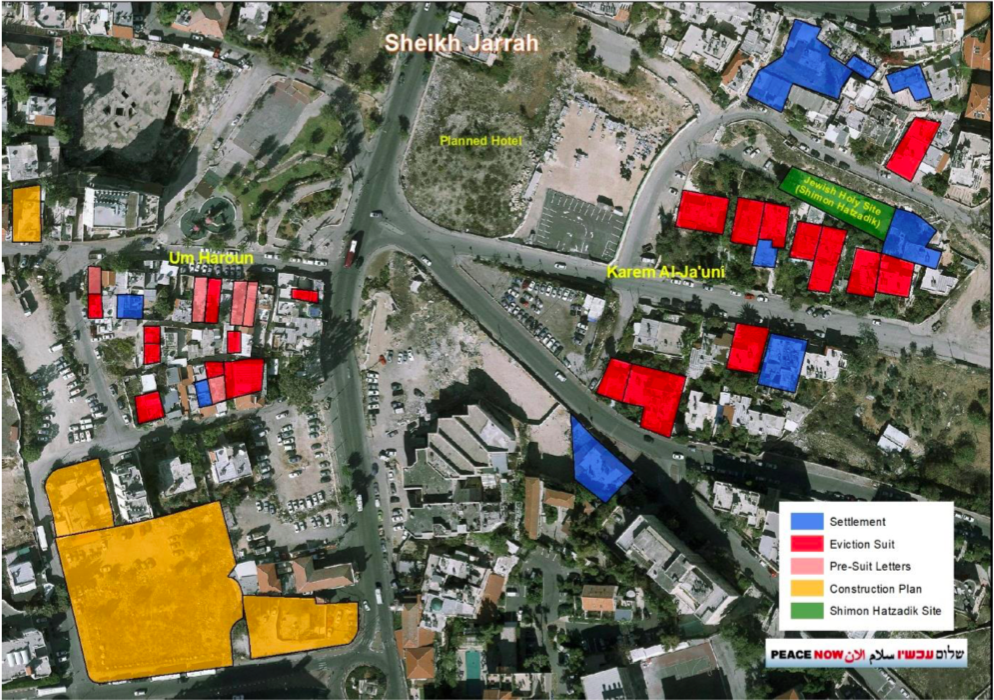 According to Peace Now, the Sabbagh family is one of 175 Palestinian families in East Jerusalem that face eviction under the discriminatory law: 75 families in the Sheikh Jarrah neighborhood and 100 families in the Silwan neighborhood (specifically in the Batan al-Hawa section, where several Palestinian residents were recently handed eviction notices). What’s more, the Sabbagh family was believed to have the best chance at escaping eviction based on historic Ottoman documents relating to the land obtained by the family’s lawyer. These are the documents that Supreme Court Chief Justice Esther Hayut declined to consider this week. The Sabbagh family lawyer told Haaretz:
“Once again, families from Sheikh Jarrah are facing eviction and a second refugeehood. In Israeli courts, which refrain from hearing the residents’ just and substantive arguments, people are sentenced to refugeehood on procedural grounds.”
In advance of the Sabbagh’s eviction, protests erupted, and have continued for a second straight day, in support of the family and against Israeli settlement activity in East Jerusalem. Israeli and international protestors marched from the center of Jerusalem to Sheikh Jarrah, where they were joined by Palestinians in front of one of the homes where Palestinians are facing eviction. Daniel Roth, one of the protestors told +972 Mag:
“At the core of this whole thing is the idea that all people have a right to a home, and what’s going on here is that the powers that be are taking homes from some people because of their national identity, period. What we’re looking at is racist policy and action around people’s very homes, and that should wake people up to stand up with these folks.”
Under the “Legal and Administrative Matters Law of 1970,” which is being used to evict the Sabbagh family, Jewish owners are afforded a legal avenue to reclaim property that they owned prior to the 1948 war which, as a result of the war, came under Jordanian rule. It should be noted that Palestinian refugees from that same war – who lost property in what became Israel – are not afforded an equivalent right to reclaim their abandoned property, creating a dual legal system in which ethnicity is the sole determinant factor when it comes to rights.
Exploiting the special standing granted to historic Jewish property owners, the settler group “Nahalat Shimon” has undertaken a campaign to track down the Jewish owners of coveted land in East Jerusalem that was under Jordanian rule, in order to purchase from them the property rights and then evict Palestinian tenants, most of whom have lived in these properties for more than 50 years. This is the context against which the 45-member Sabbagh family (who are themselves refugees of the 1948 war, but are not allowed to legally reclaim their family property in Jaffa) is being forced to leave their home of 60+ years. Following the Supreme Court’s January 10th decision to refuse the family’s request to consider new evidence in the case (based on the argument that it was too late), Israeli authorities delivered an eviction notice telling the family to leave before January 23rd.
Peace Now writes:
“This is part of an organized and systematic campaign of settlers, with the assistance of government agencies, to expel entire communities in East Jerusalem and to establish settlements in their stead. Dozens of other families face the risk of eviction by legal proceedings in which settlers and government officials exploit discriminatory laws that allow Jews to return to pre-1948 assets yet forbid Palestinians from doing the same. In this way, settlers seek to create a buffer inside the Palestinian neighborhood and make it difficult to reach a territorial compromise in Jerusalem so essential to a two-state solution.”
Bidding War Between Settlers and Palestinians Drives $3.27 Million Price for Sheikh Jarrah House
A bidding war erupted over a house in the Sheikh Jarrah neighborhood of East Jerusalem, pitting the Palestinian family living in the building against Aryeh King, a radical settler impresario behind many settlement schemes across East Jerusalem. When the price hit $3.27 million (12 million shekels), King decided to withdraw his bid – allowing the Palestinian Abdel Razeq family to purchase the home, should they be able to raise the necessary funds.
If the family is able to raise the funds to buy the house, this would be a rare, albeit astronomically expensive, victory for Palestinians fighting to remain in their homes against an ongoing campaign by Israeli settler groups to “reclaim” Jewish property in East Jerusalem that was abandoned during the 1948 war.
As discussed above, under Israeli law, Jewish property owners are entitled to reclaim property in East Jerusalem that was abandoned during the war, while Palestinians who lost property in what became Israel have no similar right. King and other pro-settler activists take advantage of this law by tracking down Jews who owned property in sensitive areas of East Jerusalem prior to 1948 (Sheikh Jarrah being a key target), and convincing the owners (or their heirs) to sign over the property rights – all in order to evict current Palestinian tenants and move in Israeli settlers.
The case involving the Abdel Razeq family’s house did not go according to the settlers’ script. A dispute broke out between members of the Jewish family who, under Israeli law, are heirs to the property. The case went to a Family Court, which ruled that the house should be sold through a public bidding process, with the proceeds to be split amongst the heirs.
Explaining his decision to drop out of the bidding, King took to social media to attack the Jewish family that is selling the property, saying:
“[it is] a black day for the Jewish people. A Jewish family is negotiating with the enemies of the Jewish people to sell a property that the family’s grandfather purchased a hundred years ago in East Jerusalem….I am full of shame that people act this way about a place that their grandfather bought out of Zionist motives and a place where soldiers paid with their lives and were wounded, and they sell it just to make another profit.”
King’s perspective on this – in essence, that Jews should sell only to other Jews – is notable, given recent controversy over a Palestinian who sold property to settlers. Israel and many supporters of Israel were outraged at what they saw as the anti-Semitic demand that Palestinians not sell property to settlers. In this latest case, the seller was arrested by the PA, leading the U.S. Ambassador to Israel, David Friedman, to tweet: “The Pal Authority has been holding US citizen Isaam Akel in prison for ~2 months. His suspected ‘crime’? Selling land to a Jew. Akel’s incarceration is antithetical to the values of the US & to all who advocate the cause of peaceful coexistence. We demand his immediate release.”
Settlers Impose Sabbath Closure on Palestinian Residents of Silwan; High Court Asks: Why?
On January 16th, the Israeli High Court of Justice ordered the Israel Nature and Parks Authority (INPA) and the radical Elad settler group to defend its practice of closing parts of the “City of David National Park” – a name that Israel has applied to an area that includes a large Palestinian residential section of Silwan – on the Jewish Sabbath, evenings, and on Jewish holidays. The closures deny Palestinians, including residents of Silwan, access to parts of the neighborhood.
 As FMEP has repeatedly covered, the radical Elad settler group has managed the City of David National Park on behalf of the INPA since 2001. This arrangement that gives the settler group authority over not only areas controlled by settlers – whose interests Elad shares and promotes – but also thousands of Palestinians, to whom Elad has no legal responsibility and whose very presence is part of a “demographic balance” Elad is working actively to flip.
The petition which prompted the Court’s order was filed by the residents of Silwan and the Israeli nongovernmental archaeological group Emek Shaveh. Explaining the situation caused by Elad’s mismanagement of the City of David National Park, Emek Shaveh writes:
“The City of David National Park is situated at the heart of a populated, urban space. Extensive areas in the park are public spaces in a neighborhood that suffers from a chronic deficiency of such spaces. In 2015, the Elad Foundation placed gates and closed archaeological areas known as Area E and Area G (No. 6 and 7 and No. 3 on the map). These public spaces had been open to the residents at least as far back as the British Mandate. The gates that were placed are locked at closing time, thus blocking passage between two neighborhoods within the village. The site closes on the Sabbath and on Holidays as the Elad Foundation observes the Sabbath, thus restricting the local residents’ freedom of movement and use of public spaces. As most of Silwan’s residents work in West Jerusalem, Shabbat (Saturday) is their day of rest, yet it is on this day that the nearby green public areas are closed off to them.”
Elad and the INPA have previously tried to defend the park closures on security grounds – citing alleged incidents of vandalism on park grounds. That defense was rejected by the Israeli Attorney General, who noted that no formal complaints about vandalism had been filed, and neither the Israeli police nor the Israel Antiquities Authority had be informed about the problem or Elad’s decision to close the park on religious occasions. Following the January 19th court order, Elad and the INPA have 60 days to submit a new defense.
Israel to “Examine” Two Cases of Illegal Outpost Construction
In response to petitions filed by Peace Now, on January 7th the State of Israel announced that it will “examine” two specific cases of illegal (under Israeli law) outpost construction: the Kerem Reim case and the Hayovel case, both located in the area controlled by the Binyamin Regional Council (the Israeli government-funded settlement municipal authority in charge of the area located north of Jerusalem stretching to north of Ramallah). The examination will be led by a police anti-fraud unit and the State Prosecutor’s Office.
As summarized in a recent report, Peace Now has previously filed numerous complaints and has provided evidence to the State Prosecutor’s office regarding the involvement of the Binyamin Regional Council and the Amana settler organization in the illegal construction of outposts and settlement structures.
Given the State’s demonstrated refusal to promptly respond to the complaints by opening an official investigation into the criminal activity, Peace Now cautions that this latest move to “examine” the cases is problematic, saying:
“an examination is an ambiguous, non-legal term that comes in lieu of a proper, legal investigation. An ‘examination’ may just be the state’s tactic to mollify the High Court by showing that it is serious looking into the matter, though without actually taking any substantive action.”
In addition to Peace Now’s documentation, the Israeli State Comptroller’s office published a July 2018 report exposing the criminal involvement of the Binyamin Regional Council and the Amana settler organization in illegal settlement construction.
Peace Now also released an official statement saying:
“For 50 years now, a handful of settlers have been using public funds through the settlement councils and Amana to put facts on the ground that affect the future of all of us in violation of the law and of the government’s decisions. The hesitation of the State Prosecutor’s Office and the police to investigate the organized crime of illegal construction in the settlements is tantamount to granting immunity to the offenders and shows a lack of respect for the rule of law. The message the government is sending to the settlers is that they are above the law.”
In 2017, Peace Now published a comprehensive report outlining how government and private entities are systematically using Israeli taxpayer money to establish new settlements and outposts.
MK Bezalel Smotrich – A Radical Settler – Elected to Lead National Union Party
MK Bezalel Smotrich has been elected to take the reins of the extreme right-wing nationalist political faction, called the National Union Party. With leadership secured, Smotrich aims to next be chosen to lead Habayit Hayehudi – an umbrella group which unites the far-right factions into a single voting bloc – following Naftali Bennett’s decision to leave Habayit Hayehudi and form a new political party alongside Ayelet Shaked.
Smotrich currently lives in the Kedumim settlement, but his house is located inside of an enclave of privately owned Palestinian land that is not included in the settlement’s Master Plan, making it illegal even under Israeli law.
Smotrich is a co-founder of Regavim, a radical settler group that works to dispossess Palestinians of their land and property in the West Bank by “helping” the Israeli government to enforce planning and building laws. Like Smotrich, many of Regavim’s key staff live in illegally built settlement units, but instead of seeking to enforce Israeli law against their own illegal building, Regavim and Smotrich are working to retroactively legalize their own homes through legislation.
Beyond the headlines, Smotrich has been an extremely active member of the Knesset, and is behind many of the boldest and most brazen legislative attempts at annexation. Some of Smotrich’s recent efforts include:
- Introducing the “Young Settlements Bill,” which would direct the government to treat 66 illegal outposts built on privately owned Palestinian land as legal settlements, while giving the government 2 years to find a way to retroactively legalize those outposts. The bill would also freeze any/all legal proceedings against the outposts and requires the government to connect the outposts to state infrastructure including water and electricity; provide garbage removal; and approve budgets for them. The law also allows the finance minister to guarantee mortgages for settlers seeking to buy units in these outposts, even before the legal status of the land is resolved (a remarkable state-directed violation of normal practices in the mortgage industry). The bill received government backing on December 16, 2018, and will next need to be introduced in the Knesset, where it must pass three readings to become law.
- Calling for the Israeli Civil Administration to be disbanded, in a scheme that would annex the entire West Bank to Israel, leaving the Palestinians bantustans to be governed by “Regional Liaison Committees.”
- Leading the charge for the Knesset to fund a new municipal body for Israeli settlers in Hebron, despite a court injunction freezing government plans to create such a body.
- Introducing a bill that would hand over more land in Area C of the West Bank to the World Zionist Organization.
European Union Statement Lambasts “Givat Eitam/E-2” Settlement Plan
On January 22, 2019, the European Union presented a statement at the United Nations Security Council Open Debate representing the view of its member states that:
“Today there is a risk of further escalation that would move Israelis and Palestinians further away from an end to the conflict. This risk is compounded by the advancement in December 2018 of Israeli plans for over two thousand settlement units and renewed plans to “legalise” West Bank outposts. The allocation of an area south of Bethlehem for the purpose of planning a new settlement (Givat Eitam) constitutes a serious blow to the viability of a two-state solution. The European Union’s position on Israeli settlement policy – including eviction of Palestinians – for example in Sheikh Jarrah – and related activities in the occupied Palestinian territory is clear and remains unchanged: all settlement activity is illegal under international law and it erodes the viability of the two-state solution and the prospects for a lasting peace – as reaffirmed by UNSCR 2334.”
For FMEP reporting on the Givat Eitam/E-2 settlement, see the January 4th edition of the Settlement Report.
Bonus Reads
- “The Israeli-Palestinian Conflict is Not a Bankruptcy Sale” (Lawfare Blog)
- “When Freud Visits Israeli Civil Administration in the West Bank” (Haaretz)
- “A Guided Tour of Hebron, From Two Sides of the Occupation” (The New Yorker)
- “Another Step Toward the Annexation of the West Bank” (Haaretz)
- “Israel’s Apartheid Road is About More Than Segregation” (+972 Mag)
Welcome to FMEP’s Weekly Settlement Report, covering everything you need to know about Israeli settlement activity this week.
To subscribe to this report, please click here.
December 7, 2018
- Looming Mass Eviction in Silwan, Part 1: High Court Rules that Settler Organization Can Pursue Eviction of 700 Palestinians in Batan Al-Hawa Section of Silwan
- Looming Mass Eviction in Silwan, Part 2: Elad Settler Org Wins Eviction Case Against Palestinians in Wadi Hilweh Section of Silwan
- Israel to Fast-Track Two Settlement Plans in Sheikh Jarrah
- Justice Ministry Finalizes Legal Opinion to Retroactively Legalize the Haresha Outpost
- Three Illegal Outposts (& Ariel) Are Now “National Priority Areas” Eligible for Government Subsidies
- High Court Rules the Jewish National Fund is the Legal Owner of Land South of Bethlehem
- Israel Seizes Jordan Valley Land Owned by the Catholic Church
- Israeli Civil Administration Report Criticizing Yitzhar Settler Violence Leads to Renewed Calls to Annex the West Bank
- After IDF Killed Two Palestinians, Civil Administration Grants Settlers Victory in Struggle Over Hilltop
- The New Mayor of Jerusalem, Moshe Lion, On Settlements
- Al-Shabaka Policy Paper: “The EU & Jerusalem”
- Breaking the Silence Report – “Occupying Hebron: 2011-2017”
- U.S. Chatter on Economic Coexistence Initiatives (Which Normalize Settlements/Occupation) Provokes Strong Palestinian Response
- Bonus Reads
Questions/comments? Email kmccarthy@fmep.org
Looming Mass Eviction in Silwan, Part 1: High Court Rules that Settler Organization Can Pursue Eviction of 700 Palestinians in Batan Al-Hawa Section of Silwan
On November 22nd, the Israeli High Court of Justice ruled that the settler organization Ateret Cohanim can continue to pursue the eviction of 700 Palestinians from their homes in the Batan al-Hawa section of the Silwan neighborhood in East Jerusalem. This would be the largest displacement of Palestinians from East Jerusalem since 1967.
The High Court’s ruling did not decide the central issues in the case, which call into question Ateret Cohanim’s ownership of the land through its control of an historic Yemenite land trust (the Benvenisti Trust). The High Court reserved those issues for the Jerusalem Magistrate’s Court to decide as part of its consideration of individual eviction cases.
In its ruling, the High Court criticized of the government’s involvement in the case, specifically calling out the role the government played in transferring ownership of the land to Ateret Cohanim without properly informing the Palestinian residents. The High Court ruling said:
“We can’t continue without expressing surprise at the state’s assumption that a decision so significant to the lives of hundreds of people – ‘liberating’ the property on which they have lived for many years [and transferring it] to other hands – isn’t the kind of thing that ought to be publicized through reasonable means. Even the precise identity of the property’s residents wasn’t known, and that’s the interpretation kindest to the state…Evicting people who have lived on this land for decades – some of them without even knowing that the land belongs to others – creates a human problem. Especially when it’s done without compensation or any other solution. It seems the state would do better to consider providing a solution, in appropriate cases, for those evicted from their homes. Property rights are important, but it’s also important to defend people’s homes.”
B’Tselem commented:
“The judgment proves, yet again, that the Israeli High Court gives its seal of approval to almost any infringement of Palestinians’ rights by the Israeli authorities.”
Ateret Cohanim has waged a years-long eviction campaign against Palestinians living in Silwan, on property the settler NGO claims to own, based on its control of the historic Benvenisti Trust, which oversaw the assets of Yemenite Jews who lived in the neighborhood in the 19th century. Palestinians have challenged the legitimacy of the Benvinisti Trust’s claims to the currently existing buildings, saying that the trust only covered the old buildings (none of which remain standing) and not the land. Despite ongoing legal challenges, in October 2018 the Jerusalem Magistrate’s Court ruled in Ateret Cohanim’s favor in one of the cases connected to the Benvenisti Trust’s claim to the buildings there – resulting in the eviction of the last remaining Palestinian tenants (the Abu Sneina family) from a building in area of Silwan known as Batan al-Hawa.
The ruling this week does not give a final decision to the underlying questions of ownership, but it allows Ateret Cohanim to proceed – from a strengthened position – in its legal efforts to evict Palestinians from their homes.
Looming Mass Eviction in Silwan, Part 2: Elad Settler Org Wins Eviction Case Against Palestinians in Wadi Hilweh Section of Silwan
 On December 5, 2018 the Jerusalem Magistrate’s Court upheld the eviction of a Palestinian family – the Siyams – family their home in the Wadi Hilweh section of Silwan, in East Jerusalem, just 820 feet from the southern wall of Al-Aqsa Mosque. Like Ateret Cohanim (see above), the Elad settler organization has been waging a years-long legal battle to take control homes in Silwan, including a 20-year battle to take control of the Siyam family home, which Elad insists legally purchased it.
The Court ruling this week was the first ruling in the settlers’ favor. The Siyam family announced plans to petition the ruling to the Jerusalem District Court.
In response to the ruling, Peace Now said:
“This case is an example of how the settlers manage to take control of Palestinian property in East Jerusalem by combining manipulations, money, forgery and significant aid from the Israeli authorities. It is not a regular case between equal sides, but a story of David and Goliath, and the settlers are the Goliath. There is a settlers organization with almost unlimited financial resources and enormous political power against an ordinary Palestinian family that has been forced into court for more than 20 years, to invest tremendous resources in legal defense and to deal with various and varied purchase claims. This way the settlers are causing great damage to Israel when they harm the delicate fabric of life in Jerusalem and the possibility of compromise in Jerusalem and a two-state solution.”
Israel to Fast-Track Two Settlement Plans in Sheikh Jarrah
Ir Amim reports that the Jerusalem District Planning and Building Committee will meet on December 23rd to fast-track the approval of two plans for a total of 13 new settlement units in the Sheikh Jarrah neighborhood of East Jerusalem. The plans put approximately 5 Palestinian families at imminent risk of eviction.
On December 23, the Committee will discuss public objections to plans for the two settler building (one for 10 units and one for 3 units), which if approved, will result in the eviction of 5 Palestinian families.
Ir Amim further explains:
“The two plans in Sheikh Jarrah are being pushed by city councilperson and settler leader Arieh King, a close ally of Jerusalem’s just inaugurated mayor, Moshe Leon. King has recently joined the new mayor at several public events and is said to be eyeing a deputy mayor position in the new administration.”
+972 Magazine has an excellent piece on the resumption of evictions and settlement takeovers in Sheikh Jarrah, which have been stalled since 2009, in part due to international pressure. A prominent figure in the Sheikh Jarrah resistance movement, Saleh Diab, said:
“Ever since Trump said last year that Jerusalem belongs to the Jews, we have been feeling the change. The settlers are working quickly to evict us before the American administration changes…How will we go back to the days of protests? The police today are like the police in [apartheid] South Africa. Israelis who stood alongside us were fired from their jobs because of their views…Like in Khan al-Ahmar, they are trying to expel an entire community and turn us into refugees for a second time.”
PLO Spokeswoman Hanan Ashrawi released a statement saying:
“Since the beginning of the year, Israel has accelerated and intensified its efforts to entrench its colonial military occupation, especially in and around occupied Jerusalem…Israel’s extremist, racist government coalition headed by Prime Minister Benjamin Netanyahu is deliberately and systematically working to complete the total annexation and isolation of Jerusalem from its Palestinian environs and surrounding areas, as well as the distortion of the occupied city’s demographic, historical and cultural character…These measures pose a strategic threat to Palestinian human and national rights, especially through the imposition of new and ‘permanent’ realities on the ground that deliberately undermine the achievement of Palestinian statehood…At a time when the rights-based international system is under threat, the reality and future of Jerusalem is a litmus test for the world and the integrity of its legal and political system. It is our hope that the global community and people of conscience will rise to the challenge and defend the universality and indivisibility of human rights. The world must not fail Jerusalem.”
Justice Ministry Finalizes Legal Opinion to Retroactively Legalize the Haresha Outpost
On December 6, 2018, Israel Justice Minister Ayelet Shaked announced a new legal opinion that permits the Israeli government to proceed with its plan to retroactively legalize the Haresha outpost by building an access road through privately owned Palestinian land. According to the new opinion, the Israeli government is permitted to “temporarily seize” the privately owned land to build a tunnel underneath it leading to the outpost, though it leaves open the possibility for the government to permanently expropriate the land in the future. The lack of an access road has until now prevented the Israeli government from retroactively legalizing the entire Haresha outpost; once the access road is deemed legal, the government is expected to act quickly to legalize it and pursue plans to build more settlement units there. 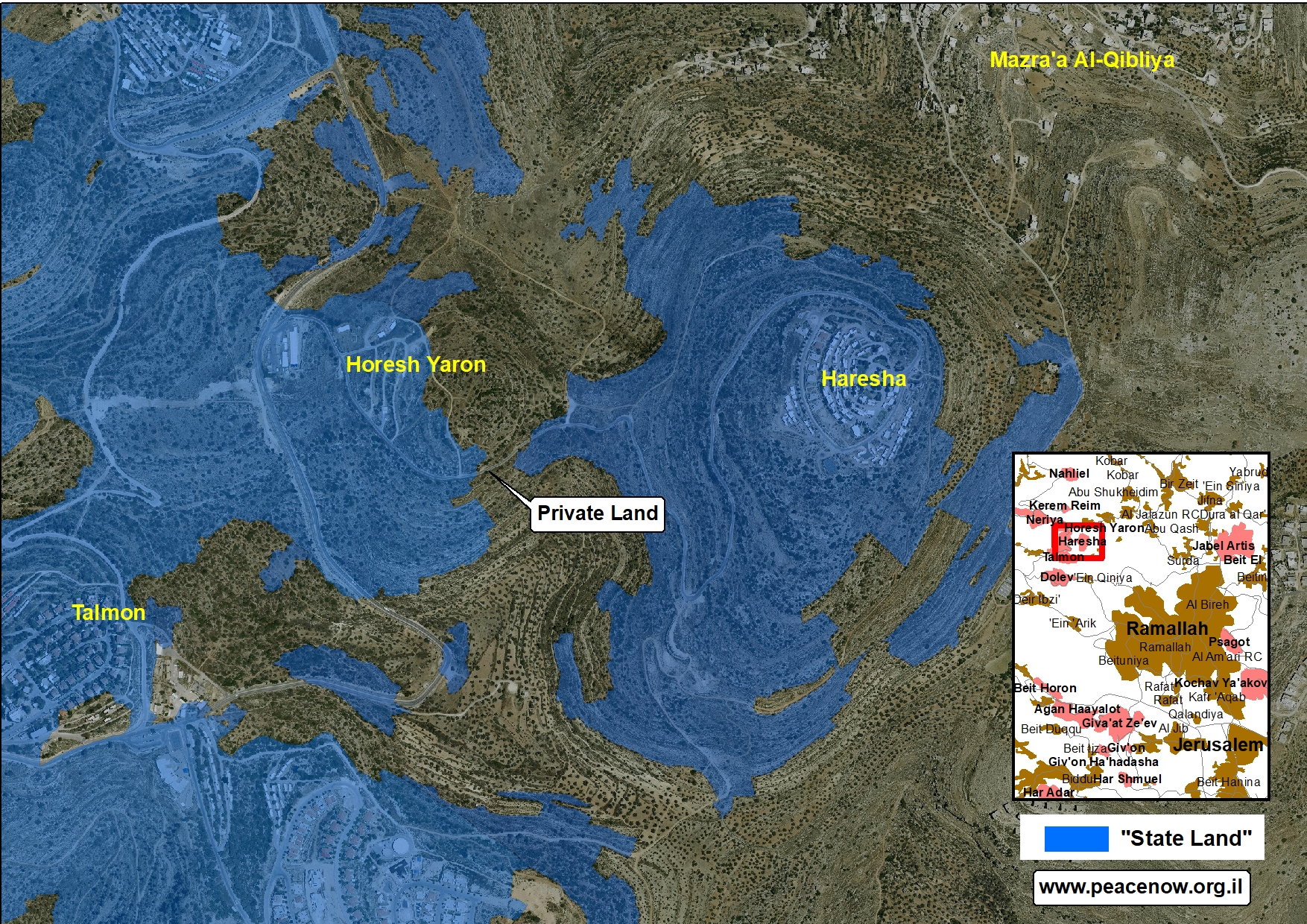
Israeli Attorney General Avichai Mandelblit – who signed off on the new Justice Ministry opinion – in November 2017 released a different legal argument in favor of permanently expropriating the land to legalize the access road, arguing that settlers are part of the “local population” of the West Bank and are therefore eligible to be the sole beneficiaries of land seized for “public use” (the access road is not open to Palestinian traffic). The opinion released this week, which cites Mandelblit’s previous opinion, finds yet another way to accomplish the same goal, by temporarily seizing the land to build a permanent tunnel for the settlers underneath it.
Justice Minister Ayelet Shaked said:
“From the beginning of my current term I have set a goal of normalizing the lives of the residents of Judea and Samaria and normalizing as many communities as possible. We have gone from a discourse of eviction to a discourse of normalization. These actions are in addition to the strengthening of the communities by other means, such as the transfer of authority in matters of Judea and Samaria from the Supreme Court to the Administrative Affairs Court in Jerusalem, as well as the equalization of legislation for Judea and Samaria…I will continue to work for the normalization of additional communities in Judea and Samaria. I thank Attorney General Avichai Mandelblit, Deputy Attorney General (Erez) Kaminitz and the Legal Advisor for the Judea and Samaria Area for their important activity on the issue.”
Peace Now told the Times of Israel:
“This move is a mockery of justice. Since the Regulation Law is tied up in court, the Ministry of Justice is yet again using every crooked justification it can concoct to expropriate private Palestinian land in order to dissect the West Bank with settlements until they have achieved their one-state apartheid agenda.”
Dror Etkes, founder of the anti-settlement watchdog group Kerem Navot, wrote:
“the outpost of Haresha, comprised of about 100 illegal structures, is of course not the story here. The story that the settlers are striving to resolve, with Mandelblit’s help, involves hundreds (yes hundreds!) of roads that have been illegally paved for decades around settlements and outposts, on land that even Israel recognizes as privately-owned. Now, with a little creativity and a lot of nerve, a legal mechanism has been invented to enable settlers to retroactively authorize the road system, without which the national land grab enterprise championed by Israel in the West Bank, can’t function.”
Three Illegal Outposts (& Ariel) Are Now “National Priority Areas” Eligible for Government Subsidies
On November 26th, Israeli Housing Minister Yoav Gallant announced that three illegal outposts – Kerem Reim, new Migron, and Shvut Rachel – will be considered “national priority” areas for development, marking the first time that illegal outposts are eligible for significant government subsidies to encourage growth.
In order to include the outposts, the Israeli Housing Ministry wrote and adopted a new criteria to make “neighborhoods located far from a ‘parent town’ that do not rely on the infrastructure of said town” eligible for priority status. For the purposes of the government subsidies plan, Kerem Reim is considered a “neighborhood” of the Talmon settlement, New Migron is considered a “neighborhood” of the Kochav Yochav settlement, and Shvut Rachel is considered a “neighborhood” of the Shilo settlement.
Though the Israeli government has rewritten its laws to consider these “children” outposts as “neighborhoods” of existing, government-approved settlements, they are, in fact, independent settlements. This fact is underscored by the Housing Ministry’s new criteria which admits that the outposts do not share the same infrastructure systems as the settlements of which they are considered a part (and, indeed, rewards that fact).
The Ariel settlement was also re-designated as a national priority area (having been previously selected and then later removed from the list), among a total of 583 communities from both sides of the Green Line. The selected communities, settlements, and outposts will benefit from massive government subsidies, including at least 50% of infrastructure costs for the construction of new housing. Israelis seeking to purchase a home in the selected communities will receive government loans and forms of assistance.
Haaretz reports Housing Minister Yoav Gallant remarked:
“it is a social and national duty to prevent negative migration from distant towns and to enable them to thrive and prosper.”
The Jerusalem Post quotes Gallant as saying that the decision to include the outposts:
“is a clear statement by the government that it will continue to develop and strengthen the settlements.”
High Court Rules the Jewish National Fund is the Legal Owner of Land South of Bethlehem
On November 28, 2018 the Israeli High Court of Justice ruled that the Jewish National Fund is the legal owner of 130 acres of land south of Bethlehem, ending a 22-year legal battle over ownership claims. Palestinians from a nearby village challenged the validity of the sale of the land to the Jewish National Fund when the organization moved to register its ownership of the land with the Israeli Civil Administration in 1996.
This week, the Court held that the Jewish National Fund (via its subsidiary company, Himnuta) had legally purchased the land in 1944 from its original Palestinian owners. The ruling will allow the settlers to move forward with plans for building more settlement units on the land, which is already home to one settlement, Rosh Tzurim, and to the headquarters of the Gush Etzion Regional Council.
The head of the Gush Etzion Regional Council, Shlomo Ne’eman, celebrated the ruling, saying:
“the task of expanding the lands of Gush Etzion is a national mission. The Supreme Court’s ruling gives us optimism that the court’s position will benefit the Jews and Jewish land in Judea and Samaria and will not automatically rule in favor of the thieving claims of the Arab intruders.”
Israel Seizes Jordan Valley Land Owned by the Catholic Church
On November 27, 2018, the Israeli Civil Administration announced that it is seizing 66 acres of land in the northern Jordan Valley that is owned by the Catholic Church. The Civil Administration said the land was needed for “military purposes.”
The Latin Patriarchate of Jerusalem responded to the seizure in a statement, saying:
“The Patriarchate is looking into the aspects of this decision in order to address it in the appropriate manner, have it contested and to stop further damage.”
Israeli Civil Administration Report Criticizing Yitzhar Settler Violence Leads to Renewed Calls to Annex the West Bank
An Israeli news outlet, Kan 11 news, revealed the existence of a new Civil Administration report that criticizes the Yitzhar settlement. According to Kan 11, the report states that Yitzhar is a source of violence that “undermines governance and the rule of law.”
In addition to documenting the violence perpetrated by Yitzhar residents against Palestinians living nearby, the report also documents incidents of Yitzhar settlers attacking Israeli forces. The report calls on the IDF Commander Maj. Nadav Padan to punish the Yitzhars settlers by scuttling plans to build a new kindergarten and by ceasing to guard dangerous roads around the settlement and its many outposts.
In response, Yossi Dagan (head of the Samaria Regional Council, a settlement municipal body) called for the author of the report to be fired, saying:
“Officials in the Civil Administration are torpedoing the approval of security elements which could have prevented terrorist attacks in threatened settlements such as Itamar, and in the Barkan industrial zone before the attack, as well as narratives of the Palestinian Authority and radical left-wing organizations.This is an example of the evil in the civil administration. I call on the head of the Civil Administration to remove the clerk … who acts like a politician and not as is required. This report is malicious and false. The Yitzhar leadership is leading the community in a good and positive direction, and this report has nothing but lies. This is the total loss of control of the Civil Administration. While murderers with the blood of Israelis on their hands, the Civil Administration refrains from punishing the sources of terror out of statements that this is collective punishment, and now they want to create collective punishment for the Jews. The head of the Civil Administration and the deputy defense minister should call this clerk for a hearing before his dismissal.”
In response to the report’s recommendations, MK Bezalel Smotrich (HaBayit HaYehudi) called for the entire Civil Administration to be disbanded. Smotrich announced that he will seek government backing for a bill to achieve that end during the next meeting of the Israeli Cabinet, scheduled for December 9th. Under the bill, Israeli settlers in the West Bank will come under the full sovereignty of domestic Israeli institutions, while Palestinians will be ruled by “Regional Liaison administrations.” The bill would effectively annex the entire West Bank to Israel.
Smotrich said:
“The Civil Administration must be shut down now. This document reflects a political agenda that is hostile to the settlement enterprise and to the local residents, [an agenda] which unfortunately is expanding in this unnecessary body…This is the same Civil Administration that for years has pushed for a policy of separation between Arabs involved in terrorism and the rest of the Arab population. Now it suddenly remembers to use collective punishment against Jewish residents…for years now, the residents of Judea and Samaria, who are equal citizens who serve in the army and in the reserve and who pay taxes, are not entitled to equal rights and receive inferior service from the Civil Administration instead of receiving optimal service from government ministries like all citizens of Israel. The time has come to fix that.”
After IDF Killed Two Palestinians, Civil Administration Grants Settlers Victory in Struggle Over Hilltop
On November 29th, Haaretz reported the tragic story of two Palestinians who were shot and killed by Israeli forces while protesting attempts by Israeli settlers to take over a hilltop belonging to the Palestinian village al-Mazra’ah al-Qibliyah, just north of Ramallah. Following a clash on October 26th, in which the IDF opened fire on Palestinian protesters – killing the two men – the IDF issued a military order closing the hilltop – known as Khirbet Na’alan – to Palestinians on Fridays. As Haaretz notes, the military order was a victory for the settlers, who have been aggressively trying to take over the hilltop since July 2018.
The residents of al-Mazra’ah al-Qibliyah have fought against the increasing encroachment of the Talmon settlement and its seven illegal satellite outposts, which collectively surround the village. Having seen several outposts take over their land illegally and under the protection of the IDF, Palestinians began actively trying to prevent the takeover of the Khirbet Na’alan hilltop. The settlers waged their own campaign to harass and intimidate the village, often entering the village at night to paint hateful messages and damage Palestinian property. Each Friday, the settlers would go pray at the site.
In response to petitions filed by Palestinians, the Israeli Civil Administration issued an order barring the settlers from accessing the hilltop. On the same day the villagers found out about the order, they watched 10 settlers from the Kerem Reim outpost (which was recently selected as a “national priority area” to encourage growth, see above) approach the hilltop with heavy IDF protection. It was on this day that the IDF opened fire on a group of Palestinians protesting the incursion, killing two and wounding many others.
Video of the bloody incidents shows the IDF opening fire at an incredibly close distance, and at least 10 Palestinians falling down amidst gunfire.
The New Mayor of Jerusalem, Moshe Lion, On Settlements
In a thorough analysis of the recent Jerusalem Municipal elections, Terrestrial Jerusalem’s Danny Seidemann shared key insights into what may be in store for settlement activity under Jerusalem’s new mayor, Moshe Lion. Seidemann writes:
“Lion emerged from the ranks of the less ideological elements in the Likud. However, support for East Jerusalem settlements and settlers is so deeply ingrained even in this segment of the party as to be second nature. Lion never mentioned the Palestinians of East Jerusalem in his campaign, and actively cooperated with Aryeh King, who represents the right-wing fringe of the East Jerusalem settlers. Consequently, it is highly likely that Lion will continue to do the bidding of the settlers in East Jerusalem, and to neglect the Palestinian sector. Nothing in his world view or the way he understands his political interests suggests otherwise.”
Al-Shabaka Policy Paper: “The EU & Jerusalem”
Al-Shabaka analyst Yara Hawari published a new paper exploring options for European Union member states to push back on U.S. policy and Israel’s annexation of Palestinian land. Hawari writes:
“The US embassy move has accelerated and legitimized a process of de-Palestinianization of Jerusalem that began over seven decades ago. In the absence of concrete pressure, Israel will continue to violate the fundamental rights of the Palestinian people in Jerusalem and the rest of historic Palestine, with the full support and encouragement of the Donald Trump administration as well as its far-right allies within Europe and in Latin America. Despite the inaction described above and the global political shift to the right, there remains potential for the EU to pressure Israel and pursue Palestinian human rights. This is due to strong European popular support for Palestinian rights and sovereignty that has allowed grassroots solidarity networks to grow, as well as the fact that the EU is premised on international law and human rights…”
Breaking the Silence Report – “Occupying Hebron: 2011-2017”
Breaking the Silence released a new compilation of testimonies from Israeli soldiers who served in the Hebron area. Breaking the Silence writes:
“The Israeli settlement in the heart of the city of Hebron marked its 50th anniversary this year. Its story is a microcosm of the occupation: contempt and disregard for the rule of law, daily violence, deprivation of Palestinian residents’ basic rights, and a military system that preserves all of the above. This booklet of testimonies intends to offer the public a glimpse of the reality in Hebron from our perspective as soldiers deployed there. These testimonies were given by soldiers who served in the city from 2011-2017. They reveal the violence and discrimination that have become an inextricable part of life in Hebron, and their impact on the lives of Palestinian residents.”
The online portal for the report also has an interactive map, where users can see where each incident took place against the backdrop of Hebron’s closed streets, religious sites, and settlement enclaves.
U.S. Chatter on Economic Coexistence Initiatives (Which Normalize Settlements/Occupation) Provokes Strong Palestinian Response
Top U.S. negotiators have continued hinting about a major economic element to the yet-to-be-unveiled “deal of the century.” As FMEP has documented to this point, Ambassador David Friedman has met with Israeli and Palestinian businessmen in a bid to promote joint projects in the Occupied Territories in a way that normalizes Israeli settlements and annexation bids.
On November 28th, Ambassador Friedman was interviewed by the Christian Broadcast Network. Part of the transcript of the interview reads:
Question: “One of the aspects of the peace plan seems to be a relationship between Palestinian businessmen and Israeli businessmen. Some would say you crossed a red line when you crossed the green line into Ariel officially. What was the importance of that meeting?”
Friedman: “On a practical level, I met with, I don’t know, maybe 8 or 10 Palestinian business leaders and, to a person, they all said to me, ‘let’s do business, let’s get going. We want to work with Jews; we want to work with Israelis.’… I try to look at everything from a lens of what is best for the United States. That’s my job. I represent the United States. But look, we are a nation under God; we’re built on Judeo-Christian values. Much as I try I cannot help but see the majesty of God’s work and all the miracles that happen in this incredible country.”
U.S. Special Representative for International Negotiations, Jason Greenblatt, wrote an op-ed also emphasizing, among of myriad of accusations against the Palestinian Authority, that the U.S. is hoping to jump-start economic development, separate from its “plan” to resolve core issues. The article reads:
“While waiting for a possible political solution, it is high time to build the Palestinian economy and provide Palestinians with the opportunities they deserve…We know that the Palestinians are not interested in mere economic peace. The Trump Administration continues to strive for a peace agreement, but the Palestinians need economic help now – with or without a peace agreement. The technology sector in the West Bank and Gaza has great potential and can be developed without treading into the politically contentious core issues of the conflict…I continue to meet with ordinary Palestinians and what is striking is that, although they complain about the Trump Administration’s policies, they remain focused on their economy…Palestinians are a proud people and want to create and earn on their own. They believe, as I do, that Palestinians should be allowed to improve their economy without worrying about whether they will give up on their national cause…Let’s be real – 136,000 Palestinians commute to work with Israelis every day because the opportunity is there. Anti-normalisation is a failed policy that only hurts the Palestinians. Let’s allow Palestinians to thrive in the way they are educated, capable of and deserve. We won’t tire of trying to resolve the political conflict (and certainly Palestinians won’t either), but we must focus on helping the Palestinian economy where we can, before it is too late.”
Palestinians reacted strongly to Greenblatt’s screed. Saeb Erekat, chief Palestinian negotiator, wrote in response:
“…economic desperation is seen by the Trump administration as an opportunity to force Palestinians to normalise Israel’s occupation, to legitimise its settlements and its whole system of oppression. The administration has been trying to divide Palestinians by claiming that the Palestinian leadership is preventing economic growth. However, there is a consensus among our people that the primary responsibility for our grave financial situation is the Israeli occupation.”
Hani Masri, a Palestinian political analyst, said:
“Trump thinks that what the Palestinian leadership has rejected can be passed through the people, but the majority of Palestinians will not positively absorb or accept what Greenblatt is promoting. There are economic interests between the Palestinians and Israelis, however the political issue is a different subject and can’t come at the expense of the legitimate rights of the Palestinians.”
Elsewhere, at an event hosted by the Brookings Institute, former peace negotiator Dennis Ross promoted draft legislation in the U.S. Congress that would invest heavily in joint economic projects in the West Bank which normalize the settlements. The Jewish Insider summarizes:
“[Dennis] Ross praised current draft legislation in Congress that would give upwards of $150 million to joint Israeli and Palestinian projects: [Ross:] ‘Cutting $10 million for projects that are joint projects between Israelis and Palestinians, the rationale for that is hard to grasp. If there is one thing that we should be doing [it is] demonstrating that when Israelis and Palestinians cooperate there’s a payoff for it. And that ought to be elementary. That ought to be just a given. Anything you’re doing should be to designed to elevate the payoffs of practical tangible cooperation.’”
Finally, the Friends of Beit El organization (previously headed by now-Ambassador David Friedman) hosted a star-studded fundraiser in New York to raise funds for and awareness of the Beit El settlement. It was attended by two Members of Congress and the speaker of the Israeli Knesset Yuli Edelstein, who told the crowd:
“Independence, sovereignty, will eventually come to Judea and Samaria and many more houses with be built in order to reach the number we all dream — a million Jews in Judea and Samaria.”
Notably, the mention of Rep. Nancy Pelosi, the newly elected Speaker of the House, elicited boos from the crowd.
Bonus Reads
- “Annexation – at what cost?” (Times of Israel)
- “Leftists on tour in Hebron confirmed in view that settlers ‘have already won’” (Times of Israel)
- “Shaked touts ‘confederation’ of Jordan WEst Bank, and Gaza” (Times of Israel)
- “Inside the Evangelical Money Flowing Into the West Bank” (Haaretz)
Welcome to FMEP’s Weekly Settlement Report, covering everything you need to know about Israeli settlement activity this week.
To receive this report via email, please subscribe here.
June 16, 2017
1. Netanyahu’s Trump-Era Settlement Policy
2. Abbas & Netanyahu Harden Positions on the Future of Settlers
3. Must-Read: “How Many Settlers Really Live in the West Bank?”
4. Shin Bet Moves Against Radical Settler Activists
For questions and comments please contact FMEP’s Director of Policy & Operations, Kristin McCarthy (kmccarthy@fmep.org).
Netanyahu’s Trump-Era Settlement Policy
There is war of words about what Netanyahu’s Trump-era settlement policy actually is. According to settler leaders, Netanyahu is implementing a freeze; according to Netanyahu’s cabinet, he has given settlement construction a green light; and according to the U.S., he is expected to follow a policy of “restraint.” Notably, there has been no official statement by the Trump administration following the last week’s major settlement announcement.
Who is right? Here are the important facts and developments so far with respect to 2017 settlement growth:
- Large #s of Settlement Units Advanced: So far in 2017, plans for 4,909 new settlement housing units have been advanced through the planning process, according to Israel’s Peace Now. Of these, 3,178 were advanced at the June 6-7 meeting of the High Planning Council. And also according to Peace Now, tenders for 2,942 new settlement housing units been issued for imminent construction (meaning there are 2,942 new units actually being built, or about to be). Peace Now, which has tracked settlement growth for decades, based on the Government of Israel’s own officials numbers, notes that these 2017 numbers are “85% more than the housing units promoted during all of 2016 and in half the time.”
- A brand new settlement approved: Earlier this month, Netanyahu’s government has advanced the construction of the first entirely new settlement in 25 years, “Amichai” (a gift to “compensate” settlers who had built/taken up residence illegally in the outpost of Amona, and who were forced to move after the Netanyahu government exhausted all possible means to legalize their illegal acts).
- Illegal outpost legalized: Also earlier this month, the Netanyahu government moved to retroactively “legalize” the illegally-built outpost of “Kerem Reim,” west of Ramallah.
- Jerusalem plans looming but not moving (yet): Despite high profile reports that the government is close to issuing tenders for construction of Givat Hamatos in addition to advancing plans for Ramat Shlomo and Atarot, none of these actions have happened yet. These plans are particularly alarming for the future of Jerusalem and would preclude the contiguity of a future state of Palestine. Likewise, despite similarly high profile reports that the government is going to expedite the advancement of a visitor’s center abutting the Jewish Cemetery on the Mt. of Olives, the government has not yet advanced plans for its approval.
Abbas & Netanyahu Harden Positions on the Future of Settlers
Haaretz is reporting that Netanyahu is now demanding any peace agreement must allow all Israeli settlers to stay where they are, under Israeli rule. This represents a sharp departure from the past Netanyahu demands, as revealed by negotiation documents from the 2014 Kerry effort.
Abbas, on the other hand, is now signaling that he cannot accept a peace deal that leaves even a single settler in the future state of Palestine – also a new position since 2014.
Previously, both Netanyahu and Abbas posited that – at least in principle – some Israeli settlers could be allowed to remain in Palestine under Palestinian jurisdiction – meaning they would become citizens of Palestine (and that their settlements would not remain exclusively Jewish communities). The 2014 policy iterations were (and still are) untenable for both sides, but so too are their new positions.
3. Must-Read: “How Many Settlers Really Live in the West Bank?”

 Haaretz has an investigative report out this week delving deep into the demographics of Israelis living east of the 1967 Green Line, in violation of international law (and in some cases, in violation of Israeli law as well). Highlights from the report:
- There are 380,000 settlers in the West Bank, not including East Jerusalem settlements.
- 178,000 settlers in the West Bank live outside of the major settlement blocs (44% of total); notably, the Haaretz report does not make clear how it defined settlement “blocs” (the term has no formal or legal definition).
- These figures do not include outposts. According to Peace Now, there are 97 outposts with thousands of settlers populating them.
Shin Bet Moves Against Radical Settler Activists
The Israeli Shin Bet appears to be more actively moving to stop the pattern of violence emanating from the Yitzhar settlement, located deep inside the northern West Bank, in connection to the “Hilltop Youth” movement. This week the extremist rabbi and Yitzhar settler Yosef Elitzur was indicted on incitement charges. Elitzur is a prolific writer and teacher known for his religious justification for Jews killing non-Jews. Elitzur is the third Yitzhar settler to be prosecuted in recent weeks for incitement to violence; two others were also convicted because of violent content in articles they published online.
Additionally, nine Israeli teenagers were arrested in Jerusalem this week. There is a gag order in place over the case, but we do know the teenage settlers were arrested while at the house of Yitzhar settler and “Hilltop Youth” movement leader Elkana Pikar. Pikar himself was recently, issued a restraining order requiring him to stay away from the West Bank for four months and banning him from meeting with a list of identified activists for six months. He must also report weekly to Israeli police in the Maale Adumim settlement. Pikar is believed to have been directly involved in a string of recent violent acts perpetrated by Yitzhar extremists in the Nablus area. Notably, the Deputy Speaker of the Knesset rushed to Pikar’s defense following a previous ruling against him, saying that Elitzur is “the only one [who] has managed to get through to the Hilltop Youth and keep them in check a little.”
FMEP has long been a trusted resource on settlement-related issues, reflecting both the excellent work of our grantees on the ground and our own in-house expertise. FMEP’s focus on settlements derives from our commitment to achieving lasting Israeli-Palestinian peace, and our recognition of the fact that Israeli settlements – established for the explicit purpose of dispossessing Palestinians in the West Bank and East Jerusalem of land and resources, and depriving them of the very possibility of self-determination in their own state with borders based on the 1967 lines – are antithetical to that goal.
Welcome to FMEP’s Weekly Settlement Report, covering everything you need to know about Israeli settlement activity this week.
To receive this report via email, please subscribe here.
June 9, 2017
- A New Settlement and Thousands of New Units Approved
- Bibi Abandons Talk of ‘Restraint’, Abbas Abandons Demand for ‘Freeze’
- No Statement [or Outreach] from U.S. State Department
- New Settlement Plans in the Works
- The New Norm: Blatant Walk Towards Annexation
For questions and comments please contact FMEP’s Director of Policy & Operations, Kristin McCarthy (kmccarthy@fmep.org).
A New Settlement and Thousands of New Units Approved
During the highly anticipated meeting this week, Israel’s High Planning Council approved the advancement of plans for nearly 3,000 new settlement units. The Jerusalem Post, Reuters, and Times of Israel reported the following details:
- The brand-new settlement of “Amichai”: The Council approved for deposit for public review (one of the last steps before final approval/implementation) plans for 102 homes in “Amichai,” which will be the first entirely new Israeli settlement established in the occupied West Bank in the past two decades. This new settlement, it should be recalled, is a pay-off for settlers who previously broke Israel law and built illegally elsewhere in the West Bank (Amona). When the government could find no possible way to legalize that illegal construction it removed the settlers but promised to (more than) compensate them with new “legal” homes elsewhere in the West Bank.
- Kerem Reim: The Council granted retroactive approval (by advancing for validation) to 255 units built illegally in the West Bank outpost of “Kerem Reim.” In effect, this maneuver legalizes the illegal outpost in the eyes of Israel law (it remains illegal under international law).
- Ariel: The Council approved plans for 839 new units.
- Ma’aleh Adumim: The Council advanced plans for 603 new units.
- Beit El: The Council approved the advancement of plans for 200 new units.
Bibi Abandons Talk of ‘Restraint’, Abbas Abandons Demand for ‘Freeze’
In addition to the approvals issued by the High Planning Council, several political statements made this week suggest that that status quo on settlements has changed for Israel and for the Palestinian Authority. On the Israeli side, these statements come amidst enormous pressure and disappointment (real or pretended) with the number of settlement plans Netanyahu allowed the High Planning Council to consider earlier in the week.
On June 5th, the Jerusalem Post quoted an anonymous source close to Prime Minister Netanyahu declaring the PM is not restricting settlement to the so-called “settlement blocs,” which was a policy position that was reportedly agreed upon by Bibi and President Trump in March.
On June 6th, Netanyahu, in a speech he delivered at celebration of the 50th anniversary of the 1967 Six Day War (when Israeli began its military occupation of Gaza and the West Bank), said, “No one will be uprooted from their home, I’m doing everything to protect the settlement enterprise…We decided to build in all parts of Judea and Samaria and we are building both inside and outside the settlements.”
On June 7th, Netanyahu met privately with several disgruntled settlement leaders about the state of settlement construction. Following the meeting, the settlers indicated no three are no immediate, concrete outcomes resulting form the “positive” meeting, but they expressed hope there would be soon.
On June 8th, Bloomberg News reported that Palestinian President Mahmoud Abbas is no longer demanding a settlement freeze as a precondition for resuming peace negotiations. A top Abbas advisor told Bloomberg, “we have not made the settlements an up-front issue this time.” This came after Netanyahu’s speech promising permanent settlement construction across all of the occupied territories, and after the High Planning Committee’s approval of the new Amichai on occupied territory (among other things).
No Statement [or Outreach] from U.S. State Department
Yesterday, U.S. Department of State Spokeswoman Heather Nauert made the following statement regarding the new settlement announcements:
We are aware of the announcement that the [Israeli] government made about 2,500 units in the West Bank. President Trump has talked about this consistently, and he has said, in his opinion, unrestrained settlement activity does not help advance the peace process. He’s been pretty clear about that. It doesn’t help the prospect for peace. That is something that the Israeli-Palestinian peace process is important to this administration, and they will keep promoting that.
Ms. Nauert said she is “not sure” if the administration will be releasing an official statement on the settlements (as has been customary following past settlement announcements) and she is “not aware of any diplomatic conversations” between the U.S. and Palestinian President Mahmoud Abbas regarding the report that he is willing to drop a total settlement freeze as a precondition for resuming talks.
New Settlement Plans in the Works
The settlers’ leadership body, known as the Yesha Council, presented plans for 67,000 more settlement units to the Knesset’s Interior Committee. A report commissioned by the Yesha Council found that there is “vacant” land between the Karnei Shomron and Ariel settlements able to hold 67,000 units for 340,000 settlers, which is what was subsequently proposed to the Knesset. 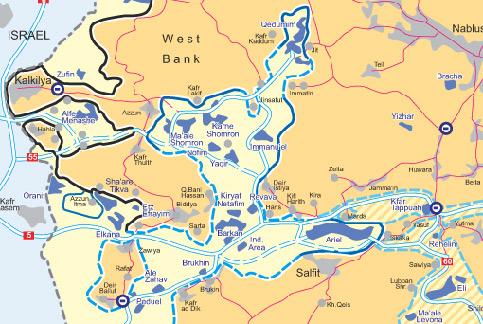 Settlement construction in the area would fortify the territorial linkage between Ariel – a settlement that extends so deep into the West Bank that in no circumstance could it be annexed by Israel if Palestinians are to have a contiguous state – and settlements located closer to the separation barrier and 1967 Green Line. It would further sever Palestinian communities from their land, resources, and important transportation routes to Nablus, Ramallah, and beyond.
The New Norm: Blatant Walk Towards Annexation
Israeli Justice Minister Ayelet Shaked issued a directive this week requiring all new Israeli laws to explicitly state whether or not they apply to Israeli settlements – and requiring those that do not apply to settlements to explain why. In effect, Shaked’s directive makes it a default position to apply Israel law inside the settlements, in contrast to the past 50 years of practice. (Israeli settlers enjoy the full rights and protections of Israeli law; the settlements, which are located in areas over which Israel has not formally extended its sovereignty, operate under Israeli military law). This is a significant move towards outright annexation of the settlements; and some of Shaked’s supporters are not shy about saying so. The Times of Israel quotes Jewish Home MK Shuli Moallem-Refaeli saying she “had ‘no desire to conceal’ the government’s intention to annex the West Bank. She added that the process must not be done in a ‘backdoor’ fashion, but rather openly.”
U.S. Ambassador to the United Nations Nikki Haley is reportedly pushing to annul the anti-settlement UN Security Council Resolution 2334, which passed last December, with the Obama administration abstaining. The resolution condemns Israeli settlements, stating that they have no legal validity. The resolution was an important reiteration of the imperative to differentiate between Israel and settlements. Haley is in Israel this week, on the heels of a stern warning she gave the UN Human Rights Council that the U.S. would leave if “Agenda item 7” (which censures Israel for its human rights abuses in the occupied territories) is not removed from their upcoming schedule.
Welcome to FMEP’s Weekly Settlement Report, covering everything you need to know about Israeli settlement activity this week.
To receive this report via email, please subscribe here.
June 2, 2017
- High Planning Council Announces Agenda for June 7th Meeting
- Plans Advance (Again) for New Settlement for Amona Families
- This Week in Settlement-Related Violence
- Bonus Reads: Archives, Fragments, and a Biography
Contact Kristin McCarthy (kmccarthy@fmep.org) with questions and comments.
High Planning Council Announces June 7th Meeting
This morning (June 2), the Israeli High Planning Council announced the highly anticipated agenda for its June 7th meeting. According to the agenda, the committee will consider plans to advance thousands of new housing units in the West Bank (Note: Haaretz is reporting 2,100 new units, Times of Israel is reporting as many as 2,600 new units, and the settler media outlet Arutz Sheva is reporting 2,600). This does not mean imminent construction of all of these new units. The majority of the plans before the council, though significant, have more procedural steps to take before building begins. Only 400 are up for final approval according to the Times of Israel.
Reportedly, 1,500 of the 2,100 units are in settlements located inside “settlement blocs”: Maaleh Adumim (on Jerusalem’s northeast flank) and Ariel (located in the heart of the northern part of the West Bank, between Nablus to the north, Ramallah to the south, and at almost exactly the midpoint between the Green Line and the Jordan border – for background on Ariel and the Ariel “bloc” see here). Plans for new units in the South Hebron Hills and the now infamous Beit El settlement, north of Ramallah, will also be considered. Haaretz also reports that the Council will move to retroactively legalize the Kerem Reim outpost, which is currently under a stop-work order thanks to a Peace Now Israel petition before the High Court of Justice.
The announcement of this agenda – and the approvals that will likely come out of the meeting – is significant, as it is the first indication of what Netanyahu’s policy of “restrained settlement growth” will mean, post-Trump’s visit. Ahead of the announcement, Netanyahu tried to temper expectations amongst his right wing coalition members who are heavily pressuring him for rapid settlement expansion. Netanyahu reportedly told Knesset members earlier in the week that Israel does not “have a blank check” from the U.S. to build in the West Bank. Following that, Haaretz reported that the Prime Minister’s Office stepped in on Thursday night to remove “thousands” of units from the meeting agenda. Predictably, settler leaders are disappointed with the total number of units up for discussion. As things stand, it appears that Trump will make the case that approving thousands of units is, in fact, an example of “restraint,” and that, as a result, this move should earn him credit rather than criticism from the Trump Administration and the world.
Plans Advance (Again) for New Settlement for Amona Families
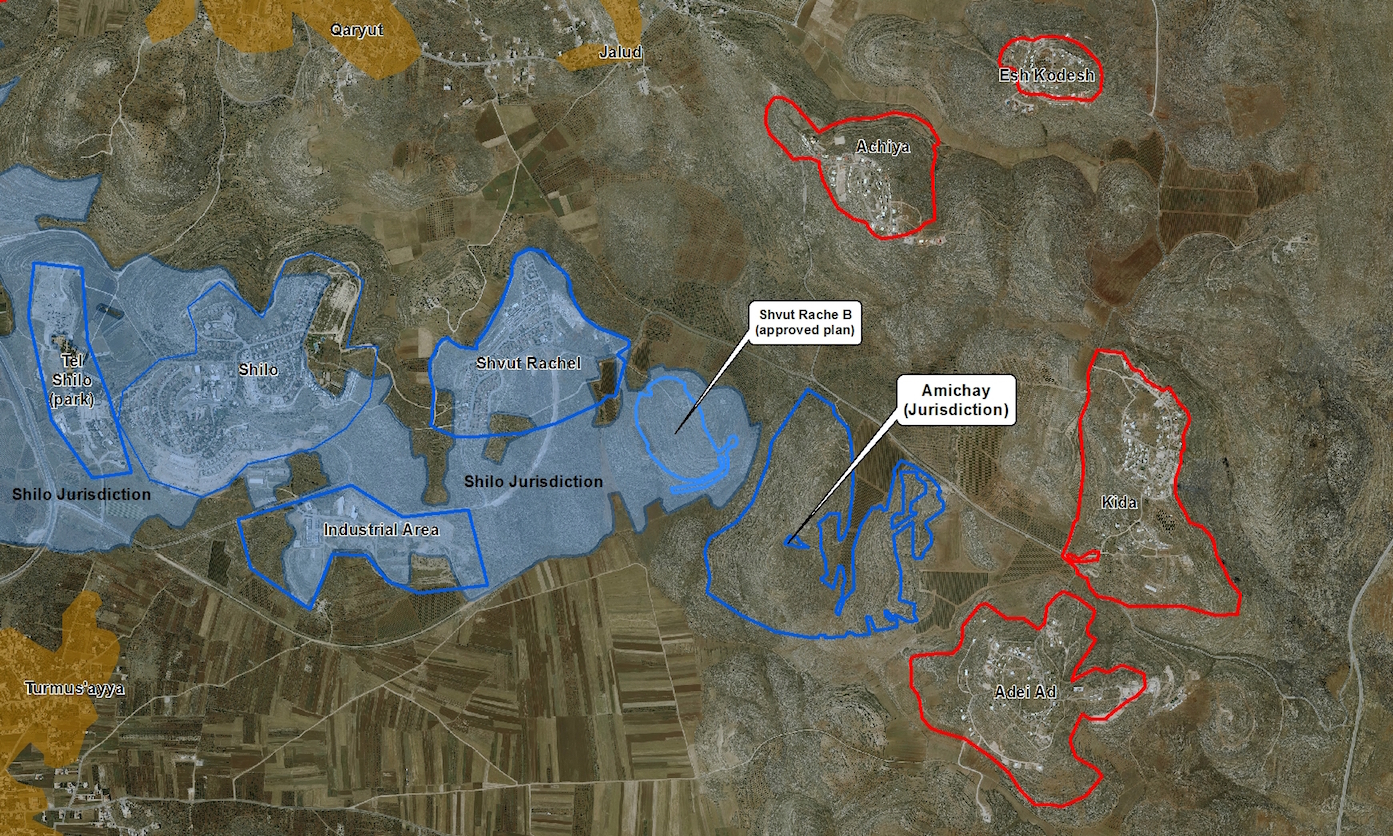
Map by Peace Now Israel
Over the weekend, Israeli authorities approved a jurisdictional outline for the first entirely new Israeli settlement established with government permission since 1992. The settlement is being called Amichai, and it is situated on a hilltop near the highly problematic Shilo settlement, located deep in the northern West Bank heartland. Peace Now Israel covers the important history of how this settlement (and a second settlement) is being built as pay-off to the families who were evacuated from the illegal Amona outpost earlier this year (i.e., it represents a concrete reward for breaking Israeli law and an incentive for further settler law-breaking).
The approval of this new jurisdiction will likely speed up the projected completion date for the Amichai settlement, which was once thought to be on a three-year timetable. Despite the rapid pace the Amichai approval is now taking, the Amona lawbreakers are demanding permission to construct temporary shelters in the jurisdiction that was just created.
This Week in Settlement-Related Violence
An IDF soldier was lightly wounded in an alleged stabbing incident at the entrance gate of the Israeli settlement Mevo Dotan. Reportedly, a 16-year old Palestinian girl approached the main gate of Mevo Dotan and stabbed a soldier who was telling her to leave the area. The girl was shot and transported to a nearby hospital where she later died of her wounds. Mevo Dotan is in the northern tip of the West Bank, fairly close to the separation barrier’s route. Previously a small settlement of ~330 people, last year Mevo Dotan nearly doubled in size.
Bonus Reads: Archives, Fragments, and a Biography
Reuters recently picked up on the impressive archival work of Akevot, an Israeli NGO unearthing and preserving Israeli government documents. The story covers more than just archived documents relating to settlements, but here’s a real money quote:
Theodor Meron, one of the world’s leading jurists who was then legal adviser to the [Israeli] foreign ministry, wrote several memos in late 1967 and early 1968 laying out his position on settlements. In a covering letter to one secret memo sent to the [Israeli] prime minister’s political secretary, Meron said: “My conclusion is that civilian settlement in the administered territories contravenes explicit provisions of the Fourth Geneva Convention.”
The United Nations Office for the Coordination of Humanitarian Affairs – Occupied Palestinian Territories (OCHA oPt) put out a new report this week titled, “Fragmented Lives: Humanitarian Overview 2016. ” In it, OCHA highlights many important ways the Israeli settlement enterprise impacted Palestinian lives in 2016. These include settler violence, settler takeovers of Palestinian property in East Jerusalem, discriminatory planning practices, the movement and access restrictions in areas near settlements, and more.
Israel’s +972 Magazine ran a feature piece on prominent Israeli activist and settlement expert Dror Etkes. The story includes his work challenging the Amona outpost as well as a great explanation of the Ottoman era law that Israeli settlers are using to massively expand settlement growth.
FMEP has long been a trusted resource on settlement-related issues, reflecting both the excellent work of our grantees on the ground and our own in-house expertise. FMEP’s focus on settlements derives from our commitment to achieving lasting Israeli-Palestinian peace, and our recognition of the fact that Israeli settlements – established for the explicit purpose of dispossessing Palestinians in the West Bank and East Jerusalem of land and resources, and depriving them of the very possibility of self-determination in their own state with borders based on the 1967 lines – are antithetical to that goal.