Welcome to FMEP’s Weekly Settlement Report, covering everything you need to know about Israeli settlement activity this week.
To subscribe to this report, please click here.
January 28, 2022
- Israel Destroyed The Salihiya’s Home in Sheikh Jarrah. Now The Salihiyas Are Appealing to the ICC
- Knesset Committee Chair Vows to Protect Homesh Outpost & Yeshiva
- A War Crime in the Making: Israel Finalizes Plan for Forcible Relocation of Khan Al-Ahmar
- Settlers Attack Palestinians & Israel Human Rights Activists
- Settlers Violently “Parade” Through West Bank Town
- Israeli Government Increases Funding for Annexation/Dispossession via Archaeology Effort
- Israel FM Denounces Effort to Connect Outposts to Israeli Services — While Israeli Communications Goes Ahead and Does Just That (for one outpost)
- Further Reading
Israel Destroyed The Salihiya’s Home in Sheikh Jarrah. Now The Salihiyas Are Appealing to the ICC
The International Centre of Justice for Palestinians (ICJP) has announced it will file an appeal with the International Criminal Court on behalf of the Salihiya family, whose members was forcibly displaced by Israeli forces from their home in Sheikh Jarrah last week. The Salihiya family home(s) and business were demolished by Israel, on the basis of Israel’s 2017 unilateral expropriation of their land ostensibly for “public use.” The ICC appeal accompanies ongoing efforts by the Salihiya family and its lawyer in Israeli courts, where the family’s lawyer recently announced they intend to file an appeal with the High Court of Justice to compel the State to rebuild the family home.
According to the ICJP press release, the Salihiya family has been a client of the London-based law firm Bindmans Solicitors since October 2021, and will be finalizing its appeal this week.
ICJP Director Crispin Blunt (a member of the British parliament) said:
“The Sheikh Jarrah case is already notorious. ICJP is proud and privileged to stand alongside this family as they represent not just their own interests, but the century of historic injustice meted out to the Palestinian people individually and collectively. For Israel’s sake, for all Palestinians, and for humanity’s sake, the Sheikh Jarrah case needs to be a turning point where justice and our common humanity starts to count for more than people’s insecurities driven by fear. Given that what has happened is wrong on any moral basis let us find the route to justice for all our sakes. ICJP stands with the victims against violence and fear. Stand with us for justice and the best of our shared interest in a just peace and the rule of a just law.”
As a reminder, on March 3, 2021, the International Criminal Court (ICC) formally opened an investigation into the “Situation in Palestine.” The investigation is expected to look at, among other things, potential war crimes committed by Israelis involved in the settlement enterprise. This could include the prosecution of Israeli officials involved in establishing settlements in the occupied territory – which are illegal under international law. For a rich discussion of the ICC case and the complexities involved in it, watch this recent FMEP webinar, ”Israel-Palestine at the International Criminal Court: What Next?”
Knesset Committee Chair Vows to Protect Homesh Outpost & Yeshiva
On January 27th, Knesset House Committee Chairman Nir Orbach, from the Yamina party (the party of Prime Minister Naftali Bennett) vowed that the government “do[es] not intend to evacuate Homesh.” The government is expected to issue a position on the illegal Homesh outpost and yeshiva (Jewish religious school) on February 6th. In the meantime, settlers who continue to visit the illegal (even under Israeli law) Homesh yeshiva also continue to regularly terrorize surrounding Palestinian villages and drivers.
The government is facing a court-mandated deadline to file its response to a 2019 case that is still pending before the Israeli High Court. That case – initiated by residents of the Palestinian village of Burqa, with the legal assistance of Yesh Din – calls for the removal of the Homesh outpost and demands that the land be returned to its Palestinian owners (and that the IDF ensures that Palestinians are indeed able to access their land). Since the Israeli government dismantled the Homesh settlement in 2005 (as part of Ariel Sharon’s “disengagement”), Palestinian have been denied access to the land, even as settlers have been permitted regular access and have been granted de facto (but not formal) permission to establish and maintain a yeshiva and outpost there.
While the government formulates its response to the case, settlers and their allies continue to raise the political stakes for the Bennett government, with the settler-run Arutz Sheva outlet even running a piece that equates the Homesh situation the Alamo (a piece which also launches a defense of the notoriously violent and frequently anarchist Hilltop Youth settler movement).
In a particularly incisive report by the Associated Press on the Homesh outpost — focusing on the settlers who illegally established and now attend yeshiva there, and the IDF’s role in enabling their continued presence — a Homesh devotee makes clear how the settlers view Palestinians:
“Ben Shachar, the teacher at the yeshiva, said farmers [referring to Palestinian landowners currently unable to access the area] should coordinate their entry with the Israeli military. He said he’s open to dialogue with ‘any Arab who accepts that the Land of Israel [which he makes clear includes all of the West Bank] belongs to the Jewish people,’ but that terrorism is ‘part of the DNA of Arab society’.”
A War Crime in the Making: Israel Finalizes Plan for Forcible Relocation of Khan Al-Ahmar
The Times of Israel reports that the Israeli Security Cabinet will soon vote on a plan to demolish the Khan Al-Ahmar bedouin community and (bizarrely) rebuild it some 300 meters from where it currently stands. The State is under the pressure of a March 6th court deadline (which has already been delayed once at the request of the State) to implement the Court-ordered demolition of Khan al-Ahmar, which the Court declared to be illegally built (i.e. lacking Israeli building permits that are virtually impossible for Palestinians to obtain).
Residents of Khan al-Ahmar – who have been living for years under a sustained threat of forcible displacement (a war crime) and are routinely harassed by Israeli forces – reportedly oppose this plan to forcibly displace them, and are planning a protest for January 30th.
At the same time, many Israeli lawmakers and right-wing groups also reject this plan – not out of concern for displacing the Bedouin, but out of concern that it doesn’t achieve the desired effect of removing them from this part of the West Bank — a strategic area in the eyes of Israeli settlers and their allies who want to build settlements encircling Jerusalem and cleanse Area C of its Palestinian residents.
Yoav Kisch of the Likud party and Religious Zionism MK Orit Strock issued a joint statement saying:
“This is a fake evacuation with highly dangerous repercussions. The damage in legalizing Khan al-Ahmar is immense. The de facto meaning is that the State of Israel approves the Palestinian plan to take over this strategic area.”
Regavim CEO Meir Deutsch said:
“The area in question, the Mishor Adumim area, is the most strategic, lying between Jerusalem and the Jordan Valley Jericho and Ramallah. That’s why the place gets so much attention from the PA and the EU…This is a small collection of huts, one of dozens in the same area, one of hundreds established in Area C. The strategic location is what draws this attention. The defense minister’s desire to whitewash the place is the realization of the Palestinian strategy to take over the area. It establishes land grabs in the heart of this strategic area…The idea the Defense Ministry came up with is about moving three hundred meters and fixing them in the heart of this strategic area, and this is not an agreed plan. The villagers have already announced that they oppose any movement, even one meter. So it makes no sense to move them. The State of Israel must do what is good for it….The state is trying, but through the displacement of 300 meters it is not avoiding confrontation, because the residents have announced that they will not move and so this solution also does not prevent conflict. It is the worst of all worlds, because it establishes a Palestinian outpost in the heart of the territory without preventing a confrontation.”
Settlers Attack Palestinians & Israel Human Rights Activists
On January 21st in broad daylight, settlers from the illegal (even under Israeli law) Givat Ronen outpost violently attacked Palestinians and Israeli activists who were planting trees on privately owned Palestinian land near the village of Burin in the northern West Bank.
Footage of the attack shows settlers wielding clubs, throwing stones, and burning a car — in the process injuring six people. Despite video footage of the incident, Israel has made no arrests (so far), though reports suggest the Israeli Shin Bet and Israeli police have opened an investigation.
The presence of, and injuries to, Israeli citizens attracted media attention and rare condemnations from the Israeli political class (and even some typically mum Jewish American organizations). Public Security Minister Bar Lev (Labor) said:
“It appears, the way I see it, that we are talking about an organized activity by a terror group that acted together to come and harm primarily Israeli citizens who had come to protest at the site. They harmed them and torched their car.”
Following the attack, the Israeli authorities delivered demolition notices to five structures at the Givat Ronen outpost (also known as Sneh Ya’akov), where the attackers are believed to be illegally living. The notices were posted on January 23rd.
Apparently undaunted, video taken on January 26th shows settlers attacking an IDF soldier during riots near the Givat Ronen outpost. Haaretz reports that dozens of settlers participated in the attack, which included stone throwing and tear gassing Israeli troops.
Kerem Navot – an anti-settlement watchdog – provides critical history on the Givat Ronen outpost and how violence is at the center of settlers’ drive to takeover Palestinian land, tweeting:
“The outpost of ‘Givat Ronen,’ known also as ‘Sneh Yaakov,’ is named after the man who founded it in 1998–Ronen Arusi…Givat Ronen is one of two outposts located around the isolated, violent, and extremist settlement of Har Bracha, which was established overlooking the city of Nablus in 1983. Givat Ronen is located about a kilometer south of the settlement…The two outposts surrounding this settlement (like all outposts in the West Bank) are used for the same function: to take over land surrounding the settlement. In this case, the lands of the village of Burin. The approach is simple: you build an outpost on land that was looted by the state by declaring it to be “state land”; from there you continue to take over cultivated agricultural land surrounding the outpost by way of violence most of which were previously cultivated by Palestinians. In practice, as a result of the settler violence that is backed by the army, Palestinians are not able to access any of this land, or any of the land within the much larger area around the settlement covering about 5,400 dunams that this land is located in, unless they work in construction in the settlement of Har Bracha. The scumbags who carried out this pogrom below the outpost have learned this tactic well: employing murderous violence in order to increase the size of the territory that Palestinians cannot enter. They have every reason in the world to assume that in this case, as in every case, no one will bother to leverage the law against them.”
Settlers Violently “Parade” Through West Bank Town
On January 24th settlers believed to be from the Yitzhar settlement staged a violent parade of cars through the West Bank village of Huwwara in celebration of a settler from the Yitzhar settlement being released from Israeli prison. The “celebration” terrorized Huwwara — with settler stone-throwing resulting in injuries to at least three people (including one child), and significant damage to at least 25 Palestinian vehicles and several businesses. Video of the attack shows Israeli forces in plain view during the rampage, but doing nothing to stop it. Israeli police have said that an investigation has been opened, but no arrests have been made.
Haaretz reports:
“Kaid Amar, the owner of a plumbing fixture store that was the target of stone-throwing, alleged in comments to Haaretz that the settlers had the protection of the soldiers at the scene. ‘They broke up my store and caused me 40,000 shekels [$12,600] in damage. My car was also wrecked. The soldiers were there around [the settlers’] cars and didn’t do anything,’ he said. Hawara Mayor Mueen Damidi said, ‘Israel says it’s a democracy, but if Palestinians were to have thrown stones, what would they have done? Shoot them. We are suffering greatly from the situation’.”
Israeli Government Increases Funding for Annexation/Dispossession via Archaeology Effort
On January 25th, the Jerusalem Affairs and Heritage Ministry announced that it will allocate $1.57 million (5 million NIS) towards “reconstruction” of the Sebastia archaeological site (located in the northern West Bank, near Nablus), pending approval from the Israeli Civil Administration. The Ministry further said that an additional $787,000 will be allocated towards the “rehabilitation” of other archaeological sites in the West Bank, as well as about $470,000 towards the Civil Administration’s ramped up efforts to “protect” West Bank archaeological sites.
Announcing the funding, Jerusalem Affairs and Heritage Minister Ze’ev Elkin said:
“The destruction of the sites, which is being carried out under the auspices of the P.A., is destroying the history of the entire region, and I will make every effort to fight it. The conservation of heritage sites in Judea and Samaria is a national mission.”
Settlers have been openly agitating – with some success – for Israel to assert control over the archaeological site in Sebastia for years. In January 2021, Emek Shaveh (an Israeli NGO expert in – and focused on – archaeology) wrote about what is happening in Sebastia, saying:
“The archaeological site of Sebastia is identified with Samaria, the capital of the Kingdom of ancient Israel in 9-8 BCE. The site also features ruins from the Hellenistic, Roman and later periods. The village of Sebastia is situated within Area B while the site itself is located mainly in area C. Over the past few years, the Samaria Regional Council has been organizing tours to the site, particularly during the school holidays. Several times this year, the Civil Administration has removed a Palestinian flag from the village and the site. In the most recent incident, a flag was raised following renovation works funded by the Belgian government. In their response the regional council blamed the Palestinians for destroying a site central to Jewish history and UNESCO for supporting the Palestinians. Sebastia is on the tentative list of World Heritage sites in Palestine….the integration of ancient sites into an organized strategy designed to weaken Palestinian hold on Area C is worrying. The formalization of this approach is likely to result in a steep rise in actions over ancient sites and structures, from water cisterns found in many villages, to major sites such as Sebastia. The justification for preserving and developing ancient sites familiar to us from East Jerusalem is now being applied wholesale to hundreds of places in the West Bank to the detriment of the Palestinians living near the sites and to the multilayered heritage inherent in the ruins which will be distorted for political ends.”
As FMEP has chronicled, settlers and their allies are intent upon using claims of Palestinian damage/neglect as a pretext for Israel taking control of archaeological sites and artifacts across the West Bank. For example, in February 2021 settlers used a construction mishap to raise claims to the Mt. Ebal site.
In January 2021, the state of Israel committed funding to a new settler initiative to surveil archeological sites under Palestinian control. While the objective of protecting antiquities might appear uncontroversial and apolitical, the true (and transparently self-evident) objective behind this effort are: to support yet another pretext to surveil and police Palestinians; to establish and exploit yet another means to dispossess Palestinians of their properties; to expand/deepen Israeli control across the West Bank; and to further entrench Israeli technical, bureaucratic and legal paradigms that treat the West Bank as sovereign Israeli territory. It is the result of a campaign that has taken place over the past year in which settlers have escalated their calls for the Israeli government to seize antiquities and “heritage sites” located in Palestinian communities across the West Bank, especially in Area C, which Israel today treats as functionally (and legally) indistinguishable from sovereign Israeli territory. The new funding committed by Israel for West Bank “heritage sites” should be understood in this context.
Previous victories for the settlers include the Israeli Civil Administration’s issuance in 2020 of expropriation orders – the first of their kind in 35 years – for two archaeological sites located on privately owned Palestinian property northwest of Ramallah. The settlers’ pressure is also credited as the impetus behind the government’s clandestine raid of a Palestinian village in July 2020 to seize an ancient font.
In June 2020, a settler group calling itself “Shomrim Al Hanetzach” (“Guardians of Eternity”) began surveying areas in the West Bank that Israel has designated as archeaological sites, looking for Palestinian construction (barred by Israel in such areas) that they could then call in Israeli authorities to demolish. The group communicates its findings to the Archaeology Unit of the Israeli Civil Administration (reminder: the Civil Administration is the arm of the Israeli Defense Ministry which since 1967 has functioned as the de facto sovereign over the West Bank). The Archaeology Unit, playing its part, then delivers eviction and demolition orders against Palestinians, claiming that the structures damage antiquities in the area.
As a reminder, in 2017, Israel designated 1,000 new archaeological sites in Area C of the West Bank. The “Guardians of Eternity” group, not coincidentally, is an offshoot of the radical Regavim organization, which among other things works to push Israeli authorities to demolish Palestinian construction (on Palestinians’ own land) that lacks Israeli permits (permits that Israel virtually never grants).
Israel FM Denounces Effort to Connect Outposts to Israeli Services — While Israeli Communications Goes Ahead and Does Just That (for one outpost)
Foreign Minister Yair Lapid made a statement to the press opposing efforts by the Knesset (including members in his own governing coalition) to connect illegal (even under Israeli law) outposts to Israeli municipal services. This is a key, longtime demand of the settlement movement and was the subject of a recent meeting between Minister Ayelet Shaked (a proponent of the outposts) and Benny Gantz (who, as Defense Minister, is ultimately responsible for implementing any such decision).
Meanwhile, Communications Minister Yoaz Hendel attended a ceremony inaugurating the installation of fiber-optic cables in the unauthorized Magen Dan outpost, located in the northern West Bank settlement of Elkana. This is the first unauthorized outpost to be connected to the Israeli fiber optic grid.
Bonus Reads
- “‘We’re here to pressure the village’: Israeli troops admit collective punishment policy” (+972 Magazine)
- “Israel Closes Case Against Police Involved in Deadly West Bank Car Chase” (Haaretz)
- “Palestinian farmers caught between Israeli rock and PA hard place” (Middle East Eye)
- “Explained: How Israel’s Absentees’ Property Law keeps Palestinians from their homes” (Middle East Eye)
- “Opinion | The Israeli Occupation’s Problem Isn’t Just a Few Violent Settlers” (Avshalom Zohar Sal / for Haaretz)
- “Palestinians call for probe into Israeli massacres in Tantura” (Al Jazeera)
- “A Progressive Jewish Response to the Discriminatory Policies of the KKL-JNF” (Breaking the Silence). From the author:
“The report begins with an executive summary, which is followed by three main sections. The first section provides an overview of the parts of KKL-JNF’s work that has displaced Palestinians and further entrenched the occupation. The second section offers a detailed explanation of the often opaque structures of the organization, including its relationship to the World Zionist Organization and the Israeli government, as well as its internal structure and budget. The final section of the report provides initial suggestions on how progressive Jews can begin to counter the work of KKL-JNF.”
Welcome to FMEP’s Weekly Settlement & Annexation Report. To subscribe to this report, please click here.
November 20, 2020
- Final Days of Trump Admin, Part 1: Historic Shifts in US Settlements Policy
- Final Days of Trump Admin, Part 2: Full Steam Ahead on Givat Hamatos Settlement
- Final Days of Trump Admin, Part 3: Israel Expected to Advance Har Homa E Settlement Plan
- Final Days of Trump Admin, Part 4: Israel Set to Start Process of Land Registration in East Jerusalem
- Final Days of Trump Admin, Part 5: Settlers Push to Re-Establish Abandoned Settlements in Northern West Bank
- Final Days of Trump Admin, Part 6: Bibi Seeks U.S. OK for More Settlement Projects, Settlers Push for Outpost Authorization
- Israeli Education Minister Celebrates New Settlement Yeshiva
- IDF Pays for Use of Yeshiva After Settlers Destroy Army Base
- Impending Sheikh Jarrah Evictions
- Bonus Reads
Questions/Comments? Email Kristin McCarthy (kmccarthy@fmep.org).
Final Days of Trump Admin, Part 1: Historic Shifts in US Settlements Policy
U.S. Secretary of State Mike Pompeo landed in Israel on November 19th for a two-day visit in which he made history with respect to U.S. support for settlements, delivering a series of extraordinary (though entirely predictable) victories to Israeli settlements and Israel’s Greater Israel pro-annexation movement.
First, Pompeo became the first U.S. Secretary of State to visit the Israel-occupied Golan Heights since the Trump Administration recognized Israeli sovereignty there in March 2019, .
Second, Pompeo became the first U.S. Secretary of State to visit a West Bank Israeli settlement, in a visit publicly framed as establishing the legitimacy of settlements. Pompeo’s visit to the Psagot Winery – located near Ramallah – flouted international law and international consensus, which views Israel’s settlement enterprise as illegal [for a deep dive in the history of the Psagot settlement and the significance of Pompeo’s visit – check out this FMEP podcast with Dror Etkes, Fadi Quran, and Lara Friedman].
Third, in conjunction with his visit to the Psagot Winery settlement, Pompeo announced new U.S. guidelines that require products made in all areas under Israeli control to be labelled as “Made in Israel” (or iterations thereof) when being exported to the U.S. This is a massive and highly consequential shift in U.S. policy that offers recognition of Israeli sovereignty not only over settlements (as the Trump Administration has previously done) but over all of Area C – some 60% of the West Bank. The announcement was urged on by a group of four Republican Senators ahead of Pompeo’s trip. The policy, which if focused on territory, not people, would require even Palestinian-made goods originating from villages in Area C to be labelled as “Made in Israel”. Roughly 150,000 Palestinians live in Area C, where they are subjected to an escalating Israeli campaign to make life untenable for them via discriminatory planning policies and demolitions.
Laying out the new policy, the State Department issued a statement saying:
“Today, the Department of State is initiating new guidelines to ensure that country of origin markings for Israeli and Palestinian goods are consistent with our reality-based foreign policy approach. In accordance with this announcement, all producers within areas where Israel exercises the relevant authorities – most notably Area C under the Oslo Accords - will be required to mark goods as ’Israel’, ’Product of Israel’, or ‘Made in Israel’ when exporting to the United States. This approach recognizes that Area C producers operate within the economic and administrative framework of Israel and their goods should be treated accordingly. This update will also eliminate confusion by recognizing that producers in other parts of the West Bank are for all practical purposes administratively separate and that their goods should be marked accordingly.”
Pompeo made this announcement following his visit to the Psagot winery – which not only named a vintage after Pompeo but has also been at the center of Israel’s global effort to push nations to treat Israeli settlements as indistinguishable from sovereign Israeli territory, with the winery involved in international legal battles over how Israeli businesses located in the settlements are required to label their products. U.S. labelling requirements will now stand at odds with European policy on the matter, which requires differentiation between products made in Israel and products made in settlements.
As part of the major change in U.S. labelling policy, Pompeo also changed how Palestinian-made products (produced in Areas A & B, and in the Gaza Strip) must be labelled, replacing the “West Bank/Gaza” label with separate “West Bank” and “Gaza” labels – another symbolic move laced with antagonism towards Palestinian rights and national aspirations. The change also contradicts the Oslo Accords, under which the Gaza Strip and West Bank are to be treated as a single territorial entity. The U.S. State Department statement on the labelling policy reads:
“We will no longer accept ’West Bank/Gaza’ or similar markings, in recognition that Gaza and the West Bank are politically and administratively separate and should be treated accordingly.”
Fourth, in a press conference alongside PM Netanyahy, Pompeo announced that the U.S. holds the “global BDS campaign” to be anti-Semitic, and said that the U.S. will “immediately take steps to identify the organizations that engage in hateful BDS conduct and withdraw US government support from such groups.” Pompeo called BDS a “cancer.” This is particularly relevant to settlement and annexation watchers because the new U.S. designation makes no distinction between boycotts aimed at Israel and boycotts limited to Israeli settlements – yet another legal step towards offering official U.S. recognition of Israel’s annexation of the settlements. It had previously been reported that the U.S. State Department were preparing to label Human Rights Watch, Oxfam, and Amnesty International as anti-Semitic organizations, based on the IHRA definition of anti-Semitism.
Fifth, under the protection of a large Israeli security escort, Pompeo visited the Elad settler organization’s archeological projects in the City of David, an Israeli national park which was declared on top of the Palestinian neighborhood of Silwan, located right outside of the walls of the Old City of Jerusalem. Under Elad’s direction, and with the support of the Israeli government and the Trump Administration, archeology is being weaponized to erase the historic memory and the modern presence of Palestinians, while emphasizing the Jewish heritage at that site. At the same time, settler organizations including Elad and Ateret Cohanim are battling to implement the mass eviction of Paelstinians from their longtime homes in Silwan.
Israeli NGO Emek Shaveh – a group of expert archaeologists – previously explained:
“The use of archaeology by Israel and the settlers as a political tool is a part of a strategy to shape the historic city and unilaterally entrench Israeli sovereignty over ancient Jerusalem. It is a process which is likely to produce devastating results for both Israel and the Palestinians. It is inexcusable to ignore the Palestinian residents of Silwan, carrying out extensive excavations of an underground city and to use such excavations as part of an effort to tell a historic story that is exclusively Jewish in a 4,000 year-old city with a rich and diverse cultural and religious past.”
And in a piece entitled “Israel Is Using Archeology To Erase Non-Jewish History,” Emek Shaveh further explained:
“The exploitation of archaeology in Jerusalem has been spearheaded by the Elad Foundation, a group of settlers turned archaeology entrepreneurs, who are using ancient sites to take over land and shape the historical narrative. Elad, which emerged 30 years ago with a mission to settle Jews in Palestinian homes in the neighborhood of Silwan, manages the popular archaeological park, the City of David. Visitors to the site are treated to a heavily biblical narrative where discoveries that resonate with the story of King David or the Kingdom of Judea are highlighted. The fact the archaeologists dispute the evidence of a kingdom in the 10th century BCE often goes unmentioned. Furthermore, not many of the half a million people who visit the park annually know about life in the Palestinian neighborhood since Elad arrived on the scene. They will probably never hear about how Elad took over 75 homes in the neighborhood, or closed off virtually the last of the public areas used by the residents and annexed it to the archaeological park. With an annual budget of approximately 100 million shekels, the Elad Foundation now commands several excavation projects in the City of David, including tunnels along an ancient Roman street, which it is marketing as a Second Temple era pilgrims’ route to the Temple. It has recently branched out to establish new projects within the Old City and in other areas throughout the Historic Basin. But Elad couldn’t have done it on their own. If at first they were greeted with mistrust by the authorities in the 1990s, today they have an open door to many government agencies and ministries. From the Israel Antiquities Authority, which is in charge of most of the excavations at the City of David, and the Nature and Parks Authority, which subcontracted Elad to run the site, to the minister of tourism, who is aggressively advancing a cable car to link West Jerusalem to the City of David, to the mayor of Jerusalem, the government and all the relevant agencies are committed to the project of shaping a large tourist zone dedicated to the First and Second Temple periods.”
Final Days of Trump Admin, Part 2: Full Steam Ahead on Givat Hamatos Settlement
On November 15th, the Israel Land Authority published the long-feared/long-awaited (depending who you are) tender for the construction of the Givat Hamatos settlement in East Jerusalem. The tenders provide for the construction of 1,257 settlement units, which is about 200 units more than expected. The tender is set to close for bids on January 18, 2021 – exactly two days before the inauguration of President-elect Joe Biden. In a carefully worded statement to the press, Netanyahu acknowledged that the publication of the Givat Hamatos tender had been coordinated with the Trump Administration (but not the Biden transition team).
Terrestrial Jerusalem writes:
“The decision to proceed with the construction of Givat Hamatos is the most defiant and inflammatory settlement move in recent memory, and should be treated as such. The construction of Givat Hamatos will create a buffer, contributing to an effective seal between East Jerusalem and Bethlehem. In addition, Givat Hamatos will, for the first time, completely surround an East Jerusalem neighborhood, Beit Safafa, with Israel construction, making the implementation of the Clinton parameters in East Jerusalem impossible. Givat Hamatos will have a devastating impact on the very possibility of a future two-state outcome.”
Ir Amim writes:
“The opening of the tender significantly decreases the potentiality to effectively block Israeli building in the area. Concerted opposition and pressure to freeze the tender is therefore vital in this limited window of time. If carried through, Givat Hamatos would become the first new settlement in East Jerusalem in 20 years. Located in a particularly strategic area, Givat Hamatos (along with Har Homa E and E1) has constituted a longstanding international red line due its impact on the prospects of a viable two-state framework with two capitals in Jerusalem. By creating a contiguous Israeli built-up area between the existing settlements of Gilo and Har Homa, construction in Givat Hamatos will serve to seal off the southern perimeter of East Jerusalem from Bethlehem and the southern part of the West Bank, while isolating the Palestinian neighborhood of Beit Safafa. The next two months in lead-up to the change in the US Presidential Administration will be a critical period. We believe that Israel will attempt to exploit this time to advance moves that the incoming administration will potentially oppose. It is crucial that the international community remain vigilant.”
Peace Now writes:
“Construction in Givat Hamatos will severely hamper the prospect of a two-state solution because it will ultimately block the possibility of territorial contiguity between East Jerusalem and Bethlehem–the main Palestinian metropolitan area–and will prevent Palestinian Beit Safafa from connecting with a future Palestinian state…The meaning of the publication of the Tender Booklet is that now the tender is open for bids and contractors may submit their proposals to win the right to build the units in Givat Hamatos. The final day for submitting the proposals is January 18th, 2021, three days before the change in the US administration…This is a major blow to the prospects for peace and the possibility of a two-state solution. This Netanyahu-Gantz government was established to fight the coronavirus but instead it is taking advantage of the final weeks of the Trump administration in order to set facts on the ground that will be exceedingly hard to undo in order to achieve peace. This tender can still be stopped. We hope that those in this government who still have some sense of responsibility for our future will do what they can to cancel the tender before bids are submitted.”
Nabil Abu Rudeineh, the spokesman for President Mahmoud Abbas, said:
“Israel is trying to benefit from the unlimited support of the current U.S. administration, which has provided it with all possible support for the sake of settlement expansion and the takeover of more Palestinian lands.”
PA Prime Minister Muhammed Shtayyeh said in a statement:
“There appears to be an escalating and intensive assault plan for the next 10 weeks in a race against time to create a new fait accompli before Donald Trump leaves the White House on January 21. We look with concern at the frequent reports about new colonial settlement projects in Arab Jerusalem and the West Bank, which aim to encircle and stifle the Palestinian Arab neighborhoods and prevent interaction between them and the rest of the West Bank and to completely isolate the city of Jerusalem.”
International reaction to Israel’s decision to publish the tender for the construction of the Givat Hamatos settlement — long treated as a red line by the international community — was predictably tempered. Several foreign governments issued statements of “concern,” including Saudi Arabia, Germany, France, the UK, Russia, and Italy, in addition to statements from UN Envoy Nikolay Mladenov and European Union High Commissioner Josep Borrell. The United Nations General Assembly passed a resolution – by an overwhelming majority — calling on all governments to refrain from treating Israel’s settlements in the West Bank or East Jerusalem as part of sovereign Israeli territory. B’Tselem Director Hagai El-Ad urged European governments to move from words to action.
Meanwhile, a delegation of European Union representatives received a hostile greeting from right-wing settlement supporters organized by hardline Israeli NGO Im Tirzu when the delegation attempted to visit the site of the future Givat Hamatos settlement on November 16th. The diplomats’ caravan was actually chased off by the right-wing protestors, which included Jerusalem city councilman and settlement empresario Ariyehh King, who shouted “Go home, anti-Semites!” at the visiting EU diplomats.
Though many settlers celebrated the publication of the Givat Hamatos tender, settlers who are currently living in the area of Givat Hamatos remain skeptical that the government will actually follow through. It’s worth noting that the government has provided mobile homes to about 30 families who live in the Givate Hamatos hillside as squatters, having waited 30 years since the Givat Hamatos plan was given final approval for construction to happen. Wall-to-wall international opposition to the settlement plan deterred the Israeli government from publishing them.
MK Miki Zohar (Likud) celebrated the new tender in a tweet saying:
“Now we can talk about it. Before the last elections, Prime Minister Benjamin Netanyahu promised me that he would publicize the building tender in Jerusalem’s Givat Hamatos; this neighborhood is in a strategic location between Beit Safafa and Hebron road. It important to build there in order to maintain a Jewish land continuum … We have a one-time opportunity these days to strengthen our hold in the land of Israel. I am sure that our friend, President [Donald] Trump, and Prime Minister Netanyahu will be wise enough to take full advantage of this opportunity.”
Final Days of Trump Admin, Part 3: Israel Expected to Advance Har Homa E Settlement Plan
As anticipated in last week’s Settlement Report, the Israeli government has decided to press forward with a highly controversial and consequential plan to expand the East Jerusalem settlement of Har Homa westward, toward the site of the future Givat Hamatos settlement (discussed above). Ir Amim reports that on November 23rd, the Jerusalem District Planning Committee is scheduled to take up the plan for 570 new units – called Har Homa E – for the second time this year, and is expected to approve the plan for deposit for public review, one of the final steps before implementation.
Ir Amim warns:
“The rapid advancement of this plan is indicative of the Israeli government’s intent to accelerate as many settlement construction projects as possible in East Jerusalem and its vicinity in the waning days of the Trump administration.”
The construction in Har Homa E will solidify a continuum of Israeli settlement construction within the southern perimeter of East Jerusalem – from Har Homa, to Givat Hamatos, to Gilo – detaching East Jerusalem from Bethlehem and completing the encirclement of the Palestinian East Jerusalem neighborhood of Beit Safafa.
The plan for Har Homa E was last discussed in September 2020, when the District Planning Committee signaled its support for approving the plan for deposit, but requested several amendments prior granting that approval. With the modifications made, the expectation is that the committee will now give its formal approval, setting off a period of 60 days during which the public can submit objections to the plan.
The plan for 570 units currently set for approval represents the first detailed plan under a much larger Master Plan for Har Homa E, which involves a total of 2,200 units. Plans to build the remaining units permitted under the Master Plan are not yet being advanced.
Ir Amim writes:
“Construction in Har Homa E will serve as another step in connecting the existing Gilo and Har Homa neighborhoods/settlements and create a contiguous Israeli built-up area along the southern perimeter of East Jerusalem. This will likewise detach Bethlehem and the southern West Bank from East Jerusalem while isolating the Palestinian neighborhood of Beit Safafa. In line with the new reality created by the Trump Plan and its unilateral recognition of Israeli sovereignty of East Jerusalem, these developments will constitute a major obstacle towards the future establishment of a Palestinian capital in the city and the prospect of a viable two-state framework.”
Final Days of Trump Admin, Part 4: Israel Set to Start Process of Land Registration in East Jerusalem
In an interview celebrating the publication of a tender for Givat Hamatos settlement project, Jerusalem Affairs & Heritage Minister Rafi Peretz connected the project to a larger Israeli effort to begin registering all East Jerusalem land in Israeli records, an effort which Peretz is spearheading. Al-Monitor reports that, as part of the Givat Hamatos project, the Israeli Finance and Justice Ministry’s acted swiftly to approve a budget, remove legal impediments, and finalize “financial compensation packages with the Palestinian land-owners” so that the land can be properly registered in Israeli government books.
Perez stated:
“The fact that almost all of the land in the eastern part of Jerusalem is not registered properly is something that should have been addressed a long time ago already. The plans that I have developed for registering land plots and properties have now been adopted by the various government ministries concerned, and once they are implemented, they will go a long way to improving the situation for the residents of these areas. A united Jerusalem is not a slogan – it’s a vision, and one that needs to apply to the eastern part of the city just as it applies to the west.”
The Israel-run process of registering ownership of land in East Jerusalem land will have far-reaching consequences for Palestinians, who have not had a formal legal avenue for registering land ownership with the Israeli government since East Jerusalem was annexed by Israel in 1967. Palestinians who wanted/needed to prove their land ownership were forced to rely on the “mukhtar protocol” — a procedure in which Palestinians in East Jerusalemites document/prove ownership by collecting signatures from local Palestinian leaders acknowledging that the land in question does, indeed, belong to them. This policy was developed by the Israeli government as an alternative to the formal land-registration process, which was frozen in East Jerusalem since 1967.
In 2019, a mini-saga over the “mukhtar protocol” revealed the uphill battle facing Palestinians if formal registration proceeds. In March 2019, the Jerusalem Planning & Building Committee, at the urging of the Regavim settler group (acting with the clear goal of preventing Palestinian development and undermining Palestinian land ownership claims to land in the city), annulled the mukhtar protocol as a legally acceptable basis for establishing land ownership in the eyes of the Israeli government, putting Palestinian land ownership in East Jerusalem in limbo. The result: having no recognized means to prove their land ownership, Palestinians were prevented from building in East Jerusalem. One month later, the Israeli authorities reversed the decision and again recognized the mukhtar protocol, reportedly following appeals to Jerusalem Mayor Moshe Leon by a city council member.
This news about starting the land registration process in East Jerusalem comes only a few weeks after Israel was reported to be advancing plans to begin a process of land registration for Area C of the West Bank — a process that opens another door for Israel to seize more Palestinian land. The registration process in East Jerusalem is expected to have similar results.
Final Days of Trump Admin, Part 5: Settlers Push to Re-Establish Abandoned Settlements in Northern West Bank
A group of 100 settlers, including children, invaded and set up camp at the abandoned site of the Sa-Nur settlement in the northern West Bank in an attempt to pressure the government to allow them to re-establish the settlement, which the state dismantled as part its 2005 disengagement from Gaza. After the Israeli army arrived at the site to evict the trespassers, MK Miki Zohar (Likud) persuaded the settlers to abandon their illegal campsite and leave the area, with the promise of raising the issue of Sa-Nur’s re establishment directly with Netanyahu.
MK Zohar is a staunch supporter of reestablishing Sa-Nur, along with three other settlements in the area that were likewise dismantled by the Israeli government in 2005 (Homesh, Ganim, and Kadim). Zohar has participated in previous visits to the site to support the settlers’ bid, frequently accompanied by his Likud colleagues, including former Speaker of the Knesset Yuli Edelstein. In July 2018, the Israeli Cabinet had the opportunity to lend government backing to a bill that would have cancelled the 2005 disengagement and allowed the settlers to rebuild those settlements – but the Cabinet blocked the bill. The settlers and their allies are no doubt raising this issue now, at a time when it seems like the wildest wishes of the settler enterprise are being fulfilled one after another.
As a reminder, even though Israel evacuated the four settlements in the West Bank, the IDF issued military orders barring Palestinians from entering the areas, preventing Palestinians from taking control over the area and building there. At the same time, settlers have regularly entered the areas and even repeatedly built a yeshiva at the Homesh site.
Final Days of Trump Admin, Part 6: Bibi Seeks U.S. OK for More Settlement Projects, Settlers Push for Outpost Authorization
In addition to the extraordinary settlement plans unleashed over the past two weeks, Israeli media reports that Prime Minister Netanyahu is seeking the blessing of the Trump Administration to push forward additional East Jerusalem settlement projects in the immediate future. Israel’s Kan News Radio reported that Netanyahu planned to raise the settlement projects with U.S. Secretary of State Mike Pompeo during his trip to Israel this week. With developments related to Givat Hamatos and Har Homa E making the news this week, we can speculate that Netanyahu might be asking specifically about the Atarot settlement plan (northern tip of Jerusalem) and/or the E-1 settlement plan (just east of Jerusalem) – as FMEP laid out last week.
Another possibility is, of course, outpost legalizations. Settlers and their allies in the Israeli government are continuing their campaign to pressure Netanyahu to grant retroactive authorization to all of Israel’s outposts and illegal settler construction across the West Bank before Trump leaves office. Since FMEP’s last reporting two weeks ago, the Israel Land Caucus has begun collecting signatures on a petition calling on Netanyahu to act immediately on this matter. According to the Times of Israel the petition states that the Knesset committee, which includes senior members of Netanyahu’s own Likud Party, is “united in the position that the regulation of young settlements must be done now…it is not fair, reasonable or responsible to leave the settlements without status and the tens of thousands of their residents deprived of their rights.”
Just this week Defense Ministry legal advisor Moshe Frucht stated that a government declaration authorizing the outposts is required prior to any actions that treat the outposts as legal communities – specifically rebuffing the request by settlers for the Defense Ministry to connect unauthorized outposts to Israeli state utilities. Frucht’s statement, combined with Netanyahu’s lack of action, enraged MK Bezalel Smotrich (Yamina) who sharply scolded Netanyahu’s top settlements advisor in a Knesset hearing this week.
Israeli Education Minister Celebrates New Settlement Yeshiva
Israeli Minister of Education Yoav Galant (Likud) attended the opening of a new religious school (yeshiva) in the Bruchin settlement, located in a finger of continuous settlements that extends from the 1967 Green Line to the Ariel settlement in the very center of the northern West Bank.
Making it clear that opening yeshivas is part of Israel’s entrenchment and expansion of settlements across the West Bank, Galant said at the event:
“I am delighted to be here in order to celebrate the inauguration of this new building for a yeshiva high school in Bruchin, together with my good friend Yossi Dagan, who has done so much to develop Jewish settlement in the Samaria region and specifically to advance the educational network here. This new building will serve all the students of the local communities and neighborhoods that have been established in the area in the last few years. I am deeply committed to promoting Jewish settlement in Judea and Samaria. As Education Minister, I will continue to do all I can to further settlement here, just as I did when I was Housing & Construction Minister – and, indeed, as I have done throughout my life. It’s time that we settled the entire Land, from the Jordan River to the sea. I hope that the students who come to learn here will be able to commence their studies this winter.”
IDF Pays for Use of Yeshiva After Settlers Destroy Army Base
The Times of Israel reports that Israel has agreed to pay the operators of a violent yeshiva associated with the Yitzhar settlement a sum of $118,750 (400,000 NIS) to cover the cost of the building’s use by security forces over the past six years.
In 2014, a mob of violent settlers stormed an army base near the Yitzhar settlement, leaving several officers wounded and destroying all military equipment at the site. After the attack, the IDF seized the yeshiva to use as a temporary base (since theirs was destroyed). It has continued to use the yeshiva since that time, and will now pay the settlers for the inconvenience.
Impending Sheikh Jarrah Evictions
Earlier this month, the Jerusalem Magistrate’s court notified four Palestinian families living in Sheikh Jarrah that they must vacate their longtime homes by November 24th, or else be forcibly evicted. One of those families is the Sabbagh family, whose legal struggle against Israeli settler groups has previously caught international attention and sparked weekly protests in Sheikh Jarrah to stop their eviction.
The Sabbagh family has lived in their home for over 64 years, and have been battling the settler organization Nahalat Shimon for their right to remain in their home. Nahalat Shimon was awarded ownership rights of the Sabbagh’s house through the use of the “Legal and Administration Matters Law,” which allows Israeli Jews (but not Palestinians) to reclaim property lost/abandoned during the 1948 war. Nahalat Shimon managed to find the Jewish Israeli family who owned the home prior to the 1948 War and convinced that family to hand over their ownership rights.
Muhammed al-Sabbagh told the Middle East Eye recently:
“I know that the Israeli court will not do justice to me. They will not be on my side against Israeli settlers. But I will fight until the very end to protect my home where I grew up, the only safe haven for me and my family.”
Sami Ershid, the family’s lawyer, told Middle East Eye:
“For years, these [families] wake up thinking what the court will rule against them. They live a life completely devoid of stability, thinking when they will be forcibly expelled from their homes. The [Israeli] goal is clear: to create a new settler neighbourhood on the rubble of their homes.”
Just Vision – who shared one Sheikh Jarrah family’s story in the docuseries “My Neighborhood,” said in an email drawing attention to these evictions:
“While the cases in Sheikh Jarrah are thinly veiled as a legal matter, the political motivations are clear. This latest round of evictions is part of a broader attempt by the Israeli state to forcibly displace Palestinians from their homes in East Jerusalem and the West Bank. The process is methodical and impacts thousands of lives on a daily basis. In the past month alone, Israel hid under the US election media frenzy to undertake the largest demolition of Palestinian homes and structures in a decade, and just yesterday, announced a new settlement, Givat Hamatos, that would effectively cut East Jerusalem off from Bethlehem. This all happens under the United States’ watch – subsequent US administrations have done little to hold the Israeli government to account, and the latest administration has given a carte-blanche for unjust activity like this.”
Bonus Reads
- “Occupied Thoughts: “Pompeo in Psagot” ft. Fadi Quran, Dror Etkes, & Lara Friedman” (FMEP)
- “Israel Impounds Palestinian’s Cows Grazing on Nature Reserve, Ignores Settlers’ Cows” (Haaretz)
- “Israeli settlers in the West Bank confront the Biden reality and dig in for a fight” (Washington Post)
Welcome to FMEP’s Weekly Settlement & Annexation Report. To subscribe to this report, please click here.
October 16, 2020
- No Annexation, No Problem – Israel Advances Nearly 5,000 New Settlement Plans, Including New Settlement South of Jerusalem
- Plan for 570 Units in East Jerusalem Settlement Approved for Deposit
- Israel Approves Construction of Elevator at Tomb of the Patriarchs
- Israel Delivers Confiscation Notices to Palestinians Living in the Heart of Hebron
- Palestinians Report Newly Established Outposts & Land Confiscations
- Targeting Palestinians Construction in Area C: State Devotes $6 million to Mapping Program
- In First, Palestinian Authority Courts to Hear Lawsuits Against Settlers
- NF, Elad Face International Heat Over Sumarin Family Eviction Case – Will it Matter?
- Report: U.S. Will Not Back De Jure Annexation Until 2024 [Friedman Says 2021 in Play]
- Bonus Reads
Comments/questions? Contact Kristin McCarthy (kmccarthy@fmep.org)
No Annexation, No Problem – Israel Advances Nearly 5,000 New Settlement Plans, Including New Settlement South of Jerusalem
During meetings held October 14th and 15th, the Israeli High Planning Council advanced plans for a total of 4,948 new settlement units. Of that total, plans for 2,688 units were granted final approval and plans for 2,260 units were approved to be deposited for public review (a late stage in the planning process). The latter approvals include a plan to build a new settlement, “Har Gilo West,” just beyond Jerusalem’s southern border. In addition, the Council granted retroactive approval to 340 existing illegally-built settlement units in the unauthorized outposts of Peni Kedem and Tapuach West, paving the establishment of two new official West Bank settlements (through post-facto legalization of the illegal outposts).
These were the first meetings of the High Planning Council since February 2020, at which time settlement planning was put on pause in favor of attempting to implement annexation plans as designed by Trump’s “Deal of the Century.” Under annexation, authority over the settlement planning/approval process could have been shifted from the Israeli Civil Administration (the branch of the Israeli Defense Ministry, in charge of the administration of affairs in the West Bank, – i.e., Israel’s occupation) into Israel domestic planning mechanism. Such a shift has long been a goal of settlers and their political allies.
In addition to advancing construction of new residential settlement units, the High Planning Council also advanced plans for the construction of new settlement projects that support tourism, further entrench the permanency of settlements, and that continue the exploitation of West Bank land and resources.
Record-Setting Settlement Activity in 2020
With the huge advancement of settlement plans this week, the Israeli government has advanced plans for 12,159 settlement units so far in 2020. With over two months to go, the settlement watchdog group Peace Now reports that this is already the highest total number settlement advancements in any year since Peace Now began tracking totals in 2012. Peace Now also reports that it is possible that the High Planning Council will convene one more time before the year ends.
Har Gilo West Approved for Deposit w/ Plan to Seal Off Al-Walajah
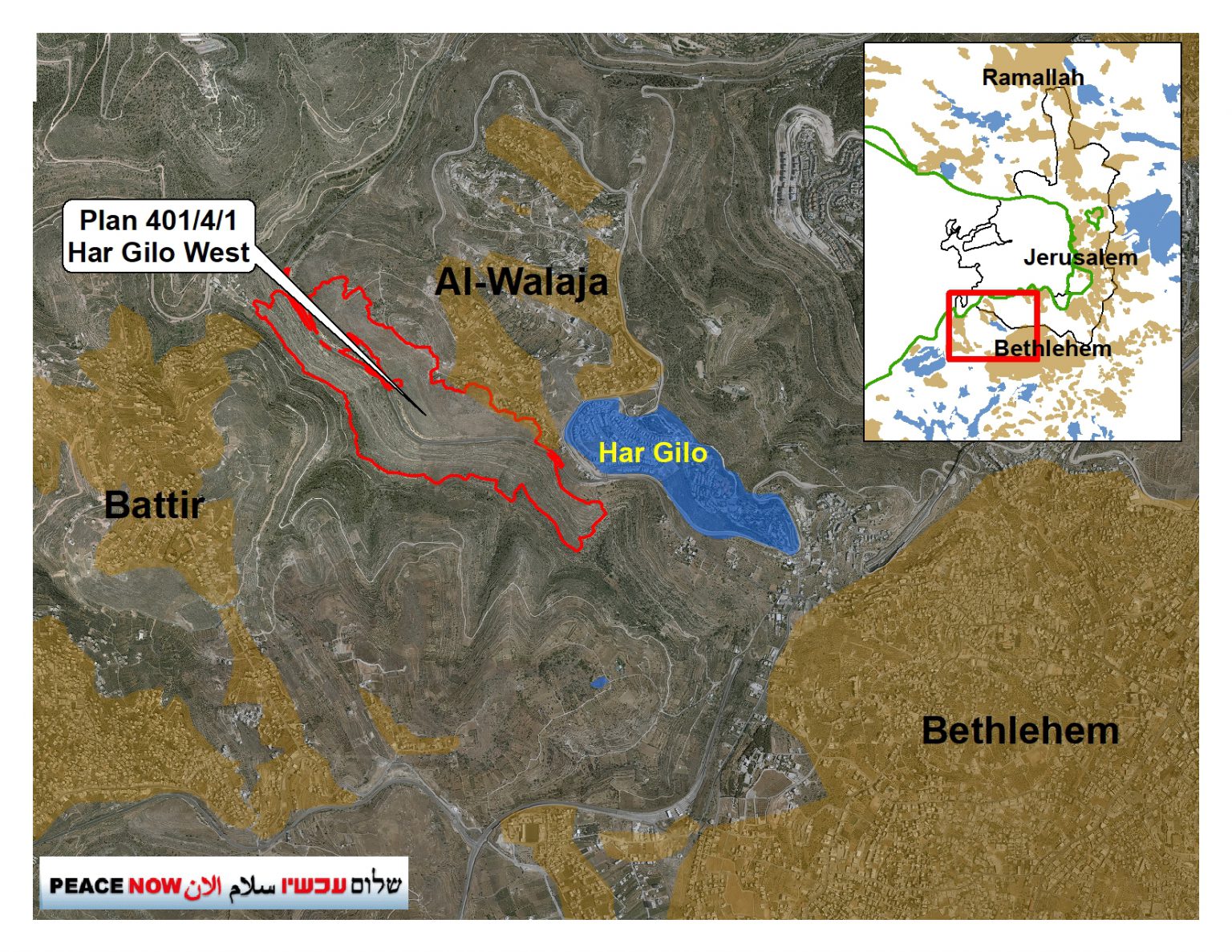 The High Planning Council approved for public deposit a plan to build 560 units at the Har Gilo West settlement site, located just south of Jerusalem. The Council is treating this plan as merely an expansion of the existing Har Gilo settlement, but in actuality it represents the construction of a new settlement on Jerusalem’s southern border, as the two areas of construction (Har Gilo and Har Gilo West) would not be contiguous. The plan for 560 units in Har Gilo West is part of a larger plan to construct around 952 units in the new settlement, extending the its borders right up to the Jerusalem municipal boundary, with dire consequences for the long-beleaguered Palestinian village of Al-Walajah.
The discussion on October 14th further revealed that, in order to build Har Gilo West, Israel plans to extend the separation barrier in that area to completely encircle al-Walajah, which is surrounded on three sides by the separation wall already. The new section of the barrier would be a 7-meters high concrete slab along the western edge of the built-up area of Al-Walajah. That would leave Al-Walajah completely encircled by the separation barrier and Israeli construction beyond it.
Ir Amim explains:
“In the past decade a series of Israeli moves have taken over more and more of Al-Walaja land and gradually isolating it. These are now culminating with the intention to construct the new settlement on the land reserves on the western side of Al-Walaja and to extend the separation barrier so as to complete the encircling of the village. As Al-Walaja will turn into an isolated enclave which lacks an outline plan its residents will be especially vulnerable to increasing home demolitions and other Israeli sanctions. Since the village will separate the new settlement from the existing Har Gilo we are likely to see increasing Israeli actions against Al-Walaja and its residents which will put their future existence at risk.”
Peace Now writes:
“The current plan of 952 housing units to be advanced will create a brand new neighborhood that will be larger than the existing settlement, and will exploit the land cut off by the West Bank barrier to further break up the western Bethlehem metropolitan area, including the land connecting al-Walaja and the town of Battir, as well as Battir and Bethlehem. This land also constitutes some of the only uninhabited fertile land reserves for Bethlehem, which currently is cut off by the West Bank barrier to its immediate north and west.“
FMEP has repeatedly documented various Israeli efforts to seal off al-Walajah from Jerusalem. Residents of al-Walajah have fought the growing encroachment by the nearby Etzion settlement bloc and the Israeli government’s attempt to de facto annex the bloc as part of “Greater Jerusalem.” Ir Amim explains several prongs of this effort, including a particularly unbelievable section of Israel’s separation barrier planned to almost completely encircle the village, to turn its valuable agricultural land into an urban park for Jerusalem, and construction of a highway that will connect the Etzion settlement bloc to Jerusalem with Israeli-only bypass roads.
Two Outposts Advance Towards Retroactive Legalization
The High Planning Council approved for deposit two plans that would, if implemented, have the effect of retroactively legalizing two outposts – bestowing upon those outposts legitimacy in the eyes of Israeli law and, in effect, establishing two new, official settlements. Those plans are:
- Pnei Kedem: A plan to grant retroactive legalization to 120 units in the Pnei Kedem farm outpost by recognizing the outpost as a “neighborhood” of the Metzad/Asfar settlement. This is despite the fact that the two areas of construction are non-contiguous. Pnei Kedem is located halfway between Bethlehem and Hebron in the southern West Bank. Settlers were particularly gleeful about this plan being advanced
- Tapuach West: A plan to grant retroactive legalization to 133 units in the Tapuach West outpost, located south of Bethlehem.
Not Just Residential Units – Council Advances Settler Tourism & Infrastructure Projects
The High Planning Council also advanced plans for the construction of new settlement projects that support tourism, further entrench the permanency of settlements, and that continue the exploitation of West Bank land and resources.
The Council granted final approval to:
- A plan for new shops and an educational site (to include an agricultural farm) in the Kochav Yaakov settlement – located between Jerusalem and Ramallah; and,
- A plan to grant retroactive authorization to a motor park and 120 hotel rooms in the Petza’el settlement, located in the Jordan Valley. As FMEP has covered in the past, this state-of-the-at racetrack and hotel complex is being built partially on land that the Israeli army previously declared a closed firing zone, a designation which resulted in the forcible displacement of Palestinians who lived there. The land remains under this designation today. Rather than halting the construction of this complex, the Israeli authorities instead created a Master Plan for the area in order to enable even more construction in the area.
Plans the Council granted final approval for public deposit include:
- A plan for an industrial zone near the Mishor Adumim settlement; and,
- A plan to build a new commercial area and 50 hotel rooms in the Maale Adumim settlement;
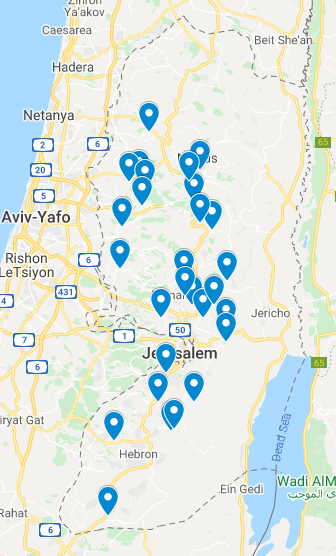
Map by Ben White (@benabyad)
Included in the total number of units receiving final approval and/or retroactive legalization (3,028 units) are (in descending order of number of units): [map]
- 382 units in the Beit El settlement, located in the heart of the northern West Bank. This includes retroactive legalization for 36 units which had been previously built without authorization and the construction of 346 units in highrise buildings with 9 or 10 floors (building up, not out in Beit El) [as a reminder, US Ambassador to Israel David Friedman has deep ties to the Beit El settlement];
- 357 units in the Geva Benyamin (Adam) settlement, located just north east of Jerusalem, just beyond the separation barrier. Israel has been steadily building the Adam settlement in a manner meant to unite the settlement more seamlessly with East Jerusalem settlements and infrastructure, erasing the Green Line;
- 354 units in the Nili settlement, located in the northern West Bank;
- 213 units in the Shiloh settlement, including the retroactive legalization of 21 units built without required approvals. The Shiloh settlement is located in the central West Bank;
- 211 units in the radical and violent Yitzhar settlement, including some retroactive authorizations (exact number not specified) as well as approval for public buildings. Yitzhar, located just south of Nablus, is associated with the Hilltop Youth movement – and a string of illegal outposts in the area associated with repeated attacks on Palestinians and their property;
- 205 units in the Nokdim settlement (actually approved for the Kfar Eldad settlement, which is officially within the jurisdiction of Nokdim), located south of Bethlehem;
- 200 units in the Metzad settlement (also known as Asfar), including the retroactive legalization of an unspecified number of existing units built without necessary approvals;
- 160 units in the Kochav Yaacov settlement, located east of Ramallah;
- 140 units in Kerem Reim settlement – located north west of Ramallah. Peace Now has repeatedly challenged the illegal construction of the Kerem Reim outpost, which the Israeli government retroactively legalized by declaring it a neighborhood of the Talmon settlement even though the areas are non-contiguous. Though a court rejected one Peace Now petition, there is an ongoing case against the Amana settler organization which Peace Now alleges engaged in illegal activities to build the outpost;
- 132 units in Kfar Adumim settlement – located east of Jerusalem and less than one mile from the Khan al-Ahmar bedouin community which the state of Israel is seeking to demolish;
- 106 units in the Ma’ale Shomron settlement, located east of the Palestinian village of Qalqilya;
- 84 new units in the Shima settlement, including retroactive legalization of 14 existing units;
- 74 units in the Yakir settlement – located in the northern West Bank and part of a string of settlements and unauthorized outposts – most notably Ariel – extending from the Green Line deep into the West Bank;
- 64 units in the Telem settlement – located west of Hebron;
- Retroactive legalization of 18 units in the Psagot settlement – located east of Ramallah, and home to the Psagot Winery;
- Retroactive legalization of 2 units in the “Givon Hadasha” settlement;
Plans which were approved for deposit for public review include (in descending order of number of units):
- 629 units in the Eli settlement, including the retroactive legalization of 61 units – located south of Nablus and southeast of the Ariel settlement in the central West Bank. Though the Eli settlement previously received Israeli government approval, a “Master Plan” – which officially zones land for distinct purposes (residential, commercial, public) – has never been issued for Eli, meaning all construction there is illegal under Israeli law;
- 560 units in the Har Gilo settlement located just south of Jerusalem (covered in detail above);
- 286 units in the Har Bracha settlement – located just south of Nablus. If implemented, these new units will double the size of Har Bracha;
- 179 units in the Einav settlement – located northwest of Nablus;
- 148 units in the Rimonim settlement – located between Ramallah and Jericho in the Jordan Valley;
- A plan to grant retroactive legalization to 133 units in the Tapuach West outpost, thereby granting approval to the outpost itself (discussed above);
- A plan to grant retroactive legalization to 120 units in the Pnei Kedem outpost by recognizing the outpost as a “neighborhood” of the Metzad/Asfar settlement although the two areas of construction are non-contiguous. Pnei Kedem is located between Bethlehem and Hebron in the southern West Bank;
- 82 units in the Karnei Shomron settlement – located in the northern West Bank east of the Palestinian village of Qalqilya. Israel is planning to continue expanding Karnei Shomron with the stated goal of bringing 1 million settlers to live in the area surrounding the settlement.;
- 75 units in the Shimaa settlement, including the legalization of 14 units previously built without authorization;
- 52 units received retroactive legalization in the Kfar Adumim settlement;
- 35 units in the Efrat settlement – located south of Bethlehem. As a reminder, Efrat is located inside a settlement block that cuts deep into the West Bank. Efrat’s location and the route of the barrier wall around it, have literally severed the route of Highway 60 south of Bethlehem, cutting off Bethlehem and Jerusalem from the southern West Bank. The economic, political, and social impacts of the closure of Highway 60 at the Efrat settlement (there is literally a wall built across the highway) have been severe for the Palestinian population;
- 14 units (in one building) in the Maale Mikmash settlement – located east of Ramallah;
- 10 units in the Barkan settlement – located about half way between the Ariel settlement and the cluster of settlements slated to be united into a “super settlement” area (Oranit, Elkana, Shiva Tikva, and others).
- 7 units in the Peduel settlement – located in the northern West Bank and part of a string of settlements and unauthorized outposts – most notably Ariel – extending from the Green Line into the very heart of the West Bank and on towards the Jordan Valley; and,
The High Planning Council met only after settlers, who represent a key ally of the embattled Prime Minister, pressured Netanyahu to allow it. Settlers have spent months decrying what they understood to be a freeze on settlement constructed inflicted upon them by Netanyahu. Gush Etzion Regional Council Head Shlomo Ne’eman said:
“Sometimes we take our prime minister to task, which we feel is justified as a result of our disappointment in postponing the application of sovereignty over our country. But now something tangible is happening – we are building and developing our communities, and of course, the highlight of today is the full registration in the Land Authority of the young community of Pnei Kedem, 20 years since it was established.”
Samaria Regional Council head Yossi Dagan said:
“This is a happy day for Samaria. [New construction] in Har Bracha, Yitzhar, Einav and Tapuach is another step on the way to a million residents in this beautiful region of the country…While we’re very content with today’s developments, I call on the Prime Minister not to stop here. We’re overfilled with joy, but it is a drop in the ocean with sovereignty falling off the agenda. The expectation now is that construction and strengthening of the settlement movement will increase tenfold.”
Peace Now responded to the approvals in a statement saying:
“While Israel reels from its second lockdown and economic distress, Netanyahu is promoting construction in isolated settlements that Israel will have to evacuate. Instead of taking advantage of the agreements with the Gulf states and promoting peace with the Palestinians, he is distorting Israel’s priorities and catering to a fringe minority for these settlement unit approvals that will continue to harm future prospects for peace. We call on the Defense Minister and the Alternative Prime Minister Benny Gantz to veto these plans. Far from a ‘settlement freeze,’ the right has been complaining about, the expected settlement approvals announcement next week prove that the settlement enterprise under Netanyahu is moving ahead at full steam toward solidifying the de facto annexation of the West Bank. The move also will be the first major demonstration of Defense Minister Benny Gantz’s bowing to the ‘Greater Israel’ settlement agenda that would in reality bring about a permanent undemocratic one-state reality. By doing so, Israel will be signaling to the world its bi-partisan support for the end to the concept of a two-state solution and a Palestinian state – the paradigm that until now has largely shielded Israel from formal pressure over its 53-year occupation. The settlement enterprise is not in Israel’s national or security interest, and is a strategic mistake at the international level.”
Palestinian Prime Minister Mohammed Shtayyeh denounced the approvals, saying:
“Every settler unit constitutes a plan to annex our land.”
Palestinian Authority spokesman Nabil Abu Rudeineh said in a statement:
“We warn against this Israeli policy that will lead the region to the brink of the abyss, and we call on the international community to intervene immediately and urgently to pressure the Netanyahu government to stop this settlement madness that totally eliminates any real opportunity to achieve a just and comprehensive peace to end the occupation and establish the independent Palestinian state with East Jerusalem as its capital on the 1967 borders.”
UN High Representative Josep Borrell said in a statement:
“In recent days, Israel has announced a significant expansion of settlements in the occupied West Bank, in areas in and around Jerusalem. These plans, which foresee the construction of close to 5.000 housing units, jeopardise the viability and territorial contiguity of a future Palestinian State as the outcome of a negotiated two-state solution, in line with the internationally agreed parameters. Settlements are illegal under international law. As stated consistently, the EU will not recognise any changes to the pre-1967 borders, including with regard to Jerusalem, other than those agreed by the parties. Settlement activity threatens current efforts to rebuild trust, to resume civil and security cooperation between Palestinians and Israelis and to prepare the ground for an eventual resumption of meaningful and direct negotiations. The Government of Israel should reverse these decisions and halt all continued settlement expansion, including in East Jerusalem and sensitive areas such as Har Homa, Givat Hamatos and E1. The period from March to August 2020 also saw a spike in demolitions or confiscations of Palestinian-owned structures in the West Bank in spite of the COVID-19 pandemic. The EU reiterates its call on Israel to halt all such demolitions, including of EU-funded structures, in particular in light of the humanitarian impact of the current pandemic. Against the background of normalization of relations between Israel, UAE and Bahrain, Israelis and Palestinians should seize this opportunity and take urgent steps to build confidence and restore cooperation along the line of previous agreements and in full respect of international law.”
A spokesperson for UN Secretary-General Antonio Guterres issued a statement flagging concern over the advancements, saying:
“We are concerned about the reports of Israel’s settlement advancements in the occupied West Bank and will continue to follow developments closely, as the Israeli High Planning Committee finalizes its meetings tomorrow. The Secretary-General has consistently reiterated that all settlements are illegal under international law and remain a substantial obstacle to peace. We urge the Israeli authorities to refrain from such unilateral actions that fuel instability and further erode the prospects for resuming Palestinian-Israeli negotiations on the basis of relevant UN resolutions, international law and bilateral agreements.”
Plan for 570 Units in East Jerusalem Settlement Approved for Deposit
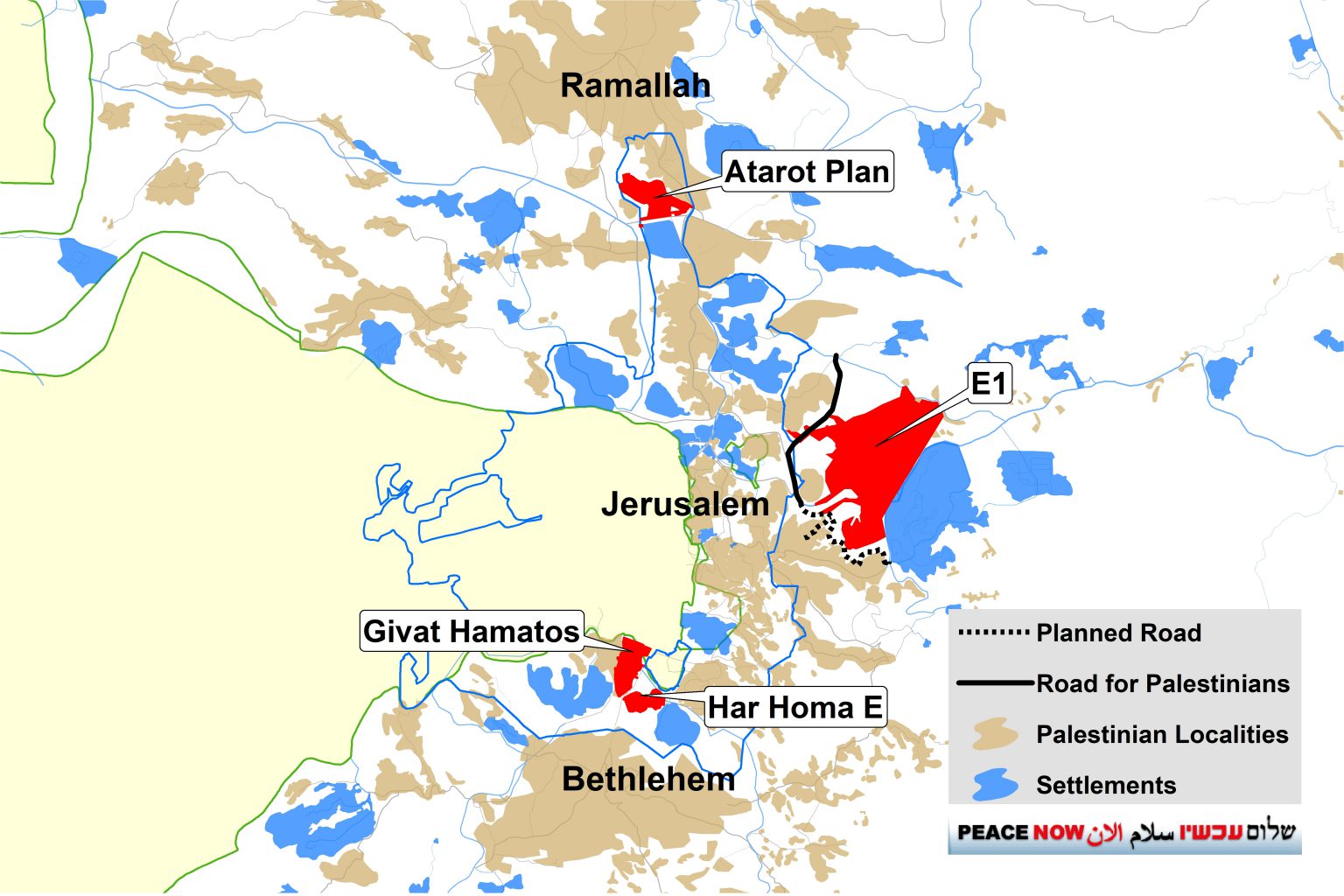 Ir Amim reports that on September 22nd, the Jerusalem District Committee approved for deposit for public review a detailed plan providing for the construction of 570 units in the Har Homa E settlement, located in East Jerusalem. Taken together with the pending construction of the nearby Har Gilo West settlement (discussed in the section above), the Palestinian village of al-Walajah stands to be completely encircled by Israeli settlements.
If implemented, this plan will extend the Har Homa settlement westward, in the direction of the site of the as-of-yet-unbuilt Givat Hamatos settlement. Ir Amim explains:
“If realized, Har Homa E together with construction in Givat Hamatos will connect Har Homa to Gilo creating a contiguous Israeli settlement area that will disconnect East Jerusalem from Bethlehem and the south of the West Bank.”
Ir Amim also reminds us that the Jerusalem District Committee previously approved a Master Plan for a total of 2,200 units in Har Homa E. The plan for 570 units approved for deposit in late September represents the first detailed plan under this Master Plan allows for. Plans to build the remaining units permitted under the Master Plan are not yet being advanced.
Israel Approves Construction of Elevator at Tomb of the Patriarchs
Emek Shaveh reports that on September 29th the Civil Administration granted final approval to a plan to build accessible infrastructure, including an elevator, at the Ibrahimi Mosque/Tomb of the Patriarch in Hebron — a plan which requires Israel to seize land from the Islamic Waqf. As of this writing, Emek Shaveh is considering whether to challenge that approval.
Regarding the significance of the plan, Emek Shaveh said:
“One need not be an archaeologist or architect to review the council’s plan and understand that it is destructive in a manner which is unprecedented. We are convinced that the plan, as approved, would never have been promoted had it not been driven by political motives.”
Emek Shaveh has previously provided critical context as to why this plan is not really, or not fully, being advanced out of humanitarian concerns, explaining:
“Israel’s decision to seize responsibility for the site from the Hebron municipality and the Palestinians sends a clear political message that Israel is reneging on agreements that were signed with the Palestinians in Hebron. Beyond the precedent that will enable the settlers in the future to demand additional changes at the Tomb of the Patriarchs/Ibrahimi Mosque, this is also a precedent that could play out at other sites under the responsibility of the Islamic Waqf. Experience has shown us that what begins in Hebron percolates into other places including Jerusalem. It begins with a seemingly rational demand to benefit the disabled or the general public and evolves into a new status quo. The expected change in Hebron has not escaped the attention of members of the Temple movement and they will know how to present their demands to the government. If Israel can repudiate agreements with the Palestinians in Hebron and expropriate land from the Waqf, it would seem that accepting what appears to be the far more modest demands by the Temple movement to pray or to walk about the Temple Mount complex freely is not so far-fetched. In the reality of Hebron and East Jerusalem, a change involving only several meters at a historic or holy place is not free of political considerations and often it is part of long-term strategy. While it is necessary to tend to the needs and interests of persons with disabilities, the extremists who presume to speak on their behalf must be prevented from forging Israeli policy, even if it is only a matter of a lift and an access path.”
Read Emek Shaveh’s full analysis here: “Humanitarianism Hebron Style.”
Israel Delivers Confiscation Notices to Palestinians Living in the Heart of Hebron
The Palestinian media outlet WAFA news reports that several Palestinians living in the Tel Rumeida section of downtown Hebron were handed confiscation notices from the Israeli authorities, informing them that the State of Israel had confiscated 17 plots of land, including land privately owned by Palestinians.
Tel Rumeida is a part of Hebron located directly in the city center, considered H2 by the Hebron Accords giving Israel full control of security in that area. B’Tselem estimates that there are around 700 settlers living in enclaves amongst approximately 34,000 Palestinians in H2. The Israeli army heavily protects those settlers, and has implemented an apartheid system of segregated movement and checkpoints, most notably in the area of Shuhada Street.
Palestinians Report Newly Established Outposts & Land Confiscations
The Palestinian news outlet WAFA reports that settlers have installed three new outposts over the past month – one near Nablus and a second near Hebron, and a third in the Jordan Valley.
Near Nablus, Palestinians report that the settlers installed mobile homes and a small farm in an attempt to establish a permanent presence on a new plot of land. The settlers are reportedly in the process of connecting the new outpost to the Elon Moreh settlement via roads and water supply. Ghassan Daghlas, who monitors Israeli settlements on behalf of the PLO, told WAFA that the specific area has seen even wider road construction recently, which he sees as an effort to create more seamless contiguity between settlements in the Nablus area and the Jordan Valley. The construction comes at the direct expense of the Palestinian village of Beit Dajani, which has historically owned the land where the outpost and roads are being built.
Near Hebron, WAFA reports that an Israeli settler erected a tent with and Israeli flag on privately owned Palestinian land near the Birin village.
In the Jordan Valley, WAFA reports that settlers set up a caravan on land on which they began planting trees about three months ago. The settlers also reportedly dug a well at the site.
On October 15th, Israel reportedly announced its intention to confiscate large tracts of land (11,000 dunums) adjacent to the Jordan Valley settlements of Rotem, Maskiyot, and Mesovah. This confiscation, according to Palestinian settlement watcher Qasem Awwad, was presented by the Israeli authorities as a move to add land to natural reserve areas, but seems clearly to be linked to efforts to expand settlements and their control over land in the area.
Targeting Palestinians Construction in Area C: State Devotes $6 million to Mapping Program
Despite COVID and the suspension of Israeli’s unilateral annexation of vast tracts of land in the West Bank, the Israeli government — at the urging of settlers and their allies — is continuing its push to consolidate its control over all aspects of life in Area C (the over 60% of the West Bank that is under full Israeli control).
OCHA has documented an acceleration in the Civil Administration’s demolition of Palestinian structures in the West Bank over the summer, documenting the demolition of 389 Palestinian-owned structures in Area C of the West Bank. As a result of those demolitions, 442 Palestinians were made homeless. OCHA further reported that In just the month of August, 205 Palestinians lost their homes, the highest single month total since January 2017. In addition, Israel continues to issue more demolition notices, including against Palestinians living in a cave near Jenin, and against a newly constructed school for bedouin children located east of Ramallah.
To further this effort, on September 10th the Israeli government allocated $6 million USD (20 million NIS) for the newly created Settlement Affairs Ministry to survey and map unauthorized Palestinian construction in Area C of the West Bank, which Israel and its settlers have been aggressively demolishing in an effort to rid the area of Palestinians. Haaretz reports that this is the first time that the state budget has included funds specifically for a land survey in the West Bank. The state also allocated an additional $2.8 million (9.5 million NIS) to an existing grant program specifically for settlement municipalities to cash in on. As a reminder, virtually all Palestinian construction in Area C of the West Bank is unauthorized, because Israel almost universally refuses to give Palestinians permission to build in Area C even on land that Israel recognizes as owned by Palestinians.
The Settlement Affairs Ministry is a new creation of the current coalition government, and is headed by Tzachi Hanegbi (Likud). The funding for the Settlement Affairs Ministry to conduct a survey of unauthorized Palestinian construction in Area C further empowers a domestic Israeli body to exert extraterritorial sovereignty over Area C – in effect, treating the area as land already de facto annexed by Israel. While technically the occupied territories are administered by the Israeli Civil Administration (a body within the Defense Ministry), Israel has spent decades bringing the administration of the territories (specifically the settlements and Area C) ever more directly under direct Israeli sovereignty (de facto annexation).
In the lead up to the allocation of funds for this new survey of Palestinians life in Area C, the Knesset hosted two committee discussions the political outlook of which was clearly indicated in the stated subject of the meetings: “the Palestinian takeover of Area C.” Consistent with this framing (which is predicated on the idea that Area C belongs to Israel), and pushed by outside groups, many members of the Knesset have criticized the Israeli government’s allegedly lackadaisical approach to preserving State interests in Area C (i.e., clearing out Palestinians, expanding settlements, consolidating state infrastructure). Reportedly, Foreign Affairs Minister Gabi Ashkenazi (Blue & White) sent a letter to the committee specifically addressing the Knesset’s outrage over European humanitarian assistance projects for Palestinians in Area C. In the letter, Ashkenazi not only celebrated the reduction of European projects over the past year, but validated settlers’ insinuations regarding the nefarious nature of European assistance for Palestinians, saying that any European activity in the West Bank lacking Israeli permission is “an attempt to define a border.” Ashkenazi also said that Israel will not compensate European donors for confiscated equipment or the demolition of European-funded projects that lack Israeli permission (like in the case of schools built with European funding, and solar panels donated to bedouin communities lacking power).
At one Knesset hearing, MK Bezalel Smotrich (Yamina) suggested that a solution could be to empower the settlements with the ability to demolish Palestinian construction they believe to be unauthorized. Smotrich’s partymate Ayelet Shaked (former Justice Minister) suggested that the government should appoint a project manager tasked with preventing a Palestinian takeover of Area C.
As noted above, Israel has long denied Palestinians the ability to build in Area C. To fully understand what is happening, it is worth reviewing B’Tselem’s excellent explainer:
“Israel’s planning and building policy in the West Bank is aimed at preventing Palestinian development and dispossessing Palestinians of their land. This is masked by use of the same professional and legal terms applied to development in settlements and in Israel proper, such as “planning and building laws”, “urban building plans (UBPs)”, “planning proceedings” and “illegal construction”. However, while the planning and building laws benefit Jewish communities by regulating development and balancing different needs, they serve the exact opposite purpose when applied to Palestinian communities in the West Bank. There, Israel exploits the law to prevent development, thwart planning and carry out demolitions. This is part of a broader political agenda to maximize the use of West Bank resources for Israeli needs, while minimizing the land reserves available to Palestinians….
In the West Bank, the potential for urban, agricultural and economic development remains in Area C. Israel uses its control over the area to quash Palestinian planning and building. In about 60% of Area C – 36% of the West Bank – Israel has blocked Palestinian development by designating large swathes of land as state land, survey land, firing zones, nature reserves and national parks; by allocating land to settlements and their regional councils; or by introducing prohibitions to the area now trapped between the Separation Barrier and the Green Line (the boundary between Israel’s sovereign territory and the West Bank).
Even in the remaining 40% of Area C, Israel restricts Palestinian construction by seldom approving requests for building permits, whether for housing, for agricultural or public uses, or for laying infrastructure. The Civil Administration (CA) – the branch of the Israeli military designated to handle civil matters in Area C – refuses to prepare outline plans for the vast majority of Palestinian communities there. As of November 2017, the Civil Administration had drafted and approved plans for only 16 of the 180 communities which lie in their entirety in Area C. The plans cover a total of 17,673 dunams (1 dunam = 1,000 square meters), less than 1% of Area C, most of which are already built-up. The plans were drawn up without consulting the communities and do not meet international planning standards. Their boundaries run close to the built-up areas of the villages, leaving out land for farming, grazing flocks and future development. Since 2011, seeing that the Civil Administration did not draft plans as it is obliged to do, dozens of Palestinian communities – with the help of Palestinian and international organizations and in coordination with the PA – drafted their own plans. Some of the plans covered communities or villages located in full in Area C and others covered places only partly in Area C. As of September 2018, 102 plans had been submitted to the Civil Administration’s planning bodies, but by the end of 2018, a mere five plans – covering an area of about 1,00 dunams (or about 0.03% of Area C) – had received approval.
The odds of a Palestinian receiving a building permit in Area C – even on privately owned land – are slim to none. Given the futility of the effort, many Palestinians forgo requesting a permit altogether. Without any possibility of receiving a permit and building legally, the needs of a growing population leave Palestinians no choice but to develop their communities and build homes without permits. This, in turn, forces them to live under the constant threat of seeing their homes and businesses demolished.
The impact of this Israeli policy extends beyond Area C, to the hundreds of Palestinians communities located entirely or partially in Areas A and B, as the land reserves for many of these communities lie in Area C and are subject to Israeli restrictions there.
The demand for land for development has grown considerably since the 1995 division of the West Bank: The Palestinian population has nearly doubled, and the land reserves in Areas A and B have been nearly exhausted. Due to the housing shortage, much land still available in these areas is used for residential construction, even if it is more suited for other uses, such as agriculture.
Without land for construction, local Palestinian authorities cannot supply public services that require new structures, such as medical clinics and schools, nor can they plan open spaces for recreation within communities. Realizing the economic potential of Area C – in branches such as agriculture, quarrying for minerals and stone for construction, industry, tourism and community development – is essential to the development of the entire West Bank, including creating jobs and reducing poverty. Area C is also vital for regional planning, including laying infrastructure and connecting Palestinian communities throughout the West Bank.
In contrast to the restrictive planning for Palestinian communities, Israeli settlements – all of which are located in Area C – are allocated vast tracts of land, drawn up detailed plans, connected to advanced infrastructure, and the authorities turn a blind eye to illegal construction in them. Detailed, modern plans have been drawn up for the settlements, including public areas, green zones and, often, spacious residential areas. They enjoy a massive amount of land, including farmland that can serve for future development.
Israel’s policy in Area C is based on the assumption that the area is primarily meant to serve Israeli needs, and on the ambition to annex large parts of it to the sovereign territory of Israel. To that end, Israel works to strengthen its hold on Area C, to further exploit the area’s resources and achieve a permanent situation in which Israeli settlements thrive and Palestinian presence is negligible. In doing so, Israel has de facto annexed Area C and created circumstances that will leverage its influence over the final status of the area.”
In First, Palestinian Authority Courts to Hear Lawsuits Against Settlers
For the first time since the Palestinian Authority was established in 1994, it will allow Palestinians to bring lawsuits against Isareli settlers in Palestinian courts. The Palestinian Authority’s Justice Minister Mohammed al-Shalaldeh announced that the PA had formed a national team to handle these cases, and the team was already working to collect evidence and file suits against settlers who have committed crimes against Palestinians in Hebron and in the village of Burin, located just south of Nablus.
Until this point, no Israeli citizen has been tried in a Palestinian court. Under the Oslo Accords (which established the Palestinian Authority), the Palestinian Authority holds no jurisdication over Israeli citizens – including Israeli citizens living in the West Bank. In May 2020, PA President Mahmoud Abbas announced that the PA considers all accords and agreements with Israel to be void following Israel’s announcement that it intends to annex large parts of the West Bank in accordance with the Trump Plan. Shalaldeh said that the announcement this week flows directly from Abbas’s decision to free the PA from the Oslo Accords’ provisions.
Explaining how these cases might work, Shalaldeh said:
“The Israeli side will be notified as an occupying power to appear before the Palestinian court…If the [Israeli] side refuses the jurisdiction of the Palestinian courts, formal procedures will be followed and in absentia rulings will be issued, in accordance with Palestinian laws.”
JNF, Elad Face International Heat Over Sumreen Family Eviction Case – Will it Matter?
Over the past month, international audiences have directed heightened scrutiny towards the radical settler group Elad and the Jewish National Fund (JNF) for the role both organizations have played in spearheading the effort to evict the Palestinian Sumreen family from their home in the Silwan neighborhood of East Jerusalem. Due to the new attention, the JNF is reportedly reconsidering whether or not to carry out the eviction of the Sumreens – an eviction which the organization has pursued since 1991.

Map by Haaretz
JNF donors – along with activists, religious leaders, members of Congress, and Israel prize winners – reportedly began to express concern and outrage over the JNF’s role in the Sumreen case following the September 2020 ruling by Jerusalem Magistrate’s Court against the Sumreen’s claim to the home. In response to the criticism, the JNF (via actions by the Board of its subsidiary organization, Himnuta, which was created to take the lead for JNF in litigating aggressive settlement takeover cases like this) has acted to freeze the eviction process internally, and was scheduled to consider a proposal for freezing the formal legal proceedings against the Sumreens this past week. Himnuta’s decision and deliberations caused conflict with Elad, which had the Jerusalem Magistrate’s Court intervene to postpone Himnuta’s Board meeting to discuss the proposal. Elad argues that Himnuta transferred all legal authority over the Sumreen case to their organization, and cannot now interfere in the proceedings. The meeting was subsequently postponed at the request of the Court.
Elad is also coming under new international scrutiny following the revelation that Roman Abramovitch – a Russian oligarch and naturalized Israeli citizen who also is one of the owners of the renowned Chelsea football club – is Elad’s single largest donor, having anonymously donated over $100 million to the settler group over the past 13 years. The BBC produced an investigative feature report on Abramovitch’s connection to Elad, pointing out that over the past 15 years more than half of Elad’s funding has come from offshore companies in the Caribbean, which are now known to be owned or controlled by Abramovitch. The BBC feature connects Elad to the settlers’ struggle to evict the Sumreen family, and the larger effort to replace Palestinians in Silwan with Jewish Israelis.
Peace Now writes:
“The news about Abramovich’s involvement highlights the injustice Palestinians face at the hands of these settlement groups. Impoverished families are up against the financial weight of a Russian oligarch. NGOs trying to protect these families are delegitimized and their work dismissed for receiving funding from democratic European aid agencies while settler groups rake in vast sums of non-transparent money from offshore Caribbean shell companies. And the JNF is profiting off of all of this. We can’t force Abramovich to stop his funding or the JNF to stop abetting Elad in its settling campaign, but we can make them worry about their reputation. Peace Now has been conducting a campaign inside Israel to call Abramovich out for his devious funding.”
Regarding the revelations of Elad’s funding source, Emek Shaveh writes:
“…the Elad Foundation, through a combined strategy of sponsoring excavations, developing tourism and settling in Palestinian homes, succeeded in recreating Silwan as the Jewish neighbourhood of Ir David (City of David) and one of the most popular tourist destinations in the country. The exploitation of archaeological tourism by the Elad Foundation has become a number one strategy for entrenching Israeli sovereignty over historic Jerusalem. “
The Sumreen family home is located in the middle of what today has been designed by Israel “the City of David National Park.” The area is managed by the radical Elad settler organization, which for years has also been pursuing the eviction of Palestinians from the homes in Silwan. For nearly three decades, the Sumreen family has been forced to battle for legal ownership of their home, after the state of Israel, prompted repeatedly by the JNF, declared the Sumreen’s home to be “absentee” property. After that designation – which was not communicated to the Sumreen family – Israeli law permitted the state to take over the rights to the building. The state then sold the rights to the home to the JNF in 1991. The JNF has pursued the eviction of the Sumreen family ever since. Israeli courts ruled in favor of the Sumreen family’s ownership claims to the home for years, until a September 2019 ruling by the Jerusalem Magistrate’s Court granted ownership of the family’s home to the JNF, a decision the family immediately appealed to the Jerusalem District Court.
A full history of the saga involving the Sumreen family – which is similar to dozens of other Palestinian homes in Silwan that were declared Absentee Property in the 1990s – can be found on the Peace Now website here.
Report: U.S. Will Not Back De Jure Annexation Until 2024 [But Friedman Says 2021 Is in Play]
A series of reports in mid-September suggested that, as part of its commitment to the U.A.E. in exchange for normalization with Israel, the U.S. promised to withhold its recognition of Israeli annexation until January 2024, at the earliest.
The 2024 timeline harkens back to a concept in Trump’s “Deal of the Century” which gave (oh so generously) the Palestinians a four year window to enter into negotiations with Israel on the basis of the Trump Plan’s conceptual map.
Following these reports regarding a 2024 timeline for the U.S. greenlighting Israeli annexation, U.S. Ambassador David Friedman (who has been a champion of annexation) told Israel’s Army Radio that annexation can happen next year. Friedman, pushing back on U.A.E. press leaks seeking to promote the notion that the Abraham Accords stopped annexation, said:
“We said in our statement that sovereignty will be postponed, and this does not mean that it has been abolished, but rather that it has stopped. It has been suspended for a year, maybe more, but it has not been cancelled.”
Bonus
- “Tourism in the Service of Occupation” (Al-Shabaka)
- “The Status Quo on the Temple Mount/Haram Al Sharif: Dodging a Bullet (For Now)” (Terrestrial Jerusalem)
- “How Evangelicals Working in Settlements Bypassed Israel’s COVID-19 Entry Ban” (Haaretz)
- “ The March of Folly in the Settlements Continues” (Haaretz)
- “Israeli Students in State-funded Scholarship Program Guard Illegal West Bank Outposts” (Haaretz)
Welcome to FMEP’s Weekly Settlement & Annexation Report. To subscribe to this report, please click here.
July 10, 2020
- Yesh Din Declares: Israel is Committing the Crime of Apartheid in the West Bank
- (FWIW) Mort Klein Says 50+% Chance Trump Approves Annexation Within Next 45-Days
- An “Off-the-Rack” Annexation Scenario
- Another Yitzhar Outpost Demolished, Another Violent Encounter Between IDF & Settlers
- Settlers & Settlement Minister Escalate Drive to Take Palestinians Land in Area C
- Greek Patriarchate Mobilizes Allies to Continue Fighting Settlers’ Acquisition of Jerusalem Properties
- Settlement Real Estate Market Heating Up?
- Bonus Reads
Comments/questions? Contact Kristin McCarthy (kmccarthy@fmep.org)
Yesh Din Declares: Israel is Committing the Crime of Apartheid in the West Bank
In a first for Israeli human rights groups, Yesh Din published a legal analysis, written by renowned Israeli human rights lawyer Michael Sfard, that concludes that Israel is committing the crime of apartheid in the West Bank, as defined by the International Convention on the Suppression and Punishment of the Crime of Apartheid AND the Rome Statute. The legal judgement closely analyzes the ways in which Israel’s current policies and actions in the West Bank constitute both the systematic oppression of one group and privileging of the other with the intent to maintain a regime of domination, and inhumane acts, including persecution and denial of rights.
Sfard finds Israel’s settlement project and “creeping legal annexation” of the West Bank to be indisputable evidence that Israel intends to maintain permanent control over the area. Safrd marks the February 2017 passage by Israel’s Knesset of Israel’s “Regulation Law” — a law governing land usage rights in the West Bank designed explicitly to take Palestinian land for the benefit of settlers — a “seminal moment” in the evolution of Israel’s West Bank regime into an apartheid system, noting that this was the first time that the Israeli Knesset passed a law to directly govern matters in the West Bank (read more here about the Regulation Law). FMEP has tracked the Knesset’s creeping legal annexation of the West Bank in its regularly updated Annexation Policy Tables, available here (Table #2).
Speaking to +972 Magazine, Sfard said that the goal of the legal opinion is to:
“change the internal Israeli discourse, and no longer talk about our presence in the West Bank as an occupation that is temporary, but as an illegitimate crime.”
Lior Amihai, executive director of Yesh Din, said in a statement:
“Apartheid is a crime against humanity, and it is a reality today, but we have the power and the responsibility to end it. We call on all people who wish to leave a better future for the coming generations of Palestinians and Israelis to demand that our decision makers act now to end apartheid and occupation. All Israeli and Palestinian children deserve a future of freedom and equality, free from apartheid.”
Further information: full Yesh Din legal report here; Executive Summary here; very thorough FAQ about apartheid in the West Bank here; Sfard’s interview with +972 Magazine here; Subscribe to receive Yesh Din updates here. Stay tuned for an FMEP webinar with Michael in the near future by signing up to receive FMEP event alerts here.
(FWIW) Mort Klein Says 50+% Chance Trump Approves Annexation Within Next 45-Days
This week, Mort Klein, the head of the far right-wing Zionist Organization of American (ZOA), told the Jerusalem Post that a U.S. official told him that there is “more than a 50% chance” chance that Trump team deciding on annexation will make their decision within 45 days. Klein — famous these days for Tweets and comments that get him accused regularly (sometimes daily) of being a racist, an Islamophobe, and of cozying up to antisemites — is also one of the rare members of the public known to have access in the Trump Administration, no doubt because the ZOA’s policies align neatly with those Trump officials responsible for Israel policy.
Trump’s Israel team – Jared Kushner, Avi Berkowitz, and Scott Leith – reportedly met (again) on July 8th, reconvening after meetings last week ended in no decision about annexation. A source told the Post that a decision this month (July) is “still possible,” despite repeated delays and a shift in focus in Israel and the U.S. to fighting a resurgence of the coronavirus.
An “Off-the-Rack” Annexation Scenario
In a new paper – entitled, “Is there a ‘Likeliest’ Annexation Scenario?” – Israel NGO Terrestrial Jerusalem, led by Jerusalem expert Daniel Seidemann, predicts that if Netanyahu follows through on his annexation pledge, there are two very compelling reasons to believe that he will do so by annexing the so-called “settlement blocs” closest to Jerusalem: Ma’ale Adumim, Givat Ze’ev, Beitar Illit, Efrat, and the entire Etzion Bloc.
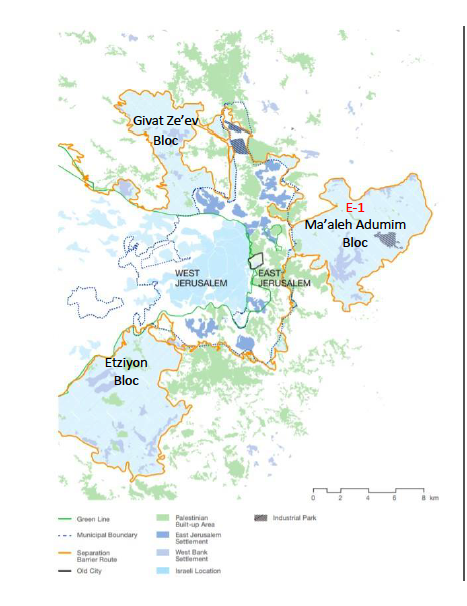 Laying out its logic, Terrestrial Jerusalem points to Netanyahu’s longstanding goal of uniting “Greater Jerusalem” by expanding the Jerusalem Municipality in order to annex as many nearby settlements as possible. The report details Netanayhu’s efforts to do so in detail, starting in 1997.
In addition, the “settlement blocs” doctrine – which has been prominently normalized by the likes of David Makovsky, Dennis Ross, and Michael Koplow – has provided Nentanyahu with an “off-the-rack” annexation option. This doctrine, on the basis of claimed “pragmatism,” has sought to allow Israel to continue unrestricted settlement expansion within large areas located near the Green Line (aka, the 1948 Armistice Line). After three decades of touting this doctrine, Netanyahu can now use it as the basis of his annexation.
Warning of the consequences of this “most likely” annexation scenario, Terrestrial Jerusalem writes:
“The annexation of one or more of the settlement blocs will have a devastating impact on the very possibility of any future agreement between Israel and Palestine. It will fragment the built-up Palestinian areas in greater Jerusalem, condemning the Palestinians to permanent occupation in an archipelago of disjointed, disconnected villages. The annexation of East Jerusalem, Ma’aleh Adumim, the Etzion Bloc and Givat Ze’ev alone would cumulatively seize 225 sq. km. of the landmass of the West Bank.”
Another Yitzhar Outpost Demolished, Another Violent Encounter Between IDF & Settlers
On July 10th, the IDF demolished an outpost that was illegally constructed by 30 settlers earlier that day. Settlers attempted to violently prevent the IDF soldiers from reaching the site of their outpost by setting up roadblocks using burning tires, and the attacking the troops with pepper spray and even threw punches during their assault on the troops.
The outpost squatters were from the radical and violent Yitzhar settlement, located in the heart of the West Bank just southeast of Nablus. The outpost – named “Kippah Sruga” by the settlers – was built in an area that the military commander marked as a “closed military zone” where civilians are not permitted to enter much less take up (illegal) residence.
Unsurprising, the leader of the Yitzhar settlement rushed to the defense of the settlers involved in the attack on the IDF. A spokesperson released a statement expressing regret that:
“some of the officers arrived at the scene without wearing masks [and] some did not have tags [identifying them as police]. The Border police officers used harsh violence against residents who did not do a thing. Of course we oppose stone-throwing and these incidents should have no place in Yitzhar.”
Settlers & Settlement Minister Escalate Drive to Take Palestinians Land in Area C
The radical settler group Regavim – which has dedicated itself to “helping” Israel police Palestinian construction in the West Bank – has filed a petition with the Jerusalem District Court asking the court to compel the demolition of Palestinian buildings located near the village of Nahalin, claiming that the newly built structures lack Israeli permits and that the Israeli Civil Administration has failed to act.
The group says Palestinians built 20 structures outside of the village, on land that is technically in Area C (the village of Nahalin is designated as Area B under the Olso Accords, but some village lands fall into Area C). Regavim asked the Civil Administration to take advantage of new powers it granted itself in June 2017 (via a military order) that allows it to demolish “new construction” a mere 96 hours after warning Palestinians of its intent (in effect depriving Palestinians of any meaningful opportunity to challenge the planned demolition).
Regavim Movement Director Meir Deutsch said:
“While our heads of state are debating whether and how sovereignty will be applied, the Palestinian Authority is hard at work, establishing facts on the ground. If we don’t wake up, in a few years we will find ourselves faced with an unchangeable reality – and the security and policy ramifications that come with it.”
Boosting Regavim’s mission, on July 7th newly crowned Settlement Affairs Minister Tzipi Hotovely toured the Mount Hebron Regional settlement council jurisdiction. Hotovely emphasized that part of her mission is to “prevent the Palestinian takeover of Area C” – an Orwellian framing suggesting that Israel is the victim of Palestinian aggressors seeking to steal Israeli land, when exactly the opposite is the case.
Hotovely said:
“At this time, it is very important to strengthen the settlement enterprise and prevent a Palestinian takeover of Area C. The Mount Hebron Regional Council has great potential for strengthening the Negev and the settlement. Applying sovereignty in this area will allow us to continue to develop the settlement in the Northern Negev and Mount Hebron.”
Greek Patriarchate Mobilizes Allies to Continue Fighting Settlers’ Acquisition of Jerusalem Properties
Since having its appeal rejected by the Jerusalem District Court on June 24th, the Greek Orthodox Patriarchate is continuing its fight to reclaim three prized properties in Jerusalem that were sold to the radical Ateret Cohanim settler organization under circumstances the Patriarchate claims are fraudulent.
In addition to planning to take its case to the Israeli Supreme Court, a spokesman for the Patriarchate, Father Issa Musleh, said that that Patriarchate will launch an international campaign in hopes of engaging the UN Security Council, Russia, Greece, Cyprus, and others to pressure Israel to return the properties to the church.
In addition, on July 7th, 13 Church leaders in Jerusalem issued a joint statement, saying:
“We, the Heads of the Churches and Christian Communities in Jerusalem, stand united in our commitment to safeguard the historical Status Quo of the Holy Sites and rights of the Churches which are universally recognized. The case of Jaffa Gate threatens this Status Quo. We are concerned by the recent judgment of the District Court of Jerusalem, which dismissed evidence demonstrating the Greek Orthodox Church’s case. We strongly support the efforts of the Greek Orthodox Church in their plea for justice…We don’t see this case as a mere property dispute. We see the undertaking of radical groups to take control of properties at Jaffa Gate as a systematic attempt to undermine the integrity of the Holy City, to obstruct the Christian pilgrim route and to weaken the Christian presence in Jerusalem.”
Settlement Real Estate Market Heating Up?
Israeli realtors hawking homes in the settlements are now talking up the possibility of a real estate boom in settlements because of the possibility of annexation.
Daniel Wach, who runs a real estate business out of the settlement of Eli — located deep inside the northern part of the West Bank — told AFP that he has done “as much business in the past two months as the last few years.” Wach said that Israeli families are buying now in anticipation of home prices rising after annexation. Post-annexation, Wach predicts will quickly rise 10-15%.
Another real estate agent who exclusively deals with settlements said: “Annexation will make a big difference…It’s gonna be a big market, we’ll need to get ready, work hard for this opportunity.”
Bonus Reads
- “Israel arrests Palestinian expert on settlements in Jerusalem” (MEMO)
- “Israel Will continue Its Campaign of Dividing and Conquering Palestinians, Annexation of Not” (Tania Hary // Haaretz)
- “Israel’s Possible Annexation of West Bank Areas: Frequently Asked Questions” (Congressional Research Service)
- “Ayelet Shaked submits candidacy to serve in Judicial Selection Committee” (Ynet)
- “Settlers and Palestinians unite in opposition to annexation” (The Times of Israel)
- “If Israel’s planned annexation goes ahead, can any response make a difference?” (Al-Shabaka)
Welcome to FMEP’s Weekly Settlement Report, covering everything you need to know about Israeli settlement activity this week.
To subscribe to this report, please click here.
July 3, 2020
- The [Purported] Israeli Counter-Proposal to the Trump Annexation Map
- De Jure Annexation Remains Imminent: Reports Say Trump to Make Final Decision Next Week
- U.S. Said to Ask for Israeli “Gesture” to Palestinians in Order to Approve Annexation Plan
- Settlers Continue Opposition to Trump Plan, While Pushing Bibi to Stop Delaying
- Settler Group Announces New Outpost Near Hebron
- Israeli Court Issues Ruling to Throw Sumreen Family Out of Their House
- Settlers Claim to Have Purchased an Illegally Built Palestinian Home in Wadi Hilweh, Silwan
- Israel Orders Demolition of Illegal Settler Structures Following Reversal of Regulation Law
- State Admits to High Court that Jerusalem Cable Car Project Will Require Confiscating Private Palestinian Land
- New Ir Amim Paper Looks at Jerusalem to Underscore the “Truth About Annexation”
- Bonus Reads
Comments/questions? Contact Kristin McCarthy (kmccarthy@fmep.org)
The [Purported] Israeli Counter-Proposal to the Trump Annexation Map
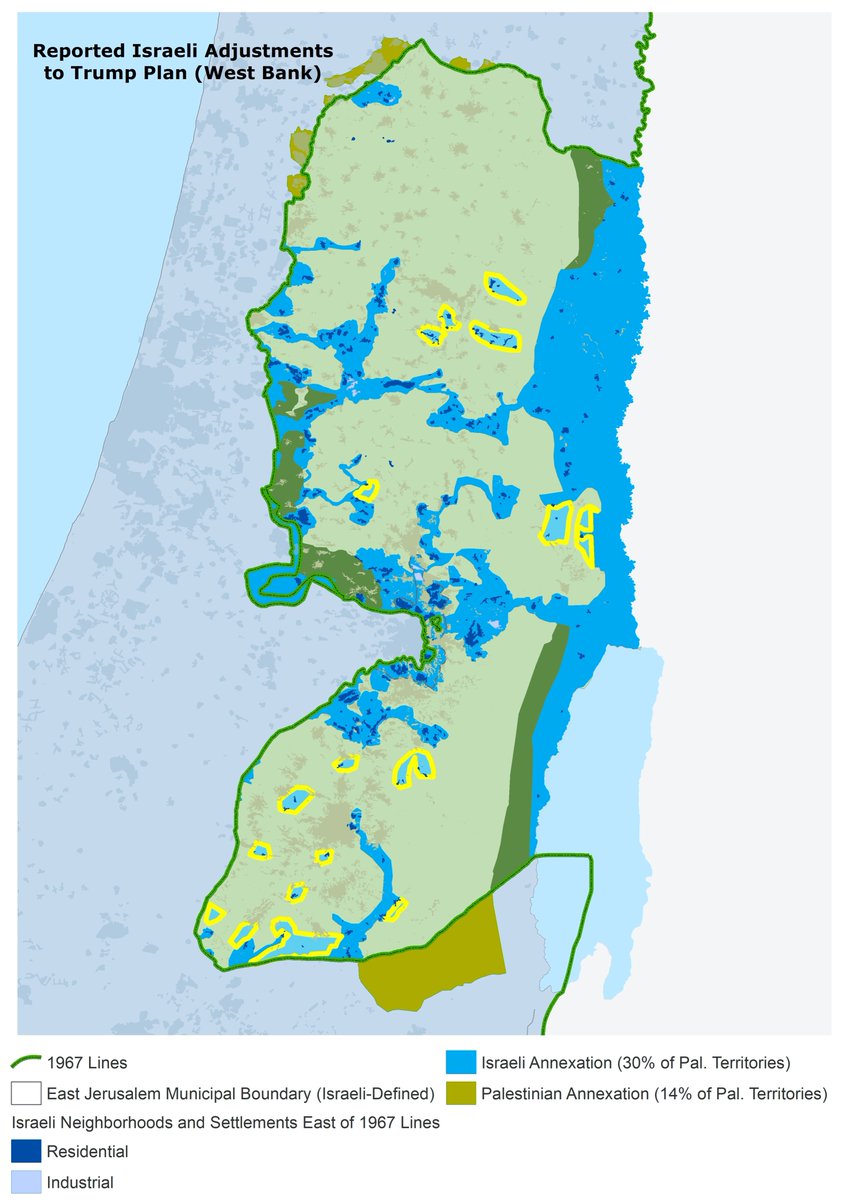 Israel’s Kan News published what it claims to be the Israeli government’s counter-proposal to the Trump annexation map. The reported counter-proposal adds a significant amount of West Bank land to the area Israel will annex, rendering even more severe the fragmentation of any future Palestinian state the plan is supposedly interested in seeing established. Specifically, the counter-proposal (which is exceptionally well explained by Israeli analyst and mapping expert Dan Rothem) achieves four main goals:
- It expands the channels of land which connect 15 far-flung outposts and settlements to what is today sovereign Israel. The Trump map connects these “enclaves” via narrow land corridors and roads (referred to by settlers as “balloons on a string”). The alleged counter-proposal annexes 2.7% more of the West Bank to enlarge those corridors.
- It provides for Israel’s annexation of about 20 additional settlements/outposts left out of the (initial) annexation provided for under the Trump Plan. These include the radical and violent settlement of Yitzhar and its outposts) located near Nablus, as well as the (relatively) nearby settlements Elon Moreh (and its outposts), Har Bracha (and its outposts), and Itamar (and its outposts). All of these settlements/outposts are, notably, located deep in the West Bank heartland.
- It proposes “compensating” Palestinians by designating an additional 4.6% of the West Bank — areas designated under the Trump Plan for Israeli annexation, comprised of West Bank territory where there are no settlers and some empty areas in the Jordan Valley/Judean desert — to (possibly) be under some degree of Palestinian control (without providing details on what would be the status of the land). (Reminder: Netanyahu said he will not annex a single Palestinian).
- The map also appears to propose population transfer, putting parts of the so-called Triangle Area — an area of densely populated towns located within Israel’s sovereign borders, inhabited by Palestinian citizens of Israel — into the area that could theoretically become a Palestinian state (assuming the Palestinians accepted the Trump Plan and satisfied a laundry list of conditions that no Palestinian leadership would ever accept — all to end up with an archipelago of territory that they might be allowed to call a “state” but that would have few if any actual attributes of sovereignty). Reminder: Forcible population transfer is a flagrant violation of international law (as is annexation of any scope); a government re-drawing its borders to deprive its own citizens of their rights, based on their ethnicity, is antithetical to democracy.
Additionally, while Israeli officials originally indicated that annexation would begin with the Jordan Valley, rampant reports indicate that the focus has now shifted to annexing elsewhere (settlement blocs) as the first stage of annexation. Perhaps responding to criticism over delaying the annexation of the Jordan Valley, Israeli Regional Cooperation Minister Ofir Akunis (Likud) told The Jerusalem Post that “of course” the Jordan Valley is included in Israel’s annexation plans [which should surprise nobody, given that politicians across most of the political spectrum in Israel came out in support of annexation of the Jordan Valley (including Benny Gantz), even before the Trump Plan].
So what is Netanyahu really thinking? According to Haaretz, he has not held discussions with his own Security Cabinet on the annexation plan, and the key Israeli bodies which will be involved in implementing annexation – the Justice Ministry, the Attorney General (whom Bibi is in open war with), the IDF chiefs, and Foreign Ministry – have not begun preparing for implementation.
De Jure Annexation Remains Imminent: Reports Say Trump to Make Final Decision Next Week
July 1st – the first day Netanyahu was permitted to bring annexation up for a vote in the Cabinet or in the Knesset, but by no means a deadline for such an action – came and went without an announcement. Reports almost immediately suggested that the annexation decision – reportedly delayed by U.S. demands and Israeli disunity.
After a week of meetings with Israeli leaders, National Security Council advisor Scott Leith and Middle East envoy Avi Berkowitz (who in the meetings were of course joined by US ambassador to Israel David Friedman) headed back to Washington. On Thursday, Berkowitz met with Jared Kushner in preparation for presenting their plan to the President. Despite the palace intrigue surrounding Kushner this week, Kushner plays a critical role in leading Trump a final decision on annexation, expected to come next week..
Though Trump has not been involved in any details of the annexation deliberations, Israeli Regional Cooperation Minister Ofer Akunis asserted that Israel will not act without a statement from Trump himself, telling the Jerusalem Post:
“[annexation] will only happen after a declaration by Trump.”
Following the departure of Leith and Berkowitz (Friedman remained in Israel), an anonymous U.S. official told the Jerusalem Post that the fact that July 1st came and went without an announcement does not mean that annexation is any less likely to happen. That official said:
“The administration is appreciative of the ongoing conversations and serious considerations that have gone into our recent discussions with the Israeli government.July 1 is not and has never been a US deadline, nor do we believe it is an Israeli deadline. We look forward to continuing the dialogue with our Israeli partners and working productively and in earnest towards implementing the president’s Vision for Peace in the Middle East.”
U.S. Said to Ask for Israeli “Gesture” to Palestinians in Order to Approve Annexation Plan
U.S. Amb. David Friedman, National Security Council advisor Scott Leith, and Middle East envoy Avi Berkowitz spent the past week in Israel, negotiating with Israeli Prime Minister Netanyahu and Alternate Prime Minister Gantz over the extent and timing of Israeli annexation of West Bank territory. Israeli press – particularly right-wing outlets – asserted that the Americans were pushing Israel to make a more significant “gesture” to the Palestinians in order to win American support (reminder: the Palestinian leadership has not been involved in negotiations at all).
Reportedly, the US suggested that such a gesture could consist of granting the Palestinian Authority greater control over the remnants of Area C left to the Palestinians after Israeli annexation — with Israel retaining the ability to “secure” those areas as-needed (essentially transforming a small part of Area C land into Area B).
The Jerusalem Post goes so far as to suggest that “many” of the conversations this past week focused on what the Palestinians will be given/offered/forced to accept, rather than the details of what/how/when Israel will annex. More than anything else, this suggests that the U.S. is not imposing limits on what Israel can annex.
Settlers Continue Opposition to Trump Plan, While Pushing Bibi to Stop Delaying
Worried both about the details of the Trump Plan and that Bibi will not pull the trigger on annexation at all, settler leaders and their allies continue their criticism of Netanyahu for every move (and non-move) he makes.
Two prominent settler leaders who oppose the Trump Plan – Yesha Council chairman David Elhayani and Samaria Regional Council chairman Yossi Dagan – continued lashing out at Netanyahu for his posture on issues of key concern to settlers (the creation of settlement enclaves, a settlement construction freeze, and the possibility of future Palestinian statehood) and for failing to act on July 1st. Dagan called the July 1st date “one big farce.”
Elhayani – who estimated that there is an 80% chance that there will be no annexation – told Walla News:
“Tying the lack of sovereignty [announcement] to Benny Gantz is a pathetic excuse..In reality, it is in the hands of the prime minister, who must accept responsibility for the decision, demonstrate leadership and say: ‘I have made this commitment to the electorate in two election campaigns, and I will stand by it’.”
Another group of settlers who are adamantly against the Trump Plan launched a new campaign targeting Netanyahu. The campaign, which was covered in the front page of the Israel Hayom paper, features photos of PA President Mahmoud Abbas, Joint List Parliamentary head MK Ahmed Tibi, and Netanyahu, and alongside the photos uses the slogan:
“They [Abbas and Tibi] will not decide. You’ve [Netanayhu] decided – Keep your promise.”
Another settler group – the Sovereignty Movement – put up billboards all over the country calling on Netanyahu to annex and to say “no” to a Palestinian state.
Former Defense Minister Avigdor Liberman (Yisrael Beytenu) put on a public display of his pointed displeasure with Netanyahu’s failure to advance annexation on July 1st. Visiting a vista overlooking the Palestinian Bedouin village of Khan al-Ahmar in the West Bank – which Netanyahu has long promised to demolish – Lieberman told the press:
“We’re meeting here at Khan al-Akhmar because this is part of the same pattern of behavior. For fourteen months, Netanyahu has been yelling about ‘sovereignty’, and the whole time he’s cheated his voters…Netanyahu has tricked everyone. He has no intention of applying sovereignty: not over Maale Adumim and not even in the Jordan Valley. He always manages to trick everyone, but it was clear to me that he is lying, just as he lied about Khan al-Akhmar.”
Former Justice Minister and Yamina party leader MK Ayelet Shaked told the Jerusalem Post that she believes Bibi has “given up on the Jordan Valley.”
Haaretz reports that settlers – both those who support the Trump Plan and those who want more than what the plan is offering – have been successfully working with U.S. evangelicals to pressure Trump to OK annexation. Netanyahu himself spoke at a high profile online event for Christians United for Israel, and Yossi Dagan was interviewed by the Christian Broadcasting Network. Efrat settlement Mayor Oded Revivi has been in private conversation with U.S. evangelical leaders.
A recent poll by the radical settler group Regavim found that only 30% of settlers supported the Trump Plan after they were told that it will require Israel to agree to the establishment of a Palestinian state. Additionally, 53% of settlers said they believe that Netanyahu will give in to pressure from Trump rather than stand his ground on issues under negotiation.
Settler Group Announces New Outpost Near Hebron
On July 1st, a group of about 500 settlers held a protest against the Trump Plan and announced their plans to establish a new outpost. The protest was held on a hilltop belonging to the Palestinian village of Halhul, near Hebron in the southern West Bank. One of the protests leaders, veteran settler activist Daniella Weiss, told Ynet:
“The Trump plan needs to be thrown in the trash. We came here to establish a settlement. Today everyone understands that the purpose of the plan is to establish a Palestinian state in the heart of Israel.”
Israeli Court Issues Ruling to Throw Sumreen Family Out of Their House
On June 30th, the Jerusalem District Court rejected an appeal by the Palestinian Sumreen family to stop the Jewish National Fund (JNF) from evicting them from the home of 60 years in the Silwan neighborhood of East Jerusalem. The Court gave the 18-member family until August 16th to vacate the property and ordered them to pay 20,000 shekels (about $5,800) to the JNF for legal costs. The Sumreen family is considering taking their case to the Israeli Supreme Court.
The Coalition for the Sumarin Family said in a statement:
“In the ruling, the court did not address the most important, fundamental point, which is that the house was taken in plunder. The JNF’s legal woes did not change the fundamental fact that the use of the Absentees’ Property Law to take over the house was done without good faith, as two government legal advisers and a government inquiry commission, determined”.
The Sumreen family home is located in the middle of what today has been designed by Israel “the City of David National Park.” The area is managed by the radical Elad settler organization, which for years has also been pursuing the eviction of Palestinians from the homes in Silwan. For nearly three decades, the Sumreen family has been forced to battle for legal ownership of their home, after the state of Israel, prompted repeatedly by the JNF, declared the Sumreen’s home to be “absentee” property. After that designation – which was not communicated to the Sumreen family – Israeli law permitted the state to take over the rights to the building. The state then sold the rights to the home to the JNF in 1991. The JNF has pursued the eviction of the Sumreen family ever since. Israeli courts ruled in favor of the Sumreen family’s ownership claims to the home for years, until a September 2019 ruling by the Jerusalem Magistrate’s Court granted ownership of the family’s home to the JNF, a decision the family immediately appealed to the Jerusalem District Court.
A full history of the saga involving the Sumreen family – which is similar to dozens of other Palestinian homes in Silwan that were declared Absentee Property in the 1990s – can be found on the Peace Now website here.
In a recent letter organized by Israeli academics, thirty-four Israel Prize laureates pleaded to the head of the JNF to stop eviction proceedings against the Sumreen family. The letter reads:
“The expulsion of the family, as part of a campaign to Judaize Silwan which has been going on for many years, will stain the reputation of the KKL … we beg of you to desist from taking actions that would be clearly immoral.”
This week, +972 Magazine published an illuminating article by a former staff member of the JNF, looking at the role the organization has played in advancing annexation policies on the ground for decades with evictions like the Sumreen case. IMEU also just published an excellent fact sheet about the Jewish National Fund.
Settlers Claim to Have Purchased an Illegally Built Palestinian Home in Wadi Hilweh, Silwan
On June 30th, a group of settlers invaded a vacant building in the Wadi Hilweh section of the Silwan neighborhood in East Jerusalem, saying that they had purchased the house from its Palestinian owners. Peace Now reports that the home was built by Palestinians years ago without an Israeli-issued permit (Palestinians in East Jerusalem are systematically denied permits to build on their own land). The family that had been living in the house left about four months ago after a demolition order was issued by the Jerusalem Municipality. 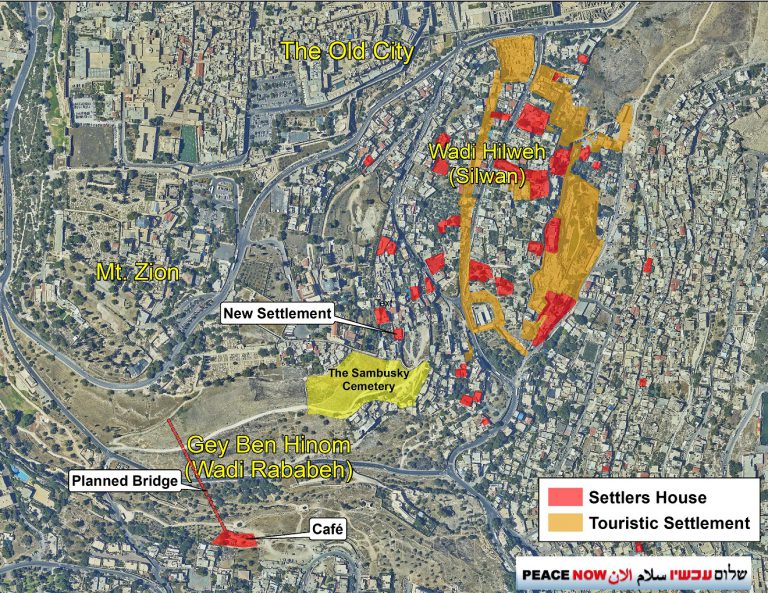
The house is located in the Ben Himmon Valley and very close to a Jewish cemetery that is currently being rehabilitated by the radical Elad settler organization. Elad has been involved in the systematic displacement of Palestinians from the Silwan neighborhood and has been weaponizing tourism and archaeology as a means by which to do so.
Peace Now explains:
“In recent years, the Elad Association, together with the Jerusalem Development Authority and the Nature and Parks Authority, has been intensively developing the Ben Hinnom Valley area leading to the Sambusky Cemetery in an attempt to produce Israeli territorial contiguity from the Sultan’s Pool area and Ben Hinnom Valley area through the cemetery toward Wadi Hilweh and the ‘City of David’ visitors’ center…The takeover of this house extends the settlers’ control in the southwest corner of Wadi Hilweh: In September 2014, the settlers entered a nearby house, and in January 2016 another house adjacent to it…All of these projects, along with the settlers entering the house yesterday, are intended to strengthen Israeli presence in this contested and occupied area, and thus make it more difficult for the territorial compromise in Jerusalem needed for a Palestinian capital in East Jerusalem and therefore the two-state solution itself. Tourism development projects in Jerusalem are one of the most significant ways of settlement, leading to both a change on the ground and in the public domain, as well as a change in Israeli attitudes by hardening them to the idea of this necessary territorial compromise.”
Israel Orders Demolition of Illegal Settler Structures Following Reversal of Regulation Law
In response to a petition filed by Yesh Din and Emek Shaveh, Israel has said it will demolish illegally built settlement structures on privately owned Palestinian land belonging to the villages of Dir Amar and Ras Karakar. Years ago settlers illegally installed tourist accommodations – benches, terraces, paths, picnic benches and a pergola – at the site of an ancient spring in this area, in an attempt to take control of the site known as Nabi Aner. Nabi Aner is part of an historic Muslim pilgrimage route between Hebron and Bethlehem. The entire area is located in Area C of the West Bank.
Israel’s announcement that it will demolish the structures (and, ostensibly, agree to return the site to Palestinian control), comes two weeks after the Israeli High Court of Justice overturned the Regulation Law, which sought to provide a basis for legalizing settlement structures built on land that even Israeli acknowledges is owned by Palestinians (as is the case with the site in question). The petition to demolish the settlers’ construction was filed in 2017, but was not considered by the Court until now, based on the argument that the Regulation Law – if it withstood Court scrutiny — might have provided the State a basis for retroactively legalizing the structures.
Emek Shaveh said in a statement:
“Over the years, the authorities in the area have refrained from enforcing the law with respect to illegal construction that was carried out on private land and around the archaeological site. In recent years, the State used the pretext of the Regularization Law as an excuse for continuing the policy of non-enforcement. This is an example of the importance of the nullification of the Regularization Law, which enabled settlers to take over private lands. But regardless of the Regularization Law and its nullification, we find it regrettable that we were forced to petition the court to instruct the State’s enforcement authorities to simply carry out their duties and prevent the settlers from illegally building on private Palestinian land. We regret that the State does not of its own accord enforce the law and stop the damage to archaeological sites and the process of severing Palestinians from access to their cultural and religious roots.”
State Admits to High Court that Jerusalem Cable Car Project Will Require Confiscating Private Palestinian Land
On June 29th, the Israeli High Court of Justice heard arguments concerning the Jerusalem cable car project, an initiative backed by the Elad settler group and advanced by the Israeli Tourism Ministry. During the hearing, the State admitted the implementation of the cable car project will require the confiscation of privately owned Palestinian land in the Silwan neighborhood of East Jerusalem. The cable car line is slated to terminate at the settler-run Kedem Center compound (Elad’s large tourism center currently under construction at the entrance of the Silwan neighborhood, in the shadows of the Old City’s walls and Al-Aqsa Mosque).
The cable car plan, touted by Elad and other supporters as a vital transportation project, is in reality intended to further entrench settler control in Silwan, via archeology and tourism sites, while simultaneously delegitimizing, dispossessing, and erasing the Palestinian presence there. Emek Shaveh and other non-governmental organizations, including Who Profits and Terrestrial Jerusalem, have repeatedly challenged (and provided evidence to discredit) the government’s contention that the cable car will serve a legitimate transportation need in Jerusalem, and have clearly enumerated the obvious political drivers behind the plan, the archeological heresies it validates, and the severe negative impacts the cable car project will have on Palestinian residents of Silwan.
New Ir Amim Paper Looks at Jerusalem to Underscore the “Truth About Annexation”
In a new policy paper, Ir Amim looks at how Israel’s annexation of East Jerusalem has played out since 1967. Ir Amim’s main points – and warnings regarding Israel’s imminent annexation of more West Bank land – are:
- Israel annexing Palestinian land, but not Palestinian people, who since 1967 have been classified as “permanent residents,” rather than being made citizens, like the Palestinians who remained inside the Green Line after 1948.;
- Since the moment of annexation of East Jerusalem, Israel has pursued policies meant limit the number of Palestinains in the area, including by driving Palestinians from East Jerusalem;
- Since the moment of annexation, Israel has attempted to take control of more and more land in East Jerusalem;
- The Absentees’ Property Law (1950) and The Law and Administration Ordinance (1970) have been Israel’s tools of choice to evict Palestinians from their homes and take their property in East Jerusalem, under the guise of legality;
- Israel has repeatedly attempted to expand the borders of the area it annexed to include nearby settlements.
Ir Amim writes:
“In order to understand the consequences of annexation it is pertinent to learn from the case of East Jerusalem which Israel unilaterally – and in contravention of international law – annexed. Since 1967 East Jerusalem has been subject to the Jerusalem municipality and to Israeli law. In the decades since 1967, Israeli policy in the city has been driven by massive settlement construction and consistent steps to reduce the city’s Palestinian population. The combination of these two methods is considered by Israel the key to solidifying its control over the annexed territory and to asserting its sovereignty. Examining Israeli policies in East Jerusalem can therefore teach us the dangers of what can take place if the current annexation plan of the Israeli government actually takes place.”
Bonus Reads
- “Annexation is Already Here” (Jessica Montell // The Times of Israel)
- “Fight Annexation on Moral Grounds” (Yehuda Shaul // Haaretz)
- “Quick Facts: Israel’s West Bank Settlement Enterprise” (IMEU)
- “Despite Talk of Annexation, Fewer Immigrants to Israel Moving to West Bank Settlements” (Haaretz)
- “Quick Facts: What is the Jewish National Fund” (IMEU)
Welcome to FMEP’s Weekly Settlement Report, covering everything you need to know about Israeli settlement activity this week.
To subscribe to this report, please click here.
May 22, 2020
- New Israeli Government Sworn In: Gantz & Netanyahu Continue to Back Annexation & the Trump Plan
- New Israeli Government Sworn In: The Cast of Ministers Relevant to Settlements/Annexation
- Settler Groups in Public Disagreement Over Trump Plan
- ICYMI: Sec. State Pompeo Went to Israel Last Week
- Israel Expropriates Land, Green Lights Building Permits for “Humanitarian Access” to Hebron’s Tomb of the Patriarchs/Ibrahimi Mosque
- Israeli Demolitions in al-Walajah, Displacing Palestinians to Make Way for New Israeli Park
- High Court Rejects Regulation Incentivizing Artists Performing in Settlements
- Violence on the Rise
- Breaking the Silence Breaks Down What Annexation Will Mean on the Ground
- Al-Haq Report: Israeli Annexation of Jerusalem Since 1948
- B’Tselem Report: Jewish Supremacy on Display in Issawiya
- Human Rights Watch Report: Israeli Land Policies Strangle Palestinian Communities in Israel
- Bonus Reads
Questions/comments? Email Kristin McCarthy (kmccarthy@fmep.org)
New Israeli Government Sworn In: Gantz & Netanyahu Continue to Back Annexation & the Trump Plan
The new Israeli government was sworn in on Sunday, May 17th. The message from the government’s leaders – Netanyahu and Gantz – remains that they are firmly and unequivocally behind the plan to advance annexation, in accordance with the Trump Plan.
In his inaugural address, Prime Minister Netanyahu said:
“The time has come to apply sovereignty to Jewish communities in Judea and Samaria. This won’t distance peace, it will bring it closer. The truth is — and everybody knows it — that the hundreds of thousands of settlers living in Judea and Samaria will remain there, no matter what arrangement is reached. The only reason the whole issue of sovereignty is on the agenda is because I promoted it personally for the last three years, both overtly and covertly.”
In his inaugural address, Alternate (and, theoretically, future) Prime Minister Benny Gantz said:
“Alongside this and for its sake, we will maintain our strength, to seize regional opportunities in general, and to advance the US government and US President Trump’s peace plan and everything it contains.”
New Israeli Government Sworn In: The Cast of Ministers Relevant to Settlements/Annexation
In addition to Netanyahu and Gantz, key figures in the new government’s drive for annexation will likely be:
- Tzipi Hotovely (Likud), who is Israel’s “Settlements Minister.” This is a new cabinet position invented by Netanyahu and Gantz. Hotovely will serve in this role for the first nine months of the government and then be replaced by Tzachi Hanegbi (Likud) for the second nine months (of course, if Israel annexes all the settlements, this role either won’t need to exist anymore or its mandate will have to change). It is unclear if this ministry will take power away from the Defense Ministry (and its Civil Administration), which has typically been the central address for managing most issues related to the settlements.
- Gilad Erdan (Likud), who is Israel’s new Ambassador to both the United Nations and the United States. Erdan will hold both offices simultaneously for the first nine months of the government. Shortly following his swearing in, Erdan reiterated his well-established support for annexation, saying he believes Israel has a “biblical right” to the land.
- Avi Nissenkorn (Blue & White) who is Israel’s new Justice Minister. Israel’s Justice Minister has historically played an important role in issuing legal opinions which provide Israel a domestic legal rationale for land seizures and settlement activities. The Justice Ministry is also a key because it has been (at least in recent years) increasingly oppositional to the role of the Israeli Supreme Court. Netanyahu has directly confronted the Supreme Court, and former Justice Minister Ayelet Shaked accused the Court of (among other things) being “overly concerned” with Palestinian rights.
- Gabi Ashkenazi (Blue & White), who is Israel’s new Foreign Minister, and who will theoretically take over the job of Defense Minister during the second nine months of the government (assuming Gantz rotates over to become Prime Minister). Ashkenazi has made clear his support for annexation, even while giving lip service to concerns about relations with allies and in the region. On May 18th he, said: “We’re facing significant regional opportunities, primarily President [Donald] Trump’s peace initiative. I consider this plan a significant milestone. President Trump presented us with a historic opportunity to shape the future of the State of Israel and its boundaries for decades to come…The plan will be advanced responsibly, with full coordination with the United States and maintaining all of the State of Israel’s peace agreements and strategic interests.”
Key Government Figures Outside of the Coalition
- Naftali Bennett, Ayelet Shaked, Bezalel Smotrich (Yamina Party). Relegated to the opposition, Bennett and company have come out swinging – taking shots at Netanyahu for allegedly betraying right wing values and vowing to fight tooth and nail against the Trump Plan. Bennett has charged that Netanyahu is making a fatal mistake by supporting the Trump Plan because it would mean that Israel has acknowledged and accepted the concept of a Palestinian state (notwithstanding that, under the Trump Plan, what is available to the Palestinians does not meet even the most modest definition of a state). Bennett said that recognition “is a point of no return. One can’t recognize and then un-recognize Palestinian statehood. It’s like un-cooking scrambled eggs…I will oppose anything that allows for acceptance or recognition of a Palestinian state.”
Settler Groups in Public Disagreement Over Trump Plan
Settler leaders form a key interest group outside of the central government (though many settler leaders serve on municipal councils) — a group that will play a key role in the deliberations around annexation. And with the swearing in of the new government that embraces the Trump Plan, disagreements among settler leaders are beginning to become more clear.
Like the Yamina Party, the official settler leadership body – known as the Yesha Council – passed a resolution on May 21st criticizing several aspects of the Trump Plan, without stating its outright opposition to it. While acknowledging it as a “positive change in U.S. policy towards settlements,” the resolution goes on to:
- Assert that annexation does not require American approval;
- Reject recognition of – or agreement to recognize in the future – a Palestinian state;
- Reject any construction freeze in any of the settlements and outposts;
- Reject the creation of enclaves.
Following the passage of the resolution, Yesha Council chairman David Elhayani said:
“For years, the Yesha Council has been working to apply sovereignty [in the West Bank], and we’ve gone from a situation in which almost no one talked about the subject or was aware of it to the unprecedented situation where the prime minister and the US president discuss an agreement that includes sovereignty. However, we will not agree to the establishment of a Palestinian state in the heart of the Land of Israel. If the result of the [Trump] agreement is to establish a terror state in Judea and Samaria (the West Bank), include the creation of isolated enclaves and a freeze on construction, we are ready to give up sovereignty, despite all the hard work and resources we have invested in the issue in recent years.”
In opposition to the Yesha council’s statement, a group of settler mayors – representing major settlements like Efrat and Ariel, as well as settlements that, due to their population, have extra weight politically (like Alfei Menashe, which is home to many retired senior IDF officers) — organized their own statement calling for support of the Trump Plan. The statement – led by Efrat Mayor Oded Revivi – was signed by the mayor/chairmen of Ariel, Megilot, Oranit, Alfei Menashe, Elkana, and Har Adar.
ICYMI: Sec. State Pompeo Went to Israel Last Week
On Wednesday, May 13th, U.S. Secretary of State Mike Pompeo travelled to Israel for an 8-hour visit to meet with leaders of the new Israeli government (which was set to be sworn in the next day, though that was delayed until Sunday the 17th). In response to an unconvincing statement by the State Department concerning the trip’s purpose – which was officially about coordination on fighting COVID-19 and Iran – an avalanche of speculative media coverage preceded and trailed Pompeo’s trip, trying to suss out what the trip was truly about, with many focusing on annexation or confronting Israel’s growing ties to China. In response, a State Department official who travelled with Pompeo told the press after Pompeo departed: “[we can] dispel the notion that we flew halfway around the world to talk about annexation…that was not the purpose of the trip…This wasn’t the top line.”
Media speculation that annexation was on Pompeo’s agenda was fueled by an interview Pompeo gave to Israel Hayom one day prior to his trip. When asked directly by a reporter if he planned to ask Israel to delay annexation, Pompeo declined to answer but reiterated his prior comments stressing that annexation is an Israeli decision. And then, on the day that Pompeo arrived in Israel, an anonymous “senior U.S. official” told Israel’s Channel 13 news that the U.S. had passed a message to Israeli leaders that annexation does not have to happen on July 1st.
In a press conference following their meeting, Pompeo appeared to again suggesting that Israel could (or should) delay annexation. Appearing alongside Netanyahu, Pompeo said (to Bibi):
“We’re now some months on from the day that you came to Washington when President Trump announced that Vision for Peace when you were there. There remains work yet to do, and we need to make progress on that. I’m looking forward to it.”
Not long after, Pompeo told the press:
“We spoke of ways to advance the peace plan, Trump’s peace plan.”
Reading into these comments, the New York Times ran pieces suggesting that Pompeo told Netanyahu that the U.S. wants him to delay annexation. In the article, Crisis Group analyst Ofer Zalzberg suggested that Pompeo sought to re-establish a role for Benny Gantz in the government’s consideration of annexation (after Gantz forfeit such a role as part of the coalition deal). Adding to the chatter around delay, Channel 13 News in Israel even reported that Gantz and Ashkenazi voiced concerns about annexation during their meeting with Pompeo, though both Gantz and Ashkenzi have continued to publicly promote the plan (see section above).
Israel Expropriates Land, Green Lights Building Permits for “Humanitarian Access” to Hebron’s Tomb of the Patriarchs/Ibrahimi Mosque
On May 13th, the IDF Commander issued an expropriation order to take control of an area outside of Hebron’s Tomb of the Patriarchs/Ibrahimi Mosque in order to build an elevator and wheelchair ramp leading to the site. The land is owned by the Islamic Waqf and is under the municipal jurisdiction of the Palestinian-run Hebron Municipality, according to multiple agreements signed by Israel and the Palestinians concerning the governance of the site. Israel’s expropriation order violates the terms of the Hebron Protocols.
Four days later, on May 17th, the Israeli Civil Administration deposited for public review plans for the project, starting the clock on a 60-day period during which the public can submit objections to the plan.
Emek Shaveh writes:
“The project is presented as a response to a humanitarian need but the settlers and the government are in fact creating a precedent of expropriation from the Waqf and construction at a shared holy site. Moreover, according to the Oslo Accords, the tomb comes under the auspices of the Hebron Municipality who have not consented to the plan.”
Palestinian Authority Minister for the Civilian Affairs Hussein al-Shiekh tweeted in response:
“today the so-called Israeli Minister of Defense signed a decision to confiscate [and] annex parts of the Ibrahimi campus in Hebron, which is a violation of the Hebron protocol, an end of the agreement signed between the PLO and Israel [and] a continuation of the #annexation project in the [West Bank and] #Jerusalem”
Israeli Demolitions in al-Walajah, Displacing Palestinians to Make Way for New Israeli Park
On May 18, Israeli forces demolished six structures (three homes and three agricultural buildings) in the Palestinian village of al-Walajah, in an area of the village that is within the expanded Israeli municipal borders of Jerusalem and also inside ofthe Nahal Rephaim National Park. Israel established the park in 2013 on al-Walajah’s land. Ir Amim reports that the demolitions are part of the Israeli government’s plans to open a new visitors center in the park for Israelis in the near future.
 The demolitions were carried out by Israeli authorities, despite circumstances that should have required them to be delayed — including the fact that the Palestinian homeowners were unaware that demolition orders had been issued against their property. Moreover, on March 18th the Israeli Justice Ministry declared that residential demolitions would be suspended during the coronavirus crisis (and such has been the case for the past 2 months in East Jerusalem). Further, Israel customarily pauses demolition orders during the month of Ramadan (which is about to end).
For decades, the Israeli government has carried out a multi-prong effort to push Palestinians off of their land in al-Walajah. This has included demolition campaigns, construction of the separation barrier along a route that encircles the village and cuts residents off from their land, refusal to grant building permits, and the declaration of state parks over lands on which Palestinians have lived for generations.
High Court Rejects Regulation Incentivizing Artists Performing in Settlements
On May 13th, the Israeli High Court of Justice overturned a controversial government regulation which conditioned the amount of federal funding for arts and cultural institutions (orchestras, theaters, choirs, etc) on their willingness to perform in West Bank settlements. The program was put in place by former Culture Minister Miri Regev. It incentivized arts institutions to perform in the settlements (an act of normalization and de facto annexation) by offering a 10% bonus to cultural groups which perform in the settlements, while reducing grants by 33% for groups unwilling to perform in the settlements.
The Court’s ruling came in response to a 2016 petition filed by the Association for Civil Rights in Israel (ACRI); the petition claimed the regulation violated the right to freedom of expression and conscience.
Justice Hanan Melcer said:
“Refraining from appearing in a controversial region constitutes an expression of opinion and such an expression merits protection. The right to freedom of expression obligates the authorities not to discriminate between people or institutions on the basis of their views and requires them to remain neutral.”
For a fantastic re-telling of Miri Regev’s controversial and dramatic tenure as Culture Minister, see this article by Al-Monitor. In the new unity government, Regev was sworn in to serve as Israel’s Minister of Transportation for the first nine months, and will then serve as Israel Foreign Minister. Regev will be a member of the Israeli security cabinet for the entire duration of the government (18 months).
Violence on the Rise
On the evening of May 21st, settlers from the radical Yitzhar settlement – homebase of the violent “Hilltop Youth” – instigated clashes with Palestinians from the nearby village of Hawwara. The settlers were throwing rocks at Palestinian vehicles along the main road to the village, and Palestinians then gathered and responded by throwing rocks at the settlers. Israeli police arrived to disperse the crowd, directing stun gun fire at the Palestinians.
The head of the Hawwara village council told Haaretz that Palestinian property, including cars and store fronts, were damaged by the settlers.
The incident follows an apparent Palestinian-perpetrated attack (or attempted attack) on Israeli forces near Hawwara earlier this week. Many analysts are now noting the persistent occurrence of violent clashes throughout the WEst Bank, including the death of an Israeli soldier during an IDF night raid in Jenin, the death of a Palestinian youth in Hebron also during a nighttime raid by the IDF, an apparent car-ramming attack, and now the events this week.
Breaking the Silence Breaks Down What Annexation Will Mean on the Ground
In a policy paper, Breaking the Silence co-founder Yehuda Shaul answers several key questions about what annexation might look like, and how the legal structure of Israel’s control over Palestinian life in the West Bank will be transformed. Read the full paper here.
Shaul explains that following annexation:
- Planning and construction for the settlements will no longer be regulated by the Defense Ministry, where political considerations at times intervened to stop controversial settlement plans. When settlement construction comes under Israel’s domestic bureaucratic procedures, plans for expansion of settlements are expected to move more quickly.
- The state of Israel will no longer have an existing legal basis for removing settlers from the West Bank (in the hypothetical scenario in which the state should choose to do so). Since 1948, the state has said (at least formally) that the settlements are “temporary” and that they fulfill a “military need.” When Israel evacuated its Gaza settlements, it did so pursuant to a military order saying that the settlements no longer serve a military need, and can be removed. The Court was then able to violate the civil rights Israel affords to its settlers in order to carry out the evacuation. Following annexation, the settlements will no longer be connected to any “military need” and will certainly no longer be held as a “temporary” endeavor, removing power from the government to carry out evacuations should it so choose.
- Settler municipal bodies will enjoy increased autonomy and power over Palestinians living in annexed land. This means that Palestinians could be paying taxes to the settler bodies, and relying on their benevolence for construction planning, building permits, and other services, etc. Palestinians would likely enjoy no representation in those municipal bodies, which would also have the authority to enforce demolition orders against Palestinians.
- The bureaucratic process of combining two regimes (the Israeli government and the Israeli military command) to govern the newly annexed territory will take a lot of legislation and it will require Israel to form a complex and massive structure to police the borders of Israeli territory.
- The Absentee Property’s Law and declarations of newly annexed land for “public use” will be the key legal tools Israel uses to take privately owned Palestinian land on a massive scale.
The paper also establishes that annexation of West Bank land will mean apartheid. Annexation under the Trump Plan would leave Palestinians living in fragmented enclaves within the Israeli state, without any rights in Israel (i.e. Apartheid). Even if Israel grants some rights to the subset of Palestinians living in the territory annexed to Israel (the report details 5 scenarios Israel might consider), that does not change the overall legal status of the new regime as an apartheid system, where people are granted or not granted rights primarily based on ethnicity.
Al-Haq Report: Israeli Annexation of Jerusalem Since 1948
In a new report, entitled “Annexing A City: Israel’s Illegal Measures to Annex Jerusalem Since 1948,” Al-Haq examines Israel’s annexation of West Jerusalem in 1948 and East Jerusalem in 1967, and the many Israeli policies which have sought to shore up those annexations in the intervening years.
Al-Haq writes:
“Indeed, Israel’s actions towards the city, from beginning to move its Government ministries to West Jerusalem in 1949, to redrawing the municipal boundaries of the city in 1967, have all been aimed at establishing irreversible facts on the ground before concrete action is taken by the international community. Accordingly, Israel’s policies and practices imposed today in occupied East Jerusalem, ranging from residency revocations to house demolitions, form part of a continuing effort to displace and dispossess Palestinians in Jerusalem, thereby feeding into Israel’s calculated efforts to alter the legal status, character, and demographic composition of the city, in violation of its protected status under international law.”
B’Tselem Report: Jewish Supremacy on Display in Issawiya
In a new report, entitled “This is Jerusalem: Violence and Dispossession in al- ‘Esawiyah,” B’Tselem describes life in the Palestinian East Jerusalem neighborhood of Issawiya (aka al-‘Esawiyah). In it, B’Tselem analyzes how Israeli policies have aimed and succeeded at dispossessing Palestinians in Issawiya through deliberate neglect, lack of planning, and an ongoing police campaign in the neighborhood aimed at harassing residents.
B’Tselem writes:
“Since annexing East Jerusalem, Israel has viewed the Palestinians who live there as an unwanted addition. The policy it implements in these neighborhoods – which is particularly blatant in al-‘Esawiyah – is aimed at incessantly pressuring the residents. In the short term, this is meant to oppress Palestinians in the city, control them and keep them poor, underprivileged and in a state of constant anxiety. Given Israel’s declared intention to ensure a Jewish demographic supremacy in Jerusalem, the long-term goal of this cruel policy appears to be to drive Palestinians to breaking point, so that they “choose” to desert their homes and leave the city. This conduct clearly demonstrates the demographic considerations that guide Israel’s actions: preferring Jewish citizens over unwanted Palestinian residents. Accordingly, the Israeli authorities incessantly harass the entire Palestinian population of Jerusalem, including the blatant example reviewed in this report: the 22,000 people who live in al-‘Esawiyah. This abuse, which is the result of an ongoing policy led by all Israeli governments since 1967, lays bare Israel’s priorities in the only part of the West Bank it has – as yet – taken the trouble to formally annex: no equality, no rights, and not even reasonable municipal services. Instead, state authorities use their power in the annexed territory to cement the superiority of one group over another.”
Human Rights Watch Report: Israeli Land Policies Strangle Palestinian Communities in Israel
In a new report – entitled “Israel: Discriminatory Land Policies Hem in Palestinians” Human Rights Watch documents how policies which have Israel’s occupation policy extened beyond the occupied territories – and also serve to tighly constrict the growth and development of Palestinian cities inside of Israeli borders.
Eric Goldstein, acting Middle East executive director at Human Rights Watch, said in a statement:
“Israeli policy on both sides of the Green Line restricts Palestinians to dense population centers while maximizing the land available for Jewish communities. These practices are well-known when it comes to the occupied West Bank, but Israeli authorities are also enforcing discriminatory land practices inside Israel.”
Bonus Reads
- “Annexation is not just about stealing land — it’s about expelling Palestinians“ (+972 Magazine)
- “Land grab and deportation: A leading Israeli lawyer’s annexation prediction” (Middle East Eye)
- “Jerusalem Day Obscures The Reality of Modern Jerusalem” (Daniel Seidemann for T’ruah)
- “What’s the Real Purpose of Israel’s Annexation Plan?” (Hagai El-Ad in Haaretz)
- “For Medicinal Purposes The Israeli Military Sector and the Coronavirus Crisis” (Who Profits)
- “EU Countries Mull Slapping Sanctions on Israel to Deter West Bank Annexation” (Haaretz)
- “Israel expands settlement projects around Hebron’s mosque” (Al-Monitor)
Welcome to FMEP’s Weekly Settlement Report, covering everything you need to know about Israeli settlement activity this week.
To subscribe to this report, please click here.
April 24, 2020
- The Facts on the Bibi/Gantz Annexation Agreement
- The World Responds (or doesn’t) to Formation of Annexation Government
- Gantz Takes Over Defense Ministry – Including Authority Over Settlement Construction (at least until July 1st)
- Settlers, Yamina Party Dissatisfied with & Suspicious of Netanyahu’s Annexation Plans
- Plans Advance for Two New Settlement Enclaves in the Beit Hanina Neighborhood
- B’Tselem: With IDF Backing, Settlers are Violently Stealing Land During COVID-19 Crisis
- Coming Soon: Plans for Har Homa Expansion Scheduled for Discussion on April 27th
- Coming Soon: Israel To Open Bidding on “Doomsday” Givat Hamatos Settlement Tender on May 3rd
- IDF Demolishes Outpost Structures, Including in Outpost From Which the Criminal “Hilltop Youth” Group Hail
- Yesh Din Outlines Potential Impact of Annexation on Palestinian Human Rights (Spoiler: It’s Bad)
- Bonus Reads
Comments or questions – email Kristin McCarthy (kmccarthy@fmep.org).
The Facts on the Bibi/Gantz Annexation Agreement
Under the new emergency unity government agreement, the issue of annexation is at the total discretion of Prime Minister Netanyahu. Per the coalition agreement signed by Netanyahu and Gantz on April 20th, the stipulations related to annexation are:
- The U.S. must give its “full agreement” to the annexation plan, including on the maps of West Bank land Israeli legislation will specify for annexation. Reminder: the U.S. and Israel have already formed a joint mapping committee aimed at translating the conceptual map appended to the Trump Plan into a detailed plan. The U.S. has signalled that it will give its approval to the resulting map and to date, the Trump Administration has only offered its total support for Israeli annexation – including Secretary Pompeo in a April 22nd press conference.
- Netanyahu and Gantz must “engage in dialogue” with (but are not obligated to secure any form of consent from) the international community, “with the aim of preserving the security and strategic interests of Israel including maintaining regional stability, preserving existing peace agreements and working towards future peace agreements.” During the negotiations that paved the way for the unity agreement, international coordination as a condition for any annexation was reportedly one of Gantz’s key demands, with particular insistence on the king of Jordan being consulted; as is clear from the agreement, Gantz totally folded on this point (among others).
- On July 1, 2020, Prime Minister Netanyahu can bring the U.S-approved annexation plan up for discussion in the Cabinet and/or for a vote in the Knesset, – without the support/approval of Gantz. The unity agreement consists of a six-month “emergency period” during which Netanyahu is prohibited from introducing any legislation unrelated to Israel’s fight against the Coronavirus. Annexation legislation is the one and only exception from this prohibition, with the agreement allowing Netanyahu to move annexation legislation as of July 1 (the delay until July representing the empty “concession” extracted by Gantz in negotiations). Indeed, by providing two separate ways to move annexation – via the Cabinet or via the Knesset – the agreement ensures Netanyahu will be able to pass the bill even if he does not have a majority in the Cabinet (seats on which will be split equally between Netanyahu and Gantz appointees in the new government).
- Only a Likud member of the Knesset is permitted to introduce an annexation plan in the Knesset, provided that the plan is identical to the one promoted by Prime Minister Netanyahu. This stipulation prevents more radical annexation plans from being moved in the Knesset by members of other political parties, and also eliminates any role of Gantz in Knesset proceedings.
- Once introduced into the Knesset, the annexation legislation cannot be delayed or vetoed. By accepting this clause, Gantz has agreed in advance that he cannot block the bill from passage. At the same time, the agreement magnanimously allows Gantz and his fellow Blue & White Members of the Knesset to “vote their conscience” and oppose the annexation bill (FMEP has previously explained the political strategy behind this). Under the unity agreement, this is the only matter on which Gantz agreed to forfeit his veto power.
The World Responds (or doesn’t) to Formation of Annexation Government
The Palestinians were vocal in their opposition of the new government and its annexation plan, with Palestinian Authority President Mahmoud Abbas threatening to cancel all agreements with Israel and the United States if annexation plans proceed.
Unsurprisingly, the U.S. government welcomed the unity government agreement and, with Secretary of State Pompeo stating he was “happy” that the sides had reached an agreement and noting:
“As for the annexation of the West Bank, the Israelis will ultimately make those decisions. That’s an Israeli decision. And we will work closely with them to share with them our views of this in (a) private setting.”
The government of France issued the most notably strong statement (so far) rejecting annexation, saying:
“Such steps if implemented would not pass unchallenged and shall not be overlooked in our relationship with Israel.”
An European Union’s foreign affairs spokesman stated that “If this proceeds, it will not be left unanswered.” Separately. the EU’s Chief of Foreign Affairs, Josep Borrell, issued a statement vowing to “closely monitor” annexation efforts, reiterating that the EU holds annexation as a “serious violation of international law.” Remarkably, 8 of 27 EU member states opposed Borrell’s statement, signalling a fractured and therefore weak EU stance against annexation. During discussions with member states, Borrell reportedly argued for including a threat of sanctions against Israel if annexation is advanced, a point which drew opposition. Other states were reportedly hesitant over the timing of the statement, claiming to be concerned about preemptively souring relations with the new government, and particularly Gantz.
In response, Israeli Foreign Minister Yisrael Katz attacked Burrell and praised EU states that opposed the EU statement, including:
“It is unfortunate to read that Joseph Burrell, who claims to be trusted with the EU’s foreign relations, chooses to welcome the new government of a central partner of the EU in this way, and prefers to see the relationship between Israel and the EU through the prism of the pandemic and the ‘status of the territories.’ Given the depth of the relationship and in light of the fact that this announcement did not receive the support of the EU member states yesterday, we wonder which policies the honorable gentleman is choosing to represent, and not for the first time.”
Ireland’s Foreign Minister Simon Coveney made a strong statement warning Israel against annexation:
“Annexation of territory by force is prohibited under international law, including the UN Charter, whenever and wherever it occurs, in Europe’s neighbourhood or globally. This is a fundamental principle in the relations of states and the rule of law in the modern world. No one state can set it aside at will. Ireland remains committed to a negotiated two-state solution that ends the occupation that began in 1967, with Jerusalem as the capital of both States, on the basis of international law, the internationally-agreed parameters and relevant UN Security Council resolutions.”
Germany’s mission to the UN tweeted:
“Germany strongly advises against the annexation of occupied Palestinian territories. This would have serious, negative repercussions on the viability of the two-state solution, the entire peace process, regional stability and ISR standing within the international community.”
The UK Deputy Permanent Representative to the UN, Ambassador James Roscoe, delivered a statement in the UN Security Council noting:
“we are deeply concerned by reports that the new Israeli government coalition has reached an agreement which paves the way for annexation of parts of the West Bank. The UK position is clear: any unilateral moves towards annexation of parts of the West Bank by Israel would be damaging to efforts to restart peace negotiations and would be contrary to international law.”
The UN’s special Middle East envoy, Nickolay Mladenov, said that annexation would,
“deal a devastating blow to the two-state solution, close the door to a renewal of negotiations, and threaten efforts to advance regional peace.”
Gantz Takes Over Defense Ministry – Including Authority Over Settlement Construction (at least until July 1st)
The newly signed unity government agreement will see Benny Gantz appointed as the Defense Minister of Israel, taking over the post from Yamina MK Naftali Bennet. As Defense Minister, Gantz will take control of the Civil Administration, which is a body within the Defense Ministry which serves as the sovereign authority in the occupied territories. For as long as the Civil Administration exists and Israel has not formally annexed the West Bank, Gantz will hold enormous power over decisions related to land seizures and allocations, settlement construction and enforcement of Israeli building regulations in the West Bank (of course, even without annexation, Netanyahu – as the highest official in the government, will retain important if not decisive authority in all settlement-related decisions).
The objective of annexation, of course, is to fully normalize and permanently integrate the settlements into the state of Israel, bringing them fully under the laws and governance of Israel’s government. If and when such annexation is implemented, the current system of governance over the settlements — which since 1967 has run through the Defense Ministry, reflecting the fact that the land is held by Israel under a status even the Israeli High Court has recognized as “belligerent military occupation” — will perforce be dismantled. In the event of partial annexation, areas annexed to Israel would perforce no longer be under Civil Administration authority.
Nonetheless, we have seen what a determined Defense Minister can accomplish over a short period of time. Over the course of his 6 months as Defense Minister, Naftali Bennet aggressively exercised the significant power of that office to promote numerous settlement plans, including controversial plans that required careful legal maneuvering. Among his accomplishments are:
- The issuance of a new legal opinion to enable settlement construction above the old vegetable market in Hebron;
- The approval of plans to build a controversial new road near Jerusalem, dubbed by the settlers the “sovereignty road” — an important step towards building the E-1 settlement;
- The announcement of seven new “nature reserves” in the West Bank, and the expansion of 12 existing reserves;
- The launching of legal research into how Israeli can bring settlement building in Area C under the direct authority of the Justice Ministry, cutting out the Civil Administration;
- The creation of an inter-ministerial taskforce to develop settlement and annexation plans for the future of Area C in the West Bank. Reports indicate the taskforce agenda includes:
- Allowing Jews to privately purchase land in the West Bank. [See here for a detailed explanation of this complicated matter];
- connecting unauthorized outposts to water and electricity;
- granting official recognition to unauthorized outposts that are located near established settlements by recognizing them as “neighborhoods” of the settlement;
- repealing a military order that empowers the Civil Administration to evict settlers from privately owned Palestinian land with or without a Palestinian-initiated petition to have the settlers removed;
- legalizing 30 sheep farms in the West Bank that are under pending demolition orders.
It is worth noting, however, that other ministries also have authorities with respect to support for an governance over settlements, a messy situation which is the result of Israel’s creeping annexation via the extension of Israeli domestic laws and regulations over the settlements/settlers [FMEP maintains a compendium of these laws and regulations]. The Israeli Education Ministry recently brought settlement colleges and universities under its authority. The Transportation Ministry has funded the construction of hotels and other tourist infrastructure in the settlements. The Agricultural Ministry facilitates the sharing of egg quotas between settlements and Israeli cities. The Interior Ministry facilitates tax sharing and redistribution between the settlements and Israeli communities. And of course the Justice Ministry has a central role in defending settlement activity in the West Bank, and is playing a key role in the bid to find new legal mechanisms for granting retroactive authorization to illegal outposts and expropriating privately owned Palestinian land.
Under the new governing agreement, the ministries are set to be divided between Likud and Blue & White. With respect to ministries that have direct involvement in settlements, Israeli media reports suggest that in addition to the Defense Ministry, Blue & White will get the Justice Ministry (with Avi Nissenkorn reportedly set to be the next ministry), the Ministry of Economy, and the Ministry of Agriculture. For its part, in addition to maintaining the position of Prime Minister for at least 18 months, Likud will get the Housing & Construction Ministry (which has a central role in West Bank settlement construction), the Finance Ministry, the Transportation Ministry, the Ministry of the Interior, the Education Ministry, the Ministry of Public Security, and will appoint the next Speaker of the Knesset (expected to be Yariv Levin) who will serve for the entire 18 months of the unity government’s duration.
The Times of Israel suggests that this division amongst parties might result in incoherent policies on the settlements:
“Take for example the West Bank settlements that will seek to capitalize on any Israeli declaration of sovereignty in the coming months to encourage a growth in population and economic development. The heads of controversial outlying settlements will undoubtedly find a sympathetic ear in the right-wing-led ministries of transportation or housing — both vital to their development — but will face a colder reception in the ministries of agriculture and economy, on which their livelihoods depend and which are slated to be led by the Gantz bloc’s Blue and White and Labor respectively in the new cabinet. Will the new government support those settlements or try to limit their growth? Both.”
Settlers, Yamina Party Dissatisfied with & Suspicious of Netanyahu’s Annexation Plans
Having been left out of any leadership role in the new unity government, the Yamina party – an alliance of far-right parties led by Naftali Bennett, Ayelet Shaked, and Bezalel Smotrich – has not yet decided whether to remain part of Netanyahu’s alliance or become an opposition party to the newly formed unity government. The faction’s central grievance concerns Netanyahu’s concessions on judicial appointees (which leave Yamina completely out of that important government process), and Yamina’s continued suspicion over Netanyahu’s intentions on annexation.
Throughout the negotiations, Shaked and Bennett continued to express their rejection to the Trump Plan, based on their opposition to that plan holding out even the pretense of allowing for the establishment of a (discontiguous, powerless, politically and economically non-viable) Palestinian state in the future. In an attempt to cast doubt on whether the Prime Minister intends to implement the annexation path laid out in the unity deal, Bennett threw punches at Netanyahu, calling him “all talk” on the matter of annexation. Shortly after the deal was signed Bennett told the press:
“This is a left-wing government led by Netanyahu. All the things we care about are going to the [Blue and White-led] bloc. The agreement doesn’t leave us any way to have influence.”
While many settler leaders welcomed the new government, most withheld a full-throated celebration over the annexation clause – either because some settlers are dissatisfied with the Trump Plan (like Yamina) or because settlers distrust Netanyahu’s promises. Like Yamina, settlers are pushing for an even more expansive annexation than the one laid out in the Trump plan. U.S. Secretary of State Mike Pompeo’s recent comment that annexation is an Israeli decision gave settler leaders even more ammunition with which to threaten Netanyahu. Beit El Council head Shai Alon said:
“There are no more excuses. It’s time for action. The ball is in the new government’s court. If sovereignty doesn’t happen now, who knows when the next opportunity will come around.”
Prior to the agreement being finalized, Yesha Council head David Elhayani told The Jerusalem Post:
“I don’t think that the US will go against us [Israel] when Trump is president…You have to throw this [Trump] plan into the trash and the State of Israel has to decide to make the right decision. That decision is to apply sovereignty to the Jordan Valley, the northern Dead Sea and [all] the settlements…”
Samaria Regional Council chairman Yossi Dagan said in a statement:
“I congratulate the prime minister and MK Benny Gantz on reaching an agreement…We will work with the government, in partnership and, when necessary, in a forceful manner, in order to advance sovereignty in the coming period and to expand construction and development in Judea and Samaria.”
While the unity agreement means that Yamina will not have power in the new government, its impact on the unity agreement and on the course of Israel’s future under this government should not be underestimated. The dogged pressure on Netanyahu exerted by Shaked, Bennett and their settler friends may have helped him secure concessions from Gantz in negotiations, but in so doing it also put Netanyahu in corner, depriving him of any politically easy way to delay annexation, should he want to do so (that said, the idea that he would want to do so is increasingly far-fetched — according to Barak Ravid, Netanyahu sees annexation as his main legacy as Prime Minister). Indeed, under the coalition agreement Netanyahu’s only excuse for delaying or preventing annexation would be U.S. opposition — and the Trump administration is already on the record (with the Trump Plan and in statements) in support of annexation.
Plans Advance for Two New Settlement Enclaves in the Beit Hanina Neighborhood
Ir Amim reports that on April 22nd, the Jerusalem Local Planning Committee recommended the advancement of plans to build two new settlement enclaves inside the Beit Hanina neighborhood of East Jerusalem. With the committee’s recommendation, the plans advance to the Jerusalem District Planning Committee for discussion. In January 2020, the Jerusalem District Planning Committee granted final approval to plans for another enclave in Beit Hanina, marking the first time the Israeli government granted authorization for settlement construction in Beit Hanina.
The plans for the two new enclaves are closely linked to East Jerusalem settlement empresario and Jerusalem municipal councilman Aryeh King. Ir Amim notes the role King has played behind the scenes and the potential impact of the enclaves:
“Although originally scheduled to be discussed at the Local Planning Committee on March 18, they were subsequently omitted from the agenda. The plans likewise reappeared on the agenda for discussions on April 1 and again removed. For a third time, the plans re-emerged on the agenda for today’s discussions at the Local Planning Committee and were subsequently taken off and then immediately placed back on. Such moves indicate concerted pressure to advance these plans by prominent settler figures, including Arieh King, longstanding settler activist and Jerusalem Municipal Councilman who is behind the promotion of these projects. The establishment of more settler enclaves in the heart of Beit Hanina will not only impact the fabric of this community and fracture its space, but will further erode opening conditions for a political solution to the conflict based on two capitals in Jerusalem.”
Ir Amim previously provided essential context to Beit Hanina settlement schemes:
“the plan will enable an ideologically driven settler outpost in the heart of Beit Hanina, a neighborhood located on the northern perimeter of East Jerusalem that has remained relatively untouched by Israeli settlement within its limits. Since the land in question is not far from Ramat Shlomo to the south-west and Pisgat Zeev to the north-east of it, its construction may mark the beginning of a far sweeping move to create contiguity between the two settlements, while driving a wedge between Bet Hanina and Shuafat.”
B’Tselem: With IDF Backing, Settlers are Violently Stealing Land During COVID-19 Crisis
B’Tselem documented 23 attacks by settlers on Palestinians and/or Palestinian property in the first three weeks of April 2020, continuing what is now a two-month trend of increased settler violence during the coronavirus shutdown which began in mid-March.
The violence centered around well-known hotspots:
- The Shilo Valley, were settlers terrorized the Palestinian villages of al-Mughayir, Turmusaya, Qaryut and Qusrah;
- The South Hebron Hills, particularly near the outpost of Havat Ma’on as well as near the settlements of Rimonim and Kochav Hashahar; and
- The area around the Halamish settlement, where another new outpost was recently erected.
B’Tselem also notes that settlers In the Jordan Valley harrass Palestinian herders on a daily basis, but these incidents are not counted in the violent attack data.
B’Tselem underscores the state support for such violence and its goal: the dispossession of Palestinians. It writes:
“These actions are part of a joint strategy by the settlers and Israeli authorities to systematically block Palestinian access to land – one acre, field, fertile plot, grove or pasture at a time – for decades on end, and take effective control of it. This way the state transfers the means of livelihood of Palestinians into the hands of Israelis. Settler violence is the state’s unofficial, privatized arm that serves to gradually achieve this goal. The state’s full support for this violence is evident in the actions of Israeli security forces on the ground. Five of eight attacks on Palestinian homes in March occurred in the presence of soldiers, who not only allowed the settlers to do as they pleased but took action against Palestinians trying to protect their families and homes. In some cases, soldiers arrested residents, and in at least three incidents fired tear gas canisters at residents. In three incidents, the soldiers arrived with the marauding settlers or joined them early on in the assault. Similar incidents occurred in April, with soldiers firing rubber-coated metal bullets and tear gas canisters at residents, as has happened in the villages of Qusrah and a-Shuyukh on 6 April. In the Qatash brothers’ case, after the assault, the settlers handed ‘Issa Qatash over to soldiers, who did not give him any medical assistance or help him get back to his family. Instead, they simply abandoned him in the field with a fractured leg. For years, Israel has allowed settlers to attack Palestinians and damage their property virtually unimpeded, as a matter of policy. This includes provision of military protection for the attackers, and in some cases soldiers’ active participation in the assault. The police, meanwhile, hold back from enforcing the law on the offenders. This is part of Israel’s strategy to encourage the dispossession of Palestinians from growing areas throughout the West Bank, which paves the state’s way to take over more land and resources. The fact that this violence has exacerbated during a global pandemic adds another layer of brutality to Israel’s policy.”
Coming Soon: Plans for Har Homa Expansion Scheduled for Discussion on April 27th
According to Ir Amim, the Jerusalem District Committee is scheduled to discuss two plans for a total of 2,500 new settlement units in Har Homa E (also called Har Homa West) settlement on April 27th. The two plans were last discussed in February 2020, following Prime Minister’s Netanayhu’s lifting of a freeze on contentious East Jerusalem settlements (a development which also saw the E-1 settlement plans advance). At the time, the Har Homa plans were delayed for technical reasons.
Ir Amim explains:
“The resubmission of these plans for discussion only two months following the committee’s decision not to advance them and likewise amid the COVID-19 pandemic with its accompanied government restrictions and limitations highlights the pressure being applied to promote these plans. Construction in Har Homa E will serve as another step in connecting the existing Gilo and Har Homa neighborhoods/settlements and create a contiguous Israeli built-up area along the southern perimeter of East Jerusalem. This will likewise detach Bethlehem and the southern West Bank from East Jerusalem while isolating the Palestinian neighborhood of Beit Safafa. In line with the new reality created by the Trump Plan and its unilateral recognition of Israeli sovereignty of East Jerusalem, these developments will constitute a major obstacle towards the future establishment of a Palestinian capital in the city and the prospect of a viable two-state framework.”
For further details on the two Har Homa E plans – one of which is a master plan – see Ir Amim’s excellent analysis.
Coming Soon: Israel To Open Bidding on “Doomsday” Givat Hamatos Settlement Tender on May 3rd
According to Ir Amim, the Israeli government will open the Givat Hamatos settlement tender for bidding starting May 3rd, despite the fact that the government has delayed opening bidding on several other tenders due to the ongoing COVID-19 state of emergency.
The tender appeared on the Israel Land Authority’s website on February 24th, but it was unclear whether or not the bidding timeline would be delayed. Ir Amim writes:
“It is reasonable to assert that voices on the political right are racking up pressure to ensure the tender is open for bidding on May 3 despite the current circumstances. Constituting a longstanding international red line, Israeli building in Givat Hamatos will seal off the southern perimeter of East Jerusalem from Bethlehem and the southern West Bank, effectively eroding conditions necessary for the establishment of a Palestinian capital in the city within a viable two-state framework. If the tender is indeed published, it would significantly decrease the potentiality to effectively block Israeli building in the area. Concerted opposition and pressure to freeze the tender is therefore vital in this limited window of time in lead-up to May 3.”
IDF Demolishes Outpost Structures, Including in Outpost From Which the Criminal “Hilltop Youth” Group Hail
On April 22nd, hundreds of Israeli Border Police deployed to outposts associated with the radical and violent Yitzhar settlement in order to demolish six structures in three different outposts in the area. The demolitions included 2 structures in the Kumi Ori outpost, which serves as the home turf of the 20 extremist “Hilltop Youth” settlers who were recently quarantined in a new outpost established by the IDF especially for the group, from which the settlers violently attacked Palestinians nearby and absconded with Israeli army gear. The other demolished structures were located in the nearby Kipa Sruga and Tekuma outposts.
A lawyer representing the settlers filed a petition in an attempt to stop the demolitions, arguing that the Israeli Defense Ministry announced that it would not be implementing home demolition orders while battling the COVID-19 outbreak (though the Kumi Ori settlers clearly have no regard for Israeli policy meant to stop the spread of the virus).
While the violent and illegal actions of the quarantined settler youth drew major headlines and condemnation even from the likes of devoted settler supporter Defense Minister Nafatli Bennett, this week’s demolition of two structures in the Kumi Ori outpost – one of which was the residence of the notorious and violent settler Neria Zarog – is part of a multi-year battle between the state of Israel and settlers over the outpost. Israel has demolished structures at the Kumi Ori site more than 10 times – most recently in January 2020 – and the IDF declared the area a “closed military zone” just six months ago. Kumi Ori settlers not only refuse to comply with IDF orders but have violently attacked Israeli forces, including an incident in March 2020 when settlers threw molotov cocktails at an IDF vehicle which arrived at the outpost site. During the demolition this week, two settlers were arrested, including Zarog, who refused to leave the building slated for demolition.
Yesh Din Outlines Potential Impact of Annexation on Palestinian Human Rights (Spoiler: It’s Bad)
In a new report, entitled “The Potential Impact of West Bank Annexation by Israel on the Human Rights of Palestinian Residents,” the Israeli NGO Yesh Din lays out four of the most alarming implications of annexation. In its last point, Yesh Din argues that annexation along the lines of the Trump Plan will reveal the operational reality in the West Bank: Apartheid. Yes Din writes:
“Annexation will pull the rug from under the argument, currently prevalent in many circles, that while Apartheid, or at least an Apartheid-like regime, is currently practiced in the West Bank, the sovereign State of Israel is a democracy. Applying Israeli sovereignty to the West Bank would be tantamount to a declaration that there is one regime, rather than separate administrations.”
Other impacts will include the mass expropriation of privately owned Palestinian land (violating property rights), even more limitations on freedom of movement, the expansion of settlements and outposts which systematically violate Palestinians’ human rights, the expulsion of communities living in unrecognized villages in the areas annexed by Israel, and consolidating Isarel’s control over natural resources.
Bonus Reads
- “Whoever Thinks West Bank Annexation Will Pass Quietly, Better Think Again” (Haaretz)
- “COVID-19 shows how reckless Jordan Valley annexation would be” (The Times of Israel)
- “Isareli-Palestinian Virus Cooperations Imperiled Amid Unity Gov’t, Annexation Bid” (Times of Israel)
- “Coronavirus and Political Inaction on the Conflict” (The Times of Israel)
- “Israel’s Memorial Day gift to bereaved families: Olive oil from a West Bank settlement” (+972 Magazine)
- “From Settlements to Annexation” (Canadian Friends of Peace Now – webinar)
- “COVID-19 Emergency Situation Report 5 (14 – 20 April 2020)” (OCHA)
Welcome to FMEP’s Weekly Settlement Report, covering everything you need to know about Israeli settlement activity this week.
To subscribe to this report, please click here.
October 25, 2019
- Yitzhar Settlers Escalate Campaign of Terror Against Nablus-Area Palestinians
- Israel Re-Opens (for Israelis) the Natural Spring in Jerusalem that it Stole from Palestinians
- Friedman Reiterates Promise that U.S. Plan Will Not Require Settlement Evacuations
- Bonus Reads
Yitzhar Settlers Escalate Campaign of Terror Against Nablus-Area Palestinians
Over the last month – which marks the beginning of the annual olive harvest – Israeli settlers have perpetrated numerous violent “price-tag” attacks on Palestinians, their olive groves, and their communities.
On October 16th, Palestinians in the Deir Ammar village woke up to find car tires slashed and hate graffiti spray painted on cars and homes. Later in the day, a group of about 30 masked settlers, apparently from the Yitzhar settlement, attacked a group of Palestinians accompanied by volunteers organized by Rabbis for Human Rights who were picking olives. The settlers uprooted several olive trees, set the grove on fire (Yesh Din estimates that hundreds of acres were burned as a result), and attacked the volunteers, injuring five and beating one volunteer, an Israeli citizen, with an iron rod to the point that he “feared for his life.” A statement from Yitzhar settlement later Wednesday blamed the incident on “provocations caused by extreme-left activists.” One settler from Yitzhar was arrested in connection to the violent assault and arson. The first-person account from the Israel who was beaten, who is himself an observant Jews, is here.
Yitzhar and the surrounding outposts have long been a hotbed of violence against Palestinians – in an important July 2019 report, Yesh Din explained and documented how Yitzhar settlers have used violence to take over more and more land from the surrounding Palestinian villages. The Yitzhar settlement plays host to the “Hilltop Youth” settler movement (which has been compared to “a Jewish ISIS”), which bases its operations out of the settlement. This has given the extremist group a perch from which to perpetrate frequent attacks on Palestinians, their property, and their agricultural land (including most notably the 2015 arson/murder in the village of Duma, which killed a Palestinian infant and both parents).
The violence coming from Yitzhar – which is at this point has become a regular trial facing Palestinians – rarely breaks through the Israeli public consciousness, reflecting the Israeli public’s general disinterest (and even hostility) to news about the plight of the Palestinians or activists who work with them. That changed in recent days, following instances where settlers targeted Israeli soldiers (with video evidence of their deeds).
First, on October 19th, settlers blocked an IDF vehicle from entering Yitzhar, with a settler forcing his way into the vehicle and verbally threatening IDF soldiers inside. Then, on October 20th, a group of 30 settlers staged a riot near Yitzhar, during which the settlers punctured vehicle tires, and threw stones at Israeli soldiers, resulting in the injury of one soldier. The settlers were rioting in response to the arrest of two Hilltop Youth members, one arrested following the October 16 assault, and a second arrested for issuing a threat to an IDF soldier.
In response to the riot, Israeli Prime Minister Netanyahu said: “there will be no tolerance for lawbreakers who raise a hand to our soldiers” — a categorical statement that is contradicted by longstanding Israeli government policy vis-a-vis settler violence.
A defense official told Haaretz:
“This is simply weakness on the part of the state, a lack of desire to deal forcefully with this problem…It stems mainly from the desire to avoid friction with the settlers…The violence is the end result of the whole problem of the hilltop youth. It begins with ignoring the illegal outposts, attacks on Palestinians, attacks on Palestinian property, arson and vandalism. When it relates to Arabs, it’s easier to ignore it. But when soldiers are attacked, it comes up again.”
In response to the violence, the Israeli army increased the number of soldiers stationed in the areas around Yitzhar (note: there is no Israeli police station in Yitzhar; though one is badly needed for security reasons, it is vehemently opposed by Yitzhar’s leaders, who have succeeded in preventing one’s establishment). On October 24th, the Israeli army razed two illegal structures recently built in an unauthorized outpost near Yitzhar, and declared the hilltop area a closed military zone.
Reacting to the demolition of the illegal structures, the Yitzhar settlement released a statement:
“[the] community has expressed its firm stance against harming soldiers, and precisely because of this stance the decision to demolish structures as an act of punishment is wrong and destructive. This move does nothing but inflame the situation instead of calming it.”
Indeed, the increased security presence around Yitzhar has not yet deterred the violent settlers. The morning of October 25th revealed that overnight, Yitzhar settlers had set a newly erected police tent on fire. The IDF had installed the tent on the hilltop where the outpost was located to enforce the closed military zone order. October 25th also revealed that settlers once again invaded a nearby Palestinian village, this time Yatma, to spray paint cars with messages referencing Yitzhar and the IDF’s demolition of outpost structures and closure of the hilltop.
Israel Re-Opens (for Israelis) the Natural Spring in Jerusalem that it Stole from Palestinians
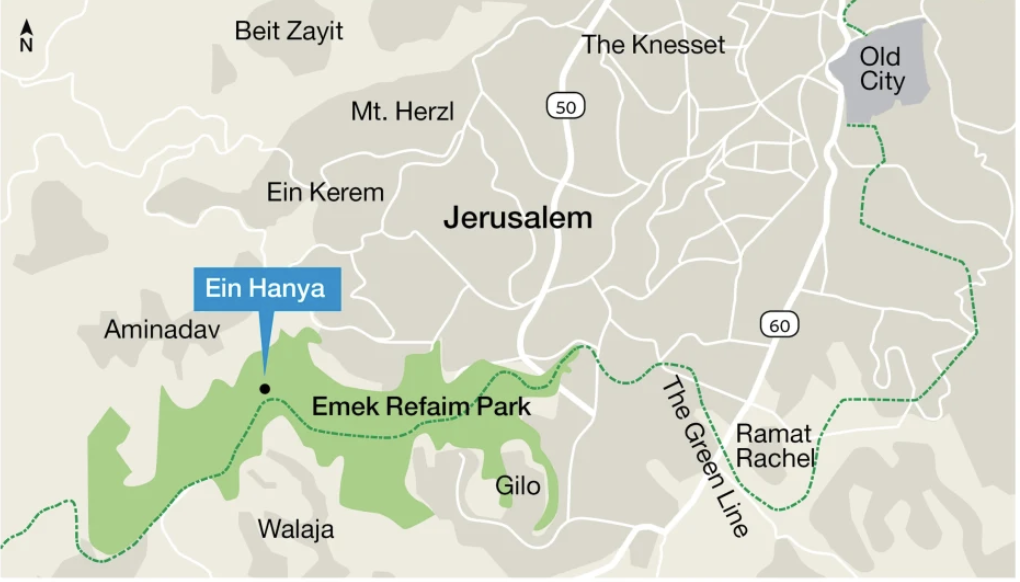
Map by Haaretz
After several delays, on October 15th the Israeli police permitted the Ein Al-Hanya spring to be opened for Israeli visitors on the condition that Palestinians would not be allowed to enter the site. On the first day open, hundreds of Israelis visited the site under the heavy security presence of the Israeli Border Police.
The Ein Al-Hanya spring, which the Jerusalem Municipality first declared a national park and then spent years renovating and millions of dollars into a tourist destination, is located on land historically a part of al-Walajah. Al-Walajah is a Palestinian village that currently finds itself inside of Israel expanded municipal borders of Jerusalem and almost completely surrounded by the Isareli seperation barrier.
Aviv Tatarsky, a researcher for Ir Amim explained Israel’s choice to declare the area a national park:
“Since we are in the territory of Jerusalem, and building another settler neighborhood could cause a stir, they are building a national park, which will serve the same purpose. The national park will Judaize the area once and for all. Gilo is five minutes away. If you live there, you will have a park right next door and feel like it’s yours.”
Haaretz columnists Gideon Levy and Alexx Levac also give a succinct context to Israel’s ongoing theft of Al-Walaja land:
“the story of Walaja, where this absurdity took place, contains everything – except humor: the flight from and evacuation of the village in 1948; refugee-hood and the establishment of a new village adjacent to the original one; the bisection of the village between annexed Jerusalem and the occupied territories in 1967; the authorities’ refusal to issue blue Israeli IDs to residents, even though their homes are in Jerusalem; the demolition of many structures built without a permit in a locale that has no master construction plan; the appropriation of much of its land to build the Gilo neighborhood and the Har Gilo settlement; the construction of the separation barrier that turned the village into an enclave enclosed on all sides; the decision to turn villagers’ remaining lands into a national park for the benefit of Gilo’s residents and others in the area”
Since taking the land under the guise of establishing a national park, Israel has implemented several policies aimed at preventing Palestinians from accessing the spring and surrounding lands, including illegally moving a police checkpoint to further choke off al-Walajah from Jerusalem. As detailed in Haaretz, the plan for the park includes three pools filled by the spring – two for Israelis and tourists, and one for al-Walajah residents to water their crops and flocks. However, that third pool for Palestinians has not been built, and the water “merely spills into the nearby wadi.” The other pools, like the park, are currently empty and fenced off.
FMEP has repeatedly documented various Israeli efforts to seal off al-Walajah from Jerusalem. Residents of al-Walajah have fought the growing encroachment by the nearby Etzion settlement bloc and the Israeli government’s attempt to de facto annex the bloc as part of “Greater Jerusalem.” Ir Amim explains several prongs of this effort, including a particularly unbelievable section of Israel’s separation barrier planned to almost completely encircle the village, to turn its valuable agricultural land into an urban park for Jerusalem, and construction of a highway that will connect the Etzion settlement bloc to Jerusalem with Israeli-only bypass roads.
Friedman Reiterates Promise that U.S. Plan Will Not Require Settlement Evacuations
In an interview on October 16th, U.S. Ambassador David Friedman told Arutz Sheva (a pro-settlement media outlet headquartered in the Ariel settlement) that the U.S. peace plan will not require a single settler to leave his/her home. Friedman said:
“Having seen the experience of the evacuation of Gaza [in the summer of 2005], I don’t believe that there is a realistic plan that can be implemented that would require anyone — Jew or Arab — to be forced to leave their home. We think that’s just a recipe for disaster. It almost caused a civil war on much less aggressive circumstances in Gaza, compared to Judea and Samaria [the West Bank]. And so we are not of the view that any forced evacuations are achievable.”
Friedman’s remarks only reiterate what the Trump policy – as it has been implemented on the ground from day 1 of the administration – has looked like: a full-throated endorsement of the Greater Israel ambitions of ideological settlers.
Bonus Reads
- “There Will Be a One-State Solution” (Foreign Affairs)
Welcome to FMEP’s Weekly Settlement Report, covering everything you need to know about Israeli settlement activity this week.
To subscribe to this report, please click here.
June 14, 2019
- Court Rules in Favor of Israeli Settler Group, Against Greek Orthodox Church, un Battle Over 3 Claiming Old City Properties
- Israel Gave German Construction Giant More Palestinian Land for Quarrying
- Settlers Retaliate Against Palestinians for Israel’s (Rare) Demolition of Outpost Buildings
- IDF Cuts Budget for Civilian Security Guards in Settlements
- New International Crisis Group Report on Israel’s Ongoing Annexation of East Jerusalem
- Shadowy Group Wants to Go After All Companies Not Currently Operating in the Settlements – Starting with McDonald’s
- European Court of Justice Issues Opinion Upholding EU Differentiation Policy
- Anger [& Joy] at U.S. Ambassador Reiterating Support for Israeli Annexation of West Bank Land
- Bonus Reads
Questions or comments? Contact Kristin McCarthy at kmccarthy@fmep.org.
Court Rules in Favor of Israeli Settler Group, Against Greek Orthodox Church, un Battle Over 3 Claiming Old City Properties
Ending a nearly 16-year legal battle, on June 11th the Israeli Supreme Court ruled that the settler group Ateret Cohanim has legal rights to three prized properties in strategic locations in the Old City of Jerusalem, including two famous hotels currently operated by Palestinians. Until now, the properties were owned by the Greek Orthodox Church, which had been fighting to invalidate the transactions at the root of the settlers’ claim to them.
As a reminder, Ateret Cohanim is a radical settler organization working to increase the presence of Israeli Jews living inside Palestinian neighborhoods of Jerusalem – including in the Old City. Ateret Cohanim, along with its compatriots in the Elad settler group, is also leading efforts to take over land and evict Palestinians from their homes in the Silwan neighborhood.
The properties awarded to Ateret Cohanim by the Israeli High Court are:
-
The Petra Hotel, a four-story building near the Jaffa Gate, one of the key entrances to the Old City. Under the ruling, Ateret Cohanim has a valid 99-year lease with an option for an additional 99 years afterwards. The price Ateret Cohanim paid in the transaction the Church said was improper? A meager $500,000, far below market value.
-
The Imperial Hotel, located directly across the street from the Petra Hotel – meaning that a radical Israeli settler group now controls a substantial amount of land at a key entrance to the Old City (the Jaffa Gate). The Imperial Hotel is a two-story building. Ateret Cohanim’s lease for the Imperial Hotel is also for 99-years with an option for 99 more. The price paid in, again, a transaction the Church argued was improper and invalid? $1.25 million – far higher than the price paid for the Petra Hotel but still well below the fair market value of the property.
-
Beit Amziya, a building in the Bab a-Kuta neighborhood of the Muslim Quarter of the Old City. Ateret Cohanim paid $55,000 for this property, again, far below fair market value.
The legal battle over the properties dates back to 2004, when the Greek Orthodox Patriarchate agreed to sell the three properties to a foreign real estate company under three separate contracts. It did so not knowing that the radical settler group Ateret Cohanim was behind the transaction. News of the sales made headlines in early 2005.
Upon the revelation that Ateret Cohanim was the real buyer, the Greek Orthodox Patriarchate was deeply embarrassed and immediately sought to retain control of the properties. The Patriarchate alleged that the transactions involved corruption and bribery, arguing that the legal documents had been signed without permission by a finance employee. Dismissing the church’s arguments, this week the Supreme Court upheld prior rulings that the signatures on the lease documents were valid, with the finance employee acting as a legal proxy of the Patriarchate.
The Greek Orthodox Church has received significant blowback from the sale of these properties. In January 2018, Palestinians protested in Bethlehem in an attempt to block the arrival of Patriarch Theophilos III for Christmas celebrations.
In response to the Supreme Court’s ruling, multi-denominational Christian leaders in Jerusalem issued a rare joint statement criticizing the Court’s action. The statement says:
“The actions of this radical group do not only mean an assault on the property rights of the Greek Orthodox Church, but an assault on the status quo protections for all Christians in this holy city of Jerusalem and deeply threatens the Christian presence in our beloved Holy Land. An attempt to undermine the presence of one church here undermines all the churches and the wider Christian community around the world. We reaffirm our belief that a vibrant Christian community is an essential element in the preservation of Jerusalem’s historically diverse society and a prerequisite for peace in this city; Jerusalem must maintain its multicultural and multi-religious mosaic character, being home to the three monotheistic religions.”
Israel Gave German Construction Giant More Palestinian Land for Quarrying
Kerem Navot has produced government documents showing that in February 2019 the Israeli Civil Administration – the arm of the IDF that is effectively the sovereign ruler over the West Bank – signed over rights to 25 acres of Palestinian land to the German construction company HeidelbergCement. The purpose? To expand the Nahal Raba quarry, located on 145 acres of Palestinian land near the Elkana settlement in the West Bank.
HeidelbergCement is the world’s largest cement producer and has a global footprint. In a comprehensive brief, the Israeli organization Who Profits details the situation of the Nahal Raba quarry and the larger context of Israel’s illegal exploitation of natural resources in the West Bank:
“The Nahal Raba quarry is a 600 Dunam aggregate quarry, owned and operated by Hanson Israel [which HeidelbergCement owns]. The quarry is located in Area C of the West Bank and is licensed by the Israeli Civil Administration. The adjacent Palestinian village of Alzawiyah owns the Palestinian land on which the quarry is situated. This land was taken by Israel’s Civil Administration after declaring it to be state land, despite the fact that it was privately owned by the Palestinian villagers in the adjacent town of Al-Zawiyah. As mentioned by Human Rights Watch in its recent report, Occupation Inc., in 2004 Israel built the separation wall in the area to encompass the quarry from the east, unlawfully diverting the route of the wall into occupied territory beyond the pre-1967 armistice line. Today, the quarry is enclaved into Israeli territory, while the separation wall separates the village of Zawiyah and its rightful owners from their land and quarry. Article 55 of the Hague Regulations (1907) establishes that ‘the occupying State shall be regarded only as administrator and usufructuary’ of the natural resources of the occupied territory, and therefore it is prohibited from exploiting them for commercial purposes. Moreover, Article 43 of the Hague Regulations has been interpreted as obliging the occupying State to exercise its powers for the benefit of the residents of the occupied area.”
In 2009, the Israeli NGO Yesh Din submitted a High Court petition demanding that Israel end all mining and quarrying activities in the West Bank, observing that the activity constitutes a brutal economic exploitation of occupied territory for Israel’s exclusive economic interests. In December 2011, the High Court rejected the petition, giving permission for the continuation and expansion of Israel-regulated quarrying in the West Bank. Yesh Din’s 2017 report, “The Great Drain: Israeli Quarries in the West Bank,” provides a comprehensive accounting of the damage imposed on Palestinians by quarrying activities.
Settlers Retaliate Against Palestinians for Israel’s (Rare) Demolition of Outpost Buildings
Palestinians in the Einabus village woke up on June 13th to find the words “Price tag [for the] Yitzhar evacuation” spray painted on the town mosque and adjacent buildings, and several car tires were slashed. The tagged phrase suggest the settlers have taken revenge on the Palestinian village in respose to these demolition of illegally built settlement structures near the radical Yitzhar settlement by Israeli security foces last week.
Following documentation of the damage by Yesh Din, the IDF announced it had opened an investigation into the incident.
This price tag attack is just the latest in a string of violent attacks by settlers on Palestinian villages in the Nablus region. Over the past few weeks, settlers have set several fields on fire and were caught on video hurling stones at Palestinian school, homes, and cars.
IDF Cuts Budget for Civilian Security Guards in Settlements
Ynet reports that the IDF Central Command has informed settlements that budgetary constraints are forcing it to reduce the number of civilian guards working in several settlements across the West Bank. The reductions will see eight security outposts eliminated completely, including posts in the Kiryat Arba settlement in Hebron. A security officer from Kiryat Arba said in response: “This is abandonment of human life, and the Defense Ministry must come to its senses as soon as possible,”
The IDF said that:
“It’s clear to everyone the reduction in the number of guards in not ideal, but – all things considered – it’s necessary.”
New International Crisis Group Report on Israel’s Ongoing Annexation of East Jerusalem
In a new report, the Crisis Group provides a comprehensive overview of Israeli settlement and annexation policies affecting East Jerusalem, starting with Israeli actions in the immediate aftermath of 1967 through to present day. The report, entitled “Reversing Israeli’s Deepening Annexation of Occupation,” calls on the international community to stop Israel’s creeping annexation of East Jerusalem and reverse decades of intentional neglect designed to push Palestinians out of East Jerusalem and adjacent areas.
Shadowy Group Wants to Go After All Companies Not Currently Operating in the Settlements – Starting with McDonald’s
Following up on FMEP reporting last week, Haaretz has new details on the organization behind a new drive to ban McDonald’s from participating in the Israeli government’s tender process — because McDonald’s doesn’t operate in any Israeli settlements.
The group, named “Forum of Disabled IDF Veterans for Israel’s Security,” is not registered in Israel as a charitable organization. It thus has the luxury of operating in near total secrecy – not required to disclose who is behind the effort or funding it.
In a statement, the group made its ambitions clear:
“We want every company that isn’t interested in opening branches over the Green Line to be prevented from competing on these tenders. We’ll reach everyone.”
Sources told Haaretz that the group is made up of only a handful of activists, all of whom are disabled veterans of the IDF, and works primarily in cooperation with larger pro-settlement, pro-annexation groups like Im Tirtzu and Ad Kan. The group has hired Rosenbaum Communications to steer the campaign against McDonald’s, though the funding source for the project is unknown.
European Court of Justice Issues Opinion Upholding EU Differentiation Policy
On June 13th, an advocate general for the European Court of Justice (the top court for the EU) issued a legal opinion holding that products made in the Israeli settlements must be clearly labeled as such. The ruling upholds the enforcement of European Union’s legal obligations with regard to the settlements (a policy known as differentiation). The labelling requirements, as required by EU law, necessarily distinguish between sovereign Israeli territory and Isareli settlements built illegally in the occupied territories.
The new legal opinion, which is not binding but nonetheless sets the tone for rulings to come, was issued in response to a petition filed by Psagot Winery, located in the Psagot settlement, which argues that French labelling laws discriminate against its products by requiring them to specify the origin of their wine. Rejecting that argument the advocate general stressed that EU law requires labelling products based on their true origin in order to give customers the necessary information to make informed purchasing decisions.
Psagot Winery is part of a broad global effort to blur the legal context around Israeli settlements, pushing nations to treat Israeli settlements as indistinguishable from sovereign Isareli territory.
Anger [& Joy] at U.S. Ambassador Reiterating Support for Israeli Annexation of West Bank Land
Coming quickly on the heels of Jared Kushner’s disastrous interview with Axios, Ambassador David Friedman attracted even more outrage over his recent interview with the New York Times in which Friedman reiterated his support for Israeli annexation of land in the West Bank (a position he has held, clearly, since long before becoming ambassador). The interview sparked a barrage of media coverage, worldwide concern about the possibility of unilateral Israeli annexation of its settlements, glee among pro-annexationist lawmakers in Israel, and indignant rationalizing by American Greater Israel apologists like Alan Dershowitz.
Notably, Israeli Prime Minister Netanyahu – who in the waning days of his April election promised to extend Israeli sovereignty over the settlements – has not commented on Friedman’s statement. Haaretz columnist Anshel Pfeffer observed:
“The easiest way for Netanyahu to counter the settlers’ demands while keeping them in his coalition was to complain about pressure from the Americans. That was his answer every time he was asked why Israel wasn’t building more settlements or evicting more Palestinians. Friedman has taken away Netanyahu’s excuse. It is certainly no coincidence that Netanyahu — usually so quick to praise the slightest gesture coming from the Trump administration — has yet to say a word publicly about the interview. Friedman has done Netanyahu no favors. In less than 100 days — assuming the right wing/religious bloc wins another majority in 2019’s second election, which is almost a certainty — Netanyahu will be more vulnerable than ever.”
Bonus Reads
-
“A high-tech facelift takes the sting out of an Israeli checkpoint — but not out of the occupation” (Washington Post)
-
“The Fate of the Palestinians” (LobeLog)
-
“WATCH: What occupation looks like in the Jordan Valley” (+972 Mag)
Welcome to FMEP’s Weekly Settlement Report, covering everything you need to know about Israeli settlement activity this week.
To subscribe to this report, please click here.
May 31, 2019
- Israel Publishes Tenders for 805 Settlement Units in East Jerusalem; More May Be Coming
- The World Zionist Organization Continues to Finance Illegal Settlement Construction
- Yitzhar Settlers Attack Israeli Police Officers, Again
- Israel Cut-Off & Trapped a Palestinian Family on the Israeli Side of the Wall, Then Banned Them from Entering Israel
- Palestinians React to Latest Annexation Rumors Amidst Israeli Government Chaos
- Florida Governor Leads Headline-Grabbing Trade Delegation to West Bank Settlements
- Scheindlin: Israel’s Democratic Decay is Happening for the Sake of Annexation
- Bonus Reads
For questions and/or comments contact Kristin McCarthy – kmccarthy@fmep.org.
Israel Publishes Tenders for 805 Settlement Units in East Jerusalem; More May Be Coming
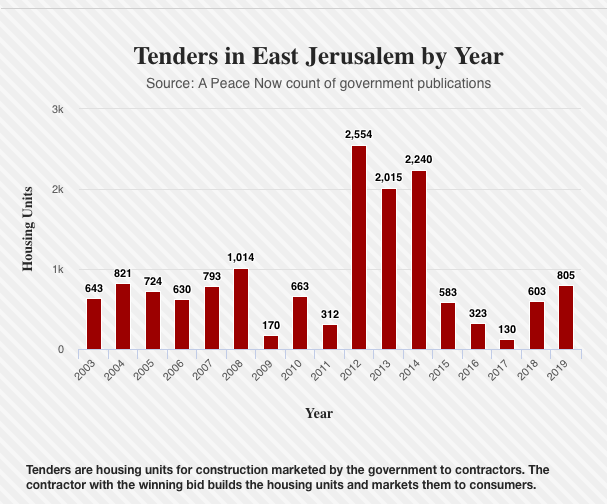 On May 30th, the Israel Land Authority published tenders for a total of 805 new settlement units in East Jerusalem, a decisive step towards the start of construction. The 805 tenders were issued for 345 units in the Ramot settlement and 460 new units in the Pisgat Ze’ev settlement. These are the first tenders published for East Jerusalem settlement construction since April 2018, and collectively are the most tenders published in a single year (let alone simultaneously) since 2014. Moreover, as Jerusalem expert Daniel Seidemann explains, this batch of tenders allows for more construction in East Jerusalem settlements than the government has approved for East Jerusalem Palestinian neighborhoods since Israel gained control of East Jerusalem in 1967.
Furthermore, the Jerusalem settlement watchdog group Ir Amim warns that this batch of tenders may only be the first of an oncoming wave:
“For several years after the collapse of the Kerry initiative in April 2014, there was a significant decrease in the approval of master plans in East Jerusalem and as a result, few tenders were announced. This dramatically changed in 2017 and 2018 with the advancement of master plans reaching near record levels. Today’s tenders are primarily a result of plan approvals from last year, potentially signaling impending large-scale announcements of tenders based on additional plans which have been approved over the last year.”
Peace Now, the veteran settlement monitoring organization, said in a statement:
“Continued construction in East Jerusalem does not contribute to Jerusalem and does not contribute to Israel. As long as we have not reached a permanent agreement with the Palestinians on Israel’s borders, building beyond the Green Line is illegitimate and only harms the prospects for peace and trust between the sides.”
The World Zionist Organization Continues to Finance Illegal Settlement Construction
According to documents acquired by Israel’s Movement for Freedom of Information, over the past two years the Settlement Division of the World Zionist Organization continued to finance illegal settlement construction while simultaneously trying to hide this information from the public.
As a reminder, the Settlement Division is technically part of the World Zionist Organization, but in practice the unit was created by the Israeli government in 1968 and is funded entirely by the Israeli government (and Israeli taxpayers). Its mandate is to manage West Bank land expropriated by Israel, in order to facilitate the settlement of Israeli Jews in the occupied territories. To make this possible, the Israeli government has allocated approximately 60% of all “state land” in the West Bank to the WZO’s Settlement Division [over the past 50 years Israel has declared huge areas of the West Bank to be “state land,” including more than 40% of Area C, where most of the settlements are located]. Together, the WZO and the Israeli government work in coordination to develop West Bank settlements and encourage Jews to move into them, working together so closely that the Settlement Division even splits its real estate profits with the Israeli Housing and Construction Ministry.
According to the WZO’s financial documents for 2017-2018, the WZO subsided settlement projects that are illegal under Israeli law — to the tune of $734,577 USD (NIS 2,668,427).
In addition, the WZO failed to specify how it spent an additional USD $16 million (NIS 58 million) in support of new construction projects, leaving the exact location and legal status of the construction unknown. This represents 43% of the WZO’s overall budget for subsidizing projects.
The settlement projects known to have been subsidized by the WZO in 2017-2018 include:
-
- $640,000 USD (NIS 2,330,973) for the establishment of a community center in the Eli settlement. Though the Eli settlement previously received Israeli government approval, a “Master Plan” – which officially zones land for distinct purposes (residential, commercial, public) – has never been issued for Eli, meaning all construction there is illegal under Israeli law.
- $85,816 USD (NIS 311,736) on projects in the unauthorized Brosh outpost (the Israeli government is advancing a plan that would legalize Brosh retroactively, but until it does, all projects in it are illegal).
- $42,000 USD (NIS 153,127) for infrastructure development in the unauthorized Givat Eitam/E-2 outpost, which according to Peace Now appears had not been transferred as of the end of 2018. FMEP has covered the settlers efforts to establish the Givat Eitam/E-2 outpost and the government’s plan to retroactively authorize it as an official settlement in detail. It is worth recalling that the location of the Givat Eitam/E-2 has dire geopolitical consequences for the fate of the two state solution as well as the development of Palestinian communities just south of Bethlehem.
- $6,000 USD (NIS 22,445) for projects in the unauthorized Mitzpe Kramim outpost. Funding for Mitzpe Kramim over the past two years is particularly galling, given ongoing litigation that has included evidence that the Settlement Division knowingly gave land privately owned by Palestinians to settlers in order to build the outpost.
- $900 USD (NIS 3,273) for renovation of illegal structures in the unauthorized outpost of Haresha. The Israeli government has successfully used the Haresha outpost as a test case for new legal tools the government of Israel developed in order to justify the expropriation of privately owned Palestinian land in order to retroactively legalize outposts. Using these tools, the government has found a way to “legally” build an access road to the settlement through privately owned Palestinian land; once the road is built, there is nothing preventing the government from retroactively legalizing Haresha.
Peace Now said in a statement:
“The Settlement Division is a body that was born in sin immediately after 1967 in order to carry out the dubious works of building settlements for the government. It turns out that even today, after regulating the activities of the Settlement Division, it still operates without transparency and continues to finance illegal activity. The time has come to dismantle the Settlement Division and to restore to the government the governmental activities it has privatized.”
Despite the WZO’s ongoing defiance of Israeli planning and building laws — or perhaps in light of its direct and very effective role in entrenching and expanding the settlements — the Israeli government is actively seeking to transfer more West Bank land to the WZO for management. In the last Knesset session, a government-backed bill to expedite the transfer of more land to the WZO was stalled by the Israeli Attorney General only because the bill, in the view of the Attorney General, was duplicative of his own efforts to enrich the Settlement Division at the administrative level.
Yitzhar Settlers Attack Israeli Police Officers, Again
On May 26th, dozens of masked Israeli settlers violently attacked Israeli police officers who approached an illegal outpost near the settlement of Yitzhar, forcing the Israeli army to intervene in order to get the police officers to safety.
Not a single settler was arrested for the attack.
The event started when Israeli police arrived at the Kippah Sruga outpost in response to calls saying that clashes had broken out between Palestinians and Israelis in the area. According to Israeli police, when they arrived masked settlers began launching stones at them and slashed their car tires with a knife.
Haaretz reporting on this incident reminds readers:
“Over the past several weeks, settlers from Yizhar and surrounding settlements have been involved in several altercations, yet police have not arrested a single suspect. Last week, Israelis and Palestinians reported a field set ablaze and clashes in the Palestinian towns of Burin, Urief and Asira al-Qibliya. In a video disseminated by Asira al-Qibliya’s council, settlers are seen throwing stones at Palestinians, while soldiers nearby do nothing to arrest them. In response to the video, the IDF spokesman said that ‘Palestinians started a fire near Asira al-Qibliya. The IDF, the Border Police and civilian volunteers worked to extinguish the fire, which was spreading towards a military position and the edge of Yitzhar.’ After a B’Tselem video surfaced, showing settlers setting fire to fields, the army revised its response and confirmed that Jewish settlers also took part in setting fires.”
Israel Cut-Off & Trapped a Palestinian Family on the Israeli Side of the Wall, Then Banned Them from Entering Israel
On May 27th, Haaretz published a gut wrenching profile of the Hajajla family who lives on the Israeli side of the separation wall that cut them off from their hometown of al-Walajah, a Palestinian village just south of Jerusalem. Two days after publication of the profile – which FMEP shares in brief below – Israel issued an order banning the patriarch of the family, Omar Hajajala, from entering Israel, though he lives on the Israeli side of the wall in a spot where the route of the wall juts into the West Bank.
Before jumping into the full story, here is a reminder about the situation facing all of the residents of al-Walajah, in the words of Danny Seidemann:
“Walajeh is a village on Jerusalem’s southern flank that is entirely surrounded by the separation barrier. Since 1967, Walajeh’s inhabitants have lived in a Kafka-esque situation, with their village technically located inside Israel’s expanded borders, but with villagers never given Israeli residency (they are considered West Bankers and thus are not permitted inside Jerusalem). As a result, the villagers’ presence in their own village is, under Israeli law, illegal, and their homes there are, by definition, illegal.”
The Hajajla family was the only home in al-Walajah disconnected from the village when the separation barrier was built, leaving the family home on the Israeli side of the wall since 2014. The family refused to abandon their home despite the coercive and legal efforts by Israel to force them to do so. In 2014, after a petition before the High Court of Justice, the Defense Ministry opted to build the family a special passage underneath the barrier so it could reach the village, at a cost $1.1 million USD (NIS 4 million).
After the tunnel was constructed, the Israeli government began to impose new, burdensome, and compounding restrictions on the family regarding its use of the passageway. In 2017, the government decided to install a locked gate at one end of the passageway to control who enters and exits, which could be opened only by a single remote control given to the family. That single remote meant that whenever one member of the family left the home (impossible without taking the remote control with them), the rest of the family was left trapped, literally, until the remote-holder returned.
To make the situation more workable, Omar Hajajla, the family’s patriarch rigged an electric bell near the gate so that the single remote control can stay at the house while family members leave and return (the bell enables someone in the home to know that someone is at the gate needing to be let in). The bell has been in place for over a year, but only recently the Israeli Border police opted to make it an issue. This month, the police took Omar in for questioning and changed the lock so that the family could not open the gate at all. Omar Hajajla was ultimately fined and released, but the lock on the gate remained — until Haaretz filed an inquiry on May 26, 2019.
Omar Hajajla speculates that a recent court ruling in his family’s favor prompted the Israeli Border police to escalate their harassment of the family and make an issue of the bell. About a month ago, the Jerusalem Magistrate’s Court rejected the state’s assertion that the family’s home is illegal – allowing the Hajajla family to stay put.(Note: The state of Israel has initiated demolition proceedings against dozens of homes in al-Walajah claiming that they were built without Israeli building permits – which are next to impossible for Palestinians to obtain, let alone Palestinians on coveted land like al-Walajah) –
In response to the May 27th Haaretz profile, Israeli police stated:
“At issue is a security passage that provides a short passage for the family from their home in Israeli territory to the Palestinian Authority areas. As you can see from the attached video and photos, the gate was shut last Monday to repair security cameras that were broken, to repair damage to the gate and to remove an electric bell that the father of the family had installed against the law, by attaching an unapproved electric wire from his home, a distance of dozens of meters from the passage. After the repair the passage was opened on Wednesday but when the father was seen exploiting it to illegally allow Palestinians to enter it was shut again and the suspect was taken for questioning. The passage was opened again yesterday, but because of a technical problem that was discovered it was shut again and we are working to fix it quickly. The Israel Police will not allow any damage to the security passages it is responsible for and will bring to justice anyone who vandalizes them and tries to harm the State of Israel’s security.”
The treatment of the Hajajla family should be seen in context of Israeli efforts to seal off al-Walajah from Jerusalem. As FMEP has previously reported, residents of al-Walajah have long been struggling against the growing encroachment the nearby Etzion settlement bloc and the Israeli government’s attempt to de facto annex the bloc as part of “Greater Jerusalem.” Ir Amim explains several prongs of this effort, including a particularly problematic section of the separation barrier around al-Walajah that has been planned in order to (a) almost completely encircle the village, (b) turn its valuable agricultural land into an urban park for Jerusalem, and (c) enable construction of a highway that will connect the Etzion settlement bloc to Jerusalem with Israeli-only bypass roads.
Palestinians React to Latest Annexation Rumors Amidst Israeli Government Chaos
Al-Monitor reports reactions from Palestinian leaders who are increasingly fearful that rumors about Israeli annexation of the settlements will be acted upon. Those rumors – as FMEP wrote last week – suggest that Israel will strip the Israel Civil Administration of its authority over the settlements and bring all settlements under Israeli domestic law, making settlement affairs the responsibility of the various Israeli ministries.
Wasel Abu Youssef, member of the PLO Executive Committee in the West Bank, told Al-Monitor:
“Expanding the powers of the Israeli ministries at the expense of the civil administration is an attempt to impose occupation and establish it in the West Bank, to end the [idea of a] two-state solution and prevent the establishment of a Palestinian state, which falls within the framework of denying the Palestinian people their rights to freedom and independence. These efforts mean practically annexing parts of the West Bank to Israel. Unfortunately, this comes with the blessing of the administration of US President Donald Trump, who doesn’t recognize the option of a two-state solution and gives Israel the green light to do whatever it wants in the West Bank.”
Walid Assaf, head of the Colonization and Wall Resistance Commission, told Al-Monitor:
“The efforts to transfer the powers of the civil administration to the Israeli ministries directly mean the annexation of the West Bank settlements to Israel. This will lead to annexing Area C — which amounts to over 60% of the entire area of the West Bank — to Israeli sovereignty…Annexing West Bank settlements to Israel would pave the way for Israel to perpetuate a policy of ethnic cleansing against the Palestinians, and this will push the Palestinians in Area C to migrate to PA-controlled Areas A and B.”
Hanna Issa, an international law professor at Al-Quds University in Abu Dis, told Al-Monitor:
“The Israeli occupation has always been there. It is essential that the Palestinian territories [including the Israeli settlements] remain administered through the civil administration of the Israeli army [in cooperation with the Palestinians] until this occupation ends…“Limiting the powers of this administration and giving its responsibilities to the Israeli ministries is a dangerous step aimed at annexing occupied areas under international law.”
Scheindlin: Israel’s Democratic Decay is Happening for the Sake of Annexation
In a new paper for The Century Foundation, Israeli pollster and political analyst Dahlia Scheindlin writes an important analysis regarding Israel’s path to annexation:
“This report argues that Israel’s slide into illiberal democracy can only be understood as part of an attempt to go beyond military or physical control and establish a political and legal foundation for permanent annexation of both land and people. The assault on Israel’s democratic norms over the past decade initially appeared only indirectly related to a future of permanent annexation, as they suppressed the mechanisms of dissent and undermined the basis for minority rights. Then, in the recent elections, Prime Minister Benjamin Netanyahu made explicit his goal to annex occupied territory in the West Bank, which represented the culmination (to date) of increasingly open policies and legislative initiatives from the previous term that explicitly advance annexation.”
The entire paper is worth reading, and is available online here.
Florida Governor Leads Headline-Grabbing Trade Delegation to West Bank Settlements
From May 25-31, Florida Governor Ron DeSantis led a trade mission – purposefully and prominently also visiting settlements in the West Bank. While on the ground, DeSantis made headlines by blasting BDS, endorsing Israeli settlements, and gloating about Florida’s role in AirBnB’s reversal of its decision to remove rental listing located in Israeli settlements.
DeSantis signed several formal partnerships between Florida universities and Israeli schools, most notably including an agreement between Florida Atlantic University and Ariel University – the first such deal between a U.S. school and an Israeli school located in a settlement. In recognition of the historic deal, Ariel University presented DeSantis with an Honorary Fellowship Award at an event in the settlement, attended by U.S. casino magnates and settlement financiers Sheldon Adelson and Dr. Miriam Adelson. In his acceptance speech, the Governor invoked the Bible to lend his support for Israel’s permanent control of the West Bank, saying:
“We are now in the heart of the Holy Land of Israel. When you think about Israel’s history and the tradition that connects Israel and the U.S., it’s inspiring. On my last visit to Israel in 2014, the U.S. embassy was in Tel Aviv and we were on the verge of signing a destructive agreement with Iran, and I am happy that today we have achieved real progress. We have an American embassy in Jerusalem with an American acceptance of the sovereignty of the State of Israel on the Golan Heights and the agreement with Iran has been removed from the stage of history. I, personally, have fought Airbnb’s discriminatory policy against Jewish-owned properties in Judea and Samaria, and only recently have they changed their discriminatory policy. I say here: BDS has no place in Florida. The memorandum of understanding signed today between the University of Ariel and Florida State University is a blessed agreement that will bring these two institutions forward. I am happy to say that Florida is a very diverse state, but not when it comes to its unequivocal support for the State of Israel.”
U.S. Ambassador to Israel David Friedman also hosted DeSantis for a reception and Israel’s Minister of Public Security Gilad Erdan joined DeSantis on a visit to additional West Bank settlements, this time in Gush Etzion, for a briefing about the fight against BDS. Friedman said:
“Israel has no greater friend in all the 50 governor mansions than Ron DeSantis. I welcome you and the Cabinet members and your delegation to this small but incredibly important country.”
As mentioned by Ambassador Friedman, DeSantis was joined by members of the Florida Cabinet on the trade mission, including Florida Attorney General Ashley Moody and Florida Agricultural Commissioner Nikki Fried. In a controversial move, DeSantis convened a Florida cabinet meeting on May 29th at the Embassy in Jerusalem, despite a lawsuit filed in Florida seeking to stop him from doing so. The lawsuit was filed by a government watchdog group and several news outlets, arguing that convening the Cabinet in Israel violated a state law that requires government meetings to be accessible to the public. The lawsuit was dismissed because the court could not serve paperwork to DeSantis and the other named defendants – who were, obviously, in Israel.
At the Cabinet meeting on may 29th, DeSantis signed a bill to prohibit anti-Semitism in Florida’s public schools and universities. The new law wrongly conflates anti-Semitism with criticism of Israel by including in the definition of anti-Semitism, “drawing comparisons of contemporary Israeli policy to that of the Nazis,” ″blaming Israel for all interreligious or political tensions,” and/or “requiring behavior of Israel that is not expected or demanded of any other democratic nation.”
The next day, DeSantis met with Prime Minister Netanyahu while the larger delegation visited the City of David national park, which is run by the radical Elad settler group.
Bonus Reads
- “Israel’s High Court Seeks Order, Not Justice” (Haaretz)
- “Another Company Withdraws from Israeli Light Rail Project” (IMEMC)