Welcome to FMEP’s Weekly Settlement Report, covering everything you need to know about Israeli settlement activity this week.
To subscribe to this report, please click here.
January 31, 2020
1. Trump Lays Out Vision for Sweeping Israeli Annexation
> Annexation of Settlements & Land
> In A Single Line, U.S. Vision Obliterates Palestine Property Rights
> U.S. Vision Endorses Population Transfer
> The Vision Supports Settlement Endeavors in Silwan
> U.S. Calls for a 4-Year “Pause” of *SOME* Israeli Settlement Expansion
> The Terms of Palestinian Surrender of Jerusalem
2. Netanyahu Promises, Then Delays, Rapid Approval of Bill to Annex All Settlements & the Jordan Valley
3. U.S. & Israel to Form Technical Teams to Plan Israeli Annexation
4. Invited to Washington, Prominent Settler Welcome Plan But Utterly Reject Vision for (a Non-Sovereign, Non-Autonomous) Future State of Palestine
5. In Two Rulings, the Jerusalem Magistrate’s Court Sets Precedent for Massive Displacement of Palestinians in Silwan
6. Israel Issues Eviction Orders to 30 Palestinian Families Living in the Old City of Jerusalem
7. Bonus Reads
Comments/questions? Contact Kristin McCarthy (kmccarthy@fmep.org).
Trump Lays Out Vision for Sweeping Israeli Annexation
On January 28th, after three years of deliberations with its Israeli partners, the Trump Administration released its so-called “Deal of the Century” (hereafter called the “Vision”), along with a “conceptual map.” The Vision and map delineates Israeli sovereignty over all of West Bank settlements/outposts and all of the Jordan Valley, while stiplulating conditions for a non-autonoumous/non-sovereign Palestinian state in the remaining disconnected enclaves of land (for which the only appropriate word is “bantustan”). Under the plan, no Israeli settlers or Palestinians are slated to be moved, meaning that the Vision is a proposal to make the current reality of occupation permanent – in effect, formalizing an apartheid reality but calling it a two-state solution.
This report will only address the points of the Vision that are directly relevant for settlement and annexation watchers, and which directly relate to FMEP’s ongoing coverage of Israeli annexation policies. The Vision in its entirety is available here.
Annexation of Settlements & Land
The Vision provides for Israeli sovereignty over all West Bank settlements. Most of the settlements/settlers are in large areas of the West Bank that the U.S. will recognize as part of Israel – in effect whittling away large swathes of West Bank land to the north, south, and West, as well as the entire Jordan Valley.
 In addition, the Vision’s conceptual map lists the names of 15 specific settlements – all of them located within the areas that are designated for a hypothetical Palestinian state – that will become “Israeli enclaves.” Notably, the map key includes an asterisk next to the words “Israeli enclaves” noting that the list is “not all-inclusive.” The map offers no further explanation, leaving the meaning unclear, perhaps by design. To those who understand the way settlements have been placed and expanded in the areas in question, the qualification suggests that unauthorized outposts in these areas will be consolidated into the listed “enclaves.” It also suggests a readiness to adapt the plan to accommodate any additional Israeli demand on this score.
Looking at the map, it is difficult to fully grasp the implications of what is being proposed – mainly because the Trump Administration omitted the 1967 lines (so it is not possible to compare what is being proposed to what the map looked like before). Likewise, the Trump Administration elected to place on the map disproportionately large markers for hypothetical roads/bridges/tunnels that will hypothetically turn the isolated islands of Palestinian territory into a coherent state. These markers serve both to obfuscate the fact that the Palestinian areas are completely disjointed, and to visually inflate the size of the proposed Palestinian areas. Israeli mapping expert and analyst Dan Rothem, after superimposing the 1967 borders and removing the markers, was able to analyze the underlying map. He estimates that the disjointed islands of territory left to the Palestinians by the Vision amount to just 70% of the West Bank.
With respect to the 15 (*number not all-inclusive*) settlements that will become enclaves within the Palestinian bantustans, these settlements are home to roughly 3% of the total Israeli settler population Of them (the following data taken from American for Peace Now’s “Facts on the Ground” mobile app):
-
- 8 are located in the southern half of the West Bank, mostly clustered around Hebron:
- Ma’ale Amos – located north east of Hebron, established in 1981 with approximately 421 settlers currently living there. There is one unauthorized outpost associated with Ma’ale Amos, Ibei Hanachal, which the Israeli government has advanced plans to retroactively legalize as a neighborhood of Ma’ale Amos.
- Asfar – located north east of Hebron, established in 1983, with approximately 729 settlers currently living there. There is one unauthorize outpost associated with Asfar (Pnei Kedem).
- Karmei Tzur – located north of Hebron, established in 1984, with approximately 1,037 settlers currently living there. There is one unauthorized outpost associated with Karmei Tzur (Tzur Shalem).
- Telem – located west of Hebron, established in 1982, with approximately 391 settlers currently living there.
- Adora – located west of Hebron (just south of the Telem settlement), established in 1984, with approximately 440 settlers currently living there.
- Negohot – located south west of Hebron, established in 1999, with approximately 332 settlers currently living there. Negohot has two unauthorized outposts associated with it.
- Beit Haggai – located immediately south of Hebron, established in 1984, with approximately 596 settlers currently living there.
- Otniel – located south of Hebron, established in 1983, with 1003 settlers currently living there. This is the settlement where Israeli MK Yehuda Glick lives.
- 2 are located in the northern West Bank:
- Hermesh – located west of Jenin, established in 1982 with approximately 215 settlers currently living there.
- Mevo Dotan – located west of Jenin, established in 1978, with approximately 393 settlers currently living there. The is one unauthorized outpost associated with Mevo Dotan (Maoz Zvi).
- 4 are clustered around Nablus in the central West Bank:
- Elon Moreh – located east of Nablus, established in 1979, with 1,912 settlers currently living there. This settlement is widely known for its relation to a landmark Israeli court ruling – the 1979 Elon Moreh ruling – in which the court said that Israel is explicitly prohibited from building settlements on land expropriated for military purposes.
- Itamar – located south east of Nablus, established in 1984 with 1,199 settlers currently living there. Itamar has 5 large unauthorized outposts associated with it, stretching the string of settlements towards the Jordan Valley. This cluster of settlers are known to be violent. Following the unveiling of the Vision, Netanyahu singled out Itamar in celebration, saying “Tel Aviv will be treated like Itamar.”
- Yitzhar – the most notoriously violent of Israel’s settlements, and the home base of the “Hilltop Youth” (dubbed “The Jewish ISIS”). Yitzhar is located south of Nablus, established in 1983, with 1,553 settlers currently living there. The Yitzhar settlement has at least 7 unauthorized outposts associated with it.
- Har Bracha (Berakha) – located south of Nablus (just north of Yitzhar settlement), established in 1983, with 2,4689 settlers currently living there. Har Bracha has 2 unauthorized outposts associated with it.
- 8 are located in the southern half of the West Bank, mostly clustered around Hebron:

Map by Dan Rothem (click to visit original)
According to the Vision, Israel will take whatever land it deems necessary to build and secure roads to those enclaves. Dan Rothem points out that, in order to keep the enclaves, Israel is creating a mess:
“Lengthy ‘fingers’ of Israeli annexation expand deep into the West Bank from all sides, practically dividing the Palestinian state to 6 large cantons (2 WB, 1 Gaza, 2 Negev). These ‘fingers’ create an impossibly-long border for Israel: about 1370 km! Tactically this is anti-security. Patrols will inevitably travel along inferior routes and subject themselves to many threats. All in the sake of retaining isolated, small settlements.”
It is worth observing – as Haaretz laid out – that the lack of territorial continuity the Vision offers the Palestinians will be further degraded by Israeli checkpoints associated with the “Israeli enclaves.” This means that Palestinians will conceivably by subjected to Israeli checkpoints not only along their “state’s” borders, but within the “state’s” own territory. The checkpoints issue is just one example of the further concessions that will be forced upon Palestinians, if the Vision is implemented.
In A Single Line, U.S. Vision Obliterates Palestine Property Rights
In a single – albeit tortured – sentence, the U.S. Vision essentially endorsed Israeli judicial sovereignty over any/all Palestinian property claims on land designated to Israel by the Vision. The Vision reads (page 13):
“The drawing of borders pursuant to the Conceptual Map shall be without prejudice to individual claims of title or rights of possession traditionally litigated within the Israeli judicial system.”
This line gives Israeli domestic courts sole and final authority to decide whether Palestinian landowners retain any legal claim to land stolen by settlements, or to land annexted by Israel in the implementation of the Trump Vision.
It’s also worth noting that the Vision does not mention Israel’s unauthorized outposts scattered across the West Bank, suggesting that the authors do not distinguish between official settlements (legal under Israeli law) and outposts (built in violation of Israeli law). Bolster this interpretation is the fact that, in addition to the language set forth in the Vision, Secretary of State Mike Pompeo’s settlement doctrine also supported the jurisdiction of Israeli courts to decide whether outposts are legal or illegal. It’s also worth remembering that Israel is currently undertaking a concerted procedural/legislative/bureaucratic effort to grant retroactive legalization to unauthorized outposts (most of which or built partially or fully on privately owned Palestinian land). FMEP tracks these efforts in its Annexation Policy Tables.
U.S. Vision Endorses Population Transfer
As set out on page 13, the Vision reads, “Land swaps provided by the State of Israel could include both populated and unpopulated areas.” The document goes on to endorse the possibility of transferring 300,000 Palestinian citizens of Israel (living in the Wadi Ara region, an area known as “the triangle,” near Haifa) to the future Palestine state. In effect this is a call for gerrymandering Israel’s borders for the purpose of expelling non-Jewish citizens – an open version of ethnic cleansing long championed by Defense Minister Avigdor Liberman and his allies, many of whom have been insisting that, at its base, the conflict between Israeli and Palestinians is a demographic battle, not a struggle over land. As Daniel Levy, a former Israeli peace negotiator and analyst, puts it: “The plan endorses the ethnocracy-over-democracy logic of Israel’s recently passed Nation State Law.”
The Jerusalem Post published many responses to this concept from the people who would be affected.
U.S. Calls for a 4-Year “Pause” of *SOME* Israeli Settlement Expansion
The U.S. Vision proposes a four-year period during which Israel and the Palestinians would negotiate the details of a final agreement, on the basis of the “Vision” and its accompanying map. For the duration of that period, the Vision calls for Israel to refrain from building new settlements in the parts of the West Bank designated for a possible future Palestinian state, as well as to hold off on expanding the footprint of “Israeli enclaves,” and demolishing existing Palestinian structures in those same areas — unless they pose a safety risk to Israel or the demolition is undertaken as a punitive response to Palestinian violence (a massive loophole that will allow Israel to continue, in effect, to demolish at will).
Netanyahu subsequently asserted that this temporary “pause” does not restrict any Israeli settlement construction because it only applies to areas where there are no settlements, and it allows for building in the Israeli enclaves as long as it does not expand the footprint of those enclaves (a massive, and familiar loophole that essentially greenlights construction). Settler leaders, including some living in the future “Israeli enclaves, also rejected any notion of a freeze.
The Terms of Palestinian Surrender of Jerusalem
The Vision places a laundry lists of conditions which Palestinians must meet in order to be granted “statehood” (notwithstanding the fact that the future Palestinian state outlined in the Vision has no resemblance to an actual state).
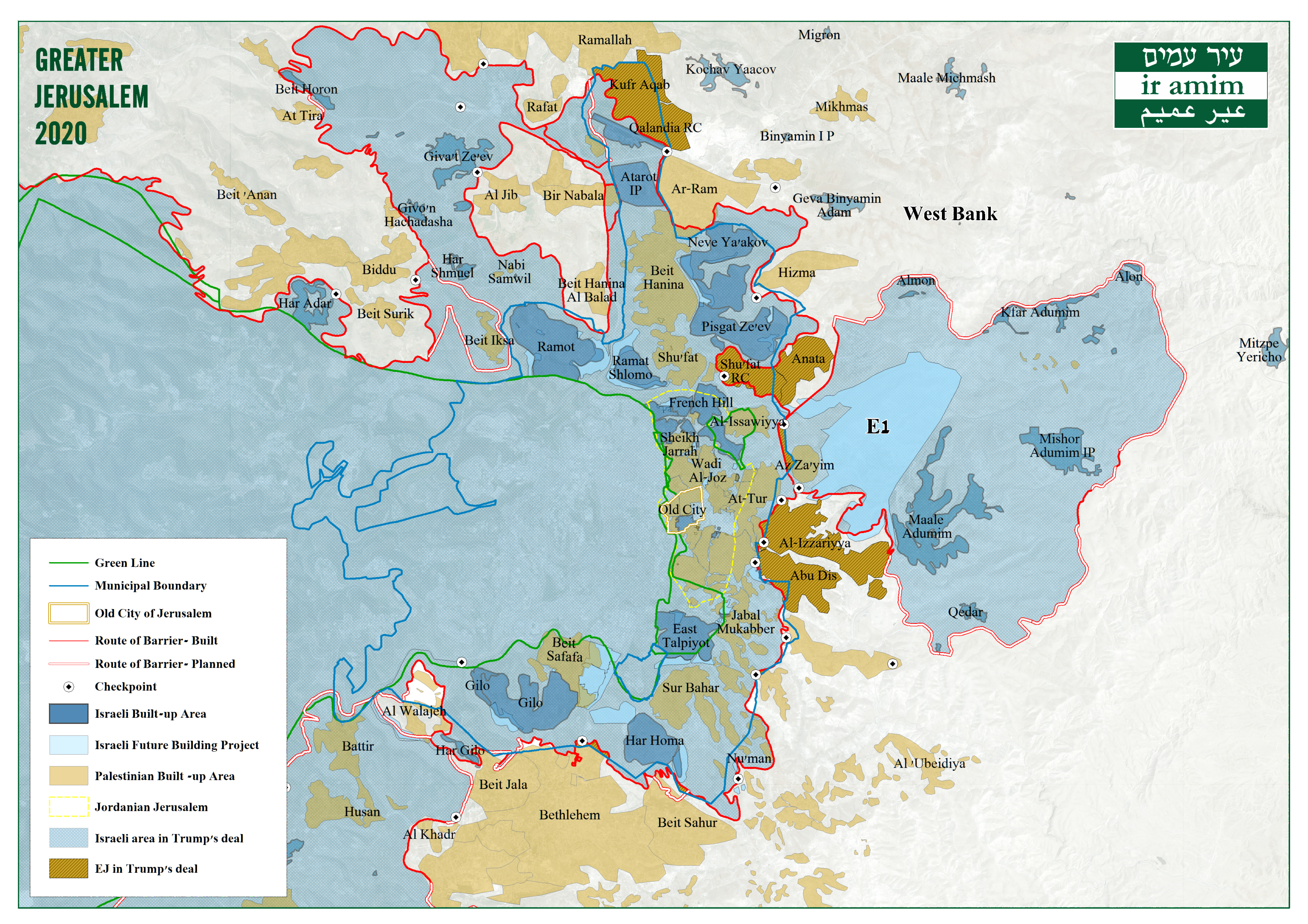
Map by Ir Amim (Click to open in new window)
Several of these conditions relate to abandoning the longtime Palestinian demand to have Jerusalem as the state capital. The Vision explicitly states that Jerusalem will be the unified capital of Israel while giving Palestinians the option of using areas east of the separation wall (Kufr Aqab, Shuafat refugee camp and Abu Dis) as a future capital, which it generously allows them to call “Al Quds” if they desire. It should be recalled that these areas are isolated and impoverished suburbs of Jerusalem (they are in fact outlying areas that Israel added to the Jerusalem municipality after it captured the city in 1967), and that under this Vision, the Palestinains not only don’t get a capital in the area that is what is truly East Jerusalem (i.e., Jerusalem pre-1967), but they are cut off from it entirely. This point affirms what has long been obvious to many: planning and building the separation wall in Jerusalem was an act of de facto annexation of all the land on the Israeli side of the wall.
On this point, Ir Amim writes:
“According to the plan, a theoretical Palestinian capital would be established in the areas beyond the barrier, which would include Kufr Aqab, the Shuafat refugee camp area, as well as Abu Dis (see linked map). Abu Dis has repeatedly appeared in various Israeli proposals as a substitute outside of Jerusalem for a Palestinian capital and consistently rejected by the Palestinians. It is likewise important to note there is no territorial contiguity between the two areas beyond the barrier and Abu Dis, rendering it an even more artificial construct.” Ir Amim goes on to predict, “The US plan significantly reflects Israeli efforts in recent years to officially uproot the neighborhoods beyond the barrier from Jerusalem. This is liable to cause a wave of Palestinian residents back into the core of East Jerusalem, increasing the already existing burden on the massive housing shortage and failing infrastructure and leading to even greater chaos within the Palestinian neighborhoods on both sides of the barrier. Likewise, it is possible there will be an increase in requests for Israeli citizenship particularly among Palestinian residents living beyond the barrier in order to secure their status in the city.”
FMEP will provide more in-depth coverage of the Jerusalem aspects of the plan – including the U.S. green light (which has subsequently been changed, at least in public statements, to yellow, but will be understood by the Israelis, correctly, as remaining green) as major change to the status quo on the Temple Mount – as more analysis is published (which FMEP knows is coming!).
The Vision Supports Settlement Endeavors in Silwan
In one of the sections addressing Jerusalem, the Vision lists specific holy sites in Jerusalem which Israel currently controls. That list includes many, many Jewish sites, many Christian holy sites (though notably omitting the Garden Tomb), but just two Muslim sites (Haram al-Sharif and an ambiguous “Muslim Holy Shrines”). Most incredibly, the list of holy sites includes several archeological sites run by the Elad settler organization in the Palestinian East Jerusalem neighborhood of Silwan. Elevating these sites – which have been cultivated as part of the settlers’ mission to increase the Jewish presence in and hegemony over the historic basin of the Old City, most notably Silwan and Sheikh Jarrah – to the status of “holy sites” is a full endorsement of that agenda. This should come as no surprise to anyone, given Amb. Friedman’s now infamous hammer-wielding appearance in the tunnel of an Elad archeological site in July 2019.
Ir Amim explains the significance:
“The plan calls to safeguard Jerusalem’s religious and holy sites and ensure freedom of access for worshippers of all faiths. It subsequently lists various holy sites in Jerusalem. Save for the Haram al-Sharif and a general reference to Muslim holy shrines, there is no other inclusion of sacred Muslim sites on the list, while at the same time it includes a significant number of Jewish and Christian sites. Among the Jewish sites listed, there are various archeological sites which Israel has never before officially regarded or recognized as holy. It should be noted that these sites are located in and around Silwan and constitute the locus of the Elad settler organization’s touristic settlement operations in the area.” Ir Amim later concludes that because of the Vision, “State-sponsored settlement campaigns in the Old City Basin, including settler-initiated evictions of Palestinians, takeovers of their homes, and touristic initiatives are expected to accelerate.”
Netanyahu Promises, Then Delays, Rapid Approval of Bill to Annex All Settlements & the Jordan Valley
Following his side-by-side press conference with President Trump, the Israeli PM told reporters that he will ask his Security Cabinet to vote on bill to annex the Jordan Valley and all settlements (approximately 30% of the West Bank) this Sunday, February 3rd – but also said that his government will “need to do some work to define exactly [what we will annex].” Following his initial promise, several rounds of new reports suggested, and then un-suggested, and then re-suggested that Netanyahu would delay/soften/reframe this promise to bring annexation to a vote At the time of publication, the latest press reports suggest that Netanyahu decided to cancel the weekly Security Cabinet meeting on Sunday, with no new date set.
Netanyahu’s changing position, at least in part, reflects the conflicting messages coming from Washington, DC. Immediately following the unveiling of the Vision, U.S. Ambassador David Friedman offered the Trump Administration’s full support for Israel’s immediate annexation of lands that the Vision transfers to Israel. A short time later, Jared Kushner – breaking with Friedman – publicly cautioned against such a move before the next Israeli election. The Israeli government then went to the media to insist on the message that there is/was no disagreement between the Israeli and American governments (who wrote the Vision together), and that the seemingly uncoordinated annexation plans were simply a “technical” disagreement, with Israel’s wishing to annex in three chunks, and the Americans preferring for Israel to annex everything at one time.
Netanyahu’s promise to hold an annexation vote so quickly should also (perhaps primarily?) be viewed in the context of the premiership-or-prison election scenario he has been facing for the past year. The pressure to annex, and annex immediately, has reached a fever pitch amongst both Netanyahu’s rivals and his most strategic allies.
When a government source hinted to the press that Bibi might delay his promise to call up an annexation bill on Feb. 3rd in order to allow the Attorney General to issue an opinion on the matter, Bibi’s rivals and allies pounced, offering pointed criticism of Bibi’s leadership and stressing the urgency of annexing the land immediately. In the past, Attorney General Avichai Mandleblit has expressed concern that a transitional government cannot take such dramatic steps (notably, the AG is only worried about the timing of annexation, not the validity of it). Recently, however, he softened – nearly reversed – his opposition to the plan. Bibi’s critics were not assuaged even when the Ynet news outlet cited an unnamed government source saying that Mandleblit is prepared to approve an annexation bill.
Even before reports of a delay in order to allow the Attorney General to weigh in, Benny Gantz, took part in a testy Twitter exchange, responding to Netanyahu by saying:
“You can apply Israeli law in the Jordan Valley in a cabinet decision within two hours, without any Knesset discussion. Let’s see you.”
Gantz has also promised to bring the Vision itself up for a vote in the Israeli Knesset next week.
MK Avigdor Liberman (who played the role of kingmaker/bloc-breaker in the past two election rounds, and might do so again) wrote on Facebook:
“You don’t care one whit about the Jordan Valley. The only thing you care about is immunity.”
On January 22nd, Defense Minister Naftali Bennett (a member of Netanyahu’s very fragile political alliance) publicly called on Netanyahu to stop delaying annexation of the Jordan Valley, and “do it now.”
Transportation Minister Bezalel Smotrich penned a letter to Netanyahu calling on him to bring a bill to annex the Jordan Valley to a vote next week. Smotrich wrote:
“Yisrael Beytenu and Blue and White think that important and fundamental decisions can be made during a transitional government. I am in favor of this. But not for politics, but for essential matters. Applying sovereignty over the Jordan Valley is one of the important Zionist measures that are on the agenda and if Blue and White wink at the right, it will be given the chance to prove it. The political timing is ripe to back such a move. With a true friend of Israel, President Donald Trump, combined with the ‘urgent’ plenary conference on Tuesday, this is a historic opportunity. We have no excuse for missing it. There are those who demand a plenary convening for populist needs of immunity, we must take advantage of this to implement an historic historic step in the Jordan Valley.”
Interior Minister Aryeh Deri (the leader of the Shas Party, also part of Netanyahu’s political alliance) tried to defend the Prime Minister’s delay, saying that the government is already advancing annexation as an administrative fact. Speaking at a Jordan Valley settlement, Deri said:
“As interior minister, I’m telling you that on the municipal side, we’re already starting to prepare the administrative work. There are many challenges that must be dealt with.”
The picture that emerges from the Israeli political scene is one of nearly consensus support for annexation of the Jordan VAlley and all the settlements, with only the Joint List and Meretz Party challenging the overwhelming support for annexation and the Trump Admin Vision within Israeli politics.
U.S. & Israel to Form Technical Teams to Plan Israeli Annexation
Israel and the U.S. are not wasting any time in implementing the annexation portion of the Vision.
Following the unveiling of the Vision, U.S. Ambassador Friedman told the press that there is no “waiting period” preventing Israel from annexing West Bank land and that, anticipating such a move, he intends to set up a committee (presumably in the State Department and/or Embassy) “as soon as possible” to examine any Israeli annexation plan to make sure it is in line with the Vision. Speaking on annexation, Friedman said:
“It’s a process that requires effort, accuracy and calibration and you have to make sure that the annexation matches the map in our plan. We will look at the Israeli proposal and examine it and make sure it is in line with our plan. We will set up the committee as soon as possible and work on it immediately and try to end quickly but I do not know how long it will take.”
Acting Israeli Defense Minister Naftali Bennett also announced that he Israel will establish a new governmental body to lead the annexation effort. Bennet said:
“I will be clear: Whatever is postponed until after the elections will never happen. We all understand this. Therefore, I am announcing this morning that I ordered the formation of a special team to apply and carry out the implementation of Israeli law and sovereignty over all Jewish settlements in Judea and Samara, over the Jordan Valley, and the hotels around the Dead Sea.”
This is the third annexation body the Bennet has announced the creation of during his short time as the Israeli Defense Minister during the current transition government. Though it is not clear if any/all of these government bodies overlap, Bennet announced the creation of:
- The “special team” detailed in the Bennet quote above [Announced January 29, 2020]
- An inter-ministerial taskforce to develop settlement and annexation plans for the future of Area C in the West Bank. [Announced January 9, 2020]
- A research team to survey and then present several legal options for how Israel can bring the settlement planning processes under the Justice Ministry (integrating the settlements into the domestic Israeli planning process, and act of annexation). [Announced December 12, 2019]
Invited to Washington, Prominent Settler Welcome Plan But Utterly Reject Vision for (a Non-Sovereign, Non-Autonomous) Future State of Palestine
Several of the most prominent settler leaders accepted an invitation from Prime Minister Netanyahu to accompany him on a mission to Washington, DC for the unveiling of the Trump Administration’s “Deal of the Century.” The leaders were invited to attend in order to receive briefings about the contents of the plan, or, as they put in a statement:
“We came to strengthen the prime minister and to clearly present to the White House the voice of all the settlements. It was important for us to hear the information in person rather than relying on rumors.”
Ahead of the public release, David Elhayani (Chairman of the Yesha Council, an umbrella group, and chairman of the Jordan Valley Regional Council) told the press that he wasn’t getting much sleep due to worry about the plans’ contents, specifically that it would be “horrible for settlements.” Having reportedly heard from Netanayhu that the plan will outline the possiblitiy of a Palestinian state on 70% of the West Bank, Elhayani said:
“We cannot accept a plan that would include the establishment of a Palestinian state, which would pose a threat to the State of Israel. We will also not allow for the establishment of a Palestinian state, even if that means giving up on enacting sovereignty in Judea and Samaria and the Jordan Valley [for now]. We call on the prime minister and members of Knesset not to accept a comprehensive agreement within which a Palestinian state can be established in any form.”
Upon seeing the plan – which awarded the settlers nearly everything on their wish list short of the ethnic cleansing of the West Bank – the settler leaders’ opposition calcified with two major objections: 1) the hint of a settlement construction freeze in the “Israeli enclaves,” (which, as described above, is not a meaningful freeze) and 2) the possibility of a future state of Palestine (which, as described above, is not a future state but a few islands of Palestinian land completely encircled and controlled by Israel). The rejection leads one to ask, what do the settlers want to do with the Palestinians?
In Two Rulings, the Jerusalem Magistrate’s Court Sets Precedent for Massive Displacement of Palestinians in Silwan
The Jerusalem Magistrate’s Court handed down two rulings in the past 10 days that order the eviction of Palestinian families from their homes in the Batan al-Hawa section of the Silwan neighborhood of East Jerusalem. Both petitions were initiated by the Ateret Cohanim settler group, which claims to own the land upon which the homes are built. By accepting Ateret Cohanim’s ownership claim in these two cases – which the settler group asserts based on its management of a 19th century trust – the court has set a significant precedent for nearly a dozen additional petitions initiated by Ateret Cohanim to evict some 700 more Palestinians from their East Jerusalem homes. [map]
First, on January 19th the Jerusalem Magistrate Court ruled in favor of the radical settler group Ateret Cohanim to evict the Palestinian Rajabi family from their home home of 45 years in the Batan al-Hawa section of Silwan, located just south of the walls of the Old City of Jerusalem. In so doing, the court accepted Ateret Cohanim’s claim to own the tract of land in Silwan upon which the Rajabi home was built. The court ordered that the family must vacate their 3-story apartment building by July 1st; however, the eviction might be delayed as the Rajabi family announced that the family intends to file an appeal against the decision with the Jerusalem District Court. Nasser Rajabi, head of the family, told Haaretz:
“My father bought this house and I was born in this house. We didn’t take it from anyone. We’d never even heard about the Yemenites until they sued us. I’m not leaving the house, where would I go? We will die before they get us out.”
Second, on January 26th the Jerusalem Magistrate’s Court ruled to evict the Palestinian Dweik family from their home (also located in the Batan al-Hawa section of Silwan) based on a petition filed by Ateret Cohanim on the same basis as the Rajabi petition. The Dwieks were ordered to vacate the building by August 2nd.
Peace Now said in a statement:
“This is an attempt to displace a Palestinian community and to replace it with an Israeli one, in the heart of a Palestinian neighborhood in East Jerusalem. The settlers could not have succeeded without the Israeli authorities’ close support and assistance. In addition to the hard blow to the prospects for a two-state solution by preventing a Palestinian capital in East Jerusalem, this is an injustice and an act of cruelty to throw out families who have lived lawfully in their homes for decades.”
Ir Amim said:
“The Ateret Cohanim settler organization is waging one of the most comprehensive settler takeover campaigns in East Jerusalem through initiating mass eviction proceedings against Palestinian families in Batan al-Hawa. Seventeen families have already been evicted with over 80 other households facing eviction demands, placing some 600-700 individuals of one community at risk of displacement. See Ir Amim’s and Peace Now’s joint report, “Broken Trust” for further details and analysis.”
As FMEP has detailed, Ateret Cohanim is a settler organization which works to establish Jewish enclaves inside densely populated Palestinian neighborhoods of East Jerusalem. In Silwan, it is working largely based on its contention that land in Silwan was once owned by Jews and can now, under Israeli law, be reclaimed. Specifically, Ateret Cohanim contends that land belonging to a Jewish trust (named the Benvenisti Trust) in the 19th century is now the property of Ateret Cohanim, which took control of the trust in 2001. In 2002, the Israeli Custodian General agreed to transfer land in Batan al-Hawa to the Trust/Ateret Cohanim. Since then, Ateret Cohanim has accelerated its multifaceted campaign to remove Palestinians from their homes, claiming that the Palestinians are illegally squatting on sacred religious land owned by the Trust.
Haaretz columnist Nir Hasson tells the story:
“The neighborhood of Batan al-Hawa is an extreme example stressing the difference between how Arab property was dealt with as opposed to Jewish property. A Jewish neighborhood that had been built for immigrants from Yemen with funds raised by the philanthropic organization Ezrat Nidahim lay in the Batan al-Hawa area until 1938. The homes in the neighborhood were owned by an Ottoman-era land trust that was registered in the name of Rabbi Moshe Benvenisti. In 2001, more than a century after the land trust had been established, the Jerusalem District Court approved the request by three members of Ateret Cohanim to become trustees of the land. With this brief decision that takes up half a page, and a subsequent decision by the Custodian General, the state placed 700 Palestinians, along with their property, under the control of Ateret Cohanim, which seeks to increase Jewish presence in Jerusalem’s Old City.”
Israel Issues Eviction Orders to 30 Palestinian Families Living in the Old City of Jerusalem
On January 20th, Israeli authorities delivered eviction orders to 30 Palestinian homes in East Jerusalem, including 22 houses in the Old City neighborhood of Bab al-Silsila – or Chain Gate. If implemented, the eviction orders will render almost 200 Palestinians homeless. Reports mention that all of the homes have sustained structural damage because of Israeli excavations under the Old City, but no further details are reported concerning the predicate for eviction.
Bonus Reads
- “Expansion of jurisdiction brings change for settlers” (Ynet)
- “Ottoman archives help Palestinians reclaim their land” (Al-Monitor)
- “Israel Rejects 98% of of Palestinian Building Permit Requests in West Bank’s Area C” (Haaretz)
- “Bennett looks to demolish illegal Palestinian businesses at Ariel Junction“ (Jerusalem Post)
- “Go ahead, annex the West Bank” (+972 Magazine)
- “Prejudices and ignorance among Israeli settlers in the West Bank” (Jerusalem Post)
- “Here’s What Happens if Israel Annexes the West Bank and Lets Palestinians Vote” (Haaretz)
- “A Designer Villa With a Sprawling View of the Occupation” (Haaretz)
- “Illegal Settlement Growth, Widespread Hopelessness among Youth Eroding Middle East Peace Prospects, Under-Secretary-General Tells Security Council” (United Nations)
Welcome to FMEP’s Weekly Settlement Report, covering everything you need to know about Israeli settlement activity this week.
To subscribe to this report, please click here.
January 10, 2020
- ICC Opens Formal Investigation into Israeli War Crimes, Including Israeli Settlements
- Israel to ICC: You Do Not Have Jurisdiction & You Will Not Stop Us from Advancing Settlements and Annexation
- Following ICC Announcement, Israel Advances Plans for Nearly 2,000 Settlement Units
- Following ICC Announcement, Israel Begins Planning Jordan Valley Annexation
- Plans Advance in East Jerusalem, Part 1: New Settlement Enclave in Palestinian Neighborhood
- Plans Advance in East Jerusalem, Part 2: Reports on Har Homa & Rumors on Givat Hamatos
- Plan Advance in East Jerusalem, Part 3: Israel Approves Plans for Two More Settler-Run Tourist Sites in East Jerusalem
- Plans Advance in East Jerusalem, Part 4: Tenders for Pisgat Zeev and Gilo
- For Second Time, Israeli Court Rules Against Settler Claim to Bakri House in Hebron
- Peace Now Wins Interim Decision Against Secretive Public Funding to Amana
- Israeli Court Dismisses Palestinian Landowners’ Petition Against the Ofra Settlement
- Bennett Launches Initiative to More Aggressively Police Palestinians in Area C
- Bennett Appoints Key Settler Ally to Lead New Government Task Force on Area C Annexation Plans, Immediately Announces Plan to Legalize Settlements
- Following ICC Announcement, Pompeo Says Israel Has “Fundamental Rights” to Land
- Pro-Settlement Legal Forum Conference Draws Big Names, Big Promises
- Bonus Reads
Comments/questions? Email Kristin McCarthy (kmccarthy@fmep.org)
ICC Opens Formal Investigation into Israeli War Crimes, Including Israeli Settlements
On December 20, 2019 the Chief Prosecutor of the International Criminal Court (ICC) Fatou Bensouda announced that the court has found a reasonable basis upon which to open an investigation into Israeli war crimes against Palestinians in the West Bank, East Jerusalem, and Gaza. Bensouda said that the preliminary investigation, launched five years ago, established sufficient evidence of war crimes, citing Israeli settlements and Israel’s conduct during its 2014 incursion into the Gaza Strip, which Israel gave the title “Operation Protective Edge”. The statement said that the Court found evidence that Hamas and armed Palestinian groups also committed war crimes during the 50 days of hostilities in 2014.
Before proceeding with a formal investigation, Bensouda requested a pre-trial chamber to rule on the Court’s territorial jurisdiction, as outlined in the Rome Statute, over the West Bank, East Jerusalem, and Gaza Strip. Bensouda requested a ruling on the matter within 120 days. Bensouda has previously articulated her opinion on the matter, suggesting that questions regarding Palestinian statehood do not necessarily need to be resolved because Palestine acceded to the Rome Statute and formally became a “State Party” to the court.
Israel to ICC: You Do Not Have Jurisdiction & You Will Not Stop Us from Advancing Settlements and Annexation
Prior to Bensouda’s announcement on December 20th that the ICC will proceed with an investigation into Israeli war crimes in the West Bank, East Jerusalem, and Gaza, Israeli Attorney General Avichai Mandleblit published a 34-page legal opinion arguing that the Court does not have jurisdiction over those territories because Palestine does not meet the criteria for statehood, and non-sovereign entities cannot confer jurisdiction to the Court. Notably, that opinion doesn’t address (let alone dispute or challenge) the assertion that Israeli actions might constitute war crimes.
Going beyond Mandleblit’s legal arguments, Netanyahu launched a disingenuous attack on Bensouda’s criticism of Israeli settlements, saying:
“[Bensouda] says it is a crime, a war crime, for Jews to live in their homeland, the land of the Bible, the land of our forefathers.”
Netanyahu later said:
“This will not deter us — not in the slightest”
Netanyahu is riding a wave of defiant, ultra-confident language following his Dec. 27th victory in the Likud primaries, after which he promised to secure U.S. recognition for Israeli sovereignty over the Jordan Valley and all settlements in the West Bank. In his victory speech, Netanyahu laid out a 6-point plan he will implement if he goes on to win the March 2020 elections:
“First, we will finalize our borders; second, we will push the US to recognize our sovereignty in the Jordan Valley and the northern Dead Sea; third, we will push for US recognition of our extension of sovereignty over all the communities in Judea and Samaria, all of them without exception; fourth, we will push for a historic defense alliance with the US that will preserve Israeli freedom of action; fifth, stop Iran and its allies decisively; and sixth, push for normalization and agreements that will lead to peace accords with Arab countries. The opportunities are within reach.”
Demonstrating that Netanyahu means what he says, shortly following the ICC’s announcement his government advanced plans for nearly 2,000 settlement units and launched the planning process for annexing the Jordan Valley. Both of these items – in addition to several other significant settlement advancements which were not explicitly linked to the ICC’s announcement – are covered in detail below.
Following ICC Announcement, Israel Advances Plans for Nearly 2,000 Settlement Units
Over the course of a two-day meeting Jan 5-6, 2020, the Israeli Civil Administration’s High Planning Committee approved plans for 1,936 settlement units, of which 786 units received final approval for construction. The Israeli Civil Administration is the body of the Defense Ministry which regulates all construction in the West Bank, both Palestinian and Israeli settler.
The Civil Administration granted final approval to the following plans:
- A plan for 258 units in the unauthorized Haresha outpost, located east of Ramallah, to take them to the final stage of the approval process. If granted final approval, the plan will have the effect of retroactively legalizing the Haresha outpost. This outpost has been one of several test cases for the Israel government’s evolving legal justifications for granting retroactive approval to unauthorized outposts built on privately owned Palestinian land. In the case of Haresha, an outpost built on an island of “state land” surrounded by privately owned Palestinian land, then-Israeli Justice Minister Ayelet Shaked issued a new legal opinion in December 2018 outlining a legal basis for temporarily seizing the private Palestinian land for the construction of a tunnel road underneath it (essentially holding that Palestinian land rights – which can be temporarily infringed upon at any time for the sake of the settlements – do not extend below the ground’s surface). The tunnel road has not yet been constructed, an important qualification that Israel, to this point, has generally required outposts to meet prior to legalization.
- 147 units in the Mitzpe Yericho settlement, located just west of the Palestinian city of Jericho in the Jordan Valley. The plan will have the effect of retroactively legalizing existing illegal construction in the settlement.
- 120 units in the Karnei Shomron settlement, located in the northern West Bank east of the Palestinian village of Qalqilya. Israel is planning to continue expanding Karnei Shomron with the stated goal of bringing 1 million settlers to live in the area surrounding the settlement.
- 107 units in the Elon Moreh settlement, located east of Nablus.
- 100 units in the Halamish settlement, (where settlers have built a strategic outpost, with the protection of the IDF, in order to further restrict Palestinian access to the area);
- 25 units in the Peduel settlement, located in the northern West Bank and part of a string of settlements and unauthorized outposts – most notably Ariel – extending from the Green Line into the very heart of the West Bank and on towards the Jordan Valley.
- 12 units in the Ariel settlement, located in the central West Bank.
- 10 units in the Etz Efraim settlement, located in the northern West Bank, one of several settlements slated to become a “super settlement” area.
- 7 units in the Rechelim settlement, located east of the Ariel settlement and south of Nablus, in the heart of the West Bank.
The Civil Administration advanced the following plans:
- 224 units in the Talmon settlement, located west of Ramallah.
- 204 units in the Shilo settlement, located in the central West Bank.
- A plan for 180 units in the unauthorized Mitzpe Danny outpost, located east of Ramallah. If approved, the plan will have the effect of retroactively legalizing the outpost, which was built without Israeli permission in 1999 in an area that includes privately owned Palestinian land. The Binyamin Regional Council – a settler body acting as the municipal government for settlements in the central West Bank – has been angling to retroactively legalize Mitzpe Danny for some time. As part of that effort, the regional council successfully lobbied for approval of a plan to build an educational campus for settlers that will create a territorial link between the Maale Mikhmash settlement (which has official recognition from the government) and the outpost. That plan received final approval in January 2019.
- 160 units in the Kochav Yaakov settlement, located between Jerusalem and Ramallah.
- 92 units in the Tzofim settlement, one of the settlements that flank the Palestinian city of Qalqilya in the northern West Bank.
- 91 units in the Almon settlement, located northeast of Jerusalem.
- 136 units in the Givat Zeev settlement, located south of Ramallah.
- 63 units in the Maale Adumim settlement, located just east of Jerusalem.
- A plan for 204 new units in the Shvut Rachel settlement, which only recently became an authorized settlement area when Israel extended the jurisdiction of the Shiloh settlement to include it as a “neighborhood” (along with three other outposts).
Peace Now said in a statement:
“Despite lacking a clear mandate, for this caretaker government it’s business as usual – Continue the massive promotion of harmful and unnecessary construction in occupied territory and in places that Israel will have to evacuate. Netanyahu continues to sabotage the prospects of peace, dragging Israel into an anti-democratic one-state reality resembling apartheid.”
The Yesha Council, an umbrella group representing all the settlements, celebrated the approvals, saying in a statement:
“To our delight, construction in Judea, Samaria and the Jordan Valley is commonplace and we are pleased to see that every few months plans are up in the Supreme Planning Council. The time has come for extremist Leftist organizations to accept that the U.S. has also declared that settling in Judea, Samaria, and the Jordan Valley is not contrary to international law and that applying Israeli sovereignty is a consensus in the State of Israel. After eight years of unprecedented construction freeze, the government regularly approves construction and we strengthen the hands of the Prime Minister and Defense Minister on their blessed work. We need more and more construction to promote the prosperity and growth of settlement.”
The head of the Binyamin Regional Council, Yisrael Gantz, spoke happily about the settlement advancements but also kept focused on the settlement movement’s ultimate demand: annexation. Gantz told Arutz Sheva:
“This is undoubtedly an important and significant step. I hope we will soon be able to applaud the application of full Israeli sovereignty and the closure of the Civil Administration in order to truly develop the regions of our amazing country, in the same way that it is possible in the entire State of Israel.”
Despite the celebratory remarks, settlers were disappointed with the final number of settlement units, which fell short of the 3,000 units Netanyahu promised to advance on the eve of the Likud primary leadership vote (which went in Netanyahu’s favor). When promising the 3,000 units, Netanyahu also promised:
“We are going to bring [secure] US recognition for our sovereignty in the Jordan Valley [and] in all the settlements, those in the blocs and those that are beyond it.”
Following ICC Announcement, Israel Begins Planning Jordan Valley Annexation
On January 5th, the inter-ministerial committee created to plan the annexation of the Jordan Valley held its first meeting, in an effort to prepare an official proposal for how Israel can annex the Jordan Valley. The committee – dubbed the “Sovereignty Committee” – is headed by the Prime Minister’s Office Director General Ronen Peretz and includes representatives from the Foreign Ministry, the Israel Defense Forces, and the National Security Council.
The meeting took place despite (or perhaps because of) reports that Netanayhu put Jordan Valley annexation plans in a “deep freeze” following ICC Chief Prosecutor Fatou Bensouda’s announcement on Dec. 20th that the Court will open an investigation into war crimes committed by Israel in the West Bank, East Jerusalem, and Gaza. Following those reports, the head of the Yesha Council, the settler umbrella group, David ElHayani spoke to Netanyahu on the phone to gain reassurance that the annexation plan was not frozen, which Netanyahu reportedly gave him.
Haaretz reports:
“Sources familiar with the establishment of the inter-ministerial committee told Haaretz that the insistence on moving forward with the discussions are mainly to show that the idea has not been abandoned due to international pressure.”
Plans Advance in East Jerusalem, Part 1: New Settlement Enclave in Palestinian Neighborhood
On January 8th the Jerusalem District Planning Committee granted final approval to a new 75-unit settlement compound to be built in the heart of the Palestinian East Jerusalem neighborhood of Beit Hanina. If built, it will be the first-ever authorized settlement project in Beit Hanina, located north of the Old City.
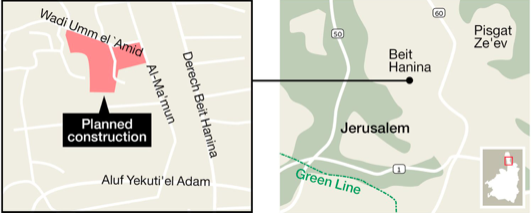
May by Haaretz
The Beit Hanina settlement plan – as FMEP has previously reported – is backed and promoted by settlement impresario Aryeh King, and it provides for the construction of a total of 150 new units in the southern end of the Beit Hanina neighborhood. The land slated for the 150 units is privately owned, 53% of the land is owned by an Israeli who is supportive of the plan, and 47% by a Palestinian company who objects to the plan and has fought against it. Because the land has not been surveyed to demarcate the split ownership, Israeli planning authorities decided that the settlement plan is designated for the entire property, with construction rights split evenly between the parties, meaning the 75 units granted final approval on January 8th represent the Israeli-controlled half of the project.
Ir Amim notes the larger picture of Isreali settlement activity north of the Old City:
“In close proximity to Ramat Shlomo to the southwest and Pisgat Zeev to the northeast, construction of this new compound may signal the beginning of a move to create contiguity between the two settlements, while fracturing the contiguous space between Bet Hanina and Shuafat. As exemplified by the ring of state-sponsored settlement strongholds throughout the Old City Basin, the establishment of a settler enclave in the midst of Beit Hanina will not only impact the fabric of this community, but will further erode opening conditions for a political solution to the conflict based on two capitals in Jerusalem.”
Ir Amim explains essential context:
“the plan will enable an ideologically driven settler outpost in the heart of Beit Hanina, a neighborhood located on the northern perimeter of East Jerusalem that has remained relatively untouched by Israeli settlement within its limits. Since the land in question is not far from Ramat Shlomo to the south-west and Pisgat Zeev to the north-east of it, its construction may mark the beginning of a far sweeping move to create contiguity between the two settlements, while driving a wedge between Bet Hanina and Shuafat.”
Plans Advance in East Jerusalem, Part 2: Reports on Har Homa & Rumors on Givat Hamatos
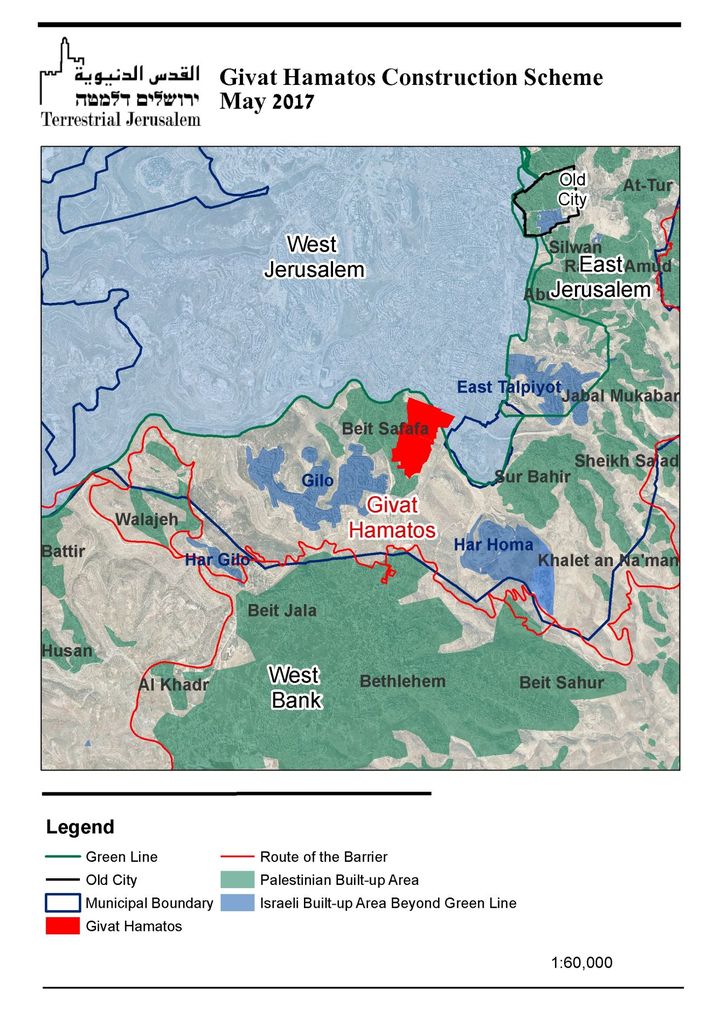 On January 7th, the popular Isareli broadcaster network Kan reported that the Prime Minister’s office has blocked a plan to build 2,000 new settlement units in the settlement of Har Homa, citing “diplomatic difficulties.” In response to an inquiry, the office did not deny the report, but issued the following statement:
“Israel has built in Jerusalem, is building in Jerusalem and will continue building in Jerusalem — while exercising judgment.”
Jerusalem expert Daniel Seidemann raised a key question and larger concerns about the reports concerning Har Homa, saying:
“The construction potential at Har Homa has been exhausted, and it’s not possible to build anything near 2,000 units. So what are they talking about? Something is clearly going on. Three possibilities come to mind, all problematic…Possibility no. 1: the nearby planned doomsday settlement of Givat Hamatos, which is awaiting tenders. Possibility no. 2: Hirbet Mazmoriyya, to the northeast of Har Homa. The lands owned by Palestinians that will have to be expropriated. Not likely. Too complicated and controversial. Possibility no. 3: the area wedged betw. Mar Elias Monastery, the Hebron Road, the 300 Checkpoint, dubbed Bethlehem Gate or Har Homa West. The land is ownership is a mixture of Palestinian &Church lands, along with settlement developers.”
Ir Amim notes that, while reportedly stalling the Har Homa plan, Netanyahu is – in fact – simultaneously facing mounting pressure to issue tenders for the construction of the Givat Hamatos settlement, the site for which is the northern border of Har Homa. Ir Amim writes:
“Last week, rightwing groups launched a coordinated campaign to exert pressure on Prime Minister Netanyahu to advance construction in the area of Givat Hamatos, which has been essentially frozen for the past six years. While the approval of the plan for 2,610 housing units in the area was formally published in 2014, there has been no announcement of tenders since then. This has been largely attributed to international opposition, namely from the United States and Germany. Likely attempting to ratchet up pressure on Netanyahu in lead-up to the upcoming elections in March, the campaign has been spearheaded on a public level by rightwing organizations. Several prominent rabbis known for supporting the settler movement penned a letter to the Prime Minister calling on him to announce the tenders for Givat Hamatos, while rightwing media outlets have published daily articles demanding an ‘end to the freeze.’ A rightwing institute likewise published a lengthy paper on the significance of establishing a new settlement in the area as a means of thwarting any potential future division of Jerusalem within the framework of a resumed peace process.”
Plan Advance in East Jerusalem, Part 3: Israel Approves Plans for Two More Settler-Run Tourist Sites in East Jerusalem
On December 25, 2019 the Jerusalem Local Planning approved two significant settler-backed schemes in East Jerusalem:
- The committee approved the Israeli government’s plan to seize land in the Palestinian East Jerusalem neighborhood of Sheikh Jarrah, in order to establish a park adjacent to the infamous Shepherd Hotel, an historic/iconic building that was taken over by the radical Ateret Chohanim settler organization in 2011. The new park – called “Hakidron Park” has been discussed and considered by Israeli governments for the past 15 years.
- The committee also approved the Israeli government’s plan to confiscate land in the Ras al-Amud neighborhood of East Jerusalem, for the purpose of opening a tourist and religious services center on the Mount of Olives, adjacent to the Jewish cemetery. The Jerusalem Municipality hired an architect, Arie Rahamivov, who is also employed by the radical Elad settler group for the planning and construction of their crown jewel: the Kedem Center in Silwan. The new center in Ras al Amud will be yet another tourist center under the management of Elad, which already operates another visitors center on the Mount of Olives.
Ir Amim writes:
“Approval of the aforementioned land expropriations would signal intent to begin construction at both sites and will help to further solidify the settlement ring around the Old City Basin. While both plans can be posited as innocuous municipal initiatives to serve local residents and visitors to the areas, such touristic projects play an integral role in expanding the scope of settlement strongholds in the area and creating a more contiguous Israeli space, while diffusing the political agenda behind these efforts.”
Plans Advance in East Jerusalem, Part 4: Tenders for Pisgat Zeev and Gilo
Ir Amim reports that the Israel Lands Authority published construction tenders for the following East Jerusalem settlements in early January:
- 3 tenders for a total of 461 new settlement units in the Pisgat Zeev
- 1 tender for commercial buildings in the Gilo settlement, located
For Second Time, Israeli Court Rules Against Settler Claim to Bakri House in Hebron
On December 23rd, the Jerusalem District Court ruled that the Palestinian Bakri family are the rightful owners of a disputed property in Hebron. This ruling should deal a final blow to the 18-year long legal battle settlers have waged to gain control of the Bakri family house (“should”, not “will”, because the settlers have repeated been dealt defeats in court and each time are able to manufacture a new claim or appeal) .
The ruling – which affirmed a March 2019 ruling by the Magistrate court, which the settlers had appealed – called for the immediate evacuation of the settlers whom Israel has permitted to illegally squat in the house while the legal processes were ongoing. For a full history of the Bakri house saga, see here.
Following the ruling, Peace Now said:
“[the] court again ruled that the settlers had forged [documents] and lied all along… We hope that after [almost] two decades of violence, lies and terror, justice will be carried out and the invaders will be evicted.”
Peace Now Wins Interim Decision Against Secretive Public Funding to Amana
In response to a Peace Now petition, on December 31st the Israeli High Court issued an interim decision that requires state bodies to request approval from the court before transferring funds to Amana, a settlement body which is known to undertake illegal settlement activities across the West Bank. Peace Now filed the petition after discovering that state bodies have been secretly funneling money to Amana.
Peace Now said in a statement:
“Amana is the most significant organization operating in the settlements. For decades, it has overseen the establishment of dozens of illegal outposts and neighborhoods with the help of massive budgets, some of which have been transferred from Israeli taxpayer money through local settlement authorities in violation of the law. The judges’ decision is a dramatic yet necessary step that limits, for the time being, this illicit transfer of funds to illegal projects in the settlements and outposts. We hope that in this spirit, the court will rule that public funds should no longer be transferred to Amana via subsidy procedures. This situation in which the State of Israel backs illegal activities with public funds is unconscionable, and we urge the Israeli government to put an end to it.”
Israeli Court Dismisses Palestinian Landowners’ Petition Against the Ofra Settlement
On January 6th, the Israeli High Court of Justice dismissed a petition filed by Palestinian landowners challenging the legality of the Ofra settlement. The petition was based on the fact that the settlement is partially built on privately owned Palestinian land. The court ruled that the majority of the settlement had been built on land expropriated by Israel, and that the minority of land that Palestinians claim ownership over was not enough to invalidate the entire Master Plan for the settlement. Further, the court stated that the settlement structures built on the privately owned Palestinian land were built by settlers “in good faith,” under the mistaken belief that land had also been expropriated by the Israeli government.
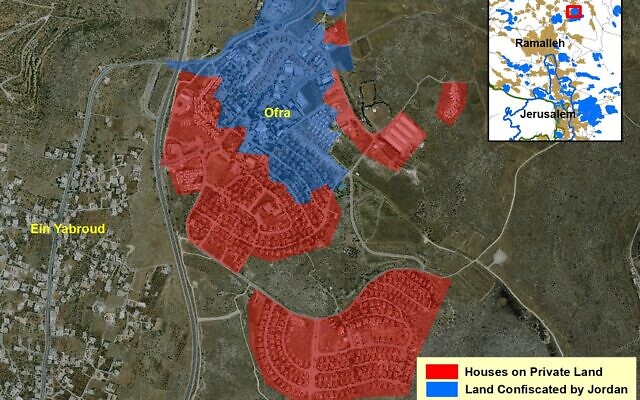
Map by Peace Now
This High Court ruling does not fix the legal status of Ofra settlement buildings, but it is nonetheless significant because it continues to deny Palestinians their property rights. Likewise, it gives a green light to the use of the “market regulation” principle to expropriate land in order to retroactively legalize the structures. As a reminder, the “market regulation” principle – which was invented by the Israeli Attorney General – holds that if settlers acted “in good faith” when they built on privately owned Palestinian land, the state can expropriate that land, thereby making what was illegal before, now perfectly legal.
The Ofra settlement’s legal situation has long been an issue that the Israeli government has tried to fix. Ofra was first established by settlers on land that the Jordanian government had expropriated in 1966, in order to build a military base (which was never built). The Israeli government used this pretext to expropriate the land in 1977, in order to recognize the Ofra settlement, which had been established illegally but with tacit cooperation of the government on the site two years earlier. However, the settlers built the majority of the Ofra settlement on land that was not expropriated by Israel in 1977 — land that was in fact registered to Palestinians from the nearby village of Ein Yabroud. In light of the legal status of the land, no Israeli government has since found a way to fix the legal status of these homes (not for lack of trying) – meaning that the majority of the structures in Ofra were built without permits, making them illegal under Israeli law.
Peace Now elaborates on what is at stake in the Ofra settlement case:
“Most of the houses built in Ofra (approximately 413 out of 625) were built on an area of 550 dunams of privately owned Palestinian land. In addition, hundreds of dunams of Palestinian private land were seized for roads in Ofra, as well as infrastructure and agricultural lands for the settlers. The only way to regulate the theft of these lands would be to expropriate them from the Palestinian landowners for the benefit of the settlers, in complete contradiction to the positions of previous Israeli governments and legal advisors, and contrary to binding rulings of the High Court. Although the current legal advisor (Avichai Mandelblit) allowed land expropriation in some places for settlement purposes (for example, in Haresha), in the regulation of massive land theft such as in Ofra the Israeli government would be crossing a new red line.”
FMEP documents the government’s efforts to expropriate Palestinian land for the settlements in its Annexation Policy Tables.
Bennett Launches Initiative to More Aggressively Demolish Palestinian Construction in Area C
Making the most of his appointment as Israeli Defense Minister in the current caretaker government, Naftali Bennett is pushing an initiative to annex Area C and to aggressively demolish Palestinian construction in the area (reminder: Area C constitutes nearly 60% of the West Bank; it is land that under Oslo II was supposed to have been “gradually transferred to Palestinian jurisdiction”).
As part of his efforts, Bennett has launched legal research into how Israeli can bring settlement building in Area C under the direct authority of the Justice Ministry, cutting out the Civil Administration. This Civil Administration, it should be recalled, is the arm of the Israeli Defense Ministry which acts as the sovereign power over the West Bank, in a system of governance Israel created based on its recognition of the different legal status of the area. Bennett has called for that system to be disbanded (in addition to annexing Area C). To be clear: transferring the construction and planning processes in Area C to domestic Israeli jurisdiction would by any definition constitute the Israeli state extending its sovereignty over area — an act of annexation.
Bennett has requested that Defense Ministry officials present several legal options for how Israel can bring planning processes under the Justice Ministry (integrating the settlements into the normal planning process). The settler-run Arutz Sheva outlet attributes the following quote Bennett in a private meeting:
“We are in essence discussing applying procedural sovereignty only. Full sovereignty is under the authority of the political echelon, but this is a step in the right direction. There is no reason that residents of Judea and Samaria should continue being discriminated against. We must stop this. Residents of Beit El and Ariel are no less Zionist than residents of Kfar Saba and Tel Aviv. They pay taxes and serve in the army, and they need to receive the same services from the government.”
Bennett is also advancing several initiatives that will empower and compel the Civil Administration to more aggressively enforce demolition orders against Palestinian construction in Area C (based on Israel’s policy of not granting permits to Palestinians in Area C, nearly every Palestinian structure in this territory has a demolition order pending against it). Bennett is also eyeing ways to combat what he considers illegitimate and nefarious funding from the European Union to Palestinian communities living in Area C. Israel Hayom reports:
“Bennett’s plan to stop the Palestinians from chipping away at Area C demands action in four areas: Operational, economic, legal, and PR. He wants to change enforcement priorities to put an emphasis on eradicating illegal buildings in strategic locations rather than by numbers. For example, home demolitions would be carried out in accordance with Israeli interests, prioritizing illegal buildings next to roads or settlements. Bennett also instructed the Central Command and the Civil Administration to work more closely to implement his plan and asked that the Civil Administration report to him monthly to update him on progress. Meanwhile, the defense minister is weighing the possibility of allocating more resources to the Civil Administration for enforcement, which would entail hiring more personnel. Bennett also wants to take steps to stop the flow of European money that funds the illegal Palestinian construction in the first place, allowing the “Fayyad Plan” to flourish.”
Bennett Appoints Key Settler Ally to Lead New Government Task Force on Area C Annexation Plans, Immediately Announces Plan to Legalize Settlements
In addition to his new initiative targeting Palestinian construction in Area C, Israeli Defense Minister Naftali Bennett announced that he has created an inter-ministerial taskforce to develop settlement and annexation plans for the future of Area C in the West Bank.
Bennett’s chief of staff, Itay Hershkowitz, has been in weeks-long consultations with key settler leaders to decide what items to act on immediately. Haaretz reports their agenda includes:
- Allowing Jews to privately purchase land in the West Bank. [See here for a detailed explanation of this complicated matter]
- Connecting unauthorized outposts to water and electricity.
- Granting official recognition to unauthorized outposts that are located near established settlements by recognizing them as “neighborhoods” of the settlement.
- Repealing a military order that empowers the Civil Administration to evict settlers from privately owned Palestinian land with or without a Palestinian-initiated petition to have the settlers removed.
- Legalizing 30 sheep farms in the West Bank that are under pending demolition orders.
On Thursday, Bennett announced that he has appointed West Bank settler Koby Eliraz to lead the new taskforce. Calling Eliraz a “bulldozer,”Bennett said:
“The territorial future of the Land of Israel is at stake. The State of Israel has simply not been up to the task of stopping [Palestinian construction]. We are changing direction and embarking on a battle that Israel must win… The defense establishment will fight for this territory, and it is essential for someone to lead this campaign.”
Eliraz previously served as Netanyahu’s settlement advisor, but was fired by the Prime Minister in June 2019 reportedly because he was believed to be allied too closely to Netanyahu rival Avigdor Liberman, who Netanyahu also dismissed. At the time of Eliraz’s firing, settler leaders were outraged and published a letter asking Netanyahu to reverse Eliraz’s firing, suggesting that Eliraz’s absence will hinder government efforts to retroactively legalize outposts. The letter noted:
“Kobi has taken care of Israeli settlement and its residents with great professionalism. He is credited for many advancements [on our behalf] in the fields of construction, infrastructure development, security and more.”
The Times of Israel observed, significantly, that the Yesha Council was able to get every single settlement Mayor to sign the letter in support of Eliraz, explaining:
“The Yesha Council in recent years has struggled to get all of its members on board with its initiative, but the umbrella group’s ability to gather the signatures of every Israeli mayor beyond the Green Line is testament to the broad respect that Eliraz holds among settler leader.”
Following ICC Announcement, Pompeo Says Israel Has “Fundamental Rights” to Land
At a press briefing on December 22nd, U.S. Secretary of State Mike Pompeo did not specifically address the ICC announcement, but made lengthy comments regarding statements from European countries and the European Union that were critical of the new U.S. position on settlements (that they are not “per se illegal” under international law). Pompeo’s comments hold relevance to the U.S. position on the ICC case and more generally on the U.S. approach to the Israeli-Palestinian conflict:
“First, the legal analysis that the EU performed [on settlements] we just think is wrong. We think they have an improper analysis of the international law surrounding this. So as the technical legal matter, [EU Foreign Minister] Ms. Mogherini just – she’s just wrong. And so we are doing our level best to demonstrate to them our legal theory, our understandings, and why it is that we’re convinced that under international law these settlements are not per se illegal. So we’re working that element of it as well. But at another level, and perhaps at the level that will lead to the right outcome, which is why we did this, this has to be resolved through political means, and we hope that all nations, including member nations inside of the EU and the EU itself and countries all over the world, will come to recognize the fundamental rights that the Israeli people have to this land, to this space. There are real security needs. The risk that is presented from the world as anti-Semitism is on the rise, we hope that every nation will recognize that and weigh in on this conflict in a way that is constructive, that will ultimately lead to the peace that is so desperately needed.” [Emphasis added by editor]
Pro-Settlement Legal Forum Conference Draws Big Names, Big Promises
The Kohelet Policy Forum, a right-wing advocacy organization that has enormous influence with senior Israeli – and increasingly American – government figures, hosted a “Conference on the Pompeo Doctrine” in Jerusalem, Jan. 7-8, 2020. The conference served as a gleeful celebration and forward-looking projection of what the new U.S. settlement policy towards settlements means for Israel. The conference drew participation from all the leading Israeli politicians and several senior members of the Trump Administration, including Secretary of State. Pompeo. Key quotes from the conference speakers are copied below.
U.S. Secretary of State Mike Pompeo:
“We’re recognizing that these settlements don’t inherently violate international law. That is important. We’re disavowing the deeply flawed 1978 Hansell memo, and we’re returning to a balanced and sober Reagan-era approach. “In doing so, we’re advancing the cause of peace between Israelis and Palestinians.”
U.S. Ambassador David Friedman:
“…when we came into office the lingering issues included three of significant importance: the status of 1) Jerusalem, 2) the Golan Heights and 3) Judea and Samaria. We have approached them in ascending order of complexity…I thank God that President Trump had the courage and the wisdom to recognize Jerusalem as the capital of Israel and move our embassy to Jerusalem from Tel Aviv…In recognizing Israel’s sovereignty over the Golan Heights, President Trump, evaluating the continuous malign and barbarous threats posed by Syria, concluded that no northern boundary for Israel would be secure except a boundary that incorporated the Golan. He acted well within the language of 242. [Judea and Samaria] is certainly the most complicated of the issues because of the large indigenous Palestinian population. Over the years before we came into office, it’s only gotten more complicated and more challenging. The proverbial goalposts have moved and moved – to the point today where they are no longer even on the field….The Pompeo Doctrine does not resolve the conflict over Judea and Samaria. But it does move the goalposts back onto the field. It does not obfuscate the very real issue that 2 million or more Palestinians reside in Judea and Samaria, and we all wish that they live in dignity, in peace, and with independence, pride and opportunity. We are committed to find a way to make that happen. The Pompeo Doctrine says clearly that Israelis have a right to live in Judea and Samaria. But it doesn’t say that Palestinians don’t….it calls for a practical negotiated resolution of the conflict that improves lives on both sides.”
Israeli Prime Minister Netanyahu said:
“I will not let any settlements be uprooted in any diplomatic plan. This idea of ethnic cleansing… it won’t happen. There is a window of opportunity. It opened, but it could close…There was no West Bank separate from the rest of the land. It was seen as the heart of the land. We never lost our right to live in Judea and Samaria. The only thing we lost temporarily was the ability to exercise the right. When Israel returned to the West Bank We didn’t return to a foreign land. That is a distortion of history. Jews lived in Jerusalem and Hebron for thousands of years consecutively…The Pompeo declaration about the status of the towns [in Judea and Samaria] establishes the truth that we are not strangers in our land. In a clearly defensive war, we returned… to the land where our forefathers put down roots thousands of years ago…Unlike some in Europe who think the Pompeo declaration distances peace, I think it will promote peace, because peace must be based on truth, not lies. Settlements are not the root of the conflict. We are standing with justice and the truth. It is a great struggle.”
Israeli Defense Minister Naftali Bennett on Area C annexation and his initiatives in that regard:
“Our aim is that within a decade a million Israeli citizens will live in Judea and Samaria” and later “Our objective is that within a short amount of time, and we will work for it, we will apply [Israeli] sovereignty to all of Area C, not just the settlements, not just this bloc or another. We are embarking on a real and immediate battle for the future of the Land of Israel and the future of Area C. It started a month ago and I am announcing it here today. A month ago, I convened a meeting and I explained the clear directive, the State of Israel will do everything to ensure that these territories [Area C] will be part of the State of Israel.”
Likud MK and former Mayor of Jerusalem Nir Barkat said:
“I am confident that Secretary Pompeo’s statement is an integral part of the American plan and is closely linked to Jared Kushner’s proposal advanced in Bahrain promoting significant economic investment in the Palestinian economy…Now is a perfect opportunity to similarly grow the communities throughout Judea and Samaria at a pace like never before. This declaration is a recognition of the legal and historic right of the Jewish people to live wherever we wish. This is how it should be in other parts of the world and certainly here in the Jewish State. This declaration is therefore an exceptional opportunity for Israel to ensure our continued growth and expansion throughout these areas. Israel needs to set a goal for the settlement of two million people in Judea and Samaria within fifty years. This is a commitment which requires that we already now lay the framework to make that possible and this is an investment which will also benefit the Palestinian people” [Editor’s note: Barkat has been working with Harvard Professor Michael Porter to promote an economic peace scheme, most recently speaking at Harvard about the plan in December 2019]
Eugene Kontorovich, Director of International Law at the Jerusalem-based Kohelet Policy Forum and a key shaper of anti-BDS/pro-settlement legislation in U.S. Congress and across state governments, said:
“American Policy is now clearer than ever, Jews living in Judea and Samaria is not a crime. For decades, the obscure Carter-era memo was used as justification for anti-Israel policies despite the fact that its conclusions were rejected by subsequent administrations. Sec. Pompeo’s statement at the Kohelet conference today makes clear the U.S.’s wholesale rejection of the legal theory that holds that international law restricts Israeli Jews from moving into areas from which Jordan had ethnically cleansed them in 1949.”
Bonus Reads
- “The Atarot Exception? Business and Human Rights Under Colonization” (Marya Farah in Jerusalem Quarterly)
- “The Decade Israel Erased the Green Line” (+972 Magazine)
- “Settlers are seizing ‘empty’ land. The Palestinian owners are fighting back” (+972)
- “Israeli Right Wants to End Peace with Jordan” (Haaretz)
- “Security official says police, courts scuttling efforts to curb settler violence” (The Times of Israel)
Welcome to FMEP’s Weekly Settlement Report, covering everything you need to know about Israeli settlement activity this week.
To subscribe to this report, please click here.
December 20, 2019
- Israeli Court Rules Sumreen Family Can Temporarily Temporarily Stay in East Jerusalem Home
- Judge Reopens Case Over Sale of Church Properties in Jerusalem’s Old City of to Settler Organizations
- Vying for Likud Leadership, Gideon Sa’ar Pressures Netanyahu on E-1 Settlement, Area C Annexation, and Evacuation of Khan al-Ahmar
- Visiting Harvard, Former Jerusalem Mayor Promotes Settler-Palestinian Business Projects
- UN: Since passage of UNSCR 2334 Three Years Ago, Israel Has Continuously Expanded Settlements
- In First, Delegation of UN Ambassadors Tour Israeli Settlements, Praise Settlement Industrial Zones
- Pompeo Slaps Back After Members of Congress Send Letter Objecting to Shift in U.S. Settlements Policy
- Bonus Reads
Questions/comments? Contact Kristin at kmccarthy@fmep.org
Israeli Court Rules Sumreen Family Can Temporarily Temporarily Stay in East Jerusalem Home
The Jerusalem District Court has ruled that the Sumreen family is permitted to remain in their East Jerusalem home as the court considers the family’s appeal against a lower court ruling that granted ownership of their home to the Jewish National Fund, which has worked in concert with the radical settler group Elad to gain control of the property.
The Sumreen family has been forced into the battle over its legal ownership of the home after the state of Israel, prompted repeatedly by the JNF, declared the Sumreen’s home to be “absentee” property. After that designation – which was not communicated to the Sumreen family – Israeli law permitted the state to take over the rights to the building. The state then sold the rights to the home – located in the Silwan neighborhood of East Jerusalem – to the JNF in 1991. The Jewish National Fund has pursued the eviction of the 18-member Sumreen family since then. Israeli courts ruled in favor of the Sumreen family’s ownership claims to the home for years, until a September 2019 ruling by the Jerusalem Magistrate’s Court granted ownership of the family’s home to the JNF, a decision the family immediately appealed to the Jerusalem District Court.
A full history of the saga involving the Sumreen family – which is similar to dozens of other Paelstinian homes in Silwan that were declared Absentee Property in the 1990s – can be found on the Peace Now website here.
Judge Reopens Case Over Sale of Church Properties in Jerusalem’s Old City of to Settler Organizations
On November 28th, the Jerusalem District Court ruled to reopen a high profile case which previously awarded the radical settler group Ateret Cohanim ownership rights to three historic church properties in the Old City of Jerusalem. The court made the decision because shell companies involved in the real estate transaction failed to respond to a court requests. Jerusalem District Judge Tamar Bar-Asher also ordered Ateret Cohanim to pay the church $14,400 (NIS 50,000) to cover legal expenses.
In June 2019, the High Court ruled in favor of Ateret Cohanim’s ownership claims to the three buildings. That ruling was promptly challenged by the Greek Patriarchate, which claimed to have new evidence showing Ateret Cohanim’s forgery of key documents and its payment of bribes to obtain the property. The original Jerusalem District Court ruling acknowledged that there were problems in the transaction, but found that the church failed to prove its allegations of bribery and corruption.
The legal battle over the properties dates back to 2004, when the Greek Orthodox Patriarchate agreed to sell the three properties to a foreign real estate company under three separate contracts. It did so not knowing that the radical settler group Ateret Cohanim was behind the transaction. News of the sales made headlines in early 2005.
Upon the revelation that Ateret Cohanim was the real buyer, the Greek Orthodox Patriarchate was deeply embarrassed and immediately sought to retain control of the properties. The Patriarchate alleged that the transactions involved corruption and bribery, arguing that the legal documents had been signed without permission by a finance employee. Dismissing the church’s arguments, this week the Supreme Court upheld prior rulings that the signatures on the lease documents were valid, with the finance employee acting as a legal proxy of the Patriarchate.
The Greek Orthodox Church has received significant blowback from the sale of these properties. In January 2018, Palestinians protested in Bethlehem in an attempt to block the arrival of Patriarch Theophilos III for Christmas celebrations.
Vying for Likud Leadership, Gideon Sa’ar Pressures Netanyahu on E-1 Settlement, Area C Annexation, and Evacuation of Khan al-Ahmar
On December 10th, Gideon Sa’ar launched his campaign to challenge Netanyahu as the head of the Likud party by touring the E-1 settlement site on the outskirts of Jerusalem. With press following his every move, Sa’ar promised to build E-1, implement Israeli sovereignty over Area C, and evict the bedouin residents of the village of Khan al-Ahmar, located in the shadow of the E-1 site. All three of his promises are key longrunning asks of the powerful settler movement, which has been a pillar of support for Netanyahu despite its displeasure with Netanyahu’s delay in delivering on those specific promises.
In a swipe at Netanyahu, Sa’ar said:
“The struggle for E-1 is a struggle for the heart of Israel,” Sa’ar said. “Netanyahu out of all people, who built the Har Homa neighborhood [in Jerusalem] despite international pressure, should be building here. The rule for Har Homa should be the rule for E-1 and Givat Hamatos [in Jerusalem].” And, “In Khan al-Ahmar, as in the rest of Area C, the question is simple. Who is in control – Israel, or the Palestinian Authority, which is using aide from the European Union to create facts on the ground? The Supreme Court has rejected appeals against [Khan al-Akhmar’s] demolition four times.The future of Judea and Samaria will be determined by actions, not words. Evacuate Khan al-Akhmar immediately. A solution needs to be found for the residents, but you have to understand that the issue here is not just about the residents, the question is who is the sovereign here and what will be the future of Area C as a whole, and here we need to take clear, continuous action.”
The E-1 settlement plan still needs to receive final approval from the Israeli High Planning Committee, the body of the Civil Administration which regulates all construction in the West Bank. The plan has been approved for public deposit, but until this juncture Netanyahu has kept his finger off the trigger – keeping the plan from being deposited.
A week after his E-1/Khan al-Ahmar tour, Sa’ar launched a second attack on Netanyahu’s failure to deliver on major Jerusalem-area settler demands. Touring the Givat Hamatos settlement site in East Jerusalem, Sa’ar said:
“The future of Jerusalem will be decided through actions, not words…this location has strategic significance…Construction here will damage the territorial contiguity that the Palestinians are striving for and will be a barrier to the establishment of a Palestinian state. That is why there is also diplomatic pressure, European mainly, to prevent construction for Jews here….The demographic balance between the Jewish majority and Arab minority over the last decade has changed for the worse.”
The Givat Hamatos settlement has been approved but not constructed. Sa’ar’s assertion of the strategic significance of Givat Hamatos is correct; located in the southern part of East Jerusalem, Givat Hamatos has long been called a doomsday settlement by parties interested in preserving the possibility of a two-state solution. If Givat Hamatos is built, the Palestinian neighborhood of Beit Safafa in East Jerusalem will be completely surrounded by Israeli construction, severing its connection to the West Bank.
if built the settlement will severe any territorial connection between the Palestinian East Jerusalem neighborhood and the West Bank – leaving the neighborhood completely encircled by Israeli construction. Terrestrial Jerusalem’s Danny Seidemann writes:
“In short, Givat Hamatos is not just another detrimental settlement; it is a game-changer. While it is a smaller project, its implications are no less problematic than those of E-1 – something very much recognized by the Palestinians. The key difference is this: while global opposition has been rallied against E-1, far less attention and opposition has been devoted to Givat Hamatos. Most importantly, with E-1 there is a tripwire. Should Netanyahu decide to proceed on E-1, there will be up to a year to stop him. With Givat Hamatos there will be no warning, and the damage will be mostly immediate.”
Seidemann speculates that Netanyahu, under an ever-increasing amount of pressure both politically and personally, specifically increasingly likely to move forward with settlement plans for the E-1 settlement and forcibly evacuating the Khan al-Ahmar bedouin village.
Seidemann writes:
“Netanyahu is fighting for his political life and is determined to avoid criminal prosecution and prison time. There is very little he will not do in order to remain Prime Minister under indictment. His failure to approve E-1 and to evacuate Khan al Ahmar has become a rallying point for the settler right, with periodic advertisements appearing in the right wing press calling on him to implement both. The fact that he has refrained thus far from carrying out both these schemes is testimony to the impact that EU engagement on these issues. Sensing Netanyahu’s vulnerability, Sa’ar is attempting to use E-1 and Khan al Ahmar to embarrass and pressure the Prime Minister, and to shift votes to himself. Under circumstances like these, Netanyahu may find the price of ignoring Sa’ar’s pressure to be greater than the anticipated harsh EU response.”
Visiting Harvard, Former Jerusalem Mayor Promotes Settler-Palestinian Business Projects
Likud MK and former Jerusalem mayor Nir Barkat recently lectured at Harvard Business School, a platform he used to promote “economic peace” schemes that normalize settlements in the name of boosting the West Bank economy. Arutz Sheva, the settler-run media outlet, reports that Barkat’s speech included a push for joint economic projects between Israelis living in the West Bank (settlers) and Palestinians. Arutz Sheva writes:
“He [Barkat] further advanced his vision for increased economic cooperation with the Palestinian workforce via a plan to develop increased ‘industrial clusters’ throughout Judea and Samaria along the lines of those which already exist in places like Barkan and Mishor Adumim.”
Barkat’s language aligns with the work of the Judea and Samaria Chamber of Commerce – an Orwellian-named business scheme FMEP has tracked from its emergence – and the growing attention to and support for its work in U.S. Congress.
Barkat has enjoyed a close relationship with Harvard Business School professor Michael Porter for years, and has spoken at Harvard at Porter’s invitation at least once before.
UN: Since passage of UNSCR 2334 Three Years Ago, Israel Has Continuously Expanded Settlements
Nearing the three-year anniversary of the passage of UNSCR 2334 condemning Israel’s settlement activities, U.N. Secretary-General Antonio Guterres and U.N. Mideast envoy Nickolay Mladenov told the Security Council that Israel has not ceased the expansion of settlements. They reported that since passage of UNSCR 2334, Israel has approved plans for 22,000 new settlement units and have issued 8,000 tenders for settlement construction.
U.N. Secretary-General Antonio Guterres said:
“The existence and expansion of settlements fuel resentment and hopelessness among the Palestinian population and significantly heighten Israeli-Palestinian tensions. In addition, they continue to undermine the prospects for ending the (Israeli) occupation and achieving the two-state solution by systematically eroding the possibility of establishing a contiguous and viable Palestinian state.”
In First, Delegation of UN Ambassadors Tour Israeli Settlements, Praise Settlement Industrial Zones
At the invitation of Israeli Ambassador to the UN Danny Danon, twenty-three ambassadors to the UN participated in a delegation to Israeli settlements in the northern West Bank, marking the first time a UN delegation has taken an official delegation to the settlements. Participants included UN ambassadors from Poland, Romania, the Czech Republic, Ukraine, Guatemala, and Haiti.
The tour included a stop at Barkan settlement industrial zone, which appears to have won support from at least one UN Ambassador for economic peace schemes that, in the name of coexistence and prosperity, entrench the occupation and exploitation of Palestinian workers and their economy.
The Ambassador from Bosnia, Sven Alkala, said:
“We have seen Arab and Israeli coexistence in factories and we think this is a very important project. By buying these products, we can give peace a real chance.”
As FMEP has previously explained, for decades Israel has used industrial zones as another tool to expand and deepen control over West Bank land and natural resources. Industrial zones perpetuate Israel’s economic exploitation of occupied territory (including the local workforce, land, and other natural resources), and that it is Orwellian to label such initiatives as “coexistence” programs, or to suggest that they offer the Palestinians benefits they should welcome. Importantly, jobs in industrial zones – often the only jobs available for Palestinians living under an Israeli occupation that prevents the development of any normal Palestinian economy – are widely viewed by Palestinians as a double-edged sword. The Israeli group Who Profits recently explained:
“Israeli Industrial Zones constitute a foundational pillar of the economy of the occupation. They contribute to the economic development of the settlements, which are in violation of international law and the Fourth Geneva Convention, while relying on the de-development of the Palestinian economy and the exploitation of Palestinian land and labor…The Industrial Zones in the oPt form part of a practice of ‘financial annexation’ which is an essential component of the broader policy of annexation taking place.”
Pompeo Slaps Back After Members of Congress Send Letter Objecting to Shift in U.S. Settlements Policy
U.S. Secretary of State Mike Pompeo responded to criticisms against the Trump Administration’s settlement policy announcement launched by a group of 106 Congressional Democrats, calling the positions they were defending “foolish.” The Democratic letter to Secretary Pompeo, rather than making the case for a principled stance against Israeli settlement activity, focused on the suggestion that the Trump administration is out of step with bipartisan U.S. policy on settlements, as well as the fact that settlements run afoul of international law.
Responding to the signers of the letter, Pompeo (unsurprisingly) disagreed with both assertions. He went on to use the Democrats’ arguments as a springboard for writing his own largely ahistorical version of the history of U.S. settlements policy, and for re-hashing a number of highly creative arguments challenging the view that settlements are illegal — arguments formulated and promulgated by a handful of ideological legal experts who have for decades defended all Israeli activities related to the occupation.
Praising Sec. Pompeo’s letter, U.S. Ambassador to Israel David Friedman succinctly summarized Pompeo’s letter, saying:
“In his response to the 106 congressmen, Secretary Pompeo lays to rest the criticism that the Administration’s determination with regard to Israeli settlements was contrary to law or inconsistent with bipartisan policy. Indeed, the administration’s decision, in reversing secretary Kerry’s unfortunate statement in support of UNSCR 2334, restores the United States to its historic and appropriate role in mediating the conflict between Israelis and Palestinians.”
Bonus Reads
- “Expansion of Nof Zion in the heart of Jabal Mukkaber” (Terrestrial Jerusalem)
- “Renewed effort to advance Atarot settlement” (Terrestrial Jerusalem)
- “Palestinians plan legal steps to stop new Hebron settlement” (Al Monitor)
- “Despite Court Order, Israeli Army Denies Palestinian Landowners Access to Evacuated Settlement Site” (Haaretz)
- “Fearing Investigation, Israel Says Hague Has No Jurisdiction in West Bank or Gaza” (Haaretz)
- “High Court: Israel Police Handling of Palestinian Complaint ‘Troubling, to Say the Least’” (Haaretz)
- “France to support Palestinian agriculture in West Bank areas under Israeli control” (Al-Monitor)
- “UN: Israel has advanced 22,000 housing units in West Bank” (AP)
- “Bennett, the Battle for Judea Has Been Decided” (Haaretz)
- “Local settlers despair as Hilltop Youth moves in” (Ynet)
Welcome to FMEP’s Weekly Settlement Report, covering everything you need to know about Israeli settlement activity this week.
To subscribe to this report, please click here.
December 13, 2019
- Jerusalem Municipality Advances Plans to Retroactively Legalize Settler Buildings in Jerusalem’s “Peace Forest” [While the State Continues Demolition Crusade Against Palestinian Homes There]
- Bennet Tries Blackmailing Hebron Municipality into Accepting New Settlement Plan
- High Court Asks State to Consider (Maybe, Just Maybe, but Not Necessarily) Allowing Palestinians to Access their Land
- New ICC Report Expresses “Concern” Over Israeli Annexation; Palestinian Groups Slam Report as Legitimizing the Fragmentation of Palestine
- Netanyahu and Pompeo Discuss [or didn’t discuss?] Jordan Valley Annexation
- Bonus Reads
Questions/comments? Contact Kristin at kmccarthy@fmep.org
Jerusalem Municipality Advances Plans to Retroactively Legalize Settler Buildings in Jerusalem’s “Peace Forest” [While the State Continues Demolition Crusade Against Palestinian Homes There]
Ir Amim reports that on December 10th the National Planning Committee approved a request (submitted by the Jerusalem Municipality but steered by the radical settler group Elad) that would, in effect, rezone Jerusalem’s “Peace Forest” in order to green light the retroactive legalization of Elad’s illegal construction there, while also allowing Elad to continue building there at the direct expense of Palestinians living literally nextdoor. Ir Amim explains:
“During the discussion, a presentation was made by the municipality, revealing the scope of the plans for the area, which will essentially turn the residential neighborhoods of Jabal Mukkaber, Silwan and A-Thuri into so-called touristic sites. According to the presentation, grassy areas and recreational facilities are slated for the area of Wadi Yasul, a Palestinian neighborhood located on the south-eastern edge of Silwan [which is] currently under threat of wide-scale home demolitions and the potential displacement of 500 residents. The amendment to the forest’s designation will not only retroactively legalize all of Elad’s unpermitted building in the area, but it will bolster the organization’s hold and enable it to continue to expand their touristic settlement operations in the forest.”

Map by Haaretz
Underscoring the the systematic discrimination in planning policies and enforcement facing Palestinians in Jerusalem, Israeli officials have consistently refused to grant building permits for Palestinians to build on their own land in the area designed as the “Peace Forest” and have actively pursued demolitions against the Palestinians living there. In April 2019, the state began demolishing Palestinian buildings in the “Peace Forest” in an area known as the Wadi Yasul neighborhood. The reason for the demolitions: the buildings lack legally-required Israel-issued building permits, i.e. the buildings had the same legal status as Elad’s tourist buildings, but the two face vastly different treatment by Israeli authorities.
Rather than demolishing Elad’s buildings in the same manner as Palestinian construction, the Israeli government is working hand in hand with the settlers to pursue every avenue to allow the retroactive legalization of Elad’s illegal construction. Even more brazenly, in tandem with the demolition of Palestinian homes in the area, Israeli officials have been working with the Elad to rezone the “Peace Forest” [something it refused to do for Palestinians] in order to allow the Elad to build more infrasture in the forest, including a tourist zipline and a promenade meant to connect settlement eclaves in the area.
Haaretz previously explained how Jerusalem authorities have repeatedly assisted Elad in its illegal activities:
“At first the NGO simply trespassed and built illegal structures there [the “Peace Forest”]. But things changed and gradually various local and national bodies – including the Jerusalem Municipality, the Israel Land Authority, the Tourism Ministry and the JNF – began to grant Elad assistance. This assistance has included granting building permits retroactively, allocating land to the group without a proper bidding process, and generous funding to the tune of tens of millions of shekels… It has been sponsoring activities in the Peace Forest since 2005, despite the fact that it has no ownership rights there or permits from the ILA (the legal owner of the land, which was expropriated from private Palestinian owners).”
Ir Amim explains:
“The scope of settlement projects in the vicinity of Wadi Yasul – and the breadth and depth of state support awarded to Elad, including authorities’ overt efforts to retroactively legalize unpermitted building – illuminate the stark discrimination in planning that empowers the expansion of radical settlement inside Palestinian neighborhoods while putting their native residents at risk of displacement.”
Bennet Tries Blackmailing Hebron Municipality into Accepting New Settlement Plan
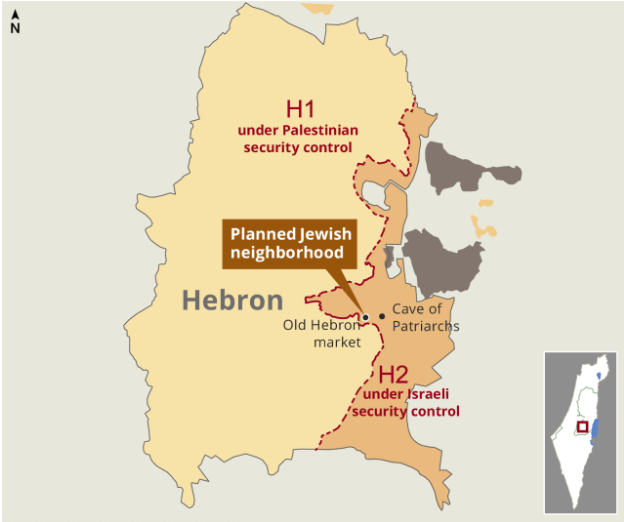
Map by Haaretz
On December 1st, Israeli Defense Minister Naftali Bennet sent a letter to the Hebron Municipality giving the Municipality 30 days to sign off on Israel’s plan to build a new settlement over an historic Palestinian marketplace in downtown Hebron, and threatening that the state will initiate legal proceedings to strip the Municipality of its protected tenancy rights in the marketplace if it does not accept the plan.
Haaretz explains the contention that the state made in the letter:
“The Israeli custodian of government and abandoned property in the West Bank claims that government has a legal basis to evict the municipality from the market and as a practical matter, to lift its standing as a protected tenant since the municipality has another marketplace at its disposal (the location of the other marketplace was not specified). The letter states that the municipality will retain its rights to the new property’s ground floor if it doesn’t oppose the plan…Samer Shehadeh, who represents the municipality, claims that Israel needs the municipality’s consent for its proposed plan because the protected status rights include the entire site, including air rights to build additional floors or demolish existing buildings. He disputes that there are legal grounds for rescinding the municipality’s standing as a protected tenant. ‘This letter is akin to a threat and an attempt to pressure the municipality to grant its consent to the move, but it will never happen,’ he said.”
Peace Now responded to Bennet’s letter, saying:
“The legal acrobatics have reached new heights when it comes to expanding the settlements. Ethical standards are being trampled to satisfy an extremist minority that wishes to deepen control and entrench the apartheid that exists in the Hebron settlement. This is an additional example proving the extent to which the occupation is messianic.”
On December 9th, the Palestinian Fatah party led a general strike in Hebron to protest Israel’s plan.
High Court Asks State to Consider (Maybe, Just Maybe, but Not Necessarily) Allowing Palestinians to Access their Land
On December 11th, the Israeli High Court of Justice asked the state to consider allowing Palestinian landowners to access their land which was previously stolen from them by settlers who built the Amona outpost. The state was given 15 days to consider and respond to the court’s request.
The illegal Amona outpost was evacuated by Israel in February 2017. Since then, the Israeli Civil Administration has classified the site as a “closed military zone,” preventing Palestinian landowners (whose legal ownership of the land Israel officially recognizes) from accessing their land. At the same time, Israeli settlers have repeatedly returned to the area attempting to reestablish the Amona outpost, and have even held IDF-protected celebrations there.
In January 2019, the Israeli NGO Yesh Din launched a legal petition to reverse the military order, restore access to the land for Palestinians, and enforce orders prohibiting settlers from trespassing on the land. In response, the state claimed that the order was meant to prevent friction between Palestinians and settlers (in effect, Palestinians are being barred from access to their own land in order to placate settlers who stole the land from them in the first place). The recent ruling was given in response to this case.
New ICC Report Expresses “Concern” Over Israeli Annexation; Palestinian Groups Slam Report as Legitimizing the Fragmentation of Palestine
On December 5th, the Office of the Prosecutor of the International Criminal Court (ICC) released a report providing an update on all the current inquiries before the court, including a section on the nearly 5-year preliminary investigation into “The Situation of Palestine.”
In the report, ICC Chief Prosecutor Fatou Bensouda states that the preliminary investigation is nearly complete (a statement she also made in the 2018 version of the same report), and, notably, expressed concern about Israel’s plan to annex the Jordan Valley. The latter remark reportedly prompted Israeli Attorney General Avichai Mandleblit to warn Netanyahu that moving forward with his plan to annex the Jordan Valley is likely to trigger the opening of investigations into IDF officers and Israeli settlers.
At the same time, Palestinian rights groups slammed the new report on several counts, most substantively centered on the report’s treatment of the Gaza Strip as separate from the West Bank and East Jerusalem. In a lengthy and detailed statement, civil society groups Al-Haq, Al Mezan, and PCHR said:
“Our organizations reject and condemn in the strongest manner what can only be described as a territorial reordering by the Office of the Prosecutor, in describing the West Bank and East Jerusalem as under the ‘control’ of Israel, and therefore occupied territory, while presenting the Gaza Strip separately as an area of ongoing hostilities. This assessment is manifestly out of step with agreed international positions on the status of the West Bank, East Jerusalem and the Gaza Strip as comprising the occupied Palestinian territory since 1967, as determined by the myriad of UN Human Rights Council Resolutions, UN General Assembly Resolutions, UN Security Council Resolutions, the in-depth findings of UN Commissions of Inquiry, and an Advisory Opinion of the International Court of Justice. Our organizations remind that the territory of the West Bank, East Jerusalem and the Gaza Strip is internationally recognized as one territorial legal unit. We further remind that the failure to include the status of the Gaza Strip as occupied territory resiles from previous reports of the Office of the Prosecutor, which consider that ‘the prevalent view within the international community is that Israel remains an occupying power in Gaza despite the 2005 disengagement’. As such, the report feeds into Israel’s fragmentation of the occupied Palestinian territory, for the purposes of its colonialist territorial expansion, a fragmentation that is further entrenched by the application of different legal regimes in the West Bank, East Jerusalem and the Gaza Strip, the denial of freedom of Palestinian movement through its construction of Annexation Wall and checkpoints in and around the West Bank and Jerusalem, military walls, fences, buffer-zones, watchtowers and drone surveillance surrounding and imprisoning over 2 million people in the Gaza Strip, where Israel also retains undisputed control over the territorial water and airspace. Additionally, Israel’s continued effective control over all Palestinians through, inter alia, the Population Registry, denial of family reunifications, denial of return of Palestinian refugees, denial of freedom of movement of people, goods and services throughout the occupied territory, and the division of the Palestinian population through a discriminatory ID system, have fragmented families for decades throughout the OPT.”
Netanyahu and Pompeo Discuss [or didn’t discuss?] Jordan Valley Annexation
Following their meeting on December 4th in Portugal, Israeli PM Netanyahu and U.S. Secretary of State Mike Pompeo had a diplomatic tiff over whether the two discussed Israeli annexation of the Jordan Valley.
Briefing reporters immediately following their meeting, Netanyahu said that they discussed annexation:
“[I] discussed with Pompeo the annexation of the Jordan Valley. Clearly it will be easier [if the Jordan Valley is annexed under] a government and not a transitional government which is much more complicated, we are looking for solutions.”
Responding to inquiries prompted by Netanyahu’s statement,, Assistant Secretary of State for Near Eastern Affairs David Schenker said:
“there was no annexation plan, full or partial, for any part of the West Bank was presented to – by Israel to the United States during the meeting.”
Cutting straight through the American diplomatic denial, Netanyahu clarified by telling the press that they did not discuss an annexation plan but they did discuss annexation:
“I want American recognition of our sovereignty in the Jordan Valley…It was said that we had not discussed a formal plan and that was true, but the issue was raised and I raised it with Secretary of State Pompeo and I intend to raise the issue with the Trump administration.”
As of this writing, there has been no further clarification from the United States.
Bonus Reads
- “When the Settlement Bloc Expands” (Haaretz)
Welcome to FMEP’s Weekly Settlement Report, covering everything you need to know about Israeli settlement activity this week.
To subscribe to this report, please click here.
November 22, 2019
-
- Trump Administration Reverses U.S. Policy on Legality of Israeli Settlements
- A Quick Review of U.S. Settlement Policy
- Reactions to the New U.S. Settlement Policy
- European Union Rejects Conflation, Upholds Labelling of Goods from Settlements
- Will the Trump Admin Implement Conflation by Changing U.S. Labelling Policy?
- Netanyahu Backs Bill to Annex the Jordan Valley
- Tender Published for First Ever Ma’ale Adumim Hotel
- Bonus Reads
Questions/comments? Contact Kristin at kmccarthy@fmep.org
Trump Administration Reverses U.S. Policy on Legality of Israeli Settlements
On November 18th — on the heels of the European Court of Justice’s ruling in support of accurate labeling of settlement products — U.S. Secretary of State Mike Pompeo announced that a comprehensive legal review by the State Department concluded that Israeli settlements are not “per se inconsistent with international law”:
“We believe that what we’ve done today is we have recognized the reality on the ground. We’ve now declared that settlements are not per se illegal under international law, and we have provided…the very space for Israel and the Palestinians to come together to find a political solution to this very, very vexing problem.”
According to a senior White House official, U.S. Ambassador to Israel David Friedman drove the effort to change U.S. policy on settlements, a mission that the ideologically-driven Ambassador began working on from the early days of his appointment. Friedman, who is much closer to President Trump than Secretary Pompeo, offered a much more succinct and direct description of the latest policy shift, tweeting:
“After commissioning a lengthy and comprehensive review of the issues, Secretary Pompeo has concluded that Israeli civilian settlements in Judea and Samaria are not categorically illegal.”
Pompeo also stated that the U.S. will defer to Israeli courts concerning the legality of specific settlements – in effect suggesting that the U.S. is treating Israel as the sovereign power in the West Bank with sole authority to determine the legality/illegality of construction in it (a position which is arguably indistinguishable from recognition of Israeli annexation):
“we recognize that – as Israeli courts have – the legal conclusions relating to individual settlements must depend on an assessment of specific facts and circumstances on the ground. Therefore, the United States Government is expressing no view on the legal status of any individual settlement. The Israeli legal system affords an opportunity to challenge settlement activity and assess humanitarian considerations connected to it. Israeli courts have confirmed the legality of certain settlement activities and has concluded that others cannot be legally sustained…”
As a reminder, the Israeli High Court of Justice is currently weighing major cases related to settlements, and specifically to the right of Israel to retroactively “legalize” illegal settler construction by means of seizing private Palestinian land. These cases highlight the fact that, in the opinion of Israel’s top law enforcement official, Israel has the right to suspend the rule of law to expropriate privately owned Palestinian land in the occupied West Bank and give it to Israeli settlers; the only disagreement he has with the Knesset is over the method of doing so. Specifically, the cases revolve around two competing legal strategies for legalizing outposts, as put forward by the government of Israel:
- The “market regulation” principle is a legal strategy developed by Israeli Attorney General Avichai Mandleblit in November 2017. According to this principle – which contradicts any notion of rule of law or the sanctity of private property rights – Israeli settlement structures and outposts built illegally on private Palestinian land can be legalized by the State if the State determines that the Israeli settlers acted “in good faith” when they took over and built on the land. The principle has been twice accepted by the Jerusalem District Court as a valid basis for taking land/legalizing settlement structures; it is now pending, on appeal, before the Israeli High Court, in two separate cases (the Mitzpe Kramim outpost case and the Alei Zehav outpost case). How the Court rules in these cases will, in effect, be the final decision on the constitutionality of the “market regulation” principle. (Note for readers who are deep follow this issue in detail: the market regilation principle was first advanced in relation to the Haresha outpost; the State subsequently found yet another basis (in this case, construction of a road) for temporary expropriating privately owned Palestinian land to pave the way for the retroactive legalization of Haresha).
- The settlement “Regulation Law” was passed by the Knesset in February 2017. Its purpose is, in effect, to direct the Israeli government to literally suspend the rule of law to seize privately owned Palestinian land for the benefit of settlers. The law was quickly challenged by civil society groups and has ever since been frozen while the High Court of Justice considers its constitutionality. Despite the freeze, in December 2018 the Israeli Cabinet voted unanimously to endorse a bill – called the “Young Settlements Bill” or “Regulation Law 2” – that, on the basis of the Regulation Law, directs the government to treat 66 unauthorized outposts built on privately owned Palestinian land as legal settlements, while giving the government 2 years to find a way to legalize them retroactively. It should be noted that Israeli Attorney General Mandleblit opposed both the Regulation Law and the “Young Settlements Bill,” and in fact called on the High Court of Justice to overturn the Regulation Law (in favor of his own “market regulation principle.” In a letter to the High Court Justices, Mandleblit argued that implementing the “market regulation principle” is “a more proportionate and balanced measure than the arrangement prescribed in the Regulation Law,” providing a more narrow legal basis by which Israel can strip Palestinian landowners of their rights (estimating that 2,000 structures can be legalized under the “market regulation principle,” compared to an estimated 4,000 under the Regulation Law).
FMEP tracks all Knesset, Cabinet, and Judicial action related to annexation in its Annexation Policy Tables. For Knesset legislation related to annexation, see Yesh Din’s handy Annexation Legislation Database.
A Quick Review of U.S. Policy on Settlements
The Nov. 18th announcement adds yet another chapter to the decades-long dance of U.S. Presidents articulating the stated U.S. policy vis a vis Israeli settlements, which by and large has remained remarkably consistent.
The closest U.S. policy has ever come to calling the settlements illegal was under the Carter Administration, which produced the Hansell Memorandum to Congress stating that the U.S. holds settlements are “inconsistent with international law.” However, Carter’s Chief of Staff wrote an even further in a memo where he wrote “Our position on illegal settlements is well know.” The memo used the term “illegal” 16 times.
In 1981, U.S. President Ronald Reagan softened the Carter Administration’s language, instead insisting that settlements are merely harmful to the peace process, language which has been echoed, if not in exact wording, by all the following administrations. Notably, President Reagan was the first U.S. President to call for a settlement freeze.
Under Pres. George H.W. Bush, the stated U.S. policy was to “oppose new settlements in territories beyond the 1967 lines.” Bush then insisted on conditioning U.S. loan guarantees to Israel based on Israel’s settlement activity.
President Clinton called the settlements an “obstacle to peace” and later, in 2001, said that the settlement enterprise “is inconsistent with the Oslo commitment.”
The “Roadmap” produced by President George W. Bush insisted on a settlement freeze and the evacuation of outposts.
The Obama Administration continued to call for a settlement freeze. At the tail end of the Obama Adminstration, in December 2016, Pres. Obama abstained from vetoing (but did not actively support) the passage of UN Security Council Resolution 2334, which declared that Israeli settlements in the West Bank and East Jerusalem have “no legal validity and constitutes a flagrant violation under international law.” While pains have been taken by the U.S. to perfectly enunciate its publicly stated policy, successive Israeli governments have continued to build settlements in the West Bank and East Jerusalem without consequences.
Noura Erekat, Palestinian human rights attorney, legal scholar, writer, and assistant professor at Rutgers University, explains the consistency in U.S. settlement policy over the years:
“This is not necessarily a reversal in U.S. policy, only in its stated policy. For 50 — for more than five decades, since 1967, all U.S. administrations have talked out of both sides of their mouth. On the one hand, they have condemned settlements as counterproductive to peace and as a contravention of international law, and, on the other hand, have provided Israel with the unequivocal diplomatic, military and financial aid in order to entrench their settlements. Even the Obama administration, as it was abstaining on U.N. Security Council Resolution 2334 condemning the settlements as a flagrant violation, has been part of the problem. They issued that abstention only two weeks before they left office. Simultaneously, the Obama administration increased aid from $3 billion to $3.8 billion a year. And in 2012, that same administration used its first veto at the Security Council to condemn a resolution, a U.N. Security Council resolution condemning settlements using exact U.S. foreign policy language on settlements. So, what we’re seeing now is not a sharp reversal of U.S. foreign policy on the question of settlements and Palestine, but instead the culmination of it. For us to blame this on Trump is basically to exculpate ourselves and to create a revisionist history. Instead, we should be accountable and actually take responsibility for how we have been part of this problem.”
The overwhelming majority of the international community holds that all Israeli settlements and outposts in the West Bank are illegal pursuant to Article 49 of the Fourth Geneva Convention, which states (as excerpted by Amnesty International):
“The Occupying Power shall not deport or transfer parts of its own civilian population into the territory it occupies.” It also prohibits the “individual or mass forcible transfers, as well as deportations of protected persons from occupied territory”.
Reactions to the New U.S. Settlement Policy
The following are statements made by key international actors, organizations, and civil society organizations in reaction to the U.S. settlement announcement. Reactions from Israel – both predictable and unpredictable – are nicely summarized and analyzed by The Times of Israel settlements correspondent Jacob Magid here.
Palestinian Authority Foreign Minister Riyad Malki called on the international community to issue a firm response to the U.S. declaration, saying in a statement:
“The State of Palestine condemns in the strongest terms the US administration’s lawless position on Israel’s illegal settlements in occupied territory of the State of Palestine, as announced by the Secretary of State Mike Pompeo. This position violates international law, decades-long international consensus over the issue and determinations of the International Court of Justice, the High Contracting Parties to the Geneva Conventions and United Nations resolutions, including Security Council resolutions. The current US Administration has adopted an anti-Palestinian agenda and endeavored to empower and legitimize the Israeli colonial settler agenda. This ideologically driven and irresponsible policy, including this most recent announcement by Secretary Pompeo, proves beyond any doubt that the current US administration has aligned itself with Israel’s illegal colonial enterprise and thus fails to meet the most basic requirements to play any role in any future solution. This administration cannot and will not rewrite international law. However, the Trump administration’s disregard to the Palestinian people’s inalienable rights is symptomatic of its disregard and contempt to the rules-based international system and multilateralism, whose effects go beyond the Question of Palestine. Allowing this agenda to prevail would ensure the demise of the international order and cause irreversible damage to the achievements of humanity over the past seven decades and threatens to plunge the world into chaos and violence. The State of Palestine will not stop pursuing justice and redress for the Palestinian people. The Palestinian leadership will continue to take all measures possible to honor its moral and political responsibility towards our people, and defend their national rights including their natural right to a life of dignity, freedom and prosperity.”
Jordan Foreign Minister Ayman Safadi said in a tweet:
“Settlements in occupied Palestine are a blatant violation of Int’l law & UNSCRs. They are an illegal action that’ll kill 2-state solution. Jordan’s position in condemning them is unwavering. We warn against dangerous consequences of US change of position on settlements on MEPP”
The Saudi press reported that the Saudi government rejects the new U.S. position.
U.N. human rights spokesman Rupert Colville said at a press briefing:
“We continue to follow the long-standing position of the U.N. that Israeli settlements are in breach of international law. A change in the policy position of one state does not modify existing international law nor its interpretation by the International Court of Justice and the Security Council.”
United Nations Special Rapporteur Michael Lynk said that the U.S. announcement is:
“the latest in a series of recent moves that has undermined the rules-based international order. This will only confirm a one-state reality characterized by a rigid two-tier system of legal and political rights, based on ethnicity and religion. This would meet the international definition of apartheid.”
The European Union’s High Representative/Vice-President Federica Mogherini said in a statement:
“The European Union’s position on Israeli settlement policy in the occupied Palestinian territory is clear and remains unchanged: all settlement activity is illegal under international law and it erodes the viability of the two-state solution and the prospects for a lasting peace, as reaffirmed by UN Security Council Resolution 2334. The EU calls on Israel to end all settlement activity, in line with its obligations as an occupying power. The EU will continue to support a resumption of a meaningful process towards a negotiated two-state solution, the only realistic and viable way to fulfil the legitimate aspirations of both parties.”
Reportedly, the state of Hungary blocked an effort by the European Union to issue a joint statement signed by all 28 member states condemning the new U.S. policy. Many European states issued independent statements, all opposing the U.S. statement.
The German government issued a statement saying:
“The Federal Government reaffirms its position with regards to Israel’s settlement policy in the occupied territories. In the Federal Government’s view, the construction of settlements is illegal under international law, represents an obstacle to the possibility of a peace process and makes a negotiated two-state solution more difficult. We wish to refer in this regard to Resolution 2334 of the UN Security Council, which reaffirms this assessment under international law. Together with its partners in the EU, the Federal Government will continue to work to achieve an amicable negotiated solution that takes into account the legitimate demands of both parties to the conflict.”
The French government released the following statement:
“Israel’s settlement policy in the occupied territories is illegal under international law, in particular international humanitarian law, and contravenes Security Council resolutions. Colonization also contributes to escalating tensions on the ground and undermines the two-State solution. Such is the constant position of France. We regret any decision likely to encourage the continuation of colonization.”
Switzerland released a statement saying:
“Switzerland’s position towards Israeli settlements is very clear: they are illegal under international law, in particular the Fourth Geneva Convention. They also constitute a major obstacle to peace and the implementation of a two-State solution. Switzerland regularly calls on the Israeli authorities to cease all settlement activity, in accordance with their obligations as the occupying power.”
Spain released the following statement:
“The Government of Spain wishes to reiterate its public and constant position on the settlements, which coincides with the collection in various resolutions of the United Nations, especially Resolution 2334 of the Security Council, of December 2016. Spain considers, as stated in the aforementioned resolution , that the settlements in the territories occupied by Israel since 1967 have no legal validity and constitute a flagrant violation of International Law. They are also an obstacle to the negotiated solution of the two States and the achievement of a just and lasting peace that meets the legitimate aspirations of both parties. Therefore, the Government of Spain calls for an end to the settlements, in line with that made by the High Representative of the European Union.”
A spokesman for the International Committee of the Red Cross said:
“the ICRC has repeatedly stated that Israel’s settlements policy goes against key provisions of IHL, or the law of occupation, and is contrary to its intent and spirit. The recent U.S. declaration does not change the ICRC’s position on the matter.”
The Vatican released the following statement:
“In the context of recent decisions that risk undermining further the Israeli-Palestinian peace process and the already fragile regional stability, the Holy See reiterates its position of a two-state solution for two peoples, as the only way to reach a complete solution to this age-old conflict. The Holy See supports the right of the State of Israel to live in peace and security within the borders recognized by the international community and supports the same right that belongs to the Palestinian people, which must be recognized, respected and implemented.”
Peace Now said in a statement:
“No declaration will change the fact that the settlements were built on occupied territory, in contravention of international law, and that they pose among the greatest obstacles to peace. It is an Orwellian absurdity to claim that greenlighting more egregious settlement activity by undermining the international consensus against them will foster better conditions for a just and viable conflict-ending agreement.”
B’Tselem said in a statement:
“The Trump Administration’s farcical announcement doesn’t just green-light Israel’s illegal settlement project, but also other human rights violations around the world by obliterating the principles of international law. In so doing, the American administration is pushing the world over 70 years backwards, to the period at the end of the 2nd world war, when only in its aftermath did the world come to terms with the consequences of the absence of such protections.”
The Association for Civil Rights in Israel said in a statement:
“Settlements and outposts are illegal under international law, and no political declaration can change that fact. The settlements, which are founded on occupied Palestinian land, lead to a continued and systematic violation of the rights of Palestinians living in the West Bank. To legalize such a sweeping violation and to justify the institutionalized legal regime of two legal systems in the West Bank-based on an ethnic-national basis violates the rights of millions of people living under occupation and cannot be justified via a baseless statement stemming from purely political interests.”
Amnesty International said in a statement:
“Today, the United States government announced to the rest of the world that it believes the U.S. and Israel are above the law: that Israel can continue to violate international law and Palestinians’ human rights and the U.S. will firmly support it in doing so.”
Human Rights Watch said in a statement:
“This changes nothing. President Trump can’t wipe away decades of established international law that settlements are a war crime.”
J Street said in a statement:
“The International Court of Justice and the United Nations have made clear the judgment of the world that Israel’s settlement enterprise is illegal under international law. This administration’s attempt to unilaterally erase those judgments only further shatters America’s limited remaining credibility in the region and around the world.”
Americans for Peace Now said in a statement:
“This latest announcement by the Trump administration will do further damage to prospects for peace, particularly if it is taken by right-wing Israeli politicians as yet another indication that President Trump will accept Israeli annexation of parts of the West Bank. This damages US national interests which, as successive US administrations of both parties have held, will be served by a peaceful resolution to the Israeli-Palestinian conflict. Meanwhile, in bucking the international legal consensus on the status of settlements in territory occupied by Israel, the Trump administration is deepening America’s isolation. It is also chipping away at the international legal order the US helped established, which has served US interests since the end of World War II.”
Jewish Voice for Peace said in a statement:
“The pronouncement by Pompeo is just the latest atrocity in the Trump administration’s farcical peace plan: Moving the U.S. embassy to Jerusalem, defunding UNRWA, embracing Netanyhau’s plans of massive annexation of Palestinian land, and now an attempt to undo decades of international consensus on the illegality of the settlements. That the plan is devoid of peace is no surprise, but the contempt it shows for cooperation and an agreed-upon set of ethics that safeguards the most vulnerable in war and conflict is alarming. Pompeo couldn’t be more wrong claiming that, ‘arguments about who is right and who is wrong as a matter of international law will not bring peace.’ In fact, holding ourselves and each other to principles, like those within international law, is essential to bring not just peace, but freedom, equality and justice. The Trump administration was never focused on promoting peace, but instead on propping up Netanyahu’s and Trump’s careers and perpetuating Israeli control and dominance over Palestinian land and lives at all costs. Pompeo and the Trump administration don’t get to rewrite international law.”
European Court Rejects Conflation, Upholds Labelling of Goods from Settlements
On November 12th, the European Court of Justice (ECJ) ruled that EU member states must properly identify products made in Israeli settlements on their labels, a decision upholding the EU’s legal distinction between Israel proper and Israeli settlements in the occupied territories.
The ECJ said in the ruling:
“[settlements] give concrete expression to a policy of population transfer conducted by that State outside its territory, in violation of the rules of general international humanitarian law…[failure to identify the point of origin of produce meant that] consumers have no way of knowing, in the absence of any information capable of enlightening them in that respect, that a foodstuff comes from a locality or a set of localities constituting a settlement established in one of those territories in breach of the rules of international humanitarian law.”
The case came to court after the Psagot Winery, located in the Psagot settlement, brought a legal challenge against France’s labelling policy, arguing that any differentiation between Israeli products and products made in the settlements is discriminatory. In June 2019, a top advocate general for the European Court of Justice issued a preliminary opinion rejecting that argument and stressed that EU law requires labelling products based on their true origin in order to give customers the necessary information to make informed purchasing decisions. Reportedly, Psagot Winery hired a prominent U.S. lobby firm (which employs former US ambassador to the EU Stuart Eizenstat) to lobby Congress on its behalf against the labeling effort.
Commenting on the ECJ’s ruling, Palestinian negotiator Saeb Erekat urged further action, writing in a column in Haaretz:
“A large percentage of settlers live in occupied Palestine thanks to the economic incentives they receive, including benefits from international agreements signed with Israel, and the support of several organizations working freely in Western countries, such as the Jewish National Fund. That is why the decision of the European Union Court of Justice regarding the labeling of Israeli settlement products is an important step. It reiterates the international obligation of differentiation between Israel and the territory it occupies, as laid out in UN Security Council resolution 2334.Still, we believe that settlement products shouldn’t just be labelled, but banned. There is nothing ethical in trading in products made with stolen natural resources on stolen land. That is why we cannot understand why the UN High Commissioner for Human Rights, Michelle Bachelet, still hasn’t fulfilled the mandate given to her by the UN Human Rights Council in Resolution 31/36 – to publish the long-overdue list of companies involved with the Israeli occupation.”
Unsurprisingly, the Trump Administration issued a statement criticizing the court’s ruling:
“The United States is deeply concerned by the EU requirement identified in the decision issued yesterday by the Court of Justice of the European Union (CJEU) in the Psagot Case. The circumstances surrounding the labeling requirement in the specific facts presented to the Court are suggestive of anti-Israel bias. This requirement serves only to encourage, facilitate, and promote boycotts, divestments, and sanctions (BDS) against Israel. The United States unequivocally opposes any effort to engage in BDS, or to otherwise economically pressure, isolate, or otherwise delegitimize Israel. The path toward resolving the Israel-Palestinian conflict is through direct negotiations. America stands with Israel against efforts to economically pressure, isolate, or delegitimize it.”
As explained at length by FMEP’s Lara Friedman, forces in the U.S. have long worked to conflate Israel with its settlements as a matter of U.S. law and policy — including actions in Congress (i.e., legislation conflating the two, Congressional actions objecting to differentiation in labeling, etc.).
Will the Trump Admin Implement Conflation by Changing U.S. Labelling Policy?
Speaking to Al-Monitor, FMEP President Lara Friedman warns that the timing of the Trump Administration’s settlement policy announcement might be linked to the ruling last week by a European court upholding the EU’s policy of differentiation and ruling that products made in Israeli settlements cannot be labelled “Made in Israel.” Friedman said:
“I don’t think it is a coincidence that this is happening days after the European Court of Justice ruling on labeling. That is clear. The substantive impact will depend on what flesh we [the U.S.] put on the bones. The President, the State Department can tell Customs and Border to change our policy on labeling [of goods produced from the settlements].”
If the policy change is directed by the White House, it would be doing so with ample standing in U.S. law as passed by the Congress, which for the past four years has intentionally included wording the explicitly conflates Israel with the settlements as far as U.S. law is concerned. Lara Friedman has maintained a detailed table documenting such legis;ation, which she first warned about in 2015.
Netanyahu Backs Bill to Annex the Jordan Valley
Following the Nov. 18th announcement changing U.S. policy on Israeli settlements, Israeli Prime Minister Netanyahu agreed to support and expedite the passage of a Knesset bill providing for the annexation of the Jordan Valley – some 25% of land in the occupied West Bank. The bill was introduced on November 3rd by Likud MK Sharren Haskell, and it calls for extending Israeli sovereignty over the area. On November 19th, Haskel tweeted that she has submitted a request to exempt the bill from the mandatory 6-week waiting period, so that it can be brought to a vote next week regardless of the fact that there is a caretaker government while Israeli political chaos continues to unfold.
In a video message posted to Twitter, Netanyahu said:
“The historic decision by the American administration from yesterday hands us a unique opportunity to set Israel’s eastern border and annex the Jordan Valley.”
Netanyahu previously vowed to annex the Jordan Valley should he be reelected, a plan which was endorsed by his rival Benny Gantz and supported by then-U.S. National Security Advisor John Bolton. Notably, when Netanyahu promised to annex the Jordan Valley, he stated that he would have already enacted his Jordan Valley annexation plan if not for Israeli Attorney General Avichai Mandleblit’s opposition to taking a decision of this magnitude while Netanyahu was overseeing a caretaker government.
Shlomo Eldar, columnist for Al-Monitor, discusses the politics that contribute Netanyahu’s sudden endorsement of Haskell’s bill (which had been introduced in the previous Knesset but not supported by Netanyahu):
“It is not clear how the present Knesset will vote on the bill for annexing the Jordan Valley, should it ever come to a vote. What is clear is that the issue of the valley’s annexation has created a catch-22 for Gantz and the Blue and White. A vote in favor by his alliance will lead it to lose Joint List support after the next elections. There is no chance that members of the Joint List will support a faction that endorses any kind of annexation. If Blue and White begins to vacillate and oppose the bill, then Netanyahu will criticize and ridicule them during the election campaign. Therefore Knesset member Avi Nissenkorn (Blue and White), head of the Knesset’s Arrangements Committee, will definitely try to prevent the bill from reaching the stage of a preliminary hearing. Regardless of whether Nissenkorn succeeds, it seems that annexation of the Jordan Valley is on its way, with the encouragement of the Trump administration.”
Under Netanyahu’s own annexation plan, Israel would annex land constituting nearly a quarter of the West Bank (22.3%) including 30 settlements and 18 illegal outposts. According to Peace Now, 20% of the targeted land (62,000 acres) is privately owned by Palestinians and approximately 8,775 Palestinians live in 48 Palestinian herding communities in the area he plans to annex.
In total, some 11,000 settlers and 65,000 Palestinians live in the Jordan Valley – the latter facing severe restrictions on land use and freedom of movement, and lack of access to municipal services like water and electricity. Israeli government officials have publicly and repeatedly demanded complete Israeli sovereignty over the Jordan Valley in the context of any peace agreement, meaning that any future Palestinian state would be entirely encircled by Israel, having no international border with any other nation.
Yesh Din tracks all Knesset legislation related to annexation in this handy Annexation Legislation Database, and FMEP tracks all Knesset, Cabinet, and Judicial action related to annexation in its Annexation Policy Tables.
Tender Published for First Ever Ma’ale Adumim Hotel
On November 18th, the Israel Lands Authority published a tender for the construction of a six-story hotel in the Ma’ale Adumim settlement, located in the West Bank just east of Jerusalem. The Jerusalem Post reports:
“Hagit Ofran of Peace Now said tenders have unsuccessfully been published for hotels in Ma’aleh Adumim in the past. Such development should be inside of sovereign Israel and not outside of it, she said, adding that it does not serve Israel’s interest to encourage tourism in the West Bank settlements.”
Israel’s intentional investment and green light to expanding the settlement tourism industry is a strategic endeavor intended to entrench settlements, provide for their expansion, normalize their existence within the international community, and advance their seamless integration into Israeli territory. In a recent report on companies which profit from tourism in the settlements, Amnesty International further explains:
“In recent years the Israeli government has invested huge sums to develop the tourism industry in settlements. It uses the designation of certain locations as tourist sites to justify the takeover of Palestinian land and homes, and often deliberately constructs settlements next to archaeological sites to emphasize the Jewish people’s historic connections to the region.”
Bonus Reads
- “With softening of US settlement policy, is annexation train leaving the station?” (Times of Israel)
- “Secular Israelis Flock to West Bank Settlements in Search of Good, Cheap Life” (Haaretz)
- “The Problem With Settlements Is Not That They Are Illegal. It’s That They Are Immoral” (The Forward)
- “On West Bank, No One Rests Easy, No Matter What U. S. Says About Settlements” (New York Times)
- “Stop Calling Violent Settlers Bad Apples. They Are The Inevitable Outcome Of Occupation” (The Forward)
- “West Bank settlers escalate attacks on Arab olive harvesters in annual violence” (Washington Post)
- “‘It’s So Easy to Live Here.’ Jewish Settlements Go Mainstream in Israel” (Wall Street Journal)
Welcome to FMEP’s Weekly Settlement Report, covering everything you need to know about Israeli settlement activity this week.
To subscribe to this report, please click here.
November 8, 2019
- Israel Advances Plans for 2,342 New Settlement Units
- Israeli Government Approves Settler-Initiated Plans for Cable Car in Jerusalem — Despite Professional, Human Rights Objections
- Israel Plans to Build a New Waste Treatment Plant (to serve Israelis) in the West Bank
- No More Waiting: MKs Introduce Annexation Bills Despite Political Deadlock
- Annexation-via-New Roads (the new Smotrich Plan)
- Annexation-via-Movies (Govt-Funded Settlement Hasbara)
- Annexation-via-Education (Ambassador Friedman’s Favorite Medical School)
- Settler Leaders Elect New Chairman of the Yesha Council
- Israeli Official Calls on Evangelicals to Defend Settlements, Fight BDS, and Support “Economic Peace”
- Bonus Reads
Questions/comments? Contact Kristin at kmccarthy@fmep.org
Israel Advances Plans for 2,342 New Settlement Units
With little attention, on October 10th the High Planning Council – a body within the Israeli Defense Ministry’s Civil Administration, responsible for regulating all construction in the West Bank – advanced plans for 2,342 new settlement units, as well as for two additional settlement projects. Of that total, 719 units were approved for validation (the penultimate step in the planning process), and 1,623 settlement units were approved for deposit for public review (an earlier but decisive stage in the planning process).
The 719 units which received final approved for validation comprise:
- 207 units in the Bracha (aka Har Bracha) settlement, located south of Nablus. In September 2019, the Israeli Central Command signed an order that expanded the settlment’s jurisdiction, a move which paved the way for the approval of these new units (see our September 2019 report). According to Peace Now, this plan – if implemented – will significantly expand both settlement’s population and its physical footprint.
- 206 units in the Tzofim settlement, located north of the Palestinian town of Qalqilya – a town completely encircled by Israel’s seperation barrier (except for a single road connecting it to the rest of the West Bank) – in the northern West Bank.
- 166 units in the Alei Zahav settlement, located in a string of settlements stretching across the northern West Bank. Alei Zahav and its settlement neighbors create a contiguous Israeli populated areas linking Israel proper (west of the Green Line) all the way to the Ariel settlement, located in the heart of the West Bank (the eastern end of Ariel is closer to the Jordan border than to the Green Line). Notably, Alei Zahav is one of the settlements in which the “market principle” has been applied to legalize settlers theft of land recognized by Israel as belonging to Palestinians (see our July 2019 report).
- 140 units in the Mezadot Yehuda settlement, located at the very southern tip of the West Bank, just south of the Palestinian village of Susya, which the Israeli government has been threatening to demolish for years. This plan would nearly double the number of authorized units in the settlement.
Also receiving final approval for validation:
- A plan to retroactively legalize the illegal Brosh outpost in the Jordan Valley. According to Peace Now, the Brosh settlement serves as an educational institution that houses hundreds of students and families of staff members.
- A plan to build a tourist/visitors center in the Shilo settlement – where settlers and the Israeli government have been investing in developing tourism sites for Jewish and evangelical tourists.
The 1,623 units which were deposited for public review include:
- 609 units in the Beitar Illit settlement, located west of Bethlehem, near the Green Line. Beitar Illit is a massive, fast-growing ultra-Orthodox settlement.
- 382 housing units in the Dolev settlement, located west of Ramallah. This is a significant plan for Dolev, as it will more than double the number of existing units. Prime Minister Netanyahu previously promised to build 300 new units in Dolev in response to a Palestinian-perpetrated bombing at a spring (which settlers had taken over from Palestinians) near the settlement that killed a 17-year old Israeli and injured several others.
- 182 units in the Mevo’ot Yericho settlement, located north of Jericho in the Jordan Valley. The validation of this plan is the actualization of the Israeli security cabinet decision to grant the illegal outpost of Mevo’ot Yericho retroactive legalization, an action for which the security cabinet urgently convened on the eve of the September 19th elections. The plan approved by the High Planning Council on Oct. 10th granted legalization to the existing 20 existing units and, if implemented, will allow the settlement to significantly expand.
- 146 units in the Kfar Etzion settlement, located southwest of Bethlehem.
- 140 units in the Kerem Reim outpost located north west of Ramallah. Peace Now has repeatedly challenged the illegal construction of the Kerem Reim outpost, which the Israeli government retroactively legalized by declaring it a neighborhood of the Talmon settlement even though the areas are non-contiguous. Though a court rejected one Peace Now petition, there is an ongoing case against the Amana settler organization which Peace Now alleges engaged in illegal activities to build the outpost.
- 100 units in the Nokdim settlement, located southeast of Bethlehem. Former Israeli Defense Minister Avigdor Liberman – currently one of the most important figures in the race to form a governing coalition – lives in Nokdim.
- 64 units in the Telem settlement, located west of Hebron.
- A plan to build new shops and services in the Kochav Yakov settlement, located between Jerusalem and Ramallah.
Peace Now said in a statement:
“The figures speak for themselves. Netanyahu continues to sabotage the possibility of a political agreement with the Palestinians by promoting more settlement construction in the West Bank, including in places where Israel may have to evacuate as part of a future agreement. This is yet another dangerous step for both Israel and the Palestinians, led by a transitional prime minister whom the public did not trust in his policies. The next government must put a freeze on the development of settlements and to strive for immediate resumption of negotiations with the Palestinians without preconditions and to end the bloody conflict based on the principle of two states for two peoples.”
The European Union issued a statement criticizing the approvals, saying:
“The European Union’s position on Israeli settlement policy in the occupied Palestinian territory is clear and remains unchanged: all settlement activity is illegal under international law and it erodes the viability of the two-state solution and the prospects for a lasting peace, as reaffirmed by UN Security Council Resolution 2334. Israeli authorities also approved a building permit for the construction of a new tunnel road, which bypasses Bethlehem to the west. The progressive construction of a separate road network, connecting settlements and outposts to each other and to the road network in Israel while circumventing Palestinian towns and communities, is entrenching the fragmentation of the West Bank. The EU calls on Israel to end all settlement activity, in line with its obligations as an occupying power. The EU will continue to support a resumption of a meaningful process towards a negotiated two-state solution, the only realistic and viable way to fulfil the legitimate aspirations of both parties.”
Israeli Government Approves Settler-Initiated Plans for Cable Car in Jerusalem — Despite Professional, Human Rights Objections
On November 4th, the Israeli Housing Cabinet approved a settler-initiated plans to build a cable car line in East Jerusalem, despite the fact that the Israeli Attorney General has not yet rendered a decision on whether plans for such a significant and sensitive project can be advanced by a caretaker Israeli government. Emek Shaveh – an Israeli NGO fighting the politicization of archeology in Jerusalem – announced that it intends to appeal the approval to the Israeli Supreme Court.
As FMEP has repeatedly covered, this Jerusalem cable car project is an initiative of the Elad settler organization (which is building a massive tourism center – the Kedem Center – in the Silwan neighborhood, which will be a stop along the cable car’s route). The scheme is intended to further entrench settler control, via archeology and tourism sites, inside the Silwan neighborhood of East Jerusalem, while simultaneously delegitimizing, dispossessing, and erasing the Palestinian presence there. Non-governmental organizations like Emek Shaveh, Who Profits, and Terrestrial Jerusalem have repeatedly discredited the government’s contention that the cable car serves a legitimate transportation need in Jerusalem, and have clearly enumerated the obvious political drivers behind the plan, the archeological heresies it validates, and the severe impacts the cable car project will have on Palestinian residents of Silwan.
Ir Amim field researcher Aviv Tartarsky told Middle East Eye:
‘The project is a way to whitewash Israel’s taking of areas in Silwan to use for archaeological and touristic reasons…If someone wants to go to the Western Wall of the Old City, they have to go through the ELAD activity centre. This project will give ELAD legitimacy and influence, as it is taking part in a governmental project. This is the political reason for why the government is doing this project,’ Tatarsky said.”
Israel Plans to Build a New Waste Treatment Plant (to serve Israelis) in the West Bank
In October 2019 the Israeli government issued a construction tender to build a waste-to-energy plant in the West Bank, on an area of land that is within the jurisdiction of the Ma’ale Adumim settlement where several Palestinian Bedouin communities live. The plant – which is expected to cost USD $284 million (1 billion NIS) – will treat Israeli-generated waste.
B’Tselem – which previously published a comprehensive report criticizing the illegal Israeli practice of exporting its waste to the occupied territories – writes:
“For many years, Israel has been taking advantage of its power as occupier to transfer the treatment of waste (including hazardous waste) and sewage from its sovereign territory to the West Bank. To that end, it has created a situation in which environmental legislation in the West Bank is much laxer than inside Israel, conveniently overlooking the long-term impact of environmental hazards on the Palestinian population and on natural resources, and neglecting to prepare future rehabilitation plans. This has created a financial incentive to transfer the treatment of environmental hazards from Israel to the West Bank. The Palestinians who live in the occupied territory are the ones to pay the price for this environmental damage, even though they were never asked their opinion on the matter and although, as a population under occupation, they have no political power and no real ability to resist.”
B’Tselem also takes aim at the European Union (EU), which has invested millions in the implementation of the Isareli Ministry of Environmental Protection’s 2030 strategic plan, of which the waste-to-energy treatment plant is a part. B’Tselem writes:
“In 2019, Israel and the EU signed an agreement as part of the EU’s twinning instrument, which establishes cooperation with the EU’s neighboring countries, guaranteeing Israel approximately 1.5 million euros over the next two years to support the Ministry of Environmental Protection’s implementation of its 2030 strategic plan. In the agreement, Israel committed to creating a legal framework that adopts European practices and standardization for sustainable waste treatment. As in every agreement between the EU and Israel, it contains a territorial clause that stipulates that it will not apply beyond Israel’s 1967 borders. Yet the EU’s support for the ministry’s strategic plan – which defines the establishment of the plant at Ma’ale Adumim as a goal and presents the exploitation of West Bank land to resolve environmental problems as a matter of course – empties this annex of meaning. By supporting this plan, the EU will be supplying Israel with knowledge and experience that will help deepen its exploitation of Palestinian land resources and bolster the economic status of the Ma’ale Adumim settlement.”
No More Waiting: MKs Introduce Annexation Bills Despite Political Deadlock
Israeli political figures appear to be done waiting for a new government to be formed before acting on the loud signals from the Trump Administration supporting Israeli annexation of West Bank land.
On November 4th, Yamina party leader Ayelet Shaked filed a bill with the Knesset to unilaterally annex the Jordan Valley, the Ma’ale Adumim settlement just east of Jerusalem, and all 22 settlements and 75,000 Israeli settlers in what is broadly termed the Etzion “settlement bloc” located south of Bethlehem. Shaked’s bill calls for Israel to “apply sovereignty” to these settlements, which in practice would constitute the annexation of the settlements. Applying Israel law to areas outside of Israel’s sovereign borders is de facto annexation, as FMEP has explained and documented.
Shaked urged expeditious consideration of the bill, saying:
“There is a diplomatic window of opportunity and willingness on the part of the US for this kind of annexation that will not return. We cannot afford to hesitate or wait. We must take advantage of this window of opportunity immediately and begin to apply sovereignty over these areas. It is for this reason that the State of Israel cannot be dragged into another election cycle.”
On November 3rd, Likud MK Sharren Haskel submitted a draft bill for the annexation of the Jordan Valley, a bill she has introduced previously without success. Haskel said:
“It’s time to make the residents of the Jordan Valley legal Israeli citizens, thus kick-starting the development and prosperity of the region.The communities of the Jordan Valley and their residents are a strategic resource of the highest order for Israel. There is a wide consensus today about the region, following the long-awaited U.S. president’s recognition of the Golan Heights as under Israeli sovereignty. It is time to do the same with the Jordan Valley. After Blue and White leader Benny Gantz proposed to do the same, I call upon him and my fellow party members to support my proposal.”
In March 2019, ahead of the first round of Israeli elections this year, leaked reports suggested that U.S. diplomats were engaged in discussions with Israel about the latter’s intention to annex several “settlement blocs” – even more so-called blocs than called for by Shaked’s latest plan – following the elections. The reports were not corroborated by U.S. sources, but in the intervening time U.S. Ambassador to Israel David Friedman has made repeated statements to the press (in addition to speculative reporting about a forthcoming U.S. political plan) in support of Israel’s right to annex territory in the West Bank – cues the Israeli government has enthusiastically welcomed. In the lead-up to the September elections, Netanyahu vowed to annex the Jordan Valley should he be reelected, a plan endorsed by his rival Benny Gantz and supported by then-U.S. National Security Advisor John Bolton.
As a reminder, over the years there has been no shortage of attempts to normalize the idea that Israel will retain “settlement blocs” in any negotiated peace agreement — logic that originally applied narrowly to the Etzion bloc (defined on much less expansive terms), Maale Adumim, and, in the eyes of some, Ariel. The terminology has been exploited for decades by the Israeli government to convey legitimacy to building in the so-called “blocs.” Over the years the definition of what is a “bloc” has been twisted to include a much larger idea of the Etzion bloc, as well as the entire Jordan Valley. The implied idea regarding what the blocs are and the fact that they are inarguably Israel’s to keep, is incredibly misleading. The term “settlement blocs” has no formal definition or legal standing, and the future of the blocs – no matter how they are defined – is indisputably a matter at the heart of what will one day be negotiations aimed at a two-state solution (if there is ever to be such a solution). For more context, see resources from Americans for Peace Now here and here. (NOTE: A Haaretz investigation last year estimated that a total of 380,000 Israeli settlers live in the West Bank, of which 170,000 live outside of the so-called blocs, as defined by Haaretz).
Annexation-via-New Roads (the new Smotrich Plan)
On November 1st, Israeli Minister of Transportation Bezalel Smotrich unveiled a new government plan to advance Israeli “sovereignty through transportation.” The plan calls for massive investment (USD $283 million) in new/expanded roads and rails lines, for the express purpose of more seamlessly integrating Israeli settlements into Israel proper. Smotrich made clear that his ultimate goal is the complete integration of the West Bank into the national planning mechanisms of Israel proper. The move will erase the government’s current distinction between transportation projects in the West Bank (across the Green Line) and Israel proper [fun note: the Israeli Ministry of Foreign Affairs has an official map posted on its website entitled, “Transportation and Built-Up Areas” that includes the entire West Bank as part of Israel).
Touting the significance of his plan, Smotrich said:
“I do not give preference to Judea and Samaria [the West Bank] but also am not willing to continue the discrimination. These areas will receive treatment just like anywhere else in Israel. While it is only about roads and trains, it has political significance.”
Smotrich created a new bureau for “Judea and Samaria Planning” within the Transportation Ministry to oversee the implementation of this project, and more generally ensure that the ministry is geared towards serving the settlements as a matter of normal business. The institutionalization of such bureaucratic structures within the Israeli government is a significant, and often overlooked, mechanism by which the Israeli government has been engaging in annexation for years. The new bureau – much like parallel structures former Minister Ayelet Shaked set up in the Justice Ministry – is a formal and public statement that the Israeli government is pursuing (and allocating resources to) annexing the settlements.
It should be noted that Israel has used infrastructure projects in the West Bank to advance its settlement agenda, and to further fragment Palestinian life – two completementary goals powerfully explained by B’Tselem in a recently released interactive: “Conquer and Divide: The Shattering of Palestinian Space by Israel.”
FMEP tracks developments related to the ongoing annexation of West Bank land in its Annexation Policies Tables.
Annexation-via-Movies (Govt-Funded Settlement Hasbara)
On November 6th, Israeli Cultural & Sports Minister Miri Regev announced new government funding for film projects initiated by Israeli settlers. According to the guidelines, the new funding will support Israeli citizens living in West Bank settlements who want to make documentaries and films.It is widely understood that the goal is to encourage the creation of more pro-settlement propaganda.
Celebrating her new initiative, Regev essentially admitted that annexation was her motive, saying:
“I made a promise and I am keeping my promise! We are making history today. The Culture and Sports Ministry will support the regional production of films in the north, and for the first time in Judea and Samaria too, and in the hope that in the near future also in the south… The wheels of cultural justice, which bring to expression the range of voices in Israeli society, have worked quickly and now another stage in correcting the cultural map in Israel has been completed. The artists from the periphery, the north and from Judea and Samaria, will become more and more in the center of things, not just on stage but also on the screens. Soon we will allow them to express their ability and talent.”
One critic of the fund, Israeli producer Liran Atzmor, nailed why the new fund is highly problematic and a tool of de facto annexation:
“Setting up a fund that supports filmmaking in the occupied territories with Israeli taxpayers’ money amounts to creeping annexation, which is happening in many areas, obviously, but is happening now more forcefully in the realm of culture, thanks to this fund. As long as the fate of those territories has not been determined, one cannot accept the fact that public funds are distributed there to people of only one color, one nationality and one religion.”
Shlomo Eldar writes:
“…And that is the whole point, to show life in the settlements in a positive light, as a Zionist enterprise glorifying the State of Israel. Head of the Samaria Regional Council Yossi Dagan described the fund as a ‘giant piece of good news. … I believe this move will bring the story of Judea and Samaria to the big screen. … I call on all artists to take part in this party, to come and film in Judea and Samaria and tell its story, so that we can present the public with other faces and other stories that have yet to be seen on the screen’.”
Libby Lenkinski, Vice President of the New Israel Fund, explained in a tweet:
“Creeping annexation and normalization of settlements is not just happening on the land, it’s also a narrative strategy that uses arts and culture funding to move forward. #StopAnnexation”
Annexation-Via-Education (Ambassador Friedman’s Favorite Medical School)
Despite delays and scandals, the sparkling new medical school at Ariel University has officially launched its first school year, with a ceremony attended by a who’s-who of settlement financiers and supporter rejoicing in the opening of the school and in the implications of its opening for the Greater Israel enterprise.
Dr. Miriam Adelson and her husband, Trump-backer/U.S. casino magnate Sheldon Adelson, were in attendance. The Adelsons donated $20 million to the medical school, which was named after Miriam. Addressing the crowd, Dr. Adelson said:
“In Israel, being Israel, we also had to withstand our tribulations. In Israel, being Israel, there were opponents who tried to block the establishment of a critical institution on ancient Jewish land and to deny us legitimacy. But we won, Zionism won, the truth won.”
U.S. Ambassador David Friedman recited the “shehecheyanu,” a prayer of gratitude to God, as part of his speech, also exclaiming:
“A new medical school has opened in Samaria. It’s worth saying that again: A new medical school has opened in Samaria! How many people ever thought those words would be spoken?…The United States Embassy enjoys warm relations with Ariel University, and we are inspired by its contributions to Israeli society and to the scientific world.” [NOTE: “Samaria” is a biblical name used mainly by settlers and their allies to refer to the northern part of the West Bank]
MK Naftali Bennet put an even finer point on the significance of opening a medical school in Ariel settlement, saying:
“No longer is there a Green Line. We are one [united] Israel and that is how it should be. We are going to serve everyone here.”
There are 70 Israeli students enrolled to attend the settlement university. Even though classes are set to begin, the medical school still does not have an approved budget for the 2020 school year.
As a reminder, the Ariel settlement is located in the heart of the northern West Bank, reaching literally to the midpoint between the Green Line and the Jordan border. The future of Ariel has long been one of the greatest challenges to any possible peace agreement, since any plan to attach Ariel to Israel will cut the northern West Bank into pieces. Nonetheless, in February 2018, the Israeli Knesset passed a law extending the jurisdiction of the Israeli Council on Higher Education to universities in the settlements (beyond Israel’s sovereign borders) – an act of de facto annexation. The law was necessary to ensure that the Ariel settlement medical school (and its graduates) would be entitled to all the same rights, privileges, and certifications as schools and students in sovereign Israel. FMEP has tracked this process, and all other annexation policies in its Annexation Policy tables. A fuller history of the Ariel Medical School saga can be found here.
Settler Leaders Elect New Chairman of the Yesha Council
David Elhayani was narrowly elected to serve as the next Chairman of the powerful settler Yesha Council – an umbrella body representing all the settlement regional councils. Elhayani is a well known personality, having served for 10 years as the head of the Jordan Valley Regional Council (a quasi municipal body serving the needs and interests of settlements in the Jordan Valley).
The Times of Israel’s settlement correspondent Jacob Magid explains the relevant politics involved behind Elhayani’s narrow victory over Yigal Lahav, a younger, more radical voice:
“Elhayani and Lahav represented opposite sides of an intensifying rift between an older generation of settler leaders that is closely aligned with Prime Minister Benjamin Netanyahu and a younger group of council chairmen who believe in acting more aggressively on behalf of the movement, even if that means being at odds with right-wing governments that the Likud chief has led. Elhayani, from the old-timer’s camp, edged out Lahav 13-12 after the votes of 24 West Bank council chairman plus settler elder Zeev ‘Zambish’ Hever were counted.”
Elhayani addressed the dynamics of the old guard (of which he is a part) vs. new, more radical, guard ahead of the elections, saying:
“There’s a crisis of trust in the Yesha Council where many council chairmen don’t see the body as being capable of serving the needs of their residents. Many council chairmen don’t show up to Yesha meetings at all.”
Elhayani promised a more “aggressive” demeanor so that those the Council represents will see that they “finally have someone who will fight for them.” So, despite being what some settlers may consider the “mainstream,” i.e. less willing to aggressively challenge the perceived slow-walking of settlement expansion and annexation by the Israeli government, Elhayani is still best understood as an ideologue in his own right.
Ahead of the vote, Elhayani did offer strong criticism of what he sees to be the Isareli government’s discrimination against the settlements, saying that he will fight for better “quality of life”for the settlements – making infrastructure as a core part of his agenda:
“Our residents are sick of the poor infrastructure that has led to power outages, water shortages and traffic jams. It is the responsibility of settler leadership to provide adequate services. You cannot improve quality of life until you improve infrastructure. We still need to be aggressive in demanding infrastructure improvements in the meantime, in addition to preventing a Palestinian takeover of Area C so that there will be something to [annex] when the time comes.”
Israeli Official Calls on Evangelicals to Defend Settlements, Fight BDS, and Support “Economic Peace”
Speaking to an audience of leaders in the evangelical media world, a top Netanyahu aid asked the crowd to join Israeli government efforts to defend the legitimacy and permanence of the settlements, and coached the crowd on how to frame settlements in a way that advances their normalization.
This was the third annual “Christian Media Summit” hosted by the Israeli Government Press Office to develop the group into “ambassadors for Israel.” According to Haaretz, the 2019 event was attended by approximately 150 journalists, mostly from the United States, working for Christian media outlets from 30 different countries. Entitled, “Between Jerusalem and the Golan: International Recognition,” the event featured addresses by Benjamin Netanyahu and President Reuven Rivlin. U.S. Ambassador David Friedman attended as well.
Speaking to the group, Deputy Chief of Foreign Affairs Reuven Azar said:
“The return of Jews to Judea and Samaria is not a curse, it’s a blessing for all the residents of the area…Calling for their expulsion is a recipe for destruction and for chaos… Look what happened when we went out of Gaza. Our presence in Judea and Samaria [the West Bank], and in Jerusalem brings stability… because we bring security by fighting the bad guys…We must partner in embracing our brothers and sisters who live in Judea and Samaria, and fight against those who claim their presence is illegal, or try to dehumanize them through different means. Help us to fight boycotts, they are not just, and they hurt us and they hurt our neighbors even more. ‘The revival of the Jewish people in the land of Israel is a divine promise being fulfilled…It is a blessing for our people, our region, for the world. A force for good, a force for peace, prosperity and happiness’.”
Following his remarks, the Front for the Protection of Democracy – an Israeli NGO – filed a complaint with the Civil Service Commission seeking disciplinary action against Azar. The Prime Minister’s Office quickly came to Azar’s defense, saying: “Political adviser Reuven Azar expressed government policy.”
Azar repeatedly referred to settlements as “communities” – a term that erases the illegality of those “communities” under international law. This pro-settlement framing was recently endorsed by outgoing U.S. advisor Jason Greenblatt. Azar also touted the now familiar but Orwellian claim that settlements are an economic gift to the Palestinians, claiming that “communities [settlements] in Judea and Samaria [the West Bank] provide opportunities, and jobs…” Azar invited the audience to visit the Barkan industrial zone, stating: “The best paying jobs for Palestinians are in Barkan.”
As FMEP has previously explained, for decades Israel has used industrial zones as another tool to expand and deepen control over West Bank land and natural resources. Industrial zones perpetuate Israel’s economic exploitation of occupied territory (including the local workforce, land, and other natural resources), and that it is Orwellian to label such initiatives as “coexistence” programs, or to suggest that they offer the Palestinians benefits they should welcome. Importantly, jobs in industrial zones – often the only jobs available for Palestinians living under an Israeli occupation that prevents the development of any normal Palestinian economy – are widely viewed by Palestinians as a double-edged sword.
Bonus Reads
- “Five Settlers Arrested on Suspicion of Attacking Israeli Policemen at West Bank Outpost” (Haaretz)
- “Israel’s Right New Bank – The Jewish National Fund” (Haaretz)
- “Why did Microsoft fund an Israeli firm that surveils West Bank Palestinians?” (NBC News)
- “Israeli Schools Teach Pro-settler Religious Nationalism Is the Only Way to Be Jewish” (Haaretz)
- “A Wall, Arrests and Close Surveillance: How Israel Fences in a Palestinian Family” (Haaretz)
- “Hilltop Youth Battle The IDF Over Expulsion Order “ (JNS)
- “Welcomed, then Attacked by Yitzhar” (New Voices)
Welcome to FMEP’s Weekly Settlement Report, covering everything you need to know about Israeli settlement activity this week.
To subscribe to this report, please click here.
September 27, 2019
- Israeli Cabinet Votes to Legalize the Mevo’ot Yericho Outpost, Pledges to Legalize More
- Israel Evicts Another Palestinian Family from its Home in East Jerusalem’s Silwan
- On Israel’s Agenda: Letting Settlers Directly Purchase West Bank land
- A Jerusalem Suburb is Building a Cemetery in the West Bank
- New B’Tselem Report: Apartheid in Hebron
- New Al-Haq Report: Israel Means to Crush Palestinian Life in the Old City of Jerusalem
- Bonus Reads
Questions/Comments? Email Kristin McCarthy (kmccarthy@fmep.org)
Israeli Cabinet Votes to Legalize the Mevo’ot Yericho Outpost, Pledges to Legalize More
On September 15th – two days before elections — the Israeli security cabinet voted to start the process of legalizing the Mevo’ot Yericho outpost, located just north of Jericho in the Jordan Valley. If given final authorization by the next Israeli government, Mevo’ot Yericho will be the sixth official new settlement established by the state of Israel since it signed the Oslo Accords in 1993.
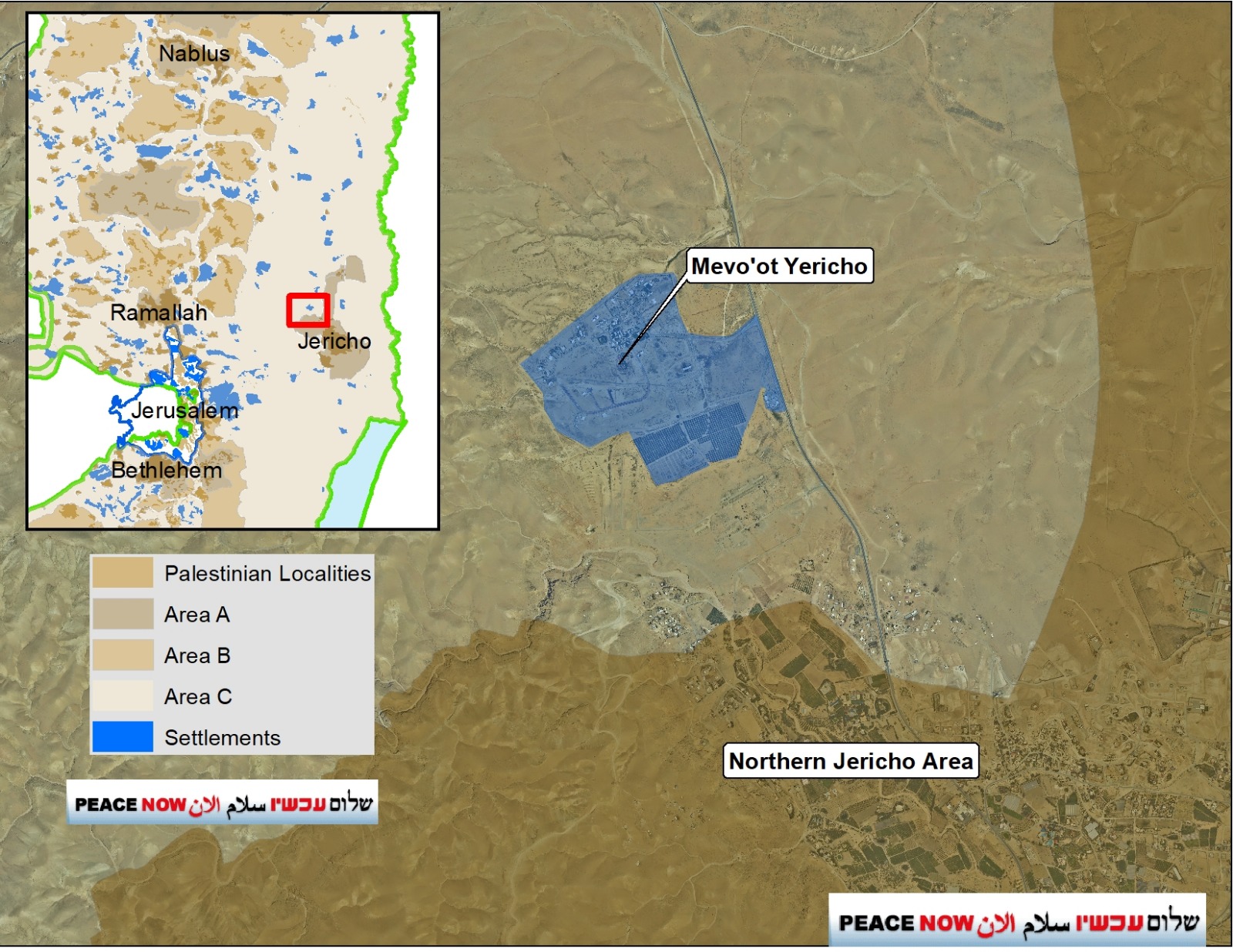
Map by Peace Now
The Israeli Cabinet approved the plan during a meeting held, exceptionally, in a Jordan Valley settlement. The choice of the location for the meeting, which is a de facto expression of Israeli sovereignty over the area, is especially notable given Netanyahu’s recent promise to annex the majority of land in the Jordan Valley. Dismissed by some as a campaign stunt, the idea was nonetheless supported in principle by Benny Gantz, leader of the Blue & White party, who claimed that the idea was his first. The Cabinet’s choice to legalize the outpost and meet in the Jordan Valley was condemned by Palestinians and senior Jordanian government officials.
Peace Now said in a statement:
“This official establishment of another settlement proves yet again that the government is unencumbered by the thought of international backlash or the end to Israeli democracy on its way to annex Area C. The government continues to show blatant disregard for reaching a two-state conflict-ending agreement with the Palestinians. Instead, it prefers to take new strides in formalizing the acquisition of occupied territory and to control the area’s resources while permanently keeping the Palestinian population confined without full rights in isolated cantons.”
Paving the way for the Cabinet to approve the plan, Israeli Attorney General Mandleblit rescinded his earlier objection to the timing of the approval, apparently having been convinced that granting retroactive legalization to the outpost was an “urgent” matter. According to a source who spoke to The Times of Israel, Netanyahu convinced Mandleblit of the plan’s urgency by informing him that the Trump’s “Deal of the Century” will put outposts, including Mevo’ot Yericho, at risk for evacuation, and that Israel must “combat” the plan before it is published.
Israel’s move to legalize Mevo’ot Yericho is just the latest in the state’s efforts to effect the mass retroactive legalization of outposts that were built in the West Bank without required legal approvals of the Israeli government and its planning authorities. FMEP has documented this effort, and the legal manipulations that make it possible, in its Annexation Policy Tables. As Israeli calls for annexation become more common, this repository of policies is an illustrative, living archive of how Israel has already acted (and continues to act) to annex land in the West Bank.
Israel Evicts Another Palestinian Family from its Home in East Jerusalem’s Silwan
On September 20th, a Jerusalem Magistrate judge ruled to evict the Palestinian Sumreen family from its longtime home in the Silwan neighborhood of East Jerusalem. The ruling is the latest boon to two powerful organizations, the Jewish National Fund (JNF) and the Elad settler organization, which have for nearly 30 years been trying to evict the 18-member Sumreen family.
The Sumreens are expected to continue their fight to stay in their home, by appealing the latest eviction order to the District Court (and then, if necessary, the High Court of Justice).
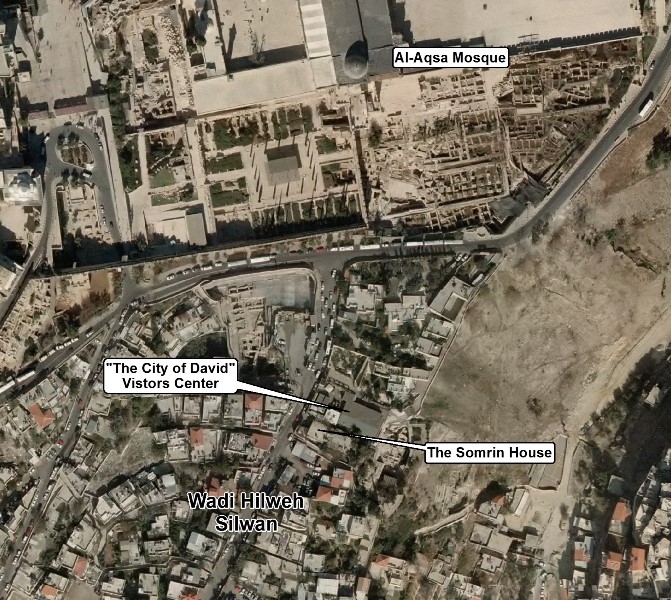
Map by Peace Now
The Sumreen family has been forced into the battle over its legal ownership of the home after the state of Israel, prompted repeatedly by the JNF, declared that the Sumreen’s home as an “absentee” property. After that designation – which was not communicated to the Sumreen family – Israeli law permitted the state to take over the rights to the building, after which the state sold the rights to the JNF in 1991. Since then, the JNF has been working to evict the members of the Sumreen family who continued to live there. The JNF ran into many obstacles in their pursuit, and for years Israeli courts ruled in favor of the Sumreen family’s ownership claims to the home. A full history of the saga involving the Sumreen family – which is similar to dozens of other Paelstinian homes in Silwan that were declared Absentee Property in the 1990s – can be found on the Peace Now website here.
Peace Now said in a statement:
“This is a cruel story that did not need to happen. KKL-Jewish National Fund has become a settler fund. It has repeatedly tried to throw a Palestinian family out of its home by exploiting a legal method that is stacked against Palestinians, and has not let go for nearly 30 years even after losing in court. This is part of an ugly process of using absentee property law based on questionable evidence to take Palestinian assets and give them to settlers, and to destroy the delicate fabric of life in Jerusalem.”
As Peace Now mentioned, the JNF’s activities in Silwan have been a source of repeated misery for the Paelstinians. For background, see this report on +972, as well as this commentary from Peace Now’s Hagit Ofran. Notably, controversy over the issue in 2009 prompted the JNF to issue a denial of any role in the efforts; this denial was contradicted by the facts, including the actual wording of the eviction order.
On Israel’s Agenda: Letting Settlers Directly Purchase West Bank land
When Israel took control of the West Bank in 1967, it kept in place a pre-1967 Jordanian law barring private land sales to non-Arabs. Now, the Israeli Defense Ministry and the Israeli army have reportedly drafted legal opinions in support of canceling this law in order to allow settlers to directly purchase West Bank land. Those opinions have been submitted for consideration by the Israeli Deputy Attorney General, who, according to Haaretz, is expected to approve them with the backing of the Attorney General.
FMEP’s Lara Friedman weighs in here to explain the background of this issue and the magnitude of the proposed change:
“In 1967, Israel established a military government apparatus to run the West Bank, that eventually became the ‘Civil Administration’ (an Orwellian name, since it is an arm of the Israeli military). Israeli military governance in the West Bank was set up, at least in principle and at the start, to operate in a manner consistent with international law. International law requires an occupying power to leave in force the existing laws in the territory it occupies, with limited leeway for that power to issue new administrative orders or laws, but only in cases of military necessity or for the benefit of the local population.
Over the past 52 years of occupation, Israel has re-purposed this international law-based approach into a system of ‘rule by law’ (versus ‘rule of law’). Israel holds on to and enforces pre-1967 laws where those laws can be interpreted and used to serve Israeli objectives. Where those old laws obstruct or fail to sufficiently facilitate Israel’s objectives, Israel supplants them with IDF-promulgated rules, Israeli court rulings, and Israeli domestic laws (i.e., laws passed by the Knesset that apply inside sovereign Israel and are extended to the settlers – as citizens – and to matter that relate to settlers in the West Bank, in what increasingly constitutes a form of “legislative annexation.” [for more details, see Yesh Din’s excellent report, “Through the Lens of Israel’s Interests”: The Civil Administration in the West Bank].
As a result, since 1967, Palestinians in the West Bank have been governed by an ever-evolving legal system that includes: (1) pre-1967 laws (including exploitation of old Ottoman land laws as a means for Israel to declare huge areas of the West Bank to be ‘state land’); (2) international law of occupation (including exploitation of the Occupier’s right to use land for military necessity or the public good as a pretext for massive land expropriation and using land for the sole benefit of the IDF and settlers); (3) Israeli military orders (governing nearly every aspect of Palestinians’ day-to-day lives, including orders closing off access to land); (4) Israeli court rulings (like rulings that legitimize settlers taking over ‘disputed’ houses in Hebron); and (5) increasingly in recent years, Israeli laws, like the Regulation Law (passed by the Knesset and allowing Israel to transfer Palestinian private property to settlers who built on it illegally, based on the argument that the settlers were unaware that the land was privately owned by Palestinians).
Israel’s decision to leave the Jordanian-era law barring the sale of private land in the West Bank to settlers in place for the past 52 years should be understood as an Israeli government decision, reflecting Israel’s own calculation of what policy served its interests. Why would Israel want to limit the ability for settlers to buy West Bank land? For a number of reasons:
(a) security: wherever settlers move in the West Bank, their presence has the potential (even likelihood) of sparking violence and conflict that would compel an IDF response. Even absent such conflict, wherever there are settlers, the IDF is required to invest enormous resources in protecting them (including manpower, physical infrastructure). In short, if settlers can purchase land wherever they want, they can, in effect, hijack the IDF, at great expense to Israeli taxpayers and regardless of security considerations.
(b) international relations: settler activity in the West Bank has for most of the past 52 years been closely watched and sharply criticized by the international community, and especially the United States; so long as Israel maintained an official policy of being the sole authority that could permit the establishment of new settlements, it could limit (to some degree) wildcat settler activity and, where such activity did take place, it could disavow responsibility. Notably, in the earliest days of the settlement movement of the early 1970s, settlers did find a limited method of circumventing the Jordanian law (by purchasing property via front companies – a practice that continues to this day); while it is telling that the Israeli government did not at the time intervene to close this loophole in the law, it is equally tellingly that it did not dare use that loophole as pretext for annulling the law.
(c) diplomacy/peace process: unrestrained settler activity across the entire West Bank, undertaken at will and with an official green light from the Israeli government, contradicts even the thinnest pretense that Israel is not engaged in annexation — and annexation not just of settlement blocs, or Area C, or the Jordan Valley, but of the entire West Bank.
Today, all of these calculations appear to have changed. Israeli military and Defense Ministry advisers are reportedly advocating for Israel to change the law. To this end, they have come up with multiple legal arguments designed to forestall international criticism by arguing that such a change is, in fact, entirely consistent with international law. For example, they suggest playing cynical games with the requirement under international law that laws made by the occupying power be for the benefit of the local population. One idea is to argue that settlers are the “local population” and that Israel thus has an obligation under to adopt laws that are to their benefit (as FMEP has previously explained, in 2016 Israeli Supreme Court Justice Salim Joubran opened the door to including settlers in Israel’s understanding of what constitutes the “local population” of the West Bank). Another idea is to argue that allowing settlers to buy West Bank land would provide an economic benefit to Palestinians. And a third is to argue that Israel has the right as the occupier, under international law, to annul the Jordanian law simply on the basis that Israel views it as racist and discriminatory laws — and citing the actions of the United States in Iraq as a precedent.
In sum, after 52 years of using every legal strategy available to ignore the protection afforded to Palestinians and their land under international law, today Israel is resuscitating the idea of international law in the West Bank — but only as a pretext for a new policy that, if implemented, should put an end to any debate over whether there is any real difference, in practice, between Israeli policies of de facto annexation, and an Israeli policy of official annexation. Israeli authorities and political leaders from across most of the political spectrum no longer even feign commitment to negotiating the future of the land and talk openly of annexation; and it appears that Israeli concerns that settler actions will hijack the IDF are outweighed by the desire to take concrete steps that demonstrate that — even without a formal statement of annexation — Israel has shifted to openly treating the entire West Bank as part of Israel.”
A Jerusalem Suburb is Building a Cemetery in the West Bank
With conditional approval from the Israeli army, the West Jerusalem neighborhood of Mevasseret Zion is moving ahead with plans to build a cemetery in the West Bank. The Israeli army had to give its sign off on new cemetery because there is a standing no-construction order – issued by Israel – for the areas adjacent to separation barrier (which was recently used as a legal pretext to demolish 13 Palestinian buildings in the Wadi al-Hummus neighborhood, located in Palestinian-controlled areas of the West Bank).
The IDF gave a conditional approval to the scheme, requiring the neighborhood to obtain additional approval for a plan that includes elaborate security measures for the cemetery. Those requirements include cameras, a 10-foot tall metal fence, and armed civilian guards at every funeral.
This is not Mevasseret Zion’s first step to extend into the West Bank. In June 2018, the anti-settlement watchdog Kerem Navot discovered that Mevasseret Zion had expanded into the no-man’s land between the internationally recognized 1967 Green Line and the Israeli separation barrier. That encroachment – which was unnoticed up to that point – is plain to see on Google maps.
New B’Tselem Report: Apartheid in Hebron
In a new report, the Israeli human rights groups B’Tselem argues that Israel’s policies in Hebron are reminiscent of apartheid South Africa. Entitled, “Playing the security card: Israeli Policy in Hebron as Means to Effect Forcible Transfer of Local Palestinians” the report outlines the history, policies, legal decisions, and key events that convey the segregation and misery inflicted by Israel on Palestinians in Hebron.
B’Tselem writes:
“Some features of the regime employed in Hebron recall certain aspects of the apartheid regime in South Africa…This regime has created what is known as a coercive environment, in effect leading to the forcible transfer of thousands of Palestinians and the closure of hundreds of businesses. This violates the prohibition on forcible transfer enshrined in international humanitarian law and constitutes a war crime. Twenty-five years of this segregation have normalized a shameful reality, in which the lives and rights of tens of thousands of Palestinians are trampled underfoot while the interests of several hundred settlers are promoted by violent means.”
New Al-Haq Report: Israel Means to Crush Palestinian Life in the Old City of Jerusalem
In a new report, the Palestinain human rights organization Al-Haq analyzes Israeli policies vis a vis Palestinians living in the Old City of Jerusalem since 1948. Entitled, “Occupying Jerusalem’s Old City: Israeli Policies of Isolation, Intimidation and Transformation,” the report concludes:
“In the course of its 52-year occupation and annexation of Jerusalem, Israel has implemented an array of methods in order to isolate and intimidate Palestinians, and transform the city into its so-called ‘united capital.’ In doing so, Israel has unlawfully appropriated and demolished properties, closed Palestinian institutions, restricted religious practice, obstructed the economy, and implemented countless other measures with the aim of forcibly transferring Palestinians from Jerusalem. At the same time, Israel has attempted to Judaize the city through establishing residential and tourism settlements, changing the names of streets, and altering the landscape. Nowhere are these policies more apparent than in Jerusalem’s Old City, which has been a central target of Israel’s objective of erasing Palestinian presence.”
Bonus Reads
- “Even if the Settlers’ Party Lost, the Settlements Won“ (Haaretz)
- “Isarel’s War of Attrition Against A Palestinian Christian Town” (Haaretz)
- “Cable Cars Over Jerusalem? Some See ‘Disneyfication’ of Holy City” (New York Times)
- “[Letter from Silwan] Common Ground: The politics of archaeology in Jerusalem” (Harper’s Magazine)
- “[Podcast] Common Ground: Feet of clay: on the troublesome uses of archeology, past and present” (Harper’s Magazine)
- “Last Time a Jewish State Annexed Its Neighbors, It Disappeared for 2,000 Years” (Foreign Policy)
Welcome to FMEP’s Weekly Settlement Report, covering everything you need to know about Israeli settlement activity this week.
To subscribe to this report, please click here.
September 12, 2019
- Bibi’s Annexation Announcement, Part 1: If Re-Elected, Bibi Promises to Annex Jordan Valley, Then All Settlements/Outposts
- Bibi’s Annexation Announcement, Part 2: Jordan Valley Outpost Will Be Retroactively Approved
- Bibi’s Annexation Announcement, Part 3: Settlers Leaders Unsatisfied with Bibi’s Annexation Announcement
- Bibi’s Annexation Announcement, Part 4: International Reactions
- Government Data Is Latest Proof of Systemic East Jerusalem Inequalities & Settlement Surge Under Trump
- After Evicting Palestinian Family & Demolishing Their Home, Israel Allows Settlers to Set Up An Outpost Without Permits
- Bonus Reads
Questions or comments? Contact Kristin McCarthy at kmccarthy@fmep.org.
Bibi’s Annexation Announcement, Part 1: If Re-Elected, Bibi Promises to Annex Jordan Valley, Then All Settlements/Outposts
On Tuesday, September 10th, Israeli Prime Minister Netanyahu announced that, if re-elected, he will immediately move to annex the Jordan Valley. He went on to address Israeli voters watching his nationally televised speech, saying, “I ask you to give me a clear mandate to extend Israeli sovereignty over all the settlements.” Notably, Netanayhu said that he would have enacted his Jordan Valley annexation plan before the elections, but was refrained from doing so because the Israeli Attorney General advised against a caretaker government taking a decision of this magnitude.
Netanayhu’s commitment to annexing the Jordan Valley and all Israel’s settlements and outposts (reminder: Netanyahu does not distinguish between the two) is hardly a surprise, given his escalating rhetoric and policies that have enacted – and continue to expand – Israel’s de facto annexation of Palestinian land.
During his speech, the Prime Minister presented his annexation vision on a map of the Jordan Valley – a map riddled with mistake – which highlighted the area he says he intends to annex, an area which constitutes nearly a quarter of the area of the West Bank (22.3%). Within the land Netanyahu wants to annex, 30 settlements have been constructed with Israeli government approval, and settlers have established an additional 18 illegal outposts without explicit government permission (but with its tacit approval). Many of these outposts and settlements are built on privately owned Palestinian land that Israel previously declared a “closed military zone” – a designation which prevents Palestinians from legally entering the area much less building there. Israeli settlers who illegally entered into these closed areas and built in them are now being rewarded under Netanyahu’s proposed annexation.
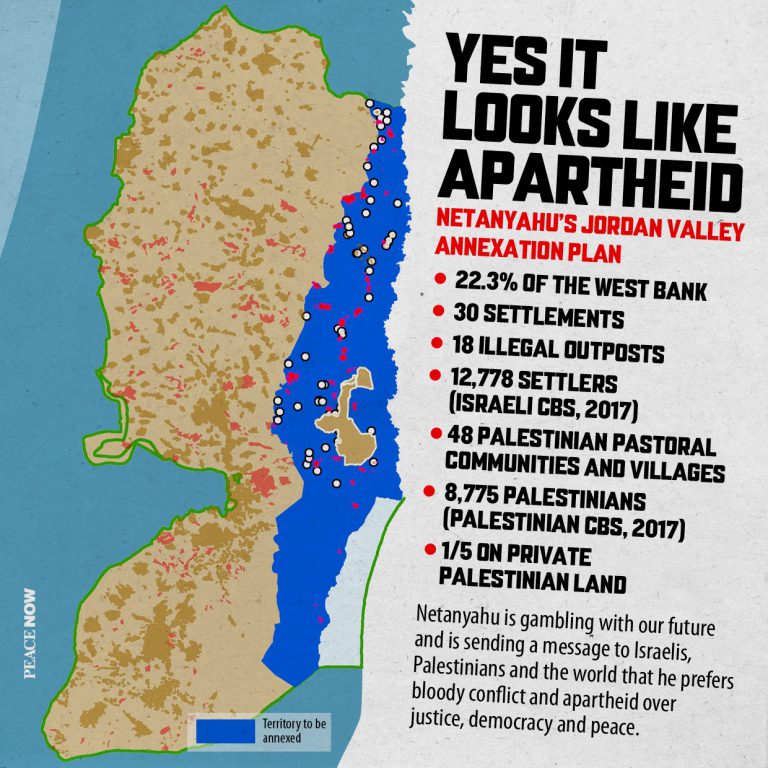
Map by Peace Now
According to Peace Now, 20% of the targeted land (62,000 acres) is privately owned by Palestinians – a fact that Netanyahu did not even mention, much less explain how he would address. Netanayahu did, however, assert that his plan “doesn’t annex a single Palestinian.” Yet, the area highlighted on the map also includes 15 Palestinian populated areas in the Jordan Valley that, under the plan, would be completely encircled by Israeli territory. Netanyahu proposed solving this problem by making these isolated enclaves “autonomous,” accessible only via Israeli-controlled access roads,
Speaking about the fate of the Palestinians, Peace Now said in a statement:
“The vision presented by the Prime Minister is, in fact, a vision of apartheid, of one country in which one group of civilians has full rights (Israeli) and another (Palestinians) does not. The autonomy and access roads Netanyahu guarantees to the Palestinians in the Valley are alarmingly similar to the Bantustan formula in former Apartheid South Africa.”
Even if one ignores the “autonomous” enclaves, Netanyahu’s claim that the plan “does not annex a single Palestinian. Not even one” is a lie. In fact, approximately 8,775 Palestinians live in 48 Palestinian herding communities located in the area he plans to annex. However, Israel’s longtime policies with regards to these Palestinian communities has been aimed at their ultimate dispossession and disappearance, a policy objective that Netanyahu’s annexation plan, particularly his denial of their very existence, makes explicit.
Peace Now said in response:
“This disregard by Netanyahu for thousands of Palestinians reflects long-standing policy in the Valley: one of dispossession and repression of Palestinian residents for the benefit of the settlers. In recent years, pressure has been exerted on the shepherding communities, both by the authorities (house demolitions, IDF training zones and the like), and by settlers who attack the shepherds and expel them from their pasturing areas. For more information, see here.”
Bibi’s Annexation Announcement, Part 2: Jordan Valley Outpost Will Be Retroactively Approved
On September 11th, a day after his “dramatic” declaration that if reelected he will immediately annex the Jordan Valley and later all settlements (and outposts), Prime Minister Netanyahu announced he will submit plans to his Cabinet that, if approved, will grant retroactive legalization to the Mevo’ot Yeriho outpost. Mevo’ot Yeriho, located just north of Jericho in the Jordan Valley, is one of 18 unauthorized Israeli outposts in the Jordan Valley that are slated to be annexed under Netanyahu’s plan (discussed above).
As with Netanyahu’s plans to annex the Jordan Valley, Israeli Attorney General Avichai Mandelblit has cautioned against the timing of the move. Mandelblit and the Israeli Defense Ministry’s legal advisor even released a joint legal opinion cautioning the Israeli Cabinet against authorizing granting approval to Mevo’ot Yeriho so close to an election. It’s worth recalling that the Attorney General has promoted legal arguments that will enable Israel to grant retroactive legalization to unauthorized outposts — meaning that his objection with regards to Mevo’ot Yeriho is one of timing, not substance.
The head of the Jordan Valley Regional Council, David Elhayani, criticized the Attorney General’s legal objections, claiming that gaining legalization is an urgent matter for the outpost. According to The Times of Israel:
“Elhayani claimed that Israelis in the Jordan Valley are in a ‘war against our Palestinian neighbors’ over control of the open land there and that the legal advisers were preventing legalization of Israeli outposts while allowing similar Palestinian land grabs to go unchecked.”
Bibi’s Annexation Announcement, Part 3: Settlers Leaders Unsatisfied with Bibi’s Annexation Announcement
Widely panned as an election ploy, Netanyahu’s pledge to annex the Jordan Valley and all settlements/outposts was by no means an electoral home run – at least not if its goal was to rally enthusiastic support from the settlers and their allies ahead of the Sept. 17th elections. While some settlers praised Netanyahu’s announcement, others expressed skepticism about his seriousness.
A member of the Yesha Council – an umbrella group representing all of the settlements – told The Times of Israel on the basis of anonymity that settlers have made a political calculation in how they have responded to Netanyahu’s announcement:
“A lot of us [settler leaders] are members of the Likud. While we are of course free to criticize the party leader and many of us have done so in the past, we have to exercise caution during these next few days [ahead of the election].”
Within that context, the Yesha Council released a public statement of restrained thanks, saying:
“Sovereignty is the vision of the settlement movement and the path of the future for deepening our presence in the region. The Yesha Council congratulates the Prime Minister on the historic declaration, which places settlement as an integral part of the State of Israel.”
In contrast, Samaria Regional Council chairman Yossi Dagan (who is a member of Netanyahu’s Likud party) was not hesitant to share his dissatisfaction, stating:
“Alongside the praise that must be given to the prime minister for his positive statement… I must say with regret that it is still cause for great concern, particularly due to its timing… It raises considerable concern regarding the possibility of continued Jewish foothold in more than 90 percent of Judea and Samaria. If he really wanted to finally bury his [2009] Bar Ilan speech [in which Netanyahu expressed support for a two-state solution] and the plans of Barack Hussein Obama for a Jewish retreat from Judea and Samaria [West Bank] and the establishment of a terror state in the heart of the Land of Israel, a statement that talks about less than 10% of the land and only in the first stage [is not enough].”
Binyamin Regional Council chairman Yisrael Gantz also criticized Netanyahu and called on him to immediately annex the entire West Bank:
“There is no reason in the world why Judea and Samaria residents should continue to live as second class citizens of the State of Israel. The move must be complete, applying sovereignty to the Binyamin area and throughout all of Judea and Samaria.”
The imminent Israeli elections should also be kept in mind while reading the responses of Netanyahu’s political rivals, most of whom criticized him for delaying his annexation and for stopping short of full annexation of the West Bank. Some notable reactions from Israeli political figures follow.
The Yamina Party, headed by Ayelet Shaked – who is a vocal supporter of annexing all of Area C – panned Netanyahu in a statement:
“Netanyahu explained this evening why voters must vote Yamina and not Likud… Bibi-Trump plan, will only allow for sovereignty to be applied over the Jewish communities in Judea and Samaria, leaving out the surrounding areas…And regarding the Jordan Valley, we call on Netanyahu to introduce a cabinet decision this evening as was done when sovereignty was applied over Jerusalem. There is no need for legislation. We will stand behind him immediately and vote in favor. Otherwise, the entire nation of Israel will know that this was a cheap political spin meant to snarf up votes and nothing more.”
For its part, the Blue & White Party, headed by Benny Gantz, took credit for getting out ahead of Netanyahu in endorsing a similar annexation plan:
“The residents of the Jordan Valley are not Netanyahu’s propaganda props. Blue and White has declared that the Jordan Valley will be part of Israel forever. It was Netanyahu who concocted a plan to surrender the Jordan Valley in [peace talks in] 2014. We’re glad Netanyahu came to his senses and adopted Blue and White’s plan for recognition of the Jordan Valley. The relationship between Israel and the United States is based on shared interests and values, and is stronger than any prime minister. Netanyahu’s spinning of Israel’s citizens will end on September 17.”
By contrast, MK Ayman Odeh (head of the Joint List) said:
“This isn’t just election spin. The right’s apartheid vision is composed of two parallel processes — erasing the civil status of Arabs in Israel as well as annexing the territories. They don’t want to turn the West Bank into part of Israel, they want to turn Israel into an appendage of the West Bank.”
Bibi’s Annexation Announcement, Part 4: International Reactions
Following Netanyahu’s announcement of his plan to annex the Jordan Valley and then all settlements/outposts, statements condemning the plan rang out from across the globe – except from the United States.
After the announcement, a White House official told The Times of Israel that Netanyahu’s annexation plans do no contradict the U.S. vision for a political settlement (hardly a surprise). A formal statement later released by the White House statement read:
“There is no change in United States policy at this time. We will release our Vision for Peace after the Israeli election and work to determine the best path forward to bring long sought security, opportunity and stability to the region.”
In contrast, the United Kingdom responded sharply, in a short video clip release on Twitter, in which a spokesman says:
“Any proposal to annex any part of the occupied Palestinian territories or any step in that direction concerns us. We must be clear that if any such proposal comes to fruition, there will be a response.”
The spokesperson for the United Nations Secretary Antonio Guterres told the press:
“The secretary-general’s position has always been clear: unilateral actions are not helpful in the peace process. Any Israeli decision to impose its laws, jurisdictions and administration in the occupied West Bank is without any international legal effect.”
A spokesperson for the European Union told the press:
“As reaffirmed in numerous Foreign Affairs Council conclusions, the EU will not recognise any changes to the pre-1967 borders including with regard to Jerusalem, other than those agreed by the parties. The policy of settlement construction and expansion, including in East Jerusalem, is illegal under international law and its continuation, and actions taken in this context undermine the viability of the two-state solution and the prospects for lasting peace.”
The Foreign Ministry of Saudi Arabia tweeted a harsh response:
“The Kingdom of Saudi Arabia utterly condemns and rejects the Israeli Prime Minister’s announcement of his intention, if he won the election, to annex parts of the occupied West Bank”
Jordan’s Foreign Minister also slammed the plan, tweeting:
“We condemn announcement by Israeli PM that he intends to annex illegal settlements & Jordan Valley in occupied West Bank. This is a serious escalation that undermines all peace efforts. It’ll lead to more violence & conflict. LAS [League of Arab States] condemned announcement in emergency session”
The Arab League said in a statement that it:
“considers his announcement a dangerous development and a new Israeli aggression by declaring the intention to violate the international law. The league regards these statements as undermining the chances of any progress in the peace process and will torpedo all its foundations.”
In addition, Qatar sent out a statement criticizing “Israel’s continued contempt of international law”; Turkey said the annexation pledge as “racist”; and Saudi Arabia called for an emergency meeting of the Organisation of Islamic Cooperation (OIC).
Saeb Erekat, a former peace negotiator for the PLO, said:
“Israel’s plan to annex the Jordan Valley, an integral part of occupied Palestinian territories, is manifestly illegal and merely adds to Israel’s long history of violations of international law. Israel’s unprecedented culture of impunity, enabled by international inaction, is the only explanation for Mr. Netanyahu’s audacity in using annexation as an election ploy, and asking the Israeli public to facilitate yet another Israeli crime.”
Government Data Is Latest Proof of Systemic East Jerusalem Inequalities & Settlement Surge Under Trump
The Jerusalem Municipality recently released data on construction permits issued for Jerusalem construction from 1991 to 2018; the data shows the stark inequality in building rights between Israeli settlers and Palestinians living in East Jerusalem. According to the Israeli government’s own count of permits issued between 1991 and 2018, only 16.5% of Jerusalem’s building permits were issued to Palestinians, despite the fact that they constitute 38% of the city’s residents.
The data, which was released thanks to a freedom of information request submitted two years ago by the Movement for the Freedom of Information and Peace Now, was covered by the Associated Press and carried by the Washington Post and the New York Times.
After Evicting Palestinian Family & Demolishing Their Home, Israel Allows Settlers to Set Up An Outpost Without Permits
Israeli settlers have set up an unauthorized outpost on land just outside of Bethlehem – on the site where the state recently demolished a Palestinian family’s home and business at the behest of the Jewish National Fund (for details, see our past reporting here). Following the eviction of the Cassia family and the demolition of its home and business, the JNF reportedly leased the land to a group of settlers which, in a matter of days following the demolition, built several temporary buildings at the site — but without the necessary Israeli government-issued building permits.
Peace Now commented:
“The establishment of a new outpost 70 meters (230 feet) from the Palestinian home that was destroyed under pressure from the JNF lets the cat out of the bag. It turns out that when JNF demanded that the Cassia family’s home be demolished, it didn’t care if illegal construction was carried out on its land, but it didn’t want Palestinians to build on its land.”
Bonus Reads
- “How would Netanyahu go about annexing the settlements? An explainer” (Times of Israel)
- “Christian Evangelicals Harvest Land in Settlements Israel Hopes to Annex” (Reuters)
- “Palestinians in the Jordan Valley Want to Remain on their Land” (Al-Monitor)
- “IN PHOTOS: Israel’s Settlers and the Palestinians they Live Among” (Haaretz/Reuters)
- “The Apartheid System in Hebron Persecutes and Subjugates Palestinians” (TruthOut)
Welcome to FMEP’s Weekly Settlement Report, covering everything you need to know about Israeli settlement activity this week.
To subscribe to this report, please click here.
September 6, 2019
- In Countdown to Election, Bibi Doubles Down on Settlements, Annexation
- 100+ Human Rights Organizations Demand Publication of UN Database of Businesses Operating in Settlements
- Bonus Reads
Questions or comments? Contact Kristin McCarthy at kmccarthy@fmep.org.
In Countdown to Election, Bibi Doubles Down on Settlements, Annexation
Two weeks out from election day, Prime Minister Netanyahu has continued escalating his all-out efforts to shore up the right-wing settler vote, in two events in the occupied West Bank.
Netanyahu Promises “Jewish Sovereignty” Over All Settlements & Outposts
Speaking at a grade school in the Elkana settlement on September 1st, Netanyahu said:
“With the help of God we will apply Jewish sovereignty to all communities, as part of the [biblical] Land of Israel, and as part of the state of Israel.”
The Yesha Council – the umbrella group that represents all settlements in the West Bank – head Hananel Durani praised Netanyahu for the statement, saying:
“This is another step on the road to the application of sovereignty. Sovereignty is the settlement vision, one that we have dreamed of for years and which would be happy to see come to fruition as soon as possible.”
Netanyahu’s now routine call for annexing all of the settlements (outposts included) was insufficient for the “Sovereignty Movement” – a radical and increasingly influential right-wing Israeli advocacy group which started as an offshoot of “Women in Green” – said that Israel must annex the entire West Bank. In a statement, the group’s leaders suggested that anything short of total annexation of the West Bank would allow for the Palestinians to create a state, and that:
“such an entity would pose a security and strategic threat to the heart of the State of Israel, and in particular would be a serious blow to the Zionist-Jewish vision to which Israel has yearned for in its years of exile, i.e., the restoration of Israeli sovereignty over the entire Land of Israel.”
Netanyahu’s remarks drew a sharply critical response from other quarters, for very different reasons – including the fact that this was the first time Netanyahu called for “Jewish sovereignty” (elevating a racial/religious framework for annexation) as opposed to “Israeli sovereignty” (a national framework for annexation). MK Ofer Cassif (United Arab List) responded:
“Netanyahu did not talk about Israeli sovereignty over the settlements in the Occupied Territories, but about Jewish sovereignty. Make no mistake about his intentions. The prime minister has publicly declared that he is interested in apartheid and ethnic cleansing.”
A spokesperson for Netanyahu later clarified the remarks to foreign media, stating that Netanyahu did not mean to endorse the application of religious law, but of “Israeli national law.”
For first time in 21 years, Netanyahu Goes to Hebron
Netanyahu and several senior leaders in his Likud Party went to Hebron on September 5th to speak at an event commemorating the 90th anniversary of the 1929 violent riots in Hebron during which 67 Jews were murdered. The much-hyped event – hosted by the Hebron settlers — marked Netanyahu’s first visit to Hebron since 1998, and he became the first Israeli Prime Minister in history to speak at a ceremonial event at the Tomb of the Patriarchs/Haram al-Ibrahimi Mosque.
The overarching message of the visit was support for the settlers and Israel’s control over Hebron, including in a grandiose speech in which Netanyahu promised to never remove settlers from Hebron:
“we are not strangers in Hebron and will remain in the city forever. We are not here to disinherit anyone, but no one will disinherit us (from here). We have come here to unite in memory, to express victory over bloodthirsty rioters who committed this horrific massacre 90 years ago. They were sure that they uprooted us for good, but they made a huge mistake.”
In anticipation of the event, settlers called on Netanyahu to use the visit to announce a new settlement in the wholesale market of Hebron. In parallel, Peace Now outlined seven compelling reasons why Israel should not build a new settlement in the Hebron marketplace, and provided a detailed history of Palestinian and Jewish histories in Hebron. Peace Now wrote:
“The irony is that the settlers claim that the 1929 massacre led to the expulsion of the Jews from the land on which the wholesale market stands, but under Israeli rule, the 1994 massacre (of the settler Baruch Goldstein) led to the expulsion of the Palestinians from the wholesale market. It now emerges that, according to the Defense Ministry’s legal advice, because of their massacre, the Palestinians are losing their rights.”
Although Netanyahu disappointed the settlers (by not announcing the new settlement), Knesset speaker Yuli Edelstein – a senior figure in Netanyahu’s own political party (Likud) – did not hedge on promising annexation of Hebron. Edelstein said:
“it is time to impose sovereignty. We did not return in all out might to this place, a place where out legacy lies and where Jews have dreamed about for generations. It is time that the Jewish settlement in Hebron grows by the thousands.”
Likewise, Miri Regev, also a member of the Likud party and the current Minister of Culture, told the crowd:
“There is no better time to announce Israeli sovereignty in Judea and Samaria, and no better place than here, Hebron and the Tombs of Forefathers & Mothers – the place of the first purchase of Abraham in the land of Israel. There is no better time to announce Israeli sovereignty in Judea and Samaria, and no better place than here, Hebron and the Tombs of Forefathers & Mothers – the place of the first purchase of Abraham in the land of Israel.”
100+ Human Rights Organizations Demand Publication of UN Database of Businesses Operating in Settlements
More than 100 organizations penned a letter to Michelle Bachelet, the United Nations High Commissioner for Human Rights, demanding the publication of a database listing businesses operating inside Israeli settlements, in contravention to international law. The UN Human Rights Council (UNHRC) adopted a resolution on March 24, 2016 mandating the creation of the database listing the business enterprises that “have, directly and indirectly, enabled, facilitated and profited from the construction and growth of the settlements.”
The publication of the database has been repeatedly delayed, though it was rumored to be finished in December 2017.
The signing organizations write:
“In the OPT, as in other cases of belligerent occupation, the absence of accountability has enabled the Occupying Power, Israel, to engage in activity in violation of international law in the occupied territory with near total impunity. This has allowed many private actors, including businesses, to contribute to and benefit from, sometimes unwittingly, gross human rights violations. The 2013 report of the UN commissioned International Fact-Finding Mission to investigate the implications of the Israeli settlements on the human rights of the Palestinian people, found that ‘business enterprises have, directly and indirectly, enabled, facilitated and profited from the construction and growth of the settlements’. This has detrimentally affected the lives of millions of Palestinians, depriving them of their fundamental human rights. In light of the aforementioned, and your undertaking in your letter of 4 March 2019 to the HRC President to finalize the mandated activity ‘in coming months,’ the undersigned organizations urge you, as the UN High Commissioner for Human Rights, to fully implement the mandate provided in HRC resolution 31/36, by releasing and transmitting the data including the names of companies involved in the specified activities, to the Human Rights Council, so that it may be considered at the Council’s 42nd session in September 2019, and by annually updating the Database.”
The database is meant to assist UN member states in complying with their legal obligations under international law. International legal scholar Valentina Azarova explained:
“The UN database is a mechanism to document, report, and engage primary interested parties. It does not have the mandate to adjudicate the responsibility of concerned parties, nor to act as a coercive tool of law enforcement. Thus, commentators who refer to it as a “blacklist” misrepresent it and undermine its legitimacy.”
Bonus Reads
- “Netanyahu’s Deal of the Century: Annexation in Exchange for Immunity” (Al-Monitor)
- “Education minister under fire for planning school trips to the West Bank” (Ynet)
- “Israel soldiers stop field researcher over B’Tselem reports in car” (Middle East Monitor)
Welcome to FMEP’s Weekly Settlement Report, covering everything you need to know about Israeli settlement activity this week.
To subscribe to this report, please click here.
August 30, 2019
- NEW: Peace Now Releases Updated 2019 Settlement Map
- Netanyahu Promises 300 New Units in Dolev Settlement in Response to Terror Attack
- Following New Ruling, Settlers Move Back in to Contested Hebron Property
- Israel Demolishes Palestinian Home & Business Near Bethlehem After High Court Rules in Favor of Settlement Organization
- Israeli Govt Approves School Trips to Contested West Bank Religious Sites; Settlers Storm Joseph’s Tomb in Violent Celebration
- Israeli Economic Minister Promises to Compensate Settlements if they are Hurt by South Korea FTA
- Ayelet Shaked Rolls out Campaign Pledge to Build 113,000 New Settlement Units — & Thereby Solve the Israeli Housing Shortage & Erase the Green Line
- Israeli Occupation & the Case of Beit Ur al-Fauqa, where Rep. Tlaib’s Family Lives
- Pro-settlement U.S. group Brings GOP Codel to the West Bank
- Pro-Settlement Propaganda Continues to Grease Gears for Israeli Annexation of AreaC
- Bonus Reads
Questions or comments? Contact Kristin McCarthy at kmccarthy@fmep.org.
NEW: Peace Now Releases Updated 2019 Settlement Map
Peace Now recently released an updated version of its 2019 Settlement Map, available online and for download here. New on this version is the site (a garbage dump adjacent to Abu Dis) where Israel wants to forcibly transfer residents from Khan al-Ahmar, as well as a detailed outline of the E-2 settlement plan, and the 11 outposts established since 2018.
Netanyahu Promises 300 New Units in Dolev Settlement in Response to Terror Attack
On August 26th, Prime Minister Netanyahu ordered the Civil Administration to give final approval to a plan for 300 new settlement units in the Dolev settlement, located west of Ramallah. The move was framed as a response to a terror attack on a nearby spring (called Ein Bubin) in which an Israeli teenager was killed.
In response to Netanyahu’s approval for 300 units in the Dolev settlement, Peace Now said in a statement:
“Netanyahu has adopted the morbid conception of the settler Right that there is a payoff in the form of settlement expansion for the blood of terrorism victims. This calculation cynically turns terrorism into a political tool to promote an ideological vision, without bringing up the issue for national debate on whether we want to forever control the West Bank at the cost of our democracy.”
Notably, the Ein Bubin spring, like many others across the West Bank, was historically a Palestinian, taken over in recent years by Israeli settlers. According to settlement expert Dror Etkes, as reported by Haaretz, there are:
“60 springs in the central West Bank that settlers coveted and seized as part of a project of plunder that began 10 years ago. The landscaping and renovation work at about half of them has been completed, the dispossession made absolute, the Palestinians blocked from even approaching the springs and their lands. Other springs targeted by the settlers are in various stages of takeover.”
Following New Ruling, Settlers Move Back in to Contested Hebron Property
Israeli settlers once again illegally moved into a disputed home – called “Beit Machpelah” by the settlers and the Abu Rajab House by Palestinians (named for the building’s owners, the Abu Rajab family). Settlers previously illegally entered the Beit Machpelah/Abu Rajab building several times – in 2012, 2013 and most recently in 2017 – but each time were forced to evacuate by the IDF. The disputed building is located on Shuhada street in downtown Hebron, across the street from the Al-Ibrahimi Mosque/Tomb of the Patriarchs.
Settlers moved back into the property following a recent ruling by Israel’s Civil Administration (the arm of the IDF that acts as the sovereign authority in the West Bank) affirming that the settlers own 50% of the three-story building. They did not coordinate the move with Israeli authorities, and it appears to have been premature and illegal. This is because the Isreeli Civil Administration ruled that there still must be a process to adjudicate how the settlers will share the building with the Palestinians who own the other 50%.
The ruling – issued by the Civil Administration’s Israeli First Registration Committee – validated the settlers claim that they legally purchased a portion of the building from members of the Abu Rajab family in 2017 — based entirely on circumstantial evidence. For example, committee members cited as the fact that the Palestinian Authority arrested members of the Abu Rajab family as proof that family members must have sold the building to settlers. The committee’s ruling (accompanied by reports of Netayahu’s personal intervention in the case to help the settlers) – and subsequent illegal re-entry into the home by the settlers – comes just one week before a planned visit by Netanyahu to Hebron to attend a ceremony marking the 90th anniversary of the 1929 Hebron massacre, in which 67 Jews were killed by Arab rioters.
Israel Demolishes Palestinian Home & Business Near Bethlehem After High Court Rules in Favor of Settlement Organization
On August 26th, Israeli authorities demolished the home and business of the Cassia family, located just west of Bethlehem, in Area C of the West Bank (documented in real time on Twitter by Peace Now’s Hagit Ofran, here). The demolition followed a campaign waged by Himunata – a pro-settlement group associated with the Jewish National Fund (KKL-JNF) – which claims that it legally purchased the land in 1969. 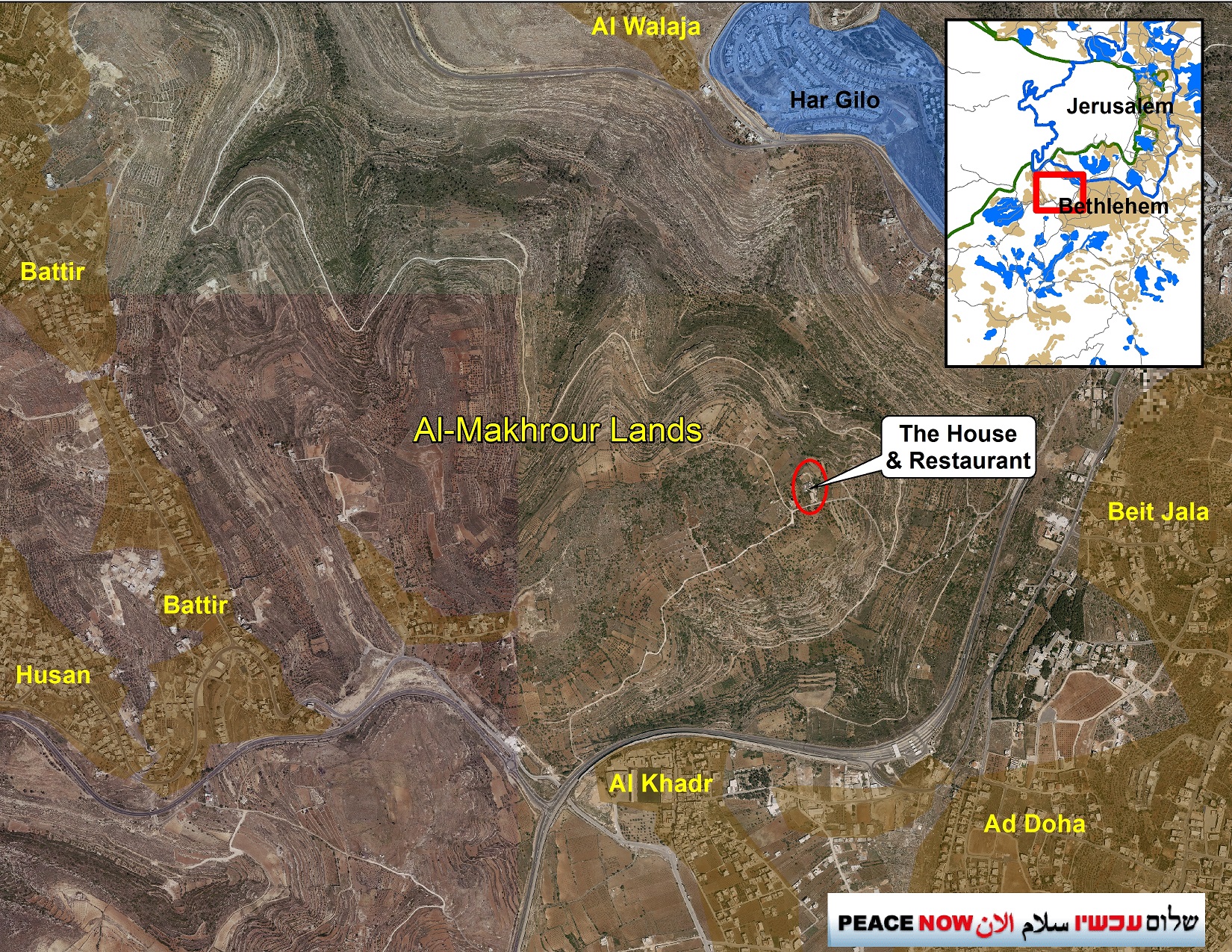
The Cassia family fought against the state and Himunata’s legal assault on their property rights for years, arguing they have lived on the land for decades and never sold the rights to it, and furnishing documents showing the paid property tax on the land from the period when Jordan ruled the West Bank. Nonetheless, on July 29, 2019, the High Court dismissed the family’s latest effort to defend their rights, allowing the demolition to move forward.
Peace Now said in a statement:
“KKL-JNF has become The Fund for the Expulsion of Palestinians. Through greed and cruelty of the JNF, it has thrown its weight its resources to the interests of the settlement agenda. Even if it were true that Himanuta was the owner of the land (which is under dispute), still, it could have come up with different solutions rather than demolition. It could have tried to negotiate with the family about renting or buying the land. The interest of evicting the Palestinian family that has been living in the area for decades, and destroying the restaurant from which it subsists, is not in the interest of the Jewish National Fund and does not reflect the desire of thousands of Jews in the world who donate their money to it.”
Peace Now also notes that this case is part of Himanuta’s long-running campaign to expel Palestinians from their homes in recent years, a campaign which has been reinvigorated over recent years in partnership with other pro-settlement groups including Elad and Regavim. Victories include a November 2018 ruling against Palestinian landowners south of Bethlehem.
Israeli Govt Approves School Trips to Contested West Bank Religious Sites; Settlers Storm Joseph’s Tomb in Violent Celebration
On August 20th, the Israeli Education Ministry announced that it will fund school programs to bring Israeli students (from schools located inside the Green Line) to religious sites – including Joseph’s Tomb and Tel Shiloh, under the control of settlers in the West Bank. Until now, Israeli schools have been prohibited from taking field trips into the occupied West Bank. This shift is part of a growing trend in Israeli policies of formally treating the West Bank as part of Israel.
The same day the decision was announced, the IDF escorted buses of Israeli settlers to Joseph’s Tomb – a site located in Nablus, in an area dotted by violent outposts and settlers. Predictably, the visiting settlers clashed with Palestinians who attempted to prevent their entry to the site; the IDF used live gunfire and tear gas to disperse the Palestinians, injuring several.
Peace Now said:
“the Ministry of Education should not be the information arm of the Yesha Council and the messianic right…We will not let Rafi Peretz [the current Israeli Education Minister] brainwash our kids! Declare that you will not send your children to lend a hand to the occupation.”
Since being appointed to the position in June 2019, Peretz has advanced a controversial agenda, and has begun instituting policy changes called for by the religious right-wing parties. For example, Peretz announced that the Nation-State Law – which last year declared Israel the “national home of the Jewish people” and stated that “the state views Jewish settlement as a national value and will labor to encourage and promote its establishment and development” – will be added to Israeli school curriculums.
Israeli Economic Minister Promises to Compensate Settlements if they are hurt by South Korea FTA
Israel and South Korea signed a free trade agreement on August 21st, ending three years of negotiations over South Korea’s insistence that the deal excludes Israeli settlements in East Jerusalem, the West Bank, and the Golan Heights. Israeli and international media reported that Israel agreed to the South Korean demand, allowing the terms of the trade deal to make a hard legal distinction between businesses located what the international community recognizes as sovereign Israel versus business located in settlements in what the international community views as occupied territory. Since the text has not yet been published, the exact terms of the deal are unclear.
Economic Minister Cohen, a strong advocate for the settlers, initially denied that Israel had agreed to this distinction (“there is no agreement that we sign which includes territorial separation. As far as we are concerned, Judea and Samaria are part of the State of Israel. There is no change in that, period”). He then clarified that if the terms of the deal,did in fact, make any such distinction, “there will be complete compensation by the Israeli government for manufacturers in Judea and Samaria,” and made clear the settlers have already been assured that this is the government’s position.
Surprisingly, Cohen’s statement was publicly endorsed by the Yesha Council, the umbrella group which represents all settlements in the West Bank, which issued a statement saying:
“In a conversation between Economy Minister Eli Cohen and Yesha Council Chairman Hananel Dorani, it was clarified that the agreement makes no mention of a territorial distinction that discriminates or could hurt businesses and entrepreneurs in Judea, Samaria, the Jordan Valley or the Golan Heights, and that the agreement was crafted on the model of existing agreements with the European Union…[Cohen] promised that if South Korea does not grant customs benefits to businesses from Judea, Samaria and the Golan Heights, that the Economy Ministry intends to fully compensate them.”
Why would the Yesha Council be giving the green light for the government to sign an international agreement that distinguishes between Israel and settlements (a position that, when adopted by Europe of anti-occupation activists has consisently been case as anti-Israel, anti-Semitic, similar to the Nazis, and even supportive of terrorist)? Veteran Israeli analyst Akiva Eldar speculates:
“This strange reaction to the agreement that discriminates against the settlements may lie in internal right-wing politics on the eve of the elections. Another possible explanation could lie in the equanimity with which the news was received. Israel has decided on a mechanism — similar to the one it adopted vis-a-vis the free trade deal with the EU — which would compensate exporters from the settlements in the occupied territories. The compensation reflects the difference between the duties paid on their exports and the duties that would have been paid under the beneficial terms of the free trade agreement. This mechanism significantly eases these exporters’ discrimination compared to those exporting goods and services from sovereign Israeli territory.”
Ayelet Shaked Rolls out Campaign Pledge to Build 113,000 New Settlement Units — & Thereby Solve the Israeli Housing Shortage & Erase the Green Line
Speaking at a campaign press conference on August 21st, former Justice Minister Ayelet Shaked – who heads the newly formed Yemina Party – announced a five-year plan to build 113,000 new settlement units in the northern West Bank as a means of solving Israel’s affordable housing shortage and of furthering Israel’s annexation of Area C. If built, the plan envisions bringing an estimated 500,000 new settlers to the West Bank, which would more than double the number of settlers living there currently.

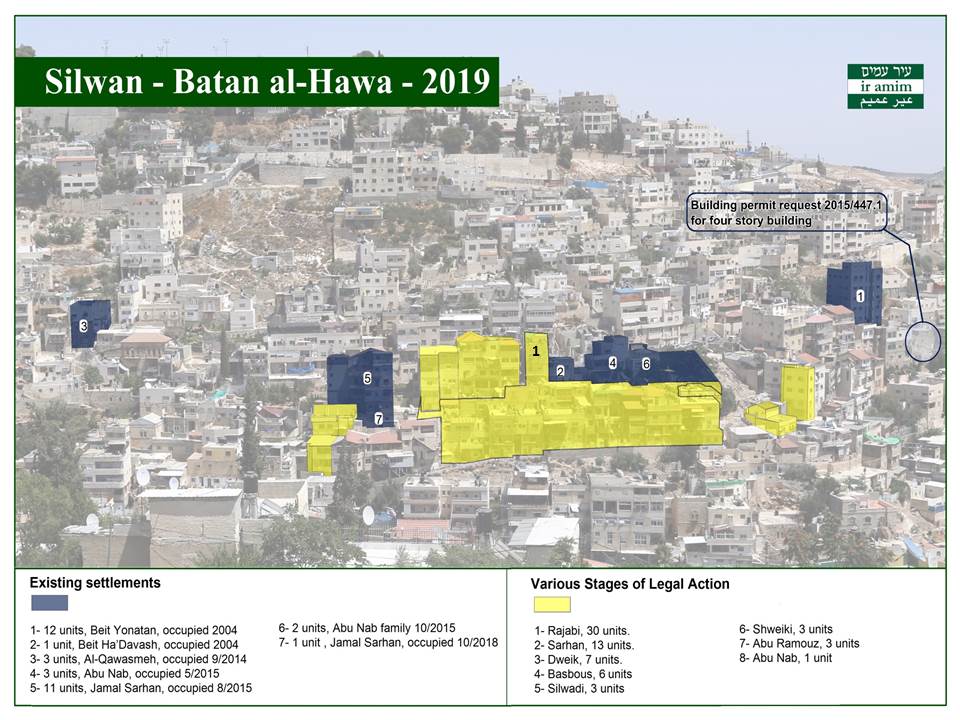
Shaked also promised to extend the length and lanes of Route 5 (called the “Trans Samaria Highway,” which Palestinians have only restricted access to). The road project would allow settlers a short commute to Tel Aviv and would facilitate future settlement growth. Bezalel Smotrich, the third-ranking member of Yemina, boasts that the plan will “erase the Green Line” dividing the West Bank from Israel.
The Democratic Bloc party said in response:
“Shaked and Smotrich have decided to turn the entire population into settlers. Not only [do they want] religious coercion in the education system, but they want to transfer the citizens of the state to live in the settlements where they can re-educate them in the laws of halacha.”
The Peace Now issued a statement:
“Instead of investing in unnecessary settlements and harming the prospect of peace, the State of Israel should focus on addressing actual distress and on strengthening the periphery communities in the Negev and the Galilee.”
Israeli Occupation & the Case of Beit Ur al-Fauqa, where Rep. Tlaib’s Family Lives
Dror Etkes – founder of the Israeli NGO Kerem Navot and long-time settlement watchdog – published the timely analysis of how Israeli settlements have negatively impacted the village of Beit al-Fauqa, the Palestinian village where the family of U.S. Congresswoman Rashida Tlaib is from (and where members of her family, including her elderly grandmother, still live).
Etkes writes:
“…the real story of Beit Ur al-Fauqa is not the settlement of Beit Horon [built nearby on land taken by Israel from the village] but Route 443, a highway built through the West Bank in the early 90s to connect northern Jerusalem and its adjacent settlements to Israel’s coastal area. To pave this road, the Israeli army confiscated 50 acres of the village’s land in the late 80s. Hearing that their land would be confiscated, landowners from Beit Ur al-Fauqa and the neighboring villages petitioned Israel’s High Court of Justice. The High Court would eventually dismiss the petition, accepting instead the IDF claim that the road would also serve the ‘local population,’ who will be able to drive on it faster and more securely.
“When the road was finally paved, 425 acres of Beit Ur al-Fauqa’s cultivated and grazing land were practically disconnected from the village, remaining southwest of Route 443. What about an access road to these 425 acres or a tunnel under the newly-built highway? Not in the West Bank. Once the road was constructed, the villagers were forced to make a seven-kilometer detour to reach their land
“…At the end of 2000, as the violence of the Second Intifada was beginning to unfold, Palestinians were sporadically banned by the IDF from using Route 443. Following several cases of Palestinian gunfire at Israeli vehicles on the road, in which six Israeli citizens and one resident of East Jerusalem were killed, Israel entirely prohibited Palestinians from using the road in 2002. Yet the IDF had officially committed to the High Court’s demand that Palestinians be allowed to use the road. For this, the army uses ‘temporary seizure orders.’
“Between 2005 and 2006, the IDF issued seizure orders for 30 more of the village’s acres in order to pave two ‘fabric of life’ roads — an alternate network of roads and tunnels intended for Palestinian use only — that would serve as Palestinian bypass roads on Beit Ur al-Fauqa’s land. It is true that Beit Ur al-Fauqa does not suffer the worst consequences of Israel’s occupation and its land grabbing enterprise. In many ways, it’s just ‘another village’ — and that’s bad enough.”
Pro-settlement U.S. group Brings GOP Codel to the West Bank
A delegation of four Republican members of Congress recently toured the Hebron and Ariel settlement industrial zones in the West Bank and met with members of the Judea and Samaria Chamber of Commerce. The delegation was hosted by Heather Johnson of the US Israel Education Association (USIEA), a U.S. evangelical group deeply involved in supporting and normalizing settlements, working in partnership with the Israeli government. USIEA is also works with the Family Research Council to lead Congressional delegations to Israel and runs a bible camp in the Ariel settlement.

Credit: JS Chamber of Commerce
A darling of the Trump adminstration diplomatic trio, the Judea and Samaria Chamber of Commerce is a group formed by Israeli settlers from Hebron and Palestinian businessman Ashraf Jabari, who has been slammed as a traitor by the Palestinian Authority, shunned and dismissed by his fellow Palestinian business people, and disowned by his family in light of his ongoing role with the committee. As FMEP has repeatedly explained, initiatives like this perpetuate Israel’s economic exploitation of occupied territory (including the local workforce, land, and other natural resources), and that it is Orwellian to label such initiatives as “coexistence” programs, or to suggest that they offer the Palestinians benefits they should welcome.
The Congressional delegation hosted by such a pro-settlement group has not received a hint of criticism from other members of the U.S. Congress. FMEP President Lara Friedmand notes that:
“While folks are still bashing @IlhanMN & @RashidaTlaib for having [the] temerity to try to visit Isr/Pal w/ group other than AIPAC, right-wing media is crowing re: Members visiting ‘Judea & Samaria’ with group devoted to getting Congress to back ‘Greater Israel’ 1-state solution.”
Pro-Settlement Propaganda Continues to Grease Gears for Israeli Annexation of Area C
Two recent articles continue an effort to normalize the concept of Israel’s annexation of land in the West Bank.
The Times of Israel published an op-ed by Andy Blumenthal entitled, “The Coming Annexation.” The piece goes on to outline eight reasons why Israel’s annexation of the West Bank is completely legitimate, including this:
“Reality on The Ground: Israel has around 450,000 settlers in the West Bank in about 130 settlements (the vast majority in Area C) and 300,000 live in East Jerusalem (the later which Israel already annexed in 1967). These Israelis are living in and working the land and building it productively, and many are deeply nationally, religiously and ideologically tied to the biblical Promised Land of the Jewish people that includes the West Bank (and even beyond). It is wholly irrational to think that this multitude of Israeli citizens would be uprooted or abandoned under any circumstance.”
The settler-run outlet Arutz Sheva published analysis of a report by the radical settler group Regavim. The report surveys five years of Palestinian construction in Area C – which Regavim decries – and claims that there have been upwards of 10,000 “illegal” projects undertaken by Palestinians as part of the Palestinian campaign to create a de facto state. The author, Edwin Black, adds commentary that attempts to further paint Palestinian existence in Area C as illegal, ill-intentioned, and a problem that the Israeli government must end.
Bonus Reads
- “[Letter from Silwan] Common Ground: The Politics of Archaeology in Jerusalem” (Harpers Magazine)
- “Ignoring or Downplaying Price of West Bank Annexation Is Playing With Fire” (Haaretz)
- “Palestinian community denied access to water in occupied West Bank” (Middle East Eye)