Welcome to FMEP’s Weekly Settlement & Annexation Report. To subscribe to this report, please click here.
September 12, 2025
- Netanyahu Signs Final Approval of E-1, Celebrates End of Palestinian State
- Netanyahu Delays Discussion of Plan to Annex the Jordan Valley
- ‘Formalizing Apartheid’: Smotrich Presents Plan to Annex 82% of the West Bank
- State Land Declaration to Legalize Havat Gilad Outpost
- Settlers Establish New Enclave on Key Hebron Street (Currently) Open to Palestinians
- West Bank News & Analysis
- East Jerusalem News & Analysis
- Bonus Reads
Netanyahu Signs Final Approval of E-1, Celebrates End of Palestinian State
On September 11th, Israeli Prime Minister Netanyahu held a ceremony in the Ma’ale Adumim settlement to celebrate the signing of the E-1 settlement framework plan, the final approval for the construction of a settlement designed to foreclose any possibility of a Palestinian state. Netanyahu is happy to state the intention behind the settlement, saying at the ceremony that “We are going to fulfill our promise that there will be no Palestinian state, this place belongs to us.”
Bezalel Smotrich also attended the ceremony, where he told Bibi in front of the crowd:
“Mr. Prime Minister, all of us, soon, will thank you and congratulate and celebrate together the application of sovereignty throughout Judea and Samaria.”
 The signing of the E-1 framework was done as part of a massive umbrella agreement worth billions of shekels to develop the wider Ma’ale Adumim and E-1 area. Peace Now reports that the framework includes a government commitment to invest 3 billion shekels in infrastructure for the construction of 7,600 housing units, of which about 3,400 are in E1. The plan seeks to double the population of the Ma’ale Adumim settlement and build new roads, public institutions, and other infrastructure – – furthering Israel’s de facto annexation of a huge area east of Jerusalem.
Ir Amim said in a statement:
“Today, the Israeli Government is expected to sign a government umbrella agreement with the West Bank settlement of Ma’ale Adumim, which will allocate 3 billion NIS to finance and accelerate the development of the E1 and Ma’ale Adumim area. The signing ceremony will be attended by the Israeli Prime Minister, underscoring the high-level political backing for this move.
In other words, annexation par excellence.
For perspective: an umbrella agreement was signed with the Jerusalem Municipality seven years ago for the city’s development that totaled just 1 billion NIS. Despite the fact that Jerusalem has 25 times more residents than Maaleh Adumim, the settlement will receive triple what was allocated to the Jerusalem municipality.
This comes on the heels of last month’s approval of the E1 settlement plans and publication of tenders for 3300 new housing units between Maaleh Adumim and the Mishor Adumim industrial zone. Following the recent intervention by Finance Minister Bezalel Smotrich, a percentage of these housing units will likely be sold at discounted rates as part of a government subsidized housing lottery.
Annexation and entrenchment of Israeli apartheid on full throttle.”
Netanyahu Delays Discussion of Plan to Annex the Jordan Valley
Last week, Israeli Prime Minister Benjamin Netanyahu postponed the Security Cabinet’s discussion of his plan to formally annex the Jordan Valley (some 30% of the West Bank). Israel Hayom reports that in preparing the plan for discussion in the Security Cabinet, Ron Dermer (Netanyahu’s Strategic Affairs Minister) worked with U.S. officials to OK the Jordan Valley plan and believes that, contrary to annexation of the full West Bank, the annexation of the Jordan Valley would receive bipartisan support in the United States. Netanyahu and Dermer reportedly framed the annexation push as a response to increasing diplomatic pressure on Israel vis a vis Gaza, particularly European promises to recognize a State of Palestine
Rumors of Netanyahu’s intent to advance the annexation of the Jordan Valley were followed quickly by two significant, headline-grabbing responses. First, Israeli Minister Bezalel Smotrich publicly debuted his own plan for annexation – a plan that would see Israel annex 82% of the West Bank (for more, see below), a plan that far overshadows the Netanyahu-Dermer plan. Second and in response to Smotrich’s plan, the UAE released a statement saying that annexation is a “red line” and “means there can be no lasting peace” and would “end the pursuit of regional integration” (hinting at ending the Abraham Accords, which the UAE signed in 2020). Only after the UAE statement was it reported that Netanyahu pulled Jordan Valley annexation off of the agenda for the Cabinet meeting scheduled for September 4th.
Netanyahu’s plan for a more limited annexation of the Jordan Valley is nothing new (and is of course being actively carried out in a de facto manner). Netanyahu has pushed for the de jure annexation of the Jordan Valley since at least 2019.
The Jordan Valley is home to around 65,000 Palestinians, though ~10,000 settlers have managed to exert their control over nearly 85% of the Valley. On a weekly basis, FMEP shares reporting from the ground of settler attacks on PAlestinians communities in the Jordan Valley, new outposts, more declarations of state land or closed military zones – – all of which have violently coerced many Palestinians into leaving while Israel silently annexes the Jordan Valley.
‘Formalizing Apartheid’: Smotrich Presents Plan to Annex 82% of the West Bank
On September 2nd, Israeli Finance Minister Smotrich held a press conference to unveil his proposal to annex 82% of the West Bank, a plan accompanied by a map (emblazoned with a government logo) leaving only six major Palestinian population centers as un-annexed land, entirely surrounded by the Israeli state. Smotrich publicly promoted his plan days after reporting that suggested Netanyahu was prepared to advance a plan to annex the Jordan Valley, which constitutes 30% of the West Bank – much less than Smotrich and his settlers allies are aiming for, and indeed working to achieve.
While showing off his proposed map, Smotrich said:
“We have no desire to apply our sovereignty over a population that seeks our destruction. Enemies must be fought, not allowed a comfortable life. Therefore, the overriding principle for applying sovereignty is: maximum land with minimum population.”
Smotrich estimated 80,000 Palestinians live on land that he proposes annexing to Israel, and those Palestinians will be offered the status currently held only by Palestinian East Jerusalemites — a status short of full citizenship and which denies Palestinians the right to vote for the government that rules their lives. However, as Haaretz notes, Smotrich’s assertion that 80,000 live in areas his map shows as future Israeli territory does not comport with known demographics. For example, Smotrich’s map shows all of Bethlehem and its surrounding lands as annexed to Israel, and it’s estimated that the population of this area is around 200,000 Palestinians.
Smotrich proposes the un-annexed Palestinian population centers will be islands of land administered by “regional civilian management alternatives,” calling for the Palestinian Authority to be dismantled. Knesset Member Aido Touma-Sliman said:
“Smotrich’s annexation map is the clearest expression yet of this government’s fascism. It seeks to erase an entire people by redrawing borders with brutality and arrogance, turning the West Bank into fragmented prisons with no geographic continuity under Israeli sovereignty. It exposes a regime no longer hiding behind false claims of democracy, but openly pursuing fascist control over millions of Palestinians. The international community must not look away. Every endorsement, every silence, every normalization in the face of this map is complicity in the crime of apartheid and in the erasure of the Palestinian people’s right to exist.”
Smotrich’s public pitch for annexing the majority of the West Bank (and formalizing apartheid) received harsh criticism from many corners of the international community – most notably from Israel’s Abraham Accords core partner the UAE. The Trump Administration, on the other hand, not only refrained from criticism of Smotrich but repeatedly clarified for Israeli news outlets that the U.S. has never expressed opposition to Israeli annexation plans.
To be clear, Smotrich’s plan proposes a large scale of annexation of the West Bank that he is already implementing in a de facto nature (he has admitted as much repeatedly). Since taking control over the Settlements Administration, a new division created within the Israeli Defense Ministry, Smotrich has acted as the reigning sovereign of the West Bank. With authority over all civilian matters in the West Bank and significant input on security matters, Smotrich has undertaken a mass-scale effort to annex land, increase the number of settlers, demolish/displace Palestinian communities, and hollow out the Palestinian Authority. Smotrich has fundamentally transformed Israel’s governance of the West Bank, bringing the West Bank under Israeli civilian authority and virtually eliminating the thin facade of separation between how Israel governs the occupied territories and how it governs its own sovereign territory
State Land Declaration to Legalize Havat Gilad Outpost
Peace Now reports the Israel Civil Administration has declared a huge area of land (112 acres) near Nablus to be “state land.” The land historically belonged to the Palestinian villages of Tell, Jit, and Far’ata, but in 2002 settlers illegally built the Havat Gilad outpost on privately owned land in the area and have since lobbied the Israeli government to legalize the outpost.
However – the land that has been seized does not include the land on which structures in the Havat Gilad outpost are currently built, and the seized land is, according to The Times of Israel, a “tortuously drawn and include islands of land within the state land zone that may be privately owned by Palestinians.”
Peace Now says this is an Israeli effort to establish a new settlement, not to legalize the Havat Gilad outpost. Peace Now explained:
“…the state has declared land about one kilometer south of the outpost as “state land” for the purpose of “legalizing” it. However, the declared lands show that the vast majority of the outpost’s houses are built on private land and therefore cannot be legalized. To make the outpost “legal” according to Israel’s own rules (all settlements are illegal under international law), the existing houses would have to be demolished and the outpost rebuilt elsewhere, about a kilometer away from its current location.
It is already clear, however, that in practice no buildings will be demolished; instead, new construction will simply be added on the declared land. For decades the government has allowed the outpost to continue to seize private land and has refrained from removing the settlers. It is hard to believe that now, as it promotes formal ‘regularization,’ it will suddenly demolish homes.”
As Kerem Navot has chronicled, the Havat Gilad outpost has been the subject of controversy since it was first established by settlers in 2002. Since then, the outpost has become a source of radical, serious, and frequent violence against Palestinians. In 2014, two Havat Gilad settlers were sentenced to prison for setting Palestinian vehicles on fire in a price-tag attack; its residents have also been documented harassing Palestinian farmers and denying them access to their own lands. The Israeli NGO Yesh Din – which has documented violence emanating from Havat Gilad, including against Yesh Din employees – has filed several petitions against the outpost, including a 2010 case that resulted in the demolition of some of the outpost’s structures that were built on land Israel recognized as privately-owned by Palestinians. Yesh Din’s investigation shows that Havat Gilad was built on lands that the Israeli Civil Administration has now declared to be “state land” have in fact been continuously cultivated and privately owned by Palestinians; most of the outpost’s structures have standing (but unenforced) demolition orders issued against them.
In 2018, the Israeli government came under intense pressure from the settler lobby to legalize Havat Gilad in response to a Palestinian terror attack that killed a Havat Gilad settler — and came very close to doing so. At the time, the government ran into difficulties in legalizing the outpost because some of the illegal buildings were located on land Israel recognized as privately-owned by Palestinians, and the government could not – at that time – find a legal means by which to expropriate it. Meanwhile, the settler killed in the attack was subsequently buried at the outpost, and as Al-Monitor explains, the presence of a cemetery in the outpost makes its future evacuation nearly impossible. Kerem Navot’s Dror Etkes spoke to Haaretz around this same time about the phenomenon of settlers being buried in the West Bank:
“Etkes tells Haaretz he believes the choice of where the cemeteries are situated – particularly when they lie on private land some distance from the nearest homes – is not a coincidence. ‘I work on the assumption that there are always deliberate intentions afoot,’ he says. The placement of a cemetery ‘is not chosen for no reason. It is a very long-term investment – and in Judaism, whoever buries people in a certain place does so on the understanding they will not be removed. Obviously, there is deliberate intent lurking behind the location of these cemeteries,’ Etkes continues, ‘and it may be assumed that whoever buries the dead on private Palestinian land knows exactly what he’s doing.’”
Settlers Establish New Enclave on Key Hebron Street (Currently) Open to Palestinians
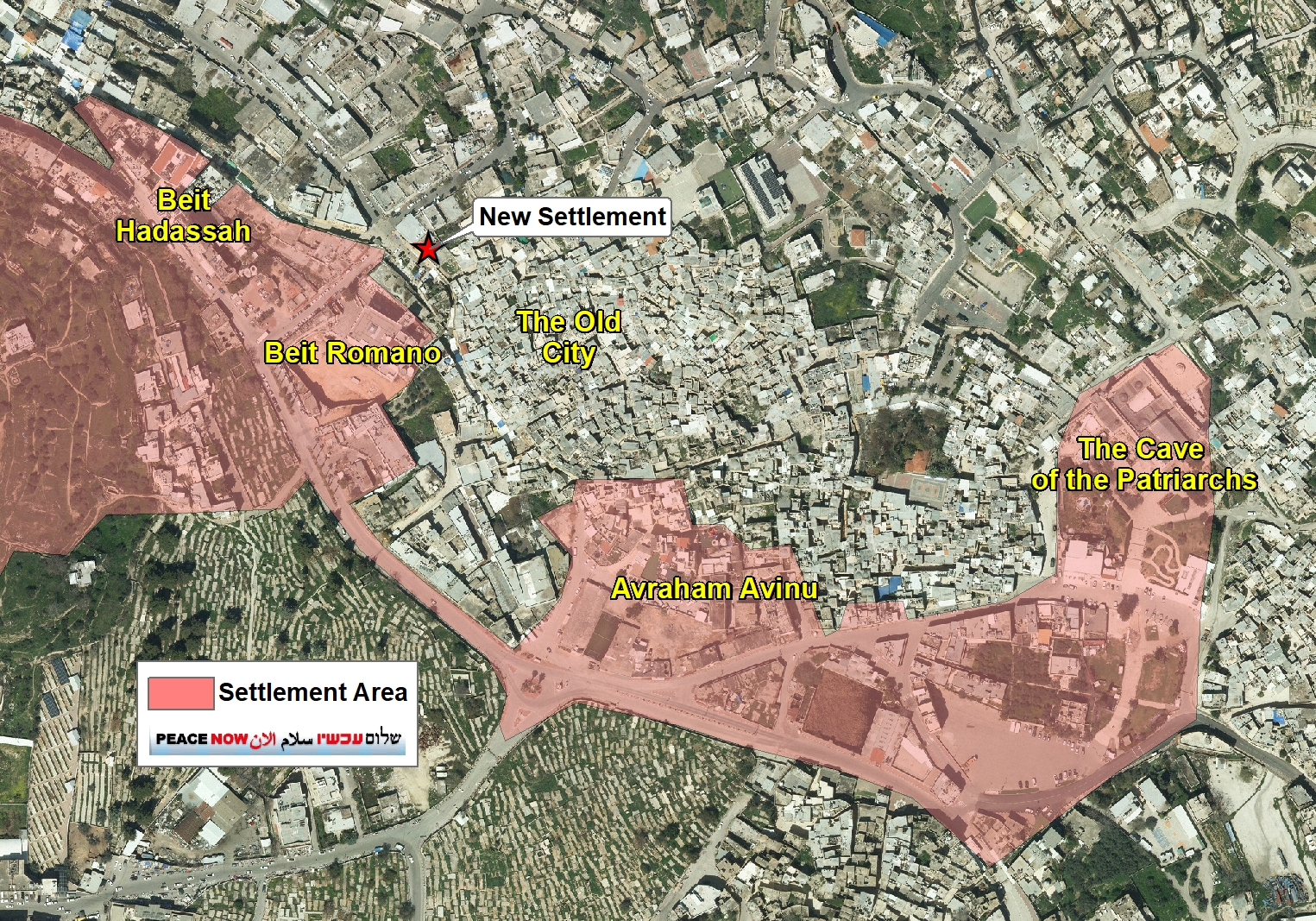 Settlers have taken over a building on Shallala Street in Hebron, one of the main access streets available for Palestinians to reach the Old City of Hebron and the Ibrahimi Mosque. Shallala Street runs parallel to Shuhada Street, which is closed to Palestinians. Peace Now warns the new enclave raises concern that the Israeli government or army may move to close the street to Palestinians in order to provide security to the settlers.
Peace Now said in a statement:
“This settlement is a direct initiative of the government. The Custodian of Government Property allocated the building to the settlers, and the army opened a special passage for them to enter. The goal of establishing a settlement in the heart of Hebron’s casbah is to seize new areas of the city and displace Palestinians from them, similar to what was done in the city center around the existing settlements. The settlement in Hebron is the ugliest face of Israeli control in the territories. Nowhere else in the West Bank is apartheid so blatant. Establishing a new settlement in Hebron is a provocation that harms Israel’s political and security interests.”
On the same day as Smotrich’s presentation, Israeli forces arrested the mayor of Hebron, Tayseer Abu Sneineh. Hebron is the largest Palestinian city in the West Bank and is home to 800,000 Palestinians. Some 500 messianic Israeli settlers have been imposing their presence in the city’s old town since the 1980s, and Abu Sneineh is known for his role in a Fatah cell that planned and carried out the shooting of six Israeli and Jewish settlers in the city’s old town in 1980, locally known as the “Dabuya Operation.” After his initial arrest, Abu Sneineh was later released in a prisoner swap in 1983 alongside other members of the cell.
Abu Sneineh’s arrest came days after Israeli media outlets reported that Israel’s Prime Minister, Benjamin Netanyahu, was considering the establishment of a tribal “emirate” in Hebron, separate from the Palestinian Authority, which first surfaced in the pages of the Wall Street Journal last July.
Local Palestinian media speculated as to whether Abu Sneineh’s arrest was possibly a prelude to removing potential sources of local opposition to annexation, especially given Abu Sneineh’s
West Bank News & Analysis
- “The government is establishing a new enforcement unit that will operate in the West Bank against Palestinian construction” (Peace Now, 9/10/25)
- “Israeli Foreign Ministry Sparks Backlash With Rosh Hashanah Outing in West Bank” (Haaretz, 9/9/25)
- “Settlers sprayed graffiti, set vehicles on fire in Palestinian village overnight” (The Times of Israel, 9/11/2025)
- “A New Settler Hut Popped Up in Hebron. What Followed Confirmed the Palestinian Neighbors’ Worst Fears” (Haaretz, 9/6/2025)
- “The U.S. visa cancellations for Palestinians marks another step towards West Bank annexation” (Mondoweiss, 9/5/25)
- “The Settlers’ Next Prize” (Al Jazeera, 9/8/2025)
East Jerusalem News & Analysis
- “US Secretary of State Marco Rubio to attend inauguration of settler tourist site near Haram al-Sharif/Temple Mount” (Peace Now, 9/8/25)
- “A Stranglehold on Sheikh Jarrah–New Tools for Israeli Takeover and Palestinian Displacement” (Ir Amim, 9/7/25)
- Ir Amim’s Annual Report on the State of Education in East Jerusalem, 2024-2025 School Year” (Ir Amim, August 2025)
Bonus Reads
- “A Rogue Force Operates in Gaza Under IDF Cover, Endangering Soldiers and Unarmed Palestinians” (Haaretz, 8/4/25)
- “Most Americans, including MAGA supporters, oppose Israeli annexation of West Bank — poll” (The Times of Israel, 9/11/25)
- “20 years after Gaza settlement disengagement, some dream of going back” (NPR, 9/10/25)
- “Israel Has Seen Extremists in High Office. But Nothing Like Netanyahu’s Shin Bet Pick” (Haaretz, 8/8/25)
- “Zionism: 77 Years of Expulsion” (Hagai El Ad in Haaretz, 9/10/2025)
Welcome to FMEP’s Weekly Settlement Report, covering everything you need to know about Israeli settlement activity this week.
To subscribe to this report, please click here.
June 9, 2023
- NEXT WEEK – E-1 Back On the Agenda
- Israel Advances Plan for Massive New Industrial Zone
- Israel Quietly Expropriated Land to Facilitate the Retroactive Legalization of Havat Gilad
- Israel Allows Settlers to Operate Farms inside the Masafer Yatta Firing Zone, From Which Palestinians Are Being Forcibly Displaced
- Armenian Orthodox Church Sells Key Jerusalem Properties to an Israeli Investor
- Israel Preps New Laws to “Judaize” the Galilee, Subsidize Jewish-Only Communities in Galilee, Negev, and West Bank
- 17 Israeli Human Rights Orgs Issue Status Report on Occupation
- Yesh Din Re-Releases “Annexation Database”
- Bonus Reads
NEXT WEEK – E-1 Back On the Agenda
The High Planning Council’s Subcommittee for Objections is set to hold a third and final meeting on Monday June 12th to discuss objections that have been filed against the construction of the E-1 settlement, planned for an area just northeast of Jerusalem. Construction of this settlement would have severe geopolitical implications (cutting the West Bank in half, cutting it off from East Jerusalem); would necessitate the forcible transfer of several bedouin communities (a war crime); and affect thousands of Palestinians (shredding the fabric of life).
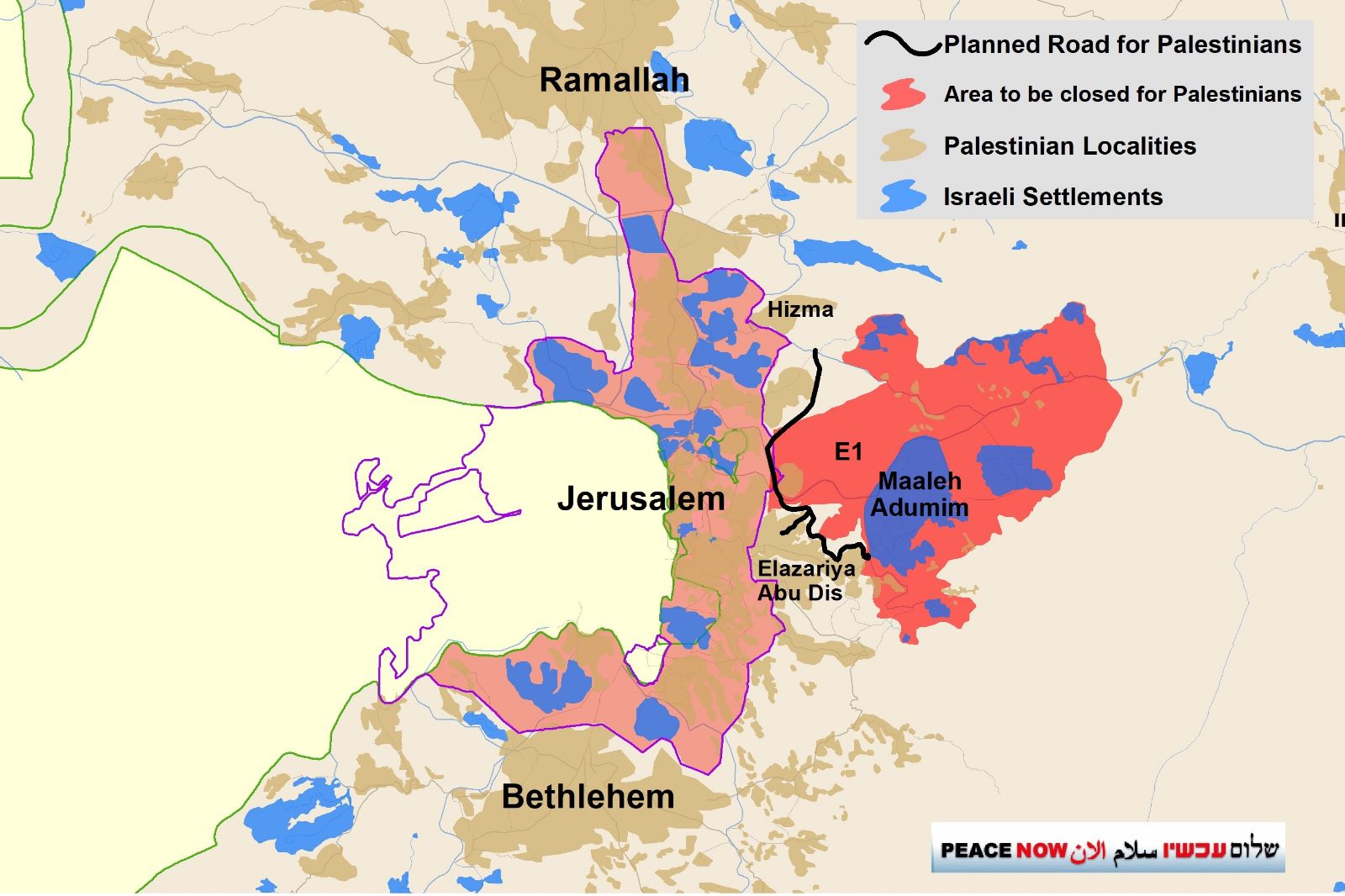 Assuming there is not another last-minute decision to take E-1 off the agenda (something that could well happen, and has happened repeatedly) this upcoming meeting promises to be a decisive one for the long-pending E-1 plan. It could very well result in the Committee – which is now under the authority of longtime settler advocate, Israeli Minister Bezalel Smotrich – granting final approval to the highly contentious plan.
As a reminder: in its current form, the E-1 plan provides for the construction of 3,412 new settlement units on a site located northeast of Jerusalem. The site is home to several Palestinian bedouin communities, comprising 3,000 people, including Khan al-Ahmar, which Israel is planning to forcibly relocate. Long called a “doomsday” settlement by supporters of a two-state solution, construction of the E-1 settlement would sever East Jerusalem from its West Bank hinterland, preventing East Jerusalem from ever functioning as a viable Palestinian capital. It would also cut the West Bank effectively in half, isolating the northern West Bank from the southern West Bank and foreclosing the possibility of the establishment of a Palestinian state with territorial contiguity.
Israel’s “answer” to that latter concern has long been to argue that Palestinians don’t need territorial contiguity, and that new roads can instead provide “transportational continuity,” via a plan called the “Sovereignty Road. If built, the “Sovereignty Road” will seal and divert Palestinian traffic around the area where Israel intends to build the E-1 settlement. In March 2023 Israel announced that construction of this so-called “Sovereignty Road” was set to begin in May 2023. There have since been reports that Israeli authorities have issued notices to Palestinian landowners whose land will be seized for construction of the road, undertaken prep work for construction, and has allocated millions of shekels to fund components of the road.
And another reminder: there have been attempts to promote the E-1 plan since the early 1990s, but due to wall-to-wall international opposition, the plan was not advanced until 2012. At that time Netaynuahu ordered it to be approved for deposit for public review (a key step in the approval process), ostensibly as payback for the Palestinians seeking recognition at the United Nations. Following an outcry from the international community, the plan again went into a sort of dormancy, only to be put back on the agenda by Netanyahu in February 2020, when he was facing his third round of elections in two years. Also, as a reminder: under the Trump Plan (which the Biden Administration has yet to comment on), the area where E-1 is located is slated to become part of Israel.
Peace Now said in a statement:
“The advancement of construction in E1 is another step in the current Israeli government’s actions, which since its establishment, has been establishing new settlements, returning settlers to the northern West Bank, and now working to create conditions for the annexation of the West Bank. Just last week, the Israeli government violated its commitment to the US government and re-established the outpost of Homesh in the northern West Bank. Next week it will violate an Israeli commitment again by promoting the construction plan in E1. This pro-settler and annexationist government seems to continue to act according to a systematic plan that leads us to a reality of apartheid, undermining the chances of a political solution between Israelis and Palestinians. The Israeli public and our friends around the world must wake up and stop Israel from falling into the abyss.”
Israel Advances Plan for Massive New Industrial Zone
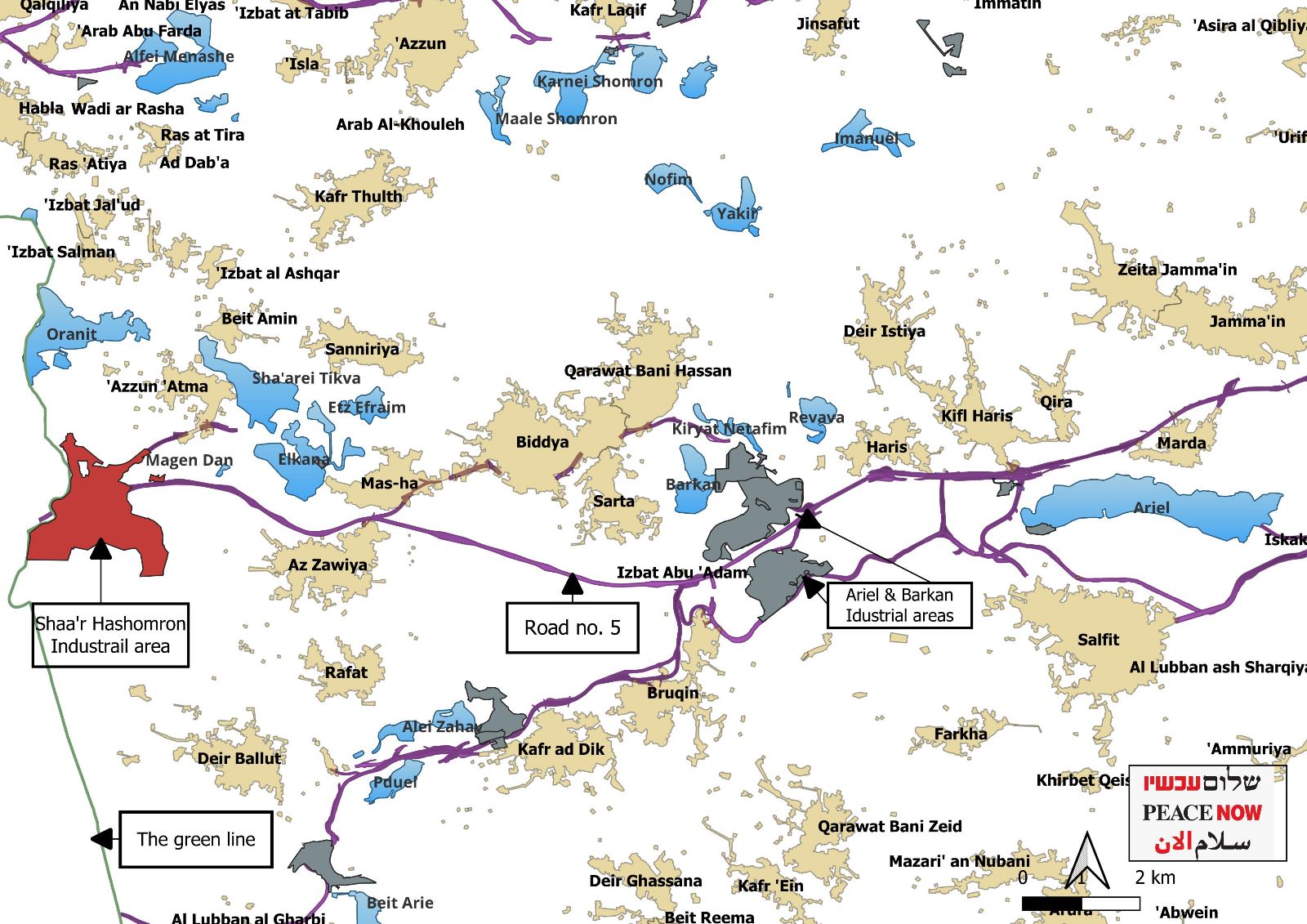 Peace Now reports that on June 2nd the Israeli High Planning Council deposited for public review a plan for the establishment of a massive new settlement industrial zone (called “Sha’ar Shomron”) to be located on lands historically belonging to the Palestinian villages of Siniria, Rafat, and Az-Zawiya in the northern West Bank. In addition to planning for industrial complexes and commercial areas, the plan also provides for the construction of educational buildings, office complexes, sports facilities, recreational areas, and tourism sites – and there is a future plan to connect the new industrial zone to the Israeli railway grid. The new settlement industrial zone is slated to be built directly adjacent to the Green Line, contributing to the erasure of the Green Line and Israel’s annexation of the West Bank.
Peace Now further reports that if the plan is approved, this will likely be the largest Israeli industrial zone in the West Bank, with 2,700 dunams of land, of which 2 million square meters will be for industrial use. Further, Peace Now notes that there is a “lack of need for an additional industrial zone”, especially in this area given that the Ariel and Barkan Industrial Zones are nearby.
Peace Now said in a statement:
“The settlement enterprise is about to receive tremendous economic support in the form of a 2 million square meter industrial zone that will greatly benefit the Shomron Regional Council, strengthen its economy, and, as in previous cases, provide very little, if anything at all, to the Palestinian villages and Palestinians themselves. The Sha’ar Shomron industrial zone is set to deeply integrate Israel’s economy into the occupation mechanism and turn thousands of Israelis into workers for the benefit of the settlement enterprise. This is a hazardous industrial settlement, not only for the Palestinians whose lands it is being built on but for the entire Israeli and Palestinian public. There is no economic prosperity here but rather another expression of the settlement enterprise and the occupation.”
For decades Israel has used industrial zones as another tool to expand and deepen control over West Bank land and natural resources. Industrial zones perpetuate Israel’s economic exploitation of occupied territory (including the local workforce, land, and other natural resources). Presented as benefiting both Israelis and Palestinians, it is in fact Orwellian to label such initiatives as “coexistence” programs, or to suggest that they offer the Palestinians benefits they should welcome. Importantly, jobs in industrial zones – often the only jobs available for Palestinians living under an Israeli occupation that prevents the development of any normal Palestinian economy – are widely viewed by Palestinians as a double-edged sword. The NGO Who Profits explained:
“Israeli Industrial Zones constitute a foundational pillar of the economy of the occupation. They contribute to the economic development of the settlements, which are in violation of international law and the Fourth Geneva Convention, while relying on the de-development of the Palestinian economy and the exploitation of Palestinian land and labor…The Industrial Zones in the oPt form part of a practice of ‘financial annexation’ which is an essential component of the broader policy of annexation taking place.”
Israel Quietly Expropriated Land to Facilitate the Retroactive Legalization of Havat Gilad
The anti-settlement watchdog Kerem Navot (aka Naboth’s Vineyard) reports that on May 2, 2023 the Israeli Custodian of Abandoned and Government Property – Yossi Segal – signed a military order declaring a small tract of land in the West Bank to be “state land.” The small tract of land happens to be where settlers have been allowed to illegally build the Havat Gilad outpost, despite the fact that aerial imagery shows that that area had been continuously cultivated by Palestinians prior to settlers taking over the land (and therefore cannot be taken over by Israel as “state land”). Nonetheless, settlers have been allowed to illegally build on this land, illegal activity which is now being rewarded and further incentivized by Segal’s move to expropriate the land – a move that paves the way for the retroactive legalization of the outpost.
As Kerem Navot chronicles, the Havat Gilad outpost has been the subject of controversy since it was first established by settlers in 2002. Since then, the outpost has become a source of radical, serious, and frequent violence against Palestinians. In 2014, two Havat Gilad settlers were sentenced to prison for setting Palestinian vehicles on fire in a price-tag attack; its residents have also been documented harassing Palestinian farmers and denying them access to their own lands. The Israeli NGO Yesh Din – which has documented violence emanating from Havat Gilad, including against Yesh Din employees – has filed several petitions against the outpost, including a 2010 case that resulted in the demolition of some of the outpost’s structures that were built on land Israel recognized as privately-owned by Palestinians. Yesh Din’s investigation shows that Havat Gilad was built on lands that the Israeli Civil Administration has now declared to be “state land” have in fact been continuously cultivated and privately owned by Palestinians; most of the outpost’s structures have standing (but unenforced) demolition orders issued against them.
In 2018, the Israeli government came under intense pressure from the settler lobby to legalize Havat Gilad in response to a Palestinian terror attack that killed a Havat Gilad settler — and came very close to doing so. At the time, the government ran into difficulties in legalizing the outpost because some of the illegal buildings were located on land Israel recognized as privately-owned by Palestinians, and the government could not – at that time – find a legal means by which to expropriate it. Meanwhile, the settler killed in the attack was subsequently buried at the outpost, and as Al-Monitor explains, the presence of a cemetery in the outpost makes its future evacuation nearly impossible. Kerem Navot’s Dror Etkes spoke to Haaretz around this same time about the phenomenon of settlers being buried in the West Bank:
“Etkes tells Haaretz he believes the choice of where the cemeteries are situated – particularly when they lie on private land some distance from the nearest homes – is not a coincidence. ‘I work on the assumption that there are always deliberate intentions afoot,’ he says. The placement of a cemetery ‘is not chosen for no reason. It is a very long-term investment – and in Judaism, whoever buries people in a certain place does so on the understanding they will not be removed. Obviously, there is deliberate intent lurking behind the location of these cemeteries,’ Etkes continues, ‘and it may be assumed that whoever buries the dead on private Palestinian land knows exactly what he’s doing.’”
Israel Allows Settlers to Operate Farms inside the Masafer Yatta Firing Zone, From Which Palestinians Are Being Forcibly Displaced
Amira Hass reports for Haaretz that Israel is allowing settlers to operate six sheep herding farms [what Americans would call “ranches”] in the Masafer Yatta area of the South Hebron Hills, which Israel has declared a “firing zone”, thereby making it illegal for civilians to enter, live, or farm on the land. This settler activity is being allowed while Israel is simultaneously pursuing the mass forcible expulsion of Palestinians from the area, based on the argument that their lives and homes in a firing zone are illegal. According to a settler from an illegal outpost, the IDF has even provided “grazing permits” to settlers authorizing their activities in the area.
The phenomenon of settlers using agricultural and farming outposts as a highly efficient means of taking control of land (a few farmers can easily take control over vast amounts of herding/grazing lands) has been thoroughly documented by Kerem Navot, which calls it “Israel’s most significant mechanism for dispossessing Palestinian communities.”
Two of the settler farms were established before the May 2022 ruling by the Israeli High Court which authorized the expulsion of Palestinians from the area, the other four were established after. Predictably, though these farms may have started as bare-bones operations, Palestinians now report:
“continuous and brisk activity around these farms, with trucks unloading, a cement truck laying down a concrete surface and all-terrain vehicles entering and leaving the farms, as well as people on horseback…Palestinians in the area say that they often see soldiers in the vicinity of Israeli shepherds, accompanying them within the firing zone.”
In stark contrast to the tolerance and assistance the IDF gives to settlers in the area who have illegally built outposts and these sheep farms, the nearby Palestinians living in Masafer Yatta are ruthlessly tormented, harassed, and attacked by Israeli settlers and the IDF. In a shocking and heartbreaking examination of what life in Masafer Yatta have become for Palestinians, Palestinian journalist and activist Hamdan Mohammed Al-Huraini quotes Issa Makhamra, a resident, who said:
“Everything is forbidden under the pretext that we live in a firing zone, even grazing sheep. Whenever we go anywhere, they set up a checkpoint. When I want to go to the city, I have to pass through this checkpoint, and I am stopped and detained for long hours. I swear to you, if the army could keep sunlight and air from us, they would do it.”
Armenian Orthodox Church Sells Key Jerusalem Properties to an Israeli Investor
The Associated Press reports that in a highly controversial move, the Armenian Orthodox Church signed a 99-year lease giving several church properties in the Old City of Jerusalem to an Australian-Israeli businessman, Danny Rothman (sometimes referred to as Danny Rubenstein). The lease reportedly includes the Hadiqat Al-Baqar (The Cows’ Garden) and its surrounding properties, including the Qishla building in Bab al-Khalil (Jaffa Gate), located in the Armenian Quarter. Rumors of this sale first surfaced in 2021, but recently a sign was placed on one of the tracts saying the land is the property of Xana Capital, the company which Danny Rothman owns. According to a bishop involved in the sale, Rothman and his business Xana Capital plans to develop the land into a luxury resort managed by a Dubai-based company.
The Armenian Archbishop, Nourhan Manougian, alleged that the Church’s real estate official and priest – Baret Yeretsian – sold the land in a “fraudulent and deceitful” deal that he was unaware of. Yeretsian, in turn, said he carried out the deal at the direction of Manougian. Both Manougian and Yeretsian have been forced into hiding due to communal outrage, with Yeretsian fleeing a mob attack with help from Israeli security forces and then relocating to California. Manougian has barricaded himself inside of a convent in the Old City, and protesters have staged weekly protests outside.
Dimitri Diliani, president of the National Christian Coalition of the Holy Land, told the AP: “From a Palestinian point of view, this is treason. From a peace activist point of view, this undermines possible solutions to the conflict.
Manuel Hassassian, the Palestinian Ambassador to Denmark, told the New Arab: “It’s a huge tract of land. By conceding it, they are erasing the Armenian presence historically, demographically, and culturally.”
In the wake of this deal coming to light, Palestinian President Mahmoud Abbas and Jordan’s King Abdullah II have both suspended recognition of Manougian’s authority, rendering him unable to sign contracts, complete transactions, or make decisions in the Palestinian territories and Jordan.
Israel Preps New Laws to “Judaize” the Galilee, Subsidize Jewish-Only Communities in Galilee, Negev, and West Bank
Two weeks ago, the Israeli security cabinet quietly organized an effort to draft and pass new laws designed to encourage Israeli Jews to move to the Galilee region of Israel, where Palestinian citizens of Israel are the majority. There are two main components of this effort so far:
- Amending the “admission committees” law to expand the number of Israel communities permitted to use such committees to screen future residents — a tool used primarily if not exclusively to prevent Palestinian citizens of Israel from moving into communities that residents want to preserve as Jewish-only towns and neighborhoods. The Israeli Ministerial Committee for Legislation granted government-backing to this proposed law weeks ago, and it recently passed its first reading in the Knesset.
- A law that will see the government subsidize land for “communities” that (in the eyes of the Israeli government) suffer from “demographic or security hardships” (which per a key backer of the law does not include Arab areas of Israel, as “Arab settlement does not suffer from similar hardships” as Jewish settlement). This law would in effect see the Israeli government subsidizing Jewish Israelis moving to areas like the Galilee and the Negev — and Prime Minister Benjamin Netanyahu is being pushed by Religious Zionism lawmakers to extend this plan to settlements in the West Bank.
Haaretz Editorial Board writes:
“The bill is part of a broader agenda that is euphemistically called ‘Zionism,’ but whose essence is Jewish supremacy in the spirit of the nation-state law. It’s a follow-up to the cabinet discussion of a resolution meant to give Jews preference in land allocations.”
17 Israeli Human Rights Orgs Issue Status Report on Occupation
On the 56th anniversary of the Occupation, a group of 17 Israel human rights organizations came together to author and publish a concise and highly relevant joint “Situation Report” on the state of the occupation. The report covers four main themes: security forces’ violence, annexation, displacement, and attacks on NGOs.
On annexation, the report covers several important issues that are being closely monitored:
- Structural changes to Israeli governance which amount to annexation of the West Bank;
- Settlement expansion;
- The completion of the Eastern Ring Road (aka the Apartheid Road);
- The “seam zone” permit regime; and,
- Gaza.
The report’s annexation section concludes with the following warnings:
» Changes advanced by Israel’s 37th government, even if not implemented in full, will lead to an irreversible transformation of the West Bank and will cement Israel’s control of the oPt’s Palestinian population and its property. The government’s policies are concurrently advanced via administrative tools, structural changes, legal reforms and huge budget allocations to settler causes. These should not be viewed piecemeal, but as a harmonized policy to accelerate the West Bank’s annexation.
» An exponential increase of the settler population is planned, paired with an unprecedented settlement-expansion drive. Building plans in over 37 settlements have already been approved and ten illegal outposts legalized – with legalization of a further 70 in the pipeline.
» Israel’s current government policies and its Jewish-supremacy ideology will further erode Palestinians’ rights and legal protections under military law, augmenting the West Bank’s dual legal system’s apartheid character. Palestinians’ diminished capacity to be served by the ICA has already been further hampered, and additional restrictions are expected.
» Large-scale construction plans are in place for the E1 area, including the Eastern Ring Road and a new settlement of 3,400 housing units. If realized, these projects will de facto annex strategic parts of Area C, east of Jerusalem, depleting much of East Jerusalem’s land reserves and further fragmenting the West Bank. Annexation of this area has been vehemently and successfully opposed by the international community in the past.
» With all eyes on the West Bank and East Jerusalem, Gaza and its population continue to be largely overlooked and its isolation from the West Bank and the outside world has been accepted as an insoluble reality. Palestinians in Gaza continue to live on the perpetual edge of a humanitarian crisis. Israel’s current government’s annexation policies and cementing of an apartheid regime will further increase Gaza’s isolation and its population’s unbearable predicament.
Yesh Din Re-Releases “Annexation Database”
The Israeli NGO Yesh Din has re-released an updated and incredibly useful database of Israeli laws – past, present, and pending; enacted and abandoned – that amount to annexation of West Bank land. The Annexation Legislation Database categorizes annexation bills into four types:
- The application of Israeli law and sovereignty;
- Direct legislation by the Knesset on the occupied territory;
- The transfer of authorities away from the military commander;
- The blurring of the Green Line.
The re-released database is complemented by a powerful article by Yesh Din’s longtime legal advisor Michael Sfard (who is a legal advisor to a host of anti-occupation, anti-apartheid, anti-settlement groups) in Foreign Policy, entitled “Israel Is Officially Annexing the West Bank.” Sfard writes:
“The high road to legal annexation is an official, public declaration, as Putin made when he annexed the Crimean Peninsula in 2014. But annexation does not necessarily involve pomp and ceremony. It can happen in dull, windowless offices and through seemingly dreary administrative and bureaucratic actions.
Exposing Israel’s annexation requires zooming out. This is what the international community fails to do, and it is why Israel’s brazen violation of international law has not drawn the ire it deserves. International discourse is hung up on the ceremonial, formal version of annexation—Putin’s annexation, which was rightly met with rebuke and sanctions. The world does not know how to deal with Netanyahu’s tactics.
Though it was not accompanied by a grand statement, the Israeli defense ministry’s portfolio transfer to Smotrich amounts to an act of de jure annexation of the West Bank—and is a dangerous step toward entrenching apartheid within the territory.”
Bonus Reads
- “Tantura massacre: Palestinian families call on Israel to mark site of mass graves” (Middle East Eye)
- “Israeli settlers encircling Jerusalem, EU envoys warn” (EU Observer)
- “Palestinian Forum Highlights Threats of Autonomous Weapons” (Human Rights Watch)
- “Settlement expansion is obstacle to peace, Blinken tells US Israel lobby” (Reuters)
Welcome to FMEP’s Weekly Settlement Report, covering everything you need to know about Israeli settlement activity this week.
To subscribe to this report, please click here.
December 21, 2018
- Israel Nears Final Move to Carry Out Massive Land Theft to “Regulate” Illegal Outposts
- Ministers Back a Bill to Legalize 66 Outposts
- In New Legal Opinion, Israeli AG Outlines Strategy for Legalizing Outposts
- New Outpost #1 : Settlers & Government Officials Illegally Re-Build Amona Outpost
- New Outpost #2: Settlers Build Outpost Overlooking Hebron
- More Details on the Plan to Dig a Tunnel Road to the Haresha Outpost
- High Court Criticizes State Over Illegal Road on Palestinian Land
- New Report Documents Israel’s “Severe and Regular” Violation of International Law in Hebron
- High-Rise Settlement Housing Promoted As a Means to Achieve 2020 Settler Vision & As a Solution to Israel’s Affordable Housing Shortage
- Fourth Quarter Decline in 2018 Settlement Construction Starts Doesn’t Tell the Whole Story
- Bonus Reads
Questions/comments? Email kmccarthy@fmep.org
Israel Nears Final Move to Carry Out Massive Land Theft to “Regulate” Illegal Outposts
As has become routine, Israeli settlers and their allies in government are exploiting the recent deaths of three Israelis (two soldiers and a baby) at the hands of Palestinian attackers as an opportunity to accelerate settlement-related activities. This includes advancing new legislation and accelerating/expanding the application of new legal tools designed to entrench and expand the permanence of some of the most radical Israeli settlers living in isolated outposts across the West Bank.
If implemented, the plans and legislation detailed below (and in last week’s settlement report) will expropriate huge amounts of land that even Israel recognizes as privately owned by Palestinians, in order to retroactively legalize Israeli outposts scattered across the West Bank. Such a move will complete what has been a gradual but steady formal suspension of even the pretense of maintaining the rule of law with regard to Israeli settlers’ or the Israeli government’s’ actions in the West Bank (which comes on top of Israel’s official and open contempt for international law). As Haaretz columnist Zvi Bar’el writes:
“The legal criminality that the government invented in honor of the settlers… is an unbridled attack on the rule of law, the undermining of Palestinian landowners’ right to appeal at the High Court, and the destruction of the planning and building system. And mainly, it turns terror into a real estate perk for lawbreaking extortionists.”
Americans for Peace Now said:
“In reaction to murderous terrorist attacks targeting West Bank Jewish settlers and Israeli soldiers, the government of Israel has come under pressure from the settlers to exact retribution against Palestinians. Two of the measures adopted are bound to open the floodgates for the legalization of existing settlement-outposts and the establishment of new ones.”
Ministers Back a Bill to Legalize 66 Outposts
On December 16th, the Israeli Cabinet voted unanimously to give government backing to a bill (called “Regulation Law 2” or the “Young Settlement Bill”) that directs the government to treat 66 illegal outposts built on privately owned Palestinian land as legal settlements, while giving the government 2 years to find a way to retroactively legalize those outposts.
The bill, proposed by MK Bezalel Smotrich (Habayit Hayehudi) and MK Yoav Kisch (Likud), also freezes any/all legal proceedings against the outposts and requires the government to connect the outposts to state infrastructure including water, electricity, provide garbage removal, and also approve budgets for them. The law also allows the finance minister to guarantee mortgages for settlers seeking to buy units in these outposts, even before the legal status of the land is resolved (a remarkable state-directed violation of normal practices in the mortgage industry). With government backing, the bill will now be introduced in the Knesset, where it must pass three readings before becoming law.
Though this bill has been ready for months, the Cabinet decided to advance the bill now in response to recent Palestinian terror attacks. MK Smotrich said: “This is the definitive answer to the murderous terrorism of the Arabs.” This sentiment was echoed widely across the settler movement.
The Cabinet voted to support the bill despite strong opposition from the Israeli Attorney General’s office. Deputy AG Ran Nizri told the Cabinet ahead of the vote that the bill has “significant legal problems,” represents a sweeping violation of the property rights of Palestinians in the West Bank, and will likely face a drawn out Court battle that might result in the High Court of Justice overturning the law. Notwithstanding these seemingly principled arguments opposing this tactic for legalizing outposts, it should be recalled that the Attorney General’s office has proposed what it believes is a more defensible means means to accomplish the same ends – called the Market Regulation principle (discussed below).
The Jerusalem Post speculates that passage of the “Regulation Law 2” in the Knesset may not be automatic, in light of past instances where international condemnation of such moves to legalize outposts led to hold-ups. The Times of Israel points out that the Trump Administration has failed to express any criticism about the new bill, which is unsurprising given Trump Administration officials’ statements and actions embracing and normalizing the settlements.
Israeli Justice Minister Shaked praised the bill, saying:
“[the bill is a] clear statement that will legalize young settlements [outposts] in Judea and Samaria. In the last three years, we changed the conversation from one of evacuation to one of legalization. There is no reason for the residents of Judea and Samaria to always have to live under the sword of evacuation.”
Peace Now said:
“Another populist and unconstitutional initiative is approved by the settler government, and only in such a state can an ‘illegal settlement’ be classified as a ‘young settlement.’ The settlers’ violence against Palestinian passerby that we witnessed during the weekend is a direct result of the government’s policy and of such bills that actually telling the settlers that they are above the law and whatever violation of the law the make, the government will legalize it.”
The bill is a follow-up to the first Regulation Law, which was passed by the Knesset in February 2017 but has since then been frozen by the High Court of Justice while it considers the law’s constitutionality. One month after passage of the Regulation Law, the Israeli Cabinet passed a resolution to enact the law expeditiously, at which point the cabinet created a committee – now headed by settler leader Pinchas Wallerstein – to build a list of outposts which the government can retroactively legalize and to complete the bureaucratic work required to do so. Wallerstein – who has a long history of ignoring Israeli law but is now responsible for massaging it to suit his needs – has been vocal about what the government can do immediately, telling the Knesset in October 2018 that there are at least 20 outposts which can be “easily” legalized as neighborhoods of existing settlements, and 50 more outposts that can be legalized but require more complex solutions.
The outposts slated to be legalized are scattered across the West Bank, many of which FMEP has reported on regularly, including: Haresha (the center of recent legal maneuvers aimed at legalizing an access road built on privately owned Palestinian land); Givat Assaf (where two Israeli soldiers were killed on December 13th); Havat Gilad (another outpost which gained political support following a Palestinian terror attack); Yitzhar South, Yitzhar East (satellites of the radical and violent Yitzhar settlement near Nablus; Ma’ale Rehavam (which was built on privately owned Palestinian land that the WZO illegally allotted to the settlers); Mitzpe Kramim (where once again the WZO gave settlers land owned by Palestinians. A court recently ruled the WZO acted in “good faith” in the transaction despite evidence to the contrary); Netiv Ha’avot (FMEP extensively covered the saga of Netiv Ha’avot); and, Adei Ad (a violent outpost that has been approved to be added to the jurisdiction of the new Amichai settlement in the Shilo Valley).
FMEP tracks all developments related to Israeli legislative, cabinet, and judicial action that promotes the retroactive legalization of outposts built on privately owned Palestinian land as part of its documentation of creeping annexation – available here.
In New Legal Opinion, Israeli AG Outlines Strategy for Legalizing Outposts
On December 13th, Israeli Attorney General Avichai Mandleblit issued a new legal opinion outlining how the government can implement the “market regulation” principle (which he invented) as a new legal basis for retroactively legalizing outposts and settlement structures built on privately owned Palestinian land. According to this principle – which contradicts any notion of rule of law or the sanctity of private property rights – settlement structures and outposts built illegally on private Palestinian land, can be legalized, if the settlers acted “in good faith” when they took over and built on the land. His opinion and subsequent arguments to the Israeli High Court of Justice (below) confirm that in the view of the Israel’s top law official, Israel has the right to expropriate privately owned Palestinian land in the occupied West Bank and give it to Israeli settlers; the only disagreement he has with the Knesset is over the method of doing so.
Peace Now has a comprehensive breakdown of the new legal opinion, including the specific criteria outlining which outposts can qualify under the new scheme. AG Mandelblit estimates that 2,000 illegal settlement structures qualify for retroactive legalization using this principle,
The Israeli government has already used the “market regulation principle” in court twice, both in defending against lawsuits filed by Palestinians (first in response to petitions by Palestinian landowners against structures on their land near the Ofra settlement, second in response to petitions filed by Palestinian landowners against the Mitzpe Kramim outpost). This week’s move by the Attorney General allows the government to proactively initiate proceedings to retroactively legalize unauthorized outposts and settlement structures.
Reportedly, the Attorney General prepared this legal opinion a while back, but was stopped from publishing it by Prime Minister Netanyahu, who was concerned about the international and diplomatic repercussions. It seems likely that the recent string of Palestinian terror attacks prompted Netanyahu to give the AG the green light to go ahead, along with advancing a number of other punitive settlement plans.
Shortly after approving the implementation of the “market regulation principle,” Mandleblit called on the High Court of Justice to overturn the Regulation Law, which the Court has been considering for more than a year. In a letter to the High Court Justices, Mandleblit argued that implementing the “market regulation principle” is “a more proportionate and balanced measure than the arrangement prescribed in the Regulation Law,” providing a more narrow legal basis by which Israel can strip Palestinian landowners of their rights (estimating that 2,000 structures can be legalized under the “market regulation principle,” compared to an estimated 4,000 under the Regulation Law). Of course, this argument overlooks the severe violation of Palestinian rights, the rule of law, and international law inherent in Israel’s decision to in effect erase Palestinian private property rights in the occupied territory to benefit the settlers.
Peace Now said:
“The attorney general is crossing yet another red line by laying the foundations for an institutionalized theft mechanism that will expropriate land from Palestinians and allocate it to settlers who stole it.This is part of a larger move led by AG Mandelblit to reduce the rights of Palestinians in the occupied territories and to expand the privileges of the settlers, thereby bringing us closer to an apartheid reality.”
FMEP tracks all developments related to Israeli legislative, cabinet, and judicial action that promotes the retroactive legalization of outposts built on privately owned Palestinian land as part of its documentation of creeping annexation – available here.
New Outpost #1 : Settlers & Government Officials Illegally Re-Build Amona Outpost
In recent days, dozens of Israeli settlers moved two mobile homes placed on the hilltop where the illegal Amona outpost once stood, claiming to have purchased the land from its Palestinian owners. Prominent settler leaders and MK Bezalel Smotrich (Habayit Hayehudi) visited the site to celebrate the resurrection of the infamous outpost, an endeavor which was directly supported and facilitated by the Binyamin Regional Council (a settlement regional authority which draws its budget from Israeli taxpayer funds).
Settlers have reportedly submitted documents to the Israeli Civil Administration which they claim prove the land has been legally purchased (a claim which, even if true, does not justify the settlers’ illegal invasion of and construction in an area designated by Israel as a closed military zone). The Civil Administration – which is the sovereign power over the West Bank and responsible for enforcing the law there – has confirmed that it is aware of the new outpost and has received documents from the settlers, but has not yet reviewed the documents.
Yesh Din, an Israeli NGO representing the Palestinian landowners, immediately filed a petition to have the illegal structures removed. Yesh Din also filed a criminal complaint against the Israeli government officials who were involved with invading the hilltop. As of this writing they have not received a response on either front. Peace Now has also stated it will pursue legal action against the settlers.
Yesh Din explains key context in the Amona outpost saga:
“After the evacuation [of the Amona outpost] in 2017, the Israeli army declared the area a closed military zone, prohibiting entry of Israelis and Palestinians to the area where the outpost had been located. The closure, however, was not enforced for Israelis, who freely entered, while Palestinians – including the legal landowners – were forbidden to enter and cultivate the very land for which they had struggled for years. In addition to the audacity of blatantly defying the High Court of Justice ruling and trampling on the rights of the landowners, the placing of the new structures this weekend violates the closure order and constitutes a further infringement of the law as the establishment of a new settlement in Amona was never authorized – certainly no permits or outline plans exist. But in the ‘land of the settlers,’ the concept of rule of law has long since lost any meaning. Any Israeli can decide to build a settlement on a hill, merely because they feel like it. The buildings then remain regardless of their illegality, Israeli authorities not daring to challenge their imposing presence.”
Benyamin Regional Council Chairman Yisrael Gantz said in a statement:
“After two years of this place being uninhabited, we are fortunate to resume Israeli life here. The plots upon which we erected the structures were legally purchased. Yesterday, I promised to establish a new settlement in Binyamin in response to the deadly attacks and today we are carrying it out.”
Yossi Dagan, head of the Samaria Regional Council said at the event:
“In these dark days, when terrorist attacks are so numerous and the honor of the people of Israel is harmed, we must get fired up and today’s ascent to Amona is an appropriate Zionist response.”
Peace Now said in a statement:
“There is no limit to the cynicism of the hilltop criminals who exploit the events of recent days to trample the law and ignite disturbances, all with public funds. These pyromaniacs are backed by Knesset members and local politicians… It is difficult to understand how an order has not yet been issued to evacuate them, and we ask whether the IDF and the police would have allowed this if they were Palestinians. This disgrace should be addressed today.”
Re-establishing the Amona outpost would hand a complete and total victory to the settlers who were forcibly evacuated from the site in 2017 – proving that not only does settler law-breaking go unpunished, but it is handsomely rewarded by the Israeli government, and that establishing illegal outposts is an effective route to establishing new settlements. Since being evacuated, the Amona outpost settlers have (so far) been “compensated” by the government with financial compensation and two new settlements:
- The first new government-backed settlement in 25 years, Amichai. The Israeli Civil Administration High Planning Council subsequently approved a plan to triple the size of the Amichai settlement to include the Adei Ad outpost and the lands between the two; and,
- The Shvut Rachel East settlement. This is an outpost that was granted authorization as a “neighborhood” of the Shilo settlement, but is properly understood as a new settlement unto itself. Teh Amona outpost settlers were first offered the Shvut Rachel East hilltop as a relocation site, but rejected it in favor of the nearby Amichai hilltop. Despite rejection, Shvut Rachel East received authorization anyways.
New Outpost #2: Settlers Build Outpost Overlooking Hebron
In recent days, a group of settlers have moved back into the site of an evacuated outpost near the city of Hebron, just north of the Kiryat Arba settlement, which settlers are calling Givat Mevaser. At a celebration of the decision by settlers to reestablish the outpost, the chairman of the Kiryat Arba settlement local council, Eliyahu Libman, said:
“We made a decision in light of the harsh news endured by the people of Israel last week to permanently move families into Givat Mevaser.”
The IDF was present at the celebratory event to protect the settlers, but an official at the Defense Ministry admitted that the settlers did not coordinate their actions with authorities. The site was previously approved to be developed into a settlement industrial zone, and according to a spokesperson for the new outpost, settlers are in the process of changing the building plan in order to get authorization for residential housing. Nonetheless, the settlers are at present violating Israeli law by taking up residence at the site.
More Details on the Plan to Dig a Tunnel Road to the Haresha Outpost
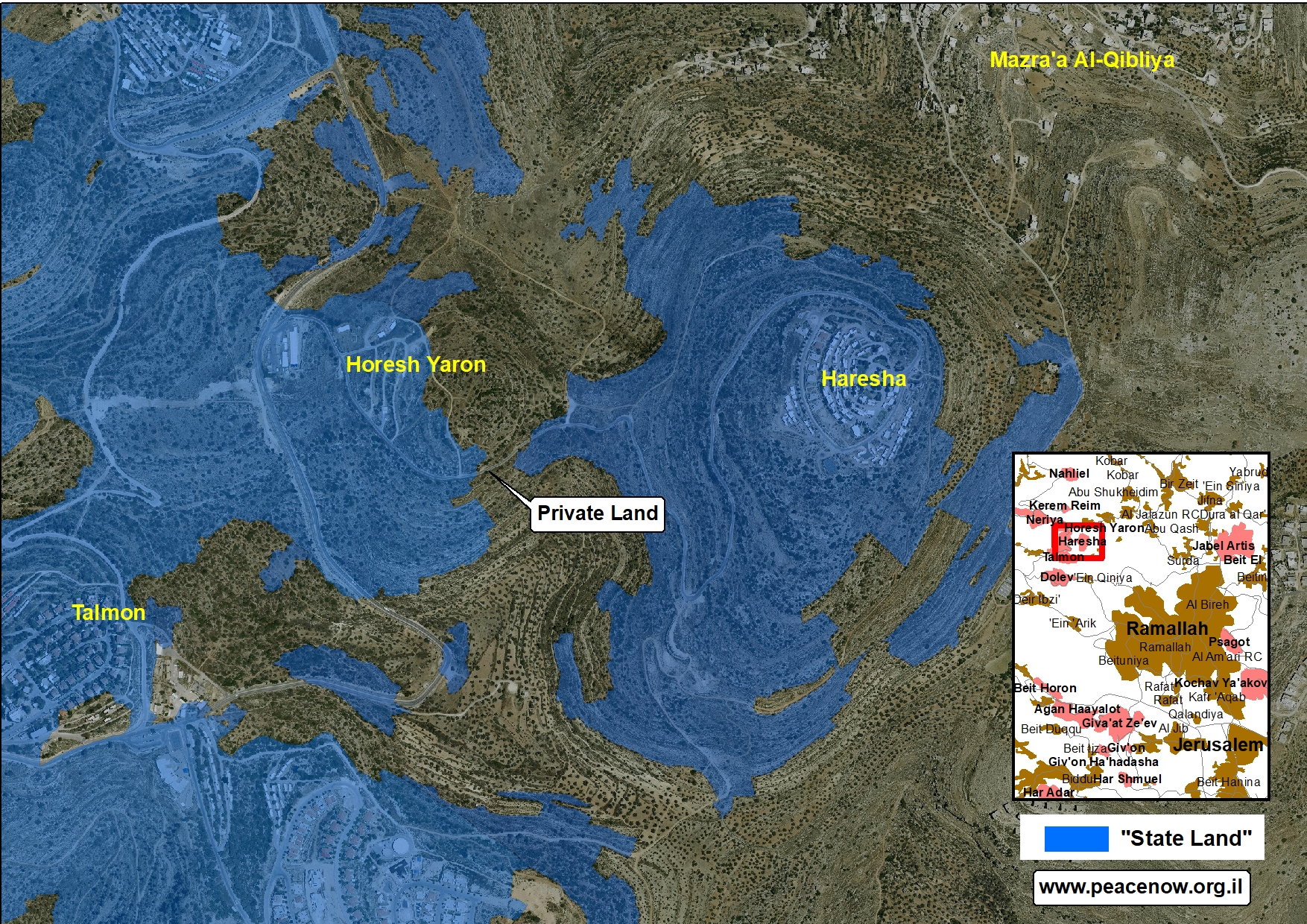 Kerem Navot has published a Justice Ministry opinion that provides further details on the government’s plan – approved on December 6th – to retroactively legalize the Haresha outpost by building a tunnel road underneath privately owned Palestinian land (an olive grove). The Justice Ministry document explains that while the Israeli government in principle has the right to permanently expropriate the land from its Palestinian owners, such an action would likely be challenged in the High Court of Justice, where it might be overturned. The Justice Ministry suggests instead that the government should “temporarily” expropriate the land while a tunnel is dug and road paved beneath the olive grove – with the plan being, ostensibly, to return the land to its Palestinian owners after construction is complete.
Kerem Navot comments:
“now, in order to legalize the outpost, shady legal advisers (of the type to whom Justice Minister Ayelet Shaked is drawn) write documents in which they lay down their doubts on whether to expropriate the grove ‘permanently,’ which will be cheaper and faster (but it is likely to be rejected by the High Court of Justice), or to ‘temporarily’ expropriate it solely for the construction of a tunnel through the ‘excavation and cover-up’ method.”
As a reminder, in November 2017 the Attorney General gave the Israeli government a green light to permanently expropriate the privately owned land based on a legal argument that holds Israeli settlers to be part of the “local population” of the West Bank, and therefore eligible to be the sole beneficiaries of state land expropriated for “public use.”
High Court Criticizes State Over Illegal Road on Palestinian Land
At a December 18th hearing, the High Court of Justice gave the government of Israel 60 days to explain why it should not be required to demolish a road and several buildings that were built on land that the state has admitted it believes is privately owned by Palestinians. The case is before the court on a petition by Palestinians who claim that a 200-meter (650-foot) stretch of the road is built on their land.
The Court also slammed the State for allowing the construction of the road and buildings to be completed after a stop-work order was issued against the construction, a stop-work order the State assured the Court would be implemented. At the December 18th hearing, an attorney from the State Prosecutor’s Office told the Court that the road in question was a dirt road, and argued that the state had not sanctioned or had a hand in its construction.
New Report Documents Israel’s “Severe and Regular” Violation of International Law in Hebron
Haaretz shares details from a leaked report written by the Temporary International Presence in Hebron (TIPH), which documents the totality of Israel’s policies in Hebron, serve to aid and protect settler and which collectively impose severe human rights violations and restrictions on Palestinians.
The report accuses Israel of being in “severe and regular breach” of international law, highlighting the many ways in which the human rights of Palestinians are systematically trampled on – specifically as it relates to radical settlers, their increasing activities in Hebron’s Old City, and the role of nearby settlements.
The Temporary International Presence in Hebron (TIPH) was first established in 1997 as part of the Oslo Accords’ Hebron Protocol, which allowed the partial redeployment of Israeli military forces to the part of the city that remained under its control. Israel must renew the TIPH’s mandate every six months; some fear that the next renewal has been jeopardized by the leaked report’s publication.
High-Rise Settlement Housing Promoted As a Means to Achieve 2020 Settler Vision & As a Solution to Israel’s Affordable Housing Shortage
Haaretz reports that the Yesha Council – the umbrella group representing all settlements in the West Bank – has adopted a strategic goal to advance “high quality, high density” settlement schemes in order to reach their goal of having 1 million settlers living in the West Bank by 2020. The basic idea is to build high-rise apartment complexes in settlements close to major highways in the West Bank and aggressively market them to Israelis who are seeking cheap rent and a fast commute, two key complaints of Israelis living and working in sovereign Israeli territory.
The strategy marks a shift in how settlements have typically been marketed to the Israeli public; once sold as an answer for young Israeli families looking for a single family unit with land, housing in settlements is now being marketed as the answer for young professionals looking for affordability, convenience and accessibility. The Yesha Council has coupled the new strategy with pressure on the government (and a promise to potential purchasers) to expedite West Bank infrastructure projects that will ease traffic, including bypass roads and detours around Palestinian towns.
In a February 2018 article, the Chairman of the Yesha Council wrote:
“Looking ahead, the patterns of thinking and action in the settlement movement need to be changed in two main areas: high-rise construction and doing away with admission committees. The available land for building is not plentiful. Until now, we’ve been used to rural communities with a one-family home on a half-dunam plot, but the goal from now on should be to build as many housing units as possible on that same land. High-density construction — building up or in a terraced fashion, depending on topography — will change the balance in the area and also require a new approach to infrastructure development to suit the number of residents in the future.” [Note: the Haaretz article explains that “admission committees” are a function of settlements which have standards for who is permitted to live there, mostly in ultra-orthodox and ideological settlements]
Fourth Quarter Decline in 2018 Settlement Construction Starts Doesn’t Tell the Whole Story
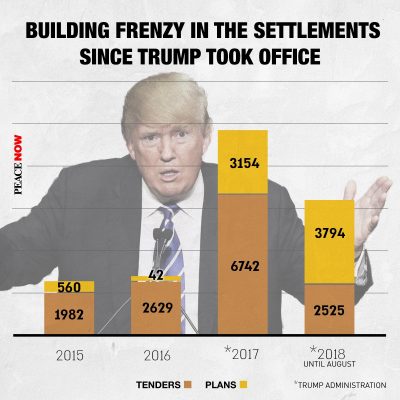
by Peace Now
The Israeli Central Bureau of Statistics (CBS) released new data showing a 52% decrease in the number of settlement construction starts in the third quarter of 2018 compared to the second quarter of 2018. News about a “decline,” relative to the last quarter, obscures the clear and alarming settlement surge currently taking place. As Peace Now has reported, by August 2018 the total number of settlement tenders and plans that have been advanced (6,319) is more than double the total amount in 2016 (3,189).
In addition, it is important to bear in mind that the number of construction starts do not begin to depict or reveal the level of settlement activity happening in the West Bank. Israel’s settlement enterprise is not solely a matter of residential housing plans, but also the unceasing expansion of infrastructure and security measures that exclusively benefit Israeli settlers, the normalization and development of settlement industrial zones, and illegal settlement activity (outposts, which are now regularly legalized ex post facto) that does not register in numbers tracking the settlement planning process.
Bonus Reads
- “Israel Has Weaponized the Settlements” (Haaretz Editorial)
- December 2018 public opinion poll – Palestinian Center for Policy and Survey Research
***Preeminent Israeli human rights lawyer Michael Sfard recently joined FMEP non-resident fellow Peter Beinart for a podcast, available here, to discuss how Israel’s occupation violates international laws governing belligerent occupation, and why he believes the occupation will end. Sfard’s highly recommended new book, “The Wall and the Gate: Israel, Palestine and the Legal Battle for Human Rights” is available for purchase here. Haaretz interviewed Sfard about the book, and the resulting, must-read article “For an Israeli Lawyer Fighting for Palestinian Rights, Winning Is a Double-edged Sword” is available here.***
___
Welcome to FMEP’s Weekly Settlement Report, covering everything you need to know about Israeli settlement activity this week.
To receive this report via email, please click here.
February 8, 2018
- Another New Settlement: Havat Gilad Outpost Set to Be Relocated & Legalized
- Knesset Caucus Pushes to Extend Israeli Sovereignty Over Entire West Bank
- Update on the Unauthorized Expansion of the Halamish Settlement
- Palestinians Still Cannot Access Land Where the Amona Outpost Once Stood
- Trump’s “Ultimate Deal” to Give 10% of West Bank Land to Israel
- Israeli Settler Leader Does Not Know Specifics of U.S. Settlement Policy, Despite Close Relations with Trump Negotiators
- Bonus Reads
Comments, questions, or suggestions? Email Kristin McCarthy at kmccarthy@fmep.org.
Another New Settlement: Havat Gilad Outpost Set to Be Relocated & Legalized
On February 5th, the Israeli cabinet voted unanimously build a new settlement for future evacuees of the unauthorized outpost, Havat Gilad, where 50 families are living illegally. After much hand wringing about how to proceed on the retroactive legalization of Havat Gilad, the government decided to evacuate the the outpost because some of it was knowingly built on land that is privately owned by Palestinians, and therefore there is (at present) no basis on which Israel can pursue its retroactive legalization.
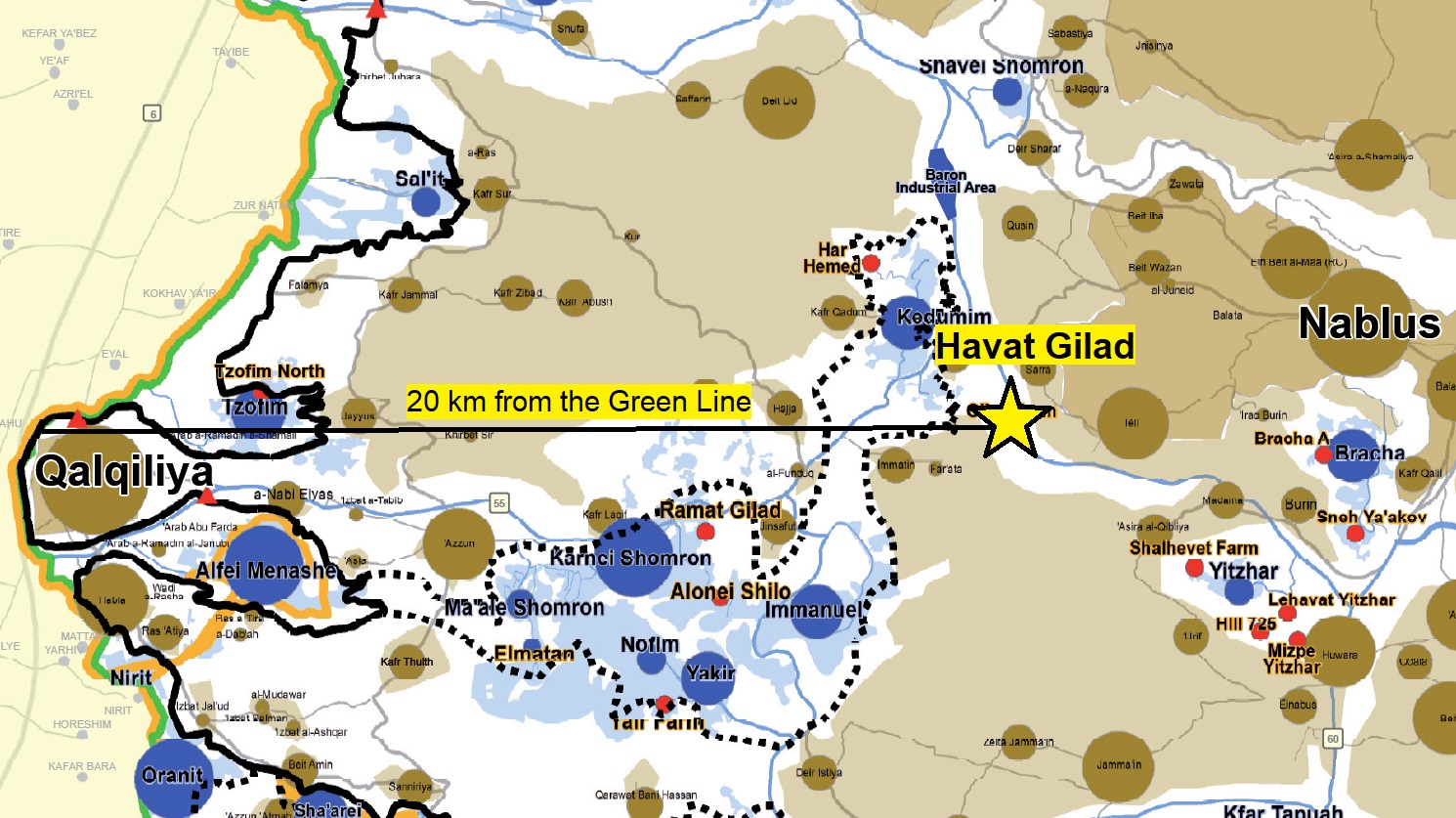
Map by Peace Now
Details of the outpost’s planned relocation are not clear, but it might not entail any movement, save the relocation of any structures that stand on Palestinian land. Most of the outpost is built on land classified by Israel as “state land,” so the majority of the outpost might stay in place and only the structures built on land privately owned by Palestinians will be moved, likely to the areas of the outpost that is on “state land.”
After spending five weeks demonstrating their fervent support for the retroactive legalization of Havat Gilad (in the wake of the murder of one of the outpost’s residents), the Israeli Cabinet now appears to be downplaying the significance of the Havat Gilad decision, likely in anticipation of international criticism of their decision to establish another new settlement (the Amichai settlement, which was approved in February 2017, was the first new settlement established with government backing in the last 20 years). Israeli Cabinet Secretary Tzachi Braverman said:
the decision regarding Havat Gilad is only a technical decision that [is meant to] legalize an existing settlement and does not call for the establishment of a new settlement…There is no intention to expand and to annex privately-owned Palestinian lands but only to legalize the existing settlement after the murder [of Rabbi Shevach] and to connect it to water and electricity as well as make it accessible for humanitarian reasons.
Nonetheless, the Cabinet’s decision to establish a new settlement received considerable international media attention, including critical coverage by the Associated Press that appeared in the New York Times and the Washington Post. The AP report touched on Israel’s settlement activity as well as the recent demolition of Bedouin classrooms funded by the European Union in the E-1 settlement area, outside of Jerusalem.
The Israeli NGO Peace Now, which has tracked settlements for decades, released a statement saying:
Legalizing Havat Gilad is a new height of groveling before settlers. By legalizing Havat Gilad, an isolated outpost deep within the West Bank, the government is harming the chance for two states and rewarding land-stealing felons.
Knesset Caucus Pushes to Extend Israeli Sovereignty Over Entire West Bank
The “Land of Israel” caucus in the Israeli Knesset held a conference this week to draw support for legislation that seeks to extend Israeli sovereignty over the West Bank, i.e., to annex the entire area to Israel.
The conference hyped a future vote by the Ministerial Committee for Legislation (a committee of the governing coalition that meets to decide if the government will give its support to legislative proposals). The vote will consider a bill – which was adapted by MK Kisch (Likud) from a recent resolution passed by the Likud party, which notably received Prime Minister Netanyahu’s backing – to annex the settlements by applying Israeli domestic law there. Left-wing MKs say (correctly) that the bill is tantamount to annexation. At the same time, some far-right MKs object to it on the grounds that it falls short of full annexation and therefore relinquishes Israeli claims over the rest of the land. On his bill, MK Kisch told the Arutz Sheva settler-aligned outlet:
This bill will allow cabinet ministers to set up a timetable [for the application of sovereignty]. It is the legislative mechanism will enable the application of [Israeli] sovereignty onto land in Judea and Samaria considered vitally important to the State of Israel…The Prime Minister also backs this process [for applying sovereignty]. It’s only a question of the timing. I think that Pence’s visit has strengthened the feeling that this is the right time, that this is the time to apply sovereignty. We’re at a historic juncture.
Notably, the pro-settlement posture of the Trump Administration was a recurring talking point at the Land of Israel caucus conference, where members took turns underscoring the fact that the time is ripe to assert Israeli sovereignty over the occupied territories.
There are currently several pieces of legislation in the Knesset that propose different iterations of annexation. Those proposals include: a bill to annex Ma’ale Adumim; the “Greater Jerusalem Bill” that seeks to annex 19 settlements into the municipality of Jerusalem in order to gerrymander a Jewish majority (covered in detail in past editions of the Settlement Report here, here, and here); and another proposal, covered in last week’s Settlement Report, that seeks to extend Israeli sovereignty over settlement universities. And, earlier this year the Israeli Justice Ministry implemented a new rule requiring all Knesset legislation seeking government backing to include clauses regarding the law’s application to the settlements.
Update on the Unauthorized Expansion of the Halamish Settlement
 Last covered in the September 20, 2017 Settlement Report, the Halamish settlement’s residents (where a Palestinian brutally murdered four people in July 2017) have been successfully capitalizing on the attack in order to expand, massively, and entrench the settlement’s boundaries.
The settlement watchdog organization Kerem Navot reports that the settlers have fortified a new outpost close to Halamish meant to extend the settlement borders. The Israeli army now guards the road that leads to the settlement, passing by the new outpost, and the army is operating a checkpoint to conduct full vehicle searches of any Palestinian driver. The outpost and the army further restrict Palestinians’ freedom of movement by discouraging them from using roads in the area.
The settlers have also reportedly undertaken several unauthorized construction projects inside the settlement including, over the past six months, building dozens of new homes. Over the last week, bulldozers have been leveling a large area of land (500 dunams) in preparation for massive new infrastructure. Kerem Navot explains:
For about a week now, bulldozers have broken ground on a system of peripheral roads (completely illegally, of course) east of the settlement, in order to take control of the areas into which the settlement aspires to expand. As is usual in such cases, the takeover of territories begins by means of a peripheral road system that marks the area designated for takeover. The land at hand belongs to the Palestinian villages of Umm Safa and Jibya, which were declared “state land” by Israel during the 1980s and were transferred to the settlers of Halamish.
The case of Halamish is a classic case of how settlements expand with the permission – expressed or implicit – of the Israeli government, which does nothing to rein in settlers even as they break Israeli law.
Palestinians Still Cannot Access Land Where the Amona Outpost Once Stood
The Israeli NGO Yesh Din reports that the Israeli army is still preventing Palestinian owners from regularly accessing their land, land on which the Amona outpost once stood, one year after the Israeli government ordered the land to be returned them. In 2014, the High Court of Justice ordered the Israeli government to evacuate the Amona outpost and return the land to its rightful Palestinian owners. After a long legal and political battle, Amona was finally evacuated in January 2017, but the Israeli army continues to obstruct the owners access to the area – ironically, based on a ruling written to prevent Israelis from accessing the land. At the same time, the IDF allows Israeli settlers to regularly visit the site.
Trump’s “Ultimate Deal” to Give 10% of West Bank Land to Israel
New reporting has illuminated the contours of the “ultimate deal” that the Trump administration has spent the past year crafting in the hopes of resolving the Israeli-Palestinian conflict. The deal reportedly proposes that 10% of the West Bank land will become sovereign Israeli territory, though Netanyahu has been pushing for 15%. The US figure does not include the Jordan Valley or East Jerusalem, over which the Trump Administration backs Israel’s demand to retain “overriding security control.” All together, the American plan would leave just 40% of the West Bank (Areas A & B) and the Gaza Strip to compose the future, semi-autonomous Palestinian “state.”
Geoffrey Aronson, who for many years authored FMEP’s “Settlement Report,” wrote:
When Israel’s permanent control of East Jerusalem and the Jordan Valley is included, Israel is effectively awarded upwards of 60 percent of the West Bank. These terms will enable Israel to annex every one of its existing settlements throughout the West Bank and enable every settler to remain in place under Israeli sovereignty. The leavings will comprise a rump Palestinian territory unable to exercise true sovereignty anywhere.
According to reports, on two of the most volatile permanent status issues, Jerusalem and refugees, Palestinians are denied any concessions. The US deal reprises the old gambit according to which Abu Dis (a neighborhood on the outskirts of Jerusalem) will be the capital of the Palestinian state, a notion the Palestinians were quick to reject (as they have done consistently in the past). And there will be no right of return for Palestinian refugees. Speaking to Al-Monitor off-the-record, one Palestinian source said
There is not and will not be a Palestinian who would accept such plans as basis for negotiations. These US positions result from pressure by American evangelist and Jewish communities in order to enhance Trump’s chances to be re-elected in the 2020 elections.
The Palestinian Authority Foreign Ministry made several statements on the rumored Trump plan and recent statements by US Envoy Jason Greenblatt. The PA Ministry slammed the plan saying it “bypasses” Palestinians and that
this is a plan that was drafted by Israel and endorsed by the US administration. If Greenblatt wants to open channels between Israel and some Arab countries, while excluding the Palestinians, we emphasize that no one in the region would dare to accept such an American plan that drops the Palestinian dimension or gives up Jerusalem. For this reason, we believe that the plan of Greenblatt and his Zionist group is doomed to failure.
Top Fatah official Jibril Rajoub said:
They [Trump administration officials] will not find a [Palestinian] puppet to fulfill their goals. Our will is free and independent and no one can control it. We will work with the Arab countries to thwart the deal. Our effort should focus on foiling any attempt to create a Palestinian partner for the deal of the century.
In past rounds of negotiations, the most West Bank land that Palestinians had ever considered ceding to Israel – in the context of equitable land swaps – was reportedly around 2%, and Israel has reportedly never formally asked from more than 10%. In its own 2011 study, the Washington Institute for Near East Policy proposed three options for land swaps based on previous offers from the negotiating parties. The most generous of WINEP’s three proposals awarded Israel with 4.73% of the West Bank (the lowest proposed 3.72% to Israel), while Israel would give the Palestinians the exact same amount of land (4.73%) in return. Every WINEP proposal had 1:1 land swaps.
Israeli Settler Leader Does Not Know Specifics of U.S. Settlement Policy, Despite Close Relations with Trump Negotiators
The Jewish Journal reports that Oded Revi has close ties to the US peace envoys (US Ambassador David Friedman and US Special Representative for International Negotiations, Jason Greenblatt) formulating US policy and plans for Israel and peace negotiations. Revi, who is a high ranking member of the Yesha Council (the umbrella organization representing Israeli settlements) and Mayor of the Efrat settlement, was invited to attend the Trump inauguration in January 2017.
Revi recently told Jewish Journal:
In my understanding — and I’ve had quite a few meetings with the prime minister [Benjamin Netanyahu], and I try to understand what are American guidelines for building in Judea and Samaria — it seems to me President Trump said to the prime minister something along the lines of parents wanting a child to play nicely, when the parent says: ‘I know you know how to behave.’ The reaction of the child is to freeze in his place because he doesn’t know what his boundaries are.
While Revi is not clear on specifics, US envoy Jason Greenblatt continued to affirm the reported generalities of a US policy, telling a crowd of European Union Ambassadors that the U.S. believes Israel has been careful with settlement construction over the past year and that the U.S. does not believe that settlements are an obstacle to peace.
Bonus Reads
- “A Dangerous Course Israel Should Avoid” (New York Times)
- “Newly formed German coalition deal opposes Israeli settlements for the first time” (i24 News)
FMEP has long been a trusted resource on settlement-related issues, reflecting both the excellent work of our grantees on the ground and our own in-house expertise. FMEP’s focus on settlements derives from our commitment to achieving lasting Israeli-Palestinian peace, and our recognition of the fact that Israeli settlements – established for the explicit purpose of dispossessing Palestinians in the West Bank and East Jerusalem of land and resources, and depriving them of the very possibility of self-determination in their own state with borders based on the 1967 lines – are antithetical to that goal.
Welcome to FMEP’s Weekly Settlement Report, covering everything you need to know about Israeli settlement activity this week.
To receive this report via email, please click here.
February 1, 2018
- Minister to Vote on Havat Gilad Legalization this Weekend
- De Facto Annexation Proceeds: Bill Will Extend Israeli Sovereignty to Settlement Universities
- Israeli Army to Take Control Over East Jerusalem Neighborhoods Cut Off by the Barrier
- New West Bank Bypass Road Opens “New Era in Settlement”
- European Union Says Israel is Using Tourism to Legitimize Settlements
- Israeli Expansion Plan Threatens Flood Out (Literally) Palestinian Town
- Yesh Din Report Slams the Israeli Civil Administration
- Bonus Reads
Comments, questions, or suggestions? Email Kristin McCarthy at kmccarthy@fmep.org.
Ministers to Vote on Havat Gilad Legalization this Weekend
Prime Minister Netanyahu announced that the Israeli Cabinet will vote on a resolution declaring the government’s intention to retroactively legalize the Havat Gilad outpost at their next weekly Cabinet meeting, scheduled for February 3rd.
Map by Peace Now
At the last such meeting on January 28th, Netanyahu declined to put Havat Gilad on the agenda. He blasted a number of his own ministers who have criticized him in the press for the delay, which Netanyahu called “tactical.” Netanyahu’s Likud Party even issued a harsh statement in response to Defense Minister Liberman’s public statements, saying:
This is Bayit Yehudi’s [Jewish Home’s] well-known method once again at play – demanding the prime minister to do something they know he is going to do anyway, so they could later present it as their achievement. The bill will be raised next week, just as it was agreed with the bill’s sponsor, Defense Minister Lieberman.
The Jerusalem Post notes that this will be the fourth time since 2009 that Netanyahu’s government has retroactively legalized an outpost, the first three outposts being Bruchin, Rehalim, and Sansana. FMEP has previously reported on efforts by the Defense Ministry to retroactively legalize an additional 70 outposts, and FMEP has also covered the battle over the Netanyahu government’s “Regulation Law,” which was passed in early 2017 to pave the way for legalization of 55 unauthorized outposts and 4,000+ illegal settlement structures, by appropriating thousands of dunams of Palestinian private land.
Peace Now published a comprehensive case for why it would be a grave mistake for the government to legalize the Havat Gilad outpost. They write:
The legalization of the outpost would signal that the government does not intend to advance a final peace agreement, but rather only to extend Israel’s hold on the West Bank and to prevent the possibility of establishing a Palestinian state alongside an Israel with secure, internationally recognized borders. By working to authorize the outpost, the government is encouraging violations of the law, as well as sending a clear message to the settlers that such criminal acts pay off.
De Facto Annexation Proceeds: Bill Will Extend Israeli Sovereignty to Settlement Universities
On January 29, a bill to bring settlement universities under Israeli domestic law passed its first reading in the Knesset’s Education, Culture and Sport Committee. The bill aims to extend the authority of Israel’s Council of Higher Education to include schools located in settlement, which currently fall under a separate authority, as required by the norms of occupation. While Israeli policies are often extended to the settlements on an ad hoc basis through military orders issued by the Civil Administration, which is the arm of the IDF that is for all intents and purposes the sovereign ruler over the occupied territories, this bill capitalizes on the momentum created by a new Knesset policy that formalizes the process by which Israeli domestic law is extended over the settlements, in affect extending Israeli sovereignty over the West Bank and therefore annexing it.

Map by the New York Times
The authors of the policy have unabashedly stated that their goal is to annex the settlements, and even all of Area C, to Israel. One of the authors, MK Shuli Mualem Rafaeli (Jewish Home) said, “Alongside the academic importance of the law there is also a clear element of imposing sovereignty, and I am proud of both.”
The new bill is specifically connected to the opening of a state-of-the-art medical school in the Ariel settlement, funded in part by billionaire American financier Sheldon Adelson. As FMEP reported last June, Ariel University became an accredited Israeli university in 2012, following significant controversy and opposition, including from Israeli academics. It has since been the focus of additional controversy, linked to what is a clear Israeli-government-backed agenda of exploiting academia to normalize settlements. Ariel is located in the heart of the northern West Bank, reaching literally to the midpoint between the Green Line and the Jordan border. The future of Ariel has long been one of the greatest challenges to any possible peace agreement, since any plan to attach Ariel to Israel will cut the northern West Bank into pieces.
Israeli Army to Take Control Over East Jerusalem Neighborhoods Cut Off by the Barrier

Map by Haaretz
The Israeli army announced that it plans to take full security control over two East Jerusalem neighborhoods that have been walled out of the city of Jerusalem by the Israeli separation barrier. The move was justified by saying that there has been in increase in terror attacks carried out by Palestinians with Israeli identification cards (Palestinian residents of East Jerusalem carry Israeli ID cards).
Peace Now slammed the army’s move, noting:
The government insists that East Jerusalem should be part of Israel’s capital, yet it walls off 140,000 residents–1/2-2/3 of which are Israeli citizens–and brings in the army after the radicalization brought on in no small part by years of neglect and discrimination bear fruit. Once again the government has deceived the public by talking about “United Jerusalem” while practicing segregation
Until now, the the Israeli police department was the only permitted security presence in Shuafat refugee camp and Kafr Aqab, both of which are legally parts of Jerusalem, even though they were left on the West Bank side of the separation barrier. The Palestinian Authority is not allowed to operate in East Jerusalem (including these neighborhoods), which Israel annexed following the 1967 war. Israel’s isolation and systematic neglect of these East Jerusalem neighborhoods has come at an extraordinarily high cost for Palestinian residents.
New West Bank Bypass Road Opens “New Era in Settlement”
Israeli officials joined together for the opening of a new bypass road for Israeli settlers in the West Bank, the first major new bypass road opened in 20 years. And this is only the start: the road is the first of five new bypass roads that Netanyahu promised to build under pressure from settlers, who pushed the Prime Minister to expedite funds for projects the settlers claimed were needed for their security. The new Israeli-only road will link several settlements located deep inside the northern West Bank to cities inside Israel (i.e., within the Green Line), while bypassing Palestinian towns.
Prime Minister Netanyahu was clear about the importance of the road and what it means for the future of Israeli settlement construction. Netanyahu said,
Returning to our homeland – that’s what we’re doing here, in the heart of the Land of Israel … This is a festive day. It’s a festive day for Samaria, a festive day for the State of Israel.This bypass road is part of the system of bypass roads that we are building throughout Judea and Samaria that serves the residents of Judea and Samaria and the residents of the entire State of Israel
Not to be outdone, Yossi Dagan, the head of the Samaria Regional Council, a municipal body for settlements in the West Bank, put it even more bluntly saying that this is,
the beginning of a new era in settlement…It is impossible to overstate the importance of these bypass roads and the importance of transportation routes for settlement. They are the keys to the development of settlement.
At the ceremony, Deputy Defense Minister Eli Ben Dahan announced that the government will begin paving two more bypass roads in the coming weeks.
[2/2/2018 Update] Last year, B’Tselem documented Israeli construction of the bypass road Netanyahu christened this week. In order to build the road, Israel uprooted olive trees belonging to the Palestinian city of Qalqilya. Documenting the olive tree destruction, B’Tselem wrote in January 2017:
This work is being carried out as part of the decision made by the military and the Civil Administration to build a bypass road to replace the section of Route 55 that runs through a-Nabi Elyas. Route 55 originally served as the main link between Nablus and Qalqilya and was one of the major traffic arteries in the West Bank. Over time, as settlements expanded, it also became essential to settlers, as it connects several large settlements with Israel’s coastal plains and central region.
The decision to build the bypass road was first made in 1989, with the goal of sparing settlers the need to drive through the village of a-Nabi Elyas. However, it was not pursued until September 2013, when the Civil Administration planning institutions began the planning process. In October 2015, the project was expedited due to pressure by the settler leadership: According to Israeli media reports , Prime Minister Netanyahu promised the heads of the settlement local councils that the road would be built after they had set up a protest tent in October 2015, following the attack that killed Naama and Eitam Henkin.
On 21 December 2015, the head of the Civil Administration issued an expropriation order for 10.4 hectares of land earmarked for the bypass road. The order noted that the new road will “serve the public good” and improve mobility between Nablus and Qalqilya. In March 2016, the Palestinian village councils and landowners petitioned Israel’s High Court of Justice (HCJ) against the expropriation, on the grounds that the road will not serve all residents of the area but only settlers. On 16 November 2016, the HCJ denied the petition after accepting the state’s claim that the road is intended to serve the entire population of the area.
The seizure of the land and uprooting of olive trees have severely harmed the landowners, who have lost a source of income and a major financial asset, as well as an open space that served all local residents for leisure and recreational activities.
The state argued that the road is meant to serve Palestinians in the area, too, in order to comply with the provisions of international law, which allow the occupying power to expropriate land within the occupied area in two circumstances only. The first is a specific military need related to the occupied territory itself, and the second is promoting the wellbeing of the residents of the occupied territory.
European Union Says Israel is Using Tourism to Legitimize Settlements
In a leaked report, European Union officials said that Israeli archaeological and tourism projects in East Jerusalem are “a political tool to modify the historical narrative and to support, legitimacy and expand settlements.”
The Guardian, which saw the annual report written by the EU Heads of Mission in Jerusalem, lists settler-run excavation sites, the proposed cable car project (which FMEP has reported on repeatedly), and national parks in East Jerusalem as part of Israel’s mission to change facts on the ground.
The report covers activity of Israeli settler groups in Silwan (called the “City of David” by settlers and the Israeli government, both of which seek to assert exclusive Jewish heritage there). It is in this area that the Israeli government approved the Kedem Center, a huge tourism complex proposed by the settler group Elad, as the final stop of the Jerusalem cable car project. Silwan is home to 450 hardline settlers, guarded by government-funded private security, living amongst 10,000 Palestinians. The Palestinian population of this area faces home demolitions, land and property seizures, evictions, intense settlement building, and devastating property damage resulting from massive underground excavation projects run by settler-aligned groups with the financing of the Israeli government.
Of the cable car project and the Silwan stop in particular, the report says:
Critics have described the project as turning the World Heritage site of Jerusalem into a commercial theme park while local Palestinian residents are absent from the narrative being promoted to the visitors
[2/2/2018 Update] Emek Shaveh, an Israeli NGO who has been raising concern about archeological settlement activity in Jerusalem since 2009, issued a statement elaborating on the extent of the threat posed by the type of activity the EU report highlights. They wrote,
Archaeological tourism projects are favored by the settlers as a means of winning the hearts of minds of the Israeli, Jewish and evangelical publics. The EU now recognizes how archaeological sites in East Jerusalem are being used as a political tool to “modify the historical narrative and to support, legitimise and expand settlements”. The City of David in Silwan, the new cable car project, the national parks in Palestinian neighborhoods compliment evictions and house demolitions in marginalising and disenfranchising the East Jerusalem Palestinian public. The difference between “cultural projects” such as the national parks or the City of David and house demolitions is that in addition to the physical displacement, the former also expropriate the narrative, dispossessing the Palestinians from their historical and cultural contexts. When it comes to Jerusalem, narrative is not an abstract issue because in Jerusalem history and questions of present-day sovereignty are intertwined. And when it will come to determining the final status of the city, the question of who “owns” the history of the city will be crucial.
Israeli Expansion Plan Threatens Flood Out (Literally) Palestinian Town
Palestinian residents of Wadi Foquin, a West Bank village located in a valley along the 1967 Green Line, west of Bethlehem, are chronicling how nearby construction in Israel has resulted in unprecedented flooding and the severe depletion of their 11 historic natural springs.
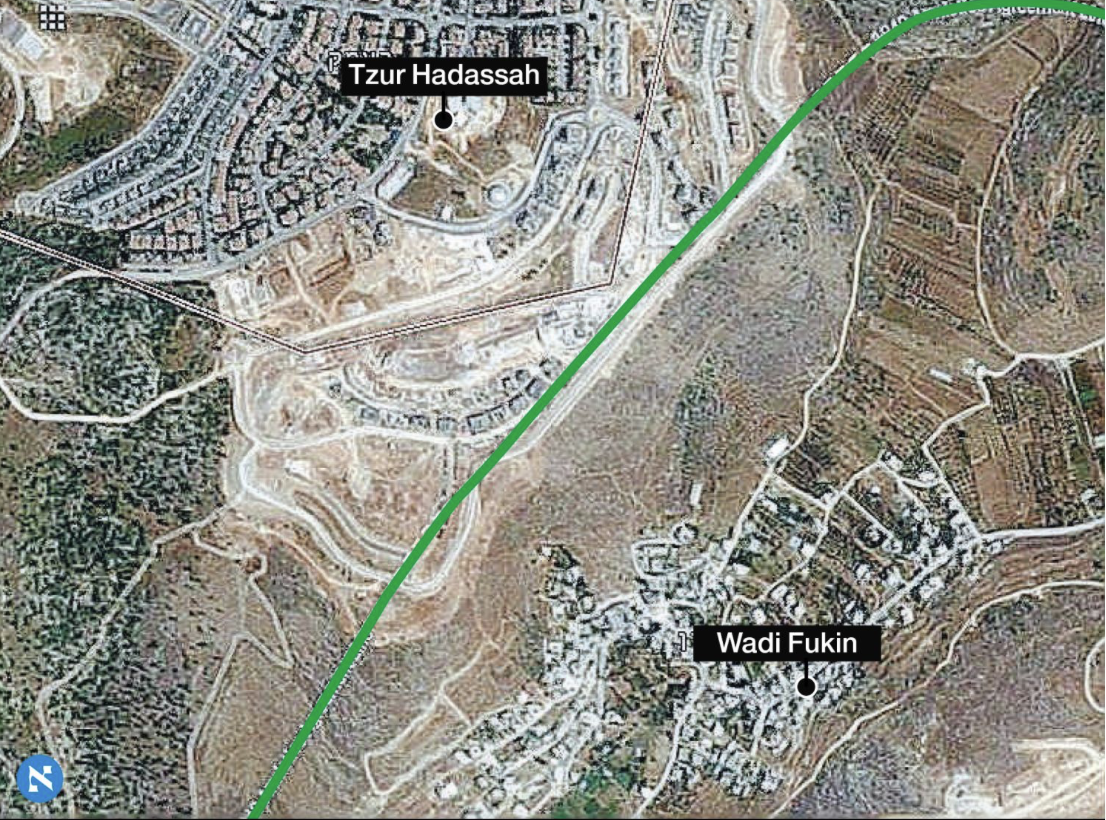
Map by Haaretz
A victim of its location on the Green Line and its lush lands, Wadi Foquin sits between the Israeli city Tzur Haddassah to its west and the ever-growing mega-settlement pf Beitar Illit, to its east. Last year, the Israeli government approved an expansion plan for Tzur Hadassah that extends the city past the Green Line into the West Bank, as reported by the Israeli settlement watchdog Kerem Navot. Wadi Foquin residents say Tzur Hadassah and Beitar Illit, both of which look down on the valley town, have already created something akin to concrete water slides, shooting rainwater straight into Wadi Foquin and flooding their homes, streets, and businesses, while also preventing the water from replenishing the springs. The expansion is only making matters worse. The Israeli government, for its part, claims that all the proper and required ecological studies have been completed and the plan passes muster and will move forward.
Yesh Din Report Slams the Israeli Civil Administration
The Israeli NGO Yesh Din released a new report, “Through the Lense of Israel’s Interests: The Civil Administration’s Role in the West Bank.” The report is an in-depth look at the main functions of the Civil Administration, the arm of the Israeli military which is the de facto sovereign in the West Bank. The Civil Administration regulates virtually every aspect of Palestinian life, including travel permits, roads, land, resource extraction, archeology, and of course settlement-related issues. The report examines the role of the Civil Administration and the ways in which its authorities have become a “means of oppression and domination over Palestinians.”
Yesh Din concludes:
The Civil Administration, established to serve “the welfare and benefit of the population” and “for the purpose of operating and providing public services”, betrays its professed role. Instead of ensuring public order and safety in a temporary trusteeship, as required by international law, the Civil Administration uses administrative tools to effect long-term, irreversible changes in the OPT and to impose restrictions and bans on the protected persons, in a severe, systemic and widespread abuse of the human rights of Palestinians in the West Bank.
Bonus Reads
- “More than 200 companies have Israeli settlement ties: U.N.” (Reuters)
- INFOGRAPHIC “50 Years of Occupation: The Security Burden Continues” (Peace Now)
- “After Netanyahu Summons Ambassador, Irish Senate Postpones Debate on Bill Blocking Israeli Settlement Goods” (Haaretz)
- “Ireland to vote on settlement trade sanctions bill” (+972 Magazine)
FMEP has long been a trusted resource on settlement-related issues, reflecting both the excellent work of our grantees on the ground and our own in-house expertise. FMEP’s focus on settlements derives from our commitment to achieving lasting Israeli-Palestinian peace, and our recognition of the fact that Israeli settlements – established for the explicit purpose of dispossessing Palestinians in the West Bank and East Jerusalem of land and resources, and depriving them of the very possibility of self-determination in their own state with borders based on the 1967 lines – are antithetical to that goal.
Welcome to FMEP’s Weekly Settlement Report, covering everything you need to know about Israeli settlement activity this week.
To receive this report via email, please click here.
January 25, 2018
- Israeli Attorney General Supports Legalization of Radical Havat Gilad Outpost
- Settler Population Growth Rate Continues to Shrink, But Still Outpaces Growth Rate Inside the Green Line
- In a First, U.S. Embassy Invites Settlers to VP Pence’s Knesset Speech
- Bonus Reads
Comments, questions, or suggestions? Email Kristin McCarthy at kmccarthy@fmep.org.
Israeli Attorney General Supports Legalization of Radical Havat Gilad Outpost
Over the weekend, Israeli cabinet ministers declined to debate Defense Minister Avigdor Liberman’s proposed resolution to advance the retroactive legalization of the Havat Gilad outpost at the weekly cabinet meeting. The settler-run Arutz Sheva media outlet is reporting that even though the resolution was not debated, Ministers did discuss Havat Gilad and pressured Netanyahu to “regulate” it (i.e., make it legal) as part of the government’s response to a terror attack earlier this month which killed a resident of the outpost.
After the meeting, Justice Minister Ayelet Shaked announced via a tweet that Israeli Attorney General Avichai Mandelblit has given his support for a second resolution to retroactively legalize the Havat Gilad outpost, signaling that there is no legal impediment to moving forward with the plan. If true, this means the Attorney General has found a way to get around a growing body of historical documentation that should – under current Israeli law and precedent as it is understood – preclude the outpost from being retroactively legalized.
The history of the outpost, as documented and adjudicated by the Israeli government, should disqualify it from meeting the standards for retroactive legalization set out in the Regulation Law, a law passed in early 2017 that gives the Israeli government leeway to regulate settlement units and outposts that were built in good faith or with the consent of the state, and if Palestinian landowners are compensated. These condition do not appear to apply with respect to Havat Gilad, which was first established in early 2002, evacuated by the government of Israel (for being illegal) in October of that same year, only to be re-established nearby less than a year later. As detailed in a post by Dror Etkes, founder of the Israeli NGO Kerem Naboth, aerial photographs from 2001-2002 show that “the area over which the outpost currently spans was divided into dozens of plots that were well-cultivated,” clearly indicated privately-owned land.
Hence, the Regulation Law cannot be the legal underpinning on which Attorney General Mandelblit is relying on to support the retroactive legalization of the Havat Gilad outpost.. However, it is worth recalling that Mandelblit argued against the Regulation Law (which is expected to be struck down by the High Court of Justice) – not because he in principle opposed legalizing outposts, but because he believed there was a better, alternative legal mechanism to achieve the same goal that would pass High Court scrutiny. It is also worth recalling that shortly after submitting his argument against the Regulation Law, Mandleblit issued two key legal opinions: one in favor of the retroactive legalization of an access road to the Haresha outpost; and the second to support the retroactive legalization of the Ofra settlement sewage plant (which was “mistakenly” built on Palestinian land).
Though Mandelblit’s legal logic for supporting any of the cases remains unclear (and what that logic portends for the 70 other outposts that the government is seeking to legalize), it is clear that there are new avenues opening up to convert even the most far-flung, radical, and brazenly illegal outposts into permanent West Bank settlement facts-on-the-ground, at the expense of Palestinian landowners and the contiguity of a future Palestinian state.
Settler Population Growth Rate Continues to Shrink, But Still Outpaces Growth Rate Inside the Green Line
According to the Times of Israel, new Israeli government data (covering 150 West Bank settlements and outposts, but not East Jerusalem) shows that the settler growth rate has decreased for the sixth consecutive year, from 3.9% in 2016 to 3.4% in 2017 (the growth rate hit a high in 2008, at 5.8%). Even with this decline, the 3.4% settler population growth rate still outpaces Israel’s national average, which comes in at 2%. Moreover, the data show that settler population is far younger than the population inside the Green Line, with 47% of settlers being below the age of 18, compared to 27% of Israelis inside the Green Line.
A statement from the Yesha Council (the umbrella organization of municipal councils of Jewish settlements) blamed for the declining growth rate on what it called a “quiet freeze” on settlement construction in 2017, despite the fact that Peace Now chronicled an alarming acceleration of settlement activity in 2017.
In a First, U.S. Embassy Invites Settlers to VP Pence’s Knesset Speech
The U.S. Embassy sent out personal invitations to several prominent settler leaders to attend Vice President Mike Pence’s speech in the Israeli Knesset. Invitees included senior officers of the Yesha Council (he umbrella organization of municipal councils of Jewish settlements, which acts as the de facto lobby for the settlers). The Speaker of the Knesset, Yuli Edelstein, invited additional settlers to attend the speech as well.
In his speech, VP Pence did not mention the occupation or settlements, but only called on Palestinian leaders to return to the negotiating table.
Bonus Reads
- “How David Friedman is Putting His Right Wing Stamp of U.S. Foreign Policy Towards Israel” ( The Forward)
FMEP has long been a trusted resource on settlement-related issues, reflecting both the excellent work of our grantees on the ground and our own in-house expertise. FMEP’s focus on settlements derives from our commitment to achieving lasting Israeli-Palestinian peace, and our recognition of the fact that Israeli settlements – established for the explicit purpose of dispossessing Palestinians in the West Bank and East Jerusalem of land and resources, and depriving them of the very possibility of self-determination in their own state with borders based on the 1967 lines – are antithetical to that goal.
Welcome to FMEP’s Weekly Settlement Report, covering everything you need to know about Israeli settlement activity this week.
To receive this report via email, please click here.
January 19, 2018
- The Havat Gilad Outpost Saga Continues
- Defense Ministry Working to Retroactively Legalize 70 Outposts
- Bill to Annex Settlements into the Jerusalem Municipality Regains Steam
- First New Israeli Bypass Road in 11 Years Set to Open Near Qalqilya
- Dispossession in the Northern Jordan Valley: Settlements and outposts as part of the land grab process
- Human Rights Watch Report Slams Israeli Settlements
- Bonus Reads
Comments, questions, or suggestions? Email Kristin McCarthy at kmccarthy@fmep.org.
The Havat Gilad Outpost Saga Continues

Map by Haaretz
The bid to retroactively legalize the Havat Gilad outpost – home to the Israeli settler who was murdered January 9, 2018 – took several turns over the past week. Two days after the murder, Prime Minister Netanyahu ordered the Defense Ministry to connect the illegal outpost to the Israeli national power grid, a move that would require the kind of major infrastructure work that would entrench the outpost’s presence. On January 15th, Israeli Defense Minister Avigdor Liberman (who is himself a settler) presented a symbolic resolution to the Israeli cabinet that calls for the retroactive legalization for the Havat Gilad. The settler-run news outlet Arutz reported on January 18th that Netanyahu has decided the Israeli cabinet will not consider the resolution on Havat Gilad during its weekly meeting scheduled for this Sunday.
All of this comes amidst widespread and growing calls for the outpost to be legalized. Efforts to turn Havat Gilad into a legal settlement appear, however, to have hit a major snag. On January 15th, Israeli security sources reportedly told the government that the outpost is not eligible for legalization under Israel’s regulation law (specifically passed last year to give Israel a way to suspend the rule of law in order to legalize illegal outposts that could not be legalized any other way). The security sources explained that Havat Gilad was built almost entirely on land that the Israeli land registrar for the West Bank has documented as privately owned by Palestinians. Israeli recognition of Palestinian ownership of the land ostensibly makes Israel’s retroactive legalization of the outpost impossible; the constant evolution of Israeli laws and legal precedents that are crafted to pave the way for regulating all unauthorized Israeli settlement activity in the West Bank, however, suggest that where there is sufficient political will, rule of law (or even the semblance thereof) will not be allowed to stand in the way. In the waning weeks of 2017, the Israeli Attorney General submitted two highly consequential legal opinions (1 & 2) that validate Israeli expropriation of privately owned land for the exclusive benefit of settlers and the regulation of unauthorized outposts. So while regulating Havat Gilad might be impossible under current Israeli law and precedent, there is every reason to expect that this obstacle will be challenged and overcome.
Defense Ministry Working to Retroactively Legalize 70 Outposts
While the fate of the Havat Gilad outpost is occupying headlines, a leaked recording shed light on the Israeli Defense Ministry’s ongoing efforts to advance the retroactive legalization of 70 settlement outposts built illegally (according event to Israeli law) across the West Bank.
Israeli Deputy Defense Minister Ben Dahan was recorded bragging that the Defense Ministry has begun charting out a process to legalize the 70 illegal outposts, with a 4-5 person team working for the past six months to catalogue every outpost’s unique situation and to prescribe a course of action for each.
Around the same time this outpost team reportedly started its work, Israeli Attorney General Avichai Mandleblit forced Defense Minister Liberman to create a division in the Defense Ministry responsible for enforcing Israeli planning laws in settlements and outposts. It was also around this same time that the Israeli government offered its first defense of the Regulation Law to the High Court of Justice, which Liberman criticized vehemently, arguing that the law could legalize Palestinian construction as well as Israeli.
After the recording made headlines this week, Deputy Defense Minister Dahan was reprimanded and banned from participating in future government efforts to legalize outposts. Notably, the reprimand/ban appears to have little to nothing to do with the activities Dahan was engaged in (Israel’s Regulation Law was passed in order to legalize outposts, the Defense Ministry has a leading role in making that happen, and everyone knew the Ministry was forging ahead with that goal), and more to do with the fact that Dahan was caught bragging about the details of a process that Liberman apparently preferred to keep secret.
Bill to Annex Settlements into the Jerusalem Municipality Regains Steam
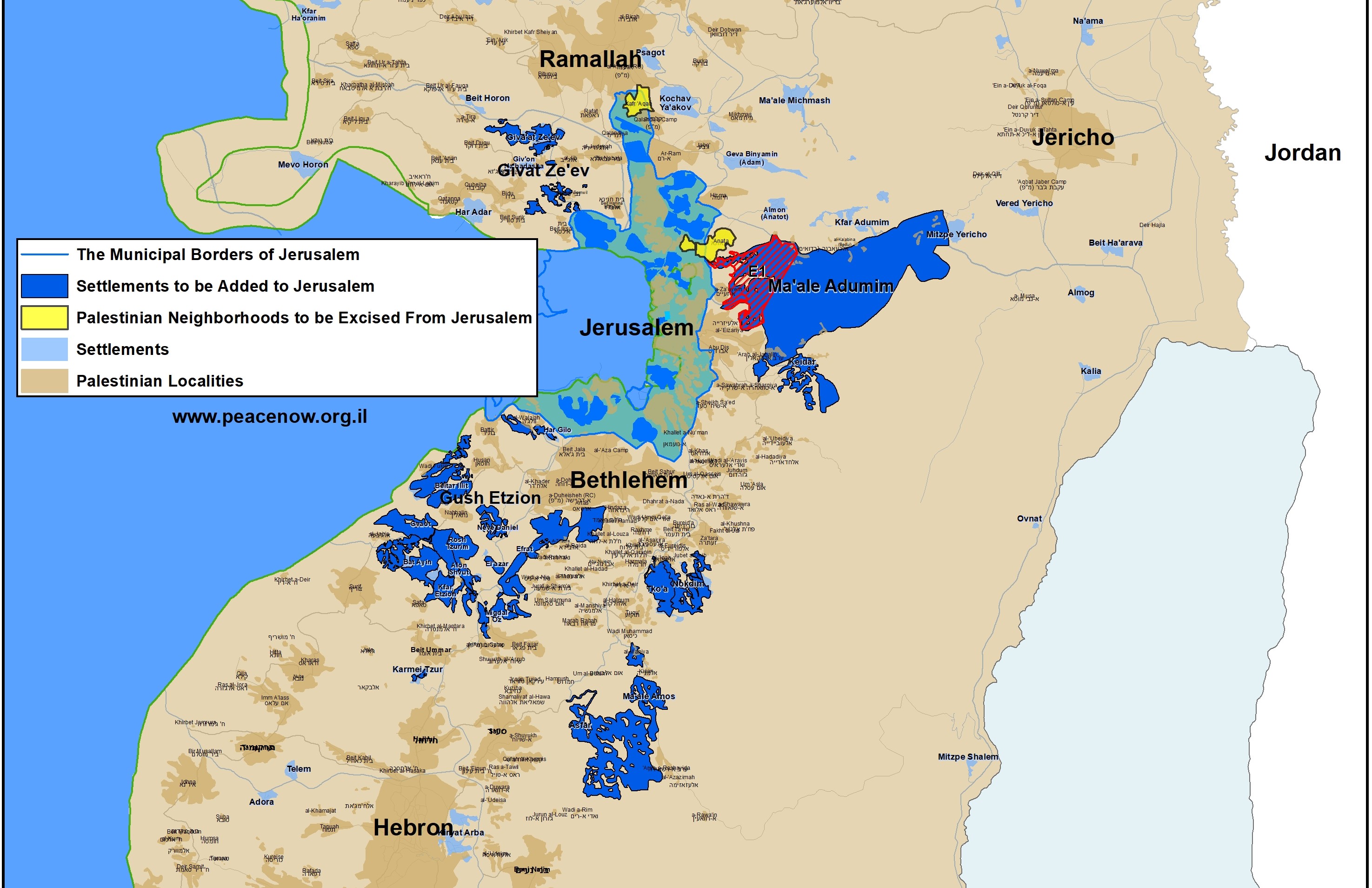
Map by Peace Now
Jerusalem expert Danny Seidemann’s NGO, Terrestrial Jerusalem, reports that the Greater Jerusalem bill – which seeks to annex far-flung settlements into the Jerusalem municipality, thereby de facto annexing a large part of the West Bank and gerrymandering a Jewish majority in the city – has renewed momentum.
In October 2017, Netanyahu backed down from advancing the controversial bill, reportedly under pressure from the Trump administration. Now, Netanyahu is once again coming under significant pressure from his own party (recall that on January 1, 2018 the Likud central committee voted in favor of a resolution calling on Netanyahu to annex the settlements) to allow the legislation to move in the Knesset.
First New Israeli Bypass Road in 11 Years Set to Open Near Qalqilya
The Israeli NGO Kerem Navot reports and documents the first new Israeli bypass road in the West Bank in more than a decade is set to open near Qalailya. Kerem Navot writes:
Most of the bypass roads in the West Bank were built during the 1990s, in parallel to the signing of the Oslo Accords. The last completed bypass road was the Liberman Road built in 2007, connecting Jerusalem with the settlements of Tekoa and Nokdim, southeast of Bethlehem.
This is the Nabi Ilyas bypass road, which is 3.3 kilometers long. The road will enable settlers of Ma’ale Shomron, Karnei Shomron and Kedumim to build settlements along the Qalqiliya Nablus road (Road 55), bypassing the village of Nabi Ilyas and expediting travel time from the settlements into and out of Israel. The road was built following massive pressure from the settler lobby, demanding that Netanyahu approve and fund the construction of two additional bypass roads. And indeed, Channel 7 recently reported that Netanyahu approved and allocated 800 million shekels for the paving of bypass roads in the West Bank.
This is first and foremost for two additional bypass roads that settlers have been trying to promote for years: the bypass road to Al Arroub and the Huwwara bypass road. These roads, too, are planned to be paved on cultivated agricultural land and their paving will cause enormous fiscal damage to residents whose lands will be lost. A third road that settlers are now trying to advance is the Shilo bypass road, which is meant to connect Route 60 with the Alon Road, part of which was already breached in the 1990s. This road is also intended to serve as the access road to the new settlement of Amichai, which Israel is currently building for Amona evacuees.
In November 2014 we exposed Israel’s full-fledged road plan throughout the West Bank. This is a “contingency plan” that was formulated over two decades after Oslo and is comprised of 44 plans for roads proposed by Israel in the territories. The plans have not yet been implemented, though 24 of them have already been approved. The total length of the roads already approved is approximately 157 kilometers.
Upon assessing the mass and sprawl of the roads approved over the years following Oslo, as with the planned roads yet to be approved, it is clear that, contrary to all official declarations, Israeli governments have not internalized the idea that an independent Palestinian state will be established in the West Bank. Israel continues to invest in planning expensive infrastructure deep in the West Bank, intended to entrench settlements and perforate Palestinian contiguity.
Dispossession in the Northern Jordan Valley: Settlements and outposts as part of the land grab process
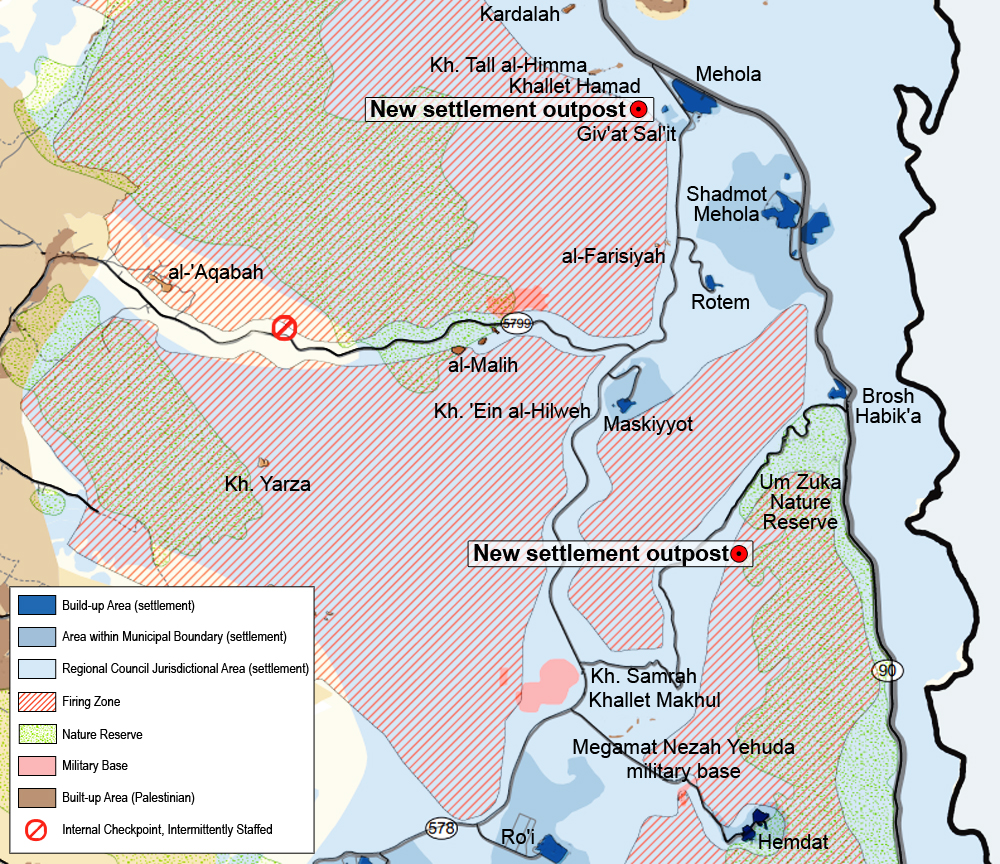
Map by B’Tselem
In a new report, B’Tselem documents how two new outposts that were established in the northern Jordan Valley in 2017 have contributed to the escalating dispossession of Palestinian communities in the Jordan Valley, where Israel retains exclusive control over and access to 85% of the land.
At the same time the outposts were allowed to grow, Israel also engaged in policies that amount to the forcible displacement of Palestinian communities around them: Since the outposts were established, the Israeli military has demolished 205 Palestinian structures in nearby communities, rendering 391 people homeless, including 157 children. The Israeli military has also refused to intervene or arrest settlers who engage use violence tactics in order to prevent Palestinians from accessing their lands.
The report concludes:
The establishment of the two new settlement outposts helps Israel realize its main goal for the West Bank: dispossessing Palestinian residents of their homes and land, and taking over their property. Each of the restrictions the state imposes on the Palestinian residents has enabled settlers to encroach on their land, build settlements and settlement outposts and take over vast areas around them. The state may say that the settlement outposts are “illegal” and are a “private initiative” by the settlers, but these claims ring hollow given Israel’s complete inaction to change this reality. The state’s refusal to remove the settlement outposts, prevent the routine attacks and prosecute those responsible for them speaks volumes as to Israel’s reliance on the settlers’ criminal behavior to entrench its control of the area while paying lip service to the law by formally disavowing any ties to them. These actions complement the official measures Israel takes in its pursuit of Palestinian dispossession in the area (and in other parts of the West Bank) and play a key role in the implementation of its policy.
Human Rights Watch Report Slams Israeli Settlements
In its “World Report 2018,” Human Rights Watch provides updated information on how Israeli settlement activity in 2017 ran afoul of international law and significantly contributed to the ongoing violation of Palestinian human rights.
Human Rights Watch reports:
Israel continued to provide security, administrative services, housing, education, and medical care for about 607,000 settlers residing in unlawful settlements in the West Bank, including East Jerusalem. Israel’s building of 2,000 new settlement housing units in the period between July 2016 and June 2017 marked an 18 percent decrease over the same period in 2015-2016, but Israeli authorities approved plans for 85 percent more housing units in the first half of 2017 than all of 2016, according to the Israeli group Peace Now. International humanitarian law bars an occupying power’s transfer of its civilians to occupied territory.
Building permits are difficult, if not impossible, for Palestinians to obtain in East Jerusalem or in the 60 percent of the West Bank under exclusive Israeli control (Area C). This has driven Palestinians to construct housing and business structures that are at constant risk of demolition or confiscation by Israel on the grounds of being unauthorized. Palestinians in these areas have access to water, electricity, schools, and other state services that are either far more limited or costlier than the same services that the state makes available to Jewish settlers there.
Of the 381 Palestinian homes and other property demolished in the West Bank (including East Jerusalem) in 2017 as of November 6, displacing 588 people, Israeli authorities sought to justify most for failure to have a building permit. Israel also destroyed the homes of families in retaliation for attacks on Israelis allegedly carried out by a family member, a violation of the international humanitarian law prohibition on collective punishment.
Bonus Reads
- “With Trump in power, emboldened Israelis try redrawing Jerusalem’s borders” (Washington Post)
- “Israeli Army Considering Taking Control of Palestinian Areas in East Jerusalem” (Haaretz)
- “Prominent Right-wing NGO Receives Millions of Shekels in Public Funds” (Haaretz)
FMEP has long been a trusted resource on settlement-related issues, reflecting both the excellent work of our grantees on the ground and our own in-house expertise. FMEP’s focus on settlements derives from our commitment to achieving lasting Israeli-Palestinian peace, and our recognition of the fact that Israeli settlements – established for the explicit purpose of dispossessing Palestinians in the West Bank and East Jerusalem of land and resources, and depriving them of the very possibility of self-determination in their own state with borders based on the 1967 lines – are antithetical to that goal.