Welcome to FMEP’s Weekly Settlement Report, covering everything you need to know about Israeli settlement activity this week.
To subscribe to this report, please click here.
March 21, 2019
- After 18 Years, Court Evicts Settlers from Stolen Home in Downtown Hebron
- Knesset Leader: U.S. Support for Annexation of Golan is First Step Towards West Bank Annexation
- Israeli Education Ministry Funds Group Behind Violent Outpost at Site of Dismantled Settlement
- Settler Excavations in Silwan Hit a Wall [Literally]
- Settlers Lobby Key U.S. Stakeholders to Protect Settlements from Trump’s “Peace Plan” & Promote Settler-Palestinian Business “Coexistence” Initiatives
- Palestinian-Americans Intervene in Lawsuit Against AirBnB, Bringing First Challenge Against Settlements to U.S. Courts
- Hoping to Avoid ICC Investigation, Pro-Settlement Groups Submit Defense of Settlements
- Bonus Reads
Questions/comments? Email kmccarthy@fmep.org
After 18 Years, Court Evicts Settlers from Stolen Home in Downtown Hebron
On March 12, 2019, the Jerusalem Magistrate Court ruled to evict settlers from a house in the heart of downtown Hebron (in the notorious Tel Rumeida section), that the settlers have illegally occupied since 2001. The court ruling gives the settlers 45 days to vacate the house, but the settlers are able to – and expected to based on the history of this case – appeal the ruling.
The Palestinian homeowners – the Bakri family – temporarily fled their home under constant settler harassment during the second intifada, a time when Tel Rumeida could be described as an “urban battlefield.” While the family was gone, settlers broke into the house, damaged it, destroyed the Bakri’s property, and ultimately took up residence there.
The Bakri family has spent the past 18 years petitioning Israeli police and the courts to remove the settlers — cases the Bakri family repeatedly won.
The settlers have managed to repeatedly delay their eviction by essentially exploiting every possible legal defense, no matter how absurd or contradictory. At different points over the past 18 yrs, settlers have argued in court that they had a rental agreement; that they purchased the home; that the plot of land was owned by a Jewish trust prior to 1948 and so they able to reclaim the property; and that because they had invested so much money in improving the land since taking it over, under Ottoman Law it now legally belongs to them. When at one point some years ago the courts ruled that the settlers had to evacuate, the settler occupants of the Bakri home did, indeed, leave, only to be immediately replaced by other settlers — at which point the Israeli Attorney General told the Bakri family that they had to start eviction proceedings anew. For a detailed timeline of the Bakri family’s saga, see this report from Peace Now.
Throughout the course of this saga, the settlers’ effort to hold on to the Bakri home was aided by the State’s unwillingness to implement court orders against the settlers. Peace Now said in a statement:
“This is not only a matter of cruelty, deceit and theft of settlers who are not loathe to take control of assets that are not theirs, but also a matter of the lack of government accountability. For 18 years the government did not enforce the law against the invading settlers, and even assisted them and allowed them to continue to steal the house and terrorize their Palestinian neighbors in Tel Rumeida. Furthermore, it should be remembered that Hebron is under Israeli occupation and the Palestinian residents cannot remove the settlers from their homes by appealing to the Palestinian Authority. The power lies in the hands of the Israeli government, which does nothing to fulfill its responsibilities to protect abandoned Palestinian property.”
Knesset Leader: U.S. Recognition of Israeli Sovereignty Over Golan is First Step Towards West Bank Annexation
At a public event on March 17th in Tel Aviv, Israeli Speaker of the Knesset Yuli Edelstein (Likud) told an audience that U.S. recognition of Israeli sovereignty over the Golan Heights is the first step towards U.S. support for Israel’s annexation of the West Bank. Edelstein’s comments came shortly after the publication of the 2018 U.S. State Department’s annual Human Rights Report, which refers to the Golan Heights – under international law considered Israeli-occupied Syrian territory – as “the Israeli-controlled Golan.” Previous U.S. reports referred to the Golan is “Israeli-occupied.”
Edelstein also promised the audience that if the Likud does well in the upcoming elections, there will be a serious debate in the Knesset about annexing the West Bank.
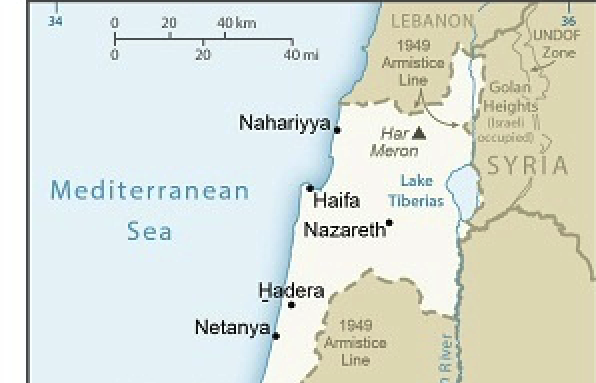
Map by the CIA, as of 3/21/19
[NOTE: On March 21st, President Trump formally recognized (via tweet) Israeli sovereignty over the Golan Heights. Hours before this tweet, press reports suggested that the Trump Administration was planning to announce the new policy when Prime Minister Netanyahu was the White House, during meetings scheduled for March 25-26. It is also worth noting on February 26, resolutions were introduced in Congress, in both the House and Senate, seeking to make it U.S. policy to recognize Israeli sovereignty over the Golan.]
Israeli Education Ministry Funds Group Behind Violent Outpost at Site of Dismantled Settlement
Haaretz reports that the Israeli Education Ministry has been contributing significant funds to a non-governmental organization that is the driving force behind illegal settler activity at the of what was formerly the Homesh settlement in the northern West Bank.
Homesh was dismantled and its residents evicted by Israel in 2005, as part of the Gaza disengagement. Since then, settlers have been obsessed with the desire to re-establish Homesh, hosting religious events and protests at the site of Homesh, some of which have been attended by Israeli MKs and politicians.
As part of this movement to reclaim the site and re-establish Homesh, settlers associated with the violent “hilltop youth” settler movement have repeatedly attempted to establish an outpost on the site, only to have the IDF remove them again and again. The non-governmental organization – Midreseht Ma’amakim – widely publicize its efforts to build and maintain a outpost at the Homesh settlement site, and boasts about operating a religious school there (called the “Homesh yeshiva”) for the past 12 years. According to the new report, from 2014-2017, the Israeli Education Ministry transferred more than $6 million to the NGO — nearly $2.5 million (8.5 million shekels) in 2017, $1.9 million in 2016, and $1.7 million in 2015 and in 2014. The Ministry told Haaretz that the funds were provided in support of the organization’s educational activities, not its illegal activities.
Lior Amihai, Executive Director of Yesh Din, explained:
“The place remains a hostage of a violent and illegal yeshiva, which prevents Palestinian farmers and landowners from reaching the place. Now it turns out that the Education Ministry enable the presence of the yeshiva by funding an association that fundraises for it.”
Yesh Din has for years been working with leaders of the neighboring Palestinian village of Burqa in regards to the situation at the site of Homesh, built on lands owned by Palestinians and seized by Israel in 1978 for “security needs.” In 2011, Yesh Din and Palestinian landowners petitioned the Israeli government to revoke the 1978 military seizure order, which legally should at this point be moot: the IDF only used the land for approximately two years, after which settlers took over the site to establish the (civilian) Homesh settlement, which was allowed to remain and expand until it was dismantled in 2005. In 2013, Yesh Din’s petition succeeded, and the state of Israel took the unprecedented step of revoking the military seizure order.
Yet, while technically the Palestinian landowners are no longer barred by Israel from accessing their own lands, de facto the area is still off limits to them, policed by violent Israeli settlers who for all intents and purposes enjoy free reign in the area.
Settler Excavations in Silwan Hit a Wall [Literally]
Emek Shaveh reports that one of the ongoing excavation efforts in Silwan led by the radical settler group Elad might not be able to continue, having run into the foundation of a massive wall, believed to be part of an Umayyad palace dating back to the 7th century CE.
The discovery – one which serves to highlight the multiplicity of cultures, religions, and peoples who are deeply connected to Jerusalem – is not a welcome one for the settlers, whose ultimate goal is to dig a tunnel connecting settler-run tourist sites in Silwan to a settler-run tourist site in the Old City. Since the excavation project is being carried out by Elad in cooperation with (and with financing from) the Israeli Antiquities Authority (IAA), the government bureau will decided whether or not to continue the dig. According to Haaretz, the IAA is considering plans to dismantle the wall and create a large hole for tourist groups to walk through.
The archeological experts at Emek Shaveh explain:
“From a professional standpoint, the wall should be left in its proper place, but the practical significance of this is a halt to the excavation, which began as part of a government decision to connect Silwan with the excavations south of the Temple Mount/Haram al-Sharif…In the reality of Jerusalem, where remains of building are not only scientifically significant but have symbolic and emotional resonance as well, the damage caused by the tunnels excavations has a negative impact on the possibility of presenting the city’s many cultures and their histories in a balanced manner. This is not only an archaeology-tourism problem, but a political problem of ignoring and even erasing certain historical strata, in order to present Jerusalem in a manner that serves the settlement enterprise in the Old City basin.”
The IAA said in response to news of the wall:
“…due to the wish to give the millions of tourists who visit Jerusalem from all over the world a better travelling experience, roads and paths were developed over the past decades. In addition, several openings have been made to the Old City’s walls and in the foundations of the Umayyad buildings. The hole in question is a narrow opening that was made in the foundations of one of these buildings after meticulous archaeological examination and documenation [sic] were carried out. This opening enables tourists to move between the two parts of ancient Jerusalem on either side of the Old City walls. This project is part of the ‘Shalem program’ [i.e. whole in Hebrew]: A government-funded plan to unveil, preserve, research and develop the sites of ancient Jerusalem.”
Settlers Lobby Key U.S. Stakeholders to Protect Settlements from Trump’s “Peace Plan” & Promote Settler-Palestinian Business “Coexistence” Initiatives
While in Washington, D.C. for the upcoming AIPAC policy conference, a delegation of Israeli settlers held meetings with members of Congress members and White House officials in a bid to ensure that any American “peace plan” will not inconvenience Israel’s settlement enterprise. The delegation, which included Yossi Dagan (head of the Samaria Regional Council, a settlement municipal body) and Arnon Klein (CEO of the Barkan Industrial Zone, near the settlement of Ariel), also met with evangelical leaders – a key constituency which recently extracted assurances from the White House regarding the Trump plan. The settlers reportedly implored the group to:
“help to fight plans to freeze construction in Judea and Samaria. We cannot allow a plan which will destroy or harm Jewish communities in Judea and Samaria. Our task is to build. We have 36 communities and half a million Jews living in our forefathers’ home. We need your help. This is a very sensitive time. Especially now, when the US president is considered to be a friend of Israel, there is a huge risk that a diplomatic plan will include a division between settlements in blocs and outside of blocs, and that construction will be frozen. And we haven’t even talked about the worst – uprooting Jewish settlements and dividing Jerusalem – which may also on the table.”
In addition, the delegation pitched the centrality of business “coexistence” initiatives between settlers and Palestinians, an increasingly obvious part of the Trump Administration’s agenda on the ground, as a core objective. Writing last week, FMEP’s Lara Friedman pointed to the activities of Ambassador Friedman and Congressman Lankford (R-OK), in support of the the idea that:
“…peace would come from economic and business cooperation between Palestinians (living under Israeli occupation, governed by Israeli military and military law designed to promote the interests and needs of Israel, entirely disenfranchised from the powers that control their lives) and settlers (living in settlements built on land taken from Palestinians, enjoying all the entitlements and protections of Israeli citizenship and law, and with representatives and allies at every level of Israeli government). This approach…exemplifies a vision of ‘peace’ based on promises of improved quality of life for individual Palestinians, de-coupled from any pretense of helping Palestinians end an occupation that the United States no longer believes to exist, or achieve national self-determination that the United States no longer supports.”
Likewise, FMEP has previously explained how for decades Israel has used industrial zones as another tool to expand and deepen control over West Bank land and natural resources. Importantly, jobs in industrial zones – often the only jobs available for Palestinians living under an Israeli occupation that prevents the development of any normal Palestinian economy – are widely viewed by Palestinians as a double-edged sword.
Palestinian-Americans Intervene in Lawsuit Against AirBnB, Bringing First Challenge Against Settlements to U.S. Courts
In the first case of its kind in a U.S. federal court, the Center for Constitutional Rights (CCR) filed a lawsuit challenging the legality of the Israeli settlement enterprise. The case was filed on March 18th on behalf of two Palestinian Americans – Randa Wahbe and Ziad Alwan – and two Palestinian villages – Ein Yabroud and Jalud. Journalist Mairav Zonszein succinctly explained the complex backdrop of the new filing:
“The CCR’s claim is not a stand-alone lawsuit but an intervention in Silber v. Airbnb, a suit filed by a group of Jewish and Israeli-American citizens who either host or wish to rent homes on Airbnb; the claim is directed, not at Airbnb, but at the sub-group of settlers serving as hosts. These settlers filed suit against Airbnb in November 2018, days after the company announced it would be taking down about 200 rental listings located in Israeli settlements in the occupied West Bank…In intervening in the lawsuit, the CCR argues that it is the settler’s conduct—and not Airbnb’s attempt to reconcile its business practices with basic human-rights law and principles—that discriminates against their clients and millions of other Palestinians.”
CCR issued a press release stating:
“Today’s filing argues that the Israeli settlers who sued Airbnb have participated in war crimes by aiding in Israel’s seizure of land in occupied Palestinian territory, including the specific lands on which the Airbnb properties stand. The rentals are in Israeli-only settlements from which Palestinian residents of the West Bank are barred as per Israeli military orders, and which are sometimes surrounded by physical barriers, military bases, and security gates.”
Diala Shamas, a staff attorney at the CCR, said:
“The settlers who sued Airbnb are cynically using the language of discrimination in order to further their own unlawful ends,” said Center for Constitutional Rights Staff Attorney Diala Shamas. “Our clients’ experiences –Palestinians who are directly affected by these settlers’ actions – show where the real discrimination and illegality lies. This case puts the settlers on trial in a U.S. court.”
CCR’s filing – and accompanying videos – shines a bright light on at two stories that exemplify Palestinians’ lives under occupation, and make clear how the settlements infringe on their basic rights to property. One of the intervenors, Ziad Alwan, was born in the Palestinian village of Ein Yabroud and holds the title deed for part of the land on which the Ofra settlement was built, as registered by the Israel Land Registry. One of the settlers in the underlying lawsuit previously listed a property in the Ofra settlement on AirBnB — meaning that the settler and AirBnB were, in effect, profiting from the rental of a property located on land that rightfully belongs to Alwan, and moreover, which Alwan, despite being the rightful owner, cannot access and does not benefit from.
Residents of the Palestinian village of Jalud – a second intervenor – explain how Israeli settlements and unauthorized outposts have been built on the village’s land, making 80% of their farmland inaccessible. One of the outposts that took Jalud’s land is Adei Ad, an outpost established illegally under Israeli law, which the Israeli government announced its intention to retroactively legalize. One of the settlers in the underlying case runs a bed and breakfast in the Adei Ad outpost, meaning the settler and AirBnB are profiting from a business located on the historic land of Jalud, a business which Palestinians cannot access and do not benefit from. In their claim, residents of Jalud are challenging not only the claim that Airbnb’s decision to delist the settlers’ rental property is discriminatory, but also the claim that the settlers legally own the property in the first place.
The lawyer representing the settlers in the underlying case (which claims AirBnB’s decision violates the Fair Housing Act), said in response to CCR’s claim:
“There are those who say that the settlements are illegal. There are those who say they are not. This is the heartland of the Land of Israel.”
Randa Wahbe, one of the petitions, told The Nation:
“The fact that settlers are using the specific piece of legislation pushed through after Martin Luther King’s assassination to protect disenfranchised black communities, in order to discriminate against Palestinians, is what I find so horrifying.”
Hoping to Avoid ICC Investigation, Pro-Settlement Groups Submit Defense of Settlements
On March 14th, two well-known pro-settlement legal attack groups – UK Lawyers for Israel (UKFLI) and the Lawfare Project – submitted a brief to the International Criminal Court (ICC) arguing that the court is prohibited under the Rome Statute from investigating Israeli settlements. The ICC has been conducting a preliminary investigation into the possibility of opening a war crimes probe into Israel’s settlement for the past four years.
The brief argues that the Israeli High Court of Justice (HCJ) has sufficiently and genuinely investigated issues related to the settlements, making the matter inadmissible at the ICC because the Rome Statute’s regulations prohibit the court from taking on issues that national courts have adjudicated. The brief even proudly highlights the fact that Israel’s HCJ has ruled in favor of Palestinians, though as a recent report published by B’Tselem explains, the Israeli HCJ is complicit in the establishment and continuing expansion of the settlement enterprise (and therefore cannot conceivably carry out a genuine investigation of this enterprise).
The legal brief comes amidst a barrage of threats issued by Israel and the United States against the ICC in light of its consideration of opening this case. On March 17th, U.S. Secretary of State Mike Pompeo threatened ICC staff with travel restrictions and financial sanctions if the court opens a probe into Israel. In November 2018, Israeli Attorney General threatened to launch, according to the Jerusalem Post, a “public legal campaign, aggressively contesting its jurisdiction.”
In the brief, the authors also announced their intention to file further information with the court challenging its jurisdiction over the matter.
Bonus Reads
- “Natural Born Settlers” (New York Times)
- “Not Breaking News: Trump Administration Does Not Believe in Occupation” (LobeLog – by FMEP President Lara Friedman Part 1 of 2)
- “Erasing Occupation: The Pernicious Role of Congress” (LobeLog – by FMEP President Lara Friedman Part 2 of 2)
- “‘The entire world knows the settlers have declared war on us’” (+972 Mag)
- “Leading architects urge Israeli PM to cancel cable car plan” (Associated Press)
Welcome to FMEP’s Weekly Settlement Report, covering everything you need to know about Israeli settlement activity this week.
To subscribe to this report, please click here.
February 8, 2019
- Another Challenge to Israel’s Plan to Retroactively Legalize Adei Ad Outpost
- New Eviction Proceedings Against Two Palestinian Families in the Muslim Quarter of the Old City
- Higher Education Council Reverses Approval of Adelson-Backed Medical School in Ariel University
- Activists Ask High Court to Revoke Status of West Bank Nature Reserve Run By Settlers
- Settlers Threaten to Blacklist Palestinians Who Work with Human Rights Organizations
- Prominent Israeli Politicians Pledge To End Two-State Solution
- 40 Ambassadors to the United Nations Visit Settler-Run Tourist Site in Occupied East Jerusalem
- Settler Org Credits Trump for Growth in West Bank Settler Population & Death of Two-State Solution
- New B’Tselem Report Slams High Court for Role in Dispossessing Palestinians, Validating Occupation
- Video Compilation of Likud Candidates Touting Role of Tourism in Expanding Settlements
- EU Settlement Report Details “Unprecedented” Level of Settlement Advancements 2018
- Bonus Reads
Questions/comments? Email kmccarthy@fmep.org
Another Challenge to Israel’s Plan to Retroactively Legalize Adei Ad Outpost
On January 31st, Yesh Din filed a petition with the High Court of Justice to reverse an expansion of “state land” boundaries in the Shiloh Valley that seized privately owned Palestinian land in order to retroactively legalize the notoriously (and recently) violent Adei Ad outpost.
In 2014, Palestinian landowners, in cooperation with Yesh Din, first petitioned the Court to evacuate the unauthorized Adei Ad outpost which was built on their land in contravention of both international and Israeli law. Instead of enforcing the law, the Israeli Civil Administration announced that it would “reexamine” the boundaries of state land in the area, an examination which found that Adei Ad was, according to the new Israeli mapping of the area, built on state land. To make the findings of the reexamination official, the Civil Administration used an entirely new procedure (a “declaration amendment”) to expand the boundaries of a previous state land declaration. In so doing, the Civil Administration found a way to avoid issuing a new state land declaration, which can be challenged in a court by Palestinians and legal groups like Yesh Din. For “declaration amendments,” landowners can only seek recourse through the Civil Administration. Objections filed to the expansion of state land in this case were all dismissed.
The new Yesh Din petition filed on January 31st challenges the secretive and unjust process by which the Civil Administration expanded the scope of state land to include the Adei Ad outpost. The petition reads:
“[…] Not only does the procedural structure for objection to the declaration, as stated in the procedure, substantially diminish the rights of the petitioners and other objectors who seek to receive their day in court before an independent and impartial judiciary (which is offered without exception to their neighbors, indicative of institutional discrimination), but even in substantive terms, the decision of the first respondent [the head of the Civil Administration] was carried out in violation of the law, in contrast to judicial decisions, in a manner entirely lacking transparency and conveying the arbitrariness that ultimately results from irrelevant considerations — the desire to legalize the outpost of Adei Ad at all costs.”
The new petition seeks to stop the implementation of the next step in the Civil Administration’s process to retroactively legalize Adei Ad, a plan that was announced in August 2018. Under the scheme, Adei Ad will be retroactively legalized by defining it as a “neighborhood” of the Amichai settlement – the first new government-backed settlement in 25 years, approved as payoff to the settlers who were evacuated from the unauthorized Amona outpost – located nearby.
In 2013, Yesh Din published a lengthy report about the Adei Ad outpost – how it was established and how the settlers who live there use violence to take over more and more land from nearby Palestinians.
Kerem Navot recently wrote:
“The outpost of Adei Ad has the hard-earned dubious reputation as one of the wildest and most violent outposts in the West Bank. Since its establishment in the late 1990s, settlers have initiated numerous violent incidents, all based on one simple rationale: take control of as much land as possible. As a reward for 20 years of wreaking havoc, the state is currently authorizing the outpost and has recently deemed it a ‘neighborhood.’ Guess whose: a ‘neighborhood’ of the settlement of Amichai that was established less than two years ago after the state granted “compensation” estimated at 300 million shekels, to the group of land thieves who were evicted from the outpost of Amona.”
New Eviction Proceedings Against Two Palestinian Families in the Muslim Quarter of the Old City
Ir Amim reports that settlers are behind two new eviction proceedings against Palestinians in the Muslim Quarter of the Old City of Jerusalem.
In the first case, the Abu Asab family received a notice that they must vacate their home in the Muslim Quarter by February 12th. The family has been renting the house since the 1960s, when the Old City was under the authority of the Jordanian government, which managed leases for vacant properties. In 2014, a settler-run trust – the Maisel Trust – petitioned to annul the family’s protected tenancy rights, arguing that those rights had been lost when the original tenants allegedly “abandoned” the property (the current residents are second generation relatives of the original renters). The Court ruled in the settlers’ favor in, and a subsequent appeal against the ruling was rejected.
In the second case, just 100 meters away from the Abu Asab family home, the Ghaith-Sub Laban family was warned that another settler-managed trust – the Gengel Trust – filed a new request for their eviction, arguing that the original tenants had abandoned the home and therefore forfeited their protected tenancy rights. The new eviction proceedings were initiated despite a 2016 Supreme Court ruling that held that Nora Gaith and husband Mustafa Sub Laban are legally allowed to remain in the apartment for 10 years), at which time their protected tenancy will be (prematurely) terminated and their children’s status as protected tenants annulled.
Ir Amim notes that there are a total of eight Palestinian families at imminent risk of eviction in the Muslim Quarter of the Old City, all in close proximity to the cases detailed above.
Higher Education Council Reverses Approval of Adelson-Backed Medical School in Ariel University
On February 7th, the Planning & Budgeting subcommittee of Israel’s Higher Education Council voted 3-2 against the approval of a medical school in Ariel University, reversing the subcommittee’s previous vote to approve the medical school in July 2018.
The Israeli Attorney General’s office ordered the second vote after it was revealed that one of the members of the subcommittee should not have been able to vote in July 2018, due to a major conflict of interest (Ariel University had promised the individual a promotion in the event the school was approved).
Since receiving the approval in July 2018, Ariel University has taken significant steps towards opening the medical school this fall, despite multiple unfolding controversies surrounding the process by which the school was approved. In addition to addition to the controversy surrounding the July 2018 vote, Israeli Education Minister Naftali Bennett is accused of violating government rules to secure a legal opinion in favor bringing the school under Israeli domestic laws (an act of de facto annexation). Bennett is also accused of inappropriately intervening to expedite the approval of the school.
In response to the vote Israeli Education Minister Naftali Bennett, said:
“I do not intend to give up. I will fight the university cartel until we establish the Faculty of Medicine at Ariel University.”
Following the vote, the settler Yesha Council (an umbrella group which lobbies on behalf of the settlements) issued a statement saying:
“We expect the Israeli government to handle the matter and renew the permit in the coming year.”
As FMEP has previously reported, Ariel University became an accredited Israeli university in 2012, following significant controversy and opposition, including from Israeli academics. It has since been the focus of additional controversy, linked to what is a clear Israeli government-backed agenda of exploiting academia to normalize and annex settlements. In 2018, the settlement broke ground on the new medical school, with significant financial backing from U.S. casino magnate, settlement financier, and Trump backer Sheldon Adelson. In February 2018, in an act of deliberate de facto annexation, the Israeli Knesset passed a law that extends the jurisdiction of the Israeli Council on Higher Education over universities in the settlements (beyond Israel’s recognized sovereign borders), ensuring that the Ariel settlement medical school (and its graduates) would be entitled to all the same rights, privileges, and certifications as schools and students in sovereign Israel.
As a reminder, Ariel is located in the heart of the northern West Bank, reaching literally to the midpoint between the Green Line and the Jordan border. The future of Ariel has long been one of the greatest challenges to any possible peace agreement, since any plan to attach Ariel to Israel will cut the northern West Bank into pieces.
Activists Ask High Court to Revoke Status of West Bank Nature Reserve Run By Settlers
A group of Israeli human rights activists have petitioned the Israeli High Court to revoke the special status of the Umm Zuka nature reserve and firing zone in the West Bank, saying the Israel’s designation of the land as a protected area has only served as a pretext to remove Palestinians and allow settlers to take over.
The petition goes on to explain that Israeli settlers have built an unauthorized outpost on the land that is slated to be added to the existing nature reserve, and have essentially turned the wilderness area into a private settler park where Palestinians are not allowed to enter. Despite complaints, the Israeli Civil Administration has not removed the unauthorized outpost – which consists of several structures connected to the water, sewage, and electricity of a nearby army base. The Civil Administration spokesperson told Haaretz that it is undertaken unspecified “enforcement proceedings” against the unauthorized outpost.
Eitay Mack, a lawyer who filed the petition on behalf of the group, told Haaretz:
“the reserve and the firing zone have effectively become a private settler farm that receives personal security service from Israel Defense Forces soldiers and bars entry to the farm’s enormous territory on the basis of ethnicity, nationality, religion and political opinions.”
Settlers Threaten to Blacklist Palestinians Who Work with Human Rights Organizations
Settlers have taken to posting signs in Palestinian villages warning that Palestinians who cooperate with human rights organizations will be prohibited from working in of Israeli settlements. The posters threaten:
“Do you wish to keep working in the settlements? Do you want to provide a living for your families from the Jews? Whoever cooperates with any one of these individuals and organizations (Ta’ayush and Rabbis for Human Rights) will never be allowed to enter the settlements for work. Be warned!”
+972 Magazine reports that the settlers behind the posters have also distributed leaflets to business owners inside of the settlements which list names of Palestinians alleged to work with (or have family members who work with) human rights groups – ostensibly encouraging Israeli business owners to fire them.
An Israeli activist working with the Tayyush organization (which is named on the posters as a group Palestinians cannot work with) explained:
“These flyers are yet another reminder that we [Israeli human rights groups] are a target of far-right groups, which get their marching orders from the Israeli government. The goal is clear: to expel Palestinians from their Area C of the West Bank and minimize their ability to defend themselves.”
Observers have noted the similarity between these flyers and signs posted by the Ku Klux Klan in the US years back targeting Black Americans.
Prominent Israeli Politicians Pledge To End Two-State Solution
In the context of Israel’s current election campaign, dozens of Israeli politicians have signed a pledge to the “Nahalah Movement” which reads:
“I hereby commit to be loyal to the land of Israel, not to cede one inch of our inheritance from our forefathers. I hereby commit to act to realize the settlement plan for the settlement of 2 million Jews in Judea and Samaria in accordance with Prime Minister Yitzhak Shamir’s plan, as well as to encourage and lead the redemption of all the lands throughout Judea and Samaria. I commit to act to cancel the declaration of two states for two peoples and replace it with the stately declaration: The land of Israel: One country for one people.”
Among the most prominent signatories are Knesset Speaker Yuli Edelstein (Likud), Transportation Minister Yisrael Katz (Likud), Justice Minister Ayelet Shaked (New Right) Education Minister Naftali Bennett (New Right), Tourism Minister Yariv Levin, Environmental Protection and Jerusalem Affairs Minister Zeev Elkin, Public Security Minister Gilad Erdan, Culture Minister Miri Regev, Regional Cooperation Minister Tzachi Hanegbi, Communication Minister Ayoub Kara, Immigration and Absorption Minister Yoav Galant, Social Equality Minister Gila Gamliel.
The petition was introduced and signed as the climax of the Nahalah Movement’s two-week-long protest outside of Prime Minister Netanyahu’s residence in Jerusalem. The activists were protesting what they portray as Netanyahu’s policy of severely restricting settlement construction. The Nahalah movement calls for unconstrained settlement construction and the establishment of new settlements. The Nahalah Movement released a statement saying:
“The signing of the petition opposite the Prime Minister’s Residence at the height of the Likud primary election campaign and at the height of the efforts to compile the [Knesset] lists in the right-wing and center bloc and in particular ahead of the coming election campaigns constitutes an ideological and ethical loyalty test for the various contenders.”
The settlement agenda promoted by former Prime Minister Yitzhak Shamir – the one mentioned in the Nahalah pledge – was one of unrestrained growth and absolute opposition to compromise with the Palestinians and/or Arab governments in the region. Notably, Shamir’s promotion of the settlement enterprise was strongly opposed by then-U.S. President George W. Bush, who threatened to cut U.S. aid to Israel if settlement construction did not stop.
40 Ambassadors to the United Nations Visit Settler-Run Tourist Site in Occupied East Jerusalem
A group of 40 Ambassadors to the United Nations visited a tourist site run by the radical Elad settler organization in the East Jerusalem neighborhood of Silwan. The delegation was led by Israel’s own Ambassador to the UN, Danny Danon, who appeared on video saying:
“We arrive today with nearly 40 UN Ambassadors to the City of David, Ir David, to show them the real truth about Israel….when the Ambassadors come here and they see for themselves the history of the Jewish people they understand why you cannot disconnect the Jewish people from our eternal capital Jerusalem.”
In the same clip, the President of Elad (aka the “City of David Foundation”) said:
“Why are they here? Far away from the halls of the United Nations building, here they will travel with us through the field and actually lift up the archaeological evidence and see the facts in front of their eyes. This is not a matter of fantasy and not only a matter of faith. Here we have facts that prove the connection of the Jewish people to Jerusalem.”
As a reminder, the explicit ambition of the Elad settler organization is to increase Jewish hegemony across all of Jerusalem at the explicit and intended expense of the Palestinian East Jerusalemites. In Silwan in particular, Elad has undertaken a multi-faceted campaign to evict Palestinians and increase the number of Jewish settlers living there.
Intending to give a backhanded compliment to the visiting delegation, Eugene Kontorovich – who heads the international law department at the Kohelet Policy Forum, a right-wing pro-settlement organization – tweeted that the UN Ambassadors must not agree with U.N. Resolution 2334, which calls on the international community to differentiate between Israel and areas occupied by Israel in their dealings in the region. Kontorovich also told Jewish Insider:
“The Security Council resolution calls on countries to ‘differentiate’ between Israel and territories that came under its control in 1967. The resolution is of course not binding, and by going on in official state visit across the green line in the company of Israeli government officials, these UN ambassadors show that they are fully aware what a dead letter the resolution is.”
As a reminder, Kontorovich self-identifies as a key figure in the drafting of “anti-BDS” (but actually, anti-free speech/pro-settlement) laws in the United States. At the core of these laws is the conflation of Israeli settlements with Israeli proper, based on Kontorovich’s argument that Israel is not occupying Palestinian territory. Kontorovich has also testified multiple times to U.S. Congress, including in support of moving the U.S. Embassy to Jerusalem; in support of Congress legislating U.S. foreign policy, including with regard to Jerusalem; on the impact of the BDS movement, and in support of U.S. recognition of Israel’s sovereignty over the Golan Heights.
Settler Org Credits Trump for Growth in West Bank Settler Population & Death of Two-State Solution
A settler-run organization has released an analysis of Israeli government data citing the Trump Administration as a key driver of a “surge” in the growth rate of the Israeli settler population in 2018, and predicted a larger surge to come. The group claims the settler population in the West Bank grew by 3.3% last year (449,508 – excluding East Jerusalem – as of January 2019), compared to a 1.9% increase in Israel’s overall population.
The director of the group, Baruch Gordon, told the Associated Press:
“Since the change of the U.S. administration, the atmosphere for construction permits has become much easier. They’re being given with greater ease. I think possibly the next report and certainly in the ones after that, I think we’ll start to see a huge surge in the numbers here….Those who continue to talk about a two-state solution, in my mind it’s just a sign that they’re removed from the reality and the facts on the ground.”
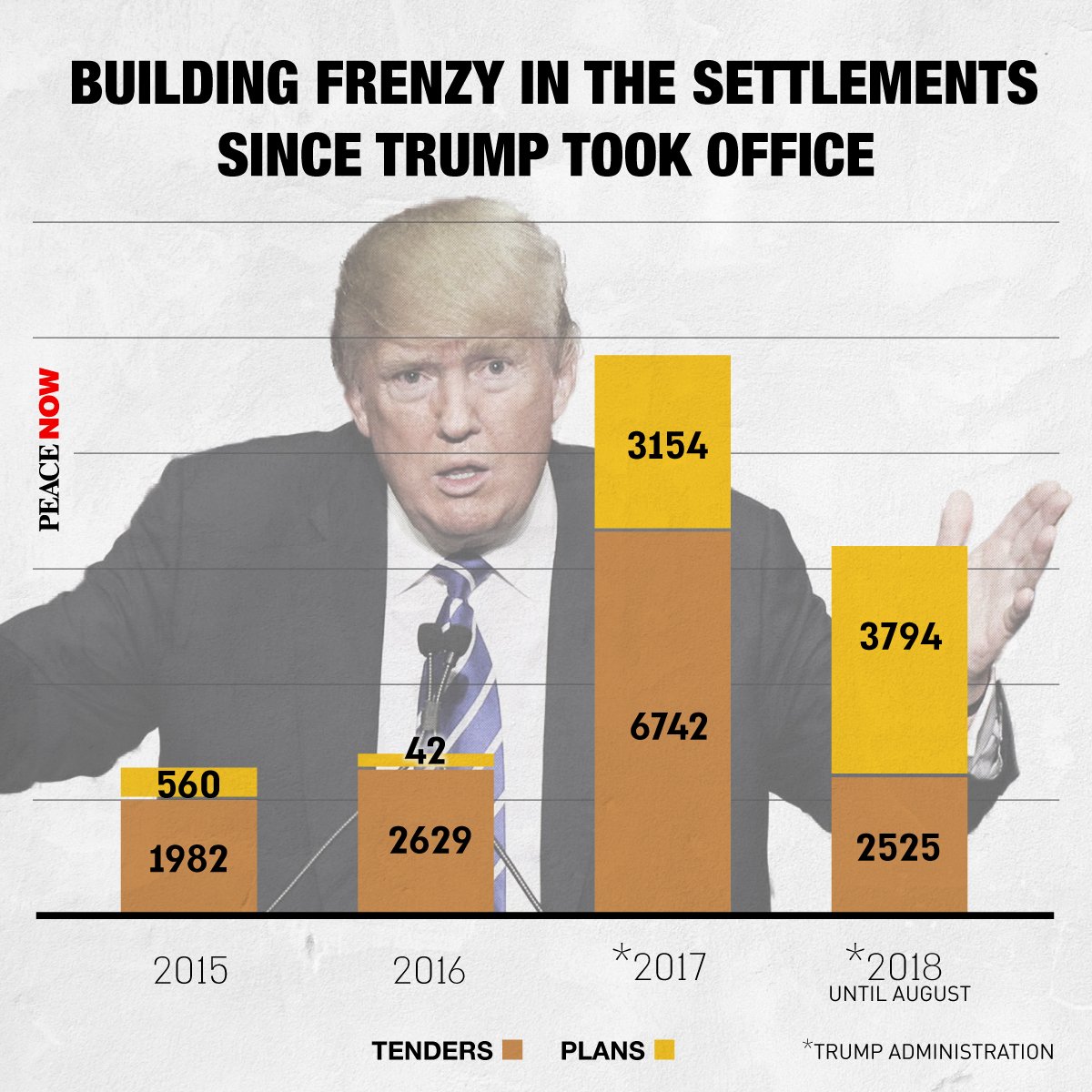
Image by Peace Now
When another settler organization – the Council of Jewish Communities in Judea and Samaria – published near identical data points in January 2019 (literally last month), the overwhelming response of the settler community was to blame former U.S. President Barack Obama for a slowdown in the population growth from the 2017 rate, which was at 3.4%. However, if Gordon is correct in his prediction of a settler surge to come, that surge will indeed by blamed on or credited to – depending on the source – U.S. President Donald Trump.
Peace Now has documented the sharp in increase in settlement advancements in 2018, which will eventually result in an increase in the population of settlers (by as many as 60,000 settlers) once those new units are built and sold.
Nabil Abu Rudeineh, spokesman for Palestinian President Mahmoud Abbas, told the AP:
“The American support for settlements through silence is doomed to failure because there is no peace and stability without an agreement with the Palestinian people and its legitimate leadership.”
New B’Tselem Report Slams High Court for Role in Dispossessing Palestinians, Validating Occupation
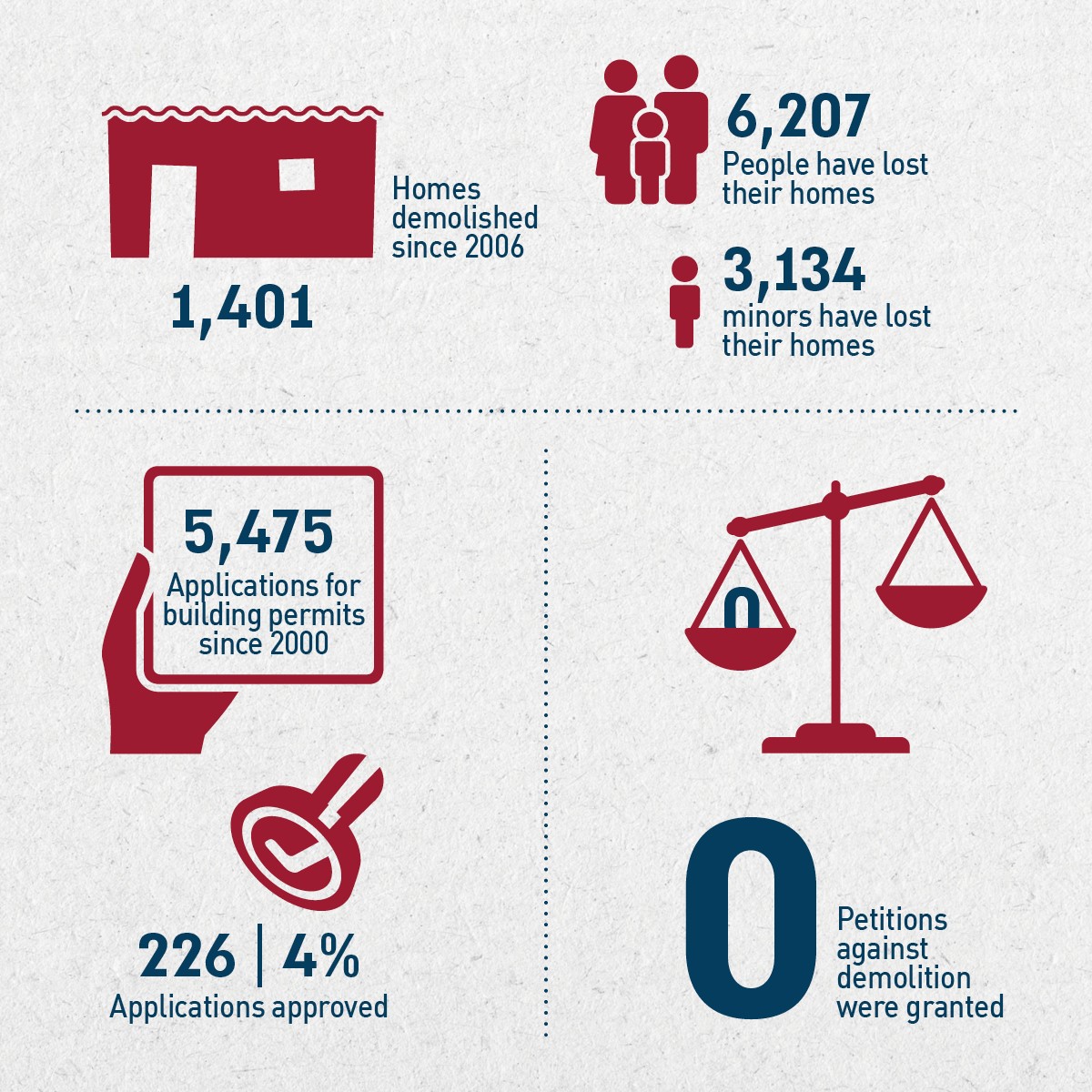
Image by B’Tselem
B’Tselem published an important new report entitled “Fake Justice: The Responsibility Israel’s High Court Justices Bear for the Demolition of Palestinian Homes and the Dispossession of Palestinians.” The report examines the role the highest court in Israel (and the only practicable avenue by which Palestinians can challenge Israeli policies and settler actions) has played in perpetuating the severe injustices inflicted upon Palestinians by the Israeli occupation and providing a guise of legality to for the Israeli policies behind them. Looking at its actions over the years as a whole, the report concludes that the court’s support of Israeli planning policy in the West Bank is tantamount to support for “forcible transfer” — a war crime.
The report’s executive summary explains:
“On the declarative level, Israeli authorities consider the demolition of Palestinian homes in the West Bank as no more than a matter of illegal construction, as if Israel does not have long-term goals in the West Bank and as if the matter does not have far-reaching implications for the human rights of hundreds of thousands of individuals, including their ability to subsist, make a living and manage their own routine. The Supreme Court has fully embraced this point of view. In hundreds of rulings and decisions handed down over the years on the demolition of Palestinian homes in the West Bank, the justices have regarded Israeli planning policy as lawful and legitimate, nearly always focusing only on the technical issue of whether the petitioners had building permits. Time and time again, the justices have ignored the intent underlying the Israeli policy and the fact that, in practice, this policy imposes a virtually blanket prohibition on Palestinian construction. They have also ignored the policy’s consequences for Palestinians: the barest – sometimes positively appalling – living conditions, being compelled to build homes without permits, and absolute uncertainty as to the future.”
The report is available to read and download here.
Video Compilation of Likud Candidates Touting Role of Tourism in Expanding Settlements
The Israeli archaeological group Emek Shaveh produced a video compilation of prominent Likud candidates touting their role in driving settlement tourism projects – in statements made in anticipation of the Likud primary elections (which were held on February 5th). Snippets in the video include:
- Former Mayor of Jerusalem Nir Barakat bragging about his work on behalf of settlement projects run by Elad in the Silwan neighborhood;
- Transportation Minister Yaariv Levin bragging on Facebook about the huge investments his ministry made into developing a settlement tourism industry, including doubling the amount of tourism to the West Bank in two years, funding two hotels in the Kiryat Arba settlement, and starting a grants program for tourist projects in settlements;
- Jerusalem Affairs Minister Zeev Elkin celebrating the opening of a “visitors center” in a settlement near the central West Bank city of Nablus.
Emek Shaveh writes:
“What was previously termed ‘hidden settlement’ has quietly transformed amid the Likud primaries into open policy. The extent of the Israeli government’s investments in the tourist settlement is now being exposed.”
There has been a growing awareness of – and opposition to – Israel’s overt investment in settlement tourism as means to expand and entrench Israeli settlements, most acutely in East Jerusalem. In February 2018, a leaked report by the European Union said explicitly that Israeli archaeological and tourism projects in East Jerusalem are “a political tool to modify the historical narrative and to support, legitimacy and expand settlements.”
Emek Shaveh issued a statement elaborating on leaked EU report, saying:
“Archaeological tourism projects are favored by the settlers as a means of winning the hearts of minds of the Israeli, Jewish and evangelical publics. The EU now recognizes how archaeological sites in East Jerusalem are being used as a political tool to ‘modify the historical narrative and to support, legitimise and expand settlements’. The City of David in Silwan, the new cable car project, the national parks in Palestinian neighborhoods compliment evictions and house demolitions in marginalising and disenfranchising the East Jerusalem Palestinian public. The difference between ‘cultural projects’ such as the national parks or the City of David and house demolitions is that in addition to the physical displacement, the former also expropriate the narrative, dispossessing the Palestinians from their historical and cultural contexts. When it comes to Jerusalem, narrative is not an abstract issue because in Jerusalem history and questions of present-day sovereignty are intertwined. And when it will come to determining the final status of the city, the question of who ‘owns’ the history of the city will be crucial.”
EU Settlement Report Details “Unprecedented” Level of Settlement Advancements 2018
On February 4th, the European Union issued its bi-annual report (pdf) documenting and analyzing trends in Israeli settlement activity from July through December 2018. It also provides a big picture summary of settlement activity in recent years, which found that there was a three-to-four-fold increase in settlement advancements in 2017/2018 (the era of U.S. President Donald Trump) compared to 2015/2016 (under Barack Obama).
The full report is available as a pdf here.
Bonus Reads
- “As West Bank Violence Surges, Israel is Silent on Attacks by Jews” (New York Times)
- “Digging Up Controversy” (US News)
- “US Blocks UN Statement on Israel Ending Hebron Monitors Mention” (Ynet)
- “CAF rejects tender for Jerusalem’s Railway as it Traverses ‘67 Borders” (Maan News)
Welcome to FMEP’s Weekly Settlement Report, covering everything you need to know about Israeli settlement activity this week.
To subscribe to this report, please click here.
December 21, 2018
- Israel Nears Final Move to Carry Out Massive Land Theft to “Regulate” Illegal Outposts
- Ministers Back a Bill to Legalize 66 Outposts
- In New Legal Opinion, Israeli AG Outlines Strategy for Legalizing Outposts
- New Outpost #1 : Settlers & Government Officials Illegally Re-Build Amona Outpost
- New Outpost #2: Settlers Build Outpost Overlooking Hebron
- More Details on the Plan to Dig a Tunnel Road to the Haresha Outpost
- High Court Criticizes State Over Illegal Road on Palestinian Land
- New Report Documents Israel’s “Severe and Regular” Violation of International Law in Hebron
- High-Rise Settlement Housing Promoted As a Means to Achieve 2020 Settler Vision & As a Solution to Israel’s Affordable Housing Shortage
- Fourth Quarter Decline in 2018 Settlement Construction Starts Doesn’t Tell the Whole Story
- Bonus Reads
Questions/comments? Email kmccarthy@fmep.org
Israel Nears Final Move to Carry Out Massive Land Theft to “Regulate” Illegal Outposts
As has become routine, Israeli settlers and their allies in government are exploiting the recent deaths of three Israelis (two soldiers and a baby) at the hands of Palestinian attackers as an opportunity to accelerate settlement-related activities. This includes advancing new legislation and accelerating/expanding the application of new legal tools designed to entrench and expand the permanence of some of the most radical Israeli settlers living in isolated outposts across the West Bank.
If implemented, the plans and legislation detailed below (and in last week’s settlement report) will expropriate huge amounts of land that even Israel recognizes as privately owned by Palestinians, in order to retroactively legalize Israeli outposts scattered across the West Bank. Such a move will complete what has been a gradual but steady formal suspension of even the pretense of maintaining the rule of law with regard to Israeli settlers’ or the Israeli government’s’ actions in the West Bank (which comes on top of Israel’s official and open contempt for international law). As Haaretz columnist Zvi Bar’el writes:
“The legal criminality that the government invented in honor of the settlers… is an unbridled attack on the rule of law, the undermining of Palestinian landowners’ right to appeal at the High Court, and the destruction of the planning and building system. And mainly, it turns terror into a real estate perk for lawbreaking extortionists.”
Americans for Peace Now said:
“In reaction to murderous terrorist attacks targeting West Bank Jewish settlers and Israeli soldiers, the government of Israel has come under pressure from the settlers to exact retribution against Palestinians. Two of the measures adopted are bound to open the floodgates for the legalization of existing settlement-outposts and the establishment of new ones.”
Ministers Back a Bill to Legalize 66 Outposts
On December 16th, the Israeli Cabinet voted unanimously to give government backing to a bill (called “Regulation Law 2” or the “Young Settlement Bill”) that directs the government to treat 66 illegal outposts built on privately owned Palestinian land as legal settlements, while giving the government 2 years to find a way to retroactively legalize those outposts.
The bill, proposed by MK Bezalel Smotrich (Habayit Hayehudi) and MK Yoav Kisch (Likud), also freezes any/all legal proceedings against the outposts and requires the government to connect the outposts to state infrastructure including water, electricity, provide garbage removal, and also approve budgets for them. The law also allows the finance minister to guarantee mortgages for settlers seeking to buy units in these outposts, even before the legal status of the land is resolved (a remarkable state-directed violation of normal practices in the mortgage industry). With government backing, the bill will now be introduced in the Knesset, where it must pass three readings before becoming law.
Though this bill has been ready for months, the Cabinet decided to advance the bill now in response to recent Palestinian terror attacks. MK Smotrich said: “This is the definitive answer to the murderous terrorism of the Arabs.” This sentiment was echoed widely across the settler movement.
The Cabinet voted to support the bill despite strong opposition from the Israeli Attorney General’s office. Deputy AG Ran Nizri told the Cabinet ahead of the vote that the bill has “significant legal problems,” represents a sweeping violation of the property rights of Palestinians in the West Bank, and will likely face a drawn out Court battle that might result in the High Court of Justice overturning the law. Notwithstanding these seemingly principled arguments opposing this tactic for legalizing outposts, it should be recalled that the Attorney General’s office has proposed what it believes is a more defensible means means to accomplish the same ends – called the Market Regulation principle (discussed below).
The Jerusalem Post speculates that passage of the “Regulation Law 2” in the Knesset may not be automatic, in light of past instances where international condemnation of such moves to legalize outposts led to hold-ups. The Times of Israel points out that the Trump Administration has failed to express any criticism about the new bill, which is unsurprising given Trump Administration officials’ statements and actions embracing and normalizing the settlements.
Israeli Justice Minister Shaked praised the bill, saying:
“[the bill is a] clear statement that will legalize young settlements [outposts] in Judea and Samaria. In the last three years, we changed the conversation from one of evacuation to one of legalization. There is no reason for the residents of Judea and Samaria to always have to live under the sword of evacuation.”
Peace Now said:
“Another populist and unconstitutional initiative is approved by the settler government, and only in such a state can an ‘illegal settlement’ be classified as a ‘young settlement.’ The settlers’ violence against Palestinian passerby that we witnessed during the weekend is a direct result of the government’s policy and of such bills that actually telling the settlers that they are above the law and whatever violation of the law the make, the government will legalize it.”
The bill is a follow-up to the first Regulation Law, which was passed by the Knesset in February 2017 but has since then been frozen by the High Court of Justice while it considers the law’s constitutionality. One month after passage of the Regulation Law, the Israeli Cabinet passed a resolution to enact the law expeditiously, at which point the cabinet created a committee – now headed by settler leader Pinchas Wallerstein – to build a list of outposts which the government can retroactively legalize and to complete the bureaucratic work required to do so. Wallerstein – who has a long history of ignoring Israeli law but is now responsible for massaging it to suit his needs – has been vocal about what the government can do immediately, telling the Knesset in October 2018 that there are at least 20 outposts which can be “easily” legalized as neighborhoods of existing settlements, and 50 more outposts that can be legalized but require more complex solutions.
The outposts slated to be legalized are scattered across the West Bank, many of which FMEP has reported on regularly, including: Haresha (the center of recent legal maneuvers aimed at legalizing an access road built on privately owned Palestinian land); Givat Assaf (where two Israeli soldiers were killed on December 13th); Havat Gilad (another outpost which gained political support following a Palestinian terror attack); Yitzhar South, Yitzhar East (satellites of the radical and violent Yitzhar settlement near Nablus; Ma’ale Rehavam (which was built on privately owned Palestinian land that the WZO illegally allotted to the settlers); Mitzpe Kramim (where once again the WZO gave settlers land owned by Palestinians. A court recently ruled the WZO acted in “good faith” in the transaction despite evidence to the contrary); Netiv Ha’avot (FMEP extensively covered the saga of Netiv Ha’avot); and, Adei Ad (a violent outpost that has been approved to be added to the jurisdiction of the new Amichai settlement in the Shilo Valley).
FMEP tracks all developments related to Israeli legislative, cabinet, and judicial action that promotes the retroactive legalization of outposts built on privately owned Palestinian land as part of its documentation of creeping annexation – available here.
In New Legal Opinion, Israeli AG Outlines Strategy for Legalizing Outposts
On December 13th, Israeli Attorney General Avichai Mandleblit issued a new legal opinion outlining how the government can implement the “market regulation” principle (which he invented) as a new legal basis for retroactively legalizing outposts and settlement structures built on privately owned Palestinian land. According to this principle – which contradicts any notion of rule of law or the sanctity of private property rights – settlement structures and outposts built illegally on private Palestinian land, can be legalized, if the settlers acted “in good faith” when they took over and built on the land. His opinion and subsequent arguments to the Israeli High Court of Justice (below) confirm that in the view of the Israel’s top law official, Israel has the right to expropriate privately owned Palestinian land in the occupied West Bank and give it to Israeli settlers; the only disagreement he has with the Knesset is over the method of doing so.
Peace Now has a comprehensive breakdown of the new legal opinion, including the specific criteria outlining which outposts can qualify under the new scheme. AG Mandelblit estimates that 2,000 illegal settlement structures qualify for retroactive legalization using this principle,
The Israeli government has already used the “market regulation principle” in court twice, both in defending against lawsuits filed by Palestinians (first in response to petitions by Palestinian landowners against structures on their land near the Ofra settlement, second in response to petitions filed by Palestinian landowners against the Mitzpe Kramim outpost). This week’s move by the Attorney General allows the government to proactively initiate proceedings to retroactively legalize unauthorized outposts and settlement structures.
Reportedly, the Attorney General prepared this legal opinion a while back, but was stopped from publishing it by Prime Minister Netanyahu, who was concerned about the international and diplomatic repercussions. It seems likely that the recent string of Palestinian terror attacks prompted Netanyahu to give the AG the green light to go ahead, along with advancing a number of other punitive settlement plans.
Shortly after approving the implementation of the “market regulation principle,” Mandleblit called on the High Court of Justice to overturn the Regulation Law, which the Court has been considering for more than a year. In a letter to the High Court Justices, Mandleblit argued that implementing the “market regulation principle” is “a more proportionate and balanced measure than the arrangement prescribed in the Regulation Law,” providing a more narrow legal basis by which Israel can strip Palestinian landowners of their rights (estimating that 2,000 structures can be legalized under the “market regulation principle,” compared to an estimated 4,000 under the Regulation Law). Of course, this argument overlooks the severe violation of Palestinian rights, the rule of law, and international law inherent in Israel’s decision to in effect erase Palestinian private property rights in the occupied territory to benefit the settlers.
Peace Now said:
“The attorney general is crossing yet another red line by laying the foundations for an institutionalized theft mechanism that will expropriate land from Palestinians and allocate it to settlers who stole it.This is part of a larger move led by AG Mandelblit to reduce the rights of Palestinians in the occupied territories and to expand the privileges of the settlers, thereby bringing us closer to an apartheid reality.”
FMEP tracks all developments related to Israeli legislative, cabinet, and judicial action that promotes the retroactive legalization of outposts built on privately owned Palestinian land as part of its documentation of creeping annexation – available here.
New Outpost #1 : Settlers & Government Officials Illegally Re-Build Amona Outpost
In recent days, dozens of Israeli settlers moved two mobile homes placed on the hilltop where the illegal Amona outpost once stood, claiming to have purchased the land from its Palestinian owners. Prominent settler leaders and MK Bezalel Smotrich (Habayit Hayehudi) visited the site to celebrate the resurrection of the infamous outpost, an endeavor which was directly supported and facilitated by the Binyamin Regional Council (a settlement regional authority which draws its budget from Israeli taxpayer funds).
Settlers have reportedly submitted documents to the Israeli Civil Administration which they claim prove the land has been legally purchased (a claim which, even if true, does not justify the settlers’ illegal invasion of and construction in an area designated by Israel as a closed military zone). The Civil Administration – which is the sovereign power over the West Bank and responsible for enforcing the law there – has confirmed that it is aware of the new outpost and has received documents from the settlers, but has not yet reviewed the documents.
Yesh Din, an Israeli NGO representing the Palestinian landowners, immediately filed a petition to have the illegal structures removed. Yesh Din also filed a criminal complaint against the Israeli government officials who were involved with invading the hilltop. As of this writing they have not received a response on either front. Peace Now has also stated it will pursue legal action against the settlers.
Yesh Din explains key context in the Amona outpost saga:
“After the evacuation [of the Amona outpost] in 2017, the Israeli army declared the area a closed military zone, prohibiting entry of Israelis and Palestinians to the area where the outpost had been located. The closure, however, was not enforced for Israelis, who freely entered, while Palestinians – including the legal landowners – were forbidden to enter and cultivate the very land for which they had struggled for years. In addition to the audacity of blatantly defying the High Court of Justice ruling and trampling on the rights of the landowners, the placing of the new structures this weekend violates the closure order and constitutes a further infringement of the law as the establishment of a new settlement in Amona was never authorized – certainly no permits or outline plans exist. But in the ‘land of the settlers,’ the concept of rule of law has long since lost any meaning. Any Israeli can decide to build a settlement on a hill, merely because they feel like it. The buildings then remain regardless of their illegality, Israeli authorities not daring to challenge their imposing presence.”
Benyamin Regional Council Chairman Yisrael Gantz said in a statement:
“After two years of this place being uninhabited, we are fortunate to resume Israeli life here. The plots upon which we erected the structures were legally purchased. Yesterday, I promised to establish a new settlement in Binyamin in response to the deadly attacks and today we are carrying it out.”
Yossi Dagan, head of the Samaria Regional Council said at the event:
“In these dark days, when terrorist attacks are so numerous and the honor of the people of Israel is harmed, we must get fired up and today’s ascent to Amona is an appropriate Zionist response.”
Peace Now said in a statement:
“There is no limit to the cynicism of the hilltop criminals who exploit the events of recent days to trample the law and ignite disturbances, all with public funds. These pyromaniacs are backed by Knesset members and local politicians… It is difficult to understand how an order has not yet been issued to evacuate them, and we ask whether the IDF and the police would have allowed this if they were Palestinians. This disgrace should be addressed today.”
Re-establishing the Amona outpost would hand a complete and total victory to the settlers who were forcibly evacuated from the site in 2017 – proving that not only does settler law-breaking go unpunished, but it is handsomely rewarded by the Israeli government, and that establishing illegal outposts is an effective route to establishing new settlements. Since being evacuated, the Amona outpost settlers have (so far) been “compensated” by the government with financial compensation and two new settlements:
- The first new government-backed settlement in 25 years, Amichai. The Israeli Civil Administration High Planning Council subsequently approved a plan to triple the size of the Amichai settlement to include the Adei Ad outpost and the lands between the two; and,
- The Shvut Rachel East settlement. This is an outpost that was granted authorization as a “neighborhood” of the Shilo settlement, but is properly understood as a new settlement unto itself. Teh Amona outpost settlers were first offered the Shvut Rachel East hilltop as a relocation site, but rejected it in favor of the nearby Amichai hilltop. Despite rejection, Shvut Rachel East received authorization anyways.
New Outpost #2: Settlers Build Outpost Overlooking Hebron
In recent days, a group of settlers have moved back into the site of an evacuated outpost near the city of Hebron, just north of the Kiryat Arba settlement, which settlers are calling Givat Mevaser. At a celebration of the decision by settlers to reestablish the outpost, the chairman of the Kiryat Arba settlement local council, Eliyahu Libman, said:
“We made a decision in light of the harsh news endured by the people of Israel last week to permanently move families into Givat Mevaser.”
The IDF was present at the celebratory event to protect the settlers, but an official at the Defense Ministry admitted that the settlers did not coordinate their actions with authorities. The site was previously approved to be developed into a settlement industrial zone, and according to a spokesperson for the new outpost, settlers are in the process of changing the building plan in order to get authorization for residential housing. Nonetheless, the settlers are at present violating Israeli law by taking up residence at the site.
More Details on the Plan to Dig a Tunnel Road to the Haresha Outpost
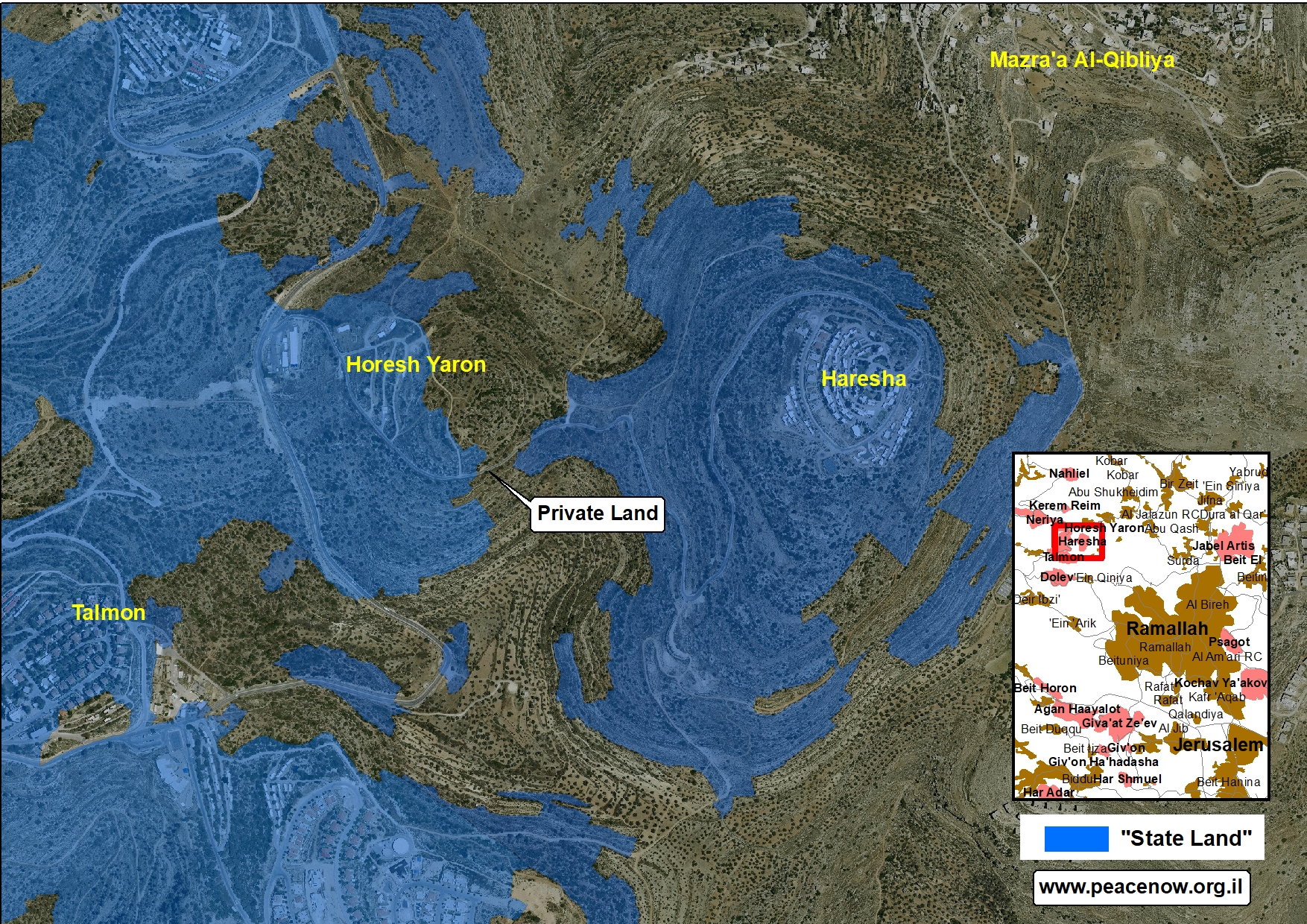 Kerem Navot has published a Justice Ministry opinion that provides further details on the government’s plan – approved on December 6th – to retroactively legalize the Haresha outpost by building a tunnel road underneath privately owned Palestinian land (an olive grove). The Justice Ministry document explains that while the Israeli government in principle has the right to permanently expropriate the land from its Palestinian owners, such an action would likely be challenged in the High Court of Justice, where it might be overturned. The Justice Ministry suggests instead that the government should “temporarily” expropriate the land while a tunnel is dug and road paved beneath the olive grove – with the plan being, ostensibly, to return the land to its Palestinian owners after construction is complete.
Kerem Navot comments:
“now, in order to legalize the outpost, shady legal advisers (of the type to whom Justice Minister Ayelet Shaked is drawn) write documents in which they lay down their doubts on whether to expropriate the grove ‘permanently,’ which will be cheaper and faster (but it is likely to be rejected by the High Court of Justice), or to ‘temporarily’ expropriate it solely for the construction of a tunnel through the ‘excavation and cover-up’ method.”
As a reminder, in November 2017 the Attorney General gave the Israeli government a green light to permanently expropriate the privately owned land based on a legal argument that holds Israeli settlers to be part of the “local population” of the West Bank, and therefore eligible to be the sole beneficiaries of state land expropriated for “public use.”
High Court Criticizes State Over Illegal Road on Palestinian Land
At a December 18th hearing, the High Court of Justice gave the government of Israel 60 days to explain why it should not be required to demolish a road and several buildings that were built on land that the state has admitted it believes is privately owned by Palestinians. The case is before the court on a petition by Palestinians who claim that a 200-meter (650-foot) stretch of the road is built on their land.
The Court also slammed the State for allowing the construction of the road and buildings to be completed after a stop-work order was issued against the construction, a stop-work order the State assured the Court would be implemented. At the December 18th hearing, an attorney from the State Prosecutor’s Office told the Court that the road in question was a dirt road, and argued that the state had not sanctioned or had a hand in its construction.
New Report Documents Israel’s “Severe and Regular” Violation of International Law in Hebron
Haaretz shares details from a leaked report written by the Temporary International Presence in Hebron (TIPH), which documents the totality of Israel’s policies in Hebron, serve to aid and protect settler and which collectively impose severe human rights violations and restrictions on Palestinians.
The report accuses Israel of being in “severe and regular breach” of international law, highlighting the many ways in which the human rights of Palestinians are systematically trampled on – specifically as it relates to radical settlers, their increasing activities in Hebron’s Old City, and the role of nearby settlements.
The Temporary International Presence in Hebron (TIPH) was first established in 1997 as part of the Oslo Accords’ Hebron Protocol, which allowed the partial redeployment of Israeli military forces to the part of the city that remained under its control. Israel must renew the TIPH’s mandate every six months; some fear that the next renewal has been jeopardized by the leaked report’s publication.
High-Rise Settlement Housing Promoted As a Means to Achieve 2020 Settler Vision & As a Solution to Israel’s Affordable Housing Shortage
Haaretz reports that the Yesha Council – the umbrella group representing all settlements in the West Bank – has adopted a strategic goal to advance “high quality, high density” settlement schemes in order to reach their goal of having 1 million settlers living in the West Bank by 2020. The basic idea is to build high-rise apartment complexes in settlements close to major highways in the West Bank and aggressively market them to Israelis who are seeking cheap rent and a fast commute, two key complaints of Israelis living and working in sovereign Israeli territory.
The strategy marks a shift in how settlements have typically been marketed to the Israeli public; once sold as an answer for young Israeli families looking for a single family unit with land, housing in settlements is now being marketed as the answer for young professionals looking for affordability, convenience and accessibility. The Yesha Council has coupled the new strategy with pressure on the government (and a promise to potential purchasers) to expedite West Bank infrastructure projects that will ease traffic, including bypass roads and detours around Palestinian towns.
In a February 2018 article, the Chairman of the Yesha Council wrote:
“Looking ahead, the patterns of thinking and action in the settlement movement need to be changed in two main areas: high-rise construction and doing away with admission committees. The available land for building is not plentiful. Until now, we’ve been used to rural communities with a one-family home on a half-dunam plot, but the goal from now on should be to build as many housing units as possible on that same land. High-density construction — building up or in a terraced fashion, depending on topography — will change the balance in the area and also require a new approach to infrastructure development to suit the number of residents in the future.” [Note: the Haaretz article explains that “admission committees” are a function of settlements which have standards for who is permitted to live there, mostly in ultra-orthodox and ideological settlements]
Fourth Quarter Decline in 2018 Settlement Construction Starts Doesn’t Tell the Whole Story
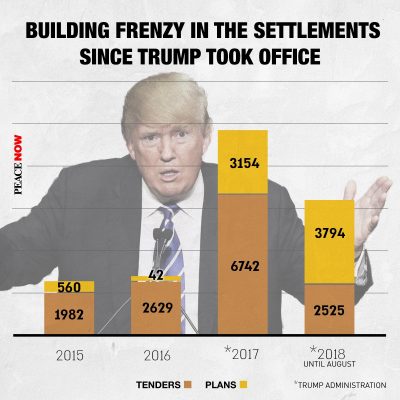
by Peace Now
The Israeli Central Bureau of Statistics (CBS) released new data showing a 52% decrease in the number of settlement construction starts in the third quarter of 2018 compared to the second quarter of 2018. News about a “decline,” relative to the last quarter, obscures the clear and alarming settlement surge currently taking place. As Peace Now has reported, by August 2018 the total number of settlement tenders and plans that have been advanced (6,319) is more than double the total amount in 2016 (3,189).
In addition, it is important to bear in mind that the number of construction starts do not begin to depict or reveal the level of settlement activity happening in the West Bank. Israel’s settlement enterprise is not solely a matter of residential housing plans, but also the unceasing expansion of infrastructure and security measures that exclusively benefit Israeli settlers, the normalization and development of settlement industrial zones, and illegal settlement activity (outposts, which are now regularly legalized ex post facto) that does not register in numbers tracking the settlement planning process.
Bonus Reads
- “Israel Has Weaponized the Settlements” (Haaretz Editorial)
- December 2018 public opinion poll – Palestinian Center for Policy and Survey Research
Welcome to FMEP’s Weekly Settlement Report, covering everything you need to know about Israeli settlement activity this week.
To receive this report via email, please click here.
August 9, 2018
- Israel Plans to Use “Nation-State Law” to Defend Settlement “Regulation Law”
- Israel Moves to Approve a New Settlement…By Expanding An Existing One (An Old Trick)
- Israeli Govt is Funding a Settler School Squatting in a Palestinian Home
- Transferring Israeli Trash to the West Bank
- Settler Regional Council Funds Activities Aimed at Undermining Israeli Law
- Bonus Read
Comments, questions, or suggestions? Email Kristin McCarthy at kmccarthy@fmep.org.
Israel Plans to Use “Nation-State Law” to Defend Settlement “Regulation Law”
The Israel State’s private attorney tasked with defending the settlement “Regulation Law,” Harel Arnon, told reporters that the recent passage of the Nation-State law (declaring Israel the nation-state of the Jewish people alone) will strengthen his efforts to keeping the Regulation Law on the books (an effort which is widely expected to fail). The settlement “Regulation Law” was passed by the Knesset in February 2017, as a means to allow Israel to expropriate privately owned Palestinian land for the exclusive use/benefit of settlers. The High Court of Justice is currently weighing petitions against the settlement “Regulation Law,” which has been frozen since August 2017.
Arnon said:
“The nation-state law certainly impacts the Regulation Law. There is no question. If until now, the argument in defense of the Regulation Law was that it seeks to balance the individual rights of Israeli residents (in the West Bank) with those of the Arab residents… what the nation-state law does is raise the status of Jewish settlement to one of constitutional value.”
The Nation-State law was passed by the Knesset on July 19th, and has since sparked condemnation and protest for the way it demotes the standing of minority communities in Israel. The law says “the state views the development of Jewish settlement as a national value and will act to encourage and promote its establishment and consolidation.” Nothing in the text suggests a distinction between “Jewish settlement” within Israel’s sovereign borders, and settlement in the occupied territories.
Yossi Alpher – former senior Mossad official and IDF intelligence officer) predicted as much in his weekly explainer for Americans for Peace Now. Deconstructing recent quotes by Prime Minister Netanyahu (“Without the Nation State law it would be impossible to ensure Israel’s future as a Jewish state for the coming generations”) and Tourism Minister Yariv Levin (“The hysterics of the political left prove that this is an excellent law. Once the composition of the [High Court] judges is changed, we can get what we wanted”), Alpher deduced:
“…the ultra-nationalist right, currently Israel’s political mainstream, intends to continue absorbing the land of the West Bank into Israel. Simultaneously it seeks, in one form or another, to disenfranchise more than three million Palestinians living there lest they become Israeli citizens and tilt the demographic balance away from ‘Jewish’ and (with a combined population including 45 percent Arabs but still excluding Gaza) toward ‘bi-national’. A Jewish nation state in which only Jews determine the country’s constitutional nature is the perfect ‘legal’ legislative vehicle for taking the necessary apartheid-like measures to make this happen.”
Israel Moves to Approve a New Settlement…By Expanding An Existing One (An Old Trick)
On August 8th, the Israeli Civil Administration announced that it is planning to retroactively legalize the Adei Ad outpost by massively expanding the borders of the (brand new) Amichai settlement to turn Adei Ad into a (non-contiguous) neighborhood of Amichai. In effect, this is a stealth operation by Israel to turn the Adei Ad outpost into an entirely new official, legal settlement.
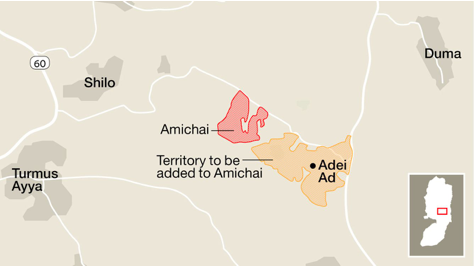
Map by Haaretz
The massive expansion of the Amichai settlement and the transformation of Adei Ad into a brand new settlement, if implemented, will be a significant step towards creating an uninterrupted corridor of settlements connecting sovereign Israel to the Ariel settlement, through the isolated Shiloh Valley settlements, all the way to the Jordan Valley. In so doing, It will completely bisect the northern part of the West Bank.
The plan takes into account a Civil Administration “Blue Line” survey in 2017, which found that the strip of land between the Amichai settlement and the Adei Ad outpost is privately owned Palestinian land. It seems that the Civil Administration is opting (for now) not to use its newly endowed tools for expropriating privately owned land for the use of settlements, and is instead moving forward with a plan that will effectively leave Adei Ad – ostensibly now a neighborhood of Amichai – physically disconnected from its new parent settlement. The strip of Palestinian land in between the two will almost certainly become inaccessible to its Palestinian owners, as is much of the Palestinian land near Adei Ad, a notoriously radical and violent outpost. It is highly likely that at a later date the land will be expropriated.
The Civil Administration unveiled the new plan in a letter addressed to Israeli NGO Yesh Din, in response to a 2014 petition against the Adei Ad outpost filed by the group on behalf of Palestinian landowners. The Civil Administration’s letter claimed the 2017 “Blue Line” land survey determined that Adei Ad is built on “state land” and is therefore eligible for retroactive legalization (despite having been built there entirely illegally). Yesh Din and its clients have formally appealed the findings of that survey, contending that Adei Ad is partially on private land.
After the Amichai borders are expanded to give cover for the legalization of Adei Ad, the Israeli Civil Administration is set to transfer administrative responsibilities over the expanded settlement (including the Adei Ad “neighborhood”) to the Binyamin Regional Council – the municipal body responsible for administering services and enforcing building laws in settlements within its jurisdiction (though it rarely moves to enforce laws against the illegal settler construction). As Haaretz notes:
“Except in the rarest cases, the council does not enforce the law against illegal construction in its jurisdiction…As a result of the transfer of administrative powers to municipal authorities at Amichai, the settlers will be able to build new structures illegally without effective enforcement.”
Yesh Din’s attorney, Shlomi Zecharia, told Haaretz:
“The inhabitants of the villages near the outpost have become hostages to the policy that abundantly rewards prizes and gifts to ideological criminals. Cutting off farmlands by means of a false [expansion of] jurisdiction is extreme, disproportionate and needless, and in fact is intended to perpetuate restrictions on and infringement of Palestinian property, this time under the official auspices of the government.”
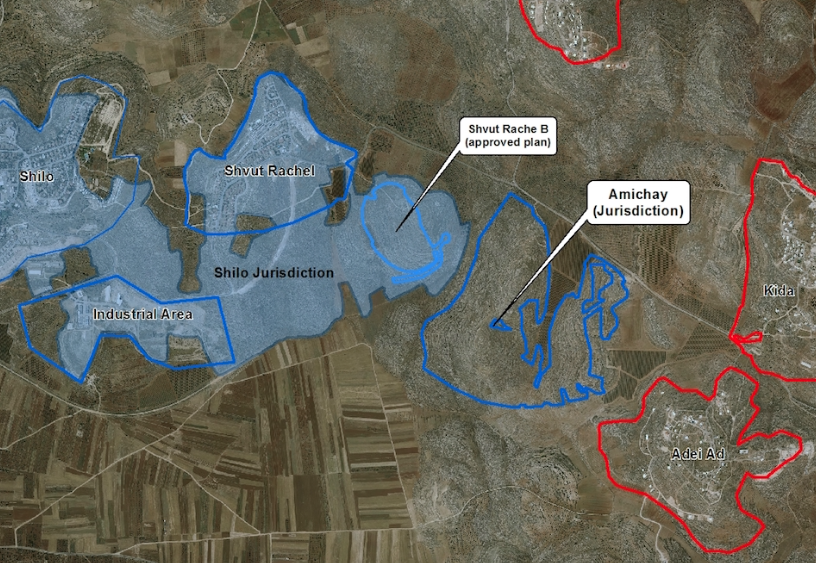
Map by Peace Now
Additionally worth noting, the Amichai expansion/Adei Ad legalization plan will represent yet another reward to settler law-breakers who evacuated from the unauthorized Amona outpost. Previously, the pay-off to settlers included the approval and construction of the Amichai settlement, which was the first new settlement to be built with government authorization in 25 years. It included, too, the approval of Shvut Rachel East, an outpost which – just like Adei Ad – became a non-contiguous “neighborhood” of an existing settlement (Shilo). The Amona pay-off package can now count a third settlement, Adei Ad. As FMEP documented at the time, the Trump Administration reportedly accepted the Amichai plan as an exception to its settlement policy which, at that time, was described in the media as President Trump asking Netanayahu “hold back on settlements for a little bit.”
Yesh Din comments on the Adei Ad scheme:
“Viewed in a broader context, this retroactive authorization is a major step towards fulfillment of Israel’s plan to annex Area C: retroactively authorizing unauthorized outposts at any price so as to ‘normalize’ them and render them permanent settlements; and creating continuous settler presence across the West Bank, from west to east, in order to facilitate the annexation, while dispossessing Palestinians of land that is their source of livelihood and in blatant disregard of international law and of the rights of Palestinian residents.”
Israeli Govt is Funding a Settler School Squatting in a Palestinian Home
The Times of Israel has a detailed report on a government-funded religious school that for years has been operating illegally in a privately owned Palestinian home near the Ofra settlement, in the center of the West Bank. The Mishpatei Eretz Institute, which is operating the school, receives around USD $55,000 annually from the Israeli Culture Ministry, and has received a total of USD $214,039 from government bodies over the past three years alone.
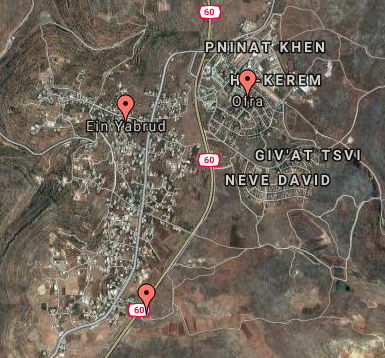
Map by Google, markers by The Times of Israel
In the mid 1990s the home was physically cut off from the Palestinian village to which it belongs when Israel paved Route 60, the major north-south highway in the West Bank. In 2003, Israeli settlers broke into the home while its owners, the Shehadeh family, were on a day trip to Ramallah. After invading the home, settlers produced forged documents claiming that the Al-Watan settler organization purchased the building, and then spent years trying to prove that the purchase was legitimate in order to have the building registered with the Civil Administration. The Shehadeh family also spent years trying to force the IDF to evict the squatters, but nothing was ever done. In the meantime, Al-Watan donated the building – even without having legally established ownership of it – to the Mishpatei Eretz Institute, which then began operating a religious school in the building with government funding.
In 2013, the Jerusalem District Court ruled against Al-Watan’s claim to the building (slamming the organization and its officers for engaging in rampant fraudulent activity), deciding that the documents had been forged and recognizing the original Palestinian owners’ rights. Ten days after the ruling, the IDF Central Command issued a military order seizing the plot of land the home sits on, claiming “security purposes.” The IDF also built a fence around the area. The military order seizing the land will remain in force until 2019.
When contacted about the story, the IDF acknowledged the 2013 Court ruling but did not offer an explanation for any of its actions dating to either before or after the court ruling. A lawyer representing the Palestinian owners told The Times of Israel that the family will soon petition the High Court of Justice to have the settlers, and their school, evicted.
The anti-settlement watchdog Kerem Navot told reporters:
“We see here another example that reveals the corrupt system that Israel maintains in the West Bank. Rather than enforce the law, and evict and punish the settlers who invaded the property, the IDF issued a corrupt military order based on security needs that de facto enables them to stay there. On top of that, we now discover that the government is generously funding criminal bodies like the Mishpatei Eretz Institute.”
Transferring Israeli Trash to the West Bank
Haaretz reports that the Israeli government is close to finalizing a new plan to transfer waste from Jerusalem to the West Bank. Under the scheme, Israel will build a waste treatment facility east of the Ma’ale Adumim settlement to handle waste from Jerusalem. The facility will recycle or burn as much of the waste as possible, and then transfer the resulting ash and any remaining waste back into Israel.
Since the West Bank is under a military occupation, environmental regulation standards are considerably lower than in sovereign Israeli territory, making the West Bank an ideal spot for Israel to dump/treat its waste on the cheap, a practice extensively documented in a 2017 report by B’Tselem. The report asserts:
“Waste treatment in the West Bank is simply one more facet of the exploitative policy Israel has practiced consistently for fifty years now, using Palestinian space and people to further its own interests. As part of this policy, Israel treats the West Bank – and particularly Area C, where it retained full control under the Oslo Accords – as an area meant to serve its needs exclusively, as if it were its sovereign territory.”
Echoing the B’Tselem report, MK Mossi Raz (Meretz) notes that the plan, though sold as an environmentally friendly solution, is part of Israel’s de facto annexation of the West Bank, saying:
“Although at first glance it looks as though the ministry wants to protect the environment, the government plans clearly demonstrate that the goal is to prepare the ground for annexation. The building of infrastructure in the occupied territories by the state, without cooperation from the PA, deepends Israeli control in the territories, and thereby in effect is bringing us even closer to the day when the Israeli government will annex the territories.”
The Israeli Defense Ministry is slowing down the implementation of the plan, which has broad support across other government ministries, for technical reasons — mainly having to do with a dispute about how the facility will be staffed.
Settler Regional Council Funds Activities Aimed at Undermining Israeli Law
In 2017 the Gush Etzion Regional Council contributed hundreds of thousands of shekels to illegal settlement and outpost construction in its jurisdiction, and heavily invested in projects connected to defending the unauthorized Netiv Ha’avot outpost against demolition. Data obtained by the Movement for Freedom of Information and analyzed by Peace Now show that the Gush Etzion Regional Council, which is supposed to be enforcing Israeli laws in areas under its jurisdiction, instead invested hundreds of thousands of shekels trying to help the illegal Netiv Ha’avot outpost skirt the law. The Council’s 2017 projects connected to Netiv Ha’avot included:
- The construction of a new, unauthorized observation tower (a memorial site) in the outpost. Construction of the tower moved forward after the High Court of Justice ruled that 17 buildings in Netiv Ha’avot were built partially on Palestinian land and must be demolished.
- A public campaign to save buildings in the Netiv Ha’avot outpost from demolition, including a payment to the radical Regavim settler organization in connection to the campaign (which is working to selectively enforce building laws against Palestinians in the West Bank). By the end of 2017, the council spent NIS 164,688 on the campaign – which, as Peace Now notes, became an even more active effort in 2018.
- Building a new (at that point unauthorized) outpost for those settlers facing evacuation from buildings in the Netiv Ha’avot outpost. The Council was able to recoup some of those expenses when the government later approved an NIS 60 million package to provide compensation for the settlers who were evacuated as well as funds for the Council.
In addition to the Netiv Ha’avot outpost expenditures, and other unauthorized settlement projects, the Gush Etzion Regional Council spent NIS 1,755 on an ATV tour for MK Yehuda Glick to conduct a “survey on the application of sovereignty over (i.e., annexation of) Gush Etzion.”
Peace Now says:
“It is time for official authorities that are obligated to act according to the law to stop funding illegal activities, attacking the High Court and evading enforcement of the law, especially when using public funds. The Interior Ministry must put an end to this sinister exploitation of the public coffers, and must get our taxpayers’ money back.”
Bonus Read
- “Fact and Fiction About the Amendment of the Israeli Supreme Court’s Jurisdiction Over West Bank Cases” (Lawfare Blog)