Welcome to FMEP’s Weekly Settlement Report, covering everything you need to know about Israeli settlement activity this week.
To subscribe to this report, please click here.
April 24, 2020
- The Facts on the Bibi/Gantz Annexation Agreement
- The World Responds (or doesn’t) to Formation of Annexation Government
- Gantz Takes Over Defense Ministry – Including Authority Over Settlement Construction (at least until July 1st)
- Settlers, Yamina Party Dissatisfied with & Suspicious of Netanyahu’s Annexation Plans
- Plans Advance for Two New Settlement Enclaves in the Beit Hanina Neighborhood
- B’Tselem: With IDF Backing, Settlers are Violently Stealing Land During COVID-19 Crisis
- Coming Soon: Plans for Har Homa Expansion Scheduled for Discussion on April 27th
- Coming Soon: Israel To Open Bidding on “Doomsday” Givat Hamatos Settlement Tender on May 3rd
- IDF Demolishes Outpost Structures, Including in Outpost From Which the Criminal “Hilltop Youth” Group Hail
- Yesh Din Outlines Potential Impact of Annexation on Palestinian Human Rights (Spoiler: It’s Bad)
- Bonus Reads
Comments or questions – email Kristin McCarthy (kmccarthy@fmep.org).
The Facts on the Bibi/Gantz Annexation Agreement
Under the new emergency unity government agreement, the issue of annexation is at the total discretion of Prime Minister Netanyahu. Per the coalition agreement signed by Netanyahu and Gantz on April 20th, the stipulations related to annexation are:
- The U.S. must give its “full agreement” to the annexation plan, including on the maps of West Bank land Israeli legislation will specify for annexation. Reminder: the U.S. and Israel have already formed a joint mapping committee aimed at translating the conceptual map appended to the Trump Plan into a detailed plan. The U.S. has signalled that it will give its approval to the resulting map and to date, the Trump Administration has only offered its total support for Israeli annexation – including Secretary Pompeo in a April 22nd press conference.
- Netanyahu and Gantz must “engage in dialogue” with (but are not obligated to secure any form of consent from) the international community, “with the aim of preserving the security and strategic interests of Israel including maintaining regional stability, preserving existing peace agreements and working towards future peace agreements.” During the negotiations that paved the way for the unity agreement, international coordination as a condition for any annexation was reportedly one of Gantz’s key demands, with particular insistence on the king of Jordan being consulted; as is clear from the agreement, Gantz totally folded on this point (among others).
- On July 1, 2020, Prime Minister Netanyahu can bring the U.S-approved annexation plan up for discussion in the Cabinet and/or for a vote in the Knesset, – without the support/approval of Gantz. The unity agreement consists of a six-month “emergency period” during which Netanyahu is prohibited from introducing any legislation unrelated to Israel’s fight against the Coronavirus. Annexation legislation is the one and only exception from this prohibition, with the agreement allowing Netanyahu to move annexation legislation as of July 1 (the delay until July representing the empty “concession” extracted by Gantz in negotiations). Indeed, by providing two separate ways to move annexation – via the Cabinet or via the Knesset – the agreement ensures Netanyahu will be able to pass the bill even if he does not have a majority in the Cabinet (seats on which will be split equally between Netanyahu and Gantz appointees in the new government).
- Only a Likud member of the Knesset is permitted to introduce an annexation plan in the Knesset, provided that the plan is identical to the one promoted by Prime Minister Netanyahu. This stipulation prevents more radical annexation plans from being moved in the Knesset by members of other political parties, and also eliminates any role of Gantz in Knesset proceedings.
- Once introduced into the Knesset, the annexation legislation cannot be delayed or vetoed. By accepting this clause, Gantz has agreed in advance that he cannot block the bill from passage. At the same time, the agreement magnanimously allows Gantz and his fellow Blue & White Members of the Knesset to “vote their conscience” and oppose the annexation bill (FMEP has previously explained the political strategy behind this). Under the unity agreement, this is the only matter on which Gantz agreed to forfeit his veto power.
The World Responds (or doesn’t) to Formation of Annexation Government
The Palestinians were vocal in their opposition of the new government and its annexation plan, with Palestinian Authority President Mahmoud Abbas threatening to cancel all agreements with Israel and the United States if annexation plans proceed.
Unsurprisingly, the U.S. government welcomed the unity government agreement and, with Secretary of State Pompeo stating he was “happy” that the sides had reached an agreement and noting:
“As for the annexation of the West Bank, the Israelis will ultimately make those decisions. That’s an Israeli decision. And we will work closely with them to share with them our views of this in (a) private setting.”
The government of France issued the most notably strong statement (so far) rejecting annexation, saying:
“Such steps if implemented would not pass unchallenged and shall not be overlooked in our relationship with Israel.”
An European Union’s foreign affairs spokesman stated that “If this proceeds, it will not be left unanswered.” Separately. the EU’s Chief of Foreign Affairs, Josep Borrell, issued a statement vowing to “closely monitor” annexation efforts, reiterating that the EU holds annexation as a “serious violation of international law.” Remarkably, 8 of 27 EU member states opposed Borrell’s statement, signalling a fractured and therefore weak EU stance against annexation. During discussions with member states, Borrell reportedly argued for including a threat of sanctions against Israel if annexation is advanced, a point which drew opposition. Other states were reportedly hesitant over the timing of the statement, claiming to be concerned about preemptively souring relations with the new government, and particularly Gantz.
In response, Israeli Foreign Minister Yisrael Katz attacked Burrell and praised EU states that opposed the EU statement, including:
“It is unfortunate to read that Joseph Burrell, who claims to be trusted with the EU’s foreign relations, chooses to welcome the new government of a central partner of the EU in this way, and prefers to see the relationship between Israel and the EU through the prism of the pandemic and the ‘status of the territories.’ Given the depth of the relationship and in light of the fact that this announcement did not receive the support of the EU member states yesterday, we wonder which policies the honorable gentleman is choosing to represent, and not for the first time.”
Ireland’s Foreign Minister Simon Coveney made a strong statement warning Israel against annexation:
“Annexation of territory by force is prohibited under international law, including the UN Charter, whenever and wherever it occurs, in Europe’s neighbourhood or globally. This is a fundamental principle in the relations of states and the rule of law in the modern world. No one state can set it aside at will. Ireland remains committed to a negotiated two-state solution that ends the occupation that began in 1967, with Jerusalem as the capital of both States, on the basis of international law, the internationally-agreed parameters and relevant UN Security Council resolutions.”
Germany’s mission to the UN tweeted:
“Germany strongly advises against the annexation of occupied Palestinian territories. This would have serious, negative repercussions on the viability of the two-state solution, the entire peace process, regional stability and ISR standing within the international community.”
The UK Deputy Permanent Representative to the UN, Ambassador James Roscoe, delivered a statement in the UN Security Council noting:
“we are deeply concerned by reports that the new Israeli government coalition has reached an agreement which paves the way for annexation of parts of the West Bank. The UK position is clear: any unilateral moves towards annexation of parts of the West Bank by Israel would be damaging to efforts to restart peace negotiations and would be contrary to international law.”
The UN’s special Middle East envoy, Nickolay Mladenov, said that annexation would,
“deal a devastating blow to the two-state solution, close the door to a renewal of negotiations, and threaten efforts to advance regional peace.”
Gantz Takes Over Defense Ministry – Including Authority Over Settlement Construction (at least until July 1st)
The newly signed unity government agreement will see Benny Gantz appointed as the Defense Minister of Israel, taking over the post from Yamina MK Naftali Bennet. As Defense Minister, Gantz will take control of the Civil Administration, which is a body within the Defense Ministry which serves as the sovereign authority in the occupied territories. For as long as the Civil Administration exists and Israel has not formally annexed the West Bank, Gantz will hold enormous power over decisions related to land seizures and allocations, settlement construction and enforcement of Israeli building regulations in the West Bank (of course, even without annexation, Netanyahu – as the highest official in the government, will retain important if not decisive authority in all settlement-related decisions).
The objective of annexation, of course, is to fully normalize and permanently integrate the settlements into the state of Israel, bringing them fully under the laws and governance of Israel’s government. If and when such annexation is implemented, the current system of governance over the settlements — which since 1967 has run through the Defense Ministry, reflecting the fact that the land is held by Israel under a status even the Israeli High Court has recognized as “belligerent military occupation” — will perforce be dismantled. In the event of partial annexation, areas annexed to Israel would perforce no longer be under Civil Administration authority.
Nonetheless, we have seen what a determined Defense Minister can accomplish over a short period of time. Over the course of his 6 months as Defense Minister, Naftali Bennet aggressively exercised the significant power of that office to promote numerous settlement plans, including controversial plans that required careful legal maneuvering. Among his accomplishments are:
- The issuance of a new legal opinion to enable settlement construction above the old vegetable market in Hebron;
- The approval of plans to build a controversial new road near Jerusalem, dubbed by the settlers the “sovereignty road” — an important step towards building the E-1 settlement;
- The announcement of seven new “nature reserves” in the West Bank, and the expansion of 12 existing reserves;
- The launching of legal research into how Israeli can bring settlement building in Area C under the direct authority of the Justice Ministry, cutting out the Civil Administration;
- The creation of an inter-ministerial taskforce to develop settlement and annexation plans for the future of Area C in the West Bank. Reports indicate the taskforce agenda includes:
- Allowing Jews to privately purchase land in the West Bank. [See here for a detailed explanation of this complicated matter];
- connecting unauthorized outposts to water and electricity;
- granting official recognition to unauthorized outposts that are located near established settlements by recognizing them as “neighborhoods” of the settlement;
- repealing a military order that empowers the Civil Administration to evict settlers from privately owned Palestinian land with or without a Palestinian-initiated petition to have the settlers removed;
- legalizing 30 sheep farms in the West Bank that are under pending demolition orders.
It is worth noting, however, that other ministries also have authorities with respect to support for an governance over settlements, a messy situation which is the result of Israel’s creeping annexation via the extension of Israeli domestic laws and regulations over the settlements/settlers [FMEP maintains a compendium of these laws and regulations]. The Israeli Education Ministry recently brought settlement colleges and universities under its authority. The Transportation Ministry has funded the construction of hotels and other tourist infrastructure in the settlements. The Agricultural Ministry facilitates the sharing of egg quotas between settlements and Israeli cities. The Interior Ministry facilitates tax sharing and redistribution between the settlements and Israeli communities. And of course the Justice Ministry has a central role in defending settlement activity in the West Bank, and is playing a key role in the bid to find new legal mechanisms for granting retroactive authorization to illegal outposts and expropriating privately owned Palestinian land.
Under the new governing agreement, the ministries are set to be divided between Likud and Blue & White. With respect to ministries that have direct involvement in settlements, Israeli media reports suggest that in addition to the Defense Ministry, Blue & White will get the Justice Ministry (with Avi Nissenkorn reportedly set to be the next ministry), the Ministry of Economy, and the Ministry of Agriculture. For its part, in addition to maintaining the position of Prime Minister for at least 18 months, Likud will get the Housing & Construction Ministry (which has a central role in West Bank settlement construction), the Finance Ministry, the Transportation Ministry, the Ministry of the Interior, the Education Ministry, the Ministry of Public Security, and will appoint the next Speaker of the Knesset (expected to be Yariv Levin) who will serve for the entire 18 months of the unity government’s duration.
The Times of Israel suggests that this division amongst parties might result in incoherent policies on the settlements:
“Take for example the West Bank settlements that will seek to capitalize on any Israeli declaration of sovereignty in the coming months to encourage a growth in population and economic development. The heads of controversial outlying settlements will undoubtedly find a sympathetic ear in the right-wing-led ministries of transportation or housing — both vital to their development — but will face a colder reception in the ministries of agriculture and economy, on which their livelihoods depend and which are slated to be led by the Gantz bloc’s Blue and White and Labor respectively in the new cabinet. Will the new government support those settlements or try to limit their growth? Both.”
Settlers, Yamina Party Dissatisfied with & Suspicious of Netanyahu’s Annexation Plans
Having been left out of any leadership role in the new unity government, the Yamina party – an alliance of far-right parties led by Naftali Bennett, Ayelet Shaked, and Bezalel Smotrich – has not yet decided whether to remain part of Netanyahu’s alliance or become an opposition party to the newly formed unity government. The faction’s central grievance concerns Netanyahu’s concessions on judicial appointees (which leave Yamina completely out of that important government process), and Yamina’s continued suspicion over Netanyahu’s intentions on annexation.
Throughout the negotiations, Shaked and Bennett continued to express their rejection to the Trump Plan, based on their opposition to that plan holding out even the pretense of allowing for the establishment of a (discontiguous, powerless, politically and economically non-viable) Palestinian state in the future. In an attempt to cast doubt on whether the Prime Minister intends to implement the annexation path laid out in the unity deal, Bennett threw punches at Netanyahu, calling him “all talk” on the matter of annexation. Shortly after the deal was signed Bennett told the press:
“This is a left-wing government led by Netanyahu. All the things we care about are going to the [Blue and White-led] bloc. The agreement doesn’t leave us any way to have influence.”
While many settler leaders welcomed the new government, most withheld a full-throated celebration over the annexation clause – either because some settlers are dissatisfied with the Trump Plan (like Yamina) or because settlers distrust Netanyahu’s promises. Like Yamina, settlers are pushing for an even more expansive annexation than the one laid out in the Trump plan. U.S. Secretary of State Mike Pompeo’s recent comment that annexation is an Israeli decision gave settler leaders even more ammunition with which to threaten Netanyahu. Beit El Council head Shai Alon said:
“There are no more excuses. It’s time for action. The ball is in the new government’s court. If sovereignty doesn’t happen now, who knows when the next opportunity will come around.”
Prior to the agreement being finalized, Yesha Council head David Elhayani told The Jerusalem Post:
“I don’t think that the US will go against us [Israel] when Trump is president…You have to throw this [Trump] plan into the trash and the State of Israel has to decide to make the right decision. That decision is to apply sovereignty to the Jordan Valley, the northern Dead Sea and [all] the settlements…”
Samaria Regional Council chairman Yossi Dagan said in a statement:
“I congratulate the prime minister and MK Benny Gantz on reaching an agreement…We will work with the government, in partnership and, when necessary, in a forceful manner, in order to advance sovereignty in the coming period and to expand construction and development in Judea and Samaria.”
While the unity agreement means that Yamina will not have power in the new government, its impact on the unity agreement and on the course of Israel’s future under this government should not be underestimated. The dogged pressure on Netanyahu exerted by Shaked, Bennett and their settler friends may have helped him secure concessions from Gantz in negotiations, but in so doing it also put Netanyahu in corner, depriving him of any politically easy way to delay annexation, should he want to do so (that said, the idea that he would want to do so is increasingly far-fetched — according to Barak Ravid, Netanyahu sees annexation as his main legacy as Prime Minister). Indeed, under the coalition agreement Netanyahu’s only excuse for delaying or preventing annexation would be U.S. opposition — and the Trump administration is already on the record (with the Trump Plan and in statements) in support of annexation.
Plans Advance for Two New Settlement Enclaves in the Beit Hanina Neighborhood
Ir Amim reports that on April 22nd, the Jerusalem Local Planning Committee recommended the advancement of plans to build two new settlement enclaves inside the Beit Hanina neighborhood of East Jerusalem. With the committee’s recommendation, the plans advance to the Jerusalem District Planning Committee for discussion. In January 2020, the Jerusalem District Planning Committee granted final approval to plans for another enclave in Beit Hanina, marking the first time the Israeli government granted authorization for settlement construction in Beit Hanina.
The plans for the two new enclaves are closely linked to East Jerusalem settlement empresario and Jerusalem municipal councilman Aryeh King. Ir Amim notes the role King has played behind the scenes and the potential impact of the enclaves:
“Although originally scheduled to be discussed at the Local Planning Committee on March 18, they were subsequently omitted from the agenda. The plans likewise reappeared on the agenda for discussions on April 1 and again removed. For a third time, the plans re-emerged on the agenda for today’s discussions at the Local Planning Committee and were subsequently taken off and then immediately placed back on. Such moves indicate concerted pressure to advance these plans by prominent settler figures, including Arieh King, longstanding settler activist and Jerusalem Municipal Councilman who is behind the promotion of these projects. The establishment of more settler enclaves in the heart of Beit Hanina will not only impact the fabric of this community and fracture its space, but will further erode opening conditions for a political solution to the conflict based on two capitals in Jerusalem.”
Ir Amim previously provided essential context to Beit Hanina settlement schemes:
“the plan will enable an ideologically driven settler outpost in the heart of Beit Hanina, a neighborhood located on the northern perimeter of East Jerusalem that has remained relatively untouched by Israeli settlement within its limits. Since the land in question is not far from Ramat Shlomo to the south-west and Pisgat Zeev to the north-east of it, its construction may mark the beginning of a far sweeping move to create contiguity between the two settlements, while driving a wedge between Bet Hanina and Shuafat.”
B’Tselem: With IDF Backing, Settlers are Violently Stealing Land During COVID-19 Crisis
B’Tselem documented 23 attacks by settlers on Palestinians and/or Palestinian property in the first three weeks of April 2020, continuing what is now a two-month trend of increased settler violence during the coronavirus shutdown which began in mid-March.
The violence centered around well-known hotspots:
- The Shilo Valley, were settlers terrorized the Palestinian villages of al-Mughayir, Turmusaya, Qaryut and Qusrah;
- The South Hebron Hills, particularly near the outpost of Havat Ma’on as well as near the settlements of Rimonim and Kochav Hashahar; and
- The area around the Halamish settlement, where another new outpost was recently erected.
B’Tselem also notes that settlers In the Jordan Valley harrass Palestinian herders on a daily basis, but these incidents are not counted in the violent attack data.
B’Tselem underscores the state support for such violence and its goal: the dispossession of Palestinians. It writes:
“These actions are part of a joint strategy by the settlers and Israeli authorities to systematically block Palestinian access to land – one acre, field, fertile plot, grove or pasture at a time – for decades on end, and take effective control of it. This way the state transfers the means of livelihood of Palestinians into the hands of Israelis. Settler violence is the state’s unofficial, privatized arm that serves to gradually achieve this goal. The state’s full support for this violence is evident in the actions of Israeli security forces on the ground. Five of eight attacks on Palestinian homes in March occurred in the presence of soldiers, who not only allowed the settlers to do as they pleased but took action against Palestinians trying to protect their families and homes. In some cases, soldiers arrested residents, and in at least three incidents fired tear gas canisters at residents. In three incidents, the soldiers arrived with the marauding settlers or joined them early on in the assault. Similar incidents occurred in April, with soldiers firing rubber-coated metal bullets and tear gas canisters at residents, as has happened in the villages of Qusrah and a-Shuyukh on 6 April. In the Qatash brothers’ case, after the assault, the settlers handed ‘Issa Qatash over to soldiers, who did not give him any medical assistance or help him get back to his family. Instead, they simply abandoned him in the field with a fractured leg. For years, Israel has allowed settlers to attack Palestinians and damage their property virtually unimpeded, as a matter of policy. This includes provision of military protection for the attackers, and in some cases soldiers’ active participation in the assault. The police, meanwhile, hold back from enforcing the law on the offenders. This is part of Israel’s strategy to encourage the dispossession of Palestinians from growing areas throughout the West Bank, which paves the state’s way to take over more land and resources. The fact that this violence has exacerbated during a global pandemic adds another layer of brutality to Israel’s policy.”
Coming Soon: Plans for Har Homa Expansion Scheduled for Discussion on April 27th
According to Ir Amim, the Jerusalem District Committee is scheduled to discuss two plans for a total of 2,500 new settlement units in Har Homa E (also called Har Homa West) settlement on April 27th. The two plans were last discussed in February 2020, following Prime Minister’s Netanayhu’s lifting of a freeze on contentious East Jerusalem settlements (a development which also saw the E-1 settlement plans advance). At the time, the Har Homa plans were delayed for technical reasons.
Ir Amim explains:
“The resubmission of these plans for discussion only two months following the committee’s decision not to advance them and likewise amid the COVID-19 pandemic with its accompanied government restrictions and limitations highlights the pressure being applied to promote these plans. Construction in Har Homa E will serve as another step in connecting the existing Gilo and Har Homa neighborhoods/settlements and create a contiguous Israeli built-up area along the southern perimeter of East Jerusalem. This will likewise detach Bethlehem and the southern West Bank from East Jerusalem while isolating the Palestinian neighborhood of Beit Safafa. In line with the new reality created by the Trump Plan and its unilateral recognition of Israeli sovereignty of East Jerusalem, these developments will constitute a major obstacle towards the future establishment of a Palestinian capital in the city and the prospect of a viable two-state framework.”
For further details on the two Har Homa E plans – one of which is a master plan – see Ir Amim’s excellent analysis.
Coming Soon: Israel To Open Bidding on “Doomsday” Givat Hamatos Settlement Tender on May 3rd
According to Ir Amim, the Israeli government will open the Givat Hamatos settlement tender for bidding starting May 3rd, despite the fact that the government has delayed opening bidding on several other tenders due to the ongoing COVID-19 state of emergency.
The tender appeared on the Israel Land Authority’s website on February 24th, but it was unclear whether or not the bidding timeline would be delayed. Ir Amim writes:
“It is reasonable to assert that voices on the political right are racking up pressure to ensure the tender is open for bidding on May 3 despite the current circumstances. Constituting a longstanding international red line, Israeli building in Givat Hamatos will seal off the southern perimeter of East Jerusalem from Bethlehem and the southern West Bank, effectively eroding conditions necessary for the establishment of a Palestinian capital in the city within a viable two-state framework. If the tender is indeed published, it would significantly decrease the potentiality to effectively block Israeli building in the area. Concerted opposition and pressure to freeze the tender is therefore vital in this limited window of time in lead-up to May 3.”
IDF Demolishes Outpost Structures, Including in Outpost From Which the Criminal “Hilltop Youth” Group Hail
On April 22nd, hundreds of Israeli Border Police deployed to outposts associated with the radical and violent Yitzhar settlement in order to demolish six structures in three different outposts in the area. The demolitions included 2 structures in the Kumi Ori outpost, which serves as the home turf of the 20 extremist “Hilltop Youth” settlers who were recently quarantined in a new outpost established by the IDF especially for the group, from which the settlers violently attacked Palestinians nearby and absconded with Israeli army gear. The other demolished structures were located in the nearby Kipa Sruga and Tekuma outposts.
A lawyer representing the settlers filed a petition in an attempt to stop the demolitions, arguing that the Israeli Defense Ministry announced that it would not be implementing home demolition orders while battling the COVID-19 outbreak (though the Kumi Ori settlers clearly have no regard for Israeli policy meant to stop the spread of the virus).
While the violent and illegal actions of the quarantined settler youth drew major headlines and condemnation even from the likes of devoted settler supporter Defense Minister Nafatli Bennett, this week’s demolition of two structures in the Kumi Ori outpost – one of which was the residence of the notorious and violent settler Neria Zarog – is part of a multi-year battle between the state of Israel and settlers over the outpost. Israel has demolished structures at the Kumi Ori site more than 10 times – most recently in January 2020 – and the IDF declared the area a “closed military zone” just six months ago. Kumi Ori settlers not only refuse to comply with IDF orders but have violently attacked Israeli forces, including an incident in March 2020 when settlers threw molotov cocktails at an IDF vehicle which arrived at the outpost site. During the demolition this week, two settlers were arrested, including Zarog, who refused to leave the building slated for demolition.
Yesh Din Outlines Potential Impact of Annexation on Palestinian Human Rights (Spoiler: It’s Bad)
In a new report, entitled “The Potential Impact of West Bank Annexation by Israel on the Human Rights of Palestinian Residents,” the Israeli NGO Yesh Din lays out four of the most alarming implications of annexation. In its last point, Yesh Din argues that annexation along the lines of the Trump Plan will reveal the operational reality in the West Bank: Apartheid. Yes Din writes:
“Annexation will pull the rug from under the argument, currently prevalent in many circles, that while Apartheid, or at least an Apartheid-like regime, is currently practiced in the West Bank, the sovereign State of Israel is a democracy. Applying Israeli sovereignty to the West Bank would be tantamount to a declaration that there is one regime, rather than separate administrations.”
Other impacts will include the mass expropriation of privately owned Palestinian land (violating property rights), even more limitations on freedom of movement, the expansion of settlements and outposts which systematically violate Palestinians’ human rights, the expulsion of communities living in unrecognized villages in the areas annexed by Israel, and consolidating Isarel’s control over natural resources.
Bonus Reads
- “Whoever Thinks West Bank Annexation Will Pass Quietly, Better Think Again” (Haaretz)
- “COVID-19 shows how reckless Jordan Valley annexation would be” (The Times of Israel)
- “Isareli-Palestinian Virus Cooperations Imperiled Amid Unity Gov’t, Annexation Bid” (Times of Israel)
- “Coronavirus and Political Inaction on the Conflict” (The Times of Israel)
- “Israel’s Memorial Day gift to bereaved families: Olive oil from a West Bank settlement” (+972 Magazine)
- “From Settlements to Annexation” (Canadian Friends of Peace Now – webinar)
- “COVID-19 Emergency Situation Report 5 (14 – 20 April 2020)” (OCHA)
Welcome to FMEP’s Weekly Settlement Report, covering everything you need to know about Israeli settlement activity this week.
To subscribe to this report, please click here.
April 17, 2020
- Abbas Warns that Israel & U.S. Will Annex While World is Dealing with Coronavirus
- Work of U.S.-Israeli Mapping Committee Continues, Israel Readying Requests for More Land and Roads in West Bank
- “Hilltop Youth” Settlers Attack Palestinians, Leave Quarantine Outpost with Stolen IDF Gear
- More Reports of Settlers Taking Advantage of the the COVID Shut Down
- Israel Prioritizes Undermining PA over Fighting COVID in East Jerusalem
- Who Profits Resource: VIRAL OCCUPATION
- New Analysis by Ir Amim: “Trump Plan” Accelerates Apartheid Reality
- Bonus Reads
Comments or questions – email Kristin McCarthy (kmccarthy@fmep.org).
Abbas Warns that Israel & U.S. Will Annex While World is Dealing with Coronavirus
Palestinian Authority President Mahmoud Abbas has called the heads of several Arab governments – Saudi Arabia, Qatar, Bahrain, Kuwait – to beseesch them to intervene to stop possible annexation of parts of the West Bank by Israel. Abbas called upon the governments to urgently express their opposition to annexation to their Israeli counterparts.
Another senior Palestinian official warned about moves to implement annexation while the world’s attention is focused on the COVID-19 crisis. PA Social Affairs Minister Ahmad Majdalani said in a statement:
“Uncovered reports that Washington and Tel Aviv are about to agree on the maps of annexation – at a time the world is preoccupied with the war on coronavirus – falls within the framework of the US plan to implement the ‘deal of the century”
Following Abbas’ calls, Secretary of the Arab League, Mr. Ahmad Aboul Gheit, sent letters to leaders around the world – including the United Nations Secretary General, U.S. Secretary of State Mike Pompeo, the Foreign Ministers of Russia, Britain, China and Germany, as well as the Foreign Policy Representative of the European Union (EU). The letters warned of severe repercussions if annexation goes forward, and urged the international actors to prevent it.
Work of U.S.-Israeli Mapping Committee Continues, Israel Readying Requests for More Land and Roads in West Bank
Ronen Peretz, the Director-General of the Prime Minister’s office, told a right-wing Israeli newspaper that the joint US-Israeli committee tasked with mapping Israel’s annexation of West Bank land as part of the Trump plan is continuing its work, despite the COVID-19 pandemic. Peretz, who is a member of the joint mapping committee, said that the Israeli side is working on a set of proposed amendments to the U.S. conceptual map, seeking to expand the amount of land annexed by Israel.
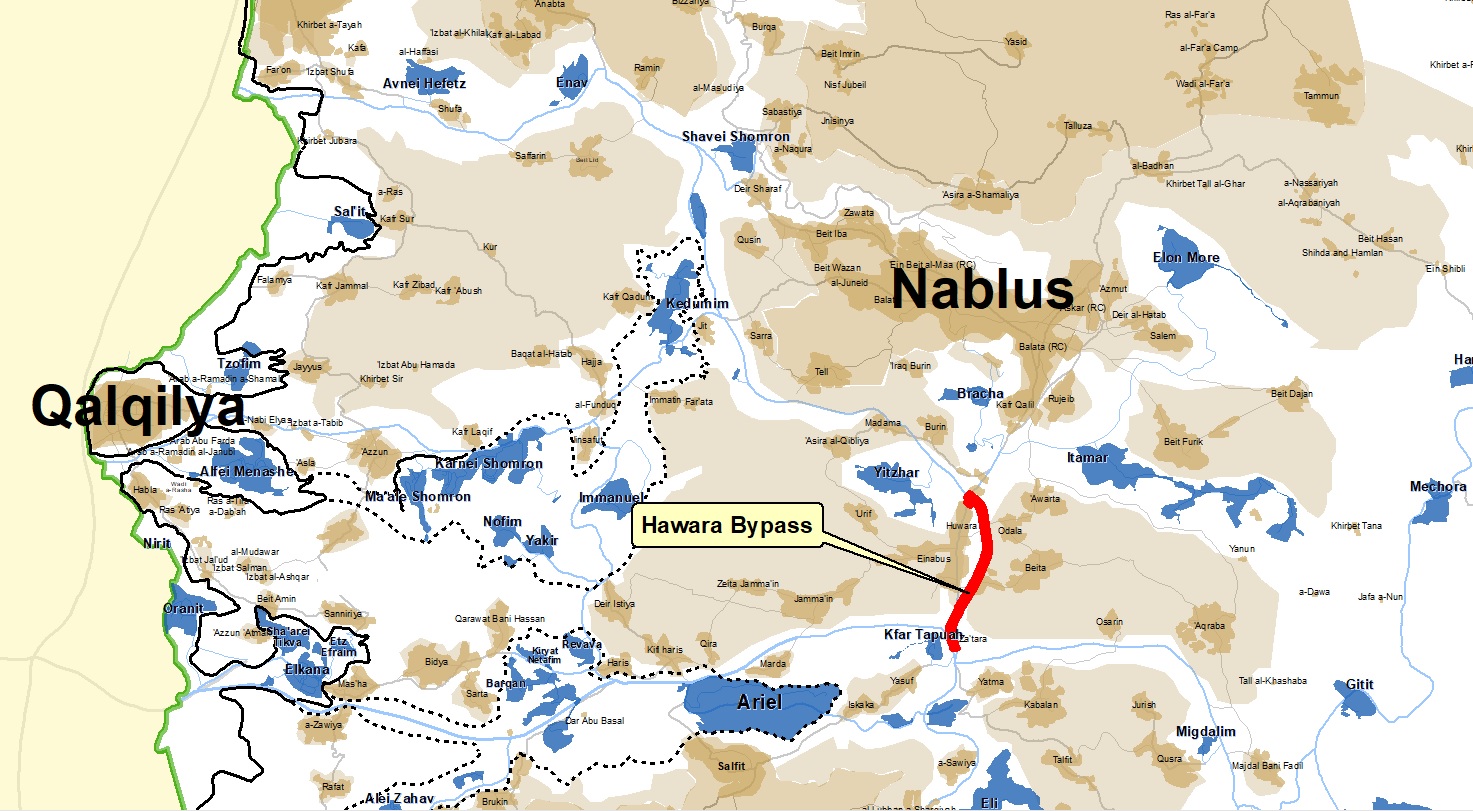
Map by Peace Now
For example, Peretz said that Israel will ensure that a new bypass road for settlers, planned to be built near the Palestinians city of Nablus deep in the central West Bank, is annexed to Israel. In the Trump Plan conceptual map, the area where the road will be falls within the borders a future Palestinian “state.” Approved for construction in April 2019, the Huwwara bypass road is designed by Israel to more seamlessly connect settlements in the Nablus area to Jerusalem. The road is built on land belonging to the Palestinian villages of Huwwara and Beita, which Israel seized for “security reasons”. Earlier this year, the Israeli authorities informed heads of the nearby Palestinian villages that construction was slated to begin soon.
Peretz also addressed the Trump Plan’s proposal to leave isolated Jewish outposts as sovereign Israeli enclaves within the Palestinian state, connected to Israeli borders by roads (that are also under Israeli sovereignty). Peretz rejected this proposal is unexceptable, assuring the right-wing interviewer:
“It is impossible for a settlement to be choked in the heart of Palestinian territory, it will not happen. We are working on these things now.”
“Hilltop Youth” Settlers Attack Palestinians, Leave Quarantine Outpost with Stolen IDF Gear
Last week FMEP reported on the group of “Hilltop Youth” settlers for whom the IDF set up a special “temporary” outpost in the Jordan Valley for them to quarantine together, after the youth rioted en route to a regular quarantine facility inside Israel. This week, those same youth allegedly broke out of their quarantine to terrorize Palestinians in the area. The attack occurred on April 14th, when a group of masked Israeli settlers approached a group of three people (2 Palestinians, 1 Israeli) camping on land near the temporary quarantine outpost. The settlers threw rocks at the group and pepper-sprayed their victims, and then set fire to two cars before retreating.
An anonymous Israeli official commented:
“Terrorism against Border Police in Yitzhar, terrorism against innocent minorities tonight in Metzoke Dragot – this is how the ‘hilltop activists’ express their thanks to Israel for taking care of them during the corona crisisl.. [the episode is] more proof that this is a violent, radical, and racist group that carries out terrorism wherever they are. Security forces will bring the perpetrators to justice.’”
Subsequently, these same settler youth left the quarantine (apparently at the end of the required quarantine period), but absconded with some of the Israeli army’s tents used to establish the outpost.
Commenting on all of this, Defense Minister Naftali Bennet said in a statement:
“Vandalizing the compound set up by the military and setting ablaze Palestinian cars is an abomination, which has crossed every red line. This disgrace is unheard of, and we have no intention of letting this slide. I refuse to accept any act of violence, especially now, when the IDF and Israel’s defense establishment have enlisted to overcome the coronavirus crisis. We’ve instructed security forces to track down the suspects and bring them to justice, so that the following message is loud and clear: There’s a price for violence.”
Contrary to Bennett’s statement, this violence from the Hilltop Youth is not “unheard of.” Rather, violence towards Palestinians and their property is a key tool of settlers, both “Hilltop Youth” members and others.
The army told Haaretz that two suspects have been arrested over the theft of the tents, estimated to be worth tens of thousands of shekels. It is not clear if the IDF is pursuing any of the remaining 18 settlers who might have also been involved in the theft and the attack on Palestinians.
More Reports of Settlers Taking Advantage of the the COVID Shut Down
There are numerous reports of settlers taking advantage of the focus on the COVID-19 crisis to establish new facts on the ground in various parts of the West Bank. These include:
- The Palestinian Wafa news agency reports that settlers placed a mobile home on Palestinian land southeast of Nablus in a bid to establish a new outpost there. According to that same report, settlers in Hebron attempted to raid the offices of Youth Against Settlements, a Palestinian organization which mobilizes opposition to Israeli settlements in Hebron.
- North of Hebron, Palestinian farmers report that settlers are intentionally dumping sewage on their farmland.
- Outside of Bethlehem, settlers reportedly cut down 50 olive trees near the Palestinian village of al-Khader.
Israel Prioritizes Undermining PA over Fighting COVID in East Jerusalem
This week, the coronavirus has been confirmed to be spreading among Palestinian East Jerusalemites – with at least 80 confirmed cases. Around half of these cases are in Silwan, with others in the besieged neighborhood of Isawiyah, and one confirmed case – predictably and alarmingly – in the isolated, densely populated, and impoverished Shuafat Refugee Camp.
While the virus has been spreading, this week the Israeli government shut down a testing clinic in the Silwan neighborhood because the Palestinian Authority was reportedly involved in coordinating its operations. Israel prohibits any Palestinian Authority operations/presence in East Jerusalem, and recently arrested both the Palestinian governor of Jerusalem (a PA official) and the PA’s Minister for Jerusalem Affairs (both of whom are Jerusalem residents). In addition, on March 31st, Isareli authorities stopped a Palestinian food supply truck in East Jerusalem on the suspicion that the effort was organized by the Palestinian Authority. In fact, the supplies had been donated by Palestinians citizens of Israel for needy families in the East Jerusalem neighborhood of Sur Baher.
While denying hte PA any ability to help Palestinian East Jerusalemites, Israel has been heavily criticized for its failure to deliver aid to in these areas. Prior to a petition filed by Adalah, Israel had opened only 1 testing facility in East Jerusalem, in the Jabal al-Mukaber neighborhood. In response to Adalah’s petition, Israel announced that it intends to open three more testing clinics in East Jerusalem, in Silwan, Kafr Aqab, and the Shuafat Refugee Camp.
Notably, Jerusalem mayor Moshe Leon has been outspoken in his own criticism of the Israeli government’s neglect of East Jerusalem during the Coronavirus crisis, going so far as to write a letter to the Director General of Israel’s Health Ministry warning about “the serious shortage of medical equipment at the hospitals in East Jerusalem, particularly protective equipment and equipment to conduct coronavirus testing. This is despite repeated promises on the part of your [ministry].”
Who Profits Resource: VIRAL OCCUPATION
In a new dynamic, regularly updated resource entitled “Viral Occupation” the Israeli NGO Who Profits is compiling important reporting and analysis (its own and others) of how the COVID-19 crisis is playing out in the occupied Palestinian territories. In the accompanying introduction, Who Profits makes four critically important points:
- “COVID-19 is not operating in a vacuum. As it spreads through Israeli-occupied Palestinian and Syrian land, it is interacting with the structures of occupation which, while far from novel, are every bit as adaptive, resistant and continually mutating as any member of the corona family.
- “COVID-19 will not function as a ‘Great Equalizer’ – The myth that a pandemic does not discriminate between the rich and the poor, the powerful and the dispossessed, is patently false. An occupied and besieged population and a systematically de-developed economy are particularly vulnerable to both COVID-19 and the economic fallout.
- “Desperate times legitimize repressive measures. Declaring a state of emergency often provides the pretext for the introduction of new repressive and exploitative measures and the entrenchment and legitimization of existing ones.
- “What happens in Palestine does not stay in Palestine. A key reason Israel is continually looking to diversify its portfolio of repression is that it can later turn it outward for economic profit and political gains.”
New Analysis by Ir Amim: “Trump Plan” Accelerates Apartheid Reality
In a new report, Ir Amim takes a close look at nine Jerusalem-related elements of the Trump Plan, examining the details as well as their political and human ramifications.
Ir Amim concludes in part:
“In close coordination with the current American administration, Israel is advancing a policy of annexation and separation of ‘Greater Jerusalem.’ A large portion of the Trump plan is not a basis for negotiation or peace, but rather constitutes a fleshed-out work plan, which both echoes and advances measures already being implemented on the ground. It likewise further entrenches Israeli control of East Jerusalem and the majority of the West Bank, while foiling any prospect for a just and agreed resolution to the conflict. As both US Ambassador Friedman and Prime Minister Netanyahu stated, an agreement has been reached between the US and Israel concerning the advancement of Israeli moves regardless of Palestinian position or consent. This policy will not only impact the future of Jerusalem, but also the entire Israeli-Palestinian conflict and will consign both Israelis and Palestinians alike to an accelerating apartheid reality. In Jerusalem, the uprooting of approximately one-third or more of the Palestinians living in East Jerusalem from the city and their confinement to neglected enclaves along with further isolation and suppression of those who remain within the city will fracture the urban fabric and liable to increase confrontation between the two populations of the city.”
Bonus Reads
- “Israeli annexation talks threaten ties with Arab world” (Al Monitor)
- “Abandoned by Israel, Jerusalem’s refugee camp is left to fight COVID-19 alone” (+972 Magazine)
Welcome to FMEP’s Weekly Settlement Report, covering everything you need to know about Israeli settlement activity this week.
To subscribe to this report, please click here.
April 10, 2020
- Gantz/Netanyahu Agree to Annexation in (Likely Failed) Unity Talks
- IDF Builds New “Temporary” Outpost as Quarantine Site for Extremist Settlers
- Bonus Reads/Watches
Comments or questions – email Kristin McCarthy (kmccarthy@fmep.org).
Gantz/Netanyahu Agree to Annexation in (Likely Failed) Unity Talks
Negotiations resume today, Friday April 10th, between Likud and Blue & White over the formation of the next Israeli government, following an unexpected breakdown in negotiations earlier this week (over the particulars of a new judicial appointment process). Prior to that disruption, Netanyahu and Gantz came to an agreement on how and when the unity government will advance annexation: The arrangement would allow Netanayhu to bring an annexation plan to the Knesset for a vote as early as July 10th (with or without Gantz’s support), on two conditions: 1) that Israel “consults” with the U.S. and, 2) that the plan is implemented in coordination with other international players.
As of this writing, it remains completely unknown whether there will be a Gantz-Netanyahu agreement that allows the formation of a unity government. Some analysts are suggesting that Netanyahu at this point has little incentive to respect even the minimal compromises he had reportedly agreed to with Gantz. This is because with Gantz’s move to negotiate unity — which effectively dismantled his own party — Netanyahu may have concluded that another round of elections will, finally, deliver him, an outright victory.
Regardless, the tentative agreement on annexation that Gantz and Netanyahu arrived at prior to the breakdown is hugely significant for the future of annexation. Clearly, Netanyahu’s position on annexation carried the day (perhaps aided a little by outside politicking of the Yamina Party, which put pressure on Gantz to relent on the issue of annexation). Not only did Gantz agree to annexation in principle, he accepted a sped-up timeline for that annexation and also dropped his demand that the plan be coordinated with the King of Jordan – a concession which essentially renders the second condition of the agreement with Netanyahu (that annexation be coordinated with other international players) a moot point.
The agreement also reportedly allows Blue & White Party members to vote against the annexation plan in the Knesset, but does not give Gantz veto power to prevent the bill from being presented to the Knesset. This arrangement allows Gantz (and his Blue-White colleagues) to vote against an annexation plan while knowing that the plan will likely pass in the Knesset. Assuming the plan for a rotation of the office Prime Minister is actually implemented, Gantz could use such a vote to try to cast himself as a reasonable, moderate partner to engage the Palestinians and the international community — which could come in handy if Trump is no longer the U.S. President and if Israel’s neighbors are enraged over annexation.
Settlers both celebrated and criticized the reported agreement, expressing support for Netanyahu’s annexation demands (and exerting pressure for him to go farther with them), while at the same reminding political leaders that the Trump Plan falls short of their own hopes for annexation (i.e., annexation of the entire West Bank). In this vein, the pro-Greater Israel “Sovereignty Movement” came out with an outright rejection of the announced Gantz-Netanyahu agreement in annexation, saying:
“application of sovereignty must correspond exclusively to Israeli interests and the Zionist vision and not to the Trump plan that ulltimately leads to a Palestinian terrorist state.”
The Yamina Party, headed by Ayelet Shaked and Naftali Bennett, expressed concern about waiting until the summer months to move forward with annexation, given how close this brings such a decision to U.S. elections. They insisted that annexation must happen more urgently. Bennet and Shaked were critical of the Trump Plan when it was released because it slowed and limited the scope of Israel’s annexation and because it provided for the opportunity (however farcical) for a Palestinian state.
Back in the U.S., nearly 140 US Jewish leaders sent a letter to Gantz and fellow Blue-White politician Gabi Ashkenzi urging them “not to use the need for unity in the face of emergency to create a different crisis for Israel by moving forward on unilateral annexation.”
At the same time, 11 members of Congress (all Democrats) issued a statement re-affirming opposition to Israeli unilateral annexation of West Bank land. It reads:
“As strong supporters of Israel and the United States-Israel relationship, we are deeply concerned by reports that the coalition government being formed in Israel intends to move forward with unilateral annexation of West Bank territory. This runs counter to decades of bipartisan U.S. foreign policy and to the will of the House of Representatives as recently expressed in H.Res.326, which opposes unilateral annexation and explicitly warns against the dangers of such an effort for peace in the region and Israel’s security.
Amidst the current global health pandemic and financial crisis, we urge all parties involved in the formation of a new government not to create an additional crisis by agreeing to move forward with unilateral annexation, the effects of which could yield additional catastrophic consequences for all parties in the region and beyond.
At this sensitive and critical time, we support a return to a two-state framework and urge all parties to refrain from commitments or actions, such as unilateral annexation, that undermine the possibility of serious, good faith, bilateral negotiations, which still represent the surest path to a durable peace.”
IDF Builds New “Temporary” Outpost as Quarantine Site for Extremist Settlers
A group of 20 “Hilltop Youth” settlers – i.e., members of the extremist, lawless, violent settler movement that has been dubbed “a Jewish ISIS” – used violence to successfully coerce the Israeli military into establishing a new outpost for them in the Jordan Valley. The hilltop youth base their operations out of the Yitzhar settlement in the north-central West Bank (learn more about Yitzher here).
The story began when a member of the group tested positive for COVID-19 and exposed the others. Consistent with Israel’s COVID-19 policies, Israeli authorities sought to move the group into a quarantine facility inside Israel. The settlers refused to comply with the government’s quarantine regulations, first refusing to be taken to a Jerusalem hotel for quarantine (after they learned they would be required to stay in separate rooms). The government then agreed to let them be quarantined together at a facility in the southern part of Israel — but the settlers changed their mind en route, rioting while be transported to the quarantine site (doing significant damage to the government-provided bus, including reportedly breaking all or most of the windows).
Instead of prosecuting the group for their defiance of Israeli law and its COVID-19 policies, the IDF instead opted to give in to the settlers’ demands for special treatment, establishing a new outpost where they are being allowed to quarantine together (in violation of Israeli quarantine rules). The IDF, which is supplying the group with food and lodging, told The Times of Israel that the outpost – referred to as a makeshift quarantine facility – is “temporary,” but years of experience with West Bank settlement policies suggest that what is at first called “temporary” almost always turns into something permanent. The IDF likewise said there will be an investigation into the settlers’ criminal actions (with respect to rioting and destruction of property — and here, too, long experience suggests that the settler youth will never be held to account).
To make the matter even more outlandish, the head of the IDF, Major General Nadav Padan, was forced into self-quarantine after coming into contact with the member of the group who tested positive, which set the chain of events detailed above in motion.
Bonus Reads/Watches
- “COVID-19 & The Settlements” (FMEP Webinar)
- “Settlers hurl stones at group of Palestinian farmers, rights group says” (The Times of Israel)
- “Annexation looking less likely to happen due to coronavirus crisis” (Jerusalem Post)
- “Israel settlements turn Palestinian house into cage” (MEMO)
- “Water Authority warns settlement wastewater exposes Palestinians to coronavirus” (WAFA)
Welcome to FMEP’s Weekly Settlement Report, covering everything you need to know about Israeli settlement activity this week.
To subscribe to this report, please click here.
October 25, 2019
- Yitzhar Settlers Escalate Campaign of Terror Against Nablus-Area Palestinians
- Israel Re-Opens (for Israelis) the Natural Spring in Jerusalem that it Stole from Palestinians
- Friedman Reiterates Promise that U.S. Plan Will Not Require Settlement Evacuations
- Bonus Reads
Yitzhar Settlers Escalate Campaign of Terror Against Nablus-Area Palestinians
Over the last month – which marks the beginning of the annual olive harvest – Israeli settlers have perpetrated numerous violent “price-tag” attacks on Palestinians, their olive groves, and their communities.
On October 16th, Palestinians in the Deir Ammar village woke up to find car tires slashed and hate graffiti spray painted on cars and homes. Later in the day, a group of about 30 masked settlers, apparently from the Yitzhar settlement, attacked a group of Palestinians accompanied by volunteers organized by Rabbis for Human Rights who were picking olives. The settlers uprooted several olive trees, set the grove on fire (Yesh Din estimates that hundreds of acres were burned as a result), and attacked the volunteers, injuring five and beating one volunteer, an Israeli citizen, with an iron rod to the point that he “feared for his life.” A statement from Yitzhar settlement later Wednesday blamed the incident on “provocations caused by extreme-left activists.” One settler from Yitzhar was arrested in connection to the violent assault and arson. The first-person account from the Israel who was beaten, who is himself an observant Jews, is here.
Yitzhar and the surrounding outposts have long been a hotbed of violence against Palestinians – in an important July 2019 report, Yesh Din explained and documented how Yitzhar settlers have used violence to take over more and more land from the surrounding Palestinian villages. The Yitzhar settlement plays host to the “Hilltop Youth” settler movement (which has been compared to “a Jewish ISIS”), which bases its operations out of the settlement. This has given the extremist group a perch from which to perpetrate frequent attacks on Palestinians, their property, and their agricultural land (including most notably the 2015 arson/murder in the village of Duma, which killed a Palestinian infant and both parents).
The violence coming from Yitzhar – which is at this point has become a regular trial facing Palestinians – rarely breaks through the Israeli public consciousness, reflecting the Israeli public’s general disinterest (and even hostility) to news about the plight of the Palestinians or activists who work with them. That changed in recent days, following instances where settlers targeted Israeli soldiers (with video evidence of their deeds).
First, on October 19th, settlers blocked an IDF vehicle from entering Yitzhar, with a settler forcing his way into the vehicle and verbally threatening IDF soldiers inside. Then, on October 20th, a group of 30 settlers staged a riot near Yitzhar, during which the settlers punctured vehicle tires, and threw stones at Israeli soldiers, resulting in the injury of one soldier. The settlers were rioting in response to the arrest of two Hilltop Youth members, one arrested following the October 16 assault, and a second arrested for issuing a threat to an IDF soldier.
In response to the riot, Israeli Prime Minister Netanyahu said: “there will be no tolerance for lawbreakers who raise a hand to our soldiers” — a categorical statement that is contradicted by longstanding Israeli government policy vis-a-vis settler violence.
A defense official told Haaretz:
“This is simply weakness on the part of the state, a lack of desire to deal forcefully with this problem…It stems mainly from the desire to avoid friction with the settlers…The violence is the end result of the whole problem of the hilltop youth. It begins with ignoring the illegal outposts, attacks on Palestinians, attacks on Palestinian property, arson and vandalism. When it relates to Arabs, it’s easier to ignore it. But when soldiers are attacked, it comes up again.”
In response to the violence, the Israeli army increased the number of soldiers stationed in the areas around Yitzhar (note: there is no Israeli police station in Yitzhar; though one is badly needed for security reasons, it is vehemently opposed by Yitzhar’s leaders, who have succeeded in preventing one’s establishment). On October 24th, the Israeli army razed two illegal structures recently built in an unauthorized outpost near Yitzhar, and declared the hilltop area a closed military zone.
Reacting to the demolition of the illegal structures, the Yitzhar settlement released a statement:
“[the] community has expressed its firm stance against harming soldiers, and precisely because of this stance the decision to demolish structures as an act of punishment is wrong and destructive. This move does nothing but inflame the situation instead of calming it.”
Indeed, the increased security presence around Yitzhar has not yet deterred the violent settlers. The morning of October 25th revealed that overnight, Yitzhar settlers had set a newly erected police tent on fire. The IDF had installed the tent on the hilltop where the outpost was located to enforce the closed military zone order. October 25th also revealed that settlers once again invaded a nearby Palestinian village, this time Yatma, to spray paint cars with messages referencing Yitzhar and the IDF’s demolition of outpost structures and closure of the hilltop.
Israel Re-Opens (for Israelis) the Natural Spring in Jerusalem that it Stole from Palestinians
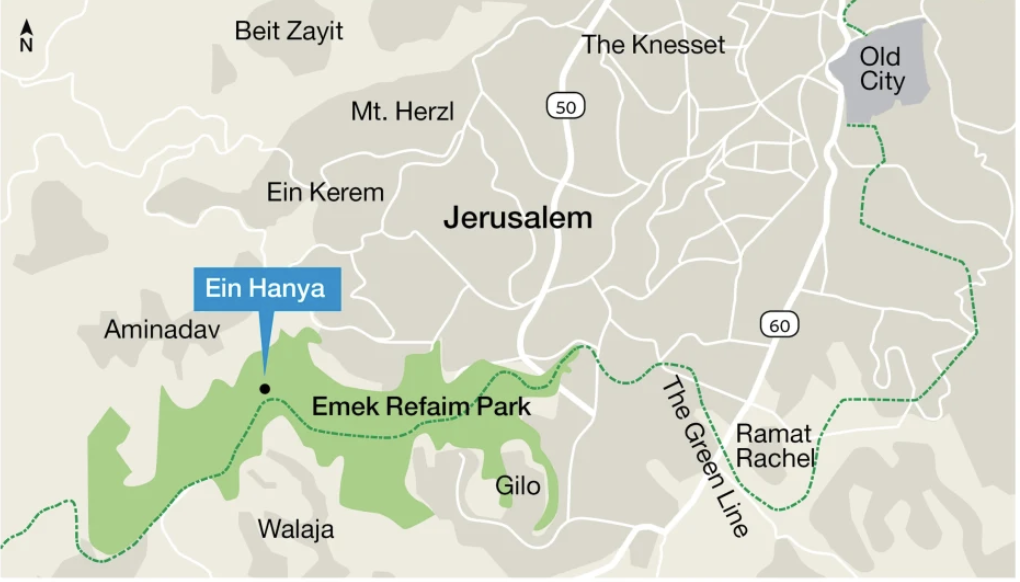
Map by Haaretz
After several delays, on October 15th the Israeli police permitted the Ein Al-Hanya spring to be opened for Israeli visitors on the condition that Palestinians would not be allowed to enter the site. On the first day open, hundreds of Israelis visited the site under the heavy security presence of the Israeli Border Police.
The Ein Al-Hanya spring, which the Jerusalem Municipality first declared a national park and then spent years renovating and millions of dollars into a tourist destination, is located on land historically a part of al-Walajah. Al-Walajah is a Palestinian village that currently finds itself inside of Israel expanded municipal borders of Jerusalem and almost completely surrounded by the Isareli seperation barrier.
Aviv Tatarsky, a researcher for Ir Amim explained Israel’s choice to declare the area a national park:
“Since we are in the territory of Jerusalem, and building another settler neighborhood could cause a stir, they are building a national park, which will serve the same purpose. The national park will Judaize the area once and for all. Gilo is five minutes away. If you live there, you will have a park right next door and feel like it’s yours.”
Haaretz columnists Gideon Levy and Alexx Levac also give a succinct context to Israel’s ongoing theft of Al-Walaja land:
“the story of Walaja, where this absurdity took place, contains everything – except humor: the flight from and evacuation of the village in 1948; refugee-hood and the establishment of a new village adjacent to the original one; the bisection of the village between annexed Jerusalem and the occupied territories in 1967; the authorities’ refusal to issue blue Israeli IDs to residents, even though their homes are in Jerusalem; the demolition of many structures built without a permit in a locale that has no master construction plan; the appropriation of much of its land to build the Gilo neighborhood and the Har Gilo settlement; the construction of the separation barrier that turned the village into an enclave enclosed on all sides; the decision to turn villagers’ remaining lands into a national park for the benefit of Gilo’s residents and others in the area”
Since taking the land under the guise of establishing a national park, Israel has implemented several policies aimed at preventing Palestinians from accessing the spring and surrounding lands, including illegally moving a police checkpoint to further choke off al-Walajah from Jerusalem. As detailed in Haaretz, the plan for the park includes three pools filled by the spring – two for Israelis and tourists, and one for al-Walajah residents to water their crops and flocks. However, that third pool for Palestinians has not been built, and the water “merely spills into the nearby wadi.” The other pools, like the park, are currently empty and fenced off.
FMEP has repeatedly documented various Israeli efforts to seal off al-Walajah from Jerusalem. Residents of al-Walajah have fought the growing encroachment by the nearby Etzion settlement bloc and the Israeli government’s attempt to de facto annex the bloc as part of “Greater Jerusalem.” Ir Amim explains several prongs of this effort, including a particularly unbelievable section of Israel’s separation barrier planned to almost completely encircle the village, to turn its valuable agricultural land into an urban park for Jerusalem, and construction of a highway that will connect the Etzion settlement bloc to Jerusalem with Israeli-only bypass roads.
Friedman Reiterates Promise that U.S. Plan Will Not Require Settlement Evacuations
In an interview on October 16th, U.S. Ambassador David Friedman told Arutz Sheva (a pro-settlement media outlet headquartered in the Ariel settlement) that the U.S. peace plan will not require a single settler to leave his/her home. Friedman said:
“Having seen the experience of the evacuation of Gaza [in the summer of 2005], I don’t believe that there is a realistic plan that can be implemented that would require anyone — Jew or Arab — to be forced to leave their home. We think that’s just a recipe for disaster. It almost caused a civil war on much less aggressive circumstances in Gaza, compared to Judea and Samaria [the West Bank]. And so we are not of the view that any forced evacuations are achievable.”
Friedman’s remarks only reiterate what the Trump policy – as it has been implemented on the ground from day 1 of the administration – has looked like: a full-throated endorsement of the Greater Israel ambitions of ideological settlers.
Bonus Reads
- “There Will Be a One-State Solution” (Foreign Affairs)
Welcome to FMEP’s Weekly Settlement Report, covering everything you need to know about Israeli settlement activity this week.
To subscribe to this report, please click here.
March 21, 2019
- After 18 Years, Court Evicts Settlers from Stolen Home in Downtown Hebron
- Knesset Leader: U.S. Support for Annexation of Golan is First Step Towards West Bank Annexation
- Israeli Education Ministry Funds Group Behind Violent Outpost at Site of Dismantled Settlement
- Settler Excavations in Silwan Hit a Wall [Literally]
- Settlers Lobby Key U.S. Stakeholders to Protect Settlements from Trump’s “Peace Plan” & Promote Settler-Palestinian Business “Coexistence” Initiatives
- Palestinian-Americans Intervene in Lawsuit Against AirBnB, Bringing First Challenge Against Settlements to U.S. Courts
- Hoping to Avoid ICC Investigation, Pro-Settlement Groups Submit Defense of Settlements
- Bonus Reads
Questions/comments? Email kmccarthy@fmep.org
After 18 Years, Court Evicts Settlers from Stolen Home in Downtown Hebron
On March 12, 2019, the Jerusalem Magistrate Court ruled to evict settlers from a house in the heart of downtown Hebron (in the notorious Tel Rumeida section), that the settlers have illegally occupied since 2001. The court ruling gives the settlers 45 days to vacate the house, but the settlers are able to – and expected to based on the history of this case – appeal the ruling.
The Palestinian homeowners – the Bakri family – temporarily fled their home under constant settler harassment during the second intifada, a time when Tel Rumeida could be described as an “urban battlefield.” While the family was gone, settlers broke into the house, damaged it, destroyed the Bakri’s property, and ultimately took up residence there.
The Bakri family has spent the past 18 years petitioning Israeli police and the courts to remove the settlers — cases the Bakri family repeatedly won.
The settlers have managed to repeatedly delay their eviction by essentially exploiting every possible legal defense, no matter how absurd or contradictory. At different points over the past 18 yrs, settlers have argued in court that they had a rental agreement; that they purchased the home; that the plot of land was owned by a Jewish trust prior to 1948 and so they able to reclaim the property; and that because they had invested so much money in improving the land since taking it over, under Ottoman Law it now legally belongs to them. When at one point some years ago the courts ruled that the settlers had to evacuate, the settler occupants of the Bakri home did, indeed, leave, only to be immediately replaced by other settlers — at which point the Israeli Attorney General told the Bakri family that they had to start eviction proceedings anew. For a detailed timeline of the Bakri family’s saga, see this report from Peace Now.
Throughout the course of this saga, the settlers’ effort to hold on to the Bakri home was aided by the State’s unwillingness to implement court orders against the settlers. Peace Now said in a statement:
“This is not only a matter of cruelty, deceit and theft of settlers who are not loathe to take control of assets that are not theirs, but also a matter of the lack of government accountability. For 18 years the government did not enforce the law against the invading settlers, and even assisted them and allowed them to continue to steal the house and terrorize their Palestinian neighbors in Tel Rumeida. Furthermore, it should be remembered that Hebron is under Israeli occupation and the Palestinian residents cannot remove the settlers from their homes by appealing to the Palestinian Authority. The power lies in the hands of the Israeli government, which does nothing to fulfill its responsibilities to protect abandoned Palestinian property.”
Knesset Leader: U.S. Recognition of Israeli Sovereignty Over Golan is First Step Towards West Bank Annexation
At a public event on March 17th in Tel Aviv, Israeli Speaker of the Knesset Yuli Edelstein (Likud) told an audience that U.S. recognition of Israeli sovereignty over the Golan Heights is the first step towards U.S. support for Israel’s annexation of the West Bank. Edelstein’s comments came shortly after the publication of the 2018 U.S. State Department’s annual Human Rights Report, which refers to the Golan Heights – under international law considered Israeli-occupied Syrian territory – as “the Israeli-controlled Golan.” Previous U.S. reports referred to the Golan is “Israeli-occupied.”
Edelstein also promised the audience that if the Likud does well in the upcoming elections, there will be a serious debate in the Knesset about annexing the West Bank.
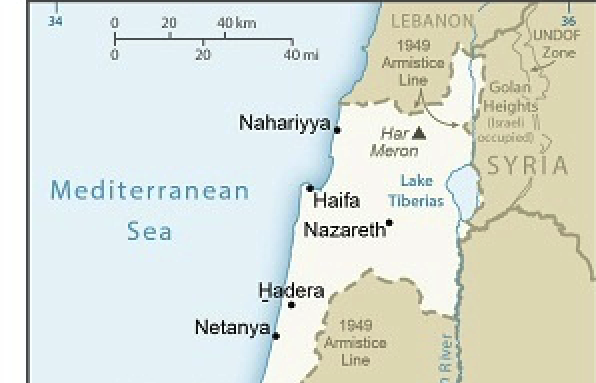
Map by the CIA, as of 3/21/19
[NOTE: On March 21st, President Trump formally recognized (via tweet) Israeli sovereignty over the Golan Heights. Hours before this tweet, press reports suggested that the Trump Administration was planning to announce the new policy when Prime Minister Netanyahu was the White House, during meetings scheduled for March 25-26. It is also worth noting on February 26, resolutions were introduced in Congress, in both the House and Senate, seeking to make it U.S. policy to recognize Israeli sovereignty over the Golan.]
Israeli Education Ministry Funds Group Behind Violent Outpost at Site of Dismantled Settlement
Haaretz reports that the Israeli Education Ministry has been contributing significant funds to a non-governmental organization that is the driving force behind illegal settler activity at the of what was formerly the Homesh settlement in the northern West Bank.
Homesh was dismantled and its residents evicted by Israel in 2005, as part of the Gaza disengagement. Since then, settlers have been obsessed with the desire to re-establish Homesh, hosting religious events and protests at the site of Homesh, some of which have been attended by Israeli MKs and politicians.
As part of this movement to reclaim the site and re-establish Homesh, settlers associated with the violent “hilltop youth” settler movement have repeatedly attempted to establish an outpost on the site, only to have the IDF remove them again and again. The non-governmental organization – Midreseht Ma’amakim – widely publicize its efforts to build and maintain a outpost at the Homesh settlement site, and boasts about operating a religious school there (called the “Homesh yeshiva”) for the past 12 years. According to the new report, from 2014-2017, the Israeli Education Ministry transferred more than $6 million to the NGO — nearly $2.5 million (8.5 million shekels) in 2017, $1.9 million in 2016, and $1.7 million in 2015 and in 2014. The Ministry told Haaretz that the funds were provided in support of the organization’s educational activities, not its illegal activities.
Lior Amihai, Executive Director of Yesh Din, explained:
“The place remains a hostage of a violent and illegal yeshiva, which prevents Palestinian farmers and landowners from reaching the place. Now it turns out that the Education Ministry enable the presence of the yeshiva by funding an association that fundraises for it.”
Yesh Din has for years been working with leaders of the neighboring Palestinian village of Burqa in regards to the situation at the site of Homesh, built on lands owned by Palestinians and seized by Israel in 1978 for “security needs.” In 2011, Yesh Din and Palestinian landowners petitioned the Israeli government to revoke the 1978 military seizure order, which legally should at this point be moot: the IDF only used the land for approximately two years, after which settlers took over the site to establish the (civilian) Homesh settlement, which was allowed to remain and expand until it was dismantled in 2005. In 2013, Yesh Din’s petition succeeded, and the state of Israel took the unprecedented step of revoking the military seizure order.
Yet, while technically the Palestinian landowners are no longer barred by Israel from accessing their own lands, de facto the area is still off limits to them, policed by violent Israeli settlers who for all intents and purposes enjoy free reign in the area.
Settler Excavations in Silwan Hit a Wall [Literally]
Emek Shaveh reports that one of the ongoing excavation efforts in Silwan led by the radical settler group Elad might not be able to continue, having run into the foundation of a massive wall, believed to be part of an Umayyad palace dating back to the 7th century CE.
The discovery – one which serves to highlight the multiplicity of cultures, religions, and peoples who are deeply connected to Jerusalem – is not a welcome one for the settlers, whose ultimate goal is to dig a tunnel connecting settler-run tourist sites in Silwan to a settler-run tourist site in the Old City. Since the excavation project is being carried out by Elad in cooperation with (and with financing from) the Israeli Antiquities Authority (IAA), the government bureau will decided whether or not to continue the dig. According to Haaretz, the IAA is considering plans to dismantle the wall and create a large hole for tourist groups to walk through.
The archeological experts at Emek Shaveh explain:
“From a professional standpoint, the wall should be left in its proper place, but the practical significance of this is a halt to the excavation, which began as part of a government decision to connect Silwan with the excavations south of the Temple Mount/Haram al-Sharif…In the reality of Jerusalem, where remains of building are not only scientifically significant but have symbolic and emotional resonance as well, the damage caused by the tunnels excavations has a negative impact on the possibility of presenting the city’s many cultures and their histories in a balanced manner. This is not only an archaeology-tourism problem, but a political problem of ignoring and even erasing certain historical strata, in order to present Jerusalem in a manner that serves the settlement enterprise in the Old City basin.”
The IAA said in response to news of the wall:
“…due to the wish to give the millions of tourists who visit Jerusalem from all over the world a better travelling experience, roads and paths were developed over the past decades. In addition, several openings have been made to the Old City’s walls and in the foundations of the Umayyad buildings. The hole in question is a narrow opening that was made in the foundations of one of these buildings after meticulous archaeological examination and documenation [sic] were carried out. This opening enables tourists to move between the two parts of ancient Jerusalem on either side of the Old City walls. This project is part of the ‘Shalem program’ [i.e. whole in Hebrew]: A government-funded plan to unveil, preserve, research and develop the sites of ancient Jerusalem.”
Settlers Lobby Key U.S. Stakeholders to Protect Settlements from Trump’s “Peace Plan” & Promote Settler-Palestinian Business “Coexistence” Initiatives
While in Washington, D.C. for the upcoming AIPAC policy conference, a delegation of Israeli settlers held meetings with members of Congress members and White House officials in a bid to ensure that any American “peace plan” will not inconvenience Israel’s settlement enterprise. The delegation, which included Yossi Dagan (head of the Samaria Regional Council, a settlement municipal body) and Arnon Klein (CEO of the Barkan Industrial Zone, near the settlement of Ariel), also met with evangelical leaders – a key constituency which recently extracted assurances from the White House regarding the Trump plan. The settlers reportedly implored the group to:
“help to fight plans to freeze construction in Judea and Samaria. We cannot allow a plan which will destroy or harm Jewish communities in Judea and Samaria. Our task is to build. We have 36 communities and half a million Jews living in our forefathers’ home. We need your help. This is a very sensitive time. Especially now, when the US president is considered to be a friend of Israel, there is a huge risk that a diplomatic plan will include a division between settlements in blocs and outside of blocs, and that construction will be frozen. And we haven’t even talked about the worst – uprooting Jewish settlements and dividing Jerusalem – which may also on the table.”
In addition, the delegation pitched the centrality of business “coexistence” initiatives between settlers and Palestinians, an increasingly obvious part of the Trump Administration’s agenda on the ground, as a core objective. Writing last week, FMEP’s Lara Friedman pointed to the activities of Ambassador Friedman and Congressman Lankford (R-OK), in support of the the idea that:
“…peace would come from economic and business cooperation between Palestinians (living under Israeli occupation, governed by Israeli military and military law designed to promote the interests and needs of Israel, entirely disenfranchised from the powers that control their lives) and settlers (living in settlements built on land taken from Palestinians, enjoying all the entitlements and protections of Israeli citizenship and law, and with representatives and allies at every level of Israeli government). This approach…exemplifies a vision of ‘peace’ based on promises of improved quality of life for individual Palestinians, de-coupled from any pretense of helping Palestinians end an occupation that the United States no longer believes to exist, or achieve national self-determination that the United States no longer supports.”
Likewise, FMEP has previously explained how for decades Israel has used industrial zones as another tool to expand and deepen control over West Bank land and natural resources. Importantly, jobs in industrial zones – often the only jobs available for Palestinians living under an Israeli occupation that prevents the development of any normal Palestinian economy – are widely viewed by Palestinians as a double-edged sword.
Palestinian-Americans Intervene in Lawsuit Against AirBnB, Bringing First Challenge Against Settlements to U.S. Courts
In the first case of its kind in a U.S. federal court, the Center for Constitutional Rights (CCR) filed a lawsuit challenging the legality of the Israeli settlement enterprise. The case was filed on March 18th on behalf of two Palestinian Americans – Randa Wahbe and Ziad Alwan – and two Palestinian villages – Ein Yabroud and Jalud. Journalist Mairav Zonszein succinctly explained the complex backdrop of the new filing:
“The CCR’s claim is not a stand-alone lawsuit but an intervention in Silber v. Airbnb, a suit filed by a group of Jewish and Israeli-American citizens who either host or wish to rent homes on Airbnb; the claim is directed, not at Airbnb, but at the sub-group of settlers serving as hosts. These settlers filed suit against Airbnb in November 2018, days after the company announced it would be taking down about 200 rental listings located in Israeli settlements in the occupied West Bank…In intervening in the lawsuit, the CCR argues that it is the settler’s conduct—and not Airbnb’s attempt to reconcile its business practices with basic human-rights law and principles—that discriminates against their clients and millions of other Palestinians.”
CCR issued a press release stating:
“Today’s filing argues that the Israeli settlers who sued Airbnb have participated in war crimes by aiding in Israel’s seizure of land in occupied Palestinian territory, including the specific lands on which the Airbnb properties stand. The rentals are in Israeli-only settlements from which Palestinian residents of the West Bank are barred as per Israeli military orders, and which are sometimes surrounded by physical barriers, military bases, and security gates.”
Diala Shamas, a staff attorney at the CCR, said:
“The settlers who sued Airbnb are cynically using the language of discrimination in order to further their own unlawful ends,” said Center for Constitutional Rights Staff Attorney Diala Shamas. “Our clients’ experiences –Palestinians who are directly affected by these settlers’ actions – show where the real discrimination and illegality lies. This case puts the settlers on trial in a U.S. court.”
CCR’s filing – and accompanying videos – shines a bright light on at two stories that exemplify Palestinians’ lives under occupation, and make clear how the settlements infringe on their basic rights to property. One of the intervenors, Ziad Alwan, was born in the Palestinian village of Ein Yabroud and holds the title deed for part of the land on which the Ofra settlement was built, as registered by the Israel Land Registry. One of the settlers in the underlying lawsuit previously listed a property in the Ofra settlement on AirBnB — meaning that the settler and AirBnB were, in effect, profiting from the rental of a property located on land that rightfully belongs to Alwan, and moreover, which Alwan, despite being the rightful owner, cannot access and does not benefit from.
Residents of the Palestinian village of Jalud – a second intervenor – explain how Israeli settlements and unauthorized outposts have been built on the village’s land, making 80% of their farmland inaccessible. One of the outposts that took Jalud’s land is Adei Ad, an outpost established illegally under Israeli law, which the Israeli government announced its intention to retroactively legalize. One of the settlers in the underlying case runs a bed and breakfast in the Adei Ad outpost, meaning the settler and AirBnB are profiting from a business located on the historic land of Jalud, a business which Palestinians cannot access and do not benefit from. In their claim, residents of Jalud are challenging not only the claim that Airbnb’s decision to delist the settlers’ rental property is discriminatory, but also the claim that the settlers legally own the property in the first place.
The lawyer representing the settlers in the underlying case (which claims AirBnB’s decision violates the Fair Housing Act), said in response to CCR’s claim:
“There are those who say that the settlements are illegal. There are those who say they are not. This is the heartland of the Land of Israel.”
Randa Wahbe, one of the petitions, told The Nation:
“The fact that settlers are using the specific piece of legislation pushed through after Martin Luther King’s assassination to protect disenfranchised black communities, in order to discriminate against Palestinians, is what I find so horrifying.”
Hoping to Avoid ICC Investigation, Pro-Settlement Groups Submit Defense of Settlements
On March 14th, two well-known pro-settlement legal attack groups – UK Lawyers for Israel (UKFLI) and the Lawfare Project – submitted a brief to the International Criminal Court (ICC) arguing that the court is prohibited under the Rome Statute from investigating Israeli settlements. The ICC has been conducting a preliminary investigation into the possibility of opening a war crimes probe into Israel’s settlement for the past four years.
The brief argues that the Israeli High Court of Justice (HCJ) has sufficiently and genuinely investigated issues related to the settlements, making the matter inadmissible at the ICC because the Rome Statute’s regulations prohibit the court from taking on issues that national courts have adjudicated. The brief even proudly highlights the fact that Israel’s HCJ has ruled in favor of Palestinians, though as a recent report published by B’Tselem explains, the Israeli HCJ is complicit in the establishment and continuing expansion of the settlement enterprise (and therefore cannot conceivably carry out a genuine investigation of this enterprise).
The legal brief comes amidst a barrage of threats issued by Israel and the United States against the ICC in light of its consideration of opening this case. On March 17th, U.S. Secretary of State Mike Pompeo threatened ICC staff with travel restrictions and financial sanctions if the court opens a probe into Israel. In November 2018, Israeli Attorney General threatened to launch, according to the Jerusalem Post, a “public legal campaign, aggressively contesting its jurisdiction.”
In the brief, the authors also announced their intention to file further information with the court challenging its jurisdiction over the matter.
Bonus Reads
- “Natural Born Settlers” (New York Times)
- “Not Breaking News: Trump Administration Does Not Believe in Occupation” (LobeLog – by FMEP President Lara Friedman Part 1 of 2)
- “Erasing Occupation: The Pernicious Role of Congress” (LobeLog – by FMEP President Lara Friedman Part 2 of 2)
- “‘The entire world knows the settlers have declared war on us’” (+972 Mag)
- “Leading architects urge Israeli PM to cancel cable car plan” (Associated Press)
Welcome to FMEP’s Weekly Settlement Report, covering everything you need to know about Israeli settlement activity this week.
To subscribe to this report, please click here.
March 1, 2019
- As Elections Approach, Here’s Two Settlement Plans Bibi Might Advance to Win Votes/Deflect Pressure
- Palestinians March in Hebron on Anniversary of Goldstein Massacre
- U.S. Charities Are Financing Radical, Violent Hilltop Youth Settler Movement
- Bonus Reads
Questions/comments? Email kmccarthy@fmep.org
As Elections Approach, Here’s Two Settlement Plans Bibi Might Advance to Win Votes/Deflect Pressure
Terrestrial Jerusalem published a comprehensive analysis of how Jerusalem-related issues, including settlement plans, could become a factor in the current Israeli elections campaign. Danny Seidemann writes:
“On the eve of Israel’s national elections and the possible launching of Trump’s so-called ‘peace plan,’ concerns raised in January 2017 regarding the most sensitive and ambitious settlement and settlement-related projects are more relevant than ever…the common denominator to the issues on which we [Terrestrial Jerusalem] are focusing below is this: each is something of a banner under which the ideological right has decided to march. As a result, there is no doubt that these issues will figure prominently in election rhetoric, towards the goal of forcing an already susceptible Netanyahu’s hand.”
Seidemann goes on to lay out likely actions Netanyahu might take, including action on two specific settlement plans:
-
“E-1: E-1 is a settlement planned for an area on East Jerusalem’s northeastern flank (beyond the city’s municipal borders), designed to cement a contiguous block of settlements stretching from Maale Adumim to the city’s east, through Neve Yaacov and Pisgat Zeev to the north, and extending to Givat Zeev, to the northwest (download map here).We have described in several reports the dire threat the implementation of E-1 would cause to the two-state solution, primarily by dismembering a potential future Palestinian state into two non-contiguous cantons and sealing off East Jerusalem from its environs in the West Bank…implementation of E-1 today still depends solely on Netanyahu giving the green light for the publication of the plans. Once he does, the clock will start ticking toward construction; assuming Netanyahu and his government obey normal planning rules, this clock will run for up to a year — between the resumption of planning and the publication of tenders for construction. Once the green light is given, it will be very difficult (but not impossible) to prevent the publication of tenders.”
-
“Givat Hamatos: As we explained in our January 2017 analysis, plans for construction in Givat Hamatos have been fully approved, but tenders have not yet been published: tenders for the construction of up to 1500 of the 4500 units could be published literally at any time, based on the whim of Netanyahu. As elections approach, the chances that Netanyahu will give the order to publish these tenders rises exponentially — and the significance of him doing so cannot be overstated. In planning terms, the publication of tenders is a Rubicon that, once crossed, is a point of no return, since at that point, third-party rights (purchasers) become involved. In short, the publication of tenders, effectively, would make the construction of Givat Hamatos a virtual certainty. While E-1 is larger in scope and has greater notoriety than Givat Hamatos, the danger posed by the latter is in some respects greater. Assuming Netanyahu and his government follow normal planning rules on E-1, any decision he takes on E-1 will in effect by a trip-wire that will give the world as long as a year in which to engage to try to prevent actual construction. With respect to Givat Hamatos, a move by Netanyahu won’t be a trip-wire, but rather the beginning of a series of detonations that cannot be stopped.”
Palestinians March in Hebron on Anniversary of Goldstein Massacre
On February 22nd, hundreds of Palestinians and international activists led a march towards Shuhada Street in downtown Hebron to commemorate the 29 victims of Israeli-American settler Baruch Goldstein, who opened fire on worshippers in the Ibrahimi Mosque/Tomb of the Patriarch 25 years ago. The march was also a protest against Israel’s policy of segregation (a word that fails to capture the damage done to the fabric of Palestinian life in the heart of Hebron) that was implemented following the massacre. +972 Mag reports:
“…protestors marched toward Checkpoint 56, which separates the part of the city governed by the Palestinian Authority from the Israeli-controlled area. They carried signs calling for the return of the Temporary International Presence in Hebron (TIPH) – the only observer group in the city with an official international mandate. In late January, Israeli Prime Minister Benjamin Netanyahu decided not to renew the group’s mandate, effectively expelling the observers from the city after 22 years of monitoring the human rights situation there…Israeli soldiers were stationed along the route of the protest, on the side of the city allegedly controlled by the PA, already before the protest began. When the crowd of demonstrators approached Checkpoint 56, soldiers pushed them back. At another checkpoint, close to the Tel Rumeida area, soldiers fired tear gas, stun grenades and rubber bullets at a group of protestors who were hurling stones – against the organizers’ request to keep the protest peaceful. Soldiers also fired stun grenades at a group of journalists.”
U.S. Charities Are Financing Radical, Violent Hilltop Youth Settler Movement
An investigation has revealed that a U.S. charity, The Charity of Light Fund, is the U.S. arm of an Israeli organization called Chasdei Meir that funds the radical and violent Hilltop Youth settler movement. Journalist Mairav Zonszein explains that Chasdei Meir, which is not registered as a tax exempt organization in Israel, recently issued a donation receipt thanking the donor (who made the donation in order to glean more information about the group’s operations) for “helping keep the residents of the outposts in Judea and Samaria warm.” Zonszein goes on to report:
“According to the Israeli outlet Ynet, Chasdei Meir has been linked to the coordination in 2011 of settler violence against Palestinians known as ‘price tag’ attacks, as well as financing settler youth who inhabit illegal settlement outposts and plant trees there as a way of claiming ownership over the land.”
Zonszein’s report lays out how Chasdei Meir and the Charity of Light Fund are part of a larger network of shadowy groups and figures that have found ways to direct U.S. tax-deductible donations to the settlement enterprise as well as groups that ascribe to the racist, nationalist ideology of Meir Kahane and the political party he founded, Kach. The Kach party, which is on the U.S. list of terrorist organizations, recently joined forces with Prime Minister Netanyahu, who brokered a political marriage between the Otzma Yehudit (“Jewish Power”) party, which is the current incarnation of the Kach party, and the Jewish Home party, in the hopes of winning sufficient votes to form a coalition that will keep him in power.
Bonus Reads
-
“A Violent Gang of Young Settlers Haunts Palestinians” (Haaretz)
-
“Under Occupation, Water is a Luxury” (Haaretz)
-
“Israel’s Termination of the Temporary International Presence in Hebron” (Al-Shabaka)
Welcome to FMEP’s Weekly Settlement Report, covering everything you need to know about Israeli settlement activity this week.
To receive this report via email, please click here.
April 26, 2018
- Construction Begins on Government Housing New Talpiot Settlement in East Jerusalem
- Defense Ministry Blames Yitzhar Settlement & its “Hilltop Youth” for Recent Price-Tag Attacks
- High Court Super-Session Legislation Increasingly Threatens the Stability of Netanyahu’s Governing Coalition
- U.S. Ambassador David Friedman Pushes Policy Language Backing Settlers & Annexation
- Trump Questioned Netanyahu Over Settlement Approvals
Comments, questions, or suggestions? Email Kristin McCarthy at kmccarthy@fmep.org
Construction Begins on Government Housing Near Talpiot Settlement in East Jerusalem
On April 23rd, Israeli bulldozers uprooted dozens of olive trees from land farmed by Palestinians in East Jerusalem, located between the Palestinian neighborhood of Sur Baher and the settlement neighborhood of East Talpiot. The Israeli government expropriated the land from Sur Baher in 1970 for “public use,” barring Palestinian construction on the land but permitting owners (now legally ex-owners) to continue farming it; in 2012, the Israel Land Authority (ILA) – a quasi-governmental agency – submitted plans to build 180 residential units on the site for former Defense Ministry employees.

Map by Peace Now
The Association for Civil Rights in Israel (ACRI) petitioned the High Court of Justice in 2012 to stop the new settlement plan, arguing that it discriminates against Palestinians. The petition was rejected, with the Court accepting the government’s argument that ~20% of Israeli security forces (whom the project is meant to serve) are minorities and that therefore the project serves the public good – despite the fact that few if any Palestinian Jerusalemites (the overwhelming majority of whom are not citizens of Israel) serve in the Israeli security forces. As noted by Terrestrial Jerusalem:
“Given that Palestinians of East Jerusalem do not serve in the IDF or the Israeli Police, this new construction is de facto intended for exclusively Israeli-Jewish residents – i.e. it is new settlement construction in East Jerusalem.”
In 2014, a Palestinian family petitioned the Court to modify the plan, in order to save their olive tree grove. The Court rejected the petition, ruling that the family should have petitioned against the 1970 expropriation, not the current plan. According to Palestinian media, the court case regarding the fate of these trees was still pending when Israeli authorities went ahead with uprooting the trees this week.
The Israel Lands Authority announced that it plans to market the project (i.e., seek bids from construction companies) in the near future.
Peace Now said:
“This was not a legitimate expropriation for public purposes, but rather an invalid expropriation that takes land from one community (Palestinians) and allocates it to another (Israelis). The U.S. ambassador [David Friedman] can see this ugly situation from the window of [what will soon be] the embassy, which is located only about a kilometer away from the olive grove that was uprooted: the reality of a divided Jerusalem of discrimination and deprivation.”
Defense Ministry Blames Yitzhar Settlement & its “Hilltop Youth” for Recent Price-Tag Attacks
Speaking to The Times of Israel, an anonymous official from the Defense Ministry said that the radical Yitzhar settlement near Nablus is responsible for the sharp rise of troubling “price-tag” attacks in recent weeks targeting Palestinians and their property. The official said that members of the “Hilltop Youth” – which is known to base its operations in Yitzhar – and students enrolled in Yitzhar’s religious school (the Od Yosef Chai yeshiva) are the main perpetrators.
A leader from Yitzhar defended his settlement by blaming the Defense Ministry for allegedly targeting and mistreating the “Hilltop Youth.” At the same time, the Israeli Welfare Ministry confirmed that the Israeli government is involved in supporting an informal educational-vocational program in the Yitzhar settlement to try to redirect radical young settlers who identify with the Hilltop Youth.
Yitzhar continues to function as the base for the Hilltop Youth, as evidenced by the IDF’s undercover arrest of a Hilltop Youth member in Yitzhar over the weekend. The settler was allegedly involved in throwing stones at IDF officers in an incident last week. Last year, in advance of evacuating one of the Hilltop Youth’s outposts, Israeli security officials met with leaders from the Yitzhar settlement in the hopes of deterring the settlement from allowing the displaced setters from taking up residence in Yitzhar.
High Court Super-Session Legislation Increasingly Threatens the Stability of Netanyahu’s Governing Coalition
It was another eventful week of internal political jockeying amongst Israeli cabinet ministers in their respective efforts to advance legislation that will empower the Knesset to reinstate laws that are stricken down by the High Court of Justice. Referred to as the “override bill,” the various versions of the legislation – several of which were covered in last week’s Settlement Report – have not, at the time of publication of this Settlement Report, been reconciled.
Education Minister Naftali Bennett (Jewish Home), who is pushing for one of the more extreme versions of the bill, threatened to call for elections if Prime Minister Netanyahu does not bring the legislation up for a vote (despite the fact the cabinet has not agreed on what they would be voting on). The threat comes after Netanyahu’s decision to delay the vote by one week in order to seek the support of High Court Chief Justice Esther Hayut, who the Times of Israel speculates might offer another version of the bill. Hayut agreed to meet with Netanyahu on the condition that the vote is delayed. That meeting is scheduled for Sunday, April 29th.
Bennett, in defending his threat and his rationale for the legislation, said:
“Over the past 25 years, the Supreme Court has radically encroached on the government’s authority to govern…Time and again it cancels bills the Knesset legislates. When you want to expel a terrorist who murdered, they say you can’t. When you want to take key security steps, they cancel them. When you want to pass tax bills, they stop it. The Supreme Court is not a government on top of a government.”
The drama over the “override bill” relates to settlements because Knesset members are anticipating that the High Court of Justice will strike down the Regulation Law. That law (covered extensively in past reports and in FMEP’s new resource documenting annexation policies) was passed in February 2017 in order to provide a legal basis for Israel to retroactively legalize outposts and settlement structures by permitting Israel to expropriate privately owned Palestinian land for this purpose. Last week, comments by Transportation Minister Yariv Levin made explicit the connection between the fate of the Regulation Law and the “override bill,” making clear that a key goal is to ensure that in the event that the High Court strikes down the Regulation Law, the Knesset will have the power to reinstate it.
Earlier in the week the Knesset’s Legal Advisor, Eyal Yinon, issued a strong rejection of all proposals to empower the Knesset to reinstate laws struck down by the High Court of Justice. Yinon rejected not only the proposals but the principle behind the legislation. He said,
“In our [Israel’s] reality, I think that in principle it would be a mistake to pass a supersession clause, whether it specifically concerns illegal migrants, or whether it is framed in general terms, and that it would do more harm than good. Good legislation requires restraint and balance, and as soon as, in effect, you remove constitutional review, that is liable to deal a severe blow to the quality of legislation and to the balances that must be maintained in it.”
U.S. Ambassador David Friedman Pushes Policy Language Backing Settlers & Annexation
The same week that the term “occupied territories” (as well as “occupation”) disappeared from the State Department’s annual report on human rights, reports surfaced suggesting that U.S. Ambassador to Israel David Friedman has been angling to use the term “Judea and Samaria” in his speeches and in State Department literature, instead of “the West Bank.” The phrase “Judea and Samaria” is the Biblical term for the area known to the world today as the West Bank. It is the term used by settlers and pro-annexationist Israelis to refer to the West Bank in order to assert what they see as the Jewish right to and rightful ownership of the land.
Friedman has been pushing for consequential shifts in State Department language since assuming his post. In a major break with decades of U.S. policy, Friedman has referred to settlements as “part of Israel,” and last December, he ordered the Embassy to stop referring to the West Bank as “occupied.”
Trump Questioned Netanyahu Over Settlement Approvals
After hearing that Prime Minister Netanyahu was planning to advance settlement construction projects, President Trump reportedly asked Netanyahu if he was genuinely interested in peace in a call late last year. Three sources told Axios that the call took place as Israeli press outlets were speculating that Netanyahu intended to allow a number of sensitive settlement to advance soon. The White House has not denied the account of the conversation.
Welcome to FMEP’s Weekly Settlement Report, covering everything you need to know about Israeli settlement activity this week.
To receive this report via email, please click here.
April 20, 2018
- Israeli Police Assist Settlers in Taking Over Three Palestinian Apartments in East Jerusalem
- Palestinians Petition Civil Administration to Evacuate Squatting Settlers from Hebron Compound
- Bibi Govt Proceeds with Effort to Strip High Court of its Powers
- IDF Aids Settlers in Closing Off Key Road to Palestinians
- $120 Million Investment into Jordan Valley Communities, Including Settlements
- Settlers Assault IDF & Terrorize Palestinians in Nablus Area
- Americans for Peace Now: “From Creeping to Leaping: Annexation in the Trump-Netanyahu Era”
- Bonus Reads
Comments, questions, or suggestions? Email Kristin McCarthy at kmccarthy@fmep.org
Israeli Police Assist Settlers in Taking Over Three Palestinian Apartments in East Jerusalem
On April 9, 2018, Israeli police officers assisted settlers in evicting three Palestinian families from apartments in the Silwan neighborhood of East Jerusalem, making way for the settlers to move in. The take-over seemed to have happened prematurely, since the family that owns the apartment units – the Ruweidi family – filed an appeal with the Court that had not yet been heard. The High Court ordered a temporary delay on the eviction order, but the delay was issued too late and the settlers had already emptied out the apartments. According to Haaretz, the apartments will remain empty until further notice from the Court.
In February 2018, the Jerusalem District Court ruled that the property rightfully belongs to the radical settler group Elad, which claims to have bought it from one member of the Ruweidi family, Raziq Ruweidi. The Ruweidi family disputes the court’s decision, saying that the properties were jointly owned by six other family members and therefore could not have been lawfully sold. The matter wound up in court after Raziq Ruweidi was murdered three years ago, leaving debts that the Israeli courts had to settle.
As documented in previous editions of the FMEP settlement report – here, here, here, and here – the Elad settler group frequently works with the Israeli government and the courts to accomplish its goal of erasing the Palestinian presence in East Jerusalem in favor of Israeli Jews, including cooperation on major projects like the touristic Kedem Center in Silwan and the cable car line that will service it.
Palestinians Petition Civil Administration to Evacuate Squatting Settlers from Hebron Compound
Three weeks after settlers broke into and took up residence in the “Zaatari Compound” in Hebron, the Palestinian al-Zaatari family filed an appeal this week with the Israeli Civil Administration to have the law-breaking squatters evacuated. The settlers – who were reportedly given permission to enter the property by the IDF and Defense Minister Lieberman – claim to have legally purchased the properties. A lawyer representing the al-Zaatari family wrote in the petition that claim “has no basis in reality, since my clients and/or their representatives never sold their ownership rights in their homes.” The court has
Like hundreds of Hebronites, the al-Zaatari family was forced to leave the home during the Second Intifada due to the IDF’s suffocating restrictions on the freedom of movement of Palestinians in and around the Old City of Hebron, conditions which persist today.
Peace Now released a statement saying:
“The ink has not yet dried in the High Court of Justice’s decision to evacuate the Abu Rajab House, where settlers also broke into and squatted, yet the settlers dare to break into another house without the same approval they lacked in that case. The government must evict the trespassers immediately; the settlers have not proven any ownership. The behavior of the government and recent statements by the defense minister raise the suspicion that this home invasion was carried out in coordination with the defense ministry, and that the government lent a hand to breaking the law and stealing. Instead of protecting the landowner’s rights, the government is helping robbers seeking to take possession of the property without allowing the current owners their rightful legal avenue to prove ownership. The establishment of a new settlement house in the heart of Hebron is a severe blow to the fragile situation in Hebron and is liable to cause new restrictions on the movement of Palestinians.”
Bibi Govt Proceeds with Effort to Strip High Court of its Powers
It was decided by the the Israeli government’s ruling coalition this week that the next Knesset – which opens on April 29 – will vote on legislation aimed at stripping the High Court of its power to strike down laws passed by the Knesset. At the weekly cabinet meeting, Prime Minister Netanyahu and Finance Minister Moshe Kahlon agreed to form a “small ministerial committee” to try to bridge various proposals to restrict the High Court’s power to overturn laws – a move that could impact the fate of (among other things) the Regulation Law.
Notably, Attorney General Avichai Mandelblit was permitted to attend the cabinet meeting to present his opposition to most serious of the proposed versions — the Netanyahu-backed model, according to which laws could be overturned only by a unanimous vote in the High Court; Kahlon’s issue-specific formulation, seeking to allow the Knesset to overturn the High Court decision vis-a-vus a single piece of legislation, related to African asylum seekers; and a version, backed by Justice Minister Ayelet Shaked and Education Minister Naftali Bennet, allowing the High Court to be overruled by a simple majority vote in the Knesset. Mandelblit recommended his own version — one that would require a super-majority vote by the High Court (7 of 9) to strike down a law, and would allow the Knesset to overturn such a decision by the High Court by a super-majority of 70 votes.
Netanyahu and Transportation Minister Levin (Likud) rejected Mandelblit’s proposal, and said that the High Court should only be able to strike down laws by a unanimous vote (meaning that it would be highly unlikely that the Court would ever succeed in striking down any law). Following the cabinet meeting, Levin also specifically took issue with Khalon’s version of the bill (which seeks to create a unique exception for the Knesset to overturn the High Court’s ruling against a law related to the detention and deportation of African asylum seekers). Making clear his real objectives and concerns (and making explicit the connection to settlements), Levin told reporters that this version is:
“significantly erroneous and will lead to striking down laws, including the Regulation Law (legalizing Israeli outposts in the West Bank).”
You can follow the key events regarding the progression of this legislation via FMEP’s recently published resource, “Israel’s Creeping Annexation Policies.”
See this Haaretz overview for more even more detail.
IDF Aids Settlers in Closing Off Key Road to Palestinians
Haaretz reports that the IDF is contributing to the efforts of settlers from Halamish, a settlement located north of Ramallah, to restrict Palestinian access to a critical highway along which the settlers recently established a new unauthorized outpost.

Map by Kerem Navot
According to testimonies collected by Haaretz, IDF soldiers at two military roadblocks near the settlement and the new outpost have been conducting prolonged searches of Palestinian vehicles and buses headed for Ramallah via road 450. The vehicles and their passengers are regularly delayed and harrassed. One Palestinian recounts a soldier reportedly admitting that the actions are meant to incentivize Palestinians to take a detour around the area of the settlement and outpost (which is a longer route). In addition, settlers have repeatedly posted – and the IDF has repeatedly removed – a sign on the road that reads:
“The area where you are now is under the control of the Jews. Entry by Arabs to this area is completely prohibited, danger of death!”
Months ago, Halamish settlers started a Saturday morning prayer event in the middle of the road (between the settlement and the outpost on the other side). In cooperation with the settlers, IDF soldiers have been shutting down all Palestinian traffic and guarding the settlers during the prayer event.
The settlers intent has long been clear. By sealing off Palestinian access to the road, it will become an interior road between the settlement and the new outpost, effectively expanding the boundaries of Halamish at the cost of Palestinians.
The Halamish settlers established the outpost – which they call “Yad Ahi” or “My Brother’s Hand” – in July 2017, following the brutal murder of four of the settlement’s residents by a Palestinian attacker. Since then, the settlers have worked determinedly to fortify and expand the settlement to include the outpost and more, as extensively documented by the Israeli NGO Kerem Navot.
$120 Million Investment into Jordan Valley Communities, Including Settlements
The office of the Prime Minister announced a $120 million grant program for infrastructure projects in Israeli communities in the Jordan Valley. According to The Times of Israel, the budget earmarks $7 million to “help local farmers acquire more agricultural land and locate additional water sources and to build affordable homes for first-time buyers through the Housing Ministry Program.” One Israeli business news outlet reports that this is an “aid program for settlements in the Dead Sea area coping with the problem of sinkholes.”
Some 11,000 settlers and 65,000 Palestinians live in the Jordan Valley – the latter facing severe restrictions on land use and freedom of movement, and lack of access to municipal services like water and electricity.The current Israeli government has publicly and repeatedly demanded complete Israeli sovereignty over the Jordan Valley in the context of any peace agreement (meaning that any future Palestinian state would be entirely encircled by Israel, having no international border with any other nation). One Likud MK, Sharren Haskel, recently unveiled a bill to annex the Jordan Valley. Haskel is seeking government backing for the bill before formally introducing it in the Knesset.
A recent report by B’Tselem documents how Israeli settlers were allowed to establish two new outposts in the Jordan Valley last year. In recent months, Israel has delivered eviction notices to entire Palestinian communities near Israeli settlements in the Jordan Valley. Simultaneously, settlers have been allowed to continue construction on a tourist project – a car race track built in a closed military zone (land expropriated from Palestinians ostensibly for security purposes), despite a court ordered stop-work order.
Settlers Assault IDF & Terrorize Palestinians in Nablus Area
Three settlers were arrested for throwing stones at IDF soldiers engaged in the evacuation of an unauthorized outpost near the Itamar settlement, south of Nablus. The outpost – called “Rosh Yosef” by the settlers – has been evacuated several times before, but settlers have repeatedly re-occupied the hilltop site. The settlers, one of whom is a minor, were released a day later and put under house arrest.
The evacuation comes against the backdrop of frequent attacks perpetrated by Israeli settlers in the Nablus area recently. Last week, settlers allegedly set the entrance to a mosque on fire and spray painted the building with anti-Arab, anti-Muslim threats. On April 18th, settlers destroyed at least two dozen olive trees and spray painted hateful words on houses in the village of Urif. The Ynet news outlet reports that the radical and violent “Hilltop Youth” settler group is responsible for most of these crimes, noting that its members are increasingly outraged by outpost demolitions, fixated on calls for “revenge” against Palestinians following terrorist attacks, and resentful of recent criminal punishments levied against their members as a result of the Shin Bet’s crackdown on the group’s criminal activities.
Americans for Peace Now: “From Creeping to Leaping: Annexation in the Trump-Netanyahu Era”
Americans for Peace Now published a new policy paper analyzing how “the Israeli right has launched an unprecedented drive to annex the West Bank, piecemeal or in its entirety” since the inauguration of President Donald Trump. The paper “lays out the recent developments that present a quantum leap in Israeli annexation efforts, analyzes these moves against the historical backdrop of Israel’s 50-year occupation of the West Bank, examines the ramifications of the transition from ‘creeping’ to ‘leaping’ annexation, and considers why this transformation is happening now.”
FMEP’s recently published resource, “Israel’s Creeping Annexation Policies” is being updated to include several items from APN’s excellent work.
Bonus Reads
- “Israel and Annexation by Lawfare” (Michael Sfard, The New York Review of Books)
- “How Israel’s Government is Aiming to Outweigh the Supreme Court” (Haaretz)
- “Attempts to ‘bypass’ Israel’s High Court will create a ‘tyranny of the majority’ ” (+972 Mag)
- “As Israeli pushes for West Bank railway, Palestinians brace for more land grabs” (Middle East Eye)
Welcome to FMEP’s Weekly Settlement Report, covering everything you need to know about Israeli settlement activity this week.
To receive this report via email, please click here.
- “Disappointment” So Far for Settlers in the Trump-Bibi Era, But…
- Sheikh Jarrah Project Recommended for Deposit for Public Review
- Long Delayed “Apartheid Road” Possibly Moving
- Beit El Housing to Advance After a Settlers Throw a Tantrum
- Bibi Vows that Israel will Keep Ariel
- Efrat and “How the Borders of Settlements Expand While No One is Watching”
- Yitzhar & Its “Hilltop Youth” Continue to Terrorize Nablus Area
- Bonus Reads
For questions and comments please contact FMEP’s Director of Policy & Operations, Kristin McCarthy (kmccarthy@fmep.org).
“Disappointment” So Far for Settlers in the Trump-Bibi Era, But…
Israeli Minister of Education Naftali Bennett – and staunch settlement advocate – expressed disappointment with the lack of settlement growth since Donald Trump assumed office. Bennett said, “Unfortunately from our perspective, he [Trump] is sort of going down the same unsuccessful path that his predecessors did…So yes, there is disappointment out there.” When Trump was elected, many settlers hoped that his administration would allow some, if not all, of the most problematic settlement plans to proceed. That includes several projects that, if built, would destroy the possibility of contiguous Palestinian state (Givat Hamatos, E1, etc). These projects have not moved forward…yet.
But Mr. Bennett need not be too disappointed. In fact, there has been a sharp rise in the number of settlement units and plans advanced and in construction so far in the Trump-Bibi settlement era, as detailed extensively by Peace Now and covered by FMEP in last week’s Settlement Round Up.
There are also new alarming developments this week that suggest the floodgates might be beginning to open….
Sheikh Jarrah Project Recommended for Deposit for Public Review
Ir Amim reports that plans for a 6-story Israeli commercial building at the entrance of the Palestinian East Jerusalem neighborhood of Sheikh Jarrah have been recommended for deposit for public review. The land designated for this project is adjacent to a plot designated for settlers to build a religious school and dormitories, known as the Glassman Campus project.

Map by Ir Amim
Located just north of Jerusalem’s Old City, Sheikh Jarrah has endured years of aggressive settlement activity by radical settlers, employing various means, including Israel’s court system to strip Palestinians of their ownership rights. Sheikh Jarrah’s plight was featured in a 2013 film by Just Vision, “My Neighborhood.” Just Vision also produced “Home Front,” a series of video interviews with the Palestinian residents and Israeli activists fighting together against settlement expansion in Sheikh Jarrah. For more on Sheikh Jarrah and the protest it sparked, 972+ Magazine has a compilation of resources online here.
Depositing settlement plans for public review is a significant step in the East Jerusalem planning process; it sends a signal that the political echelon may no longer be blocking the advancement of projects in the Jerusalem area that have been considered to be especially inflammatory to Palestinians and Muslims, and detrimental to peace negotiations. This could be an early sign of the opening floodgates.
Long Delayed “Apartheid Road” Possibly Moving
Ir Amim reports that a budget has been approved for construction of the northern part of the Jerusalem “Eastern Ring Road,” following years of delays and protests. If constructed according to existing plans, the northern section of the Eastern Ring Road will have separate lanes for Israeli settlers and Palestinians, with a physical barrier dividing the two. It will not allow the Palestinian lanes to access East Jerusalem. As noted in Haaretz, “This is the only highway in the West Bank that will have a separation wall running right down the middle. For that reason, the plan’s opponents are already dubbing it ‘Apartheid Road.’” Adalah, a legal group for minority rights in Israel, previously filed a petition to block the road’s construction.
Ir Amim notes that this is one of several projects that prepares the way for building in the E-1 area. E-1, as Jerusalem expert Danny Seidemann has long explained, is a “doomsday” project; if implemented, an E-1 settlement will end the possibility of a contiguous Palestinian state and completely sever East Jerusalem from the rest of the West Bank. The “Eastern Ring Road” seeks to “solve” one of these problems – by providing the Palestinians with “transportational contiguity” between the northern and southern West Bank – even as it would cement the cutting off of East Jerusalem from the West Bank.
Beit El Housing to Advance After Settlers Throw a Tantrum
Late last week, Netanyahu said he will approve the construction of 300 housing units in the Beit El settlement by September. The announcement came after a very public (and embarrassing) series of confrontations with members of his own political party as well as settlers. The leaders of the Beit El settlement threatened to petition the High Court over the issue, and staged a demonstration in front of the Prime Minister’s office to issue the threat. Beit El’s leaders replayed footage of Netanyahu promising to build the units in 2012, after several structures were taken down because they were built on land recognized even by Israel as privately owned by Palestinians.
The Beit El spat erupted after the Jerusalem Post reported an alleged freeze brokered between Israel and the U.S. The report suggested that Israel agreed to stop publishing construction tenders (the final step in the planning process) for all settlements through the end of 2017. The Beit El units had reached that final phase of planning, but would ostensibly not move forward if the report was true.
Beit El has deep connections to the current U.S. Ambassador to Israel, David Friedman; Friedman ran a U.S. fundraising effort for Beit El before being appointed Ambassador.
Bibi Vows that Israel will Keep Ariel
 At the ground-breaking ceremony for a new medical school in “Ariel University,” Prime Minister Netanyahu vowed, “Ariel will always be part of the State of Israel.” Alongside Education Minister Naftali Bennett, the Prime Minister Netanyahu attended a ceremony dedicating the school to American casino magnate and settlement financier, Sheldon Adelson – who donated funding for the new facility.
As explained last week, the future of Ariel has long been one of the greatest challenges to any possible peace agreement, since any plan to attach Ariel to Israel will cut the northern West Bank into pieces.
Efrat and “How the Borders of Settlements Expand While No One is Watching”
Three structures in the settlement of Efrat were found to have been built outside the border of the settlement’s jurisdiction. Dror Etkes (founder of Kerem Navot, a settlement watch group) petitioned Israel’s Civil Administration (the arm of the Israeli military that is effectively the sovereign authority in the West Bank, and therefore has authority over all construction ithere) over the buildings. This week the Civil Administration confirmed that the buildings were built without permits, had stop-work orders issued against them at the time, and might potentially be built on land recognized by Israel as privately owned by Palestinians. There are no reports of demolition orders against the illegal structures.
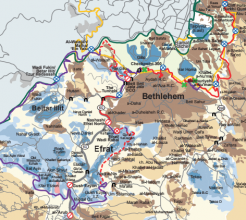
Map by B’Tselem
Located south of Bethlehem and west of the route of the separation barrier, Efrat poses many of the same challenges to a peace agreement as Ariel (discussed above). Connecting it to Israel means cutting deep into the West Bank, severing the route of Highway 60 between Jerusalem/Bethlehem and the southern West Bank, and contributing to the near total isolation of Bethlehem.
Yitzhar & Its “Hilltop Youth” Continue to Terrorize Nablus Area
Recent arrests of Yitzhar settlers have not deterred the terror coming from Yitzhar and/or its Hilltop Youth, with this week’s target being the Palestinian village of Burin. On Sunday, Rabbis for Human Rights documented 45 olive trees in Burin that were destroyed and spray painted with the words “revenge.” The suspected hate crime was precipitated by a violent clash between Yitzhar settlers and the Israeli army during the razing of an illegal structure in the settlement. On Wednesday, settlers from Yitzhar set fire to an olive grove – burning over 400 trees – according to the Israeli Army. Video of the incident shows masked settlers clashing with Israeli soldiers.
This week’s violence follows a warning to Yitzhar’s leaders from the Shin Bet earlier this month to keep the “Hilltop Youth” who call Yitzhar their home under control. In response, Yitzhar’s governing body has taken several actions, including forcing the youth to sign a code of conduct under threat of expulsion. But the code of conduct did not stop one Hilltop Youth religious leader and teacher at a yeshiva in Yitzhar – Rabbi Yitzchak Ginsburg – from urging his students to “cause a revolution” without getting caught because it is “a shame to waste time in prison.”
Israel’s Ynet news agency reports that the terror tactics of the Hilltop Youth are increasingly targeting Israeli security forces in the West Bank and Jerusalem. One Hilltop Youth whines, “all we want to do is sit on the hill. Just imagine how we feel each time a detective destroys our tent or confiscates our stuff. We have no peace and quiet.” And from a soldier’s perspective on his time serving in the Yitzhar area: “The scariest thing in the area was to clash with Jews. Give me an Arab terrorist and I’ll know how to deal with him. Give me a Jew who is throwing stones at me and I’ll simply flee.”
A lawyer with Yesh Din, an Israeli organization deeply involved in protecting the area from Yitzhar settlers, said “violence will not cease if there is no real deterrence, protection for Palestinians, a thorough investigation, prosecution of offenders and an imposition of significant penalties.” Though the Shin Bet has said it take the matter seriously, the violence continues. Yesh Din’s legal work documents the impunity with which settlers perpetrate crimes: A March 2017 report reveals only 8.2% of allegations of crimes committed by settlers in the West Bank result in indictments.
Bonus Reads
- “City on a Hilltop: American-Jewish Settlers“ w/ Dr. Sara Yael Hirschhorn, Ori Nir, and Lara Friedman (A podcast by Americans for Peace Now, June 25, 2017).
- Settlements: The Real Story, by Gershom Gorenberg (The American Prospect, Summer 2017)
Welcome to FMEP’s Weekly Settlement Report, covering everything you need to know about Israeli settlement activity this week.
To receive this report via email, please click here.
June 23, 2017
- Coordination? Test #1: Kushner & Greenblatt Arrive as Construction Begins on New Settlement of “Amichai”
- Coordination? Test #2: Bibi Reportedly Ok’s 5,000 East Jerusalem Units After Blocking Them for Years
- Coordination? Test #3: 70% Rise in Settlement Construction Starts Over Past Year
- Ariel University – Located in the settlement of Ariel – Set to Double in Size
- Cleared from Baladim Outpost, “Hilltop Youth” Radicals Stir More Trouble in Yitzhar
- Bonus Reads
For questions and comments please contact FMEP’s Director of Policy & Operations, Kristin McCarthy (kmccarthy@fmep.org).
Coordination? Test #1: Kushner & Greenblatt Arrive as Construction Begins on New Settlement of Amichai
Israeli Defense Minister Avigdor Liberman raised eyebrows late last week with a wide-ranging English language interview with the Times of Israel. When asked if Israel is “coordinating its [settlement] building starts with the United States,” Liberman casually responded, “of course.” Though headlines ran with his confirmation of coordination, it should be noted that when Liberman was pushed to give a more concrete picture of what that coordination entails, he said that Israel and the U.S. do not coordinate on “every 10 houses” but that the U.S. generally respects Israel’s approach and vision for “Jewish settlements in Judea and Samaria.”
That respect was put to the test this week as President Trump’s chief Middle East envoys – Jared Kushner and Jason Greenblatt – visited Israel and Palestine to “to continue the discussion about the possibility of peace.” Kushner’s arrival coincided with the commencement of construction of the first official new settlement in 25 years; the coincidence maintained a long tradition of greeting U.S. envoys with new settlement construction, dating back to the early 1990s and the era of Secretary of State James Baker, whose every visit to Israel was seemingly marked by the establishment of expansion of new settlements.
The Trump administration indicated it won’t object to this new settlement, sometimes referred to as the “Amona exception” (i.e., the rule is still that Israel doesn’t establish new settlements, but Amichai is a one-time exception, as a pay-off to settlers who illegally established the Amona outpost on privately owned Palestinian land and were forcibly evacuated earlier this year). But the timing, which may be entirely coincidental, is nonetheless politically provocative. While Kushner was en route, the State Department reiterated the only policy it has communicated publicly on the issue, saying “unrestrained settlement activity is not helpful to the peace process.” The Palestinian Authority also issued a statement on the timing of the new settlement’s ground-breaking, saying that it shows “Israel is not interested in the U.S. efforts, and is serious about thwarting them as it has with previous U.S. administrations.”
On June 22nd, the Israeli NGO Yesh Din filed a petition, together with residents of the Palestinian village of Jalud, to Israel’s High Court of Justice (equivalent to the U.S. Supreme Court) challenging the establishment of the new settlement of Amichai and demanding transparency in the process of demarcating land for settlement. According to the petition, the jurisdiction granted to the new settlement includes enclaves of privately-owned Palestinian land.
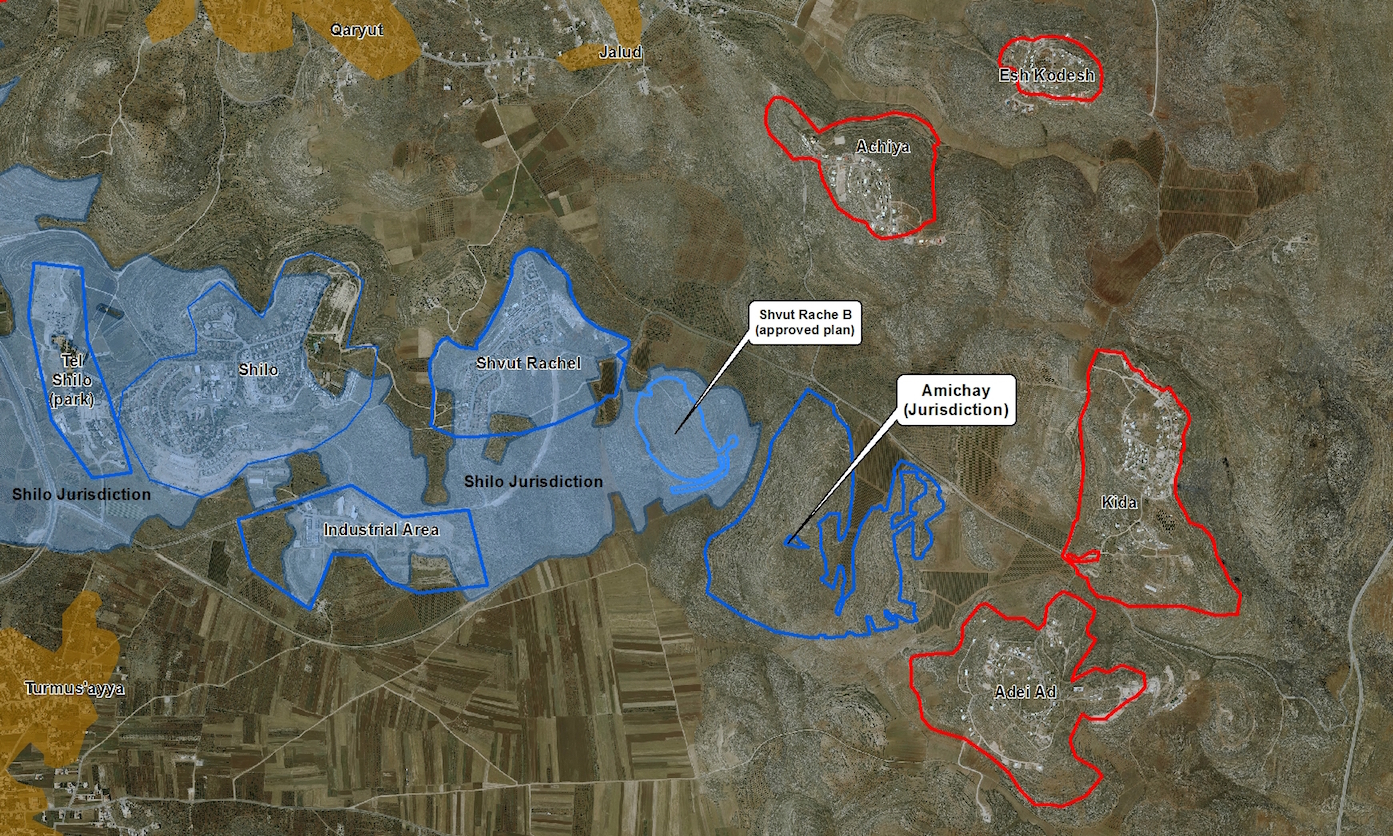 But Amichai isn’t the only construction happening near Jalud. Palestinian officials have reported that construction work has also begun on Shvut Rachel East, a new “neighborhood” of the Shilo settlement (in fact, not a neighborhood but rather a new settlement, as explained by Peace Now). Shvut Rachel East was the original Amona pay-off plan, but Amona evacuees held out for a different plan on a different hilltop – and they got it with the approval of Amichai, to be built literally adjacent to Shvut Rachel East. But what the world might have assumed would be a choice of “this site or that site” became, instead, a jackpot for settlers of “this site AND that site,” and the Shvut Rachel East neighborhood plan was also approved. Meaning that rather than paying a price for breaking the law (and then resisting evacuation), the government rewarded Amona settlers with not one but two new settlements – both located deep inside the West Bank, in an area that Israel could not possibly retain in any land swap agreement, and, both at the expense of Palestinians residing in the area around the settlement of Shilo. And meaning that the government of Israel is, through this policy, continuing to actively incite and incentivize settler law-breaking.
Coordination? Test #2: Bibi Reportedly Ok’s 5,000 East Jerusalem Units After Blocking Them for Years
On June 21st – the very day Trump envoy Jared Kushner arrived in Israel and was meeting with Netanyahu – news broke that Netanyahu was lifting his alleged hold on plans for the construction of 5,000 of new settlement units in East Jerusalem. This news comes on the heels of a June 19th report by Israel’s Army Radio that it had seen secret government documents showing that Prime Minister Netanyahu had imposed a building freeze in East Jerusalem settlements over the past few years. The documents – which were not released by Army Radio – allegedly identify specific projects totalling 6,000 units in Gilo, Pisgat Zeev, and Har Homa, that Netanyahu reportedly froze under intense pressure from the Obama administration. The 5,000 units for which Netanyahu has now reportedly given a green light are part of these 6,000 units, although there are few additional details thus far. Jerusalem Online suggests that some of the units are part of plans that were previously but have expired and need re-approval, and that the Jerusalem local planning committee will convene in short order to re-approve these plans.
It’s worth revisiting the dangerous East Jerusalem construction roller coaster ride of 2017. In January, Netanyahu announced, “I’ve decided to remove the political limitations on construction in East Jerusalem.” The worst was feared, including implementation of Givat Hamatos and/or E1, either of which would have devastating impact on the viability of the two-state solution. Nothing happened until April when rumors frantically swirled suggesting Netanyahu was planning a 15,000-unit construction surge in East Jerusalem. The formal announcement was expected to coincide with Jerusalem Day – and President Trump’s first visit – in May, but nothing was announced. A short time later, on June 6th, the Civil Administration’s High Planning Council advanced 603 units for the massive settlement of Maale Adumim, located just across the Green Line on the northeast border of East Jerusalem.
Coordination? Test #3: 70% Rise in Settlement Construction Starts Over Past Year
Ariel University – Located in the settlement of Ariel – Set to Double in Size
 Israeli Education Minister Naftali Bennett presented a plan to the Knesset that will double the size of “Ariel University,” an Israeli institution of higher education located in the settlement of Ariel settlement. The centerpiece of Bennett’s plan, which will be implemented over the next five years, is a medical center to be named for Sheldon Adelson, who is a major American settlement financier. Adelson is said to be contributing $20 million to the medical school, making good on a commitment made in 2014. The plans still need to secure addition approvals before proceeding.
Ariel is located in the heart of the northern West Bank, reaching literally to the midpoint between the Green Line and the Jordan border. The future of Ariel has long been one of the greatest challenges to any possible peace agreement, since any plan to attach Ariel to Israel will cut the northern West Bank into pieces. Ariel University became an accredited Israeli university in 2012, following significant controversy and opposition, including from Israeli academics. It has since been the focus of additional controversy, linked to what is a clear Israeli-government-backed agenda of exploiting academia to normalize settlements.
Cleared from Baladim Outpost, “Hilltop Youth” Radicals Stir More Trouble in Yitzhar
Earlier this month, the IDF evacuated dozens of radical Israeli settlers from the illegal “Baladim” outpost in the Jordan Valley. Baladim was the most notorious and established outpost in the region, a frequent source of terror for Palestinians and the Israeli army alike. The radical “Hilltop Youth” that camp-out in Baladim have been evacuated dozens of times before, but each time the they return to live illegally in the area.
According to a Haartez report, this time the IDF approached the leaders of the radical settlement of Yitzhar – from which many of Baladim radicals hail – before the outpost’s evacuation. The IDF reportedly warn them about the likely influx of Hilltop Youth to Yitzhar following the evacuation.
The interplay between Yitzhar and the Hilltop Youth is one to watch, particularly after an attack this week on Israeli Army vehicles at Yitzhar’s gate. The settlement’s leaders are claiming that the Hilltop Youth are responsible for perpetrating the attack. Haaretz writes, “Yitzhar is considered an ideological focal point of the radical settler right, yet a large number of residents who spoke to Haaretz condemned the recent stone throwing and the extremist ideology of the Baladim settlers.” Shin Bet officials reportedly met with Yitzhar leaders this week to push them to do more to “calm” the young, violent, and extremely problematic radicals. Yitzhar settlers might be trying to distance themselves from the Baladim (which is problematic given that the Hilltop Youth who have fought for Baladim are from Yitzhar), as the Shin Bet has been more aggressively moving against members of the “Hilltop Youth”, which we covered in last week’s settlement report.
Bonus Reads
- “Who Are You Calling a Settler? Meet the young Israelis living in the West Bank” (Haaretz)
- “Settlement tours: a new frontline in Israel’s ideological conflict” (Reuters)
- “Americans disproportionately leading the charge in settling the West Bank” (Haaretz)
FMEP has long been a trusted resource on settlement-related issues, reflecting both the excellent work of our grantees on the ground and our own in-house expertise. FMEP’s focus on settlements derives from our commitment to achieving lasting Israeli-Palestinian peace, and our recognition of the fact that Israeli settlements – established for the explicit purpose of dispossessing Palestinians in the West Bank and East Jerusalem of land and resources, and depriving them of the very possibility of self-determination in their own state with borders based on the 1967 lines – are antithetical to that goal.