Welcome to FMEP’s Weekly Settlement & Annexation Report. To subscribe to this report, please click here.
July 25, 2025
- Violence, Anarchy in Northern West Bank as Outpost Settlers Reign Terror on Palestinians & Israeli Force
- Red Alert: Planning Committee to Convene on E-1 Settlement Plan
- Ramallah Area Settler Violence Reaches Extreme, Settlers Murder U.S. Citizen
- Another Bedouin Community Displaced in Jordan Valley By Unabated Settler Terrorism
- Israel Sidesteps Palestinian Authority to Renovate Ibrahimi Mosque/Cave of the Patriarchs
- Bonus Reads
Knesset Votes for West Bank Annexation
On July 23rd, the Israeli Knesset voted 71-13 in favor of a non-binding declaration to unilaterally annex the West Bank. The resolution called on the government to “apply Israeli sovereignty, law, judgement and administration to all the areas of Jewish settlement of all kinds in Judea, Samaria, and the Jordan Valley.”
Following the vote, the newly-elected Speaker of the Knesset Amir Ohana said:
“This is our land. This is our home. The Land of Israel belongs to the people of Israel. In 1967, the occupation did not begin; it ended, and our homeland was returned to its rightful owners. We are the original first natives of this piece of land. Jews cannot be the ‘occupier’ of a land that for 3,000 years has been called Judea.”
Yisrael Ganz, head of a settler regional council and Chairman of the settler Yesha Council, stated:
“I thank the ministers and Members of Knesset from both the coalition and the opposition who voted for this important proposal to advance Israeli sovereignty in Judea and Samaria. The approval of the proposal, by a large majority of Zionist MKs, once again proves the broad support of the people of Israel for Israeli sovereignty in Judea and Samaria. It is clear and undeniable evidence of the national will to realize our values and our right to our land. This vote is a significant milestone on the path toward advancing the strategic step that will fortify the security of the entire State of Israel. I now call on the Government of Israel: Turn this decision into reality on the ground. We are at a critical and historic juncture. We must not miss this opportunity. The Yesha Council will continue to work tirelessly until Israeli sovereignty is applied in Judea and Samaria.”
Red Alert: Planning Committee to Convene on E-1 Settlement Plan
The High Planning Council is expected to convene on August 6th to advance plans for the construction of the controversial E-1 settlement project. Assuming there is not another last-minute decision to take E-1 off the agenda (something that could well happen, and has happened repeatedly) this upcoming meeting promises to be a decisive one for the long-pending E-1 plan. A subcommittee is scheduled to hear the remaining public objections to the plan, after which it is highly likely the subcommittee will recommend that the full Council approves the plan for validation. Terrestrial Jerusalem notes that, with the dismissal of objections on August 6th, the E-1 settlement plan will be “just one pen-stroke away from final statutory approval.”
Settlement experts are united in raising the alarm over the August 6th meeting, and the signal it sends regarding the government’s determination to destroy any last chance of a future Palestinian state. The E-1 settlement has, for decades, been viewed as a “dooms-day” settlement and treated as a red-line for countries pushing diplomatic efforts towards a two state solution. E-1 is also vehemently opposed by Palestinians and human rights activists because of the impact it will have on thousands of bedouin who live in the area slated for the settlements’ construction, just east of Jerusalem. Construction of this settlement would have severe geopolitical implications (cutting the West Bank in half, cutting it off from East Jerusalem); would necessitate the forcible transfer of several bedouin communities (a war crime); and affect thousands of Palestinians (shredding the fabric of life).
Peace Now said in a statement:
“The Netanyahu-Smotrich government is exploiting the war in Gaza and the current internal and international power dynamics to establish facts on the ground that would eliminate any prospect for peace and a two-state reality. The government is condemning us to continued conflict and bloodshed and is leading Israel to the edge of the abyss. Advancing the E1 plan could be a generational disaster that would make peace even harder to achieve in the future.”
In its current form, the E-1 plan provides for the construction of 3,412 new settlement units on a site located northeast of Jerusalem. The site is home to several Palestinian bedouin communities, comprising 3,000 people, including Khan al-Ahmar, which Israel is planning to forcibly relocate. There have been attempts to promote the E-1 plan since the early 1990s, but due to wall-to-wall international opposition, the plan was not advanced until 2012. At that time Netaynuahu ordered it to be approved for deposit for public review (a key step in the approval process), ostensibly as payback for the Palestinians seeking recognition at the United Nations. Following an outcry from the international community, the plan again went into a sort of dormancy, only to be put back on the agenda by Netanyahu in February 2020, when he was facing his third round of elections in two years. Also, as a reminder: under the Trump Plan (which the Biden Administration has yet to comment on), the area where E-1 is located is slated to become part of Israel.
Ramallah Area Settler Violence Reaches Extreme, Settlers Murder U.S. Citizen
On July 11th Israeli settlers attacked the West Bank village of Sinjil and killed two Palestinians – one of which was a U.S. citizen, Saif Musalat. The attack and Sinjil and murder of Musalat was just one part of a weeks long escalating settler terror campaign waged against Palestinian villages in the Ramallah area. The campaign of terror in the area includes the settlers’ attacks on Turmus Aya, Kufir Malk and the Christian village of Taybeh. Five Palestinians have been killed during these attacks.
The attacks on Taybeh and the murder of a U.S. citizen has received more attention from Israeli and international press than many of the other attacks, given the equities at stake. U.S. Ambassador Mike Huckabee – a Christian Zionist – even called for Israel to investigate the murder. Having tracked accountability efforts for years, data compiled by Yesh Din demonstrates there is a 3% probability that a settler is held accountable for an alleged crime.
Another Bedouin Community Displaced in Jordan Valley By Unabated Settler Terrorism
On July 4th, hundreds of residents of the Mu’arjat bedouin village north of Jericho were coerced into leaving their village under the constant and escalating terrorism of nearby settlers seeking to displace and replace the Palestinians, annexing the land and banishing the people. In the days immediately preceding the decision by residents to leave, settlers launched two days of attacks on the village during which they vandalized homes and stole livestock. This is the 30th community to be displaced since October 2023. Haaretz reports that there is only one remaining bedouin village in the vicinity of where Mua’arjat once stood — an area near the Kohhav Hashahar settlement and its violent outposts in the Jordan Valley.
Yosef Malihaat, a 35-year old former resident of Mu’arjat, told Haaretz:
“Our lives here are over. The settlers came right up to our house and threatened us. It’s incredibly painful to leave this land – we were born here. There’s no law in Israel today, and that’s why they send these people here – they’re criminals. It’s all intentional. I’ve never seen anything like it in my life. It’s dangerous to keep our children here. They’ve destroyed our livelihood, and when we called the police, they did nothing,”
OCHA said in a statement:
“The forced displacement of the Al Mu’arrajat East community highlights the deepening protection crisis facing Palestinian herding communities in Area C, where a coercive environment, characterized by settler violence, land confiscation, restricted freedom of movement and lack of law enforcement, continue to deprive families of safety, accountability, and any real prospect of return. The impact is severe and multifaceted; families are experiencing heightened insecurity, psychological distress, and loss of livelihoods, with women, children and older persons facing the greatest vulnerabilities due to forced displacement.”
B’Tselem said in an email:
“Last week, the expulsion of another community in the West Bank was completed. The residents of Mu’arrajat in the Jordan Valley, near Jericho, endured years of daily violence by settlers who invaded their community, stole and poisoned livestock, torched the mosque and violently attacked the school. This past weekend, the last remaining families decided to dismantle their homes, pack up and leave, after settlers recently established an outpost within the community itself, took over homes and stole dozens of sheep.
Mu’arrajat was a longstanding, sizable community, home to about 70 families and some 600 residents. Years of violence and harassment by settlers, the military and the Civil Administration gradually drove residents to leave, until the last families left this past weekend. It is the 30th community expelled from the West Bank since the start of the war on Gaza, as part of Israel’s campaign to ethnically cleanse Area C through a combination of military force and settler violence.”
Israel Sidesteps Palestinian Authority to Renovate Ibrahimi Mosque/Cave of the Patriarchs
Israeli press reports that the Defense Ministry has decided to take unilateral administrative control over the Cave of the Patriarch/Ibrahimi Mosque in Hebon, further stripping the Palestinian Authority/Hebron Municipality of its role in administering the site. The Defense Ministry is reportedly doing this with an eye towards renovating the site, and doing so without consultation or approval from Palestinians.
Peace Now said in a statement:
“The annexationist government is playing with fire and with the security of us all. The Cave of the Patriarchs is considered the fourth holiest site in Islam after Al-Aqsa Mosque, and any unilateral change is perceived by millions of Muslims as a humiliation and an attack on a sacred place. Documents recently exposed by intelligence services revealed the central role that messianic provocations on the Temple Mount — backed by the government — played in Hamas’s preparations for October 7. The government is dragging us into a religious war in the name of a messianic fringe. Anyone who truly cares about the Cave of the Patriarchs should seek an agreement with the Palestinians that would allow for consensual changes to holy sites, with the consent of all parties involved.”
Bonus Reads
- “‘No life without water’: Settler attacks threaten West Bank communities” (Al-Arabiya, 7/20/25)
- “8 U.S. states to advance law requiring use of ‘Judea and Samaria’ in official documents” (Ynet, 7/20/25)
- “Huckabee visits Christian Samaria village said to have been targeted by Israeli extremists” (JNS, 7//20/25)
- “In sign of shift, far-right US network airs segment on unchecked settler violence” (The Times of Israel, 7/18/25)
Welcome to FMEP’s Weekly Settlement Report, covering everything you need to know about Israeli settlement activity this week.
To subscribe to this report, please click here.
May 12, 2023
Israeli Government Funds the De-Facto Annexation of Sebastia Archaeological Site
On May 7, 2023, the Israeli government approved nearly $9 million (NIS 32 million) for a project to develop and “renovate” the archaeological site of Sebastia, located near the Palestinian village of Sebastia, north of Nablus in the heart of the West Bank. The project includes plans to pave a new access road for Israelis to reach the site, which they currently have to access by traveling through the Palestinian village of Sebastia, which will increase and entrench Israeli control not only over the site itself but the surrounding area – effectively weaponizing archaeology as a tool for dispossession.
Emek Shaveh calls this new project “a considerable investment,” saying it “takes Israel’s unilateral actions at heritage sites in the West Bank to a new level.” The investment is in line with the current government’s coalition agreements which include a commitment to invest $40 million into a “National Emergency Plan” under which Israel must take control of heritage sites across the totality of the West Bank, without regard to the Oslo-defined Areas A, B, and C. The Sebastia archaeological site straddles the line designating Areas B and C, with most of the site is in Area C. The Palestinian village of Sebastia – which settlers travel through to reach the site – is in Area B entirely.
Settlers have been openly agitating for Israel to assert control over the archaeological site in Sebastia for years, and the settler Samaria Regional Council organizes regular tours to the site. To secure the settlers’ visits, the IDF shuts down the town of Sebastia, closing Palestinian streets and businesses. As in other cases across the West Bank, settlers allege that Palestinians are damaging the Sebastia site and that the Israeli government needs to intervene. In 2021 amidst intensifying settler efforts related to the site, the Palestinian Foreign Ministry called on UNESCO to “protect all Palestinian archaeological and religious sites from Israeli violations, attacks and falsifications.” The archaeological site of Sebastia is on the tentative list of World Heritage sites in Palestine.
As a reminder: in January 2023 the Israeli government took a decision to transfer the Israeli Antiquities Authority (IAA) from the Ministry of Culture to the Ministry of Heritage, which is now headed by MK Amihai Eliyahu (Jewish Power). The IAA exercises authority over heritage and archaeological sites in Israel, including East Jerusalem, but has increasingly expanded its authorities into Area C of the West Bank, at the expense of the Staff Officer for Archaeology within the Civil Administration, who has historically been in charge. The government also tasked Eliyahu with preparing an emergency plan to “safeguard” antiquity sites in the West Bank specifically. Settlers have spent years alleging that Palestinians and the Palestinian Authority neglect and damage heritage sites, allegations which, turns out, have created a basis for the government to take control over those sites. The government allocated NIS 150 million to the effort.
Emek Shaveh further explains the history and politicization of this archaeological site:
“The battle over Sebastia is also played out in the narratives each side presents to the public. The informational material distributed by the PA does not include an explicit reference to the Kingdom of Israel or to the Hasmonean connection. On the other hand, in recent years the settlers have been rehabilitating the figure of Omri, a King of the Kingdom of Israel, in an effort to imbue Sebastia with greater nationalist significance. Sebastia also holds a special place in recent history for the settlers because it is the place where the leaders of Gush Emunim, the group that first fought for the establishment of settlements in the West Bank in the 1970s, celebrated the government’s agreement to establish the first settlement in the area in 1975.
In tandem with the growing campaign of recent years to apply full Israeli control over Sebastia, larger numbers of Israelis visit the site every week in buses organized by the Samaria Regional Council and accompanied by soldiers.
Sebastia, is a declared national park. National parks and nature reserves in Area C of the West Bank are managed by the Civil Administration and are referred to as “parks”. Their total area spans approximately 500,000 dunams and constitutes roughly 14.5% of Area C. Palestinians’ rights are violated in these territories through various means. In the Ein Prat Nature Reserve, for example, landowners cannot cultivate their land as their access is restricted. In Herodion National Park and Nabi Samuel, residents can neither construct nor renovate their homes.”
Emek Shaveh Warns Israel Is Moving Towards Start of East Jerusalem Cable Car Construction
Emek Shaveh warns that over the past several months a planning committee has approved several contracts that indicate the committee is barrelling towards issuing the long-anticipated (and long-feared) tender for the construction of the East Jerusalem Cable Car project, possibly as soon as next week.
As a reminder, the Jerusalem cable car project is an initiative backed by the powerful, state-backed Elad settler group and advanced by the Israeli Tourism Ministry. While public efforts to “sell” the cable car plan focused on its purported role in helping to grow Jerusalem’s tourism industry or in serving supposedly vital transportation needs, in reality the purpose of the project is to further entrench settler control in Silwan, via archeology and tourism sites, while simultaneously delegitimizing, dispossessing, and erasing the Palestinian presence there. The State of Israel was forced to publicly admit that the implementation of the cable car project will require the confiscation of privately owned Palestinian land in the Silwan neighborhood of East Jerusalem.
Notably, the cable car line is slated to terminate at the settler-run Kedem Center compound (Elad’s large tourism center, currently under construction at the entrance of the Silwan neighborhood, in the shadows of the Old City’s walls and Al-Aqsa Mosque).
The cable car project received final approval in May 2022, but the tender for construction has yet to be issued. Emek Shaveh speculates that the cable car tender might be issued on Jerusalem Day – which will be celebrated with ultranationalist, racist parades through the Old City next week — on May 18th and 19th. Emek Shaveh further warns that several other settler projects in East Jerusalem, including the Ben Hinnom suspension bridge and the zip line over the Peace Forest, are nearing completion and might also be part of Jerusalem Day celebrations.
Emek Shaveh and other non-governmental organizations, including Who Profits and Terrestrial Jerusalem, have repeatedly challenged (and provided evidence discrediting) the government’s contention that the cable car will serve a legitimate transportation need in Jerusalem, and have clearly enumerated the obvious political drivers behind the plan, the archeological heresies it validates, and the severe negative impacts the cable car project will have on Palestinian residents of Silwan. All objections to the plan were dismissed in May 2022.
Supreme Court Dismisses Regavim Effort to Force Immediate Demolition of Khan Al Ahmar
On May 7th, the Israeli High Court dismissed a new petition submitted by the Regavim settler organization (which Bezalel Smotrich, a top official in the current government, co-founded) seeking to force the government to immediately demolish the Khan Al Ahmar bedouin community. The Court granted the government yet another delay in demolitioning the village, saying that the delay was granted due to “diplomatic and security matters of the highest level.” In requesting this most recent delay, the Israeli government reassured the Court that it fully intends to demolish Khan Al Ahmar in the future and is in “negotiations” with its residents regarding their forcible removal.
In response, Regavim called the current government a “disgrace.”
Bezalel Smotrich, who serves as both the Finance Minister and a minister in the Defense Ministry with broad, unchecked authorities over civil affairs in the West Bank, made a remarkable statement, saying the quiet part out loud:
“Khan al-Ahmar will be evicted not because its illegal. (But because)it sits in a strategic area…this is the area that will determine if God forbid there will be an Arab territorial continuum”
While the Israeli government has taken a cautious approach to demolishing Khan Al-Ahmar – largely in consideration of international pressure – the government showed no restraint in demolishing an EU-funded school near Bethlehem. The school served 60 Palestinian children.
Regavim is also behind this demolition, which was carried out by the government in defiance of a request from the EU to not do so. In a statement, the EU said that demolitions like this are:
“illegal under international law, and children’s right to education must be respected. The EU calls on Israel to halt all demolitions and evictions, which will only increase the suffering of the Palestinian population and risk inflaming tensions on the ground.”
Welcome to FMEP’s Weekly Settlement Report, covering everything you need to know about Israeli settlement activity this week.
To subscribe to this report, please click here.
April 28, 2023
- Israel Introduces Second Plan to Expand Givat Hamatos Settlement in East Jerusalem
- State Tells Supreme Court: Timeline for Khan Al-Ahmar Demolition Should be Decided by Government
- Israeli Ministers & Settlers Celebrate Israel’s 75th by Storming Homesh Outpost
- Israeli Transportation Ministry Requests $960 Million for West Bank Projects
- Bonus Reads
Israel Established a New Settlement – Secretly – North of Ramallah

Map by Peace Now
Peace Now reports that the Civil Administration’s High Planning Committee secretly approved a plan to, in effect, establish a brand new settlement. The plan, which is framed as a new “neighborhood” of the settlement of Talmon, located northwest of Ramallah, allows for 189 settlement units to be built in an illegal outpost called “Zayit Raanan.” In reality, the site of the new “neighborhood” – on land designated by Israel as “state land” – is closer to the Palestinian villages of Beitillu and Deir Ammar than to the Talmon settlement, and the area between the outpost (now a de facto new settlement) and Talmon is crowded with three other settler outposts that were built illegally but later granted retroactive legalization by the Israeli government, also under the guise of “neighborhoods” of Talmon.
This new settlement is just one piece of a much larger story – – the story of how the Israeli government has established settlements and outposts as a means of expanding its control of land in a critical area of the West Bank, where there are many Palestinian population centers. Peace Now explains:
“From a political perspective, the establishment of the settlement of Zayit Raanan is part of a plan to create a ‘settlement bloc’, in an area adjacent to Ramallah from the west, with the aim of impeding the expansion of the Palestinian city and other Palestinian villages and towns around the area. Virtually, the bloc creates Palestinian enclaves surrounded by settlements from almost every direction, which negatively impacts Palestinian development and access to their lands. Another goal is to create a ‘finger’ of settlements from Modi’in Illit settlement, through the Nili settlements, all the way to the depth of the West Bank. The settlement bloc is composed of the settlements of Talmon, Dolev, and Nahliel, as well as numerous outposts, many of which have been legalized or are in the process of legalization (Harasha, Horesh Yaron, Kerem Re’im, Neriya), and through the seizure of additional lands along various roads, including agricultural farms (Eretz Zvi, Sde Ephraim), and tourist sites (Nabi Aner). The establishment of Zayit Raanan as an independent settlement adds to these efforts.”
State Tells Supreme Court: Timeline for Khan Al-Ahmar Demolition Should be Decided by Government
On April 24th, the Israeli government submitted its latest filing with the Supreme Court, seeking to again delay the court-ordered demolition of the Khan Al-Ahmar bedouin village on the outskirts of Jerusalem. In its filing, which was filed a day late because of internal dissent within the Israeli Security Cabinet, for the first time the State asked the Court not only to delay the forcible removal of Khan al-Ahmar but for the Court to withdraw its underlying order, arguing that the State should be able to decide when to carry out the demolition in light of “diplomatic and security” concerns (all the while affirming its commitment to the forcible dispossession of the bedouins who live there currently, which will be a war crime).
The filing submitted on April 24th also informed the Court that the State is conducting “negotiations” with the residents of Khan Al-Ahmar in an attempt to convince them to leave the area without force. The filing mentions that one possible plan was agreed to in 2022 (under the Bennett government), but shelved by the government when it was leaked to the public. Reports from 2022 suggested that the government’s plan was to relocate the Khan Al-Ahmar community to lands some 300 meters from where it currently stands.
The filing to the court was due on April 23rd, but Finance Minister Bezalel Smotrich caused a crisis, accusing Prime Minister Netanyahu of violating his coalition agreements by delaying the demolition of Khan Al-Ahmar, and saying that the government’s brief did not reflect his (Smotrich’s) policy and should not be submitted. Smotrich was reportedly not involved in drafting the brief, even though he has broad authority over construction matters in Area C of the West Bank, where Khan al Ahmar is located. It’s worth recalling that Smotrich is the former head of the right-wing organization Regavim. Regavim, it should be recalled, is the right-wing organization behind the underlying 2009 petition to force the government to destroy the village, based on the argument that the community lacks the required Israeli building permits (permits that are nearly impossible to receive from Israel).
Haaretz (very) recently published an article exploring the reach of Regavim and its principles, calling it “an organization waging total war on Palestinian construction.” The article lays out the breadth of Regavim’s political agenda – from demolitioning Khan Al-Ahmar to obstructing the recognition of Bedouin villages in the Negev, and issuing a blanket denial to any new Palestinian construction in Area C – and highlights how today key former Regavim officials have obtained top government positions overseeing official Israeli policy on the very issues on which Regavim works.
Israeli Ministers & Settlers Celebrate Israel’s 75th by Storming Homesh Outpost
On Israeli Independence Day (April 26th), hundreds of Israelis illegally entered the area where the Homesh settlement once stood, continuing their demand for the government to reestablish the settlement. Finance Minister and head of the Defense Ministry’s new Settlements Administration Bezalel Smotrich (effectively the sovereign authority in the West Bank), was in attendance.
At the event, Smotrich said:
“Just recently we passed the cancellation of the Disengagement Law…and now we are promoting the recognition of young settlements…We will continue to promote settlement in the coming years more vigorously.”
Israeli Transportation Ministry Requests $960 Million for West Bank Projects
JNS reports that the Israeli Ministry of Transport and Road Safety recently submitted a budget request in which $960 million is earmarked over 5 years for transportation projects in the West Bank – nearly 25% of the total Ministry’s total budget request. Over half of the total funds ($547 million) are for its project to widen Route 60, the main north-south highway in the West Bank.
Other projects specified in the budget include $55 million for a new bypass road for settlers that will circumvent the Palestinian village of Al Funduq; a $100 million to widen the access road leading to the Beit El settlement; and, $137 million to widen and expand the highway connecting the Ariel settlement to the Tapuah Junction. For a more detailed analysis of the roads budget, see this detailed analysis from Yehuda Shaul.
In a deeply researched report on how Israelis uses infrastructure projects (like roads) as a means for settlement expansion and annexation, Breaking the Silence explains:
“While Israeli authorities justify many of the projects…by claiming that they serve both the settler and the Palestinian populations in the West Bank, it is important to note that these roads are designed with Israeli, not Palestinian, interests in mind. Many of the roads that are technically open to Palestinian traffic are not intended to lead to locations that are useful to Palestinians. Instead, these roads are primarily designed to connect settlements to Israel proper (and thus employment and other services) via lateral roads, rather than to connect Palestinian communities to one another. Further, roads intended to connect Israeli settlements to Jerusalem (many of which are currently under construction) do not serve West Bank Palestinians outside of Jerusalem, as they are not allowed to enter Jerusalem without a permit. In addition, an extensive system of checkpoints and roadblocks allows Israel to control access to bypass roads and the main West Bank highways, and it can restrict Palestinian access when it so chooses.
This prejudice against Palestinian development is even starker when one considers that, according to an official Israeli projection, the expected Palestinian population in the West Bank (excluding East Jerusalem) in 2040 is 4,600,000 individuals. Even if the vision of settler leaders to arrive at 1,000,000 settlers is realized by 2040, the Palestinian population would still be four times the size of the settler one. Despite this discrepancy, priority is still given to settler infrastructure development.
West Bank road and transportation development creates facts on the ground that constitute a significant entrenchment of the de facto annexation already taking place in the West Bank and will enable massive settlement growth in the years to come. By strengthening Israel’s hold on West Bank territory, aiding settlement growth, and fragmenting Palestinian land, this infrastructure growth poses a significant barrier to ending the occupation and achieving an equitable and peaceful solution to the Israeli-Palestinian conflict.”
Bonus Reads
- “Israelis Use Palestinian Land Near the Separation Barrier as a Cattle Pasture” (Haaretz)
- “After Settler Attacks, a Palestinian Town Fears for Its Survival” (New York Times)
- “Religious, settler groups lead charge on Thursday’s pro-overhaul ‘Million March’” (The Times of Israel)
Welcome to FMEP’s Weekly Settlement Report, covering everything you need to know about Israeli settlement activity this week.
To subscribe to this report, please click here.
February 10, 2023
- Government Begins Forming Bureaucracy for Annexation
- Smotrich Says No Settlement Freeze, Asks Settlers to Hold Off on New Outposts
- A New Settlement: Israel Establishes Tel Zion as Independent Settlement
- Israeli Government Expected to Advance Atarot Settlement Plan
- Court Grants State Two-Month Delay in Khan Al-Ahmar Forced Displacement
- Israeli Cabinet Prepares for Vote to Amend 2005 Disengagement Law, Legalize Homesh Outpost & Yeshiva
- Bibi Pitches Massive Tunnel Construction in West Bank to French Investors
- Smotrich Resigns, Brings Criminal Settler into Knesset
- Bonus Reads
Government Begins Forming Bureaucracy for Annexation
As the new Israeli government continues to take shape, the bureaucratic mechanisms of annexation have come into focus.
Key components of this bureaucracy will reportedly include a new “Settlement Administration,” the creation of which is still pending an agreement between Smotrich and Defense Minister Gallant on how duties in the Defense Ministry will be divided (a division which is facing international opposition). In a meeting with settler leaders, Smotrich unveiled a plan for a new “settlement administration” that will attempt to centralize the Defense Ministry’s efforts accomplish several key objectives: to promote settlements, to take control of more land, to handle legal cases related to the settlements, and to advance Smotrich’s long-time goal of dismantling the Civil Administration in order to bring the settlements under the direct governance of the Israeli state (annexation).
According to Smotrich, this new administration will operate on a two year timeline to achieve its goals, ultimately working itself out of existence once all powers over the settlements are transferred from the Civil Administration to the various Israeli Ministries. According to Haaretz, Yehuda Eliyahu is likely to lead the settlement administration under the management of Smotrich. Smotrich and Eliyahu co-founded the Regavim settler group.
In addition, the Israeli government expanded the portfolio of the Minister of the Negev and Galilee, a post held by Otzma Yehudit member Yitzhak Wasserful. The expanded position will also have a new “young settlement department” (young settlement is a euphemism used by settlers for outposts). This department will be engaged in preparatory work for the legalization of outposts, and will also work on plans to deliver infrastructure to the outposts. Prior to this new department, this ministerial post did not have any authority in the West Bank (i.e. outside of Israel’s sovereign borders).
Haaretz details how these new bodies will interact:
“… if outposts are legalized, the process will likely be divided among three different agencies. The Civil Administration, which is under Smotrich’s control according to the coalition agreement, will be in charge of formal legalization. But responsibility for building or improving infrastructure in outposts will be divided between two other agencies. One is the National Missions Ministry, headed by Orit Strock (Religious Zionism). The other is the so-called young settlement department.”
Lastly, Emek Shaveh reports on a January 29th government decision which transferred the Israeli Antiquities Authority (IAA) from the Ministry of Culture to the Ministry of Heritage, which is now headed by Jewish Power MK Amihai Eliyahu. The IAA exercises authority over heritage and archaeological sites in Israel, including East Jerusalem, but has increasingly expanded its authorities into Area C of the West Bank, at the expense of the Staff Officer for Archaeology within the Civil Administration which has historically been in charge. The government also tasked Eliyahu with preparing an emergency plan to “safeguard” antiquity sites in the West Bank specifically, where settlers have spent years alleging neglect and destruction of heritage sites by Palestinians and the Palestinian Authority (which, turns out, has created a basis for the government to take control over those sites – go figure). The government allocated NIS 150 million to the effort.
Emek Shaveh reacts:
“After years of monitoring the process of weaponizing ancient sites in the service of the settlements in East Jerusalem and the West Bank, we are not surprised that the ultranationalist Jewish Power party demanded the heritage portfolio. An indication of the minister’s intentions was offered in January, when Eliyahu took over from outgoing minister of Heritage and Jerusalem Affairs, Ze’ev Elkin. At the ceremony he said: ‘Israel needs three pillars in order to stand strong: the security pillar, the economic pillar and a third pillar which is the pillar of significance.’ He added ‘The Ministry of Heritage will strengthen the third pillar. We will fortify our national resilience by encountering our heritage. We will protect the various heritage sites and devise programs to deepen Jewish identity’.”
For an overview of Israel’s weaponization of archaeology in its effort to take control of more land in Jerusalem and the West Bank, please see Emek Shaveh’s report.
Smotrich Says No Settlement Freeze, Asks Settlers to Hold Off on New Outposts
Following reports that Netanyahu had conceded to the U.S. request to freeze settlement construction in order to de-escalate tensions, Finance Minister Bezalel Smotrich repudiated the idea of any freeze, saying: “There will be no freeze on construction in Judea and Samaria. Period.”
Smotrich’s statement, however, did not contradict reports that he had asked settler leaders to stop efforts to establish new outposts, asking settlers leaders to coordinate all activity with the government. Smotrich publicly explained his request to pause outpost construction, saying at the weekly meeting of the Religious Zionism party:
“Our ambition is not to have to resort to illegal measures. We want the government to officially adopt a policy of recognizing all the communities in the settlements and also, of establishing new communities, in line with natural growth. None of us considers himself above the law. We are the government, and this will take more than a day or two, but I’m convinced that we’ll see substantial changes occurring in the near future.”
A New Settlement: Israel Establishes Tel Zion as Independent Settlement
On February 5th, the Israeli Cabinet approved a plan that will, once implemented, establish a new settlement, Tel Zion, by splitting off the Ultra-Orthodox section of the Kochav Yaakov settlement, located east of Jerusalem. The approval of this plan was delayed from consideration last month while U.S. National Security Advisor Jake Sullivan was in Israel.
The creation of the “Tel Zion” settlement is part of Netanyahu’s coalition deal with the ultra-Orthodox Shas Party, and is also supported by Defense Minister Gallant.
Israeli Government Expected to Advance Atarot Settlement Plan
Peace Now reports that the Netanyahu government appears likely to re-engage a plan to build the Atarot settlement.
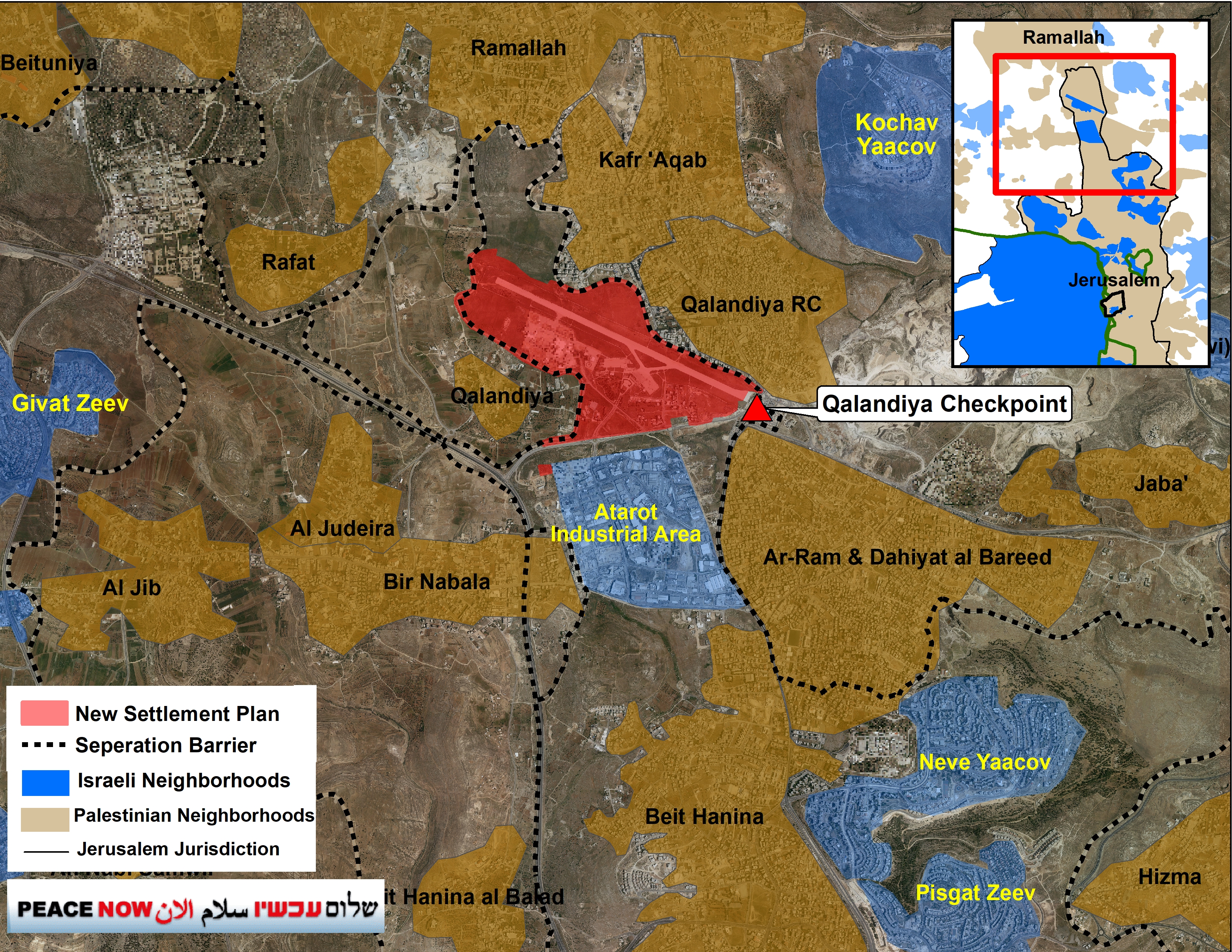 The plan for the Atarot settlement, which has existed since 2007, calls for a huge new settlement on the site of the defunct Qalandiya Airport, located on a sliver of land between Ramallah and Jerusalem. In its current form, the plan provides for up to 9,000 residential units for ultra-Orthodox Jews (assuming, conservatively, an average family size of 6, this means housing for 54,000 people), as well as synagogues, ritual baths (mikvehs), commercial properties, offices and work spaces, a hotel, and a water reservoir. If built, the Atarot settlement will effectively be an Israeli city surrounded by Palestinian East Jerusalem neighborhoods on three sides and Ramallah to its north. Geopolitically, it will have a similar impact to E-1 in terms of dismembering the West Bank and cutting it off from Jerusalem. For more on the Atarot settlement plan, please see here.
The Atarot settlement plan was last considered in 2021 when Naftali Bennet was Prime Minister, but was delayed from consideration by the planning committee – reportedly at the urging of U.S. Secretary of State Blinken. The Committee delayed advancement of the plan by ordering an environmental study which was expected to take about one year. Notably, in ordering the study, the Court made it clear that the environmental study is “standard practice” and expressed support for the underlying plan, saying it believes the plan represents a proper use of unutilized land reserves.
Peace Now said in a statement:
“This is a highly dangerous plan that could land a fatal blow to the prospect of peace and two states. The Atarot plan puts a wedge in the heart of the existing Palestinian urban continuum between Ramallah and East Jerusalem, thus preventing the possibility of establishing a Palestinian state with its capital in East Jerusalem. If the plan is not removed from the agenda of Israel´s far-right and pro-settler government, an eventual political resolution will become even harder to reach.”
Court Grants State Two-Month Delay in Khan Al-Ahmar Forced Displacement
On February 7th, the Israeli Supreme Court granted the State until April 2nd – a two month delay when the State had requested four months delay – to submit a plan to forcibly remove the Khan Al Ahmar bedouin community (a war crime) from its lands just outside of Jerusalem. The Court also set May 1st as the date for a final hearing on a petition submitted by the Regavim settler group demanding the immediate removal of Khan Al-Ahmar.
As with previous delays (there have been a total of 9), the Court expressed its extreme displeasure with the State’s foot dragging. Justice Noam Sohlberg said in his ruling:
“Suffice it to say that we are not at all satisfied with the conduct of the state…[the state’s behavior demonstrates] the existing situation is comfortable for it: Once every few months it files a request for an extension, which the petitioner opposes and the court accedes to through gritted teeth, and the world carries on as normal; deciding not to decide.”
In a statement revealing its ideological motivations, Regavim wrote:
“The government should formulate a working plan for the enforcement of the law in Khan al-Ahmar, as part of a fight against the Palestinian Authority’s institutionalized takeover of open areas in Judea and Samaria. The State of Israel must behave like the owner of the house, even in the face of American pressure, otherwise no one in the world will take it seriously.”
Israeli Cabinet Prepares for Vote to Amend 2005 Disengagement Law, Legalize Homesh Outpost & Yeshiva
The Israeli Cabinet’s Ministerial Committee on Legislation is expected to vote to amend the 2005 Disengagement Law at its February 12th meeting in order to pave the way for the reestablishment of four settlements in the northern West Bank. Jerusalem Post reports that the measure is expected to have enough support to be approved by the Cabinet and passed by the Knesset.
If passed, the bill will allow Israel to grant retroactive legalization to the Homesh outpost and yeshiva – reestablishing Homesh as a fully legal, under Israeli law, settlement. The retroactive legalization of Homesh was agreed to in coalition agreements that formed the current Israeli government.
The vote comes as the government faces a deadline from the High Court to submit its position on the court-ordered evacuation of the illegal yeshiva settlers built at the site of the dismantled Homesh outpost. The State has, for nearly three years, delayed its response to a 2019 petition filed by Yesh Din seeking the removal the illegal Homesh outpost and yeshiva, as well as guarantee the site’s return to its Palestinian landowners. Despite Homesh being dismantled in 2005, Israel never permitted Palestinians to regain access to or control of the land, declaring it a closed military zone. That status has prevented Palestinians from entering the area, while allowing settlers to routinely enter and (illegally, under Israeli law) inhabit the land, even (illegally) establishing a yeshiva there. That yeshiva, according to the Israeli NGO Kerem Navot, has become one of the West Bank’s “hardcore centers of settler terror”. Settlers have also wreaked terror on nearby Palestinian villages, most notably Burqa and Sebastia. One Israeli politician even went so far as to say that settlers are “carrying out a pogrom” in Burqa.
Bibi Pitches Massive Tunnel Construction in West Bank to French Investors
The Times of Israel reports that Netanyahu held a meeting with investors to pitch a massive construction project that would see highspeed tunnels be carved into the terrain throughout the West Bank in order to connect Israeli settlements together, and have more seamless access to Jerusalem and Tel Aviv. The underground highways would be designed in such a way to provide so-called “transportational contiguity” for both Israelis and Palestinians, in lieu of territorial contiguity for the latter (an idea endorsed in the Trump plan). The tunnel vision would effectively annex the settlements to Israel, and entrench a separate but unequal transportation grid that severely limits Palestinian freedom of movement, access to land, and more. The Israeli notion of “transportational contiguity” is put forward as an alternative to “territorial contiguity” which is no longer possible for Palestinians because of Israeli settlements, infrastructure, and control. The notion also gives permission to Israel for further settlement growth.
Smotrich Resigns, Brings Criminal Settler into Knesset
Finance Minister Bezalel Smotrich formally resigned his seat in the Knesset in order to focus his time on his Ministry postings, which not only include head of the Finance Ministry but also as a key minister within the Defense Ministry in control of the Civil Administration. Upon his resignation, the vacant Knesset seat has been filled by the next name on the Religious Zionist Party slate, and that happens to be Zvi Sukkot – a hardline settler who is one of the founders of Evyatar outpost.
Sukkot lives in the Yitzhar settlement – a hotbed of settler extremism and violence, the home of the notorious “Hilltop Youth” movement that has terrorized the Nablus region. He has been arrested on suspicion of arson in a 2010 attack on a Palestinian mosque. In 2012, he was temporarily banned from the West Bank on suspicion that he was orchestrating attacks on Palestinians.
Bonus Reads
- “In West Bank, Settlers Sense Their Moment After Far Right’s Rise” (New York Times)
- “Israel steps up Jerusalem home demolitions as violence rises” (AP)
- “From This Hill, You Can See the Next Intifada” (The Atlantic)
- “Threat Still Looms Despite Postponement of Largescale Wadi Qaddum Demolition” (Ir Amim)
- “ICJ sets July 25 for submission on illegality of Israel’s ‘occupation’” (Jerusalem Post)
Welcome to FMEP’s Weekly Settlement Report, covering everything you need to know about Israeli settlement activity this week.
To subscribe to this report, please click here.
February 3, 2023
- Following Neve Yaakov Attack, Settlers Rampage & Bibi Vows to “Strengthen Settlements”
- Bibi Requests 9th Delay in Khan Al-Ahmar Case, New Deadline for War Crime is June 1st
- West Bank Settler Population Tops 500k According to Settler Group
- Bonus Reads
Following Neve Yaakov Attack, Settlers Rampage & Bibi Vows to “Strengthen Settlements”
On January 28th, the Israeli security Cabinet approved several measures in response to the mass shooting perpetrated by a Palestinian targeting Jewish Israelis in the East Jerusalem settlement of Neve Yaakov. The measures – which inflict severe and collective punishment not only on the family of the Palestinian gunman but on Palestinians more broadly – include a general commitment to “strengthen settlements”.
In announcing the measures, Netanyahu said:
“we will decide soon on steps to strengthen settlement in Judea and Samaria in order to make it clear to the terrorists who seek to uproot us from our land that we are here to stay.”
Netanyahu’s vague commitment likely did not satisfy Cabinet Ministers Bezalel Smotrich and Itamar Ben Gvir, both of whom issued specific calls for settlement deliverables. Smotrich reportedly pressed for the construction of the E-1 settlement and for the approval of every settlement plan pending with the Civil Administration’s High Planning Council.
Ben Gvir suggested granting immediate authorization to seven outposts – that number chosen to “honor” the seven Israelis who were killed in the attack. The outposts Ben Gvir identified are:
- Avigail and Asael in the South Hebron Hills.
- Shaharit, Tel Zion and Givat Harel in the northern West Bank
- Avnat and Kedem Arava in the Jordan Valley
Additionally, Israel Hayom reported on January 25th (prior to the Neve Yaakov attack) that the government is close to finalizing a “mini annexation plan.” Leaks about the plan suggest that the government is prepared to:
- Immediately convene the High Planning Council to approve some 18,000 new units;
- Moving forward, convene the High Planning Council once a month, rather than every three months, which has been the schedule since the Obama years;
- Create a new planning body to handle non-residential construction on an expedited and streamlined process. This body would meet even more regularly, perhaps every few weeks;
- To simplify the approval process for residential settlement construction so that it only requires the approval of two entities instead of the current five;
- There was also discussion of a significant change in how Israel will handle West Bank infrastructure projects, to begin taking into account Palestinians in its assessments of the population infrastructure projects would benefit – a change that, if adopted, can be viewed as an act of clear de facto annexation.
While the government ponders which settlement plans it will advance in the wake of the Neve Yaacov attack, settlers have taken matters into their own hands, inflicting violence and destruction across the West Bank. Wafa reported 144 settler attacks on Saturday January 27th alone.
All told, 35 Palestinians were killed by Israelis in January 2023, making it the deadliest month for Palestinians since the conclusion of the Second Intifada. +972 Magazine reports:
“Out of the 35 Palestinians killed in January of this year, 25 were killed during Israeli military raids in areas of the West Bank under Palestinian control, mostly in the Jenin refugee camp. Five Palestinians were killed while they allegedly attacked or tried to attack soldiers or settlers; three were killed during protests that were unrelated to the army’s raids; one Palestinian was killed during a search at a checkpoint; and another Palestinian was killed while he allegedly ran away from such a search…Six of the 35 killed were minors, while the average age of the dead was 26 years old. Twenty were from the Jenin area, most of whom were killed in the refugee camp. In total, 23 of the dead, including all six minors, were from the northern West Bank.”
Bibi Requests 9th Delay in Khan Al-Ahmar Case, New Deadline for War Crime is June 1st
On February 1st, the Israeli government submitted its ninth request to the Supreme Court seeking to delay publishing its plan to forcibly relocate the Khan Al-Ahmar bedouin community from its land just outside of Jerusalem. In requesting a four-month delay, the government reiterated its commitment to expelling Khan Al-Ahmar, saying it just needs more time to formulate its plan.
The government justified its request by citing the lengthy period of time it took for the new government to be established, but Israeli press also speculate that Netanayhu bowed to international opposition to the pending war crime. Indeed, the State’s request cited the potential diplomatic ramifications of the plan as a basis for further delay.
Hebrew media further report that Netanyahu had to overrule two of his Cabinet members – Itamar Ben Gvir and Bezalel Smotrich – who have long derided previous governments for failing to destroy Khan Al-Ahmar. Smotrich was once the head of the organization (Regavim) which is behind the 2009 petition to force the government to destroy the village, which lacks Israeli building permits (permits that are nearly impossible to receive from Israel). Smotrich is now in charge of enforcing building regulations in the West Bank.
Eid Abu Hamis, one of the leaders of the battle against the evacuation, explained the personal cost of the 14-year battle his village has fought:
“We are living in one house like sardines. Me, my children and my grandchildren, but 800 meters from me [in Kfar Adumim] everyone lives in a house of their own. We are 14 people in a house of 120 square meters. It’s not okay that in Beit El, [where the offices of the Civil Administration are located] Ben-Gvir will decide. We need to sit people down and help them, they should come look at us in the eyes.”
The Friends of Jahalin organization responded to the state’s request for an extension, saying:
“The state should not be satisfied with the extension request. It should adopt the preexisting plan that was designed by the experts and submitted by the previous government. The plan called to legalize the community land without disrupting its way of life by relocating it to nearby state land. It is tragic that the state has given in to the demands of a small group of settlers that live nearby for so long, who want to live in a purely Jewish area and are leading us to an insane situation which will end up with all of us on trial in The Hague and damage Israel’s international reputation. The people calling to evacuate Khan al-Ahmar are a prime example of ‘the landlord’s lament’ – the same people who set up illegal settlements near Khan al-Ahmar, are now crying ‘destroy the Khan, it’s illegal.'”
Sarit Michaeli, Spokesperson for the Israeli human rights group B’Tselem, said in response to the latest delay:
“Obviously it’s better than nothing, and important that Netanyahu/Smotrich understand the limitations of power. However – the demand must be a full moratorium on demolitions & evictions of Pals, in area C & East Jerusalem. Otherwise, we will be in the same place in 4 months.”
West Bank Settler Population Tops 500k According to Settler Group
According to a pro-settlement group which tracks settler populations, there are now more than 500,000 Jewish Israelis living in the West Bank, and the group projects that number will grow to reach the 1 million mark in 2047.
The report counts 502,991 settlers in the West Bank, a 2.5% rise from January 2022 and a 16% rise over the past five years. These figures do not include East Jerusalem settlements, and it is unclear how the report handles outposts, which do not appear on the lists.
Celebrating the half a million mark, the report’s author Baruch Gordon says:
“We’ve reached a huge hallmark. We’re here to stay.”
According to the report, the settlements which have seen the most growth over the past 12 months are:
- Mevo Dotan, Eli Zehav, Bruchin, Nofim, in the northern West Bank
- Nokdim, located near Bethlehem
- Negohot in the South Hebron Hills.
- Bet Haarava, Mevuot Yericho, and Naama in the Jordan Valley.
Bonus Reads
- “Israel probes legality of US giving artifact to Palestinians” (AP)
- “Jewish National Fund: A century of land theft, belligerence and erasure” (Middle East Eye)
- “Expansion of Abraham Accords should not be tied to illegal settlements, US senator says” (Middle East Eye)
- “West Bank Settlements Have Highest Percentage of Gun Owners, New Data Shows” (Haaretz)
Welcome to FMEP’s Weekly Settlement Report, covering everything you need to know about Israeli settlement activity this week.
To subscribe to this report, please click here.
October 7, 2022
-
- High Court Grants Govt Another Delay of Forcible Relocation Khan al-Ahmar
- Booking.com Concedes to Israeli “Diplomatic War” Against Settlement Travel Warning
- Settlers Close Entrances to Nablus, Demand Another Round of Raids on Palestinian Resistance
- Settlers to get Armored Buses
- New Yesh Din Report on “Shepherding Outposts”
- Bonus Reads
High Court Grants Govt Another Delay of Forcible Relocation Khan al-Ahmar
On October 4th, the Israeli High Court of Justice gave the government a delay on meeting the Court-imposed deadline for forcibly dispossessing the Khan Al-Ahmar bedouin community of their land just south of Jerusalem. The Court – ultimately agreeing with the government’s argument that such a consequential move should not be handled by a transition government with elections on the immediate horizon – set the next deadline for February 1, 2023. This is the 8th such delay granted by the High Court.
A spokesperson for Regavim – the settler group whose appeal to the High Court led to the ruling requiring the government to destroy Khan Al-Ahmar (on the grounds that the entire community is illegal, as it lacks Israeli-issued building permits) – lamented the decision:
“A transitional government is allowed to sign a historic natural gas agreement,” said Yael Cinnamon, the attorney representing the right-wing NGO Regavim in an objection to the ruling. “But it can’t answer a simple question: Why is an illegal outpost that the court has decided time after time is to be demolished, still standing.”
Reports earlier this year suggested that the government was preparing to finalize a plan that would see the demolition of the Khan Al-Ahmar only to rebuild the community some 300 meters from where it currently stands.
Booking.com Concedes to Israeli “Diplomatic War” Against Settlement Travel Warning
A few weeks after announcing its plan to display travel warnings on properties located in Israeli settlements, the online vacation planning giant Booking.com changed its approach – reportedly in response to Israeli pressure (as a reminder: when the plan was announced, Israeli officials promised to wage a “diplomatic war” against it). As it has now been implemented, the new approach waters down the warning, de-contextualizes it, and for the purposes of travel advice and facilitation, effectively elides/erases any distinction between Israeli settlements and Palestinian villages/cities.
Specifically, instead of posting a travel warning that identifies each settlement listing as located in occupied territory and warning of “an increased risk to safety and human rights” (as was reportedly the origin plan), the warning instead (a) now appears at the top of any search results for locations anywhere in the West Bank (Israeli and Palestinian), and (b) rather than referencing the occupation and human rights (language that would have directly reflected the specific context of the West Bank and the power/security dynamics impacting travel there), the language, as implemented, merely warns travelers to “Review any travel advisories provided by your government to make an informed decision about your stay in this area, which may be considered conflict-affected.”
Ines Abdel Razek of the Palestine Institute for Public Diplomacy told Al Jazeera:
“By continuing to list accommodations in illegal settlements or trading with them, they are essentially continuing to give a free pass to colonisation, segregation and racism, making profit on the back of Palestinians land and resource theft, labour exploitation, and mass expulsions. Worse, by equating rentals in properties owned by Palestinians to that of illegal Israeli settlers, Booking is failing in its responsibility and own affirmed commitment to ‘protect local communities’…Booking and Airbnb are also adopting Israeli disinformation misportraying [the concrete reality] as ‘disputed’ and ‘complicated’ in order to whitewash Israel’s war crimes [from] what is without ambiguity a military occupation and illegal settler colonial enterprise condemned for decades by the UN and international tribunals…While these companies are affirming their commitment to ‘promoting human rights everywhere’, they are applying very clear double standards about their zero tolerance approach when it comes to Palestinians.”
It is difficult not to count this as a major victory for the Israeli government and its effort to force companies and governments to treat settlements as part and parcel of the state of Israel – even though settlements are illegal under international law. Indeed, it’s worth noting that this victory was in large part won in advance: Booking.com at no point was (publicly) considering de-listing settlement properties entirely – a move that AirBnB ventured to undertake in 2018, resulting in intense backlash from Israel and in U.S. courts. Ultimately, AirBnB reversed that decision.
Declaring victory over Booking.com, Israel Foreign Minister Yoel Razvozov (Yesh Atid) said:
“This is an important achievement for the State of Israel. From the moment this issue became known, under the instruction of Prime Minister Lapid, together with officials from the Foreign Ministry, we prevented the global company Booking from publishing false information against Israel and against Israeli tourism businesses located in Judea and Samaria. We proved that the State of Israel has the ability to act and be victorious in the field of diplomacy, and I am sure that we will act similarly in the future as well, against any attempt to harm us.”
Settlers Close Entrances to Nablus, Demand Another Round of Raids on Palestinian Resistance
Settlers staged two protests near Nablus – one on October 3rd and another on October 5th – closing down all of the roads leading into the city. In video of the event, Israeli military vehicles can be seen – apparently not only failing to remove the settlers from the road, but actually facilitating their sustained presence there. The stated goal of the rally was to demand the government launch a new and harsher campaign – which the settlers have dubbed Defensive Wall 2 – to counter rising Palestinian armed resistance in the West Bank. The rallies were also an immediate response to a shooting that took place earlier in the day on October 3rd, in which an Israeli bus and taxi were shot at near the Elon Moreh settlement. One person was lightly wounded.
As the October 5th rally was disbanding, the settlers were shot, with responsibility for the shooting subsequently claimed by a Palestinian armed group in Nablus calling themselves the “Lion’s Den.” The Lion’s Den also took responsibility on October 5th for capturing (and ultimately releasing unharmed) Israeli settlers who entered the Old City of Hebron by mistake.
A similar incident happened in Hebron only a few days later, when a group of three Israelis and eight tourists had driven into the Palestinian-controlled part of the city. Palestinian Authority forces helped escort the group safely out of the area.
Settlers to get Armored Buses
The Israeli government has announced that it allocated $4 million (NIS 15 million) to purchase bulletproof, armored buses to serve the settler population in the West Bank. The announcement follows a report by the Israel Hayom outlet that a bus company – Electra Afikim – was close to canceling its service to the settlements because too many of its buses have been damaged by gunfire.
New Yesh Din Report on “Shepherding Outposts”
Yesh Din – an Israeli anti-settlement NGO – issued a new report on October 6th entitled, “Plundered Pastures: Israeli settler shepherding outposts in the West Bank and their infringement on Palestinians’ human rights”. Yesh Din reports that shepherding outposts have been wildly successful in “establishing, expanding, invading and perpetrating violence as means for driving Palestinian shepherds and farmers off of their land.”
The report further unpacks how shepherding outposts – where a small amount of settlers (sometimes one family) graze livestock over a vast expanse of land – have become a dominant form of land takeover used by settlers with the strategic facilitation of the Israeli government in the West Bank since 2017, resulting in the establishment of no less than 35 outposts in the four years that followed. What’s more, the report publishes for the first time documents showing the Israeli government has pursued the establishment of shepherding outposts as a means of land control since the early 1980s.
Yesh Din writes:
“The testimonies and data in this report describe the severe and routine harm that the settlers’ activities in shepherding outposts cause Palestinians in the West Bank – harm to their person, land and property. Analysis of the report’s findings exposes how establishing settler shepherding outposts is designed to create substantial and long-term change to the map of Israeli settlement in the oPt, which will lead to diminished living areas for Palestinians in the West Bank and result in severe and extensive infringement on their human rights.”
Bonus Reads
- “Netanyahu pledges massive West Bank settlement building if elected” (Jerusalem Post)
- “Jewish Home: No govt. without young settlements” (Arutz Sheva)
Welcome to FMEP’s Weekly Settlement Report, covering everything you need to know about Israeli settlement activity this week.
To subscribe to this report, please click here.
September 9, 2022
- Israel Advances Givat HaShaked Settlement Plan in East Jerusalem
- Israel Delays (for now) Consideration of E-1 Settlement
- Israel Planning to “Legalize” 30+ Shepherding Outposts in Massive Land Grab
- Israel to Request Another Delay in Demolition of Khan al-Ahmar
- IDF Issues Orders to Keep Settlers Out of Ramat Migron Outpost Area
- IDF Removes Amichai Settlement Tower
- Yesha Council Elects New Leader
- Settlement Schools are Flourishing
- Bonus Reads
Israel Advances Givat HaShaked Settlement Plan in East Jerusalem
On September 5th, the Jerusalem District Planning Committee advanced plans to build a new settlement in East Jerusalem, to be called “Givat HaShaked.” The plan provides for 700 housing units (in 4 highrise towers and several six-story buildings), a school, and commercial buildings –all to be built on a highly sensitive and geopolitically critical sliver of land located within the Palestinian neighborhood of Beit Safafa. The plan was approved for public deposit, an advanced stage in the Israeli planning process. The plan for Givat HaShaked is unprecedented, according to the Israeli NGO Terrestrial Jerusalem, in that it is the first settlement of this size that that Israeli government will establish within a Palestinian neighborhood. Beit Safafa is already in the process of being completely surrounded by Israeli development (for Jewish Israelis) — most notably with final approval of the Givat Hamatos settlement plan, for which tenders were issued in January 2021.

The Israeli NGO Ir Amim also points out that, while the government goes to great lengths to find a way to squeeze in several high rise towers to house Israelis in East Jerusalem, there is no parallel effort to address the decades-long lack of planning and approvals for Palestinian communities. Ir Amim writes:
“Givat HaShaked is also a flagrant example of the breadth and depth of housing and planning discrimination in the city. While Givat HaShaked is intended for land located along the built-up area of Sharafat, it is not designated for the community’s development needs, but rather a new housing project for Israelis over the Green Line in Jerusalem. Construction of this new settlement will likewise stand in stark contrast to the existing Palestinian neighborhood, dwarfing and engulfing Sharafat with high-rise apartment buildings – the likes of which Israeli authorities refuse to promote or approve for Palestinian areas. In a similar fashion, the remaining land reserves on the eastern side of Beit Safafa, which could have been used to address the neighborhood’s housing needs, were depleted to advance construction of the Israeli settlement of Givat Hamatos.”
Interior Minister Ayelet Shaked celebrated the advancement, telling Arutz Sheva:
“As I promised, despite all the pressures from at home and abroad, the Givat Hashaked plan was approved today by the district committee. This plan is located in the heart of Jerusalem and is unthinkable to prevent development and construction in this area as well as all over the city. This is an important plan that will lead to an increase in the supply of housing units, employment areas and public buildings for the well-being of the residents.”
As a reminder, the Israeli government has been sitting on plans for Givat HaShaked for decades, but has refrained from implementing them because doing so would require the government to seize a sizeable amount of land in East Jerusalem, some of which is privately owned by Palestinian residents of Sharafat (a section of the Palestinian neighborhood of Beit Safafa). Other parts of the land proposed to be used for the Givat HaShaked settlement plan are managed by the Israeli General Custodian (but neither owned or claimed by the government of Israel) – a fact Ir Amim calls “highly unusual and seemingly marks a new phenomenon.” The Israeli General Custodian is empowered by the State to act as a caretaker of land that has unknown ownership until the heirs are located. In an attempt to explain why the General Custodian has the authority to approve a plan for construction on land that the State does not own, the Israeli Justice Ministry told Haaretz that the plan for Givat HaShaked increased the value of the land and that “by law, the administrator general is obligated to care for the assets under his management in a way that will benefit their private owners.” This answer implies, bizarrely, that if and when Palestinian heirs are located, they will be somehow better off with their land having been used to build a settlement.
Another important facet of how Givat HaShaked is being advanced now is the decision by the Israeli government in late 2020 to initiate a (typically secret) registration process for land in East Jerusalem, including in the Sharafat area. At this time, it is unknown whether the land managed by the General Custodian in Sharafat (and designated for the new settlement) has been – or is in the process of being – registered. On that uncertainty, Ir Amim writes:
“…in the event that it is the same location [where formal land registration has taken place], this move would constitute yet another brazen example of how the settlement of title procedures are repeatedly being used to aid state authorities and settler groups in taking over more land in East Jerusalem…Although portrayed as a measure to ostensibly benefit Palestinian residents, there has been grave alarm that these [land registration and settlement of title] procedures would in fact be exploited to confiscate Palestinian land for political purposes, leading to the expansion of Jewish settlement and widespread Palestinian dispossession in the city.”
For a deep dive into land registration in East Jerusalem, please listen to a new FMEP podcast featuring Kristin McCarthy (FMEP) in conversation with Amy Cohen (Ir Amim).
Israel Delays (for now) Consideration of E-1 Settlement
The Israeli Higher Planning Committee of the Civil Administration has again delayed its consideration of the E-1 settlement plan, which was scheduled to be taken up at the Committee’s September 12th meeting. The E-1 settlement is considered a “doomsday” settlement for much of the international community that still hopes to negotiate a two state solution. This same committee was previously scheduled to take up the E-1 plan on July 18th – days after U.S. President Joe Biden’s visit to Jerusalem. The Israeli government intervened to postpone the meeting, rescheduling it for September 12th – the hearing that has now also been delayed.
Peace Now said in response:
“This is welcome news, but we wish to see E1 taken off the table completely. E1 is lethal to the two-state solution, highly detrimental to Palestinian freedom of movement and to connection between different parts of the future Palestinian state. The Israeli government, and in particular Minister of Defense Benny Gantz (in whose jurisdiction these decisions lie), must take the plan off the table completely.”
This repeatedly delayed meeting promises to be a decisive one for the long-pending E-1 plan, and could result in the Committee granting final approval to the highly contentious plan. Barring intensive outside pressure, additional postponement of the hearing seems highly improbable, given the Israeli domestic politics and the upcoming national election.
As a reminder: in its current form, the E-1 plan provides for the construction of 3,412 new settlement units on a site located northeast of Jerusalem. The site is home to several Palestinian bedouin communities, including Khan al-Ahmar, which Israel has already undertaken to forcibly displace (many attempts). Long called a “doomsday” settlement by supporters of a two-state solution, construction of the E-1 settlement would sever East Jerusalem from its West Bank hinterland, preventing East Jerusalem from ever functioning as a viable Palestinian capital. It would also cut the West Bank effectively in half, isolating the northern West Bank from the southern West Bank and foreclosing the possibility of the establishment of a Palestinian state with territorial contiguity.
Israel’s “answer” to the latter criticism has long been to argue that Palestinians don’t need territorial contiguity, and that new roads can instead provide “transportational continuity.” To this end, Israel has already built the so-called “Sovereignty Road” – a sealed road that enables Palestinians to pass through, but not to enter, the E-1 area. That road is wholly under Israel’s control (meaning Israel can cut off Palestinian passage through it at any time). In January 2021, then-Prime Minister Netanyahu promised to increase funding for the “Sovereignty Road” as part of the drive to get E-1 built.
And another reminder: there have been attempts to promote the E-1 plan since the early 1990s, but due to wall-to-wall international opposition, the plan was not advanced until 2012, when Netaynuahu ordered it to be approved for deposit for public review (a key step in the approval process), ostensibly as payback for the Palestinians seeking recognition at the United Nations. Following an outcry from the international community, the plan again went into a sort of dormancy, only to be put back on the agenda by Netanyahu in February 2020, when he was facing his third round of elections in the two years. Also, as a reminder: under the Trump Plan (which the Biden Administration has yet to comment on), the area where E-1 is located is slated to become part of Israel.
Israel Planning to “Legalize” 30+ Shepherding Outposts in Massive Land Grab
Haaretz reports that the Israeli Civil Administration is in the midst of a years-long process of drafting new protocols that will allow the State to “legalize” settlers’ claims to huge areas of the West Bank (mainly in Area C) that settlers have de facto seized through illegal shepherding activities (grazing settler-owned flocks of sheep, etc on the land). The Civil Administration is working to “legalize” this land theft in areas where the land in question is categorized by Israel as “State land.”
The phenomenon of “shepherding outposts” has been extensively documented by the Israeli NGO Kerem Navot, which has identified it as currently the “most significant mechanism for dispossessing Palestinian communities” in the West Bank. According to Kerem Navot’s May 2022 report, entitled “Wild Wild West,” settlers have taken control of nearly 7% of Area C of the West Bank (around 60,000 acres) via 77 of these grazing outposts.
The Haaretz Editorial Board – in a piece entitled “Settler Crime Always Pays” – writes:
“Once again, the settlers have proved that Jewish crime in the territories always pays. The Civil Administration began formulating the draft regulation about two years ago, against the background of the increase in the number of these outposts. The proper response to the growing number of farms established illegally would have been to see to their removal and to step up enforcement. Instead, the agency bowed down to the settler masters and seeks to cut the law to fit their vices…It must be hoped that he [Gantz] recognizes that it is a looting mechanism designed to take control of more and more of Area C, to prevent Palestinians from working their land and to reduce their living space.”
As a reminder: Israel has a legal responsibility under international law regarding stewardship of “state land” held under its occupation. As the Association for Civil Rights in Israel explains:
“Israel holds state land in an occupied territory as a trustee, and must do everything possible to preserve and develop it for the benefit of the local Palestinian population. The very use of state land for the purpose of building settlements and/or developing infrastructure and industrial zones not in favor of the Palestinian population constitutes a violation of international law.”
Israel to Request Another Delay in Demolition of Khan al-Ahmar
Facing a September 11th deadline to complete the forcible relocation of the Khan al-Ahmar community from their longtime lands just east of Jerusalem (an act that would constitute a war crime), Israeli Prime Minister Yair Lapid has become just the most recent Israeli premier to ask the Court for an extension. As a reminder, the High Court has ordered the demolition of Khan al-Ahmar, which it declared to be illegally built (i.e., lacking Israeli building permits that are virtually impossible for Palestinians to obtain).
The Israeli High Court imposed a deadline on the State to demolish Khan al Ahmar in response to a petition filed by the right-wing pro-settler group Regavim, which sued the government for failing to carry out the demolition of the community in the wake of the Court’s ruling that the community was built illegally. That demolition order has been pending since 2018. The Court granted several delays to the Netanyahu government, and one to the Bennett government. When granting the government another delay in September 2020, the Court said that it would not be granting any more delays. It then granted several more delays, most recently in July 2021, ostensibly due to Russia’s invasion of Ukraine.
Prior to becoming Prime Minister, Lapid opposed the State’s plan to forcibly relocate Khan al-Ahmar. Reports suggested that the government has been preparing a plan that would entail the demolition of the Khan Al-Ahmar, followed by (bizarrely) the rebuilding of the community some 300 meters from where it currently stands.
IDF Issues Orders to Keep Settlers Out of Ramat Migron Outpost Area
After three weeks of repeatedly demolishing the “Ramat Migron” outpost, only to have settlers rebuild it, the IDF has issued a new order declaring the area a “closed military zone” — apparently in hopes of barring settlers from entering the area. The order is effective for only one month. As a reminder: The IDF already viewed it as illegal for settlers to enter the area (which is why the IDF arrested settlers in the area last week), so it is not clear (at least as of this writing) what is different about this new order.
The IDF informed the settlers of the new order as they were in the process of constructing buildings at the Ramat Migron site. Settlers have already vowed to continue fighting to establish a settlement on the hilltop.
IDF Removes Amichai Settlement Tower
On September 8th, Israeli authorities demolished a tower built by settlers on land that has been allotted to the Amihai settlement, located in the Shiloh Valley in the northern West Bank. Settlers built the tower apparently in order to surveil a nearby Palestinian village where new homes are being built. Settlers have already vowed to rebuild the tower.
The Amichai settlement was approved for construction in 2017, making it at that time the first new settlement formally approved by the Isareli government in 25 years. Aerial imagery from 2021 show the massive growth Amichai has enjoyed in the years that followed its establishment, a previously empty hilltop with cultivated fields nearby have been transformed into a sizable suburban neighborhood. In addition to new construction, Amichai was also massively expanded, subsequent to its initial construction, when the Israeli Civil Administration announced that its plan to retroactively legalize the Adei Ad outpost by significantly expanding the borders of the Amichai settlement to turn Adei Ad into a (non-contiguous) neighborhood. In effect, this was a slight-of-hand by Israel to turn the Adei Ad outpost into an entirely new official, legal settlement.
Yesha Council Elects New Leader
The Yesha Council – an association of heads of settlements and regional council leaders that acts as the settler lobby to the government – has elected a new chair, Shlomo Ne’eman. Ne’eman is set to take over the post from David Elhayani.
Ne’eman has earned his stripes as the chairman of the Gush Etzion Regional Council. Upon his election (he was unopposed), Ne’eman said:
“The first task before us is to strengthen the sovereignty and the Jewish presence in the region. This is the time to unite against those who seek our harm, the Palestinian Authority and other terrorist organizations that fight us with guns and knives, as well as with plows and concrete pumps, and to continue working to develop and strengthen Israeli settlement in Judea, Samaria and the Jordan Valley.”
Settlement Schools are Flourishing
According to a newsletter issued by the Friends of Beit El Settlement (an organization that former Ambassador David Friedman used to chair), as the new school year starts there are 86,000 children living in settlements and enrolled in 270 elementary schools across the West Bank. In addition, the newsletter reports that 35,000 settler students attend ~200 post-elementary schools. Gloating, the newsletter boasts:
“Beautiful numbers like these don’t just happen on their own. We can barely imagine the amount of idealism and effort and self-sacrifice over the course of decades, under severely difficult economic and security conditions, that has gone into the Yesha enterprise.”
Bonus Reads
- “Settlement Org Eyes a New Target, and Israeli Authorities Go Out of Their Way to Help” (Haaretz)
- “IDF preparing to use armed drones in West Bank operations” (The Times of Israel)
- “U.S. Examining Allegations Against Israel’s Orthodox West Bank Battalion” (Haaretz)
Welcome to FMEP’s Weekly Settlement Report, covering everything you need to know about Israeli settlement activity this week.
To subscribe to this report, please click here.
March 11, 2022
- Settler Population Continues to Surge
- Bennet Government Delays Khan al-Ahmar Decision
- Major Ma’ale Adumim Settlement Expansion Advanced
- Palestinians Continue Weekly Protests Against Expansion of “American Road” in Jerusalem
- High Court to Rule on Expulsion of Palestinians in South Hebron Hills “Firing Zone”
- Former U.S. VP Mike Pence Hangs out with Kahanists in Hebron
- Further Reading
Settler Population Continues to Surge
The Israeli Ministry of Interior released new figures on the growth of the West Bank settler population over the past 13 months (January 1, 2021 through Jan 31, 2022). The data shows that growth in the Israeli settler population, which surged during President Trump’s overtly pro-settlement term in office, has continued to accelerate. This population growth follows the surge in settlement construction that took place during the Trump presidency.
The data was compiled by Yaakov Katz, who is the former Chair of the Board of Directors of the settler-run Arutz Sheva media outlet. Katz currently publishes West Bank Jewish Population Stats (a project of “Bet El Institutions”, associated with the settlement of Beit El – a settlement closely associated with Trump’s ambassador to Israel, David Friedman). The data reveals that over the reporting period:
- The number of West Bank settlers grew to a total of 490,493 (not including the ~330,000 East Jerusalem settlers), representing a nearly 3.2% rise over 13 months.
- The following settlements increased their population size by over 10% over the reporting period:
- Rechan, located in the northern West Bank;
- Alei Zahav, located in a string of settlements stretching across the northern West Bank. Alei Zahav and its settlement neighbors create a contiguous Israeli populated areas linking Israel proper (west of the Green Line) all the way to the Ariel settlement, located in the heart of the West Bank (the eastern end of Ariel is closer to the Jordan border than to the Green Line). Notably, Alei Zahav is one of the settlements in which the “market principle” has been applied to legalize settlers theft of land recognized by Israel as belonging to Palestinians (see our July 2019 report).
- Amichai, a brand new settlement established by the Israeli government in 2017 and continuously expanded, located in the central West Bank;
- Naaleh, in the central West Bank;
- Bruchin, in the central West Bank;
- Yitzhar, the radical and violent settlement located near Nablus in the central West Bank. The Yitzhar settlement serves as the home base of the “Hilltop Youth” settler movement;
- Nokdim, located south east of Bethlehem;
- Metzad-Asfar, located south east of Bethlehem;
- Kfar Etzion, located south of Bethlehem;
- Beit HaArava, located in the Jordan Valley;
- Maskiot, located in the Jordan Valley;
- Negohot, located in the South Hebron Hills;
- Susya, located in the South Hebron Hills;
- Pnes Hever, located in the South Hebron Hills;
- Sansena, located in the South Hebron Hills.
The report goes on to predict that the settler population will cross the 1 million threshold in 2046.
Bennet Government Delays Khan al-Ahmar Decision
This week the Bennett-led government asked the High Court of Justice to extend the deadline for submitting its position on the forcible relocation of the Khan al-Ahmar bedouin community (a war crime). The State was facing a March 6th court deadline (which has already been delayed once at the request of the State), and initially requested a two-day extension – which the Court granted. On March 8th, the State requested a 30-day extension, citing the Russian invasion of Ukraine as a time consuming matter for senior officials whose input is needed on the Khan al-Ahmar plan.
Regavim – the settler group behind the Court case seeking to force the government to demolish Khan al-Ahmar – slammed Bennett for the repeated delays and also stated that they might challenge the latest delay, saying:
“As far as we know, Prime Minister Bennett has already returned from his trip to Europe, and the additional rejection request smells like smearing. We will consider appealing to the Supreme Court for a ruling.”
Prior to this most recent delay, reports suggested that the government was preparing a plan that would see the demolition of the Khan Al-Ahmar only to (bizarrely) rebuild the community some 300 meters from where it currently stands. As a reminder, the High Court has ordered the demolition of Khan al-Ahmar, which it declared to be illegally built (i.e., lacking Israeli building permits that are virtually impossible for Palestinians to obtain).
It’s also worth recalling that the Supreme Court, in its September 2020 decision to grant the government a six-month delay, explicitly expressed its impatience to bring this matter to a close. It called the government’s request “embarrassing” and said:
“the expectation is that at the end of [the six-month] period a clear decision will be presented to this Court, after all options have been explored and exhausted. The period of mapping out alternatives and exploring courses of action is about to run its course, and what follows is the decision stage. Our aim is to conclude the hearing of this petition immediately after the [government’s updated statement] is submitted, and the plaintiff’s response is received, one way or another.”
Major Ma’ale Adumim Settlement Expansion Advanced
On March 3rd the local building committee of the Ma’aleh Adumim settlement, located just east of Jerusalem, approved what is reportedly the largest settlement expansion plan in over a decade. The plan would allow for 3,300 new settlement units as well as areas for public buildings. Assuming (conservatively) an average family size of 5, this means construction for at least 16,500 new settlers. The plan will now be sent to the Israel High Planning Council for its consideration and approval.
Ma’ale Adumim is the largest settlement by size and population. In past negotiations, Israel has always included Ma’ale Adumim and the surrounding area as one of the “settlement blocs” that would be annexed to Israel under a final agreement. The Israeli political consensus around the annexation of Ma’aleh Adumim (which has not been meaningfully challenged in past negotiations) has, by and large, resulted in the implied acceptance that expansion of Ma’ale Adumim is treated as non-controversial or not as geopolitically consequential as new units built in settlements and outposts in other locations. However, it should be emphasized that the term “settlement bloc” has no legal definition or standing — not under Israeli law, or under international law, or in the context of the Oslo agreement — and the fate of Ma’ale Adumim, like all settlements, is a matter for future negotiations. Nonetheless, the Israeli government has for years deployed the “settlement blocs” terminology in an effort to legitimize settlement expansion in areas it wants, in effect, to unilaterally take off the table for any future negotiations. For more context, see resources from Americans for Peace Now here and here.
Palestinians Continue Weekly Protests Against Expansion of “American Road” in Jerusalem
For the past month, Paelstinians have gathered in front of Jerusalem’s City Hall to protest a plan to expand the so-called “American Road” — expansion that will come at the expense of 62 residential structures that are home to 750 Palestinians in the Jabal al-Mukaber neighborhood of East Jerusalem.
 As a reminder, the so-called “American Road” is a section of north-south highway that is meant to more seamlessly connect settlements located in the north and south of Jerusalem to one another, and to serve as a bypass for settler traffic to cut through East Jerusalem’s Palestinian neighborhoods. While the road will be accessible to Palestinians (a fact touted by Israel as proof of Israeli good intentions), its clear primary purpose is to entrench Israel settlements, expand Israeli control over all of East Jerusalem, and close off Palestinian East Jerusalem neighborhoods from the rest of the West Bank, thereby (further) torpedoing Palestinian hopes of one day establishing a capital in East Jerusalem.
Israel began work on this road in June 2020, and recently completed the first phase of construction.
The second phase of construction directly threatens Palestinians, involving the demolition of 62 buildings in Jabal al-Mukhaber. According to Middle East Eye, the Jerusalem Municipality has come up with a proposal, as reported by one of the threatened homeowners:
“The municipality suggested alternatives for residents with demolition orders, but they are neither realistic nor fair, Muhammad says. The proposal stipulates erecting buildings upwards on each side of the road. In them, four stories must be exclusively allocated for parking, another four for commercial use, and only two stories for residential use, each containing four apartments. The estimated cost for each of those buildings is between 20 and 25 million shekels ($6m to $7.7m), which many Palestinians in the area can’t afford without loans. The options left for residents are either expulsion or indebtedness. One strategy the municipality is taking is to empty the area completely of its inhabitants and replace them with commercial centres, Muhammad says. ‘They want to force the residents to resort to local or external investors, or to resort to banks to take out loans, which would mean that the landowners would only receive a single residential apartment, while the investors or banks would retain the lion’s share,’ Muhammad told MEE. ‘The Jabal al-Mukaber residents refuse this unequivocally, considering vertical building to be incompatible with the rural context to which they have grown accustomed to’.”
See Orly Noy’s reporting for a detailed history of this plan’s evolution as well as a moving portrait of some of the Palestinians who are affected by this plan.
In a deeply researched report on how infrastructure like roads is a means for settlement expansion and annexation, Breaking the Silence explains:
“While Israeli authorities justify many of the projects described in this document by claiming that they serve both the settler and the Palestinian populations in the West Bank, it is important to note that these roads are designed with Israeli, not Palestinian, interests in mind. Many of the roads that are technically open to Palestinian traffic are not intended to lead to locations that are useful to Palestinians.16 Instead, these roads are primarily designed to connect settlements to Israel proper (and thus employment and other services) via lateral roads, rather than to connect Palestinian communities to one another. Further, roads intended to connect Israeli settlements to Jerusalem (many of which are currently under construction) do not serve West Bank Palestinians outside of Jerusalem, as they are not allowed to enter Jerusalem without a permit. In addition, an extensive system of checkpoints and roadblocks allows Israel to control access to bypass roads and the main West Bank highways, and it can restrict Palestinian access when it so chooses.
This prejudice against Palestinian development is even starker when one considers that, according to an official Israeli projection, the expected Palestinian population in the West Bank (excluding East Jerusalem) in 2040 is 4,600,000 individuals. Even if the vision of settler leaders to arrive at 1,000,000 settlers is realized by 2040, the Palestinian population would still be four times the size of the settler one. Despite this discrepancy, priority is still given to settler infrastructure development.
West Bank road and transportation development creates facts on the ground that constitute a significant entrenchment of the de facto annexation already taking place in the West Bank and will enable massive settlement growth in the years to come. By strengthening Israel’s hold on West Bank territory, aiding settlement growth, and fragmenting Palestinian land, this infrastructure growth poses a significant barrier to ending the occupation and achieving an equitable and peaceful solution to the Israeli-Palestinian conflict.”
High Court to Rule on Expulsion of Palestinians in South Hebron Hills “Firing Zone”
On March 15th, the Israeli High Court is expected to issue a ruling on the mass expulsion of 12 Palestinian communities in the Massafer Yatta region of the South Hebron Hills. These 12 villages are located on land that Israel declared a “firing zone” – Firing Zone 918 – in the early 1980s. Palestinian and Israeli activists have launched an international campaign to bring attention to the matter in the hopes of stopping the mass expulsion of Palestinians from their land.
In a recent article for +972 Magazine, Ali Awad – a journalist and activist from Massafer Yatta – contrasted the plight of his community to the success of chicken farms established by settlers on nearby land, writing:
“In Umm al-Khair, we find it especially absurd that the chicken farms have better infrastructure than our residents. We suffer from a constant lack of water and are prevented from connecting to the electricity grid; the farms, meanwhile, have constant access to water, and are not only permanently connected to electricity but also have backup generators in case of an emergency. Seeing the electricity lines pass directly over our village is a constant reminder that the animals get rights that we as Palestinians are deliberately denied. More importantly, we know that building these farms in Masafer Yatta is yet another strategy of the occupation to displace us Palestinians from our homes, and is no less dangerous than its policy of declaring 12 of our villages as falling under Firing Zone 918 — thereby sanctioning our displacement. Israel is even still using the outdated Ottoman Land Code in the occupied territories to transfer Palestinian pasture into “state land,” which it then leases to settlers in order to establish other kinds of farms. They are multiple laws and policies, but they all serve one goal: to take over Palestinian land.”
Over the past months, FMEP has hosted a series of webinars and podcasts highlighting Israel’s treatment of Palestinians in Massafer Yatta, including:
-
Israeli Apartheid, the Supreme Court, and Land Confiscation: The Case of Masafer Yatta (March 9, 2022) featuring Ali Awad (journalist and activist), Maya Rosen (activist) in conversation with FMEP’s Sarah Anne Minkin
-
“We don’t have another place to go:” Dispossession, Settler Violence, & Resistance in Masafer Yatta (January 2022) featuring journalist and activist Ali Awad in conversation with FMEP’s Sarah Anne Minkin
- Israeli Government Escalates Pressure on Israelis Who Stand in Solidarity with Palestinians (December 2021) featuring activists Oriel Eisner and Maya Eshel in conversation with FMEP’s Lara Friedman.
Former U.S. VP Mike Pence Hangs out with Kahanists in Hebron
During his visit to Israel this week, former U.S. Vice President Mike Pence found time to meet with far-right settler leaders including Kahanist lawmaker Itamar Ben-Gvir while visiting the Tomb of the Patriarchs/al-Ibrahimi Mosque in Hebron, a city that is perhaps the clearest example of Israeli apartheid policies.
According to the Hebron Fund (the U.S. 501c3 charity that raises funds for the Hebron settlers), Pence was accompanied by Simon Falic (Duty-Free America), who is a major supporter of the Hebron settlers. Photos showed Pence also accompanied by Baruch Marzel, the former right-hand man of the Kach party’s Rabbi Meir Kahane. For extra fun, here’s video of Marzel introducing Pence to Ben-Gvir, who Marzel says “represents us in the Knesset.” Pence shakes Ben-Gvir’s hand and says: “stay strong – we’ll stand with you… It’s my great honor.” Falic is also visible in the video.
During his time in Israel, Pence also received an honorary degree (alongside former U.S. Ambassador David Friedman) from Ariel University, at a ceremony held at the settlement. During the ceremony, Pence made his thoughts on settlements clear, saying:
“It’s great to be here in Ariel. I’m told that some people say that you shouldn’t go to Jewish communities in Judea and Samaria. I obviously have a different opinion.”
Pence also received an award from a group of Evangelical supporters in recognition of his support for Israel. That ceremony was held in Jerusalem. Many speculate that Pence is prepping for a run for the 2024 Republican nomination for the presidency, and making stops in Israel to court the Evangelical vote.
As a reminder, the parties associated with the now deceased Rabbi Meir Kahane – Kach and Kahane Chai – are U.S.-designated foreign terrorist organizations. Ben Gvir’s political party, Otzma Yehudit, is a clear present-day incarnation of those parties and is devoted to Meir Kahane’s teachings. For more on Kahanism in Israel, please see “Mainstreaming the Extreme: How Meir Kahane’s Vision of Jewish Supremacy Conquered Israeli Politics” and FMEP webinar hosted in March 2021 featuring Amjad Iraqi (+972 Magazine), Shaul Magid (author & Dartmouth College professor), Natasha Roth-Rowland (University of Virginia) in conversation with Lara Friedman (FMEP).
Bonus Reads
- “Editorial | Jewish Settlers in La La Land” (Haaretz)
- “ Israeli Human Rights Violations in the Occupied Palestinian Territory (Weekly Update, March 3 – 9, 2022)” (PCHR)
Welcome to FMEP’s Weekly Settlement Report, covering everything you need to know about Israeli settlement activity this week.
To subscribe to this report, please click here.
January 28, 2022
- Israel Destroyed The Salihiya’s Home in Sheikh Jarrah. Now The Salihiyas Are Appealing to the ICC
- Knesset Committee Chair Vows to Protect Homesh Outpost & Yeshiva
- A War Crime in the Making: Israel Finalizes Plan for Forcible Relocation of Khan Al-Ahmar
- Settlers Attack Palestinians & Israel Human Rights Activists
- Settlers Violently “Parade” Through West Bank Town
- Israeli Government Increases Funding for Annexation/Dispossession via Archaeology Effort
- Israel FM Denounces Effort to Connect Outposts to Israeli Services — While Israeli Communications Goes Ahead and Does Just That (for one outpost)
- Further Reading
Israel Destroyed The Salihiya’s Home in Sheikh Jarrah. Now The Salihiyas Are Appealing to the ICC
The International Centre of Justice for Palestinians (ICJP) has announced it will file an appeal with the International Criminal Court on behalf of the Salihiya family, whose members was forcibly displaced by Israeli forces from their home in Sheikh Jarrah last week. The Salihiya family home(s) and business were demolished by Israel, on the basis of Israel’s 2017 unilateral expropriation of their land ostensibly for “public use.” The ICC appeal accompanies ongoing efforts by the Salihiya family and its lawyer in Israeli courts, where the family’s lawyer recently announced they intend to file an appeal with the High Court of Justice to compel the State to rebuild the family home.
According to the ICJP press release, the Salihiya family has been a client of the London-based law firm Bindmans Solicitors since October 2021, and will be finalizing its appeal this week.
ICJP Director Crispin Blunt (a member of the British parliament) said:
“The Sheikh Jarrah case is already notorious. ICJP is proud and privileged to stand alongside this family as they represent not just their own interests, but the century of historic injustice meted out to the Palestinian people individually and collectively. For Israel’s sake, for all Palestinians, and for humanity’s sake, the Sheikh Jarrah case needs to be a turning point where justice and our common humanity starts to count for more than people’s insecurities driven by fear. Given that what has happened is wrong on any moral basis let us find the route to justice for all our sakes. ICJP stands with the victims against violence and fear. Stand with us for justice and the best of our shared interest in a just peace and the rule of a just law.”
As a reminder, on March 3, 2021, the International Criminal Court (ICC) formally opened an investigation into the “Situation in Palestine.” The investigation is expected to look at, among other things, potential war crimes committed by Israelis involved in the settlement enterprise. This could include the prosecution of Israeli officials involved in establishing settlements in the occupied territory – which are illegal under international law. For a rich discussion of the ICC case and the complexities involved in it, watch this recent FMEP webinar, ”Israel-Palestine at the International Criminal Court: What Next?”
Knesset Committee Chair Vows to Protect Homesh Outpost & Yeshiva
On January 27th, Knesset House Committee Chairman Nir Orbach, from the Yamina party (the party of Prime Minister Naftali Bennett) vowed that the government “do[es] not intend to evacuate Homesh.” The government is expected to issue a position on the illegal Homesh outpost and yeshiva (Jewish religious school) on February 6th. In the meantime, settlers who continue to visit the illegal (even under Israeli law) Homesh yeshiva also continue to regularly terrorize surrounding Palestinian villages and drivers.
The government is facing a court-mandated deadline to file its response to a 2019 case that is still pending before the Israeli High Court. That case – initiated by residents of the Palestinian village of Burqa, with the legal assistance of Yesh Din – calls for the removal of the Homesh outpost and demands that the land be returned to its Palestinian owners (and that the IDF ensures that Palestinians are indeed able to access their land). Since the Israeli government dismantled the Homesh settlement in 2005 (as part of Ariel Sharon’s “disengagement”), Palestinian have been denied access to the land, even as settlers have been permitted regular access and have been granted de facto (but not formal) permission to establish and maintain a yeshiva and outpost there.
While the government formulates its response to the case, settlers and their allies continue to raise the political stakes for the Bennett government, with the settler-run Arutz Sheva outlet even running a piece that equates the Homesh situation the Alamo (a piece which also launches a defense of the notoriously violent and frequently anarchist Hilltop Youth settler movement).
In a particularly incisive report by the Associated Press on the Homesh outpost — focusing on the settlers who illegally established and now attend yeshiva there, and the IDF’s role in enabling their continued presence — a Homesh devotee makes clear how the settlers view Palestinians:
“Ben Shachar, the teacher at the yeshiva, said farmers [referring to Palestinian landowners currently unable to access the area] should coordinate their entry with the Israeli military. He said he’s open to dialogue with ‘any Arab who accepts that the Land of Israel [which he makes clear includes all of the West Bank] belongs to the Jewish people,’ but that terrorism is ‘part of the DNA of Arab society’.”
A War Crime in the Making: Israel Finalizes Plan for Forcible Relocation of Khan Al-Ahmar
The Times of Israel reports that the Israeli Security Cabinet will soon vote on a plan to demolish the Khan Al-Ahmar bedouin community and (bizarrely) rebuild it some 300 meters from where it currently stands. The State is under the pressure of a March 6th court deadline (which has already been delayed once at the request of the State) to implement the Court-ordered demolition of Khan al-Ahmar, which the Court declared to be illegally built (i.e. lacking Israeli building permits that are virtually impossible for Palestinians to obtain).
Residents of Khan al-Ahmar – who have been living for years under a sustained threat of forcible displacement (a war crime) and are routinely harassed by Israeli forces – reportedly oppose this plan to forcibly displace them, and are planning a protest for January 30th.
At the same time, many Israeli lawmakers and right-wing groups also reject this plan – not out of concern for displacing the Bedouin, but out of concern that it doesn’t achieve the desired effect of removing them from this part of the West Bank — a strategic area in the eyes of Israeli settlers and their allies who want to build settlements encircling Jerusalem and cleanse Area C of its Palestinian residents.
Yoav Kisch of the Likud party and Religious Zionism MK Orit Strock issued a joint statement saying:
“This is a fake evacuation with highly dangerous repercussions. The damage in legalizing Khan al-Ahmar is immense. The de facto meaning is that the State of Israel approves the Palestinian plan to take over this strategic area.”
Regavim CEO Meir Deutsch said:
“The area in question, the Mishor Adumim area, is the most strategic, lying between Jerusalem and the Jordan Valley Jericho and Ramallah. That’s why the place gets so much attention from the PA and the EU…This is a small collection of huts, one of dozens in the same area, one of hundreds established in Area C. The strategic location is what draws this attention. The defense minister’s desire to whitewash the place is the realization of the Palestinian strategy to take over the area. It establishes land grabs in the heart of this strategic area…The idea the Defense Ministry came up with is about moving three hundred meters and fixing them in the heart of this strategic area, and this is not an agreed plan. The villagers have already announced that they oppose any movement, even one meter. So it makes no sense to move them. The State of Israel must do what is good for it….The state is trying, but through the displacement of 300 meters it is not avoiding confrontation, because the residents have announced that they will not move and so this solution also does not prevent conflict. It is the worst of all worlds, because it establishes a Palestinian outpost in the heart of the territory without preventing a confrontation.”
Settlers Attack Palestinians & Israel Human Rights Activists
On January 21st in broad daylight, settlers from the illegal (even under Israeli law) Givat Ronen outpost violently attacked Palestinians and Israeli activists who were planting trees on privately owned Palestinian land near the village of Burin in the northern West Bank.
Footage of the attack shows settlers wielding clubs, throwing stones, and burning a car — in the process injuring six people. Despite video footage of the incident, Israel has made no arrests (so far), though reports suggest the Israeli Shin Bet and Israeli police have opened an investigation.
The presence of, and injuries to, Israeli citizens attracted media attention and rare condemnations from the Israeli political class (and even some typically mum Jewish American organizations). Public Security Minister Bar Lev (Labor) said:
“It appears, the way I see it, that we are talking about an organized activity by a terror group that acted together to come and harm primarily Israeli citizens who had come to protest at the site. They harmed them and torched their car.”
Following the attack, the Israeli authorities delivered demolition notices to five structures at the Givat Ronen outpost (also known as Sneh Ya’akov), where the attackers are believed to be illegally living. The notices were posted on January 23rd.
Apparently undaunted, video taken on January 26th shows settlers attacking an IDF soldier during riots near the Givat Ronen outpost. Haaretz reports that dozens of settlers participated in the attack, which included stone throwing and tear gassing Israeli troops.
Kerem Navot – an anti-settlement watchdog – provides critical history on the Givat Ronen outpost and how violence is at the center of settlers’ drive to takeover Palestinian land, tweeting:
“The outpost of ‘Givat Ronen,’ known also as ‘Sneh Yaakov,’ is named after the man who founded it in 1998–Ronen Arusi…Givat Ronen is one of two outposts located around the isolated, violent, and extremist settlement of Har Bracha, which was established overlooking the city of Nablus in 1983. Givat Ronen is located about a kilometer south of the settlement…The two outposts surrounding this settlement (like all outposts in the West Bank) are used for the same function: to take over land surrounding the settlement. In this case, the lands of the village of Burin. The approach is simple: you build an outpost on land that was looted by the state by declaring it to be “state land”; from there you continue to take over cultivated agricultural land surrounding the outpost by way of violence most of which were previously cultivated by Palestinians. In practice, as a result of the settler violence that is backed by the army, Palestinians are not able to access any of this land, or any of the land within the much larger area around the settlement covering about 5,400 dunams that this land is located in, unless they work in construction in the settlement of Har Bracha. The scumbags who carried out this pogrom below the outpost have learned this tactic well: employing murderous violence in order to increase the size of the territory that Palestinians cannot enter. They have every reason in the world to assume that in this case, as in every case, no one will bother to leverage the law against them.”
Settlers Violently “Parade” Through West Bank Town
On January 24th settlers believed to be from the Yitzhar settlement staged a violent parade of cars through the West Bank village of Huwwara in celebration of a settler from the Yitzhar settlement being released from Israeli prison. The “celebration” terrorized Huwwara — with settler stone-throwing resulting in injuries to at least three people (including one child), and significant damage to at least 25 Palestinian vehicles and several businesses. Video of the attack shows Israeli forces in plain view during the rampage, but doing nothing to stop it. Israeli police have said that an investigation has been opened, but no arrests have been made.
Haaretz reports:
“Kaid Amar, the owner of a plumbing fixture store that was the target of stone-throwing, alleged in comments to Haaretz that the settlers had the protection of the soldiers at the scene. ‘They broke up my store and caused me 40,000 shekels [$12,600] in damage. My car was also wrecked. The soldiers were there around [the settlers’] cars and didn’t do anything,’ he said. Hawara Mayor Mueen Damidi said, ‘Israel says it’s a democracy, but if Palestinians were to have thrown stones, what would they have done? Shoot them. We are suffering greatly from the situation’.”
Israeli Government Increases Funding for Annexation/Dispossession via Archaeology Effort
On January 25th, the Jerusalem Affairs and Heritage Ministry announced that it will allocate $1.57 million (5 million NIS) towards “reconstruction” of the Sebastia archaeological site (located in the northern West Bank, near Nablus), pending approval from the Israeli Civil Administration. The Ministry further said that an additional $787,000 will be allocated towards the “rehabilitation” of other archaeological sites in the West Bank, as well as about $470,000 towards the Civil Administration’s ramped up efforts to “protect” West Bank archaeological sites.
Announcing the funding, Jerusalem Affairs and Heritage Minister Ze’ev Elkin said:
“The destruction of the sites, which is being carried out under the auspices of the P.A., is destroying the history of the entire region, and I will make every effort to fight it. The conservation of heritage sites in Judea and Samaria is a national mission.”
Settlers have been openly agitating – with some success – for Israel to assert control over the archaeological site in Sebastia for years. In January 2021, Emek Shaveh (an Israeli NGO expert in – and focused on – archaeology) wrote about what is happening in Sebastia, saying:
“The archaeological site of Sebastia is identified with Samaria, the capital of the Kingdom of ancient Israel in 9-8 BCE. The site also features ruins from the Hellenistic, Roman and later periods. The village of Sebastia is situated within Area B while the site itself is located mainly in area C. Over the past few years, the Samaria Regional Council has been organizing tours to the site, particularly during the school holidays. Several times this year, the Civil Administration has removed a Palestinian flag from the village and the site. In the most recent incident, a flag was raised following renovation works funded by the Belgian government. In their response the regional council blamed the Palestinians for destroying a site central to Jewish history and UNESCO for supporting the Palestinians. Sebastia is on the tentative list of World Heritage sites in Palestine….the integration of ancient sites into an organized strategy designed to weaken Palestinian hold on Area C is worrying. The formalization of this approach is likely to result in a steep rise in actions over ancient sites and structures, from water cisterns found in many villages, to major sites such as Sebastia. The justification for preserving and developing ancient sites familiar to us from East Jerusalem is now being applied wholesale to hundreds of places in the West Bank to the detriment of the Palestinians living near the sites and to the multilayered heritage inherent in the ruins which will be distorted for political ends.”
As FMEP has chronicled, settlers and their allies are intent upon using claims of Palestinian damage/neglect as a pretext for Israel taking control of archaeological sites and artifacts across the West Bank. For example, in February 2021 settlers used a construction mishap to raise claims to the Mt. Ebal site.
In January 2021, the state of Israel committed funding to a new settler initiative to surveil archeological sites under Palestinian control. While the objective of protecting antiquities might appear uncontroversial and apolitical, the true (and transparently self-evident) objective behind this effort are: to support yet another pretext to surveil and police Palestinians; to establish and exploit yet another means to dispossess Palestinians of their properties; to expand/deepen Israeli control across the West Bank; and to further entrench Israeli technical, bureaucratic and legal paradigms that treat the West Bank as sovereign Israeli territory. It is the result of a campaign that has taken place over the past year in which settlers have escalated their calls for the Israeli government to seize antiquities and “heritage sites” located in Palestinian communities across the West Bank, especially in Area C, which Israel today treats as functionally (and legally) indistinguishable from sovereign Israeli territory. The new funding committed by Israel for West Bank “heritage sites” should be understood in this context.
Previous victories for the settlers include the Israeli Civil Administration’s issuance in 2020 of expropriation orders – the first of their kind in 35 years – for two archaeological sites located on privately owned Palestinian property northwest of Ramallah. The settlers’ pressure is also credited as the impetus behind the government’s clandestine raid of a Palestinian village in July 2020 to seize an ancient font.
In June 2020, a settler group calling itself “Shomrim Al Hanetzach” (“Guardians of Eternity”) began surveying areas in the West Bank that Israel has designated as archeaological sites, looking for Palestinian construction (barred by Israel in such areas) that they could then call in Israeli authorities to demolish. The group communicates its findings to the Archaeology Unit of the Israeli Civil Administration (reminder: the Civil Administration is the arm of the Israeli Defense Ministry which since 1967 has functioned as the de facto sovereign over the West Bank). The Archaeology Unit, playing its part, then delivers eviction and demolition orders against Palestinians, claiming that the structures damage antiquities in the area.
As a reminder, in 2017, Israel designated 1,000 new archaeological sites in Area C of the West Bank. The “Guardians of Eternity” group, not coincidentally, is an offshoot of the radical Regavim organization, which among other things works to push Israeli authorities to demolish Palestinian construction (on Palestinians’ own land) that lacks Israeli permits (permits that Israel virtually never grants).
Israel FM Denounces Effort to Connect Outposts to Israeli Services — While Israeli Communications Goes Ahead and Does Just That (for one outpost)
Foreign Minister Yair Lapid made a statement to the press opposing efforts by the Knesset (including members in his own governing coalition) to connect illegal (even under Israeli law) outposts to Israeli municipal services. This is a key, longtime demand of the settlement movement and was the subject of a recent meeting between Minister Ayelet Shaked (a proponent of the outposts) and Benny Gantz (who, as Defense Minister, is ultimately responsible for implementing any such decision).
Meanwhile, Communications Minister Yoaz Hendel attended a ceremony inaugurating the installation of fiber-optic cables in the unauthorized Magen Dan outpost, located in the northern West Bank settlement of Elkana. This is the first unauthorized outpost to be connected to the Israeli fiber optic grid.
Bonus Reads
- “‘We’re here to pressure the village’: Israeli troops admit collective punishment policy” (+972 Magazine)
- “Israel Closes Case Against Police Involved in Deadly West Bank Car Chase” (Haaretz)
- “Palestinian farmers caught between Israeli rock and PA hard place” (Middle East Eye)
- “Explained: How Israel’s Absentees’ Property Law keeps Palestinians from their homes” (Middle East Eye)
- “Opinion | The Israeli Occupation’s Problem Isn’t Just a Few Violent Settlers” (Avshalom Zohar Sal / for Haaretz)
- “Palestinians call for probe into Israeli massacres in Tantura” (Al Jazeera)
- “A Progressive Jewish Response to the Discriminatory Policies of the KKL-JNF” (Breaking the Silence). From the author:
“The report begins with an executive summary, which is followed by three main sections. The first section provides an overview of the parts of KKL-JNF’s work that has displaced Palestinians and further entrenched the occupation. The second section offers a detailed explanation of the often opaque structures of the organization, including its relationship to the World Zionist Organization and the Israeli government, as well as its internal structure and budget. The final section of the report provides initial suggestions on how progressive Jews can begin to counter the work of KKL-JNF.”
Welcome to FMEP’s Weekly Settlement Report, covering everything you need to know about Israeli settlement activity this week.
To subscribe to this report, please click here.
September 10, 2021
- Israeli Supreme Court to Hear Al-Walajah Case on October 6th
- JNF to Start Massive Land Registration Process, Threatening Widespread Eviction of Palestinians
- Bennett Government Requests Six Month Extension to Finalize Plan to Forcibly “Relocate” Khan Al-Ahmar
- Bennett Meets with Settler Council, Promises Settlement Growth (i.e. De Facto Annexation)
- Bonus Reads
Israeli Supreme Court to Hear Al-Walajah Case on October 6th
Ir Amim and Bimkom jointly report that the Israeli Supreme Court has set October 6th as the date it will hold a hearing on 38 demolition orders issued against Palestinian homes in the Al-Walajah neighborhood of East Jerusalem. In July of this year, the State moved to dismiss the current petition filed by Palestinians that, for the moment, has frozen demolition proceedings against their homes. If the Court chooses to dismiss the petition, those 38 houses – homes to some 300 individuals – will likely face immediate demolition.
The State’s argument is that the houses – built by Palestinians on their own land – were built without the required Israeli permits. As a reminder, such permits are in general all but impossible for Palestinians to obtain; in the case of al-Walajah they are literally impossible to obtain, since the area lacks a required Israeli-approved “outline plan,” without which permits are an impossibility. In an effort to overcome this obstacle, Al-Walajah residents, with the help of planning experts, prepared and proposed an outline plan for the area, and for more than 15 years have worked to get Israel to approve it — to no avail. Israeli authorities have repeatedly (in January 2021 and again in March 2021) refused to approve the resident-backed plan, and have also refrained from initiating their own planning process. Indeed, the Jerusalem District Committee, as part of a January 25, 2021 ruling against the outline plan proposed by residents, deemed the area in question — where Palestinians have lived for decades — an “agricultural area” where no building would ever be permitted. The result: Al-Walajah’s residents have been left with zero hope of obtaining the permits required to build on – or keep their current houses – on their own land.
Due to its location and unique political situation Al-Walajah is a village besieged by Israel from every angle. In the words of Danny Seidemann:
“ Since 1967, Walajeh’s inhabitants have lived in a Kafka-esque situation, with their village technically located inside Israel’s expanded borders, but with villagers never given Israeli residency (they are considered West Bankers and thus are not permitted inside Jerusalem). As a result, the villagers’ presence in their own village is, under Israeli law, illegal, and their homes there are, by definition, illegal.”
For decades, the Israeli government has carried out a multi-prong effort to push Palestinians off of their land in al-Walajah. This has included demolition campaigns, construction of the separation barrier along a route that encircles the village and cuts residents off from their land, refusal to grant building permits, and the declaration of state parks over lands on which Palestinians have lived for generations. In October 2020, it was revealed that Israel, in order to build the Har Gilo West settlement, plans to extend the separation barrier to completely encircle al-Walajah, which is already surrounded on three sides by the separation wall. The new section of the barrier will be a 7-meter high concrete slab along the western edge of the built-up area of Al-Walajah.
JNF to Start Massive Land Registration Process, Threatening Widespread Eviction of Palestinians
On September 2nd, the Board of the Jewish National Fund in Israel (called the KKL-JNF) voted to initiate a new effort to register its ownership of land that the JNF claims to have purchased from the Israeli General Custodian. The JNF claims to have internal records of these purchases, despite the fact that the organization never formally registered its deed of ownership after the purchases.
According to Haaretz, the KKL-JNF Board has allocated over $31 million (100 million shekels) to a five-year plan that will see the organization pursue the formal registration of the following:
- A total of 530 files pertaining to acquisitions in the West Bank, of which the KKL-JNF says it has documentation for 360 deals, but only has formal contracts for 170. With respect to the fact that the JNF cannot fully document closed deals for most of these properties, Peace Now warns:
“…in some of the cases the documents only show intent to broker deals, and/or a negotiation that didn’t become a deal, and yet, legally, it could be argued that intent for a deal existed, and on this basis the land could be registered in JNF- KKL’s name. In addition, according to JNF- KKL, past experience shows that JNF- KKL succeeds in convincing the courts to register properties in its name and the chances to succeed in various files is great.”
- A total of 2,050 files pertaining to acquisitions in the Jerusalem area, totalling over 1 square mile in East Jerusalem – where the JNF is actively colluding with settler organizations to displace Palestinians from land it claims to own.
Ir Amim explains further:
“The decision to suddenly transfer this land to the KKL-JNF, which was initiated by a high-ranking individual within the General Custodian who is known to be active in settler projects, follows Ir Amim’s uncovering of a series of alarming Israeli decisions that aim to misuse land registration mechanisms in East Jerusalem for registering sizable areas of land to Israeli authorities or settlers on behalf of settler organizations. These moves are being conducted without proper disclosure or publication, therefore preventing Palestinians from challenging and protecting their property rights. 75 Palestinian families on an area of 35 dunams are currently under threat of eviction from ownership lawsuits levelled by settler organizations in Sheikh Jarrah. 85 families on an area of 5 dunams face a similar threat in Batan al-Hawa, Silwan. Transferring 2,500 dunams of land from the General Custodian to the KKL-JNF will lay the groundwork for potentially thousands of more eviction demands.”
As a reminder, the JNF, established in 1901, devoted itself to buying land for Jews. Today, the JNF owns about 15% of all the land inside the Green Line (a figure which stands to increase if the review process leads to more properties being registered to the JNF). In addition, the JNF has used two subsidiary companies – both called Himanuta – to purchase land in the West Bank, even though the stated JNF policy (until now) did not support such purchases. Peace Now reports that the JNF, via Himanuta, has already purchased over 160,000 acres (65,000 dunams) across the West Bank. Settlements established on some of those lands include Itamar, Alfei Menashe, Einav, Kedumim, Givat Ze’ev, Metzadot Yehuda (Beit Yatir), Otniel and more. At the same time, the JNF and the settler group Elad have been partnering together to pursue the mass eviction of Palestinians from East Jerusalem neighborhoods, including Silwan.
Bennett Government Requests Six Month Extension to Finalize Plan to Forcibly “Relocate” Khan Al-Ahmar
On September 5th, the Israeli government asked the Supreme Court for a six-month extension of its deadline to submit its position on the situation of the Khan al-Ahmar bedouin community – which the Court has set to be forcibly evicted from its current location in the West Bank, just east of Jerusalem (on land that Israel wants to develop for the settlements). In its filing with the Court, the State suggests that there has been “significant progress” towards reaching an agreement with community leaders on the future of the community, which has lived at its present location since being relocated there from the Negev during the 1967 war.
In July 2021, when Khan al-Ahmar was set to be forcibly relocated/demolished, the Court granted the newly formed Bennett government a six-week extension to review the plan that had been negotiated by the Netanyahu government. At that time the Court hinted that it would not be amenable to issuing further extensions on the case.
The terms of the Netanyahu era deal would reportedly see the Khan Al-Ahmar community agree to its forced relocation to a site several miles east of their current homes (the new site is near Abu Dis) in exchange for Israeli residency.
It must be noted that, if reports are correct, Khan al-Ahmar leaders signed the deal after prolonged coercive circumstances. Previous allegations regarding the nature of the Khan al-Ahmar relocation – specifically B’Tselem’s accusation that it is tantamount to a war crime – have not necessarily been assuaged by the community’s agreement. Since the 1950s – when the community was forced to leave their land in the Negev during the 1948 war – the Khan al-Ahmar bedouin community has lived and worked the lands located just east of Jerusalem, in the shadow of the land marked for the construction of the E-1 settlement (which is once again in the headlines).
The settler group Regavim – which petitioned the Court to force the government to demolish Khan al-Ahmar last year (in the midst of a global pandemic) – rejected the possibility of another delay, saying:
“Lapid’s announcement is a political move intended to signal to Bennett and his partners that none of their election promises can be fulfilled. Not in the Negev, not in the Galilee, and not in Khan al-Ahmar.” [Regavim called on Bennett] “to show who’s in charge. We call on you to evacuate Khan al-Ahmar immediately!”
Jerusalem expert Danny Seidemann has previously written:
“the story of Khan Al-Ahmar is not only about the tragedy for the village and its inhabitants, or about Israel’s readiness to carry out an ostensible war crime in the face of the world. It is also about Israel’s determination to clear the entire area of the West Bank east of Jerusalem, and located within the line of the built and planned barrier, of any Palestinian presence. This clearing will prepare the ground for the future construction of E1 and de facto annexation of this so-called bloc, which extends well beyond the built-up area of Maale Adumim.”
Bennett Meets with Settler Council, Promises Settlement Growth (i.e. De Facto Annexation)
On September 9th, Prime Minister Bennett held his first meeting with leaders of the settler Yesha Council (a leadership body that Bennett himself once served as the head of) and promised that his government would not freeze settlement construction, while also stating that his government will not annex West Bank land. Bennett also reportedly told the settlers that he was clear with the Biden Administration that he would not stop settlement building. Crisis Group analyst Maraiv Zonzein puts it:
“Bennett tells settler council the government will consider all requests for settlement construction. ‘We won’t annex but we won’t stop building.’ That is de facto annexation”
Last week, a government source told The Times of Israel that the Trump-era understandings on settlements remain the standard operating practice – meaning that the High Planning Council will be allowed to convene quarterly meetings to advance settlement construction, and that settlement construction should be “limited” in a way that does not expand the existing footprint of settlements. The official said:
“The [Trump-era] understanding may well be adapted, but, as of now, it is still the only game in town,” the official said. “President Biden only spoke generally about his opposition to settlement building, and his team has not gotten into specifics with us.”
As a reminder, settlement construction and de facto annexation soared during the Trump Administration, under these so-called “limitations.”
Bonus Reads
- “Growth rate of settlements plummets to all-time low” (Jerusalem Post)
- “Israel’s New Government Wants to ‘Shrink’ the Occupation. Meet the Man Behind the Idea” (Haaretz)
- “SCOOP: An event marking the one year anniversary of the signing of the Avraham Accords will be held in Washington on September 14.” (Twitter // @amichaistein1)