Welcome to FMEP’s Weekly Settlement Report, covering everything you need to know about Israeli settlement activity this week.
To subscribe to this report, please click here.
November 21, 2018
- Supreme Court Upholds Eviction of 40 Palestinians in Sheikh Jarrah, More Likely to Follow
- New Report Calls on AirBnB, Booking.com to Stop Listing Rentals Located in West Bank Settlements
- Settler Council Uses Taxpayer Money to Finance Illegal Construction of a Racetrack in Jordan Valley
- Knesset is Advancing a Bill to Give More Land in Area C to the World Zionist Organization
- Conference in Knesset Will Make Case for Evacuating Settlers from Hebron
- Bonus Reads
Questions/comments? Email kmccarthy@fmep.org
Supreme Court Upholds Eviction of 40 Palestinians in Sheikh Jarrah, More Likely to Follow
On November 15th, the Israeli Supreme Court denied an appeal that would have delayed the eviction of 40 members of a Palestinian family, the Sabags, from their homes in the East Jerusalem neighborhood of Sheikh Jarrah. The appeal asked the Court to take the time to reconsider ownership claims to the land. In denying the appeal, the Supreme Court upheld Israeli Jewish ownership claims to the plot of land based on its purchase in 1876. The eviction is expected to take place within months.
The land in question was abandoned during the 1948 war and was under Jordanian rule until 1967, during which time homes were built on it, including the those inhabited by the Sabag family. Notably, while Israeli law provides Jewish residents with the right to reclaim property lost in the 1948 War, it affords Palestinians no similar right to return to, or reclaim, property lost in that same war.
Responding the Supreme Court decision, 71-year old Mohammad Sabag said:
“We have two houses in Jaffa, on Hasneh Street and Hagidam Street, and we have 250 dunams [62.5 acres] in Yavneh and also in Ashdod. Why can’t I ask for my property from before 1948?”
In the early 2000s a company named Nahalat Shimon International (reportedly registered in Delaware, USA), “purchased” land in Sheikh Jarrah from the Jews who owned it prior to the 1948 war. Since then, Nahalat Shimon has been undertaking legal action to evict Palestinians. In 2009 the first eviction took place – sparking a sustained protest in the Sheikh Jarrah neighborhood which has garnered international attention.
The Sabag family has been fighting Nahalat Shimon’s attempts to evict them since 2008, claiming that the land was not properly registered with the Ottoman Empire prior to 1948, leaving ownership of the plot unclear. Settling the matter definitively, the Israeli Supreme Court refused to reconsider ownership claims to the land, saying that the statute of limitations has long since expired.
Looking at the broader impact of the ruling, Haaretz noted:
“The ruling will also make it very difficult for dozens of other Palestinian families in Sheikh Jarrah to avoid eviction.”
New Report Calls on AirBnB, Booking.com to Stop Listing Rentals Located in West Bank Settlements
A new report by Kerem Navot and Human Rights Watch details how online rental companies like AirBnB and Booking.com perpetuate Israel’s discrimination against Palestinians by listing rentals located in illegal Israeli settlements in the occupied West Bank. The report, entitled “Bed and Breakfast on Stolen Land,” details how rentals in West Bank settlements run afoul of the companies’ own business and human rights principles, and contribute to the economic viability and legitimization of the settlement enterprise.
On the eve of the report’s publication, AirBnB announced that it will remove 139 rental listings located in West Bank settlements, 15 of which are built on land which Israel has acknowledged is privately owned by Palestinians. Following AirBnB’s announcement, Booking.com signalled that it would not remove its listings from settlements, insisting that all their practices accord with all applicable local (Israeli) laws. According to Human Rights Watch, Booking.com has 26 rentals listings in settlements, 2 of which are located on privately owned Palestinian land that Israel expropriated for “public use” and then designated for the exclusive use of settlements.
Following AirBnB’s announcement, Human Rights Watch released a statement saying:
“By delisting rentals in illegal settlements off-limits to Palestinians, Airbnb has taken a stand against discrimination, displacement, and land theft. The continued business activities of Booking.com and other companies in settlements contribute to entrenching a two-tiered discriminatory regime in the West Bank.”
AirBnB’s decision sparked outrage and immediate calls for action from Israeli government officials, who are promoting several ways to retaliate against AirBnB. Officials have said that Israel will restrict AirBnB’s operations in sovereign Israeli territory and also levy a special new tax on its operations in light of its boycott of the settlements. Israeli Strategic Affairs Minister Gilad Erdan – whose responsibilities include fighting boycotts, divestment, and sanctions (BDS) – urged Israeli AirBnB hosts in settlements to sue the company. Israeli Tourism Minister Yariv Levin announced that the Israeli government will consult with the U.S. government in order to assist Americans in suing AirBnB (which is based in San Francisco); 24 states including California have passed anti-boycott legislation intended to stop U.S. companies and individuals from participating in boycotts of Israel and/or Israeli-controlled territories (i.e. settlements), though unless AirBnB is competing for government-funded contracts in these states, there is no basis to use these laws against it. Eugene Kontorovich, who self-identifies as a key figure in drafting the anti-boycott (but really anti-free speech) laws for states, called AirBnB’s decision “anti-Semitic.”
Peace Now released a statement slamming the Israeli government response, saying:
“Even if Netanyahu and Bennett refuse to see the Green Line, the rest of the world differentiates between Israel and the occupied territories. International companies are interested in doing business with Israel but are not ready to accept the continuation of military control over millions of Palestinians.”
Two years ago, +972 Magazine was first to report on the discriminatory and illegal nature of companies which list rentals across the Green Line, in what the international community considers as territory being held by Israel under military occupation.
Settler Council Uses Taxpayer Money to Finance Illegal Construction of a Racetrack in Jordan Valley
A freedom of information request filed by Peace Now and the Movement for Freedom of Information revealed that the Jordan Valley Regional Council – which Israeli municipal body thas authority for over settlements in the Jordan Valley and is responsible for enforcing building laws – is directly financing the illegal construction of a state-of-the-art car racing complex near the Jordan Valley settlement of Petza’el.
As +972 Mag and Kerem Navot revealed in August 2017, the large complex is being built partially on land that the Israeli army previously declared a closed firing zone, a designation which resulted in the forcible displacement of Palestinians who lived there. The land remains under this designation today.
In light of the track’s encroachment into the closed firing zone, the Israeli Civil Administration – the arm of the Israeli Defense Ministry that acts as the sovereign power in the West Bank – issued a stop-work order against the construction in February 2017 (which settlers ignored). Demonstrating that, as usual, law-breaking pays off for settlers, the Civil Administration also announced that it was considering a “master plan” for a touristic site – including a hotel – in the same area (with the development designed not to cross into the firing zone).
Despite the Civil Administration’s intervention and promise of a pay-off, the Jordan Valley Regional Council transferred NIS 284,000 (around $8,000) in 2017 for the construction of the racetrack, and then approved NIS 5,615,000 (around $1.5 million) for the project in 2018, nearly all of which comes from a grant to the Council for the project from the Israeli Interior Ministry.
In response to the new budget documents, the Israeli Interior Ministry told Haaretz that the grant was approved but will not actually be transferred until plans for the racetrack receive retroactive authorization from the government.
Peace Now states:
“In recent years, the Jordan Valley has become the wild west of the West Bank, and it appears that the regional council, which is supposed to be the sovereign that enforces the law, is a full partner in the crimes taking place there. This is an absurdity that is unfortunately all too common in the settlements. The Jordan Valley Regional Council is following in the footsteps of its big sisters among the regional councils–Binyamin, Shomron, Gush Etzion and Har Hevron–which regularly funnel public funds to illegal activity to create facts on the ground intended to deny Israel the option for a two-state solution.”
Knesset is Advancing a Bill to Give More Land in Area C to the World Zionist Organization
Earlier this month, the New Israel Fund reported on the Knesset’s ongoing consideration of a radical bill that seeks to accelerate the transfer of almost all of the land in Area C to the control of the World Zionist Organization (WZO).
As we have reported previously, the WZO’s Settlement Division was created by the Israeli government in 1968 – and is funded entirely by Israeli taxpayers. Its mandate is to manage West Bank land expropriated by Israel, in order to facilitate the settlement of Israeli Jews in the occupied territories. To make this possible, the Israeli government has allocated approximately 60% of all “state land” to the WZO’s Settlement Division [over the past 50 years Israel has declared huge areas of the West Bank to be “state land,” including more than 40% of Area C, where most of the settlements are located]. In addition, settlement and human rights watchdogs have repeatedly documented how the WZO’s Settlement Division has worked to take over additional land, including privately owned Palestinian land, in order to build more settlements.
At a hearing last week, Israeli Attorney General Avichai Mandelblit expressed his opposition to the bill (which is endorsed by the Israeli cabinet), saying it is unnecessary given that ministry staffs are already working to transfer more land to the WZO through an administrative process. MKs from the Jewish Home party have said they will bring the bill up for a vote at the committee level next week if they are not satisfied with the progress that the ministry staffs have made in transferring land to the WZO.
In June 2018, when the Knesset gave preliminary approval to the bill, Peace Now responded:
“the government is scandalously planning to give the biggest land thieves responsibility for managing the land distribution, which will continue to be done under the cover of darkness if the bill passes into law.”
For more information on this bill, read a complete background briefing by Peace Now.
Conference in Knesset Will Make Case for Evacuating Settlers from Hebron
Next week, the Knesset will hold a conference entitled, “Hebron First,” featuring Israeli civil society leaders making the case to lawmakers for the removal of Israeli settlers from Hebron. The event is being organized by MK Ayman Odeh (Joint List), Dov Khenin (Joint List), and Michal Rozin (Meretz). The President of B’Tselem, Hagai El-Ad, is expected to make a speech.
In a joint statement about the event, the MKs said:
“The settlement in Hebron is the expression of an extremist government policy that pours mass sums of money and endangers human lives to strengthen and maintain a handful of extremist settlers. The evacuation of the settlement in Hebron is a first and necessary step to promoting a diplomatic solution and bringing the Israeli-Palestinian conflict to an end.”
Over the five months, the Israeli government has advanced highly controversial plans that promote the growth and permanence of settlements in Hebron. Earlier this month (November 2018), Israeli Defense Minister Avigdor Liberman (who recently resigned) announced plans to build a new settlement above a section of the Palestinian market in the Old City of Hebron. In October 2018, the government announced a new settlement at the site of an Israeli military installment in Hebron, and in July 2018, the Cabinet decided to fund a new settler municipal body meant to empower Israeli settlers living in enclaves in downtown areas of Hebron, despite a court injunction against forming the body.
Bonus Reads
- “Avigdor Liberman: The settler defense minister who couldn’t please the settlers” (Times of Israel)
- “ ‘Things are going so well’: Settlers line up in opposition to elections” (Times of Israel)
- “Knesset conference calls for evacuation of Hebron settlers” (Ynet)
Welcome to FMEP’s Weekly Settlement Report, covering everything you need to know about Israeli settlement activity this week.
To subscribe to this report, please click here.
November 8, 2018
- Jerusalem Municipality Gives Final Approval to Two East Jerusalem Settlement Schemes Pushing Towards Beit Hanina
- Claiming Ignorance, State Tells the Court it Will Demolish New Jordan Valley Outpost
- Government Officials Lay Cornerstone of “New Migron” Settlement
- Israel Seizes Palestinian Land to Build New Road to Settlement
- Bennett Violated Govt Rules to Get a Legal Opinion Supporting the De Facto Annexation of Ariel University
- In Reversal, Israeli Ministers Embrace Bill to Allow Knesset to Overrule High Court on Any Issue (Not Just on Deporting Asylum Seekers)
- Settlers Group Alleges Palestinians are Undertaking a European-Backed Scheme to “Take Over” Area C of West Bank
- UN Report Details Israel’s De Facto Annexation of West Bank Land
- Four Alleged Security Incidents Near Settlements
- Bonus Reads
Comments, questions, or suggestions? Email Kristin McCarthy at kmccarthy@fmep.org.
Jerusalem Municipality Gives Final Approval to Two East Jerusalem Settlement Schemes Pushing Towards Beit Hanina
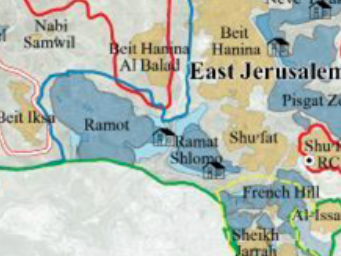 On November 6th, Jerusalem planning authorities granted approval to two settlement projects totalling 652 units in strategic areas that will increase the encroachment of settlements on the Palestinian East Jerusalem neighborhood of Beit Hanina – where the Israeli government is also advancing the first-ever government-backed settlement enclave inside of the neighborhood. This week the Committee approved:
- A plan for 152 new units in the Ramot settlement in northern Jerusalem, extending the settlement’s footprint towards the Palestinian neighborhood of Beit Hanina.
- A plan for 640-units in the Ramat Shlomo settlement, to be built partially on Palestinian land, also extending the settlement north towards an existing settlement enclave inside of the Palestinian Beit Hanina neighborhood.
In granting final approval for the Ramat Shlomo plan, the Jerusalem District Planning and Building Committee decided to increase the number of approved units, from the proposed 500 to 640. And significantly, the Committee rejected serious complaints about expropriating privately owned Palestinian land for settlement purposes.
The Israel anti-settlement watchdog NGO Ir Amim filed one such complaint against the plan, explaining:
“Promoted by Israeli developers claiming ownership of the land in question, the Ramat Shlomo plan exemplifies the endemic discrimination in the planning process that serves to foil Palestinian planning and development. The plan includes Palestinian-owned land, in an area developers have now designated for a park and access road. In order to overcome the legal prohibition against submitting a plan on land not owned by the applicant, the developers successfully engaged the Jerusalem Municipality to sign on as an additional applicant, thereby enabling the expropriation of private Palestinian land.”
Ir Amim researcher Aviv Tartarsky told Haaretz this week:
“It’s very disappointing that the district committee relied on formalistic reasons to approve a step that violates the property rights of Palestinian landowners through and through. These aren’t extremist settlers in outposts somewhere out on hilltops in Samaria [the northern West Bank] but state institutions that are working in Israel’s capital city. This decision is additional proof that Israeli control in East Jerusalem means a regime based on serious discrimination.”
The new approvals add to an ever-growing tidal wave of settlement activity in East Jerusalem affecting the viability of the two-state solution, while tightening the screws on the local Palestinian population.
Claiming Ignorance, State Tells the Court it Will Demolish New Jordan Valley Outpost
Israeli government lawyers told the High Court of Justice that the State of Israel does not know who built an illegal outpost on a disused military base in the Jordan Valley, which settlers have named “Camp Gadi”, and announced that the Civil Administration will demolish it. If the Civil Administration moves to demolishes the outpost, it will require evicting several settler families who are squatting there, and shutting down a pre-military school that the families have been promoting.
The head of the Jordan Valley Regional Council, David Lahiani, seemed to contradict the government’s claim to innocence when he said that he has been in touch with the Civil Administration about legalizing the outpost. If Lahiani has been in touch with the Civil Administration, then questions arise about at what point the Israeli government learned about the outpost and who is behind it. Lahiani’s statement also contradicts (or at least raises questions about) a prior statement from the Jordan Valley Regional Council which denied involvement in establishing the outpost. Further calling into question the role of the Jordan Valley Regional Council, Lahiani was in a picture taken at the outpost which was uploaded to Facebook on October 24th.
Government Officials Lay Cornerstone of “New Migron” Settlement
A cornerstone laying ceremony marked the start of construction on the “New Migron” settlement, to be for the settlers who were removed from the illegal Migron outpost. Several government officials were on hand to lay the cornerstone of the new settlement, plans for which were approved in 2017, near the Kochav Yaakov settlement north of Jerusalem.
In 2011, the Israeli High Court ruled that the Migron outpost must be evacuated because it was built on privately owned Palestinian land. Most of the illegal outpost’s residents were evacuated and most buildings were demolished in Migron in 2012. Determined to demonstrate its support for settlers in the face of this court-compelled evacuation, the government promised to establish two new settlements: “New Migron” (located close to Kochav Yaakov settlement) as well as the approval of a plan for 184 housing units east of the Adam settlement (aka Geva Binyamin). All said, the two new settlements and temporary housing for the evicted settlers cost Israeli taxpayers millions of dollars – sending settlers a clear message that for them, law-breaking pays off.
At the ceremony this week, Jerusalem Affairs Minister Ze’ev Elkin said:
“During such events, it is customary to rejoice, but as someone who accompanied Migron from the moment of the evacuation to the present day, this is not a happy event. We would be happy if we had another legal system that made a logical decision, and I long for the days when the justice system will do justice. The settlement will grow and expand this way from time immemorial. The evacuation attempts will only lead to the strengthening and expansion of settlement.”
Housing Minister Yoav Galant, also at the ceremony, said:
“laying the cornerstone means that the territories of Yehudah and Shomron are not negotiable. It is not a subject for sale. We are laying a cornerstone for Migron and we will build it. I will see to it that the Israeli government does so by the end of the year.”
Knesset Speaker Yuli Edelstein, also in attendance, said:
“I did not come here to convince anyone about our rights in the land of Israel, I came here with mixed feelings of happiness from laying the cornerstone, alongside the great sadness of the difficult evacuation five years ago. We are here, first and foremost, thanks to the families of Migron that did not give up.”
Israel Seizes Palestinian Land to Build New Road to Settlement
According to Maan News, Israeli forces seized 38 acres (155 dunams) of Palestinian land in order to pave a road to the Beit Aryeh settlement, located northwest of Ramallah. Members of the al-Lubban al-Gharbi village council claim that the land is privately owned by Palestinians from the village and called on village residents to find documents proving land ownership in anticipation of an appeal against the construction.
So far this year, the Beit Aryeh settlement has been the beneficiary of two significant settlement advancements totalling 563 new units:
- On August 23, 2018 the Israeli Housing Ministry published a tender for 52 new settlement units in Beit Aryeh.
- On August 11, 2018 the government published a tender for 511 new settlement units in Beit Aryeh.
Bennett Violated Govt Rules to Get a Legal Opinion Supporting the De Facto Annexation of Ariel University
According to a new Haaretz report, Education Minister Naftali Bennett violated Israeli guidelines by using a private law firm to support his Knesset bill bringing settlement colleges and universities under the authority of the Israeli Higher Education Council. Prior to the Knesset’s passage of Bennet’s bill in February 2018, the Higher Education Council only included schools located inside of sovereign Israeli territory. The new law is tantamount to de facto annexation of settlement schools, and members of the Israeli Higher Education Council remain vocally opposed to the move.
The use of a private law firm is seen as an attempt to bypass the Education Ministry’s own apolitical (for now) legal advisors, and is a breach of the guidelines set years ago for every ministry by the Israeli Attorney General. The guidelines stipulate that in cases where private opinions are sought, the legal advisors for the ministry must supervise the process.
Bennet reportedly used an opinion paper issued by the Herzog Fox & Neeman firm stating the inclusion of Ariel University in the domestic Higher Education Council would not violate existing grant terms between universities in sovereign Israel and the European Union (which does not do business in the occupied territories). The opinion was then presented to members of the Higher Education Council to assuage fears that implementing the new law would result in losing international funding. The opinion said that the potential for funding cuts is “nearly non-existent.”
An anonymous senior official with the Higher Education Council told Haaretz:
“You cannot base official policy on an opinion paid for by an interested party. That’s not serious.”
Ariel University has not yet been admitted to the Council, despite the passage of the law in February 2018 and despite Minister Bennett’s repeated threats to end state relations with the Council if it did not immediately grant membership to the school. Israeli President Reuven Rivlin issued a rebuke to Bennett’s threats, saying:
“It’s possible to love Ariel without mocking academia.”
In Reversal, Israeli Ministers Embrace Bill to Allow Knesset to Overrule High Court on Any Issue (Not Just on Deporting Asylum Seekers)
At a meeting on November 4th, ministers in the governing Israeli coalition reportedly decided to abandon a bill that would empower the Knesset to reinstate its plan to deport African asylum seekers after it was struck down by the High Court, in favor of a much more far-reaching bill granting the Knesset the ability to reinstate any law the High Court strikes down. The passage of that bill would likely impact the fate of not only African asylum seekers but settlement-related legislation that has already been passed – most notably,the settlement Regulation Law – and other undemocratic measures that might follow. This news follows an exact opposite announcement two weeks ago, when Justice Minister Ayelet Shaked embraced the single-issue version of the bill, while promising to make the unlimited version a sticking point in any future coalition agreement.
Notably, the leaders of the current governing coalition decided to make this move at a meeting that was not attended by Kulanu Party leader Moshe Kahlon, who has until now blocked the coalition from advancing the unlimited version bill.
Israeli Attorney General Mandelblit vehemently opposes the bill. Mandelblit said:
“One must vigorously oppose this bill, which harms the constitutional regime of the State of Israel as a Jewish and democratic state. Removing all restrictions on undermining the human rights of a specific group, as is proposed now, has far-reaching implications for constitutional law and the democratic regime in Israel, and I strongly oppose it.”
Settlers Group Alleges Palestinians are Undertaking a European-Backed Scheme to “Take Over” Area C of West Bank
The radical settler organization Regavim – which devotes its efforts to systematically mapping out and expelling Palestinians from strategic areas in Jerusalem, the West Bank, and the Negev – presented a new report to the Knesset this week claiming that the Palestinian Authority (PA) is using European funding to take over land in Area C of the West Bank. The report alleges that the PA uses European money to pave roads, build on strategic military and diplomatic locations, and “steal” water resources, at the expense of Israel.
Regavim warns:
“If the government does not come to its senses and does something now, the Palestinian plan will create irrevocable changes and facts on the ground.”
Adding irony to Regavim’s current efforts to stop “illegal” Palestinian activity in the West Bank, in August 2018 the Israeli daily newspaper Yedioth Ahronoth published a comprehensive investigation into Regavim’s leaders. The group’s stated mission is “to ensure responsible, legal, accountable & environmentally friendly use of Israel’s national lands and the return of the rule of law to all areas and aspects of the land and its preservation.” The investigation revealed, however, that the organization’s efforts to identify and stop illegal construction are merely a tool to dispossess Palestinians of their land.
The Investigation found, in fact, that Regavim and its leaders have a demonstrable disregard for the Israeli planning and building laws that they purport to be dedicated to enforcing, evidenced most plainly by the fact that 15 Regavim officers are living in structures built on privately owned Palestinian land, some with demolition orders issued against them. These include the building where Yehuda Eliyahu, the current executive director of Regavim, lives.
UN Report Details Israel’s De Facto Annexation of West Bank Land
The United Nations Special Rapporteur on Situation of Human Rights in Palestinian Territories, Michael Lynk, issued a new report to the UN General Assembly – half of which is devoted to documenting the Israeli government’s annexation of Palestinian land in East Jerusalem and de facto annexation of land in the occupied West Bank.
The report concludes in part:
“These statements of political intent, together with Israel’s colonizing acts on the ground, its legislative activity, and its refusal to adhere to its solemn obligations under international law or to follow the direction of the international community with respect to its 51-year-old occupation, have established the probative evidence that Israel has effectively annexed a significant part of the West Bank and is treating this territory as its own. While Israel has not yet declared formal sovereignty over any parts of the West Bank, the Special Rapporteur submits that the strict prohibition against annexation in international law applies not only to a formal declaration, but also to those acts of territorial appropriation by Israel that have been a cumulative part of its efforts to stake a future claim of formal sovereignty over the occupied Palestinian territory.”
Four Alleged Security incidents Near Settlements
In the past three days, Israeli authorities have reported four security incidents near settlements:
On November 7th, the IDF reported that unknown assailants shot at a bus and lightly injured two Israelis near the settlement of Beit El, located deep inside the West Bank near Ramallah.
On November 6th, three Palestinian men were arrested near the Mevo Dotan settlement, south of Jenin, one of whom was allegedly carrying a gun.
Earlier on November 6th, a Palestinian woman was shot and arrested near the Kfar Adumim settlement, between Jerusalem and Jericho,after allegedly attacking Israeli border policemen with a pair of scissors.
On November 5th, a Palestinian man was shot and arrested after allegedly attempting to stab Israeli settlers and an Israeli IDF officer near the Kiryat Arba settlement, in Hebron.
Bonus Reads
- Khan al-Ahmar and Israel’s Creeping Annexation of the West Bank” (Newsweek)
- “Everyone Knows Settlers Cut Down Palestinian Olive Trees. But Israel Doesn’t Care” (Haaretz)
- “Settler leaders warned Rabin not to ‘cross redlines’ before assassination” (Times of Israel)
- “Hard Questions, Tough Answers: Why the Israeli mainstream turned right” (Americans for Peace Now)
- “An Interview with MK Sharen Haskel” (Fathom Journal)
- “Israeli justice minister opposes letting government jurists act as ‘gatekeepers’” (Haaretz)
Welcome to FMEP’s Weekly Settlement Report, covering everything you need to know about Israeli settlement activity this week.
To subscribe to this report, please click here.
October 25, 2018
- More Evidence of WZO Support for Illegal Settlement Activity
- Israel to Expropriate More Palestinian Land to Widen West Bank Highway
- Settlers Take Over Another Building in Silwan
- Hugely Disproportionate Amount of Government Grants to Regional Councils Go to Settlements
- Fearing Unfavorable Court Ruling, Palestinians Petition ICC to Stop Hebron Settlement Plan
- Cabinet to Consider Bill to Allow the Knesset to Overrule the High Court of Justice
- Knesset Advances Bill to Politicize Legal Advisors
- More Drama Surrounding Palestinians Who Sold Old City House to Settlers
- Israeli “Sovereignty Movement” Asks Candidates About Annexation Views
- Bonus Reads
Comments, questions, or suggestions? Email Kristin McCarthy at kmccarthy@fmep.org.
More Evidence of WZO Support for Illegal Settlement Activity
The Israeli non-profit organization Kerem Navot revealed new documents offering new evidence that the Settlement Division of the World Zionist Organization employs unlawful practices in its drive to help settlers build illegal outposts and unauthorized settlement structures on Palestinian land in the West Bank. The documents show that the WZO’s Settlement Division has regularly engaged in practices including:
- Granting loans – using taxpayer money – for illegal construction of settlement unauthorized outposts;
- Accepting highly questionable “collateral” from the settlers to guarantee such loans, including sheep, a chicken coop, date trees, and agricultural equipment; and
- Providing false confirmations to private banks that settlers owned or were legally working land, in order to enable settlers to acquiring private mortgages for homes in unauthorized outposts and/or homes built illegally in existing settlements.
Dror Etkes, founder of Kerem Navot, told Haaretz:
“It’s been obvious for years that the [Settlement] division has adopted unlawful patterns of operation after assuming the role of contractor carrying out the dirty work that state authorities have tried to distance themselves from having direct responsibility for. The documents show systematic and continuous unlawful conduct intended to support the most extremist and violent elements among the settlers, people who are responsible for the expulsion and expropriation of Palestinian communities from wide areas of the West Bank.”
The WZO’s Settlement Division was created by the Israeli government in 1968 – and is funded entirely by Israeli taxpayers. Its mandate is to manage West Bank land expropriated by Israel, in order to facilitate the settlement of Israeli Jews in the occupied territories. To make this possible, the Israeli government has allocated approximately 60% of all “state land” to the WZO’s Settlement Division [over the past 50 years Israel has declared huge areas of the West Bank to be “state land,” including more than 40% of Area C, where most of the settlements are located]. But apparently that wasn’t enough for the WZO’s Settlement Division: settlement and human rights watchdogs have repeatedly documented how it has worked to take over additional land, including privately owned Palestinian land, in order to build more settlements.
Despite the controversies, in June 2018 the Knesset gave preliminary approval to a bill that would hand over almost all of Area C to the WZO’s Settlement Division. Peace Now responded at the time:
“the government is scandalously planning to give the biggest land thieves responsibility for managing the land distribution, which will continue to be done under the cover of darkness if the bill passes into law.”
Israel to Expropriate More West Bank Land to Widen West Bank Highway
According to Palestinian press reports, the Israeli Minister of Transportation Yisrael Katz has greenlighted a project to confiscate vast tracts of Palestinian land in the West Bank, in order to widen a section of the West Bank’s main north-south highway, Route 60, in an area spanning between Bethlehem-area settlements to Hebron-area settlements. In addition to confiscating land to add two lanes to the road (doubling the number of lanes from 2 to 4), Palestinians fear that the highway expansion is part of a larger project seeking to expand the West Bank settler population to 1 million Israelis by 2030, as promised by Education Minister and the leader of the Jewish Home party Naftali Bennet. The Israeli Transportation Ministry has reportedly allocated $50 million to the project.
Highway 60 is the sole major roadway providing north/south contiguity through the West Bank. Palestinian access to Route 60 is restricted in sections near settlements, and Route 60 has been completely severed between Jerusalem and Bethlehem by Israel’s separation barrier (there is literally a wall across the highway) in order to include the Efrat settlement on the Israeli side of the barrier. The economic, political, and social impacts of the closure of Highway 60 have been severe for the Palestinian population.
Settlers Take Over Another Building in Silwan
Ir Amim reports that the last remaining Palestinian tenants have been evicted from an apartment building located in the Batan al-Hawa section of Silwan, the site of the single largest settler takeover operation in East Jerusalem since the annexation of East Jerusalem in 1967.
The Abu-Sneina family was the last tenant in a 4-story, 10-unit building. The Israeli Custodian General transferred ownership of the building to the Ateret Cohanim settler organization (which works to establish Jewish enclaves inside densely populated Palestinian neighborhoods of East Jerusalem) in 2015, based on the settlers’ taking over management of the Benvenisti Trust, which oversaw the assets of Yemenite Jews who lived in the neighborhood in the 19th century. Palestinians have challenged the legitimacy of the Benvinisti Trust’s rights to the currently existing buildings, saying that the trust only covered the old buildings (none of which remain standing) and not the land. Indeed, the State admitted to the Courts on June 10, 2018 that the land had been transferred to the Benvenisti Trust/Ateret Cohanim without a proper investigation into its legal status. On June 17, 2018, the Israeli High Court of Justice ordered the Israeli government to provide more information and an explanation of the decision to give the land/buildings to the Trust. Nonetheless, in September 2018 the Jerusalem Magistrate Court ruled that evictions could proceed in buildings that Ateret Cohanim controls, even though Ateret Cohanim’s ownership of the buildings – based on its control of the Trust – remains in legal question.
As FMEP has previously reported, Ateret Cohanim is implementing a multifaceted campaign to remove Palestinians from their homes in the Batan al-Hawa section of Silwan, claiming that the Palestinians are illegally squatting on land owned by the Trust. To date, Ateret Cohanim has managed to acquire the deeds to six Palestinian homes in Batan al-Hawa, inserting some 20 Israeli Jewish families in place of evicted Palestinian residents. The organization has eviction orders pending against an additional 21 homes, with 800 Palestinians at risk of eviction.
Yakoub al-Rajabi, a Palestinian resident of Batan al-Hawa, recently told The Washington Post:
“We know that this was a well-orchestrated plan to force us to leave. And if we stay, it will paralyze us and isolate us in our homes.”
In a 2016 report that covers the Batan al-Hawa situation in detail, Ir Amim and Peace Now underscore the significance of Ateret Cohanim’s efforts:
“If the settlers are successful, Batan al-Hawa is anticipated to become the largest settlement compound in a Palestinian neighborhood in the Historic Basin of the Old City, with the outcome of significantly tightening the emerging ring of settlements around the Old City and severely undermining the possibility of a future two state solution in Jerusalem.”
Celebrating the takeover of another building in Batan al-Hawa in August 2018, Ateret Cohanim director Daniel Luria told The Times of Israel:
“Every acquisition is very difficult. We’re up against a mobilized Arab world, parts of which are violent. There is huge pressure and millions of dollars are being pumped in to strengthen the Arab hold on the city…[the] biggest problem is trying to get the Jewish world to understand what needs to be done. We have the best relations ever with a US administration. For [US Vice President Mike] Pence and [US Ambassador to Israel David] Friedman and the others, [settling Jews in East Jerusalem] is a no-brainer. What’s our right-wing government waiting for? It’s not about what the US says. It’s about what we do. We are not doing anything to stop the peace process but will not compromise on a millimeter of Jerusalem. You have to show strength of conviction and sovereignty to have peace and coexistence. This can only happen when you live together under Jewish sovereignty.”
Hugely Disproportionate Amount of Government Grants to Regional Councils Go To Settlements
The Knesset Research and Information Center issued a report revealing that 25% of all state funds allocated to Israeli regional councils are given to West Bank regional councils, despite the fact these settlement regional councils account for just 5% of all regional councils operating on both sides of the Green Line.
Examining funding channels – including grants to regional councils for education, welfare, and for projects of the Interior Ministry – it was found that the settlement regional councils are far better funded than those located in sovereign Israel. Putting a fine point on the discrepancy, a student attending school in a settlement receives nearly twice the amount of government benefits per year as compared to a student studying in sovereign Israeli territory.
MK Stav Shaffir (Zionist Union), who ordered the report, points out that the report doesn’t even begin to document the total amount of money that the government diverts from sovereign Israel into settlements:
“This is only the tip of the iceberg, since the report doesn’t include the budgets that are transferred outside the budget plan, like the Settlement Division’s budgets that are mostly invested in the West Bank settlements and not in the State of Israel.”
The Adva Center, an Israel non-profit that documents and analyzes the cost of occupation on the state budget, published a report [full report in Hebrew, executive summary in English] in August 2018 showing that Israel is not only disproportionately funding settlement councils in general, but in particular is disproportionately funding settlement councils located deep inside of the West Bank, in areas that are most problematic to any future attempts to draw borders for a two-state solution. Adva writes:
“Non-Haredi settlements in the occupied territories are still to be found at the top on 3 measures. Compared to several other types of municipalities – the 15 most affluent Israeli localities, the largely Mizrahi “development towns,” the Arab localities within Israel, and Haredi settlements, the non-Haredi settlements continue to enjoy the largest per capita municipal expenditure, the largest per capita central government “designated” subsidy (mainly for education and social welfare services), and the largest per capita central government balance grant. The non-Haredi settlements, on the other hand, include, among others, the so called “ideological” settlements, many of them deep inside Palestinian territories and strongly opposed to the creation of a Palestinian state.”
Fearing Unfavorable Court Ruling, Palestinians Petition ICC to Stop Hebron Settlement Plan
On October 18th, top Palestinian diplomat Saeb Erekat sent a letter to the International Criminal Court (ICC) asking it to expedite the launch of a criminal investigation into Israeli settlement activity, citing the urgency of preventing the construction of a new 31-unit settlement in the heart of Hebron. Palestinians most recently referred a case against Israeli settlements to the ICC for investigation in May 2018, its eighth referral on the matter.
Speaking to Al-Monitor, Tawfiq Jahshan – a lawyer for the Hebron Rehabilitation Committee – explained that Erekat’s letter might have been motivated by the Israeli government’s decision to approve the new settlement plan despite pending litigation against it. Jahshan said:
“There were deliberations [about petitions against the plan] and hearings. Most recently in June, the final hearing was postponed and the decision was to be notified — once issued — by way of email. But surprisingly Israel’s Cabinet approved Oct. 14 the financing of the project. By acting before the issuance of the judicial decision, the Israeli Cabinet gave the green light to the judges to refuse the objection…There is no competent Palestinian judicial body to examine such cases, so we have to resort to Israeli justice often unfair to us. Resorting to the ICC is a necessary step to face the injustice shown by the Israeli judiciary.”
To date, the Israeli Defense Ministry has not issued a response to either of the two formal complaints filed against the settlement plan. Both petitioners – the Hebron Municipality and Peace Now – have stated they will appeal the case to High Court of Justice if the Defense Ministry decides the settlement can be built.
Cabinet to Consider Bill to Allow the Knesset to Overrule the High Court of Justice
Israeli Justice Minister Ayelet Shaked and her Jewish Home party have decided to advance a new, narrow version of the so-called High Court override law which will make it impossible for the High Court of Justice to strike down the Knesset’s plans to deport African asylum seekers and migrants. The new version has been narrowed in order to gain support from parties that are willing to see the High Court overruled when it comes to Africa asylum seekers, but opposed to a broader overrule law.
The decision to advance the narrower version increases the likelihood that the law will pass, and in so doing deals another body blow to Israel’s judicial system. At the same time, the decision drew protest from hardliners. Seeking to assuage right-wing critics of the limited plan, Shaked announced that Jewish Home will demand support for the broader version of the law as a part of a future coalition agreement (elections are widely expected to be called soon, meaning the governing coalition agreement will need to be renegotiated). If the broader version passes into law, the Knesset will be able to reinstate any law struck down by the High Court (including most relevantly, the settlement Regulation Law, if it is struck down as expected).
Economic Minister Moshe Kahlon (leader of the Kulanu Party, which is part of the current governing coalition) has effectively blocked the broader bill from moving forward by whipping his party members to stand firm against it. Kahlon has taken heat from all sides concerning his support for the limited version this week. From the left, Zionist Union MK Michal Biran said:
“Kahlon declared he would support a narrow notwithstanding clause, concerning the infiltrators. Meaning, in some cases it’s allowed to bypass the High Court, but in other cases it’s not. Kahlon’s attempt to run between the raindrops in this extremist right-wing government shows lack of ideology, lack of trust in the justice system, and lack of trust in the fact the public is not stupid. Kahlon’s voters wanted to see a man in the government who represents the sane center, and got a submissive slave of Netanyahu. With his own hands Kahlon is helping bypass Basic Law: Human Dignity and Liberty over political whims.”
From the right, MK Shuli Mualim said:
“This is a test Minister Kahlon, who has for months been preventing the enactment of the broader legislation on the issue … the bill formulated now is exactly the kind of bill Kahlon claimed he would support. I expect him to keep his promises to the residents of southern Tel Aviv.”
The narrow bill will be presented to the Ministerial Committee on Legislation at its next meeting on October 28th, and is expected to receive the seal of government-backing. If the committee votes to back the bill, it will then be sent to the Knesset where it will need to pass three readings.
Knesset Advances Bill to Politicize Ministerial Legal Advisors
On October 22nd, the Knesset’s Constitution, Law, and Justice Committee reviewed a bill being promoted by Justice Minister Ayelet Shaked that, if passed, will allow each government minister to select his/her own ministerial legal advisor, a move which politicizes a key office charged with ensuring that the rule of law is followed when implementing policy. Legal advisors have the authority to block actions of the minister if they are deemed unlawful, a critical power that requires political independence from the ruling coalition and party figure at the head of the ministry. The bill has already passed its first Knesset reading.
The Haaretz Editorial Board published blistering piece on the bill, writing:
“Instead of legal advisers who are honest, independent, loyal to the law and prepared to warn against illegal, corrupt and improper activity, we will have legal advisers who close their eyes to government corruption and who will be prepared to whitewash anything. Instead of independent advisers we will get dependent and submissive ones.”
There has been widespread criticism of Shaked’s bill, including from Israeli Attorney General Avichai Mandelblit (who argued against the law before the Knesset), Israeli President Reuven Rivlin, and many other legal luminaries.
More Drama Surrounding Palestinians Who Sold Old City House to Israeli Settlers
The Israeli Shin Bet arrested (and later released) two Palestinian Authority (PA) officials suspected of abducting a Palestinian-American real estate dealer who was allegedly involved in the sale to an Israeli settler organization of a house in the Muslim Quarter of the Old City, abutting the al-Aqsa Mosque. The two men arrested were Adnan Ghaith, who was appointed as the Governor of Jerusalem by the Palestinian Authority (PA), and Jihad al-Fakih, the director of the PA’s intelligence efforts in Jerusalem. The PA claims that the Palestinian-American man surrendered himself willingly into its custody, where he reportedly remains under interrogation at the order of President Abbas. The unnamed individual’s family has submitted requests for help to the American Embassy in Jerusalem. The U.S. State Department has said it is in touch with the PA about the reports.
Israeli “Sovereignty Movement” Asks Candidates About Annexation Views
The settler organization known as the “Sovereignty Movement” has polled candidates running in the upcoming Israeli local elections on their support for annexation policies. The resulting compendium of candidate statements in support of annexation was published in the Arutz Sheva settler-aligned news outlet.
Local elections will be held October 30th across Israel and West Bank settlements. The Sovereignty Movement released a statement calling on candidates to support annexation, saying:
“Implementing Israeli sovereignty in Judea and Samaria constitutes the next essential step in the Zionist vision of the return of the People of Israel to its Land, and a vital step in security, but is also necessary in order to provide civil rights for the residents of Judea and Samaria that is equal to those of the rest of the citizens of Israel. The heads of local authorities understand well the difficult challenges in dealing with military figures to promote even the elementary civil needs of the residents. Applying sovereignty will put a stop to the discrimination and harming almost a half-million Judea and Samaria residents. This is the time to tell the different candidates in the various authorities: Support sovereignty and we will vote for you!.”
Bonus Reads
- “Israel Has Chosen Settlements Over Security” (The Forward)
Welcome to FMEP’s Weekly Settlement Report, covering everything you need to know about Israeli settlement activity this week.
To subscribe to this report, please click here.
October 18, 2018
- Full Speed Ahead on “Legalizing” Illegal Outposts
- Israeli Cabinet Approves $6.1 Million in Funding for New Settlement in Hebron
- Ambassador Friedman Stand With Settlers (Literally) in Ariel
- Closure of U.S. Consulate Stokes Annexation Hopes/Fears
- B’Tselem Head to UN Security Council: Israel’s Settlement Policies Have Created Bantustans in West Bank
- If Not Now: 5 Ways American Jews Are Supporting Occupation
- Arab League Issues Report Slamming “Accelerating” Settlement Growth and “Apartheid” Policies
- Bonus Read
Comments, questions, or suggestions? Email Kristin McCarthy at kmccarthy@fmep.org.
Full Speed Ahead on “Legalizing” Illegal Outposts
Two outpost-related developments this week underscore the Israeli governments seriousness about moving ahead with its plans to suspend even the pretense of respect for the rule of law for the sake of settlements.
First, the Knesset’s Internal Affairs Committee is calling for the Israeli Civil Administration and Prime Minister Netanyahu to act by the end of the year to retroactively legalize 20 settlement outposts built on without Israeli government authorization on privately owned Palestinian land, with 50 more outposts to follow. Speaking to the Knesset Committee on October 15th, Pinchas Wallerstein, the longtime settler leader whom the government appointed to lead its ongoing effort to move ahead with legalization of the outposts, argued that the Civil Administration can “easily” authorize 15-20 outposts by including them as neighborhoods of existing settlements, and that an additional 50 outposts can be legalized but will require more complicated solutions. It is worth recalling here that in the years before the took this new job, Wallerstein: was prosecuted for knowingly violating Israeli law by illegally building a sewage plant near the Ofra settlement on private Palestinian land; admitted to issuing forged building permits for settlement construction without the authority to do so; and admitted to lying to government authorities to expedite the construction of the (since evacuated) building the Amona outpost. The Civil Administration’s High Planning Council – the arm of the Israeli Defense Ministry which is the sovereign power in the West Bank (and therefore responsible for regulating construction there) – is expected to meet one more time this year to advance and approve settlement construction plans.
As FMEP has tracked, the effort to legalize 70 outposts built on privately owned Palestinian land started in earnest following the passage of the Regulation Law in February 2017. That law gave the Israeli government new, sweeping authority to legalize outposts the status of which it has been unable to otherwise address under existing Israeli law (which, consistent with a basic tenet of rule of law, did not permit the State, in effect, to condone one set of individuals engaging in the outright theft of private property belonging to another set of individuals). Notably, the 2005 Sasson Report concluded that there was no possible way to legalize outposts built on privately owned Palestinian land, and concluded that all such outposts should be evacuated. However, based on new authorities granted to the government under the Regulation Law, the Israeli government has moved ahead with legalization efforts, despite the fact that the Regulation Law was subsequently frozen while the High Court weighs its constitutionality (and remains frozen at this time). These efforts include establishing in May 2017 a special committee (known as the Zandberg Committee, named for its chairwoman, Haya Zandberg, who was since named a Jerusalem district court judge), which in May 2018 issued recommendations for how Israel could retroactively legalize all outposts within three years; and they included appointing Pinchas Wallerstein to take charge of the subsequent legalization push (despite pushback from the Justice Ministry).
In July 2018, MKs Bezalel Smotrich (Habayit Hayehudi) and Yoav Kisch (Likud) sought to speed up the implementation of the Zandberg Report’s recommendations by submitting a bill for consideration by the Israeli Cabinet, aiming to directly legalize the 70 unauthorized outposts across the West Bank. The Cabinet has not yet called that bill up for consideration.
In this week’s second outpost-related development, Justice Minister Ayelet Shaked has received approval to appoint a Justice Ministry representative to the coordination team which supervises and directs the work of the outpost legalization committee described above. Taking orders from and reporting to Shaked, the new Justice Ministry representative to the coordination team will ensure that Shaked’s influence shapes the committee’s work. FMEP has repeatedly documented the many ways Shaked has inserted herself into government matters involving settlements and outposts – all in order to ensure the Israeli government acts to protect settlers, ensure their continued permanence in the West Bank, and prepare the way for the ultimate annexation of Area C. The totality of Shaked’s efforts are documented, on an ongoing basis, in FMEP’s Annexation Policy Tables.
To be clear: if implemented, the retroactive legalization of outposts built on privately owned Palestinian land will dismantle even the pretense of Israeli respect for the rule of law in West Bank, in effect rewarding Israelis for breaking the law. It will do so not for the sake of Israeli security or the interests of the Israeli population as a whole, but rather for the sole benefit of settlers. If implemented, the recommendations will “legalize” the outright theft of land recognized by Israel as privately owned by Palestinians and will lay the groundwork for continued, additional expropriation of privately-owned land for settlement-related construction.
Developments related to these efforts are tracked in FMEP’s annexation policy tables.
Israeli Cabinet Approves $6.1 Million in Funding for New Settlement in Hebron
On October 14th, the Israeli Cabinet voted to expedite the establishment of a new settlement in the heart of downtown Hebron and pay the bill – totalling $6.1 million (22 million shekels) – from several ministries – for its construction. FMEP reported on the plan for 31 settlement units on Shuhada Street in last week’s Settlement Report, including two legal challenges filed by Peace Now and the (Palestinian) Municipality of Hebron. If implemented, this will be the first new government-backed settlement in downtown Hebron since 2002.

Map by Haaretz
The new settlement will require significant renovations to transform a military base into a new settlement, to include 31 residential units, a kindergarten, and “public areas.” The Defense Ministry will contribute about $770,000 (2.8 million shekels), and the Science, Technology and Space Ministry, the Environmental Protection Ministry and the Ministries of Social Equality, Justice, and Education are also committed to subsidizing the project.
MK Ayman Odeh (Joint List) slammed the Cabinet’s decision, saying:
“Twenty-two million shekels to expand the occupation. Straight from government ministries near your home. The divisive and inciting right-wing government is continuing to inflame the region and then shouts that there is no partner. For the benefit of a handful of extremist settlers, the government is trampling its citizens.”
Ambassador Friedman Stand With Settlers (Literally) in Ariel
While making a very strong political statement with his attendance at a private business conference in the Ariel settlement, U.S. Ambassador David Friedman continued to publicly champion settlement industrial zones as meaningful “coexistence” and “peace” projects that advance U.S. peace efforts. Following the event, Ambassador Friedman tweeted:
“At the invitation of the Judea and Samaria Chamber of Commerce, I met in Ariel with Palestinian & Israeli business leaders ready, willing & able to advance joint opportunity & peaceful coexistence. People want peace & we are ready to help! Is the Palestinian leadership listening?”
A U.S. Embassy spokesperson released a statement on the Ambassador’s support for business “coexistence” programs, saying:
“In support of the President’s peace plan, U.S. Ambassador Friedman is working to promote peaceful coexistence and stronger people to people connections between Israelis and Palestinians because people that work together and do business together are more likely to form bonds of friendship and live together in peace. The ambassador was encouraged by the enthusiasm and commitment of the Israeli and Palestinian business leaders he met with yesterday to work together to create more economic opportunity and peaceful coexistence within the region.”
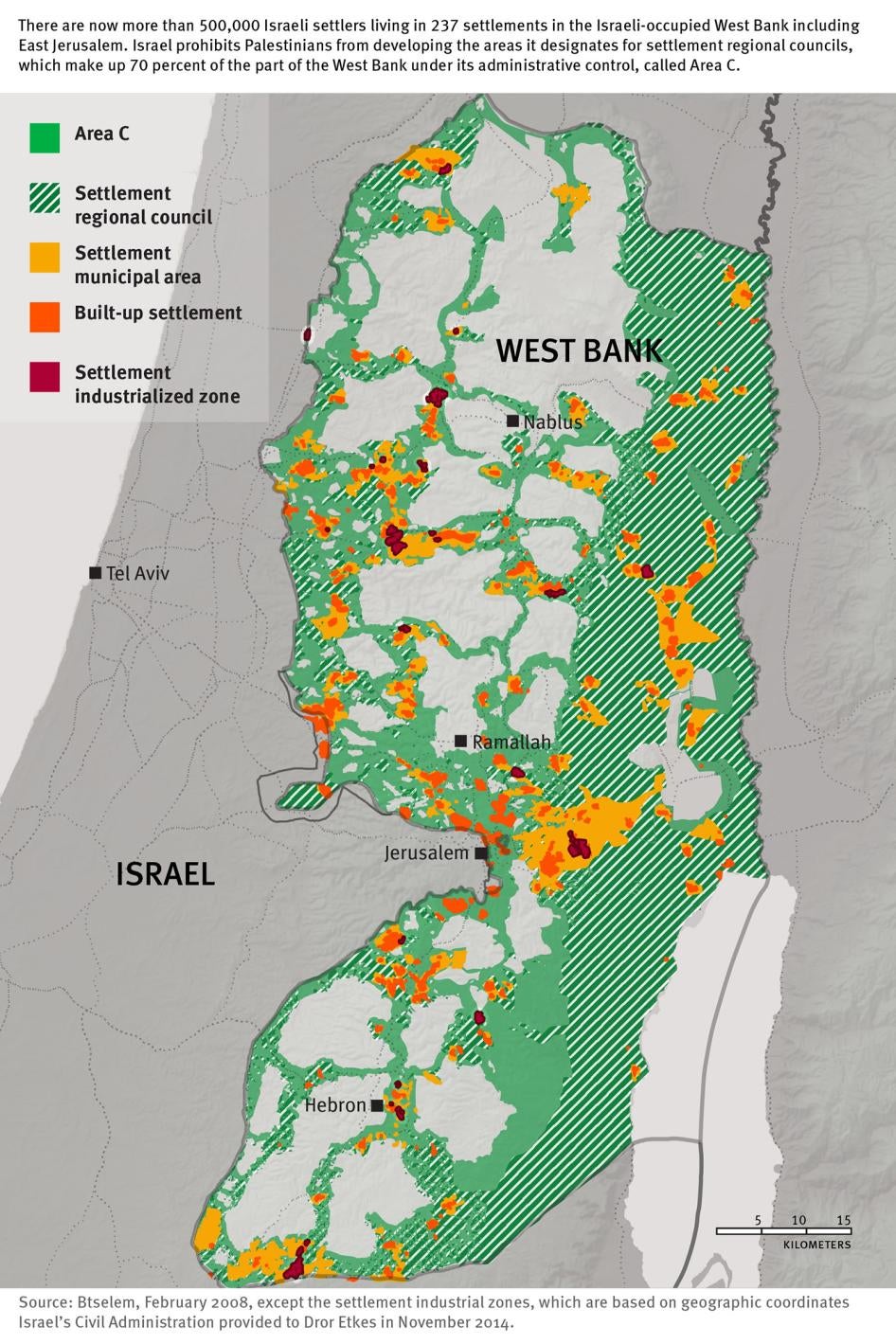
Map by Human Rights Watc
In last week’s settlement report, FMEP linked to several resources acknowledging and explaining the perversity of labeling Israel’s economic exploitation of occupied territory (including the local workforce, land, and other natural resources) “coexistence” or suggesting that it brings to the Palestinians benefits they should welcome. Adding to that, a new piece in The New York Times quoted a spokesman for the Palestinian Authority explaining the Orwellian reality of settlement industrial zones:
“Somebody occupies your country, steals your land, steals your water, steals your resources, then says: ‘I’ll make a good deal for you if you come work for me. I’ll create jobs for you. We are not occupiers. We are employers.’ This is ridiculous. The colonial settlements are illegal in every sense of the word.”
The media also widely reported this week that Friedman’s participation in the event at Ariel was the first time a U.S. ambassador had traveled to an Israeli settlement in his/her official capacity – despite the fact that Friedman has previously visited settlements since taking up official duties. Regardless, Friedman’s very public act of traveling to and speaking at Ariel should put to rest any remaining speculation about whether the U.S. had changed its policy refraining from official travel there.
Americans for Peace Now reacted to the events of the week, saying:
“Friedman’s idea of Israeli-Palestinian peaceful coexistence is what he found under Israeli military occupation, in a settlement that is one of the largest obstacles to Israeli-Palestinian peace.”
J Street released a statement saying:
“By making an official public appearance at an event in an Israeli West Bank settlement, Ambassador Friedman once again crossed a major, longstanding red line of bipartisan US policy. The Trump administration continues to send a clear message of support for the settlement movement and the agenda of the Israeli right. Indeed, the ambassador, himself a longtime benefactor of the settlement movement, has actively worked to erode the distinction between Israel and the occupied territory it controls beyond the Green Line. With unprecedented actions like these, the Trump administration is driving home the point that they have no real interest in promoting a two-state solution to resolve the Israeli-Palestinian conflict — now or in the future.”
Closure of U.S. Consulate Stokes Annexation Hopes/Fears
On October 18th, the U.S. State Department announced that it is closing the U.S. Consulate in Jerusalem and folding its functions into a new “Palestinian Affairs Unit” within the U.S. Embassy. For decades, the U.S. Consulate General in Jerusalem – one of the only fully independent Consulates the U.S. maintains anywhere in the world, reporting directly to Washington, rather than operating under the authority of an embassy – has functioned as the de facto U.S. embassy to the Palestinians. As such, its existence carried important symbolism for Palestinian national aspirations, signaling that the U.S. viewed Palestinian affairs and its relations with Palestinians and their leaders not merely as a subset of issues between Israel, but as a matter of importance to the U.S. in its own right, and as a separate bilateral relationship.
The downgrading of U.S. relations with the Palestinians implied by this shift in operations – the implications of which are well understood both by Palestinians and the Israeli right – has inspired celebration from Israel’s pro-annexationist leaders, and stoked despair amongst Palestinians.
Commenting on the move, FMEP President Lara Friedman tweeted:
“Added to recent closure of PLO mission in Washington, it cements new reality of US w/ NO direct, bilateral relationship with Palestinians – any/all relations will now be wholly-owned subsidiary of US-Israel ties…completing the roll-back of relations to pre-Madrid era.”
Saeb Erekat released a statement saying:
“The Trump Administration is making clear that it is working together with the Israeli Government to impose Greater Israel rather than the two-state solution on the 1967 border. The US administration has fully endorsed the Israeli narrative, including on Jerusalem, Refugees and Settlements.”
Former Israeli Ambassador to the U.S. and current Deputy Minister for Diplomacy, MK Michael Oren tweeted:
“A great day for Israel, Jerusalem, and the United States. SoS Pompeo’s announcement closing the U.S. consulate in Jerusalem and transferring its responsibilities to the embassy ends the last vestige of American support for the city’s division. Israel is deeply grateful.”
Peace Now tweeted:
“The downgrading of the unofficial US embassy for Palestinians in Jerusalem coincides this week with the US Ambassador to Israel’s decision to cross the red line on visiting settlements when he visited Ariel. The writing is on the wall.”
Americans for Peace Now released a statement saying:
“Downgrading the US diplomatic mission to the Palestinians to a subsidiary of the US embassy to Israel signals that American policy toward the Israeli-Palestinian conflict has changed dramatically. It puts a giant question mark over the assumption of a future Palestinian state. It is yet another gesture in a series of humiliating measures toward the Palestinians and their leadership by the Trump administration. More than anything, this measure signals an acceptance, if not outright embrace, of Israel’s accelerating process of annexing the West Bank, a declared goal of the most extreme right-wing elements in Israel’s governing coalition. The fact that this ‘merger’ (more accurately, a hostile takeover) will be led by US Ambassador to Israel David Friedman makes this development even more alarming. David Friedman has openly and publicly attacked the two-state solution. He is an avid supporter and past financier of Jewish settlements in the West Bank and has been openly contemptuous of the Palestinian leadership, availing himself of any opportunity to demean it. Disastrously, Friedman has emerged as the architect of the Trump administration’s calamitous policy toward the Israeli-Palestinian conflict and no one within the administration is willing or able to stop him from ramming through his agenda.”
B’Tselem Head to UN Security Council: Israel’s Settlement Policies Have Created Bantustans in West Bank
Addressing the United Nations Security Council on October 18, 2018, B’Tselem President Hagai El-Ad said:
“…All this is often referred to as “the status quo.” Yet there is nothing static about this reality. It is a calculated and deliberate process of slowly splitting up an entire people, fragmenting their land, and disrupting their lives: separating Gaza from the West Bank, breaking up the West Bank into small enclaves, and walling off East Jerusalem from the rest of the West Bank. Eventually, what remains are isolated bits, the easier to oppress: a family slated for “eviction” in the East Jerusalem neighborhood of Silwan; a community such as ‘Urif, south of Nablus, trying against all odds to hold on to its land and farm it in the face of Israel’s long arm of unchecked settler violence; or Area A of the West Bank, conveniently said to be “under full Palestinian control,” but in fact essentially large Bantustans, slowly but surely being hemmed in by ever more new or expanding Israeli settlements. None of this is random. All of it is policy-driven. Two of the latest and most conspicuous examples are Israel’s conduct in the recent protests in Gaza, and its plans for Khan al-Ahmar, a Palestinian shepherding community. Some 200 people live in Khan al-Ahmar, just a few kilometers east of Jerusalem, in an area where Israel has long endeavored to minimize Palestinian presence and expand settlements.”
If Not Now: 5 Ways American Jews Are Supporting Occupation
The American Jewish group If Not Now published a new report entitled, “Beyond Talk: Five Ways the American Jewish Establishment Supports the Occupation.” Settlements factor in heavily in the critique.
A few of If Not Now’s findings:
- Between 2009 and 2013, 50 American 501(c)(3) non-profit organizations gave over $220 million in tax-deductible donations to settlements and other extreme right-wing organizations, according to an investigation of American and American Jewish organizations’ IRS tax forms conducted by Israel’s Haaretz newspaper.
- Jewish Federations in cities around the country allow donors to funnel money through donor-advised funds to pro-Occupation organizations that fund extreme right-wing settlers. At the same time, they prevent donors from using these funds to support groups that have expressed support for Palestinian rights, such as the National Lawyers Guild, Jewish Voice for Peace, and IfNotNow.
- In addition to lobbying for Israel, the majority of Jewish institutions lobby against any and all criticism of Israel’s Occupation. Of all American Jewish organizations with large national memberships, only Americans for Peace Now, Jewish Voice for Peace, J Street, and the New Israel Fund supported the U.S. administration’s abstention in the December 2016 United Nations Security Council Resolution recognizing Israel’s settlements as illegal under international law. The mixture of condemnation and silence from every other national American Jewish organization demonstrates an investment in a status quo that benefits settlement expansion over Palestinian rights.
The entire report (with extensive citations for the above facts) is available online here.
Arab League Issues Report Slams “Accelerating” Settlement Growth and “Apartheid” Policies
On October 14th, the Arab League issued a report condemning Israeli settlement construction, which the group cites as happening at “an accelerating pace amid U.S. acceptance and encouragement and absence of international accountability.” The report continues, “Israel systematically allocates lands for Jews as part of a policy that can only be described as apartheid.”
Bonus Read
- “Settlers Accused of Targeting Palestinian Olive Trees As Harvest Kicks Off” (Times of Israel)
Welcome to FMEP’s Weekly Settlement Report, covering everything you need to know about Israeli settlement activity this week.
To subscribe to this report, please click here.
October 12, 2018
- Israeli Cabinet to Expedite Construction of 1st New Settlement in Hebron in 16 Years
- Israeli Settlers Move Into a House in Jerusalem’s Old City, Next to Temple Mount/al-Haram al-Sharif
- Settler’s New Silwan Property Sits on Massive Settler-Driven Excavation Site
- De Facto Annexation: Israel Applies Two Domestic Agricultural Laws to West Bank Settlements
- Government Approves Funds for Settlement Propaganda Film
- Shaked: Annexation Plan Can Accommodate 100,000 Palestinian Citizens in Area C
- Murder Prompts Critical Coverage of Settlement Industrial Zones
- Bonus Reads
Comments, questions, or suggestions? Email Kristin McCarthy at kmccarthy@fmep.org.
Israeli Cabinet to Expedite Construction of 1st New Settlement in Hebron in 16 Years
Israeli Defense Minister Avigdor Liberman announced on October 11th that he expects the Israeli Cabinet to move to expedite plans to build 31 new settlement units on Shuhada Street in the heart of downtown Hebron. The units, which would be the first new construction in Hebron to be approved in 16 years, would create a new settler enclave in the city (in effect, a new urban settlement, not connected to already existing settlements in the city).
The Israeli Civil Administration approved a building permit for the 31 units in October 2017, but did so conditionally. One condition was that the Palestinian municipality of Hebron and others would have the opportunity to file objections to the plan. Soon after, two appeals were filed with the Defense Ministry: one by the Palestinian municipality of Hebron and one by the Israeli settlement watchdog Peace Now. This week, in response to Liberman’s announcement and potential Cabinet-level involvement in the plan, the Israeli Defense Ministry said that “a decision will be released soon” on the petitions. Peace Now said that if the Defense Ministry rejects its appeal, it will file a petition with the High Court of Justice.
The legal objections to the plan stem from the problematic process by which Israel made land in downtown Hebron available for settlement construction. Located in the Israeli-controlled H-2 area of Hebron (where 500 Israeli settlers live amongst 40,000 Palestinians), the land was seized in the 1980s from the Hebron Municipality by Israel for military use. In 2007, the Civil Administration’s Legal Advisor issued an opinion stating that once Israel is done using the land for military purposes, it must be returned to the Hebron Municipality, which has protected tenancy rights to the land. Nonetheless, in 2015, the Israeli Civil Administration, with the consent of the Minister of Defense, quietly authorized the Housing Ministry to plan the area, paving the way for that same ministry to subsequently present the plan for 31 units.
The Cabinet might decide to take up the plan as soon as October 14th, during its next weekly meeting. Liberman’s move this week to involve the Cabinet is an attempt to expedite and coordinate the implementation of the plan, which requires funding from several ministries. It might also be an effort to put a thumb on the scale against petitions that have stalled (and may continue to stall) the plan’s implementation.
Israeli Settlers Move Into a House in Jerusalem’s Old City, Next to Temple Mount/al-Haram al-Sharif
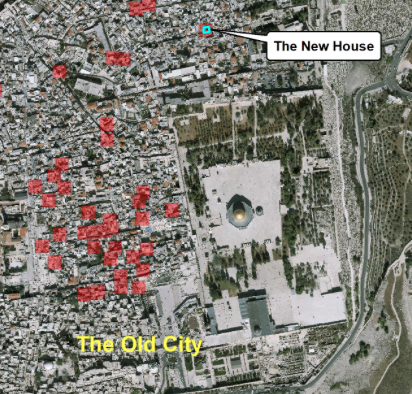
Map by Peace Now
The radical Ateret Cohanim settler organization managed to purchase a house in an incredibly sensitive and inflammatory location inside the Muslim Quarter of the Old City of Jerusalem, only 100 meters from the Dome of the Rock/al-Haram al-Sharif. Settlers moved into the house this week and have already begun renovating the property. Some reports blamed infighting between Palestinian Authority President Mahmoud Abbas and political rival Mohammed Dahlan for the sale to the settlers. The settlers gained control of the house, which was owned by a prestigious Palestinian family for decades, after the Palestinians sold it to a middleman, who then sold it for $17 million to Ateret Cohanim.
News of the sale of the home to settlers has reverberated within the Palestinian body politic, engendering intense public outrage directed at Palestinian Authority officials who are believed to have been involved in killing the sale of the house to a Palestinian American with ties to Dahlan, and at others who vouched for the credibility of a middleman who eventually sold the house to settlers.
Internal politics notwithstanding, the fact of the matter is that the sale only advances Israeli settlers’ and Temple Mount activists’ ongoing efforts to undermine and change the status quo in the Old City and on the Temple Mount. Israeli provocations on and around the Temple Mount have proven to be (and continue to be) a volatile flashpoint for the outbreak of widespread violence.
Peace Now released a statement saying:
“The settlement activity around the Temple Mount is akin to playing with fire, and instead of keeping the pyromaniacs at a distance, the government serves them matches.”
Writing in 2009 but ringing even more true today, FMEP’s Lara Friedman and Terrestrial Jerusalem’s Daniel Seidemann warned:
“The city is the major fault line of the Israeli-Palestinian conflict, and earthquakes have been triggered invariably by events in and around the volcanic core of that conflict: the Haram al-Sharif/Temple Mount. It is precisely in this area – spreading from Sheikh Jarrah to Silwan – where events today have begun to careen out of control.”
Settler’s New Silwan Property Sits on Massive Settler-Driven Excavation Site
New details have emerged regarding the Silwan house that settlers moved into last week, having previously purchased it from its Palestinian owners (covered by FMEP last week). According to new Peace Now reporting, the significance of the property goes beyond its location in the Palestinian East Jerusalem neighborhood of Silwan (a site of concentrated and aggressive settlement activity). The house’s precise location sits on top of a massive and controversial underground archaeological excavation led by the Israel Antiquities Authority under the direction of the radical Elad settler organization. Elad is dedicated to increasing a Jewish presence in East Jerusalem neighborhoods at the expense of current and historical Palestinian connections.
Elad has been trying to acquire the property since the 1990s. The house is located next to the al-Ein mosque in Wadi Hilweh, near the Siloam Pool, which has been under settler control for the last few years. According to Peace Now, by purchasing the house, Elad will have “easy access to the underground excavation and to create an exit or entrance point to the underground project.” The ultimate goal of the project is to create a walking path from the Siloam Pool to the Temple Mount, a spiritual walk highlighting Jewish history that former Jerusalem Mayor Nir Barakat envisions as a way to teach pilgrims “exactly who owns this city.”
In 2017, the excavation project severely damaged Palestinian homes in Silwan above the site. At the time, Haaretz reported that:
“two senior Israel Antiquity Authority archaeologists criticized the excavations in internal correspondence. They wrote that the work being done in the tunnels, contrary to accepted practice, was ‘bad archaeology’ and added that ‘the authority could not be proud of this excavation.’”
Emek Shaveh, a non-governmental organization specifically dedicated to fighting attempts to co-opt the archeological history of Jerusalem to serve political agendas, has a large body of reporting on excavation projects linked to Elad, the Israel Antiquities Authority in Silwan. Emek Shaveh writes:
“Temple Mount/Haram al-Sharif in particular – i.e. the Old City and the village of Silwan – there can be no doubt but that Israel is interested in expanding its presence and entrenching its authority over the area. The Israeli authorities and settler NGOs invest their best efforts in transforming Silwan into a tourist site and into the Israeli settlement of ‘The City of David’. At the same time, the Old City is undergoing unprecedented development of a nature which prioritizes Jewish belonging and the Jewish people’s historic rights to Jerusalem… The volume and pace of archaeological works and development for tourism is in striking contrast with the years of neglect of the Palestinian population. These processes in the city solidify an Israeli vision that ancient Jerusalem should remain under Israeli sovereignty forever.”
De Facto Annexation: Israel Applies Two Domestic Agricultural Laws to West Bank Settlements
After months of pressure from senior government officials, this week the head of the Israeli Defense Forces agreed to allow the government to directly apply two Israeli laws over the West Bank settlements. One law, allowing settlers to share their egg quotas with farmers in Israeli proper, was passed by the Knesset in June 2018. The second law, regulating the production and sale of organic produce, was passed in 2005.
As FMEP has extensively documented (see Table #3 in red), this is just the latest in a string of moves over the past 2+ years by which the Knesset and Israeli government has begun institutionalizing the application of Israeli domestic law over areas of Israeli settlement outside of its borders, amounting to a process of de facto annexation. .
Government Approves Funds for Settlement Propaganda Film
The Israeli Minister of Social Equality, Gila Gamliel, has allocated 1.5 million shekels ($413,000 USD) to a film project that will glorify the history of the settlement movement and the personal stories of leading settlement figures. The project will be a governmental collaboration with the Menachem Begin Heritage Center and the Yesha Council – an umbrella group representing all settlements in the West Bank; both organizations will appoint representatives to the steering committee for the project.
Minister Gamliel said:
“This is the purpose of the testimonies project – to give expression to the significant role of the veterans of settlement in Judea and Samaria in fashioning the moral and Zionist image of the State of Israel.”
The Director-General of the Yesh Council, Yigal Dilmoni, said:
“There are many young people today who are searching for inspiration for Zionist activities…If we give them this story, it will give the next generation the strength to continue to carry out [the ideals of] Zionism, to build and develop the State of Israel.”
Haaretz quotes a source close to Minister Gamliel saying:
“This is another step toward sovereignty…This isn’t a project initiated by a nonprofit or an organization, but by the state itself.”
Contrary to the claims of those backing the project, the history and personal stories of leading figures of the settlement movement have been extensively documented – most epically by Akiva Eldar in “Lords of the Land: The War Over Israel’s Settlements in the Occupied Territories 1967-2007.” Eldar’s historical accounting of early settlers unveils the reality that most early settlers were knowingly and deliberately breaking Israeli law by building without government permits and directly undermining Israeli government policies. Another superb book, Dear Brothers: the West Bank Jewish Underground, by Haggai Segal (now a prominent right-wing Israeli journalist), provides first-hand documentation and testimony regarding a critical chapter in the settlement movement: the 1980s Jewish Underground, which among other things carried out and celebrated a series of terrorist attacks against Palestinian mayors and planned to blow up the Dome of the Rock. This new film project, on the other hand, promises to be a piece of propaganda designed to sanitize and mythologize these same people and events.
Shaked: Annexation Plan Can Accommodate 100,000 Palestinian Citizens in Area C
A lengthy profile of Israeli Justice Minister Ayelet Shaked shed new light on the Jewish Home’s plan for the annexation of the West Bank’s Area C. The Atlantic columnist and chief anchorwoman for The News Company in Israeli, Yonit Levi, writes:
“Bennett and Shaked are trying to advance a plan for the annexation of Area C, the part of the West Bank (about 60 percent) that is under Israeli control. The plan would require extending citizenship to the Palestinians who live there. ‘We can definitely take in 100,000 Palestinian citizens,’ Shaked says. ‘These processes take time to ripen. At the moment, the annexation plan looks like science fiction, but I think that slowly, gradually, people will see what’s going on in the Middle East and realize that it really could happen.’ Shaked, too, sees clearly that the annexation plan could put Israel on a confrontational path, even with the current supportive American administration—and even more so if the administration changes. ‘Sadly, it’s impossible to ignore the processes taking place in the Democratic Party. You know, the party itself is becoming less and less what’s considered Zionist,’ she says. When I ask her whether this is the result of processes occurring in Israel, she responds: ‘We’re also seeing a strengthening of the Palestinian narrative among liberal circles, not only in the United States, and we must deal with this, too. Clearly, the Democrats will return to power at some point—things always change there—and it’s obvious that we have to maintain good relations with them and explain what’s going on in Israel.’”
Murder Prompts Critical Coverage of Settlement Industrial Zones
In response to the heinous murder of Israeli employees by a Palestinian worker at the Barkan Industrial Zone (a settlement industrial zone located deep inside the West Bank, near the Ariel settlement), U.S. Ambassador to Israel described Barkan as a “model of Israeli-Palestinian coexistence since 1982, with thousands working and prospering together.” The reality of West Bank industrial zones, and the role they play in the lives of Palestinians, is, in fact, more complicated. For decades Israel has used industrial zones as another tool to expand and deepen control over West Bank land, and jobs in industrial zones – often the only jobs available for Palestinians living under an Israeli occupation that prevents the development of any normal Palestinian economy – are widely viewed by Palestinians as a double-edged sword.
These realities were touched on in some of the coverage of the murder. The New York Times wrote:
“The West Bank settlements, constructed in territory that Israel captured from Jordan in the 1967 war, and which the Palestinians envision as part of their state, are considered a violation of international law by most of the world. But many Israelis, particularly the settler leadership, hold up the Barkan industrial park, where the attack took place on Sunday, as a model of cooperation and an important source of employment for thousands of Palestinians…”
The Washington Post offers noted:
“Thousands of Israelis and Palestinians work side by side at the [Barkan] industrial zone, which includes 160 factories. The Palestinian economy is heavily restricted under Israeli military rule, forcing tens of thousands of Palestinians to seek work in Israel as well as Jewish settlements.”
Bonus Reads
- “‘Traitor? Who Me?’ Talia Sasson Sums Up Her Term as New Israel Fund President” (Haaretz)
- “Trump’s Pation-In-Chief” (ProPublica)
Welcome to FMEP’s Weekly Settlement Report, covering everything you need to know about Israeli settlement activity this week.
To subscribe to this report, please click here.
October 4, 2018
- More Settlement Expansion in East Jerusalem: Ramot & Ramat Shlomo
- Settlers Take Over Palestinian Building in Silwan, Evict Current Tenants
- The Kohelet Policy Forum: The Right-Wing Group Driving Pro-Settlement Policies
Comments, questions, or suggestions? Email Kristin McCarthy at kmccarthy@fmep.org.
More Settlement Expansion in East Jerusalem: Ramot & Ramat Shlomo
Ir Amim reports that on October 4th, the Jerusalem District Planning and Building Committee will discuss – and is expected to advance – two plans to expand settlements along the northern perimeter of East Jerusalem: a plan for 500 new units in the Ramat Shlomo settlement and a plan for 152 new units in the Ramot settlement. If implemented, both plans will compound the encroachment of settlements on the Palestinian East Jerusalem neighborhood of Beit Hanina; the Jerusalem Municipality only recently approved the first-ever settlement construction inside Beit Hanina.
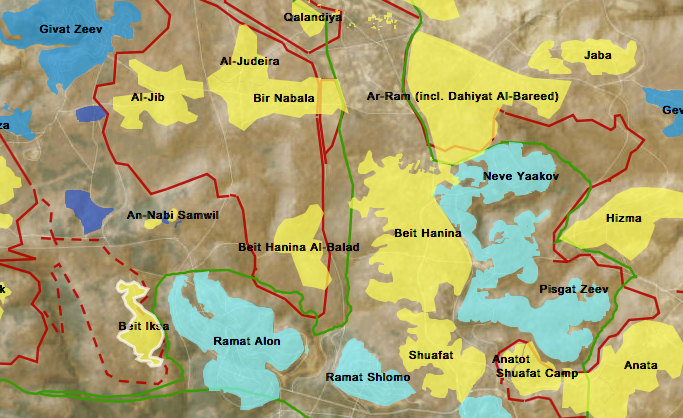
Map by WINEP
These two plans are just the latest advancements for Ramot and Ramat Shlomo: in August 2018 a plan for 263 units in Ramot was deposited for public review, and construction tenders were published for a plan for 603 units in Ramat Shlomo (under what is colloquially known as “The Biden Plan”).
The plan for 152 new units in the Ramot settlement is especially alarming because, as Ir Amim details, it is part of a larger scheme to claim undeveloped land in East Jerusalem for settlements:
“[The Ramot plan] represents a bold push toward Israel consolidating control of the undeveloped area between Ramot and Bir Nabala. Ir Amim has acquired documents showing plans to expand the entire northern section of the Ramot settlement toward the Palestinian area. As can be seen on the map, the large open area between the Israeli settlement and the Bir Nabala enclave is already cut by the Separation Barrier, which completely encircles the enclave, isolating its residents from the surrounding Palestinian space and imposing severe economic hardship.” [Editor’s note: for more on how the separation barrier has completely isolated the East Jerusalem neighborhood of Bir Nabala, see this short video by The Guardian].
.png)
For its part, the advancement of the Ramat Shlomo is also alarming, since Israeli authorities essentially rewrote the laws governing construction in Jerusalem in order to advance the project:
“The [Ramat Shlomo] plan includes Palestinian-owned land, in an area developers have now designated for a park and access road. In order to overcome the legal prohibition against submitting a plan on land not owned by the applicant, the developers successfully engaged the Jerusalem Municipality to sign on as an additional applicant, thereby enabling the expropriation of private Palestinian land. Despite this process contravening the Planning and Building Law, the District Committee approved the plan for deposit, circumventing the normal process of land reparcelization conducted to ensure an equitable distribution of land rights.”
The expected advancement of these plans for the expansion of the Ramot and Ramat Shlomo settlements is a continuations of an alarming acceleration in East Jerusalem settlement advancements since President Trump assumed office in January 2017, reflecting the sea change in U.S. policy towards settlements. Over the past two months alone, Israel has advanced plans for:
- 75 units in Beit Hanina (advanced through first stage of planning process)
- 13 units in Sheikh Jarrah (deposited for public review)
- 345 units in Gilo (deposited for public review)
- 1,064 units in Pisgat Ze’ev (deposited for public review)
- 263 units in Ramot (deposited for public review)
- 603 units (“The Biden Plan”) in Ramat Shlomo (tenders published)
- Reported above, 500 additional new units in the Ramat Shlomo in August 2018
- Reported above, 152 new units in Ramot settlement in August 2018.
Settlers Take Over Palestinian Building in Silwan, Evict Current Tenants
Ma’an News reports that the radical Elad settler organization has evicted a Palestinian family from a building that settlers purchased in the East Jerusalem neighborhood of Silwan. The previous owners of the building, who currently live in the U.S. – reportedly notified tenants at the property of the sale several months ago.
The settlers, under the protection of Israeli security forces, did not allow the evictees – 7 members of the Maswadeh family – to move their belongings out of the building before moving in. The Maswadeh family had rented two apartments in the building for the past 30 years. According to reports, the settlers have already started to build what appears to be a gate to control access to the property.
The Kohelet Policy Forum: The Right-Wing Group Driving Pro-Settlement Policies
Haaretz published a lengthy profile of the Kohelet Policy Forum, a right-wing advocacy organization that wields enormous influence over senior Israeli government figures, including Justice Minister Ayelet Shaked (Likud). The Kohelet Policy Forum is revealed to have played a major role in shaping several of the most significant pro-settlement, pro-annexationist legislative actions in the past year, including the high court override bill, the Nation-State Law, and a bill that would allow Israeli cabinet ministers to select their own personal legal advisors.
According to Haaretz, the Kohelet Policy Forum’s fingerprints “are visible in every explosive and divisive issue that has weakened the legal system and regulations.” FMEP tracks all these pieces of legislation, and many more, in its Annexation Policy Tables.
The funding sources for the Kohelet Policy Forum, which was established in 2013, are worth noting: the largest funder is an anonymous donor in the United States, who funds were transferred to Kohelet via an American nonprofit called American Friends of Kohelet Policy Forum. In 2016 the American group donated about 7.8 million shekels ($2.1 million) to Kohelet; in 2017 about 28.5 million shekels ($7.7 million). In light of Kohelet’s agenda, the anonymity of Kohelet’s major U.S. funder escapes the ire of the Israeli government, which has sought to stigmatize and shutdown groups which draw the majority of their funding from foreign sources.
Another main funder is the Tikvah Fund, a wealthy U.S.-based organization with a mission to promulgate American Republican Party views in Israel. Since its founding, the Kohelet Policy Forum has received over $1 million from the Tikvah Fund, and the two entities share board members. The Tikvah Fund also supports pro-settlement organizations.
Notably, Eugene Kontorovich is the head of the international law department at the Kohelet Policy Forum. Kontorovich self-identifies as a key figure in the drafting of “anti-BDS” (but actually, anti-free speech/pro-settlement) laws in the United States. At the core of these laws is the conflation of Israeli settlements with Israeli proper, based on Kontorovich’s argument that Israel is not occupying Palestinian territory. Kontorovich has also testified multiple times to U.S. Congress, including in support of moving the U.S. Embassy to Jerusalem; in support of Congress legislating U.S. foreign policy, including with regard to Jerusalem; on the impact of the BDS movement, and in support of U.S. recognition of Israel’s sovereignty over the Golan Heights.
Welcome to FMEP’s Weekly Settlement Report, covering everything you need to know about Israeli settlement activity this week.
To subscribe to this report, please click here.
September 20, 2018
- 2018 Settlement Construction Starts (& Finishes) Are Surging
- Settlement Projects Advance in Sheikh Jarrah, Jabal al-Mukaber
- Israeli Authorities Approve Plan to Seize Palestinian Land & Legalize Outpost Near Hebron
- Israel Issues “Gardening Orders” to Take Control of More Land in Silwan
- Israeli Tourism Ministers Boasts About Bankrolling Tourism Projects to Expand Settlements
- Shaked’s Judicial Interference is Subject of Special Knesset Session
- Bonus Reads
Comments, questions, or suggestions? Email Kristin McCarthy at kmccarthy@fmep.org. To subscribe to this report, please click here.
2018 Settlement Construction Starts (& Finishes) Are Surging
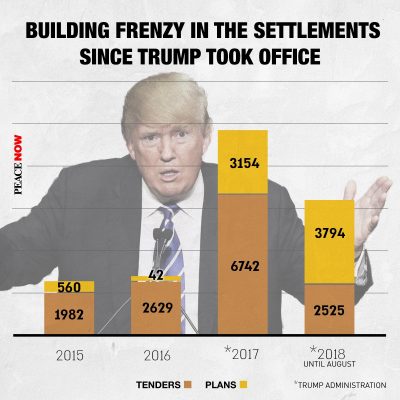
Image + Data by Peace Now
Recently released data from the Israeli Central Bureau of Statistics show that since January 2018, construction has started on a total of 1,073 new settlement units, and total of 1,075 new settlement units (started in previous years) have been completed – representing new housing for more than 10,000 settlers (assuming, conservatively, a family size of 5-6 people). Together the numbers mark a 66% increase over the same period in 2017. Though settlement plans have advanced at an alarming rate since the beginning of the Trump Administration, actual on-the-ground construction starts did not seen a significant surge until the second quarter of 2018, which saw a 187% increase over the first quarter.
Peace Now released a statement saying:
“The Netanyahu government continues to destroy the chances for peace. Further construction in the settlements undermines Israel’s interest in reaching a two-state solution, as such a solution will not be stable without a viable Palestinian state, which settlements increasingly threaten. Unfortunately, since Trump’s election, we have seen a sharp increase in the approval of the plans and tenders, and now we are beginning to see the consequences of these approvals on the ground.”
Settler leaders were characteristically dissatisfied with the pace of construction. The Director of the Yesha Council (and umbrella group representing all Israeli settlements), Yigal Dilmoni, told the Jerusalem Post:
“We are talking about a few hundreds units, which is very little, relative to thousands built throughout the country. Judea and Samaria still have the low building numbers, we expect and hope that we will be given more building permits.”
Settlement Projects Advance in Sheikh Jarrah, Jabal al-Mukaber
Ir Amim reports that two plans for new settlement buildings in the Palestinian East Jerusalem neighborhood of Sheikh Jarrah have been deposited for public review. If implemented, the two plans would build two new 6-story buildings in the Um Harun section of Sheikh Jarrah, one with 3 settlement units and the second with 10 settlement units. If implemented the plans will also involve the demolition of two buildings and the eviction of five Palestinian families living there.
The plans were originally approved for deposit in July 2017. As Ir Amim reported in detail at the time, both plans (numbers 14151 & 14029) are linked directly to Jerusalem settlement impresario Aryeh King. King can now count several significant victories for his settlement projects in sensitive Jerusalem neighborhoods over the past two weeks, totalling 309 new settlement units: Two plans were advanced in Sheikh Jarrah, totalling 14 units; one plan was advanced in Beit Hanina, totalling 75 units; also this week, King reportedly announced (though details are scant – stay tuned) that the government has approved a plan for 220 new units in the Nof Zion settlement enclave, located inside the Jabal al-Mukaber neighborhood. It is worth noting that, back in September 2017, the government was poised to issue permits for 176 units in Nof Zion – it is not clear if the 220 include those units, or are in addition to them, or if the numbers are inaccurate or deliberately misleading.
Settlement advancements in Sheikh Jarrah are becoming alarmingly routine. In addition to the developments this week, the inflammatory plan to build a Jewish religious school (known as the Glassman yeshiva project) was recommended for final approval. If implemented, an eight story building will be erected at the entrance to the Sheikh Jarrah neighborhood. The massive building will also include dormitories for young religious men and eight units to house “lecturers visiting from abroad.”
Israeli Authorities Approve Plan to Seize Palestinian Land & Legalize Outpost Near Hebron

by Land Research Center
The Land Research Center, a Palestinian organization, reports that the Israeli Civil Administration – the arm of the Israeli Defense Ministry that runs all affairs in the West Bank – has published a detailed plan to expand the borders of the Tene-Omarim settlement to include an outpost that was built without Israeli government authorization, located on lands claimed by the Palestinian village of Dahriyeh.
In order to carry out the plan, the Israeli Civil Administration will add 260,000 square meters of land (roughly 64 acres) to the settlement. The plan calls for 150 new units in Tene-Omarim in addition to new roads and open areas to connect the settlement to an outpost northeast of its borders.
In May 2018, the Israeli Civil Administration advanced plans for 143 new settlement units in Tene-Omarim.
Israel Issues “Gardening Orders” to Take Control of More Land in Silwan
On August 24th, the Israeli NGO Emek Shaveh reported that the Jerusalem Municipality had issued “gardening orders” as a means of taking over new areas of privately owned land in the Silwan and Abu-Tor neighborhoods of East Jerusalem (in the area known in Hebrew as the Ben Hinnom Valley). Under Israeli law, the Jerusalem municipality can issue orders to use private land for public purposes if it deems the land “unutilized” by its owners. News of the orders broke the day before U.S. National Security Advisor John Bolton attended a dinner party in Silwan hosted by the radical settler group Elad.
The orders seize 27 plots of land owned by Palestinians, based on the argument that the plots are not being used by their owners. The orders disingenuously note that Palestinian owners can seek to reclaim their land in the event that they obtain Israeli-issued building permits (without which they are unable to utilize the land for their own purposes). This explanation, as Emek Shaveh notes, ignores the fact that “the land owners cannot receive construction permits because their land is situated within a national park which, according to law, precludes construction.”
Emek Shaveh goes on to report:
“The gardening orders are the latest in a series of development activities in the Ben Hinnom Valley/Silwan area and will no doubt complement the Elad Foundation’s initiatives in the valley and efforts to link it with tourism ventures in the City of David/Wadi Hilweh. The Elad Foundation together with government ministries are currently promoting several projects within the area covered by the gardening order including a café in Abu Tor, the planned cable car intended to link West Jerusalem to the Kedem Center, and the archaeological excavations which the Elad Foundation has been funding in recent years adjacent to the Catholic cemetery.”
Israeli Tourism Ministers Boasts About Bankrolling Tourism Projects to Expand Settlements
At a meeting with the Yesha Council (the powerful umbrella group representing all Israeli settlements), Minister of Tourism Yariv Levin (Likud) told settler leaders:
“Tourism in Judea and Samaria (West Bank) is at a point of tremendous momentum. We now have a window of opportunity to make big moves in the tourism industry and this is a time of desire that should definitely be exploited. We will continue to establish and bankroll activities in Judea and Samaria in addition to establishing facts on the ground.”
Minister Levin boasted of having directed USD 11.15 million (NIS 40 million) to West Bank tourism projects over the past three years of his tenure.
In addition to his work directing taxpayer funds to the settlements, Minister Levin has also been pushing legislation and procedural rules that advance the direct application of Israeli laws over the settlements (an act of de facto annexation).
Shaked’s Judicial Interference is Subject of Special Knesset Session
On September 17th, the Knesset held a special session (during the Knesset recess) titled, “Justice Minister Ayelet Shaked’s attack on the High Court of Justice and the danger to democracy.” As FMEP has extensively documented, Justice Minister Shaked has been hard at work transforming the Israeli judicial branch in favor of pro-settlement and pro-annexation policies.
Meretz Chairwoman MK Tamar Zandberg opened the the special session defending her own party against accusations of political interference with the Court (Shaked denies a quote attributed to her saying that the High Court is an “arm of the Meretz party”). Zandberg said:
“the High Court of Justice was never a branch of Meretz. We often far from agree with the rulings of the High Court of Justice, which legitimized settlements, but we live in a democratic country governed by the rule of law, and the independence of the judicial system is one of its basic principles. The High Court of Justice is the focus of an extreme, unbridled attack aimed at clipping its wings and distorting the foundations on which it was established.”
One of many speakers, MK Michal Rozin (Meretz) said:
“Ayelet Shaked’s commander’s spirit is felt in the justice system – from the deepening of her control in the Judicial Appointments Committee, which has become a committee for the appointment of conservatives, to rulings which adopt her anti-constitutional lines, such as allowing the theft of Palestinian lands by the Jerusalem District Court. This spirit is aimed at applying sovereignty in the conquered territories, reducing the freedom of the citizens and expanding the Orthodox control on our daily lives.”
Appearing at the hearing under summons on behalf of the government, Justice Minister Shaked told her critics in the Knesset:
“I understand your anger about the fact that Jews are not being evacuated from their homes, but you must pull yourself together. We have a country to protect. The rule of law must be preserved. We cannot accept a situation in which your criticism of the court is sinking to such depths to which you have recently deteriorated. As the Minister of Justice, I call upon those who sit in this House – on the Left and the Right – to maintain dignified discourse. We don’t have another legal system. Of course it is legitimate to express criticism against a ruling. It is acceptable to argue over ideas, it is permissible to argue over areas of authority. I do so from time to time, but we must maintain respectability and dignified discourse.”
Bonus Reads
- “APN Peace Cast w/ Hagit Ofran” (Americans for Peace Now)
- “How Peace Keeps Receding in the Middle East” (Washington Post)
Welcome to FMEP’s Weekly Settlement Report, covering everything you need to know about Israeli settlement activity this week.
To subscribe to this report, please click here.
August 31, 2018
- Setting a New Legal Precedent, Court Accepts “Market Regulation” Principle As Basis for Legalizing Outpost
- Shaked & Regavim Take Credit for Precedent-Setting Outpost Legalization Victory
- Another New Outpost – Continuing the Trend of Unannounced, Unopposed, & Highly Consequential Settlement Expansion
- Special U.S. Regulations Protect Israel’s Settlement Enterprise from Quality Aerial Documentation
- Bonus Reads
Comments, questions, or suggestions? Email Kristin McCarthy at kmccarthy@fmep.org. To subscribe to this report, please click here.
Setting a New Legal Precedent, Court Accepts “Market Regulation” Principle As Basis for Legalizing Outpost
Jerusalem District Court Ruling
On August 18th, Jerusalem District Court Judge Arnon Darel ruled in favor of retroactively legalizing the Mitzpe Kramim outpost, holding that privately owned Palestinian land can (and should) be expropriated for the settlements in instances where Israeli settlers built “in good faith” and with government support – a rationale called the “market regulation” principle. According to the ruling, the Court held that the parties responsible for the outpost – the Israeli government, the World Zionist Organization, and the settlers – all acted in “good faith.” Specifically, the Court held that the State acted in “good faith” even though it was negligent in its responsibility to protect the rights of Palestinians and correctly record/manage the status of land in the West Bank; and, that the settlers acted in “good faith,” even though they built the outpost without government authorization, without building permits, and without a master plan.
This is the first time an Israeli court has accepted the “market regulation” principle as a valid basis for legalizing outposts, setting a monumental new precedent according to which outposts that the government had previously been unable to legalize (because they were built on land recognized by Israel as privately owned by Palestinians) to petition for authorization. With this judgment, the public got a first glimpse of the incredibly broad interpretation of “good faith” that the Jerusalem District Court (now the court of first jurisdiction for land disputes in the West Bank) is inclined to apply on behalf of law-breaking settlers.
Peace Now released a statement saying:
“The court today chose to ‘align’ with the project of annexation and dispossession of the Israeli government led by the Netanyahu and the Jewish Home. It is absurd to attribute ‘good faith’ to the settlers of an illegal outpost whose homes were built illegally and without permits on private Palestinians land, because of a ‘mistake’ made by the authorities in allocating the land. The Israeli Authorities should protect the properties of the people under their control, and failing to do so cannot be used as an excuse to take the land from the Palestinian owners. Let us hope that the Supreme Court will erase this shame.”
Background on the Mitzpe Kramim Case
 The outpost at the center of the case – Mitzpe Kramim – was built in 1999 without government authorization on land near the Kochav Hashachar settlement, located deep inside the West Bank, closer to the Jordan River than sovereign Israeli territory. In the 1970s, land in the area was taken by the State of Israel by military order; subsequently, the land on which the outpost was built was allocated to the World Zionist Organization (WZO), apparently based on the (mistaken) assumption that the land in question was part of that military seizure. The WZO then gave the land to settlers, even issuing a certificate of ownership in their names. However, the land in question was not included in the military seizure of the 1970s, but was/is In fact recorded in the Land Registry as privately owned by Palestinians from the village of Deir Jarir. This fact should, under Israeli law, invalidate the government’s allocation of the land to the WZO, and the WZO’s grant of the land to the settlers.
In 2011, the registered Palestinian landowners filed a petition with the High Court of Justice to have the Mitzpe Kramim outpost removed from their land, only to see the settlers file their own petition in 2013 with the Jerusalem District Court (which froze the High Court’s consideration of the Palestinians’ petition), seeking to be registered as the rightful landowners. In their petition, the settlers – who are represented by Harel Arnon, the same lawyer hired to represent the Israeli government in its defense of the “Regulation Law” – argued that they are innocent victims of a mistake by the government, and as such should not be forced to bear the consequences of having built their homes on someone else’s land. Originally the Israeli government, admitting that the Civil Administration had made a mistake in mapping the area, argued that the settlers should be removed. In July 2018, the State completely reversed its stance, submitting a new argument to the Court citing the “market regulation” principle in defense of expropriating the land for the settlers.
In its ruling this week, the Jerusalem District Court gave legal validity to the newly invented “market regulation” basis for taking Palestinian land that had previously been impossible for the State to legally expropriate.
What’s Next?
Now that the Jerusalem District Court has ruled in favor of the settlers’ claim, the High Court of Justice is set to take up the original petition filed by the Palestinian landowners to have the outpost removed. Part of the High Court’s deliberations will now have to grapple with the new jurisprudence established by the Jerusalem District Court on the “market regulation” principle.
Regardless of whether or not the High Court allows the Jerusalem District Court’s ruling to stand, that ruling has already energized pro-settlement, pro-annexation Israeli policymakers and influencers, who (unsurprisingly) have lauded the ruling and urged more outpost legalization cases forward. The ruling also legitimizes the longstanding arrangement between Israel and the settlers: the government turns a blind eye to illegal settlement activity (including rebuffing efforts by settlement watchdogs to force it to take action, and when forced by the courts to take action, drags its feet to allow illegal activities to become more deeply entrenched), only to go to any lengths to authorize the illegal actions post-facto. This modus operandi allows Israel to circumvent the limitations of Israeli law, bureaucracy and international criticism, all of which would otherwise restrain (to some extent) unfettered settlement construction and land theft in the West Bank.
FMEP tracks the ongoing legislative, political, and legal transformations happening in the Israeli government to justify the expropriation of Palestinian land for the settlements in its Annexation Policy Tables. As a reminder, the “market regulation” principle was promoted by Israeli Attorney General Avichai Mandelblit, who offered it as an alternative to the legal basis provided in the “Regulation Law” to legalize unauthorized outposts and settlement construction.
Shaked & Regavim Take Credit for Precedent-Setting Outpost Legalization Victory
Celebrating the Jerusalem District Court’s ruling on the Mitzpe Kramim outpost case (covered above), Justice Minister Ayelet Shaked (Likud) said:
“The District Court today clearly stated that whoever settled [the land] with the state’s approval and in good faith, would not be evacuated. The injustice done in the evacuations of the Amona and Netiv Ha’avot [outposts] should not be repeated. The court should not be a party to the political debate between the Right and Left. That should be left to the ballot box. Through joint and intensive work, we have brought about a policy change in the state’s responses to the High Court of Justice. Now we are seeing a change in the district court.” [emphasis added]
Indeed, Justice Minister Shaked has led a years-long effort to re-make the judicial branch, injecting pro-settlement policies and figures into key positions within the Court system, with the explicit goal of protecting all Israeli settlements and outposts from any legal accountability for illegal actions. Part of that effort was her decision in 2015 to hire a private lawyer, Amir Fisher (who also represents the settler group Regavim), to essentially write the State’s responses to petitions before the High Court that deal with settlements.
As noted in the section above, the state of Israel reversed its own position vis a vis the future of Mitzpe Kramim in its 2018 submission to the Court, a reversal that happened after Fisher and Shaked were firmly in control of the State’s handling of outpost legalization cases. What’s more, Shaked installed a pro-settlement judge on the Jerusalem District Court (which issued the precedent-setting ruling this week), and then promoted legislation that strips the High Court of Justice of its primary jurisdiction over certain West Bank legal petitions (including Palestinian petitions relating to land disputes, travel permits, and building permits) and gave that jurisdiction to the Jerusalem District Court. Shaked is currently promoting another bill which would allowed the Knesset to reinstate any law struck down by the High Court of Justice. The Ministerial Committee on Legislation, of which Shaked and Education Minister Naftali Bennett are members, voted to give government backing to the bill in May 2018. The totality of Shaked’s efforts are documented, on an ongoing basis, in FMEP’s Annexation Policy Tables.
Shaked’s fellow travelers at Regavim released a statement following the Jerusalem District court ruling, emphasizing the far-reaching implications:
“This is a product of a long legal battle, run by the settlements and settling bodies. They asked to legalize outposts that were established by the State of Israel. This blessed decision is a historic one. We call upon the attorney general to apply the principles of this decision to all other outposts in Judea and Samaria that need regularization.”
The fruits of Shaked and Regavim’s work was applauded by many others in the government, including Education Minister Naftali Bennett (Jewish Home), who said the ruling was a:
“victory for decency and common sense, another step toward legalizing the settlements in Judea and Samaria and turning them into an integral part of the State of Israel.”
Culture Minister Miri Regev (Likud) said she was:
“happy that common sense and justice prevailed over cold formalism..[the ruling sends] a clear-cut message to the Palestinians and their collaborators from far-left organizations, that you don’t destroy and evacuate communities in the Land of Israel.”
Agriculture Minister Uri Ariel (Jewish Home) said:
“This is a blessed month of settlement, and after the decision of the Housing Cabinet to establish three new towns [in the Negev], comes the court’s decision regarding Mitzpeh Kramim. Such significant decisions strengthen and expand the settlement of the Land of Israel.”
Knesset speaker Yuli Edenstein (Likud) said:
“The determination and strong spirit of the people of Mitzpeh Kramim proved themselves. I welcome this just, requisite ruling from the District Court in Jerusalem. We will continue to strengthen settlement in Israel!”
Another New Outpost – Continuing the Trend of Unannounced, Unopposed, & Highly Consequential Settlement Expansion
Haaretz reports that settlers have built a strategic new outpost deep inside the West Bank near the settlement of Eli, in a bid to eventually annex privately owned Palestinian land that falls between Eli and pockets of “state land” in the area. The new outpost was built without Israeli permits on the outer edge of newly declared “state land,” some of which had been used as farmland by Palestinians. Haaretz notes a trend:
“Around the West Bank, settlers have been setting up farms near the outer edge of state-owned land, as in the case near Eli, in an effort to expand existing settlements. Even though they have been established without permission, no legal action has been taken against them.”
The Israeli Civil Administration – responsible for enforcing building laws in the occupied territory – told Haaretz that it is unaware of the new outpost. The Head of the Binyamin Regional Council (an Israeli municipal body responsible for settlements in the northern West Bank – recently proven to be bankrolling new outposts), Avi Roeh, denied that the Council was involved with the new outpost.
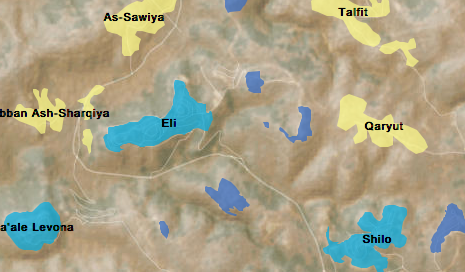
Map by WINEP
The new outpost is the fifth illegal satellite of the Eli settlement, stretching the band of Israeli settlements further and further east towards the Jordan Valley. Eli is located between the Ariel and Shilo settlements (both of which have seen tremendous growth and government support over the past two years – Ariel with its new medical school and Shilo with the promotion of the new Amichai settlement to its immediate east), in an area where settlers are working to connect settlements and outposts into a contiguous band of settlement stretching from sovereign Israeli territory all the way to the Jordan Valley.
As evidenced this week in the Israeli court system, the government – which consistently turns a blind eye to illegal outpost construction – is willing to go to great lengths to retroactively legalize outposts, even when the cost to Israeli taxpayers is enormous and even when doing so contradicts any notion of justice under the law.
Special U.S. Regulations Protect Israel’s Settlement Enterprise from Quality Aerial Documentation
Al-Shabaka published a new report this week detailing a little-known U.S. law that restricts companies from producing high quality satellite imagery of the West Bank. Al-Shabaka explains the significance of that limitation on U.S. companies like Google:
“Although the legislation was implemented under the pretense of protecting Israel’s national security, it is better characterized as an act of censorship. By deliberately blurring aerial images of Palestine-Israel, the [The Kyl-Bingaman Amendment (KBA) to the US National Defense Authorization Act] hinders the work of archaeologists, environmentalists, geographers, and humanitarians. It poses serious obstacles, not only for the preservation of cultural heritage, but also for holding Israel to account for land grabs, home demolitions, and settlement activity….While the legislation only applies to US companies, their hegemony in the commercial market for satellite imagery has elevated the legislation to de facto institutionalization on a global scale, affecting the access of researchers worldwide.”
The report can be accessed here.
Bonus Reads
- “The West Bank Model is a Failure” (The New York Times)
- “Israeli Taxpayers Bear Financial Burden of Evicting Illegal West Bank Outposts, And Sometimes, Making them Legal” (Haaretz)
***NOTE: This week the Israeli government unleashed a massive wave of approvals to advance plans for settlement construction — in excess of 2,000 units — in highly sensitive and strategically significant areas deep inside the West Bank and in East Jerusalem. More approvals/advancements are expected in the coming weeks. See below for detailed coverage of the individual plans, keeping in mind both the significance of each approval on its own, and as part of the overarching Israeli government agenda clearly intending to both prevent any possibility of a Palestinian state and to further the march toward formal annexation of the West Bank. Also keep in mind, importantly, that there has been zero public push back from the Trump Administration against this surge, which comes on the heels of Ambassador Friedman’s statement last week that Israel will never be required to remove any settlements.***
August 24, 2018
- Settlement Wave, Part 1: High Planning Council Advances Plans for 1,004 Settlement Units (96% Located Deep in the West Bank)
- Settlement Wave, Part 2: Housing Ministry Published Tenders for 420 Settlement Units
- Settlement Wave, Part 3: Jerusalem District Committee Advances Plans for 603 Settlement Units in East Jerusalem
- Settlement Wave, Part 4: More Settlement Construction Coming Soon
- U.S. Stands by Israeli “Intentions” on Settlements
- State Tells High Court: We Can Annex the West Bank – International Law Be Damned
- This Week in Ariel: Settlers Celebrate 40 Years, A Construction Boom, A Medical School, & An Evangelical “Leadership Camp”
- Amana (the Official Settler Movement) Moves Its HQ to Sheikh Jarrah
- Settlement Gains in East Jerusalem Result in Palestinians Self-Demolitioning Their Homes
- Bonus Reads
Comments, questions, or suggestions? Email Kristin McCarthy at kmccarthy@fmep.org. To subscribe to this report, please click here.
Settlement Wave, Part 1: High Planning Council Advances Plans for 1,004 Settlement Units (96% Located Deep in the West Bank)
On August 22nd, the Israeli Defense Ministry’s High Planning Council (the body in the Israeli Defense Ministry responsible for regulating all construction in the West Bank) advanced plans for 1,004 new settlement units, 96% of which are located deep inside of the West Bank. Of the total, 620 units were approved for deposit for public review and 382 units were given final approval for construction.
As reported by Israeli settlement watchdog Peace Now, the plans approved for deposit for public review (totalling 620 units) are:
- 370 units in the Adam settlement (aka Geva Benyamin). This project was urged on by Defense Minister Liberman following a stabbing attack in the settlement, which resulted in one death and injuries to three others. The 370 units are part of a larger plan for 1,000+ units that will, if built, connect the Adam settlement to two large settlements in East Jerusalem (Neve Ya’akov and Pisgat Ze’ev) that are on the Israeli side of the separation barrier (the route of the barrier juts far beyond the 1967 Green Line to include Pisgat Ze’ev and Neve Ya’akov on the Israeli side while the Adam settlement is on the West Bank side). If the larger plan is implemented, the Adam settlement will have built up areas on both sides of the separation barrier, which could (in all likelihood) present Israel an opportunity to re-route the barrier around Adam — which would de facto annex even more West Bank land to Israel and further choke off Palestinian East Jerusalem from the West Bank to its north. [Note: FMEP’s Lara Friedman and Peace Now’s Hagit Ofran published an op-ed in Haaretz in 2008 warning of this plan – you can read that background here].
- 85 units in Karnei Shomron settlement. Israel has repeatedly confiscated as “state land” located between Karnei Shomron and the Palestinian village of Qalqilya (which is literally surrounded on three sides by the separation barrier). In November 2017, Israel began clearing landmines from that “state land” in order to prepare for settlement construction. At the time, Deputy Defense Minister Eli Ben-Dahan said that the new construction in the Karnei Shomron area will bring “a million Jews [to] live in Judea and Samaria in the future.”
- 84 units in the Kiryat Netafim settlement, located about half way between the Ariel settlement and the cluster of settlements close to the 1967 Green Line that are slated to be united into a “super settlement” area (Oranit, Elkana, Shiva Tikva, and others). The expansion of Kiryat Netafim will go towards creating a contiguous corridor of Israeli settlements stretching from sovereign Israeli territory, though the super settlement, to Ariel. As FMEP has repeatedly said, the Ariel settlement is located in the heart of the northern West Bank, reaching literally to the midpoint between the Green Line and the Jordan border. The future of Ariel has long been one of the greatest challenges to any possible peace agreement, since any plan to attach Ariel to Israel (with a finger of land running through settlements like Kiryat Netafim) will cut the northern West Bank into pieces.
- 52 units in the Beit El settlement. This is the second major approval for new units in Beit El in 2018, with a third plan for 300 more units coming soon, according to Israel Hayom. The construction boom is being hailed by the settler-aligned Arutz Sheva outlet, which wrote that the plans will increase the size of Beit El by 65%. If any of the units are constructed it will be first new, government-sanctioned construction in Beit El in over 10 years. U.S. Ambassador to Israel David Friedman is closely associated with the Beit El settlement, having donated to and fundraised for it prior to his appointment as ambassador (including in his capacity as the President of the American Friends of Beit El, reportedly from 2011 until he became ambassador).
- 29 units in the Otinel settlement, located south of Hebron. MK Yehuda Glick (Likud) lives in Otinel.
Plans that gained final approval, meaning no additional formal approvals are required to move ahead with construction (totalling 382 units) are:
- 168 units in the Tzofim settlement, located on the Israeli side of the separation barrier, but jutting towards the Karnei Shomron settlement, which also received advancements this week. See the section on Karnei Shomron, above, for context and news regarding this area of settlements.
- 108 units in the Nofim settlement, located on the Israeli side of the separation barrier but jutting towards the Karnei Shomron settlement, which also received advancements this week. See the section on Karnei Shomron, above, for context and news regarding this area of settlements.
- 56 units in the Barkan settlement, located near the Kiryat Netafim settlement. Both Barkan and Netafim are located about half way between the Ariel settlement and the cluster of settlements slated to be united into a “super settlement” area (Oranit, Elkana, Shiva Tikva, and others). See the section on Kiryat Netafim, above. for context and news regarding this area of settlements.
- 44 units in Ma’ale Adumim, the mega settlement just east of Jerusalem.
- 6 units in the Avnei Hefetz settlement, located southeast of the Palestinian city of Tulkarem.
Notably, Netanyahu intervened to remove two items from the High Planning Council’s agenda, both of which would have led to the retroactive legalization of illegal outposts. Those plans are:
- A plan to retroactively legalize the Ibei Hanahel outpost, which is a non-contiguous “neighborhood” of the Ma’ale Amos settlement, located deep in the southern West Bank. The plan would have allowed the outpost to be demolished and then rebuilt legally with residential units, transforming the outpost into a new, fully authorized settlement.
- A plan to build an education center in the Nofei Prat South outpost, which is a non-contiguous“neighborhood” of the Kfar Adumim settlement, located northeast of Jerusalem. The land on which the project would be built is located just 1.5 km away from the Khan Al-Ahmar Bedouin community – the same one that the Israeli government plans to forcibly evacuate in order to cleanse the area of Palestinians and expand settlements. The outpost was established by the Haroeh Ha’ivri (“the Hebrew Shepherd”) nonprofit association, which is funded by the Israeli Education Ministry.
In response to Netanyahu’s directive to remove these two items from the agenda, the heads of the Knesset’s “Land of Israel Lobby,” Bezalel Smotrich (Jewish Home) and Yoav Kisch (Likud), said that the Prime Minister should “ act with greater rigor to promote settlement, rather than doing the opposite.”
Settler leaders were also unsatisfied with the High Planning Council’s overall numbers. Yossi Dagan, head of the Samaria Regional Council (a municipal body for settlements in the northern West Bank), said:
“We are happy about every new house in Samaria, but we have to tell the truth. Hundreds of housing units are not enough for an area that constitutes 12% of the State of Israel…We expect the government to step in the gas, stop worrying about what they will say overseas, and develop this beautiful region.”
Settlement Wave, Part 2: Housing Ministry Published Tenders for 420 Settlement Units
On August 23rd, one day after the Defense Ministry’s High Planning Council advanced a huge tranche of settlement plans (detailed above), the Israeli Housing Ministry published tenders for a total of 425 settlement units (under plans previously approved by the High Planning Council).
Those tenders include:
- 211 units in the Ma’ale Efraim settlement, located in the Jordan Valley.
- 54 units in the Givat Ze’ev settlement, located north of Jerusalem.
- 52 units in the Beit Aryeh settlement, which comes in addition to the the publication of tenders for 511 units in the settlement last week.
- 42 units in the Ariel settlement. See reporting below for extensive coverage of the many reasons settlers in Ariel are celebrating this week.
Settlement Wave, Part 3: Jerusalem District Committee Advances Plans for 603 Settlement Units in East Jerusalem
In addition to the tranche of settlement plans advanced by the Defense Ministry’s High Planning Council and the tenders published by the Housing Ministry (detailed above), the Jerusalem District Committee deposited for public review (one of the final steps before approval) plans for a total of 608 new settlement units in East Jerusalem, with 345 units slated for the Gilo settlement and 263 units in the Ramot settlement.
On the plan for the Gilo settlement, Ir Amim explains:
“The Gilo plan is being promoted in tandem with development of the new Green Line branch of the Light Rail (construction of which was launched in May), which will be built adjacent to the settlement expansion. This sequencing of events once again exemplifies a pattern of the state investing billions of shekels in transportation infrastructures to allow for extensive construction beyond the Green Line.”
As Ir Amim notes, this week’s advancements come on the heels of Israel’s August 15th decision to publish tenders for 603 units in Ramat Shlomo, and its June 2018 advancement of plans for 1,064 settlement units in the Pisgat Ze’ev settlement — bringing Israel’s two-month total of settlement advancements in East Jerusalem to 2,275 units.
As a reminder, approvals/advancement of settlement plans is not the only ongoing threat to Palestinians in East Jerusalem. Settlers and settler-run organizations continue their campaign to take over sensitive areas in East Jerusalem neighborhoods neighborhood – like Silwan and Sheikh Jarrah – and to create more settler run tourist sites – like the Jerusalem cable car, the Kedem Center, the Abu-Tor footbridge, the Yemenite “heritage center,” and more – to erase the visibility of Palestinians in Jerusalem. Meanwhile, pending legislation in the Knesset seeks to gerrymander the borders of Jerusalem to create a Jewish majority by annexing settlements and cutting out Palestinian neighborhoods from the borders of the city. Sounding the alarm on all of these trends, Ir Amim writes:
“It is vital that the traditional calculus of settlement building be readjusted to a) treat these coordinated efforts to consolidate control of the Old City and surrounding Palestinian neighborhoods with the same urgency afforded to settlement building throughout the whole of East Jerusalem; b) ensure a holistic response that regards private settlement inside the Old City Basin and touristic settlement not as individual phenomena but as multiple elements of a unified and politically lethal strategy.”
Settlement Wave, Part 4: More Settlement Construction Coming Soon
In addition to the plans for 1,004 units that were advanced this week by the High Planning Council, the 425 tenders published by the Housing Ministry, and the 608 units advanced in East Jerusalem (all detailed above), this week saw reports that additional plans are expected to advance soon. Those are:
- Ir Amim reports that on September 2nd, the Jerusalem District Committee is expected to discuss a plan to build a six-story building in Sheikh Jarrah, a neighborhood in which at least 75 families face eviction by radical settlers, with the backing of the Israeli government and courts. For detailed reporting on the building, plans for which were deposited for public review in May 2018, see FMEP reporting here.
- Peace Now reports that tenders are expected to be issued (having already been marketed) for more units in the Adam (Geva Binyamin) settlement. If true, this will be another step towards uniting Adam to the East Jerusalem settlements – the details of which are covered above.
- Peace Now also notes that a plan for 300 units in Beit El is expected to be advanced. This comes in addition to the 52 tenders issued for Beit El this week.
- The Times of Israel reports that plans for hundreds of additional settlement units will soon be marketed for construction by the Defense Ministry. These plans received final approval before this week’s High Planning Council meeting. A Civil Administration official hinted that the plans will be marketed for the Alfei Menashe and Ma’ale Efraim settlements. [NOTE: This reporting was before the subsequent publication of tenders for 211 units in Ma’ale Efraim, covered above.]
U.S. Stands By Israeli “Intentions” on Settlements
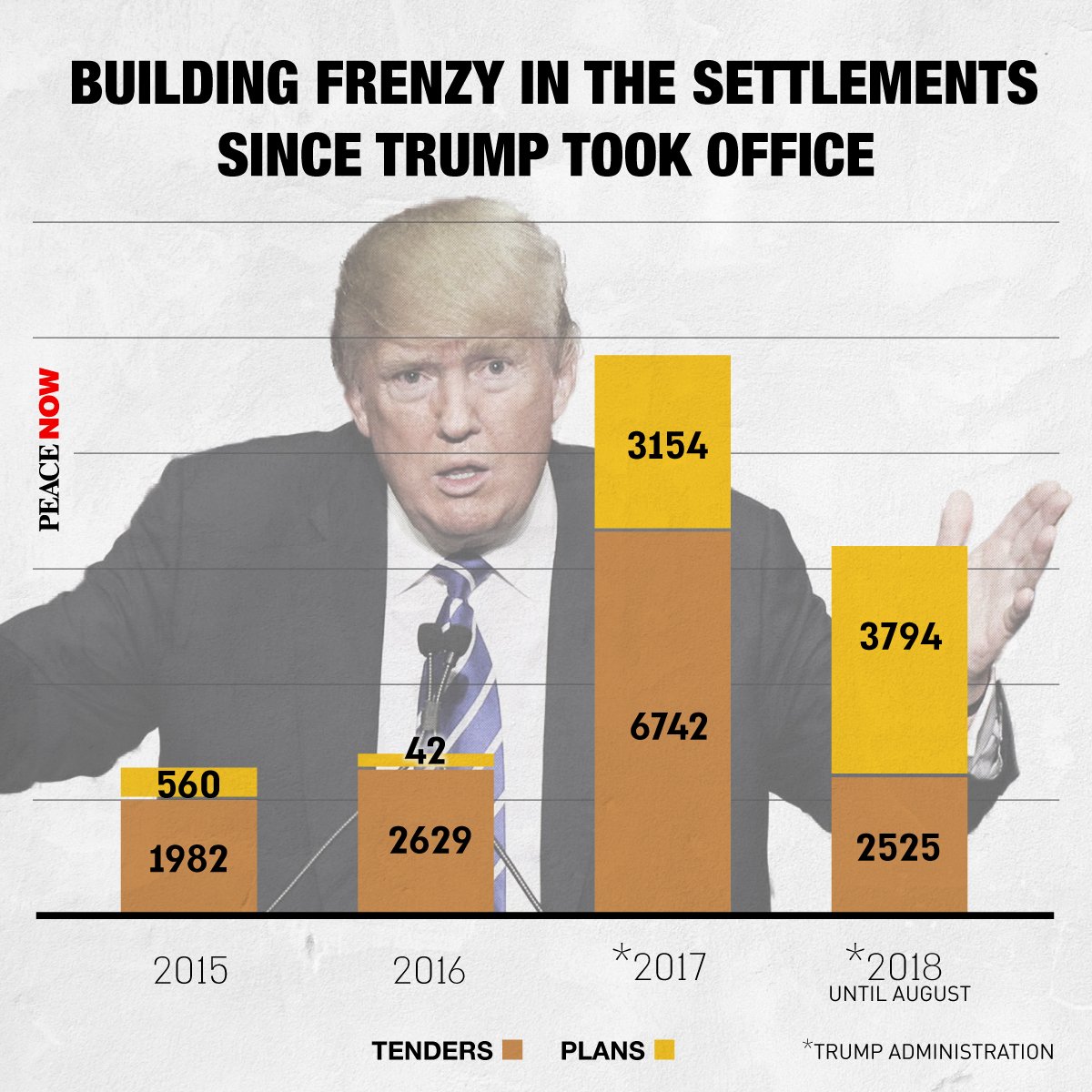
Image by Peace Now
When asked for comment on the various major settlement announcements, the U.S. State Department said that the Trump Administration believes the Israeli government has clearly demonstrated an intent to “adopt a policy regarding settlement activity that takes the president’s concerns into consideration” – a statement that suggests unequivocally that the Trump Administration has given a green light for massive settlement expansion across the length and breadth of the West Bank and East Jerusalem.
Notably, on the same day that the bulk of the settlement announcements were made, President Trump’s National Security Advisor, Ambassador John Bolton, was on the ground in Jerusalem. Not only did he offer no comment or criticism of the settlement announcements, he very publicly joined Israeli politicians and settlers leaders for dinner in East Jerusalem, dining in the “City of David National Park,” the archeological/touristic/residential site in the Palestinian neighborhood of Silwan that is run by the radical Elad settler organization. As FMEP has repeatedly covered, the Elad settler organization is spearheading a government-aided campaign to evict Palestinians from their homes in Silwan, replace them with Jewish Israeli settlers, and transform the neighborhood into a Biblical tourist site emphasizing exclusively the area’s Jewish history.
The head of the Peace Now Settlement Watch program, Shabtay Bendet, told Al-Monitor:
“The situation on the ground is changing rapidly…Restraints on construction in the settlements have been lifted. The Americans don’t care…”
State Tells High Court: We Can Annex the West Bank, International Law Be Damned
On August 7th, the state’s private attorney Harel Arnon submitted a second brief [Hebrew] to the High Court of Justice in defense of the settlement “Regulation Law.” In it he argues that the Knesset is not bound by international law and has the right to apply its own laws outside of its borders and annex land, if it wishes.
Arnon argues:
“The mere application of a certain Israeli norm [law] to an anonymous place outside the state does not necessarily make that anonymous place part of Israel. The Knesset is not restricted from legislating extra-territorially anywhere in the world, including in the region, the Knesset can legislate in Judea and Samaria.”
The brief also argues:
“The Knesset is permitted to impose the powers of the military commander of the West Bank region as it sees fit. The Knesset is permitted to define the authorities of the military commander as it sees fit. The authority of the government of Israel to annex any territory or to enter into international conventions derives from its authority as determined by the Knesset…[and] the Knesset is allowed to ignore the directives of international law in any field it desires.”
Lawyers representing Adalah responded:
“the Israeli government’s extremist response has no parallel anywhere in the world. It stands in gross violation of international law and of the United Nations Charter which obligates member states to refrain from threatening or using force against the territorial integrity of other states – including occupied territories. The Israeli government’s extremist position is, in fact, a declaration of its intention to proceed with its annexation of the West Bank.”
Harel was ordered to submit a second defense of the bill in response to a petition filed by Adalah and Al-Mezan on behalf of seventeen local Palestinian authorities. The petition argues that the Regulation Law violates international law and that the Knesset cannot enact laws over the West Bank where the majority of the population is Palestinians (who are not Israeli citizens and cannot vote).
The High Court of Justice is widely expected to strike down the “Regulation Law,” but has yet to make a ruling. Just last week, Arnon made the case that the recently passed Nation-State Law, which makes “Jewish settlement,” a “constitutional value,” can help him defend the settlement law before the High Court.
For ongoing tracking of the Regulation Law and other annexation trends in Israel, see FMEP’s Annexation Policy Tables.
This Week in Ariel: Settlers Celebrate 40 Years, A Construction Boom, A Medical School, & An Evangelical “Leadership Camp”
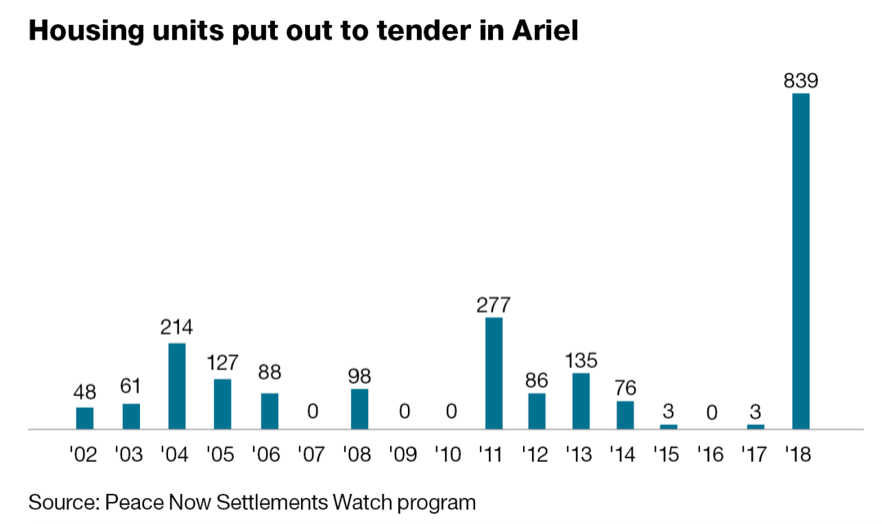 Haaretz published a lengthy report this week on the history of the the Ariel settlement – which is celebrating its 40th anniversary this month – and the dramatic spike in construction in the settlement in 2018. Even before tenders were issued for 42 new units this week (see above), plans for 839 units had already been approved during the first eight months of 2018, compared to tenders for fewer than 5 units each of the past three years. One of the original settlers of Ariel said:
“During the Obama years, everything here was frozen. But thanks to Donald Trump, we’re starting to see the light at the end of the tunnel.”
Not only has Ariel seen a massive surge in construction advancements this year, but the settlement broke ground on a new medical school heavily financed by U.S. casino magnate, and Trump backer, Sheldon Adelson (who this week gave $25 million to the GOP to help it keep the Senate, and in May gave the GOP $30 million to help it keep the House). Many settler leaders and Israeli officials, as well as Adelson and his wife Miriam, were in Ariel this weekend to attend a dedication ceremony for the medical school, despite ongoing controversy around its accreditation under domestic Israeli law. Prime Minister Netanyahu was notably absent from (and reportedly was not invited to) the ceremony, fueling rumors regarding the growing disaffection between him and Adelson.
According to another recent report in Haaretz, Ariel university is illegally dumping construction debris on land that Israel acknowledges is not “state land.” The dump site is outside of the so-called “Blue Line” which the Israeli government uses to demarcate the land that it considers “state land.” Since the dump site is not within the Blue Line, it is likely on land that even the government of Israel recognizes as being privately owned by Palestinians. Anti-settlement watchdog and founder of Kerem Navot, Dror Etkes, commented:
“It’s not surprising that Ariel University, which is the only university in the world built and existing by military order, has adopted the standards accepted in the West Bank involving the takeover of private Palestinian land.”
According to a third Haaretz report, the Israeli Education Ministry has signed a contract to sponsor 3,000-4,000 Israeli high school students of Ethiopian descent to take part in a leadership training program located in Ariel. The program, called “JH Israel,” was founded by American evangelical mega-church pastors Bruce and Heather Johnston, the latter of whom also runs the U.S. Israel Education Association, a pro-Israel, pro-settlement, non-profit group which works with the Family Research Council to lead Congressional delegations to Israel. The JH Israel website says its mission is to help Jewish Israeli students who are “disconnected from the roots of their faith” to establish “a deeper connection to God by embracing their biblical and cultural heritage.” The website also says that Ariel is “at the forefront of biblical prophecy unfolding in modern Israel.”
As FMEP has repeatedly documented, Ariel is located in the heart of the northern West Bank, reaching literally to the midpoint between the Green Line and the Jordan border. The future of Ariel has long been one of the greatest challenges to any possible peace agreement, since any plan to connect Ariel to Israel will cut the northern West Bank into pieces.
Peace Now Settlement Watch Director Shabtay Bendet spoke to Haaretz about the future of the Ariel settlement and the (other) significant repercussions of opening the new medical school. Bendet said:
“Most places in Israel don’t get recognized as cities unless they have 20,000 to 30,000 residents. Ariel became a city when it had just 11,000 residents. Why was this so significant? Because maybe you can uproot a settlement, but you don’t uproot a city. The same holds true for the university. Why was it so important for him to get it accredited? Because when a place has a university, that means it’s established — no pulling it out of the ground….By creating a buffer between the northern and southern parts of the West Bank it makes any future Palestinian state unviable. But besides that, it is also causing damage in the present because its continued expansion impinges on the ability of the surrounding Palestinian villages to develop and grow.”
Amana (the Official Settler Movement) Moves Its HQ to Sheikh Jarrah
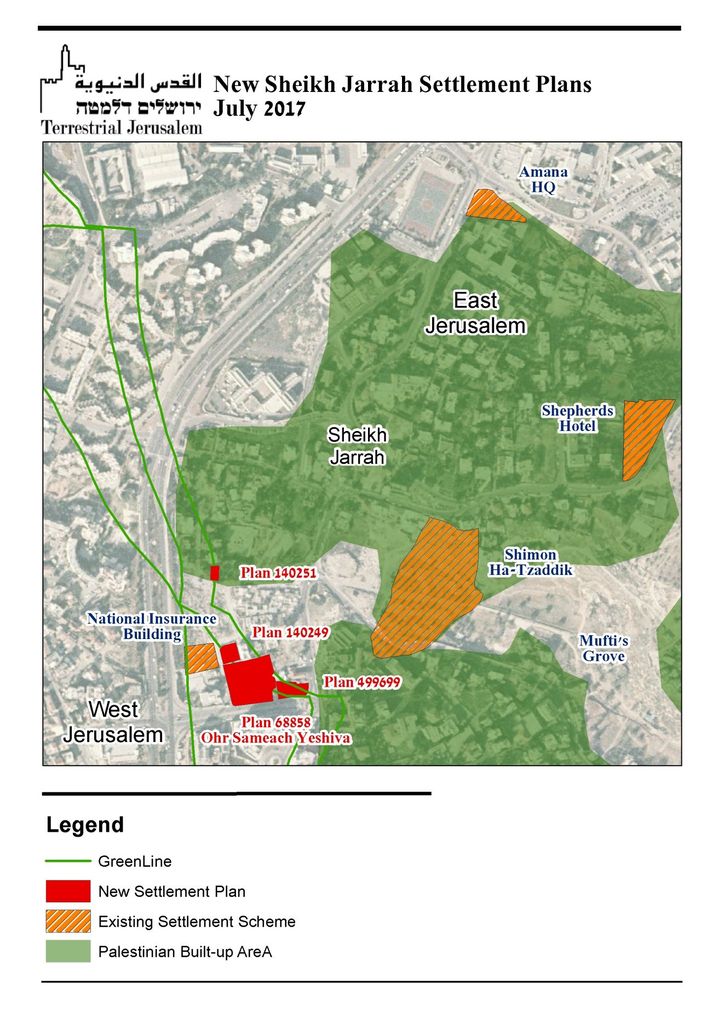 The Ynet news outlet reports that the Amana settler organization – the official body of the settlement movement, operating since the 1970s – has moved into its new headquarters in the heart of the Sheikh Jarrah neighborhood of East Jerusalem, where settlers are continuing to wage a displacement campaign against Palestinian residents. Though Amana has owned the plot of land since 1992, various legal challenges and incredibly sensitive geopolitical considerations have slowed construction of the building, called the “Amana House” (see a detailed history here).
Regarding the strategic implications of the location, Ynet reports:
“Amana says the new headquarters will help bolster the territorial contiguity of Jewish settlements in east Jerusalem.”
Agriculture and Rural Development Minister Uri Ariel (Bayit Yehudi) who previously served as the CEO of Amana, commented that the organization’s relocation:
“constitutes a significant reinforcement to the (Jewish) settlement in east Jerusalem and the bolstering of the Jewish territorial contiguity in the area.”
Several settlement plans are currently proceeding in Sheikh Jarrah, underscoring the strategic location and goals of settler activity in Sheikh Jarrah. As covered previously in this report, Israel is expected to advance a plan for a 6-story office building for settlers, located at the entrance to the neighborhood. Across the street from that building, a highly consequential plan for a new religious school (the Glassman yeshiva) was approved for deposit for public review in July 2017. The goal is clear: to unite the enclaves of settlers living inside of the Palestinian neighborhood by creating a contiguous area of settlement that connects to West Jerusalem, thereby cementing an immovable Jewish Israeli presence in a key Palestinian neighborhood – closing off the possibility of evacuation under a future peace deal.
Settlement Gains in East Jerusalem Result in Palestinians Self-Demolishing Their Homes
OCHA reports that two Palestinian homes in the East Jerusalem neighborhood of Beit Hanina were self-demolished after the Israeli Supreme Court ruled in favor of settlers’ ownership claims. OCHA writes:
“In recent decades, Israeli settler organizations, with the support of the Israeli authorities, have taken control of properties within Palestinian neighbourhoods in East Jerusalem, and some 180 Palestinian families are currently facing eviction cases, filed mainly by settler organizations.”
Bonus Reads
- “How Israeli Right-wing Thinkers Envision the Annexation of the West Bank” (Haaretz)
- “Let’s Admit It: The Settlers Have Won and We Have Lost” (Haaretz)
Welcome to FMEP’s Weekly Settlement Report, covering everything you need to know about Israeli settlement activity this week.
To receive this report via email, please click here.
July 19, 2018
- It’s the Settlements, Stupid: Documents Reveal Israel Planned Khan al-Ahmar Bedouin Removal for 40+ Years
- New Law Puts West Bank Legal Matters under Domestic Israeli Jurisdiction
- Since 1967, Israel Gave 99.76% of “State Land” in the West Bank to Settlers (But Blames Palestinians)
- Birthright & the Settlers
- Jordan Valley Settlement Council Confirms Participation in (Illegal) Outpost Activity, Refuses to Release Any Details
- Huge Expansion Approved for Pisgat Ze’ev; Jerusalem Expert: this is “Natural Response” to Trump’s Jerusalem Policy
- Bonus Reads
Comments, questions, or suggestions? Email Kristin McCarthy at kmccarthy@fmep.org.
It’s the Settlements, Stupid: Documents Reveal Israel Planned Khan al-Ahmar Bedouin Removal for 40+ Years
A recently discovered document from the 1970s confirms that the removal of Bedouin communities from the Maale Adumim/E-1 area east of Jerusalem (like Khan al-Ahmar) has been planned for decades and is directly connected to plans to expand Israeli settlements and annex West Bank territory.
The document, entitled “A proposal to plan the Ma’aleh Adumim region and establish the community settlement of Ma’aleh Adumim B,” was written by settler activist Uri Ariel (who is currently serving as Israel’s Agricultural Minister). It lays out a plan to create a “Jewish corridor” of settlements connecting the coast to the Jordan River, recommending that Bedouin be evacuated from the area east of Jerusalem in order to build a new settlement: “Maale Adumim B.”
Haaretz reports that “a large part of the plan has been executed, except for the eviction of all the area’s Bedouin,” adding “Today, under a government in which [Agricultural Minister Uri] Ariel’s Habayit Hayehudi party is so powerful, the open expulsion of Bedouin is possible.”
Jerusalem expert Danny Seidemann adds:
“the story of Khan Al-Ahmar is not only about the tragedy for the village and its inhabitants, or about Israel’s readiness to carry out an ostensible war crime in the face of the world. It is also about Israel’s determination to clear the entire area of the West Bank east of Jerusalem, and located within the line of the built and planned barrier, of any Palestinian presence. This clearing will prepare the ground for the future construction of E1 and de facto annexation of this so-called bloc, which extends well beyond the built-up area of Maale Adumim.”
New Law Puts West Bank Legal Matters under Domestic Israeli Jurisdiction
On July 16th, the Knesset voted 56-48 to pass a law that, in effect, further extends Israeli sovereignty into the West Bank, suspends even the pretense that Israel’s justice system is interested in protecting the rights of Palestinians living under occupation, and strengthens the hand of settlers and their supporters.
Specifically, since 1967, the court of first jurisdiction for cases related to Palestinians living in the West Bank — where Palestinians can legally challenge State actions (and inactions) regarding planning and construction, travel permits, freedom of information, and freedom of movement — has been the Israeli High Court of Justice, reflecting the extraordinariness of Israeli judges issuing, in effect, extra-territorial legal rulings.
The new law strips Palestinians of this direct avenue to the High Court of Justice. It compels Palestinians living in the West Bank to file petitions with the Jerusalem District Court (located within Israel’s sovereign borders). The High Court of Justice will only hear Palestinians’ cases on appeal from the district court, adding more time and higher costs to any potential appellant. The bill has been championed by Justice Minister Ayelet Shaked (Jewish Home), whose three-fold rationale for the bill explicitly states its purpose: to help settlers take more Palestinian land and shut-down Palestinian challenges to such thefts.
Shaked celebrated the passage of the bill, saying:
“The High Court petition party of Palestinians and extreme left organization against the settlements in Judea and Samaria is over today. From now on they will have to go through the judicial hurdle like any other Israeli citizen [note: Palestinians living in the West Bank are not Israeli citizens and as such do not enjoy the same rights or privileges as settlers in an Israeli court].”
Reiterating her call for annexation of the settlements, Shaked added that:
“Hebron, Ra’anana, Elon Moreh and Kiryat Arba [all but Ra’anana being places located deep inside the West Bank] are all inseparable parts of the Land of Israel.”
With the passage of the bill, the Israeli Knesset has further revealed – with startling honesty – its intention to treat the occupied territories as if they are sovereign Israeli territory. The bill is part of the legislative body’s broader effort to erase all remaining distinctions (legal, judicial, economic, and otherwise) between sovereign Israel and the occupied territories, distinctions which allowed Israel to preserve the guise of respect for rule of law, and good intentions, for the last 50 years. Lara Friedman points out:
“…this [the passage of the new law] is good news, further removing the pretense that Israel’s justice system protects Palestinian rights. For 50yrs the High Court’s rulings have at BEST dealt Palestinians pyrrhic victories that have systemically legitimized occupation & rule by law.”
FMEP tracks the application of domestic Israeli law over the occupied West Bank (the de facto annexation of the West Bank) on its Annexation Policy Tables, which are regularly updated.
Since 1967, Israel Gave 99.76% of “State Land” in the West Bank to Settlers (But Blames Palestinians)
On July 17, Israel’s Peace Now published a new report (covered in the New York Times) showing that Israel has allocated 99.76% of “State Land” in the West Bank to Israeli settlers, and just .24% to the local Palestinian population living under Israeli occupation. Israel has declared a total of 16% of land in the West Bank – including nearly half of all land in Area C – as “state land,” a method of land confiscation Israel has exploited to take control of West Bank land. This works out to around 260 square miles (674,459 dunams) of West Bank land granted to the settlers, and less than 1 square mile (1625 dunams) granted to the Palestinians.
Adding insult to injury, the 1 square mile of land granted for Palestinians was mostly for the purpose of establishing Israeli settlements and for the forced transfer of Bedouin communities off other land coveted by Israel (as in the case of Khan al-Ahmar).
The data upon which the report is based was furnished to Peace Now and the Movement for Freedom of Information in response to a two-year old freedom of information request to the Israeli Civil Administration (which is the sovereign governing power over the West Bank and is obligated under international law to protect the rights of the occupied people). In its response to the request, the Civil Administration suggested that Palestinians are to blame for the stark inequality, since they have refrained from applying to use the land. A statement from the Civil Administration reads:
“Applications for the allocation of state land are routinely submitted by all the population, both Palestinian and Israeli. It should be emphasized that the number of requests submitted by Palestinian residents is generally very low.”
With this argument, the Civil Administration has constructed a classic “damned if they do, damned if they don’t” argument. If Palestinians apply to use the land, they would legitimize Israel’s authority to declare West Bank land “State Land” in the first place as well as Israel’s authority to grant or deny its use, whether to Palestinians or settlers. If Palestinians don’t apply, they are blamed for Israel’s decisions on allocating virtually all of the land to settlers. This argument also ignores the fact that the the pattern of allocation of “State Land” revealed in this report is not an exception to, but an illustration of, the rules according to which the Civil Administration has run the West Bank for the past 51 years – rules that overwhelmingly favor the settlers over the Palestinians, most blatantly when it comes to land and construction.
More fundamentally, setting aside the question of whether Israel has abused its authority in declaring so much of the West Bank to be “State Land,” the Civil Administration’s response completely ignores the fact that Israel has a legal responsibility under international law regarding stewardship of “state land” held under its occupation. As the Association for Civil Rights in Israel explains:
“Israel holds state land in an occupied territory as a trustee, and must do everything possible to preserve and develop it for the benefit of the local Palestinian population. The very use of state land for the purpose of building settlements and/or developing infrastructure and industrial zones not in favor of the Palestinian population constitutes a violation of international law. ”
The New York Times observes, correctly:
“The lopsided allocation is hardly surprising. Israeli legal experts say the whole point of seeking out state lands, the bulk of which were designated in the 1980s, was to aid the growing settlement enterprise, which most of the world considers a violation of international law. But the paucity of land allocated to the Palestinians shows the extent of competition over territory, and the effort Israel puts toward building the settlements.”
Peace Now said:
“The significance of the data is that the State of Israel, which has been in control of the West Bank for more than 50 years, allocates the land exclusively to Israelis, while allocating virtually no land for the unqualified benefit of the Palestinian population. Land is one of the most important public resources. Allocation of land for the use of only one population at the expense of another is one of the defining characteristics of apartheid. This is further proof that Israel’s continued control of the occupied territories over millions of Palestinian residents without rights and the establishment of hundreds of settlements on hundreds of thousands of dunams has no moral basis.”
The Peace Now report shines a harsh spotlight on a key facet of Israel’s decades long effort to confiscate land and transfer it to the settlers, particularly in Area C, and it comes at a time when Israeli lawmakers are loudly and clearly calling for the unilateral annexation of Area C – all of which FMEP documents in its Annexation Policy Tables.
Birthright & the Settlers
Adding to the swirling coverage of participants leaving Birthright trips to learn about Palestinians and realities in the West Bank and East Jerusalem, Birthright (an organization which organizes free trips to Israel for young Jews around the world) has come under the spotlight this week for two settlement-related reasons: the harassment of Birthright participants who left the trip to tour Hebron, and Birthright’s partnership with the radical settler group Elad.
First, cameras caught settlers harassing a group of Birthright participants who left the trip to tour Hebron with Breaking the Silence. The tour guide, a former IDF soldier, was attacked by the settlers. Breaking the Silence regularly takes groups to Hebron to observe the apartheid-like reality that exists there, “sterile streets” (an Israeli military term for streets which Palestinians are forbidden to access) and all. Part of that reality is daily settler violence, as Breaking the Silence explains:
“Near daily occurrences of abuse of the Palestinian population by settlers, including humiliation and physical attacks, are part and parcel of the lives of those Palestinians who still live in H2. Even worse, twisted norms of law enforcement in which two different populations are subject to two different sets of laws – one military and one civilian – creates a situation of selective law enforcement at best, and complete lack of law enforcement over the residents of the Jewish settlement at worst.”
Second, Birthright’s partnership with the radical Elad settler organization was exposed when a second group of youth left a Birthright trip during a tour of Silwan (aka the City of David) with Elad, which manages the City of David National Park (which was declared on Silwan land). Elad is engaged in a range of activities to enact their extremist political agenda, at the expense of Palestinians. The group left the Birthright tour to join a Peace Now visit with the Palestinian Sumreen family, who are under threat of eviction from their Silwan home because of the actions of the Elad and the JNF. Birthright responded by accusing the participants who left the trip of seeking to advance a “political agenda,” and defending itself as an “apolitical” organization. Birthright’s response is especially ironic given Birthright’s own choice to ally itself with Elad — an organization that explicitly exists to promote an extremist political and ideological agenda (for further irony, see this proud announcement by a former Birthright participant noting that it was her experience with Birthright that inspired her to become a settler).
Peace Now later said in an email:
“Peace Now has no fight with Birthright. What we oppose are government (or any other) efforts to insert political programming into trips like Birthright’s that intentionally conceal the occupation, such as Elad tours. Elad’s far-right, one-state agenda is well-known, and it is involved in the legal acrobatics underway to evict Palestinian families from their homes.”
Jordan Valley Settlement Council Confirms Participation in (Illegal) Outpost Activity, Refuses to Release Any Details
The Jordan Valley Settlement Council, which represents the majority of Israeli settlements located in the West Bank section of the Jordan Valley, has admitted that it supports illegal outposts in the area, but declined to provide information on its activities. The admission came in response to a freedom of information request made by an Israeli lawyer representing the anti-occupation group Machsom Watch and the coexistence group Combatants for Peace.
In the written refusal to divulge information about the Jordan Valley Settlement Council’s involvement with outposts, staff member Oshra Yihye said that its refusal is based on the fact that the parties requesting the information are critical of settlers living in the Council’s jurisdiction. Yihye also claimed that revealing the information will interfere with Council’s operations. Some Jordan Valley settlers are known to violently attack Palestinian farmers and their property, and settlers have been repeatedly caught on video attacking Israeli activists trying to assist the Palestinians.
Israel has effectively annexed 85% of land in the Jordan Valley, through ongoing settlement building and the declaration of “closed military zones” on vast swaths of farmland. A recent report by B’Tselem documents how Israeli settlers were allowed to establish two new outposts in the Jordan Valley last year. In recent months, Israel has delivered eviction notices to entire Palestinian communities near Israeli settlements in the Jordan Valley. Simultaneously, settlers have been allowed to continue construction on a tourist project – a car race track built in a closed military zone (land expropriated from Palestinians ostensibly for security purposes), despite a court ordered stop-work order.
Huge Expansion Approved for Pisgat Ze’ev; Jerusalem Expert: this is “Natural Response” to Trump’s Jerusalem Policy
On July 2nd, the Israeli Housing Ministry deposited for public review plans for 1,064 units in the Pisgat Ze’ev settlement in East Jerusalem. Jerusalem expert and founder of Terrestrial Jerusalem, Danny Seidemann, recently punctuated the significance of the move, explaining:
“Politically speaking, this approval signals a clear statement by Israeli authorities. These plans received initial approval from the Planning Board in July 2017, as [Terrestrial Jerusalem] reported in detailed here. While the approval of these plans at this time, after a year’s delay, is indeed in large part the normal course of events in the bureaucratic decision, the publication could not have taken place without the advance knowledge and blessing of Netanyahu. As such, this is yet another component in Netanyahu’s systematic effort to tighten Israel’s grip on East Jerusalem, his natural response to Jerusalem having been ‘taken off the table’ by President Trump.”
While pointing out that the Pisgat Ze’ev plans are the first East Jerusalem settlement plans to be deposited for public review this year, Seidemann says:
“This should by no means lead to the conclusion that until now there has been a de facto settlement freeze in East Jerusalem. Before the Pisgat Ze’ev approvals, other settlement activities were proceeding apace, including ground being broken for the expansion East Talpiyot and deliberations on a major new plan in Southeastern Gilo (Master Plan 125195).”
For more analysis from Terrestrial Jerusalem on the Pisgat Ze’ev plans, see here.
Bonus Reads
- “How a West Bank Highway’s Road Sign Captures the Israeli Psyche” (Haaretz)
- “Bulldozers In The West Bank: How recent Israeli Settlement Expansion Jeopardizes the Peace Process” (Forbes)
- “Israel Accelerates ‘Greater Jerusalem’ Plan” (Ahram Online)