Welcome to FMEP’s Weekly Settlement Report, covering everything you need to know about Israeli settlement activity this week.
To subscribe to this report, please click here.
November 18, 2022
- Jerusalem Planning Committee to Discuss (Another) Plan to Significantly Expand Nof Zion Settlement Enclave
- As Court Tries to Avoid Underlying Issue of Land Allocation Practices in the West Bank, Palestinians Reject “Deal” that Would Allow Construction of Givat Eitam/E-2 Settlement,
- Mass Displacement/Dispossession in Silwan Advances, Court Rejects Shahadeh Family Petition
- Elad Continues Illegal Work in East Jerusalem Cemetery
- Bibi’s Coalition Promises on Settlement: Outposts, Homesh, Evyatar, Infrastructure, Override Clause, & More
- Settler Violence Continues to Surge
- U.S Ambassador Visits a Settlement, Less Than a Year After Saying He Won’t
- Bonus Reads
Jerusalem Planning Committee to Discuss (Another) Plan to Significantly Expand Nof Zion Settlement Enclave
Ir Amim reports that on November 23rd the Jerusalem District Planning Committee is scheduled to discuss a plan to expand the Nof Zion settlement enclave, located in the heart of the Palestinan neighborhood of Jabal Mukaber in East Jerusalem. The plan would allow for 100 new residential units and 275 hotel rooms in the settlement enclave, and is part of a larger scheme to connect the enclave to the built-up area of East Talpiot – a scheme which would cut deeply into the Jabal Mukaber neighborhood and entrench the expanding continuum of Israeli settlements surrounding Jerusalem.
Commenting on the plan, the Israeli NGO Ir Amim writes:
“Beyond its geopolitical implications, this is yet another example of the severe discrimination in urban planning and housing in East Jerusalem. Despite the plan being slated for the entrance of Jabal Mukabber, it is not designated for the community’s development needs but rather for the expansion of a Jewish settlement in the middle of a Palestinian neighborhood. It should be noted that Jabal Mukabber is among the Palestinian neighborhoods in East Jerusalem with the highest number of demolitions per year.”
Specifically, the Nof Zion expansion plan to be discussed by the Jerusalem District Planning Committee on November 23rd is interconnected with another plan (last discussed by the Committee in January 2022). That plan seeks to move an Israeli police station [the Oz station] currently located on the border of Jabal Mukaber, to a new site across the street (where it will become a massive Israeli security headquarters), leaving its current location free for the planned expansion of Nof Zion. Ir Amim filed a petition against the police station plan, saying that it is an affront to the planning needs of the local community and continues Israel’s systematic, city-wide discrimination against the housing, educational, and service-based needs of Palestinian neighborhoods. A decision on the police station relocation plan is expected soon.
Ir Amim further explains the impact of these plans:
“Expanding the settlement towards the main entrance of Jabal Mukabber will infringe on the residents’ freedom of movement and further disrupt the fabric of life in the neighborhood. Prior experience show that during clashes and periods of tension and instability, Israel rushes to impose collective restrictions under the pretext of protecting Israeli settlers.”
These plans are just the latest efforts to expand and entrench the Nof Zion settlement enclave. Prior plans include:
- In 2017, the Israeli government approved a plan to build a new synagogue and mikveh for the settlement, to be located on private Palestinian land that had been expropriated form Jabal Mukaber the year before.
- In April 2019, after two years of rumors, the Israeli government issued 176 building permits for the already-approved project to build . According to Ir Amim, those permits were ultimately issued in April 2019.
- In 2019, construction began on a plan to triple the size of the settlement enclave, making it the largest such enclave in East Jerusalem. After a two-year stall, construction on the expansion resumed in 2021 with new financing.
As Court Tries to Avoid Underlying Issue of Land Allocation Practices in the West Bank, Palestinians Reject “Deal” that Would Allow Construction of Givat Eitam/E-2 Settlement
On November 14th, Peace Now tweeted updates from a courtroom where the Israeli Supreme Court was attempting to resolve the ongoing petition against the allocation of “state land” for the construction of the Givat Eitam/E-2 settlement, slated to be build on a strategic hilltop – which Palestinians know as a-Nahle – located just south of Bethlehem. The construction of Givat Eitam/E-2 would significantly expand the Efrat settlement in the direction of Bethlehem. It would also effectively cut Bethlehem off from the southern West Bank and complete the city’s encirclement by Israeli settlements.
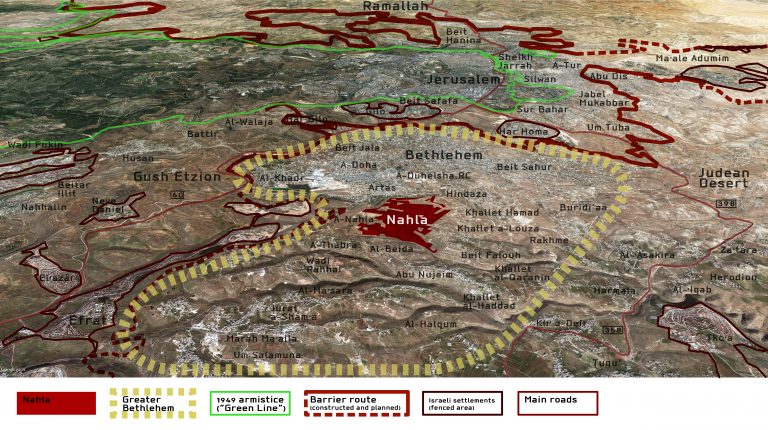 In the hearing, the State of Israel proposed a deal to the Palestinian petitioners, according to which the State would allocate to them a total of 54 dunams (out of the 1,400 dunams originally planned for the construction of the new settlement). The Palestinian landowners rejected the deal, with their lawyer Michael Sfard noting:
“The main problem is that the solution proposed by the court…does not remove the evil of the decree from their heads, and therefore we oppose this proposal…that offer, whether it is 50 or 100 dunams, does not help the Palestinian communities. Since we, and everyone who sits around here, knows that if this neighborhood is built, it’s likely that they won’t even be able to cultivate those acres.”
Peace Now tweeted its sense of where the judges opinions might land, writing:
“The hearing is over. The petitioners rejected the state’s offer. It seems that the judges are trying to avoid a decision on the central question regarding the entire land – whether it should be allocated to the settlements or the Palestinians. The judges keep trying to walk between the drops. On the one hand, they cannot ignore the blatant discrimination in Israel’s land allocation policy. On the other hand, they are trying to avoid the fundamental question of the legality of this land allocation to the settlement.”
The High Court held a hearing in June 2021 on this same petition. Peace Now’s Hagit Ofran told FMEP that at the conclusion of that hearing the Court had given the government of Israel 90 days to respond to a proposal to either allocate to the individual petitioners some of the “state land” directly involved in the case, or to allocate to them “state land” nearby. This decision by the Court purposely narrowed the scope of Peace Now’s legal challenge by addressing only the case of the land in a-Nahle and the individual petitioners involved, thereby dodging the more fundamental question put forth in the petition challenging Israel’s discriminatory practice of allocating 99.8% of “state land” for settlement purposes. This is the first time the issue of state land allocations to settlements is being challenged in an Israel court.
Mass Displacement/Dispossession in Silwan advances, as Court Rejects Shahadeh Family Petition
On November 13th, the Jerusalem District Court announced that it had rejected an appeal by the Palestinian Shehadeh family seeking to cancel eviction orders that seek to dispossess them of their longtime homes in the Batan al-Hawa section of Silwan in favor of the Ateret Cohanim settler organization. The announcement follows a hearing the Court held on the appeal on November 9th.
As a reminder: the Shahadeh family is one of 85 families in Batan al-Hawa facing displacement at the behest of Ateret Cohanim. The legal fate of all of the families is bound together, with the Duweik family’s case being the furthest advanced and setting a dangerous precedent for the Shehadehs and others. Indeed, this week the Supreme Court discussed several of the decisions made in regards to the Duweik family, and their relation to the Shehadehs’ case. Notably, in July 2022 a 3-judge panel of the Supreme Court could not agree on the Duwiek’s family’s petition, which resulted in the petition being sent back to the Jerusalem Magistrate’s Court – where it currently awaits further consideration. One of the judges accepted the argument that the family should be allowed to continue living in their homes because a statute of limitations prohibits Ateret Cohanim – through its management of an historic land trust – from making a claim to the land after such a long period of absence.
As a reminder, Ateret Cohanim has waged a years-long eviction campaign against Palestinians living in Silwan, on property the settler NGO claims to own. In total, Ateret Cohanim’s campaign stands to ultimately dispossess 700 Palestinians (85 families) in Silwan. The group’s claim is based on having gained control of the historic Benvenisti Trust, which oversaw the assets of Yemenite Jews who lived in Silwan in the 19th century. In 2001 the Israeli Charitable Trust Registrar granted Ateret Cohanim permission to revive the trust and become its trustees, (following 63 years of dormancy). In 2002, the Israeli Custodian General transferred ownership of the land in Batan al-Hawa to the Trust (i.e., to Ateret Cohanim). Since then, Ateret Cohanim has accelerated its multi-pronged campaign to remove Palestinians from their homes, claiming that the Palestinians are illegal squatters.
Elad Continues Illegal Work in East Jerusalem Cemetery
Emek Shaveh & Ir Amim tweeted footage of construction work at the site of the Sambuski cemetery, an ancient Jewish cemetery located in the Ben Hinnom Valley in East Jerusalem. The Elad settler group – which is paid by the Israeli government to manage and expand a web of settler-tourist sites and the City of David National Park – has been conducting work on the Sambuski Cemetery despite apparently lacking a permit. Emek Shaveh – an Israeli NGO with expertise in archaeology – notes that any construction within a national park should be heavily scrutinized by professionals and the public before being implemented.
In August 2022, Elad unilaterally closed the main access road leading to the Palestinian neighborhood of Wadi Rababa, which travels past the Sambuski cemetery. 150 families were trapped in the neighborhood while Elad worked on the site.
The Sambuski cemetery was a relatively unknown, neglected site until recent years – but it is deeply integrated into Elad’s overarching, comprehensive plan to take control of the Silwan neighborhood. In 2020, the-president Trump’s “Peace to Prosperity” plan identified the Sambuski cemetery as a place of prime historical and religious importance to Israel, elevating the status of the cemetery. The Israeli NGO Emek Shaveh – which has special expertise on archaeology and the way archeology has been weaponized to serve the political agenda of the settlers and the state of Israel – wrote a report on exactly how the Trump plan supports settler efforts to use Jerusalem’s history and antiquities to promote Israeli-Jewish hegemony and control over the city.
Emek Shaveh explains how the cemetery is connected to other settler endeavors in Silwan:
“For the Elad Foundation the cemetery is a strategic site as it links together two important focal points of its enterprise – the neighborhood of Silwan, home to the City of David archaeological park and specifically to the Pool of Siloam at the southern tip of the site, and the Hinnom Valley an area which Elad has been developing for the past two years (more below).”
Bibi’s Coalition Promises on Settlement: Outposts, Homesh, Evyatar, Infrastructure, Override Clause, & More
Netanyahu continues to negotiate a final coalition agreement in order to form a new government, and has reportedly committed to virtually all of the main demands of the settler movement (short of outright annexation of all the land between the river and the sea), including:
- Passage of the Supreme Court Override Clause (see this new explainer by ACRI). This law would obliviate judicial oversight in Israel, giving ultimate power to the Knesset. Under the new Israeli government and with the current Knesset, this law would likely be used to reinstate the Settlement Regulation Law – the law that seeks to establish a legal basis for Israel to retroactively legalize outposts and settlement structures which are built on land that Israel acknowledges is privately owned by Palestinians. As a reminder, that law was overturned by the Israeli Supreme Court in June 2020. Peace Now estimates that the law stands to convert some 55 unauthorized outposts into official, authorized settlements, seizing some 8,000 dunams of privately owned Palestinian land in the process.
- Full recognition & integration of outposts (i.e., retroactive legalization and de facto annexation). This was reportedly promised to Bezalel Smotrich, who has authored Knesset legislation to grant full status to outposts irregardless of the status of the land on which the outposts were built illegally. Separately, Netanyahu agreed with Itamar Ben Gvir that the outposts would be provided infrastructure services within 60 days of the new government being sworn in.
- The reestablishment of the Homesh Settlement. Netanyahu reportedly committed to Itamar Ben Gvir, a longtime supporter/devotee of Rabbi Meir Kahane, that the settlement of Homesh will be reestablished on the land where it stood prior to being dismantled by the Israeli government in 2005. To do so would require the government to amend the 2005 Disengagement Law that not only ordered the dismantling of the Homesh settlement along with three others in the northern West Bank, but provided for Israel’s withdrawal from Gaza. For more on the long-running campaign by settlers and their allies to reestablish the Homesh settlement – and its consequences for Palestinians who live nearby and own the land on which Homesh once stood – see here.
- The legalization of a yeshiva at the Evyatar Outpost. Netanayhu and Ben Gvir agreed to grant retroactive authorization to a yeshiva established at the Evyator outpost. For more on the Evyatar outpost & yeshiva saga – see here.
- A commitment to expanding settler road infrastructure across the West Bank. Netanyahu agreed with Ben Gvir to allocate $434 million ($1.5 billion shekels) for the paving of new and expanded bypass roads in the West Bank and for the expansion of Highway 60, and to expedite the planning process for doing so. For more analysis on how infrastructure such as roads contribute to Israel’s de facto annexation of the West Bank, see this report by Breaking the Silence.
In addition, Netanyahu is coming under increasing pressure from inside his coalition to name far right-wing MK Bezalel Smotrich as the next Defense Minister. Haaretz reports that Itamar Ben Gvir supports Smotrich’s demand because it will,
“help implement a full right-wing policy, establish new settlements in the West Bank, approve construction of thousands of new housing units in them, stop Palestinian construction in Area C and halt the evictions of illegal outposts.”
Of note, in 2021 Smotrich suggested that a “solution” to Palestinian “illegal” construction in Area C (construction by Palestinians on their own land, but without Israeli-required building permits, that Israeli makes it nearly impossible to obtain) could be to give settlements the authority to demolish Palestinian construction they believe to be unauthorized.
American officials, including Ambassador Nides, have expressed concern over Smotrich’s potential appointment to such a key – and powerful – post. In addition to his pro-settlement, pro-annexation positions, Smotrich is also a self-proclaimed homophobe and has lobbied for the expulsion of Palestinians from Israel.
Lastly, and underscoring the extent to which the settlers’ agenda and the governing coalition’s agenda are one and the same: a newly elected Member of the Knesset, Limor Son Har-Melech of the Religious Zionism coalition, has appointed a member of the radical hilltop youth movement to serve as his spokesperson. Har-Melech’s new spokesman, Elisha Yered, lives in the outpost of Ramat Migron in the northern West Bank, and is under ongoing investigation following his arrest in August 2022 for “racist conspiracy” — amongst other charges for crimes against Palestinians. Yered is quoted as saying:
“the hills are the scene of a war that according to Jewish law one is required to wage…what the hills do is to bring Jewish control to hundreds of dunams – that is something that no soldier in the greatest reconnaissance unit can do during his service.”
Settler Violence Continues to Surge
Following a Palestinian stabbing attack near the Ariel settlement that left 3 Israelis dead and 3 injured, settlers across the West Bank rampaged to take their revenge, committing over 20 attacks against Palestinian and their property, as well as Israeli soldiers, in the 24 hours that followed.
In addition, in its weekly report on Israeli human rights violations covering Nov. 10-16, the Palestinian Centre for Human Rights reports that settlers conducted 4 attacks on Palestinians’ vehicles in different areas in the West Bank during the reporting period Nov. 10-16.
“On 14 November 2022, Israeli settlers moved into Haris village in Salfit, north of the West Bank, and burned four vehicles belonging to the villagers.
On 15 November 2022, Israeli settlers attacked and set fire to a vehicle belonging to a
Palestinian who was in his way back from ‘Attil village in northern Tulkarm to Nablus.On the same day, Israeli settlers intercepted a bus for a women’s trip in Hebron and
prevented it from moving for few hours, enticing fear among the passengers.On 16 November 2022, Israeli settlers threw stones at four vehicles near Ramin village, east of Tulkarm, breaking their windows. On the same day, Israeli settlers damaged a vehicle belonging to a Palestinian doctor near Jit village in Qalqilya.”
PCHR concludes, noting: “Since the beginning of the year, settlers conducted at least 236 attacks. In two of the attacks, 2 Palestinians were killed.”
U.S Ambassador Visits a Settlement, Less Than a Year After Saying He Won’t
This week U.S. Ambassador to Israel Thomas Nides visited the West Bank settlement of Kiryat Netafim to offer his condolences to the grieving family of a victim of Sunday’s stabbing attack that killed three and wounded three. Nides’ trip marks the first time any representative of the Biden Administration has undertaken official travel to any Israeli settlement. A U.S. Embassy spokesperson said that “the shiva visit in no way signals a change in US policy toward settlements”
In January 2022 Ambassador Nides was quoted as saying he “will absolutely not” visit a settlement. It’s worth recalling that the Biden Administration has not reversed or publicly rejected the Trump Administration’s “Pompeo Doctrine,” which made it U.S. policy to view Israeli settlements as not “per se inconsistent with international law.”
Kiryat Netafim is located about half way between the Ariel settlement and the cluster of settlements close to the 1967 Green Line that are slated to be united into a “super settlement” area (Oranit, Elkana, Shiva Tikva, and others). The string of settlements creates a contiguous corridor of Israeli construction and control stretching from sovereign Israeli territory to Ariel. As FMEP has repeatedly pointed out, the Ariel settlement is located in the heart of the northern West Bank, reaching literally to the midpoint between the Green Line and the Jordan border. The future of Ariel has long been one of the greatest challenges to any possible peace agreement, since any plan to attach Ariel to Israel (with a finger of land running through settlements like Kiryat Netafim) will cut the northern West Bank in half..
Bonus Reads
- “Gantz approves upgrade to stretch of West Bank barrier after spate of terror attacks” (The Times of Israel)
- On the U.N.:
- “Key UN committee seeks legal opinion on Israel’s occupation” (Washington Post)
- “Opinion | Israel’s Chutzpah at the United Nations” (Haaretz / Noa Landau)
- “Lapid, Gantz slam UN panel’s call on ICJ to probe Israeli ‘occupation, annexation’” (The Times of Israel)
- “Adalah and Center for Constitutional Rights demand US cancel its plan to build embassy compound in Jerusalem on private Palestinian land” (Adalah)
- “Expulsion by Other Means: Israel’s Campaign Against Palestinians in Masafer Yatta” (J Street)
- “Ben & Jerry’s board bemoans West Bank, east Jerusalem sales” (AP News)
- “Wild boars in Palestine are being weaponized by Israeli colonialism” (Mondoweiss)
- “IDF soldier suspended for cursing left-wing activist in Hebron: ‘You’re a traitor’” (The Times of Israel)
Welcome to FMEP’s Weekly Settlement Report, covering everything you need to know about Israeli settlement activity this week.
To subscribe to this report, please click here.
September 30, 2022
- 150+ Palestinians (30 Families) Face Imminent Displacement Following Secret Land Registration in East Jerusalem
- In Major Step Towards Authorization (Under Israeli Law), Israel to Provide Security to Outposts
- Bonus Reads
150+ Palestinians (30 Families) Face Imminent Displacement Following Secret Land Registration in East Jerusalem
Ir Amim reports that, as a result of Israel’s secret registration of land in East Jerusalem, 30 Palestinian families received eviction notices instructing them to leave their homes by September 1, 2022. Since the deadline has passed, the Israeli General Custodian can open a legal case to pursue their eviction at any moment. The eviction notices appear to be premised on Israel’s secret registration of land between near Abu Dis and Jabal al-Mukhaber, which was made public in August 2022.

There are two significant problems to this pretext. First, Ir Amim reports that only 3 of the 30 families which received eviction notices actually live on the parcel of land which State seized control of – the 27 other families live nearby but not within the borders of the parcel of land.
Secondly – and perhaps more significantly – Ir Amim has new evidence that forty years ago Israel examined the ownership of the same exact parcel of land and determined that it was privately owned by Palestinians, not Jews, prior to 1948. This new finding completely delegitimizes the premise on which the State seized control of the land this year. Ir Amim writes:
“Beyond the fact that most of the families facing eviction do not even reside on the respective plot, according to Ir Amim’s examination, there is no evidence to corroborate claims of Jewish ownership of the land designated as bloc 31735. This calls into question the means in which the General Custodian registered the land under its management. Due to the fact that the procedure was carried out in a covert manner and authorized in a closed court proceeding—likely at the behest of the General Custodian—it is impossible to ascertain the basis of its claims. While the Israeli media reported that the Custodian registered the land under its management based on proof affirming Jewish land ownership from the early 20th century, the documents Ir Amim acquired refute those claims.”
To learn more about Israeli land registration – and how it is being used as another tool to dispossess Palestinians in East Jerusalem – listen to FMEP’s recent podcast episode on this topic featuring Amy Cohen of Ir Amim.
In Major Step Towards Authorization (Under Israeli Law), Israel to Provide Security to Outposts
On September 29th, the Israeli military announced that, for the first time, it will provide security for illegal/unauthorized outposts, which will include equipping these outposts with surveillance and warning systems, lighting, public address systems, and firefighting equipment. The army’s announcement touted this as a “major change in policy,” and further, “the army’s job is to protect any place where Israeli citizens and residents are found. This important and necessary change will enable us to bolster the region’s layers of defense.”
Underscoring the absurdity of the situation, the Israeli army plans to only provide outposts with portable equipment – – because permanent construction in the outposts is illegal under Israeli law. The State has tried for years to correct that fact, having commissioned several councils and task forces to examine the legal status of each outpost and plot legal paths towards authorization. That work is still ongoing. By providing military protection to the outposts, Israel is undertaking a significant step towards retroactively authorizing the outposts and in fact proceeding with the de facto annexation of the outposts.
The Forum for Young Settlements (which is a euphemism for outposts) celebrated that military’s decision as a big step towards authorization, saying:
“[the IDF’s decision is] an important step towards full authorization…We are happy that two years after Defense Minister Benny Gantz toured ‘young settlements’ and after our hard work and repeated requests, he has finally decided that it is not possible to endanger our lives and the lives of our children any longer,” the forum said in response to the decision.”
The Israeli anti-settlement NGO Yesh Din said that, with this new decision:
“the army will provide protection to the lawbreakers, and has thereby turned itself and its soldiers into partners in crime. Granting protection to the outposts is a reward for the criminals who live in these illegal outposts and a continuation of the policy of creeping annexation of the West Bank that is being pushed by extremists under the auspices of the Israeli government.”
Peace Now said in response:
“Illegal outposts need to be dismantled, not secured.”
Bonus Reads
- “Israel installs remote-controlled weapons system at Hebron checkpoint, alarming Palestinians” (The New Arab)
- “Israel green lights use of drones to assassinate Palestinians in West Bank: Report” (Middle East Monitor)
- “Regavim Field Coordinator comes under fire near Kiryat Arba” (Arutz Sheva)
Welcome to FMEP’s Weekly Settlement Report, covering everything you need to know about Israeli settlement activity this week.
To subscribe to this report, please click here.
March 11, 2022
- Settler Population Continues to Surge
- Bennet Government Delays Khan al-Ahmar Decision
- Major Ma’ale Adumim Settlement Expansion Advanced
- Palestinians Continue Weekly Protests Against Expansion of “American Road” in Jerusalem
- High Court to Rule on Expulsion of Palestinians in South Hebron Hills “Firing Zone”
- Former U.S. VP Mike Pence Hangs out with Kahanists in Hebron
- Further Reading
Settler Population Continues to Surge
The Israeli Ministry of Interior released new figures on the growth of the West Bank settler population over the past 13 months (January 1, 2021 through Jan 31, 2022). The data shows that growth in the Israeli settler population, which surged during President Trump’s overtly pro-settlement term in office, has continued to accelerate. This population growth follows the surge in settlement construction that took place during the Trump presidency.
The data was compiled by Yaakov Katz, who is the former Chair of the Board of Directors of the settler-run Arutz Sheva media outlet. Katz currently publishes West Bank Jewish Population Stats (a project of “Bet El Institutions”, associated with the settlement of Beit El – a settlement closely associated with Trump’s ambassador to Israel, David Friedman). The data reveals that over the reporting period:
- The number of West Bank settlers grew to a total of 490,493 (not including the ~330,000 East Jerusalem settlers), representing a nearly 3.2% rise over 13 months.
- The following settlements increased their population size by over 10% over the reporting period:
- Rechan, located in the northern West Bank;
- Alei Zahav, located in a string of settlements stretching across the northern West Bank. Alei Zahav and its settlement neighbors create a contiguous Israeli populated areas linking Israel proper (west of the Green Line) all the way to the Ariel settlement, located in the heart of the West Bank (the eastern end of Ariel is closer to the Jordan border than to the Green Line). Notably, Alei Zahav is one of the settlements in which the “market principle” has been applied to legalize settlers theft of land recognized by Israel as belonging to Palestinians (see our July 2019 report).
- Amichai, a brand new settlement established by the Israeli government in 2017 and continuously expanded, located in the central West Bank;
- Naaleh, in the central West Bank;
- Bruchin, in the central West Bank;
- Yitzhar, the radical and violent settlement located near Nablus in the central West Bank. The Yitzhar settlement serves as the home base of the “Hilltop Youth” settler movement;
- Nokdim, located south east of Bethlehem;
- Metzad-Asfar, located south east of Bethlehem;
- Kfar Etzion, located south of Bethlehem;
- Beit HaArava, located in the Jordan Valley;
- Maskiot, located in the Jordan Valley;
- Negohot, located in the South Hebron Hills;
- Susya, located in the South Hebron Hills;
- Pnes Hever, located in the South Hebron Hills;
- Sansena, located in the South Hebron Hills.
The report goes on to predict that the settler population will cross the 1 million threshold in 2046.
Bennet Government Delays Khan al-Ahmar Decision
This week the Bennett-led government asked the High Court of Justice to extend the deadline for submitting its position on the forcible relocation of the Khan al-Ahmar bedouin community (a war crime). The State was facing a March 6th court deadline (which has already been delayed once at the request of the State), and initially requested a two-day extension – which the Court granted. On March 8th, the State requested a 30-day extension, citing the Russian invasion of Ukraine as a time consuming matter for senior officials whose input is needed on the Khan al-Ahmar plan.
Regavim – the settler group behind the Court case seeking to force the government to demolish Khan al-Ahmar – slammed Bennett for the repeated delays and also stated that they might challenge the latest delay, saying:
“As far as we know, Prime Minister Bennett has already returned from his trip to Europe, and the additional rejection request smells like smearing. We will consider appealing to the Supreme Court for a ruling.”
Prior to this most recent delay, reports suggested that the government was preparing a plan that would see the demolition of the Khan Al-Ahmar only to (bizarrely) rebuild the community some 300 meters from where it currently stands. As a reminder, the High Court has ordered the demolition of Khan al-Ahmar, which it declared to be illegally built (i.e., lacking Israeli building permits that are virtually impossible for Palestinians to obtain).
It’s also worth recalling that the Supreme Court, in its September 2020 decision to grant the government a six-month delay, explicitly expressed its impatience to bring this matter to a close. It called the government’s request “embarrassing” and said:
“the expectation is that at the end of [the six-month] period a clear decision will be presented to this Court, after all options have been explored and exhausted. The period of mapping out alternatives and exploring courses of action is about to run its course, and what follows is the decision stage. Our aim is to conclude the hearing of this petition immediately after the [government’s updated statement] is submitted, and the plaintiff’s response is received, one way or another.”
Major Ma’ale Adumim Settlement Expansion Advanced
On March 3rd the local building committee of the Ma’aleh Adumim settlement, located just east of Jerusalem, approved what is reportedly the largest settlement expansion plan in over a decade. The plan would allow for 3,300 new settlement units as well as areas for public buildings. Assuming (conservatively) an average family size of 5, this means construction for at least 16,500 new settlers. The plan will now be sent to the Israel High Planning Council for its consideration and approval.
Ma’ale Adumim is the largest settlement by size and population. In past negotiations, Israel has always included Ma’ale Adumim and the surrounding area as one of the “settlement blocs” that would be annexed to Israel under a final agreement. The Israeli political consensus around the annexation of Ma’aleh Adumim (which has not been meaningfully challenged in past negotiations) has, by and large, resulted in the implied acceptance that expansion of Ma’ale Adumim is treated as non-controversial or not as geopolitically consequential as new units built in settlements and outposts in other locations. However, it should be emphasized that the term “settlement bloc” has no legal definition or standing — not under Israeli law, or under international law, or in the context of the Oslo agreement — and the fate of Ma’ale Adumim, like all settlements, is a matter for future negotiations. Nonetheless, the Israeli government has for years deployed the “settlement blocs” terminology in an effort to legitimize settlement expansion in areas it wants, in effect, to unilaterally take off the table for any future negotiations. For more context, see resources from Americans for Peace Now here and here.
Palestinians Continue Weekly Protests Against Expansion of “American Road” in Jerusalem
For the past month, Paelstinians have gathered in front of Jerusalem’s City Hall to protest a plan to expand the so-called “American Road” — expansion that will come at the expense of 62 residential structures that are home to 750 Palestinians in the Jabal al-Mukaber neighborhood of East Jerusalem.
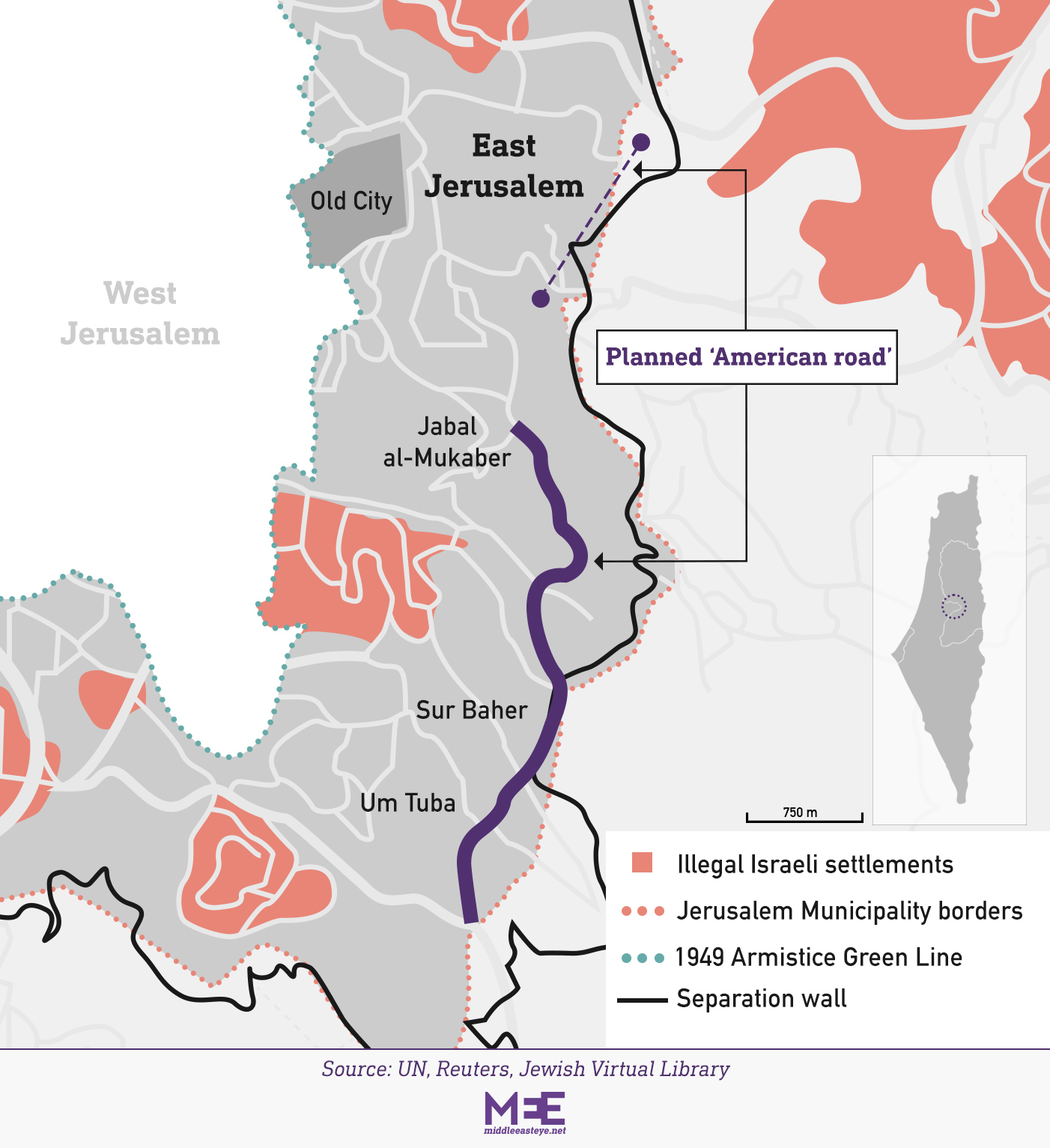 As a reminder, the so-called “American Road” is a section of north-south highway that is meant to more seamlessly connect settlements located in the north and south of Jerusalem to one another, and to serve as a bypass for settler traffic to cut through East Jerusalem’s Palestinian neighborhoods. While the road will be accessible to Palestinians (a fact touted by Israel as proof of Israeli good intentions), its clear primary purpose is to entrench Israel settlements, expand Israeli control over all of East Jerusalem, and close off Palestinian East Jerusalem neighborhoods from the rest of the West Bank, thereby (further) torpedoing Palestinian hopes of one day establishing a capital in East Jerusalem.
Israel began work on this road in June 2020, and recently completed the first phase of construction.
The second phase of construction directly threatens Palestinians, involving the demolition of 62 buildings in Jabal al-Mukhaber. According to Middle East Eye, the Jerusalem Municipality has come up with a proposal, as reported by one of the threatened homeowners:
“The municipality suggested alternatives for residents with demolition orders, but they are neither realistic nor fair, Muhammad says. The proposal stipulates erecting buildings upwards on each side of the road. In them, four stories must be exclusively allocated for parking, another four for commercial use, and only two stories for residential use, each containing four apartments. The estimated cost for each of those buildings is between 20 and 25 million shekels ($6m to $7.7m), which many Palestinians in the area can’t afford without loans. The options left for residents are either expulsion or indebtedness. One strategy the municipality is taking is to empty the area completely of its inhabitants and replace them with commercial centres, Muhammad says. ‘They want to force the residents to resort to local or external investors, or to resort to banks to take out loans, which would mean that the landowners would only receive a single residential apartment, while the investors or banks would retain the lion’s share,’ Muhammad told MEE. ‘The Jabal al-Mukaber residents refuse this unequivocally, considering vertical building to be incompatible with the rural context to which they have grown accustomed to’.”
See Orly Noy’s reporting for a detailed history of this plan’s evolution as well as a moving portrait of some of the Palestinians who are affected by this plan.
In a deeply researched report on how infrastructure like roads is a means for settlement expansion and annexation, Breaking the Silence explains:
“While Israeli authorities justify many of the projects described in this document by claiming that they serve both the settler and the Palestinian populations in the West Bank, it is important to note that these roads are designed with Israeli, not Palestinian, interests in mind. Many of the roads that are technically open to Palestinian traffic are not intended to lead to locations that are useful to Palestinians.16 Instead, these roads are primarily designed to connect settlements to Israel proper (and thus employment and other services) via lateral roads, rather than to connect Palestinian communities to one another. Further, roads intended to connect Israeli settlements to Jerusalem (many of which are currently under construction) do not serve West Bank Palestinians outside of Jerusalem, as they are not allowed to enter Jerusalem without a permit. In addition, an extensive system of checkpoints and roadblocks allows Israel to control access to bypass roads and the main West Bank highways, and it can restrict Palestinian access when it so chooses.
This prejudice against Palestinian development is even starker when one considers that, according to an official Israeli projection, the expected Palestinian population in the West Bank (excluding East Jerusalem) in 2040 is 4,600,000 individuals. Even if the vision of settler leaders to arrive at 1,000,000 settlers is realized by 2040, the Palestinian population would still be four times the size of the settler one. Despite this discrepancy, priority is still given to settler infrastructure development.
West Bank road and transportation development creates facts on the ground that constitute a significant entrenchment of the de facto annexation already taking place in the West Bank and will enable massive settlement growth in the years to come. By strengthening Israel’s hold on West Bank territory, aiding settlement growth, and fragmenting Palestinian land, this infrastructure growth poses a significant barrier to ending the occupation and achieving an equitable and peaceful solution to the Israeli-Palestinian conflict.”
High Court to Rule on Expulsion of Palestinians in South Hebron Hills “Firing Zone”
On March 15th, the Israeli High Court is expected to issue a ruling on the mass expulsion of 12 Palestinian communities in the Massafer Yatta region of the South Hebron Hills. These 12 villages are located on land that Israel declared a “firing zone” – Firing Zone 918 – in the early 1980s. Palestinian and Israeli activists have launched an international campaign to bring attention to the matter in the hopes of stopping the mass expulsion of Palestinians from their land.
In a recent article for +972 Magazine, Ali Awad – a journalist and activist from Massafer Yatta – contrasted the plight of his community to the success of chicken farms established by settlers on nearby land, writing:
“In Umm al-Khair, we find it especially absurd that the chicken farms have better infrastructure than our residents. We suffer from a constant lack of water and are prevented from connecting to the electricity grid; the farms, meanwhile, have constant access to water, and are not only permanently connected to electricity but also have backup generators in case of an emergency. Seeing the electricity lines pass directly over our village is a constant reminder that the animals get rights that we as Palestinians are deliberately denied. More importantly, we know that building these farms in Masafer Yatta is yet another strategy of the occupation to displace us Palestinians from our homes, and is no less dangerous than its policy of declaring 12 of our villages as falling under Firing Zone 918 — thereby sanctioning our displacement. Israel is even still using the outdated Ottoman Land Code in the occupied territories to transfer Palestinian pasture into “state land,” which it then leases to settlers in order to establish other kinds of farms. They are multiple laws and policies, but they all serve one goal: to take over Palestinian land.”
Over the past months, FMEP has hosted a series of webinars and podcasts highlighting Israel’s treatment of Palestinians in Massafer Yatta, including:
-
Israeli Apartheid, the Supreme Court, and Land Confiscation: The Case of Masafer Yatta (March 9, 2022) featuring Ali Awad (journalist and activist), Maya Rosen (activist) in conversation with FMEP’s Sarah Anne Minkin
-
“We don’t have another place to go:” Dispossession, Settler Violence, & Resistance in Masafer Yatta (January 2022) featuring journalist and activist Ali Awad in conversation with FMEP’s Sarah Anne Minkin
- Israeli Government Escalates Pressure on Israelis Who Stand in Solidarity with Palestinians (December 2021) featuring activists Oriel Eisner and Maya Eshel in conversation with FMEP’s Lara Friedman.
Former U.S. VP Mike Pence Hangs out with Kahanists in Hebron
During his visit to Israel this week, former U.S. Vice President Mike Pence found time to meet with far-right settler leaders including Kahanist lawmaker Itamar Ben-Gvir while visiting the Tomb of the Patriarchs/al-Ibrahimi Mosque in Hebron, a city that is perhaps the clearest example of Israeli apartheid policies.
According to the Hebron Fund (the U.S. 501c3 charity that raises funds for the Hebron settlers), Pence was accompanied by Simon Falic (Duty-Free America), who is a major supporter of the Hebron settlers. Photos showed Pence also accompanied by Baruch Marzel, the former right-hand man of the Kach party’s Rabbi Meir Kahane. For extra fun, here’s video of Marzel introducing Pence to Ben-Gvir, who Marzel says “represents us in the Knesset.” Pence shakes Ben-Gvir’s hand and says: “stay strong – we’ll stand with you… It’s my great honor.” Falic is also visible in the video.
During his time in Israel, Pence also received an honorary degree (alongside former U.S. Ambassador David Friedman) from Ariel University, at a ceremony held at the settlement. During the ceremony, Pence made his thoughts on settlements clear, saying:
“It’s great to be here in Ariel. I’m told that some people say that you shouldn’t go to Jewish communities in Judea and Samaria. I obviously have a different opinion.”
Pence also received an award from a group of Evangelical supporters in recognition of his support for Israel. That ceremony was held in Jerusalem. Many speculate that Pence is prepping for a run for the 2024 Republican nomination for the presidency, and making stops in Israel to court the Evangelical vote.
As a reminder, the parties associated with the now deceased Rabbi Meir Kahane – Kach and Kahane Chai – are U.S.-designated foreign terrorist organizations. Ben Gvir’s political party, Otzma Yehudit, is a clear present-day incarnation of those parties and is devoted to Meir Kahane’s teachings. For more on Kahanism in Israel, please see “Mainstreaming the Extreme: How Meir Kahane’s Vision of Jewish Supremacy Conquered Israeli Politics” and FMEP webinar hosted in March 2021 featuring Amjad Iraqi (+972 Magazine), Shaul Magid (author & Dartmouth College professor), Natasha Roth-Rowland (University of Virginia) in conversation with Lara Friedman (FMEP).
Bonus Reads
- “Editorial | Jewish Settlers in La La Land” (Haaretz)
- “ Israeli Human Rights Violations in the Occupied Palestinian Territory (Weekly Update, March 3 – 9, 2022)” (PCHR)
Welcome to FMEP’s Weekly Settlement Report, covering everything you need to know about Israeli settlement activity this week.
To subscribe to this report, please click here.
May 1, 2020
- International Criminal Court Chief Prosecutor Concludes: YES, Palestine is a State & Court has Jurisdiction to Investigate Alleged Israeli (and Hamas) War Crimes
- Netanyahu: Annexation Will Happen in “A Couple Months”; US again Signals UNCONDITIONAL Support
- Leading East Jerusalem Settler Poised to Become Deputy Mayor of Jerusalem
- Updates on Three Settler-Backed Projects in Silwan
- Joe Biden Says He Will Keep Embassy in Jerusalem, [kind of] Re-Open the Consulate, & Recommit to the Two-State Solution
- Bonus Reads
Comments/questions? Contact Kristin McCarthy (kmccarthy@fmep.org).
International Criminal Court Chief Prosecutor Concludes: YES, Palestine is a State & Court has Jurisdiction to Investigate Alleged Israeli (and Hamas) War Crimes
On April 30th, the Chief Prosecutor of the International Criminal Court, Fatou Bensouda, filed her opinion with an Pre-Trial Chamber arguing that Palestine can be considered a state and therefore the Court does have jurisdiction over alleged crimes committed by parties in Palestine. Previously, in January 2020, Bensouda determined that there was reasonable basis upon which to open an investigation, but convened a Pre-Trial Chamber to rule on the issue of the Court’s jurisdiction. If the pre-trial Chamber determines that the Court has jurisdiction, a case can be opened into the matter of alleged Israeli war crimes in the West Bank, East Jerusalem, and Gaza Strip, as well as alleged crimes committed by Hamas in Gaza. The Pre-Trial Chamber does not have a deadline for making their ruling, but is expected to do so in the next 120 days.
Bensouda’s detailed (60-page) decision concludes that the Oslo Accords – signed by the Palestinian Authority and Israel – are a credible legal basis for establishing Palestine as an internationally recognized state. Her influential legal opinion also directly and systematically refutes the amicus curiae briefs filed by several countries, including Germany (the second largest funder of the ICC), arguing that Palestine is not a state and that the Court does not have jurisdiction. Czech Republic, Austria, Australia, Hungary, Brazil and Uganda also filed briefs along those lines. The brief also systematically rebuts the raft of arguments made by various international lawfare organizations asserting that the Court has no right to investigate (the decision is well worth reading in full).
Netanyahu: Annexation Will Happen in “A Couple Months”; US again Signals UNCONDITIONAL Support
On April 26th, Prime Minister Netanyahu announced his belief that annexation will be realized in “a couple months” and that he is “confident” that President Trump will recognize that annexation. Under the recent coalition agreement signed by Netanyahu and Benny Gantz, annexation will have to wait until at least July 1st.
Netanyahu’s confidence in the Trump Administration’s support for Israeli annexation plans rests on solid footing. As a reminder, on April 22nd Secretary of State Mike Pompeo called annexation an “Israeli decision.” The remarks drew attention because of the existence of a joint U.S.-Israeli mapping committee, which suggests an active U.S. role in deciding the extent of Israel’s annexation, and which gives the appearance, at least, that the Trump Plan is something less than a carte blanche for Israel to annex whatever it chooses.
On April 27th, a spokesperson for the Department of State elaborated on Secretary Pompeo’s remarks in a statement to The Times of Israel:
“As we have made consistently clear, we are prepared to recognize Israeli actions to extend Israeli sovereignty and the application of Israeli law to areas of the West Bank that the vision foresees as being part of the State of Israel…in the context of the Government of Israel agreeing to negotiate with the Palestinians along the lines set forth in President Trump’s Vision…The annexation would be in the context of an offer to the Palestinians to achieve statehood based upon specific terms, conditions, territorial dimensions and generous economic support. This is an unprecedented and highly beneficial opportunity for the Palestinians.”
These remarks drew dramatic headlines suggesting that now, after more than three years of statements and policies aligned with Israel’s pro-annexation right, Trump is pumping the brakes by making U.S. support conditional on Israel agreeing in principle to the establishment of a Palestinian state (which, under the Trump Plan is, would be a non-autonoumous/non-sovereign entity). Unsurprisingly, within 24 hours of the first headline offering this analysis, an official at the U.S. Embassy in Jerusalem clarified the policy, making it emphatically clear that U.S. support for Israel’s annexation of West Bank territory is in no way connected to, or conditioned on, the issue of a future Palestinian state. The official said:
“Our position has not changed. As we have made consistently clear, we are prepared to recognize Israeli actions to extend Israeli sovereignty and the application of Israeli law to areas of the West Bank that the [Trump peace plan] foresees as being part of the State of Israel. This will give the Palestinians an opportunity to come to the table and negotiate a peace agreement that will result in the establishment of a state of their own. The United States stands ready and willing to offer wide-ranging assistance to facilitate a final peace agreement.”
While it was clearly a stretch to read the State Department remarks as the unveiling of a new U.S. policy conditioning approval of annexation on some kind of concession to the Palestinians or on the two-state solution, the difference in tone/content of the two statements highlights the longstanding disconnect between the U.S. State Department and the Embassy in the Trump era. This disconnect is largely attributable to the close relationship and direct line that U.S. Ambassador David Friedman enjoys to the White House, to the exclusion of the State Department. Friedman — who is a key member of the joint mapping committee, a key architect of the Trump Plan, and whose views and statements have consistently been more indicative of the direction of U.S. policy than those of the State Department’s spokespersons — has publicly disregarded the necessity of Palestinian involvement in implementing the Trump Plan, in contrast with the State Department’s statement this week. For a refresher on Friedman’s anti-two-state, anti-Palestinian views, recall this excellent list of quotes compiled by APN.
In the context of Amb. Friedman’s centrality in setting U.S. policy on annexation, a recent tweet from Friedman in celebration of the 100th anniversary of the San Remo Resolution is notable. The resolution gave Great Britain a mandate to rule the historic region of Palestine and formally conferred recognition to the Jewish people’s right to establish a national homeland there. Haaretz explains that the San Remo Resolution is increasingly cited by “Greater Israel” advocates as a legal basis for Israeli claims to the entire area at the expense of Palesttinian national aspirations, based on the fact that the British mandate was over all the land, including the West Bank and Gaza Strip. Friedman tweeted:
“Recalling today the 100th anniversary of the San Remo Resolution, whereby the world powers recognized the ancient connection of the Jewish people to the Land of Israel and the right of the Jewish people to a national home on that land was given the force of International Law.”
Leading East Jerusalem Settler Poised to Become Deputy Mayor of Jerusalem
Jerusalem’s Mayor Moshe Leon is seeking approval to appoint notorious settlement empresario Arieh King to be his Deputy Mayor, a move which will further empower King – who has served as a city councilman since 2013 – to promote ideologically-motivated settlement projects throughout East Jerusalem.
King openly calls for the “Judaization of Jerusalem,” and is behind many unprecedented, ideological settlement plans, including currently advancing plans to build the first-ever settlement enclave inside of the Beit Hanina neighborhood of East Jerusalem. Most infamously, King has led and financed a longtime effort to evict Palestinians from their homes in the Sheikh Jarrah neighborhood in East Jerusalem. In this effort he sometimes uses Arab middle-men and at other times he has found and convinced Jewish heirs to Sheikh Jarrah properties to “reclaim” the property under Israel’s Absentee Property Law and then to transfer the properties for use by settlers.
King is also behind the ongoing drive to build new, official settlements in Sheikh Jarrah, for which he has received expedited approvals from the city planning committees. King is also involved with plans to expand the settlement enclave of Nof Zion in the Jabal al-Mukhaber neighborhood of East Jerusalem.
A member of the City Council from the Meretz Party, Laura Wharton, threatened to quit the city’s governing coalition over King’s appointment. King responded by making clear that as Deputy Mayor he would, indeed, continue to focus on settlement in East Jerusalem – and snarkily suggested that for this very reason, the Meretz member should support him. King told Haaretz:
“I’m very surprised that Laura Wharton is threatening to leave. After all, she knows full well that she will have no better partner than I in improving the infrastructure in East Jerusalem, and in listening to the needs of its residents. I hope the Meretz branch [whose members] I consider staunch political opponents will step up and see the advantages in my becoming deputy mayor, by which East Jerusalem will undoubtedly receive more attention from the municipality…”
Updates on Three Settler-Backed Projects in Silwan
Emek Shaveh this week provided updates on three settler-backed projects in Silwan, two of which have continued progressing despite the nation-wide lockdown to stop the spread of the coronavirus.
First, Emek Shaveh reports that construction on the “stepped street” section of the archeological site called the “Pilgrim’s Road” continued throughout the months of March and April. The project is driven by the radical Elad settler group, and is located beneath the Wadi Hilweh section of Silwan, a Palestinian neighborhood in East Jerusalem adjacent to the Temple Mount/Haram Al-Sharif. Infamously, U.S. Ambassador David Friedman and then-White House advisor Jason Greenblatt took part in the opening of the site in June 2019, including a gratuitous photo-op – a sign that made clear the Trump Administration’s support not only for settlement schemes, but for their larger agenda of consolidating Israeli sovereignty over even the most contentious areas of East Jerusalem.
Elad launched its excavation of the “Pilgrim’s Road” in 2007, with the full support of the Israel Antiquities Authority (IAA). For more background on the tunnels and how radical Israeli settlers have exploited excavation, tourism, and the ancient character of Jerusalem in order to serve their ideological agenda – see the comprehensive reporting by Emek Shaveh.
Second, Emek Shaveh reports that Elad has continued construction on transforming a house located in Jerusalem’s “Peace Forest” into a tourism center that will be used as the base for a settler-run tourism project — a zipline slated to traverse the Forest’s canopy. The zipline will connect the “Peace Forest” in the Abu Tor neighborhood to another popular tourism site, the Armon Hanatziv promenade. Coming in at 2,570 feet, this will be Israel’s longest zipline and will travel over the Palestinian neighborhood Jabal al-Mukaber. Renovations of the house are paid for by the Israeli Ministry of Housing, which allocated 43 million NIS ($12.38 million USD) for the project. The House – which the settlers have named “Beit Shatz” – was purchased by Elad as part of Elad’s broader efforts to use tourist projects as a means for taking control over the area, which is situated in a national park.
The behavior of Elad and the Israeli government in the Peace Forest underscores the the systematic discrimination in planning policies and enforcement facing Palestinians in Jerusalem. The several Palestinian families living in the “Peace Forest” and are prohibited from building or expanding/renovating their homes because of the strict building prohibitions for national parks. Elad managed to circumvent those same restrictions by pushing the Jerusalem Municipality to request that the area they are targeting be designated as an “open public space,” which would allow the project to advance. In December 2019, Jerusalem planning authorities granted the settler-backed request. That same month, Israel pursued demolition orders against Palestinian homes in the Peace Forest that lacked building permits, despite the fact that in some cases Palestinians have repeatedly applied for and been denied permits.
Third, Emek Shaveh also reports that progress on the controversial East Jerusalem cable car project has been stalled due to the coronavirus shutdown. Emek Shaveh reports:
“Following its approval by the National Infrastructure Committee in June 2019, and the 200 million NIS government allocation, the project was to enter the tender phase. However the bidding process for an international company specializing in the construction of cable cars has been hampered by the pandemic. Our [Emek Shaveh’s] appeal to the High Court against the project is scheduled for June.”
Joe Biden Says He Will Keep Embassy in Jerusalem, [kind of] Re-Open the Consulate, & Recommit to the Two-State Solution
Speaking at a virtual fundraising event on April 29th, presumptive Democratic presidential nominee Joe Biden told supporters that he would keep the U.S. Embassy in Jerusalem despite the fact he disagrees with the Trump Administration’s decision to move the embassy there from Tel Aviv. As a reminder, in February 2020 the New York Times published the results of its survey of Democratic candidates policies vis-a-vis Israel. In response to the question, “Should the United States Embassy in Israel be moved from Jerusalem back to Tel Aviv?” Biden – like every candidate other than Sanders and Warren – responded with a clear answer: “No.”
Biden also told supporters that he would “re-open” the U.S. Consulate in Jerusalem in order to facilitate talks with the Palestinians toward a two-state solution. As a reminder: shortly after the Trump Administration moved the Embassy from Tel Aviv to Jerusalem, it closed the U.S. Consulate and Ambassador Friedman began converting the compound into his personal residence. Simultaneously, Friedman created a “Palestinian Affairs” unit in the new Embassy, signaling that henceforth the U.S. would treat Palestinians and Palestinian-related matters not as merely as a subset of issues between the U.S. and Israel, rather than part of a U.S.-Palestinian bilateral relationship. the U.S. was represented in Jerusalem by a Consulate General from 1844 until the mission was closed by the Trump Administration in March 2019. From the start of the peace process in the 1990s until its closure, the Consulate served as the de facto U.S. diplomatic mission to the Palestinians, and was a central player in advancing U.S. efforts to broker a negotiated end to the conflict. Notably, Biden’s comments this week suggest that he may not be talking about a re-opening of the Consulate to function as it had in the past, so much as a re-purposing of the Consulate to serve a specific, limited function.
While Biden reportedly did not say anything about annexation during his fundraising call (and has conspicuously refrained from commenting on the issue since the Israeli unity government agreement made annexation an imminent reality), on April 28th his senior foreign policy advisor Tony Blinken told a group of supporters that Biden opposes annexation on the basis that it contradicts the two-state solution and would be bad for Israel. According to Blinken, Biden has said:
“on the record several times [that] unilateral steps taken by either side that make the prospect of a negotiated two-state outcome less likely is something he opposes, and that includes annexation. In many ways, pulling the plug on a two-state solution is pulling the plug, potentially, on an Israel that is not only secure but is Jewish and democratic — for the future. That’s not something any of us, who are ardent supporters of Israel, would want to see.”
Bonus Reads
- “Can Anyone Stop Netanyahu’s Annexation Plans?” (Al-Monitor)
- “Arab League slams West Bank annexation plans as ‘war crime’” (Al-Monitor)
- “Lots of bark, some actual bite? How the world will react to West Bank annexation” (The Times of Israel)
- “Europeans formally protest West Bank sovereignty plans” (Jerusalem Post)
- “Israel doesn’t need ‘advice’ against annexation — it needs consequences” (+972 Magazine)
- “WEBINAR: The Legal Impacts of Annexation w/ Michael Sfard” (J Street)
- “Israeli annexation plans would lead to ‘cascade of bad human rights consequences’, says UN expert” (UN)
- “How should Palestinians respond to Israeli threats of annexation?” (Al Jazeera)
- “Lots of bark, some actual bite? How the world will react to West Bank annexation” (The Times of Israel)
Welcome to FMEP’s Weekly Settlement Report, covering everything you need to know about Israeli settlement activity this week.
To subscribe to this report, please click here.
April 5, 2019
- Israel Expected to Advance Nearly 5,000 Settlement Units
- Glassman/Or Sameach Yeshiva Project at Entrance of Sheikh Jarrah Neighborhood Approved for Public Deposit
- Also in Sheikh Jarrah, The Sabbagh Family Receives Another Eviction Notice
- New Settler Bypass Road Gets Go-Ahead After Deadly, Disputed Incident at Huwwara Interchange
- Settlers Are Cultivating Palestinian Farmland Taken by the Construction of Israel’s Separation Wall
- Transportation Ministry Voices New Concern About Elad’s Zipline Project in East Jerusalem
- Yesh Din Issues Authoritative Report on Israel’s “Racist Endeavor” to Retroactively Authorize Outposts
- Al-Haq Report: Israel Appropriated ‘Ein Fara Spring; TripAdvisor Now Promotes It as an Israeli Tourist Destination
- Settler Leader: “Settlements are a Bridge to Socio Economic Peace”
- Bonus Reads
Questions/comments? Email kmccarthy@fmep.org
Israel Expected to Advance Nearly 5,000 Settlement Units
Map by Haaretz
According to reports last week, Israeli planning bodies were expected to meet and advance plans for nearly 5,000 new settlement units at a meeting on April 1st. However, that meeting appears to have been delayed.
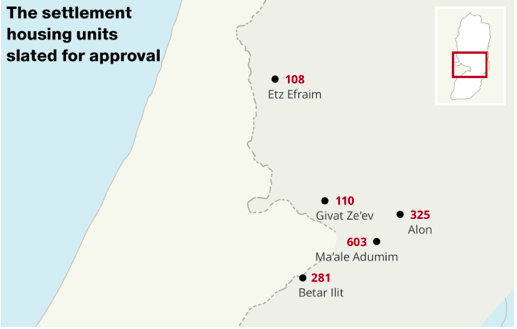
Nonetheless, it is worth reviewing the leaked details of the settlement plans slated to be advanced, of which 1,427 are reportedly set to receive final approval from the High Planning Council, including
- 603 new units in the Ma’aleh Adumim settlement just east of Jerusalem;
- 325 new units in the Alon settlement, near the disputed Palestinian village of Khan al-Ahmar east of Jerusalem;
- 108 new units in the Etz Efraim settlement, in the northern West Bank, one of several settlements slated to become a “super settlement” area;
- 110 new units in the Givat Ze’ev settlement just north of Jerusalem;
- 281 new units in the Beitar Illit settlement.
A subcommittee of the Israeli Civil Administration was also set to meet on April 1st (no press reports indicate that the meeting actually happened), and was expected to advance plans for 3,474 new settlement units for public deposit, an earlier stage of the settlement planning process (reminder: all stages of the settlement planning process are significant, as each step through the publication of tenders is a political act of the Israeli government). The plans slated to be approved for public deposit include plans in settlement across the West Bank, reportedly include the following settlements:
- Elon Moreh, located east of Nablus in the central West Bank;
- Karnei Shomron, in the northern West Bank;
- Elkana and Oranit, which along with Etz Efraim, are slated to become a part of a “super settlement” area;
- Ariel in the central West Bank;
- Beit Aryeh northwest of Ramallah;
- Shiloh in the central West Bank;
- Talmon north of Ramallah.
- Peduel, in the northern West Bank but on the Israeli side of the separation barrier; and,
- Mitzpeh Yericho, just west of Jericho.
Glassman/Or Sameach Yeshiva Project at Entrance of Sheikh Jarrah Neighborhood Approved for Public Deposit
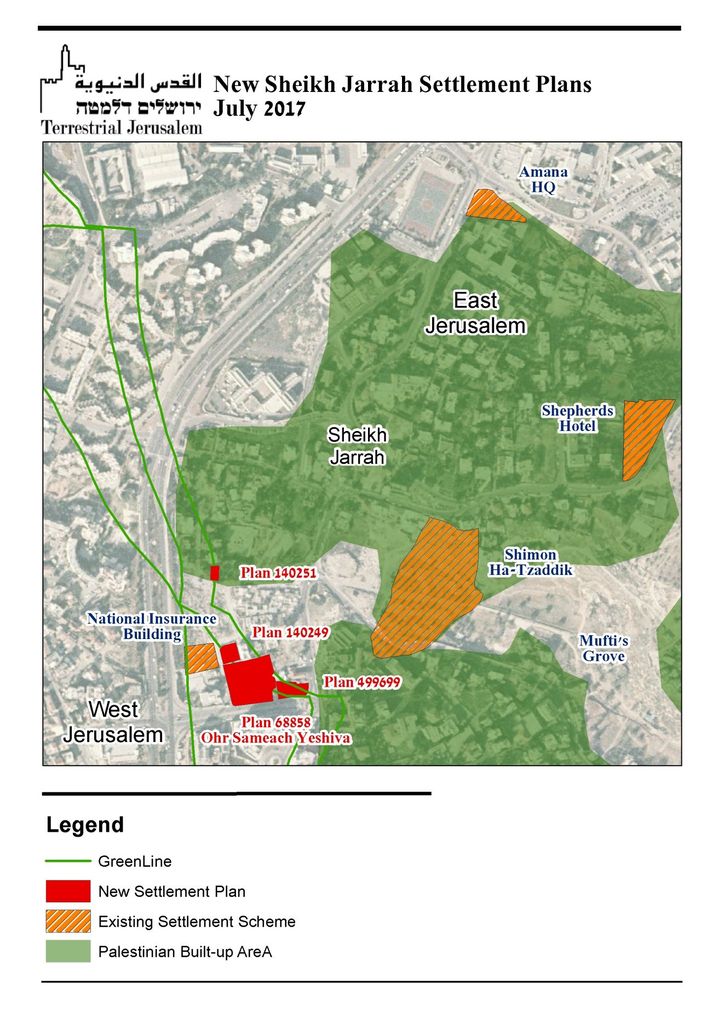 On April 2nd, the Jerusalem District Planning and Building Committee approved the Glassman/Or Sameach yeshiva project for public deposit. The plan, as FMEP has repeatedly covered, seeks to build a Jewish religious school (a yeshiva) at the entrance of the Sheikh Jarrah neighborhood of East Jerusalem. The yeshiva is one of several settlement projects set to flank the road leading into the Sheikh Jarrah neighborhood, designed to strengthen Israeli settlers’ hold on the neighborhood and seamlessly connect the growing settler enclave in Sheikh Jarrah with West Jerusalem.
Ir Amim warns and explains:
“[The Glassman/Or Sameach yeshiva] plan should be seen as an alarm bell in the context of Israel’s ramped up efforts to deepen its circle of control around the Old City Basin. The plan (Plan No. 68858) calls for construction of an eleven-story building with eight levels above ground and three below, including a dormitory for hundreds of students and housing for faculty, to be located at the mouth of Sheikh Jarrah. It was submitted by the Ohr Somayach Institutions, to which the Israel Land Authority has already allotted land without a transparent tender process, and approved for deposit by the District Planning and Building Committee in July 2017.”
In a detailed report on the Glassman yeshiva project, Terrestrial Jerusalem described it as:
“a clear effort to exploit Torah study to expand and normalize occupation in East Jerusalem (including by making the site politically untouchable, as it will now be linked with religious activities).”
Also in Sheikh Jarrah, The Sabbagh Family Receives Another Eviction Notice
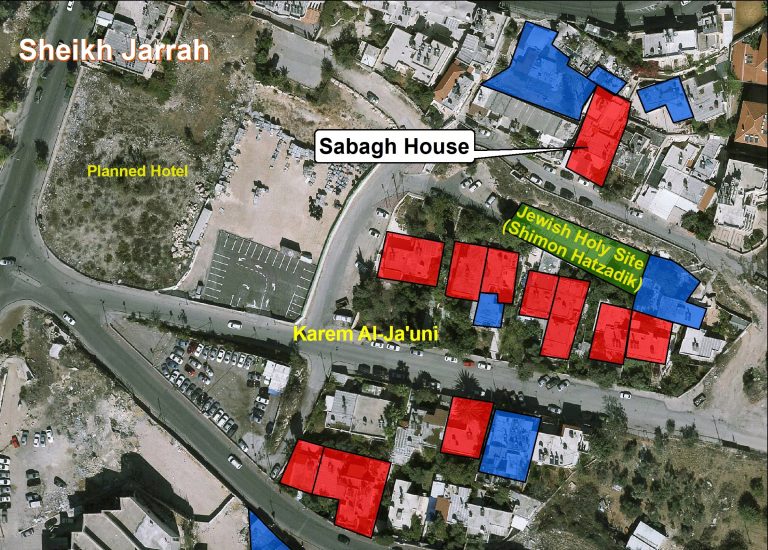
Map by Peace Now
On March 31st, the Palestinians Sabbagh family was handed another eviction notice, weeks after Israeli authorities rejected the family’s latest petition to reconsider the legal authority by which settlers are seeking to evict them from their home of 60+ years. Peace Now reports that the Sabbagh family is still attempting to delay their eviction, but is unlikely to succeed.
In a comprehensive briefing on the Sabbagh family’s protracted legal struggle, Ir Amim and Peace Now write:
“Increasingly, settler initiated, state-backed evictions of Palestinian families are being used as a strategy to help cement Israeli control over the area. Given their strategic location as gateways to the Old City, Sheikh Jarrah to the north of the Old City and Silwan to the south are the two neighborhoods under greatest pressure from Israeli settler groups. Some 150 families in these two areas alone are under threat of eviction…The Sabbagh family is only the latest family threatened with eviction in the Kerem Alja’oni section of Sheikh Jarrah. If evicted, their home will be the tenth to be seized by settlers. Roughly 30 Palestinian families are under threat of eviction and at least eleven have open court cases. Those cases were suspended pending the Supreme Court decision on the Sabbagh case; the recent removal of that stopgap could usher in a wave of new evictions. On the other side of Nablus road, in the Um Haroun section of Sheik Jarrah, an additional 40 or so families face the threat of eviction.”
New Settler Bypass Road Gets Go-Ahead After Deadly, Disputed Incident at Huwwara Interchange
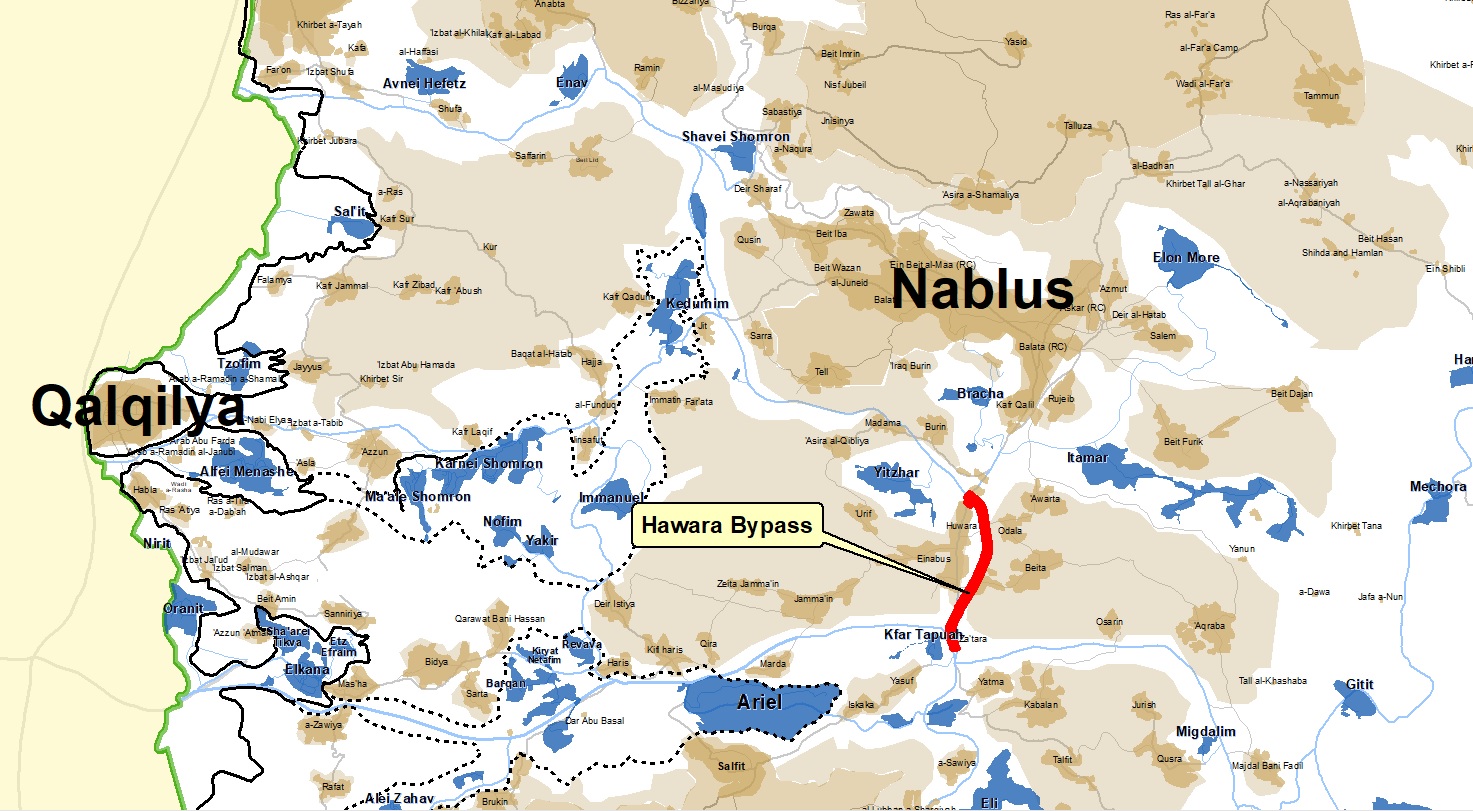
Map by Peace Now
The Israeli Defense Ministry announced that it approved the construction of a new bypass road to divert settler traffic around the Palestinian village of Huwwara. The new road will allow settlers to avoid the Huwwara interchange, a perpetually congested section of the main West Bank highway, Route 60, and an area that has been a site of Palestinian violence against the settlers, including a recent incident where a settler shot and killed a Palestinian teenager allegedly attacking the settler. Dubbed the “Huwwara Bypass,” the new road will be built on land historically a part of the Palestinian villages of Huwwara and Beita, which Israel seized for security reasons.
This road is one of five new bypass roads that Prime Minister Netanyahu promised to build under immense pressure from the settler lobby, known as the Yesha Council. It was one part of a massive security package that the Netanyahu government funded to the tune of $228 million in 2017. Peace Now detailed each of the five bypass roads slated for construction, and wrote:
“The planned roads…are meant to serve settlements located deep in the West Bank, which will not be a part of Israeli in the framework of an agreement according to the Geneva Initiative’s proposed border.Historically, the paving of bypass roads has led to an acceleration of the development of the adjacent settlements…Additionally, paving new roads in the West Bank entails the confiscation of private Palestinian lands. All of the roads are built due to needs of settlers rather than the needs of the Palestinians. In certain cases the roads can also be useful for Palestinians, but the majority of these roads are hardly used by Palestinians at all. This fact puts into question the Israeli legal argument behind the confiscation, as according to international law, the confiscation of lands must serve the local population, meaning the Palestinians.”
Transportation Ministry Voices New Concern About Elad’s Zipline Project in East Jerusalem
An official from the Israeli Transportation Ministry voiced reservations regarding the Elad settlement organization’s request to re-zone the “Peace Forest” as a “public use space” in order to allow for the construction of its zipline project there. At a meeting on April 1st (a previous meeting was covered by FMEP last week) to consider the request, a transportation official expressed concern that the project is a private commercial endeavor, not a public use project – meaning that the project might not be legal even if the forest were to be re-zoned for public use. The official said:
“[A zipline] constitutes commercial use: It’s not going to be operated by the municipality or a youth group. This alone is a reason not to approve the plan.”
The Haaretz report on the April 1st meeting also provides historical context on Elad’s illegal activities in the “Peace Forest” (which was established by the Jewish National Fund on privately owned land in East Jerusalem following the 1967 war) over the past 14 years. Haaretz writes:
“At first the NGO simply trespassed and built illegal structures there. But things changed and gradually various local and national bodies – including the Jerusalem Municipality, the Israel Land Authority, the Tourism Ministry and the JNF – began to grant Elad assistance. This assistance has included granting building permits retroactively, allocating land to the group without a proper bidding process, and generous funding to the tune of tens of millions of shekels…Most of Elad’s current focus is on managing and developing the City of David National Park in the Palestinian neighborhood of Silwan, and purchasing homes for Jews from the Arabs living there. But the NGO isn’t neglecting its other projects: It has been sponsoring activities in the Peace Forest since 2005, despite the fact that it has no ownership rights there or permits from the ILA (the legal owner of the land, which was expropriated from private Palestinian owners). These activities are essentially expanding Elad’s reach from Silwan into the entire historic basin of Jerusalem’s Old City, from the Mount of Olives to the Armon Hanatziv promenade (which actually consists of several different walkways, projects of the Jerusalem Foundation).”
Settlers Are Cultivating Palestinian Farmland Taken by the Construction of Israel’s Separation Wall
For the past six years, Israeli farmers have been farming Palestinian land that was left on the Israeli side of the separation barrier, an area Palestinian landowners are largely barred from entering.
When the separation wall was constructed in the early 2000s, it confiscated 35,000 acres (140,000 dunams) of Palestinian land as a result of its circuitous route that snakes deep inside of the West Bank. The land between the wall and the 1967 Green Line is commonly referred to as the “seam zone.”
Kerem Navot founder Dror Etkes – who obtained aerial photography documenting settler activity in the area – explained:
“One of the same plots to which landowners are barred from entering is located west of the Palestinian village of Nuba, about 15 kilometers northwest of Hebron. Nearly half of the village’s land was lost in 1948 because it remained west of the Green Line, and with the construction of the separation barrier in the area from 2005-2006, residents lost another 1,000 dunams that remained on the other side of the barrier. Although there’s an agricultural gate on site that was supposed to be used by landowners to reach their territory to the west, their entry has not been possible since the barrier was constructed. This ‘vacuum’ was identified by the ‘Mateh Yehuda Agricultural Association,’ which cultivates vast swaths of land that were transferred to Israeli moshavim in the area, including those west of the Green Line. After a few years in which the villagers didn’t access their land, the Agricultural Association decided that it was time to take over of one of the wadis in the area.”
Etkes separately told Haaretz:
“This story allows a peek into the jungle Israel created in areas left between the barrier and the Green Line. This area, called ‘the seam’ by Israel, is gradually becoming a looting ground for anyone who can grab a plot while exploiting a reality in which tens of thousands of West Bank residents are unable to reach their lands. All this proves that the route along which the barrier was built passes mostly through the West Bank, serving political interests, as anyone with eyes in his head saw and understood as the barrier was being built.”
Yesh Din Issues Authoritative Report on Israel’s “Racist Endeavor” to Retroactively Authorize Outposts
In a new report, the Israeli NGO Yesh Din analyzes the legal pretexts Israel has created to systematically legalize outposts across the West Bank that were built in contravention of Israeli law and on privately owned Palestinian land.
The report reviews and rebutts the findings of the “Zandberg Report” – which (approvingly) outlined various legal tactics and tools the state can use to save those outposts.
Yesh Din found that the Zandberg Report’s recommendations allow for 99% of all unauthorized outposts to be retroactively approved within 2-3 years, anticipating that the government will declare 20 new settlements in the process.
Yesh Din’s report also examines how Israel has already undertaken the first step in this effort, by introducing the “market regulation” principle into the courts. If validated by the courts, the “market regulation” principle will provids legal cover to ‘regularize’ 2,700-3,000 illegal structures built on privately owned Palestinian land.
Yesh Din writes:
“The Zandberg Committee aids a racist endeavor whose essence is the dispossession of Palestinians from their land on the basis of ethnicity. The euphemisms used in the report and the legal terminology it employs do nothing to hide the fact that the ‘Regularization Committee’ report is, in fact, an expropriation report which provides the government more methods for normalizing and deepening the iniquity of Israel’s settlement policy: one area, the West Bank, with two populations – privileged Israeli citizens and Palestinians living under military rule, dispossessed and oppressed.”
Analyzing the Zandberg Report as an alternative to the settlement “Regulation Law,” Yesh Din states:
“The Zandberg Committee seemingly offers a more restrained framework for ‘regularization’ or retroactive authorization that purports to be less injurious than the ‘Regularization Law’ and relies on legal doctrines. In truth, however, the report cloaks landgrab, dispossession and expropriation on an extremely large scale – approaching that of the Regularization Law – in a shroud of legality.”
Al-Haq Report: Israel Appropriated ‘Ein Fara Spring; TripAdvisor Now Promotes It as an Israeli Tourist Destination
Al-Haq, the preeminent Palestinian human rights group, published a report documenting Israel’s appropriation of the ‘Ein Fara spring, located on the lands of the Palestinian village of Anata northeast of Jerusalem. The spring historically served as the primary source of drinking water and agricultural water for Anata and several surrounding villages.
Since 1967, Israel has appropriated the spring and its waters, and built five settlement on the surrounding land.
Israel renamed the spring the “En Prat Nature Reserve” and promotes religious tourism at the site, as does TripAdvisor.
Al-Haq writes:
“The appropriation of village lands, confiscation of water resources and continued denied access to Palestinians violates the right to self-determination, further breaches the prohibition of discrimination, the right to life including the duty to ensure access to water, the right to water, the rights of freedom of movement, the right to a livelihood, and cultural rights related to the integral use of the ‘Ein Fara spring to communal village life. Al-Haq reminds that Trip Advisor is advertising ‘En Prat Nature Reserve’ a settler tourism service, on its internet platform. Al-Haq stresses that Trip Advisor is providing an economic service for the benefit of Israeli settlements, which may amount to an involvement in settlement related activities.”
Settler Leader: “Settlements are a Bridge to Socio Economic Peace”
Writing in the Jewish News Syndicate, Yochai Dimri (chairman of Har Hevron Regional Council) makes a pitch for the Israeli public and elected officials to drop hopes of a “peace deal” in favor of socio-economic “co-existence” initiatives that normalize the settlements.
As FMEP has documented, this message lines up exactly with the activities and priorities of the Trump Administration, particularly with Amb. David Friedman who has been in partnership with the Har Hevron Regional Council to promote the Judea and Samaria Chamber of Commerce as an Israeli-Palestinian business cooperative.
In a piece entitled – “Settlements are a Bridge to SocioEconomic Peace” – Dimri writes:
“The Barkan Industrial Park near Ariel is an outstanding model for collaboration between Jews and Arabs, and is the wellspring of local employment for both populations. A similar industrial area in Har Hevron is currently in the planning stages, and flourishing businesses and factories are expected to be established there to benefit the residents of Har Hevron and the Negev…The need of the hour is to expand collaborations to include health, education and other necessary areas as well—not through international initiatives, but through Israeli ones. Once Israel learns to view the settlement communities in Judea and Samaria as an asset and not a liability, as an impetus for change and not a roadblock, it will discover that they are not an obstacle to peace, but rather a bridge to achieving economic and social peace.”
FMEP’s Lara Friedman reacted to this notion in a recent op-ed:
“Last October, Friedman participated in a public event convened in the settlement of Ariel. The event, which featured Israeli settlers and a handful of Palestinians, promoted the view that the key to peace is not political agreements or negotiations. Rather, peace would come from economic and business cooperation between Palestinians (living under Israeli occupation, governed by Israeli military and military law designed to promote the interests and needs of Israel, entirely disenfranchised from the powers that control their lives) and settlers (living in settlements built on land taken from Palestinians, enjoying all the entitlements and protections of Israeli citizenship and law, and with representatives and allies at every level of Israeli government). This approach, not coincidentally, exemplifies a vision of ‘peace’ based on promises of improved quality of life for individual Palestinians, de-coupled from any pretense of helping Palestinians end an occupation that the United States no longer believes to exist, or achieve national self-determination that the United States no longer supports. Tweeting about that event, Friedman suggested that this kind of cooperation was precisely the kind of opportunity that the Palestinian people truly want and could have, if only their leadership would listen.”
Bonus Reads
- “How Israel is Working to Remove Palestinians from Jerusalem” (The National)
- “Annexation Will Free Israel from the Fake Commitment to Liberty and Equality” (Haaretz)
Welcome to FMEP’s Weekly Settlement Report, covering everything you need to know about Israeli settlement activity this week.
To subscribe to this report, please click here.
March 29, 2019
- Report: U.S. & Israel Are Discussing Annexation “Scenarios” Including Ariel, Ma’aleh Adumim, and Etzion “Settlement Blocs” [And AIPAC Stuff]
- Israel Gives Final Approval to Arieh King Settlement Project in Sheikh Jarrah
- Jerusalem Planning Authorities Advance Legal Cover for Hasty Approval of Settler Zip Line Project in East Jerusalem
- Updated Jerusalem Map by Ir Amim
- Bonus Reads
Questions/comments? Email kmccarthy@fmep.org
Report: U.S. & Israel Are Discussing Annexation “Scenarios” Including Ariel, Ma’aleh Adumim, and Etzion “Settlement Blocs” [And AIPAC Stuff]
According to anonymous sources, Israel and the U.S. are in discussions regarding Israel’s annexation of the Ariel, Ma’aleh Adumim, and Etzion “settlement blocs” shortly after the upcoming Israeli elections, scheduled for April 9th. The Times of Israel report suggests that officials are discussing a scenario where Netanyahu could move to unilaterally annex those areas – or promise to annex those areas in order to shore up right-wing support during the election – with “some degree of American backing.” [Note: The term “settlement bloc” generally refers to loose groupings of settlements, usually but not always along the Green Line or separation barrier. However, since the term has no legal or formal definition, its meaning is elastic and constantly expanding.]
Attention to Israel’s possible (and increasingly likely) formal annexation of territory in the West Bank (some or all) has caught a strong tailwind from the U.S. recognition of Israel’s annexation of the Golan Heights – which President Trump first tweeted and then formalized by signing a declaration while Netanyahu was by his side at the White House on March 25th. Celebrating the new U.S. acceptance of annexation, Netanyahu said outright:
“Everyone says you can’t hold an occupied territory, but this [U.S. recognition of Israeli sovereignty over the Golan] proves you can. If occupied in a defensive war, then it’s ours.”
New York Times coverage of Netanyahu’s remark noted:
“Still, Mr. Netanyahu’s argument reflected how much the diplomatic context for the Israeli-Palestinian conflict has shifted. With the Trump administration unilaterally acting in defiance of longstanding international consensus on the status of Jerusalem, Palestinian refugees and now the Golan Heights, it has become possible to speak openly of annexing the West Bank in a way that was not considered acceptable a few years ago.”
The signing took place during the course of the annual AIPAC national policy conference – where U.S. Ambassador to Israel David Friedman delivered a speech seeming to urge Netanyahu to quickly seize the opportunity for West Bank measures while Trump is in office. Friedman said:
“How can we kick the can down the road and leave this to our successors? Sure, that would be easier. That doesn’t make it right. Can we leave this to an administration that may not understand the existential risk to Israel if Judea and Samaria are overcome by terrorism in the manner that befell the Gaza Strip after the IDF withdrew from this territory? Can we leave this to an administration that may not understand the need for Israel to maintain overriding security control of Judea and Samaria and a permanent defense position in the Jordan valley?”
Commenting on Friedman’s speech, an American source told The Times of Israel:
“the next [Trump] tweet will be to recognize Israel annexing the settlement blocs.”
At a meeting convened on March 27th, 14 of 15 members of the United Nations Security Council made speeches condemning Trump’s recognition of Israeli sovereignty over the Golan (the U.S. was the lone supporter). The five European countries that who sit on the the council (France, Germany, Poland, Britain, and Belgium) issued a joint statement criticizing the U.S. declaration and noting the dangerous message it sends regarding West Bank annexation. The statement reads:
“In line with international law, and relevant Security Council resolutions, notably Resolutions 242 and 497, we do not recognize Israel’s sovereignty over the territories occupied by Israel since June 1967, including the Golan Heights, and we do not consider them to be part of the territory of the State of Israel. Annexation of territory by force is prohibited under international law. Any declaration of a unilateral border change goes against the foundation of the rules-based international order and the UN Charter. We raise our strong concerns about broader consequences of recognizing illegal annexation and also about the broader regional consequences.”
A recent poll conducted by Haaretz found that 42% of Israelis support the idea of annexing West Bank territory – with 19% backing full annexation without giving Palestinians political rights; 8% backing total annexation but giving Palestinians rights; and 12% supporting annexation of Area C alone.
Israel Gives Final Approval to Arieh King Settlement Project in Sheikh Jarrah

Map by Ir Amim. The section refers to area #6 on the map.
Ir Amim reports that on March 19th, the Jerusalem Planning & Building Committee give final approval to two plans for a total of 13 new settlement units in the Sheikh Jarrah neighborhood of East Jerusalem.
The planning for these units was previously fast-tracked by the committee in December 2018, and because the plans were initiated by private parties (the settlers), the plan will not have to go through the public tender process, meaning that building can start quickly. The last thing delaying construction is the court proceedings to evict five Palestinian families who live in a building that the plan calls to demolish.
Ir Amim explains:
“These are two of the plans that were unfrozen in the surge of 2,000+ plans promoted in the summer of 2017, which also saw the Shemasneh family eviction. In Um Haroun, some 45 Palestinian families are living under threat of eviction. There are at least nine families with eviction cases pending in court and an additional five that have received warning letters attached to eviction claims. Two families have already been displaced and their homes taken over by settlers. City Councilor Arieh King has promised to put 400 new families on the ground in Sheikh Jarrah in the next 10 years.”
Jerusalem Planning Authorities Advance Legal Cover for Hasty Approval of Settler Zip Line Project in East Jerusalem
Ir Amim reports that on March 25th, the Jerusalem District Planning and Building Committee revisited a plan for a zipline park project in East Jerusalem promoted by the radical settler group Elad, for which the committee had already issued a building permit to Elad in March 2018.

Map by Haaretz
As FMEP reported last year, the process by which the committee issued the building permit was highly unusual — and, it turns out, illegal because the area in question is designated as a forest in Israel’s master plan for national forests. In hopes of finding a legal path around the national forest master plan, the Jerusalem Municipality stepped in to submit a request to the Jerusalem District Planning and Building Committee to designate the area as an “open public space” (which would allow building).
Ir Amim explains the committee’s actions this week:
“The request was submitted by the Jerusalem Municipality, creating the appearance of a legitimate municipal initiative as opposed to a settler promoted plan while signaling municipal backing of Elad.”
If the project is implemented, it will be Israel’s longest zipline – coming in at 2,570 feet – and will travel over the Palestinian neighborhood Jabal al-Mukaber. The zipline will connect two popular tourist sites in Jerusalem, the Armon Hanatziv promenade and the Peace Forest in the Abu Tor neighborhood.
Ir Amim, writing about the totality of settler-run tourist sites across East Jerusalem, writes:
“The privatization of project management to nationalist settler organizations enables the Israeli government to exploit tourism as a tool for reinforcing settlement initiatives in the Old City and its environs, erasing the significant Palestinian presence there, promulgating the idea of the entire area as an Israeli environment, and imposing a nationalistic Israeli character that blurs the multi-religious and multi-cultural nature of the space, primarily to the detriment of the Muslim sites and presence. Ultimately, this use of national parks and tourist sites serves the goal of transforming the Palestinian neighborhoods in and around the Old City – including Silwan, A-Tur, Ras al-Amud and Sheikh Jarrah – from a densely populated Palestinian area into one sprawling tourist site that bolsters Israeli control of the area and access to it.”
Updated Jerusalem Map by Ir Amim
Ir Amim published updates to its 2019 map of Jerusalem of the settlement ring around Jerusalem’s Old City, along with detailed, comprehensive notes.
Bonus Reads
- “On a Clear Day in the West Bank, You Can See the Israel You Lost Forever” (Haaretz)
- “Stop Israel’s Coming Annexation” (Haaretz)
- “My Palestinian Family’s Land was Stolen. Then It Showed Up on AirBnB” (Huff Po)
- “The Dark Reality of the Jordan Valley” (Mondoweiss)
- “The Golan Heights First” (Haaretz)
Welcome to FMEP’s Weekly Settlement Report, covering everything you need to know about Israeli settlement activity this week.
To receive this report via email, please click here.
October 26, 2017
- Assault on Jerusalem [And a Negotiated Solution], Part 1: Cabinet to vote Sunday on “Greater Jerusalem [Annexation] Bill,” with Netanyahu’s Backing
- Assault on Jerusalem [And a Negotiated Solution], Part 2: East Jerusalem Settlement Enclave in Jabal Mukaber Set to Triple in Size
- Assault on Jerusalem [And a Negotiated Solution], Part 3: First New East Jerusalem Settlement in Decades, Atarot, Is Inching Closer Towards Construction
- The New U.S. Settlement Policy: Expand at Will, but Don’t Surprise Us
- Israeli Justice Minister Personally Involved in Drafting State Responses to Settlement Petitions before the High Court of Justice
- Updates: Netiv Ha’avot and the “Settler Security Package”
- Bonus Reads
Comments, questions, or suggestions? Email Kristin McCarthy at kmccarthy@fmep.org.
Assault on Jerusalem [And a Negotiated Solution], Part 1: The “Greater Jerusalem [Annexation] Bill” is Set for a Vote on Sunday with Netanyahu’s Backing
The Israeli Knesset reconvened on Monday for it finals session of the year; in addition to a litany of anti-democratic bills [Americans Peace Now published an excellent explainer of those bills here], Netanyahu has reportedly signalled the Knesset to pass the “Greater Jerusalem Bill” [text here]. With Netanyahu’s approval, the bill is expected to be come up for a vote in the Cabinet on Sunday, October 29th, and after that to be sent to the Knesset.
If passed into law, the “Greater Jerusalem Bill” will:
-
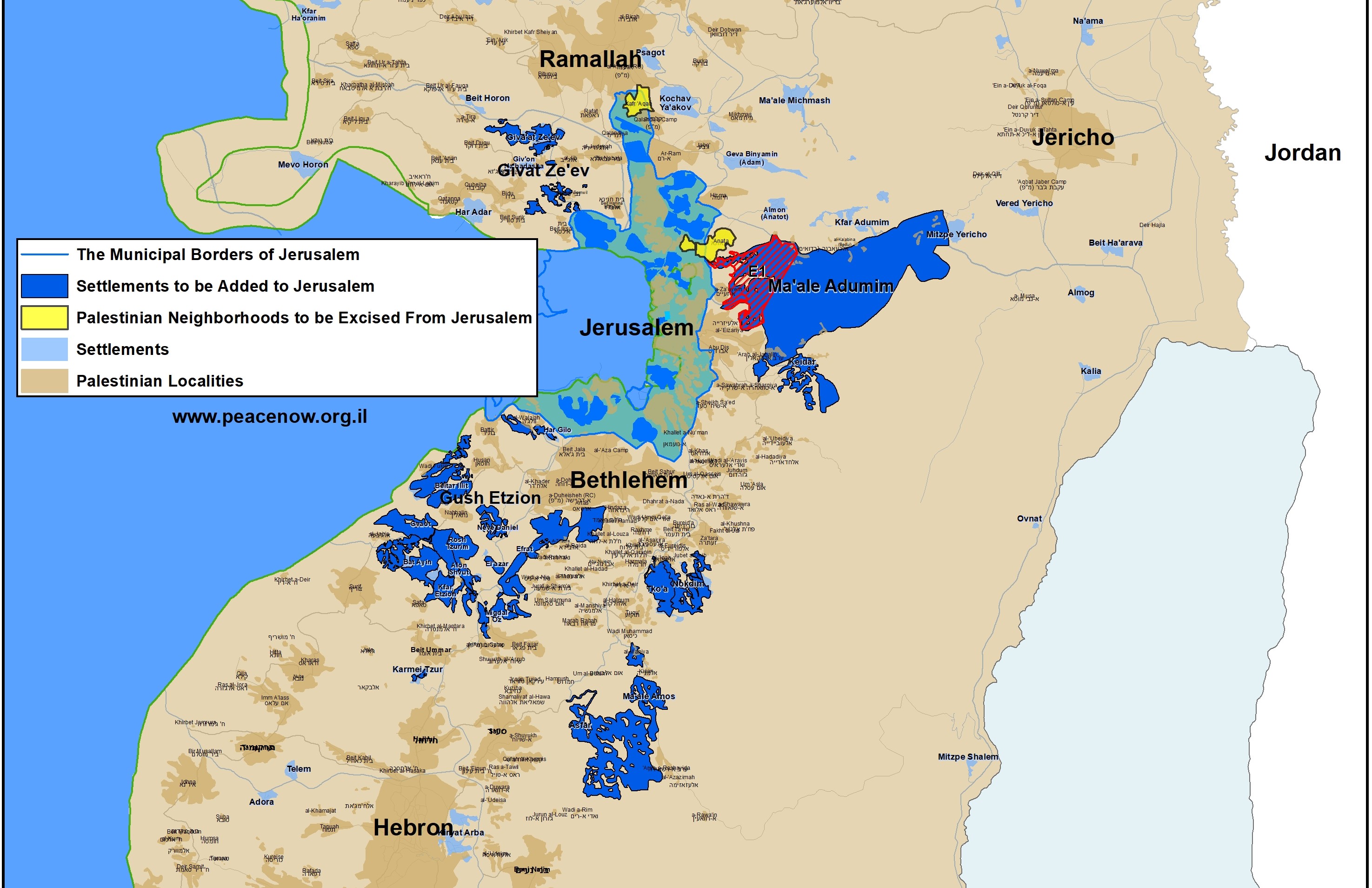
Map by Peace Now
Effectively annex a an enormous area of the West Bank into Israel’s Jerusalem Municipality, including not only the settlements but huge areas of adjacent land designated by Israel as belonging to the settlements. Peace Now has a map of the settlements/land that will annexed [click for greater detail].
- Include as part of Jerusalem settlements/lands located far from the current borders of Jerusalem, extending deep into the West Bank nearly to Jericho (the Palestinian city located on the border with Jordan) and including settlement located closer to Hebron than to Jerusalem.
- Effectively annex the area of the planned E-1 settlement, the same area where the Khan al-Ahmar community continues to await the fate of Israel’s plan to forcibly relocate them (a war crime) out of the area.
- Redraw the borders of the Jerusalem Municipality to cut out several Palestinian neighborhoods that are legally part of the Municipality but that Israel elected to leave on the West Bank side of its separation barrier (these neighborhoods would have new “sub-municipalities” created for them).
PLO Executive Committee member Hanan Ashrawi stated bluntly “such efforts represent the end of the two-state solution.”
The anti-settlement watchdog Peace Now writes,
The bill states that its implementation would allow to maintain a “demographic balance” between Jews and Palestinians in Jerusalem, and will allow for the expansion of construction of housing units and industry in the area. It is clear that the idea is to allow rapid settlement construction in settlements near Jerusalem and create facts on the ground which will prevent the chance for a two state solution, and at the same time excise Palestinian neighborhood by the formation of “sub-municipalities” or if you will, Bantustans, devoid of resources which will allow them to be self-sufficient.
J Street writes that passage of the bill,
would be a major step in Israel’s ongoing, de facto annexation of territory throughout the West Bank – and pose a massive threat to the possibility of ever achieving a two-state solution. If carried out, Israel would be crossing a major red line by unilaterally imposing its own solution to a vital final status issue.
In addition to the “Greater Jerusalem Bill,” a second bill regarding Jerusalem is also on the Knesset’s winter docket. If passed, this bill would amend Israel’s Basic Law to require a supermajority – 80 out of 120 votes – in the Knesset to approve any deal that transfers sovereignty over any part of Jerusalem to a foreign entity. This gives the Knesset veto power over any future peace deal reasonably assuming that the Palestinians will not agree to cede all of Jerusalem (it’s historic capital and home to sacred religious and national sites) to Israel.
Americans for Peace Now explains,
If passed into law, this measure would be unmatched in the Israeli legal code. No other Israeli government executive decision requires a two-thirds majority. This legislation would tie the hands of future governments in negotiating peace and will grant a de facto veto to representatives of the Israeli public’s anti-peace minority. The bill passed an initial vote and will need to pass three additional readings to become law. The absurdity is that the law, if passed, will surely garner significantly fewer than the 80 votes it demands for a future decision on Jerusalem.
Earlier this month, when these two bills were first unveiled, Terrestrial Jerusalem’s founder Danny Seidemann warned:
Cumulatively, these … initiatives constitute an effort to implement the most radical changes in the status of East Jerusalem since the Israeli annexation in June 1967, and threaten to profoundly detrimental impacts on the prospects of a future political agreement. Indeed, it is difficult to overestimate their significance. Together they would create a radically new geopolitical reality in Jerusalem and its environs.
Ir Amim also cautions:
The bills have not surfaced in a vacuum; they complement a series of recent initiatives calculated to impose crucial territorial-political facts on the ground under the guise of “municipal moves.” They would preempt chances of a political resolution to the conflict, weaken the urban fabric, and ratchet up tensions in Jerusalem.
Assault on Jerusalem [And a Negotiated Solution], Part 2: East Jerusalem Settlement Enclave in Jabal al-Mukaber Set to Triple in Size
In addition to the wave of settlement approvals by the Israeli High Planning Council last week [read last week’s Settlement Report here], on Oct. 25th, the Jerusalem Municipality issued conditional building permits for 176 new units in the Nof Zion settlement enclave. The permits are pending until the settlers submit proof of ownership papers; the missing paperwork has delayed the issuance of the permits since the plan was first leaked in early September (it’s not clear what has changed to allow for them to be issued now).
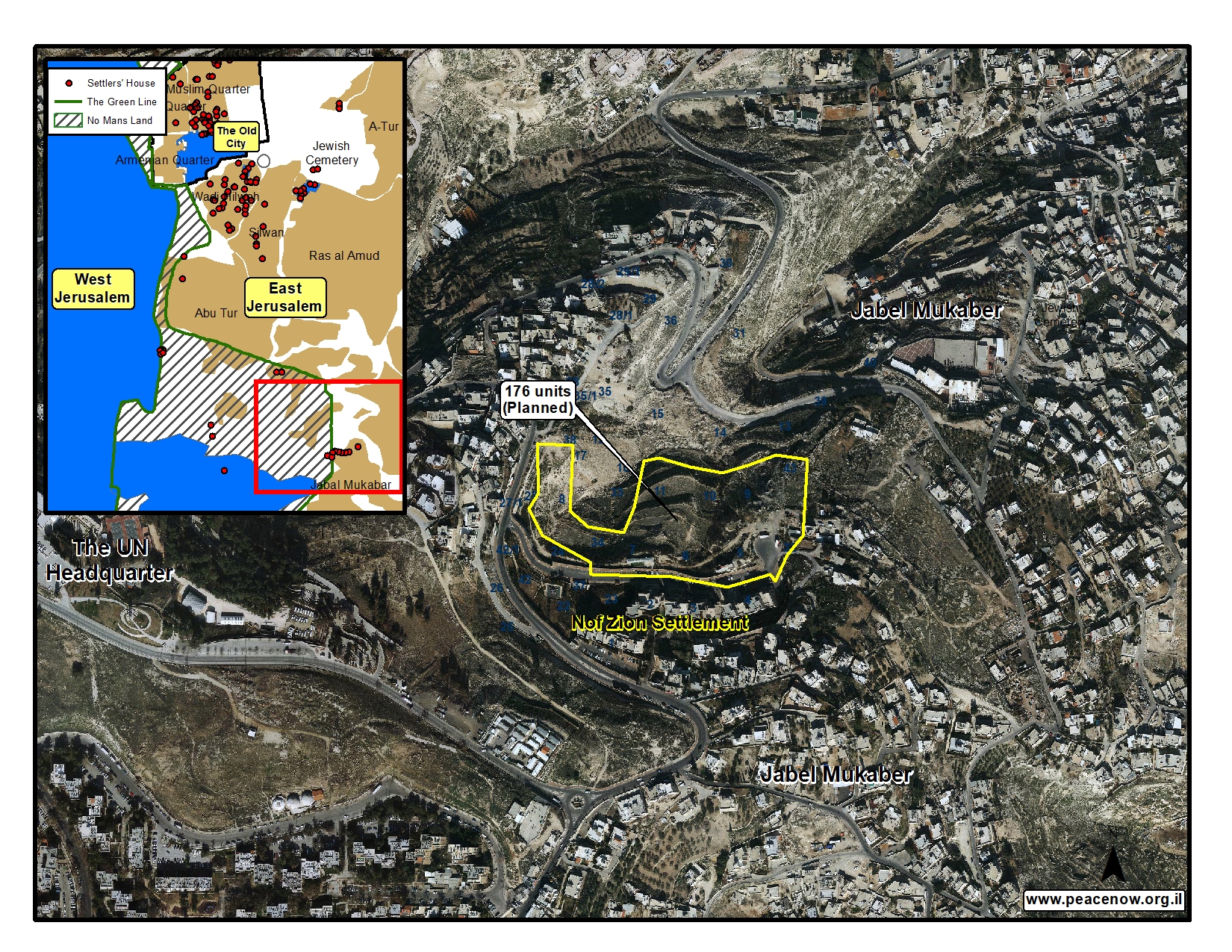
Map by Peace Now
Nof Zion is inside the Palestinian neighborhood of Jabel al-Mukaber in occupied East Jerusalem. The new units will nearly triple the size of the enclave, making it the largest of its kind in East Jerusalem.
When reports of the building permits for Nof Zion surfaced earlier this year, it sparked outrage and concern over unrestrained settlement growth in East Jerusalem and its impacts on the future of Jerusalem. The same concerns are now more urgent and alarming, as it appears there are no settlement plans too controversial for the Netanyahu government to greenlight.
Ir Amim writes,
The primary objective of the settlers’ infiltration into the Palestinian neighborhoods in and around the Old City is to undermine the possibility of dividing Jerusalem, thereby foiling the possibility of a political resolution on the city and an end to the Israeli-Palestinian conflict. The building permits will issue a clear statement that the Israeli government sanctions and supports the establishment of new facts on the ground designed for this purpose.
Assault on Jerusalem [And a Negotiated Solution], Part 3: First New, Government-Backed East Jerusalem Settlement in Decades, Atarot, Inches Closer Towards Construction
In a move described by city planning experts as “nothing less than fantasty,” the Israeli government has set aside millions of shekels to build 10,000+ units in a new settlement planned at the site known as Atarot, in the northern part of East Jerusalem. If implemented, Atarot would be the first new government-backed settlement established in East Jerusalem since the construction of Har Homa in the 1990s [unless plans to move ahead with the new settlement of Givat Hamatos come to fruition first – in that case, Givat Hamatos would be the first new government-backed settlement established in East Jerusalem since the early 1990s; Atarot would be the second].
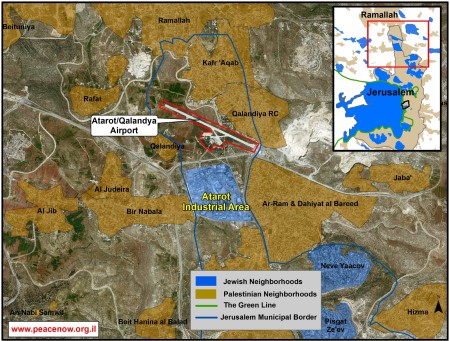
Map by Peace Now
The planned Atarot settlement would be located in the northern part of the East Jerusalem, extending to the southern edge of the West Bank city of Ramallah. It would include 10,000+ units for ultra-Orthodox Jewish Israelis. The location for construction is site of the disused Atarot airport. The airport site is an important commodity, reportedly promised to the Palestinians for their state’s future international gateway. Developing the site into a Jewish Israeli settlement would deprive a future Palestinian state of the only airport in the West Bank, dismember Palestinian neighborhoods in the norther part of the city, and sever East Jerusalem from a Palestinian state on this northern flank of the city (acting like E-1 on Jerusalem’s northeast flank, and like Givat Hamatos on Jerusalem’s southern flank).
FMEP first reported on Atarot in April 2017 when the settlement plan was rumored to be included on the master blueprint of settlements for which Netanyahu intended to seek U.S. approval. It was expected to be announced in May on the occasion of the Jerusalem Day celebration, but until now, the plan has not advanced.
The plan dates back to 2007; it was pursued by the Israeli government in 2012 but shelved under pressure from the Obama administration. At that time, Peace Now’s Hagit Ofran observed:
Not only that this plan might severely harm the future Palestinian State, destroying the only airport in the West Bank, but it will also cut between East Jerusalem and Ramallah at the heart of many Palestinian neighborhoods: Shu’afat and Beit Hanina in the South, Bir Nabala, Al Judeira, Al Jib, Rafat and Qalandia in the West, Ar-Ram, Dahiyat al Bareed and Jaba’ from the East, and Qalandia Refugee Camp, Kafr ‘Aqab and Ramallah from the North. It seems that what the Givat Hamatos plan is meant to do in the South of Jerusalem (to cut between Bethlehem and East Jerusalem), this plan will, god forbid, do at the North of it. The goal of this plan is clear: to prevent the possibility of a Palestinian State in the West Bank, and thus to kill the two states solution.
This week, Peace Now commented:
This is a crazy plan, both politically and in terms of planning. It is an attempt to drive a wedge into the heart of an urban area of hundreds of thousands of Palestinians. Since the neighborhood of Har Homa was established in the 1990s, no new Israeli neighborhood has been built beyond the Green Line in Jerusalem.
Reported New U.S. Settlement Policy: Expand at Will, but Don’t Surprise Us
According to a report posted on Al-Monitor, two months of secret negotiations between the U.S. and Israel have resulted in an unofficial framework for how Israel, with U.S. approval, will advance and expand settlements. The agreement reportedly entails the following:
- The U.S. will see all settlement plans Israel has decided to approve before they are advanced bureaucratically (i.e., before moves that allow them to become public).
- Israel can approve plans for new settlement units anywhere that is adjacent to an existing unit (read: in any/all/every settlement or outpost).
- With respect to the West Bank, there is an unspecified limit on the quantity of new units that each new settlement project is allowed.
- With respect to East Jerusalem, there is no limit on the number of units allowed to advance as long as rules 1 & 2 are respected.
It should be noted that the only plan that appears to violate the letter of this leaked deal is the plan for the Atarot settlement in East Jerusalem, which is not adjacent to any existing units (rule #2).
Israeli Justice Minister Personally Involved in Drafting State Responses to Settlement Petitions before the High Court of Justice
Israeli Justice Minister Ayelet Shaked is coming under fire for her intervention in every case before the High Court related to Israeli settlements and unauthorized outposts. Haaretz reported this week that since being appointed, Shaked has retained the services of a private lawyer to review and redraft each and every state response related to settlements and outposts before that response is submitted to the High Court of Justice. Moreover, the lawyer Shaked selected for this task comes from the notorious far-right, pro-settler group Regavim — a group that devotes its efforts to systematically mapping out and expelling Palestinians from strategic areas in Jerusalem, the West Bank, and the Negev.
Further Haaretz reporting revealed the Israeli Attorney General Avichai Mandleblit and the State Prosecutor Shai Nitzan (whose office ostensibly produces the first draft of state responses that Shaked then edits) have defended Shaked against criticism for this heavy handed political interference in legal matters.
Updates: Netiv Ha’avot and the “Settler Security Package”
-
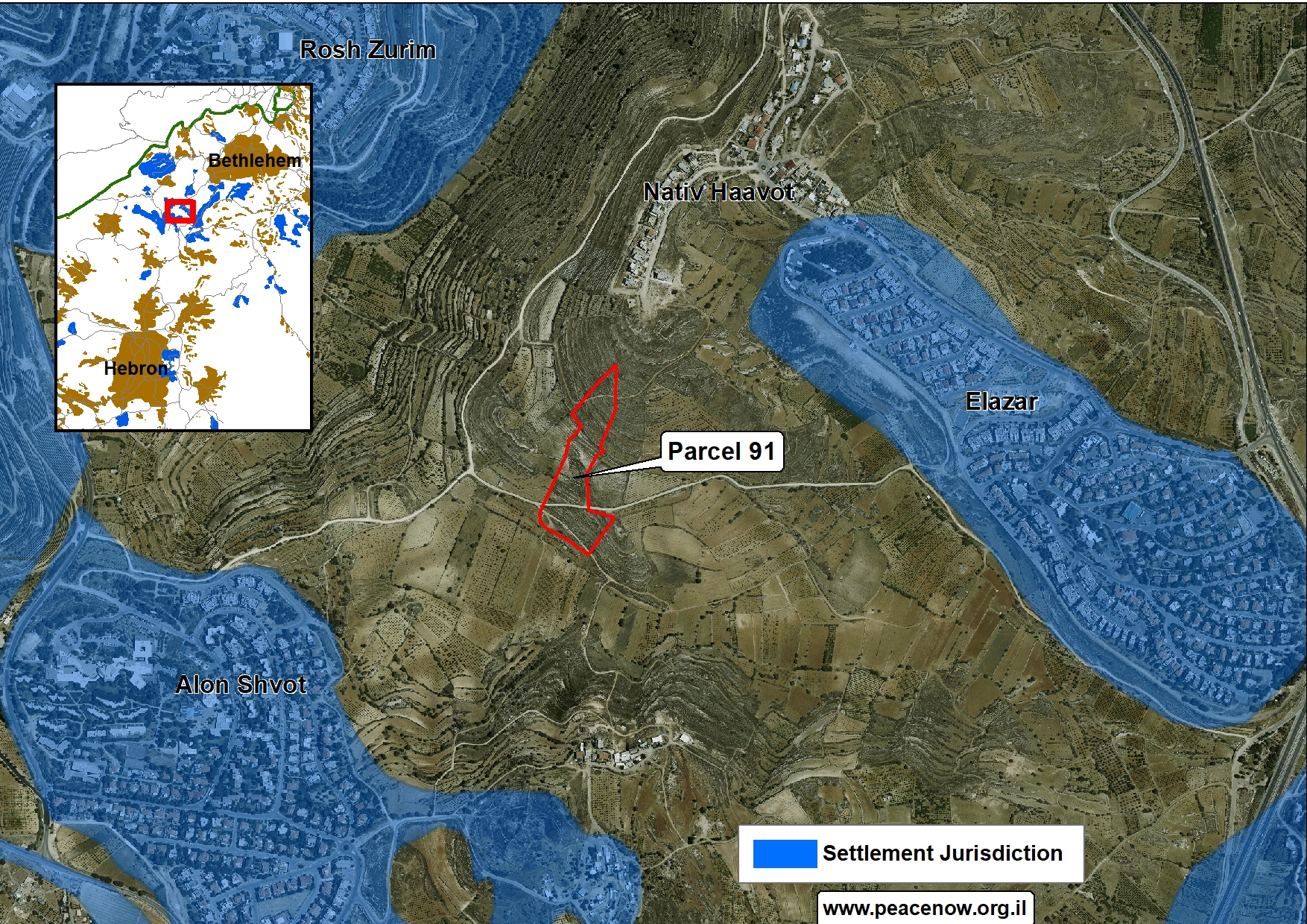
Map by Peace Now
The Israeli High Court dismissed a state-backed petition by settlers challenging the planned demolition of 17 structures built wholly or partly on privately-owned Palestinian land in the unauthorized outpost of Netiv Ha’avot. The settlers asked that 15 of the structures only be partially demolished, leaving intact the portions of them that are not on Palestinian land. The Court rejected the request and ordered the structures to be demolished. The entire outpost of Netiv Ha’avot is slated to be razed by March 2018 following a High Court ruling. Just last week, the High Planning Council approved a plan (a plan it called “improper” but approved anyway) to build 17 temporary new homes for Netiv Ha’avot residents on lands between the Elazar and Alon Shvut settlements. This land parcel is outside of either of the settlements’ jurisdictions – in effect, it is another case of rewarding settlers for breaking the law by “compensating” them with the establishment of a brand-new settlement. However, to avoid the appearance that this is the case, the High Planning Council ordered the borders of Alon Shvut to be formally expanded before the structures are built to include the parcel (which would mean that the plan would not, retroactively, violate the new U.S.-Israeli policy understanding reported previously).
- Settlers continued to protest Netanyahu even after news last week that the government plans to dispense $939 million in 2019 for the “settler security package” they are demanding. In an attempt to placate the settlers’ demands, Netanyahu met with the settler leaders to speed up his government’s timeline for beginning the West Bank settlement infrastructure projects, outlining a plan to invest $228 million beginning in next year. According to the unwritten plan, the 2018 projects will include paving five new settler-only highways to bypass Palestinian villages.
Bonus Reads
- “Dangerously ‘imprecise’ on Israeli settlements” (Americans for Peace Now)
- “Unprotected: Detention of Palestinian Teenagers in East Jerusalem” (B’Tselem & HaMoked)
- “Settler Leaders Appeal to High Court Over Bypass Road” (Jerusalem Post)
FMEP has long been a trusted resource on settlement-related issues, reflecting both the excellent work of our grantees on the ground and our own in-house expertise. FMEP’s focus on settlements derives from our commitment to achieving lasting Israeli-Palestinian peace, and our recognition of the fact that Israeli settlements – established for the explicit purpose of dispossessing Palestinians in the West Bank and East Jerusalem of land and resources, and depriving them of the very possibility of self-determination in their own state with borders based on the 1967 lines – are antithetical to that goal.
Welcome to FMEP’s Weekly Settlement Report, covering everything you need to know about Israeli settlement activity this week.
To receive this report via email, please click here.
September 7, 2017
- In Sheikh Jarrah, Palestinians Evicted, Settlers Move In
- Major Expansion in Settlement Enclave – Approval of Permits Imminent
- High Court Lets Settlers Stay in Hebron House [That They Took Over Illegally]
- Amichai Update: Work on New Settlement to Resume with Infusion of Government Funds
- U.S. Ambassador Questions if the Occupation Exists, Minimizes Impact of Settlement Enterprise
- Bonus Reads
Comments, questions, or suggestions? Email Kristin McCarthy at kmccarthy@fmep.org.
In Sheikh Jarrah, Palestinians Evicted, Settlers Move In
On September 5th, the Israeli army evicted members of the Shamasneh family from their home in Sheikh Jarrah, a Palestinian neighborhood in East Jerusalem; they had lived in that home since 1964. Within hours of the eviction, extremist Israeli settlers moved into the home. This is the first eviction to be carried out in Sheikh Jarrah since 2009, when evictions there inspired a sustained domestic and international protest.
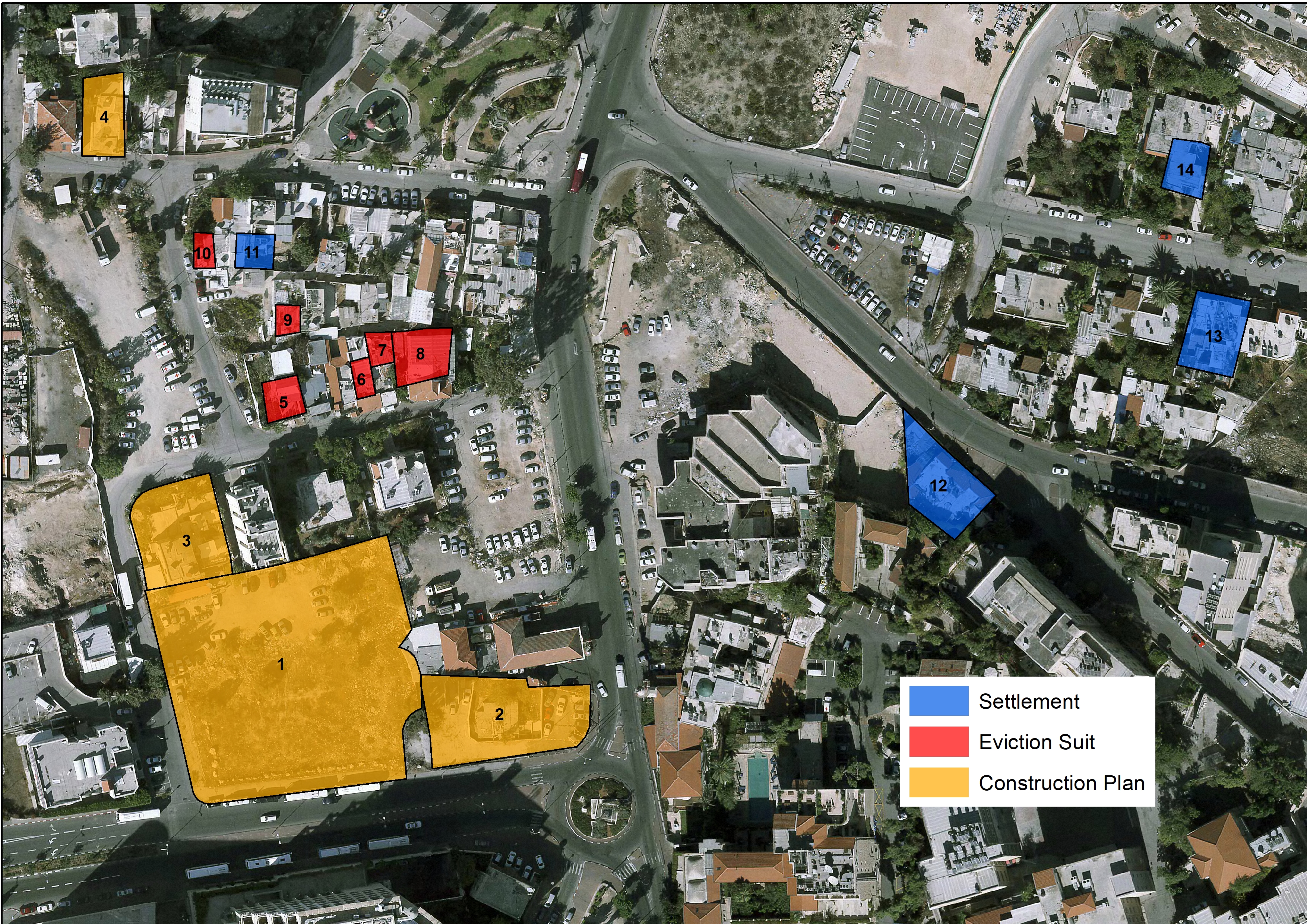
Map by Peace Now
The Shamasneh family was sent an eviction notice back in 2013, after a court ruled in favor of Israelis who sought to “redeem” the home. Their case was based on an Israeli law that allows Jews to reclaim property and land they were forced to abandon in 1948, when Jordan captured East Jerusalem (a right Palestinians are not afforded with respect to properties they were forced to abandon in what became Israel in 1948). The eviction of the Shamasneh family was repeatedly delayed out of “humanitarian concerns” over the health of the elderly Shamasneh patriarch. Earlier this year, it became clear the eviction was going to be carried out when a wave of provocative East Jerusalem settlement plans were advanced, including multiple plans to build more settlement units in the Sheikh Jarrah neighborhood.
Regarding the Shamasneh’s case, Ir Amim wrote:
Today’s eviction of the Shamasneh family symbolizes the boldness with which these settlement activities in the most sensitive part of East Jerusalem are now being executed – with the full backing of the state – and the pressing need to halt this escalation of events in order to preserve the waning viability of the two state solution.
Regarding that same eviction, East Jerusalem settler impresario (and city councilman) Aryeh King exulted:
I expect more evictions this year of residents who refuse to recognize the Jewish owners of the properties where they are living. With the opening of the new National Insurance Institute nearby, the Nahalat Shimon [Shimon Hatzaddik] neighborhood is going to see a significant expansion of Jewish settlement, which residents of Jerusalem have waited for years to see.
On the evening prior to the eviction, Israeli forces raided several Palestinian homes in Sheikh Jarrah and issued six additional eviction notices.
Major Expansion in Settlement Enclave – Approval of Permits Imminent
The Jerusalem municipality is set to grant building permits for 176 new housing units in the Nof Zion settlement, an Israeli enclave located inside the Palestinian neighborhood of Jabel Mukaber in East Jerusalem. If approved, construction of the units will make Nof Zion the largest Israeli settlement enclave in East Jerusalem.
Peace Now, which was first to report the story, wrote:
It appears that the [Israeli] government has opened all the floodgates when it comes to settlement developments within Palestinian neighborhoods. Building a large settlement in the heart of a Palestinian neighborhood would constitute a severe blow to Jerusalem and to the chance to arrive at a two state solution. This is not a matter of real estate but a matter of politics and sovereignty, as the Israelis moving to homes inside Palestinian neighborhoods are motivated solely by ideology, and are trying to prevent a future compromise in Jerusalem.
Map by Peace Now
Plans for 395 new units for the Nof Zion enclave were originally approved in 1994, but the first phase of construction bankrupted the developer. A drama ensued over the fate of the project, after a Palestinian-American made a bid to buy the development rights. His winning bid was ultimately blocked by right-wing Israelis [with a key role played by Jerusalem settler impresario Aryeh King] who objected to the sale of the property – in an Palestinian neighborhood – to an Arab.
As it stands, only the Prime Minister’s personal intervention might stop the construction, which does not seem likely given Netanyahu’s repeated declaration that his is the most settlement-friendly government in the country’s history.
The units are not the only construction happening in Nof Zion. Earlier this year, the government approved a plan to build a new synagogue and mikveh on private Palestinian land that was expropriated from the Jabel Mukaber neighborhood in 2016.
Ir Amim writes:
The primary objective of the settlers’ infiltration into the Palestinian neighborhoods in and around the Old City is to undermine the possibility of dividing Jerusalem, thereby foiling the possibility of a political resolution on the city and an end to the Israeli-Palestinian conflict. The building permits will issue a clear statement that the Israeli government sanctions and supports the establishment of new facts on the ground designed for this purpose.
High Court Lets Settlers Stay in Hebron House [That They Took Over Illegally]
On September 3rd, the Israeli High Court of Justice issued an injunction allowing for a one-week delay of the evacuation of 100 Israeli settlers from the “Machpela House” in Hebron. The settlers have been illegally inhabiting the house, under the protection of the Israeli army, since they broke into the property on July 25th.
The delay is the result of a last minute petition filed by the squatters claiming rightful ownership of the house; the petition gives Palestinian claimants and the state of Israel one week to respond, during which time the settlers are allowed to remain in the house. The injunction reverses an order by the Israeli Attorney General last week to evacuate the settlers by September 3rd.
Peace Now said in a statement about the settlers’ latest petition:
The settlers’ petition is absolutely outrageous and its baseless arguments have been rejected again and again in previous legal proceedings. After having been granted an independent administration a few days ago, it is no wonder the Hebron settlers feel empowered to do as they wish, while ignoring the law and on the expense of Palestinians. [Editor’s note: the reference to an “independent administration” relates to a decision last week, explained in the same Peace Now explainer linked above, to promote the status of an administrative body that can represent Hebron’s settlers to the Israeli government].
Amichai Update: Work on New Settlement to Resume with Infusion of Government Funds
On September 3rd, the Israeli Cabinet approved the allocation of 55 million shekels ($15.3 USD) to the Interior Ministry for the construction of the Amichai settlement in the Shilo Valley, the first official new Israeli settlement to be built in 25 years. The construction of Amichai, which was approved as a pay-off for families evicted from the illegally built the Amona outpost, has been stalled for nearly two months for lack of funds.
The Cabinet’s resolution notes that any additional government contribution to the project “depends among other things on court verdicts,” because “legal proceedings are now before the court against the construction of the new settlement, including the infrastructure work.” Last week we reported on a petition to the High Court filed by Bimkom on behalf of Palestinian landowners in the vicinity of Amichai.
The government’s funding will go towards providing public infrastructure to the new settlement: paving access roads, building sewage systems, and connecting it to the Israeli power grid. The 55 million shekels allocated this week fall within the original 60 million shekel budget approved by the Cabinet last year.
U.S. Ambassador Questions if the Occupation Exists, Minimizes Impact of the Settlement Enterprise
In an interview in the Jerusalem Post, U.S. Ambassador to Israel David Friedman articulated major points of the Trump Administration’s approach to Israel, the Palestinians, and peace negotiations.
Alarmingly, the Ambassador called into question whether or not Israel is, in fact, occupying the West Bank. Amb. Friedman – who before he was nominated to be Ambassador had a long history of criticizing the American Jewish Left, including calling its members “kapos” – reportedly told the Post, “The [American Jewish] Left…is portrayed as believing that only if the ‘alleged occupation’ ended would Israel become a better society.” Following the publication of Ambassador Friedman’s interview, a senior White House official told the Guardian that his comments do not represent a shift in U.S. policy.
Israel’s occupation of the West Bank, East Jerusalem, and the Gaza Strip is an objective fact, acknowledged by the entire international community including, until now, the United States. As noted by Americans for Peace Now:
The West Bank and Gaza are viewed by virtually all international legal experts as “occupied territory.” Since 1967, legal experts, including in Israel, have been virtually unanimous in recognizing this…Even the Israeli Supreme Court has repeatedly used the term “belligerent occupation” to describe Israel’s rule over the West Bank and Gaza… Even Ariel Sharon, one of the principal architects of Israel’s policy of building settlements in the West Bank and Gaza, recognized this reality. On May 26, 2003, when he was Prime Minister of Israel, he bluntly told fellow Likud members, “You may not like the word, but what’s happening is occupation [using the Hebrew word “kibush,” which is only used to mean “occupation”]. Holding 3.5 million Palestinians under occupation is a bad thing for Israel, for the Palestinians and for the Israeli economy.”
Also of concern with respect to settlements, Ambassador Friedman said,
If you listened to the Obama administration, you would think that the [Israeli] settlements had overtaken the West Bank. It’s still under 2% of the territory. I am personally convinced that there’s nothing in the current status quo with regards to settlements that precludes the resolution of the Palestinian [issue].
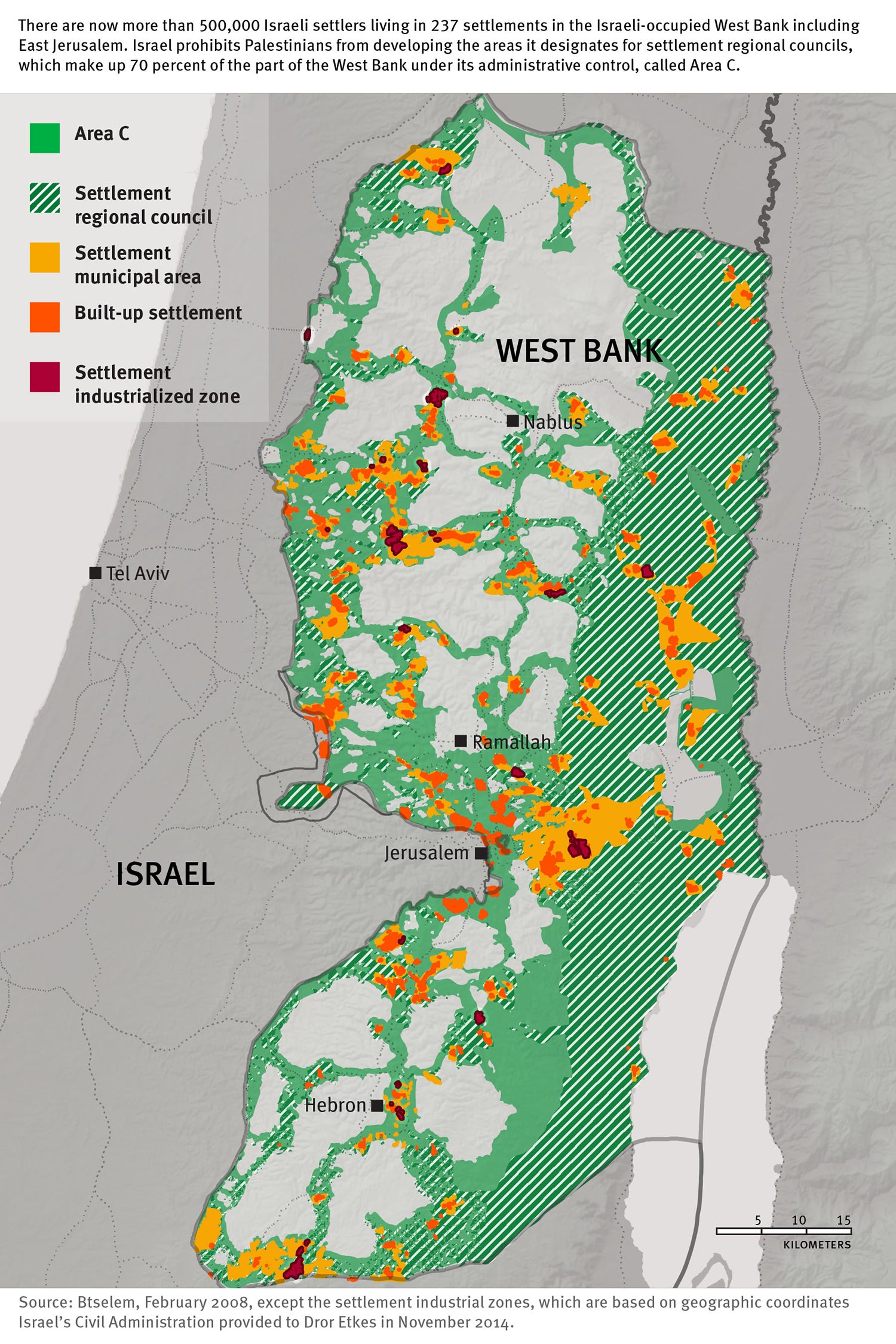
Map by Human Rights Watch
Ambassador Friedman’s 2% figure is misleading. It refers restrictively to the amount of land settlers have actually built on [2% of the West Bank], but does not count the many ways settlements have created a massive, paralytic footprint in the West Bank. This argument was comprehensively dismantled last November by FMEP’s Lara Friedman, in her testimony before the UN Security Council.
In a report last year, Yesh Din explained further:
The jurisdiction areas of many settlements are much larger than the area they actually use. In 2013, the total area under the jurisdiction of settlements, including regional councils, stood at 1.2 million dunams (roughly 120,000 hectares), or 63% of Area C. In practice, the area covered by the settlement enterprise is larger, as it also includes the unauthorized outposts, many of which are outside local council jurisdiction areas, as well as their farmland. Palestinians are barred from entering all of these areas, by virtue of a “closed military zone” order which prohibits entry without a permit.
The settlements command an area that is larger than their residential, built-up portion. Each community has a system of access roads, and each is assigned vast areas intended to ensure the residents’ safety. Many settlements include farmland, industry and commerce zones, green areas and parks, and in many of them the distance between the houses is so large, that the space they take up has no direct correlation to the number of people living in them.
Yesh Din’s full report, “Land Takeover Practices Employed by Israel in the West Bank” is available online here.
Bonus Reads
- “Illegal outpost residents ask court to save parts of homes set to be razed” (Times of Israel)
- “Bedouin Shepherds Between a Rock, a Hard Army, and West Bank Settlers” (Haartez)
FMEP has long been a trusted resource on settlement-related issues, reflecting both the excellent work of our grantees on the ground and our own in-house expertise. FMEP’s focus on settlements derives from our commitment to achieving lasting Israeli-Palestinian peace, and our recognition of the fact that Israeli settlements – established for the explicit purpose of dispossessing Palestinians in the West Bank and East Jerusalem of land and resources, and depriving them of the very possibility of self-determination in their own state with borders based on the 1967 lines – are antithetical to that goal.
Welcome to FMEP’s Weekly Settlement Report, covering everything you need to know about Israeli settlement activity this week.
To receive this report via email, please click here.
August 16, 2017
- Israel Demolishes Buildings in Key East Jerusalem Areas
- Bedouin are Powerless in E-1 Area as Settlement Plans Loom
- Jewish National Fund Resumes Targeting Land in the Occupied West Bank
- Settlers in Israeli Government Turn Blind Eye to Settlers Breaking Israeli Law
- Former Israeli AG Says Sheikh Jarrah Property Should be Given to Palestinians
- Three New Outposts Near Nablus
- Updates: Al-Walajah, Sheikh Jarrah, Amichai Settlement
- Bonus Reads
Comments, questions, or suggestions? Email Kristin McCarthy at kmccarthy@fmep.org.
Israel Demolishes Buildings in Key East Jerusalem Areas
The Israeli government demolished eight Palestinian structures in the East Jerusalem neighborhoods of Silwan, Beit Hanina, Jabal Mukaber, and Isawiyyah. According to Ir Amim, the two apartments demolished in the al-Bustan area of Silwan are the first demolitions to be carried out there since 2008. Looking at East Jerusalem as a whole, Ir Amim writes, “[these] demolitions bring the 2017 total to 128, including 84 residential units and 44 non-residential units. These numbers are on well on target to meet or surpass the total number of 203 demolitions executed in East Jerusalem last year.”
Bedouin are Powerless in E-1 Area as Settlement Plans Loom
According to B’Tselem, last week Israeli officials confiscated solar panels that were providing electricity to a Bedouin community’s school in the controversial area adjacent to Jerusalem known as “E-1.” The confiscation happened despite a temporary court-ordered injunction against it. The Israeli government has long refused to connect the Bedouin to a power grid; the solar panels confiscated this week were donated only a month ago by a humanitarian organization.

Map by the Economist
The E-1 area has long been slated for Israeli settlement construction, but plans have been continuously delayed by the Israeli political echelon – due in large part to pressure from U.S. administrations and others in the international community. If E-1 is developed it will seal Palestinian East Jerusalem off from the West Bank to its east, and create a land bridge from Jerusalem to the Maale Adumim settlement. The settlement will render the two-state solution impossible because it would preclude the ability to draw contiguous borders for a future Palestinian state with a capital in East Jerusalem.
East Jerusalem expert Danny Seidemann has issued several warnings this year that E-1 – a “doomsday settlement” – might be slated for advancement under the current settlement policy of the Netanyahu government and with no discernable counter-pressure from the Trump Administration. Seidemann warned in January, “The main obstacle preventing a green light for E-1 has, until now, been wall-to-wall opposition from the international community, led by the United States (dating back to the era of President Clinton).”
The Bedouin community living in the E-1 area has long been threatened with forcible relocation (which would amount to population transfer). The 18 Bedouin tribes that live in the vicinity of Maale Adumim and E-1, totaling approximately 3,000 people, have already endured numerous emolitions this year alone.
Jewish National Fund Resumes Targeting Land in the Occupied West Bank
According to Peace Now, the Jewish National Fund (JNF) is set to resume its practice of purchasing land in the West Bank for use by Israeli settlers, after abandoning the effort many years ago. In the past, many of the JNF’s land purchases reportedly involved fraud, extortion, and/or forgery on the part of middlemen.
Peace Now writes, “Through purchasing lands in the occupied territories, JNF serves the settlers, hurts the possibility to arrive at a two state solution, and jeopardizes the future of Israel as a Jewish and democratic state.”
The JNF – which collects donations internationally, including in the United States – currently owns land (through its Israeli subsidiary) in numerous settlements, including Itamar, Alfei Menashe, Enav, Kedumim, Givat Ze’ev, Metzadot Yehuda, and Otniel.
Settlers in Israeli Government Turn Blind Eye to Settlers Breaking Israeli Law
There have been several recent reports about structures inside of settlements that were built (or are being built) without the legally-necessary permissions, as Israeli officials turn a blind eye.

Map of the Hayovel outpost by Times of Israel Red encircles site construction, arrow points to the house of Liberman’s settlement affairs advisor.
Notably, one report identifies dozens of unauthorized homes being built in the outpost of Hayovel (which is effectively an extension of the settlement of Eli), despite a stop-work order issued by Civil Administration (the arm of the Ministry of Defense that is sovereign in the West Bank). The construction is taking place virtually across the street from the home of Israeli Defense Minister Avigdor Liberman’s own adviser on settlement affairs, who is himself a resident of the illegal outpost (Liberman is also a settler, residing in the settlement of Nokdim). The illegal construction will double the size of the outpost.
Another report reveals that Shlomo Ne’eman, the head of the Gush Etzion Regional Council – which promotes the expansion of settlements in the Etzion bloc – lives in an illegal outpost. The Regional Council insists that the outpost is a “neighborhood” of the Karmei Tzur settlement, but aerial images show it is outside of the settlement’s municipal border. The Israeli Civil Administration has ordered the structures there to be demolished but has not carried out those orders. Settlement watchdog Kerem Naboth says, “Ne’eman has joined the list of elected officials and politicos among the settlers who are not only assisting others in stealing land, but are also doing it themselves.”
Haaretz notes that these two are part of a longer list of elected officials and senior civil servants living in illegal outposts, Also on that list far right-wing Knesset Member Bezalel Smotrich (Habayit Hayehudi), who lives in an illegally-built home in Kedumim (not coincidentally, Smotrich was one of the key backers of a law passed earlier this year to “legalize” such settlement illegalities). Likewise, a January report revealed that the head of the Finance Ministry’s department of building regulations enforcement, Avi Cohen, lives in an illegal outpost of the Eli settlement. At the time of the report in January, Rabbis for Human Rights said, “A situation in which the system responsible for enforcing building laws is headed by someone living in an outpost demonstrates contempt for the system and Israel’s values.”

Image by Kerem Naboth
Another report documents how in the Efrat settlement (in the Etzion settlement bloc) a school was recently expanded, illegally, on private Palestinian land located land outside of the settlement’s border. Funding for the project was raised by an organization, called the Ohr Torah Stone, which operates a branch in the United States and is eligible to receive tax-deductible donations from U.S. donors. According to settlement watchdog Kerem Naboth, the Efrat settlement itself was built on land that the Palestinian village of al-Khadr had long cultivated. Kerem Naboth reports, “aerial photographs from the 1980s indicate that in the past there was a vineyard on site.”
Former Israeli AG Says Sheikh Jarrah Property Should be Given to Palestinians
Speaking in Sheikh Jarrah, former Israeli Attorney General Michael Ben-Yair called on the Israeli government to intervene to stop the eviction of the Shamasneh family from their longtime family home. Ben- Yair served as the AG from 1993-1997, under prime ministers Rabin and Netanyahu.
Ben-Yair, whose family lived in Sheikh Jarrah until 1948, suggested he would be ready to reclaim his family’s property and then transfer it to the Palestinians currently living there – and called on the government to adopt a policy to do exactly that, across the board. He said, ”If the Israeli government would have acted decently toward all its residents, including you [the Arab residents], it would have appropriated the properties in the neighborhood [from their Jewish owners who lived there before the War of Independence] and given these properties to the Palestinians who live there today.”
The former AG also noted that Jews who lost property in the 1948 war were already compensated – at the expense of Palestinians. Ben-Yair said, “My family and the family of my cousin who were forced to leave the neighborhood in January 1948 got properties of Palestinians refugees on Jaffa Road and in the Katamon neighborhood in west Jerusalem. They were worth much more than the properties that we left in Sheikh Jarrah.
Since we covered the Shamasneh family’s story last week, a temporary injunction against the eviction expired on Sunday, August 13th. The family’s lawyer requested a second injunction, but the petition is still pending. As of this writing the family is still living in the home.
Three New Outposts Near Nablus
The Palestinian Authority is reporting that settlers from the radical Yitzhar settlement, south of Nablus, have moved 11 mobile homes to an area outside of the settlement, a move which would expand the settlement’s footprint. In addition, nine mobile homes were reportedly placed near the Palestinian village of Qusin, which is a few miles east of Nablus, and another nine were placed near the border of the Einav settlement, a few miles east of Qusin.
Updates: Al-Walajah, Sheikh Jarrah, Amichai Settlement
Updates from last week’s Settlement Report:
- Residents of the village of Al-Walajah were able to stop the demolition of one home last week by forming a human barrier around it, blocking a bulldozer from tearing it down. Approximately one third of the village is inside of Jerusalem’s municipal boundary. In this area specifically, Ir Amim estimates that 50% of the homes are under threat of demolition. Al-Walajah residents say the Israeli government has recently increased the rate of home demolitions significantly and has also resumed construction of the separation barrier around the village.
- UNRWA has weighed in on the pending eviction of the Shamasneh family from their home in Sheikh Jarrah. UNRWA spokesman Christopher Gunness states, “The members of the Shamasneh family are long-standing Palestine refugee residents in East Jerusalem, which is occupied territory and affected by continued settlement expansion contrary to international law. It is a matter of deep concern that Palestine refugees who have already endured multiple displacements should be subject to the humiliation of the kind inflicted by forced evictions.” The statement calls on the Israeli government to reconsider the eviction ruling.
- Construction on the first new settlement in 25 years, Amichai, remains stalled due to lack of government funding. After nearly three weeks of inactivity on the construction site, the families who the settlement is being built for are preparing to move to the area with semi-permanent structures and take up residence. On plans to move to the site while construction is stalled, one settler told Ynet News, “It is clear that when we do go there [to the site of Amichai], thousands of youths will join us. When we do, it will be to stay for good.”
Bonus Reads
- “Adalah opposes mandate of Israeli Interior Ministry borders cmte. weighing annexation of West Bank land to settlements” (August 13, 2017)
FMEP has long been a trusted resource on settlement-related issues, reflecting both the excellent work of our grantees on the ground and our own in-house expertise. FMEP’s focus on settlements derives from our commitment to achieving lasting Israeli-Palestinian peace, and our recognition of the fact that Israeli settlements – established for the explicit purpose of dispossessing Palestinians in the West Bank and East Jerusalem of land and resources, and depriving them of the very possibility of self-determination in their own state with borders based on the 1967 lines – are antithetical to that goal.
Welcome to FMEP’s Weekly Settlement Report, covering everything you need to know about Israeli settlement activity this week.
To receive this report via email, please click here.
August 9, 2017
- Israel Moves Forward with Inflammatory Evictions & Home Demolitions in Jerusalem
- Netanyahu Celebrates Expansion of Beitar Illit Settlement
- Attorney General Requests Temporary Injunction Against “Regulation Law”
- Palestinian Leaders Criticize U.S. Peace Efforts & Point to Silence on Settlements
- New Poll Reveals Settlers Prefer the Status Quo to Annexation or Peace
- Updates: Machpelah House; New “Amichai” Settlement; Netiv Ha’avot Outpost
- Bonus Reads
Comments, questions, or suggestions? Email Kristin McCarthy at kmccarthy@fmep.org.
Israel Moves Forward with Evictions & Home Demolitions in Jerusalem
Last week we covered three devastating bills moving in the Knesset that seeking to remove Palestinians and include far flung settlements in the borders of Jerusalem. Now, several seemingly small but incredibly significant developments in Jerusalem show how Palestinians are already being forced out of the city:
-
Map by Peace Now
In Sheikh Jarrah, a Palestinian family is fighting against imminent eviction from their family home of 50 years, an eviction ordered by the Israeli Supreme Court. This is the first eviction in the Sheikh Jarrah neighborhood of Jerusalem since 2009 and comes on the heels of several inflammatory settlement announcements which will bring more Israeli settlers into the neighborhood that sits just north of Jerusalem’s Old City. The Court’s decision to evict the Shamasneh family relies on an Israeli law which allows Jews to regain East Jerusalem property owned before Jordan’s 1948 capture of that part of the city. Daily solidarity protests are reportedly being staged in an effort to prevent the family’s eviction.
-

Map by Emek Shaveh
In Silwan, the settler group Elad is bidding to become the majority-owner of an apartment building that Palestinians are in a bidding war to keep. The Siyam family originally owned the entire building but over time lost control of one-half of it to the settlers another one-fourth of it to Israel’s Custodian of Absentee Property. The owners of the remaining one-fourth – Silwan non-violent opposition leader Jawad Siyam and his sister – currently reside. Now the Custodian is auctioning off its one-fourth share and if the settlers have the winning bid, it is a near certainty that Jawad and his sister will be evicted from the house by Israeli courts. This ownership battle could have a decisive impact on the character of this critically-located East Jerusalem neighborhood, which sits in the shadow of the Temple Mount/Haram al-Sharif. Elad has long been active in Silwan, taking over properties and, working hand-in-hand with the Israeli government and Jerusalem Municipality, gaining control over the public domain via tourism and park projects at the expense of the Palestinian residents. Elad recently won the rights to build a state of the art visitor center that will also be a stop on the new cable car line running to the Mount of Olives. Elad’s efforts to take over Palestinian property in East Jerusalem rely in large part on Israel’s “Absentee Property Law” (1950), according to which Palestinians who were not present at their property immediately following the 1967 war are considered “absentee,” and consequently forfeit ownership rights to the Israeli government. The government can then dispose of the property as it sees fit. In Jerusalem, Elad’s multi-million dollar annual budget puts Palestinians at a potentially insurmountable disadvantage. When Israel used the “Absentee Property Law” in 2004 to seize Palestinian property in East Jerusalem, then-President George W. Bush called on Israel to reconsider the decision.
- In al-Walajah, a wave of home demolitions combined with the nearly completed construction of the separation barrier threatens to completely sever and displace al-Walajah’s residents from the West Bank (who hold West Bank IDs, rather than Jerusalem residency, despite the fact that in 1967 most of the village’s land was made part of Jerusalem). Just this week the Israeli government issued demolition orders against 14 Palestinian homes built without the proper permits (these permits are nearly impossible for obtain).
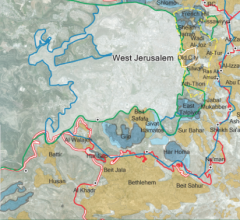
Map by Ir Amim
The 14 homes are in addition to 28 other homes already slated for demolition in the village. On the same day, the Israeli Supreme Court decided to temporarily delay the implementation of 7 of those previous orders in light of a petition brought to the court by the Norwegian Refugee Council. Residents of al-Walajah have fought the growing encroachment the nearby Etzion settlement bloc and the Israeli government’s attempt to de facto annex the bloc as part of “Greater Jerusalem.” Ir Amim explains several prongs of this effort, including a particularly unbelievably section of the separation barrier planned to almost completely encircle the village, to turn its valuable agricultural land into an urban park for Jerusalem, and construction of a highway that will connect the Etzion settlement bloc to Jerusalem with Israeli-only bypass roads.
- In Jabal al-Mukaber, a neighborhood south of the Old City in East Jerusalem, Israel demolished four Palestinian homes without prior notice to the residents. Ma’an News reports, “Israeli authorities have stepped up issuing demolition warrants for Palestinians in East Jerusalem in recent months, particularly after Jerusalem Mayor Nir Barakat threatened that the demolition of the illegal Israeli outpost of Amona in the occupied West Bank would be met with the mass demolition of Palestinian homes lacking the nearly impossible to obtain Israeli-issued building permits.”


Netanyahu Celebrates Expansion of Beitar Illit Settlement
Prime Minister Netanyahu attended a cornerstone-laying ceremony for hundreds of new homes set to be built in the Beitar Illit settlement, a massive, fast-growing, ultra-Orthodox settlement in the Etzion bloc. At the ceremony, Netanyahu proudly repeated his assertion that, “There is no government that does more for the settlement [movement] in Israel than the one under my leadership.” The project will annex a third strategic hilltop to the Beitar Illit, which like much of the Etzion bloc is located on the Israeli side of the separation barrier.
The same day Netanyahu visited Beitar Illit, several right-wing Knesset members traveled to the northern part of the West Bank to call on the Prime Minister to re-establish four Israeli settlements located near the West Bank city of Jenin, that were dismantled in 2005 of part of Ariel Sharon’s disengagement from Gaza. A bill has been introduced in the Knesset that would rescind the 2005 disengagement memo which led to the evacuation of the four settlements.
Attorney General Requests Temporary Injunction Against “Regulation Law”
On August 7th, Israeli Attorney General Avichai Mandelblit weighed in on a petition filed with the Israeli Supreme Court challenging the legality of the “Regulation Law,” which was passed this year and provides a legal basis for retroactive legalization of outposts and other settlement activity in the West Bank on land owned by Palestinians. Mandelblit – who argued against passage of the Regulation Law late last year and after the law’s passage and said he would not defend it in court – asked the High Court to put a temporary injunction against the law until the Court issues its ruling. The injunction would prevent the Civil Administration (the arm of the IDF that rules over the West Bank) from using the law, and possibly from even taking the preliminary steps towards using the law, in order to retroactively legalize outposts and unauthorized settlement activity.
The petition against the Regulation Law (also called the “Expropriation Law,” the “Regularization Law,” the “Legalization Law,” or the “Settlements Law”) was filed in March by three leading Israeli settlement watchdogs: Yesh Din, Peace Now, and ACRI.
Palestinian Leaders Criticize U.S. Peace Efforts & Point to Silence on Settlements
The Palestinian outlook on President Trump’s negotiation efforts has grown outright grim this week. Any initial optimism has been replaced with a sense of abandonment on the part of Mahmoud Abbas’s Palestinian Authority and the topic of unfettered settlement growth has been a recurring talking point. On August 7th in Ramallah, Jordan’s King Abdullah and the Palestinian Authority jointly called for the U.S. to unequivocally state its support for a two-state solution and reiterated that a complete settlement freeze remains a precondition for the resumption of negotiations, including in East Jerusalem. That statement should dispel any lingering questions regarding reports in June that the PA was willing to drop a settlement freeze as a precondition to peace talks.
The new statement comes after a week of terse, unscripted criticism by the Palestinians aimed at President Trump. A top Abbas advisor, Dr. Nabil Sha’ath, told Haaretz that that Palestinians no longer look to the U.S. to be helpful on the issue. Sha’ath said, “Palestinian efforts in the near term will be focused on the international arena in an effort to prevent accelerated settlement construction or the passing of laws that have direct consequences for the peace process.”
In an interview with Jewish Insider last week, top Palestinian negotiator Saeb Erekat did not mince words about his disappointment with the Trump administration’s earlier attempts to get the ball moving on Israeli-Palestinian negotiations. Of note, Erekat laments, “Israel announces thousands of new settlement units that make it almost impossible to achieve the two-state solution, and it’s merely met with silence from U.S. officials.” Erekat is not entirely correct about the U.S.’s silence. The U.S. Department of State has repeatedly issued the same ambiguous statement regarding Israeli settlement policy, that “unrestrained settlement activity is not helpful to the peace process.” The statement echoes President Trump’s remarks in February calling for Israel to “hold back a little” on settlements.
In a third report, an anonymous Palestinian official took aim at Jared Kushner and Jason Greenblatt, Trump’s senior-most envoys dealing with Israel and the Palestinians. The source said, “It’s not a nice thing to say, but they are both ardent supporters of the settlements.They are completely unfamiliar with the other side, they don’t understand the region and they don’t understand the material. You can’t learn about what is happening here in a seminar lasting just a few weeks.” The remarks came one day before the release of a recording of Jared Kushner revealed his thinking on the topic of Israeli-Palestinian issues during which he expressed a lack of interest in history lessons on the topic.
New Poll Reveals Settler Prefer the Status Quo to Annexation or Peace
A new poll reveals remarkable differences between Israeli Jews living within the borders of sovereign Israel and those living in settlements. It sheds light on who in Israel is benefitting from the current “status quo” (which was undefined in the poll’s questions to respondents):
Of Israeli settlers:
- 35% called for the continuation of the status quo
- 24% want Israel to annex the West Bank
- 15% want to see a peace agreement
- 10% back a decisive war against the Palestinians
Of Israeli Jews living in Israel:
- 18% called for the continuation of the status quo
- 9% want Israel to annex the West Bank
- 45% support a peace agreement
- 12% back a decisive war against the Palestinians
The poll also examined the views of Palestinian citizens of Israel and Palestinians in the West Bank and East Jerusalem.
Updates: Machpelah House; New “Amichai” Settlement; Netiv Ha’avot Outpost
Several important updates to last week’s settlement report:
- In Hebron, settlers continue to illegally occupy the Machpelah House under the protection of the Israeli army, despite a new petition seeking their evacuation filed this week by Palestinians who claim to own the house. Last week, the head of the “Samaria Regional Council” Yossi Dagan, moved into the house along with his wife and three children. Approximately 120 Israeli settlers were already living there, having illegally broken into into the house last week in a bid to circumvent legal proceedings regarding rightful ownership. The IDF quickly declared the house a closed military zone, but the order has not been enforced, which is the only reason why Dagan and his family were able to enter the building. Yossi Dagan was elected head of the Samaria Regional Council in 2015. He opened a campaign office for Donald Trump during the 2016 U.S. Presidential election and published an open letter to Steve Bannon expressing his admiration and support for the newly elected U.S. administration.
- Netanyahu’s cabinet gave a major boost to the stalled construction of a new settlement called Amichai by reportedly doubling the size of the government’s financial contribution to the project. Last week, after it was reported that construction has been halted due to lack of funds, Netanyahu quickly issued assurances that the problem will be fixed. The new Amichai settlement – the first to be approved by the government since 1991 – is being built in the Shilo Valley, deep inside of the West Bank, as the payoff for families who built the illegal Amona outpost and were evacuated earlier this year. Immediately next to the Amichai construction site, at the site of the future Shvut Rachel East settlement (which was the original plan to pay-off the Amona evacuees but was rejected because it wasn’t the preferred hilltop — but was nonetheless approved for construction by the Israeli government as a neighborhood of the Shilo settlement) several caravans have been moved onto the recently leveled land in preparation for further construction.
- In two separate meetings last week, settler leaders met with PM Netanyahu and his chief of staff in their bid to cajole the Prime Minister into intervening against a demolition order threatening 15 homes in the Netiv Ha’avot outpost near Bethlehem. Commenting on the issue while at a ceremony in the Beitar Illit settlement, Netanyahu committed to helping the affected families “within the framework of the law that would minimize the damage.” It’s not clear if the Prime Minister was referring to the past damage caused to the Palestinians who own the land upon which settlers built illegally, or the future damage it will cause to relocate the families who live in illegally built homes.
Bonus Reads
- Who Profits Flash Report: “Tracking Annexation: The Jerusalem Light Rail and the Israeli Occupation” (July 2017)
- “The Young Palestinian Men of East Jerusalem Have Nothing to Lose” (August 3, 2017 | Haaretz+)
- Human Rights Watch: “Jerusalem Palestinians Stripped of Status” (August 8, 2017)
- “Demographic hysteria leaves Jerusalemites by the wayside” (August 7, 2017 | +972 Mag)
FMEP has long been a trusted resource on settlement-related issues, reflecting both the excellent work of our grantees on the ground and our own in-house expertise. FMEP’s focus on settlements derives from our commitment to achieving lasting Israeli-Palestinian peace, and our recognition of the fact that Israeli settlements – established for the explicit purpose of dispossessing Palestinians in the West Bank and East Jerusalem of land and resources, and depriving them of the very possibility of self-determination in their own state with borders based on the 1967 lines – are antithetical to that goal.