Welcome to FMEP’s Weekly Settlement Report, covering everything you need to know about Israeli settlement activity this week.
To receive this report via email, please click here.
April 20, 2018
- Israeli Police Assist Settlers in Taking Over Three Palestinian Apartments in East Jerusalem
- Palestinians Petition Civil Administration to Evacuate Squatting Settlers from Hebron Compound
- Bibi Govt Proceeds with Effort to Strip High Court of its Powers
- IDF Aids Settlers in Closing Off Key Road to Palestinians
- $120 Million Investment into Jordan Valley Communities, Including Settlements
- Settlers Assault IDF & Terrorize Palestinians in Nablus Area
- Americans for Peace Now: “From Creeping to Leaping: Annexation in the Trump-Netanyahu Era”
- Bonus Reads
Comments, questions, or suggestions? Email Kristin McCarthy at kmccarthy@fmep.org
Israeli Police Assist Settlers in Taking Over Three Palestinian Apartments in East Jerusalem
On April 9, 2018, Israeli police officers assisted settlers in evicting three Palestinian families from apartments in the Silwan neighborhood of East Jerusalem, making way for the settlers to move in. The take-over seemed to have happened prematurely, since the family that owns the apartment units – the Ruweidi family – filed an appeal with the Court that had not yet been heard. The High Court ordered a temporary delay on the eviction order, but the delay was issued too late and the settlers had already emptied out the apartments. According to Haaretz, the apartments will remain empty until further notice from the Court.
In February 2018, the Jerusalem District Court ruled that the property rightfully belongs to the radical settler group Elad, which claims to have bought it from one member of the Ruweidi family, Raziq Ruweidi. The Ruweidi family disputes the court’s decision, saying that the properties were jointly owned by six other family members and therefore could not have been lawfully sold. The matter wound up in court after Raziq Ruweidi was murdered three years ago, leaving debts that the Israeli courts had to settle.
As documented in previous editions of the FMEP settlement report – here, here, here, and here – the Elad settler group frequently works with the Israeli government and the courts to accomplish its goal of erasing the Palestinian presence in East Jerusalem in favor of Israeli Jews, including cooperation on major projects like the touristic Kedem Center in Silwan and the cable car line that will service it.
Palestinians Petition Civil Administration to Evacuate Squatting Settlers from Hebron Compound
Three weeks after settlers broke into and took up residence in the “Zaatari Compound” in Hebron, the Palestinian al-Zaatari family filed an appeal this week with the Israeli Civil Administration to have the law-breaking squatters evacuated. The settlers – who were reportedly given permission to enter the property by the IDF and Defense Minister Lieberman – claim to have legally purchased the properties. A lawyer representing the al-Zaatari family wrote in the petition that claim “has no basis in reality, since my clients and/or their representatives never sold their ownership rights in their homes.” The court has
Like hundreds of Hebronites, the al-Zaatari family was forced to leave the home during the Second Intifada due to the IDF’s suffocating restrictions on the freedom of movement of Palestinians in and around the Old City of Hebron, conditions which persist today.
Peace Now released a statement saying:
“The ink has not yet dried in the High Court of Justice’s decision to evacuate the Abu Rajab House, where settlers also broke into and squatted, yet the settlers dare to break into another house without the same approval they lacked in that case. The government must evict the trespassers immediately; the settlers have not proven any ownership. The behavior of the government and recent statements by the defense minister raise the suspicion that this home invasion was carried out in coordination with the defense ministry, and that the government lent a hand to breaking the law and stealing. Instead of protecting the landowner’s rights, the government is helping robbers seeking to take possession of the property without allowing the current owners their rightful legal avenue to prove ownership. The establishment of a new settlement house in the heart of Hebron is a severe blow to the fragile situation in Hebron and is liable to cause new restrictions on the movement of Palestinians.”
Bibi Govt Proceeds with Effort to Strip High Court of its Powers
It was decided by the the Israeli government’s ruling coalition this week that the next Knesset – which opens on April 29 – will vote on legislation aimed at stripping the High Court of its power to strike down laws passed by the Knesset. At the weekly cabinet meeting, Prime Minister Netanyahu and Finance Minister Moshe Kahlon agreed to form a “small ministerial committee” to try to bridge various proposals to restrict the High Court’s power to overturn laws – a move that could impact the fate of (among other things) the Regulation Law.
Notably, Attorney General Avichai Mandelblit was permitted to attend the cabinet meeting to present his opposition to most serious of the proposed versions — the Netanyahu-backed model, according to which laws could be overturned only by a unanimous vote in the High Court; Kahlon’s issue-specific formulation, seeking to allow the Knesset to overturn the High Court decision vis-a-vus a single piece of legislation, related to African asylum seekers; and a version, backed by Justice Minister Ayelet Shaked and Education Minister Naftali Bennet, allowing the High Court to be overruled by a simple majority vote in the Knesset. Mandelblit recommended his own version — one that would require a super-majority vote by the High Court (7 of 9) to strike down a law, and would allow the Knesset to overturn such a decision by the High Court by a super-majority of 70 votes.
Netanyahu and Transportation Minister Levin (Likud) rejected Mandelblit’s proposal, and said that the High Court should only be able to strike down laws by a unanimous vote (meaning that it would be highly unlikely that the Court would ever succeed in striking down any law). Following the cabinet meeting, Levin also specifically took issue with Khalon’s version of the bill (which seeks to create a unique exception for the Knesset to overturn the High Court’s ruling against a law related to the detention and deportation of African asylum seekers). Making clear his real objectives and concerns (and making explicit the connection to settlements), Levin told reporters that this version is:
“significantly erroneous and will lead to striking down laws, including the Regulation Law (legalizing Israeli outposts in the West Bank).”
You can follow the key events regarding the progression of this legislation via FMEP’s recently published resource, “Israel’s Creeping Annexation Policies.”
See this Haaretz overview for more even more detail.
IDF Aids Settlers in Closing Off Key Road to Palestinians
Haaretz reports that the IDF is contributing to the efforts of settlers from Halamish, a settlement located north of Ramallah, to restrict Palestinian access to a critical highway along which the settlers recently established a new unauthorized outpost.

Map by Kerem Navot
According to testimonies collected by Haaretz, IDF soldiers at two military roadblocks near the settlement and the new outpost have been conducting prolonged searches of Palestinian vehicles and buses headed for Ramallah via road 450. The vehicles and their passengers are regularly delayed and harrassed. One Palestinian recounts a soldier reportedly admitting that the actions are meant to incentivize Palestinians to take a detour around the area of the settlement and outpost (which is a longer route). In addition, settlers have repeatedly posted – and the IDF has repeatedly removed – a sign on the road that reads:
“The area where you are now is under the control of the Jews. Entry by Arabs to this area is completely prohibited, danger of death!”
Months ago, Halamish settlers started a Saturday morning prayer event in the middle of the road (between the settlement and the outpost on the other side). In cooperation with the settlers, IDF soldiers have been shutting down all Palestinian traffic and guarding the settlers during the prayer event.
The settlers intent has long been clear. By sealing off Palestinian access to the road, it will become an interior road between the settlement and the new outpost, effectively expanding the boundaries of Halamish at the cost of Palestinians.
The Halamish settlers established the outpost – which they call “Yad Ahi” or “My Brother’s Hand” – in July 2017, following the brutal murder of four of the settlement’s residents by a Palestinian attacker. Since then, the settlers have worked determinedly to fortify and expand the settlement to include the outpost and more, as extensively documented by the Israeli NGO Kerem Navot.
$120 Million Investment into Jordan Valley Communities, Including Settlements
The office of the Prime Minister announced a $120 million grant program for infrastructure projects in Israeli communities in the Jordan Valley. According to The Times of Israel, the budget earmarks $7 million to “help local farmers acquire more agricultural land and locate additional water sources and to build affordable homes for first-time buyers through the Housing Ministry Program.” One Israeli business news outlet reports that this is an “aid program for settlements in the Dead Sea area coping with the problem of sinkholes.”
Some 11,000 settlers and 65,000 Palestinians live in the Jordan Valley – the latter facing severe restrictions on land use and freedom of movement, and lack of access to municipal services like water and electricity.The current Israeli government has publicly and repeatedly demanded complete Israeli sovereignty over the Jordan Valley in the context of any peace agreement (meaning that any future Palestinian state would be entirely encircled by Israel, having no international border with any other nation). One Likud MK, Sharren Haskel, recently unveiled a bill to annex the Jordan Valley. Haskel is seeking government backing for the bill before formally introducing it in the Knesset.
A recent report by B’Tselem documents how Israeli settlers were allowed to establish two new outposts in the Jordan Valley last year. In recent months, Israel has delivered eviction notices to entire Palestinian communities near Israeli settlements in the Jordan Valley. Simultaneously, settlers have been allowed to continue construction on a tourist project – a car race track built in a closed military zone (land expropriated from Palestinians ostensibly for security purposes), despite a court ordered stop-work order.
Settlers Assault IDF & Terrorize Palestinians in Nablus Area
Three settlers were arrested for throwing stones at IDF soldiers engaged in the evacuation of an unauthorized outpost near the Itamar settlement, south of Nablus. The outpost – called “Rosh Yosef” by the settlers – has been evacuated several times before, but settlers have repeatedly re-occupied the hilltop site. The settlers, one of whom is a minor, were released a day later and put under house arrest.
The evacuation comes against the backdrop of frequent attacks perpetrated by Israeli settlers in the Nablus area recently. Last week, settlers allegedly set the entrance to a mosque on fire and spray painted the building with anti-Arab, anti-Muslim threats. On April 18th, settlers destroyed at least two dozen olive trees and spray painted hateful words on houses in the village of Urif. The Ynet news outlet reports that the radical and violent “Hilltop Youth” settler group is responsible for most of these crimes, noting that its members are increasingly outraged by outpost demolitions, fixated on calls for “revenge” against Palestinians following terrorist attacks, and resentful of recent criminal punishments levied against their members as a result of the Shin Bet’s crackdown on the group’s criminal activities.
Americans for Peace Now: “From Creeping to Leaping: Annexation in the Trump-Netanyahu Era”
Americans for Peace Now published a new policy paper analyzing how “the Israeli right has launched an unprecedented drive to annex the West Bank, piecemeal or in its entirety” since the inauguration of President Donald Trump. The paper “lays out the recent developments that present a quantum leap in Israeli annexation efforts, analyzes these moves against the historical backdrop of Israel’s 50-year occupation of the West Bank, examines the ramifications of the transition from ‘creeping’ to ‘leaping’ annexation, and considers why this transformation is happening now.”
FMEP’s recently published resource, “Israel’s Creeping Annexation Policies” is being updated to include several items from APN’s excellent work.
Bonus Reads
- “Israel and Annexation by Lawfare” (Michael Sfard, The New York Review of Books)
- “How Israel’s Government is Aiming to Outweigh the Supreme Court” (Haaretz)
- “Attempts to ‘bypass’ Israel’s High Court will create a ‘tyranny of the majority’ ” (+972 Mag)
- “As Israeli pushes for West Bank railway, Palestinians brace for more land grabs” (Middle East Eye)
Welcome to FMEP’s Weekly Settlement Report, covering everything you need to know about Israeli settlement activity this week.
To receive this report via email, please click here.
January 19, 2018
- The Havat Gilad Outpost Saga Continues
- Defense Ministry Working to Retroactively Legalize 70 Outposts
- Bill to Annex Settlements into the Jerusalem Municipality Regains Steam
- First New Israeli Bypass Road in 11 Years Set to Open Near Qalqilya
- Dispossession in the Northern Jordan Valley: Settlements and outposts as part of the land grab process
- Human Rights Watch Report Slams Israeli Settlements
- Bonus Reads
Comments, questions, or suggestions? Email Kristin McCarthy at kmccarthy@fmep.org.
The Havat Gilad Outpost Saga Continues

Map by Haaretz
The bid to retroactively legalize the Havat Gilad outpost – home to the Israeli settler who was murdered January 9, 2018 – took several turns over the past week. Two days after the murder, Prime Minister Netanyahu ordered the Defense Ministry to connect the illegal outpost to the Israeli national power grid, a move that would require the kind of major infrastructure work that would entrench the outpost’s presence. On January 15th, Israeli Defense Minister Avigdor Liberman (who is himself a settler) presented a symbolic resolution to the Israeli cabinet that calls for the retroactive legalization for the Havat Gilad. The settler-run news outlet Arutz reported on January 18th that Netanyahu has decided the Israeli cabinet will not consider the resolution on Havat Gilad during its weekly meeting scheduled for this Sunday.
All of this comes amidst widespread and growing calls for the outpost to be legalized. Efforts to turn Havat Gilad into a legal settlement appear, however, to have hit a major snag. On January 15th, Israeli security sources reportedly told the government that the outpost is not eligible for legalization under Israel’s regulation law (specifically passed last year to give Israel a way to suspend the rule of law in order to legalize illegal outposts that could not be legalized any other way). The security sources explained that Havat Gilad was built almost entirely on land that the Israeli land registrar for the West Bank has documented as privately owned by Palestinians. Israeli recognition of Palestinian ownership of the land ostensibly makes Israel’s retroactive legalization of the outpost impossible; the constant evolution of Israeli laws and legal precedents that are crafted to pave the way for regulating all unauthorized Israeli settlement activity in the West Bank, however, suggest that where there is sufficient political will, rule of law (or even the semblance thereof) will not be allowed to stand in the way. In the waning weeks of 2017, the Israeli Attorney General submitted two highly consequential legal opinions (1 & 2) that validate Israeli expropriation of privately owned land for the exclusive benefit of settlers and the regulation of unauthorized outposts. So while regulating Havat Gilad might be impossible under current Israeli law and precedent, there is every reason to expect that this obstacle will be challenged and overcome.
Defense Ministry Working to Retroactively Legalize 70 Outposts
While the fate of the Havat Gilad outpost is occupying headlines, a leaked recording shed light on the Israeli Defense Ministry’s ongoing efforts to advance the retroactive legalization of 70 settlement outposts built illegally (according event to Israeli law) across the West Bank.
Israeli Deputy Defense Minister Ben Dahan was recorded bragging that the Defense Ministry has begun charting out a process to legalize the 70 illegal outposts, with a 4-5 person team working for the past six months to catalogue every outpost’s unique situation and to prescribe a course of action for each.
Around the same time this outpost team reportedly started its work, Israeli Attorney General Avichai Mandleblit forced Defense Minister Liberman to create a division in the Defense Ministry responsible for enforcing Israeli planning laws in settlements and outposts. It was also around this same time that the Israeli government offered its first defense of the Regulation Law to the High Court of Justice, which Liberman criticized vehemently, arguing that the law could legalize Palestinian construction as well as Israeli.
After the recording made headlines this week, Deputy Defense Minister Dahan was reprimanded and banned from participating in future government efforts to legalize outposts. Notably, the reprimand/ban appears to have little to nothing to do with the activities Dahan was engaged in (Israel’s Regulation Law was passed in order to legalize outposts, the Defense Ministry has a leading role in making that happen, and everyone knew the Ministry was forging ahead with that goal), and more to do with the fact that Dahan was caught bragging about the details of a process that Liberman apparently preferred to keep secret.
Bill to Annex Settlements into the Jerusalem Municipality Regains Steam
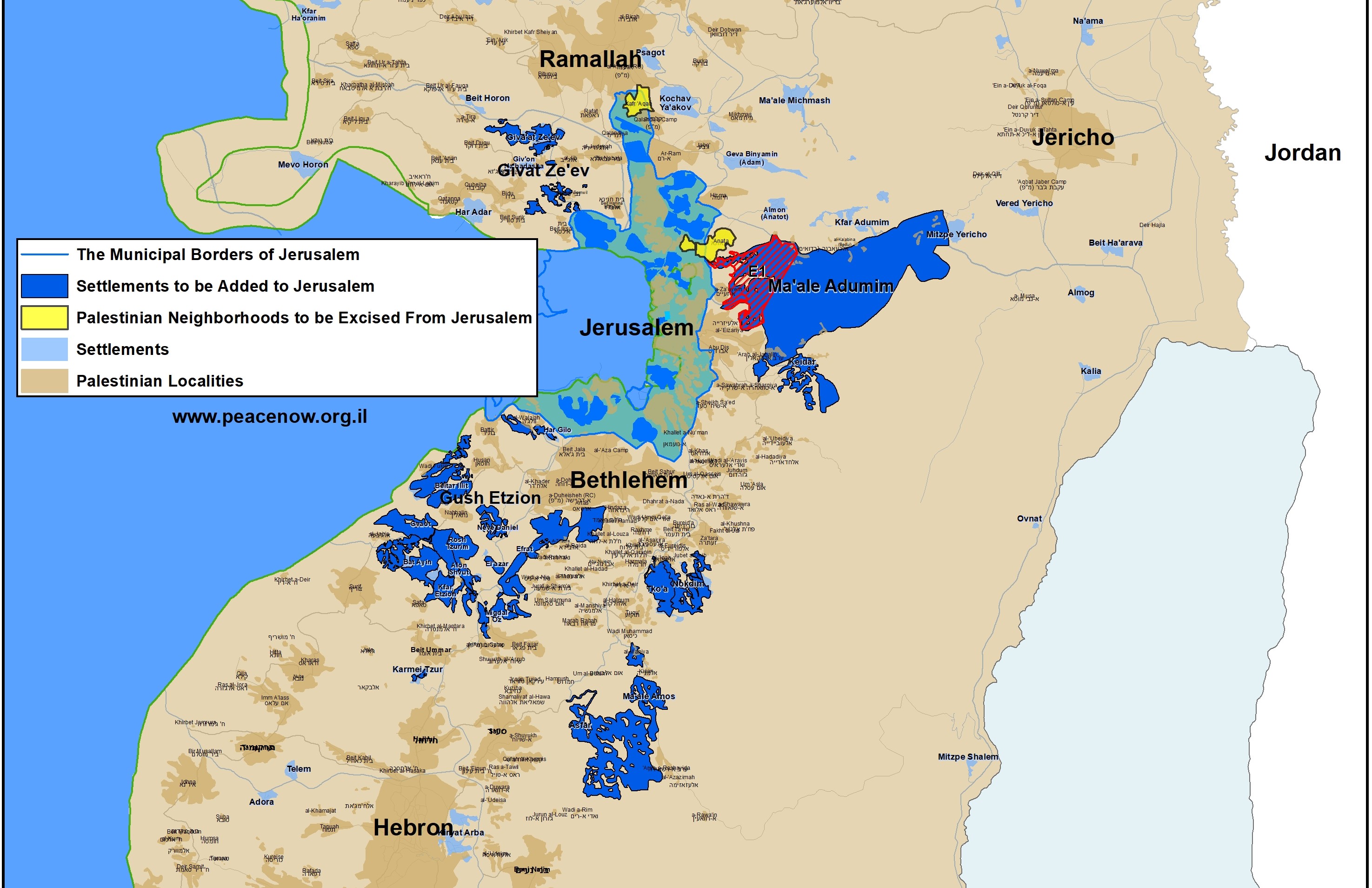
Map by Peace Now
Jerusalem expert Danny Seidemann’s NGO, Terrestrial Jerusalem, reports that the Greater Jerusalem bill – which seeks to annex far-flung settlements into the Jerusalem municipality, thereby de facto annexing a large part of the West Bank and gerrymandering a Jewish majority in the city – has renewed momentum.
In October 2017, Netanyahu backed down from advancing the controversial bill, reportedly under pressure from the Trump administration. Now, Netanyahu is once again coming under significant pressure from his own party (recall that on January 1, 2018 the Likud central committee voted in favor of a resolution calling on Netanyahu to annex the settlements) to allow the legislation to move in the Knesset.
First New Israeli Bypass Road in 11 Years Set to Open Near Qalqilya
The Israeli NGO Kerem Navot reports and documents the first new Israeli bypass road in the West Bank in more than a decade is set to open near Qalailya. Kerem Navot writes:
Most of the bypass roads in the West Bank were built during the 1990s, in parallel to the signing of the Oslo Accords. The last completed bypass road was the Liberman Road built in 2007, connecting Jerusalem with the settlements of Tekoa and Nokdim, southeast of Bethlehem.
This is the Nabi Ilyas bypass road, which is 3.3 kilometers long. The road will enable settlers of Ma’ale Shomron, Karnei Shomron and Kedumim to build settlements along the Qalqiliya Nablus road (Road 55), bypassing the village of Nabi Ilyas and expediting travel time from the settlements into and out of Israel. The road was built following massive pressure from the settler lobby, demanding that Netanyahu approve and fund the construction of two additional bypass roads. And indeed, Channel 7 recently reported that Netanyahu approved and allocated 800 million shekels for the paving of bypass roads in the West Bank.
This is first and foremost for two additional bypass roads that settlers have been trying to promote for years: the bypass road to Al Arroub and the Huwwara bypass road. These roads, too, are planned to be paved on cultivated agricultural land and their paving will cause enormous fiscal damage to residents whose lands will be lost. A third road that settlers are now trying to advance is the Shilo bypass road, which is meant to connect Route 60 with the Alon Road, part of which was already breached in the 1990s. This road is also intended to serve as the access road to the new settlement of Amichai, which Israel is currently building for Amona evacuees.
In November 2014 we exposed Israel’s full-fledged road plan throughout the West Bank. This is a “contingency plan” that was formulated over two decades after Oslo and is comprised of 44 plans for roads proposed by Israel in the territories. The plans have not yet been implemented, though 24 of them have already been approved. The total length of the roads already approved is approximately 157 kilometers.
Upon assessing the mass and sprawl of the roads approved over the years following Oslo, as with the planned roads yet to be approved, it is clear that, contrary to all official declarations, Israeli governments have not internalized the idea that an independent Palestinian state will be established in the West Bank. Israel continues to invest in planning expensive infrastructure deep in the West Bank, intended to entrench settlements and perforate Palestinian contiguity.
Dispossession in the Northern Jordan Valley: Settlements and outposts as part of the land grab process
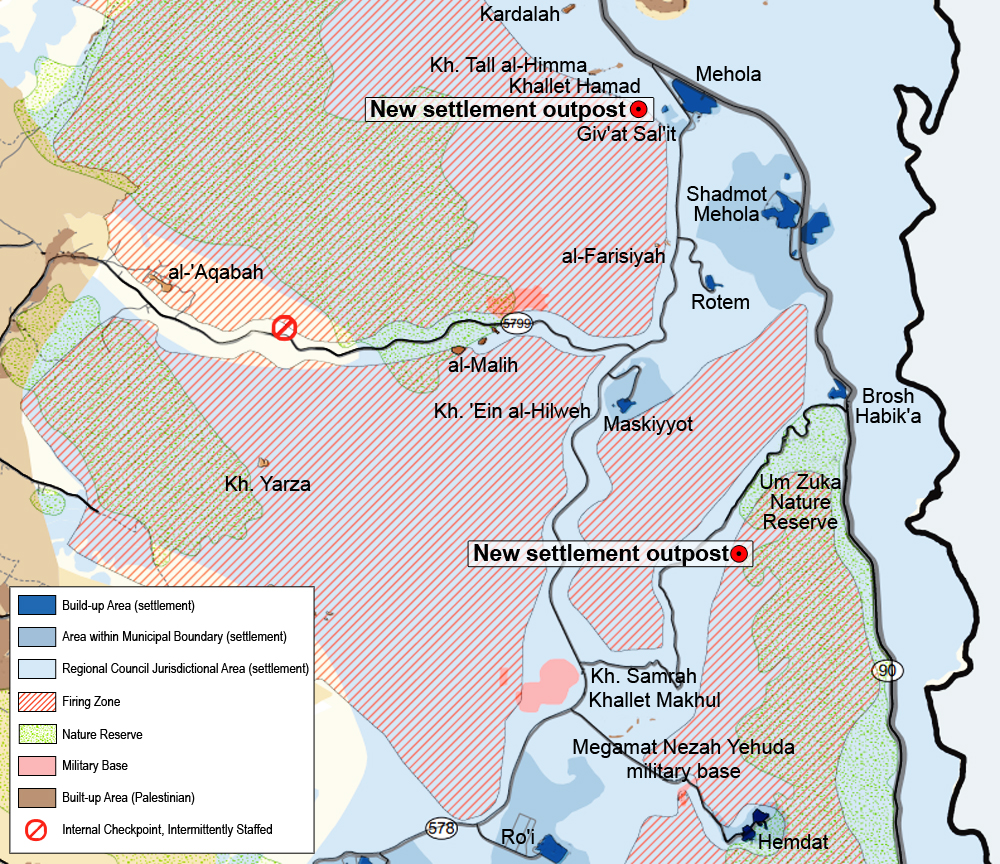
Map by B’Tselem
In a new report, B’Tselem documents how two new outposts that were established in the northern Jordan Valley in 2017 have contributed to the escalating dispossession of Palestinian communities in the Jordan Valley, where Israel retains exclusive control over and access to 85% of the land.
At the same time the outposts were allowed to grow, Israel also engaged in policies that amount to the forcible displacement of Palestinian communities around them: Since the outposts were established, the Israeli military has demolished 205 Palestinian structures in nearby communities, rendering 391 people homeless, including 157 children. The Israeli military has also refused to intervene or arrest settlers who engage use violence tactics in order to prevent Palestinians from accessing their lands.
The report concludes:
The establishment of the two new settlement outposts helps Israel realize its main goal for the West Bank: dispossessing Palestinian residents of their homes and land, and taking over their property. Each of the restrictions the state imposes on the Palestinian residents has enabled settlers to encroach on their land, build settlements and settlement outposts and take over vast areas around them. The state may say that the settlement outposts are “illegal” and are a “private initiative” by the settlers, but these claims ring hollow given Israel’s complete inaction to change this reality. The state’s refusal to remove the settlement outposts, prevent the routine attacks and prosecute those responsible for them speaks volumes as to Israel’s reliance on the settlers’ criminal behavior to entrench its control of the area while paying lip service to the law by formally disavowing any ties to them. These actions complement the official measures Israel takes in its pursuit of Palestinian dispossession in the area (and in other parts of the West Bank) and play a key role in the implementation of its policy.
Human Rights Watch Report Slams Israeli Settlements
In its “World Report 2018,” Human Rights Watch provides updated information on how Israeli settlement activity in 2017 ran afoul of international law and significantly contributed to the ongoing violation of Palestinian human rights.
Human Rights Watch reports:
Israel continued to provide security, administrative services, housing, education, and medical care for about 607,000 settlers residing in unlawful settlements in the West Bank, including East Jerusalem. Israel’s building of 2,000 new settlement housing units in the period between July 2016 and June 2017 marked an 18 percent decrease over the same period in 2015-2016, but Israeli authorities approved plans for 85 percent more housing units in the first half of 2017 than all of 2016, according to the Israeli group Peace Now. International humanitarian law bars an occupying power’s transfer of its civilians to occupied territory.
Building permits are difficult, if not impossible, for Palestinians to obtain in East Jerusalem or in the 60 percent of the West Bank under exclusive Israeli control (Area C). This has driven Palestinians to construct housing and business structures that are at constant risk of demolition or confiscation by Israel on the grounds of being unauthorized. Palestinians in these areas have access to water, electricity, schools, and other state services that are either far more limited or costlier than the same services that the state makes available to Jewish settlers there.
Of the 381 Palestinian homes and other property demolished in the West Bank (including East Jerusalem) in 2017 as of November 6, displacing 588 people, Israeli authorities sought to justify most for failure to have a building permit. Israel also destroyed the homes of families in retaliation for attacks on Israelis allegedly carried out by a family member, a violation of the international humanitarian law prohibition on collective punishment.
Bonus Reads
- “With Trump in power, emboldened Israelis try redrawing Jerusalem’s borders” (Washington Post)
- “Israeli Army Considering Taking Control of Palestinian Areas in East Jerusalem” (Haaretz)
- “Prominent Right-wing NGO Receives Millions of Shekels in Public Funds” (Haaretz)
FMEP has long been a trusted resource on settlement-related issues, reflecting both the excellent work of our grantees on the ground and our own in-house expertise. FMEP’s focus on settlements derives from our commitment to achieving lasting Israeli-Palestinian peace, and our recognition of the fact that Israeli settlements – established for the explicit purpose of dispossessing Palestinians in the West Bank and East Jerusalem of land and resources, and depriving them of the very possibility of self-determination in their own state with borders based on the 1967 lines – are antithetical to that goal.
Welcome to FMEP’s Weekly Settlement Report, covering everything you need to know about Israeli settlement activity this week.
To receive this report via email, please click here.
November 22, 2017
- Israeli AG Support for Land-Grab Paves Way for Legalization of [at least] 13 Outposts
- Israeli AG Approves Retroactive Legalization of “Mistaken” Land Theft
- Israeli AG to Present Argument on the “Regulation Law” This Week
- Threatened Eviction of Another Palestinian Bedouin Community in E-1
- Israel Fast-Tracks Jerusalem Cable Car Project Despite Political Concerns
- Settlers Fight for the “Right of Return” to Illegal, Inaccessible West Bank Settlements
- Bonus Reads
Comments, questions, or suggestions? Email Kristin McCarthy at kmccarthy@fmep.org.
Israeli AG Support for Land-Grab Paves Way for Legalization of [at least] 13 Outposts

Map by Haaretz
The far-reaching implications of the legal opinion issued last week by Israeli Attorney General Avichai Mandleblit, in the context of a case dealing with the Harsha outpost, are becoming alarmingly clear. Haaretz reports that the opinion will pave the way for Israel to retroactively legalize 13 unauthorized outposts, many of which are deep inside of the West Bank. The 13 outposts (and many others) were all built without Israel’s permission on pockets of state land, surrounded by privately owned Palestinian land. Roads leading to these outpost – without which the outposts cannot be fully planned and legalized – were (or will be), by necessity, built on land owned by Palestinians. This opinion paves the way (pun intended) for that to happen.
Dror Etkes, founder of the anti-settlement group Kerem Navot, notes that the impact of the decision is actually far greater than reported by Haaretz: “The real number of [affected] outposts is over 60.” Etkes adds,
The story [is] that the settlers are striving to resolve, with Mandleblit’s help, involves hundreds (yes hundreds!) of roads that have been illegally paved for decades around settlements and outposts, on land that even Israel recognizes as privately-owned. Now, with a little creativity and a lot of nerve, a legal mechanism has been invented to enable settlers to retroactively authorize the road system, without which the national land grab enterprise championed by Israel in the West Bank, can’t function.
Notably, several outposts that spun off from the Itamar settlement are among those that could benefit from this new legal precedent. Near Nablus, Itamar’s hilltop outposts form a contiguous land bridge – with roads connecting them – from Itamar to the Jordan Valley. Itamar’s residents are notorious for their ultra-nationalism.
Israeli AG Approves Retroactive Legalization of “Mistaken” Land Theft
Attorney General Mandleblit has endorsed an argument, made for the first time since 1967, in a legal brief submitted this week in Court by the Israeli government, that paves the way for Israel to expropriate privately owned Palestinian land inside the Ofra settlement, and potentially in other places as well. The land in question was “mistakenly” included as part of the settlement. The State filed the brief this week in response to a legal challenge to the Ofra settlement’s Master Plan.

Map by Haaretz using Google Maps
The case centers on a “mistake” which happened when the Ofra settlement master plan was approved; Israel argues that at the time it did not know that some of the land in the area had not been declared “state land” (suggesting, at best, extraordinarily faulty due diligence in the planning process, and at worst, a policy of treating Palestinian land ownership claims as irrelevant). In 2016, the State acknowledged Palestinian claims to the land and announced its intention to rectify the problem by re-drawing the settlement’s master plan.
With this new argument, the State, backed by the Attorney General, has reversed the 2016 commitment and is instead moving to formally expropriate the Palestinian plots, arguing that the Ofra settlers acted in good faith based on the government’s approval of the Master Plan (i.e. that settlers should not be punished for the State’s mistake). Earlier this year, AG Mandleblit suggested this exact argument (that land stolen by mistake, in good faith, could be legalized as long as the Palestinian owners were compensated) as an alternative law for the Knesset to pass instead of the Regulation Law, which he opposed.
Commenting on the AG’s opinion, Tawfiq Jabareen, the lawyer representing the Palestinian petitioners, told Haaretz:
Attorney General Mandelblit is continuing to destroy the status of the rule of law and severely undermine Palestinian property rights in the occupied territories.
Israeli AG to Present Argument on the “Regulation Law” This Week
On Nov. 23rd, Attorney General Avichai Mandleblit is expected to present his argument on the “Regulation Law” to the Supreme Court. As we reported previously, Mandleblit was staunchly opposed to the Regulation Law, arguing that the law is unconstitutional and refusing to defend the law against legal challenges mounted by several civil society groups earlier this year. At the time the law was being considered, Mandleblit proposed an alternative legal strategy to accomplish the same goal: the retroactive legalization of Israeli settlement activity in the West Bank.

Map by Peace Now
Mandleblit has been expected to argue forcefully against the law, which provides a new legal basis for the retroactive legalization of outposts and agricultural land seizures, with Palestinian owners provided “compensation” (but no choice in the matter). Following the opinion Mandleblit issued last week regarding the Harsha outpost case (implications of which we detail above), and given his recent support for the retroactive legalization of land theft for the benefit of the Ofra settlement (detailed above), it is quite possible that his opposition to the retroactive legalization of land seizures has softened.
If upheld, the Regulation Law can be used to retroactively legalize 55 outposts and 4,000 unauthorized settlement structures by expropriating over 8,000 dunks of privately owned Palestinian land.
Threatened Eviction of Another Palestinian Bedouin Community
The wave of IDF-ordered evictions continued this week, with the Jabal al-Baba bedouin community only the latest to be affected. The approximately 300 residents were ordered to leave their encampment near the Maale Adumim/E-1 settlement area east of Jerusalem within 8 days. The Jabal al-Baba community has been living in the area since 1948, after it was expelled from the Negev.
The Jabal al-Baba community is the second bedouin community in the Maale Adumim/E-1 area to be faced with eviction this year. In August, Israel escalated its longstanding threat to forcibly relocate the Khan al-Ahmar bedouin community to a site near the Abu Dis garbage dump – a move that B’Tselem warns will constitute a war crime. FMEP has covered the story in detail, including as it relates to the prospects for the construction of the doomsday E-1 settlement.
Israeli actions to remove Palestinian bedouin communities from Area C are not confined to the Jerusalem area. On November 1st, the Israeli army ordered the eviction of an entire bedouin community in the northern Jordan Valley.
Israel Fast-Tracks Jerusalem Cable Car Project Despite Political Concerns
Haaretz reports that Israeli planning authorities are moving ahead with plans to build a controversial cable car line in East Jerusalem, despite growing opposition. As FMEP reported in July, the planned cable car line is designed to facilitate tourism to Jewish sites in East Jerusalem while preventing tourists from encountering Palestinians. It features a stop at the settler-run Kedem Center, which was built in the Palestinian East Jerusalem neighborhood of Silwan.
Jerusalem expert Daniel Seidemann explained
There are four worrisome aspects to this project. Without reference to political matters or religious sensitivities, this is a crime against Jerusalem. Disrespect for the unique value of the city and another example of the ‘disneyfication’ of Jerusalem under [Mayor Nir] Barkat. Someone who loves Jerusalem could not conceive of such a project. [The idea that] someone can send a cable car 150 meters away from the Al Aqsa Mosque is smoking the wrong thing….[the project] is another example of how the public interest and the interests of Jerusalemites are being subverted for the good of the settlers of Silwan, with the final station shamelessly at the Kedem Center, serving the narrow ideological interests of the settlers….[the project is] a clumsy attempt to unify the divided city by means of engineering gimmicks.
Settlers Fight for the “Right of Return” to Illegal, Inaccessible West Bank Settlements
Israeli settlers are angling to return to four settlements – Ganim, Kadim, Sa-Nur and Homesh – that were dismantled in 2005, as part of Ariel Sharon’s disengagement plan. Settlers have long insisted they will “return” to the sites.
In this latest effort, they are focusing on the argument that the land has not been used since they abandoned it. Falling in Area C, and therefore under the full authority of Israel’s Civil Administration, the former settlements remain vacant despite Palestinian desire to develop it. The Jenin Municipality, which has nominal jurisdiction over the location, reportedly wants to develop the areas but has not yet applied for the necessary Israeli permits; applying to do so, in any case, would almost certainly be futile, given that Israel issues virtually no permits for Palestinian construction in Area C. In the meantime, the sites have become a garbage dumpsites.
Two or the sites – Ganim and Kadim – can only be accessed by driving through the Palestinian city of Jenin, raising security issues that make their redevelopment into settlements a remote possibility. Sa-Nur and Homesh, in contrast, are easily accessible by settlers. Earlier this year settlers and supporters, including right-wing Israeli lawmakers, gathered at the site of Sa-Nur demanding that the government let them return. At the site of Homesh, radical settler youth are already squatting, have established a yeshiva (religious school) and actively prevent Palestinian access.
Bonus Reads
- “How Israeli settlers turn archeological sites into political tools” (Al-Monitor)
- “Ombudsman: Settlement council doctored tenders to reward right-wing NGOs” (Times of Israel)
__
FMEP has long been a trusted resource on settlement-related issues, reflecting both the excellent work of our grantees on the ground and our own in-house expertise. FMEP’s focus on settlements derives from our commitment to achieving lasting Israeli-Palestinian peace, and our recognition of the fact that Israeli settlements – established for the explicit purpose of dispossessing Palestinians in the West Bank and East Jerusalem of land and resources, and depriving them of the very possibility of self-determination in their own state with borders based on the 1967 lines – are antithetical to that goal.
Welcome to FMEP’s Weekly Settlement Report, covering everything you need to know about Israeli settlement activity this week.
To subscribe to this report, please click here.
November 17, 2017
- Building Permits Issued for 240 More Settlement Units in East Jerusalem
- Israel to Displace Palestinians in the Jordan Valley & the Northern West Bank for Settlement Expansion
- Supreme Court & Attorney General Permit State to Seize Private Palestinian Land for Settlers
- New Ir Amim Policy Paper: “Bills and Government Plans for Destructive Unilateral Measures to Redraw the Borders of Jerusalem”
- New Peace Now Report: “Escalation in Israel’s Settlement Policy: The Creation of De-Facto Annexation”
- Bonus Reads
Comments, questions, or suggestions? Email Kristin McCarthy at kmccarthy@fmep.org.
Building Permits Issued for 240 More Settlement Units in East Jerusalem
On November 8th, the Jerusalem Planning and Building Committee issued building permits for 240 new settlement units in East Jerusalem – 90 units in Gilo and 150 units in Ramat Shlomo. The new building permits add to an ever-growing tidal wave of settlement activity in East Jerusalem affecting the viability of the two-state solution, while tightening the screws on the local Palestinian population.
In addition, the committee also approved permits for 44 new units for Palestinians in the East Jerusalem neighborhood of Beit Hanina. These permits are an anomaly: for the past 50 years Israel has systematically discriminated against Palestinian building rights, with only about 7% of building permits issued in Jerusalem going to Palestinians (who represent 37% of the population). Bimkom, an Israeli organization that monitors planning and building in Jerusalem, estimates that 20,000 units in East Jerusalem lack permits while an additional 10,000 more units are needed by Palestinians.
Jerusalem expert Danny Seidemann recently explained
Since 1967, the Government of Israel has directly engaged in the construction of 55,000 units for Israelis in East Jerusalem; in contrast, fewer than 600 units have been built for Palestinians in East Jerusalem, the last of which were built 40 years ago. So much for (Jerusalem Mayor Nir) Barkat’s claim ‘we build for everyone.’
In Beit Hanina, as in Palestinian neighborhoods across East Jerusalem, Israeli demolitions of buildings – based on the argument that they lack permits – only add to the misery. The most recent demolition in Beit Hanina happened last month.
Israel to Displace Palestinians in the Jordan Valley & the Northern West Bank for Settlement Expansion
For the first time, the Israeli army appears to be preparing to evict Palestinians from their land through the use of a 2003 military order meant to handle the evacuation of unauthorized Israeli outposts. Palestinians living in the northern Jordan Valley discovered the eviction order affecting around 136 acres of their land – which sits near several Israeli settlements.
A lawyer representing the Palestinians in this case submitted a petition to the Israeli Coordinator of Government Activities in the Territories (COGAT) to stop the implementation of the order. The lawyer, Tawfiq Jabareen, argues, “This is a mass expulsion order against the Palestinian population that violates international law.”
The Haaretz Editorial Board powerfully rebutted the Israeli army’s argument that the order does not, in fact, actually call for the evacuation of the Palestinians, but will only demolish structures built without Israeli permission. The Editorial Board writes,
Whatever legal proceeding ensues, the fact is that this declaration is an escalation of the pressure on the local Palestinians and part of the declared Israeli intent to evict as many Palestinians as possible from Area C, which is under total Israeli control, including from the Jordan Valley.
It’s no coincidence that near Ein al-Hilweh [one of the targeted areas] are two expanding unauthorized Jewish settlement outposts whose residents periodically threaten the shepherds and try to scare them away from grazing lands in the area. This trend can and must be stopped, because it’s illegal, unjustified and dangerous.
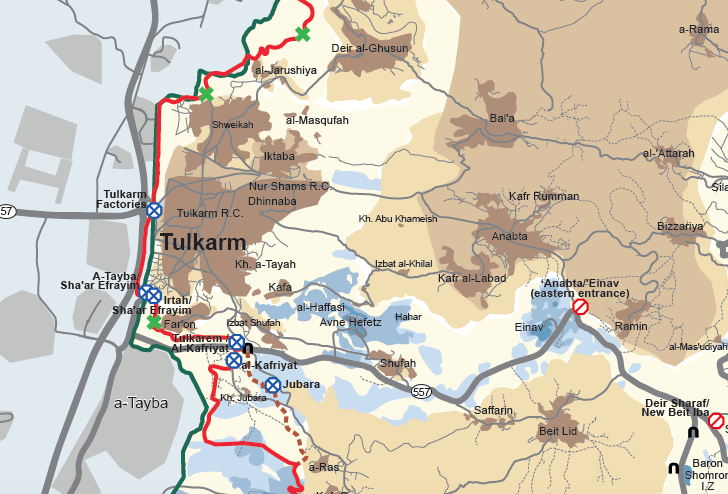
Map by B’Tselem
Israel is also moving to seize land near the city of Shufah in the West Bank, southeast of the Palestinian city of Tulkarem. Palestinian news sources report that the IDF notified residents that Israeli intends to take the land in order to build roads and recreational facilities for a nearby settlement, Avnei Hefetz. Earlier this year, Israel seized land from the Shufah village in order to build a power plant and industrial area for the settlement. In October 2017, the Israeli government advanced plans for 135 new units in the Avnei Hefetz settlement.
Supreme Court & Attorney General Permit State to Seize Private Palestinian Land for Settlers
Israeli Attorney General Avichai Mandleblit released a legal opinion this week asserting Israel’s right to confiscate privately owned Palestinian land for the exclusive benefit of Israeli settlers in the West Bank.
This new opinion concurs with a Supreme Court ruling issued last month that held Israeli settlers are a part of the “local population” of the West Bank, and can be the beneficiaries of state land seizures for “public use.” It also builds on a precedent set earlier this year in the case of the Amona outpost, when the Court ruled that Israel has a duty to care for Israeli settlers forced out of their homes (because those homes were built illegally on privately-owned Palestinian land). The Court ruled that the state has the authority confiscate “abandoned” Palestinian land to do so (Palestinians are systematically denied the right to access lands that are near settlements, Israeli roads, military bases, firing zones, etc., rendering them “abandoned”).
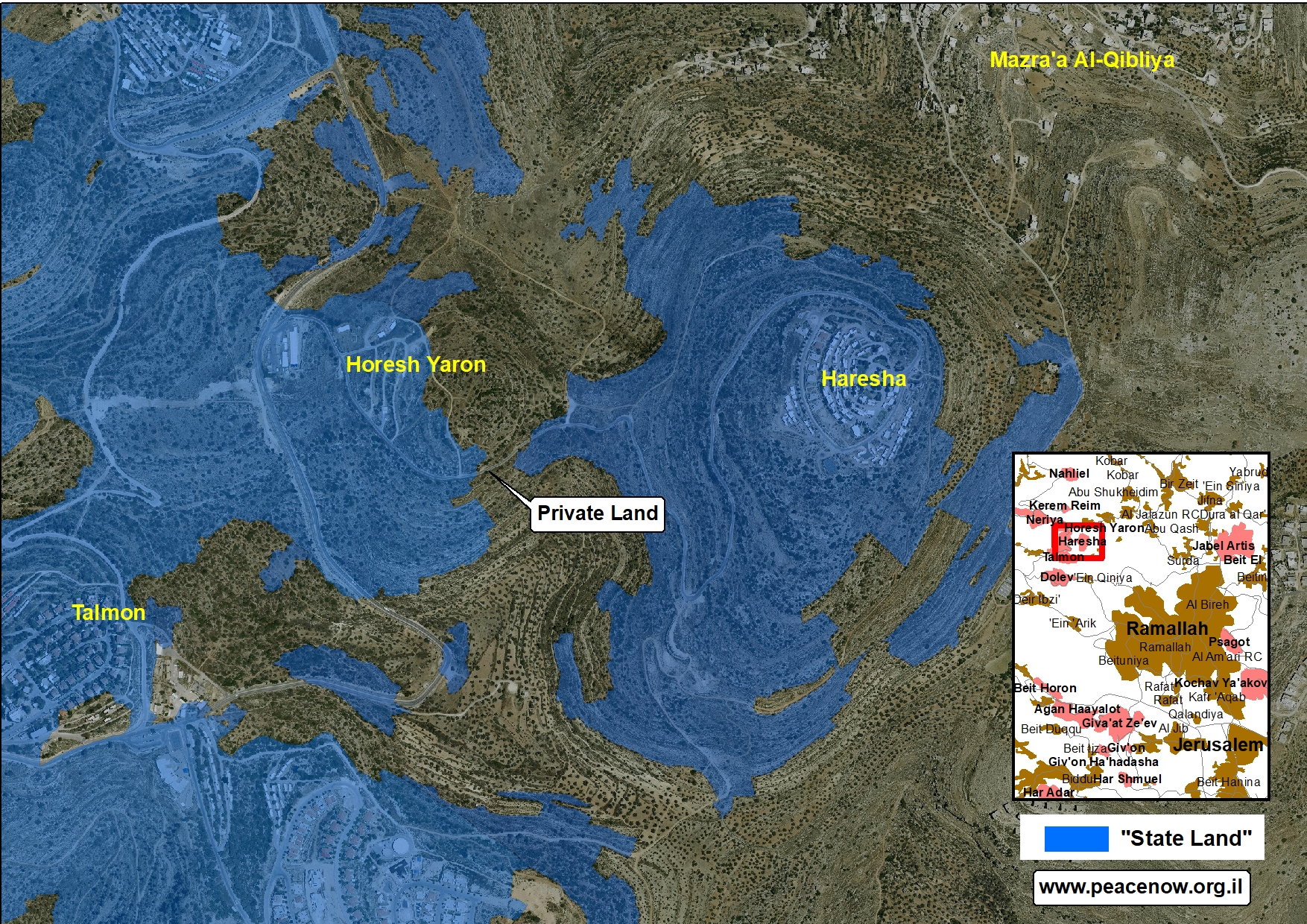
Map by Peace Now
According to the original Amona ruling, the state’s obligation was to provide temporary housing for the affected settlers; according to the subsequent ruling, the state is obligated to care for the settlers by paving roads, without regard to privately owned Palestinian land that would need to be taken. That ruling upheld the state’s confiscation of privately owned Palestinian land in order to legalize an access road to the illegal outpost of Haresha.
Located near Ramallah, the Haresha outpost was established in 1995 without government approval. In January 2010, the State responded to a petition filed by Peace Now and Yesh Din by announcing its intention to retroactively legalize Haresha; less than a year later, in August 2011, Israel seized the land the outpost was built on by declaring it as “state land.” Haresha was approved to become an official settlement in 2015 (Netanyahu legalized 24 other outposts at the same time), but the outpost still needed to submit plans in order to legalize the individual structures. That a planning process has not yet happened – in part because, as Haaretz notes, there is no legal road leading to the outpost. With the access road moving towards legalization, the outpost is set to follow suit.
Speaking to the significance of the decision on the Haresha outpost access road, Israel Justice Minister Shaked said “The attorney general has issued a legal opinion permitting the expropriation of privately owned Palestinian land to permit an access road to [Haresha] that permits the regulation [legalization] of the entire [settlement].” The anti-settlement watchdog Peace Now is expected to appeal the decision upholding the theft of privately owned land for the legalization of the access road. Peace Now issued a statement saying,
Confiscating the land would constitute a severe violation of international humanitarian law and of the Palestinians’ right to own property. The Attorney General’s legal opinion regarding the access road might lead to additional confiscations of private Palestinian lands, strengthening Israel’s stronghold over Palestinian territory. The Attorney General seeks to allow the confiscation of lands owned by Palestinians, who have no voting rights in Israel for the benefit of Israeli settlers with full rights. If the Netanyahu government will continue down this path it will lead us towards a one state reality, based on discrimination and theft.
New Ir Amim Policy Paper: “Bills and Government Plans for Destructive Unilateral Measures to Redraw the Borders of Jerusalem”
The Israeli NGO Ir Amim this week released a new policy paper analyzing the devastating ramifications of Israeli efforts to gerrymander a Jewish-majority in Jerusalem. In addition to essential background on Jerusalem’s environs and analysis of the two pieces of pending Jerusalem-related legislation, Ir Amim provides new analysis of the humanitarian, political, and urban consequences that will follow if these measures are implemented.
Looking at the impacts of the Knesset bill intended to excise two Palestinian East Jerusalem neighborhoods from the Jerusalem municipality, creating new Israeli municipalities to govern them, Ir Amim writes:
The bills and plans currently in circulation seek to displace Palestinian residents living in Jerusalem from the city, and to artificially add to Jerusalem Israeli residents from outside of it. Beyond obvious political implications, these moves can be expected to have serious humanitarian ramifications….
Should practical steps be taken to cut off the neighborhoods beyond the Barrier or a sweeping revocation of their residents’ permanent residency status implemented, we can expect another wave of migration to the East Jerusalem neighborhoods within the Barrier, already strained by a serious lack of infrastructure, services, educational institutions and affordable housing. Living conditions and infrastructure in the East Jerusalem neighborhoods inside the Barrier will decline even further. In this scenario of increasing housing shortages and infrastructure collapse, an upsurge in the number of Palestinian residents who rent or buy apartments in Israeli neighborhoods/ settlements such as Pisgat Ze’ev, Armon Hanatziv and French Hill can be expected. These phenomena, which will occur under conditions of acute uncertainty and anxiety, can be expected to significantly elevate friction and the potential for eruptions of violence in the city. Many other thousands of Palestinians – currently residents of Jerusalem – will remain beyond the Separation Barrier, now administratively displaced from their city and transferred to contrived regional authorities, only exacerbating their distress. Even should they be completely separated from Jerusalem, Israel will not be able to escape accountability for the dire political, urban and humanitarian crisis – and the fertile ground for escalating hostility – it has created.
New Peace Now Report: “Escalation in Israel’s Settlement Policy: The Creation of De-Facto Annexation”
In a new report, Peace Now details the dangerous flood of settlement activity and the de-facto annexation of Area C in the West Bank that the Netanyahu government has pursued without restraint in 2017. The report covers:
- A significant increase in the promotion of plans (6,742 units advanced) and issuance of tenders (3,154 tenders issued) for settlements across the West Bank. This includes the approval of the first new government-backed settlement in 25 years – Amichai.
- The increase in road construction in the West Bank aiming to integrate the settlements into Israel proper, attract more construction and residents in the settlements, and create settler-only highways across the West Bank – all done by expropriating more Palestinian land.
- A dangerous escalation of anti-Palestinian, pro-settlement activities in East Jerusalem including: the simultaneous settlement approvals and eviction of Palestinians from the Sheikh Jarrah neighborhood, the imminent approval of tenders for the Atarot and Givat Hamatos settlements, the expansion of settlement enclaves inside of Palestinian East Jerusalem neighborhood of Jabal al-Mukaber, and the several legislative efforts to gerrymander the borders of the Jerusalem municipality to secure a Jewish majority in the city.
In conclusion, Peace Now writes
All of the abovementioned developments attest to a quantum leap in the promotion of annexation and the blocking of the possibility of a two-state solution. With the speed of developments all across the West Bank and East Jerusalem—and as red lines are being crossed—we are approaching the final stretch before a two-state solution will be almost impossible, and the anticipated situation will be the long years of bloody conflict of Israeli rule over the Palestinians without hope for change. Thus even with the lack of a final status agreement in sight, it is our duty today to prevent silent annexation efforts and to assure the possibility of a two state solution on the ground.
Bonus Reads
- “World Zionist Organization Gave Private Palestinian Land to West Bank Settlers” (Haaretz+)
- “In first, Israel Prize to be Given for Promoting Settlements” (Times of Israel)
- “Palestinian Lawyer Attempted to Report Being Attacked by Settlers. Then He Was Detained Over Back Taxes” (Haaretz)
- “Settler leader revels in Left’s embrace as proof of movement’s power” (Times of Israel)
___
FMEP has long been a trusted resource on settlement-related issues, reflecting both the excellent work of our grantees on the ground and our own in-house expertise. FMEP’s focus on settlements derives from our commitment to achieving lasting Israeli-Palestinian peace, and our recognition of the fact that Israeli settlements – established for the explicit purpose of dispossessing Palestinians in the West Bank and East Jerusalem of land and resources, and depriving them of the very possibility of self-determination in their own state with borders based on the 1967 lines – are antithetical to that goal.
Welcome to FMEP’s Weekly Settlement Report, covering everything you need to know about Israeli settlement activity this week.
To receive this report via email, please click here.
August 24, 2017
- Israel Mounts Legal Defense After High Court Puts 2-Month Hold on Regulation Law
- Government Data Shows Regulation Law Could Legalize 3,455 Settlement Structures
- Israeli AG Demands Better Enforcement of Settlement Construction Laws
- Yitzhar Settlers Attack IDF During Outpost Demolition
- Settler-Led Petition Seeks to “Test”High Court’s Consistency on Palestinian Land Ownership Rights
- Updates: Amichai Funds, Sheikh Jarrah Eviction, Jordan Valley Race Track, E-1 Demolitions
- Bonus Reads
For comments and questions, please email Kristin McCarthy (kmccarthy@fmep.org).
Israel Mounts Legal Defense After High Court Puts 2-Month Hold on Regulation Law
On August 17th, the Israeli High Court of Justice ordered a two month hold on the use of the controversial Regulation Law, which was set to take effect this week. The Regulation Law (also called the “Expropriation Law,” the “Regularization Law,” the “Legalization Law,” or the “Settlements Law”) was passed earlier this year by the Israeli Knesset to pave the way for the government to retroactively legalize outposts and other construction of Israeli settler homes on privately owned Palestinian land, among other things. The High Court ordered the two-month freeze following a direct request from Israeli Attorney General Avichai Mandleblit, who has called the law unconstitutional.
The court is currently weighing two petitions challenging the legality of the law filed this past March; one petition by the Israeli civil society organizations Yesh Din, Peace Now, and the Association for Civil Rights in Israel (ACRI); the second petition was filed by Palestinian civil society groups Adalah, Al-Mezan, and the Jerusalem Legal Aid Center.
Map by Peace Now
In response to the petitions, the Israeli government’s private attorney Harel Arnon provided the court with a 156-page defense arguing that, “the Regulation Law balances the obligation of the government towards thousands of citizens who have relied in good faith on government action and a minor infringement of property rights, with increased compensation to the [Palestinian] landowners.” Prominent Israeli lawyer Michael Sfard explained why this is “legal fantasy.” Israel was forced to hire a private lawyer to represent them before the High Court after Attorney General Avichai Mandleblit announced his refusal to defend the measure as soon as it was passed into law.
The trio of Israeli petitioners released a blistering statement following the government’s response. Peace Now, Yesh Din, and ACRI wrote,
“The State of Israel, in its response today, is trying to present the land expropriation law as addressing a national problem, when in practice it involves continued government support for a criminal enterprise that has continued for decades. The government is minimizing the continuing harm to the rights of the Palestinian landowners, and at the same time is trying to present the Israeli citizens who are taking part in the looting of West Bank Palestinians as people who have been harmed and who require ‘compensation’ for their part in the looting,” they added. “We hope the court rejects the state’s arguments out of hand, strikes down this unconstitutional and immoral law, and sends a loud and clear message: No more.”
Peace Now goes further to say, “In its response the government attempts to present Israeli citizens, who are directly involved in land theft of Palestinians, as deserving a reward for their participation in the thievery.”
Adalah also issued a sharp response, saying “The state’s position amounts to a de facto annexation of the West Bank.”
Haaretz put out a searing editorial demolishing the government’s claim that settlers are owed a solution to the “distress” they live in as a result of their land theft. Haaretz editors wrote in “The ‘distress” of the Israeli settlers,”
The government broke a record for cynicism when it made its arguments against the petitions. In a perfect reversal of occupier and occupied, it explained that the expropriation law constitutes “a humane, proportionate and reasonable response to the real distress” of all those “Israeli residents” who live under “a cloud of uncertainty” that is “disrupting their lives.” It’s hard to believe, but this is not a description of the situation of millions of Palestinians living under occupation whose lands are being seized, but of the distress of the settlers, who chose to live outside the state’s official borders and whose very presence there is illegitimate.
The High Court of Justice is months away from issuing its ruling on the Regulation Law’s constitutionality. The Knesset’s legal experts are expected to present their case in support of the law in September, and Attorney General Mandleblit is expected to argue against his own government’s law in October.
Government Data Shows Regulation Law Could Legalize 3,455 Settlement Structures
According to the Israeli government’s own data, there are 3,455 illegally built Israeli structures in the West Bank that can be legalized if the Regulation Law (see above) goes into effect. Haaretz has an explanation of the three categories of land where these structures were illegally built and how the Regulation Law seeks to absolve the government and its settlers of their illegality.
The Haaretz reporting confirms and compounds documentation published by Peace Now earlier this year which estimated that the Regulation Law could legalize 3,850 structures and 53 outposts, adding up to a total land grab of 8,000 dunams of privately owned Palestinian land (1 sq. km = 1,000 dunams | 1 acre = 4 dunams).
Israeli AG Demands Better Enforcement of Settlement Construction Laws
Israeli Attorney General Avichai Mandleblit held a series of meetings over the past month in an attempt to force the government to rein in illegal construction happening inside of settlements. Haaretz reports that Mandleblit met with Prime Minister Benjamin Netanyahu, Defense Minister Avigdor Liberman, and Finance Minister Moshe Kahlon several times to demand the creation of a special unit in the Defense Ministry tasked with policing planning and construction laws inside of settlements.
Haaretz relays from sources in the meetings, “He [Mandleblit] said, in the presence of officials in the Prime Minister’s Office, the treasury and the Defense Ministry, that the present situation, in which there is no group enforcing the planning laws in the settlements except for the committees acting on behalf the settlements’ regional councils themselves, is ‘clearly illogical,’ and creates a situation in which there are illegal structures over which nobody has authority.”
The recent discussions followed Mandleblit’s request last month for the High Court to issue an order demanding the Defense Ministry to create the unit. The Defense Ministry has refused to establish the unit, citing a lack of funding. Mandleblit’s request to the High Court was meant to force Defense Minister Liberman to create the unit by making it mandatory.
Yitzhar Settlers Attack IDF During Outpost Demolition
For the second time this year, the Israeli army clashed with radical Yitzhar settlers as the army executed orders against homes the settlers built without the proper permissions. This time, in contrast to the incident in June where houses were razed inside the settlement, the IDF removed six caravans that were set up outside of the settlement’s municipal border in an outpost known as Kumi Ori.
Settler-Led Petition Seeks to “Test” High Court’s Consistency on Palestinian Land Ownership
Ynet News reports that the right-wing settler organization Regavim has launched a petition against the construction of a road in the West Bank, which they claim – with undisguised irony – is being built on privately owned Palestinian land. The road is an access road to the new Palestinian city of Rawabi, a $1.4 billion dollar investment project to provide a state-of-the-art planned city for Palestinians in the West Bank (and the first new Palestinian city Israel has permitted since 1967).
For Ragavim, the case is a win-win. If the court rules in Regavim’s favor, it will be a blow to efforts to develop Rawabi. If the court rules against Regavim (i.e., in favor of the construction and against the rights of Palestinian landowners), it will set a legal precedent that Regavim and others can exploit for the benefit of settlers. Regavim is clearly hoping for the latter result: Regavim’s lawyer said, “In the last few years, the High Court of Justice has taken a very strict line and ordered the demolition of buildings and roads built by Jews on private Palestinian land. That is why in this case, it is unacceptable that the High Court of Justice is nonchalant about the rights of private landowners.”
Updates: Amichai Funds, Sheikh Jarrah Eviction, E-1 Demolitions, Jordan Valley Race Track
- Haaretz has spoken to four government officials who report that the office of the Prime Minister has requested to nearly triple the amount of government funds allocated towards the construction of the first new settlement in 25 years, Amichai. The Prime Minister’s office denied the Haaretz report.
- In Sheikh Jarrah, a Jerusalem court rejected a petition to delay (again) the eviction of the Shamasneh family from their longtime home in the East Jerusalem neighborhood. Eviction is rumored to proceed on September 9th.
- In E-1, the Israeli Army’s Civil Administration has threatened to move forward with demolitions against Bedouin structures they say were illegally built in the area of E-1 despite an order from the High Court of Justice delaying the demolitions. Back in February, the High Court ruled that the structures should not be demolished and that the Bedouin and Civil Administration must work together to see if the structures can be legalized.
- In the Jordan Valley, Israeli settlers are continuing to build a recreational race track despite a stop-work order issued against the project in February 2017. The large race track complex is partially on land that the Israeli army has declared a closed firing zone, a designation which resulted in the forcible displacement of Palestinians who lived there
- For background on all of these stories, see past editions [link] of FMEP’s Settlement Report.
Bonus Reads
- “U.S. Trying to Prevent UN ‘Blacklist’ of Companies Working in Israeli Settlements” (Washington Post)
- “Netanyahu to attend West Bank event celebrating 50 years of settlements” (August 21, 2017, Jerusalem Post)
- “In Walajeh, Palestinians residents mobilize against Israeli demolitions” (August 21, 2017, +972 Mag/Active Stills)
- “From jail cells, settler youth call for defiance of administrative orders” (August 23, 2017, Times of Israel)
Welcome to FMEP’s Weekly Settlement Report, covering everything you need to know about what is happening this week related to Israeli settlement activity – news, context, background, and why it matters.
To receive this report via email, please subscribe here.
May 19, 2017
- Statements on Israeli Settlements by the Trump Administration
- Bibi to ask for Trump’s Approval of Massive Settlement Blueprint During Visit
- Plans Actively Moving to Start Construction on Two-State-Ending Settlements
- Updates: Amona, More Settler Violence in Nablus, New Jordan Valley Outpost
Comments, questions, or suggestions? Email Kristin McCarthy at kmccarthy@fmep.org.
Statements on Israeli Settlements by the Trump Administration
Ahead of President Donald Trump’s first visit to Israel, there is still some debate about whether the United States has already shifted its policy on Israeli settlements. Here are Trump officials in their own words:
May 16, 2017: U.S. Ambassador David Friedman, ahead of President Trump’s arrival in Israel and anticipated peace push, said, “we have no demand for a settlement freeze.” Also: “If you look at what the president has said since taking office about settlements, his position has been remarkably different than the Obama administration’s. He has not come out and said that settlements are an obstacle to peace; he has not called for a settlement freeze; he has worked for the Israelis to come up with a common understanding about how they might proceed. The president is aware of the Israeli government’s need to replace the Amona community [reference to settler law-breakers evicted from an illegal outpost].”
March 20-23, 2017: In a read out of joint U.S.-Israel consultations on peace negotiations, the White House reported, “The two delegations also discussed Israeli settlement construction, following up on Prime Minister Netanyahu’s visit to Washington and Mr. Greenblatt’s recent visit to Israel. The United States delegation reiterated President Trump’s concerns regarding settlement activity in the context of moving towards a peace agreement. The Israeli delegation made clear that Israel’s intent going forward is to adopt a policy regarding settlement activity that takes those concerns into consideration. The talks were serious and constructive, and they are ongoing.”
February 15, 2017: At a press conference alongside PM Netanyahu at the White House, President Trump said, “As far as settlements, I’d like to see you hold back on settlements for a little bit. We’ll work something out.” On the same day, the White House released a read-out of Netanyahu & Trump’s private meeting, relaying “The two leaders discussed the issue of Israeli settlement construction, and agreed to continue those discussions and to work out an approach that is consistent with the goal of advancing peace and security.”
February 2, 2017: In an official statement issued after Israel announced significant new settlement plans in the West Bank, the White House said “While we don’t believe the existence of settlements is an impediment to peace, the construction of new settlements or the expansion of existing settlements beyond their current borders may not be helpful in achieving that goal.”
Bibi to ask for Trump’s Approval of Massive Settlement Blueprint During Visit
PM Netanyahu will reportedly ask for President Trump’s approval of a massive blueprint for future settlement construction that includes highly sensitive areas beyond the 1967 Green Line – including construction of Givat Hamatos and Atarot in Jerusalem (see below).
If Netanyahu in fact presents a map detailing plans for new construction, it will be a major test of President Trump’s still-unconfirmed policy shift on settlements, which is speculated to include an American “ok” for construction in East Jerusalem, settlement blocs and “bloc-adjacent” areas. As detailed previously, this shift – if it has in fact taken place – should be understood as a green light for massive settlement growth across the West Bank. The U.S. may not be the only party considering giving this green light to settlement growth; the Wall Street Journal reported this week that some Arab gulf countries are also considering accepting the parameter (the world is awaiting confirmation of this report).
Hoping for Trump’s approval of this blueprint, PM Netanyahu’s office reportedly intervened to delay a meeting of the High Planning Committee (which oversees all construction in the Occupied Territories) until after President Trump’s visit.
Plans Actively Moving to Start Construction on Two-State-Ending Settlements
New details have emerged on two alarming settlement developments that could imminently affect the future of Jerusalem, and thus any hopes of a two state solution.
 Givat Hamatos
Final tenders for the construction of Givat Hamatos are could to be published soon, at which point construction will soon start on the ground. This settlement, will completely sever Palestinian communities in Jerusalem from the West Bank, and will prevent a future division of Jerusalem that leaves Palestinian areas under Palestinian sovereignty and Israeli areas under Israeli sovereignty (map). Publishing tenders for 2,000 units in Givat Hamatos – which is, again, imminently expected – will spell the end to the future possibility of a contiguous Palestinian state. For more on Givat Hamatos – history, maps, state of play, and consequences – see the expert analysis of Terrestrial Jerusalem and Peace Now Israel.

Atarot
Israel may soon approve a plan for 10,000 units to create an ultra-orthodox settler neighborhood in Atarot, the site of a disused airport in the northern part of East Jerusalem, extending to Ramallah’s southern border. To date, no official planning approvals have been published for public review – which means that the Atarot plan has a potentially long bureaucratic process to navigate. The site was reportedly promised as the airport of a future Palestinian state. The construction of a new settlement at the site will compromise the territorial integrity of a future Palestinian state, as well as preventing a Palestinian capital in East Jerusalem. For more on Atarot, read this analysis from Jerusalem expert Danny Seidemann.
Additionally, in the center of the West Bank, a regional council run by Israeli settlers has begun soliciting construction bids to expand the illegal settlement of Kochav Yaakov. The growth – in the settlement’s ultra orthodox neighborhood called Tel Zion – was technically approved by in 1980 but never constructed. Some 37 years later, the settler council officially opened the bidding process to construct 209 new apartments. Peace Now’s Settlement Watch director Hagit Ofran noted, “There are tens of thousands of units [like these] that could be built under old plans. In practice, there was no [construction] freeze and there is no freeze in the settlements. This is a large project beyond the separation barrier that will continue to undermine the two-state solution.”
Updates: Amona Outpost-ers, More Settler Violence in Nablus, New Jordan Valley Outpost
Here are short, but important, updates on settlement news we covered in previous editions of FMEP’s Weekly Settlement Report:
- Already facing planning delays on their new settlement, the law-breaking Amona outpost-ers attempted to get expedited approval on “temporary” construction at their desired Shilo Valley hilltop; that temporary approval is now facing bureaucratic delays of it’s own.
- The greater Nablus area is once again becoming a major flashpoint of settler violence in the West Bank. A string of settler attacks on local Palestinians (and their property) escalated when a settler shot and killed a Palestinian stone-thrower in Huwarra. The settler’s gun fire also wounded a photographer with the Associated Press.
- In the northern Jordan Valley, Palestinian press is reporting a new illegal outpost being constructed by radical settlers.
FMEP has long been a trusted resource on settlement-related issues, reflecting both the excellent work of our grantees on the ground and our own in-house expertise. FMEP’s focus on settlements derives from our commitment to achieving lasting Israeli-Palestinian peace, and our recognition of the fact that Israeli settlements – established for the explicit purpose of dispossessing Palestinians in the West Bank and East Jerusalem of land and resources, and depriving them of the very possibility of self-determination in their own state with borders based on the 1967 lines – are antithetical to that goal.
Welcome to the 2nd edition of FMEP’s Weekly Settlement Report, covering everything you need to know about what is happening this week related to Israeli settlement activity – news, context/background, and why it matters. FMEP has long been a trusted resource on settlement-related issues, reflecting both the excellent work of our grantees on the ground and our own in-house expertise. FMEP’s focus on settlements derives from our commitment to achieving lasting Israeli-Palestinian peace, and our recognition of the fact that Israeli settlements – established for the explicit purpose of dispossessing Palestinians in the West Bank and East Jerusalem of land and resources, and depriving them of the very possibility of self-determination in their own state with borders based on the 1967 lines – are antithetical to that goal.
To receive this report via email, please click here.
April 28, 2017
- Playing with Fire: Two New Settlement Announcements in Jerusalem
- The Violence of Occupation
- Updates: Amona and Adam Outposters
Contact Kristin McCarthy (kmccarthy@fmep.org) for questions and comments.
Playing with Fire: Two Settlement Announcements in Jerusalem
- On April 25th, the Jerusalem Municipality posted a “special plan” to confiscate land on the Mount of Olives, linked to plans for a new “visitors center” to be built adjacent to the Jewish cemetery on the Mount of Olives. The Mount of Olives is an integral part of Jerusalem’s Holy Basin, which is home to major religious, national, and historical sites for Jews, Muslims, and Christians. Israeli construction on the Mount of Olives – especially near the Jewish cemetery, which is only 300 meters from the Temple Mount/Haram Al-Sharif – carries the potential to once again spark violent conflict, as development plans near Jerusalem’s holy sites have in the past.
According to Peace Now, the main beneficiary of the plan is the settler organization known as Elad. Elad is known for its aggressive settlement of Palestinian East Jerusalem neighborhood of Silwan, where it is attempting to establish a new Jewish “City of David.” As part of its efforts, Elad has for years been working to increase Jewish tourism in Silwan and the Mount of Olives, and has been operating its own visitors center out of a trailer immediately next to the Jewish cemetery. The planned new visitors center will likely become the new base of Elad’s touristic activities. For more on how Elad uses “touristic settlements” to alter the character of East Jerusalem, including on the Mount of Olives, read Hagit Ofran’s 2011 piece: Invisible Settlements in Jerusalem.
- The Israeli government is also reportedly reviving plans for a new settlement in East Jerusalem, to be located in the northern part of the city (extending to the southern edge of Ramallah), and to consist of 10,000 units for ultra-orthodox Israelis. Israeli news sources are reporting the final announcement of the units will be made ahead of May 23rd, the Israeli national holiday of “Jerusalem Day,” celebrating the unification of the city in 1967. The location for construction is the abandoned Atarot airport. The plan dates back to 2007; it was pursued by the Israeli government in 2012 but shelved under pressure from the Obama administration. The airport is an important commodity, reportedly promised to the Palestinians for their state’s future international gateway. To develop the airport into a Jewish Israeli settlement would deprive a future Palestinian state of the only airport in the West Bank, will cut through many Palestinian neighborhoods, and will sever East Jerusalem from a Palestinian state on this northern flank of the city (acting like E-1 on Jerusalem’s northeast flank, and like Givat Hamatos on Jerusalem’s southern flank). According to Haaretz, the ultra orthodox Haredi community that this plan is meant to benefit is objecting to the location because of “its distance from the city center and proximity to Palestinian neighborhoods and the separation barrier.”
On April 26th, the Acting Spokesman for the U.S. Department of State was asked about the Atarot plan near Ramallah and replied that Israeli government officials “understand our concerns about this.”
_________________
“The Netanyahu government is deliberately playing with fire in Jerusalem. Plans for the Atarot airport settlement and the visitors center on the Mount of Olives risk inflaming political and religious tensions not only in Israel but across the region.”
– Lara Friedman, President of the Foundation for Middle East Peace
_________________
The Violence of the Settlements
A series of violent settler attacks have ratcheted up tensions between settlers, Palestinians, and the Israeli government. Three of these attacks were allegedly perpetrated by radical settlers from Yitzhar, which is known as the “heartland of settler extremism.”
On Friday, April 21st, 50 extremists from the Yitzhar settlement attacked Palestinian homes in a village called Urif, near Nablus. When IDF soldiers arrived on the scene, the settlers attacked the soldiers, injuring one. The settlers violence against the ID elicited a strong response from Israeli Defense Minister Avigdor Liberman, who failed to note the impetus for the incident; the Yitzhar settlers’ violence against Palestinians.
On April 22nd, Haaretz reported 100 Yitzhar settlers descended from their hill top settlement to attack Urif again, this time throwing stones at the Palestinian villagers. Clashes with Palestinians ensued and the Israeli Defense Forces shot tear gas and rubber bullets at the Palestinians, injuring four and damaging one home.
On April 26th, Palestinian press reported that Yitzhar settlers came into the Palestinian village of Huwwara (near Nablus) and torched a Palestinian vehicle.
Separately, in the Jordan Valley, settlers from the radical Baladim illegal outpost attacked and injured Israeli activists who were accompanying Palestinian farmers to their lands. The attack was captured on video. Though this attack was reported by the Israeli press, Israeli government officials stayed appallingly silent. In contrast, the U.S.-based Anti-Defamation League issued a strong condemnation of the settlers, and asked the Israeli government to hold the perpetrators accountable. This is the second noteworthy attack emanating from Baladim in as many weeks.
The Haaretz Editorial Board issued a strong statement on settler violence, titled “Israel’s Weakness Against Lawbreakers.” In the piece, the Board writes: “While the government is investing huge sums of money in an all-out war against anyone who dares to warn about the creation of ‘apartheid systems,’ it continues to create and preserve two separate law enforcement systems in the territories, one for Arabs and one for Jews, which cannot be described by any other terms.”
Updates: Amona and Adam Outpost-ers
Here are short, but important, updates on settlement news we covered at length in last week’s Settlement Report:
- The pay-off plan for evicted residents of the illegal outpost of Amona by building a new settlement in the Shilo Valley has hit a snag. Apparently the Palestinian hilltop chosen by the illegal settlers to be their future home is not included in the expanded jurisdiction of the local settlement planning council, exposing the lack of intention by the council to build there. This doesn’t preclude changes in the jurisdiction to permit a new settlement on the site, but it frustrated the Amona settlers this week. Meanwhile, the story of the plight of the temporarily displaced Amona law-breakers got sympathetic coverage in a Washington Post human interest story this week.
- Haaretz reports that Israeli police have delivered stop-work orders in the newly established outpost outside of the Adam settlement, near Ramallah. The outpost was first reported last week by Peace Now.