Welcome to FMEP’s Weekly Settlement & Annexation Report. To subscribe to this report, please click here.
June 3 ,2021
- Critical Updates from Silwan & Sheikh Jarrah
- Tender Published for Givat Hamatos Groundwork, Even as Petition is Pending
- Final Approval Given to Har Homa E Settlement
- Expansion of the Beit El Settlement Begins
- High Court Bans Settlers from Farming Palestinian Land…But Continues to Deny Palestinians Access
- Resources on Israel’s New Prime Minister Naftali Bennet
- New Report on Settler Violence Against Palestinians in Area B
- Bonus Reads
Comments or questions? Email Kristin McCarthy – kmccarthy@fmep.org.
Critical Updates from Silwan & Sheikh Jarrah
In the weeks since FMEP’s last Settlement & Annexation Report was published (apologies for the gap) there have been several key developments in the cases of forced displacement of families from their longtime homes in Sheikh Jarrah and Silwan, including new scrutiny of the legal basis on which Israeli settlers claim to own the land and the homes from which they wish to expel Palestinians. It must be recalled that the Israeli Court has for the time being decided to postpone these expulsions – a decision clearly influenced by the fact that Palestinians are currently mobilized and the international community is closely engaged.
At this point, the most pressing eviction cases in Silwan and Sheikh Jarrah are awaiting the opinion of the Israeli Attorney General. That position is currently held by Avichai Mandelblit (though this might change under the new governing coalition). The Attorney General’s opinion will carry a tremendous amount of weight in deciding not only the fate of the families facing imminent displacement, but scores of other Palestinian families whose homes are being similarly targeted by settlers. Mandelblit, it is worth recalling, has among other things actively worked to craft legal mechanisms to launder illegal settler construction in the West Bank.
For additional background on the historic and legal context of these cases, see the new, excellent and thorough analysis by the Israeli NGO Terrestrial Jerusalem (PDF available here). To understand why these cases are not a simple real-estate dispute – and why it is improper to call them eviction cases – please see this analysis by Ir Amim’s Amy Cohen and Yudtih Oppenheimer. For updates on settlement-related developments in Silwan and Sheikh Jarrah, see below.
In Silwan
- On June 1st, the Jerusalem Affairs Ministry issued an order to freeze the construction of a “Yeminite heritage center” in the home of an evicted Palestinian family in the Batan al-Hawa section of Silwan.
- The order was issued in light of a newly launched investigation into the means by which Ateret Cohanim came to manage the “Benvenisti Land Trust,” an historic trust that Ateret Cohanim revived in order to claim ownership of swathes of land in Silwan, and then to initiate eviction proceedings against Palestinians living there. The investigation will have major consequences, not only for the fate of the planned heritage center (to commemorate a small Yemenite Jewish community that lived in the area before 1948), but also for the many eviction cases Ateret Cohanim is pursuing on the basis of its management of the land owned by Benvenisti Trust.
- Haaretz explains the background on why the investigation is being launched: “…in September 2020, the religious trusts registry began investigating the Benvenisti Trust in response to a petition filed in court by the Ir Amim organization. Ir Amim charged that the trust was a shell organization run by Ateret Cohanim for its own purposes, and that these purposes deviated from the founding goals of the trust, which was established in the late 19th century. Around six months ago, Ir Amim also petitioned the court against the planned heritage center, arguing that it was unreasonable for one government agency to be investigating the trust while another government agency was pouring money into it. Moreover, the organization said, it is improper for the state to finance a heritage center on private property that essentially serves Ateret Cohanim’s needs.”
- For background on Ateret Cohanim’s plans to build a heritage center, see FMEP’s August 2018 report.
- On May 26th, the Jerusalem District Court delayed the forced displacement of seven Palestinian families from their longtime homes in the Batan al-Hawa section of Silwan, awaiting a decision by the Israeli Supreme Court on two related cases.
- All three cases challenge the underlying legal status of the land and the buildings on the land – which the settler organization Ateret Cohanim claims to own via the resuscitation of the Benvenisti land trust.
- The two related cases are awaiting the submission of an opinion by the Israeli Attorney General, and that opinion will be applied to all three cases (and likely any additional cases brought on the same grounds). The Supreme Court ordered the Israeli Attorney General to submit his opinion on one of the cases – the Duweik family case – by May 31st. On June 1st, the Court granted the Attorney General a 30-day extension of that deadline.
- The Ateret Cohanim settler organization has led a campaign to forcibly displace some 100 Palestinian families from the Batan al-Hawa area of Silwan, claiming the land is rightfully owned by the Benvenisti Trust, over which Ateret Cohanim members have controlling power.
- Solidarity protests in Silwan have been violently suppressed by the Israeli authorities.
- Qutaiba Odeh, a resident of Silwan whose house is threatened with a demolition order, told Middle East Eye during a protest: “The Israeli settler groups behind the eviction cases in Sheikh Jarrah are the same ones coming after these houses in Silwan. It’s the same shared struggle, against the same occupation. We said save Sheikh Jarrah yesterday, we say save Silwan today.”
In Sheikh Jarrah
- Families continue to face the threat of displacement, the next court hearing has been delayed until August 2021, as the Court waits for the Attorney General to offer his opinion on the case, separate from the Silwan cases.
- An investigative report by Uri Blau revealed that a New York-based lawyer, Seymour Braun, is financially connected to settler efforts to displace Palestinians in Sheikh Jarrah. At the same time, the identities of those behind these eviction proceedings remains largely unknown, as they have been concealed by settlers and their backers.
- The neighborhood of Sheikh Jarrah remains under Israeli-imposed closure, actively (and violently) enforced by Israeli police.
- Ir Amim writes on the closure: “The closure of the neighborhood is seen as an intentional brazen move by the Israeli authorities to suppress Palestinian mobilization and deprive the residents of Sheikh Jarrah of the freedom of expression and the right to protest against their forced displacement. The Palestinian families at risk of eviction are now essentially living inside a cordoned-off, military-like zone. They are subject to ongoing arbitrary harassment and aggressive police measures, marked by forced entry into homes and the use of stun grenades, skunk water, and rubber-tipped bullets against neighborhood residents. With the closure’s intensification, police often force residents to stay in their homes and hostilely remove those sitting outside as is common practice in the neighborhood. Yesterday, a 15-year-old girl was severely wounded inside the confines of her own home when a soldier wantonly fired rubber-tipped bullets into the family’s house.”
- Journalists are reportedly being barred access to the area. Last week, to Palestinian journalists reporting from Sheikh Jarrah were arrested by Israeli authorities; reportedly after 5 days in jail “ the judge at Jerusalem’s Central Court released them on bail of 4,000 shekels ($1,230) each and ordered them to be under house arrest for a month, forbidding them from communicating with each other for 15 days.”
Tender Published for Givat Hamatos Groundwork, Even as Petition is Pending
Ir Amim reports that a private company has gone ahead and published a tender for the construction of roads, electrical infrastructure, and sewage systems at the Givat Hamatos settlement site. The tender is set to close June 6th.
The Israeli High Court has not yet dealt with a petition filed by Ir Amim alleging that the planned construction of government-subsidized housing at Givat Hamatos has discriminatory eligibility guidelines. A hearing was scheduled on May 27th, but was delayed at the request of the State. The hearing has been rescheduled for October 20th, and Ir Amim secured the Court’s condition that applications for Givat Hamatos housing will not be accepted in the intervening period.
Ir Amim writes:
“Publication of the tender is yet another indication that advancement of this new settlement/neighborhood on Givat Hamatos continues to move forward at a heightened pace. In the coming months, wide-scale road construction and infrastructure works are expected to already begin. It is estimated that the building of housing units could commence within two years, even before completion of the infrastructure works…Although advancement of these plans is continuing at full throttle, it is still possible for the government to suspend construction as a result of concerted pressure and opposition. Legal provisions within the tender as well as within Israeli contract law grant the Israeli government the right to rescind contracts should it be within its interest. There is likewise legal precedent for such measures.”
Final Approval Given to Har Homa E Settlement
On May 20th, a notice was published announcing the final approval of a plan to build the Har Homa E settlement in East Jerusalem. This comes on the heels of the conditional final approval granted to the project earlier in May (conditioned on a few minor changes that have since been made). Now that the plan has been published, construction on Har Homa E can begin. Ir Amim notes:
“Since the Har Homa E plan is designated for privately owned land, the planning process does not entail a tendering stage and in principle, the landowners can begin to apply for building permits. However, it is worthwhile noting that the District Committee conditioned the procurement of building permits on the start of expansion of the access road to Har Homa E. Since the road’s expansion is a municipal project, the timing of the work’s commencement is unknown. In addition, construction of new sewerage infrastructure to serve the new neighborhood/settlement is necessary since the location does not border an existing built-up area. The timetable for such construction is likewise unknown.”
Reminder: Although the Har Homa E plan is framed as merely an expansion of the Har Homa settlement in East Jerusalem, it is more properly understood as a brand new settlement. The plan calls for 540 new settlement units to be built in the area between the Har Homa settlement and the site of the planned Givat Hamatos settlement (tenders for which were issued in January 2021) — an area where the new construction will be non-contiguous with the built-up area of the existing settlement of Har Homa. Meaning that the new construction is a significant step towards completing a ring of Israeli settlements on Jerusalem’s southern edge and towards the encirclement of the Palestinian neighborhood of Beit Safafa.
Expansion of the Beit El Settlement Begins
On June 1st, the Beit El settlement hosted a ceremony to celebrate the start of construction of 350 new settlement units (housing for approximately 1,750 new settlers, assuming a family size of 5). The ceremony was attended by Health Minister Yuli Edelstein (Likud), Public Security Minister Amir Ohana (Likud), Education Minister Yoav Gallant (Likud), Regional Cooperation Minister Ofir Akunis (Likud), and Knesset Speaker Yariv Levin (Likud), in addition to more members of the Knesset.
These units were granted final approval in October 2020, during the Trump Administration. As a reminder, former US Ambassador to Israel David Friedman has deep ties to the Beit El settlement.
In a 2018 report, B’Tselem assessed the severe impact the Beit El settlement has on the 14,000 Palestinians who live in the nearby Jalazun refugee camp.
High Court Bans Settlers from Farming Palestinian Land…But Continues to Deny Palestinians Access
Following a 13-year legal battle, the Israeli High Court issued an order to evict settlers from 42-acres of land they had been illegally cultivating for in the Shiloh Valley, located in the northern West Bank. Over the course of those 13 years, settlers had established a profitable olive grove and vineyard. With the ruling, the settlers have been ordered to remove all of the olive trees and the vineyard by October 2021.
Yet, despite recognizing the settlers’ actions on the land as illegal, the High Court refused to recognize Palestinians as the rightful owners of the land. Instead, the Court said that it is not in a position to determine ownership because the land was never formally registered. As a reminder, at the start of the occupation Israel closed the land registry in the West Bank to Palestinians. This has meant that Palestinians who were not able to formally register their land before the 1967 War (Jordan was in the process of carrying out such a registration process when the war took place), there is no longer any path to do so. For more, see B’Tselem’s landmark report “Land Grab”, p.52)
Resources on Israel’s New Prime Minister Naftali Bennet
With it now looking all but certain that there will soon be a new Israeli government in place, led by Yamina’s Naftali Bennet, several media outlets have taken a deep dive into Bennet’s past. Longtime Settlement Report readers are likely familiar with Bennet’s intense devotion to annexation and the settlements, but these resources are a well-timed refresher.
- “Quick Facts: Naftali Bennett” (IMEU)
- “Israel’s likely new government, explained” (+972 Magazine)
- “Who is Naftali Bennett, Israel’s potential prime minister?” (Al Jazeera)
- “Who is Naftali Bennett, the man who could be Israel’s next prime minister?” (The Times of Israel)
- “What to know about Naftali Bennett, the Israeli politician who could succeed Benjamin Netanyahu” (Washington Post)
New Report on Settler Violence Against Palestinians in Area B
A new report by Yesh Din documents and analyzes the crimes committed by settlers in Palestinian communities located in Area B, from 2017 to 2020. In so doing, Yesh Din documents the lawlessness of settlers (who feel safe enough to enter built-up Palestinian areas to attack property and people), the cumulative deleterious effect these attacks have on Palestinian rights and wellbeing, and the abject failure of Israeli authorities to protect Palestinians and to hold Israeli settlers accountable to even Isareli for violations of the law (Israeli law).
Yesh Din writes:
“In recent years, violence perpetrated in Palestinian spaces – village streets, schools, public buildings and even homes – has proliferated. Secluded homes and structures, and those located near settlements, unauthorized outposts or access roads, have become standing, preferred, targets…Attacks on Palestinians and their property take a physical, financial, social and psychological toll on Palestinians, especially when they are widespread. Settlers have a clear advantage over the Palestinians: They are citizens of the country that holds the West Bank under military occupation. They have the protection of the Israeli police and military. Palestinians, on the other hand, are abandoned by the law enforcement system that is tasked with keeping them safe and protecting them from harm. This state of affairs, where one national group dominates another and oppresses it by denying rights, practicing legal segregation and employing different legal systems for each group, is part of Israel’s apartheid regime. This regime’s objective is to entrench and cement Israeli colonization of the West Bank.”
Bonus Reads
- “Questions and Answers: Israel’s De Facto Annexation of Palestinian Territory” (Al-Haq)
- “An Israeli Winery Guide, With Undertones of Occupation” (Haaretz)
- “Irish parliament denounces Israeli West Bank policies as ‘de facto annexation’” (The Times of Israel)
- ”Mapping Israeli occupation” (Al Jazeera)
Welcome to FMEP’s Weekly Settlement & Annexation Report. To subscribe to this report, please click here.
April 15, 2021
- New Satellite Imagery Shows Massive Growth of Amichai, Bruchin Over Past Five Years
- Israel Hastens Approval of New East Jerusalem Settlement “Har Homa E”
- Jewish National Fund Pushes Forward Plan to Legalize West Bank Land Purchases
- In-Depth Report on Pending Demolitions in Al-Bustan (Silwan)
- Bonus Reads
Comments or questions? Email Kristin McCarthy – kmccarthy@fmep.org.
New Satellite Imagery Shows Massive Growth of Amichai, Bruchin Over Past Five Years
The Associated Press has published new satellite imagery (captured by Planet Labs Inc.) showing the expansive, transformative growth of the Amichai and Bruchin settlements over the past five years – a period defined by the Trump Administration’s pro-settlement policy.

Aerial image of Amichai, 2017 vs 2021 (via AP / Planet Labs Inc.)
The AP story offers analysis on the predicament facing the Biden Administration, which has articulated support for a two state outcome but has not specifically taken Israel to task for its ongoing settlement construction. The Amichai and Bruchin settlements illustrate this point – both are located in the Shilo Valley region of the West Bank, in a finger of continuous settlements that extends from the 1967 Green Line to the Ariel settlement in the very center of the northern West Bank, cutting the northern West Bank in half. It’s worth recalling that, when the Amichai settlement was built, a settler proudly proclaimed that the settlement would nullify the possibility of a two state outcome.
The new aerial imagery of the Amichai settlement – which was approved in 2017, making it the first new settlement formally approved by the Isareli government in 25 years – is particularly jarring. The images (one from 2017 and the second from 2021) show a previously empty hilltop with cultivated fields nearby transformed into a sizable suburban neighborhood. In addition to the pictured new construction, Amichai was also massively expanded, subsequent to its initial construction, when the Israeli Civil Administration announced that its plan to retroactively legalize the Adei Ad outpost by significantly expanding the borders of the Amichai settlement to turn Adei Ad into a (non-contiguous) neighborhood. In effect, this was a slight-of-hand by Israel to turn the Adei Ad outpost into an entirely new official, legal settlement.
Israel Hastens Approval of New East Jerusalem Settlement “Har Homa E”
Ir Amim reports that the Jerusalem District Planning Committee will now meet on April 20th — one day earlier than previously scheduled — to hear objections filed by members of the public (one of which has informed the Court that they are not available on that date) against a plan to build the Har Homa E settlement. Simultaneously, the District Planning Committee set a date for a second meeting on the plan for April 27th, at which time the committee is able to grant final approval (and is expected to do so).
Ir Amim explains:
“Although one of the individuals who filed an objection to the plan is not available on the new date, the District Committee refused to reschedule. It should be noted that this move is uncharacteristic and underscores the acute pressure on the authorities to approve the plan…While the convening of two separate sessions does seldom take place, the scheduling of the second discussion so rapidly is unordinary and again indicates the immense pressure to expedite approval of the plan.”
Although the Har Homa E plan is framed as an expansion of the Har Homa settlement in East Jerusalem, it is more properly understood as a new settlement since the buildings will be built in an open area that is not contiguous with the built-up area of Har Homa. The plan calls for 540 new settlement units to be built in the area between the Har Homa settlement and the site of the planned Givat Hamatos settlement, tenders for which were issued in January 2021. Meaning that the new construction is a significant step towards completing a ring of Israeli settlements on Jerusalem’s southern edge and encircling the Palestinian neighborhood of Beit Safafa.
Jewish National Fund Pushes Forward Plan to Legalize West Bank Land Purchases
As anticipated, the executive committee of the Board Directors of the Jewish National Fund (called the JNF-KKL) voted in favor of approving the adoption of a policy to officially make the purchase of land in the West Bank a part of the group’s mission. The policy will next be voted on by the full Board of Directors, which JNF Chairman Avraham Duvdevani hopes to see happen next week. As a reminder, the JNF-KKL voted in February 2021 to allocate $12 million towards the purchase of land in the West Bank, even though the policy had not been formally approved.
Notably, Duvdevani also intends to have the new policy, assuming it is adopted, applied retroactively to land purchases the JNF made in that past that fell outside of the group’s publicly stated mission. This intention demonstrates once again that this new policy is nothing more than a shift in public relations, given that the JNF has long worked in support of settlements, but until this point has left settlement-related activities deliberately obscured.
Haaretz also reports that the policy voted on by the Executive Committee this week does not have a restriction on the JNF’s ability to purchase land in the Nablus and Jenin areas. That restriction was cut out of the newest iteration.
In-Depth Report on Pending Demolitions in Al-Bustan (Silwan)
Terrestrial Jerusalem has published a comprehensive look into the recent news that the Jerusalem Municipality is planning to demolish 70+ Palestinian homes in the al-Bustan section of Silwan, in a move that appears to contradict over ten years of agreement between the municipality and Palestinians to find alternate housing for the targeted families. In addition to recapping what exactly happened and adding more details to what has been reported thus far (the report is must-read), Terrestrial Jerusalem explains how this situation came about.
Terrestrial Jerusalem writes:
“Al-Bustan is a target because more than any other Palestinian neighborhood in East Jerusalem, it is an obstacle standing in the way of one of the most important settler/government projects anywhere in East Jerusalem and the West Bank: the socalled restoration of purportedly biblical Jerusalem through genuine artifacts, invented facsimiles, and attractions reminiscent of the pseudo-biblical theme park. Al-Bustan is right in the middle of it.”
Emphasizing the significance of the demolitions pending in Al-Bustan, Terrestrial Jerusalem writes:
“Our analysis above leads to cautious and tentative conclusions indicating that the Bustan demolitions, as abhorrent as they are, have not yet become an acute issue. An important caveat is to be added to this conclusion: over the last few years, the government of Israel has started deviating from policies of restraint that have been a constant since 1967, and is engaging in actions that would have been unthinkable a few years ago. The demolition of al-Bustan is highly compatible into these new policies.Since 1967, Israel was able to transfer 220,000 of its residents to the settlement neighborhoods of East Jerusalem without the largescale displacement of Palestinians.
“The last such largescale displacement took place on the night of June 10, 1967, when the Mughrabi Quarter was razed, and its residents expelled. Nothing remotely similar has taken place in East Jerusalem since then. This, by no means, is meant to detract from the devastating impact the settlement enterprise has had on individual families that have been targeted and displaced by settlers, and the impact this has had on entire Palestinian collective in East Jerusalem. However, the policy of refraining from largescale displacement has recently changed, and is no longer a taboo…”
“The staggering humanitarian implications of mass demolitions in these areas are accompanied by compelling geopolitical ramifications. For the first time since 1967, settlement enclaves that were dis-contiguous with Israel are now becoming extensions of pre-67 Israel, and in a pincer movement: the Old City is being surrounded both on the north and the south by built up Israeli areas.”
Bonus Reads
- “Intimidation. Extortion. Eviction: This Is the Brutal Reality for Palestinians in Silwan, Jerusalem” (Haaretz)
- “New task force hopes to bolster Abraham Accords through entrepreneurship” (Israel Hayom)
- “Jewish population at lowest percentage since founding of Israel” (Jerusalem Post)
Welcome to FMEP’s Weekly Settlement & Annexation Report. To subscribe to this report, please click here.
April 8, 2021
- Israel Advances Plan to Build New Har Homa E Settlement, In 1st East Jerusalem Settlement Advancements Under Biden
- IDF Helps Settlers Stage Midnight Move-In to Three Buildings in Silwan
- Data Proves Discriminatory Nature of Israel’s West Bank Demolition Policy (Not that it Was In Doubt)
- JNF Expected to Give Final Approval for West Bank Land Purchases
- Bonus Reads
Comments or questions? Email Kristin McCarthy – kmccarthy@fmep.org.
Israel Advances Plan to Build New Har Homa E Settlement, In 1st East Jerusalem Settlement Advancements Under Biden
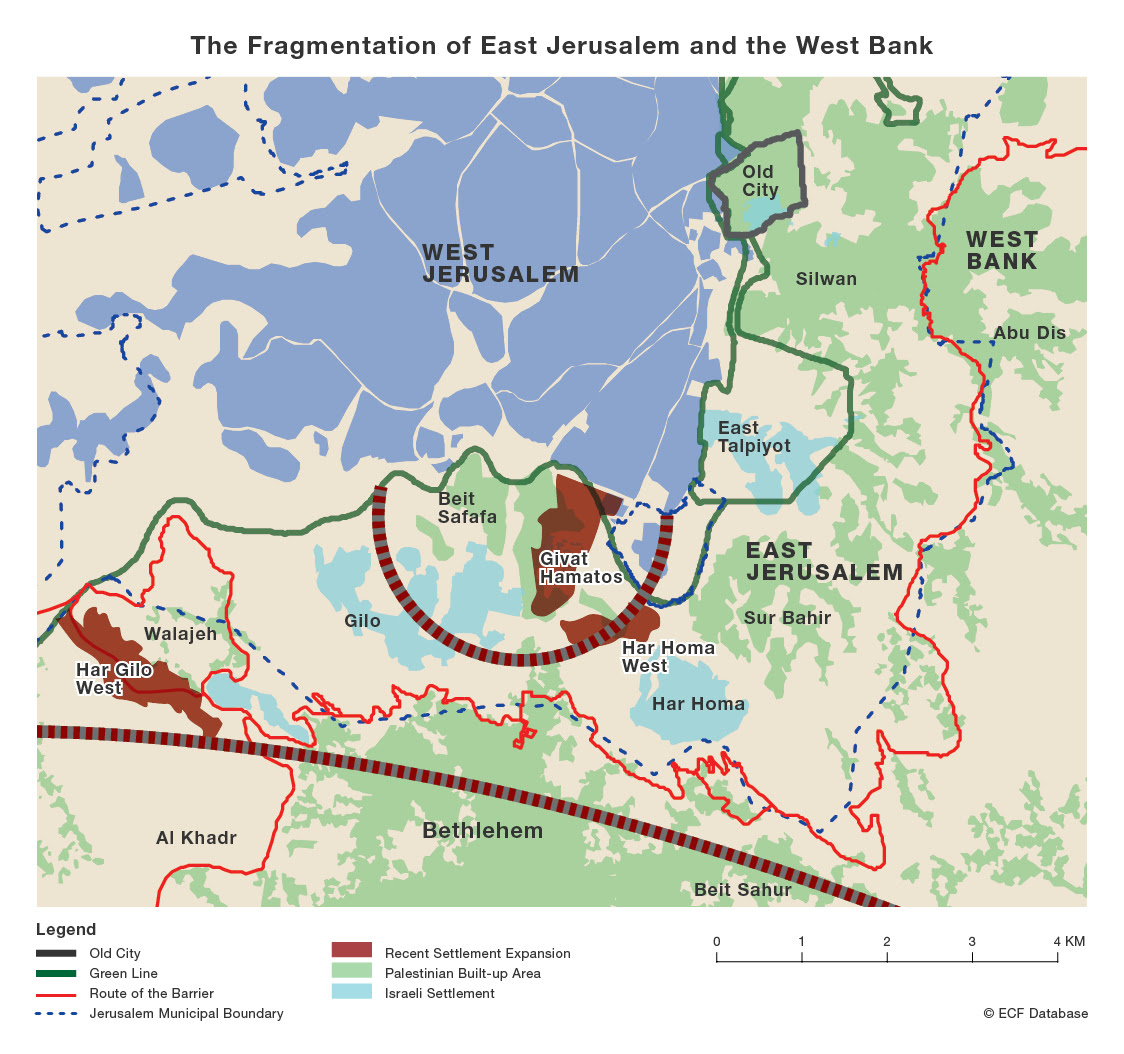 On April 7th the Jerusalem Local Planning Committee advanced a plan to build 540 new units in what is framed as an expansion of the Har Homa settlement in East Jerusalem. However, the new units will be built in an open area – non-contiguous with the current built-up area of Har Homa – between the Har Homa settlement and the site of the planned Givat Hamatos settlement, tenders for which were issued in January 2021. Meaning that the new construction is more properly understood as a new settlement – called Har Homa E (and sometimes called Har Homa West) – and is a significant step towards completing a ring of Israeli settlements on Jerusalem’s southern edge, and encircling the Palestinian neighborhood of Beit Safafa.
Ir Amim explains:
“Along with Givat Hamatos, construction of Har Homa E will serve as another step in linking the existing Har Homa and Gilo neighborhoods/settlements to create an Israeli sealing-off effect along the southern perimeter of East Jerusalem. This will fracture Bethlehem and the southern West Bank from East Jerusalem, while isolating the Palestinian neighborhood of Beit Safafa and depleting the remaining land reserves for further development of the neighborhood. If carried out, these measures will constitute a major obstacle towards the future establishment of a contiguous independent Palestinian state with a capital in East Jerusalem.”
Ir Amim researcher Aviv Tatarsky said in a statement:
“The plan’s advancement is a worrying sign for those who believed that the change in power in the United States would force Israel to restrain settlement construction.”
As of publication of this FMEP update, the Biden Administration has not issued a comment on the advancement of the Har Homa E plan.
Now that the Jerusalem Local Planning Committee has approved the plan, the plan awaits final approval by the Jerusalem District Planning Committee. That committee is scheduled to meet on April 21st. Ir Amim notes that:
“because the land in question is not state land but rather belongs to private Israeli landowners who claim to have purchased it, the plan’s final approval does not require a tendering stage in order for construction to begin.”
The Har Homa E plan provides the constriction of several highrise buildings – two 30-floor towers and three 12-floor buildings – in addition to a large public green space, a new road, spaces designated for future public buildings, and another open space for the preservation of an ancient aqueduct.
IDF Helps Settlers Stage Midnight Move-In to Three Buildings in Silwan
In the pre-dawn hours of April 8th, Israel security forces escorted 15 settler families affiliated with the Ateret Cohanim organization as they moved into three buildings in Silwan, a Palestinian neighborhood in East Jerusalem in the shadow of the Haram Al-Sharif/Temple Mount. The buildings are specifically in the Yeminite quarter of Silwan, where Ateret Cohanim is waging a campaign to take over more and more land and property largely (but not entirely) based on the revival of an old Yemenite land trust.
According to Haaretz, a member of the Palestinian Abu Dihab family, which owned the three buildings, sold them to the settlers; having gained control of the properties, Ateret Cohanim renovated the buildings to accomdate at least 16 total units. The family has issued a statement condemning that member for selling the properties to settlers.
Data Proves Discriminatory Nature of Israel’s West Bank Demolition Policy (Not that it Was In Doubt)
In response to a freedom of information petition filed by two human rights groups – Bimkom and Haqel – the Israeli Civil Administration issued new data that shows exactly how discriminatory Israel’s demolition enforcement is against Palestinians in the West Bank. Out of 187 demolition orders issued by the Civil Administration from 2019-2020, 159 orders (85%) were issued against Palestinian buildings, while just 28 (15%) were issued against settler structures. The discrimination is even greater when taking into account the data on the implementation of these orders. Of the 28 orders issued against Israeli structures, only two-thirds have been carried out (so far); of the 159 orders issued against Palestinians, three-quarters have been carried out (so far).
The data also shows that Israel sharply increased the issuance of expedited demolition orders under Military Order 1797, using this military order for 19 demolitions in 2019, and for 134 demolitions in 2020. This data underscores the discriminatory nature of Israel’s policy of expedited demolitions of new structures under Military Order 1797, and the discriminatory manner in which Israel is exercising this extraordinary new power (that it granted to itself in 2018). As a reminder: Military Order 1797 empowers Israel to summarily demolish buildings within 96 hours of the issuance of a demolition order, and all but eliminates any legal recourse for Palestinians.
Alon Cohen Lipshitz, who coordinates Bimkom’s activity in Area C, said:
“[Israel] is failing in its job to provide protection to protected communities and residents, and undermines basic human rights, like the right to a roof over one’s head. Tens of thousands of demolition orders and thousands of demolitions aren’t enough for the regime; it chooses to circumvent the law by creating new orders that allow homes to be demolished within a few days, without allowing for the defense of rights. This selective enforcement does deep and broad harm almost exclusively to the most sensitive Palestinian population – the shepherding community.”
JNF Expected to Give Final Approval for West Bank Land Purchases
In a vote scheduled for April 11th, the Board of the Jewish National Fund (known as the JNF-KKL in Israel) is expected to approve the adoption of a policy to officially make the purchase of land in the West Bank a part of the group’s mission. Ahead of the formal vote, a coalition of liberal Zionist groups threatened to boycott the JNF if it formalizes its policy on set. The letter was signed by 24 organizations and 7,000 individuals.
As FMEP has previously reported, if this new policy is indeed adopted, the JNF will officially make financing the Israeli settlement enterprise a loud-and-proud part of its mission. This would be a shift not so much in policy as in public relations, given that the JNF has long worked in support of settlements, but until this point has left settlement-related activities deliberately obscured. The shift in approach that will culminate in Sunday’s vote is in line with the JNF’s new right-wing, settler leadership (which effectively took control of the organization in October 2020).
According to a February 2021 report, the proposed JNF policy – which could see hundreds of millions of dollars invested in the settlement enterprise – includes directives for the organization to purchase land subject to the following conditions:
- The land is privately owned by Palestinians.
- The land will be used to expand existing settlements, not build new ones (this presumptively includes purchasing land to build outposts).
- The land is in Area C (some 60% of the West Bank), not land in Areas A and B.
- The land is located inside of a settlement’s jurisdiction or adjacent to it.
- Focus will be on purchasing land in areas identified as a priority, including the Jordan Valley, the Etzion settlement bloc, areas around Jerusalem, the Binyamin region north of Jerusalem, the South Hebron Hills, and areas adjacent to the pre-1967 border. The draft specifically says that no land shall be purchased in the Nablus or Jenin areas.
- Foreign donations will only be used to purchase land in the West Bank if the laws of the donor’s country permit it.
Bonus Reads
- “PA urges action against Israel settlements“ (MEMO)
- “Liberal Jewish groups threaten boycott of JNF-KKL if it buys West Bank land” (The Forward)
- “Palestinian village becomes prison for residents” (Al-Monitor)
Welcome to FMEP’s Weekly Settlement & Annexation Report. To subscribe to this report, please click here.
March 25, 2021
- Construction on Extension of “Apartheid Road” Slated to Begin Next Month as Israel Barrels Towards E-1 Settlement Construction
- Israel Opens National Park on Land Belonging to Al-Walaja
- Palestinians File Appeal Against “King’s Garden” Settlement Plan for Al-Bustan, Silwan
- Bonus Reads
Comments/Questions? Contact Kristin McCarthy (kmccarthy@fmep.org)
Construction on Extension of “Apartheid Road” Slated to Begin Next Month as Israel Barrels Towards E-1 Settlement Construction
The Israeli Civil Administration announced that construction will begin next week on a new section of Route 4370, aka, the Apartheid Road (having earned the nickname for the high cement wall running down the middle of the road, separating Israeli and Palestinian traffic). The work will expand the road to the south in order to connect to East Jerusalem. The new road, which Israel touts as a benefit for Palestinians, is designed to route Palestinian traffic around the E-1 settlement area – in preparation for that settlement’s eventual construction. According to Ir Amim, the construction of this new road segment “constitutes a major step in laying the groundwork for settlement building in the E1 area.”
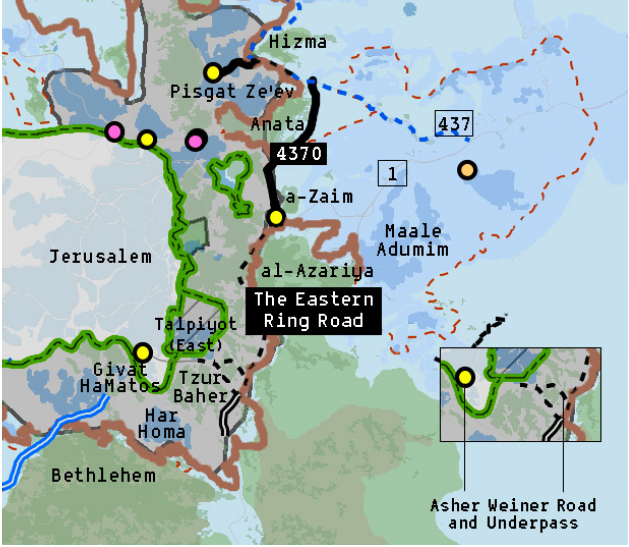
Map by Breaking the Silence
Ir Amim further explains:
“While portrayed as a road project to benefit Palestinians by expediting traffic and significantly reducing travel time between Ramallah and Bethlehem, it will in fact serve to completely reroute Palestinian traffic out of E1. Currently, the only road which facilitates Palestinian travel between the two West Bank centers runs through the E1 area. This limits Israel’s ability to carry out its massive settlement plans in the vicinity, which would require blocking Palestinian access to the area. This new road along with Route 4370 will create an alternative corridor between Ramallah and Bethlehem, which would eliminate the need for Palestinians to drive through E1 altogether. Diverting Palestinian traffic thus removes one of the obstacles to settlement construction in E1 and should signal cause for heightened vigilance.”
In a 2008 objection against the construction of the Apartheid Road, Adalah explained:
“The road further aims to consolidate and develop the Jewish settlements in East Jerusalem and the West Bank, and link them directly and conveniently to each other and to West Jerusalem. The road is simultaneously intended to isolate the Arab neighborhoods in East Jerusalem from the main route of the Eastern Ring Road, from each other and from the West Bank. It would thereby turn these neighborhoods into islands that are isolated – geographically, economically and in terms of transportation – from their immediate surroundings and would end Palestinian geographical contiguity within and around East Jerusalem, thereby precluding any future economic and social development or expansion of these neighborhoods. The plan stands to cut the owners of agricultural land off from their lands, to dramatically reduce the accessibility of schools, health services and workplaces for residents of these neighborhoods, and severely disrupt their family and social lives.”
Israeli officials have argued that the now-open road should resolve international objections to Israel building the E-1 settlement (a plan long criticized for effectively cutting the West Bank in half, rendering any future Palestinian state discontiguous and non-viable). In Israel’s view, the road replaces territorial contiguity for Palestinians in the West Bank with “transportational continuity,” i.e., the West Bank would still be cut in half, but the two halves are now inked by a road (albeit it a road that cuts Palestinians off from Jerusalem and that leaves travel between the northern and southern West Bank subject to Israeli control).
Israel Opens National Park on Land Belonging to Al-Walaja
Ir Amim reports that on March 23, the Israeli Nature & Parks Authority would be opening an Israeli national park in the area around the Ein Haniya spring. The spring is a historical part of the al-Walaja village, a Palestinian village located on the southern flank of Jerusalem, and long served as a main sources of water for households, farms, and recreational purposes for the village’s residents. Al-Walaja has long suffered due to its location and its complicated status (much of the village’s lands, including areas with homes, were annexed by Israel in 1967, but Israel never gave the villagers Jerusalem legal residency by Israel – meaning that under Israeli law, their mere presence in their homes is illegal). Today it is acutely suffering from a multi-prong effort by the Israeli government and settlers to grab more land for settlement expansion in pursuit of the “Greater Jerusalem” agenda. This land grab campaign includes past and pending home demolitions, the construction of the separation barrier and bypass roads in a way that seals off the village on three sides, and the denial of planning permits.
The history of this spring is just one example of how the Israeli government pursues land grabs with the facade of legality. As explained by Ir Amim:
“In 2013, in tandem with the construction of the barrier on al Walajeh lands, the Jerusalem District Committee approved an outline plan which designated the 1200 dunams of land as the Nahal Refaim national park in complete disregard of private Palestinian land ownership and traditional Palestinian agriculture in the area.
As a means of completely sealing off these lands from Palestinian access, including from village residents, the Jerusalem municipality began relocating the checkpoint between Jerusalem and al-Walajeh to a location closer to the village in February 2018. Construction on its relocation was suspended in March of the same year due to budgetary reasons and as a result, the Israeli authorities decided to keep the Ein Haniya site closed until the relocation is complete. Upon inquiry, however, Ir Amim was informed today that the plans for the checkpoint’s relocation have been terminated, and that Palestinian access to the area will remain unobstructed “unless security forces decide otherwise.”
Keeping the area open to Palestinian access is a significant achievement, which in no small part is due to al-Walajeh farmers’ perseverance despite the many obstacles and threats they continually face. In spite of this, the INPA’s plans include a variety of projects aimed at transforming al Walajeh’s agricultural terraces into an Israeli touristic and recreational destination, replete with hiking trails and outdoor activities, which creates the illusion of an entirely Israeli space.
The national park extends to the Jerusalem municipal border in close proximity to the area where Israel intends to establish a new settlement on al Walajeh’s lands (Har Gilo West) in the West Bank. In addition to creating contiguity between Jerusalem and the Gush Etzion settlement bloc around Bethlehem, the national park further isolates al Walajeh, turning it into an enclave detached from its Palestinian surroundings. In doing so, Israel advances its entrenchment of control along the southern perimeter, while undermining any prospect of a negotiated agreement in Jerusalem.”
Palestinians File Appeal Against “King’s Garden” Settlement Plan for Al-Bustan, Silwan
Ir Amim reports that Palestinians have filed an appeal to stop the demolition of 70 homes in the Al-Bustan section of the Silwan neighborhood in East Jerusalem. The Palestinians’ appeal responds to a surprising move by the Jerusalem Municipality, made in late February, to request permission from the Court to demolish the homes – demolition which had been frozen by the Courts since 2010 to allow for a negotiated resolution to the situation. For more on the history of this situation, see FMEP’s report from last week.
Additionally, Ir Amim has published a new, and more detailed, explainer on this case – highlighting the political context in which the Jerusalem Municipality made this decision. Ir Amim writes:
“The municipality’s plan called for the establishment of a touristic and archeological park (Plan 18000: “the King’s Garden”) replete with residential and commercial areas, including hotel space. This planned park would extend the existing national park in the City of David (the hub of Elad’s settler operations) southwards spanning the entire neighborhood of Al Bustan and towards the settler enclave in central Silwan (Batan al-Hawa) where the Ateret Cohanim settler organization is active. Since 2010, the plan has not advanced likely due to local and international opposition. However, the municipality’s objection to extension of the freeze signifies its intent to reactivate the plan, consistent with the acceleration of similar Israeli measures over the past year after being emboldened by the Trump Administration…
Beyond the severe humanitarian toll lie the acute demographic and political implications. The “King’s Garden” plan is yet another measure to transform the area into a sprawling Israeli tourist site, while further erasing its Palestinian presence. Silwan is one of the focal points of state-backed ideological settler activity. Settler groups threaten to displace over 800 Palestinians with the goal of establishing settler strongholds in the heart of Palestinian neighborhoods as a means to dismantle the viability of a political resolution on the city. Touristic settlement initiatives serve to reinforce residential settlement by connecting otherwise isolated settler compounds to create a contiguous ring of Israeli control (see map below for illustration), while artificially increasing the Israeli Jewish presence in the area via Israeli tourists visiting the sites. If advanced, the “King’s Garden” would essentially constitute a seamless extension of the City of David’s touristic attractions, further eroding the character of the neighborhood and its fabric of life, while leading to the forcible transfer of nearly an entire community.”
Bonus Reads
- “Samantha Power questioned over U.N. 2334 resolution at confirmation hearing” (Jewish Insider)
- “Save Sheikh Jarrah: Palestinians have a right to remain on their land” (Middle East Eye)
- “Palestinians in Hebron’s Old City build fence to prevent settlers’ attacks” (Al-Monitor)
Welcome to FMEP’s Weekly Settlement & Annexation Report. To subscribe to this report, please click here.
March 18, 2021
- Israel Municipality Asks Court to Ok Mass Demolitions in Silwan
- Israel Issues Demolition Order Against Home in Area B of the West Bank
- Palestinians Raise Alarm Over Impending East Jerusalem Dispossession
- Israeli Demolitions are Historically High
- Palestinians Call on UNESCO to Protect Archaeological Sites in the West Bank
- Settlers Once Again Invade Site of Evacuated Sa-Nur Settlement
- New Yesh Din Report Documents Another Category of West Bank Land Theft by Israel
- Bonus Reads
Comments/Questions? Contact Kristin McCarthy (kmccarthy@fmep.org)
Israel Municipality Asks Court to Ok Mass Demolitions in Silwan
Haaretz reports that three weeks ago, the Jerusalem Municipality petitioned the city courts to “reactivate” demolition orders for more than 70 Palestinian structures (home to more than 1,500 individuals) in the al-Bustan section of the Silwan neighborhood in East Jerusalem. [map]
The legal case around these 70 homes dates back to 2005, when the Israeli government unveiled a plan to establish a new archaeological/touristic park called “The King’s Garden” on privately owned Palestinian land in al-Bustan. Following international blowback the plan was dropped for a time, only to be revived by Jerusalem Mayor Nir Barkat in 2010, who once again began moving forward. To implement the plan, Israel issued demolition notices to Palestinian homes in the area — homes that Palestinians built (on their own land) but without the required Israeli-issued permits. This is, of course, a common circumstance for Palestinians in East Jerusalem and Israeli-controlled Area C of the West Bank, because Israel systematically denies planning and construction permissions to Palestinians.
Following another round of international outcry and an organized response by the Palestinian landowners, Israel (hoping to avoid more scrutiny) began quiet negotiations to provide the Palestinian land and home owners with alternative housing. After nearly seven years, the negotiations reportedly resulted in an agreement under which the city would defer demolition of the homes in question until after the Palestinians were able to build new homes (with permits) on adjacent plots.
According to Haaretz, the city has now decided it will no longer honor its commitment to defer those demolitions. The battle is now playing out in Court, with the city arguing that Palestinians have made no substantial progress on building the new homes. The Palestinians asked the court for a one year delay, saying that there has been progress that the city is not telling the court about.
Explaining the complexity of the situation facing Palestinians, Ir Amim wrote in an 2012 report:
“According to the Municipality’s plan, houses are intended to be demolished only after residents receive alternative housing. Consequently, condensation and construction will precede demolition—the reverse of normal procedure. But this proposed solution does not appear to be feasible. In order for the solution to be realized, the people evicted from the western part of Al-Bustan, against whose homes demolition orders are pending, will find themselves in the position of having to build alternative housing. In most cases, the space designated for alternative housing is on top of existing housing in the eastern part of the area; which is to say, in a built-up area, on the private land of other families. Such an arrangement could only be executed if the family currently on the land reaches agreement with the residents who have been evicted. Once an agreement is reached, the owners of the buildings in the eastern side of the area would have to request building permits, and only once said permits are obtained would the designated demolition of the houses in the western part of the plan take place and the buildings in the eastern part be legalized. The entire process would have to occur within a predetermined period; if not, the houses on both sides of the plan—the east and the west—would be torn down. However, as described above, obtaining building permits in this area is next to impossible. Requesting a building permit can jeopardize home owners on the east side who fear ownership of their current residences may be denied, as well as being a cost prohibitive process for most residents. Moreover, the negotiation challenges posed by evicted east side residents requesting to build on top of their neighbors on the west side all but preclude the likelihood of such arrangements.”
Ir Amim wrote in conclusion:
“As argued in a recent report by Bimkom, Planners for Planning Rights: “Despite the professional and apolitical facade of the planning and declaration of national parks, the picture appears to be more complex. In certain cases and places, it appears that the planning and declaration of national parks and nature reserves serves not only to protect natural and heritage assets and valuable open areas, but also serves as an instrument to limit the building and development of the Palestinian population. This phenomenon is widespread and particularly acute in the Palestinian neighborhoods of East Jerusalem.” The report goes on to state that one of the most salient features of existing plans for the Palestinian neighborhoods of East Jerusalem is the proliferation of “green areas” designated as open spaces, which constitute some 35% of the planned area (p. 6). The King’s Garden is another “green” area planned to be an open public space, though it is located in the middle of an overcrowded Palestinian neighborhood. That such a plan involves the massive demolition of Palestinian homes, and a drastic change of the neighborhood’s character from a Palestinian residential neighborhood to an archaeological park under Israeli control, raises more than reasonable concerns that the planning tool of “greening” is once again being used to establish political facts on the ground.”
The Haaretz Editorial Board intervened to plead for the municipality a return to negotiations, writing:
“Decision-makers must understand that a demolition order demolishes the lives of the inhabitants long before the bulldozer destroys their home. Anyone who hasn’t lived under the constant threat of their home’s destruction, who doesn’t panic every time a heavy vehicle rumbles down the street, or who has not seen the shadow of a bulldozer from the window of the children’s room, cannot understand the terror. Leon must come to his senses and bring the municipality back to the negotiating table, for the good of the residents of Silwan and all Jerusalemites. The success of the negotiations over the Bustan neighborhood and the construction of a new neighborhood next to the park will prove that Jerusalem has a mayor who truly works for the good of his residents and his city.”
Israel Issues Demolition Order Against Home in Area B of the West Bank
The Jerusalem Post reports that the IDF has issued a demolition order against a Palestinian home that is under construction in the Wadi al-Hummus village. The village in question is located just east of the Israel-declared municipal border of Jerusalem, but when Israel built its “separation barrier,” it left part of Wadi al-Hummus on the Israeli side (de facto annexing the land to Israel). The home that is now subject to demolition is thus in the odd position of being located simultaneously in Area B of the West Bank (as defined by the Oslo Accords), but inside Israel’s security barrier (the village of Wadi al-Hummus itself is cut up between East Jerusalem and Areas A, B, and C).
In the demolition notice handed to the homeowner, the IDF stated the house will be demolished because it lacks the proper building permits. However, according to the Palestinian news outlet WAFA, the owner obtained permits from the Palestinian Authority – which under Oslo has civil control (including planning) over Area B, where the home is located.
This is not the first time Israel has pursued the demolition of structures in areas outside of its Oslo-permitted control. In July 2019, Israeli forces demolished 13 large apartment buildings (approximately 70 units) in a section of Wadi al-Hummus, leaving the village looking like a war zone. Those buildings were located in Area A (where according to Oslo the PA has full civil and security control). Israel’s 2019 decision to demolish the buildings was given the official seal of approval by an Israeli Supreme Court decision. In its arguments, the Court held that the buildings posed an unacceptable security risk to the Israeli state because of their close proximity to Israel’s separation barrier (and that this risk over-rode the authorities granted under Oslo).
Palestinians Raise Alarm Over Impending East Jerusalem Dispossession
A coalition of 14 Palestinian civil society groups penned a joint letter asking the United Nations to intervene to stop the impending mass eviction of Palestinians from their homes in neighborhoods across East Jerusalem. The letter singles out the case of 15 Palestinian families (8 in Sheikh Jarrah and 7 in Silwan – for a total of 195 individuals) that are at risk of imminent eviction from their longtime homes in favor of settlers.
It’s worth recalling that, while the fate of 15 families is indeed in an urgent crisis, the legal underpinnings of these eviction cases stand to dispossess hundreds more Palestinians in East Jerusalem. Settler organizations, with state backing, are using Israeli law to take possession of Palestinian homes in key, sensitive neighborhoods in East Jerusalem to further consolidate Israeli hegemony over the city.
“At a time when people around the world are trying to survive the global pandemic, Palestinians in East Jerusalem continue to endure an ongoing Nakba, as they continue to be denied their inalienable rights of return and property restitution. In addition, they are subjected to an intensified coercive environment, exemplified in an array of policies including forced eviction thorough which they are again facing the threat of forced displacement and dispossession. They undergo a lengthy, exhausting, and unaffordable legal struggle to challenge the eviction lawsuits filed against them by settler organisations in Israeli courts. Given the discriminatory and untransparent nature of the Israeli legal system as applied in the occupied territory, they are effectively denied access to the rule of law. Many Palestinians have already been forcibly evicted under the same Israeli forcible transfer policy. In light of the above, this joint urgent appeal to the concerned United Nations (UN) Special Procedures underscores Israel’s establishment and maintenance of its apartheid regime over the Palestinian people as whole, and the intensified forcible transfer policies and measures in occupied East Jerusalem.”
Israeli Demolitions are Historically High
In its February 2021 report, OCHA (the United Nations Office for the Coordination of Humanitarian Affairs) notes that “Israeli authorities demolished, forced people to demolish, or seized 153 Palestinian-owned structures across the West Bank, including East Jerusalem: this is the fourth highest such figure recorded in a single month since OCHA began systematically documenting this practice in 2009, surpassed only by November 2020 (178), February (237) and March 2016 (179).” The 2021 monthly average number of structures demolished or seized is 117, compared to an average of 71 last year.
In February along, 305 individuals including 172 minors were affected by Israeli actions.
Palestinians Call on UNESCO to Protect Archaeological Sites in the West Bank
The Palestinian Foreign Ministry issued a statement calling on UNESCO to “protect all Palestinian archaeological and religious sites from Israeli violations, attacks and falsifications.” The statement went on to condemn Israeli actions in the West Bank and East Jerusalem which “serve the expansion of the illegal settlements,” saying that Israel’s seizure of antiquities in Palestinian-controlled areas are then put on “display …in their museums as evidence of its misleading colonial claims.”
Last week, on March 11th, settlers stormed the ancient site in Sebastia. Settlers have been openly agitating – with some success – for Israel to assert control over the archaeological site in Sebastia for years. In January 2021, Emek Shaveh (an Israeli NGO expert in – and focused on – archaeology) wrote on what is happening in Sebastia, saying:
“The archaeological site of Sebastia is identified with Samaria, the capital of the Kingdom of ancient Israel in 9-8 BCE. The site also features ruins from the Hellenistic, Roman and later periods. The village of Sebastia is situated within Area B while the site itself is located mainly in area C. Over the past few years, the Samaria Regional Council has been organizing tours to the site, particularly during the school holidays. Several times this year, the Civil Administration has removed a Palestinian flag from the village and the site. In the most recent incident, a flag was raised following renovation works funded by the Belgian government. In their response the regional council blamed the Palestinians for destroying a site central to Jewish history and UNESCO for supporting the Palestinians. Sebastia is on the tentative list of World Heritage sites in Palestine….the integration of ancient sites into an organized strategy designed to weaken Palestinian hold on Area C is worrying. The formalization of this approach is likely to result in a steep rise in actions over ancient sites and structures, from water cisterns found in many villages, to major sites such as Sebastia. The justification for preserving and developing ancient sites familiar to us from East Jerusalem is now being applied wholesale to hundreds of places in the West Bank to the detriment of the Palestinians living near the sites and to the multilayered heritage inherent in the ruins which will be distorted for political ends.”
As FMEP has chronicled, settlers and their allies have recently become hyper-focused on taking control of archaeological sites and artifacts under Palestinians control, claiming the sites are neglected and/or damaged. Last month settlers used a construction mishap to raise claims to the Mt. Ebal site.
In January 2021, the state of Israel committed funding to a new settler initiative to surveil archeological sites under Palestinian control. While the objective of protecting antiquities might appear uncontroversial and apolitical, the true objective behind this effort is to support yet another pretext to surveil and police Palestinians, and yet another means to dispossess them of their properties. It is the result of a campaign that has taken place over the past year in which settlers have been escalating their calls for the Israeli government to seize antiquities located in Palestinian communities across the West Bank, especially in Area C, which Israel today treats as virtually (and legally) indistinguishable from sovereign Israeli territory. The controversy that erupted over the Mt. Ebal archaeological site in February 2021 should be viewed in this context.
Previous victories for the settlers include the Israeli Civil Administration’s recent issuance of expropriation orders for two archaeological sites located on privately owned Palestinian property northwest of Ramallah. The expropriations – the first of their kind in 35 years – come amidst a new campaign by settlers lobbying the government to take control of such sites, based on the settlers’ claims that antiquities are being stolen and the sites are being mismanaged by Palestinians. The settlers’ pressure is also credited as the impetus behind the government’s clandestine raid of a Palestinian village in July 2020 to seize an ancient font. The Palestinian envoy to UNESCO, Mounir Anastas, recently called on the United Nations to pressure Israel into returning the font to the Palestinian authorities
In June 2020, a settler group calling itself “Shomrim Al Hanetzach” (“Guardians of Eternity”) began surveying areas in the West Bank that Israel has designated as archeaological sites in order to call in Israeli authorities to demolish Palestinian construction in these areas. The group communicates its findings to the Archaeology Unit of the Israeli Civil Administration (reminder: the Civil Administration is the arm of the Israeli Defense Ministry which since 1967 has functioned as the de facto sovereign over the West Bank). The Archaeology Unit, playing its part, then delivers eviction and demolition orders against Palestinians, claiming that the structures damage antiquities in the area. As a reminder, in 2017, Israel designated 1,000 new archaeological sites in Area C of the West Bank. The “Guardians of Eternity” group, not coincidentally, is an offshoot of the radical Regavim organization, which among other things works to push Israeli authorities to demolish Palestinian construction (on Palestinians’ own land) that lacks Israeli permits (permits that Israel virtually never grants). The group raised public alarm about the Trump Plan, alleging that hundreds of biblical sites in the West Bank are slated to become Palestinian territory.
Settlers Once Again Invade Site of Evacuated Sa-Nur Settlement
On March 16th, dozens of Israeli settler families illegally entered the site of the evacuated Sa-Nur settlement in the northern West Bank in an attempt to reestablish the area as a place of permanent Jewish settlement. Settlers have attempted the feat many times before, often with the active, in-person support of high-profile Israeli politicians, and always without punishment for their illegal actions.
After calling on Netanyahu to immediately authorize their presence at the site (a call that included the voice of prominent settler leader Yossi Dagan), the IDF evacuated the settlers once again.
The last time a group of settlers attempted this, in November 2020, MK Miki Zohar (Likud) persuaded the settlers to abandon their illegal campsite and leave the area, with the promise of raising the issue of Sa-Nur’s re establishment directly with Netanyahu.
MK Zohar is a staunch supporter of reestablishing Sa-Nur, along with three other settlements in the area that were likewise dismantled by the Israeli government in 2005 (Homesh, Ganim, and Kadim). Zohar has participated in previous visits to the site to support the settlers’ bid, frequently accompanied by his Likud colleagues, including former Speaker of the Knesset Yuli Edelstein. In July 2018, the Israeli Cabinet had the opportunity to lend government backing to a bill that would have cancelled the 2005 disengagement and allowed the settlers to rebuild those settlements – but the Cabinet blocked the bill.
As a reminder, even though Israel evacuated the four settlements in the West Bank, the IDF issued military orders barring Palestinians from entering the areas, preventing Palestinians from taking control over the area and building there. At the same time, settlers have regularly entered the areas and even repeatedly built a yeshiva at the Homesh site.
New Yesh Din Report Documents Another Category of West Bank Land Theft by Israel
In a new report entitled “Ill-Gotten Gains”, Yesh Din explains how the Israeli government has taken control of Palestinian land that was in the process of being formally titled and registered when Israeli occupied the West Bank in 1967. Yesh Din estimates that Israel has used its authority as the occupying power to declare as “state land” 41,000 dunans (~10,000 acres) of land that was, at the time, in the process of being registered as privately owned by Palestinians. That declaration precludes Palestinians from attempting to regain control of the land (by proving their ownership through a registration process).
Only one-third of West Bank land was registered and titled (under the British Mandatory government and then continued by Jordan) when Israel seized control of the West Bank. Upon assuming governance of the area the Israeli government issued a military order freezing the land registration process. The process remains frozen today, though there are rumblings from settlers pushing that state to resume the process (for their benefit).
Yesh Din writes:
“Israel’s policy of declaring “state land” in areas where settlement of title was halted is based on selective application of the legal mechanisms that regulate the land regime in the West Bank. Israel does so in violation of the rules of international law that apply to Israel as the occupying power in the West Bank. Such declarations also violate the local law in force in the West Bank and the military order issued by the Israeli military commander (Order Concerning Government Property). Above all, Israel’s policy infringes upon the right to property of Palestinians who took part in settlement of title and allows it to dispossess Palestinian individuals and communities of their land. In practice, Israel, which is and has been responsible for the land registry in the West Bank for over 53 years, is benefiting from this policy. Israel does not permit Palestinians who participated in settlement of title to complete the process and register title to their land, but it does declare these very same lands “state land” and transfers them to the exclusive use of the Israeli settlement enterprise in the West Bank.”
Bonus Reads
- “How Israeli industrial zones exploit Palestinian land and labour” (The New Arab)
- “Settler head urges vaccinating Palestinians, paid for by tax revenues sent to PA” (The Times of Israel)
- “Netanyahu pledges to legalize West Bank settler outposts if re-elected” (Jerusalem Post)
- “Why Some Voters in ‘Settler Heartland’ Are Ready to Turn Their Backs on Netanyahu” (Haaretz)
- “Netanyahu ups focus on settlements, as housing starts hit 10-year low” (Jerusalem Post)
- “‘The settler bashed my head with a pipe, and everything went dark’” (+972 Magazine)
- “The U.S. Billionaires Secretly Funding the Right-wing Effort to Reshape Israel” (Haaretz)
- “No One Is More Deserving of Israel’s Highest Honor Than Its Colonialist Settler Leaders” (Haaretz)
Welcome to FMEP’s Weekly Settlement & Annexation Report. To subscribe to this report, please click here.
February 19, 2021
- Mass Dispossession in East Jerusalem: Israeli Courts Rule to Evict 11 Palestinian Families from Homes in Sheikh Jarrah & Batan al-Hawa
- Israel Close to Construction on Three Key Settler Bypass Roads
- JNF Leadership Approves Policy to Expand Settlements, But Defers Final Approval to Board
- Israeli Plan to Build West Bank Sewage/Power Plant Delayed Over Settlers’ Environmental Concerns
- Al Haq Requests “Immediate Intervention” by UN to Stop Settler Violence
- Bonus Reads
Comments, questions? Email kmccarthy@fmep.org
Mass Dispossession in East Jerusalem: Israeli Courts Rule to Evict 11 Palestinian Families from Homes in Sheikh Jarrah & Batan al-Hawa
In two separate decisions, Israeli courts have continued to rule in favor of settlers in cases that threaten the mass dispossession and displacement of Palestinians from some of the most sensitive areas of East Jerusalem. The decisions this week – one dispossessing six families in Sheikh Jarrah and the second dispossessing five families in Silwan (details below) – extend the guise of legality to the ongoing campaign by Israeli settlers to evict Palestinians in favor of Jewish Israelis.
These evictions are based on an Israeli law (the Administrative and Legal Matters Law) designed to enable Israeli Jews, but not Palestinians, to “recover” properties abandoned during the 1948 war. From the beginning of 2020 until now, based on this law, Israeli courts have ruled in favor of the settlers in a total of 14 cases – seven cases in Batan al-Hawa (Silwan) and seven cases in Sheikh Jarrah. The rulings (so far) affect – in a devastating manner – 36 Palestinian families with 165 individuals – 107 people in Silwan and 58 individuals in Sheikh Jarrah; as a legal precedent, these rulings open the door for dispossession on a massive scale, threatening the homes of approximately 700 people in Silwan alone.
Painting the larger picture of what is happening in these neighborhoods, Ir Amim says:
“Since the beginning of 2020 until now, there has been a record number of court decisions upholding eviction claims against Palestinian families filed by settler organizations. Over the past year, the Israeli courts authorized the evictions of over 30 Palestinian families, totaling more than 100 individuals, from their homes in Sheikh Jarrah and Batan al-Hawa. While the families are in various stages of appeal proceedings, many have exhausted the relevant legal remedies, which could lead to a devastating wave of evictions in the coming months. If the evictions are not halted, a total of over 1000 Palestinians from Sheikh Jarrah and Batan al-Hawa could ultimately be uprooted from their homes and communities and supplanted by settlers, potentially amounting to a form of forcible transfer. These measures not only constitute a flagrant violation of human rights, but also erode conditions necessary for any future political resolution on the city.”
Peace Now said in a statement:
“The story here is not legal but political. The court is only the tool by which settlers use with the close assistance of state authorities to commit the crime of displacing an entire community and replacing it with settlement. The Israeli government and settlers have no problem to displace thousands of Palestinians in the name of ‘the Right of Return’ to properties before 1948, while they strongly claim that the millions of Israelis living in Palestinian properties before 1948 cannot be evicted. Since the evacuation of the Mughrabi neighborhood for the purpose of expanding the Western Wall plaza in 1967, there has been no such deportation in Jerusalem. On the table of the prosecution in the International Court of Justice in The Hague is a complaint about the displacement process led by the government in Sheikh Jarrah and in Batan Al-Hawa. The government can still stop this injustice”.
In Sheikh Jarrah
On February 15th, the Jerusalem District Court upheld the eviction of six Palestinian families (27 individuals) from their homes of 70+ years in the Sheikh Jarrah nieghborhood of East Jerusalem in favor of the Nahalat Shimon settler group. The Court gave the families until May 2nd to vacate their homes, or file an appeal to the Supreme Court of Israel. 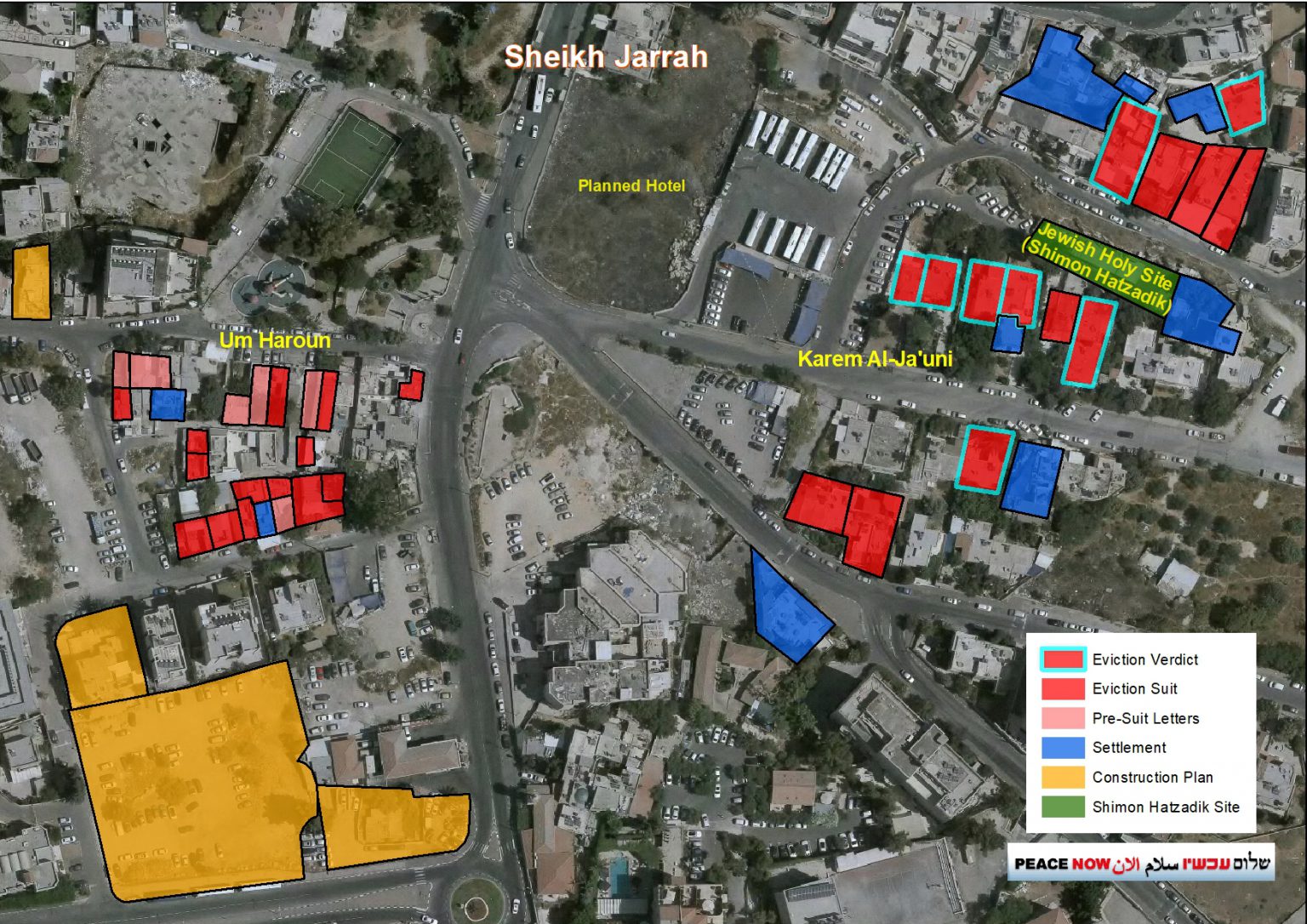
Nahalat Shimon is a U.S.-registered company which takes advantage of the “Legal and Administration Matters Law,” to reclaim property lost/abandoned during the 1948 war. Nahalat Shimon sought out the Jewish Israeli families that owned homes in Sheikh Jarrah prior to the 1948 War, and then “purchased” the properties from those families. Since then, Nahalat Shimon has been undertaking legal action to evict Palestinians. In 2009 the first eviction took place – sparking a sustained protest in the Sheikh Jarrah neighborhood which has garnered international attention.
Commenting on the case, Peace Now said:
“The lawsuit is part of an organized move designed to dispossess a Palestinian community of its home and establish a settlement in Sheikh Jarrah in its place. Hundreds of Palestinians in Sheikh Jarrah are in a similar situation in court proceedings, and hundreds more in Batan Al-Hawa in Silwan.”
In December 2020, FMEP hosted a webinar specifically looking at these eviction cases in Sheikh Jarrah, featuring Mohammed El-Kurd whose family was a party to the rejected appeal this week. The El-Kurd family has struggled to remain in their home in the face of settler campaigns to evict them for over a decade, part of which was captured in the Just Vision documentary “My Neighborhood.”
In Silwan
Following a hearing on February 9th, the Jerusalem Magistrate Court ruled in favor of the Ateret Cohanim settler organization and ordered the eviction of five families from their homes in the Batan al-Hawa section of the Silwan neighborhood in East Jerusalem. The Court ordered the families to vacate their homes — where they have resided for 50+ years — by August 2021. Ir Amim reports that the families are expected to appeal the case to the Jerusalem District Court.
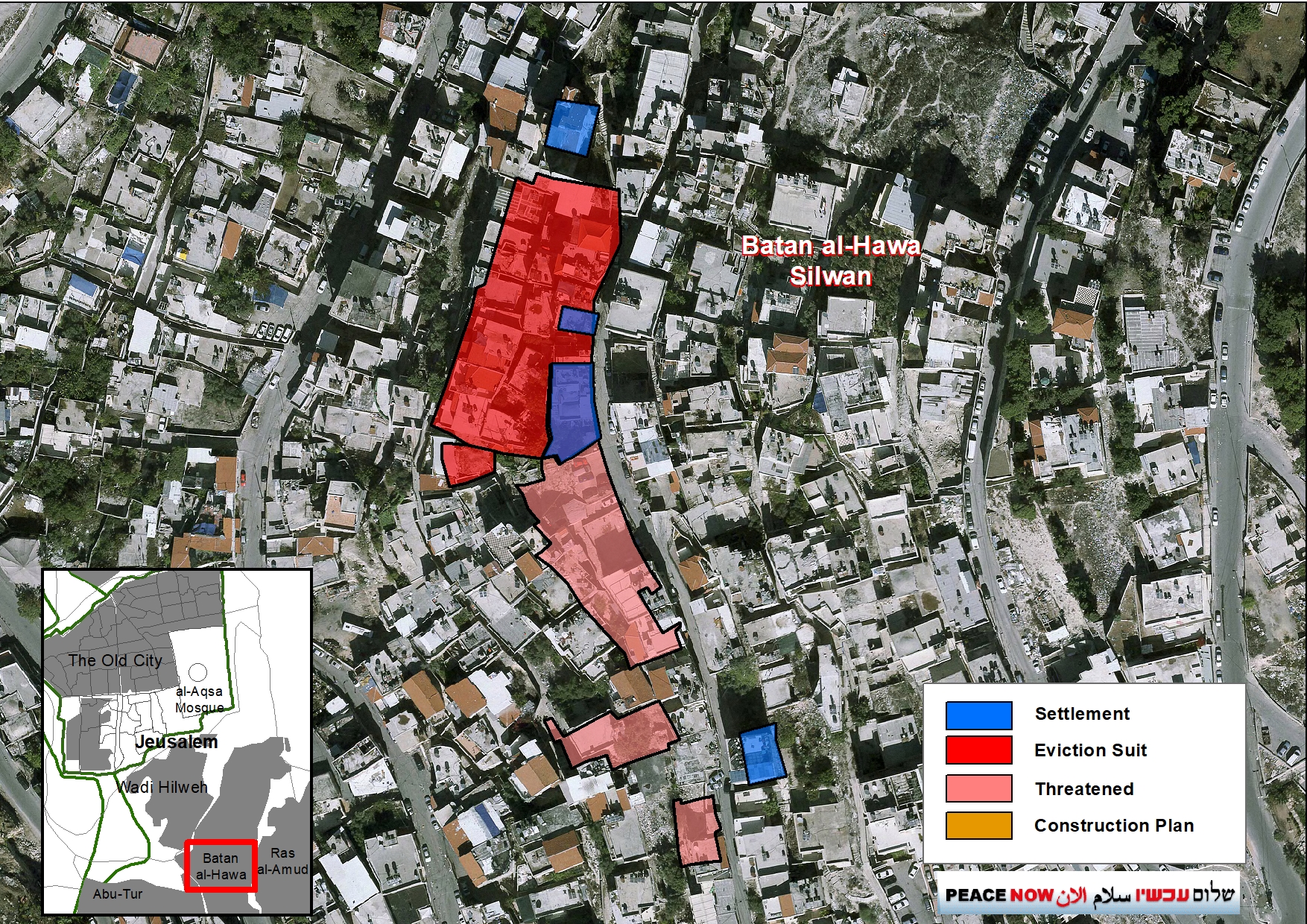 The ruling also upheld and advanced the use of the Legal and Administrative Matters Law which, as is the case in Sheikh Jarrah, is being used by Ateret Cohanim in a house-by-house manner in Silwan. To date, Israeli courts have repeatedly upheld Ateret Cohanim’s claim to own a large swath of land in the tiny Batan al-Hawa neighborhood, most recently ruling to evict Palestinians in January 2021, as well as in November 2020. In total, Ateret Cohanim’s campaign stands to ultimately dispossess 700 Palestinians in Silwan.
The group’s claim is based on having gained control of the historic Benvenisti Trust, which oversaw the assets of Yemenite Jews who lived in Silwan in the 19th century. In 2001 the Israeli Charitable Trust Registrar granted Ateret Cohanim permission to revive the trust and become its trustees, (following 63 years of dormancy). In 2002, the Israeli Custodian General transferred ownership of the land in Batan al-Hawa to the Trust (i.e., to Ateret Cohanim). Since then, Ateret Cohanim has accelerated its multifaceted campaign to remove Palestinians from their homes, claiming that the Palestinians are illegally squatting on land owned by the trust.
Palestinians have challenged the legitimacy of the Benvenisti Trust’s claims to the currently existing buildings, saying that the trust only covered the old buildings (none of which remain standing) and not the land, but the courts have so far rejected their argument.
Israel Close to Construction on Three Key Settler Bypass Roads
Peace Now reports that Israel is nearing the start of construction on several roads designed to serve settlers across the West Bank and in East Jerusalem, including: the so-called “Sovereignty Road” (which will allow Israel to build the E-1 settlement); and the Qalandiya bypass tunnel road; and, the Huwarra Bypass Road. Israel’s investment in these roads is explicitly about increasing the settler population and finally building the E-1 settlement.
Peace Now said in response to the totality of these advancements.
“The Israeli government is de facto annexing the West Bank by investing billions of shekels into roads designed to double the number of settlers to a million and even more.”
In a recent report examining several of these road projects in East Jerusalem, Who Profits writes:
“In the oPt infrastructure is primarily about control. In the words of Brigadier Ofer Hindi, head of the Rainbow of Colors15 administrative division of the Israeli Ministry of Defense (hereafter: IMOD): “priorities are not only the result of traffic and congestion, but of security needs, and the perspective must be integrative.” … the Israeli roads system functions as an instrument of exclusion, land grabs and economic de-development vis-à-vis the occupied population. At the same time, transport projects are also instruments of (segregated) integration, normalization and pacification. Projects such as the bus-only lanes and bus terminal currently under construction at the Qalandia checkpoint operate in tandem with recent technological and infrastructural investments in the checkpoints, described as an “upgrade” by the Israeli Civil Administration (hereafter: ICA), the administrative arm of the Israeli military in the oPt. The so-called upgrade includes features such as: moveable connectors at pedestrian checkpoints, expanded use of facial recognition and other biometric identification technologies and significantly, terminals, bus lanes and parking areas with the objective of “maximizing utility […] and enabling the passage of goods with greater throughput and efficiency.” Transport planning is thus incorporated into Israel’s strategic move to recast Palestinians as clients and users of the occupation. In this way short-term quality-of-life improvements work to consolidate, normalize and sustain Israel’s highly restrictive mobility regime.”
In another recent report – “Highway to Annexation” – Breaking the Silence speaks to the role of roads and infrastructure in Israel’s de facto annexation of the West Bank:
“The ultimate vision of the road and transportation projects currently planned and underway in the West Bank involve entrenching the segregation between Israeli settlers and Palestinians. These infrastructure projects, of course, do not provide for “separate but equal” development but are rather guided primarily by the interests of the settler population and come at the expense of Palestinian development… West Bank road and transportation development creates facts on the ground that constitute a significant entrenchment of the de facto annexation already taking place in the West Bank and will enable massive settlement growth in the years to come. By strengthening Israel’s hold on West Bank territory, aiding settlement growth, and fragmenting Palestinian land, this infrastructure growth poses a significant barrier to ending the occupation and achieving an equitable and peaceful solution to the Israeli-Palestinian conflict.“
The Sovereignty Road
According to Transportation Minister Miri Regev, Israel signed a contract with a company owned by the Jerusalem Municipality for the construction of the “Sovereignty Road” in the Maale Adumim/E-1 area in the West Bank, just east of Jerusalem (called the “a-Zaim road to Al-Azariya” by Peace Now). In Regev’s press release announcing this development, her office makes it perfectly clear what this road is intended to do:
“This will be a separate road for Palestinians in the E1 area, the purpose of which is to separate the transportation connection between the Palestinian and Israeli populations in the area so that Palestinian vehicles will be allowed to pass without entering the Ma’ale Adumim bloc, near Jewish communities…At the political level, the road will connect Jerusalem and Ma’ale Adumim and enable construction in the Jewish settlements in the E1 area.”
 For decades, construction of the E-1 settlement – which is now actively advancing through the planning process – has been adamantly opposed by the international community. A key criticism of the plan is that it would effectively cut the West Bank in half — thereby preventing any two-state solution. The “Sovereignty Road” has long been Israel’s answer to that criticism, with Israel arguing that it will replace territorial contiguity with limited “transportational continuity” – via a sealed road that is under Israel’s total control (meaning they can cut off passage through it at any time).
If built, a section of the Palestinian-only road is projected to run under the separation barrier (which is not currently built in this area). The rest of the road will run relatively adjacent to the route of the planned separation barrier, in order – in the words of former Defense Minister Bennet – to prevent Palestinian traffic from coming “near Jewish communities.” This new section of road connects to the infamous “apartheid road” (aka, the Eastern Ring Road) which has a high wall down the middle dividing Israeli and Palestinian traffic, and which was opened for Palestinian traffic in January 2019
The Qalandiya Bypass Tunnel Road
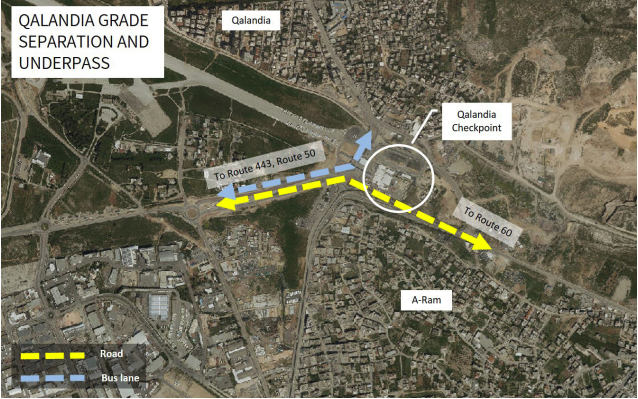 Following the recent closing of the tender period, the Israeli government is expected to soon select a contractor to build a new tunnel road that will go underneath the Qalandia checkpoint between Jerusalem and Ramallah, which is perhaps the busiest access point for Palestinians entering Israel. Peace Now writes that construction of the tunnel road is expected to begin approximately in April 2021. This plan is designed to serve a cluster of settlements that Netanyahu has recently dubbed a “fourth settlement bloc.” This group of settlements is located deep inside the West Bank — including the settlements of Adam, Kochav Yaakov, Ofra, and Beit El — in an area that under any reasonable sense of a two-state solution cannot become part of Israel. By defining these settlements as part of a “bloc” Netanyahu is in effect asserting that Israel will never relinquish control over the area.
Who Profits recently detailed this road project and the larger context of the Qalandiya checkpoint, writing:
“The Qalandia Grade Separation and Underpass Project is part of Israel’s concerted effort to reconfigure the space of the checkpoint. The Qalandia military checkpoint, located 10 kilometers north of Jerusalem and staffed by the Israeli military and private security companies, is one of the main checkpoints for Palestinians seeking to cross into East Jerusalem or the Green Line for work, health or any other purpose. Long infamous for its inhuman and crowded conditions and human rights violations, Qalandia has recently undergone major infrastructural and technological changes, to the tune of tens of millions of dollars. Under the guise of reducing wait times and improving conditions, the renovated checkpoints introduce heightened forms of surveillance, including facial recognition technology. The checkpoint upgrade plan also includes investment in transport infrastructure, such as pedestrian bridges and bus services….Part of the project involved the creation of a planning corridor for a future underpass and grade separation, connecting Route 60 to Route 45 to form an uninterrupted east-west axis between the Binyamin settlement bloc northeast of Jerusalem and Route 443 and Route 50 (Begin Highway), integrating them into Jerusalem and the Green Line…land for the project has been expropriated using military seizure orders rather than civil procedures, a move designed to accelerate the process and limit the ability of Palestinians to object.”
Peace Now adds more context around how the tunnel is a key part of Israel’s grander vision for settler-serving infrastructure criss-crossing the West Bank:
“It should be noted that in recent months, the planning process for a new road, known as Road 45 or the “Quarries Road”, is underway to connect the Ramallah bypass road near the Kochav Ya’akov settlement, and the Qalandiya checkpoint has been progressing. In June 2020, the road plan (Plan No. 926/1), was approved for deposit in the Higher Planning Council of the Civil Administration, and was published for objections in October 2020. The road is intended to bypass the Palestinian settlements of Jaba’ and A-Ram, and allow settlers to travel quickly and safely without passing Palestinian homes.”
The two roads together will make all the settlements east of Jerusalem and Ramallah, as well as the settlements in the Jordan Valley and along Road 60 towards Nablus much more attractive for Israelis.
The Huwarra Bypass Road
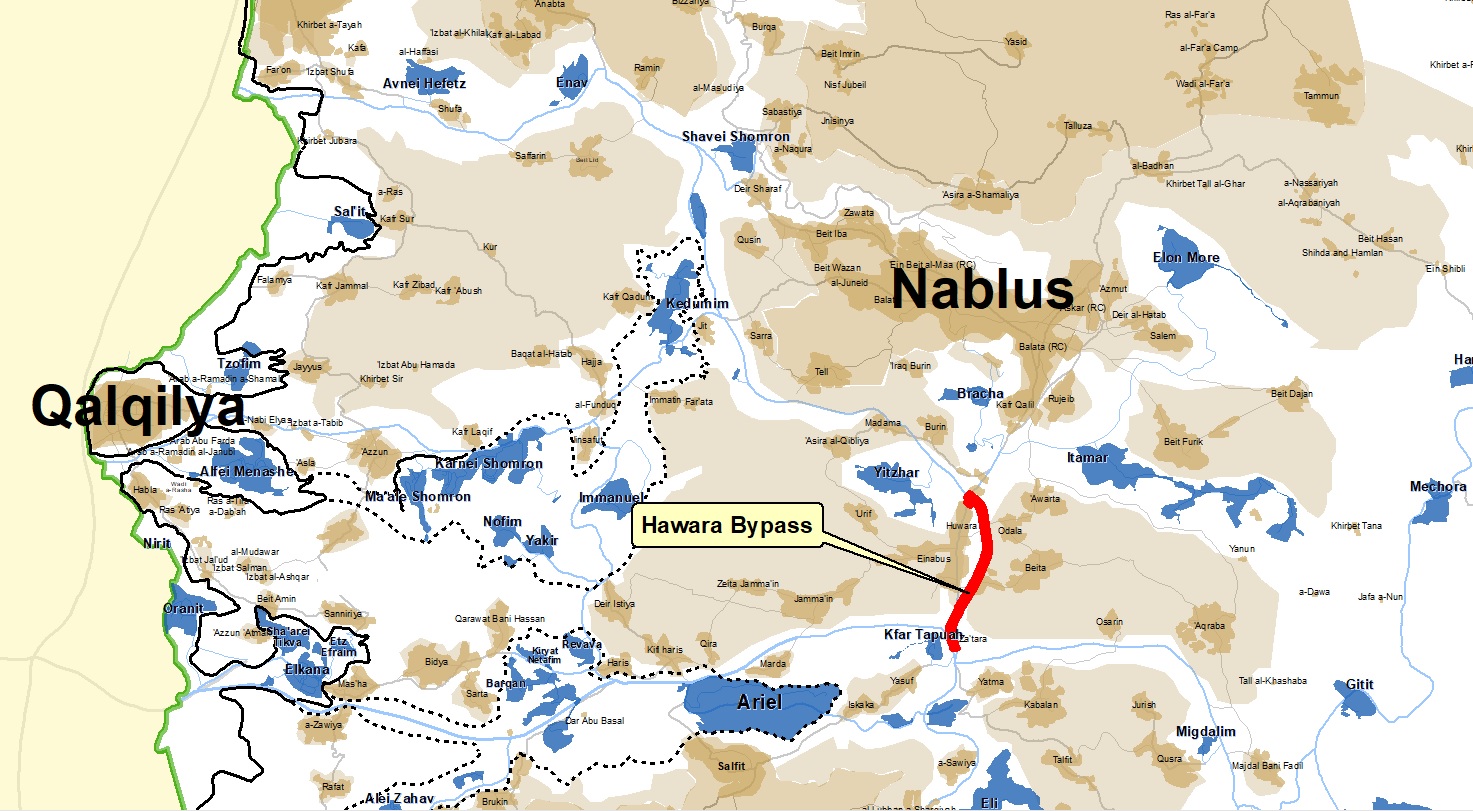
Map by Peace Now
Peace Now also reports that, according to Transportation Minister Regev, the tender for the Huwwara Bypass Road has closed, meaning construction might begin imminently. The Huwwara Bypass Road is designed to enable settler traffic from the Nablus area to bypass the the Palestinian village of Huwwara (which is an area with heavy traffic congestion from daily commuters) in order to more easily/directly access Jerusalem. This bypass road has long been a top priority for the settlers, who have complained about the long commute to Jerusalem and the limit this puts on the potential for growth of Nablus-area settlements. The radical/violent Yitzhar settlement will benefit from the bypass road, along with the settlements of Har Bracha, Itamar, and Elon Moreh. Building the road also gained urgency for the settlers after the release of the Trump Plan’s conceptual map, which left the area where the road is slated to be built within the borders a future Palestinian “state.”
JNF Leadership Approves Policy to Expand Settlements, But Defers Final Approval to Board
The Jewish National Fund’s executive leadership voted this week to approve the adoption of a new policy making the expansion of settlements in the West Bank part of the group’s core mission and function, and allocated nearly $12 million (8 million NIS) towards the purchase of land in the West Bank. However, in a concession to JNF members and donors threatening to leave over the new policy, the organization’s leadership has decided to defer a final decision on to its Board of Directors, which is expected to hold a vote on the matter only after the March 23rd elections in Israel.
Notwithstanding the significant controversy this “new” policy has provoked, the reality is that the JNF has long worked in support of settlements. What is different now is that, where in the past the JNF preferred to leave its settlement-related activities deliberately obscured, under the new policy the JNF would openly claim and promote its support for settlements. As such, the shift under consideration is not so much in policy as in public relations (a public relations approach that does not shy away from blatant racism, evidenced by the JNF Chairman’s recent TV appearance in which he said that the JNF’s goal is to stop land from ending up in Arab hands).
There has been significant opposition to the adoption of the new policy, on both administrative and moral grounds. Israeli Defense Minister Benny Gantz wrote to the JNF shortly before it met to approve the plan, asking for the matter to be delayed in order to allow Israeli security officials and the Civil Administration (which oversees civilian affairs including land regulation in the West Bank) to examine the matter. Gantz reportedly said that the JNF’s decision is “extremely sensitive,” potentially having national security consequences.
Diaspora Jewish groups have voiced strong opposition to the JNF moving to openly support settlements, with many focusing on why the new policy is bad for Israel. This includes Rabbi Rick Jacobs, president of the Union for Reform Judaism, who said that he “intends to mobilize the Jewish community to fight JNF’s plan through political and legal channels.”
J Street called on the U.S. branch of the JNF to work to oppose the policy, saying:
“For Jews around the world who contributed through the JNF to the creation and building of the state of Israel, it is beyond upsetting that the organization is being turned into an arm of the West Bank settlement movement, acting in a way that violates international law, shows total disregard for the rights of Palestinians and dangerously undermines Israel’s future as a secure, democratic homeland for the Jewish people along with the prospects for Israeli-Palestinian peace. While JNF-KKL funds have a complex history of being used at times to help fund and facilitate land purchases and settlement growth beyond the Green Line in the West Bank and East Jerusalem, they have not previously officially committed to this harmful project in such a brazen and explicit fashion.”
Haaretz columnist Gideon Levy wrote in an op-ed this week:
“The rot in the JNF can be smelled from far away. The fact that the Labor Party and Meretz are partners in this stinking nationalist enterprise testifies as much as 1,000 witnesses about the Zionist left. A “public benefit corporation,” most of whose land is land that was stolen from its owners in the Nakba and was never returned to them; which covered over the ruins of hundreds of villages in forests, just to erase their memory from the face of the earth and block the possibility of their owners returning. A body which, throughout all the years, in practice sold lands only to Jews, and since 2009 even legalized this practice in an official decision; a body for which there is no occupation and no Green Line – just one state between the Jordan River and Mediterranean Sea, in which you buy land only for members of one people; and which has now officially declared its partnership in the war crime called settlement too, after years of doing so via a front company…Anyone who still has their doubts, yes apartheid or no apartheid, needs to get to know the JNF. With members of the right and left in its top posts and positions for Meretz too – here you have the Jewish national fund for apartheid, the Israeli consensus.”
Israeli Plan to Build West Bank Sewage/Power Plant Delayed Over Settlers’ Environmental Concerns
Prime Minister Netanyahu has agreed to delay the construction of a new waste-to-energy plant near the Ma’ale Adumim settlement in the West Bank until an environmental impact study can be done, a study which was requested by the leadership of the settlement of Ma’ale Adumim.
The plant is planned to be built on land that is within the jurisdiction of the Ma’ale Adumim settlement, where several Palestinian Bedouin communities currently live. As noted in this Peace Now report, the land under the jurisdiction of this settlement “is the largest of all of the Israeli settlements on the West Bank” spreading “over a very large region which begins west of the settlement and extends into the Jericho valley. If compared with the size of the jurisdiction of cities within Israel, Ma’ale Adumim’s area is similar in size to that of the largest (most populated) cities within Israel.”.
The plant – which is expected to cost USD $284 million (1 billion NIS) – will treat waste generated inside Israel and exported to the West Bank. B’Tselem published a comprehensive report criticizing the illegal Israeli practice of exporting its waste to the occupied territories – writing:
“For many years, Israel has been taking advantage of its power as occupier to transfer the treatment of waste (including hazardous waste) and sewage from its sovereign territory to the West Bank. To that end, it has created a situation in which environmental legislation in the West Bank is much laxer than inside Israel, conveniently overlooking the long-term impact of environmental hazards on the Palestinian population and on natural resources, and neglecting to prepare future rehabilitation plans. This has created a financial incentive to transfer the treatment of environmental hazards from Israel to the West Bank. The Palestinians who live in the occupied territory are the ones to pay the price for this environmental damage, even though they were never asked their opinion on the matter and although, as a population under occupation, they have no political power and no real ability to resist.”
Al Haq Requests “Immediate Intervention” by UN to Stop Settler Violence
In an urgent appeal to several key figures in the United Nations, the Palestinian human rights group Al-Haq requests the UN’s “immediate intervention to protect the Palestinian protected population from systematic and ongoing settler attacks, which are conducted with institutionalised impunity.”
The appeal goes on to illustrate six recent cases of settler terrorism stemming from the Yitzhar settlement, which is the home base of the “Hilltop Youth” settler movement – which is notoriously violent, inlcuding towards Israeli security forces in addition to violence directed at Palestinians and their property.
Al Haq writes:
“The incidents above exemplify the widespread, long-term, and worsening phenomenon of settler attacks against the Palestinian population and their property. Such attacks are a direct result of the transfer of Israeli civilians into occupied territory perpetrated by Israel, the Occupying Power. Israel, as Occupying Power, is obliged to “ensure, as far as possible, public order and safety” in the occupied Palestinian territory…Settler violence is a direct result of Israel’s failure to take the necessary measures to prevent settler violence. The systematic lack of any law enforcement by the Israeli police forces on criminal acts perpetrated by settlers against Palestinians reveals an institutional unwillingness to hold settlers to account. This constitutes a further violation of international law by the Israeli occupying authorities in so far as they deny to Palestinians an effective legal remedy for such attacks.57 This systematic lack of law enforcement against settlers, coupled with institutional unwillingness to investigate and prosecute settlers, encourage settlers to repeat their violence knowing that they enjoy impunity for crimes against Palestinians and benefit from the protection of Israeli domestic laws, in violation of international law.”
Bonus Reads
- “Six Lies About Israel’s Wilde West Settlement Outpost” (Haaretz)
- “Palestinians Should Drag Architects of Settlements to the ICC” (Haaretz)
Welcome to FMEP’s Weekly Settlement & Annexation Report. To subscribe to this report, please click here.
February 5, 2021
- Pending Eviction of Palestinian Family in Silwan Delayed (at least briefly) by Israeli Court
- E-1 Settlement Remains on the Agenda
- The Numbers Prove It: Israel Systematically Denies Palestinians the Right to Build (on their own private land) in Area C
- Israel Hopes to Continue Procedure for Settlement Advancements Established Under Trump
- Bonus Material
Comments, questions? Email kmccarthy@fmep.org
Pending Eviction of Palestinian Family in Silwan Delayed (at least briefly) by Israeli Court
On January 31st, the Israeli Supreme Court issued an injunction delaying the eviction of the Palestinian Shweiki family from their longtime home in the Batan al-Hawa section of the Silwan neighborhood of East Jerusalem. The injunction is set to expire on February 8th, the day after the deadline set by the Court for the Shweiki family to respond to the latest filing by Ateret Cohanim, the settler organization that is seeking the family’s eviction. Ateret Cohanim is also seeking the eviction of some 84 additional Palestinian families (a total of 700 people) in Batan al-Hawa.
Israeli courts have repeatedly upheld Ateret Cohanim’s claim to own a large swath of land in the tiny Batan al-Hawa neighborhood – which now being litigated on a house-by-house manner with Palestinians attempting to remain in their homes. The most recent court ruling in favor of Ateret Cohanim was in November 2020. The group’s claim is based on having gained control of the historic Benvenisti Trust, which oversaw the assets of Yemenite Jews who lived in Silwan in the 19th century. In 2001 the Israeli Charitable Trust Registrar granted Ateret Cohanim permission to revive the trust and become its trustees, (following 63 years of dormancy). In 2002, the Israeli Custodian General transferred ownership of the land in Batan al-Hawa to the Trust (i.e., to Ateret Cohanim). Since then, Ateret Cohanim has accelerated its multifaceted campaign to remove Palestinians from their homes, claiming that the Palestinians are illegally squatting on land owned by the trust.
Palestinians have challenged the legitimacy of the Benvenisti Trust’s claims to the currently existing buildings, saying that the trust only covered the old buildings (none of which remain standing) and not the land, but the courts have so far rejected their argument.
Peace Now, the settlement watchdog group, said in a statement this week:
“We will not remain silent as the government helps settler groups, under the auspices of a discriminatory law, wage a racist struggle to evict Palestinian families from their homes, with the aim of “Judaizing” East Jerusalem. This will be a protest for justice, equality and morality. A direct line connects the corruption threatening Silwan and the corruption in Balfour. When our neighbors are in danger of displacement, it is our duty to stand up and prevent it.”
E-1 Settlement Remains on the Agenda
The Local Planning Committee of the Maaleh Adumim settlement has scheduled a meeting to discuss the E-1 settlement plan on February 14th, and has summoned the anti-settlement watchdog Peace Now to attend that meeting. Peace Now, along with Ir Amim and the Association of Environmental Justice in Israel submitted a formal objection with the Civil Administration against the E-1 plan in August 2020. While the Maale Adumim Local Committee does not have authority to approve the E-1 plan, the February 14th meeting is yet another step towards approval, which must be granted by the Israeli Civil Administration. The Civil Administration has yet to schedule its own discussion of the E-1 plan, but may do so at anytime.
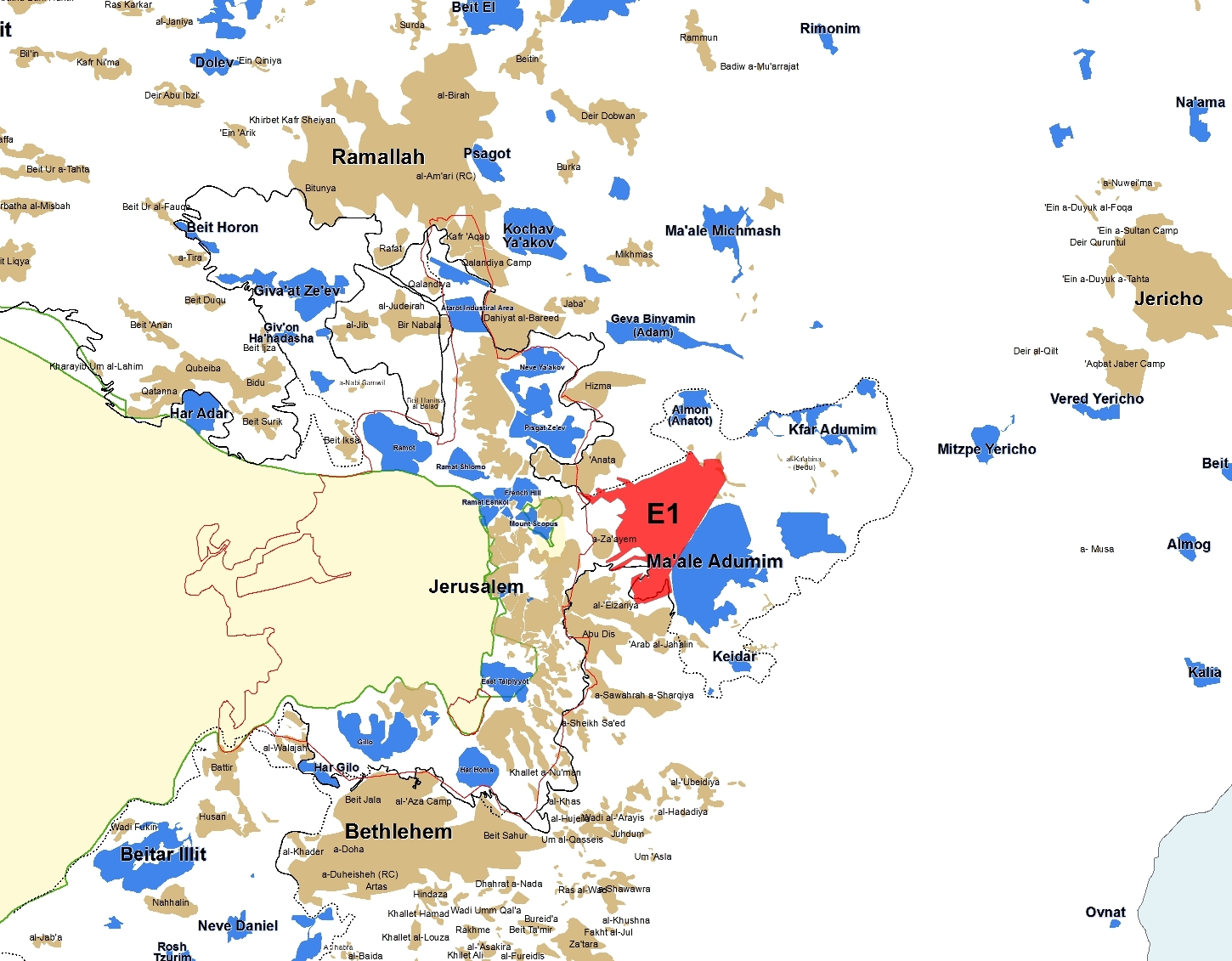 Long called a “doomsday” settlement by supporters of a two-state solution, construction of the E-1 settlement would sever the West Bank effectively in half, foreclosing the possibility of drawing a border between Israel and Palestine in a manner which preserves territorial contiguity between the northern and southern parts of the West Bank. The “Sovereignty Road” has long been Israel’s answer to that criticism, with Israel arguing that it will replace territorial contiguity with limited “transportational continuity” – via a sealed road that is under Israel’s total control (meaning they can cut off passage through it at any time). Just last month (January 2021), Netanyahu promised to increase funding for the Sovereignty Road as part of the drive to get E-1 constructed.
Ir Amim writes:
“Construction in E1 not only deals a death blow to the prospects of a sustainable Palestinian state with a capital in East Jerusalem, but will likewise lead to the displacement and dispossession of some 3,000 Palestinians living in Bedouin communities in the area, including Khan al-Ahmar.”
Regarding the petition, Peace Now said:
“Construction in E1 is considered essentially fatal to the prospect of a two-state solution because it divides the West Bank into two – a northern and a southern region – and prevents the development of the central Ramallah-East Jerusalem-Bethlehem metropolis in the West Bank. Even from an Israeli development and planning perspective, a settlement in E1 will do more harm than good and it may lead to the weakening of Jerusalem economically and socially.”
The Numbers Prove It: Israel Systematically Denies Palestinians the Right to Build (on their own private land) in Area C
In a new report based on data provided by the Israeli government, Peace Now documents how from 2019-2020, the Israeli Civil Administration approved plans for 16,098 new units for Israeli settlers in Area C, in addition to issuing construction permits for at least an additional 2,233 settler units. During this same period, Israel approved plans for only 265 units for Palestinian communities in Area C. The disparity in planning approvals and permits is not new, tracking with trends over the past decade. Peace Now data shows that from 2009-2018 just 98 construction permits for Palestinians were issued.
Israel’s refusal to allow for Palestinian construction in Area C is accompanied by Israel’s concerted effort to police and demolish “illegal” Palestinian construction there (reminder: when Israel refuses to issue construction permits, Palestinians are put in the position of having to build illegally to meet the population’s basic need for shelter). Peace Now data shows that from 2019-2020 Palestinians filed 313 petitions to stop demolition of structures in Area C. Israel only accepted ONE of those petitions.
These shocking (but not surprising) figures must be understood as part of the ongoing campaign — by settlers and the Israeli government — to entrench and expand Israel’s control over (and de facto annexation of) the entirety of Area C – some 60% of the West Bank. To that end, in September 2020 the Israeli government allocated 20 million NIS ($6 million USD) for the newly created Settlement Affairs Ministry to survey and map unauthorized (by Israel) Palestinian construction in Area C (which, as just noted, Israel has been aggressively demolishing). This funding further empowers a domestic Israeli body to exert extraterritorial sovereignty over Area C – in effect, treating the area as land already annexed by Israel.
The Knesset has also repeatedly hosted forums to discuss the alleged (by Greater Israel advocates) “Palestinian takeover of Area C.” Consistent with this framing (which is predicated on the idea that Area C belongs to Israel and must be defended against Palestinian efforts to steal it), and pushed by outside groups, many members of the Knesset have criticized the Israeli government’s alleged failure to robustly “defend” Israel’s rights/ interests in Area C (e.g., preventing “illegal” Palestinian construction, preventing foreign projects that support Palestinians’ presence in the area, clearing out Palestinians, expanding settlements, consolidating state-built settlement infrastructure).
Israel Hopes to Continue Procedure for Settlement Advancements Established Under Trump
As the Biden Administration continues to take shape, Israel Hayom reports that Israeli officials intend to propose maintaining the arrangement it had in place with the Trump Administration with regards to settlement planning and construction. Under that arrangement, Israel agreed to condense its settlement announcements into four tranches each year, and allowed the Trump Administration to review the plans Israel would be advancing ahead of time, with the understanding that the U.S. would tolerate some settlement activity. Although press reports regarding the Trump arrangement suggest that the U.S. also limited Israel’s ability to build freely in the West Bank by requiring new settlement construction to be adjacent to existing settlement construction (i.e. Israel cannot build anywhere), it in fact did no such thing.
As things stand today, it is not clear where the Biden Administration will end up on the issue of settlements. A report issued last week by the Washington Institute for Near East Affairs’ David Makovsky made the case for the Biden Administration to adopt a policy closely resembling the one Israel Hayom says Israel officials are asking for. Another report, issued a few weeks ago by the Center for New American Security (CNAS) articulates a similar policy as an “option” that the Biden Administration might consider.
FMEP’s Lara Friedman analyzed these recommendations and what they would mean, if adopted by the Biden Administration, in a detailed Twitter thread (part 1 here, Part 2 here), closing with the observation:
“…What’s being recommended is US shift from principled opposition to settlements (consistent with intl law, intl consensus, the principles on which the entire peace process is based, etc) to …[the] US giving a green light for unlimited settlement of parts of the West Bank, alongside continued *impotent* opposition to settlements everywhere else. History has demonstrated where such a policy leads, & it’s not to increased viability/credibility of the two-state solution. Or peace.”
Bonus Material
- “Webinar: Shrinking Space in Area C” (ELSC)
- “How Do You Say Ku Klux Klan in Hebrew?” (Haaretz // Michael Sfard)
- “The State Fills Israel’s High Court With Lies About Palestinians in the West Bank” (Haaretz // Amira Hass)
Welcome to FMEP’s Weekly Settlement & Annexation Report. To subscribe to this report, please click here.
January 8, 2021
- Court Greenlights (Again) Settler Campaign for Mass Eviction of Palestinians from Silwan
- East Jerusalem Palestinians Petition High Court Against Implementation of Absentee Property Law
- Ir Amim Files Petition Against Ateret Cohanim, Citing Misconduct in Silwan
- Israeli Government Invests Millions to Escalate Settler Policing of West Bank Antiquities
- Regavim Launches Legal Petition to Overturn Jordanian Law Preventing Settlers from Directly Purchasing West Bank Land
- IDF Increases Presence in West Bank As Violence Continues to Escalate
- Greek Orthodox Church Rumored to Be Selling Bethlehem-Area Property to Settlers
- Straight from the Source: Regavim Explains Settler Agenda & 2020 Victories
- Bonus Reads
by Kristin McCarthy (kmccarthy@fmep.org)
Court Greenlights (Again) Settler Campaign for Mass Eviction of Palestinians from Silwan

Click to enlarge
On December 23, 2020 the Jerusalem Magistrate Court ruled in favor of the settler group Ateret Cohanim’s right to evict 22 Palestinians (two families) from their longtime home in the Batan al-Hawa section of the Silwan neighborhood of East Jerusalem. This case is part of a large scale campaign by Ateret Cohanim to take control over more properties in Silwan – a campaign which threatens the eviction of about 700 Palestinians. The Court once again upheld Ateret Cohanim’s ownership of those properties via its control of an ancient land trust, which the settlers recently revived in order to enable its eviction effort.
Israeli NGO Ir Amim, which focuses on Jerusalem-related matters, writes:
“It is critical to underscore that the cases in question cannot be characterized as isolated and individual disputes over land ownership between supposed landowners and residents that should be left to play out in the Israeli courts. Rather, there is a systematic campaign, driven by political and ideological objectives, being waged against the Palestinian population, with the end goal of forcibly transferring entire Palestinian communities. These evictions are being advanced by well-funded settler groups who are aided and abetted on all levels of the state and enjoy the complicity of the Israeli courts, which carry far-reaching implications on the future of Jerusalem.”
The most recent ruling builds on the Court’s issuance of eviction notices in early December 2020 and two significant court rulings in late November 2020. In both cases, Israeli courts sided with the Israeli settler group Ateret Cohanim, further consolidating the growing Israeli case law recognizing Ateret Cohanim as the legal owner of a significant amount of land in Silwan (and the buildings on it), entitling the group to pursue the eviction of as many as 700 Palestinians who in many cases have lived on that land for generations. If executed, this would be the largest displacement of Palestinians from East Jerusalem since 1967.
As a reminder, Ateret Cohanim has waged a years-long eviction campaign against Palestinians living in Silwan, on property the settler NGO claims to own. This claim is based on Ateret Cohanim having gained control of the historic Benvenisti Trust, which oversaw the assets of Yemenite Jews who lived in Silwan in the 19th century. Palestinians have challenged the legitimacy of the Benvenisti Trust’s claims to the currently existing buildings, saying that the trust only covered the old buildings (none of which remain standing) and not the land. Israeli Courts have continued to rule in support of Ateret Cohanim’s claims and against Paelstinians who have been living there for decades. Taking a different approach, in June 2020 Palestinians filed a new petition challenging the legality of the functional operations of the Trust/Ateret Cohanim, asserting that Ateret Cohanim is using the Benvenisti Trust as nothing more than an (illegal) front for displacing Palestinians, pointing out that the trust does not have a separate organizational structure, bank account, lawyer, or accountant – and that Ateret Cohanim has folded the operations of the trust into its own operations and there is no distinction between the management or assets of the two entities.
East Jerusalem Palestinians Petition High Court Against Implementation of Absentee Property Law
On December 27, 2020, the Israeli NGO Ir Amim and the Sheikh Jarrah Community Association jointly filed a petition with the Israeli High Court seeking to force the Israeli Custodian General to implement the Absentee Property Law in a more transparent, orderly, and ethical manner. While Ir Amim stresses that the Absentee Property Law is itself unconstitutional, due to its systematic discrimination against Palestinians and their property rights, the petition does not seek to overturn the law. Rather, it seeks only to compel the General Custodian to publish formal procedures and regulations concerning property management in East Jerusalem, and urges that those rules take into account the rights of Palestinian tenants.
As a reminder, Israel’s Absentee Property Law affords Jews the right to reclaim property they owned in East Jerusalem and the West Bank in the period before Israel became a state in 1948, and that they were forced to abandon as a result of the 1948 War. Israel’s law affords no such right to Palestinians who as the result of that same war were likewise forced to abandon property inside what became the State of Israel. After the war, Israel designated such properties “absentee properties” control over which was transferred wholesale to the Israeli state. Israel’s “Custodian General”- the division of the Israeli Justice Ministry which manages properties declared “absentee” under Israel’s Absentee Property Law – has a documented history of working directly with East Jerusalem settler groups and systematically transferring ownership of absentee properties in East Jerusalem to settlers and settler organizations, sometimes without any public disclosure to the Palestinians presently living in those properties. Use of the Absentee Property Law by settlers organizations with the willing participation of the Israeli government is the legal mechanism behind past, present, and future evictions of Palestinains from the most sensitive areas of East Jerusalem (like Sheikh Jarrah and Silwan) where Palestinians are facing mass eviction.
Ir Amim writes:
“For decades, ideological settler organizations have exploited these legal mechanisms and the support they enjoy from state bodies like the General Custodian to advance evictions of Palestinians and takeovers of their homes as a means to establish settler strongholds in the heart of Palestinian neighborhoods. The opening clauses of the petition underscore the unconstitutionality and systemic discrimination created under the auspices of the law through affording Jews the right to retrieve lost pre-1948 properties in East Jerusalem, while no parallel legal mechanism exists for Palestinians who lost assets in West Jerusalem. Instead, the 1950 Absentee Property Law enshrines that properties of Palestinians who were forced to abandon their homes due to the war are deemed absentee and therefore transferred into the possession of the state with no legal recourse to recover them. Although the petition stresses the implicit discrimination in the law, the petition itself does not address its unconstitutionality, but rather the General Custodian’s obligation to operate in a transparent, fair, and ethical manner within the existing framework…The aim of the petition is to therefore challenge, within the existing legal framework, the severe misconduct of the General Custodian in its complicity with settler-initiated eviction lawsuits and to ultimately facilitate the freeze of these eviction proceedings.”
Further reading on the Absentee Property Law and East Jerusalem: Why we need to speak about the Absentee Property Law (Times of Israel, July 5, 2020); Absentees against Their Will – Property Expropriation in East Jerusalem under the Absentee Property Law (Ir Amin, July 2020); Annex and Dispossess: Use of the Absentees’ Property Law to Dispossess Palestinians of their Property in East Jerusalem (Peace Now, July 7, 2020); This isn’t Israel’s first ‘land theft law,’ it won’t be the last (+972 Magazine, Feb. 8, 2019), The Absentee Property Law and itsImplementation in East Jerusalem – A Legal Guide and Analysis (Norwegian Refugee Council, May 2013)
Ir Amim Files Petition Against Ateret Cohanim, Citing Misconduct in Silwan
On December 17, 2020 Ir Amim filed a petition with an Israeli court challenging the issuance of a tender for the construction of a settler-backed “Yemenite cultural center” slated to be built in the Silwan neighborhood of East Jerusalem (i.e., a settlement project cloaked in the guise of a touristic/heritage site). The petition argues that the involvement of the Ateret Cohanim settler organization in the project violates conflict of interest laws and that, ultimately, the project (which is a government project) is using public funds to advance the settlers’ agenda.
Ir Amim explains:
“While the project for the Yemenite Jewish visitor center was officially launched and funded by the Ministry of Culture and the Ministry of Jerusalem Affairs, it is being carried out in close collaboration with the Benvenisti Trust and Ateret Cohanim with the joint purpose, among other things, of encouraging further Jewish settlement in Batan al-Hawa, an area once home to Yemenite Jews prior to 1948.”
Specifically, the petition argues that the East Jerusalem Development Company acted improperly in awarding a tender for the construction of the settlement project because it relied on (or allowed) Ateret Cohanim to drum up interest and provide tours for companies considering bidding for the tender. Further, a senior member of Ateret Cohanim is married to a member of the Board of Directors of the East Jerusalem Development Company.
Though the petition asked the Court to urgently freeze the tender, the Court ruled the same day (December 17th) against the petition. However, in its ruling against Ir Amim’s request, the Court asked the State to respond to Ir Amim’s claims by January 11, 2021.
Israeli Government Invests Millions to Escalate Settler Policing of West Bank Antiquities
Emek Shaveh reports that on January 4th, the Israeli Minister of Jerusalem and Heritage Rafi Peretz (who is on his way out of politics) transferred $7.5 million (NIS 24 million) to West Bank settler municipalities specifically “to add supervisors to the team of the Staff Officer for Archaeology, to improve the Civil Administration’s mechanisms for surveillance of the Palestinian population and for the preservation of archaeological sites located in strategic areas adjacent to Palestinian villages or on private Palestinian land.”
While the objective of protecting antiquities might appear uncontroversial and apolitical, the true objective behind this effort is to support yet another means to surveil, police, and dispossess Palestinians of their properties. It is the result of a campaign that has taken place over the past year in which settlers have been escalating their calls for the Israeli government to seize antiquities located in Palestinian communities across the West Bank, especially in Area C, which Israel treats today as virtually indistinguishable from sovereign Israeli territory.
Emek Shaveh responded:
“It seems that the plan that was unveiled on [January 4th] has very little to do with concern for archaeology and heritage. Antiquities ought to be preserved in partnership with the residents and not in conflict with them. After the Minister of Jerusalem and Heritage gave out tens of millions of shekels last week for strengthening the settlements in East Jerusalem, he is now allocating tens of millions of shekels to restrict Palestinian presence in Area C. It is a pity that the Israeli government, and Minister Peretz in particular, use archaeology for political purposes and do not leave the field of cultural heritage outside the conflict between the Palestinians and the settlers.”
This funding for the settlers to police Palestinians in the name of protecting antiquities is just the latest victory in the settlers’ campaign to use the issue of antiquities protection as a pretext to further squeeze Palestinians, especially in Area C. Previous victories include the Israeli Civil Administration’s recent issuance of expropriation orders for two archaeological sites located on privately owned Palestinian property northwest of Ramallah. The expropriations – the first of their kind in 35 years – come amidst a new campaign by settlers lobbying the government to take control of such sites, based on the settlers’ claims that antiquities are being stolen and the sites are being mis-managed by Palestinians. The settlers’ pressure is also credited as the impetus behind the government’s clandestine raid of a Palestinian village in July 2020 to seize an ancient font. The Palestinian envoy to UNESCO, Mounir Anastas, recently called on the United Nations to pressure Israel into returning the font to the Palestinian authorities.
A new settler group calling itself “Shomrim Al Hanetzach” (“Guardians of Eternity”) recently began surveying areas in the West Bank that Israel has designated as archeaological sites in order to call in Israeli authorities to demolish Palestinian construction in these areas. As a reminder, in 2017, Israel declared 1,000 new archaeological sites in Area C of the West Bank. The group communicates its findings to the Archaeology Unit of the Israeli Civil Administration (reminder: the Civil Administration is the arm of the Israeli Defense Ministry which since 1967 has functioned as the de facto sovereign over the West Bank). The Archaeology Unit, playing its part, then delivers eviction and demolition orders against Palestinians, claiming that the structures damage antiquities in the area.
This new group is, not coincidentally, an offshoot of the radical Regavim organization, which among other things works to push Israeli authorities to demolish Palestinian construction that lacks Israeli permits (permits that Israel virtually never grants). The group’s leaders accuse the Palestinian Authority of mismanaging the sites and they accuse Palestinians of looting them, and demands that Israel annex all the sites. The new group has also raised public alarm about the Trump Plan, alleging that hundreds of biblical sites in the West Bank are slated to become Palestinian territory.
Regavim Launches Legal Petition to Overturn Jordanian Law Preventing Settlers from Directly Purchasing West Bank Land
In late December 2020, the settler group Regavim filed a petition with the Israeli High Court of Justice seeking to overturn a 1953 Jordanian law that prevents land in the West Bank from being sold to any individual who is not of Arab descent. The Court gave the State 60 days to respond to Regavim’s petition.
For context – when Israel took control of the West Bank in 1967, it kept in place a variety of pre-existing laws, including a pre-1967 Jordanian law barring private land sales to non-Arabs. In September 2019, FMEP reported that the Israeli Defense Ministry and the Israeli army had reportedly drafted legal opinions in support of canceling this law in order to allow settlers to directly purchase West Bank land. Those opinions had been submitted for consideration by the Israeli Deputy Attorney General, who, according to Haaretz, was expected at that time to approve them with the backing of the Attorney General.
FMEP’s Lara Friedman weighed in to explain the background of this issue and the magnitude of the proposed change:
“In 1967, Israel established a military government apparatus to run the West Bank, that eventually became the ‘Civil Administration’ (an Orwellian name, since it is an arm of the Israeli military). Israeli military governance in the West Bank was set up, at least in principle and at the start, to operate in a manner consistent with international law. International law requires an occupying power to leave in force the existing laws in the territory it occupies, with limited leeway for that power to issue new administrative orders or laws, but only in cases of military necessity or for the benefit of the local population.
“Over the past 52 years of occupation, Israel has re-purposed this international law-based approach into a system of ‘rule by law’ (versus ‘rule of law’). Israel holds on to and enforces pre-1967 laws where those laws can be interpreted and used to serve Israeli objectives. Where those old laws obstruct or fail to sufficiently facilitate Israel’s objectives, Israel supplants them with IDF-promulgated rules, Israeli court rulings, and Israeli domestic laws (i.e., laws passed by the Knesset that apply inside sovereign Israel and are extended to the settlers – as citizens – and to matter that relate to settlers in the West Bank, in what increasingly constitutes a form of “legislative annexation.” [for more details, see Yesh Din’s excellent report, “Through the Lens of Israel’s Interests”: The Civil Administration in the West Bank].
As a result, since 1967, Palestinians in the West Bank have been governed by an ever-evolving legal system that includes: (1) pre-1967 laws (including exploitation of old Ottoman land laws as a means for Israel to declare huge areas of the West Bank to be ‘state land’); (2) international law of occupation (including exploitation of the Occupier’s right to use land for military necessity or the public good as a pretext for massive land expropriation and using land for the sole benefit of the IDF and settlers); (3) Israeli military orders (governing nearly every aspect of Palestinians’ day-to-day lives, including orders closing off access to land); (4) Israeli court rulings (like rulings that legitimize settlers taking over ‘disputed’ houses in Hebron); and (5) increasingly in recent years, Israeli laws, like the Regulation Law (passed by the Knesset and allowing Israel to transfer Palestinian private property to settlers who built on it illegally, based on the argument that the settlers were unaware that the land was privately owned by Palestinians).
Israel’s decision to leave the Jordanian-era law barring the sale of private land in the West Bank to settlers in place for the past 52 years should be understood as an Israeli government decision, reflecting Israel’s own calculation of what policy served its interests. Why would Israel want to limit the ability for settlers to buy West Bank land? For a number of reasons:
(a) security: wherever settlers move in the West Bank, their presence has the potential (even likelihood) of sparking violence and conflict that would compel an IDF response. Even absent such conflict, wherever there are settlers, the IDF is required to invest enormous resources in protecting them (including manpower, physical infrastructure). In short, if settlers can purchase land wherever they want, they can, in effect, hijack the IDF, at great expense to Israeli taxpayers and regardless of security considerations.
(b) international relations: settler activity in the West Bank has for most of the past 52 years been closely watched and sharply criticized by the international community, and especially the United States; so long as Israel maintained an official policy of being the sole authority that could permit the establishment of new settlements, it could limit (to some degree) wildcat settler activity and, where such activity did take place, it could disavow responsibility. Notably, in the earliest days of the settlement movement of the early 1970s, settlers did find a limited method of circumventing the Jordanian law (by purchasing property via front companies – a practice that continues to this day); while it is telling that the Israeli government did not at the time intervene to close this loophole in the law, it is equally tellingly that it did not dare use that loophole as pretext for annulling the law.
(c) diplomacy/peace process: unrestrained settler activity across the entire West Bank, undertaken at will and with an official green light from the Israeli government, contradicts even the thinnest pretense that Israel is not engaged in annexation — and annexation not just of settlement blocs, or Area C, or the Jordan Valley, but of the entire West Bank.
Today, all of these calculations appear to have changed. Israeli military and Defense Ministry advisers are reportedly advocating for Israel to change the law. To this end, they have come up with multiple legal arguments designed to forestall international criticism by arguing that such a change is, in fact, entirely consistent with international law. For example, they suggest playing cynical games with the requirement under international law that laws made by the occupying power be for the benefit of the local population. One idea is to argue that settlers are the “local population” and that Israel thus has an obligation under to adopt laws that are to their benefit (as FMEP has previously explained, in 2016 Israeli Supreme Court Justice Salim Joubran opened the door to including settlers in Israel’s understanding of what constitutes the “local population” of the West Bank). Another idea is to argue that allowing settlers to buy West Bank land would provide an economic benefit to Palestinians. And a third is to argue that Israel has the right as the occupier, under international law, to annul the Jordanian law simply on the basis that Israel views it as racist and discriminatory laws — and citing the actions of the United States in Iraq as a precedent.
In sum, after 52 years of using every legal strategy available to ignore the protection afforded to Palestinians and their land under international law, today Israel is resuscitating the idea of international law in the West Bank — but only as a pretext for a new policy that, if implemented, should put an end to any debate over whether there is any real difference, in practice, between Israeli policies of de facto annexation, and an Israeli policy of official annexation. Israeli authorities and political leaders from across most of the political spectrum no longer even feign commitment to negotiating the future of the land and talk openly of annexation; and it appears that Israeli concerns that settler actions will hijack the IDF are outweighed by the desire to take concrete steps that demonstrate that — even without a formal statement of annexation — Israel has shifted to openly treating the entire West Bank as part of Israel.”
Greek Orthodox Church Rumored to Be Selling Bethlehem-Area Property to Settlers
A Palestinian Christian group, the Orthodox Central Council in Palestine (OCCP), has accused the Orthodox Patriarchate of Jerusalem of planning to sell 27 acres of church-owned lands near Bethlehem to two Israeli development companies dedicated to settlement growth (“Talpiot Hadasha” and “Broeket Habsaga”). The sale will reportedly bring $39 million to the Patriarchate, while the land will be used by the Israeli companies to more seamlessly connect settlements in the area to Jerusalem.
OCCP spokesman Jalal Barham told Middle East Eye:
“This is a new deal, dating from last September, [that] aims to complete an Israeli settlement belt, extending from the Gilo settlement near the Palestinian town of Beit Jala, all the way to Talpiot in Jerusalem.”
Barham further reports that his group has faced backlash for the accusations, and the Palestinian Authority body responsible for church relations has thrown doubt onto the documents and accusation OCCP has led.
IDF Increases Presence in West Bank As Violence Continues to Escalate
Following the deaths of two Israeli settlers in the West Ban at the end of December 2020 – the alleged murder of a settler by a Palestinian and the death of a young settler in a car crash while fleeing Israeli police after allegedly stoning Palestinian cars – the Israeli IDF increased its presence in the occupied West Bank.
Prior to and after these incidents, settler violence against Palestinians and their property has continued to escalate — including a steep increase in attacks to “avenge” the death of the settler youth whose death settlers blame on Israeli police , but whose wrath is being focused equally if not more on Palestinians. However, the Israeli military made it explicitly clear that the increased IDF presence was to protect the settlements and roads, not Palestinians.
The matter of settler violence towards Palestinian was highlighted by two recent reports. In its year-end review, B’Tselem reports:
“[in 2020] B’Tselem’s field researchers documented 248 incidents of settler violence against Palestinians in the West Bank, including: 86 bodily assaults, in which 75 Palestinians were injured; 27 cases of stone-throwing at homes; 17 attacks on moving vehicles; 147 of the attacks were aimed at Palestinian farmers or their property, including 80 cases of damage to trees and crops owned by Palestinians, resulting in more than 3,000 trees vandalized. In 39 cases, the violent acts took place in the olive harvest season, which lasted this year from early October through late November.
Of these incidents, 72 took place in the presence of soldiers, police officers or DCO personnel, who did not intervene to stop the assault on the Palestinians or their property. In 28 cases, soldiers dispersed the Palestinian residents by firing tear gas, stun grenades and rubber-coated metal bullets, and in at least five cases, even live fire. Israeli authorities arrested at least 12 Palestinians during these altercations.
These violent acts could not take place without the sweeping support provided by the state. While security forces back the perpetrators in real time, the law enforcement system releases them from accountability: in almost all cases, no investigation is launched, and no one is held accountable for causing harm to Palestinians. The rare investigations that are launched usually end with no further measures taken. In the even rarer instance of an indictment – the charges fall far short of reflecting the gravity of the acts, and the sentences are ludicrous.”
Additionally, Al-Haq published a new report specifically looking at the Yitzhar settlement and its outposts as well known locusts of violence. Al-Haq documents several cases which exemplify the type of routine violence Yitzhar settlers inflict, writing in the report’s introduction:
“Following the continuous documentation by Al-Haq of settler violence, this Special Focus [Report] presents selected cases from July to October 2020, indicating the severity of violent attacks by the Yitzhar settlers and the gravity of the damage inflicted on Palestinian rights and livelihoods. The following cases further exemplify Israel’s institutionalised and systematic impunity, showcasing not only how the IOF stand by passively as Palestinians are targeted and attacked by Israeli settlers, but also how they further resort to using force against the targeted Palestinians”
Straight from the Source: Regavim Explains Settler Agenda & 2020 Victories
In a year-end email, Regavim (the largest and most influential settler group) boasted of its achievements in 2020 (with blurbs linked to longer posts categorized as “End 2020” on its website). Regavim’s message/posts provide a proud, defiant and, indeed, gloating settlers’ perspective on many of the developments on the ground and campaigns to influence Israeli policy that FMEP’s weekly settlement report tracked in 2020. Likewise, they make explicit how settler actions and campaigns are key to their drive to have Israel formally annex West Bank land, and the degree to which the Israeli government is complicit in implementing Regavim’s agenda.
Notably, Regavim recounted its successes in the two key areas:
- Restarting the government’s land registration process in the West Bank, as a means of allowing settlements to take more land. Regavim explained:
“After the liberation of Judea and Samaria in 1967, the IDF suspended the process of land registration and regulation that had been initiated by the Jordanians and continued by the British mandatory government. As a stop-gap replacement for this process, the IDF instituted a system of “declaration of ownership” for state land. The fact that only one-third of territory of Judea and Samaria had been fully registered at the time this new policy was implemented has created severe constraints for the development of Jewish communities and has enabled Arab land-grabs on a massive scale.
In 2020, Regavim focused on this problem through media and public awareness campaigns and intensive lobbying efforts. Our objective is to generate a much broader understanding that the only way to preserve vital national interests, promote Israeli jurisdiction, and protect individual rights of ownership in these areas is through the renewal of the land regulation and registration process by the State. We are happy to report that as a result of our efforts, both the defense establishment and the Civil Administration published opinion papers that reflect and reinforce our position, and we believe that this breakthrough represents a significant step toward the application of Israeli sovereignty in Judea and Samaria. Currently, we are working at the parliamentary level to promote a government decision renewing the regulation and registration process.”
- Increasing the government’s demolition of Palestinian structures in Area C. Regavim boasted of creating new networks of settlers tasked with policing and investigating the status of Palestinian construction, and then reporting it to the government. Based on this network’s findings, Regavim submitted 15 legal petitions seeking the demolition of Palestinian structures in Area C. As Regavim writes in another report:
“This intensive activity resulted in vastly increased enforcement, measured in hundreds of percent: Each month, engineering and excavation machinery was impounded in dozens of cases, and illegal activities were halted in dozens more. On a parallel track, we convened follow-up hearings in the Foreign Affairs and Defense Committee and in the Knesset plenum. We also established a forum of municipal land-protection coordinators in order to facilitate greater cooperation and formulation of shared operational objectives and procedures, and provided professional training in GIS software, a key tool for field observation and monitoring. In recent months, the Ministry of Settlement Affairs, headed by Minister Tzachi Hanegbi, began to take an active role, which we hope will bolster our efforts to win the battle for Area C. Because the State of Israel’s official response to this serious threat is still desperately insufficient in terms of resource and manpower allocation, Regavim’s activities, which combine an effective presence on the ground with relentless political pressure, continue to attempt to raise awareness and fill the void.”
For more from Regavim, follow the group’s Facebook page and newsletter. Regavim is very public about its agenda and efforts.
Bonus Reads
- “Settlers launch hunger strike, call on Netanyahu to legalize West Bank outposts” (Al-Monitor)
- “US policy of labeling West Bank products as ‘Made in Israel’ takes effect” (JNS)
- “Settlers Control the Drones. The Israeli Army Then Pulls the Trigger” (Haaretz)
- “Israeli settlement hits Palestinian dreams and memories of Jerusalem airport” (Middle East Eye)
- “Netanyahu planning to legalize Bedouin settlements in Negev” (Arutz Sheva)
- “In east Jerusalem, a battle over ‘every inch’ of land” (France 24)
- “Silence in the Face of Demolition and Pogroms” (Zehava Golan // Haaretz)
- “Israel’s demographic battle for Jerusalem leaves Palestinians struggling to survive” (The New Arab)
- “Guess Who is in Charge of the Settlements” (Haaretz)
Welcome to FMEP’s Weekly Settlement & Annexation Report. To subscribe to this report, please click here.
December 4, 2020
- Israeli Courts OK (Again) Settlers’ Mass Displacement of Palestinians from Silwan, Eviction Notices Issued to 8 Palestinian Families
- Har Homa E Settlement Plan Approved for Deposit
- High Court Rules Against Ottoman Land Registration Laws, Paving Way for More Retroactive Legalizations and Presaging Ugly Land Registration Battle
- Planning Committee Rejects Appeal Against Overtly Political Hebron Elevator Project
- Likud Minister Calls For Israel to Enforce “Symmetry” of Construction in Area B + C of West Bank
- Benny Gantz Make Clear His Support for Retroactive Legalization of Outposts on “State Land”
- Bahrain: No Annexation. Also Bahrain: Settlements Are Israel
- Aid to Amb. Friedman Appointed to Key Post, Will Stay In Control of U.S. Normalization Programs
- Bonus Reads
Questions/Comments? Email Kristin McCarthy (kmccarthy@fmep.org).
Israeli Courts OK (Again) Settlers’ Mass Displacement of Palestinians from Silwan, Eviction Notices Issued to 8 Palestinian Families
On November 30th, eight Palestinian families (45 individuals) received eviction notices ordering them them to vacate their longtime family homes as early as December 18, 2020, and if they do not they may be forcibly removed by Israeli forces any time between December 18, 2020-January 1, 2021. Ir Amim reports that the families intend to appeal to the Israeli Supreme Court, but there is no guarantee that the Court will agree to hear the case.
 The issuance of eviction notices follow two significant court rulings on cases in late November 2020. In both cases, Israeli courts sided with the Israeli settler group Ateret Cohanim in seeking the eviction of a total of eight Palestinian families (45 individuals) from their long time homes in the Batan al-Hawa section of Silwan, located on the southern slope just outside of the Old City in East Jerusalem. The rulings further consolidate growing Israeli case law recognizing Ateret Cohanim as the legal owner of a significant amount of land in Silwan (and the buildings on it), entitling the group to pursue the eviction of as many as 700 Palestinians who in many cases have lived on that land for generations. If executed, this would be the largest displacement of Palestinians from East Jerusalem since 1967.
Ir Amim explains:
“The Ateret Cohanim settler organization is waging one of the most comprehensive state-backed settler takeover campaigns in East Jerusalem through initiating mass eviction proceedings against Palestinian families in Batan al-Hawa. Eighteen families have already lost their homes with over 80 other households facing eviction demands, placing some 600-700 individuals of one community at risk of displacement. See Ir Amim’s and Peace Now’s joint report, “Broken Trust” for further details and analysis.
Peace Now said:
“This is an attempt to displace a Palestinian community and to replace it with an Israeli one, in the heart of a Palestinian neighborhood in East Jerusalem. The settlers could not have succeeded without the Israeli authorities’ close support and assistance. In addition to the hard blow to the prospects for a two-state solution by preventing a Palestinian capital in East Jerusalem, this is an injustice and an act of cruelty to throw out families who have lived lawfully in their homes for decades. For every dunam in East Jerusalem that was owned by Jews and had been lost in the 1948 war, there are tens of thousands of dunams in Israel that were owned by Palestinians who lost them in the 1948 war. The settlers’ demand to disposes the Palestinians based on pre-1948 ownership is a strategic threat on the moral justification of hundreds of thousands of Israelis living on lands that were owned by Palestinians.”
As a reminder, Ateret Cohanim has waged a years-long eviction campaign against Palestinians living in Silwan, on property the settler NGO claims to own. This claim is based on Ateret Cohanim having gained control of the historic Benvenisti Trust, which oversaw the assets of Yemenite Jews who lived in Silwan in the 19th century. Palestinians have challenged the legitimacy of the Benvenisti Trust’s claims to the currently existing buildings, saying that the trust only covered the old buildings (none of which remain standing) and not the land. Israeli Courts have continued to rule in support of Ateret Cohanim’s claims and against Paelstinians who have been living there for decades. Taking a different approach, in June 2020 Palestinians filed a new petition challenging the legality of the functional operations of the Trust/Ateret Cohanim, asserting that Ateret Cohanim is using the Benvenisti Trust as nothing more than an (illegal) front for displacing Palestinians, pointing out that the trust does not have a separate organizational structure, bank account, lawyer, or accountant – and that Ateret Cohanim has folded the operations of the trust into its own operations and there is no distinction between the management or assets of the two entities.
As a reminder, in 2001 the Israeli Charitable Trust Registrar granted Ateret Cohanim permission to revive the trust and become its trustees, (following 63 years of dormancy). In 2002, the Israeli Custodian General transferred ownership of the land in Batan al-Hawa to the Trust/Ateret Cohanim. Since then, Ateret Cohanim has accelerated its multifaceted campaign to remove Palestinians from their homes, claiming that the Palestinians are illegally squatting on land owned by the trust.
Har Homa E Settlement Plan Approved for Deposit
As expected, the Jerusalem District Planning Committee approved for deposit for public review the Har Homa E settlement plan which provides for the construction of 540 units on an open area of land which will significantly expand the Har Homa settlement to its west, tightening the noose around the Palestinian neighborhood of Beit Safafa in East Jerusalem. 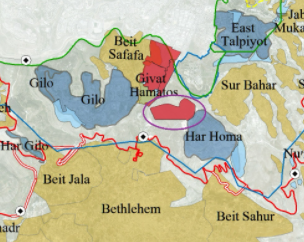
The plan has been approved for deposit but as of this writing not yet deposited; Ir Amim predicts the Committee will deposit the plan in short order in light of the impending U.S. presidential transition. Once deposited, a sixty day comment period begins after which the Committee can reconvene to issue final approval for the plan. Ir Amim writes:
“As demonstrated by the swift developments in plans for Givat Hamatos and Har Homa E, it is likely that Israel will continue to exploit this narrow window of time before the US presidential inauguration to advance further measures the Biden administration is anticipated to oppose, including advancements in the E1 area.”
The plan for 570 units currently set for deposit represents the first detailed plan under a much larger Master Plan for Har Homa E, which involves a total of 2,200 units. Plans to build the remaining units permitted under the Master Plan are not yet being advanced.
The construction in Har Homa E will solidify a continuum of Israeli settlement construction within the southern perimeter of East Jerusalem – from Har Homa, to Givat Hamatos, to Gilo – detaching East Jerusalem from Bethlehem and completing the encirclement of the Palestinian East Jerusalem neighborhood of Beit Safafa.
High Court Rules Against Ottoman Land Registration Laws, Paving Way for More Retroactive Legalizations and Presaging Ugly Land Registration Battle
On December 1st, the Israeli High Court of Justice issued a ruling that provides yet another basis on which the State is permitted to grant retroactive legalization to outposts and settlement structures built on Palestinian land in the West Bank. The ruling also, and perhaps even more significantly, establishes the Court’s willingness to sidestep Ottoman and Jordanian land registration practices when deciding land ownership claims (which since 1967 Israel has recognized as applicable in the West Bank and East Jerusalem) . This latter fact is particularly alarming given Israel’s reported intention to begin a new land registration process in the West Bank and East Jerusalem.
The specific case before the Court related to structures in the Kochav Yaakov settlement built on land that was declared to be “state land” by Israel in 2013. Palestinians petitioned the Court to reverse the state land declaration, arguing that they are the rightful owners of land. Their ownership claims are based on their having cultivated the land for at least ten years prior to 1967, and the fact that they were in the process formally registering their ownership of that land through the Jordanian real estate registration procedure – a procedure that was frozen by Israel shortly after it occupied the West Bank.
The lawyer representing the Kochav Yaakov settlement, Harel Arnon, argued that the Court should care more about what has happened on the land since the Jordanian land registration process was frozen, not on what existed at the moment the law was frozen. This argument, by design, favors the settlements and the settlers, who have been able – with the backing of the state and the permission of the Courts – to illegally establish settlements and outposts while also preventing Palestinians from accessing their land.
Rejecting the significance of the Palestinians’ attempt to register their ownership of the land under Jordanian law (which was still in process and not complete at the time the process was frozen by Israel), the Court ruled on the basis of aerial photos which showed the land was not cultivated between 1969-1980. The ruling punishes Palestinians who, having cultivated land during the period before Israel’s occupation of the West Bank, did not (and likely could not) continue to cultivate that land following the 1967 war. It establishes a new legal precedent according to which Palestinians who established land ownership under Ottoman law through the cultivation of that land for 10 years, can now have that ownership declared “lost” if they have subsequently left the land uncultivated for three or more years.
Shlomi Zacharia, a lawyer from Yesh Din that is representing the Palestinian petitioners, explained:
“The ruling offers a wide opening for a huge takeover of Palestinian land, and in effect this is a cancellation of Jordanian regularization procedures, just at a time when Israel is interested in renewing regularization procedures. The ruling contradicts itself on numerous points, and fails to address the huge complexity of the issue, certainly in light of the fact that the area is occupied territory. The undermining of Palestinian rights, with an emphasis on absentees, but not exclusively, is major, and it is evident that the court is aware of that but chooses nevertheless to approve a practice that already four decades ago was ruled illegal.”
After the court decision on Tuesday, Israel was reportedly planning to legalize two additional outposts, Netiv Ha’avot and Sde Boaz, as well as structures in as many as 20 settlements, using the same legal basis.
The Netiv Ha’avot outpost, in particular, has a long history of being at the forefront of Israel’s hand-wringing over its desire to retroactively legalize even outposts clearly built on land that even Israel recognizes is privately owned by Palestinians. See Peace Now’s comprehensive recap of the Netiv Ha’avot saga, in addition to FMEP’s reporting.
Planning Committee Rejects Appeal Against Overtly Political Hebron Elevator Project
On November 19th, the Israeli Civil Administration’s High Planning Council rejected two appeals against a plan to build accessible infrastructure, including an elevator, at the Ibrahimi Mosque/Tomb of the Patriarch in Hebron — a plan which requires Israel to seize land from the Islamic Waqf. The Israeli NGO Emek Shaveh, which was behind one of the rejected petitions, raised several objections to the plan’s archeological and planning deficits. The Palestinian Municipality of Hebron submitted a second objection (now rejected) citing how the plan and Israel’s advancement of it violates agreements signed by Israel relating to governance and planning in Hebron.
Emek Shaveh announced that it will not pursue further legal appeals against the plan, citing the consequences of a law passed by the Knesset in July 2018 which brought West Bank land disputes under the domestic jurisdiction of the Jerusalem District Court. Before the passage of that law (and since 1967), the court of first jurisdiction for cases related to Palestinians living in the West Bank — such as cases in which Palestinians want to challenge State actions (and inactions) regarding planning and construction, travel permits, freedom of information, and freedom of movement — was the Israeli High Court of Justice, reflecting the extraordinariness of Israeli judges issuing extra-territorial legal rulings. The 2018 law stripped Palestinians of this direct avenue to the High Court of Justice and compelled Palestinians living in the West Bank to file petitions with the Jerusalem District Court. The High Court of Justice now only hears Palestinians’ cases on appeal from the district court, adding more time and higher costs to any potential appellant. In a statement, Emek Shaveh said that it fears that if it brings this specific case to the Jerusalem District Court – which has a clear pro-settlements bent, openly manufactured by former Justice Minister Ayelet Shaked – it risks setting a “dangerous precedent for building at holy sites.”
Emek Shaveh further said:
“Following a prolonged process which revealed that the plan to build a lift at the most important ancient site in the West Bank was approved without serious attention to the historical, archaeological, and architectural aspects, the Civil Administration has decided to approve the plan. The frequent statements by politicians that they had instructed the planning bodies and the Civil Administration to approve the plan as soon as possible, and the speed of the approval process do not leave any room for doubt that political motivations were driving of this decision. The decision to violate the status quo of the fragile arrangements between Israel and the Palestinians may have long-term implications. Unfortunately what happens in Hebron does not remain in Hebron. Often, the dynamics at the Tomb of the Patriarch correspond with developments at the Temple Mount/Haram al-Sharif in Jerusalem. The approval of the plan and the involvement of politicians in the planning processes could constitute a precedent that will impact other sites. We have looked into our legal options and decided not to pursue a petition to the Jerusalem District Court. In the past, petitions pertaining to the West Bank were discussed at the High Court of Justice, but this is no longer the case. It is our understanding that a hearing at the Jerusalem District Court will not improve our chances of reversing the plan and may even create a dangerous precedent for building at holy sites.”
Benny Gantz Make Clear His Support for Retroactive Legalization of Outposts on “State Land”
Two noteworthy events over the past week have led Israeli Defense Minister Benny Gantz (Blue & White) to clarify his position with respect to support for granting retroactive authorization to some of the 124 outposts and settlement structures that were built without Israeli authorization. The events highlight a growing division within the Blue & White Party, which was previously seen as representing a liberal-centrists ideology within the currency (crumbling) coalition government.
First, on November 25th, Israeli Community Affairs Minister Tzachi Hanegbi (Likud) announced that he is working with Blue & White Defense Ministry official Michael Biton to prepare a government decision to grant authorization to the outposts. Hanegbi’s insinuation that Blue & White is advancing a plan to issue a broad authorization for illegal outposts elicited a contradiction from Biton, who quickly distanced himself (and his party) from Hanegbi’s comments, insisting that he would only consider a decision that has the support of Israeli Attorney General Avichai Mandelblit and that Hanegbi did not coordinate the announcement of that project with him.
Following that incident, Israeli Minister of Diaspora Affairs Omer Yankelevich (Blue & White) caused even more controversy when she not only offered her support for the retroactive authorization of settlements to a crowd of pro-settlement protestors, but also told the protestors – who were gathered outside of the Prime Minister’s office to push for outpost regulation – that Benny Gantz supports the move as well.
Yankelevich’s comments resulted in a discussion of the matter at the recent Blue & White faction meeting, during which Gantz reportedly clarified for members of his party that he only supports granting retroactive legalization to outposts built on “state land.” Gantz also said that Michael Biton’s work concerns sorting out what outposts are built on state land and which have more complicated land ownership claims (i.e., outposts built on land that even Israel has been forced to recognize is privately owned by Palestinians).
The statements and reports about Blue & White party members over the past week suggest that Gantz’s party has lined up behind the position of Attorney General Avichai Mandleblit (known as “market regulation”) which is not as sweeping as most settlers would like to see, but nonetheless stands to see some 2,000 illegal structures magically become legal.
Adding to the crescendo of voices pushing for Netanyahu to act on outpost legalization, longtime right-wing settlement supporter and Yamina party leader Naftali Bennett called on Netanyahu to issue the approval swiftly. Politically, Bennett is on the ascent according to Israeli public polling, and is predicted to gain seats for his right wing alliance if new elections are indeed held. Clearly politicizing his position, Bennett said:
“There are more than 60 fledgling settlement communities…The Prime Minister promised in public to apply sovereignty over every settlement, but in practice hasn’t extended sovereignty over a single inch [of Judea and Samaria]….Don’t be afraid. They tried to scare me off of approving the establishment of a new neighborhood in Hebron, but I made the decision, ending 20 years of a building freeze. We are currently in a window of opportunity that will be closing. For years we heard all sorts of excuses. But the truth is, the decision is up to the prime minister.”
Likud Minister Calls For Israel to Enforce “Symmetry” of Construction in Area B + C of West Bank
During a tour of Area C in the West Bank – where settlers and their allies allege that the Palestinian Authority is orchestrating a brilliantly effective campaign to “steal” land from Israel – Likud MK and former Mayor of Jerusalem Nir Barkat said that Israel should not only undertake a concerted effort to stop Palestinian construction in Area C but should enforce “symmetry” in Area B construction as well, enabling equal construction by settlers and Palestinians.
As a reminder, Area B (in which Israel retains security control, but the Palestinians have civilian control) makes up some 21% of the West Bank; Area C (in which Israel retains full control) accounts for around 60% of the West Bank. In effect, Barkat is calling for Israel to treat Area B the same as it treats Area C — that is, to assert settlers’ right to build on fully 81% of the West Bank (meaning all of the West Bank except Area A, the 18% of the West Bank comprised of the narrowly-defined built-up area of Palestinian cities and adjacent villages).
Barkat said:
“Today’s tour showed me that we need to perform a large series of actions to make sure that in the open areas, both in Area C and in Area B and in Judea and Samaria in general, there is symmetry between the activities we do and those of the Palestinians. It cannot be that one side blatantly builds in the open spaces and the other side converges inward into the settlements. This is unthinkable. In Jerusalem I was very strict about symmetry. What is good for Jews is good for Arabs. When you go up here you can also go up there. This symmetry is the key to success in looking ahead. I’m glad I was here today on the tour. I’m happy about the determination and what I saw. I will do everything I can with the tools I have, to see how they take the plan I made, the Barkat development plan for two million people for settlement. On this plan should now be added a second phase. Make sure the open spaces aren’t no man’s land. That Israelis and Palestinians use it appropriately – either no one uses or both sides use it symmetrically. This will be a key to what we need to do going forward.”
Bahrain: No Annexation. Also Bahrain: Settlements Are Israel
In a not-so-surprising yet shocking announcement, a senior Bahraini official announced that Bahrain will not differentiate between Israel and its settlements, in effect recognizing Israeli sovereignty in the West Bank. The Bahraini announcement – which relates to how Bahrain will require Israel to label goods imported into the country – follows the significant shift in U.S. policy on labelling a few weeks ago. With respect to settlement products, Bahraini Industry, Commerce and Tourism Minister Zayed bin Rashid Al Zayani said:
“we will recognize them as Israeli products. And all Bahraini products, hopefully, will be recognized in Israel as Bahraini products. I don’t see, frankly, a distinction on which part or which city or which region it was manufactured or sourced from.”
Efrat settlement leader Oded Revivi rejoiced at Bahrain’s support for settlements, saying:
“Now we must adopt this view with our neighbors within and without Israeli borders. Buying products from Judea and Samaria strengthens the joint industrial areas, brings together cultures and actually strengthens peace. This is a message to Israelis and the world.”
Aid to Amb. Friedman Appointed to Key Post, Will Stay In Control of U.S. Normalization Programs
Rabbi Aryeh Lightstone – who has served as a key aide to Ambassador David Friedman – has been installed as the Director of the Abraham Fund, a new investment fund that is the direct outgrowth of the normalization agreement signed by the U.S, Israel, and the UAE. Prior to serving in government, Lightstone was a prominent fundraiser for the radical far-right, proto-fascist Israeli group Im Tirtzu. Im Tirtzu makes it its business to attack and smear human rights organizations, accusing groups like the New Israel Fund and Breaking the Silence (and the individuals who work there) of being anti-Israel and seeking to defund them.
The fund is supposed to serve as the vehicle by which the U.S. advances business ties and investments between Israel, the U.S., and the Arab world – and has already raised $3 billion. The Fund, according to JTA, has been directly attached to the U.S. International Development Finance Corp (DFC), the U.S. government’s development bank. The relationship between the Fund and the DFC has already alarmed at least one Democratic Senate aide, who told JTA that the DFC must act in a strictly non-political manner, whereas the Abraham Fund is already engaging in highly political issues with its first project devoted to “modernizing” checkpoints across the West Bank.
JTA reports that Democrats in Congress are alarmed at Lightstone’s appointment to this post because it is a career government role, not a position which can be easily replaced by the incoming Biden Administration. Lightstone’s leadership at the Abraham Fund is clearly an effort to ensure that the Trump Administration’s legacy of pro-settlement, pro-annexationist policies will continue to be a part of how the U.S. will engage the region.
Bonus Reads
- “Trump administration to name political appointee with ties to Israel’s right wing to Middle East development post” (JTA)
- “Inside Trump and Netanyahu’s ‘end of season’ settlement bonanza” (+972 Magazine)
- “Israel and PA push for control of West Bank’s Area C via land registration” (Jerusalem Post)
- “Eight climate activists arrested in protest against new West Bank industrial zone” (+972 Magazine)
- “Palestinians voice concern over new colonial settlement in Hebron’s Old City” (Wafa)
- “Jerusalem cable car taken to Israel’s highest court” (Al-Monitor)
- Would Trump Recognize Israeli Sovereignty in East Jerusalem? – analysis” (Jerusalem Post)
- “Trump-Heights settlement in Golan here to stay” (Al-Monitor)
- “A Life Exposed: Military invasions of Palestinian homes in the West Bank” (Yesh Din, Physicians for Human Rights – Israel, Breaking the Silence)
Welcome to FMEP’s Weekly Settlement & Annexation Report. To subscribe to this report, please click here.
November 20, 2020
- Final Days of Trump Admin, Part 1: Historic Shifts in US Settlements Policy
- Final Days of Trump Admin, Part 2: Full Steam Ahead on Givat Hamatos Settlement
- Final Days of Trump Admin, Part 3: Israel Expected to Advance Har Homa E Settlement Plan
- Final Days of Trump Admin, Part 4: Israel Set to Start Process of Land Registration in East Jerusalem
- Final Days of Trump Admin, Part 5: Settlers Push to Re-Establish Abandoned Settlements in Northern West Bank
- Final Days of Trump Admin, Part 6: Bibi Seeks U.S. OK for More Settlement Projects, Settlers Push for Outpost Authorization
- Israeli Education Minister Celebrates New Settlement Yeshiva
- IDF Pays for Use of Yeshiva After Settlers Destroy Army Base
- Impending Sheikh Jarrah Evictions
- Bonus Reads
Questions/Comments? Email Kristin McCarthy (kmccarthy@fmep.org).
Final Days of Trump Admin, Part 1: Historic Shifts in US Settlements Policy
U.S. Secretary of State Mike Pompeo landed in Israel on November 19th for a two-day visit in which he made history with respect to U.S. support for settlements, delivering a series of extraordinary (though entirely predictable) victories to Israeli settlements and Israel’s Greater Israel pro-annexation movement.
First, Pompeo became the first U.S. Secretary of State to visit the Israel-occupied Golan Heights since the Trump Administration recognized Israeli sovereignty there in March 2019, .
Second, Pompeo became the first U.S. Secretary of State to visit a West Bank Israeli settlement, in a visit publicly framed as establishing the legitimacy of settlements. Pompeo’s visit to the Psagot Winery – located near Ramallah – flouted international law and international consensus, which views Israel’s settlement enterprise as illegal [for a deep dive in the history of the Psagot settlement and the significance of Pompeo’s visit – check out this FMEP podcast with Dror Etkes, Fadi Quran, and Lara Friedman].
Third, in conjunction with his visit to the Psagot Winery settlement, Pompeo announced new U.S. guidelines that require products made in all areas under Israeli control to be labelled as “Made in Israel” (or iterations thereof) when being exported to the U.S. This is a massive and highly consequential shift in U.S. policy that offers recognition of Israeli sovereignty not only over settlements (as the Trump Administration has previously done) but over all of Area C – some 60% of the West Bank. The announcement was urged on by a group of four Republican Senators ahead of Pompeo’s trip. The policy, which if focused on territory, not people, would require even Palestinian-made goods originating from villages in Area C to be labelled as “Made in Israel”. Roughly 150,000 Palestinians live in Area C, where they are subjected to an escalating Israeli campaign to make life untenable for them via discriminatory planning policies and demolitions.
Laying out the new policy, the State Department issued a statement saying:
“Today, the Department of State is initiating new guidelines to ensure that country of origin markings for Israeli and Palestinian goods are consistent with our reality-based foreign policy approach. In accordance with this announcement, all producers within areas where Israel exercises the relevant authorities – most notably Area C under the Oslo Accords - will be required to mark goods as ’Israel’, ’Product of Israel’, or ‘Made in Israel’ when exporting to the United States. This approach recognizes that Area C producers operate within the economic and administrative framework of Israel and their goods should be treated accordingly. This update will also eliminate confusion by recognizing that producers in other parts of the West Bank are for all practical purposes administratively separate and that their goods should be marked accordingly.”
Pompeo made this announcement following his visit to the Psagot winery – which not only named a vintage after Pompeo but has also been at the center of Israel’s global effort to push nations to treat Israeli settlements as indistinguishable from sovereign Israeli territory, with the winery involved in international legal battles over how Israeli businesses located in the settlements are required to label their products. U.S. labelling requirements will now stand at odds with European policy on the matter, which requires differentiation between products made in Israel and products made in settlements.
As part of the major change in U.S. labelling policy, Pompeo also changed how Palestinian-made products (produced in Areas A & B, and in the Gaza Strip) must be labelled, replacing the “West Bank/Gaza” label with separate “West Bank” and “Gaza” labels – another symbolic move laced with antagonism towards Palestinian rights and national aspirations. The change also contradicts the Oslo Accords, under which the Gaza Strip and West Bank are to be treated as a single territorial entity. The U.S. State Department statement on the labelling policy reads:
“We will no longer accept ’West Bank/Gaza’ or similar markings, in recognition that Gaza and the West Bank are politically and administratively separate and should be treated accordingly.”
Fourth, in a press conference alongside PM Netanyahy, Pompeo announced that the U.S. holds the “global BDS campaign” to be anti-Semitic, and said that the U.S. will “immediately take steps to identify the organizations that engage in hateful BDS conduct and withdraw US government support from such groups.” Pompeo called BDS a “cancer.” This is particularly relevant to settlement and annexation watchers because the new U.S. designation makes no distinction between boycotts aimed at Israel and boycotts limited to Israeli settlements – yet another legal step towards offering official U.S. recognition of Israel’s annexation of the settlements. It had previously been reported that the U.S. State Department were preparing to label Human Rights Watch, Oxfam, and Amnesty International as anti-Semitic organizations, based on the IHRA definition of anti-Semitism.
Fifth, under the protection of a large Israeli security escort, Pompeo visited the Elad settler organization’s archeological projects in the City of David, an Israeli national park which was declared on top of the Palestinian neighborhood of Silwan, located right outside of the walls of the Old City of Jerusalem. Under Elad’s direction, and with the support of the Israeli government and the Trump Administration, archeology is being weaponized to erase the historic memory and the modern presence of Palestinians, while emphasizing the Jewish heritage at that site. At the same time, settler organizations including Elad and Ateret Cohanim are battling to implement the mass eviction of Paelstinians from their longtime homes in Silwan.
Israeli NGO Emek Shaveh – a group of expert archaeologists – previously explained:
“The use of archaeology by Israel and the settlers as a political tool is a part of a strategy to shape the historic city and unilaterally entrench Israeli sovereignty over ancient Jerusalem. It is a process which is likely to produce devastating results for both Israel and the Palestinians. It is inexcusable to ignore the Palestinian residents of Silwan, carrying out extensive excavations of an underground city and to use such excavations as part of an effort to tell a historic story that is exclusively Jewish in a 4,000 year-old city with a rich and diverse cultural and religious past.”
And in a piece entitled “Israel Is Using Archeology To Erase Non-Jewish History,” Emek Shaveh further explained:
“The exploitation of archaeology in Jerusalem has been spearheaded by the Elad Foundation, a group of settlers turned archaeology entrepreneurs, who are using ancient sites to take over land and shape the historical narrative. Elad, which emerged 30 years ago with a mission to settle Jews in Palestinian homes in the neighborhood of Silwan, manages the popular archaeological park, the City of David. Visitors to the site are treated to a heavily biblical narrative where discoveries that resonate with the story of King David or the Kingdom of Judea are highlighted. The fact the archaeologists dispute the evidence of a kingdom in the 10th century BCE often goes unmentioned. Furthermore, not many of the half a million people who visit the park annually know about life in the Palestinian neighborhood since Elad arrived on the scene. They will probably never hear about how Elad took over 75 homes in the neighborhood, or closed off virtually the last of the public areas used by the residents and annexed it to the archaeological park. With an annual budget of approximately 100 million shekels, the Elad Foundation now commands several excavation projects in the City of David, including tunnels along an ancient Roman street, which it is marketing as a Second Temple era pilgrims’ route to the Temple. It has recently branched out to establish new projects within the Old City and in other areas throughout the Historic Basin. But Elad couldn’t have done it on their own. If at first they were greeted with mistrust by the authorities in the 1990s, today they have an open door to many government agencies and ministries. From the Israel Antiquities Authority, which is in charge of most of the excavations at the City of David, and the Nature and Parks Authority, which subcontracted Elad to run the site, to the minister of tourism, who is aggressively advancing a cable car to link West Jerusalem to the City of David, to the mayor of Jerusalem, the government and all the relevant agencies are committed to the project of shaping a large tourist zone dedicated to the First and Second Temple periods.”
Final Days of Trump Admin, Part 2: Full Steam Ahead on Givat Hamatos Settlement
On November 15th, the Israel Land Authority published the long-feared/long-awaited (depending who you are) tender for the construction of the Givat Hamatos settlement in East Jerusalem. The tenders provide for the construction of 1,257 settlement units, which is about 200 units more than expected. The tender is set to close for bids on January 18, 2021 – exactly two days before the inauguration of President-elect Joe Biden. In a carefully worded statement to the press, Netanyahu acknowledged that the publication of the Givat Hamatos tender had been coordinated with the Trump Administration (but not the Biden transition team).
Terrestrial Jerusalem writes:
“The decision to proceed with the construction of Givat Hamatos is the most defiant and inflammatory settlement move in recent memory, and should be treated as such. The construction of Givat Hamatos will create a buffer, contributing to an effective seal between East Jerusalem and Bethlehem. In addition, Givat Hamatos will, for the first time, completely surround an East Jerusalem neighborhood, Beit Safafa, with Israel construction, making the implementation of the Clinton parameters in East Jerusalem impossible. Givat Hamatos will have a devastating impact on the very possibility of a future two-state outcome.”
Ir Amim writes:
“The opening of the tender significantly decreases the potentiality to effectively block Israeli building in the area. Concerted opposition and pressure to freeze the tender is therefore vital in this limited window of time. If carried through, Givat Hamatos would become the first new settlement in East Jerusalem in 20 years. Located in a particularly strategic area, Givat Hamatos (along with Har Homa E and E1) has constituted a longstanding international red line due its impact on the prospects of a viable two-state framework with two capitals in Jerusalem. By creating a contiguous Israeli built-up area between the existing settlements of Gilo and Har Homa, construction in Givat Hamatos will serve to seal off the southern perimeter of East Jerusalem from Bethlehem and the southern part of the West Bank, while isolating the Palestinian neighborhood of Beit Safafa. The next two months in lead-up to the change in the US Presidential Administration will be a critical period. We believe that Israel will attempt to exploit this time to advance moves that the incoming administration will potentially oppose. It is crucial that the international community remain vigilant.”
Peace Now writes:
“Construction in Givat Hamatos will severely hamper the prospect of a two-state solution because it will ultimately block the possibility of territorial contiguity between East Jerusalem and Bethlehem–the main Palestinian metropolitan area–and will prevent Palestinian Beit Safafa from connecting with a future Palestinian state…The meaning of the publication of the Tender Booklet is that now the tender is open for bids and contractors may submit their proposals to win the right to build the units in Givat Hamatos. The final day for submitting the proposals is January 18th, 2021, three days before the change in the US administration…This is a major blow to the prospects for peace and the possibility of a two-state solution. This Netanyahu-Gantz government was established to fight the coronavirus but instead it is taking advantage of the final weeks of the Trump administration in order to set facts on the ground that will be exceedingly hard to undo in order to achieve peace. This tender can still be stopped. We hope that those in this government who still have some sense of responsibility for our future will do what they can to cancel the tender before bids are submitted.”
Nabil Abu Rudeineh, the spokesman for President Mahmoud Abbas, said:
“Israel is trying to benefit from the unlimited support of the current U.S. administration, which has provided it with all possible support for the sake of settlement expansion and the takeover of more Palestinian lands.”
PA Prime Minister Muhammed Shtayyeh said in a statement:
“There appears to be an escalating and intensive assault plan for the next 10 weeks in a race against time to create a new fait accompli before Donald Trump leaves the White House on January 21. We look with concern at the frequent reports about new colonial settlement projects in Arab Jerusalem and the West Bank, which aim to encircle and stifle the Palestinian Arab neighborhoods and prevent interaction between them and the rest of the West Bank and to completely isolate the city of Jerusalem.”
International reaction to Israel’s decision to publish the tender for the construction of the Givat Hamatos settlement — long treated as a red line by the international community — was predictably tempered. Several foreign governments issued statements of “concern,” including Saudi Arabia, Germany, France, the UK, Russia, and Italy, in addition to statements from UN Envoy Nikolay Mladenov and European Union High Commissioner Josep Borrell. The United Nations General Assembly passed a resolution – by an overwhelming majority — calling on all governments to refrain from treating Israel’s settlements in the West Bank or East Jerusalem as part of sovereign Israeli territory. B’Tselem Director Hagai El-Ad urged European governments to move from words to action.
Meanwhile, a delegation of European Union representatives received a hostile greeting from right-wing settlement supporters organized by hardline Israeli NGO Im Tirzu when the delegation attempted to visit the site of the future Givat Hamatos settlement on November 16th. The diplomats’ caravan was actually chased off by the right-wing protestors, which included Jerusalem city councilman and settlement empresario Ariyehh King, who shouted “Go home, anti-Semites!” at the visiting EU diplomats.
Though many settlers celebrated the publication of the Givat Hamatos tender, settlers who are currently living in the area of Givat Hamatos remain skeptical that the government will actually follow through. It’s worth noting that the government has provided mobile homes to about 30 families who live in the Givate Hamatos hillside as squatters, having waited 30 years since the Givat Hamatos plan was given final approval for construction to happen. Wall-to-wall international opposition to the settlement plan deterred the Israeli government from publishing them.
MK Miki Zohar (Likud) celebrated the new tender in a tweet saying:
“Now we can talk about it. Before the last elections, Prime Minister Benjamin Netanyahu promised me that he would publicize the building tender in Jerusalem’s Givat Hamatos; this neighborhood is in a strategic location between Beit Safafa and Hebron road. It important to build there in order to maintain a Jewish land continuum … We have a one-time opportunity these days to strengthen our hold in the land of Israel. I am sure that our friend, President [Donald] Trump, and Prime Minister Netanyahu will be wise enough to take full advantage of this opportunity.”
Final Days of Trump Admin, Part 3: Israel Expected to Advance Har Homa E Settlement Plan
As anticipated in last week’s Settlement Report, the Israeli government has decided to press forward with a highly controversial and consequential plan to expand the East Jerusalem settlement of Har Homa westward, toward the site of the future Givat Hamatos settlement (discussed above). Ir Amim reports that on November 23rd, the Jerusalem District Planning Committee is scheduled to take up the plan for 570 new units – called Har Homa E – for the second time this year, and is expected to approve the plan for deposit for public review, one of the final steps before implementation.
Ir Amim warns:
“The rapid advancement of this plan is indicative of the Israeli government’s intent to accelerate as many settlement construction projects as possible in East Jerusalem and its vicinity in the waning days of the Trump administration.”
The construction in Har Homa E will solidify a continuum of Israeli settlement construction within the southern perimeter of East Jerusalem – from Har Homa, to Givat Hamatos, to Gilo – detaching East Jerusalem from Bethlehem and completing the encirclement of the Palestinian East Jerusalem neighborhood of Beit Safafa.
The plan for Har Homa E was last discussed in September 2020, when the District Planning Committee signaled its support for approving the plan for deposit, but requested several amendments prior granting that approval. With the modifications made, the expectation is that the committee will now give its formal approval, setting off a period of 60 days during which the public can submit objections to the plan.
The plan for 570 units currently set for approval represents the first detailed plan under a much larger Master Plan for Har Homa E, which involves a total of 2,200 units. Plans to build the remaining units permitted under the Master Plan are not yet being advanced.
Ir Amim writes:
“Construction in Har Homa E will serve as another step in connecting the existing Gilo and Har Homa neighborhoods/settlements and create a contiguous Israeli built-up area along the southern perimeter of East Jerusalem. This will likewise detach Bethlehem and the southern West Bank from East Jerusalem while isolating the Palestinian neighborhood of Beit Safafa. In line with the new reality created by the Trump Plan and its unilateral recognition of Israeli sovereignty of East Jerusalem, these developments will constitute a major obstacle towards the future establishment of a Palestinian capital in the city and the prospect of a viable two-state framework.”
Final Days of Trump Admin, Part 4: Israel Set to Start Process of Land Registration in East Jerusalem
In an interview celebrating the publication of a tender for Givat Hamatos settlement project, Jerusalem Affairs & Heritage Minister Rafi Peretz connected the project to a larger Israeli effort to begin registering all East Jerusalem land in Israeli records, an effort which Peretz is spearheading. Al-Monitor reports that, as part of the Givat Hamatos project, the Israeli Finance and Justice Ministry’s acted swiftly to approve a budget, remove legal impediments, and finalize “financial compensation packages with the Palestinian land-owners” so that the land can be properly registered in Israeli government books.
Perez stated:
“The fact that almost all of the land in the eastern part of Jerusalem is not registered properly is something that should have been addressed a long time ago already. The plans that I have developed for registering land plots and properties have now been adopted by the various government ministries concerned, and once they are implemented, they will go a long way to improving the situation for the residents of these areas. A united Jerusalem is not a slogan – it’s a vision, and one that needs to apply to the eastern part of the city just as it applies to the west.”
The Israel-run process of registering ownership of land in East Jerusalem land will have far-reaching consequences for Palestinians, who have not had a formal legal avenue for registering land ownership with the Israeli government since East Jerusalem was annexed by Israel in 1967. Palestinians who wanted/needed to prove their land ownership were forced to rely on the “mukhtar protocol” — a procedure in which Palestinians in East Jerusalemites document/prove ownership by collecting signatures from local Palestinian leaders acknowledging that the land in question does, indeed, belong to them. This policy was developed by the Israeli government as an alternative to the formal land-registration process, which was frozen in East Jerusalem since 1967.
In 2019, a mini-saga over the “mukhtar protocol” revealed the uphill battle facing Palestinians if formal registration proceeds. In March 2019, the Jerusalem Planning & Building Committee, at the urging of the Regavim settler group (acting with the clear goal of preventing Palestinian development and undermining Palestinian land ownership claims to land in the city), annulled the mukhtar protocol as a legally acceptable basis for establishing land ownership in the eyes of the Israeli government, putting Palestinian land ownership in East Jerusalem in limbo. The result: having no recognized means to prove their land ownership, Palestinians were prevented from building in East Jerusalem. One month later, the Israeli authorities reversed the decision and again recognized the mukhtar protocol, reportedly following appeals to Jerusalem Mayor Moshe Leon by a city council member.
This news about starting the land registration process in East Jerusalem comes only a few weeks after Israel was reported to be advancing plans to begin a process of land registration for Area C of the West Bank — a process that opens another door for Israel to seize more Palestinian land. The registration process in East Jerusalem is expected to have similar results.
Final Days of Trump Admin, Part 5: Settlers Push to Re-Establish Abandoned Settlements in Northern West Bank
A group of 100 settlers, including children, invaded and set up camp at the abandoned site of the Sa-Nur settlement in the northern West Bank in an attempt to pressure the government to allow them to re-establish the settlement, which the state dismantled as part its 2005 disengagement from Gaza. After the Israeli army arrived at the site to evict the trespassers, MK Miki Zohar (Likud) persuaded the settlers to abandon their illegal campsite and leave the area, with the promise of raising the issue of Sa-Nur’s re establishment directly with Netanyahu.
MK Zohar is a staunch supporter of reestablishing Sa-Nur, along with three other settlements in the area that were likewise dismantled by the Israeli government in 2005 (Homesh, Ganim, and Kadim). Zohar has participated in previous visits to the site to support the settlers’ bid, frequently accompanied by his Likud colleagues, including former Speaker of the Knesset Yuli Edelstein. In July 2018, the Israeli Cabinet had the opportunity to lend government backing to a bill that would have cancelled the 2005 disengagement and allowed the settlers to rebuild those settlements – but the Cabinet blocked the bill. The settlers and their allies are no doubt raising this issue now, at a time when it seems like the wildest wishes of the settler enterprise are being fulfilled one after another.
As a reminder, even though Israel evacuated the four settlements in the West Bank, the IDF issued military orders barring Palestinians from entering the areas, preventing Palestinians from taking control over the area and building there. At the same time, settlers have regularly entered the areas and even repeatedly built a yeshiva at the Homesh site.
Final Days of Trump Admin, Part 6: Bibi Seeks U.S. OK for More Settlement Projects, Settlers Push for Outpost Authorization
In addition to the extraordinary settlement plans unleashed over the past two weeks, Israeli media reports that Prime Minister Netanyahu is seeking the blessing of the Trump Administration to push forward additional East Jerusalem settlement projects in the immediate future. Israel’s Kan News Radio reported that Netanyahu planned to raise the settlement projects with U.S. Secretary of State Mike Pompeo during his trip to Israel this week. With developments related to Givat Hamatos and Har Homa E making the news this week, we can speculate that Netanyahu might be asking specifically about the Atarot settlement plan (northern tip of Jerusalem) and/or the E-1 settlement plan (just east of Jerusalem) – as FMEP laid out last week.
Another possibility is, of course, outpost legalizations. Settlers and their allies in the Israeli government are continuing their campaign to pressure Netanyahu to grant retroactive authorization to all of Israel’s outposts and illegal settler construction across the West Bank before Trump leaves office. Since FMEP’s last reporting two weeks ago, the Israel Land Caucus has begun collecting signatures on a petition calling on Netanyahu to act immediately on this matter. According to the Times of Israel the petition states that the Knesset committee, which includes senior members of Netanyahu’s own Likud Party, is “united in the position that the regulation of young settlements must be done now…it is not fair, reasonable or responsible to leave the settlements without status and the tens of thousands of their residents deprived of their rights.”
Just this week Defense Ministry legal advisor Moshe Frucht stated that a government declaration authorizing the outposts is required prior to any actions that treat the outposts as legal communities – specifically rebuffing the request by settlers for the Defense Ministry to connect unauthorized outposts to Israeli state utilities. Frucht’s statement, combined with Netanyahu’s lack of action, enraged MK Bezalel Smotrich (Yamina) who sharply scolded Netanyahu’s top settlements advisor in a Knesset hearing this week.
Israeli Education Minister Celebrates New Settlement Yeshiva
Israeli Minister of Education Yoav Galant (Likud) attended the opening of a new religious school (yeshiva) in the Bruchin settlement, located in a finger of continuous settlements that extends from the 1967 Green Line to the Ariel settlement in the very center of the northern West Bank.
Making it clear that opening yeshivas is part of Israel’s entrenchment and expansion of settlements across the West Bank, Galant said at the event:
“I am delighted to be here in order to celebrate the inauguration of this new building for a yeshiva high school in Bruchin, together with my good friend Yossi Dagan, who has done so much to develop Jewish settlement in the Samaria region and specifically to advance the educational network here. This new building will serve all the students of the local communities and neighborhoods that have been established in the area in the last few years. I am deeply committed to promoting Jewish settlement in Judea and Samaria. As Education Minister, I will continue to do all I can to further settlement here, just as I did when I was Housing & Construction Minister – and, indeed, as I have done throughout my life. It’s time that we settled the entire Land, from the Jordan River to the sea. I hope that the students who come to learn here will be able to commence their studies this winter.”
IDF Pays for Use of Yeshiva After Settlers Destroy Army Base
The Times of Israel reports that Israel has agreed to pay the operators of a violent yeshiva associated with the Yitzhar settlement a sum of $118,750 (400,000 NIS) to cover the cost of the building’s use by security forces over the past six years.
In 2014, a mob of violent settlers stormed an army base near the Yitzhar settlement, leaving several officers wounded and destroying all military equipment at the site. After the attack, the IDF seized the yeshiva to use as a temporary base (since theirs was destroyed). It has continued to use the yeshiva since that time, and will now pay the settlers for the inconvenience.
Impending Sheikh Jarrah Evictions
Earlier this month, the Jerusalem Magistrate’s court notified four Palestinian families living in Sheikh Jarrah that they must vacate their longtime homes by November 24th, or else be forcibly evicted. One of those families is the Sabbagh family, whose legal struggle against Israeli settler groups has previously caught international attention and sparked weekly protests in Sheikh Jarrah to stop their eviction.
The Sabbagh family has lived in their home for over 64 years, and have been battling the settler organization Nahalat Shimon for their right to remain in their home. Nahalat Shimon was awarded ownership rights of the Sabbagh’s house through the use of the “Legal and Administration Matters Law,” which allows Israeli Jews (but not Palestinians) to reclaim property lost/abandoned during the 1948 war. Nahalat Shimon managed to find the Jewish Israeli family who owned the home prior to the 1948 War and convinced that family to hand over their ownership rights.
Muhammed al-Sabbagh told the Middle East Eye recently:
“I know that the Israeli court will not do justice to me. They will not be on my side against Israeli settlers. But I will fight until the very end to protect my home where I grew up, the only safe haven for me and my family.”
Sami Ershid, the family’s lawyer, told Middle East Eye:
“For years, these [families] wake up thinking what the court will rule against them. They live a life completely devoid of stability, thinking when they will be forcibly expelled from their homes. The [Israeli] goal is clear: to create a new settler neighbourhood on the rubble of their homes.”
Just Vision – who shared one Sheikh Jarrah family’s story in the docuseries “My Neighborhood,” said in an email drawing attention to these evictions:
“While the cases in Sheikh Jarrah are thinly veiled as a legal matter, the political motivations are clear. This latest round of evictions is part of a broader attempt by the Israeli state to forcibly displace Palestinians from their homes in East Jerusalem and the West Bank. The process is methodical and impacts thousands of lives on a daily basis. In the past month alone, Israel hid under the US election media frenzy to undertake the largest demolition of Palestinian homes and structures in a decade, and just yesterday, announced a new settlement, Givat Hamatos, that would effectively cut East Jerusalem off from Bethlehem. This all happens under the United States’ watch – subsequent US administrations have done little to hold the Israeli government to account, and the latest administration has given a carte-blanche for unjust activity like this.”
Bonus Reads
- “Occupied Thoughts: “Pompeo in Psagot” ft. Fadi Quran, Dror Etkes, & Lara Friedman” (FMEP)
- “Israel Impounds Palestinian’s Cows Grazing on Nature Reserve, Ignores Settlers’ Cows” (Haaretz)
- “Israeli settlers in the West Bank confront the Biden reality and dig in for a fight” (Washington Post)