Welcome to FMEP’s Weekly Settlement Report, covering everything you need to know about Israeli settlement activity this week.
To subscribe to this report, please click here.
July 26, 2024
- Israeli Army Seizes Key Area of Sebastia Archaeological Site
- Family in Old City Faces Dispossession
- First Demolition in Al-Walajah Area C Could be Sign of More to Come
- Peace Now: In 2023, Israeli Government Funded 101 Illegal Outposts
- Israeli Human Rights Groups Publish Joint “State of the Occupation” Report
- Bonus Reads
Israeli Army Seizes Key Area of Sebastia Archaeological Site
Seizure Of Sebastia Summit 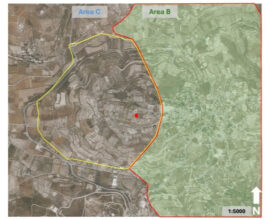 Emek Shaveh reports that on July 10th the Israeli army issued an order seizing land at the summit of the Sebastia archeological site in the northern West Bank. The dot of land (1.3 dunams / .3 acres) is surrounded by the Palestinian village of Sebastia in Area C of the West Bank. Emek Shaveh reports that the IDF is likely to set up a military post on the small area, and erect an Israeli flag at the highest point.
This seizure comes over one year after the Israeli government passed a $9 million (NIS 32 million) plan designed to impose Israeli control over the site both logistically and in the narrative about the site’s history. Emek Shaveh explains:
“the government wants to turn the site into an ‘anchor site’ for tourists which would emphasise Jewish history and Jewish rights to the site. The plan, designed to complete the separation of the acropolis from the village and divert tourism away from the village itself, also threatens the Outstanding Universal Values attributed to the site by the State of Palestine and international experts in the field of heritage. “
Settlers have been openly agitating for Israel to assert control over the archaeological site in Sebastia for years, and the settler Samaria Regional Council organizes regular tours to the site. To secure the settlers’ visits, the IDF shuts down the town of Sebastia, closing Palestinian streets and businesses.
As in other cases across the West Bank, settlers allege that Palestinians are damaging the Sebastia site and that the Israeli government needs to intervene. In 2021 amidst intensifying settler efforts related to the site, the Palestinian Foreign Ministry called on UNESCO to “protect all Palestinian archaeological and religious sites from Israeli violations, attacks and falsifications.” The archaeological site of Sebastia is on the tentative list of World Heritage sites in Palestine.
Family in Old City Faces Dispossession
Ir Amim reports that the Palestinian Quastiro family who has been running a coffee shop (al-Musrara Cafe) located near the Old City of Jerusalem is facing imminent dispossession of their business at the behest of of the Israeli Custodian General, the government body which can “reclaim” buildings that were owned by Jews prior to 1948.
The coffee shop is located on the popular al-Musrara Street, which leads from the Damascus Gate to the Old City towards West Jerusalem Jerusalem. Ir Amim explains “the strategic location has made properties there a target of settler takeover, and a few settler families are already living in some of the residential units in the area….The pretext under which the General Custodian is attempting to evict the family could suggest intent on renting or handing over the property to an Israeli settler organization.”
First Demolition in Al-Walajah Area C Could be Sign of More to Come
Ir Amim reports that on July 22nd Israeli forces demolished the home of the Palestinian Rabah family (12 individuals) in the village of Al-Walaja, located on the southern border of Jerusalem (partially within Israeli’s expanded municipality borders).
Ir Amim explains the significance of this demolition:
“this is the first time a home demolition in Area C of al-Walaja has taken place in years and could indicate a policy change which would place many more homes in the village at risk of demolition. In 2016, the Israeli authorities dramatically toughened their demolition policy in the part of al-Walaja annexed to East Jerusalem. This has resulted in the destruction of dozens of homes in the past eight years by the National Enforcement Unit, an organ of the Ministry of Finance operating in East Jerusalem along with areas inside the Green Line…While the reason behind the Civil Administration’s decision to carry out the demolition is unknown, it could indicate a major change in policy which would place dozens of homes in Area C of al-Walaja under threat of demolition. Finance Minister Bezalel Smotrich who received authority over civil issues in Area C has prioritized increased demolitions of Palestinian homes (along with Israeli takeovers of large areas and authorization of unauthorized outposts). “
The home was built by the Rabah brothers in 2012 adjacent to their parents home on the family’s land. Despite owning the land, the brothers were denied Israeli building permits because the Separation Barrier was being constructed some 35 meters away – – meaning that the land was now located in an area where the ISraeli military prohibits new construction for “security” reasons.
Since 1967, Al-Walajah has suffered due to its location and its complicated status under Israeli law. Much of the village’s lands, including areas with homes, were annexed by Israel in 1967, but Israel never gave the villagers Jerusalem legal residency by Israel – meaning that under Israeli law, their mere presence in their homes is illegal). Today it is acutely suffering from a multi-prong effort by the Israeli government and settlers to grab more land for settlement expansion in pursuit of the “Greater Jerusalem” agenda. This land grab campaign includes home demolitions (four homes in Al-Walajah were demolished by Israel on November 2, 2022, for example), the construction of the separation barrier and bypass roads in a way that seals off the village on three sides, and the systematic denial of planning permits.
Peace Now: In 2023, Israeli Government Funded 101 Illegal Outposts
Peace Now released a new report showing that in 2023 the Israeli government financed 68 settler farming outposts and 33 other (non-farming outposts) to the tune of $7.6 million (NIS 28 million). Peace Now reports that over $20.5 million (NIS 75 million) has been earmarked for outposts in 2024, and that settler regional councils will soon be asked to submit applications for outpost funding in 2024.
The government seeks to obscure its funding of illegal outposts by transferring the money to the World Zionist Organization’s Settlement Division, which then makes the transfers to the outposts. While it is not entirely certain, Peace Now is confident in surmising that government funds were provided by the WZO to five illegal farming outposts that have been targeted by international sanctions.
Peace Now’s findings include:
- In 2023, the Israeli government financed 68 settler farms in the West Bank with an amount of NIS 15 million. Additional NIS 39 million is allocated for farms in 2024.
- In addition the government funded 33 illegal outposts (that are not farms) with NIS 13 million in 2023. Additional NIS million is allocation for outposts in 2024.
- The funds were used for financing vehicles, drones, cameras, electric generators, electric gates, lamp posts, fences, solar panels and more.
- The IDF and the Central Command were involved in planning and approving the funds, including deciding which farms and outposts would receive funding and which components would be financed in each farm and outpost.
The farming outposts have been a particular focus for many settlement watchdog groups because they have significantly proliferated over the past few years, and they are exceptionally effective in gaining control over vast areas in the West Bank with only a few settlers, a few tents, herds of livestock, and – usually – violence.
Peace Now said in a statement:
“Not only does the Israeli government allow settlers to take over lands, establish outposts and farms in violation of the law, and attack and displace Palestinians without any response, it also funds and assists them. Settler violence is not a bug; it is a feature. It is part of an ongoing effort by the Israeli government to systematically expel Palestinians from their homes and lands in Area C in the West Bank.”
Israeli Human Rights Groups Publish Joint “State of the Occupation” Report
In its second annual report, The Platform: Israeli NGOs for Human Rights, published a new report and commentary on Israel’s rule over the West Bank. Twenty-one Israeli human rights groups contributed to the report coordinated by the New Israel Fund. The report affirms that “Israel’s actions in the West Bank today meet the criteria of apartheid.”
The report details four “trends” that defined the work of the contributing organizations in 2023:
- The humanitarian disaster in the Gaza Strip and the suspected war crimes committed by Israel;
- The deepening of the annexation and the acceleration of dispossession in the West Bank;
- The increased Israelisation efforts and displacement of the Palestinian population in East Jerusalem; and,
- The accelerated erosion of democratic space in Israel.
You can read the report and its details here.
Bonus Reads
- “‘Fighting the same battle’: After Oct. 7, settlers court Republican evangelicals” (The Times of Israel)
- “The ICJ Is Right: The Israeli Settlements Are an Illegal Affront” (The New Republic)
Welcome to FMEP’s Weekly Settlement Report, covering everything you need to know about Israeli settlement activity this week.
To subscribe to this report, please click here.
February 16, 2024
- Tenders Issued for Construction in Geva Binyamin and Karnei Shomron Settlements, Bringing 2024 Total to 523 Tenders
- Hebron Settler Council Launches Crowdfunding Campaign for U.S.-Sanctioned Settler & His Illegal Outpost
- New Outpost Near the Tekoa Settlement
- Israel Has Expedited East Jerusalem Settlement Planning & Home Demolitions in Wake of October 7th
- Israel to Pay Immigrants $550/Month to Move to Settlements
- East Jerusalem Cable Car Project Stalled as Israel Looks for Construction Company
- Settler Population Grew By 3% in 2023
- B’Tselem Details “Extreme Restrictions” on 2023 Olive Harvest
- Peace Now Launches New Settler Violence Hotline
- Israel to Buy 200 Armored Vehicles for Civilan Standby Units, Including in Settlements
- Israel Spying on U.S.-PA Settler Violence Channel
- News & Analysis of Sanctions on Settlers
- Bonus Reads
Tenders Issued for Construction in Geva Binyamin and Karnei Shomron Settlements, Bringing 2024 Total to 523 Tenders
Peace Now reports the Israeli Ministry of Housing published tenders on February 9th for the construction of 60 new settlement units, 12 new units in the Geva Binyamin settlement and 48 in the Karnei Shomron settlement, located in the northern West Bank, east of the Palestinian village of Qalqilya. Israel has openly declared its intention to continue expanding settlements in this area with the stated goal of bringing 1 million settlers to live in the area.
These tenders come just five days after the publication of tenders for 62 new units in the Efrat settlement.
So far in 2024, the Israeli government has issued tenders for the construction of 523 new settlement units in a total of eight settlements.
Peace Now said in a statement:
“The rapid pace and widespread scope of tender publications indicate a clear policy aimed at promoting extensive construction in the West Bank. The Israeli government is capitalizing on the international focus on the Gaza Strip to further entrench Israeli control deep in Palestinian territory, hindering the possibility of a two-state solution.”
Hebron Settler Council Launches Crowdfunding Campaign for U.S.-Sanctioned Settler & His Illegal Outpost
Peace Now reports that the settler municipal body in Hebron (the Har Hevron Regional Council) has launched a crowdfunding campaign to assist Yinon Levy and the illegal outpost he established (“Meitarim Farm”). The campaign was launched in response to the U.S. sanctioning Levy, who is purported to have engaged in violence against Palestinians in the West Bank that lead to the forcible displacement of four nearby Palestinians communities (approximately 300 people).
Peace Now makes the important point:
“The settlers on whom sanctions were imposed are not the story. Behind every violent settler lies an entire governmental system that supports and funds them. Settler violence is not an isolated incident but rather a part of an organized and financed strategy by the authorities to dispossess Palestinians of their lands in the Occupied Territories, and to undermine any potential political solution.”
Proving that point, the Har Hevron Regional Council’s commitment to Levy and his illegal outpost runs deep. In 2021 a coporation owned by the the municipality awarded Levy a contract to establish the outpost as an agricultural farm and to explicitly take control of the whole area. The contract states [emphasis added]:
“The Directorate wants the farmer to establish an agricultural farm … that will maintain a presence in the lands of the area and thus help to preserve the state’s lands and the seizure and preservation of the surrounding lands … The farmer will establish on the farm… a corral for the herd and housing residences near it and necessary additional facilities.”
New Outpost Near the Tekoa Settlement
Haaretz reports that settlers have undertaken a large-scale project to establish a new outpost near the Tekoa settlement, located south of Bethlehem. Photos of the outpost show that the land has been cleared, roads established, and power lines have been installed. A total of six trailers have been moved to the site already. A Defense source told Haaretz that it is “doubtful that the government will evacuate the outpost, which was built on state-controlled land.”
Israel Has Expedited East Jerusalem Settlement Planning & Home Demolitions in Wake of October 7th
Ir Amim and Bimkom jointly report that Israel has led a “stark rise” in home demolitions in EAst Jerusalem since October 7th and the start of Israel’s latest war on Gaza. The groups write:
“As the war rages on in Gaza, claiming the lives of tens of thousands of Palestinians and displacing nearly two million, Israel adds to the conflagration by accelerating demolitions across East Jerusalem. The recent home demolitions in al-Walaja are part of a major surge in demolitions in East Jerusalem since the start of the Israel-Hamas war, which has likewise profoundly impacted the community of Al Bustan, Silwan. Yesterday, the home of community leader and well-known activist, Fakhri Abu Diab, was demolished despite ongoing negotiations with the Jerusalem municipality and strong international outcry. Some 100 homes in Al Bustan are at risk of mass demolition with over 1500 Palestinians under threat of displacement due to Israeli plans to establish an Israeli tourist and archaeological park in the area
Since October 7, there has been a total of 94 demolitions in East Jerusalem, 63 of which were homes. This marks a nearly 70% increase in demolitions compared to the months preceding the war. Moreover, expected changes in the government ministry responsible for the National Enforcement Unit are likely to cause an even more dramatic rise in demolitions. According to recent news reports, on Sunday, the government is slated to approve the transfer of the National Enforcement Unit from the Ministry of Finance to the Ministry of National Security, placing it under the direct authority of ultranationalist and far-right Minister Itamar Ben Gvir. The transfer of the unit was included in coalition agreements during the formation of the government last year. Over the past year, Ben Gvir has made numerous statements calling for the intensification of demolitions. Such a move is cause for extreme alarm and will directly impact areas of East Jerusalem, including al-Walaja.”
While home demolitions are surging, so too are the advancement of settlement plans. Haaretz has fresh reporting on how Israel is expediting plans to build new settlements across Jerusalem, including Nofei Rachel, Givat HaShaked, Umm Lysoon, and Kidmat Zion. The article surveys the planning processes advancing these plans, including the secret land registration and settler interests involved.
Israel to Pay Immigrants $550/Month to Live in Settlements
The Israeli government announced plans to offer heightened financial incentives to new immigrants who settle in the West Bank, along with areas in the country’s northern and southern peripheries. The plan estimates a $19 million cost to provide $550/month for two years to new immigrants choosing to live in settlements or in the periphery areas, as compared to $100-$200/month for new immigrants living in central Israel or Haifa. These funds are dedicated to subsidizing housing costs.
The plan was announced on February 15th at a joint press conference held by Immigration and Integration Minister Ofir Sofer and Finance Minister Smotrich, who holds immense power in the West Bank in his role as a minister in the Defense Ministry with virtually unchecked authority of Area C civilian matters.
East Jerusalem Cable Car Project Stalled As Israel Looks for Construction Company
Haaretz reports that the Israeli government has struggled for 8 months to secure a qualified (and therefore foreign) construction company to build the settler-backed cable car project. Several companies have pulled out of consideration due to the political sensitivities invovled.
As a reminder, the Jerusalem cable car project is an initiative backed by the powerful, state-backed Elad settler group and advanced by the Israeli Tourism Ministry.
Emek Shaveh and other non-governmental organizations, including Who Profits and Terrestrial Jerusalem, have repeatedly challenged (and provided evidence discrediting) the government’s contention that the cable car will serve a legitimate transportation need in Jerusalem, and have clearly enumerated the obvious political drivers behind the plan, the archeological heresies it validates, and the severe negative impacts the cable car project will have on Palestinian residents of Silwan.
Despite lacking a qualified construction firm, Israel has already proceeded to issue 17 orders confiscating privately owned Palestinian land in highly sensitive East Jerusalem neighborhoods to prepare for the construction of the cable car line. Attorney Sami Arshid, who represents the Palestinian residents of Silwan, told Haaretz:
“This is the most unnecessary project in the history of the city. The residents of Silwan and the Old City, like most experts in Israel and around the world, see it as a serious hazard to the city’s urban heritage. The expropriation of properties and homes will cause severe harm to the residents and this in order to establish a megalomaniacal project that harms the history, urban heritage and landscape of the Old City of Jerusalem and its environs.”
Emek Shaveh told Jerusalem:
“The cable car is a political project that lacks feasibility and professional justification. Its goal is to strengthen [Jewish] settlement in Silwan and bring tourists to sites run by Elad. A year and a half after the High Court of Justice rejected petitions against the project, a tender has yet to be published, and now it turns out that even commercial companies whose sole purpose is to make money understand that they are better off staying away from this project. At a time when the State of Israel is facing huge deficits, we say frankly that this is a harmful and superfluous project that should be scrapped, the sooner, the better.”
Settler Population Grew By 3% in 2023
A pro-settler organization released data showing that the West Bank settler population increased by nearly 3% in 2023 (not including East Jerusalem). The population now stands at 517,407.
The report also forecasts “excellerated growth” in the aftermath of October 7th, claiming that “Serious cracks have indeed developed in the wall of opposition to Jewish settlement of the West Bank.”
B’Tselem Details “Extreme Restrictions” on 2023 Olive Harvest
In a new report, B’Tselem asserts that Israeli policies restricting the ability of Palestinians to harvest olive trees in the 2023 harvest season has resulted in financial harm to tens of thousands of Palestinian families. Those policies include canceling the allocation of harvest days to farmers whose land falls in Area C (access to which is regulated by the IDF), the closure of gates in the separation barrier that permit Palestinians to access their land in the “seam zone” (the IDF is solely able to open theses gates), and – of course – unmitigated settler violence.
B’Tselem writes:
“The systemic obstruction of the olive harvest this year, augmented by organized settler violence against harvesters and their property, is not unique to this time of war. It is part of Israel’s longstanding violent policy, which aims to cement the apartheid regime in the West Bank and allow continued expansion of settlements. Bezalel Smotrich, who serves as Minister of Finance and Minister in the Ministry of Defense, and MK Tzvi Sukkot, Chair of the Knesset Subcommittee on Judea and Samaria Affairs, have already said “sterile security spaces” should be created near settlements, where Palestinians would be denied entry altogether. This would clear the way for the state to take over this land and use it for its own purposes. “
Peace Now Launches New Settler Violence Hotline
Peace Now and Looking Occupation in the Eye have launched a dedicated hotline for Palestinians to report instances of settler violence. The groups reported the new initiative to the U.S. and other governments who have recently issued sanctions against four Israeli settlers believed to have participated in violence against Palestinians in the West Bank. A graphic urging people to report instances of violence says, “we will make sure it gets to the right people in the right places.”
Peace Now said in a statement:
“The state is not doing enough against an organized and dangerous attempt to turn the West Bank into a third front. This unequivocally constitutes terrorism and undermines our national interests, yet it is no longer condemned by the Israeli government. We must change the rules and exert all possible pressure. The lawlessness has ended, and those who harm will pay dearly. We will convey the reports to Israel’s friends and allies worldwide.”
Looking the Occupation in the Eye said in a statement:
“For years, we have been active in the occupied territories and have been dealing with terrorism by settlers, complaining to law enforcement authorities but receiving no response. Since October 7th, Jewish lawbreakers have been doing as they please throughout the West Bank, and no one stops them. Like in third-world countries – when a state does not deal with terrorism itself, the big brother across the ocean does it for them. Let’s help stop the process of turning us into a failed, disintegrating, and lawless state.”
Over the past week, many instances of settler violence have been reported on X and in the media. A small sampling includes:
- Settlers from Yitzhar (including the head of security and several wearing IDF uniforms) perpetrated several attacks on February 12th. The IDF was later deployed to the area but no arrests have been made.
- Fifteen settlers were filmed attacking Palestinian property in the village of Asira al-Qibliya on February 12th. Settlers set cars on fire, threw stones, and shooting a Palestinians. Three were injured.
- Settlers were filmed attacking Palestinian property in the village of Madama on February 12th. This followed settlers harassing a farmer and shooting at a tractor.
- Another group of Yitzhar settlers raided the village of Huwara and set cars on fire there.
- On February 11th, 15 settlers were documented throwing rocks and tear gassed at Palestinians near the Bazariya junction. A similar event happened last week as well.
Israel to Buy 200 Armored Vehicles for Civilian Standby Units, Including in Settlements
The JNS reports the Israel Defense Ministry has approved the purchase of more than 200 armored vehicles for civilian “standby units” – including the units based in settlements, the Gaza envelope, and on the Lebanon border. The vehicles will be delivered in the coming months.
Speaking about the purchase, the deputy director of the Defense Ministry said:
“Ordering the security vehicles is another step in the large-scale procurement we are undertaking for the standby squads, which also includes weapons and protective equipment.”
Israel Spying on U.S.-PA Settler Violence Channel
+972 Magazine published a report citing Israeli intelligence sources admitting that Israel is actively spying on reports on settler violence from the the Palestinian Authority to the the Office of U.S. Security Coordinator for Israel and the Palestinian Authority (USSC), with the aim of preventing that information from “developing into sanctions.” A source told +972 that “the Israelis are finding themselves embarrassed. The fact that we are being asked to look for the materials indicates that Israel has no good answers.” The source also said, “we’re working to help refute these allegations, or prevent them from developing into sanctions. The political echelon is concerned that all kinds of international moves will be taken that will force Israel to deal with this issue.”
News & Analysis of Sanctions on Settlers
There was an absolute torrent of news and analysis regarding the U.S. sanctions against four Israeli settlers, which the U.K. and France have replicated.
News/Reporting
- “Scoop: Bibi protests to Biden, criticizes order targeting Israeli settler violence” (Axios)
- “US could target Israel’s Ben-Gvir, Smotrich in latest sanctions” (The Jerusalem Post)
- “Israel Fears Additional Western Countries Will Follow Suit in Sanctioning Violent West Bank Settlers” (Haaretz)
- “Biden urged to include politicians in sanctions on violent Israeli settlers” (The Guardian)
- “France leads EU in sanctioning violent Israeli settlers” (Al-Monitor)
- “France follows UK, U.S. adopting sanctions against 28 ‘violent Israeli settlers’” (i24 News)
Key Analysis
- “Explaining Targeted U.S. Sanctions Under the West Bank Executive Order” (Human Rights First)
- “Palestinians see little solace in Western sanctions against some settlers” (Reuters)
- “Israeli settlements stand in the way of peace. Biden can defund them all” (Michael Schaeffer Omer-Man in The Guardian)
- “Next U.S. Sanctions May Target More Than Just ‘Rogue Elements,’ and Israel Only Has Itself to Blame” (Zvia Bar’el in Haaretz)
- “Biden’s sanctions set ominous precedent for the settlement enterprise” (Shuki Friedman in The Jerusalem Post)
- “The Sleight of Hand in Dismissing Settler Violence” (Michael Koplow for the Israel Policy Forum)
Bonus Reads
- “Israel’s Crackdown on Hebron” (Jewish Currents)
- “Meet the Israelis Who Are Trying to Physically Block the Ethnic Cleansing Unfolding in the West Bank” (Haaretz)
- “The special unit recruiting hilltop youth” (Israel Hayom)
- “Blinken demands investigation into reported killings of U.S. citizens in West Bank” (Washington Post)
- “US investigators visit homes of two Palestinian-American teens killed in the West Bank” (AP)
- “A Fanatical Israeli Settlement Is Funded by New York Suburbanites” (New Lines)
Welcome to FMEP’s Weekly Settlement Report, covering everything you need to know about Israeli settlement activity this week.
To subscribe to this report, please click here.
May 19, 2023
- Peace Now Reports: 613 New Settlement Units Advanced, Including Tender for A New Settlement – “Ariel West”
- March of Flags Expanded Route
- Gallant Orders IDF To Allow Israeli Jews to Reestablish Homesh Outpost & Yeshiva
- Smotrich is Leading a Push to Double Settler Population
- Al Walajah Checkpoint Construction Blocks Palestinians from Land
- Settler Visit to Joseph’s Tomb Causes Conflict
- MKs Oppose New Section of Security Wall, Say it Will Divide Settlements from Israel
- Bonus Reads
Peace Now Reports: 613 New Settlement Units Advanced, Including Tender for A New Settlement – “Ariel West”
Peace Now reports that Israeli planning authorities convened on May 17th to advance plans for a total of 613 new settlement units, including a move by the Israeli Ministry of Housing and Construction to re-publish a tender for the construction of 58 units constituting a new “neighborhood” of the Ariel settlement which is, in effect, a new settlement. The Civil Administration’s High Planning Committee also convened on the 17th and is expected to have issued final approval to a plan for 552 units in the Givat Ze’ev settlement, and also to have deposited for public review a plan for 2 more units in Givat Ze’ev as well as a plan for 1 new unit in the Itamar settlement (final confirmation of the Committee’s decision was not available at the time of publication). Peace Now warns that construction could commence quickly on the plan to build 552 new units in the Givat Ze’ev settlement because a contractor has already been selected. Givat Ze’ev is located south of Ramallah in an area that is on the Israeli side of the barrier. 
The Ministry of Housing and Construction’s issuance of a tender to build 58 units in the Ariel settlement is final approval to build a brand new settlement, dubbed “Ariel West.” Plans for the Ariel West settlement were first made public in November 2021, after the tenders were issued under the guise of a plan to “expand” the Ariel settlement [for more on how this plan was kept quiet, see Peace Now’s detailed history]. The units for the new Ariel West settlement will be built on a hilltop located 1.2 miles away from Ariel, in an area that is non-contiguous with the built-up area of the current Ariel settlement. The new settlement will be directly adjacent to the Palestinian village of Salfit, further limiting the future development of Salfit and restricting Palestinian agricultural workers’ access to land, as illustrated in this video by Peace Now. [map]
Peace Now said in a statement:
“It is clear that annexing the West Bank is the main agenda of the Israeli government. Promoting more than 600 housing units in settlements, among them a tender for the construction ‘Ariel West’, an entirely new settlement established under the official guise of a neighborhood an Ariel settlement, joins previous devastating annexationist decisions advancing annexation, made by the government, such the decision to legalise 15 outposts, the advancement of nearly 10,000 housing units in settlements, the cancelation of the disengagement law from the North part of the West Bank, the promotion of the apartheid road east of Jerusalem and the transfer of powers from the military to Minister Smotrich. Each decision alone demonstrates that the government is acting with an intention to annex the occupied territory, prevent the possibility of establishing a viable Palestinian State, and to escalate tensions between Palestinians and Israel.”
March of Flags Expanded Route
Tens of thousands of ultra-nationalist extremist Israeli Jews participated in the annual Jerusalem Day “Flag March” through Jerusalem in celebration of Israel’s (illegal) annexation of East Jerusalem in 1967. The parade drew security support from over 3,200 Israeli security forces and aerial drones, which sealed off the route of the parade and shuttered large parts of Jerusalem for Palestinians. The parade poses an annual threat of erupting into large-scale violence because it is a direct provocation – which Israeli lawmakers egg on and participate in – against Palestinians in Jerusalem. Israeli Jews participating in the parade chant Jewish Supremacist slogans and anti-Palestinian slurs including “Death to Arabs” and “May Your Village Burn,” the latter of which is particularly horrific given the pogrom Israeli settlers committed against the Palestinian village of Huwara earlier this year.
This year the Israeli government extended the route of the Flag March, which Haaretz estimated to impact at least an additional 50,000 Palestinian residents of East Jerusalem. The longer route will include stops at two East Jerusalem settlement compounds, bringing the parade for the first time through the Palestinian neighborhood of A-Tur and near the village of Ras Al-Amud. Haaretz also reports that march organizers will hold tours in Sheikh Jarrah.
Ir Amim’s Yudith Oppenheimer explained the motivation of the marchers:
“At the parade’s core lies an ideology that Palestinians ought to be humiliated and pushed to their limit; they should be reminded at every moment that they live in an occupied city where they have no authority and no place; every reaction by Palestinians must be exploited to justify increased use of force and establish more facts on the ground.This is why the parade organizers and their sponsors insist on the route going through Damascus Gate and the Muslim Quarter. And if necessary, may our city burn just to prove it.”
The Haaretz Editorial Board wrote:
“The essence of the Flag March is to poke a finger in the eye of the city’s Palestinian inhabitants, to humiliate them and to drive home the fact that 40 percent of the residents of Israel’s capital live under occupation. Absurdly, the march actually underscores the fragility of Israeli sovereignty over East Jerusalem. It takes place under heavy security provided by thousands of police officers, after the police impose severe restrictions on the Palestinian public and merchants.”
Gallant Orders IDF To Allow Israeli Jews to Reestablish Homesh Outpost & Yeshiva
On Wednesday May 17th, Defense Minister Yoav Gallant issued an order instructing the head of the IDF Central Command – Yehuda Fuchs – to sign a military order that makes it legal for Israeli Jews to enter and reside in the area of the Homesh settlement in the northern West Bank, including the Homesh settlement which settlers have been pushing to reestablish. The military order is needed even after the Knesset repealed clauses of the 2005 Disengagement Law in March 2023, which it did explicitly in order to facilitate the reestablishment of the Homesh settlement which was dismantled under the law, along with three other settlements in the area.
The Knesset’s repeal of the Disengagement Law faced international criticism, which Prime Minister Netanyahu, at the time, assuaged by issuing a statement that his government has ““no intention of establishing new settlements in the area.”
The U.S. State Department issued a statement to Israel Hayom in reaction to Gallant;s order, reiterating opposition to the reestablishment of Homesh, saying:
“The United States strongly urges Israel to refrain from allowing the return of Israeli settlers to the area covered by the legislation passed in March, consistent with both former PM [Ariel] Sharon’s and the current Israeli government’s commitments to the United States…We have been clear that advancing settlements is an obstacle to peace and the achievement of a two-state solution. This certainly includes creating new settlements, building or legalizing outposts, or allowing building of any kind on private Palestinian land or deep in the West Bank adjacent to Palestinian communities”
Further reports suggest Gallant and Smotrich are working on a plan to build the Homesh settlement on a small plot of “state land” in the settlement’s former location, which was built almost entirely on land that belongs to (and is recognized by Israel as registered as belonging to) Palestinian owners. The Israeli NGO Yesh Din noted that the repeal of clauses related to Homesh in the Disengagement Law did not change the legal status of the land, and did not create a legal option for reestablishing the Homesh settlement there. Smotrich and Gallant are apparently advancing a plan to build Homesh on the small parcel of “state land” in the area, which in effect will allow settlers – and the security apparatus that enables, accompanies, and entrenches their presence – to retain total control over the Homesh area even though the land is privately owned by Paelstinians.
As a reminder, even after the Homesh settlement was dismantled in 2005, control over the land was never returned to its owners. The area was instead declared by the Israeli army to be a closed military zone, with Palestinains, including the owners of the land, barred from access. The Palestinians owners have been fighting for the right to access their own land since 2009, with no success. At the same time, the Israeli army allowed Jewish Israeli settlers to access the area regularly, and even permitted the settlers to illegally (under Israeli law) establish a religious school and settlement outpost at the site. Rather than enforce Israel’s own laws against the settlers, the current Israeli government has agreed to grant retroactive approval to the settlers’ illegal presence, the first step towards doing so being the aforementioned repeal of clauses in the Disengagement Law that make any Israeli presence there illegal. A
Smotrich is Leading a Push to Double Settler Population
Haaretz reports that since Bezalel Smotrich was granted vast authority over civil affairs in the West Bank, he has set out to initiate wide-scale planning to add 500,000 new settlers, essentially doubling the current number of Isarelis living in the West Bank (not including East Jerusalem). This push includes orders to improve the infrastructure for every settlement and outposts (regardless of legal status) within the next two years. Smotrich is also pursuing ways by which to make it easier for settlers to cross into Israel without the hassle imposed on currently by the checkpoint system.
Haaretz further reports that Defense officials are expected to oppose Smotrich’s planning, even though detailed information has not yet been provided. In addition to security challenges to Smotrich’s plan, he also lacks the massive budget that such an effort would require.
Al Walajah Checkpoint Construction Blocks Palestinians from Land
Ir Amim reports that the Jerusalem Municipality has formally announced the start of work on a project to relocate a key IDF checkpoint leading to the Palestinian village of Al-Walajah, a village which is located on (and partially within) the southern perimeter of Jerusalem’s expanded municipal borders. The effort to move the checkpoint closer to the built-up area of Al-Walajah is part of the Israeli government’s long running effort to take control over an increasing amount of land – and importantly, the Ein Haniya spring – that historically belongs to Al-Walajah.
By relocating the checkpoint to a point closer to Al-Walajah, Palestinians from the village will no longer have unfettered access to approximately 1200 dunams of agricultural land, including the site of the Ein Haniya springs. The Ein Al-Hanya spring, which the Jerusalem Municipality declared a national park in 2013 and then spent years and millions of dollars renovating into a tourist destination, is located on land historically part of Al-Walajah and it long served as a main source of water for households, farms, and recreational purposes for the village’s residents.
Since 1967, Al-Walajah has suffered due to its location and its complicated status (much of the village’s lands, including areas with homes, were annexed by Israel in 1967, but Israel never gave the villagers Jerusalem legal residency by Israel – meaning that under Israeli law, their mere presence in their homes is illegal). Today it is acutely suffering from a multi-prong effort by the Israeli government and settlers to grab more land for settlement expansion in pursuit of the “Greater Jerusalem” agenda. This land grab campaign includes home demolitions (four homes in Al-Walajah were demolished by Israel on November 2, 2022, for example), the construction of the separation barrier and bypass roads in a way that seals off the village on three sides, and the systematic denial of planning permits.
You can join a webinar entitled “What’s Next for al-Walaja”on May 24th at 12pm eastern to learn more about al-Walajah (hosted by Ameinu, Peace Now, T’ruah, and Telos on May 24th at 12pm eastern. Register here.
Settler Visit to Joseph’s Tomb Causes Conflict
On the night of May 17th, thousands of Israeli Jews – including at least two elected officials – staged a trip to the Joseph’s Tomb site in Nablus under the heavy protection of the IDF, which attempted to enforce a curfew on nearby Palestinian neighborhoods. Clashes erupted as Palestinian confronted the parade of settlers, resulting in at least two injuries.
In response to the violence, settler leader Yossi Dagan called on Israel to take complete control over the site, to build a yeshiva there, and to “restore the ISraeli flag at this holy site and show everyone, both ourselves and our enemies, that we are not afraid.”
The tomb is located within Area A of the West Bank (where Israel does not, under the Oslo Accords, have direct control). However, Joseph’s Tomb is one of two sites in Area A which the Oslo Accords stipulate are under the control of the Israeli military. As such, it has been a perennial flashpoint, largely due to deliberately provocative actions by settlers. The whole circumstance – of settlers visiting Joseph’s Tomb – was recently called “absurd” by former IDF Major General Gadi Shamni.
MKs Oppose New Section of Security Wall, Say it Will Divide Settlements from Israel
Israel Hayom reports that the Israeli Defense Ministry is moving towards the start of construction on a very controversial section of the West Bank separation barrier near the Etzion settlement bloc. This particular section has not been built since its initial approval in 2006 because of fierce opposition to the proposed route that, even though the barrier’s route cuts deeply into the West Bank in order to keep the majority of settlements in the Etzion Bloc on the “Israeli side” of the barrier, it leaves a few settlements including Nokdim on the “Palestinian side.”
The IDF said in a statement that the project does not include the construction of concrete walls, but will feature different types of construction that cater to wildlife and the area’s topography – to include “special monitoring technology and sensors.”
Israeli lawmakers reacted negatively to the news of this project, saying that it has the potential to create a “de facto border” between the settlements and Israel proper and that it would turn settlements in the area into enclaves. This opposition is in line with the right wing demands to annex the West Bank to Israel, in which context building a barrier is viewed as conceding land to Palestinians.
For background on the separation barrier, please see B’Tselem’s explainer.
Bonus Reads
- “The Settler Terrorists in Palestinian Vineyards” (Amira Hass, Haaretz)
- “A precious resource: how Israel uses water to control the West Bank” (The Guardian)
- “When Israel’s Highest Court Assaults Human Rights” (Jessica Montell, Haaretz)
Welcome to FMEP’s Weekly Settlement Report, covering everything you need to know about Israeli settlement activity this week.
To subscribe to this report, please click here.
November 4, 2022
- Apartheid in action: Israel proceeds with plan to cut off Al Walajah from lands & water source
- In Response to Settler Violence in Hebron, IDF punishes Palestinians — Declares Issa Amro’s Home and surrounding area a “Closed Military Zone”
- Israel Seizes More Land to Expand Eli Settlement
- Settler Terrorism Visualized in New Infographic
- Bonus Reads
Apartheid in action: Israel proceeds with plan to cut off Al Walajah from lands & water source
Ir Amim reports that the Jerusalem Municipality allocated NIS 3 million to implement its plan to relocate a key IDF checkpoint leading to the Palestinian village of Al-Walajah, a village which is located on (and partially within) the southern perimeter of Jerusalem’s expanded municipal borders. The effort to move the checkpoint closer to the built-up area of Al-Walajah is part of the Israeli government’s long running effort to take control over an increasing amount of land – and importantly, the Ein Haniya spring – that historically belongs to Al-Walajah. Israel’s plan to relocate the checkpoint has been frozen for the past four years, after a petition against the plan filed by residents of Al-Waljah was rejected by the Israeli courts. Now it appears to be proceeding. Ir Amim explains what is happening behind the scenes:
“According to Ir Amim’s initial inquiries, no building permit necessary for the relocation and construction of the new checkpoint appears to currently exist. The Finance Committee’s agenda cited that the checkpoint’s relocation is being carried out at the request of the Jerusalem Municipality, Ministry of Jerusalem Affairs, and the Israel Police. However, the checkpoint constitutes a military facility–the location of which should be determined by the Israeli army. Yet, the army is not among the Israeli bodies requesting its relocation; therefore, claims stating that such a measure is necessary for “security reasons” can be interpreted as unsubstantiated. If the checkpoint is relocated, it will have dire consequences on the residents of al-Walaja, their agricultural lands, and their livelihoods.”
By relocating the checkpoint to a point closer to Al-Walajah, Palestinians from the village will no longer have unfettered access to approximately 1200 dunams of agricultural land, including the site of the Ein Haniya springs. The Ein Al-Hanya spring, which the Jerusalem Municipality declared a national park in 2013 and then spent years and millions of dollars renovating into a tourist destination, is located on land historically part of Al-Walajah and it long served as a main source of water for households, farms, and recreational purposes for the village’s residents. Ir Amim explains this model of land seizure, writing:
“The designation of areas as national parks, nature reserves, and/or green spaces is a common Israeli practice in East Jerusalem used to alter the character of the space, fracture the Palestinian environs, and suppress Palestinian urban planning, while allowing for the seizure of their lands for Israeli interests.”
Since 1967, Al-Walajah has suffered due to its location and its complicated status (much of the village’s lands, including areas with homes, were annexed by Israel in 1967, but Israel never gave the villagers Jerusalem legal residency by Israel – meaning that under Israeli law, their mere presence in their homes is illegal). Today it is acutely suffering from a multi-prong effort by the Israeli government and settlers to grab more land for settlement expansion in pursuit of the “Greater Jerusalem” agenda. This land grab campaign includes home demolitions (four homes in Al-Walajah were demolished by Israel on November 2, 2022, for example), the construction of the separation barrier and bypass roads in a way that seals off the village on three sides, and the systematic denial of planning permits.
In Response to Settler Violence in Hebron, IDF punishes Palestinians — Declares Issa Amro’s Home and surrounding area a “Closed Military Zone”
On October 31st, the IDF has declared the immediate area around the home of prominent Palestinian activist Issa Amro to be a “closed military zone” – an order which prevents the operations of Amro’s community organization, Youth Against Settlements, which operates partially out of Amro’s home. Under the order, Amro is the only person permitted to enter the house.
The order was issued after Amro made three attempts to file a complaint with Israeli police in Hebron regarding one particularly violent attack by settlers, parts of which were caught on video. Police turned Amro away. In a video message explaining the situation, Amro says that the closure order follows years of settlers trying to take over his home, which is located in the heart of downtown Hebron, sandwiched between settlement enclaves.
Michael Sfard, a prominent Israeli human rights lawyer representing Amro, wrote a letter to the Israeli army requesting a criminal investigation into the officer who issued the closure order, saying the order is:
“so arbitrary that there is no doubt that [it was not the product of] good faith or a mistake in judgment but rather signed with the knowledge that it was not directed at the person who has been disturbing the peace and was meant to satisfy the thugs who had initiated the attacks and ‘friction.’”
Israel Seizes More Land to Expand Eli Settlement
On October 31st, Wafa News reports that the Israeli army issued a military order seizing 152 acres of land belonging to the Palestinian villages of Qaryout and al-Lubban ash-Sharqiya (near Nablus) in order to expand the Eli settlement. No further details were reported.
Settler Terrorism Visualized in New Infographic
Visualizing Palestine published a superb new graphic that communicates the severity and totality of escalating settler terrorism targeting Palestinians and their property.

Bonus Reads
- “Britain Scraps Plan to Move Embassy to Jerusalem” (Haaretz)
Welcome to FMEP’s Weekly Settlement Report, covering everything you need to know about Israeli settlement activity this week.
To subscribe to this report, please click here.
September 16, 2022
- Israel Quickly Advancing Plans to Build Har Gilo West Settlement to Encircle Al-Walaja
- Settlers Attack, Injure Palestinian in South Hebron Hills; IDF Arrests Him
- Bonus Reads
Israel Quickly Advancing Plans to Build Har Gilo West Settlement to Encircle Al-Walaja
Israel is rapidly accelerating the planning of the Har Gilo West settlement, located on geopolitically very sensitive – land on Jerusalem’s southern border. First, on September 11, the Israeli High Planning Council approved a plan to widen a road leading to the Har Gilo settlement, a road that is integral to the planning of the new Har Gilo West settlement. Then, on September 14th the High Planning Council announced that it would convene to consider the Har Gilo West plan on November 7, 2022. If built, Har Gilo West would – among other consequences – involve the construction of a new section of Israel’s separation barrier, a section that will complete the encirclement and isolation of the beleaguered Palestinian village of Al-Walajah (which is already surrounded by the Israel’s separation barrier on three sides).
 The plan for Har Gilo West was deposited for public review in July 2022 (after having been approved for deposit almost two years prior, in October 2020), the Israeli High Planning Council Council has treated the Har Gilo West settlement plan as merely an expansion of the existing Har Gilo settlement. In actuality, Har Gilo West is territorially non-contiguous with the existing Har Gilo settlement and, if built, will have part of al-Walaja’s built-up area and the Separation Barrier lying between the two settlements. For all intents and purposes it represents the construction of a brand new settlement on Jerusalem’s southern border.
When, and if, the High Planning Council convenes to discuss objections filed against the plan, it will likely have to deal with an objection against the plan submitted jointly by the Israeli NGOs Ir Amim and Bimkom, in cooperation with Palestinian residents of Al-Walajah. The objection details its devastating impact on the community and its surroundings, specifically detailing how “the establishment of Har Gilo West will deplete al-Walaja’s remaining land reserves in Area C, preventing the village’s further expansion, while dispossessing community residents of their private land. Hedging in al-Walaja with settlements and the barrier will likewise jeopardize the community’s freedom of movement, disconnecting it from the surrounding Palestinian environs.”
In addition to involving the encirclement of al-Wallaja and representing a brand new settlement, the initial plan for 560 units in Har Gilo West is part of a larger plan to construct around 1004 units in the new settlement, extending its borders right up to the Jerusalem municipal boundary, with additional dire consequences for Palestinians. Peace Now explains:
- The settlement would sever the connection between the lands of al-Walajah and the lands of Battir, the latter of which is a UNESCO World Heritage site. The land allocated for the settlement is considered a “buffer zone” for Battir’s prized terraces, which are meant to help protect the heritage site from an ecological, scenic and hydrological standpoint.
- The land on which Har Gilo West is meant to be built is some of the only uninhabited and fertile land reserves for Bethlehem.
Ir Amim and Bimkom – who have previously filed a joint objection to the Har Gilo West plan – write:
“Beyond its destructive impact on the Palestinian village of al-Walaja, the plan’s ramifications on the prospects of any viable political agreement should be seen on par with Israeli construction in E1. Both plans contribute to the Israeli government’s acceleration of de-facto annexation of the West Bank, in particularly the Greater Jerusalem area, while carrying dire ramifications on Palestinian human rights. The advancement of Har Gilo West joins a spate of cumulative Israeli measures taking place along the southern flank of East Jerusalem and its surroundings in a bid to consolidate Israeli control and increase territorial contiguity with the Gush Etzion settlement bloc. This is exemplified by the major settlement advancements in the vicinity and mass home demolitions in al-Walaja juxtaposed with the state’s neglect in initiating a zoning plan for the village’s area located within the Jerusalem municipal borders.”
Settlers Attack, Injure Palestinian in South Hebron Hills; IDF Arrests Him
On September 12th, A group of settlers from the illegal outpost of Havot Ma’on in the South Hebron Hills attacked Palestinians farming on their own nearby private land. The attack resulted in a skull fracture for one settler and a broken arms for Hafez Huraini, the Palestinian landowner defending himself while grazing flocks on his land. [map]
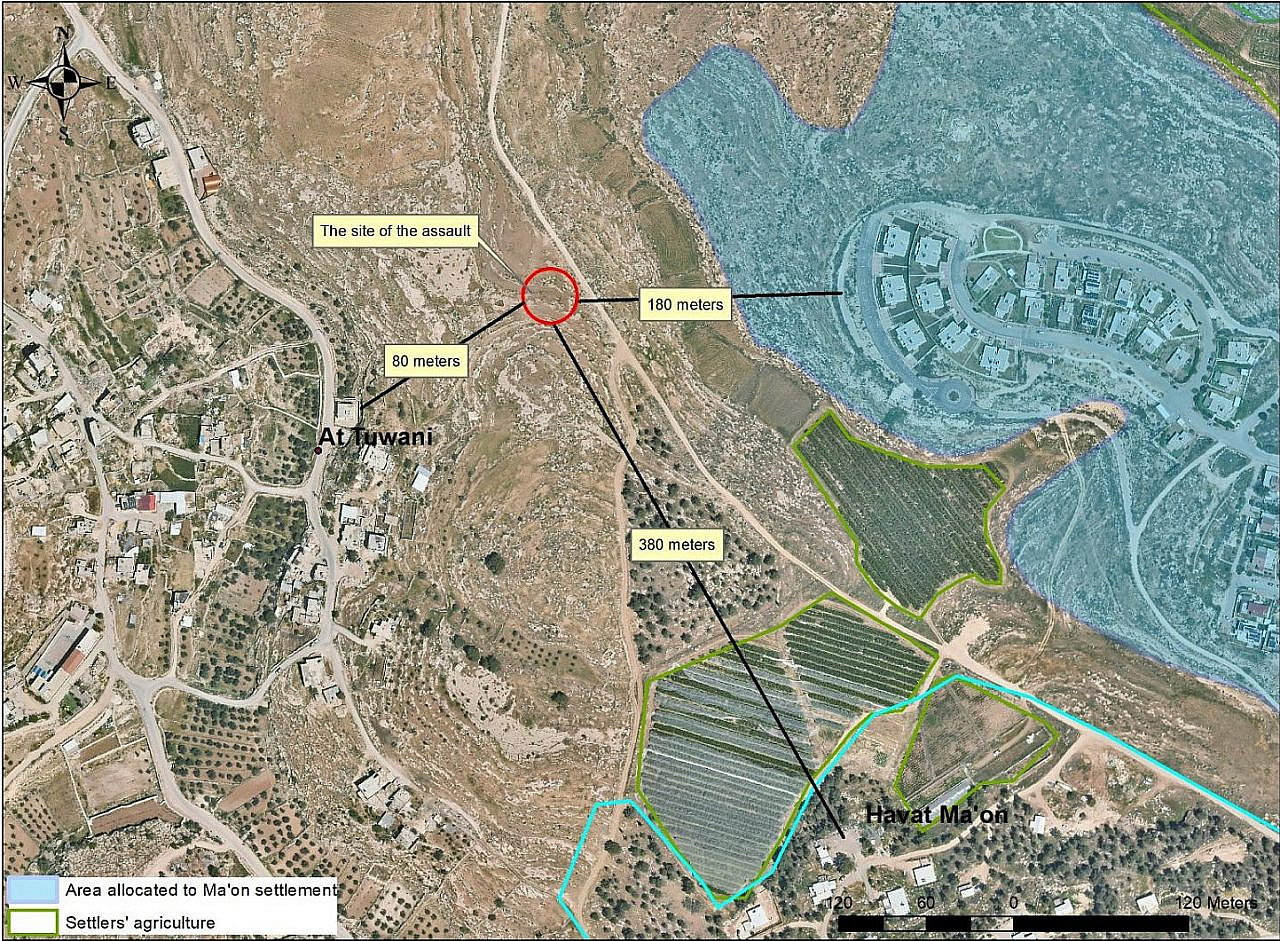 The Havat Ma’on outpost has a history of violent harassment of Palestinians working land near the outpost and the settlers’ illegally-built access road (illegal under even Israeli law). Despite this history, initial reports of this week’s attack in the Israeli press relied on the account of the settlers and Israeli security sources, depicting the incident as an attempted lynching of settlers by a group of Palestinians. Video footage of the incident subsequently proved that this account was wholly fictional, with the footage documenting aggressive actions by settlers – armed with iron rods and at least one automatic weapon (which was fired repeatedly) – against the Palestinians.
Following the incident, Israeli authorities arrested Huraini and are reportedly investigating him on possible charges of attempted murder (apparently of the settler against whom he had the audacity to defend himself). Huraini remains in Israeli custody as of this writing, notwithstanding the video of the attack that is widely circulating (not to mention the accounts of Palestinians and internationals on the scene). Likewise, notwithstanding the clear aggression of settlers documented in that video, as of this writing no settlers have reportedly been arrested for the attack.
+972 reports that, in the immediate aftermath of the attack, settlers punctured the tires of the ambulance attempting to reach Huraini (before he was arrested), and then uprooted several olive trees in the area. All of this was done in the presence of Israeli soldiers. Later that night, Israeli officers raided the town of A-Tuwani, throwing tear gas and stun grenades into homes.
Following the incident, Kerem Navot tweeted the following context, which was provided by a Palestinian lawyer, Quamar Mishirqi-Assad, from the NGO Haqel:
“Due to the proximity of their ancestral lands to Havat Maon, the Huraini family has suffered at the hands of the settlers’ constant violence and attacks for years. On 12/20/2021, for example, Mr. Hafez Huraini went to his lands and saw about one hundred of his and his family’s five year-old olive, almond, and peach trees, as well as various vegetable plants had been destroyed by settlers. A complaint was submitted to the Israeli police, yet to this day, no suspects have been found.
Another example of the authorities’ total disregard and turning a blind eye to all attacks against Palestinians in this region- even when they have all the evidence needed to identify the attackers and bring them to justice- happened with Hafez’s son. On 30/03/2018, an ATV came down from Havat Maon and started to create a disturbance in the area next to Tuwani. At a certain point, the ATV started driving very fast towards residents and activists, trying to run them over. The driver succeeded, and ran over Hafez Huraini’s son, whose leg was broken as a result and was hospitalized. A complaint, along with pictures, was also submitted to the police after this attack. Included in the pictures was one showing the license plate of the ATV, despite this, the complaint was closed and the appeal against closing the complaint was rejected.” (The video – https://bit.ly/3qCIDrL).
This aggregate of incidents combined tells the long story of violent acts against Palestinians in the region that have taken place recently, some of which were reported in real time to enforcement agencies. This includes: sending attack dogs, violent assault, stone throwing, arson, cutting trees, shepherding on private agricultural lands, expelling Palestinians from agricultural lands, throwing stun grenades by military personnel and more.
Since the end of 2017, we have reported and asked for enforcement agencies’ to intervene in around 60 incidents of harassment and assault of residents of Tuwani by settlers and the army, around 20 of these complaints were submitted to the Israeli Police. Until today, we have not been updated about nor do we know of any example of the perpetrators being brought to justice. Indeed, we received a letter from the Attorney General of the West Bank, on 02/09/2021 who wrote that: ‘the army has been in conversation with the commanders in the regional brigade and that in the past months, there has been an increase in the scope of military force in the region.’ The letter also noted that: ‘the guidelines for the military forces working the area, in particular those obligating personnel to intervene in and stop violent incidents, and if necessary, detain suspects and bring them to the Israeli Police, have been made clearer.’ ongoing violations of the law and criminal activity continues in this region, showing that in reality and despite the ease with which one can expect such incidents to occur given that this region is so readily subject to disturbances, the security forces do not do a thing to prevent them in advance. This includes not evacuating the illegal outpost that sits on private Palestinian lands and whose residents are responsible for the majority of these violent incidents and the severe violations of the rule of law, public order and the safety of the Paelstinian residents.”
Bonus Reads
- “Desert council again seeking to build amphitheater in Ramon Crater” (The Times of Israel)
Welcome to FMEP’s Weekly Settlement Report, covering everything you need to know about Israeli settlement activity this week.
To subscribe to this report, please click here.
January 7, 2022
- E-1 Settlement Reportedly Delayed
- E-1 Settlement Reportedly Delayed, BUT (Part 1): Israel Advances New Settlement Plan in East Jerusalem
- E-1 Settlement Reportedly Delayed, BUT (Part 2): Israel Approves Expansion of French Hill Settlement in East Jerusalem
- E-1 Settlement Reportedly Delayed, BUT (Part 3): An Update on Two Families Facing Displacement in Sheikh Jarrah
- Al-Walajah Hearing Postponed but Remains Likely
- Report: Gantz Intends to Turn Evyatar Outpost Into New “Legal” Settlement
- Settlers Still Pressing Govt to Authorize Homesh Outpost, & Terrorizing Nearby Palestinians
- IDF Evacuates Kumi Ori Outpost, Yitzhar Start Clashes
- IDF Renews Standing Demolitions Orders Against Six Unauthorized Outposts
- Israel Earmarks Millions for Seven New Synagogues in Settlements & Outposts
- Bonus Reads
E-1 Settlement Reportedly Delayed
The Israeli Civil Administration’s High Planning Council has removed consideration of the E-1 settlement plan from the agenda of its scheduled January 10th meeting. Haaretz reports that the plan has been indefinitely postponed due to “the expert opinions of certain officials in the Civil Administration.” No further information regarding the identity of the officials nor their opinions has been made public, and neither Israeli Minister of Defense Benny Gantz (who oversees the Civil Administration and all planning in the West Bank) nor Prime Minister Bennett have made any public comments. Haaretz further notes that the decision to add and remove items – particularly contentious items such as the E-1 plan – requires the approval of political leadership.
The High Planning Council – which is the body within the Israeli Defense Ministry which oversees all construction in the occupied West Bank – was expected to convene on January 10th to hold a third hearing to consider public objections to the E-1 plan. The Council’s previous hearings on public objections to the plan have been riddled with drama. The first was held on October 4th, but Palestinians were effectively denied the ability to participate, as it was held online and was thus inaccessible to the many Palestinians affected by the plan who do not have internet access. The second was held on October 18th; at that hearing three objections were presented (one by the Palestinian village of Anata, a second by the Palestinian village of Al-Azariya, and a third joint submission filed by Ir Amim and Peace Now). Ir Amim reports that there was no substantive discussion of these objections, with the Civil Administration panel offering no questions or comments on them. This third hearing – which was scheduled for January 10th – was set by the Court (originally for November 2021, but delayed) to compensate for the exclusion of Palestinians from the first hearing.
E-1 Settlement Reportedly Delayed, BUT (Part 1): Israel Advances New Settlement Plan in East Jerusalem
 On January 5th, the Jerusalem Municipal Planning Committee advanced a plan – referred to as the “Lower Aqueduct Plan” – to build a new settlement with 1,457 units in East Jerusalemn land located between two already controversial settlements on the southern flank of East Jerusalem: Givat Hamatos and Har Homa. The new settlement is intended to connect the Givat Hamatos and Har Homa, establishing an uninterrupted continuum of Israeli settlements on the southern rim of Jerusalem, and destroying the contiguity of Palestinian land in the West Bank and East Jerusalem. With approval from the municipal planning authority, the plan now goes to the Jerusalem District Planning Committee which will convene on January 17th to consider depositing the plan for public review.
In addition to severing East Jerusalem from the West Bank in the south, the new settlement will impinge on two neighboring East Jerusalem Palestinian villages of Sur Baher and Umm Tuba, and will involve the expropriation by Israel of privately owned Palestinian land. Most notably, in order to pave a new access road for the new settlement, the State will likely expropriate land privately owned by Palestinian residents of Umm Tuba. Ir Amim explains:
“According to the plan, an access road to the new neighborhood will be built over the Green Line on private Palestinian land belonging to residents of Umm Tuba. These lands will likely be expropriated. Despite the probable expropriation, the plan does not offer any development for the remaining privately-owned Palestinian land and will likewise not grant building rights to Palestinian landowners for areas alongside the road not intended for expropriation.”
Adding insult to injury, two years ago the Jerusalem Municipality and the Ministry of Jerusalem Affairs initiated a plan to build a new Palestinian business center in the precise area targeted by the “lower aqueduct” plan, as part of an Israeli government initiative to reduce poverty in East Jerusalem. The Jerusalem Municipality subsequently abandoned the plan for the Palestinian business center under pressure from settlers, specifically from the Har Homa settlement which borders the area. Ir Amim comments:
“Not only is this yet another example of severe planning discrimination, but construction of this new neighborhood will serve to further create Israeli territorial contiguity along East Jerusalem’s southern perimeter while depleting more land reserves for Palestinian development.”
Peace Now notes that the majority of the land on which the new settlement will be built (half of which is in East Jerusalem and half in West Jerusalem) is privately owned, or managed by the Israeli Custodian General. Although recent reporting suggests the Custodian General is moving to advance settlement construction on lands it manages across East Jerusalem, its legal ability to do so is questionable (and doing so has historically not been its practice).
It’s worth recalling that in December 2021, reports surfaced that the Israeli Custodian General is planning to establish a new settler enclave in Sur Baher, and is hoping to add more land in the village to its existing portfolio of 3.3 dunams.
Terrestrial Jerusalem writes:
“This Plan is not promoted in a vacuum, and constitutes yet another significant link the chain of new settlement schemes currently being expedited by Israeli authorities on the southern flank of East Jerusalem. Connecting Har Homa to Givat Hamatos, the Lower Aqueduct Plan joins these other schemes: Givat Hamatos, Har Homa West, Ahuzat Nof Gilo and Har Gilo West. The cumulative impact of these plans is to create a continuous built-up buffer, sealing East Jerusalem off from its sister city, Bethlehem. Viewed in context, the Lower Aqueduct Plan is a significant component in a strategic thrust with the objective of consolidating sole Israeli rule over East Jerusalem, and cutting it off from its environs in the West Bank. The physical detachment of East Jerusalem from Bethlehem will be viewed as unilateral act that causes concern not only among Palestinians and the international community, among the major Christian denominations around the world.”
Peace Now said in a statement:
“As in the case of the Atarot plan, right-wing elements in the government are taking advantage of the lack of coalition agreement on the issue of settlements to advance far-reaching plans that post facts on the ground that undermine the possibility of peace. The plans add to the tension on the ground and highlight the blatant discrimination that the government is building in East Jerusalem for Israelis only, while the hundreds of thousands of Palestinians in the city can build almost nothing. The coalition parties that support the possibility of two states for two peoples must do everything so that these plans are not promoted and do not reach a discussion in the District Committee.”
E-1 Settlement Reportedly Delayed, BUT (Part 2): Israel Approves Expansion of French Hill Settlement in East Jerusalem

Map by Peace Now
On January 5th, the Jerusalem District Planning Committee gave its final approval to several plans that will add a total of 2,092 new units to the French Hill settlement in East Jerusalem, on the edge of Mount Scopus.
Several plans relate to the Hebrew University campus on Mt. Scopus. Notably, while Mt. Scopus is in East Jerusalem, it is not considered by the international community to be occupied territory (reflecting the fact that in 1948 the area was designated as a demilitarized zone). These new plans, which expand the footprint of the Hebrew University campus but on land that is in the French Hill area (i.e. occupied territory), are:
- The “Bronfman Dormitory” plan to build 672 settlement units on land located in the French Hill settlement area (beyond the borders of the Mt. Scopus campus). Ir Amim raises alarm that this plan will completely encircle a Palestinian neighborhood (leaving it as an enclave surrounded by Israeli development), which “will greatly increase the construction in areas marked as Israeli, while blocking any further development of the Palestinian neighborhood.”
- The “Lerner Complex & Lower Resnick Dormitory” plan calls for the construction of 1027 units , the majority of which are designated for land east of the Green Line where there are currently student dormitories for the Hebrew University.
- The construction of 528 settlement units on land just north of the Jerusalem British War Cemetery, on land that is cut in half by the Green Line.
Ir Amim said in a statement:
“Beyond the geopolitical implications of constructing more housing units over the Green Line in Jerusalem, these plans are yet another example of the acute housing discrimination facing East Jerusalem Palestinians. These four plans follow close on the heels of other major housing projects advanced for Israelis in East Jerusalem over the course of 2021. The Israeli authorities continue to promote plans at full force for thousands of housing units for Israelis, while systemically refraining from advancing plans for Palestinians to meet their severe housing needs.”
Peace Now writes:
“it should be noted that some of the plans are adjacent to Palestinian land and houses (a neighborhood considered to be the fringe of Sheikh Jarrah), but all the huge building rights planned in these plans are not given to Palestinian homeowners living adjacent to the planned area. The Israel Land Authority has chosen to plan only the complexes under its control and not to allow the private construction of Palestinians next door. Since 1967, the government initiated and planned approx. 56,000 units for Israelis in East Jerusalem, while for Palestinians the government supported only 600 units, in the 1970’s. The planning of so many units in East Jerusalem for Israelis alongside with the increase in house demolition for Palestinians, raises the frustration and anger in East Jerusalem.”
E-1 Settlement Reportedly Delayed, BUT (Part 3): An Update on Two Families Facing Displacement in Sheikh Jarrah
New details have emerged regarding the delayed forcible displacement of the Salem family from their longtime home in Sheikh Jarrah in favor of settlers. Though the eviction notice stated that the family would be evicted from their home on December 29th, a last minute delay was granted based on a request submitted to the Court by the setters. The settlers requested that the court postpone the evacuation and instead require that it be carried out between January 20 and February 8th.
The settlers’ lawyers’ request was in line with concerns raised by the Jerusalem police, which also submitted a letter to the Court that warned a set date for the eviction, known in advance by the family and the public, “could endanger the forces and foil the evacuation’s success.”
Also in Sheikh Jarrah and in keeping with the police’s warning, the Saliha family received another eviction notice from Israeli authorities warning them that an eviction order against their home can be carried out anytime between January 10 and January 25. There are two households in the Saliha family living on a plot of land that Israel expropriated (in 2017) for “public use”, and on which it now intends to build a school (it is as yet unclear what population the school will serve).
Ir Amim provides essential and comprehensive information on what is going on with regards to the Salhia family case:
“The Jerusalem Municipality is demanding the eviction of the entire Salhia family, comprised of two households and totaling 12 individuals, under the pretext that expropriation of the property is necessary for the construction of a school. Following the court’s dismissal of one petition, one of the households received the aforementioned eviction order. The second household’s petition will be heard tomorrow (January 6) at the Jerusalem District Court.
While the municipality is evicting the family to build an educational institution, in recent years it relinquished a plot of land in Sheikh Jarrah originally designated for a school and transferred it into the hands of an ultra-Orthodox association for the construction of a massive yeshiva. The municipality appears to perceive it as reasonable to dispossess a Palestinian family for the sake of a school rather than utilizing open land initially allocated for such purposes.
When the District Planning Committee discussed the objections to the Ohr Somayach yeshiva plan (TPS 68858) at the end of 2020, the representative of the Jerusalem Municipality’s planning department claimed that there was no shortage of educational institutions nor a lack of space for such buildings in Sheikh Jarrah.
Today, Ir Amim sent an urgent letter to the Director of the Municipality’s Education Administration (MEA) in which it detailed the contradiction in the municipality’s actions and demanded MEA act to retrieve the parcel of land it transferred to the ultra-Orthodox association. Such a measure could in fact obviate the “need” to seize the Salhia family’s land and prevent the violation of their property rights and forced eviction.
Members of the Salhia family are Palestinian refugees who were uprooted from their homes in Ein Kerem in 1948 and now stand to be displaced for a second time. According to the family, their parents purchased the plot of land and have lived in homes they built since before 1967. The property also houses a well-known and thriving garden center called Peace Nursery.
Situated directly across from the British Consulate, the homes are strategically located between Kerem Al’ajoni and the Shepherd Hotel complex where settler groups are acting to establish major settler enclaves (see map below). In Kerem Al’ajoni, Nahalat Shimon is working at the behest of settlers to evict some 30 Palestinian families, while the Ateret Cohanim settler organization has constructed 22 housing units in the Shepherd Hotel complex to house a new settlement. The organization received the compound from the state decades ago after it was declared “absentee property.” There are reports that Ateret Cohanim intends to build additional floors, and therefore the units are not yet occupied.
It should be underscored that this development is taking place in parallel to the impending eviction of the 11-member Salem family from Um Haroun, Sheikh Jarrah (western section) for the benefit of settlers. As reported previously, the family was handed an eviction notice in early December citing that they would be subject to forcible removal as of December 29. That eviction order was cancelled, and an administrative hearing was held on December 30 at the Enforcement and Collection Agency concerning a request for a new eviction order with a flexible implementation date. Although the hearing concluded without a decision nor the issuance of a new eviction order, the family’s legal representation has made it clear that all potential legal channels have been exhausted. Therefore save for government intervention, there appears to be no other means to prevent the family’s displacement. Continued public pressure and concerted engagement with the Israeli government on this matter is hence vital.
A total of some 70 families, numbering over 300 Palestinians, are under threat of eviction from Sheikh Jarrah due to lawsuits filed by settler groups working in close collaboration with state bodies, including the General Custodian. Driven by political and ideological motives, these efforts aim to establish settler enclaves by forcibly uprooting Palestinians and supplanting them with Jewish settlers as a means to Israelize the area and further entrench Israeli control. Such measures carry severe humanitarian and geopolitical ramifications.”
Al-Walajah Hearing Postponed but Remains Likely
The Israeli Supreme Court hearing on the demolition of 38 homes in the beleaguered Palestinian village of al-Walajah, scheduled for December 26th, was ultimately postponed by the Court. The delay followed a new request submitted to the Court by the lawyer representing the Palestinian families facing imminent homelessness, though it’s not clear what the request was exactly. Ir Amim makes it clear that the delay is not cause for celebration, and stems from a technical matter.
The Court has not set a new date for the hearing.
As a reminder, the State of Israel has longstanding demolition orders against 38 Palestinian homes – in which around 300 people live – in the village of Al-Walajah, though the orders have been contested by Palestinians and, until this point, frozen by the Court as the matter is litigated. In December 2021, the State asked the Court to lift a freeze on the demolition orders, arguing (as it had in the past) that the houses – built by Palestinian residents of al-Walajah s on their own land – were illegal, because the were built without the required Israeli permits. This argument points to the Kafkaesque nightmare in which al-Walajah’s residents are trapped.
In point of fact: It is all but impossible for Palestinians to obtain building permits from Israel to build “legally” on their own land in East Jerusalem and in Area C of the West Bank. In the case of al-Walajah, such permits are, literally, impossible to obtain. This is because Israel has actively chosen not to approve an “outline plan” for the area, without which permits are an impossibility. Al-Walajah residents, with the help of planning experts, prepared and proposed an outline plan for the area, and for more than 15 years have worked to get Israel to approve it — to no avail. Israeli authorities have repeatedly (in January 2021 and again in March 2021) refused to approve the resident-backed plan, and have also refrained from initiating their own planning process. Indeed, the Jerusalem District Committee, as part of a January 25, 2021 ruling against the outline plan proposed by residents, deemed the area in question — where Palestinians have lived for decades — an “agricultural area” where no building would ever be permitted. The result: Al-Walajah’s residents have been left with zero hope of obtaining the permits required to build on their own land – or keep their current homes located there.
Report: Gantz Intends to Turn Evyatar Outpost Into New “Legal” Settlement
Over the past few weeks, reports have surfaced indicating the Israeli Defense Minister Benny Gantz is planning to approve the retroactive authorization of the Evyatar outpost, located on a strategic hilltop named Mount Sabih just south of Nablus on land historically belonging to nearby the Palestinian villages Beita, Yatma, and Qablan. This follows Prime Minister Bennett’s November 2021 promise to legalize the outpost.
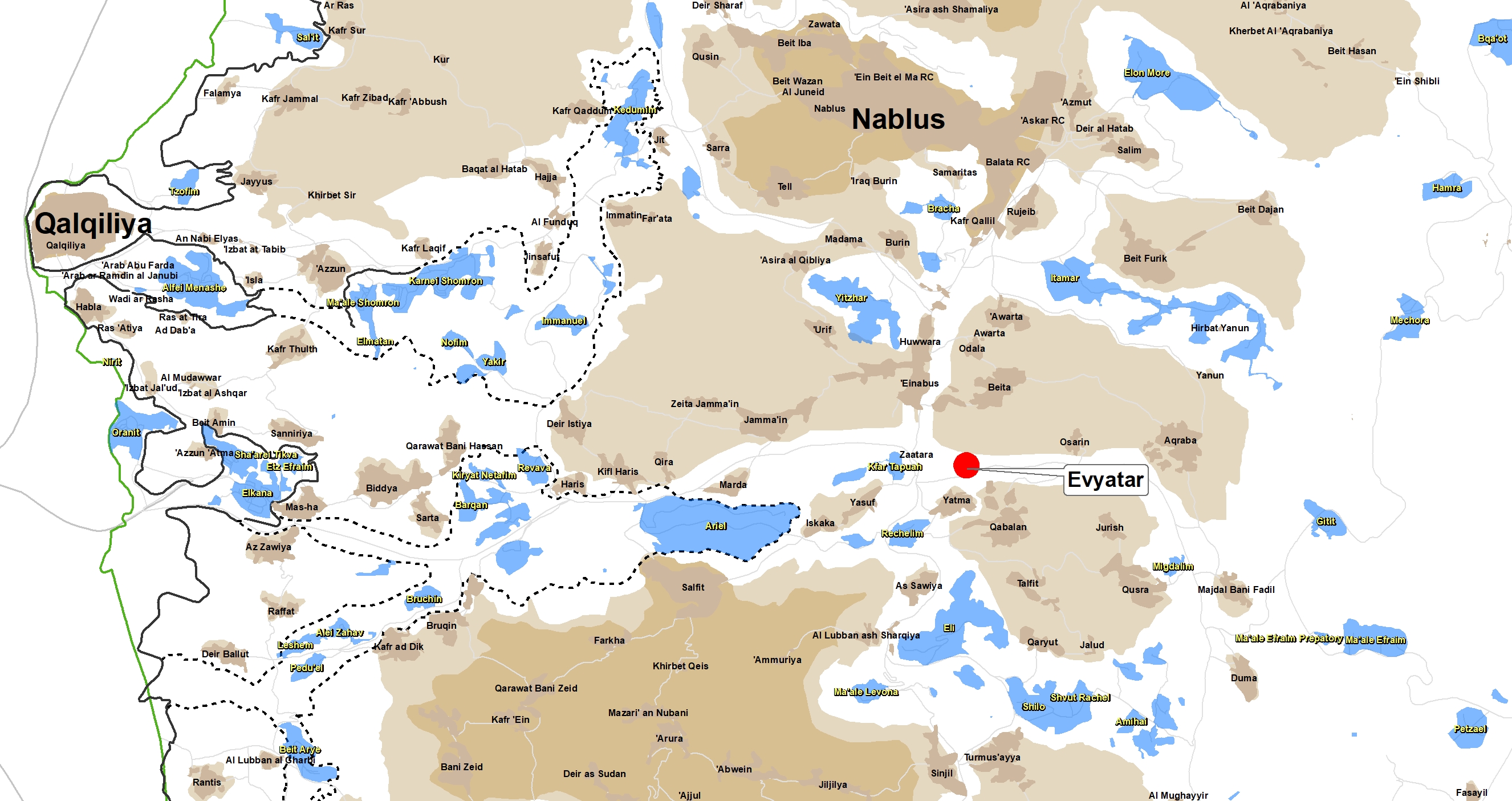
Map by Peace Now
The decision to authorize Evyatar as a full-fledged, new, and “legal” settlement is supposedly dependent on the outcome of an Israeli-led investigation into the status of the land. If the land is “discovered” to be “state land,” the government will authorize EVyatar. The results of the “investigation” are not public at this time. [map]
The Evyatar outpost has been at the core of sustained settler violence and Palestinian protest over the course of 2021, ever since the government agreed to a deal with settlers to evacuate the outpost temporarily (leaving its structures intact) until the government determines whether it can find a pretext upon which to declare the land to be state land.
Peace Now said in a statement:
“There is no justification in the world for establishing a new settlement in the West Bank, which will be a security burden, a political blow and a reward for outlaws. The small settler group who established the outpost in Evyatar did so illegally, with the aim of dragging Israel to deepen the occupation and prevent its end, and they led to daily risk of IDF soldiers and severe escalation of violence in the area. The government must come to its senses and stop this madness and not be dragged after a small minority.”
In addition to reportedly preparing to grant approval to formally establish the Evyatar settlement, the settler news outlet Arutz Sheva reports that Gantz has suggested making the new settlement the new home for the illegal yeshiva settlers have established as the site of the former Homesh settlement – a yeshiva that has likewise been at the center of ongoing violence (including settler violence targeting Israeli forces). Settlers have come out in opposition to this suggestion – unsurprisingly, given that the explicit objective of the settlers targeting the Homesh site is the re-settlement of that specific area (more below).
As a reminder, the fate of the Evyatar outpost was the first controversy that threatened to divide the fragile Bennett-led government when it was sworn in. Bennet’s partners were bitterly divided on whether to evacuate the outpost or let it be, while the government sought to grant it retroactive legalization. In the end, the government reached a “deal” which saw the settlers (temporarily) vacate the outpost on Friday, July 2nd. In return, the government left the settlers’ illegal construction at the site in place (i.e., did not demolish it) — including buildings and roads — while it “examines” the status of the land to see if it can be declared “state land” and therefore “legally” turned into a settlement (opening the door for the settlers to return). Under the agreement, the outpost is being used as a military base in the interim.
The fact that the “compromise” left in place the settlers’ structures and allowed Israel to maintain complete control over the site during the “survey” process signalled from the start that the government is not concerned with enforcing Israeli law, but rather is focused on finding a political solution that works for the settlers. It was further clear from the terms of the “compromise” that the Bennet government believed it will be succeed in finding a pretext to assert that the land on which the outpost stands is “state land” which can be used by the state as it sees fit (i.e., give it to the settlers). If the state decides, pursuant to the investigation, that it has a basis on which to declare the site to be “state land,” the settlers will be allowed to return and resume the establishment of what would from that point no longer be an illegal outpost, but a new “legal” settlement.
Settlers Still Pressing Govt to Authorize Homesh Outpost, & Terrorizing Nearby Palestinians
There has been continuing fallout and violence surrounding the Homesh oupost and yeshiva following the murder of settler Yehuda Dimentan by a Palestinian in December 2021. Settlers have used Dimentan’s death to press the government to formally reestablish the Homesh settlement (evacuated in 2005 as part of the Gaza disengagement plan, at which time it was declared by Israel to be a closed military zone – but settlers have been allowed to frequent the site and even operate a yeshiva there. That yeshiva, according to Kerem Navot, became one of the West Bank’s “hardcore centers of settler terror”). Settlers have also wreaked terror on nearby Palestinian villages, most notably Burqa. One Israeli politicians even said that settlers are carrying out a pogrom in Burqa.
Most prominently to date, Israeli Justice Minister Gidon Sa’ar (Likud) offered his support for reestablishing the Homesh settlement – directly tying his support to the death of Yehuda Dimentan. On January 1st, Yesha Council leader Yossi Dagan and MK Yuli Edelstein inaugurated a new caucus in the Knesset specifically dedicated to the cause of reestablishing the Homesh settlement along with the other two settlements that were dismantled by the Israeli government in 2005 as part of the Gaza Disengagement Plan.
Since the murder, the IDF has imposed severe movement restrictions on Palestinians living near the Homesh site and the Shavei Shomron settlement (where Dimentan lived). This includes road closures, and IDF-imposed closures of the Palestinian towns of Burqa and Sebastia. In addition, two new Israeli-controlled checkpoints positioned near Shavei Shomron and Homesh in practice now prevent Palestinians from using the roads, while allowing settlers to reach the Homesh site (which, again, is supposedly a closed military zone). The closures have not prevented settlers from regularly attacking Burqa, including “three large scale attacks”. According to the PA’s settlement monitor, Palestinians in Burqa fear a massacre.
In addition to the now-routine closures and movement restrictions on Palestinians, the IDF chose to completely shut down the highway connecting Shavei Shomron and Homesh on December 23rd to allow a massive march led by Dimentan’s widow – estimated to have included 15,000 Israelis (including several elected officials) – following Dimentan’s funeral. The march and the closures resulted in clashes, particularly in Burqa, between Palestinians and IDF forces. The night of the march, settlers raided Burqa where they attacked Palestinian homes and desecrated the village’s cemetary.
The marchers told Ynet that they intend to maintain a presence at the yeshiva to prevent the government from dismantling it. The Dimentan family has personally asked government officials to authorize the Homesh yeshiva in Dimentan’s honor.
Amidst the ongoing violence and political agitation, on January 2, 2022 a delegation of Israeli lawmakers, including several senior members of the Likud party, paid a visit to the illegal yeshiva at the dismantled Homesh settlement site. Their tour of the yeshiva was used to offer support to the settlers’ effort to push for retroactive authorization.
IDF Evacuates Kumi Ori Outpost, Yitzhar Start Clashes
On December 31st, Israeli forces once again removed caravans from the unauthorized “Kumi Ori” settler outpost, which serves as the home of 20 extremist “Hilltop Youth” settlers and is a satellite outpost of the notoriously violent and radical Yitzhar settlement. Dozens of settlers from Yitzhar attacked Israeli forces, resulting in injuries to three soldiers and one settler.
Haaretz reports that despite an order issued two years ago declaring the land to be a “closed military zone,” Israeli border police – who maintain a checkpoint at the entrance of the outpost – have continued to allow settlers to live and visit the area if they had lived there (illegally) prior to the eviction order being issued. The caravan that was removed on December 31st was new, and therefore subject to the eviction order.
Kumi Ori was previously evacuated by the IDF in April 2020 and in January 2020, and also in August 2017 – each time resulting in violence. The battle between the outpost settlers and the Israeli army has played out for many years, and the IDF has demolished the outpost at least 10 times. In one extraordinary attempt by the settlers to preserve the outpost, settlers attempted to convince the court that Israel did not have authority to demolish the structures, because the outpost is not located in Area C (where Israel has complete control), but rather in a Palestinian-administered area (Area A or B) [raising the question, would the settlers recognize/respect the Palestinian Authority’s authority to evict them?]. The Court rejected that argument.
IDF Renews Standing Demolitions Orders Against Six Unauthorized Outposts
The Israeli military recently re-issued standing demarcation orders that allow (should Israeli authorities so choose) for the demolition of the outposts without any legal hoops or holdups. Of course, the orders have been in place for years, and while the IDF has occasionally dismantled the outposts, settlers have been able (or allowed) to reestablish the illegal encampments.
The orders were renewed for the following outposts:
- Ramat Migron outpost, located in the Shiloh Valley in the northern West Bank. The IDF recently dismantled the Ramat Migron settlement in November 2021.
- Oz Zion outpost, located between Jerusalem and Ramallah. The Oz Zion outpost has been demolished by the IDF several times but the settlers have been allowed to reestablish it. The outpost was most recently dismantled by the IDF in June 2021.
- Guelat Zion outpost, located in the Shiloh Valley in the northern West Bank. Guelat Zion was most recently demolished in November 2021. Established in 2011, the outpost is adjacent to the new “Amichai” settlement, which Israel built as a pay-off to settlers it was forced by the courts to remove from the illegal Amona outpost.
- Givat Assaf outpost, located east of Ramallah. The Givat Assaf outpost was rumored to be included in a list of 66 outposts the Knesset sought to retroactively legalize via legislation.
- Givat Tekuma (“Hill 725”) outpost, located near the Yitzhar settlement in the Nablus area of the northern West Bank.
- Shaked farm outpost, located near the Yitzhar settlement in the Nablus area of the northern West Bank
Israel Earmarks Millions for Seven New Synagogues in Settlements & Outposts
Israeli Minister of Religious Services Matan Kahana approved the allocation of millions of shekels (exact figure unknown) for the construction of 30 new synagogues – seven of which will be located in settlements or unauthorized outposts. In addition, Kahana earmarked 25% of his ministry’s aid budget for the construction of mikveh’s (Jewish ritual baths) in the West Bank.
Meretz MK Mossi Raz said in response:
“Kahana has decided to discriminate against residents within the green line, and to build a quarter of the synagogues in his ministry’s budget over the green line. This does not only strengthen the settlement enterprise, which is harmful for Israel’s future, it acts inequitably in allocating resources to every worshiper within Israel’s borders.”
Bonus Reads
- “First Settlers Beat Them Up, Then Ismail and His Family Were Jailed” (Haaretz)
- “Why Palestinian Kids’ Playgrounds Are Such Prime Targets for Israeli Settlers” (Haaretz // Ali Awad)
- “Power struggle: Bill to hook up illegal Arab homes to grid passes in stormy session” (The Times of Israel)
Welcome to FMEP’s Weekly Settlement Report, covering everything you need to know about Israeli settlement activity this week.
To subscribe to this report, please click here.
December 23, 2021
- Homesh Settlement Violence Continues As Knesset Rejects Plan to Authorize Outpost
- Settler/State Displacement of Palestinians in Sheikh Jarrah, Part 1: Salem Family Gets Brief Reprieve of Expulsion from Home in Sheikh Jarrah
- Settler/State Displacement of Palestinians in Sheikh Jarrah, Part 2: Salhia Family Receives Eviction Order
- Settler/State Displacement of Palestinians in Sheikh Jarrah, Part 3: Skafi Family Turns Down $5 million Offer from Settlers for Home
- Israeli Supreme Court to Decide on (Likely Swift) Mass Demolitions in al-Walajah
- Church Leaders Launch Campaign Against “Systematic Attempt” to Rid Jerusalem of Christians
- Bonus Reads
Homesh Settlement Violence Continues As Knesset Rejects Plan to Authorize Outpost
In the days following a deadly attack by Palestinians on Israeli settlers near the site of the former Homesh settlement in the northern West Bank, Israeli settlers and their allies, predictably, have exacted revenge on Palestinian communities, with violent attacks that Israel has done little or nothing to prevent. Also predictably, they have demanded that, in response to the attack, the government authorize the illegal outposts/yeshiva at the site of Homesh, as well as additional new settlements.
Despite an emotional plea by the family of the murdered settler – Yehuda Dimentman – and accompanying pressure from the settler constituency, the Knesset voted 59-50 against a declaration that would have urged Prime Minister Bennett to grant authorization to the Homesh outpost along with 70 other outposts in the West Bank. In addition, the text of the declaration urged Bennett “decisively prevent the evacuation of the Homesh Yeshiva, authorize it and to allow its students to study and live there.”
As a reminder, the Homesh settlement was dismantled by the Israeli government in 2005 as part of its “disengagement” from the Gaza Strip. Homesh was ruled to have been built on land privately owned by the Palestinian village of Burqa, ownership which was legally recognized by the Israeli High Court of Justice. Nonetheless, since 2005 Israeli authorities have permitted settlers to retain effective control over the area, including via establishing and operating an [illegal] religious school (aka, yeshiva) at the site for the past 15 years. The yeshiva lacks any permits/planning authorization — authorization that is impossible given that in 2005 the IDF declared the Homesh site to be a closed military zone. As such, both Palestinians and settlers are prohibited from entering the area (let alone building on it). That restriction, however, in practice has been applied to only one population (the one that has been recognized by Israel as the legal owners of the land), and for years, the IDF has turned a blind eye to the yeshiva, despite warnings about the outpost’s violence and repeated confrontations. The recent attack targeted settlers departing from that [illegal] yeshiva.
Within days of last week’s attack, settlers moved to expand the outpost/yeshiva at the Homesh site. On December 18th, settlers managed to erect new, prefabricated buildings at the site, adjacent to the existing (illegal) yeshiva. In the process, settlers reportedly clashed with the IDF, which tried (and failed) to prevent them accessing the site.
On December 19th, the IDF moved in to dismantle the new (illegal) buildings, but did not dismantle the (equally illegal) yeshiva. At the same time, a group of 200 settlers attempted to reach the yeshiva and protest the removal of the outpost buildings, resulting in violent clashes with the IDF. Later, on December 22nd, Israeli authorities arrested the head of the illegal Homesh yeshiva – Rabbi Elishama Cohen – on “suspicion of violating the 2005 Disengagement Law” (the law that provided for the evacuation of the Homesh settlement). Cohen was soon released following intervention by top settler leader Yossi Dagan, but told to return to the police station for further questioning. The arrest infuriated MK Bezalel Smotrich, from the far-right Religious Zionism party, who slammed the Bennett government, saying:
“As part of the government’s decision to eliminate the Homesh yeshivai in response to the terrorist attack in which Yehuda Dimentman was killed and to reward terrorism, the police were sent today to persecute, arrest and deter him. They will not scare us. We call on the masses of the house of Israel to arrive tomorrow and march with Yehuda’s family, demanding an arrangement be made with the Homesh yeshiva.”
The Jerusalem Post reports that the IDF has plans to dismantle the yeshiva following a seven day mourning period for Dimentman.
Settler/State Displacement of Palestinians in Sheikh Jarrah, Part 1: Salem Family Gets Brief Reprieve of Expulsion from Home in Sheikh Jarrah
The expulsion of the Palestinian Salem family from their home of 70 years in Sheikh Jarrah has been delayed on a technicality. +972 Magazine reports that the eviction order was paused because the settler (Aryeh King) who pompously hand-delivered the order to the Salem family was not legally empowered to do so, forcing the Jerusalem court to annul that order (which had set the expulsion for December 29th) and issue a new order, which will reportedly be delivered to the family in the coming weeks.
The delay follows notable attention on the case from international actors, including a visit by diplomats from the European Union. +972 Magazine further reports:
“A source in the Israeli government told +972 that various ministries have been turning their attention to the expulsion of the Salem family due to concern over the political ramifications (developments in the neighborhood remain closely watched by Palestinians and by foreign governments). Some Israeli officials have even looked into legal possibilities for the family to further appeal the ruling, in an attempt to stall its implementation. Israel’s Foreign Ministry provided +972 with the following response, which it said had been coordinated among all relevant government bodies: ‘The State of Israel is a state governed by rule of law, and the ruling of the court — which are known for their independence and the balance they provide on sensitive issues — is binding. The implementation of the ruling will be carried out by the authorities that take into account all the relevant factors, including the appropriate preparations before every move. Any attempt by extremists, and particularly the Hamas terrorist group, to exploit the situation to increase incitement, violence, and terrorism should be rejected.’”
Settler/State Displacement of Palestinians in Sheikh Jarrah, Part 2: Salhia Family Receives Eviction Order
On December 20th, Israeli authorities reportedly delivered an eviction notice to the Palestinian Salhia family in Sheikh Jarrah, in the area near the British Consulate, with the eviction date set for January 25th. The order pertains to a plot of privately owned land – purchased by a Salhia elder in 1967 – on which the Salhia family has built two homes. Israeli authorities had previously delivered an eviction order to the Salhia family in October 2021, that order has since expired – prompting this new order to be issued.
Mohammad Salhia told Middle East Monitor that the Jerusalem Municipality offered to delay the eviction by 8 months if he signed a legal agreement giving up claim to ownership of the land and turning his family into merely tenants of the buildings (he refused).
According to the WAFA report, in 2019 Israel issued an order to unilaterally seize the plot for the “public interest” in order to establish a school there. This school was originally planned to be built on a different parcel of land, however, the Israeli government gave this land to an Ultra-Orthodox organization in order to build the Glassman yeshiva (a settlement project). In the absurdity of land use in East Jerusalem, now, in order to build the school, the government has opted to confiscate the Salhia family’s land.
Settler/State Displacement of Palestinians in Sheikh Jarrah, Part 3: Skafi Family Turns Down $5 million Offer from Settlers for Home
Al-Monitor reports that the Palestinian Skafi family has turned down an offer by settlers to purchase their home in Sheikh Jarrah for an astounding $5 million. Abdel Fattah Skafi told Al-Monitor:
“The family, similar to others in the neighborhood, will not accept any tempting offers by the Israeli authorities, whether financial or an offer to grant them another piece of land as an alternative. We inherited the house from our ancestors and we will pass it on to our children and grandchildren, no matter how long the conflict with the settlers.”
The Skafi family (14 individuals) live in a large house surrounded by homes that have already been taken over by Israeli settlers. In order to access the house, the Skafis must pass through a narrow alley in front of the settler-inhabited homes. The family has been subjected to daily harassment and violence as a result of this reality.
Israeli Supreme Court to Decide on (Likely Swift) Mass Demolitions in al-Walajah
On December 26th, the Israeli Supreme Court is set to hold a final hearing on demolition orders against 38 Palestinian homes – in which around 300 people live – in the village of Al-Walajah, a small part of which is located within the municipal borders of Jerusalem (illegally annexed by Israel following the 1967 war). The State has asked the Court to lift a freeze on the demolition orders, arguing (as usual) that the houses – built by Palestinians on their own land – were built without the required Israeli permits. Ir Amim cautions that if the Court decides to greenlight the demolition orders, it is likely that the mass demolitions will be carried out very quickly. Ir Amim explains:
“The demolitions would likely be carried out very swiftly because the National Enforcement Unit under the Ministry of Finance has assumed responsibility for building and planning enforcement in this area since 2016. This unit is considered the most aggressive Israeli enforcement body. Indeed in the past five years, this unit has executed demolition orders in al-Walajeh immediately after the conclusion of court proceedings. Some 12 additional homes not protected by the appeal likewise face impending demolitions, four of which were carried out over the past few months, including one at the beginning of December. Roughly half of the homes in the annexed part of al-Walajeh have received demolition orders, and approximately 30 have already been executed since 2016 (including those mentioned above). These mass demolition orders, together with the absence of urban planning, threaten to uproot hundreds of al-Walajeh residents for a second time.”
As a reminder, it is all but impossible for Palestinians to obtain building permits from Israel to build “legally” on their own land in East Jerusalem and in Area C of the West Bank. In the case of al-Walajah, the situation is even worse: such permits are, literally, impossible to obtain, since the area lacks a required Israeli-approved “outline plan,” without which permits are an impossibility. In an effort to overcome this obstacle, Al-Walajah residents, with the help of planning experts, prepared and proposed an outline plan for the area, and for more than 15 years have worked to get Israel to approve it — to no avail. Israeli authorities have repeatedly (in January 2021 and again in March 2021) refused to approve the resident-backed plan, and have also refrained from initiating their own planning process. Indeed, the Jerusalem District Committee, as part of a January 25, 2021 ruling against the outline plan proposed by residents, deemed the area in question — where Palestinians have lived for decades — an “agricultural area” where no building would ever be permitted. The result: Al-Walajah’s residents have been left with zero hope of obtaining the permits required to build on their own land – or keep their current homes located there.
Ir Amim writes:
“Demolitions in Al-Walaja are due to two combined Israeli policy decisions: On the one hand, Israeli authorities have never made an outline plan for the annexed part of Al-Walaja and residents therefore have no possibility of obtaining a building permit. All construction that has taken place in Al-Walaja since 1967 is thereby considered illegal under Israeli law. On the other hand, in 2016 the government decided to increase home demolitions – specifically targeting Palestinian communities. Since that year, the National Enforcement Unit (under the authority of the Ministry of Finance) began issuing and carrying out demolition orders in Al-Walaja. This unit is the most aggressive of the Israeli enforcement units. The combined effect of no outline plan and aggressive enforcement has led to half of the homes of the Jerusalem section of Al-Walaja currently being under threat of demolition. In January of this year (2021), the al-Walaja’s community most recent attempt to advance the outline plan they prepared for their village was rejected by the Jerusalem District Committee. Meanwhile, Israeli construction plans of thousands of housing units around Al-Walaja are advancing – including a new settlement on the Western side of the village. Indeed, demolitions in Al-Walaja are part of the creeping annexation Israel is advancing within the Greater Jerusalem area, specifically with the aim of connecting settlements near Bethlehem to Jerusalem, which would effectively fragment the Palestinian space of the southern West Bank.”
Church Leaders Launch Campaign Against “Systematic Attempt” to Rid Jerusalem of Christians
A group of high ranking Christian church leaders have launched a campaign protesting the treatment of churches and Christian residents in Jerusalem. They specifically cite settler violence and attempts to take over church-owned properties in the Old City as key parts of an effort to rid Jerusalem, and other parts of the Holy Land, of Christians.
A statement issued by the campaign reads:
“The principle that the spiritual and cultural character of Jerusalem’s distinct and historic quarters should be protected is already recognised in Isarlei law with respect to the Jewish Quarter. Yet radical groups continue to acquire strategic property in the Christian Quarter, with aim of diminishing the Christian presence, often using underhanded dealings and intimidation tactics to evict residents from their homes, dramatically decreasing the Christian presence, and further disrupting the historic pilgrim routes between Bethlehem and Jerusalem.”
The campaign asks the Israeli government to:
“Deal with the challenges presented by radical groups in Jerusalem to both heChristian community and the rule of law, so as to ensure that no citizen or institution has to live under threat of violence or intimidation.”
The leader behind the new campaign is the Greek Orthodox Patriarch of Jerusalem, Theophilos III, whose Patriarchate has been in a particularly nasty (and muddled) battle with settlers over the fate of three prized Old City properties which have been long-owned by the church, but which settlers claim to have purchased (via a sale to a foreign real estate company acting secretly on behalf of the radical settler group Ateret Cohanim). Once Ateret Cohanim’s role became known, the Patriarchate sought to retain control of the properties, but over the course of a long legal battle, multiple Israeli courts, including the Supreme Court, validated the sale. The Greek Orthodox Church has received significant blowback from the sale of these properties to the settlers, including in January 2018, when Palestinians protested in Bethlehem in an attempt to block the arrival of Patriarch Theophilos III for Christmas celebrations.
In addition to the coalition of Church leaders based in Jerusalem, the campaign was boosted by the Archbishop of Canterbury, who joined the archbishop of the Episcopal Church of Jerusalem and the Middle East (the Anglican Church) to issue a statement that was also published as an article in the London-based The Sunday Times, entitled “Let us pray for the Christians being driven from the Holy Land.”
In response to the campaign, the Israeli Foreign Ministry dismissed the concerns raised by Christian leaders as “baseless,” and claimed that the campaign “distort[s] the reality of the Christian community in Israel.” The Foreign Ministry went on to criticize the Church leaders for their alleged silence regarding the plight of Christians elsewhere in the Middle East, implying that the leaders are unfairly singling out Israel. This line of argument is tantamount to the Israeli government calling these church leaders antisemitic — tying in closely with the Israeli government-backed definition of antisemitism, according to which “applying double standards” in critizing Israel is a form of “contemporary” antisemitism.
Bonus Reads
- “De-emphasized under Trump, report shows Biden taking settler violence more seriously” (The Times of Israel)
- “Israeli Troops and Settlers Zero in on a New Target for Attacks: Palestinian Schools” (Haaretz)
- “Opinion | The U.S. Funding Challenges Facing the Israel-Palestine ‘Peace Industry’” (Haaretz)
- “Opinion: Mr. Blinken, you can pick up the phone and save a Palestinian village from destruction” (Washington Post)
- “Why Jerusalem Cannot be ‘Taken Off the Table’” (Crisis Group)
Welcome to FMEP’s Weekly Settlement Report, covering everything you need to know about Israeli settlement activity this week.
To subscribe to this report, please click here.
November 12, 2021
- Settlers Secure Deal for Eventual Eviction of Another Sheikh Jarrah Family
- Increasing Pressure on the Government, Settlers to Operationalize Plan to Increase Control Over Area C
- JNF Stops Funding 18-Year Legal Battle Over Beit Bakri in Hebron
- Demolitions in East Jerusalem Continue, Including in Al-Walaja
- Settler Violence & Expansionism Continue to Escalate in the South Hebron Hills
- Bennett Pledges Evyatar Outpost will be Legalized, Sparking Palestinian Ire & More Coalition Threats
- Government Punts on Outpost Legalization Bill, Knesset Might Move Forward Anyway
- Bonus Reads
Settlers Secure Deal for Eventual Eviction of Another Sheikh Jarrah Family
Israel Hayom reports that a Palestinian family in the Sheikh Jarrah neighborhood has reached a Court-approved “deal” with settlers to recognize settler ownership of their home (where they have lived since 1956), in exchange for being allowed to stay as paying tenants for a period of at least ten years. The “deal” follows the broad outline of a Court-authored compromise that was rejected last week by four other Palestinian families (the cases are separate, but not unrelated).
Israel Hayom additionally speculates:
“The compromise, which was given the force of a legal ruling in the Jerusalem Magistrates Court a few days ago, could serve as a precedent for other local Arab families and is seen as a blow to the Palestinian Authority and Hamas, which are both pressuring Arab residents of Sheikh Jarrah-Shimon HaTzadik to refuse any proposed deals to vacate the properties.”
Increasing Pressure on the Government, Settlers to Operationalize Plan to Increase Control Over Area C
In a closed meeting on November 10th, the heads of settler regional councils met to discuss their ongoing effort to get the Israeli government to annex Area C of the West Bank. According to Arutz Sheva (the settler media outlet), the meeting resulted in significant decisions that create a more unified settler operation on the matter, including the formation of a “joint command center” through which all of the councils will act together, and a commitment by all the regional leaders to form a unified front to pressure the government.
Following the meeting, the participants released a statement saying:
“This struggle is over whether we continue to exist or to fold. This is an existential battle involving the entire Nation of Israel. We are all committed towards working together in order to stop the hostile takeover of our lands and in order to preserve the future of Jewish life in Judea and Samaria.”
An op-ed published in Israel Hayom on November 11th – entitled “In Area C, the time has come to get off the fence” – seemingly making the case for such an effort, the settlement activist Sara Haetzni-Cohen writes:
“Efrat’s dedicated residents have established their own war room. They track every brick and every bit of cement that is spilled and report it to the authorities. They know every demolition order that is issued but not enforced, and they do not give up. But the state quite simply does not exist. The Civil Administration is failing at its task and by choice…We’ve reached a stage where there is no state on which to rely on major issues. Real leadership from leaders who will get off the fence is needed. Local leadership in Judea and Samaria, whether elected or civilian organizations, must get off the fence and protect state lands, settlement lands, our homeland. It should be done intelligently, responsibly, and in a law-abiding manner. We should not resort to violence or vandalism against the Arab population, but rather go about this in a positive way, by planting trees and working the land, by showing our presence on the ground. If we will not be for ourselves, who will be for us? There simply isn’t any choice. We must get off the psychological and physical fence and defend our land.”
As a reminder, under the Oslo Accords, the West Bank was divided into 3 “areas” – Area A, B, and C – pending a permanent status Israeli-Palestinian agreement that would determine final control over all the land (an agreement that was supposed to have been reached by by May 1999). The Oslo Accords gave Israel complete control over Area C, which accounts for around 60% of the West Bank. Throughout the 28 years since the Oslo Accords were signed (and with no peace agreement achieved or in sight), Israel has systematically denied Palestinians in Area C permits that would enable them to build “legally” (under Israeli law) on their own land. As a result, Palestinians have been forced to build without Israeli permits (i.e., “illegally” in the eyes of Israeli authorities), and Israel has responded by issuing wide-scale demolition orders and carrying out frequent demolitions. In recent years, Israel has increasingly treated Area C as indistinguishable from sovereign Israeli territory, effectively extending its laws and regulations to the area and its Israeli settler inhabitants. In parallel, settler groups – most notably the notorious “Regavim” – have lobbied Israeli authorities to crack down on “illegal” Palestinian construction, claiming that Palestinians are trying to “take over Israeli land”.
As part of these ongoing efforts — by settlers and the Israeli government — to entrench and expand Israel’s control over/de facto annexation of the entirety of Area C, in September 2020 the Israeli government allocated 20 million NIS ($6 million USD) for the newly created Settlement Affairs Ministry. That ministry was given the mission of surveying and mapping “unauthorized” (by Israel) Palestinian construction in Area C (the same construction which Israel has been aggressively demolishing). This funding further empowers a domestic Israeli body to exert extraterritorial sovereignty over Area C – in effect, treating the area as land already annexed by Israel.
The Knesset has also repeatedly hosted forums to discuss the alleged (by settlers and their allies/advocates) “Palestinian takeover of Area C” — framing predicated on the assertion that Area C belongs to Israel (an assertion that is not supported by the Oslo Accords) and must be defended against Palestinian efforts to “steal” it. Consistent with this framing, and under pressure from various outside groups, many members of the Knesset have criticized the Israeli government’s alleged failure to robustly “defend” Israel’s rights/ interests in Area C (e.g., failure to prevent/destroy “illegal” Palestinian construction, failure to block foreign government-funded humanitarian projects that support Palestinians’ presence in the area; failure to clear out Palestinians from the area, expand settlements, and consolidate state-built settlement infrastructure; etc.).
JNF Stops Funding 18-Year Legal Battle Over Beit Bakri in Hebron
The Jerusalem Post reports that the Board of the Jewish National Fund in Israel has decided to stop funding the legal costs of a group of settlers battling to win control over a contested home in Tel Rumeida, in the heart of downtown Hebron (and to that end, forging documents). Israeli Courts have ruled against the settlers’ claim to the home twice, most recently in December 2019, in a ruling which affirmed that the Palestinian Bakri family is the rightful owner (the house is known as “Beit Bakri”).
At the request of the settlers, the JNF has agreed to pay installments on a legal guarantee to Israeli courts in order to allow the settlers to avoid eviction while pursuing an appeal against the December 2019 ruling against them. Since 2019, the JNF has paid some $35,000 (110,000 NIS) towards the case.
The Palestinian homeowners – the Bakri family – temporarily fled their home under constant settler harassment during the Second Intifada, a time when Tel Rumeida could have been accurately described as an “urban battlefield.” While the family was gone, settlers broke into the house, damaged it, destroyed the Bakri’s property, and ultimately took up residence there.
The Bakri family has spent the past 18 years petitioning Israeli police and the courts to remove the settlers — cases the Bakri family repeatedly won. The settlers have managed to repeatedly delay their eviction by essentially exploiting every possible legal defense, no matter how absurd or contradictory. For example: At different points over the past 18 years, settlers argued in court that they had a rental agreement; that they purchased the home; that the plot of land was owned by a Jewish trust prior to 1948 and they are “reclaiming” the property; and that because they had invested so much money in improving the land since taking it over, under Ottoman Law it now legally belongs to them, regardless of the means by which they acquired it. When at one point some years ago the courts ruled that the settlers had to evacuate, the settler occupants of the Bakri home did, indeed, leave, only to be immediately replaced by other settlers — at which point the Israeli Attorney General told the Bakri family that they had to start eviction proceedings anew. For a detailed timeline of the Bakri family’s saga, see this report from Peace Now.
Throughout the course of this saga, the settlers’ effort to hold on to the Bakri home was aided by the State’s unwillingness to implement court orders against the settlers. Peace Now said in a statement:
“This is not only a matter of cruelty, deceit and theft of settlers who are not loathe to take control of assets that are not theirs, but also a matter of the lack of government accountability. For 18 years the government did not enforce the law against the invading settlers, and even assisted them and allowed them to continue to steal the house and terrorize their Palestinian neighbors in Tel Rumeida. Furthermore, it should be remembered that Hebron is under Israeli occupation and the Palestinian residents cannot remove the settlers from their homes by appealing to the Palestinian Authority. The power lies in the hands of the Israeli government, which does nothing to fulfill its responsibilities to protect abandoned Palestinian property.”
Demolitions in East Jerusalem Continue, Including in Al-Walaja
Over the past week the Israeli government has moved forward with demolitions in Palestinian neighborhoods across East Jerusalem, including:
- The demolition of three Palestinian homes in the village of Al-Walajah on November 9th. For more on Israel’s systematic campaign to demolish homes in Al-Walajah – including its refusal to approve building plans initiated by Palestinians – see FMEP’s September 9, 2021 settlement report;
- Israeli authorities delivered demolition notices to 10 Palestinian families (70 individuals) living in an apartment building in the al-Tur neighborhood. The notice ordered the families to self-demolish the four-story building within one week, or have Israeli forces demolish the building, with the cost of the demolition billed to the residents. The families reportedly began removing their belongings from the building on November 5th in anticipation of demolition;
- Under coercive Israeli policies, a Palestinian family opted to self-demolish an apartment building in the Beit Hanina neighborhood;
- Under coercive Israeli policies, a Palestinian family opted to self-demolish its house in the Jabel al-Mukaber neighborhood.
As is always the Israeli position, the State asserts that the homes being demolished and under threat of demolition have been built by Palestinians without the required Israeli permits (often on land that even Israel recognizes they privately own). Such permits are generally all but impossible for Palestinians to obtain; in the case of al-Walajah, they are literally impossible to obtain, since the area lacks the required Israeli-approved “outline plan,” without which permits are an impossibility. Facing the reality of having Israel demolish their homes and being required to pay excessive costs and fees associated with such demolitions, Palestinians sometimes choose to self-demolish their homes.
Settler Violence & Expansionism Continues to Escalate in the South Hebron Hills
On Wednesday, November 10th a group of settlers attempting to install a campsite and graze their flocks on land near the Palestinian village of Khilet al-Daba clashed with local Palestinians, who worried that the settlers were making an attempt to take over the land – an understandable concern giving the growing phenomenal of farming outposts as a means for settlement expansion. The clashes – which took place at night after a full day of building tensions – took a violent turn when settlers set a Palestinian agricultural structure on fire. The evening ended with two Palestinians being shot by settlers with live rounds, three Palestinians wounded by settlers throwing rocks, and damage to several cars owned by Palestinians.
The land on which the settlers were grazing their flocks and attempting to install a campsite was declared to be a firing zone by the Israeli government, making it illegal for Palestinians to build there or even enter. According to Haaretz, the Israeli state has plans to evict Palestinians who live in this area (who have ostensibly lived in the area prior to it being declared by Israel to be a firing zone).
The IDF, which had been at the scene intermittently during the day, eventually sought to separate the groups by declaring the area a closed military zone. South Hebron Hills activist Basil Al-Adraa explained how this practice works to allow settlers to accomplish their goals, saying:
“The army arrived, declared it a closed military zone and kicked us out. But they didn’t kick out the settlers or take down the tent they put up today.”
The South Hebron Hills is a hotbed for settler violence, and was the scene of a settler attack – a Jewish pogrom – in September. Earlier this week, settlers from a nearby outpost – aided by the IDF – temporarily blocked Palestinian access to a playground in the village of Susiya. In addition to settler violence, the Israeli government is also acting to significantly expand settlements and retroactively legalize outposts in the South Hebron Hills.
Notably, two U.S members of Congress – Mark Pocan (D, WI-2) and Jamaal Bowman (D, NY-16) – visited the village of Susiya in the South Hebron Hills on November 10th (prior to the outbreak of violence that night). They pair met with local Paelstinian activist where they were told of the violence settlers inflict on the local population.
In an interview with Jewish Currents in October 2021, Basil Al-Adraa explained how violence and land takeovers are two sides of the same coin in the South Hebron Hills,
“Settlers have long been attacking the communities here. The [Israeli] Civil Administration gives them land stolen from the Palestinians: They declared it state land so they can take it by force, for settlers to build settlements and outposts and farms. This year, the settlers have started these new sheep farms around the West Bank, where they bring volunteers to work on these farms. But the settlers aren’t content with the tens of thousands of dunams [one dunam equals 1,000 square meters] they’ve been granted: They bring their animals to our private fields, which the state can’t take from us. They bring them to our orange trees, to drink from our water systems—like the well where we collect rainwater—and to graze on our grass. And what’s been happening recently, especially since May, is they’ve been organizing big attacks on Shabbat and holidays because settlers don’t have much work to do on those days. Dozens of settlers will come masked, with hammers, machine guns, sticks, and stones. The army escorts them two or three kilometers from their settlements to our villages. They burn houses, cut down olive trees. If the army sees some Palestinian trying to defend themselves, then they will shoot at [that Palestinian] with live stun grenades, or tear gas, or rubber bullets. They use all the force. We are under army law as Palestinians in Area C, but the settlers are under civilian law, so the soldiers in the area can’t deal with the settlers, who are under the jurisdiction of the police. But the police take three or four hours to come, only after the attacks have finished. In my community, al-Tuwani, there have been at least seven organized attacks. A lot of people look at these as [isolated] incidents, and this time, there was more media attention to the issue because there was a three-year-old child who was wounded. But it’s part of a policy, in which settlers and the Israeli army don’t want us to feel safe where we live. Like the home demolitions, the blocking of roads, the cutting water and electricity networks, it’s all leading to one goal: They want to kick us out of this land, out of Area C toward Area A [areas under Palestinian administrative and police control, like Ramallah]. But our land is here, our life is here.”
Bennett Pledges Evyatar Outpost will be Legalized, Sparking Palestinian Ire & More Coalition Threats
In a press conference on November 7th, Prime Minister Bennet affirmed his commitment to granting retroactive legalization to the unauthorized outpost of Evyatar – which was built on a strategic hilltop named Mount Sabih, located just south of Nablus on land historically belonging to nearby Palestinian villages Beita, Yatma, and Qablan. Even before Bennett’s most recent statement, several members of his fragile coalition have spoken out to insist that the reestablishment of Evyatar is a redline that, if crossed, could bring down the coalition (FMEP covered a few such statements two weeks ago). In the wake of Bennett’s press conference, more continued to do so, which only adds to the growing public fracture in the coalition over outposts and settlement building more broadly.
Public Security Minister Bar Lev (Labor) pledged to block the legalization of Evyatar, said this week:
“There are enough ways to dissolve this agreement. The Evyatar community [outpost] was illegal and illegal communities should be evacuated.”
The Mayor of Beita predicts that Bennett’s pledge to legalize the outpost (coupled with the end of the olive harvest season, which consumed protestors’ time elsewhere) will spark renewed energy in Palestinian-led protests in the town of Beita. Since settlers struck a deal with the government to temporarily vacate the outpost back in July 2021, Palestinians have staged regular protests against Evyatar outpost, and against the continue denial of access to the land on which the outposts continues to exist (the area is a closed military zone, where Palestinians are denied the ability to access). The protests over the summer were particularly violent, resulting in the killing of at least five Palestinian protestors by Israeli soldiers.
An organizer of the protests, Amal Bani Shamseh, told The New Arab:
“the people in Beita can not stand the idea of a single settler moving back to Mount Sabih and are willing to intensify protests, and women are the first to affirm it.”
As a reminder, the fate of the Evyatar outpost was the first controversy that threatened to divide the fragile Bennett-led government when it was sworn in. Bennet’s partners were bitterly divided on whether to evacuate the outpost or let it be, while the government sought to grant it retroactive legalization. In the end, the government reached a “deal” which saw the settlers (temporarily) vacate the outpost on Friday, July 2nd. In return, the government left the settlers’ illegal construction at the site in place (i.e., did not demolish it) — including buildings and roads — while it “examines” the status of the land to see if it can be declared “state land” and therefore “legally” turned into a settlement (opening the door for the settlers to return). Under the agreement, the outpost is being used as a military base in the interim.
The fact that the “compromise” left in place the settlers’ structures and allowed Israel to maintain complete control over the site during the “survey” process signalled from the start that the government is not concerned with enforcing Israeli law, but rather is focused on finding a political solution that works for the settlers. It was further clear from the terms of the “compromise” that the Bennet government believed it will be succeed in finding a pretext to assert that the land on which the outpost stands is “state land” which can be used by the state as it sees fit (i.e., give it to the settlers). If the state decides, pursuant to the investigation, that it has a basis on which to declare the site to be “state land,” the settlers will be allowed to return and resume the establishment of what would from that point no longer be an illegal outpost, but a new “legal” settlement.
Government Punts on Outpost Legalization Bill, Knesset Might Move Forward Anyway
The Jerusalem Post reports that the Ministerial Committee on Legislation has decided to delay by four months its decision on whether to grant government backing to a bill that would grant retroactive authorization (i.e., legalize) nearly 70 West Bank settlement outposts that Israel has failed to find any other way to legalize (because they are built on land even Israel recognizes is privately owned by Palestinians). As a reminder, the Ministerial Committee on Legislation is composed of government Ministers, and decides whether or not the governing coalition will throw its support behind a bill in the Knesset – ensuring either its passage or defeat.
In response to this news, MK Orit Struck (Religious Zionist Party) — who is also a longtime Hebron settlement leader — said that she intends to bring the bill to the Knesset for an initial reading despite lacking government-backing. Struck believes a strong majority of Knesset Members, regardless of the government’s position, will support the bill. Members of the Knesset attempted to fast-track the passage of this same bill in May 2021, while Bennett and Lapid were in negotiations to form the current governing coalition.
The bill introduced in May 2021 included an explanatory text claiming that the proposed law is in line with a decision the Security Cabinet took in 2017, when it tasked a new committee – headed by notorious settler leader Pinchas Wallerstein – to prepare individualized plans for each outpost to gain retroactive legalization based on the passage of the Regulation Law and the recommendations in the Zandberg Report. Bills similar to this have been filed several times in the past, and the Israeli government has debated granting retroactive authorization to the outposts via a government decision – and came close to doing so in the waning days of the Trump Administration.
Bonus Reads
- “Israeli Settlers Escalate Violence in West Bank” (Foreign Policy)
- “Nearly 20 years on, Israeli barrier shapes Palestinian lives” (AP)
- “Far-right protestors clash with cops in Jerusalem over settler teen’s death” (The Times of Israel)
- “They should have been lawyers. Instead they’re at Israeli construction sites” (Basil al-Adraa in +972 Magazine)
- “How the Occupation Harms Not Only the Palestinians, but the Planet Too” (Haaretz)
- “Palestinians say no to work in settlements” (Al-Monitor)
Welcome to FMEP’s Weekly Settlement Report, covering everything you need to know about Israeli settlement activity this week.
To subscribe to this report, please click here.
September 10, 2021
- Israeli Supreme Court to Hear Al-Walajah Case on October 6th
- JNF to Start Massive Land Registration Process, Threatening Widespread Eviction of Palestinians
- Bennett Government Requests Six Month Extension to Finalize Plan to Forcibly “Relocate” Khan Al-Ahmar
- Bennett Meets with Settler Council, Promises Settlement Growth (i.e. De Facto Annexation)
- Bonus Reads
Israeli Supreme Court to Hear Al-Walajah Case on October 6th
Ir Amim and Bimkom jointly report that the Israeli Supreme Court has set October 6th as the date it will hold a hearing on 38 demolition orders issued against Palestinian homes in the Al-Walajah neighborhood of East Jerusalem. In July of this year, the State moved to dismiss the current petition filed by Palestinians that, for the moment, has frozen demolition proceedings against their homes. If the Court chooses to dismiss the petition, those 38 houses – homes to some 300 individuals – will likely face immediate demolition.
The State’s argument is that the houses – built by Palestinians on their own land – were built without the required Israeli permits. As a reminder, such permits are in general all but impossible for Palestinians to obtain; in the case of al-Walajah they are literally impossible to obtain, since the area lacks a required Israeli-approved “outline plan,” without which permits are an impossibility. In an effort to overcome this obstacle, Al-Walajah residents, with the help of planning experts, prepared and proposed an outline plan for the area, and for more than 15 years have worked to get Israel to approve it — to no avail. Israeli authorities have repeatedly (in January 2021 and again in March 2021) refused to approve the resident-backed plan, and have also refrained from initiating their own planning process. Indeed, the Jerusalem District Committee, as part of a January 25, 2021 ruling against the outline plan proposed by residents, deemed the area in question — where Palestinians have lived for decades — an “agricultural area” where no building would ever be permitted. The result: Al-Walajah’s residents have been left with zero hope of obtaining the permits required to build on – or keep their current houses – on their own land.
Due to its location and unique political situation Al-Walajah is a village besieged by Israel from every angle. In the words of Danny Seidemann:
“ Since 1967, Walajeh’s inhabitants have lived in a Kafka-esque situation, with their village technically located inside Israel’s expanded borders, but with villagers never given Israeli residency (they are considered West Bankers and thus are not permitted inside Jerusalem). As a result, the villagers’ presence in their own village is, under Israeli law, illegal, and their homes there are, by definition, illegal.”
For decades, the Israeli government has carried out a multi-prong effort to push Palestinians off of their land in al-Walajah. This has included demolition campaigns, construction of the separation barrier along a route that encircles the village and cuts residents off from their land, refusal to grant building permits, and the declaration of state parks over lands on which Palestinians have lived for generations. In October 2020, it was revealed that Israel, in order to build the Har Gilo West settlement, plans to extend the separation barrier to completely encircle al-Walajah, which is already surrounded on three sides by the separation wall. The new section of the barrier will be a 7-meter high concrete slab along the western edge of the built-up area of Al-Walajah.
JNF to Start Massive Land Registration Process, Threatening Widespread Eviction of Palestinians
On September 2nd, the Board of the Jewish National Fund in Israel (called the KKL-JNF) voted to initiate a new effort to register its ownership of land that the JNF claims to have purchased from the Israeli General Custodian. The JNF claims to have internal records of these purchases, despite the fact that the organization never formally registered its deed of ownership after the purchases.
According to Haaretz, the KKL-JNF Board has allocated over $31 million (100 million shekels) to a five-year plan that will see the organization pursue the formal registration of the following:
- A total of 530 files pertaining to acquisitions in the West Bank, of which the KKL-JNF says it has documentation for 360 deals, but only has formal contracts for 170. With respect to the fact that the JNF cannot fully document closed deals for most of these properties, Peace Now warns:
“…in some of the cases the documents only show intent to broker deals, and/or a negotiation that didn’t become a deal, and yet, legally, it could be argued that intent for a deal existed, and on this basis the land could be registered in JNF- KKL’s name. In addition, according to JNF- KKL, past experience shows that JNF- KKL succeeds in convincing the courts to register properties in its name and the chances to succeed in various files is great.”
- A total of 2,050 files pertaining to acquisitions in the Jerusalem area, totalling over 1 square mile in East Jerusalem – where the JNF is actively colluding with settler organizations to displace Palestinians from land it claims to own.
Ir Amim explains further:
“The decision to suddenly transfer this land to the KKL-JNF, which was initiated by a high-ranking individual within the General Custodian who is known to be active in settler projects, follows Ir Amim’s uncovering of a series of alarming Israeli decisions that aim to misuse land registration mechanisms in East Jerusalem for registering sizable areas of land to Israeli authorities or settlers on behalf of settler organizations. These moves are being conducted without proper disclosure or publication, therefore preventing Palestinians from challenging and protecting their property rights. 75 Palestinian families on an area of 35 dunams are currently under threat of eviction from ownership lawsuits levelled by settler organizations in Sheikh Jarrah. 85 families on an area of 5 dunams face a similar threat in Batan al-Hawa, Silwan. Transferring 2,500 dunams of land from the General Custodian to the KKL-JNF will lay the groundwork for potentially thousands of more eviction demands.”
As a reminder, the JNF, established in 1901, devoted itself to buying land for Jews. Today, the JNF owns about 15% of all the land inside the Green Line (a figure which stands to increase if the review process leads to more properties being registered to the JNF). In addition, the JNF has used two subsidiary companies – both called Himanuta – to purchase land in the West Bank, even though the stated JNF policy (until now) did not support such purchases. Peace Now reports that the JNF, via Himanuta, has already purchased over 160,000 acres (65,000 dunams) across the West Bank. Settlements established on some of those lands include Itamar, Alfei Menashe, Einav, Kedumim, Givat Ze’ev, Metzadot Yehuda (Beit Yatir), Otniel and more. At the same time, the JNF and the settler group Elad have been partnering together to pursue the mass eviction of Palestinians from East Jerusalem neighborhoods, including Silwan.
Bennett Government Requests Six Month Extension to Finalize Plan to Forcibly “Relocate” Khan Al-Ahmar
On September 5th, the Israeli government asked the Supreme Court for a six-month extension of its deadline to submit its position on the situation of the Khan al-Ahmar bedouin community – which the Court has set to be forcibly evicted from its current location in the West Bank, just east of Jerusalem (on land that Israel wants to develop for the settlements). In its filing with the Court, the State suggests that there has been “significant progress” towards reaching an agreement with community leaders on the future of the community, which has lived at its present location since being relocated there from the Negev during the 1967 war.
In July 2021, when Khan al-Ahmar was set to be forcibly relocated/demolished, the Court granted the newly formed Bennett government a six-week extension to review the plan that had been negotiated by the Netanyahu government. At that time the Court hinted that it would not be amenable to issuing further extensions on the case.
The terms of the Netanyahu era deal would reportedly see the Khan Al-Ahmar community agree to its forced relocation to a site several miles east of their current homes (the new site is near Abu Dis) in exchange for Israeli residency.
It must be noted that, if reports are correct, Khan al-Ahmar leaders signed the deal after prolonged coercive circumstances. Previous allegations regarding the nature of the Khan al-Ahmar relocation – specifically B’Tselem’s accusation that it is tantamount to a war crime – have not necessarily been assuaged by the community’s agreement. Since the 1950s – when the community was forced to leave their land in the Negev during the 1948 war – the Khan al-Ahmar bedouin community has lived and worked the lands located just east of Jerusalem, in the shadow of the land marked for the construction of the E-1 settlement (which is once again in the headlines).
The settler group Regavim – which petitioned the Court to force the government to demolish Khan al-Ahmar last year (in the midst of a global pandemic) – rejected the possibility of another delay, saying:
“Lapid’s announcement is a political move intended to signal to Bennett and his partners that none of their election promises can be fulfilled. Not in the Negev, not in the Galilee, and not in Khan al-Ahmar.” [Regavim called on Bennett] “to show who’s in charge. We call on you to evacuate Khan al-Ahmar immediately!”
Jerusalem expert Danny Seidemann has previously written:
“the story of Khan Al-Ahmar is not only about the tragedy for the village and its inhabitants, or about Israel’s readiness to carry out an ostensible war crime in the face of the world. It is also about Israel’s determination to clear the entire area of the West Bank east of Jerusalem, and located within the line of the built and planned barrier, of any Palestinian presence. This clearing will prepare the ground for the future construction of E1 and de facto annexation of this so-called bloc, which extends well beyond the built-up area of Maale Adumim.”
Bennett Meets with Settler Council, Promises Settlement Growth (i.e. De Facto Annexation)
On September 9th, Prime Minister Bennett held his first meeting with leaders of the settler Yesha Council (a leadership body that Bennett himself once served as the head of) and promised that his government would not freeze settlement construction, while also stating that his government will not annex West Bank land. Bennett also reportedly told the settlers that he was clear with the Biden Administration that he would not stop settlement building. Crisis Group analyst Maraiv Zonzein puts it:
“Bennett tells settler council the government will consider all requests for settlement construction. ‘We won’t annex but we won’t stop building.’ That is de facto annexation”
Last week, a government source told The Times of Israel that the Trump-era understandings on settlements remain the standard operating practice – meaning that the High Planning Council will be allowed to convene quarterly meetings to advance settlement construction, and that settlement construction should be “limited” in a way that does not expand the existing footprint of settlements. The official said:
“The [Trump-era] understanding may well be adapted, but, as of now, it is still the only game in town,” the official said. “President Biden only spoke generally about his opposition to settlement building, and his team has not gotten into specifics with us.”
As a reminder, settlement construction and de facto annexation soared during the Trump Administration, under these so-called “limitations.”
Bonus Reads
- “Growth rate of settlements plummets to all-time low” (Jerusalem Post)
- “Israel’s New Government Wants to ‘Shrink’ the Occupation. Meet the Man Behind the Idea” (Haaretz)
- “SCOOP: An event marking the one year anniversary of the signing of the Avraham Accords will be held in Washington on September 14.” (Twitter // @amichaistein1)
Welcome to FMEP’s Weekly Settlement Report, covering everything you need to know about Israeli settlement activity this week.
To subscribe to this report, please click here.
August 27, 2021
- Israel Set to Seize More Palestinian Land for West Bank Settlement Expansion
- More Demolitions in Al-Walajeh
- Israel Approves New Plan for Archaeological-Tourism Site in Nabi Samwil
- Ir Amim: JNF’s Proposed Land Registration Will Result in Land Takeover of an ‘Alarming Magnitude’
- Bennett Goes to Washington to Talk Iran, But Questions on Settlements Remain
- Bonus Reads
Israel Set to Seize More Palestinian Land for West Bank Settlement Expansion
Haaretz reports that on August 25th the Israeli government was expected to approve a plan to expropriate 17 acres (68 dunams) of privately owned Palestinians land in order to widen Route 55, a road running east-west in the West Bank in a manner simultaneously serving settlements in the northern West Bank while fragmenting Palestinian life the West Banks. Haaretz reports that despite promises to the contrary made by Israeli planners, the road will not be accessible to Palestinians.
Thirty-five Palestinian land owners – all of whom run plant nurseries on the targeted land – fought this expropriation plan and even proposed a compromise plan, but last week the Israeli High Planning Council rejected both their objections and the compromise they proposed.
By expanding Route 55 (at the high expense of Palestinian landowners) lsraeli is aiming to more seamlessly connect the Israeli town of Kfar Sava, located inside the Green Line, to settlements located near the Palestinian village of Qalqilya. The widened road should also be understood as preparation for more settlement growth, with plans already in the works for 5,650 new settlement units to be built adjacent to the road.
For more on how Israel uses highway infrastructure to advance annexation and settlement expansion, see this December 2020 report by Breaking the Silence.
More Demolitions in Al-Walaja
Ir Amim reports that on August 25th, Israeli forces demolished one building housing two Palestinian families (14 individuals) in the village of Al-Walaja on the southern border of Jerusalem, specifically in the section of the town that was included inside of the expanded municipal borders of Jerusalem. The demolition is notable because the vast majority of Palestinians living in this section of Al-Walaja also face demolition orders, and mass demolitions (and accompanying wide scale displacement) can happen at any time.
Adding to the sense of imminent threat and rapidly changing conditions, the families living in the building demolished this week were only notified of the demolition order on their homes a few months ago. The families submitted an appeal against the order, but that appeal was rejected by the Jerusalem Magistrate Court 10 days ago and the families were not given any further notice of when the demolition was scheduled to take place. The families, therefore, had not yet filed an additional appeal to the District Court.
Ir Amim explains what is transpiring in al-Walaja:
“Since 2016, roughly half of the homes in the East Jerusalem section of Al-Walaja have received demolition orders and roughly 25 of these have been carried out. Indeed, most of the homes in the vicinity of the home demolished yesterday are under demolition orders and three of them were demolished just in the last two years. An appeal submitted by the village to the Israeli Supreme Court has led to temporarily freezing 38 of the pending demolition orders in the village. Recently, the State Attorney’s Office requested that the Supreme Court reject the appeal. If the court does reject it, 38 demolitions are likely to happen quickly. Some 12 additional homes are also at risk of imminent demolition. Demolitions in Al-Walaja are due to two combined Israeli policy decisions: On the one hand, Israeli authorities have never made an outline plan for the annexed part of Al-Walaja and residents therefore have no possibility of obtaining a building permit. All construction that has taken place in Al-Walaja since 1967 is thereby considered illegal under Israeli law. On the other hand, in 2016 the government decided to increase home demolitions – specifically targeting Palestinian communities. Since that year, the National Enforcement Unit (under the authority of the Ministry of Finance) began issuing and carrying out demolition orders in Al-Walaja. This unit is the most aggressive of the Israeli enforcement units. The combined effect of no outline plan and aggressive enforcement has led to half of the homes of the Jerusalem section of Al-Walaja currently being under threat of demolition. In January of this year (2021), the al-Walaja’s community most recent attempt to advance the outline plan they prepared for their village was rejected by the Jerusalem District Committee. Meanwhile, Israeli construction plans of thousands of housing units around Al-Walaja are advancing – including a new settlement on the Western side of the village. Indeed, demolitions in Al-Walaja are part of the creeping annexation Israel is advancing within the Greater Jerusalem area, specifically with the aim of connecting settlements near Bethlehem to Jerusalem, which would effectively fragment the Palestinian space of the southern West Bank.”
Israel Approves New Plan for Archaeological-Tourism Site in Nabi Samwil
Emek Shaveh reports that the Israeli Civil Administration has approved a plan to renovate an archeological and holy site in the Nabi Samwil village, located just north of Jerusalem. The plan will see the construction of a new access road, a visitors area, a restaurant, a learning center for tour groups, a shop, and a conference room.
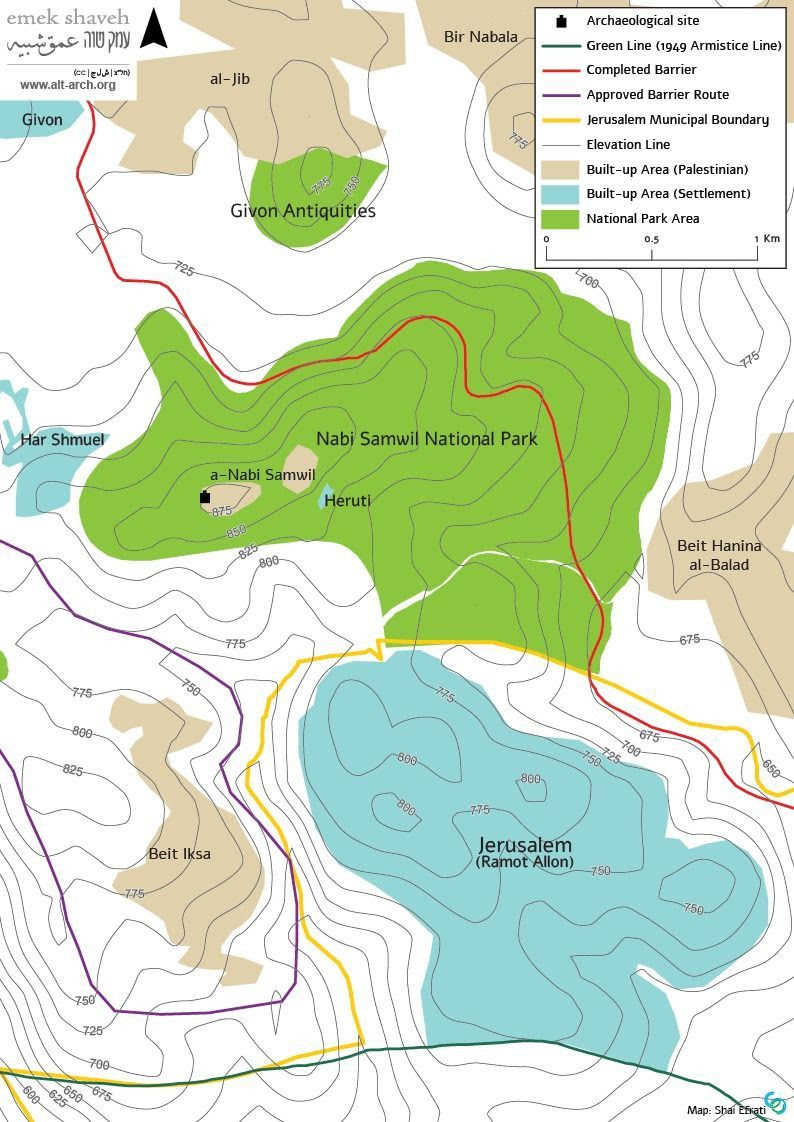 The plan to invest in the development of this tourism site ignores the longtime suffering of the Palestinian residents of Nabi Samwil. This small village is located on a strategic and highly prized hilltop (inside an area that Israel has declared to be a national park) located just outside of the municipal borders of Jerusalem but on the Israeli side of the separation barrier. This location places the village’s residents — who remain in the eyes of the Israeli government residents of the West Bank, for whom access to Jerusalem is forbidden without a special permit — in a Kafka-esque situation: they are cut off from the West Bank by the separation barrier but barred entry to Jerusalem. They are legally forbidden from taking the one road out of the village because it passes through Jerusalem, and the West Bank is accessible to them only via a circuitous route that passes through an Israeli checkpoint (for background see: The Palestinian village where Israel forbids everything, and this Twitter thread of resources curated by Lara Friedman). The suffocation of Nabi Samwil is in line with Israel’s long-time ambitions to completely de-populate the village and take control of the land.
In April 2020 – during one of the most intense periods of the COVID-19 lockdown last year – the Israeli military closed off the village entirely, and enforced the closure with only 14 hours’ notice for residents.
Ir Amim: JNF’s Proposed Land Registration Will Result in Land Takeover of an ‘Alarming Magnitude’
In a new analysis, Ir Amim explains how the Jewish National Fund’s upcoming decision on a proposal to start the process of registering land it claims to have purchased in the West Bank and East Jerusalem will serve as a means for mass land seizure. The JNF’s Board is expected to convene in the coming weeks to approve the plan.
Ir Amim explains:
“Anchoring KKL’s ownership claims to these lands is a dramatic move that puts entire Palestinian communities in jeopardy. This move is yet another troubling indication of how the recently enacted land settlement of title and registration process in East Jerusalem is being misused. As uncovered by Ir Amim over the last several months, this registration process – that has been advanced by the Israeli government – is unprecedented in both scope and consequence and is being used as a mechanism to register lands under Israeli ownership, which in the future could lead to settlement construction and displacement of entire Palestinian communities in East Jerusalem. The dangers these measures pose to Palestinian life in Jerusalem cannot be overstated, nor the severity of the political interests that are behind it. Given that the Sheikh Jarrah eviction cases attracted international attention, it is important to understand that the Israeli exploitation of the land registration process will involve vast areas of East Jerusalem, and therefore will lay the groundwork for future eviction demands against Palestinians several magnitudes larger than seen today.”
As a reminder, the JNF, established in 1901, devoted itself to buying land for Jews. Today, the JNF owns about 15% of all the land inside the Green Line (a figure which stands to increase if the review process leads to more properties being registered to the JNF). In addition, the JNF has used two subsidiary companies – both called Himanuta – to purchase land in the West Bank, even though the stated JNF policy (until now) did not support such purchases. Peace Now reports that the JNF, via Himanuta, has already purchased over 160,000 acres (65,000 dunams) across the West Bank; settlements established on some of those lands include Itamar, Alfei Menashe, Einav, Kedumim, Givat Ze’ev, Metzadot Yehuda (Beit Yatir), Otniel and more. At the same time, the JNF and the settler group Elad have been partnering together to pursue the mass eviction of Palestinians from East Jerusalem neighborhoods, including Silwan.
Bennett Goes to Washington to Talk Iran, But Questions on Settlements Remain
According to reports, Prime Minister Bennett’s priority for his first meeting with President Biden – now scheduled for August 27th – is Iran. However, in the lead up to that meeting Bennett has not been able to escape questions and pressure around the issue of settlement growth and annexation.
In an interview with the New York Times ahead of his meeting, Bennett said that his government is not looking to solve the question of Palestine, but also said that he has no plans to formally annex West Bank territory [although de facto annexation policies are proceeding apace) nor to end the siege on Gaza. Bennett said:
“This government is a government that will make dramatic breakthroughs in the economy. Its claim to fame will not be solving the 130-year-old conflict here in Israel. This government will neither annex nor form a Palestinian state, everyone gets that.”
In the interview, Bennett also briefly reiterated that his approach to settlement construction is limited to projects that address the supposed “natural growth” needs of existing settlements [for Lara Friedman’s take-down of this framing, see here].
In response to Bennett’s comments, settler leaders blasted him for betraying the settlement movement [reminder: Bennett led the settler Yesha Council for several years]. Current Yesha Council head, Yossi Dagan, told the Jerusalem Post that Bennett’s position is “totally unacceptable.” The Jerusalem Post also suggested that Bennett’s promise to allow for “natural growth” represented a cutting back in support for settlement construction compared to recent years.
Even before the New York Times interview, Bennett was facing significant discontent from settlers over the low number of settlement units [in the eyes of the settlers] that were included in the first planning wave under the Bennett-led government. Articulating that discontent, and calling on Bennett to buck what they see as U.S. pressure to limit settlement growth, settler leaders spoke out earlier this week. Binyamin Regional Council head Israel Gantz said:
“We urge you to remember where you came from and to tell the Americans that you are changing your policy and intend to build as needed. All ready-made construction plans in Judea and Samaria must be approved.”
Yossi Avrahami, a settler leader from Givat Ze’ev, said:
“Prove to us that you are not a [US] puppet that is being played.”
Bonus Reads
- “Jewish Agency Invites Staff to Radical West Bank Settlement for Holiday Trip” (Haaretz)
- “The Beita model: Palestinians lead ‘new form of resistance’ at Evyatar outpost” (The Times of Israel)
- “An Israeli Forest to Erase the Ruins of Palestinian Agricultural Terraces” (Haaretz)
- “This Luxury Home Epitomizes the Erasure of Jaffa’s Historical Landscape” (Haaretz)