Welcome to FMEP’s Weekly Settlement Report, covering everything you need to know about Israeli settlement activity this week.
To subscribe to this report, please click here.
March 11, 2022
- Settler Population Continues to Surge
- Bennet Government Delays Khan al-Ahmar Decision
- Major Ma’ale Adumim Settlement Expansion Advanced
- Palestinians Continue Weekly Protests Against Expansion of “American Road” in Jerusalem
- High Court to Rule on Expulsion of Palestinians in South Hebron Hills “Firing Zone”
- Former U.S. VP Mike Pence Hangs out with Kahanists in Hebron
- Further Reading
Settler Population Continues to Surge
The Israeli Ministry of Interior released new figures on the growth of the West Bank settler population over the past 13 months (January 1, 2021 through Jan 31, 2022). The data shows that growth in the Israeli settler population, which surged during President Trump’s overtly pro-settlement term in office, has continued to accelerate. This population growth follows the surge in settlement construction that took place during the Trump presidency.
The data was compiled by Yaakov Katz, who is the former Chair of the Board of Directors of the settler-run Arutz Sheva media outlet. Katz currently publishes West Bank Jewish Population Stats (a project of “Bet El Institutions”, associated with the settlement of Beit El – a settlement closely associated with Trump’s ambassador to Israel, David Friedman). The data reveals that over the reporting period:
- The number of West Bank settlers grew to a total of 490,493 (not including the ~330,000 East Jerusalem settlers), representing a nearly 3.2% rise over 13 months.
- The following settlements increased their population size by over 10% over the reporting period:
- Rechan, located in the northern West Bank;
- Alei Zahav, located in a string of settlements stretching across the northern West Bank. Alei Zahav and its settlement neighbors create a contiguous Israeli populated areas linking Israel proper (west of the Green Line) all the way to the Ariel settlement, located in the heart of the West Bank (the eastern end of Ariel is closer to the Jordan border than to the Green Line). Notably, Alei Zahav is one of the settlements in which the “market principle” has been applied to legalize settlers theft of land recognized by Israel as belonging to Palestinians (see our July 2019 report).
- Amichai, a brand new settlement established by the Israeli government in 2017 and continuously expanded, located in the central West Bank;
- Naaleh, in the central West Bank;
- Bruchin, in the central West Bank;
- Yitzhar, the radical and violent settlement located near Nablus in the central West Bank. The Yitzhar settlement serves as the home base of the “Hilltop Youth” settler movement;
- Nokdim, located south east of Bethlehem;
- Metzad-Asfar, located south east of Bethlehem;
- Kfar Etzion, located south of Bethlehem;
- Beit HaArava, located in the Jordan Valley;
- Maskiot, located in the Jordan Valley;
- Negohot, located in the South Hebron Hills;
- Susya, located in the South Hebron Hills;
- Pnes Hever, located in the South Hebron Hills;
- Sansena, located in the South Hebron Hills.
The report goes on to predict that the settler population will cross the 1 million threshold in 2046.
Bennet Government Delays Khan al-Ahmar Decision
This week the Bennett-led government asked the High Court of Justice to extend the deadline for submitting its position on the forcible relocation of the Khan al-Ahmar bedouin community (a war crime). The State was facing a March 6th court deadline (which has already been delayed once at the request of the State), and initially requested a two-day extension – which the Court granted. On March 8th, the State requested a 30-day extension, citing the Russian invasion of Ukraine as a time consuming matter for senior officials whose input is needed on the Khan al-Ahmar plan.
Regavim – the settler group behind the Court case seeking to force the government to demolish Khan al-Ahmar – slammed Bennett for the repeated delays and also stated that they might challenge the latest delay, saying:
“As far as we know, Prime Minister Bennett has already returned from his trip to Europe, and the additional rejection request smells like smearing. We will consider appealing to the Supreme Court for a ruling.”
Prior to this most recent delay, reports suggested that the government was preparing a plan that would see the demolition of the Khan Al-Ahmar only to (bizarrely) rebuild the community some 300 meters from where it currently stands. As a reminder, the High Court has ordered the demolition of Khan al-Ahmar, which it declared to be illegally built (i.e., lacking Israeli building permits that are virtually impossible for Palestinians to obtain).
It’s also worth recalling that the Supreme Court, in its September 2020 decision to grant the government a six-month delay, explicitly expressed its impatience to bring this matter to a close. It called the government’s request “embarrassing” and said:
“the expectation is that at the end of [the six-month] period a clear decision will be presented to this Court, after all options have been explored and exhausted. The period of mapping out alternatives and exploring courses of action is about to run its course, and what follows is the decision stage. Our aim is to conclude the hearing of this petition immediately after the [government’s updated statement] is submitted, and the plaintiff’s response is received, one way or another.”
Major Ma’ale Adumim Settlement Expansion Advanced
On March 3rd the local building committee of the Ma’aleh Adumim settlement, located just east of Jerusalem, approved what is reportedly the largest settlement expansion plan in over a decade. The plan would allow for 3,300 new settlement units as well as areas for public buildings. Assuming (conservatively) an average family size of 5, this means construction for at least 16,500 new settlers. The plan will now be sent to the Israel High Planning Council for its consideration and approval.
Ma’ale Adumim is the largest settlement by size and population. In past negotiations, Israel has always included Ma’ale Adumim and the surrounding area as one of the “settlement blocs” that would be annexed to Israel under a final agreement. The Israeli political consensus around the annexation of Ma’aleh Adumim (which has not been meaningfully challenged in past negotiations) has, by and large, resulted in the implied acceptance that expansion of Ma’ale Adumim is treated as non-controversial or not as geopolitically consequential as new units built in settlements and outposts in other locations. However, it should be emphasized that the term “settlement bloc” has no legal definition or standing — not under Israeli law, or under international law, or in the context of the Oslo agreement — and the fate of Ma’ale Adumim, like all settlements, is a matter for future negotiations. Nonetheless, the Israeli government has for years deployed the “settlement blocs” terminology in an effort to legitimize settlement expansion in areas it wants, in effect, to unilaterally take off the table for any future negotiations. For more context, see resources from Americans for Peace Now here and here.
Palestinians Continue Weekly Protests Against Expansion of “American Road” in Jerusalem
For the past month, Paelstinians have gathered in front of Jerusalem’s City Hall to protest a plan to expand the so-called “American Road” — expansion that will come at the expense of 62 residential structures that are home to 750 Palestinians in the Jabal al-Mukaber neighborhood of East Jerusalem.
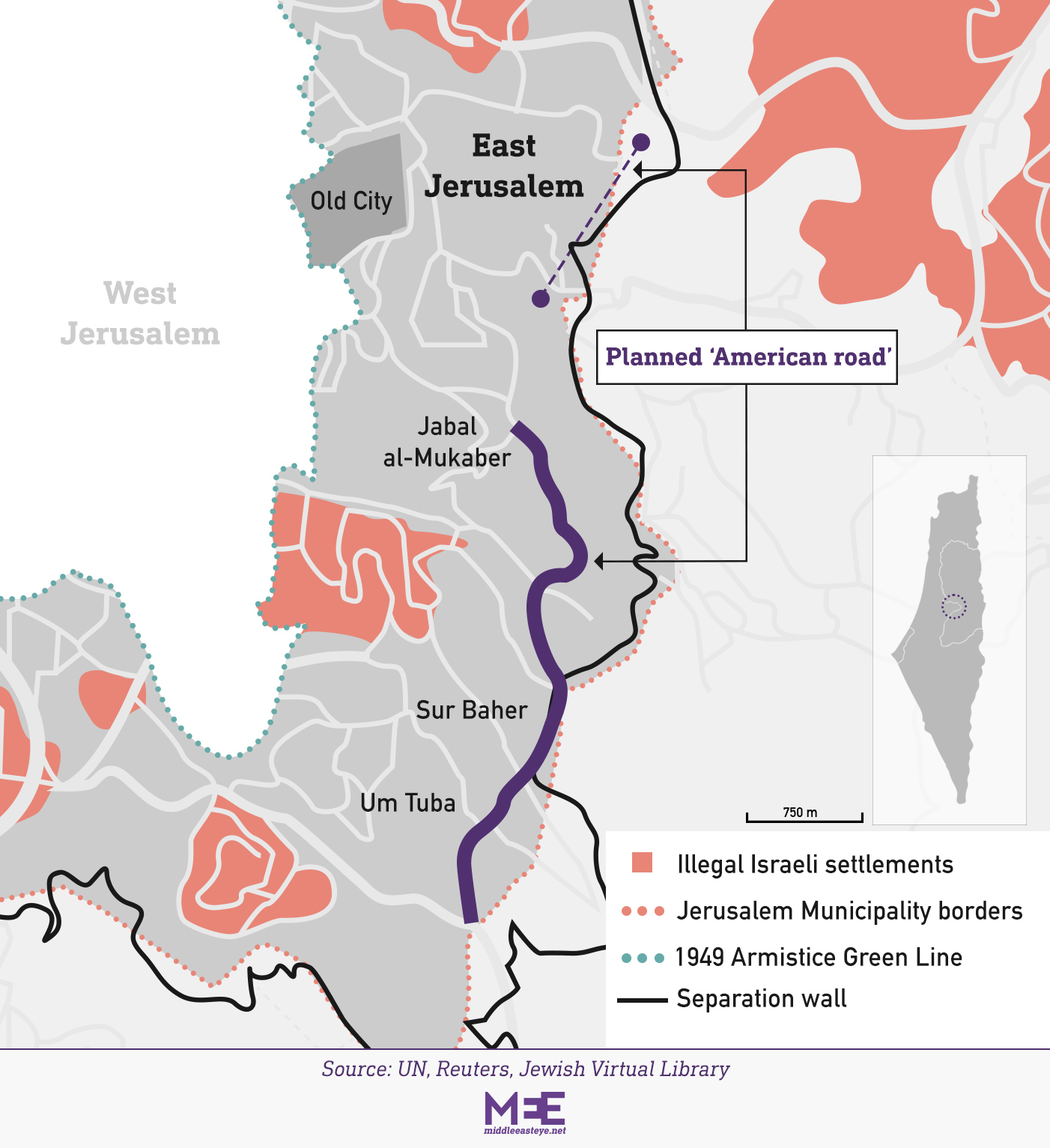 As a reminder, the so-called “American Road” is a section of north-south highway that is meant to more seamlessly connect settlements located in the north and south of Jerusalem to one another, and to serve as a bypass for settler traffic to cut through East Jerusalem’s Palestinian neighborhoods. While the road will be accessible to Palestinians (a fact touted by Israel as proof of Israeli good intentions), its clear primary purpose is to entrench Israel settlements, expand Israeli control over all of East Jerusalem, and close off Palestinian East Jerusalem neighborhoods from the rest of the West Bank, thereby (further) torpedoing Palestinian hopes of one day establishing a capital in East Jerusalem.
Israel began work on this road in June 2020, and recently completed the first phase of construction.
The second phase of construction directly threatens Palestinians, involving the demolition of 62 buildings in Jabal al-Mukhaber. According to Middle East Eye, the Jerusalem Municipality has come up with a proposal, as reported by one of the threatened homeowners:
“The municipality suggested alternatives for residents with demolition orders, but they are neither realistic nor fair, Muhammad says. The proposal stipulates erecting buildings upwards on each side of the road. In them, four stories must be exclusively allocated for parking, another four for commercial use, and only two stories for residential use, each containing four apartments. The estimated cost for each of those buildings is between 20 and 25 million shekels ($6m to $7.7m), which many Palestinians in the area can’t afford without loans. The options left for residents are either expulsion or indebtedness. One strategy the municipality is taking is to empty the area completely of its inhabitants and replace them with commercial centres, Muhammad says. ‘They want to force the residents to resort to local or external investors, or to resort to banks to take out loans, which would mean that the landowners would only receive a single residential apartment, while the investors or banks would retain the lion’s share,’ Muhammad told MEE. ‘The Jabal al-Mukaber residents refuse this unequivocally, considering vertical building to be incompatible with the rural context to which they have grown accustomed to’.”
See Orly Noy’s reporting for a detailed history of this plan’s evolution as well as a moving portrait of some of the Palestinians who are affected by this plan.
In a deeply researched report on how infrastructure like roads is a means for settlement expansion and annexation, Breaking the Silence explains:
“While Israeli authorities justify many of the projects described in this document by claiming that they serve both the settler and the Palestinian populations in the West Bank, it is important to note that these roads are designed with Israeli, not Palestinian, interests in mind. Many of the roads that are technically open to Palestinian traffic are not intended to lead to locations that are useful to Palestinians.16 Instead, these roads are primarily designed to connect settlements to Israel proper (and thus employment and other services) via lateral roads, rather than to connect Palestinian communities to one another. Further, roads intended to connect Israeli settlements to Jerusalem (many of which are currently under construction) do not serve West Bank Palestinians outside of Jerusalem, as they are not allowed to enter Jerusalem without a permit. In addition, an extensive system of checkpoints and roadblocks allows Israel to control access to bypass roads and the main West Bank highways, and it can restrict Palestinian access when it so chooses.
This prejudice against Palestinian development is even starker when one considers that, according to an official Israeli projection, the expected Palestinian population in the West Bank (excluding East Jerusalem) in 2040 is 4,600,000 individuals. Even if the vision of settler leaders to arrive at 1,000,000 settlers is realized by 2040, the Palestinian population would still be four times the size of the settler one. Despite this discrepancy, priority is still given to settler infrastructure development.
West Bank road and transportation development creates facts on the ground that constitute a significant entrenchment of the de facto annexation already taking place in the West Bank and will enable massive settlement growth in the years to come. By strengthening Israel’s hold on West Bank territory, aiding settlement growth, and fragmenting Palestinian land, this infrastructure growth poses a significant barrier to ending the occupation and achieving an equitable and peaceful solution to the Israeli-Palestinian conflict.”
High Court to Rule on Expulsion of Palestinians in South Hebron Hills “Firing Zone”
On March 15th, the Israeli High Court is expected to issue a ruling on the mass expulsion of 12 Palestinian communities in the Massafer Yatta region of the South Hebron Hills. These 12 villages are located on land that Israel declared a “firing zone” – Firing Zone 918 – in the early 1980s. Palestinian and Israeli activists have launched an international campaign to bring attention to the matter in the hopes of stopping the mass expulsion of Palestinians from their land.
In a recent article for +972 Magazine, Ali Awad – a journalist and activist from Massafer Yatta – contrasted the plight of his community to the success of chicken farms established by settlers on nearby land, writing:
“In Umm al-Khair, we find it especially absurd that the chicken farms have better infrastructure than our residents. We suffer from a constant lack of water and are prevented from connecting to the electricity grid; the farms, meanwhile, have constant access to water, and are not only permanently connected to electricity but also have backup generators in case of an emergency. Seeing the electricity lines pass directly over our village is a constant reminder that the animals get rights that we as Palestinians are deliberately denied. More importantly, we know that building these farms in Masafer Yatta is yet another strategy of the occupation to displace us Palestinians from our homes, and is no less dangerous than its policy of declaring 12 of our villages as falling under Firing Zone 918 — thereby sanctioning our displacement. Israel is even still using the outdated Ottoman Land Code in the occupied territories to transfer Palestinian pasture into “state land,” which it then leases to settlers in order to establish other kinds of farms. They are multiple laws and policies, but they all serve one goal: to take over Palestinian land.”
Over the past months, FMEP has hosted a series of webinars and podcasts highlighting Israel’s treatment of Palestinians in Massafer Yatta, including:
-
Israeli Apartheid, the Supreme Court, and Land Confiscation: The Case of Masafer Yatta (March 9, 2022) featuring Ali Awad (journalist and activist), Maya Rosen (activist) in conversation with FMEP’s Sarah Anne Minkin
-
“We don’t have another place to go:” Dispossession, Settler Violence, & Resistance in Masafer Yatta (January 2022) featuring journalist and activist Ali Awad in conversation with FMEP’s Sarah Anne Minkin
- Israeli Government Escalates Pressure on Israelis Who Stand in Solidarity with Palestinians (December 2021) featuring activists Oriel Eisner and Maya Eshel in conversation with FMEP’s Lara Friedman.
Former U.S. VP Mike Pence Hangs out with Kahanists in Hebron
During his visit to Israel this week, former U.S. Vice President Mike Pence found time to meet with far-right settler leaders including Kahanist lawmaker Itamar Ben-Gvir while visiting the Tomb of the Patriarchs/al-Ibrahimi Mosque in Hebron, a city that is perhaps the clearest example of Israeli apartheid policies.
According to the Hebron Fund (the U.S. 501c3 charity that raises funds for the Hebron settlers), Pence was accompanied by Simon Falic (Duty-Free America), who is a major supporter of the Hebron settlers. Photos showed Pence also accompanied by Baruch Marzel, the former right-hand man of the Kach party’s Rabbi Meir Kahane. For extra fun, here’s video of Marzel introducing Pence to Ben-Gvir, who Marzel says “represents us in the Knesset.” Pence shakes Ben-Gvir’s hand and says: “stay strong – we’ll stand with you… It’s my great honor.” Falic is also visible in the video.
During his time in Israel, Pence also received an honorary degree (alongside former U.S. Ambassador David Friedman) from Ariel University, at a ceremony held at the settlement. During the ceremony, Pence made his thoughts on settlements clear, saying:
“It’s great to be here in Ariel. I’m told that some people say that you shouldn’t go to Jewish communities in Judea and Samaria. I obviously have a different opinion.”
Pence also received an award from a group of Evangelical supporters in recognition of his support for Israel. That ceremony was held in Jerusalem. Many speculate that Pence is prepping for a run for the 2024 Republican nomination for the presidency, and making stops in Israel to court the Evangelical vote.
As a reminder, the parties associated with the now deceased Rabbi Meir Kahane – Kach and Kahane Chai – are U.S.-designated foreign terrorist organizations. Ben Gvir’s political party, Otzma Yehudit, is a clear present-day incarnation of those parties and is devoted to Meir Kahane’s teachings. For more on Kahanism in Israel, please see “Mainstreaming the Extreme: How Meir Kahane’s Vision of Jewish Supremacy Conquered Israeli Politics” and FMEP webinar hosted in March 2021 featuring Amjad Iraqi (+972 Magazine), Shaul Magid (author & Dartmouth College professor), Natasha Roth-Rowland (University of Virginia) in conversation with Lara Friedman (FMEP).
Bonus Reads
- “Editorial | Jewish Settlers in La La Land” (Haaretz)
- “ Israeli Human Rights Violations in the Occupied Palestinian Territory (Weekly Update, March 3 – 9, 2022)” (PCHR)
Welcome to FMEP’s Weekly Settlement Report, covering everything you need to know about Israeli settlement activity this week.
To subscribe to this report, please click here.
December 10, 2021
- Israel Advances Plan for New East Jerusalem Settlement, “Givat HaShaked”
- Israel Decides on a Last Minute (& Temporary) Delay of Atarot Settlement
- Shaked Funds, Elevates Settler Municipal Council in Hebron
- Demolition of Palestinian Property in Area C Hit a Five Year High in 2020
- Israel Escalates Intimidation of Activists Working in the South Hebron Hills
- Bonus Reads
Israel Advances Plan for New East Jerusalem Settlement, “Givat HaShaked”
 On Wednesday December 8th, the Jerusalem Local Planning Committee advanced a plan to build a new settlement, called “Givat HaShaked,” to be located on the southern perimeter of East Jerusalem – on the northwestern part of the Palestinian neighborhood of Beit Safafa. The plan would see construction of 473 settlement units, as well as schools. The plan also includes plots designated for two synagogues, the latter fact casting doubt on the Jerusalem Municipality’s assertion that “the Givat HaShaked plan is not necessarily designed for a specific demographic.”
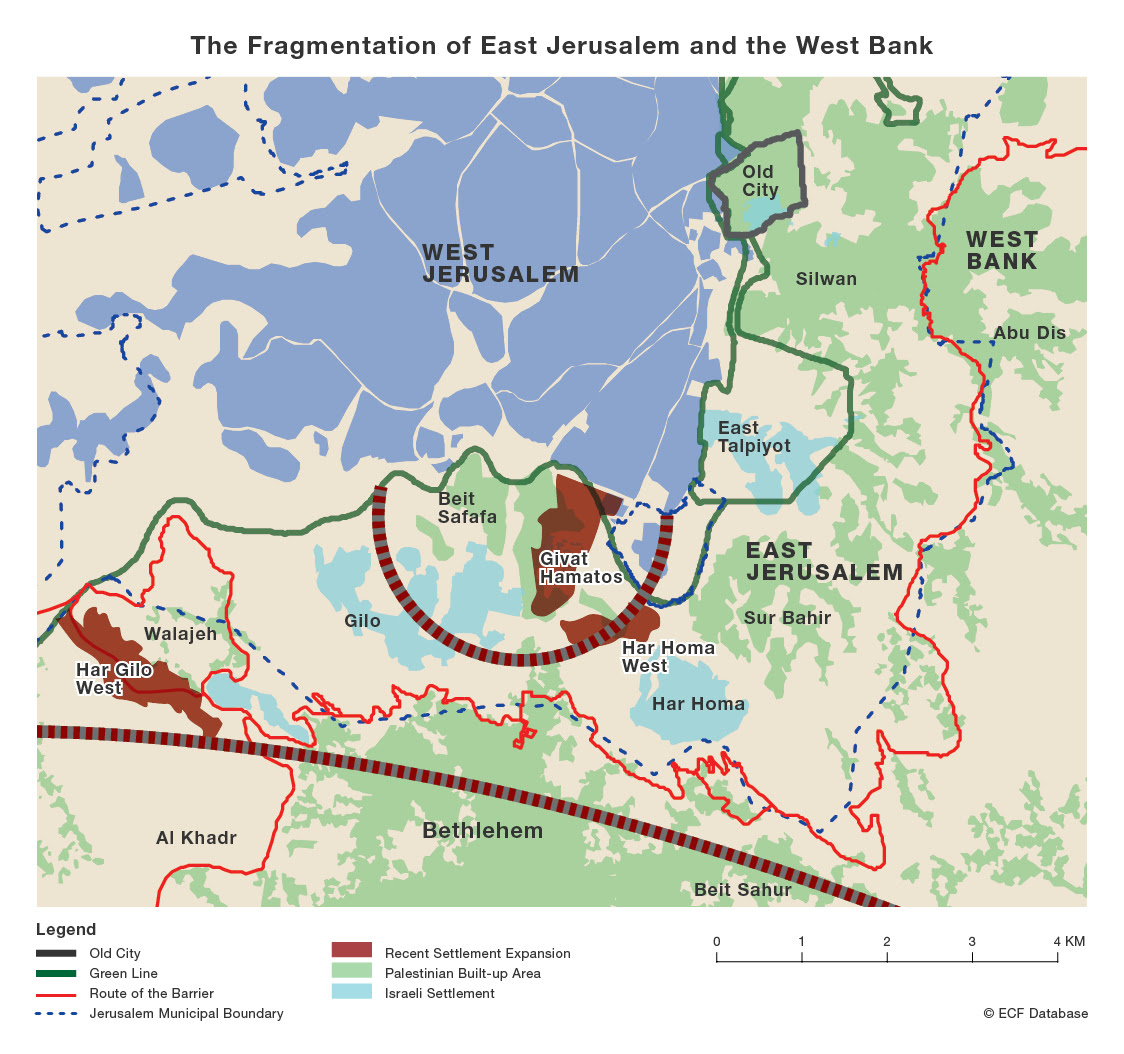 Ir Amim reports that a portion of the land on which Givat HaShaked would be constructed is privately owned by Palestinian residents of Sharafat, which is a section of the Palestinian neighborhood of Beit Safafa on the southern end of Jerusalem. It should be recalled that Beit Safafa – which is suffering from an acute housing crisis that Israeli authorities have refused to address – is in the process of being completely surrounded by Israeli development (for Jewish Israelis) — most notably with final approval of the Givat Hamatos settlement plan, for which tenders were issued in January 2021.
Other parts of the land proposed to be used for the Givat HaShaked settlement plan are managed by the Israeli General Custodian – a fact Ir Amim calls “highly unusual and seemingly marks a new phenomenon.” The Israeli General Custodian is empowered by the State to act as a caretaker of land that has unknown ownership until the heirs are located. In an attempt to explain why the General Custodian has the authority to approve a plan for construction on land that the State does not own, the Israeli Justice Ministry told Haaretz that the plan for Givat HaShaked increased the value of the land and that “by law, the administrator general is obligated to care for the assets under his management in a way that will benefit their private owners.” [An answer that implies, bizarrely, that if and when Palestinian heirs are located, they will be somehow better off with their land having been used to build a settlement].
It must be remembered that in late 2020 the Israeli government initiated a registration process for land in East Jerusalem, including in the Sharafat area. At this time, it is unknown whether the land managed by the General Custodian in Sharafat (and designated for the new settlement) has been – or is in the process of being – registered. On that uncertainty, Ir Amim writes:
“…in the event that it is the same location [where formal land registration has taken place], this move would constitute yet another brazen example of how the settlement of title procedures are repeatedly being used to aid state authorities and settler groups in taking over more land in East Jerusalem…Although portrayed as a measure to ostensibly benefit Palestinian residents, there has been grave alarm that these [land registration and settlement of title] procedures would in fact be exploited to confiscate Palestinian land for political purposes, leading to the expansion of Jewish settlement and widespread Palestinian dispossession in the city.”
It should also be recalled that Israeli authorities undertook the secret registration of land for the benefit of settlers in Sheikh Jarrah. For further information on the highly sensitive and consequential land registration process in East Jerusalem, please see FMEP’s reporting here and Ir Amim’s reporting here.
Ir Amim said in a statement on the Givat HaShaked plan:
“As 2021 comes to a close, it has become more evident that although the current Israeli government is comprised of a broad coalition, it is unequivocally advancing a hardline rightwing agenda propelled by far rightwing politicians in strategic positions. Since the theoretical “government of change” came to power half a year ago, it has successfully undertaken systematic measures, which sabotage any remaining viability of a negotiated political resolution and carry severe ramifications on Palestinian human rights. Settlement advancements in the most sensitive locations in and around East Jerusalem have accelerated unimpeded, while heightened threats of mass Palestinian displacement from the city have soared to an unprecedented level.”
Terrestrial Jerusalem founder Daniel Seidemann tweeted:
“Atatrot, E-1, Sheikh Jarrah, Silwan and now Givat Hashaked reveal the Bennett Doctrine: ‘Leave no eye un-poked’.”
Israel Decides on a Last Minute (& Temporary) Delay of Atarot Settlement
At a hearing on December 6th, the Jerusalem District Planning Committee ordered an environmental study be completed before it advances a plan for the construction of the new Atarot settlement on the northern border of Jerusalem. The court-ordered study is expected to take about one year. Notably, in ordering the study, the Court made it clear that the environmental study is “standard practice” and expressed support for the underlying plan, saying it believes the plan represents a proper use of unutilized land reserves.
The decision to delay the advancement of the Atarot settlement plan came as a bit of a surprise, as Israeli Prime Minister Naftali Bennett had assured settlers only last week that the plan would indeed be advanced at the meeting. However, Bennett has come under sustained scrutiny and pressure from the U.S. – most pointedly in a call on December 2nd with Secretary of State Antony Blinken. In the call, as reported by The Times of Israel, Blinken made it clear to Bennett that the U.S. would be unhappy if the plan was advanced, even if Israel committed that the construction would not move forward (as reports suggested was the preferred Israeli solution — one that the Israeli government likely thought would appease both settlers and the U.S.). Blinken is reported to have made it clear that any advancement of the project would be unacceptable. Notably, U.S. diplomats were in attendance at the December 6th hearing, which came one day after Thomas Nides presented his credentials to the Israeli government to serve as the U.S. Ambassador to Israel. Nides’ ceremony was originally scheduled for December 6th (the day of the hearing) but was reportedly rescheduled to not coincide with the Atarot hearing.
Meanwhile, Regional Cooperation Minister Issawi Frej (Meretz) is considering how to advance his own plan to build a new airport at the Atarot site, a plan which has the support of Israeli Transportation Minister Merav Michaeli (Labor).
As a reminder, the Atarot plan calls for a huge new settlement on the site of the defunct Qalandiya Airport, located on a sliver of land between Ramallah and Jerusalem. In its current form, the plan provides for up to 9,000 residential units for ultra-Orthodox Jews (assuming, conservatively, an average family size of 6, this means housing for 54,000 people), as well as synagogues, ritual baths (mikvehs), commercial properties, offices and work spaces, a hotel, and a water reservoir. If built, the Atarot settlement will effectively be an Israeli city surrounded by Palestinian East Jerusalem neighborhoods on three sides and Ramallah to its north. Geopolitically, it will have a similar impact to E-1 in terms of dismembering the West Bank and cutting it off from Jerusalem. For more on the Atarot settlement plan, please see here.
Shaked Funds, Elevates Settler Municipal Council in Hebron
On December 1st, an Israeli news station reported that Interior Minister Ayelet Shaked allocated $158,000 to the settlers in Hebron for the “development of municipal services.” Al-Monitor reports that this is the first such allocation of funds for Hebron’s nascent settler municipal body, which Shaked was part of establishing in 2017, when she served as Justice Minister.
Prior to receiving permission to form a municipal body in 2017, the loose cluster of settlements located in Hebron’s city center (home to around 1,000 settlers) had technically fallen under the municipal jurisdiction of the Palestinian Authority, while for all practical purposes operating as an enclave under full Israeli control and authority.
Hebron Mayor Taysir Abu Sneineh warned that Israel has repeatedly stoked tensions in Hebron – citing Israel President Isaac Herzog’s recent Hanukkah celebration at the Tomb of the Patriarchs/Al-Ibrahimi Mosque. The Mayor believers that Israel is trying to replace the Palestinian-run Hebron Municipality with a settler organization, telling Al-Monitor:
“This is not to mention the daily attacks [by settlers] in the Tel Rumeida neighborhood and al-Shuhada Street. The city is sitting on a volcano, and things might explode at any moment.”
Karim Jubran, director of field research at the Jerusalem-based nonprofit organization B’Tselem, told Al-Monitor:
“Settlers are tightening the noose around the lives of half a million Palestinians in Hebron, especially those who live in the H2 area, as hostages of settlers and the Israeli army.”
Demolition of Palestinian Property in Area C Hit a Five Year High in 2020
According to data from the Israeli Civil Administration, Israel demolished 797 Palestinian-owned structures in Area C of the West Bank – marking a five year high. The data was obtained via a freedom of information request filed by the Israeli NGO Bimkom.
The soaring number of demolitions is congruent with the escalating, government-funded and government-equipped campaign run by settlers to more aggressively wield building laws against Palestinians in Area C, even as settlers continue building unauthorized outposts in violation of the same building laws, and rarely facing consequences. Just last month, settlers formed a new task force coordinating settler advocacy on the topic. In October 2020, the Israeli government allocated nearly $2650,000 to 14 settler councils in order to buy drones and hire policeman to patrol Palestinian construction in Area C. The government also set up a hotline for settlers to report illegal construction.
As a reminder, under the Oslo Accords, the West Bank was divided into 3 “areas” – Area A, B, and C – pending a permanent status Israeli-Palestinian agreement that would determine final control over all the land (an agreement that was supposed to have been reached by by May 1999). Area C – which accounts for around 60% of the West Bank – was to be (temporarily, until an agreement was concluded) under full Israeli control over Area C. However, throughout the 28 years since the Oslo Accords were signed (and with no peace agreement achieved or in sight), Israel has systematically expanded settlements and its control over lands in Area C, including by denying Palestinians in Area C permits to build “legally” (under Israeli law) on their own land. As a result, Palestinians have been forced to build without Israeli permits (i.e., “illegally” in the eyes of Israeli authorities), and Israel has responded by issuing wide-scale demolition orders and carrying out frequent demolitions.
In recent years, Israel has increasingly treated Area C as indistinguishable from sovereign Israeli territory, extending its laws and regulations to the area and its Israeli settler inhabitants. In parallel, settler groups – most notably the notorious “Regavim” – have lobbied Israeli authorities to crack down on “illegal” Palestinian construction, claiming that Palestinians are trying to “take over Israeli land”.
As part of these ongoing efforts — by settlers and the Israeli government — to entrench and expand Israel’s control over/de facto annexation of the entirety of Area C, in September 2020 the Israeli government allocated 20 million NIS ($6 million USD) for the newly created “Settlement Affairs Ministry.” That ministry was given the mission of surveying and mapping “unauthorized” (by Israel) Palestinian construction in Area C (the same construction which Israel has been aggressively demolishing). This funding further empowers a domestic Israeli body to exert extraterritorial sovereignty over Area C – in effect, treating the area as land already annexed by Israel.
The Knesset has also repeatedly hosted forums to discuss the alleged (by settlers and their allies/advocates) “Palestinian takeover of Area C.” This framing is predicated on the assertion that Area C belongs to Israel (an assertion that is not supported by the Oslo Accords) and must be defended against Palestinian efforts to “steal” it. Consistent with this framing, and under pressure from various outside groups, many members of the Knesset have criticized the Israeli government’s alleged failure to robustly “defend” Israel’s rights and interests in Area C (e.g., failure to prevent/destroy “illegal” Palestinian construction, failure to block foreign government-funded humanitarian projects that support Palestinians’ presence in the area; failure to clear out Palestinians from the area, expand settlements, and consolidate state-built settlement infrastructure; etc.).
Israel Escalates Intimidation of Activists Working in the South Hebron Hills
In two separate – but by all indications connected – actions over the past week, Israeli authorities detained and interrogated several Jewish Israeli activists (some of whom are American citizens) involved in Palestinian solidarity and anti-occupation efforts related to raising awareness around settler violence, land seizures, and firing zones in the South Hebron Hills.
In Jerusalem, police twice raided the home of several Jewish activists on allegations that some of the residents were involved in spraying graffiti on public property as part of an anti-occupation action. In the course of those two raids, police ransacked the house and photographed all the residents, later summoning them for interrogation about the allegations of graffiti and opening cases against some of them.
Later the same day, there was an incident in A-Tuwani, a Palestinian village in the South Hebron Hills. A settler jogging through A-Tuwani – a bizarre action by a settler given that A-Tuwani has been the target of intense settler attacks – was confronted by Palestinians. The incident was eventually resolved in the presence of Israeli police and Israeli activists staying in the village in solidarity with Palestinians. Subsequently, the IDF summoned three of the Israeli activists for questioning about the incident. Those three activists (plus another two) were then detained, interrogated, and charged — with charges ranging from obstructing justice, assault, and failure to prevent a crime. The charge of assault was later dropped; the charge of failing to prevent a crime is a novel charge, generally reserved for cases of murder. The activists were later conditionally released, some after accepting a 15-day ban on entering the South Hebron Hills. In parallel, Israeli Police raided two homes in A-Tuwani – one of the homes houses Israeli activists, the other is the home of a Palestinian family prominently involved in activism and documentation of settler violence in the area. The Israeli police confiscated (without a warrant) equipment owned by the activists and the Palestinian Al-Adra family, including cameras, computers, and a jeep – all of which are vital tools in documenting the ongoing settler terrorism.
Attorney Riham Nasra, who is representing the three activists who were charged, told +972 Magazine:
“It is clear that this arrest is an attempt to inflate accusations in order to intimidate and deter activists, to prevent them from continuing their important activities. They were turned into suspects only because they did not cooperate with the investigators’ attempts to indict them. From the hearing it is clear that the activists were never suspected of involvement in the attack. Their arrest is part of the attempts to keep the activists out of the South Hebron Hills, where they expose the atrocities of occupation and human rights violations.”
The actions come at a time when settler terrorism in the South Hebron Hills is a matter of growing international scrutiny, and come only a few short weeks after U.S. members of Congress visited Palestinians in the area. One of the members of Congress, Rep. Mark Pocan (D-WI), followed up his visit by tweeting, “Today @JamaalBowmanNY & I visited w/ Nasser of Susia in Palestine today to discuss Israeli settler violence to his village. We will be watching to make sure no violence occurs this weekend or anytime.”
For more insight and details on these arrests and the background of the South Hebron Hills, check out FMEP’s latest podcast featuring Oriel Eisner and Maya Eshel – two of the Israelis arrested in Jerusalem and the South Hebron Hills, respectively – entitled, “Israeli Government Escalates Pressure on Israelis Who Stand in Solidarity with Palestinians.”
Bonus Reads
- “Israel, sans West Bank, officially joins EU’s huge flagship R&D program” (The Times of Israel)
- “New Israeli Government’s Scorecard for Peace: Poor.” (Dahlia Scheindlin for The Century Foundation)
- “How settler violence is fuelling West Bank tension” (The Guardian)
- “The Temple Mount movement is soaring under Israel’s new government” (+972 Magazine)
- “Israeli settlers have a new target, and it’s not in the West Bank” (+972 Magazine)
- “Why Settlers Are Quietly Happy With Israel’s post-Netanyahu Government” (Anshell Pfeffer in Haaretz)
Welcome to FMEP’s Weekly Settlement Report, covering everything you need to know about Israeli settlement activity this week.
To subscribe to this report, please click here.
November 12, 2021
- Settlers Secure Deal for Eventual Eviction of Another Sheikh Jarrah Family
- Increasing Pressure on the Government, Settlers to Operationalize Plan to Increase Control Over Area C
- JNF Stops Funding 18-Year Legal Battle Over Beit Bakri in Hebron
- Demolitions in East Jerusalem Continue, Including in Al-Walaja
- Settler Violence & Expansionism Continue to Escalate in the South Hebron Hills
- Bennett Pledges Evyatar Outpost will be Legalized, Sparking Palestinian Ire & More Coalition Threats
- Government Punts on Outpost Legalization Bill, Knesset Might Move Forward Anyway
- Bonus Reads
Settlers Secure Deal for Eventual Eviction of Another Sheikh Jarrah Family
Israel Hayom reports that a Palestinian family in the Sheikh Jarrah neighborhood has reached a Court-approved “deal” with settlers to recognize settler ownership of their home (where they have lived since 1956), in exchange for being allowed to stay as paying tenants for a period of at least ten years. The “deal” follows the broad outline of a Court-authored compromise that was rejected last week by four other Palestinian families (the cases are separate, but not unrelated).
Israel Hayom additionally speculates:
“The compromise, which was given the force of a legal ruling in the Jerusalem Magistrates Court a few days ago, could serve as a precedent for other local Arab families and is seen as a blow to the Palestinian Authority and Hamas, which are both pressuring Arab residents of Sheikh Jarrah-Shimon HaTzadik to refuse any proposed deals to vacate the properties.”
Increasing Pressure on the Government, Settlers to Operationalize Plan to Increase Control Over Area C
In a closed meeting on November 10th, the heads of settler regional councils met to discuss their ongoing effort to get the Israeli government to annex Area C of the West Bank. According to Arutz Sheva (the settler media outlet), the meeting resulted in significant decisions that create a more unified settler operation on the matter, including the formation of a “joint command center” through which all of the councils will act together, and a commitment by all the regional leaders to form a unified front to pressure the government.
Following the meeting, the participants released a statement saying:
“This struggle is over whether we continue to exist or to fold. This is an existential battle involving the entire Nation of Israel. We are all committed towards working together in order to stop the hostile takeover of our lands and in order to preserve the future of Jewish life in Judea and Samaria.”
An op-ed published in Israel Hayom on November 11th – entitled “In Area C, the time has come to get off the fence” – seemingly making the case for such an effort, the settlement activist Sara Haetzni-Cohen writes:
“Efrat’s dedicated residents have established their own war room. They track every brick and every bit of cement that is spilled and report it to the authorities. They know every demolition order that is issued but not enforced, and they do not give up. But the state quite simply does not exist. The Civil Administration is failing at its task and by choice…We’ve reached a stage where there is no state on which to rely on major issues. Real leadership from leaders who will get off the fence is needed. Local leadership in Judea and Samaria, whether elected or civilian organizations, must get off the fence and protect state lands, settlement lands, our homeland. It should be done intelligently, responsibly, and in a law-abiding manner. We should not resort to violence or vandalism against the Arab population, but rather go about this in a positive way, by planting trees and working the land, by showing our presence on the ground. If we will not be for ourselves, who will be for us? There simply isn’t any choice. We must get off the psychological and physical fence and defend our land.”
As a reminder, under the Oslo Accords, the West Bank was divided into 3 “areas” – Area A, B, and C – pending a permanent status Israeli-Palestinian agreement that would determine final control over all the land (an agreement that was supposed to have been reached by by May 1999). The Oslo Accords gave Israel complete control over Area C, which accounts for around 60% of the West Bank. Throughout the 28 years since the Oslo Accords were signed (and with no peace agreement achieved or in sight), Israel has systematically denied Palestinians in Area C permits that would enable them to build “legally” (under Israeli law) on their own land. As a result, Palestinians have been forced to build without Israeli permits (i.e., “illegally” in the eyes of Israeli authorities), and Israel has responded by issuing wide-scale demolition orders and carrying out frequent demolitions. In recent years, Israel has increasingly treated Area C as indistinguishable from sovereign Israeli territory, effectively extending its laws and regulations to the area and its Israeli settler inhabitants. In parallel, settler groups – most notably the notorious “Regavim” – have lobbied Israeli authorities to crack down on “illegal” Palestinian construction, claiming that Palestinians are trying to “take over Israeli land”.
As part of these ongoing efforts — by settlers and the Israeli government — to entrench and expand Israel’s control over/de facto annexation of the entirety of Area C, in September 2020 the Israeli government allocated 20 million NIS ($6 million USD) for the newly created Settlement Affairs Ministry. That ministry was given the mission of surveying and mapping “unauthorized” (by Israel) Palestinian construction in Area C (the same construction which Israel has been aggressively demolishing). This funding further empowers a domestic Israeli body to exert extraterritorial sovereignty over Area C – in effect, treating the area as land already annexed by Israel.
The Knesset has also repeatedly hosted forums to discuss the alleged (by settlers and their allies/advocates) “Palestinian takeover of Area C” — framing predicated on the assertion that Area C belongs to Israel (an assertion that is not supported by the Oslo Accords) and must be defended against Palestinian efforts to “steal” it. Consistent with this framing, and under pressure from various outside groups, many members of the Knesset have criticized the Israeli government’s alleged failure to robustly “defend” Israel’s rights/ interests in Area C (e.g., failure to prevent/destroy “illegal” Palestinian construction, failure to block foreign government-funded humanitarian projects that support Palestinians’ presence in the area; failure to clear out Palestinians from the area, expand settlements, and consolidate state-built settlement infrastructure; etc.).
JNF Stops Funding 18-Year Legal Battle Over Beit Bakri in Hebron
The Jerusalem Post reports that the Board of the Jewish National Fund in Israel has decided to stop funding the legal costs of a group of settlers battling to win control over a contested home in Tel Rumeida, in the heart of downtown Hebron (and to that end, forging documents). Israeli Courts have ruled against the settlers’ claim to the home twice, most recently in December 2019, in a ruling which affirmed that the Palestinian Bakri family is the rightful owner (the house is known as “Beit Bakri”).
At the request of the settlers, the JNF has agreed to pay installments on a legal guarantee to Israeli courts in order to allow the settlers to avoid eviction while pursuing an appeal against the December 2019 ruling against them. Since 2019, the JNF has paid some $35,000 (110,000 NIS) towards the case.
The Palestinian homeowners – the Bakri family – temporarily fled their home under constant settler harassment during the Second Intifada, a time when Tel Rumeida could have been accurately described as an “urban battlefield.” While the family was gone, settlers broke into the house, damaged it, destroyed the Bakri’s property, and ultimately took up residence there.
The Bakri family has spent the past 18 years petitioning Israeli police and the courts to remove the settlers — cases the Bakri family repeatedly won. The settlers have managed to repeatedly delay their eviction by essentially exploiting every possible legal defense, no matter how absurd or contradictory. For example: At different points over the past 18 years, settlers argued in court that they had a rental agreement; that they purchased the home; that the plot of land was owned by a Jewish trust prior to 1948 and they are “reclaiming” the property; and that because they had invested so much money in improving the land since taking it over, under Ottoman Law it now legally belongs to them, regardless of the means by which they acquired it. When at one point some years ago the courts ruled that the settlers had to evacuate, the settler occupants of the Bakri home did, indeed, leave, only to be immediately replaced by other settlers — at which point the Israeli Attorney General told the Bakri family that they had to start eviction proceedings anew. For a detailed timeline of the Bakri family’s saga, see this report from Peace Now.
Throughout the course of this saga, the settlers’ effort to hold on to the Bakri home was aided by the State’s unwillingness to implement court orders against the settlers. Peace Now said in a statement:
“This is not only a matter of cruelty, deceit and theft of settlers who are not loathe to take control of assets that are not theirs, but also a matter of the lack of government accountability. For 18 years the government did not enforce the law against the invading settlers, and even assisted them and allowed them to continue to steal the house and terrorize their Palestinian neighbors in Tel Rumeida. Furthermore, it should be remembered that Hebron is under Israeli occupation and the Palestinian residents cannot remove the settlers from their homes by appealing to the Palestinian Authority. The power lies in the hands of the Israeli government, which does nothing to fulfill its responsibilities to protect abandoned Palestinian property.”
Demolitions in East Jerusalem Continue, Including in Al-Walaja
Over the past week the Israeli government has moved forward with demolitions in Palestinian neighborhoods across East Jerusalem, including:
- The demolition of three Palestinian homes in the village of Al-Walajah on November 9th. For more on Israel’s systematic campaign to demolish homes in Al-Walajah – including its refusal to approve building plans initiated by Palestinians – see FMEP’s September 9, 2021 settlement report;
- Israeli authorities delivered demolition notices to 10 Palestinian families (70 individuals) living in an apartment building in the al-Tur neighborhood. The notice ordered the families to self-demolish the four-story building within one week, or have Israeli forces demolish the building, with the cost of the demolition billed to the residents. The families reportedly began removing their belongings from the building on November 5th in anticipation of demolition;
- Under coercive Israeli policies, a Palestinian family opted to self-demolish an apartment building in the Beit Hanina neighborhood;
- Under coercive Israeli policies, a Palestinian family opted to self-demolish its house in the Jabel al-Mukaber neighborhood.
As is always the Israeli position, the State asserts that the homes being demolished and under threat of demolition have been built by Palestinians without the required Israeli permits (often on land that even Israel recognizes they privately own). Such permits are generally all but impossible for Palestinians to obtain; in the case of al-Walajah, they are literally impossible to obtain, since the area lacks the required Israeli-approved “outline plan,” without which permits are an impossibility. Facing the reality of having Israel demolish their homes and being required to pay excessive costs and fees associated with such demolitions, Palestinians sometimes choose to self-demolish their homes.
Settler Violence & Expansionism Continues to Escalate in the South Hebron Hills
On Wednesday, November 10th a group of settlers attempting to install a campsite and graze their flocks on land near the Palestinian village of Khilet al-Daba clashed with local Palestinians, who worried that the settlers were making an attempt to take over the land – an understandable concern giving the growing phenomenal of farming outposts as a means for settlement expansion. The clashes – which took place at night after a full day of building tensions – took a violent turn when settlers set a Palestinian agricultural structure on fire. The evening ended with two Palestinians being shot by settlers with live rounds, three Palestinians wounded by settlers throwing rocks, and damage to several cars owned by Palestinians.
The land on which the settlers were grazing their flocks and attempting to install a campsite was declared to be a firing zone by the Israeli government, making it illegal for Palestinians to build there or even enter. According to Haaretz, the Israeli state has plans to evict Palestinians who live in this area (who have ostensibly lived in the area prior to it being declared by Israel to be a firing zone).
The IDF, which had been at the scene intermittently during the day, eventually sought to separate the groups by declaring the area a closed military zone. South Hebron Hills activist Basil Al-Adraa explained how this practice works to allow settlers to accomplish their goals, saying:
“The army arrived, declared it a closed military zone and kicked us out. But they didn’t kick out the settlers or take down the tent they put up today.”
The South Hebron Hills is a hotbed for settler violence, and was the scene of a settler attack – a Jewish pogrom – in September. Earlier this week, settlers from a nearby outpost – aided by the IDF – temporarily blocked Palestinian access to a playground in the village of Susiya. In addition to settler violence, the Israeli government is also acting to significantly expand settlements and retroactively legalize outposts in the South Hebron Hills.
Notably, two U.S members of Congress – Mark Pocan (D, WI-2) and Jamaal Bowman (D, NY-16) – visited the village of Susiya in the South Hebron Hills on November 10th (prior to the outbreak of violence that night). They pair met with local Paelstinian activist where they were told of the violence settlers inflict on the local population.
In an interview with Jewish Currents in October 2021, Basil Al-Adraa explained how violence and land takeovers are two sides of the same coin in the South Hebron Hills,
“Settlers have long been attacking the communities here. The [Israeli] Civil Administration gives them land stolen from the Palestinians: They declared it state land so they can take it by force, for settlers to build settlements and outposts and farms. This year, the settlers have started these new sheep farms around the West Bank, where they bring volunteers to work on these farms. But the settlers aren’t content with the tens of thousands of dunams [one dunam equals 1,000 square meters] they’ve been granted: They bring their animals to our private fields, which the state can’t take from us. They bring them to our orange trees, to drink from our water systems—like the well where we collect rainwater—and to graze on our grass. And what’s been happening recently, especially since May, is they’ve been organizing big attacks on Shabbat and holidays because settlers don’t have much work to do on those days. Dozens of settlers will come masked, with hammers, machine guns, sticks, and stones. The army escorts them two or three kilometers from their settlements to our villages. They burn houses, cut down olive trees. If the army sees some Palestinian trying to defend themselves, then they will shoot at [that Palestinian] with live stun grenades, or tear gas, or rubber bullets. They use all the force. We are under army law as Palestinians in Area C, but the settlers are under civilian law, so the soldiers in the area can’t deal with the settlers, who are under the jurisdiction of the police. But the police take three or four hours to come, only after the attacks have finished. In my community, al-Tuwani, there have been at least seven organized attacks. A lot of people look at these as [isolated] incidents, and this time, there was more media attention to the issue because there was a three-year-old child who was wounded. But it’s part of a policy, in which settlers and the Israeli army don’t want us to feel safe where we live. Like the home demolitions, the blocking of roads, the cutting water and electricity networks, it’s all leading to one goal: They want to kick us out of this land, out of Area C toward Area A [areas under Palestinian administrative and police control, like Ramallah]. But our land is here, our life is here.”
Bennett Pledges Evyatar Outpost will be Legalized, Sparking Palestinian Ire & More Coalition Threats
In a press conference on November 7th, Prime Minister Bennet affirmed his commitment to granting retroactive legalization to the unauthorized outpost of Evyatar – which was built on a strategic hilltop named Mount Sabih, located just south of Nablus on land historically belonging to nearby Palestinian villages Beita, Yatma, and Qablan. Even before Bennett’s most recent statement, several members of his fragile coalition have spoken out to insist that the reestablishment of Evyatar is a redline that, if crossed, could bring down the coalition (FMEP covered a few such statements two weeks ago). In the wake of Bennett’s press conference, more continued to do so, which only adds to the growing public fracture in the coalition over outposts and settlement building more broadly.
Public Security Minister Bar Lev (Labor) pledged to block the legalization of Evyatar, said this week:
“There are enough ways to dissolve this agreement. The Evyatar community [outpost] was illegal and illegal communities should be evacuated.”
The Mayor of Beita predicts that Bennett’s pledge to legalize the outpost (coupled with the end of the olive harvest season, which consumed protestors’ time elsewhere) will spark renewed energy in Palestinian-led protests in the town of Beita. Since settlers struck a deal with the government to temporarily vacate the outpost back in July 2021, Palestinians have staged regular protests against Evyatar outpost, and against the continue denial of access to the land on which the outposts continues to exist (the area is a closed military zone, where Palestinians are denied the ability to access). The protests over the summer were particularly violent, resulting in the killing of at least five Palestinian protestors by Israeli soldiers.
An organizer of the protests, Amal Bani Shamseh, told The New Arab:
“the people in Beita can not stand the idea of a single settler moving back to Mount Sabih and are willing to intensify protests, and women are the first to affirm it.”
As a reminder, the fate of the Evyatar outpost was the first controversy that threatened to divide the fragile Bennett-led government when it was sworn in. Bennet’s partners were bitterly divided on whether to evacuate the outpost or let it be, while the government sought to grant it retroactive legalization. In the end, the government reached a “deal” which saw the settlers (temporarily) vacate the outpost on Friday, July 2nd. In return, the government left the settlers’ illegal construction at the site in place (i.e., did not demolish it) — including buildings and roads — while it “examines” the status of the land to see if it can be declared “state land” and therefore “legally” turned into a settlement (opening the door for the settlers to return). Under the agreement, the outpost is being used as a military base in the interim.
The fact that the “compromise” left in place the settlers’ structures and allowed Israel to maintain complete control over the site during the “survey” process signalled from the start that the government is not concerned with enforcing Israeli law, but rather is focused on finding a political solution that works for the settlers. It was further clear from the terms of the “compromise” that the Bennet government believed it will be succeed in finding a pretext to assert that the land on which the outpost stands is “state land” which can be used by the state as it sees fit (i.e., give it to the settlers). If the state decides, pursuant to the investigation, that it has a basis on which to declare the site to be “state land,” the settlers will be allowed to return and resume the establishment of what would from that point no longer be an illegal outpost, but a new “legal” settlement.
Government Punts on Outpost Legalization Bill, Knesset Might Move Forward Anyway
The Jerusalem Post reports that the Ministerial Committee on Legislation has decided to delay by four months its decision on whether to grant government backing to a bill that would grant retroactive authorization (i.e., legalize) nearly 70 West Bank settlement outposts that Israel has failed to find any other way to legalize (because they are built on land even Israel recognizes is privately owned by Palestinians). As a reminder, the Ministerial Committee on Legislation is composed of government Ministers, and decides whether or not the governing coalition will throw its support behind a bill in the Knesset – ensuring either its passage or defeat.
In response to this news, MK Orit Struck (Religious Zionist Party) — who is also a longtime Hebron settlement leader — said that she intends to bring the bill to the Knesset for an initial reading despite lacking government-backing. Struck believes a strong majority of Knesset Members, regardless of the government’s position, will support the bill. Members of the Knesset attempted to fast-track the passage of this same bill in May 2021, while Bennett and Lapid were in negotiations to form the current governing coalition.
The bill introduced in May 2021 included an explanatory text claiming that the proposed law is in line with a decision the Security Cabinet took in 2017, when it tasked a new committee – headed by notorious settler leader Pinchas Wallerstein – to prepare individualized plans for each outpost to gain retroactive legalization based on the passage of the Regulation Law and the recommendations in the Zandberg Report. Bills similar to this have been filed several times in the past, and the Israeli government has debated granting retroactive authorization to the outposts via a government decision – and came close to doing so in the waning days of the Trump Administration.
Bonus Reads
- “Israeli Settlers Escalate Violence in West Bank” (Foreign Policy)
- “Nearly 20 years on, Israeli barrier shapes Palestinian lives” (AP)
- “Far-right protestors clash with cops in Jerusalem over settler teen’s death” (The Times of Israel)
- “They should have been lawyers. Instead they’re at Israeli construction sites” (Basil al-Adraa in +972 Magazine)
- “How the Occupation Harms Not Only the Palestinians, but the Planet Too” (Haaretz)
- “Palestinians say no to work in settlements” (Al-Monitor)
Welcome to FMEP’s Weekly Settlement & Annexation Report. To subscribe to this report, please click here.
July 30, 2021
- Sheikh Jarrah Updates: Court Issues Delays for Three Cases; Bennett Reportedly Considering Delaying Four Others
- In First Since Settlement Regulation Law Was Overturned, Israel Announces Intent to Demolish Settlement Buildings on Privately Owned Palestinian Land
- Elad Settler Group Loses Control Over East Jerusalem Holy Site/Archaeological Park
- Knesset Votes Down West Bank Annexation Bill, Condemns Ben & Jerry’s
- State Allows (& Funds) “Farming Outposts” to Graze Huge Tracts of West Bank Land
- Outpost Activity Continues in the South Hebron Hills
- Israeli Army Let Settlers Stay at Abandoned Base Despite Knowing Plans for Illegal Outpost
- Bonus Reads
Comments or questions? Email Kristin McCarthy – kmccarthy@fmep.org.
Sheikh Jarrah Updates: Court Issues Delays for Three Cases; Bennett Reportedly Considering Delaying Four Others
On July 29th, the Israeli Supreme Court issued notices delaying the forcible displacement of three families (Dajani, Hammad, and Dahoudi) from their longtime homes in the Sheikh Jarrah neighborhood of East Jerusalem. The eviction orders were set to become enforceable on Sunday August 1st, but the Court has halted the evictions while an appeal filed by the Palestinian families is dealt with.
Also sheduled for August 2nd, the Supreme Court is currently set to hold a final hearing to decide on the fate of four other Palestinian families (Jaouni, Iskafi, al-Kurd, and al-Qadi) facing forcible eviction in Sheikh Jarrah. According to press reports, Prime Minister Naftali Bennett is considering delaying the final hearing (thus stopping the evictions for the time being). Notably, reports suggest Bennett is looking not to cancel the evictions but only to postpone a final decision on them – a postponement that could be reversed at any time at the whim of the Prime Minister (for example, when the world’s attention is elsewhere).
In an op-ed in The Guardian, Mohammad El-Kurd – whose family is facing eviction – powerfully wrote:
“On 2 August, the Israeli supreme court, whose jurisdiction over the eastern part of Jerusalem defies international law, is set to decide whether it will allow the appeal of my family and three others – a last legal obstacle before we can be expelled. There have been postponements before. Palestinians are accustomed to this kind of stalling; it tests our stamina. But we are as stubborn as anyone else faced with the prospect of losing their home – their life, their memories – to those using force, intimidation and biased laws. In the face of this cruelty, and despite teargas and skunk water, we are resisting. We cannot allow them to steal our homes once more, and we refuse to continue living in refugee camps while colonisers live in our houses. We cannot let them throw more of us on to the streets. We are tired of being turned into a refugee population, neighbourhood after neighbourhood, one home at a time. I have no faith in the Israeli judicial system; it is a part of the settler-colonial state, built by settlers for settlers. Nor do I expect any of the international governments who have been deeply complicit in Israel’s colonial enterprise to intervene on our behalf. But I do have faith in those people around the world who protest and pressure their governments to end what is essentially unconditional support for Israeli policies. Impunity and war crimes will not be stopped by statements of condemnation and raised eyebrows. We Palestinians have repeatedly articulated what kind of transformative political measures must be taken – such as civil society boycotts and state-level sanctions. The problem is not ignorance, it is inaction.”
In First Since Settlement Regulation Law Was Overturned, Israel Announces Intent to Demolish Settlement Buildings on Privately Owned Palestinian Land
On July 28th, the Israeli Attorney General’s office informed the High Court of Justice that within three years (!!) it plans to carry out the demolition of two buildings built by settlers on privately owned Palestinian land located inside of the Eli settlement, in the context of a petition filed in 2011 by Palestinian land owners with the assistance of Yesh Din and Bimkom. Notably, the underlying legal petition sought the demolition of a total of 20 buildings constructed illegally on private Palestinian land, 18 of which Israel granted retroactive legalization in February 2020.
According to the Jerusalem Post, this is the first instance of the Court resuming looking at a case of this kind since the Settlement Regulation Law was overturned by the Court in June 2020. Previously, all cases involving illegal construction inside of settlements had been frozen while the Court considered the constitutionality of the law, which sought to create a legal basis by which Israel would be able to grant retroactive legalization to outposts and settlement structures built on land that even Israel acknowledges is privately owned by Palestinians.
In resuming its consideration of the case, the Court first asked to be updated on the State’s reexamination of the status of the land in hopes of finding a means by which to retroactively legalize the illegal construction, despite the fact that a previous government effort confirmed that the two buildings fall outside of the boundaries of state-owned land. With no other avenue available to “legalize” the construction, the State informed the Court this week that it intends to demolish the structures after the three years, which it claimed was the amount of time required to provide new housing for the four affected settler families [demonstrating, as always, that settler law-breakers are never punished and always rewarded]. This long delay also suggests that the State will continue to look for new ways to avoid demolishing the homes.
Leaders of the Land of Israel Lobby in the Knesset, MKs Yoav Kisch and Orit Strock, told Israel Hayom:
“This week, the government informed the High Court of Justice that it agrees to demolish the homes of four families in Eli. This is a horrifying, shocking announcement. Rather than preventing the destruction of Jewish homes in Judea and Samaria, the government is busy regulating the illegal construction crimes in the Bedouin sector. This is a badge of shame for the government, which is freezing construction, as well as going back on all its promises to regulate [settlements] and also demolishing Jews’ homes.”
Yisrael Gantz – who heads the Benyamim settler regional council – said:
“We are surprised that the government is falling in line with the Arab petitioners and announcing that it will, heaven forbid, demolish two homes where families have been living for years, which are part of a living, vibrant neighborhood. Razing a home whose status was legal and which a new review by the Civil Administration left outside the settlement’s borders is a new low in crimes against settlement in Judea and Samaria. These two homes are just a preview. We have hundreds of homes with similar status in the Binyamin settlements and thousands throughout the settlements as a whole that suddenly found themselves outside the new ‘blue lines’ drawn in the Civil Administration’s work. No normal country would demolish homes in a situation like this.”
Elad Settler Group Loses Control Over East Jerusalem Holy Site/Archaeological Park
On July 1st, the State of Israel re-asserted control over a significant and highly sensitive archaeological and holy site – the Davidson Archaeological Park – located just outside of the walls of the Temple Mount/Haram Al-Sharif. The park, which includes most notably tunnels that run directly from the Western Wall plaza to the settler-run Davidson Center in Silawn – had been run by the Elad settler organization since 2018, when the State willingly transferred its authority to Elad to operate the park.
In 2015 the Israeli NGO Emek Shaveh, which is made up of archeological experts, filed a petition against Elad’s role at the park, arguing that “it is highly problematic to place the running or management of a holy site that is situated alongside the Western Wall foundations in the hands of a private and politicized organization.” Emek Shaveh’s argument mirrored an opinion issued by Israel’s Attorney General which held that holy sites should be managed by the State.
Notably, the end of the state’s contract with Elad regarding the Davidson Park reduces but does not eliminate Elad’s role in managing key sites in Jerusalem. Elad continues to operate the nearby City of David archaeological park (just outside the Old City’s walls), where it has been advancing numerous settlement projects meant to strengthen its control over the area and displace Palestinians.
Emek Shaveh said in a statement:
“We are pleased that the authorities have put an end to a highly problematic arrangement whereby a private right-wing organization is operating an important site situated in perhaps the most sensitive place in the region. We hope that in the future the State will take full responsibility for additional sites which it handed over to the settlers’ foundation. The City of David is, no doubt, the next site that ought to be returned to full management by the State. Emek Shaveh’s case regarding the tunnel linking the Davidson Center to Givati is still ongoing.”
Knesset Votes Down West Bank Annexation Bill, Condemns Ben & Jerry’s
In a July 28th preliminary vote the Knesset rejected, by a relatively slim margin (64 to 50), a bill to annex the entire West Bank. Members of Prime Minister Naftali Bennett’s ruling party, Yamina, voted against the bill. The bill had been submitted by members of the Likud party, which is now in the opposition after 15 years of being the most powerful party in the country and having had the ability to pass such a bill if desired. One of the bill’s cosponsors, Miki Zohar, said after the vote:
“You promised again and again that you will take action to bring about sovereignty over Judea and Samaria and you once again broke your word,” Zohar said. “You once again proved that you have no ideology and that no values are holy for you except for keeping your cabinet seats.”
Justice Minister Gideon Sa’ar (New Hope) responded, saying:
“I heard MK Mikki Zohar relating to the fact that in the last administration, Netanyahu wanted to apply sovereignty but Blue and White prevented him from doing so. And I was just thinking to myself, ‘How far from the truth can you get?’…So you, MK Zohar, party whip for the Likud in the last Knesset, could have brought this bill up in the last Netanyahu government, during the Trump administration, during the amazing window of opportunity – you could have submitted the sovereignty bill and had a majority in the Knesset.”
Around the same time this bill was voted on, 90 members of the Knesset, including Yamina members, signed a letter calling on Ben & Jerry’s to reverse its decision to end sales in the occupied West Bank. The letter refers to settlements as “towns and cities in Israel” – a statement tantamount to a declaration of de facto – if not official – annexation. Notably, 6 MKs – from Labor and Meretz – subsequently removed their names for the letter, claiming that they signed on without seeing the final wording, and that the final wording does not reflect their views.
State Allows (& Funds) “Farming Outposts” to Graze Huge Tracts of West Bank Land
In response to a Peace Now inquiry, the Israeli Agricultural Ministry revealed that it has granted permits to unauthorized (i.e., illegal under even Israel law) agricultural outposts to use over 2,000 acres (8,500 dunams) of land in the West Bank for grazing, in a program which entrenches and expands the outposts’ illegal presence across the West Bank.

Map by Peace Now
And if that wasn’t enough of a scandal, the Ministry confirmed that it provided sizable grants – totalling over $800,000 (2.6 million NIS) over the past few years – to at least three settlement organizations for the purpose of bringing volunteers to these outposts – which, again, are illegal even under Israeli law – to work the land. Notably, these settler organizations publicly boast about their farming activities with respect to a total of 50 farming outposts, suggesting that settlers are making use of far more than the 2,000 acres permitted by the Ministry (the Ministry clarified that it funds activities only related to the areas where settlers are authorized to work — so apparently they see no problem].
Peace Now said:
“The Ministry of Agriculture takes millions of Shekels of public monies and give them to associations which are intrinsically linked to illegal activity. If the government wants to stop more outposts such as “Evyatar” from existing, and to stop the small group of ideological settlers who allow themselves to set facts on the ground that determines the foreign and security policies for Israel, it must change its ways immediately and stop supporting outposts and illegal activities”.
Two of the outposts to which the Agricultural Ministry awarded grazing permits are located in the south Hebron hills, on land that is privately owned by Palestinians. One of those outposts, established by a settler named Shavti Kohslaviski, has active demolition orders issued against it. A third outpost that received grazing permits is located near the Elon Moreh settlement, on a site that is partially privately owned Palestinian land that Israel has made inaccessible to its Palestinian owners but on which settlers regularly trespass .
Israeli Army Let Settlers Stay at Abandoned Base Despite Knowing Plans for Illegal Outpost
Kerem Navot reports that on July 23rd, dozens of settlers were allowed to stay at an abandoned military base in the Jordan Valley with permission of the Israeli army. The Israeli Commander in charge of the area reportedly said that he granted permission for the settlers to hike in the area and spend one night at the army base – – despite the fact that the settlers openly declared their intent to establish a permanent presence there. The settlers left after two nights at the site, though a government source told Haaretz that the problem will continue to linger, saying “the minute the brigade commander allowed this one time, they will go up there regularly, when they feel like it, with or without permission, and the defense establishment will have to start dealing with it.”
Kerem Navot reports:
“The organization that is behind this current takeover attempt is called “Nahala.” Nahala is the same group behind the takeover of Mount Sbeih south of the village of Beita, upon which the outpost of Eviatar was founded two months ago, and operates behind a fictional NGO (which we wrote about not long ago- https://bit.ly/3763yJW). Yes, you understood that correctly: The same people who broke the law when they established the outpost Eviatar, are advancing a new aggressive takeover of lands that do not belong to them, instead of standing trial. Welcome to the West Bank.”
Outpost Activity Continues in the South Hebron Hills
On July 25th, Palestinian media reported that settlers have begun reestablishing an outpost in the south Herbron hills, near the town of Yatta. Settlers had abandoned the outpost a few months ago under regular protests by Palestinians.
On July 27th, the Israeli government dismantled another outpost – called “Beit Dror” by settlers – in the south Hebron hills. There were seven families of settlers living at the outpost in pre-fabricated homes which were removed from the area by cranes. Following the evacuation, the settlers held a cornerstone-laying ceremony at the site, vowing to return and permanently build on the land.
Bonus Reads
- “Over 140 Palestinians hurt after Israeli troops attack anti-settlement protesters” (The New Arab)
- “A water spring in the occupied Jordan Valley targeted for takeover by Israeli settlers” (WAFA)
- “Palestinian teenager killed by Israeli troops in West Bank” (The New Arab)
- “Ben & Jerry’s Is Shunning Israeli Settlements. The U.S. Should Too” (DAWN)
Welcome to FMEP’s Weekly Settlement Report, covering everything you need to know about Israeli settlement activity this week.
To subscribe to this report, please click here.
September 7, 2018
- Israel Advances Plan for New Settlement in East Jerusalem
- Even More East Jerusalem Settlement Plans Advanced
- Israel Demolishes Homes in al-Walajah, Advancing “Greater Jerusalem” Project
- State Admits to High Court it Built Settler Road on Palestinian Private Land
- Prominent Human Rights Activists Arrested While Leading Tour of Hebron Region
- Government Official Claims Jerusalem Cable Car Project Will Benefit Palestinians in Silwan
- BonusReads
Comments, questions, or suggestions? Email Kristin McCarthy at kmccarthy@fmep.org. To subscribe to this report, please click here.
Israel Advances Plan for New Settlement in East Jerusalem
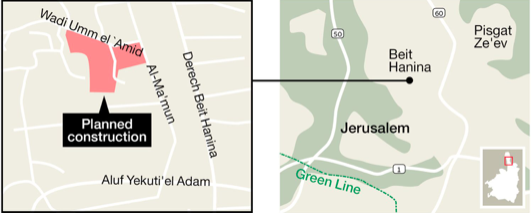
On September 5th, the Jerusalem Local Planning and Building Committee advanced a plan to build a large new settlement enclave (150 units) within yet another Palestinian neighborhood of East Jerusalem. The project – a pet project of Jerusalem settlement financier (and since 2013, Jerusalem city council member) Aryeh King – would be the first-ever authorized settlement project in the Beit Hanina neighborhood of East Jerusalem, located north of the Old City.
Map by Haaretz
The plan would build housing for approximately 75 settler families (which, based on a conservative estimate, would mean a population of around 500 settlers in Beit Hanina). If built, it would be one of the largest Israeli settlement enclaves inside any Palestinian neighborhood in East Jerusalem.
According to the plan, 75 units units would theoretically be earmarked for Palestinians – a point used by the plan’s supporters to suggest that it is actually benevolent. The key word here, however, is: theoretically. As noted by Jerusalem expert Danny Seidemann in another context:
“Since 1967, the Government of Israel has directly engaged in the construction of 55,000 units for Israelis in East Jerusalem; in contrast, fewer than 600 units have been built for Palestinians in East Jerusalem, the last of which were built 40 years ago.”
In announcing the approval of the plan, Israel’s deputy mayor made clear what part of the plan the Municipality is actually focused on:
“We’re happy to announce today that we’ve approved construction of 150 housing units in Beit Hanina, and especially that 75 Jewish families can now live there.”
Notably, the Jerusalem Local Planning and Building Committee advanced the plan through the first stage of the planning process, despite an objection filed by the private Palestinian company that owns 45% of the land upon which the new units would be built (ownership that the Israeli government tried – and so far failed – to cancel, through efforts to rescind the sale of the land to that company). The Committee explained its decision to ignore the objection by asserting that it was only discussing planning schemes and not ownership issues. The Jerusalem Municipality also weighed in, suggesting that the Palestinian company is too late in asserting its rights, saying that the ownership issue was “examined as part of the examination of the plan’s preconditions.”
Director of the Peace Now Settlement Watch program, Hagit Ofran, rejected that argument, saying:
“this is not a real estate project but a project of defiance and settlement. The fact that Israeli entrepreneurs, who own only half of the land, have prepared a plan without consulting Palestinian owners [of the other half] indicates that they have no intention of coexistence and peace.”
 A handful Israeli settlers already live in Beit Hanina, having directly acquired private property in the heart of the neighborhood. This small group of settlers clearly benefit from the plan, both because it lends legitimacy to their presence in and broader claims to the neighborhood, and because the new project would create a territorial linkage between the new settlement in Beit Hanina and the large ultra-Orthodox settlement of Ramat Shlomo to its south.
The historic nature of the Beit Hanina settlement plan is being hailed by pro-settlement media and activists. The Deputy Mayor of Jerusalem, Yossi Deitch, said, “I hope approval of the units will be the sign and signal that construction in the city will be unfrozen next year throughout the city and for all sectors. I’ll do everything possible to thaw the construction freeze in Jerusalem.”
Israel has increased home demolitions across East Jerusalem, including Beit Hanina, over the past year. In Beit Hanina, many homes are under the threat of demolition because they lack Israeli-issued building permits – permits that Palestinians find all but impossible to secure. Just this week, Israel demolished the Farrah family home in Beit Hanina, built over 16 years ago – despite the fact that the family has spent years attempting to obtain the necessary permits and has paid 250,000 shekel ($69,362) fine to the Israeli government.
Even More East Jerusalem Settlement Plans Advanced
In addition to the Beit Hanina settlement plan, Ir Amim reports that Jerusalem authorities have advanced several other inflammatory settlement projects in East Jerusalem over the past week:
- The Local Planning and Building Committee discussed issuing a permit to retroactively legalize unauthorized settlement construction – several shops and offices – in Silwan, located at the entrance of the settler-run City of David National Park. The buildings were constructed, without permits, under the direction of the radical Elad settler group, which is contracted by the Israel National Parks Authority to run the City of David National Park. As a reminder, Elad’s mission is to establish a permanent Jewish presence in Palestinian neighborhoods of East Jerusalem. The retroactive permit, in addition to legalizing the current buildings, would also allow the group to build an additional story to one of the buildings, to serve a”lookout” point. Demonstrating government collusion with the settlement enterprise in Jerusalem, the permit request was filed by the Israel National Parks Authority, not Elad.
- The Local Planning and Building Committee committee discussed public objections filed against a plan to build a 6-story office building for settlers at the entrance of the Sheikh Jarrah neighborhood. The office building, if approved, would be located adjacent to the site of a planned Jewish religious school to also be built in Sheikh Jarrah – called the Glassman Yeshiva. That school, once it is built, will house dozens of young religious settlers. Together, the two projects will flank the road leading into Sheikh Jarrah and become part of a settlement bridge/corridor connecting the isolated settlement enclaves in the heart of Sheikh Jarrah to West Jerusalem. Ir Amim notes that both settlement projects have been advanced “despite the area being zoned for public buildings for a Palestinian neighborhood sorely lacking in social services.” This latest advancement was anticipated and noted in last week’s Settlement Report.
- The Jerusalem Local Committee advanced two plans to increase the number of new units authorized to be built in the Gilo and Neve Ya’akov settlements. In both instances, the Local Committee discussed plans that increase the number of units permitted to be built under already-approved plans (adding an additional 48 units in both cases, bringing the Neve Ya’akov project to 86 units total and the Gilo project to 148 units total).
Israel Demolishes Homes in al-Walajah, Advancing “Greater Jerusalem” Project
On September 3rd, Israeli officials demolished four buildings in the al-Walajah village, on the pretext that they lack required Israel-issued building permits. Israeli security forces fired tear gas and rubber-coated steel bullets at a crowd of protestors who gathered to try to stop the demolition, injuring several.
The demolitions were in the Ein Juweza neighborhood of the village – an area that is technically located within the municipal borders of Jerusalem (the border runs through the village, leaving the rest of al-Walajah in the West Bank), and therefore subject to Israeli planning and building laws. An additional 189 homes in al-Walajah have demolition orders issued against them.
The lawyer representing al-Walajah residents in this case said,
“The residents’ attempts to submit a master plan [without which it is impossible for residents to even apply for permits to build on their own land] were thwarted by the objection of the state and subsequently, the planning authorities. In this situation of criminal neglect of the village and its residents, the only service the state gives them is ‘home demolition service.’ This is an impossible, illegal situation that contradicts the most minimal fairness.”
Ir Amim reports:
“While refusing to allow building in Walajeh, in the area around the village Israel is promoting construction of thousands of housing units for Israelis on lands – some of which were confiscated from Walajeh – in the settlements of Gilo and Har Gilo. To the north of the village, within the Green Line and on lands that belonged to Walajeh until 1948, a construction plan of over 4,000 housing units is being advanced. These construction plans, together with the national park declared on al-Walajeh land in 2013, are meant to create an Israeli continuum between Jerusalem and the Gush Etzion settlements surrounding Bethlehem. This morning’s demolitions in Walajeh are an inherent part of the policy to transform this area into an Israeli space.”
As FMEP has previously reported, residents of al-Walajah have long been struggling against the growing encroachment the nearby Etzion settlement bloc and the Israeli government’s attempt to de facto annex the bloc as part of “Greater Jerusalem.” Ir Amim explains several prongs of this effort, including a particularly problematic section of the separation barrier around al-Walajah that has been planned in order to (a) almost completely encircle the village, (b) turn its valuable agricultural land into an urban park for Jerusalem, and (c) enable construction of a highway that will connect the Etzion settlement bloc to Jerusalem with Israeli-only bypass roads.
State Admits to High Court it Built Settler Road on Palestinian Private Land
The Israeli government admitted to the High Court of Justice that it cut and paved a road on land that is privately owned by Palestinians in the South Hebron Hills. The State claimed it did so by mistake, believing the land in question, which had been included in construction plan for the settlement of Shima – despite the fact that Palestinian owners objected as soon as construction started in 2015. Even after the objections were lodged against the construction, Israeli authorities took months before issuing a stop work order, allowing the road to be completed/paved in the meantime.
In the brief submitted this week, the State asked the High Court to dismiss the case regarding the road, explaining that the Civil Administration had already taken action to correct the borders of the Shima settlement to, in effect, return the land to is owners (now paved with a road for the settlers). The State says that action was prompted in 2015 when the Civil Administration “Blue Line” team released new mapping of the area, which clarified that the land is indeed privately owned by Palestinians.
Commenting on the story, a spokesperson for Rabbis for Human Rights told Haaretz:
“The state acted like the ‘hilltop youth’ [a radical settler group]. You can’t explain this away using the excuse of an innocent mistake, given that even after our warnings it took a long and embarrassing legal procedure to get them to do the obvious: check who actually owns the land.”
Prominent Human Rights Activists Arrested While Leading Tour of the Hebron Region
Israeli security forces arrested three prominent human rights activists while they were leading a sizeable group on a tour of settlements and outposts in the Hebron/South Hebron Hills area. Avner Gvaryahu (Executive Director of Breaking the Silence), Michael Sfard (a prominent Israeli human rights lawyer), and Achiya Schatz (Communications Director for Breaking the Silence) were released after three hours of detention.
The men were arrested near the Mitzpe Yair outpost in Hebron, the same spot where activists from Taayush – “Israelis & Palestinians striving together to end the Israeli occupation and to achieve full civil equality through daily non-violent direct-action” – were violently attacked by settlers the previous week, with at least four wounded seriously enough to be evacuated to for medical treatment. In that attack, IDF soldiers reportedly stood by and did nothing (and in its aftermath, the Israeli government and senior officials, including Netanyahu, said nothing).
Breaking the Silence related the events, saying:
“As we drove up the road leading to the outpost, we were blocked by a Border Police jeep. Within minutes, we were presented with a ‘closed military zone’ order, signed by the brigade commander. We were given one minute to evacuate a group of 120 participants, some of whom weren’t so young. When we asked for more time to get everyone on the buses, the arrests started. As was reported in the media, the arrests were aimed at the leaders of the tour, which reinforced our suspicion that they were initially meant to sabotage the tour….Upon arriving at the police station, Avner, Achiya, and Michael had been told that they were in fact not arrested but rather detained, and that there was no immediate need for investigations or arrests. They were then told to return in a month and a half for further investigation.”
The group’s email to supporters ends:
“we refuse to cave in to settler violence and to surrender to their intimidation, incitement, and violence directed against those who oppose the immoral reality of the occupied territories.”
Government Official Claims Jerusalem Cable Car Project Will Benefit Palestinians in Silwan
On September 5th, the Society for the Protection of Nature held a public forum to discuss the planned cable car project in Jerusalem, which is slated to have its final stop at the settler-run Kedem Center in Silwan. The Kedem Center is a project of the radical Elad settler group, which works to settle Jewish Israelis inside Palestinian neighborhoods of East Jerusalem.
Sami Arsheid, a lawyer representing Palestinian residents of Silwan (who will be deeply impacted by the project), attended the town hall event to raise their concerns. Arsheid said that Palestinians had not been consulted and noted that the invitation to the meeting was written in Hebrew only.
A Israeli government official responsible for planning the cable car project, Aner Ozeri, stressed how the project will ease movement and alleviate transportation pressures, and insisted that the project will, in fact, benefit Palestinian residents of Silwan. Even if that claim turns out to be true, it glosses over the fact that, assuming the most benign intent, the Israeli government is engaging in planning in Silwan that rejects/ignores the views of the vast majority of the residents (i.e., the only residents of Silwan whose voices are listened to in this process are the settlers). Moreover, in the case of this plan the intent, entirely unhidden by planners, is by no means benign: the purpose of the cable car project has nothing to do with the interests of Palestinian residents – rather, its purpose is to facilitate tourist visits to Jewish sites in East Jerusalem, in a manner that prevents tourists from seeing or encountering Palestinians.
The meeting was also attended by government officials tasked with explaining and defending the project, as well as architects, academics, preservation experts, and tourism professionals who criticized the plan on a myriad of bases – mostly highlighting how the project will damage the historic landscape of Jerusalem.
Bonus Reads
- “In West Bank Settlements, It’s a Bull Housing Market” (Haaretz)
- “Israeli right wing party aims at one million settlers” (Al-Monitor)