Welcome to FMEP’s Weekly Settlement Report, covering everything you need to know about Israeli settlement activity this week.
To subscribe to this report, please click here.
May 24, 2019
- U.S. Announces Economic Workshop in Bahrain, Palestinians Reject Invitations
- Netanyahu Says West Bank Land is Israel’s “Inheritance”
- Likud MK Re-Submits Bill to Annex the Jordan Valley
- Top Israeli Court Admits West Bank Archaeological Digs Are a Legal Liability, Rules Israel Can Dig in Complete Secrecy to Avoid Repercussions
- High Court Override Bill? It’s About Settlements, Stupid
- Report: Likud May Support Bill Effectively Annexing the Settlements (by Disempowering Civil Administration)
- Israeli Border Police Once Again Demolish Structures in “Tapuach West” Outpost
- Video Catches Settlers Attacking Palestinian Town & Torching Fields
- Bonus Reads
U.S. Announces Economic Workshop in Bahrain, Palestinians Reject Invitations
On May 19th, U.S. Treasury Secretary Steven Mnuchin sent invitations to Palestinian, Israeli, and Arab business leaders to attend a workshop in Bahrain on June 25-26 aimed at “unleashing the economic potential of the Palestinian private sector.” With near unanimity, notable Palestinian invitees publicly rejected the invitation, while dismantling the notion that an economic horizon for the Palestinians can be divorced from a political one. The sole Palestinian businessman known (as of this publication) to have accepted the U.S. invitation is Ashraf Jabari, who has gained favor amongst U.S. peace envoys for his public partnership with Israeli settlers to form the Judea and Samaria Chamber of Commerce.For more information about Jabari, see last week’s edition of the Settlement Report, and this new piece on Jabari and how his efforts echo the “Village Leagues” model, written by Mitchell Plitnick.
Explaining the fundamental problem of launching an economic peace effort without a political horizon to end the occupation, Sam Bahour wrote in +972 Mag:
“Kushner seems to be missing the point entirely: Israel is addicted to Palestine’s economy, and without overcoming that addiction, there is no chance for any grand ‘business plan’ to succeed. Moreover, his ‘in-depth operational document,’ which he calls ‘realistic, executable…and will lead to both sides being much better off’ is borderline hallucinatory, given the fact that it dismisses the need for the establishment of a Palestinian state. Israel’s determination to maintain full control of the Palestinian economy for over five decades has become a major hurdle in getting it to realize that its occupation must come to an end. And like recovery from other addictions, this one will require external support. That support needs to be based on third states holding Israel accountable to save it from itself, rather than building a ‘business plan’ to try and paint life under the boot of Israeli military occupation as somehow beautiful. Here, in addition to human rights, we speak of economic rights, too: our rights to our economic assets — land, water, natural gas wells, our Dead Sea and Mediterranean Sea shores, borders, and the like — and the ability to employ them within a Palestinian-defined economic development plan, free from Israeli or donor agendas. Dumping more humanitarian and developmental funds into Palestinian coffers will not solve the conflict.”
Zahi Khouri, a Palestinian-American entrepreneur who owns the Coca-Cola franchise in the West Bank and Gaza Strip, said:
“Putting this first is a blatant payoff. You insult the people by talking about their quality of life when you keep them locked up [under the Israeli occupation]…[It is like] trying to strangle a woman while giving her a manicure. In nation-building you start with dignity and freedom. You don’t start by bribing people and buying people.”
Bashar al-Masri, the Palestinian businessman and developer behind the Rawabi city project, wrote on Facebook:
“The idea of economic peace is an old idea that is now suggested differently. As our people previously rejected it, we are rejecting it now.”
Abed Alkarim Ashour, a Palestinian businessman from Gaza, posted on his Facebook page:
“The Bahrain conference aims at selling Palestine for a fistful of dollars – you in invited the wrong person.”
Ibrahim Barham, the founder of a Palestinian electronics and engineering company and a member of the Palestinian Monetary Authority, politely rejected the invitation, telling the Washington Post that he was surprised to even receive an invitation. Barham’s surprise was a common reaction amongst Palestinian invitees, a clear indication that the U.S. did not lay the groundwork for Palestinian buy-in despite a two-year self-described strategy of speaking directly to the Palestinian people over the heads of the Palestinian Authority. For it’s part, the Palestinian Authority officially declined to participate in the conference.
Ashraf Jabari – who FMEP profiled last week – announced that he will attend the conference on behalf of the Judea and Samaria Chamber of Commerce, an initiative Jabari launched from Hebron alongside Israeli settlers. Criticism of Jabari reached a fever pitch following his predictable acceptance of the U.S. invite when a spokesman for the PLO told Reuters that Jabari and any other Palestinian who accepts the invitation are “collaborators.”
The PA Foreign Minister Riad al-Maliki spoke at an event in London organized by the prestigious Chatham House during which he explained that Israel’s policies in the West Bank designed to:
“ensure confinement and expansion of Israeli settlers with the objective of maximum land with minimum Palestinians. [Palestinians are] now in the final stages of this master plan that Israel is no longer even trying to hide, and which can only be described as colonialism under the disguise of occupation.”
Notably, the Trump Administration elected to schedule this workshop – entitled “Prosperity to Peace” – to take place at the same time the United Nations is set to hold a pledging conference in support of URWA, the Palestinian refugee agency that the U.S. defunded in January 2018.
Netanyahu Says West Bank Land is Israel’s “Inheritance”
This week Israeli Prime Minister Benjamin Netanyahu doubled-down on his pledge to annex the West Bank, lending even a greater sense of inevitability to Israeli annexation. Netanyahu’s latest remarks were in response to a letter warning of the dangers of annexation signed by hundreds of former Israeli security officials. Netanyahu defiantly tweeted his defense of annexation:
“The region in Judea and Samaria are not just a guarantee of Israel’s security — its also the inheritance of our ancestors…The same ‘experts’ supported the Iran nuclear deal and warned that ‘Bibi is taking a wrong turn and ruining the alliance with America.”
The Times of Israel also has new reporting on how settler leaders have are planning to pressure Netanyahu on annexation should he balk at taking action on that front. Reflecting on a pre-election meeting with Netanyahu, Samaria Regional Council Chairman Yossi Dagan that he expects Netanyahu to start proceeding with annexation plans immediately upon forming the next government. Dagan added:
“And if that does not occur, we know how to fight.”
At that meeting with Netanyahu, Yossi Dagan was joined by Binyamin Regional Council chairman Yisrael Gantz, Har Hevron Regional Council chairman Yochai Damri and Kiryat Arba-Hebron Local Council chairman Eliyahu Libman. Reportedly they collectively pressed Netanyahu not just on the annexation of settlements, but on the fate of unauthorized and far flung outposts. According to Dagan, Netanyahu promised that he does not distinguish between regulated settlements and unauthorized outposts.
Likud MK Re-Submits Bill to Annex the Jordan Valley
On May 20th, Likud lawmaker Sharran Haskel filed a bill with the Knesset to annex the Jordan Valley to Israel. Haskel also filed the bill in the previous Knesset session, but the bill was put on hold by more senior lawmakers.
The new bill provides that Israeli annexation of the Jordan Valley should be subject to a referendum, explaining that Israeli annexation will benefit Palestinians. Haskel said:
“the communities of the Jordan Valley are a strategic and security asset of the first degree..[but] under military jurisdiction… we have come to an unreasonable situation where the residents of the Jordan Valley cannot develop their communities.”
As FMEP has reported, Israeli planning policies in the Jordan Valley are designed and implemented in a way that systematically denies Palestinians the right to develop their communities, while at the same time assisting Israeli settlers to take over an increasing amount of land, and often doing so in contravention of Israeli law.
Top Israeli Court Admits West Bank Archaeological Digs Are a Legal Liability, Rules Israel Can Dig in Complete Secrecy to Avoid Repercussions
In response to a petition for the public disclosure of facts regarding state-run archaeological digs in the occupied West Bank, the Israeli Supreme Court ruled that the Israeli government can continue to conceal basic information about the digs in order to protect national interests, particularly to guard against international repercussions and potential legal suits. The petition – filed by the NGOs Emek Shaveh and Yesh Din – notes that it is illegal under international law for an occupying power to remove archaeological findings from the occupied territory.
Justice Elron, who voted in the state’s favor, argued that revealing the data on the archaeological sites would harm Israel, saying that disclosure of the facts will contribute to:
“undermining [Israel’s] interests in the framework of future negotiations with the Palestinian Authority, and could even serve as a tool of attack for parties that seek to harm Israel in the international arena.”
Emek Shaveh explained the ruling’s absurdity:
“The law relates differentially to information inside the Green Line and information in the West Bank, implying that continued Israeli control over the West Bank requires two legal systems under a single government. Justice Baron, in a minority opinion, maintains that the ruling poses a threat to democracy.”
The Court’s ruling also argues that disclosing the name of archaeologists working in the West Bank will expose them to academic and professional boycotts. At least one Supreme Court Justice opposed this point. Justice Barron wrote in her dissent:
“Non-disclosure has the power to silence public debate over the legitimacy of archaeological digs in Judea and Samaria. Public debate could indeed invite criticism of the archaeologists, and perhaps even a boycott, as argued by the respondents. But silencing the debate by concealing the information is no cure for these fears. There is no democracy without a vibrant free market of ideas and opinions, and preventing public debate for fear of criticism, or even of boycotts, poses a real danger to the democratic values Israel espouses. The fear of a slippery slope on this issue is also tangible.”
The Palestinian Authority asserted that Israel’s West Bank excavations are a crime and called for UNESCO and the World Travel & Tourism Council to establish an international fact-finding mission on the matter.
High Court Override Bill? It’s About Settlements, Stupid
As FMEP has long reported, Israeli government officials’ motivation to pass the so-called High Court “override bill” is closely connected to its desire to protect and advance settlements in the West Bank. With possible movement of such legislation in the news this week, Likud MK Miki Zohar tweeted:
“The High Court intervenes in countless decisions, including on settlement in the Land of Israel; we want to put an end to that. We have the political opportunity to do so.”
The latest reporting regarding coalition negotiations over this law (debates over which are inextricably linked to Netanyahu’s plan to shore up his own immunity from criminal prosecution) continues to suggest that the bill will very likely be passed into law.
Former Justice Minister and long-serving Likud member of the Knesset Dan Meridor warned against the override law, saying:
“The idea of an override clause — that we won’t be a democracy, that there will be a dictatorship and the majority can do whatever it wants, that the court can’t say anything and there are no checks and balances — is a dangerous anti-democratic idea. There is not a single parliament in the world without checks and balances.”
Report: Likud May Support Bill Effectively Annexing the Settlements (by Disempowering Civil Administration)
Israeli Radio reports that Likud Party leaders are considering support for a bill, pushed by Bezalel Smotrich in coalition negotiations, that would bring the settlements under domestic Israeli law while leaving the Palestinians under the authority of the Israeli Civil Administration (the arm of the Israeli Defense Ministry that acts as the sovereign authority in the West Bank).
As the inevitability of Israeli annexation grows (and enthusiastic U.S. support for it), it remains to be seen how Israel will enact its annexation. Bringing the settlements under Israeli domestic law is just one way Israel might move forward. For more ways that Israel is already implementing or pursuing de facto annexation of the settlements, see FMEP’s comprehensive tracking.
Israeli Border Police Once Again Demolish Structures in “Tapuach West” Outpost
On May 20th, Israeli forces demolished three illegal structures in the unauthorized Tapuah West outpost, located south of Bethlehem. Three settlers were arrested for interfering in the demolition. A settler who was living in one of the demolished structures told The Times of Israel that it is possible the Samaria Council allowed the demolition to take place in order to build a more expansive settlement project in the area.
In a statement, Samaria Council Chairman Yossi Dagan denied the claim, saying:
“I call upon the government ministers to stop this destruction. On the nearby hills there are hundreds of illegally built Arab homes, yet the government concentrates on a single Jewish home, uprooting it and its inhabitants.”
This is the second time in the past year that Tapuach West outpost has been cleared. In June 2018, settlers violently clashed with the Border Police were met with as they officers 10 structures from the same area. The settler-instigated melee injured 11 Israeli policemen.
Video Catches Settlers Attacking Palestinian Town & Torching Fields
On May 17th, B’Tselem captured video showing masked settlers, believed to be from the notoriously radical Yitzhar settlement, setting two fields on fire and attacking the Palestinian villages of Burin and ‘Asirah al-Qibliyah. B’Tselem says that nearby Israeli soldiers not only failed to stop the attack, but also prevented Palestinians from reaching the flames in order to extinguish them. What’s more, the IDF erroneously blamed Palestinians for setting the fields on fire. The IDF was forced to retract their accusation when video footage proved it was the settlers who committed arson. Settlers later extinguished the flames themselves, reportedly fearing the flames were headed towards their settlement. As of publication, the IDF has not made a single arrest, though the criminals were clearly seen on video, and there has been no news of an investigation.
B’Tselem writes:
“This complete backing from the state authorities is consistent with Israel’s longstanding policy in the West Bank, under which such acts of violence serve its interests and help it achieve its goals.”
Bonus
- “Annexation Threat Heightens Woes of Water-Starved West Bank Palestinians” (The National)
- “Rights Groups Urge International Community to Stand Against US-Israel Annexation Strategy” (WAFA)
- “Despite its Flaws, We Must Fight for the High Court” (+972 Mag)
Welcome to FMEP’s Weekly Settlement Report, covering everything you need to know about Israeli settlement activity this week.
To subscribe to this report, please click here.
December 7, 2018
- Looming Mass Eviction in Silwan, Part 1: High Court Rules that Settler Organization Can Pursue Eviction of 700 Palestinians in Batan Al-Hawa Section of Silwan
- Looming Mass Eviction in Silwan, Part 2: Elad Settler Org Wins Eviction Case Against Palestinians in Wadi Hilweh Section of Silwan
- Israel to Fast-Track Two Settlement Plans in Sheikh Jarrah
- Justice Ministry Finalizes Legal Opinion to Retroactively Legalize the Haresha Outpost
- Three Illegal Outposts (& Ariel) Are Now “National Priority Areas” Eligible for Government Subsidies
- High Court Rules the Jewish National Fund is the Legal Owner of Land South of Bethlehem
- Israel Seizes Jordan Valley Land Owned by the Catholic Church
- Israeli Civil Administration Report Criticizing Yitzhar Settler Violence Leads to Renewed Calls to Annex the West Bank
- After IDF Killed Two Palestinians, Civil Administration Grants Settlers Victory in Struggle Over Hilltop
- The New Mayor of Jerusalem, Moshe Lion, On Settlements
- Al-Shabaka Policy Paper: “The EU & Jerusalem”
- Breaking the Silence Report – “Occupying Hebron: 2011-2017”
- U.S. Chatter on Economic Coexistence Initiatives (Which Normalize Settlements/Occupation) Provokes Strong Palestinian Response
- Bonus Reads
Questions/comments? Email kmccarthy@fmep.org
Looming Mass Eviction in Silwan, Part 1: High Court Rules that Settler Organization Can Pursue Eviction of 700 Palestinians in Batan Al-Hawa Section of Silwan
On November 22nd, the Israeli High Court of Justice ruled that the settler organization Ateret Cohanim can continue to pursue the eviction of 700 Palestinians from their homes in the Batan al-Hawa section of the Silwan neighborhood in East Jerusalem. This would be the largest displacement of Palestinians from East Jerusalem since 1967.
The High Court’s ruling did not decide the central issues in the case, which call into question Ateret Cohanim’s ownership of the land through its control of an historic Yemenite land trust (the Benvenisti Trust). The High Court reserved those issues for the Jerusalem Magistrate’s Court to decide as part of its consideration of individual eviction cases.
In its ruling, the High Court criticized of the government’s involvement in the case, specifically calling out the role the government played in transferring ownership of the land to Ateret Cohanim without properly informing the Palestinian residents. The High Court ruling said:
“We can’t continue without expressing surprise at the state’s assumption that a decision so significant to the lives of hundreds of people – ‘liberating’ the property on which they have lived for many years [and transferring it] to other hands – isn’t the kind of thing that ought to be publicized through reasonable means. Even the precise identity of the property’s residents wasn’t known, and that’s the interpretation kindest to the state…Evicting people who have lived on this land for decades – some of them without even knowing that the land belongs to others – creates a human problem. Especially when it’s done without compensation or any other solution. It seems the state would do better to consider providing a solution, in appropriate cases, for those evicted from their homes. Property rights are important, but it’s also important to defend people’s homes.”
B’Tselem commented:
“The judgment proves, yet again, that the Israeli High Court gives its seal of approval to almost any infringement of Palestinians’ rights by the Israeli authorities.”
Ateret Cohanim has waged a years-long eviction campaign against Palestinians living in Silwan, on property the settler NGO claims to own, based on its control of the historic Benvenisti Trust, which oversaw the assets of Yemenite Jews who lived in the neighborhood in the 19th century. Palestinians have challenged the legitimacy of the Benvinisti Trust’s claims to the currently existing buildings, saying that the trust only covered the old buildings (none of which remain standing) and not the land. Despite ongoing legal challenges, in October 2018 the Jerusalem Magistrate’s Court ruled in Ateret Cohanim’s favor in one of the cases connected to the Benvenisti Trust’s claim to the buildings there – resulting in the eviction of the last remaining Palestinian tenants (the Abu Sneina family) from a building in area of Silwan known as Batan al-Hawa.
The ruling this week does not give a final decision to the underlying questions of ownership, but it allows Ateret Cohanim to proceed – from a strengthened position – in its legal efforts to evict Palestinians from their homes.
Looming Mass Eviction in Silwan, Part 2: Elad Settler Org Wins Eviction Case Against Palestinians in Wadi Hilweh Section of Silwan
 On December 5, 2018 the Jerusalem Magistrate’s Court upheld the eviction of a Palestinian family – the Siyams – family their home in the Wadi Hilweh section of Silwan, in East Jerusalem, just 820 feet from the southern wall of Al-Aqsa Mosque. Like Ateret Cohanim (see above), the Elad settler organization has been waging a years-long legal battle to take control homes in Silwan, including a 20-year battle to take control of the Siyam family home, which Elad insists legally purchased it.
The Court ruling this week was the first ruling in the settlers’ favor. The Siyam family announced plans to petition the ruling to the Jerusalem District Court.
In response to the ruling, Peace Now said:
“This case is an example of how the settlers manage to take control of Palestinian property in East Jerusalem by combining manipulations, money, forgery and significant aid from the Israeli authorities. It is not a regular case between equal sides, but a story of David and Goliath, and the settlers are the Goliath. There is a settlers organization with almost unlimited financial resources and enormous political power against an ordinary Palestinian family that has been forced into court for more than 20 years, to invest tremendous resources in legal defense and to deal with various and varied purchase claims. This way the settlers are causing great damage to Israel when they harm the delicate fabric of life in Jerusalem and the possibility of compromise in Jerusalem and a two-state solution.”
Israel to Fast-Track Two Settlement Plans in Sheikh Jarrah
Ir Amim reports that the Jerusalem District Planning and Building Committee will meet on December 23rd to fast-track the approval of two plans for a total of 13 new settlement units in the Sheikh Jarrah neighborhood of East Jerusalem. The plans put approximately 5 Palestinian families at imminent risk of eviction.
On December 23, the Committee will discuss public objections to plans for the two settler building (one for 10 units and one for 3 units), which if approved, will result in the eviction of 5 Palestinian families.
Ir Amim further explains:
“The two plans in Sheikh Jarrah are being pushed by city councilperson and settler leader Arieh King, a close ally of Jerusalem’s just inaugurated mayor, Moshe Leon. King has recently joined the new mayor at several public events and is said to be eyeing a deputy mayor position in the new administration.”
+972 Magazine has an excellent piece on the resumption of evictions and settlement takeovers in Sheikh Jarrah, which have been stalled since 2009, in part due to international pressure. A prominent figure in the Sheikh Jarrah resistance movement, Saleh Diab, said:
“Ever since Trump said last year that Jerusalem belongs to the Jews, we have been feeling the change. The settlers are working quickly to evict us before the American administration changes…How will we go back to the days of protests? The police today are like the police in [apartheid] South Africa. Israelis who stood alongside us were fired from their jobs because of their views…Like in Khan al-Ahmar, they are trying to expel an entire community and turn us into refugees for a second time.”
PLO Spokeswoman Hanan Ashrawi released a statement saying:
“Since the beginning of the year, Israel has accelerated and intensified its efforts to entrench its colonial military occupation, especially in and around occupied Jerusalem…Israel’s extremist, racist government coalition headed by Prime Minister Benjamin Netanyahu is deliberately and systematically working to complete the total annexation and isolation of Jerusalem from its Palestinian environs and surrounding areas, as well as the distortion of the occupied city’s demographic, historical and cultural character…These measures pose a strategic threat to Palestinian human and national rights, especially through the imposition of new and ‘permanent’ realities on the ground that deliberately undermine the achievement of Palestinian statehood…At a time when the rights-based international system is under threat, the reality and future of Jerusalem is a litmus test for the world and the integrity of its legal and political system. It is our hope that the global community and people of conscience will rise to the challenge and defend the universality and indivisibility of human rights. The world must not fail Jerusalem.”
Justice Ministry Finalizes Legal Opinion to Retroactively Legalize the Haresha Outpost
On December 6, 2018, Israel Justice Minister Ayelet Shaked announced a new legal opinion that permits the Israeli government to proceed with its plan to retroactively legalize the Haresha outpost by building an access road through privately owned Palestinian land. According to the new opinion, the Israeli government is permitted to “temporarily seize” the privately owned land to build a tunnel underneath it leading to the outpost, though it leaves open the possibility for the government to permanently expropriate the land in the future. The lack of an access road has until now prevented the Israeli government from retroactively legalizing the entire Haresha outpost; once the access road is deemed legal, the government is expected to act quickly to legalize it and pursue plans to build more settlement units there. 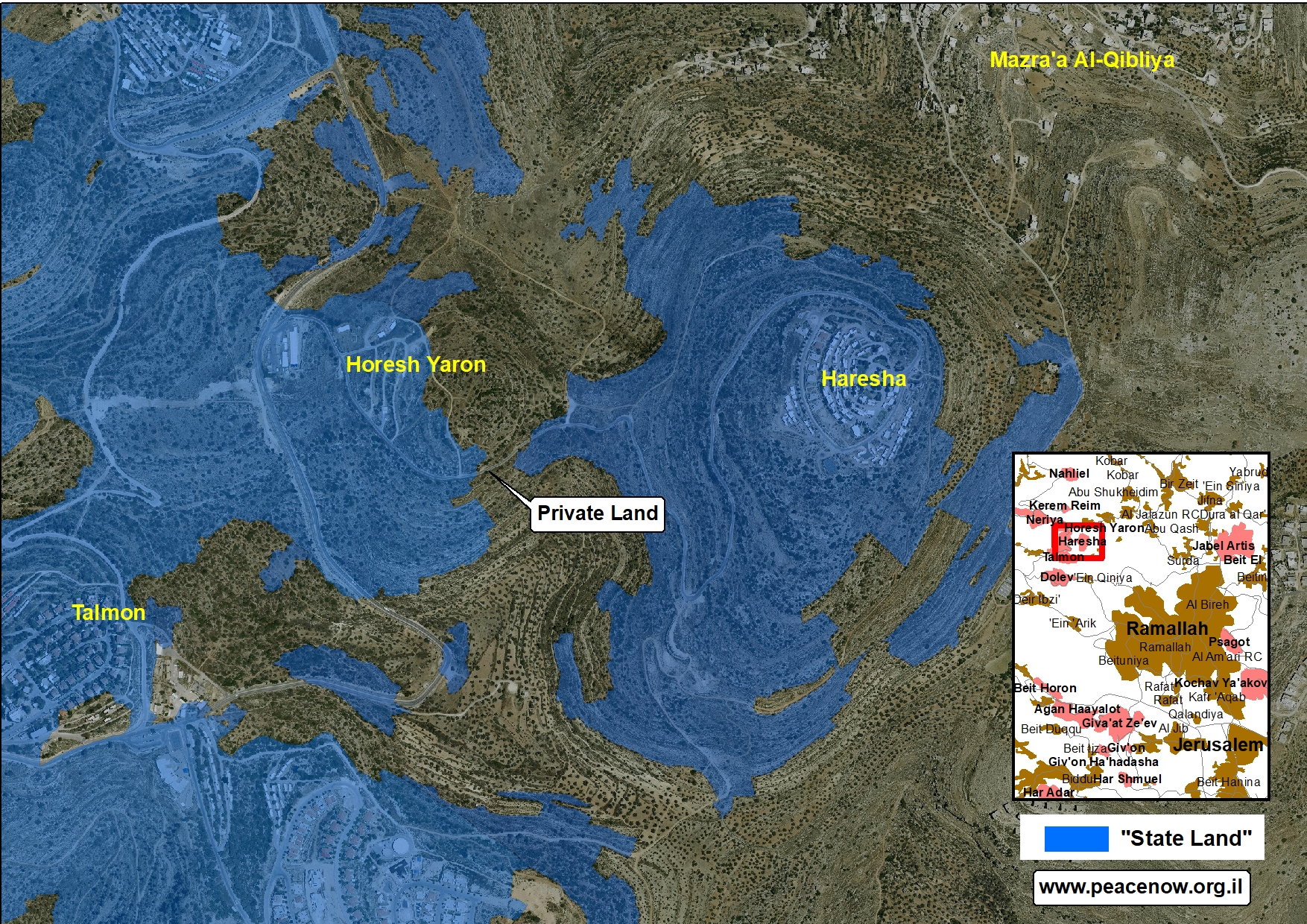
Israeli Attorney General Avichai Mandelblit – who signed off on the new Justice Ministry opinion – in November 2017 released a different legal argument in favor of permanently expropriating the land to legalize the access road, arguing that settlers are part of the “local population” of the West Bank and are therefore eligible to be the sole beneficiaries of land seized for “public use” (the access road is not open to Palestinian traffic). The opinion released this week, which cites Mandelblit’s previous opinion, finds yet another way to accomplish the same goal, by temporarily seizing the land to build a permanent tunnel for the settlers underneath it.
Justice Minister Ayelet Shaked said:
“From the beginning of my current term I have set a goal of normalizing the lives of the residents of Judea and Samaria and normalizing as many communities as possible. We have gone from a discourse of eviction to a discourse of normalization. These actions are in addition to the strengthening of the communities by other means, such as the transfer of authority in matters of Judea and Samaria from the Supreme Court to the Administrative Affairs Court in Jerusalem, as well as the equalization of legislation for Judea and Samaria…I will continue to work for the normalization of additional communities in Judea and Samaria. I thank Attorney General Avichai Mandelblit, Deputy Attorney General (Erez) Kaminitz and the Legal Advisor for the Judea and Samaria Area for their important activity on the issue.”
Peace Now told the Times of Israel:
“This move is a mockery of justice. Since the Regulation Law is tied up in court, the Ministry of Justice is yet again using every crooked justification it can concoct to expropriate private Palestinian land in order to dissect the West Bank with settlements until they have achieved their one-state apartheid agenda.”
Dror Etkes, founder of the anti-settlement watchdog group Kerem Navot, wrote:
“the outpost of Haresha, comprised of about 100 illegal structures, is of course not the story here. The story that the settlers are striving to resolve, with Mandelblit’s help, involves hundreds (yes hundreds!) of roads that have been illegally paved for decades around settlements and outposts, on land that even Israel recognizes as privately-owned. Now, with a little creativity and a lot of nerve, a legal mechanism has been invented to enable settlers to retroactively authorize the road system, without which the national land grab enterprise championed by Israel in the West Bank, can’t function.”
Three Illegal Outposts (& Ariel) Are Now “National Priority Areas” Eligible for Government Subsidies
On November 26th, Israeli Housing Minister Yoav Gallant announced that three illegal outposts – Kerem Reim, new Migron, and Shvut Rachel – will be considered “national priority” areas for development, marking the first time that illegal outposts are eligible for significant government subsidies to encourage growth.
In order to include the outposts, the Israeli Housing Ministry wrote and adopted a new criteria to make “neighborhoods located far from a ‘parent town’ that do not rely on the infrastructure of said town” eligible for priority status. For the purposes of the government subsidies plan, Kerem Reim is considered a “neighborhood” of the Talmon settlement, New Migron is considered a “neighborhood” of the Kochav Yochav settlement, and Shvut Rachel is considered a “neighborhood” of the Shilo settlement.
Though the Israeli government has rewritten its laws to consider these “children” outposts as “neighborhoods” of existing, government-approved settlements, they are, in fact, independent settlements. This fact is underscored by the Housing Ministry’s new criteria which admits that the outposts do not share the same infrastructure systems as the settlements of which they are considered a part (and, indeed, rewards that fact).
The Ariel settlement was also re-designated as a national priority area (having been previously selected and then later removed from the list), among a total of 583 communities from both sides of the Green Line. The selected communities, settlements, and outposts will benefit from massive government subsidies, including at least 50% of infrastructure costs for the construction of new housing. Israelis seeking to purchase a home in the selected communities will receive government loans and forms of assistance.
Haaretz reports Housing Minister Yoav Gallant remarked:
“it is a social and national duty to prevent negative migration from distant towns and to enable them to thrive and prosper.”
The Jerusalem Post quotes Gallant as saying that the decision to include the outposts:
“is a clear statement by the government that it will continue to develop and strengthen the settlements.”
High Court Rules the Jewish National Fund is the Legal Owner of Land South of Bethlehem
On November 28, 2018 the Israeli High Court of Justice ruled that the Jewish National Fund is the legal owner of 130 acres of land south of Bethlehem, ending a 22-year legal battle over ownership claims. Palestinians from a nearby village challenged the validity of the sale of the land to the Jewish National Fund when the organization moved to register its ownership of the land with the Israeli Civil Administration in 1996.
This week, the Court held that the Jewish National Fund (via its subsidiary company, Himnuta) had legally purchased the land in 1944 from its original Palestinian owners. The ruling will allow the settlers to move forward with plans for building more settlement units on the land, which is already home to one settlement, Rosh Tzurim, and to the headquarters of the Gush Etzion Regional Council.
The head of the Gush Etzion Regional Council, Shlomo Ne’eman, celebrated the ruling, saying:
“the task of expanding the lands of Gush Etzion is a national mission. The Supreme Court’s ruling gives us optimism that the court’s position will benefit the Jews and Jewish land in Judea and Samaria and will not automatically rule in favor of the thieving claims of the Arab intruders.”
Israel Seizes Jordan Valley Land Owned by the Catholic Church
On November 27, 2018, the Israeli Civil Administration announced that it is seizing 66 acres of land in the northern Jordan Valley that is owned by the Catholic Church. The Civil Administration said the land was needed for “military purposes.”
The Latin Patriarchate of Jerusalem responded to the seizure in a statement, saying:
“The Patriarchate is looking into the aspects of this decision in order to address it in the appropriate manner, have it contested and to stop further damage.”
Israeli Civil Administration Report Criticizing Yitzhar Settler Violence Leads to Renewed Calls to Annex the West Bank
An Israeli news outlet, Kan 11 news, revealed the existence of a new Civil Administration report that criticizes the Yitzhar settlement. According to Kan 11, the report states that Yitzhar is a source of violence that “undermines governance and the rule of law.”
In addition to documenting the violence perpetrated by Yitzhar residents against Palestinians living nearby, the report also documents incidents of Yitzhar settlers attacking Israeli forces. The report calls on the IDF Commander Maj. Nadav Padan to punish the Yitzhars settlers by scuttling plans to build a new kindergarten and by ceasing to guard dangerous roads around the settlement and its many outposts.
In response, Yossi Dagan (head of the Samaria Regional Council, a settlement municipal body) called for the author of the report to be fired, saying:
“Officials in the Civil Administration are torpedoing the approval of security elements which could have prevented terrorist attacks in threatened settlements such as Itamar, and in the Barkan industrial zone before the attack, as well as narratives of the Palestinian Authority and radical left-wing organizations.This is an example of the evil in the civil administration. I call on the head of the Civil Administration to remove the clerk … who acts like a politician and not as is required. This report is malicious and false. The Yitzhar leadership is leading the community in a good and positive direction, and this report has nothing but lies. This is the total loss of control of the Civil Administration. While murderers with the blood of Israelis on their hands, the Civil Administration refrains from punishing the sources of terror out of statements that this is collective punishment, and now they want to create collective punishment for the Jews. The head of the Civil Administration and the deputy defense minister should call this clerk for a hearing before his dismissal.”
In response to the report’s recommendations, MK Bezalel Smotrich (HaBayit HaYehudi) called for the entire Civil Administration to be disbanded. Smotrich announced that he will seek government backing for a bill to achieve that end during the next meeting of the Israeli Cabinet, scheduled for December 9th. Under the bill, Israeli settlers in the West Bank will come under the full sovereignty of domestic Israeli institutions, while Palestinians will be ruled by “Regional Liaison administrations.” The bill would effectively annex the entire West Bank to Israel.
Smotrich said:
“The Civil Administration must be shut down now. This document reflects a political agenda that is hostile to the settlement enterprise and to the local residents, [an agenda] which unfortunately is expanding in this unnecessary body…This is the same Civil Administration that for years has pushed for a policy of separation between Arabs involved in terrorism and the rest of the Arab population. Now it suddenly remembers to use collective punishment against Jewish residents…for years now, the residents of Judea and Samaria, who are equal citizens who serve in the army and in the reserve and who pay taxes, are not entitled to equal rights and receive inferior service from the Civil Administration instead of receiving optimal service from government ministries like all citizens of Israel. The time has come to fix that.”
After IDF Killed Two Palestinians, Civil Administration Grants Settlers Victory in Struggle Over Hilltop
On November 29th, Haaretz reported the tragic story of two Palestinians who were shot and killed by Israeli forces while protesting attempts by Israeli settlers to take over a hilltop belonging to the Palestinian village al-Mazra’ah al-Qibliyah, just north of Ramallah. Following a clash on October 26th, in which the IDF opened fire on Palestinian protesters – killing the two men – the IDF issued a military order closing the hilltop – known as Khirbet Na’alan – to Palestinians on Fridays. As Haaretz notes, the military order was a victory for the settlers, who have been aggressively trying to take over the hilltop since July 2018.
The residents of al-Mazra’ah al-Qibliyah have fought against the increasing encroachment of the Talmon settlement and its seven illegal satellite outposts, which collectively surround the village. Having seen several outposts take over their land illegally and under the protection of the IDF, Palestinians began actively trying to prevent the takeover of the Khirbet Na’alan hilltop. The settlers waged their own campaign to harass and intimidate the village, often entering the village at night to paint hateful messages and damage Palestinian property. Each Friday, the settlers would go pray at the site.
In response to petitions filed by Palestinians, the Israeli Civil Administration issued an order barring the settlers from accessing the hilltop. On the same day the villagers found out about the order, they watched 10 settlers from the Kerem Reim outpost (which was recently selected as a “national priority area” to encourage growth, see above) approach the hilltop with heavy IDF protection. It was on this day that the IDF opened fire on a group of Palestinians protesting the incursion, killing two and wounding many others.
Video of the bloody incidents shows the IDF opening fire at an incredibly close distance, and at least 10 Palestinians falling down amidst gunfire.
The New Mayor of Jerusalem, Moshe Lion, On Settlements
In a thorough analysis of the recent Jerusalem Municipal elections, Terrestrial Jerusalem’s Danny Seidemann shared key insights into what may be in store for settlement activity under Jerusalem’s new mayor, Moshe Lion. Seidemann writes:
“Lion emerged from the ranks of the less ideological elements in the Likud. However, support for East Jerusalem settlements and settlers is so deeply ingrained even in this segment of the party as to be second nature. Lion never mentioned the Palestinians of East Jerusalem in his campaign, and actively cooperated with Aryeh King, who represents the right-wing fringe of the East Jerusalem settlers. Consequently, it is highly likely that Lion will continue to do the bidding of the settlers in East Jerusalem, and to neglect the Palestinian sector. Nothing in his world view or the way he understands his political interests suggests otherwise.”
Al-Shabaka Policy Paper: “The EU & Jerusalem”
Al-Shabaka analyst Yara Hawari published a new paper exploring options for European Union member states to push back on U.S. policy and Israel’s annexation of Palestinian land. Hawari writes:
“The US embassy move has accelerated and legitimized a process of de-Palestinianization of Jerusalem that began over seven decades ago. In the absence of concrete pressure, Israel will continue to violate the fundamental rights of the Palestinian people in Jerusalem and the rest of historic Palestine, with the full support and encouragement of the Donald Trump administration as well as its far-right allies within Europe and in Latin America. Despite the inaction described above and the global political shift to the right, there remains potential for the EU to pressure Israel and pursue Palestinian human rights. This is due to strong European popular support for Palestinian rights and sovereignty that has allowed grassroots solidarity networks to grow, as well as the fact that the EU is premised on international law and human rights…”
Breaking the Silence Report – “Occupying Hebron: 2011-2017”
Breaking the Silence released a new compilation of testimonies from Israeli soldiers who served in the Hebron area. Breaking the Silence writes:
“The Israeli settlement in the heart of the city of Hebron marked its 50th anniversary this year. Its story is a microcosm of the occupation: contempt and disregard for the rule of law, daily violence, deprivation of Palestinian residents’ basic rights, and a military system that preserves all of the above. This booklet of testimonies intends to offer the public a glimpse of the reality in Hebron from our perspective as soldiers deployed there. These testimonies were given by soldiers who served in the city from 2011-2017. They reveal the violence and discrimination that have become an inextricable part of life in Hebron, and their impact on the lives of Palestinian residents.”
The online portal for the report also has an interactive map, where users can see where each incident took place against the backdrop of Hebron’s closed streets, religious sites, and settlement enclaves.
U.S. Chatter on Economic Coexistence Initiatives (Which Normalize Settlements/Occupation) Provokes Strong Palestinian Response
Top U.S. negotiators have continued hinting about a major economic element to the yet-to-be-unveiled “deal of the century.” As FMEP has documented to this point, Ambassador David Friedman has met with Israeli and Palestinian businessmen in a bid to promote joint projects in the Occupied Territories in a way that normalizes Israeli settlements and annexation bids.
On November 28th, Ambassador Friedman was interviewed by the Christian Broadcast Network. Part of the transcript of the interview reads:
Question: “One of the aspects of the peace plan seems to be a relationship between Palestinian businessmen and Israeli businessmen. Some would say you crossed a red line when you crossed the green line into Ariel officially. What was the importance of that meeting?”
Friedman: “On a practical level, I met with, I don’t know, maybe 8 or 10 Palestinian business leaders and, to a person, they all said to me, ‘let’s do business, let’s get going. We want to work with Jews; we want to work with Israelis.’… I try to look at everything from a lens of what is best for the United States. That’s my job. I represent the United States. But look, we are a nation under God; we’re built on Judeo-Christian values. Much as I try I cannot help but see the majesty of God’s work and all the miracles that happen in this incredible country.”
U.S. Special Representative for International Negotiations, Jason Greenblatt, wrote an op-ed also emphasizing, among of myriad of accusations against the Palestinian Authority, that the U.S. is hoping to jump-start economic development, separate from its “plan” to resolve core issues. The article reads:
“While waiting for a possible political solution, it is high time to build the Palestinian economy and provide Palestinians with the opportunities they deserve…We know that the Palestinians are not interested in mere economic peace. The Trump Administration continues to strive for a peace agreement, but the Palestinians need economic help now – with or without a peace agreement. The technology sector in the West Bank and Gaza has great potential and can be developed without treading into the politically contentious core issues of the conflict…I continue to meet with ordinary Palestinians and what is striking is that, although they complain about the Trump Administration’s policies, they remain focused on their economy…Palestinians are a proud people and want to create and earn on their own. They believe, as I do, that Palestinians should be allowed to improve their economy without worrying about whether they will give up on their national cause…Let’s be real – 136,000 Palestinians commute to work with Israelis every day because the opportunity is there. Anti-normalisation is a failed policy that only hurts the Palestinians. Let’s allow Palestinians to thrive in the way they are educated, capable of and deserve. We won’t tire of trying to resolve the political conflict (and certainly Palestinians won’t either), but we must focus on helping the Palestinian economy where we can, before it is too late.”
Palestinians reacted strongly to Greenblatt’s screed. Saeb Erekat, chief Palestinian negotiator, wrote in response:
“…economic desperation is seen by the Trump administration as an opportunity to force Palestinians to normalise Israel’s occupation, to legitimise its settlements and its whole system of oppression. The administration has been trying to divide Palestinians by claiming that the Palestinian leadership is preventing economic growth. However, there is a consensus among our people that the primary responsibility for our grave financial situation is the Israeli occupation.”
Hani Masri, a Palestinian political analyst, said:
“Trump thinks that what the Palestinian leadership has rejected can be passed through the people, but the majority of Palestinians will not positively absorb or accept what Greenblatt is promoting. There are economic interests between the Palestinians and Israelis, however the political issue is a different subject and can’t come at the expense of the legitimate rights of the Palestinians.”
Elsewhere, at an event hosted by the Brookings Institute, former peace negotiator Dennis Ross promoted draft legislation in the U.S. Congress that would invest heavily in joint economic projects in the West Bank which normalize the settlements. The Jewish Insider summarizes:
“[Dennis] Ross praised current draft legislation in Congress that would give upwards of $150 million to joint Israeli and Palestinian projects: [Ross:] ‘Cutting $10 million for projects that are joint projects between Israelis and Palestinians, the rationale for that is hard to grasp. If there is one thing that we should be doing [it is] demonstrating that when Israelis and Palestinians cooperate there’s a payoff for it. And that ought to be elementary. That ought to be just a given. Anything you’re doing should be to designed to elevate the payoffs of practical tangible cooperation.’”
Finally, the Friends of Beit El organization (previously headed by now-Ambassador David Friedman) hosted a star-studded fundraiser in New York to raise funds for and awareness of the Beit El settlement. It was attended by two Members of Congress and the speaker of the Israeli Knesset Yuli Edelstein, who told the crowd:
“Independence, sovereignty, will eventually come to Judea and Samaria and many more houses with be built in order to reach the number we all dream — a million Jews in Judea and Samaria.”
Notably, the mention of Rep. Nancy Pelosi, the newly elected Speaker of the House, elicited boos from the crowd.
Bonus Reads
- “Annexation – at what cost?” (Times of Israel)
- “Leftists on tour in Hebron confirmed in view that settlers ‘have already won’” (Times of Israel)
- “Shaked touts ‘confederation’ of Jordan WEst Bank, and Gaza” (Times of Israel)
- “Inside the Evangelical Money Flowing Into the West Bank” (Haaretz)
Welcome to FMEP’s Weekly Settlement Report, covering everything you need to know about Israeli settlement activity this week.
To subscribe to this report, please click here.
November 21, 2018
- Supreme Court Upholds Eviction of 40 Palestinians in Sheikh Jarrah, More Likely to Follow
- New Report Calls on AirBnB, Booking.com to Stop Listing Rentals Located in West Bank Settlements
- Settler Council Uses Taxpayer Money to Finance Illegal Construction of a Racetrack in Jordan Valley
- Knesset is Advancing a Bill to Give More Land in Area C to the World Zionist Organization
- Conference in Knesset Will Make Case for Evacuating Settlers from Hebron
- Bonus Reads
Questions/comments? Email kmccarthy@fmep.org
Supreme Court Upholds Eviction of 40 Palestinians in Sheikh Jarrah, More Likely to Follow
On November 15th, the Israeli Supreme Court denied an appeal that would have delayed the eviction of 40 members of a Palestinian family, the Sabags, from their homes in the East Jerusalem neighborhood of Sheikh Jarrah. The appeal asked the Court to take the time to reconsider ownership claims to the land. In denying the appeal, the Supreme Court upheld Israeli Jewish ownership claims to the plot of land based on its purchase in 1876. The eviction is expected to take place within months.
The land in question was abandoned during the 1948 war and was under Jordanian rule until 1967, during which time homes were built on it, including the those inhabited by the Sabag family. Notably, while Israeli law provides Jewish residents with the right to reclaim property lost in the 1948 War, it affords Palestinians no similar right to return to, or reclaim, property lost in that same war.
Responding the Supreme Court decision, 71-year old Mohammad Sabag said:
“We have two houses in Jaffa, on Hasneh Street and Hagidam Street, and we have 250 dunams [62.5 acres] in Yavneh and also in Ashdod. Why can’t I ask for my property from before 1948?”
In the early 2000s a company named Nahalat Shimon International (reportedly registered in Delaware, USA), “purchased” land in Sheikh Jarrah from the Jews who owned it prior to the 1948 war. Since then, Nahalat Shimon has been undertaking legal action to evict Palestinians. In 2009 the first eviction took place – sparking a sustained protest in the Sheikh Jarrah neighborhood which has garnered international attention.
The Sabag family has been fighting Nahalat Shimon’s attempts to evict them since 2008, claiming that the land was not properly registered with the Ottoman Empire prior to 1948, leaving ownership of the plot unclear. Settling the matter definitively, the Israeli Supreme Court refused to reconsider ownership claims to the land, saying that the statute of limitations has long since expired.
Looking at the broader impact of the ruling, Haaretz noted:
“The ruling will also make it very difficult for dozens of other Palestinian families in Sheikh Jarrah to avoid eviction.”
New Report Calls on AirBnB, Booking.com to Stop Listing Rentals Located in West Bank Settlements
A new report by Kerem Navot and Human Rights Watch details how online rental companies like AirBnB and Booking.com perpetuate Israel’s discrimination against Palestinians by listing rentals located in illegal Israeli settlements in the occupied West Bank. The report, entitled “Bed and Breakfast on Stolen Land,” details how rentals in West Bank settlements run afoul of the companies’ own business and human rights principles, and contribute to the economic viability and legitimization of the settlement enterprise.
On the eve of the report’s publication, AirBnB announced that it will remove 139 rental listings located in West Bank settlements, 15 of which are built on land which Israel has acknowledged is privately owned by Palestinians. Following AirBnB’s announcement, Booking.com signalled that it would not remove its listings from settlements, insisting that all their practices accord with all applicable local (Israeli) laws. According to Human Rights Watch, Booking.com has 26 rentals listings in settlements, 2 of which are located on privately owned Palestinian land that Israel expropriated for “public use” and then designated for the exclusive use of settlements.
Following AirBnB’s announcement, Human Rights Watch released a statement saying:
“By delisting rentals in illegal settlements off-limits to Palestinians, Airbnb has taken a stand against discrimination, displacement, and land theft. The continued business activities of Booking.com and other companies in settlements contribute to entrenching a two-tiered discriminatory regime in the West Bank.”
AirBnB’s decision sparked outrage and immediate calls for action from Israeli government officials, who are promoting several ways to retaliate against AirBnB. Officials have said that Israel will restrict AirBnB’s operations in sovereign Israeli territory and also levy a special new tax on its operations in light of its boycott of the settlements. Israeli Strategic Affairs Minister Gilad Erdan – whose responsibilities include fighting boycotts, divestment, and sanctions (BDS) – urged Israeli AirBnB hosts in settlements to sue the company. Israeli Tourism Minister Yariv Levin announced that the Israeli government will consult with the U.S. government in order to assist Americans in suing AirBnB (which is based in San Francisco); 24 states including California have passed anti-boycott legislation intended to stop U.S. companies and individuals from participating in boycotts of Israel and/or Israeli-controlled territories (i.e. settlements), though unless AirBnB is competing for government-funded contracts in these states, there is no basis to use these laws against it. Eugene Kontorovich, who self-identifies as a key figure in drafting the anti-boycott (but really anti-free speech) laws for states, called AirBnB’s decision “anti-Semitic.”
Peace Now released a statement slamming the Israeli government response, saying:
“Even if Netanyahu and Bennett refuse to see the Green Line, the rest of the world differentiates between Israel and the occupied territories. International companies are interested in doing business with Israel but are not ready to accept the continuation of military control over millions of Palestinians.”
Two years ago, +972 Magazine was first to report on the discriminatory and illegal nature of companies which list rentals across the Green Line, in what the international community considers as territory being held by Israel under military occupation.
Settler Council Uses Taxpayer Money to Finance Illegal Construction of a Racetrack in Jordan Valley
A freedom of information request filed by Peace Now and the Movement for Freedom of Information revealed that the Jordan Valley Regional Council – which Israeli municipal body thas authority for over settlements in the Jordan Valley and is responsible for enforcing building laws – is directly financing the illegal construction of a state-of-the-art car racing complex near the Jordan Valley settlement of Petza’el.
As +972 Mag and Kerem Navot revealed in August 2017, the large complex is being built partially on land that the Israeli army previously declared a closed firing zone, a designation which resulted in the forcible displacement of Palestinians who lived there. The land remains under this designation today.
In light of the track’s encroachment into the closed firing zone, the Israeli Civil Administration – the arm of the Israeli Defense Ministry that acts as the sovereign power in the West Bank – issued a stop-work order against the construction in February 2017 (which settlers ignored). Demonstrating that, as usual, law-breaking pays off for settlers, the Civil Administration also announced that it was considering a “master plan” for a touristic site – including a hotel – in the same area (with the development designed not to cross into the firing zone).
Despite the Civil Administration’s intervention and promise of a pay-off, the Jordan Valley Regional Council transferred NIS 284,000 (around $8,000) in 2017 for the construction of the racetrack, and then approved NIS 5,615,000 (around $1.5 million) for the project in 2018, nearly all of which comes from a grant to the Council for the project from the Israeli Interior Ministry.
In response to the new budget documents, the Israeli Interior Ministry told Haaretz that the grant was approved but will not actually be transferred until plans for the racetrack receive retroactive authorization from the government.
Peace Now states:
“In recent years, the Jordan Valley has become the wild west of the West Bank, and it appears that the regional council, which is supposed to be the sovereign that enforces the law, is a full partner in the crimes taking place there. This is an absurdity that is unfortunately all too common in the settlements. The Jordan Valley Regional Council is following in the footsteps of its big sisters among the regional councils–Binyamin, Shomron, Gush Etzion and Har Hevron–which regularly funnel public funds to illegal activity to create facts on the ground intended to deny Israel the option for a two-state solution.”
Knesset is Advancing a Bill to Give More Land in Area C to the World Zionist Organization
Earlier this month, the New Israel Fund reported on the Knesset’s ongoing consideration of a radical bill that seeks to accelerate the transfer of almost all of the land in Area C to the control of the World Zionist Organization (WZO).
As we have reported previously, the WZO’s Settlement Division was created by the Israeli government in 1968 – and is funded entirely by Israeli taxpayers. Its mandate is to manage West Bank land expropriated by Israel, in order to facilitate the settlement of Israeli Jews in the occupied territories. To make this possible, the Israeli government has allocated approximately 60% of all “state land” to the WZO’s Settlement Division [over the past 50 years Israel has declared huge areas of the West Bank to be “state land,” including more than 40% of Area C, where most of the settlements are located]. In addition, settlement and human rights watchdogs have repeatedly documented how the WZO’s Settlement Division has worked to take over additional land, including privately owned Palestinian land, in order to build more settlements.
At a hearing last week, Israeli Attorney General Avichai Mandelblit expressed his opposition to the bill (which is endorsed by the Israeli cabinet), saying it is unnecessary given that ministry staffs are already working to transfer more land to the WZO through an administrative process. MKs from the Jewish Home party have said they will bring the bill up for a vote at the committee level next week if they are not satisfied with the progress that the ministry staffs have made in transferring land to the WZO.
In June 2018, when the Knesset gave preliminary approval to the bill, Peace Now responded:
“the government is scandalously planning to give the biggest land thieves responsibility for managing the land distribution, which will continue to be done under the cover of darkness if the bill passes into law.”
For more information on this bill, read a complete background briefing by Peace Now.
Conference in Knesset Will Make Case for Evacuating Settlers from Hebron
Next week, the Knesset will hold a conference entitled, “Hebron First,” featuring Israeli civil society leaders making the case to lawmakers for the removal of Israeli settlers from Hebron. The event is being organized by MK Ayman Odeh (Joint List), Dov Khenin (Joint List), and Michal Rozin (Meretz). The President of B’Tselem, Hagai El-Ad, is expected to make a speech.
In a joint statement about the event, the MKs said:
“The settlement in Hebron is the expression of an extremist government policy that pours mass sums of money and endangers human lives to strengthen and maintain a handful of extremist settlers. The evacuation of the settlement in Hebron is a first and necessary step to promoting a diplomatic solution and bringing the Israeli-Palestinian conflict to an end.”
Over the five months, the Israeli government has advanced highly controversial plans that promote the growth and permanence of settlements in Hebron. Earlier this month (November 2018), Israeli Defense Minister Avigdor Liberman (who recently resigned) announced plans to build a new settlement above a section of the Palestinian market in the Old City of Hebron. In October 2018, the government announced a new settlement at the site of an Israeli military installment in Hebron, and in July 2018, the Cabinet decided to fund a new settler municipal body meant to empower Israeli settlers living in enclaves in downtown areas of Hebron, despite a court injunction against forming the body.
Bonus Reads
- “Avigdor Liberman: The settler defense minister who couldn’t please the settlers” (Times of Israel)
- “ ‘Things are going so well’: Settlers line up in opposition to elections” (Times of Israel)
- “Knesset conference calls for evacuation of Hebron settlers” (Ynet)
Welcome to FMEP’s Weekly Settlement Report, covering everything you need to know about Israeli settlement activity this week.
To subscribe to this report, please click here.
November 8, 2018
- Jerusalem Municipality Gives Final Approval to Two East Jerusalem Settlement Schemes Pushing Towards Beit Hanina
- Claiming Ignorance, State Tells the Court it Will Demolish New Jordan Valley Outpost
- Government Officials Lay Cornerstone of “New Migron” Settlement
- Israel Seizes Palestinian Land to Build New Road to Settlement
- Bennett Violated Govt Rules to Get a Legal Opinion Supporting the De Facto Annexation of Ariel University
- In Reversal, Israeli Ministers Embrace Bill to Allow Knesset to Overrule High Court on Any Issue (Not Just on Deporting Asylum Seekers)
- Settlers Group Alleges Palestinians are Undertaking a European-Backed Scheme to “Take Over” Area C of West Bank
- UN Report Details Israel’s De Facto Annexation of West Bank Land
- Four Alleged Security Incidents Near Settlements
- Bonus Reads
Comments, questions, or suggestions? Email Kristin McCarthy at kmccarthy@fmep.org.
Jerusalem Municipality Gives Final Approval to Two East Jerusalem Settlement Schemes Pushing Towards Beit Hanina
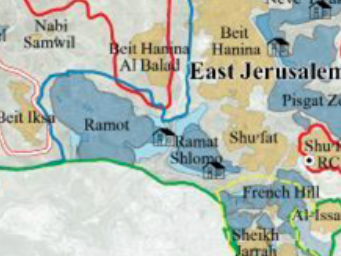 On November 6th, Jerusalem planning authorities granted approval to two settlement projects totalling 652 units in strategic areas that will increase the encroachment of settlements on the Palestinian East Jerusalem neighborhood of Beit Hanina – where the Israeli government is also advancing the first-ever government-backed settlement enclave inside of the neighborhood. This week the Committee approved:
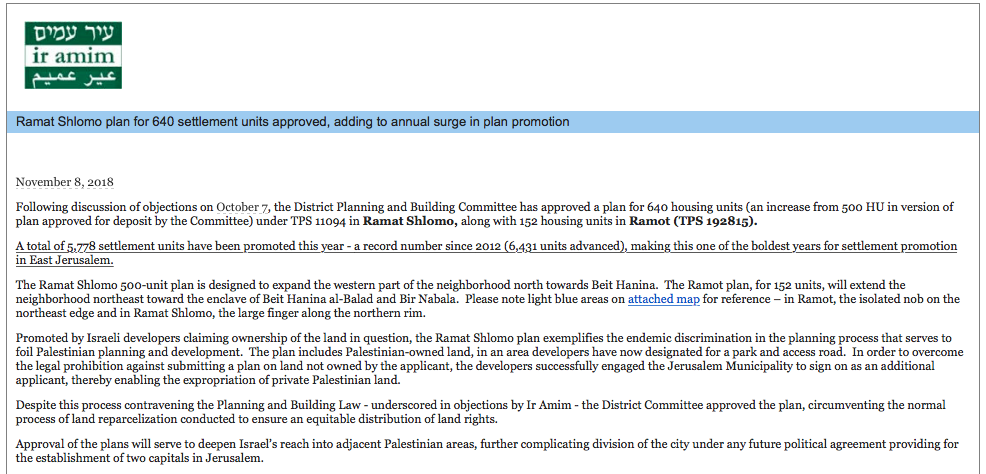
- A plan for 152 new units in the Ramot settlement in northern Jerusalem, extending the settlement’s footprint towards the Palestinian neighborhood of Beit Hanina.
- A plan for 640-units in the Ramat Shlomo settlement, to be built partially on Palestinian land, also extending the settlement north towards an existing settlement enclave inside of the Palestinian Beit Hanina neighborhood.
In granting final approval for the Ramat Shlomo plan, the Jerusalem District Planning and Building Committee decided to increase the number of approved units, from the proposed 500 to 640. And significantly, the Committee rejected serious complaints about expropriating privately owned Palestinian land for settlement purposes.
The Israel anti-settlement watchdog NGO Ir Amim filed one such complaint against the plan, explaining:
“Promoted by Israeli developers claiming ownership of the land in question, the Ramat Shlomo plan exemplifies the endemic discrimination in the planning process that serves to foil Palestinian planning and development. The plan includes Palestinian-owned land, in an area developers have now designated for a park and access road. In order to overcome the legal prohibition against submitting a plan on land not owned by the applicant, the developers successfully engaged the Jerusalem Municipality to sign on as an additional applicant, thereby enabling the expropriation of private Palestinian land.”
Ir Amim researcher Aviv Tartarsky told Haaretz this week:
“It’s very disappointing that the district committee relied on formalistic reasons to approve a step that violates the property rights of Palestinian landowners through and through. These aren’t extremist settlers in outposts somewhere out on hilltops in Samaria [the northern West Bank] but state institutions that are working in Israel’s capital city. This decision is additional proof that Israeli control in East Jerusalem means a regime based on serious discrimination.”
The new approvals add to an ever-growing tidal wave of settlement activity in East Jerusalem affecting the viability of the two-state solution, while tightening the screws on the local Palestinian population.
Claiming Ignorance, State Tells the Court it Will Demolish New Jordan Valley Outpost
Israeli government lawyers told the High Court of Justice that the State of Israel does not know who built an illegal outpost on a disused military base in the Jordan Valley, which settlers have named “Camp Gadi”, and announced that the Civil Administration will demolish it. If the Civil Administration moves to demolishes the outpost, it will require evicting several settler families who are squatting there, and shutting down a pre-military school that the families have been promoting.
The head of the Jordan Valley Regional Council, David Lahiani, seemed to contradict the government’s claim to innocence when he said that he has been in touch with the Civil Administration about legalizing the outpost. If Lahiani has been in touch with the Civil Administration, then questions arise about at what point the Israeli government learned about the outpost and who is behind it. Lahiani’s statement also contradicts (or at least raises questions about) a prior statement from the Jordan Valley Regional Council which denied involvement in establishing the outpost. Further calling into question the role of the Jordan Valley Regional Council, Lahiani was in a picture taken at the outpost which was uploaded to Facebook on October 24th.
Government Officials Lay Cornerstone of “New Migron” Settlement
A cornerstone laying ceremony marked the start of construction on the “New Migron” settlement, to be for the settlers who were removed from the illegal Migron outpost. Several government officials were on hand to lay the cornerstone of the new settlement, plans for which were approved in 2017, near the Kochav Yaakov settlement north of Jerusalem.
In 2011, the Israeli High Court ruled that the Migron outpost must be evacuated because it was built on privately owned Palestinian land. Most of the illegal outpost’s residents were evacuated and most buildings were demolished in Migron in 2012. Determined to demonstrate its support for settlers in the face of this court-compelled evacuation, the government promised to establish two new settlements: “New Migron” (located close to Kochav Yaakov settlement) as well as the approval of a plan for 184 housing units east of the Adam settlement (aka Geva Binyamin). All said, the two new settlements and temporary housing for the evicted settlers cost Israeli taxpayers millions of dollars – sending settlers a clear message that for them, law-breaking pays off.
At the ceremony this week, Jerusalem Affairs Minister Ze’ev Elkin said:
“During such events, it is customary to rejoice, but as someone who accompanied Migron from the moment of the evacuation to the present day, this is not a happy event. We would be happy if we had another legal system that made a logical decision, and I long for the days when the justice system will do justice. The settlement will grow and expand this way from time immemorial. The evacuation attempts will only lead to the strengthening and expansion of settlement.”
Housing Minister Yoav Galant, also at the ceremony, said:
“laying the cornerstone means that the territories of Yehudah and Shomron are not negotiable. It is not a subject for sale. We are laying a cornerstone for Migron and we will build it. I will see to it that the Israeli government does so by the end of the year.”
Knesset Speaker Yuli Edelstein, also in attendance, said:
“I did not come here to convince anyone about our rights in the land of Israel, I came here with mixed feelings of happiness from laying the cornerstone, alongside the great sadness of the difficult evacuation five years ago. We are here, first and foremost, thanks to the families of Migron that did not give up.”
Israel Seizes Palestinian Land to Build New Road to Settlement
According to Maan News, Israeli forces seized 38 acres (155 dunams) of Palestinian land in order to pave a road to the Beit Aryeh settlement, located northwest of Ramallah. Members of the al-Lubban al-Gharbi village council claim that the land is privately owned by Palestinians from the village and called on village residents to find documents proving land ownership in anticipation of an appeal against the construction.
So far this year, the Beit Aryeh settlement has been the beneficiary of two significant settlement advancements totalling 563 new units:
- On August 23, 2018 the Israeli Housing Ministry published a tender for 52 new settlement units in Beit Aryeh.
- On August 11, 2018 the government published a tender for 511 new settlement units in Beit Aryeh.
Bennett Violated Govt Rules to Get a Legal Opinion Supporting the De Facto Annexation of Ariel University
According to a new Haaretz report, Education Minister Naftali Bennett violated Israeli guidelines by using a private law firm to support his Knesset bill bringing settlement colleges and universities under the authority of the Israeli Higher Education Council. Prior to the Knesset’s passage of Bennet’s bill in February 2018, the Higher Education Council only included schools located inside of sovereign Israeli territory. The new law is tantamount to de facto annexation of settlement schools, and members of the Israeli Higher Education Council remain vocally opposed to the move.
The use of a private law firm is seen as an attempt to bypass the Education Ministry’s own apolitical (for now) legal advisors, and is a breach of the guidelines set years ago for every ministry by the Israeli Attorney General. The guidelines stipulate that in cases where private opinions are sought, the legal advisors for the ministry must supervise the process.
Bennet reportedly used an opinion paper issued by the Herzog Fox & Neeman firm stating the inclusion of Ariel University in the domestic Higher Education Council would not violate existing grant terms between universities in sovereign Israel and the European Union (which does not do business in the occupied territories). The opinion was then presented to members of the Higher Education Council to assuage fears that implementing the new law would result in losing international funding. The opinion said that the potential for funding cuts is “nearly non-existent.”
An anonymous senior official with the Higher Education Council told Haaretz:
“You cannot base official policy on an opinion paid for by an interested party. That’s not serious.”
Ariel University has not yet been admitted to the Council, despite the passage of the law in February 2018 and despite Minister Bennett’s repeated threats to end state relations with the Council if it did not immediately grant membership to the school. Israeli President Reuven Rivlin issued a rebuke to Bennett’s threats, saying:
“It’s possible to love Ariel without mocking academia.”
In Reversal, Israeli Ministers Embrace Bill to Allow Knesset to Overrule High Court on Any Issue (Not Just on Deporting Asylum Seekers)
At a meeting on November 4th, ministers in the governing Israeli coalition reportedly decided to abandon a bill that would empower the Knesset to reinstate its plan to deport African asylum seekers after it was struck down by the High Court, in favor of a much more far-reaching bill granting the Knesset the ability to reinstate any law the High Court strikes down. The passage of that bill would likely impact the fate of not only African asylum seekers but settlement-related legislation that has already been passed – most notably,the settlement Regulation Law – and other undemocratic measures that might follow. This news follows an exact opposite announcement two weeks ago, when Justice Minister Ayelet Shaked embraced the single-issue version of the bill, while promising to make the unlimited version a sticking point in any future coalition agreement.
Notably, the leaders of the current governing coalition decided to make this move at a meeting that was not attended by Kulanu Party leader Moshe Kahlon, who has until now blocked the coalition from advancing the unlimited version bill.
Israeli Attorney General Mandelblit vehemently opposes the bill. Mandelblit said:
“One must vigorously oppose this bill, which harms the constitutional regime of the State of Israel as a Jewish and democratic state. Removing all restrictions on undermining the human rights of a specific group, as is proposed now, has far-reaching implications for constitutional law and the democratic regime in Israel, and I strongly oppose it.”
Settlers Group Alleges Palestinians are Undertaking a European-Backed Scheme to “Take Over” Area C of West Bank
The radical settler organization Regavim – which devotes its efforts to systematically mapping out and expelling Palestinians from strategic areas in Jerusalem, the West Bank, and the Negev – presented a new report to the Knesset this week claiming that the Palestinian Authority (PA) is using European funding to take over land in Area C of the West Bank. The report alleges that the PA uses European money to pave roads, build on strategic military and diplomatic locations, and “steal” water resources, at the expense of Israel.
Regavim warns:
“If the government does not come to its senses and does something now, the Palestinian plan will create irrevocable changes and facts on the ground.”
Adding irony to Regavim’s current efforts to stop “illegal” Palestinian activity in the West Bank, in August 2018 the Israeli daily newspaper Yedioth Ahronoth published a comprehensive investigation into Regavim’s leaders. The group’s stated mission is “to ensure responsible, legal, accountable & environmentally friendly use of Israel’s national lands and the return of the rule of law to all areas and aspects of the land and its preservation.” The investigation revealed, however, that the organization’s efforts to identify and stop illegal construction are merely a tool to dispossess Palestinians of their land.
The Investigation found, in fact, that Regavim and its leaders have a demonstrable disregard for the Israeli planning and building laws that they purport to be dedicated to enforcing, evidenced most plainly by the fact that 15 Regavim officers are living in structures built on privately owned Palestinian land, some with demolition orders issued against them. These include the building where Yehuda Eliyahu, the current executive director of Regavim, lives.
UN Report Details Israel’s De Facto Annexation of West Bank Land
The United Nations Special Rapporteur on Situation of Human Rights in Palestinian Territories, Michael Lynk, issued a new report to the UN General Assembly – half of which is devoted to documenting the Israeli government’s annexation of Palestinian land in East Jerusalem and de facto annexation of land in the occupied West Bank.
The report concludes in part:
“These statements of political intent, together with Israel’s colonizing acts on the ground, its legislative activity, and its refusal to adhere to its solemn obligations under international law or to follow the direction of the international community with respect to its 51-year-old occupation, have established the probative evidence that Israel has effectively annexed a significant part of the West Bank and is treating this territory as its own. While Israel has not yet declared formal sovereignty over any parts of the West Bank, the Special Rapporteur submits that the strict prohibition against annexation in international law applies not only to a formal declaration, but also to those acts of territorial appropriation by Israel that have been a cumulative part of its efforts to stake a future claim of formal sovereignty over the occupied Palestinian territory.”
Four Alleged Security incidents Near Settlements
In the past three days, Israeli authorities have reported four security incidents near settlements:
On November 7th, the IDF reported that unknown assailants shot at a bus and lightly injured two Israelis near the settlement of Beit El, located deep inside the West Bank near Ramallah.
On November 6th, three Palestinian men were arrested near the Mevo Dotan settlement, south of Jenin, one of whom was allegedly carrying a gun.
Earlier on November 6th, a Palestinian woman was shot and arrested near the Kfar Adumim settlement, between Jerusalem and Jericho,after allegedly attacking Israeli border policemen with a pair of scissors.
On November 5th, a Palestinian man was shot and arrested after allegedly attempting to stab Israeli settlers and an Israeli IDF officer near the Kiryat Arba settlement, in Hebron.
Bonus Reads
- Khan al-Ahmar and Israel’s Creeping Annexation of the West Bank” (Newsweek)
- “Everyone Knows Settlers Cut Down Palestinian Olive Trees. But Israel Doesn’t Care” (Haaretz)
- “Settler leaders warned Rabin not to ‘cross redlines’ before assassination” (Times of Israel)
- “Hard Questions, Tough Answers: Why the Israeli mainstream turned right” (Americans for Peace Now)
- “An Interview with MK Sharen Haskel” (Fathom Journal)
- “Israeli justice minister opposes letting government jurists act as ‘gatekeepers’” (Haaretz)
Welcome to FMEP’s Weekly Settlement Report, covering everything you need to know about Israeli settlement activity this week.
To subscribe to this report, please click here.
November 2, 2018
- Liberman Announces A New Settlement in the Old City of Hebron
- Housing Ministry Signs Deal for 20,470 New Settlement Units In Maale Adumim
- Settlers Establish a New Jordan Valley Outpost
- Israel Plans to Double Size of IDF West Bank Bureaucracy…To Aid Settlers
- Yesh Din Documents How Yitzhar Settlement Uses Violence to Seize Palestinian Land
- West Bank Municipal Elections Empower Anti-Establishment Settler Leaders
- Bonus Read
Comments, questions, or suggestions? Email Kristin McCarthy at kmccarthy@fmep.org.
Liberman Announces A New Settlement in the Old City of Hebron
Defense Minister Avigdor Liberman announced that he is advancing plans for the construction of a new settlement in Hebron, to be located above a Palestinian marketplace in the Old City of Hebron. This is the third major settlement initiative in the heart of Hebron undertaken by the Israeli government over the past four months. It follows closely on the heels of the October 2018 announcement of a new settlement at the site of an Israeli military installment in Hebron, and a July 2018 Cabinet decision to fund a new settler municipal body – despite a court injunction against forming the body – meant to empower Israeli settlers living in enclaves in downtown areas of Hebron.
The plan for a new apartment building for settlers above the market in the Old City of Hebron is not new, but has been stalled for years due to “legal difficulties” according to Liberman. Those “legal difficulties” are the protected tenancy rights of Palestinian vendors who rented the market stalls from Jordan after 1948, rights which were upheld by Israel following the 1967 war. Liberman worked alongside Justice Minister Shaked to find a way to move the project forward (i.e., to find a way to void Israel’s recognition of the protected tenancy rights); the result is a new legal opinion greenlighting the project based on Jewish ownership of the land prior to the 1929 Hebron riots, when 67 Jews were killed. The Defense Ministry has not yet released the text of this new legal opinion.
The Times of Israel settlement correspondent Jacob Magid notes:
“Such a legal opinion would apparently conclude that Jewish ownership of the property prior to the establishment of Israel trumps the Palestinian protected tenancy status that was granted after 1948 — a hierarchy that the High Court of Justice has thus far rejected.”
Significantly, Israeli Attorney General Avichai Mandelblit gave his endorsement of the Defense Ministry’s opinion on the matter.
Justice Minister Shaked released a statement saying:
“This week we made a significant breakthrough in the return of Jewish lands stolen during the 1929 riots in the so-called wholesale market. This is a very important area in the heart of the Jewish settlement in Hevron, which for 25 years was not settled, even though it belongs to the Jews according to all the records. For 25 years, Israeli governments have repeatedly evacuated Jews who settled in the area and haven’t granted building permits. This week, thanks to the Defense Minister, Legal Advisor Avichai Mandelblit, Deputy Legal Advisor Erez Kaminitz, and Defense Ministry Legal Advisor Itai Ophir, we brought about a breakthrough and removed the barriers, leading to approving the planning.”
The Jewish community in Hebron released a statement praising the legal opinion as a “Zionist and just decision,” saying that the new settlement will help “strengthen our hold on the inheritance of our forefathers.”
[Updated on 11/2/2018 after publication].
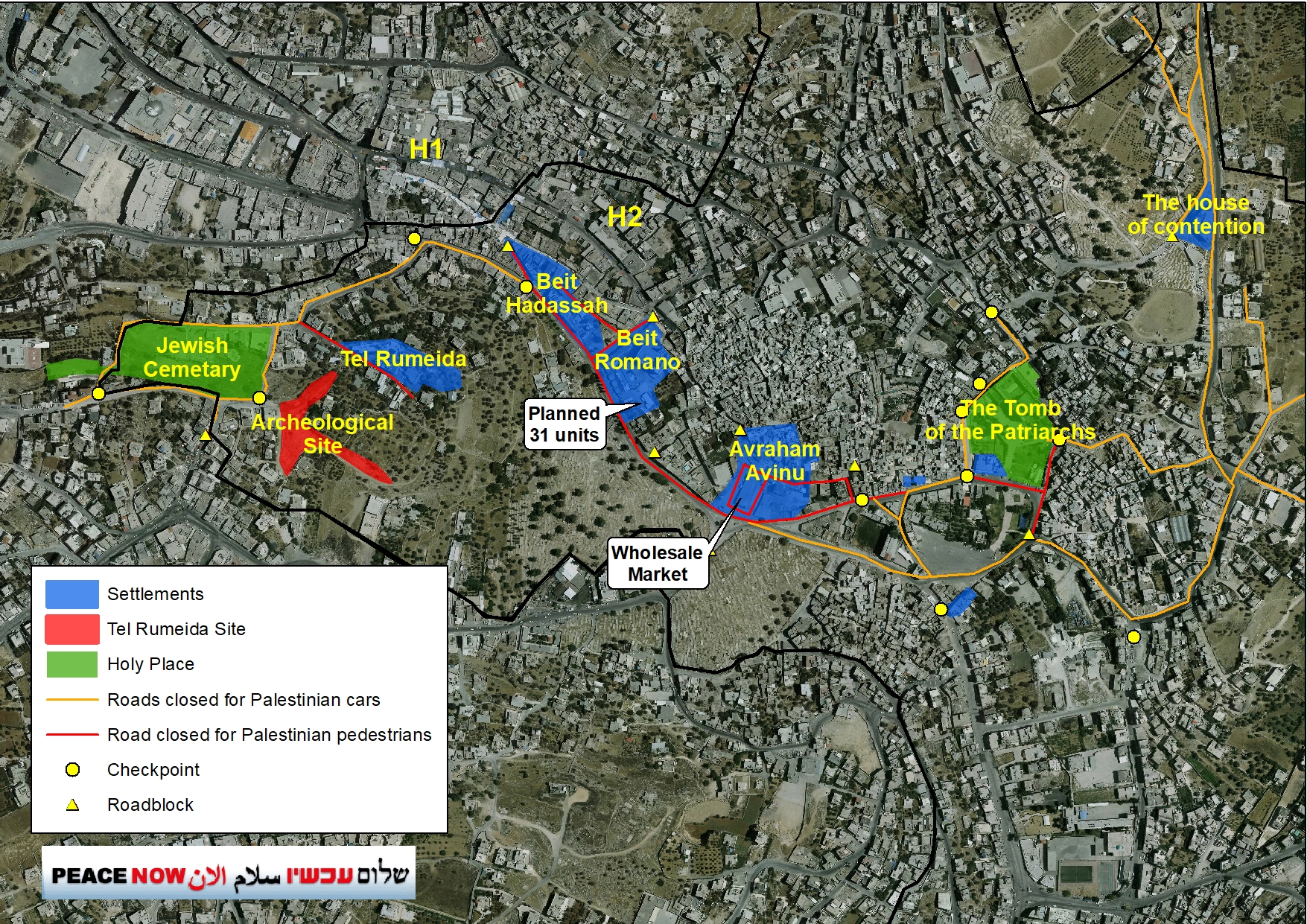
Map by Peace Now
Peace Now has published a detailed explanation of Liberman and Shaked’s plan to build a new settlement above the Palestinian marketplace in the Old City of Hebron. An accompanying Peace Now statement reads:
“The settlement in Hebron is the ugliest face of Israel’s control in the Occupied Territories. In order to maintain the presence of 800 settlers among a quarter of a million Palestinians, entire streets in Hebron are closed to Palestinians, denying them freedom of movement and impinging on their livelihoods. Moreover, by implementing the “right of return” for Jews, the Netanyahu government has pulled the rug out from under Israel’s moral basis for its resistance to recognizing the right of return for the Palestinians, thus endangering Israeli interests.”
A key piece of Peace Now analysis reads:
“The Defense Ministry’s new opinion for building this new settlement compound is yet another example of how the government is currently reinterpreting existing laws in order to circumvent current restrictions on settlement building that safeguard Palestinian private property and protected tenancy. This in turn is part of a broader trend of settlement-backed government efforts to confiscate land, and legalize and expand Israeli settlements with the aim of de facto Israeli annexation of the West Bank.”
Housing Ministry Signs Deal for 20,470 New Settlement Units In Ma’aleh Adumim
The Israeli government signed a $765 million deal to build 20,470 new settlement units in the Ma’aleh Adumim settlement, located just east of Jerusalem. The government is slated to issue permits for 470 units to begin construction immediately (plans for which have already been granted final approval), while the plans for 20,000 units still need to be approved.
After signing the agreement, Construction and Housing Minister Yoav Gallant (Kulanu) made it clear that the mega-project is part of a broader scheme to consolidate Israeli control over West Bank areas to the north, east, and south of Jerusalem:
“In addition to the new housing units, public and educational institutions will also be established, and will include synagogues, schools, parks, community centers and sports arenas. We must continue to establish [our] hold on the Jerusalem area, from Maaleh Adumin in the east to Givat Zeev in the west, from Atarot in the north to the area of Bethlehem and Rachel’s Tomb to Efrat and Gush Etzion…[these places are of] historic, strategic and national importance…. we will continue to act to strengthen the city…. We must continue to maintain full control over Judea, Samaria and the Jordan Valley and bolster the settlement in these regions.”
Following a meeting in Ramallah, the PLO Executive Committee released a statement blasting the plan:
“The decision to build additional housing units beyond the Green Line completely prevents the realization of a two-state solution and frustrates efforts to move a genuine peace process forward….the expansion of the settlement in and around east Jerusalem through the construction of settlement blocs that cut off the connection between Jerusalem and the Palestinian territories [will complete the] Judaization of Jerusalem within the framework of the plan for a greater Jerusalem.”
Settlers Establish a New Jordan Valley Outpost
Last month a large group of Israeli settlers invaded the site of an abandoned IDF base in the Jordan Valley in order to establish a new outpost there. In what appears to be a well-thought-out and organized initiative, twelve settler families (appearing to be religious) broke into and took up residence in six buildings at the site and immediately began renovations. Settlers have also locked the gate at the entrance to the disused base and stationed a security guard there. The Israeli Civil Administration has issued a stop-work order against the settlers’ renovations, but have not acted to remove settlers from the site.
In an atypical scenario, the State of Israel notified the High Court of Justice last month that settlers had moved into the site, known as “Camp Gadi,” to set up an outpost. The State was required to file the brief because of a pending case from 2017, which was initiated by anti-settlement activists after rumors and social media posts strongly suggested that settlers were preparing to enter the same site and set up an outpost there. Hoping to prevent this from taking place, three individuals petitioned the High Court of Justice to preemptively intervene. When the Jordan Valley Regional Council – a municipal body responsible for governing settlements in the area – told the High Court that it was not planning to establish a new outpost there, the individuals who filed the petition agreed to withdraw the complaint, but the Court never officially closed the case. The State was therefore obligated to tell the Court that settlers moved into the site this past month.
The Jordan Valley Regional Council has denied involvement in the establishment of the new outpost.
Israel Plans to Double Size of IDF West Bank Bureaucracy…To Aid Settlers
Israeli Cabinet ministers are close to reaching a deal to double the size of the Israeli Civil Administration, adding 280 employees of which, according to reports, 150 will be Palestinians. The Civil Administration (CIVAD) is the branch of the Israeli Defense Ministry which acts as the sovereign ruling power over all civilian affairs – including building laws – in the occupied territories, and explicitly does so “through the lens of Israel’s interests,” in violation of international law. Finance Minister Moshe Kahlon and Israeli Defense Minister Avigdor Liberman are expected to reach a deal on expanding the CIVAD and present it to the full Israeli Cabinet for approval by the end of November. Prime Minister Netanyahu reportedly supports the plan.
Making no attempts to hide the CIVAD’s work on behalf of the settlement movement and its supporters, CIVAD’s head, Brigadier General Ben Hur, told the Knesset this week:
“The organization’s purpose is to ensure maximal security stability in the region, while promoting quality of life for all the residents who live and work there and shaping the region based on Israeli interests. Thirty to 40 building plans are stalled in the Civil Administration, for reasons that include a personnel shortage.”
An incisive 2017 report by Yesh Din highlights the truth in Brig. Gen. Ben Hur’s statement, documenting how the CIVAD implements Israeli interests in the West Bank, to the detriment of the Palestinian population and in violation of international law. Yesh Din writes:
“At the most basic and evident level, the Civil Administration functions as a tool for controlling West Bank Palestinians. As the agency that makes and executes decisions, it has control over Palestinians’ travel and work opportunities, over construction and development of infrastructure, health, education and welfare, to name some. The Civil Administration uses this control arbitrarily, relying on bureaucratic justifications, or wielding it in a ‘carrot and stick’ fashion – as a means of oppression and domination over the Palestinians. The Civil Administration also functions as an executive arm and a political tool serving Israel’s ambitions in the OPT – pushing the settlement project forward and dispossessing Palestinians of their land. One of the practices that serves this goal is the institutionalization of ethnic- national segregation, privileging the settlers and discriminating against the Palestinians and exploiting them.”
Yesh Din Documents How Yitzhar Settlement Uses Violence to Seize Palestinian Land
In a major new report, Yesh Din documents 40 incidents of violence connected to the Yitzhar settlement and its many outposts (located south of Nablus), and shows how violence is an effective means by which Yitzhar settlers – with the backing of the Israeli military and government – are able to continue seizing more privately owned land from six nearby Palestinian villages.
After documenting 40 incidents, analyzing emerging trends, and demonstrating how settler violence against Palestinians and their property actually results in land being handed to the settlement, Yesh Din concludes:
“Israel’s conduct, which not only tolerates the violence perpetrated by settlers but, in fact, supports them, leads to the proliferation and expansion of violent actions. This violence is not incidental or banal. It is part of a system, another link in the chain of measures that work to take over Palestinian land. This Israeli policy severely violates the human rights of Palestinians, primarily the rights to life and security of person, rights to property and to freedom of movement. It cripples the daily lives of women, men and children, who are forced to confine themselves to ever shrinking spaces and live in constant fear, even inside their own homes.”
FMEP frequently reports on the Yitzhar settlement, which is home to the radical and violent “Hilltop Youth movement.”
West Bank Municipal Elections Empower Anti-Establishment Settler Leaders
The Times of Israel has a comprehensive look at the success of anti-establishment settler leaders in the recent Israeli local elections. Four significant upsets for the head of local settler councils hints at the weakening of the Yesha Council, which for decades has operated as an effective umbrella group coordinating amongst all settlement regional councils in order to present a unified political block in lobbying the government on behalf of the settlements. The new leaders prefer a go-it-alone strategy, thinking it more effective, and have criticized both the Yesha Council and the Netanyahu government for not doing enough for the settlers.
Bonus Reads
- “LPHR Briefing on the impending demolition of the Palestinian community of Khan al-Ahmar in the occupied West Bank and the forcible transfer of its residents” (Lawyers for Palestinian Human Rights)
- “Israel’s Chief Rabbi Pushes for First West Bank Rabbinical Court” (Haaretz)
- “Israeli settlers storm Palestinian homes in Hebron” (MEMO)
Welcome to FMEP’s Weekly Settlement Report, covering everything you need to know about Israeli settlement activity this week.
To subscribe to this report, please click here.
September 14, 2018
- Khan al-Ahmar Verdict Is A Greenlight for East Jerusalem Settlement Schemes
- New Outpost Established in the Jordan Valley
- U.S. Ambassador: We Have Never Challenged an Israeli Settlement Plan
- Dismantling the Notion that Israel & the WZO Acted “In Good Faith” in Recent Outpost Case
- Aryeh King on the New East Jerusalem Settlement: Beit Hanina Will Begin to “Judaize”
- New Polling: Palestinians View Two-State Solution as Linked to Settlement Expansion
- Bonus Reads
Comments, questions, or suggestions? Email Kristin McCarthy at kmccarthy@fmep.org. To subscribe to this report, please click here.
Khan al-Ahmar Verdict Is A Greenlight for East Jerusalem Settlement Schemes
Last week, the Israeli High Court lifted an order preventing the Israeli government from forcibly removing residents from the Khan al-Ahmar Bedouin community and demolishing the village in the E-1 area, east of Jerusalem. Looking at the implications of the ruling, Jerusalem expert Danny Seidemann, founder of the Terrestrial Jerusalem, warns:
“the verdict gives a green light for the removal of Khan al-Ahmar, and provides a basis for removal of other Palestinian villages located on West Banks lands coveted by settlers and their allies…next in line are other Bedouin communities in that area, including Jabel Al Baba, as well as Susiya (in the southern Hebron hills), and Palestinian communities in areas targeted by the settlers in East Jerusalem (like Sheikh Jarrah and Batan al Hawa in Silwan – for recent developments see here).”
Seidemann further notes:
“the evacuation of Khan El Ahmar is not only about the tragic fate of the residents themselves…As we [Terrestrial Jerusalem] underlined several times in the past, the stubbornness, not to say the obsession, of the government of Israel with Khan Al Ahmar is mostly due to its location close to E1, within what is viewed by Israeli authorities as the ‘Maale Adumim bloc,’ extending deep into the West Bank to include the settlement of Kfar Adumim. The Court’s green light for the displacement of Khan al-Ahmar, alongside the start of the national electoral campaign, raises the risk that Prime Minister Netanyahu – always looking for a way to score points with the right and far-right – will decide to pursue push ahead with E-1 (the other grand scheme available in East Jerusalem is Givat Hamatos; the risk that he will move on that scheme is also serious).”
Palestinians recently took the Khan al-Ahmar case to the International Criminal Court (ICC), filing an addendum to a petition that was submitted to the ICC against Israeli settlements in May 2018.
When asked about the Khan al-Ahmar case, U.S. State Department spokesperson Heather Nauert acknowledged that the U.S.has been tracking the case but deferred to Israeli judicial proceedings on the matter, saying that the U.S. understanding is that “all appeals have been exhausted” and parroting the Israeli government talking point arguing that, “Israel is offering land [to the Bedouin], which includes access to water, electric, infrastructure, schools, and necessary things of that sort to the incoming residents.” This talking point glosses over the patent illegality – under international law – of forcibly transferring the Bedouin. It also glosses over the actual details of the very problematic “offer” Israel is making to the Bedouin – i.e., a location adjacent to a garbage dump or a wastewater facility.
New Outpost Established in the Jordan Valley
Ma’an News reports that settlers have set up a new unauthorized outpost on Palestinian land in the Jordan Valley, between the Palestinian village of Tubas and the Israeli settlement of Shadmot Mechola. Previously a single tent established at the site in May 2018, settlers significantly expanded the outpost, raised Israeli flags over the new dwellings, and primed the site for permanent residences.
According to reports, the outpost prevents Palestinians residents from Tubas, an agricultural center, from accessing their privately owned land – land that Palestinians have long used to herd sheep.
As FMEP has previously reported, Israel has effectively annexed 85% of land in the Jordan Valley, through ongoing settlement building and the declaration of “closed military zones” on vast swaths of farmland. A recent report by B’Tselem documents how Israeli settlers were allowed to establish two new outposts in the Jordan Valley in 2017. Israel has also undertaken alarming efforts to evict Palestinians from their land in the Jordan Valley, particularly Palestinian communities that have the misfortune of being located near to an Israeli settlement. Simultaneously, Israel has approved new settlement plans in the Jordan Valley and has advanced plans to retroactively legalize outposts in the Jordan Valley.
U.S. Ambassador: We Have Never Challenged an Israeli Settlement Plan
In a new interview, U.S. Ambassador to Israel David Friedman said that Israel “shouldn’t have to ask permission from the U.S.” to expand settlements in the West Bank and confirmed what settlement watchers have long believed: that the Trump Administration never challenged an Israeli construction plan in the West Bank. The full interview was published in the Israeli daily newspaper Israel Hayom, which is owned by U.S. settlement financier, Netanyahu supporter and Trump backer Sheldon Adelson.
Friedman also explained, for the first time publicly, the process by which Israel consults with the U.S. before advancing settlement plans. According to Friedman, prior to announcing settlement advancements, the Netanyahu government presents the plans to the U.S., which then offers commentary on the plans. Friedman said:
“We don’t tell Israel what to do and what not to do. It’s a sovereign country and they have to make those decisions. But we do have an open relationship and a good faith relationship, we talk about these plans and we do so from the perspective that the president expressed early on in his presidency – that settlements are not an obstacle to peace but if unrestrained settlement expansion continues, mathematically speaking, there will be much greater limits on territory that could be given to Palestinians. We never tell them, ‘You must pull this out.’ If we have an issue with something we say, ‘Do you really need to go this far? Can you build closer in to the existing property lines?’”
Since Trump took office almost two years ago, only a single report has surfaced suggesting Trump Administration intervened to stop an Israeli plan related to settlements. In that case, the U.S. reportedly took a position opposing [at that specific time] legislation seeking to annex settlements. The bill was tabled by the Netanyahu government, with Netanyahu citing White House concerns when explaining to his coalition partners his decision to table the bill. At the time, the White House responded, “It’s fair to say that the U.S. is discouraging actions that it believes will unduly distract the principals from focusing on the advancement of peace negotiations. The Jerusalem expansion bill was considered by the administration to be one of those actions.”
Dismantling the Notion that Israel & the WZO Acted “In Good Faith” in Recent Outpost Case
Hagit Ofran, the Director of Peace Now’s Settlement Watch program, wrote a blistering takedown of the Jerusalem District Court’s ruling that held that the State of Israel and the World Zionist Organization acted “in good faith” when giving privately owned Palestinian land to settlers, who built the Mitzpe Kramim outpost on the land in question. That ruling, as FMEP previously explained, is a monumental new legal precedent that – if allowed to stand – will open the door for retroactive “legalization” of many more outposts, effectively green-lighting a new series of land grabs – now extending to land that even Israel recognizes is privately owned by Palestinian – for the sake of settlements.
Ofran writes:
“One can believe that the outpost settlers really thought that the land was not privately owned by Palestinians. But it is difficult to attribute ‘total innocence and honesty’ to anyone who builds without permits in an illegal outpost. Had the settlers bothered to ask for a permit, the Civil Administration would have immediately discovered that this was private land, and they would have been saved from stealing. (It is reasonable to assume that the government would not have approved the establishment of the outpost because at least until the establishment of the Netanyahu governments, the official policy was that no new settlements would be established.). But the court did not rule on the good faith of the settlers. The discussion dealt with the good faith of those who gave them the land, i.e. the state and the Settlement Division.”
Aryeh King on the New East Jerusalem Settlement: Beit Hanina Will Begin to “Judaize”
As FMEP reported last week, the Jerusalem Planning and Building Committee has approved plans for a new settlement in the Beit Hanina neighborhood of East Jerusalem. New reporting by Al-Monitor provides more evidence of the ideologically driven strategy at play:
“[Rabbi Aryeh] King, a [Jerusalem] city council member and activist who has been buying up Palestinian land for Jews, pledged that Arab Beit Hanina ‘would begin to Judaize, and hopefully soon become a neighborhood with a firm Jewish majority as befits the capital of the Jewish people.’ Indeed, implementation of the plan would turn Beit Hanina into one of the largest Jewish settlements in Palestinian neighborhoods.”
Renowned Israeli journalist Akiva Eldar also connects the Beit Hanina settlement plan to the recently-passed Nation-State Law, writing:
“The decision, announced with little fanfare, lays the foundation stone for the recently adopted nationality law, which anchors the Jewish nature of the State of Israel. For instance, it encourages Jewish-only communities and codifies the ‘national value’ of Jewish settlement in the homeland of the Jewish people. After all, what is more of a national value than Jewish settlement in Jerusalem, the city enshrined by the controversial legislation as the capital of Israel?”
New Polling: Palestinians View Two-State Solution as Linked to Settlement Expansion
New polling and analysis from the Palestine Center for Policy and Survey Research (PSR) finds that amongst Palestinians:
“In the past few years, 55 to 65 percent of Palestinians have said that they believe that settlement construction has expanded so much that the two-state solution is no longer practical or feasible. On average, three-quarters of those who reach this conclusion shift to opposing the two-state solution, while a similar percentage of those who think the two-state solution remains feasible remain in favor of it. In other words, support for the two-state solution is strongly linked to perceptions of feasibility, and settlements are making it seem unfeasible.”
The full results of PSR’s latest poll can be found here.
Bonus Reads
- “Do Palestinians Still Support the Two-State Solution? Why Israeli Settlements Are the Greatest Obstacle to Peace” (Foreign Affairs)
- “For Israel, Khan al-Ahmar residents lack ‘good faith’ displayed by settlers” (+972 Mag)
- “How Oslo Accords Contributed to Israeli Occupation” (Ynet)
- “Israelis Can’t Escape Apartheid” (Haaretz)
- “25 Years On, Some Israeli Right-Wingers Ready to Declare Oslo Accords Dead” (The Times of Israel)
- “This BDS Movement Just Loves Israeli Settlers” (Haaretz)
***NOTE: This week the Israeli government unleashed a massive wave of approvals to advance plans for settlement construction — in excess of 2,000 units — in highly sensitive and strategically significant areas deep inside the West Bank and in East Jerusalem. More approvals/advancements are expected in the coming weeks. See below for detailed coverage of the individual plans, keeping in mind both the significance of each approval on its own, and as part of the overarching Israeli government agenda clearly intending to both prevent any possibility of a Palestinian state and to further the march toward formal annexation of the West Bank. Also keep in mind, importantly, that there has been zero public push back from the Trump Administration against this surge, which comes on the heels of Ambassador Friedman’s statement last week that Israel will never be required to remove any settlements.***
August 24, 2018
- Settlement Wave, Part 1: High Planning Council Advances Plans for 1,004 Settlement Units (96% Located Deep in the West Bank)
- Settlement Wave, Part 2: Housing Ministry Published Tenders for 420 Settlement Units
- Settlement Wave, Part 3: Jerusalem District Committee Advances Plans for 603 Settlement Units in East Jerusalem
- Settlement Wave, Part 4: More Settlement Construction Coming Soon
- U.S. Stands by Israeli “Intentions” on Settlements
- State Tells High Court: We Can Annex the West Bank – International Law Be Damned
- This Week in Ariel: Settlers Celebrate 40 Years, A Construction Boom, A Medical School, & An Evangelical “Leadership Camp”
- Amana (the Official Settler Movement) Moves Its HQ to Sheikh Jarrah
- Settlement Gains in East Jerusalem Result in Palestinians Self-Demolitioning Their Homes
- Bonus Reads
Comments, questions, or suggestions? Email Kristin McCarthy at kmccarthy@fmep.org. To subscribe to this report, please click here.
Settlement Wave, Part 1: High Planning Council Advances Plans for 1,004 Settlement Units (96% Located Deep in the West Bank)
On August 22nd, the Israeli Defense Ministry’s High Planning Council (the body in the Israeli Defense Ministry responsible for regulating all construction in the West Bank) advanced plans for 1,004 new settlement units, 96% of which are located deep inside of the West Bank. Of the total, 620 units were approved for deposit for public review and 382 units were given final approval for construction.
As reported by Israeli settlement watchdog Peace Now, the plans approved for deposit for public review (totalling 620 units) are:
- 370 units in the Adam settlement (aka Geva Benyamin). This project was urged on by Defense Minister Liberman following a stabbing attack in the settlement, which resulted in one death and injuries to three others. The 370 units are part of a larger plan for 1,000+ units that will, if built, connect the Adam settlement to two large settlements in East Jerusalem (Neve Ya’akov and Pisgat Ze’ev) that are on the Israeli side of the separation barrier (the route of the barrier juts far beyond the 1967 Green Line to include Pisgat Ze’ev and Neve Ya’akov on the Israeli side while the Adam settlement is on the West Bank side). If the larger plan is implemented, the Adam settlement will have built up areas on both sides of the separation barrier, which could (in all likelihood) present Israel an opportunity to re-route the barrier around Adam — which would de facto annex even more West Bank land to Israel and further choke off Palestinian East Jerusalem from the West Bank to its north. [Note: FMEP’s Lara Friedman and Peace Now’s Hagit Ofran published an op-ed in Haaretz in 2008 warning of this plan – you can read that background here].
- 85 units in Karnei Shomron settlement. Israel has repeatedly confiscated as “state land” located between Karnei Shomron and the Palestinian village of Qalqilya (which is literally surrounded on three sides by the separation barrier). In November 2017, Israel began clearing landmines from that “state land” in order to prepare for settlement construction. At the time, Deputy Defense Minister Eli Ben-Dahan said that the new construction in the Karnei Shomron area will bring “a million Jews [to] live in Judea and Samaria in the future.”
- 84 units in the Kiryat Netafim settlement, located about half way between the Ariel settlement and the cluster of settlements close to the 1967 Green Line that are slated to be united into a “super settlement” area (Oranit, Elkana, Shiva Tikva, and others). The expansion of Kiryat Netafim will go towards creating a contiguous corridor of Israeli settlements stretching from sovereign Israeli territory, though the super settlement, to Ariel. As FMEP has repeatedly said, the Ariel settlement is located in the heart of the northern West Bank, reaching literally to the midpoint between the Green Line and the Jordan border. The future of Ariel has long been one of the greatest challenges to any possible peace agreement, since any plan to attach Ariel to Israel (with a finger of land running through settlements like Kiryat Netafim) will cut the northern West Bank into pieces.
- 52 units in the Beit El settlement. This is the second major approval for new units in Beit El in 2018, with a third plan for 300 more units coming soon, according to Israel Hayom. The construction boom is being hailed by the settler-aligned Arutz Sheva outlet, which wrote that the plans will increase the size of Beit El by 65%. If any of the units are constructed it will be first new, government-sanctioned construction in Beit El in over 10 years. U.S. Ambassador to Israel David Friedman is closely associated with the Beit El settlement, having donated to and fundraised for it prior to his appointment as ambassador (including in his capacity as the President of the American Friends of Beit El, reportedly from 2011 until he became ambassador).
- 29 units in the Otinel settlement, located south of Hebron. MK Yehuda Glick (Likud) lives in Otinel.
Plans that gained final approval, meaning no additional formal approvals are required to move ahead with construction (totalling 382 units) are:
- 168 units in the Tzofim settlement, located on the Israeli side of the separation barrier, but jutting towards the Karnei Shomron settlement, which also received advancements this week. See the section on Karnei Shomron, above, for context and news regarding this area of settlements.
- 108 units in the Nofim settlement, located on the Israeli side of the separation barrier but jutting towards the Karnei Shomron settlement, which also received advancements this week. See the section on Karnei Shomron, above, for context and news regarding this area of settlements.
- 56 units in the Barkan settlement, located near the Kiryat Netafim settlement. Both Barkan and Netafim are located about half way between the Ariel settlement and the cluster of settlements slated to be united into a “super settlement” area (Oranit, Elkana, Shiva Tikva, and others). See the section on Kiryat Netafim, above. for context and news regarding this area of settlements.
- 44 units in Ma’ale Adumim, the mega settlement just east of Jerusalem.
- 6 units in the Avnei Hefetz settlement, located southeast of the Palestinian city of Tulkarem.
Notably, Netanyahu intervened to remove two items from the High Planning Council’s agenda, both of which would have led to the retroactive legalization of illegal outposts. Those plans are:
- A plan to retroactively legalize the Ibei Hanahel outpost, which is a non-contiguous “neighborhood” of the Ma’ale Amos settlement, located deep in the southern West Bank. The plan would have allowed the outpost to be demolished and then rebuilt legally with residential units, transforming the outpost into a new, fully authorized settlement.
- A plan to build an education center in the Nofei Prat South outpost, which is a non-contiguous“neighborhood” of the Kfar Adumim settlement, located northeast of Jerusalem. The land on which the project would be built is located just 1.5 km away from the Khan Al-Ahmar Bedouin community – the same one that the Israeli government plans to forcibly evacuate in order to cleanse the area of Palestinians and expand settlements. The outpost was established by the Haroeh Ha’ivri (“the Hebrew Shepherd”) nonprofit association, which is funded by the Israeli Education Ministry.
In response to Netanyahu’s directive to remove these two items from the agenda, the heads of the Knesset’s “Land of Israel Lobby,” Bezalel Smotrich (Jewish Home) and Yoav Kisch (Likud), said that the Prime Minister should “ act with greater rigor to promote settlement, rather than doing the opposite.”
Settler leaders were also unsatisfied with the High Planning Council’s overall numbers. Yossi Dagan, head of the Samaria Regional Council (a municipal body for settlements in the northern West Bank), said:
“We are happy about every new house in Samaria, but we have to tell the truth. Hundreds of housing units are not enough for an area that constitutes 12% of the State of Israel…We expect the government to step in the gas, stop worrying about what they will say overseas, and develop this beautiful region.”
Settlement Wave, Part 2: Housing Ministry Published Tenders for 420 Settlement Units
On August 23rd, one day after the Defense Ministry’s High Planning Council advanced a huge tranche of settlement plans (detailed above), the Israeli Housing Ministry published tenders for a total of 425 settlement units (under plans previously approved by the High Planning Council).
Those tenders include:
- 211 units in the Ma’ale Efraim settlement, located in the Jordan Valley.
- 54 units in the Givat Ze’ev settlement, located north of Jerusalem.
- 52 units in the Beit Aryeh settlement, which comes in addition to the the publication of tenders for 511 units in the settlement last week.
- 42 units in the Ariel settlement. See reporting below for extensive coverage of the many reasons settlers in Ariel are celebrating this week.
Settlement Wave, Part 3: Jerusalem District Committee Advances Plans for 603 Settlement Units in East Jerusalem
In addition to the tranche of settlement plans advanced by the Defense Ministry’s High Planning Council and the tenders published by the Housing Ministry (detailed above), the Jerusalem District Committee deposited for public review (one of the final steps before approval) plans for a total of 608 new settlement units in East Jerusalem, with 345 units slated for the Gilo settlement and 263 units in the Ramot settlement.
On the plan for the Gilo settlement, Ir Amim explains:
“The Gilo plan is being promoted in tandem with development of the new Green Line branch of the Light Rail (construction of which was launched in May), which will be built adjacent to the settlement expansion. This sequencing of events once again exemplifies a pattern of the state investing billions of shekels in transportation infrastructures to allow for extensive construction beyond the Green Line.”
As Ir Amim notes, this week’s advancements come on the heels of Israel’s August 15th decision to publish tenders for 603 units in Ramat Shlomo, and its June 2018 advancement of plans for 1,064 settlement units in the Pisgat Ze’ev settlement — bringing Israel’s two-month total of settlement advancements in East Jerusalem to 2,275 units.
As a reminder, approvals/advancement of settlement plans is not the only ongoing threat to Palestinians in East Jerusalem. Settlers and settler-run organizations continue their campaign to take over sensitive areas in East Jerusalem neighborhoods neighborhood – like Silwan and Sheikh Jarrah – and to create more settler run tourist sites – like the Jerusalem cable car, the Kedem Center, the Abu-Tor footbridge, the Yemenite “heritage center,” and more – to erase the visibility of Palestinians in Jerusalem. Meanwhile, pending legislation in the Knesset seeks to gerrymander the borders of Jerusalem to create a Jewish majority by annexing settlements and cutting out Palestinian neighborhoods from the borders of the city. Sounding the alarm on all of these trends, Ir Amim writes:
“It is vital that the traditional calculus of settlement building be readjusted to a) treat these coordinated efforts to consolidate control of the Old City and surrounding Palestinian neighborhoods with the same urgency afforded to settlement building throughout the whole of East Jerusalem; b) ensure a holistic response that regards private settlement inside the Old City Basin and touristic settlement not as individual phenomena but as multiple elements of a unified and politically lethal strategy.”
Settlement Wave, Part 4: More Settlement Construction Coming Soon
In addition to the plans for 1,004 units that were advanced this week by the High Planning Council, the 425 tenders published by the Housing Ministry, and the 608 units advanced in East Jerusalem (all detailed above), this week saw reports that additional plans are expected to advance soon. Those are:
- Ir Amim reports that on September 2nd, the Jerusalem District Committee is expected to discuss a plan to build a six-story building in Sheikh Jarrah, a neighborhood in which at least 75 families face eviction by radical settlers, with the backing of the Israeli government and courts. For detailed reporting on the building, plans for which were deposited for public review in May 2018, see FMEP reporting here.
- Peace Now reports that tenders are expected to be issued (having already been marketed) for more units in the Adam (Geva Binyamin) settlement. If true, this will be another step towards uniting Adam to the East Jerusalem settlements – the details of which are covered above.
- Peace Now also notes that a plan for 300 units in Beit El is expected to be advanced. This comes in addition to the 52 tenders issued for Beit El this week.
- The Times of Israel reports that plans for hundreds of additional settlement units will soon be marketed for construction by the Defense Ministry. These plans received final approval before this week’s High Planning Council meeting. A Civil Administration official hinted that the plans will be marketed for the Alfei Menashe and Ma’ale Efraim settlements. [NOTE: This reporting was before the subsequent publication of tenders for 211 units in Ma’ale Efraim, covered above.]
U.S. Stands By Israeli “Intentions” on Settlements
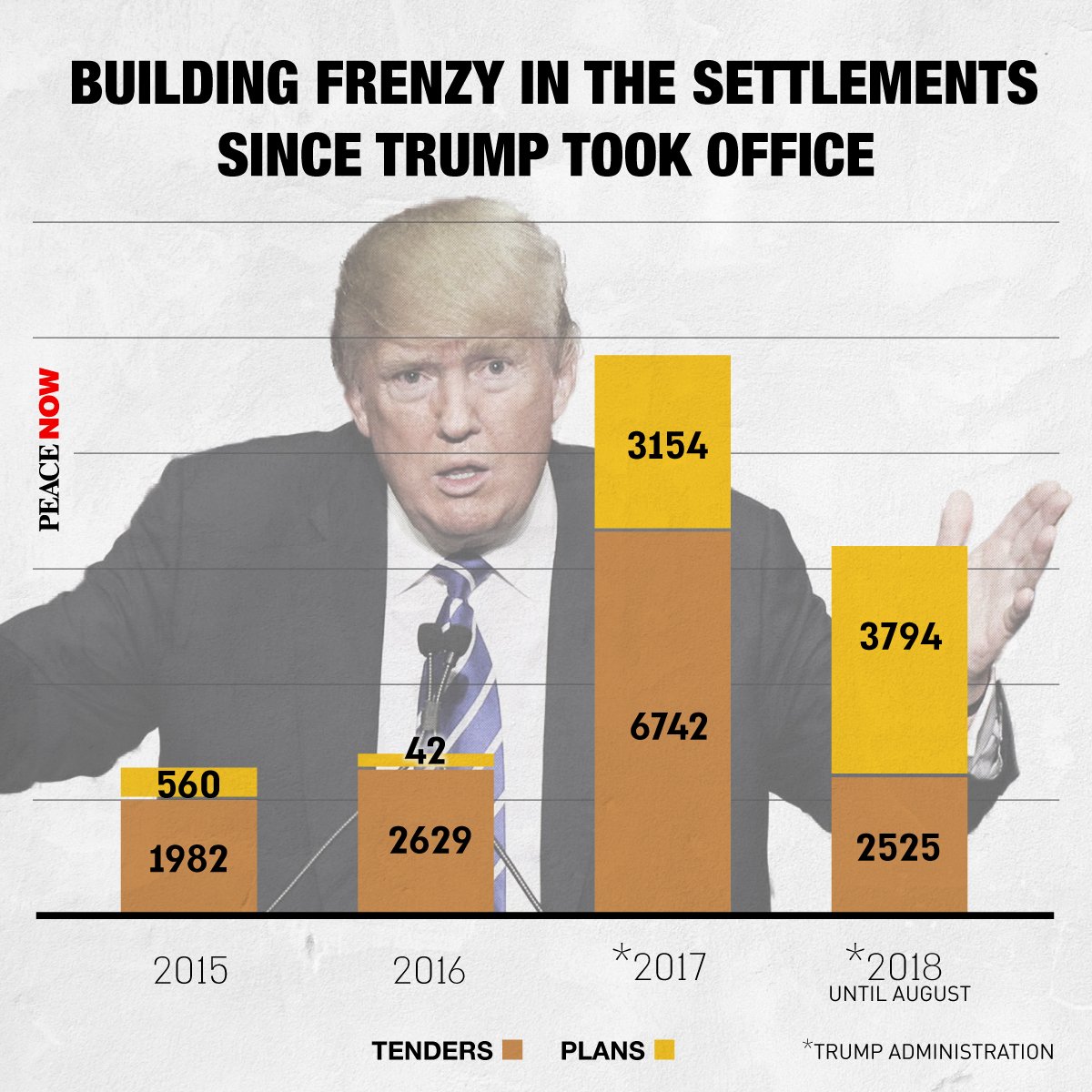
Image by Peace Now
When asked for comment on the various major settlement announcements, the U.S. State Department said that the Trump Administration believes the Israeli government has clearly demonstrated an intent to “adopt a policy regarding settlement activity that takes the president’s concerns into consideration” – a statement that suggests unequivocally that the Trump Administration has given a green light for massive settlement expansion across the length and breadth of the West Bank and East Jerusalem.
Notably, on the same day that the bulk of the settlement announcements were made, President Trump’s National Security Advisor, Ambassador John Bolton, was on the ground in Jerusalem. Not only did he offer no comment or criticism of the settlement announcements, he very publicly joined Israeli politicians and settlers leaders for dinner in East Jerusalem, dining in the “City of David National Park,” the archeological/touristic/residential site in the Palestinian neighborhood of Silwan that is run by the radical Elad settler organization. As FMEP has repeatedly covered, the Elad settler organization is spearheading a government-aided campaign to evict Palestinians from their homes in Silwan, replace them with Jewish Israeli settlers, and transform the neighborhood into a Biblical tourist site emphasizing exclusively the area’s Jewish history.
The head of the Peace Now Settlement Watch program, Shabtay Bendet, told Al-Monitor:
“The situation on the ground is changing rapidly…Restraints on construction in the settlements have been lifted. The Americans don’t care…”
State Tells High Court: We Can Annex the West Bank, International Law Be Damned
On August 7th, the state’s private attorney Harel Arnon submitted a second brief [Hebrew] to the High Court of Justice in defense of the settlement “Regulation Law.” In it he argues that the Knesset is not bound by international law and has the right to apply its own laws outside of its borders and annex land, if it wishes.
Arnon argues:
“The mere application of a certain Israeli norm [law] to an anonymous place outside the state does not necessarily make that anonymous place part of Israel. The Knesset is not restricted from legislating extra-territorially anywhere in the world, including in the region, the Knesset can legislate in Judea and Samaria.”
The brief also argues:
“The Knesset is permitted to impose the powers of the military commander of the West Bank region as it sees fit. The Knesset is permitted to define the authorities of the military commander as it sees fit. The authority of the government of Israel to annex any territory or to enter into international conventions derives from its authority as determined by the Knesset…[and] the Knesset is allowed to ignore the directives of international law in any field it desires.”
Lawyers representing Adalah responded:
“the Israeli government’s extremist response has no parallel anywhere in the world. It stands in gross violation of international law and of the United Nations Charter which obligates member states to refrain from threatening or using force against the territorial integrity of other states – including occupied territories. The Israeli government’s extremist position is, in fact, a declaration of its intention to proceed with its annexation of the West Bank.”
Harel was ordered to submit a second defense of the bill in response to a petition filed by Adalah and Al-Mezan on behalf of seventeen local Palestinian authorities. The petition argues that the Regulation Law violates international law and that the Knesset cannot enact laws over the West Bank where the majority of the population is Palestinians (who are not Israeli citizens and cannot vote).
The High Court of Justice is widely expected to strike down the “Regulation Law,” but has yet to make a ruling. Just last week, Arnon made the case that the recently passed Nation-State Law, which makes “Jewish settlement,” a “constitutional value,” can help him defend the settlement law before the High Court.
For ongoing tracking of the Regulation Law and other annexation trends in Israel, see FMEP’s Annexation Policy Tables.
This Week in Ariel: Settlers Celebrate 40 Years, A Construction Boom, A Medical School, & An Evangelical “Leadership Camp”
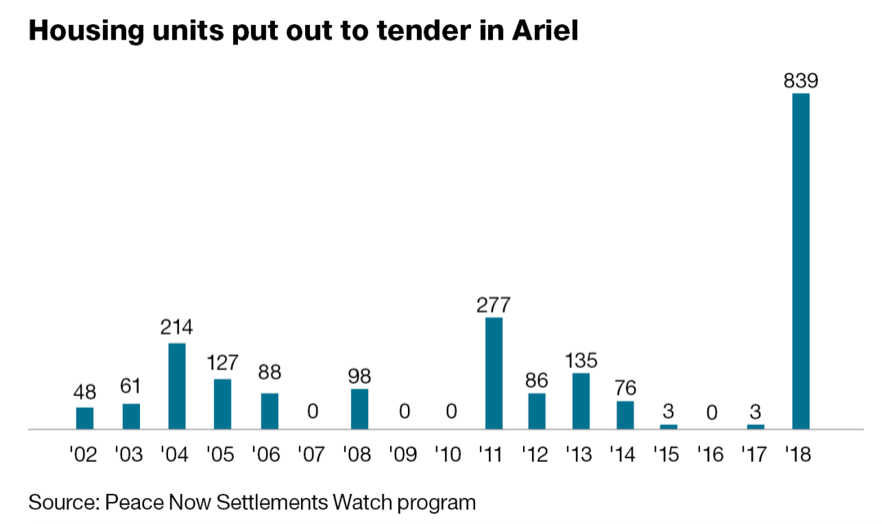 Haaretz published a lengthy report this week on the history of the the Ariel settlement – which is celebrating its 40th anniversary this month – and the dramatic spike in construction in the settlement in 2018. Even before tenders were issued for 42 new units this week (see above), plans for 839 units had already been approved during the first eight months of 2018, compared to tenders for fewer than 5 units each of the past three years. One of the original settlers of Ariel said:
“During the Obama years, everything here was frozen. But thanks to Donald Trump, we’re starting to see the light at the end of the tunnel.”
Not only has Ariel seen a massive surge in construction advancements this year, but the settlement broke ground on a new medical school heavily financed by U.S. casino magnate, and Trump backer, Sheldon Adelson (who this week gave $25 million to the GOP to help it keep the Senate, and in May gave the GOP $30 million to help it keep the House). Many settler leaders and Israeli officials, as well as Adelson and his wife Miriam, were in Ariel this weekend to attend a dedication ceremony for the medical school, despite ongoing controversy around its accreditation under domestic Israeli law. Prime Minister Netanyahu was notably absent from (and reportedly was not invited to) the ceremony, fueling rumors regarding the growing disaffection between him and Adelson.
According to another recent report in Haaretz, Ariel university is illegally dumping construction debris on land that Israel acknowledges is not “state land.” The dump site is outside of the so-called “Blue Line” which the Israeli government uses to demarcate the land that it considers “state land.” Since the dump site is not within the Blue Line, it is likely on land that even the government of Israel recognizes as being privately owned by Palestinians. Anti-settlement watchdog and founder of Kerem Navot, Dror Etkes, commented:
“It’s not surprising that Ariel University, which is the only university in the world built and existing by military order, has adopted the standards accepted in the West Bank involving the takeover of private Palestinian land.”
According to a third Haaretz report, the Israeli Education Ministry has signed a contract to sponsor 3,000-4,000 Israeli high school students of Ethiopian descent to take part in a leadership training program located in Ariel. The program, called “JH Israel,” was founded by American evangelical mega-church pastors Bruce and Heather Johnston, the latter of whom also runs the U.S. Israel Education Association, a pro-Israel, pro-settlement, non-profit group which works with the Family Research Council to lead Congressional delegations to Israel. The JH Israel website says its mission is to help Jewish Israeli students who are “disconnected from the roots of their faith” to establish “a deeper connection to God by embracing their biblical and cultural heritage.” The website also says that Ariel is “at the forefront of biblical prophecy unfolding in modern Israel.”
As FMEP has repeatedly documented, Ariel is located in the heart of the northern West Bank, reaching literally to the midpoint between the Green Line and the Jordan border. The future of Ariel has long been one of the greatest challenges to any possible peace agreement, since any plan to connect Ariel to Israel will cut the northern West Bank into pieces.
Peace Now Settlement Watch Director Shabtay Bendet spoke to Haaretz about the future of the Ariel settlement and the (other) significant repercussions of opening the new medical school. Bendet said:
“Most places in Israel don’t get recognized as cities unless they have 20,000 to 30,000 residents. Ariel became a city when it had just 11,000 residents. Why was this so significant? Because maybe you can uproot a settlement, but you don’t uproot a city. The same holds true for the university. Why was it so important for him to get it accredited? Because when a place has a university, that means it’s established — no pulling it out of the ground….By creating a buffer between the northern and southern parts of the West Bank it makes any future Palestinian state unviable. But besides that, it is also causing damage in the present because its continued expansion impinges on the ability of the surrounding Palestinian villages to develop and grow.”
Amana (the Official Settler Movement) Moves Its HQ to Sheikh Jarrah
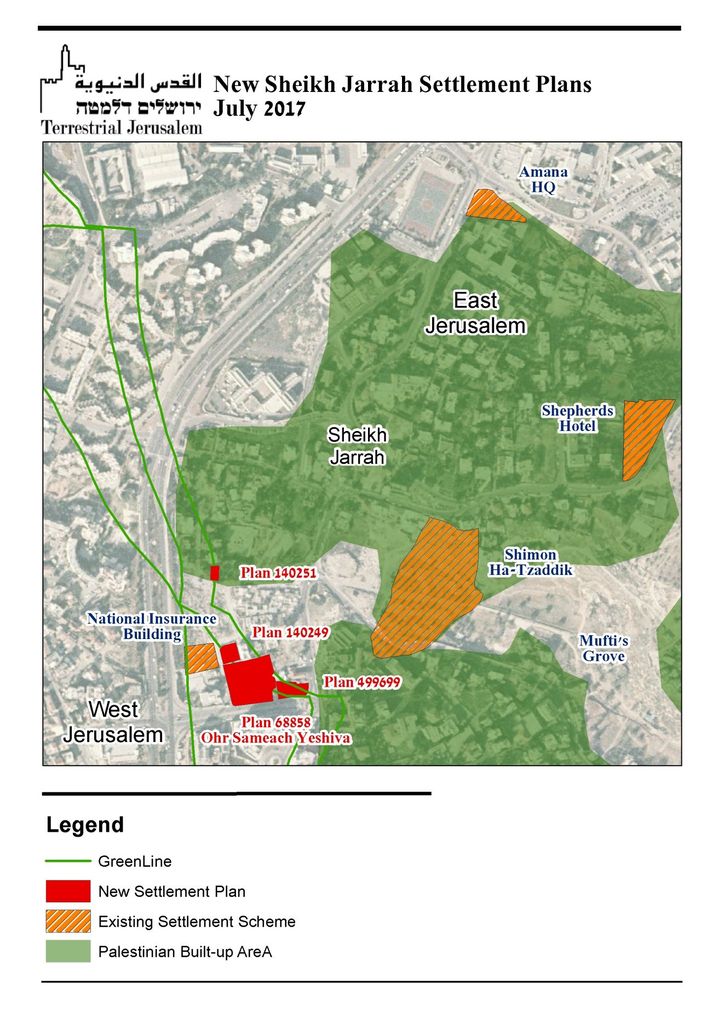 The Ynet news outlet reports that the Amana settler organization – the official body of the settlement movement, operating since the 1970s – has moved into its new headquarters in the heart of the Sheikh Jarrah neighborhood of East Jerusalem, where settlers are continuing to wage a displacement campaign against Palestinian residents. Though Amana has owned the plot of land since 1992, various legal challenges and incredibly sensitive geopolitical considerations have slowed construction of the building, called the “Amana House” (see a detailed history here).
Regarding the strategic implications of the location, Ynet reports:
“Amana says the new headquarters will help bolster the territorial contiguity of Jewish settlements in east Jerusalem.”
Agriculture and Rural Development Minister Uri Ariel (Bayit Yehudi) who previously served as the CEO of Amana, commented that the organization’s relocation:
“constitutes a significant reinforcement to the (Jewish) settlement in east Jerusalem and the bolstering of the Jewish territorial contiguity in the area.”
Several settlement plans are currently proceeding in Sheikh Jarrah, underscoring the strategic location and goals of settler activity in Sheikh Jarrah. As covered previously in this report, Israel is expected to advance a plan for a 6-story office building for settlers, located at the entrance to the neighborhood. Across the street from that building, a highly consequential plan for a new religious school (the Glassman yeshiva) was approved for deposit for public review in July 2017. The goal is clear: to unite the enclaves of settlers living inside of the Palestinian neighborhood by creating a contiguous area of settlement that connects to West Jerusalem, thereby cementing an immovable Jewish Israeli presence in a key Palestinian neighborhood – closing off the possibility of evacuation under a future peace deal.
Settlement Gains in East Jerusalem Result in Palestinians Self-Demolishing Their Homes
OCHA reports that two Palestinian homes in the East Jerusalem neighborhood of Beit Hanina were self-demolished after the Israeli Supreme Court ruled in favor of settlers’ ownership claims. OCHA writes:
“In recent decades, Israeli settler organizations, with the support of the Israeli authorities, have taken control of properties within Palestinian neighbourhoods in East Jerusalem, and some 180 Palestinian families are currently facing eviction cases, filed mainly by settler organizations.”
Bonus Reads
- “How Israeli Right-wing Thinkers Envision the Annexation of the West Bank” (Haaretz)
- “Let’s Admit It: The Settlers Have Won and We Have Lost” (Haaretz)
Welcome to FMEP’s Weekly Settlement Report, covering everything you need to know about Israeli settlement activity this week.
To receive this report via email, please click here.
July 28, 2018
- Israel Advances Plans to Establish Three New Settlements
- Israeli Settlement Activists Invade Site of Evacuated Outpost They Plan to Rebuild
- Bennett Intervened to Expedite Approval of Medical School in Ariel Settlement
- Yair Lapid Presents (Yet Another) Rorschach Test on His Settlement Policy
- Bonus Reads
Comments, questions, or suggestions? Email Kristin McCarthy at kmccarthy@fmep.org.
Israel Advances Plans to Establish Three New Settlements
The Israeli government deposited three major settlement plans for public review this week. As noted by Peace Now, all of these plans are related to efforts to legalize outposts located near, but not directly adjacent to, existing “legal” settlements — in effect creating three new settlements under the cover of legalizing “neighborhoods” of existing ones. Two of the plans deal with outposts located in the Jordan Valley; the third deals with an outpost located east of Ramallah.

Map by Peace Now
The deposit of these plans comes in the context of the government’s exploration of legal means to retroactively legalize outposts. A task force appointed by the Israeli government recently issued a report – known as the Zandberg Report – recommending that the government adopt a very flexible understanding of legal criteria for handling isolated outposts located near to settlements. Peace Now explains:
“In the Zandberg Report there is a detailed reference to situations of outposts built away from the mother settlement. Under the descriptive name ‘hanging islands,’ the regularization team suggests that the planning principle that expansion of settlements should be made adjacent to the existing settlement (‘adjacent planning’) should be applied in a ‘flexible manner’ in the Occupied Territories.”
Specifically, the settlements plans deposited for public review are:
- A plan to retroactively legalize an outpost known as “Brosh/Betronot,” by approving an educational campus there (including housing, tourism facilities, a gas station and other public institutions and buildings);
- A plan to build an educational campus on land between the Maale Michmash settlement and the Mitzpeh Danny outpost, which dovetails with ongoing efforts to retroactively legalize that outpost.
- A plan to build 125 settlement units in the Givat Sal’it outpost, as part of preparations to treat the outpost as a “neighborhood” of the nearby Mechola settlement.
Israeli Settlement Activists Invade Site of Evacuated Outpost They Plan to Rebuild
On July 24th, hundreds of Israeli settlers snuck into the site of the long-evacuated settlement of Sa-Nur, located northwest of Nablus, to protest against the Cabinet’s decision to block a bill aimed at allowing the settlement to be rebuilt/re-populated.
The protest was led by settlers who were evacuated from four settlements in the northern West Bank (Sa-Nur, Homesh, Ganim, and Kadim) as part of the 2005 Disengagement Plan, which also saw Israel evacuate its settlements from the Gaza Strip. Bayit Yehudi MKs Mualem-Rafaeli and Bezalel Smotrich, who were part of the group that infiltrated the site, have been promoting a bill that would overturn the 2005 disengagement plan, allowing Israel to reclaim the land and rebuild the settlements.
Mualem-Rafaeli said:
“Over the past year and a half, we have been pushing for the cancelation of that Disengagement Law that was imposed on the northern Samaria, which unfortunately has gone up to the Ministerial Committee again and again and has failed to pass due to a veto by the prime minister. As we mark 13 years to the expulsion, to the complete darkness cast over the Jewish settlement that was destroyed in the communities in the northern Samaria, we are turning the light back on. We’re still committed to this place.”
Smotrich added:
“Mistakes must be remedied. There isn’t a child who doesn’t understand this expulsion has been foolishness. The discussion is with the prime minister and the defense minister. The answer as to why this law hasn’t been canceled yet is at the hands of Netanyahu. We already learned that when public pressure is created, we eventually achieve the goal, as we did with the Regulation Law.”
Bennett Intervened to Expedite Approval of Medical School in Ariel Settlement
Members of Israel’s top academic council slammed Education Minister Naftali Bennett (Jewish Home) for interfering in their work. The controversy surrounds Bennett’s intervention to expedite the approval of a new medical school in the Ariel settlement. That school opened in June 2017, with a ceremony attended by Bennett and the school’s largest financial-benefactor Sheldon Adelson. During a meeting of the Planning and Budgeting Committee of Council of Higher Education [known as “Vatat”] on July 25th, three committee members read a letter of protest, saying in part:
“Bennett’s intervention in the committee’s professional work is being done almost publicly….Recently Vatat has made decisions in an expedited and improper fashion, and even by circumventing the committee. These decisions were made without exhaustive academic and professional discussion and contrary to accepted procedures. The source of these decisions is motivations which, in our opinion, stem from extraneous considerations that erode the high standards that characterize the decisions of the Planning and Budgeting Committee, a situation that undermines the values and needs of higher education.”
Specifically referring to the Ariel settlement university, a committee member said:
“In violation of accepted procedures that are in place for more than 15 years, the [medical school’s] approval was hastily inserted into the agenda of a meeting scheduled months in advance to discuss readying the budget for the next academic year, in preparation for the budget’s approval a week later. t’s not proper that such an important decision be discussed in haste. We are well aware of the need to increase the number of medical students in Israel, but a hasty decision may actually do more harm than good.”
According to Haaretz reporting, it is highly unusual for committee members to publicly criticize the committee’s work. Because the letter was read aloud during the committee’s meeting, the contents will be included in the official meeting minutes, making the members’ criticisms a matter of public record.
Prof. Yaffa Zilbershats, who was appointed by Naftali Bennett to head the Planning and Budgeting Committee in 2015, issued an official written statement defending the process by which the Ariel settlement’s medical school was approved. The statement read in part:
“…there is no political intervention in the work of the committee..The professional committees did a comprehensive examination and submitted all the required materials to the Vatat members for discussion. The materials were sent in time, and all the time necessary was devoted to a discussion at the meeting…There is no place to argue that the decision to establish the medical faculty in Ariel undermined the budget work.”
As FMEP has previously reported, Ariel University became an accredited Israeli university in 2012, following significant controversy and opposition, including from Israeli academics. It has since been the focus of additional controversy, linked to what is a clear Israeli government-backed agenda of exploiting academia to normalize and annex settlements. Earlier this year, in an act of deliberate de facto annexation, the Israeli Knesset passed a law that extends the jurisdiction of the Israeli Council on Higher Education over universities in the settlements (beyond Israel’s self-declared borders), ensuring that the Ariel settlement medical school (and its graduates) are entitled to all the same rights, privileges, and certifications as schools and students in sovereign Israel.
As a reminder, Ariel is located in the heart of the northern West Bank, reaching literally to the midpoint between the Green Line and the Jordan border. The future of Ariel has long been one of the greatest challenges to any possible peace agreement, since any plan to attach Ariel to Israel will cut the northern West Bank into pieces.
Yair Lapid Presents (Yet Another) Rorschach Test on His Settlement Policy
On a visit this week to Israeli settlements in the Jordan Valley, Yesh Atid party chairman Yair Lapid continued to be coy regarding the specifics of his stance on Israeli settlement policy, refusing to say whether settlements in the Jordan Valley will need to be evacuated or allowed to remain under a Lapid-negotiated peace deal. Speaking to reporters, Lapid said the Jordan Valley must remain Israel’s “security border,” but when asked to clarify what that means for Israeli settlers, Lapid quipped “Not for nothing did I say it will remain the ‘security’ border. Everyone can decipher on his own what that means.”
Now a key Lapid talking point, the Yesh Atid party leader also explained why he refuses to be more specific:
“The great mistake of the Israeli left over generations has been its willingness to always starts negotiations by announcing what it will give up and what it will not give up.”
Beyond a negotiating strategy, Lapid (who presents himself as a centrist) has been on a publicity tour over the past months in what is widely seen as a bid to win some of Netanyahu’s (mostly right-of-center) supporters ahead of the next elections. As part of this effort, Lapid (whose party is currently polling in second place in a hypothetical election) has presented a rorschach-like test for voters with respect to settlements, likely hoping that his deliberate ambiguity will lead voters to see whatever it is they want to see. Formerly a devout two-state supporter, Lapid’s recent, less-than-specific settlement statements include:
- In March 2018, Lapid gave an interview to Newsweek where he was asked about his position on settlements. Lapid said that the “settlement blocs” will be part of Israel but did not elaborate when asked about the 1967 Green Line as a basis for a Palestinian state.
- In January 2018, Lapid supported a bill to extend the Israeli Higher Education Council’s jurisdiction over the settlements, an act of de facto annexation that is just one in a string of proposals for applying domestic Israeli law over the settlements.
- In September 2017, Lapid rebuffed criticism that his party was insufficiently supportive of the settlements, denying reports that Yesh Atid was boycotting a celebration of the 50th anniversary of Israeli settlement in the West Bank.
- In July 2017, Lapid railed against settlers who invaded a home in central Hebron, and called for their immediate removal.
- In July 2017, Lapid attended a ceremony in the unauthorized Netiv Ha’avot oupost, during which he promised to support the effort to legalize the outpost and save structures that the High Court ordered demolished.
- In March 2017, Lapid said: “We don’t want a Palestinian state. It’s simply the best way to get rid of four million Palestinians whom we want to get out of our lives the question is not whether it’s right or not, but how to create the highest wall possible between us and the Palestinians with security guarantees for Israelis.”
Bonus Reads
- “How Israel boosted its settlement programme after Trump’s election victory” (Middle East Eye)
Welcome to FMEP’s Weekly Settlement Report, covering everything you need to know about Israeli settlement activity this week.
To receive this report via email, please click here.
July 19, 2018
- It’s the Settlements, Stupid: Documents Reveal Israel Planned Khan al-Ahmar Bedouin Removal for 40+ Years
- New Law Puts West Bank Legal Matters under Domestic Israeli Jurisdiction
- Since 1967, Israel Gave 99.76% of “State Land” in the West Bank to Settlers (But Blames Palestinians)
- Birthright & the Settlers
- Jordan Valley Settlement Council Confirms Participation in (Illegal) Outpost Activity, Refuses to Release Any Details
- Huge Expansion Approved for Pisgat Ze’ev; Jerusalem Expert: this is “Natural Response” to Trump’s Jerusalem Policy
- Bonus Reads
Comments, questions, or suggestions? Email Kristin McCarthy at kmccarthy@fmep.org.
It’s the Settlements, Stupid: Documents Reveal Israel Planned Khan al-Ahmar Bedouin Removal for 40+ Years
A recently discovered document from the 1970s confirms that the removal of Bedouin communities from the Maale Adumim/E-1 area east of Jerusalem (like Khan al-Ahmar) has been planned for decades and is directly connected to plans to expand Israeli settlements and annex West Bank territory.
The document, entitled “A proposal to plan the Ma’aleh Adumim region and establish the community settlement of Ma’aleh Adumim B,” was written by settler activist Uri Ariel (who is currently serving as Israel’s Agricultural Minister). It lays out a plan to create a “Jewish corridor” of settlements connecting the coast to the Jordan River, recommending that Bedouin be evacuated from the area east of Jerusalem in order to build a new settlement: “Maale Adumim B.”
Haaretz reports that “a large part of the plan has been executed, except for the eviction of all the area’s Bedouin,” adding “Today, under a government in which [Agricultural Minister Uri] Ariel’s Habayit Hayehudi party is so powerful, the open expulsion of Bedouin is possible.”
Jerusalem expert Danny Seidemann adds:
“the story of Khan Al-Ahmar is not only about the tragedy for the village and its inhabitants, or about Israel’s readiness to carry out an ostensible war crime in the face of the world. It is also about Israel’s determination to clear the entire area of the West Bank east of Jerusalem, and located within the line of the built and planned barrier, of any Palestinian presence. This clearing will prepare the ground for the future construction of E1 and de facto annexation of this so-called bloc, which extends well beyond the built-up area of Maale Adumim.”
New Law Puts West Bank Legal Matters under Domestic Israeli Jurisdiction
On July 16th, the Knesset voted 56-48 to pass a law that, in effect, further extends Israeli sovereignty into the West Bank, suspends even the pretense that Israel’s justice system is interested in protecting the rights of Palestinians living under occupation, and strengthens the hand of settlers and their supporters.
Specifically, since 1967, the court of first jurisdiction for cases related to Palestinians living in the West Bank — where Palestinians can legally challenge State actions (and inactions) regarding planning and construction, travel permits, freedom of information, and freedom of movement — has been the Israeli High Court of Justice, reflecting the extraordinariness of Israeli judges issuing, in effect, extra-territorial legal rulings.
The new law strips Palestinians of this direct avenue to the High Court of Justice. It compels Palestinians living in the West Bank to file petitions with the Jerusalem District Court (located within Israel’s sovereign borders). The High Court of Justice will only hear Palestinians’ cases on appeal from the district court, adding more time and higher costs to any potential appellant. The bill has been championed by Justice Minister Ayelet Shaked (Jewish Home), whose three-fold rationale for the bill explicitly states its purpose: to help settlers take more Palestinian land and shut-down Palestinian challenges to such thefts.
Shaked celebrated the passage of the bill, saying:
“The High Court petition party of Palestinians and extreme left organization against the settlements in Judea and Samaria is over today. From now on they will have to go through the judicial hurdle like any other Israeli citizen [note: Palestinians living in the West Bank are not Israeli citizens and as such do not enjoy the same rights or privileges as settlers in an Israeli court].”
Reiterating her call for annexation of the settlements, Shaked added that:
“Hebron, Ra’anana, Elon Moreh and Kiryat Arba [all but Ra’anana being places located deep inside the West Bank] are all inseparable parts of the Land of Israel.”
With the passage of the bill, the Israeli Knesset has further revealed – with startling honesty – its intention to treat the occupied territories as if they are sovereign Israeli territory. The bill is part of the legislative body’s broader effort to erase all remaining distinctions (legal, judicial, economic, and otherwise) between sovereign Israel and the occupied territories, distinctions which allowed Israel to preserve the guise of respect for rule of law, and good intentions, for the last 50 years. Lara Friedman points out:
“…this [the passage of the new law] is good news, further removing the pretense that Israel’s justice system protects Palestinian rights. For 50yrs the High Court’s rulings have at BEST dealt Palestinians pyrrhic victories that have systemically legitimized occupation & rule by law.”
FMEP tracks the application of domestic Israeli law over the occupied West Bank (the de facto annexation of the West Bank) on its Annexation Policy Tables, which are regularly updated.
Since 1967, Israel Gave 99.76% of “State Land” in the West Bank to Settlers (But Blames Palestinians)
On July 17, Israel’s Peace Now published a new report (covered in the New York Times) showing that Israel has allocated 99.76% of “State Land” in the West Bank to Israeli settlers, and just .24% to the local Palestinian population living under Israeli occupation. Israel has declared a total of 16% of land in the West Bank – including nearly half of all land in Area C – as “state land,” a method of land confiscation Israel has exploited to take control of West Bank land. This works out to around 260 square miles (674,459 dunams) of West Bank land granted to the settlers, and less than 1 square mile (1625 dunams) granted to the Palestinians.
Adding insult to injury, the 1 square mile of land granted for Palestinians was mostly for the purpose of establishing Israeli settlements and for the forced transfer of Bedouin communities off other land coveted by Israel (as in the case of Khan al-Ahmar).
The data upon which the report is based was furnished to Peace Now and the Movement for Freedom of Information in response to a two-year old freedom of information request to the Israeli Civil Administration (which is the sovereign governing power over the West Bank and is obligated under international law to protect the rights of the occupied people). In its response to the request, the Civil Administration suggested that Palestinians are to blame for the stark inequality, since they have refrained from applying to use the land. A statement from the Civil Administration reads:
“Applications for the allocation of state land are routinely submitted by all the population, both Palestinian and Israeli. It should be emphasized that the number of requests submitted by Palestinian residents is generally very low.”
With this argument, the Civil Administration has constructed a classic “damned if they do, damned if they don’t” argument. If Palestinians apply to use the land, they would legitimize Israel’s authority to declare West Bank land “State Land” in the first place as well as Israel’s authority to grant or deny its use, whether to Palestinians or settlers. If Palestinians don’t apply, they are blamed for Israel’s decisions on allocating virtually all of the land to settlers. This argument also ignores the fact that the the pattern of allocation of “State Land” revealed in this report is not an exception to, but an illustration of, the rules according to which the Civil Administration has run the West Bank for the past 51 years – rules that overwhelmingly favor the settlers over the Palestinians, most blatantly when it comes to land and construction.
More fundamentally, setting aside the question of whether Israel has abused its authority in declaring so much of the West Bank to be “State Land,” the Civil Administration’s response completely ignores the fact that Israel has a legal responsibility under international law regarding stewardship of “state land” held under its occupation. As the Association for Civil Rights in Israel explains:
“Israel holds state land in an occupied territory as a trustee, and must do everything possible to preserve and develop it for the benefit of the local Palestinian population. The very use of state land for the purpose of building settlements and/or developing infrastructure and industrial zones not in favor of the Palestinian population constitutes a violation of international law. ”
The New York Times observes, correctly:
“The lopsided allocation is hardly surprising. Israeli legal experts say the whole point of seeking out state lands, the bulk of which were designated in the 1980s, was to aid the growing settlement enterprise, which most of the world considers a violation of international law. But the paucity of land allocated to the Palestinians shows the extent of competition over territory, and the effort Israel puts toward building the settlements.”
Peace Now said:
“The significance of the data is that the State of Israel, which has been in control of the West Bank for more than 50 years, allocates the land exclusively to Israelis, while allocating virtually no land for the unqualified benefit of the Palestinian population. Land is one of the most important public resources. Allocation of land for the use of only one population at the expense of another is one of the defining characteristics of apartheid. This is further proof that Israel’s continued control of the occupied territories over millions of Palestinian residents without rights and the establishment of hundreds of settlements on hundreds of thousands of dunams has no moral basis.”
The Peace Now report shines a harsh spotlight on a key facet of Israel’s decades long effort to confiscate land and transfer it to the settlers, particularly in Area C, and it comes at a time when Israeli lawmakers are loudly and clearly calling for the unilateral annexation of Area C – all of which FMEP documents in its Annexation Policy Tables.
Birthright & the Settlers
Adding to the swirling coverage of participants leaving Birthright trips to learn about Palestinians and realities in the West Bank and East Jerusalem, Birthright (an organization which organizes free trips to Israel for young Jews around the world) has come under the spotlight this week for two settlement-related reasons: the harassment of Birthright participants who left the trip to tour Hebron, and Birthright’s partnership with the radical settler group Elad.
First, cameras caught settlers harassing a group of Birthright participants who left the trip to tour Hebron with Breaking the Silence. The tour guide, a former IDF soldier, was attacked by the settlers. Breaking the Silence regularly takes groups to Hebron to observe the apartheid-like reality that exists there, “sterile streets” (an Israeli military term for streets which Palestinians are forbidden to access) and all. Part of that reality is daily settler violence, as Breaking the Silence explains:
“Near daily occurrences of abuse of the Palestinian population by settlers, including humiliation and physical attacks, are part and parcel of the lives of those Palestinians who still live in H2. Even worse, twisted norms of law enforcement in which two different populations are subject to two different sets of laws – one military and one civilian – creates a situation of selective law enforcement at best, and complete lack of law enforcement over the residents of the Jewish settlement at worst.”
Second, Birthright’s partnership with the radical Elad settler organization was exposed when a second group of youth left a Birthright trip during a tour of Silwan (aka the City of David) with Elad, which manages the City of David National Park (which was declared on Silwan land). Elad is engaged in a range of activities to enact their extremist political agenda, at the expense of Palestinians. The group left the Birthright tour to join a Peace Now visit with the Palestinian Sumreen family, who are under threat of eviction from their Silwan home because of the actions of the Elad and the JNF. Birthright responded by accusing the participants who left the trip of seeking to advance a “political agenda,” and defending itself as an “apolitical” organization. Birthright’s response is especially ironic given Birthright’s own choice to ally itself with Elad — an organization that explicitly exists to promote an extremist political and ideological agenda (for further irony, see this proud announcement by a former Birthright participant noting that it was her experience with Birthright that inspired her to become a settler).
Peace Now later said in an email:
“Peace Now has no fight with Birthright. What we oppose are government (or any other) efforts to insert political programming into trips like Birthright’s that intentionally conceal the occupation, such as Elad tours. Elad’s far-right, one-state agenda is well-known, and it is involved in the legal acrobatics underway to evict Palestinian families from their homes.”
Jordan Valley Settlement Council Confirms Participation in (Illegal) Outpost Activity, Refuses to Release Any Details
The Jordan Valley Settlement Council, which represents the majority of Israeli settlements located in the West Bank section of the Jordan Valley, has admitted that it supports illegal outposts in the area, but declined to provide information on its activities. The admission came in response to a freedom of information request made by an Israeli lawyer representing the anti-occupation group Machsom Watch and the coexistence group Combatants for Peace.
In the written refusal to divulge information about the Jordan Valley Settlement Council’s involvement with outposts, staff member Oshra Yihye said that its refusal is based on the fact that the parties requesting the information are critical of settlers living in the Council’s jurisdiction. Yihye also claimed that revealing the information will interfere with Council’s operations. Some Jordan Valley settlers are known to violently attack Palestinian farmers and their property, and settlers have been repeatedly caught on video attacking Israeli activists trying to assist the Palestinians.
Israel has effectively annexed 85% of land in the Jordan Valley, through ongoing settlement building and the declaration of “closed military zones” on vast swaths of farmland. A recent report by B’Tselem documents how Israeli settlers were allowed to establish two new outposts in the Jordan Valley last year. In recent months, Israel has delivered eviction notices to entire Palestinian communities near Israeli settlements in the Jordan Valley. Simultaneously, settlers have been allowed to continue construction on a tourist project – a car race track built in a closed military zone (land expropriated from Palestinians ostensibly for security purposes), despite a court ordered stop-work order.
Huge Expansion Approved for Pisgat Ze’ev; Jerusalem Expert: this is “Natural Response” to Trump’s Jerusalem Policy
On July 2nd, the Israeli Housing Ministry deposited for public review plans for 1,064 units in the Pisgat Ze’ev settlement in East Jerusalem. Jerusalem expert and founder of Terrestrial Jerusalem, Danny Seidemann, recently punctuated the significance of the move, explaining:
“Politically speaking, this approval signals a clear statement by Israeli authorities. These plans received initial approval from the Planning Board in July 2017, as [Terrestrial Jerusalem] reported in detailed here. While the approval of these plans at this time, after a year’s delay, is indeed in large part the normal course of events in the bureaucratic decision, the publication could not have taken place without the advance knowledge and blessing of Netanyahu. As such, this is yet another component in Netanyahu’s systematic effort to tighten Israel’s grip on East Jerusalem, his natural response to Jerusalem having been ‘taken off the table’ by President Trump.”
While pointing out that the Pisgat Ze’ev plans are the first East Jerusalem settlement plans to be deposited for public review this year, Seidemann says:
“This should by no means lead to the conclusion that until now there has been a de facto settlement freeze in East Jerusalem. Before the Pisgat Ze’ev approvals, other settlement activities were proceeding apace, including ground being broken for the expansion East Talpiyot and deliberations on a major new plan in Southeastern Gilo (Master Plan 125195).”
For more analysis from Terrestrial Jerusalem on the Pisgat Ze’ev plans, see here.
Bonus Reads
- “How a West Bank Highway’s Road Sign Captures the Israeli Psyche” (Haaretz)
- “Bulldozers In The West Bank: How recent Israeli Settlement Expansion Jeopardizes the Peace Process” (Forbes)
- “Israel Accelerates ‘Greater Jerusalem’ Plan” (Ahram Online)
***In total, the Israeli government advanced plans for 3,120 new settlement units this week alone. Details, along with additional significant settlement news, are below.***
Welcome to FMEP’s Weekly Settlement Report, covering everything you need to know about Israeli settlement activity this week.
To receive this report via email, please click here.
June 1, 2018
- Plans Advance for 1,958 New Settlement Units
- Tenders Published for 1,162 New Settlement Units
- Israeli Chief Justice Questions Legal Opinion Regarding Status of Settlers
- Knesset Advances Bill to Bring West Bank Land Cases Under Israeli Domestic Jurisdiction (De Facto Annexation)
- Labor MK Calls on Left to Endorse De Facto Annexation of “Settlement Blocs”
- Israeli Security Increase Presence Near Radical Settlements
- Human Rights Watch: Israeli Banks Are Integral Part of the Settlements Enterprise
- U.S. Ambassador Friedman on Settlements, Annexation, Trump “Peace Plan,” & More
- Bonus Reads
Comments, questions, or suggestions? Email Kristin McCarthy at kmccarthy@fmep.org.
Plans Advance for 1,958 New Settlement Units
On May 30th, the Israeli High Planning Council advanced plans for 1,958 new settlement units, located across the West Bank. Of the total, 696 units received final approval and 1,262 units were approved for deposit for public review (a key, step in the planning process). Peace Now estimates that 80% of the planned units are to be built in isolated settlements and that 1,500 of the units are to be built outside of the “built up” area of existing settlements. Two of the plans would establish two entirely new settlements.

Map by Peace Now
Adding insult to injury (or in this case, to a war crime), the Council gave final approval (“validation”) to a provocative plan to build 92 units near the Kfar Adumim settlement east of Jerusalem, less than a mile from the soon-to-be forcibly removed Khan al-Ahmar bedouin community. Those new units will considerably expand the footprint of the Kfar Adumim settlement by building a new neighborhood (called “Nofei Bereishit” meaning “the landscapes of Genesis” in Hebrew), which will serve to connect the existing settlement structures to the site of a future school campus slated to serve several Israeli settlements in the area.
With respect to the Kfar Adumim expansion plan, Peace Now writes:
“The approval of the plan is the embodiment of exploitation and evil. The government stubbornly refuses to grant building permits to 32 Palestinian families living on about 40 dunams in the area and intends to evict them, but at the same time approves construction on large areas for hundreds of Israeli families. If there is anything that blackens Israel’s image in this world, it is the cruelty and discrimination that reeks to the heavens in this case. Neither is there any real Israeli national interest behind the destruction of the village.”
With respect to the plans advanced for two new government-sanctioned settlements, the details are:
- A plan for 189 units in the unauthorized outpost of Zayit Ra’anan, near the Talmon settlement northwest of Ramallah. As Peace Now explains, this plan constitutes the sanctioning of a new settlement entirely. Talmon has three satellite outposts, according to a map by WINEP. Zayit Ra’anan is the outpost the furthest from the settlement.
- A plan to authorize the “Brosh Educational Institution,” an outpost in the Jordan Valley. This too constitutes the establishment of an entirely new settlement. As Peace Now explains, the settlers who established the Brosh outpost named their endeavor an “Educational Institution” in order to obscure their intent to build a settlement. The plan for the “Brosh Educational Institute” includes residential buildings.
These approvals are notable for two reasons: First, they show that the Israeli government is significantly expanding the footprint of settlements across the West Bank, including in isolated settlements. Second, the plans demonstrate that the Israeli government is not acting, in any way, with “restraint” in regards to its settlement activity (per a reported agreement between the U.S. and Israel, “restrained” settlement growth limits Israel’s building to areas adjacent to existing settlement buildings). The reaction of the Trump Administration to the approvals suggests that the U.S. isn’t in any way troubled that Israel appears to be defying its commitment. An official at the U.S. National Security Council told The Times of Israel:
“The Israeli government has made clear that going forward, its intent is to adopt a policy regarding settlement activity that takes the president’s concerns into consideration. The United States welcomes this. The president has made his position on new settlement activity clear, and we encourage all parties to continue to work toward peace.”
Tenders Published for 1,162 New Settlement Units
One day after the High Planning Council advanced plans for nearly 2,000 new settlement units (above), on May 31st the Israeli Housing Ministry issued tenders for another 1,162 new settlement units that had previously approved by the High Planning Council (once planning approvals are complete, the decision on if/when to issue construction tenders for an approved plan rests with the Housing Ministry). The 1,162 tenders issued this week are are for:
- 459 new units in the Ma’ale Adumim settlement;
- 409 new units in the Ariel settlement;
- 250 new units in the Elkana settlement; and
- 44 new units in the Ma’ale Ephraim settlement.
Israeli Chief Justice Questions Legal Opinion Regarding Status of Settlers
On May 31st, Israeli Chief Justice Esther Hayut issued a significant legal opinion that complicates the growing momentum across the Israeli government to adopt and implement a legal precedent holding that Israeli settlers are a part of the “local population” of the West Bank. Chief Justice Hayut said the precedent does not constitute “a binding law” saying it “appears that the ruling contradicts previous rulings…and it contains both a novelty and a difficulty.” The ruling in question, written by retired Justice Salim Joubran in 2016, is currently being used as a precedent to justify the expropriation of privately owned Palestinian land near the Haresha outpost, and adopting the precedent was a key recommendation of the recently-released “Zandberg Report” which gave the Israeli government a plethora of legal tools to retroactively legalize outposts and settlements structures.
Hayut’s opinion was issued in response to a petition by the Israeli NGO Yesh Din, which asked to Court to reopen the Amona outpost case where the “local population” precedent was set. The opinion itself was not published until October 2017 (meaning the precedent was not known to the public or able to be debated until now, precisely when the government is moving swiftly to implement it). While Hayut declined to reopen the Amona outpost case, she took the opportunity to address the question raised by Yesh Din regarding the underlying precedent that was set in the case.
FMEP tracks the evolving legal architecture of the Israeli government’s efforts to retroactively legalize outposts and settlement structures (our regularly updated data tables are available here).
Knesset Advances Bill to Bring West Bank Land Cases Under Israeli Domestic Jurisdiction
On May 28th, the Israeli Knesset advanced a bill through its first reading that, if passed, will give jurisdiction the Jerusalem District Court jurisdiction over land disputes in the occupied West Bank. Since 1967, such cases have been under the jurisdiction of the Israeli High Court of Justice, reflecting the unusual – indeed, legally extraordinary – situation in which an Israeli court is ruling on with respect to land and people that are not part of sovereign Israel. The bill passed by a vote of 47 to 45, and will need to be voted through two more readings in the Knesset plenum before it becomes law.
As FMEP explained when the bill gained government backing in February 2018, the bill’s main proponent, Justice Minister Ayelet Shaked, has three main rationales for the bill: (a) to further extend and formalize Israel’s extraterritorial application of its domestic law and legal structures, giving a regular Israeli domestic court jurisdiction over non-citizen Palestinians living in territory that is beyond Israel’s sovereign borders; (b) to give settlers an advantage in court over Palestinian plaintiffs; and (c) to circumvent what Shaked sees (according to a Justice Ministry official) as the High Court being “overly concerned with international law and with protecting the rights of the ‘occupied’ population in Judea and Samaria.” Under Shaked’s proposal, some Palestinian cases could still reach the High Court of Justice, but only after the much more conservative Jerusalem District Court rules, adding time and cost to any Palestinian land petition.
Yesh Din representative Gilad Grossman commented:
“This bill is designed to indicate a kind of normalcy. [It is meant] to show that we’re not talking about an area conquered by one nation whose residents [Israelis] do whatever they want and no one enforces the law against them in an equal manner, but rather that these are conflicts between neighbors just like in Tel Aviv, Haifa or any other town within sovereign Israel.”
FMEP tracks the progress of this bill in its compendium of annexation policies currently being advanced and implemented in Israel. This bill (tracked on the third table) is just one mechanism by which Israeli lawmakers are moving to apply Israeli domestic law extraterritorially – which amounts to de facto annexation of the West Bank.
Labor MK Calls on Left to Endorse De Facto Annexation of “Settlement Blocs”
Last weekend, MK Eitan Cabel (Labor, the largest faction in the Zionist Union coalition) published an op-ed in the Hebrew edition of Haaretz arguing that Israel should define and then apply Israeli law to the “settlement blocs,” which he defines to include Ma’ale Adumim, the Etzion Bloc, the Jordan Valley, Ariel, Karnei Shomron, and more. Cabel promised to release and campaign for the full plan (presumably with more details) sometime soon.
In the op-ed and in subsequent comments to the press, Cabel calculates that 300,000 Israeli settlers will be annexed into Israel under his scheme. Cabel’s calls for the 100,000 settlers outside of those areas to be compensated and for a total construction freeze to be implemented there. He proposes that the status of those areas will be negotiated if, “one day, the Palestinian Nelson Mandela arrives.”
Zionist Union Chairman and Labor Party leader Avi Gabbai – who has said Israel should not evacuate settlements in any peace deal – slammed Cabel’s plan, saying:
“In a democratic party, everyone can have their opinion, but Labor is for separation, not annexation. Separating from the Palestinians must come as part of an agreement. I am not in favor of a unilateral step. I think in negotiations we can reach better results than without them. This is the best time for negotiations because of our alliance with the US and because the Arab countries want peace.”
Cabel’s plan impressed Naftali Bennett (Jewish Home) who tweeted in support of the op-ed, saying it was a step in the direction of his own proposed scheme to annex all of Area C in the West Bank (60% of the occupied land). Apparently agreeing with that point, an unnamed Labor Party official said:
“It’s a delusional initiative. It’s like [Habayit Hayehudi leader Naftali] Bennett speaking through Cabel…He’s [Cabel] suggesting an annexation, but doesn’t say what will become of the Palestinian population in those territories. These are irresponsible and ill-prepared statements.”
Peace Now tweeted in response:
“Another dangerous, self-defeating remark from this weekend for the Labor party. Veteran MK Cabel’s call for unilateral annexation of the “blocs,” including Ariel & Karnei Shomron, is a cowardly rhetorical surrender to the right’s one-state apartheid agenda. Shameful & disturbing….For everyone who supports cutting Israel a break on building in the ‘blocs,’ this is what happens when you give in. Not only is a top Labor MK adopting the right’s maximalist interpretation of the term ‘blocs,’ he is now making the Maale Adumim annexation bill look tame….One can only assume @netanyahu‘s support for annexing the blocs, but it should be noted that at least publicly he has not advocated as much as Cabel just did.”
As Peace Now suggests, using the term “settlement blocs” is unfortunately misleading, and implies an agreed upon acceptance of what the blocs are and the fact that they are inarguably Israel’s to keep. The term “settlement blocs” has no legal definition or standing, and they are indisputably a matter for negotiations aimed at a two-state solution. The terminology has been used for decades by the Israeli government to convey legitimacy to building in the so-called “blocs.” For more context, see resources from Americans for Peace Now here and here. (NOTE: A Haaretz investigation last year estimated that a total of 380,000 Israeli settlers live in the West Bank, of which 170,000 live outside of the so-called blocs, as defined by Haaretz).
Applying Israel law to areas outside of Israel’s sovereign borders is de facto annexation, as FMEP has explained and documented.
Israeli Security Increase Presence Near Radical Settlements
In early May (before the U.S. Embassy opening and the beginning of Ramadan), Israeli security forces increased troop deployments across the West Bank in order to “prevent friction” between Israeli settlers and Palestinians.
According to a Haaretz report, the decision to increase Israel’s security presence was preceded by a series of discussions over the past month between the army, the police, and the Shin Bet. One such meeting was held at the Prime Minister’s office. A source told Haaretz that the meeting participants came to a consensus that settlers from Yitzhar are the main perpetrators responsible for the escalating frequency of “price tag” attacks against Palestinians. As recapped by Haaretz, the main concern of the Israeli officials is that settler attacks might foment Palestinian attacks in response. Haaretz reports:
“The main concern within the Jewish Division of the Shin Bet, which investigates the activities of Jewish Israeli extremists, is that price tag attacks during Ramadan, a fast month, and coming shortly after the controversial transfer of the U.S. Embassy to Jerusalem and the tensions on the border with the Gaza Strip, could spur terrorist attacks against Israelis.”
Despite the rise in settler violence, Israel MK Bezalel Smotrich took the opportunity to accuse the Israeli police of “bullying” Israeli settlers – an accusation that echoed complaints from settlers, including those from Yitzhar, regarding an increased IDF presence. The Israeli Police issued a response, saying Smotrich’s comments were regrettable.
Even with higher troop deployment, settlers continue to attack Palestinians and their property on a weekly basis.
Human Rights Watch: Israeli Banks Are Integral Part of the Settlements Enterprise
In a new heavily researched, documented report titled “Israeli Banks in West Bank Settlements,” Human Rights Watch documents how Israeli banks facilitate and profit from Israeli settlements and makes the case that these banks are therefore complicit in war crimes, including pillaging. HRW reports:
“Most Israeli banks finance or ‘accompany’ construction projects in the settlements by becoming partners in settlement expansion, supervising each stage of construction, holding the buyers’ money in escrow, and taking ownership of the project in case of default by the construction company. Most of that construction takes place on ‘state land,’ which can include land unlawfully seized from Palestinians and which Israel uses in a discriminatory fashion, allocating one third of state land in the West Bank, not including East Jerusalem, to the World Zionist Organization and just 1 percent for use by Palestinians.”
HRW concludes that banks operating in the settlements are, therefore, unavoidably complicit in violating the human rights of Palestinians, and the only remedy is for these banks cease settlement-related operations.
To illustrate the point that human rights violations are an inherent part of all settlements in the West Bank, HRW partnered with the Israeli NGO Kerem Navot to share the story of how the construction of the Elkana settlement and the Israeli separation barrier has deprived Palestinians from the nearby city of Mas-ha of access to their own lands. Banks that have financed projects in Elkana are part of the machinery that entrenches and expands the theft.
Kerem Navot writes:
“Settlements wreck havoc on Palestinian life in the West Bank. For example, as depicted in the animation, the Aamer family used to walk 20 minutes from their West Bank home to their farm. Then Israel built an Israeli-only settlement on part of it, with help from Israeli banks, turning it into a 2-hour detour on what’s left of their land. Banks and all businesses should cease doing business in and with settlements.”
This is just the latest HRW report on the Israeli banking sector and the occupation, and it builds on a September 2017 legal analysis titled, “Israeli Law and Banking in the West Bank.” In the 2017 report, HRW took apart a common legal defense Israeli banks deploy to defend their settlement practices: that Israeli law requires them to operate in the settlements. HRW concluded that there is no such legal requirement currently in Israeli law.
U.S. Ambassador Friedman on Settlements, Annexation, Trump “Peace Plan,” & More
In a wide-ranging (and stunning) interview this week with The Times of Israel, U.S. Ambassador David Friedman spoke revealingly about behind-the-scenes policy discussions within the Trump Administration, including on the topic of settlements, the status of the West Bank, and Israeli annexation proposals.
A few key Friedman quotes from the transcript include:
- On Israel’s settlement activity during the Trump Administration: “The administration’s stance has been that the settlement enterprise is not an impediment to a peace deal, but that unrestrained settlement activity is not consistent with the cause of peace. Where you draw that line or slice that, I am reluctant to go into now. I have felt for years that there has been an oversimplification by the international community of the legal claims, if you will, within the West Bank. That came to a head in December of 2016, with UN Security Council Resolution 2334. It’s not a secret that the Trump administration does not support that resolution, would have vetoed that resolution, had Nikki Haley been the ambassador rather than Samantha Power. I think you can draw some insight from the administration’s views on that resolution.”
- On how Friedman views the international consensus holding that Israeli settlements in the occupied West Bank are illegal: “…Look, I don’t believe the settlements are illegal. I think I’ve been clear on that for years. President Reagan was very clear that he would never suggest Israel would go back to the 1967 borders. They were called the suicide borders; they were considered indefensible. So the notion that Israel’s presence over the Green Line is illegal is something the United States has through many leaders rejected, which is why that UN resolution in 2016 was so offensive to so many people.”
- On whether the Trump Administration discussed annexation proposals with the Israeli government: “We have not had discussions with Israel about annexation…I’ve done lots of listening, so those discussions have taken place, but not in the sense of planning or seeking to execute a strategy, just in the context of enabling me to hear everybody’s views.”
- On the State Department’s decision to stop using “occupied territories” in materials, and instead use “West Bank”: “I believe this is a highly controversial issue and we ought to be using terminology that doesn’t prejudge issues…I was perfectly happy with any geographic identification that people could commonly understand that didn’t involve an adjective. West Bank is fine, Judea and Samaria would have been fine. If there’s another name that would do it justice, that would have been fine. I didn’t think it was appropriate to use “occupied territories,” because I just found it to be unnecessarily political and judgmental on an issue that was still unsettled in many people’s minds.”
Bonus Reads
- “The UN Database on Businesses in Israeli Settlements: Pitfalls and Opportunities” (Al-Shabaka)
- “Checking Supreme Court’s powers, Bennett looks to ‘rebalance’ Israeli democracy” (Times of Israel)