Welcome to FMEP’s Weekly Settlement Report, covering everything you need to know about Israeli settlement activity this week.
To subscribe to this report, please click here.
November 2, 2018
- Liberman Announces A New Settlement in the Old City of Hebron
- Housing Ministry Signs Deal for 20,470 New Settlement Units In Maale Adumim
- Settlers Establish a New Jordan Valley Outpost
- Israel Plans to Double Size of IDF West Bank Bureaucracy…To Aid Settlers
- Yesh Din Documents How Yitzhar Settlement Uses Violence to Seize Palestinian Land
- West Bank Municipal Elections Empower Anti-Establishment Settler Leaders
- Bonus Read
Comments, questions, or suggestions? Email Kristin McCarthy at kmccarthy@fmep.org.
Liberman Announces A New Settlement in the Old City of Hebron
Defense Minister Avigdor Liberman announced that he is advancing plans for the construction of a new settlement in Hebron, to be located above a Palestinian marketplace in the Old City of Hebron. This is the third major settlement initiative in the heart of Hebron undertaken by the Israeli government over the past four months. It follows closely on the heels of the October 2018 announcement of a new settlement at the site of an Israeli military installment in Hebron, and a July 2018 Cabinet decision to fund a new settler municipal body – despite a court injunction against forming the body – meant to empower Israeli settlers living in enclaves in downtown areas of Hebron.
The plan for a new apartment building for settlers above the market in the Old City of Hebron is not new, but has been stalled for years due to “legal difficulties” according to Liberman. Those “legal difficulties” are the protected tenancy rights of Palestinian vendors who rented the market stalls from Jordan after 1948, rights which were upheld by Israel following the 1967 war. Liberman worked alongside Justice Minister Shaked to find a way to move the project forward (i.e., to find a way to void Israel’s recognition of the protected tenancy rights); the result is a new legal opinion greenlighting the project based on Jewish ownership of the land prior to the 1929 Hebron riots, when 67 Jews were killed. The Defense Ministry has not yet released the text of this new legal opinion.
The Times of Israel settlement correspondent Jacob Magid notes:
“Such a legal opinion would apparently conclude that Jewish ownership of the property prior to the establishment of Israel trumps the Palestinian protected tenancy status that was granted after 1948 — a hierarchy that the High Court of Justice has thus far rejected.”
Significantly, Israeli Attorney General Avichai Mandelblit gave his endorsement of the Defense Ministry’s opinion on the matter.
Justice Minister Shaked released a statement saying:
“This week we made a significant breakthrough in the return of Jewish lands stolen during the 1929 riots in the so-called wholesale market. This is a very important area in the heart of the Jewish settlement in Hevron, which for 25 years was not settled, even though it belongs to the Jews according to all the records. For 25 years, Israeli governments have repeatedly evacuated Jews who settled in the area and haven’t granted building permits. This week, thanks to the Defense Minister, Legal Advisor Avichai Mandelblit, Deputy Legal Advisor Erez Kaminitz, and Defense Ministry Legal Advisor Itai Ophir, we brought about a breakthrough and removed the barriers, leading to approving the planning.”
The Jewish community in Hebron released a statement praising the legal opinion as a “Zionist and just decision,” saying that the new settlement will help “strengthen our hold on the inheritance of our forefathers.”
[Updated on 11/2/2018 after publication].
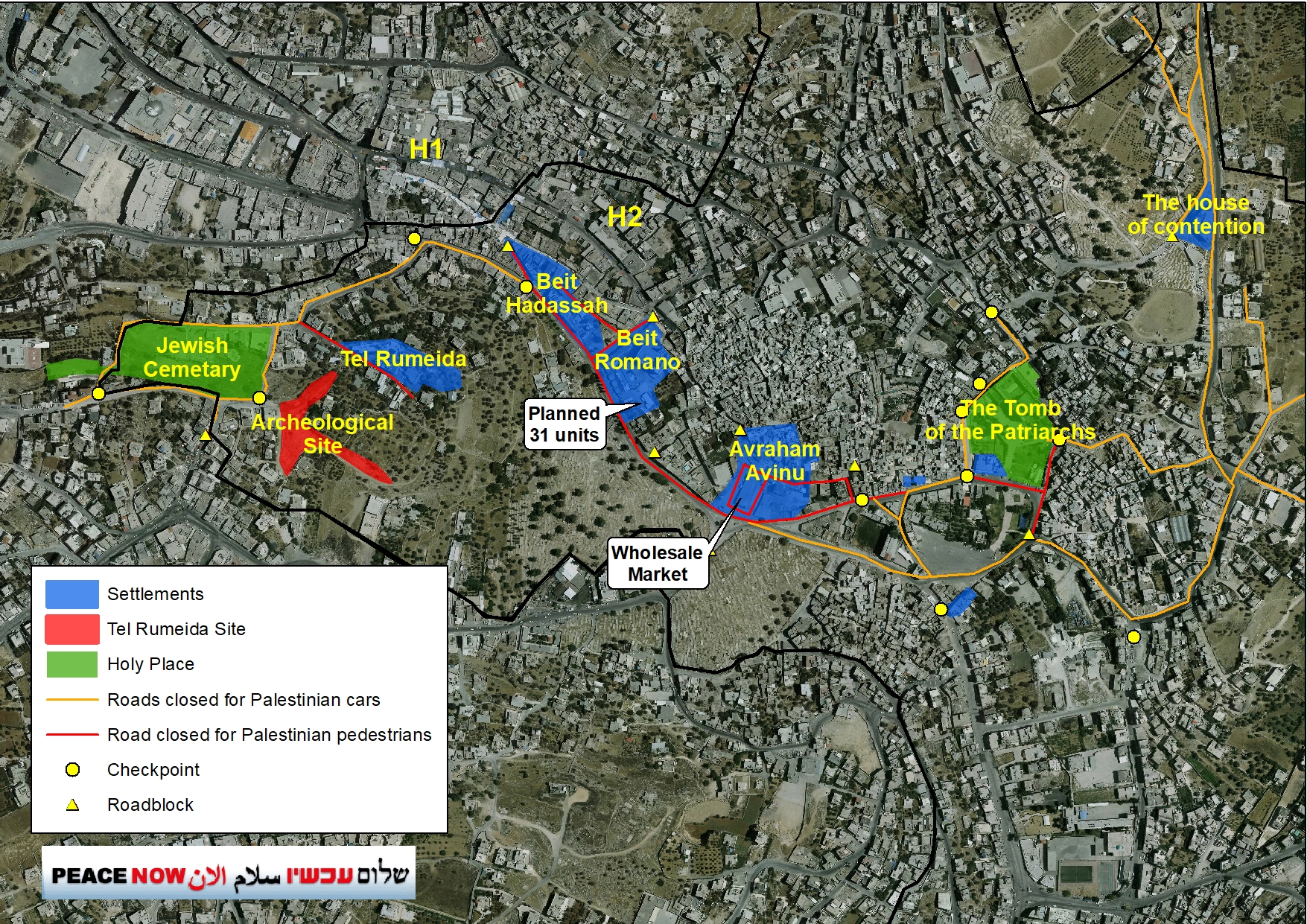
Map by Peace Now
Peace Now has published a detailed explanation of Liberman and Shaked’s plan to build a new settlement above the Palestinian marketplace in the Old City of Hebron. An accompanying Peace Now statement reads:
“The settlement in Hebron is the ugliest face of Israel’s control in the Occupied Territories. In order to maintain the presence of 800 settlers among a quarter of a million Palestinians, entire streets in Hebron are closed to Palestinians, denying them freedom of movement and impinging on their livelihoods. Moreover, by implementing the “right of return” for Jews, the Netanyahu government has pulled the rug out from under Israel’s moral basis for its resistance to recognizing the right of return for the Palestinians, thus endangering Israeli interests.”
A key piece of Peace Now analysis reads:
“The Defense Ministry’s new opinion for building this new settlement compound is yet another example of how the government is currently reinterpreting existing laws in order to circumvent current restrictions on settlement building that safeguard Palestinian private property and protected tenancy. This in turn is part of a broader trend of settlement-backed government efforts to confiscate land, and legalize and expand Israeli settlements with the aim of de facto Israeli annexation of the West Bank.”
Housing Ministry Signs Deal for 20,470 New Settlement Units In Ma’aleh Adumim
The Israeli government signed a $765 million deal to build 20,470 new settlement units in the Ma’aleh Adumim settlement, located just east of Jerusalem. The government is slated to issue permits for 470 units to begin construction immediately (plans for which have already been granted final approval), while the plans for 20,000 units still need to be approved.
After signing the agreement, Construction and Housing Minister Yoav Gallant (Kulanu) made it clear that the mega-project is part of a broader scheme to consolidate Israeli control over West Bank areas to the north, east, and south of Jerusalem:
“In addition to the new housing units, public and educational institutions will also be established, and will include synagogues, schools, parks, community centers and sports arenas. We must continue to establish [our] hold on the Jerusalem area, from Maaleh Adumin in the east to Givat Zeev in the west, from Atarot in the north to the area of Bethlehem and Rachel’s Tomb to Efrat and Gush Etzion…[these places are of] historic, strategic and national importance…. we will continue to act to strengthen the city…. We must continue to maintain full control over Judea, Samaria and the Jordan Valley and bolster the settlement in these regions.”
Following a meeting in Ramallah, the PLO Executive Committee released a statement blasting the plan:
“The decision to build additional housing units beyond the Green Line completely prevents the realization of a two-state solution and frustrates efforts to move a genuine peace process forward….the expansion of the settlement in and around east Jerusalem through the construction of settlement blocs that cut off the connection between Jerusalem and the Palestinian territories [will complete the] Judaization of Jerusalem within the framework of the plan for a greater Jerusalem.”
Settlers Establish a New Jordan Valley Outpost
Last month a large group of Israeli settlers invaded the site of an abandoned IDF base in the Jordan Valley in order to establish a new outpost there. In what appears to be a well-thought-out and organized initiative, twelve settler families (appearing to be religious) broke into and took up residence in six buildings at the site and immediately began renovations. Settlers have also locked the gate at the entrance to the disused base and stationed a security guard there. The Israeli Civil Administration has issued a stop-work order against the settlers’ renovations, but have not acted to remove settlers from the site.
In an atypical scenario, the State of Israel notified the High Court of Justice last month that settlers had moved into the site, known as “Camp Gadi,” to set up an outpost. The State was required to file the brief because of a pending case from 2017, which was initiated by anti-settlement activists after rumors and social media posts strongly suggested that settlers were preparing to enter the same site and set up an outpost there. Hoping to prevent this from taking place, three individuals petitioned the High Court of Justice to preemptively intervene. When the Jordan Valley Regional Council – a municipal body responsible for governing settlements in the area – told the High Court that it was not planning to establish a new outpost there, the individuals who filed the petition agreed to withdraw the complaint, but the Court never officially closed the case. The State was therefore obligated to tell the Court that settlers moved into the site this past month.
The Jordan Valley Regional Council has denied involvement in the establishment of the new outpost.
Israel Plans to Double Size of IDF West Bank Bureaucracy…To Aid Settlers
Israeli Cabinet ministers are close to reaching a deal to double the size of the Israeli Civil Administration, adding 280 employees of which, according to reports, 150 will be Palestinians. The Civil Administration (CIVAD) is the branch of the Israeli Defense Ministry which acts as the sovereign ruling power over all civilian affairs – including building laws – in the occupied territories, and explicitly does so “through the lens of Israel’s interests,” in violation of international law. Finance Minister Moshe Kahlon and Israeli Defense Minister Avigdor Liberman are expected to reach a deal on expanding the CIVAD and present it to the full Israeli Cabinet for approval by the end of November. Prime Minister Netanyahu reportedly supports the plan.
Making no attempts to hide the CIVAD’s work on behalf of the settlement movement and its supporters, CIVAD’s head, Brigadier General Ben Hur, told the Knesset this week:
“The organization’s purpose is to ensure maximal security stability in the region, while promoting quality of life for all the residents who live and work there and shaping the region based on Israeli interests. Thirty to 40 building plans are stalled in the Civil Administration, for reasons that include a personnel shortage.”
An incisive 2017 report by Yesh Din highlights the truth in Brig. Gen. Ben Hur’s statement, documenting how the CIVAD implements Israeli interests in the West Bank, to the detriment of the Palestinian population and in violation of international law. Yesh Din writes:
“At the most basic and evident level, the Civil Administration functions as a tool for controlling West Bank Palestinians. As the agency that makes and executes decisions, it has control over Palestinians’ travel and work opportunities, over construction and development of infrastructure, health, education and welfare, to name some. The Civil Administration uses this control arbitrarily, relying on bureaucratic justifications, or wielding it in a ‘carrot and stick’ fashion – as a means of oppression and domination over the Palestinians. The Civil Administration also functions as an executive arm and a political tool serving Israel’s ambitions in the OPT – pushing the settlement project forward and dispossessing Palestinians of their land. One of the practices that serves this goal is the institutionalization of ethnic- national segregation, privileging the settlers and discriminating against the Palestinians and exploiting them.”
Yesh Din Documents How Yitzhar Settlement Uses Violence to Seize Palestinian Land
In a major new report, Yesh Din documents 40 incidents of violence connected to the Yitzhar settlement and its many outposts (located south of Nablus), and shows how violence is an effective means by which Yitzhar settlers – with the backing of the Israeli military and government – are able to continue seizing more privately owned land from six nearby Palestinian villages.
After documenting 40 incidents, analyzing emerging trends, and demonstrating how settler violence against Palestinians and their property actually results in land being handed to the settlement, Yesh Din concludes:
“Israel’s conduct, which not only tolerates the violence perpetrated by settlers but, in fact, supports them, leads to the proliferation and expansion of violent actions. This violence is not incidental or banal. It is part of a system, another link in the chain of measures that work to take over Palestinian land. This Israeli policy severely violates the human rights of Palestinians, primarily the rights to life and security of person, rights to property and to freedom of movement. It cripples the daily lives of women, men and children, who are forced to confine themselves to ever shrinking spaces and live in constant fear, even inside their own homes.”
FMEP frequently reports on the Yitzhar settlement, which is home to the radical and violent “Hilltop Youth movement.”
West Bank Municipal Elections Empower Anti-Establishment Settler Leaders
The Times of Israel has a comprehensive look at the success of anti-establishment settler leaders in the recent Israeli local elections. Four significant upsets for the head of local settler councils hints at the weakening of the Yesha Council, which for decades has operated as an effective umbrella group coordinating amongst all settlement regional councils in order to present a unified political block in lobbying the government on behalf of the settlements. The new leaders prefer a go-it-alone strategy, thinking it more effective, and have criticized both the Yesha Council and the Netanyahu government for not doing enough for the settlers.
Bonus Reads
- “LPHR Briefing on the impending demolition of the Palestinian community of Khan al-Ahmar in the occupied West Bank and the forcible transfer of its residents” (Lawyers for Palestinian Human Rights)
- “Israel’s Chief Rabbi Pushes for First West Bank Rabbinical Court” (Haaretz)
- “Israeli settlers storm Palestinian homes in Hebron” (MEMO)
***NOTE: This week the Israeli government unleashed a massive wave of approvals to advance plans for settlement construction — in excess of 2,000 units — in highly sensitive and strategically significant areas deep inside the West Bank and in East Jerusalem. More approvals/advancements are expected in the coming weeks. See below for detailed coverage of the individual plans, keeping in mind both the significance of each approval on its own, and as part of the overarching Israeli government agenda clearly intending to both prevent any possibility of a Palestinian state and to further the march toward formal annexation of the West Bank. Also keep in mind, importantly, that there has been zero public push back from the Trump Administration against this surge, which comes on the heels of Ambassador Friedman’s statement last week that Israel will never be required to remove any settlements.***
August 24, 2018
- Settlement Wave, Part 1: High Planning Council Advances Plans for 1,004 Settlement Units (96% Located Deep in the West Bank)
- Settlement Wave, Part 2: Housing Ministry Published Tenders for 420 Settlement Units
- Settlement Wave, Part 3: Jerusalem District Committee Advances Plans for 603 Settlement Units in East Jerusalem
- Settlement Wave, Part 4: More Settlement Construction Coming Soon
- U.S. Stands by Israeli “Intentions” on Settlements
- State Tells High Court: We Can Annex the West Bank – International Law Be Damned
- This Week in Ariel: Settlers Celebrate 40 Years, A Construction Boom, A Medical School, & An Evangelical “Leadership Camp”
- Amana (the Official Settler Movement) Moves Its HQ to Sheikh Jarrah
- Settlement Gains in East Jerusalem Result in Palestinians Self-Demolitioning Their Homes
- Bonus Reads
Comments, questions, or suggestions? Email Kristin McCarthy at kmccarthy@fmep.org. To subscribe to this report, please click here.
Settlement Wave, Part 1: High Planning Council Advances Plans for 1,004 Settlement Units (96% Located Deep in the West Bank)
On August 22nd, the Israeli Defense Ministry’s High Planning Council (the body in the Israeli Defense Ministry responsible for regulating all construction in the West Bank) advanced plans for 1,004 new settlement units, 96% of which are located deep inside of the West Bank. Of the total, 620 units were approved for deposit for public review and 382 units were given final approval for construction.
As reported by Israeli settlement watchdog Peace Now, the plans approved for deposit for public review (totalling 620 units) are:
- 370 units in the Adam settlement (aka Geva Benyamin). This project was urged on by Defense Minister Liberman following a stabbing attack in the settlement, which resulted in one death and injuries to three others. The 370 units are part of a larger plan for 1,000+ units that will, if built, connect the Adam settlement to two large settlements in East Jerusalem (Neve Ya’akov and Pisgat Ze’ev) that are on the Israeli side of the separation barrier (the route of the barrier juts far beyond the 1967 Green Line to include Pisgat Ze’ev and Neve Ya’akov on the Israeli side while the Adam settlement is on the West Bank side). If the larger plan is implemented, the Adam settlement will have built up areas on both sides of the separation barrier, which could (in all likelihood) present Israel an opportunity to re-route the barrier around Adam — which would de facto annex even more West Bank land to Israel and further choke off Palestinian East Jerusalem from the West Bank to its north. [Note: FMEP’s Lara Friedman and Peace Now’s Hagit Ofran published an op-ed in Haaretz in 2008 warning of this plan – you can read that background here].
- 85 units in Karnei Shomron settlement. Israel has repeatedly confiscated as “state land” located between Karnei Shomron and the Palestinian village of Qalqilya (which is literally surrounded on three sides by the separation barrier). In November 2017, Israel began clearing landmines from that “state land” in order to prepare for settlement construction. At the time, Deputy Defense Minister Eli Ben-Dahan said that the new construction in the Karnei Shomron area will bring “a million Jews [to] live in Judea and Samaria in the future.”
- 84 units in the Kiryat Netafim settlement, located about half way between the Ariel settlement and the cluster of settlements close to the 1967 Green Line that are slated to be united into a “super settlement” area (Oranit, Elkana, Shiva Tikva, and others). The expansion of Kiryat Netafim will go towards creating a contiguous corridor of Israeli settlements stretching from sovereign Israeli territory, though the super settlement, to Ariel. As FMEP has repeatedly said, the Ariel settlement is located in the heart of the northern West Bank, reaching literally to the midpoint between the Green Line and the Jordan border. The future of Ariel has long been one of the greatest challenges to any possible peace agreement, since any plan to attach Ariel to Israel (with a finger of land running through settlements like Kiryat Netafim) will cut the northern West Bank into pieces.
- 52 units in the Beit El settlement. This is the second major approval for new units in Beit El in 2018, with a third plan for 300 more units coming soon, according to Israel Hayom. The construction boom is being hailed by the settler-aligned Arutz Sheva outlet, which wrote that the plans will increase the size of Beit El by 65%. If any of the units are constructed it will be first new, government-sanctioned construction in Beit El in over 10 years. U.S. Ambassador to Israel David Friedman is closely associated with the Beit El settlement, having donated to and fundraised for it prior to his appointment as ambassador (including in his capacity as the President of the American Friends of Beit El, reportedly from 2011 until he became ambassador).
- 29 units in the Otinel settlement, located south of Hebron. MK Yehuda Glick (Likud) lives in Otinel.
Plans that gained final approval, meaning no additional formal approvals are required to move ahead with construction (totalling 382 units) are:
- 168 units in the Tzofim settlement, located on the Israeli side of the separation barrier, but jutting towards the Karnei Shomron settlement, which also received advancements this week. See the section on Karnei Shomron, above, for context and news regarding this area of settlements.
- 108 units in the Nofim settlement, located on the Israeli side of the separation barrier but jutting towards the Karnei Shomron settlement, which also received advancements this week. See the section on Karnei Shomron, above, for context and news regarding this area of settlements.
- 56 units in the Barkan settlement, located near the Kiryat Netafim settlement. Both Barkan and Netafim are located about half way between the Ariel settlement and the cluster of settlements slated to be united into a “super settlement” area (Oranit, Elkana, Shiva Tikva, and others). See the section on Kiryat Netafim, above. for context and news regarding this area of settlements.
- 44 units in Ma’ale Adumim, the mega settlement just east of Jerusalem.
- 6 units in the Avnei Hefetz settlement, located southeast of the Palestinian city of Tulkarem.
Notably, Netanyahu intervened to remove two items from the High Planning Council’s agenda, both of which would have led to the retroactive legalization of illegal outposts. Those plans are:
- A plan to retroactively legalize the Ibei Hanahel outpost, which is a non-contiguous “neighborhood” of the Ma’ale Amos settlement, located deep in the southern West Bank. The plan would have allowed the outpost to be demolished and then rebuilt legally with residential units, transforming the outpost into a new, fully authorized settlement.
- A plan to build an education center in the Nofei Prat South outpost, which is a non-contiguous“neighborhood” of the Kfar Adumim settlement, located northeast of Jerusalem. The land on which the project would be built is located just 1.5 km away from the Khan Al-Ahmar Bedouin community – the same one that the Israeli government plans to forcibly evacuate in order to cleanse the area of Palestinians and expand settlements. The outpost was established by the Haroeh Ha’ivri (“the Hebrew Shepherd”) nonprofit association, which is funded by the Israeli Education Ministry.
In response to Netanyahu’s directive to remove these two items from the agenda, the heads of the Knesset’s “Land of Israel Lobby,” Bezalel Smotrich (Jewish Home) and Yoav Kisch (Likud), said that the Prime Minister should “ act with greater rigor to promote settlement, rather than doing the opposite.”
Settler leaders were also unsatisfied with the High Planning Council’s overall numbers. Yossi Dagan, head of the Samaria Regional Council (a municipal body for settlements in the northern West Bank), said:
“We are happy about every new house in Samaria, but we have to tell the truth. Hundreds of housing units are not enough for an area that constitutes 12% of the State of Israel…We expect the government to step in the gas, stop worrying about what they will say overseas, and develop this beautiful region.”
Settlement Wave, Part 2: Housing Ministry Published Tenders for 420 Settlement Units
On August 23rd, one day after the Defense Ministry’s High Planning Council advanced a huge tranche of settlement plans (detailed above), the Israeli Housing Ministry published tenders for a total of 425 settlement units (under plans previously approved by the High Planning Council).
Those tenders include:
- 211 units in the Ma’ale Efraim settlement, located in the Jordan Valley.
- 54 units in the Givat Ze’ev settlement, located north of Jerusalem.
- 52 units in the Beit Aryeh settlement, which comes in addition to the the publication of tenders for 511 units in the settlement last week.
- 42 units in the Ariel settlement. See reporting below for extensive coverage of the many reasons settlers in Ariel are celebrating this week.
Settlement Wave, Part 3: Jerusalem District Committee Advances Plans for 603 Settlement Units in East Jerusalem
In addition to the tranche of settlement plans advanced by the Defense Ministry’s High Planning Council and the tenders published by the Housing Ministry (detailed above), the Jerusalem District Committee deposited for public review (one of the final steps before approval) plans for a total of 608 new settlement units in East Jerusalem, with 345 units slated for the Gilo settlement and 263 units in the Ramot settlement.
On the plan for the Gilo settlement, Ir Amim explains:
“The Gilo plan is being promoted in tandem with development of the new Green Line branch of the Light Rail (construction of which was launched in May), which will be built adjacent to the settlement expansion. This sequencing of events once again exemplifies a pattern of the state investing billions of shekels in transportation infrastructures to allow for extensive construction beyond the Green Line.”
As Ir Amim notes, this week’s advancements come on the heels of Israel’s August 15th decision to publish tenders for 603 units in Ramat Shlomo, and its June 2018 advancement of plans for 1,064 settlement units in the Pisgat Ze’ev settlement — bringing Israel’s two-month total of settlement advancements in East Jerusalem to 2,275 units.
As a reminder, approvals/advancement of settlement plans is not the only ongoing threat to Palestinians in East Jerusalem. Settlers and settler-run organizations continue their campaign to take over sensitive areas in East Jerusalem neighborhoods neighborhood – like Silwan and Sheikh Jarrah – and to create more settler run tourist sites – like the Jerusalem cable car, the Kedem Center, the Abu-Tor footbridge, the Yemenite “heritage center,” and more – to erase the visibility of Palestinians in Jerusalem. Meanwhile, pending legislation in the Knesset seeks to gerrymander the borders of Jerusalem to create a Jewish majority by annexing settlements and cutting out Palestinian neighborhoods from the borders of the city. Sounding the alarm on all of these trends, Ir Amim writes:
“It is vital that the traditional calculus of settlement building be readjusted to a) treat these coordinated efforts to consolidate control of the Old City and surrounding Palestinian neighborhoods with the same urgency afforded to settlement building throughout the whole of East Jerusalem; b) ensure a holistic response that regards private settlement inside the Old City Basin and touristic settlement not as individual phenomena but as multiple elements of a unified and politically lethal strategy.”
Settlement Wave, Part 4: More Settlement Construction Coming Soon
In addition to the plans for 1,004 units that were advanced this week by the High Planning Council, the 425 tenders published by the Housing Ministry, and the 608 units advanced in East Jerusalem (all detailed above), this week saw reports that additional plans are expected to advance soon. Those are:
- Ir Amim reports that on September 2nd, the Jerusalem District Committee is expected to discuss a plan to build a six-story building in Sheikh Jarrah, a neighborhood in which at least 75 families face eviction by radical settlers, with the backing of the Israeli government and courts. For detailed reporting on the building, plans for which were deposited for public review in May 2018, see FMEP reporting here.
- Peace Now reports that tenders are expected to be issued (having already been marketed) for more units in the Adam (Geva Binyamin) settlement. If true, this will be another step towards uniting Adam to the East Jerusalem settlements – the details of which are covered above.
- Peace Now also notes that a plan for 300 units in Beit El is expected to be advanced. This comes in addition to the 52 tenders issued for Beit El this week.
- The Times of Israel reports that plans for hundreds of additional settlement units will soon be marketed for construction by the Defense Ministry. These plans received final approval before this week’s High Planning Council meeting. A Civil Administration official hinted that the plans will be marketed for the Alfei Menashe and Ma’ale Efraim settlements. [NOTE: This reporting was before the subsequent publication of tenders for 211 units in Ma’ale Efraim, covered above.]
U.S. Stands By Israeli “Intentions” on Settlements
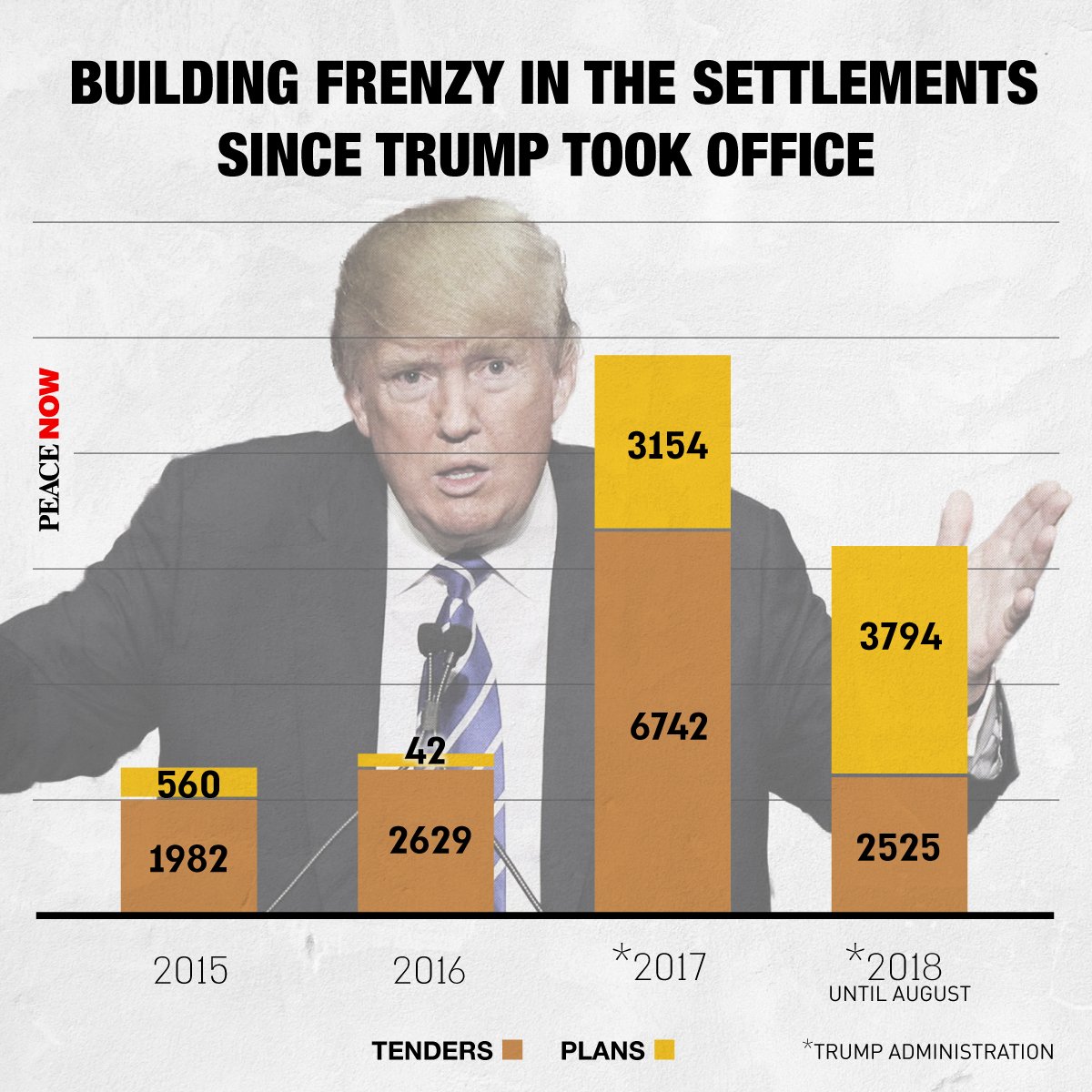
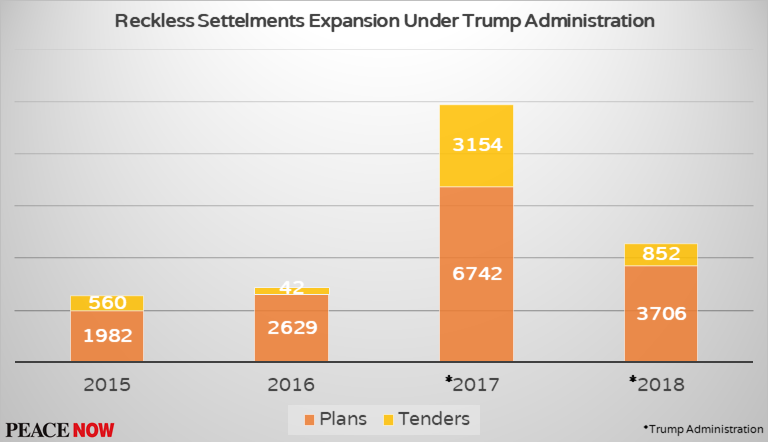
Image by Peace Now
When asked for comment on the various major settlement announcements, the U.S. State Department said that the Trump Administration believes the Israeli government has clearly demonstrated an intent to “adopt a policy regarding settlement activity that takes the president’s concerns into consideration” – a statement that suggests unequivocally that the Trump Administration has given a green light for massive settlement expansion across the length and breadth of the West Bank and East Jerusalem.
Notably, on the same day that the bulk of the settlement announcements were made, President Trump’s National Security Advisor, Ambassador John Bolton, was on the ground in Jerusalem. Not only did he offer no comment or criticism of the settlement announcements, he very publicly joined Israeli politicians and settlers leaders for dinner in East Jerusalem, dining in the “City of David National Park,” the archeological/touristic/residential site in the Palestinian neighborhood of Silwan that is run by the radical Elad settler organization. As FMEP has repeatedly covered, the Elad settler organization is spearheading a government-aided campaign to evict Palestinians from their homes in Silwan, replace them with Jewish Israeli settlers, and transform the neighborhood into a Biblical tourist site emphasizing exclusively the area’s Jewish history.
The head of the Peace Now Settlement Watch program, Shabtay Bendet, told Al-Monitor:
“The situation on the ground is changing rapidly…Restraints on construction in the settlements have been lifted. The Americans don’t care…”
State Tells High Court: We Can Annex the West Bank, International Law Be Damned
On August 7th, the state’s private attorney Harel Arnon submitted a second brief [Hebrew] to the High Court of Justice in defense of the settlement “Regulation Law.” In it he argues that the Knesset is not bound by international law and has the right to apply its own laws outside of its borders and annex land, if it wishes.
Arnon argues:
“The mere application of a certain Israeli norm [law] to an anonymous place outside the state does not necessarily make that anonymous place part of Israel. The Knesset is not restricted from legislating extra-territorially anywhere in the world, including in the region, the Knesset can legislate in Judea and Samaria.”
The brief also argues:
“The Knesset is permitted to impose the powers of the military commander of the West Bank region as it sees fit. The Knesset is permitted to define the authorities of the military commander as it sees fit. The authority of the government of Israel to annex any territory or to enter into international conventions derives from its authority as determined by the Knesset…[and] the Knesset is allowed to ignore the directives of international law in any field it desires.”
Lawyers representing Adalah responded:
“the Israeli government’s extremist response has no parallel anywhere in the world. It stands in gross violation of international law and of the United Nations Charter which obligates member states to refrain from threatening or using force against the territorial integrity of other states – including occupied territories. The Israeli government’s extremist position is, in fact, a declaration of its intention to proceed with its annexation of the West Bank.”
Harel was ordered to submit a second defense of the bill in response to a petition filed by Adalah and Al-Mezan on behalf of seventeen local Palestinian authorities. The petition argues that the Regulation Law violates international law and that the Knesset cannot enact laws over the West Bank where the majority of the population is Palestinians (who are not Israeli citizens and cannot vote).
The High Court of Justice is widely expected to strike down the “Regulation Law,” but has yet to make a ruling. Just last week, Arnon made the case that the recently passed Nation-State Law, which makes “Jewish settlement,” a “constitutional value,” can help him defend the settlement law before the High Court.
For ongoing tracking of the Regulation Law and other annexation trends in Israel, see FMEP’s Annexation Policy Tables.
This Week in Ariel: Settlers Celebrate 40 Years, A Construction Boom, A Medical School, & An Evangelical “Leadership Camp”
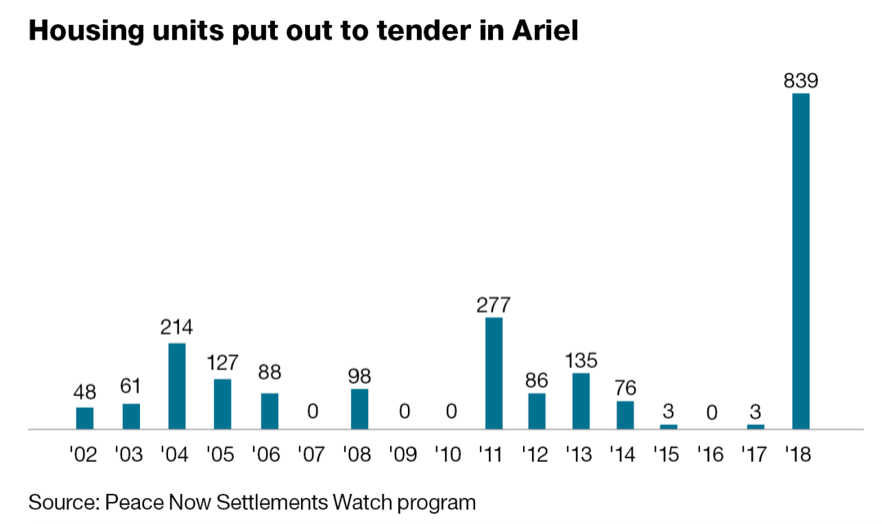 Haaretz published a lengthy report this week on the history of the the Ariel settlement – which is celebrating its 40th anniversary this month – and the dramatic spike in construction in the settlement in 2018. Even before tenders were issued for 42 new units this week (see above), plans for 839 units had already been approved during the first eight months of 2018, compared to tenders for fewer than 5 units each of the past three years. One of the original settlers of Ariel said:
“During the Obama years, everything here was frozen. But thanks to Donald Trump, we’re starting to see the light at the end of the tunnel.”
Not only has Ariel seen a massive surge in construction advancements this year, but the settlement broke ground on a new medical school heavily financed by U.S. casino magnate, and Trump backer, Sheldon Adelson (who this week gave $25 million to the GOP to help it keep the Senate, and in May gave the GOP $30 million to help it keep the House). Many settler leaders and Israeli officials, as well as Adelson and his wife Miriam, were in Ariel this weekend to attend a dedication ceremony for the medical school, despite ongoing controversy around its accreditation under domestic Israeli law. Prime Minister Netanyahu was notably absent from (and reportedly was not invited to) the ceremony, fueling rumors regarding the growing disaffection between him and Adelson.
According to another recent report in Haaretz, Ariel university is illegally dumping construction debris on land that Israel acknowledges is not “state land.” The dump site is outside of the so-called “Blue Line” which the Israeli government uses to demarcate the land that it considers “state land.” Since the dump site is not within the Blue Line, it is likely on land that even the government of Israel recognizes as being privately owned by Palestinians. Anti-settlement watchdog and founder of Kerem Navot, Dror Etkes, commented:
“It’s not surprising that Ariel University, which is the only university in the world built and existing by military order, has adopted the standards accepted in the West Bank involving the takeover of private Palestinian land.”
According to a third Haaretz report, the Israeli Education Ministry has signed a contract to sponsor 3,000-4,000 Israeli high school students of Ethiopian descent to take part in a leadership training program located in Ariel. The program, called “JH Israel,” was founded by American evangelical mega-church pastors Bruce and Heather Johnston, the latter of whom also runs the U.S. Israel Education Association, a pro-Israel, pro-settlement, non-profit group which works with the Family Research Council to lead Congressional delegations to Israel. The JH Israel website says its mission is to help Jewish Israeli students who are “disconnected from the roots of their faith” to establish “a deeper connection to God by embracing their biblical and cultural heritage.” The website also says that Ariel is “at the forefront of biblical prophecy unfolding in modern Israel.”
As FMEP has repeatedly documented, Ariel is located in the heart of the northern West Bank, reaching literally to the midpoint between the Green Line and the Jordan border. The future of Ariel has long been one of the greatest challenges to any possible peace agreement, since any plan to connect Ariel to Israel will cut the northern West Bank into pieces.
Peace Now Settlement Watch Director Shabtay Bendet spoke to Haaretz about the future of the Ariel settlement and the (other) significant repercussions of opening the new medical school. Bendet said:
“Most places in Israel don’t get recognized as cities unless they have 20,000 to 30,000 residents. Ariel became a city when it had just 11,000 residents. Why was this so significant? Because maybe you can uproot a settlement, but you don’t uproot a city. The same holds true for the university. Why was it so important for him to get it accredited? Because when a place has a university, that means it’s established — no pulling it out of the ground….By creating a buffer between the northern and southern parts of the West Bank it makes any future Palestinian state unviable. But besides that, it is also causing damage in the present because its continued expansion impinges on the ability of the surrounding Palestinian villages to develop and grow.”
Amana (the Official Settler Movement) Moves Its HQ to Sheikh Jarrah
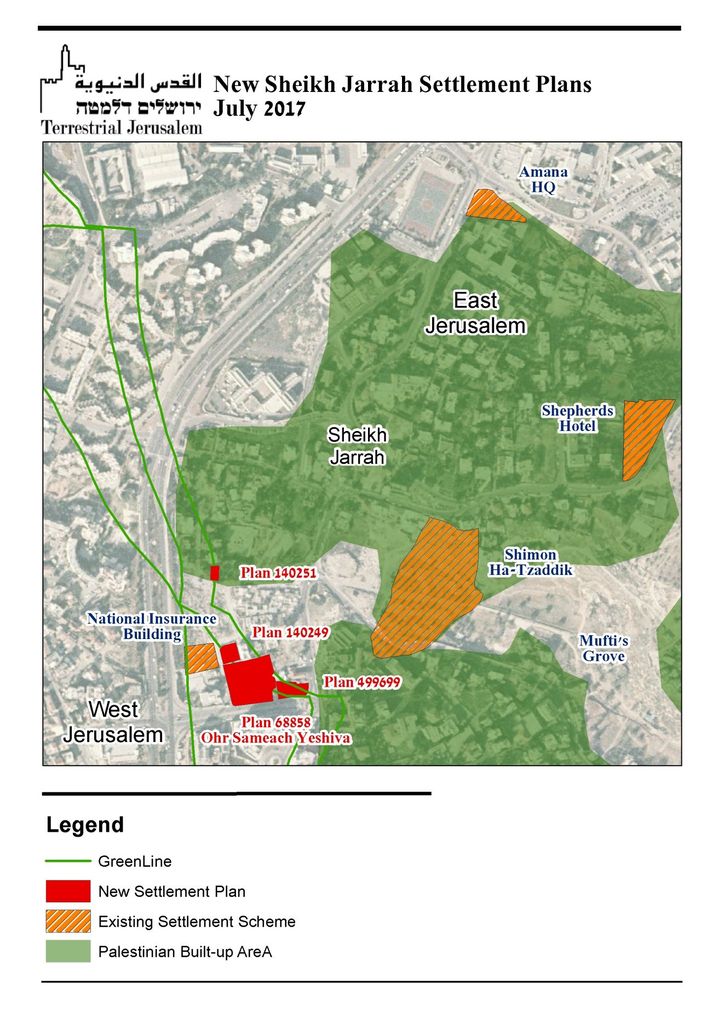 The Ynet news outlet reports that the Amana settler organization – the official body of the settlement movement, operating since the 1970s – has moved into its new headquarters in the heart of the Sheikh Jarrah neighborhood of East Jerusalem, where settlers are continuing to wage a displacement campaign against Palestinian residents. Though Amana has owned the plot of land since 1992, various legal challenges and incredibly sensitive geopolitical considerations have slowed construction of the building, called the “Amana House” (see a detailed history here).
Regarding the strategic implications of the location, Ynet reports:
“Amana says the new headquarters will help bolster the territorial contiguity of Jewish settlements in east Jerusalem.”
Agriculture and Rural Development Minister Uri Ariel (Bayit Yehudi) who previously served as the CEO of Amana, commented that the organization’s relocation:
“constitutes a significant reinforcement to the (Jewish) settlement in east Jerusalem and the bolstering of the Jewish territorial contiguity in the area.”
Several settlement plans are currently proceeding in Sheikh Jarrah, underscoring the strategic location and goals of settler activity in Sheikh Jarrah. As covered previously in this report, Israel is expected to advance a plan for a 6-story office building for settlers, located at the entrance to the neighborhood. Across the street from that building, a highly consequential plan for a new religious school (the Glassman yeshiva) was approved for deposit for public review in July 2017. The goal is clear: to unite the enclaves of settlers living inside of the Palestinian neighborhood by creating a contiguous area of settlement that connects to West Jerusalem, thereby cementing an immovable Jewish Israeli presence in a key Palestinian neighborhood – closing off the possibility of evacuation under a future peace deal.
Settlement Gains in East Jerusalem Result in Palestinians Self-Demolishing Their Homes
OCHA reports that two Palestinian homes in the East Jerusalem neighborhood of Beit Hanina were self-demolished after the Israeli Supreme Court ruled in favor of settlers’ ownership claims. OCHA writes:
“In recent decades, Israeli settler organizations, with the support of the Israeli authorities, have taken control of properties within Palestinian neighbourhoods in East Jerusalem, and some 180 Palestinian families are currently facing eviction cases, filed mainly by settler organizations.”
Bonus Reads
- “How Israeli Right-wing Thinkers Envision the Annexation of the West Bank” (Haaretz)
- “Let’s Admit It: The Settlers Have Won and We Have Lost” (Haaretz)
***In total, the Israeli government advanced plans for 3,120 new settlement units this week alone. Details, along with additional significant settlement news, are below.***
Welcome to FMEP’s Weekly Settlement Report, covering everything you need to know about Israeli settlement activity this week.
To receive this report via email, please click here.
June 1, 2018
- Plans Advance for 1,958 New Settlement Units
- Tenders Published for 1,162 New Settlement Units
- Israeli Chief Justice Questions Legal Opinion Regarding Status of Settlers
- Knesset Advances Bill to Bring West Bank Land Cases Under Israeli Domestic Jurisdiction (De Facto Annexation)
- Labor MK Calls on Left to Endorse De Facto Annexation of “Settlement Blocs”
- Israeli Security Increase Presence Near Radical Settlements
- Human Rights Watch: Israeli Banks Are Integral Part of the Settlements Enterprise
- U.S. Ambassador Friedman on Settlements, Annexation, Trump “Peace Plan,” & More
- Bonus Reads
Comments, questions, or suggestions? Email Kristin McCarthy at kmccarthy@fmep.org.
Plans Advance for 1,958 New Settlement Units
On May 30th, the Israeli High Planning Council advanced plans for 1,958 new settlement units, located across the West Bank. Of the total, 696 units received final approval and 1,262 units were approved for deposit for public review (a key, step in the planning process). Peace Now estimates that 80% of the planned units are to be built in isolated settlements and that 1,500 of the units are to be built outside of the “built up” area of existing settlements. Two of the plans would establish two entirely new settlements.

Map by Peace Now
Adding insult to injury (or in this case, to a war crime), the Council gave final approval (“validation”) to a provocative plan to build 92 units near the Kfar Adumim settlement east of Jerusalem, less than a mile from the soon-to-be forcibly removed Khan al-Ahmar bedouin community. Those new units will considerably expand the footprint of the Kfar Adumim settlement by building a new neighborhood (called “Nofei Bereishit” meaning “the landscapes of Genesis” in Hebrew), which will serve to connect the existing settlement structures to the site of a future school campus slated to serve several Israeli settlements in the area.
With respect to the Kfar Adumim expansion plan, Peace Now writes:
“The approval of the plan is the embodiment of exploitation and evil. The government stubbornly refuses to grant building permits to 32 Palestinian families living on about 40 dunams in the area and intends to evict them, but at the same time approves construction on large areas for hundreds of Israeli families. If there is anything that blackens Israel’s image in this world, it is the cruelty and discrimination that reeks to the heavens in this case. Neither is there any real Israeli national interest behind the destruction of the village.”
With respect to the plans advanced for two new government-sanctioned settlements, the details are:
- A plan for 189 units in the unauthorized outpost of Zayit Ra’anan, near the Talmon settlement northwest of Ramallah. As Peace Now explains, this plan constitutes the sanctioning of a new settlement entirely. Talmon has three satellite outposts, according to a map by WINEP. Zayit Ra’anan is the outpost the furthest from the settlement.
- A plan to authorize the “Brosh Educational Institution,” an outpost in the Jordan Valley. This too constitutes the establishment of an entirely new settlement. As Peace Now explains, the settlers who established the Brosh outpost named their endeavor an “Educational Institution” in order to obscure their intent to build a settlement. The plan for the “Brosh Educational Institute” includes residential buildings.
These approvals are notable for two reasons: First, they show that the Israeli government is significantly expanding the footprint of settlements across the West Bank, including in isolated settlements. Second, the plans demonstrate that the Israeli government is not acting, in any way, with “restraint” in regards to its settlement activity (per a reported agreement between the U.S. and Israel, “restrained” settlement growth limits Israel’s building to areas adjacent to existing settlement buildings). The reaction of the Trump Administration to the approvals suggests that the U.S. isn’t in any way troubled that Israel appears to be defying its commitment. An official at the U.S. National Security Council told The Times of Israel:
“The Israeli government has made clear that going forward, its intent is to adopt a policy regarding settlement activity that takes the president’s concerns into consideration. The United States welcomes this. The president has made his position on new settlement activity clear, and we encourage all parties to continue to work toward peace.”
Tenders Published for 1,162 New Settlement Units
One day after the High Planning Council advanced plans for nearly 2,000 new settlement units (above), on May 31st the Israeli Housing Ministry issued tenders for another 1,162 new settlement units that had previously approved by the High Planning Council (once planning approvals are complete, the decision on if/when to issue construction tenders for an approved plan rests with the Housing Ministry). The 1,162 tenders issued this week are are for:
- 459 new units in the Ma’ale Adumim settlement;
- 409 new units in the Ariel settlement;
- 250 new units in the Elkana settlement; and
- 44 new units in the Ma’ale Ephraim settlement.
Israeli Chief Justice Questions Legal Opinion Regarding Status of Settlers
On May 31st, Israeli Chief Justice Esther Hayut issued a significant legal opinion that complicates the growing momentum across the Israeli government to adopt and implement a legal precedent holding that Israeli settlers are a part of the “local population” of the West Bank. Chief Justice Hayut said the precedent does not constitute “a binding law” saying it “appears that the ruling contradicts previous rulings…and it contains both a novelty and a difficulty.” The ruling in question, written by retired Justice Salim Joubran in 2016, is currently being used as a precedent to justify the expropriation of privately owned Palestinian land near the Haresha outpost, and adopting the precedent was a key recommendation of the recently-released “Zandberg Report” which gave the Israeli government a plethora of legal tools to retroactively legalize outposts and settlements structures.
Hayut’s opinion was issued in response to a petition by the Israeli NGO Yesh Din, which asked to Court to reopen the Amona outpost case where the “local population” precedent was set. The opinion itself was not published until October 2017 (meaning the precedent was not known to the public or able to be debated until now, precisely when the government is moving swiftly to implement it). While Hayut declined to reopen the Amona outpost case, she took the opportunity to address the question raised by Yesh Din regarding the underlying precedent that was set in the case.
FMEP tracks the evolving legal architecture of the Israeli government’s efforts to retroactively legalize outposts and settlement structures (our regularly updated data tables are available here).
Knesset Advances Bill to Bring West Bank Land Cases Under Israeli Domestic Jurisdiction
On May 28th, the Israeli Knesset advanced a bill through its first reading that, if passed, will give jurisdiction the Jerusalem District Court jurisdiction over land disputes in the occupied West Bank. Since 1967, such cases have been under the jurisdiction of the Israeli High Court of Justice, reflecting the unusual – indeed, legally extraordinary – situation in which an Israeli court is ruling on with respect to land and people that are not part of sovereign Israel. The bill passed by a vote of 47 to 45, and will need to be voted through two more readings in the Knesset plenum before it becomes law.
As FMEP explained when the bill gained government backing in February 2018, the bill’s main proponent, Justice Minister Ayelet Shaked, has three main rationales for the bill: (a) to further extend and formalize Israel’s extraterritorial application of its domestic law and legal structures, giving a regular Israeli domestic court jurisdiction over non-citizen Palestinians living in territory that is beyond Israel’s sovereign borders; (b) to give settlers an advantage in court over Palestinian plaintiffs; and (c) to circumvent what Shaked sees (according to a Justice Ministry official) as the High Court being “overly concerned with international law and with protecting the rights of the ‘occupied’ population in Judea and Samaria.” Under Shaked’s proposal, some Palestinian cases could still reach the High Court of Justice, but only after the much more conservative Jerusalem District Court rules, adding time and cost to any Palestinian land petition.
Yesh Din representative Gilad Grossman commented:
“This bill is designed to indicate a kind of normalcy. [It is meant] to show that we’re not talking about an area conquered by one nation whose residents [Israelis] do whatever they want and no one enforces the law against them in an equal manner, but rather that these are conflicts between neighbors just like in Tel Aviv, Haifa or any other town within sovereign Israel.”
FMEP tracks the progress of this bill in its compendium of annexation policies currently being advanced and implemented in Israel. This bill (tracked on the third table) is just one mechanism by which Israeli lawmakers are moving to apply Israeli domestic law extraterritorially – which amounts to de facto annexation of the West Bank.
Labor MK Calls on Left to Endorse De Facto Annexation of “Settlement Blocs”
Last weekend, MK Eitan Cabel (Labor, the largest faction in the Zionist Union coalition) published an op-ed in the Hebrew edition of Haaretz arguing that Israel should define and then apply Israeli law to the “settlement blocs,” which he defines to include Ma’ale Adumim, the Etzion Bloc, the Jordan Valley, Ariel, Karnei Shomron, and more. Cabel promised to release and campaign for the full plan (presumably with more details) sometime soon.
In the op-ed and in subsequent comments to the press, Cabel calculates that 300,000 Israeli settlers will be annexed into Israel under his scheme. Cabel’s calls for the 100,000 settlers outside of those areas to be compensated and for a total construction freeze to be implemented there. He proposes that the status of those areas will be negotiated if, “one day, the Palestinian Nelson Mandela arrives.”
Zionist Union Chairman and Labor Party leader Avi Gabbai – who has said Israel should not evacuate settlements in any peace deal – slammed Cabel’s plan, saying:
“In a democratic party, everyone can have their opinion, but Labor is for separation, not annexation. Separating from the Palestinians must come as part of an agreement. I am not in favor of a unilateral step. I think in negotiations we can reach better results than without them. This is the best time for negotiations because of our alliance with the US and because the Arab countries want peace.”
Cabel’s plan impressed Naftali Bennett (Jewish Home) who tweeted in support of the op-ed, saying it was a step in the direction of his own proposed scheme to annex all of Area C in the West Bank (60% of the occupied land). Apparently agreeing with that point, an unnamed Labor Party official said:
“It’s a delusional initiative. It’s like [Habayit Hayehudi leader Naftali] Bennett speaking through Cabel…He’s [Cabel] suggesting an annexation, but doesn’t say what will become of the Palestinian population in those territories. These are irresponsible and ill-prepared statements.”
Peace Now tweeted in response:
“Another dangerous, self-defeating remark from this weekend for the Labor party. Veteran MK Cabel’s call for unilateral annexation of the “blocs,” including Ariel & Karnei Shomron, is a cowardly rhetorical surrender to the right’s one-state apartheid agenda. Shameful & disturbing….For everyone who supports cutting Israel a break on building in the ‘blocs,’ this is what happens when you give in. Not only is a top Labor MK adopting the right’s maximalist interpretation of the term ‘blocs,’ he is now making the Maale Adumim annexation bill look tame….One can only assume @netanyahu‘s support for annexing the blocs, but it should be noted that at least publicly he has not advocated as much as Cabel just did.”
As Peace Now suggests, using the term “settlement blocs” is unfortunately misleading, and implies an agreed upon acceptance of what the blocs are and the fact that they are inarguably Israel’s to keep. The term “settlement blocs” has no legal definition or standing, and they are indisputably a matter for negotiations aimed at a two-state solution. The terminology has been used for decades by the Israeli government to convey legitimacy to building in the so-called “blocs.” For more context, see resources from Americans for Peace Now here and here. (NOTE: A Haaretz investigation last year estimated that a total of 380,000 Israeli settlers live in the West Bank, of which 170,000 live outside of the so-called blocs, as defined by Haaretz).
Applying Israel law to areas outside of Israel’s sovereign borders is de facto annexation, as FMEP has explained and documented.
Israeli Security Increase Presence Near Radical Settlements
In early May (before the U.S. Embassy opening and the beginning of Ramadan), Israeli security forces increased troop deployments across the West Bank in order to “prevent friction” between Israeli settlers and Palestinians.
According to a Haaretz report, the decision to increase Israel’s security presence was preceded by a series of discussions over the past month between the army, the police, and the Shin Bet. One such meeting was held at the Prime Minister’s office. A source told Haaretz that the meeting participants came to a consensus that settlers from Yitzhar are the main perpetrators responsible for the escalating frequency of “price tag” attacks against Palestinians. As recapped by Haaretz, the main concern of the Israeli officials is that settler attacks might foment Palestinian attacks in response. Haaretz reports:
“The main concern within the Jewish Division of the Shin Bet, which investigates the activities of Jewish Israeli extremists, is that price tag attacks during Ramadan, a fast month, and coming shortly after the controversial transfer of the U.S. Embassy to Jerusalem and the tensions on the border with the Gaza Strip, could spur terrorist attacks against Israelis.”
Despite the rise in settler violence, Israel MK Bezalel Smotrich took the opportunity to accuse the Israeli police of “bullying” Israeli settlers – an accusation that echoed complaints from settlers, including those from Yitzhar, regarding an increased IDF presence. The Israeli Police issued a response, saying Smotrich’s comments were regrettable.
Even with higher troop deployment, settlers continue to attack Palestinians and their property on a weekly basis.
Human Rights Watch: Israeli Banks Are Integral Part of the Settlements Enterprise
In a new heavily researched, documented report titled “Israeli Banks in West Bank Settlements,” Human Rights Watch documents how Israeli banks facilitate and profit from Israeli settlements and makes the case that these banks are therefore complicit in war crimes, including pillaging. HRW reports:
“Most Israeli banks finance or ‘accompany’ construction projects in the settlements by becoming partners in settlement expansion, supervising each stage of construction, holding the buyers’ money in escrow, and taking ownership of the project in case of default by the construction company. Most of that construction takes place on ‘state land,’ which can include land unlawfully seized from Palestinians and which Israel uses in a discriminatory fashion, allocating one third of state land in the West Bank, not including East Jerusalem, to the World Zionist Organization and just 1 percent for use by Palestinians.”
HRW concludes that banks operating in the settlements are, therefore, unavoidably complicit in violating the human rights of Palestinians, and the only remedy is for these banks cease settlement-related operations.
To illustrate the point that human rights violations are an inherent part of all settlements in the West Bank, HRW partnered with the Israeli NGO Kerem Navot to share the story of how the construction of the Elkana settlement and the Israeli separation barrier has deprived Palestinians from the nearby city of Mas-ha of access to their own lands. Banks that have financed projects in Elkana are part of the machinery that entrenches and expands the theft.
Kerem Navot writes:
“Settlements wreck havoc on Palestinian life in the West Bank. For example, as depicted in the animation, the Aamer family used to walk 20 minutes from their West Bank home to their farm. Then Israel built an Israeli-only settlement on part of it, with help from Israeli banks, turning it into a 2-hour detour on what’s left of their land. Banks and all businesses should cease doing business in and with settlements.”
This is just the latest HRW report on the Israeli banking sector and the occupation, and it builds on a September 2017 legal analysis titled, “Israeli Law and Banking in the West Bank.” In the 2017 report, HRW took apart a common legal defense Israeli banks deploy to defend their settlement practices: that Israeli law requires them to operate in the settlements. HRW concluded that there is no such legal requirement currently in Israeli law.
U.S. Ambassador Friedman on Settlements, Annexation, Trump “Peace Plan,” & More
In a wide-ranging (and stunning) interview this week with The Times of Israel, U.S. Ambassador David Friedman spoke revealingly about behind-the-scenes policy discussions within the Trump Administration, including on the topic of settlements, the status of the West Bank, and Israeli annexation proposals.
A few key Friedman quotes from the transcript include:
- On Israel’s settlement activity during the Trump Administration: “The administration’s stance has been that the settlement enterprise is not an impediment to a peace deal, but that unrestrained settlement activity is not consistent with the cause of peace. Where you draw that line or slice that, I am reluctant to go into now. I have felt for years that there has been an oversimplification by the international community of the legal claims, if you will, within the West Bank. That came to a head in December of 2016, with UN Security Council Resolution 2334. It’s not a secret that the Trump administration does not support that resolution, would have vetoed that resolution, had Nikki Haley been the ambassador rather than Samantha Power. I think you can draw some insight from the administration’s views on that resolution.”
- On how Friedman views the international consensus holding that Israeli settlements in the occupied West Bank are illegal: “…Look, I don’t believe the settlements are illegal. I think I’ve been clear on that for years. President Reagan was very clear that he would never suggest Israel would go back to the 1967 borders. They were called the suicide borders; they were considered indefensible. So the notion that Israel’s presence over the Green Line is illegal is something the United States has through many leaders rejected, which is why that UN resolution in 2016 was so offensive to so many people.”
- On whether the Trump Administration discussed annexation proposals with the Israeli government: “We have not had discussions with Israel about annexation…I’ve done lots of listening, so those discussions have taken place, but not in the sense of planning or seeking to execute a strategy, just in the context of enabling me to hear everybody’s views.”
- On the State Department’s decision to stop using “occupied territories” in materials, and instead use “West Bank”: “I believe this is a highly controversial issue and we ought to be using terminology that doesn’t prejudge issues…I was perfectly happy with any geographic identification that people could commonly understand that didn’t involve an adjective. West Bank is fine, Judea and Samaria would have been fine. If there’s another name that would do it justice, that would have been fine. I didn’t think it was appropriate to use “occupied territories,” because I just found it to be unnecessarily political and judgmental on an issue that was still unsettled in many people’s minds.”
Bonus Reads
- “The UN Database on Businesses in Israeli Settlements: Pitfalls and Opportunities” (Al-Shabaka)
- “Checking Supreme Court’s powers, Bennett looks to ‘rebalance’ Israeli democracy” (Times of Israel)
Welcome to FMEP’s Weekly Settlement Report, covering everything you need to know about Israeli settlement activity this week.
To receive this report via email, please click here.
May 25, 2018
- Israeli Government to Advance 3,900 Settlement Units Next Week
- Finance Ministry Announces Bargain Construction in Beit El & Ma’ale Adumim Settlements
- Defense Ministry Supports Expropriation of Private Palestinian Land for Settlements
- High Court Supports Destruction of Khan al-Ahmar [A War Crime], Clearing the Way for E-1 Settlement
- Palestinians Ask the ICC to Open Investigation into the Israeli Settlement Regime
- Bonus Reads
Comments, questions, or suggestions? Email Kristin McCarthy at kmccarthy@fmep.org.
Israeli Government to Advance 3,900 Settlement Units Next Week
Israeli Defense Minister Avigdor Lieberman (Yisrael Beiteinu) announced that the High Planning Council (the body in the Defense Ministry’s which oversees all construction in the occupied West Bank) is expected to advance plans for 3,900 settlement units next week. Of that total, 2,500 units will reportedly receive final approval for construction and 1,400 will be advanced through the planning process. Peace Now estimates that 52% of the units will be located in isolated settlements.
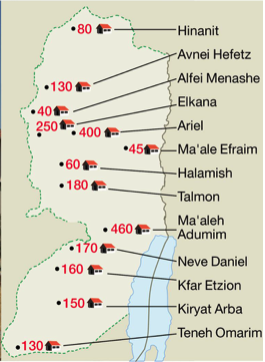
Map by Haaretz
Lieberman – whom The Times of Israel and Haaretz note has repeatedly inflated settlement approval numbers in the past – said the specific plans set to advance will include:
- 400 units in the Ariel settlement (where a medical school financed by Sheldon Adelson was recently brought under Israeli domestic jurisdiction, in a case of de facto annexation. And where a future stop on the recently approved settler-only light rail is slated to be built.);
- 460 units in the Ma’aleh Adumim settlement;
- 250 units for an assisted living center in the Elkana settlement (where the settler-only light rail will also have a stop);
- 180 units in the the Talmon settlement;
- 170 units in the Neve Daniel settlement;
- 160 units in the Kfar Etzion settlement;
- 150 units in the Kiryat Arba settlement (where construction preparations for a new industrial zone – which in reality is a new settlement in Hebron – recently began);
- 130 units in the Avnei Hefetz settlement;
- 130 units in the Tene Omarim settlement;
- 80 units in the Hinanit settlement;
- 60 units in the Halamish settlement (where settlers have built a strategic outpost, with the protection of the IDF, in order to further restrict Palestinian access to the area);
- 45 units in the Ma’ale Efraim settlement;
- 40 units in the Avnei Hafetz settlement;
- 45 units in unspecified settlements.
This will be the third meeting of the High Planning Council in 2018, in accordance with a reported agreement between Israel and the United States to consolidate and coordinate the number of times settlement plans are announced. The first regularly scheduled meeting of the year was in January, when 1,122 new settlement units were advanced, of which 352 received final approval for construction. The Council met again, unexpectedly in February, which Lieberman tried to minimize by calling it “less significant” because the majority of the projects approved were non-residential. In fact, the projects were extremely significant. All of the plans expanded the footprint of settlements located deep inside the West Bank – including plans for a race track and hotel in the Jordan Valley. One “unusual” plan even created a new outpost to house settlers evacuated from a different outpost (the Netiv Ha’avot outpost case that FMEP has covered in exhaustive detail).
The anti-settlement watchdog group Peace Now writes:
“In the year and a half since President Trump took office some 14,454 units in the West Bank has been approved (in plans and tenders, including today’s announcement not including East Jerusalem), which is more than three times the amount that was approved in the year and half before his inauguration (4,476 units)…The Netanyahu government is clearly continuing to take advantage of the carte blanche the Trump Administration has given it in order to destroy the chances for peace. It is well-known that for a two-state solution to be feasible Israel will have to withdraw from most of the West Bank, yet the government keeps raising the political cost of this redeployment and the evictions it will entail. By adding housing to settlements, the government shows total disregard for the two-state solution.”
In reaction to Lieberman’s announcement, PLO Executive Committee member Hanan Ahrawi said:
“Such egregious policies affirm the imperative need for the International Criminal Court to open an immediate criminal investigation into Israel’s flagrant violations of international law and conventions,” she said in a statement….Israel’s declared intention to build thousands of illegal settler units in the occupied West Bank discloses the real nature of Israeli colonialism, expansionism and lawlessness…Undoubtedly, Israel is deliberately working to enhance its extremist Jewish settler population and to superimpose ‘Greater Israel’ on all of historic Palestine…It is evident that the recent provocative and unlawful moves adopted by the United States, Guatemala and Paraguay have emboldened Israel to move forward with enhancing its illegal settlement enterprise, thereby finalizing the total annexation of the occupied West Bank.”
Saeb Erekat, a top diplomat for the Palestinian Authority released a video response, in which he highlighted the PA’s recent referral to the International Criminal Court (ICC) to investigate Israeli settlement crimes (see FMEP’s coverage on the ICC referral, below). Erekat said in part:
“This is a flagrant violation and an eye opener to the judicial council of the ICC that an official judicial investigation must be opened immediately. This cannot go on. Israel cannot continue business as usual with this impunity and immunity that they think they have.”
Nadil Abu Rudeina, a spokesman for PA President Mahmoud Abbas, said:
“The continuation of the settlement policy, statements by American officials supporting settlements and incitement by Israeli ministers have ended the two-state solution and ended the American role in the region.”
Finance Ministry Announces Bargain Construction in Beit El & Ma’ale Adumim Settlements
In addition to the approvals expected from the High Planning Council this week, the Israeli Finance Ministry has announced that a 300-unit project in the Beit El settlement and 44-unit project in the Ma’ale Adumim settlement have been marketed as part of the “Buyer’s Price” program. Under this program, the government sells land to construction companies at low prices, and those companies commit to offering future settlement units at below market prices. With the plan being marketed in Beit El, the government is accepting bids on the project from construction companies which commit to pricing the apartments 20% below market value – in effect creating a powerful financial subsidy that incentivizes Israelis to move into settlements.
The Beit El project involves 5 buildings with a total of 296 units. According to Ynet:
“the program’s goal is to transform Beit El’s southeast agricultural area into a residential neighborhood as well as unification and re-division of the lands, which will be allocated to building houses, public offices, commercial areas, routes, and a public open space.”
FMEP has covered the progress of this Beit El project repeatedly over the past year, particularly because the push around Beit El projects typifies the Netanyahu-Trump era of settlement growth. Beit El settlers have lobbied for the project for over 5 years, ever since the settlers were evacuated from an outpost of Beit El (called “Ulpana”) in 2012. When the outpost was evacuated, Prime Minister Netanyahu promised to build replacement settlement units in Beit El. Buoyed by the apparent green-light from the Trump administration, over the summer of 2017 settler leaders repeatedly and publicly shamed Netanyahu for failing to fulfill that promise, and in response Netanyahu very publicly and repeatedly promised that the settlement units will be built expeditiously. After being ignored by the High Council during its September meeting, the plan for 296 units was then approved for marketing in October 2017. Now, this week, the government has acted on that approval to market the plan, moving ever closer to the start of construction. As the Ynet report notes, if/when the 300 units are built, this will be the first new, government-sanctioned construction in the Beit El settlement in 10 years.
Also in Beit El, the settler-aligned media outlet Arutz Sheva reports that the IDF plans to build a new “razor wire” fence to separate the settlement from the Palestinian Jalazone refugee camp, located across the street (where it has been since before Beit El’s establishment). At the time of this writing, there has been no additional reporting on where the fence will be placed, and if it relates to plans to build a wall between Beit El and the Jalazone refugee camp. To better understand the severe implications of the Beit El settlement on the lives of Palestinian in Jalazone, see B’Tselem’s updated, expanded, and now pictorial project: “Life under the shadow of the Beit El Settlement.”
As a reminder, U.S. Ambassador to Israel David Friedman is closely associated with the Beit El settlement, having donated to and fundraised for it prior to his appointment as ambassador (including in his capacity as the President of the American Friends of Beit El, reportedly from 2011 until he became ambassador).
The Beit El settlement was established in 1977, on land previously seized by Israel for military purposes. A second military seizure in 1979 enabled Beit El to expand. This method of establishing and expanding settlements has been repeatedly challenged in Israeli courts. The Israeli group Yesh Din led one such petition against Beit El, seeking to have the second seizure annulled; that petition was dismissed earlier this year. Yesh Din writes:
“The State understood that it was impossible to legally defend the land theft that has been ongoing in Beit El for 40 years on land that was seized for arbitrary reasons, but it refrained, once again, from defending the rights of the weakest population, simply because they are Palestinians. Despite this, we at Yesh Din will continue to fight against the dispossession of Palestinians and the infringement of their rights.”
Defense Ministry Supports Expropriation of Private Palestinian Land for Settlements
On May 24th, the Israeli Defense Ministry released a legal opinion endorsing the government’s plan to expropriate privately owned Palestinian land in the Ofra settlement in order to retroactively legalize illegal settlement structures built there. The opinion adopts the “market regulation” principle as a legal basis for Israel to expropriate privately owned Palestinian land in cases of settlements in which decades-old structures were built and/or purchased by Israelis “in good faith” (believing the Israeli government to be the rightful owner of the land). The legal opinion also calls for the Palestinian owners to be “fully compensated, if not more than that,” and recommends that the principle should not apply to cases of unauthorized outposts. The Ofra situation is a test case for the “market regulation” principle, which has not yet been used (or tested in court) to justify expropriating Palestinian land for Israeli settlements.
Defense Ministry legal advisor Itai Ofir called on Attorney General Avichai Mandleblit to adopt the legal opinion as a government policy, which stands a good chance of happening (Mandleblit already endorsed the Ofra expropriation on that basis). In fact, the Attorney General invented the “market regulation” principle in the first place, as an alternative to the legal argument made in the Regulation Law (which he opposed). The “market regulation” principle was also recommended in the recently released “Zandberg Report,” as one of the tools that the Israeli government should use to carry out massive land expropriations, retroactive legalizations, and continued and intensified settlement growth.
FMEP has chronologically documented the development and adoption of the “market regulation” principle in the Annexation Policies tables.
High Court Supports Destruction of Khan al-Ahmar [A War Crime], Clearing the Way for E-1 Settlement
On May 24th, the High Court of Justice upheld a government plan to destroy the Palestinian Bedouin community of Khan al-Ahmar and forcibly relocate its residents out of the Ma’ale Adumim/E-1 settlement area east of Jerusalem – which Israel is expected to carry out soon. The Court reasoned that the community’s structures were built on State Land without the proper permits, even though Israel deliberately makes such permits nearly impossible to obtain. Clearing Khan al-Ahmar from the its current site (where it has been for 60+ years) is widely interpreted to be a step towards building the “doomsday” E-1 settlement which, if built, will complete a ring of Israeli settlements around East Jerusalem, destroying the territorial contiguity between Palestinians living there and the West Bank, and preventing any possibility of a viable, contiguous Palestinian state with its capital in East Jerusalem.

Map by Ir Amim
Israel has faced intense criticism for its plan to forcibly relocate Khan al-Ahmar, a plan many, including B’Tselem, call a war crime. A group of 76 U.S. Members of Congress recently sent a letter to Netanyahu beseeching him to abandon the plan, as well as the plan to demolish the Palestinian community of Susya, in the South Hebron Hills.
Peace Now says:
“The State of Israel must implement a policy of moral values, justice, equality and human rights for the Jahalin people. It is not in the Israeli interest to forcibly move them from their homes. We must stop the abuse that has been going on for decades, and allow them to live according to their way of life, to make a living and to educate their children in a way that is no different from that of the Jews living in their neighborhoods.”
The Jahalin Bedouin built the Khan al-Ahmar community in the area east of Jerusalem in the 1950s, after they were expelled from their lands in the Negev by the Israeli military. A total of 18 Bedouin tribes live in the vicinity of Ma’ale Adumim/E-1, totaling approximately 3,000 people, who have already endured numerous demolitions this year alone. The Ma’ale Adumim settlement was built in 1975 on land near where the Khan al-Ahmar community already existed; the plan for the E-1 settlement was approved in 1999.
Palestinians Ask the ICC to Open Investigation into the Israeli Settlement Regime
The Palestinian Authority has officially asked the International Criminal Court (ICC) to open an investigation into the Israeli government’s illegal settlement activity. The text of the referral can be found here. Citing “sufficient compelling evidence” and an “alarming intensification of Israeli crimes,” Palestinian Minister of Foreign Affairs Riad Malki asked the ICC to immediately open an investigation into war crimes and crimes against humanity that have been committed against Palestinians in the West Bank, East Jerusalem, and Gaza. The referral requests that the investigation include:
“those who plan, prepare and implement policies linked to the settlements regime as well as those who enable it, whether through financial, military, or logistical support or otherwise aid and abet or encourage the commission of crimes connected to that regime.”
The referral lists specific, ongoing crimes that are “among the most widely documented in contemporary history,” for the ICC to investigate. The PA’s allegations mainly relate to settlement activity (much of which is documented on a weekly basis in FMEP’s Settlement Reports) including: the unlawful appropriation and destruction of private and public properties, including land, houses and buildings, as well as natural resources; the forcible transfer of Palestinians; the unlawful transfer of the Israeli Occupying Power’s population into Occupied Palestinian Territory; the “persecution, including the grave, widespread and systematic denial or violation of basic human rights on discriminatory grounds against Palestinians, including those resulting in or intended to achieve the deportation of forcible transfer, directly or indirectly, of the Palestinian population, the re-population of ‘cleansed’ territories with Israeli settlers and the unlawful appropriation of Palestinian land and properties”; and “the establishment of a system of apartheid based in particular on the adoption of discriminatory laws, policies and practices as well as the commission of inhumane acts intended to establish an institutionalized regime of separation and advancement of Israeli settlements accompanied by the systematic oppression and domination by Israeli settlers over Palestinians.”
After the PA submitted its referral, Israeli Foreign Minister Avigdor Lieberman argued that the “ICC lacks jurisdiction over the Israeli-Palestinian issue, since Israel is not a member of the Court and because the Palestinian Authority is not a state.” While Israel is not a member of the ICC, the State of Palestine acceded to the ICC in December 2014, and its membership took force in April 2015. In January 2015, the ICC’s Office of the Prosecutor opened a preliminary inquiry to “ascertain whether the criteria for opening an investigation are met.” The preliminary inquiry is listed as “ongoing” on the ICC website. Following by the referral for an investigation submitted this week, ICC Chief Prosecutor Mrs. Fatou Bensouda released a statement saying:
“Since 16 January 2015, the situation in Palestine has been subject to a preliminary examination in order to ascertain whether the criteria for opening an investigation are met. This preliminary examination has seen important progress and will continue to follow its normal course, strictly guided by the requirements of the Rome Statute.”
The press release also notes that this is the eighth referral on the matter to date (previously, the situation in Palestine was referred to the ICC for investigation by Uganda, the Democratic Republic of the Congo, the Central African Republic, Mali, the Comoros Islands, and the Gabonese Republic).
Bonus Reads
- “Minister Ariel initiates museum of settlement” (Arutz Sheva)
- “Cherry Plantation Burned in Settlement a Hay Torched in Southern West Bank” (Haaretz)
- “Sheikh Jarrah: A Tale of Eviction and Resettlement” (Al Jazeera)
“In new film, Tel Aviv leftist picks up and moves to a West Bank settlement” (Times of Israel)
Welcome to FMEP’s Weekly Settlement Report, covering everything you need to know about Israeli settlement activity this week.
To receive this report via email, please click here.
November 22, 2017
- Israeli AG Support for Land-Grab Paves Way for Legalization of [at least] 13 Outposts
- Israeli AG Approves Retroactive Legalization of “Mistaken” Land Theft
- Israeli AG to Present Argument on the “Regulation Law” This Week
- Threatened Eviction of Another Palestinian Bedouin Community in E-1
- Israel Fast-Tracks Jerusalem Cable Car Project Despite Political Concerns
- Settlers Fight for the “Right of Return” to Illegal, Inaccessible West Bank Settlements
- Bonus Reads
Comments, questions, or suggestions? Email Kristin McCarthy at kmccarthy@fmep.org.
Israeli AG Support for Land-Grab Paves Way for Legalization of [at least] 13 Outposts

Map by Haaretz
The far-reaching implications of the legal opinion issued last week by Israeli Attorney General Avichai Mandleblit, in the context of a case dealing with the Harsha outpost, are becoming alarmingly clear. Haaretz reports that the opinion will pave the way for Israel to retroactively legalize 13 unauthorized outposts, many of which are deep inside of the West Bank. The 13 outposts (and many others) were all built without Israel’s permission on pockets of state land, surrounded by privately owned Palestinian land. Roads leading to these outpost – without which the outposts cannot be fully planned and legalized – were (or will be), by necessity, built on land owned by Palestinians. This opinion paves the way (pun intended) for that to happen.
Dror Etkes, founder of the anti-settlement group Kerem Navot, notes that the impact of the decision is actually far greater than reported by Haaretz: “The real number of [affected] outposts is over 60.” Etkes adds,
The story [is] that the settlers are striving to resolve, with Mandleblit’s help, involves hundreds (yes hundreds!) of roads that have been illegally paved for decades around settlements and outposts, on land that even Israel recognizes as privately-owned. Now, with a little creativity and a lot of nerve, a legal mechanism has been invented to enable settlers to retroactively authorize the road system, without which the national land grab enterprise championed by Israel in the West Bank, can’t function.
Notably, several outposts that spun off from the Itamar settlement are among those that could benefit from this new legal precedent. Near Nablus, Itamar’s hilltop outposts form a contiguous land bridge – with roads connecting them – from Itamar to the Jordan Valley. Itamar’s residents are notorious for their ultra-nationalism.
Israeli AG Approves Retroactive Legalization of “Mistaken” Land Theft
Attorney General Mandleblit has endorsed an argument, made for the first time since 1967, in a legal brief submitted this week in Court by the Israeli government, that paves the way for Israel to expropriate privately owned Palestinian land inside the Ofra settlement, and potentially in other places as well. The land in question was “mistakenly” included as part of the settlement. The State filed the brief this week in response to a legal challenge to the Ofra settlement’s Master Plan.

Map by Haaretz using Google Maps
The case centers on a “mistake” which happened when the Ofra settlement master plan was approved; Israel argues that at the time it did not know that some of the land in the area had not been declared “state land” (suggesting, at best, extraordinarily faulty due diligence in the planning process, and at worst, a policy of treating Palestinian land ownership claims as irrelevant). In 2016, the State acknowledged Palestinian claims to the land and announced its intention to rectify the problem by re-drawing the settlement’s master plan.
With this new argument, the State, backed by the Attorney General, has reversed the 2016 commitment and is instead moving to formally expropriate the Palestinian plots, arguing that the Ofra settlers acted in good faith based on the government’s approval of the Master Plan (i.e. that settlers should not be punished for the State’s mistake). Earlier this year, AG Mandleblit suggested this exact argument (that land stolen by mistake, in good faith, could be legalized as long as the Palestinian owners were compensated) as an alternative law for the Knesset to pass instead of the Regulation Law, which he opposed.
Commenting on the AG’s opinion, Tawfiq Jabareen, the lawyer representing the Palestinian petitioners, told Haaretz:
Attorney General Mandelblit is continuing to destroy the status of the rule of law and severely undermine Palestinian property rights in the occupied territories.
Israeli AG to Present Argument on the “Regulation Law” This Week
On Nov. 23rd, Attorney General Avichai Mandleblit is expected to present his argument on the “Regulation Law” to the Supreme Court. As we reported previously, Mandleblit was staunchly opposed to the Regulation Law, arguing that the law is unconstitutional and refusing to defend the law against legal challenges mounted by several civil society groups earlier this year. At the time the law was being considered, Mandleblit proposed an alternative legal strategy to accomplish the same goal: the retroactive legalization of Israeli settlement activity in the West Bank.

Map by Peace Now
Mandleblit has been expected to argue forcefully against the law, which provides a new legal basis for the retroactive legalization of outposts and agricultural land seizures, with Palestinian owners provided “compensation” (but no choice in the matter). Following the opinion Mandleblit issued last week regarding the Harsha outpost case (implications of which we detail above), and given his recent support for the retroactive legalization of land theft for the benefit of the Ofra settlement (detailed above), it is quite possible that his opposition to the retroactive legalization of land seizures has softened.
If upheld, the Regulation Law can be used to retroactively legalize 55 outposts and 4,000 unauthorized settlement structures by expropriating over 8,000 dunks of privately owned Palestinian land.
Threatened Eviction of Another Palestinian Bedouin Community
The wave of IDF-ordered evictions continued this week, with the Jabal al-Baba bedouin community only the latest to be affected. The approximately 300 residents were ordered to leave their encampment near the Maale Adumim/E-1 settlement area east of Jerusalem within 8 days. The Jabal al-Baba community has been living in the area since 1948, after it was expelled from the Negev.
The Jabal al-Baba community is the second bedouin community in the Maale Adumim/E-1 area to be faced with eviction this year. In August, Israel escalated its longstanding threat to forcibly relocate the Khan al-Ahmar bedouin community to a site near the Abu Dis garbage dump – a move that B’Tselem warns will constitute a war crime. FMEP has covered the story in detail, including as it relates to the prospects for the construction of the doomsday E-1 settlement.
Israeli actions to remove Palestinian bedouin communities from Area C are not confined to the Jerusalem area. On November 1st, the Israeli army ordered the eviction of an entire bedouin community in the northern Jordan Valley.
Israel Fast-Tracks Jerusalem Cable Car Project Despite Political Concerns
Haaretz reports that Israeli planning authorities are moving ahead with plans to build a controversial cable car line in East Jerusalem, despite growing opposition. As FMEP reported in July, the planned cable car line is designed to facilitate tourism to Jewish sites in East Jerusalem while preventing tourists from encountering Palestinians. It features a stop at the settler-run Kedem Center, which was built in the Palestinian East Jerusalem neighborhood of Silwan.
Jerusalem expert Daniel Seidemann explained
There are four worrisome aspects to this project. Without reference to political matters or religious sensitivities, this is a crime against Jerusalem. Disrespect for the unique value of the city and another example of the ‘disneyfication’ of Jerusalem under [Mayor Nir] Barkat. Someone who loves Jerusalem could not conceive of such a project. [The idea that] someone can send a cable car 150 meters away from the Al Aqsa Mosque is smoking the wrong thing….[the project] is another example of how the public interest and the interests of Jerusalemites are being subverted for the good of the settlers of Silwan, with the final station shamelessly at the Kedem Center, serving the narrow ideological interests of the settlers….[the project is] a clumsy attempt to unify the divided city by means of engineering gimmicks.
Settlers Fight for the “Right of Return” to Illegal, Inaccessible West Bank Settlements
Israeli settlers are angling to return to four settlements – Ganim, Kadim, Sa-Nur and Homesh – that were dismantled in 2005, as part of Ariel Sharon’s disengagement plan. Settlers have long insisted they will “return” to the sites.
In this latest effort, they are focusing on the argument that the land has not been used since they abandoned it. Falling in Area C, and therefore under the full authority of Israel’s Civil Administration, the former settlements remain vacant despite Palestinian desire to develop it. The Jenin Municipality, which has nominal jurisdiction over the location, reportedly wants to develop the areas but has not yet applied for the necessary Israeli permits; applying to do so, in any case, would almost certainly be futile, given that Israel issues virtually no permits for Palestinian construction in Area C. In the meantime, the sites have become a garbage dumpsites.
Two or the sites – Ganim and Kadim – can only be accessed by driving through the Palestinian city of Jenin, raising security issues that make their redevelopment into settlements a remote possibility. Sa-Nur and Homesh, in contrast, are easily accessible by settlers. Earlier this year settlers and supporters, including right-wing Israeli lawmakers, gathered at the site of Sa-Nur demanding that the government let them return. At the site of Homesh, radical settler youth are already squatting, have established a yeshiva (religious school) and actively prevent Palestinian access.
Bonus Reads
- “How Israeli settlers turn archeological sites into political tools” (Al-Monitor)
- “Ombudsman: Settlement council doctored tenders to reward right-wing NGOs” (Times of Israel)
__
FMEP has long been a trusted resource on settlement-related issues, reflecting both the excellent work of our grantees on the ground and our own in-house expertise. FMEP’s focus on settlements derives from our commitment to achieving lasting Israeli-Palestinian peace, and our recognition of the fact that Israeli settlements – established for the explicit purpose of dispossessing Palestinians in the West Bank and East Jerusalem of land and resources, and depriving them of the very possibility of self-determination in their own state with borders based on the 1967 lines – are antithetical to that goal.
Welcome to FMEP’s Weekly Settlement Report, covering everything you need to know about Israeli settlement activity this week.
To receive this report via email, please click here.
October 12, 2017
- Bibi Approves Major Expansion of Settlements
- DETAILS: Thousands of Settlement Units to Advance Next Week with Netanyahu’s Permission
- U.S.: No Comment, No Change in Talking Points
- Bonus Reads
Comments, questions, or suggestions? Email Kristin McCarthy at kmccarthy@fmep.org.
Bibi Approves Major Expansion of Settlements
This week, the Israeli Prime Minister Netanyahu announced imminent approval of major new settlement construction across the West Bank, including in some especially sensitive/controversial areas.
How major? There has been debate and disagreement in the Israeli press about the number and what they exactly mean. Haaretz reports that, while Netanyahu listed plans totalling 3,736 settlement units, only 600 of those units will actually be approved for immediate construction (the rest are part of plans that are in earlier stages of the approval process). However, the Times of Israel counts 1,941 units being advanced, of which 1,197 units will receive final approval. The Peace Now Settlement Watch Project counts 3,400 units up for advancement, and tenders (the final step before construction) expected for 296 units.
This debate over the numbers should not obfuscate the fact that Netanyahu is orchestrating an acceleration of settlement growth, the totality of which we will have definitive knowledge of only after the High Planning Council meets next week.
Please note, there is no benign stage in the settlement planning process. No matter the stages of the planning process involved, Netanyahu’s announcement this week represents a huge wave of forthcoming settlement construction.
As Terrestrial Jerusalem’s founder Daniel Seidemann wrote in 2015,
There is no such thing as a “window of opportunity” in stopping settlement planning/approvals. When the world objects to settlement approvals, the answer from Israeli officials, invariably, is either, “It’s too early, it’s just a plan – what are you objecting to?” or “It’s too late, this was approved long ago – why are you bothering us now?” In truth, settlement plans can be stopped at almost any point on the road to implementation, and the earlier a plan is stopped, the lower the political costs.
With that in mind, we cover the plans expected to be advanced in detail below.
DETAILS: Thousands of Settlement Units to Advance Next Week with Netanyahu’s Permission
Prime Minister Netanyahu has publicly announced his permission for the High Planning Council to advance 3,736 of settlement units during the Council’s meeting next week (Oct. 17-18). If all of the reported plans are approved, the total number of settlement units promoted so far in 2017 will reach 6,500 by the end of the month, a significant increase compared to 2,629 for all of 2016, and 1,982 for all of 2015, according to Peace Now data. One Israeli official has promised the settlement numbers will reach 12,000 by the year’s end, bragging that the amount is four times the total promoted in 2016.

Graphic by Haaretz
Of the thousands of units slated for advancement, several plans are at the final stage of planning and will likely receive the green light to start construction. These plans fulfill specific promises to settlers Netanyahu has made over the years (and address some of his most acute domestic political pressure points). The following plans – all of which are in settlements located deep inside the West Bank and beyond the separation barrier – are expected to receive building permits, as reported by Haaretz:
- 31 units for the settlement enclave on Shuhada Street, in the heart of downtown Hebron. This is the first plan for new settlement units in downtown Hebron in the last 12 years; the Hebron Municipality is expected to mount a legal challenge against the plan’s implementation. Peace Now explains, “alongside additional developments in Hebron, including the creation of an independent administration and the entry to the Abu Rajab House, this can be seen as another effort by the government to strengthen the radical settlement in the heart of Hebron.”
- 296 units in the Beit El settlement, which are part of Netanyahu’s promise to compensate for the settlers evacuated from the Ulpana outpost in 2012.
- 86 units in the Kochav Yaakov settlement which are part of Netanyahu’s promise to compensate for the settlers evacuated from the Migron outpost also in 2012. The evacuation of the Migron outpost has lead to the construction of not one but two new settlements as compensation.
- 146 units in the Nokdim settlement, where Israeli Defense Minister Avigdor Liberman lives.
- 9 units in the Psagot settlement.
The Times of Israel reports additional units expected receive final approval:
- 459 units in Ma’ale Adumim.
- 102 units in the new settlement of Amichai, which was approved earlier this year as payoff for settlers evacuated from the unauthorized outpost of Amona. Haaretz suggests that construction of these units will remain stalled as the State responds to a petition filed against the Amichai settlement by the Israeli NGO Yesh Din, arguing that the settlement’s borders annex land that is privately owned by Palestinians. As reported in detail in past editions of the FMEP Settlement Report, Amichai is the first new settlement to receive government authorization in the past 25 years. It is to be located deep inside the Shilo Valley in an area that cannot, under any conceivable two state arrangement, be included inside the borders of an Israeli state in a way that preserves the territorial contiguity of a Palestinian state.
The High Planning Council will also consider depositing for public review (a last step before final approval) plans for 30 units in the Elon Shvut settlement that will expand the settlement borders to build the homes in order to compensate residents in the unauthorized outpost of Netiv Ha’avot, an outpost where the government is appealing to the High Court to save settlement homes that were partially constructed on land that is proven to be privately owned by Palestinians. The Court has ordered that the outpost be razed by March 2018.
To see all of the plans expected to be addressed next week, see Peace Now’s data table (link near the middle of this page). Peace Now issued an accompanying statement saying,
The government has gone wild with settlement plans deep in the West Bank for thousands of new settlers, whom Israel will have to evacuate in a two state solution agreement. Faced with the growing pressures and investigations, Netanyahu goes out of his way to prove how radical he is, without considering the consequences of massive settlement expansion on the future of the two state solution. The plans for Hebron and Nativ Ha’avot are particularly enraging, as they indicate to settlers that the rule of law does not apply to them and illustrate the government’s deteriorating legal standards when it comes to settlement expansion.
U.S.: No Comment, No Change in Talking Points
The Trump Administration has issued no statement regarding Netanyahu’s brazen settlement advancements. Instead, unnamed White House officials repeated the same talking points that have defined the Trump Administration’s settlement stance, saying,
President Trump has publicly and privately expressed his concerns regarding settlements, and the administration has made clear that unrestrained settlement activity does not advance the prospect for peace. At the same time, the administration recognizes that past demands for a settlement freeze have not helped advance peace talks.
Hagit Ofran, Director of Peace Now’s Settlement Watch Program, told the Washington Post, “This year is looking to maybe even be a record year… It’s without a doubt due to the fact that there have been changes in the White House.”
Bonus Reads
- “By Backing ‘Greater Jerusalem’ Bill, is PM leaning towards annexing settlements?” (Times of Israel)
- “The Transformation of Jerusalem” (Arab American Institute)
- “The Bedouin village where compassion ends” (+972 Magazine)
FMEP has long been a trusted resource on settlement-related issues, reflecting both the excellent work of our grantees on the ground and our own in-house expertise. FMEP’s focus on settlements derives from our commitment to achieving lasting Israeli-Palestinian peace, and our recognition of the fact that Israeli settlements – established for the explicit purpose of dispossessing Palestinians in the West Bank and East Jerusalem of land and resources, and depriving them of the very possibility of self-determination in their own state with borders based on the 1967 lines – are antithetical to that goal.
Welcome to FMEP’s Weekly Settlement Report, covering everything you need to know about Israeli settlement activity this week.
To receive this report via email, please click here.
September 27, 2017
- Netanyahu Delays Settlement Approvals at U.S. Request
- High Court Hears Arguments on the Demolition & Forced Relocation of anan al-Ahmar
- Another West Bank Community – Susiya – Faces Imminent Demolition (Again)
- Israeli Military Sets Up New Guard Post in Area A
- Defending their “Regulation Law,” Knesset Asks Court to Reject Palestinian Petitions
- Palestinian Laborer Kills Three Israelis in Settlement Attack
- Bonus Reads
Comments, questions, or suggestions? Email Kristin McCarthy at kmccarthy@fmep.org.
Netanyahu Delays Settlement Approvals at U.S. Request
Reportedly at the Trump Administration’s request, PM Netanyahu has put a two-week delay on a highly consequential meeting of the Civil Administration’s Planning Committee, which was set to consider advancing plans for the construction of as many as 2,000 new settlement units. The meeting had already been delayed at least once, out of concern for international blowback around the United Nations General Assembly confab last week. The delay comes as President Trump’s special envoy, Jason Greenblatt, arrives in the region to continue talks ostensibly aimed at restarting peace negotiations.
The decision angered Israel settlers and their allies, many of whom are already frustrated by Netanyahu’s failure to fulfill his promise to market tenders (a final step in the planning process) for 300 new units in the Beit El settlement earlier this month. Once the tenders are marketed, there will be a 60-day bidding period, after which the tenders will be awarded. Beit El is the settlement for which U.S. Ambassador David Friedman served as a longtime fundraiser, until his diplomatic appointment earlier this year. The settlement is deep in the West Bank, near Ramallah.
High Court Hears Arguments on the Demolition & Forced Relocation of Khan al-Ahmar
On September 25th, Israel’s High Court of Justice heard arguments [CORRECTED: The hearing scheduled for September 25th was delayed, and a new date for the hearing before the High Court has not yet been set. Read on for information about the State’s response to the petitions, submitted to the High Court this week.] on two competing petitions regarding the future of the residents of the Palestinian village of Khan al-Ahmar. One petition, submitted by settlers living near Khan al-Ahmar, seeks to expedite the demolition of the village school. Another petition, submitted by Khan al-Ahmar’s residents (Palestinian Bedouins), seeks to delay the demolition of the village’s structures, all of which have been issued demolition orders.
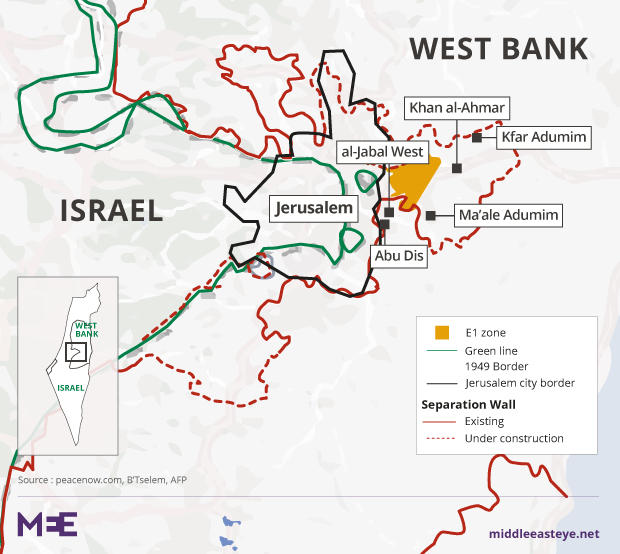
Map by Middle East Eye
We covered the background of the community – and Israel’s plan to forcibly relocate its residents [a war crime] to a site near a garbage dump, in order to expand the Maale Adumim settlement – in last week’s Settlement Report, which you can read here.
The Israeli government submitted its response to the petitions on Monday, saying it intends to carry out the demolition of the village and the relocation of its residents by mid-2018. The State asked the High Court to reject both petitions and allow the plan to advance. B’Tselem’s Executive Director Hagai El-Ad issued a blistering response to the State’s argument saying:
No sanctimonious language about a ‘planning, proprietary and realistic’ alternate, or ‘time to prepare’ can erase the disgrace or hide the facts: the destruction of Khan al-Ahmar means the forcible transfer of protected persons, and forcible transfer is a war crime. Those responsible for it will bear personal criminal liability – exactly as B’Tselem stated two weeks ago, in a letter addressed to the prime minister, defense minister, justice minister, chief of staff and the head of the Civil Administration.
Peace Now also issued a statement on the State’s response:
While the government argues that the residents of Khan al-Ahmar will received alternative housing, they will in fact be evacuated against their will for the benefit of settlers, and placed above the garbage dump in Abu Dis. This type of forceful evacuation of protected persons constitutes a severe violation of international humanitarian law.
It appears that the forceful displacement of the residents of Khan al-Ahmar is a form of “compensation” for his right wing supporters for the upcoming evacuation of the Illegal outpost of Derech Ha’Avot, following a High Court ruling.
It is shameful that settlers from Kfar Adumim, who received their lands for free from the government, are fighting for the evacuation of their Palestinian neighbors, who resided in the area long before them.
Ahead of the hearing, the Haaretz editorial board penned a plea to the Court against the forced relocation and replacement of West Bank Bedouin with Jewish settlements, stating:
This political project – the forced uprooting of Bedouin communities, replacing them with new Jewish settlements – is against international law. It has reached the doorstep of the High Court justices, who are under constant pressure to “respect the will of the people” – that is, the will of the settlers who control the government – even though this will is neither legal nor moral. It must be hoped the justices will be able to stand in the breach.
Another West Bank Community – Susiya – Faces Imminent Demolition (Again)

Map by B’Tselem
The Israeli Defense Ministry is “no longer willing to postpone” the demolition of the Palestinian community of Susiya, according to Haaretz reporting. A senior security official told Haaretz that the demolition will happen within a few months.
Like the Khan al-Ahmar community, the Palestinian residents of Susiya in the South Hebron Hills are the target of Israeli demolition orders and relocation plans. The community that makes up Susiya has a long history, as reported by Haaretz:
Susiya has long been a symbol of both Palestinian steadfastness and Israeli policies. In 1986, Israel expelled the residents from their original ancient village, whose lands were declared a national park. In 2001, they were thrown off their agricultural lands, where they had settled after the earlier expulsion. The High Court of Justice allowed them to return, but didn’t order the authorities to allow them to rebuild. As a result, all the structures in the village were built without permits and are at risk of demolition. The Civil Administration never prepared a master plan for Susiya and rejected the plan the residents had submitted, demanding instead that the residents move to an area near the city of Yatta. The residents refused, but agreed to meet with Civil Administration officials to try to come to some understanding.
The plight of Susiya’s residents continues to inspire a vibrant civil society campaign in both the U.S. and in Israel. Notably, the Obama Administration intervened in the case of Susiya as recently as last year. Back in November 2016, Senator Dianne Feinstein (D-CA) a statement praising PM Netanyahu’s decision to delay the demolition (the link includes links to Feinstein’s long engagement on this issue). In 2015, 10 members of the U.S. House of Representatives sent a letter to Secretary of State John Kerry raising the village’s plight. The New York Times, the Washington Post, and CNN are a few major U.S. outlets that have featured the Susiya’s story sympathetically.
Israeli Military Sets Up New Guard Post in Area A
Peace Now this week published a report documenting the fact that the Israeli army recently established a new guard post in the West Hebron Hills, in a part of the West Bank that is designated as “Area A.” Under the 1995 Interim Agreement, the Palestinian Authority has full civil and security control in the 18% of the West Bank designated as “Area A.” Israeli forces are not allowed to operate in – or even enter – Area A; however, for years Israel has insisted on its right to “hot pursuit” in Area A, carrying out operations at it pleases.
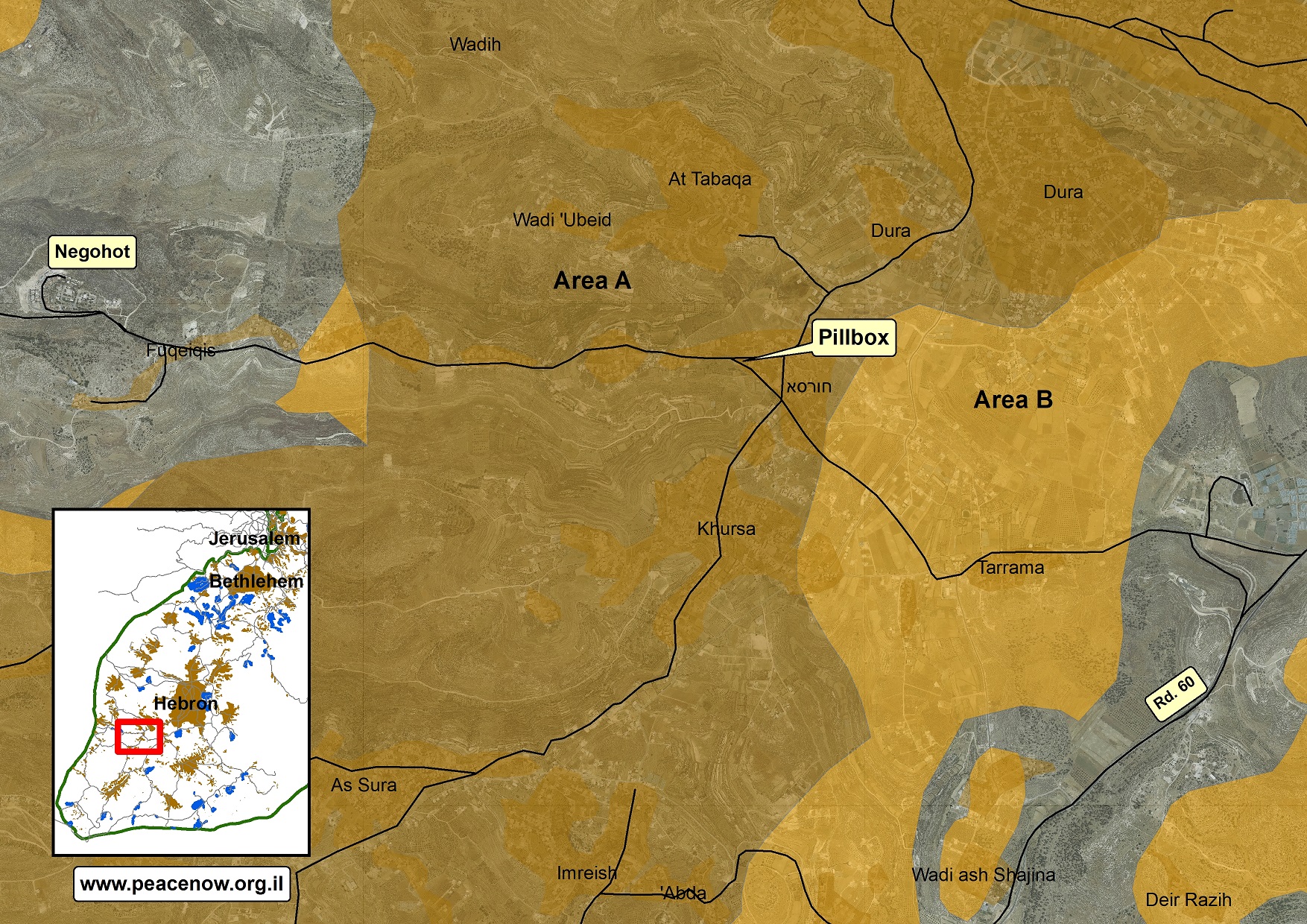
Map by Peace Now
The establishment by the IDF of a static post in Area A (dispensing with even the pretense that the operation is related to “hot pursuit”) represents a new and significant escalation in Israel’s violation of the 1995 Interim Agreement. According to Peace Now, the new “pill box” guard post was built “in the heart of the Palestinian village of Khursa in the West Hebron Hills….in order to protect vehicles of the Negohot settlers, who drive through Area A in order to shorten the way between Jerusalem and the South Hebron Hills.” The Negohot settlement was established in 1999 without official Israeli authorization. A jurisdiction was approved to retroactively legalize the settlement in 2013.
Peace Now said:
The placing of a guard post in area A is a blatant violation of the Oslo Accords and shows the length the Israeli government is willing to go in order to help a handful of settlers take a shortcut on their way home. The new IDF guard post illustrates, yet again, that the settlements do not contribute to Israel’s security, but rather pose a national security burden.
Defending their “Regulation Law,” Knesset Asks Court to Reject Palestinian Petitions
This week the Israeli Knesset submitted to the Israeli High Court of Justice its response to petitions challenging the constitutionality of the “Regulation Law,” which was passed by the Knesset in February 2017. The law provides a legal basis to retroactively legalize Israeli outposts, settlement structures, and agricultural lands that were built illegally (i.e., without permission and/or on land recognized by Israel as privately owned by Palestinians).
The Knesset’s legal advisor argued that Israel is able to selectively write laws for the West Bank. The Knesset asserts it must do so in this case because no other means exist to legalize the settlement homes and outposts [Note: no other means exist because, according to rule of law, the law applies, regardless of whether politicians like the results].The Knesset’s response asks the Court to reject petitions against the Regulation Law.
Last month, a private lawyer hired by the government submitted the State’s response to the petitions, after the Israeli Attorney General declared the law illegal and refused to defend it. The State’s response claimed that the law is legal because Israel can legislate in the West Bank and because the law provides an avenue to compensate the dispossessed Palestinian landowners.
Peace Now and Yesh Din are among the 13 civil society groups leading a legal challenge to the law on behalf of Palestinians. According to data collected by Peace Now, the law will lead to the expropriation of over 8,000 dunam (nearly 2,000 acres) of private land upon which structures have been built illegally – and tens of thousands of dunams of land on which agricultural crops have been planted. The land designated for expropriation is owned by thousands of Palestinians, among them many of the residents of the villages represented in the petition.
Palestinian Laborer Kills Three Israelis in Settlement Attack
On September 26,, a Palestinian man opened fire at the gate of the Har Adar settlement, near Jerusalem. He killed three Israelis – two civilian security guards (one of them a Palestinian citizen of Israel)and one border policeman – and injured another guard. The assailant, who was killed at the scene, was identified as 37-year-old Nimer Mahmoud Ahmad Jamal from the neighboring Palestinian village Beit Surik. He reportedly had an Israeli-issued work permit (which requires security screenings) to enter the settlement, where he was employed as a cleaner. Jamal reportedly had no security record and was married with four children (meaning he did not fit any profile for someone who might commit such an attack). He was reportedly having serious personal and family problems.
Shortly after the attack, Prime Minister Netanyahu announced a range of Israelis responses targeting not the assailant (who died in the attack) but his family, his immediate community, and potentially Palestinians beyond that: the assailant’s house will be demolished and any work permits issued to his relatives (extended family) will be revoked. The attacker’s hometown, Beit Surik, was sealed-off by the Israeli army, and his brothers was arrested. Additional Israeli troops were sent into the area around Har Adar, which sits in what Israel calls the “seam zone,” i.e., the area of the West Bank that runs along, and sometimes on the Israeli side of, the separation barrier. Netanyahu also blamed President Abbas and Palestinian official “incitement” for the attack, despite Israel media reporting widely on the personal problems of the attacker.
FMEP President Lara Friedman has written about how Israel’s response to terror, many elements of which have already unfolded around this attack, amounts to collective punishment.
Bonus Reads
- “Israeli settler sics dog on border police” (Times of Israel)
- “Israeli settler torch olive trees in revenge attack” (The New Arab)
FMEP has long been a trusted resource on settlement-related issues, reflecting both the excellent work of our grantees on the ground and our own in-house expertise. FMEP’s focus on settlements derives from our commitment to achieving lasting Israeli-Palestinian peace, and our recognition of the fact that Israeli settlements – established for the explicit purpose of dispossessing Palestinians in the West Bank and East Jerusalem of land and resources, and depriving them of the very possibility of self-determination in their own state with borders based on the 1967 lines – are antithetical to that goal.
Welcome to FMEP’s Weekly Settlement Report, covering everything you need to know about Israeli settlement activity this week.
To receive this report via email, please click here.
September 20, 2017
- Israel Moves to Forcibly Transfer West Bank Community [A War Crime]
- Normalizing Settlements in the Name of Peace – The WINEP Approach
- NEW REPORT: Yesh Din on Systematic Land Theft by Israeli Quarries in the West Bank
- NEW REPORT: Human Rights Watch on Israeli Banks’ Financing of Settlement Expansion
- Updates: Al-Walajah, Ras al-Amud, Halamish, Hebron
- Bonus Reads
Comments, questions, or suggestions? Email Kristin McCarthy at kmccarthy@fmep.org.
Israel Moves to Forcibly Transfer West Bank Community [A War Crime]
B’Tselem reports that the Civil Administration is set to soon forcibly relocate the Palestinian Bedouin community of Khan al-Ahmar in the West Bank, a war crime under international law. Haaretz confirmed the Israeli government’s intention to carry out the plan. Khan al Ahmar is located in an area that is considered key for Israel’s desired expansion of the Maale Adumim settlement and construction of the new “E-1” settlement.

Map by B’Tselem
Last week Israeli officials went to Khan al-Ahmar to tell the residents that their only option was to relocate to a site in the nearby Palestinian city of Abu Dis, next to the Abu Dis garbage dump. The village’s lawyer was not present at the time of the officials’ visit, despite Israeli authorities previously committing to not meet with the residents without their lawyer present.
Khan al-Ahmar’s residents settled in their current West Bank location in the 1950s, by Israel – after having been forced off their lands in the Negev (i.e., inside Israel proper). Israel subsequently declared the land of Khan al-Ahmar to be “state land” and over the years have repeatedly threatened the total demolition of the community. For years, international pressure – which importantly included a strong stance by the Obama Administration specifically regarding the E-1 area – has prevented Israel from going ahead with the demolitions and relocation. The Trump Administration has not commented on this specific matter to date.
Btselem Executive Director Hagai El-Ad has penned an urgent letter to Prime Minister Benjamin Netanyahu articulating why the forcible transfer of Khan al-Ahmar would constitute a war crime under international law. The accompanying press release notes:
Demolition of an entire community in the Occupied Territories is virtually unprecedented since 1967. Under the Fourth Geneva Convention, which Israel is obliged to respect in all its actions in the West Bank, this amounts to forcible transfer of protected persons, which constitutes a war crime.
B’Tselem has long documented Israel’s routine harassment of the Khan al-Ahmar community. The harassment has included: In 2015, the Israeli Civil Administration confiscated 12 solar panels donated by an international humanitarian group and that served as the sole power source for the community. In 2016, Israel demolished 12 homes, leaving 60 people homeless. In February 2017, Israel issued demolition orders for every structure in the village and that same month, Israel demolished a mobile home, leaving an elderly woman homeless. Settlers from the Maale Adumim settlement have filed petitions (starting in 2011) demanding that the Khan al-Ahmar school – a school that serves not just the Khan al-Ahmar community but others nearby – demolished.
The Israeli High Court of Justice (the equivalent of the Supreme Court) is set to hear petitions and decide on the community’s future on September 25th. Settlers have petitioned to expedite the demolitions, and Khan al-Ahmar community members have petitioned against the demolition orders.
Normalizing Settlements in the Name of Peace – The WINEP Approach
The Washington Institute for Near East Policy (WINEP) is set to launch a new portal with “up-to-date, granular information” about settlements in the West Bank. [Editor’s note: If you are looking for up-to-date, granular information about Israeli settlements, Peace Now, Terrestrial Jerusalem, Ir Amim, Yesh Din, and many other Israeli and Palestinian civil society organizations host it their websites currently. Contact FMEP for additional resources.]
The yet-to-be-revealed portal and its architect, David Makovsky, were given an early endorsement by the Washington Post’s Jackson Diehl, in a piece this week entitled “How Trump could save Palestinian statehood.” The article, quoting Makovsky extensively, promotes the notion that Trump can save the hope for peace by adopting a policy according to which, “Netanyahu stops building in areas beyond the West Bank fence, and Abbas stops paying off militants and their families.”
For people who follow the work of Makovsky and his WINEP colleague Dennis Ross, this logic should sound familiar; it is nearly identical to what Ross has been proposing, over and over, since 2013 (see also, for example: March 2015, Feb 2016, Nov 2016, Jan 2017). At the core of this logic is the notion that Israel getting U.S. backing to, in effect, unilaterally annex around 10% of the West Bank – including areas that obstruct the contiguity of a future Palestinian state and that will prevent the possibility of any viable Palestinian capital in East Jerusalem – should be seen as a generous Israeli concession to the Palestinians and a down-payment on a peace agreement.
FMEP’s Lara Friedman deconstructed these arguments back in 2013 – that analysis has not changed. As she noted back in 2013, this approach:
“…is a recipe not for strengthening the two-state solution, but for imposing a unilateral Israeli vision of a Greater Israel extending beyond the Green Line, adjacent to a balkanized Palestinian entity. Such an outcome may be appealing to Benjamin Netanyahu and his U.S. apologists. It will never be acceptable to the Palestinians and the international community, and it certainly shouldn’t be mistaken for a “solution” to the Israeli-Palestinian conflict.”
NEW REPORT: Yesh Din on Systematic Land Theft by Israeli Quarries in the West Bank
In its new report, “The Great Drain: Israeli quarries in the West Bank: High Court Sanctioned Institutionalized Theft,” the Israeli non-governmental organization Yesh Din documents how Israel’s mining and quarry activities in the West Bank constitute economic exploitation of the occupied West Bank for Israel’s exclusive profit, in violation of international law. In 2008, Yesh Din petitioned the High Court to stop all such activities; that petition was rejected.
Key findings in the new report include:
- Since the High Court of Justice ruled against Yesh Din’s 2008 petition, Israel has dramatically expanded its mining and quarrying activities in the West Bank.
- Over 20% of the State of Israel’s general consumption of gravel now comes from the quarries in the Occupied Territories.
- Official documents indicate that the Israeli authorities have a long-term plan to rely on the mining potential in the West Bank for at least the next 30 years.
Yesh Din concludes: “Decades of Israeli looting of natural resources in the West Bank are the embodiment of colonialism. In practice, the High Court ruling has rendered meaningless the acceptable interpretation of international humanitarian law, leaving in place the continued, irreversible exploitation of the occupied territory for the Israel’s economic purposes.”
NEW REPORT: Human Rights Watch on Israeli Banks’ Financing of Settlement Expansion
In its new report, “Israeli Law and Banking in the West Bank,” Human Rights Watch document how Israeli banks are failing to respect international humanitarian law by providing services to and in settlements. In doing so, the banks contribute to the expansion and entrenchment of settlements, at the expense of Palestinians.
Key findings of the report include:
- All five of Israel’s largest banks, as well as the Bank of Israel (Israel’s central bank) are operating in settlements. These five largest banks are: Bank Leumi, Hapoalim, Bank Discount, Mizrahi Tfahot, and First International Bank of Israel.
- The Israeli Association of Banks claimed to be legally obliged to offer financial services in and to settlements under Israel’s Anti-Discrimination Law (5761-2000), but the Association did not explain how refusing to provide services to settlements would constitute discrimination on the basis of nationality, race, religion, or political views. (Israel’s Anti-Discrimination Act was recently amended to require businesses, including banks, to notify customers if they decline to provide services to settlements. However, the amended version of the law does not require businesses to provide services to settlements.)
- Israel’s domestic “Banking Law” is applied to settlements via military order, which violates international humanitarian law.
- The Banking Law only prohibits banks for unreasonably refusing to provide three services: receiving deposits, opening and managing a checking account, and issuing bankers’ checks. No other services are required/obligated under the Banking Law.
The report concludes, “Human Rights Watch does not believe it is possible for businesses to operate in the settlements in compliance with their international responsibilities, due to the inherent international humanitarian law and human rights violations that characterize settlements. Human Rights Watch is calling for banks, like other businesses, to comply with their own human rights responsibilities by ceasing settlement-related activities.”
Updates: Al-Walajah, Ras al-Amud, Halamish, Hebron
- In Al-Walajah, Israelis and Palestinians marched together in protest of a wave of pending home demolitions and the imminent completion of the separation barrier which will completely encircle the village. Israel resumed construction of the wall in April and has issued dozens of demolition notices to the residents since then. In early August, al-Walaja residents formed a human barrier to prevent Israeli bulldozers from demolishing one of the threatened homes. Since then, Israel has not attempted to execute another demolition.
- Israel demolished a two-story apartment building in the Ras al-Amud, a Palestinian neighborhood of East Jerusalem. B’Tselem reports that Israel has demolished 45 Palestinian homes in East Jerusalem in 2017.
- In the area near the settlement of Halamish (where several members of an Israeli family were brutally murdered earlier this year), Kerem Navot has updated reporting on how road closures and plans for a new bypass road are leading to the settlement’s expansion and takeover of the Umm Saffa forest, a nature reserve.
- In Hebron, the Israeli settlers who broke into and illegally set up residence in the disputed “Machpela House” continue to remain in the house, under the protection of the Israeli army. They even received a visit from the Israeli Interior Minister, Aryeh Deri (Shas), this week. The High Court of Justice has not made a decision on the ownership of the house, and has granted the settlers’ wish to delay their evacuation from the house, going against an order from the Israeli Attorney General.
Bonus Reads
- “Law But Not Justice in Sheikh Jarrah” (Times of Israel)
- “WATCH: Settler attacks left-wing activist” (+972 Magazine)
- “Have Amona ‘refugees’ found recipe for post-evacuation success?” (Times of Israel)
- “Drowning in the Waste of Israeli Settlers” (Al Jazeera)
FMEP has long been a trusted resource on settlement-related issues, reflecting both the excellent work of our grantees on the ground and our own in-house expertise. FMEP’s focus on settlements derives from our commitment to achieving lasting Israeli-Palestinian peace, and our recognition of the fact that Israeli settlements – established for the explicit purpose of dispossessing Palestinians in the West Bank and East Jerusalem of land and resources, and depriving them of the very possibility of self-determination in their own state with borders based on the 1967 lines – are antithetical to that goal.
Welcome to FMEP’s Weekly Settlement Report, covering everything you need to know about Israeli settlement activity this week.
To receive this report via email, please click here.
July 28, 2017
- Bibi Embraces “Population Transfer” – Asks for US OK
- The Knesset & Bibi Move to Gerrymander Jerusalem
- Settlers Set Up Outpost, Seek to Expand Settlement as “Response” to Murders
- Settlers Seize Contested Building in Hebron
- Construction on New Settlement in Shilo Valley Stalled (Due to Lack of Funds)
- High-Ranking Government Officials Defend Outpost from Demolition
- Bonus Reads
Comments, questions, or suggestions? Email Kristin McCarthy at kmccarthy@fmep.org
Bibi Embraces “Population Transfer” – Asks for US OK
According to a report from Israel’s Channel 2 News, Prime Minister Netanyahu recently asked U.S. Ambassador David Friedman and Special Envoy Jason Greenblatt to support a populated land-swap as part of a future peace deal.
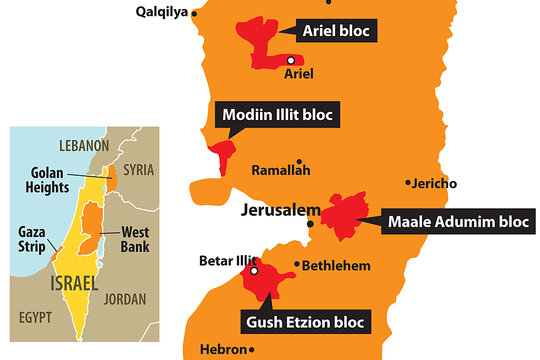
Map in CSMonitor
The swap in question would transfer 300,000 Palestinian citizens of Israel (living in the Wadi Ara region, an area known as “the triangle,” near Haifa) to the Palestinians, in exchange for Israel’s annexation of settlements in the Etzion bloc. The plan – which was previously championed by Defense Minister Avigdor Liberman, who even proposed it at the United Nations – is in effect a population transfer that would allow Israel to get rid of a large cluster of Palestinian cities, including the city where the two terrorists who attacked guards at the Haram al-Sharif/Temple Mount last week grew up.
An unnamed White House official made a statement in response to the report saying, “This may have been one of many ideas discussed several weeks ago in the context of a peace agreement and not in the context of a separate annexation.”
FMEP President Lara Friedman commented on what message Bibi’s endorsement of this idea sends: for the current Israeli government, “citizenship of Jews is inalienable right; citizenship of Arabs is revocable privilege.”
Arab Israeli MK Aida Touma-Suliman responded to the report saying, “The cat is out of the bag and Netanyahu has shown his true colors regarding the Arab population…the [Wadi] Ara residents are not only Israeli citizens, they’re also indigenous people who dwell on their land, and are not to be compared with settlers dwelling on another nation’s land. We the Arab citizens aren’t part of any such equation and aren’t willing to pay the price again for Israel’s policy of occupation and settlements.”
When Avigdor Liberman promoted the idea back in 2014, then-President Shimon Peres said, “Israel cannot take away its citizens’ citizenship simply because they’re Arab.” Then-Interior Minister Gideon Sa’ar said, “An Israeli citizen is not an object and not transferable as part of a framework political agreement.” Netanyahu has never expressed support for the plan prior to this news report, but the plan has allegedly come up in negotiations before.
The area of settlements known as the “Etzion Bloc” is home to over 22 settlements and 75,000 Israeli settlers. The loose cluster of settlements is located south of Jerusalem, extending from the 1967 Green Line deep into the West Bank; most of the settlements are on the Israeli side of the separation barrier. The major traffic junction in the area has recently seen numerous car-ramming and stabbing attacks by Palestinians targeting Israeli settlers and soldiers in the area, including an attack today that resulted in the death of the attacker and no other reported injuries.
The Knesset & Bibi Move to Gerrymander Jerusalem
In tandem with the Temple Mount/Haram al-Sharif crisis is, three important bills regarding Jerusalem’s future have advanced in the Knesset:
-

Map by Haaretz
Prime Minister Netanyahu announced his support for a bill in the Knesset that would allow 130,000 Israeli settlers living four West Bank settlements to vote in Jerusalem’s municipal elections while effectively excluding around 100,000 Palestinians from the Jerusalem municipality (most obviously the Shuafat refugee camp and Kafr Aqab, which are located outside the separation barrier). The four settlements are Maale Adumim, Givat Ze’ev, Beitar Illit, and Efrat, the last of which is six miles from Jerusalem. All are illegal under international law. Netanyahu’s support for this bill means that it is set to move forward when the Knesset’s reconvenes from its 3-month summer recess in November.
- Another bill (introduced a few days before the one described above) would allow the Israeli government to transfer Palestinian neighborhoods of Jerusalem outside the barrier to a separate, new municipality, created especially for this purpose. This bill and the one above aim to remove from the municipal area of Israel’s eternal, united capital those areas that threaten the Jewish demographic majority in Jerusalem, relegating them to a separate authority.
- These bills are complementary to a bill voted on last week that seeks to prevent the Israeli government from transferring parts of Jerusalem to a foreign power (i.e. the Palestinian government) in a future peace deal.
Settlers Set Up Outpost, Seek to Expand Settlement as “Response” to Murders
Following the horrific murder of three Israelis living in the Halamish settlement, the settlement’s leaders are seeking to consolidate and expand their illegal presence in the West Bank.
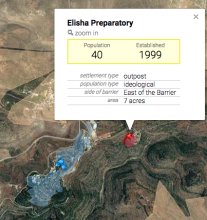
Map by Peace Now Israel
Within hours of the murder, hundreds of Halamish residents set up a campsite and a blockade of the eastern road leading to the settlement. The campsite is being called “Yad Ahi,” or “My Brother’s Hand” in memory of the three family members who were slain by a Palestinian youth last Friday. Settlers are rotating shifts inhabiting the campsite, aiming to make it an official outpost of the settlement and permanently close the road to Palestinians.
Halamish leaders are also demanding the government allow the expansion the settlement’s borders. A spokesman of the Binyamin Regional Council (which represents and provides municipal services to settlements in the Halamish region) called on the government to approve construction plans connecting the Halamish settlement to a nearby outpost called Tzofit, in order to “create a bigger security area and allow building neighborhoods that have already received zoning approvals.” Tzofit (also known as “Zufit” and/or “Elisha Preparatory”) is an illegal outpost that was established in 2007.
U.S. Ambassador David Friedman and Special Envoy Jason Greenblatt went to the illegal Halamish settlement this week to offer their condolences to the victims of the murder.
Halamish is located northwest of Ramallah, deep inside the West Bank. When the settlement was founded in the 1970s, Palestinian residents from the nearby towns of Deir Nidham and Nabi Saleh sued to stop the settlement’s construction, claiming it was being built on their villages’ land. The Israeli Supreme Court ruled in favor of the settlers, declaring the area to be state land. The Halamish settlement and its ever-growing encroachment on surrounding Palestinian villages has inspired weekly protests in Deir Nidham and Nabi Saleh, which has become infamous for weekly demonstrations – often involving clashes with the IDF – in recent years, often with international participation.
Settlers Seize Contested Building in Hebron
On the evening of July 25th — while events in Jerusalem were dominating the attention of the region and the world — 120 settlers broke into and illegally occupied a contested building near the Tomb of the Patriarchs/Ibrahimi Mosque in Hebron. The Israeli army immediately surrounded the building and on the morning of July 26th the area was declared a “closed military zone.” Prime Minister Netanyahu ordered the Defense Ministry to allow the settlers to stay as negotiations on their fate and ownership of the building continue.
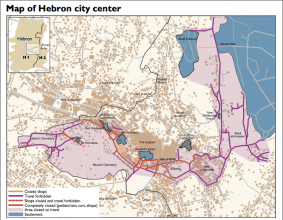
Map by B’Tselem
The Times of Israel reports that, “sources close to the prime minister said that Netanyahu was looking to avoid having to evacuate the families.” On the other hand, Yesh Atid chairman Yair Lapid called for their immediate evacuation. As of this writing, the settlers are still being allowed to illegally squat in the property.
Peace Now warned that the settler’s action can “ignite the region” and called on the government to, “follow the law and the Israeli interest and evacuate the trespassers without delay.”
J Street issued a statement calling on the U.S. government and international actors to pressure Israel to remove the settlers, saying “the Hebron settlers and their allies clearly believe that they can take advantage of the present crisis and push their long-term expansionist agenda by creating new ‘facts on the ground.’ It is vital that the prime minister and defense minister act in the best interests of Israeli security and uphold the rule of law by swiftly removing these families from the property.”
Hebron’s settlers have for some time been waging in a legal struggle to prove they legally purchased the building, known as the Machpela House. Palestinians contend they did not purchase it from the legal owners. While proceedings are ongoing, the settlers have once before broken into and occupied the building; when they did so in 2012, they were allowed to stay in the house for a week before being evacuated at the urging of the then-Attorney General of Israel who argued that it was necessary to preserve the rule of law.
Construction on New Settlement in Shilo Valley Stalled (Due to Lack of Funds)
A month after construction began on the first new settlement authorized by Israel in 25 years, the project has come to a halt – no over politics but due to insufficient government funds. The government had promised to bankroll the settlement’s construction but has not contributed to costs yet, according to the Binyamin Regional Council, which is currently footing the bill. The spokesman for the Binyamin Regional Council speculated on July 25th that the issue will be resolved quickly and expressed confidence in the government’s commitment to the project. Prime Minister Netanyahu reportedly gave orders to ensure construction is resumed quickly. As of this writing, there is no reporting to suggest construction has resumed.
High-Ranking Israeli Officials Defend Outpost from Demolition
Last week we reported on an impending demolition order against the Netiv Ha’avot outpost (near Bethlehem), along with the public relations efforts settlers were leading to elicit government intervention in their favor. The settlers got a helping hand this week when Israeli Education Minister Naftali Bennett and Yair Lapid (who heads the Yesh Atid political party) attended an event at the outpost. The Haaretz report suggests Bennett engaged in a conversation with the outpost’s leaders on how to “deal with” the demolition order and impending deadline.
Bonus Reads
- “This Synagogue Furniture Factory Is Actually a Sweatshop That Tramples Palestinians’ Rights” (July 26, 2017, Haaretz+)
- “The Settler Leader Who’s Even Charming Liberals as Israel’s Top Man in New York” (July 27, 2017, Haaretz+)
- “A Rare Glimpse: Shabak Agent Recruiting Hilltop Youth” (July 3, 2017, Jewish Press)
Welcome to FMEP’s Weekly Settlement Report, covering everything you need to know about Israeli settlement activity this week.
To receive this report via email, please click here.
June 23, 2017
- Coordination? Test #1: Kushner & Greenblatt Arrive as Construction Begins on New Settlement of “Amichai”
- Coordination? Test #2: Bibi Reportedly Ok’s 5,000 East Jerusalem Units After Blocking Them for Years
- Coordination? Test #3: 70% Rise in Settlement Construction Starts Over Past Year
- Ariel University – Located in the settlement of Ariel – Set to Double in Size
- Cleared from Baladim Outpost, “Hilltop Youth” Radicals Stir More Trouble in Yitzhar
- Bonus Reads
For questions and comments please contact FMEP’s Director of Policy & Operations, Kristin McCarthy (kmccarthy@fmep.org).
Coordination? Test #1: Kushner & Greenblatt Arrive as Construction Begins on New Settlement of Amichai
Israeli Defense Minister Avigdor Liberman raised eyebrows late last week with a wide-ranging English language interview with the Times of Israel. When asked if Israel is “coordinating its [settlement] building starts with the United States,” Liberman casually responded, “of course.” Though headlines ran with his confirmation of coordination, it should be noted that when Liberman was pushed to give a more concrete picture of what that coordination entails, he said that Israel and the U.S. do not coordinate on “every 10 houses” but that the U.S. generally respects Israel’s approach and vision for “Jewish settlements in Judea and Samaria.”
That respect was put to the test this week as President Trump’s chief Middle East envoys – Jared Kushner and Jason Greenblatt – visited Israel and Palestine to “to continue the discussion about the possibility of peace.” Kushner’s arrival coincided with the commencement of construction of the first official new settlement in 25 years; the coincidence maintained a long tradition of greeting U.S. envoys with new settlement construction, dating back to the early 1990s and the era of Secretary of State James Baker, whose every visit to Israel was seemingly marked by the establishment of expansion of new settlements.
The Trump administration indicated it won’t object to this new settlement, sometimes referred to as the “Amona exception” (i.e., the rule is still that Israel doesn’t establish new settlements, but Amichai is a one-time exception, as a pay-off to settlers who illegally established the Amona outpost on privately owned Palestinian land and were forcibly evacuated earlier this year). But the timing, which may be entirely coincidental, is nonetheless politically provocative. While Kushner was en route, the State Department reiterated the only policy it has communicated publicly on the issue, saying “unrestrained settlement activity is not helpful to the peace process.” The Palestinian Authority also issued a statement on the timing of the new settlement’s ground-breaking, saying that it shows “Israel is not interested in the U.S. efforts, and is serious about thwarting them as it has with previous U.S. administrations.”
On June 22nd, the Israeli NGO Yesh Din filed a petition, together with residents of the Palestinian village of Jalud, to Israel’s High Court of Justice (equivalent to the U.S. Supreme Court) challenging the establishment of the new settlement of Amichai and demanding transparency in the process of demarcating land for settlement. According to the petition, the jurisdiction granted to the new settlement includes enclaves of privately-owned Palestinian land.
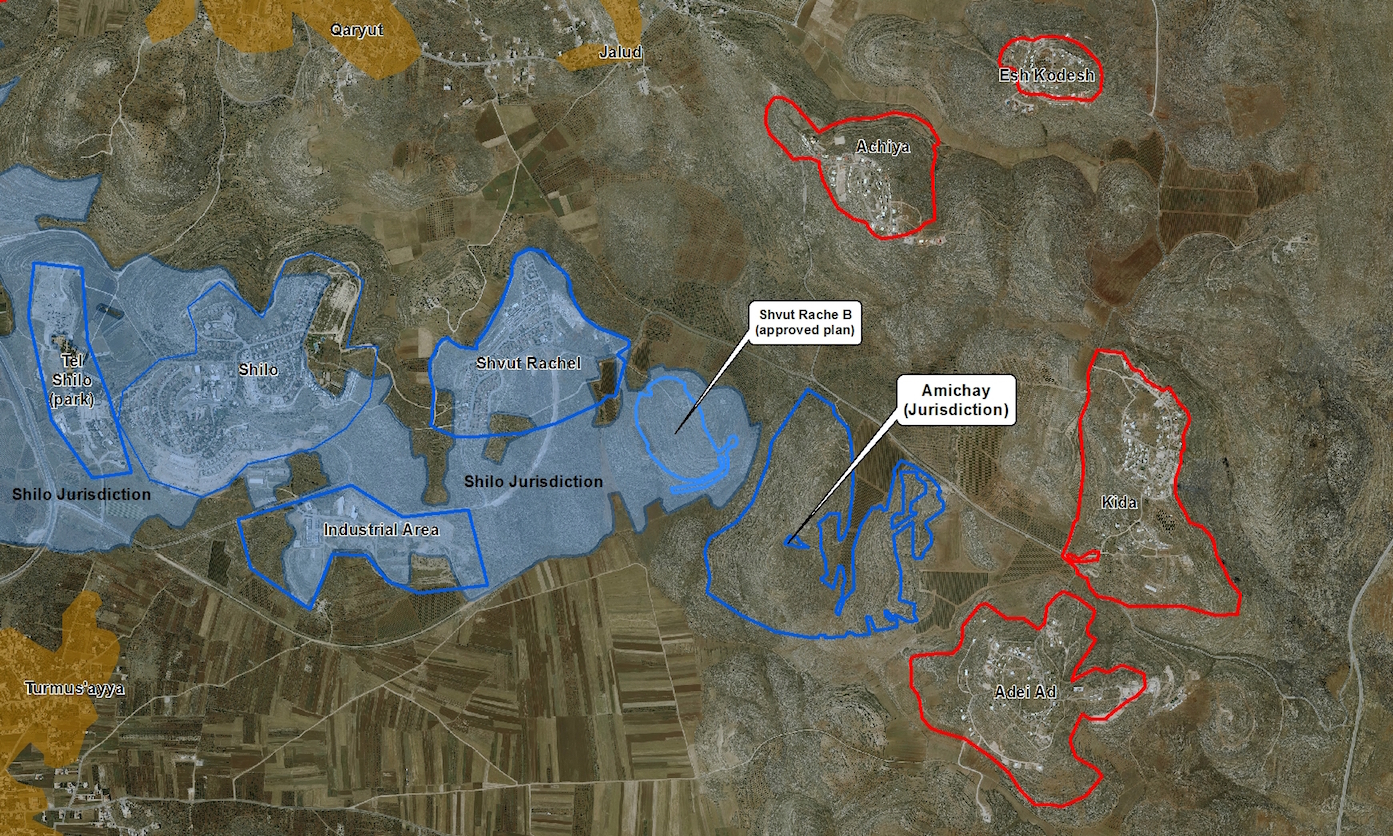 But Amichai isn’t the only construction happening near Jalud. Palestinian officials have reported that construction work has also begun on Shvut Rachel East, a new “neighborhood” of the Shilo settlement (in fact, not a neighborhood but rather a new settlement, as explained by Peace Now). Shvut Rachel East was the original Amona pay-off plan, but Amona evacuees held out for a different plan on a different hilltop – and they got it with the approval of Amichai, to be built literally adjacent to Shvut Rachel East. But what the world might have assumed would be a choice of “this site or that site” became, instead, a jackpot for settlers of “this site AND that site,” and the Shvut Rachel East neighborhood plan was also approved. Meaning that rather than paying a price for breaking the law (and then resisting evacuation), the government rewarded Amona settlers with not one but two new settlements – both located deep inside the West Bank, in an area that Israel could not possibly retain in any land swap agreement, and, both at the expense of Palestinians residing in the area around the settlement of Shilo. And meaning that the government of Israel is, through this policy, continuing to actively incite and incentivize settler law-breaking.
Coordination? Test #2: Bibi Reportedly Ok’s 5,000 East Jerusalem Units After Blocking Them for Years
On June 21st – the very day Trump envoy Jared Kushner arrived in Israel and was meeting with Netanyahu – news broke that Netanyahu was lifting his alleged hold on plans for the construction of 5,000 of new settlement units in East Jerusalem. This news comes on the heels of a June 19th report by Israel’s Army Radio that it had seen secret government documents showing that Prime Minister Netanyahu had imposed a building freeze in East Jerusalem settlements over the past few years. The documents – which were not released by Army Radio – allegedly identify specific projects totalling 6,000 units in Gilo, Pisgat Zeev, and Har Homa, that Netanyahu reportedly froze under intense pressure from the Obama administration. The 5,000 units for which Netanyahu has now reportedly given a green light are part of these 6,000 units, although there are few additional details thus far. Jerusalem Online suggests that some of the units are part of plans that were previously but have expired and need re-approval, and that the Jerusalem local planning committee will convene in short order to re-approve these plans.
It’s worth revisiting the dangerous East Jerusalem construction roller coaster ride of 2017. In January, Netanyahu announced, “I’ve decided to remove the political limitations on construction in East Jerusalem.” The worst was feared, including implementation of Givat Hamatos and/or E1, either of which would have devastating impact on the viability of the two-state solution. Nothing happened until April when rumors frantically swirled suggesting Netanyahu was planning a 15,000-unit construction surge in East Jerusalem. The formal announcement was expected to coincide with Jerusalem Day – and President Trump’s first visit – in May, but nothing was announced. A short time later, on June 6th, the Civil Administration’s High Planning Council advanced 603 units for the massive settlement of Maale Adumim, located just across the Green Line on the northeast border of East Jerusalem.
Coordination? Test #3: 70% Rise in Settlement Construction Starts Over Past Year
Ariel University – Located in the settlement of Ariel – Set to Double in Size
 Israeli Education Minister Naftali Bennett presented a plan to the Knesset that will double the size of “Ariel University,” an Israeli institution of higher education located in the settlement of Ariel settlement. The centerpiece of Bennett’s plan, which will be implemented over the next five years, is a medical center to be named for Sheldon Adelson, who is a major American settlement financier. Adelson is said to be contributing $20 million to the medical school, making good on a commitment made in 2014. The plans still need to secure addition approvals before proceeding.
Ariel is located in the heart of the northern West Bank, reaching literally to the midpoint between the Green Line and the Jordan border. The future of Ariel has long been one of the greatest challenges to any possible peace agreement, since any plan to attach Ariel to Israel will cut the northern West Bank into pieces. Ariel University became an accredited Israeli university in 2012, following significant controversy and opposition, including from Israeli academics. It has since been the focus of additional controversy, linked to what is a clear Israeli-government-backed agenda of exploiting academia to normalize settlements.
Cleared from Baladim Outpost, “Hilltop Youth” Radicals Stir More Trouble in Yitzhar
Earlier this month, the IDF evacuated dozens of radical Israeli settlers from the illegal “Baladim” outpost in the Jordan Valley. Baladim was the most notorious and established outpost in the region, a frequent source of terror for Palestinians and the Israeli army alike. The radical “Hilltop Youth” that camp-out in Baladim have been evacuated dozens of times before, but each time the they return to live illegally in the area.
According to a Haartez report, this time the IDF approached the leaders of the radical settlement of Yitzhar – from which many of Baladim radicals hail – before the outpost’s evacuation. The IDF reportedly warn them about the likely influx of Hilltop Youth to Yitzhar following the evacuation.
The interplay between Yitzhar and the Hilltop Youth is one to watch, particularly after an attack this week on Israeli Army vehicles at Yitzhar’s gate. The settlement’s leaders are claiming that the Hilltop Youth are responsible for perpetrating the attack. Haaretz writes, “Yitzhar is considered an ideological focal point of the radical settler right, yet a large number of residents who spoke to Haaretz condemned the recent stone throwing and the extremist ideology of the Baladim settlers.” Shin Bet officials reportedly met with Yitzhar leaders this week to push them to do more to “calm” the young, violent, and extremely problematic radicals. Yitzhar settlers might be trying to distance themselves from the Baladim (which is problematic given that the Hilltop Youth who have fought for Baladim are from Yitzhar), as the Shin Bet has been more aggressively moving against members of the “Hilltop Youth”, which we covered in last week’s settlement report.
Bonus Reads
- “Who Are You Calling a Settler? Meet the young Israelis living in the West Bank” (Haaretz)
- “Settlement tours: a new frontline in Israel’s ideological conflict” (Reuters)
- “Americans disproportionately leading the charge in settling the West Bank” (Haaretz)
FMEP has long been a trusted resource on settlement-related issues, reflecting both the excellent work of our grantees on the ground and our own in-house expertise. FMEP’s focus on settlements derives from our commitment to achieving lasting Israeli-Palestinian peace, and our recognition of the fact that Israeli settlements – established for the explicit purpose of dispossessing Palestinians in the West Bank and East Jerusalem of land and resources, and depriving them of the very possibility of self-determination in their own state with borders based on the 1967 lines – are antithetical to that goal.