Welcome to FMEP’s Weekly Settlement Report, covering everything you need to know about Israeli settlement activity this week.
To receive this report via email, please click here.
June 15, 2018
- “Greater Jerusalem” Annexation Bill Back on the Agenda
- Expanding a Settlement, Suffocating a Village – Har Gilo West vs. al-Walajah
- Full Steam Ahead on 325 New Settlement Units Near the E-1 Settlement Area
- Plans for Largest-Ever Settlement Industrial Zone, as Part of “Super Settlement” Area
- Israel Admits: We Gave Settlers Part of Silwan Without Checking Who Owned It
- Despite Pay-Offs and Promises, Settlers Violently Resist Netiv Ha’avot Demolitions
- New Bill Would Hand Over Area C to the World Zionist Organization
- Settler Whistleblower: Not Concerned With Law, Only Concerned with Dispossessing Palestinians
- MK Introduces Bill to Dismantle the Civil Administration, Annex the Settlements
- Settlers Kill Knesset Plan to Complete the West Bank Barrier
- While No One Was Watching, Jerusalem Suburb Has Been Annexing “No Man’s Land”
- Bonus Reads
Comments, questions, or suggestions? Email Kristin McCarthy at kmccarthy@fmep.org.
“Greater Jerusalem” Annexation Bill Back on the Agenda
Jerusalem Settlement watchdog Ir Amim reports this week that, the Ministerial Committee for Legislation (the body of Israeli Cabinet members which decides whether or not the government will endorse legislation) is once again scheduled to discuss the “Greater Jerusalem” annexation bill. Members of the Ministerial Committee have long pushed for the Committee to consider the bill – with Ministers Ayelet Shaked (Jewish Home) and Naftali Bennett (Jewish Home) eager to secure government support for it – but Prime Minister Netanyahu intervened at the last minute to take the bill off of the committee’s October 2017 agenda, relegating the bill to political uncertainty. At the time, reports insinuated that Netanyahu blocked consideration of the bill due to international pressure. At the time the Trump Administration publicly stated it would not oppose the bill, but reportedly it discouraged movement on the bill at that time, apparently over concerns that it would undermine ongoing US efforts to engage other regional parties.
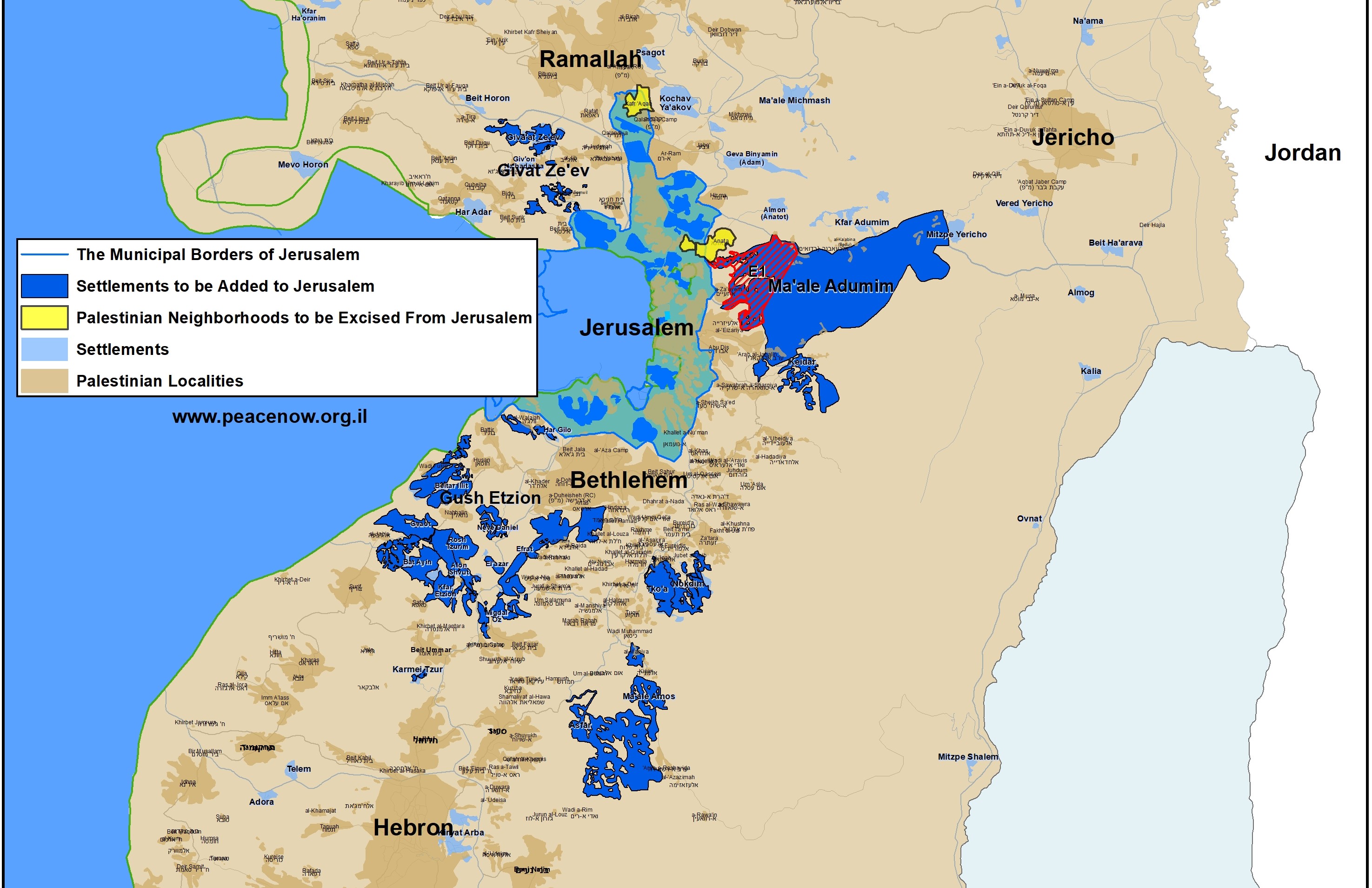
Map by Peace Now
FMEP has regularly reported on the “Greater Jerusalem” bill, which was introduced in July 2017 by two members of Prime Minister Netanyahu’s own Likud Party, Yoav Kisch and Yisrael Katz. The bill proposes absorbing 19 settlements into the Jerusalem municipality (an act of incremental de facto annexation), allowing the settlements to participate in Jerusalem elections and be counted in the Jerusalem census. Earlier versions of the bill also included a clause that would have applied Israeli domestic law to these same settlements – another means of de facto annexation – but the clause was stripped from the (ostensibly) final version that the Committee is now set to consider.
FMEP continues to track the Greater Jerusalem bill in its weekly settlement reports and in its tables tracking annexation policies.
Expanding a Settlement, Suffocating a Village – Har Gilo West vs. al-Walajah
.jpg) The Planning and Building Committee of the Gush Etzion Regional Council met on March 25th to discuss a 330-unit plan to expand the Har Gilo settlement onto a non-contiguous plot of land that would effectively seal shut the Palestinian village of al-Walajah. The Council’s discussion of the plan kicks off the official planning process; the next step will be a discussion by the High Planning Council and then deposit of the plan for public review.
The Planning and Building Committee of the Gush Etzion Regional Council met on March 25th to discuss a 330-unit plan to expand the Har Gilo settlement onto a non-contiguous plot of land that would effectively seal shut the Palestinian village of al-Walajah. The Council’s discussion of the plan kicks off the official planning process; the next step will be a discussion by the High Planning Council and then deposit of the plan for public review.
The plan – called “Har Gilo West” – will nearly double the population of Har Gilo by building what is by all measures a new settlement on the far side of the Palestinian village of al-Walajah. Ir Amim explains:
“Though publicized as an expansion of the Har Gilo settlement, the area demarcated for the plan is clearly distinct from Har Gilo, with the Palestinian village of Walaja and the Separation Barrier positioned in between the two… In effect, along with Har Gilo, the new development would create a wall of settlement around the West Bank portion of Walaja, completing a series of steps to entirely seal the village off from its surroundings.
…In the last decade, Israeli authorities have established several dramatic facts on the ground – including completion of the Separation Barrier around Walaja and a national park built on its land – to strategically address Walaja’s obstruction of Israel’s plan to absorb the Gush Etzion bloc into Greater Jerusalem. Har Gilo West should be seen in the context of this overarching geo-political goal. It is one more measure in a series of steps to disconnect the built-up area of Walaja from its surroundings, create an isolated enclave out of the village, and enable a contiguous Israeli controlled territory from Jerusalem to the Gush Etzion Regional Council.”
FMEP has repeatedly documented various Israeli efforts to seal off al-Walajah from Jerusalem. Residents of al-Walajah have fought the growing encroachment by the nearby Etzion settlement bloc and the Israeli government’s attempt to de facto annex the bloc as part of “Greater Jerusalem.” Ir Amim explains several prongs of this effort, including a particularly unbelievable section of Israel’s separation barrier planned to almost completely encircle the village, to turn its valuable agricultural land into an urban park for Jerusalem, and construction of a highway that will connect the Etzion settlement bloc to Jerusalem with Israeli-only bypass roads.
Full Steam Ahead on 325 New Settlement Units Near the E-1 Settlement Area
On June 14th, the Israeli Defense Ministry deposited for public review a plan, previously approved by Israeli High Planning Council, to build 325 settlement units in the Alon settlement, situated on the northern edge of the area slated for the E-1 settlement, east of Jerusalem. The plan includes a residential zone, a commercial area, a park, roads and public buildings.

Map by Ir Amim
As FMEP has reported on repeatedly, the E-1 area has long been slated for Israeli settlement construction, but plans have been continuously delayed by the Israeli political echelon – due in large part to pressure from past U.S. administrations and others in the international community. E-1 is often called a “doomsday settlement” because it will seal Palestinian East Jerusalem off from the West Bank to its east, and creating a land bridge from Jerusalem to the Maale Adumim settlement that bisects the West Bank. The settlement will render the two-state solution impossible because it would preclude the ability to draw contiguous borders for a future Palestinian state with a capital in East Jerusalem.
East Jerusalem expert Danny Seidemann issued numerous warnings in 2017 that E-1 might be slated for advancement under the current settlement policy of the Netanyahu government and with no discernable counter-pressure from the Trump Administration. Seidemann warned in January 2017, “The main obstacle preventing a green light for E-1 has, until now, been wall-to-wall opposition from the international community, led by the United States (dating back to the era of President Clinton).”
Plans for Largest-Ever Settlement Industrial Zone, as part of “Super Settlement” Area
According to the settler-aligned Arutz Sheva media outlet, a number of settlement municipalities have agreed to a plan to build the largest-ever settlement industrial zone — in the area where Israel is planning to unite multiple settlements into one “super settlement area.”

Map by WINEP
FMEP reported on the future “super settlement” in February 2018, when rumors first broke about the government’s plan to unite several settlements (Elkana, Sha’arei Tikva, Etz Efraim, and Oranit). FMEP covered the story again in March 2018, when Palestinians began to protest the plan. By uniting the settlements, Israel will significantly increase the footprint of developed land, allowing for massive projects like the industrial zone. The four settlements and the land between them are located in the “seam-line” zone, the area created by the weaving route of the Israeli separation barrier that was built to keep many settlements on the Israeli side of the barrier despite being east of the 1967 Green Line.
The planning of the new mega industrial zone – which will cover 2 million square meters (nearly 500 acres) near the Shaarei Tikva, Elkana, and Etz Efraim settlements – has been delayed for nearly 10 years amidst disputes between competing settlement municipalities. Now, with the consensus amongst the planners, the proposal will be submitted for approval.
The head of the Samaria Regional Council, Yossi Dagan, said:
“this is a historic move that is expected to change the face of settlement in Samaria in general and the settlements of Samaria Gate in particular. The new industrial zone is planned on an area of 3,000 dunams (340 acres) north and south of Highway 5, and it will include areas for commerce and high-tech offices, areas for regional public buildings, and industrial areas.”
With a consensus around the location and details of the planned industrial zone, Arutz Sheva speculates that construction will begin by the end of 2018. The plan includes a major upgrade to a settler transportation hub, known as the Sha’ar Shomron interchange, which is expected to be a stop on the future settler-only light rail line slated to cut across the West Bank.
Arutz Sheva also reports that settlers are ready to submit another plan for a new cemetery to be located east of the area where the industrial zone will be built, to “provide a regional response to the needs of the towns in western Samaria.”
Israel Admits: We Gave Settlers Part of Silwan Without Checking Who Owned It
Palestinian residents of the Batan al-Hawa section of the Silwan neighborhood in East Jerusalem have petitioned the High Court to stop the government facilitated settler takeover of a large area of their neighborhood and the eviction of 700 Palestinian residents.
In a hearing on the petition held on June 10th, the Israel government’s lawyer admitted that the State gave the land to the settler organization Ateret Cohanim without a proper investigation into the underlying legal status of the land and the buildings on it, but argued that the Palestinians’ petition should be dismissed because the land was granted to Ateret Cohanim in 2002 (intimating that Palestinians should have petitioned against the move earlier). Ateret Cohanim facilitates and encourages Jewish Israelis to settle in Palestinian neighborhoods of East Jerusalem. Ir Amim reports that Ateret Cohanim’s takeover of land in Batan al-Hawa is, “the single largest takeover campaign in a Palestinian neighborhood of Jerusalem since 1967.”
According to Ir Amim, 17 Palestinian families have been evicted from the homes on the land since the deed was transferred in 2002. 83 Palestinian families, approximately 700 people, remain the target of eviction. Ir Amim writes:
“This well organized Ateret Cohanim campaign represents not only the displacement of an entire community but also the direct involvement of the Israeli government in facilitating private settlement in the Old City and surrounding band of Palestinian neighborhoods. The government has acted through the General Custodian and the Registrar of Trusts (both under the Ministry of Justice) to facilitate settlers’ seizure of Batan al-Hawa, as well as increasing its security budget by 119% from 2009 – 2016 to ensure the protection of radical Jews settling in the hearts of Palestinian neighborhoods in East Jerusalem.”
The Haaretz Editorial Board also weighed in vehemently criticizing the Israeli government’s handling of the case. The Board wrote:
“The settlement in Batan al-Hawa is the most problematic of all the settlements in Palestinian neighborhoods in Jerusalem. It is located in the heart of a crowded inner city, weighs heavily on the residents’ daily lives and is intended to prevent any diplomatic solution with the Palestinians. Every Jewish family there needs security that costs around 1 million shekels ($280,000) a year. But the damage doesn’t seem confined to Silwan. This settlement has also corrupted Israel’s bureaucracy.
When the administrator general and state prosecutors found that the 2002 decision had been mistaken, the only decent thing to do would have been to cancel it and freeze the eviction proceedings against the Palestinian families. Instead, government clerks and lawyers are fighting for eviction along with Ateret Cohanim. This is further proof of the extent to which the settlements have corrupted public administration in Israel. Now the issue rests with the High Court. Hopefully, despite the pressure being put on the justices, they will halt the oppression and corruption.”
On June 6, Peace Now published a backgrounder, “The Systematic dispossession of Palestinian neighborhoods in Sheikh Jarrah and Silwan.” Back in 2016, the Israeli human rights organization B’Tselem produced a comprehensive multi-media backgrounder on the threat to Batan al Hawa. Jerusalem expert Danny Seidemann has also published extensive background and analysis on the assault on Batan al Hawa (here and here).
Despite Pay-Offs and Promises, Settlers Violently Resist Netiv Ha’avot Demolitions
Approximately 1,000 Israeli settlers and their sympathizers gathered to protest the long-planned, court-ordered demolition of 15 structures built on privately owned Palestinian land in the unauthorized Netiv Ha’avot outpost. The demolitions were completed on June 14th. Dozens of settlers barricaded themselves inside the last two structures to be demolished, some of whom hurled stones and other objects at Israeli policeman who were forced to drag them out of the buildings, resulting in thirteen injuries to police officers. Three suspects were arrested, but released a day later.
Touting the growing governmental effort to compensate the settlers of Netiv Ha’avot for paying a price for their illegal activity, several prominent leaders from the Jewish Home party joined protesters at the outpost during the demolitions, including Justice Minister Ayelet Shaked, who said:
“The evacuation is the result of a serious mistake. It began with an erroneous response from the state several years ago, but that was fixed from the root, and ended with an erroneous High Court decision. The news is that it ends here. In the past three years, we have changed the discourse. Instead of asking, ‘When are we evacuating?’ we’re asking, ‘How do we regulate?’”
Education Minister Naftali Bennett also attended and said:
“Whoever wishes to raze 15 homes will receive 350 on this hill. This is a difficult evening. It is incomprehensible to the residents of the Netiv Ha’avot neighborhood and to anyone who has settled the precious Land of Israel. It’s absurd. I cannot recall a legal action as irrational as this. The campaign will not be won until the prime minister abides in full and builds a huge neighborhood here on this hill.”
Agriculture and Rural Development Minister Uri Ariel (Jewish Home) was also on hand and said:
“There’s no benefit in demolishing homes and driving people from their homes. The High Court hearing was conducted as if it was in Sodom and Gomorrah, but we won’t give in. We won’t let this keep us from settling throughout the Land of Israel.”
In contrast, Peace Now declared a partial victory against illegal settlement growth, saying:
“After 17 years of theft, evasions, delays, and manipulation, justice is being served as the private land on which the Nativ Ha’Avot outpost was built is being vacated, in line with the High Court of Justice’s ruling. We hope these evictions will send a clear message that crime does not pay, and that anyone who builds on land without authorization or even purchasing it first will ultimately be compelled to leave. Peace Now will continue to monitor all settlement construction in the West Bank, and will fight against any land theft or attempt to destroy the viability of a two-state solution.”
However – as the Jewish Home party leaders made clear – the victory is not complete, as the Netiv Ha’avot settlers have successfully waged a public shaming campaign against the government for failing to prevent the enforcement of its laws against the settlers. As reported succinctly by The Times of Israel, various arms of the Israeli government are currently working in concert to retroactively legalize the remaining structures in the Netiv Ha’avot outpost and to prepare plans for 350 new units there. In addition, the government has already rewarded Netiv Ha’avot with what is effectively a new outpost built for the settlers affected by the demolitions – settlers who will additionally receive a monetary compensation package paid for by Israeli taxpayers for their misfortune of having built illegally on land that is owned by Palestinians. For more background, see Peace Now’s comprehensive recap of the Netiv Ha’avot saga.
New Bill Would Hand Over Area C to the World Zionist Organization
Peace Now reports that the Knesset is moving a bill that would transfer the responsibility of “managing” rural land in Area C of the occupied West Bank to the Settlement Division of the World Zionist Organization (WZO), a body dedicated to the establishment and development of settlements, whose activities have been dogged by fraud and illegalities for decades.
The bill was introduced by MKs Bezalel Smotrich (Jewish Home), Yoav Kisch (Likud), and David Bitan (Likud), and it passed through the first of three Knesset readings on June 13th. Reportedly, the bill will be put on hold for two weeks so the government has time to examine the possibility of achieving the same result through a Cabinet decision, avoiding the politics and pushback that might come in Knesset debate.
As Peace Now notes, under international law Israel, as an occupying power, cannot grant non-governmental organizations the authority to manage lands outside of its borders.
Peace Now said:
“The Knesset today approved a bill allowing five decades of land theft, delinquency and corruption under the guise of ‘unique characteristics and development of settlement.’ Despite stacks of State Comptroller reports, complaints from legal advisers and evidence of criminal offenses, the government is scandalously planning to give the biggest land thieves responsibility for managing the land distribution, which will continue to be done under the cover of darkness if the bill passes into law.”
Peace Now also provides an excellent overview of the activities the WZO has engaged in since 1968, when the Israeli government gave the organization’s Settlement Division the authority and the funding to build settlements in the occupied territory. The arrangement worked for the Israeli government, by contracting out settlement building the government found a way to escape the rules, restrictions, and transparency norms that inhibit government bodies from operating freely. Peace Now reports:
“The Settlement Division manages the land without any transparency, contrary to the rules of proper administration, without supervision, and sometimes with corruption and fraud. Thus, for example, the Settlement Division gave settlers in Amona, Giv’at Haulpana, Mitzpeh Kramim and others the rights to build on what was private land belonging to Palestinians.”
For more information on the WZO, and for background on a High Court case seeking to make the WZO’s land holdings public, see the Peace Now report. The legal issues with the WZO’s operations were highlighted in the official report by Talia Sasson, commissioned by Ariel Sharon. Also see media reports: here, here, here, and here, for example.
Settler Whistleblower: Not Concerned With Law, Only Concerned with Dispossessing Palestinians
The Israeli daily newspaper Yedioth Ahronoth published a comprehensive investigation into the leaders of the publicly-funded Regavim settler group. The group’s stated mission is “to ensure responsible, legal, accountable & environmentally friendly use of Israel’s national lands and the return of the rule of law to all areas and aspects of the land and its preservation.” The investigation reveals, however, that the organization’s efforts to identify and stop illegal construction are merely a tool to dispossess Palestinians of their land.
The Investigation found, in fact, that Regavim and its leader have a demonstrable disregard for the Israeli planning and building laws that they purport to be dedicated to enforcing, evidenced most plainly by the fact that 15 Regavim officers are living in structures built on privately owned Palestinian land, some with demolition orders issued against them. These include the building where Yehuda Eliyahu, the current executive director of Regavim, lives.
The outlaw behavior of Regavim leaders is more consequential than just 15 units. The investigation also details how leaders of the group have helped to illegally establish settlements at the cost of Palestinians. Yediot Ahronot reports:
“Somehow, all this doesn’t prevent the movement and its representatives from appealing to the High Court of Justice in dozens of petitions, and to successfully act as the guarantors of law and order to eliminate construction violations. Among other things, Regavim operates in sensitive areas of international interest, such as a legal proceeding following which 76 members of [U.S.] Congress recently demanded that the government not demolish Palestinian homes.” [referring to Khan al-Ahmar]
Dror Etkes, founder of the anti-settlement watchdog Kerem Navot, commented:
“Regavim’s lie holds no water: they preach action against illegal construction, but live in illegally built homes. They talk about the ‘rule of law’ as they violently transgress it. The findings exposed today indicate that Regavim is in fact an enemy of the principle of ‘rule of law,’ which its members use manipulatively to strip it of its meaning.”
J Street weighed in on the investigation, urging:
“Yedioth Ahronoth’s report underscores the long-term impact and agenda of the settlement movement. For decades, they have moved aggressively to build housing in — and push Palestinians out — of key parts of the occupied territory, with varyingly strong degrees of support from successive Israeli governments…The fanatical ideology of Regavim and the broader settler movement — along with their allies in the Netanyahu government and the Trump administration — must be confronted.”
The report and investigation was published two weeks after the Israeli High Court of Justice upheld demolition orders against the Khan al-Ahmar Bedouin community, a case that Regavim and its supporters in the government (including Jewish Home MK Bezalel Smotrich, who founded Regavim in 2006) have been pushing for years. MK Smotrich and Regavim are simultaneously pushing legislation like the settlement “Regulation Law,” which seeks to retroactively legalize Israeli settlement activity that does not comply with Israeli planning and building law. The Regulation Law, which FMEP has reported on extensively, will resolve the conundrum of demolishing unauthorized Palestinian building while legalizing unauthorize Israeli building by gutting the rule of law entirely.
MK Introduces Bill to Dismantle the Civil Administration, Annex the Settlements
Punctuating a busy week, MK Bezalel Smotrich (Jewish Home) announced that he has submitted a new bill to dismantle the Israeli Civil Administration, the governing body of the West Bank (operating under the Israeli Defense Ministry). Smotrich also featured prominently in the investigative report into Regavim (covered above), participated in the protests at the Netiv Ha’avot outpost (covered above), and saw his bill to empower the World Zionist Organization to manage Area C pass through its first reading (covered above).
According to a report by the settler-aligned Arutz Sheva media outlet, Smotrich alleged that the Civil Administration’s “lack of modern computing and mapping tools” is the real culprit behind the accidental, illegal settlement construction that necessitate legislation like the settlement “Regulation Law.”
Speaking at a conference organized by Regavim, Smotrich said:
“The Civil Administration has no normal website, no access to the public. A lot of the mistakes that led to the enactment of the [settlement] regulation law were caused by a lack of modern computing and mapping tools. There is very little organizational memory in the Civil Administration system because many of them are military personnel who change positions every two years. If I want to buy an apartment in Tel Aviv, within three minutes a document will arrive in my email. In order to sell or buy a house in Judea and Samaria, I have to enter a military base and go through an archaic system with a clerk who still works with binders and then wait for weeks to receive any documents. The bill sets a target date for the dismantling of the Civil Administration, and the Administration’s responsibilities will be distributed to the various government ministries, as already happens today, for example, in the Education Ministry. This is the right thing in terms of democracy, it is the right thing in terms of values, [and it puts us] on the path to normalization in Judea and Samaria. Also on the practical level it improves services to the citizens.”
The report on Smotrich’s new bill does not mention anything regarding the future of the Palestinians, who lives are governed, in virtually every aspect, by the Civil Administration.
Settlers Kill Knesset Plan to Complete the West Bank Barrier
Israeli settlers have successfully lobbied the Knesset to kill, for a third time, a bill to compel the Israeli government to finish building the West Bank the separation barrier. The Knesset voted to reject the bill 42-23. The government has failed to complete the construction, which began in 2002 amidst international outrage and allegations of war crimes, despite the adamant arguments of the Israeli government that the wall is a security necessity. According to B’Tselem, only 65% of the barrier has actually been erected – leaving significant gaps that seem to undermine the security logic of the barrier. Adding to that, 85% of the barrier is located inside West Bank territory, creating one form of de facto annexation of the areas on the Israeli side of the barrier, which include a long list of Israeli settlements and surrounding lands for their expansion.
In Al-Monitor, Mazal Mualem explains:
“…the right is concerned that an Israeli initiative of putting up a fence that separates West Bank settlements from Palestinian villages around them would constitute an official endorsement of a future border between Israel and a Palestinian state.”
The bill was pushed by members of the Zionist Union coalition on the left – without the support of the Joint List MKs (representing Palestinian citizens of Israel) – who stress the security imperative of closes the existing gaps. Avi Gabbay, head of the Labor Party, slammed the government’s foot-dragging, saying that delaying the completion of the barrier risks allowing the next terrorist attack Israel. Gabbay said the Netanyahu government is:
“simply afraid of settlers who don’t want to close the gaps for political considerations. These so-called political considerations damage the security of the State of Israel.”
Gabbay’s coalition partner, Tzipi Livni who heads the Zionist Union, explained the left-wing coalition’s rationale for supporting the barrier. Livni said:
“If you support the idea of two states for two people, you need to support this fence. At the beginning, we need a border between us and the Palestinians and then maybe in 50 years, when we live happily ever after, we can dismantle it. For now, this is the concept: security for Israelis but also dividing the land into two states for two peoples.”
The annexation of the West Bank land on the Israeli side of the barrier is an implicit assumption of Gabbay and Livni’s statements.
While No One Was Watching, Jerusalem Suburb Has Been Annexing “No Man’s Land”
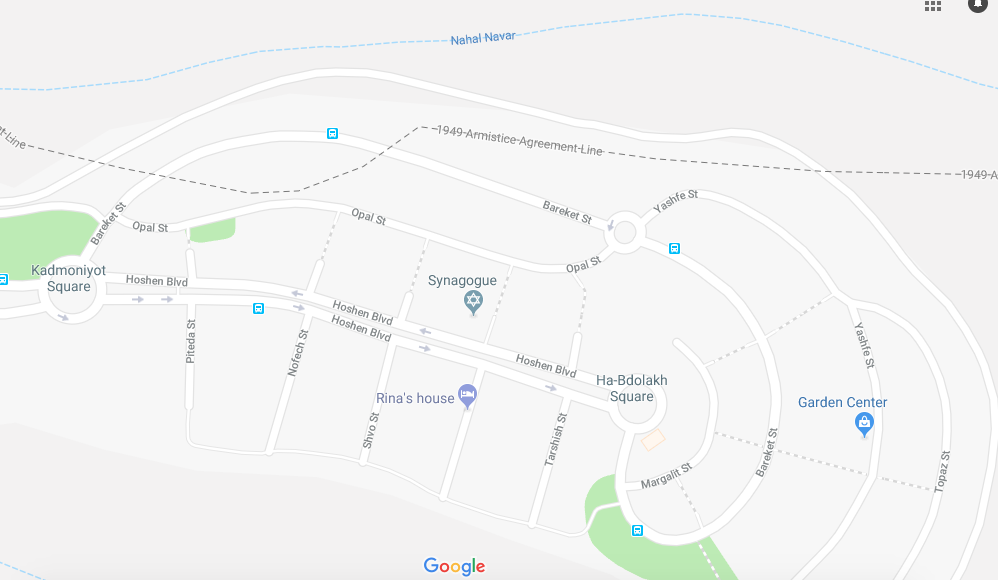 For decades, the Israeli government has expanded the Jerusalem neighborhood of Mevasseret Zion into the no-man’s land between the internationally recognized 1967 Green Line and the Israeli separation barrier. Kerem Navot, an anti-settlement watchdog, recently discovered the cross-border expansion – which is plain to see on Google maps – of the neighborhood, along with a slew of other buildings, including a water facility and a synagogue. Additionally, the Israel Land Authority is advancing plans to build 300 new homes in the northern part of Mevasseret Zion, where it crosses over the Green Line.
Dror Etkes, the founder of Kerem Navot, told Haaretz:
“It’s obvious that the planners of this neighborhood knew very well where the Green Line runs. But they chose to ‘straighten’ the line there in order to make room for a few dozen more homes. It’s only natural that the state, which for decades has been investing massive resources in seizing control of the space of a neighboring people, should also expand communities situated within the Green Line into the West Bank. The amazing thing is that any sort of effort is being made still to maintain the distinction between communities within the Green Line and the settlements, since the declared policy of most of Israel’s governments in the past five decades was and remains the very opposite.”
A spokesman for the Mevasseret Zion neighborhood – whose residents almost certainly did not know they were living in a settlement – issued a disgruntled statement regarding the discovery and the Israel Land Authority’s plan to expand the encroachment:
“The plan currently being promoted [by the Israel Land Authority] is vigorously opposed by the council and the local residents, and they are working together to block the project. The council and residents object to the plan going ahead with regard to both the areas across the Green Line and those in the permitted areas.”
Bonus Reads
- “Ex-Jewish Agency Chief Slams Fellow Settlers Over Eviction of Neighboring Bedouin” (Haaretz)
- “Israel’s New Tool for Disposessing Palestinians” (Haaretz)
- “The Silent Transfer of Palestinians from Area C” (Ynet)
Welcome to FMEP’s Weekly Settlement Report, covering everything you need to know about Israeli settlement activity this week.
To receive this report via email, please click here.
May 18, 2018
- Israeli Cabinet Approves Projects to ‘Deepen Israeli Sovereignty Over East Jerusalem’
- IDF Applies New Israeli Law in the Settlements, Before It Is Even Law
- Another Sheikh Jarrah Eviction is Imminent
- Abbas: U.S. Embassy in Jerusalem is an “American Settlement Outpost”; Erekat: We’re Going to the Hague
- Bonus Reads
Comments, questions, or suggestions? Email Kristin McCarthy at kmccarthy@fmep.org.
Israeli Cabinet Approves Projects to ‘Deepen Israeli Sovereignty Over East Jerusalem’
On Sunday, May 13th – the day that thousands of radical religious Israelis marched provocatively through Palestinian areas the city in celebration of Jerusalem Day, and the day before the celebration of the official opening of the U.S. Embassy in Jerusalem – the Israeli Cabinet authorized a series of projects that, as Justice Minister Ayelet Shaked (Jewish Home) explained, will “deepen Israeli sovereignty over East Jerusalem,” at a cost of $560 million USD. NOTE: Israel annexed East Jerusalem and surrounding areas in 1967 – an annexation rejected by virtually the entire world through the present day.
One of the projects the Cabinet authorized is a “Land Regulation” scheme which directs the Israeli Justice Ministry to register the status of all East Jerusalem land with the Israeli Land Registry. Under the new project, Palestinians must file a claim with the Justice Ministry to have their ownership of lands in East Jerusalem assessed and recorded (or challenged/denied). In cases where Israel determines that Palestinians have not sufficiently proven their property claims, the land will be taken over by Israel for development. Cases in which more than one party claims ownership (e.g., where Israeli settlers claim to have, through various means, gained title to the property) will be referred to an Israeli court. Given that since 1967, Israeli judges have overwhelming ruled against Palestinian claimants in cases dealing with land ownership, the project appears to be a transparent, large-scale mechanism to transfer Palestinian property into the hands of the Israeli government and settlers. The project also sets up a panel of government officials to begin preparations for developing the land in the future, including assessing the state of water and sewage connection.
Shaked connected the “Land Regulation” project to broader events of the week, saying:
“A day before we strengthen Jerusalem by moving the US embassy here, we are bolstering the city by applying Israeli sovereignty in East Jerusalem through the plan to regulate land claims. This is the first practical application of Israeli sovereignty since Israel took sovereign control of the eastern part of the city.”
The Cabinet also voted to allocate an additional $56 million USD towards the Jerusalem cable-car project, which, according to Emek Shaveh, means the cable car project is now fully funded. FMEP has covered the cable car project, and the settler-run Kedem Center which will be its final stop, many times in the past. The project is properly understood as a touristic settlement project that bolsters the presence and control of Israeli settlers in the Palestinian East Jerusalem neighborhood of Silwan.
The Cabinet approved $16.5 million USD for archaeological excavation projects in the Silwan neighborhood, to be carried out by the radical settler group Elad. FMEP covers Elad’s activities on a near weekly basis; the group’s mission is to establish Jewish hegemony over East Jerusalem, and Elad focuses its activities intensively on Silwan, both in terms of taking over properties and gaining control of the public domain through control over parks, tourist facilities, and archeological sites.
The Israeli NGO Emek Shaveh has a detailed look at what excavation projects will be funded. Emek Shaveh writes:
“These decisions constitute the state’s commitment to financing and promoting the settlers’ plan in Silwan and in the historic basin, constituting an escalation in the use of archaeology and tourism for political purposes: The scope of the projects and the budgets allocated for their implementation are unprecedented. It appears that the Israeli government is no longer maintaining the pretense of distinguishing between its own actions and those of the settlers.”
IDF Applies New Israeli Law in the Settlements, Before It Is Even Law
Haaretz reports that IDF Commander Nadav Padan issued a military order applying to settlements a new set of rules and regulations for the upcoming municipal elections. These rules and regulations are contained in a bill that is under consideration, but has not yet been passed, by the Knesset (regarding candidate eligibility, polling place regulations, and voter registration issues). The issuance of the order in advance of the Knesset plenum’s consideration of the bill was neither a mistake nor a coincidence: Padan reportedly issued the order to appease Interior Committee Chairman Yoav Kisch (Likud), who had delayed progress of the bill specifically out of concerns over how it would be applied to the settlements. Once the military order was issued, Kisch allowed his committee to vote on the bill. The measure is expected to pass a final Knesset vote when it is brought up.
Kisch was a key figure in the recent effort to require all Knesset legislation to state how it can be applied to the settlements (via military order or directly). That effort failed, and Kisch was forced to accept the recommendation of the Knesset legal advisor that instead of changing Knesset rules to require a statement of applicability, Knesset legal advisors are instructed to discuss the issue during the bill’s formulation. However, Justice Minister Ayelet Shaked (Jewish Home) succeeded in a similar effort within the Israeli Cabinet, ensuring that all Knesset legislation seeking government backing is now required to include a written statement of how it will be applied in settlements.
The IDF Commander’s preemptive order is a novel new tactic by which the Israeli government is affecting the de facto annexation of areas in the West Bank by applying Israeli domestic law there. As the Haaretz report notes, it typically takes months if not years for the IDF Commander to issue military orders that apply Israeli laws to the settlements after they are passed by the Knesset. FMEP recently published a compendium of policies that advance that end – but this week’s events are notable in that the military order effectively implemented a law that the Knesset has not yet passed (or even debated).
Another Sheikh Jarrah Eviction is Imminent
In’am Kneibi, a 77-year-old Palestinian woman living in the Sheikh Jarrah neighborhood of East Jerusalem, received notice last week that the Israeli government intends to execute an eviction order against her family, to take place between May 13th and May 27th.
Peace Now warned that the timing of the eviction alongside the opening of the U.S. Embassy and the celebration of Jerusalem Day might ignite simmering tensions in the city:
“The expected eviction of the Kneibi family represents an organized, systematic campaign by radical settlers, in cooperation with government agencies, to supplant Palestinian communities in East Jerusalem with new settlements.”
Sheikh Jarrah is a particularly combustible area of occupied East Jerusalem, where radical religious Israeli settlers have concentrated their activities. Earlier this year, the eviction of the Shamasneh family from their home in Sheikh Jarrah ended an unofficial moratorium on Israeli evictions in the neighborhood. Peace Now notes that 75 families in Sheikh Jarrah are currently facing eviction. Simultaneously, the Israeli government has advanced several highly provocative settlement plans in Sheikh Jarrah, including a 7-story Jewish religious school (a yeshiva) on the main road leading into Sheikh Jarrah.
Abbas: U.S. Embassy in Jerusalem is an “American Settlement Outpost”; Erekat: We’re Going to the Hague
“What we saw in Jerusalem today was not the opening of an embassy, but the opening of an American settlement outpost.” – Palestinian Authority President Mahmoud Abbas. Top Palestinian Authority diplomat Saeb Erekat followed up Abbas’ comments by announcing that Palestinian Authority leadership has decided to pursue war crimes charges against Israel for its settlement construction in the occupied territory.
Bonus Reads
- “New report on illegal outposts fuels West Bank annexation concerns” (Times of Israel)
- “Living in the constant shadow of settler violence” (+972 Mag)
- “A Tale of Two West Bank towns: A Bleak Palestinian Refugee Camp Choked by a Thriving Israeli Settlement” (Haaretz)
- “Seven decades of struggle: How one Palestinian village’s trouble captures pain of the ‘Nakba’” (The Guardian)
- “To Demolish Palestinian Villages in the Name of Parity” (Haaretz)
- “VIDEO: A Muslim Amongst the Settlers” (The Atlantic)
- “Settlements Are Not the Periphery” (Haaretz)
- “Defense establishment girds for price tag attacks in midst of combustible week” (Ynet)
Welcome to FMEP’s Weekly Settlement Report, covering everything you need to know about Israeli settlement activity this week.
To receive this report via email, please click here.
May 3, 2018
- Forging Ahead with Another Settler Project at Entrance of Sheikh Jarrah
- Israeli NGOs File Challenge Against Settler Footbridge Near Old City
- Kerem Navot Report: Some of Israel’s West Bank Police Stations are on Private Palestinian Land
- Update: High Court Override Legislation is in Limbo
- Bonus Reads
Comments, questions, or suggestions? Email Kristin McCarthy at kmccarthy@fmep.org.
Forging Ahead with Another Settler Project at Entrance of Sheikh Jarrah
On April 26th, the Jerusalem District Planning and Building Committee advanced a plan, backed by settlers, to build a 6-story commercial building at the entrance of the Palestinian East Jerusalem neighborhood of Sheikh Jarrah – taking the key step of depositing the plan for public review. The building will be across the street from one of the most provocative settlement projects that were advanced last year: a new religious school (the Or Sameach Yeshiva/Glassman Complex) described by Terrestrial Jerusalem to be: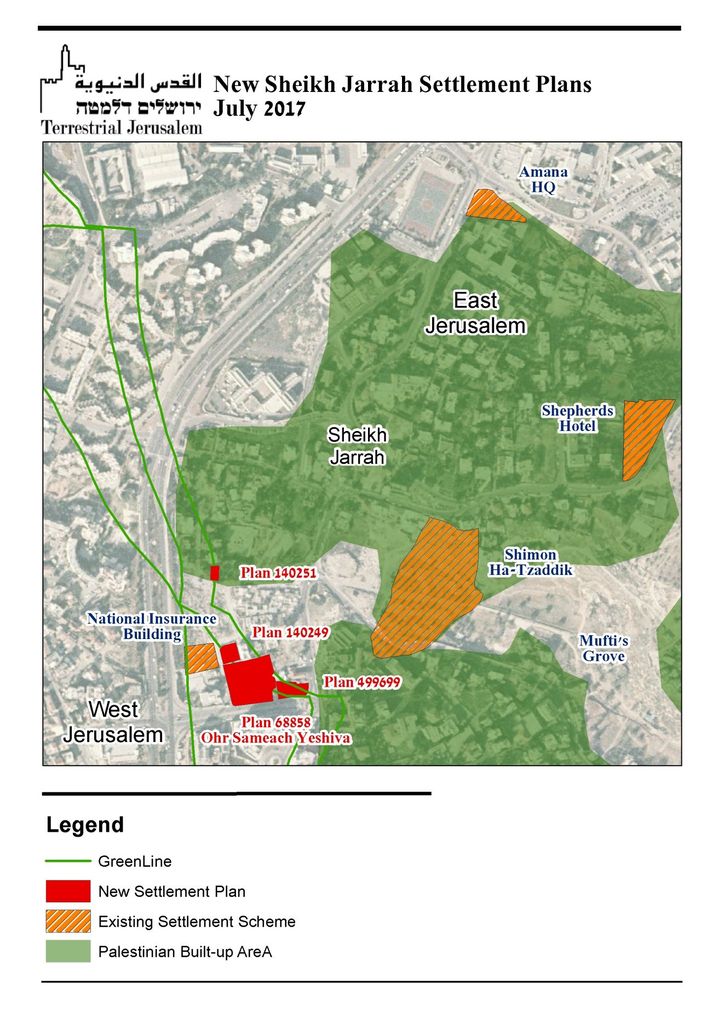
“a clear effort to exploit Torah study to expand and normalize occupation in East Jerusalem (including by making the site politically untouchable, as it will now be linked with religious activities).”
The location of the yeshiva and the 6-story building (which, once built, will literally flank both sides of the road leading into Sheikh Jarrah) will strengthen Israeli settlers’ hold on the neighborhood. Together they will advance the settlers’ goal of cementing the presence of the settlement enclaves inside of Sheikh Jarrah by connecting them more seamlessly to the neighborhood’s outer periphery and the rest of Jerusalem.
Sheikh Jarrah and its Palestinian residents are the target of intense settler activity, which FMEP has covered repeatedly in the past.
Israeli NGOs File Challenge Against Settler Footbridge Near Old City
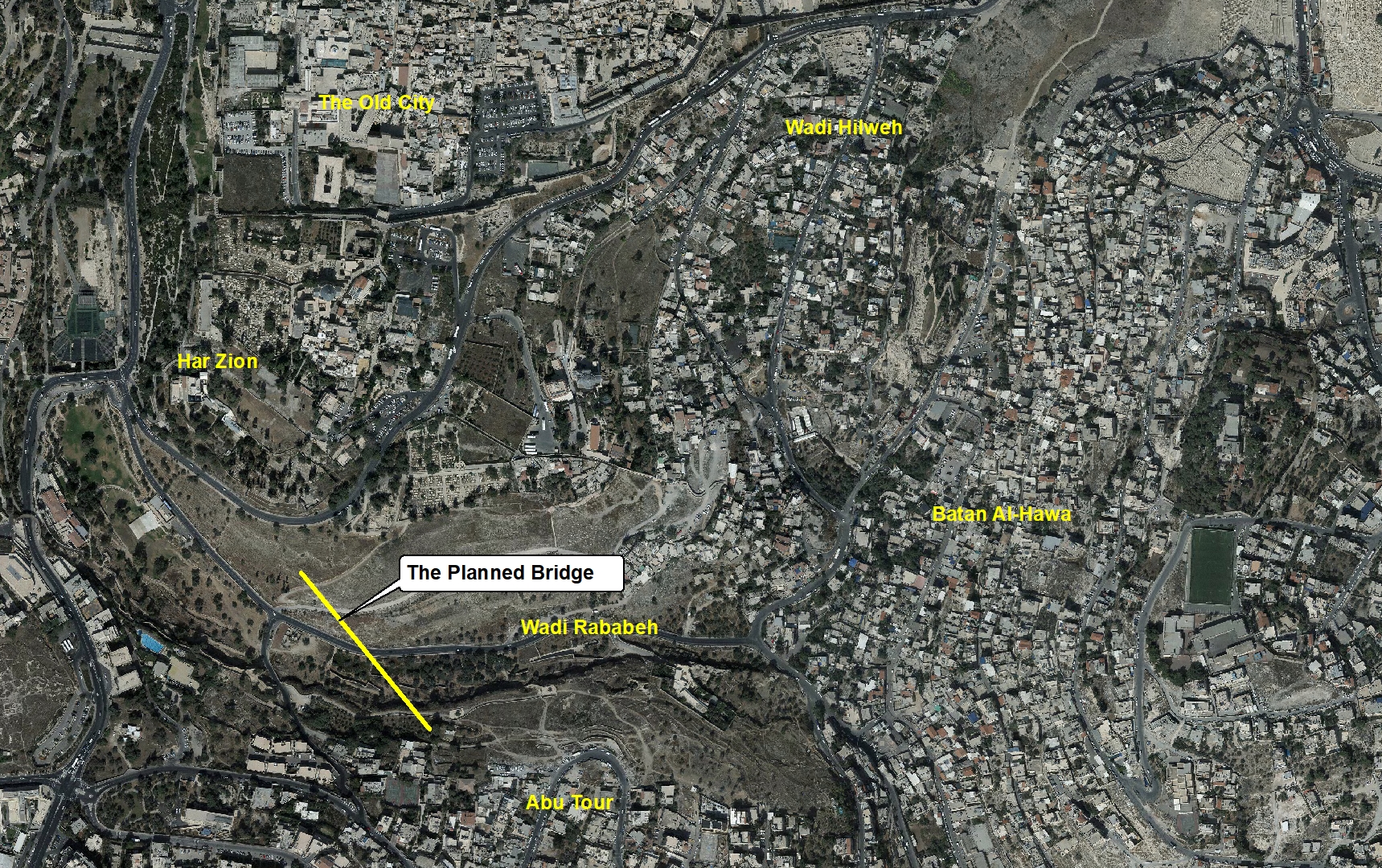
Map by Peace Now
The petitioners argue:
“The proposed bridge is located in one of the most sensitive and significant areas in Jerusalem and one of the most important in the world. The Old City basin is one of Jerusalem’s most precious cultural, religious and historical assets, as well as politically significant. Construction and development in this area should be done in a careful and considerate way, in a meaningful public debate and in the context of a true planning vision.
It is not without reason that the designs were set in the planned area. . . [an area] whose main purpose is to preserve and protect the Old City basin from rapid development and construction initiatives that might damage the important values in this special area. These plans do not allow the issuance of permits for such a significant construction and do not allow expropriation at all without proper documentation, and they explicitly state the need for detailed planning with the approval of the District Committee.
It is important to note that in addition to the familiar tension between development and tourism needs and the principles of conservation and protection of historical and environmental values, the Old City basin is also an urban area with a population of tens of thousands of people who live alongside and sometimes within historic sites. The bridge and pedestrian traffic will have significant implications for the area and its character for the residents living in the area.
For all these reasons, extreme caution is required in approving development plans in the Old City basin. The permit in question was approved in violation of all the proper planning and public principles, and therefore there is a need to cancel it.”
Peace Now reports that Elad has already started building infrastructure for the footbridge in Abu Tor, despite lacking a building permit (the plan was approved, but permits have not been issued). Peace Now appealed to the Jerusalem Municipality to have the construction stopped; the Municipality responded saying the construction does not relate to the bridge but to a permit that was issued for the “restoration of terraces” on the same land. Peace Now appealed again two weeks ago, arguing that Elad’s current undertakings – which include building walls, pouring of concrete, and excavating – require an additional permit (how it is being argued that those projects relate to the “restoration of terraces” is unclear). The Municipality has not yet responded.
As FMEP has covered many times in the past, Elad’s mission is to establish Jewish hegemony in Jerusalem, and it often uses tourism as a pretext for its activities in Jerusalem’s most contested neighborhoods. Kerem Navot says the Abu Ror footbridge is part of Elad’s efforts to take control of areas surrounding the neighborhood of Silwan.
Kerem Navot Report: Some of Israel’s West Bank Police Stations are on Private Palestinian Land
New research published by the anti-settlement watchdog Kerem Navot documents the legal status of land in the West Bank on which 38 Israeli police stations have been built, and reveal that four stations are built illegally on privately-owned Palestinian land.
The report reveals that of the 38 police stations in the occupied territories:
- 17 stations are on land declared by Israel to be “state land”
- 8 stations are on land Israel seized for “security purposes”
- 2 stations are on land expropriated for “public purposes”
- 1 station (servicing the Givat Ze’ev settlement) is fully on privately-owned Palestinian land
- 1 station (servicing the Ma’ale Adumim settlement) is partially on privately-owned Palestinian land, and partially on land that was seized from the Palestinian owners for “public purposes”
- 1 station (servicing the Elkana settlement) is partially on privately-owned Palestinian land and partially on land seized from Palestinian owners for “security purposes”
- 1 station (servicing the Vered Yeriho settlement) is partially on privately-owned Palestinian land and partially on land that was declared “state land”
Kerem Navot writes:
“As is well known, there are two communities in the West Bank, each of which has completely different rights, and previous reports have been devoted to describing the Israeli Police’s failure to enforce the law in cases of settler violence in a sense reminiscent of values of equality. This modest document will not address this fundamental ethical issue… this report solely seeks to address the geographical-statutory aspect of the deployment of Israel Police stations throughout the West Bank…The initial idea for addressing this aspect arose when, over the course of our research in recent years, we incidentally discovered that several police stations in the West Bank are illegally located on private Palestinian-owned land. There is no need to elaborate on the paradoxical severity of this fact.”
Update: High Court Override Legislation is in Limbo
It appears that the Israeli Knesset, which convened this week for the summer session, will not take immediate action on a bill to empower the Knesset to reinstate laws struck down by the High Court of Justice (reminder: the High Court is expected to strike down the Regulation Law, and MKs have already stated their desire to make sure it remains on the books). Prime Minister Netanyahu (Likud) and Justice Minister Ayelet Shaked (Jewish Home) were not able to reach a compromise on the specifics of the bill during a meeting with Chief Justice Esther Hayut last weekend, and no news of the bill has surfaced since. It is unclear if Naftali Bennett (Jewish Home) intends to follow through on the threat he made last week to call for elections if Netanyahu does not advance his version of the bill – which will allow the Knesset to reinstate laws with a bare-bones, 61-vote majority in the Knesset – this week.
While political leaders debate amongst themselves, a new public opinion poll found that 65% of Israelis believe that the version of the bill pushed by Ayelet Shaked and Jewish Home party leaders would “grant the government ‘unlimited’ and unchecked power.” 58% of the public said they believed the law would lead to more corruption.
Bonus Reads
- “Settler Rail Line to Israel Latest Land Grab, Palestinians Say” (Al Jazeera)
- “Thirteen Cases of Vandalism, One Arrest: Who is Behind the Wave of West Bank Hate Crimes?” (Haaretz)
- “‘Price tag’ hate crimes against Palestinian on the rise in Israel and West Bank” (NBC News)
- “Christians in Jerusalem’s Old City ‘under threat’ from settlers” (The Guardian)
Welcome to FMEP’s Weekly Settlement Report, covering everything you need to know about Israeli settlement activity this week.
To receive this report via email, please click here.
April 20, 2018
- Israeli Police Assist Settlers in Taking Over Three Palestinian Apartments in East Jerusalem
- Palestinians Petition Civil Administration to Evacuate Squatting Settlers from Hebron Compound
- Bibi Govt Proceeds with Effort to Strip High Court of its Powers
- IDF Aids Settlers in Closing Off Key Road to Palestinians
- $120 Million Investment into Jordan Valley Communities, Including Settlements
- Settlers Assault IDF & Terrorize Palestinians in Nablus Area
- Americans for Peace Now: “From Creeping to Leaping: Annexation in the Trump-Netanyahu Era”
- Bonus Reads
Comments, questions, or suggestions? Email Kristin McCarthy at kmccarthy@fmep.org
Israeli Police Assist Settlers in Taking Over Three Palestinian Apartments in East Jerusalem
On April 9, 2018, Israeli police officers assisted settlers in evicting three Palestinian families from apartments in the Silwan neighborhood of East Jerusalem, making way for the settlers to move in. The take-over seemed to have happened prematurely, since the family that owns the apartment units – the Ruweidi family – filed an appeal with the Court that had not yet been heard. The High Court ordered a temporary delay on the eviction order, but the delay was issued too late and the settlers had already emptied out the apartments. According to Haaretz, the apartments will remain empty until further notice from the Court.
In February 2018, the Jerusalem District Court ruled that the property rightfully belongs to the radical settler group Elad, which claims to have bought it from one member of the Ruweidi family, Raziq Ruweidi. The Ruweidi family disputes the court’s decision, saying that the properties were jointly owned by six other family members and therefore could not have been lawfully sold. The matter wound up in court after Raziq Ruweidi was murdered three years ago, leaving debts that the Israeli courts had to settle.
As documented in previous editions of the FMEP settlement report – here, here, here, and here – the Elad settler group frequently works with the Israeli government and the courts to accomplish its goal of erasing the Palestinian presence in East Jerusalem in favor of Israeli Jews, including cooperation on major projects like the touristic Kedem Center in Silwan and the cable car line that will service it.
Palestinians Petition Civil Administration to Evacuate Squatting Settlers from Hebron Compound
Three weeks after settlers broke into and took up residence in the “Zaatari Compound” in Hebron, the Palestinian al-Zaatari family filed an appeal this week with the Israeli Civil Administration to have the law-breaking squatters evacuated. The settlers – who were reportedly given permission to enter the property by the IDF and Defense Minister Lieberman – claim to have legally purchased the properties. A lawyer representing the al-Zaatari family wrote in the petition that claim “has no basis in reality, since my clients and/or their representatives never sold their ownership rights in their homes.” The court has
Like hundreds of Hebronites, the al-Zaatari family was forced to leave the home during the Second Intifada due to the IDF’s suffocating restrictions on the freedom of movement of Palestinians in and around the Old City of Hebron, conditions which persist today.
Peace Now released a statement saying:
“The ink has not yet dried in the High Court of Justice’s decision to evacuate the Abu Rajab House, where settlers also broke into and squatted, yet the settlers dare to break into another house without the same approval they lacked in that case. The government must evict the trespassers immediately; the settlers have not proven any ownership. The behavior of the government and recent statements by the defense minister raise the suspicion that this home invasion was carried out in coordination with the defense ministry, and that the government lent a hand to breaking the law and stealing. Instead of protecting the landowner’s rights, the government is helping robbers seeking to take possession of the property without allowing the current owners their rightful legal avenue to prove ownership. The establishment of a new settlement house in the heart of Hebron is a severe blow to the fragile situation in Hebron and is liable to cause new restrictions on the movement of Palestinians.”
Bibi Govt Proceeds with Effort to Strip High Court of its Powers
It was decided by the the Israeli government’s ruling coalition this week that the next Knesset – which opens on April 29 – will vote on legislation aimed at stripping the High Court of its power to strike down laws passed by the Knesset. At the weekly cabinet meeting, Prime Minister Netanyahu and Finance Minister Moshe Kahlon agreed to form a “small ministerial committee” to try to bridge various proposals to restrict the High Court’s power to overturn laws – a move that could impact the fate of (among other things) the Regulation Law.
Notably, Attorney General Avichai Mandelblit was permitted to attend the cabinet meeting to present his opposition to most serious of the proposed versions — the Netanyahu-backed model, according to which laws could be overturned only by a unanimous vote in the High Court; Kahlon’s issue-specific formulation, seeking to allow the Knesset to overturn the High Court decision vis-a-vus a single piece of legislation, related to African asylum seekers; and a version, backed by Justice Minister Ayelet Shaked and Education Minister Naftali Bennet, allowing the High Court to be overruled by a simple majority vote in the Knesset. Mandelblit recommended his own version — one that would require a super-majority vote by the High Court (7 of 9) to strike down a law, and would allow the Knesset to overturn such a decision by the High Court by a super-majority of 70 votes.
Netanyahu and Transportation Minister Levin (Likud) rejected Mandelblit’s proposal, and said that the High Court should only be able to strike down laws by a unanimous vote (meaning that it would be highly unlikely that the Court would ever succeed in striking down any law). Following the cabinet meeting, Levin also specifically took issue with Khalon’s version of the bill (which seeks to create a unique exception for the Knesset to overturn the High Court’s ruling against a law related to the detention and deportation of African asylum seekers). Making clear his real objectives and concerns (and making explicit the connection to settlements), Levin told reporters that this version is:
“significantly erroneous and will lead to striking down laws, including the Regulation Law (legalizing Israeli outposts in the West Bank).”
You can follow the key events regarding the progression of this legislation via FMEP’s recently published resource, “Israel’s Creeping Annexation Policies.”
See this Haaretz overview for more even more detail.
IDF Aids Settlers in Closing Off Key Road to Palestinians
Haaretz reports that the IDF is contributing to the efforts of settlers from Halamish, a settlement located north of Ramallah, to restrict Palestinian access to a critical highway along which the settlers recently established a new unauthorized outpost.

Map by Kerem Navot
According to testimonies collected by Haaretz, IDF soldiers at two military roadblocks near the settlement and the new outpost have been conducting prolonged searches of Palestinian vehicles and buses headed for Ramallah via road 450. The vehicles and their passengers are regularly delayed and harrassed. One Palestinian recounts a soldier reportedly admitting that the actions are meant to incentivize Palestinians to take a detour around the area of the settlement and outpost (which is a longer route). In addition, settlers have repeatedly posted – and the IDF has repeatedly removed – a sign on the road that reads:
“The area where you are now is under the control of the Jews. Entry by Arabs to this area is completely prohibited, danger of death!”
Months ago, Halamish settlers started a Saturday morning prayer event in the middle of the road (between the settlement and the outpost on the other side). In cooperation with the settlers, IDF soldiers have been shutting down all Palestinian traffic and guarding the settlers during the prayer event.
The settlers intent has long been clear. By sealing off Palestinian access to the road, it will become an interior road between the settlement and the new outpost, effectively expanding the boundaries of Halamish at the cost of Palestinians.
The Halamish settlers established the outpost – which they call “Yad Ahi” or “My Brother’s Hand” – in July 2017, following the brutal murder of four of the settlement’s residents by a Palestinian attacker. Since then, the settlers have worked determinedly to fortify and expand the settlement to include the outpost and more, as extensively documented by the Israeli NGO Kerem Navot.
$120 Million Investment into Jordan Valley Communities, Including Settlements
The office of the Prime Minister announced a $120 million grant program for infrastructure projects in Israeli communities in the Jordan Valley. According to The Times of Israel, the budget earmarks $7 million to “help local farmers acquire more agricultural land and locate additional water sources and to build affordable homes for first-time buyers through the Housing Ministry Program.” One Israeli business news outlet reports that this is an “aid program for settlements in the Dead Sea area coping with the problem of sinkholes.”
Some 11,000 settlers and 65,000 Palestinians live in the Jordan Valley – the latter facing severe restrictions on land use and freedom of movement, and lack of access to municipal services like water and electricity.The current Israeli government has publicly and repeatedly demanded complete Israeli sovereignty over the Jordan Valley in the context of any peace agreement (meaning that any future Palestinian state would be entirely encircled by Israel, having no international border with any other nation). One Likud MK, Sharren Haskel, recently unveiled a bill to annex the Jordan Valley. Haskel is seeking government backing for the bill before formally introducing it in the Knesset.
A recent report by B’Tselem documents how Israeli settlers were allowed to establish two new outposts in the Jordan Valley last year. In recent months, Israel has delivered eviction notices to entire Palestinian communities near Israeli settlements in the Jordan Valley. Simultaneously, settlers have been allowed to continue construction on a tourist project – a car race track built in a closed military zone (land expropriated from Palestinians ostensibly for security purposes), despite a court ordered stop-work order.
Settlers Assault IDF & Terrorize Palestinians in Nablus Area
Three settlers were arrested for throwing stones at IDF soldiers engaged in the evacuation of an unauthorized outpost near the Itamar settlement, south of Nablus. The outpost – called “Rosh Yosef” by the settlers – has been evacuated several times before, but settlers have repeatedly re-occupied the hilltop site. The settlers, one of whom is a minor, were released a day later and put under house arrest.
The evacuation comes against the backdrop of frequent attacks perpetrated by Israeli settlers in the Nablus area recently. Last week, settlers allegedly set the entrance to a mosque on fire and spray painted the building with anti-Arab, anti-Muslim threats. On April 18th, settlers destroyed at least two dozen olive trees and spray painted hateful words on houses in the village of Urif. The Ynet news outlet reports that the radical and violent “Hilltop Youth” settler group is responsible for most of these crimes, noting that its members are increasingly outraged by outpost demolitions, fixated on calls for “revenge” against Palestinians following terrorist attacks, and resentful of recent criminal punishments levied against their members as a result of the Shin Bet’s crackdown on the group’s criminal activities.
Americans for Peace Now: “From Creeping to Leaping: Annexation in the Trump-Netanyahu Era”
Americans for Peace Now published a new policy paper analyzing how “the Israeli right has launched an unprecedented drive to annex the West Bank, piecemeal or in its entirety” since the inauguration of President Donald Trump. The paper “lays out the recent developments that present a quantum leap in Israeli annexation efforts, analyzes these moves against the historical backdrop of Israel’s 50-year occupation of the West Bank, examines the ramifications of the transition from ‘creeping’ to ‘leaping’ annexation, and considers why this transformation is happening now.”
FMEP’s recently published resource, “Israel’s Creeping Annexation Policies” is being updated to include several items from APN’s excellent work.
Bonus Reads
- “Israel and Annexation by Lawfare” (Michael Sfard, The New York Review of Books)
- “How Israel’s Government is Aiming to Outweigh the Supreme Court” (Haaretz)
- “Attempts to ‘bypass’ Israel’s High Court will create a ‘tyranny of the majority’ ” (+972 Mag)
- “As Israeli pushes for West Bank railway, Palestinians brace for more land grabs” (Middle East Eye)
Welcome to FMEP’s Weekly Settlement Report, covering everything you need to know about Israeli settlement activity this week.
To receive this report via email, please click here.
January 4, 2018
- Likud Votes for Unilateral Annexation of West Bank Settlements
- Knesset Set to Discuss Application of New Laws to the Settlements
- Knesset Passes Jerusalem Law Designed to Block Peace Agreement
- Israel Builds New Unauthorized Outpost to Temporarily House Amona Outpost Evacuees
- Israeli High Court Issues Stop-Work Order on Illegal Outpost, But Agrees to its Eventual Legalization
- Israel Complicit in Establishing 14 New Outposts Since 2011
- The JNF is Working with a Settler Group to Evict Palestinians in East Jerusalem
- Israeli Government Approves EU Trade Agreement that Excludes Settlements
Comments, questions, or suggestions? Email Kristin McCarthy at kmccarthy@fmep.org.
Likud Votes for Unilateral Annexation of West Bank Settlements
On January 1st the Likud Central Committee voted unanimously to approve a resolution calling on party leaders (including Prime Minister Netanyahu) to allow unlimited construction in settlements and to take steps to formally annex all Israeli settlements in the West Bank. The Likud party is the head of the governing coalition in Israel, with the largest number of seats in the Knesset and the control over the office of the Prime Minister.
The resolution reads:
On the 50th anniversary of the liberation of the regions of Judea and Samaria [the West Bank], including Jerusalem our eternal capital, the Likud Central Committee calls on the Likud’s elected officials to act to allow free construction and to apply the laws of Israel and its sovereignty to all liberated areas of Jewish settlement in Judea and Samaria.
Haaretz notes that in the past, Netanyahu intervened to prevent resolutions like this one from coming up for a vote, over concerns that such votes could elicit international blowback. This time, he refrained from doing so. The Trump Administration offered no comment on the Likud vote.
Jordanian Foreign Minister Ayman Safadi criticized the decision via Twitter: “Knesset approval of amended Basic Law on #Jerusalem & decision by ruling party 2annex settlements & impose sovereignty on West Bank are null & void under Intl law. Israel continues 2adopt illegal unilateral decisions that deny region the peace it deserves & is in world interest.”
For its part, the Palestinian Authority slammed the resolution, with President Abbas promising consequences and arguing that the resolution has “the blessing” of the United States, whose ambassador to Israel, David Friedman, has reportedly requested the State Department cease using the word “occupation” to describe the situation in the West Bank and Golan Heights (the State Department spokeswoman later said that the U.S. policy has not changed on that regard).
J Street also linked Likud’s actions to the environment created by President Trump and his envoys, saying
President Trump bears responsibility for laying the groundwork and providing cover for these steps [by Likud]. By breaking with decades of bipartisan policy and refusing to support the two-state solution or seriously opposing settlement expansion, his administration has given a green light to the destructive plans of the settlement movement. By unilaterally recognizing Jerusalem as Israel’s capital in advance of a peace agreement, the president has told the Netanyahu government that it is free to act with contempt for the peace process and for the Palestinians, and without fear of rebuke from the United States.
Knesset Set to Discuss Application of New Laws to the Settlements
The Jerusalem Post reports that the Knesset House Committee has instructed committees to discuss whether bills passed by the Knesset will be applied to settlements in the West Bank. Extending Israeli domestic law to the settlements is tantamount to annexation.
Hardline, anti-two-state, right-wing MKs – including Justice Minister Ayelet Shaked and House Committee chairman Yoav Kisch – have lead the charge to annex the settlements by extending Israeli domestic law, arguing it would end what they describe as “discrimination” against Israeli citizens based on their place of residence.
Slamming the move, left-wing Meretz MK Tamar Zandberg stated:
There is a territory that is outside of Israel’s borders, and what you’re suggesting is to have two parallel legal systems in the same land, where the only measure that determines which system applies to whom is a person’s race. This has a name, and you know what it is.
The House committee’s instructions this week were a half measure to force the annexation discussions, after an aborted attempt in 2017 to change the official rules of the Knesset to require bills to state whether they apply to the settlements, a rule change that the Knesset’s legal counsel advised against.
Israeli settlements, being in occupied territory, are currently under Israeli military rule, although Israeli civilians living in settlements already come under Israeli civilian law. As noted by FMEP’s Lara Friedman in testimony before the UN Security Council in October 2016:
…Israeli law follows Israeli citizens who enter or live in the Occupied Territories. This means that Israeli settlers live under Israeli law – no different than if they were living inside Israel – while Palestinians live under military law. This policy has created a dangerous and ugly political reality in the occupied territories – a reality in which two populations live on the same land, under different legal systems, separate and entirely unequal, with the governing authority serving one population at the expense of the other.
One population is comprised of privileged Israeli citizens, enjoying the benefits of a prosperous, powerful state, with their rights guaranteed by a democratic government accountable to their votes. The other population is comprised of disenfranchised Palestinians, living under foreign military occupation explicitly designed to protect and promote the interests not of Palestinian residents of the territories, but of Israeli settlers.”
Knesset Passes Jerusalem Law Designed to Block Peace Agreement
On January 1, 2018 the Israeli Knesset passed a law requiring a supermajority of votes in the Knesset to approve the transfer of any parts of Jerusalem (in its expanded borders, as determined by Israel immediately after the 1967 War) to a foreign power. Authored by the far-right Jewish Home Party, the amendment passed with a slim 64-52 majority. Jewish Home’s leader Naftali Bennett, who also serves as the Minister of Education in the current coalition government, declared that the vote shows Israel will keep control of all of Jerusalem forever.
A Palestinian Authority spokesman said the legislation, in addition to the Trump Administration’s recognition of Jerusalem as the capital of Israel, is ”a declaration of war on the Palestinian people.”
The Knesset refrained from simultaneously passing another controversial measure that would enable Israel to alter the municipal boundaries of Jerusalem – a proposal meant to pave the way for formally excising Palestinian neighborhoods of East Jerusalem that are located beyond the separation. The New York Times reports that Netanyahu directed the measure be removed from the legislation up for votes. For further background on both Jerusalem measures, see this report from Jerusalem expert Danny Seidemann.
Israel Builds New Unauthorized Outpost to Temporarily House Amona Outpost Evacuees
The Israeli Civil Administration has resumed construction on what is, in effect, a new illegal outpost meant to temporarily house settlers who were evacuated from the illegal Amona outpost last year. Following their evacuation, the Amona settlers refused – even temporarily – to relocate to the interim site near Ofra. Construction then stopped, but restarted this week.
Located northeast of Ramallah, near the Ofra settlement – and within spitting distance of where the evacuated Amona outpost once stood – the work is happening without permits and on land that Israel expropriated from private Palestinian owners for “public use.” The Amona evacuees are awaiting the construction of their new settlement, called Amichai, in the Shiloh Valley. Amichai will be the first official new settlement established with government approval in 20 years. Assuming the Amona evacuees eventually move from the new outpost to Amona, it should be assumed that the “temporary” site will turn out to be a new site permanently inhabited by other settlers.
Israeli High Court Issues Stop-Work Order on Illegal Outpost, But Agrees to its Eventual Legalization
On January 2nd, Israel’s High Court of Justice ordered construction at the Adei Ad outpost to stop – but only until the Israeli government completes the process of retroactively legalizing the outpost and its structures (which first required the Israeli government to suspend the rule of law). The Court said that the government must do so within nine months, which is the timeframe Prime Minister Netanyahu specified last year when he announced that Israel will expropriate the land of Adei Ad by declaring it as “state land.” Once the area is declared to be “state land,” Israel will then be able to begin the process of official planning, which will transform the illegal outpost into an authorized settlement.
Although much of the Adei Ad outpost is built on land that had already been expropriated through the same means, part of the outpost is on land the status of which us contested. The Israeli NGO Yesh Din represents Palestinian land owners in the petition which led to the stop-work order. Yesh Din explains the week’s news, writing:
In January 2018, the High Court ordered a freeze on all construction in Adei Ad and sharply criticized the State’s conduct regarding the outpost, including its handling of the petition. The court rejected the petitioners request to have the entire outpost evacuated, but gave the State only nine months to authorize the outpost, on the provision that at that date, another petition could be filed to have some of the structures evacuated. HCJ president (retired) Naor made it clear that allowing the State to consider authorizing the outpost in this case must not be taken as a carte blanche by the court for the future. In the ruling, she wrote: “The conclusion must not be that expressing a general interest in retroactively authorizing illegal construction is enough to justify the granting of such requests in future, as a carte blanche for continued disregard for the law.”
See Yesh Din’s full report on the Adei Ad outpost, “The Road to Dispossession: A case study -the outpost of Adei-Ad.”
Israel Complicit in Establishing 14 New Outposts Since 2011

Map by Haaretz
Haaretz is reporting data that shows that the government of Israel has helped establish at least 14 outposts in the West Bank since 2011, even though the government was supposed to have ceased the practice in 2005, under Prime Minister Sharon.
Dror Etkes, founder of the settlement watchdog Kerem Navot, told Haaretz that settlers have strategically chosen to build new outposts on West Bank land that was expropriated by Israel as “state land,” knowing that such outposts would stand a greater chance of being retroactively legalized than those built on land that Israel might recognize as being privately owned by Palestinians. Etkes explained that outpost builders do not, however, limit themselves to state land, saying:
They take over as much surrounding land as possible, including private land, which they steal by other means, such as cultivation or barring access [to the Palestinian landowners]….It’s methodical, and they know exactly what they’re doing.
The JNF is Working with a Settler Group to Evict Palestinians in East Jerusalem
In Silwan (known to Israelis as the City of David), the Jewish National Fund (JNF) is working to evict Palestinians from their home in order to sell the property to the settler organization Elad. Elad’s mission is to establish Jewish hegemony over Jerusalem, and focuses its activities intensively on Silwan, both in terms of taking over properties and gaining control of the public domain through control over parks, tourist facilities, and archeological sites (see this report from Ir Amim for further background on Elad and its activities).

Map by Haaretz
The Sumreen family has been fighting for 27-years to prove its rightful ownership of its Silwan home, which the settlers and the JNF challenge based on the fact that one of the Sumreen patriarchs lives in Jordan. Based on his residence there, Israel declared him an “absentee” and took over the rights to the building, despite the fact that members of the Sumreen family still lived in the home.
Peace Now’s Hagit Ofran, who has been helping the family, charged that:
KKL [the Hebrew name for the JNF] has turned from the Jewish National Fund into the Settler National Fund. For 26 years, KKL has been embittering the lives of the Sumreen family with expensive, exhausting lawsuits and has tried over and over to evict it from its home in Silwan. KKL is playing a central role here in an ugly process of using the Absentee Property Law on the basis of dubious testimony, all to give Palestinian assets to Elad.
This is not the first controversy surrounding the JNF’s activities in Silwan, or even over the JNF’s role in the campaign to evict this particular family, which last peaked in 2011. For background, see this report on +972, as well as this commentary from Peace Now’s Hagit Ofran. Notably, controversy over the issue in 2009 prompted the JNF to issue a denial of any role in the efforts; this denial was contradicted by the facts, including the actual wording of the eviction order.
Israeli Government Approves EU Trade Agreement that Excludes Settlements
Despite opposition from some coalition and Knesset hardliners, Israeli Prime Minister Netanyahu and all relevant ministers approved a new trade deal with the European Union that excludes Israeli settlements from its terms. Miri Regev, Israel’s Minister of Culture and Sports, had filed an objection regarding the deal before it was finalized. Regev has now filed a complaint with the Cabinet Secretary, saying her objection was ignored and that she was misled regarding the ability to discuss the terms of the deal.
By approving the deal, Prime Minister and his cabinet ministers acquiesced to the EU’s policy of rejecting the conflation of Israel and settlements (sometimes referred to as “differentiation”) – a policy that Netanyahu and other Israeli officials have disingenuously labeled a “boycott” of Israel). The Israeli government, which is investing millions more in fighting differentiation and international boycotts of both settlements and Israel, had previously threatened to halt cooperation with the EU [in effect, boycott Israel-EU cooperation] over the EU’s refusal to treat settlements as part of Israel.
__
FMEP has long been a trusted resource on settlement-related issues, reflecting both the excellent work of our grantees on the ground and our own in-house expertise. FMEP’s focus on settlements derives from our commitment to achieving lasting Israeli-Palestinian peace, and our recognition of the fact that Israeli settlements – established for the explicit purpose of dispossessing Palestinians in the West Bank and East Jerusalem of land and resources, and depriving them of the very possibility of self-determination in their own state with borders based on the 1967 lines – are antithetical to that goal.
Welcome to FMEP’s Weekly Settlement Report, covering everything you need to know about Israeli settlement activity this week.
To receive this report via email, please click here.
November 22, 2017
- Israeli AG Support for Land-Grab Paves Way for Legalization of [at least] 13 Outposts
- Israeli AG Approves Retroactive Legalization of “Mistaken” Land Theft
- Israeli AG to Present Argument on the “Regulation Law” This Week
- Threatened Eviction of Another Palestinian Bedouin Community in E-1
- Israel Fast-Tracks Jerusalem Cable Car Project Despite Political Concerns
- Settlers Fight for the “Right of Return” to Illegal, Inaccessible West Bank Settlements
- Bonus Reads
Comments, questions, or suggestions? Email Kristin McCarthy at kmccarthy@fmep.org.
Israeli AG Support for Land-Grab Paves Way for Legalization of [at least] 13 Outposts

Map by Haaretz
The far-reaching implications of the legal opinion issued last week by Israeli Attorney General Avichai Mandleblit, in the context of a case dealing with the Harsha outpost, are becoming alarmingly clear. Haaretz reports that the opinion will pave the way for Israel to retroactively legalize 13 unauthorized outposts, many of which are deep inside of the West Bank. The 13 outposts (and many others) were all built without Israel’s permission on pockets of state land, surrounded by privately owned Palestinian land. Roads leading to these outpost – without which the outposts cannot be fully planned and legalized – were (or will be), by necessity, built on land owned by Palestinians. This opinion paves the way (pun intended) for that to happen.
Dror Etkes, founder of the anti-settlement group Kerem Navot, notes that the impact of the decision is actually far greater than reported by Haaretz: “The real number of [affected] outposts is over 60.” Etkes adds,
The story [is] that the settlers are striving to resolve, with Mandleblit’s help, involves hundreds (yes hundreds!) of roads that have been illegally paved for decades around settlements and outposts, on land that even Israel recognizes as privately-owned. Now, with a little creativity and a lot of nerve, a legal mechanism has been invented to enable settlers to retroactively authorize the road system, without which the national land grab enterprise championed by Israel in the West Bank, can’t function.
Notably, several outposts that spun off from the Itamar settlement are among those that could benefit from this new legal precedent. Near Nablus, Itamar’s hilltop outposts form a contiguous land bridge – with roads connecting them – from Itamar to the Jordan Valley. Itamar’s residents are notorious for their ultra-nationalism.
Israeli AG Approves Retroactive Legalization of “Mistaken” Land Theft
Attorney General Mandleblit has endorsed an argument, made for the first time since 1967, in a legal brief submitted this week in Court by the Israeli government, that paves the way for Israel to expropriate privately owned Palestinian land inside the Ofra settlement, and potentially in other places as well. The land in question was “mistakenly” included as part of the settlement. The State filed the brief this week in response to a legal challenge to the Ofra settlement’s Master Plan.

Map by Haaretz using Google Maps
The case centers on a “mistake” which happened when the Ofra settlement master plan was approved; Israel argues that at the time it did not know that some of the land in the area had not been declared “state land” (suggesting, at best, extraordinarily faulty due diligence in the planning process, and at worst, a policy of treating Palestinian land ownership claims as irrelevant). In 2016, the State acknowledged Palestinian claims to the land and announced its intention to rectify the problem by re-drawing the settlement’s master plan.
With this new argument, the State, backed by the Attorney General, has reversed the 2016 commitment and is instead moving to formally expropriate the Palestinian plots, arguing that the Ofra settlers acted in good faith based on the government’s approval of the Master Plan (i.e. that settlers should not be punished for the State’s mistake). Earlier this year, AG Mandleblit suggested this exact argument (that land stolen by mistake, in good faith, could be legalized as long as the Palestinian owners were compensated) as an alternative law for the Knesset to pass instead of the Regulation Law, which he opposed.
Commenting on the AG’s opinion, Tawfiq Jabareen, the lawyer representing the Palestinian petitioners, told Haaretz:
Attorney General Mandelblit is continuing to destroy the status of the rule of law and severely undermine Palestinian property rights in the occupied territories.
Israeli AG to Present Argument on the “Regulation Law” This Week
On Nov. 23rd, Attorney General Avichai Mandleblit is expected to present his argument on the “Regulation Law” to the Supreme Court. As we reported previously, Mandleblit was staunchly opposed to the Regulation Law, arguing that the law is unconstitutional and refusing to defend the law against legal challenges mounted by several civil society groups earlier this year. At the time the law was being considered, Mandleblit proposed an alternative legal strategy to accomplish the same goal: the retroactive legalization of Israeli settlement activity in the West Bank.

Map by Peace Now
Mandleblit has been expected to argue forcefully against the law, which provides a new legal basis for the retroactive legalization of outposts and agricultural land seizures, with Palestinian owners provided “compensation” (but no choice in the matter). Following the opinion Mandleblit issued last week regarding the Harsha outpost case (implications of which we detail above), and given his recent support for the retroactive legalization of land theft for the benefit of the Ofra settlement (detailed above), it is quite possible that his opposition to the retroactive legalization of land seizures has softened.
If upheld, the Regulation Law can be used to retroactively legalize 55 outposts and 4,000 unauthorized settlement structures by expropriating over 8,000 dunks of privately owned Palestinian land.
Threatened Eviction of Another Palestinian Bedouin Community
The wave of IDF-ordered evictions continued this week, with the Jabal al-Baba bedouin community only the latest to be affected. The approximately 300 residents were ordered to leave their encampment near the Maale Adumim/E-1 settlement area east of Jerusalem within 8 days. The Jabal al-Baba community has been living in the area since 1948, after it was expelled from the Negev.
The Jabal al-Baba community is the second bedouin community in the Maale Adumim/E-1 area to be faced with eviction this year. In August, Israel escalated its longstanding threat to forcibly relocate the Khan al-Ahmar bedouin community to a site near the Abu Dis garbage dump – a move that B’Tselem warns will constitute a war crime. FMEP has covered the story in detail, including as it relates to the prospects for the construction of the doomsday E-1 settlement.
Israeli actions to remove Palestinian bedouin communities from Area C are not confined to the Jerusalem area. On November 1st, the Israeli army ordered the eviction of an entire bedouin community in the northern Jordan Valley.
Israel Fast-Tracks Jerusalem Cable Car Project Despite Political Concerns
Haaretz reports that Israeli planning authorities are moving ahead with plans to build a controversial cable car line in East Jerusalem, despite growing opposition. As FMEP reported in July, the planned cable car line is designed to facilitate tourism to Jewish sites in East Jerusalem while preventing tourists from encountering Palestinians. It features a stop at the settler-run Kedem Center, which was built in the Palestinian East Jerusalem neighborhood of Silwan.
Jerusalem expert Daniel Seidemann explained
There are four worrisome aspects to this project. Without reference to political matters or religious sensitivities, this is a crime against Jerusalem. Disrespect for the unique value of the city and another example of the ‘disneyfication’ of Jerusalem under [Mayor Nir] Barkat. Someone who loves Jerusalem could not conceive of such a project. [The idea that] someone can send a cable car 150 meters away from the Al Aqsa Mosque is smoking the wrong thing….[the project] is another example of how the public interest and the interests of Jerusalemites are being subverted for the good of the settlers of Silwan, with the final station shamelessly at the Kedem Center, serving the narrow ideological interests of the settlers….[the project is] a clumsy attempt to unify the divided city by means of engineering gimmicks.
Settlers Fight for the “Right of Return” to Illegal, Inaccessible West Bank Settlements
Israeli settlers are angling to return to four settlements – Ganim, Kadim, Sa-Nur and Homesh – that were dismantled in 2005, as part of Ariel Sharon’s disengagement plan. Settlers have long insisted they will “return” to the sites.
In this latest effort, they are focusing on the argument that the land has not been used since they abandoned it. Falling in Area C, and therefore under the full authority of Israel’s Civil Administration, the former settlements remain vacant despite Palestinian desire to develop it. The Jenin Municipality, which has nominal jurisdiction over the location, reportedly wants to develop the areas but has not yet applied for the necessary Israeli permits; applying to do so, in any case, would almost certainly be futile, given that Israel issues virtually no permits for Palestinian construction in Area C. In the meantime, the sites have become a garbage dumpsites.
Two or the sites – Ganim and Kadim – can only be accessed by driving through the Palestinian city of Jenin, raising security issues that make their redevelopment into settlements a remote possibility. Sa-Nur and Homesh, in contrast, are easily accessible by settlers. Earlier this year settlers and supporters, including right-wing Israeli lawmakers, gathered at the site of Sa-Nur demanding that the government let them return. At the site of Homesh, radical settler youth are already squatting, have established a yeshiva (religious school) and actively prevent Palestinian access.
Bonus Reads
- “How Israeli settlers turn archeological sites into political tools” (Al-Monitor)
- “Ombudsman: Settlement council doctored tenders to reward right-wing NGOs” (Times of Israel)
__
FMEP has long been a trusted resource on settlement-related issues, reflecting both the excellent work of our grantees on the ground and our own in-house expertise. FMEP’s focus on settlements derives from our commitment to achieving lasting Israeli-Palestinian peace, and our recognition of the fact that Israeli settlements – established for the explicit purpose of dispossessing Palestinians in the West Bank and East Jerusalem of land and resources, and depriving them of the very possibility of self-determination in their own state with borders based on the 1967 lines – are antithetical to that goal.
Welcome to FMEP’s Weekly Settlement Report, covering everything you need to know about Israeli settlement activity this week.
To receive this report via email, please click here.
September 13, 2017
- Don’t be Hoodwinked by Misleading Settlement Numbers
- Israel Government Sides with Illegal Outpost in Fight Against Demolition
- Netanyahu’s Promise to Build 300 New Units in Beit El Moves Forward (With Trickery)
- Updates: Clashes Ensue in Sheikh Jarrah Following Eviction; Amona Site is Now a “Closed Military Zone”; More Demolitions in Silwan
- Bonus Reads
Comments, questions, or suggestions? Email Kristin McCarthy at kmccarthy@fmep.org.
Don’t be Hoodwinked by Misleading Settlement Numbers
Israel’s Central Bureau of Statistics published data this week on new settlement starts in the second quarter of 2017 (April-June). The data, purportedly showing a dramatic decline (75%) in construction, compared to the same period in 2016.
Hagit Ofran, the Director of Peace Now’s Settlement Watch, set the record straight – noting that starts in any given period reflect planning that took place months and years before. Construction happening today, for example, reflects approvals and tenders from two to three years ago. In light of this reality, the relatively low number of starts in the second quarter of 2017 has nothing to do with overall settlement trends, or with current settlement policies. These current settlement policies, reflected in a huge massive wave of settlement approvals seen (so far) in 2017 – a wave the indicates the settlement floodgates have opened – will result in a corresponding spike in settlement starts down the line (at which point the Israeli government will claim “it’s not our fault, this was all approved long ago!”).
Israel Government Sides with Illegal Outpost in Fight Against Demolition
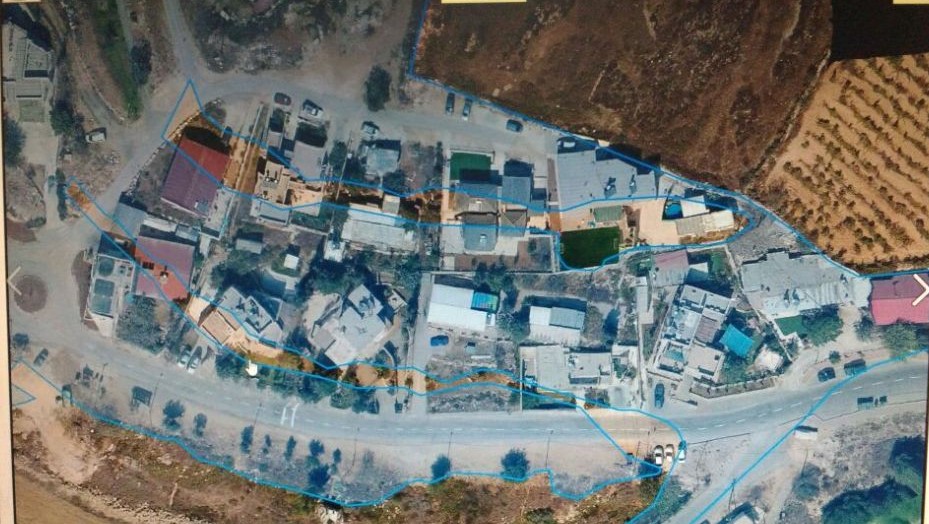
Map by Kerem Navot
The High Court of Justice has ordered the demolition of 15 structures located in the Netiv Ha’avot outpost, built on land recognized by Israel as privately owned by Palestinians. In response to a last minute petition the outpost’s leaders filed with the High Court of Justice, the Israeli government expressed its support for their proposal to save 6 of the buildings from complete demolition; instead, the proposal offers to demolish only the “problematic parts” of the structures – i.e., where they cross into the pockets of privately-owned Palestinian land that run through the middle of the outpost. The High Court is set to make a final ruling on the petition on September 13th.
It is worth pointing out that every structure in the Netiv Ha’avot outpost was built in violation of Israeli planning laws. The outpost is an unauthorized expansion of the Elazar settlement, located southwest of Bethlehem. Only the 15 buildings that were built on private Palestinian land face demolition; if Israel enforced its own planning laws, the entire outpost would be razed. Last month, the Attorney General ordered the Defense Ministry to create a special unit to enforce Israeli planning laws specifically in settlements and outposts (in conjunction with the passage of the Regulation law permitting legalization of most illegal settlement construction and land seizures).
Netanyahu’s Promise to Build 300 New Units in Beit El Moves Forward (With Trickery)

Map by Kerem Navot
Kerem Navot (aka, Naboth’s Vineyard – the organization founded by anti-settlement legend Dror Etkes) has a cheeky look at how Netanyahu’s promise to build new homes in the Beit El settlement by the end of this month is coming to fruition. According to the report, the settlement has conspired with the government to build a new Border Police base south of the settlement 0- based on alleged security needs of the settlers. And what about the existing Border Police station for the settlement? That’s where the new units will be built. Two birds with one stone: more settlement units for Beit El, plus more land taken for settlements, to accommodate the entirely unnecessary new police station.
The Beit El settlement was established in 1977, on land previously seized by Israel for military purposes. A second military seizure in 1979 enabled Beit El to expand. This method of establishing and expanding settlements has been repeatedly challenged in Israeli courts. The Israeli group Yesh Din led one such petition against Beit El, seeking to have the second seizure annulled; that petition was dismissed earlier this year. Yesh Din writes,
The State understood that it was impossible to legally defend the land theft that has been ongoing in Beit El for 40 years on land that was seized for arbitrary reasons, but it refrained, once again, from defending the rights of the weakest population, simply because they are Palestinians. Despite this, we at Yesh Din will continue to fight against the dispossession of Palestinians and the infringement of their rights.

Map by Haaretz
As a reminder, Beit El is the settlement that current U.S. Ambassador to Israel David Friedman personally donated to and fundraised for in his capacity as President of the American Friends of Beit El charity from 2011 until his appointment (he dedicated at least one building in the settlement which bears his name).
Beit El is also slated to have a security wall built between one side of the settlement and the al-Jalazoun Palestinian refugee camp.
Updates: Clashes Ensue in Sheikh Jarrah Following Eviction; Amona Site is Now a “Closed Military Zone”; More Demolitions in Silwan
- Last week, in the East Jerusalem neighborhood of Sheikh Jarrah, Palestinians participated in Friday prayers in front of the former home of the Shamasneh family, which was evicted last week by settlers. On the same day, 200 Israelis – including MK Ayman Odeh (Joint List) – marched from central Jerusalem to join the demonstration. Clashes broke out between settlers and the demonstrators, resulting in injury to 14 protestors.
- The illegal outpost of Amona was dismantled earlier this year, but the Kerem Navot organization has revealed that instead of being returned to the Palestinians who the court ruled were the rightful owners, the Israeli army has declared the area a “closed military zone” — keeping Palestinians off the land but permitting residents of the neighboring Ofra settlement to enter the area at will.
- Ma’an News has video of a home demolition in the Ras al-Amud, a Palestinian neighborhood just south of the Old City in Jerusalem. Ma’an also reports that Israel delivered several demolition orders to Palestinians in the Issawiya neighborhood of East Jerusalem earlier this week.
Bonus Reads
- “Red Cross Chief Blasts Settlements as ‘Key Humanitarian Challenge’” (Times of Israel)
- “We witness it daily in the West Bank and in East Jerusalem: [Israeli settlement] has enormous impact on people, on their freedom of movement, the social and economic fabric in the territories. It offers limited access to agricultural and other productive lands, has curtailed educational and employment opportunity; it makes water resource and water supply systems difficult for Palestinian communities. And the list could go on and on,” he [Red Cross Chief Peter Maurer] said.
- “Shin Bet Bypasses Court Again and Stiffens Release Terms of Teen Settler Activist” (Haaretz+)
- “Jerusalem Magistrate’s Court initially ordered him [a teen who is part of the extremist West Bank movement known as Hilltop Youth, had been detained without trial after violating a administrative order] released on the condition that he remain at home at night. But the Israel Defense Forces order requires him to be under house arrest 24 hours a day.”
- “In a First, Israel Will Penalize Amnesty International for Anti-Settlements Campaign.” (Haartez+)
- “Israel plans to punish Amnesty International for its recent campaign, which encourages people to lobby companies and governments to boycott settlement products, by denying tax benefits to Israelis who donate to the human rights organization. It is the first time the government will apply the so-called anti-boycott law, which penalizes organizations and individuals calling for a boycott of Israel or the settlements. The controversial law was passed in 2011.”
- “Reports Israeli government plans to retaliate against Amnesty International over settlements campaign” (Amnesty International)
- “Amnesty International has repeatedly emphasized that the very existence of Israeli settlements in the Occupied Palestinian Territories violates international law, a matter on which there is international consensus and is reflected in UN Security Council resolutions. Settlements have contributed to decades of mass suffering and violations in the Occupied Palestinian Territories.”
Welcome to FMEP’s Weekly Settlement Report, covering everything you need to know about Israeli settlement activity this week.
To receive this report via email, please click here.
August 16, 2017
- Israel Demolishes Buildings in Key East Jerusalem Areas
- Bedouin are Powerless in E-1 Area as Settlement Plans Loom
- Jewish National Fund Resumes Targeting Land in the Occupied West Bank
- Settlers in Israeli Government Turn Blind Eye to Settlers Breaking Israeli Law
- Former Israeli AG Says Sheikh Jarrah Property Should be Given to Palestinians
- Three New Outposts Near Nablus
- Updates: Al-Walajah, Sheikh Jarrah, Amichai Settlement
- Bonus Reads
Comments, questions, or suggestions? Email Kristin McCarthy at kmccarthy@fmep.org.
Israel Demolishes Buildings in Key East Jerusalem Areas
The Israeli government demolished eight Palestinian structures in the East Jerusalem neighborhoods of Silwan, Beit Hanina, Jabal Mukaber, and Isawiyyah. According to Ir Amim, the two apartments demolished in the al-Bustan area of Silwan are the first demolitions to be carried out there since 2008. Looking at East Jerusalem as a whole, Ir Amim writes, “[these] demolitions bring the 2017 total to 128, including 84 residential units and 44 non-residential units. These numbers are on well on target to meet or surpass the total number of 203 demolitions executed in East Jerusalem last year.”
Bedouin are Powerless in E-1 Area as Settlement Plans Loom
According to B’Tselem, last week Israeli officials confiscated solar panels that were providing electricity to a Bedouin community’s school in the controversial area adjacent to Jerusalem known as “E-1.” The confiscation happened despite a temporary court-ordered injunction against it. The Israeli government has long refused to connect the Bedouin to a power grid; the solar panels confiscated this week were donated only a month ago by a humanitarian organization.

Map by the Economist
The E-1 area has long been slated for Israeli settlement construction, but plans have been continuously delayed by the Israeli political echelon – due in large part to pressure from U.S. administrations and others in the international community. If E-1 is developed it will seal Palestinian East Jerusalem off from the West Bank to its east, and create a land bridge from Jerusalem to the Maale Adumim settlement. The settlement will render the two-state solution impossible because it would preclude the ability to draw contiguous borders for a future Palestinian state with a capital in East Jerusalem.
East Jerusalem expert Danny Seidemann has issued several warnings this year that E-1 – a “doomsday settlement” – might be slated for advancement under the current settlement policy of the Netanyahu government and with no discernable counter-pressure from the Trump Administration. Seidemann warned in January, “The main obstacle preventing a green light for E-1 has, until now, been wall-to-wall opposition from the international community, led by the United States (dating back to the era of President Clinton).”
The Bedouin community living in the E-1 area has long been threatened with forcible relocation (which would amount to population transfer). The 18 Bedouin tribes that live in the vicinity of Maale Adumim and E-1, totaling approximately 3,000 people, have already endured numerous emolitions this year alone.
Jewish National Fund Resumes Targeting Land in the Occupied West Bank
According to Peace Now, the Jewish National Fund (JNF) is set to resume its practice of purchasing land in the West Bank for use by Israeli settlers, after abandoning the effort many years ago. In the past, many of the JNF’s land purchases reportedly involved fraud, extortion, and/or forgery on the part of middlemen.
Peace Now writes, “Through purchasing lands in the occupied territories, JNF serves the settlers, hurts the possibility to arrive at a two state solution, and jeopardizes the future of Israel as a Jewish and democratic state.”
The JNF – which collects donations internationally, including in the United States – currently owns land (through its Israeli subsidiary) in numerous settlements, including Itamar, Alfei Menashe, Enav, Kedumim, Givat Ze’ev, Metzadot Yehuda, and Otniel.
Settlers in Israeli Government Turn Blind Eye to Settlers Breaking Israeli Law
There have been several recent reports about structures inside of settlements that were built (or are being built) without the legally-necessary permissions, as Israeli officials turn a blind eye.

Map of the Hayovel outpost by Times of Israel Red encircles site construction, arrow points to the house of Liberman’s settlement affairs advisor.
Notably, one report identifies dozens of unauthorized homes being built in the outpost of Hayovel (which is effectively an extension of the settlement of Eli), despite a stop-work order issued by Civil Administration (the arm of the Ministry of Defense that is sovereign in the West Bank). The construction is taking place virtually across the street from the home of Israeli Defense Minister Avigdor Liberman’s own adviser on settlement affairs, who is himself a resident of the illegal outpost (Liberman is also a settler, residing in the settlement of Nokdim). The illegal construction will double the size of the outpost.
Another report reveals that Shlomo Ne’eman, the head of the Gush Etzion Regional Council – which promotes the expansion of settlements in the Etzion bloc – lives in an illegal outpost. The Regional Council insists that the outpost is a “neighborhood” of the Karmei Tzur settlement, but aerial images show it is outside of the settlement’s municipal border. The Israeli Civil Administration has ordered the structures there to be demolished but has not carried out those orders. Settlement watchdog Kerem Naboth says, “Ne’eman has joined the list of elected officials and politicos among the settlers who are not only assisting others in stealing land, but are also doing it themselves.”
Haaretz notes that these two are part of a longer list of elected officials and senior civil servants living in illegal outposts, Also on that list far right-wing Knesset Member Bezalel Smotrich (Habayit Hayehudi), who lives in an illegally-built home in Kedumim (not coincidentally, Smotrich was one of the key backers of a law passed earlier this year to “legalize” such settlement illegalities). Likewise, a January report revealed that the head of the Finance Ministry’s department of building regulations enforcement, Avi Cohen, lives in an illegal outpost of the Eli settlement. At the time of the report in January, Rabbis for Human Rights said, “A situation in which the system responsible for enforcing building laws is headed by someone living in an outpost demonstrates contempt for the system and Israel’s values.”

Image by Kerem Naboth
Another report documents how in the Efrat settlement (in the Etzion settlement bloc) a school was recently expanded, illegally, on private Palestinian land located land outside of the settlement’s border. Funding for the project was raised by an organization, called the Ohr Torah Stone, which operates a branch in the United States and is eligible to receive tax-deductible donations from U.S. donors. According to settlement watchdog Kerem Naboth, the Efrat settlement itself was built on land that the Palestinian village of al-Khadr had long cultivated. Kerem Naboth reports, “aerial photographs from the 1980s indicate that in the past there was a vineyard on site.”
Former Israeli AG Says Sheikh Jarrah Property Should be Given to Palestinians
Speaking in Sheikh Jarrah, former Israeli Attorney General Michael Ben-Yair called on the Israeli government to intervene to stop the eviction of the Shamasneh family from their longtime family home. Ben- Yair served as the AG from 1993-1997, under prime ministers Rabin and Netanyahu.
Ben-Yair, whose family lived in Sheikh Jarrah until 1948, suggested he would be ready to reclaim his family’s property and then transfer it to the Palestinians currently living there – and called on the government to adopt a policy to do exactly that, across the board. He said, ”If the Israeli government would have acted decently toward all its residents, including you [the Arab residents], it would have appropriated the properties in the neighborhood [from their Jewish owners who lived there before the War of Independence] and given these properties to the Palestinians who live there today.”
The former AG also noted that Jews who lost property in the 1948 war were already compensated – at the expense of Palestinians. Ben-Yair said, “My family and the family of my cousin who were forced to leave the neighborhood in January 1948 got properties of Palestinians refugees on Jaffa Road and in the Katamon neighborhood in west Jerusalem. They were worth much more than the properties that we left in Sheikh Jarrah.
Since we covered the Shamasneh family’s story last week, a temporary injunction against the eviction expired on Sunday, August 13th. The family’s lawyer requested a second injunction, but the petition is still pending. As of this writing the family is still living in the home.
Three New Outposts Near Nablus
The Palestinian Authority is reporting that settlers from the radical Yitzhar settlement, south of Nablus, have moved 11 mobile homes to an area outside of the settlement, a move which would expand the settlement’s footprint. In addition, nine mobile homes were reportedly placed near the Palestinian village of Qusin, which is a few miles east of Nablus, and another nine were placed near the border of the Einav settlement, a few miles east of Qusin.
Updates: Al-Walajah, Sheikh Jarrah, Amichai Settlement
Updates from last week’s Settlement Report:
- Residents of the village of Al-Walajah were able to stop the demolition of one home last week by forming a human barrier around it, blocking a bulldozer from tearing it down. Approximately one third of the village is inside of Jerusalem’s municipal boundary. In this area specifically, Ir Amim estimates that 50% of the homes are under threat of demolition. Al-Walajah residents say the Israeli government has recently increased the rate of home demolitions significantly and has also resumed construction of the separation barrier around the village.
- UNRWA has weighed in on the pending eviction of the Shamasneh family from their home in Sheikh Jarrah. UNRWA spokesman Christopher Gunness states, “The members of the Shamasneh family are long-standing Palestine refugee residents in East Jerusalem, which is occupied territory and affected by continued settlement expansion contrary to international law. It is a matter of deep concern that Palestine refugees who have already endured multiple displacements should be subject to the humiliation of the kind inflicted by forced evictions.” The statement calls on the Israeli government to reconsider the eviction ruling.
- Construction on the first new settlement in 25 years, Amichai, remains stalled due to lack of government funding. After nearly three weeks of inactivity on the construction site, the families who the settlement is being built for are preparing to move to the area with semi-permanent structures and take up residence. On plans to move to the site while construction is stalled, one settler told Ynet News, “It is clear that when we do go there [to the site of Amichai], thousands of youths will join us. When we do, it will be to stay for good.”
Bonus Reads
- “Adalah opposes mandate of Israeli Interior Ministry borders cmte. weighing annexation of West Bank land to settlements” (August 13, 2017)
FMEP has long been a trusted resource on settlement-related issues, reflecting both the excellent work of our grantees on the ground and our own in-house expertise. FMEP’s focus on settlements derives from our commitment to achieving lasting Israeli-Palestinian peace, and our recognition of the fact that Israeli settlements – established for the explicit purpose of dispossessing Palestinians in the West Bank and East Jerusalem of land and resources, and depriving them of the very possibility of self-determination in their own state with borders based on the 1967 lines – are antithetical to that goal.
Welcome to FMEP’s Weekly Settlement Report, covering everything you need to know about Israeli settlement activity this week.
To receive this report via email, please click here.
August 9, 2017
- Israel Moves Forward with Inflammatory Evictions & Home Demolitions in Jerusalem
- Netanyahu Celebrates Expansion of Beitar Illit Settlement
- Attorney General Requests Temporary Injunction Against “Regulation Law”
- Palestinian Leaders Criticize U.S. Peace Efforts & Point to Silence on Settlements
- New Poll Reveals Settlers Prefer the Status Quo to Annexation or Peace
- Updates: Machpelah House; New “Amichai” Settlement; Netiv Ha’avot Outpost
- Bonus Reads
Comments, questions, or suggestions? Email Kristin McCarthy at kmccarthy@fmep.org.
Israel Moves Forward with Evictions & Home Demolitions in Jerusalem
Last week we covered three devastating bills moving in the Knesset that seeking to remove Palestinians and include far flung settlements in the borders of Jerusalem. Now, several seemingly small but incredibly significant developments in Jerusalem show how Palestinians are already being forced out of the city:
-
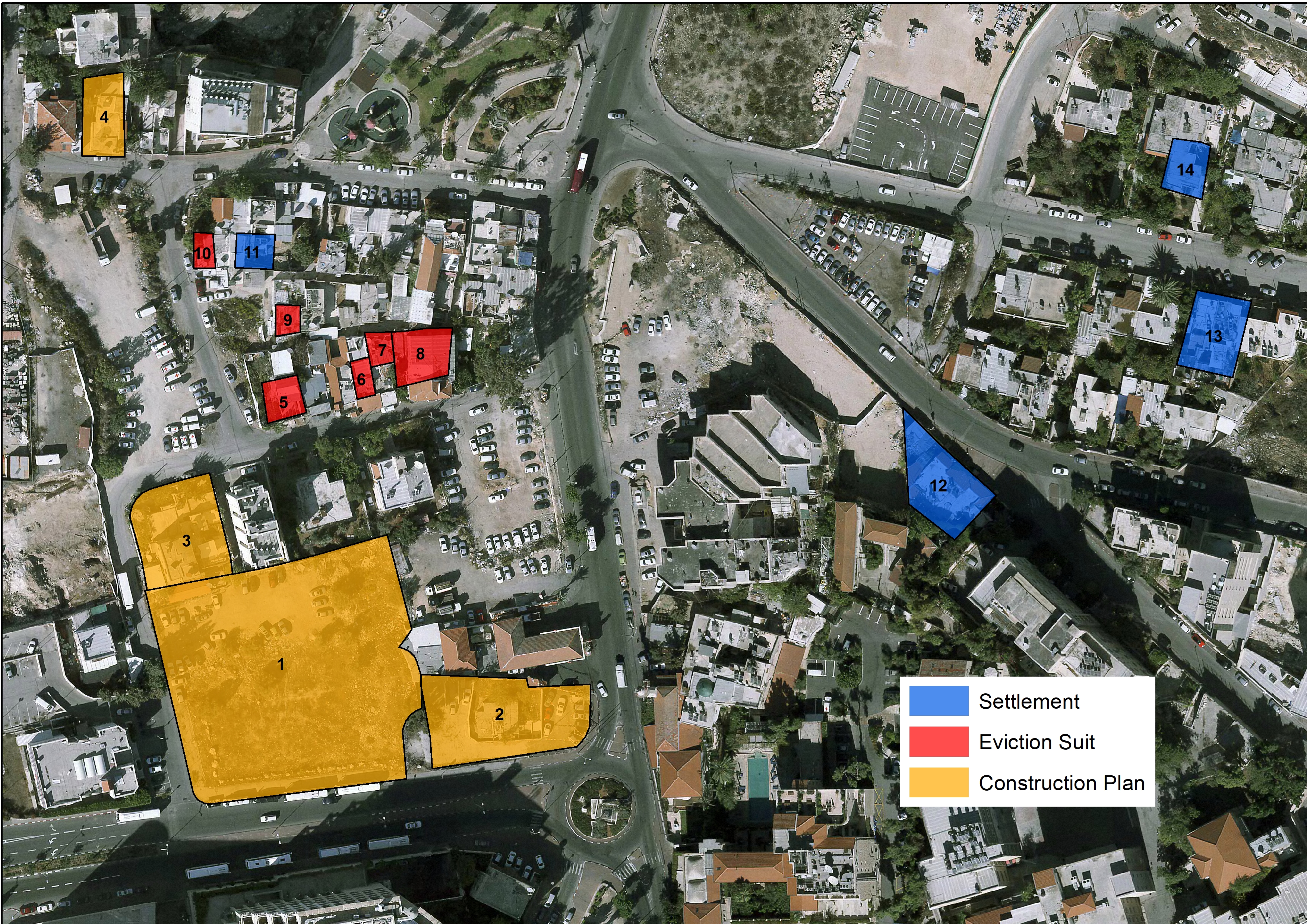
Map by Peace Now
In Sheikh Jarrah, a Palestinian family is fighting against imminent eviction from their family home of 50 years, an eviction ordered by the Israeli Supreme Court. This is the first eviction in the Sheikh Jarrah neighborhood of Jerusalem since 2009 and comes on the heels of several inflammatory settlement announcements which will bring more Israeli settlers into the neighborhood that sits just north of Jerusalem’s Old City. The Court’s decision to evict the Shamasneh family relies on an Israeli law which allows Jews to regain East Jerusalem property owned before Jordan’s 1948 capture of that part of the city. Daily solidarity protests are reportedly being staged in an effort to prevent the family’s eviction.
-

Map by Emek Shaveh
In Silwan, the settler group Elad is bidding to become the majority-owner of an apartment building that Palestinians are in a bidding war to keep. The Siyam family originally owned the entire building but over time lost control of one-half of it to the settlers another one-fourth of it to Israel’s Custodian of Absentee Property. The owners of the remaining one-fourth – Silwan non-violent opposition leader Jawad Siyam and his sister – currently reside. Now the Custodian is auctioning off its one-fourth share and if the settlers have the winning bid, it is a near certainty that Jawad and his sister will be evicted from the house by Israeli courts. This ownership battle could have a decisive impact on the character of this critically-located East Jerusalem neighborhood, which sits in the shadow of the Temple Mount/Haram al-Sharif. Elad has long been active in Silwan, taking over properties and, working hand-in-hand with the Israeli government and Jerusalem Municipality, gaining control over the public domain via tourism and park projects at the expense of the Palestinian residents. Elad recently won the rights to build a state of the art visitor center that will also be a stop on the new cable car line running to the Mount of Olives. Elad’s efforts to take over Palestinian property in East Jerusalem rely in large part on Israel’s “Absentee Property Law” (1950), according to which Palestinians who were not present at their property immediately following the 1967 war are considered “absentee,” and consequently forfeit ownership rights to the Israeli government. The government can then dispose of the property as it sees fit. In Jerusalem, Elad’s multi-million dollar annual budget puts Palestinians at a potentially insurmountable disadvantage. When Israel used the “Absentee Property Law” in 2004 to seize Palestinian property in East Jerusalem, then-President George W. Bush called on Israel to reconsider the decision.
- In al-Walajah, a wave of home demolitions combined with the nearly completed construction of the separation barrier threatens to completely sever and displace al-Walajah’s residents from the West Bank (who hold West Bank IDs, rather than Jerusalem residency, despite the fact that in 1967 most of the village’s land was made part of Jerusalem). Just this week the Israeli government issued demolition orders against 14 Palestinian homes built without the proper permits (these permits are nearly impossible for obtain).
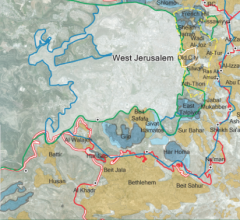
Map by Ir Amim
The 14 homes are in addition to 28 other homes already slated for demolition in the village. On the same day, the Israeli Supreme Court decided to temporarily delay the implementation of 7 of those previous orders in light of a petition brought to the court by the Norwegian Refugee Council. Residents of al-Walajah have fought the growing encroachment the nearby Etzion settlement bloc and the Israeli government’s attempt to de facto annex the bloc as part of “Greater Jerusalem.” Ir Amim explains several prongs of this effort, including a particularly unbelievably section of the separation barrier planned to almost completely encircle the village, to turn its valuable agricultural land into an urban park for Jerusalem, and construction of a highway that will connect the Etzion settlement bloc to Jerusalem with Israeli-only bypass roads.
- In Jabal al-Mukaber, a neighborhood south of the Old City in East Jerusalem, Israel demolished four Palestinian homes without prior notice to the residents. Ma’an News reports, “Israeli authorities have stepped up issuing demolition warrants for Palestinians in East Jerusalem in recent months, particularly after Jerusalem Mayor Nir Barakat threatened that the demolition of the illegal Israeli outpost of Amona in the occupied West Bank would be met with the mass demolition of Palestinian homes lacking the nearly impossible to obtain Israeli-issued building permits.”

Netanyahu Celebrates Expansion of Beitar Illit Settlement
Prime Minister Netanyahu attended a cornerstone-laying ceremony for hundreds of new homes set to be built in the Beitar Illit settlement, a massive, fast-growing, ultra-Orthodox settlement in the Etzion bloc. At the ceremony, Netanyahu proudly repeated his assertion that, “There is no government that does more for the settlement [movement] in Israel than the one under my leadership.” The project will annex a third strategic hilltop to the Beitar Illit, which like much of the Etzion bloc is located on the Israeli side of the separation barrier.
The same day Netanyahu visited Beitar Illit, several right-wing Knesset members traveled to the northern part of the West Bank to call on the Prime Minister to re-establish four Israeli settlements located near the West Bank city of Jenin, that were dismantled in 2005 of part of Ariel Sharon’s disengagement from Gaza. A bill has been introduced in the Knesset that would rescind the 2005 disengagement memo which led to the evacuation of the four settlements.
Attorney General Requests Temporary Injunction Against “Regulation Law”
On August 7th, Israeli Attorney General Avichai Mandelblit weighed in on a petition filed with the Israeli Supreme Court challenging the legality of the “Regulation Law,” which was passed this year and provides a legal basis for retroactive legalization of outposts and other settlement activity in the West Bank on land owned by Palestinians. Mandelblit – who argued against passage of the Regulation Law late last year and after the law’s passage and said he would not defend it in court – asked the High Court to put a temporary injunction against the law until the Court issues its ruling. The injunction would prevent the Civil Administration (the arm of the IDF that rules over the West Bank) from using the law, and possibly from even taking the preliminary steps towards using the law, in order to retroactively legalize outposts and unauthorized settlement activity.
The petition against the Regulation Law (also called the “Expropriation Law,” the “Regularization Law,” the “Legalization Law,” or the “Settlements Law”) was filed in March by three leading Israeli settlement watchdogs: Yesh Din, Peace Now, and ACRI.
Palestinian Leaders Criticize U.S. Peace Efforts & Point to Silence on Settlements
The Palestinian outlook on President Trump’s negotiation efforts has grown outright grim this week. Any initial optimism has been replaced with a sense of abandonment on the part of Mahmoud Abbas’s Palestinian Authority and the topic of unfettered settlement growth has been a recurring talking point. On August 7th in Ramallah, Jordan’s King Abdullah and the Palestinian Authority jointly called for the U.S. to unequivocally state its support for a two-state solution and reiterated that a complete settlement freeze remains a precondition for the resumption of negotiations, including in East Jerusalem. That statement should dispel any lingering questions regarding reports in June that the PA was willing to drop a settlement freeze as a precondition to peace talks.
The new statement comes after a week of terse, unscripted criticism by the Palestinians aimed at President Trump. A top Abbas advisor, Dr. Nabil Sha’ath, told Haaretz that that Palestinians no longer look to the U.S. to be helpful on the issue. Sha’ath said, “Palestinian efforts in the near term will be focused on the international arena in an effort to prevent accelerated settlement construction or the passing of laws that have direct consequences for the peace process.”
In an interview with Jewish Insider last week, top Palestinian negotiator Saeb Erekat did not mince words about his disappointment with the Trump administration’s earlier attempts to get the ball moving on Israeli-Palestinian negotiations. Of note, Erekat laments, “Israel announces thousands of new settlement units that make it almost impossible to achieve the two-state solution, and it’s merely met with silence from U.S. officials.” Erekat is not entirely correct about the U.S.’s silence. The U.S. Department of State has repeatedly issued the same ambiguous statement regarding Israeli settlement policy, that “unrestrained settlement activity is not helpful to the peace process.” The statement echoes President Trump’s remarks in February calling for Israel to “hold back a little” on settlements.
In a third report, an anonymous Palestinian official took aim at Jared Kushner and Jason Greenblatt, Trump’s senior-most envoys dealing with Israel and the Palestinians. The source said, “It’s not a nice thing to say, but they are both ardent supporters of the settlements.They are completely unfamiliar with the other side, they don’t understand the region and they don’t understand the material. You can’t learn about what is happening here in a seminar lasting just a few weeks.” The remarks came one day before the release of a recording of Jared Kushner revealed his thinking on the topic of Israeli-Palestinian issues during which he expressed a lack of interest in history lessons on the topic.
New Poll Reveals Settler Prefer the Status Quo to Annexation or Peace
A new poll reveals remarkable differences between Israeli Jews living within the borders of sovereign Israel and those living in settlements. It sheds light on who in Israel is benefitting from the current “status quo” (which was undefined in the poll’s questions to respondents):
Of Israeli settlers:
- 35% called for the continuation of the status quo
- 24% want Israel to annex the West Bank
- 15% want to see a peace agreement
- 10% back a decisive war against the Palestinians
Of Israeli Jews living in Israel:
- 18% called for the continuation of the status quo
- 9% want Israel to annex the West Bank
- 45% support a peace agreement
- 12% back a decisive war against the Palestinians
The poll also examined the views of Palestinian citizens of Israel and Palestinians in the West Bank and East Jerusalem.
Updates: Machpelah House; New “Amichai” Settlement; Netiv Ha’avot Outpost
Several important updates to last week’s settlement report:
- In Hebron, settlers continue to illegally occupy the Machpelah House under the protection of the Israeli army, despite a new petition seeking their evacuation filed this week by Palestinians who claim to own the house. Last week, the head of the “Samaria Regional Council” Yossi Dagan, moved into the house along with his wife and three children. Approximately 120 Israeli settlers were already living there, having illegally broken into into the house last week in a bid to circumvent legal proceedings regarding rightful ownership. The IDF quickly declared the house a closed military zone, but the order has not been enforced, which is the only reason why Dagan and his family were able to enter the building. Yossi Dagan was elected head of the Samaria Regional Council in 2015. He opened a campaign office for Donald Trump during the 2016 U.S. Presidential election and published an open letter to Steve Bannon expressing his admiration and support for the newly elected U.S. administration.
- Netanyahu’s cabinet gave a major boost to the stalled construction of a new settlement called Amichai by reportedly doubling the size of the government’s financial contribution to the project. Last week, after it was reported that construction has been halted due to lack of funds, Netanyahu quickly issued assurances that the problem will be fixed. The new Amichai settlement – the first to be approved by the government since 1991 – is being built in the Shilo Valley, deep inside of the West Bank, as the payoff for families who built the illegal Amona outpost and were evacuated earlier this year. Immediately next to the Amichai construction site, at the site of the future Shvut Rachel East settlement (which was the original plan to pay-off the Amona evacuees but was rejected because it wasn’t the preferred hilltop — but was nonetheless approved for construction by the Israeli government as a neighborhood of the Shilo settlement) several caravans have been moved onto the recently leveled land in preparation for further construction.
- In two separate meetings last week, settler leaders met with PM Netanyahu and his chief of staff in their bid to cajole the Prime Minister into intervening against a demolition order threatening 15 homes in the Netiv Ha’avot outpost near Bethlehem. Commenting on the issue while at a ceremony in the Beitar Illit settlement, Netanyahu committed to helping the affected families “within the framework of the law that would minimize the damage.” It’s not clear if the Prime Minister was referring to the past damage caused to the Palestinians who own the land upon which settlers built illegally, or the future damage it will cause to relocate the families who live in illegally built homes.
Bonus Reads
- Who Profits Flash Report: “Tracking Annexation: The Jerusalem Light Rail and the Israeli Occupation” (July 2017)
- “The Young Palestinian Men of East Jerusalem Have Nothing to Lose” (August 3, 2017 | Haaretz+)
- Human Rights Watch: “Jerusalem Palestinians Stripped of Status” (August 8, 2017)
- “Demographic hysteria leaves Jerusalemites by the wayside” (August 7, 2017 | +972 Mag)
FMEP has long been a trusted resource on settlement-related issues, reflecting both the excellent work of our grantees on the ground and our own in-house expertise. FMEP’s focus on settlements derives from our commitment to achieving lasting Israeli-Palestinian peace, and our recognition of the fact that Israeli settlements – established for the explicit purpose of dispossessing Palestinians in the West Bank and East Jerusalem of land and resources, and depriving them of the very possibility of self-determination in their own state with borders based on the 1967 lines – are antithetical to that goal.
Welcome to FMEP’s Weekly Settlement Report, covering everything you need to know about Israeli settlement activity this week.
To receive this report via email, please click here.
July 21, 2017
- In Jerusalem’s North: The “Adam-Neve Ya’akov” Plan Resurfaces
- In Jerusalem’s South: The “Gilo Southeast” Plan Expected to Advance
- In the Shadow of Jerusalem’s Old City: Settler-Run Visitor Center is Approved
- In the Heart of East Jerusalem: Alarming Plans Advance As Expected
- U.S. Department of State: Settlements & Settlers Provoke Violence
- Settlement Outpost Near Bethlehem is Angling to Avoid Demolition
- Court Wants Settlers/Palestinians to “Negotiate” Land Theft Ex-Post Facto
- Bonus Reads
Comments, questions, or suggestions? Email Kristin McCarthy at kmccarthy@fmep.org
In Jerusalem’s North: The “Adam-Neve Ya’akov” Plan Resurfaces
The Israeli Construction & Housing Ministry announced impending plans for a 1,100 unit housing project to Jerusalem’s immediate northeast.
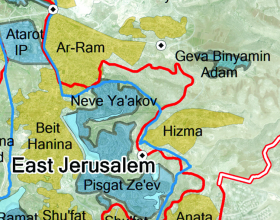
Map by Ir Amim
The plan aims to connect large settlements in East Jerusalem (Neveh Ya’akov and Pisgat Zeev) with an isolated settlement in the West Bank (Adam, aka Geva Binyamin). The land identified for the project is within the municipal boundaries of Adam, but on the Israeli side of the separation barrier (the route of the separation barrier in this area cuts deep into the West Bank). If implemented, the Adam settlement would have built up areas on both sides of the barrier.
Israeli Housing Minister Yoav Galant’s office issued a statement explaining, “We will be everywhere that it is possible to build and to provide solutions to the housing shortage, particularly, as in the case of Adam, in the vicinity of Jerusalem. In Greater Jerusalem, there is also particular security importance in Israeli [territorial] contiguity from the Gush Etzion Bloc in the south to Atarot in the north, and from Ma’aleh Adumim in the east to Givat Ze’ev in the west.”
Ir Amim writes that the plan would, “further fracture a future Palestinian state by… breaking contiguity from north to south… while isolating the southern perimeter of Ramallah from East Jerusalem, the future capital of the Palestinian state. Advancing a project of this size, given its extreme geo-political ramifications, would have a fatal impact on the two-state solution.”
The same plan was developed in the early 2000s and explored in 2007 and again in 2008, but shelved because of its political sensitivity and international concern for the future of Jerusalem and the prospects for a two-state solution. Jerusalem expert Daniel Seidemann of Terrestrial Jerusalem writes, “What is different now than in the past is talk of the plan comes in the context of an opening of the settlement floodgates in East Jerusalem, including green lights and expediting of plans the implementation of which, for any number of reasons, in the past was far-fetched or even inconceivable. Consequently, it is important to flag this scheme as early as possible, and to monitor in vigilantly.”
In Jerusalem’s South: The “Gilo Southeast” Plan Expected to Advance
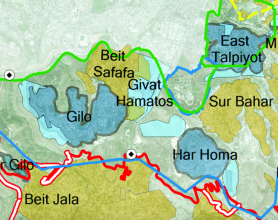
Map by Ir Amim
The Israeli government is set to advance a plan to expand the borders of the Gilo settlement (between Jerusalem and Bethlehem) in order to build 3,000 new units. This plan, called “Gilo Southeast,” is expected to be considered at a meeting on July 26th.
If implemented, Gilo Southeast would further surround the Palestinian city of Beit Safafa, severing the town from the West Bank. An area of intense Israeli settlement infrastructure growth (a settler-only freeway divides the community, and the area has been the focus of demolitions of Palestinian homes), Beit Safafa’s Palestinian residents describe a life under siege.
Gilo Southeast is just one of several alarming plans threatening to sever Palestinian contiguity between East Jerusalem and the southern West Bank:
- Gilo Southeast would abut the border of the Givat Hamatos doomsday plan, which is only waiting for the publication of tenders to begin construction. The Givat Hamatos plan has remained blocked under the previous political calculations, but can be tendered at any moment.
- The plan would also connect Gilo to Har Homa, a fast growing settlement that was built with the Netanyahu’s approval in 1997 – the last official settlement to be built until the recent approval of the Amichai settlement.
Ir Amim writes that Gilo Southeast would create “one more link in a chain of developments designed to seal off the southern perimeter of Jerusalem from the West Bank, nullifying prospects for a two state solution.”
In the Shadow of Jerusalem’s Old City: Settler-Run Visitor Center is Approved

Map by Emek Shaveh
Last week the controversial Visitor’s Center in the Palestinian neighborhood of Silwan (known to Israelis as the “City of David” and located just outside the walls of Jerusalem’s Old City in the shadow of the Temple Mount/Haram al-Sharif) took another important step forward in the final stages of the planning process. According to the Israeli NGO Emek Shaveh, the plan “awaits final approval by the Israel Antiquities Authority, which will only be granted once the archaeological excavations at the site are completed. In our assessment this should happen soon.”
Known as the “Kedem Center,” the building is being financed and promoted by the settler-run Elad Foundation, whose goal is to establish Jewish hegemony over all of Jerusalem (i.e. erase all Palestinian presence, history, and any visibility in the city). The Center will be the largest, state-of-the-art tourism center in Jerusalem and will also serve as a station for the new cable car line approved this year, a cable car line that is designed to facilitate tourists visits to Jewish sites in East Jerusalem while preventing tourists from encountering Palestinians.
Emek Shaveh issued a statement saying, “this project will change the landscape in the area between the Old City and the village of Silwan, and will have a considerable impact on the identity of the Historic Basin. The purpose of the Kedem Center is first and foremost political – to Judaize Silwan and prevent a political solution for Jerusalem.”
The Jerusalem Post reports the Kedem Center plan was approved by Prime Minister Netanyahu as a defiant gesture following UNESCO’s decision to designate sites in Hebron as World Heritage Sites, which Netanyahu incorrectly says deny Jewish history.
In the Heart of East Jerusalem: Plans Advance as Expected
In addition to the north, south, and center settlements plans detailed above, previously reported settlement plans targeting East Jerusalem were all approved for deposit for public review at a government meeting last week. We reported extensively on these in our last edition, here. The plans approved for deposit for public review include the incendiary plans in the Palestinian East Jerusalem neighborhood of Sheikh Jarrah, and more.
Though the plans were all approved for deposit for public review, as of this writing none have been deposited (yet). Like almost every step in the Israeli settlement planning process, actually depositing the plans for public comment is itself a political decision.
U.S. Department of State: Settlements & Settlers Provoke Violence
In the recently released 2016 Country Reports on Terrorism, Secretary Tillerson’s State Department writes, “Continued drivers of violence included a lack of hope in achieving Palestinian statehood, Israeli settlement construction in the West Bank, settler violence against Palestinians in the West Bank, the perception that the Israeli government was changing the status quo on the Haram Al Sharif/Temple Mount, and IDF tactics that the Palestinians considered overly aggressive.” [emphasis added]
Notably, the 2015 Country Reports on Terrorism (an Obama Administration document) did not focus on the role of settlements or identify settlements/settlers as a “driver of violence.” The 2015 document simply noted a handful of terrorist incidents, including the trend of “price-tag attacks,” committed by settlers and committed by Palestinians near settlements.
Settlement Outpost Near Bethlehem is Angling to Avoid Demolition
A settlement outpost near Bethlehem – built illegally even under Israeli law – is fighting a decision by the Israeli Supreme Court to demolish 17 buildings that were found to have been built on land owned by Palestinians. A 2016 decision ruled that buildings in the center of the outpost sit partially on Palestinian land and must be demolished by March 2018. The NGO Yesh Din has an additional, broader petition before the High Court that seeks to prove that the whole outpost is on Palestinian land.

Map by Peace Now
The Netiv Ha’avot outpost was built in 2001 as an additional “neighborhood” of the Elazar settlement southwest of Bethlehem, but was in fact built on a hilltop near the outskirts of the settlement, on land located beyond the settlement’s borders. Forty Israeli settler families currently live there, 15 of which will be affected by the demolition orders.
The outposts’ residents are aggressively pressuring Prime Minister Netanyahu to intervene in their favor (Netanyahu has already caved to vociferous settler protests several times this year). At a demonstration in support of the outpost, signs read “This destruction too is on your watch” (referring to the Amona evacuation) and “Bibi wake up and intervene.”
Court Wants Settlers/Palestinians to “Negotiate” Land Theft Ex-Post Facto
The Israeli Supreme Court made an unusual move to try to avoid having to return private land to Palestinians. The ruling pertains to a case in the Jordan Valley, where the Israeli military seized Palestinian private land for military uses, and subsequently (and improperly, according to Israeli law) gave the land to settlers. Rather than compel the settlers to return the stolen land to its owners, the court wants the Palestinians to negotiate with the settlers for compensation. The court’s move – which is in response to a 2013 petition – is an attempt to resolve the issue without having to rule on the validity of the land seizure, and without having to compel Israel to forfeit the land and evict the settlers (even if doing so requires suspending even the pretense of the rule of law).
Haaretz explains how we got here, “After the Israeli occupation of the West Bank began in 1967, the army issued an order prohibiting Palestinians from entering the area between the border fence and the Jordan River. At the beginning of the ‘80s, the government decided to encourage farmers to work the fields to create a buffer zone with Jordan. The World Zionist Organization was given the land and leased it to settlers.”
- “In Israel’s ‘eternal capital’ anti-Palestinian discrimination is built-in” (July 16, 2017; +972 Mag)
- “Black is the New Orange: 30% of Settlers are Haredim” (July 18, 2017; Times of Israel)
- “Why Adelson is Pouring Millions of Dollars Into an Army-run Israeli University in the West Bank” (July 19, 2017; Haaretz+)
- “The Biggest Attack in Jerusalem” (July 18, 2017; Haaretz+)
- REPORT: “Insurance against political risk: Settlements and the Yanai governmental insurance corporation” (Akevot, July 21, 2017)
Overview: “Archival records, now declassified at Akevot’s request, tell the story of the financial safety net Israeli government provided for commercial companies and settlement agencies beyond the Green Line. Referred to as a “political guarantee” or “political insurance”, it protected settlers and investors in the occupied territories against such “political risks” as Israel’s evacuation from the occupied territories, policy changes or boycotts. As use of the government guarantees gradually expanded, a government insurance corporation was created, to sell insurance policies against these political risks. This is the story of the political guarantee in the occupied territories and the Yanai insurance corporation.”
FMEP has long been a trusted resource on settlement-related issues, reflecting both the excellent work of our grantees on the ground and our own in-house expertise. FMEP’s focus on settlements derives from our commitment to achieving lasting Israeli-Palestinian peace, and our recognition of the fact that Israeli settlements – established for the explicit purpose of dispossessing Palestinians in the West Bank and East Jerusalem of land and resources, and depriving them of the very possibility of self-determination in their own state with borders based on the 1967 lines – are antithetical to that goal.