Welcome to FMEP’s Weekly Settlement Report, covering everything you need to know about Israeli settlement activity this week.
To subscribe to this report, please click here.
March 18, 2022
- Court Delays Decision on Mass Expulsion in Massafer Yatta
- Settlers Construct New Outpost on World Heritage Site in Battir
- Ma’aleh Adumim to Challenge Government of Delay of E-1 Settlement Construction
- This Week in Settler Terrorism
- U.S. Ambassador Has Harsh Words for Settlements, But Admits Some Construction Will Proceed
- Further Reading
Court Delays Decision on Mass Expulsion in Massafer Yatta
On March 15th, the Israeli High Court held what was expected to be a decisive hearing regarding the fate of eight Palestinian communities facing expulsion — at the hands of the Israeli State — from a large area in the South Hebron Hills known as Massafer Yatta. This is an area that Israel declared to be a closed “firing zone” in the 1980s (known as Firing Zone 918).
At the conclusion of this week’s hearing the Court did not issue its final ruling, but indicated it will convene another hearing in the coming months at which time it will issue its ruling. If given the green light, the forced expulsion in Massafer Yatta would constitute the largest displacement of Palestinians by Israel in decades — displacement that would be entirely illegal under international law.
This week’s court proceedings were live tweeted by the Israeli human rights group Breaking the Silence, and also covered by Palestinian journalist and activist Basel al-Adraa, who lives in Massafer Yatta. Adraa noted that it is “extremely likely” that the Israeli High Court will rule in favor of the State, and in so doing provide a green light (and legal cover, as far as the Israeli legal system is concerned) to the State’s plans to forcibly relocate some 1,300 people from the their homes and destroy their villages and their unique way of life. The State has maintained its argument that the firing zone is essential to state security, specifically for military training exercises because the terrain resembles Lebanon.
+972 Magazine, in a helpful explainer on this topic, explained why this effort to establish a pretense of legality for Israel’s actions against Palestinians in the South Hebron Hills flies in the face of international law and Israel’s obligations under treaties it has signed, writing:
“According to international law, and as detailed in treaties to which Israel is party, it is illegal to use occupied territory for a purpose that serves only the occupier and not the occupied population. In addition, international law prohibits the forcible transfer of the occupied population. The state has further claimed that one reason it needs the land in Masafer Yatta is to train soldiers for a possible war in Lebanon. But here, international law stipulates that such military use of occupied land can only be for the direct management or security needs of the occupied territory itself, making Israel’s declared purpose regarding Lebanon also illegal.”
A lawyer representing the eight communities under threat, Shlomo Lecker of the Association for Civil Rights in Israel, told Reuters:
“This case is not about a firing zone, it is about taking control of land because unlike other areas, most of this land is privately owned,” said Shlomo Lecker who, along with the Association for Civil Rights in Israel, is representing 200 of the Palestinian families under threat of displacement. In effect this is land expropriation without compensation.”
Basel al-Adraa wrote for +972 Magazine:
“Our expulsion from Masafer Yatta has never ceased over the last two decades. Lacking the ability to expel everyone at once, like in 1999, the army has tried to slowly dispossess us. To immiserate us until we leave. Every year, I have watched as Israeli soldiers seal our wells, cut water lines, and destroy the roads that connect our villages. The dangerous road conditions here are a constant reminder of a racist reality governed by an army that denies us our ability to live on our land legally. Even our vehicles are confiscated by soldiers when they feel like it. Our lives have become nearly impossible. We want to build families and homes, but know the army will destroy those as well.”
Settlers Construct New Outpost on World Heritage Site in Battir
In the early morning hours of March 14th, a group of settlers accompanied by Israeli soldiers set up a new outpost on a piece of land in the Palestinian village of Battir, located near Bethlehem, on land that is registered UNESCO world heritage site. Settlers reportedly moved in two caravans, a large tent, and sheep – suggesting an intent to establish a so-called agricultural outpost. The sheep pen was reportedly removed from the area on the same day it was brought in.
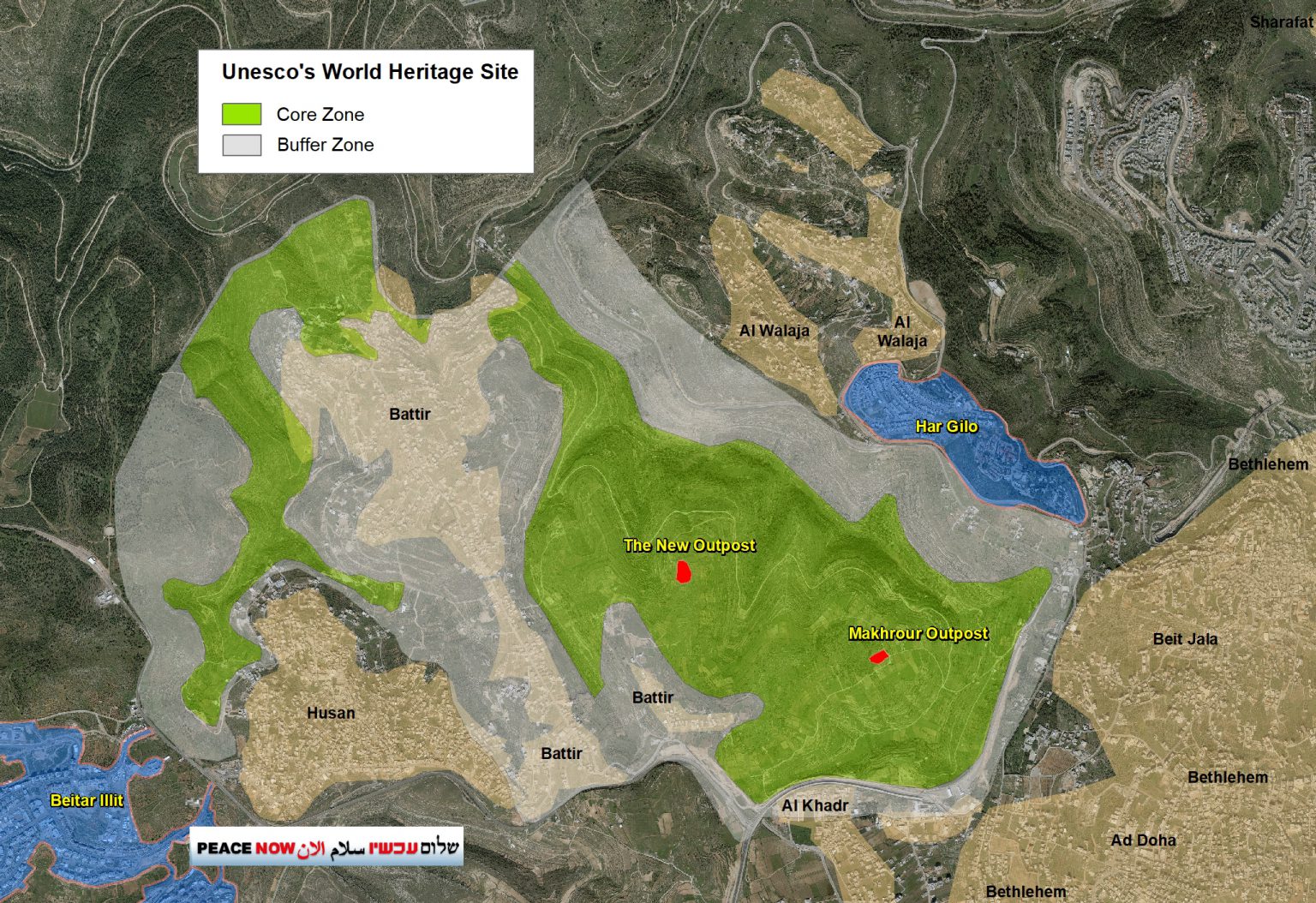 Since the outpost was set up, Middle East Eye reports that Israeli soldiers have been continuously patrolling the area to prevent any Palestinians from approaching the site – and attacking those who attempt to protest the new outpost. This is the fourth time settlers have attempted to establish an outpost in the area of Battir.
An local activist from Battir, Hassan Muamer, explained the settlers strategy:
“The settlers want to connect these two outposts [the new outpost and an outpost established in 2019 in the nearby Al-Makhrour Valley] together, and confiscate hundreds of acres of land in the process..This is all part of their plan, to shorten the distance between the two outposts, confiscate more land, and eventually connect these outposts to the settlements of Har Gilo, Gilo, and Gush Etzion, creating a massive settlement bloc that extends from Jerusalem, through Bethlehem, all the way to Hebron.”
Peace Now said in a statement:
“It is no coincidence that this illegal outpost is established while most of the public’s attention is drawn towards the war in Ukraine. The current government has already failed several times in stopping a handful of settlers in Eviatar, Homesh, and other places and has refrained from evicting illegal outposts immediately upon their establishment. The government must not fail this time, so the outpost will not be established.”
Ma’aleh Adumim to Challenge Government of Delay of E-1 Settlement Construction
The Jerusalem Post reports that the settlement council of Ma’aleh Adumim is preparing to submit an appeal against the State of Israel for delaying construction of the E-1 settlement, contending that Prime Minister Bennett and Defense Minister Gantz lack the authority to freeze the plans at this stage. The petition will be submitted to the Jerusalem Local Court, according to the report.
As a reminder, the E-1 settlement plan remains on the precipice of construction. In January 2022, the Bennett government intervened to stop a key hearing on the project. At the time, reports suggested that the political echelon had put on “indefinite hold” on the plan, largely due to U.S. pressure. U.S. Ambassador to Israel Thomas Nides seemed to confirm that U.S. pressure was exerted at that time to stop E-1 from moving forward, telling Peace Now recently:
“I went full board [sic] on E1… It is a very important area which if [built] could cut off any possibility of a capital for the Palestinians.”
Also as a reminder: in its current form, the E-1 plan provides for the construction of 3,412 new settlement units on a site located northeast of Jerusalem. The site is home to several Palestinian bedouin communities, including Khan al-Ahmar, which Israel has already undertaken to forcibly displace (many attempts). Long called a “doomsday” settlement by supporters of a two-state solution, construction of the E-1 settlement would sever East Jerusalem from its West Bank hinterland, preventing East Jerusalem from ever functioning as a viable Palestinian capital. It would also cut the West Bank effectively in half, isolating the northern West Bank from the southern West Bank and foreclosing the possibility of the establishment of a Palestinian state with territorial contiguity.
Israel’s “answer” to the latter criticism has long been to argue that Palestinians don’t need territorial contiguity, and that new roads can instead provide “transportational continuity.” To this end, Israel has already built the so-called “Sovereignty Road” – a sealed road that enables Palestinians to pass through, but not to enter, the E-1 area. That road is wholly under Israel’s control (meaning Israel can cut off Palestinian passage through it at any time). In January 2021, then-Prime Minister Netanyahu promised to increase funding for the “Sovereignty Road” as part of the drive to get E-1 built.
And another reminder: there have been attempts to promote the E-1 plan since the early 1990s, but due to wall-to-wall international opposition, the plan was not advanced until 2012, when Netaynuahu ordered it to be approved for deposit for public review (a key step in the approval process), ostensibly as payback for the Palestinians seeking recognition at the United Nations. Following an outcry from the international community, the plan again went into a sort of dormancy, only to be put back on the agenda by Netanyahu in February 2020, when he was facing his third round of elections in the two years.
Also, as a reminder: under the Trump Plan (which the Biden Administration has yet to comment on), the area where E-1 is located is slated to become part of Israel.
This Week in Settler Terrorism
On March 14th, an Israeli-licensed car drove into an IDF checkpoint, in an apparent attack, near the illegal Homesh outpost, lightly injuring two Israeli soldiers. It’s unclear what happened next, as the IDF has not said if the perpetrator – who is thought to be an Israeli settler, given the license plate on the car – was arrested. What is clear is that the IDF did not respond with lethal force, as is almost always the case when Israeli soldiers perceive themselves to be under attack by a car driven by a Palestinians.
This week’s apparent car ramming attack transpired two days after settlers from the site of the former settlement of Homesh (which is supposed to be a closed military zone) arrived at the checkpoint to stage a stone-throwing attack on Palestinian cars. The settlers ended up battling IDF soldiers who attempted to stop their terrorism. An IDF soldier subsequently filed a complaint with the Israeli police about the incident.
Elsewhere, Israel arrested two settlers on suspicion of involvement in vandalism and destruction of Palestinian property in the village of Fara’ata on March 15th. One of the detained settlers serves as the security coordinator for the Gilad outpost, and the second arrestee is a bodyguard. Following the arrest and remand of the settlers, security coordinators for various other Israeli settlements and outposts announced they will be going on strike.
It’s also worth noting that Defense Minister Benny Gantz signed an order this week to place an unnamed 21-year old settler under administration detention on suspicion of involvement with terrorism against Palestinians and Israelis. Though administrative detention is a familiar military tool used to keep Palestinians incarcerated without charge, Haaretz reports this will be the first such order signed against an Israeli since February 2020. There are currently 490 Palestinians being held as administrative detainees according to Addameer.
The detained settler is believed to be from the Givat Ronen outpost, an outpost from which settlers attacked Palestinians and Israeli activists who were planting trees on privately owned Palestinian land near the village of Burin in the northern West Bank in January 2022. Footage of the attack shows settlers wielding clubs, throwing stones, and burning a car — in the process injuring six people. Following the attack, the Israeli authorities delivered demolition notices to five structures at the Givat Ronen outpost (also known as Sneh Ya’akov), where the attackers are believed to be illegally living. The notices were posted on January 23rd.
Subsequently, the apparently undaunted settlers attacked an IDF soldier during riots near the Givat Ronen outpost. Haaretz reports that dozens of settlers participated in the attack, which included stone throwing and tear gassing Israeli troops.
Kerem Navot – an anti-settlement watchdog – provides critical history on the Givat Ronen outpost and how violence is at the center of settlers’ drive to takeover Palestinian land, tweeting:
“The outpost of ‘Givat Ronen,’ known also as ‘Sneh Yaakov,’ is named after the man who founded it in 1998–Ronen Arusi…Givat Ronen is one of two outposts located around the isolated, violent, and extremist settlement of Har Bracha, which was established overlooking the city of Nablus in 1983. Givat Ronen is located about a kilometer south of the settlement…The two outposts surrounding this settlement (like all outposts in the West Bank) are used for the same function: to take over land surrounding the settlement. In this case, the lands of the village of Burin. The approach is simple: you build an outpost on land that was looted by the state by declaring it to be “state land”; from there you continue to take over cultivated agricultural land surrounding the outpost by way of violence most of which were previously cultivated by Palestinians. In practice, as a result of the settler violence that is backed by the army, Palestinians are not able to access any of this land, or any of the land within the much larger area around the settlement covering about 5,400 dunams that this land is located in, unless they work in construction in the settlement of Har Bracha. The scumbags who carried out this pogrom below the outpost have learned this tactic well: employing murderous violence in order to increase the size of the territory that Palestinians cannot enter. They have every reason in the world to assume that in this case, as in every case, no one will bother to leverage the law against them.”
U.S. Ambassador Has Harsh Words for Settlements, But Admits Some Construction Will Proceed
Speaking to a virtual event organized by Americans Peace Now, U.S. Ambassador Thomas Nides called Israeli settlement construction “infuriating” and “stupid.” Nides, while deriding the settlement growth, conceded that the U.S cannot (or will not?) stop Israel from all settlement construction, saying:
“We can’t do stupid things that impede us for a two-state solution…We can’t have the Israelis doing settlement growth in east Jerusalem or the West Bank. I’m a bit of a nag on this, including the idea of settlement growth – which infuriates me, when they do things – just infuriates the situation, both in east Jerusalem and the West Bank… [I] would be lying [if he said that it was possible to avert] every single house that is built. I can’t stop everything, just so we are clear.”
Bonus Reads
- “Major New Developments: Plans being advanced around the Old City and the Court verdict regarding Sheikh Jarrah evictions” (Terrestrial Jerusalem)
- “Instead of Army Service, Israel Allows People to Volunteer at Illegal West Bank Outposts” (Haaretz)
- “US envoy looks to bolster West Bank economy with 4G service, tech offerings” (The Times of Israel)
- “PA complains to US over ‘settler terrorism’” (Arutz Sheva)
Welcome to FMEP’s Weekly Settlement Report, covering everything you need to know about Israeli settlement activity this week.
To subscribe to this report, please click here.
March 11, 2022
- Settler Population Continues to Surge
- Bennet Government Delays Khan al-Ahmar Decision
- Major Ma’ale Adumim Settlement Expansion Advanced
- Palestinians Continue Weekly Protests Against Expansion of “American Road” in Jerusalem
- High Court to Rule on Expulsion of Palestinians in South Hebron Hills “Firing Zone”
- Former U.S. VP Mike Pence Hangs out with Kahanists in Hebron
- Further Reading
Settler Population Continues to Surge
The Israeli Ministry of Interior released new figures on the growth of the West Bank settler population over the past 13 months (January 1, 2021 through Jan 31, 2022). The data shows that growth in the Israeli settler population, which surged during President Trump’s overtly pro-settlement term in office, has continued to accelerate. This population growth follows the surge in settlement construction that took place during the Trump presidency.
The data was compiled by Yaakov Katz, who is the former Chair of the Board of Directors of the settler-run Arutz Sheva media outlet. Katz currently publishes West Bank Jewish Population Stats (a project of “Bet El Institutions”, associated with the settlement of Beit El – a settlement closely associated with Trump’s ambassador to Israel, David Friedman). The data reveals that over the reporting period:
- The number of West Bank settlers grew to a total of 490,493 (not including the ~330,000 East Jerusalem settlers), representing a nearly 3.2% rise over 13 months.
- The following settlements increased their population size by over 10% over the reporting period:
- Rechan, located in the northern West Bank;
- Alei Zahav, located in a string of settlements stretching across the northern West Bank. Alei Zahav and its settlement neighbors create a contiguous Israeli populated areas linking Israel proper (west of the Green Line) all the way to the Ariel settlement, located in the heart of the West Bank (the eastern end of Ariel is closer to the Jordan border than to the Green Line). Notably, Alei Zahav is one of the settlements in which the “market principle” has been applied to legalize settlers theft of land recognized by Israel as belonging to Palestinians (see our July 2019 report).
- Amichai, a brand new settlement established by the Israeli government in 2017 and continuously expanded, located in the central West Bank;
- Naaleh, in the central West Bank;
- Bruchin, in the central West Bank;
- Yitzhar, the radical and violent settlement located near Nablus in the central West Bank. The Yitzhar settlement serves as the home base of the “Hilltop Youth” settler movement;
- Nokdim, located south east of Bethlehem;
- Metzad-Asfar, located south east of Bethlehem;
- Kfar Etzion, located south of Bethlehem;
- Beit HaArava, located in the Jordan Valley;
- Maskiot, located in the Jordan Valley;
- Negohot, located in the South Hebron Hills;
- Susya, located in the South Hebron Hills;
- Pnes Hever, located in the South Hebron Hills;
- Sansena, located in the South Hebron Hills.
The report goes on to predict that the settler population will cross the 1 million threshold in 2046.
Bennet Government Delays Khan al-Ahmar Decision
This week the Bennett-led government asked the High Court of Justice to extend the deadline for submitting its position on the forcible relocation of the Khan al-Ahmar bedouin community (a war crime). The State was facing a March 6th court deadline (which has already been delayed once at the request of the State), and initially requested a two-day extension – which the Court granted. On March 8th, the State requested a 30-day extension, citing the Russian invasion of Ukraine as a time consuming matter for senior officials whose input is needed on the Khan al-Ahmar plan.
Regavim – the settler group behind the Court case seeking to force the government to demolish Khan al-Ahmar – slammed Bennett for the repeated delays and also stated that they might challenge the latest delay, saying:
“As far as we know, Prime Minister Bennett has already returned from his trip to Europe, and the additional rejection request smells like smearing. We will consider appealing to the Supreme Court for a ruling.”
Prior to this most recent delay, reports suggested that the government was preparing a plan that would see the demolition of the Khan Al-Ahmar only to (bizarrely) rebuild the community some 300 meters from where it currently stands. As a reminder, the High Court has ordered the demolition of Khan al-Ahmar, which it declared to be illegally built (i.e., lacking Israeli building permits that are virtually impossible for Palestinians to obtain).
It’s also worth recalling that the Supreme Court, in its September 2020 decision to grant the government a six-month delay, explicitly expressed its impatience to bring this matter to a close. It called the government’s request “embarrassing” and said:
“the expectation is that at the end of [the six-month] period a clear decision will be presented to this Court, after all options have been explored and exhausted. The period of mapping out alternatives and exploring courses of action is about to run its course, and what follows is the decision stage. Our aim is to conclude the hearing of this petition immediately after the [government’s updated statement] is submitted, and the plaintiff’s response is received, one way or another.”
Major Ma’ale Adumim Settlement Expansion Advanced
On March 3rd the local building committee of the Ma’aleh Adumim settlement, located just east of Jerusalem, approved what is reportedly the largest settlement expansion plan in over a decade. The plan would allow for 3,300 new settlement units as well as areas for public buildings. Assuming (conservatively) an average family size of 5, this means construction for at least 16,500 new settlers. The plan will now be sent to the Israel High Planning Council for its consideration and approval.
Ma’ale Adumim is the largest settlement by size and population. In past negotiations, Israel has always included Ma’ale Adumim and the surrounding area as one of the “settlement blocs” that would be annexed to Israel under a final agreement. The Israeli political consensus around the annexation of Ma’aleh Adumim (which has not been meaningfully challenged in past negotiations) has, by and large, resulted in the implied acceptance that expansion of Ma’ale Adumim is treated as non-controversial or not as geopolitically consequential as new units built in settlements and outposts in other locations. However, it should be emphasized that the term “settlement bloc” has no legal definition or standing — not under Israeli law, or under international law, or in the context of the Oslo agreement — and the fate of Ma’ale Adumim, like all settlements, is a matter for future negotiations. Nonetheless, the Israeli government has for years deployed the “settlement blocs” terminology in an effort to legitimize settlement expansion in areas it wants, in effect, to unilaterally take off the table for any future negotiations. For more context, see resources from Americans for Peace Now here and here.
Palestinians Continue Weekly Protests Against Expansion of “American Road” in Jerusalem
For the past month, Paelstinians have gathered in front of Jerusalem’s City Hall to protest a plan to expand the so-called “American Road” — expansion that will come at the expense of 62 residential structures that are home to 750 Palestinians in the Jabal al-Mukaber neighborhood of East Jerusalem.
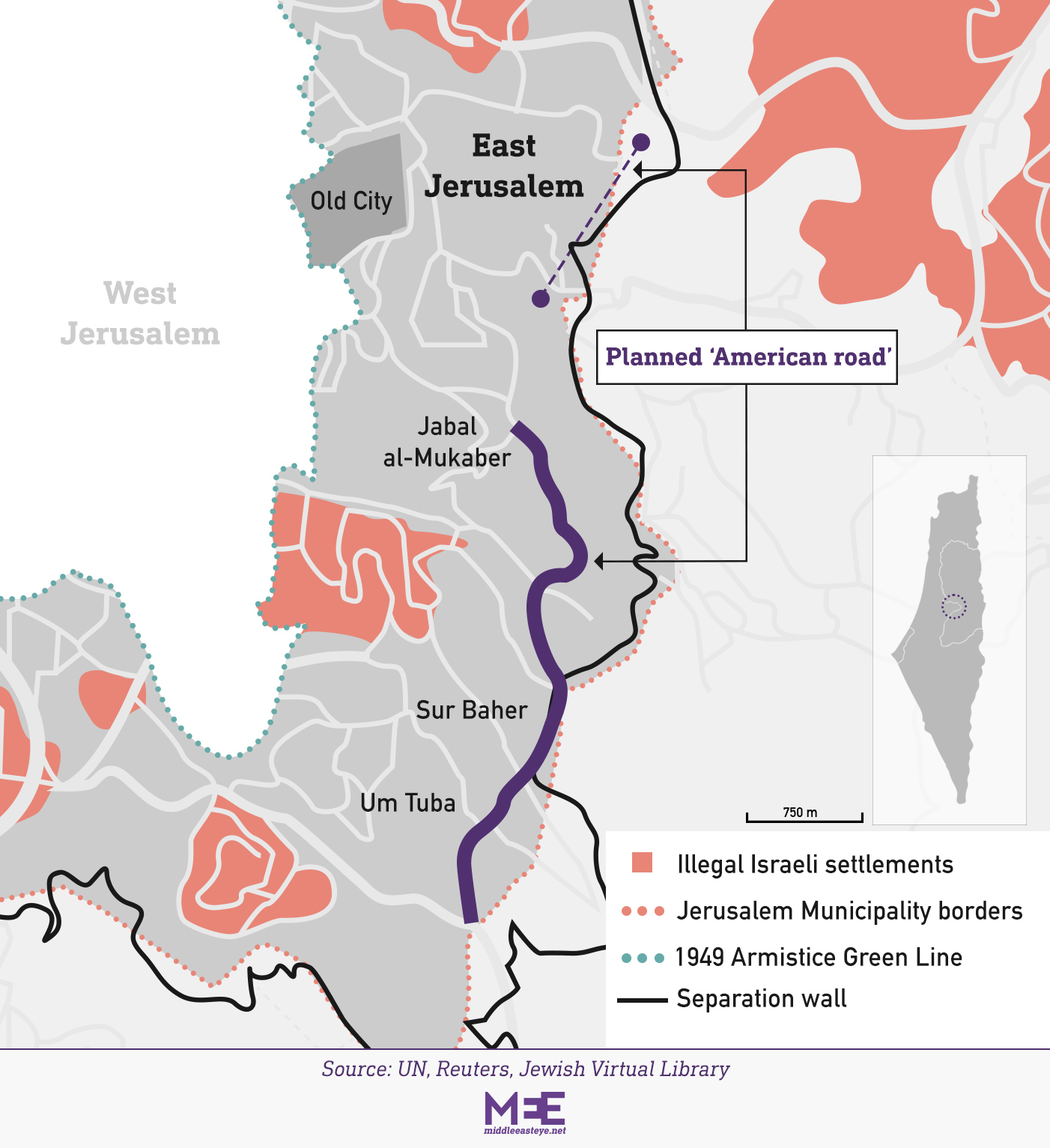 As a reminder, the so-called “American Road” is a section of north-south highway that is meant to more seamlessly connect settlements located in the north and south of Jerusalem to one another, and to serve as a bypass for settler traffic to cut through East Jerusalem’s Palestinian neighborhoods. While the road will be accessible to Palestinians (a fact touted by Israel as proof of Israeli good intentions), its clear primary purpose is to entrench Israel settlements, expand Israeli control over all of East Jerusalem, and close off Palestinian East Jerusalem neighborhoods from the rest of the West Bank, thereby (further) torpedoing Palestinian hopes of one day establishing a capital in East Jerusalem.
Israel began work on this road in June 2020, and recently completed the first phase of construction.
The second phase of construction directly threatens Palestinians, involving the demolition of 62 buildings in Jabal al-Mukhaber. According to Middle East Eye, the Jerusalem Municipality has come up with a proposal, as reported by one of the threatened homeowners:
“The municipality suggested alternatives for residents with demolition orders, but they are neither realistic nor fair, Muhammad says. The proposal stipulates erecting buildings upwards on each side of the road. In them, four stories must be exclusively allocated for parking, another four for commercial use, and only two stories for residential use, each containing four apartments. The estimated cost for each of those buildings is between 20 and 25 million shekels ($6m to $7.7m), which many Palestinians in the area can’t afford without loans. The options left for residents are either expulsion or indebtedness. One strategy the municipality is taking is to empty the area completely of its inhabitants and replace them with commercial centres, Muhammad says. ‘They want to force the residents to resort to local or external investors, or to resort to banks to take out loans, which would mean that the landowners would only receive a single residential apartment, while the investors or banks would retain the lion’s share,’ Muhammad told MEE. ‘The Jabal al-Mukaber residents refuse this unequivocally, considering vertical building to be incompatible with the rural context to which they have grown accustomed to’.”
See Orly Noy’s reporting for a detailed history of this plan’s evolution as well as a moving portrait of some of the Palestinians who are affected by this plan.
In a deeply researched report on how infrastructure like roads is a means for settlement expansion and annexation, Breaking the Silence explains:
“While Israeli authorities justify many of the projects described in this document by claiming that they serve both the settler and the Palestinian populations in the West Bank, it is important to note that these roads are designed with Israeli, not Palestinian, interests in mind. Many of the roads that are technically open to Palestinian traffic are not intended to lead to locations that are useful to Palestinians.16 Instead, these roads are primarily designed to connect settlements to Israel proper (and thus employment and other services) via lateral roads, rather than to connect Palestinian communities to one another. Further, roads intended to connect Israeli settlements to Jerusalem (many of which are currently under construction) do not serve West Bank Palestinians outside of Jerusalem, as they are not allowed to enter Jerusalem without a permit. In addition, an extensive system of checkpoints and roadblocks allows Israel to control access to bypass roads and the main West Bank highways, and it can restrict Palestinian access when it so chooses.
This prejudice against Palestinian development is even starker when one considers that, according to an official Israeli projection, the expected Palestinian population in the West Bank (excluding East Jerusalem) in 2040 is 4,600,000 individuals. Even if the vision of settler leaders to arrive at 1,000,000 settlers is realized by 2040, the Palestinian population would still be four times the size of the settler one. Despite this discrepancy, priority is still given to settler infrastructure development.
West Bank road and transportation development creates facts on the ground that constitute a significant entrenchment of the de facto annexation already taking place in the West Bank and will enable massive settlement growth in the years to come. By strengthening Israel’s hold on West Bank territory, aiding settlement growth, and fragmenting Palestinian land, this infrastructure growth poses a significant barrier to ending the occupation and achieving an equitable and peaceful solution to the Israeli-Palestinian conflict.”
High Court to Rule on Expulsion of Palestinians in South Hebron Hills “Firing Zone”
On March 15th, the Israeli High Court is expected to issue a ruling on the mass expulsion of 12 Palestinian communities in the Massafer Yatta region of the South Hebron Hills. These 12 villages are located on land that Israel declared a “firing zone” – Firing Zone 918 – in the early 1980s. Palestinian and Israeli activists have launched an international campaign to bring attention to the matter in the hopes of stopping the mass expulsion of Palestinians from their land.
In a recent article for +972 Magazine, Ali Awad – a journalist and activist from Massafer Yatta – contrasted the plight of his community to the success of chicken farms established by settlers on nearby land, writing:
“In Umm al-Khair, we find it especially absurd that the chicken farms have better infrastructure than our residents. We suffer from a constant lack of water and are prevented from connecting to the electricity grid; the farms, meanwhile, have constant access to water, and are not only permanently connected to electricity but also have backup generators in case of an emergency. Seeing the electricity lines pass directly over our village is a constant reminder that the animals get rights that we as Palestinians are deliberately denied. More importantly, we know that building these farms in Masafer Yatta is yet another strategy of the occupation to displace us Palestinians from our homes, and is no less dangerous than its policy of declaring 12 of our villages as falling under Firing Zone 918 — thereby sanctioning our displacement. Israel is even still using the outdated Ottoman Land Code in the occupied territories to transfer Palestinian pasture into “state land,” which it then leases to settlers in order to establish other kinds of farms. They are multiple laws and policies, but they all serve one goal: to take over Palestinian land.”
Over the past months, FMEP has hosted a series of webinars and podcasts highlighting Israel’s treatment of Palestinians in Massafer Yatta, including:
-
Israeli Apartheid, the Supreme Court, and Land Confiscation: The Case of Masafer Yatta (March 9, 2022) featuring Ali Awad (journalist and activist), Maya Rosen (activist) in conversation with FMEP’s Sarah Anne Minkin
-
“We don’t have another place to go:” Dispossession, Settler Violence, & Resistance in Masafer Yatta (January 2022) featuring journalist and activist Ali Awad in conversation with FMEP’s Sarah Anne Minkin
- Israeli Government Escalates Pressure on Israelis Who Stand in Solidarity with Palestinians (December 2021) featuring activists Oriel Eisner and Maya Eshel in conversation with FMEP’s Lara Friedman.
Former U.S. VP Mike Pence Hangs out with Kahanists in Hebron
During his visit to Israel this week, former U.S. Vice President Mike Pence found time to meet with far-right settler leaders including Kahanist lawmaker Itamar Ben-Gvir while visiting the Tomb of the Patriarchs/al-Ibrahimi Mosque in Hebron, a city that is perhaps the clearest example of Israeli apartheid policies.
According to the Hebron Fund (the U.S. 501c3 charity that raises funds for the Hebron settlers), Pence was accompanied by Simon Falic (Duty-Free America), who is a major supporter of the Hebron settlers. Photos showed Pence also accompanied by Baruch Marzel, the former right-hand man of the Kach party’s Rabbi Meir Kahane. For extra fun, here’s video of Marzel introducing Pence to Ben-Gvir, who Marzel says “represents us in the Knesset.” Pence shakes Ben-Gvir’s hand and says: “stay strong – we’ll stand with you… It’s my great honor.” Falic is also visible in the video.
During his time in Israel, Pence also received an honorary degree (alongside former U.S. Ambassador David Friedman) from Ariel University, at a ceremony held at the settlement. During the ceremony, Pence made his thoughts on settlements clear, saying:
“It’s great to be here in Ariel. I’m told that some people say that you shouldn’t go to Jewish communities in Judea and Samaria. I obviously have a different opinion.”
Pence also received an award from a group of Evangelical supporters in recognition of his support for Israel. That ceremony was held in Jerusalem. Many speculate that Pence is prepping for a run for the 2024 Republican nomination for the presidency, and making stops in Israel to court the Evangelical vote.
As a reminder, the parties associated with the now deceased Rabbi Meir Kahane – Kach and Kahane Chai – are U.S.-designated foreign terrorist organizations. Ben Gvir’s political party, Otzma Yehudit, is a clear present-day incarnation of those parties and is devoted to Meir Kahane’s teachings. For more on Kahanism in Israel, please see “Mainstreaming the Extreme: How Meir Kahane’s Vision of Jewish Supremacy Conquered Israeli Politics” and FMEP webinar hosted in March 2021 featuring Amjad Iraqi (+972 Magazine), Shaul Magid (author & Dartmouth College professor), Natasha Roth-Rowland (University of Virginia) in conversation with Lara Friedman (FMEP).
Bonus Reads
- “Editorial | Jewish Settlers in La La Land” (Haaretz)
- “ Israeli Human Rights Violations in the Occupied Palestinian Territory (Weekly Update, March 3 – 9, 2022)” (PCHR)
Welcome to FMEP’s Weekly Settlement Report, covering everything you need to know about Israeli settlement activity this week.
To subscribe to this report, please click here.
February 25, 2022
- The Israeli Plans to Expand “National Park” Onto Church (& Palestinian) Property in East Jerusalem
- Israel Freezes Salem Family Eviction in Sheikh Jarrah
- U.S. Ambassador Nides Reiterates His No-Visiting-Settlements Policy, Invites Settlers to Meet with Him
- Further Reading
The Israeli Plans to Expand “National Park” Onto Church (& Palestinian) Property in East Jerusalem
News broke this week that the Jerusalem Local Planning Committee was scheduled to take up at its April 10th meeting a plan to take control of more land in East Jerusalem – including church-owned land on the Mt. of Olives, where many sacred Christian sites are located, as well as privately-owned Palestinian land. Following widespread outcry, the Israeli government postponed (but by no means permanently abandoned) the Committee’s consideration of the plan, after the Israeli National Parks Authority, which has authority over the initiative, announced that the plan is no longer considered ready for discussion.

Map by Haaretz
First reported by Terrestrial Jerusalem, the plan was initiated over a year ago and outlines a significant expansion of the boundaries of the territory designated as the “Jerusalem Walls National Park” — to add land on the Mt. of Olives, in the Ben Hinnom Valley, and in the Kidron Valley. Christian church leaders (who are already in conflict with the Israeli government over settler actions) immediately protested, with the heads of three major Christian churches – the Greek Orthodox Patriarch Theophilos III, the Catholic Custos Francesco Patton and the Armenian Patriarch Nurhan Manougian – writing an unusually pointed letter to Israeli Minister of Environmental Protection Tamar Zandberg (Meretz), stating:
“In recent years we cannot help but feel that various entities are seeing to minimize, not to say eliminate, any non-Jewish characteristics of the Holy City by attempting to alter the status quo on this holy mountain. They have failed due to the objection and lack of cooperation from the Churches. After their attempts failed, they resorted to statutory powers by advancing a plan to declare vast parts of the mountain as a national park…This is a brutal measure that constitutes a direct and premeditated attack on the Christians in the Holy Land, on the churches and on their ancient, internationally guaranteed rights in the Holy City. Under the guise of protecting green spaces, the plan appears to serve an ideological agenda that denies the status and rights of Christians in Jerusalem.”
In addition to the impact on church-owned properties, the plan has enormous significance for the viability and contiguity of Palestinians in Jerusalem, as Terrestrial Jerusalem explained:
“The ramifications of this plan are not routine. While the ringing of the Old City on the north and the south is proceeding apace by means of settlement expansion in Sheikh Jarrah and Silwan, respectively, the expansion of the National Park will remove the remaining obstacles for the development of settlement-related activities to the East. By doing so, it will complete the total encirclement of the Old City by means of settlements and settlement-related projects that are fragmenting the Christian and Palestinian expanses in the visual basin surrounding it.”
Terrestrial Jerusalem then predicted, correctly:
“the Plan will no doubt be interpreted as part of a systematic Israeli policy that seeks to engrave the increasingly hegemonic Jewish-Biblical narrative of East Jerusalem settlers on the landscape surrounding the Old City. This will marginalize both the Christian and Islam equities in that landscape.”
Indeed, the Israeli government has already outsourced a significant part of the operations of the Jerusalem Walls National Park to the settler group Elad, specifically in the Silwan neighborhood where Elad is establishing touristic settlements while waging a house-by-house campaign to evict Palestinians from their homes in favor of Jewish Israeli settlers.
Regarding the relationship between (and goals of) the Israeli government and Elad, Terrestrial Jerusalem explains:
“For many years, the Israel Nature and Parks Authority (“the INPA”) together with other similar governmental bodies, such as the Israel Antiquities Authority, served as the long arm and subcontractors of the East Jerusalem settler organizations. The objective of these symbiotic relationships are clear and coherent:
– encompassing of the Old City through settler-controlled built-up areas, national and municipal parks and trails towards the end of securing the territorial integration of the Old City and its visual basin into the borders of pre-1967 Israel;
– creating a public domain in which the landscape is embedded with distinct expressions of the pseudo-Biblical ideology of the East Jerusalem settlers, while marginalizing the Christian and Muslim presence and ties to Jerusalem;
– fragmenting the urban fabric of Palestinian East Jerusalem in a manner that further undermines the very possibility of a future permanent status agreement.
“These policies are not new and have driven the actions of Israel in and around Jerusalem’s Old City for many years. What IS new is the aggressive application of these policies to Jerusalem’s holy sites, in the framework of a strategic thrust to galvanize sole Israeli control and rule over all of Jerusalem, East and West. The Plan is not an isolated event. One of the major manifestations of these policies may be found in numerous Israeli projects currently being implemented in and around the settlement enclaves to the north of the Old City, in Sheikh Jarrah, and to its south in Silwan. This entails a number of major government and settler projects that aspire to create a pincer maneuver that will surround the Old City with settlements and a settler-inspired public domain, effectively cutting off the Old City and its visual basin from the rest of East Jerusalem.”
A number of Israeli peace and human rights organizations — Bimkom, Emek Shaveh, Ir Amim and Peace Now — issued a joint statement laying out how this “national park” expansion plan fits into other settlement related developments and policies in Jerusalem:
“There is a direct link between what is happening in Sheikh Jarrah [the ongoing evictions of Palestinian families from their homes] and the expansion plan. These are various mechanisms used by Israel in East Jerusalem to entrench its sovereignty, to marginalize non-Jewish presence and to prevent much needed development of Palestinian neighborhoods hereby increasing the pressure to push them out of the Old City basin. This plan is part of a process of transforming the symbolic and political importance of the Historic Basin, by increasing the Jewish religious and national significance of this area while increasing the pressure on the Palestinian residents. We object to the cynical misuse of heritage and environment protection as a tool by Israeli authorities for justifying settlement expansion, for re-shaping the historical narrative and for determining ownership over the historical basin.”
Israel Freezes Salem Family Eviction in Sheikh Jarrah
On February 22nd the Jerusalem Magistrate Court published a decision that would temporarily freeze the eviction orders against the a Palestinian family living in Sheikh Jarrah (the Salem family) as soon as the family deposits a 25,000 shekel ($7,700) “guarantee” with the Court related to a new petition it has filed.
The Salem family has been fighting efforts by settlers to evict them from their longtime home in the Sheikh Jarrah neighborhood of East Jerusalem. The settlers claim to have bought the house from the Jewish family that owned it before 1948 — based on an Israeli law that gave Jewish Israelis the right to “reclaim” properties lost in the 1948 War. In contrast, the Salem family, under Israel law, lacks legal claim both to the home in Sheikh Jarrah where they have lived since being displaced from their home inside the Green Line during the 1948 War, and to their original home inside Israel. With Israeli law fully on their side, the settlers obtained a court-order for the eviction of the Salem family, scheduled by the Court to happen sometime between March 1st and April 1st (the exact date was left vague, in order to give security forces the element of surprise, thereby preventing Palestinians from organizing any protest). That eviction order is now considered frozen until the Court rules on an appeal submitted by the Salem family.
Meanwhile, Kahanist Israeli lawmaker Itamar Ben Gvir continues to operate a makeshift “parliamentary office” on a plot of land directly adjacent to the Salem family home — a deliberate provocation that has succeeded in stoking tensions and conflict in Sheikh Jarrah.
For further background on the Salem family’s case (including on the Israeli laws that were expressly designed to enable the eviction of Palestinians in favor of settlers), see reporting by Ir Amim and Peace Now.
U.S. Ambassador Nides Reiterates His No-Visiting-Settlements Policy, Invites Settlers to Meet with Him
In a meeting with the Conference of Presidents of Major Jewish Organizations on February 21st, U.S. Ambassador to Israel Thomas Nides reiterated that he will not travel to Israel’s illegal settlements. Instead, Nides declared that he will meet with “anyone who wants to meet with me,” and invited settlers to visit the Embassy [note: this is a return to the pre-Trump/Friedman status quo]. Nides went on to note that he had gone out for drinks with a right-wing rabbi who had taken offense to earlier comments Nides made on his decision to not travel to the settlements. This week Nides also appeared to downplay any policy implications of such a travel ban, saying instead that traveling to a settlement with a large motorcade would stoke controversy.
Bonus Reads
- “Palestinian Teen Suffers Head Wound by Rubber-tipped Bullet During West Bank Protests” (Haaretz)
- “The Palestinian village squeezed dry by Israel’s tight water control“ (Middle East Eye)
- “Two Unprecedented Scenarios Emerge in Battle for Control of Jewish Agency” (Haaretz)
Welcome to FMEP’s Weekly Settlement Report, covering everything you need to know about Israeli settlement activity this week.
To subscribe to this report, please click here.
January 21, 2022
- Under Cover of Darkness & Cold, Israel Evicts Palestinian Family & Demolishes Their Homes in Sheikh Jarrah
- Israel Advances Plan for New Settlement in East Jerusalem
- Settlers Continue To Press For “Legalization” of Homesh Outpost & Yeshiva
- New U.S. Ambassador Will “Absolutely Not” Visit Settlements
- Further Reading
Under Cover of Darkness & Cold, Israel Dispossessed Palestinian Family & Demolished Their Homes in Sheikh Jarrah
At approximately 3:00am on Wednesday, January 19th Israeli forces undertook a major operation in order to forcibly remove the Salhiya family from their longtime home in Sheikh Jarrah — rendering 7 adults and 5 children homeless in the middle of the night in the freezing rain. Israeli forced then moved to promptly demolish the home. The action followed Israel’s aborted two days earlier, on January 17th, to remove the family, during which it razed part of the Salhiya family plot, including a plant nursery.
As a reminder, Israel pursued this dispossession after unilaterally expropriating the plot of land owned by the Salhiya family in 2017 for “public use.” Israeli authorities say that they intend to use the land to build schools to serve Palestinians, who have long suffered from a shortage of school facilities. As has been noted, this argument is hard to take seriously, given that land exists elsewhere in Sheikh Jarrah on which schools could be built without evicting and rendering an entire Palestinian family. Ir Amim explains:
“Although Israeli law allows for the expropriation of private property for public purposes, it is typically only carried out in the absence of alternative options. The authorities have had various options at their disposal, including use of other plots of open land in the neighborhood, which would not have necessitated the Salahiya family’s eviction. Rather than using such plots, the municipality saw it reasonable to dispossess a Palestinian family to meet such needs.”
In order to carry out this forcible dispossession, Israel forces first cut power to the entire (Palestinian) area in which the Salhiya house and businesses were located. Accounts from those present at the eviction/demolition reported that Israeli forces violently assaulted several members of the Salhiya family including children. Israeli forces also arrested eighteen human rights defenders – including members of the Salhiya family — for resisting the eviction (for a detailed update on these cases, please see this report by Human Rights Defenders Fund). An additional six human rights defenders were arrested later on January 19th during a protest against the demolition, held in front of the Jerusalem Mayor’s home. Human Rights Defenders Fund, which is funding the legal representation of those arrested, said:
“HRDF opposes the unjust evictions of family homes in Sheikh Jarrah and will continue to stand with Palestinian HRDs defending their basic human rights for property and shelter. We will continue to closely monitor Sheikh Jarrah neighborhood and oppose any illegitimate attempt to change its demographics.”
The overnight evictions have been roundly criticized by human rights groups and several international governments. The European Union slammed the eviction/demolition, along with separate statements issued by individual European nations. The United States Ambassador to the United Nations, Linda Thomas-Greenfield also spoke out (weakly, in a statement framed in classic bothsides-isms).
Israel Advances Plan for New Settlement in East Jerusalem
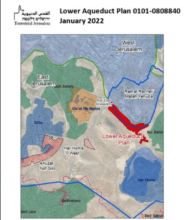 On January 17th, the Jerusalem District Planning Committee approved for deposit for public review a new settlement plan in East Jerusalem – called the “Lower Aqueduct” plan. The new settlement is intended to connect the controversial settlements of Givat Hamatos and Har Homa, establishing an uninterrupted continuum of Israeli settlements on the southern rim of Jerusalem, and destroying the contiguity of Palestinian land in the West Bank and East Jerusalem.
As laid out in new reporting from Terrestrial Jerusalem, the plan is being promoted by the Jerusalem Municipality together with the Israel Lands Authority, but – as the reporting predicts –
“when the smoke clears, it will become evident that the same protagonists that are facilitating settlements in Sheikh Jarrah, Silwan, Givat Shaked, Musrara – i.e. the Custodian General and the Absentee Property Custodian – are deeply implicated in the Plan.”
Terrestrial Jerusalem further notes that the plan is being advanced at an expedited pace, giving the appearance that “someone senior and in a position of authority is expediting the Plan at [a] highly irregular pace.”
In total, the plan provides for the construction of 1,465 new units – around half of which will be constructed over the 1967 Green Line the demarcates (in the eyes of the international community) the line between Israeli-annexed West Jerusalem and Israeli-occupied East Jerusalem. The plan also provides for open public spaces and buildings including schools and a gymnasium.
Importantly, the new settlement will impinge on the two neighboring East Jerusalem Palestinian villages of Sur Baher and Umm Tuba, and will involve the expropriation by Israel of privately owned Palestinian land. Most notably, in order to pave a new access road for the new settlement, the State will likely expropriate land privately owned by Palestinian residents of Umm Tuba.
Ir Amim’s Aviv Tartarsky told The Times of Israel:
“This is another way in which Israel is erasing the Green Line in Jerusalem, ending Palestinian contiguity, and expropriating the lands of Palestinians. When Palestinians tried to plan construction there, it was rejected — and now the territory will be confiscated.”
Following the committee’s decision to this week to advance the plan, the European Union, France, Germany, Spain and Italy all issued statements calling for Israel to reverse the move. France also published a joint statement with Ireland and Estonia.
Settlers Continue To Press For “Legalization” of Homesh Outpost & Yeshiva
In a display of brazen lawlessness, more than 1,200 Israeli Jews managed to enter the closed military zone that is the site of the former Homesh settlement – where settlers have illegally established and operated a yeshiva for years – in order to celebrate the Jewish holiday of Tu B’Shvat, as part of their ongoing campaign to pressure the government to reestablish the settlement.
To reach the site, settlers (identified as yeshiva students by The Jewish Press) marched en masse for two hours with armed guards through the outskirts of the Palestinian village of Sebastia. On their way, settlers passed easily through at least two IDF checkpoints — meant to stop traffic towards the Homesh area, though Israeli soldiers in practice prevented only the freedom of Palestinian traffic in that direction. Sebastia is a routinely besieged city, suffering closures in the wake of the murder of settler Yehuda Dimentan and as a consequence of Israeli settler’s focus on archaeological sites in the city [as has been covered in the Settlement Report regularly: settlers, in collaboration with Israeli authorities, are openly seeking to exploit archeology as a tool to dispossess Palestinians in the West Bank].
In Jerusalem, settler leaders and their allies continued their mass protest in front of the Prime Minister’s residence in a bid to pressure Bennett to authorize Homesh, amongst other demands.
New U.S. Ambassador Will “Absolutely Not” Visit Settlements
In an interview with the Yedioth Ahronoth news outlet, U.S. Ambassador Thomas Nides said that he will not visit Israeli settlements in the West Bank, unlike his immediate predecessor David Friedman.
When questioned about his travel policy as compared to Friedman’s, Nides said:
“Because just like I ask both the Palestinians and Israelis not to take steps that inflame the situation, I don’t want to do things intentionally that would create disrespect or anger among people. Now, listen, I’ll make mistakes. I’ll say things that will aggravate people. I’m sure that in this interview, I’ll say something that will aggravate someone. But I don’t want to intentionally anger people.”
It’s worth recalling that the Biden Administration has not reversed or publicly rejected the Trump Administration’s “Pompeo Doctrine,” which made it U.S. policy to view Israeli settlements as not “per se inconsistent with international law.” The overwhelming majority of the international community holds that all Israeli settlements and outposts in the West Bank are illegal pursuant to Article 49 of the Fourth Geneva Convention, which states:
“The Occupying Power shall not deport or transfer parts of its own civilian population into the territory it occupies.” It also prohibits the “individual or mass forcible transfers, as well as deportations of protected persons from occupied territory”.
Bonus Reads
- “PODCAST: Excavating Israel’s underground settlements” (+972 Magazine)
- “Palestinian Activist Dies Two Weeks After Being Run Over by Israeli Police Truck” (Haaretz)
- “There’s a Mass Palestinian Grave at a Popular Israeli Beach, Veterans Confess” (Haaretz)
- “JNF Board Members Demand End to Controversial Tree-planting in Negev Until Questions Answered” (Haaretz)
Welcome to FMEP’s Weekly Settlement Report, covering everything you need to know about Israeli settlement activity this week.
To subscribe to this report, please click here.
January 14, 2022
- Israeli Attorney General Supports Settler-Led Dispossession of the Sumreen Family in Silwan
- Tender Published for 300 New Units in East Jerusalem Settlement of East Talpiyot
- Israel to Advance Expansion of East Jerusalem settlement of Gilo
- Israel Advances Plan that Will Pave Way for Expansion of East Jerusalem Settlement Enclave of Nof Zion
- IDF Evacuates Oz Zion Outpost (Again)
- Fight Over Homesh Outpost & Yeshiva Continues (Both Physically and Politically)
- Settlers Seek Outpost Gains from Divided & Fragile Government (With Some Success)
- Construction Begins on Key Stretch of the “Tunnels Road” for Settlements South of Jerusalem
- Israel Gives U.S. Army Officers Tour of Hebron Led by Settlement Spokesman
- Further Reading
Israeli Attorney General Supports Settler-Led Dispossession of the Sumreen Family in Silwan
On January 9th, Israeli Attorney General Avichai Mandelblit submitted a legal opinion to the Supreme Court arguing in support of the immediate eviction of the Sumreen family from their home of 60+ years in the Silwan neighborhood of East Jerusalem. The Supreme Court is expected to announce its next steps on the case in the coming days, which might include setting a new hearing date to again consider legal arguments from both sides (now that the Attorney General has weighed in).
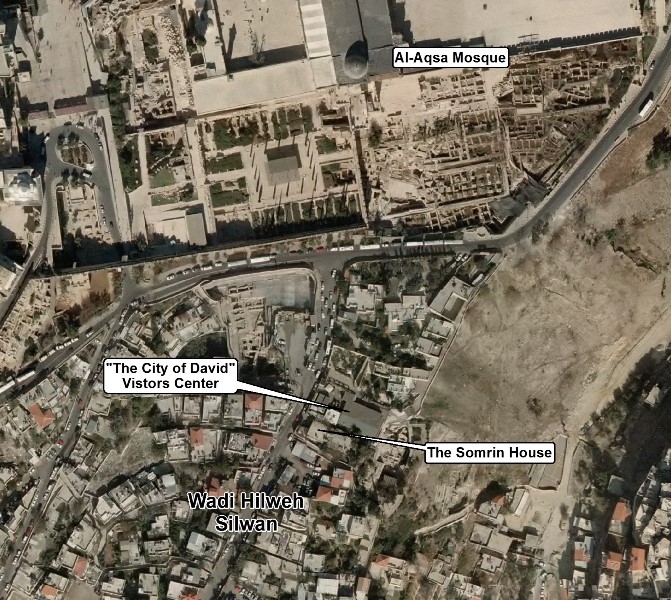
Map by Peace Now (click to expand)
The case to evict the Sumreen family, spearheaded by the JNF, with the secret funding/backing of the Elad settler group, is a key test of the State’s use of the Absentee Property Law to seize Palestinian homes in East Jerusalem. If dispossessed of their home, the Sumreen family case sets a broader precedent for many other ongoing eviction cases in Silwan that could result in the mass displacement of Palestinians in favor of settlers.
In his opinion, the Attorney General did not address the broader political context of widespread dispossession of Palestinians in Silwan, or legally dubious actions on the part of the Elad settler group and the Jewish National Fund in having the property declared to be absentee (see a detailed history of that scandal here) in order to take control over it. Instead, the Attorney General decided simply that there is no new basis on which to overturn the 1999 ruling that legitimized the JNF’s ownership of the home, and that the Sumreen family does not have a legal right to reside there.
Peace Now said in a statement:
“Instead of intervening and doing justice, the Israeli government, through the Attorney General, becomes a direct partner in crime and unforgivable injustice. The Attorney General chooses to ignore the context and the injustice behind the eviction suit and dives into quasi-legal questions to help settlers take over another property in Silwan. The Government’s fingerprints are smeared all over the Sumerin case. This is a political move in which government mechanisms such as the Custodian of Absentee Property and the Israel Land Administration and the JNF have been utilized in order to dispossess Palestinians of their property in East Jerusalem and replace them with settlers.”
It’s worth noting that the Sumreen house is located only a very short distance from the Al-Aqsa Mosque (approximately 10 meters) at the entrance to the Silwan neighborhood, and is adjacent to the “City of David” visitors center built and operated by the Elad settlers. The home is also located in the middle of what today has been designed by Israel as “the City of David National Park.” The entire area is managed by the radical Elad settler organization, which for years has also been pursuing the eviction of Palestinians from the homes in Silwan. For nearly three decades, the Sumreen family has been forced to battle for legal ownership of their home, after the state of Israel, prompted repeatedly by the JNF, declared the Sumreen’s home to be “absentee” property, despite the fact that this was manifestly not the case. Under that designation – which was not communicated to the Sumreen family – Israeli law permitted the State to take over the rights to the building. The State then sold the rights to the home to the JNF in 1991. The JNF has pursued the eviction of the Sumreen family ever since. Israeli courts ruled in favor of the Sumreen family’s ownership claims to the home for years, until a September 2019 ruling by the Jerusalem Magistrate’s Court granted ownership of the family’s home to the JNF, a decision the family immediately appealed to the Jerusalem District Court.
A full history of the saga involving the Sumreen family – which is similar to dozens of other Palestinian homes in Silwan that were declared Absentee Property in the 1990s – can be found on the Peace Now website here.
Tender Published for 300 New Units in East Jerusalem Settlement of East Talpiyot
On January 5th the Israel Lands Authority published a tender for the construction of 300 settlement units in the East Talpiyot settlement, located in East Jerusalem. Ir Amim reports the tender is scheduled to be opened for bids on February 14th.
The new units will expand the built-up footprint of East Talpiyot in the direction of the Palestinian neighborhood of Sur Baher, a neighborhood that is facing multiple new settlement plans that encroach on its historic land (including the Givat HaMatos, Har Homa, and Lower Aqueduct plans). Sur Baher has also been targeted by the Israeli Custodian General in its efforts to gain control over more land that was owned by Jews previous to 1948.
Israel to Advance Expansion of East Jerusalem settlement of Gilo
On January 10th the Jerusalem District Planning Committee convened to discuss two plans that would add 1,538 settlement units to the Gilo settlement in East Jerusalem. The plans are being advanced under the banner of “urban renewal” and will involve demolishing existing settlement units and replacing 470 existing settlement units with 2,008 new units (representing a net expansion of the settlement by 1,538 units). Ir Amim notes that, “while the plans will not necessarily enlarge Gilo territorially, it will increase the Israeli population in the settlement and hence the number of Israelis living in East Jerusalem.”
Israel Advances Plan that Will Pave Way for Expansion of East Jerusalem Settlement Enclave of Nof Zion

Map by Ir Amim (click to expand)
On January 11th, the Jerusalem District Planning Committee held a meeting to discuss public objections to a plan connected to the expansion of Nof Zion, a settlement enclave located inside the Palestinian East Jerualem neighborhood of Jabal Mukaber. One such objection was filed by Palestinian residents of Jabal Mukaber with assistance from Ir Amim. That objection argues that the plan is an affront to the planning needs of the local community and continues Israel’s systematic, city-wide discrimination against the housing, educational, and service-based needs of Palestinian neighborhoods. The Committee closed the meeting without reaching a decision, and has scheduled further private (closed to the public) continuation of its discussion of the plan.
The plan under consideration provides for the construction of a large, new Israeli police station on the border of Jabal Mukhaber neighborhood, on a plot of land that is across the street from the existing police station. The new station, according to Ir Amim, will “constitute a massive security headquarters and border police base, replete with detention facilities and laboratories.” Under the plan, after the new station is built the site of the current station will be designated for public buildings; however, Ir Amim warns that the land is currently allocated for the construction of hotels directly connected to plans to expand the Nof Zion settlement enclave. The relocation of the police station is a step towards the construction of those two hotels, which is part of the larger plan to expand Nof Zion to include the construction of commercial centers, educational institutions, and a sports field.
Ir Amim comments:
“In light of the dearth of public buildings and/or public spaces in the neighborhood, the objection [to the police facility plan] underscores the complete planning error and misuse of the respective plot of land. Rather than allocating the space to meet the dire public needs of the community, the authorities see it fit to utilize the land for a massive security base on the edge of the neighborhood. According to the objection [filed by Ir Amim and Palestinian residents], a plan of such magnitude implies that members of the community are seen as constituting a ‘threat’ rather than actual residents of Jerusalem entitled to equal socioeconomic rights and equitable access to municipal services. The depletion and appropriation of public spaces in East Jerusalem to serve Israeli interests and the expansion of setter enclaves in Palestinian neighborhoods not only erode the fabric of these communities, but severely impinge on Palestinian individual and collective rights and further entrench Israeli control of East Jerusalem.”
Israel has been working consistently to expand and entrench Nof Zion — which it should be underscored is an enclave located wholly inside a Palestinian neighborhood. On July 8, 2021 settlers and their allies held a cornerstone-laying ceremony to mark the beginning of construction on hundreds of new units in Nof Zion. The new construction is just preliminary work on a project that will triple the settlement in size and make it the largest settlement enclave in East Jerusalem.
As a reminder: In 2017, the Israeli government approved a plan to build a new synagogue and mikveh in Nof Zion on private Palestinian land that was expropriated from the Jabel Mukaber neighborhood in 2016. Then, in September 2017, rumors emerged that the government was set to issue 176 building permits for the already-approved project. According to Ir Amim, those permits were ultimately issued in April 2019.
IDF Evacuates Oz Zion Outpost (Again)
On January 10th, settlers sought to obstruct Israeli forces that were dismantling structures at the unauthorized outpost site called Oz Zion, located between Jerusalem and Ramallah. Settlers reportedly chained themselves to structures at the scene, and clashed with Israeli forces when they arrived to remove them.
Oz Zion has been dismantled by the IDF several times in the past (most recently in June 2021). Yet, the settlers – who have violently resisted Israeli forces carrying out the demolition – have repeatedly been allowed to reestablish it. It is one of the outposts for which a standing demolition order was recently re-issued by the IDF.
Fight Over Homesh Outpost & Yeshiva Continues (Both Physically and Politically)
On January 10th, settlers clashed with Israeli forces attempting to confiscate property from the illegal yeshiva settlers have established at the site of the evacuated settlement of Homesh — a yeshiva that the IDF continues to permit settlers to visit and operate. It’s worth recalling the great lengths to which the IDF has gone to offer protection for the settlers to access the yeshiva, at the cost of the freedom of movement and obstruction of normal life to entire nearby Palestinian villages.
In the wake of the killing last month of a settler connected to the illegal yeshiva, national furor – spearheaded by settlers protesting in front of the Prime Minister’s residence – has kept the heat on the government over the fate of the Homesh outpost and yeshiva. Key settler leaders are threatening to bring down the current coalition if the yeshiva is dismantled. While the government has not clearly signaled what it intends to do with the yeshiva, settlers and their political allies outside of the governing coalition are now aggressively pushing the government to undertake hugely consequential efforts on behalf of the settlements — including but not limited to re-establishing the settlement of Homesh and normalizing the status of the illegal yeshiva at the site — in order to prove it allegiance. See below for more details.
Settlers Seek Outpost Gains from Divided & Fragile Government (With Some Success)
As part of their campaign to push the government to authorize the Homesh yeshiva and reestablish the Homesh settlement, key settler leaders are raising at least two additional major initiatives in their aggressive push on the government to compensate the settlers in response to the recent death of settler Yehuda Dimentan.
Those two additional demands by the settlers – a contingent of whom are encamped in front of Prime Minister Bennett’s residence – are:
- To pass a bill – or act unilaterally – to connect unauthorized outposts to the Israeli electric and water grids. To that end, Defense Minister Benny Gantz and Interior Minister Ayelet Shaked reportedly held a meeting on this topic on January 9th. The settler-run news outlet Artuz Sheva optimistically reports that dozens of outposts might meet Israeli criteria for being connected to Israeli infrastructure, and that Gantz would support the move if the Defense Ministry Legal Advisor gives it an OK. This has been a longtime demand of settlers, and has typically included the demand to connect outposts to Israeli water, sewer, power, garbage collection, and other municipal services. Doing so would further entrench the permanence of these outposts and furthers the de facto annexation of Palestinian land. It would also continue and expand on Israel’s long practice of copiously rewarding settlers for breaking Israeli law (by illegally building outposts), and directly incentivizing further settler lawbreaking.
- To more aggressively police Palestinian construction in Area C of the West Bank (some 60% of the land). This demand is grounded in an Orwellian twisting of reality to treat Palestinian construction on Palestinian private land in Area C without permits required by Israel (permits Israel consistently refuses to issue) as theft of Israeli land. For more on this long running, and particularly pernicious, tactic of the settlement movement, see FMEP’s previous reporting.
Construction Begins on Key Stretch of the “Tunnels Road” for Settlements South of Jerusalem
Arutz Sheva reports (gleefully) that ground has been broken on a final stretch of the new tunnel road that will connect settlements to the south of Jerusalem (the Etzion settlement bloc) more seamlessly to the heart of the city. The tunnel is part of Highway 60, which Israel has already begun work to widen, which runs from Jerusalem all the way to the Kiryat Arba in Hebron.
In a deeply researched report on how infrastructure like roads is a means for settlement expansion and annexation, Breaking the Silence explains:
“While Israeli authorities justify many of the projects described in this document by claiming that they serve both the settler and the Palestinian populations in the West Bank, it is important to note that these roads are designed with Israeli, not Palestinian, interests in mind. Many of the roads that are technically open to Palestinian traffic are not intended to lead to locations that are useful to Palestinians.16 Instead, these roads are primarily designed to connect settlements to Israel proper (and thus employment and other services) via lateral roads, rather than to connect Palestinian communities to one another. Further, roads intended to connect Israeli settlements to Jerusalem (many of which are currently under construction) do not serve West Bank Palestinians outside of Jerusalem, as they are not allowed to enter Jerusalem without a permit. In addition, an extensive system of checkpoints and roadblocks allows Israel to control access to bypass roads and the main West Bank highways, and it can restrict Palestinian access when it so chooses.
This prejudice against Palestinian development is even starker when one considers that, according to an official Israeli projection, the expected Palestinian population in the West Bank (excluding East Jerusalem) in 2040 is 4,600,000 individuals. Even if the vision of settler leaders to arrive at 1,000,000 settlers is realized by 2040, the Palestinian population would still be four times the size of the settler one. Despite this discrepancy, priority is still given to settler infrastructure development.
West Bank road and transportation development creates facts on the ground that constitute a significant entrenchment of the de facto annexation already taking place in the West Bank and will enable massive settlement growth in the years to come. By strengthening Israel’s hold on West Bank territory, aiding settlement growth, and fragmenting Palestinian land, this infrastructure growth poses a significant barrier to ending the occupation and achieving an equitable and peaceful solution to the Israeli-Palestinian conflict.”
Israel Gives U.S. Army Officers Tour of Hebron Led by Settlement Spokesman
Raising many eyebrows, the secretariat of the Israeli Central Command reportedly arranged a settler-led tour of Hebron for a delegation of U.S. army officers. The full-day tour designed by the settlers included a visit to the Tomb of the Patriarchs/al-Ibrahimi Mosque and a visit to the settler-run museum (in the Beit Hadassah enclave). The visit empowered settlers to present their version of the religious, historic, geo-political, and security significance of Hebron (including with respect both to settlers/settlements, and presenting Palestinians through the settler lens). The U.S. delegation did not engage any Palestinians while in Hebron, creating an obvious and problematic imbalance in perspective on all matters.
Haaretz reports that the Israeli army has refrained from engaging the settlers for diplomatic tours of Hebron in recent years. In a statement to Haaretz about the tour, the IDF issued a bland statement saying:
“Last week, a few U.S. army officers came for a tour of the Tomb of the Patriarchs and Beit Hadassah led by the commander of the Central Command, for the purpose of learning about the history of the site. As part of the ongoing tours that are held regularly, the American delegation meets with various people in the State of Israel as well as in the Palestinian Authority. This is in order to learn about the area in the best way possible. Dr. Noam Arnon [a far-right-wing settler activist and spokesman for the Hebron settlements] was chosen to guide this tour. The tour was held according to the established regulations in the IDF.”
Further Reading
- “Who Do Israeli Settlement ‘Sheriffs’ Report To? Even They’re Not Sure” (Haaretz)
- “West Bank settlements are annexing land in Israel, too” (+972 Magazine)
- “Fresh Sheikh Jarrah eviction threatens to roil capital anew” (The Times of Israel)
- “From Iron Dome to supply chains, US Christian group quietly shaping US-Israel ties” (The Times of Israel)
- “Editorial | As Israel Bends Over Backwards for Homesh, Palestinians Pay the Price” (Haaretz)
- “The International Community and Israel: Giving Permission to a Permanent Occupation” (Michael Lynk in Just Security)
- “Congress launches bipartisan Abraham Accords Caucus” (Jewish Insider)
Welcome to FMEP’s Weekly Settlement Report, covering everything you need to know about Israeli settlement activity this week.
To subscribe to this report, please click here.
September 10, 2021
- Israeli Supreme Court to Hear Al-Walajah Case on October 6th
- JNF to Start Massive Land Registration Process, Threatening Widespread Eviction of Palestinians
- Bennett Government Requests Six Month Extension to Finalize Plan to Forcibly “Relocate” Khan Al-Ahmar
- Bennett Meets with Settler Council, Promises Settlement Growth (i.e. De Facto Annexation)
- Bonus Reads
Israeli Supreme Court to Hear Al-Walajah Case on October 6th
Ir Amim and Bimkom jointly report that the Israeli Supreme Court has set October 6th as the date it will hold a hearing on 38 demolition orders issued against Palestinian homes in the Al-Walajah neighborhood of East Jerusalem. In July of this year, the State moved to dismiss the current petition filed by Palestinians that, for the moment, has frozen demolition proceedings against their homes. If the Court chooses to dismiss the petition, those 38 houses – homes to some 300 individuals – will likely face immediate demolition.
The State’s argument is that the houses – built by Palestinians on their own land – were built without the required Israeli permits. As a reminder, such permits are in general all but impossible for Palestinians to obtain; in the case of al-Walajah they are literally impossible to obtain, since the area lacks a required Israeli-approved “outline plan,” without which permits are an impossibility. In an effort to overcome this obstacle, Al-Walajah residents, with the help of planning experts, prepared and proposed an outline plan for the area, and for more than 15 years have worked to get Israel to approve it — to no avail. Israeli authorities have repeatedly (in January 2021 and again in March 2021) refused to approve the resident-backed plan, and have also refrained from initiating their own planning process. Indeed, the Jerusalem District Committee, as part of a January 25, 2021 ruling against the outline plan proposed by residents, deemed the area in question — where Palestinians have lived for decades — an “agricultural area” where no building would ever be permitted. The result: Al-Walajah’s residents have been left with zero hope of obtaining the permits required to build on – or keep their current houses – on their own land.
Due to its location and unique political situation Al-Walajah is a village besieged by Israel from every angle. In the words of Danny Seidemann:
“ Since 1967, Walajeh’s inhabitants have lived in a Kafka-esque situation, with their village technically located inside Israel’s expanded borders, but with villagers never given Israeli residency (they are considered West Bankers and thus are not permitted inside Jerusalem). As a result, the villagers’ presence in their own village is, under Israeli law, illegal, and their homes there are, by definition, illegal.”
For decades, the Israeli government has carried out a multi-prong effort to push Palestinians off of their land in al-Walajah. This has included demolition campaigns, construction of the separation barrier along a route that encircles the village and cuts residents off from their land, refusal to grant building permits, and the declaration of state parks over lands on which Palestinians have lived for generations. In October 2020, it was revealed that Israel, in order to build the Har Gilo West settlement, plans to extend the separation barrier to completely encircle al-Walajah, which is already surrounded on three sides by the separation wall. The new section of the barrier will be a 7-meter high concrete slab along the western edge of the built-up area of Al-Walajah.
JNF to Start Massive Land Registration Process, Threatening Widespread Eviction of Palestinians
On September 2nd, the Board of the Jewish National Fund in Israel (called the KKL-JNF) voted to initiate a new effort to register its ownership of land that the JNF claims to have purchased from the Israeli General Custodian. The JNF claims to have internal records of these purchases, despite the fact that the organization never formally registered its deed of ownership after the purchases.
According to Haaretz, the KKL-JNF Board has allocated over $31 million (100 million shekels) to a five-year plan that will see the organization pursue the formal registration of the following:
- A total of 530 files pertaining to acquisitions in the West Bank, of which the KKL-JNF says it has documentation for 360 deals, but only has formal contracts for 170. With respect to the fact that the JNF cannot fully document closed deals for most of these properties, Peace Now warns:
“…in some of the cases the documents only show intent to broker deals, and/or a negotiation that didn’t become a deal, and yet, legally, it could be argued that intent for a deal existed, and on this basis the land could be registered in JNF- KKL’s name. In addition, according to JNF- KKL, past experience shows that JNF- KKL succeeds in convincing the courts to register properties in its name and the chances to succeed in various files is great.”
- A total of 2,050 files pertaining to acquisitions in the Jerusalem area, totalling over 1 square mile in East Jerusalem – where the JNF is actively colluding with settler organizations to displace Palestinians from land it claims to own.
Ir Amim explains further:
“The decision to suddenly transfer this land to the KKL-JNF, which was initiated by a high-ranking individual within the General Custodian who is known to be active in settler projects, follows Ir Amim’s uncovering of a series of alarming Israeli decisions that aim to misuse land registration mechanisms in East Jerusalem for registering sizable areas of land to Israeli authorities or settlers on behalf of settler organizations. These moves are being conducted without proper disclosure or publication, therefore preventing Palestinians from challenging and protecting their property rights. 75 Palestinian families on an area of 35 dunams are currently under threat of eviction from ownership lawsuits levelled by settler organizations in Sheikh Jarrah. 85 families on an area of 5 dunams face a similar threat in Batan al-Hawa, Silwan. Transferring 2,500 dunams of land from the General Custodian to the KKL-JNF will lay the groundwork for potentially thousands of more eviction demands.”
As a reminder, the JNF, established in 1901, devoted itself to buying land for Jews. Today, the JNF owns about 15% of all the land inside the Green Line (a figure which stands to increase if the review process leads to more properties being registered to the JNF). In addition, the JNF has used two subsidiary companies – both called Himanuta – to purchase land in the West Bank, even though the stated JNF policy (until now) did not support such purchases. Peace Now reports that the JNF, via Himanuta, has already purchased over 160,000 acres (65,000 dunams) across the West Bank. Settlements established on some of those lands include Itamar, Alfei Menashe, Einav, Kedumim, Givat Ze’ev, Metzadot Yehuda (Beit Yatir), Otniel and more. At the same time, the JNF and the settler group Elad have been partnering together to pursue the mass eviction of Palestinians from East Jerusalem neighborhoods, including Silwan.
Bennett Government Requests Six Month Extension to Finalize Plan to Forcibly “Relocate” Khan Al-Ahmar
On September 5th, the Israeli government asked the Supreme Court for a six-month extension of its deadline to submit its position on the situation of the Khan al-Ahmar bedouin community – which the Court has set to be forcibly evicted from its current location in the West Bank, just east of Jerusalem (on land that Israel wants to develop for the settlements). In its filing with the Court, the State suggests that there has been “significant progress” towards reaching an agreement with community leaders on the future of the community, which has lived at its present location since being relocated there from the Negev during the 1967 war.
In July 2021, when Khan al-Ahmar was set to be forcibly relocated/demolished, the Court granted the newly formed Bennett government a six-week extension to review the plan that had been negotiated by the Netanyahu government. At that time the Court hinted that it would not be amenable to issuing further extensions on the case.
The terms of the Netanyahu era deal would reportedly see the Khan Al-Ahmar community agree to its forced relocation to a site several miles east of their current homes (the new site is near Abu Dis) in exchange for Israeli residency.
It must be noted that, if reports are correct, Khan al-Ahmar leaders signed the deal after prolonged coercive circumstances. Previous allegations regarding the nature of the Khan al-Ahmar relocation – specifically B’Tselem’s accusation that it is tantamount to a war crime – have not necessarily been assuaged by the community’s agreement. Since the 1950s – when the community was forced to leave their land in the Negev during the 1948 war – the Khan al-Ahmar bedouin community has lived and worked the lands located just east of Jerusalem, in the shadow of the land marked for the construction of the E-1 settlement (which is once again in the headlines).
The settler group Regavim – which petitioned the Court to force the government to demolish Khan al-Ahmar last year (in the midst of a global pandemic) – rejected the possibility of another delay, saying:
“Lapid’s announcement is a political move intended to signal to Bennett and his partners that none of their election promises can be fulfilled. Not in the Negev, not in the Galilee, and not in Khan al-Ahmar.” [Regavim called on Bennett] “to show who’s in charge. We call on you to evacuate Khan al-Ahmar immediately!”
Jerusalem expert Danny Seidemann has previously written:
“the story of Khan Al-Ahmar is not only about the tragedy for the village and its inhabitants, or about Israel’s readiness to carry out an ostensible war crime in the face of the world. It is also about Israel’s determination to clear the entire area of the West Bank east of Jerusalem, and located within the line of the built and planned barrier, of any Palestinian presence. This clearing will prepare the ground for the future construction of E1 and de facto annexation of this so-called bloc, which extends well beyond the built-up area of Maale Adumim.”
Bennett Meets with Settler Council, Promises Settlement Growth (i.e. De Facto Annexation)
On September 9th, Prime Minister Bennett held his first meeting with leaders of the settler Yesha Council (a leadership body that Bennett himself once served as the head of) and promised that his government would not freeze settlement construction, while also stating that his government will not annex West Bank land. Bennett also reportedly told the settlers that he was clear with the Biden Administration that he would not stop settlement building. Crisis Group analyst Maraiv Zonzein puts it:
“Bennett tells settler council the government will consider all requests for settlement construction. ‘We won’t annex but we won’t stop building.’ That is de facto annexation”
Last week, a government source told The Times of Israel that the Trump-era understandings on settlements remain the standard operating practice – meaning that the High Planning Council will be allowed to convene quarterly meetings to advance settlement construction, and that settlement construction should be “limited” in a way that does not expand the existing footprint of settlements. The official said:
“The [Trump-era] understanding may well be adapted, but, as of now, it is still the only game in town,” the official said. “President Biden only spoke generally about his opposition to settlement building, and his team has not gotten into specifics with us.”
As a reminder, settlement construction and de facto annexation soared during the Trump Administration, under these so-called “limitations.”
Bonus Reads
- “Growth rate of settlements plummets to all-time low” (Jerusalem Post)
- “Israel’s New Government Wants to ‘Shrink’ the Occupation. Meet the Man Behind the Idea” (Haaretz)
- “SCOOP: An event marking the one year anniversary of the signing of the Avraham Accords will be held in Washington on September 14.” (Twitter // @amichaistein1)
Welcome to FMEP’s Weekly Settlement Report, covering everything you need to know about Israeli settlement activity this week.
To subscribe to this report, please click here.
August 13, 2021
- The First Bennett/Biden Settlement Wave, Part 1: Israel Set to Advance 2,259 Settlement Units
- The First Bennett/Biden Settlement Wave, Part 2: Israel Announces Intention to Issue 863 Building Permits for Palestinians in Area C
- The First Bennett/Biden Settlement Wave, Part 3: Observations on Settlement Policy Coordination Between Governments
- Jerusalem District Court Orders 16 Homes to Be Demolished While Delaying – for 6 months – Demolition of Others in Silwan
- Israel Begins Work on Settler-Back Project at the Ibrahimi Mosque/Tomb of the Patriarchs
- Atarot Settlement Plan to Be Discussed on December 6th
- Bonus Reads
Questions/comments? Email kmccarthy@fmep.org
The First Bennett/Biden Settlement Wave, Part 1: Israel Set to Advance 2,259 Settlement Units
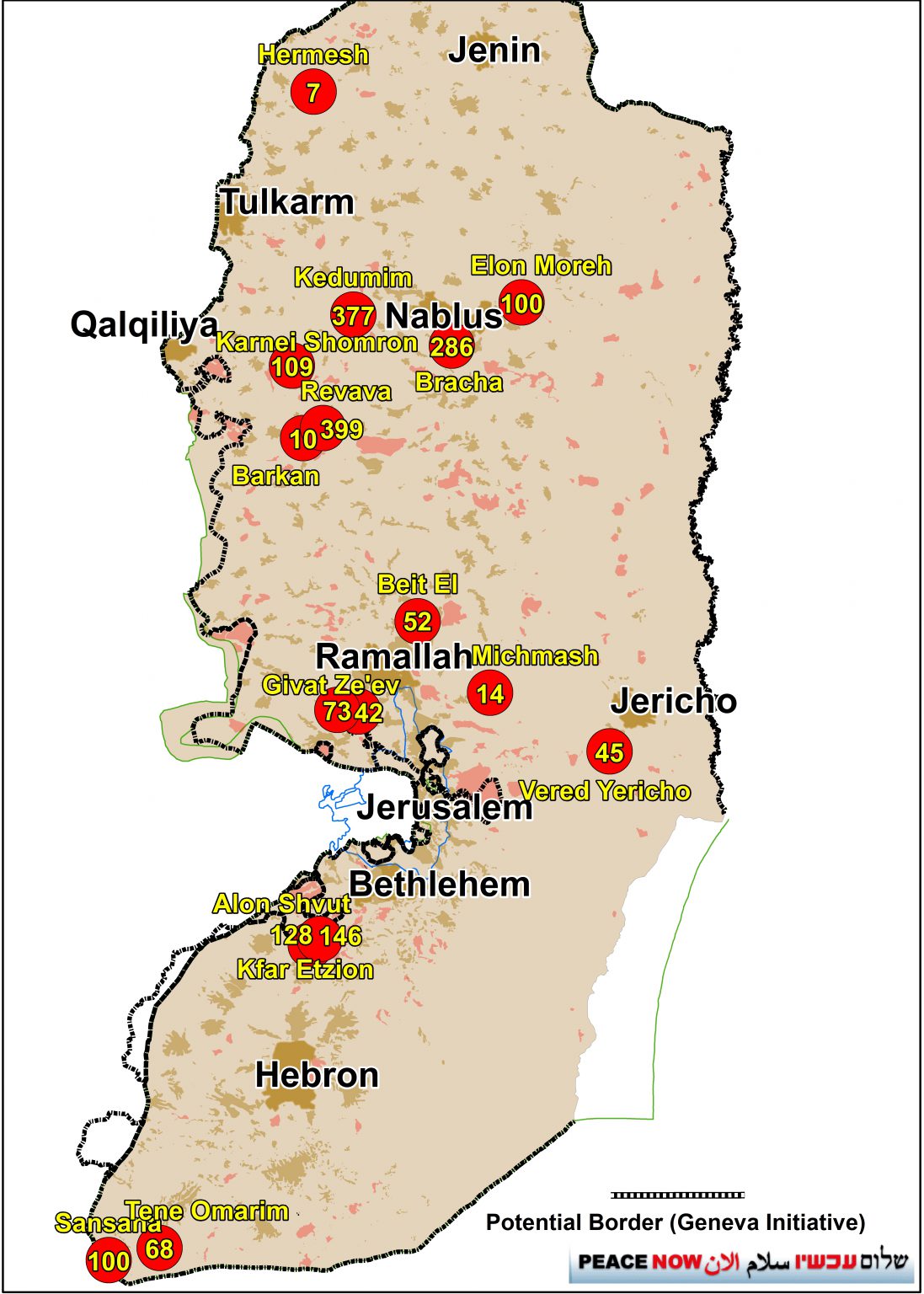 On August 12th, Israeli Defense Minister Benny Gantz announced that the High Planning Council will convene on August 18th to advance 2,259 new settlement units, as part of projects across the West Bank. Of these, 908 units are slated to receive final approval, including many units in areas beyond Israel’s security barrier. This will be the first time that the High Planning Council (HPC) has convened in 10 months, and it will be the first time a large number of settlement units has been advanced since Biden entered the White House. As a reminder, the HPC is a body within the Israeli Civil Administration (which is a part of the Israeli Ministry of Defense) that has authority over construction planning and approvals for both settlers and Palestinians in the West Bank (the HPC does not have authority with respect to settlement construction in East Jerusalem; since Israel annexed the area in 1967, Israeli domestic Israeli planning authorities are in charge there).
The plans expected to receive final approval include:
- 286 units in the Har Bracha settlement, located south of Nablus. If implemented, these new units will double the size of Har Bracha;
- 146 units in the Kfar Etzion settlement, located between Bethlehem and Hebron and on the Israeli side of the planned route of the barrier (which is not yet built in this area);
- 110 units in the Alon Shvut settlement, located just north of the Kfar Etzion settlement and between Bethlehem and Hebron;
- 82 units in the Karnei Shomron settlement, located in the northern West Bank, east of the Palestinian village of Qalqilya. Israel has openly declared its intention to continue expanding settlements in this area with the stated goal of bringing 1 million settlers to live in the area.;
- 52 units in the Beit El settlement, located in the heart of the northern West Bank [as a reminder, former US Ambassador to Israel David Friedman has deep ties to the Beit El settlement]; Construction on 350 new units in Beit El began earlier this year;
- 42 units in the Givat Zeev settlement, located south of Ramallah in an area that. is on the Israeli side of the barrier;
- 14 units in the Ma’aleh Mikhmash settlement, located east of Ramallah;
- 10 units in the Barkan settlement, located about half way between the Ariel settlement and the cluster of settlements slated to be united into a “super settlement” area (Oranit, Elkana, Shiva Tikva, and others).;
Peace Now said:
“The approval of thousands of housing units in the settlements harms the Israeli interest and the chances of reaching peace. It seems that the approval of a handful of plans for the Palestinians is only intended to try to reduce criticism of the government and to please the US administration ahead of Prime Minister Bennett’s expected visit to Washington in the coming weeks. For years, Israel has pursued a policy of blatant discrimination that does not allow almost any construction for Palestinians in Area C, while in the settlements it encourages and promotes the construction of thousands of housing units each year for Israelis. The approval of a few hundred housing units for Palestinians can not cover up discrimination and does not change the fact that Israel maintains an illegal regime of occupation and discrimination in the territories.”
The First Bennett/Biden Settlement Wave, Part 2: Israel Announces Intention to Issue 863 Building Permits for Palestinians in Area C
In announcing plans to advance over 2,000 new settlement units, Defense Minister Gantz also announced his intention to issue permits for 863 houses – some of which will be issued for existing structures – for Palestinians living in Area C. Haaretz reports that the permits are being advanced in order to buy the consent of the few members of the Israeli governing coalition that oppose settlement construction, and as “calculated risk” with respect to the Biden administration.
As a reminder, Area C is the 60% of the West Bank where Israel enjoys absolute authority and has systematically denied Palestinian building rights, while promoting the expansion of settlements and unauthorized outposts. If issued, these permits for Palestinians will be the first issued by Israel in years, and the first of any significant size. Only 21 building permits were issued to Palestinians between 2016 to 2018, while 2,147 demolition orders were issued in the same period.
Commenting on the announcement of the planned permits (which, given past experience, there is no reason to assume will ever be issued) Peace Now said:
“It is a very small expansion of the Palestinian villages and a drop in the ocean in terms of real Palestinian development needs.”
Peace Now reports that these permits, if they are ever issued, might be for:
- 270 houses in the Bir al-Bash village, located south of Jenin in the northern West Bank;
- 233 houses in the the Almasqufa village, located near Tulkarem in the norhtern West Bank;
- 160 houses in the Abba a-Sharqiya village, also located south of Jenin in the northern West Bank;
- 150 houses in the Al-Ma’asara village, located south of Bethlehem; and,
- 50 houses in the Khirbet Zakariya, also located south of Bethlehem.
The First Bennett/Biden Settlement Wave, Part 3: Observations on Settlement Policy Coordination Between Governments
In reporting over the past week, Axios journalist Barak Ravid has documented the efforts by the Israeli and U.S. governments to square conflicting positions with regards to settlement growth.
On the U.S. side, the Biden Administration has appeared to take pains to make room in its official discourse to begrudgingly tolerate settlement construction. While the U.S. has criticized the new batch of settlement advancements, until this week the U.S. had reportedly identified three actions it has asked Israel to refrain from, notably not including settlement expansion. Those three actions are: the demolition of Palestinian homes, the eviction of Palestinians from their homes, and the establishment of new outposts in the West Bank. The U.S. is also reportedly asking Israel to take positive steps to stabilize the Palestinian Authority, which is suffering from economic shortfalls and crashing levels of popular support.
For it’s part, Israeli press suggests that the Bennett government reduced the number of upcoming settlement advancements in order to appease the Biden Administration. The Israelis wanted to advance 3,623 plans, but announced a total of 2,259 (a 39% cut according to Jerusalem Post). Axios also reports that the Israeli government is assertively framing its settlement policy as one of restraint, prioritizing settlement projects that address the supposed “natural growth” needs of existing settlements.
“Natural growth” has been used many times in the past by the Israeli government as an argument for why settlements must be allowed to expand. FMEP’s Lara Friedman has debunked this argument many times in the past, explaining:
“While ‘natural growth’ has no formal definition, it has generally been used in the settler context to mean population growth due to births, as contrasted to growth due to immigration from Israel or other places. But in numerical terms (according to Israeli official statistics), taking into account deaths and people migrating out of settlements, births inside the settlements account for approximately 60% of the annual population growth in settlements, while around 40% is immigration from inside Israel or abroad. So clearly population growth in settlements is not simply a matter of births. Perhaps this is why some excuse-makers have expanded ‘natural growth’ to include other ways that families can grow, from non-settler spouses to aged non-settler relatives moving in.
“Regardless of what definition people want to use, the fact is that ‘natural growth’ is not a legitimate argument against a complete freeze in settlement construction. Yes, settlers, like people everywhere, indeed have the right to have babies, and yes, their children indeed have the right to grow up and have families and homes of their own. But nowhere in the world – not in New York, or Paris, or Tel Aviv – do people have an inalienable right to live exactly where they want – in the size home they want, in the neighborhood they want – irrespective of real estate market factors, or any political, economic, zoning, or other considerations that may come into play (including in this case, considerations about actual land ownership). Inside Israel, just like in other countries, people regularly face difficult decisions about where to live, given that major cities like Tel Aviv and Jerusalem are crowded and little affordable housing is available.
“Settlers have the right to have babies and to take in their parents or grandparents. When settler children grow up they have the right to start families and have homes of their own. But the settlers must do what people everywhere must do: reconcile their needs as best as possible to the housing market, which is affected not only by demand but by a myriad of other variables – including, in this case, the fact that settlers have knowingly and voluntarily chosen to make their lives on land that is the subject of a political dispute of global proportions.”
Axios quotes an Israeli government official saying:
“The Biden administration knows we are going to build. We know they don’t like it, and both sides don’t want to reach a confrontation around this issue.”
An Israeli government source summarized the dance going on between the respective governments by saying:
“[The U.S.] will express opposition to this move, but everyone wants this impossible coalition in Israel to hold out… It was clear for Bennett he would not have been able to advance this move after his meeting with [U.S. President Joe] Biden at the end of the month, so as not to damage their relations, and that’s why he had to announce it as early as he did.
Jerusalem District Court Orders 16 Homes to Be Demolished While Delaying – for 6 months – Demolition of Others in Silwan
On August 12th, a Jerusalem Court granted a six-month freeze on demolition orders affecting dozens of Palestinian homes in the al-Bustan section in the Silwan neighborhood of East Jerusalem. At the same time, the Court cleared the way for the immediate demolition of 16 Palestinian homes in the same area.
A lawyer representing the Palestinians involved in these demolition cases said his clients intend to file for permits for the structures, which were built on land that Palestinians assert they own. Israel argues that the land is public land.
Israel Begins Work on Settler-Back Project at the Ibrahimi Mosque/Tomb of the Patriarchs
This week, an Israeli crew began construction on a new elevator leading to the Ibrahimi Mosque/Tomb of the Patriarchs in Hebron, arguably one of the most sensitive religious sites outside of Jerusalem. The project to install accessible infrastructure at the site has been backed and pushed by settlers for over two decades and provides a means by which the State of Israel has increased its control over the site. The project is roundly opposed by Palestinians along with archaeologists and other experts. The Israeli archeology group Emek Shaveh explains its opposition:
“We claim that while the plan is couched in terms of concern for the disabled and elderly worshippers, in actual fact it is unilaterally advancing changes to a site mired in deep political controversy…The size and characteristics of the structure demonstrate that at issue is not simply a lift for persons with disabilities, but a significant change to the compound. The lift will constitute a change in the status quo and a strengthening of the settlers’ control of the holy site. Ignoring the fact that the site falls under the auspices of the Hebron Municipality is evidence that Israel is further reneging on its commitments to agreements signed in the past with Palestinians.”
Atarot Settlement Plan to Be Discussed on December 6th
As expected, the Jerusalem District Planning and Building Committee has set a date – December 6th – for the advancement of the Atarot settlement plan. This plan would allow for the construction of 9,000 settlement units, to be built on the site of the former Qalandiya airport (located at the northern tip of East Jerusalem).
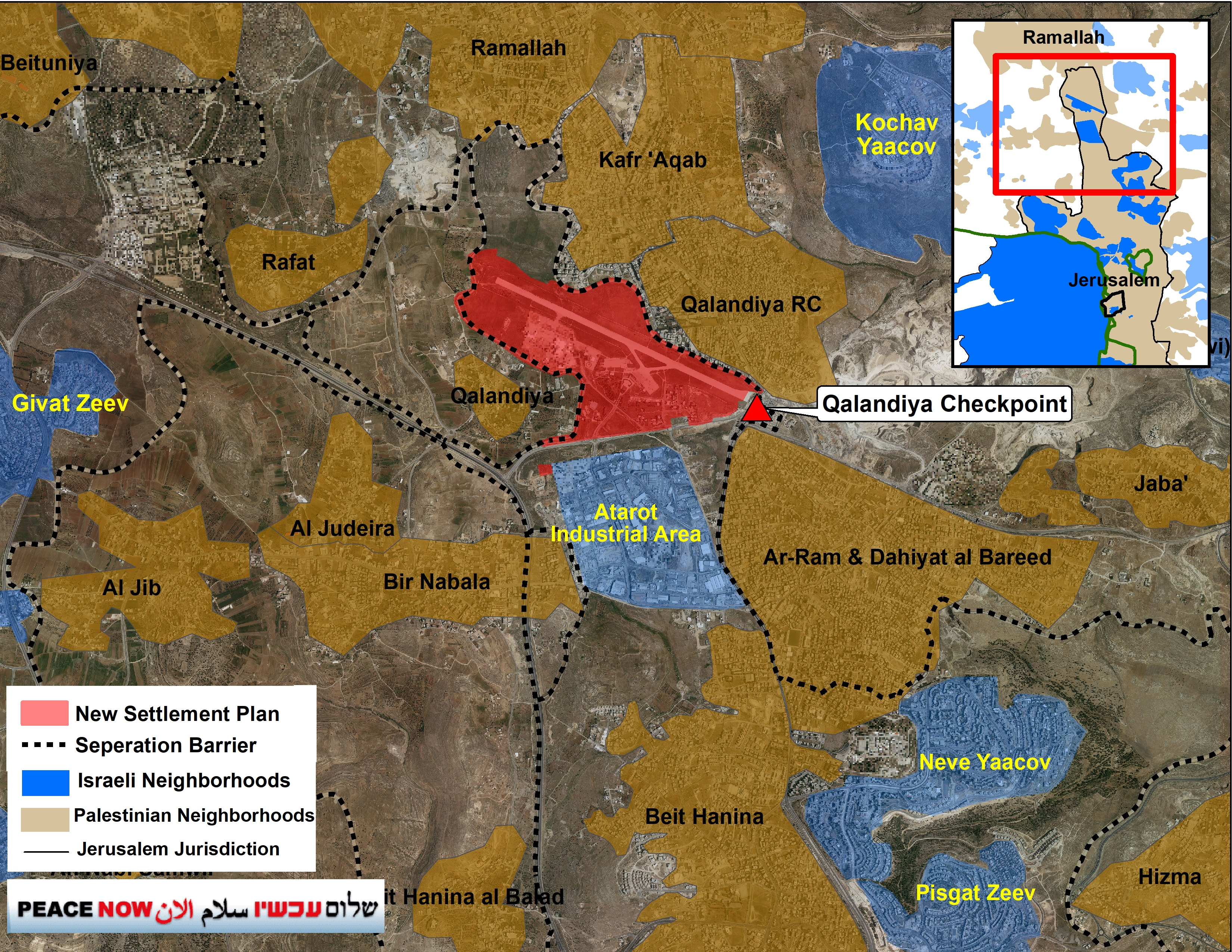 The Atarot settlement plan dates back to 2007. It was pursued by the Israeli government in 2012 but shelved under pressure from the Obama administration. The plan came back into consideration in April 2017 (a few months following the inauguration of President Trump) when it was rumored to be included on Netanyahu’s master blueprint of settlements for which he was seeking U.S. approval. In February 2020, following the publication of the Trump Plan – which designated the area that would be used for the settlement as a “special tourist zone” for Palestinians – the Atarot settlement plan was formally introduced. In January 2021 then-Prime Minister Netanyahu dangled the advancement of the plan as an incentive for parties to join his flagging coalition in order to remain in power.
In its current form, the plan provides for up to 9,000 residential units for ultra-Orthodox Jews (assuming, conservatively, an average family size of 6, this means housing for 54,000 people), as well as synagogues, ritual baths (mikvehs), commercial properties, offices and work spaces, a hotel, and a water reservoir. If built, the Atarot settlement will effectively be a small Israeli city surrounded by Palestinian East Jerusalem neighborhoods on three sides and Ramallah to its north.
There are currently 15 Palestinian families living in buildings on the land slated for the settlement, part of which is privately owned by Palestinians. Other land in the area has been declared “state land” by Israel or belongs to the Jewish National Fund. To solve the problem of Palestinian land owners, the Israeli government will need to evict the Palestinians living there and demolish their homes — a step that will be facilitated by the fact that all of the homes lack Israeli-issued building permits (which are essentially impossible for Palestinians to receive). The private Palestinian landowners will then be subjected to a non-consensual process of “reparcelization,” in which Israel will unilaterally reparcel and then redistribute the land amongst its owners on the basis of the value of the land (as determined by Israel) and the percentage of their ownership claim.
The Atarot airport site is an important commodity and, during past negotiations, it was promised to the Palestinians for their state’s future international gateway. Israeli development of the site as a settlement would — by design — not only deprive a future Palestinian state of the only airport in a Palestinian area, but also dismember Palestinian neighborhoods in the northern part of the Jerusalem, and sever East Jerusalem from a Palestinian state on this northern flank of the city (acting like E-1 on Jerusalem’s northeast flank, and like Givat Hamatos on Jerusalem’s southern flank).
Bonus Reads
- “Case Study: How a Settler Law-Breaker Became the #2 Official in Israel’s Ministry of the Interior” (FMEP // Lara Friedman w/ Dror Etkes)
- “Senior Israeli Official’s Appointment Approved Despite Demolition Order for His Settlement Home” (Haaretz)
- “In Sheikh Jarrah, anonymous actors and an absent state have created a powder keg” (The Times of Israel)
- “The Fight for Palestine’s Sheikh Jarrah Isn’t Over” (Jacobin)
- “ICC Mulls Probing Israel Over Razing Palestinian Homes in Jordan Valley” (Haaretz)
- “81 Palestinian homes demolished by Israel in East Jerusalem in 2021” (Middle East Monitor)
- “Jewish claim of land ownership in occupied East Jerusalem neighborhood displaces five Palestinian families” (WAFA)
Welcome to FMEP’s Weekly Settlement & Annexation Report. To subscribe to this report, please click here.
August. 6, 2021
- Sheikh Jarrah, Part 1: Court Proposes Settler-friendly “Compromise” to Avoid Substantive Ruling on Sheikh Jarrah Dispossession Cases
- Sheikh Jarrah, Part 2: Israel Reportedly Asks Biden Administration to Pressure Palestinians Into Accepting Sheikh Jarrah “Deal”
- Israel Housing Ministry Moves to Advance Atarot Settlement Plan
- Report: Jewish National Fund to Approve “Review” of West Bank Land/Property it Claims to Own but Not Have Registered
- New Petition Against Construction on Top of Ruins of Lifta
- Members of Congress Seek Codify Trump’s Green Line-Erasing Labeling Policy Into Law
- Bonus Reads
Sheikh Jarrah, Part 1: Court Proposes Settler-friendly “Compromise” to Avoid Substantive Ruling on Sheikh Jarrah Dispossession Cases
At a hearing held on Monday August 2nd, the three-judge panel of the Israeli Supreme Court proposed a “compromise” to resolve the cases of pending evictions of four Palestinian families from their longtime homes in the East Jerusalem neighborhood of Sheikh Jarrah. The compromise — which appears designed above all else to enable the Court to avoid issuing a ruling on the substance of the case — would enable the Palestinians in the targeted homes to avoid displacement for the time being, while offering settlers formal recognition of their ownership of the properties in question (and turning the Palestinians into tenants paying rent to a settler organization that has made clear its intention to displace them). Moreover, if implemented, the “compromise” would almost certainly become a precedent for the cases of the many other Palestinians in Sheikh Jarrah and Silwan (and almost certainly elsewhere in the future) whose homes/presence is targeted by settlers.
Specifically, under the deal proposed by the Court, the four Palestinian families fighting imminent forcible displacement from their longtime homes in the Sheikh Jarrah (the El Kurd, Jaouni, Abu Hasna, and Askafi families) would be required to recognize the settlers as the rightful owners of the land their homes are built on. In exchange for this recognition — in effect, a repudiation of claims to their own rights to the property — the Palestinians would be designated as “protected tenants,” which would enable the families to continue to live in their homes for 2 generations (protected tenancy rights may be handed down to the children and grandchildren, but not further), so long as the Palestinians pay the required rent to settlers (set at 1,500 shekels a year) and do not otherwise violate the rules of protected tenancy.
The four families swiftly rejected the proposal – which Mohammed El-Kurd observed, accurately, would leave them “at the mercy of settlers, paying rent to live in our own homes.” Despite this rejection, the Court announced that it intends to continue pursuing the “deal” (while applying pressure on the families to accept it). To that end, the four families were asked to submit a list of individuals who might be eligible to receive protected tenancy rights.
Ir Amim explains not only the trap of protected tenancy rights, but also the larger concerns about how the Court is behaving, writing:
“While protected tenancy offers some assurances against arbitrary eviction, the law still allows for the eviction of protected tenants through a variety of means. Settler organizations are currently using these mechanisms in order to try and evict protected Palestinian tenants in other cases. Alternatively, the settler group could advance an urban renewal building plan, which would ultimately result in the eviction and demolition of the families’ homes. In such a case, the families would be eligible for alternative housing elsewhere, but would lose their community and the homes in which they were living for decades and to which they are strongly tied. Indeed, settler leaders have already applauded the court’s proposal calling it a victory.
Additionally, protected tenancy status will mean, in essence, that the families are not recognized as the owners of their homes. The significance is both symbolic and practical since it means that the families would lose all opportunity to claim ownership in the future – for example when the Israeli Government conducts a land registration process in the neighborhood. Past experience shows that regardless of any phrasing which may be used in an attempt to circumvent recognition of settler ownership, the declaration of protected tenants may be used against future claims by the families.
The judges’ resolve to push for a settlement indicates their reticence in issuing a substantive ruling which would obligate them to rule against the settler group and the discriminatory legal mechanism which grants Palestinian property to Jews. Such a settlement likewise enables the Israeli government to abdicate responsibility for these measures.
A fair proposal can only be one that is in accordance with International Law and its basic premise of protecting the occupied population and its right to property, family, and community life. This basic principle must not be forgotten as the Israeli government is trying to evade the strong pressure which the protests against the Sheikh Jarrah evictions have succeeded in creating.”
Sheikh Jarrah, Part 2: Israel Reportedly Asks Biden Administration to Pressure Palestinians Into Accepting Sheikh Jarrah “Deal”
Haaretz reports that the Israeli government has asked the Biden Administration to pressure the four Palestinian families facing forcible dispalcement from their homes in Sheikh Jarrah into accepting the deal offered by the Supreme Court (see section above for details on the Supreme Court’s “deal”). The families rejected the deal immediately upon presentation, based on their refusal to legitimize settler claims of ownership over their homes.
Haaretz further reported that officials in the Biden Administration is not jumping to implement the Israeli request, but is keeping a close eye on the case. When asked about these reports at a State Department briefing on August 5th, spokesperson Ned Price responded:
“Well, as you know, we don’t speak to any diplomatic or private conversations, but what I can say is that we believe that the proposal offered by the Israeli court on August 2nd is a matter for the Israeli and Palestinian parties to the case to consider and to decide for themselves. We’ve said this just this week and many times before that: families should not be evicted from their homes in which they have lived for decades. We have encouraged Israeli authorities to avoid evictions and other actions that exacerbate tensions and that undercut efforts to advance a negotiated two-state solution...Look, we’re not going to comment or comment on or confirm reports of diplomatic conversations. What we have said as it relates to this – we have both in public and in private encouraged Israeli authorities to avoid evictions and other actions that exacerbate tensions and undercut efforts to advance negotiated two-state solution.”
Reporting around the Court’s and the Israeli government’s efforts to secure Palestinian agreement on the Sheikh Jarrah “compromise” makes clear that this deal is seen by the Court and the government as a solution that can (a) placate the international community, by avoiding immediate evictions; (b) deliver a huge victory to the settlement enterprise in East Jerusalem by creating a legal precedent for settlers to take ownership – and, eventually, possession – of a large number of homes/properties across East Jerusalem); and (c) bolster the Israeli narrative that what is happening in East Jerusalem is merely a real estate dispute, while rebutting claims that Israeli rule in East Jerusalem involves occupation/apartheid policies that systematically dispossess and disenfranchise Palestinians, while in parallel promoting the interests and aspirations of settlers.”
Haaretz columnist Nir Hasson wrote:
“In the end, the Sheikh Jarrah legal battle revolves around one question. Is it simply a real estate dispute, as the settlers assert, or is it part of a campaign by the state – its official arms (the custodian general, Land Registry, the Israel Police) and its unofficial ones (the Nahalat Shimon Company) to dispossess the Palestinians and Judaize the neighborhood? If it’s the latter, it’s a campaign based on discrimination and unjust laws. Needless to say, for the rest of the world, apart from Israel, the Palestinian viewpoint is the one that is accepted; the view that it’s a private dispute is rejected. The three justices struggled to decide where the court stood on this question. On the one hand, they are clearly not happy reopening a discussion on the legal substance of the affair. On the other, they also very much do not want to order the eviction of hundreds of people from their homes – at least not now, when Sheikh Jarrah is the focus of media and diplomatic attention.”
Israel Housing Ministry Moves to Advance Atarot Settlement Plan
The Walla news outlet reports that the Israeli Housing Ministry has placed the Atarot settlement plan on the agenda for the Jerusalem District Planning and Building Committee, which is scheduled to convene in December 2021. The plan for the Atarot settlement – which calls for 9,000 units to be built on the site of the former Qalandiya airport (located at the northern tip of East Jerusalem) – is at an early stage in the approval process.
According to the Times of Israel, Prime Minister Bennett was not notified in advance of the Ministry’s move – which is surprising given the sensitivity of the plan (which is opposed by the international community and strikes a deadly blow to the prospects of a two-state solution). Bennet is scheduled to head to Washington, D.C. soon – a trip originally scheduled for August, but now delayed until September.
The Atarot settlement plan dates back to 2007. It was pursued by the Israeli government in 2012 but shelved under pressure from the Obama administration. The plan came back into consideration in April 2017 (a few months following the inauguration of President Trump) when it was rumored to be included on Netanyahu’s master blueprint of settlements for which he was seeking U.S. approval. In February 2020, following the publication of the Trump Plan – which designated the area that would be used for the settlement as a “special tourist zone” for Palestinians – the Atarot settlement plan was formally introduced. In January 2021 then-Prime Minister Netanyahu dangled the advancement of the plan as an incentive for parties to join his flagging coalition in order to remain in power. At the time, Jerusalem expert Daniel Seidemann noted that the plan faces significant legal obstacles and predicted that it will not come to fruition “anytime soon.”
In its current form, the plan provides for up to 9,000 residential units for ultra-Orthodox Jews (assuming, conservatively, an average family size of 6, this means housing for 54,000 people), as well as synagogues, ritual baths (mikvehs), commercial properties, offices and work spaces, a hotel, and a water reservoir. If built, the Atarot settlement will effectively be a small Israeli city surrounded by Palestinian East Jerusalem neighborhoods on three sides and Ramallah to its north.
There are currently 15 Palestinian families living in buildings on the land slated for the settlement, part of which is privately owned by Palestinians. Other land in the area has been declared “state land” by Israel or belongs to the Jewish National Fund. To solve the problem of Palestinian land owners, the Israeli government will need to evict the Palestinians living there and demolish their homes — a step that will be facilitated by the fact that all of the homes lack Israeli-issued building permits (which are essentially impossible for Palestinians to receive). The private Palestinian landowners will then be subjected to a non-consensual process of “reparcelization,” in which Israel will unilaterally reparcel and then redistribute the land amongst its owners on the basis of the value of the land (as determined by Israel) and the percentage of their ownership claim.
The Atarot airport site is an important commodity and, during past negotiations, it was promised to the Palestinians for their state’s future international gateway. Israeli development of the site as a settlement would — by design — not only deprive a future Palestinian state of the only airport in a Palestinian area, but also dismember Palestinian neighborhoods in the northern part of the Jerusalem, and sever East Jerusalem from a Palestinian state on this northern flank of the city (acting like E-1 on Jerusalem’s northeast flank, and like Givat Hamatos on Jerusalem’s southern flank).
Report: Jewish National Fund to Approve “Review” of West Bank Land/Property it Claims to Own but Not Have Registered
Haaretz reports that the Board of Directors of the Jewish National Fund is set to approve an institutional review of approximately 17,000 assets it claims to own but failed to register (or take possession of) in the West Bank and East Jerusalem. Many of these properties are Palestinian homes, whose residents the JNF refers to as “squatters”. The JNF’s legal review could reportedly take five years to complete, and could result in the eviction of Palestinians if the JNF is found by Israel to rightfully own the land (given the track record of Israeli courts with respect to property disputes between Israeli organizations and Palestinains, such a finding is a near certainty), is then permitted to register the land, and then chooses to pursue the eviction of those Palestinians.
Of the total (17,000 assets), the JNF claims:
- It has documentation showing the purchase of 360 properties.
- It has a contract proving ownership of 170 properties
- It has legal claim to 2,050 plot currently under the control of Israel’s General Custodian (the body set up by the Israeli government to take control of land and properties “abandoned” by Palestinians in the 1948 war).
Peace Now said in response:
“The Jewish National Fund is becoming the Settlers’ National Fund. The registration procedures in the Occupied Territories and in East Jerusalem could bring to massive dispossession of Palestinians, like in Sheikh Jarrah and Silwan, and expansion of the settlements. The JNF- KKL is a national institution for the entire Jewish people which should not serve one side of the political map as it puts facts on the ground that endanger the state of Israel. We call upon all the organizations which are party to the JNF- KKL board, including Maccabi, Hadassah and Naamat and others: don’t be political organizations, don’t let your representatives vote for deepening the occupation and the settlements.”
As a reminder, established in 1901, the JNF devoted itself to buying land for Jews. Today, the JNF owns about 15% of all the land inside the Green Line (a figure which stands to increase if the review process leads to more properties being registered to the JNF). In addition, the JNF has used two subsidiary companies – both called Himanuta – to purchase land in the West Bank, even though the stated JNF policy (until now) did not support such purchases. Peace Now reports that the JNF, via Himanuta, has already purchased over 160,000 acres (65,000 dunams) across the West Bank; settlements established on some of those lands include Itamar, Alfei Menashe, Einav, Kedumim, Givat Ze’ev, Metzadot Yehuda (Beit Yatir), Otniel and more. At the same time, the JNF and the settler group Elad have been partnering together to pursue the mass eviction of Palestinians from East Jerusalem neighborhoods, including Silwan.
New Petition Against Construction on the Ruins of Lifta
On August 4th, a new petition was submitted to the Jerusalem Administrative Court challenging the issuance of a tender for construction on the ruins of the Palestinian neighborhood of Lifta in West Jerusalem. The tender was issued for 259 luxury housing units, commercial buildings, and a hotel. The petition was submitted by Adv. Dr. Sami Arshid on behalf of refugees from Lifta and experts/activists who have been protesting for the conservation of the site, which is on the UNESCO Tentative List of World Heritage Sites.
The Israeli NGO Emek Shaveh writes that the petition was submitted with three expert opinions, one from a civil engineer, a second from an ecologist, and a third written by a team of five architects and conservation planners. All of these opinions object to the construction plan.
While FMEP’s settlement and annexation report focuses on settlement building in areas located over the 1967 Green Line, the story of Lifta – and of other Palestinian villages forcibly depopulated by Israeli forces in the 1948 – is another facet of the Israeli government’s policy of erasure of Palestinians via the establishment of Jewish Israeli communities. You can read one Palestinian’s account of forced her forced displacement from Lifta, here.
Members of Congress Seek Codify Trump’s Green Line-Erasing Labeling Policy Into Law
On July 27th, U.S. Senator Tom Cotton (R-AR) and 5 Republican colleagues introduced a bill to “require the maintenance of the country of origin markings for imported goods produced in the West Bank or Gaza, and for other purposes.” Under this legislation, products made in the West Bank and Gaza would be legally required to be labelled “Made in Israel” for the purposes of importing to the United States.
In a tweet following the introduction of the bill, which has been referred to committee, Sen. Cotton released a statement and tweeted:
“Left-wing activists abuse county-of-origin labels in order to stigmatize products made in Israel. Our bill will defend the integrity of the Jewish State by ensuring that Israeli products may proudly bear the label ‘Made in Israel’
As a reminder, in the waning months of the Trump Administration, then-Secretary of State Mike Pompeo announced new U.S. guidelines that require products made in all areas under Israeli control to be labelled as “Made in Israel” (or iterations thereof) when being exported to the U.S. This was a massive and highly consequential shift in U.S. policy, boiling down to U.S. recognition of Israeli sovereignty not only over settlements (as the Trump Administration has previously done) but over all of Area C – some 60% of the West Bank), irrespective of whether or not Israel officially annexes the land. This Trump-era labeling policy remains in effect today, as the Biden Administration has not publicly reversed it. Notably, this policy – as laid out by Pompeo – would in principle require even Palestinian-made goods originating from villages in Area C to be labelled as “Made in Israel”. Roughly 150,000 Palestinians live in Area C, where they are subjected to an escalating Israeli campaign to make life untenable for them via discriminatory planning policies and demolitions.
For more, please see (and subscribe to receive) Lara Friedman’s weekly legislative roundup.
Bonus Reads
- “Why we went to the UN Security Council about East Jerusalem” (The Times of Israel // Yudith Oppenheimer of Ir Amim)
- “Ted Cruz blocks bill advancing Israel-Arab normalization, citing pressure on Israel to reach two-state solution” (JTA)
- “WATCH: Settler grabs Israeli soldier’s weapon, fires at Palestinians” (+972 Magazine)
Welcome to FMEP’s Weekly Settlement & Annexation Report. To subscribe to this report, please click here.
July 23, 2021
- Ben & Jerry’s Announces End of Ice Cream Sales in Settlements
- Report: Bennett Agreed to Delay Settlement Approvals at U.S. Request
- Israeli Lawyers Prepare Amicus Brief Opposing Sheikh Jarrah Displacement
- State Delays “Relocation” of Khan Al-Ahmar Community Until September 5th
- High Court Green-lights State Sponsorship of Illicit Settlement Activities via Amana Settler Org
- New Docs Show the Israeli Government Uses the JNF to Take Control of West Bank Land for Settlements, & How the JNF Uses a Subsidiary to Hide Deals
- Israeli Consumer Authority Refuses Request for Proper Labelling of Settlement Products
- Coalition of Palestinian Orgs Launches Campaign for Revocation of U.S. Charitable Designation for Settlement Groups
- Senior Israeli Government Official Lives in Settlement Under Demolition Order
- Testimonies Show Israeli IDF Complicity in Settler Violence
- Bonus Reads
Comments or questions? Email Kristin McCarthy – kmccarthy@fmep.org.
Ben & Jerry’s Announces End of Ice Cream Sales in Settlements
Ben & Jerry’s ice cream company has announced that it will not renew the license of its Israeli franchisee because that franchisee refuses to stop operating in settlements. Ben & Jerry’s linked this decision to the illegality of settlements, saying in a statement:
“We believe it is inconsistent with our values for Ben & Jerry’s ice cream to be sold in the Occupied Palestinian Territory (OPT). We also hear and recognize the concerns shared with us by our fans and trusted partners. We have a longstanding partnership with our licensee, who manufactures Ben & Jerry’s ice cream in Israel and distributes it in the region. We have been working to change this, and so we have informed our licensee that we will not renew the license agreement when it expires at the end of next year. Although Ben & Jerry’s will no longer be sold in the OPT, we will stay in Israel through a different arrangement. We will share an update on this as soon as we’re ready.”
Ben & Jerry’s decision to stop selling ice cream in the settlements – which are illegal under international law and have been shown by human rights organizations like Human Rights Watch and Amnesty International to be at the core of violations of Palestinian rights – has received an inordinate amount of attention from the media and from the Israeli government.
Quickly following the announcement that Ben and Jerry’s was exiting the settlements, pro-Israel allies in the U.S. expressed outrage and threatened legal repercussions under state anti-BDS laws. The U.S. State Department also expressed its disagreement with Ben & Jerry’s policy decision – and its outright opposition to, and commitment to combating, BDS targeting Israel and/or Israeli settlements. During a briefing, Spokesman Ned Price said:
“Our position on BDS has been clear. This is not something that we need to review. Again, the BDS movement unfairly singles out Israel… [the U.S.] will be a strong partner in fighting efforts around the world that potentially seek to delegitimize Israel [in a way that is] consistent with the First Amendment rights of the American people.”
Report: Bennett Agreed to Delay Settlement Approvals at U.S. Request
Israel Hayom reports that Prime Minister Naftali Bennett has agreed – at the request of the Biden Administration – to for the time being freeze construction approvals for new settlement units. The outlet reports that over the past month Bennett has prevented the Civil Administration’s High Planning Council from scheduling a meeting in which it could advance settlement construction plans.
The report has drawn criticism from within Naftali Bennet’s inner circle, with Interior Minister Ayelet Shaked threatening to leave the governing coalition – which cannot survive without her – if Bennett in fact agreed to a settlement freeze. Shaked told the press:
“If the government does something that is ideologically serious in my view, we will not be a part of it. For example, if the US administration demands a freeze in Judea and Samaria — there will be no government.”
In response to a question at a State Department press briefing about reports that the U.S. is pressuring the Bennett government to curb settlements, U.S. Department of State Spokesperson Ned Price did not confirm or deny the reports. Instead he merely reiterated the Biden Administration’s standard response to questions related to Israeli settlements, saying:
“When it comes to settlement activity, we have also been clear and consistent on that. We believe it’s critical to refrain from unilateral steps that increase tensions and make it more difficult to advance a negotiated two-state solution. This is a message we have conveyed in public, as I have just now, but also in private. And it has been the longstanding position, certainly the position of this administration and had been a longstanding position of prior administrations.”
Israeli Lawyers Prepare Amicus Brief Opposing Sheikh Jarrah Displacement
Peace Now has assembled a group of prominent Israeli legal authorities to prepare and submit an amicus brief arguing to the Israeli High Court that Palestinians living under the threat of forced displacement in Sheikh Jarrah should not be evicted by the state in favor of settlers. The brief – which deals with the spefic case of the Duweik family but can be applied broadly to other pending displacement cases in Sheikh Jarrah and Silwan – asserts that the Palestinian residents as long-term tenants the Palestinians have accumulated property rights to their homes and should not be evicted.
Peace Now summarizes:
“The brief addresses an approach that has emerged in international jurisprudence on human rights law which puts an emphasis on group vulnerability of occupants facing eviction and institutional, systemic discrimination against them. Where these are present, in certain circumstances, the occupants’ rights, stemming from the human right to housing and specifically, to live in their home and their family’s home – trump the right of the original owner or their substitute to regain possession of the property.
The brief reaches the conclusion that in the Duweik case, the occupants’ property rights and their right to housing supersede the right of the settlers acting on behalf of the pre-1948 original owners to receive possession of the property, based on the following:
1 – The fact that Palestinian residents of East Jerusalem are underprivileged, vulnerable and subjected to discrimination in every aspect of life, and particularly the fact that Israeli law on the restitution of property that changed hands due to wars, openly and deliberately discriminates against them;
2 – The fact that the family entered the property in good faith and/or in accordance with the law applicable at the time, and has developed a legitimate expectation to continue residing in it permanently and without interruption;
3 – The imbalance between the devastating harm the family would suffer and the minor damage the Benvenisti charitable endowment (represented by the settlers), which claims ownership of the property, would sustain, which clearly tips the scales in favor of the family.
In other words, according to the brief, even if the court finds the settlers do, in fact, have ownership, they are not necessarily entitled to remedy in the form of the families’ eviction from their homes, but rather to compensation from the state.”
Peace Now said in a statement about the amicus brief:
“There’s an elephant in the room, and the lofty legal debate in the Sheikh Jarrah and Batan al-Hawa eviction cases ignores it, producing a legal distortion and an egregious injustice. This is not just another real estate dispute between equal parties. This is an organized, programmatic effort, with ample governmental support, to dispossess hundreds of Palestinians from their homes and replace them with settlers. This amicus curiae brief can help the court see the bigger picture, deliver justice and avert the iniquity.”
Michael Sfard, one of the authors of the brief, said:
“For years, judges have been considering the eviction cases in East Jerusalem under the assumption that they involve a dispute between a landlord and a tenant and therefore, proof of ownership on the part of the settlers necessarily triggers a countdown to eviction. The brief reintroduces the context of the legal proceeding – dispossession by the stronger, dominant group against a vulnerable, discriminated community whose members, in some cases, entered the properties for lack of choice and always according to the applicable laws and with a legitimate expectation that the property will be their permanent home. I hope the court takes the opportunity provided by the brief to bolster and defend the occupants’ right to continue living in their homes – a right acknowledged by international human rights law.”
State Delays “Relocation” of Khan Al-Ahmar Community Until September 5th
According to reports, Israeli Prime Minister Naftali Bennett will soon decide whether to move forward with a deal negotiated by his predecessor for the “relocation” of the Khan Al-Ahmar bedouin community. Reportedly, the terms of the deal would see the Khan Al-Ahmar community agree to their relocation in exchange for Israeli residency. Under the reported terms of the agreement, the community would be allowed to re-establish their community several miles east of their current homes – at an empty site near Abu Dis. In expectation of that transfer, the government of Israel has already connected the area to water, electricity, and sewage.
Though the High Court had previously set July 2021 for the demolition and forcible relocation of Khan al-Ahmar, alternate Prime Minister and current Foreign Minister Yair Lapid requested an extension in order to give the new government time to review the deal which was negotiated under the Netanyahu government, and decide whether to move forward with it. Calling the decision a “sensitive issue,” Lapid asked the Court for additional time “to examine the necessary conditions for the evacuation of the outpost and to conduct a significant and in-depth inquiry of all the legal and international consequences of the move.” The Court subsequently gave the government an additional six weeks – until September 5th – to make up its mind.
It must be noted that, if reports are correct, Khan al-Ahmar leaders signed the deal to be removed from their longtime lands after prolonged coercive circumstances. Previous allegations regarding the nature of the Khan al-Ahmar relocation – specifically B’Tselem’s accusation that it is tantamount to a war crime – have not necessarily been assuaged by the community’s agreement. Since the 1950s – when the community was forced to leave their land in the Negev during the 1948 war – the Khan al-Ahmar bedouin community has lived and worked the lands located just east of Jerusalem, in the shadow of the land marked for the construction of the E-1 settlement (which is once again in the headlines).
The settler group Regavim – which petitioned the Court to force the government to demolish Khan al-Ahmar last year, in the midst of a global pandemic – is upset that the demolition has once again been delayed. In response, the organization issued a statement saying:
“Lapid’s announcement is a political move intended to signal to Bennett and his partners that none of their election promises can be fulfilled. Not in the Negev, not in the Galilee, and not in Khan al-Ahmar.” [Regavim called on Bennett] “to show who’s in charge. We call on you to evacuate Khan al-Ahmar immediately!”
Jerusalem expert Danny Seidemann has previously written:
“the story of Khan Al-Ahmar is not only about the tragedy for the village and its inhabitants, or about Israel’s readiness to carry out an ostensible war crime in the face of the world. It is also about Israel’s determination to clear the entire area of the West Bank east of Jerusalem, and located within the line of the built and planned barrier, of any Palestinian presence. This clearing will prepare the ground for the future construction of E1 and de facto annexation of this so-called bloc, which extends well beyond the built-up area of Maale Adumim.”
High Court Green-lights State Sponsorship of Illicit Settlement Activities via Amana Settler Org
On July 18th, the Israeli High Court of Justice dismissed a petition filed in 2019 by Peace Now that sought to stop the transfer of state funds to the Amana settler group, which regularly drives unauthorized (i.e. illegal even under Israeli domestic law) settlement activity. In its ruling, the Court did not reckon with the fundamental problem of allowing state funds to finance illegal activities, but instead ruled on a procedural point that the State (specifically settler municipal councils) is only permitted to fund public institutions – and the Court determined that Amana meets the criteria to be deemed a public institution.
One High Court justice, Menahem Mazuz, issued a minority opinion dissenting from the Court’s ruling. Mazuz said that in his opinion Amana should not be eligible to receive state funds because Amana, though it voluntarily operates on a non-profit basis, is not actually a registered non-profit (it is a cooperative association) and is therefore not subject to the same legal requirements of transparency and supervision.
At the time of filing the underlying petition against state funding for Amana, Peace Now wrote:
“Amana and the regional councils in the territories have established a sophisticated mechanism to exploit the public coffers for illegal activity and to create facts on the ground. There is no limit to the chutzpah of the settlement heads. On one hand, they build outposts, with far-reaching diplomatic consequences, with public funds, and on the other hand, they cry to the government and ask for their criminality ==to be retroactively legalized. What a responsible and fair government needs to do is shut the spigot to Amana and immediately evacuate the illegal outposts.” And, “the regional councils and Amana go to great efforts to hide the information about their financial sources and illegal activities. Even with the legal process in Peace Now’s petition against granting support money to Amana, the councils have refused to provide basic information on the amount of funds transferred to Amana and their use. Amana received tens of millions of shekels from the regional councils every year, and the information received about the activities in Gush Etzion in 2018 and 2019 is just the tip of the iceberg. Peace Now uncovered the mechanism behind the illegal outposts in its “Unraveling the Mechanism behind Illegal Outposts” report which describes the operation by local authorities in the West Bank, together with Amana and the Settlement Division, to support illegal outposts and construction in the settlements, but not all financial sources have been clarified. The support by the Gush Etzion Regional Council is only a small part of Amana’s multi-million shekels operation in this illegal activity, with far-reaching ramifications for Israel’s future.”
New Docs Show the Israeli Government Uses the JNF to Take Control of West Bank Land for Settlements, & How the JNF Uses a Subsidiary to Hide Deals
Haaretz has revealed new documents that show the Israeli Defense Ministry directed the Jewish National Fund (JNF) to purchase privately owned Palestinian land in the West Bank in order to expand settlements and retroactively legalize outposts. In some of the cases, certain JNF staff and the JNF’s subsidiary called Himunata acted to conceal the land purchases from the JNF’s Board of Directors. What’s more, with respect to a series of deals between 2018-2019, various irregularities call into question the validity of the land acquisitions.
According to Haaretz, the JNF’s board of directors has not yet reviewed or discussed the two reports, One report – the Yahav Report (written in 2020) – covers the land purchases in question. The second report – the Lamberger Report – details the lengths to which Himunata and its co-conspirators went to in order to hide the transactions from the JNF staff and Board of Directors.
The JNF’s active involvement in the settlement enterprise is not new, but the direct line between the government and the JNF in conspiring to find means by which to take possession of privately owned land that the government has not found other means by which to seize (and reminder: the Israeli government is very inventive and persistent in finding means by which to seize privately owned Palestinian land) is shocking, and new – showing the extent to which the government is supportive of settlement and outpost growth.
Israeli Consumer Authority Refuses Request for Proper Labelling of Settlement Products
In response to a request made by the nonprofit organization Combatants for Peace, Israel’s consumer protection agency has said it cannot mandate that manufacturers based in the settlements label their products as settlement products instead of using the misleading “Made in Israel” label. The reason given by the agency’s lawyer: the agency does not have the authority to declare that the locations in settlements are “not in the country of ‘Israel’.”
Eitay Mack, the lawyer representing Combatant for Peace, said:
“Not consuming products from the Israeli settlements and outposts in the West Bank is no different from not consuming animal products, or consuming only organic products and free-range eggs, or consuming kosher or non-kosher products, all of which can result from reasons of conscience, religion, ideology or the politics of a citizen of the State of Israel. The misleading labeling of products from the Israeli settlements and outposts as Made in Israel creates unfair competition toward those same Israelis who genuinely (despite the difficulties involved in it) devote their lives to manufacturing within [the borders] of the State of Israel.”
The consumer protection agency has now waded into an ongoing legal effort led by activists across the world to insist upon a product labelling regime that accurately labels settlement products. This effort is pushing against the ongoing campaign by the Israeli government and its allies to erase the Green Line and assert sovereignty – de facto and increasingly, for all intents and purpose, de jure annexation – over the settlements.
A centerpiece of this battle is the case of the Psagot Winery, which has been a willing legal test case for the Israeli government’s efforts. In the waning months of the Trump Administration, the Psagot case was delivered a major victory when then-Secretary of State Mike Pompeo announced new U.S. guidelines that require products made in all areas under Israeli control to be labelled as “Made in Israel” (or iterations thereof) when being exported to the U.S.
This massive and highly consequential shift in U.S. policy, which offers recognition of Israeli sovereignty not only over settlements (as the Trump Administration has previously done) but over all of Area C – some 60% of the West Bank, was – remains U.S. policy today, as the Biden Administration has not publicly reversed it. Notably, this policy, if focused on territory rather than on people, would in principle require even Palestinian-made goods originating from villages in Area C to be labelled as “Made in Israel”. Roughly 150,000 Palestinians live in Area C, where they are subjected to an escalating Israeli campaign to make life untenable for them via discriminatory planning policies and demolitions.
Coalition of Palestinian Orgs Launches Campaign for Revocation of U.S. Charitable Designation for Settlement Groups
A group of 150 Palestinian organizations, village councils, and activists have launched a campaign urging Americans to press the U.S. government to revoke the charitable designations of U.S.-based groups that finance Israeli settlement organizations. Since many of these organizations – including Elad, Israel Land Fund, and Ateret Cohanim – have fundraising arms based in New York, the campaign asks supporters to appeal to New York Attorney General Letitia James to revoke the licenses.
Sami Huraini, a Palestinian activist with Youth of Sumud, told WAFA:
“Israeli settler organizations have funneled US charitable money into a political campaign of displacement. Right now, over 100 homes and some 1,500 Palestinians in Silwan are facing displacement in favor of a theme park run on Palestinian lands by the settler organization Elad. Clearly, this is not the intended outcome of US charitable tax law.”
Hisham Sharabati of the Hebron Defense Committee told WAFA:
“Other campaigns seeking to challenge the flow of US charitable money have targeted the IRS and their complaints have been left unanswered by bureaucrats. This campaign is fundamentally different. Since US charities must maintain a 501(c)(3) status at the state level, the campaign targets one elected official who can be held accountable by her constituents – in this case, New York Attorney General Letitia James.”
Lara Kilani, Advocacy Officer of the Good Shepherd Collective, told WAFA:
“We can see the interest in joint struggle growing. The mobilization we saw in May to speak out against the eviction of families in Sheikh Jarrah and Israel’s bombing of Gazans illustrates that people want to be in solidarity with Palestinians. We’re offering a campaign that can advance liberation in real ways across movements. White supremacist groups like New Century Foundation exploit US charitable laws to finance violence against Black and Brown communities. If the New York Attorney General enforces the existing laws, it can help us cut the funding for these racist organizations.”
Senior Israeli Government Official Lives in Settlement Under Demolition Order
Newly published documents confirm that the Director-General of the Israeli Interior Ministry, Yair Hirsch, lives in an outpost (Kida) that is currently under demolition order because it was built without building permits. The documents were released thanks to a freedom of information request submitted by the anti-settlement watchdog Kerem Navot. The documents further show that the Israeli Civil Administration issued a stop-work order against Hirsch’s house in 2008.
Kerem Navot reports the story behind the Kida outpost and Yair Hirsch:
“Yair Hirsh lives in the illegal outpost of Kida, which was established in 2003 on a hill located about three kilometers east of the settlement of Shiloh. The outpost was founded on part of the historical lands of the village of Jalud, in an area where a team led by the attorney Plia Albeck implemented a large declaration of state land in 1991.
In 2000, about three years before the outpost was established, the Blue Line Team of the Civil Administration remapped Ableck’s declaration. The goal of the mapping was ostensibly to include as state land only the areas that had been “uncultivated” in the past, and to exclude from the declaration area lands that had been cultivated. But the inspection that we carried out revealed that this mapping was extremely negligently done (link to the aerial photos from 1980 and from 2020, in which the cultivated areas in the area can be seen, in the first comment).
Since 2000, the Blue Line Team has returned to map the state land that was declared for those outposts that the state wants to legalize, but for some reason, of all places, the outpost of the appointed Director General of the Ministry of the Interior was overlooked. The reason for this simple: if serious mapping were done in this place, it would become clear that most of the outposts’ houses were built on land that had been cultivated in the past, and therefore there is no way to legalize them.
This secret is well known in the Kida outpost. Therefore, its residents chose to up the ante, with the not-unreasonable assumption, unfortunately, that no one would dare to evict them. And so in recent years, what was once an outpost of modest caravans has become a neighborhood of luxurious villas, for which over each structure hangs a demolition order issued by the Civil Administration. This is how it is when one builds on looted land–a lot of money remains left over for building beautiful villas.
Yes, you got that right: the individual whom the Minister of the Interior selected to run the office that is responsible, among other things, for all of the local authorities in Israel and in the West Bank is someone who, along with all of his neighbors, built his home illegally on land that does not belong to him, and continues to live on it in spite of the demolition orders pending against him. Makes sense.”
Testimonies Show Israeli IDF Complicity in Settler Violence
Breaking the Silence has published a new collection of testimonies from former Israeli soldiers specifically highlighting how active duty soldiers are systematically complicit in settler violence. In 36 testimonies, you can read how the IDF teaches, positions, and incentivizes its soldiers to protect the settlers at all times and in all circumstances – even when the settlers are violent towards Palestinians and their property, and even when settlers are violent towards the Israeli army itself.
In releasing the report, Break the Silence writes:
“The testimony collection is titled ‘On Duty,’ which conveys a double meaning: firstly, that the soldiers are “on duty” to protect the settlers and to advance their political ideology on the ground, constantly remaining at the settler’s beck and call. At the same time, the settlers are “on duty” to advance and entrench the occupation and shape the reality on the ground, much of the time through the use of violence, none of which would be possible without the soldiers’ presence, protection, and even active help. ‘On Duty’ conveys the idea that both forces are constantly there, working to advance each other’s interests, and immediately available to each other. Video footage of this phenomenon is frequently documented by B’Tselem and other human rights groups, including this settler attack on Palestinain homes in the Nablus area, in which IDF soldiers were present and did not stop the attack, and this violent settler raid on ‘Asirah al-Qibliyah, in which an IDF soldier killed 19-year-old Husam ‘Asayrah.
Beyond providing testimony to the occurrence of settler attacks on Palestinians and their lands, ‘On Duty’ offers an explanation of the system that allows them to happen, described from the point of view and in the words of the soldiers who took part in the enforcement of this system. Testifiers to Breaking the Silence describe settlers’ attempts to ingratiate themselves with soldiers through the provision of gifts, food, and hospitality, and when soldiers act against the settlers’ desires, testimonies describe violent attacks by settlers against IDF soldiers. In addition, soldiers describe receiving instruction that their mission is to protect the Jewish settlers, but many are unaware of any clear orders as to how they are to enforce the law on violent settlers. These conditions make it near impossible for soldiers to carry out their task impartially when they are required to prevent or halt the violent attacks against Palestinians.
‘On Duty’ presents testimonies from soldiers who served in different units and across the West Bankwhich unequivocally show that the phenomenon of settler violence is an inevitable consequence of Israel’s occupation and policy of settling the West Bank. Were it not for the IDF’s continuous control over and presence in the occupied territories, this violence would not be a possibility.”
Bonus Reads
- “Bedouin Shepherds Used Palestinian Land With Permission. Israel Seized Their Tents Anyway” (Haaretz)
- “New Israeli government’s land seizure – where’s the EU?” (EU Observer // Sarit Michaeli)
- “Israel imposed tight restrictions on Palestinians in Hebron to secure settler raids” (MEMO)
- “Jenin becomes flashpoint for Israel-Palestinian confrontations” (Al-Monitor)
- “What Israeli soldiers don’t demolish by day, settlers burn by night” (+972 Magazine)
- “Israel turns Silwan into closed military site” (Al-Monitor)
- “Palestinians Fear Eviction From Their Jerusalem Neighborhood To Make Way For A Park” (NPR)
- “Palestinian-Jordanian crisis erupts ahead of Abdullah-Biden meeting” (Jerusalem Post)
- “No one told this young soldier to protect Palestinians from settlers” (Ynet)
Welcome to FMEP’s Weekly Settlement & Annexation Report. To subscribe to this report, please click here.
May 7, 2021
- Protests Against Dispossession Continue in Sheikh Jarrah, as Israeli Court Delays Decision
- Israel Has Been Conducting a Secretive Land Registration Process in Sheikh Jarrah, Excluding Palestinians
- Har Homa E Settlement Plan Granted Approval, With Minor Conditions
- Knesset Attempts Fast-Track Vote on Two Key Bills: One to Authorize Outposts; Another to Cancel 2005 Disengagement
- Bibi Reportedly Dismisses U.S. Concerns Over Settlements
- Construction Begins on New “Legal” Settlement in Southern West Bank, Foreshadowing More to Come
- Following Deadly Drive-By-Shooting, Settlers Establish New Outpost & Terrorize Palestinians Near Nablus
- Al Haq Report on Palestinian Workers in Settlements & the Complicity of Multinational Corporations
- Bonus Reads
Comments or questions? Email Kristin McCarthy – kmccarthy@fmep.org.
Protests Against Dispossession Continue in Sheikh Jarrah, as Israeli Court Delays Decision
On May 2nd, the date set by the Israeli Supreme Court for the forced dispossession of four Palestinians families from their longtime homes in Sheikh Jarrah in favor of Israeli settlers, the Supreme Court delayed the evictions and gave the parties four days (until May 6th) to consider a proposed “solution.” The Court’s suggested “solution” was that the Palestinians acknowledge Jewish ownership of the land, and in exchange be allowed to remain there as tenants – paying rent to the settlers – but only until the original tenant dies. At that time, the remaining family members would have to vacate the premises and the settlers would take control of the homes
In a powerful statement issued on May 2nd, the four families targeted for dispossession this week rejected that proposal outright, saying:
“We the four Sheikh Jarrah families firmly reject the terms of this agreement, for these are our homes and settlers are not our landlords. The inherently unjust system of Israel’s colonial courts is not considering the questioning of illegal settlers’ ownership and has already decided on the families’ dispossession.” This pattern of elongating the legal process is common practice to dull popular resistance and public opinion protesting these expansionist colonial efforts. As the threat of expulsion from our home remains as imminent as ever, we will continue our international campaign to stop this ethnic cleansing”
On May 6th, the Court once again delayed the dispossession, and said it would reconvene a three judge panel on May 10th to decide whether to allow the Palestinian families to continue appealing their eviction cases. Ir Amim reports that the likelihood of the panel ruling in the Palestinians’ favor is “slim.”
The date the Supreme Court chose for handing down its decision – May 10th – also happens to be Jerusalem Day. This is the day when as many as 25,000 Israeli settlers and fellow right-winger fanatics engage in an annual provocation against Palestinians, with a parade through the Muslim Quarter of the Old City and neighboring areas of East Jerusalem to “celebrate” Israel’s capture of the city in 1967 (called “The Dance of Flags,” including racist chants and signs). Given the high tension in Jerusalem over the pending Sheikh Jarrah evictions, as well as over the recent protests over Israel’s closure of the area around Damascus Gate, the end of Ramadan, and the killings over the past two days of several Palestinains in the West Bank, Jerusalem Day poses a significant threat of escalation, and has already elicited warnings from the Israeli Chief of Police to reroute the parade. So far, those warnings appear to be falling on deaf ears.
To be clear: escalation has already begun. Shortly following the Supreme Court’s second delay, dozens of Israeli protestors marched through Salah Eddin Street (the major commercial thoroughfare in Palestinian East Jerusalem), and were reportedly “throwing stones at Palestinian cars and demanding the ethnic cleansing of Sheikh Jarrah.” Not long after that, the head of the Otzma Yehudit party Itamar Ben-Gvir (a devotee of Kahanism and the ethnic cleansing of Palestinians) set up a tent-office in Sheikh Jarrah across from where Palestinians had prepared an iftar celebration. Settlers then began taunting the Palestinians sitting down for dinner, which escalated into clashes when a settler sprayed what appeared to be pepper spray. Later that evening, Israeli forces were seen protecting the “office” and the settlers there – including Jerusalem Deputy Mayor and settler empresario Arieh King, who was caught on video telling an injured Palestinian that the Israeli police ought to have shot him in the head.
On Friday morning May 7th, Sheikh Jarrah residents report that the Israeli police have cordoned off the neighborhood, and are checking IDs before permitting entry. Overnight raids and arrests of Palestinians also continue to be reported, with 15 arrested overnight on May 7th (settlers faced no arrests or punishments, despite being filmed shooting guns)
Prie Minister Netanyahu is reportedly proposing a permanent police presence in Sheikh Jarrah to protect the settlers — an arrangement much like the prevailing reality in Hebron
For a Palestinian view on what is happening in Sheikh Jarrah (and a plethora of additional resources on this topic), check out this FMEP webinar from May 6, 2021, and on Twitter you can follow #SaveSheikhJarrah for the latest news.
Israel Has Been Conducting a Secretive Land Registration Process in Sheikh Jarrah, Excluding Palestinians
Ir Amim and Bimkom report that Israeli authorities have been carrying out a secretive land registration process for the benefit of settlers in the Umm Haroun section of the Sheikh Jarrah neighborhood of East Jerusalem, and have already registered several plots of land to Jewish Israeli owners. Palestinian residents – inlcuding 45 families (40 houses) living on the plots of land secretly registered to the settlers – were not notified by Israeli authorities that the registraiton process was taking place, as is required by Israeli law. The stakes, as noted by Bimkom and Ir Amim, are high not only for Palestinians in Sheikh Jarrah who are being targeted at this time, but also for Palestinians across East Jerusalem, as any land registration process – let alone a secretive process undertaken for the benefit of Israeli Jews – can lead to “widespread Palestinian dispossession in the city.”
On May 2nd, Ir Amim and Bimkom filed an urgent petition with the Israeli High Court of Justice asking the Court to freeze the registration process and “expunge all invalid land registration as a result of this unethical procedure”. On May 3rd, the Israeli court issued a temporary injunction stopping the process at least until a ruling can be made on the case. The State has until June 3, 2021 to submit a response to the petition.
Har Homa E Settlement Plan Granted Approval, With Minor Conditions
Ir Amim reports that the Jerusalem District Committee has granted its conditional final approval to a plan to build 540 new settlement units in the new Har Homa E settlement. The conditions outline a few minor modifications to the plan (like more clearly marking bike trails) which will not take much time. Once those modifications are made the plan will be formally approved via publication without requiring another meeting of the Committee.
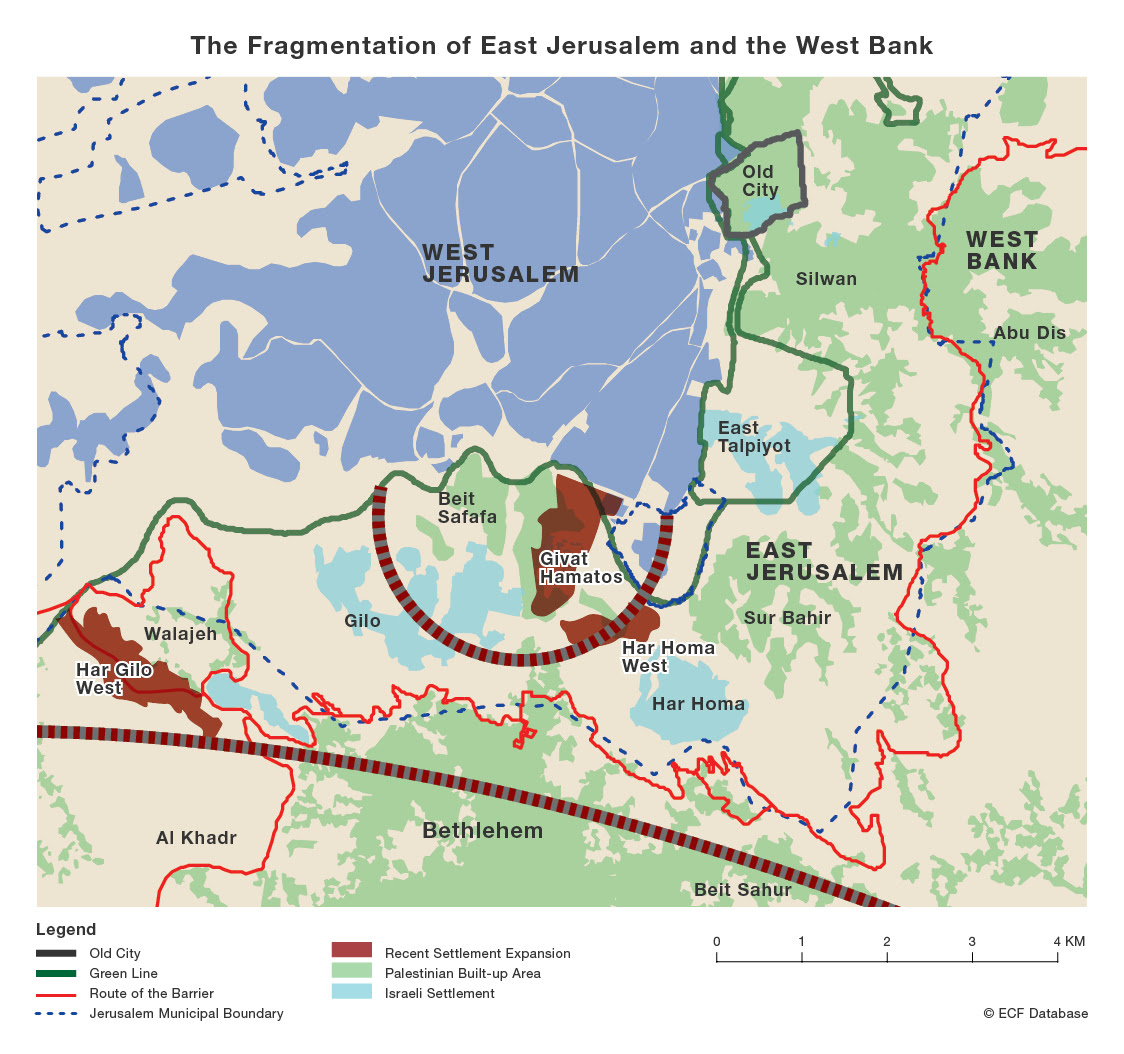 Because the land on which the new settlement will be built is privately-owned, building plans will not be subject to a government-run tender process. Ir Amim reports that once the plan is published, building permits can theoretically be issued any time (though technical obstacles might delay things but not change the inevitability of construction).
Reminder: Although the Har Homa E plan is framed as merely an expansion of the Har Homa settlement in East Jerusalem, it is more properly understood as a new settlement since the buildings will be built in an open area that is not contiguous with the built-up area of Har Homa. The plan calls for 540 new settlement units to be built in the area between the Har Homa settlement and the site of the planned Givat Hamatos settlement (tenders for which were issued in January 2021). Meaning that the new construction is a significant step towards completing a ring of Israeli settlements on Jerusalem’s southern edge and encircling the Palestinian neighborhood of Beit Safafa.
Knesset Attempts Fast-Track Vote on Two Key Bills: One to Authorize Outposts; Another to Cancel 2005 Disengagement
On May 4th, the Knesset Arrangements Committee voted in favor of fast-tracking two settlement-related bills. The first would cancel the 2005 Disengagement Law, thereby allowing settlers to re-establish the four settlements in the northern West Bank which were evacuated under that law (which settlers have been attempting to do on their own, illegally but with significant political support, for years). The second would grant retroactive authorization (i.e., legalize) the nearly 70 outposts that Israel has failed to find any other way to legalize (because they were built on land even Israel recognizes is privately owned by Palestinians). Now on a fasttrack, the bills can be called for its first vote at any time after May 5th (to pass, all bills most be voted on three times in the Knesset and sent to committees for approval).
The fast-tracking of these bills at this time is an attempt to get the bills passed into law before a new government is formed or new elections are called, and to use the issue of settlements as a political weapon against parties that oppose the bills. The Times of Israel reports that internal politics will likely see the bills languish as parties jockey to form a new governing coalition. The bills are a source of division between parties that are currently deep in negotiations to form a governing coalition – led by Yair Lapid and the Yesh Atid party (which opposes the bill).
When asked for comment on the outpost legalization bill by the Times of Israel, a spokesperson for the U.S. State Department gave its most substantive comments on settlements yet, saying:
“We are deeply concerned about the potential ‘legalization’ of outposts that have long been deemed illegal under Israeli law…As we have long said, it is critical that Israel refrain from unilateral steps that exacerbate tensions or take us further away from peace. This includes evictions, settlement activity and home demolitions, and certainly includes the legalization of Israeli outposts in the West Bank that have long been illegal even under Israeli law.”
Bibi Reportedly Dismisses U.S. Concerns Over Settlements
According to a report by Israel’s Channel 12 News, the Israeli Prime Minister Benjamin Netanyahu has on three separate occasions over the past month rebuffed U.S. diplomats’ concerns regarding Israel’s settlement activities.
The first communication was from Jonathan Shrier, the chargé d’affaires of the U.S. Embassy (the ranking U.S. diplomat in Israel, in the absence of an Ambassador). Shrier was reported to have relayed U.S. concerns over the approval of the Har Homa E settlement plans earlier this month, but the concerns were dismissed.
The second communication came from National Security Advisor Jake Sullivan (a top official in the Biden White House), who reportedly expressed U.S. concerns over the approval of the Har Homa E settlement as well as settlement construction in the West Bank. The Times of Israel reports that Netanyahu responded, “Jerusalem is not a settlement, but the capital of Israel.”
The third communication came May 5th regarding the violence in Sheikh Jarrah; that communication was reportedly also rebuffed. Perhaps suggesting that there is growing frustration with the issue inside the Biden Administration, a day later, on May 6th, the U.S. the Department of State issued its most pointed public statement on Israeli settlement activity yet.
Construction Begins on New “Legal” Settlement in Southern West Bank, Foreshadowing More to Come
This week settlers celebrated the start of construction on 164 settlement units in the new (or at least, newly-legal under Israeli law) Ibei Hanachal settlement, located between Bethlehem and Hebron in the southern West Bank. This comes nearly one year after Israel began clearing the land to prepare for construction.
Ibei Hanachal was established illegally by settlers in 1999, but was granted retroactive approval as a neighborhood of the Ma’ale Amos settlement by the Israeli government in August 2019. Declaring illegal outposts to be neighborhoods of settlements – even outposts that are non-contiguous with the allegedly parent settlement, as is the case with Ibei Hanachal – is one of the legal mechanisms that Israel has found to retroactively “legalize” illegal outposts. In this way, Israel has not only been “legalizing” construction by settlers that violates Israel law, but has in effect been establishing brand new settlements – like Ibei Hanachal.
Elsewhere, construction has reportedly started on 164 units in the Neve Daniel settlement, located on the southwestern border of lands belonging to Bethlehem
The news of these new construction starts is a reminder that the massive number of settlement approvals the Israeli government granted during the Trump era will soon potentially translate into a massive number of settlement construction starts during the Biden Administration. The AP reported earlier this month:
“Israel has also laid the groundwork for a massive construction boom in the years to come, advancing plans for 12,159 settler homes in 2020. That was the highest number since Peace Now started collecting data in 2012. It usually takes one to three years for construction to begin after a project has been approved. Unlike his immediate predecessors, who largely confined settlement construction to major blocs that Israel expects to keep in any peace agreement, Netanyahu has encouraged construction in remote areas deep inside the West Bank, further scrambling any potential blueprint for resolving the conflict. Settler advocates have repeatedly said that it would take several years for Trump’s support to manifest in actual construction. Peace Now said that trend is now in its early stages and expected to gain steam. “2020 was really the first year where everything that was being built was more or less because of what was approved at the beginning of the Trump presidency,” said Peace Now spokesman Brian Reeves. “It’s the settlement approvals that are actually more important than construction.””
Following Deadly Drive-By-Shooting, Settlers Establish New Outpost & Terrorize Palestinians Near Nablus
In the wake of a drive-by-shooting at a junction in the northern West Bank that left one Israeli dead and two others injured, settlers have been exacting their revenge. In addition to raiding a village and allegedly setting fields on fire in Burin – settlers have also established an outpost south of Nablus, on a hilltop known as Jabal Sbeih.
The new outpost consists of a few mobile homes, which settlers were able to move into the area uncontested while the IDF enforced a closure in the Nablus area while hunting down the suspect of the drive by shooting.
Al Haq Report on Palestinian Workers in Settlements & the Complicity of Multinational Corporations
In a new report entitled “Captive Markets, Captive Lives: Palestinian Workers in Israeli Settlements,” Al-Haq explains the circumstances that Palestinians who work in settlements face, including discrimination, dangerous conditions, violence, and shame. In 2019, Al Haq estimated there were between 23,000 and 34,000 such workers.
The report also briefly examines the activity of two multinational corporations in the settlement economy – Heidelberg Cement and General Mills. The report directly addresses and repudiates the claim put forth by settlers and these corporations that jobs are a net gain for Palestinians who would otherwise be unemployed if not for jobs in settlements.
Al-Haq writes:
“Palestinian labour rights in Israeli settlements are almost non-existent. The deliberate lack of regulation of labour rights by Israeli authorities empowers settlers by encouraging further violations of Palestinian workers’ rights with no accountability. Palestinians working in Israeli settlements in the West Bank are treated under the outdated Jordanian labour law while their Israeli counterparts are treated under Israeli labour law leading to a complete denial of access to social and health benefits. Many workers are denied health care when injured while on-duty. Workers with permanent disabilities due to work related injuries are not compensated. Meanwhile families of victims are not even compensated in the event of death on duty. As this report has shown, Palestinian workers are not provided with the necessary protective equipment and are constantly exposed to hazardous waste and material. At the same time, Palestinian workers’ unions are targeted by Israeli employers in an attempt to thwart unionization efforts. Accordingly, this report dispels the myth that international companies provide necessary work and benefits to the Palestinian workforce that justifies their illegal operations in the OPT. Instead, the ugly truth unfolds of international and Israeli companies exploiting a captive Palestinian workforce in a captive economy, in companies operating on unlawfully appropriated Palestinian lands, pillaging the natural resources and subsistence of the Palestinian people, and maintained by a lethal military occupation and apartheid regime under the wilful profiting eye of the international community.”
Bonus Reads
- “This Checkpoint Revitalized the Palestinian City of Jenin. Why Has Israel Refused to Reopen It?” (Haaretz)
- “Settlers to sue B’Tselem for alleging they set Palestinian fields ablaze” (Jerusalem Post)
- “Palestinian fears rise as settlers visit synagogue ruins in Jericho” (Al-Monitor)
- “Jerusalem’s Jewish majority hits new low” (Arutz Sheva)
- “Israel Blew Up Their Houses in 1966. Now It Claims Their Village Never Existed” (Haaretz)
- “Over 180 Israeli Intellectuals, Scientists Warn ICC: Don’t Rely on Israel to Probe War Crimes” (Haaretz)