Welcome to FMEP’s Weekly Settlement Report, covering everything you need to know about Israeli settlement activity this week.
To subscribe to this report, please click here.
December 17, 2021
- In Sheikh Jarrah, Palestinian Family Faces Immediate Displacement, While Israel Begins Work on New Settler Garden at Entrance to the Neighborhood
- Israeli Custodian General is Behind Six New Settlement Plans Across East Jerusalem
- Israel Custodian General Reveals New Details on Regulations Governing its Management of East Jerusalem Properties, Leaving More Questions
- Israel Forges Ahead with New Settlements on the Golan Heights
- Following Murder of Israeli Settler, Settlers Launch Attacks of their Own & Attempt to Establish New Outpost
- Gantz Moves to Send More Police to West Bank to Monitor Settler Violence
- Meanwhile in Israel…Political Storm Ensues Over Whether Settler Terrorism Is a Problem or Not
- Bonus Reads
In Sheikh Jarrah, Palestinian Family Faces Immediate Displacement, While Israel Begins Work on New Settler Garden at Entrance to the Neighborhood
Courtesy of an eviction order hand-delivered by settler impresario and Jerusalem city councilman Aryeh King, and his colleague Jonathan Yosef, the Palestinian Salaam family has been ordered to vacate their Sheikh Jarrah home of 70 years by December 29, 2021. King and Yosef assert they are the legal owners of the home, which is located in the Umm Haroun section of Sheikh Jarrah, having bought it from the heirs of the Jewish family that owned the property prior to 1948. Peace Now has produced a helpful timeline of the full history of the Salaam’s home.
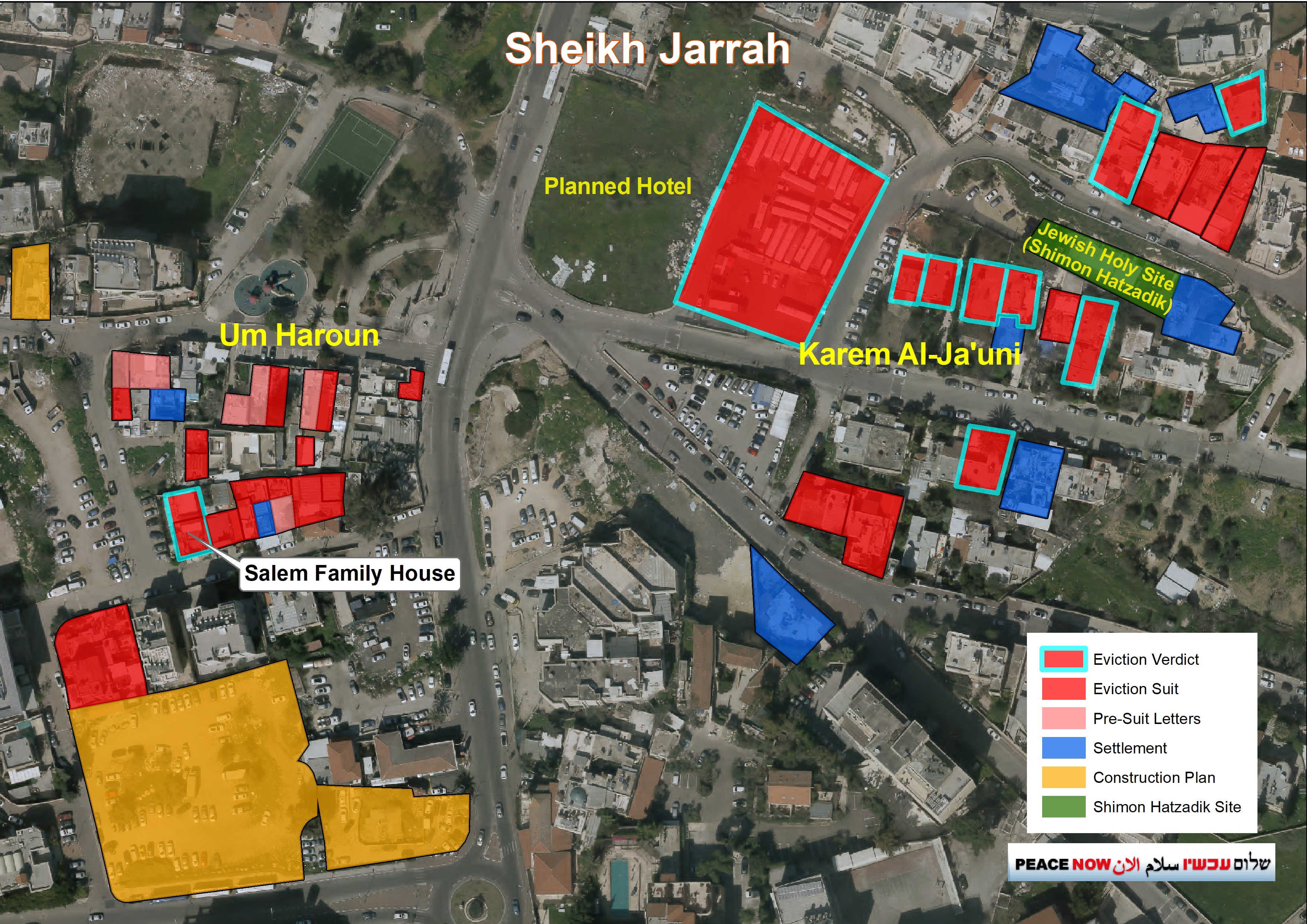 This purchase took place, without a doubt, thanks to the help of the Israeli Custodian General – the body that manages property abandoned by Jews in 1948 when their heirs are unknown – which almost certainly helped King and Yosef in identifying the property, locating the heirs and securing its sale (see Peace Now’s excellent report on the Absentee Property Law for more legal background on how this happens).
On December 15th, Ir Amim documented the scene as settlers, under the protection of Israeli police, fenced off the Salaam family’s land (where they are supposedly permitted to live until the 29th) in an attempt to prevent Palestinians, including the Salaam family, from accessing the area.
Peace Now said in response:
“This is a terrible injustice based on the cynical exploitation of a discriminatory law that allows Jews to exercise the ‘right of return; to property lost to them in 1948, at the expense of Palestinian families legally living in the property, while another Israeli law denies the same right to Palestinians. This is exactly what the Mishnah says: ‘He who says: mine is mine and yours is mine, is called evil’. The State of Israel, which took the Palestinian refugees’ properties lost to them in 1948, cannot today allow settlers to take from Palestinians Jewish properties lost in 1948 and on which they are have already received compensation. The government can stop this evacuation, and it must do so.”
The eviction of the Salaam family comes as the government of Israel is pursuing the displacement of as many as 70 Palestinian families in Sheikh Jarrah.
In parallel, the Israeli government has begun construction on a settlement installation (including a “public garden” as well as a driveway that will service an as-of-yet-unbuilt Israeli hotel in the neighborhood) at the entrance to Sheikh Jarrah, including the demolition of several Palestinian businesses. Notably, the site of this project is very close to the tomb of Shimon the Righteous, which is a religious site closely associated with the settler enclave in Sheikh Jarrah. The Jerusalem Municipality previously expropriated the land, which was privately owned by Palestinians, “for public use” — an Israeli legal tactic that permits the State to confiscate even privately owned land ostensibly to benefit the “public” (a “public” that it seems never includes Palestinians in East Jerusalem).
In October 2021, the Israeli Supreme Court rejected the appeals by the business owners to stop the demolition. This week, bulldozers leveled a plot of land owned by four Palestinian families and that was the location of two Palestinian businesses, a car wash and a parking lot. The business owners were handed an immediate eviction notice on December 14th, just one day before the bulldozers began work.
Israeli Custodian General is Behind Six New Settlement Plans Across East Jerusalem

Map by Haaretz
Haaretz reports that the Israeli Custodian General is planning six new settlement enclaves, to be located in some of the most sensitive areas of East Jerusalem. The news comes one week after the public learned of one of these plans, Givat HaShaked (see FMEP’s reporting last week), which is now understood to be part of a larger Israeli government plan to advance a slate of new settlement enclaves across East Jerusalem. As a reminder, the Israeli Custodian General is empowered by the State to act as caretaker of land that has unknown ownership.
While details on the plans are scant for the time being, Haaretz reports that the Israeli Custodian General is planning new settlements buildings that include:
1 – A new settler enclave in Sheikh Jarrah, in an area known as Um Haroun. As has been well documented, Palestinians are in a battle to stay in their longtime homes in Sheikh Jarrah while the Israeli Custodian General and Israeli settlers work hand-in-hand to displace them. Thirteen Palestinian families in Sheikh Jarrah (whose legal battle will impact dozens more) are still awaiting a Court ruling on their displacement at the hands of settlers. Haaretz reports:
“According to a custodian document, it administers 33 plots out of a total of 58 in the neighborhood. Five more plots have been expropriated by the Israel Land Authority. The city zoning plan allows for the demolition of the old structures and construction of buildings up to four-stories in their stead, or expanding them to that height. This could mean the construction of a neighborhood containing hundreds of housing units in the heart of Sheikh Jarrah. The Justice Ministry’s Land Registrar recently completed the registration of the neighborhood to its Jewish owners, so it is likely that any neighborhood built there will be for the Jewish population.”
2 – A new settler enclave near the Damascus Gate, near the Old City of Jerusalem, where approximately 10 Jewish Israeli families have already established a settlement enclave.
3 – Two new settler enclaves near Beit Safafa, one being the Givat HaShaked settlement plan which FMEP covered in greater detail last week. The second plan is not far from where the Givat HaShaked settlement would be built, and reportedly would involve a large settler compound with dozens more settlement units to be built in the sliver of land between Beit Safafa and the Talpiot Industrial Zone.
4 – A new settler enclave in Sur Baher. Reportedly, the Custodian is hoping to add more land to its holdings in Sur Baher (it currently holds 3.3 dunams and is attempting to gain 2 more dunams), meaning this plan could expand.
5 – A large new settler enclave in Beit Hanina. The Custodian is reportedly looking to build dozens of new settler units on six dunams of land (1.5 acres), to be located on a plot adjacent to the IDF Central Command base. The Custodian has also sought the cooperation of the Defense Ministry in promoting this plan.
The Justice Ministry, which houses the Custodian General, attempted to dodge these reports, telling Haaretz that it is not “advancing” any of these plans other than the one in Sheikh Jarrah, where it says it is “examining a construction project.”
Israel Custodian General Reveals New Details on Regulations Governing its Management of East Jerusalem Properties, Leaving More Questions
Under pressure from an impending court hearing, on December 11th the Israeli Custodian General submitted a document to the Court purporting to enumerate the regulations governing its management of properties in East Jerusalem. The Custodian General was facing a December 14th Court hearing on a petition filed by the Israeli NGO Ir Amim along with Palestinian residents of Sheikh Jarrah, that asserted no such regulations existed, enabling “severe misconduct and collaboration with settler groups to initiate evictions of Palestinian families in East Jerusalem, which severely infringes on the rights of Palestinians in the city.” Some 70 families in the Sheikh Jarrah neighborhood are facing homelessness because of the Custodian General’s collusion with settlers seeking their displacement from properties in which they have lived, legally, for decades.
In light of the Custodian General’s new publication (which the court viewed as resolving the complaint against the State), the Court dismissed the petition without prejudice, meaning the petitioners are permitted to file a new case on the same matter in the future.
Ir Amim filed the petition following news that the Custodian General has advanced a plan to build a new settlement – Givat HaShaked – on property it manages. As reported last week, this is an unprecedented move by the Custodian General, raising questions about whether the Custodian General is permitted to allow properties under its management to be developed. The document submitted to the Court this week by the Custodian General only raises more unanswered questions about the parameters governing the Custodian General’s ability to act as a property developer for properties that it does not own (only manages while awaiting the locating of the legal owners/heirs). Ir Amim further explains:
“The procedure includes dozens of clauses, none of which reference the possibility that the custodian may itself file plans and build residential complexes on a lot it owns. One clause refers to this indirectly, stating, ‘When initiated, or if contacted regarding urban renewal or planned improvements, the Custodian General shall examine the essence of the request and its impact on the administered property.’ Indeed, planning sources are unfamiliar with any case in which the custodian acted as a realty entrepreneur by improving the properties it holds. The subject raises another issue: the custodian is technically forbidden to sell property. Therefore, it remains unclear whether the apartments built in these various compounds will be sold on the open market, or whether they will remain the property of the custodian, who will rent them out. The Justice Ministry has not responded to clarify the matter.”
Israel Forges Ahead with New Settlements on the Golan Heights
At the recommendation and with the approval of Prime Minister Bennett, on October 14th Interior Minister Ayelet Shaked signed off on two orders establishing a settlement municipal authority in the occupied Golan Heights, a move that opens the door for an expedited planning process for existing and new settlements in the area. This includes the construction of the infamous “Trump Heights” settlement in addition to planned settlements called Givot Eden, Asif, and Matar. Last week, Prime Minister Naftali Bennett said that Israel’s plan is to double the settler population in the Golan Heights by 2030.
The special committee, which will act as a zoning board with broad planning authority, will have the combined powers of local and district planning and building committees, but will not include members who represent the public – an anomaly in the Israeli planning system.
The committee has already completed initial work by laying out the territorial borders of the “Trump Heights” settlement, which will cover 276 dunamns (about 70 acres). With its borders decided, the committee will move to expedite construction plans for residential housing, public buildings, industrial areas, roads and more.
On this massive settlement effort, the Haaretz Editorial Board writes:
“Occupied territories are occupied territories and annexation is annexation, even when it’s the Golan Heights and even when the annexation plan is called “a plan for encouraging sustainable demographic growth.”…We must tell it like it is. This is an artificial population expansion project, meant to strengthen Israel’s grip on the Golan Heights and create facts on the ground that will make it difficult for future leaders who might consider holding negotiations on the territory. To expedite matters, the Prime Minister’s Office seeks to create a “special committee” with the powers of the local and regional planning and building committees, but without the customary inclusion of public representatives. This is a national project. Like the so-called Judaization of the Galilee. Like the settlement enterprise.”
Al-Monitor provides a helpful background on the occupied Golan Heights and the creation of “Trump Heights”:
“Israel seized the Golan Heights from Syria in the 1967 Six-Day War. In 1981, Menachem Begin’s government formally annexed the territory. This unilateral move was not recognized by any country until Trump came along. In March 2019, his administration changed long-standing American policy by recognizing Israeli sovereignty over the region. A proclamation signed by Trump declared, ‘The State of Israel took control of the Golan Heights in 1967 to safeguard its security from external threats. Today, aggressive acts by Iran and terrorist groups, including Hezbollah, in southern Syria, continue to make the Golan Heights a potential launching ground for attacks on Israel. Any possible future peace agreement in the region must account for Israel’s need to protect itself from Syria and other regional threats. Based on these unique circumstances, it is therefore appropriate to recognize Israeli sovereignty over the Golan Heights.’ Three months later, the [Israeli] Cabinet convened for a special session in the Golan Heights and approved the establishment of a new settlement named for the US president. At that meeting, a huge sign decorated with Israeli and American flags was unveiled at the entrance to the new settlement. Written on it in gold letters was the name Ramat Trump.”
Following Murder of Israeli Settler,Settler Launch Attacks of their Own & Attempt to Establish New Outpost
On December 17th, a Palestinian gunmen opened fire on a settler vehicle near the dismantled settlement of Homesh, in the northern West Bank, killing one man – Yehuda Dimentman – and injuring two others. The IDF has apprehended several suspects already.
Though the Homesh settlement was evacuated by the Israeli government in 2005 – and military orders have barred Palestinians from entering the area – settlers have been allowed to establish an unauthorized outpost at the site, where the settlers also operate a yeshiva. Settlers have been openly obsessed with the desire to re-establish Homesh, hosting religious events and protests at the site, some of which have been attended by Israeli MKs and politicians. At the funeral for Dimentman, which several Israeli politicians attended, already begun calling for the government to formally reestablish the Homesh settlement.
In the hours following news of Dimentan’s death, settlers have already begun exacting revenge – with little to no interference from the IDF, though the outpouring of violence is an entirely predictable established pattern in the wake of Palestinians attacks. In the Palestinian village of Qayrut, a group of at least 15 settlers launched and especially violent attack on a Palestinian home, knocking on the door pretending to be Israeli soldiers at 4am, then proceeding to ransack the house and severely beat Mohammed Makbal – sending him to the hospital. No suspects have been apprehended, though several were caught on camera.
Within 24 hours of the attack, settlers from the Kiryat Arba settlement in Hebron moved to establish a new outpost in honor of Dimentan, called Nofei Yehuda. In this case, the IDF moved in swiftly to remove the settlers from the area. The outpost was established by members of the Nahala settler movement, of which Dimentan was a part. Nahala is behind a lot of unauthorized construction in the West Bank, and is a leading force in the battle over the Evyatar outpost.
Peace Now has written about the Nahala Movement, saying:
“The Nahala organization and the main activists of the new outposts are not the mainstream old-guard settlers (like the Amanah organization who is behind many other settlements and outposts and gets much more support from the authorities), however they are not a small fringe. This outpost is an example of a rift that is being created within the Israeli right wing. The more extreme right, which is willing to challenge the system more strongly, and the old-guard settlers who continue the mentality of working ‘with’ the government as much as possible. On the partisan level we see this rift in the creation of two different parties: Yamina, headed by Naftali Bennet, and the Jewish Zionism, headed by Betzalel Smotrich and Itamar Ben Gvir. The challenge of the new outpost puts the new shaky government, which is a coalition of parties which don’t agree about many things, to face its first big political test. The extreme right is signaling that it is planning to continue to challenge the new government, like it had done in the flags march in East Jerusalem, and in yesterday’s settlers’ marches throughout the West Bank.”
Gantz Moves to Send More Police to West Bank to Monitor Settler Violence
Defense Minister Benny Gantz and Israeli Public Security Minister Omer Bar-Leg have agreed to draft hundreds of Israeli soldiers into the (domestic) police force, so that Israeli police can then be reassigned to the West Bank partly to fill posts dedicated to policing settler violence.
Settlers, of course, are not thrilled about the new attention being paid to settler terrorism experienced by Palestinian communities across the West Bank, and which has increased over the past year. According to Israeli government data (which does not systematically track settler violence against Palestinians) the Shin Bet logged 272 “violent incidents” in the West Bank in 2020; so far in 2021, there have been 397 “violent incidents” recorded by the Shin Bet. The UN recorded even more attacks this year – 450 as of December 6 – compared to 358 in all of 2020 and 335 in 2019.B’Tselem, which recently released an excellent report on settler terrorism, documents a 28.6% increase in settler violence in 2021 over 2020. Yesh Din, which also documents settler violence while seeking justice and accountability, notes that only 5% of cases it filed from 2018-2021 (238 total cases filed, while it documented 540 total cases) have resulted in indictments. Palestinians have increasingly declined to file police reports regarding settler crimes, with so few cases actually resulting in any tangible good for the victim.
For a SMALL sample of the terrorism inflicted by settlers on Palestinians in the West Bank on a daily basis, see the following reports from the past week by WAFA news:
- “Settlers, backed by Israeli army, intensify attacks against Palestinians in Nablus area”
- “Israeli forces attack Palestinian farmers, seize tractor in Masafer Yatta area”
- “Israeli settlers leave several villagers wounded, fractured south of Nablus”
- “Settlers attack Palestinian vehicles south of Jenin”
- “Israeli settlers attack Palestinian vehicles, bloc traffic artery east of Hebron”
- “Israeli settlers rampage through Nablus-district town”
- “Israeli settlers take over water spring in northern Jordan Valley”
Meanwhile in Israel…Political Storm Ensues Over Whether Settler Terrorism Is a Problem or Not
Following months (which followed years, which followed decades) of settler terrorism against Palestinians, this week Israeli Public Security Minister Omer Bar-Lev (Labor) set off a political clash within Israel over the issue. In comments made alongside U.S. Deputy Secretary of State Victoria Nuland — and after Israeli diplomats have allegedly come to believe that the Biden Administration is “obsessed” with “settler violence” (though other reporting contradicts that claim) – Bar-Lev called settler terrorism “severe” and said that Israel is taking steps to address it.
Those comments were seen as a betrayal by many of Bar-Lev’s pro-settler coalition partners, and elicited some strong condemnations. Interior Minister Ayelet Shaked (Yamina) said Bar-Lev is “confused.” MK Bezalel Smotrich (Religious Zionism) called Bar-Lev a “bastard” and tweeted “shame on you, little man.”
The drama also drew comment from Israeli Prime Minister Naftali Bennet who, it should be recalled, relies heavily on the settler constituency and is also ideologically closely aligned with the settlers, having once served as the head of the top settler body called the Yesha Council. Bennett appeared to dismiss Bar-Lev’s comments, in effect giving official cover for an a green-light to continued and unaccountable settler terrorism, tweeting:
“The settlers in Judea and Samaria have been suffering from violence and terrorism, every day, for decades. They are the defensive wall of us all and we must strengthen them and support them, in words and deeds…There are marginal phenomena in every public, they should be dealt with by all means, but we must not generalize an entire public.”
B’Tselem’s Executive Director, Hagai El-Ad, responded to Bennett’s claim, telling Haaretz:
“There’s a propagandistic façade here that’s convenient for Israel…There’s a few bad settlers, or more, on one side, and on the other is the good state of Israel, which seeks to enforce the law. But that isn’t the truth. Both the state and the settlers want the same thing – to dispossess Palestinians of their land.”
This relationship – between the settlers and the State when it comes to dispossessing Palestinians – was spelled out in a recent B’Tselem report, “State Business: Israel’s misappropriation of land in the West Bank through settler violence.”
Bonus Reads
- “Mining Gold From East Jerusalem’s Streets” (Amira Hass for Haaretz)
- “This was the deadliest year for Palestinian children since 2014” (Khaled Quzmar for +972 Magazine)
- “Unearthing the Palestinian Neighborhood Buried Beneath a Tel Aviv Park” (Haaretz)
- “Fact Sheet: Israel’s E1 Settlement” (IMEU)
- “Opinion: Israel just showed its strategy on settlement boycotts: Gaslighting” (Gershom Gorenberg in the Washington Post)
Welcome to FMEP’s Weekly Settlement Report, covering everything you need to know about Israeli settlement activity this week.
To subscribe to this report, please click here.
May 1, 2020
- International Criminal Court Chief Prosecutor Concludes: YES, Palestine is a State & Court has Jurisdiction to Investigate Alleged Israeli (and Hamas) War Crimes
- Netanyahu: Annexation Will Happen in “A Couple Months”; US again Signals UNCONDITIONAL Support
- Leading East Jerusalem Settler Poised to Become Deputy Mayor of Jerusalem
- Updates on Three Settler-Backed Projects in Silwan
- Joe Biden Says He Will Keep Embassy in Jerusalem, [kind of] Re-Open the Consulate, & Recommit to the Two-State Solution
- Bonus Reads
Comments/questions? Contact Kristin McCarthy (kmccarthy@fmep.org).
International Criminal Court Chief Prosecutor Concludes: YES, Palestine is a State & Court has Jurisdiction to Investigate Alleged Israeli (and Hamas) War Crimes
On April 30th, the Chief Prosecutor of the International Criminal Court, Fatou Bensouda, filed her opinion with an Pre-Trial Chamber arguing that Palestine can be considered a state and therefore the Court does have jurisdiction over alleged crimes committed by parties in Palestine. Previously, in January 2020, Bensouda determined that there was reasonable basis upon which to open an investigation, but convened a Pre-Trial Chamber to rule on the issue of the Court’s jurisdiction. If the pre-trial Chamber determines that the Court has jurisdiction, a case can be opened into the matter of alleged Israeli war crimes in the West Bank, East Jerusalem, and Gaza Strip, as well as alleged crimes committed by Hamas in Gaza. The Pre-Trial Chamber does not have a deadline for making their ruling, but is expected to do so in the next 120 days.
Bensouda’s detailed (60-page) decision concludes that the Oslo Accords – signed by the Palestinian Authority and Israel – are a credible legal basis for establishing Palestine as an internationally recognized state. Her influential legal opinion also directly and systematically refutes the amicus curiae briefs filed by several countries, including Germany (the second largest funder of the ICC), arguing that Palestine is not a state and that the Court does not have jurisdiction. Czech Republic, Austria, Australia, Hungary, Brazil and Uganda also filed briefs along those lines. The brief also systematically rebuts the raft of arguments made by various international lawfare organizations asserting that the Court has no right to investigate (the decision is well worth reading in full).
Netanyahu: Annexation Will Happen in “A Couple Months”; US again Signals UNCONDITIONAL Support
On April 26th, Prime Minister Netanyahu announced his belief that annexation will be realized in “a couple months” and that he is “confident” that President Trump will recognize that annexation. Under the recent coalition agreement signed by Netanyahu and Benny Gantz, annexation will have to wait until at least July 1st.
Netanyahu’s confidence in the Trump Administration’s support for Israeli annexation plans rests on solid footing. As a reminder, on April 22nd Secretary of State Mike Pompeo called annexation an “Israeli decision.” The remarks drew attention because of the existence of a joint U.S.-Israeli mapping committee, which suggests an active U.S. role in deciding the extent of Israel’s annexation, and which gives the appearance, at least, that the Trump Plan is something less than a carte blanche for Israel to annex whatever it chooses.
On April 27th, a spokesperson for the Department of State elaborated on Secretary Pompeo’s remarks in a statement to The Times of Israel:
“As we have made consistently clear, we are prepared to recognize Israeli actions to extend Israeli sovereignty and the application of Israeli law to areas of the West Bank that the vision foresees as being part of the State of Israel…in the context of the Government of Israel agreeing to negotiate with the Palestinians along the lines set forth in President Trump’s Vision…The annexation would be in the context of an offer to the Palestinians to achieve statehood based upon specific terms, conditions, territorial dimensions and generous economic support. This is an unprecedented and highly beneficial opportunity for the Palestinians.”
These remarks drew dramatic headlines suggesting that now, after more than three years of statements and policies aligned with Israel’s pro-annexation right, Trump is pumping the brakes by making U.S. support conditional on Israel agreeing in principle to the establishment of a Palestinian state (which, under the Trump Plan is, would be a non-autonoumous/non-sovereign entity). Unsurprisingly, within 24 hours of the first headline offering this analysis, an official at the U.S. Embassy in Jerusalem clarified the policy, making it emphatically clear that U.S. support for Israel’s annexation of West Bank territory is in no way connected to, or conditioned on, the issue of a future Palestinian state. The official said:
“Our position has not changed. As we have made consistently clear, we are prepared to recognize Israeli actions to extend Israeli sovereignty and the application of Israeli law to areas of the West Bank that the [Trump peace plan] foresees as being part of the State of Israel. This will give the Palestinians an opportunity to come to the table and negotiate a peace agreement that will result in the establishment of a state of their own. The United States stands ready and willing to offer wide-ranging assistance to facilitate a final peace agreement.”
While it was clearly a stretch to read the State Department remarks as the unveiling of a new U.S. policy conditioning approval of annexation on some kind of concession to the Palestinians or on the two-state solution, the difference in tone/content of the two statements highlights the longstanding disconnect between the U.S. State Department and the Embassy in the Trump era. This disconnect is largely attributable to the close relationship and direct line that U.S. Ambassador David Friedman enjoys to the White House, to the exclusion of the State Department. Friedman — who is a key member of the joint mapping committee, a key architect of the Trump Plan, and whose views and statements have consistently been more indicative of the direction of U.S. policy than those of the State Department’s spokespersons — has publicly disregarded the necessity of Palestinian involvement in implementing the Trump Plan, in contrast with the State Department’s statement this week. For a refresher on Friedman’s anti-two-state, anti-Palestinian views, recall this excellent list of quotes compiled by APN.
In the context of Amb. Friedman’s centrality in setting U.S. policy on annexation, a recent tweet from Friedman in celebration of the 100th anniversary of the San Remo Resolution is notable. The resolution gave Great Britain a mandate to rule the historic region of Palestine and formally conferred recognition to the Jewish people’s right to establish a national homeland there. Haaretz explains that the San Remo Resolution is increasingly cited by “Greater Israel” advocates as a legal basis for Israeli claims to the entire area at the expense of Palesttinian national aspirations, based on the fact that the British mandate was over all the land, including the West Bank and Gaza Strip. Friedman tweeted:
“Recalling today the 100th anniversary of the San Remo Resolution, whereby the world powers recognized the ancient connection of the Jewish people to the Land of Israel and the right of the Jewish people to a national home on that land was given the force of International Law.”
Leading East Jerusalem Settler Poised to Become Deputy Mayor of Jerusalem
Jerusalem’s Mayor Moshe Leon is seeking approval to appoint notorious settlement empresario Arieh King to be his Deputy Mayor, a move which will further empower King – who has served as a city councilman since 2013 – to promote ideologically-motivated settlement projects throughout East Jerusalem.
King openly calls for the “Judaization of Jerusalem,” and is behind many unprecedented, ideological settlement plans, including currently advancing plans to build the first-ever settlement enclave inside of the Beit Hanina neighborhood of East Jerusalem. Most infamously, King has led and financed a longtime effort to evict Palestinians from their homes in the Sheikh Jarrah neighborhood in East Jerusalem. In this effort he sometimes uses Arab middle-men and at other times he has found and convinced Jewish heirs to Sheikh Jarrah properties to “reclaim” the property under Israel’s Absentee Property Law and then to transfer the properties for use by settlers.
King is also behind the ongoing drive to build new, official settlements in Sheikh Jarrah, for which he has received expedited approvals from the city planning committees. King is also involved with plans to expand the settlement enclave of Nof Zion in the Jabal al-Mukhaber neighborhood of East Jerusalem.
A member of the City Council from the Meretz Party, Laura Wharton, threatened to quit the city’s governing coalition over King’s appointment. King responded by making clear that as Deputy Mayor he would, indeed, continue to focus on settlement in East Jerusalem – and snarkily suggested that for this very reason, the Meretz member should support him. King told Haaretz:
“I’m very surprised that Laura Wharton is threatening to leave. After all, she knows full well that she will have no better partner than I in improving the infrastructure in East Jerusalem, and in listening to the needs of its residents. I hope the Meretz branch [whose members] I consider staunch political opponents will step up and see the advantages in my becoming deputy mayor, by which East Jerusalem will undoubtedly receive more attention from the municipality…”
Updates on Three Settler-Backed Projects in Silwan
Emek Shaveh this week provided updates on three settler-backed projects in Silwan, two of which have continued progressing despite the nation-wide lockdown to stop the spread of the coronavirus.
First, Emek Shaveh reports that construction on the “stepped street” section of the archeological site called the “Pilgrim’s Road” continued throughout the months of March and April. The project is driven by the radical Elad settler group, and is located beneath the Wadi Hilweh section of Silwan, a Palestinian neighborhood in East Jerusalem adjacent to the Temple Mount/Haram Al-Sharif. Infamously, U.S. Ambassador David Friedman and then-White House advisor Jason Greenblatt took part in the opening of the site in June 2019, including a gratuitous photo-op – a sign that made clear the Trump Administration’s support not only for settlement schemes, but for their larger agenda of consolidating Israeli sovereignty over even the most contentious areas of East Jerusalem.
Elad launched its excavation of the “Pilgrim’s Road” in 2007, with the full support of the Israel Antiquities Authority (IAA). For more background on the tunnels and how radical Israeli settlers have exploited excavation, tourism, and the ancient character of Jerusalem in order to serve their ideological agenda – see the comprehensive reporting by Emek Shaveh.
Second, Emek Shaveh reports that Elad has continued construction on transforming a house located in Jerusalem’s “Peace Forest” into a tourism center that will be used as the base for a settler-run tourism project — a zipline slated to traverse the Forest’s canopy. The zipline will connect the “Peace Forest” in the Abu Tor neighborhood to another popular tourism site, the Armon Hanatziv promenade. Coming in at 2,570 feet, this will be Israel’s longest zipline and will travel over the Palestinian neighborhood Jabal al-Mukaber. Renovations of the house are paid for by the Israeli Ministry of Housing, which allocated 43 million NIS ($12.38 million USD) for the project. The House – which the settlers have named “Beit Shatz” – was purchased by Elad as part of Elad’s broader efforts to use tourist projects as a means for taking control over the area, which is situated in a national park.
The behavior of Elad and the Israeli government in the Peace Forest underscores the the systematic discrimination in planning policies and enforcement facing Palestinians in Jerusalem. The several Palestinian families living in the “Peace Forest” and are prohibited from building or expanding/renovating their homes because of the strict building prohibitions for national parks. Elad managed to circumvent those same restrictions by pushing the Jerusalem Municipality to request that the area they are targeting be designated as an “open public space,” which would allow the project to advance. In December 2019, Jerusalem planning authorities granted the settler-backed request. That same month, Israel pursued demolition orders against Palestinian homes in the Peace Forest that lacked building permits, despite the fact that in some cases Palestinians have repeatedly applied for and been denied permits.
Third, Emek Shaveh also reports that progress on the controversial East Jerusalem cable car project has been stalled due to the coronavirus shutdown. Emek Shaveh reports:
“Following its approval by the National Infrastructure Committee in June 2019, and the 200 million NIS government allocation, the project was to enter the tender phase. However the bidding process for an international company specializing in the construction of cable cars has been hampered by the pandemic. Our [Emek Shaveh’s] appeal to the High Court against the project is scheduled for June.”
Joe Biden Says He Will Keep Embassy in Jerusalem, [kind of] Re-Open the Consulate, & Recommit to the Two-State Solution
Speaking at a virtual fundraising event on April 29th, presumptive Democratic presidential nominee Joe Biden told supporters that he would keep the U.S. Embassy in Jerusalem despite the fact he disagrees with the Trump Administration’s decision to move the embassy there from Tel Aviv. As a reminder, in February 2020 the New York Times published the results of its survey of Democratic candidates policies vis-a-vis Israel. In response to the question, “Should the United States Embassy in Israel be moved from Jerusalem back to Tel Aviv?” Biden – like every candidate other than Sanders and Warren – responded with a clear answer: “No.”
Biden also told supporters that he would “re-open” the U.S. Consulate in Jerusalem in order to facilitate talks with the Palestinians toward a two-state solution. As a reminder: shortly after the Trump Administration moved the Embassy from Tel Aviv to Jerusalem, it closed the U.S. Consulate and Ambassador Friedman began converting the compound into his personal residence. Simultaneously, Friedman created a “Palestinian Affairs” unit in the new Embassy, signaling that henceforth the U.S. would treat Palestinians and Palestinian-related matters not as merely as a subset of issues between the U.S. and Israel, rather than part of a U.S.-Palestinian bilateral relationship. the U.S. was represented in Jerusalem by a Consulate General from 1844 until the mission was closed by the Trump Administration in March 2019. From the start of the peace process in the 1990s until its closure, the Consulate served as the de facto U.S. diplomatic mission to the Palestinians, and was a central player in advancing U.S. efforts to broker a negotiated end to the conflict. Notably, Biden’s comments this week suggest that he may not be talking about a re-opening of the Consulate to function as it had in the past, so much as a re-purposing of the Consulate to serve a specific, limited function.
While Biden reportedly did not say anything about annexation during his fundraising call (and has conspicuously refrained from commenting on the issue since the Israeli unity government agreement made annexation an imminent reality), on April 28th his senior foreign policy advisor Tony Blinken told a group of supporters that Biden opposes annexation on the basis that it contradicts the two-state solution and would be bad for Israel. According to Blinken, Biden has said:
“on the record several times [that] unilateral steps taken by either side that make the prospect of a negotiated two-state outcome less likely is something he opposes, and that includes annexation. In many ways, pulling the plug on a two-state solution is pulling the plug, potentially, on an Israel that is not only secure but is Jewish and democratic — for the future. That’s not something any of us, who are ardent supporters of Israel, would want to see.”
Bonus Reads
- “Can Anyone Stop Netanyahu’s Annexation Plans?” (Al-Monitor)
- “Arab League slams West Bank annexation plans as ‘war crime’” (Al-Monitor)
- “Lots of bark, some actual bite? How the world will react to West Bank annexation” (The Times of Israel)
- “Europeans formally protest West Bank sovereignty plans” (Jerusalem Post)
- “Israel doesn’t need ‘advice’ against annexation — it needs consequences” (+972 Magazine)
- “WEBINAR: The Legal Impacts of Annexation w/ Michael Sfard” (J Street)
- “Israeli annexation plans would lead to ‘cascade of bad human rights consequences’, says UN expert” (UN)
- “How should Palestinians respond to Israeli threats of annexation?” (Al Jazeera)
- “Lots of bark, some actual bite? How the world will react to West Bank annexation” (The Times of Israel)
Welcome to FMEP’s Weekly Settlement Report, covering everything you need to know about Israeli settlement activity this week.
To subscribe to this report, please click here.
April 24, 2020
- The Facts on the Bibi/Gantz Annexation Agreement
- The World Responds (or doesn’t) to Formation of Annexation Government
- Gantz Takes Over Defense Ministry – Including Authority Over Settlement Construction (at least until July 1st)
- Settlers, Yamina Party Dissatisfied with & Suspicious of Netanyahu’s Annexation Plans
- Plans Advance for Two New Settlement Enclaves in the Beit Hanina Neighborhood
- B’Tselem: With IDF Backing, Settlers are Violently Stealing Land During COVID-19 Crisis
- Coming Soon: Plans for Har Homa Expansion Scheduled for Discussion on April 27th
- Coming Soon: Israel To Open Bidding on “Doomsday” Givat Hamatos Settlement Tender on May 3rd
- IDF Demolishes Outpost Structures, Including in Outpost From Which the Criminal “Hilltop Youth” Group Hail
- Yesh Din Outlines Potential Impact of Annexation on Palestinian Human Rights (Spoiler: It’s Bad)
- Bonus Reads
Comments or questions – email Kristin McCarthy (kmccarthy@fmep.org).
The Facts on the Bibi/Gantz Annexation Agreement
Under the new emergency unity government agreement, the issue of annexation is at the total discretion of Prime Minister Netanyahu. Per the coalition agreement signed by Netanyahu and Gantz on April 20th, the stipulations related to annexation are:
- The U.S. must give its “full agreement” to the annexation plan, including on the maps of West Bank land Israeli legislation will specify for annexation. Reminder: the U.S. and Israel have already formed a joint mapping committee aimed at translating the conceptual map appended to the Trump Plan into a detailed plan. The U.S. has signalled that it will give its approval to the resulting map and to date, the Trump Administration has only offered its total support for Israeli annexation – including Secretary Pompeo in a April 22nd press conference.
- Netanyahu and Gantz must “engage in dialogue” with (but are not obligated to secure any form of consent from) the international community, “with the aim of preserving the security and strategic interests of Israel including maintaining regional stability, preserving existing peace agreements and working towards future peace agreements.” During the negotiations that paved the way for the unity agreement, international coordination as a condition for any annexation was reportedly one of Gantz’s key demands, with particular insistence on the king of Jordan being consulted; as is clear from the agreement, Gantz totally folded on this point (among others).
- On July 1, 2020, Prime Minister Netanyahu can bring the U.S-approved annexation plan up for discussion in the Cabinet and/or for a vote in the Knesset, – without the support/approval of Gantz. The unity agreement consists of a six-month “emergency period” during which Netanyahu is prohibited from introducing any legislation unrelated to Israel’s fight against the Coronavirus. Annexation legislation is the one and only exception from this prohibition, with the agreement allowing Netanyahu to move annexation legislation as of July 1 (the delay until July representing the empty “concession” extracted by Gantz in negotiations). Indeed, by providing two separate ways to move annexation – via the Cabinet or via the Knesset – the agreement ensures Netanyahu will be able to pass the bill even if he does not have a majority in the Cabinet (seats on which will be split equally between Netanyahu and Gantz appointees in the new government).
- Only a Likud member of the Knesset is permitted to introduce an annexation plan in the Knesset, provided that the plan is identical to the one promoted by Prime Minister Netanyahu. This stipulation prevents more radical annexation plans from being moved in the Knesset by members of other political parties, and also eliminates any role of Gantz in Knesset proceedings.
- Once introduced into the Knesset, the annexation legislation cannot be delayed or vetoed. By accepting this clause, Gantz has agreed in advance that he cannot block the bill from passage. At the same time, the agreement magnanimously allows Gantz and his fellow Blue & White Members of the Knesset to “vote their conscience” and oppose the annexation bill (FMEP has previously explained the political strategy behind this). Under the unity agreement, this is the only matter on which Gantz agreed to forfeit his veto power.
The World Responds (or doesn’t) to Formation of Annexation Government
The Palestinians were vocal in their opposition of the new government and its annexation plan, with Palestinian Authority President Mahmoud Abbas threatening to cancel all agreements with Israel and the United States if annexation plans proceed.
Unsurprisingly, the U.S. government welcomed the unity government agreement and, with Secretary of State Pompeo stating he was “happy” that the sides had reached an agreement and noting:
“As for the annexation of the West Bank, the Israelis will ultimately make those decisions. That’s an Israeli decision. And we will work closely with them to share with them our views of this in (a) private setting.”
The government of France issued the most notably strong statement (so far) rejecting annexation, saying:
“Such steps if implemented would not pass unchallenged and shall not be overlooked in our relationship with Israel.”
An European Union’s foreign affairs spokesman stated that “If this proceeds, it will not be left unanswered.” Separately. the EU’s Chief of Foreign Affairs, Josep Borrell, issued a statement vowing to “closely monitor” annexation efforts, reiterating that the EU holds annexation as a “serious violation of international law.” Remarkably, 8 of 27 EU member states opposed Borrell’s statement, signalling a fractured and therefore weak EU stance against annexation. During discussions with member states, Borrell reportedly argued for including a threat of sanctions against Israel if annexation is advanced, a point which drew opposition. Other states were reportedly hesitant over the timing of the statement, claiming to be concerned about preemptively souring relations with the new government, and particularly Gantz.
In response, Israeli Foreign Minister Yisrael Katz attacked Burrell and praised EU states that opposed the EU statement, including:
“It is unfortunate to read that Joseph Burrell, who claims to be trusted with the EU’s foreign relations, chooses to welcome the new government of a central partner of the EU in this way, and prefers to see the relationship between Israel and the EU through the prism of the pandemic and the ‘status of the territories.’ Given the depth of the relationship and in light of the fact that this announcement did not receive the support of the EU member states yesterday, we wonder which policies the honorable gentleman is choosing to represent, and not for the first time.”
Ireland’s Foreign Minister Simon Coveney made a strong statement warning Israel against annexation:
“Annexation of territory by force is prohibited under international law, including the UN Charter, whenever and wherever it occurs, in Europe’s neighbourhood or globally. This is a fundamental principle in the relations of states and the rule of law in the modern world. No one state can set it aside at will. Ireland remains committed to a negotiated two-state solution that ends the occupation that began in 1967, with Jerusalem as the capital of both States, on the basis of international law, the internationally-agreed parameters and relevant UN Security Council resolutions.”
Germany’s mission to the UN tweeted:
“Germany strongly advises against the annexation of occupied Palestinian territories. This would have serious, negative repercussions on the viability of the two-state solution, the entire peace process, regional stability and ISR standing within the international community.”
The UK Deputy Permanent Representative to the UN, Ambassador James Roscoe, delivered a statement in the UN Security Council noting:
“we are deeply concerned by reports that the new Israeli government coalition has reached an agreement which paves the way for annexation of parts of the West Bank. The UK position is clear: any unilateral moves towards annexation of parts of the West Bank by Israel would be damaging to efforts to restart peace negotiations and would be contrary to international law.”
The UN’s special Middle East envoy, Nickolay Mladenov, said that annexation would,
“deal a devastating blow to the two-state solution, close the door to a renewal of negotiations, and threaten efforts to advance regional peace.”
Gantz Takes Over Defense Ministry – Including Authority Over Settlement Construction (at least until July 1st)
The newly signed unity government agreement will see Benny Gantz appointed as the Defense Minister of Israel, taking over the post from Yamina MK Naftali Bennet. As Defense Minister, Gantz will take control of the Civil Administration, which is a body within the Defense Ministry which serves as the sovereign authority in the occupied territories. For as long as the Civil Administration exists and Israel has not formally annexed the West Bank, Gantz will hold enormous power over decisions related to land seizures and allocations, settlement construction and enforcement of Israeli building regulations in the West Bank (of course, even without annexation, Netanyahu – as the highest official in the government, will retain important if not decisive authority in all settlement-related decisions).
The objective of annexation, of course, is to fully normalize and permanently integrate the settlements into the state of Israel, bringing them fully under the laws and governance of Israel’s government. If and when such annexation is implemented, the current system of governance over the settlements — which since 1967 has run through the Defense Ministry, reflecting the fact that the land is held by Israel under a status even the Israeli High Court has recognized as “belligerent military occupation” — will perforce be dismantled. In the event of partial annexation, areas annexed to Israel would perforce no longer be under Civil Administration authority.
Nonetheless, we have seen what a determined Defense Minister can accomplish over a short period of time. Over the course of his 6 months as Defense Minister, Naftali Bennet aggressively exercised the significant power of that office to promote numerous settlement plans, including controversial plans that required careful legal maneuvering. Among his accomplishments are:
- The issuance of a new legal opinion to enable settlement construction above the old vegetable market in Hebron;
- The approval of plans to build a controversial new road near Jerusalem, dubbed by the settlers the “sovereignty road” — an important step towards building the E-1 settlement;
- The announcement of seven new “nature reserves” in the West Bank, and the expansion of 12 existing reserves;
- The launching of legal research into how Israeli can bring settlement building in Area C under the direct authority of the Justice Ministry, cutting out the Civil Administration;
- The creation of an inter-ministerial taskforce to develop settlement and annexation plans for the future of Area C in the West Bank. Reports indicate the taskforce agenda includes:
- Allowing Jews to privately purchase land in the West Bank. [See here for a detailed explanation of this complicated matter];
- connecting unauthorized outposts to water and electricity;
- granting official recognition to unauthorized outposts that are located near established settlements by recognizing them as “neighborhoods” of the settlement;
- repealing a military order that empowers the Civil Administration to evict settlers from privately owned Palestinian land with or without a Palestinian-initiated petition to have the settlers removed;
- legalizing 30 sheep farms in the West Bank that are under pending demolition orders.
It is worth noting, however, that other ministries also have authorities with respect to support for an governance over settlements, a messy situation which is the result of Israel’s creeping annexation via the extension of Israeli domestic laws and regulations over the settlements/settlers [FMEP maintains a compendium of these laws and regulations]. The Israeli Education Ministry recently brought settlement colleges and universities under its authority. The Transportation Ministry has funded the construction of hotels and other tourist infrastructure in the settlements. The Agricultural Ministry facilitates the sharing of egg quotas between settlements and Israeli cities. The Interior Ministry facilitates tax sharing and redistribution between the settlements and Israeli communities. And of course the Justice Ministry has a central role in defending settlement activity in the West Bank, and is playing a key role in the bid to find new legal mechanisms for granting retroactive authorization to illegal outposts and expropriating privately owned Palestinian land.
Under the new governing agreement, the ministries are set to be divided between Likud and Blue & White. With respect to ministries that have direct involvement in settlements, Israeli media reports suggest that in addition to the Defense Ministry, Blue & White will get the Justice Ministry (with Avi Nissenkorn reportedly set to be the next ministry), the Ministry of Economy, and the Ministry of Agriculture. For its part, in addition to maintaining the position of Prime Minister for at least 18 months, Likud will get the Housing & Construction Ministry (which has a central role in West Bank settlement construction), the Finance Ministry, the Transportation Ministry, the Ministry of the Interior, the Education Ministry, the Ministry of Public Security, and will appoint the next Speaker of the Knesset (expected to be Yariv Levin) who will serve for the entire 18 months of the unity government’s duration.
The Times of Israel suggests that this division amongst parties might result in incoherent policies on the settlements:
“Take for example the West Bank settlements that will seek to capitalize on any Israeli declaration of sovereignty in the coming months to encourage a growth in population and economic development. The heads of controversial outlying settlements will undoubtedly find a sympathetic ear in the right-wing-led ministries of transportation or housing — both vital to their development — but will face a colder reception in the ministries of agriculture and economy, on which their livelihoods depend and which are slated to be led by the Gantz bloc’s Blue and White and Labor respectively in the new cabinet. Will the new government support those settlements or try to limit their growth? Both.”
Settlers, Yamina Party Dissatisfied with & Suspicious of Netanyahu’s Annexation Plans
Having been left out of any leadership role in the new unity government, the Yamina party – an alliance of far-right parties led by Naftali Bennett, Ayelet Shaked, and Bezalel Smotrich – has not yet decided whether to remain part of Netanyahu’s alliance or become an opposition party to the newly formed unity government. The faction’s central grievance concerns Netanyahu’s concessions on judicial appointees (which leave Yamina completely out of that important government process), and Yamina’s continued suspicion over Netanyahu’s intentions on annexation.
Throughout the negotiations, Shaked and Bennett continued to express their rejection to the Trump Plan, based on their opposition to that plan holding out even the pretense of allowing for the establishment of a (discontiguous, powerless, politically and economically non-viable) Palestinian state in the future. In an attempt to cast doubt on whether the Prime Minister intends to implement the annexation path laid out in the unity deal, Bennett threw punches at Netanyahu, calling him “all talk” on the matter of annexation. Shortly after the deal was signed Bennett told the press:
“This is a left-wing government led by Netanyahu. All the things we care about are going to the [Blue and White-led] bloc. The agreement doesn’t leave us any way to have influence.”
While many settler leaders welcomed the new government, most withheld a full-throated celebration over the annexation clause – either because some settlers are dissatisfied with the Trump Plan (like Yamina) or because settlers distrust Netanyahu’s promises. Like Yamina, settlers are pushing for an even more expansive annexation than the one laid out in the Trump plan. U.S. Secretary of State Mike Pompeo’s recent comment that annexation is an Israeli decision gave settler leaders even more ammunition with which to threaten Netanyahu. Beit El Council head Shai Alon said:
“There are no more excuses. It’s time for action. The ball is in the new government’s court. If sovereignty doesn’t happen now, who knows when the next opportunity will come around.”
Prior to the agreement being finalized, Yesha Council head David Elhayani told The Jerusalem Post:
“I don’t think that the US will go against us [Israel] when Trump is president…You have to throw this [Trump] plan into the trash and the State of Israel has to decide to make the right decision. That decision is to apply sovereignty to the Jordan Valley, the northern Dead Sea and [all] the settlements…”
Samaria Regional Council chairman Yossi Dagan said in a statement:
“I congratulate the prime minister and MK Benny Gantz on reaching an agreement…We will work with the government, in partnership and, when necessary, in a forceful manner, in order to advance sovereignty in the coming period and to expand construction and development in Judea and Samaria.”
While the unity agreement means that Yamina will not have power in the new government, its impact on the unity agreement and on the course of Israel’s future under this government should not be underestimated. The dogged pressure on Netanyahu exerted by Shaked, Bennett and their settler friends may have helped him secure concessions from Gantz in negotiations, but in so doing it also put Netanyahu in corner, depriving him of any politically easy way to delay annexation, should he want to do so (that said, the idea that he would want to do so is increasingly far-fetched — according to Barak Ravid, Netanyahu sees annexation as his main legacy as Prime Minister). Indeed, under the coalition agreement Netanyahu’s only excuse for delaying or preventing annexation would be U.S. opposition — and the Trump administration is already on the record (with the Trump Plan and in statements) in support of annexation.
Plans Advance for Two New Settlement Enclaves in the Beit Hanina Neighborhood
Ir Amim reports that on April 22nd, the Jerusalem Local Planning Committee recommended the advancement of plans to build two new settlement enclaves inside the Beit Hanina neighborhood of East Jerusalem. With the committee’s recommendation, the plans advance to the Jerusalem District Planning Committee for discussion. In January 2020, the Jerusalem District Planning Committee granted final approval to plans for another enclave in Beit Hanina, marking the first time the Israeli government granted authorization for settlement construction in Beit Hanina.
The plans for the two new enclaves are closely linked to East Jerusalem settlement empresario and Jerusalem municipal councilman Aryeh King. Ir Amim notes the role King has played behind the scenes and the potential impact of the enclaves:
“Although originally scheduled to be discussed at the Local Planning Committee on March 18, they were subsequently omitted from the agenda. The plans likewise reappeared on the agenda for discussions on April 1 and again removed. For a third time, the plans re-emerged on the agenda for today’s discussions at the Local Planning Committee and were subsequently taken off and then immediately placed back on. Such moves indicate concerted pressure to advance these plans by prominent settler figures, including Arieh King, longstanding settler activist and Jerusalem Municipal Councilman who is behind the promotion of these projects. The establishment of more settler enclaves in the heart of Beit Hanina will not only impact the fabric of this community and fracture its space, but will further erode opening conditions for a political solution to the conflict based on two capitals in Jerusalem.”
Ir Amim previously provided essential context to Beit Hanina settlement schemes:
“the plan will enable an ideologically driven settler outpost in the heart of Beit Hanina, a neighborhood located on the northern perimeter of East Jerusalem that has remained relatively untouched by Israeli settlement within its limits. Since the land in question is not far from Ramat Shlomo to the south-west and Pisgat Zeev to the north-east of it, its construction may mark the beginning of a far sweeping move to create contiguity between the two settlements, while driving a wedge between Bet Hanina and Shuafat.”
B’Tselem: With IDF Backing, Settlers are Violently Stealing Land During COVID-19 Crisis
B’Tselem documented 23 attacks by settlers on Palestinians and/or Palestinian property in the first three weeks of April 2020, continuing what is now a two-month trend of increased settler violence during the coronavirus shutdown which began in mid-March.
The violence centered around well-known hotspots:
- The Shilo Valley, were settlers terrorized the Palestinian villages of al-Mughayir, Turmusaya, Qaryut and Qusrah;
- The South Hebron Hills, particularly near the outpost of Havat Ma’on as well as near the settlements of Rimonim and Kochav Hashahar; and
- The area around the Halamish settlement, where another new outpost was recently erected.
B’Tselem also notes that settlers In the Jordan Valley harrass Palestinian herders on a daily basis, but these incidents are not counted in the violent attack data.
B’Tselem underscores the state support for such violence and its goal: the dispossession of Palestinians. It writes:
“These actions are part of a joint strategy by the settlers and Israeli authorities to systematically block Palestinian access to land – one acre, field, fertile plot, grove or pasture at a time – for decades on end, and take effective control of it. This way the state transfers the means of livelihood of Palestinians into the hands of Israelis. Settler violence is the state’s unofficial, privatized arm that serves to gradually achieve this goal. The state’s full support for this violence is evident in the actions of Israeli security forces on the ground. Five of eight attacks on Palestinian homes in March occurred in the presence of soldiers, who not only allowed the settlers to do as they pleased but took action against Palestinians trying to protect their families and homes. In some cases, soldiers arrested residents, and in at least three incidents fired tear gas canisters at residents. In three incidents, the soldiers arrived with the marauding settlers or joined them early on in the assault. Similar incidents occurred in April, with soldiers firing rubber-coated metal bullets and tear gas canisters at residents, as has happened in the villages of Qusrah and a-Shuyukh on 6 April. In the Qatash brothers’ case, after the assault, the settlers handed ‘Issa Qatash over to soldiers, who did not give him any medical assistance or help him get back to his family. Instead, they simply abandoned him in the field with a fractured leg. For years, Israel has allowed settlers to attack Palestinians and damage their property virtually unimpeded, as a matter of policy. This includes provision of military protection for the attackers, and in some cases soldiers’ active participation in the assault. The police, meanwhile, hold back from enforcing the law on the offenders. This is part of Israel’s strategy to encourage the dispossession of Palestinians from growing areas throughout the West Bank, which paves the state’s way to take over more land and resources. The fact that this violence has exacerbated during a global pandemic adds another layer of brutality to Israel’s policy.”
Coming Soon: Plans for Har Homa Expansion Scheduled for Discussion on April 27th
According to Ir Amim, the Jerusalem District Committee is scheduled to discuss two plans for a total of 2,500 new settlement units in Har Homa E (also called Har Homa West) settlement on April 27th. The two plans were last discussed in February 2020, following Prime Minister’s Netanayhu’s lifting of a freeze on contentious East Jerusalem settlements (a development which also saw the E-1 settlement plans advance). At the time, the Har Homa plans were delayed for technical reasons.
Ir Amim explains:
“The resubmission of these plans for discussion only two months following the committee’s decision not to advance them and likewise amid the COVID-19 pandemic with its accompanied government restrictions and limitations highlights the pressure being applied to promote these plans. Construction in Har Homa E will serve as another step in connecting the existing Gilo and Har Homa neighborhoods/settlements and create a contiguous Israeli built-up area along the southern perimeter of East Jerusalem. This will likewise detach Bethlehem and the southern West Bank from East Jerusalem while isolating the Palestinian neighborhood of Beit Safafa. In line with the new reality created by the Trump Plan and its unilateral recognition of Israeli sovereignty of East Jerusalem, these developments will constitute a major obstacle towards the future establishment of a Palestinian capital in the city and the prospect of a viable two-state framework.”
For further details on the two Har Homa E plans – one of which is a master plan – see Ir Amim’s excellent analysis.
Coming Soon: Israel To Open Bidding on “Doomsday” Givat Hamatos Settlement Tender on May 3rd
According to Ir Amim, the Israeli government will open the Givat Hamatos settlement tender for bidding starting May 3rd, despite the fact that the government has delayed opening bidding on several other tenders due to the ongoing COVID-19 state of emergency.
The tender appeared on the Israel Land Authority’s website on February 24th, but it was unclear whether or not the bidding timeline would be delayed. Ir Amim writes:
“It is reasonable to assert that voices on the political right are racking up pressure to ensure the tender is open for bidding on May 3 despite the current circumstances. Constituting a longstanding international red line, Israeli building in Givat Hamatos will seal off the southern perimeter of East Jerusalem from Bethlehem and the southern West Bank, effectively eroding conditions necessary for the establishment of a Palestinian capital in the city within a viable two-state framework. If the tender is indeed published, it would significantly decrease the potentiality to effectively block Israeli building in the area. Concerted opposition and pressure to freeze the tender is therefore vital in this limited window of time in lead-up to May 3.”
IDF Demolishes Outpost Structures, Including in Outpost From Which the Criminal “Hilltop Youth” Group Hail
On April 22nd, hundreds of Israeli Border Police deployed to outposts associated with the radical and violent Yitzhar settlement in order to demolish six structures in three different outposts in the area. The demolitions included 2 structures in the Kumi Ori outpost, which serves as the home turf of the 20 extremist “Hilltop Youth” settlers who were recently quarantined in a new outpost established by the IDF especially for the group, from which the settlers violently attacked Palestinians nearby and absconded with Israeli army gear. The other demolished structures were located in the nearby Kipa Sruga and Tekuma outposts.
A lawyer representing the settlers filed a petition in an attempt to stop the demolitions, arguing that the Israeli Defense Ministry announced that it would not be implementing home demolition orders while battling the COVID-19 outbreak (though the Kumi Ori settlers clearly have no regard for Israeli policy meant to stop the spread of the virus).
While the violent and illegal actions of the quarantined settler youth drew major headlines and condemnation even from the likes of devoted settler supporter Defense Minister Nafatli Bennett, this week’s demolition of two structures in the Kumi Ori outpost – one of which was the residence of the notorious and violent settler Neria Zarog – is part of a multi-year battle between the state of Israel and settlers over the outpost. Israel has demolished structures at the Kumi Ori site more than 10 times – most recently in January 2020 – and the IDF declared the area a “closed military zone” just six months ago. Kumi Ori settlers not only refuse to comply with IDF orders but have violently attacked Israeli forces, including an incident in March 2020 when settlers threw molotov cocktails at an IDF vehicle which arrived at the outpost site. During the demolition this week, two settlers were arrested, including Zarog, who refused to leave the building slated for demolition.
Yesh Din Outlines Potential Impact of Annexation on Palestinian Human Rights (Spoiler: It’s Bad)
In a new report, entitled “The Potential Impact of West Bank Annexation by Israel on the Human Rights of Palestinian Residents,” the Israeli NGO Yesh Din lays out four of the most alarming implications of annexation. In its last point, Yesh Din argues that annexation along the lines of the Trump Plan will reveal the operational reality in the West Bank: Apartheid. Yes Din writes:
“Annexation will pull the rug from under the argument, currently prevalent in many circles, that while Apartheid, or at least an Apartheid-like regime, is currently practiced in the West Bank, the sovereign State of Israel is a democracy. Applying Israeli sovereignty to the West Bank would be tantamount to a declaration that there is one regime, rather than separate administrations.”
Other impacts will include the mass expropriation of privately owned Palestinian land (violating property rights), even more limitations on freedom of movement, the expansion of settlements and outposts which systematically violate Palestinians’ human rights, the expulsion of communities living in unrecognized villages in the areas annexed by Israel, and consolidating Isarel’s control over natural resources.
Bonus Reads
- “Whoever Thinks West Bank Annexation Will Pass Quietly, Better Think Again” (Haaretz)
- “COVID-19 shows how reckless Jordan Valley annexation would be” (The Times of Israel)
- “Isareli-Palestinian Virus Cooperations Imperiled Amid Unity Gov’t, Annexation Bid” (Times of Israel)
- “Coronavirus and Political Inaction on the Conflict” (The Times of Israel)
- “Israel’s Memorial Day gift to bereaved families: Olive oil from a West Bank settlement” (+972 Magazine)
- “From Settlements to Annexation” (Canadian Friends of Peace Now – webinar)
- “COVID-19 Emergency Situation Report 5 (14 – 20 April 2020)” (OCHA)
Welcome to FMEP’s Weekly Settlement Report, covering everything you need to know about Israeli settlement activity this week.
To subscribe to this report, please click here.
January 10, 2020
- ICC Opens Formal Investigation into Israeli War Crimes, Including Israeli Settlements
- Israel to ICC: You Do Not Have Jurisdiction & You Will Not Stop Us from Advancing Settlements and Annexation
- Following ICC Announcement, Israel Advances Plans for Nearly 2,000 Settlement Units
- Following ICC Announcement, Israel Begins Planning Jordan Valley Annexation
- Plans Advance in East Jerusalem, Part 1: New Settlement Enclave in Palestinian Neighborhood
- Plans Advance in East Jerusalem, Part 2: Reports on Har Homa & Rumors on Givat Hamatos
- Plan Advance in East Jerusalem, Part 3: Israel Approves Plans for Two More Settler-Run Tourist Sites in East Jerusalem
- Plans Advance in East Jerusalem, Part 4: Tenders for Pisgat Zeev and Gilo
- For Second Time, Israeli Court Rules Against Settler Claim to Bakri House in Hebron
- Peace Now Wins Interim Decision Against Secretive Public Funding to Amana
- Israeli Court Dismisses Palestinian Landowners’ Petition Against the Ofra Settlement
- Bennett Launches Initiative to More Aggressively Police Palestinians in Area C
- Bennett Appoints Key Settler Ally to Lead New Government Task Force on Area C Annexation Plans, Immediately Announces Plan to Legalize Settlements
- Following ICC Announcement, Pompeo Says Israel Has “Fundamental Rights” to Land
- Pro-Settlement Legal Forum Conference Draws Big Names, Big Promises
- Bonus Reads
Comments/questions? Email Kristin McCarthy (kmccarthy@fmep.org)
ICC Opens Formal Investigation into Israeli War Crimes, Including Israeli Settlements
On December 20, 2019 the Chief Prosecutor of the International Criminal Court (ICC) Fatou Bensouda announced that the court has found a reasonable basis upon which to open an investigation into Israeli war crimes against Palestinians in the West Bank, East Jerusalem, and Gaza. Bensouda said that the preliminary investigation, launched five years ago, established sufficient evidence of war crimes, citing Israeli settlements and Israel’s conduct during its 2014 incursion into the Gaza Strip, which Israel gave the title “Operation Protective Edge”. The statement said that the Court found evidence that Hamas and armed Palestinian groups also committed war crimes during the 50 days of hostilities in 2014.
Before proceeding with a formal investigation, Bensouda requested a pre-trial chamber to rule on the Court’s territorial jurisdiction, as outlined in the Rome Statute, over the West Bank, East Jerusalem, and Gaza Strip. Bensouda requested a ruling on the matter within 120 days. Bensouda has previously articulated her opinion on the matter, suggesting that questions regarding Palestinian statehood do not necessarily need to be resolved because Palestine acceded to the Rome Statute and formally became a “State Party” to the court.
Israel to ICC: You Do Not Have Jurisdiction & You Will Not Stop Us from Advancing Settlements and Annexation
Prior to Bensouda’s announcement on December 20th that the ICC will proceed with an investigation into Israeli war crimes in the West Bank, East Jerusalem, and Gaza, Israeli Attorney General Avichai Mandleblit published a 34-page legal opinion arguing that the Court does not have jurisdiction over those territories because Palestine does not meet the criteria for statehood, and non-sovereign entities cannot confer jurisdiction to the Court. Notably, that opinion doesn’t address (let alone dispute or challenge) the assertion that Israeli actions might constitute war crimes.
Going beyond Mandleblit’s legal arguments, Netanyahu launched a disingenuous attack on Bensouda’s criticism of Israeli settlements, saying:
“[Bensouda] says it is a crime, a war crime, for Jews to live in their homeland, the land of the Bible, the land of our forefathers.”
Netanyahu later said:
“This will not deter us — not in the slightest”
Netanyahu is riding a wave of defiant, ultra-confident language following his Dec. 27th victory in the Likud primaries, after which he promised to secure U.S. recognition for Israeli sovereignty over the Jordan Valley and all settlements in the West Bank. In his victory speech, Netanyahu laid out a 6-point plan he will implement if he goes on to win the March 2020 elections:
“First, we will finalize our borders; second, we will push the US to recognize our sovereignty in the Jordan Valley and the northern Dead Sea; third, we will push for US recognition of our extension of sovereignty over all the communities in Judea and Samaria, all of them without exception; fourth, we will push for a historic defense alliance with the US that will preserve Israeli freedom of action; fifth, stop Iran and its allies decisively; and sixth, push for normalization and agreements that will lead to peace accords with Arab countries. The opportunities are within reach.”
Demonstrating that Netanyahu means what he says, shortly following the ICC’s announcement his government advanced plans for nearly 2,000 settlement units and launched the planning process for annexing the Jordan Valley. Both of these items – in addition to several other significant settlement advancements which were not explicitly linked to the ICC’s announcement – are covered in detail below.
Following ICC Announcement, Israel Advances Plans for Nearly 2,000 Settlement Units
Over the course of a two-day meeting Jan 5-6, 2020, the Israeli Civil Administration’s High Planning Committee approved plans for 1,936 settlement units, of which 786 units received final approval for construction. The Israeli Civil Administration is the body of the Defense Ministry which regulates all construction in the West Bank, both Palestinian and Israeli settler.
The Civil Administration granted final approval to the following plans:
- A plan for 258 units in the unauthorized Haresha outpost, located east of Ramallah, to take them to the final stage of the approval process. If granted final approval, the plan will have the effect of retroactively legalizing the Haresha outpost. This outpost has been one of several test cases for the Israel government’s evolving legal justifications for granting retroactive approval to unauthorized outposts built on privately owned Palestinian land. In the case of Haresha, an outpost built on an island of “state land” surrounded by privately owned Palestinian land, then-Israeli Justice Minister Ayelet Shaked issued a new legal opinion in December 2018 outlining a legal basis for temporarily seizing the private Palestinian land for the construction of a tunnel road underneath it (essentially holding that Palestinian land rights – which can be temporarily infringed upon at any time for the sake of the settlements – do not extend below the ground’s surface). The tunnel road has not yet been constructed, an important qualification that Israel, to this point, has generally required outposts to meet prior to legalization.
- 147 units in the Mitzpe Yericho settlement, located just west of the Palestinian city of Jericho in the Jordan Valley. The plan will have the effect of retroactively legalizing existing illegal construction in the settlement.
- 120 units in the Karnei Shomron settlement, located in the northern West Bank east of the Palestinian village of Qalqilya. Israel is planning to continue expanding Karnei Shomron with the stated goal of bringing 1 million settlers to live in the area surrounding the settlement.
- 107 units in the Elon Moreh settlement, located east of Nablus.
- 100 units in the Halamish settlement, (where settlers have built a strategic outpost, with the protection of the IDF, in order to further restrict Palestinian access to the area);
- 25 units in the Peduel settlement, located in the northern West Bank and part of a string of settlements and unauthorized outposts – most notably Ariel – extending from the Green Line into the very heart of the West Bank and on towards the Jordan Valley.
- 12 units in the Ariel settlement, located in the central West Bank.
- 10 units in the Etz Efraim settlement, located in the northern West Bank, one of several settlements slated to become a “super settlement” area.
- 7 units in the Rechelim settlement, located east of the Ariel settlement and south of Nablus, in the heart of the West Bank.
The Civil Administration advanced the following plans:
- 224 units in the Talmon settlement, located west of Ramallah.
- 204 units in the Shilo settlement, located in the central West Bank.
- A plan for 180 units in the unauthorized Mitzpe Danny outpost, located east of Ramallah. If approved, the plan will have the effect of retroactively legalizing the outpost, which was built without Israeli permission in 1999 in an area that includes privately owned Palestinian land. The Binyamin Regional Council – a settler body acting as the municipal government for settlements in the central West Bank – has been angling to retroactively legalize Mitzpe Danny for some time. As part of that effort, the regional council successfully lobbied for approval of a plan to build an educational campus for settlers that will create a territorial link between the Maale Mikhmash settlement (which has official recognition from the government) and the outpost. That plan received final approval in January 2019.
- 160 units in the Kochav Yaakov settlement, located between Jerusalem and Ramallah.
- 92 units in the Tzofim settlement, one of the settlements that flank the Palestinian city of Qalqilya in the northern West Bank.
- 91 units in the Almon settlement, located northeast of Jerusalem.
- 136 units in the Givat Zeev settlement, located south of Ramallah.
- 63 units in the Maale Adumim settlement, located just east of Jerusalem.
- A plan for 204 new units in the Shvut Rachel settlement, which only recently became an authorized settlement area when Israel extended the jurisdiction of the Shiloh settlement to include it as a “neighborhood” (along with three other outposts).
Peace Now said in a statement:
“Despite lacking a clear mandate, for this caretaker government it’s business as usual – Continue the massive promotion of harmful and unnecessary construction in occupied territory and in places that Israel will have to evacuate. Netanyahu continues to sabotage the prospects of peace, dragging Israel into an anti-democratic one-state reality resembling apartheid.”
The Yesha Council, an umbrella group representing all the settlements, celebrated the approvals, saying in a statement:
“To our delight, construction in Judea, Samaria and the Jordan Valley is commonplace and we are pleased to see that every few months plans are up in the Supreme Planning Council. The time has come for extremist Leftist organizations to accept that the U.S. has also declared that settling in Judea, Samaria, and the Jordan Valley is not contrary to international law and that applying Israeli sovereignty is a consensus in the State of Israel. After eight years of unprecedented construction freeze, the government regularly approves construction and we strengthen the hands of the Prime Minister and Defense Minister on their blessed work. We need more and more construction to promote the prosperity and growth of settlement.”
The head of the Binyamin Regional Council, Yisrael Gantz, spoke happily about the settlement advancements but also kept focused on the settlement movement’s ultimate demand: annexation. Gantz told Arutz Sheva:
“This is undoubtedly an important and significant step. I hope we will soon be able to applaud the application of full Israeli sovereignty and the closure of the Civil Administration in order to truly develop the regions of our amazing country, in the same way that it is possible in the entire State of Israel.”
Despite the celebratory remarks, settlers were disappointed with the final number of settlement units, which fell short of the 3,000 units Netanyahu promised to advance on the eve of the Likud primary leadership vote (which went in Netanyahu’s favor). When promising the 3,000 units, Netanyahu also promised:
“We are going to bring [secure] US recognition for our sovereignty in the Jordan Valley [and] in all the settlements, those in the blocs and those that are beyond it.”
Following ICC Announcement, Israel Begins Planning Jordan Valley Annexation
On January 5th, the inter-ministerial committee created to plan the annexation of the Jordan Valley held its first meeting, in an effort to prepare an official proposal for how Israel can annex the Jordan Valley. The committee – dubbed the “Sovereignty Committee” – is headed by the Prime Minister’s Office Director General Ronen Peretz and includes representatives from the Foreign Ministry, the Israel Defense Forces, and the National Security Council.
The meeting took place despite (or perhaps because of) reports that Netanayhu put Jordan Valley annexation plans in a “deep freeze” following ICC Chief Prosecutor Fatou Bensouda’s announcement on Dec. 20th that the Court will open an investigation into war crimes committed by Israel in the West Bank, East Jerusalem, and Gaza. Following those reports, the head of the Yesha Council, the settler umbrella group, David ElHayani spoke to Netanyahu on the phone to gain reassurance that the annexation plan was not frozen, which Netanyahu reportedly gave him.
Haaretz reports:
“Sources familiar with the establishment of the inter-ministerial committee told Haaretz that the insistence on moving forward with the discussions are mainly to show that the idea has not been abandoned due to international pressure.”
Plans Advance in East Jerusalem, Part 1: New Settlement Enclave in Palestinian Neighborhood
On January 8th the Jerusalem District Planning Committee granted final approval to a new 75-unit settlement compound to be built in the heart of the Palestinian East Jerusalem neighborhood of Beit Hanina. If built, it will be the first-ever authorized settlement project in Beit Hanina, located north of the Old City.
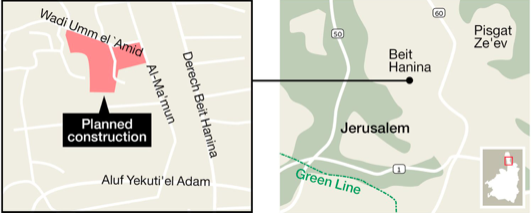
May by Haaretz
The Beit Hanina settlement plan – as FMEP has previously reported – is backed and promoted by settlement impresario Aryeh King, and it provides for the construction of a total of 150 new units in the southern end of the Beit Hanina neighborhood. The land slated for the 150 units is privately owned, 53% of the land is owned by an Israeli who is supportive of the plan, and 47% by a Palestinian company who objects to the plan and has fought against it. Because the land has not been surveyed to demarcate the split ownership, Israeli planning authorities decided that the settlement plan is designated for the entire property, with construction rights split evenly between the parties, meaning the 75 units granted final approval on January 8th represent the Israeli-controlled half of the project.
Ir Amim notes the larger picture of Isreali settlement activity north of the Old City:
“In close proximity to Ramat Shlomo to the southwest and Pisgat Zeev to the northeast, construction of this new compound may signal the beginning of a move to create contiguity between the two settlements, while fracturing the contiguous space between Bet Hanina and Shuafat. As exemplified by the ring of state-sponsored settlement strongholds throughout the Old City Basin, the establishment of a settler enclave in the midst of Beit Hanina will not only impact the fabric of this community, but will further erode opening conditions for a political solution to the conflict based on two capitals in Jerusalem.”
Ir Amim explains essential context:
“the plan will enable an ideologically driven settler outpost in the heart of Beit Hanina, a neighborhood located on the northern perimeter of East Jerusalem that has remained relatively untouched by Israeli settlement within its limits. Since the land in question is not far from Ramat Shlomo to the south-west and Pisgat Zeev to the north-east of it, its construction may mark the beginning of a far sweeping move to create contiguity between the two settlements, while driving a wedge between Bet Hanina and Shuafat.”
Plans Advance in East Jerusalem, Part 2: Reports on Har Homa & Rumors on Givat Hamatos
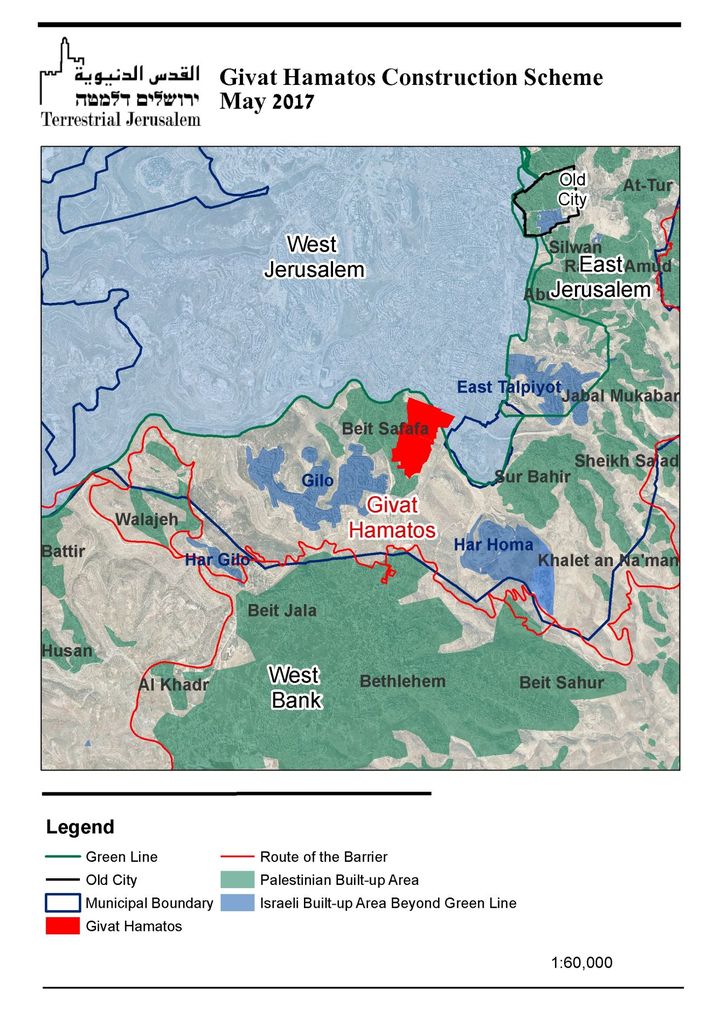 On January 7th, the popular Isareli broadcaster network Kan reported that the Prime Minister’s office has blocked a plan to build 2,000 new settlement units in the settlement of Har Homa, citing “diplomatic difficulties.” In response to an inquiry, the office did not deny the report, but issued the following statement:
“Israel has built in Jerusalem, is building in Jerusalem and will continue building in Jerusalem — while exercising judgment.”
Jerusalem expert Daniel Seidemann raised a key question and larger concerns about the reports concerning Har Homa, saying:
“The construction potential at Har Homa has been exhausted, and it’s not possible to build anything near 2,000 units. So what are they talking about? Something is clearly going on. Three possibilities come to mind, all problematic…Possibility no. 1: the nearby planned doomsday settlement of Givat Hamatos, which is awaiting tenders. Possibility no. 2: Hirbet Mazmoriyya, to the northeast of Har Homa. The lands owned by Palestinians that will have to be expropriated. Not likely. Too complicated and controversial. Possibility no. 3: the area wedged betw. Mar Elias Monastery, the Hebron Road, the 300 Checkpoint, dubbed Bethlehem Gate or Har Homa West. The land is ownership is a mixture of Palestinian &Church lands, along with settlement developers.”
Ir Amim notes that, while reportedly stalling the Har Homa plan, Netanyahu is – in fact – simultaneously facing mounting pressure to issue tenders for the construction of the Givat Hamatos settlement, the site for which is the northern border of Har Homa. Ir Amim writes:
“Last week, rightwing groups launched a coordinated campaign to exert pressure on Prime Minister Netanyahu to advance construction in the area of Givat Hamatos, which has been essentially frozen for the past six years. While the approval of the plan for 2,610 housing units in the area was formally published in 2014, there has been no announcement of tenders since then. This has been largely attributed to international opposition, namely from the United States and Germany. Likely attempting to ratchet up pressure on Netanyahu in lead-up to the upcoming elections in March, the campaign has been spearheaded on a public level by rightwing organizations. Several prominent rabbis known for supporting the settler movement penned a letter to the Prime Minister calling on him to announce the tenders for Givat Hamatos, while rightwing media outlets have published daily articles demanding an ‘end to the freeze.’ A rightwing institute likewise published a lengthy paper on the significance of establishing a new settlement in the area as a means of thwarting any potential future division of Jerusalem within the framework of a resumed peace process.”
Plan Advance in East Jerusalem, Part 3: Israel Approves Plans for Two More Settler-Run Tourist Sites in East Jerusalem
On December 25, 2019 the Jerusalem Local Planning approved two significant settler-backed schemes in East Jerusalem:
- The committee approved the Israeli government’s plan to seize land in the Palestinian East Jerusalem neighborhood of Sheikh Jarrah, in order to establish a park adjacent to the infamous Shepherd Hotel, an historic/iconic building that was taken over by the radical Ateret Chohanim settler organization in 2011. The new park – called “Hakidron Park” has been discussed and considered by Israeli governments for the past 15 years.
- The committee also approved the Israeli government’s plan to confiscate land in the Ras al-Amud neighborhood of East Jerusalem, for the purpose of opening a tourist and religious services center on the Mount of Olives, adjacent to the Jewish cemetery. The Jerusalem Municipality hired an architect, Arie Rahamivov, who is also employed by the radical Elad settler group for the planning and construction of their crown jewel: the Kedem Center in Silwan. The new center in Ras al Amud will be yet another tourist center under the management of Elad, which already operates another visitors center on the Mount of Olives.
Ir Amim writes:
“Approval of the aforementioned land expropriations would signal intent to begin construction at both sites and will help to further solidify the settlement ring around the Old City Basin. While both plans can be posited as innocuous municipal initiatives to serve local residents and visitors to the areas, such touristic projects play an integral role in expanding the scope of settlement strongholds in the area and creating a more contiguous Israeli space, while diffusing the political agenda behind these efforts.”
Plans Advance in East Jerusalem, Part 4: Tenders for Pisgat Zeev and Gilo
Ir Amim reports that the Israel Lands Authority published construction tenders for the following East Jerusalem settlements in early January:
- 3 tenders for a total of 461 new settlement units in the Pisgat Zeev
- 1 tender for commercial buildings in the Gilo settlement, located
For Second Time, Israeli Court Rules Against Settler Claim to Bakri House in Hebron
On December 23rd, the Jerusalem District Court ruled that the Palestinian Bakri family are the rightful owners of a disputed property in Hebron. This ruling should deal a final blow to the 18-year long legal battle settlers have waged to gain control of the Bakri family house (“should”, not “will”, because the settlers have repeated been dealt defeats in court and each time are able to manufacture a new claim or appeal) .
The ruling – which affirmed a March 2019 ruling by the Magistrate court, which the settlers had appealed – called for the immediate evacuation of the settlers whom Israel has permitted to illegally squat in the house while the legal processes were ongoing. For a full history of the Bakri house saga, see here.
Following the ruling, Peace Now said:
“[the] court again ruled that the settlers had forged [documents] and lied all along… We hope that after [almost] two decades of violence, lies and terror, justice will be carried out and the invaders will be evicted.”
Peace Now Wins Interim Decision Against Secretive Public Funding to Amana
In response to a Peace Now petition, on December 31st the Israeli High Court issued an interim decision that requires state bodies to request approval from the court before transferring funds to Amana, a settlement body which is known to undertake illegal settlement activities across the West Bank. Peace Now filed the petition after discovering that state bodies have been secretly funneling money to Amana.
Peace Now said in a statement:
“Amana is the most significant organization operating in the settlements. For decades, it has overseen the establishment of dozens of illegal outposts and neighborhoods with the help of massive budgets, some of which have been transferred from Israeli taxpayer money through local settlement authorities in violation of the law. The judges’ decision is a dramatic yet necessary step that limits, for the time being, this illicit transfer of funds to illegal projects in the settlements and outposts. We hope that in this spirit, the court will rule that public funds should no longer be transferred to Amana via subsidy procedures. This situation in which the State of Israel backs illegal activities with public funds is unconscionable, and we urge the Israeli government to put an end to it.”
Israeli Court Dismisses Palestinian Landowners’ Petition Against the Ofra Settlement
On January 6th, the Israeli High Court of Justice dismissed a petition filed by Palestinian landowners challenging the legality of the Ofra settlement. The petition was based on the fact that the settlement is partially built on privately owned Palestinian land. The court ruled that the majority of the settlement had been built on land expropriated by Israel, and that the minority of land that Palestinians claim ownership over was not enough to invalidate the entire Master Plan for the settlement. Further, the court stated that the settlement structures built on the privately owned Palestinian land were built by settlers “in good faith,” under the mistaken belief that land had also been expropriated by the Israeli government.
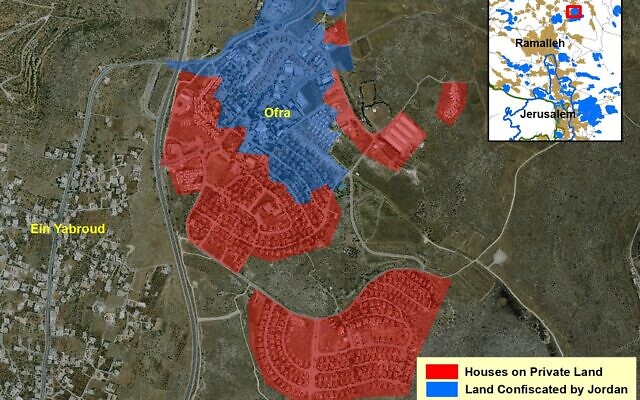
Map by Peace Now
This High Court ruling does not fix the legal status of Ofra settlement buildings, but it is nonetheless significant because it continues to deny Palestinians their property rights. Likewise, it gives a green light to the use of the “market regulation” principle to expropriate land in order to retroactively legalize the structures. As a reminder, the “market regulation” principle – which was invented by the Israeli Attorney General – holds that if settlers acted “in good faith” when they built on privately owned Palestinian land, the state can expropriate that land, thereby making what was illegal before, now perfectly legal.
The Ofra settlement’s legal situation has long been an issue that the Israeli government has tried to fix. Ofra was first established by settlers on land that the Jordanian government had expropriated in 1966, in order to build a military base (which was never built). The Israeli government used this pretext to expropriate the land in 1977, in order to recognize the Ofra settlement, which had been established illegally but with tacit cooperation of the government on the site two years earlier. However, the settlers built the majority of the Ofra settlement on land that was not expropriated by Israel in 1977 — land that was in fact registered to Palestinians from the nearby village of Ein Yabroud. In light of the legal status of the land, no Israeli government has since found a way to fix the legal status of these homes (not for lack of trying) – meaning that the majority of the structures in Ofra were built without permits, making them illegal under Israeli law.
Peace Now elaborates on what is at stake in the Ofra settlement case:
“Most of the houses built in Ofra (approximately 413 out of 625) were built on an area of 550 dunams of privately owned Palestinian land. In addition, hundreds of dunams of Palestinian private land were seized for roads in Ofra, as well as infrastructure and agricultural lands for the settlers. The only way to regulate the theft of these lands would be to expropriate them from the Palestinian landowners for the benefit of the settlers, in complete contradiction to the positions of previous Israeli governments and legal advisors, and contrary to binding rulings of the High Court. Although the current legal advisor (Avichai Mandelblit) allowed land expropriation in some places for settlement purposes (for example, in Haresha), in the regulation of massive land theft such as in Ofra the Israeli government would be crossing a new red line.”
FMEP documents the government’s efforts to expropriate Palestinian land for the settlements in its Annexation Policy Tables.
Bennett Launches Initiative to More Aggressively Demolish Palestinian Construction in Area C
Making the most of his appointment as Israeli Defense Minister in the current caretaker government, Naftali Bennett is pushing an initiative to annex Area C and to aggressively demolish Palestinian construction in the area (reminder: Area C constitutes nearly 60% of the West Bank; it is land that under Oslo II was supposed to have been “gradually transferred to Palestinian jurisdiction”).
As part of his efforts, Bennett has launched legal research into how Israeli can bring settlement building in Area C under the direct authority of the Justice Ministry, cutting out the Civil Administration. This Civil Administration, it should be recalled, is the arm of the Israeli Defense Ministry which acts as the sovereign power over the West Bank, in a system of governance Israel created based on its recognition of the different legal status of the area. Bennett has called for that system to be disbanded (in addition to annexing Area C). To be clear: transferring the construction and planning processes in Area C to domestic Israeli jurisdiction would by any definition constitute the Israeli state extending its sovereignty over area — an act of annexation.
Bennett has requested that Defense Ministry officials present several legal options for how Israel can bring planning processes under the Justice Ministry (integrating the settlements into the normal planning process). The settler-run Arutz Sheva outlet attributes the following quote Bennett in a private meeting:
“We are in essence discussing applying procedural sovereignty only. Full sovereignty is under the authority of the political echelon, but this is a step in the right direction. There is no reason that residents of Judea and Samaria should continue being discriminated against. We must stop this. Residents of Beit El and Ariel are no less Zionist than residents of Kfar Saba and Tel Aviv. They pay taxes and serve in the army, and they need to receive the same services from the government.”
Bennett is also advancing several initiatives that will empower and compel the Civil Administration to more aggressively enforce demolition orders against Palestinian construction in Area C (based on Israel’s policy of not granting permits to Palestinians in Area C, nearly every Palestinian structure in this territory has a demolition order pending against it). Bennett is also eyeing ways to combat what he considers illegitimate and nefarious funding from the European Union to Palestinian communities living in Area C. Israel Hayom reports:
“Bennett’s plan to stop the Palestinians from chipping away at Area C demands action in four areas: Operational, economic, legal, and PR. He wants to change enforcement priorities to put an emphasis on eradicating illegal buildings in strategic locations rather than by numbers. For example, home demolitions would be carried out in accordance with Israeli interests, prioritizing illegal buildings next to roads or settlements. Bennett also instructed the Central Command and the Civil Administration to work more closely to implement his plan and asked that the Civil Administration report to him monthly to update him on progress. Meanwhile, the defense minister is weighing the possibility of allocating more resources to the Civil Administration for enforcement, which would entail hiring more personnel. Bennett also wants to take steps to stop the flow of European money that funds the illegal Palestinian construction in the first place, allowing the “Fayyad Plan” to flourish.”
Bennett Appoints Key Settler Ally to Lead New Government Task Force on Area C Annexation Plans, Immediately Announces Plan to Legalize Settlements
In addition to his new initiative targeting Palestinian construction in Area C, Israeli Defense Minister Naftali Bennett announced that he has created an inter-ministerial taskforce to develop settlement and annexation plans for the future of Area C in the West Bank.
Bennett’s chief of staff, Itay Hershkowitz, has been in weeks-long consultations with key settler leaders to decide what items to act on immediately. Haaretz reports their agenda includes:
- Allowing Jews to privately purchase land in the West Bank. [See here for a detailed explanation of this complicated matter]
- Connecting unauthorized outposts to water and electricity.
- Granting official recognition to unauthorized outposts that are located near established settlements by recognizing them as “neighborhoods” of the settlement.
- Repealing a military order that empowers the Civil Administration to evict settlers from privately owned Palestinian land with or without a Palestinian-initiated petition to have the settlers removed.
- Legalizing 30 sheep farms in the West Bank that are under pending demolition orders.
On Thursday, Bennett announced that he has appointed West Bank settler Koby Eliraz to lead the new taskforce. Calling Eliraz a “bulldozer,”Bennett said:
“The territorial future of the Land of Israel is at stake. The State of Israel has simply not been up to the task of stopping [Palestinian construction]. We are changing direction and embarking on a battle that Israel must win… The defense establishment will fight for this territory, and it is essential for someone to lead this campaign.”
Eliraz previously served as Netanyahu’s settlement advisor, but was fired by the Prime Minister in June 2019 reportedly because he was believed to be allied too closely to Netanyahu rival Avigdor Liberman, who Netanyahu also dismissed. At the time of Eliraz’s firing, settler leaders were outraged and published a letter asking Netanyahu to reverse Eliraz’s firing, suggesting that Eliraz’s absence will hinder government efforts to retroactively legalize outposts. The letter noted:
“Kobi has taken care of Israeli settlement and its residents with great professionalism. He is credited for many advancements [on our behalf] in the fields of construction, infrastructure development, security and more.”
The Times of Israel observed, significantly, that the Yesha Council was able to get every single settlement Mayor to sign the letter in support of Eliraz, explaining:
“The Yesha Council in recent years has struggled to get all of its members on board with its initiative, but the umbrella group’s ability to gather the signatures of every Israeli mayor beyond the Green Line is testament to the broad respect that Eliraz holds among settler leader.”
Following ICC Announcement, Pompeo Says Israel Has “Fundamental Rights” to Land
At a press briefing on December 22nd, U.S. Secretary of State Mike Pompeo did not specifically address the ICC announcement, but made lengthy comments regarding statements from European countries and the European Union that were critical of the new U.S. position on settlements (that they are not “per se illegal” under international law). Pompeo’s comments hold relevance to the U.S. position on the ICC case and more generally on the U.S. approach to the Israeli-Palestinian conflict:
“First, the legal analysis that the EU performed [on settlements] we just think is wrong. We think they have an improper analysis of the international law surrounding this. So as the technical legal matter, [EU Foreign Minister] Ms. Mogherini just – she’s just wrong. And so we are doing our level best to demonstrate to them our legal theory, our understandings, and why it is that we’re convinced that under international law these settlements are not per se illegal. So we’re working that element of it as well. But at another level, and perhaps at the level that will lead to the right outcome, which is why we did this, this has to be resolved through political means, and we hope that all nations, including member nations inside of the EU and the EU itself and countries all over the world, will come to recognize the fundamental rights that the Israeli people have to this land, to this space. There are real security needs. The risk that is presented from the world as anti-Semitism is on the rise, we hope that every nation will recognize that and weigh in on this conflict in a way that is constructive, that will ultimately lead to the peace that is so desperately needed.” [Emphasis added by editor]
Pro-Settlement Legal Forum Conference Draws Big Names, Big Promises
The Kohelet Policy Forum, a right-wing advocacy organization that has enormous influence with senior Israeli – and increasingly American – government figures, hosted a “Conference on the Pompeo Doctrine” in Jerusalem, Jan. 7-8, 2020. The conference served as a gleeful celebration and forward-looking projection of what the new U.S. settlement policy towards settlements means for Israel. The conference drew participation from all the leading Israeli politicians and several senior members of the Trump Administration, including Secretary of State. Pompeo. Key quotes from the conference speakers are copied below.
U.S. Secretary of State Mike Pompeo:
“We’re recognizing that these settlements don’t inherently violate international law. That is important. We’re disavowing the deeply flawed 1978 Hansell memo, and we’re returning to a balanced and sober Reagan-era approach. “In doing so, we’re advancing the cause of peace between Israelis and Palestinians.”
U.S. Ambassador David Friedman:
“…when we came into office the lingering issues included three of significant importance: the status of 1) Jerusalem, 2) the Golan Heights and 3) Judea and Samaria. We have approached them in ascending order of complexity…I thank God that President Trump had the courage and the wisdom to recognize Jerusalem as the capital of Israel and move our embassy to Jerusalem from Tel Aviv…In recognizing Israel’s sovereignty over the Golan Heights, President Trump, evaluating the continuous malign and barbarous threats posed by Syria, concluded that no northern boundary for Israel would be secure except a boundary that incorporated the Golan. He acted well within the language of 242. [Judea and Samaria] is certainly the most complicated of the issues because of the large indigenous Palestinian population. Over the years before we came into office, it’s only gotten more complicated and more challenging. The proverbial goalposts have moved and moved – to the point today where they are no longer even on the field….The Pompeo Doctrine does not resolve the conflict over Judea and Samaria. But it does move the goalposts back onto the field. It does not obfuscate the very real issue that 2 million or more Palestinians reside in Judea and Samaria, and we all wish that they live in dignity, in peace, and with independence, pride and opportunity. We are committed to find a way to make that happen. The Pompeo Doctrine says clearly that Israelis have a right to live in Judea and Samaria. But it doesn’t say that Palestinians don’t….it calls for a practical negotiated resolution of the conflict that improves lives on both sides.”
Israeli Prime Minister Netanyahu said:
“I will not let any settlements be uprooted in any diplomatic plan. This idea of ethnic cleansing… it won’t happen. There is a window of opportunity. It opened, but it could close…There was no West Bank separate from the rest of the land. It was seen as the heart of the land. We never lost our right to live in Judea and Samaria. The only thing we lost temporarily was the ability to exercise the right. When Israel returned to the West Bank We didn’t return to a foreign land. That is a distortion of history. Jews lived in Jerusalem and Hebron for thousands of years consecutively…The Pompeo declaration about the status of the towns [in Judea and Samaria] establishes the truth that we are not strangers in our land. In a clearly defensive war, we returned… to the land where our forefathers put down roots thousands of years ago…Unlike some in Europe who think the Pompeo declaration distances peace, I think it will promote peace, because peace must be based on truth, not lies. Settlements are not the root of the conflict. We are standing with justice and the truth. It is a great struggle.”
Israeli Defense Minister Naftali Bennett on Area C annexation and his initiatives in that regard:
“Our aim is that within a decade a million Israeli citizens will live in Judea and Samaria” and later “Our objective is that within a short amount of time, and we will work for it, we will apply [Israeli] sovereignty to all of Area C, not just the settlements, not just this bloc or another. We are embarking on a real and immediate battle for the future of the Land of Israel and the future of Area C. It started a month ago and I am announcing it here today. A month ago, I convened a meeting and I explained the clear directive, the State of Israel will do everything to ensure that these territories [Area C] will be part of the State of Israel.”
Likud MK and former Mayor of Jerusalem Nir Barkat said:
“I am confident that Secretary Pompeo’s statement is an integral part of the American plan and is closely linked to Jared Kushner’s proposal advanced in Bahrain promoting significant economic investment in the Palestinian economy…Now is a perfect opportunity to similarly grow the communities throughout Judea and Samaria at a pace like never before. This declaration is a recognition of the legal and historic right of the Jewish people to live wherever we wish. This is how it should be in other parts of the world and certainly here in the Jewish State. This declaration is therefore an exceptional opportunity for Israel to ensure our continued growth and expansion throughout these areas. Israel needs to set a goal for the settlement of two million people in Judea and Samaria within fifty years. This is a commitment which requires that we already now lay the framework to make that possible and this is an investment which will also benefit the Palestinian people” [Editor’s note: Barkat has been working with Harvard Professor Michael Porter to promote an economic peace scheme, most recently speaking at Harvard about the plan in December 2019]
Eugene Kontorovich, Director of International Law at the Jerusalem-based Kohelet Policy Forum and a key shaper of anti-BDS/pro-settlement legislation in U.S. Congress and across state governments, said:
“American Policy is now clearer than ever, Jews living in Judea and Samaria is not a crime. For decades, the obscure Carter-era memo was used as justification for anti-Israel policies despite the fact that its conclusions were rejected by subsequent administrations. Sec. Pompeo’s statement at the Kohelet conference today makes clear the U.S.’s wholesale rejection of the legal theory that holds that international law restricts Israeli Jews from moving into areas from which Jordan had ethnically cleansed them in 1949.”
Bonus Reads
- “The Atarot Exception? Business and Human Rights Under Colonization” (Marya Farah in Jerusalem Quarterly)
- “The Decade Israel Erased the Green Line” (+972 Magazine)
- “Settlers are seizing ‘empty’ land. The Palestinian owners are fighting back” (+972)
- “Israeli Right Wants to End Peace with Jordan” (Haaretz)
- “Security official says police, courts scuttling efforts to curb settler violence” (The Times of Israel)
Welcome to FMEP’s Weekly Settlement Report, covering everything you need to know about Israeli settlement activity this week.
To subscribe to this report, please click here.
June 28, 2019
- Radical Settler Group Deepens Control Over East Jerusalem Neighborhood & Tourism Network
- Israel Advances Plan for Settlement Enclave in Beit Hanina Neighborhood of East Jerusalem
- Former Mayor of Jerusalem Proposes Plan to Build 12 New Settlement Industrial Zones in Area C
- McDonald’s Wins Bid to Operate in Ben Gurion, Despite Settler Campaign
- Settlers Continue Price Tag Attacks on Palestinian Villages, Still No Arrests
- The Bahrain Workshop [Shhh… Don’t mention Settlements!]
- Bolton Tours Jordan Valley & Hints at U.S. Support for Permanent Israeli Control
- Bonus Reads
Questions or comments? Contact Kristin McCarthy at kmccarthy@fmep.org.
Radical Settler Group Deepens Control Over East Jerusalem Neighborhood & Tourism Network
Approximately two months ago, the radical settler organization Elad opened a new cultural center and cafe in the Palestinian neighborhood of Abu Tor (Abu Tor is a mixed but segregated neighborhood). Named “House in the Valley,” Elad’s new cafe is uncoincidentally located adjacent to the site of a planned new pedestrian footbridge designed to expand Elad’s tourist infrastructure across the area. Specifically, that new footbridge will connect Abu Tor with Elad-run tourist sites and settler homes in the Palestinian Silwan neighborhood – located just outside the Old City’s Dung Gate, in the shadow of the Temple Mount/Haram Al-Sharif.
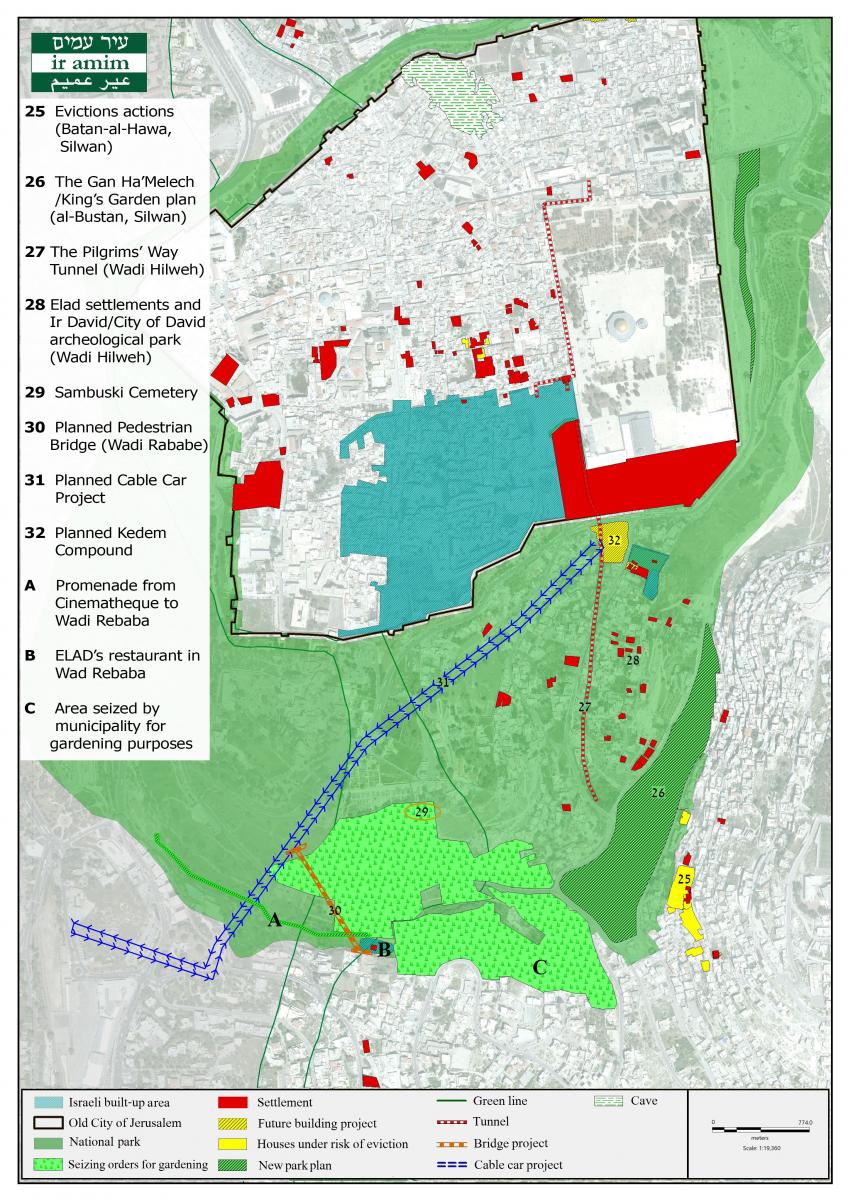
A week after Elad’s new cultural center was opened in April 2019, the Jerusalem Municipality issued “gardening orders” to take control, for a period lasting 5 years (with the likelihood of extensions after that), of 12 nearby plots of privately owned Palestinian land. “Gardening orders” allow Israel to “temporarily” take over privately owned land for what are public purposes (like establishing a parking lot or public garden), based on the argument that the owners are not presently using the land.The government notices posted on the land, say that the Jerusalem Municipality intends to transform the plots with new landscaping, adding new terraces, and a new walking path. Importantly, as Emek Shaveh notes, the 12 plots in question are located in an area declared by Israel to be a national park, meaning that private landowners are legally barred from using their own land.
In short, this is an Orwellian situation wherein Israel has actively blocked Palestinains from using their own land, and is now using the fact that the Palestinians aren’t using their land as a pretext for seizing it. Adding insult to injury, the land is being taken ostensibly for public purposes – but the public the seizures are designed is Elad and its supporters, not the Palestinian residents of the area.
Ir Amim explains key context:
“Portrayed as a seemingly innocuous new establishment for arts and culture designed to serve the Israeli public, Elad’s ‘House in the Valley’ serves as an entry point into the settlement ring around the Old City. The new promenade, constructed by the municipality to aid and abet Elad’s efforts by connecting its center with the Jerusalem Cinemateque, not only enables access from West Jerusalem to an Elad-managed site beyond the Green Line, but it propagates the idea of a contiguous Israeli space, while blurring its Palestinian surroundings and diffusing the political agenda behind these efforts. Moreover, the confiscation of privately-owned Palestinian land for purported purposes of beautification is intended to serve the Israeli public projected to visit Elad’s new complex and likely lead to additional settler activities in the area.”
Emek Shaveh says:
“In effect, the gardening orders and the tourism development of the area are part of an attempt by the Elad Foundation, with the assistance of the Jerusalem Municipality, to gain a foothold in Abu Tor as well and to increase the Israeli presence in the Palestinian part of the neighborhood. A pedestrian bridge that will lead to the café from Mount Zion (see map) is also part of this effort. A budget of 1.8 million shekels for the construction of this bridge was approved two months ago by the Jerusalem Municipality.”
As a reminder, Elad – along with its fellow travelers at Ateret Cohanim – has undertaken a politically- and ideologically-motivated project to hide, marginalize, and erase the presence and history of East Jerusalem’s Palestinian population. It has done so in large part by developing and controlling tourist attractions and infrastructure in the area. Elad’s activities in this regard have been funded, politically and bureaucratically enabled, and encouraged by successive Israeli governments. One of Elad’s most spectacular projects is the planned Jerusalem cable car line – which, despite objections from transportation and planning professionals, was recently advanced through another phase of the planning process. That project, like Elad’s other tourism schemes, is designed to further entrench settler activities and tourism sites inside Silwan, while simultaneously delegitimizing, dispossessing, and erasing the Palestinian presence there. As a spokesman for Elad once proudly declared, “Our aim is Judaize East Jerusalem”).
Israel Advances Plan for Settlement Enclave in Beit Hanina Neighborhood of East Jerusalem
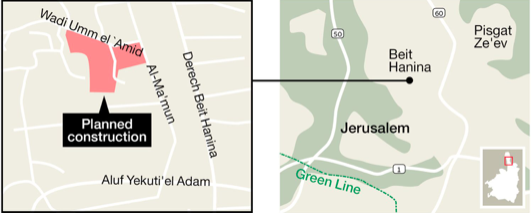
Map by Haaretz
On June 27th, a plan for 150 new settlement units in the Beit Hanina neighborhood of East Jerusalem was deposited for public review, a move which sets off a 60-day period for the public to submit objections to the plan. The Beit Hanina settlement plan – as FMEP has previously reported – is backed and promoted by settlement impresario Aryeh King, and it provides for the construction of 150 new units in the southern end of the Beit Hanina neighborhood. If built, it will be the first-ever authorized settlement project in Beit Hanina, located north of the Old City.
Ir Amim explains essential context:
“If approved, the plan will enable an ideologically driven settler outpost in the heart of Beit Hanina, a neighborhood located on the northern perimeter of East Jerusalem that has remained relatively untouched by Israeli settlement within its limits. Since the land in question is not far from Ramat Shlomo to the south-west and Pisgat Zeev to the north-east of it, its construction may mark the beginning of a far sweeping move to create contiguity between the two settlements, while driving a wedge between Bet Hanina and Shuafat.”
According to the plan, 75 units units would theoretically be earmarked for Palestinians – a point used by the plan’s supporters to suggest that it is actually benevolent. The key word here, however, is: theoretically. As noted by Jerusalem expert Danny Seidemann in another context:
“Since 1967, the Government of Israel has directly engaged in the construction of 55,000 units for Israelis in East Jerusalem; in contrast, fewer than 600 units have been built for Palestinians in East Jerusalem, the last of which were built 40 years ago.”
Former Mayor of Jerusalem Proposes Plan to Build 12 New Settlement Industrial Zones in Area C
Former Mayor of Jerusalem Nir Barkat joined Professor Michael Porter of Harvard University to write what a proposal calling for the establishment of 12 new settlement industrial zones in the West Bank, which Barkat argues will complement the recently unveiled U.S. economic “plan” in jump-starting the Palestinian economy. Like the U.S. plan, Barkat and Porter’s scheme seeks to entrench permanent Israel control and annexation of the land, people, resources, and economy of the West Bank. Barkat made as much clear in an interview with Israel Hayom when he said:
“The plan’s working assumption is avoiding the eviction of Jewish or Arab residents from their homes. Our goal is to take advantage of the relative advantage every society has. The Israeli side can bring the innovation, the capital and managerial knowledge for the benefit of the Palestinian side, which through working in these industrial areas could significantly increase its income. This is a plan that is also good for the settlements, and all the settlement heads have welcomed it.”
Barkat and Porter’s plan – which they say can employ over 200,000 Palestinians and double their average salary – is based on the demonstrably false notion that industrial zones benefit the Palestinian work force and economy. In fact, as Who Profits recently explained:
“Israeli IZs constitute a foundational pillar of the economy of the occupation. They contribute to the economic development of the settlements, which are in violation of international law and the Fourth Geneva Convention, while relying on the de-development of the Palestinian economy and the exploitation of Palestinian land and labor…The IZs in the oPt form part of a practice of ‘financial annexation’ which is an essential component of the broader policy of annexation taking place.”
The report on Barkat and Porter’s plan does not include many specific details as to the locations of the 12 proposed industrial zones, but it hints at several projects that are already known to the public, like the “super settlement” and industrial zone planned to unite four settlements in the northern West Bank, and the industrial zone in the South Hebron Hills near the Tene-Omarin settlement – the latter of which was briefed to the U.S. administration by the Israeli government in September 2018. It is also worth recalling that in January 2019, the Israel government advanced plans for two new industrial zones, one near the Beitar Illit settlement and another near the Avnei Hafez settlement.
Barkat and Porter also call for investments in the West Bank tourism industry, specifically Biblical sites like the Ibrahimi Mosque/Tomb of the Patriarchs (in Hebron) and Solomon’s Pools (located just south of Bethlehem).
According to the report, Barkat and Porter presented this plan to Israeli Prime Minister Netanayhu and U.S. peace envoys Jared Kushner and Jason Greenblatt, all of whom – according to Barkat – welcomed it. Barkat believes his plan enhances the U.S. menu of investments and proposals outlined in Kushner’s “Peace to Prosperity” presentation. Further, Barkat argues that his plan is more feasible than the U.S. program because it only envisions projects in Area C, the 60% of the West Bank over which Israel maintains full control, while (he argued) the U.S. plans focus on Areas A & B. In fact, nothing in the text of the Kushner plan specifies any territorial locations, boundaries, or divisions for the proposed projects.
McDonald’s Wins Bid to Operate in Ben Gurion, Despite Settler Campaign
On June 23rd, the McDonald’s franchise owner in Israel was awarded a government contract to operate one of the few food stands at Ben Gurion International Airport. His bid of 17 million shekels ($4.7 million) was vastly higher than other competing bids, winning him the right to operate a McDonald’s branch in the airport for seven years, with an optional 2-year extension.
Ahead of the government’s decision, settlers led a campaign to disqualify Omri Padan – the Israeli man who holds the only McDonald’d Israel franchise license – from bidding on the contract, based on Padan’s failure to open any McDonald’s branch in an Israeli settlement. The settlers claimed that Padan’s failure to do so violates Israel’s Anti-Boycott Law and therefore disqualifies him from receiving public contracts.
Settlers Continue Price Tag Attacks on Palestinian Villages, Still No Arrests
Settlers are believed to be behind three separate attacks on Palestinian property this week, including a rash of hate crimes that damaged Palestinian cars, homes, and religious buildings, and served to intimidate Palestinians living near Israeli settlements.
On June 24th, Palestinians in the village of Sinjil woke up to discover 12 cars with tires slashed and hate messages sprayed painted in Hebrew on several buildings. This is the fifth hate crime connected to settlers in the month of June. Some of the graffiti read “a village of terrorists” and “We give them jobs and they rape.” The latter is a reference to the horrific alleged rape of a 7-year old girl in a settlement; a Palestinian man was immediately charged with the crime and subjected to the equivalent of a national political and media lynching; this week, after 55-days of imprisonment, he was released due to lack of evidence.
On June 26th, vehicles were vandalized and hate messages were spray painted on walls in the Palestinian town of Sarta, which is located west of the Ariel settlement in the northern West Bank. Some of the graffiti read, “non-Jews = enemies,” and the Star of David appeared many times. This is the first time that Sarta has been targeted in a price tag attack.
Yesh Din – an Israeli NGO that tracks and demands justice for settler violence – said in a Facebook post:
“The violent action tonight joins a series of riots that we document in the West Bank against Palestinians and their property. A reality in which families wake up for a day’s work and are forced to discover that while they are sleeping, unknown gentlemen in an area where their children play with the neighbors’ children has become routine. Over the past month we have reported such riots in various areas of the West Bank: Sinjil, Kafr Malik, Einabus, Asira al Qibliya, Burin from Madame, and more. The one who is supposed to prevent the disturbance, and to stop the unknown people who terrorize the Palestinian villages are the policemen of the SJ District, who only this week presented their amateurish work at best, and failed in their worst case. These interrogators and police officers have a responsibility for the personal security of the Palestinians and they do not fulfill their duties. Thus, they create a reality of terror in which there is no safe place for the Palestinian population, and a sense of security does not exist even in the most private space.”
The Bahrain Workshop [Shhh… Don’t mention Settlements!]
The U.S.-hosted “Peace to Prosperity” economic workshop took place in Manama, Bahrain from June 25-26. The widely-ridiculed event focused on a 95-page project prospectus published by the White House in the two days ahead of the workshop. Without giving any real details, the plan talked about enhancing Palestinian property rights — a notion that begs a myriad of questions given that Palestinain private property rights today are undermined first and foremost by Israel, which in 1967 closed the land registry, and which since 1967 has exploited every available mechanism to seize Palestinian private land, and where such mechanisms could not be found, it created them (like the Regulation Law). Notably, the Trump Administration plan treats Palestinian land registration strictly as a means to foster a better investment climate in the West Bank and Gaza (as opposed to a pillar of rule of law that upholds fundamental rights of individuals).
In this regard, the Director of Human Rights Watch Israel, wrote:
“The plan speaks of the importance of private property rights without mentioning the Israeli authorities’ methodical theft of thousands of hectares of privately owned Palestinian land in the West Bank to build settlements, which are illegal under international humanitarian law, or their illegal.”
Mocking the workshop’s very strange approach to Palestinian property rights, The Economist journalist Gregg Carlstrom – who live-tweeted his disbelief of the entire conference – noted sarcastically on June 26th:
“We kickoff the afternoon’s fun with Kevin Hassett, the ‘Dow 36,000’ guy, talking about property rights. In Palestine, ‘You can radically transform economies when you improve their ability to document property rights!’”
Another notable storyline from Manama: Palestinian businessman Ashraf Jabari was the only Palestinian to be on-stage at the event. As FMEP has previously covered, Jabari has been slammed as a traitor by the Palestinian Authority, shunned and dismissed by his fellow Palestinian business people, and disowned by his family in light of his ongoing role with the Judea and Samaria Chamber of Commerce, an initiative Jabari runs alongside Israeli settlers.
In Manama, Jabari spoke about developing thriving businesses in the West Bank. The Washington Post notes that Jabari was the only speaker to discuss political matters on the stage. The Post writes:
“When asked by British broadcast journalist Nik Gowing…whether the plan could benefit him, Jabari replied that it could — if Palestinians had a state.”
Jabari might have been telling the truth, but he apparently failed to mention the fact that he, alongside Israeli settler Avi Zimmerman, have proposed the launch of a “bond bank” to become the financing vehicle for the Trump Administration’s plan. The bond bank would aggregate projects and issue debt to fund them, allowing for lower borrowing costs. According to the White House presentation, the U.S. envisions a funding mechanism it calls, “The Peace to Prosperity Master Fund” which will manage the money and projects.
Bolton Tours Jordan Valley & Hints at U.S. Support for Permanent Israeli Control
On June 24th, U.S. National Security Advisor John Bolton toured the Jordan Valley, Jerusalem, and the separation barrier, accompanied by Israeli Prime Minister Netanyahu, U.S. Ambassador David Friedman, and Israeli Ambassador to the U.S. Ron Dermer. At a stop overlooking the Jordan Valley, Netanyahu explained to Bolton:
“For those who say that for peace to be established Israel has to leave the Jordan Valley, I’ll say that’s not going to bring peace, that’s going to bring war and terror. We’ve been there and we don’t want to be there again. Under any peace agreement, our position will be that Israel’s presence should continue here for Israel’s security and for the security of all.”
Following the tour, Bolton did not disappoint Netanyahu, tweeting:
“Today I visited the Jordan Valley and Jordan River with PM @netanyahu, Israeli NSA Meir Ben-Shabbat, @USAmbIsrael, & @AmbDermer. I saw firsthand the strategic importance that these locations have on Israel’s national security. In similar acknowledgement of the simple but profound reality that for Israel to defend itself, it cannot relinquish strategic ground along its border, the President in March, signed a proclamation recognizing Israeli sovereignty over the Golan Heights.America welcomes the opportunity to strengthen the already deep cooperation between the U.S. and Israel and build on our lasting partnership, demonstrated repeatedly when courage and persistence are required.”
Some 11,000 settlers and 65,000 Palestinians live in the Jordan Valley – the latter facing severe restrictions on land use and freedom of movement, and lack of access to municipal services like water and electricity. Israeli government officials have publicly and repeatedly demanded complete Israeli sovereignty over the Jordan Valley – which makes up 30% of the West Bank – in the context of any peace agreement, meaning that any future Palestinian state would be entirely encircled by Israel, having no international border with any other nation. Likud MK Sharren Haskel has led several Knesset efforts to formally annex the entire Jordan Valley, and recently re-submitted a bill to that affect in May 2019.
Bonus Reads
- “The Day After: What Happens If Israel Annexes the West Bank?” (Mint Press News)
Welcome to FMEP’s Weekly Settlement Report, covering everything you need to know about Israeli settlement activity this week.
To subscribe to this report, please click here.
February 22, 2019
- Settlers Fly Israeli Flag Over Muslim Quarter Home Following Eviction of Palestinian Family
- Israel Approves Massive Jerusalem Housing Project – Including Settlement Units in East Jerusalem
- Facing Supreme Court Hearing, Civil Administration Decides to Partially Comply with Geo Data Request from Radical Settler Group Regavim
- U.S. Ambassador to Israel Pushes Economic Peace Scheme (Again) to “Judea & Samaria Chamber of Commerce & Industry”
- Two U.S. Congressmen Tour Settlements, Promote Annexation
- The “Sovereignty Movement” Promoting Annexation, & the Pushback
- Bonus Reads
Questions/comments? Email kmccarthy@fmep.org
Settlers Fly Israeli Flag Over Muslim Quarter Home Following Eviction of Palestinian Family
On February 17, Israeli security forces evicted the 7-member Abu Asab family was from its home of nearly 70 years in the Muslim Quarter of Jerusalem’s Old City. Within hours of the eviction, Israeli settlers moved into the home and raised an Israeli flag on its roof.
Before 1948, the property in question was owned by a Jewish family, the Maisals, which abandoned the property during Israel’s War of Independence. The Abu Asab family was settled in the property by the Jordanian government during this same period – which Palestinians know as the Nakba (the catastrophe), in the wake of their expulsion from their own home in what became Israeli West Jerusalem. Their eviction this week came at the behest of Israeli settlers who had gained control over the land trust to which the original Jewish owners had passed their property rights.
As background: Under Israel’s Legal and Administrative Matters Law, Jews who lost property in 1948 (of which there are approximately 2,000) have the right to reclaim their property. Palestinians who lost property in that same war (of which there are approximately 20,000-30,000) do not have a similar right. Settler organizations have sought to take full advantage of that law, undertaking campaigns to identify Jewish families who abandoned property now occupied by Palestinians, gain title to those properties (even if the original landowner has made no effort to reclaim the property), and then start eviction proceedings against the Palestinian residents. This is happening across East Jerusalem neighborhoods, most prominently in Sheikh Jarrah and Silwan.
Palestinian residents targeted by these evictions, like the the Abu Asab family, have no legal avenue for reclaiming their property in West Jerusalem.
Peace Now explains:
“The Maisel family dedicated the property to a trust. A few years ago, settlers managed to appoint themselves as directors of this trust, and in their name they sued the family who lived in the property in protected rent during the days of the Jordanians and paid rent regularly. With this crooked legal situation, the court granted the settlers the house and the Abu Asab family became refugees for the second time…This eviction is part of a larger strategy by proponents of the settlement enterprise to change the character of Palestinian Jerusalem neighborhoods in order to cement Israeli hegemony over the Old City and its surroundings and to prevent the chances of a two-state solution.”
Ir Amim researcher Aviv Tatarsky writes:
“When Jewish settlers move into Palestinian neighborhoods, they almost always bring with them armed guards to stand guard on their rooftops and outside their doors, a dynamic that has a detrimental influence on entire neighborhoods. Day to day life is disrupted, with residents facing pressure seemingly designed to push them out of their homes. Israeli authorities have various ways of abetting that effort, from the law allowing only Jews to reclaim property, to funding private security guards for the settlers who move in to their properties, to funding tourism initiatives that strengthen the image of those settlements vis-à-vis the Israeli and international public.”
Israel Approves Massive Jerusalem Housing Project – Including Settlement Units in East Jerusalem
According to the Middle East Eye, on February 20th the Jerusalem Planning & Building Committee approved a project for 4,416 new housing units across Jerusalem, including units in Israeli settlements and settler units located within Palestinian neighborhoods in East Jerusalem. Early reporting on the details of the plan describe:
- 76 new units in the Shuafat neighborhood of East Jerusalem
- 56 new units in the Beit Hanina neighborhood of East Jerusalem
- 464 units in the Gilo settlement
- The construction of a new commercial complex at the Atarot settlement industrial zone site, including 3 buildings with 8 floors each.
FMEP will report more details on the plan as the are clarified.
Facing Supreme Court Hearing, Civil Administration Decides to Partially Comply with Data Request from Radical Settler Group Regavim
The settler-aligned Arutz Sheva outlet reports that, days before a scheduled hearing at the Supreme Court, the Israeli Civil Administration announced that it will provide a portion of the geographical information that the radical settler group Regavim requested via a freedom of information request last year. Regavim works to dispossess Palestinians of their land and property in the West Bank by “helping” (i.e., pushing) the Israeli government to enforce planning and building laws – and possession of the Civil Administration’s most recent geographical data will undoubtedly aid Regavim in pursuing its mission. Notably, Regavim works for the application of planning and building laws only against Palestinians; key Regavim staff members actually live in illegally built settlement units (illegal even under Israeli law), which Regavim works to retroactively legalize.
Supreme Court Justice Meni Mazuz chided the Civil Administration for its failure to respond to the initial information request, and for the nine-month delay in responding to Regavim’s court petition. In light of the Civil Administration’s announcement, the Supreme Court subsequently dismissed Regavim’s petition and and ordered the Civil Administration to pay Regavim’s legal expenses related to the case.
Regavim’s Attorney Boaz Arzi crowed:
“Although it took far too long, after a year and a half we finally received the data we needed – but through legal petition, not through the Freedom of Information process. Regavim is considering submitting a new petition against the Civil Administration’s interpretation of its obligations – or more precisely, its presumptive lack of obligation – under the Freedom of Information Law, an interpretation that contradicts the Attorney General’s directive.”
The Civil Administration said:
“We will study this case and draw conclusions in order to improve our responsiveness to the public.”
U.S. Ambassador to Israel Pushes Economic Peace Scheme (Again) to “Judea & Samaria Chamber of Commerce & Industry”
On February 21st, U.S. Ambassador to Israel, David Friedman, spoke about economic co-existence initiatives at a conference hosted by the “Judea Samaria Chamber of Commerce and Industry (JSC)” (an Israeli settler body) and US-Israel Education Association (USIEA) (conference website is here). The USIEA is a U.S. evangelical group deeply involved in supporting and normalizing settlements, working in partnership with the Israeli government. It is also works with the Family Research Council to lead Congressional delegations to Israel and runs a bible camp in the Ariel settlement.
This is the second time the Ambassador has met with the JSC, the first was in October 2018 at a meeting in the Ariel settlement. Speaking to the press at this week’s conference, Ambassador Friedman said the goal of the forum is to “encourage business development in Judea and Samaria, encourage the prosperity of people who live there, most of them Palestinian residents.” Notably, until this point the U.S. State Department has not officially referred to the West Bank as “Judea & Samaria” – a biblical term for the area that is preferred by Israeli settlers and pro-annexationists.
Friedman said in his speech:
“This is not a time for words, this is a time for action, and this is the path I’m confident we’re on. One day, I believe in the near future, as we begin to see Israelis and Palestinians working together, studying together, investing together, and living together in real peace – not the ‘peace’ that comes from a piece of paper, but the real peace that’s in the heart and the soul of everyone who’s here. We will look back on days like today to understand how it all began.”
Commenting on Friedman’s remarks, FMEP President Lara Friedman tweeted:
“Folks, pay close attention to actions/statements like this one. All evidence so far suggests that US direct engagement (new policies, initiatives, funding) to normalize occupation while de-nationalizing Palestinians IS the Trump ‘peace plan’”
FMEP has repeatedly chronicled Amb. Friedman’s embrace of economic co-existence initiatives as a core U.S. priority on the ground, and has repeatedly explained the perversity of labeling Israel’s economic exploitation of occupied territory (including the local workforce, land, and other natural resources) “coexistence” or suggesting that it brings to the Palestinians benefits they should welcome. The New York Times quoted a spokesman for the Palestinian Authority explaining the Orwellian reality of settlement industrial zones:
“Somebody occupies your country, steals your land, steals your water, steals your resources, then says: ‘I’ll make a good deal for you if you come work for me. I’ll create jobs for you. We are not occupiers. We are employers.’ This is ridiculous. The colonial settlements are illegal in every sense of the word.”
Two U.S. Congressmen Tour Settlements, Promote Annexation
While on a tour of Israeli settlements in the West Bank (something that in itself would have been unusual and controversial in the past), U.S. members of Congress Andy Harris (R-MD) and Andy Barr (R-KY) expressed support for Israeli annexation of the settlements and spoke in favor of settlement industrial zones, suggesting that such zones promote peace and prosperity in the region.
While at the Barkan Industrial Zone in the northern West Bank, Barr told members of the press:
“Our job after witnessing what we have seen here today is to communicate to the administration that the best way forward for peace and prosperity for everyone, Jews and Arabs, is more industrial development here, where we can have integration and not segregation: That is the path to peace…free enterprise, where everyone has the opportunity for upward mobility and prosperity – working together – is the best way forward for peace.”
Barr’s comments echo the views of U.S. Ambassador to Israel David Friedman, who once described the Barkan Industrial Zone as a “model of Israeli-Palestinian coexistence since 1982, with thousands working and prospering together.” The reality of West Bank industrial zones, and the role they play in the lives of Palestinians, is more complicated. For decades Israel has used industrial zones as another tool to expand and deepen control over West Bank land. Jobs in industrial zones – often the only jobs available for Palestinians living under an Israeli occupation that prevents the development of any normal Palestinian economy – are widely viewed by Palestinians as a double-edged sword. FMEP has previously reported on the false notion that settlement industrial zones are in the best interests of the Palestinian people living under occupation.
Representatives Harris and Barr met with settler leader Yossi Dagan, the head of the Samaria Regional Council, and two members of the radical activist group called Women in Green, which has long advocated for Israeli annexation of the West Bank. Later on the same trip, the two also met with Prime Minister Benjamin Netanyahu.
Rep. Barr told the Women in Green:
“we will share this [sovereignty] message with our colleagues in Congress and our constituents in the United States as we echo your sentiment that a strong Israel and Israeli sovereignty is an interest not just of the Jewish people but of the United States as well.”
The “Sovereignty Movement” Promoting Annexation, & the Pushback
The Israeli “Sovereignty Movement” (an offshoot of the Women in Green organization) is working to further formalize its expanding influence over Israeli politicians and public discourse by pushing for the establishment of a Knesset committee devoted to the cause of Israeli annexation of the West Bank.
In a recent article detailing how the Israeli political echelon no longer conceals its annexationist aims, veteran Israeli journalist Shlomi Eldar explains that the “Sovereignty Movement” has been instrumental in pushing politicians and candidates to speak more openly and supportively in favor of annexation. Eldar writes:
“The Sovereignty Movement is currently focused on creating a lobby in the Knesset. Its activists are working the ruling party, distributing a journal running a website and promoting paid content on social media. The movement’s influence played a role in Likud’s Central Committee voting in December 2017 in favor of a non-binding decision imposing Israeli sovereignty on Israeli-controlled territories of the West Bank, including the Jordan Valley. This, it turns out, was just the beginning. The Sovereignty Movement posted a video on Feb. 12 calling for imposing Israeli sovereignty on the West Bank territories. ‘First of all, we get the idea of a Palestinian state off the table,’ says Science and Space Minister Ofir Akunis in the video. ‘Second, we need to make brave, difficult, challenging decisions that aren’t simple when facing the international community. First of all, we must impose sovereignty on West Bank Area C.’ According to him, on the land designated Area C, under Israeli civil and security control, there is a clear Israeli and Jewish majority.”
Commanders for Israeli Security – an organization comprised of retired and former senior officials in the Israeli defense establishment – released a statement in direct response to the growing influence of the “Sovereignty Movement,” and its newly revealed ambition of creating a Knesset committee. The statement reads:
“Today, the extreme right’s mode of operation for annexing millions of Palestinians was revealed. Undetected, a right-wing extremist group is working to ensure that the next government will implement its plan. Although most of the Israeli public understands the destructive implications of annexation, utterly opposes it, and is unaware of the measures to realize this horror scenario, the Sovereignty Movement creates facts on the ground, mobilizes extreme right-wing politicians and lays the groundwork for implementing the move. It is now clear that these are not merely delusional dreams. The declarations favoring annexation, or using the laundered term “application of sovereignty,” frequently delivered by extreme right-wing politicians, are public expressions of a well thought-out plan developed in hiding, whose implementation began during the term of the outgoing government. With backwind of the support they have mobilized so far, the annexationists no longer hide their intentions, openly proclaiming their determination to accomplish the feat during the term of the next government, leading to the destruction of Israel as a Jewish, secure and democratic state. The annexation pressure is on. The pressure exerted on politicians to express support for annexation are but the prelude to the pressure to be exerted on Prime Minister Benjamin Netanyahu, if elected, to commit to annexation as a condition for forming the next government. If the annexation move is not halted immediately, we will wake up to a different Israel during the term of the next government, without a solid Jewish majority and all the security and other implications of integrating millions of Palestinians into the State of Israel. This pressure should be stopped right now.”
Bonus Reads
- “Palestinians Live in Caves to Preserve their Land” (Al-Monitor)
- “Netanyahu Pretends the Occupation Doesn’t Exist” (Al-Monitor)
- “Honenu: The legal arm of Israel’s radical settlers” (Ynet)
- “The Escalation of Israeli Collective Punishment of Palestinians” (Al-Shabaka)
- “Verizon, Pfizer, Bank of America – US Corporations are Funding Israeli Settlements” (In These Times)
Welcome to FMEP’s Weekly Settlement Report, covering everything you need to know about Israeli settlement activity this week.
To subscribe to this report, please click here.
November 8, 2018
- Jerusalem Municipality Gives Final Approval to Two East Jerusalem Settlement Schemes Pushing Towards Beit Hanina
- Claiming Ignorance, State Tells the Court it Will Demolish New Jordan Valley Outpost
- Government Officials Lay Cornerstone of “New Migron” Settlement
- Israel Seizes Palestinian Land to Build New Road to Settlement
- Bennett Violated Govt Rules to Get a Legal Opinion Supporting the De Facto Annexation of Ariel University
- In Reversal, Israeli Ministers Embrace Bill to Allow Knesset to Overrule High Court on Any Issue (Not Just on Deporting Asylum Seekers)
- Settlers Group Alleges Palestinians are Undertaking a European-Backed Scheme to “Take Over” Area C of West Bank
- UN Report Details Israel’s De Facto Annexation of West Bank Land
- Four Alleged Security Incidents Near Settlements
- Bonus Reads
Comments, questions, or suggestions? Email Kristin McCarthy at kmccarthy@fmep.org.
Jerusalem Municipality Gives Final Approval to Two East Jerusalem Settlement Schemes Pushing Towards Beit Hanina
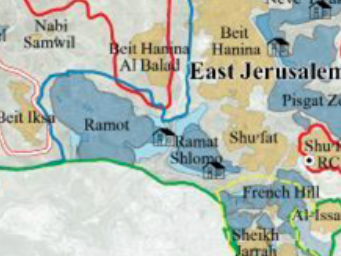 On November 6th, Jerusalem planning authorities granted approval to two settlement projects totalling 652 units in strategic areas that will increase the encroachment of settlements on the Palestinian East Jerusalem neighborhood of Beit Hanina – where the Israeli government is also advancing the first-ever government-backed settlement enclave inside of the neighborhood. This week the Committee approved:
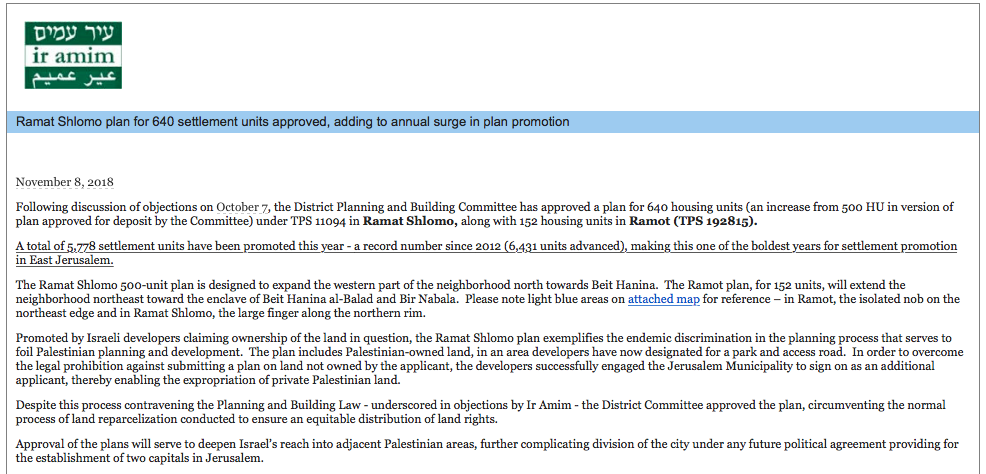
- A plan for 152 new units in the Ramot settlement in northern Jerusalem, extending the settlement’s footprint towards the Palestinian neighborhood of Beit Hanina.
- A plan for 640-units in the Ramat Shlomo settlement, to be built partially on Palestinian land, also extending the settlement north towards an existing settlement enclave inside of the Palestinian Beit Hanina neighborhood.
In granting final approval for the Ramat Shlomo plan, the Jerusalem District Planning and Building Committee decided to increase the number of approved units, from the proposed 500 to 640. And significantly, the Committee rejected serious complaints about expropriating privately owned Palestinian land for settlement purposes.
The Israel anti-settlement watchdog NGO Ir Amim filed one such complaint against the plan, explaining:
“Promoted by Israeli developers claiming ownership of the land in question, the Ramat Shlomo plan exemplifies the endemic discrimination in the planning process that serves to foil Palestinian planning and development. The plan includes Palestinian-owned land, in an area developers have now designated for a park and access road. In order to overcome the legal prohibition against submitting a plan on land not owned by the applicant, the developers successfully engaged the Jerusalem Municipality to sign on as an additional applicant, thereby enabling the expropriation of private Palestinian land.”
Ir Amim researcher Aviv Tartarsky told Haaretz this week:
“It’s very disappointing that the district committee relied on formalistic reasons to approve a step that violates the property rights of Palestinian landowners through and through. These aren’t extremist settlers in outposts somewhere out on hilltops in Samaria [the northern West Bank] but state institutions that are working in Israel’s capital city. This decision is additional proof that Israeli control in East Jerusalem means a regime based on serious discrimination.”
The new approvals add to an ever-growing tidal wave of settlement activity in East Jerusalem affecting the viability of the two-state solution, while tightening the screws on the local Palestinian population.
Claiming Ignorance, State Tells the Court it Will Demolish New Jordan Valley Outpost
Israeli government lawyers told the High Court of Justice that the State of Israel does not know who built an illegal outpost on a disused military base in the Jordan Valley, which settlers have named “Camp Gadi”, and announced that the Civil Administration will demolish it. If the Civil Administration moves to demolishes the outpost, it will require evicting several settler families who are squatting there, and shutting down a pre-military school that the families have been promoting.
The head of the Jordan Valley Regional Council, David Lahiani, seemed to contradict the government’s claim to innocence when he said that he has been in touch with the Civil Administration about legalizing the outpost. If Lahiani has been in touch with the Civil Administration, then questions arise about at what point the Israeli government learned about the outpost and who is behind it. Lahiani’s statement also contradicts (or at least raises questions about) a prior statement from the Jordan Valley Regional Council which denied involvement in establishing the outpost. Further calling into question the role of the Jordan Valley Regional Council, Lahiani was in a picture taken at the outpost which was uploaded to Facebook on October 24th.
Government Officials Lay Cornerstone of “New Migron” Settlement
A cornerstone laying ceremony marked the start of construction on the “New Migron” settlement, to be for the settlers who were removed from the illegal Migron outpost. Several government officials were on hand to lay the cornerstone of the new settlement, plans for which were approved in 2017, near the Kochav Yaakov settlement north of Jerusalem.
In 2011, the Israeli High Court ruled that the Migron outpost must be evacuated because it was built on privately owned Palestinian land. Most of the illegal outpost’s residents were evacuated and most buildings were demolished in Migron in 2012. Determined to demonstrate its support for settlers in the face of this court-compelled evacuation, the government promised to establish two new settlements: “New Migron” (located close to Kochav Yaakov settlement) as well as the approval of a plan for 184 housing units east of the Adam settlement (aka Geva Binyamin). All said, the two new settlements and temporary housing for the evicted settlers cost Israeli taxpayers millions of dollars – sending settlers a clear message that for them, law-breaking pays off.
At the ceremony this week, Jerusalem Affairs Minister Ze’ev Elkin said:
“During such events, it is customary to rejoice, but as someone who accompanied Migron from the moment of the evacuation to the present day, this is not a happy event. We would be happy if we had another legal system that made a logical decision, and I long for the days when the justice system will do justice. The settlement will grow and expand this way from time immemorial. The evacuation attempts will only lead to the strengthening and expansion of settlement.”
Housing Minister Yoav Galant, also at the ceremony, said:
“laying the cornerstone means that the territories of Yehudah and Shomron are not negotiable. It is not a subject for sale. We are laying a cornerstone for Migron and we will build it. I will see to it that the Israeli government does so by the end of the year.”
Knesset Speaker Yuli Edelstein, also in attendance, said:
“I did not come here to convince anyone about our rights in the land of Israel, I came here with mixed feelings of happiness from laying the cornerstone, alongside the great sadness of the difficult evacuation five years ago. We are here, first and foremost, thanks to the families of Migron that did not give up.”
Israel Seizes Palestinian Land to Build New Road to Settlement
According to Maan News, Israeli forces seized 38 acres (155 dunams) of Palestinian land in order to pave a road to the Beit Aryeh settlement, located northwest of Ramallah. Members of the al-Lubban al-Gharbi village council claim that the land is privately owned by Palestinians from the village and called on village residents to find documents proving land ownership in anticipation of an appeal against the construction.
So far this year, the Beit Aryeh settlement has been the beneficiary of two significant settlement advancements totalling 563 new units:
- On August 23, 2018 the Israeli Housing Ministry published a tender for 52 new settlement units in Beit Aryeh.
- On August 11, 2018 the government published a tender for 511 new settlement units in Beit Aryeh.
Bennett Violated Govt Rules to Get a Legal Opinion Supporting the De Facto Annexation of Ariel University
According to a new Haaretz report, Education Minister Naftali Bennett violated Israeli guidelines by using a private law firm to support his Knesset bill bringing settlement colleges and universities under the authority of the Israeli Higher Education Council. Prior to the Knesset’s passage of Bennet’s bill in February 2018, the Higher Education Council only included schools located inside of sovereign Israeli territory. The new law is tantamount to de facto annexation of settlement schools, and members of the Israeli Higher Education Council remain vocally opposed to the move.
The use of a private law firm is seen as an attempt to bypass the Education Ministry’s own apolitical (for now) legal advisors, and is a breach of the guidelines set years ago for every ministry by the Israeli Attorney General. The guidelines stipulate that in cases where private opinions are sought, the legal advisors for the ministry must supervise the process.
Bennet reportedly used an opinion paper issued by the Herzog Fox & Neeman firm stating the inclusion of Ariel University in the domestic Higher Education Council would not violate existing grant terms between universities in sovereign Israel and the European Union (which does not do business in the occupied territories). The opinion was then presented to members of the Higher Education Council to assuage fears that implementing the new law would result in losing international funding. The opinion said that the potential for funding cuts is “nearly non-existent.”
An anonymous senior official with the Higher Education Council told Haaretz:
“You cannot base official policy on an opinion paid for by an interested party. That’s not serious.”
Ariel University has not yet been admitted to the Council, despite the passage of the law in February 2018 and despite Minister Bennett’s repeated threats to end state relations with the Council if it did not immediately grant membership to the school. Israeli President Reuven Rivlin issued a rebuke to Bennett’s threats, saying:
“It’s possible to love Ariel without mocking academia.”
In Reversal, Israeli Ministers Embrace Bill to Allow Knesset to Overrule High Court on Any Issue (Not Just on Deporting Asylum Seekers)
At a meeting on November 4th, ministers in the governing Israeli coalition reportedly decided to abandon a bill that would empower the Knesset to reinstate its plan to deport African asylum seekers after it was struck down by the High Court, in favor of a much more far-reaching bill granting the Knesset the ability to reinstate any law the High Court strikes down. The passage of that bill would likely impact the fate of not only African asylum seekers but settlement-related legislation that has already been passed – most notably,the settlement Regulation Law – and other undemocratic measures that might follow. This news follows an exact opposite announcement two weeks ago, when Justice Minister Ayelet Shaked embraced the single-issue version of the bill, while promising to make the unlimited version a sticking point in any future coalition agreement.
Notably, the leaders of the current governing coalition decided to make this move at a meeting that was not attended by Kulanu Party leader Moshe Kahlon, who has until now blocked the coalition from advancing the unlimited version bill.
Israeli Attorney General Mandelblit vehemently opposes the bill. Mandelblit said:
“One must vigorously oppose this bill, which harms the constitutional regime of the State of Israel as a Jewish and democratic state. Removing all restrictions on undermining the human rights of a specific group, as is proposed now, has far-reaching implications for constitutional law and the democratic regime in Israel, and I strongly oppose it.”
Settlers Group Alleges Palestinians are Undertaking a European-Backed Scheme to “Take Over” Area C of West Bank
The radical settler organization Regavim – which devotes its efforts to systematically mapping out and expelling Palestinians from strategic areas in Jerusalem, the West Bank, and the Negev – presented a new report to the Knesset this week claiming that the Palestinian Authority (PA) is using European funding to take over land in Area C of the West Bank. The report alleges that the PA uses European money to pave roads, build on strategic military and diplomatic locations, and “steal” water resources, at the expense of Israel.
Regavim warns:
“If the government does not come to its senses and does something now, the Palestinian plan will create irrevocable changes and facts on the ground.”
Adding irony to Regavim’s current efforts to stop “illegal” Palestinian activity in the West Bank, in August 2018 the Israeli daily newspaper Yedioth Ahronoth published a comprehensive investigation into Regavim’s leaders. The group’s stated mission is “to ensure responsible, legal, accountable & environmentally friendly use of Israel’s national lands and the return of the rule of law to all areas and aspects of the land and its preservation.” The investigation revealed, however, that the organization’s efforts to identify and stop illegal construction are merely a tool to dispossess Palestinians of their land.
The Investigation found, in fact, that Regavim and its leaders have a demonstrable disregard for the Israeli planning and building laws that they purport to be dedicated to enforcing, evidenced most plainly by the fact that 15 Regavim officers are living in structures built on privately owned Palestinian land, some with demolition orders issued against them. These include the building where Yehuda Eliyahu, the current executive director of Regavim, lives.
UN Report Details Israel’s De Facto Annexation of West Bank Land
The United Nations Special Rapporteur on Situation of Human Rights in Palestinian Territories, Michael Lynk, issued a new report to the UN General Assembly – half of which is devoted to documenting the Israeli government’s annexation of Palestinian land in East Jerusalem and de facto annexation of land in the occupied West Bank.
The report concludes in part:
“These statements of political intent, together with Israel’s colonizing acts on the ground, its legislative activity, and its refusal to adhere to its solemn obligations under international law or to follow the direction of the international community with respect to its 51-year-old occupation, have established the probative evidence that Israel has effectively annexed a significant part of the West Bank and is treating this territory as its own. While Israel has not yet declared formal sovereignty over any parts of the West Bank, the Special Rapporteur submits that the strict prohibition against annexation in international law applies not only to a formal declaration, but also to those acts of territorial appropriation by Israel that have been a cumulative part of its efforts to stake a future claim of formal sovereignty over the occupied Palestinian territory.”
Four Alleged Security incidents Near Settlements
In the past three days, Israeli authorities have reported four security incidents near settlements:
On November 7th, the IDF reported that unknown assailants shot at a bus and lightly injured two Israelis near the settlement of Beit El, located deep inside the West Bank near Ramallah.
On November 6th, three Palestinian men were arrested near the Mevo Dotan settlement, south of Jenin, one of whom was allegedly carrying a gun.
Earlier on November 6th, a Palestinian woman was shot and arrested near the Kfar Adumim settlement, between Jerusalem and Jericho,after allegedly attacking Israeli border policemen with a pair of scissors.
On November 5th, a Palestinian man was shot and arrested after allegedly attempting to stab Israeli settlers and an Israeli IDF officer near the Kiryat Arba settlement, in Hebron.
Bonus Reads
- Khan al-Ahmar and Israel’s Creeping Annexation of the West Bank” (Newsweek)
- “Everyone Knows Settlers Cut Down Palestinian Olive Trees. But Israel Doesn’t Care” (Haaretz)
- “Settler leaders warned Rabin not to ‘cross redlines’ before assassination” (Times of Israel)
- “Hard Questions, Tough Answers: Why the Israeli mainstream turned right” (Americans for Peace Now)
- “An Interview with MK Sharen Haskel” (Fathom Journal)
- “Israeli justice minister opposes letting government jurists act as ‘gatekeepers’” (Haaretz)
Welcome to FMEP’s Weekly Settlement Report, covering everything you need to know about Israeli settlement activity this week.
To subscribe to this report, please click here.
October 4, 2018
- More Settlement Expansion in East Jerusalem: Ramot & Ramat Shlomo
- Settlers Take Over Palestinian Building in Silwan, Evict Current Tenants
- The Kohelet Policy Forum: The Right-Wing Group Driving Pro-Settlement Policies
Comments, questions, or suggestions? Email Kristin McCarthy at kmccarthy@fmep.org.
More Settlement Expansion in East Jerusalem: Ramot & Ramat Shlomo
Ir Amim reports that on October 4th, the Jerusalem District Planning and Building Committee will discuss – and is expected to advance – two plans to expand settlements along the northern perimeter of East Jerusalem: a plan for 500 new units in the Ramat Shlomo settlement and a plan for 152 new units in the Ramot settlement. If implemented, both plans will compound the encroachment of settlements on the Palestinian East Jerusalem neighborhood of Beit Hanina; the Jerusalem Municipality only recently approved the first-ever settlement construction inside Beit Hanina.
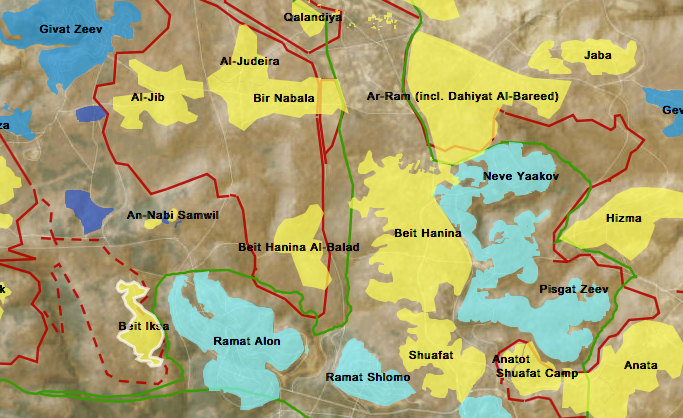
Map by WINEP
These two plans are just the latest advancements for Ramot and Ramat Shlomo: in August 2018 a plan for 263 units in Ramot was deposited for public review, and construction tenders were published for a plan for 603 units in Ramat Shlomo (under what is colloquially known as “The Biden Plan”).
The plan for 152 new units in the Ramot settlement is especially alarming because, as Ir Amim details, it is part of a larger scheme to claim undeveloped land in East Jerusalem for settlements:
“[The Ramot plan] represents a bold push toward Israel consolidating control of the undeveloped area between Ramot and Bir Nabala. Ir Amim has acquired documents showing plans to expand the entire northern section of the Ramot settlement toward the Palestinian area. As can be seen on the map, the large open area between the Israeli settlement and the Bir Nabala enclave is already cut by the Separation Barrier, which completely encircles the enclave, isolating its residents from the surrounding Palestinian space and imposing severe economic hardship.” [Editor’s note: for more on how the separation barrier has completely isolated the East Jerusalem neighborhood of Bir Nabala, see this short video by The Guardian].
.png)
For its part, the advancement of the Ramat Shlomo is also alarming, since Israeli authorities essentially rewrote the laws governing construction in Jerusalem in order to advance the project:
“The [Ramat Shlomo] plan includes Palestinian-owned land, in an area developers have now designated for a park and access road. In order to overcome the legal prohibition against submitting a plan on land not owned by the applicant, the developers successfully engaged the Jerusalem Municipality to sign on as an additional applicant, thereby enabling the expropriation of private Palestinian land. Despite this process contravening the Planning and Building Law, the District Committee approved the plan for deposit, circumventing the normal process of land reparcelization conducted to ensure an equitable distribution of land rights.”
The expected advancement of these plans for the expansion of the Ramot and Ramat Shlomo settlements is a continuations of an alarming acceleration in East Jerusalem settlement advancements since President Trump assumed office in January 2017, reflecting the sea change in U.S. policy towards settlements. Over the past two months alone, Israel has advanced plans for:
- 75 units in Beit Hanina (advanced through first stage of planning process)
- 13 units in Sheikh Jarrah (deposited for public review)
- 345 units in Gilo (deposited for public review)
- 1,064 units in Pisgat Ze’ev (deposited for public review)
- 263 units in Ramot (deposited for public review)
- 603 units (“The Biden Plan”) in Ramat Shlomo (tenders published)
- Reported above, 500 additional new units in the Ramat Shlomo in August 2018
- Reported above, 152 new units in Ramot settlement in August 2018.
Settlers Take Over Palestinian Building in Silwan, Evict Current Tenants
Ma’an News reports that the radical Elad settler organization has evicted a Palestinian family from a building that settlers purchased in the East Jerusalem neighborhood of Silwan. The previous owners of the building, who currently live in the U.S. – reportedly notified tenants at the property of the sale several months ago.
The settlers, under the protection of Israeli security forces, did not allow the evictees – 7 members of the Maswadeh family – to move their belongings out of the building before moving in. The Maswadeh family had rented two apartments in the building for the past 30 years. According to reports, the settlers have already started to build what appears to be a gate to control access to the property.
The Kohelet Policy Forum: The Right-Wing Group Driving Pro-Settlement Policies
Haaretz published a lengthy profile of the Kohelet Policy Forum, a right-wing advocacy organization that wields enormous influence over senior Israeli government figures, including Justice Minister Ayelet Shaked (Likud). The Kohelet Policy Forum is revealed to have played a major role in shaping several of the most significant pro-settlement, pro-annexationist legislative actions in the past year, including the high court override bill, the Nation-State Law, and a bill that would allow Israeli cabinet ministers to select their own personal legal advisors.
According to Haaretz, the Kohelet Policy Forum’s fingerprints “are visible in every explosive and divisive issue that has weakened the legal system and regulations.” FMEP tracks all these pieces of legislation, and many more, in its Annexation Policy Tables.
The funding sources for the Kohelet Policy Forum, which was established in 2013, are worth noting: the largest funder is an anonymous donor in the United States, who funds were transferred to Kohelet via an American nonprofit called American Friends of Kohelet Policy Forum. In 2016 the American group donated about 7.8 million shekels ($2.1 million) to Kohelet; in 2017 about 28.5 million shekels ($7.7 million). In light of Kohelet’s agenda, the anonymity of Kohelet’s major U.S. funder escapes the ire of the Israeli government, which has sought to stigmatize and shutdown groups which draw the majority of their funding from foreign sources.
Another main funder is the Tikvah Fund, a wealthy U.S.-based organization with a mission to promulgate American Republican Party views in Israel. Since its founding, the Kohelet Policy Forum has received over $1 million from the Tikvah Fund, and the two entities share board members. The Tikvah Fund also supports pro-settlement organizations.
Notably, Eugene Kontorovich is the head of the international law department at the Kohelet Policy Forum. Kontorovich self-identifies as a key figure in the drafting of “anti-BDS” (but actually, anti-free speech/pro-settlement) laws in the United States. At the core of these laws is the conflation of Israeli settlements with Israeli proper, based on Kontorovich’s argument that Israel is not occupying Palestinian territory. Kontorovich has also testified multiple times to U.S. Congress, including in support of moving the U.S. Embassy to Jerusalem; in support of Congress legislating U.S. foreign policy, including with regard to Jerusalem; on the impact of the BDS movement, and in support of U.S. recognition of Israel’s sovereignty over the Golan Heights.
Welcome to FMEP’s Weekly Settlement Report, covering everything you need to know about Israeli settlement activity this week.
To subscribe to this report, please click here.
September 14, 2018
- Khan al-Ahmar Verdict Is A Greenlight for East Jerusalem Settlement Schemes
- New Outpost Established in the Jordan Valley
- U.S. Ambassador: We Have Never Challenged an Israeli Settlement Plan
- Dismantling the Notion that Israel & the WZO Acted “In Good Faith” in Recent Outpost Case
- Aryeh King on the New East Jerusalem Settlement: Beit Hanina Will Begin to “Judaize”
- New Polling: Palestinians View Two-State Solution as Linked to Settlement Expansion
- Bonus Reads
Comments, questions, or suggestions? Email Kristin McCarthy at kmccarthy@fmep.org. To subscribe to this report, please click here.
Khan al-Ahmar Verdict Is A Greenlight for East Jerusalem Settlement Schemes
Last week, the Israeli High Court lifted an order preventing the Israeli government from forcibly removing residents from the Khan al-Ahmar Bedouin community and demolishing the village in the E-1 area, east of Jerusalem. Looking at the implications of the ruling, Jerusalem expert Danny Seidemann, founder of the Terrestrial Jerusalem, warns:
“the verdict gives a green light for the removal of Khan al-Ahmar, and provides a basis for removal of other Palestinian villages located on West Banks lands coveted by settlers and their allies…next in line are other Bedouin communities in that area, including Jabel Al Baba, as well as Susiya (in the southern Hebron hills), and Palestinian communities in areas targeted by the settlers in East Jerusalem (like Sheikh Jarrah and Batan al Hawa in Silwan – for recent developments see here).”
Seidemann further notes:
“the evacuation of Khan El Ahmar is not only about the tragic fate of the residents themselves…As we [Terrestrial Jerusalem] underlined several times in the past, the stubbornness, not to say the obsession, of the government of Israel with Khan Al Ahmar is mostly due to its location close to E1, within what is viewed by Israeli authorities as the ‘Maale Adumim bloc,’ extending deep into the West Bank to include the settlement of Kfar Adumim. The Court’s green light for the displacement of Khan al-Ahmar, alongside the start of the national electoral campaign, raises the risk that Prime Minister Netanyahu – always looking for a way to score points with the right and far-right – will decide to pursue push ahead with E-1 (the other grand scheme available in East Jerusalem is Givat Hamatos; the risk that he will move on that scheme is also serious).”
Palestinians recently took the Khan al-Ahmar case to the International Criminal Court (ICC), filing an addendum to a petition that was submitted to the ICC against Israeli settlements in May 2018.
When asked about the Khan al-Ahmar case, U.S. State Department spokesperson Heather Nauert acknowledged that the U.S.has been tracking the case but deferred to Israeli judicial proceedings on the matter, saying that the U.S. understanding is that “all appeals have been exhausted” and parroting the Israeli government talking point arguing that, “Israel is offering land [to the Bedouin], which includes access to water, electric, infrastructure, schools, and necessary things of that sort to the incoming residents.” This talking point glosses over the patent illegality – under international law – of forcibly transferring the Bedouin. It also glosses over the actual details of the very problematic “offer” Israel is making to the Bedouin – i.e., a location adjacent to a garbage dump or a wastewater facility.
New Outpost Established in the Jordan Valley
Ma’an News reports that settlers have set up a new unauthorized outpost on Palestinian land in the Jordan Valley, between the Palestinian village of Tubas and the Israeli settlement of Shadmot Mechola. Previously a single tent established at the site in May 2018, settlers significantly expanded the outpost, raised Israeli flags over the new dwellings, and primed the site for permanent residences.
According to reports, the outpost prevents Palestinians residents from Tubas, an agricultural center, from accessing their privately owned land – land that Palestinians have long used to herd sheep.
As FMEP has previously reported, Israel has effectively annexed 85% of land in the Jordan Valley, through ongoing settlement building and the declaration of “closed military zones” on vast swaths of farmland. A recent report by B’Tselem documents how Israeli settlers were allowed to establish two new outposts in the Jordan Valley in 2017. Israel has also undertaken alarming efforts to evict Palestinians from their land in the Jordan Valley, particularly Palestinian communities that have the misfortune of being located near to an Israeli settlement. Simultaneously, Israel has approved new settlement plans in the Jordan Valley and has advanced plans to retroactively legalize outposts in the Jordan Valley.
U.S. Ambassador: We Have Never Challenged an Israeli Settlement Plan
In a new interview, U.S. Ambassador to Israel David Friedman said that Israel “shouldn’t have to ask permission from the U.S.” to expand settlements in the West Bank and confirmed what settlement watchers have long believed: that the Trump Administration never challenged an Israeli construction plan in the West Bank. The full interview was published in the Israeli daily newspaper Israel Hayom, which is owned by U.S. settlement financier, Netanyahu supporter and Trump backer Sheldon Adelson.
Friedman also explained, for the first time publicly, the process by which Israel consults with the U.S. before advancing settlement plans. According to Friedman, prior to announcing settlement advancements, the Netanyahu government presents the plans to the U.S., which then offers commentary on the plans. Friedman said:
“We don’t tell Israel what to do and what not to do. It’s a sovereign country and they have to make those decisions. But we do have an open relationship and a good faith relationship, we talk about these plans and we do so from the perspective that the president expressed early on in his presidency – that settlements are not an obstacle to peace but if unrestrained settlement expansion continues, mathematically speaking, there will be much greater limits on territory that could be given to Palestinians. We never tell them, ‘You must pull this out.’ If we have an issue with something we say, ‘Do you really need to go this far? Can you build closer in to the existing property lines?’”
Since Trump took office almost two years ago, only a single report has surfaced suggesting Trump Administration intervened to stop an Israeli plan related to settlements. In that case, the U.S. reportedly took a position opposing [at that specific time] legislation seeking to annex settlements. The bill was tabled by the Netanyahu government, with Netanyahu citing White House concerns when explaining to his coalition partners his decision to table the bill. At the time, the White House responded, “It’s fair to say that the U.S. is discouraging actions that it believes will unduly distract the principals from focusing on the advancement of peace negotiations. The Jerusalem expansion bill was considered by the administration to be one of those actions.”
Dismantling the Notion that Israel & the WZO Acted “In Good Faith” in Recent Outpost Case
Hagit Ofran, the Director of Peace Now’s Settlement Watch program, wrote a blistering takedown of the Jerusalem District Court’s ruling that held that the State of Israel and the World Zionist Organization acted “in good faith” when giving privately owned Palestinian land to settlers, who built the Mitzpe Kramim outpost on the land in question. That ruling, as FMEP previously explained, is a monumental new legal precedent that – if allowed to stand – will open the door for retroactive “legalization” of many more outposts, effectively green-lighting a new series of land grabs – now extending to land that even Israel recognizes is privately owned by Palestinian – for the sake of settlements.
Ofran writes:
“One can believe that the outpost settlers really thought that the land was not privately owned by Palestinians. But it is difficult to attribute ‘total innocence and honesty’ to anyone who builds without permits in an illegal outpost. Had the settlers bothered to ask for a permit, the Civil Administration would have immediately discovered that this was private land, and they would have been saved from stealing. (It is reasonable to assume that the government would not have approved the establishment of the outpost because at least until the establishment of the Netanyahu governments, the official policy was that no new settlements would be established.). But the court did not rule on the good faith of the settlers. The discussion dealt with the good faith of those who gave them the land, i.e. the state and the Settlement Division.”
Aryeh King on the New East Jerusalem Settlement: Beit Hanina Will Begin to “Judaize”
As FMEP reported last week, the Jerusalem Planning and Building Committee has approved plans for a new settlement in the Beit Hanina neighborhood of East Jerusalem. New reporting by Al-Monitor provides more evidence of the ideologically driven strategy at play:
“[Rabbi Aryeh] King, a [Jerusalem] city council member and activist who has been buying up Palestinian land for Jews, pledged that Arab Beit Hanina ‘would begin to Judaize, and hopefully soon become a neighborhood with a firm Jewish majority as befits the capital of the Jewish people.’ Indeed, implementation of the plan would turn Beit Hanina into one of the largest Jewish settlements in Palestinian neighborhoods.”
Renowned Israeli journalist Akiva Eldar also connects the Beit Hanina settlement plan to the recently-passed Nation-State Law, writing:
“The decision, announced with little fanfare, lays the foundation stone for the recently adopted nationality law, which anchors the Jewish nature of the State of Israel. For instance, it encourages Jewish-only communities and codifies the ‘national value’ of Jewish settlement in the homeland of the Jewish people. After all, what is more of a national value than Jewish settlement in Jerusalem, the city enshrined by the controversial legislation as the capital of Israel?”
New Polling: Palestinians View Two-State Solution as Linked to Settlement Expansion
New polling and analysis from the Palestine Center for Policy and Survey Research (PSR) finds that amongst Palestinians:
“In the past few years, 55 to 65 percent of Palestinians have said that they believe that settlement construction has expanded so much that the two-state solution is no longer practical or feasible. On average, three-quarters of those who reach this conclusion shift to opposing the two-state solution, while a similar percentage of those who think the two-state solution remains feasible remain in favor of it. In other words, support for the two-state solution is strongly linked to perceptions of feasibility, and settlements are making it seem unfeasible.”
The full results of PSR’s latest poll can be found here.
Bonus Reads
- “Do Palestinians Still Support the Two-State Solution? Why Israeli Settlements Are the Greatest Obstacle to Peace” (Foreign Affairs)
- “For Israel, Khan al-Ahmar residents lack ‘good faith’ displayed by settlers” (+972 Mag)
- “How Oslo Accords Contributed to Israeli Occupation” (Ynet)
- “Israelis Can’t Escape Apartheid” (Haaretz)
- “25 Years On, Some Israeli Right-Wingers Ready to Declare Oslo Accords Dead” (The Times of Israel)
- “This BDS Movement Just Loves Israeli Settlers” (Haaretz)
Welcome to FMEP’s Weekly Settlement Report, covering everything you need to know about Israeli settlement activity this week.
To subscribe to this report, please click here.
September 7, 2018
- Israel Advances Plan for New Settlement in East Jerusalem
- Even More East Jerusalem Settlement Plans Advanced
- Israel Demolishes Homes in al-Walajah, Advancing “Greater Jerusalem” Project
- State Admits to High Court it Built Settler Road on Palestinian Private Land
- Prominent Human Rights Activists Arrested While Leading Tour of Hebron Region
- Government Official Claims Jerusalem Cable Car Project Will Benefit Palestinians in Silwan
- BonusReads
Comments, questions, or suggestions? Email Kristin McCarthy at kmccarthy@fmep.org. To subscribe to this report, please click here.
Israel Advances Plan for New Settlement in East Jerusalem
On September 5th, the Jerusalem Local Planning and Building Committee advanced a plan to build a large new settlement enclave (150 units) within yet another Palestinian neighborhood of East Jerusalem. The project – a pet project of Jerusalem settlement financier (and since 2013, Jerusalem city council member) Aryeh King – would be the first-ever authorized settlement project in the Beit Hanina neighborhood of East Jerusalem, located north of the Old City.
Map by Haaretz
The plan would build housing for approximately 75 settler families (which, based on a conservative estimate, would mean a population of around 500 settlers in Beit Hanina). If built, it would be one of the largest Israeli settlement enclaves inside any Palestinian neighborhood in East Jerusalem.
According to the plan, 75 units units would theoretically be earmarked for Palestinians – a point used by the plan’s supporters to suggest that it is actually benevolent. The key word here, however, is: theoretically. As noted by Jerusalem expert Danny Seidemann in another context:
“Since 1967, the Government of Israel has directly engaged in the construction of 55,000 units for Israelis in East Jerusalem; in contrast, fewer than 600 units have been built for Palestinians in East Jerusalem, the last of which were built 40 years ago.”
In announcing the approval of the plan, Israel’s deputy mayor made clear what part of the plan the Municipality is actually focused on:
“We’re happy to announce today that we’ve approved construction of 150 housing units in Beit Hanina, and especially that 75 Jewish families can now live there.”
Notably, the Jerusalem Local Planning and Building Committee advanced the plan through the first stage of the planning process, despite an objection filed by the private Palestinian company that owns 45% of the land upon which the new units would be built (ownership that the Israeli government tried – and so far failed – to cancel, through efforts to rescind the sale of the land to that company). The Committee explained its decision to ignore the objection by asserting that it was only discussing planning schemes and not ownership issues. The Jerusalem Municipality also weighed in, suggesting that the Palestinian company is too late in asserting its rights, saying that the ownership issue was “examined as part of the examination of the plan’s preconditions.”
Director of the Peace Now Settlement Watch program, Hagit Ofran, rejected that argument, saying:
“this is not a real estate project but a project of defiance and settlement. The fact that Israeli entrepreneurs, who own only half of the land, have prepared a plan without consulting Palestinian owners [of the other half] indicates that they have no intention of coexistence and peace.”
 A handful Israeli settlers already live in Beit Hanina, having directly acquired private property in the heart of the neighborhood. This small group of settlers clearly benefit from the plan, both because it lends legitimacy to their presence in and broader claims to the neighborhood, and because the new project would create a territorial linkage between the new settlement in Beit Hanina and the large ultra-Orthodox settlement of Ramat Shlomo to its south.
The historic nature of the Beit Hanina settlement plan is being hailed by pro-settlement media and activists. The Deputy Mayor of Jerusalem, Yossi Deitch, said, “I hope approval of the units will be the sign and signal that construction in the city will be unfrozen next year throughout the city and for all sectors. I’ll do everything possible to thaw the construction freeze in Jerusalem.”
Israel has increased home demolitions across East Jerusalem, including Beit Hanina, over the past year. In Beit Hanina, many homes are under the threat of demolition because they lack Israeli-issued building permits – permits that Palestinians find all but impossible to secure. Just this week, Israel demolished the Farrah family home in Beit Hanina, built over 16 years ago – despite the fact that the family has spent years attempting to obtain the necessary permits and has paid 250,000 shekel ($69,362) fine to the Israeli government.
Even More East Jerusalem Settlement Plans Advanced
In addition to the Beit Hanina settlement plan, Ir Amim reports that Jerusalem authorities have advanced several other inflammatory settlement projects in East Jerusalem over the past week:
- The Local Planning and Building Committee discussed issuing a permit to retroactively legalize unauthorized settlement construction – several shops and offices – in Silwan, located at the entrance of the settler-run City of David National Park. The buildings were constructed, without permits, under the direction of the radical Elad settler group, which is contracted by the Israel National Parks Authority to run the City of David National Park. As a reminder, Elad’s mission is to establish a permanent Jewish presence in Palestinian neighborhoods of East Jerusalem. The retroactive permit, in addition to legalizing the current buildings, would also allow the group to build an additional story to one of the buildings, to serve a”lookout” point. Demonstrating government collusion with the settlement enterprise in Jerusalem, the permit request was filed by the Israel National Parks Authority, not Elad.
- The Local Planning and Building Committee committee discussed public objections filed against a plan to build a 6-story office building for settlers at the entrance of the Sheikh Jarrah neighborhood. The office building, if approved, would be located adjacent to the site of a planned Jewish religious school to also be built in Sheikh Jarrah – called the Glassman Yeshiva. That school, once it is built, will house dozens of young religious settlers. Together, the two projects will flank the road leading into Sheikh Jarrah and become part of a settlement bridge/corridor connecting the isolated settlement enclaves in the heart of Sheikh Jarrah to West Jerusalem. Ir Amim notes that both settlement projects have been advanced “despite the area being zoned for public buildings for a Palestinian neighborhood sorely lacking in social services.” This latest advancement was anticipated and noted in last week’s Settlement Report.
- The Jerusalem Local Committee advanced two plans to increase the number of new units authorized to be built in the Gilo and Neve Ya’akov settlements. In both instances, the Local Committee discussed plans that increase the number of units permitted to be built under already-approved plans (adding an additional 48 units in both cases, bringing the Neve Ya’akov project to 86 units total and the Gilo project to 148 units total).
Israel Demolishes Homes in al-Walajah, Advancing “Greater Jerusalem” Project
On September 3rd, Israeli officials demolished four buildings in the al-Walajah village, on the pretext that they lack required Israel-issued building permits. Israeli security forces fired tear gas and rubber-coated steel bullets at a crowd of protestors who gathered to try to stop the demolition, injuring several.
The demolitions were in the Ein Juweza neighborhood of the village – an area that is technically located within the municipal borders of Jerusalem (the border runs through the village, leaving the rest of al-Walajah in the West Bank), and therefore subject to Israeli planning and building laws. An additional 189 homes in al-Walajah have demolition orders issued against them.
The lawyer representing al-Walajah residents in this case said,
“The residents’ attempts to submit a master plan [without which it is impossible for residents to even apply for permits to build on their own land] were thwarted by the objection of the state and subsequently, the planning authorities. In this situation of criminal neglect of the village and its residents, the only service the state gives them is ‘home demolition service.’ This is an impossible, illegal situation that contradicts the most minimal fairness.”
Ir Amim reports:
“While refusing to allow building in Walajeh, in the area around the village Israel is promoting construction of thousands of housing units for Israelis on lands – some of which were confiscated from Walajeh – in the settlements of Gilo and Har Gilo. To the north of the village, within the Green Line and on lands that belonged to Walajeh until 1948, a construction plan of over 4,000 housing units is being advanced. These construction plans, together with the national park declared on al-Walajeh land in 2013, are meant to create an Israeli continuum between Jerusalem and the Gush Etzion settlements surrounding Bethlehem. This morning’s demolitions in Walajeh are an inherent part of the policy to transform this area into an Israeli space.”
As FMEP has previously reported, residents of al-Walajah have long been struggling against the growing encroachment the nearby Etzion settlement bloc and the Israeli government’s attempt to de facto annex the bloc as part of “Greater Jerusalem.” Ir Amim explains several prongs of this effort, including a particularly problematic section of the separation barrier around al-Walajah that has been planned in order to (a) almost completely encircle the village, (b) turn its valuable agricultural land into an urban park for Jerusalem, and (c) enable construction of a highway that will connect the Etzion settlement bloc to Jerusalem with Israeli-only bypass roads.
State Admits to High Court it Built Settler Road on Palestinian Private Land
The Israeli government admitted to the High Court of Justice that it cut and paved a road on land that is privately owned by Palestinians in the South Hebron Hills. The State claimed it did so by mistake, believing the land in question, which had been included in construction plan for the settlement of Shima – despite the fact that Palestinian owners objected as soon as construction started in 2015. Even after the objections were lodged against the construction, Israeli authorities took months before issuing a stop work order, allowing the road to be completed/paved in the meantime.
In the brief submitted this week, the State asked the High Court to dismiss the case regarding the road, explaining that the Civil Administration had already taken action to correct the borders of the Shima settlement to, in effect, return the land to is owners (now paved with a road for the settlers). The State says that action was prompted in 2015 when the Civil Administration “Blue Line” team released new mapping of the area, which clarified that the land is indeed privately owned by Palestinians.
Commenting on the story, a spokesperson for Rabbis for Human Rights told Haaretz:
“The state acted like the ‘hilltop youth’ [a radical settler group]. You can’t explain this away using the excuse of an innocent mistake, given that even after our warnings it took a long and embarrassing legal procedure to get them to do the obvious: check who actually owns the land.”
Prominent Human Rights Activists Arrested While Leading Tour of the Hebron Region
Israeli security forces arrested three prominent human rights activists while they were leading a sizeable group on a tour of settlements and outposts in the Hebron/South Hebron Hills area. Avner Gvaryahu (Executive Director of Breaking the Silence), Michael Sfard (a prominent Israeli human rights lawyer), and Achiya Schatz (Communications Director for Breaking the Silence) were released after three hours of detention.
The men were arrested near the Mitzpe Yair outpost in Hebron, the same spot where activists from Taayush – “Israelis & Palestinians striving together to end the Israeli occupation and to achieve full civil equality through daily non-violent direct-action” – were violently attacked by settlers the previous week, with at least four wounded seriously enough to be evacuated to for medical treatment. In that attack, IDF soldiers reportedly stood by and did nothing (and in its aftermath, the Israeli government and senior officials, including Netanyahu, said nothing).
Breaking the Silence related the events, saying:
“As we drove up the road leading to the outpost, we were blocked by a Border Police jeep. Within minutes, we were presented with a ‘closed military zone’ order, signed by the brigade commander. We were given one minute to evacuate a group of 120 participants, some of whom weren’t so young. When we asked for more time to get everyone on the buses, the arrests started. As was reported in the media, the arrests were aimed at the leaders of the tour, which reinforced our suspicion that they were initially meant to sabotage the tour….Upon arriving at the police station, Avner, Achiya, and Michael had been told that they were in fact not arrested but rather detained, and that there was no immediate need for investigations or arrests. They were then told to return in a month and a half for further investigation.”
The group’s email to supporters ends:
“we refuse to cave in to settler violence and to surrender to their intimidation, incitement, and violence directed against those who oppose the immoral reality of the occupied territories.”
Government Official Claims Jerusalem Cable Car Project Will Benefit Palestinians in Silwan
On September 5th, the Society for the Protection of Nature held a public forum to discuss the planned cable car project in Jerusalem, which is slated to have its final stop at the settler-run Kedem Center in Silwan. The Kedem Center is a project of the radical Elad settler group, which works to settle Jewish Israelis inside Palestinian neighborhoods of East Jerusalem.
Sami Arsheid, a lawyer representing Palestinian residents of Silwan (who will be deeply impacted by the project), attended the town hall event to raise their concerns. Arsheid said that Palestinians had not been consulted and noted that the invitation to the meeting was written in Hebrew only.
A Israeli government official responsible for planning the cable car project, Aner Ozeri, stressed how the project will ease movement and alleviate transportation pressures, and insisted that the project will, in fact, benefit Palestinian residents of Silwan. Even if that claim turns out to be true, it glosses over the fact that, assuming the most benign intent, the Israeli government is engaging in planning in Silwan that rejects/ignores the views of the vast majority of the residents (i.e., the only residents of Silwan whose voices are listened to in this process are the settlers). Moreover, in the case of this plan the intent, entirely unhidden by planners, is by no means benign: the purpose of the cable car project has nothing to do with the interests of Palestinian residents – rather, its purpose is to facilitate tourist visits to Jewish sites in East Jerusalem, in a manner that prevents tourists from seeing or encountering Palestinians.
The meeting was also attended by government officials tasked with explaining and defending the project, as well as architects, academics, preservation experts, and tourism professionals who criticized the plan on a myriad of bases – mostly highlighting how the project will damage the historic landscape of Jerusalem.
Bonus Reads
- “In West Bank Settlements, It’s a Bull Housing Market” (Haaretz)
- “Israeli right wing party aims at one million settlers” (Al-Monitor)