Welcome to FMEP’s Weekly Settlement Report, covering everything you need to know about Israeli settlement activity this week.
To subscribe to this report, please click here.
November 18, 2022
- Jerusalem Planning Committee to Discuss (Another) Plan to Significantly Expand Nof Zion Settlement Enclave
- As Court Tries to Avoid Underlying Issue of Land Allocation Practices in the West Bank, Palestinians Reject “Deal” that Would Allow Construction of Givat Eitam/E-2 Settlement,
- Mass Displacement/Dispossession in Silwan Advances, Court Rejects Shahadeh Family Petition
- Elad Continues Illegal Work in East Jerusalem Cemetery
- Bibi’s Coalition Promises on Settlement: Outposts, Homesh, Evyatar, Infrastructure, Override Clause, & More
- Settler Violence Continues to Surge
- U.S Ambassador Visits a Settlement, Less Than a Year After Saying He Won’t
- Bonus Reads
Jerusalem Planning Committee to Discuss (Another) Plan to Significantly Expand Nof Zion Settlement Enclave
Ir Amim reports that on November 23rd the Jerusalem District Planning Committee is scheduled to discuss a plan to expand the Nof Zion settlement enclave, located in the heart of the Palestinan neighborhood of Jabal Mukaber in East Jerusalem. The plan would allow for 100 new residential units and 275 hotel rooms in the settlement enclave, and is part of a larger scheme to connect the enclave to the built-up area of East Talpiot – a scheme which would cut deeply into the Jabal Mukaber neighborhood and entrench the expanding continuum of Israeli settlements surrounding Jerusalem.
Commenting on the plan, the Israeli NGO Ir Amim writes:
“Beyond its geopolitical implications, this is yet another example of the severe discrimination in urban planning and housing in East Jerusalem. Despite the plan being slated for the entrance of Jabal Mukabber, it is not designated for the community’s development needs but rather for the expansion of a Jewish settlement in the middle of a Palestinian neighborhood. It should be noted that Jabal Mukabber is among the Palestinian neighborhoods in East Jerusalem with the highest number of demolitions per year.”
Specifically, the Nof Zion expansion plan to be discussed by the Jerusalem District Planning Committee on November 23rd is interconnected with another plan (last discussed by the Committee in January 2022). That plan seeks to move an Israeli police station [the Oz station] currently located on the border of Jabal Mukaber, to a new site across the street (where it will become a massive Israeli security headquarters), leaving its current location free for the planned expansion of Nof Zion. Ir Amim filed a petition against the police station plan, saying that it is an affront to the planning needs of the local community and continues Israel’s systematic, city-wide discrimination against the housing, educational, and service-based needs of Palestinian neighborhoods. A decision on the police station relocation plan is expected soon.
Ir Amim further explains the impact of these plans:
“Expanding the settlement towards the main entrance of Jabal Mukabber will infringe on the residents’ freedom of movement and further disrupt the fabric of life in the neighborhood. Prior experience show that during clashes and periods of tension and instability, Israel rushes to impose collective restrictions under the pretext of protecting Israeli settlers.”
These plans are just the latest efforts to expand and entrench the Nof Zion settlement enclave. Prior plans include:
- In 2017, the Israeli government approved a plan to build a new synagogue and mikveh for the settlement, to be located on private Palestinian land that had been expropriated form Jabal Mukaber the year before.
- In April 2019, after two years of rumors, the Israeli government issued 176 building permits for the already-approved project to build . According to Ir Amim, those permits were ultimately issued in April 2019.
- In 2019, construction began on a plan to triple the size of the settlement enclave, making it the largest such enclave in East Jerusalem. After a two-year stall, construction on the expansion resumed in 2021 with new financing.
As Court Tries to Avoid Underlying Issue of Land Allocation Practices in the West Bank, Palestinians Reject “Deal” that Would Allow Construction of Givat Eitam/E-2 Settlement
On November 14th, Peace Now tweeted updates from a courtroom where the Israeli Supreme Court was attempting to resolve the ongoing petition against the allocation of “state land” for the construction of the Givat Eitam/E-2 settlement, slated to be build on a strategic hilltop – which Palestinians know as a-Nahle – located just south of Bethlehem. The construction of Givat Eitam/E-2 would significantly expand the Efrat settlement in the direction of Bethlehem. It would also effectively cut Bethlehem off from the southern West Bank and complete the city’s encirclement by Israeli settlements.
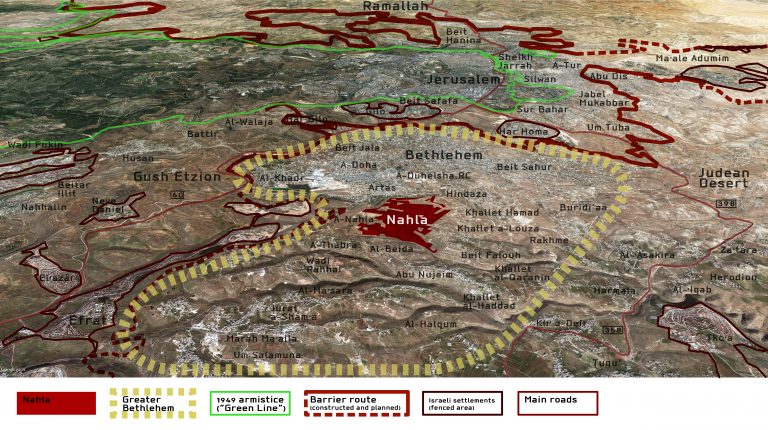 In the hearing, the State of Israel proposed a deal to the Palestinian petitioners, according to which the State would allocate to them a total of 54 dunams (out of the 1,400 dunams originally planned for the construction of the new settlement). The Palestinian landowners rejected the deal, with their lawyer Michael Sfard noting:
“The main problem is that the solution proposed by the court…does not remove the evil of the decree from their heads, and therefore we oppose this proposal…that offer, whether it is 50 or 100 dunams, does not help the Palestinian communities. Since we, and everyone who sits around here, knows that if this neighborhood is built, it’s likely that they won’t even be able to cultivate those acres.”
Peace Now tweeted its sense of where the judges opinions might land, writing:
“The hearing is over. The petitioners rejected the state’s offer. It seems that the judges are trying to avoid a decision on the central question regarding the entire land – whether it should be allocated to the settlements or the Palestinians. The judges keep trying to walk between the drops. On the one hand, they cannot ignore the blatant discrimination in Israel’s land allocation policy. On the other hand, they are trying to avoid the fundamental question of the legality of this land allocation to the settlement.”
The High Court held a hearing in June 2021 on this same petition. Peace Now’s Hagit Ofran told FMEP that at the conclusion of that hearing the Court had given the government of Israel 90 days to respond to a proposal to either allocate to the individual petitioners some of the “state land” directly involved in the case, or to allocate to them “state land” nearby. This decision by the Court purposely narrowed the scope of Peace Now’s legal challenge by addressing only the case of the land in a-Nahle and the individual petitioners involved, thereby dodging the more fundamental question put forth in the petition challenging Israel’s discriminatory practice of allocating 99.8% of “state land” for settlement purposes. This is the first time the issue of state land allocations to settlements is being challenged in an Israel court.
Mass Displacement/Dispossession in Silwan advances, as Court Rejects Shahadeh Family Petition
On November 13th, the Jerusalem District Court announced that it had rejected an appeal by the Palestinian Shehadeh family seeking to cancel eviction orders that seek to dispossess them of their longtime homes in the Batan al-Hawa section of Silwan in favor of the Ateret Cohanim settler organization. The announcement follows a hearing the Court held on the appeal on November 9th.
As a reminder: the Shahadeh family is one of 85 families in Batan al-Hawa facing displacement at the behest of Ateret Cohanim. The legal fate of all of the families is bound together, with the Duweik family’s case being the furthest advanced and setting a dangerous precedent for the Shehadehs and others. Indeed, this week the Supreme Court discussed several of the decisions made in regards to the Duweik family, and their relation to the Shehadehs’ case. Notably, in July 2022 a 3-judge panel of the Supreme Court could not agree on the Duwiek’s family’s petition, which resulted in the petition being sent back to the Jerusalem Magistrate’s Court – where it currently awaits further consideration. One of the judges accepted the argument that the family should be allowed to continue living in their homes because a statute of limitations prohibits Ateret Cohanim – through its management of an historic land trust – from making a claim to the land after such a long period of absence.
As a reminder, Ateret Cohanim has waged a years-long eviction campaign against Palestinians living in Silwan, on property the settler NGO claims to own. In total, Ateret Cohanim’s campaign stands to ultimately dispossess 700 Palestinians (85 families) in Silwan. The group’s claim is based on having gained control of the historic Benvenisti Trust, which oversaw the assets of Yemenite Jews who lived in Silwan in the 19th century. In 2001 the Israeli Charitable Trust Registrar granted Ateret Cohanim permission to revive the trust and become its trustees, (following 63 years of dormancy). In 2002, the Israeli Custodian General transferred ownership of the land in Batan al-Hawa to the Trust (i.e., to Ateret Cohanim). Since then, Ateret Cohanim has accelerated its multi-pronged campaign to remove Palestinians from their homes, claiming that the Palestinians are illegal squatters.
Elad Continues Illegal Work in East Jerusalem Cemetery
Emek Shaveh & Ir Amim tweeted footage of construction work at the site of the Sambuski cemetery, an ancient Jewish cemetery located in the Ben Hinnom Valley in East Jerusalem. The Elad settler group – which is paid by the Israeli government to manage and expand a web of settler-tourist sites and the City of David National Park – has been conducting work on the Sambuski Cemetery despite apparently lacking a permit. Emek Shaveh – an Israeli NGO with expertise in archaeology – notes that any construction within a national park should be heavily scrutinized by professionals and the public before being implemented.
In August 2022, Elad unilaterally closed the main access road leading to the Palestinian neighborhood of Wadi Rababa, which travels past the Sambuski cemetery. 150 families were trapped in the neighborhood while Elad worked on the site.
The Sambuski cemetery was a relatively unknown, neglected site until recent years – but it is deeply integrated into Elad’s overarching, comprehensive plan to take control of the Silwan neighborhood. In 2020, the-president Trump’s “Peace to Prosperity” plan identified the Sambuski cemetery as a place of prime historical and religious importance to Israel, elevating the status of the cemetery. The Israeli NGO Emek Shaveh – which has special expertise on archaeology and the way archeology has been weaponized to serve the political agenda of the settlers and the state of Israel – wrote a report on exactly how the Trump plan supports settler efforts to use Jerusalem’s history and antiquities to promote Israeli-Jewish hegemony and control over the city.
Emek Shaveh explains how the cemetery is connected to other settler endeavors in Silwan:
“For the Elad Foundation the cemetery is a strategic site as it links together two important focal points of its enterprise – the neighborhood of Silwan, home to the City of David archaeological park and specifically to the Pool of Siloam at the southern tip of the site, and the Hinnom Valley an area which Elad has been developing for the past two years (more below).”
Bibi’s Coalition Promises on Settlement: Outposts, Homesh, Evyatar, Infrastructure, Override Clause, & More
Netanyahu continues to negotiate a final coalition agreement in order to form a new government, and has reportedly committed to virtually all of the main demands of the settler movement (short of outright annexation of all the land between the river and the sea), including:
- Passage of the Supreme Court Override Clause (see this new explainer by ACRI). This law would obliviate judicial oversight in Israel, giving ultimate power to the Knesset. Under the new Israeli government and with the current Knesset, this law would likely be used to reinstate the Settlement Regulation Law – the law that seeks to establish a legal basis for Israel to retroactively legalize outposts and settlement structures which are built on land that Israel acknowledges is privately owned by Palestinians. As a reminder, that law was overturned by the Israeli Supreme Court in June 2020. Peace Now estimates that the law stands to convert some 55 unauthorized outposts into official, authorized settlements, seizing some 8,000 dunams of privately owned Palestinian land in the process.
- Full recognition & integration of outposts (i.e., retroactive legalization and de facto annexation). This was reportedly promised to Bezalel Smotrich, who has authored Knesset legislation to grant full status to outposts irregardless of the status of the land on which the outposts were built illegally. Separately, Netanyahu agreed with Itamar Ben Gvir that the outposts would be provided infrastructure services within 60 days of the new government being sworn in.
- The reestablishment of the Homesh Settlement. Netanyahu reportedly committed to Itamar Ben Gvir, a longtime supporter/devotee of Rabbi Meir Kahane, that the settlement of Homesh will be reestablished on the land where it stood prior to being dismantled by the Israeli government in 2005. To do so would require the government to amend the 2005 Disengagement Law that not only ordered the dismantling of the Homesh settlement along with three others in the northern West Bank, but provided for Israel’s withdrawal from Gaza. For more on the long-running campaign by settlers and their allies to reestablish the Homesh settlement – and its consequences for Palestinians who live nearby and own the land on which Homesh once stood – see here.
- The legalization of a yeshiva at the Evyatar Outpost. Netanayhu and Ben Gvir agreed to grant retroactive authorization to a yeshiva established at the Evyator outpost. For more on the Evyatar outpost & yeshiva saga – see here.
- A commitment to expanding settler road infrastructure across the West Bank. Netanyahu agreed with Ben Gvir to allocate $434 million ($1.5 billion shekels) for the paving of new and expanded bypass roads in the West Bank and for the expansion of Highway 60, and to expedite the planning process for doing so. For more analysis on how infrastructure such as roads contribute to Israel’s de facto annexation of the West Bank, see this report by Breaking the Silence.
In addition, Netanyahu is coming under increasing pressure from inside his coalition to name far right-wing MK Bezalel Smotrich as the next Defense Minister. Haaretz reports that Itamar Ben Gvir supports Smotrich’s demand because it will,
“help implement a full right-wing policy, establish new settlements in the West Bank, approve construction of thousands of new housing units in them, stop Palestinian construction in Area C and halt the evictions of illegal outposts.”
Of note, in 2021 Smotrich suggested that a “solution” to Palestinian “illegal” construction in Area C (construction by Palestinians on their own land, but without Israeli-required building permits, that Israeli makes it nearly impossible to obtain) could be to give settlements the authority to demolish Palestinian construction they believe to be unauthorized.
American officials, including Ambassador Nides, have expressed concern over Smotrich’s potential appointment to such a key – and powerful – post. In addition to his pro-settlement, pro-annexation positions, Smotrich is also a self-proclaimed homophobe and has lobbied for the expulsion of Palestinians from Israel.
Lastly, and underscoring the extent to which the settlers’ agenda and the governing coalition’s agenda are one and the same: a newly elected Member of the Knesset, Limor Son Har-Melech of the Religious Zionism coalition, has appointed a member of the radical hilltop youth movement to serve as his spokesperson. Har-Melech’s new spokesman, Elisha Yered, lives in the outpost of Ramat Migron in the northern West Bank, and is under ongoing investigation following his arrest in August 2022 for “racist conspiracy” — amongst other charges for crimes against Palestinians. Yered is quoted as saying:
“the hills are the scene of a war that according to Jewish law one is required to wage…what the hills do is to bring Jewish control to hundreds of dunams – that is something that no soldier in the greatest reconnaissance unit can do during his service.”
Settler Violence Continues to Surge
Following a Palestinian stabbing attack near the Ariel settlement that left 3 Israelis dead and 3 injured, settlers across the West Bank rampaged to take their revenge, committing over 20 attacks against Palestinian and their property, as well as Israeli soldiers, in the 24 hours that followed.
In addition, in its weekly report on Israeli human rights violations covering Nov. 10-16, the Palestinian Centre for Human Rights reports that settlers conducted 4 attacks on Palestinians’ vehicles in different areas in the West Bank during the reporting period Nov. 10-16.
“On 14 November 2022, Israeli settlers moved into Haris village in Salfit, north of the West Bank, and burned four vehicles belonging to the villagers.
On 15 November 2022, Israeli settlers attacked and set fire to a vehicle belonging to a
Palestinian who was in his way back from ‘Attil village in northern Tulkarm to Nablus.On the same day, Israeli settlers intercepted a bus for a women’s trip in Hebron and
prevented it from moving for few hours, enticing fear among the passengers.On 16 November 2022, Israeli settlers threw stones at four vehicles near Ramin village, east of Tulkarm, breaking their windows. On the same day, Israeli settlers damaged a vehicle belonging to a Palestinian doctor near Jit village in Qalqilya.”
PCHR concludes, noting: “Since the beginning of the year, settlers conducted at least 236 attacks. In two of the attacks, 2 Palestinians were killed.”
U.S Ambassador Visits a Settlement, Less Than a Year After Saying He Won’t
This week U.S. Ambassador to Israel Thomas Nides visited the West Bank settlement of Kiryat Netafim to offer his condolences to the grieving family of a victim of Sunday’s stabbing attack that killed three and wounded three. Nides’ trip marks the first time any representative of the Biden Administration has undertaken official travel to any Israeli settlement. A U.S. Embassy spokesperson said that “the shiva visit in no way signals a change in US policy toward settlements”
In January 2022 Ambassador Nides was quoted as saying he “will absolutely not” visit a settlement. It’s worth recalling that the Biden Administration has not reversed or publicly rejected the Trump Administration’s “Pompeo Doctrine,” which made it U.S. policy to view Israeli settlements as not “per se inconsistent with international law.”
Kiryat Netafim is located about half way between the Ariel settlement and the cluster of settlements close to the 1967 Green Line that are slated to be united into a “super settlement” area (Oranit, Elkana, Shiva Tikva, and others). The string of settlements creates a contiguous corridor of Israeli construction and control stretching from sovereign Israeli territory to Ariel. As FMEP has repeatedly pointed out, the Ariel settlement is located in the heart of the northern West Bank, reaching literally to the midpoint between the Green Line and the Jordan border. The future of Ariel has long been one of the greatest challenges to any possible peace agreement, since any plan to attach Ariel to Israel (with a finger of land running through settlements like Kiryat Netafim) will cut the northern West Bank in half..
Bonus Reads
- “Gantz approves upgrade to stretch of West Bank barrier after spate of terror attacks” (The Times of Israel)
- On the U.N.:
- “Key UN committee seeks legal opinion on Israel’s occupation” (Washington Post)
- “Opinion | Israel’s Chutzpah at the United Nations” (Haaretz / Noa Landau)
- “Lapid, Gantz slam UN panel’s call on ICJ to probe Israeli ‘occupation, annexation’” (The Times of Israel)
- “Adalah and Center for Constitutional Rights demand US cancel its plan to build embassy compound in Jerusalem on private Palestinian land” (Adalah)
- “Expulsion by Other Means: Israel’s Campaign Against Palestinians in Masafer Yatta” (J Street)
- “Ben & Jerry’s board bemoans West Bank, east Jerusalem sales” (AP News)
- “Wild boars in Palestine are being weaponized by Israeli colonialism” (Mondoweiss)
- “IDF soldier suspended for cursing left-wing activist in Hebron: ‘You’re a traitor’” (The Times of Israel)
Welcome to FMEP’s Weekly Settlement Report, covering everything you need to know about Israeli settlement activity this week.
To subscribe to this report, please click here.
November 11, 2022
- Israel Gives Settler Group $7.8 Million for East Jerusalem Projects
- Israel Supreme Court Holds Hearing on Silwan Displacement Case
- Israeli Lawmakers Join Settlers on Provocative Visit to Joseph’s Tomb; 1 Palestinian Killed
- Peace Now Video Shows Impact and Tragedy of the Planned E-2 /Givat Eitam Settlement
- A New Israeli Government: Implications for Settlements & Annexation
- Bonus Reads
Israel Gives Settler Group $7.8 Million for East Jerusalem Projects
A Haaretz investigation has revealed that various arms of the Israeli government have transferred a combined total of $7.8 million to the Elad settler organization to develop and manage new tourist projects in the Ben Hinnom Valley in East Jerusalem. This figure is double the State’s original budget for Elad – a settler organization which Israel also pays to manage the City of David National Park.
The additional funding came from three sources: the Jerusalem Affairs & Heritage Ministry, the Israel Lands Authority, and the Jerusalem Municipality. All funds were used to fuel the expansion of integrated tourism projects which underpin Elad’s control over land in the Ben Hinnom Valley, located near Silwan. This is an area where most of the land is privately owned by Palestinians and rich with olive groves. Over the past few years Israel has begun seizing land – plot by plot – mainly via the issuance of ”landscaping” (or “gardening”) orders which allow the government to take control of and develop any land that it deems “neglected.” The land, once seized, is then handed over to Elad..
The Israeli NGO Emek Shaveh responded:
“The settlement project of Elad, one of the richest nonprofits in Israel, is being funded by the citizens of the State of Israel and the residents of the poorest city in Israel – out of their own pockets! But the real price and the irreversible damage will be paid by the heritage sites of Jerusalem. At the end of the day, the ancient landscapes of the Hinnom Valley will become a playground, with a suspension bridge, a cable car and a biblical farm for ancient agriculture with sprinklers, an artificial waterfall and an electric outdoor oven – all in order to push the Palestinians out of the valley.”
In addition to its increasing control of the Ben Hinnom Valley, Elad and the Israel Nature and Parks Authority have had a contract, since 2020, to transfer the management and development of the City of David National Park to Elad. Elad carries out this contract with brutal implications for Palestinians who live inside the borders of this national park – borders Israel imposed on Palestinians residents, many of whom had been living in the areas for generations, with what appears to be total disdain/disinterest in their rights or welfare. Elad’s management of the park also weaponizes archaeology in the service of its explicit agenda: increasing Israeli control and imposing an exclusively Jewish religious and historical narrative over the entire city of Jerusalem. Elad is also a main actor behind the widespread house-by-house dispossession of Palestinians living in Silwan. In addition, Elad is pioneering a never growing slate of touristic settlement projects which increase Israeli control over the area and help reinforce a settler narrative of the city of Jerusalem which emphasizes its Jewish history while erasing past, present, and future Palestinian heritage.
Israel Supreme Court Holds Hearing on Silwan Displacement Case
Ir Amim reports that on November 9th, the Israeli Supreme Court held a hearing on an appeal against the pending eviction of the Shahadeh family from their longtime home in the Batan al-Hawa section of Silwan. A decision is expected to be issued by the Court within a few weeks.
The Shahadeh family is one of 85 families in Batan al-Hawa facing displacement at the behest of the Ateret Cohanim settler organization. The legal fate of all of the families is bound together, with the Duweik family’s case being the furthest advanced and setting an dangerous precedent for the Shehadehs and others. Indeed, this week the Supreme Court discussed several of the decisions made in regards to the Duweik family, and their relation to the Shehadehs’ case. Notably, in July 2022 a 3-judge panel of the Supreme Court could not agree on the Duwiek’s family’s petition, which resulted in the petition being sent back to the Jerusalem Magistrate’s Court – where it currently awaits further consideration. One of the judges accepted the argument that the family should be allowed to continue living in their homes because a statute of limitations prohibits Ateret Cohanim – through its management of an historic land trust – from making a claim to the land after such a long period of absence.
As a reminder, Ateret Cohanim has waged a years-long eviction campaign against Palestinians living in Silwan, on property the settler NGO claims to own. In total, Ateret Cohanim’s campaign stands to ultimately dispossess 700 Palestinians (85 families) in Silwan. The group’s claim is based on having gained control of the historic Benvenisti Trust, which oversaw the assets of Yemenite Jews who lived in Silwan in the 19th century. In 2001 the Israeli Charitable Trust Registrar granted Ateret Cohanim permission to revive the trust and become its trustees, (following 63 years of dormancy). In 2002, the Israeli Custodian General transferred ownership of the land in Batan al-Hawa to the Trust (i.e., to Ateret Cohanim). Since then, Ateret Cohanim has accelerated its multi-pronged campaign to remove Palestinians from their homes, claiming that the Palestinians are illegal squatters.
Israeli Lawmakers Join Settlers on Provocative Visit to Joseph’s Tomb; 1 Palestinian Killed
On November 9th, a Palestinian teenager was killed in Nablus during clashes between Palestinians and the IDF. These clashes resulted from a deliberately provocative visit carried out by settlers and Israeli lawmakers – under IDF protection – to the site of Joseph’s Tomb, which is located inside of Nablus. The settlers and eight current and incoming members of the Knesset visited the site despite a public threat to attack the delegation which was issued the day before by a Palestinian armed faction.
On a monthly basis (and sometimes more often) the IDF arranges for settlers to visit Joseph’s Tomb. The tomb is located within Area A of the West Bank (where Israel does not, under the Oslo Accords, have direct control). However, Joseph’s Tomb is one of two sites in Area A which the Oslo Accords stipulate are under the control of the Israel military. As such, it has been a perennial flashpoint, largely due to deliberately provocative actions by settlers. The whole circumstance – of settlers visiting Joseph’s Tomb – was recently called “absurd” by former IDF Major General Gadi Shamni.
While some Jewish Israelis may want to visit the site of Joseph’s Tomb for non-politically-motivated religious purposes, this latest story should be viewed in the larger context of settlers weaponizing claims to sites like Joseph’s Tomb, and archaeology in general, to expand Israel control over (i.e., de facto annexation of) parts of the West Bank that per the Oslo Accords are under Palestinian Authority control.
Peace Now Video Shows Impact and Tragedy of the Planned E-2 /Givat Eitam Settlement
In advance of a High Court hearing scheduled for Nov. 14th, Peace Now has released a 10 minute video explaining the unfolding tragedy of E-2/Givat Eitam. Peace Now is leading the petition alongside the Palestinian landowners.
The Supreme Court – courtesy of a petition filed by Palestinian landowners with the assistance of Peace Now – is due to continue its consideration of the Palestinians’ challenge to the allocation of “state land” to the Israeli Ministry of Housing for the construction of a new settlement called Givat Eitam on a strategic hilltop – which Palestinians call a-Nahle – located just south of Bethlehem.
As a reminder, the High Court held a hearing in June 2021 on this same petition. Peace Now’s Hagit Ofran told FMEP that at the conclusion of that hearing the Court had given the government of Israel 90 days to respond to a proposal to either allocate to the individual petitioners some of the “state land” directly involved in the case, or to allocate to them “state land” nearby. This decision by the Court purposely narrowed the scope of Peace Now’s legal challenge by addressing only the case of the land in a-Nahle and the individual petitioners involved, thereby dodging the more fundamental question put forth in the petition challenging Israel’s discriminatory practice of allocating 99.8% of “state land” for settlement purposes. This is the first time the issue of state land allocations to settlements is being challenged in an Israel court.
A New Israeli Government: Implications for Settlements & Annexation
Likud Party leader and Israel’s longest-serving (over multiple tenures in office) Prime Minister Benjamin Netanyahu is once again poised to lead the Israeli government, this time relying on a governing coalition that includes extremist/racist/Islamophobic/homophobic Jewish supremacist figures like Itamar Ben Gvir (a longtime supporter/devotee of Rabbi Meir Kahane) and Bezalel Smotrich. Settlers are giddy, with notable settler leaders Daniela Weiss describing the election results as a “revolution,” and saying there will certainly be an acceleration in settlement growth.
Here are key demands being made of Netanyahu that will likely define the new government and influence its policies on settlements and annexation:
- Itamar Ben Gvir – who has called for the expulsion of Palestinian citizens of Israel, who was disqualified from IDF service for his extreme views, and who is closely allied with the settlers in Sheikh Jarrah – is demanding to be named the Minister of Public Security. This would put him in charge of the Israeli police and their power over Palestinians living in Israel and East Jerusalem. The Ministry would also hand Ben Gvir a large role over security at the Temple Mount, which Ben Gvir has advocated for Israel to take unilateral control over – a dangerous proposition. Ben Gvir has also publicly proclaimed that, should he be appointed, he will change the rules of engagement so that Israeli soldiers have broader leeway to shoot at Palestinians (for reasons as minimal as suspected stone-throwing), and he will push for broad immunity for Israeli security officials (which combined appear to be a directive to kill Palestinians under the promise of immunity).
- Bezalel Smotrich – who continues to demand either the Defense, Finance, or Justice Ministries – is making two key legislative demands:
- Passage of the Override Clause, which would allow a simple majority in the Knesset to vote to reinstate any law that the Supreme Court rules is unconstitutional. This is particularly relevant for the Settlement Regulation Law, which the Court struck down by the Court in 2020. The Knesset had passed the Settlement Regulation Law in order to create a legal basis to allow Israel to retroactively legalize outposts and settlement structures which had been built on land that Israel acknowledges is privately owned by Palestinians. Smotrich and many of the coalition members have been longtime supporters of the Override Clause in order to reinstate this law in particular.
- Annexation of settlements. Smotrich is demanding that settlements come under domestic Israeli law, which would implement the annexation of the settlements to Israel. This is also a widely-popular initiative, with Yariv Levin – Netanyahu’s Likud partymate – recently saying that annexation is high on the government’s agenda.
Bonus Reads
- “West Bank Settler Accused of Terrorism After Attacking Palestinian in East Jerusalem” (Haaretz)
- “Israel Resumes Construction of Jewish Town Planned Over Ruins of Yet-to-be-demolished Bedouin Village” (Haaretz)
Welcome to FMEP’s Weekly Settlement Report, covering everything you need to know about Israeli settlement activity this week.
To subscribe to this report, please click here.
February 18, 2022
- Israeli Court Agrees to Hear Case on Settlements & Discriminatory Land Allocation
- Government Data Shows: Over Past 5 years, in Area C Israel Granted 33 Building Permits for Palestinians, compared to more than 16,500 for settlers
- A Perfect Storm – For a Major Crisis – Gathers Over Sheikh Jarrah
- Maaleh Ahuvia Outpost Demolished, Immediately Rebuilt
- Settlers are Running a Government-Backed Program for Israeli Kids on Palestinian Land in East Jerusalem
- Lapid: Israel Will Refrain from the Most Problematic Settlement Expansion
- Further Reading
Israeli Court Agrees to Hear Case on Settlements & Discriminatory Land Allocation
The Israeli High Court has moved forward with a case challenging Israel’s discriminatory allocation of “state land” in the West Bank, 99.8% of which Israeli authorities have summarily handed over for the benefit of settlements. On February 10th, the Court gave the Israeli government a May 1st deadline to submit an explanation for why — in the context of this specific case — it refuses to consider allocating to Palestinians any of the “state land” previously allocated for the expansion of the Efrat settlement (to build the new “Givat Eitam/E2” settlement on a hilltop known to Palestinians as a-Nahle ).
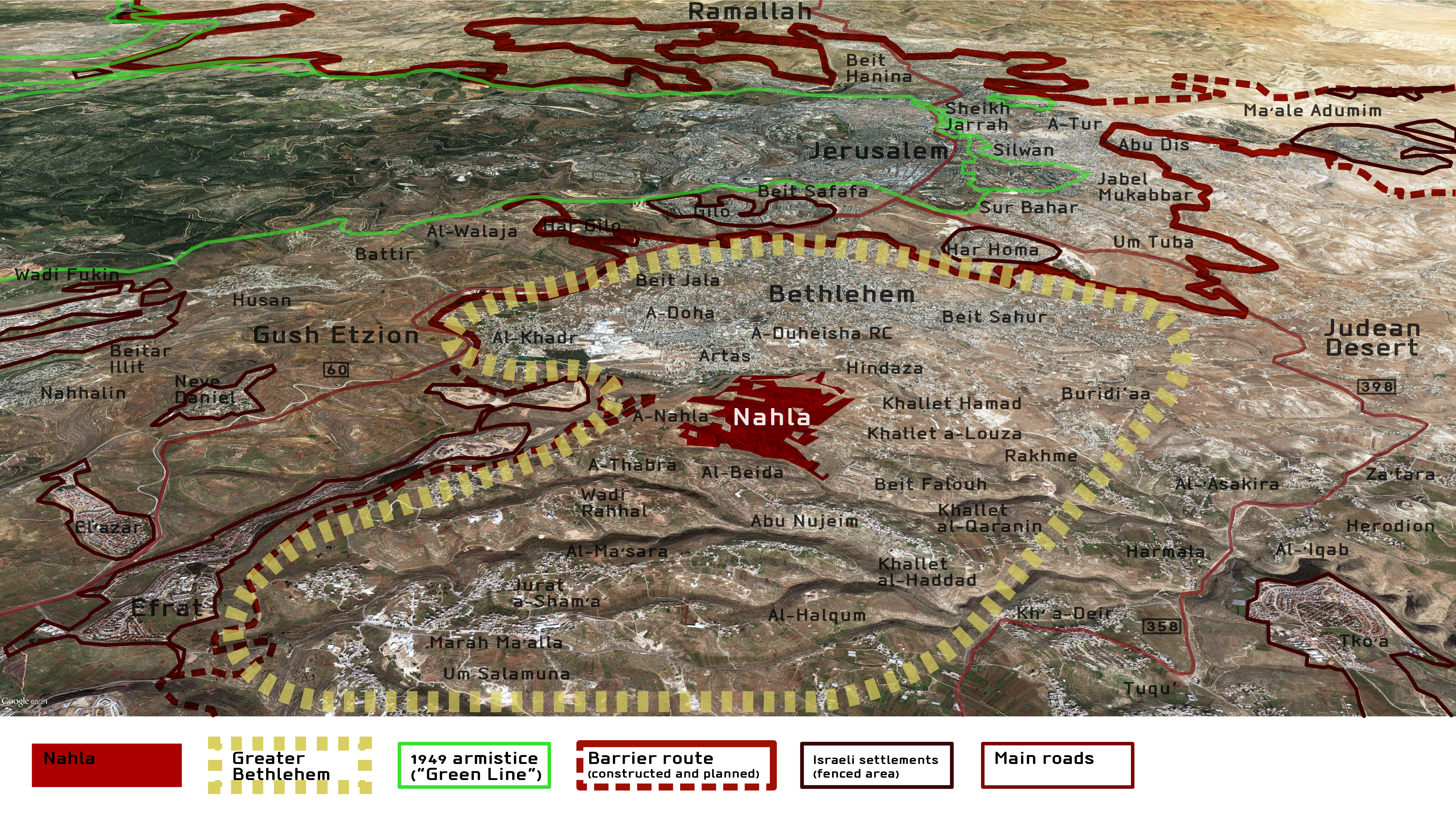 This is the first time the High Court has elected to take up the matter of discriminatory land allocation. The decision to do so was prompted by a petition filed by over a dozen Palestinian landowners in May 2020, with the assistance of Peace Now. This petition was filed after previous legal efforts failed to overturn Israel’s declaration of their land, part of the Palestinian village of a-Nahle, as “state land”. Past attempts to use litigation in Israeli courts to challenge Israel’s use of “state land” declarations in order to expand settlements have typically not continued past this point. This is in part because in order to challenge how “state land” is allocated, the Palestinian petitioner must, in effect, concede that the land in question (which Israel has seized from them) is legitimately “state land” in the first place — something Palestinian landowners are understandably loathe to do. Thus, this petition represents a novel challenge for the Court.
While the Court’s decision to allow the case to go forward is significant, it is important to note, too, that the wording of the Court’s order to the government indicates that the Court is only considering a limited part of the petition. That is: rather than examining the underlying principle of discriminatory land allocation practices, it is pursuing a limited consideration of why the State chose not to allocated parts of the land to these specific petitioners, in this specific case.
Peace Now said in a statement:
“For more than 50 years, Israel has allocated the precious resource of land in the West Bank to Israelis only. This policy confirms the claims of those who accuse Israel of applying an Apartheid regime in the Occupied Territories. The allocation of the land in E2 for a settlement is immoral, illegal and disproportionate in a way that cries to heaven. Although the order given by the court does not cover the entire area of the petition, the court signals that this discrimination must not continue.”
As a reminder, the settlement at the heart of the case is called Givat Eitam by settlers, but it is called “E-2” by anti-settlement watchdogs, in light of its dire geopolitical implications for any future Palestinian state (similar to those of the E-1 settlement on Jerusalem’s eastern flank). The construction of Givat Eitam/E-2 would significantly expand the Efrat settlement in the direction of Bethlehem, effectively cutting Bethlehem off from the southern West Bank and completing the city’s encirclement by Israeli settlements.
Government Data Shows: Over Past 5 years, in Area C Israel Granted 33 Building Permits for Palestinians, compared to more than 16,500 for settlers
Directly relevant to the court case regarding the allocation of state land to the Efrat settlement for the construction of a new settlement (see above), new data released by the Israeli government has revealed that over the past five years, Israel has issued only 33 building permits to Palestinians living in Area C while over the same period and for the same area, it issued over 16,500 building permits to settlers.
As a reminder, Area C is the 60% of the West Bank where Israel enjoys total authority and in which Israel has systematically denied Palestinian building rights, while promoting the expansion of settlements and unauthorized outposts, and in parallel systematically demolishing Palestinian un-permitted construction. This trend pre-dates the 5-year period covered in the new government data — for example, from 2016-2018, Israel issued only 21 building permits to Palestinians, while during that same period issuing 2,147 demolition orders against Palestinian construction.
These trends are part of the continuing efforts of Israeli settlers and the Israeli government to entrench and expand Israel’s control over (and de facto annexation of) the entirety of Area C. Notably, in September 2020 the Israeli government allocated 20 million NIS ($6 million USD) for the newly created Settlement Affairs Ministry to survey and map unauthorized (by Israel) Palestinian construction in Area C — construction which Israel has been aggressively demolishing. In addition to funding the expansion of policies that systematically discriminate against and dispossesses Palestinians in Area C, this funding further empowers a domestic Israeli body to exert extraterritorial sovereignty over Area C – in effect, treating the area as land already annexed by Israel.
The Knesset has also to a great extent adopted the narrative of settlers and pro-settler organizations — a narrative predicated on the idea that Area C belongs to Israel and must be defended against Palestinian efforts to steal it (framing that in effect dismisses the legitimacy of any Palestinian landownership in Area C). The Knesset has repeatedly hosted forums to discuss the alleged (by settlers and their allies/advocates) “Palestinian takeover of Area C.” Consistent with this framing and pushed by outside groups, many members of the Knesset have criticized the Israeli government’s alleged failure to robustly “defend” Israel’s rights/ interests in Area C — demanding that the government do more to prevent and demolish “illegal” Palestinian construction (even as it refuses to issue permits for Palestinians to build “legally), that it must prevent foreign projects that support Palestinians’ presence in the area, that it must clear Palestinians out of areas targeted by settlers, and that it must do more to expand settlements and consolidate state-built settlement infrastructure.
A Perfect Storm – For a Major Crisis – Gathers Over Sheikh Jarrah
Israeli settlers and police have provoked significant violence and rising tensions in Sheikh Jarrah ahead of Israel’s imminent forced displacement of the Salem family from their home of 60+ years in favor of settlers. That eviction is slated to be carried out by Israel sometime between March 1 and April 1. The latest violence has centered on the area around the Salem family home, where on February 13th, Kahanist Knesset Member Itamar Ben-Gvir erected a makeshift outpost — which he calls a “parliamentary office”– directly outside of the home.
Ben-Gvir’s action — which he clearly intends as a provocation — sparked a series of events that continue to result in violence, injury, and an increasing Israeli police presence in the neighborhood.
The escalation of conflict in Sheikh Jarrah has caused many – including in the Israeli government and the Biden Administration – to worry about a repeat of the events of May 2021, when a crisis centered on Sheikh Jarrah and the Temple Mt/Haram al Sharif ultimately sparked direct conflict between Hamas in Gaza, and the Israeli military, with devastating results for Gaza. The looming eviction of the Salem family mirrors the events which sparked those events last summer, with the added context of the convergence of three important religious holidays: Passover, Ramadan, and Easter. A U.S. official called this a “recipe for disaster in Jerusalem.”
Mohammed El-Kurd (whose family is also facing eviction in Sheikh Jarrah) writes about events transpiring around the Salem family home this week:
“While the Israeli regime has long managed to conceal its practices of ethnic cleansing, apartheid, and colonial expansion behind a mix of complex legislation, Hasbara, and the rhetoric of “war and peace,” politicians like Ben-Gvir increasingly do not bother to play that game. And they are not so fringe. Palestinians know that Ben-Gvir’s eliminationist rhetoric is cemented, albeit in more polished form, in Israeli policies of mass transfer. His office stunt is merely a more explicit version of the Zionism that Israeli leaders have governed with for the past seven decades—one predicated on replacing Palestinians with settlers. As I write this, colonial violence continues in my neighborhood and across colonized Palestine. Israeli forces have shot and killed Nihad Barghouti, a Palestinian teenager who was protesting in occupied Nabi Saleh, Ramallah; attacked protesting students with tear gas canisters at Abu Dis University; assaulted a disabled activist in Sheikh Jarrah while providing protection for Ben-Gvir’s entourage; and demolished a Palestinian’s home in the South Hebron Hills, shortly before brutally detaining him. As the injuries and arrests mount, it’s hard not to see the parallels between today’s events and the events that sparked last year’s Unity Uprising and the devastating assault on the besieged Gaza Strip. Many hold their breath, anticipating the repression that accompanies resistance, the steep price of revolt.”
For further background on the Salem family’s case (including on the Israeli laws that were expressly designed to enable the eviction of Palestinians in favor of settlers), see reporting by Ir Amim and Peace Now.
Ma’aleh Ahuvia Outpost Demolished, Immediately Rebuilt
On February 8th, the IDF dismantled the illegal outpost of “Ma’aleh Ahuvia.” Hours later, the IDF failed to prevent settlers from promptly (and illegally) rebuilding and improving the outpost – demonstrating the lack of either willpower or lack of efficacy of Israeli officials in the West Bank to constrain settler activity. That evening, settlers from the outpost carried out a so-called “price tag attack” on the nearby Palestinian village of Deir Jarrar, damaging cars and inflicting terror.
Prominent Israeli solidarity activist, Rabbi Arik Ascherman, documented settlers rebuilding the site, and wrote:
“Army vehicles pass by every day on the way to a base the message to Palestinian victims of violence, of ravaged vineyards, orchards and fields, and of theft Palestinians even susect that the water container and other items in the outpost were stolen from them.) will continue with no relief from Israel. The message to settlers is they have nothing to fear. They continue to wreak terror.”
As a reminder, this outpost is a named for Ahuvia Sandak, a settler “hilltop youth” who died when the car he was traveling crashed as it was fleeing Israeli police with a group of settler youth who allegedly has been stoning Palestinian cars. Settlers and their supporters have painted Israeli police as perpetrators of a crime of negligence (or worse) against the settler youth; the Knesset has taken up the issue; and Sandak has been memorialized as a hero and a martyr to the cause of Greater Israel.
Settlers Are Running Government-Backed Program for Israeli Kids on Palestinian Land in East Jerusalem
Haaretz reports that the radical settler group Elad is running a program that enables Israeli students to earn school credit for doing work on land in the Ben Hinnom Valley. The land in question is privately owned by Palestinians (and recognized as such by Israel). However, the government of Israel has issued “landscaping orders” (also called “gardening orders”), and order which allows Israel to “temporarily” (at least in theory) take over privately owned land for what are ostensibly public purpose.
Elad’s student program on the private Palestinian land has been operating under the auspices of the Jerusalem Municipality in partnership with the Israel Nature & Parks Authority, once again demonstrating how settlers and the Israeli state work hand-in-hand to assert Israeli control over Palestinian land.
Fearing that the setters’ control over the land will become permanent, the Palestinian owners of the land in question have filed an appeal against the landscaping orders. The Jerusalem District Court recently heard arguments on the appeal, where a lawyer representing the Palestinian landowners argued that there is no precedent for using “landscaping orders” to take over so much land. The judge hearing the appeal did not issue a decision, instead postponing judgment.
As a reminder: In June 2019, the Jerusalem Municipality used the issuance of “landscaping orders” to take control of 12 plots of privately owned Palestinian land near an area where the Elad settlement group has been active – again, based in part on the argument that the owners were not presently using the land. However, the land in question is located in an area that Israel has declared to be a national park. With that “national park” declaration, Israel legally barred the private landowners from using their own land. With its subsequent “landscaping orders,” Israel has in effect asserted that since the owners weren’t using the land (that they were legally barred, by Israel, from using), that land can now, in effect, be seized by Israel for its own purposes (the landscaping orders last for a period of 5 years, with the likelihood of extensions after that — tantamount to expropriation).
Emek Shaveh’s Executive Director Alon Arad told Haaretz:
“People who love Jerusalem and care about its heritage don’t harm its landscapes or push out its people. The Israel Nature and Parks Authority, through Elad, is promoting development that essentially changes the landscapes, damaging the historical heritage of the valley and reshaping it to fit political interests. It is shameful that this work is being done by a political organization that drafts teens and children for its own needs under the framework of fulfilling their educational obligations.”
Lapid: Israel Will Refrain from the Most Problematic Settlement Expansion
Standing alongside the German Foreign Minister at a press conference, Israel Foreign Minister (and alternate Prime Minister) Yair Lapid stated that Israel will not build settlements that prevent a two-state solution (a statement that reflects an Israeli mindset according to which there can be “peace” based on Israel dictating to Palestinians what areas of the West Bank will become part of Israel). Lapid insisted that Israel will only approve plans that accommodate the “natural growth” of settlements (of course, there is nothing “natural” about growth of settlements, given that such growth is possible only due to Israeli government policies that support and enable the establishment and expansion of settlements, and policies that actively incentivize and support Israel citizens moving to and living in the West Bank).
A quick survey of recent settlement plans and projects, as summarized weekly by this report (archived here), highlights the dishonesty in even this weak commitment by Lapid to keeping the two-state solution alive. These include the State’s efforts to retroactively legalize the Evyatar outpost, to reestablish the Homesh settlement, and to advance plans for six new settlements in East Jerusalem; in addition to the myriad of unofficial mechanisms by which the State grants increasing control over land in the West Bank to the settlers.
Bonus Reads
- “One Year Report on Demolitions and Seizures in the west Bank, Including East Jerusalem (Reporting Period: 1 January 2021 – 31 December 2021)” (European Union)
- “Opinion: Palestinians have denounced Israeli apartheid for decades. As the world catches up, how will it react?” (Mariam Barghouti in the Washington Post)
- “Violent Israeli Settlers Are Starting to Resemble the KKK” (Michael Sfard in Haaretz)
- “Terrorizing a Nation: Israeli Settler Violence Against the People of Palestine – A Yer in Review (2021)” (PLO-NAD)
- “A broken ankle, a demolished home, and a crushed water cistern” (Ali Awad in +972 Magazine)
- “The “Father of the Settlements”” (Arutz Sheva)
Welcome to FMEP’s Weekly Settlement & Annexation Report. To subscribe to this report, please click here.
June 10, 2021
- Israeli AG Declines Involvement in Sheikh Jarrah Dispossession Cases, Clearing Way for Supreme Court Ruling
- Pending Silwan Dispossession Cases Continue
- Israeli Supreme Court Hears Landmark Case on West Bank Land Appropriation for Settlement
- Extremists “March of Flags” in Jerusalem Rescheduled for June 15th
- IDF Issues Evacuation Notice Against Outpost, Causing Political Stir
- Bonus Reads
Comments or questions? Email Kristin McCarthy – kmccarthy@fmep.org.
Israeli AG Declines Involvement in Sheikh Jarrah Dispossession Cases, Clearing Way for Supreme Court Ruling
On June 7th, Israeli Attorney General Avichai Mandelblit informed the Supreme Court that he will not submit a legal opinion on the cases threatening the immediate displacement of seven Palestinian families (13 households) from their longtime homes in the Sheikh Jarrah neighborhood of East Jerusalem. These cases will serve as further precedent for even more widespread dispossession of Palestinians in favor of settlers.
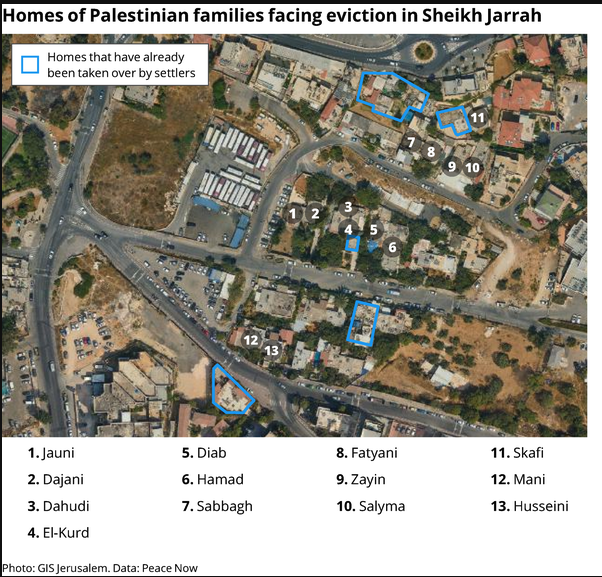
Map by Haaretz
Haaretz reports that Mandelblit believes the Palestninians’ have “too weak” of a case, and that his legal opinion would not prevent their eviction. Haaretz also reports that the political leadership in Israel approves of the Attorney General’s decision to allow the cases to proceed.
Peace Now responded to Mandelblit’s decision:
“Israel’s Attorney General has decided not to give his opinion in the Sheikh Jarrah cases. This means Israeli government is ridding itself of responsibility in matters of discriminatory laws and dispossessing hundreds of Palestinian.”
These Sheikh Jarrah eviction cases – which have been at the center of heightened international attention and outcry – have been in limbo since last month, when the Attorney General was given until June 8th to submit his opinion. Now that Mandelblit has decided against weighing in, the Supreme Court is expected to convene a hearing and issue its ruling on the Palestinians’ appeal before July 20th, which is the last day of the Israeli judicial calendar — notwithstanding the fact that the Supreme Court could delay the hearing under various pretexts, if it was inclined to do so. Commenting on the anticipated quick move by the Supreme Court to hold this final hearing, Terrestrial Jerusalem’s Danny Seidemann tweeted “…The wheels of justice grind slowly, but sometimes we make exceptions. Enough said.”
Ir Amim said:
“The eviction procedures in both Sheikh Jarrah and Silwan largely reflect one another and are predicated on the same discriminatory legal mechanism, which state-sponsored settler groups are exploiting to systemically dispossess Palestinian families and seize their homes for Jewish settlement. A total of 1000 Palestinians – some 300 individuals from Sheikh Jarrah and more than 700 people from Silwan— are under threat of mass displacement. These measures not only constitute a flagrant violation of human rights, but also carry far-reaching, humanitarian, geopolitical, and moral implications. Concerted pressure must be exerted on the Israeli government to end these measures of dispossession and to undertake a sustainable and just solution for the families to remain in their homes.”
In a piece entitled “Israel Is Shirking Its Responsibility for Residents of Sheikh Jarrah,” the Haaretz Editorial Board wrote:
“The enlistment of the state employees, from the attorney general to the last of the policemen, for the benefit of the expulsion and settlement enterprise in Sheikh Jarrah is an embarrassment for Israel. It causes moral damage, harms public diplomacy and poses a security risk to all Israelis. Let us hope the new government will have broader considerations and will order the attorney general to intervene for the sake of common sense and justice.”
Ironically, as the clock ticks down to a final decision by the Court – a decision that will almost certainly mean the expulsion of these Palestinains from their homes — Israel seems to be making a special effort to keep the world’s attention focused on how it treats Palestinians in Sheikh Jarrah. This effort included arresting (with brutality captured on video) a well-respected Al Jazeera journalist Givara Budeiri, and detaining and interrogating two of the most prominent Paelstinian activists in the world – Muna and Mohammed El-Kurd. The siblings – whose family is one of the seven facing immediate expulsion from their homes – were released following intense interrogation. These high-profile arrests are but a small part of a large wave of arrests Israel is carrying out across Jerusalem and other parts of the country. Budeiri was also released.
Pending Silwan Dispossession Cases Continue
On June 10th an Israeli court in Jerusalem was due to hold a hearing with respect to Palestinian appeals in two cases of pending dispossession of Palestinains of their homes in the Silwan neighborhood of East Jerusalem. The Court instead delayed the hearing on the appeals, rescheduling it to July 8.
In addition to the two cases above, the fate of another 15 Palestinians households in Silwan — all facing eviction/dispossession — awaits the action of Attorney General Mandelblit. The case of eight of those families, all from the Batan al-Hawa section of Silwan, is currently before the Supreme Court, which has ordered Mandelblit to give his opinion in the cases, or formally decline to do so, by June 30. How those cases are decided will become the precedent that will decide the fate of another seven Palestinian households whose cases are currently in an Israeli District Court.
One Silwan resident, Zuheir al-Rajabi – whose family’s case was profiled in the New York Times – told Al-Monitor that the Silwan families are also considering taking their case to the International Criminal Court. As a reminder, the ICC is currently considering whether to launch a full fledged investigation into Israeli war crimes – an investigation which would include settlement activity.
Israeli Supreme Court Hears Landmark Case on West Bank Land Appropriation for Settlement
Peace Now reports that on June 7th, the Israeli High Court of Justice held a hearing on a petition filed by Palestinian landowners challenging the allocation of “state land” to the Israeli Ministry of Housing in order to enable to the construction of a new settlement called Givat Eitam on a strategic hilltop – which Palestinians call a-Nahle – located just south of Bethlehem.
Hagit Ofran of Peace Now – which is leading the petition alongside the Palestinian landowners – told FMEP that the hearing concluded with Court giving the State 90 days in which to respond to a proposal to allocate some the land directly involved in the case to the individual petitioners, or whether it will agree to allocate land nearby to the petitioners. This decision by the Court purposefully narrows the scope of Peace Now’s legal challenge by only addressing the case of the land in a-Nahle and the individual petitioners involved. The decision dodges the more fundamental question put forth in the petition challenging Israel’s discriminatory practice of allocating 99.8% of “state land” for settlement purposes. This is the first time the issue of state land allocations to settlements is being challenged in an Israel court.
Map by Peace Now
This petition comes after previous legal efforts have failed to overturn Israel’s declaration of the land of a-Nahle as “state land”. Past attempts to use litigation in Israeli courts to prevent Israel from building new settlements have typically not continued past this point. One reason for this is that in order to challenge how “state land” is allocated, the petitioner must, in effect, concede that the land in question is legitimately “state land” in the first place — something Palestinians do not concede with respect to land seized by Israel. That makes this petition, which is led by Peace Now along with over a dozen Palestinian landowners, novel.
As a reminder, the settlement at the heart of the case is called Givat Eitam by settlers, but it is called “E-2” by anti-settlement watchdogs, in light of its dire geopolitical implications for any future Palestinian state (similar to those of the E-1 settlement on Jerusalem’s eastern flank). The construction of Givat Eitam/E-2 would significantly expand the Efrat settlement in the direction of Bethlehem, effectively cutting Bethlehem off from the southern West Bank and completing the city’s encirclement by Israeli settlements.
Extremists “March of Flags” in Jerusalem Rescheduled for June 15th
Delayed twice in light of Israel’s concerns of violence, the Israeli Security Cabinet voted to give its permission for radical, ultranationalist Israelis to hold a parade – called the March of Flags – on June 15th through the Old City of Jerusalem, ostensibly in celebration of the reunification of East and West Jerusalem following the 1967 War. Hedging, the Security Cabinet made its permission conditional on the route of the parade being approved by the Israeli police.
Israeli police have expressed concern that the provocative parade – which organizers want to have go through Damascus Gate and the Muslim Quarter, in a deliberate finger-in-the-eye to Palestinians (the provocative overtones of the annual march are never subtle, with racist/Islamophic signs and chants the norm) – could trigger Hamas rocket fire, and have in the past refused to approve the parade route insisted upon by its organizers.
According to press reports, the police have said that it will consider approving a new proposal for a different, less provocative route. However, organizers of the march have rejected this option, stating, “the outline presented to us by the police does not express the purpose of the parade, by the Jewish people, with Israeli flags in the Israeli capital.” Making clear that provocation is the goal, MK Itamar Ben Gvir, a acolyte of Rabbi Meir Kahane – whom police had, for security reasons, explicitly barred from participating in any flag march at this time, or from visiting the Temple Mount/Haram al Sharif – held his own protest at Damascus Gate, leading, as he surely hoped, to a confrontation between Palestinians and Israeli forces accompanying him (and to the arrest of five Palestinians).
Notably, the parade is currently planned for Tuesday, June 15th – a date that falls two days after a new government is expected to be confirmed and sworn in. Commenting on the timing, a Haaretz analyst noted:
“Instead of approving the march on its original date, Netanyahu made his first decision as opposition leader on Tuesday night: He rolled the hot potato into the hands of prime minister-designate Naftali Bennett. This move may become the first crisis of the fragile unity government: Bennett, who is right-wing, has made it clear that his government would have a ‘soft right’ character and would have a hard time explaining to his voters why he was working to thwart the march.”
IDF Issues Evacuation Notice Against Outpost, Causing Political Stir
Haaretz reports that a group of 200 settlers have re-established an outpost (which they call “Evyatar”) on a strategic hilltop called Mount Sabih, located south of Nablus on lands belonging to the Palestinian villages of Beita, Qabalan, and Yatma. On June 9, the Israeli army issued a military order designating the area as a closed zone, and ordered the settlers (and their security team of guard dogs) to vacate the area within eight days. The IDF said it would demolish/remove the more than 40 structures – including tents, a synagogue, prefab houses, and sanitation facilities – that settlers have installed at the site if the settlers do not remove them voluntarily. A spokesperson for the outpost – Daniella Weiss of the Nahala settler organization – said that 46 settler families (approximately 200 people) have moved to the outpost already, and 75 settler families are “hoping to join them soon.”
Palestinians from the nearby villages to which the land belongs have actively sought to prevent settler incursions into the lands surrounding Beita. During a recent protest against another outpost settlers were trying to establish on lands belonging to Beita, the Israeli army shot and killed two young Palestinians, and wounded 25 others. On June 6th, the army closed off the main entrance to Beita in an attempt to quell Palestinian resistance; Beita remains sealed off as of June 10. As a reminder,
With defiance and pride, a spokesperson for the outpost told Haaretz that the land on which the outpost stands is in the process of being declared “state land” by Israel. The Times of Israel reports that, indeed, the Israeli government regards the land’s status as unclear – and is examining whether it can claim the land as “state land” under the legal pretext that it has not been actively cultivated by Palestinians for a long enough period of time. As a reminder, Palestinians have been prevented from building and farming on this land for decades. In the 1980s, Israel used the hilltop as a “temporary” military base. When the base was removed in the 1990s, Palestinians were prohibited from building on the site – which is in Area C of the West Bank where Israel exercises unilateral power.
If the land is declared as “state land” it could then be allocated to the settlers and the outpost could be retroactively authorized, consistent with the longstanding efforts of the whole of the Israeli government – the Knesset, the Executive, and the Judiciary – which has spared no efforts to find the means by which to issue retroactive authorization to more than 70 outposts scattered throughout the West Bank.
The imminent evacuation of the “Evyatar” outpost has caused controversy in the waning hours of the Netanyahu regime, and might become one of the first points of contention for the incoming government coalition. After the IDF issued an order closing the area and declaring its intent to raze the outpost, Prime Minister Netanyahu wrote a letter to Defense Minister Gantz (who oversees the Civil Administration, which has authority over West Bank building and security) arguing that the outpost should be left alone while the land status is investigated. Gantz rebuffed the letter, writing back that the outpost was built in contravention of Israeli law and the IDF will raze the outpost regardless of the question of land status. The letter from Gantz’s office said: “It is those anomalous characteristics of this case that led to the decision to issue a demarcation order, which followed consultation with all relevant defense and legal authorities.”
Looking forward, Haaretz succinctly explains why the evacuation of this outpost might pose a predicament to the new Israeli government, due to be sworn in over the weekend. Haaretz writes:
“From a legal perspective, the site must be evacuated…But how will [Naftali Bennet] the former director general of the Yesha Council of settlements – who is the prime minister-designate – behave in the face of what remains of his political base?”
Bonus Reads
- “Fights over settlements holding up coalition deal signings” (Jerusalem Post)
Welcome to FMEP’s Weekly Settlement Report, covering everything you need to know about Israeli settlement activity this week.
To subscribe to this report, please click here.
May 29, 2020
- In a Legal First, Peace Now Submits Petition Against Allocation of Land for Purpose of Building the Givat Eitam/E-2 Settlement
- Master Plan for Har Homa-E Settlement Gets Final Approved
- Israel Advancing Plans for a New Settlement Industrial Zone
- Some Settlers Lobby To Change Trump Plan as Annexation Map Becomes Clearer
- Netanyahu Says He Will Not Delay Annexation & Fights Off Criticism of Settlers
- Settler Leader Blames Yesha Council Head for Delaying Annexation
- USMEP Briefing Paper on Annexation
- Bonus Reads
Comments/Questions? Email Kristin McCarthy(kmccarthy@fmep.org).
In a Legal First, Peace Now Submits Petition Against Allocation of Land for Purpose of Building the Givat Eitam/E-2 Settlement
On May 21st, Peace Now formally submitted a petition to challenge Israel’s plan to build the Givat Eitam/E-2 settlement on a hilltop known to Palestinians as A-Nahle, located just south of Bethlehem. Peace Now has mounted several legal challenges to Israel’s drive to build Givat Eitam/E-2, but this petition is groundbreaking in that it seeks to challenge Israel’s allocation of land for settlement purposes, arguing that Israel is obligated to allocate the land to the Palestinians instead. This is the first time the issue of land allocation is being brought to trial.
There are three main arguments in the petition, Peace Now summarizes:
- The allocation of land to build a settlement contravenes Israel’s duties to protect the land for the local Palestinian population according to international law;
- Allocating land to Israelis over Palestinians is tainted by discrimination since 99.8% of West Bank land allocated since 1967 has been gone primarily to Israeli purposes, and
- The Palestinians’ need for the land in question is far greater than that of the Efrat settlement, as a Peace Now spatial planning analysis confirms. For more on the legal arguments of the appeal, read here.
This petition comes after Peace Now lost a previous effort to overturn Israel’s declaration of the land as “state land” (a move which then made it possible for Israeli to allocate the land for settlement). Attempts to legally stop Israel from building new settlements have typically not continued past this point. One reason for this is that in order to challenge how “state land” is allocated, the petitioner must, in effect, concede that the land in question is legitimately “state land” in the first place — something Palestinians do not concede with respect to land seized by Israel. That makes this petition, which is led by Peace Now along with over a dozen Palestinian landowners, novel.
Commenting on the decision to file the new petition, Peace Now said in a statement:
“The decision to allocate a-Nahla land for a new settlement is illegal, immoral and un-Jewish. Implementing this plan will severely damage not only the Palestinian landowners and the development capacity of the Bethlehem area, but also the ability to reach a future peace agreement and territorial compromise for a future Palestinian state alongside a secure Israel. The land should be allocated for Palestinian development in the region.”
Master Plan for Har Homa-E Settlement Gets Final Approved
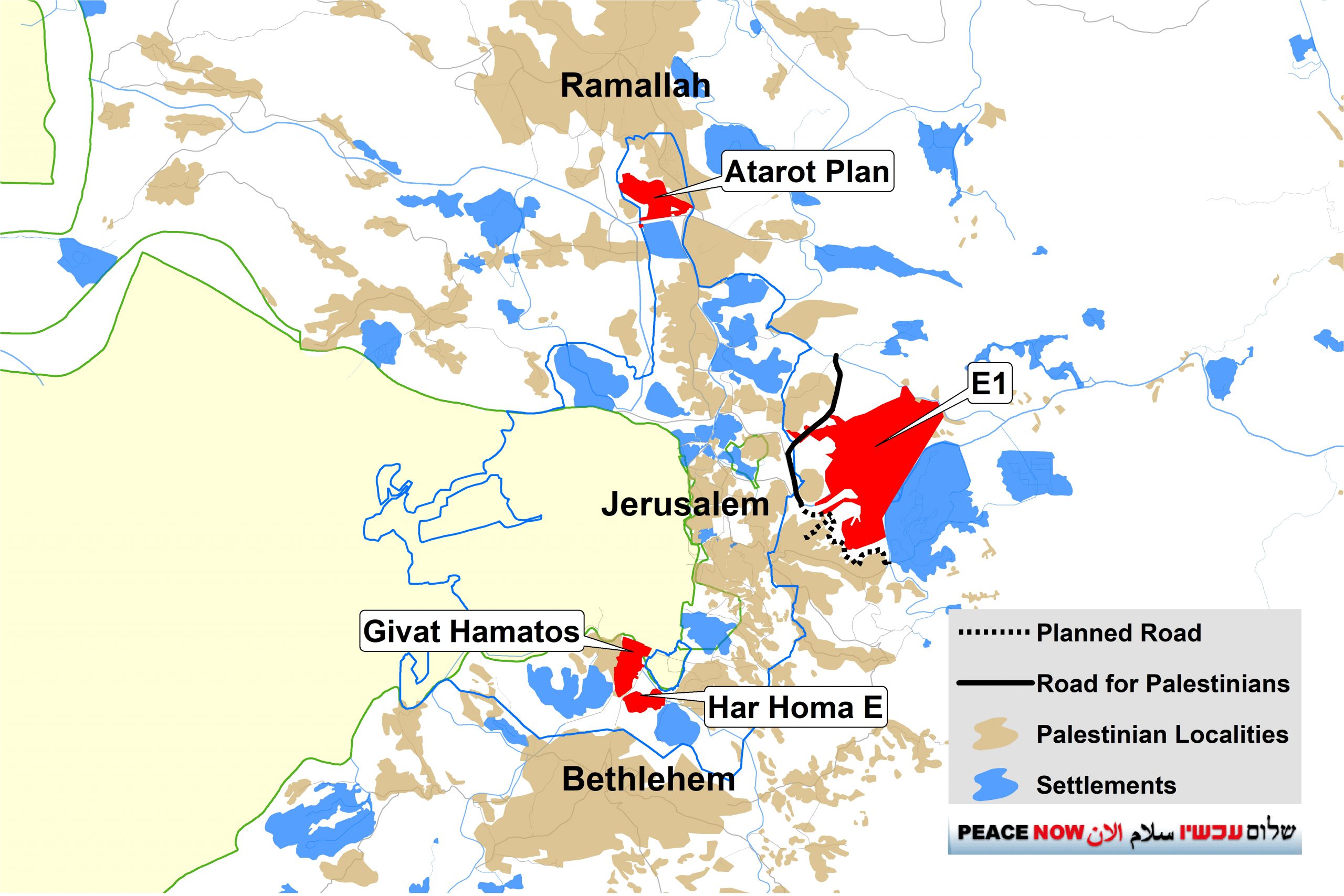
Map by Peace Now
Ir Amim reports that on May 25th the Jerusalem District Committee granted final approval of a master plan that provides for the construction of 2,000 units in the “Har Homa E” settlement (aka Har Homa West). Planners must now submit a detailed outline plan(s) for approval before building can commence; one such plan, for 500 units, is already being advanced through the planning process.
Ir Amim writes:
“Construction in Har Homa E will serve as another step in connecting the existing Gilo and Har Homa neighborhoods/settlements and create a contiguous Israeli built-up area along the southern perimeter of East Jerusalem. This will likewise detach Bethlehem and the southern West Bank from East Jerusalem while isolating the Palestinian neighborhood of Beit Safafa. In line with the new reality created by the Trump Plan and its unilateral recognition of Israeli sovereignty of East Jerusalem, these developments will constitute a major obstacle towards the future establishment of a Palestinian capital in the city and the prospect of a viable two-state framework.”
For further details on the two Har Homa E plans – one of which is a master plan – see Ir Amim’s excellent analysis.
Israel Advancing Plans for a New Settlement Industrial Zone
Haaretz reports that the Israeli Civil Administration is advancing plans to build a new settlement industrial zone – called “Samaritans Gate” by settlers – on land that straddles the Green Line in the northern West Bank. The zone is slated to take over 3,000 dunams (740 acres) of West Bank land to the east of the Israeli city of Kafr Qasem.
In addition to the Palestinians who the new industrial zone will impact, the plan is drawing significant opposition from Israeli environmental groups who are concerned about the impact of the project on the terrain. The zone is slated to be built on a riverbed in what is considered a rare ecological corridor in Israel.
Mor Gilboa, an activist with “Climate for Peace,” said:
“the military government in the territories has for decades created a list of climate blights on the environment. The plan ignores nature the same as it ignores Palestinian rights to these territories which don’t belong to Israel under international law.”
For more information on why settlement industrial zones exploit and harm Palestinians, their land, and their resources, see this brief by Who Profits.
Some Settlers Lobby Against (or for changes to) Trump Plan as Annexation Map Becomes Clearer
Settler leaders as well as their political allies are increasingly vocal in their opposition to the Trump Plan, as details regarding the closely guarded joint mapping process have surfaced in the press. In addition to their resolute opposition to Israel’s acceptance of the even a notion that a Palestinian state can be established under certain conditions in the future, the settlers have focused in on the amount of land that the Trump Plan permits (and doesn’t permit) Israel to annex.
In an interview from early May 2020, U.S. Ambassador David Friedman said that the Plan calls for Israel to annex no more than 30% of the West Bank (50% of Area C), which would leave 15 settlements/outpost as enclaves (i.e., Israeli sovereign territory that is outside the Israeli state’s borders, connected only by roads). Settlers have strongly rejected this concept, but have reportedly been frozen out of the joint mapping committee and are failing to find outside avenues of influence.
David Elhayani – the head of the settler Yesha Council and also head of the Jordan Valley Regional Council – told The Times of Israel that the members of the joint U.S.-Israeli mapping committee have refused to meet with the settlers or received their proposed maps, and said that the committee “refuses to be flexible with regard to the map.” Ayelet Shaked (Yamina Party) also expressed frustration with being locked out of the mapping process, telling Army Radio that the mapping team is not letting anyone make any changes to the map originally proposed by the Trump Administration.
Undaunted, the settlers reportedly have drawn up maps outlining three different versions of annexation they say they could accept, since these maps do not leave any Israeli enclaves (as of publication, the settlers’ maps have not been revealed publicly). According to media reports, one version of the map would add 2.5% more land to Israel (amounting to Israeli annexation of a total of 32.5% of the West Bank), a second would add 5% more land to Israel (total of 35%), and a third would add 8.5% more land to Israel (total 38.5%). David Elhayani – the head of the settler Yesha Council and also head of the Jordan Valley Regional Council – said
“In our optimal map, 38.5 percent of the West Bank would be annexed to Israel. This is most of Area C. In our map there is Israeli territorial contiguity and it’s the Palestinians who remain in enclaves.”
Settler leaders and Yamina Party members are making the rounds in the Knesset, using a map to try to convince MKs to oppose the Trump Plan for the reasons discussed above.
Unsurprisingly, the Trump Administration officials are reportedly irritated by the oppositional role that the settler leadership are playing. U.S. officials have reportedly sent messages relaying their frustration over the settlers’ rejection of and ingratitude for the Trump Plan. Those messages also note, reportedly, that the map settlers are using to lobby MKs against the plan is not the final map. Suggesting that the settlers should take what their being offered and after that can ask for more, a U.S. official told Israel Hayom:
“If the settlers don’t want what the administration currently has to offer, they shouldn’t come to us in the future. The expectation was that they see the bigger picture, remember where they were standing in December 2016 (when the United Nations Security Council passed Resolution 2334 that harmed Israel and was spearheaded by the Obama administration), and that they consider where they could be standing four years from now if the Palestinians continue to reject negotiations with Israel.”
The relationship between settlers and the Trump Administration was further inflamed when settler leader Yossi Dagan told the press that U.S. officials were requiring Israel to abandon its claim to the remaining 70% of the West Bank as part of the Trump Plan. Quashing that report (and thereby making clear that the U.S. is not requiring Israel to give up its quest for even more territory in the future), a U.S. official said:
“This is a complete lie and whoever is spreading it is doing great damage to Israel, the US and the Jewish people.”
All that being said, settlers (and their leaders and allies) remain split on the Trump Plan. While the majority (24) of settlement council leaders voted for a Yesha Council resolution critical of the Trump Plan, Efrat settlement head Oded Revivi continues to support the Trump Plan, though he has made it clear that he is advocating for settlers to pocket the gifts Trump is offering, without forfeiting the rest. Revivi is aligned with Ariel settlement leader Eli Shavrio. Dismissing the position of Revivi and Shavrio, one suggested that they have the luxury of living near the Green Line, meaning:
“They don’t have a problem with Palestinians gaining control of transportation routes or enclaves.”
Netanyahu Says He Will Not Delay Annexation & Fights Off Criticism of Settlers
Following the first day of his trial, Israeli Prime Minister Netanyahu told leaders in his Likud faction that he will definitely promote annexation on July 1st, saying “It is a big opportunity and we will not let it pass by…[July is] a goal date in July, and we won’t change it.”
Two days after Bibi’s comments made headlines, Prime Minister-in-waiting Benny Gantz gave an address to his own faction (Blue & White) in which he offered veiled criticism of some of Netanyahu’s other policies, but offered only support for the pursuit of annexation. Gantz said:
“We are currently presented with meaningful windows of opportunity that could improve and even transform the reality in the region across all fronts, including, of course, the American government’s peace plan… [I will work] to ensure the best outcome that will fortify Israel’s security and protect our state and international interests.”
In an interview on May 28th, Netanyahu continued to fight off criticism from settlers and Yamina Party leaders, explaining his position on key points and taking on criticism at length:
“For the first time since the establishment of the state, I’ve managed to secure American recognition [of our sovereignty rights], first on the Golan Heights and in Jerusalem, and then through an agreement that will facilitate American recognition in the areas of our homeland inside Judea and Samaria. These are [US President Donald] Trump’s decisions, and the person who broached these matters with him was me. No one else…Within this package [the Trump Plan] is a historic opportunity for changing the tide of history, which was pointing one way. The whole time. All the diplomatic plans proposed to us in the past asked us to concede swathes of the Land of Israel, return to the 1967 borders and divide Jerusalem. To take in [Palestinian] refugees. This is a reversal. We aren’t the ones being forced to make concessions, rather the Palestinians are.”
Notably, with respect to the criticisms that the Trump Plan permits the possibility of a future Palestinian state, Netanyahu clarified that this should not be mis-understood to mean the Palestinians would ever have an actual state, according to any standard meaning of the term, starting with the fact that such a state would be predicated on Palestinians accepting Israeli security control over the entire West Bank:
“Regardless of negotiations. If they [the Palestinians] see fit to meet and accept about 10 stringent conditions – including Israeli sovereignty west of the Jordan River, preserving a united Jerusalem, refusing to accept refugees, not uprooting Jewish communities, and Israeli sovereignty in large swathes of Judea and Samaria, etc. – the [diplomatic] process will move ahead. They need to acknowledge that we control security in all areas. If they consent to all this, then they will have an entity of their own that President Trump defines as a state. There are those who claim and – an American statesman told me: ‘But Bibi, it won’t be a state.’ I told him, call it what you want. At the heart of the Trump plan are foundations we have only dreamed about. All the things we are being criticized about from the right – and what am I? These are things for which we fought for many long years and we’ve finally achieved them. Then they come with the criticism.”
When asked to address concerns that if/when Israel annexes the Jordan Valley, thousands of Palestinians living there will be granted Israeli citizenship, Netanyahu dispelled the notion altogether, saying:
“They will remain a Palestinian enclave. You’re not annexing Jericho. There’s a cluster or two. You don’t need to apply sovereignty over them, they will remain Palestinian subjects if you will. But security control also applies to these places.”
Israeli human rights lawyer Michael Sfard corrected Netanyahu’s comments, Tweeting:
“The gap between the number of Palestinian communities in the Jordan Valley that the Prime Minister has named (2) and the number of communities that actually exist (47) – represents the number of villages and villagers that with annexation would be displaced from this area forcibly. This is a very small purge.”]
On May 29th, Netanyahu gave yet another interview, in which he was asked if the annexation plan he intends to bring up for a vote as early as July 1 will include the topic of Palestinian statehood, as provided for under the Trump Plan (though, as we’ve repeatedly documented, the Trump Plan does not provite for a real Palestinian state under any standard definition of the term, but rather for semi-autonomous Palestinian islands within an Israel sovereign sea ). Netanyahu responded:
“That subject is separate. A government decision on the matter is not expected.”
Settler Leader Blames Yesha Council Head for Delaying Annexation
In Efrat Mayor Oded Revivi’s telling of what went down in the days leading up to the moment when Netanyahu and Trump stood side by side to unveil the Trump Plan, a late night statement issued by David Elhayani (Yesha Council head) changed history. According to Revivi, the White House had planned to announce that annexation could take place immediately. Instead, as a result of Elhayani’s opposition to the Trump Plan and the controversy his statement triggered, the timeline for annexation was delayed, and the “joint mapping committee” was invented.
The other settler leaders who travelled to Washington with Elhayani and Revivi disagree with the latter’s telling of what happened. Nonetheless, Revivi offers one dramatic, insider’s perspective about the involvement of settler leaders leading up to the unveiling of the Trump Plan.
USMEP Briefing Paper on Annexation
Daniel Levy of the U.S.-Middle East Project has produced a detailed analysis of all the goings-on surrounding annexation, including his own predictions on how a number of key questions will be answered. After assessing the internal politics and options confronting Israeli, American, Palestinian, European, and Arab decision makers, Levy concludes with an important point:
“Israeli impunity is the key driver of the current journey away from peace and equality. Israel’s cost/benefit calculation will need to change to prevent that journey continuing down the same path and to usher us onto the path less travelled. A better way forward would have to challenge that impunity. It would necessitate desisting from the delegitimization and criminalization of sanctioning Israel for its policies or of conditioning various preferential arrangements that Israel enjoys, while guaranteeing the space for legitimate Palestinian political expression and alternative visions for the future (especially as two states becomes ever-less attainable). Open debate and policy options certainly cannot be foreclosed in the service of cheapened and scurrilous accusations of antisemitism.”
Bonus Reads
- “Annexation Is the Israeli Settlers’ Real Estate Dream Come True” (Haaretz)
- “This Will Be the Heavy Price of Annexation for the Israelis” (Haaretz)
- Ex-chief West Bank land inspector planted groves on Palestinian ground” (The Times of Israel)
- “Mixed messages on West Bank sovereignty leaves diplomats flailing” (Jerusalem Post)
- “Can Annexation be Reversed?” (Jerusalem Post)
- “IDF not yet tasked with annexation” (Jerusalem Post)
- “PLO fears Israel could use violence to annex parts of West Bank” (MEMO)
- “Israel Must be Smart about Annexation” (Ynet)
Welcome to FMEP’s Weekly Settlement Report, covering everything you need to know about Israeli settlement activity this week.
To subscribe to this report, please click here.
May 8, 2020
- Israel Green Lights Givat Eitam/E-2 Settlement
- Givat Hamatos Tender is Delayed, as Settlers Agitate for Action
- Israel Exploits “Humanitarian” Access Issue to Flex its Muscles at Key Hebron Site
- HaMoked Continues Battle on Behalf of Palestinians Landowners Who Cannot Reach Their Land
- Amb. Friedman Gives Two Interviews Clarifying (Once Again) Total Support for Annexation; Pompeo To Visit Israel Soon
- Yesha Settlement Council Head Pushes For Annexation Vote Immediately, As Settlers Continue to Be Wary of Bibi’s Plans & Critical of the Trump Plan
- Bonus Reads
Questions/comments? Email kmccarthy@fmep.org
Israel Green Lights Givat Eitam/E-2 Settlement
On May 6th, Israel’s outgoing Defense Minister Naftali Bennett announced the approval of plans for the construction of 7,000 new units in the Efrat settlement, in what is, in effect, approval of a brand-new settlement adjacent to Efrat (both Efrat and the planned new settlement are located east of Israel’s separation barrier).
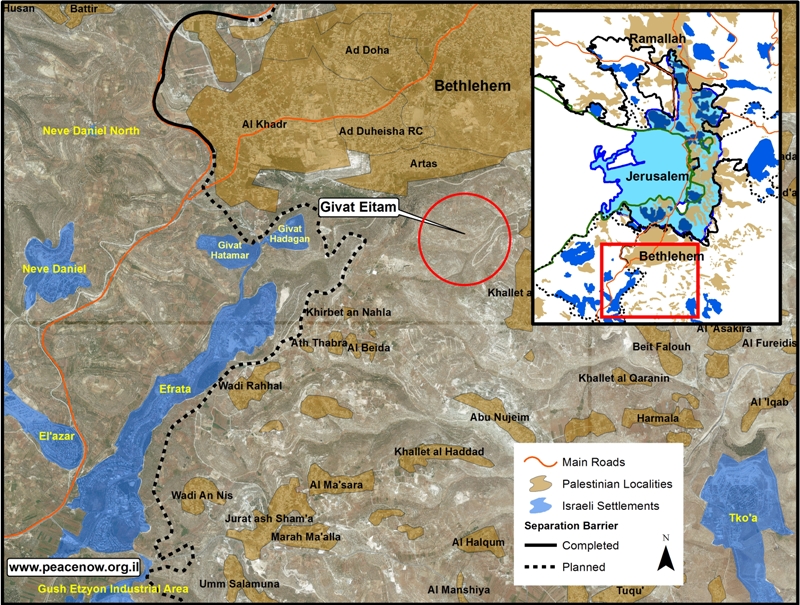
Map by Peace Now
The Givat Eitam settlement site – known to Palestinians as A-Nahle – is located on a strategic hilltop south of the Palestinian city of Bethlehem. The construction of Givat Eitam would significantly expand Efrat in the direction of Bethlehem, effectively cutting off Bethlehem off from the southern West Bank, completing the city’s encirclement by Israeli settlement construction. The Givat Eitam settlement plan has long been nicknamed “E-2” by settlement watchdogs, for its dire geopolitical implications for any future Palestinian state (similar to those of the E-1 settlement on Jerusalem’s eastern flank).
Earlier, on May 3rd, the Israeli Civil Administration dismissed Palestinian petitions challenging the allocation of an additional 1,100 dunams (225 acres) of land to the Efrat settlement – a decision that paved the way for Bennett’s announcement. That land allocation doubles the size of the Efrat settlement, and, more significantly, it allows for the construction of what will effectively be a new settlement to be called “Givat Eitam” — to be built within Efrat’s (expanded) borders but at a site that is not contiguous with the built-up area of Efrat. In its May 3rd ruling, the Civil Administration ruled that additional land was necessary for Efrat’s growth and development, and that the Givat Eitam site is the only land available (disregarding Palestinian needs for land for Bethlehem’s growth and development).
In 2004, the Israeli government designated the land to be used to build Givat Eitam as “state land,” despite the fact that Palestinians claim to have been actively cultivating the land for generations. Palestinians land owners assisted by the Israeli NGO Peace Now waged a 16-year legal battle to challenge the declaration of state land (which they lost), followed by a legal battle challenging the decision to allocate this “state land” for settlement purposes (which culminated with the May 3rd ruling).
Peace Now has declared its intention to escalate its petition against the land allocation to the High Court of Justice, and laid out its three-part legal argument:
- Allocating “state land” to build a settlement contravenes Israel’s duty to protect the land for the local Palestinian population according to international law;
- Allocating “state land” for the needs of Israelis (over those of Palestinians) is tainted by discrimination, as is clear from the fact that since 1967, Israel has allocated 99.8% of “state land” in the West Bank land primarily for the benefit of Israel/Israelis; and
- The Palestinian need for the land in question is far greater than that of the Efrat settlement, as a Peace Now spatial planning analysis confirms.
Addressing Bennett’s announcement of approval of the Givat Eitam plan, Peace Now said in a statement:
“This is a cynical move by a caretaker defense minister at the end of his mandate while the nation is still reeling from the corona crisis to advance a dangerous plan aimed at entrenching permanent Israeli domination in the southern West Bank and harming the prospect of a two-state solution. The right thing to do is to allocate the land for Palestinian construction, but the Ministry of Defense is currently run by an irresponsible politician willing to cross any red line in the name of his anti-democratic ideology.”
Following his announcement, Defense Minister Bennett tweeted:
“The building momentum in the country must not be stopped, even for a second.”
In September 2018, FMEP reported that the local council of the Efrat settlement, in response to a Palestinian terror attack, encouraged the start of (unauthorized) construction of an outpost at the Givat Eitam/E-2 site (presuming that any such illegal construction would be retroactively legalized by the government). Since then, the Civil Administration has allowed the settlers to build and maintain an agricultural farm there.
Givat Hamatos Tender is Delayed, as Settlers Agitate for Action
Ir Amim reports that the Israeli Land Authority did not open bidding on a tender for the construction of 1,077 units in the Givat Hamatos settlement, as it was scheduled to do on May 3rd. The ILA has proactively announced the postponement of several tenders that were scheduled for publication and/opening, but made no such announcement with regards to the highly sensitive and controversial Givat Hamatos tender. The delay has not pleased East Jerusalem settlement empresario Aryeh King (who is poised to become the Deputy Mayor of Jerusalem), who posted a message on Facebook pressing for action.
Ir Amim speculates that the Israeli government may be exercising caution on sensitive East Jerusalem plans like Givat Hamatos and Har Homa (plans for which were taken off of the agenda of the Jerusalem District Committee’s April 27th meeting), in light of international criticism of those plans specifically.
Ir Amim writes:
“Israeli right-wing groups are likely to demand that the tender must not be postponed regardless of any economic considerations. For example, Jerusalem right-wing council member Arye King who works to promote settlements in East Jerusalem has already posted on Facebook a reminder that the tender is due to open today.”
As a reminder, the Givat Hamatos settlement has been fully approved but not constructed. Located in the southern part of East Jerusalem, plans for the Givat Hamatos settlement have long been called a doomsday settlement by parties interested in preserving the possibility of a two-state solution. If the Givat Hamatos settlement is built, the Palestinian neighborhood of Beit Safafa in East Jerusalem will be completely surrounded by Israeli construction, severing its connection to the West Bank.
Over the past year of seemingly endless campaigning, Netanyahu faced intense and prolonged pressure from settler leaders and his political rivals to move ahead with plans for Givat Hamatos, a pressure point he alleviated in February 2020 when he announced that he had lifted the freeze on those plans.
Israel Exploits “Humanitarian” Access Issue to Flex its Muscles at Key Hebron Site
Outgoing Israeli Defense Minister Naftali Bennett has granted approval for a plan to expropriate land from the Islamic Waqf, ostensibly in order to make the Tomb of the Patriarchs/Ibrahimi Mosque wheelchair accessible. The decision sparked anger and controversy — it was slammed by the Palestinian Authority — both because it involves the expropriation of Waqf-held land, and because it directly violates arrangements Israel agreed to in the Oslo Accords, which give the Palestinian-run Municipality of Hebron planning authority over the site. The plan still needs to receive final approval from the Israeli Civil Administration’s High Planning Council, but it already enjoys the support of Prime Minister Netanyahu and the Justice Ministry. In addition, the Israeli Attorney General issued an opinion holding that Israel is legally permitted to expropriate the land for this humanitarian cause.
Providing critical context for why this plan is not really, or not fully, being advanced out of humanitarian concerns, the Israeli nonprofit Emek Shaveh – which is composed of archeological professionals – explains:
“Israel’s decision to seize responsibility for the site from the Hebron municipality and the Palestinians sends a clear political message that Israel is reneging on agreements that were signed with the Palestinians in Hebron. Beyond the precedent that will enable the settlers in the future to demand additional changes at the Tomb of the Patriarchs/Ibrahimi Mosque, this is also a precedent that could play out at other sites under the responsibility of the Islamic Waqf. Experience has shown us that what begins in Hebron percolates into other places including Jerusalem. It begins with a seemingly rational demand to benefit the disabled or the general public and evolves into a new status quo. The expected change in Hebron has not escaped the attention of members of the Temple movement and they will know how to present their demands to the government. If Israel can repudiate agreements with the Palestinians in Hebron and expropriate land from the Waqf, it would seem that accepting what appears to be the far more modest demands by the Temple movement to pray or to walk about the Temple Mount complex freely is not so far-fetched. In the reality of Hebron and East Jerusalem, a change involving only several meters at a historic or holy place is not free of political considerations and often it is part of long-term strategy. While it is necessary to tend to the needs and interests of persons with disabilities, the extremists who presume to speak on their behalf must be prevented from forging Israeli policy, even if it is only a matter of a lift and an access path.”
Read Emek Shaveh’s full analysis here: “Humanitarianism Hebron Style.”
HaMoked Continues Battle on Behalf of Palestinians Landowners Who Cannot Reach Their Land
Since March 2020, HaMoked has been fighting for the rights of Palestinian landowners to access their land located in the “seam zone” (i.e., in the West Bank but on the Israeli side of the separation barrier). Israel requires these landowners to coordinate with the Israeli military in order to obtain permits to go beyond the barrier. With the outbreak of the Coronavirus pandemic, the IDF began severely limiting the issuance of permits, and has now reportedly suspended all entry permits indefinitely. The IDF claims that the restrictions are meant to stop the spread of the virus.
These restrictions have severe implications for Palestinians, in addition to violating their property rights. For instance, HaMoked reports that the closure affects commercial activity and has shuttered businesses for several weeks. There are also about 100 Palestinians in the northern West Bank who are literally trapped, since their homes are located within the seam zone (in a section of the village of Nazlat ‘Isa, in the Tulkarm District, that lies beyond the separation barrier).
On May 4th HaMoked sent a new letter to the military demanding that access be reinstated in accordance with existing regulations.
Amb. Friedman Gives Two Interviews Clarifying (Once Against) Total Support for Annexation; Pompeo To Visit Israel Soon
In two separate interviews with Israeli outlets this week in commemoration of the two year anniversary of moving the U.S. Embassy to Jerusalem, U.S. Ambassador David Friedman again clarified that the Trump Administration is prepared to recognize annexation as soon as Israel moves forward, which Friedman says can happen in the coming weeks.
In a May 6th interview with Israel Hayom – the free, right-wing Israeli daily newspaper financed by Sheldon Adelson – Friedman stressed that the U.S. has not conditioned its support for Israeli annexation. The only “requirement” – which cannot be fairly described as such – of the Israeli government is that Netanyahu commits to the principle of negotiating with the Palestinians “in good faith” on the basis of the Trump Plan, if the Palestinian leadership first accepts that and decides to come to the table within the next four years. Friedman told Israel Hayom that Netanyahu has already met this “requirement.” Setting aside the fact that no Palestinian leader will agree to negotiate with Israel on the basis of a plan that, in advance, gives Israel almost everything that was supposed to be on the table in negotiations, the “requirement” is still entirely hollow. Even if Netanyahu were to commit to negotiate with the Palestinians on this basis, there is no way to compel a future Israeli leader to honor that commitment.
Friedman made this even clearer in a second interview with the Jerusalem Post:
“The expectation is that the prime minister will agree to negotiate — and if the Palestinians show up, he will negotiate in good faith based on this plan…I don’t see this as anything more than a commitment by the prime minister…[and] I’m not going to prejudge what good faith means.”
Friedman also sought to clarify that any notion that the Trump Plan calls for a “construction freeze” outside annexed areas is incorrect. Rather, all Israeli settlements and outposts outside the annexed areas will become part of enclaves – connected to Israel by access roads. Construction in these areas can continue but but should not expand beyond a given enclave’s “territorial footprint.” That condition will apply only to 10,000-15,000 settlers, according to Friedman, living in the enclaves.
Friedman repeatedly stressed that the U.S. is a passive actor when it comes to annexation: i.e., that annexation is Israel’s move to make, and the U.S. stands ready to recognize Israel’s decision. In his interview with the Jerusalem Post, he again used the phrase “Israel’s decision” and made a point of giving credit to U.S. Secretary of State Mike Pompeo with that turn of phrase. Pompeo is reportedly due to travel to Israel in the coming week.
Yesha Settlement Council Head Pushes For Annexation Vote Immediately, As Settlers Continue to Be Wary of Bibi’s Plans & Critical of the Trump Plan
On May 3rd, David Elhayani, chairman of the settler Yesha Council (an umbrella group representing all Israeli settlements), demanded that the Knesset take its first vote on annexation immediately. Elhayani threw his support behind a bill that will extend Israeli sovereignty (an act of de facto annexation) over the entire Jordan Valley and all settlements and outposts. The bill was introduced in March 2020 by Likud Knesset Member May Golan, with backing from the senior figures in the Likud Party.
Elhayani explains his support for the bill, which he believes would enjoy broad backing:
“The bill will apply sovereignty to Judea and Samaria and the Jordan Valley without recognition of a Palestinian state that would endanger the future of the state of Israel.”
Elhayani remark is an implicit attack on the Trump Plan (and the new unity government which appears set to implement that plan as soon as July 1st), as well as a challenge to Netanyahu’s public commitment to enacting annexation – a commitment about which settlers continue to be skeptical. As Elhayani sees it, Netanyahu’s approach hold out the possibility of the establishment of a Palestinian state, which he thinks is an existential threat to the security of the Israeli state. Elhayani has also publicly (and repeatedly) criticized the Trump Plan, saying just this week that the plan is a “scam.” Elhayani said:
“Representatives of the US government are [trying to] sell Plan A under the guise of Plan B. There is no greater scam than this…While the county is preoccupied with the coronavirus, the U.S. government is preparing the ground for the establishment of a Palestinian terrorist state and the well-oiled American public information machine will not stop for a moment as it tries to advance Trump’s peace plan in any way possible. There is a lot of text in the plan meant to confuse the public.”
Yossi Dagan – the head of the settlement Samaria Regional Council – joined Elhayani in his public opposition to the Trump Plan, saying:
“We will not agree to the establishment of a Palestinian state as part of the process of [enacting Israeli] sovereignty [in the West Bank]. Sovereignty is important to Israel’s security, but it is not worth damaging even a centimeter of the State of Israel and establishing a terror state in the heartland of the country. David Friedman [the United States Ambassador to Israel] is a warm and loving Jew. I know him, and I understand that he is doing everything possible to safeguard Israel’s interests. But with all the appreciation I have for Friedman, no American ambassador should worry about us. We chose Netanyahu, not the Americans.”
In response to remarks made by Amb. David Friedman this week (detailed above), the head of the Mount Hevron Regional Council, Yochai Damari, voiced support for the Plan, as well as his concern:
“Under Ambassador Friedman’s leadership, the sovereignty plan is progressing and we welcome it. We support the ambassador who, together with the prime minister and President Trump, are pushing for sovereignty and recognition of settlements as part of the State of Israel, thus bringing forth historical justice. The plan does, however, have red lines. We are concerned about the enclave provisions and unfortunately, we have not received clarifications about it. We will not allow thousands of families to be abandoned to the mercy of the terrorists.”
The mayor of the Efrat settlement, Oded Ravivi, urged the new unity government to act quickly on annexation, saying:
“this is a test not only for the new government, which is supposed to include applying sovereignty [to the area] by July, but also a test for the Israeli Right and the settlers’ leadership. Do they prefer having one bird in their hand or two in a tree? I believe we are facing a formative period and if we miss [this chance] we may lose the opportunity to change the future of a generation. I say yes to the plan!”
The mayor of the Beit El settlement, Shai Alon, said:
“Washington already understands the historical significance of Beit El and Judea and Samaria have for the people of Israel. It’s unthinkable that Jerusalem not do the same. It’s time to apply sovereignty. It’s time to leave this debate behind us and make Israel control over Judea and Samaria a fact.”
Bonus Reads
- “The day after annexation: Israel, Palestine and the one-state reality” (The New Arab)
- “The Dark Side of Annexing the Jordan Valley (Haaretz)
- “Palestinian Stiffen Battle Against Annexation at UN Security Council” (Jerusalem Post)
- “UK lawmakers urge Johnson to sanction Israel if West Bank annexation goes ahead“ (The Times for Israel)
- “Palestinians in Israeli-controlled West Bank Fall Through Cracks of Coronavirus Response” (Haaretz)
- “Israeli annexation plans would lead to ‘cascade of bad human rights consequences’, says UN expert” (OHCHR)
- “Israeli settler attacks on Palestinians increase under coronavirus lockdown” (Middle East Eye)
Welcome to FMEP’s Weekly Settlement Report, covering everything you need to know about Israeli settlement activity this week.
To subscribe to this report, please click here.
May 31, 2019
- Israel Publishes Tenders for 805 Settlement Units in East Jerusalem; More May Be Coming
- The World Zionist Organization Continues to Finance Illegal Settlement Construction
- Yitzhar Settlers Attack Israeli Police Officers, Again
- Israel Cut-Off & Trapped a Palestinian Family on the Israeli Side of the Wall, Then Banned Them from Entering Israel
- Palestinians React to Latest Annexation Rumors Amidst Israeli Government Chaos
- Florida Governor Leads Headline-Grabbing Trade Delegation to West Bank Settlements
- Scheindlin: Israel’s Democratic Decay is Happening for the Sake of Annexation
- Bonus Reads
For questions and/or comments contact Kristin McCarthy – kmccarthy@fmep.org.
Israel Publishes Tenders for 805 Settlement Units in East Jerusalem; More May Be Coming
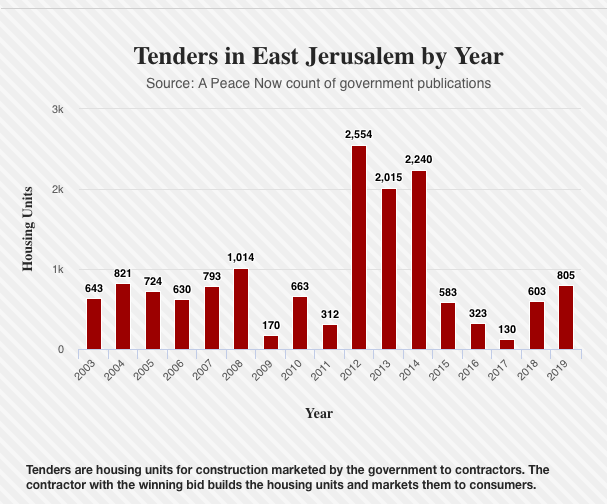 On May 30th, the Israel Land Authority published tenders for a total of 805 new settlement units in East Jerusalem, a decisive step towards the start of construction. The 805 tenders were issued for 345 units in the Ramot settlement and 460 new units in the Pisgat Ze’ev settlement. These are the first tenders published for East Jerusalem settlement construction since April 2018, and collectively are the most tenders published in a single year (let alone simultaneously) since 2014. Moreover, as Jerusalem expert Daniel Seidemann explains, this batch of tenders allows for more construction in East Jerusalem settlements than the government has approved for East Jerusalem Palestinian neighborhoods since Israel gained control of East Jerusalem in 1967.
Furthermore, the Jerusalem settlement watchdog group Ir Amim warns that this batch of tenders may only be the first of an oncoming wave:
“For several years after the collapse of the Kerry initiative in April 2014, there was a significant decrease in the approval of master plans in East Jerusalem and as a result, few tenders were announced. This dramatically changed in 2017 and 2018 with the advancement of master plans reaching near record levels. Today’s tenders are primarily a result of plan approvals from last year, potentially signaling impending large-scale announcements of tenders based on additional plans which have been approved over the last year.”
Peace Now, the veteran settlement monitoring organization, said in a statement:
“Continued construction in East Jerusalem does not contribute to Jerusalem and does not contribute to Israel. As long as we have not reached a permanent agreement with the Palestinians on Israel’s borders, building beyond the Green Line is illegitimate and only harms the prospects for peace and trust between the sides.”
The World Zionist Organization Continues to Finance Illegal Settlement Construction
According to documents acquired by Israel’s Movement for Freedom of Information, over the past two years the Settlement Division of the World Zionist Organization continued to finance illegal settlement construction while simultaneously trying to hide this information from the public.
As a reminder, the Settlement Division is technically part of the World Zionist Organization, but in practice the unit was created by the Israeli government in 1968 and is funded entirely by the Israeli government (and Israeli taxpayers). Its mandate is to manage West Bank land expropriated by Israel, in order to facilitate the settlement of Israeli Jews in the occupied territories. To make this possible, the Israeli government has allocated approximately 60% of all “state land” in the West Bank to the WZO’s Settlement Division [over the past 50 years Israel has declared huge areas of the West Bank to be “state land,” including more than 40% of Area C, where most of the settlements are located]. Together, the WZO and the Israeli government work in coordination to develop West Bank settlements and encourage Jews to move into them, working together so closely that the Settlement Division even splits its real estate profits with the Israeli Housing and Construction Ministry.
According to the WZO’s financial documents for 2017-2018, the WZO subsided settlement projects that are illegal under Israeli law — to the tune of $734,577 USD (NIS 2,668,427).
In addition, the WZO failed to specify how it spent an additional USD $16 million (NIS 58 million) in support of new construction projects, leaving the exact location and legal status of the construction unknown. This represents 43% of the WZO’s overall budget for subsidizing projects.
The settlement projects known to have been subsidized by the WZO in 2017-2018 include:
-
- $640,000 USD (NIS 2,330,973) for the establishment of a community center in the Eli settlement. Though the Eli settlement previously received Israeli government approval, a “Master Plan” – which officially zones land for distinct purposes (residential, commercial, public) – has never been issued for Eli, meaning all construction there is illegal under Israeli law.
- $85,816 USD (NIS 311,736) on projects in the unauthorized Brosh outpost (the Israeli government is advancing a plan that would legalize Brosh retroactively, but until it does, all projects in it are illegal).
- $42,000 USD (NIS 153,127) for infrastructure development in the unauthorized Givat Eitam/E-2 outpost, which according to Peace Now appears had not been transferred as of the end of 2018. FMEP has covered the settlers efforts to establish the Givat Eitam/E-2 outpost and the government’s plan to retroactively authorize it as an official settlement in detail. It is worth recalling that the location of the Givat Eitam/E-2 has dire geopolitical consequences for the fate of the two state solution as well as the development of Palestinian communities just south of Bethlehem.
- $6,000 USD (NIS 22,445) for projects in the unauthorized Mitzpe Kramim outpost. Funding for Mitzpe Kramim over the past two years is particularly galling, given ongoing litigation that has included evidence that the Settlement Division knowingly gave land privately owned by Palestinians to settlers in order to build the outpost.
- $900 USD (NIS 3,273) for renovation of illegal structures in the unauthorized outpost of Haresha. The Israeli government has successfully used the Haresha outpost as a test case for new legal tools the government of Israel developed in order to justify the expropriation of privately owned Palestinian land in order to retroactively legalize outposts. Using these tools, the government has found a way to “legally” build an access road to the settlement through privately owned Palestinian land; once the road is built, there is nothing preventing the government from retroactively legalizing Haresha.
Peace Now said in a statement:
“The Settlement Division is a body that was born in sin immediately after 1967 in order to carry out the dubious works of building settlements for the government. It turns out that even today, after regulating the activities of the Settlement Division, it still operates without transparency and continues to finance illegal activity. The time has come to dismantle the Settlement Division and to restore to the government the governmental activities it has privatized.”
Despite the WZO’s ongoing defiance of Israeli planning and building laws — or perhaps in light of its direct and very effective role in entrenching and expanding the settlements — the Israeli government is actively seeking to transfer more West Bank land to the WZO for management. In the last Knesset session, a government-backed bill to expedite the transfer of more land to the WZO was stalled by the Israeli Attorney General only because the bill, in the view of the Attorney General, was duplicative of his own efforts to enrich the Settlement Division at the administrative level.
Yitzhar Settlers Attack Israeli Police Officers, Again
On May 26th, dozens of masked Israeli settlers violently attacked Israeli police officers who approached an illegal outpost near the settlement of Yitzhar, forcing the Israeli army to intervene in order to get the police officers to safety.
Not a single settler was arrested for the attack.
The event started when Israeli police arrived at the Kippah Sruga outpost in response to calls saying that clashes had broken out between Palestinians and Israelis in the area. According to Israeli police, when they arrived masked settlers began launching stones at them and slashed their car tires with a knife.
Haaretz reporting on this incident reminds readers:
“Over the past several weeks, settlers from Yizhar and surrounding settlements have been involved in several altercations, yet police have not arrested a single suspect. Last week, Israelis and Palestinians reported a field set ablaze and clashes in the Palestinian towns of Burin, Urief and Asira al-Qibliya. In a video disseminated by Asira al-Qibliya’s council, settlers are seen throwing stones at Palestinians, while soldiers nearby do nothing to arrest them. In response to the video, the IDF spokesman said that ‘Palestinians started a fire near Asira al-Qibliya. The IDF, the Border Police and civilian volunteers worked to extinguish the fire, which was spreading towards a military position and the edge of Yitzhar.’ After a B’Tselem video surfaced, showing settlers setting fire to fields, the army revised its response and confirmed that Jewish settlers also took part in setting fires.”
Israel Cut-Off & Trapped a Palestinian Family on the Israeli Side of the Wall, Then Banned Them from Entering Israel
On May 27th, Haaretz published a gut wrenching profile of the Hajajla family who lives on the Israeli side of the separation wall that cut them off from their hometown of al-Walajah, a Palestinian village just south of Jerusalem. Two days after publication of the profile – which FMEP shares in brief below – Israel issued an order banning the patriarch of the family, Omar Hajajala, from entering Israel, though he lives on the Israeli side of the wall in a spot where the route of the wall juts into the West Bank.
Before jumping into the full story, here is a reminder about the situation facing all of the residents of al-Walajah, in the words of Danny Seidemann:
“Walajeh is a village on Jerusalem’s southern flank that is entirely surrounded by the separation barrier. Since 1967, Walajeh’s inhabitants have lived in a Kafka-esque situation, with their village technically located inside Israel’s expanded borders, but with villagers never given Israeli residency (they are considered West Bankers and thus are not permitted inside Jerusalem). As a result, the villagers’ presence in their own village is, under Israeli law, illegal, and their homes there are, by definition, illegal.”
The Hajajla family was the only home in al-Walajah disconnected from the village when the separation barrier was built, leaving the family home on the Israeli side of the wall since 2014. The family refused to abandon their home despite the coercive and legal efforts by Israel to force them to do so. In 2014, after a petition before the High Court of Justice, the Defense Ministry opted to build the family a special passage underneath the barrier so it could reach the village, at a cost $1.1 million USD (NIS 4 million).
After the tunnel was constructed, the Israeli government began to impose new, burdensome, and compounding restrictions on the family regarding its use of the passageway. In 2017, the government decided to install a locked gate at one end of the passageway to control who enters and exits, which could be opened only by a single remote control given to the family. That single remote meant that whenever one member of the family left the home (impossible without taking the remote control with them), the rest of the family was left trapped, literally, until the remote-holder returned.
To make the situation more workable, Omar Hajajla, the family’s patriarch rigged an electric bell near the gate so that the single remote control can stay at the house while family members leave and return (the bell enables someone in the home to know that someone is at the gate needing to be let in). The bell has been in place for over a year, but only recently the Israeli Border police opted to make it an issue. This month, the police took Omar in for questioning and changed the lock so that the family could not open the gate at all. Omar Hajajla was ultimately fined and released, but the lock on the gate remained — until Haaretz filed an inquiry on May 26, 2019.
Omar Hajajla speculates that a recent court ruling in his family’s favor prompted the Israeli Border police to escalate their harassment of the family and make an issue of the bell. About a month ago, the Jerusalem Magistrate’s Court rejected the state’s assertion that the family’s home is illegal – allowing the Hajajla family to stay put.(Note: The state of Israel has initiated demolition proceedings against dozens of homes in al-Walajah claiming that they were built without Israeli building permits – which are next to impossible for Palestinians to obtain, let alone Palestinians on coveted land like al-Walajah) –
In response to the May 27th Haaretz profile, Israeli police stated:
“At issue is a security passage that provides a short passage for the family from their home in Israeli territory to the Palestinian Authority areas. As you can see from the attached video and photos, the gate was shut last Monday to repair security cameras that were broken, to repair damage to the gate and to remove an electric bell that the father of the family had installed against the law, by attaching an unapproved electric wire from his home, a distance of dozens of meters from the passage. After the repair the passage was opened on Wednesday but when the father was seen exploiting it to illegally allow Palestinians to enter it was shut again and the suspect was taken for questioning. The passage was opened again yesterday, but because of a technical problem that was discovered it was shut again and we are working to fix it quickly. The Israel Police will not allow any damage to the security passages it is responsible for and will bring to justice anyone who vandalizes them and tries to harm the State of Israel’s security.”
The treatment of the Hajajla family should be seen in context of Israeli efforts to seal off al-Walajah from Jerusalem. As FMEP has previously reported, residents of al-Walajah have long been struggling against the growing encroachment the nearby Etzion settlement bloc and the Israeli government’s attempt to de facto annex the bloc as part of “Greater Jerusalem.” Ir Amim explains several prongs of this effort, including a particularly problematic section of the separation barrier around al-Walajah that has been planned in order to (a) almost completely encircle the village, (b) turn its valuable agricultural land into an urban park for Jerusalem, and (c) enable construction of a highway that will connect the Etzion settlement bloc to Jerusalem with Israeli-only bypass roads.
Palestinians React to Latest Annexation Rumors Amidst Israeli Government Chaos
Al-Monitor reports reactions from Palestinian leaders who are increasingly fearful that rumors about Israeli annexation of the settlements will be acted upon. Those rumors – as FMEP wrote last week – suggest that Israel will strip the Israel Civil Administration of its authority over the settlements and bring all settlements under Israeli domestic law, making settlement affairs the responsibility of the various Israeli ministries.
Wasel Abu Youssef, member of the PLO Executive Committee in the West Bank, told Al-Monitor:
“Expanding the powers of the Israeli ministries at the expense of the civil administration is an attempt to impose occupation and establish it in the West Bank, to end the [idea of a] two-state solution and prevent the establishment of a Palestinian state, which falls within the framework of denying the Palestinian people their rights to freedom and independence. These efforts mean practically annexing parts of the West Bank to Israel. Unfortunately, this comes with the blessing of the administration of US President Donald Trump, who doesn’t recognize the option of a two-state solution and gives Israel the green light to do whatever it wants in the West Bank.”
Walid Assaf, head of the Colonization and Wall Resistance Commission, told Al-Monitor:
“The efforts to transfer the powers of the civil administration to the Israeli ministries directly mean the annexation of the West Bank settlements to Israel. This will lead to annexing Area C — which amounts to over 60% of the entire area of the West Bank — to Israeli sovereignty…Annexing West Bank settlements to Israel would pave the way for Israel to perpetuate a policy of ethnic cleansing against the Palestinians, and this will push the Palestinians in Area C to migrate to PA-controlled Areas A and B.”
Hanna Issa, an international law professor at Al-Quds University in Abu Dis, told Al-Monitor:
“The Israeli occupation has always been there. It is essential that the Palestinian territories [including the Israeli settlements] remain administered through the civil administration of the Israeli army [in cooperation with the Palestinians] until this occupation ends…“Limiting the powers of this administration and giving its responsibilities to the Israeli ministries is a dangerous step aimed at annexing occupied areas under international law.”
Scheindlin: Israel’s Democratic Decay is Happening for the Sake of Annexation
In a new paper for The Century Foundation, Israeli pollster and political analyst Dahlia Scheindlin writes an important analysis regarding Israel’s path to annexation:
“This report argues that Israel’s slide into illiberal democracy can only be understood as part of an attempt to go beyond military or physical control and establish a political and legal foundation for permanent annexation of both land and people. The assault on Israel’s democratic norms over the past decade initially appeared only indirectly related to a future of permanent annexation, as they suppressed the mechanisms of dissent and undermined the basis for minority rights. Then, in the recent elections, Prime Minister Benjamin Netanyahu made explicit his goal to annex occupied territory in the West Bank, which represented the culmination (to date) of increasingly open policies and legislative initiatives from the previous term that explicitly advance annexation.”
The entire paper is worth reading, and is available online here.
Florida Governor Leads Headline-Grabbing Trade Delegation to West Bank Settlements
From May 25-31, Florida Governor Ron DeSantis led a trade mission – purposefully and prominently also visiting settlements in the West Bank. While on the ground, DeSantis made headlines by blasting BDS, endorsing Israeli settlements, and gloating about Florida’s role in AirBnB’s reversal of its decision to remove rental listing located in Israeli settlements.
DeSantis signed several formal partnerships between Florida universities and Israeli schools, most notably including an agreement between Florida Atlantic University and Ariel University – the first such deal between a U.S. school and an Israeli school located in a settlement. In recognition of the historic deal, Ariel University presented DeSantis with an Honorary Fellowship Award at an event in the settlement, attended by U.S. casino magnates and settlement financiers Sheldon Adelson and Dr. Miriam Adelson. In his acceptance speech, the Governor invoked the Bible to lend his support for Israel’s permanent control of the West Bank, saying:
“We are now in the heart of the Holy Land of Israel. When you think about Israel’s history and the tradition that connects Israel and the U.S., it’s inspiring. On my last visit to Israel in 2014, the U.S. embassy was in Tel Aviv and we were on the verge of signing a destructive agreement with Iran, and I am happy that today we have achieved real progress. We have an American embassy in Jerusalem with an American acceptance of the sovereignty of the State of Israel on the Golan Heights and the agreement with Iran has been removed from the stage of history. I, personally, have fought Airbnb’s discriminatory policy against Jewish-owned properties in Judea and Samaria, and only recently have they changed their discriminatory policy. I say here: BDS has no place in Florida. The memorandum of understanding signed today between the University of Ariel and Florida State University is a blessed agreement that will bring these two institutions forward. I am happy to say that Florida is a very diverse state, but not when it comes to its unequivocal support for the State of Israel.”
U.S. Ambassador to Israel David Friedman also hosted DeSantis for a reception and Israel’s Minister of Public Security Gilad Erdan joined DeSantis on a visit to additional West Bank settlements, this time in Gush Etzion, for a briefing about the fight against BDS. Friedman said:
“Israel has no greater friend in all the 50 governor mansions than Ron DeSantis. I welcome you and the Cabinet members and your delegation to this small but incredibly important country.”
As mentioned by Ambassador Friedman, DeSantis was joined by members of the Florida Cabinet on the trade mission, including Florida Attorney General Ashley Moody and Florida Agricultural Commissioner Nikki Fried. In a controversial move, DeSantis convened a Florida cabinet meeting on May 29th at the Embassy in Jerusalem, despite a lawsuit filed in Florida seeking to stop him from doing so. The lawsuit was filed by a government watchdog group and several news outlets, arguing that convening the Cabinet in Israel violated a state law that requires government meetings to be accessible to the public. The lawsuit was dismissed because the court could not serve paperwork to DeSantis and the other named defendants – who were, obviously, in Israel.
At the Cabinet meeting on may 29th, DeSantis signed a bill to prohibit anti-Semitism in Florida’s public schools and universities. The new law wrongly conflates anti-Semitism with criticism of Israel by including in the definition of anti-Semitism, “drawing comparisons of contemporary Israeli policy to that of the Nazis,” ″blaming Israel for all interreligious or political tensions,” and/or “requiring behavior of Israel that is not expected or demanded of any other democratic nation.”
The next day, DeSantis met with Prime Minister Netanyahu while the larger delegation visited the City of David national park, which is run by the radical Elad settler group.
Bonus Reads
- “Israel’s High Court Seeks Order, Not Justice” (Haaretz)
- “Another Company Withdraws from Israeli Light Rail Project” (IMEMC)
Welcome to FMEP’s Weekly Settlement Report, covering everything you need to know about Israeli settlement activity this week.
To subscribe to this report, please click here.
February 15, 2019
- Israel Announces Plan to Retroactively Legalize Settlement Units Built on Privately Owned Palestinian Land
- Jerusalem Planning Authorities Are Quietly Advancing Sensitive Settlement Projects in East Jerusalem
- Peace Now Files Appeal Against Settler Land Grab for New “E-2/Givat Eitam” Settlement
- Peace Now Petitions High Court to End Flow of Public Funds to Settler Organization
- AG Paves Way for Ariel Medical School to Open, Despite Rejection by Key Committee
- Following Expulsion of International Observers, Emboldened Settlers Attack Palestinians
- Yitzhar Settlers Attack Palestinian School, So IDF Restricts Palestinian Access to Roads to Allow Yitzhar Settler Protests
- NEW: Ir Amim Publishes 2019 Map of Settlement Projects In and Around Jerusalem’s Old City
- Bonus Reads
Questions/comments? Email kmccarthy@fmep.org
Israel Announces Plan to Retroactively Legalize Settlement Units Built on Privately Owned Palestinian Land
On February 10th, the Israeli government informed the Jerusalem District Court that it plans to invoke the “market regulation” principle in order to retroactively legalize four structures in the Alei Zahav settlement – structures built on land that even Israel acknowledges is privately owned by Palestinians.
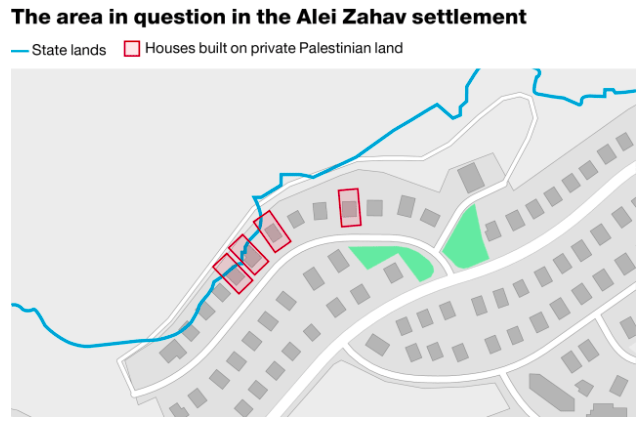
According to Haaretz, a 2016 land survey conducted by the Israeli Civil Administration discovered the existence of privately owned Palestinian land in the settlement, which older Israeli maps had marked as “state land.” After the discovery, settlers went to court to sue the World Zionist Organization (which was allocated the land by the Israeli government), the Israeli Defense Ministry, and the contractor who built the settlement demanding that they fix the situation. The state’s response to the Jerusalem District Court this week freezes the settler’s petition while the government’s plan is implemented.
The “market regulation” principle was identified by Israeli Attorney General Avichai Mandelblit as an alternative to the settlement Regulation Law (the controversial law passed by the Knesset that, in effect, lets the Israeli government suspend the rule of law to seize privately owned Palestinian land for the benefit of settlers). Both the Regulation Law and the “market regulation” principle are designed to give Israel legal cover to retroactively legalize outposts and settlement structures that, because they are built on land that Israel acknowledges is privately owned by Palestinians, the State had been unable legalize under existing Israeli law (despite great efforts to do so). The “market regulation” principle holds that Israeli settlement construction can be retroactively legalized if it was carried out “in good faith” with government support on land that was later discovered to be privately owned by Palestinians.
The Israeli High Court is already considering a petition against the constitutionality of the “market regulation” principle, a case stemming from the State’s first attempt to implement it in order to retroactively legalize the Mitzpe Kramim outpost.
If allowed to proceed on the basis of the “market regulation” principle, the state will first have to publish an official planning scheme for the area, and allow the public (including the Palestinian landowners, as recognized by Israeli) to object. Attorney Alaa Mahajna, who is representing the Palestinian landowners involved in the case, said:
“Even without making use of the vilified expropriation law [aka the Regulation Law], the state still finds ways and uses other routes to attain the same goal, giving its legal imprimatur to robbery of land, with residents who are protected under international law.”
FMEP tracks the ongoing legislative, political, and legal transformations happening in the Israeli government to justify the expropriation of Palestinian land for the settlements in its Annexation Policy Tables.
Jerusalem Planning Authorities Are Quietly Advancing Sensitive Settlement Projects in East Jerusalem
Ir Amim reports that East Jerusalem settlement planning authorities are advancing sensitive settlement projects in East Jerusalem through secretive and expedited processes, thereby limiting the opportunity for stakeholders and the public to challenge the plans.
For example, on February 5th, the Jerusalem Local Planning and Building Committee discussed public objections filed against two settlement plans in Sheikh Jarrah. Both of the plans are being promoted by East Jerusalem settlement impresario and city council member Aryeh King. The committee did not notify those objecting to the plan that these proceedings were planned, and so no one objecting to the plan was present in the February 5th discussion. The plans, which would allow for the construction of two new buildings – one with 10 units and the other with 3 units – would involve the eviction of 5 Palestinian families from buildings that would be demolished.
On February 17th, the Jerusalem District Planning and Building Committee will consider the Glassman Yeshiva project – a plan to build a Jewish religious school, including dormitories, at the entrance to the Sheikh Jarrah neighborhood. Ir Amim reports that it is unclear what the committee will do in considering the plan, since authorities have advanced the plan outside of the normal planning process, even succeeding in have land allocated for the yeshiva despite the fact that the plan was never deposited for public review (meaning stakeholders and the public have had no opportunity to object).
Ir Amim writes:
“Despite their tremendous political and environmental sensitivity, plans are now being fast tracked, some outside of appropriate planning channels and with limited public participation, in service to decidedly political considerations and with the prominent involvement of settler associations. The new map and accompanying map notes detail the numerous projects and eviction cases now advancing.”
For an explanation of how East Jerusalem settlement planning/approval is supposed to work under Israeli law and practice, see Terrestrial Jerusalem’s presentation here.
Peace Now Files Appeal Against Settler Land Grab for New “E-2/Givat Eitam” Settlement
On February 7th, the settlement watchdog group Peace Now and dozens of Palestinian landowners filed a petition with the Israeli Custodian of Government and Abandoned Property demanding the annulment of the allocation of “state land” for the sole declared purpose of building the new “E-2/Givat Eitam” settlement.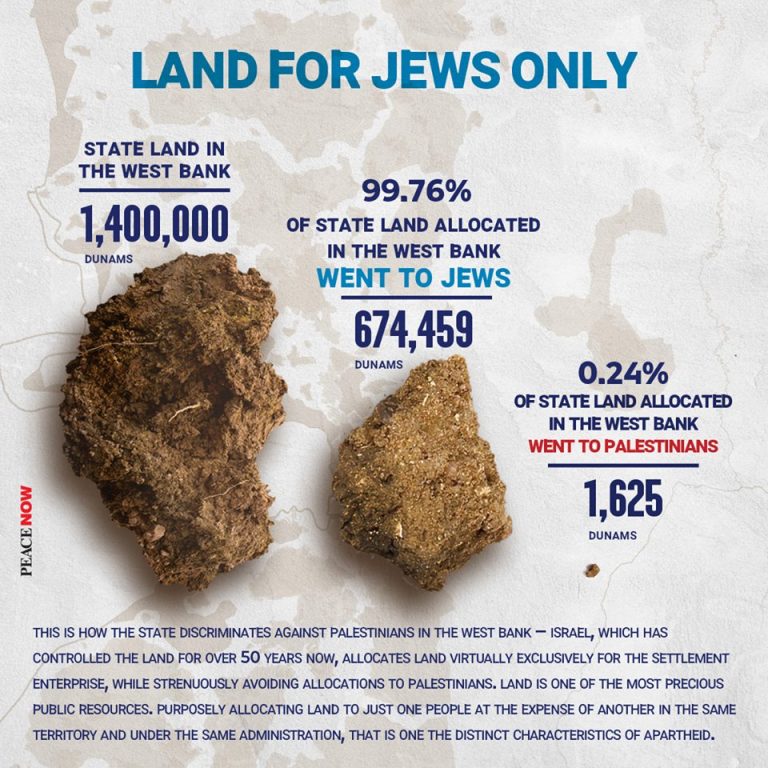 Rather than challenging Israel’s classification of the land as “state land,” the petition asks that the land be allocated instead for Palestinian use, challenging Israel’s discriminatory allocation of “state land” for the settlements. It builds on recent revelations that since 1967, Israel has allocated a jaw-dropping 99.8% of state land in the West Bank to settlements and just 0.2% for Palestinians.
The petition argues that the allocation of state land for the exclusive use of settlements/settlers is illegal both under the Hague Conventions and under domestic anti-discrimination laws in Israel.
Regarding the new petition, Peace Now says:
“Since the 1979 Elon Moreh ruling, no petition has succeeded in undermining the legal infrastructure that enables the ongoing expansion of the settlement enterprise. This initiative and the surrounding public struggle aims to undermine the prevailing view that “state land” in the occupied territories effectively constitutes land available for Israeli use, and to obligate the Supreme Court and the Israeli public, to address this fundamental question.”
Israel announced on December 26, 2018 that it will draft plans to build as many as 2,500 new settlement units at the Givat Eitam outpost site, creating a new settlement on a strategic hilltop that will cut off Bethlehem from the southern West Bank, completing the encirclement of Bethlehem by Israeli settlements.
Map by Peace Now
The Givat Eitam outpost has been nicknamed “E-2” by settlement watchers for for its resemblance, in terms of dire geopolitical implications, to the infamous E-1 settlement plan. Located east of the separation barrier on a strategic hilltop overlooking the Palestinian city of Bethlehem to its north, the site of Givat Eitam/E-2 is within the municipal borders of the Efrat settlement but is not contiguous with Efrat’s built-up area. As such, Givat Eitam/E-2 would effectively be a new settlement that, according to Peace Now, would:
“block Bethlehem from the south, and prevent any development in the only direction that has not yet been blocked by settlements (the city is already blocked from the North by the East Jerusalem settlements of Gilo and Har Homa, and from the West by the Gush Etzion Settlements) or bypass roads (that were paved principally for Israeli settlers). The planned building in area E2 would likely finalize the cutting off of Bethlehem city from the southern West Bank, delivering a crushing blow to the Two States solution.”
Peace Now Petitions High Court to End Flow of Public Funds to Settler Organization
The settlement watchdog group Peace Now has filed a petition with the High Court of Justice to stop public funding flowing to the radical Amana settler organization, which is a private, for-profit entity engaging in various illegal activities to establish and expand Israeli settlements and outposts across the West Bank.
The new petition is based on Peace Now’s investigative work revealing the substantial amount of money that has been secretly funneled to Amana through settlement regional councils. The settlement regional council budgets obtained by Peace Now revealed that money allocated to support non-profit public welfare groups was instead being used to fund Amana. Funding for Amana in this manner violates Israeli Interior Ministry policies prohibiting public subsidies for private, for-profit entities – and it is this funding that Peace Now is petitioning the High Court to end.
Peace Now’s work is backed up two separate reports of the Israeli Comptroller’s office, one from November 2017 and another from July 2018, which detailed the extent to which the Binyamin Regional Council – the largest settlement regional council – secretly funneled money to organizations engaged in illegal settlement construction. The July 2018 report revealed that the Binyamin Regional Council funneled $10 million to Amana between 2013-2015 alone.
Peace Now said in a statement:
“This grave phenomenon in which taxpayers’ money is transferred to an organization that has specialized in construction violations for decades, is against the law and regulations; an organization that works tirelessly to change reality by illegally establishing unauthorized facts on the ground, is dire and must be stopped. Only a complete cessation of this cash flow will prevent further construction rampages throughout the West Bank, and retain the opportunity for a future agreement.”
AG Paves Way for Ariel Medical School to Open, Despite Rejection by Key Committee
On February 13th, Israeli Attorney General Avichai Mandelblit announced that the vote last week by the Planning & Budgeting Committee of the Council for Higher Education in Israel is a non-binding recommendation, and that the fate of the Ariel settlement’s new medical school will be determined by a final vote to be held by the council’s main body. In so doing, Mandelblit made it possible for the main body of the Council for Higher Education in Israel to vote against its own professional subcommittee, contrary to the normal practice. Indeed, Haaretz columnist Or Kashti even called it “unreasonable.”
Mandelblit said that the Council for Higher Education in Israel should reconvene to vote within the next two months in order to give the medical school, its faculty, and its students, adequate time to prepare. Haaretz reports that Education Minister Naftali Bennett – who serves as the Chairman of the Council for Higher Education in Israel – is expected to delay the vote until he is confident that he has enough votes in favor of approving the medical school.
In addition, Mandelblit also allowed the West Bank arm of the Council for Higher Education – a settler body which oversees and promotes educational institutes located in West Bank settlements (i.e. outside of sovereign Israeli territory) – to take vote on the matter. Unsurprisingly, on Feb. 13th the settler body voted unanimously to approve the medical school. It did so in a vote that was held in the final hours before that settler body was absorbed by Council for Higher Education in Israel, following a law passed by the Israeli Knesset in Feb 2018 that extends the jurisdiction of the Council for Higher Education in Israel to include schools in the settlements (an act of de facto annexation).
Weighing in on the debate, the Haaretz Editorial Board noted that supporters of the Ariel medical school – including Naftali Bennett – lobbied for the settlers’ own Council for Higher Education to be permitted to vote on the matter in an attempt to overrule the Planning & Budgeting Committee’s unfavorable decision. The Board writes:
“In a country governed by the rule of law, the [Planning & Budgeting] committee’s latest vote should have settled the matter. But Ariel University and its supporters, above all Education Minister Naftali Bennett, have ways to circumvent the committee. We will soon find out whether Mendelblit will approve this move, enabling Ariel to overcome the professional objections of the Planning and Budgeting Committee, the opposition of the other universities and Wadmany Shauman’s conflict of interest. This hasty resort to the Council for Higher Education in Judea and Samaria – which has never dealt with budgetary issues, only ideological ones – should set off alarm bells. After the Planning and Budgeting Committee’s previous vote, approving the med school, no one demanded reaffirmation from the council. That’s not how the higher education system should operate. The Planning and Budgeting Committee steers its course, including the disbursal of its 11 billion shekel ($3 billion) annual budget.”
As FMEP has previously reported, Ariel University became an accredited Israeli university in 2012, following significant controversy and opposition, including from Israeli academics. It has since been the focus of additional controversy, linked to what is a clear Israeli government-backed agenda of exploiting academia to normalize and annex settlements. In 2018, the settlement broke ground on the new medical school, with significant financial backing from U.S. casino magnate, settlement financier, and Trump backer Sheldon Adelson. In February 2018, in an act of deliberate de facto annexation, the Israeli Knesset passed a law extending the jurisdiction of the Israeli Council on Higher Education over universities in the settlements (beyond Israel’s recognized sovereign borders), ensuring that the Ariel settlement medical school (and its graduates) would be entitled to all the same rights, privileges, and certifications as schools and students in sovereign Israel.
The Ariel settlement is located in the heart of the northern West Bank, reaching literally to the midpoint between the Green Line and the Jordan border. The future of Ariel has long been one of the greatest challenges to any possible peace agreement, since any plan to attach Ariel to Israel will cut the northern West Bank into pieces.
Following Expulsion of International Observers, Emboldened Settlers Attacks on Palestinians
In the week since Israeli Prime Minister announced that he would not renew the mandate of the Temporary International Presence in Hebron (TIPH) – in effect, expelling international observers from the city – radical, violent settlers have repeatedly harassed and attacked Palestinians, including school children. Thus far the Israeli military has failed to intervene to stop the encounters.
Following the expulsion of the observers, who previously escorted Palestinian school children on their daily commute near settlement enclaves in downtown Hebron, Palestinians formed a volunteer group to escort and protect the children. On February 10th, alarming video footage shows settlers harassing and attacking this new group as it was escorting children. In response, the Israeli army issued an order on Feb. 13th that declared the area as a closed military zone, barring the volunteers from escorting the students.
On the evening of February 12th, a group of settlers attacked Palestinian homes on Shuhada Street, the main street in downtown Hebron which Israel has “sterilized” by preventing all Palestinian vehicles, limiting Palestinian pedestrians, and relegating Palestinian foot traffic to a specific area. One Palestinian resident reported that a settler jumped onto his roof and broke into his home; the IDF had to escort the settler out, and disperse the group of settlers who were chanting anti-Palestinian threats. Video footage captured the scenes.
Yitzhar Settlers Attack Palestinian School, So IDF Restricts Palestinian Access to Roads to Allow Yitzhar Settler Protests
On February 10th, dozens of settlers from the Yitzhar settlement descended from their hilltop neighborhood to violently attack a high school in the Palestinian village of Urif. According to reports, high school students clashed with IDF soldiers who were providing protection for the raiding group of settlers. Ten students reportedly required medical care for tear gas inhalation.
The next day, on February 11th, the Israeli IDF sealed off several roads near the Yitzhar settlement to allow the settlers to assemble to protest against “the deteriorating security situation in the West Bank.”
The anti-settlement group Yesh Din recently published a report, entitled “Yitzhar – A Case Study,” chronicling the violence of the Yitzhar settlement, and how that violence is used as a strategic means to take over Palestinian land.
NEW: Ir Amim Publishes 2019 Map of Settlement Projects In and Around Jerusalem’s Old City
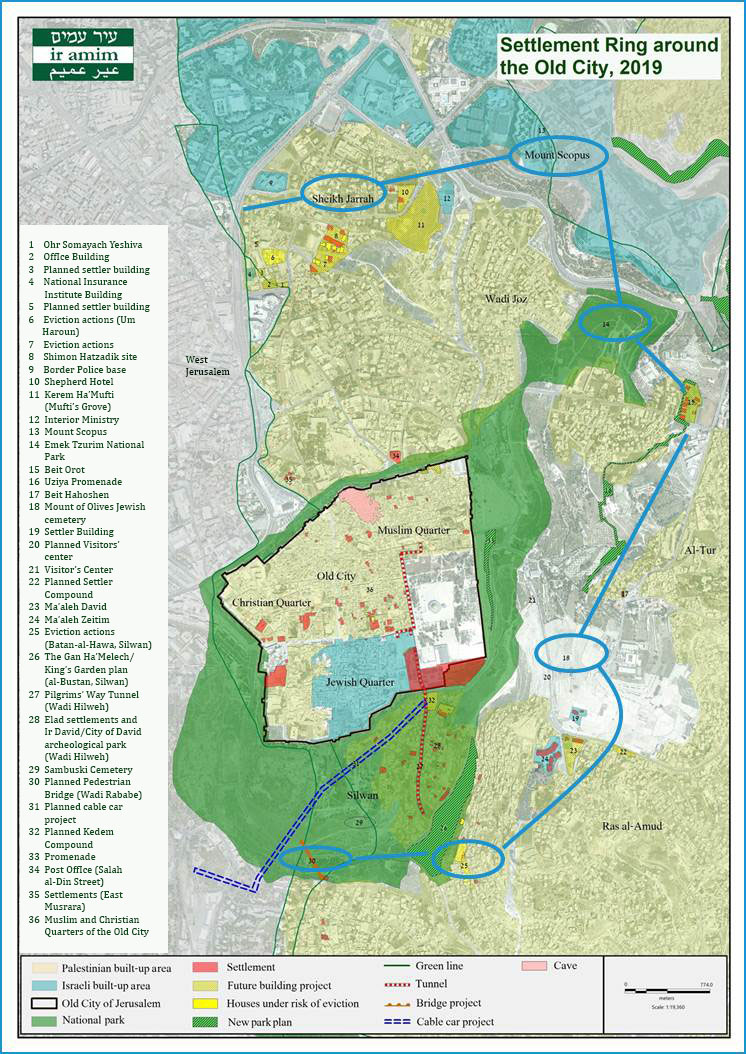 Ir Amim released an updated map showing settler activities around Jerusalem’s Old City.
Announcing the new map, Ir Amim writes:
“Ir Amim’s latest map, ‘Settlement Ring around the Old City, 2019,’ graphically illustrates the accelerated, intensifying chain of new facts on the ground in the most historically contested and politically sensitive part of Jerusalem: the Old City and adjacent ring of Palestinian neighborhoods. In addition to a mounting number of state-sponsored settlement campaigns inside Palestinian neighborhoods – settler initiated evictions of Palestinians, takeovers of their homes, and the expansion of settler compounds – touristic settlement sites function as key points along a ring of tightening Israeli control….These projects – including promenades, national parks and visitor centers – serve manifold purposes: They connect otherwise isolated and relatively small settlement compounds inside Palestinian neighborhoods, creating a contiguous ring of settler controlled areas; They fracture the Palestinian space, disrupting freedom of movement and breaking large neighborhoods into smaller, easier to police enclaves;While the number of ideologically driven settlers living inside Palestinian neighborhoods may still be relatively small, tens of thousands of non-ideological Israeli tourists visiting these sites serves to strengthen the Jewish presence inside Palestinian areas of the city.”
The map can be downloaded here and accompanying detailed notes here.
Bonus Reads
- “Why Residents of Jerusalem’s Sheikh Jarrah Face Eviction” (Al-Monitor)
- “Imminent Eviction of Palestinian family in East Jerusalem” (OCHA)
- “Two Jewish Groups’ Disagreement Over Jewish Law Might Dash Jerusalem’s Dreams (Haaretz)
- “What Kind of Occupation do Israelis Want?” (Ynet)
Welcome to FMEP’s Weekly Settlement Report, covering everything you need to know about Israeli settlement activity this week.
To subscribe to this report, please click here.
January 25, 2019
- A 45-person Palestinian Family Will Be Evicted from Home in Sheikh Jarrah for the Benefit of Settlers
- Bidding War Between Settlers and Palestinians Drives $3.27 Million Price for Sheikh Jarrah House
- Settlers Impose Sabbath Closure on Palestinian Residents of Silwan; High Court Asks: Why?
- Israel to “Examine” Two Cases of lllegal Outpost Construction
- MK Bezalel Smotrich – A Radical Settler – Elected to Lead National Union Party
- European Union Statement Lambasts “Givat Eitam/E-2” Settlement Plan
- Bonus Reads
Questions/comments? Email kmccarthy@fmep.org
A 45-person Palestinian Family Will Be Evicted from Home in Sheikh Jarrah for the Benefit of Settlers
With the Israeli Supreme Court’s decision to refuse consideration of new information in the Sabbagh family eviction case, the Court has given a greenlight for Israeli settlers and their allies to not only evict the Sabbaghs but to continue pursuing the large-scale eviction of Palestinians from their homes in East Jerusalem based on the discriminatory “Legal and Administrative Matters Law of 1970.” The Sabbaghs were ordered to vacate their home by January 23, 2019; as of publication, there have been no news about the status of the Sabbagh’s. United Nations officials Jamie McGoldrick (Humanitarian Coordinator), Gwyn Lewis (Director of West Bank Operations for UNRWA), and James Heenan (Head of OHCHR in the occupied Palestinian territory) released a statement calling on Israel to halt the eviction of the Sabbagh family “to prevent further displacement of these refugees, cease settlement construction, and abide by their obligations as an occupying power under international humanitarian law and international human rights law.”
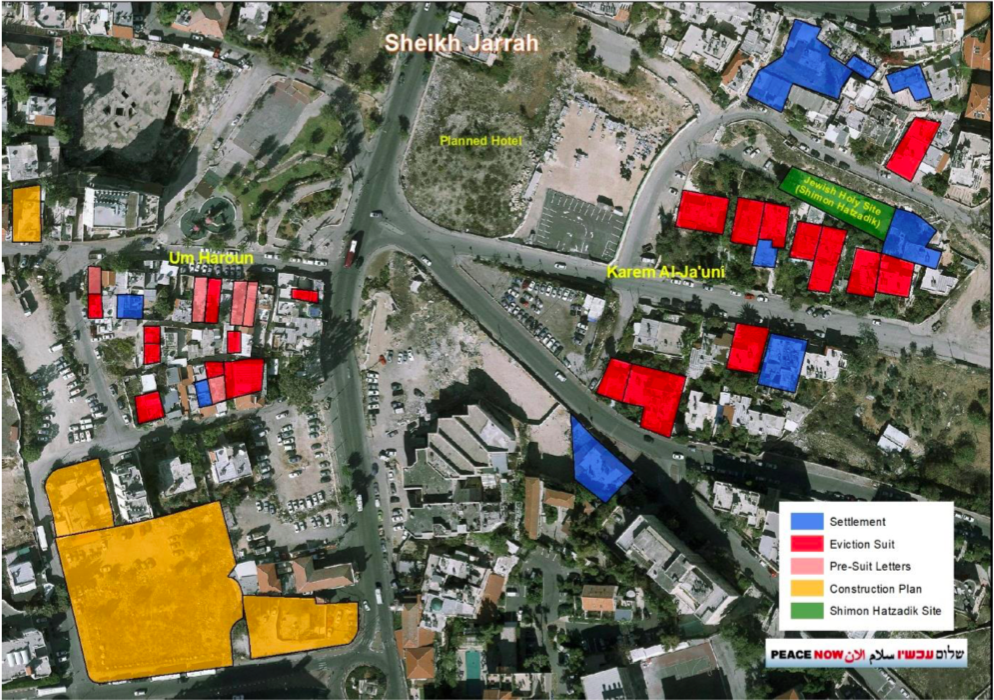 According to Peace Now, the Sabbagh family is one of 175 Palestinian families in East Jerusalem that face eviction under the discriminatory law: 75 families in the Sheikh Jarrah neighborhood and 100 families in the Silwan neighborhood (specifically in the Batan al-Hawa section, where several Palestinian residents were recently handed eviction notices). What’s more, the Sabbagh family was believed to have the best chance at escaping eviction based on historic Ottoman documents relating to the land obtained by the family’s lawyer. These are the documents that Supreme Court Chief Justice Esther Hayut declined to consider this week. The Sabbagh family lawyer told Haaretz:
“Once again, families from Sheikh Jarrah are facing eviction and a second refugeehood. In Israeli courts, which refrain from hearing the residents’ just and substantive arguments, people are sentenced to refugeehood on procedural grounds.”
In advance of the Sabbagh’s eviction, protests erupted, and have continued for a second straight day, in support of the family and against Israeli settlement activity in East Jerusalem. Israeli and international protestors marched from the center of Jerusalem to Sheikh Jarrah, where they were joined by Palestinians in front of one of the homes where Palestinians are facing eviction. Daniel Roth, one of the protestors told +972 Mag:
“At the core of this whole thing is the idea that all people have a right to a home, and what’s going on here is that the powers that be are taking homes from some people because of their national identity, period. What we’re looking at is racist policy and action around people’s very homes, and that should wake people up to stand up with these folks.”
Under the “Legal and Administrative Matters Law of 1970,” which is being used to evict the Sabbagh family, Jewish owners are afforded a legal avenue to reclaim property that they owned prior to the 1948 war which, as a result of the war, came under Jordanian rule. It should be noted that Palestinian refugees from that same war – who lost property in what became Israel – are not afforded an equivalent right to reclaim their abandoned property, creating a dual legal system in which ethnicity is the sole determinant factor when it comes to rights.
Exploiting the special standing granted to historic Jewish property owners, the settler group “Nahalat Shimon” has undertaken a campaign to track down the Jewish owners of coveted land in East Jerusalem that was under Jordanian rule, in order to purchase from them the property rights and then evict Palestinian tenants, most of whom have lived in these properties for more than 50 years. This is the context against which the 45-member Sabbagh family (who are themselves refugees of the 1948 war, but are not allowed to legally reclaim their family property in Jaffa) is being forced to leave their home of 60+ years. Following the Supreme Court’s January 10th decision to refuse the family’s request to consider new evidence in the case (based on the argument that it was too late), Israeli authorities delivered an eviction notice telling the family to leave before January 23rd.
Peace Now writes:
“This is part of an organized and systematic campaign of settlers, with the assistance of government agencies, to expel entire communities in East Jerusalem and to establish settlements in their stead. Dozens of other families face the risk of eviction by legal proceedings in which settlers and government officials exploit discriminatory laws that allow Jews to return to pre-1948 assets yet forbid Palestinians from doing the same. In this way, settlers seek to create a buffer inside the Palestinian neighborhood and make it difficult to reach a territorial compromise in Jerusalem so essential to a two-state solution.”
Bidding War Between Settlers and Palestinians Drives $3.27 Million Price for Sheikh Jarrah House
A bidding war erupted over a house in the Sheikh Jarrah neighborhood of East Jerusalem, pitting the Palestinian family living in the building against Aryeh King, a radical settler impresario behind many settlement schemes across East Jerusalem. When the price hit $3.27 million (12 million shekels), King decided to withdraw his bid – allowing the Palestinian Abdel Razeq family to purchase the home, should they be able to raise the necessary funds.
If the family is able to raise the funds to buy the house, this would be a rare, albeit astronomically expensive, victory for Palestinians fighting to remain in their homes against an ongoing campaign by Israeli settler groups to “reclaim” Jewish property in East Jerusalem that was abandoned during the 1948 war.
As discussed above, under Israeli law, Jewish property owners are entitled to reclaim property in East Jerusalem that was abandoned during the war, while Palestinians who lost property in what became Israel have no similar right. King and other pro-settler activists take advantage of this law by tracking down Jews who owned property in sensitive areas of East Jerusalem prior to 1948 (Sheikh Jarrah being a key target), and convincing the owners (or their heirs) to sign over the property rights – all in order to evict current Palestinian tenants and move in Israeli settlers.
The case involving the Abdel Razeq family’s house did not go according to the settlers’ script. A dispute broke out between members of the Jewish family who, under Israeli law, are heirs to the property. The case went to a Family Court, which ruled that the house should be sold through a public bidding process, with the proceeds to be split amongst the heirs.
Explaining his decision to drop out of the bidding, King took to social media to attack the Jewish family that is selling the property, saying:
“[it is] a black day for the Jewish people. A Jewish family is negotiating with the enemies of the Jewish people to sell a property that the family’s grandfather purchased a hundred years ago in East Jerusalem….I am full of shame that people act this way about a place that their grandfather bought out of Zionist motives and a place where soldiers paid with their lives and were wounded, and they sell it just to make another profit.”
King’s perspective on this – in essence, that Jews should sell only to other Jews – is notable, given recent controversy over a Palestinian who sold property to settlers. Israel and many supporters of Israel were outraged at what they saw as the anti-Semitic demand that Palestinians not sell property to settlers. In this latest case, the seller was arrested by the PA, leading the U.S. Ambassador to Israel, David Friedman, to tweet: “The Pal Authority has been holding US citizen Isaam Akel in prison for ~2 months. His suspected ‘crime’? Selling land to a Jew. Akel’s incarceration is antithetical to the values of the US & to all who advocate the cause of peaceful coexistence. We demand his immediate release.”
Settlers Impose Sabbath Closure on Palestinian Residents of Silwan; High Court Asks: Why?
On January 16th, the Israeli High Court of Justice ordered the Israel Nature and Parks Authority (INPA) and the radical Elad settler group to defend its practice of closing parts of the “City of David National Park” – a name that Israel has applied to an area that includes a large Palestinian residential section of Silwan – on the Jewish Sabbath, evenings, and on Jewish holidays. The closures deny Palestinians, including residents of Silwan, access to parts of the neighborhood.
 As FMEP has repeatedly covered, the radical Elad settler group has managed the City of David National Park on behalf of the INPA since 2001. This arrangement that gives the settler group authority over not only areas controlled by settlers – whose interests Elad shares and promotes – but also thousands of Palestinians, to whom Elad has no legal responsibility and whose very presence is part of a “demographic balance” Elad is working actively to flip.
The petition which prompted the Court’s order was filed by the residents of Silwan and the Israeli nongovernmental archaeological group Emek Shaveh. Explaining the situation caused by Elad’s mismanagement of the City of David National Park, Emek Shaveh writes:
“The City of David National Park is situated at the heart of a populated, urban space. Extensive areas in the park are public spaces in a neighborhood that suffers from a chronic deficiency of such spaces. In 2015, the Elad Foundation placed gates and closed archaeological areas known as Area E and Area G (No. 6 and 7 and No. 3 on the map). These public spaces had been open to the residents at least as far back as the British Mandate. The gates that were placed are locked at closing time, thus blocking passage between two neighborhoods within the village. The site closes on the Sabbath and on Holidays as the Elad Foundation observes the Sabbath, thus restricting the local residents’ freedom of movement and use of public spaces. As most of Silwan’s residents work in West Jerusalem, Shabbat (Saturday) is their day of rest, yet it is on this day that the nearby green public areas are closed off to them.”
Elad and the INPA have previously tried to defend the park closures on security grounds – citing alleged incidents of vandalism on park grounds. That defense was rejected by the Israeli Attorney General, who noted that no formal complaints about vandalism had been filed, and neither the Israeli police nor the Israel Antiquities Authority had be informed about the problem or Elad’s decision to close the park on religious occasions. Following the January 19th court order, Elad and the INPA have 60 days to submit a new defense.
Israel to “Examine” Two Cases of Illegal Outpost Construction
In response to petitions filed by Peace Now, on January 7th the State of Israel announced that it will “examine” two specific cases of illegal (under Israeli law) outpost construction: the Kerem Reim case and the Hayovel case, both located in the area controlled by the Binyamin Regional Council (the Israeli government-funded settlement municipal authority in charge of the area located north of Jerusalem stretching to north of Ramallah). The examination will be led by a police anti-fraud unit and the State Prosecutor’s Office.
As summarized in a recent report, Peace Now has previously filed numerous complaints and has provided evidence to the State Prosecutor’s office regarding the involvement of the Binyamin Regional Council and the Amana settler organization in the illegal construction of outposts and settlement structures.
Given the State’s demonstrated refusal to promptly respond to the complaints by opening an official investigation into the criminal activity, Peace Now cautions that this latest move to “examine” the cases is problematic, saying:
“an examination is an ambiguous, non-legal term that comes in lieu of a proper, legal investigation. An ‘examination’ may just be the state’s tactic to mollify the High Court by showing that it is serious looking into the matter, though without actually taking any substantive action.”
In addition to Peace Now’s documentation, the Israeli State Comptroller’s office published a July 2018 report exposing the criminal involvement of the Binyamin Regional Council and the Amana settler organization in illegal settlement construction.
Peace Now also released an official statement saying:
“For 50 years now, a handful of settlers have been using public funds through the settlement councils and Amana to put facts on the ground that affect the future of all of us in violation of the law and of the government’s decisions. The hesitation of the State Prosecutor’s Office and the police to investigate the organized crime of illegal construction in the settlements is tantamount to granting immunity to the offenders and shows a lack of respect for the rule of law. The message the government is sending to the settlers is that they are above the law.”
In 2017, Peace Now published a comprehensive report outlining how government and private entities are systematically using Israeli taxpayer money to establish new settlements and outposts.
MK Bezalel Smotrich – A Radical Settler – Elected to Lead National Union Party
MK Bezalel Smotrich has been elected to take the reins of the extreme right-wing nationalist political faction, called the National Union Party. With leadership secured, Smotrich aims to next be chosen to lead Habayit Hayehudi – an umbrella group which unites the far-right factions into a single voting bloc – following Naftali Bennett’s decision to leave Habayit Hayehudi and form a new political party alongside Ayelet Shaked.
Smotrich currently lives in the Kedumim settlement, but his house is located inside of an enclave of privately owned Palestinian land that is not included in the settlement’s Master Plan, making it illegal even under Israeli law.
Smotrich is a co-founder of Regavim, a radical settler group that works to dispossess Palestinians of their land and property in the West Bank by “helping” the Israeli government to enforce planning and building laws. Like Smotrich, many of Regavim’s key staff live in illegally built settlement units, but instead of seeking to enforce Israeli law against their own illegal building, Regavim and Smotrich are working to retroactively legalize their own homes through legislation.
Beyond the headlines, Smotrich has been an extremely active member of the Knesset, and is behind many of the boldest and most brazen legislative attempts at annexation. Some of Smotrich’s recent efforts include:
- Introducing the “Young Settlements Bill,” which would direct the government to treat 66 illegal outposts built on privately owned Palestinian land as legal settlements, while giving the government 2 years to find a way to retroactively legalize those outposts. The bill would also freeze any/all legal proceedings against the outposts and requires the government to connect the outposts to state infrastructure including water and electricity; provide garbage removal; and approve budgets for them. The law also allows the finance minister to guarantee mortgages for settlers seeking to buy units in these outposts, even before the legal status of the land is resolved (a remarkable state-directed violation of normal practices in the mortgage industry). The bill received government backing on December 16, 2018, and will next need to be introduced in the Knesset, where it must pass three readings to become law.
- Calling for the Israeli Civil Administration to be disbanded, in a scheme that would annex the entire West Bank to Israel, leaving the Palestinians bantustans to be governed by “Regional Liaison Committees.”
- Leading the charge for the Knesset to fund a new municipal body for Israeli settlers in Hebron, despite a court injunction freezing government plans to create such a body.
- Introducing a bill that would hand over more land in Area C of the West Bank to the World Zionist Organization.
European Union Statement Lambasts “Givat Eitam/E-2” Settlement Plan
On January 22, 2019, the European Union presented a statement at the United Nations Security Council Open Debate representing the view of its member states that:
“Today there is a risk of further escalation that would move Israelis and Palestinians further away from an end to the conflict. This risk is compounded by the advancement in December 2018 of Israeli plans for over two thousand settlement units and renewed plans to “legalise” West Bank outposts. The allocation of an area south of Bethlehem for the purpose of planning a new settlement (Givat Eitam) constitutes a serious blow to the viability of a two-state solution. The European Union’s position on Israeli settlement policy – including eviction of Palestinians – for example in Sheikh Jarrah – and related activities in the occupied Palestinian territory is clear and remains unchanged: all settlement activity is illegal under international law and it erodes the viability of the two-state solution and the prospects for a lasting peace – as reaffirmed by UNSCR 2334.”
For FMEP reporting on the Givat Eitam/E-2 settlement, see the January 4th edition of the Settlement Report.
Bonus Reads
- “The Israeli-Palestinian Conflict is Not a Bankruptcy Sale” (Lawfare Blog)
- “When Freud Visits Israeli Civil Administration in the West Bank” (Haaretz)
- “A Guided Tour of Hebron, From Two Sides of the Occupation” (The New Yorker)
- “Another Step Toward the Annexation of the West Bank” (Haaretz)
- “Israel’s Apartheid Road is About More Than Segregation” (+972 Mag)
Welcome to FMEP’s Weekly Settlement Report, covering everything you need to know about Israeli settlement activity this week.
To subscribe to this report, please click here.
January 4, 2019
- Israel Advances Plans for 2,191 New Settlement Units – Including Establishing 2 New Settlements & Laying Groundwork for 2 New Settlement Industrial Zones
- Based on New Legal Tools to Take Palestinian Land, Israel Announces Intention to Build A New Settlement (“Givat Eitam/E-2”) Near Bethlehem
- Following High Profile Political Support, Settlers Violently Resist Evacuation from Amona Outpost Site
- Knesset Speaker & Leaders Call for Annexation of Hebron
- Regavim Petitions Jerusalem District Court to Stop the EU-Backed “Arab Takeover” of Area C
- Knesset Lawyer Criticizes Bill to Give Palestinian Land to the World Zionist Organization
- Sheldon Adelson’s Medical School in Ariel Settlement May Not Open
- Bonus Reads
Questions/comments? Email kmccarthy@fmep.org
Israel Advances Plans for 2,191 New Settlement Units – Including Establishing 2 New Settlements & Laying Groundwork for 2 New Settlement Industrial Zones

Map on Twitter by @JacobMagid
During its final meetings of 2018 (held on December 26th and 27th), the Israeli Civil Administration High Planning Council advanced plans for a total of 2,191 new settlement units. Peace Now reports that 87% of the settlement plans advanced are located deep inside of the West Bank, far beyond any of the negotiated parameters for a border between Israel and a future Palestinian state.
The flood of settlement approvals includes plans that will effectively create two new settlements (by legalizing the unauthorized outposts of Ibei Hanachal and Gva’ot, detailed below) and establish two new settlement industrial zones (one near the Beitar Illit settlement and one near the Avnei Hefetz settlement). Another plan, for an educational campus and a gas station, will serve to connect the unauthorized outpost of Mitzpeh Danny to a nearby settlement (Ma’aleh Mikhmash) – paving the way towards the eventual legalization of that outpost, creating yet another new settlement.
Of that total, plans for 1,159 units were given final approval for construction – meaning building permits can be issued immediately. These include
- 220 new units in the Givat Ze’ev settlement;
- 180 new units in the Neveh Daniel settlement;
- 135 new units in the Tene settlement;
- 120 new units in the Karmei Tzur settlement;
- 129 new units in the Avnei Hefetz settlement (where plans to build a new, noncontiguous industrial zone nearby were also advanced – see below);
- 61 new units in the Tzofim settlement;
- 42 new units in the Alfei Menashe settlement;
- 55 new units in the Tomer settlement;
- 18 new units in the Adora settlement;
- 16 new units in the Metzad settlement;
- 1 new units in the Shilo settlement; and,
- 62 new units in the Ma’aleh Mikhmash settlement;
-

Map by Peace Now
A plan to build an educational campus and a gas station between the Malakeh Mikhmash settlement and the unauthorized outpost of Mitzpeh Danny. Peace Now writes, “Although this is not a residential program, these buildings also qualify as the establishment of a new settlement complex in the West Bank. The plan covers 140 dunams and will create a permanent presence of hundreds of Israeli students and teachers…During the discussion it was noted that the Mateh Binyamin Regional Council is preparing a plan to regulate the outpost.”
- A plan to build a cemetary on an area of “state land” south of the Palestinian city of Qalqilya. The area used to be a closed firing zone, but that military designation was rescinded years back, and the site has since been the subject of settlement planning. Peace Now writes, “The planned cemetery is likely to be the first component on the road to the establishment of an industrial zone, which is also a type of settlement.”
Settlement plans that were advanced through earlier stages of the planning process include:
-
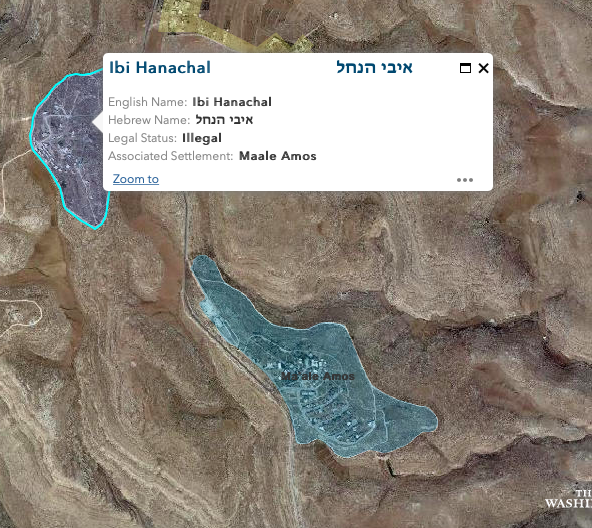
Map by WINEP
A plan for 98 units in the unauthorized Ibei Hanachal outpost, which will turn the outpost as a “neighborhood” of the Maale Amos settlement. In reality, the outpost is not contiguous with the built-up area of the Maale Amos settlement, meaning that the implementation of this plan will, in effect, create a distinct new settlement.
- A plan for 61 new units in the unauthorized Gva’ot outpost, an outpost originally built in 1999 by the settlers as a “neighborhood” of the Alon Shvut settlement. The settlers built a yeshiva there, but abandoned it not long after. The new settlement plan is for a public building, likely an educational institute with housing.
- 82 new units in th Ofra settlement. FMEP reported on this plan in the Dec 14th edition of the Settlement Report, in conjunction with the litany of punitive settlement plans advanced by Israel in response to terror attacks. The area where the new units are slated to be built is land that was allegedly purchased by the settlers from its original Palestinian owners.
- Plans for two new settlement industrial zones, one near the Beitar Illit settlement and one near the Avnei Hefetz settlement. The latter industrial zone, called Bustani Hefetz, will cover a large area of land (some 730 dunams) and will not be not contiguous with any other settlement. Peace Now writes, “an industrial zone of this scope, which is cut off from any other settlement, in all actuality constitutes a new settlement.”
- 121 new units in the Yitzhar settlement, where the IDF has been trying to rein in the violence perpetrated by the “Hilltop Youth” settlers, who are based in Yitzhar.
- 152 new units in the Shavei Shomron settlement.
- 212 new units in the Har Bracha settlement.
- 94 new units in the Beit Haggai settlement.
- A plan to legalize 75 existing settlement units in the Shvut Rachel settlement, which Israel considers a “neighborhood” of the Shiloh settlement.
- 100 new units in the Halamish settlement.
Peace Now released a statement saying:
“In 2018, the government advanced thousands of housing units, including most which can be found in isolated settlements deep inside the West Bank that Israel will eventually have to evacuate. Those who build these places have no intention of achieving peace and a two-state solution. The latest announcement, which as an aside was cynically passed on Christmas while most Western governments are on holiday, shows that Netanyahu is willing to sacrifice Israeli interests in favor of an election gift to the settlers in an attempt to attract a few more votes from his right-wing flank.”
Top Palestinian negotiator, Saeb Erekat, released a statement saying:
“While the world is celebrating Christmas with its spirit of peace and joy, the Grinch ‘occupation’ decided to steal the Christmas spirit from the people of Palestine. As part of his early election campaign, the Israeli Prime Minister Benjamin Netanyahu has as well stolen more Palestinian land and resources for the benefit of Israel’s illegal colonial settlement expansion. Such illegal actions are a deliberate campaign to destroy the two-state solution and to prevent the establishment of an independent and sovereign State of Palestine with East Jerusalem as its capital.”
Tamar Zandberg, head of the Meretz Party, slammed the new announcements, and previous decisions taken by the government to retroactively legalize 60 outposts. Zandberg said:
“The Israeli government has become a settlement government. (MKs Bezalel) Smotrich, Moti Yogev, (Justice Minister) Shaked and (Education Minister) Bennett are its landlords. They exploit the (Palestinian) attacks to build more settlements. But the truth needs to be said. To achieve security we need to evacuate settlements, not build more and more…”The 60 new settlements are the real threat to Israel’s security and to IDF soldiers. The pogroms they are waging in Palestinian villages. The stone-throwing, the shooting and the uprooting of the trees. This is the danger to our moral image and our security! They eight seats of Habayit Hayehudi party dictate eight million lives.”
Based on New Legal Tools to Take Palestinian Land, Israel Announces Intention to Build A New Settlement (“Givat Eitam/E-2”) Near Bethlehem
On December 26th, the Israeli Civil Administration announced that it will draft plans to build as many as 2,500 new settlement units at the Givat Eitam outpost site, creating a new settlement on a strategic hilltop that will cut off Bethlehem from the southern West Bank, completing the near encirclement of Bethlehem by Israeli settlements.
Map by Peace Now
For years, settlers have lobbied for construction at the site, but those efforts have been stymied by the lack of a legal access road to the outpost, which is surrounded by land that even Israel recognizes is privately owned by Palestinians. Until recently, Israel has balked at seizing private land from Palestinians for the exclusive benefit of the settlements. But now, several new legal opinions have allowed Israel to violate the private property rights of Palestinians for the sole purpose of legalizing settlements and settlement infrastructure. Those legal opinions include the “market regulation” principle, the opinion(s) regarding the Haresha outpost case, and the Regulation Law. It is unclear which legal argument will be applied to the Givat Eitam/E-2 case.
The Givat Eitam outpost has been nicknamed “E-2” by settlement watchers for for its resemblance, in terms of dire geopolitical implications, to the infamous E-1 settlement plan. Located east of the separation barrier on a strategic hilltop overlooking the Palestinian city of Bethlehem to its north, Givat Eitam/E-2 is located within the municipal borders of the Efrat settlement but is not contiguous with Efrat’s built-up area, making Givat Eitam/E-2 effectively a new settlement that, according to Peace Now, will:
“block Bethlehem from the south, and prevent any development in the only direction that has not yet been blocked by settlements (the city is already blocked from the North by the East Jerusalem settlements of Gilo and Har Homa, and from the West by the Gush Etzion Settlements) or bypass roads (that were paved principally for Israeli settlers). The planned building in area E2 would likely finalize the cutting off of Bethlehem city from the southern West Bank, delivering a crushing blow to the Two States solution.”
In September 2018 FMEP reported that the local council of the Efrat settlement encouraged the start of (unauthorized) construction of an outpost at the Givat Eitam/E-2 site (presuming that any such illegal construction would be retroactively legalized by the government) in response to a Palestinian terror attack in the Efrat settlement. Since then, the Civil Administration has allowed the settlers to build and maintain an agricultural farm there.
FMEP tracks all developments related to Israeli legislative, cabinet, and judicial action that promotes the retroactive legalization of outposts built on privately owned Palestinian land as part of its documentation of creeping annexation – available here.
Following High Profile Political Support, Settlers Violently Resist Evacuation from Amona Outpost Site
On January 3rd, 23 Israeli police officers were injured by Israeli settlers and their supporters who violently resisted the court-ordered evacuation from illegal encampments erected on privately owned Palestinian land as part of an effort to re-establish the Amona outpost. Approximately 300 settlers showed up at the Amona site (which is currently a closed military zone) overnight to resist the removal of settlers and two caravans from the hilltop, which was ordered by the Jerusalem District Court. The settlers and their supporters burned approximately 300 tires at the entrance to the outpost, poured oil on the access roads, and threw rocks and boulders at the Israeli police. Seven suspects were arrested and quickly released.
The evacuation of the outpost was reportedly carried out in defiance of a direct order from Prime Minister Netanyahu. According to the Haaretz report, Netanyahu gave orders to the Israeli military secretary, Col. Avi Bluth, to stop the evacuation. Col. Bluth did not relay the message in time, and the evacuation was carried out. Now, Netanyahu has ordered a disciplinary hearing to investigate the actions of Col. Bluth, which is scheduled for January 4th.
The violent evacuation of settlers from the Amona hilltop follows a week of high profile support for their efforts. Israeli Cultural Minister Miri Regev attended a ceremony near the recently re-established (yet unauthorized) Amona outpost to express her support for authorizing construction on the hilltop – which, according to the Israeli High Court of Justice, is privately owned Palestinian land. Regev could not go to the actual Amona site, because the area is a closed military zone where no one (settlers, politicians, and even the Palestinians who own the land) is permitted to enter. Regev and the settlers claim that the hilltop land has been legally purchased by the settlers, but that claim has not been investigated, much less verified. Casting doubt on the settlers’ claims, Haaretz notes:
“The lot in question is jointly owned by several different Palestinians, which means every single one of them would have to consent to the purchase for it to be legal. It’s not clear which, if any, of these Palestinians signed the sale document. In the end, the land was designated military land, is zoned for agriculture and has no building permits.The Binyamin Regional Council didn’t await the administration’s decision before moving two prefab homes into Amona and providing basic infrastructure such as water tankers.”
Israeli Attorney General Avichai Mandleblit slammed the settlers for trespassing and illegally moving caravans onto the site. Mandelblit criticized MK Bezalel Smotrich and the heads of regional settlement councils who went to the site to express support, saying:
“Breaking the law with the support of public figures, like placing caravans on privately-owned lands, can’t be a source of pride.”
A Haaretz report recently revealed Bezalel Smotrich was a founding member of a non-governmental group called Ofek Lehityashvut, which directly financed the illegal reestablishment of the Amona outpost last month by purchasing the two caravans that settlers moved onto the hilltop. The Haaretz report goes on to reveal that the Benyamin Regional Council has purposefully tailored various calls for proposals so that Ofek Kehityashvut would be the only group qualified to receive financing for that project. As a result of that manipulation, Ofek Kehityashvut has received substantial amounts of funding from the Benyamin REgional Council, which is an Israeli-taxpayer funded entity.
Knesset Speaker & Leaders Call for Annexation of Hebron
The speaker of the Israeli Knesset, Yuli Edelstein (Likud), called for Israel to apply its sovereignty over the city of Hebron – which would constitute an act of de facto annexation. Edelstein released a statement announcing his intention to go on a tour of Hebron – where some 500-800 settlers live under Israeli military protection amongst 200,000+ Palestinians – with the far-right, pro-annexationist group Im Tirzu. In the statement he wrote:
“In my view, it’s delusional that some Knesset members dare to undermine the Jewish people’s right to dwell in the city of our forefathers,” Edelstein said in a press statement issued prior to the conference. “We’re developing Hebron, investing in it and inculcating its importance in future generations. We are saying clearly – sovereignty in Hebron first.”
Speaker Edelstein also participated in a conference highlighting Israel’s historic connection to the city of Hebron. Organized by the Knesset Land of Israel Lobby, the event culminated in the signing of a document that reads:
“We, the undersigned, hereby express deep solidarity with the roots of the Jewish people in Hebron and the support of the Jewish community in Hebron that has clung to the city despite all the difficulties. We declare an unambiguous commitment to the continued existence, security and prosperity of Hebron as the city of both our forefathers and children.”
The event was co-organized by MK Bezalel Smotrich (Jewish Home) who said:
“Hebron is a litmus test. What is happening in Hebron shows our Jewish pulse….[those who call for settlers to leave Hebron] understand very well that if Hebron grows and develops, the entire settlement enterprise will grow and develop, so they invest in harming Hebron. But they will continue to shout and complain while we will continue to build, reach the people and connect with our roots.”
Regavim Petitions Jerusalem District Court to Stop the EU-Backed “Arab Takeover” of Area C
Following the Knesset’s passage of a bill in July 2018 that brought many West Bank legal matters under Israel’s domestic jurisdiction (an act of de facto annexation), the Jerusalem District Court is set to hear its first case concerning land disputes in the occupied territory. The bill was sponsored by Israeli Justice Minister Ayelet Shaked, whose three-fold rationale for the bill explicitly states that its purpose is to help settlers take more Palestinian land and shut-down Palestinian challenges to such thefts — by bringing matters to the Jerusalem Court instead of the High Court of Justice, which Shaked believes is too concerned with Palestinian rights and international law. The bill is part of the legislative body’s broader effort to erase all remaining distinctions (legal, judicial, economic, and otherwise) between sovereign Israel and the occupied territories, distinctions which allowed Israel to preserve the guise of respect for rule of law, and good intentions, for the last 50 years.
Looking to cash in the bill’s explicit purpose, the radical settler group Regavim initiated the petition asking the court to intervene to stop the “illegal Arab takeover” of land in the West Bank. Regavim’s petition claims that Palestinians are cultivating “state land” near the Mezad settlement. The petition also blames the European Union for its financial backing for the agricultural projects on the land. (Note: Regavim, like most settler media outlets, uses the word “Arab” to describe Palestinians, a vocabulary choice meant to erase any recognition of Palestinian identity).
A coordinator for Regavim told the Arutz Sheva outlet:
“The intervention of the European Union in what is happening in Area C is a brazen and aggressive intervention. We see extensive involvement on their part in lawbreaking and invading state land throughout Judea and Samaria. Their symbols are everywhere, and the State of Israel must respond to this blatant intervention on the diplomatic level as well.”
Shlomo Ne’eman, head of the Gush Etzion Regional Council said:
“The direct involvement of the European Union in financing Arab squatters in the territories and state lands has already become a plague on the state. We congratulate Justice Minister Ayelet Shaked on the obvious step that has led to great logic and justice in reducing the burden on the Supreme Court and in uniform enforcement against the land grabs by hostile elements…the Arabs understand that the real battle is on the ground. Foreign countries with their money are trying to shape a false consciousness and finally change the map of the state, but nothing can change history and our natural belonging on our national land.”
FMEP tracks the application of domestic Israeli law over the occupied West Bank (the de facto annexation of the West Bank) on its Annexation Policy Tables, which are regularly updated.
Knesset Lawyer Criticizes Bill to Give Palestinian Land to the World Zionist Organization
The legal advisors to the Knesset Constitution, Law and Justice Committee criticized a bill that would transfer vast tracts of land in Area C of the West Bank to the Settlement Division of the World Zionist Organization (WZO), a quasi-private state-funded entity that works to establish and expand settlements in the West Bank. Despite pressure to pass the bill, the legal advisors called on the committee to reexamine the text over concerns that it would also give the WZO authority over Palestinian communities in Area C. The experts wrote in a legal opinion for the committee:
“The proposed definitions of ‘rural settlement’ and ‘land’ do not include references to the character and nature of the settlement, and it seems that land that is government or abandoned property intended for Palestinian rural settlement will also be included in the boundaries of the proposed arrangement, and will be transferred to the management of the Settlement Division. Is the intention of the bill that the Settlement Division will also manage the Palestinian rural settlement in the area?”
As FMEP has previously reported, the bill was proposed by MK Bezalel Smotrich (Habayit Hayehudi) to accelerate the transfer of almost all of the land in Area C to the control of the World Zionist Organization. The land transfer is, in fact, taking place at the bureaucratic level, but Smotrich and the Israeli Cabinet (which endorsed the bill) are increasingly frustrated by the slow pace of the transfer (and perhaps also the limited scope of land slated to be handed over). Israeli Attorney General Avichai Mandelblit expressed his opposition to the bill, saying it is unnecessary given that ministry staffs are already working to transfer more land to the WZO through an administrative process.
In June 2018, when the Knesset gave preliminary approval to the bill, Peace Now responded:
“the government is scandalously planning to give the biggest land thieves responsibility for managing the land distribution, which will continue to be done under the cover of darkness if the bill passes into law.”
For more information on this bill, read a comprehensive background briefing by Peace Now.
Sheldon Adelson’s Medical School in Ariel Settlement May Not Open
The state-of-the-art medical school planned to be built in the Ariel settlement is now in danger of not opening, after a letter from the Israeli Justice Ministry warned that the school’s approval is in jeopardy. The Justice Ministry discovered an undisclosed conflict of interest that voids an important vote in favor of approving the school by the planning and budgeting subcommittee of the Higher Education Council. A member of the subcommittee, Dr. Rivka Wadmany-Shauman, allegedly met with the heads of Ariel University ahead of the vote, and made her approval of the new medical school conditional on being promoted to the rank of professor. Israel Hayom reports the Ariel University has already shelved plans to inaugurate the new school for its first semester in the Fall of 2019.
As FMEP has previously reported, Ariel University became an accredited Israeli university in 2012, following significant controversy and opposition, including from Israeli academics. It has since been the focus of additional controversy, linked to what is a clear Israeli government-backed agenda of exploiting academia to normalize and annex settlements. In 2018, the settlement broke ground on the new medical school, with significant financial backing from U.S. casino magnate and settlement financier, Sheldon Adelson. In February 2018, in an act of deliberate de facto annexation, the Israeli Knesset passed a law that extends the jurisdiction of the Israeli Council on Higher Education over universities in the settlements (beyond Israel’s self-declared borders), ensuring that the Ariel settlement medical school (and its graduates) are entitled to all the same rights, privileges, and certifications as schools and students in sovereign Israel.
As a reminder, Ariel is located in the heart of the northern West Bank, reaching literally to the midpoint between the Green Line and the Jordan border. The future of Ariel has long been one of the greatest challenges to any possible peace agreement, since any plan to attach Ariel to Israel will cut the northern West Bank into pieces.
Bonus Reads
- “Israeli settlements threaten to engulf West Bank communities” (Al-Monitor)
- “Israeli settlement activity appears to surge in Trump era” (AP)
- “It Pays Off to be an Israel Settler, Whether Trespasser or Landowner” (Haaretz+)
- “In the West Bank, the Israeli army works for the settlers” (Haaretz)
- “Netanyahu’s pro-settler allies force annexation into campaign agenda” (Al-Monitor)