Welcome to FMEP’s Weekly Settlement Report, covering everything you need to know about Israeli settlement activity this week.
To subscribe to this report, please click here.
March 29, 2024
- Israel to Legalize Ahiya Outpost, Framing it as a Neighborhood of the Shilo Settlement
- Israel Expedites New West Bank Road for Settlers, Foreshadowing Mass Expansion of Settlement Growth West of Ramallah
- U.S. Undercuts Its Own Sanctions on Settlers, Says Israel Banks Can Continue Hosting Accounts
- Haaretz Reveals Mortgage Fraud Behind Some Outposts Construction
- Palestinian NGOs Issue Alert on Israeli Crimes in the West Bank, East Jerusalem
- The Health & Psychological Impacts of Settler Terrorism
- Settlement Wastewater is Damaging Palestinian Land, Livelihood & Contributing to Forcible Displacement
- Bonus Reads
Israel to Legalize Ahiya Outpost, Framing it as a Neighborhood of the Shilo Settlement
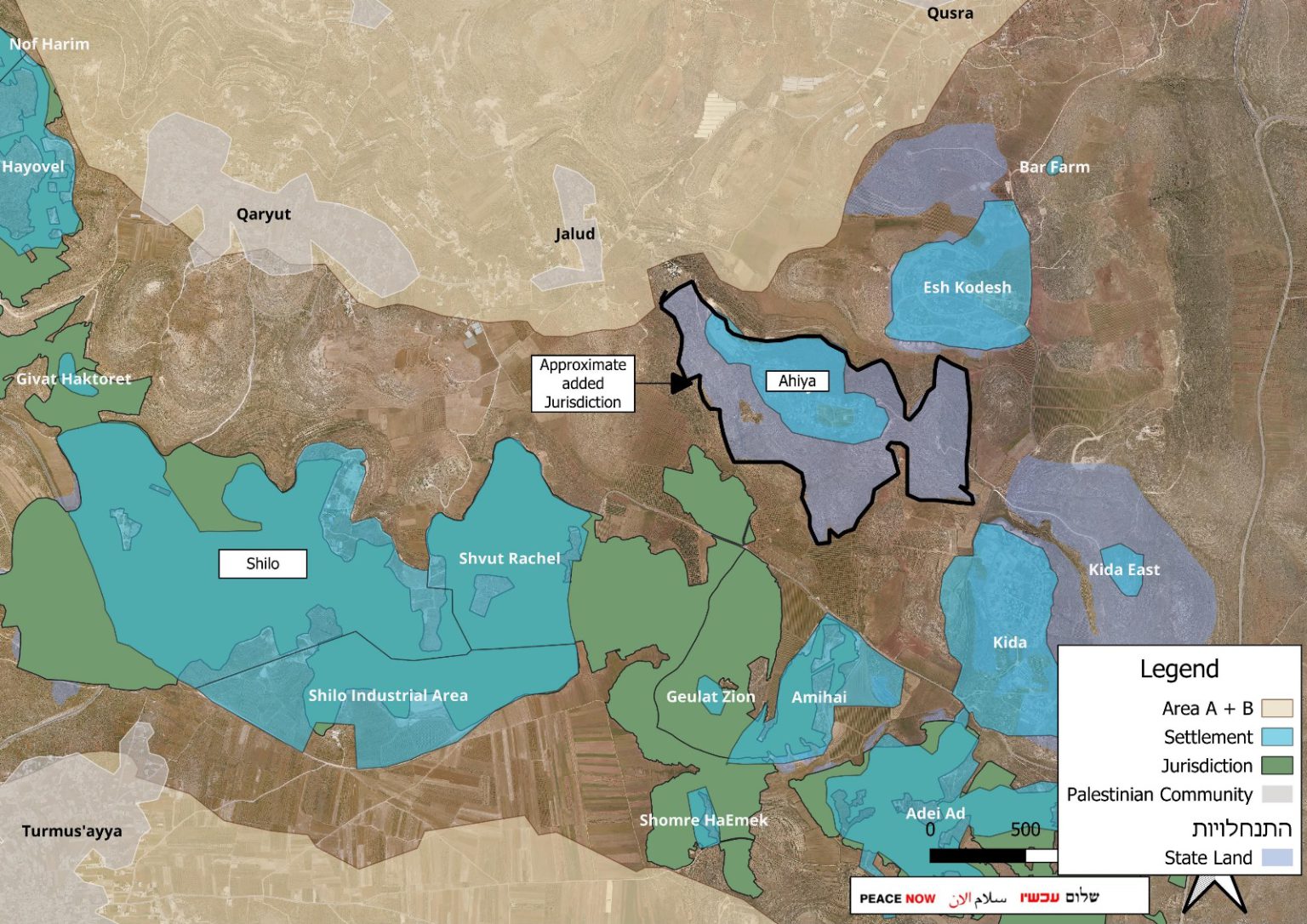 Peace Now reports that the Israeli Civil Administration announced that it will grant retroactive authorization to the Ahiya outpost by massively expanding the jurisdiction of the Shilo settlement to include the land on which the outpost was illegally constructed. The outpost is not contiguous with the built up area of the Shile outpost, and is more properly understood to be a new outpost, not simply an expansion of an existing one.
Peace Now explains:
“According to Peace Now’s estimation, the decision to approve the outpost of Ahiya as a neighborhood of Shilo rather than a new settlement is intended to prevent international criticism and the need to pass the decision in the security cabinet. On the other hand, the decision serves Minister Smotrich, who in the past month has exerted increased authority over settlements and declared a record number of dunams as state lands, promoted thousands of housing units, and more. In 2023, Israel approved five outposts as new settlement neighborhoods, reaching a record number of 15 outposts approved as settlements in 2023. In 2018, Minister Smotrich proposed legislation to regulate approximately 70 outposts as settlements. Since assuming office, he has announced several initiatives to achieve this objective.”
The Shilo settlement is located in the heart of the northern West Bank, in the Shiloh Valley, in an area of settlements that are designed to form an uninterrupted corridor of Israeli control connecting sovereign Israel to the Ariel settlement, through the isolated Shiloh Valley settlements, all the way to the Jordan Valley. In so doing, It will completely bisect the northern part of the West Bank.
The Shiloh settlement has spun off several illegal outposts (Amichai, Adei Ad, Shvut Rachel) which have systematically been added to the Shilo settlement by expanding the settlements borders, a move which rewards illegal construction and land theft and further encourages it. This pattern is exemplified by the Amihai outpost.
The Amichai settlement was approved for construction in 2017, making it (at that time) the first new settlement formally approved by the Israeli government in 25 years. Aerial imagery from 2021 show the massive growth Amichai has enjoyed in the years that followed its establishment, a previously empty hilltop with cultivated fields nearby have been transformed into a sizable suburban neighborhood. In addition to new construction, Amichai was also massively expanded, subsequent to its initial construction, when the Israeli Civil Administration announced that its plan to retroactively legalize the Adei Ad outpost by significantly expanding the borders of the Amichai settlement to turn Adei Ad into a (non-contiguous) neighborhood. In effect, this was a slight-of-hand by Israel to turn the Adei Ad outpost into an entirely new official, legal settlement. In 2013, Israel allocated additional land near the Amichai settlement to the World Zionist Organization, in order to expand the settlement. This has all come at the continued cost to Palestinians from the nearby village of Turmus Ayya on whose land Amichai was established and whom settlers from the Amichai outpost and others nearby routinely harass and terrorize.
In a statement, Peace Now says:
“Establishing another settlement is the last thing Israel needs. Deepening Israeli presence in the West Bank serves only a small and extremist group in Israel and harms the entire Israeli public. The Israeli government, under Minister Smotrich’s leadership, continues to evade a political solution and imposes facts on the ground that will escalate violence and deepen the dispossession and oppression of Palestinians in the West Bank.”
Israel Expedites New West Bank Road for Settlers, Foreshadowing Mass Expansion of Settlement Growth West of Ramallah
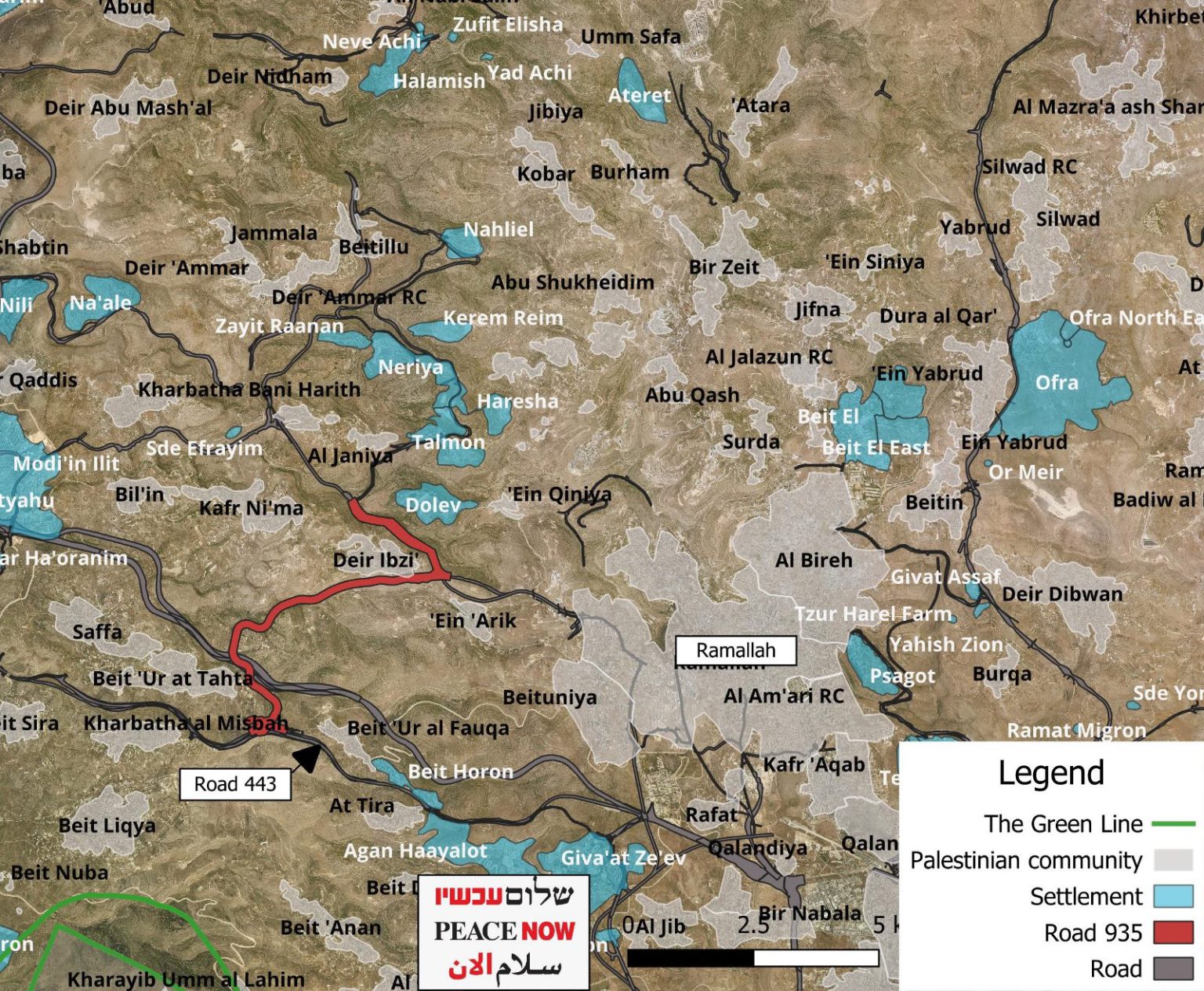 Peace Now reports that Israeli Finance Minister Bezalel Smotrich and Transportation Minister Miri Regev announced plan to fast-track the planning and construction of a new road for settlers in the West Bank, designed to connect the Gush Talmonim settlement area west of Ramallah to Route 443. This road will give the settlements in this area (including Dolev, Almon, Haresha, and others) a more direct route to Jerusalem through Palestinian land, which Israel will expropriate. – and, according to Peace Now, will facilitate the massive expansion of the Gush Talmonim settlement by the tens of thousands.
Peace Now writes:
“The Gush Talmonim Road – Route 443 is an extremely dangerous project for the area west to Ramallah. Its construction will create a wide and densely populated settlement bloc, exacerbating friction between settlers and Palestinians and further complicating a political solution. The road will not reduce violence in the area but rather escalate it to new heights. The political solution lies not in such illogical roads but in a political horizon and hope for both peoples.”
U.S. Undercuts Its Own Sanctions on Settlers, Says Israel Banks Can Continue Hosting Accounts
According to reporting by the Times of Israel, this week the U.S. government sent a letter to the Israeli Finance Ministry saying that, in effect, Israeli banks can maintain accounts for the seven individuals sanctioned by the U.S. government without facing repercussions. The letter is reported to have stated that the sanctions were not intended to cut off sanctioned individuals from all of their assets, only from international/foreign transactions, and that the individuals should be permitted access to their bank accounts for basic purchases.
The letter was prompted by a series of events stemming from recently announced sanctions on Israeli settlers who have participated in violence against Palestinians. Following the U.S.’s announcement, several European countries (and possibly the EU) followed suit, and Israeli banks moved to close accounts for those individuals in fear of being locked out of international banking systems for violating sanctions. Israeli Finance Minister Bezalel Smotrich, seeking retaliation against the banks for the decision to close the accounts, threatened to take steps to cut Palestinian banking off from Israeli banks (the Palestinian economy operates in shekels and is largely dependent on the Israeli banking sector).
Muhammad Shehada, Chief of Communications at the Euro-Med Human Rights Monitor, posted on X:
“Biden quietly reverses the (feckless) sanctions he put on 7 individual settlers, removing the freeze on their accounts & effectively emptying the sanctions of any practical content according to Israel Hayom! It was purely a PR stunt all along to whitewash his complicity in Gaza.”
Tariq Habash, a former political apointee in the U.S. Department of Education who recently resigned in protest of the Biden Administration’s Israel policy, posted:
“The Biden Admin has now eroded the primary policy to deter illegal settlement expansions in the West Bank, undermining the entire purpose of issuing sanctions and compromising U.S. policy yet again.”
Hugh Lovatt, Senior Policy Fellow at the European Council on Foreign Relations, posted on X:
“Once again, the U.S. is scared of its own bark and inherently unable to put any meaningful pressure on Israel. It has promised to undermine the potency of its (secondary) sanctions regime. What could potentially have turned into a game changer is now barely an inconvenience.”
Former J Street lobbyist Dylan Williams posted:
“Between this bizarre move to ease the impact of sanctions on violent settlers and accepting Israel’s patently false assurance that it’s following US and international law per NSM-20, the Biden administration is regressing when it comes to standing up for US interests with Israel.”
Haaretz Reveals Mortgage Fraud Behind Some Outposts Construction
Haaretz and Kerem Navot recently revealed a pattern or mortgage fraud behind the construction of some outposts. The investigation shows that Israeli banks issue mortgages to settlers for the construction of homes in a settlement (with specific land parcel numbers recorded), but the actual construction happens elsewhere – thereby enabling the costly construction of outposts. The complicity/knowledge of the banks in issuing these mortgages is unclear and different for each case – but it is clear that the World Zionist Organization is deeply involved in these dealings.
Most flagrantly, Israeli Finance Minister Bezalel Smotrich – who is also a minister in the Defense Ministry overseeing settlement affairs – himself engaged in this fraud. He took a mortgage for a lot in the Kedumim settlement, but built the house on totally unrelated land located outside the settlement’s zoning plan.
In addition, Yehuda Eliyahu – who Smotrich appointed as head of the Settlement Administration that Smotrich created – also participated in this scheme. He received a 2004 mortgage on a land parcel in the Neria settlement, but built in what is now called the Haresha outpost.
Dror Etkes, founder of the Kerem Navot settlement watchdog group, told Haaretz:
“The two main protagonists of this story, Finance Minister Smotrich and his longtime friend-partner Yehuda Eliyahu, together with their friends in the settlement department, were part of a group of settlers who obtained mortgages while misleading the banks. This may be the reason why 11 years later, as an MK, it was so important for Smotrich to exempt the activity of the settlement department from the Freedom of Information Act.“
Palestinian NGOs Issue Alert on Israeli Crimes in the West Bank, East Jerusalem
Amidst ongoing genocide in Gaza, the three preeminent Palestinian human rights groups – Al-Haq, Al-Mezan, and the Palsetinian Center for Human Rights, have issued a new report on spike in Israeli violations and crimes in the West Bank in the first months of 2024. These crimes include extrajudicial killings, attacks on medical personnel, raids and arrests, demolitions and land razings, land confiscation, settlement expansion, settler violence, and more.
In conclusion, the groups write:
“Our organizations believe that the main target of the Israeli crimes and violations in the West Bank is the existence of the Palestinian people in Mandatory Palestine, for the purpose of entrenching the Zionist settler-colonial project. This is particularily evident in Gaza as well, where the Israeli military aggression has led to the forced displacement of approximately 1.9 million Palestinians within the Gaza Strip amid systematic targeting and destruction, rendering the Strip unlivable and thereby forcing its people to flee. The absence of accountability and concrete enforcement of international law, the international community’s inaction and third states’ complicity are fueling the continuation of Israel’s settler-colonial project and ongoing genocide in Gaza.
Our organizations emphasize that these crimes and violations would not have continued without Israel’s long-enjoyed impunity and third states failure to hold perpetrators accountable and put an end to these crimes, according to Common Article 1 of the Four Geneva Conventions and Articles 146 and 147 of the Fourth Geneva Convention.
Our organizations also call upon the Prosecutor of the International Criminal Court to expedite the investigation into the situation in Palestine initiated more than two years ago and issue arrest warrants to hold the perpetrators accountable for these crimes, particularly the ongoing genocide in the Gaza Strip.
As Israel attempts to eliminate the Palestinian people and their right to self-determination, our organizations reiterate that addressing the situation in Palestine requires tackling the root causes of the Palestinian struggle, emphasizing that the international community and the United Nations member states hold the primary responsibility for the violence in Palestine through their inaction and complicity in Israel’s systematic and widespread violations. We urge the international community to assume its responsibilities to stop the ongoing genocide against the Palestinian people.”
The Health & Psychological Impacts of Settler Terrorism
Physicians for Human Rights has released a new report detailing the multifaceted trauma inflicted on Palestinians in the West Bank by settler terrorism. PHRI writes in the intro:
“For over five years, we’ve been flooded with reports chronicling settler violence. However, this worn-out term obscures a grim reality: life beside settler outposts and farms entail daily exposure to oppressive and coercive mechanisms, systemic discrimination, and a continuous sense of insecurity and fear. Our latest position paper explores how constant exposure to such routine violence is detrimental to the health of Palestinians, highlighting the social and psychological repercussions.”
The paper can be downloaded here.
Settlement Wastewater is Damaging Palestinian Land, Livelihood & Contributing to Forcible Displacement
The Norwegian Refugee Committee has issued a new report on the damage that settlement wastewater is inflicting on Palestinian land and livelihoods. The organization investigated two sites in the West Bank and found human sewage and animal waste flowing from settlements into Palestinian land, destroying crops and land. This, in turn, severely impacts the productivity of Palestinian agriculture, and contributes to the many pressures from Israeli settlers and the government which force Palestinians off their land. The Israeli Water Authority is responsible for water and sewage management for settlements in the West Bank.
One Palestinian farmer who has land close to Immanuel settlement industrial zone, told NRC:
“Wastewater has extensively flooded my land. A salt layer now covers the soil, significantly impacting the quality of the produced oil from my olive groves. Olive trees each used to yield no less than 25 kilograms of olives, but today production has dropped by half.”
Samah Hadid, NRC’s Middle East and North Africa Head of Advocacy said:
“Israel’s settlements routinely contaminate critical water systems and agricultural lands with wastewater, exacerbating environmental risks, further destabilising the already fragile Palestinian economy, and heightening the likelihood of various diseases like diarrhoea and kidney failure.”
In 2017, B’Tselem published a comprehensive report criticizing the illegal Israeli practice of exporting its waste to the occupied territories. The report provides more context for the extent to which hazardous wastewater poses significant damage to Palestinian land and futures. The report says:
“Israel regards the facilities built in the West Bank as part of its local waste management system, yet it applies less rigorous regulatory standards there than it does inside its own territory. Whereas polluting plants located within Israel are subject to progressive air pollution control legislation, polluting plants in the industrial zones of settlements are subject to virtually no restrictions. Moreover, the facilities in settlements are not required to report on the amount of waste they process, the hazards their operation pose, or the measures they adopt to prevent – or at least reduce – these risks. B’Tselem sent requests for information on these matters to the Ministry of Environmental Protection and the Civil Administration. The requests have gone unanswered.
…For many years, Israel has been taking advantage of its power as occupier to transfer the treatment of waste (including hazardous waste) and sewage from its sovereign territory to the West Bank. To that end, it has created a situation in which environmental legislation in the West Bank is much laxer than inside Israel, conveniently overlooking the long-term impact of environmental hazards on the Palestinian population and on natural resources, and neglecting to prepare future rehabilitation plans. This has created a financial incentive to transfer the treatment of environmental hazards from Israel to the West Bank. The Palestinians who live in the occupied territory are the ones to pay the price for this environmental damage, even though they were never asked their opinion on the matter and although, as a population under occupation, they have no political power and no real ability to resist.”
Bonus Reads
- “Israeli settlers step up attacks on Palestinian farms, expanding West Bank outposts” (NPR)
- “In a West Bank settlement, Israelis tend red cows and plan the Third Temple” (Middle East Eye)
Welcome to FMEP’s Weekly Settlement Report, covering everything you need to know about Israeli settlement activity this week.
To subscribe to this report, please click here.
January 10, 2020
- ICC Opens Formal Investigation into Israeli War Crimes, Including Israeli Settlements
- Israel to ICC: You Do Not Have Jurisdiction & You Will Not Stop Us from Advancing Settlements and Annexation
- Following ICC Announcement, Israel Advances Plans for Nearly 2,000 Settlement Units
- Following ICC Announcement, Israel Begins Planning Jordan Valley Annexation
- Plans Advance in East Jerusalem, Part 1: New Settlement Enclave in Palestinian Neighborhood
- Plans Advance in East Jerusalem, Part 2: Reports on Har Homa & Rumors on Givat Hamatos
- Plan Advance in East Jerusalem, Part 3: Israel Approves Plans for Two More Settler-Run Tourist Sites in East Jerusalem
- Plans Advance in East Jerusalem, Part 4: Tenders for Pisgat Zeev and Gilo
- For Second Time, Israeli Court Rules Against Settler Claim to Bakri House in Hebron
- Peace Now Wins Interim Decision Against Secretive Public Funding to Amana
- Israeli Court Dismisses Palestinian Landowners’ Petition Against the Ofra Settlement
- Bennett Launches Initiative to More Aggressively Police Palestinians in Area C
- Bennett Appoints Key Settler Ally to Lead New Government Task Force on Area C Annexation Plans, Immediately Announces Plan to Legalize Settlements
- Following ICC Announcement, Pompeo Says Israel Has “Fundamental Rights” to Land
- Pro-Settlement Legal Forum Conference Draws Big Names, Big Promises
- Bonus Reads
Comments/questions? Email Kristin McCarthy (kmccarthy@fmep.org)
ICC Opens Formal Investigation into Israeli War Crimes, Including Israeli Settlements
On December 20, 2019 the Chief Prosecutor of the International Criminal Court (ICC) Fatou Bensouda announced that the court has found a reasonable basis upon which to open an investigation into Israeli war crimes against Palestinians in the West Bank, East Jerusalem, and Gaza. Bensouda said that the preliminary investigation, launched five years ago, established sufficient evidence of war crimes, citing Israeli settlements and Israel’s conduct during its 2014 incursion into the Gaza Strip, which Israel gave the title “Operation Protective Edge”. The statement said that the Court found evidence that Hamas and armed Palestinian groups also committed war crimes during the 50 days of hostilities in 2014.
Before proceeding with a formal investigation, Bensouda requested a pre-trial chamber to rule on the Court’s territorial jurisdiction, as outlined in the Rome Statute, over the West Bank, East Jerusalem, and Gaza Strip. Bensouda requested a ruling on the matter within 120 days. Bensouda has previously articulated her opinion on the matter, suggesting that questions regarding Palestinian statehood do not necessarily need to be resolved because Palestine acceded to the Rome Statute and formally became a “State Party” to the court.
Israel to ICC: You Do Not Have Jurisdiction & You Will Not Stop Us from Advancing Settlements and Annexation
Prior to Bensouda’s announcement on December 20th that the ICC will proceed with an investigation into Israeli war crimes in the West Bank, East Jerusalem, and Gaza, Israeli Attorney General Avichai Mandleblit published a 34-page legal opinion arguing that the Court does not have jurisdiction over those territories because Palestine does not meet the criteria for statehood, and non-sovereign entities cannot confer jurisdiction to the Court. Notably, that opinion doesn’t address (let alone dispute or challenge) the assertion that Israeli actions might constitute war crimes.
Going beyond Mandleblit’s legal arguments, Netanyahu launched a disingenuous attack on Bensouda’s criticism of Israeli settlements, saying:
“[Bensouda] says it is a crime, a war crime, for Jews to live in their homeland, the land of the Bible, the land of our forefathers.”
Netanyahu later said:
“This will not deter us — not in the slightest”
Netanyahu is riding a wave of defiant, ultra-confident language following his Dec. 27th victory in the Likud primaries, after which he promised to secure U.S. recognition for Israeli sovereignty over the Jordan Valley and all settlements in the West Bank. In his victory speech, Netanyahu laid out a 6-point plan he will implement if he goes on to win the March 2020 elections:
“First, we will finalize our borders; second, we will push the US to recognize our sovereignty in the Jordan Valley and the northern Dead Sea; third, we will push for US recognition of our extension of sovereignty over all the communities in Judea and Samaria, all of them without exception; fourth, we will push for a historic defense alliance with the US that will preserve Israeli freedom of action; fifth, stop Iran and its allies decisively; and sixth, push for normalization and agreements that will lead to peace accords with Arab countries. The opportunities are within reach.”
Demonstrating that Netanyahu means what he says, shortly following the ICC’s announcement his government advanced plans for nearly 2,000 settlement units and launched the planning process for annexing the Jordan Valley. Both of these items – in addition to several other significant settlement advancements which were not explicitly linked to the ICC’s announcement – are covered in detail below.
Following ICC Announcement, Israel Advances Plans for Nearly 2,000 Settlement Units
Over the course of a two-day meeting Jan 5-6, 2020, the Israeli Civil Administration’s High Planning Committee approved plans for 1,936 settlement units, of which 786 units received final approval for construction. The Israeli Civil Administration is the body of the Defense Ministry which regulates all construction in the West Bank, both Palestinian and Israeli settler.
The Civil Administration granted final approval to the following plans:
- A plan for 258 units in the unauthorized Haresha outpost, located east of Ramallah, to take them to the final stage of the approval process. If granted final approval, the plan will have the effect of retroactively legalizing the Haresha outpost. This outpost has been one of several test cases for the Israel government’s evolving legal justifications for granting retroactive approval to unauthorized outposts built on privately owned Palestinian land. In the case of Haresha, an outpost built on an island of “state land” surrounded by privately owned Palestinian land, then-Israeli Justice Minister Ayelet Shaked issued a new legal opinion in December 2018 outlining a legal basis for temporarily seizing the private Palestinian land for the construction of a tunnel road underneath it (essentially holding that Palestinian land rights – which can be temporarily infringed upon at any time for the sake of the settlements – do not extend below the ground’s surface). The tunnel road has not yet been constructed, an important qualification that Israel, to this point, has generally required outposts to meet prior to legalization.
- 147 units in the Mitzpe Yericho settlement, located just west of the Palestinian city of Jericho in the Jordan Valley. The plan will have the effect of retroactively legalizing existing illegal construction in the settlement.
- 120 units in the Karnei Shomron settlement, located in the northern West Bank east of the Palestinian village of Qalqilya. Israel is planning to continue expanding Karnei Shomron with the stated goal of bringing 1 million settlers to live in the area surrounding the settlement.
- 107 units in the Elon Moreh settlement, located east of Nablus.
- 100 units in the Halamish settlement, (where settlers have built a strategic outpost, with the protection of the IDF, in order to further restrict Palestinian access to the area);
- 25 units in the Peduel settlement, located in the northern West Bank and part of a string of settlements and unauthorized outposts – most notably Ariel – extending from the Green Line into the very heart of the West Bank and on towards the Jordan Valley.
- 12 units in the Ariel settlement, located in the central West Bank.
- 10 units in the Etz Efraim settlement, located in the northern West Bank, one of several settlements slated to become a “super settlement” area.
- 7 units in the Rechelim settlement, located east of the Ariel settlement and south of Nablus, in the heart of the West Bank.
The Civil Administration advanced the following plans:
- 224 units in the Talmon settlement, located west of Ramallah.
- 204 units in the Shilo settlement, located in the central West Bank.
- A plan for 180 units in the unauthorized Mitzpe Danny outpost, located east of Ramallah. If approved, the plan will have the effect of retroactively legalizing the outpost, which was built without Israeli permission in 1999 in an area that includes privately owned Palestinian land. The Binyamin Regional Council – a settler body acting as the municipal government for settlements in the central West Bank – has been angling to retroactively legalize Mitzpe Danny for some time. As part of that effort, the regional council successfully lobbied for approval of a plan to build an educational campus for settlers that will create a territorial link between the Maale Mikhmash settlement (which has official recognition from the government) and the outpost. That plan received final approval in January 2019.
- 160 units in the Kochav Yaakov settlement, located between Jerusalem and Ramallah.
- 92 units in the Tzofim settlement, one of the settlements that flank the Palestinian city of Qalqilya in the northern West Bank.
- 91 units in the Almon settlement, located northeast of Jerusalem.
- 136 units in the Givat Zeev settlement, located south of Ramallah.
- 63 units in the Maale Adumim settlement, located just east of Jerusalem.
- A plan for 204 new units in the Shvut Rachel settlement, which only recently became an authorized settlement area when Israel extended the jurisdiction of the Shiloh settlement to include it as a “neighborhood” (along with three other outposts).
Peace Now said in a statement:
“Despite lacking a clear mandate, for this caretaker government it’s business as usual – Continue the massive promotion of harmful and unnecessary construction in occupied territory and in places that Israel will have to evacuate. Netanyahu continues to sabotage the prospects of peace, dragging Israel into an anti-democratic one-state reality resembling apartheid.”
The Yesha Council, an umbrella group representing all the settlements, celebrated the approvals, saying in a statement:
“To our delight, construction in Judea, Samaria and the Jordan Valley is commonplace and we are pleased to see that every few months plans are up in the Supreme Planning Council. The time has come for extremist Leftist organizations to accept that the U.S. has also declared that settling in Judea, Samaria, and the Jordan Valley is not contrary to international law and that applying Israeli sovereignty is a consensus in the State of Israel. After eight years of unprecedented construction freeze, the government regularly approves construction and we strengthen the hands of the Prime Minister and Defense Minister on their blessed work. We need more and more construction to promote the prosperity and growth of settlement.”
The head of the Binyamin Regional Council, Yisrael Gantz, spoke happily about the settlement advancements but also kept focused on the settlement movement’s ultimate demand: annexation. Gantz told Arutz Sheva:
“This is undoubtedly an important and significant step. I hope we will soon be able to applaud the application of full Israeli sovereignty and the closure of the Civil Administration in order to truly develop the regions of our amazing country, in the same way that it is possible in the entire State of Israel.”
Despite the celebratory remarks, settlers were disappointed with the final number of settlement units, which fell short of the 3,000 units Netanyahu promised to advance on the eve of the Likud primary leadership vote (which went in Netanyahu’s favor). When promising the 3,000 units, Netanyahu also promised:
“We are going to bring [secure] US recognition for our sovereignty in the Jordan Valley [and] in all the settlements, those in the blocs and those that are beyond it.”
Following ICC Announcement, Israel Begins Planning Jordan Valley Annexation
On January 5th, the inter-ministerial committee created to plan the annexation of the Jordan Valley held its first meeting, in an effort to prepare an official proposal for how Israel can annex the Jordan Valley. The committee – dubbed the “Sovereignty Committee” – is headed by the Prime Minister’s Office Director General Ronen Peretz and includes representatives from the Foreign Ministry, the Israel Defense Forces, and the National Security Council.
The meeting took place despite (or perhaps because of) reports that Netanayhu put Jordan Valley annexation plans in a “deep freeze” following ICC Chief Prosecutor Fatou Bensouda’s announcement on Dec. 20th that the Court will open an investigation into war crimes committed by Israel in the West Bank, East Jerusalem, and Gaza. Following those reports, the head of the Yesha Council, the settler umbrella group, David ElHayani spoke to Netanyahu on the phone to gain reassurance that the annexation plan was not frozen, which Netanyahu reportedly gave him.
Haaretz reports:
“Sources familiar with the establishment of the inter-ministerial committee told Haaretz that the insistence on moving forward with the discussions are mainly to show that the idea has not been abandoned due to international pressure.”
Plans Advance in East Jerusalem, Part 1: New Settlement Enclave in Palestinian Neighborhood
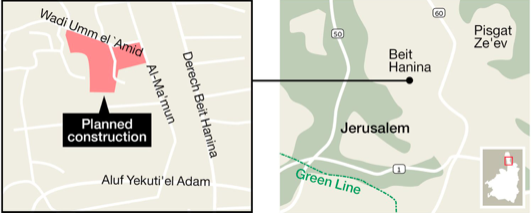
On January 8th the Jerusalem District Planning Committee granted final approval to a new 75-unit settlement compound to be built in the heart of the Palestinian East Jerusalem neighborhood of Beit Hanina. If built, it will be the first-ever authorized settlement project in Beit Hanina, located north of the Old City.
May by Haaretz
The Beit Hanina settlement plan – as FMEP has previously reported – is backed and promoted by settlement impresario Aryeh King, and it provides for the construction of a total of 150 new units in the southern end of the Beit Hanina neighborhood. The land slated for the 150 units is privately owned, 53% of the land is owned by an Israeli who is supportive of the plan, and 47% by a Palestinian company who objects to the plan and has fought against it. Because the land has not been surveyed to demarcate the split ownership, Israeli planning authorities decided that the settlement plan is designated for the entire property, with construction rights split evenly between the parties, meaning the 75 units granted final approval on January 8th represent the Israeli-controlled half of the project.
Ir Amim notes the larger picture of Isreali settlement activity north of the Old City:
“In close proximity to Ramat Shlomo to the southwest and Pisgat Zeev to the northeast, construction of this new compound may signal the beginning of a move to create contiguity between the two settlements, while fracturing the contiguous space between Bet Hanina and Shuafat. As exemplified by the ring of state-sponsored settlement strongholds throughout the Old City Basin, the establishment of a settler enclave in the midst of Beit Hanina will not only impact the fabric of this community, but will further erode opening conditions for a political solution to the conflict based on two capitals in Jerusalem.”
Ir Amim explains essential context:
“the plan will enable an ideologically driven settler outpost in the heart of Beit Hanina, a neighborhood located on the northern perimeter of East Jerusalem that has remained relatively untouched by Israeli settlement within its limits. Since the land in question is not far from Ramat Shlomo to the south-west and Pisgat Zeev to the north-east of it, its construction may mark the beginning of a far sweeping move to create contiguity between the two settlements, while driving a wedge between Bet Hanina and Shuafat.”
Plans Advance in East Jerusalem, Part 2: Reports on Har Homa & Rumors on Givat Hamatos
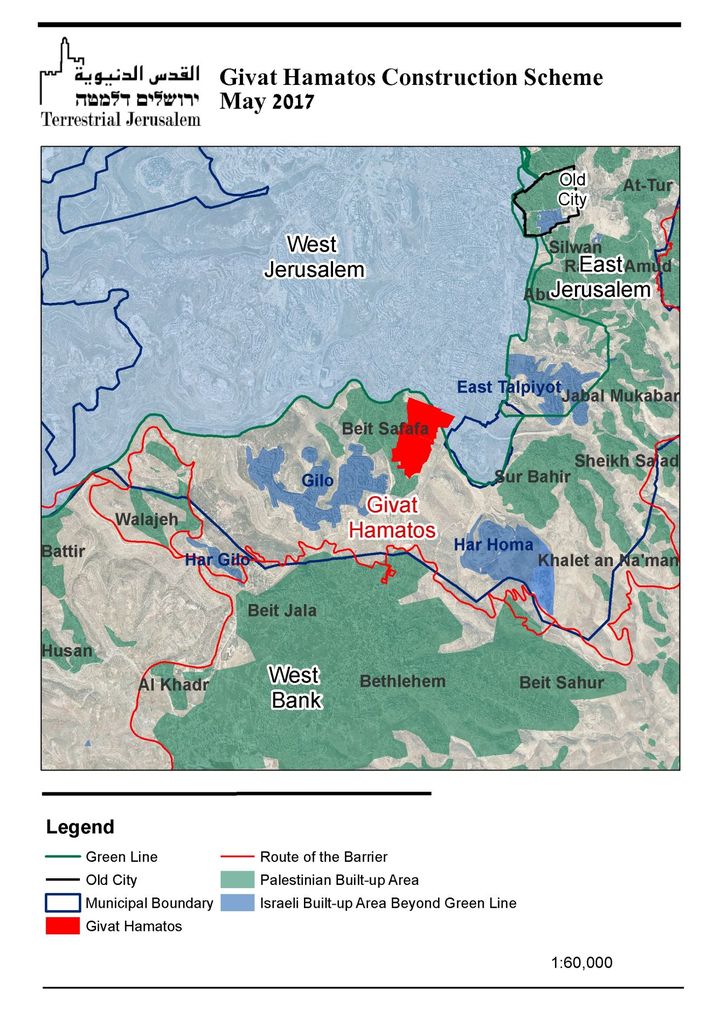 On January 7th, the popular Isareli broadcaster network Kan reported that the Prime Minister’s office has blocked a plan to build 2,000 new settlement units in the settlement of Har Homa, citing “diplomatic difficulties.” In response to an inquiry, the office did not deny the report, but issued the following statement:
“Israel has built in Jerusalem, is building in Jerusalem and will continue building in Jerusalem — while exercising judgment.”
Jerusalem expert Daniel Seidemann raised a key question and larger concerns about the reports concerning Har Homa, saying:
“The construction potential at Har Homa has been exhausted, and it’s not possible to build anything near 2,000 units. So what are they talking about? Something is clearly going on. Three possibilities come to mind, all problematic…Possibility no. 1: the nearby planned doomsday settlement of Givat Hamatos, which is awaiting tenders. Possibility no. 2: Hirbet Mazmoriyya, to the northeast of Har Homa. The lands owned by Palestinians that will have to be expropriated. Not likely. Too complicated and controversial. Possibility no. 3: the area wedged betw. Mar Elias Monastery, the Hebron Road, the 300 Checkpoint, dubbed Bethlehem Gate or Har Homa West. The land is ownership is a mixture of Palestinian &Church lands, along with settlement developers.”
Ir Amim notes that, while reportedly stalling the Har Homa plan, Netanyahu is – in fact – simultaneously facing mounting pressure to issue tenders for the construction of the Givat Hamatos settlement, the site for which is the northern border of Har Homa. Ir Amim writes:
“Last week, rightwing groups launched a coordinated campaign to exert pressure on Prime Minister Netanyahu to advance construction in the area of Givat Hamatos, which has been essentially frozen for the past six years. While the approval of the plan for 2,610 housing units in the area was formally published in 2014, there has been no announcement of tenders since then. This has been largely attributed to international opposition, namely from the United States and Germany. Likely attempting to ratchet up pressure on Netanyahu in lead-up to the upcoming elections in March, the campaign has been spearheaded on a public level by rightwing organizations. Several prominent rabbis known for supporting the settler movement penned a letter to the Prime Minister calling on him to announce the tenders for Givat Hamatos, while rightwing media outlets have published daily articles demanding an ‘end to the freeze.’ A rightwing institute likewise published a lengthy paper on the significance of establishing a new settlement in the area as a means of thwarting any potential future division of Jerusalem within the framework of a resumed peace process.”
Plan Advance in East Jerusalem, Part 3: Israel Approves Plans for Two More Settler-Run Tourist Sites in East Jerusalem
On December 25, 2019 the Jerusalem Local Planning approved two significant settler-backed schemes in East Jerusalem:
- The committee approved the Israeli government’s plan to seize land in the Palestinian East Jerusalem neighborhood of Sheikh Jarrah, in order to establish a park adjacent to the infamous Shepherd Hotel, an historic/iconic building that was taken over by the radical Ateret Chohanim settler organization in 2011. The new park – called “Hakidron Park” has been discussed and considered by Israeli governments for the past 15 years.
- The committee also approved the Israeli government’s plan to confiscate land in the Ras al-Amud neighborhood of East Jerusalem, for the purpose of opening a tourist and religious services center on the Mount of Olives, adjacent to the Jewish cemetery. The Jerusalem Municipality hired an architect, Arie Rahamivov, who is also employed by the radical Elad settler group for the planning and construction of their crown jewel: the Kedem Center in Silwan. The new center in Ras al Amud will be yet another tourist center under the management of Elad, which already operates another visitors center on the Mount of Olives.
Ir Amim writes:
“Approval of the aforementioned land expropriations would signal intent to begin construction at both sites and will help to further solidify the settlement ring around the Old City Basin. While both plans can be posited as innocuous municipal initiatives to serve local residents and visitors to the areas, such touristic projects play an integral role in expanding the scope of settlement strongholds in the area and creating a more contiguous Israeli space, while diffusing the political agenda behind these efforts.”
Plans Advance in East Jerusalem, Part 4: Tenders for Pisgat Zeev and Gilo
Ir Amim reports that the Israel Lands Authority published construction tenders for the following East Jerusalem settlements in early January:
- 3 tenders for a total of 461 new settlement units in the Pisgat Zeev
- 1 tender for commercial buildings in the Gilo settlement, located
For Second Time, Israeli Court Rules Against Settler Claim to Bakri House in Hebron
On December 23rd, the Jerusalem District Court ruled that the Palestinian Bakri family are the rightful owners of a disputed property in Hebron. This ruling should deal a final blow to the 18-year long legal battle settlers have waged to gain control of the Bakri family house (“should”, not “will”, because the settlers have repeated been dealt defeats in court and each time are able to manufacture a new claim or appeal) .
The ruling – which affirmed a March 2019 ruling by the Magistrate court, which the settlers had appealed – called for the immediate evacuation of the settlers whom Israel has permitted to illegally squat in the house while the legal processes were ongoing. For a full history of the Bakri house saga, see here.
Following the ruling, Peace Now said:
“[the] court again ruled that the settlers had forged [documents] and lied all along… We hope that after [almost] two decades of violence, lies and terror, justice will be carried out and the invaders will be evicted.”
Peace Now Wins Interim Decision Against Secretive Public Funding to Amana
In response to a Peace Now petition, on December 31st the Israeli High Court issued an interim decision that requires state bodies to request approval from the court before transferring funds to Amana, a settlement body which is known to undertake illegal settlement activities across the West Bank. Peace Now filed the petition after discovering that state bodies have been secretly funneling money to Amana.
Peace Now said in a statement:
“Amana is the most significant organization operating in the settlements. For decades, it has overseen the establishment of dozens of illegal outposts and neighborhoods with the help of massive budgets, some of which have been transferred from Israeli taxpayer money through local settlement authorities in violation of the law. The judges’ decision is a dramatic yet necessary step that limits, for the time being, this illicit transfer of funds to illegal projects in the settlements and outposts. We hope that in this spirit, the court will rule that public funds should no longer be transferred to Amana via subsidy procedures. This situation in which the State of Israel backs illegal activities with public funds is unconscionable, and we urge the Israeli government to put an end to it.”
Israeli Court Dismisses Palestinian Landowners’ Petition Against the Ofra Settlement
On January 6th, the Israeli High Court of Justice dismissed a petition filed by Palestinian landowners challenging the legality of the Ofra settlement. The petition was based on the fact that the settlement is partially built on privately owned Palestinian land. The court ruled that the majority of the settlement had been built on land expropriated by Israel, and that the minority of land that Palestinians claim ownership over was not enough to invalidate the entire Master Plan for the settlement. Further, the court stated that the settlement structures built on the privately owned Palestinian land were built by settlers “in good faith,” under the mistaken belief that land had also been expropriated by the Israeli government.
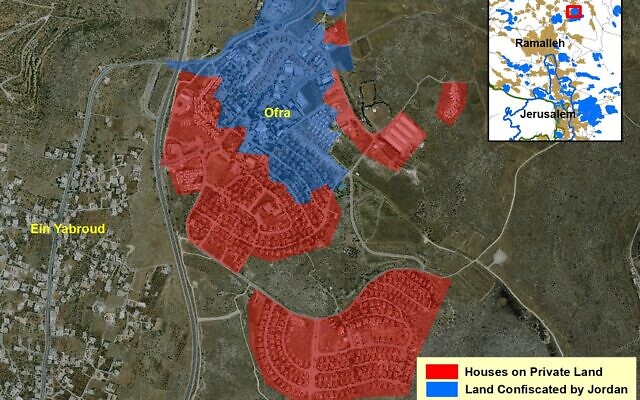
Map by Peace Now
This High Court ruling does not fix the legal status of Ofra settlement buildings, but it is nonetheless significant because it continues to deny Palestinians their property rights. Likewise, it gives a green light to the use of the “market regulation” principle to expropriate land in order to retroactively legalize the structures. As a reminder, the “market regulation” principle – which was invented by the Israeli Attorney General – holds that if settlers acted “in good faith” when they built on privately owned Palestinian land, the state can expropriate that land, thereby making what was illegal before, now perfectly legal.
The Ofra settlement’s legal situation has long been an issue that the Israeli government has tried to fix. Ofra was first established by settlers on land that the Jordanian government had expropriated in 1966, in order to build a military base (which was never built). The Israeli government used this pretext to expropriate the land in 1977, in order to recognize the Ofra settlement, which had been established illegally but with tacit cooperation of the government on the site two years earlier. However, the settlers built the majority of the Ofra settlement on land that was not expropriated by Israel in 1977 — land that was in fact registered to Palestinians from the nearby village of Ein Yabroud. In light of the legal status of the land, no Israeli government has since found a way to fix the legal status of these homes (not for lack of trying) – meaning that the majority of the structures in Ofra were built without permits, making them illegal under Israeli law.
Peace Now elaborates on what is at stake in the Ofra settlement case:
“Most of the houses built in Ofra (approximately 413 out of 625) were built on an area of 550 dunams of privately owned Palestinian land. In addition, hundreds of dunams of Palestinian private land were seized for roads in Ofra, as well as infrastructure and agricultural lands for the settlers. The only way to regulate the theft of these lands would be to expropriate them from the Palestinian landowners for the benefit of the settlers, in complete contradiction to the positions of previous Israeli governments and legal advisors, and contrary to binding rulings of the High Court. Although the current legal advisor (Avichai Mandelblit) allowed land expropriation in some places for settlement purposes (for example, in Haresha), in the regulation of massive land theft such as in Ofra the Israeli government would be crossing a new red line.”
FMEP documents the government’s efforts to expropriate Palestinian land for the settlements in its Annexation Policy Tables.
Bennett Launches Initiative to More Aggressively Demolish Palestinian Construction in Area C
Making the most of his appointment as Israeli Defense Minister in the current caretaker government, Naftali Bennett is pushing an initiative to annex Area C and to aggressively demolish Palestinian construction in the area (reminder: Area C constitutes nearly 60% of the West Bank; it is land that under Oslo II was supposed to have been “gradually transferred to Palestinian jurisdiction”).
As part of his efforts, Bennett has launched legal research into how Israeli can bring settlement building in Area C under the direct authority of the Justice Ministry, cutting out the Civil Administration. This Civil Administration, it should be recalled, is the arm of the Israeli Defense Ministry which acts as the sovereign power over the West Bank, in a system of governance Israel created based on its recognition of the different legal status of the area. Bennett has called for that system to be disbanded (in addition to annexing Area C). To be clear: transferring the construction and planning processes in Area C to domestic Israeli jurisdiction would by any definition constitute the Israeli state extending its sovereignty over area — an act of annexation.
Bennett has requested that Defense Ministry officials present several legal options for how Israel can bring planning processes under the Justice Ministry (integrating the settlements into the normal planning process). The settler-run Arutz Sheva outlet attributes the following quote Bennett in a private meeting:
“We are in essence discussing applying procedural sovereignty only. Full sovereignty is under the authority of the political echelon, but this is a step in the right direction. There is no reason that residents of Judea and Samaria should continue being discriminated against. We must stop this. Residents of Beit El and Ariel are no less Zionist than residents of Kfar Saba and Tel Aviv. They pay taxes and serve in the army, and they need to receive the same services from the government.”
Bennett is also advancing several initiatives that will empower and compel the Civil Administration to more aggressively enforce demolition orders against Palestinian construction in Area C (based on Israel’s policy of not granting permits to Palestinians in Area C, nearly every Palestinian structure in this territory has a demolition order pending against it). Bennett is also eyeing ways to combat what he considers illegitimate and nefarious funding from the European Union to Palestinian communities living in Area C. Israel Hayom reports:
“Bennett’s plan to stop the Palestinians from chipping away at Area C demands action in four areas: Operational, economic, legal, and PR. He wants to change enforcement priorities to put an emphasis on eradicating illegal buildings in strategic locations rather than by numbers. For example, home demolitions would be carried out in accordance with Israeli interests, prioritizing illegal buildings next to roads or settlements. Bennett also instructed the Central Command and the Civil Administration to work more closely to implement his plan and asked that the Civil Administration report to him monthly to update him on progress. Meanwhile, the defense minister is weighing the possibility of allocating more resources to the Civil Administration for enforcement, which would entail hiring more personnel. Bennett also wants to take steps to stop the flow of European money that funds the illegal Palestinian construction in the first place, allowing the “Fayyad Plan” to flourish.”
Bennett Appoints Key Settler Ally to Lead New Government Task Force on Area C Annexation Plans, Immediately Announces Plan to Legalize Settlements
In addition to his new initiative targeting Palestinian construction in Area C, Israeli Defense Minister Naftali Bennett announced that he has created an inter-ministerial taskforce to develop settlement and annexation plans for the future of Area C in the West Bank.
Bennett’s chief of staff, Itay Hershkowitz, has been in weeks-long consultations with key settler leaders to decide what items to act on immediately. Haaretz reports their agenda includes:
- Allowing Jews to privately purchase land in the West Bank. [See here for a detailed explanation of this complicated matter]
- Connecting unauthorized outposts to water and electricity.
- Granting official recognition to unauthorized outposts that are located near established settlements by recognizing them as “neighborhoods” of the settlement.
- Repealing a military order that empowers the Civil Administration to evict settlers from privately owned Palestinian land with or without a Palestinian-initiated petition to have the settlers removed.
- Legalizing 30 sheep farms in the West Bank that are under pending demolition orders.
On Thursday, Bennett announced that he has appointed West Bank settler Koby Eliraz to lead the new taskforce. Calling Eliraz a “bulldozer,”Bennett said:
“The territorial future of the Land of Israel is at stake. The State of Israel has simply not been up to the task of stopping [Palestinian construction]. We are changing direction and embarking on a battle that Israel must win… The defense establishment will fight for this territory, and it is essential for someone to lead this campaign.”
Eliraz previously served as Netanyahu’s settlement advisor, but was fired by the Prime Minister in June 2019 reportedly because he was believed to be allied too closely to Netanyahu rival Avigdor Liberman, who Netanyahu also dismissed. At the time of Eliraz’s firing, settler leaders were outraged and published a letter asking Netanyahu to reverse Eliraz’s firing, suggesting that Eliraz’s absence will hinder government efforts to retroactively legalize outposts. The letter noted:
“Kobi has taken care of Israeli settlement and its residents with great professionalism. He is credited for many advancements [on our behalf] in the fields of construction, infrastructure development, security and more.”
The Times of Israel observed, significantly, that the Yesha Council was able to get every single settlement Mayor to sign the letter in support of Eliraz, explaining:
“The Yesha Council in recent years has struggled to get all of its members on board with its initiative, but the umbrella group’s ability to gather the signatures of every Israeli mayor beyond the Green Line is testament to the broad respect that Eliraz holds among settler leader.”
Following ICC Announcement, Pompeo Says Israel Has “Fundamental Rights” to Land
At a press briefing on December 22nd, U.S. Secretary of State Mike Pompeo did not specifically address the ICC announcement, but made lengthy comments regarding statements from European countries and the European Union that were critical of the new U.S. position on settlements (that they are not “per se illegal” under international law). Pompeo’s comments hold relevance to the U.S. position on the ICC case and more generally on the U.S. approach to the Israeli-Palestinian conflict:
“First, the legal analysis that the EU performed [on settlements] we just think is wrong. We think they have an improper analysis of the international law surrounding this. So as the technical legal matter, [EU Foreign Minister] Ms. Mogherini just – she’s just wrong. And so we are doing our level best to demonstrate to them our legal theory, our understandings, and why it is that we’re convinced that under international law these settlements are not per se illegal. So we’re working that element of it as well. But at another level, and perhaps at the level that will lead to the right outcome, which is why we did this, this has to be resolved through political means, and we hope that all nations, including member nations inside of the EU and the EU itself and countries all over the world, will come to recognize the fundamental rights that the Israeli people have to this land, to this space. There are real security needs. The risk that is presented from the world as anti-Semitism is on the rise, we hope that every nation will recognize that and weigh in on this conflict in a way that is constructive, that will ultimately lead to the peace that is so desperately needed.” [Emphasis added by editor]
Pro-Settlement Legal Forum Conference Draws Big Names, Big Promises
The Kohelet Policy Forum, a right-wing advocacy organization that has enormous influence with senior Israeli – and increasingly American – government figures, hosted a “Conference on the Pompeo Doctrine” in Jerusalem, Jan. 7-8, 2020. The conference served as a gleeful celebration and forward-looking projection of what the new U.S. settlement policy towards settlements means for Israel. The conference drew participation from all the leading Israeli politicians and several senior members of the Trump Administration, including Secretary of State. Pompeo. Key quotes from the conference speakers are copied below.
U.S. Secretary of State Mike Pompeo:
“We’re recognizing that these settlements don’t inherently violate international law. That is important. We’re disavowing the deeply flawed 1978 Hansell memo, and we’re returning to a balanced and sober Reagan-era approach. “In doing so, we’re advancing the cause of peace between Israelis and Palestinians.”
U.S. Ambassador David Friedman:
“…when we came into office the lingering issues included three of significant importance: the status of 1) Jerusalem, 2) the Golan Heights and 3) Judea and Samaria. We have approached them in ascending order of complexity…I thank God that President Trump had the courage and the wisdom to recognize Jerusalem as the capital of Israel and move our embassy to Jerusalem from Tel Aviv…In recognizing Israel’s sovereignty over the Golan Heights, President Trump, evaluating the continuous malign and barbarous threats posed by Syria, concluded that no northern boundary for Israel would be secure except a boundary that incorporated the Golan. He acted well within the language of 242. [Judea and Samaria] is certainly the most complicated of the issues because of the large indigenous Palestinian population. Over the years before we came into office, it’s only gotten more complicated and more challenging. The proverbial goalposts have moved and moved – to the point today where they are no longer even on the field….The Pompeo Doctrine does not resolve the conflict over Judea and Samaria. But it does move the goalposts back onto the field. It does not obfuscate the very real issue that 2 million or more Palestinians reside in Judea and Samaria, and we all wish that they live in dignity, in peace, and with independence, pride and opportunity. We are committed to find a way to make that happen. The Pompeo Doctrine says clearly that Israelis have a right to live in Judea and Samaria. But it doesn’t say that Palestinians don’t….it calls for a practical negotiated resolution of the conflict that improves lives on both sides.”
Israeli Prime Minister Netanyahu said:
“I will not let any settlements be uprooted in any diplomatic plan. This idea of ethnic cleansing… it won’t happen. There is a window of opportunity. It opened, but it could close…There was no West Bank separate from the rest of the land. It was seen as the heart of the land. We never lost our right to live in Judea and Samaria. The only thing we lost temporarily was the ability to exercise the right. When Israel returned to the West Bank We didn’t return to a foreign land. That is a distortion of history. Jews lived in Jerusalem and Hebron for thousands of years consecutively…The Pompeo declaration about the status of the towns [in Judea and Samaria] establishes the truth that we are not strangers in our land. In a clearly defensive war, we returned… to the land where our forefathers put down roots thousands of years ago…Unlike some in Europe who think the Pompeo declaration distances peace, I think it will promote peace, because peace must be based on truth, not lies. Settlements are not the root of the conflict. We are standing with justice and the truth. It is a great struggle.”
Israeli Defense Minister Naftali Bennett on Area C annexation and his initiatives in that regard:
“Our aim is that within a decade a million Israeli citizens will live in Judea and Samaria” and later “Our objective is that within a short amount of time, and we will work for it, we will apply [Israeli] sovereignty to all of Area C, not just the settlements, not just this bloc or another. We are embarking on a real and immediate battle for the future of the Land of Israel and the future of Area C. It started a month ago and I am announcing it here today. A month ago, I convened a meeting and I explained the clear directive, the State of Israel will do everything to ensure that these territories [Area C] will be part of the State of Israel.”
Likud MK and former Mayor of Jerusalem Nir Barkat said:
“I am confident that Secretary Pompeo’s statement is an integral part of the American plan and is closely linked to Jared Kushner’s proposal advanced in Bahrain promoting significant economic investment in the Palestinian economy…Now is a perfect opportunity to similarly grow the communities throughout Judea and Samaria at a pace like never before. This declaration is a recognition of the legal and historic right of the Jewish people to live wherever we wish. This is how it should be in other parts of the world and certainly here in the Jewish State. This declaration is therefore an exceptional opportunity for Israel to ensure our continued growth and expansion throughout these areas. Israel needs to set a goal for the settlement of two million people in Judea and Samaria within fifty years. This is a commitment which requires that we already now lay the framework to make that possible and this is an investment which will also benefit the Palestinian people” [Editor’s note: Barkat has been working with Harvard Professor Michael Porter to promote an economic peace scheme, most recently speaking at Harvard about the plan in December 2019]
Eugene Kontorovich, Director of International Law at the Jerusalem-based Kohelet Policy Forum and a key shaper of anti-BDS/pro-settlement legislation in U.S. Congress and across state governments, said:
“American Policy is now clearer than ever, Jews living in Judea and Samaria is not a crime. For decades, the obscure Carter-era memo was used as justification for anti-Israel policies despite the fact that its conclusions were rejected by subsequent administrations. Sec. Pompeo’s statement at the Kohelet conference today makes clear the U.S.’s wholesale rejection of the legal theory that holds that international law restricts Israeli Jews from moving into areas from which Jordan had ethnically cleansed them in 1949.”
Bonus Reads
- “The Atarot Exception? Business and Human Rights Under Colonization” (Marya Farah in Jerusalem Quarterly)
- “The Decade Israel Erased the Green Line” (+972 Magazine)
- “Settlers are seizing ‘empty’ land. The Palestinian owners are fighting back” (+972)
- “Israeli Right Wants to End Peace with Jordan” (Haaretz)
- “Security official says police, courts scuttling efforts to curb settler violence” (The Times of Israel)
Welcome to FMEP’s Weekly Settlement Report, covering everything you need to know about Israeli settlement activity this week.
To subscribe to this report, please click here.
May 31, 2019
- Israel Publishes Tenders for 805 Settlement Units in East Jerusalem; More May Be Coming
- The World Zionist Organization Continues to Finance Illegal Settlement Construction
- Yitzhar Settlers Attack Israeli Police Officers, Again
- Israel Cut-Off & Trapped a Palestinian Family on the Israeli Side of the Wall, Then Banned Them from Entering Israel
- Palestinians React to Latest Annexation Rumors Amidst Israeli Government Chaos
- Florida Governor Leads Headline-Grabbing Trade Delegation to West Bank Settlements
- Scheindlin: Israel’s Democratic Decay is Happening for the Sake of Annexation
- Bonus Reads
For questions and/or comments contact Kristin McCarthy – kmccarthy@fmep.org.
Israel Publishes Tenders for 805 Settlement Units in East Jerusalem; More May Be Coming
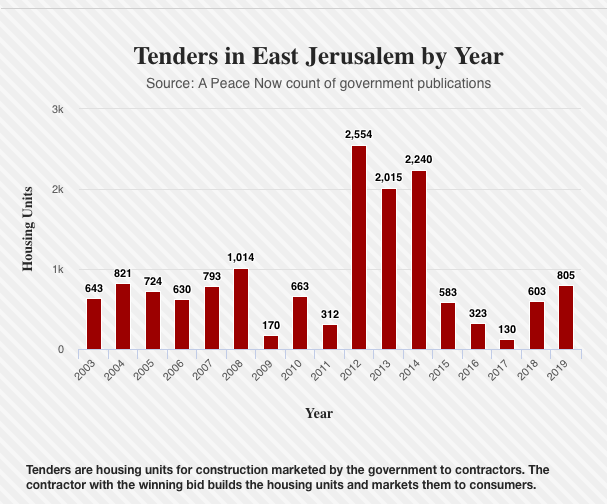 On May 30th, the Israel Land Authority published tenders for a total of 805 new settlement units in East Jerusalem, a decisive step towards the start of construction. The 805 tenders were issued for 345 units in the Ramot settlement and 460 new units in the Pisgat Ze’ev settlement. These are the first tenders published for East Jerusalem settlement construction since April 2018, and collectively are the most tenders published in a single year (let alone simultaneously) since 2014. Moreover, as Jerusalem expert Daniel Seidemann explains, this batch of tenders allows for more construction in East Jerusalem settlements than the government has approved for East Jerusalem Palestinian neighborhoods since Israel gained control of East Jerusalem in 1967.
Furthermore, the Jerusalem settlement watchdog group Ir Amim warns that this batch of tenders may only be the first of an oncoming wave:
“For several years after the collapse of the Kerry initiative in April 2014, there was a significant decrease in the approval of master plans in East Jerusalem and as a result, few tenders were announced. This dramatically changed in 2017 and 2018 with the advancement of master plans reaching near record levels. Today’s tenders are primarily a result of plan approvals from last year, potentially signaling impending large-scale announcements of tenders based on additional plans which have been approved over the last year.”
Peace Now, the veteran settlement monitoring organization, said in a statement:
“Continued construction in East Jerusalem does not contribute to Jerusalem and does not contribute to Israel. As long as we have not reached a permanent agreement with the Palestinians on Israel’s borders, building beyond the Green Line is illegitimate and only harms the prospects for peace and trust between the sides.”
The World Zionist Organization Continues to Finance Illegal Settlement Construction
According to documents acquired by Israel’s Movement for Freedom of Information, over the past two years the Settlement Division of the World Zionist Organization continued to finance illegal settlement construction while simultaneously trying to hide this information from the public.
As a reminder, the Settlement Division is technically part of the World Zionist Organization, but in practice the unit was created by the Israeli government in 1968 and is funded entirely by the Israeli government (and Israeli taxpayers). Its mandate is to manage West Bank land expropriated by Israel, in order to facilitate the settlement of Israeli Jews in the occupied territories. To make this possible, the Israeli government has allocated approximately 60% of all “state land” in the West Bank to the WZO’s Settlement Division [over the past 50 years Israel has declared huge areas of the West Bank to be “state land,” including more than 40% of Area C, where most of the settlements are located]. Together, the WZO and the Israeli government work in coordination to develop West Bank settlements and encourage Jews to move into them, working together so closely that the Settlement Division even splits its real estate profits with the Israeli Housing and Construction Ministry.
According to the WZO’s financial documents for 2017-2018, the WZO subsided settlement projects that are illegal under Israeli law — to the tune of $734,577 USD (NIS 2,668,427).
In addition, the WZO failed to specify how it spent an additional USD $16 million (NIS 58 million) in support of new construction projects, leaving the exact location and legal status of the construction unknown. This represents 43% of the WZO’s overall budget for subsidizing projects.
The settlement projects known to have been subsidized by the WZO in 2017-2018 include:
-
- $640,000 USD (NIS 2,330,973) for the establishment of a community center in the Eli settlement. Though the Eli settlement previously received Israeli government approval, a “Master Plan” – which officially zones land for distinct purposes (residential, commercial, public) – has never been issued for Eli, meaning all construction there is illegal under Israeli law.
- $85,816 USD (NIS 311,736) on projects in the unauthorized Brosh outpost (the Israeli government is advancing a plan that would legalize Brosh retroactively, but until it does, all projects in it are illegal).
- $42,000 USD (NIS 153,127) for infrastructure development in the unauthorized Givat Eitam/E-2 outpost, which according to Peace Now appears had not been transferred as of the end of 2018. FMEP has covered the settlers efforts to establish the Givat Eitam/E-2 outpost and the government’s plan to retroactively authorize it as an official settlement in detail. It is worth recalling that the location of the Givat Eitam/E-2 has dire geopolitical consequences for the fate of the two state solution as well as the development of Palestinian communities just south of Bethlehem.
- $6,000 USD (NIS 22,445) for projects in the unauthorized Mitzpe Kramim outpost. Funding for Mitzpe Kramim over the past two years is particularly galling, given ongoing litigation that has included evidence that the Settlement Division knowingly gave land privately owned by Palestinians to settlers in order to build the outpost.
- $900 USD (NIS 3,273) for renovation of illegal structures in the unauthorized outpost of Haresha. The Israeli government has successfully used the Haresha outpost as a test case for new legal tools the government of Israel developed in order to justify the expropriation of privately owned Palestinian land in order to retroactively legalize outposts. Using these tools, the government has found a way to “legally” build an access road to the settlement through privately owned Palestinian land; once the road is built, there is nothing preventing the government from retroactively legalizing Haresha.
Peace Now said in a statement:
“The Settlement Division is a body that was born in sin immediately after 1967 in order to carry out the dubious works of building settlements for the government. It turns out that even today, after regulating the activities of the Settlement Division, it still operates without transparency and continues to finance illegal activity. The time has come to dismantle the Settlement Division and to restore to the government the governmental activities it has privatized.”
Despite the WZO’s ongoing defiance of Israeli planning and building laws — or perhaps in light of its direct and very effective role in entrenching and expanding the settlements — the Israeli government is actively seeking to transfer more West Bank land to the WZO for management. In the last Knesset session, a government-backed bill to expedite the transfer of more land to the WZO was stalled by the Israeli Attorney General only because the bill, in the view of the Attorney General, was duplicative of his own efforts to enrich the Settlement Division at the administrative level.
Yitzhar Settlers Attack Israeli Police Officers, Again
On May 26th, dozens of masked Israeli settlers violently attacked Israeli police officers who approached an illegal outpost near the settlement of Yitzhar, forcing the Israeli army to intervene in order to get the police officers to safety.
Not a single settler was arrested for the attack.
The event started when Israeli police arrived at the Kippah Sruga outpost in response to calls saying that clashes had broken out between Palestinians and Israelis in the area. According to Israeli police, when they arrived masked settlers began launching stones at them and slashed their car tires with a knife.
Haaretz reporting on this incident reminds readers:
“Over the past several weeks, settlers from Yizhar and surrounding settlements have been involved in several altercations, yet police have not arrested a single suspect. Last week, Israelis and Palestinians reported a field set ablaze and clashes in the Palestinian towns of Burin, Urief and Asira al-Qibliya. In a video disseminated by Asira al-Qibliya’s council, settlers are seen throwing stones at Palestinians, while soldiers nearby do nothing to arrest them. In response to the video, the IDF spokesman said that ‘Palestinians started a fire near Asira al-Qibliya. The IDF, the Border Police and civilian volunteers worked to extinguish the fire, which was spreading towards a military position and the edge of Yitzhar.’ After a B’Tselem video surfaced, showing settlers setting fire to fields, the army revised its response and confirmed that Jewish settlers also took part in setting fires.”
Israel Cut-Off & Trapped a Palestinian Family on the Israeli Side of the Wall, Then Banned Them from Entering Israel
On May 27th, Haaretz published a gut wrenching profile of the Hajajla family who lives on the Israeli side of the separation wall that cut them off from their hometown of al-Walajah, a Palestinian village just south of Jerusalem. Two days after publication of the profile – which FMEP shares in brief below – Israel issued an order banning the patriarch of the family, Omar Hajajala, from entering Israel, though he lives on the Israeli side of the wall in a spot where the route of the wall juts into the West Bank.
Before jumping into the full story, here is a reminder about the situation facing all of the residents of al-Walajah, in the words of Danny Seidemann:
“Walajeh is a village on Jerusalem’s southern flank that is entirely surrounded by the separation barrier. Since 1967, Walajeh’s inhabitants have lived in a Kafka-esque situation, with their village technically located inside Israel’s expanded borders, but with villagers never given Israeli residency (they are considered West Bankers and thus are not permitted inside Jerusalem). As a result, the villagers’ presence in their own village is, under Israeli law, illegal, and their homes there are, by definition, illegal.”
The Hajajla family was the only home in al-Walajah disconnected from the village when the separation barrier was built, leaving the family home on the Israeli side of the wall since 2014. The family refused to abandon their home despite the coercive and legal efforts by Israel to force them to do so. In 2014, after a petition before the High Court of Justice, the Defense Ministry opted to build the family a special passage underneath the barrier so it could reach the village, at a cost $1.1 million USD (NIS 4 million).
After the tunnel was constructed, the Israeli government began to impose new, burdensome, and compounding restrictions on the family regarding its use of the passageway. In 2017, the government decided to install a locked gate at one end of the passageway to control who enters and exits, which could be opened only by a single remote control given to the family. That single remote meant that whenever one member of the family left the home (impossible without taking the remote control with them), the rest of the family was left trapped, literally, until the remote-holder returned.
To make the situation more workable, Omar Hajajla, the family’s patriarch rigged an electric bell near the gate so that the single remote control can stay at the house while family members leave and return (the bell enables someone in the home to know that someone is at the gate needing to be let in). The bell has been in place for over a year, but only recently the Israeli Border police opted to make it an issue. This month, the police took Omar in for questioning and changed the lock so that the family could not open the gate at all. Omar Hajajla was ultimately fined and released, but the lock on the gate remained — until Haaretz filed an inquiry on May 26, 2019.
Omar Hajajla speculates that a recent court ruling in his family’s favor prompted the Israeli Border police to escalate their harassment of the family and make an issue of the bell. About a month ago, the Jerusalem Magistrate’s Court rejected the state’s assertion that the family’s home is illegal – allowing the Hajajla family to stay put.(Note: The state of Israel has initiated demolition proceedings against dozens of homes in al-Walajah claiming that they were built without Israeli building permits – which are next to impossible for Palestinians to obtain, let alone Palestinians on coveted land like al-Walajah) –
In response to the May 27th Haaretz profile, Israeli police stated:
“At issue is a security passage that provides a short passage for the family from their home in Israeli territory to the Palestinian Authority areas. As you can see from the attached video and photos, the gate was shut last Monday to repair security cameras that were broken, to repair damage to the gate and to remove an electric bell that the father of the family had installed against the law, by attaching an unapproved electric wire from his home, a distance of dozens of meters from the passage. After the repair the passage was opened on Wednesday but when the father was seen exploiting it to illegally allow Palestinians to enter it was shut again and the suspect was taken for questioning. The passage was opened again yesterday, but because of a technical problem that was discovered it was shut again and we are working to fix it quickly. The Israel Police will not allow any damage to the security passages it is responsible for and will bring to justice anyone who vandalizes them and tries to harm the State of Israel’s security.”
The treatment of the Hajajla family should be seen in context of Israeli efforts to seal off al-Walajah from Jerusalem. As FMEP has previously reported, residents of al-Walajah have long been struggling against the growing encroachment the nearby Etzion settlement bloc and the Israeli government’s attempt to de facto annex the bloc as part of “Greater Jerusalem.” Ir Amim explains several prongs of this effort, including a particularly problematic section of the separation barrier around al-Walajah that has been planned in order to (a) almost completely encircle the village, (b) turn its valuable agricultural land into an urban park for Jerusalem, and (c) enable construction of a highway that will connect the Etzion settlement bloc to Jerusalem with Israeli-only bypass roads.
Palestinians React to Latest Annexation Rumors Amidst Israeli Government Chaos
Al-Monitor reports reactions from Palestinian leaders who are increasingly fearful that rumors about Israeli annexation of the settlements will be acted upon. Those rumors – as FMEP wrote last week – suggest that Israel will strip the Israel Civil Administration of its authority over the settlements and bring all settlements under Israeli domestic law, making settlement affairs the responsibility of the various Israeli ministries.
Wasel Abu Youssef, member of the PLO Executive Committee in the West Bank, told Al-Monitor:
“Expanding the powers of the Israeli ministries at the expense of the civil administration is an attempt to impose occupation and establish it in the West Bank, to end the [idea of a] two-state solution and prevent the establishment of a Palestinian state, which falls within the framework of denying the Palestinian people their rights to freedom and independence. These efforts mean practically annexing parts of the West Bank to Israel. Unfortunately, this comes with the blessing of the administration of US President Donald Trump, who doesn’t recognize the option of a two-state solution and gives Israel the green light to do whatever it wants in the West Bank.”
Walid Assaf, head of the Colonization and Wall Resistance Commission, told Al-Monitor:
“The efforts to transfer the powers of the civil administration to the Israeli ministries directly mean the annexation of the West Bank settlements to Israel. This will lead to annexing Area C — which amounts to over 60% of the entire area of the West Bank — to Israeli sovereignty…Annexing West Bank settlements to Israel would pave the way for Israel to perpetuate a policy of ethnic cleansing against the Palestinians, and this will push the Palestinians in Area C to migrate to PA-controlled Areas A and B.”
Hanna Issa, an international law professor at Al-Quds University in Abu Dis, told Al-Monitor:
“The Israeli occupation has always been there. It is essential that the Palestinian territories [including the Israeli settlements] remain administered through the civil administration of the Israeli army [in cooperation with the Palestinians] until this occupation ends…“Limiting the powers of this administration and giving its responsibilities to the Israeli ministries is a dangerous step aimed at annexing occupied areas under international law.”
Scheindlin: Israel’s Democratic Decay is Happening for the Sake of Annexation
In a new paper for The Century Foundation, Israeli pollster and political analyst Dahlia Scheindlin writes an important analysis regarding Israel’s path to annexation:
“This report argues that Israel’s slide into illiberal democracy can only be understood as part of an attempt to go beyond military or physical control and establish a political and legal foundation for permanent annexation of both land and people. The assault on Israel’s democratic norms over the past decade initially appeared only indirectly related to a future of permanent annexation, as they suppressed the mechanisms of dissent and undermined the basis for minority rights. Then, in the recent elections, Prime Minister Benjamin Netanyahu made explicit his goal to annex occupied territory in the West Bank, which represented the culmination (to date) of increasingly open policies and legislative initiatives from the previous term that explicitly advance annexation.”
The entire paper is worth reading, and is available online here.
Florida Governor Leads Headline-Grabbing Trade Delegation to West Bank Settlements
From May 25-31, Florida Governor Ron DeSantis led a trade mission – purposefully and prominently also visiting settlements in the West Bank. While on the ground, DeSantis made headlines by blasting BDS, endorsing Israeli settlements, and gloating about Florida’s role in AirBnB’s reversal of its decision to remove rental listing located in Israeli settlements.
DeSantis signed several formal partnerships between Florida universities and Israeli schools, most notably including an agreement between Florida Atlantic University and Ariel University – the first such deal between a U.S. school and an Israeli school located in a settlement. In recognition of the historic deal, Ariel University presented DeSantis with an Honorary Fellowship Award at an event in the settlement, attended by U.S. casino magnates and settlement financiers Sheldon Adelson and Dr. Miriam Adelson. In his acceptance speech, the Governor invoked the Bible to lend his support for Israel’s permanent control of the West Bank, saying:
“We are now in the heart of the Holy Land of Israel. When you think about Israel’s history and the tradition that connects Israel and the U.S., it’s inspiring. On my last visit to Israel in 2014, the U.S. embassy was in Tel Aviv and we were on the verge of signing a destructive agreement with Iran, and I am happy that today we have achieved real progress. We have an American embassy in Jerusalem with an American acceptance of the sovereignty of the State of Israel on the Golan Heights and the agreement with Iran has been removed from the stage of history. I, personally, have fought Airbnb’s discriminatory policy against Jewish-owned properties in Judea and Samaria, and only recently have they changed their discriminatory policy. I say here: BDS has no place in Florida. The memorandum of understanding signed today between the University of Ariel and Florida State University is a blessed agreement that will bring these two institutions forward. I am happy to say that Florida is a very diverse state, but not when it comes to its unequivocal support for the State of Israel.”
U.S. Ambassador to Israel David Friedman also hosted DeSantis for a reception and Israel’s Minister of Public Security Gilad Erdan joined DeSantis on a visit to additional West Bank settlements, this time in Gush Etzion, for a briefing about the fight against BDS. Friedman said:
“Israel has no greater friend in all the 50 governor mansions than Ron DeSantis. I welcome you and the Cabinet members and your delegation to this small but incredibly important country.”
As mentioned by Ambassador Friedman, DeSantis was joined by members of the Florida Cabinet on the trade mission, including Florida Attorney General Ashley Moody and Florida Agricultural Commissioner Nikki Fried. In a controversial move, DeSantis convened a Florida cabinet meeting on May 29th at the Embassy in Jerusalem, despite a lawsuit filed in Florida seeking to stop him from doing so. The lawsuit was filed by a government watchdog group and several news outlets, arguing that convening the Cabinet in Israel violated a state law that requires government meetings to be accessible to the public. The lawsuit was dismissed because the court could not serve paperwork to DeSantis and the other named defendants – who were, obviously, in Israel.
At the Cabinet meeting on may 29th, DeSantis signed a bill to prohibit anti-Semitism in Florida’s public schools and universities. The new law wrongly conflates anti-Semitism with criticism of Israel by including in the definition of anti-Semitism, “drawing comparisons of contemporary Israeli policy to that of the Nazis,” ″blaming Israel for all interreligious or political tensions,” and/or “requiring behavior of Israel that is not expected or demanded of any other democratic nation.”
The next day, DeSantis met with Prime Minister Netanyahu while the larger delegation visited the City of David national park, which is run by the radical Elad settler group.
Bonus Reads
- “Israel’s High Court Seeks Order, Not Justice” (Haaretz)
- “Another Company Withdraws from Israeli Light Rail Project” (IMEMC)
Welcome to FMEP’s Weekly Settlement Report, covering everything you need to know about Israeli settlement activity this week.
To subscribe to this report, please click here.
April 12, 2019
- In Largest Settlement Surge Since Trump, Israel Advances Plans for 3,659 Settlement Units – Including Plan to Retroactively Legalize the Haresha Outpost
- Housing Ministry Publishes Tenders for 956 Settlement Units
- Ariel Medical School Gets Approval, But Faces Two High Court Petitions
- Settlers Celebrate Right-Wing Election Victory
- AirBnb Reverses Settlement Policy
- U.S. Ambassador Friedman Touts East Jerusalem Settlement Business as “Path to Peace”
- Bonus Reads
Questions/comments? Email kmccarthy@fmep.org
In Largest Settlement Surge Since Trump, Israel Advances Plans for 3,659 Settlement Units – Including Plan to Retroactively Legalize the Haresha Outpost
Following up on FMEP’s reporting last week, on April 4th the Israeli Civil Administration Higher Planning Council (the body responsible for regulating all construction in the occupied West Bank) advanced plans for at least 3,659 settlement units, including a plan to retroactively legalize homes in the unauthorized Haresha outpost.
This is the largest batch of settlement plans advanced at one meeting by the High Planning Council since President Trump took office in January 2017; previous High Planning Council meetings (which happen every three months, per a reported agreement with the U.S. Administration) advanced plans on the order of 1,000 to 2,000 units.
Of the total units advanced on April 4th, the High Planning Council granted final approval for 1,226 new settlement, to be built entirely on the west side of the Israeli separation wall. These are:
- In Beitar Illit:
- 31 new units
- A 100 room building for the elderly, or a hotel
-
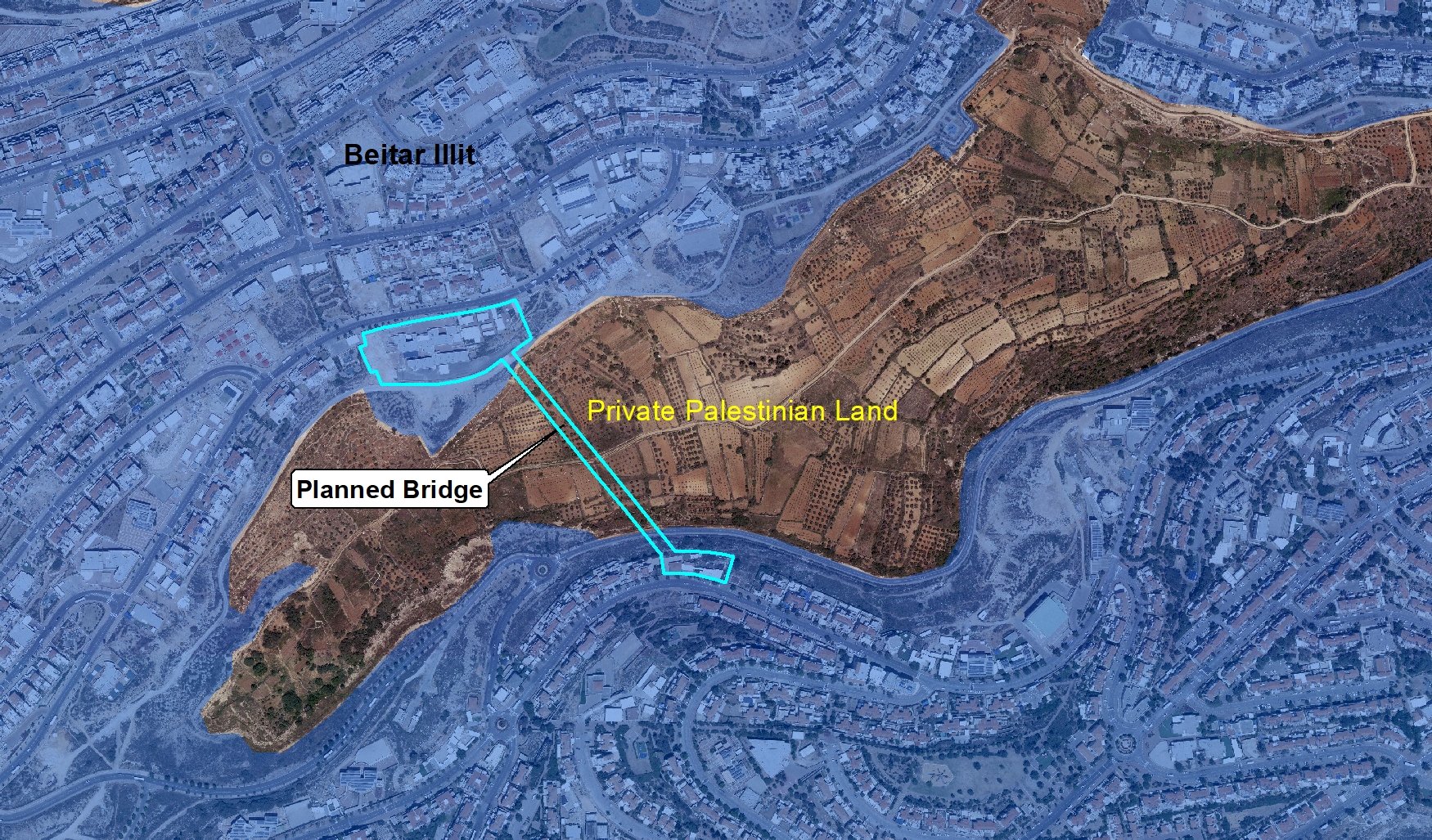
Map by Peace Now
A new pedestrian bridge over privately owned Palestinian land for Israeli settlers to use on the Sabbath (when observant Jews do not drive, and had to walk a long route in order to reach other parts of the settlement).
- 603 new units in Maale Adumim
- A plan to retroactively legalize residential units in the Sde Bar settlement; Peace Now has not yet verified how many units are involved in this plan. Sde Bar was first established as an outpost of the Nokdim settlement in 1998, but Israel granted full approval to that outpost, recognizing it as an educational institute and a full-fledged settlement, in 2005. Settlers recently built a residential neighborhood there without Israeli authorization. The plan approved by the council on April 4th will grant retroactive authorization to those residential settlement units.
- 289 new units in the Alon settlement, located on the Palestinian side of the separation wall within sight of the Khan al-Ahmar bedouin village that Israel is prepared to forcibly relocate. There are plans to expand the neighboring Kfar Adumim settlement to takeover the land where Khan al-Ahmar currently stands.
- 110 new units in the Givat Zeev settlement.
- 108 new units in the Etz Efraim settlement.
- 85 new units in the Karnei Shomron settlement.
Of the total units advanced on April 4th, the High Planning Council also approved for deposit for public review plans for 2,433 new settlement units, the majority of which (1,198) will be built on the east side of the Israeli separation barrier, including:
- 1000 units in Efrat
- A plan to retroactively legalize 720 units in the Haresha outpost. This is part of the Israeli government’s ongoing efforts to retroactively legalize the outpost, which hinges on Israel’s ability to build a legal access road to the outpost. The Israeli government has found several creative solutions to that problem – like building a tunnel or building a bridge – all of which will undoubtedly infringe on the property rights and livelihoods of the Palestinian land owners.
- 210 units in Shiloh – expanding the footprint of the settlement to its north
- 147 units in Ariel.
- 147 units in Mitzpe Yericho.
- 114 units in Elon Moreh.
- 73 new units in Beitar Illit (in addition to the final approvals covered previously).
- 66 units in Oranit.
- 42 more units in Givat Zeev.
- 32 units in Beit Arie.
- 7 new units in Rehelim.
- An unverified number of new units in the following settlements: Paduel, Karnei Shomron, and Elkana.
Peace Now said in response:
“Netanyahu has decided, officially or unofficially, to annex the West Bank to Israel, otherwise one cannot explain the promotion of thousands of units for Israelis in the Occupied Territories. The construction of the settlements only makes it harder to end the occupation and to get to a two states peace agreement and is bad for the Israeli interest to remain a democratic and secured state.”
Housing Ministry Publishes Tenders for 956 Settlement Units
On April 4th the Israeli Ministry of Housing and the Israel Lands Authority met and published tenders for the construction of 956 new settlement units, including commercial complexes; 106 tenders are for plans in settlements east of the separation barrier. These units are in addition to the 3,659 units advanced this week by the Civil Administration’s High Planning Council (discussed above).
The published tenders are:
- 250 units in the Elkana settlement.
- 195 units in the Ariel settlement.
- 118 units in the Ofarim settlement.
- 112 in the Alfei Menashe settlement.
- 111 units in the Oranit settlement.
- 62 in the Adam (Geva Binyamin) settlement, located east of the separation barrier.
- 50 in the Emmanuel settlement.
- 44 units in the Maale Ephraim settlement, located east of the separation barrier.
- 14 units in the Beitar Illit settlement
As Peace Now explains, “some of the tenders are for units that were published in previous tenders but were not sold. The new tenders mean that the government is currently seeking to promote and build those units although failed to do so in the past.”
Ariel Medical School Gets Approval, But Faces High Court Petition
On April 12th, the Israel Higher Education Council voted to approve a new medical school in Ariel University, located in the West Bank settlement of Ariel. This approval contravenes the normal practice of the council, in that it ignores a vote to reject the school by the Higher Education Council’s own professional subcommittee. The medical school is slated to open this fall with significant financing from American casino magnate (and Trump supporter/financial backer) Sheldon Adelson.
However, the High Court of Justice is set to hear a petition regarding the unusual and scandal-ridden process by which the school gained approval at various stages of the planning process. The petition was filed by two Israeli academics – Prof. David Harel of the Weizmann Institute of Science and Prof. Alon Harel of the Hebrew University of Jerusalem – asserting that the approval “casts a heavy shadow on the decision making process in higher education.” It is unclear how the outcome of the petitions might affect the newly approved plan to open the medical school this fall.
Settlers Celebrate Right-Wing Election Victory
Settlers are mostly celebrating the results of Israel’s April 9th elections (in which West Bank and East Jerusalem Palestinians could not vote), which delivered incumbent Prime Minister Netanyahu an opportunity to form and lead the next government.
As has come to be expected, Netanyahu made an 11th hour election pitch by promising to start the process of annexation if he was reelected. Settlers received Netanyahu’s annexation promise and his reelection with predictable enthusiasm. The Yesha Council released a congratulatory statement saying:
“This morning we can say with certainty: In the face of all the campaigns and manipulations, the people of Israel chose the right. The people expressed their loyalty to the Land of Israel and chose in favor of applying Israeli sovereignty over Judea, Samaria and the Jordan Valley. We congratulate Prime Minister Benjamin Netanyahu on his election, and look forward to the establishment of a strong and broad right-wing government. In the next Knesset, too, we will continue to build, expand, legalize and jointly develop Israeli communities in the region.”
Not all settlers believe that Netanyahu will deliver on his promise to annex the settlements, but generally speaking, settlers dismiss the “will he/won’t he” debate (perhaps correctly) as a political decision that does not impact the reality of their presence on the ground.
Peace Now issued a sharp statement on the election results:
“Now the settlement lobby and its re-elected backers in the Knesset are doing what they know best – extorting and manipulating to save Netanyahu from prosecution in exchange for his compliance in working toward annexation. We at Peace Now were never relying on the election to change reality, but rather see grassroots public engagement as the only way to build pressure on the government. Now that Netanyahu has let the annexation genie out of the bag with his pre-election rhetoric, we stand even more equipped to go on the offense by showing fellow Israelis the bleak future the settler lobby and its Knesset backers are leading us, and what viable alternative path Israel can take toward a more prosperous, democratic, secure future.”
AirBnb Reverses Settlement Policy
On April 9th, AirBnB announced that it had reversed its decision to remove rental listings located inside of Israeli settlements in the occupied West Bank, despite previously acknowledging that settlements “are at the core of the dispute between Israelis and Palestinians,” and that the listings there “contribute to existing human suffering.”
AirBnB’s new announcement acknowledges (again) that settlements are “central to ongoing tensions,” but says it will nonetheless continue to allow those listings to remain on their website. Giving a nod to the controversial nature of this decision, AirBnB promised to donate all profits derived from West Bank settlement listings to humanitarian groups, but it conspicuously specified that these will be humanitarian groups working in other parts of the world (as opposed to with the Palestinians).
Omar Shakir, the Israel/Palestine Director at Human Rights Watch – which issued a significant and damning report on the issue of tourism being used to normalize occupation – tweeted in reaction:
“Disappointing @Airbnb decision reverses their stance to fully respect rights. Donating profits from unlawful settlement listings does nothing to remedy ‘human suffering’ they’ve acknowledged causing. By continuing to do business in settlements, they remain complicit in abuses.”
Along with AirBnB’s policy reversal, it settled several lawsuits filed against AirBnB in U.S. courts. FMEP President Lara Friedman tweeted on this important element:
“And just like that, US courts let themselves becomes weapons used to legitimize the violation of intl law, the re-definition of ‘lsrael’ to mean ‘all the land between the river and the sea,’ & the re-definition of ‘anti-Semitism’ to mean ‘refusal to endorse/normalize occupation.’ This is part of a broader trend that very few people are paying any attention to, which is a dangerous mistake. By the time folks wake up it will likely be too late. [link to: https://forward.com/opinion/417058/opinion-the-surprising-new-battleground-in-the-war-against-palestinian/]”
The Center for Constitutional Rights – which recently intervened in the legal cases involving AirBnB – issued a response saying:
“We are dismayed that Airbnb has caved to the legal bullying of Israeli settlers and re-listed properties in illegal settlements in occupied Palestinian territory. Airbnb’s decision reflects an alarming lack of commitment to human rights. When we filed counterclaims on behalf of the Palestinians who actually own the land the listed properties unlawfully sit on, we laid out the international and domestic law violations committed by the settlers, including war crimes and crimes against humanity. In backing down from its decision not to list properties in occupied Palestinian territory, Airbnb is in breach of its international human rights obligations, and is discriminating against Palestinians.”
Amnesty International – which also published a report on the complicity of online rental companies who list properties in East Jerusalem and the West Bank – said in response to AirBnB:
“Airbnb’s decision to continue to allow accommodation listings in illegal Israeli settlements in the occupied West Bank is a reprehensible and cowardly move that will be another devastating blow for the human rights of Palestinians…Airbnb are trying to absolve themselves by stating they will donate the profits from these listings to charity, but that fails to change the fact that by continuing to drive tourism to illegal settlements they are helping to boost the settlement economy. In doing so, they are directly contributing to the maintenance and expansion of illegal settlements, a breach of the Geneva Conventions and a war crime under Rome Statute of the International Criminal Court. Airbnb had a clear opportunity to make the right decision to uphold human rights and use their influence to set a precedent in the tourism industry. Instead, they have chosen to bury their heads in the sand – ignoring blatant evidence that they are helping to fuel violations that cause immense suffering to Palestinians. Airbnb’s reversal demonstrates why we can’t just rely on companies to take the right decisions, and that we need governments to fulfil their obligations by intervening and passing laws obliging their companies to respect human rights.”
U.S. Ambassador Friedman Touts East Jerusalem Settlement Business as “Path to Peace”
U.S. Ambassador David Friedman tweeted his support for the new Rami Levy mall, located in the Atarot settlement industrial zone within sight of Ramallah but inside the security barrier and within Israel’s municipal border, as expanded by Israel after the 1967 war.
Friedman said:
“Great morning at the new Atarot Mall in northern Jerusalem, anchored by a Rami Levy Supermarket. Was given a tour by Rami Levy himself. Israelis and Palestinians working, shopping and doing business together — a simple path to peace!”
FMEP President Lara Friedman tweeted in response:
“Amb Friedman & co’s special notion of peace, based on racist notion that unlike Jews who for 1000s of years refused to forsake their history/narrative, Palestinians will be beaten into submission or bribed into giving up basic human demand for freedom & equal rights.”
When the Rami Levy mall opened in January 2019, FMEP explained:
“The massive new mall is the crown jewel of the shopping empire built by Israeli businessman Rami Levy, who already operates a network of supermarkets in settlements. Like all of Levy’s projects (and settlement industrial zones in general), the new mall is branded as a socially-conscience, ‘coexistence’-building business initiative, with Levy and government officials praising the fact that the new mall will attract both Israeli and Palestinian shoppers and be home not only to Israeli businesses, but to to a few Palestinian-owned/operated businesses as well.”
The ‘coexistence’ argument is dismantled by the Israeli watchdog group Who Profits, which explained:
“The Jerusalem mall would mark a new stage in Levy’s involvement in the occupation economy…[which] began with providing services to Israeli settlers and continued with the exploitation of Palestinians as a cheap labor force in his supermarkets. He now appears to be turning his attention to massive construction projects on occupied Palestinian land and the exploitation of a Palestinian captive market in the East Jerusalem…Rami Levy is in a position that would allow him establish a large mall on “virgin land” because the Israeli authorities have prevented Palestinian businesses from competing with Israelis. Levy’s plan would take advantage of the fact that Palestinians do not have other large-scale retail facilities. A flourishing market in Bir Nabala was destroyed by Israel’s wall in the West Bank. And venturing into West Jerusalem is not an option for Palestinians, most of whom live below the poverty line. Although there is every likelihood that the Israeli authorities will portray Levy’s mall as beneficial to Palestinians, there are important facts to be remembered. Palestinians entering his mall will not be exercising the right of a consumer to informed choice. Rather, they will be captive clients — belonging to an occupied people.”
Bonus Reads
- “Democracy, Israeli Style” (New York Times)
- “Jerusalem is Finally Unified, In Opposition to this Plan” (Haaretz)
Welcome to FMEP’s Weekly Settlement Report, covering everything you need to know about Israeli settlement activity this week.
To subscribe to this report, please click here.
December 21, 2018
- Israel Nears Final Move to Carry Out Massive Land Theft to “Regulate” Illegal Outposts
- Ministers Back a Bill to Legalize 66 Outposts
- In New Legal Opinion, Israeli AG Outlines Strategy for Legalizing Outposts
- New Outpost #1 : Settlers & Government Officials Illegally Re-Build Amona Outpost
- New Outpost #2: Settlers Build Outpost Overlooking Hebron
- More Details on the Plan to Dig a Tunnel Road to the Haresha Outpost
- High Court Criticizes State Over Illegal Road on Palestinian Land
- New Report Documents Israel’s “Severe and Regular” Violation of International Law in Hebron
- High-Rise Settlement Housing Promoted As a Means to Achieve 2020 Settler Vision & As a Solution to Israel’s Affordable Housing Shortage
- Fourth Quarter Decline in 2018 Settlement Construction Starts Doesn’t Tell the Whole Story
- Bonus Reads
Questions/comments? Email kmccarthy@fmep.org
Israel Nears Final Move to Carry Out Massive Land Theft to “Regulate” Illegal Outposts
As has become routine, Israeli settlers and their allies in government are exploiting the recent deaths of three Israelis (two soldiers and a baby) at the hands of Palestinian attackers as an opportunity to accelerate settlement-related activities. This includes advancing new legislation and accelerating/expanding the application of new legal tools designed to entrench and expand the permanence of some of the most radical Israeli settlers living in isolated outposts across the West Bank.
If implemented, the plans and legislation detailed below (and in last week’s settlement report) will expropriate huge amounts of land that even Israel recognizes as privately owned by Palestinians, in order to retroactively legalize Israeli outposts scattered across the West Bank. Such a move will complete what has been a gradual but steady formal suspension of even the pretense of maintaining the rule of law with regard to Israeli settlers’ or the Israeli government’s’ actions in the West Bank (which comes on top of Israel’s official and open contempt for international law). As Haaretz columnist Zvi Bar’el writes:
“The legal criminality that the government invented in honor of the settlers… is an unbridled attack on the rule of law, the undermining of Palestinian landowners’ right to appeal at the High Court, and the destruction of the planning and building system. And mainly, it turns terror into a real estate perk for lawbreaking extortionists.”
Americans for Peace Now said:
“In reaction to murderous terrorist attacks targeting West Bank Jewish settlers and Israeli soldiers, the government of Israel has come under pressure from the settlers to exact retribution against Palestinians. Two of the measures adopted are bound to open the floodgates for the legalization of existing settlement-outposts and the establishment of new ones.”
Ministers Back a Bill to Legalize 66 Outposts
On December 16th, the Israeli Cabinet voted unanimously to give government backing to a bill (called “Regulation Law 2” or the “Young Settlement Bill”) that directs the government to treat 66 illegal outposts built on privately owned Palestinian land as legal settlements, while giving the government 2 years to find a way to retroactively legalize those outposts.
The bill, proposed by MK Bezalel Smotrich (Habayit Hayehudi) and MK Yoav Kisch (Likud), also freezes any/all legal proceedings against the outposts and requires the government to connect the outposts to state infrastructure including water, electricity, provide garbage removal, and also approve budgets for them. The law also allows the finance minister to guarantee mortgages for settlers seeking to buy units in these outposts, even before the legal status of the land is resolved (a remarkable state-directed violation of normal practices in the mortgage industry). With government backing, the bill will now be introduced in the Knesset, where it must pass three readings before becoming law.
Though this bill has been ready for months, the Cabinet decided to advance the bill now in response to recent Palestinian terror attacks. MK Smotrich said: “This is the definitive answer to the murderous terrorism of the Arabs.” This sentiment was echoed widely across the settler movement.
The Cabinet voted to support the bill despite strong opposition from the Israeli Attorney General’s office. Deputy AG Ran Nizri told the Cabinet ahead of the vote that the bill has “significant legal problems,” represents a sweeping violation of the property rights of Palestinians in the West Bank, and will likely face a drawn out Court battle that might result in the High Court of Justice overturning the law. Notwithstanding these seemingly principled arguments opposing this tactic for legalizing outposts, it should be recalled that the Attorney General’s office has proposed what it believes is a more defensible means means to accomplish the same ends – called the Market Regulation principle (discussed below).
The Jerusalem Post speculates that passage of the “Regulation Law 2” in the Knesset may not be automatic, in light of past instances where international condemnation of such moves to legalize outposts led to hold-ups. The Times of Israel points out that the Trump Administration has failed to express any criticism about the new bill, which is unsurprising given Trump Administration officials’ statements and actions embracing and normalizing the settlements.
Israeli Justice Minister Shaked praised the bill, saying:
“[the bill is a] clear statement that will legalize young settlements [outposts] in Judea and Samaria. In the last three years, we changed the conversation from one of evacuation to one of legalization. There is no reason for the residents of Judea and Samaria to always have to live under the sword of evacuation.”
Peace Now said:
“Another populist and unconstitutional initiative is approved by the settler government, and only in such a state can an ‘illegal settlement’ be classified as a ‘young settlement.’ The settlers’ violence against Palestinian passerby that we witnessed during the weekend is a direct result of the government’s policy and of such bills that actually telling the settlers that they are above the law and whatever violation of the law the make, the government will legalize it.”
The bill is a follow-up to the first Regulation Law, which was passed by the Knesset in February 2017 but has since then been frozen by the High Court of Justice while it considers the law’s constitutionality. One month after passage of the Regulation Law, the Israeli Cabinet passed a resolution to enact the law expeditiously, at which point the cabinet created a committee – now headed by settler leader Pinchas Wallerstein – to build a list of outposts which the government can retroactively legalize and to complete the bureaucratic work required to do so. Wallerstein – who has a long history of ignoring Israeli law but is now responsible for massaging it to suit his needs – has been vocal about what the government can do immediately, telling the Knesset in October 2018 that there are at least 20 outposts which can be “easily” legalized as neighborhoods of existing settlements, and 50 more outposts that can be legalized but require more complex solutions.
The outposts slated to be legalized are scattered across the West Bank, many of which FMEP has reported on regularly, including: Haresha (the center of recent legal maneuvers aimed at legalizing an access road built on privately owned Palestinian land); Givat Assaf (where two Israeli soldiers were killed on December 13th); Havat Gilad (another outpost which gained political support following a Palestinian terror attack); Yitzhar South, Yitzhar East (satellites of the radical and violent Yitzhar settlement near Nablus; Ma’ale Rehavam (which was built on privately owned Palestinian land that the WZO illegally allotted to the settlers); Mitzpe Kramim (where once again the WZO gave settlers land owned by Palestinians. A court recently ruled the WZO acted in “good faith” in the transaction despite evidence to the contrary); Netiv Ha’avot (FMEP extensively covered the saga of Netiv Ha’avot); and, Adei Ad (a violent outpost that has been approved to be added to the jurisdiction of the new Amichai settlement in the Shilo Valley).
FMEP tracks all developments related to Israeli legislative, cabinet, and judicial action that promotes the retroactive legalization of outposts built on privately owned Palestinian land as part of its documentation of creeping annexation – available here.
In New Legal Opinion, Israeli AG Outlines Strategy for Legalizing Outposts
On December 13th, Israeli Attorney General Avichai Mandleblit issued a new legal opinion outlining how the government can implement the “market regulation” principle (which he invented) as a new legal basis for retroactively legalizing outposts and settlement structures built on privately owned Palestinian land. According to this principle – which contradicts any notion of rule of law or the sanctity of private property rights – settlement structures and outposts built illegally on private Palestinian land, can be legalized, if the settlers acted “in good faith” when they took over and built on the land. His opinion and subsequent arguments to the Israeli High Court of Justice (below) confirm that in the view of the Israel’s top law official, Israel has the right to expropriate privately owned Palestinian land in the occupied West Bank and give it to Israeli settlers; the only disagreement he has with the Knesset is over the method of doing so.
Peace Now has a comprehensive breakdown of the new legal opinion, including the specific criteria outlining which outposts can qualify under the new scheme. AG Mandelblit estimates that 2,000 illegal settlement structures qualify for retroactive legalization using this principle,
The Israeli government has already used the “market regulation principle” in court twice, both in defending against lawsuits filed by Palestinians (first in response to petitions by Palestinian landowners against structures on their land near the Ofra settlement, second in response to petitions filed by Palestinian landowners against the Mitzpe Kramim outpost). This week’s move by the Attorney General allows the government to proactively initiate proceedings to retroactively legalize unauthorized outposts and settlement structures.
Reportedly, the Attorney General prepared this legal opinion a while back, but was stopped from publishing it by Prime Minister Netanyahu, who was concerned about the international and diplomatic repercussions. It seems likely that the recent string of Palestinian terror attacks prompted Netanyahu to give the AG the green light to go ahead, along with advancing a number of other punitive settlement plans.
Shortly after approving the implementation of the “market regulation principle,” Mandleblit called on the High Court of Justice to overturn the Regulation Law, which the Court has been considering for more than a year. In a letter to the High Court Justices, Mandleblit argued that implementing the “market regulation principle” is “a more proportionate and balanced measure than the arrangement prescribed in the Regulation Law,” providing a more narrow legal basis by which Israel can strip Palestinian landowners of their rights (estimating that 2,000 structures can be legalized under the “market regulation principle,” compared to an estimated 4,000 under the Regulation Law). Of course, this argument overlooks the severe violation of Palestinian rights, the rule of law, and international law inherent in Israel’s decision to in effect erase Palestinian private property rights in the occupied territory to benefit the settlers.
Peace Now said:
“The attorney general is crossing yet another red line by laying the foundations for an institutionalized theft mechanism that will expropriate land from Palestinians and allocate it to settlers who stole it.This is part of a larger move led by AG Mandelblit to reduce the rights of Palestinians in the occupied territories and to expand the privileges of the settlers, thereby bringing us closer to an apartheid reality.”
FMEP tracks all developments related to Israeli legislative, cabinet, and judicial action that promotes the retroactive legalization of outposts built on privately owned Palestinian land as part of its documentation of creeping annexation – available here.
New Outpost #1 : Settlers & Government Officials Illegally Re-Build Amona Outpost
In recent days, dozens of Israeli settlers moved two mobile homes placed on the hilltop where the illegal Amona outpost once stood, claiming to have purchased the land from its Palestinian owners. Prominent settler leaders and MK Bezalel Smotrich (Habayit Hayehudi) visited the site to celebrate the resurrection of the infamous outpost, an endeavor which was directly supported and facilitated by the Binyamin Regional Council (a settlement regional authority which draws its budget from Israeli taxpayer funds).
Settlers have reportedly submitted documents to the Israeli Civil Administration which they claim prove the land has been legally purchased (a claim which, even if true, does not justify the settlers’ illegal invasion of and construction in an area designated by Israel as a closed military zone). The Civil Administration – which is the sovereign power over the West Bank and responsible for enforcing the law there – has confirmed that it is aware of the new outpost and has received documents from the settlers, but has not yet reviewed the documents.
Yesh Din, an Israeli NGO representing the Palestinian landowners, immediately filed a petition to have the illegal structures removed. Yesh Din also filed a criminal complaint against the Israeli government officials who were involved with invading the hilltop. As of this writing they have not received a response on either front. Peace Now has also stated it will pursue legal action against the settlers.
Yesh Din explains key context in the Amona outpost saga:
“After the evacuation [of the Amona outpost] in 2017, the Israeli army declared the area a closed military zone, prohibiting entry of Israelis and Palestinians to the area where the outpost had been located. The closure, however, was not enforced for Israelis, who freely entered, while Palestinians – including the legal landowners – were forbidden to enter and cultivate the very land for which they had struggled for years. In addition to the audacity of blatantly defying the High Court of Justice ruling and trampling on the rights of the landowners, the placing of the new structures this weekend violates the closure order and constitutes a further infringement of the law as the establishment of a new settlement in Amona was never authorized – certainly no permits or outline plans exist. But in the ‘land of the settlers,’ the concept of rule of law has long since lost any meaning. Any Israeli can decide to build a settlement on a hill, merely because they feel like it. The buildings then remain regardless of their illegality, Israeli authorities not daring to challenge their imposing presence.”
Benyamin Regional Council Chairman Yisrael Gantz said in a statement:
“After two years of this place being uninhabited, we are fortunate to resume Israeli life here. The plots upon which we erected the structures were legally purchased. Yesterday, I promised to establish a new settlement in Binyamin in response to the deadly attacks and today we are carrying it out.”
Yossi Dagan, head of the Samaria Regional Council said at the event:
“In these dark days, when terrorist attacks are so numerous and the honor of the people of Israel is harmed, we must get fired up and today’s ascent to Amona is an appropriate Zionist response.”
Peace Now said in a statement:
“There is no limit to the cynicism of the hilltop criminals who exploit the events of recent days to trample the law and ignite disturbances, all with public funds. These pyromaniacs are backed by Knesset members and local politicians… It is difficult to understand how an order has not yet been issued to evacuate them, and we ask whether the IDF and the police would have allowed this if they were Palestinians. This disgrace should be addressed today.”
Re-establishing the Amona outpost would hand a complete and total victory to the settlers who were forcibly evacuated from the site in 2017 – proving that not only does settler law-breaking go unpunished, but it is handsomely rewarded by the Israeli government, and that establishing illegal outposts is an effective route to establishing new settlements. Since being evacuated, the Amona outpost settlers have (so far) been “compensated” by the government with financial compensation and two new settlements:
- The first new government-backed settlement in 25 years, Amichai. The Israeli Civil Administration High Planning Council subsequently approved a plan to triple the size of the Amichai settlement to include the Adei Ad outpost and the lands between the two; and,
- The Shvut Rachel East settlement. This is an outpost that was granted authorization as a “neighborhood” of the Shilo settlement, but is properly understood as a new settlement unto itself. Teh Amona outpost settlers were first offered the Shvut Rachel East hilltop as a relocation site, but rejected it in favor of the nearby Amichai hilltop. Despite rejection, Shvut Rachel East received authorization anyways.
New Outpost #2: Settlers Build Outpost Overlooking Hebron
In recent days, a group of settlers have moved back into the site of an evacuated outpost near the city of Hebron, just north of the Kiryat Arba settlement, which settlers are calling Givat Mevaser. At a celebration of the decision by settlers to reestablish the outpost, the chairman of the Kiryat Arba settlement local council, Eliyahu Libman, said:
“We made a decision in light of the harsh news endured by the people of Israel last week to permanently move families into Givat Mevaser.”
The IDF was present at the celebratory event to protect the settlers, but an official at the Defense Ministry admitted that the settlers did not coordinate their actions with authorities. The site was previously approved to be developed into a settlement industrial zone, and according to a spokesperson for the new outpost, settlers are in the process of changing the building plan in order to get authorization for residential housing. Nonetheless, the settlers are at present violating Israeli law by taking up residence at the site.
More Details on the Plan to Dig a Tunnel Road to the Haresha Outpost
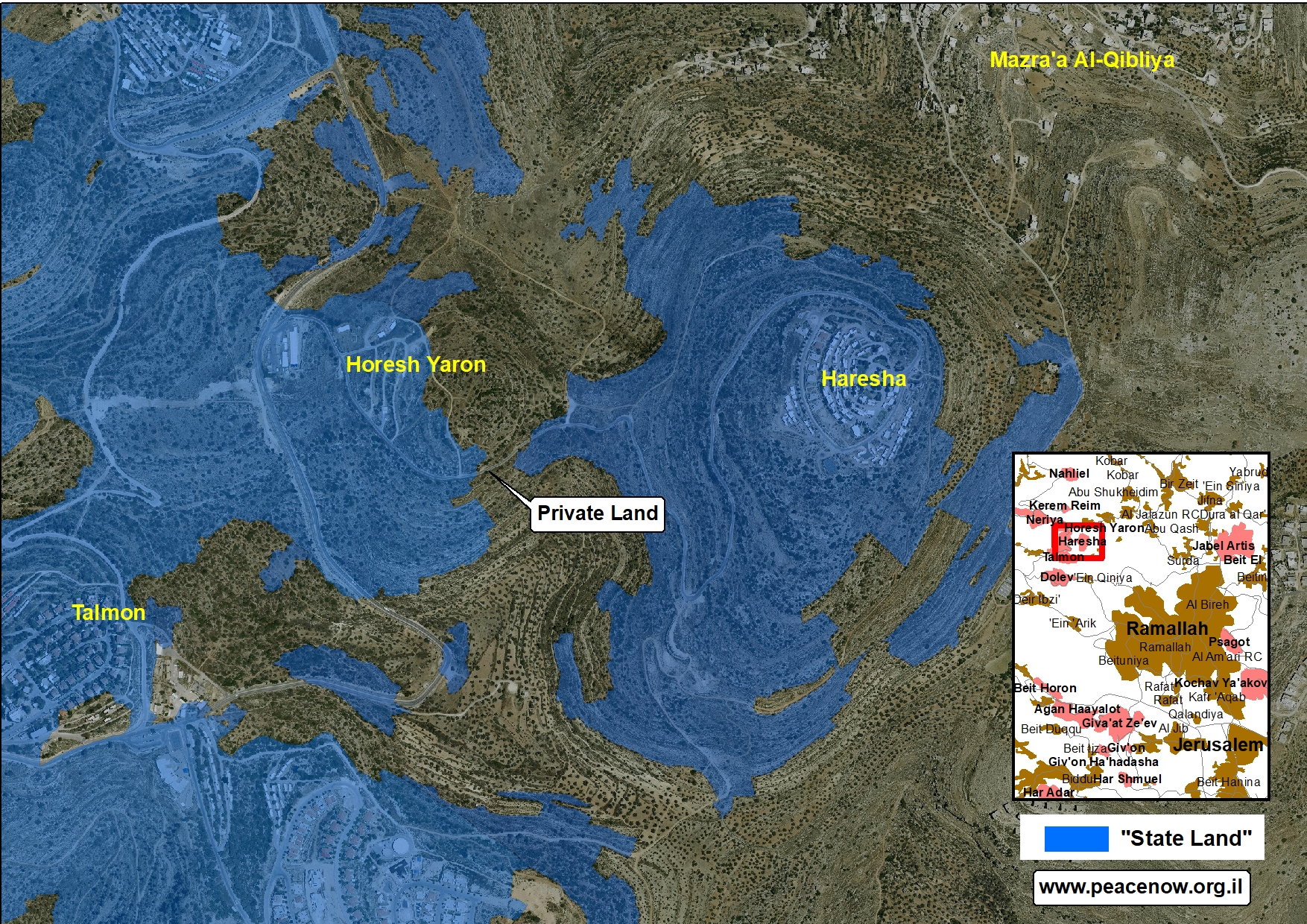 Kerem Navot has published a Justice Ministry opinion that provides further details on the government’s plan – approved on December 6th – to retroactively legalize the Haresha outpost by building a tunnel road underneath privately owned Palestinian land (an olive grove). The Justice Ministry document explains that while the Israeli government in principle has the right to permanently expropriate the land from its Palestinian owners, such an action would likely be challenged in the High Court of Justice, where it might be overturned. The Justice Ministry suggests instead that the government should “temporarily” expropriate the land while a tunnel is dug and road paved beneath the olive grove – with the plan being, ostensibly, to return the land to its Palestinian owners after construction is complete.
Kerem Navot comments:
“now, in order to legalize the outpost, shady legal advisers (of the type to whom Justice Minister Ayelet Shaked is drawn) write documents in which they lay down their doubts on whether to expropriate the grove ‘permanently,’ which will be cheaper and faster (but it is likely to be rejected by the High Court of Justice), or to ‘temporarily’ expropriate it solely for the construction of a tunnel through the ‘excavation and cover-up’ method.”
As a reminder, in November 2017 the Attorney General gave the Israeli government a green light to permanently expropriate the privately owned land based on a legal argument that holds Israeli settlers to be part of the “local population” of the West Bank, and therefore eligible to be the sole beneficiaries of state land expropriated for “public use.”
High Court Criticizes State Over Illegal Road on Palestinian Land
At a December 18th hearing, the High Court of Justice gave the government of Israel 60 days to explain why it should not be required to demolish a road and several buildings that were built on land that the state has admitted it believes is privately owned by Palestinians. The case is before the court on a petition by Palestinians who claim that a 200-meter (650-foot) stretch of the road is built on their land.
The Court also slammed the State for allowing the construction of the road and buildings to be completed after a stop-work order was issued against the construction, a stop-work order the State assured the Court would be implemented. At the December 18th hearing, an attorney from the State Prosecutor’s Office told the Court that the road in question was a dirt road, and argued that the state had not sanctioned or had a hand in its construction.
New Report Documents Israel’s “Severe and Regular” Violation of International Law in Hebron
Haaretz shares details from a leaked report written by the Temporary International Presence in Hebron (TIPH), which documents the totality of Israel’s policies in Hebron, serve to aid and protect settler and which collectively impose severe human rights violations and restrictions on Palestinians.
The report accuses Israel of being in “severe and regular breach” of international law, highlighting the many ways in which the human rights of Palestinians are systematically trampled on – specifically as it relates to radical settlers, their increasing activities in Hebron’s Old City, and the role of nearby settlements.
The Temporary International Presence in Hebron (TIPH) was first established in 1997 as part of the Oslo Accords’ Hebron Protocol, which allowed the partial redeployment of Israeli military forces to the part of the city that remained under its control. Israel must renew the TIPH’s mandate every six months; some fear that the next renewal has been jeopardized by the leaked report’s publication.
High-Rise Settlement Housing Promoted As a Means to Achieve 2020 Settler Vision & As a Solution to Israel’s Affordable Housing Shortage
Haaretz reports that the Yesha Council – the umbrella group representing all settlements in the West Bank – has adopted a strategic goal to advance “high quality, high density” settlement schemes in order to reach their goal of having 1 million settlers living in the West Bank by 2020. The basic idea is to build high-rise apartment complexes in settlements close to major highways in the West Bank and aggressively market them to Israelis who are seeking cheap rent and a fast commute, two key complaints of Israelis living and working in sovereign Israeli territory.
The strategy marks a shift in how settlements have typically been marketed to the Israeli public; once sold as an answer for young Israeli families looking for a single family unit with land, housing in settlements is now being marketed as the answer for young professionals looking for affordability, convenience and accessibility. The Yesha Council has coupled the new strategy with pressure on the government (and a promise to potential purchasers) to expedite West Bank infrastructure projects that will ease traffic, including bypass roads and detours around Palestinian towns.
In a February 2018 article, the Chairman of the Yesha Council wrote:
“Looking ahead, the patterns of thinking and action in the settlement movement need to be changed in two main areas: high-rise construction and doing away with admission committees. The available land for building is not plentiful. Until now, we’ve been used to rural communities with a one-family home on a half-dunam plot, but the goal from now on should be to build as many housing units as possible on that same land. High-density construction — building up or in a terraced fashion, depending on topography — will change the balance in the area and also require a new approach to infrastructure development to suit the number of residents in the future.” [Note: the Haaretz article explains that “admission committees” are a function of settlements which have standards for who is permitted to live there, mostly in ultra-orthodox and ideological settlements]
Fourth Quarter Decline in 2018 Settlement Construction Starts Doesn’t Tell the Whole Story
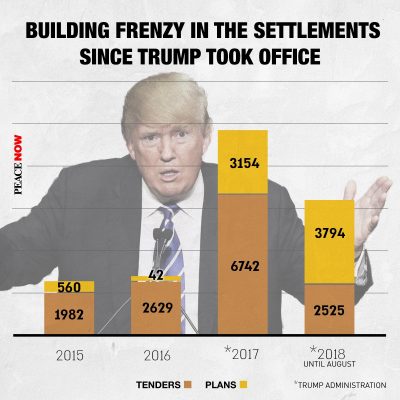
by Peace Now
The Israeli Central Bureau of Statistics (CBS) released new data showing a 52% decrease in the number of settlement construction starts in the third quarter of 2018 compared to the second quarter of 2018. News about a “decline,” relative to the last quarter, obscures the clear and alarming settlement surge currently taking place. As Peace Now has reported, by August 2018 the total number of settlement tenders and plans that have been advanced (6,319) is more than double the total amount in 2016 (3,189).
In addition, it is important to bear in mind that the number of construction starts do not begin to depict or reveal the level of settlement activity happening in the West Bank. Israel’s settlement enterprise is not solely a matter of residential housing plans, but also the unceasing expansion of infrastructure and security measures that exclusively benefit Israeli settlers, the normalization and development of settlement industrial zones, and illegal settlement activity (outposts, which are now regularly legalized ex post facto) that does not register in numbers tracking the settlement planning process.
Bonus Reads
- “Israel Has Weaponized the Settlements” (Haaretz Editorial)
- December 2018 public opinion poll – Palestinian Center for Policy and Survey Research
Welcome to FMEP’s Weekly Settlement Report, covering everything you need to know about Israeli settlement activity this week.
To subscribe to this report, please click here.
December 7, 2018
- Looming Mass Eviction in Silwan, Part 1: High Court Rules that Settler Organization Can Pursue Eviction of 700 Palestinians in Batan Al-Hawa Section of Silwan
- Looming Mass Eviction in Silwan, Part 2: Elad Settler Org Wins Eviction Case Against Palestinians in Wadi Hilweh Section of Silwan
- Israel to Fast-Track Two Settlement Plans in Sheikh Jarrah
- Justice Ministry Finalizes Legal Opinion to Retroactively Legalize the Haresha Outpost
- Three Illegal Outposts (& Ariel) Are Now “National Priority Areas” Eligible for Government Subsidies
- High Court Rules the Jewish National Fund is the Legal Owner of Land South of Bethlehem
- Israel Seizes Jordan Valley Land Owned by the Catholic Church
- Israeli Civil Administration Report Criticizing Yitzhar Settler Violence Leads to Renewed Calls to Annex the West Bank
- After IDF Killed Two Palestinians, Civil Administration Grants Settlers Victory in Struggle Over Hilltop
- The New Mayor of Jerusalem, Moshe Lion, On Settlements
- Al-Shabaka Policy Paper: “The EU & Jerusalem”
- Breaking the Silence Report – “Occupying Hebron: 2011-2017”
- U.S. Chatter on Economic Coexistence Initiatives (Which Normalize Settlements/Occupation) Provokes Strong Palestinian Response
- Bonus Reads
Questions/comments? Email kmccarthy@fmep.org
Looming Mass Eviction in Silwan, Part 1: High Court Rules that Settler Organization Can Pursue Eviction of 700 Palestinians in Batan Al-Hawa Section of Silwan
On November 22nd, the Israeli High Court of Justice ruled that the settler organization Ateret Cohanim can continue to pursue the eviction of 700 Palestinians from their homes in the Batan al-Hawa section of the Silwan neighborhood in East Jerusalem. This would be the largest displacement of Palestinians from East Jerusalem since 1967.
The High Court’s ruling did not decide the central issues in the case, which call into question Ateret Cohanim’s ownership of the land through its control of an historic Yemenite land trust (the Benvenisti Trust). The High Court reserved those issues for the Jerusalem Magistrate’s Court to decide as part of its consideration of individual eviction cases.
In its ruling, the High Court criticized of the government’s involvement in the case, specifically calling out the role the government played in transferring ownership of the land to Ateret Cohanim without properly informing the Palestinian residents. The High Court ruling said:
“We can’t continue without expressing surprise at the state’s assumption that a decision so significant to the lives of hundreds of people – ‘liberating’ the property on which they have lived for many years [and transferring it] to other hands – isn’t the kind of thing that ought to be publicized through reasonable means. Even the precise identity of the property’s residents wasn’t known, and that’s the interpretation kindest to the state…Evicting people who have lived on this land for decades – some of them without even knowing that the land belongs to others – creates a human problem. Especially when it’s done without compensation or any other solution. It seems the state would do better to consider providing a solution, in appropriate cases, for those evicted from their homes. Property rights are important, but it’s also important to defend people’s homes.”
B’Tselem commented:
“The judgment proves, yet again, that the Israeli High Court gives its seal of approval to almost any infringement of Palestinians’ rights by the Israeli authorities.”
Ateret Cohanim has waged a years-long eviction campaign against Palestinians living in Silwan, on property the settler NGO claims to own, based on its control of the historic Benvenisti Trust, which oversaw the assets of Yemenite Jews who lived in the neighborhood in the 19th century. Palestinians have challenged the legitimacy of the Benvinisti Trust’s claims to the currently existing buildings, saying that the trust only covered the old buildings (none of which remain standing) and not the land. Despite ongoing legal challenges, in October 2018 the Jerusalem Magistrate’s Court ruled in Ateret Cohanim’s favor in one of the cases connected to the Benvenisti Trust’s claim to the buildings there – resulting in the eviction of the last remaining Palestinian tenants (the Abu Sneina family) from a building in area of Silwan known as Batan al-Hawa.
The ruling this week does not give a final decision to the underlying questions of ownership, but it allows Ateret Cohanim to proceed – from a strengthened position – in its legal efforts to evict Palestinians from their homes.
Looming Mass Eviction in Silwan, Part 2: Elad Settler Org Wins Eviction Case Against Palestinians in Wadi Hilweh Section of Silwan
 On December 5, 2018 the Jerusalem Magistrate’s Court upheld the eviction of a Palestinian family – the Siyams – family their home in the Wadi Hilweh section of Silwan, in East Jerusalem, just 820 feet from the southern wall of Al-Aqsa Mosque. Like Ateret Cohanim (see above), the Elad settler organization has been waging a years-long legal battle to take control homes in Silwan, including a 20-year battle to take control of the Siyam family home, which Elad insists legally purchased it.
The Court ruling this week was the first ruling in the settlers’ favor. The Siyam family announced plans to petition the ruling to the Jerusalem District Court.
In response to the ruling, Peace Now said:
“This case is an example of how the settlers manage to take control of Palestinian property in East Jerusalem by combining manipulations, money, forgery and significant aid from the Israeli authorities. It is not a regular case between equal sides, but a story of David and Goliath, and the settlers are the Goliath. There is a settlers organization with almost unlimited financial resources and enormous political power against an ordinary Palestinian family that has been forced into court for more than 20 years, to invest tremendous resources in legal defense and to deal with various and varied purchase claims. This way the settlers are causing great damage to Israel when they harm the delicate fabric of life in Jerusalem and the possibility of compromise in Jerusalem and a two-state solution.”
Israel to Fast-Track Two Settlement Plans in Sheikh Jarrah
Ir Amim reports that the Jerusalem District Planning and Building Committee will meet on December 23rd to fast-track the approval of two plans for a total of 13 new settlement units in the Sheikh Jarrah neighborhood of East Jerusalem. The plans put approximately 5 Palestinian families at imminent risk of eviction.
On December 23, the Committee will discuss public objections to plans for the two settler building (one for 10 units and one for 3 units), which if approved, will result in the eviction of 5 Palestinian families.
Ir Amim further explains:
“The two plans in Sheikh Jarrah are being pushed by city councilperson and settler leader Arieh King, a close ally of Jerusalem’s just inaugurated mayor, Moshe Leon. King has recently joined the new mayor at several public events and is said to be eyeing a deputy mayor position in the new administration.”
+972 Magazine has an excellent piece on the resumption of evictions and settlement takeovers in Sheikh Jarrah, which have been stalled since 2009, in part due to international pressure. A prominent figure in the Sheikh Jarrah resistance movement, Saleh Diab, said:
“Ever since Trump said last year that Jerusalem belongs to the Jews, we have been feeling the change. The settlers are working quickly to evict us before the American administration changes…How will we go back to the days of protests? The police today are like the police in [apartheid] South Africa. Israelis who stood alongside us were fired from their jobs because of their views…Like in Khan al-Ahmar, they are trying to expel an entire community and turn us into refugees for a second time.”
PLO Spokeswoman Hanan Ashrawi released a statement saying:
“Since the beginning of the year, Israel has accelerated and intensified its efforts to entrench its colonial military occupation, especially in and around occupied Jerusalem…Israel’s extremist, racist government coalition headed by Prime Minister Benjamin Netanyahu is deliberately and systematically working to complete the total annexation and isolation of Jerusalem from its Palestinian environs and surrounding areas, as well as the distortion of the occupied city’s demographic, historical and cultural character…These measures pose a strategic threat to Palestinian human and national rights, especially through the imposition of new and ‘permanent’ realities on the ground that deliberately undermine the achievement of Palestinian statehood…At a time when the rights-based international system is under threat, the reality and future of Jerusalem is a litmus test for the world and the integrity of its legal and political system. It is our hope that the global community and people of conscience will rise to the challenge and defend the universality and indivisibility of human rights. The world must not fail Jerusalem.”
Justice Ministry Finalizes Legal Opinion to Retroactively Legalize the Haresha Outpost
On December 6, 2018, Israel Justice Minister Ayelet Shaked announced a new legal opinion that permits the Israeli government to proceed with its plan to retroactively legalize the Haresha outpost by building an access road through privately owned Palestinian land. According to the new opinion, the Israeli government is permitted to “temporarily seize” the privately owned land to build a tunnel underneath it leading to the outpost, though it leaves open the possibility for the government to permanently expropriate the land in the future. The lack of an access road has until now prevented the Israeli government from retroactively legalizing the entire Haresha outpost; once the access road is deemed legal, the government is expected to act quickly to legalize it and pursue plans to build more settlement units there.
Israeli Attorney General Avichai Mandelblit – who signed off on the new Justice Ministry opinion – in November 2017 released a different legal argument in favor of permanently expropriating the land to legalize the access road, arguing that settlers are part of the “local population” of the West Bank and are therefore eligible to be the sole beneficiaries of land seized for “public use” (the access road is not open to Palestinian traffic). The opinion released this week, which cites Mandelblit’s previous opinion, finds yet another way to accomplish the same goal, by temporarily seizing the land to build a permanent tunnel for the settlers underneath it.
Justice Minister Ayelet Shaked said:
“From the beginning of my current term I have set a goal of normalizing the lives of the residents of Judea and Samaria and normalizing as many communities as possible. We have gone from a discourse of eviction to a discourse of normalization. These actions are in addition to the strengthening of the communities by other means, such as the transfer of authority in matters of Judea and Samaria from the Supreme Court to the Administrative Affairs Court in Jerusalem, as well as the equalization of legislation for Judea and Samaria…I will continue to work for the normalization of additional communities in Judea and Samaria. I thank Attorney General Avichai Mandelblit, Deputy Attorney General (Erez) Kaminitz and the Legal Advisor for the Judea and Samaria Area for their important activity on the issue.”
Peace Now told the Times of Israel:
“This move is a mockery of justice. Since the Regulation Law is tied up in court, the Ministry of Justice is yet again using every crooked justification it can concoct to expropriate private Palestinian land in order to dissect the West Bank with settlements until they have achieved their one-state apartheid agenda.”
Dror Etkes, founder of the anti-settlement watchdog group Kerem Navot, wrote:
“the outpost of Haresha, comprised of about 100 illegal structures, is of course not the story here. The story that the settlers are striving to resolve, with Mandelblit’s help, involves hundreds (yes hundreds!) of roads that have been illegally paved for decades around settlements and outposts, on land that even Israel recognizes as privately-owned. Now, with a little creativity and a lot of nerve, a legal mechanism has been invented to enable settlers to retroactively authorize the road system, without which the national land grab enterprise championed by Israel in the West Bank, can’t function.”
Three Illegal Outposts (& Ariel) Are Now “National Priority Areas” Eligible for Government Subsidies
On November 26th, Israeli Housing Minister Yoav Gallant announced that three illegal outposts – Kerem Reim, new Migron, and Shvut Rachel – will be considered “national priority” areas for development, marking the first time that illegal outposts are eligible for significant government subsidies to encourage growth.
In order to include the outposts, the Israeli Housing Ministry wrote and adopted a new criteria to make “neighborhoods located far from a ‘parent town’ that do not rely on the infrastructure of said town” eligible for priority status. For the purposes of the government subsidies plan, Kerem Reim is considered a “neighborhood” of the Talmon settlement, New Migron is considered a “neighborhood” of the Kochav Yochav settlement, and Shvut Rachel is considered a “neighborhood” of the Shilo settlement.
Though the Israeli government has rewritten its laws to consider these “children” outposts as “neighborhoods” of existing, government-approved settlements, they are, in fact, independent settlements. This fact is underscored by the Housing Ministry’s new criteria which admits that the outposts do not share the same infrastructure systems as the settlements of which they are considered a part (and, indeed, rewards that fact).
The Ariel settlement was also re-designated as a national priority area (having been previously selected and then later removed from the list), among a total of 583 communities from both sides of the Green Line. The selected communities, settlements, and outposts will benefit from massive government subsidies, including at least 50% of infrastructure costs for the construction of new housing. Israelis seeking to purchase a home in the selected communities will receive government loans and forms of assistance.
Haaretz reports Housing Minister Yoav Gallant remarked:
“it is a social and national duty to prevent negative migration from distant towns and to enable them to thrive and prosper.”
The Jerusalem Post quotes Gallant as saying that the decision to include the outposts:
“is a clear statement by the government that it will continue to develop and strengthen the settlements.”
High Court Rules the Jewish National Fund is the Legal Owner of Land South of Bethlehem
On November 28, 2018 the Israeli High Court of Justice ruled that the Jewish National Fund is the legal owner of 130 acres of land south of Bethlehem, ending a 22-year legal battle over ownership claims. Palestinians from a nearby village challenged the validity of the sale of the land to the Jewish National Fund when the organization moved to register its ownership of the land with the Israeli Civil Administration in 1996.
This week, the Court held that the Jewish National Fund (via its subsidiary company, Himnuta) had legally purchased the land in 1944 from its original Palestinian owners. The ruling will allow the settlers to move forward with plans for building more settlement units on the land, which is already home to one settlement, Rosh Tzurim, and to the headquarters of the Gush Etzion Regional Council.
The head of the Gush Etzion Regional Council, Shlomo Ne’eman, celebrated the ruling, saying:
“the task of expanding the lands of Gush Etzion is a national mission. The Supreme Court’s ruling gives us optimism that the court’s position will benefit the Jews and Jewish land in Judea and Samaria and will not automatically rule in favor of the thieving claims of the Arab intruders.”
Israel Seizes Jordan Valley Land Owned by the Catholic Church
On November 27, 2018, the Israeli Civil Administration announced that it is seizing 66 acres of land in the northern Jordan Valley that is owned by the Catholic Church. The Civil Administration said the land was needed for “military purposes.”
The Latin Patriarchate of Jerusalem responded to the seizure in a statement, saying:
“The Patriarchate is looking into the aspects of this decision in order to address it in the appropriate manner, have it contested and to stop further damage.”
Israeli Civil Administration Report Criticizing Yitzhar Settler Violence Leads to Renewed Calls to Annex the West Bank
An Israeli news outlet, Kan 11 news, revealed the existence of a new Civil Administration report that criticizes the Yitzhar settlement. According to Kan 11, the report states that Yitzhar is a source of violence that “undermines governance and the rule of law.”
In addition to documenting the violence perpetrated by Yitzhar residents against Palestinians living nearby, the report also documents incidents of Yitzhar settlers attacking Israeli forces. The report calls on the IDF Commander Maj. Nadav Padan to punish the Yitzhars settlers by scuttling plans to build a new kindergarten and by ceasing to guard dangerous roads around the settlement and its many outposts.
In response, Yossi Dagan (head of the Samaria Regional Council, a settlement municipal body) called for the author of the report to be fired, saying:
“Officials in the Civil Administration are torpedoing the approval of security elements which could have prevented terrorist attacks in threatened settlements such as Itamar, and in the Barkan industrial zone before the attack, as well as narratives of the Palestinian Authority and radical left-wing organizations.This is an example of the evil in the civil administration. I call on the head of the Civil Administration to remove the clerk … who acts like a politician and not as is required. This report is malicious and false. The Yitzhar leadership is leading the community in a good and positive direction, and this report has nothing but lies. This is the total loss of control of the Civil Administration. While murderers with the blood of Israelis on their hands, the Civil Administration refrains from punishing the sources of terror out of statements that this is collective punishment, and now they want to create collective punishment for the Jews. The head of the Civil Administration and the deputy defense minister should call this clerk for a hearing before his dismissal.”
In response to the report’s recommendations, MK Bezalel Smotrich (HaBayit HaYehudi) called for the entire Civil Administration to be disbanded. Smotrich announced that he will seek government backing for a bill to achieve that end during the next meeting of the Israeli Cabinet, scheduled for December 9th. Under the bill, Israeli settlers in the West Bank will come under the full sovereignty of domestic Israeli institutions, while Palestinians will be ruled by “Regional Liaison administrations.” The bill would effectively annex the entire West Bank to Israel.
Smotrich said:
“The Civil Administration must be shut down now. This document reflects a political agenda that is hostile to the settlement enterprise and to the local residents, [an agenda] which unfortunately is expanding in this unnecessary body…This is the same Civil Administration that for years has pushed for a policy of separation between Arabs involved in terrorism and the rest of the Arab population. Now it suddenly remembers to use collective punishment against Jewish residents…for years now, the residents of Judea and Samaria, who are equal citizens who serve in the army and in the reserve and who pay taxes, are not entitled to equal rights and receive inferior service from the Civil Administration instead of receiving optimal service from government ministries like all citizens of Israel. The time has come to fix that.”
After IDF Killed Two Palestinians, Civil Administration Grants Settlers Victory in Struggle Over Hilltop
On November 29th, Haaretz reported the tragic story of two Palestinians who were shot and killed by Israeli forces while protesting attempts by Israeli settlers to take over a hilltop belonging to the Palestinian village al-Mazra’ah al-Qibliyah, just north of Ramallah. Following a clash on October 26th, in which the IDF opened fire on Palestinian protesters – killing the two men – the IDF issued a military order closing the hilltop – known as Khirbet Na’alan – to Palestinians on Fridays. As Haaretz notes, the military order was a victory for the settlers, who have been aggressively trying to take over the hilltop since July 2018.
The residents of al-Mazra’ah al-Qibliyah have fought against the increasing encroachment of the Talmon settlement and its seven illegal satellite outposts, which collectively surround the village. Having seen several outposts take over their land illegally and under the protection of the IDF, Palestinians began actively trying to prevent the takeover of the Khirbet Na’alan hilltop. The settlers waged their own campaign to harass and intimidate the village, often entering the village at night to paint hateful messages and damage Palestinian property. Each Friday, the settlers would go pray at the site.
In response to petitions filed by Palestinians, the Israeli Civil Administration issued an order barring the settlers from accessing the hilltop. On the same day the villagers found out about the order, they watched 10 settlers from the Kerem Reim outpost (which was recently selected as a “national priority area” to encourage growth, see above) approach the hilltop with heavy IDF protection. It was on this day that the IDF opened fire on a group of Palestinians protesting the incursion, killing two and wounding many others.
Video of the bloody incidents shows the IDF opening fire at an incredibly close distance, and at least 10 Palestinians falling down amidst gunfire.
The New Mayor of Jerusalem, Moshe Lion, On Settlements
In a thorough analysis of the recent Jerusalem Municipal elections, Terrestrial Jerusalem’s Danny Seidemann shared key insights into what may be in store for settlement activity under Jerusalem’s new mayor, Moshe Lion. Seidemann writes:
“Lion emerged from the ranks of the less ideological elements in the Likud. However, support for East Jerusalem settlements and settlers is so deeply ingrained even in this segment of the party as to be second nature. Lion never mentioned the Palestinians of East Jerusalem in his campaign, and actively cooperated with Aryeh King, who represents the right-wing fringe of the East Jerusalem settlers. Consequently, it is highly likely that Lion will continue to do the bidding of the settlers in East Jerusalem, and to neglect the Palestinian sector. Nothing in his world view or the way he understands his political interests suggests otherwise.”
Al-Shabaka Policy Paper: “The EU & Jerusalem”
Al-Shabaka analyst Yara Hawari published a new paper exploring options for European Union member states to push back on U.S. policy and Israel’s annexation of Palestinian land. Hawari writes:
“The US embassy move has accelerated and legitimized a process of de-Palestinianization of Jerusalem that began over seven decades ago. In the absence of concrete pressure, Israel will continue to violate the fundamental rights of the Palestinian people in Jerusalem and the rest of historic Palestine, with the full support and encouragement of the Donald Trump administration as well as its far-right allies within Europe and in Latin America. Despite the inaction described above and the global political shift to the right, there remains potential for the EU to pressure Israel and pursue Palestinian human rights. This is due to strong European popular support for Palestinian rights and sovereignty that has allowed grassroots solidarity networks to grow, as well as the fact that the EU is premised on international law and human rights…”
Breaking the Silence Report – “Occupying Hebron: 2011-2017”
Breaking the Silence released a new compilation of testimonies from Israeli soldiers who served in the Hebron area. Breaking the Silence writes:
“The Israeli settlement in the heart of the city of Hebron marked its 50th anniversary this year. Its story is a microcosm of the occupation: contempt and disregard for the rule of law, daily violence, deprivation of Palestinian residents’ basic rights, and a military system that preserves all of the above. This booklet of testimonies intends to offer the public a glimpse of the reality in Hebron from our perspective as soldiers deployed there. These testimonies were given by soldiers who served in the city from 2011-2017. They reveal the violence and discrimination that have become an inextricable part of life in Hebron, and their impact on the lives of Palestinian residents.”
The online portal for the report also has an interactive map, where users can see where each incident took place against the backdrop of Hebron’s closed streets, religious sites, and settlement enclaves.
U.S. Chatter on Economic Coexistence Initiatives (Which Normalize Settlements/Occupation) Provokes Strong Palestinian Response
Top U.S. negotiators have continued hinting about a major economic element to the yet-to-be-unveiled “deal of the century.” As FMEP has documented to this point, Ambassador David Friedman has met with Israeli and Palestinian businessmen in a bid to promote joint projects in the Occupied Territories in a way that normalizes Israeli settlements and annexation bids.
On November 28th, Ambassador Friedman was interviewed by the Christian Broadcast Network. Part of the transcript of the interview reads:
Question: “One of the aspects of the peace plan seems to be a relationship between Palestinian businessmen and Israeli businessmen. Some would say you crossed a red line when you crossed the green line into Ariel officially. What was the importance of that meeting?”
Friedman: “On a practical level, I met with, I don’t know, maybe 8 or 10 Palestinian business leaders and, to a person, they all said to me, ‘let’s do business, let’s get going. We want to work with Jews; we want to work with Israelis.’… I try to look at everything from a lens of what is best for the United States. That’s my job. I represent the United States. But look, we are a nation under God; we’re built on Judeo-Christian values. Much as I try I cannot help but see the majesty of God’s work and all the miracles that happen in this incredible country.”
U.S. Special Representative for International Negotiations, Jason Greenblatt, wrote an op-ed also emphasizing, among of myriad of accusations against the Palestinian Authority, that the U.S. is hoping to jump-start economic development, separate from its “plan” to resolve core issues. The article reads:
“While waiting for a possible political solution, it is high time to build the Palestinian economy and provide Palestinians with the opportunities they deserve…We know that the Palestinians are not interested in mere economic peace. The Trump Administration continues to strive for a peace agreement, but the Palestinians need economic help now – with or without a peace agreement. The technology sector in the West Bank and Gaza has great potential and can be developed without treading into the politically contentious core issues of the conflict…I continue to meet with ordinary Palestinians and what is striking is that, although they complain about the Trump Administration’s policies, they remain focused on their economy…Palestinians are a proud people and want to create and earn on their own. They believe, as I do, that Palestinians should be allowed to improve their economy without worrying about whether they will give up on their national cause…Let’s be real – 136,000 Palestinians commute to work with Israelis every day because the opportunity is there. Anti-normalisation is a failed policy that only hurts the Palestinians. Let’s allow Palestinians to thrive in the way they are educated, capable of and deserve. We won’t tire of trying to resolve the political conflict (and certainly Palestinians won’t either), but we must focus on helping the Palestinian economy where we can, before it is too late.”
Palestinians reacted strongly to Greenblatt’s screed. Saeb Erekat, chief Palestinian negotiator, wrote in response:
“…economic desperation is seen by the Trump administration as an opportunity to force Palestinians to normalise Israel’s occupation, to legitimise its settlements and its whole system of oppression. The administration has been trying to divide Palestinians by claiming that the Palestinian leadership is preventing economic growth. However, there is a consensus among our people that the primary responsibility for our grave financial situation is the Israeli occupation.”
Hani Masri, a Palestinian political analyst, said:
“Trump thinks that what the Palestinian leadership has rejected can be passed through the people, but the majority of Palestinians will not positively absorb or accept what Greenblatt is promoting. There are economic interests between the Palestinians and Israelis, however the political issue is a different subject and can’t come at the expense of the legitimate rights of the Palestinians.”
Elsewhere, at an event hosted by the Brookings Institute, former peace negotiator Dennis Ross promoted draft legislation in the U.S. Congress that would invest heavily in joint economic projects in the West Bank which normalize the settlements. The Jewish Insider summarizes:
“[Dennis] Ross praised current draft legislation in Congress that would give upwards of $150 million to joint Israeli and Palestinian projects: [Ross:] ‘Cutting $10 million for projects that are joint projects between Israelis and Palestinians, the rationale for that is hard to grasp. If there is one thing that we should be doing [it is] demonstrating that when Israelis and Palestinians cooperate there’s a payoff for it. And that ought to be elementary. That ought to be just a given. Anything you’re doing should be to designed to elevate the payoffs of practical tangible cooperation.’”
Finally, the Friends of Beit El organization (previously headed by now-Ambassador David Friedman) hosted a star-studded fundraiser in New York to raise funds for and awareness of the Beit El settlement. It was attended by two Members of Congress and the speaker of the Israeli Knesset Yuli Edelstein, who told the crowd:
“Independence, sovereignty, will eventually come to Judea and Samaria and many more houses with be built in order to reach the number we all dream — a million Jews in Judea and Samaria.”
Notably, the mention of Rep. Nancy Pelosi, the newly elected Speaker of the House, elicited boos from the crowd.
Bonus Reads
- “Annexation – at what cost?” (Times of Israel)
- “Leftists on tour in Hebron confirmed in view that settlers ‘have already won’” (Times of Israel)
- “Shaked touts ‘confederation’ of Jordan WEst Bank, and Gaza” (Times of Israel)
- “Inside the Evangelical Money Flowing Into the West Bank” (Haaretz)
Welcome to FMEP’s Weekly Settlement Report, covering everything you need to know about Israeli settlement activity this week.
To receive this report via email, please click here.
November 22, 2017
- Israeli AG Support for Land-Grab Paves Way for Legalization of [at least] 13 Outposts
- Israeli AG Approves Retroactive Legalization of “Mistaken” Land Theft
- Israeli AG to Present Argument on the “Regulation Law” This Week
- Threatened Eviction of Another Palestinian Bedouin Community in E-1
- Israel Fast-Tracks Jerusalem Cable Car Project Despite Political Concerns
- Settlers Fight for the “Right of Return” to Illegal, Inaccessible West Bank Settlements
- Bonus Reads
Comments, questions, or suggestions? Email Kristin McCarthy at kmccarthy@fmep.org.
Israeli AG Support for Land-Grab Paves Way for Legalization of [at least] 13 Outposts

Map by Haaretz
The far-reaching implications of the legal opinion issued last week by Israeli Attorney General Avichai Mandleblit, in the context of a case dealing with the Harsha outpost, are becoming alarmingly clear. Haaretz reports that the opinion will pave the way for Israel to retroactively legalize 13 unauthorized outposts, many of which are deep inside of the West Bank. The 13 outposts (and many others) were all built without Israel’s permission on pockets of state land, surrounded by privately owned Palestinian land. Roads leading to these outpost – without which the outposts cannot be fully planned and legalized – were (or will be), by necessity, built on land owned by Palestinians. This opinion paves the way (pun intended) for that to happen.
Dror Etkes, founder of the anti-settlement group Kerem Navot, notes that the impact of the decision is actually far greater than reported by Haaretz: “The real number of [affected] outposts is over 60.” Etkes adds,
The story [is] that the settlers are striving to resolve, with Mandleblit’s help, involves hundreds (yes hundreds!) of roads that have been illegally paved for decades around settlements and outposts, on land that even Israel recognizes as privately-owned. Now, with a little creativity and a lot of nerve, a legal mechanism has been invented to enable settlers to retroactively authorize the road system, without which the national land grab enterprise championed by Israel in the West Bank, can’t function.
Notably, several outposts that spun off from the Itamar settlement are among those that could benefit from this new legal precedent. Near Nablus, Itamar’s hilltop outposts form a contiguous land bridge – with roads connecting them – from Itamar to the Jordan Valley. Itamar’s residents are notorious for their ultra-nationalism.
Israeli AG Approves Retroactive Legalization of “Mistaken” Land Theft
Attorney General Mandleblit has endorsed an argument, made for the first time since 1967, in a legal brief submitted this week in Court by the Israeli government, that paves the way for Israel to expropriate privately owned Palestinian land inside the Ofra settlement, and potentially in other places as well. The land in question was “mistakenly” included as part of the settlement. The State filed the brief this week in response to a legal challenge to the Ofra settlement’s Master Plan.

Map by Haaretz using Google Maps
The case centers on a “mistake” which happened when the Ofra settlement master plan was approved; Israel argues that at the time it did not know that some of the land in the area had not been declared “state land” (suggesting, at best, extraordinarily faulty due diligence in the planning process, and at worst, a policy of treating Palestinian land ownership claims as irrelevant). In 2016, the State acknowledged Palestinian claims to the land and announced its intention to rectify the problem by re-drawing the settlement’s master plan.
With this new argument, the State, backed by the Attorney General, has reversed the 2016 commitment and is instead moving to formally expropriate the Palestinian plots, arguing that the Ofra settlers acted in good faith based on the government’s approval of the Master Plan (i.e. that settlers should not be punished for the State’s mistake). Earlier this year, AG Mandleblit suggested this exact argument (that land stolen by mistake, in good faith, could be legalized as long as the Palestinian owners were compensated) as an alternative law for the Knesset to pass instead of the Regulation Law, which he opposed.
Commenting on the AG’s opinion, Tawfiq Jabareen, the lawyer representing the Palestinian petitioners, told Haaretz:
Attorney General Mandelblit is continuing to destroy the status of the rule of law and severely undermine Palestinian property rights in the occupied territories.
Israeli AG to Present Argument on the “Regulation Law” This Week
On Nov. 23rd, Attorney General Avichai Mandleblit is expected to present his argument on the “Regulation Law” to the Supreme Court. As we reported previously, Mandleblit was staunchly opposed to the Regulation Law, arguing that the law is unconstitutional and refusing to defend the law against legal challenges mounted by several civil society groups earlier this year. At the time the law was being considered, Mandleblit proposed an alternative legal strategy to accomplish the same goal: the retroactive legalization of Israeli settlement activity in the West Bank.

Map by Peace Now
Mandleblit has been expected to argue forcefully against the law, which provides a new legal basis for the retroactive legalization of outposts and agricultural land seizures, with Palestinian owners provided “compensation” (but no choice in the matter). Following the opinion Mandleblit issued last week regarding the Harsha outpost case (implications of which we detail above), and given his recent support for the retroactive legalization of land theft for the benefit of the Ofra settlement (detailed above), it is quite possible that his opposition to the retroactive legalization of land seizures has softened.
If upheld, the Regulation Law can be used to retroactively legalize 55 outposts and 4,000 unauthorized settlement structures by expropriating over 8,000 dunks of privately owned Palestinian land.
Threatened Eviction of Another Palestinian Bedouin Community
The wave of IDF-ordered evictions continued this week, with the Jabal al-Baba bedouin community only the latest to be affected. The approximately 300 residents were ordered to leave their encampment near the Maale Adumim/E-1 settlement area east of Jerusalem within 8 days. The Jabal al-Baba community has been living in the area since 1948, after it was expelled from the Negev.
The Jabal al-Baba community is the second bedouin community in the Maale Adumim/E-1 area to be faced with eviction this year. In August, Israel escalated its longstanding threat to forcibly relocate the Khan al-Ahmar bedouin community to a site near the Abu Dis garbage dump – a move that B’Tselem warns will constitute a war crime. FMEP has covered the story in detail, including as it relates to the prospects for the construction of the doomsday E-1 settlement.
Israeli actions to remove Palestinian bedouin communities from Area C are not confined to the Jerusalem area. On November 1st, the Israeli army ordered the eviction of an entire bedouin community in the northern Jordan Valley.
Israel Fast-Tracks Jerusalem Cable Car Project Despite Political Concerns
Haaretz reports that Israeli planning authorities are moving ahead with plans to build a controversial cable car line in East Jerusalem, despite growing opposition. As FMEP reported in July, the planned cable car line is designed to facilitate tourism to Jewish sites in East Jerusalem while preventing tourists from encountering Palestinians. It features a stop at the settler-run Kedem Center, which was built in the Palestinian East Jerusalem neighborhood of Silwan.
Jerusalem expert Daniel Seidemann explained
There are four worrisome aspects to this project. Without reference to political matters or religious sensitivities, this is a crime against Jerusalem. Disrespect for the unique value of the city and another example of the ‘disneyfication’ of Jerusalem under [Mayor Nir] Barkat. Someone who loves Jerusalem could not conceive of such a project. [The idea that] someone can send a cable car 150 meters away from the Al Aqsa Mosque is smoking the wrong thing….[the project] is another example of how the public interest and the interests of Jerusalemites are being subverted for the good of the settlers of Silwan, with the final station shamelessly at the Kedem Center, serving the narrow ideological interests of the settlers….[the project is] a clumsy attempt to unify the divided city by means of engineering gimmicks.
Settlers Fight for the “Right of Return” to Illegal, Inaccessible West Bank Settlements
Israeli settlers are angling to return to four settlements – Ganim, Kadim, Sa-Nur and Homesh – that were dismantled in 2005, as part of Ariel Sharon’s disengagement plan. Settlers have long insisted they will “return” to the sites.
In this latest effort, they are focusing on the argument that the land has not been used since they abandoned it. Falling in Area C, and therefore under the full authority of Israel’s Civil Administration, the former settlements remain vacant despite Palestinian desire to develop it. The Jenin Municipality, which has nominal jurisdiction over the location, reportedly wants to develop the areas but has not yet applied for the necessary Israeli permits; applying to do so, in any case, would almost certainly be futile, given that Israel issues virtually no permits for Palestinian construction in Area C. In the meantime, the sites have become a garbage dumpsites.
Two or the sites – Ganim and Kadim – can only be accessed by driving through the Palestinian city of Jenin, raising security issues that make their redevelopment into settlements a remote possibility. Sa-Nur and Homesh, in contrast, are easily accessible by settlers. Earlier this year settlers and supporters, including right-wing Israeli lawmakers, gathered at the site of Sa-Nur demanding that the government let them return. At the site of Homesh, radical settler youth are already squatting, have established a yeshiva (religious school) and actively prevent Palestinian access.
Bonus Reads
- “How Israeli settlers turn archeological sites into political tools” (Al-Monitor)
- “Ombudsman: Settlement council doctored tenders to reward right-wing NGOs” (Times of Israel)
__
FMEP has long been a trusted resource on settlement-related issues, reflecting both the excellent work of our grantees on the ground and our own in-house expertise. FMEP’s focus on settlements derives from our commitment to achieving lasting Israeli-Palestinian peace, and our recognition of the fact that Israeli settlements – established for the explicit purpose of dispossessing Palestinians in the West Bank and East Jerusalem of land and resources, and depriving them of the very possibility of self-determination in their own state with borders based on the 1967 lines – are antithetical to that goal.
Welcome to FMEP’s Weekly Settlement Report, covering everything you need to know about Israeli settlement activity this week.
To subscribe to this report, please click here.
November 17, 2017
- Building Permits Issued for 240 More Settlement Units in East Jerusalem
- Israel to Displace Palestinians in the Jordan Valley & the Northern West Bank for Settlement Expansion
- Supreme Court & Attorney General Permit State to Seize Private Palestinian Land for Settlers
- New Ir Amim Policy Paper: “Bills and Government Plans for Destructive Unilateral Measures to Redraw the Borders of Jerusalem”
- New Peace Now Report: “Escalation in Israel’s Settlement Policy: The Creation of De-Facto Annexation”
- Bonus Reads
Comments, questions, or suggestions? Email Kristin McCarthy at kmccarthy@fmep.org.
Building Permits Issued for 240 More Settlement Units in East Jerusalem
On November 8th, the Jerusalem Planning and Building Committee issued building permits for 240 new settlement units in East Jerusalem – 90 units in Gilo and 150 units in Ramat Shlomo. The new building permits add to an ever-growing tidal wave of settlement activity in East Jerusalem affecting the viability of the two-state solution, while tightening the screws on the local Palestinian population.
In addition, the committee also approved permits for 44 new units for Palestinians in the East Jerusalem neighborhood of Beit Hanina. These permits are an anomaly: for the past 50 years Israel has systematically discriminated against Palestinian building rights, with only about 7% of building permits issued in Jerusalem going to Palestinians (who represent 37% of the population). Bimkom, an Israeli organization that monitors planning and building in Jerusalem, estimates that 20,000 units in East Jerusalem lack permits while an additional 10,000 more units are needed by Palestinians.
Jerusalem expert Danny Seidemann recently explained
Since 1967, the Government of Israel has directly engaged in the construction of 55,000 units for Israelis in East Jerusalem; in contrast, fewer than 600 units have been built for Palestinians in East Jerusalem, the last of which were built 40 years ago. So much for (Jerusalem Mayor Nir) Barkat’s claim ‘we build for everyone.’
In Beit Hanina, as in Palestinian neighborhoods across East Jerusalem, Israeli demolitions of buildings – based on the argument that they lack permits – only add to the misery. The most recent demolition in Beit Hanina happened last month.
Israel to Displace Palestinians in the Jordan Valley & the Northern West Bank for Settlement Expansion
For the first time, the Israeli army appears to be preparing to evict Palestinians from their land through the use of a 2003 military order meant to handle the evacuation of unauthorized Israeli outposts. Palestinians living in the northern Jordan Valley discovered the eviction order affecting around 136 acres of their land – which sits near several Israeli settlements.
A lawyer representing the Palestinians in this case submitted a petition to the Israeli Coordinator of Government Activities in the Territories (COGAT) to stop the implementation of the order. The lawyer, Tawfiq Jabareen, argues, “This is a mass expulsion order against the Palestinian population that violates international law.”
The Haaretz Editorial Board powerfully rebutted the Israeli army’s argument that the order does not, in fact, actually call for the evacuation of the Palestinians, but will only demolish structures built without Israeli permission. The Editorial Board writes,
Whatever legal proceeding ensues, the fact is that this declaration is an escalation of the pressure on the local Palestinians and part of the declared Israeli intent to evict as many Palestinians as possible from Area C, which is under total Israeli control, including from the Jordan Valley.
It’s no coincidence that near Ein al-Hilweh [one of the targeted areas] are two expanding unauthorized Jewish settlement outposts whose residents periodically threaten the shepherds and try to scare them away from grazing lands in the area. This trend can and must be stopped, because it’s illegal, unjustified and dangerous.
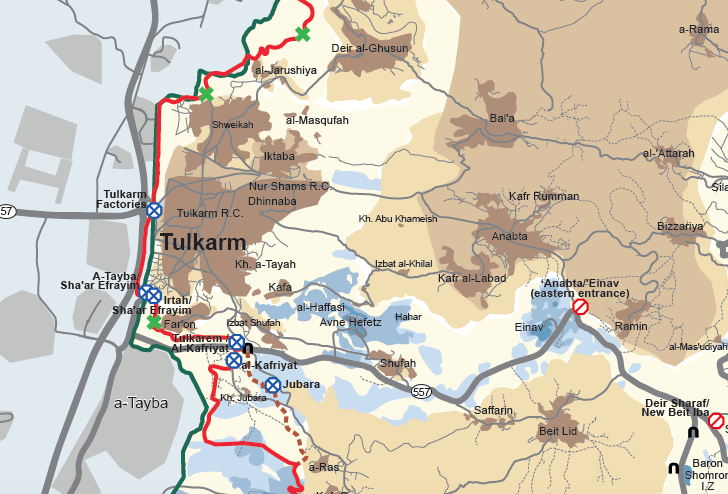
Map by B’Tselem
Israel is also moving to seize land near the city of Shufah in the West Bank, southeast of the Palestinian city of Tulkarem. Palestinian news sources report that the IDF notified residents that Israeli intends to take the land in order to build roads and recreational facilities for a nearby settlement, Avnei Hefetz. Earlier this year, Israel seized land from the Shufah village in order to build a power plant and industrial area for the settlement. In October 2017, the Israeli government advanced plans for 135 new units in the Avnei Hefetz settlement.
Supreme Court & Attorney General Permit State to Seize Private Palestinian Land for Settlers
Israeli Attorney General Avichai Mandleblit released a legal opinion this week asserting Israel’s right to confiscate privately owned Palestinian land for the exclusive benefit of Israeli settlers in the West Bank.
This new opinion concurs with a Supreme Court ruling issued last month that held Israeli settlers are a part of the “local population” of the West Bank, and can be the beneficiaries of state land seizures for “public use.” It also builds on a precedent set earlier this year in the case of the Amona outpost, when the Court ruled that Israel has a duty to care for Israeli settlers forced out of their homes (because those homes were built illegally on privately-owned Palestinian land). The Court ruled that the state has the authority confiscate “abandoned” Palestinian land to do so (Palestinians are systematically denied the right to access lands that are near settlements, Israeli roads, military bases, firing zones, etc., rendering them “abandoned”).
Map by Peace Now
According to the original Amona ruling, the state’s obligation was to provide temporary housing for the affected settlers; according to the subsequent ruling, the state is obligated to care for the settlers by paving roads, without regard to privately owned Palestinian land that would need to be taken. That ruling upheld the state’s confiscation of privately owned Palestinian land in order to legalize an access road to the illegal outpost of Haresha.
Located near Ramallah, the Haresha outpost was established in 1995 without government approval. In January 2010, the State responded to a petition filed by Peace Now and Yesh Din by announcing its intention to retroactively legalize Haresha; less than a year later, in August 2011, Israel seized the land the outpost was built on by declaring it as “state land.” Haresha was approved to become an official settlement in 2015 (Netanyahu legalized 24 other outposts at the same time), but the outpost still needed to submit plans in order to legalize the individual structures. That a planning process has not yet happened – in part because, as Haaretz notes, there is no legal road leading to the outpost. With the access road moving towards legalization, the outpost is set to follow suit.
Speaking to the significance of the decision on the Haresha outpost access road, Israel Justice Minister Shaked said “The attorney general has issued a legal opinion permitting the expropriation of privately owned Palestinian land to permit an access road to [Haresha] that permits the regulation [legalization] of the entire [settlement].” The anti-settlement watchdog Peace Now is expected to appeal the decision upholding the theft of privately owned land for the legalization of the access road. Peace Now issued a statement saying,
Confiscating the land would constitute a severe violation of international humanitarian law and of the Palestinians’ right to own property. The Attorney General’s legal opinion regarding the access road might lead to additional confiscations of private Palestinian lands, strengthening Israel’s stronghold over Palestinian territory. The Attorney General seeks to allow the confiscation of lands owned by Palestinians, who have no voting rights in Israel for the benefit of Israeli settlers with full rights. If the Netanyahu government will continue down this path it will lead us towards a one state reality, based on discrimination and theft.
New Ir Amim Policy Paper: “Bills and Government Plans for Destructive Unilateral Measures to Redraw the Borders of Jerusalem”
The Israeli NGO Ir Amim this week released a new policy paper analyzing the devastating ramifications of Israeli efforts to gerrymander a Jewish-majority in Jerusalem. In addition to essential background on Jerusalem’s environs and analysis of the two pieces of pending Jerusalem-related legislation, Ir Amim provides new analysis of the humanitarian, political, and urban consequences that will follow if these measures are implemented.
Looking at the impacts of the Knesset bill intended to excise two Palestinian East Jerusalem neighborhoods from the Jerusalem municipality, creating new Israeli municipalities to govern them, Ir Amim writes:
The bills and plans currently in circulation seek to displace Palestinian residents living in Jerusalem from the city, and to artificially add to Jerusalem Israeli residents from outside of it. Beyond obvious political implications, these moves can be expected to have serious humanitarian ramifications….
Should practical steps be taken to cut off the neighborhoods beyond the Barrier or a sweeping revocation of their residents’ permanent residency status implemented, we can expect another wave of migration to the East Jerusalem neighborhoods within the Barrier, already strained by a serious lack of infrastructure, services, educational institutions and affordable housing. Living conditions and infrastructure in the East Jerusalem neighborhoods inside the Barrier will decline even further. In this scenario of increasing housing shortages and infrastructure collapse, an upsurge in the number of Palestinian residents who rent or buy apartments in Israeli neighborhoods/ settlements such as Pisgat Ze’ev, Armon Hanatziv and French Hill can be expected. These phenomena, which will occur under conditions of acute uncertainty and anxiety, can be expected to significantly elevate friction and the potential for eruptions of violence in the city. Many other thousands of Palestinians – currently residents of Jerusalem – will remain beyond the Separation Barrier, now administratively displaced from their city and transferred to contrived regional authorities, only exacerbating their distress. Even should they be completely separated from Jerusalem, Israel will not be able to escape accountability for the dire political, urban and humanitarian crisis – and the fertile ground for escalating hostility – it has created.
New Peace Now Report: “Escalation in Israel’s Settlement Policy: The Creation of De-Facto Annexation”
In a new report, Peace Now details the dangerous flood of settlement activity and the de-facto annexation of Area C in the West Bank that the Netanyahu government has pursued without restraint in 2017. The report covers:
- A significant increase in the promotion of plans (6,742 units advanced) and issuance of tenders (3,154 tenders issued) for settlements across the West Bank. This includes the approval of the first new government-backed settlement in 25 years – Amichai.
- The increase in road construction in the West Bank aiming to integrate the settlements into Israel proper, attract more construction and residents in the settlements, and create settler-only highways across the West Bank – all done by expropriating more Palestinian land.
- A dangerous escalation of anti-Palestinian, pro-settlement activities in East Jerusalem including: the simultaneous settlement approvals and eviction of Palestinians from the Sheikh Jarrah neighborhood, the imminent approval of tenders for the Atarot and Givat Hamatos settlements, the expansion of settlement enclaves inside of Palestinian East Jerusalem neighborhood of Jabal al-Mukaber, and the several legislative efforts to gerrymander the borders of the Jerusalem municipality to secure a Jewish majority in the city.
In conclusion, Peace Now writes
All of the abovementioned developments attest to a quantum leap in the promotion of annexation and the blocking of the possibility of a two-state solution. With the speed of developments all across the West Bank and East Jerusalem—and as red lines are being crossed—we are approaching the final stretch before a two-state solution will be almost impossible, and the anticipated situation will be the long years of bloody conflict of Israeli rule over the Palestinians without hope for change. Thus even with the lack of a final status agreement in sight, it is our duty today to prevent silent annexation efforts and to assure the possibility of a two state solution on the ground.
Bonus Reads
- “World Zionist Organization Gave Private Palestinian Land to West Bank Settlers” (Haaretz+)
- “In first, Israel Prize to be Given for Promoting Settlements” (Times of Israel)
- “Palestinian Lawyer Attempted to Report Being Attacked by Settlers. Then He Was Detained Over Back Taxes” (Haaretz)
- “Settler leader revels in Left’s embrace as proof of movement’s power” (Times of Israel)
___
FMEP has long been a trusted resource on settlement-related issues, reflecting both the excellent work of our grantees on the ground and our own in-house expertise. FMEP’s focus on settlements derives from our commitment to achieving lasting Israeli-Palestinian peace, and our recognition of the fact that Israeli settlements – established for the explicit purpose of dispossessing Palestinians in the West Bank and East Jerusalem of land and resources, and depriving them of the very possibility of self-determination in their own state with borders based on the 1967 lines – are antithetical to that goal.